A comprehensive set of resources designed to help first graders master one-to-one correspondence for numbers 1-15 using garden-themed visuals, ten frames, and hands-on activities.
An animal-themed foundational lesson on place value up to 50. Students help zoo keepers count their animals by grouping them into "Ten-Towers" and "Single Snacks," making place value concrete and engaging for young learners.
A comprehensive lesson for Grade 1 special education students to master addition facts up to 20 using diverse strategies like number lines, drawing, and manipulatives. Includes visual instruction, hands-on practice, and small group activities.
A three-part introductory lesson on decimals that uses visual models and real-world scenarios to connect fractions with denominators of 10 and 100 to their decimal forms.
A 20-minute introductory lesson for first graders to identify addition and subtraction 'clue words' in word problems and solve using ten frames and number lines. Optimized for students with Specific Learning Disabilities (SLD) through clear visual supports and structured templates.
A focused lesson for 1st grade special education students to identify clues in word problems and decide whether to add or subtract within 20, themed around a safari animal adventure. Includes visual supports like number lines and animal keyword anchors.
A fun, interactive lesson where students become 'Number Detectives' to master counting to 100 through games and pattern recognition.
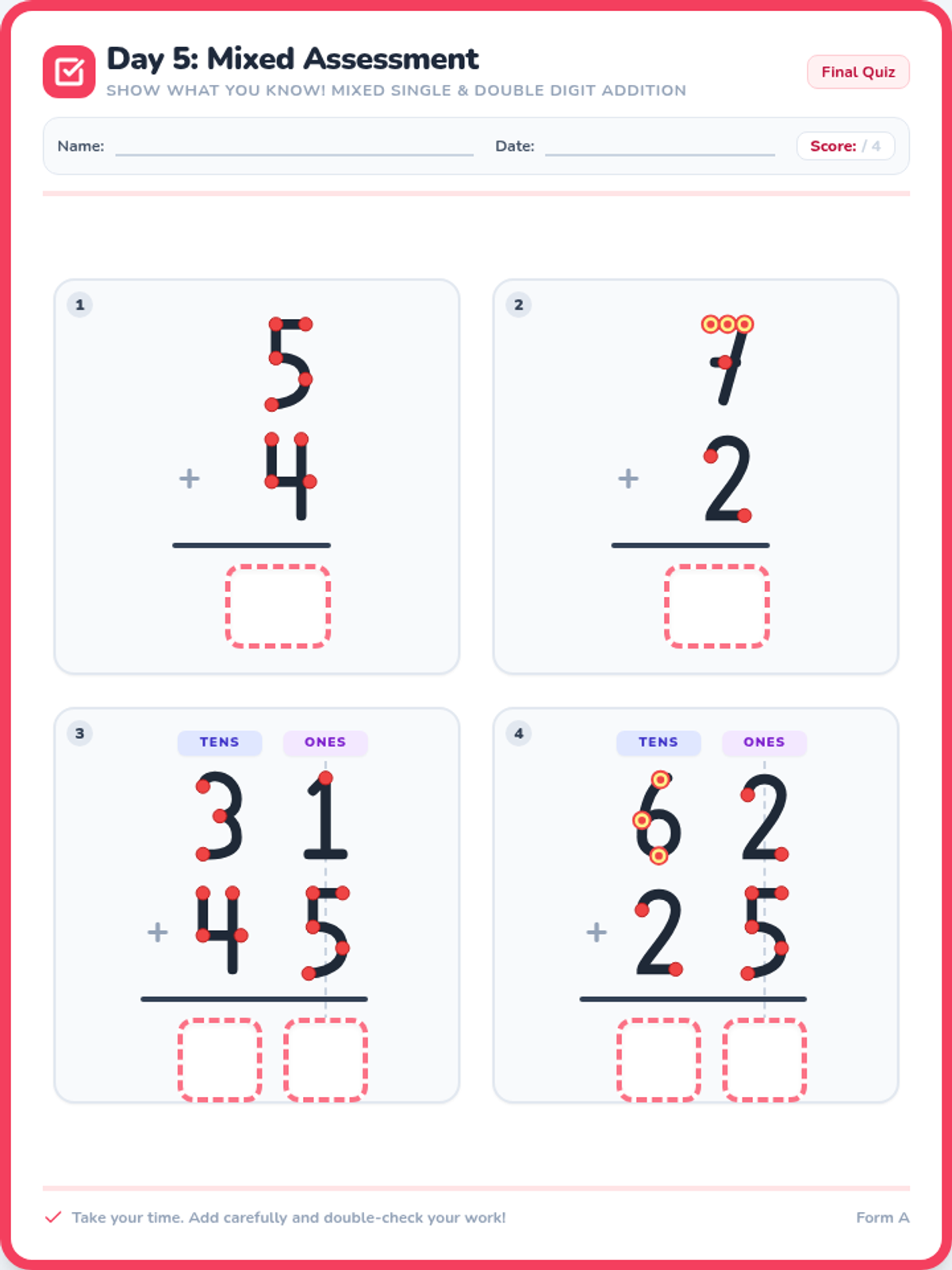
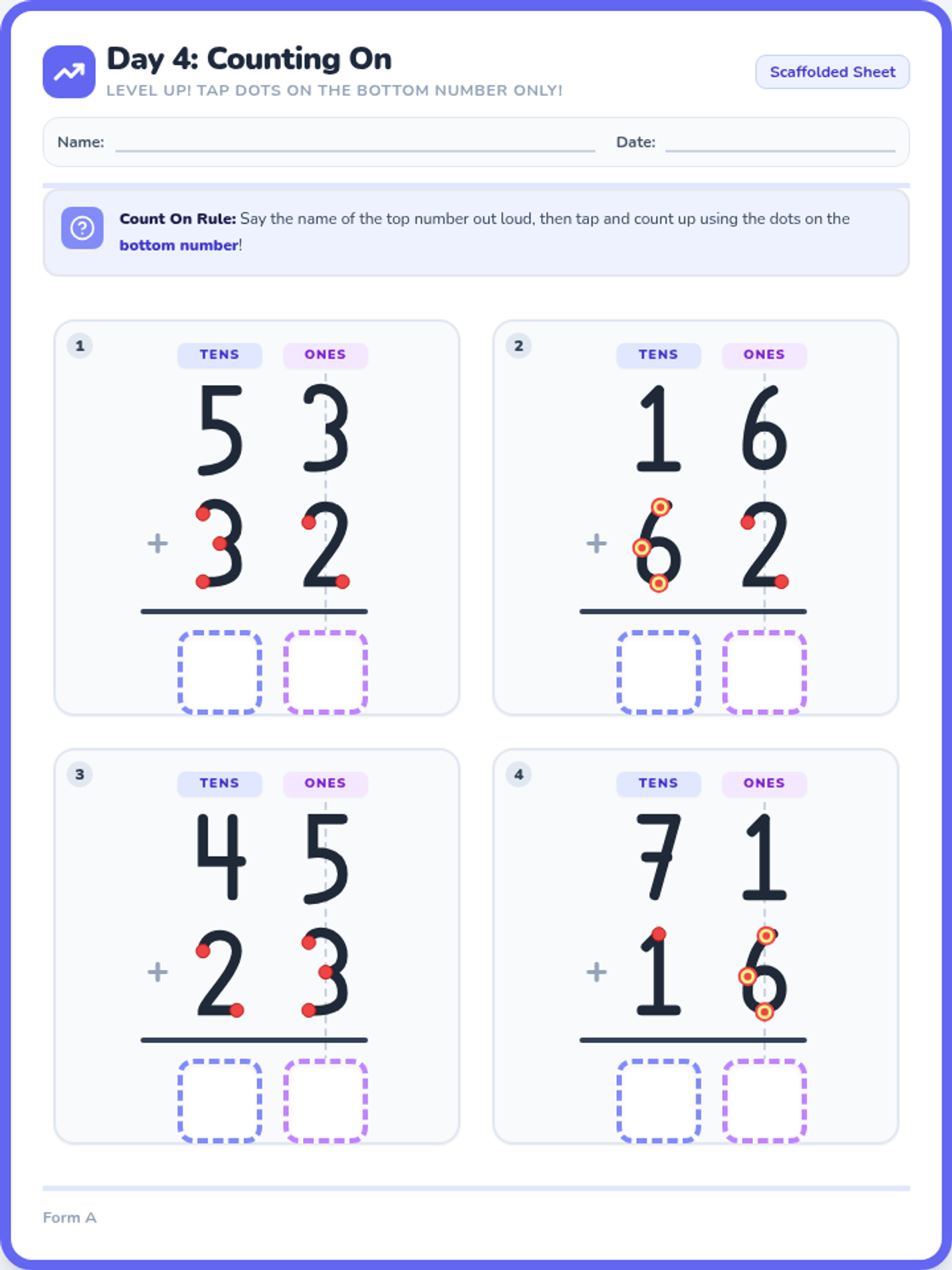
A playful introduction to adding two one-digit numbers using hungry monsters and their favorite snacks. Students move from counting objects to understanding addition sentences.
A foundational lesson for kindergarteners to recognize, count, and write the number 12, introducing the concept of a 'dozen' through engaging dinosaur themes.
A cross-curricular lesson for 1st-3rd graders that combines basic rhythm notation with addition and subtraction. Students decode musical patterns to solve "math mysteries" and perform rhythms.
A kinesthetic, carnival-themed lesson where 8th-grade students explore the definition of a function by rotating through interactive 'booths'. Students learn to distinguish between functions and relations using mappings, tables, and graphs.
A high-stakes geometry lesson where students apply the Pythagorean Theorem to solve a fictional robbery. Students analyze ladder heights, diagonal escape routes, and footprint distances to identify the culprit among three suspects.
A comprehensive introduction to the distributive property using the metaphor of a delivery service. Students will learn to distribute positive integers to both numerical and variable terms within parentheses through visual models and algebraic practice.
A structured, 5-step guided lesson on solving one-step addition and subtraction equations with positive and negative integers, using a blueprint-inspired architectural theme.
A multi-sensory math and art lesson for 1st and 2nd graders to explore 2D shape attributes through tactile creation and observation. Students identify shapes by sides and vertices while building textured geometric masterpieces.
A comprehensive lesson on solving one-step addition and subtraction equations using integers, featuring a balance-scale visualization and step-by-step guided practice.
A comprehensive introduction to the fundamental concepts of statistics, including data classification, sampling methods, and experimental design.
A comprehensive review of systems of linear equations including graphing, substitution, elimination, and real-world application problems involving cost and quantity.
A comprehensive assessment covering logarithms, exponential transformations, and equation solving based on Chapter 6 materials. Includes a 30-question multiple-choice quiz and a detailed answer key.
A comprehensive assessment covering nth roots, rational exponents, and radical equations based on Chapter 5 Algebra 2 concepts.
Compose new shapes from smaller shapes and decompose larger shapes into smaller ones.
Identify and distinguish 3D shapes (cubes, cones, cylinders, spheres) and find them in the real world.
Identify and describe 2D shapes (circles, triangles, squares, rectangles) by their sides and vertices.
Final mastery check of AZ 3.G.A.2 skills: partitioning shapes, identifying unit fractions, and explaining the relationship between parts and the whole area.