A high-stakes engineering challenge where students use the 4Cs and Computational Thinking to design, build, and document the ultimate cup tower structure.
In this 45-minute lesson, Grade 5 ESL students learn to gather information from a digital source by taking organized notes on insect life cycles. Students practice identifying keywords, using visual symbols, and summarizing stages of metamorphosis.
Agents learn to identify 'reactor heat' (stress) and use cooling valves to maintain operational status.
Agents master the logistics of their daily operations through effective planning and organization.
Agents calibrate their internal radar using sensory grounding techniques to stay focused.
Agents practice navigating the 'Laser Grid' of impulses by using their internal pause button.
Agents learn to define their mission and break down big objectives into manageable checkpoints.
A 45-minute ESL lesson for grade 4 students at the Developing (Level 3) proficiency level. Students will explore life cycles, practice gathering information from texts, and learn to take notes and categorize data using graphic organizers.
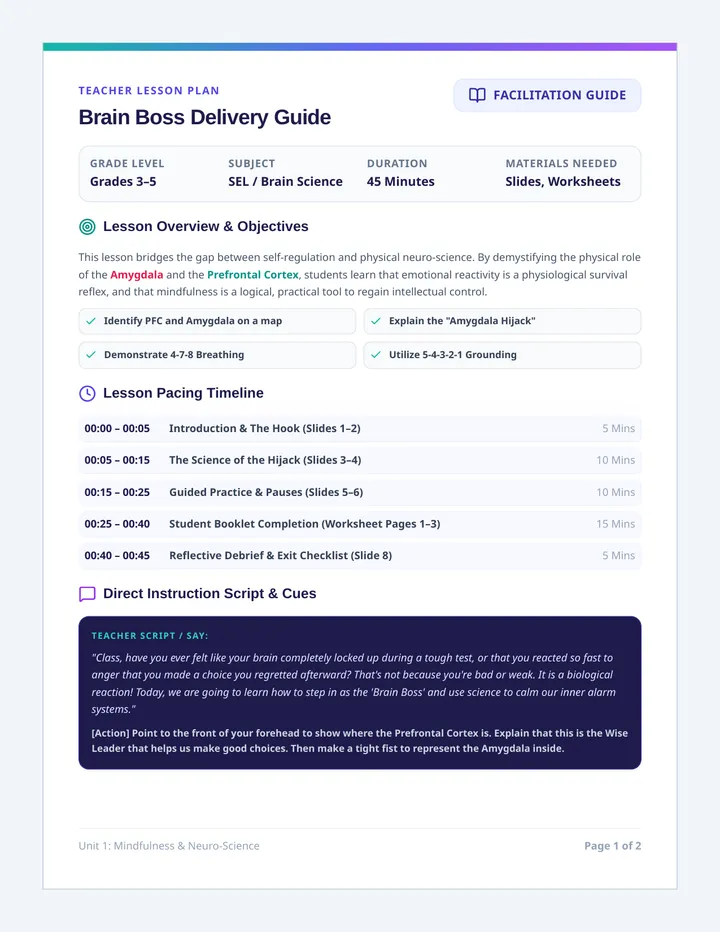
This lesson introduces self-management through an aviation metaphor, teaching students to identify emotional 'turbulence' and use specific 'cockpit controls' to stay on course. Students will learn strategies for impulse control and emotional regulation.
A 45-minute ESL lesson focused on identifying and using precise domain-specific vocabulary to describe the solar system and its planets, culminating in a scaffolded writing task.
Students become digital detectives as they learn to peel back the layers of websites, analyzing domain extensions and "About Us" pages to determine who is providing information and whether they can be trusted.
A 45-minute digital forensics lesson where 6th-grade students learn to use reverse image search tools to verify the authenticity and context of viral images. Students act as 'Image Detectives' to uncover the true origins of misleading digital media.
A 6th-grade lesson where students transition from passive rumor-consumers to active investigators by identifying a school-based myth and designing a scientific or journalistic plan to verify it.
A 45-minute lesson for 6th graders to identify media bias, understand fairness, and practice digital etiquette in journalism. students analyze real-world scenarios and reflect on ethical communication.
A 45-minute ESL lesson for grade 5 students focusing on using advanced temporal adverbs (initially, subsequently, ultimately) to retell stories and sequence social-emotional problem-solving steps.
How and why organisms use light for social interactions, communication, and complex behaviors. Students explore strategies like counter-illumination and burglar alarms.
How is light made? Students break down the chemical reaction of bioluminescence, exploring the interaction between luciferin, luciferase, and oxygen.
Discover the mysterious world of the deep ocean's midnight zone. Students explore how creatures create light in total darkness and identify the physical adaptations of bioluminescent marine life.
Uma aula completa sobre as principais teorias da origem da vida, abordando desde a abiogênese até os experimentos de Miller-Urey, alinhada à BNCC para o Ensino Fundamental II.
A vocabulary-focused lesson exploring 6 narrative words (hastily, wandering, absentmindedly, persisted, gravely, reproved) to understand character behavior and emotion for 4th graders.
Strategies for navigating family dynamics, sibling conflicts, and home-based stressors through clear communication and personal space.
Explores the emotional ups and downs of sports and competition, teaching students how to keep their cool during wins and losses.
Focuses on managing the pressure of grades, tests, and academic expectations through reframing and realistic goal-setting.