A 4-day logic sequence for middle school students themed around soccer and the Socratic method. Students learn to think like Socrates by questioning definitions, assumptions, and contradictions through the lens of 'Socrates United FC'.
A four-day unit for middle school students exploring the geography, science, maritime technology, and lasting legacy of the ancient Phoenician civilization. The sequence alternates between social studies/geography and science/technology lessons, featuring hands-on activities and map analysis.
A series of four 10-15 minute logic lessons for middle school students, focusing on Zeno's paradoxes and the 'Paradox Player' thinking style. Students will learn to break ideas into tiny steps, push logic to extremes, and identify contradictions through 'Paradox Breaker' activities.
A 4-part series for middle schoolers exploring the philosophy of strategy, logic, and leadership through the lens of Alexander the Great. Each 10-15 minute lesson focuses on critical thinking, conditional logic, and tactical decision-making.
A four-part series for middle schoolers on Aristotelian logic and philosophy, focusing on categorization, reasoning, and ethics, with a historical tie-in to Alexander the Great.
A four-day introductory logic and philosophy sequence for middle schoolers focusing on Plato's 'Thinking Style.' Students explore the Allegory of the Cave, perception vs. reality, and the Socratic Method through the lens of 'The Imaginer,' culminating in a visual analysis game.
A comprehensive data analysis system designed to help US History teachers track and analyze student mastery of 117 STAAR terms through weekly cumulative testing.
A journey through time exploring the foundational elements of Ancient Egypt and the pivotal moments of the American Revolution. Students will analyze primary-source style narratives and map out historical events.
A two-day immersive history unit where 7th-grade students simulate the transition from fragmented feudal lands to centralized nation-states in England, France, Spain, and Russia. Students engage in a 'Kingdom Quest' simulation to experience the challenges and strategies of early modern monarchs.
A 2-day social studies unit exploring the emergence of centralized power in Europe. Students will examine how England, France, Spain, and Russia transitioned from feudal territories into powerful, unified nation-states.
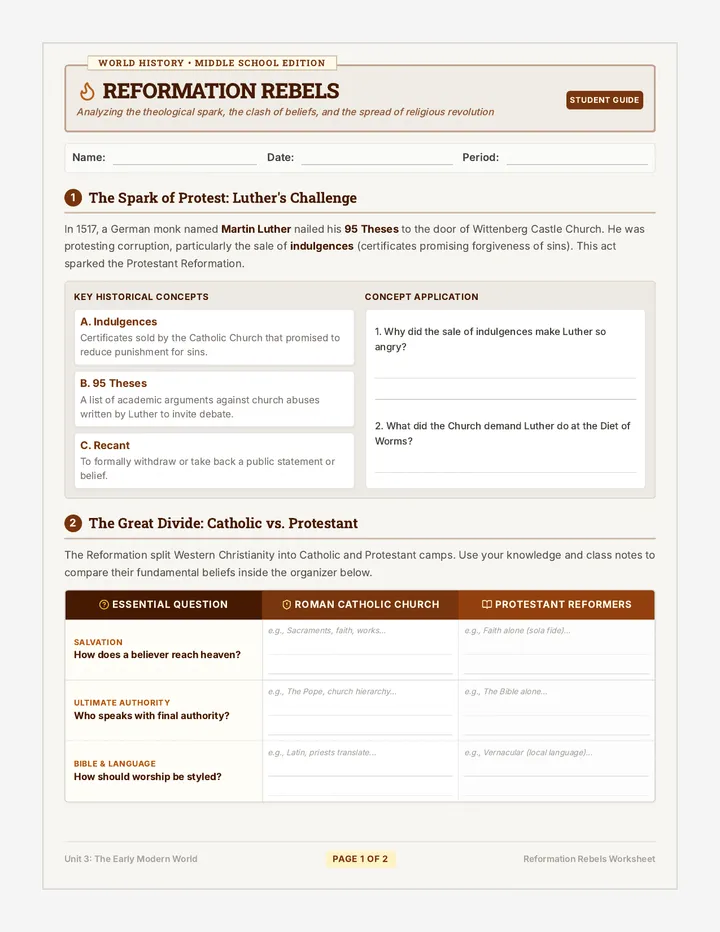
A unit focused on the transition from the Middle Ages to the early Modern Era, highlighting the shift from feudalism to centralized monarchies and the birth of modern nations.
An exploration of the transition from feudal fragmentation into centralized nation-states in England, France, Spain, and Russia.
A comprehensive collection of Project-Based Learning (PBL) units spanning early childhood literacy, elementary math and science, and middle school social studies. Each unit guides students through inquiry, creation, and presentation within a themed 'Discovery Files' framework.