Gist Grabber Teacher Guide Gist Grabber
Lesson 1: Skimming for Main Ideas
Total Time
60 MIN
Learning Objectives
• Define "skimming" and identify its purpose in academic testing.
• Identify key text features (titles, headings, topic sentences) used for skimming.
• Construct a "gist" summary of a 3-page article after 30 seconds of observation.
Preparation
Select a 3-page academic article (non-fiction) with clear headings.
Ensure students have the "Gist Grabber Worksheet".
Stopwatch or timer required.
HOOK
The 30-Second Challenge
"You have exactly 30 seconds to look at this article. Then, you must tell me exactly what it is about. Don't read the words—find the clues!"
1. Hand out the article face-down.
2. On 'Go', students flip and scan. After 30s, shout 'Pencils Down' and hide the article.
3. Ask students to write down 3 words that describe the topic.
TEACH
What is Skimming?
Definiton: Reading rapidly to get the general overview (the "gist") of a text.
When to use: Pre-reading, checking if a source is relevant, or summarizing large amounts of text under time pressure.
✅ DO LOOK AT:
Titles & Subtitles
First & Last Paragraphs
Topic Sentences
Bold/Italicized words
❌ IGNORE:
Detailed examples
Specific data/numbers
Long lists
Prepositional phrases
WORK
Structure Mapping
Students use the Gist Grabber Worksheet to identify the "skeleton" of the provided text. They focus on identifying one topic sentence per paragraph to build a summary map.
Teacher Tip
"Watch for 'word-by-word' readers. If you see students moving their lips or following with their fingers slowly, gently encourage them to 'jump' across the page."
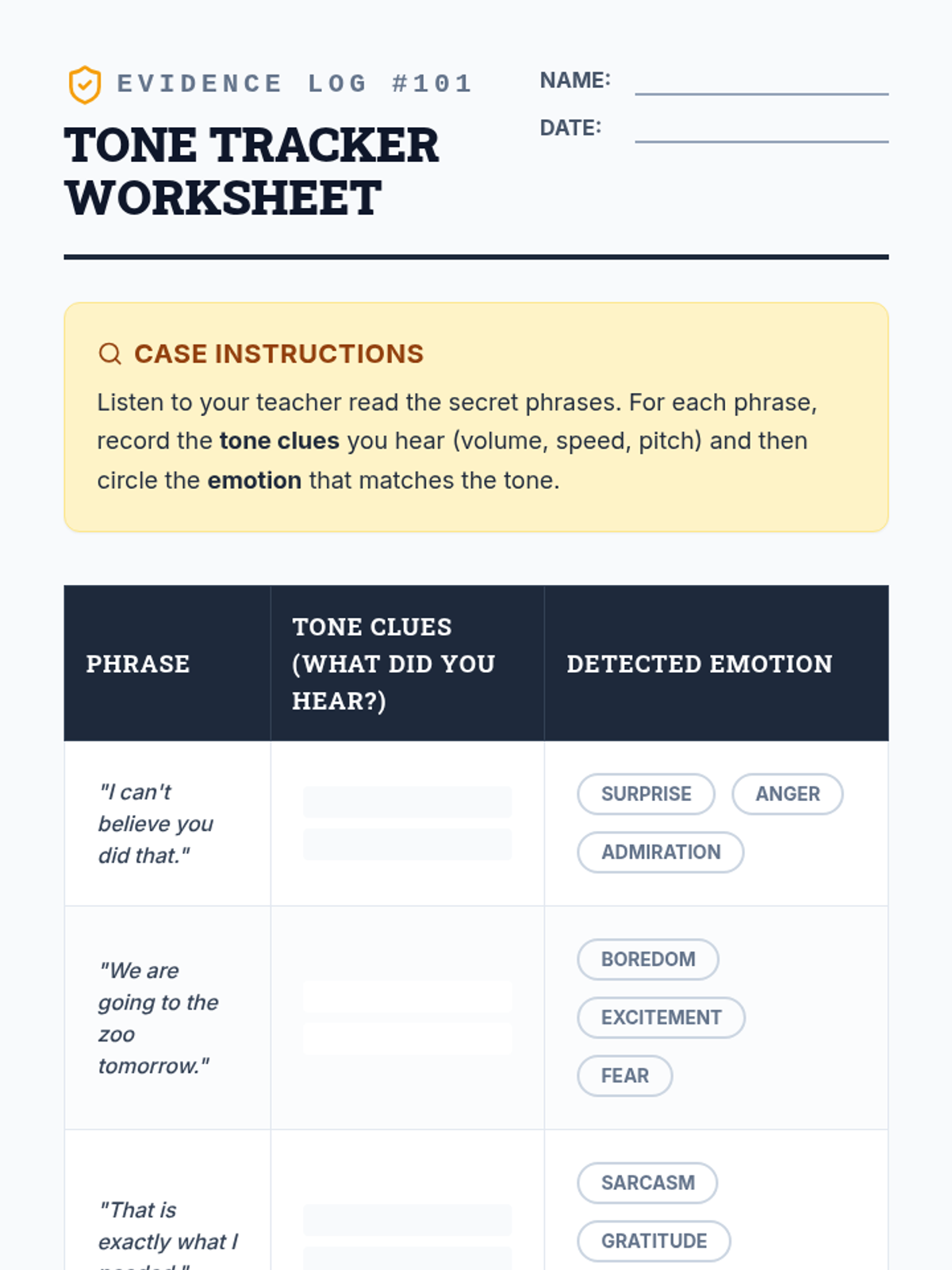
Gist Grabber Worksheet Gist Grabber
Skimming for Main Ideas
Name:
Date:
1
The 30-Second Flash
After looking at the article for 30 seconds, write down the three most important things you saw.
Clue 1 (Title/Heading)
Clue 2 (Key Image/Word)
Clue 3 (The Gist)
2
The Skimming Skeleton
Read ONLY the first sentence of each paragraph. Write one phrase for each to map the argument.
INTRO
PARA 1
PARA 2
PARA 3
CONCL.
3
The One-Sentence Gist
Combine your skeleton notes into a single, clear sentence describing the main purpose of the text.
Skimming Pro-Tip: Speed is your friend. Don't look back!
Data Detective Series
Gist Grabber Slides Gist Grabber
Mastering the Art of Skimming
The Clock is Ticking
In a test, you don't have time to read every single word.
"Reading word-for-word is a trap that leads to unfinished exams."
We need a Fast-Forward button.
What is Skimming?
OVERVIEW
Flying over the text to see the whole landscape.
SPEED
Reading 3-4 times faster than your normal pace.
STRUCTURE
Finding the skeleton of the author's argument.
The Skimming Checklist
Title & Subtitles
Introduction Paragraph
First sentence of every paragraph
Conclusion Paragraph
The Golden Rule
If you start reading about a specific example, STOP. Skip to the next paragraph. You've gone too deep!
Ready for the 30-Second Flash?
We are about to look at an article. Your brain will want to read word-by-word. Fight it. Look for the big clues only!
Rapid Radar Teacher Guide Rapid Radar
Lesson 2: Scanning for Keywords
Total Time
60 MIN
Learning Objectives
• Distinguish between skimming (main idea) and scanning (specific detail).
• Use visual search patterns (Z, S, and Diagonal) to locate proper nouns and numbers.
• Locate 5 specific data points in a dense text within 2 minutes.
Skill Focus
Proper Nouns
Look for Capital Letters that break the line of lowercase text.
Numbers/Dates
Numbers have distinct shapes that "pop" out of alphabetical blocks.
GAME
The Rapid Radar Race
Students receive a page of dense "fake" text or a list of data. They have a checklist of 5 items to find (e.g., "The year the factory closed," "The name of the scientist").
Set-up: Activity Sheet face down. Timer ready.
Winning: First 3 students to stand up with all correct answers.
TECHNIQUE
Visual Search Patterns
The Z-Pattern
Sweep your eyes left-to-right, then diagonally down-left, then left-to-right again. Good for catching keywords in short paragraphs.
The S-Pattern (Snake)
Winding your eyes down the page without stopping at the end of lines. Focus on the center 50% of the column where most meaning lives.
PREP
Identify Before You Fly
The secret to scanning is knowing exactly what you are looking for before you start.
Dates: Look for "19--" or "20--"
Names: Look for Capital Letters (e.g., Dr. Smith)
Quantities: Look for "%", "$", or number words.
Rapid Radar Slides Rapid Radar
Target: Specific Information
The Reading Duel
Skimming
Goal: The Big Picture
"What is this whole thing about?"
Scanning
Goal: The Specific Fact
"Where is the date the war started?"
Visual Flight Paths
The Z-Pattern
Your eyes move like a lightning bolt. Left-right, diagonal down, left-right.
The S-Pattern
Slither down the page! Don't stop at the edges. Keep moving vertically.
Eyes in Motion
Do not read. Search.
Target Lock
Scanning is impossible if you don't know what the target looks like.
NAMES
Look for CAPITAL letters in the middle of sentences.
DATES
Look for 4-DIGIT groups (1984, 2023) or month names.
SYMBOLS
Look for %, $, #, € or bolded terminology.
RACE MODE
RAPID RADAR SPRINT
Turn your worksheet over when I say "GO".
Find all 5 targets. Stand up when you have them.
Speed
Precision
Rapid Radar Sprint Activity Rapid Radar Sprint
Data Retrieval Mission
Detective ID
Target List
Find these specific items in the text below as fast as possible.
Year of Discovery
Scientist Name
Total Cost ($)
Peak Temperature
Classified Research Document #992-X
The initial exploration of the sector began in early autumn. Although the team expected minor resistance from the local terrain, the actual geological survey proved quite standard. According to the log entries made by Dr. Alistair Thorne, the first samples were collected at dawn. The expedition, which was funded by a grant totaling $4,250,000, aimed to establish a permanent monitoring station. Despite early setbacks involving the hydraulic lift systems, progress remained steady throughout the month.
Environmental conditions were monitored every six hours. On the third day, sensors recorded a Peak Temperature of 48.2°C, which necessitated a temporary halt in all outdoor drilling operations. The crew spent the down-time recalibrating the internal atmospheric scrubbers. It wasn't until the Year 1987 Discovery that the team realized the true significance of the crystalline deposits found in the lower strata. These crystals, later identified as beryl-hexagonal, exhibited unique refractive properties never before seen in this hemisphere.
Logistics were managed from the central hub. Communication delays were frequent, often lasting upwards of twelve minutes. The secondary mission parameters included the documentation of rare floral species. Over three hundred distinct specimens were archived by the end of the second quarter. Interestingly, the most resilient species was found growing near the thermal vents, thriving in conditions that would be toxic to most terrestrial life. Further analysis is pending approval from the board of directors next Tuesday morning at ten o'clock.
Budgetary constraints eventually forced the closure of the secondary lab. Final audits showed that over sixty percent of the resources were diverted to deep-core drilling. However, the results justified the expenditure. By mid-winter, the station had successfully transmitted data regarding the core's magnetic fluctuations. This data set remains the gold standard for regional research today. Future expeditions are being planned for the late 2030s, provided that initial funding rounds are successful and the political climate remains stable across the border regions.
1. Year of Discovery:
2. Total Expedition Cost:
3. Lead Scientist Name:
4. Peak Temperature Recorded:
Time Limit: 2:00 MIN
Data Detective / Unit 02
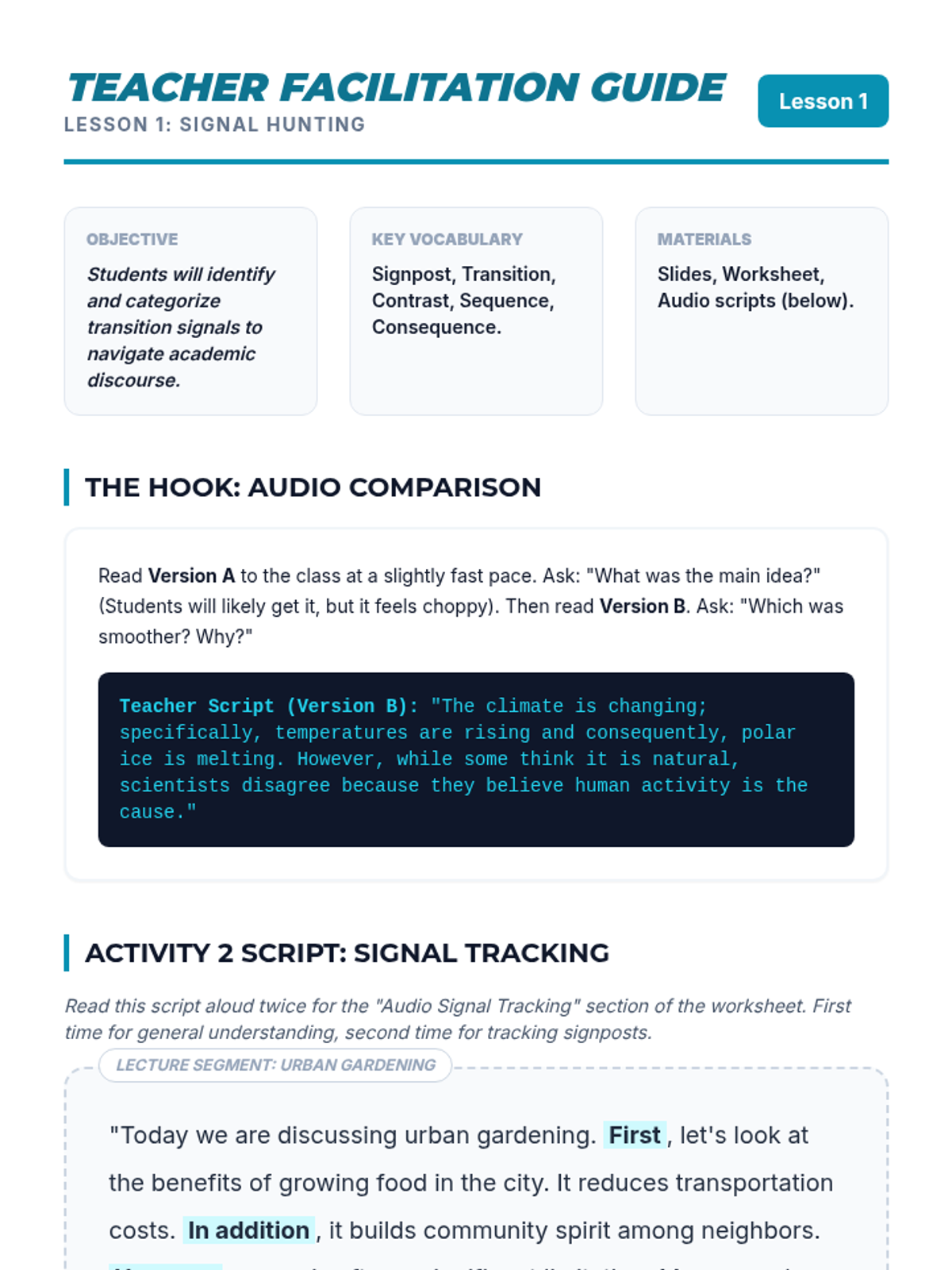
Logic Link Teacher Guide Logic Link
Lesson 3: Navigating with Signpost Words
Total Time
60 MIN
Learning Objectives
• Recognize and categorize "signpost" (transition) words.
• Predict the direction of an author's argument using logic links.
• Navigate a text efficiently by identifying shifts in meaning.
Logic Categories
The U-Turn However, But
The Accelerator Furthermore
The Conclusion Therefore
HOOK
The Skeleton Script
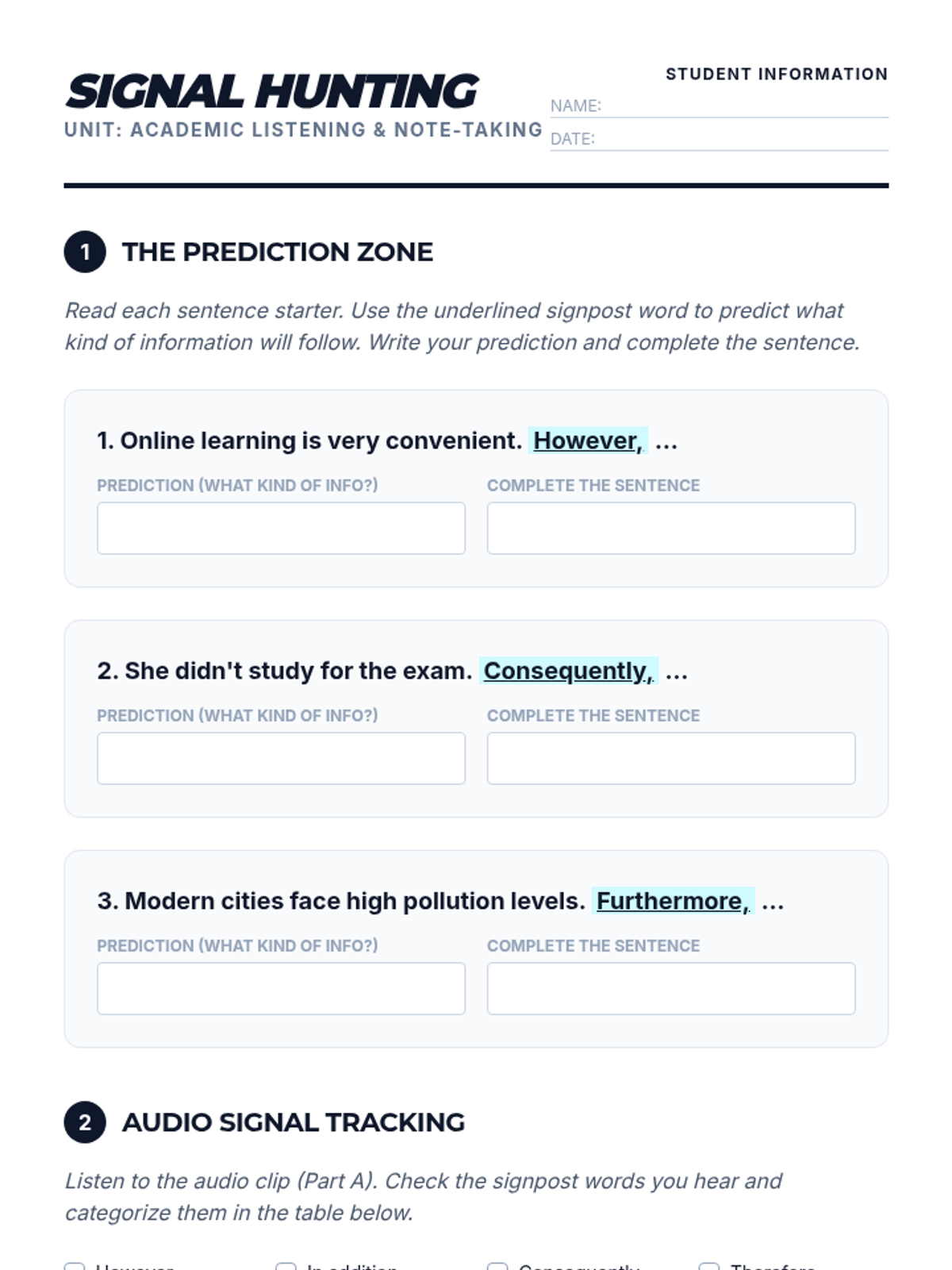
[Topic] __________. However, [Opposing View] __________. Furthermore, [Extra Proof] __________. Consequently, [Result] __________.
Discussion: "Even if you can't read the [Topic], what do you know about how the author's opinion changes? Why?"
TEACH
Reading the Road Signs
Signposts are words that tell the reader what is coming next. If we see "However," we know the author is about to disagree with themselves. We can jump directly to the "However" to find the real argument.
Category 1: Contrast
"Look for the U-turn!"
Instead, Yet, Conversely
Category 2: Causality
"Look for the Result!"
Thus, Since, Accordingly
WORK
Logic Link Navigation
Students use the Logic Link Reference Sheet to label a complex academic paragraph. They must circle all signposts and draw arrows showing if the argument is "Going Forward" (Addition) or "Turning Back" (Contrast).
Logic Link Slides Logic Link
Navigating the Texture of Text
The GPS of Reading
Signposts don't provide facts; they provide direction.
"If you follow the signs, you can find the treasure (the answer) without exploring the entire island."
Stop
Turn
Slow
Merge
Category: The U-Turn
These words tell you the author is changing their mind or showing the other side.
HOWEVER YET CONVERSELY DESPITE
Expect a Conflict
Category: The Accelerator
More of the Same
These words tell you the author is adding more proof for the same point.
FURTHERMORE IN ADDITION MOREOVER SIMILARLY
How to use them?
01
SKIP
If you understand the point, skip past "Furthermore" to the next paragraph.
02
SCAN
If a question asks for a "result," scan the text for "Therefore" or "Thus."
03
WAIT
If you see "However," the author's most important point is usually AFTER it.
Logic Link Signpost Reference Signpost Cheat Sheet
Text Detective Division
The U-Turn
Author is showing a different side or changing direction.
However But Yet Instead Conversely Nevertheless On the other hand Despite
The Accelerator
Author is giving more proof or continuing the same idea.
Furthermore Moreover In addition Additionally Similarly Also Likewise
The Finish Line
Author is summarizing or showing the effect of an action.
Therefore Thus Consequently As a result Hence Accordingly
The Spotlight
Author is making a very important point or highlighting a specific fact.
Indeed In fact Specifically Significantly Notably
How to use this sheet: When reading a difficult academic text, circle these words. If you see a Accelerator, you can read faster because the idea isn't changing. If you see a U-Turn, slow down—the author is about to make a counter-point which is usually on the test!
Logic Link Skeleton Challenge Logic Link Challenge
The Skeleton Navigator
Name:
Section:
1
The Skeleton Script
Look at the sentence structure below. Even though the main words are missing, use the signposts to predict what the author is doing.
Many people believe [A] __________ is the best solution. HOWEVER, recent studies suggest [B] __________. FURTHERMORE, [C] __________ provides even more proof. CONSEQUENTLY, researchers now claim that [D] __________.
Does the author agree with [A]?
Yes
No
How do you know? (Which word gave it away?)
Is [C] a result or more evidence?
Result
Evidence
How do you know?
2
Argument Navigator
In the text below, circle all signpost words. Then, draw a → arrow for addition or a ↶ arrow for contrast above them.
Standardized testing has been the primary method for measuring student success for decades. Many educators argue that it provides an objective baseline for all learners. However, critics point out that these exams often fail to account for cultural differences and diverse learning styles. Furthermore, stress levels among high school students have skyrocketed since the introduction of mandatory state testing. Consequently, some school districts are experimenting with portfolio-based assessments instead. In fact, early results from these pilot programs show a 20% increase in student engagement. Nevertheless, the cost of implementing such a system remains a significant barrier for rural districts.
Quick Check
Based on the signposts, does the author end the paragraph supporting or questioning testing?
Reverse Reader Teacher Guide Reverse Reader
Lesson 4: Strategic Question-First Reading
Total Time
60 MIN
Learning Objectives
• Analyze reading questions to identify "Search Keywords."
• Apply a "Questions-First" strategy to save time during exams.
• Integrate skimming and scanning to answer complex queries.
The Strategy Stack
1 Read the Questions
2 Circle Key Search Terms
3 Scan Text for Targets
4 Read for Context
EXPERIMENT
The Efficiency Race
"Half the class reads the text first. Half reads the questions first. Who can answer all 5 correctly the fastest?"
Group A (Traditional)
Read text page-by-page.
Flip to questions.
Go back to text to find details.
Group B (Strategic)
Read questions first.
Note specific names/years needed.
Scan text directly for those points.
TEACH
Identifying "Search Keywords"
Not every word in a question is useful. We need to find the Anchor Word —the word that will be easy to scan for in the text.
Q: "In what year did the Industrial Revolution start in Britain?" Anchor: Britain / Ind. Rev.
Q: "What percentage of oxygen is in the Earth's crust?" Anchor: % / Oxygen
WORK
Reverse Engineering Practice
Students use the Reverse Reader Strategy Worksheet. They must underline the anchor words in 10 questions before they are allowed to look at the text. They then scan the text only for those anchors.
Reverse Reader Slides Reverse Reader
Flipping the Script on Reading Tests
The Problem
Most students read the entire text first. Then they read the questions. Then they go back to the text to find the answers.
Result: You read the text 3 times!
3x
The Strategy Stack
1
Read the Question
2
Identify Anchors
3
Scan for Keywords
4
Read for Context
Finding the Anchor
An Anchor is a word in the question that is very easy to find with your eyes.
Capitalized Names
Dates & Numbers
Technical Terms
Bad Anchor:
"What is the main idea of the people?"
Good Anchor:
"According to Dr. Smith, what happened in 1945?"
Speed + Accuracy = Mastery
Stop exploring the whole text.
Go straight to the targets and win the race.
Reverse Reader Strategy Worksheet Reverse Reader Practice
Strategy Training Module
Phase 04
Agent Name:
Target Date:
1
Step 1: Anchor Identification
Circle the "Anchor Word" in each question below. Remember: look for names, dates, numbers, or unique capitalized terms.
1. In what year did Louis Pasteur develop the first vaccine?
2. What percentage of the Amazon Rainforest has been deforested since 2010?
3. Which chemical compound is mentioned as a byproduct of Photosynthesis?
4. According to NASA, how many light-years away is the Andromeda galaxy?
2
Step 2: Target Scan
Scan the text below ONLY for the anchors you circled above. Once you find an anchor, read the sentence around it to find the answer.
Field Intelligence Report - Environmental Division
The history of medical science changed forever in 1885 when Louis Pasteur successfully treated a young patient with a rabies vaccine. His work in the French countryside laid the foundation for modern immunology. Decades later, scientists turned their attention to the global environment. Recent satellite imaging from NASA has revealed concerning trends in South America. Data indicates that approximately 17% of the Amazon Rainforest has vanished over the last fifty years, with deforestation rates spiking significantly after the landmark year of 2010. Furthermore, these changes affect the atmospheric balance. During the process of Photosynthesis, trees produce Glucose as a primary byproduct, which serves as energy for the plant while releasing life-sustaining oxygen into the air. In more distant observations, the same agency noted that Andromeda is currently 2.537 million light-years from Earth, reminding us of the vast scales our science must conquer.
Answer 1:
Answer 2:
Answer 3:
Answer 4:
Scanning Strategy Complete
Speed Sprint Teacher Guide Speed Sprint
Lesson 5: The Information Escape Room
Status
FINAL OPS
Challenge Objectives
• Synthesize skimming, scanning, and signpost navigation under strict time pressure.
• Extract 12 precise data points from 3 different academic passages.
• Maintain 90%+ accuracy while reading at 2x normal speed.
Escape Codes (Key)
CODE 1 (History): PASTEUR-1885
CODE 2 (Science): GLUCOSE-2537
CODE 3 (Social): CRITIC-17-20
SET UP
Room Prep
Divide the class into 4-person "Detective Squads."
Place the "Escape Pack" (3 texts + response sheet) face down at each station.
Display a large 20-minute digital timer on the main screen.
Optional: Use a "Black Box" (or envelope) for each team. The code they find "unlocks" their next instruction.
MISSION
The 3-Tier Challenge
Tier 1: The Gist Scan
Teams must find the "main purpose" of Text A by looking only at headings. They write the first part of Code 1.
Tier 2: The Anchor Search
Teams scan Text B for 4 specific data points (Anchors). These numbers form Code 2.
Tier 3: The Signpost Route
Teams navigate Text C using transitions to find the author's final conclusion. This forms Code 3.
DEBRIEF
Strategic Review
After the escape room, ask squads to share which strategy was most effective for them.
"Where did you feel the most pressure?"
"When did you find yourself reading word-by-word (trapped)?"
"How did knowing the goal (the code) change how you read?"
Speed Sprint Escape Pack Information Escape Room
Final Mastery Mission
Squad ID
The Code Breaker
Code 1 (History)
Code 2 (Science)
Code 3 (Logic)
Doc A
The Bio-Tech Frontier
Confidential Transcript
The evolution of medical breakthroughs has always followed a specific pattern of discovery. As noted in the early annals of the 1885 journals, the work of Pasteur remains the ultimate foundation. His early vaccines provided the first code for immunity. To solve Code 1 , combine the primary subject's last name with the landmark year mentioned in this paragraph.
Doc B
Photosynthetic Output
Research Data Set B-9
Current research indicates that botanical energy conversion is more efficient than previously modeled. During the peak cycle, plants produce a specific compound called Glucose. Furthermore, monitoring of the Andromeda sector confirms a distance of 2537 thousand light-years. To solve Code 2 , take the chemical compound and the 4-digit distance number and link them with a dash.
Doc C
The Debate on Testing
Social Analysis Panel
Many believe that exams are the only way to measure growth. However, every Critic has noted that engagement drops when stress is too high. Research shows that 17 percent of students suffer from extreme anxiety. Consequently, a 20 percent increase in success is seen in alternative models. To solve Code 3 , find the noun after the U-turn word, followed by the two numbers mentioned in the final two sentences.
Time Remaining: 20:00
Access Granted / Final Sequence
Speed Sprint Mastery Slides Speed Sprint
The Final Detective Mission
Rules of Engagement
1 Work in your squad. No shouting.
2 Use your reference sheets.
3 Accuracy > Speed. (A fast wrong answer is still wrong).
Time Limit
20:00
Your Toolkit
Skimming
Headings & Topic Sentences for the Gist.
Scanning
Search Patterns for specific Anchors.
Signposts
Follow Transitions to the Conclusion.
The Mission Tiers
A
Identify the Subject and the Landmark Year.
B
Link the Chemical Compound with the Distance.
C
Find the Critic and the two Stats after the Turn.
Ready?
Flip your packs and begin.