Tower Builders Slides Tower Builders
Visualizing Fractions as Parts of a Whole
Lesson 1: Foundation Building
The Tower Challenge
The Goal:
Build the tallest tower possible in 60 seconds.
The Rule:
You can only use one color per tower!
1
"Why are some towers taller even if they have the same number of bricks?"
2
"How many pink bricks match the height of one black brick?"
Defining "The Whole"
In our blueprint, The Whole (1) is the longest bar.
THE WHOLE (1)
1/2
1/2
How many Halves make a Whole?
The Unit Fraction
\( \frac{1}{2} \)
Half
\( \frac{1}{4} \)
Fourth
\( \frac{1}{8} \)
Eighth
As the denominator gets BIGGER...
...the piece gets SMALLER!
The "Fitting" Question
How many 1/8 pieces can fit into 1/2?
Grab your towers and test it!
Tower Blueprint Worksheet Tower Blueprint
Lesson 1: Foundation Skills
Name:
Date:
1
The One-Whole Standard
Use your longest fraction tower piece as "The Whole" (1). Match the smaller pieces to find their value.
THE WHOLE (1)
1/2
1/2
How many 1/2 pieces fit into 1 whole? ________
2
Building Equivalents
Set up the larger piece first. Then, find out how many of the smaller unit fractions you need to match the height perfectly.
Target: 1/2 Match with 1/4s
How many 1/4 pieces fit in 1/2? ________
Target: 1/2 Match with 1/8s
How many 1/8 pieces fit in 1/2? ________
Target: 3/4 Match with 1/8s
How many 1/8 pieces fit in 3/4? ________
Target: 1 whole Match with 1/12s
How many 1/12 pieces fit in 1 whole? ________
The Big Idea
In math, when we ask "How many times does \( \frac{1}{4} \) fit into \( \frac{1}{2} \)?" we are actually writing a division problem!
\( \frac{1}{2} \) \( \frac{1}{4} \) = ?
Based on your work above, what is the answer to this problem? ________
Facilitation Guide Teacher Resource Facilitation Guide
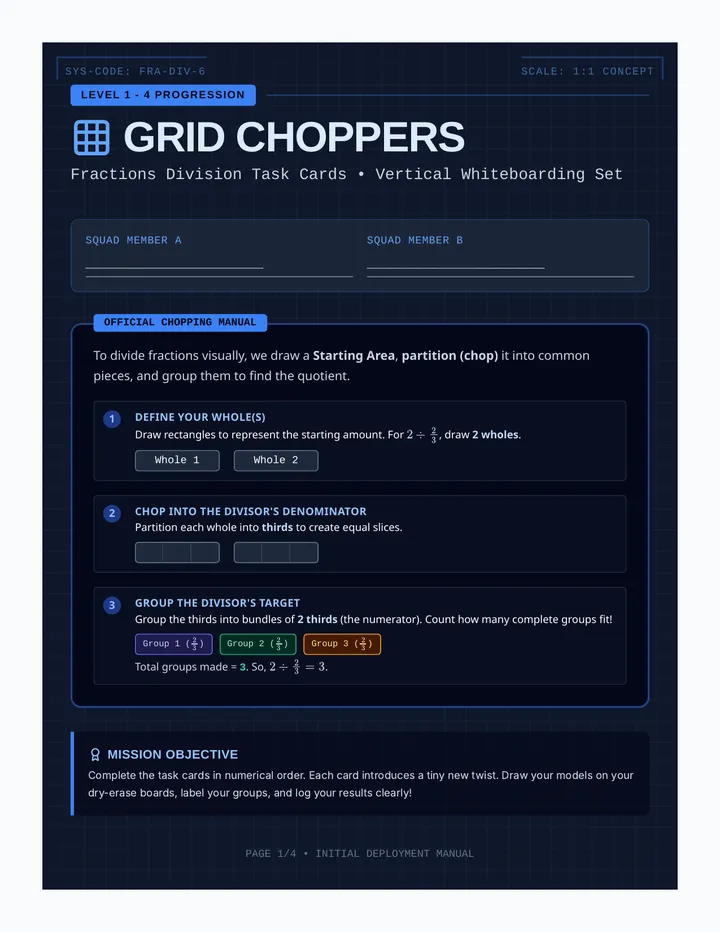
Fraction Division Blueprint Sequence
Target Group 6th Grade Academic Support
The Learning Arc
L1: Concrete
L2: Concept
L3: Problem
L4: Repr.
L5: Abstract
This sequence is designed for students who struggle with the "magic" of the Keep-Change-Flip algorithm. By the time they reach Lesson 5, they should understand why multiplying by the reciprocal works (it's essentially a shortcut for finding common denominators and then dividing).
Manipulative Logistics
Required Tools
Fraction Towers or Tiles (sets of 1, 1/2, 1/3, 1/4, 1/5, 1/6, 1/8, 1/10, 1/12)
Circular Fraction Tiles (specifically for Lesson 2)
Dry-erase markers and personal whiteboards
Setup Tip
Pre-bag the tiles for students. For Lesson 3, ensure bags contain pieces that can form common denominators (e.g., if the problem is 1/2 and 1/3, ensure they have at least six 1/6 pieces).
Questioning Framework
Stage Ask this... Instead of... Initial Entry "How many of this size will fit in that size?" "What is divided by?" The Gap "Is that leftover half of a whole, or half of your group size?" "What's the remainder?" Synthesis "How does flipping the fraction relate to our 'swapping' step?" "Do you remember the rule?"
Support & Extension
Scaffold (For Students Struggling with Lesson 3):
Provide "Swap Templates"—rectangles divided into common denominators (like a grid of 12) where students can lay their 1/3 and 1/4 pieces to see the match.
Extension (For Early Finishers):
Ask students to create their own "loading dock" word problems where the answer is a mixed number, and have them trade with a partner to model.
Red Flag Misconception
The Remainder Error: In Lesson 4, students will almost always label a leftover 1/4 piece as "1/4" in their final answer (e.g., \( 1 \frac{1}{4} \)) even if the divisor was 1/2.
Fix: Use the truck analogy. If a truck holds 1/2 and you have 1/4 left, is your truck 1/4 full or 1/2 full? They will visually see it is half-full. The answer is \( 1 \frac{1}{2} \) truckloads.
Pizza Slicer Slides Pizza Slicer
Modeling Division with Like Denominators
Lesson 2: The Grouping Concept
The Slicer Shop
You have 4/5 of a pizza left in the kitchen.
"A customer orders slices that are each 1/5 of a whole pizza."
4/5
How many orders can you fill?
Thinking in Groups
Division usually means "How many groups of this size fit inside?"
\( \frac{4}{5} \) What we have
\( \frac{1}{5} \) Group size
=
?
If the "denominators" match, we are just counting the pieces!
Step-by-Step Modeling
1
Build the Total
Use 4 pieces of the 1/5 fraction tiles.
2
Define the Group
Put 1 piece (size 1/5) in a separate circle.
3
Count 'em Up
How many times can you make that group using your total pieces?
Predicting the Result
If we divide 6/8 by 2/8...
...are we going to get a larger or smaller number than 1? Why?
Model it now!
Pizza Order Worksheet Pizza Order Form
Lesson 2: Like Denominators
Name:
Date:
Manager's Instructions
You have a specific amount of pizza left. Each customer order requires a certain slice size. Use your fraction tiles to build the total, then count how many "order sizes" you can make.
ORDER #101
Available Pizza:
\( \frac{6}{8} \)
Customer Needs Slices of Size:
\( \frac{2}{8} \)
Total Orders Filled: ________
ORDER #102
Available Pizza:
\( \frac{4}{6} \)
Customer Needs Slices of Size:
\( \frac{1}{6} \)
Total Orders Filled: ________
ORDER #103
Available Pizza:
\( \frac{10}{12} \)
Customer Needs Slices of Size:
\( \frac{5}{12} \)
Total Orders Filled: ________
ORDER #104
Available Pizza:
\( \frac{12}{10} \)
Customer Needs Slices of Size:
\( \frac{3}{10} \)
Total Orders Filled: ________
Final Calculation Check:
\( \frac{8}{10} \div \frac{2}{10} = \)
Show how you know with your tiles!
Piece Swap Slides The Great Swap
Dividing Fractions with Unlike Denominators
Lesson 3: The Search for a Match
When Pieces Don't Fit
Try to solve this with your tiles:
\( \frac{1}{2} \div \frac{1}{4} = \text{?} \)
"That's easy! Two 1/4s fit in a 1/2."
But what about...
\( \frac{1}{2} \div \frac{1}{3} = \text{?} \)
They don't line up! It's not a perfect fit!
The Swap Strategy
If the pieces don't match, we need to SWAP them for pieces that do!
\( \frac{1}{2} \)
\( \frac{3}{6} \)
VS
\( \frac{1}{3} \)
\( \frac{2}{6} \)
Now they both use 1/6 pieces!
Finding a Common Ground
The Secret Code:
Find a number that both denominators can multiply into.
For 2 and 3, that number is 6!
Once the denominators are the same...
JUST DIVIDE THE TOP!
\( \frac{3}{6} \div \frac{2}{6} = \frac{3}{2} \)
The Great Swap Challenge
Can you solve this with tiles?
\( \frac{2}{3} \div \frac{1}{2} = \text{?} \)
1. Swap for 1/6s
2. How many fit?
Piece Swap Worksheet The Piece Swap
Lesson 3: Finding Common Denominators
Name:
Date:
The Swap Rule
If your fraction tiles don't have the same denominator, you can't divide them easily! Find a Common Denominator (a piece size that fits perfectly into both) and swap them out.
\( \frac{2}{3} \div \frac{1}{6} \)
Swap Required
1. Swap \( \frac{2}{3} \) for 1/6 pieces:
\( \frac{?}{6} \)
2. How many \( \frac{1}{6} \) pieces fit in that total?
\( \frac{3}{4} \div \frac{1}{2} \)
Swap Required
1. Find a common denominator for 4 and 2:
Denominator: ________
2. Perform the swap and divide:
\( \frac{1}{2} \div \frac{1}{3} \)
Swap Required
Show your swapping process here (draw or write):
Answer:
Remember: If you find a common denominator, you are just comparing how many small pieces fit into the total number of small pieces!
Tape Architect Slides Tape Architect
Drawing Models and Interpreting Remainders
Lesson 4: Representational Thinking
From Blocks to Blueprints
Concrete (Manipulatives)
Representational (Tape Diagrams)
"Why draw it? Because we won't always have our towers in our pockets!"
The Leftover Mystery
Problem: How many 1/2s fit in 3/4?
3/4 (OUR TARGET)
1 GROUP (1/2)
GAP
We fit 1 whole group... but what is that leftover piece?
Zooming into the Gap
The leftover piece is 1/4 of a whole pizza.
But it is 1/2 of the divisor!
Rule of Architects:
Always describe the remainder as a fraction of the piece you were trying to fit.
Answer: \( 1 \frac{1}{2} \) groups
The Loading Dock
A delivery truck can hold 2/3 of a pallet.
Your current order is 1/2 of a pallet.
\( \frac{1}{2} \div \frac{2}{3} = \text{?} \)
Will this be more or less than 1 whole group? Use your diagram!
Tape Architect Worksheet Architect's Grid
Lesson 4: Tape Diagrams & Remainders
Name:
Date:
Drafting Protocol
Draw a "Target Bar" representing the dividend (what you have).
Draw "Measuring Bricks" representing the divisor underneath.
If there is a gap, express the leftover as a fraction of one brick.
1
Standard Fit: \( \frac{3}{4} \div \frac{1}{2} \)
Your Diagram:
Whole Groups that fit:
Remainder (Fraction of divisor):
Final Answer:
2
The Half-Brick: \( \frac{1}{2} \div \frac{1}{3} \)
Your Diagram:
Final Quote:
The Architect's Logic
Wait! When we divide \( \frac{1}{2} \) by \( \frac{1}{3} \), the answer is MORE than 1. But when we divide \( \frac{1}{3} \) by \( \frac{1}{2} \), the answer is LESS than 1.
Why does that happen? Explain using the word "FIT":
Cheat Code Slides Cheat Code
Connecting Models to the Algorithm
Lesson 5: System Mastery
Manual Mode
Method 01: The Model
Grab the Towers
Perform the Swap
Draw the Diagram
Count the Fits
Slow, but shows the truth.
Method 02: The Algorithm
What if there was a math shortcut that gives the exact same result every time?
KEEP • CHANGE • FLIP
Syntax
\( \frac{2}{3} \)
KEEP
\( \div \)
CHANGE TO \( \times \)
\( \frac{1}{2} \)
FLIP TO \( \frac{2}{1} \)
System Verification
Problem: \( \frac{1}{2} \div \frac{1}{4} \)
We know from the towers that 1/4 fits into 1/2 exactly 2 times.
Run Algorithm:
\( \frac{1}{2} \times \frac{4}{1} = \frac{4}{2} = 2 \)
IT'S A
MATCH!
Boss Battle
Level Final Challenge:
\( \frac{4}{5} \div \frac{2}{3} = \text{?} \)
1. Keep it
2. Change it
3. Flip it
Model it with a diagram to prove the cheat code works!
Cheat Code Worksheet System Override
Lesson 5: The Algorithm Practice
Player:
Level:
Algorithm Protocol: K.C.F.
KEEP First Fraction
CHANGE To Multiply (\( \times \))
FLIP Second Fraction
\( \frac{2}{3} \div \frac{1}{2} \)
=
\( \frac{5}{6} \div \frac{2}{3} \)
=
PROVE IT
Level Boss: Verification
Use the "Cheat Code" to solve \( \frac{3}{4} \div \frac{1}{2} \). Then, draw a quick Tape Diagram below to prove the code didn't glitch!
Run Code:
System Visual:
CPU: STABLE MATH.EXE: RUNNING
"Keep the first, change the sign, flip the end, you'll be fine!"
Blueprint Answer Key Blueprint Answer Key
Fraction Division Blueprint Sequence (Lessons 1-5)
Lesson 1: Tower Blueprint
Section 1: 1/2 pieces in 1 whole = 2
Problem 1: 1/4 pieces in 1/2 = 2
Problem 2: 1/8 pieces in 1/2 = 4
Problem 3: 1/8 pieces in 3/4 = 6
Problem 4: 1/12 pieces in 1 whole = 12
The Big Idea: \( \frac{1}{2} \div \frac{1}{4} = \mathbf{2} \)
Lesson 2: Pizza Order Form
Order #101: \( \frac{6}{8} \div \frac{2}{8} = \mathbf{3} \)
Order #102: \( \frac{4}{6} \div \frac{1}{6} = \mathbf{4} \)
Order #103: \( \frac{10}{12} \div \frac{5}{12} = \mathbf{2} \)
Order #104: \( \frac{12}{10} \div \frac{3}{10} = \mathbf{4} \)
Final Check: \( \frac{8}{10} \div \frac{2}{10} = \mathbf{4} \)
Lesson 3: The Piece Swap
Problem 1: Swap \( \frac{2}{3} \) for \( \frac{4}{6} \). Final Answer: 4
Problem 2: Common Denom is 4 (or 8, 12...). Swap \( \frac{1}{2} \) for \( \frac{2}{4} \). Problem becomes \( \frac{3}{4} \div \frac{2}{4} = \mathbf{1 \frac{1}{2}} \)
Problem 3: Common Denom is 6. Swap to \( \frac{3}{6} \div \frac{2}{6} = \mathbf{1 \frac{1}{2}} \)
Lesson 4: Architect's Grid
Problem 1: Whole groups = 1. Remainder = 1/2 of a brick. Final Answer: \( 1 \frac{1}{2} \)
Problem 2: Final Quote: \( 1 \frac{1}{2} \) (One whole 1/3 brick fits, and half of another 1/3 brick fits).
Logic: If the divisor is smaller than the dividend, it will fit more than once . If it is larger, it will fit less than once .
Lesson 5: System Override
Problem 1: \( \frac{2}{3} \times \frac{2}{1} = \frac{4}{3} \) or \( 1 \frac{1}{3} \)
Problem 2: \( \frac{5}{6} \times \frac{3}{2} = \frac{15}{12} = \frac{5}{4} \) or \( 1 \frac{1}{4} \)
Level Boss: \( \frac{3}{4} \times \frac{2}{1} = \frac{6}{4} = \frac{3}{2} \) or \( 1 \frac{1}{2} \)