A foundational course on Chinese character writing for 7th graders, focusing on the eight basic strokes, standard stroke order rules, and spatial balance within the traditional field grid system.
A Spanish I/II unit focused on Valentine's Day, covering vocabulary related to love, relationships, and emotions through interactive activities and communicative practice.
An immersive intermediate French sequence where students navigate travel scenarios in Paris, Dakar, and Montreal, mastering future, past, and conditional tenses through simulated real-world interactions.
A linguistic and sociological exploration of how English absorbs and adapts words from diverse global sources, focusing on etymology, cultural exchange, and the evolution of language.
Students act as linguistic anthropologists creating a specialized 'Field Guide to Foreign Expressions' for a chosen professional or cultural domain. They investigate the etymology, usage, and visual representation of foreign terminology to explain their chosen field's linguistic history to a lay audience.
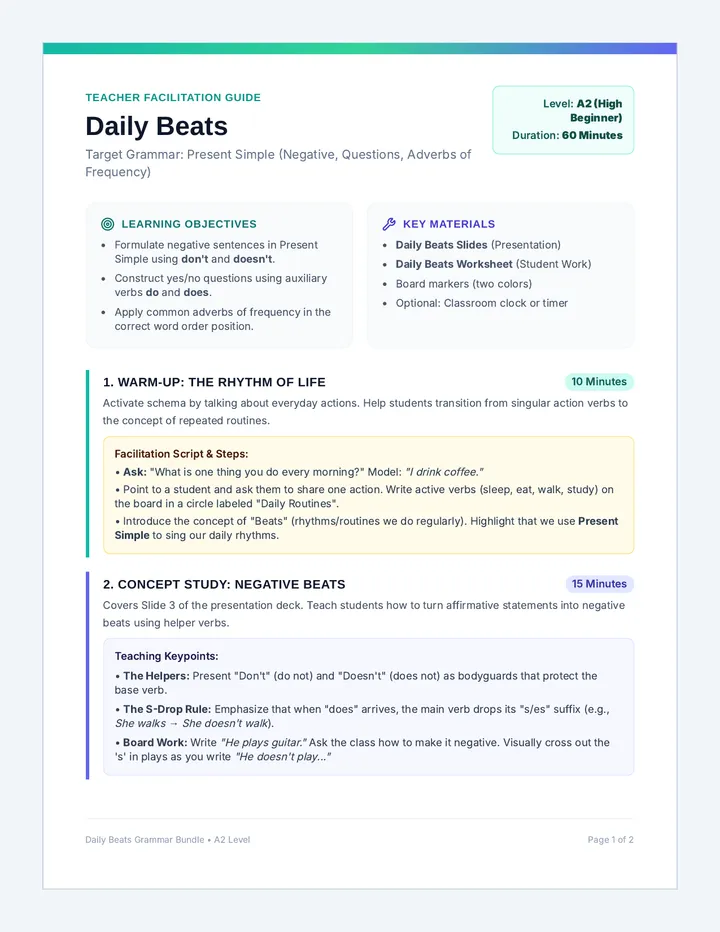
A comprehensive one-week introduction to Spanish for middle schoolers, focusing on greetings, introductions, and sharing personal interests through interactive role-play and collaborative activities.
A project-based sequence for beginner French students focused on decoding media through narrative structures, logical connectors, and 'gist' listening strategies. Students move from identifying chronological signposts to analyzing news segments, street interviews, and cultural advertisements, culminating in a media analysis project.
A beginner French listening sequence where students act as social observers, analyzing registers, personal details, family structures, and preferences through auditory scripts.
A game-based French listening sequence for 7th graders where students act as detectives to decode physical descriptions, preferences, family ties, and food orders to solve a final mystery.
An immersive introductory sequence for 7th-grade French students focused on decoding the auditory landscape of the French language, from basic phonemes to complex social interactions.
A project-based unit for 7th-grade Spanish students to explore identity. Students learn to describe themselves and others using 'ser' and 'gustar', building toward a personal identity presentation.
A comprehensive unit for beginner Spanish students to master the verb 'estar' and 'tener' idioms for expressing emotions, physical states, and needs. Through interactive games, role-plays, and data collection, students learn to articulate their internal feelings and conduct wellness checks on others.
This immersion-style sequence empowers 7th-grade students to navigate their classroom environment using only Spanish. Students progress from identifying objects to following complex multi-step instructions through TPR and role-play.
This sequence establishes foundational auditory and oral skills for Spanish fluency, focusing on vowel sounds, difficult consonants like 'rr' and 'ñ', and rules of stress and accentuation. Students transition from sound production to reading syllables and full words with accuracy.
A 5-lesson sequence for 7th-grade students to master Spanish greetings, introductions, and the cultural nuances of formal vs. informal address (tú vs. usted). Students move from basic vocabulary to complex social simulations.
This sequence builds foundational Spanish pronunciation and social introduction skills. Students progress from mastering the five pure vowels and unique consonants to navigating the cultural nuances of formal and informal address, culminating in a fluent introductory dialogue.
An inquiry-based exploration of French communities where students learn to identify landmarks, use spatial prepositions, and provide directions. Students develop practical communication skills while virtually navigating Francophone cities.
This sequence establishes the phonetic and sociolinguistic foundations for French communication. Students master pronunciation, navigate the formal/informal divide, and learn greeting protocols for professional and social settings.
A comprehensive 5-lesson sequence for intermediate Mandarin students to compare the daily lives and educational systems of Chinese and American middle schoolers through authentic-style reading materials.
A 7th-grade sequence exploring the 3,000-year evolution of Chinese characters, from ancient Oracle Bone pictographs to modern Simplified Hanzi, integrating history, art, and linguistics.
This sequence guides 7th-grade students through the fundamentals of Mandarin Chinese sentence structure. Starting with personal pronouns and moving through essential verbs like 'to be', 'to have', and action verbs, students learn to construct complete thoughts using the Subject-Verb-Object (SVO) pattern.
A project-based sequence for 7th graders to master basic Mandarin characters through their school environment. Students progress from naming individual objects to designing and labeling a complete classroom layout.
A 5-lesson sequence for 7th-grade students focused on decoding Mandarin Chinese characters through semantic radicals. Students learn to identify nature and human-related components, understand compound character logic, and use radical-based systems for information retrieval.
This sequence focuses on the cognitive processing of numerical data in Mandarin Chinese, moving from basic digits to complex phone numbers, calendar dates, clock times, and marketplace currency. Students will develop rapid auditory recognition through gamified scenarios like emergency dispatch, time travel, and transit scheduling.
A 6th-grade Mandarin Chinese unit exploring the logical, mathematical structure of Chinese numbers, days of the week, and calendar dates. Students progress from writing basic characters and learning hand gestures to building complex numbers and creating functional calendars.
Students explore the pictographic evolution of Mandarin Chinese characters, tracing modern symbols back to ancient Oracle Bone script. The sequence focuses on nature and animal characters, helping students build visual associations and mnemonics to master basic Hanzi.
This sequence introduces 6th-grade students to the foundational strokes and rules of Mandarin Chinese character writing. Through a blend of cultural exploration and rigorous skill-building, students learn the 'Four Treasures of the Study,' master the eight basic strokes, and internalize the seven governing rules of stroke order to produce legible and balanced characters.
This sequence guides beginner Mandarin learners through 'bottom-up' listening strategies using authentic media. Students will learn to filter out 'noise' to identify keywords in weather reports, pop songs, and food vlogs, building their tolerance for ambiguity and real-world comprehension skills.
A comprehensive sequence for beginner Mandarin learners focusing on processing numerical data, dates, time, and currency through rapid-response listening activities and gamified simulations.
A foundational listening sequence for beginner Mandarin students, focusing on phonemic awareness, tone discrimination, and Pinyin transcription. Students progress from basic initials and finals to complex tone sandhi rules and full-word dictation.