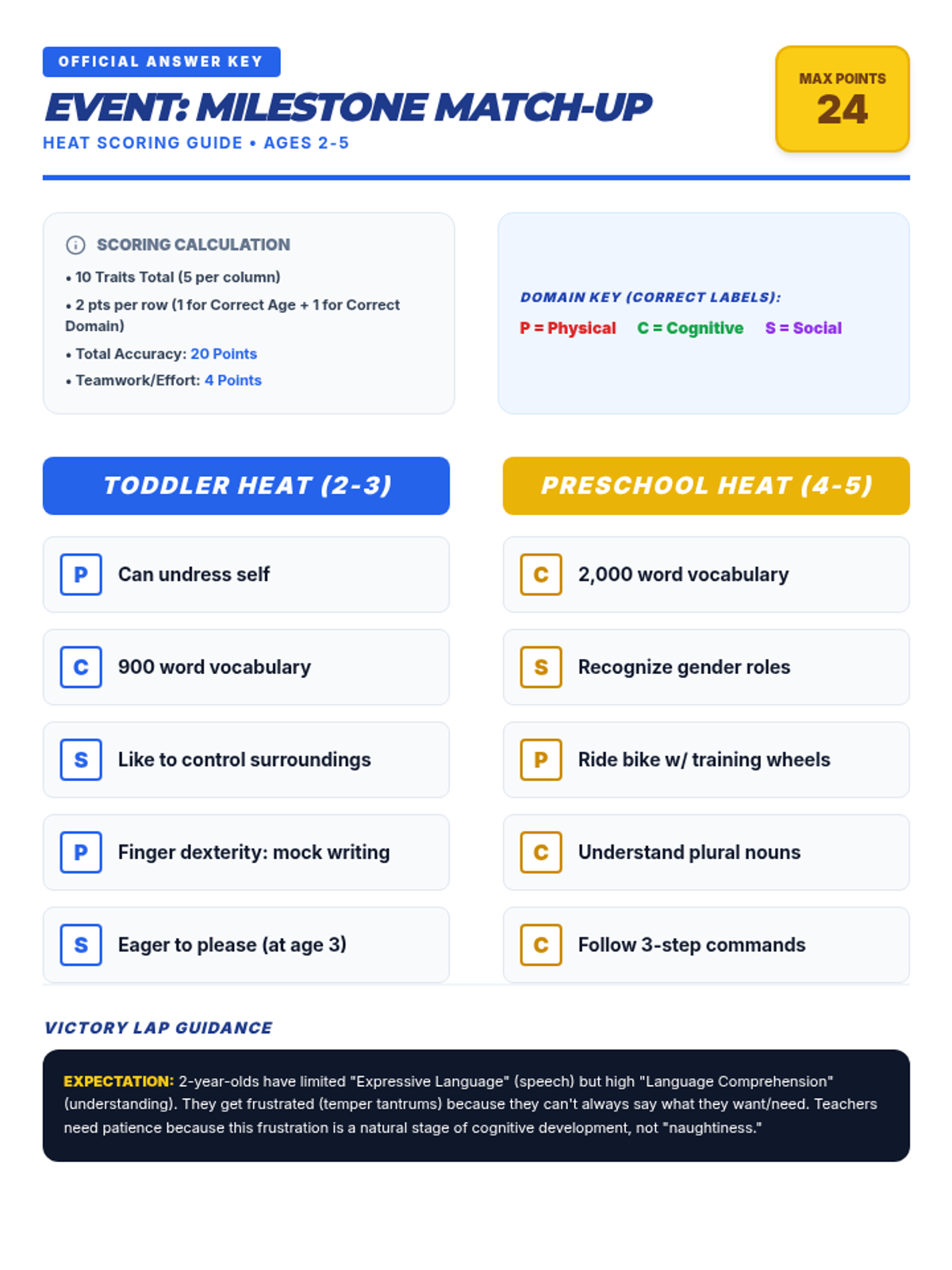
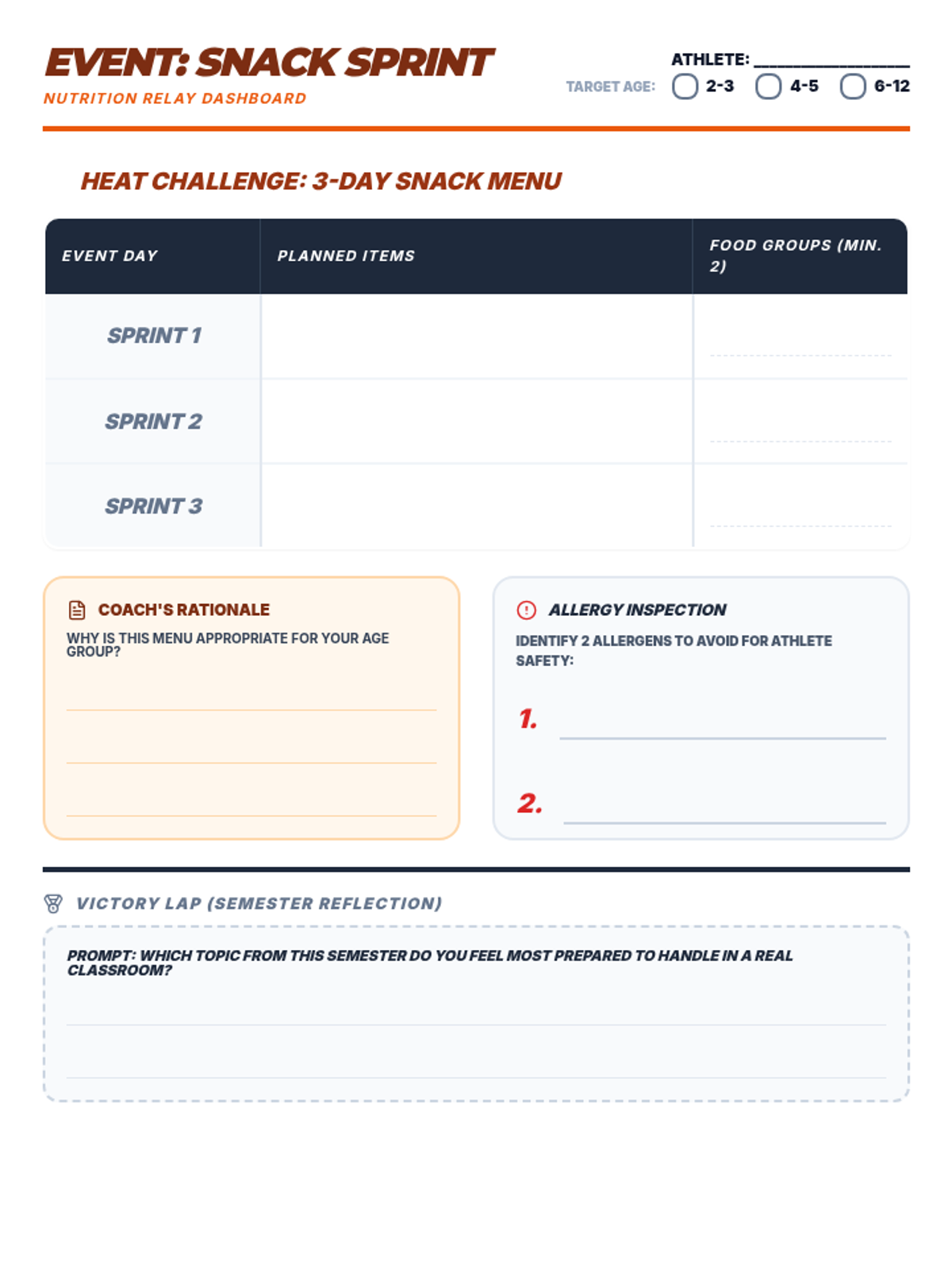
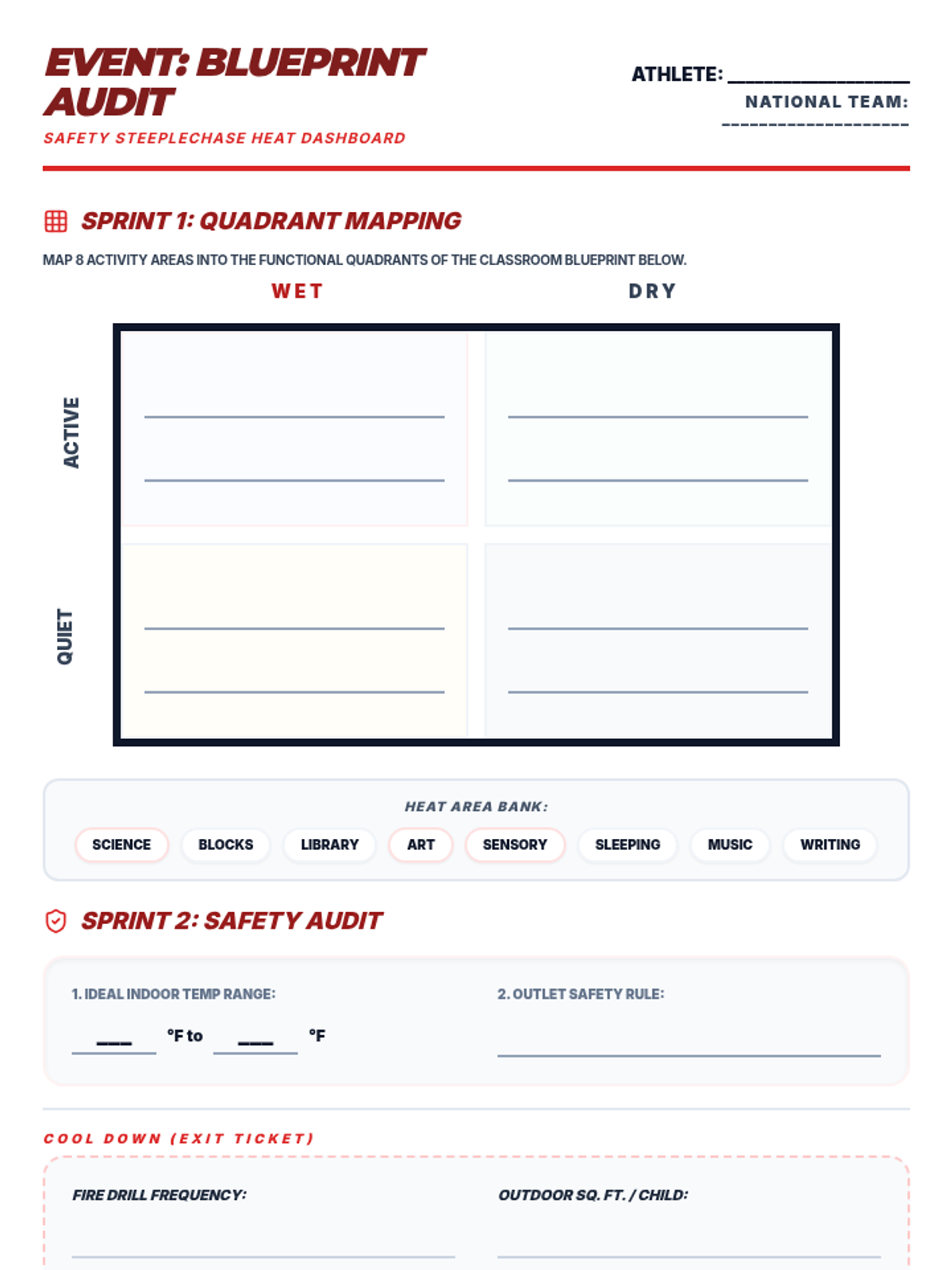
Essential food groups, nutrient functions, and balanced meal planning. Develops skills for interpreting nutrition labels and adopting lifelong healthy eating patterns.
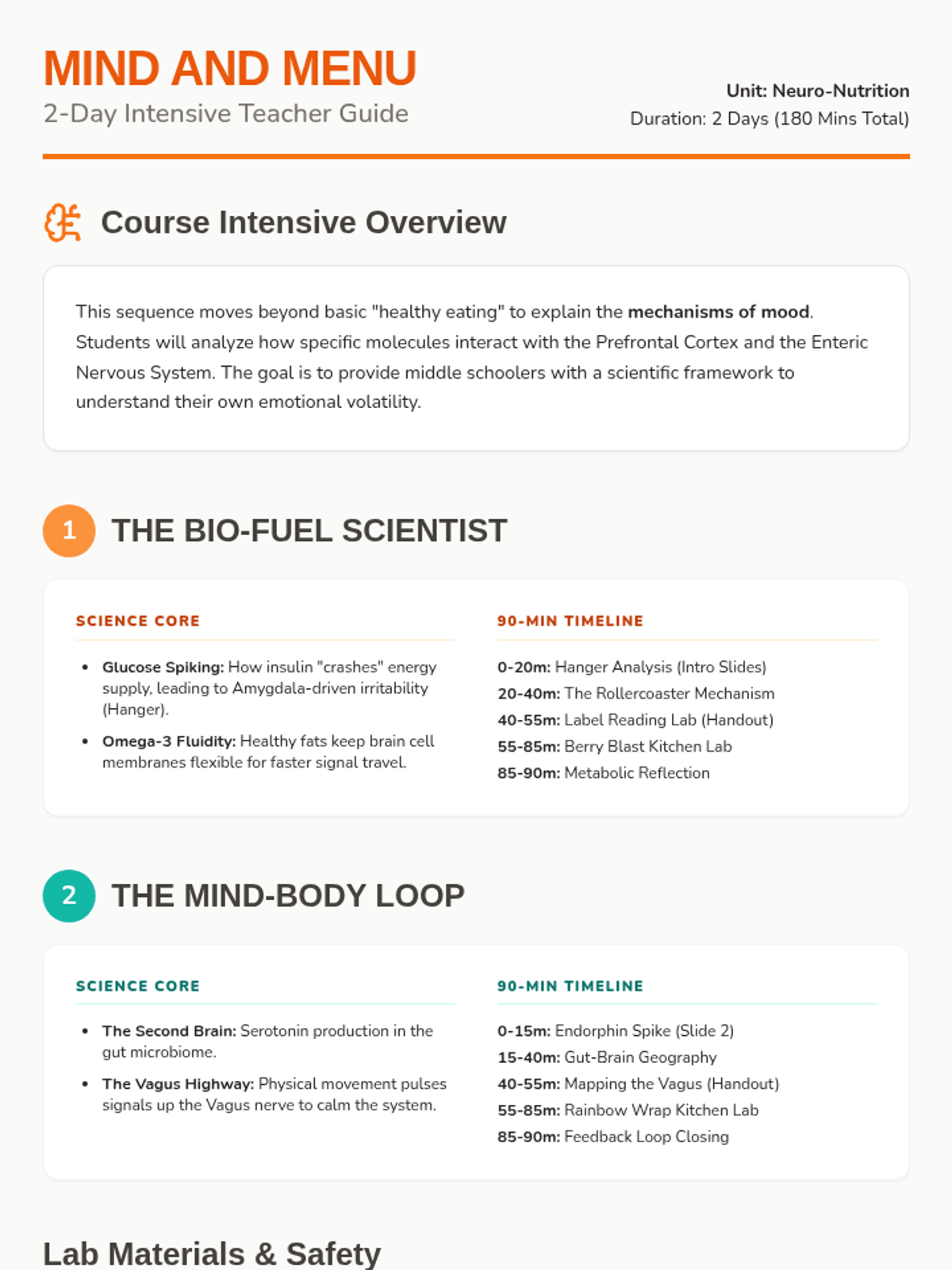
Facilitation guide for teachers, including detailed pacing, material checklists (including drawing supplies), discussion prompts with video timestamps, and a key for the student worksheet.
Visual anchor chart summarizing the gut-brain axis, identifying key organs, the role of neurotransmitters, and the contrast between premium and jamming fuels.
Student worksheet featuring spaces for warm-up reflections, video notes, a large drawing area for the 'Neurotransmitter Highway' diagram, and a mood-fuel reflection prompt.
A comprehensive grading rubric for the Mood Menu project. It evaluates students on scientific accuracy regarding the gut-brain connection, integration of required nutrients, menu specificity, and scientific justification.
A student worksheet for the Mood Menu lesson. It provides structured space for a quick write, video notes on the gut-brain axis, a creative 1-day meal planning grid, and a scientific justification section.
A comprehensive teacher facilitation guide for the Mood Menu lesson. It includes detailed pacing, specific video pause points with discussion questions, and instructional tips for facilitating the gut-brain connection activity.
Interactive presentation slides covering the gut-brain connection, neurotransmitters, and mood-boosting food groups, including embedded video and activity prompts.
A visual presentation for a 9th-grade health lesson on nutrition and brain health. It includes a hook, embedded video, scientific explanations of the gut-brain axis and inflammation, and clear activity instructions for the "Mood Menu" design challenge.
A planning sheet for the poster extension activity, providing space for slogan brainstorming, fact selection, and a gridded sketch area for layout design.
A visual presentation for the 'Brain Fuel' lesson, including a food-prediction hook, an embedded video segment on nutrition, and diagrams illustrating the 'sugar spike cycle' to help students connect diet to mental clarity.
A presentation for the 'Wallet Friendly Wellness' lesson, including a warm-up, embedded video, activity instructions, and the extension task.
A student worksheet for the 'Mood Food' lesson, featuring a meal-prediction hook, video analysis notes, a creative design space for a weekly nutrition/mood log, and critical thinking prompts on the psychology of eating.
A student worksheet for the 'Wallet Friendly Wellness' lesson, featuring a myth-vs-fact warm-up, a video note-taking section, and a guided 1-day itinerary planning grid.
A comprehensive teacher guide for the 'Mindful Eating' lesson, including a detailed 50-minute instructional sequence, facilitation tips for sensitive topics, and discussion prompts for Grade 8-9 health and psychology classes.
A comprehensive teacher guide for the 'Wallet Friendly Wellness' lesson, including a myth-vs-fact answer key, discussion prompts, and character bios for the main activity.
A printable double-sided exit ticket for students to reflect on brain health concepts and set a personal 'Brain Fuel' habit goal for the week.
A set of 12 habit cards (e.g., 'Scrolling Reels,' 'Drinking Water,' 'Nature Walk') for students to cut and sort during the lesson activity.
A large printable sorting mat with 'Brain Fuel' and 'Brain Drain' categories for students to categorize different daily habits.
A set of six printable discussion prompt cards to guide student small-group conversations during the 'Brain Fuel vs. Brain Drain' sorting activity.
A visual presentation for the 'Neural Network Habits' lesson, including a video embed, interactive discussion prompts about screen time and nature, and activity instructions.
A comprehensive facilitator guide for the "Body Care Blueprint" lesson. It includes a minute-by-minute pacing guide, key discussion anchors tied to video timestamps, and a list of common misconceptions to address with middle school students.
A simple 7-day habit tracker handout designed to help students commit to one self-care goal. It includes space for habit selection, personal motivation, and a post-challenge reflection.
A comprehensive worksheet for students to map out a 24-hour self-care routine. It features a detailed timeline template and reflection journal prompts to help students integrate hygiene, sleep, and nutrition into their daily lives.
A visual presentation for a 7th-grade health lesson on puberty and self-care. It includes video integration, discussion prompts based on key timestamps, and clear instructions for the 24-hour plan activity.
An answer key for the Plate Power Worksheet, providing correct sorting categorizations, matching pairs, and grading criteria for the creative plate drawing.
A student worksheet for the nutrition lesson, featuring a food sorting activity, portion size matching, and a creative plate-designing task.
A 6-slide visual presentation featuring the 'Body as a Machine' theme, covering the 5 food groups, high-octane fuel vs. low-octane snacks, and the hand method for portions.
A comprehensive teacher guide for a 30-minute nutrition lesson, featuring a detailed roadmap, learning objectives, and key vocabulary definitions centered around the 'body as a machine' theme.
A student-facing worksheet for teams to plan their dish, assign roles, and sketch their plating design during the Culinary Clash challenge.
A comprehensive teacher resource for facilitating the Culinary Clash challenge, now updated with specific "blind box" setup instructions, pacing, and ingredient ideas.
An instructional slide deck for a "Chopped" style culinary team-building challenge, covering mission objectives, safety protocols, team roles, and judging criteria.
Um rastreador de hábitos e evolução para o programa de 30 dias, permitindo que os usuários monitorem seu progresso diário, ingestão de água e metas de estilo de vida.
O livro de receitas essencial para o programa de 30 dias, apresentando opções nutritivas para café da manhã, almoço e jantar focadas em saciedade e metabolismo.
Printable labels for labeling mystery ingredient boxes during the Culinary Clash competition.
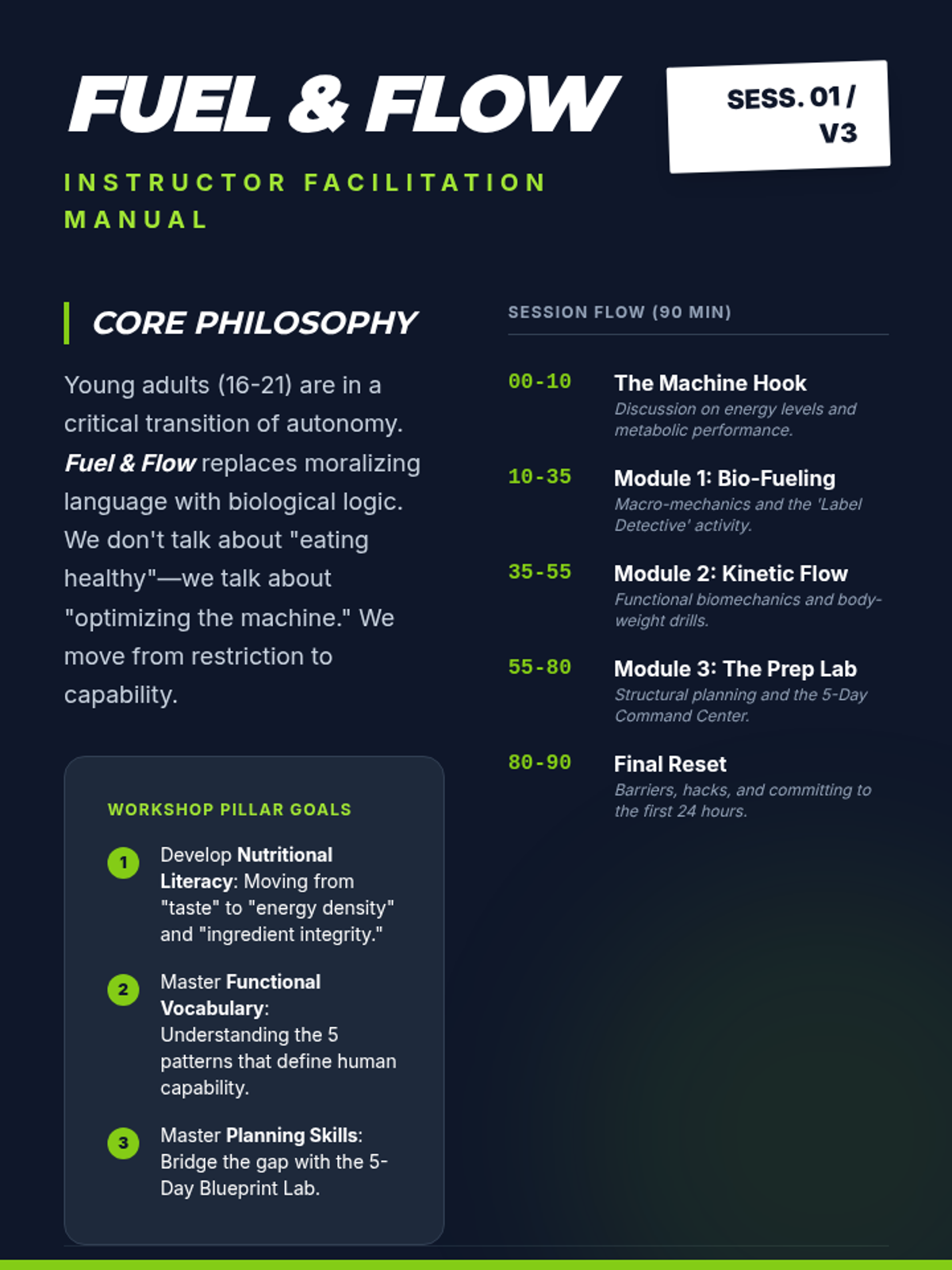
The crown jewel project template for the Iron Academy curriculum. A 3-page program design document where students apply DUP, accessory selection, and fueling strategies to build their own 4-week training cycle.
A technical reference guide for students to select specific accessory exercises based on weaknesses or imbalances in the major compound lifts.
A classroom worksheet explaining Daily Undulating Periodization (DUP) and providing a template for students to design an undulating weekly training cycle.
A technical laboratory worksheet for the deadlift, focusing on the setup triangle, pulling the slack out of the bar, and identifying lumbar flexion errors.
A technical laboratory worksheet for the bench press, detailing the anchor system, leg drive mechanics, and bar path standards.
A technical breakdown and lab worksheet for the advanced barbell back squat, focusing on upper body shelf creation, walk-out protocols, and depth audits.
A comprehensive mid-semester review and practical skills audit for students to verify technical proficiency and theoretical knowledge before entering Part 2 of the curriculum.
A technical setup guide and safety checklist for transitioning from bodyweight to barbell exercises, including station auditing and common alignment errors.
An answer key for the Drink Decisions Worksheet, providing teachers with sample risk analyses and healthy alternatives for each student scenario.
A quick formative assessment exit ticket for students to demonstrate their understanding of energy drink ingredients, health risks, and healthy hydration alternatives.
A worksheet with five real-world scenarios for students to analyze the risks of energy drinks and identify healthier alternatives for hydration and energy.
An informational handout and anchor chart for students comparing energy drinks, sports drinks, and water across key metrics like caffeine, sugar, and physical effects.
Engaging slide presentation for 6th graders covering energy drink ingredients, caffeine comparisons, the stimulant cycle, mood/anxiety impacts, and healthy energy alternatives.
A detailed 60-minute lesson plan for teachers, including learning objectives, a step-by-step facilitation guide, background information on energy drink ingredients, and alignment with health education standards.
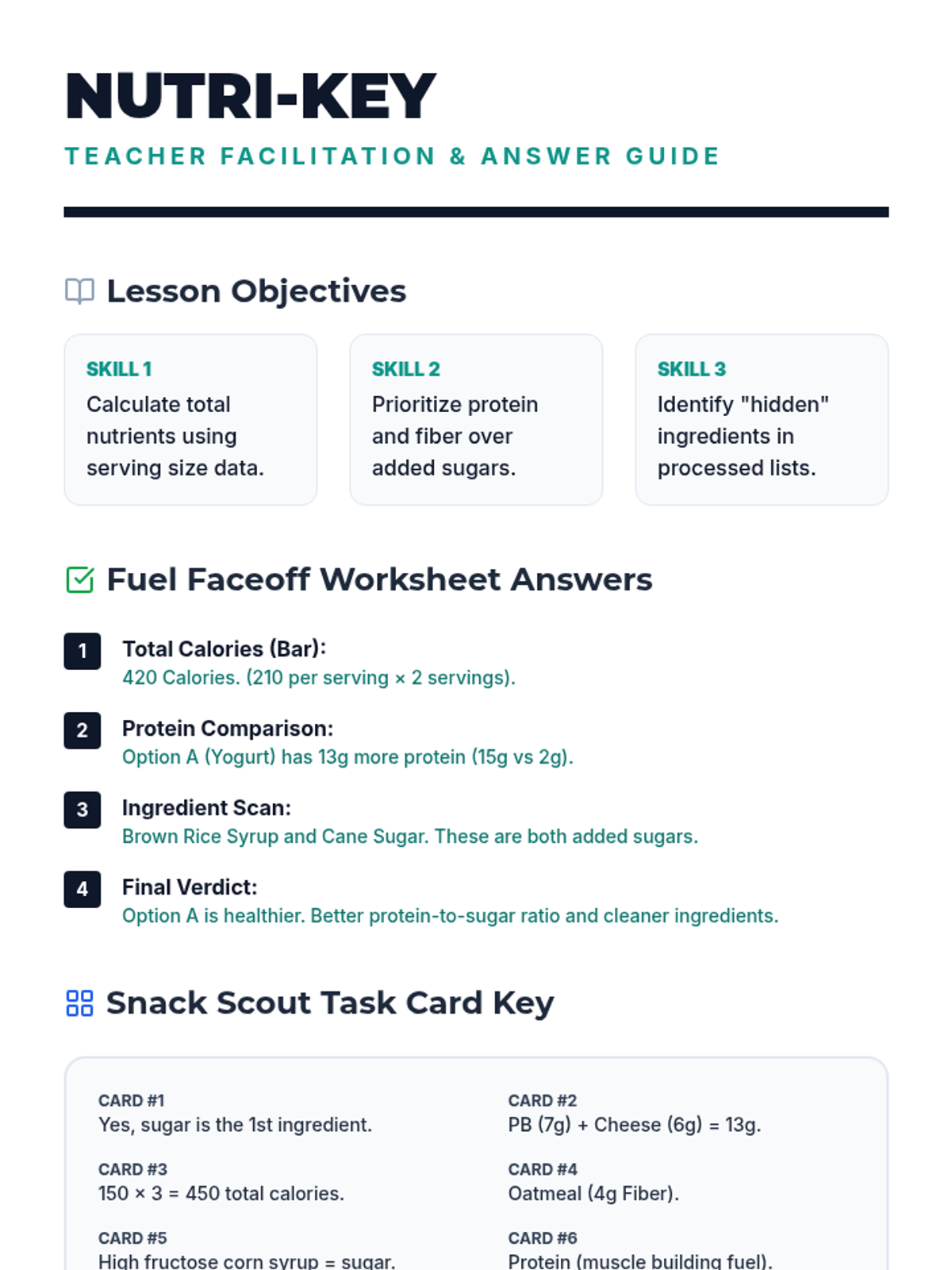
Teacher guidance for the 'Nutrition Mission' lesson, including key concepts, activity facilitation steps, and an answer key for the worksheet and assessment.
Summative assessment for a 6th-grade nutrition unit, featuring multiple choice, true/false, and short-answer questions focused on label analysis, sugar identification, and nutrient density.
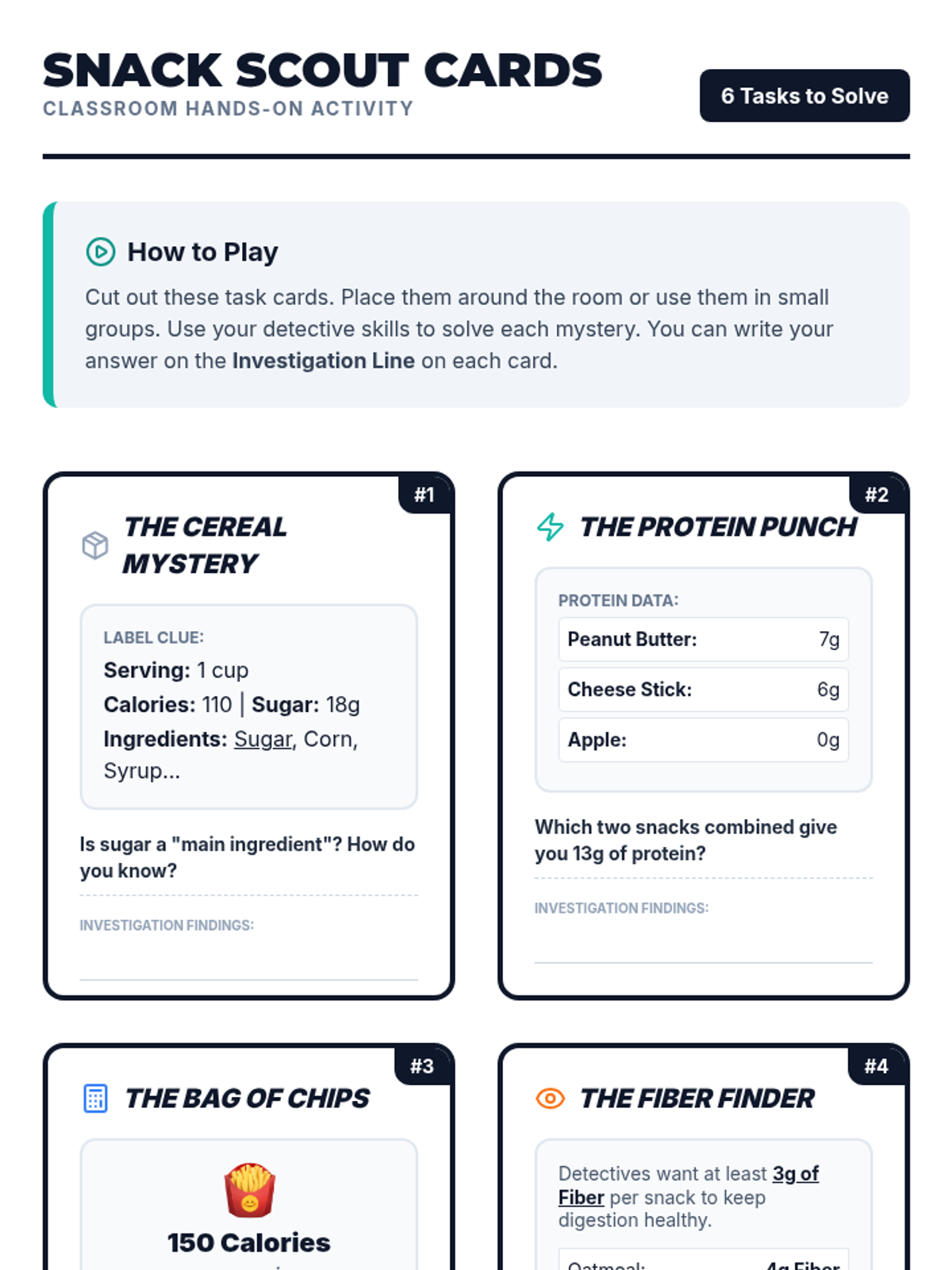
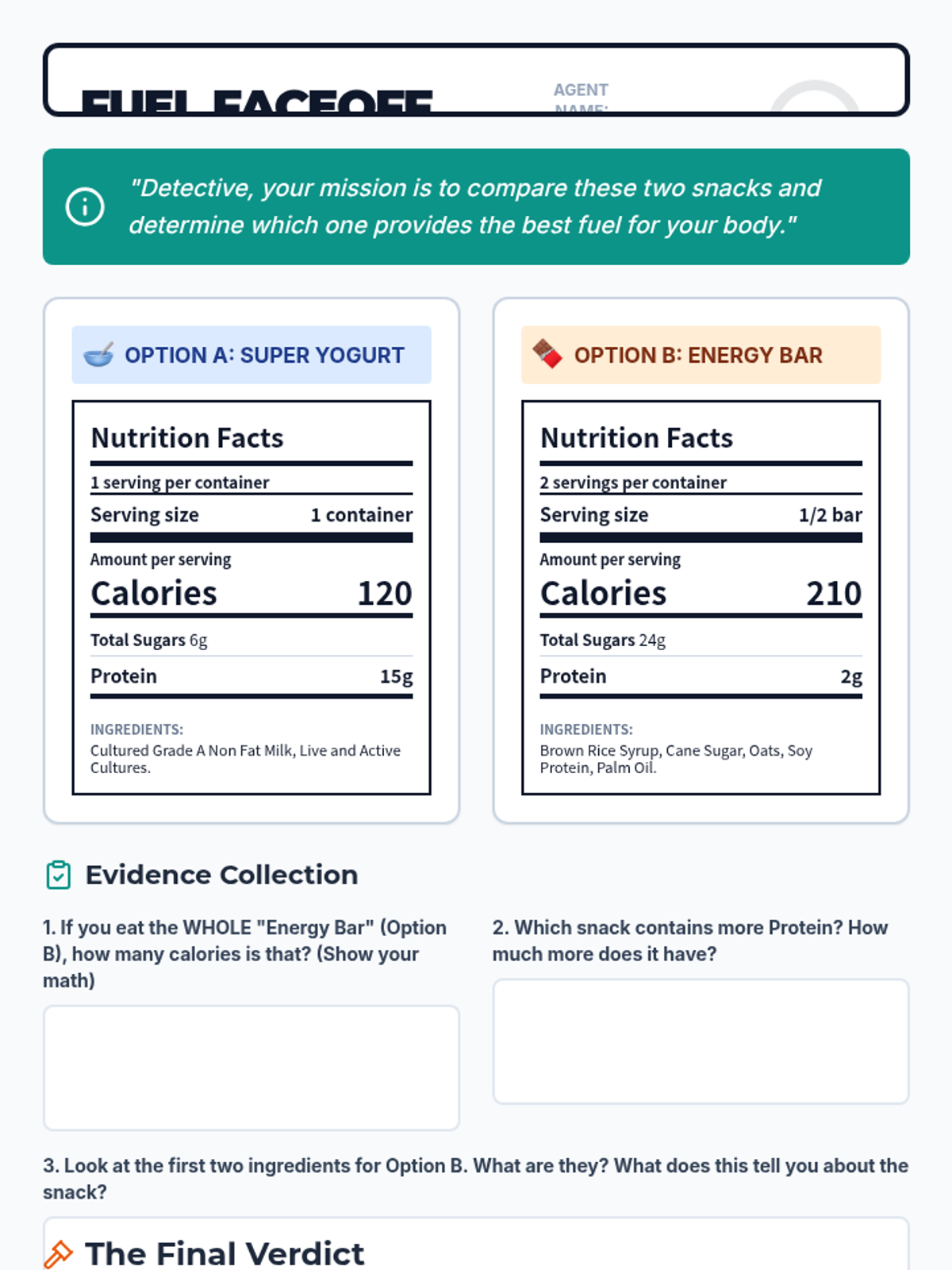
Hands-on worksheet for 6th-grade students to practice analyzing nutrition labels, calculating total calories per container, and identifying various names for sugar in snack ingredients.
Educational slide deck for a 6th-grade nutrition lesson, using a 'Food Detective' theme to teach students how to read nutrition labels and identify hidden sugars.
A quick check-for-understanding tool in a 3-2-1 format (3 things learned, 2 sugar aliases, 1 healthy swap).
Answer key for the Sweet Secrets Worksheet, providing correct alias identifications, body system explanations, and math solutions for the nutrition label lab.
A 2-page student worksheet for identifying hidden sugar names, explaining physiological effects on the brain/body, and practicing nutrition label calculations.
Instructional slide deck for the Sugar Investigation lesson. Uses a medical case file aesthetic to teach students about brain reward systems, physical health impacts, hidden sugar names, and reading nutrition labels.
A 2-page teacher guide for the Sugar Investigation lesson, featuring lesson objectives, a hook demonstration, and a step-by-step instructional sequence for 6th-grade health.
A professional teacher guide for the 'Nutrient Detectives' lesson. It includes pacing instructions, a sugar demonstration idea, the '5/20 rule' explanation, and an answer key for all student materials.
A quick assessment exit ticket for the 'Nutrient Detectives' lesson. It tests students' understanding of serving sizes, the health impacts of sugar and salt, and the '5/20 rule' for percent daily value on nutrition labels.
A collaborative group activity worksheet where students analyze mock nutritional profiles of common 'triple threat' foods (high in sugar, salt, or fat). It encourages data analysis and critical thinking about food marketing versus nutritional reality.
A comprehensive worksheet titled 'Mission: Label Logic' that teaches 6th-grade students how to read and analyze nutrition labels. It includes a sample label, calculation exercises, and short-response questions about sugar, salt, and fat.
An engaging slide deck titled 'Nutrient Detectives' designed for 6th-grade students. It covers why nutrients matter, the health impacts of sugar, salt, and fat, and provides a clear guide on how to read nutrition labels.