Stop-and-think strategies, impulse management, and SMART goal setting for personal growth. Develops internal motivation, stress reduction techniques, and resilience through proactive planning and monitoring.
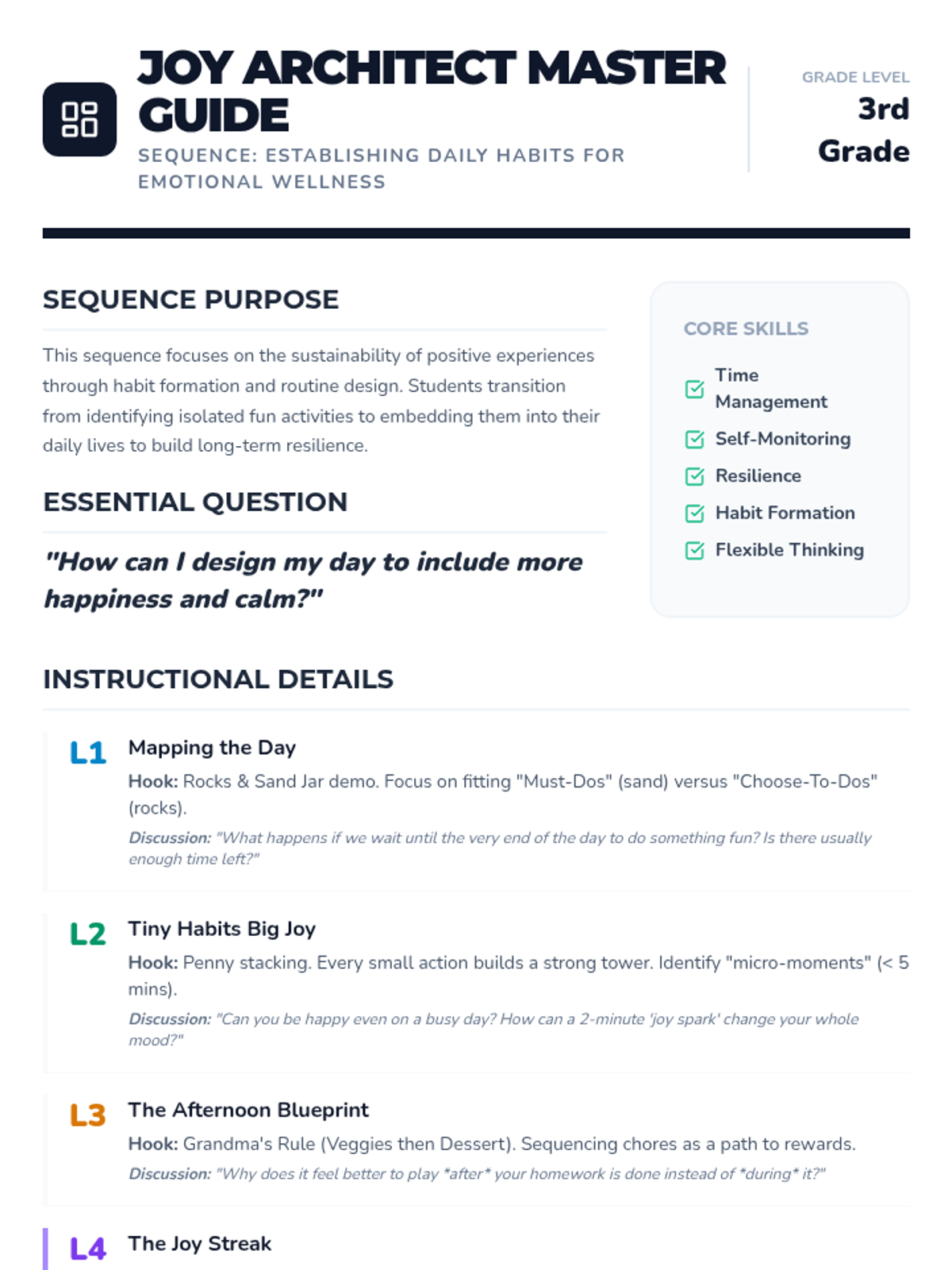
A comprehensive teacher guide for the Joy Architect sequence, outlining the instructional arc, key concepts for each lesson, and the core skills developed.
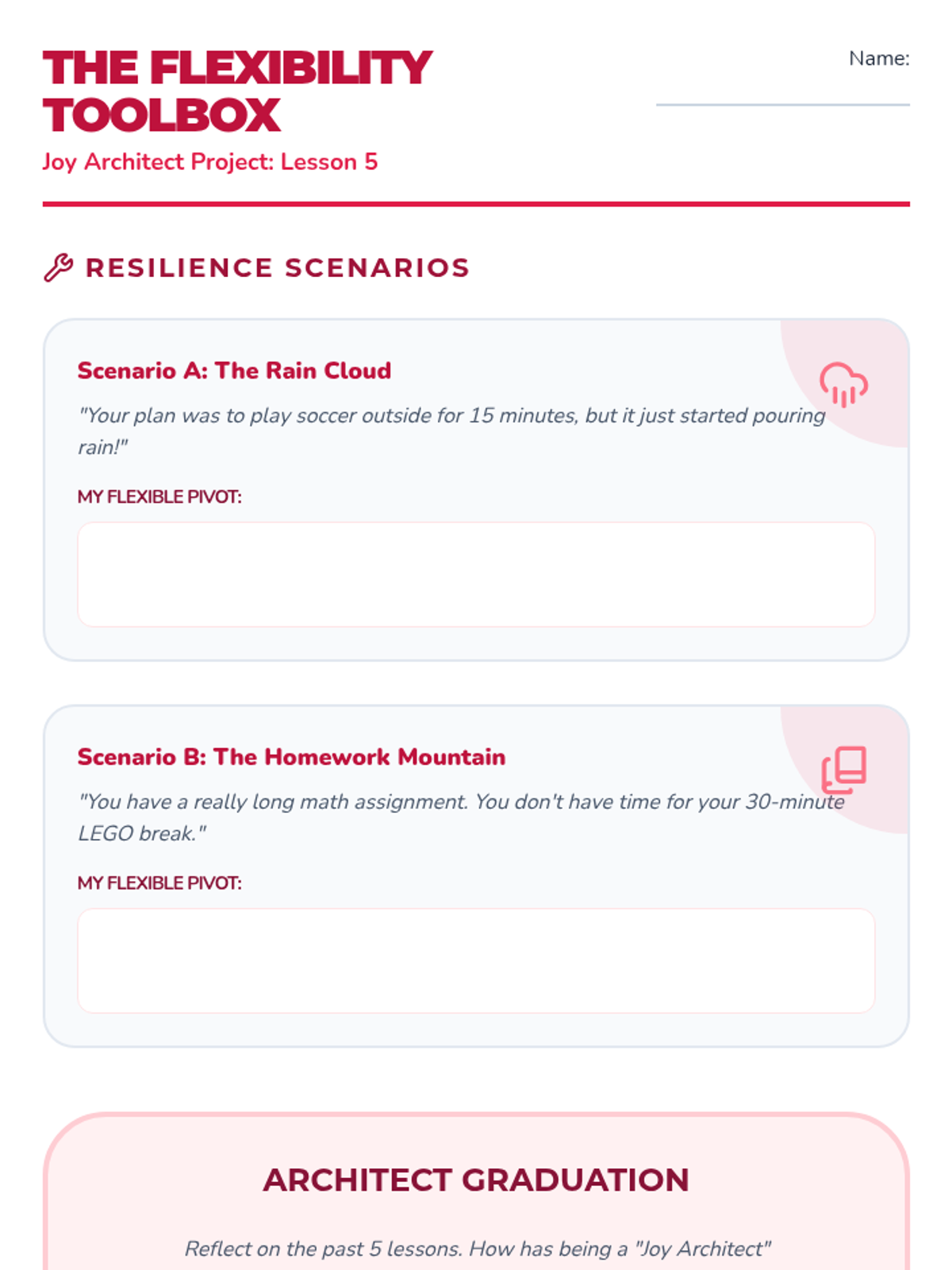
Student reflection sheet for the final lesson. Features 'resilience scenarios' for practicing flexible thinking and a final reflection on the unit's key takeaways.
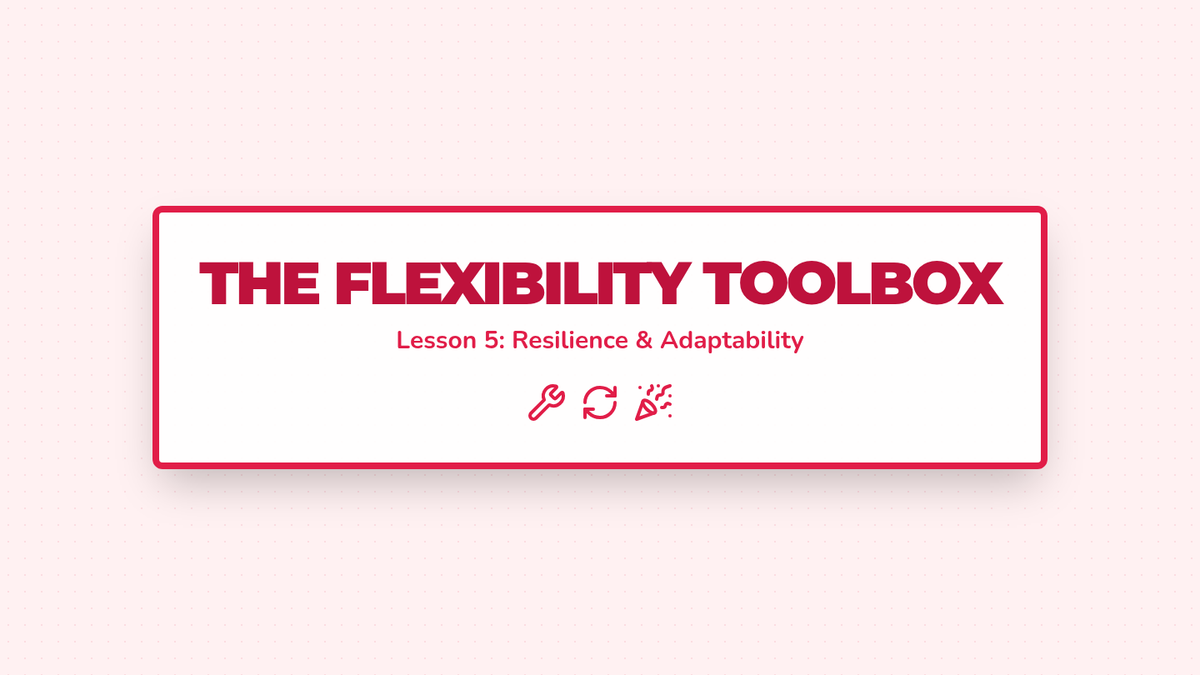
Final slide deck for Lesson 5. Focuses on resilience, 'flexible thinking' when routines are disrupted, and celebrates students' progress as 'Joy Architects'.
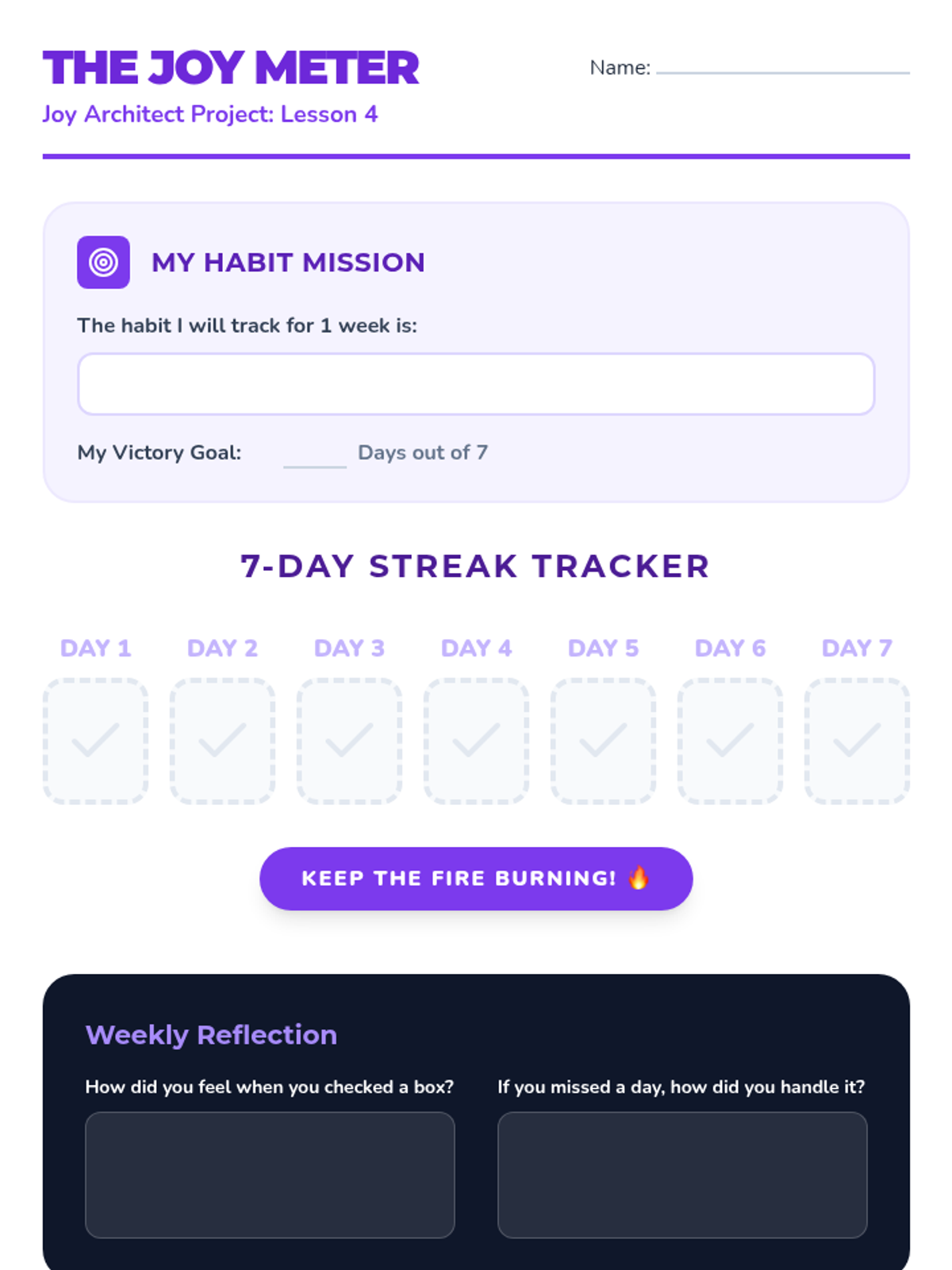
A 7-day progress tracker for students to monitor their consistency with a chosen joy habit. Includes goal setting and reflection sections.
Slide deck for Lesson 4 on creating a progress tracker. Explains the concept of 'streaks' and the importance of self-monitoring and honesty in habit formation.
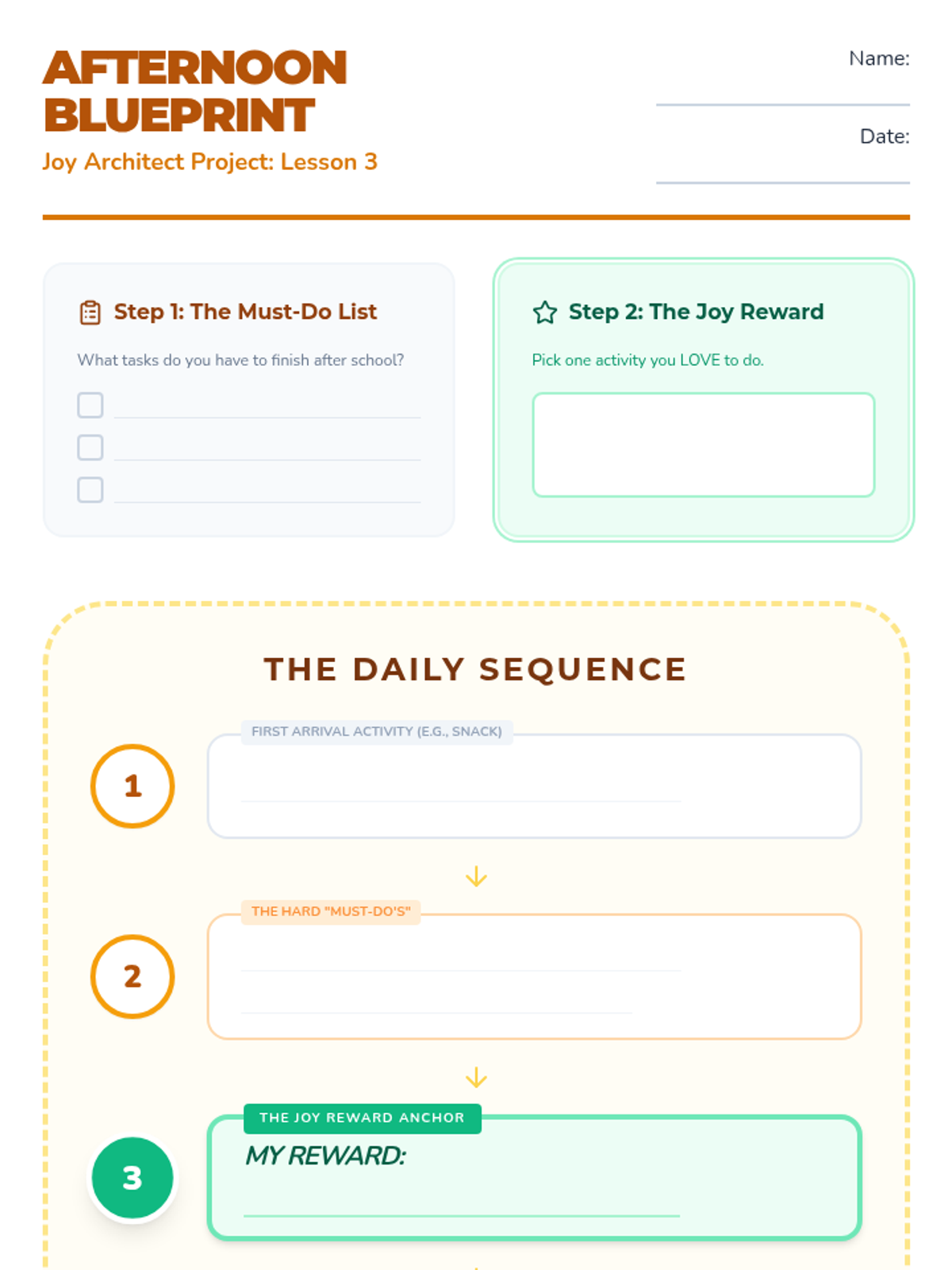
Student worksheet for designing an afternoon schedule. Uses the 'Grandma's Rule' concept to sequence chores before rewarding joy activities.
Slide deck for Lesson 3 on designing a balanced schedule. Introduces 'Grandma's Rule' (sequencing chores before rewards) and using joy as a motivation anchor.
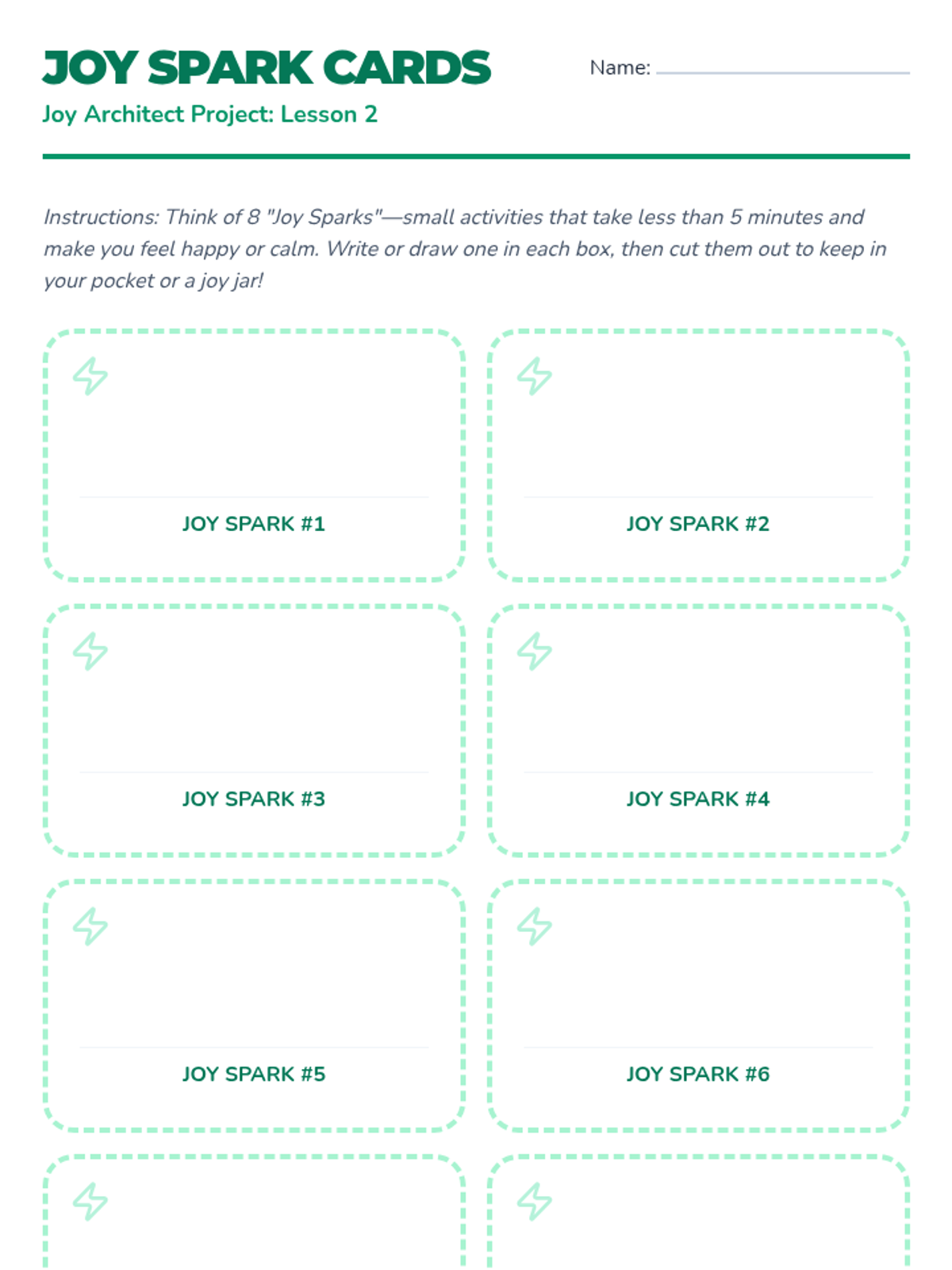
A set of cut-out cards for students to brainstorm and record 'micro-moments' of joy they can easily integrate into their day.
Slide deck for Lesson 2 focusing on micro-moments of joy. Introduces the concept that frequency of positive experiences is key to resilience.
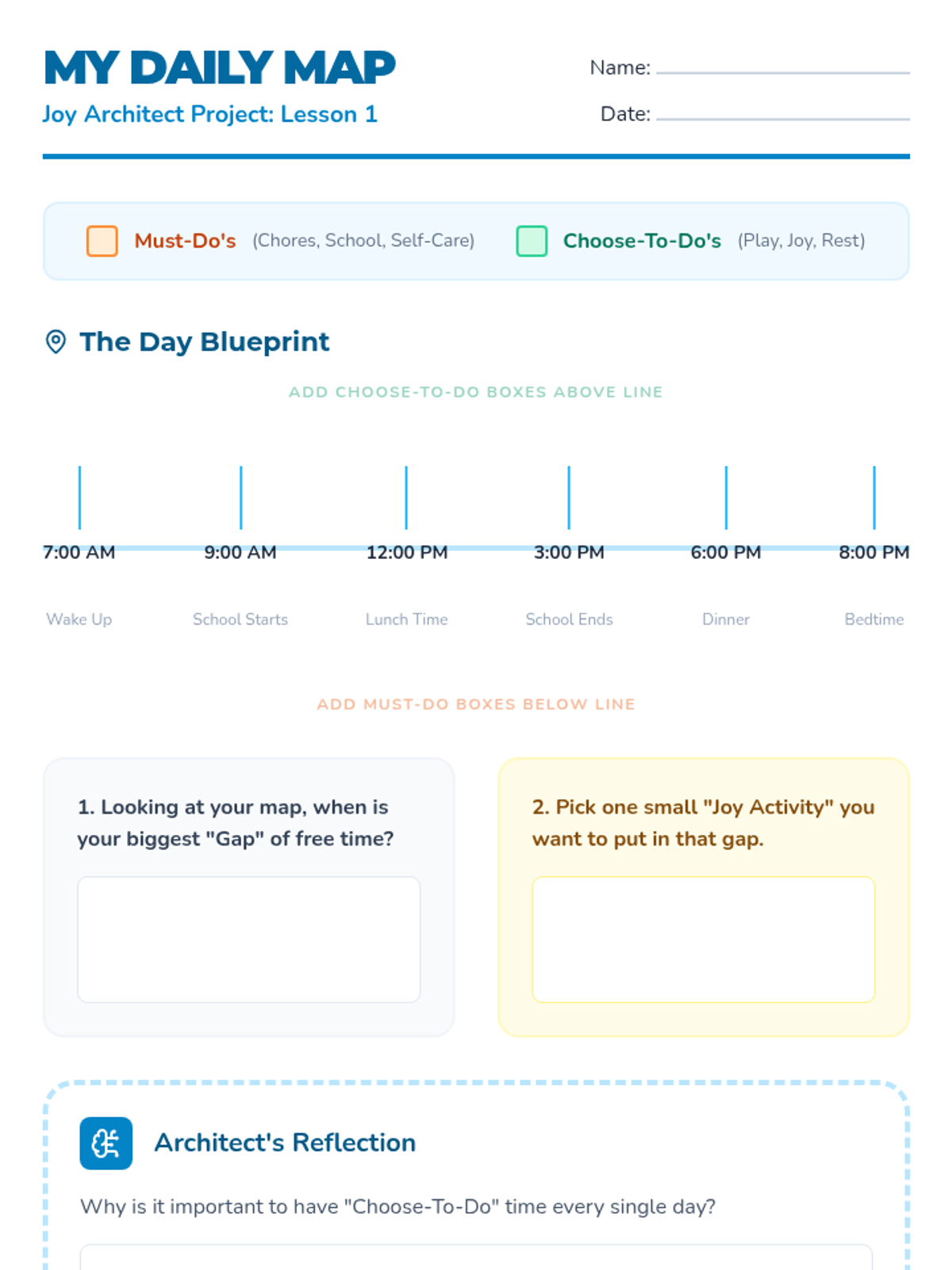
Student worksheet for auditing their daily routine. Includes a timeline for mapping tasks and reflection questions to identify 'joy gaps'.
Introductory slide deck for the 'Mapping the Day' lesson. Introduces the concept of 'Must-Do' vs 'Choose-To-Do' activities using a construction/architect theme.
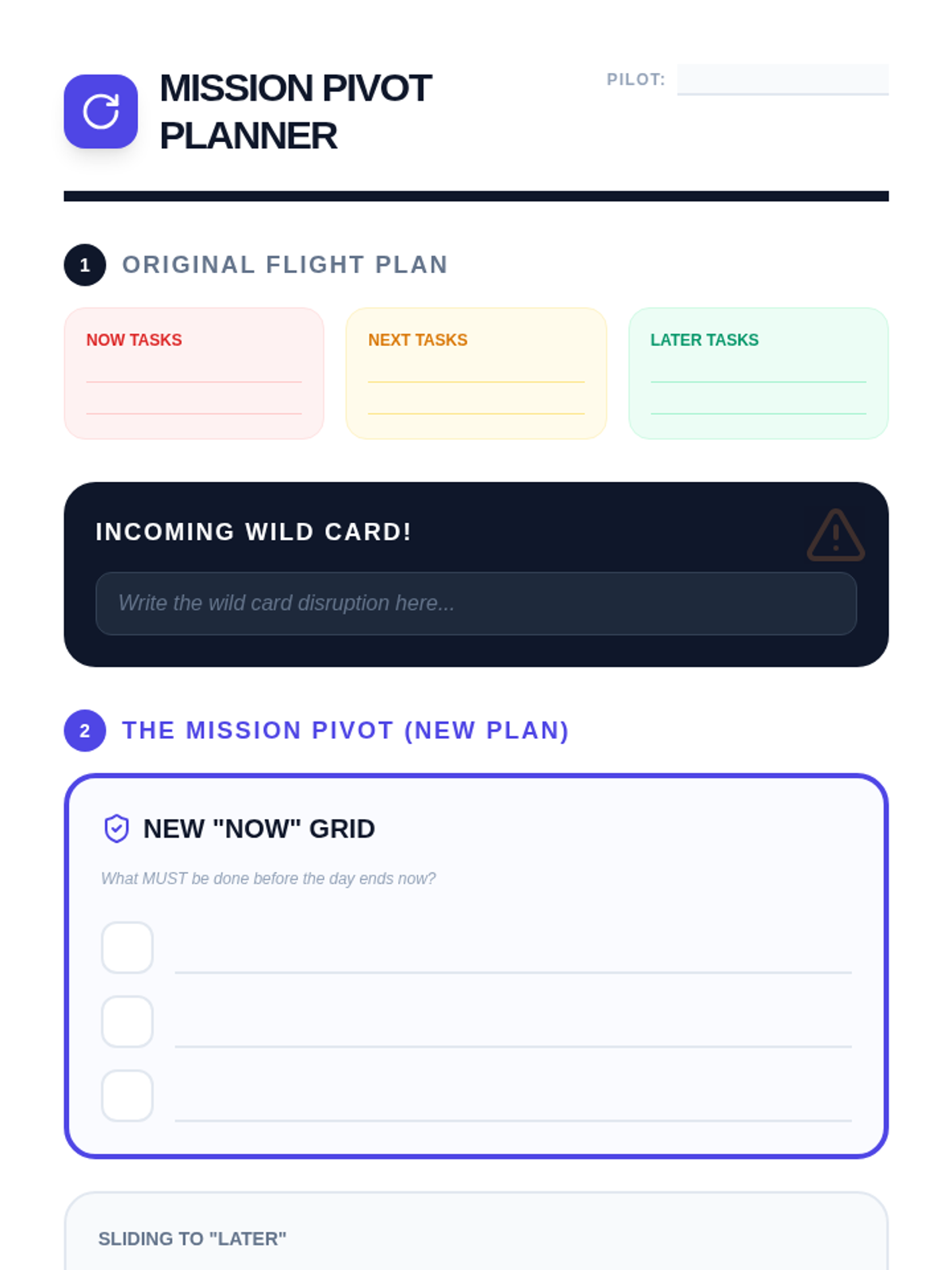
A culminating simulation worksheet where students re-plan their schedule in response to a surprise 'Wild Card' disruption.
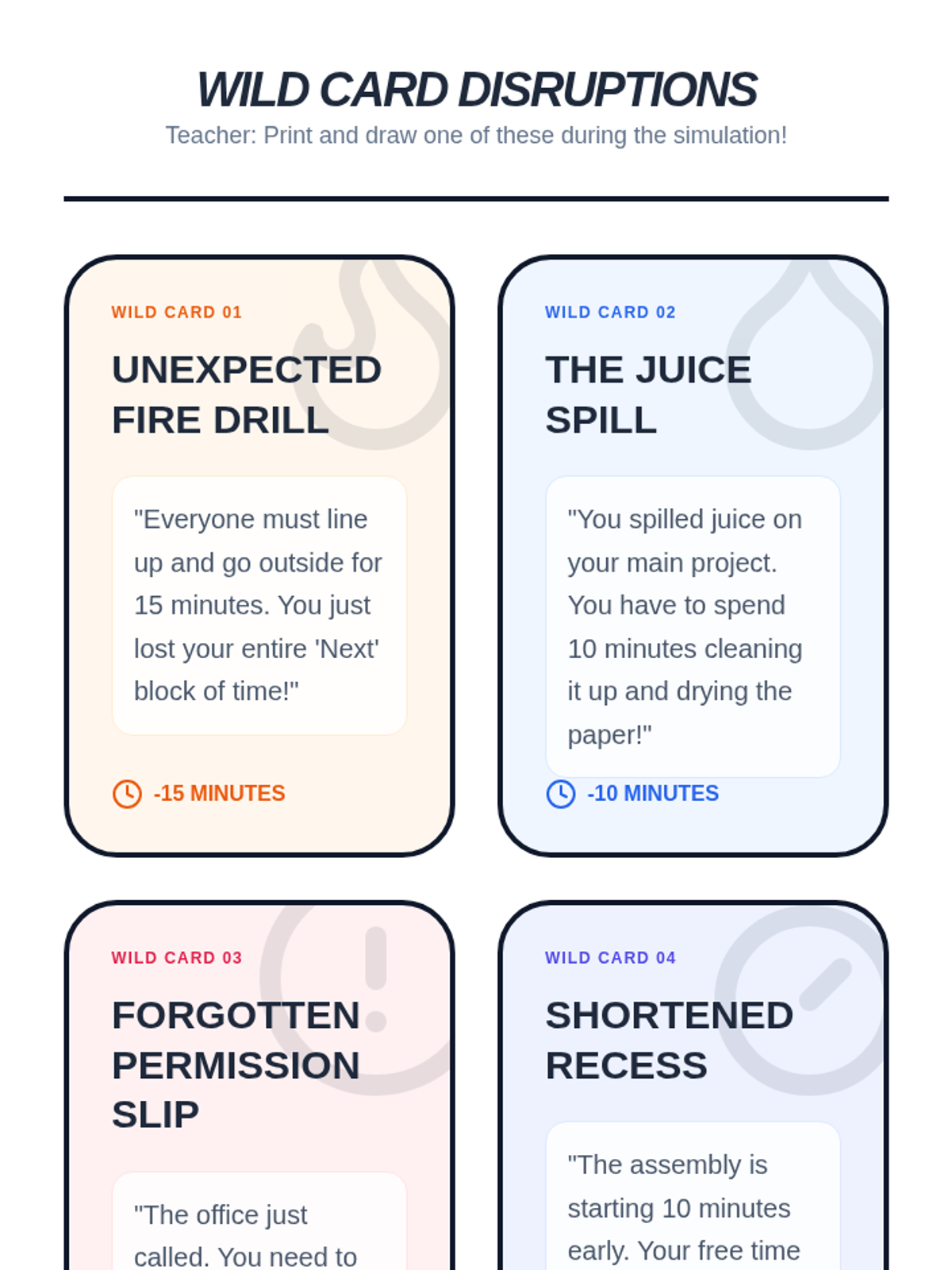
Challenge cards featuring unexpected schedule disruptions for the Lesson 5 simulation.
Instructional slide deck for Lesson 5, focusing on re-prioritization in response to schedule disruptions.
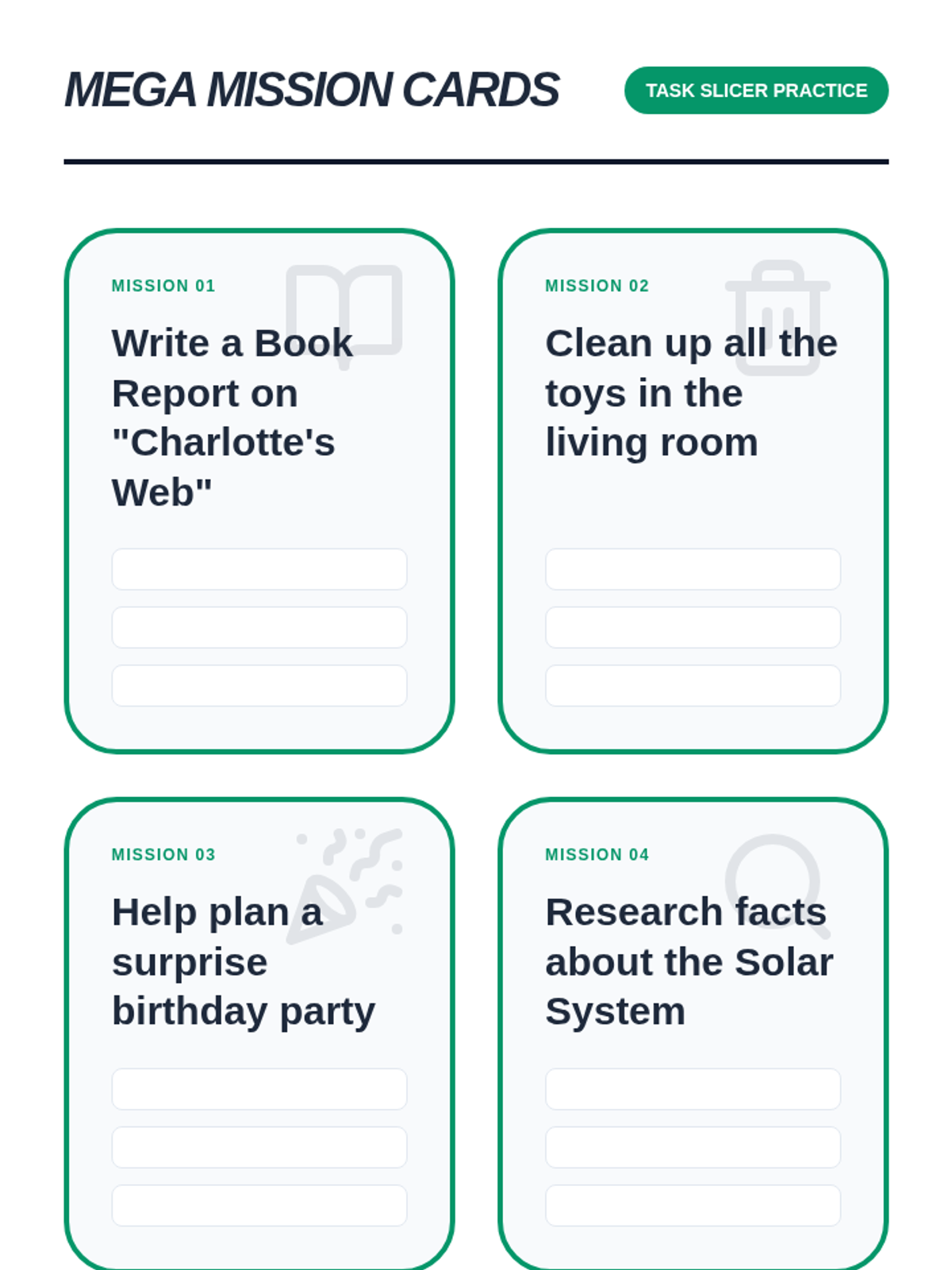
Challenge cards featuring large projects for students to practice breaking down into three manageable steps.
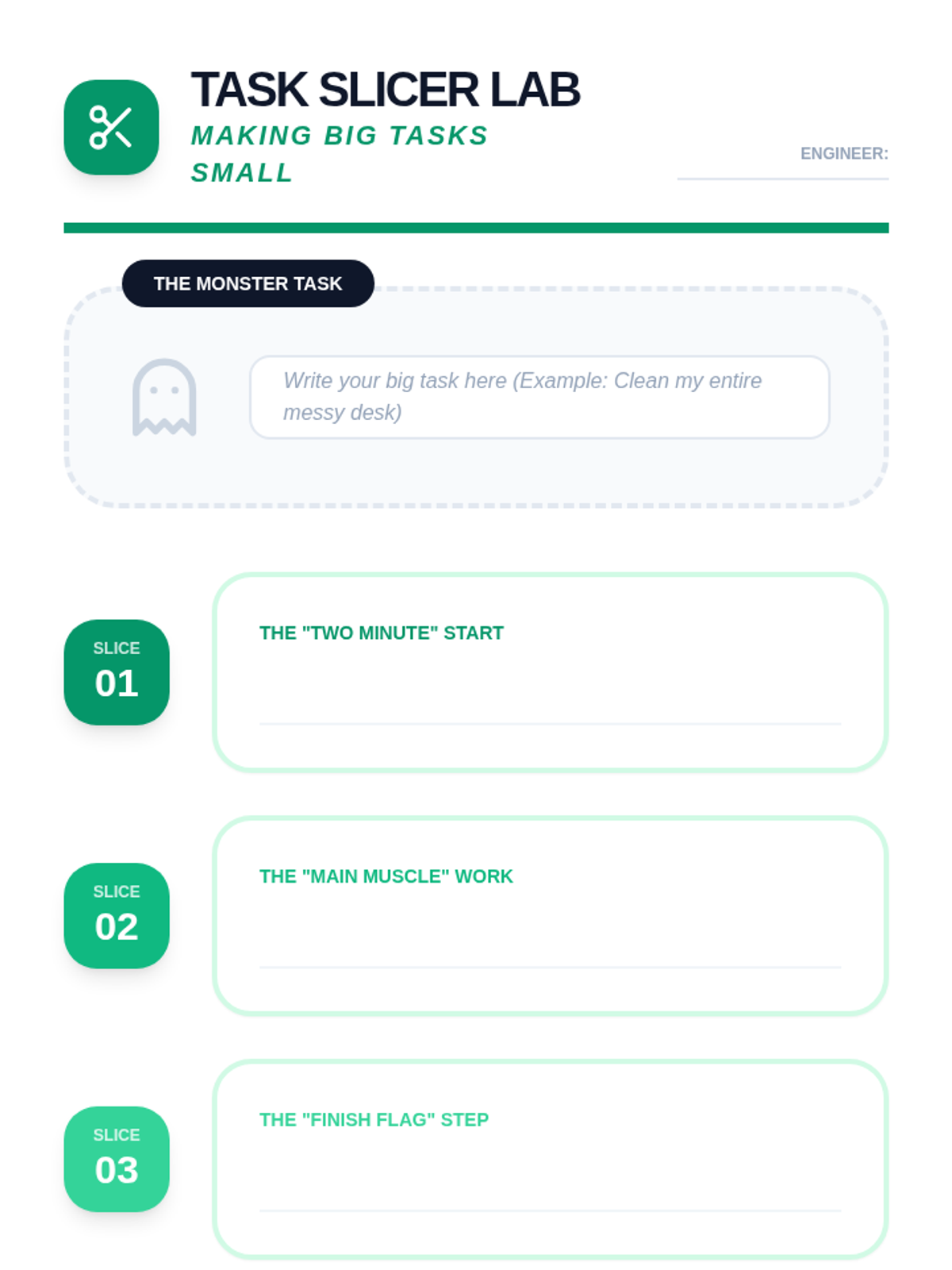
Worksheet for breaking down large tasks into three manageable steps (slices).
Instructional slide deck for Lesson 4, introducing the 'Task Slicer' technique for breaking down large projects.
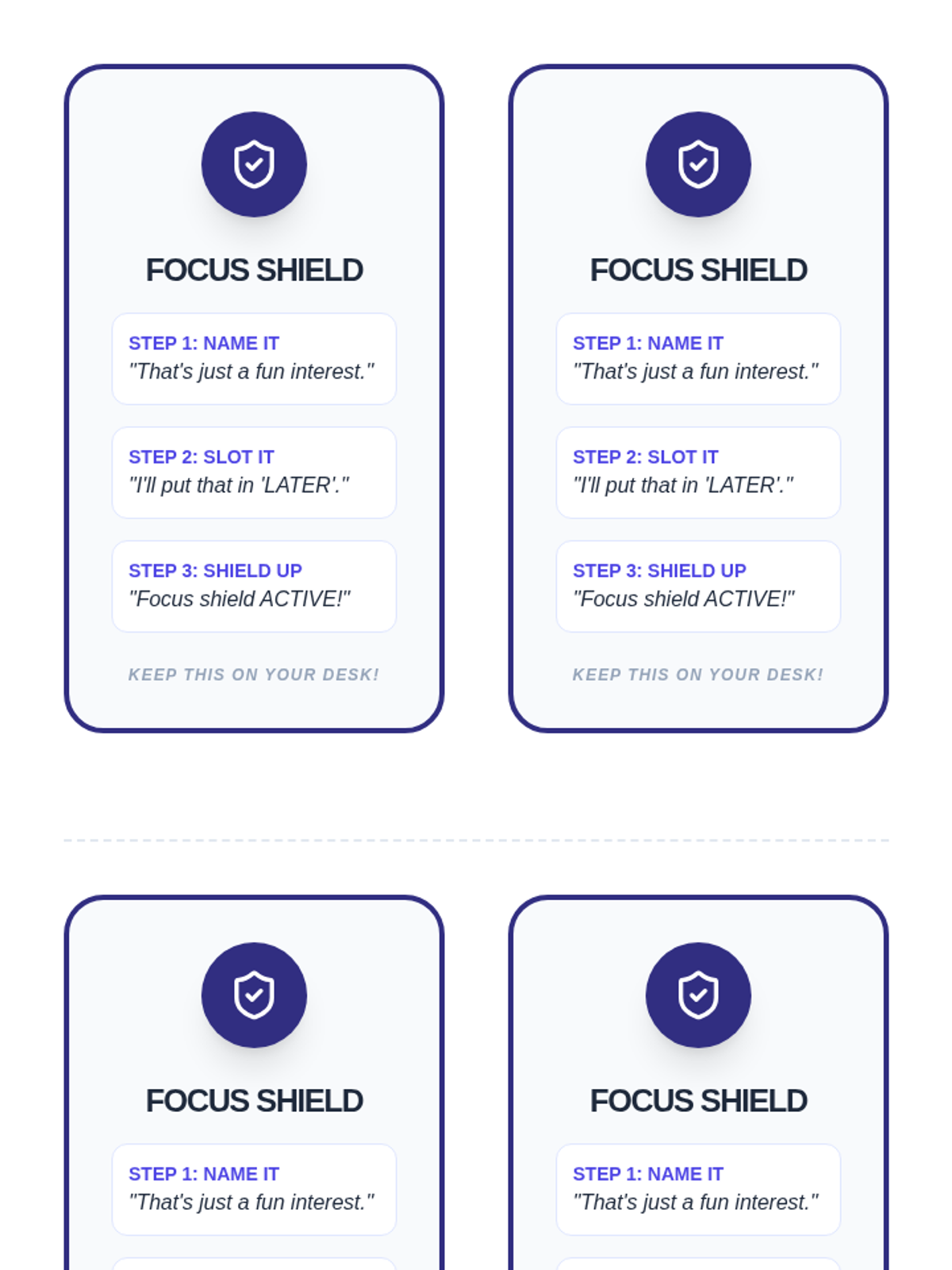
Printable desk reminder cards for students with steps to activate their focus shield and delay distractions.
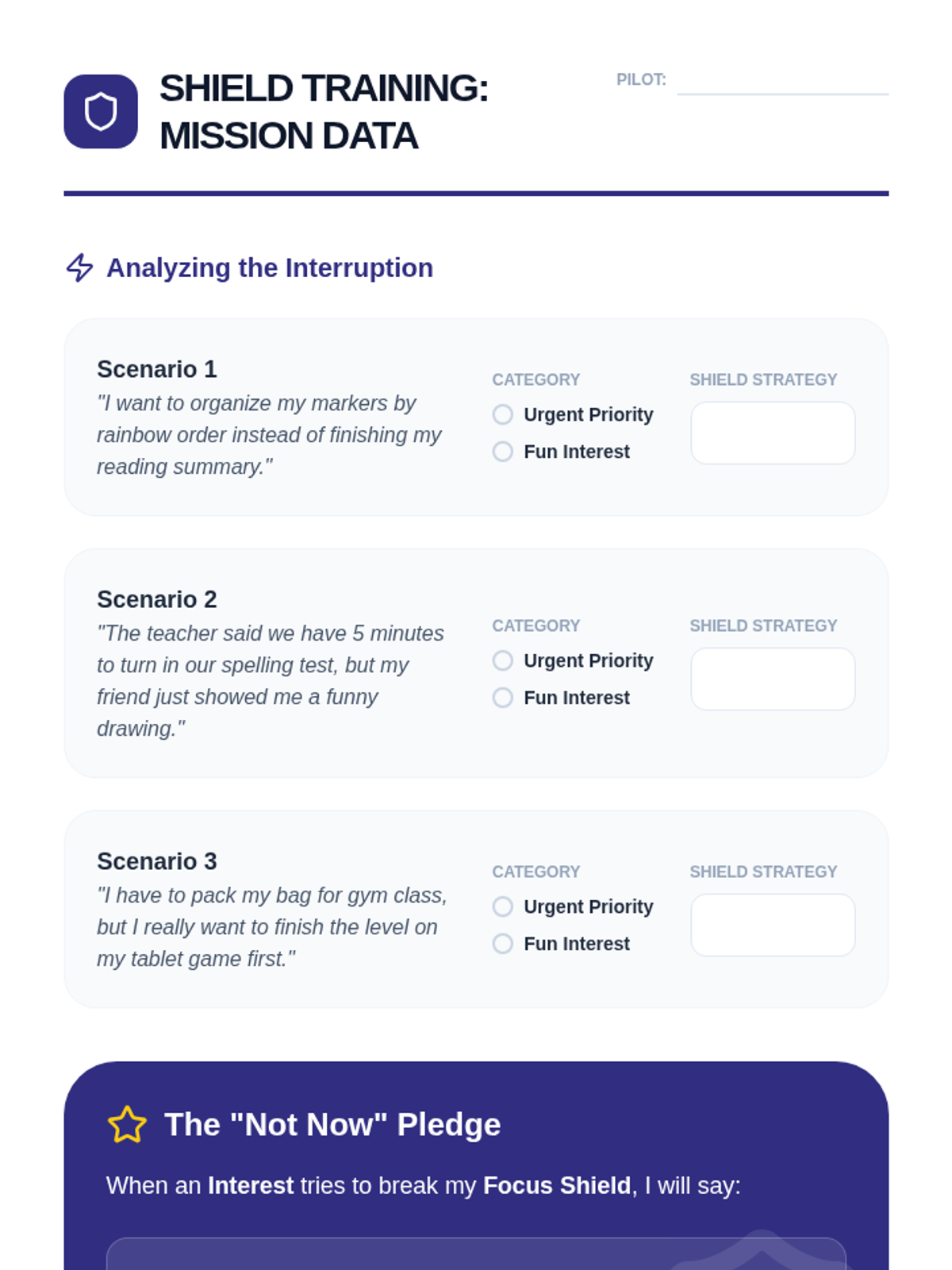
Worksheet for identifying distractions vs priorities and practicing focus shield verbal strategies.
Instructional slide deck for Lesson 3, focusing on distinguishing between high-priority tasks and high-interest distractions.
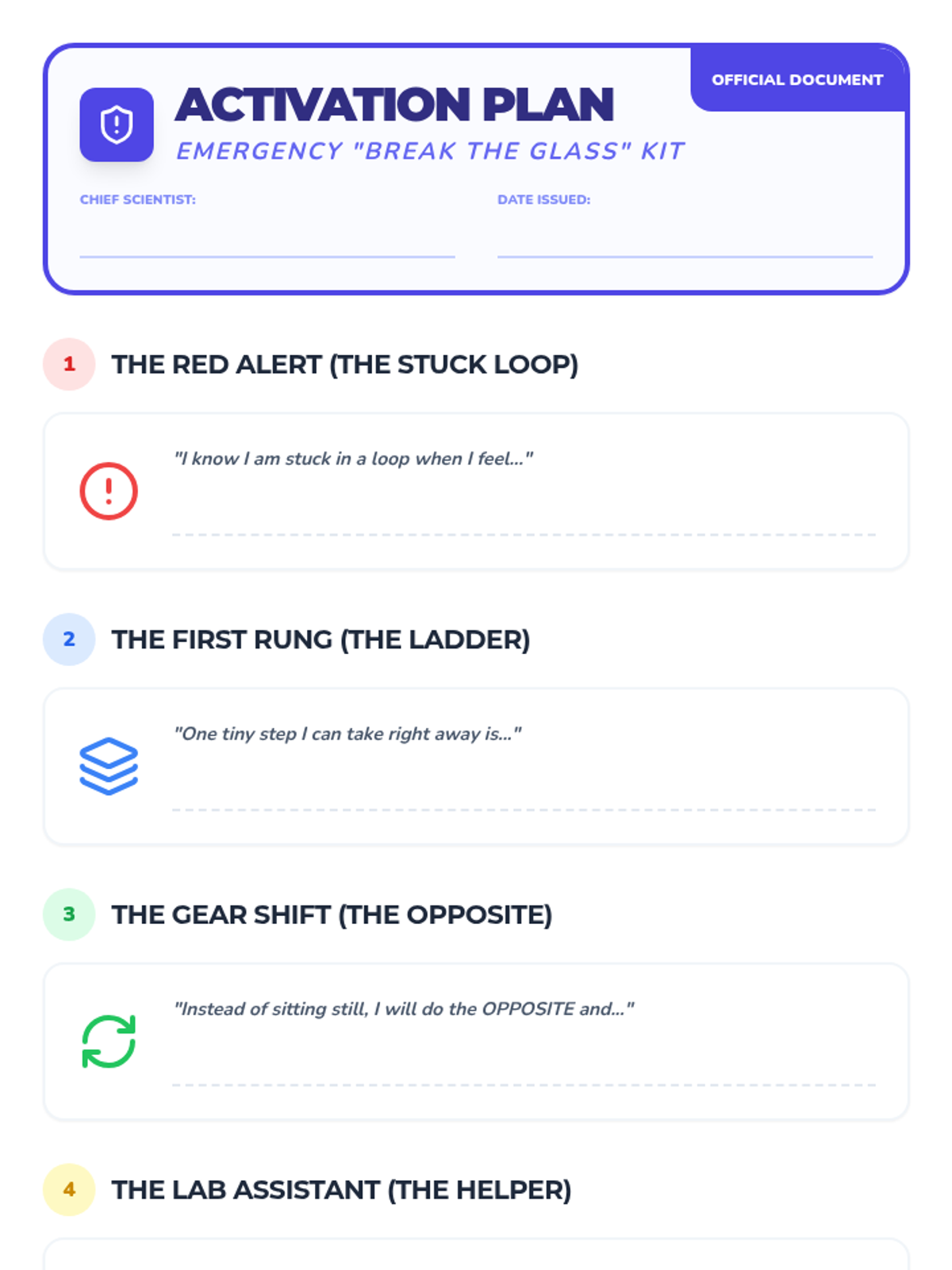
A personal 'Activation Plan' worksheet where students identify their emotional triggers and commit to specific actions and helpers.
A slide deck for the final lesson that summarizes the sequence and guides students in creating their personal activation plan.
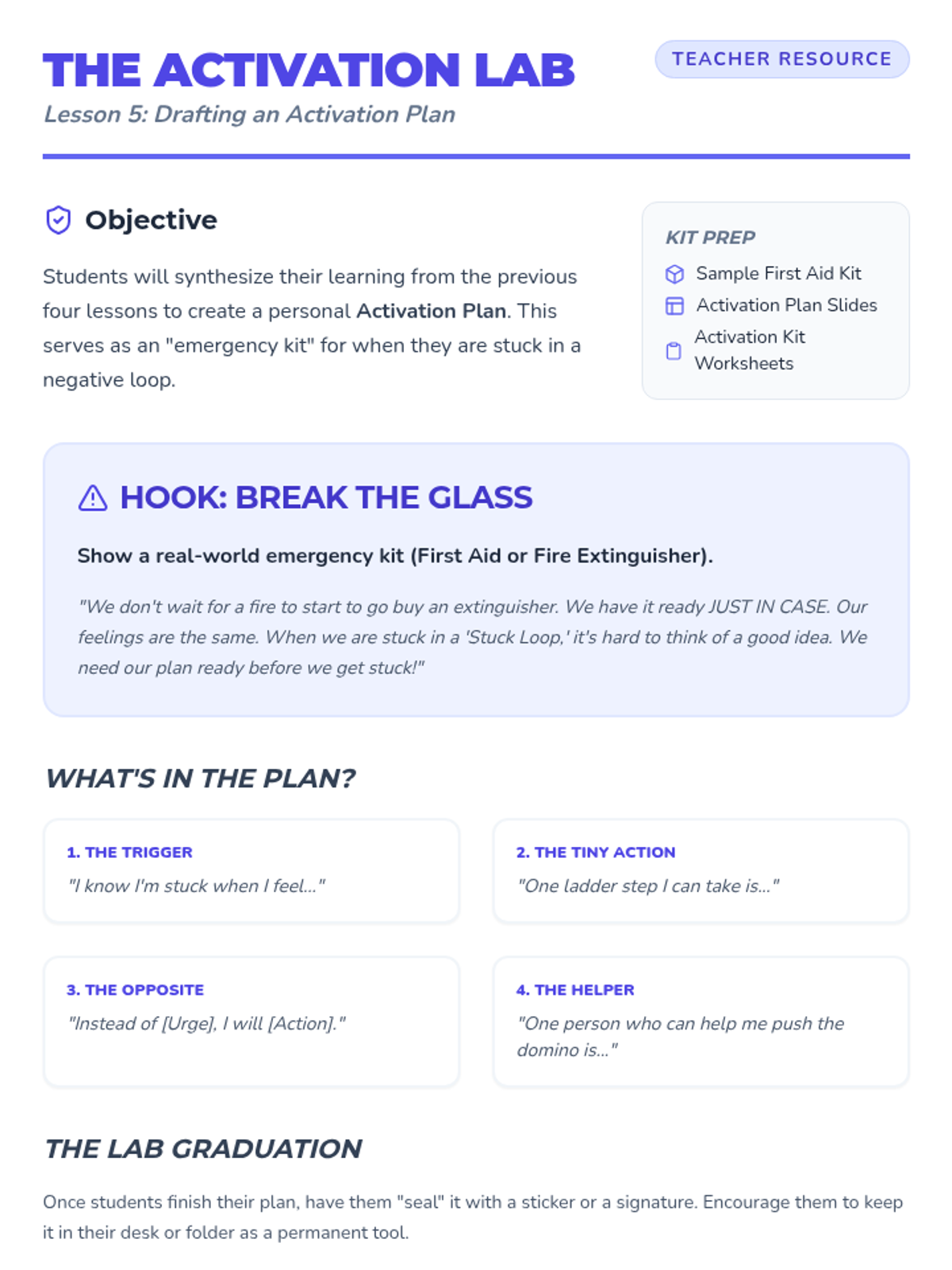
A teacher guide for the final lesson of the sequence, detailing the "Activation Plan" project and the "Break the Glass" hook.
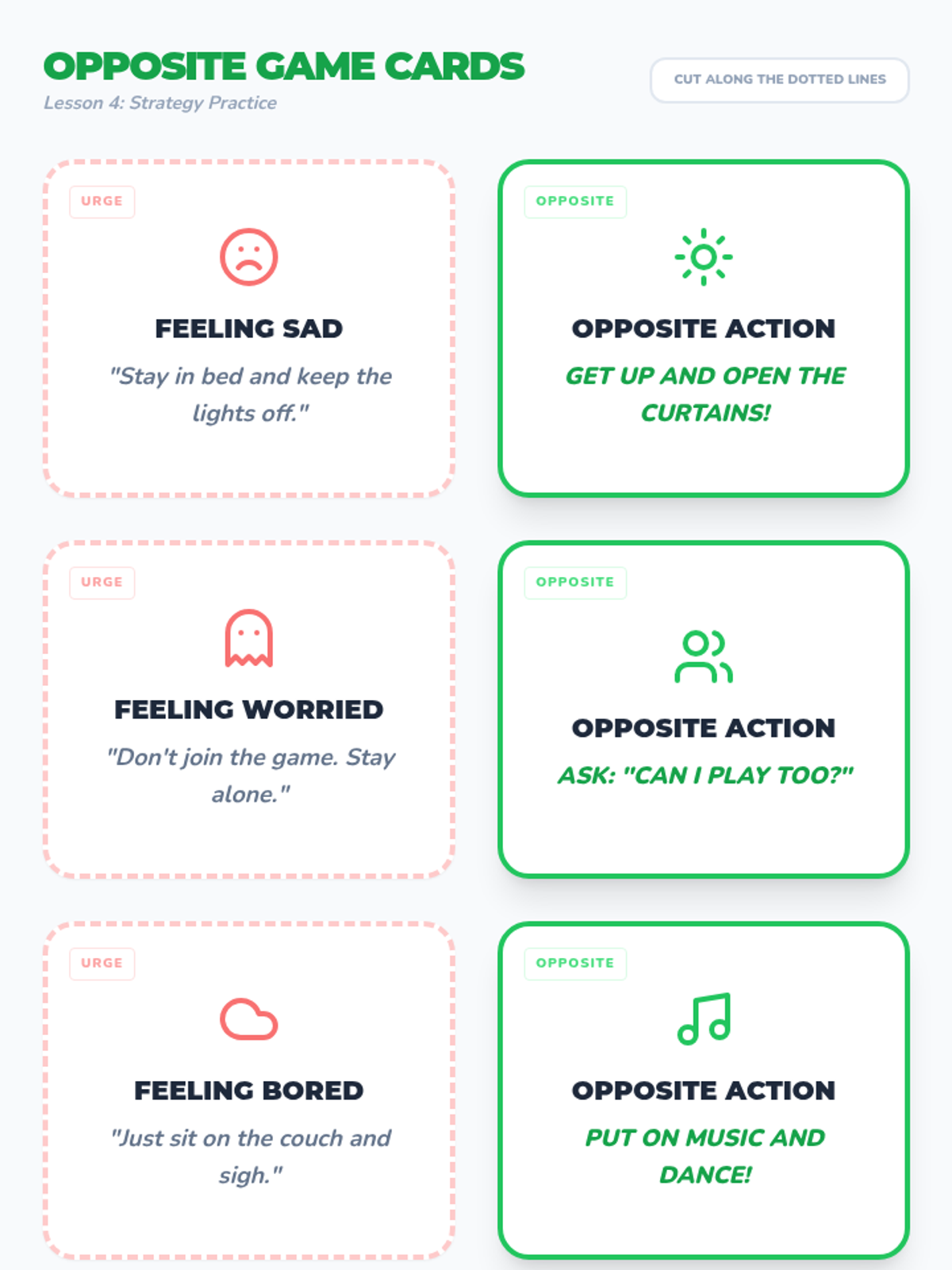
A set of printable game cards featuring emotion urges and their corresponding opposite actions for students to match and practice.
A slide deck for Lesson 4 that introduces the 'Opposite Action' skill and provides examples of how to reverse negative emotion urges.
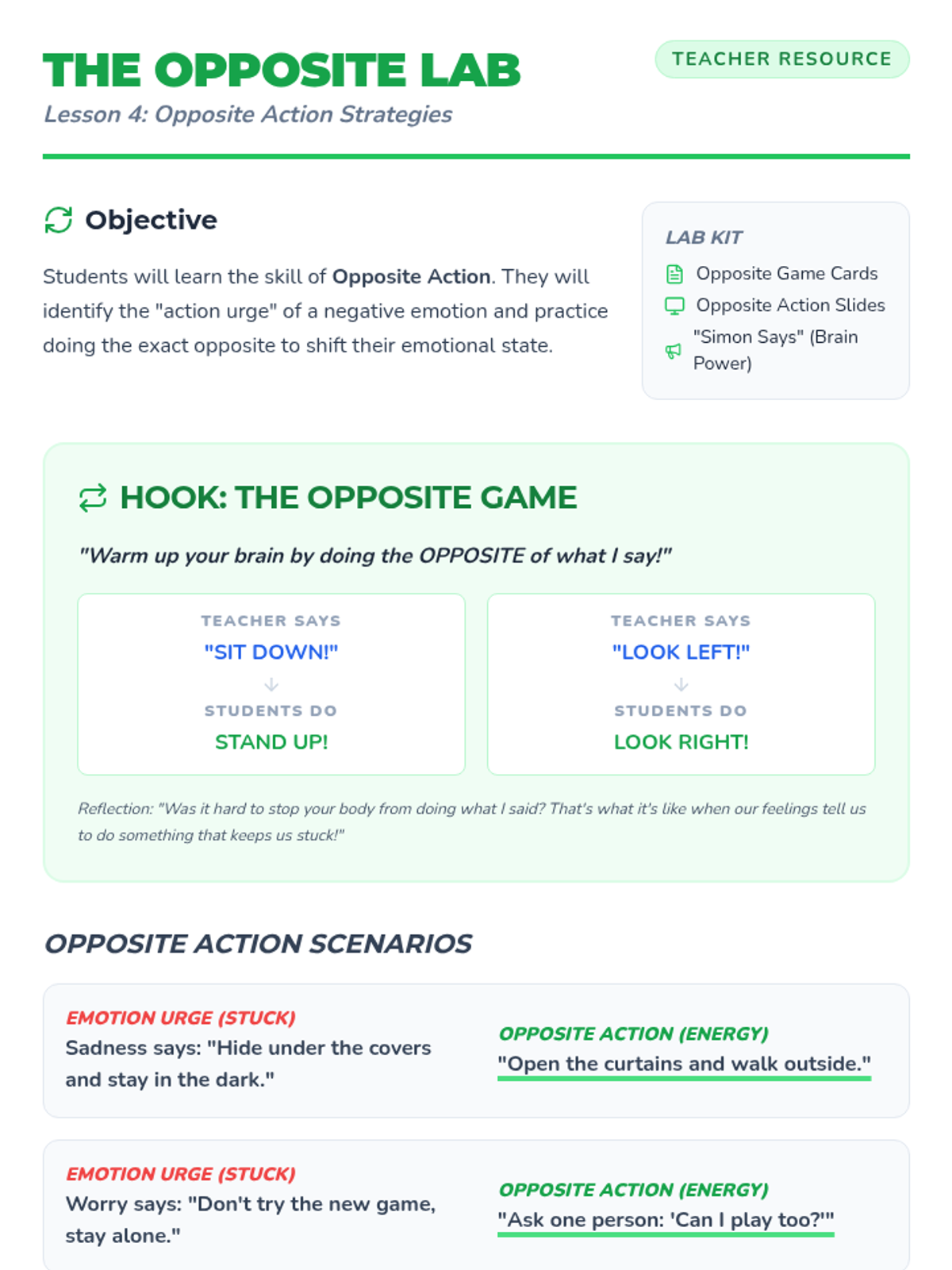
A teacher guide for the fourth lesson of the sequence, detailing the "Opposite Action" concept and instructions for the Opposite Game hook.
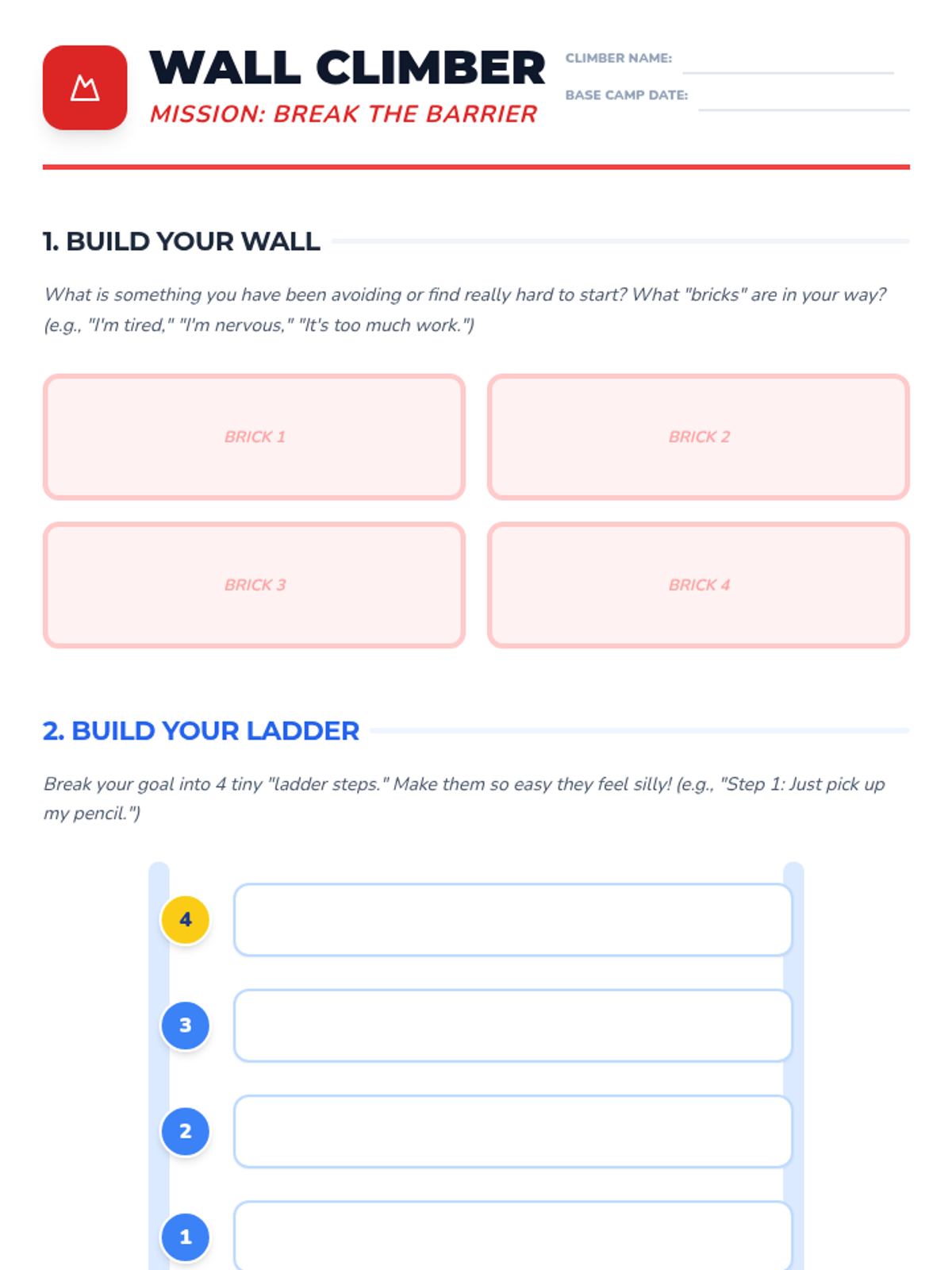
A worksheet for Lesson 3 where students identify their emotional 'Wall' (barriers) and break a task down into 4 small 'Ladder' steps.
A slide deck for Lesson 3 that introduces the 'Wall' of emotional barriers and the 'Ladder' strategy for task initiation.
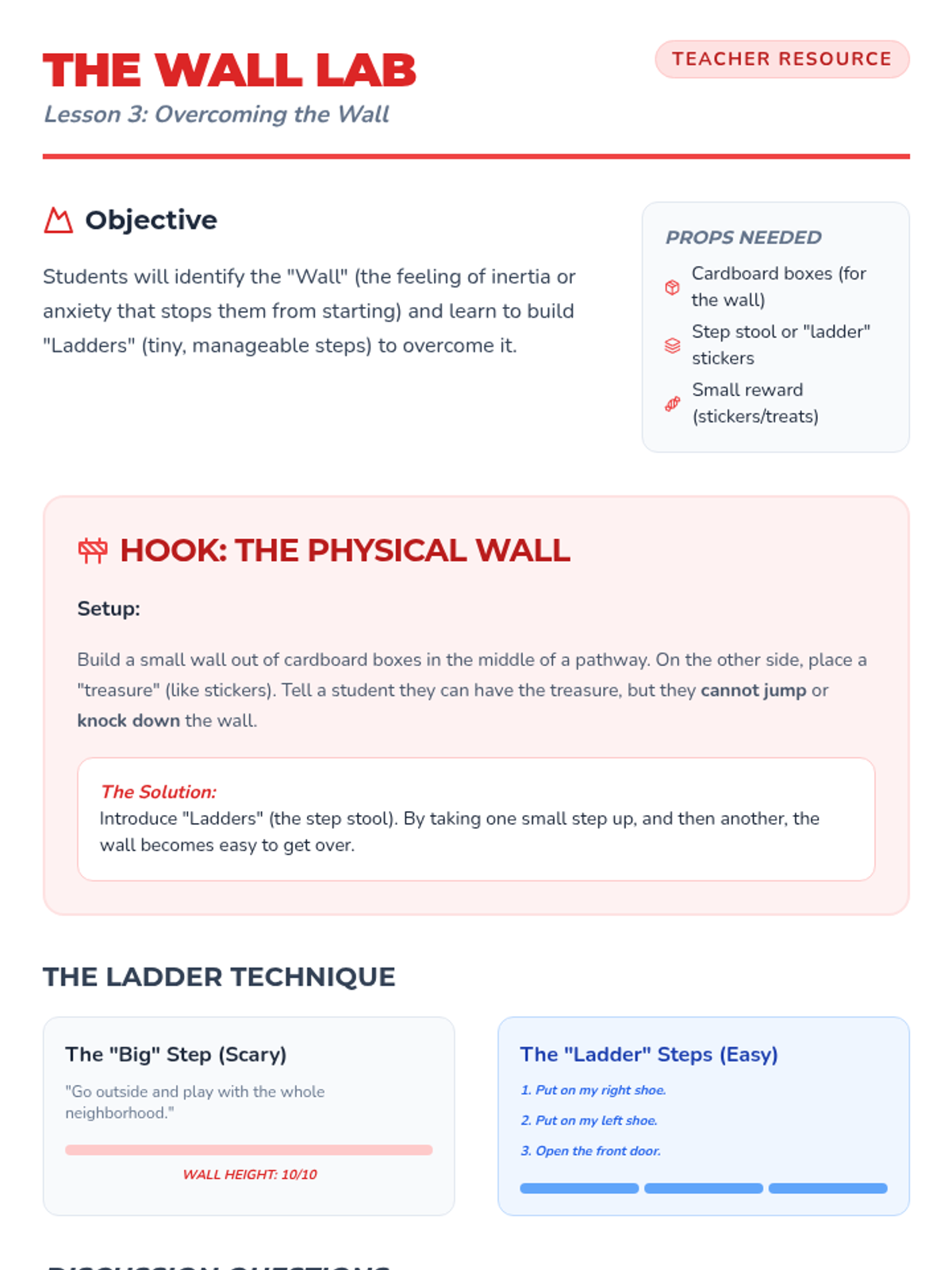
A teacher guide for the third lesson of the sequence, detailing the "Wall vs Ladder" concept and the physical obstacle course hook.
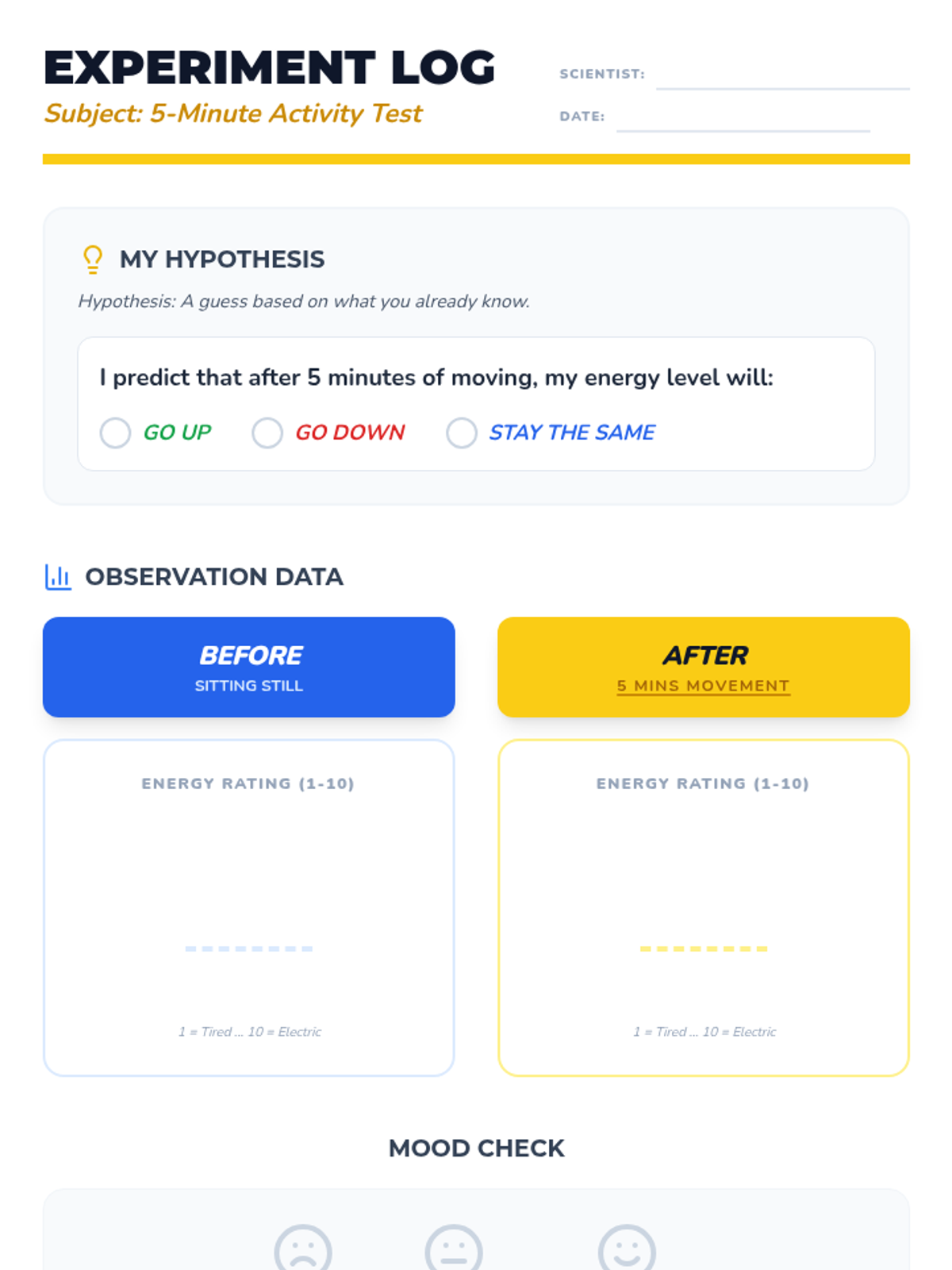
A data-tracking worksheet for students to record their energy levels before and after the 5-minute movement experiment.
A slide deck for Lesson 2 that guides students through a behavioral activation experiment, comparing baseline energy to post-activity energy.
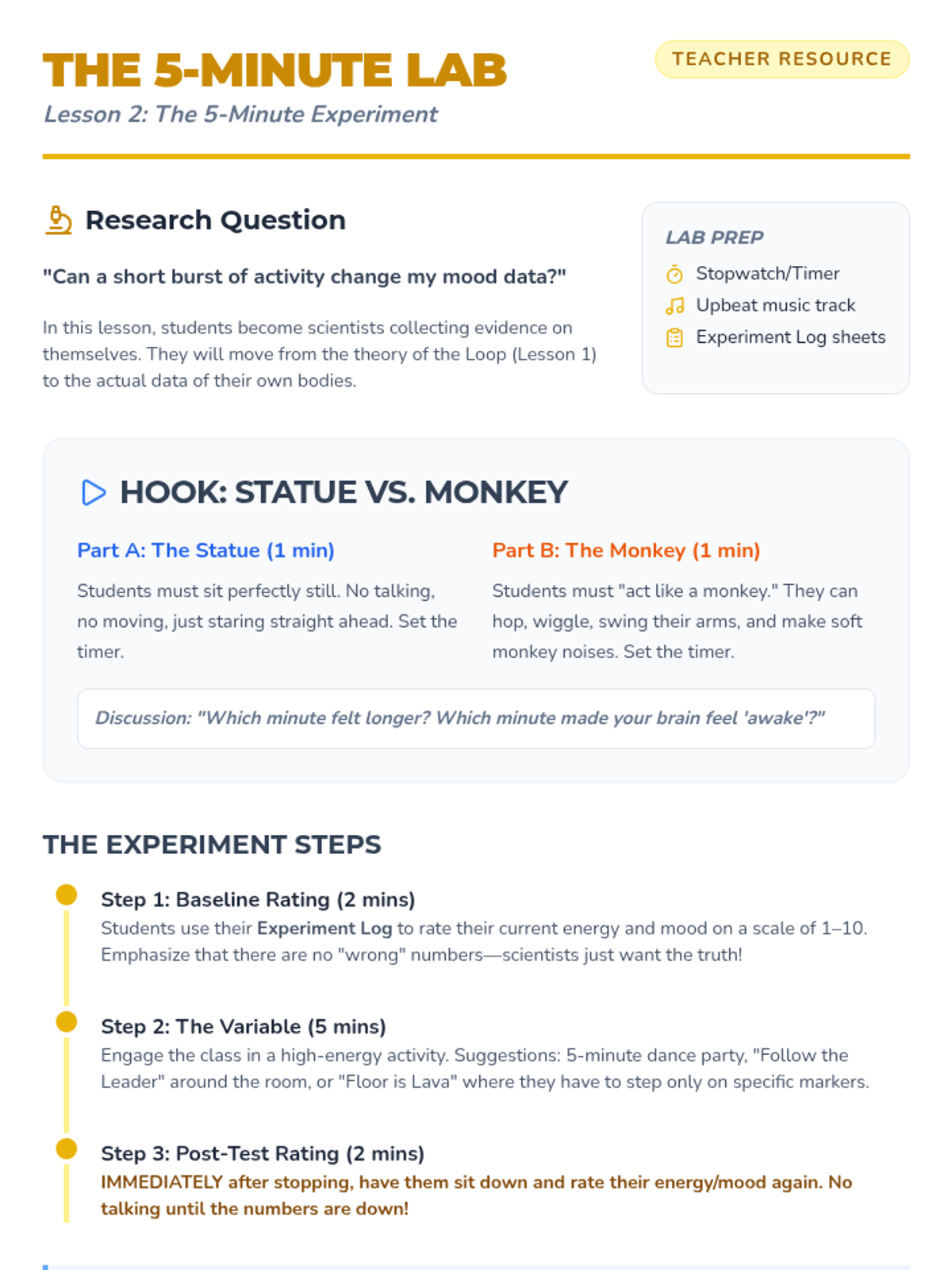
A teacher guide for the second lesson of the sequence, detailing the "Statue vs Monkey" hook and the protocol for the 5-minute activation experiment.
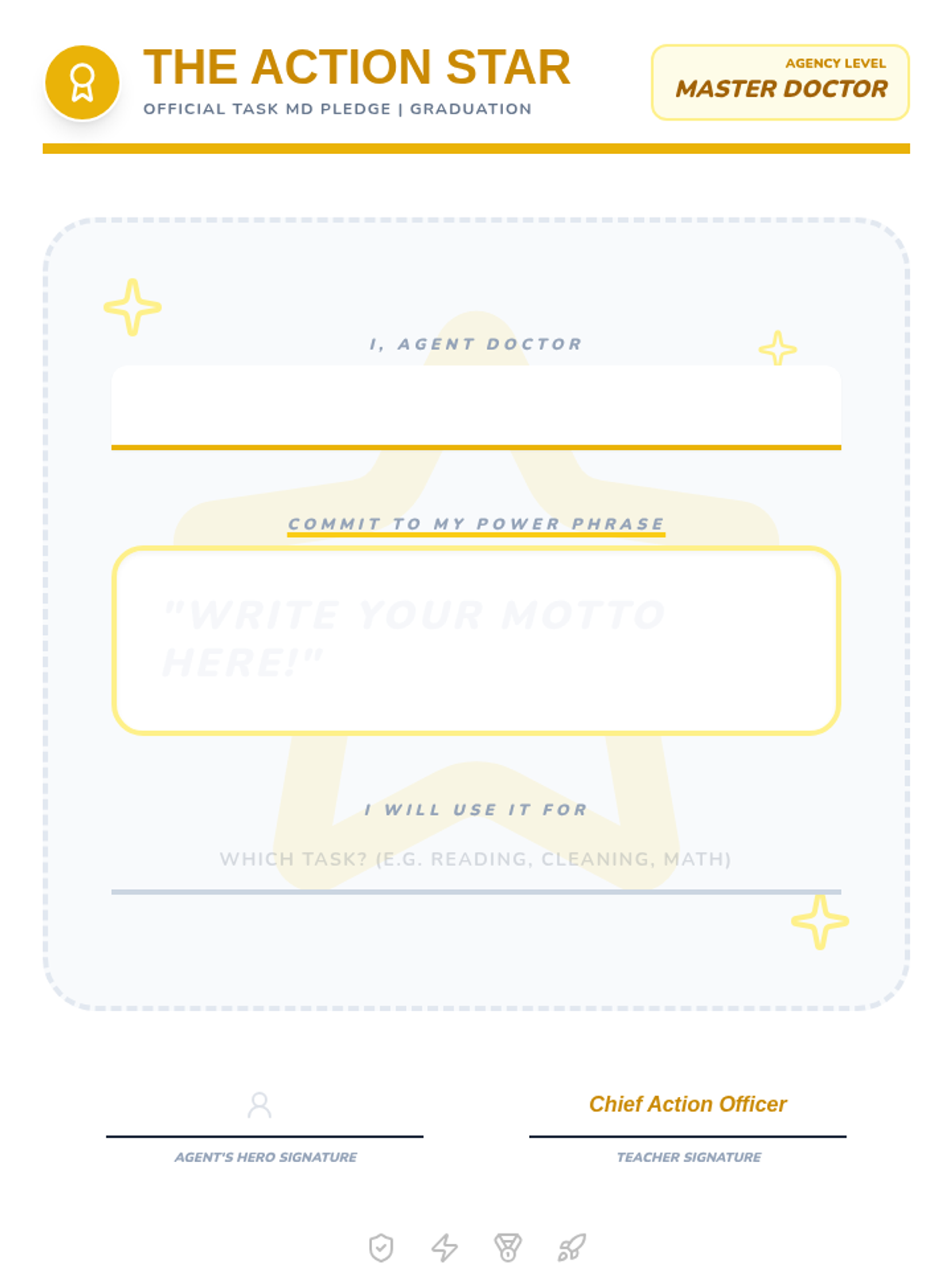
A student worksheet for the final lesson, where students write their personal 'Power Phrase' motto on a star-themed pledge sheet to be displayed on the 'Wall of Action'.
Engaging slides for Lesson 5 that guide the student self-reflection process and introduce the 'Wall of Action' graduation ceremony.
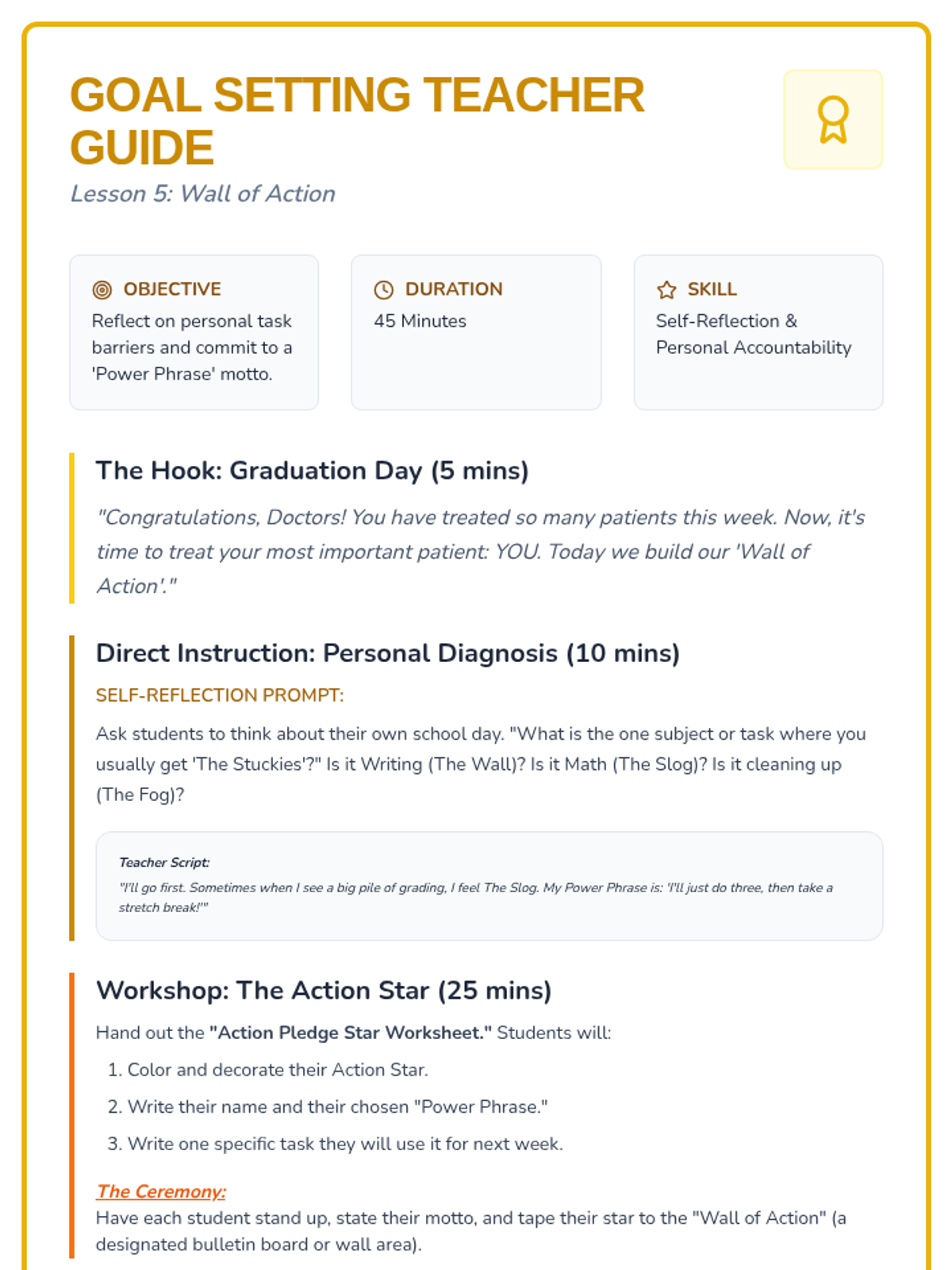
A comprehensive teacher's guide for the fifth lesson, focused on student self-reflection and creating a 'Wall of Action' with personal self-talk mottos.
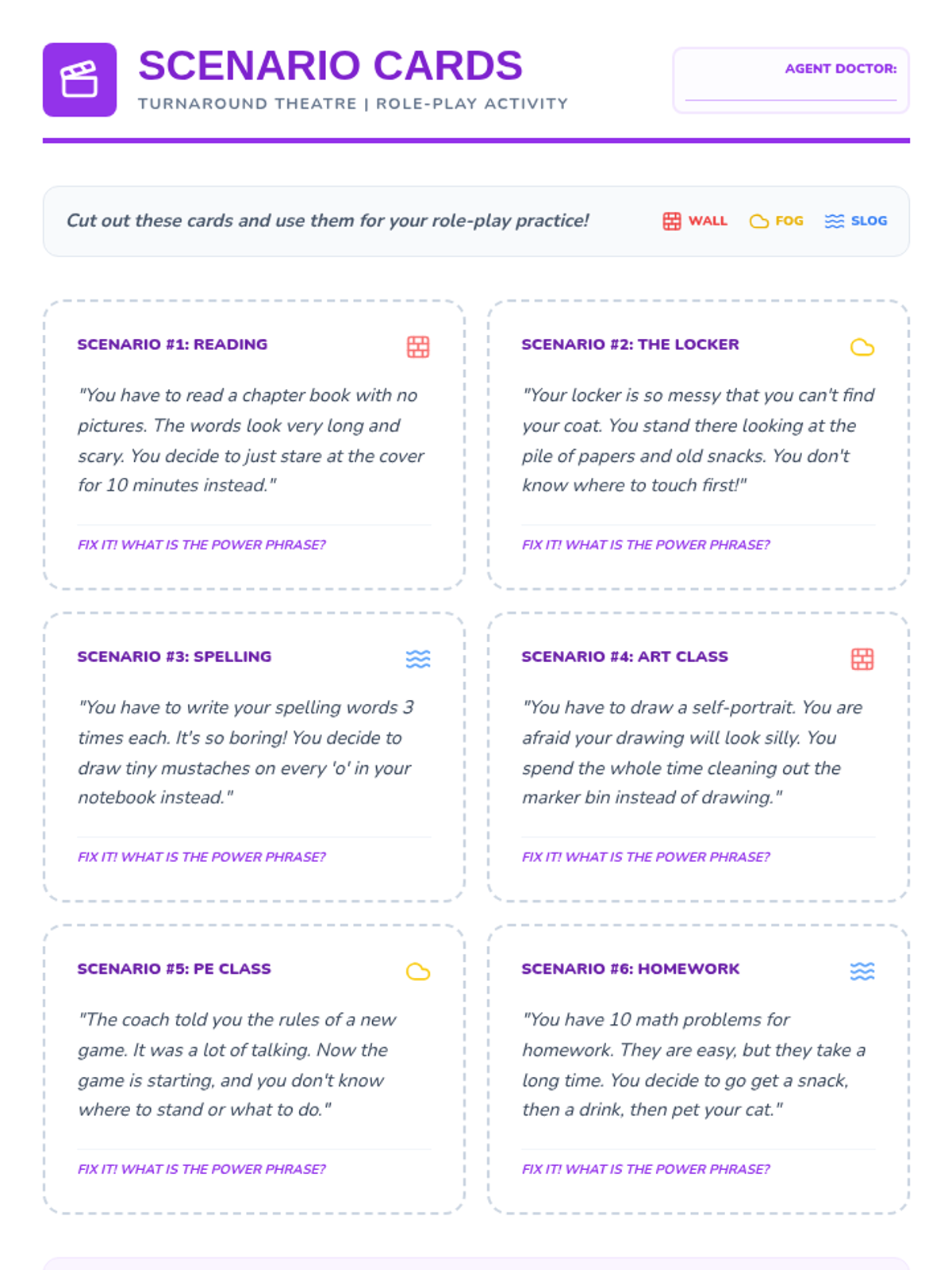
A set of role-play scenario cards for Lesson 4, allowing students to practice diagnosing barriers (Wall, Fog, Slog) and delivering self-talk prescriptions.
Engaging slides for Lesson 4 that guide the "Freeze and Fix" improvisational game and present role-play scenarios for students to practice self-talk solutions.
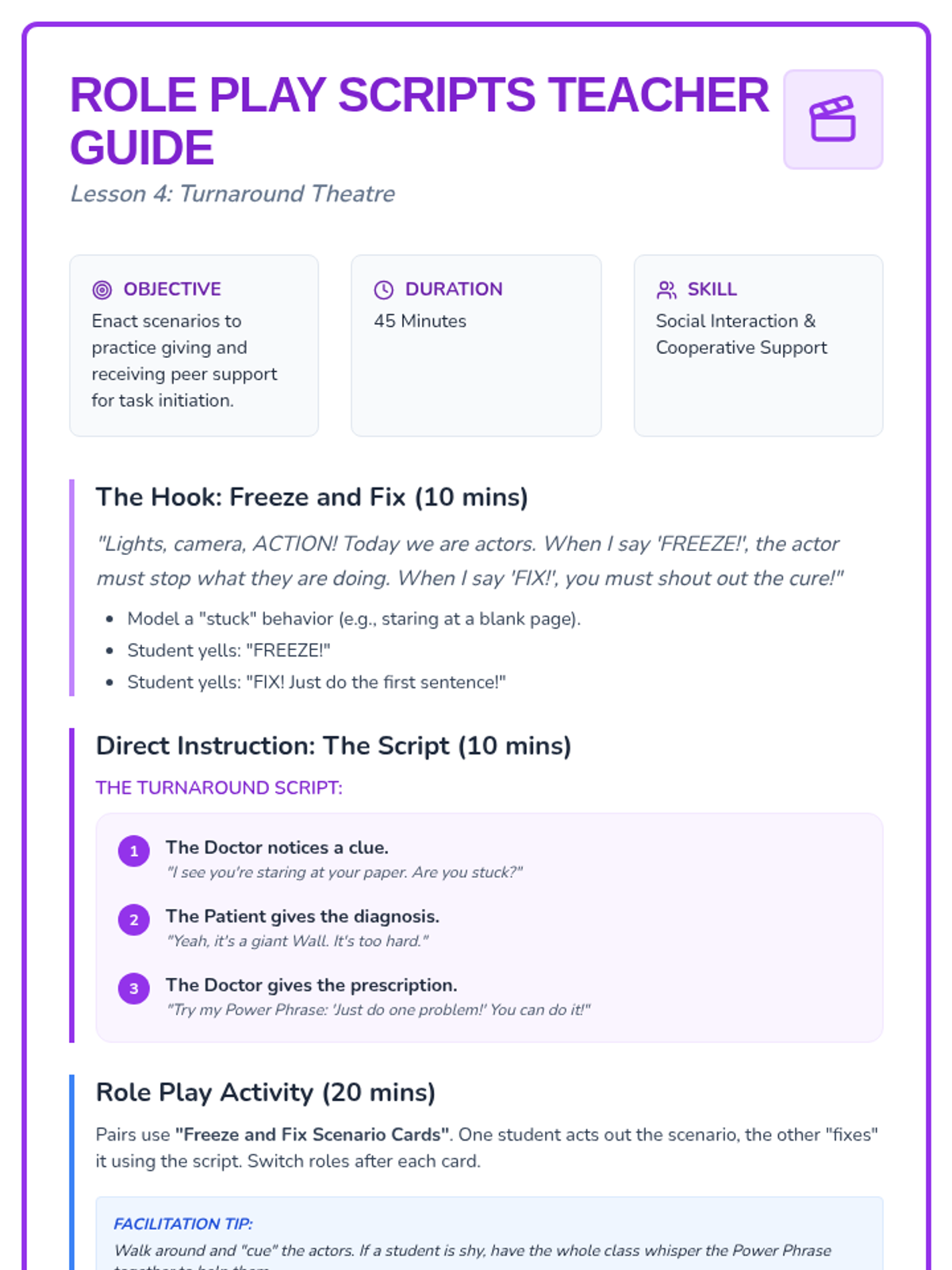
A comprehensive teacher's guide for the fourth lesson, outlining role-playing scripts and the "Freeze and Fix" improvisational activity.
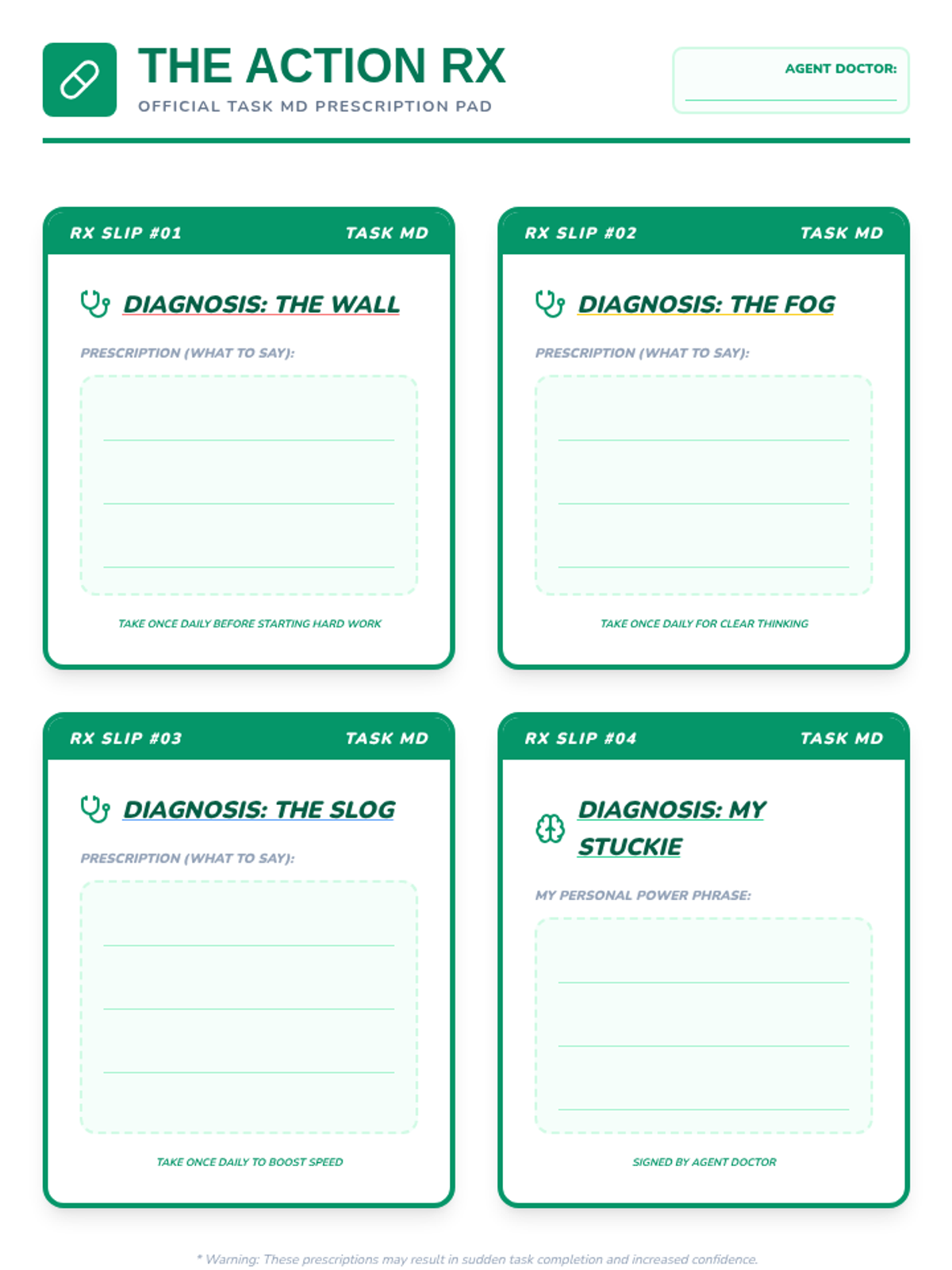
A student worksheet for the third lesson, using an oversized 'prescription pad' design to practice writing self-talk power phrases for different task barriers.
Engaging slides for Lesson 3 that match specific self-talk 'prescriptions' to diagnosed problems like boredom and difficulty.
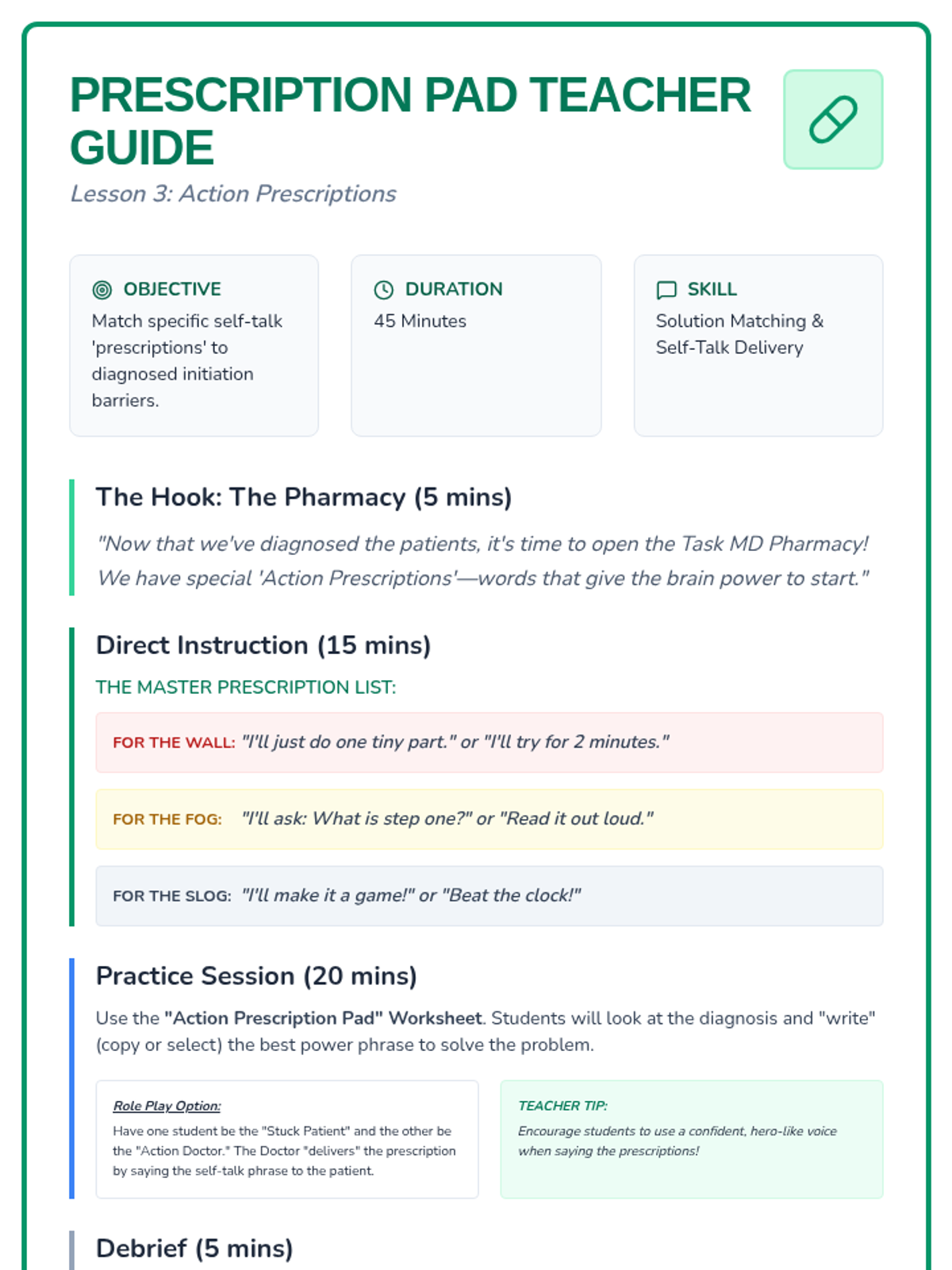
A comprehensive teacher's guide for the third lesson, matching specific self-talk 'prescriptions' to diagnosed problems like boredom and difficulty.
The final instructional slide deck for Lesson 5, guiding students through synthesizing their research into a "Joy Menu" and practicing their new skills through role-play.
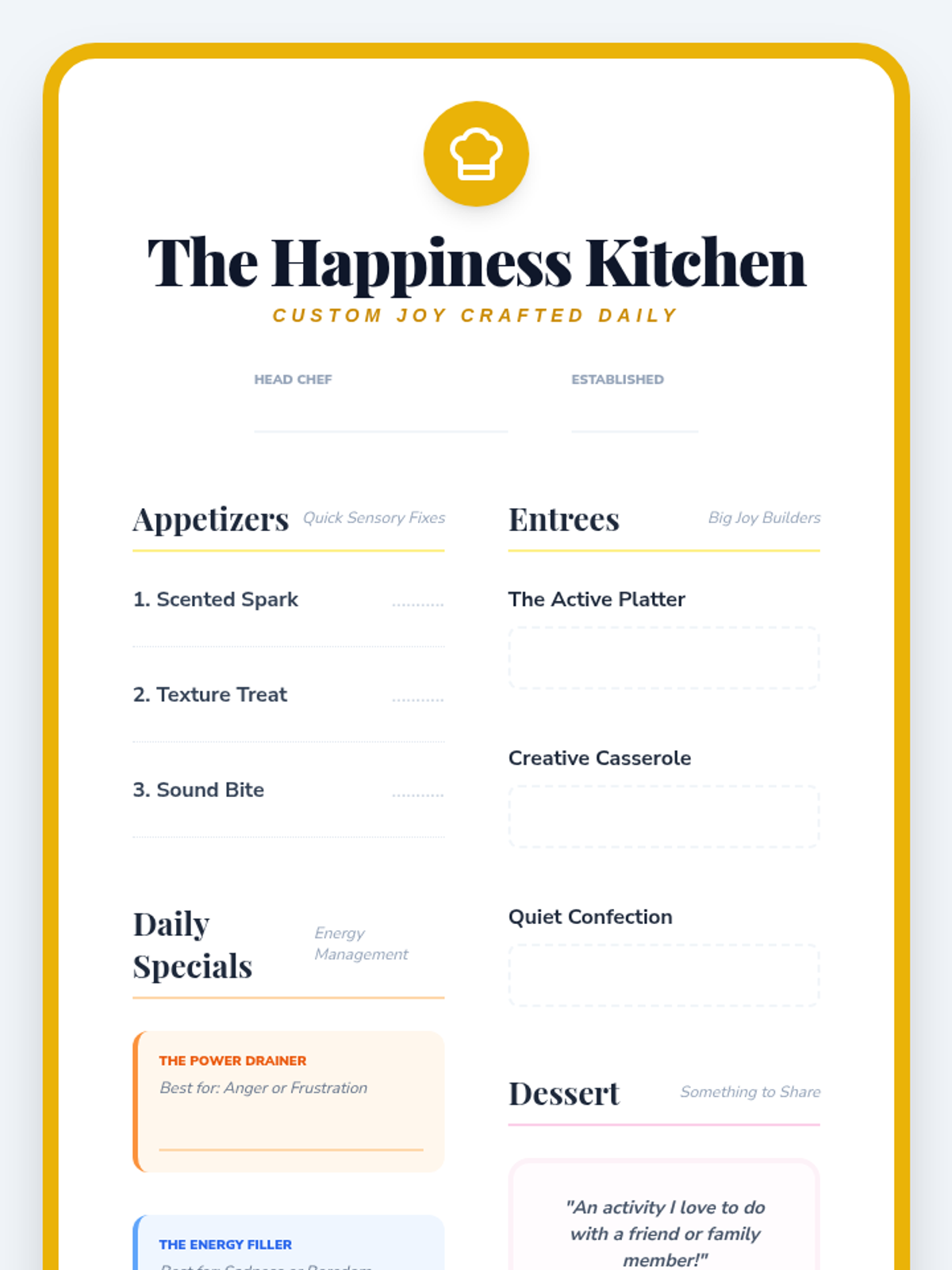
A student-facing restaurant-style menu template for synthesizing and illustrating personal mood-lifting activities and coping strategies.
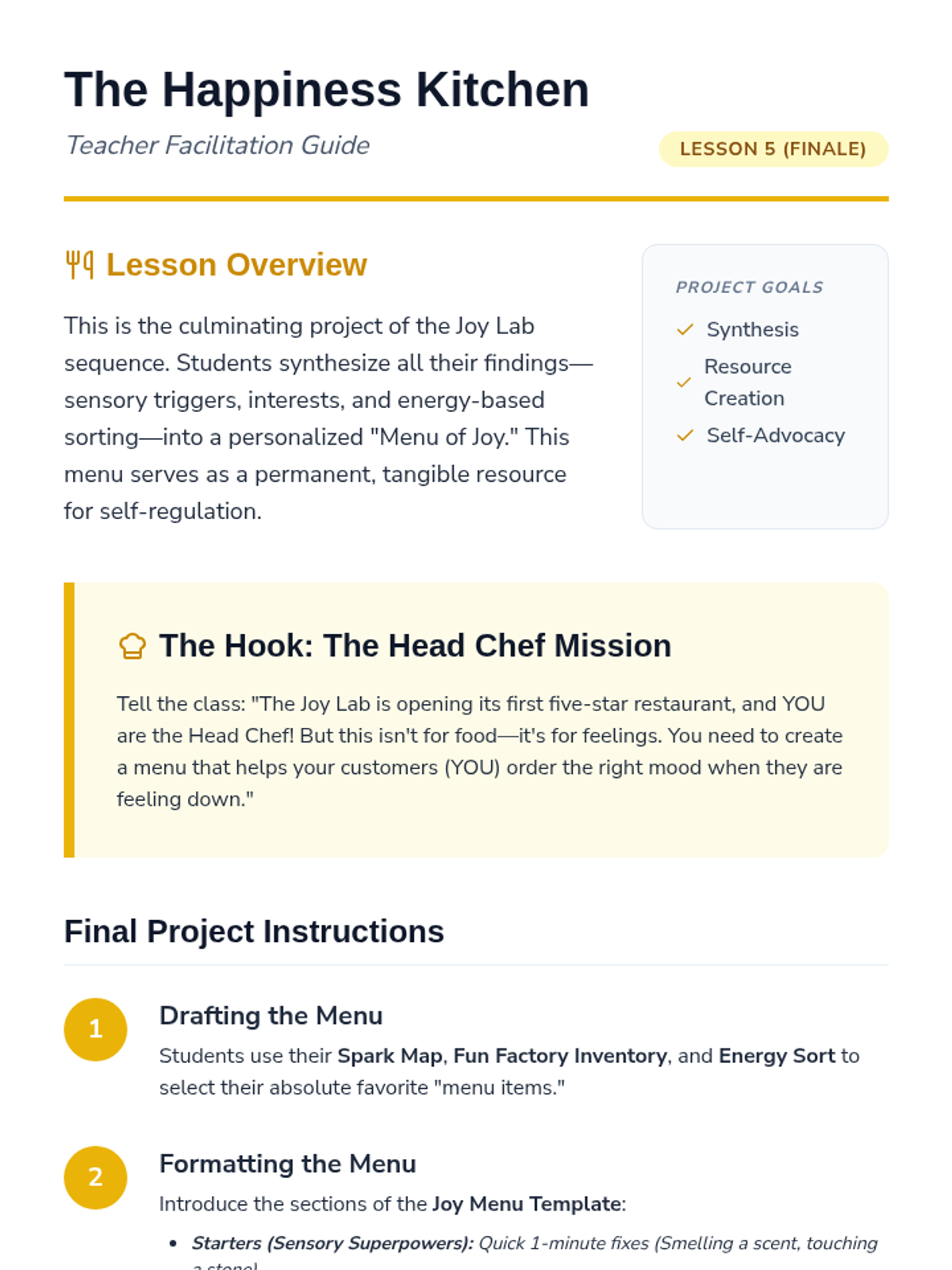
A teacher guide for Lesson 5, focusing on synthesis of learned coping strategies into a personalized "Joy Menu" and providing instructions for role-play scenarios.
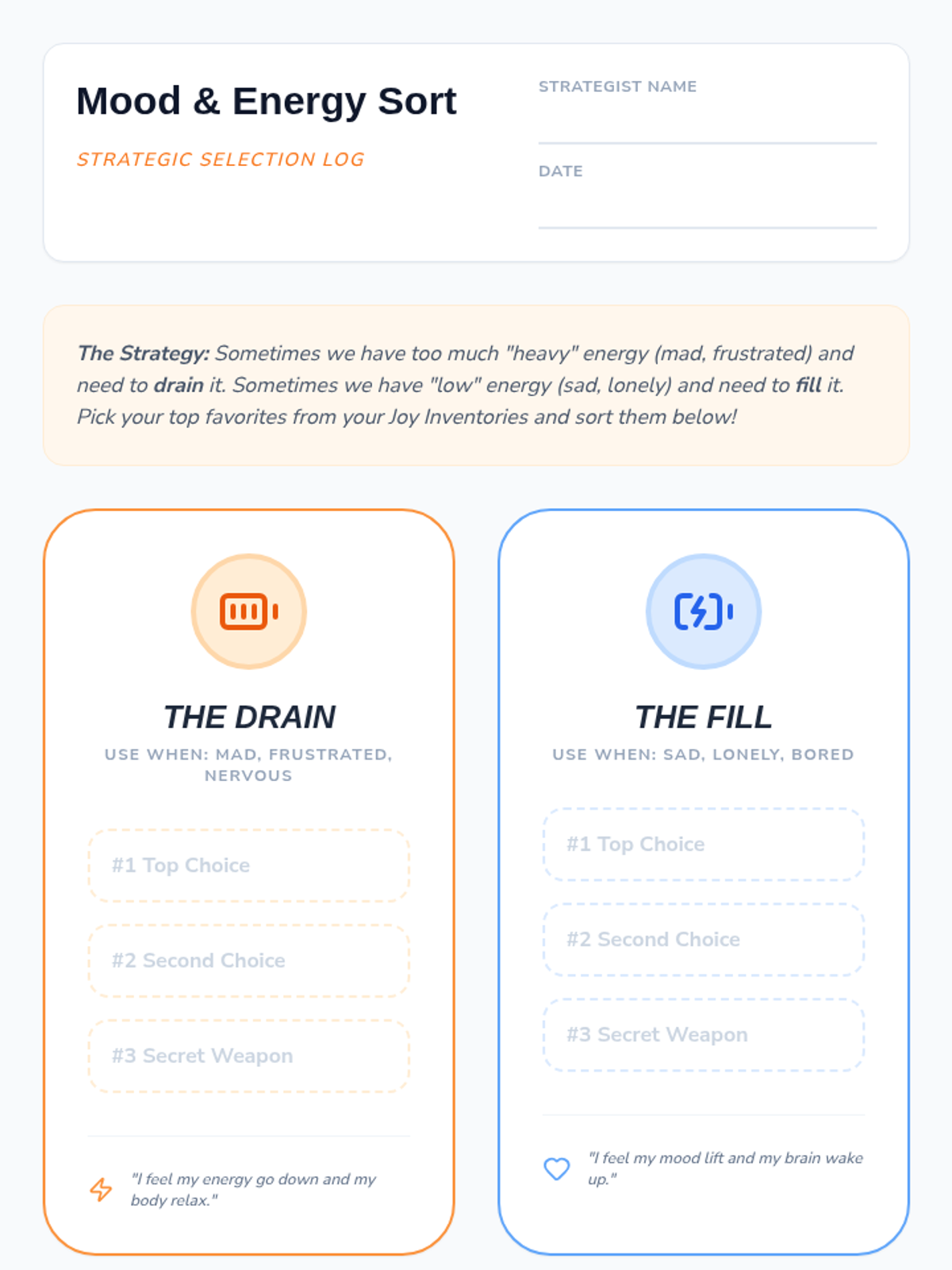
A student worksheet for sorting personal joy activities into High Energy (Drain) and Low Energy (Fill) categories for strategic emotional regulation.
An instructional slide deck for Lesson 4 that teaches students how to strategically match activities to their current emotional energy levels.
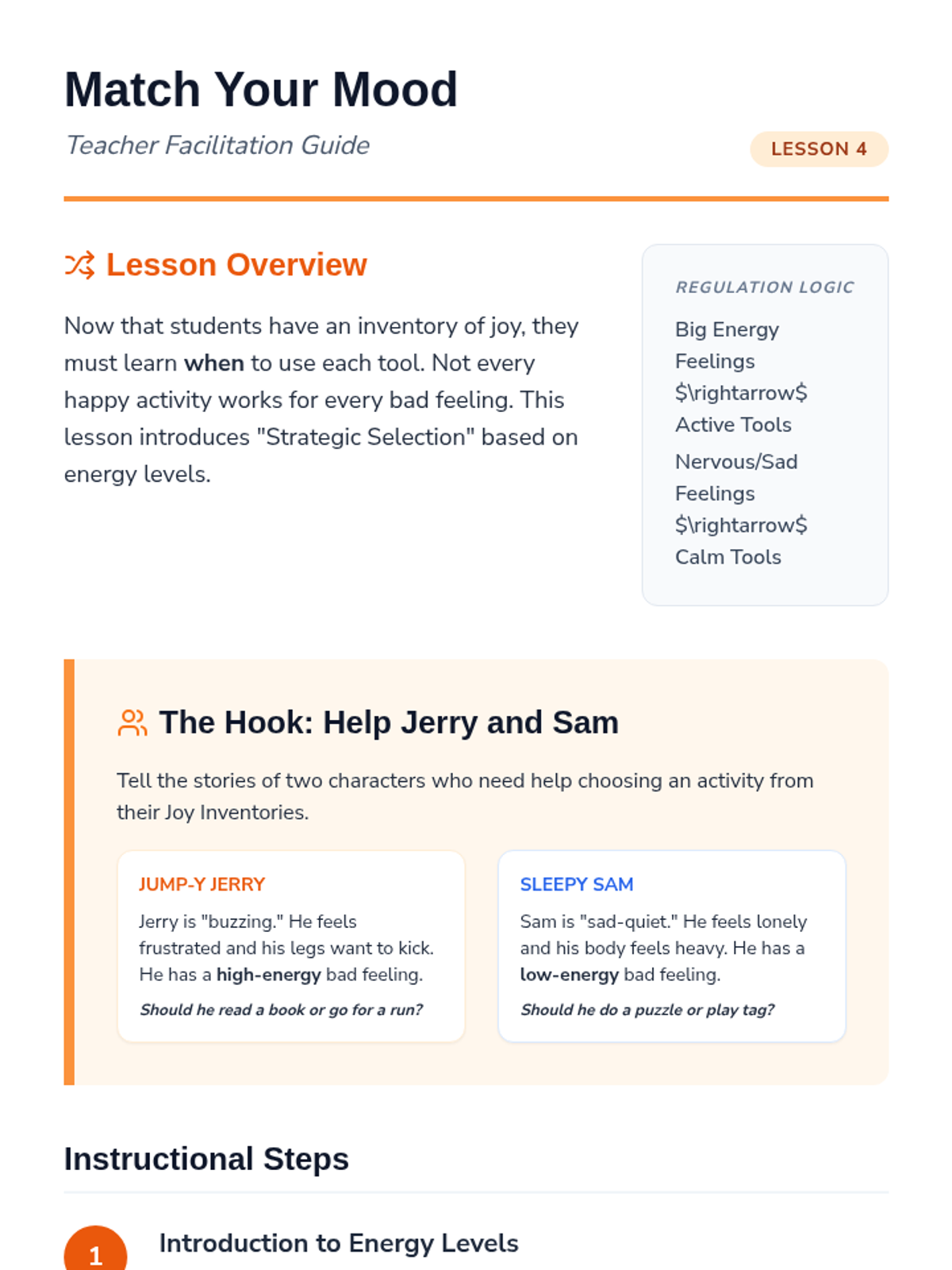
A teacher guide for Lesson 4, focusing on strategic selection of activities based on emotional energy levels (High Energy vs. Low Energy).
An instructional slide deck for Lesson 3 that introduces sensory mood boosters and guides students through a series of "laboratory" experiments with smell, sound, and touch.
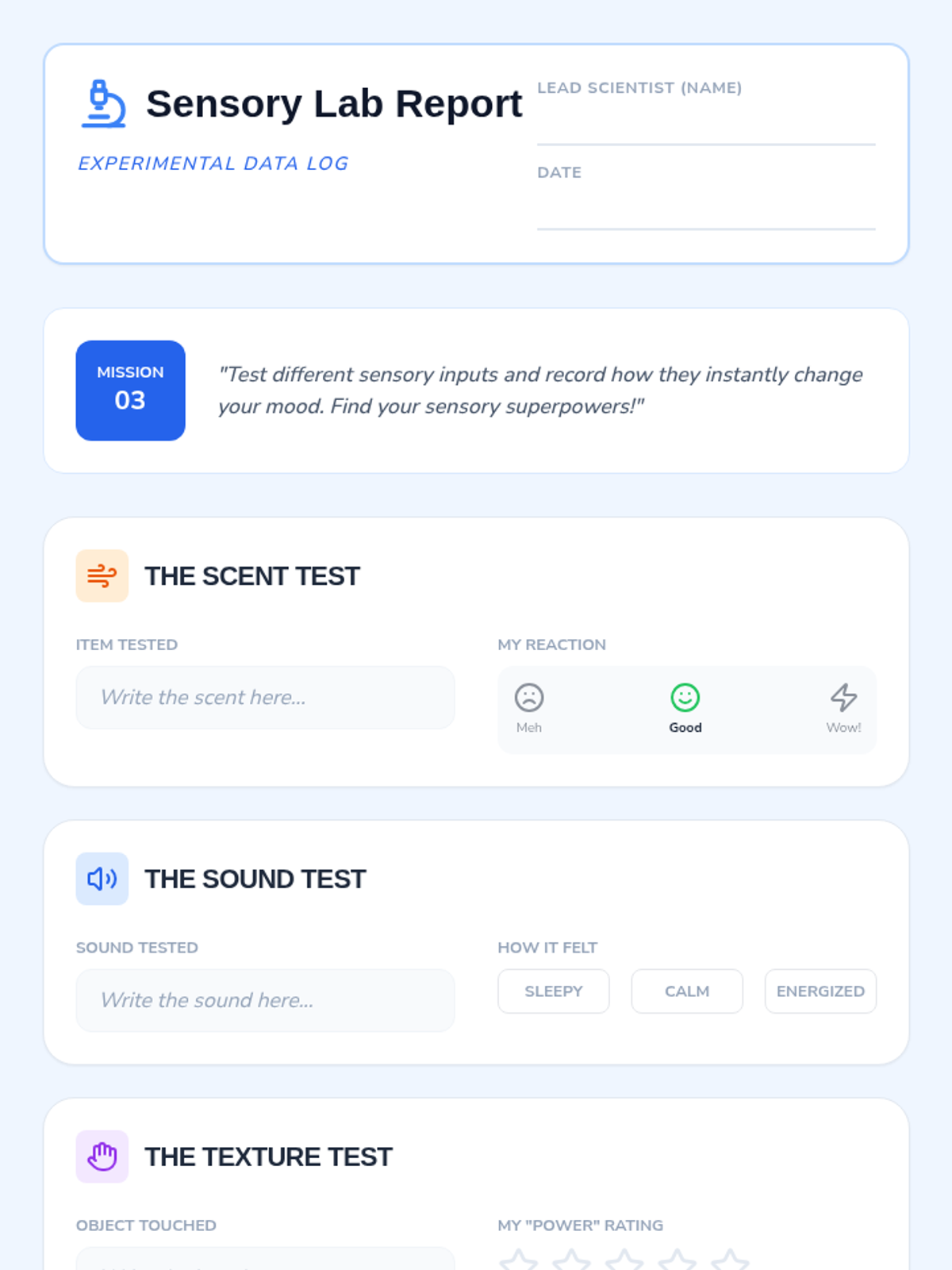
A student lab report worksheet for recording observations and emotional reactions during the "Sensory Superpowers" lab station activity.
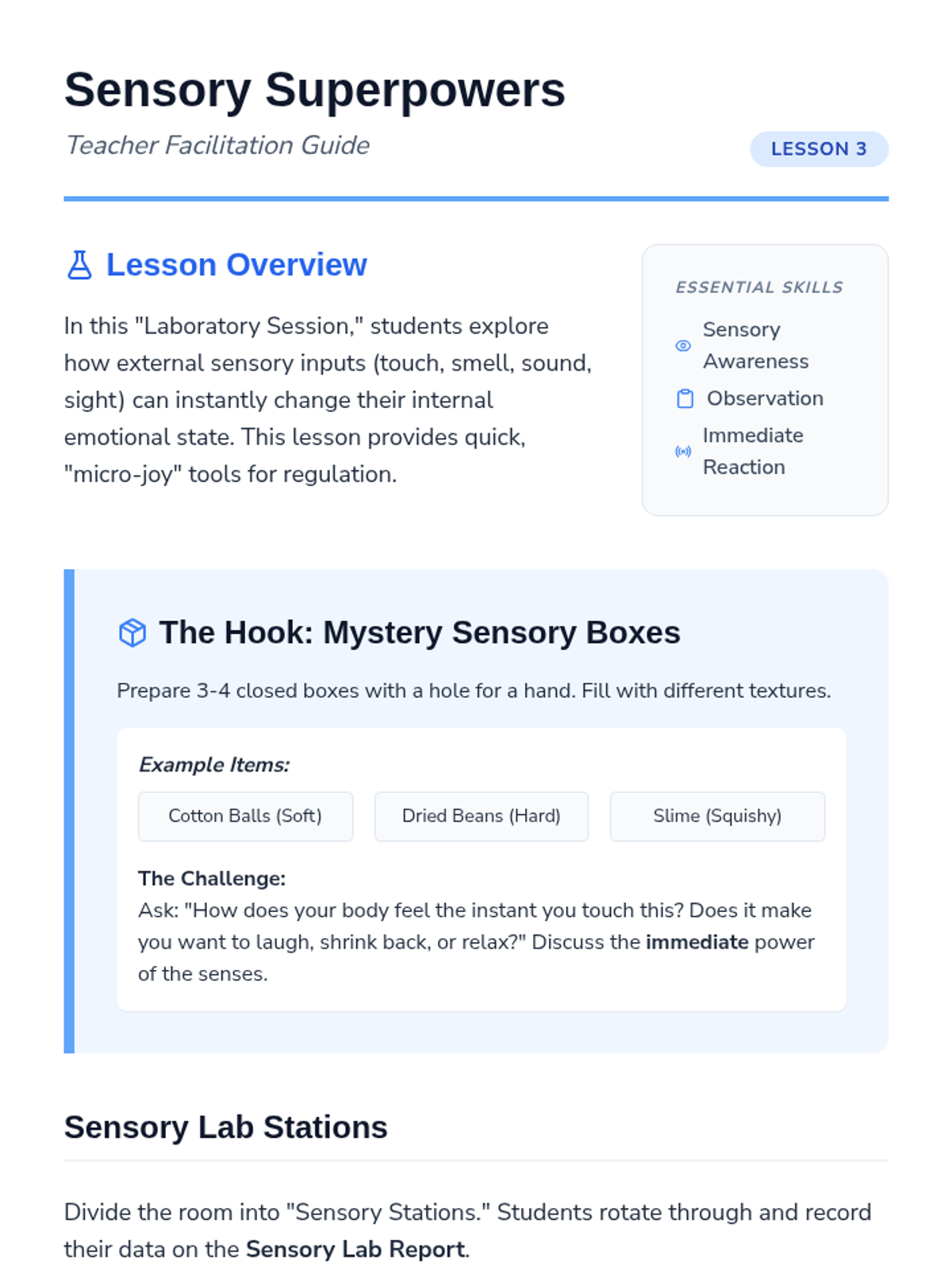
A teacher guide for Lesson 3, focusing on sensory-based mood boosters (smell, touch, sound, sight) through a "Sensory Lab" station rotation.
An instructional slide deck for Lesson 2 that introduces the three departments of fun: active, creative, and quiet, and guides students through building a personal joy stockpile.
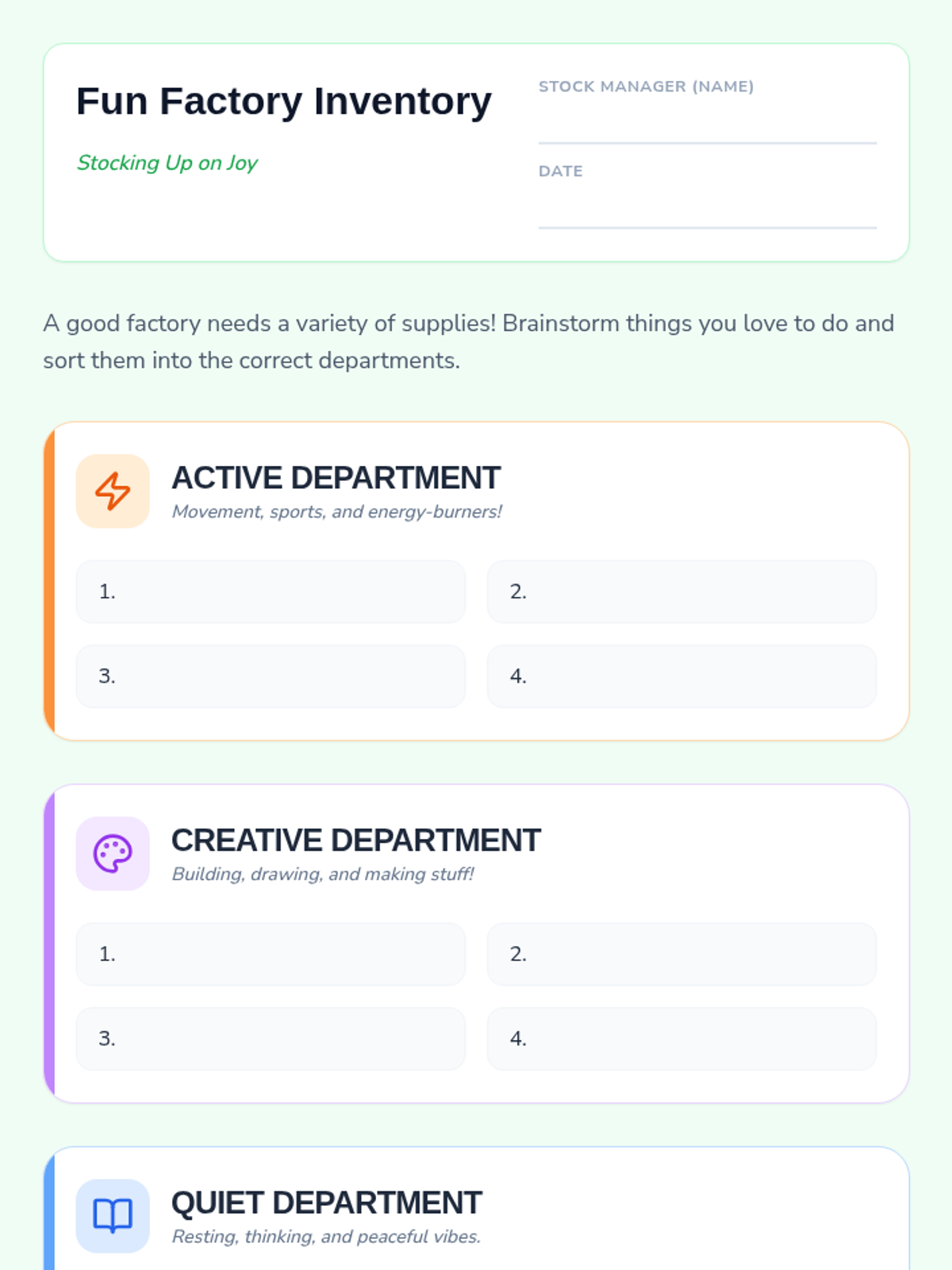
A student worksheet for identifying and categorizing favorite activities into active, creative, and quiet categories to build a diverse joy inventory.
A teacher guide for Lesson 2, focusing on brainstorming activities and categorizing them into active, creative, and quiet "departments" to build a diverse emotional toolkit.
An engaging slide deck for the first lesson of the Joy Lab, introducing the concept of mapping physical sensations associated with high-energy and low-energy positive emotions.
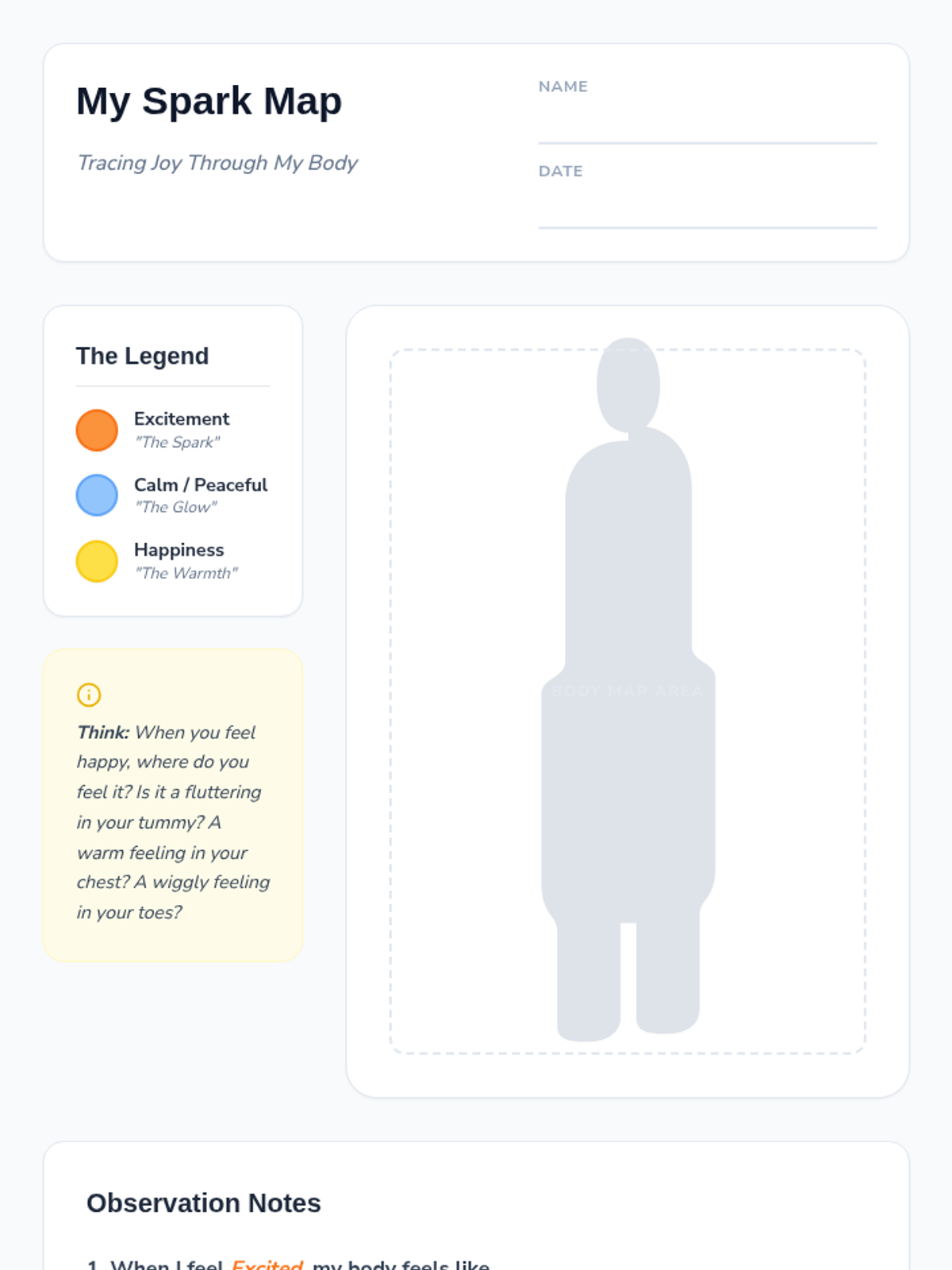
A student worksheet featuring a body map outline where children can trace and color physical sensations associated with positive emotions like excitement, calm, and happiness.
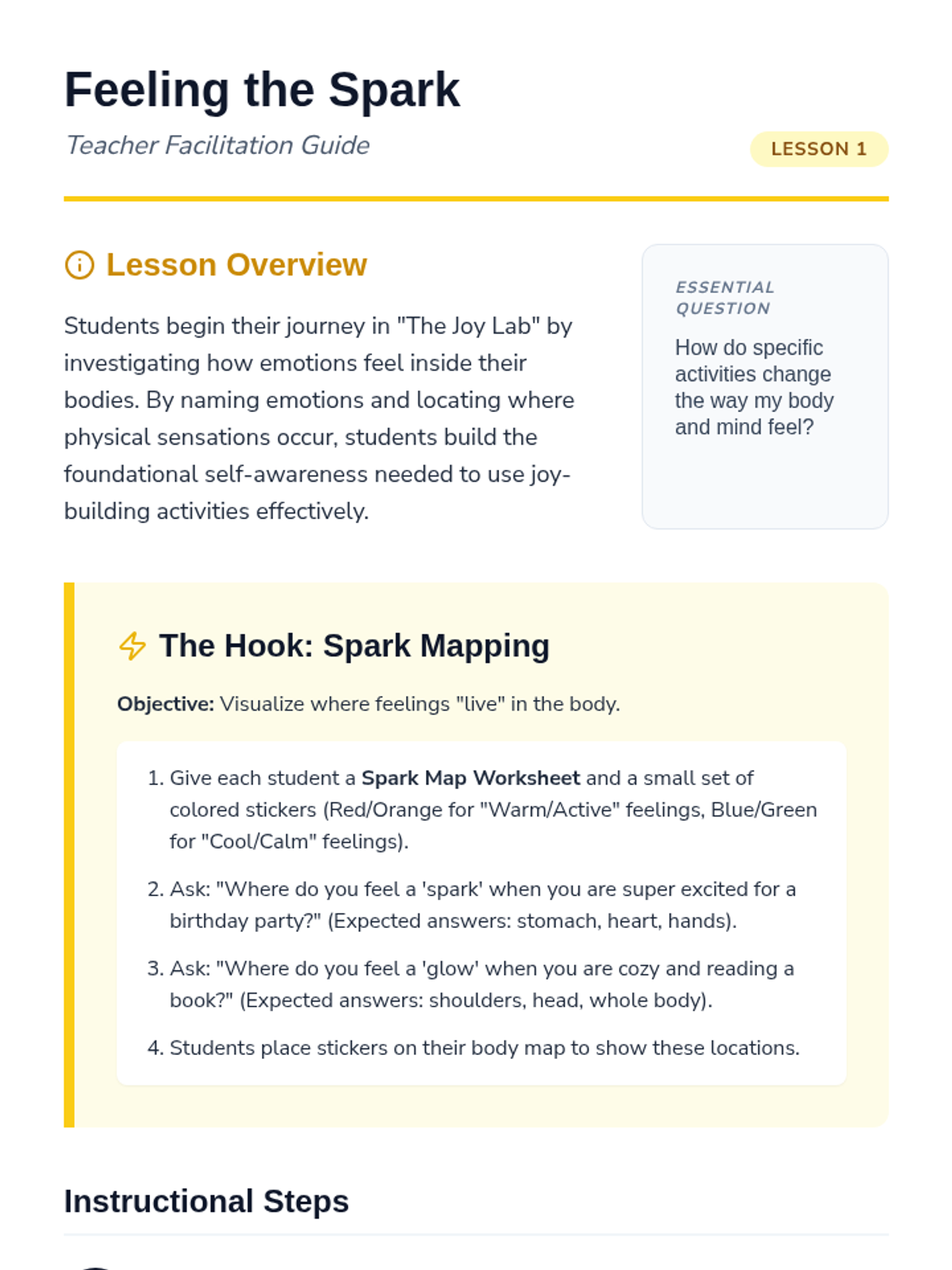
A comprehensive teacher guide for the first lesson of the Joy Lab sequence, focusing on identifying physical sensations associated with positive emotions through body mapping and vocabulary building.
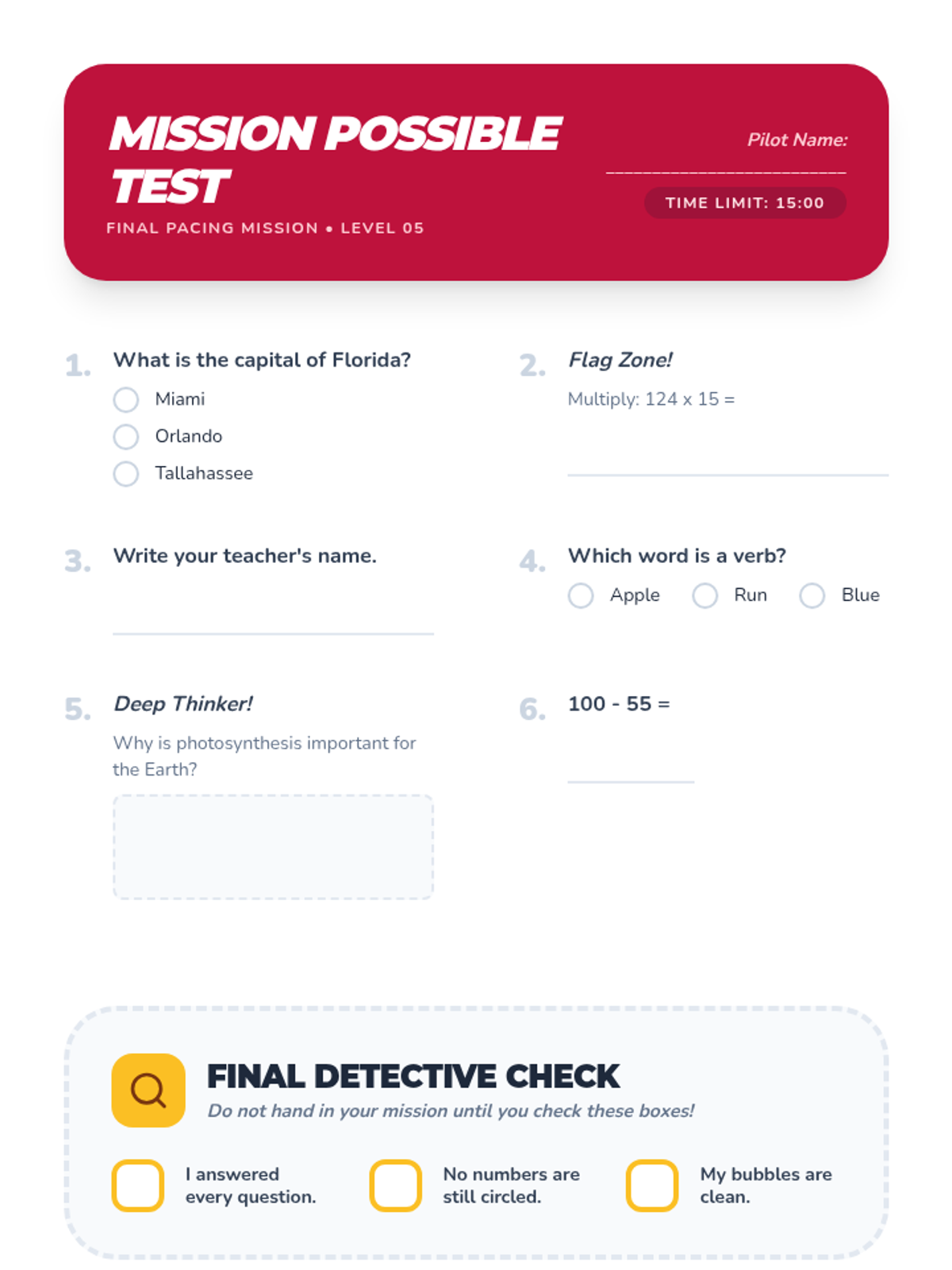
A cumulative 10-item test simulation for students to practice all pacing and review strategies learned in the sequence.
Final mission slide deck for the timed practice simulation, including a review of all strategies and a visual countdown concept.
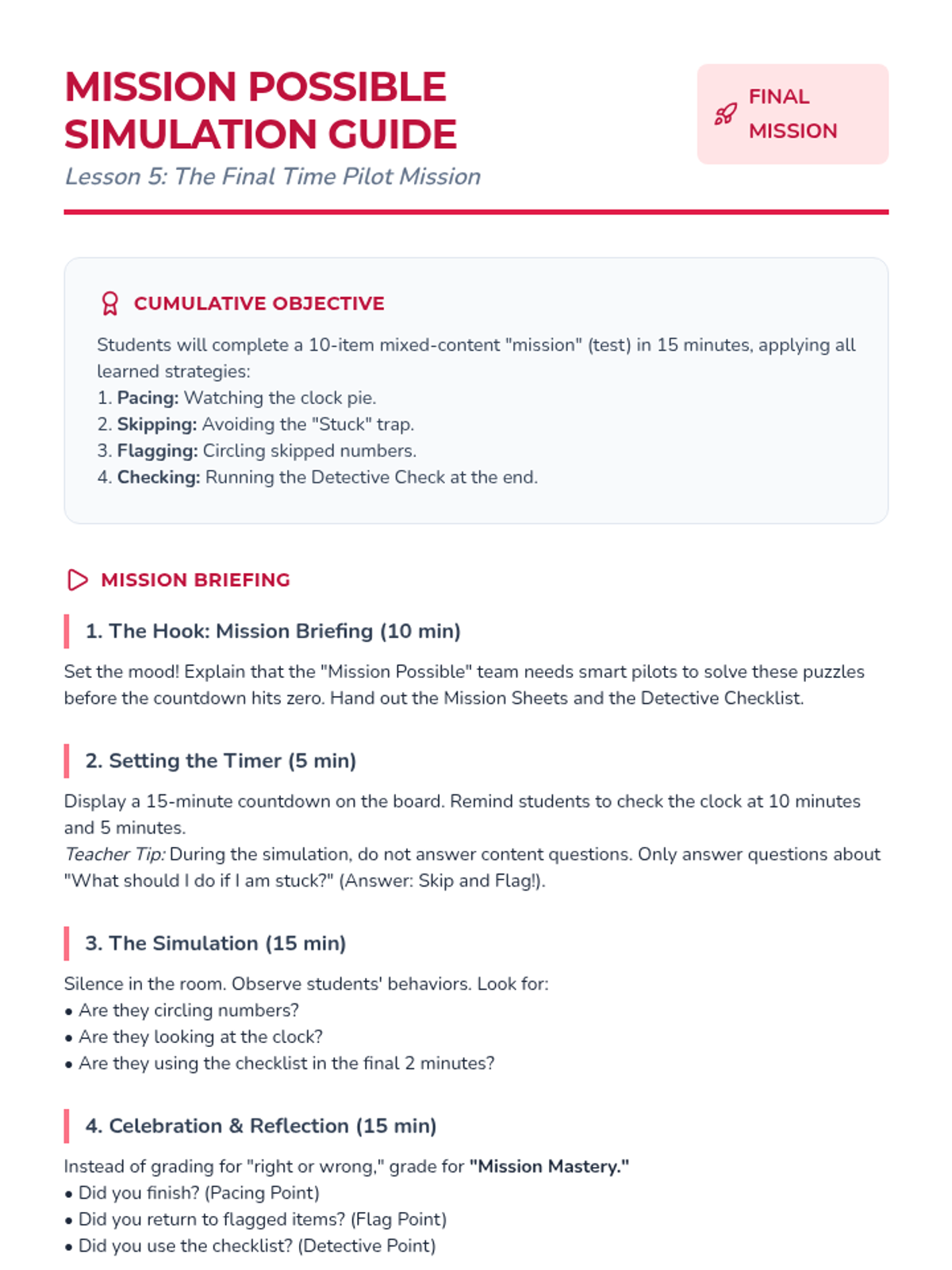
Teacher guide for the final simulation lesson, focusing on a cumulative assessment of all pacing and test-taking strategies.
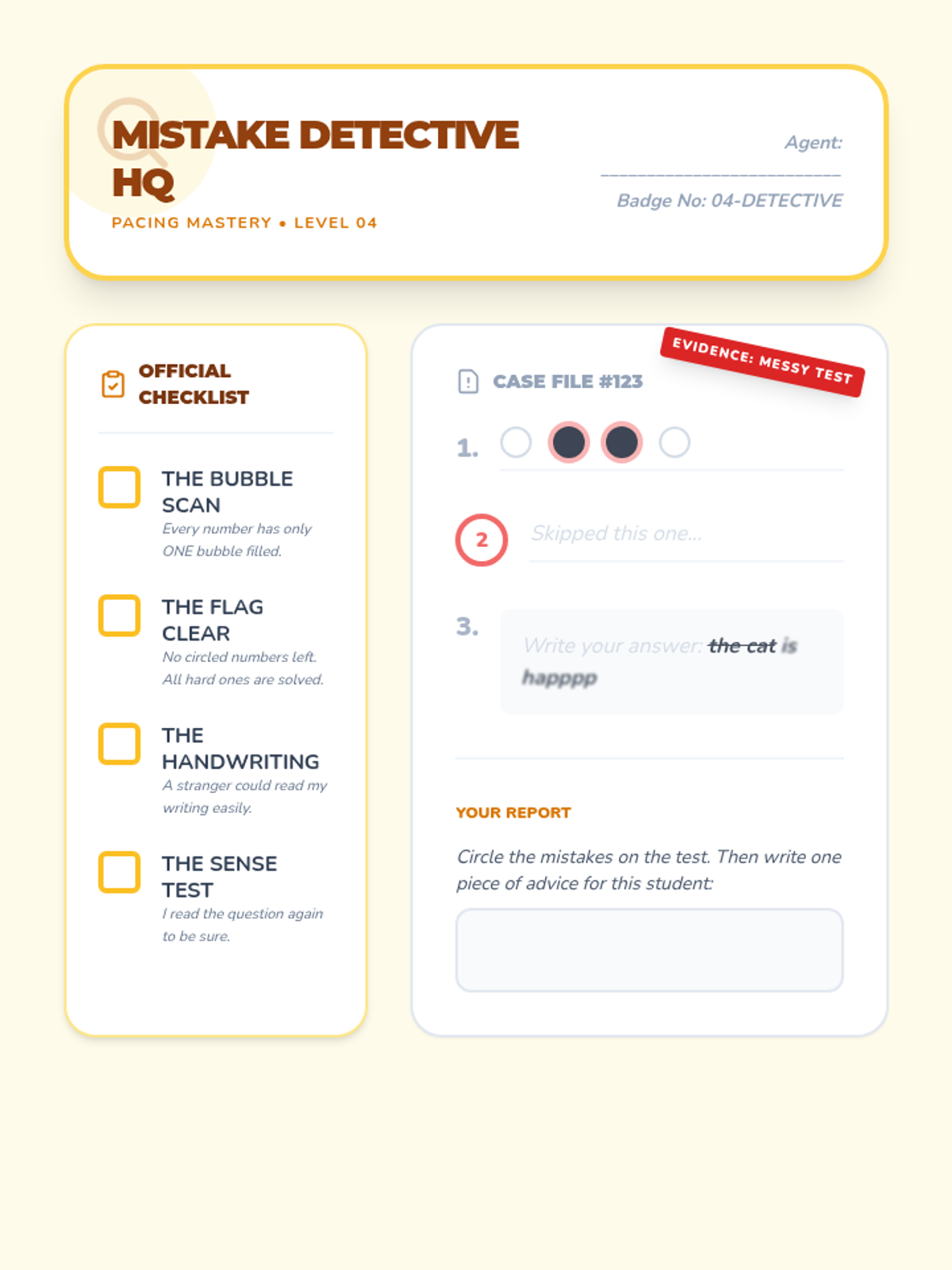
A worksheet where students practice using a checklist to find and correct common mistakes on a sample test.
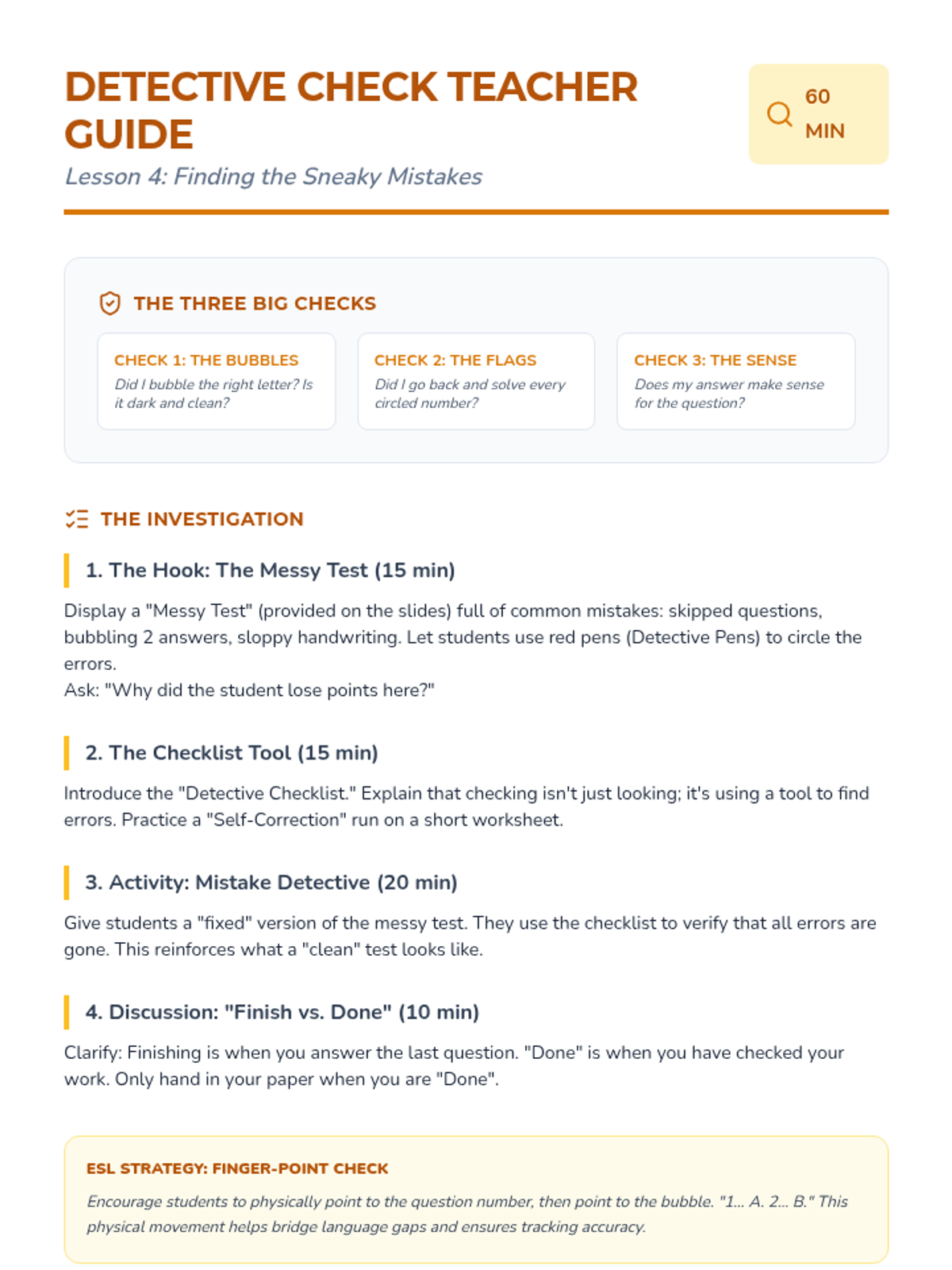
Slide presentation for teaching students how to check their work using the 'Detective Check' strategy.
Teacher guide for Lesson 4, focusing on teaching students how to check their work using a specific 'Detective Check' strategy.
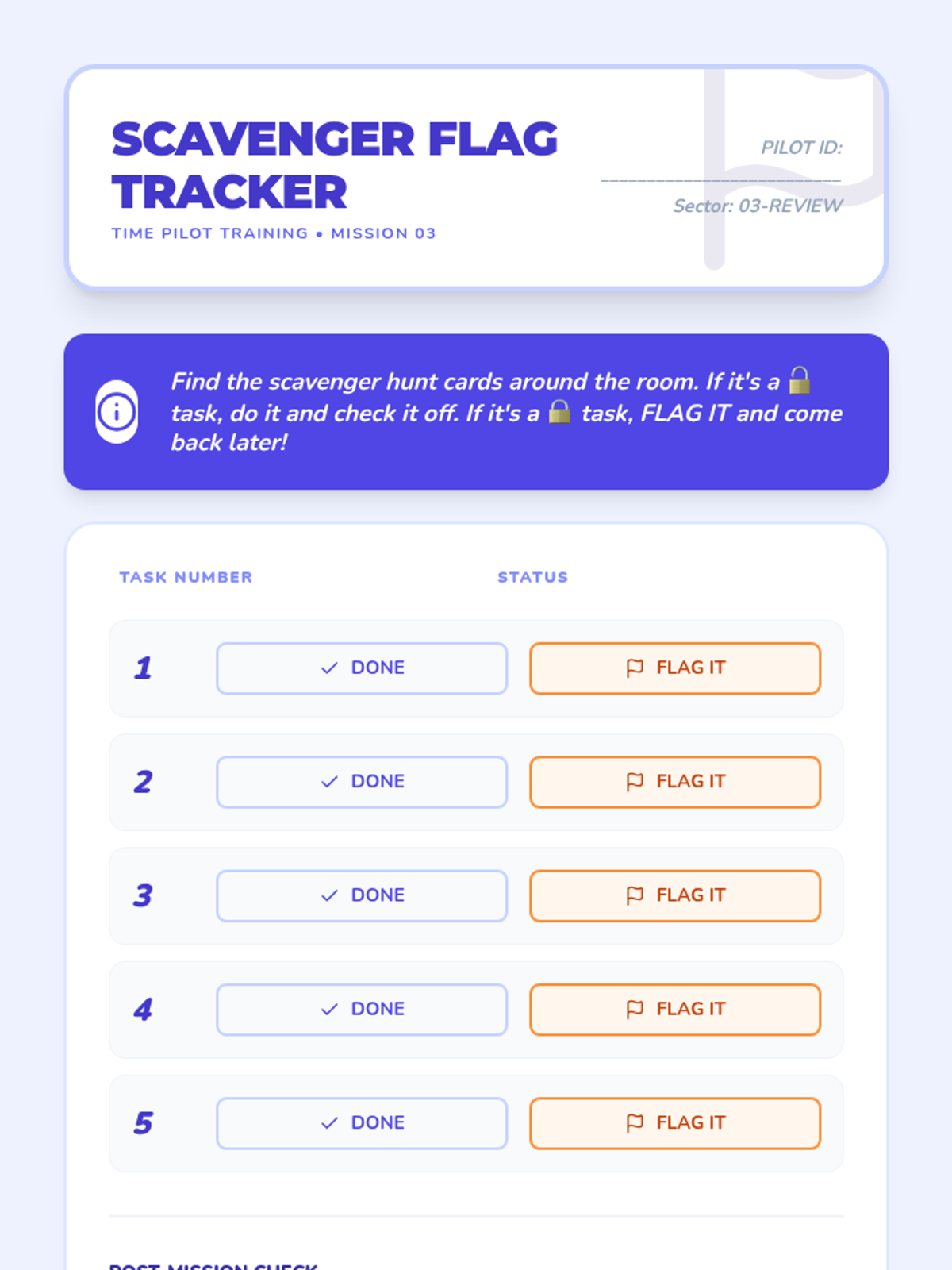
A scavenger hunt tracking sheet where students practice flagging 'locked' tasks and returning to them later.
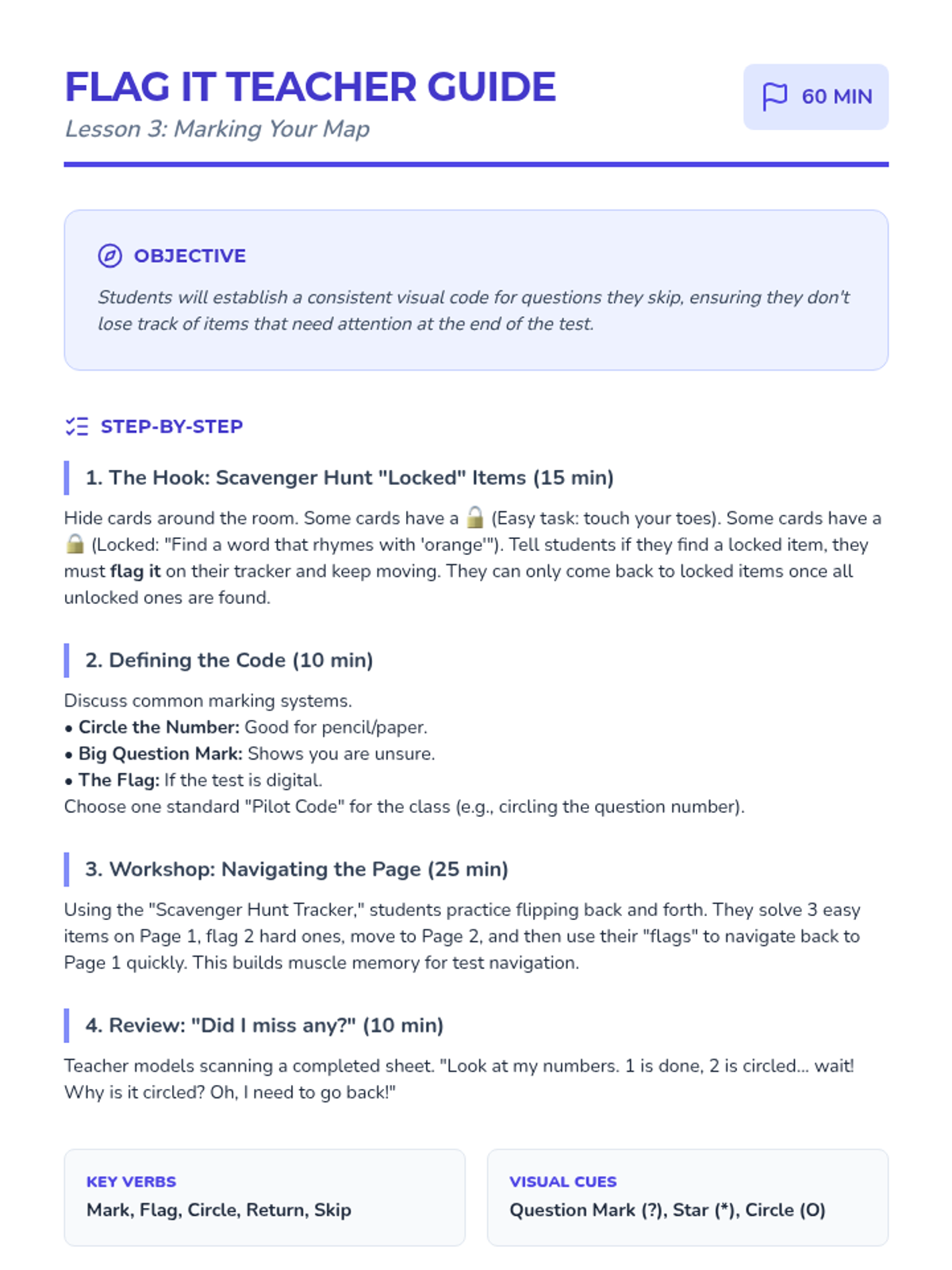
Slide presentation for teaching students how to mark questions for review using a visual code.
Teacher guide for Lesson 3, focusing on teaching students how to mark and navigate questions for review during a test.
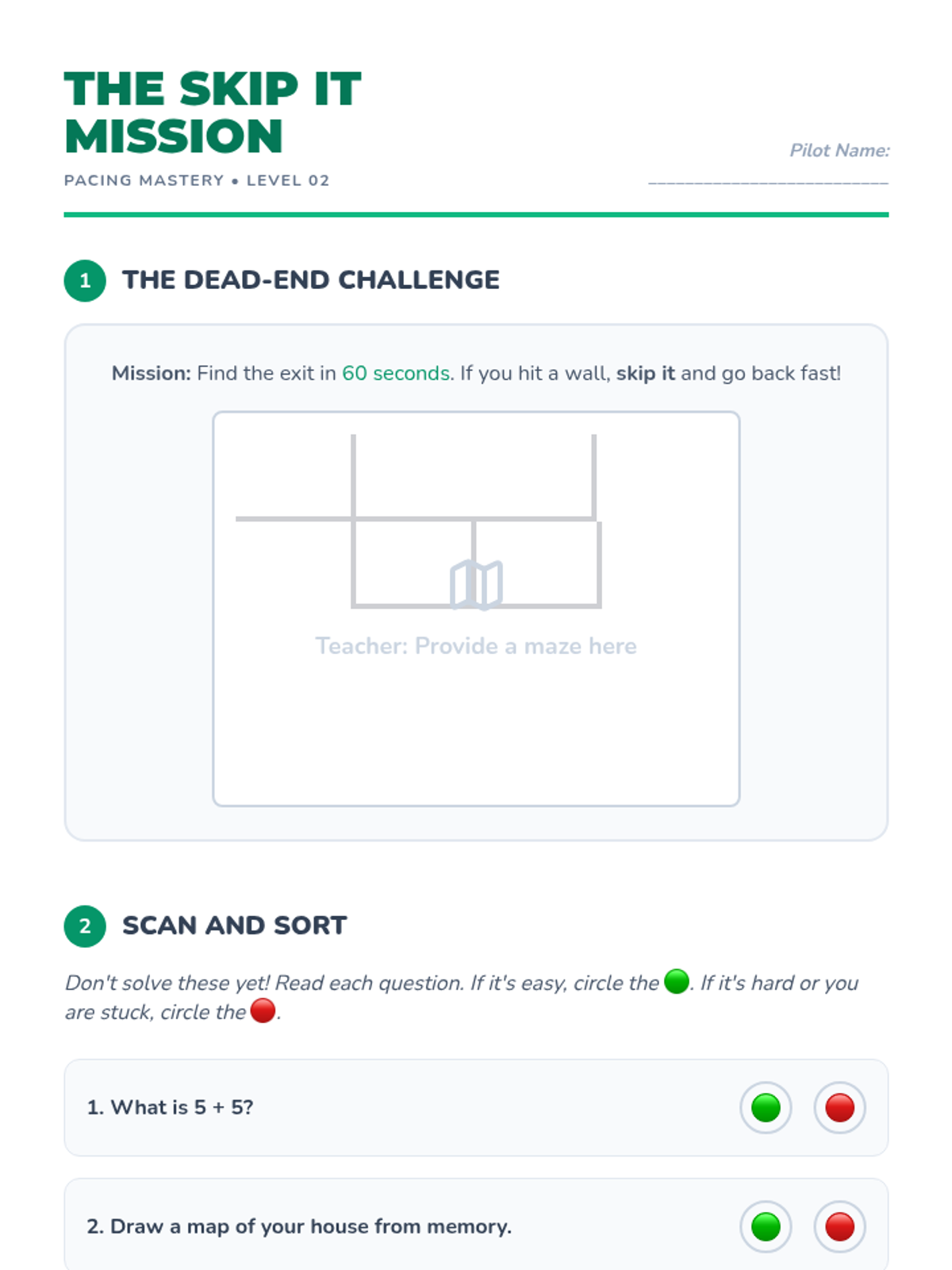
A worksheet featuring a maze hook and a prioritization activity where students categorize questions as 'easy' or 'hard' without solving them.
Slide presentation for teaching students when and why to skip difficult test questions to maintain pacing.
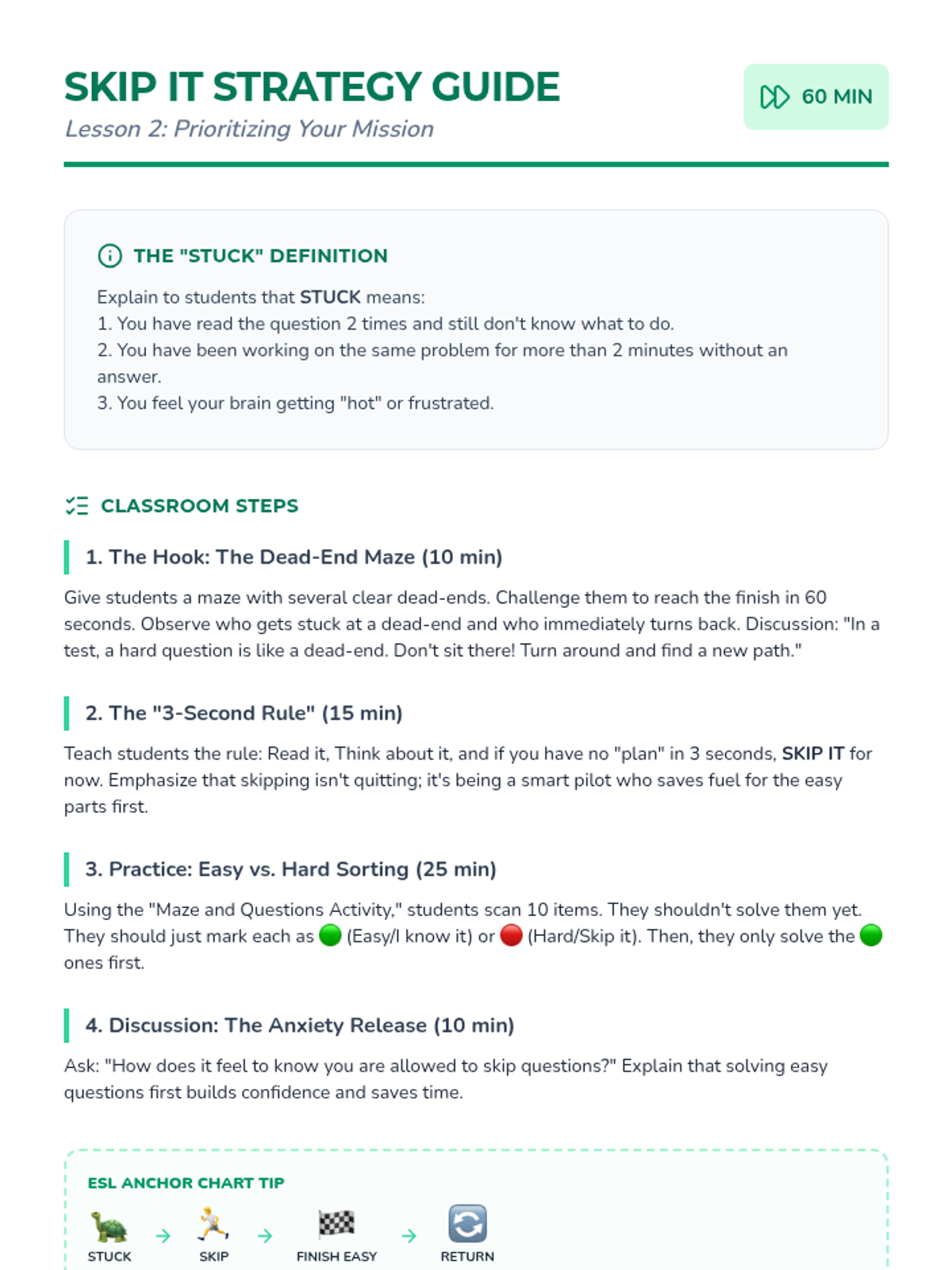
A guide for teachers to teach the 'Skip It' strategy, including identifying when a student is stuck and the benefits of prioritizing easy questions.
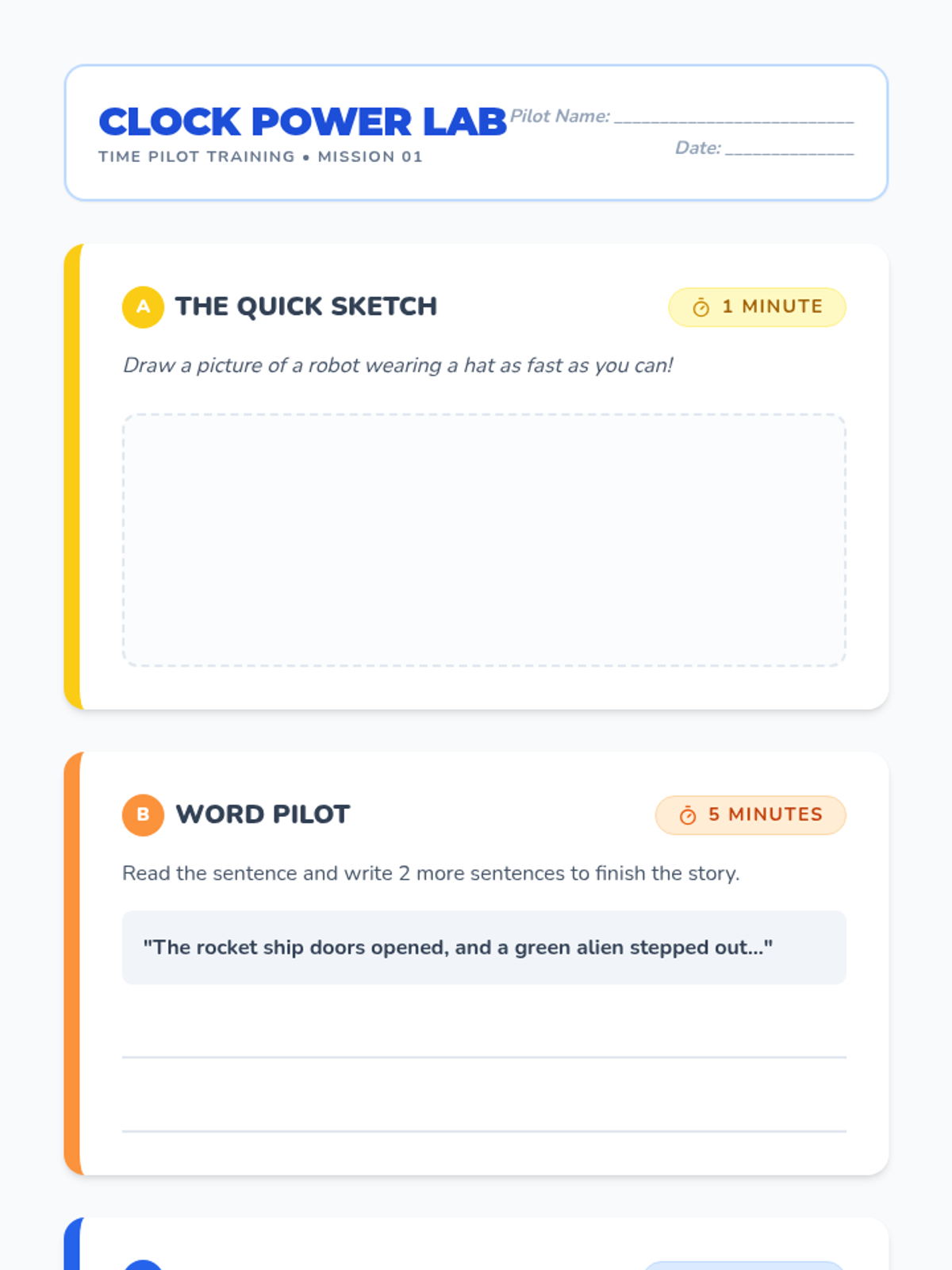
A worksheet with three tasks of varying durations (1, 5, and 10 minutes) to help students experience time perception during work.
Visual presentation slides to introduce the concept of time perception and pacing for 3rd grade students.
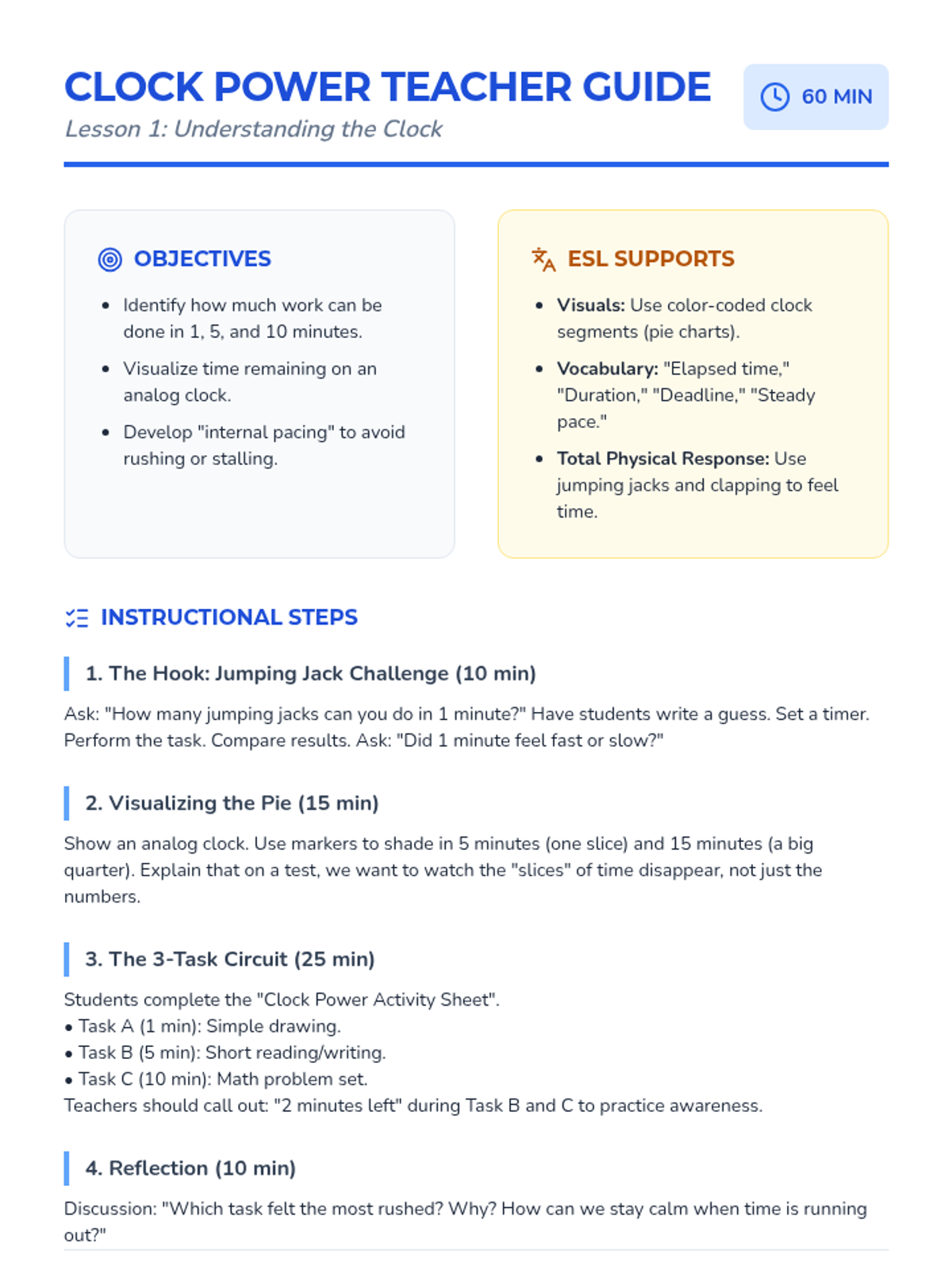
A detailed lesson plan for teachers to help 3rd Grade ESL students understand time perception and pacing using visual aids and physical activities.
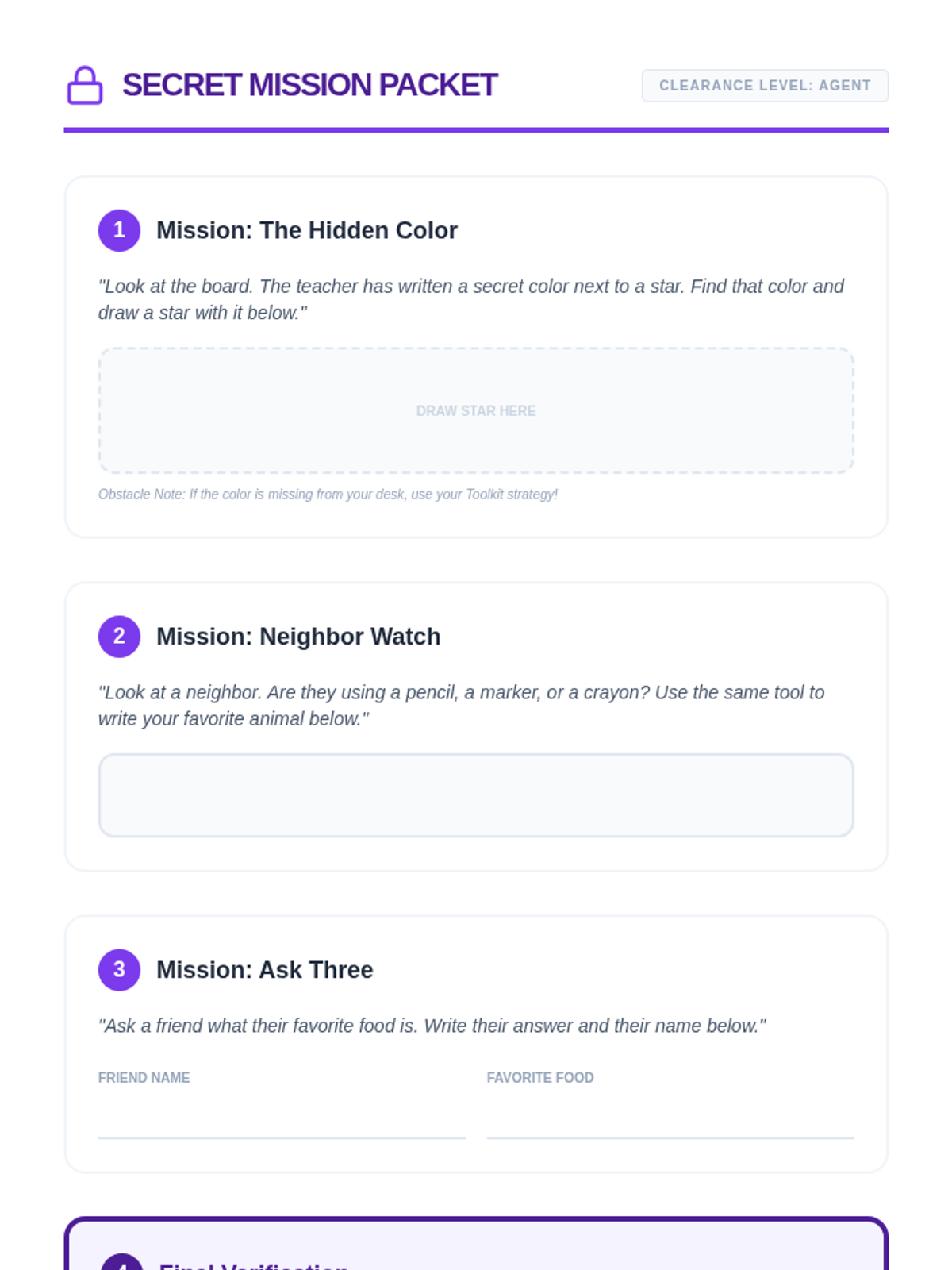
The 'Secret Packet' for the Lesson 5 Obstacle Course challenge. This document provides a series of multi-step tasks that require students to use the strategies they've learned throughout the sequence.
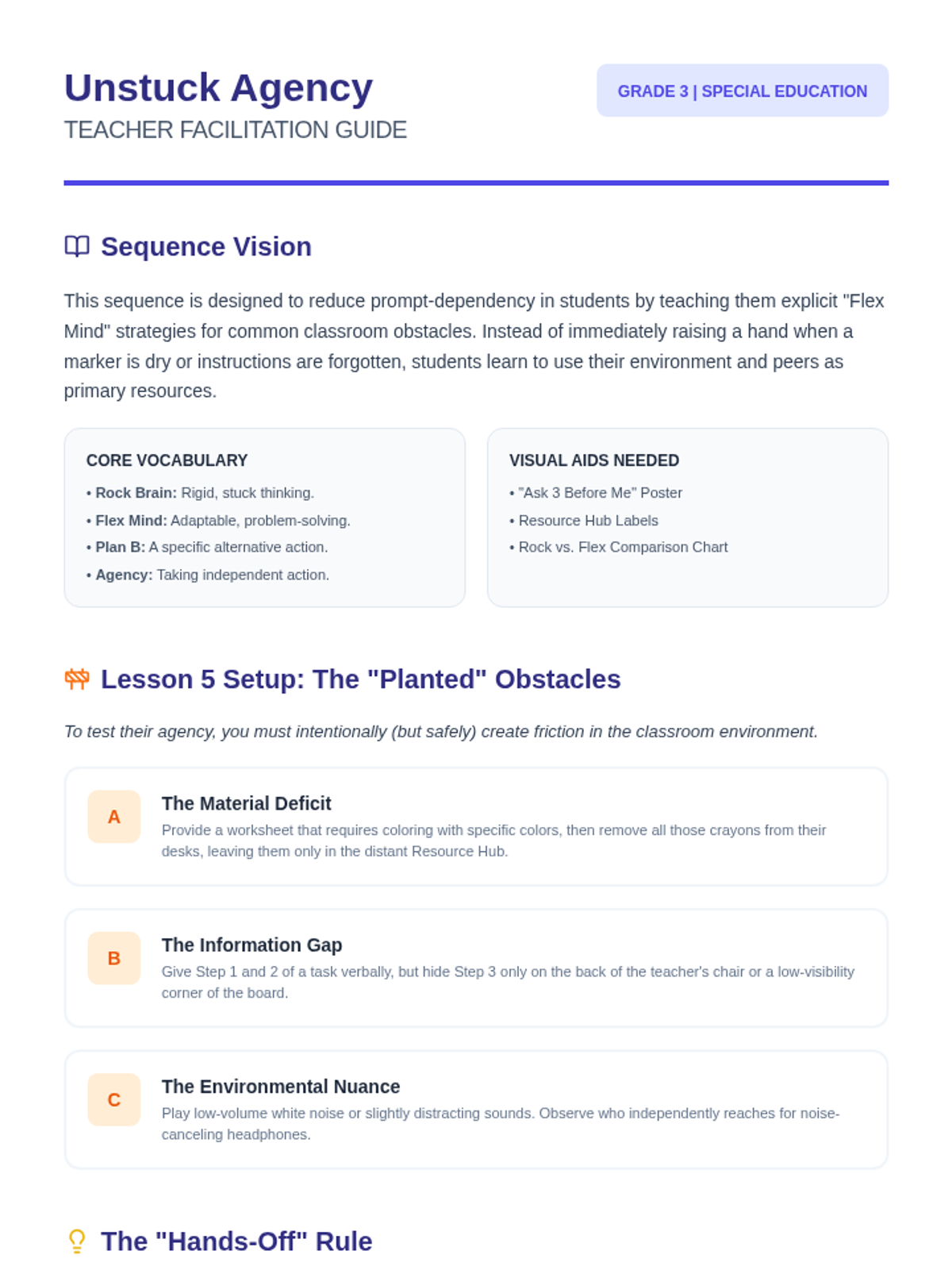
A teacher-facing facilitation guide for the Unstuck Agency sequence, providing classroom setup instructions for the Lesson 5 simulation and tips for reducing prompt-dependency.
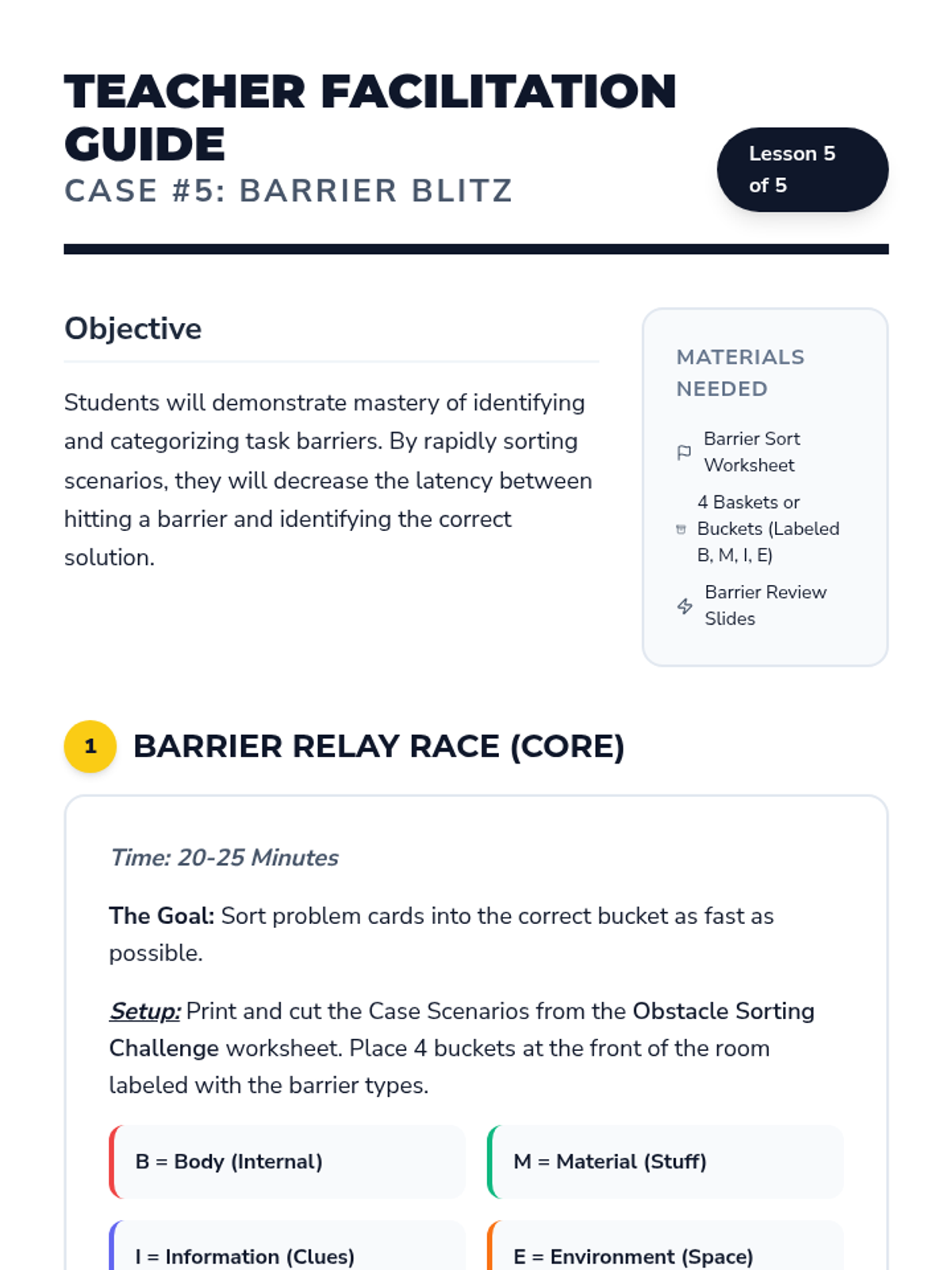
A teacher facilitation guide for Lesson 5, including instructions for the 'Barrier Relay Race' and a unit conclusion.
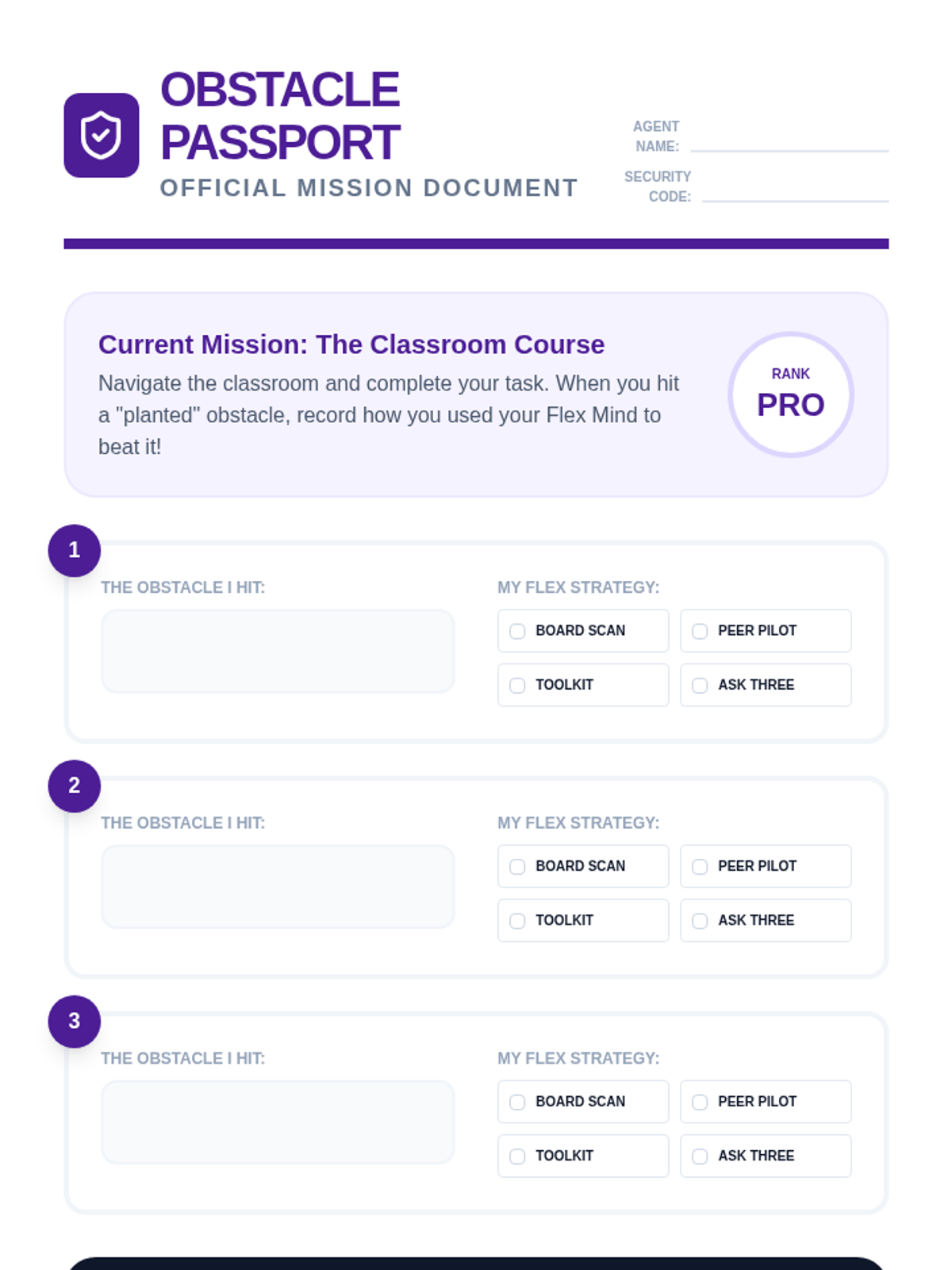
A student mission log for Lesson 5 where students record the specific obstacles they encountered and the 'Flex Mind' strategies they used to overcome them.
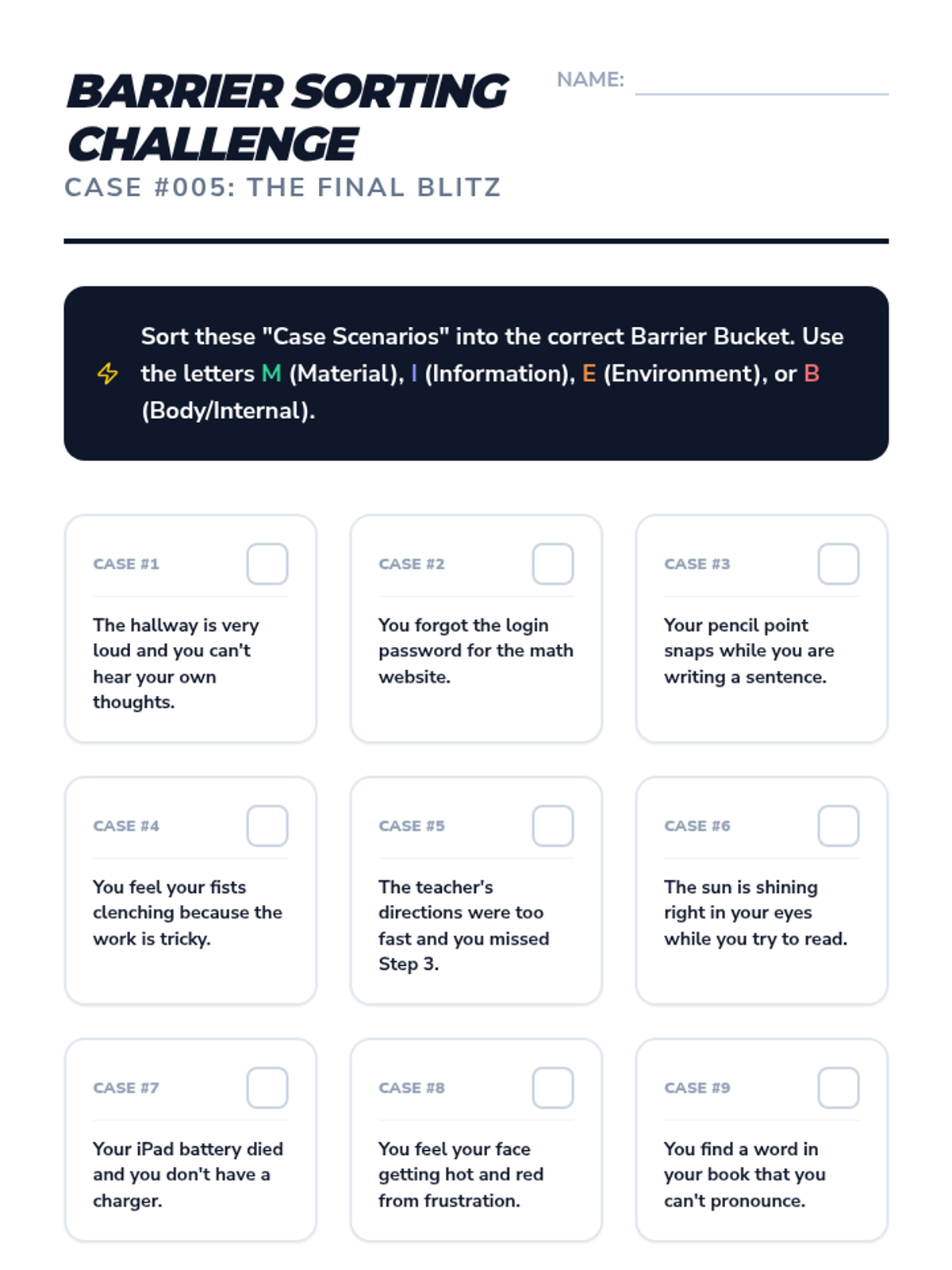
A culminating sorting activity where students categorize various problem scenarios into the four task barrier types.