Empathetic skill development through emotion recognition, cultural diversity appreciation, and bias confrontation. Targets multi-perspective analysis to support respectful interactions and complex social responses.
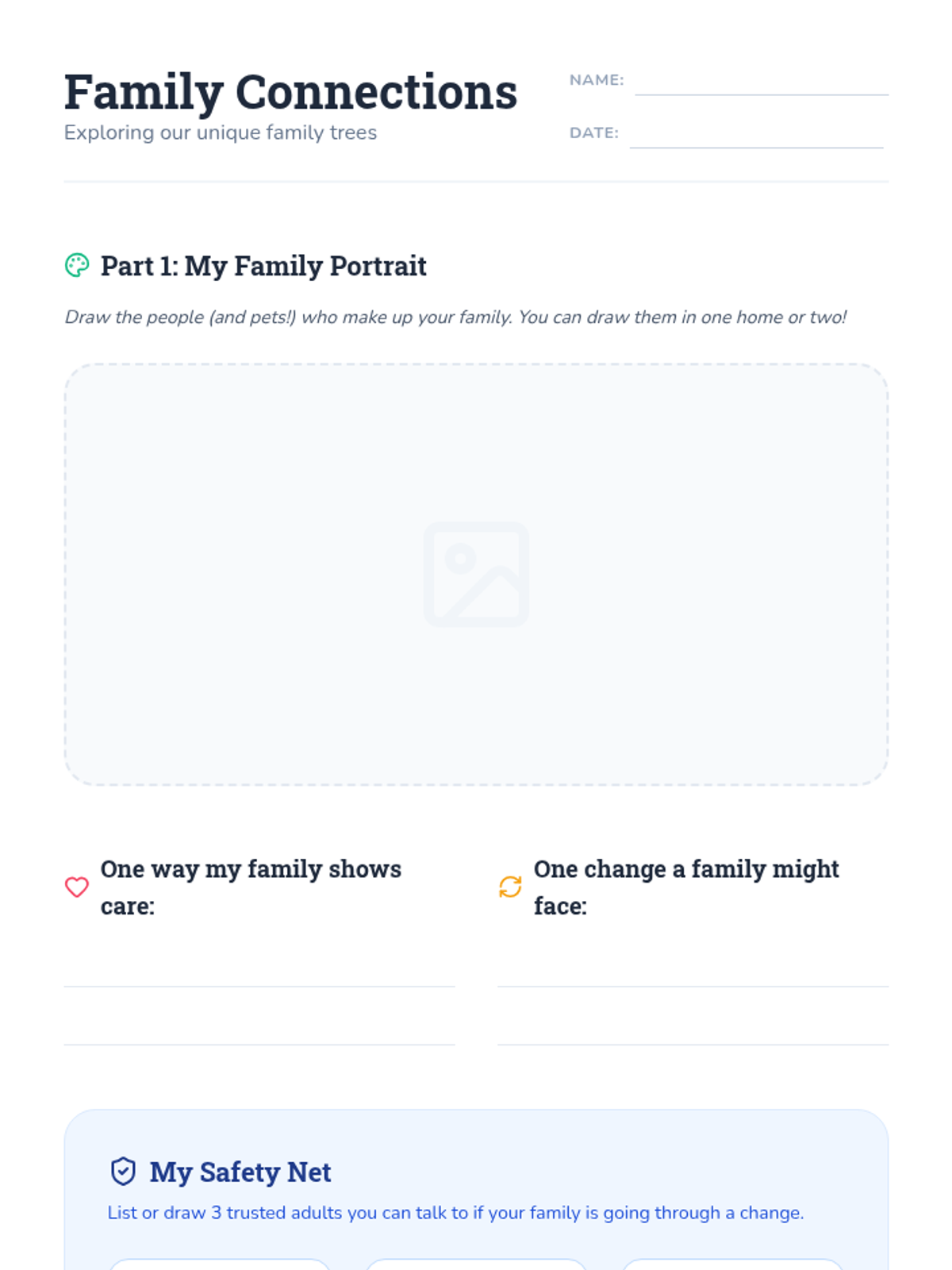
A student worksheet for Grade 3 that allows children to draw their family, reflect on family changes, and identify their support system of trusted adults.
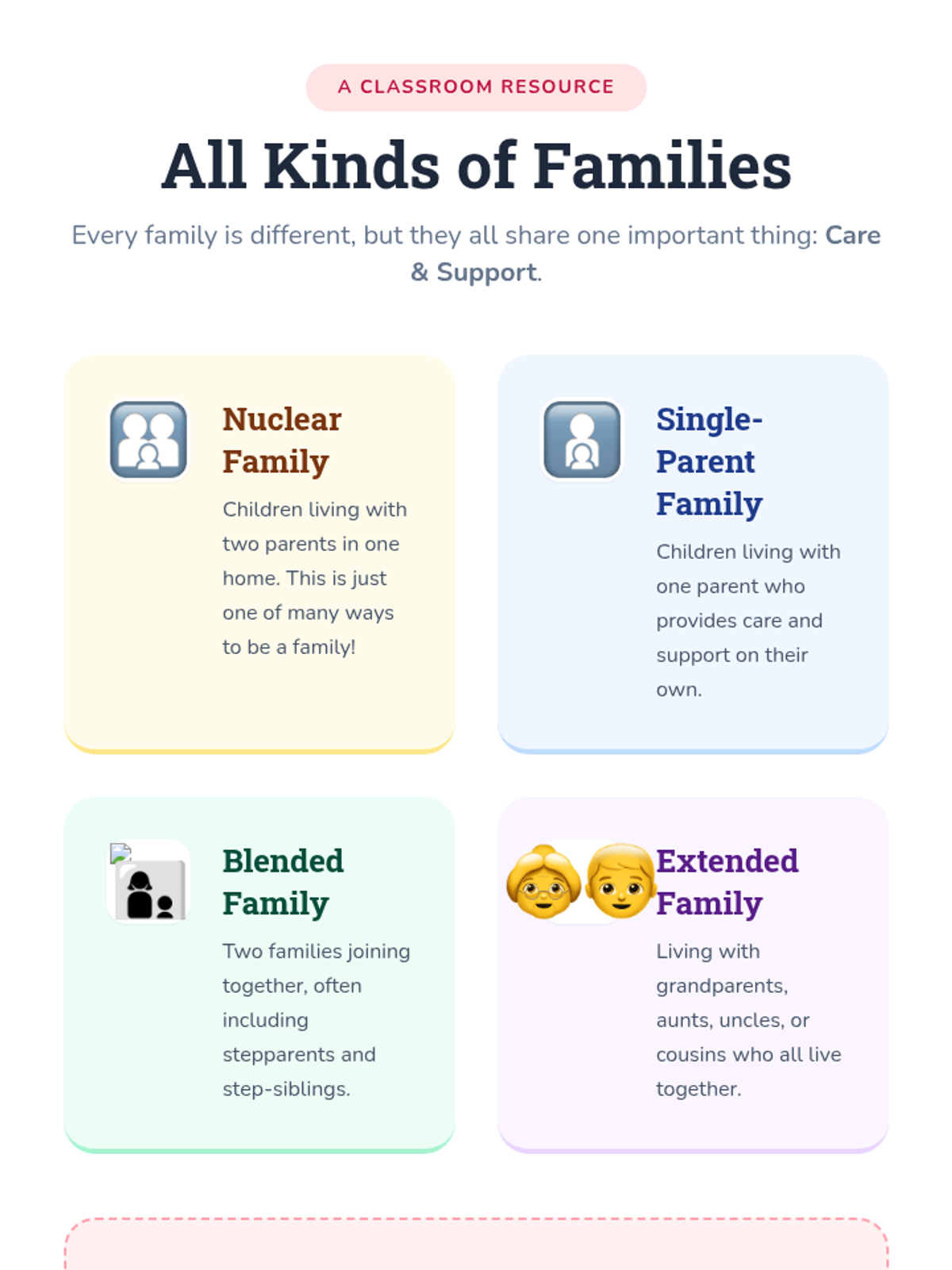
A visual reference chart for Grade 3 students defining and illustrating common family structures, emphasizing themes of care and resilience.
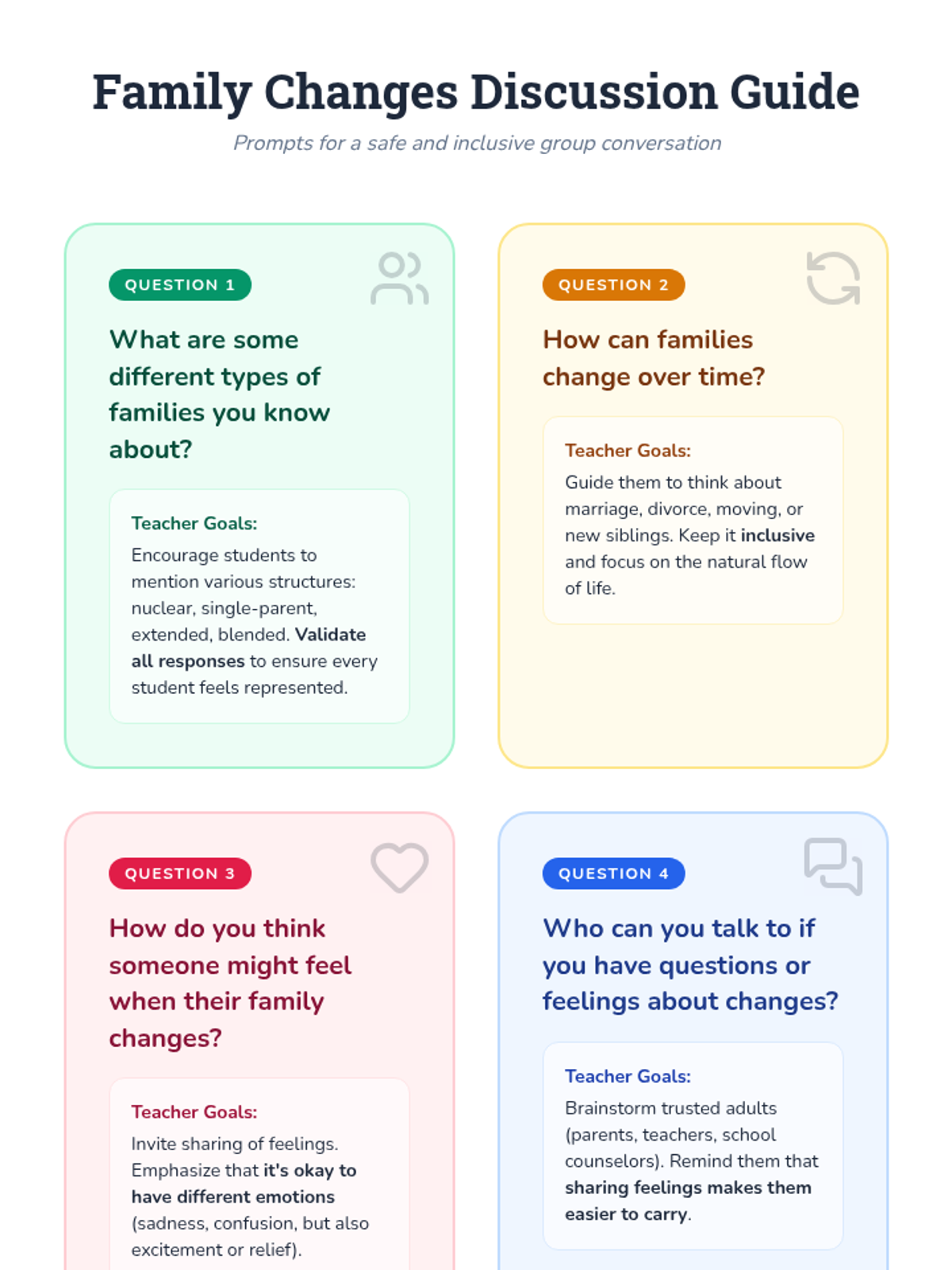
A set of guided discussion prompts and teacher facilitation goals for navigating sensitive conversations about family diversity and divorce.
A gentle slide deck for Grade 3 students that explains different family structures, the concept of divorce, and the importance of healthy coping and support systems.
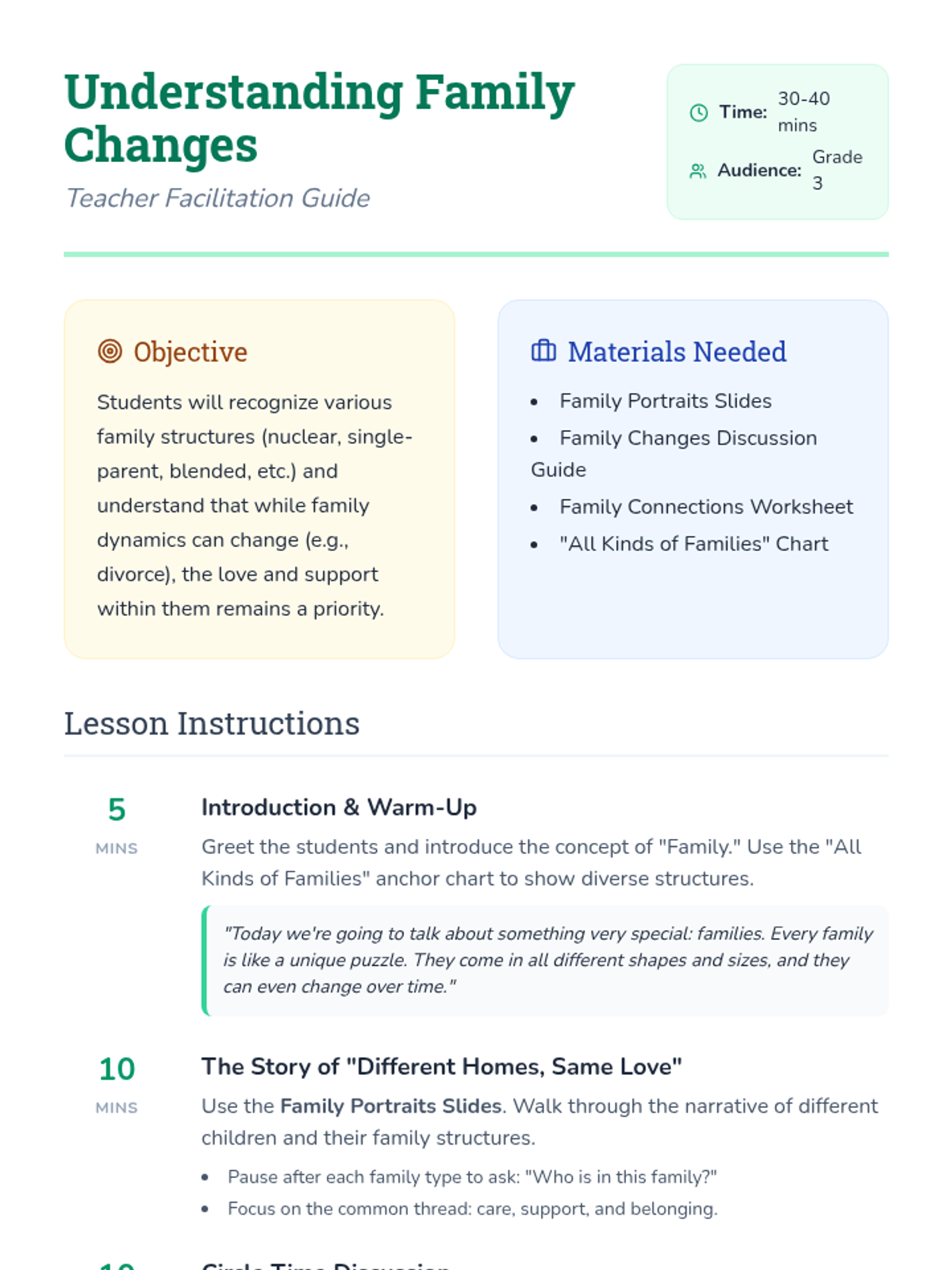
A comprehensive teacher guide for facilitating a 30-40 minute lesson on family structures and transitions. Includes pacing, scripted prompts, and sensitive facilitation tips for discussing divorce.
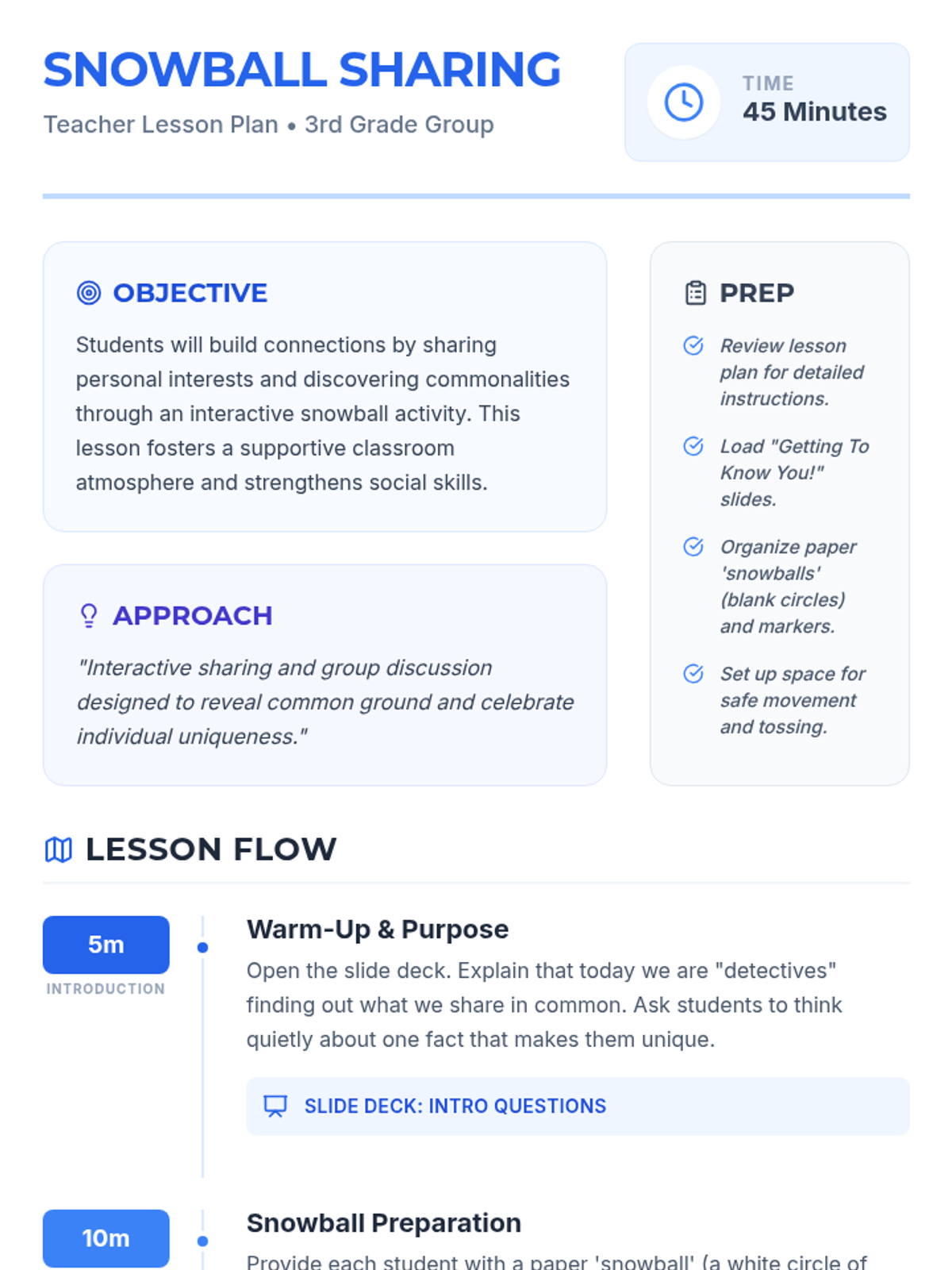
A comprehensive teacher lesson plan for the Snowball Sharing activity, featuring a visual timeline, preparation checklist, and instructional objectives.
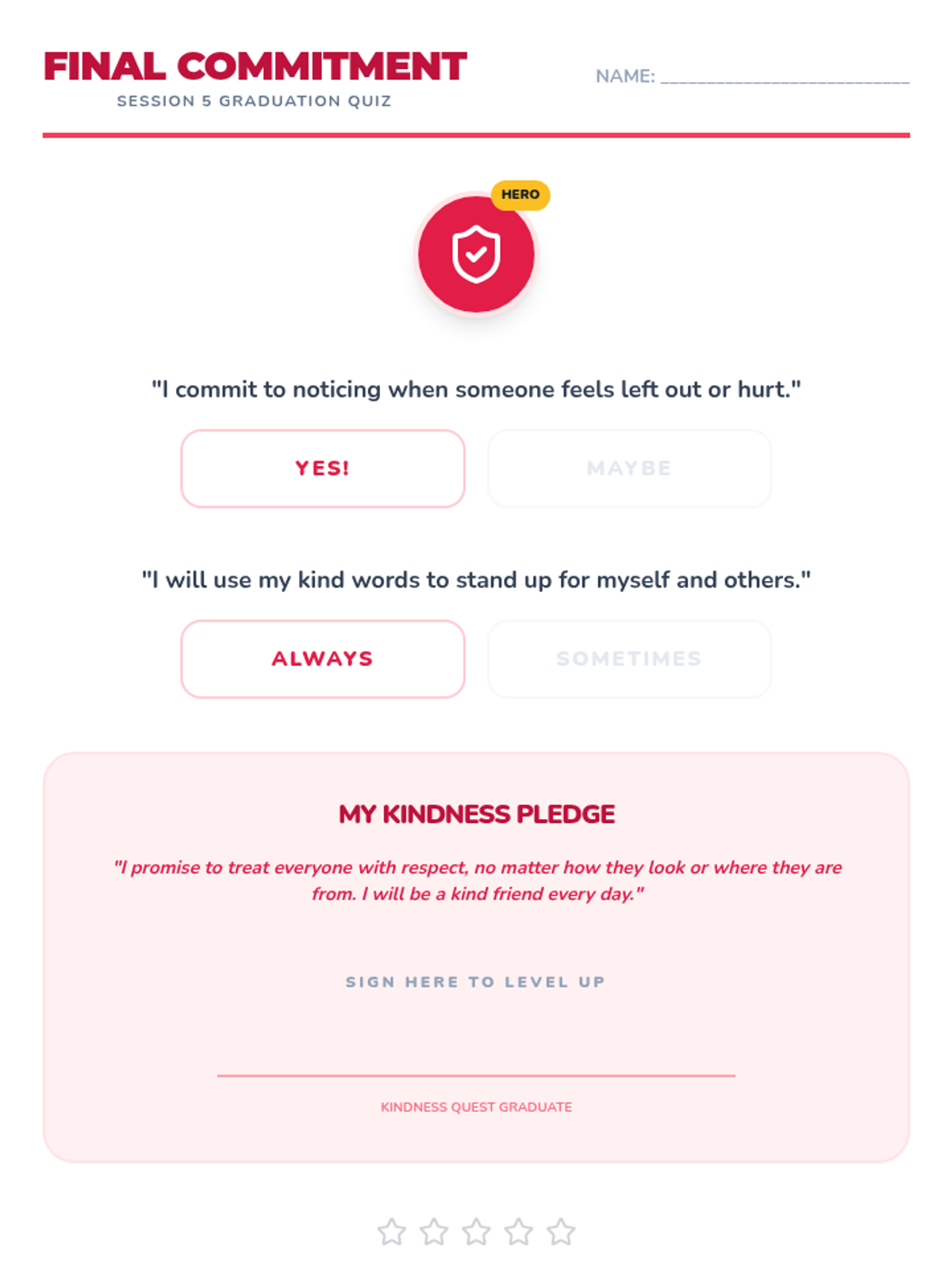
A final commitment quiz and pledge for students to complete at the end of the Kindness Quest program.
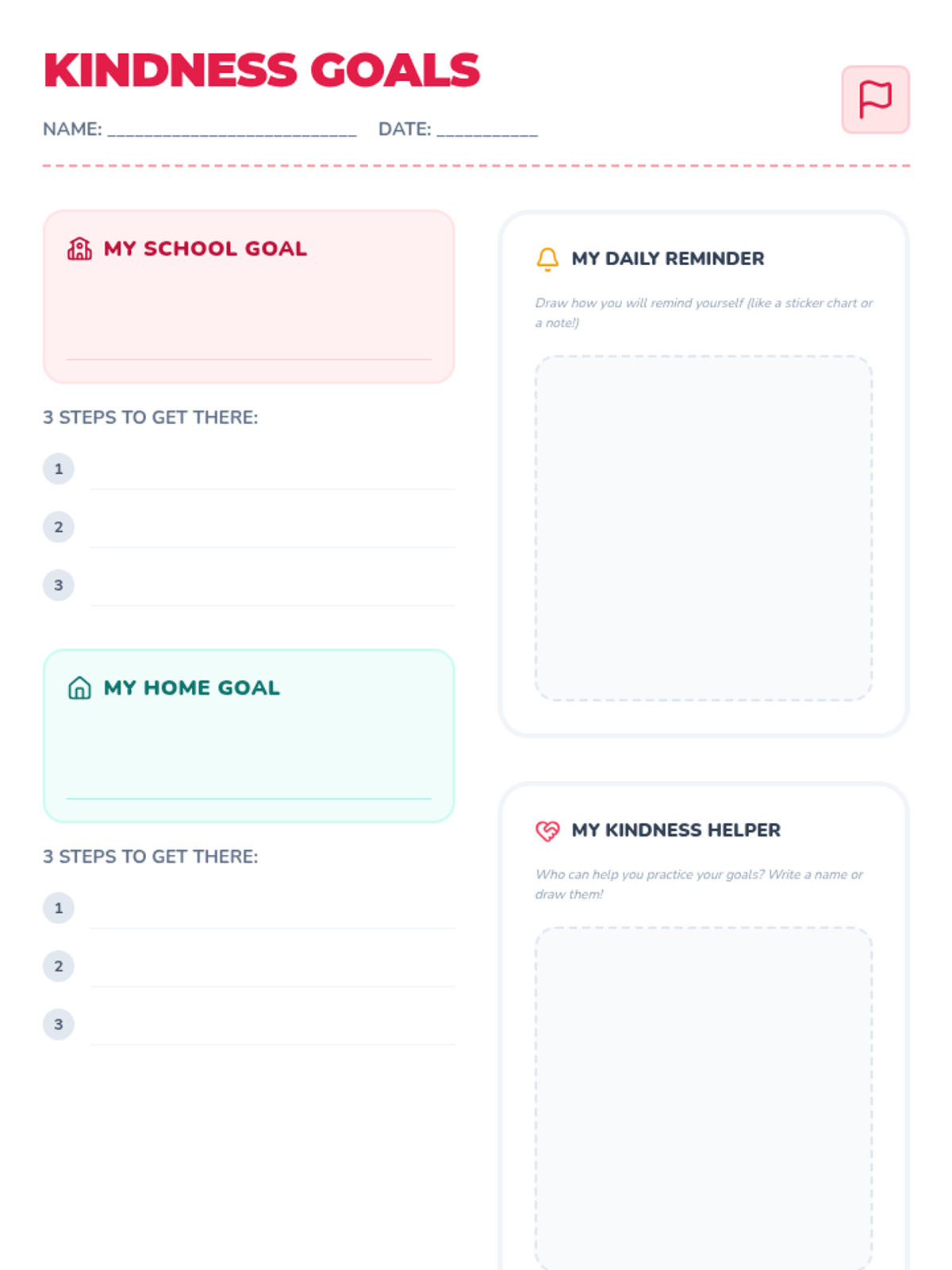
A goal-setting worksheet for Session 5 where students set specific kindness goals for school and home and plan how to achieve them.
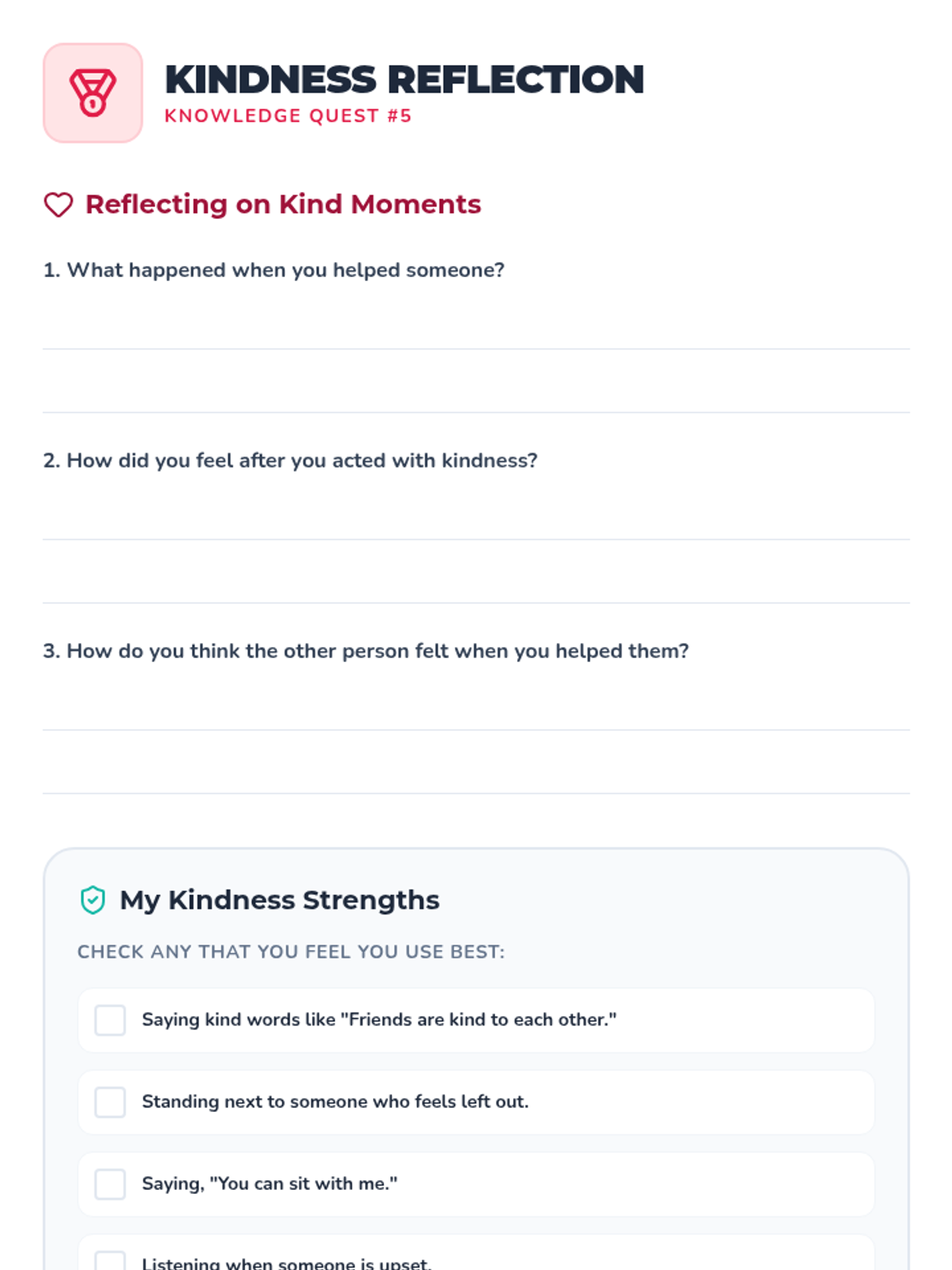
A reflection reading and worksheet for Session 5 where students think about their progress and identify their kindness strengths.
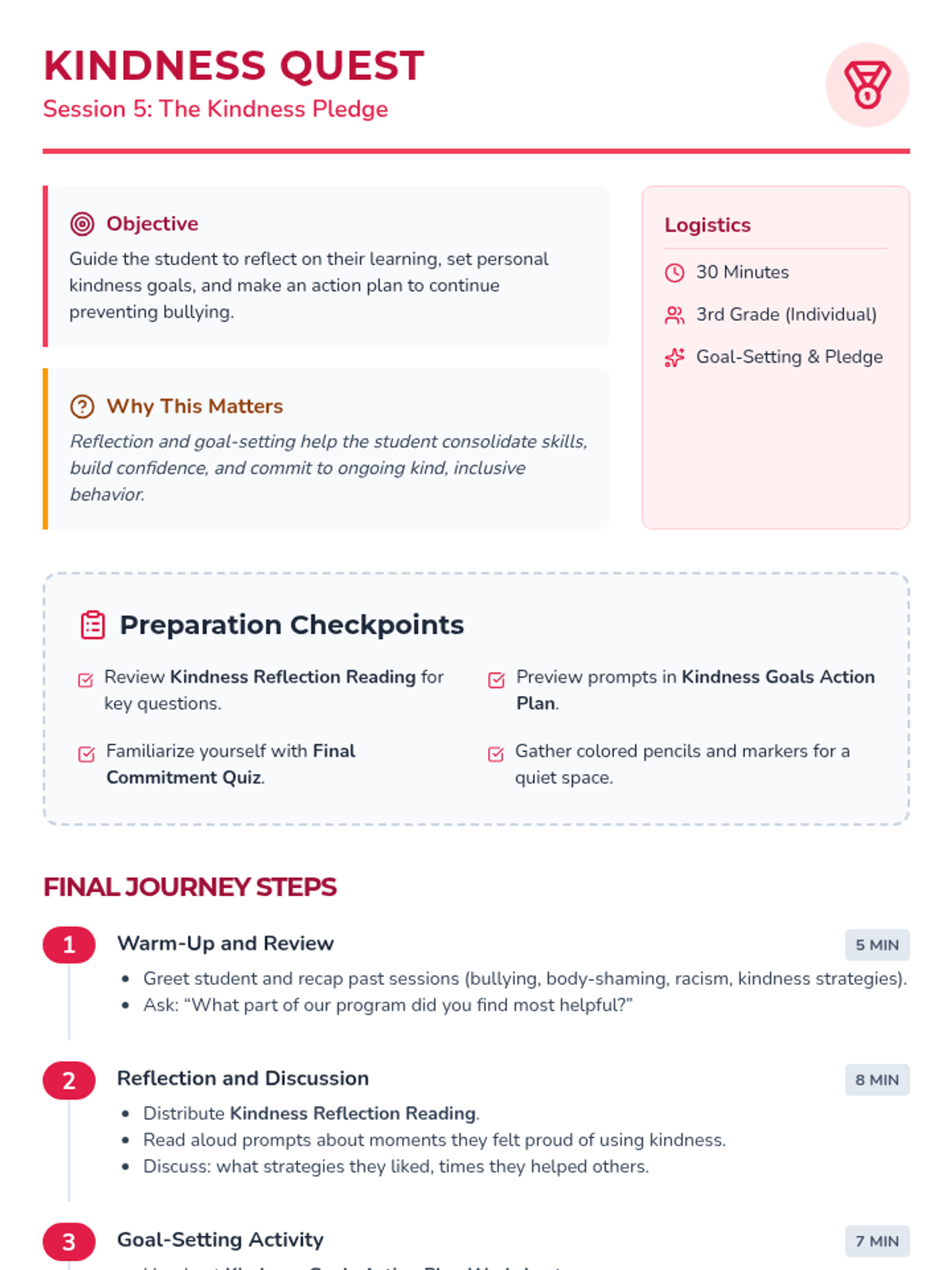
Teacher lesson plan for Session 5 of the Kindness Quest program, focusing on reflection and goal-setting.
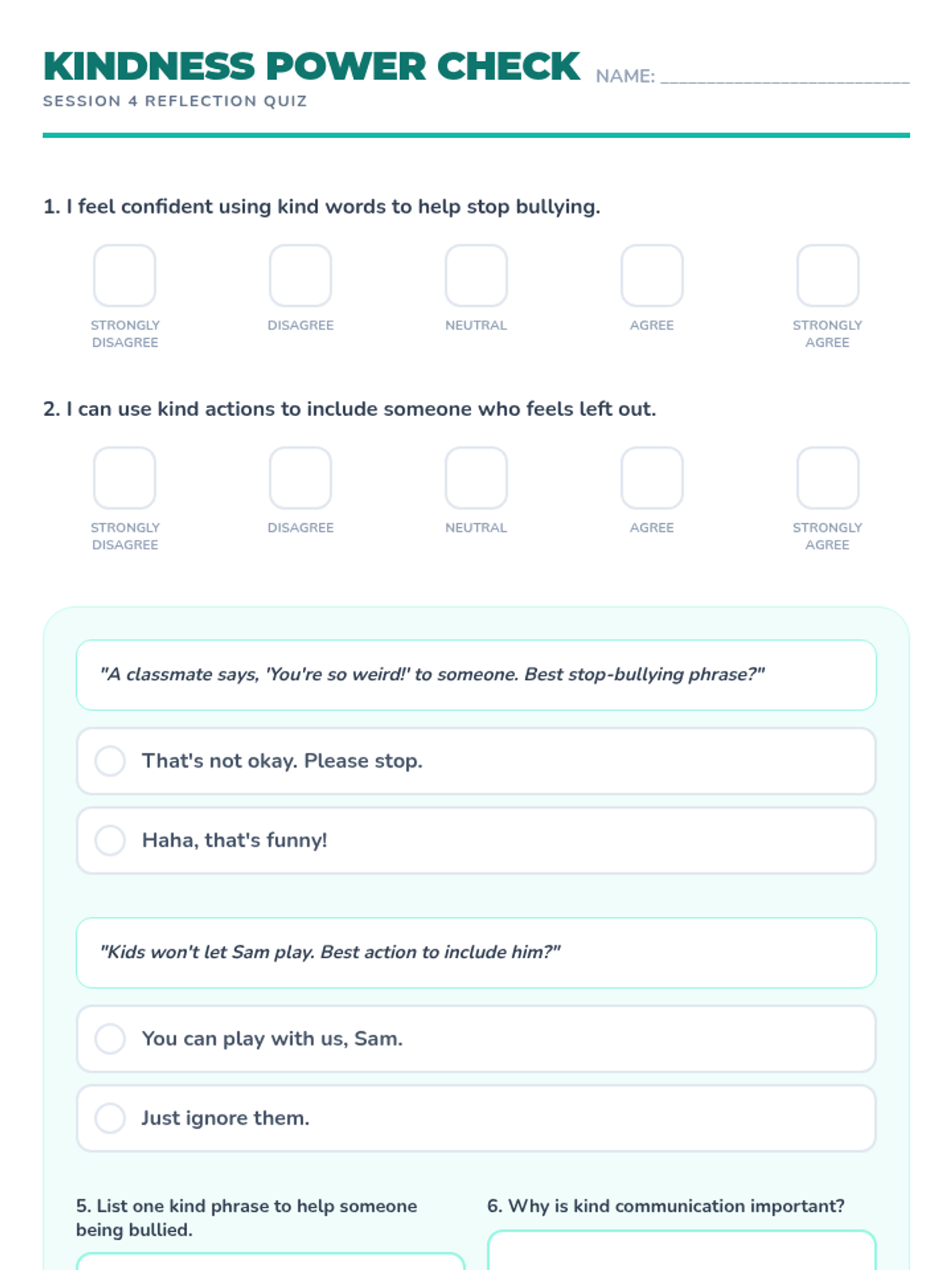
A reflection quiz for Session 4 to assess student understanding of kind communication and bullying prevention strategies.
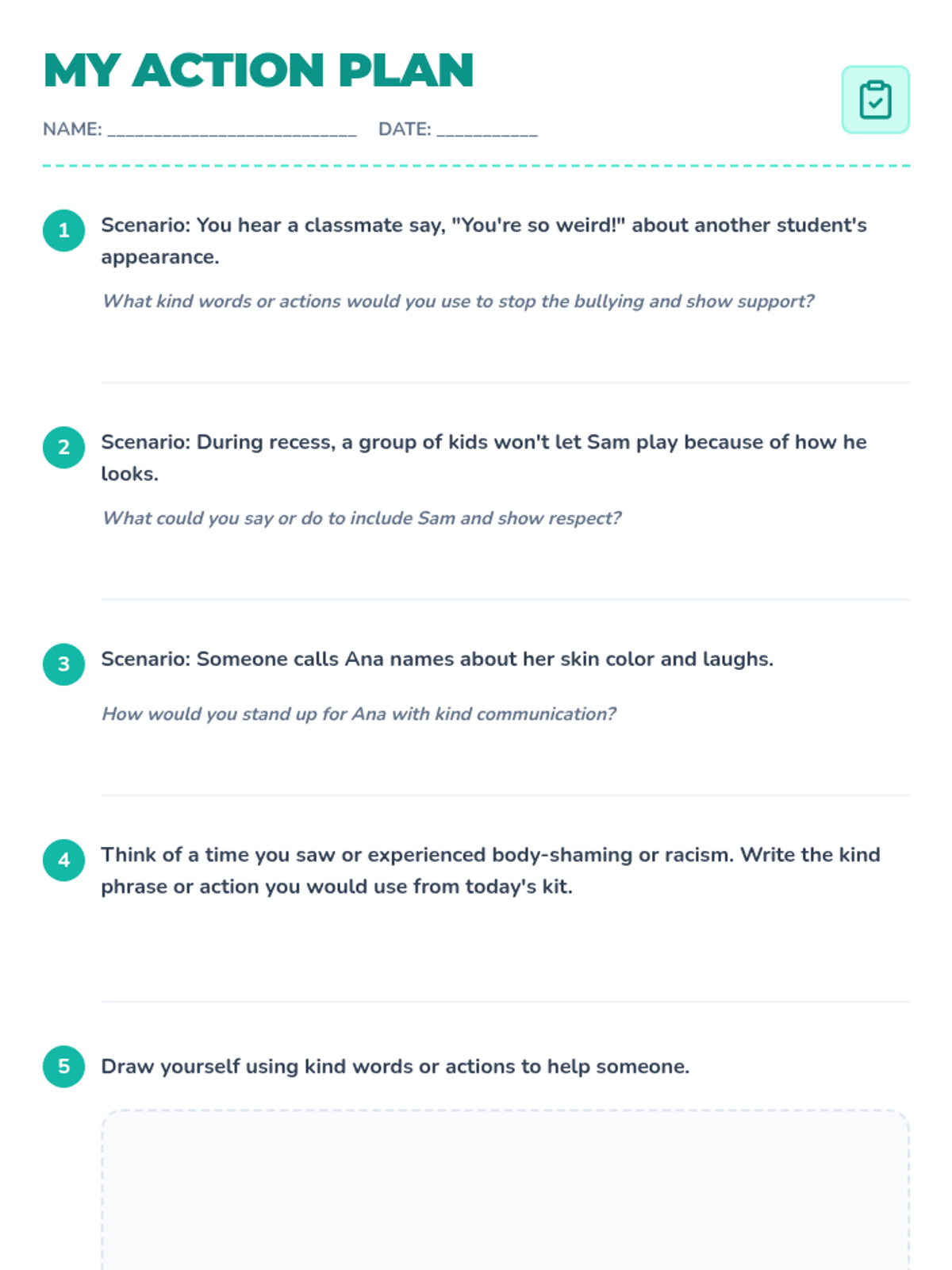
A worksheet for Session 4 where students practice applying kind communication strategies to various bullying scenarios.
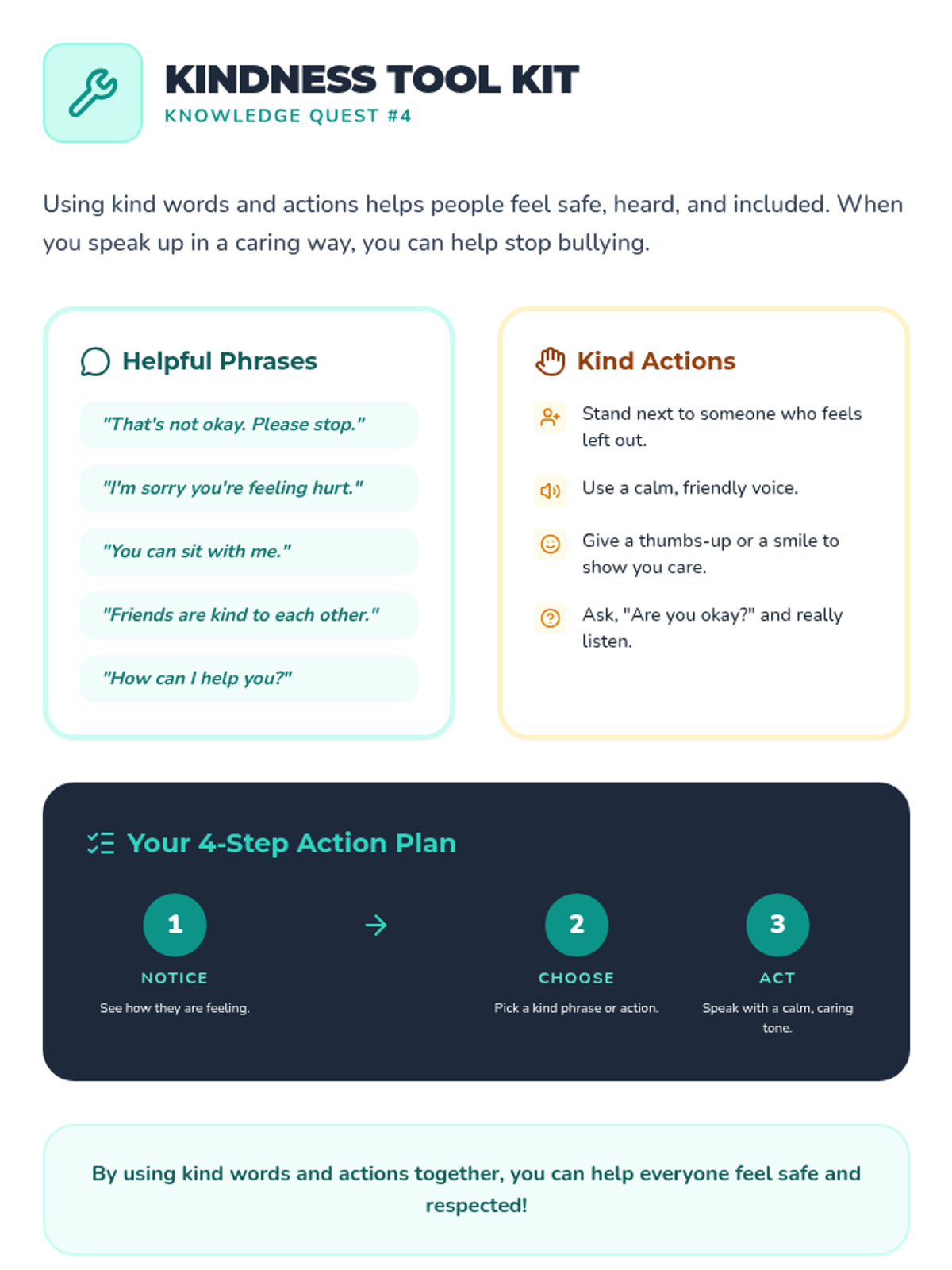
A foundational reading for Session 4 that provides specific kind communication phrases and actions to stop bullying.
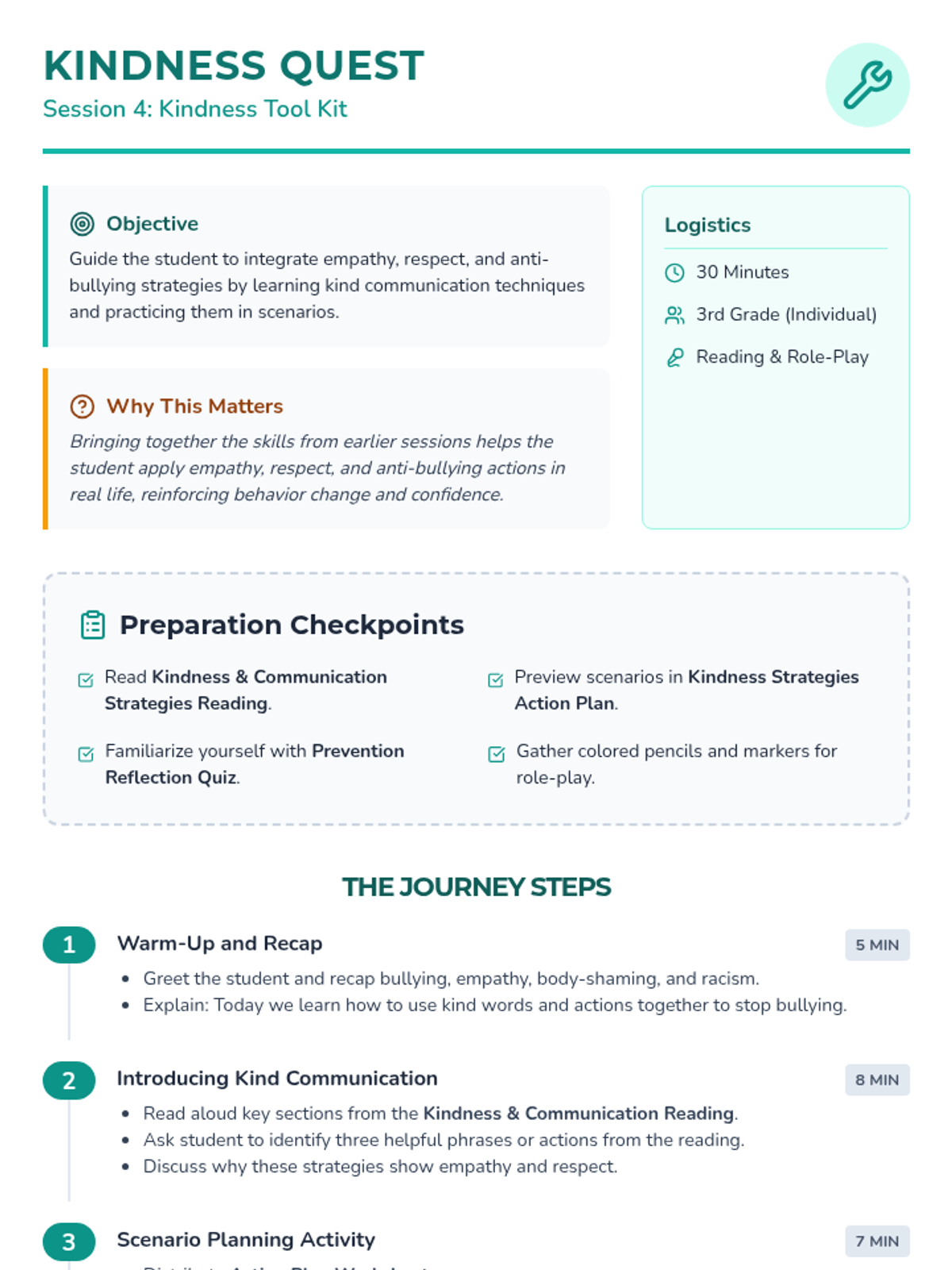
Teacher lesson plan for Session 4 of the Kindness Quest program, focusing on kindness strategies and communication.
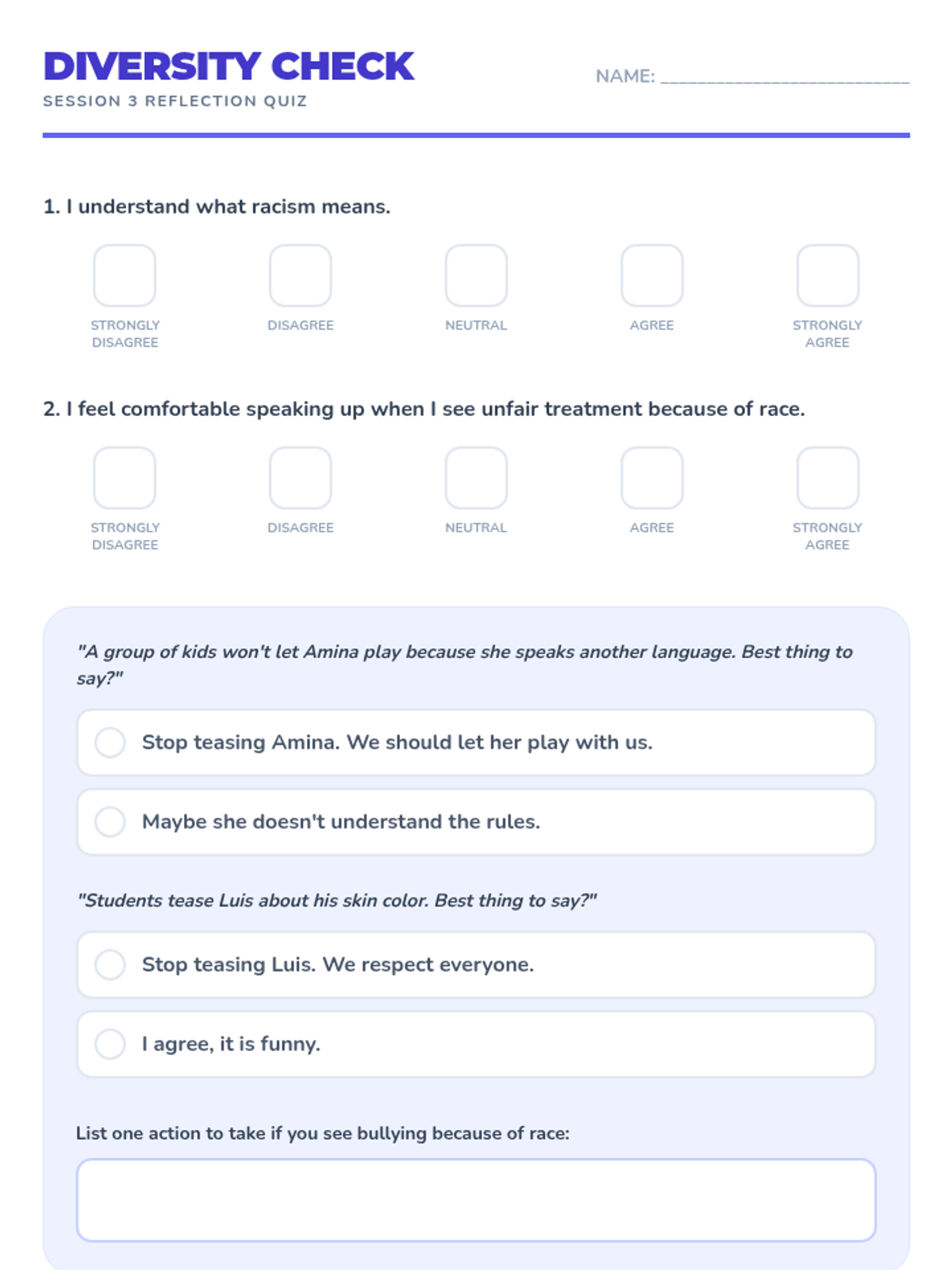
A reflection quiz for Session 3 to assess student understanding of racism and their commitment to inclusive behavior.
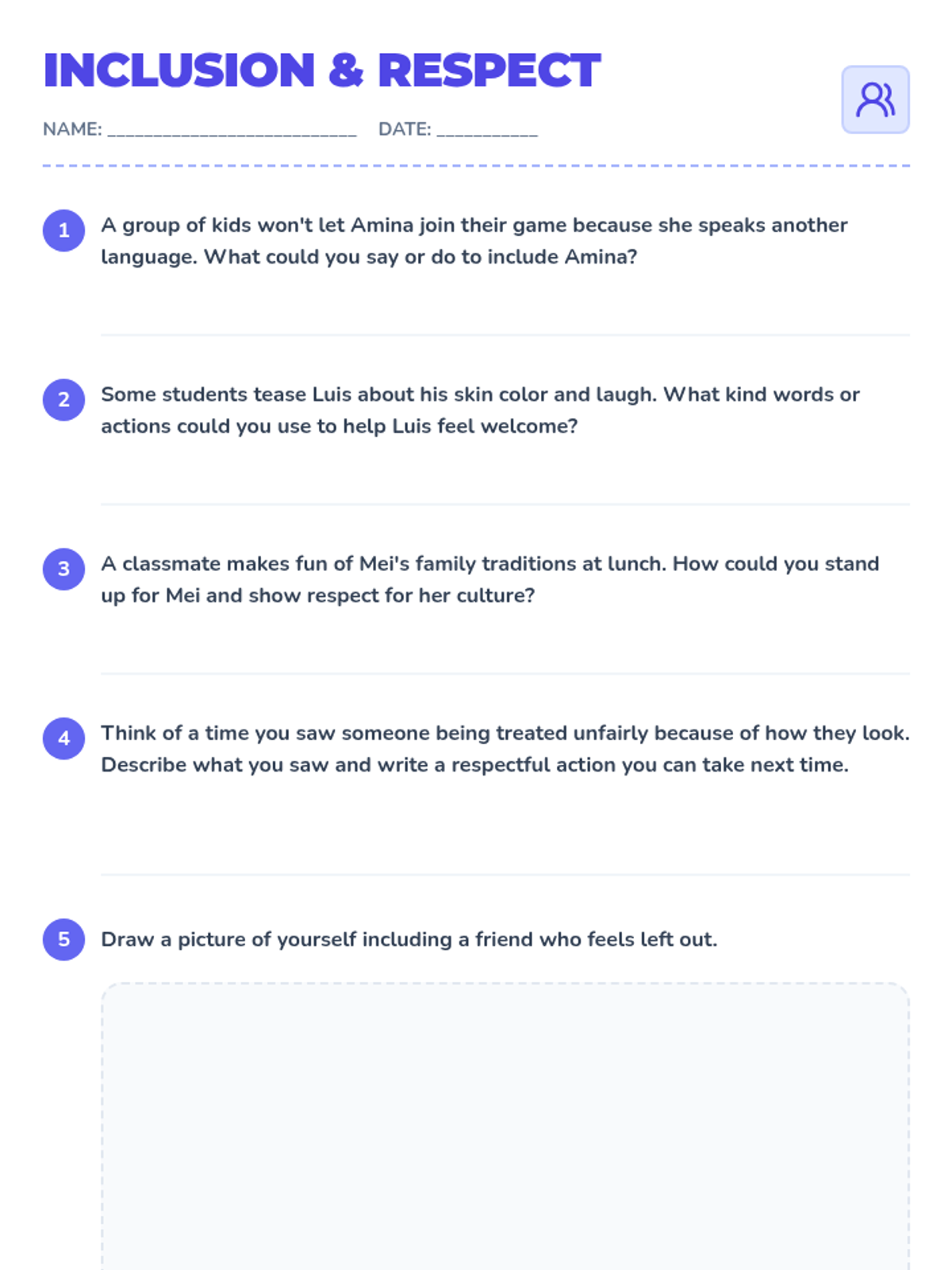
A worksheet for Session 3 where students practice responding to race-based exclusion with inclusion and respect.
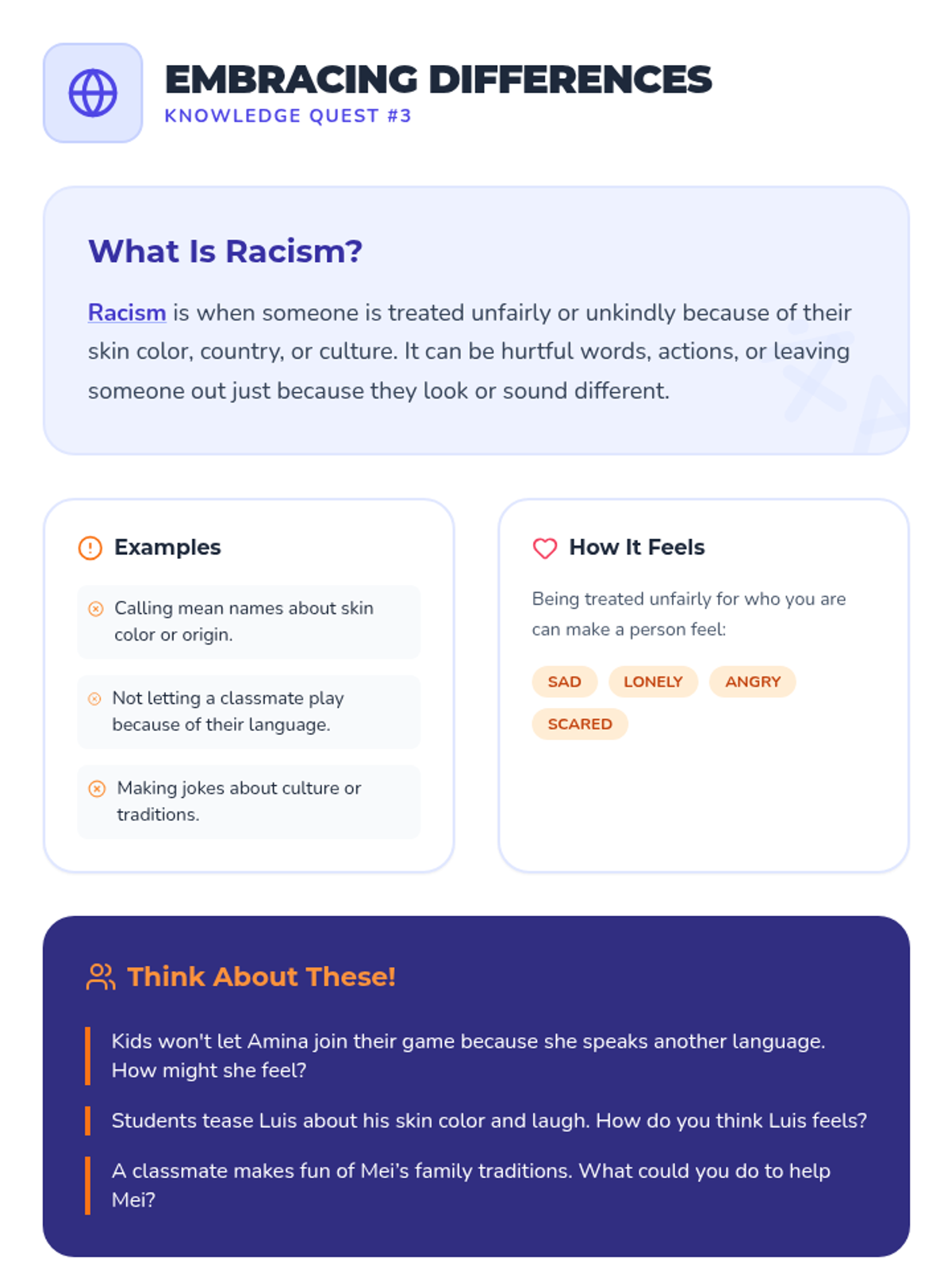
A foundational reading for Session 3 that defines racism, provides examples, and discusses the emotional impact of exclusion.
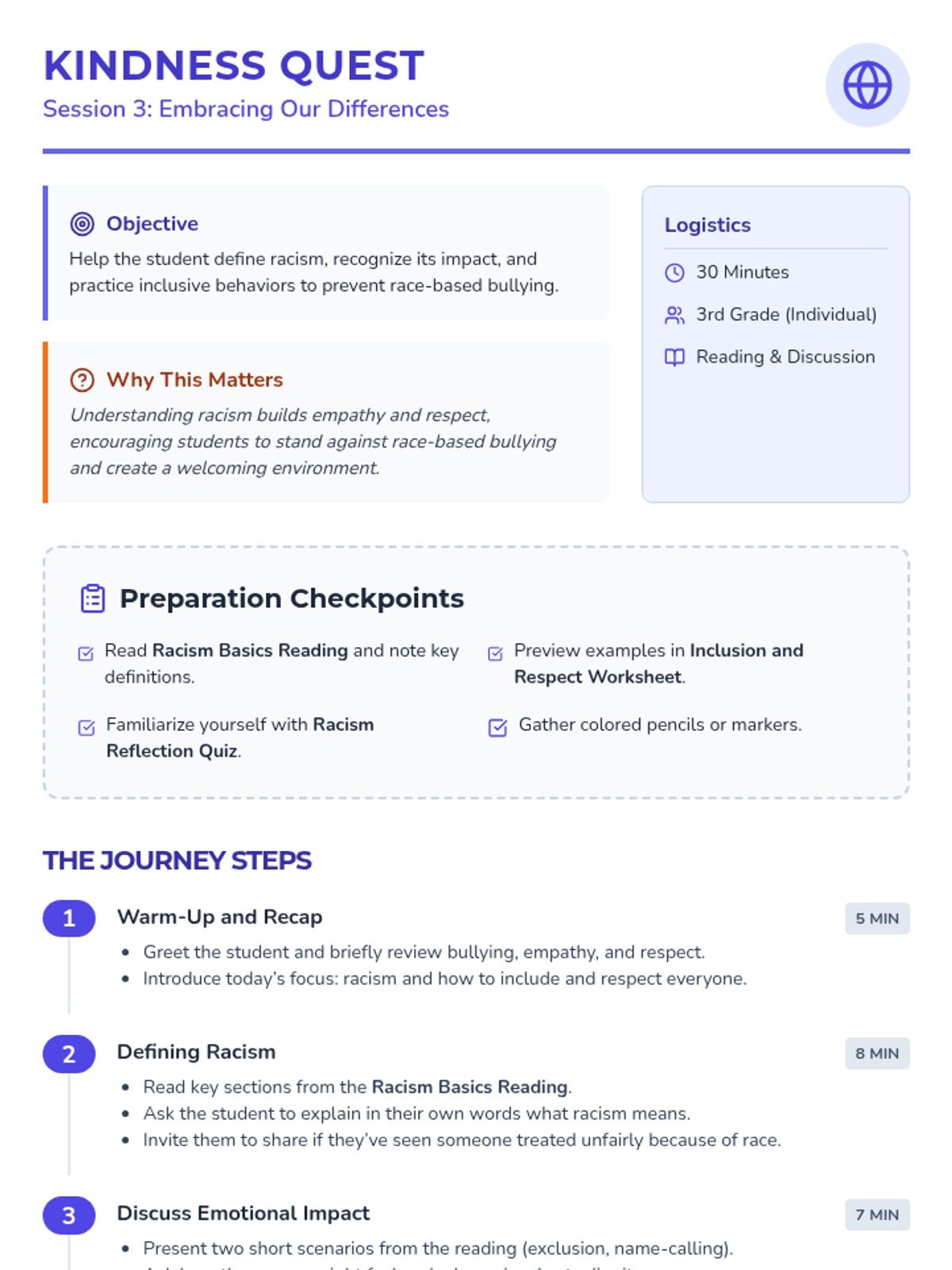
Teacher lesson plan for Session 3 of the Kindness Quest program, focusing on racism and inclusion.
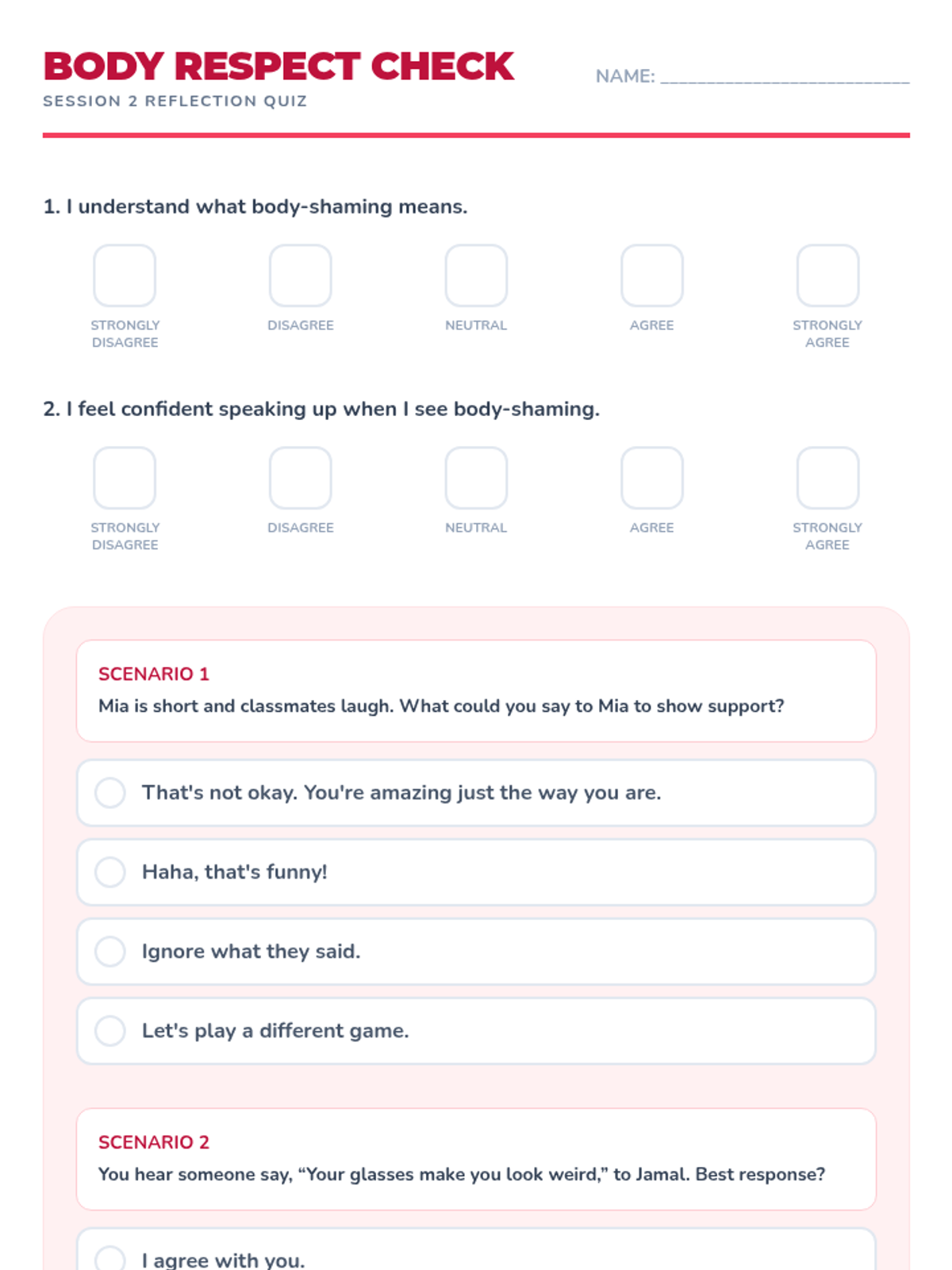
A reflection quiz for Session 2 to assess student understanding of body-shaming and their confidence in responding respectfully.
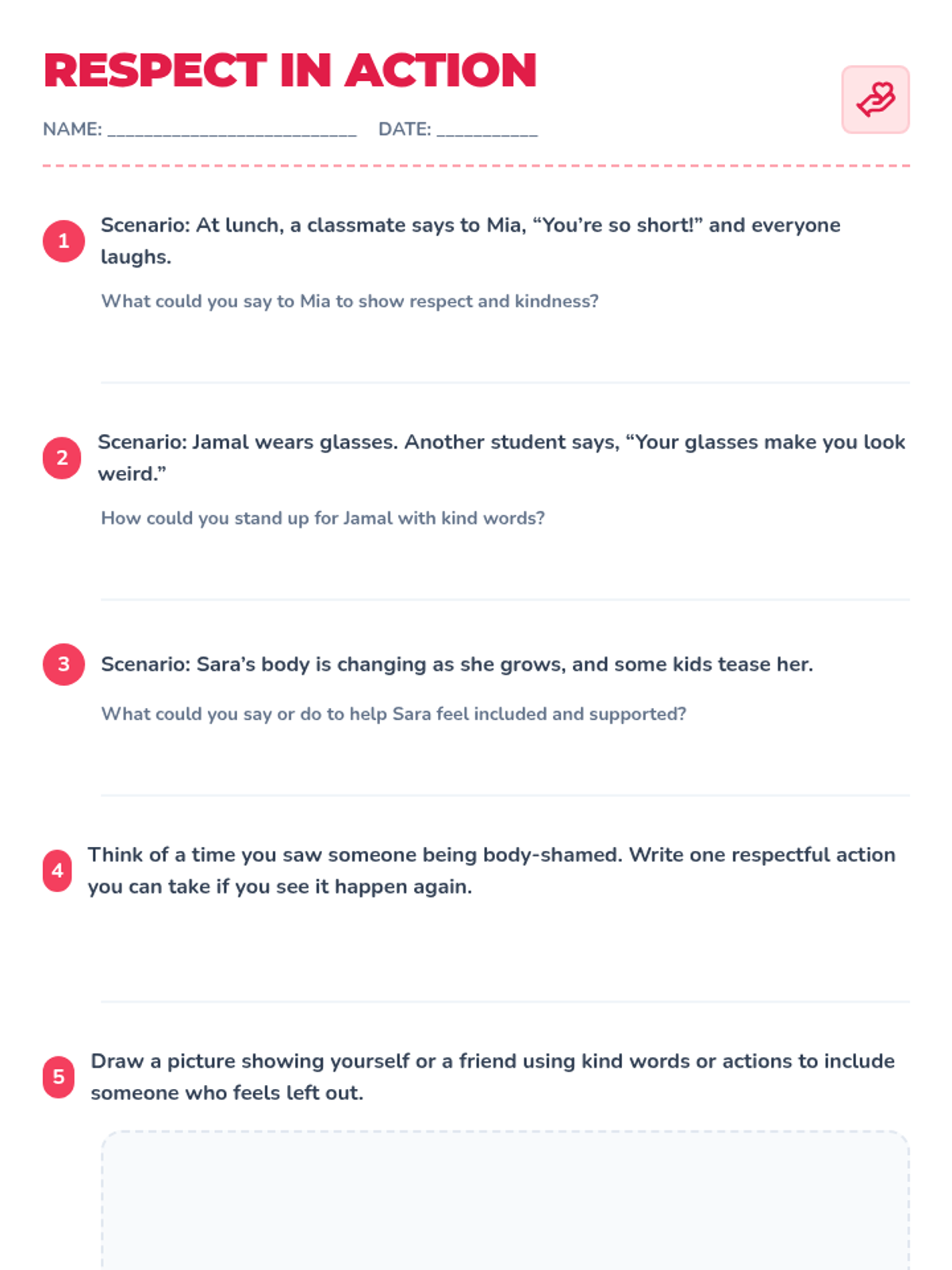
A worksheet for Session 2 where students practice responding to body-shaming scenarios with respect and inclusion.
Visual presentation for Lesson 5, facilitating student presentations, the class pledge ceremony, and graduation.
Visual presentation for Lesson 4, introducing the concept of family agreements and guiding students through designing their own media blueprints.
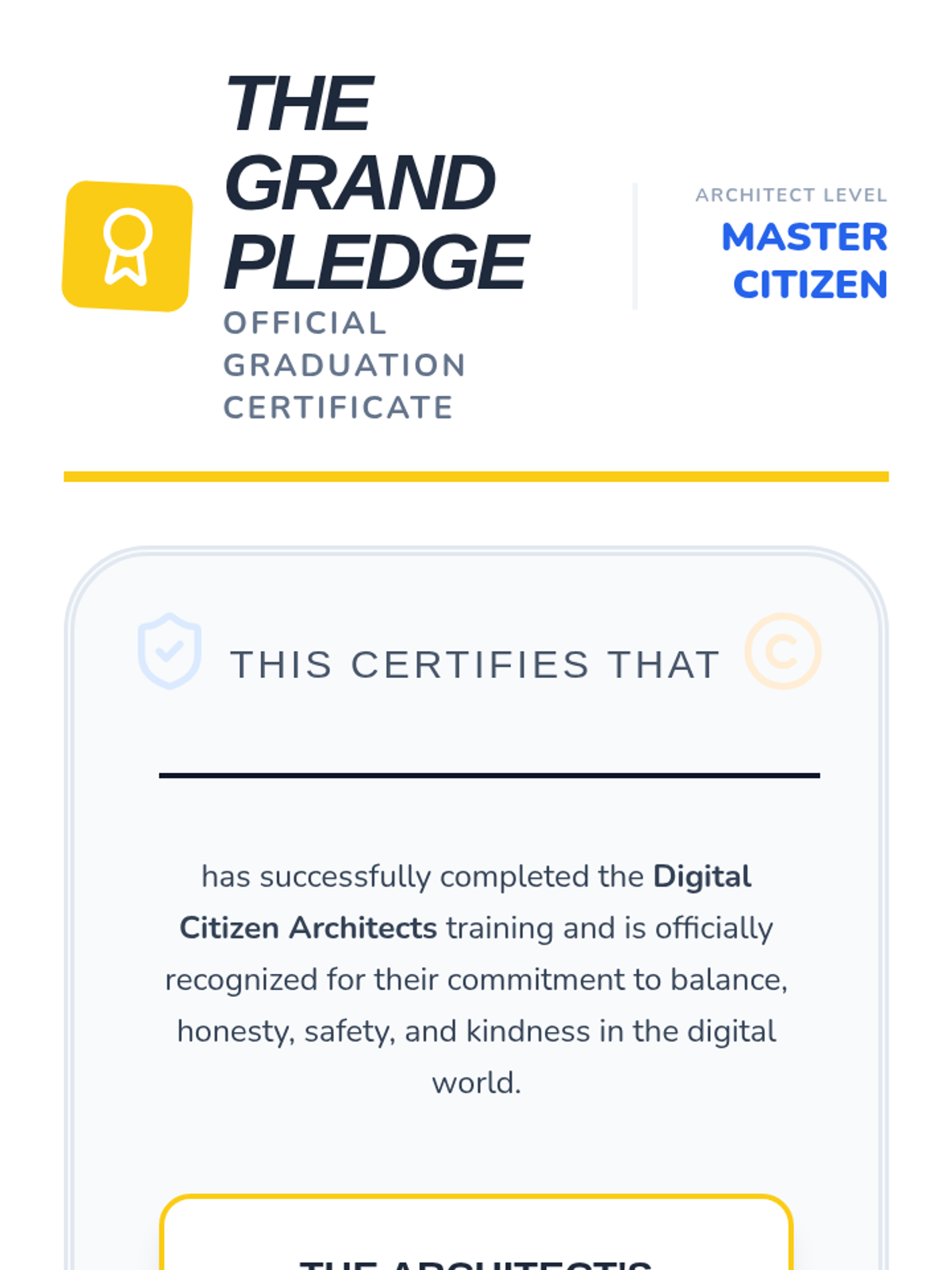
Final graduation certificate and pledge for Lesson 5, awarded to students who complete the sequence. It includes the core tenets of the digital citizenship curriculum.
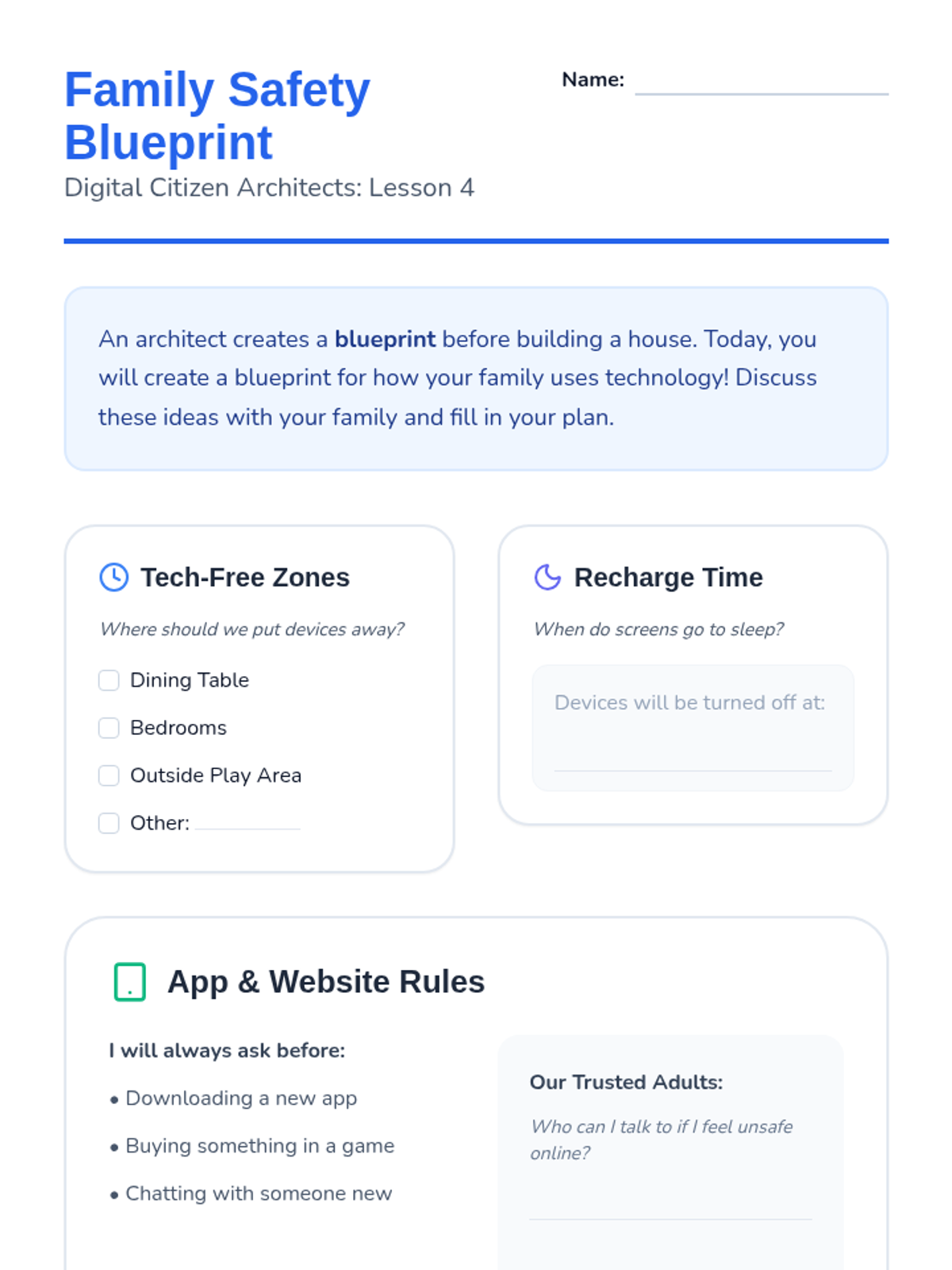
Project template for Lesson 4 where students design a blueprint for their family's device use rules, including tech-free zones, recharge times, and safety promises.
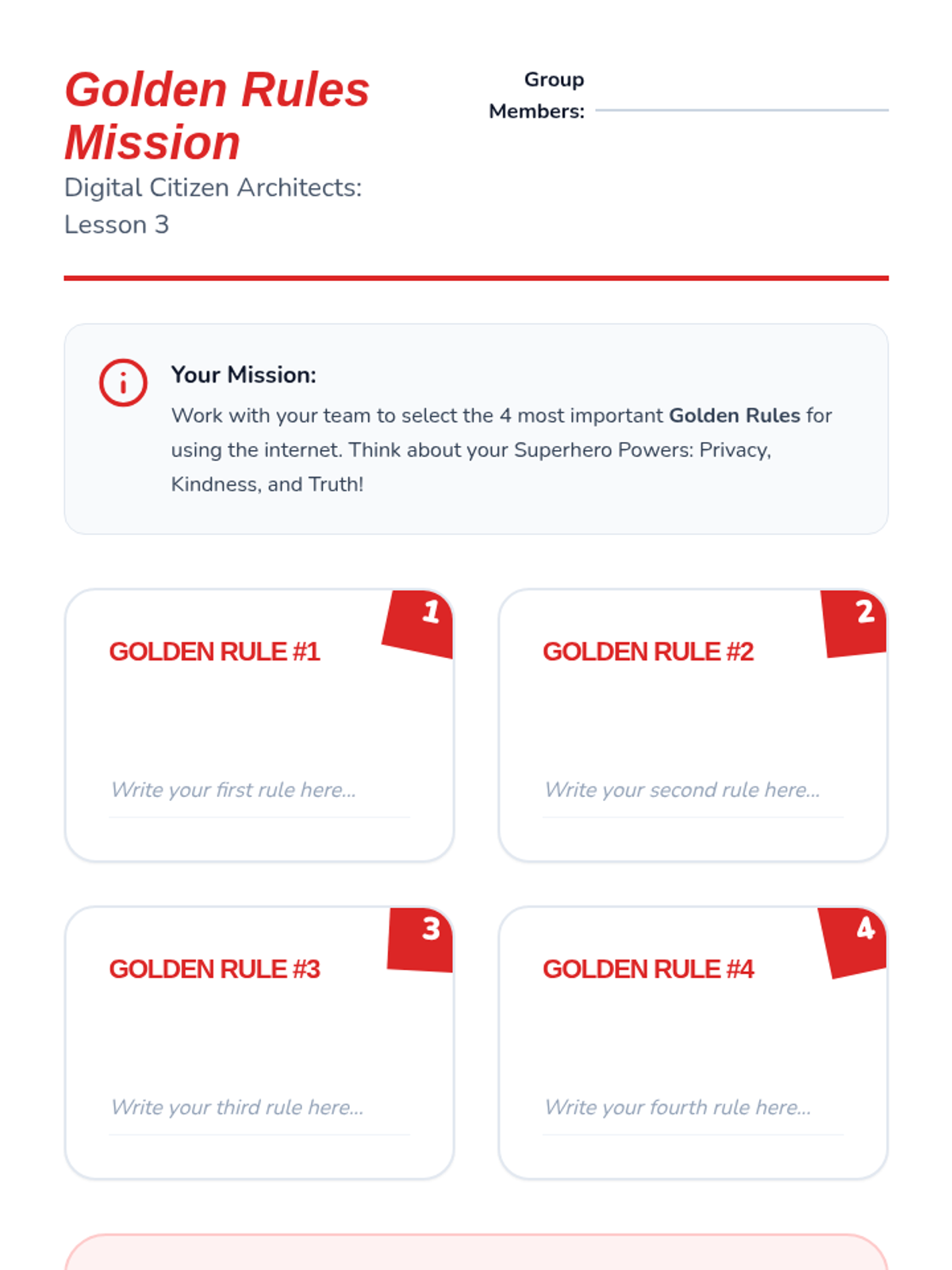
Collaborative worksheet for Lesson 3 where student groups select and justify four 'Golden Rules' for internet safety and kindness.
Visual presentation for Lesson 3, introducing 'Superhero Powers' like Privacy Shield, Kindness Pulse, and Truth Vision for web safety.
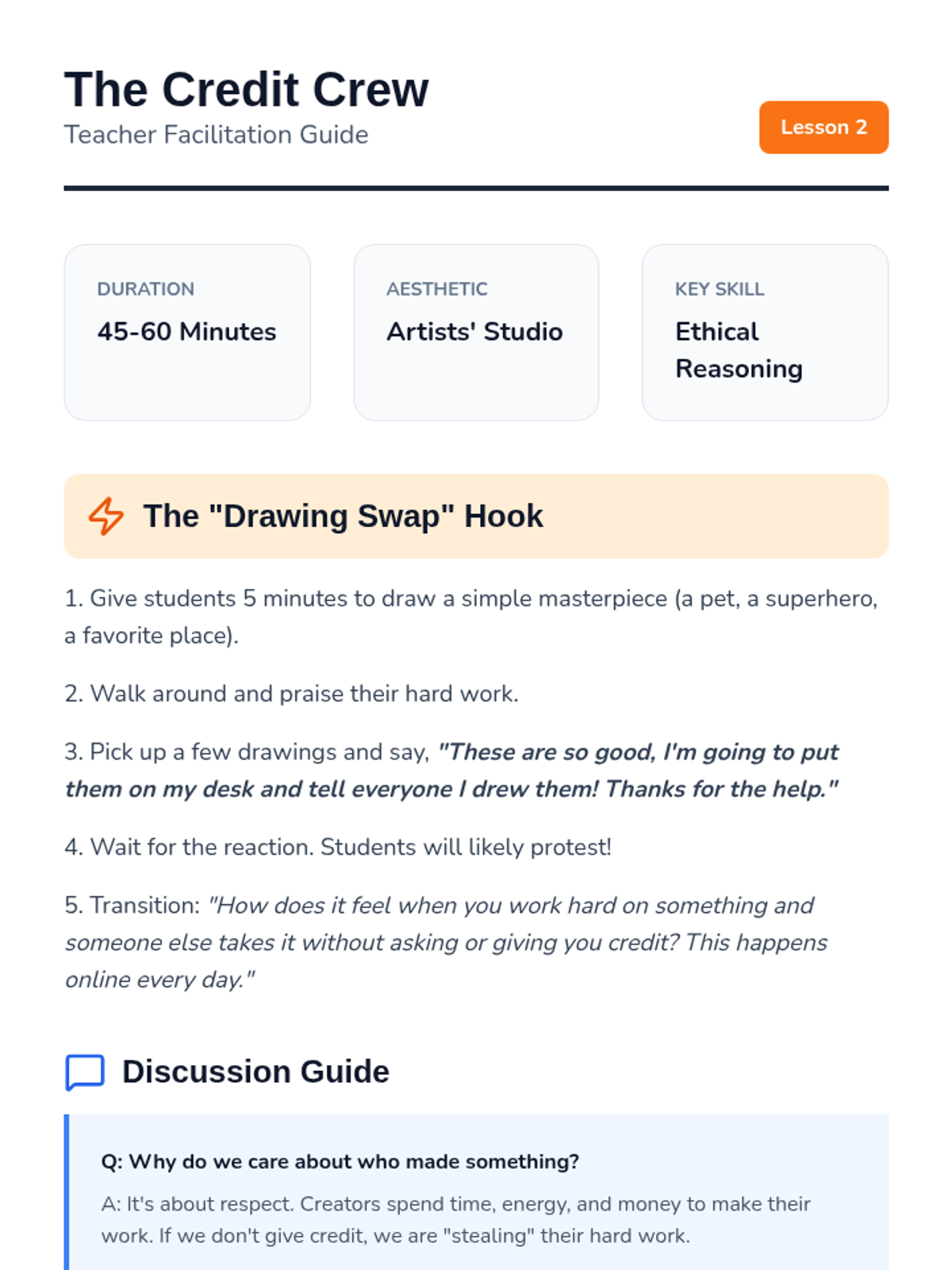
Teacher guide for Lesson 2, including the 'Drawing Swap' hook, discussion prompts, and lesson pacing.
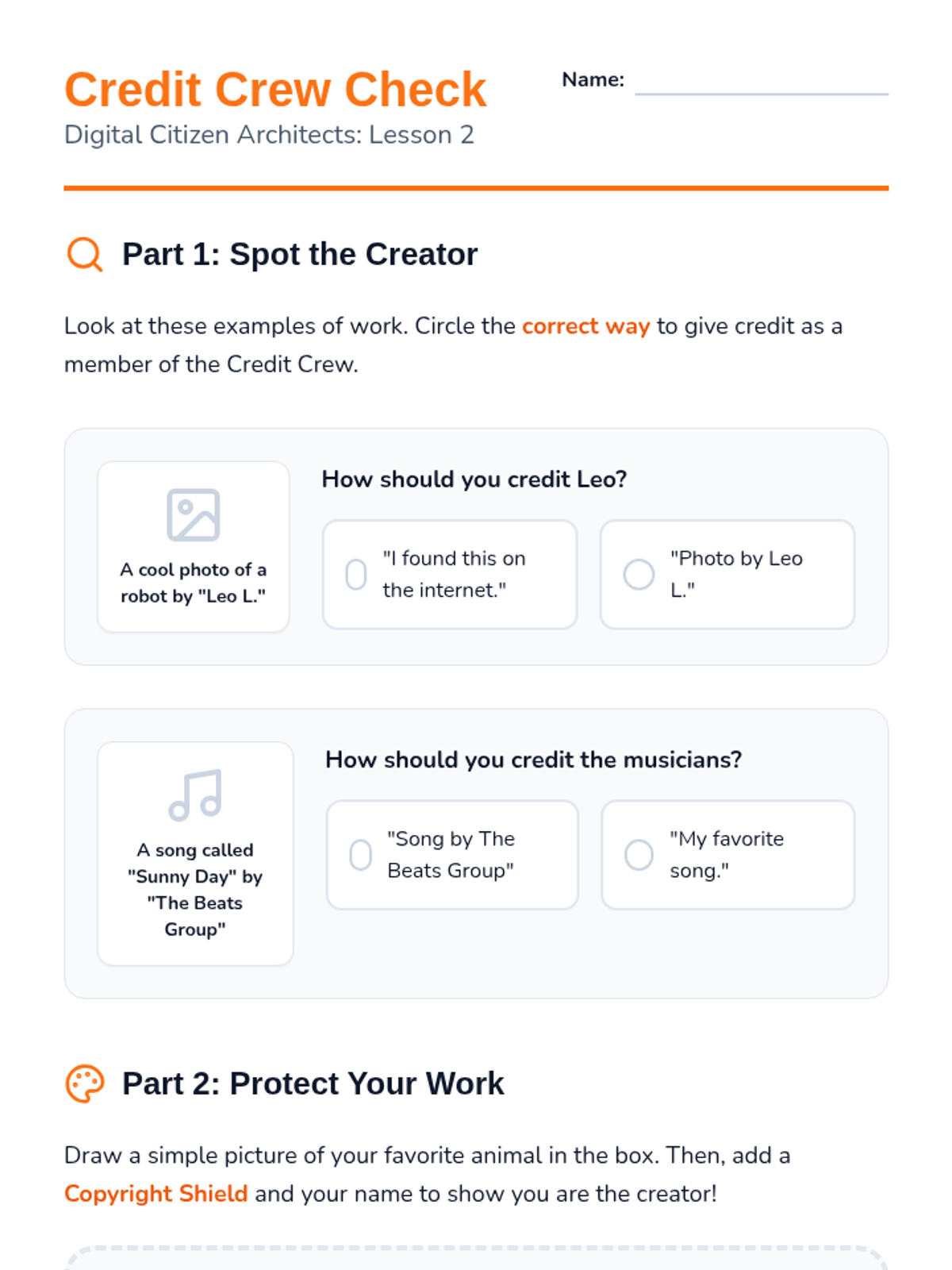
Worksheet for Lesson 2 where students practice identifying correct attribution and creating their own credited artwork.
Visual presentation for Lesson 2, teaching students about intellectual property, the copyright symbol, and how to give credit to creators.
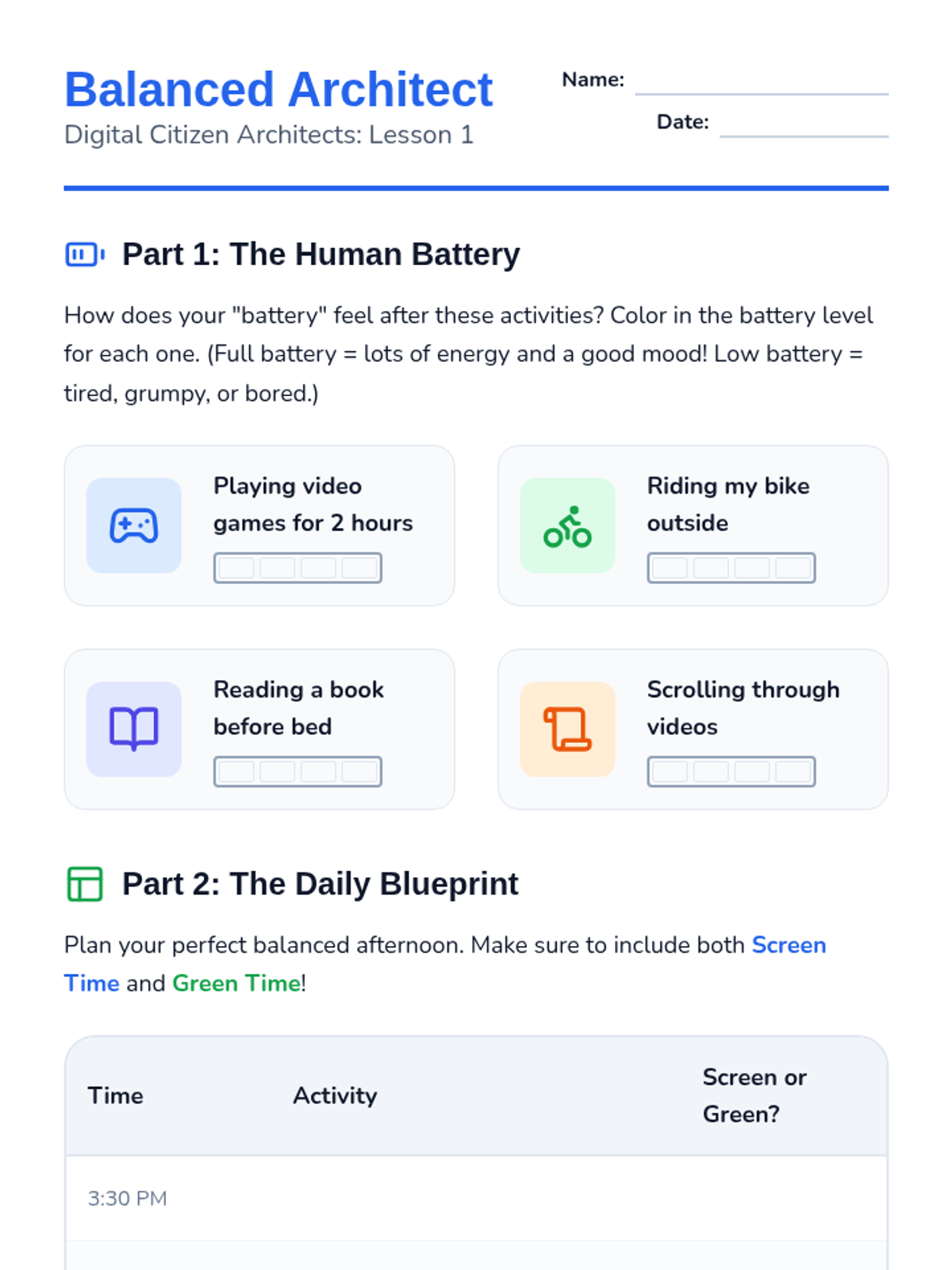
Worksheet for Lesson 1 where students evaluate how activities affect their 'battery' and plan a balanced daily schedule.
Visual presentation for Lesson 1, introducing the concept of 'Battery Drain' and comparing screen time with 'green time' activities for a balanced life.
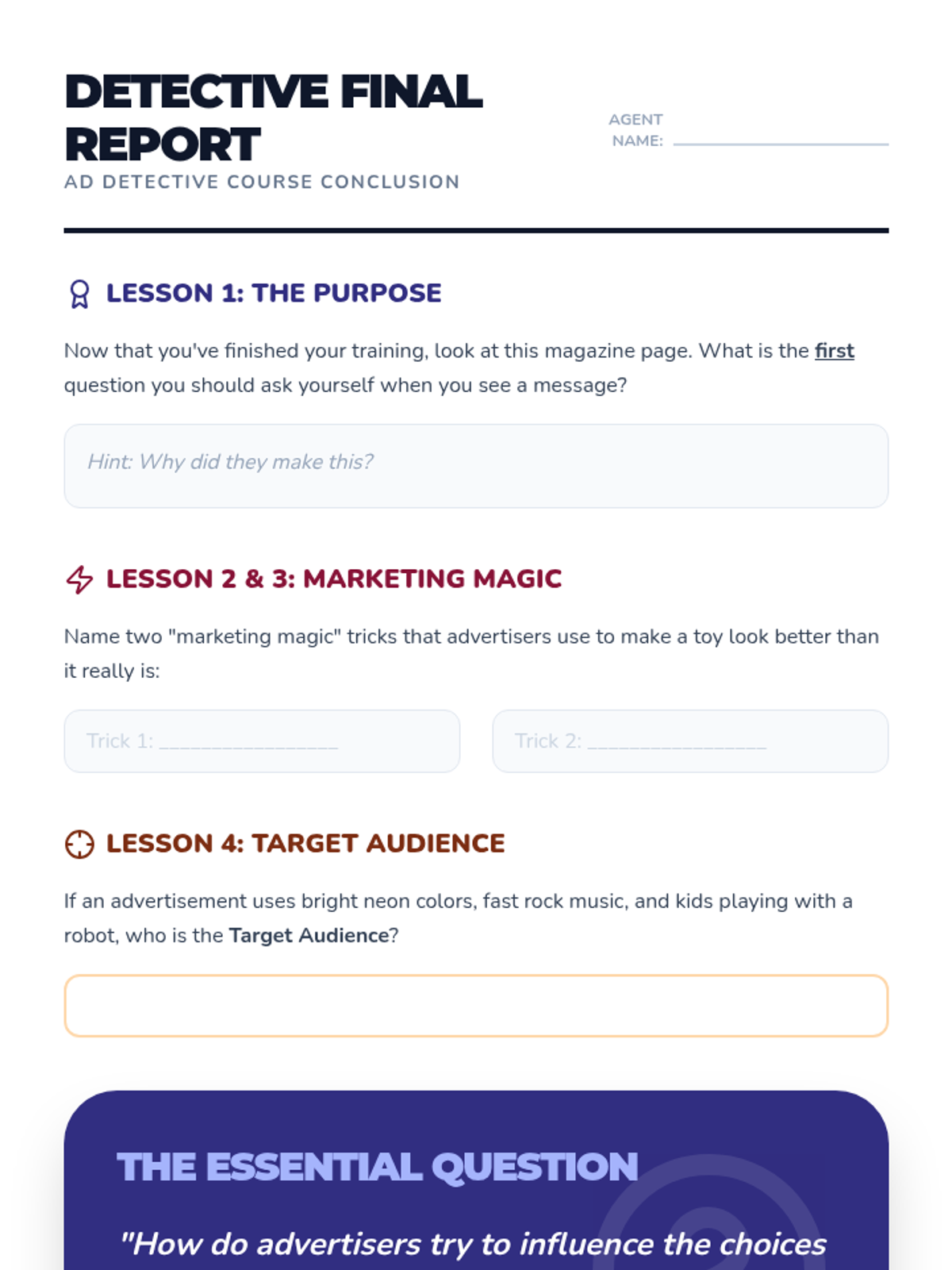
A final reflection and exit ticket for the entire sequence. Students answer questions based on the core concepts of each lesson and respond to the essential question.
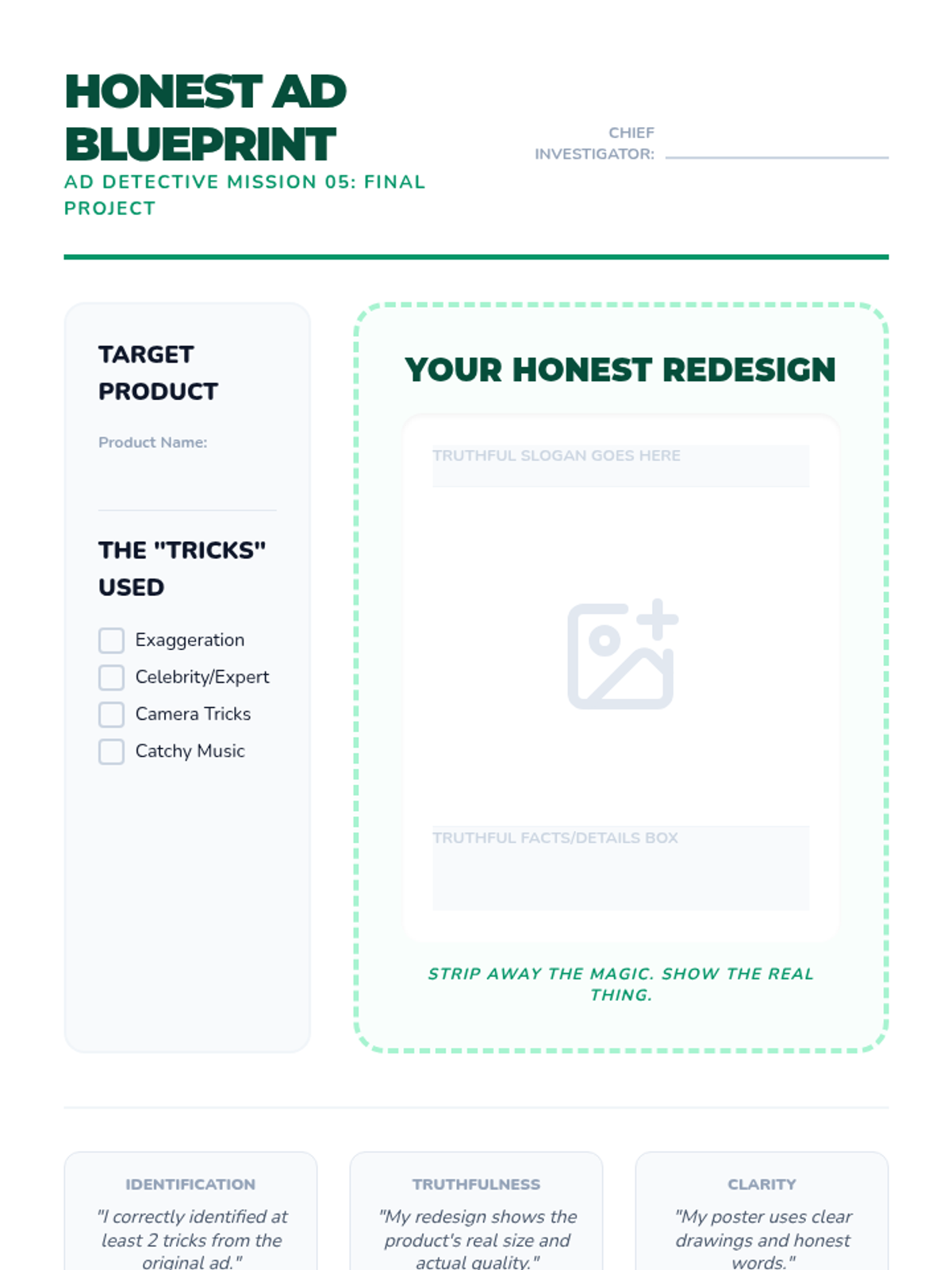
Final project template and rubric for Lesson 5. Students identify marketing tricks in an existing ad and redesign it as an 'Honest Ad' on this worksheet.
Final project slides for Lesson 5. Students are challenged to redesign a misleading advertisement to be 100% truthful, stripping away 'marketing magic'.
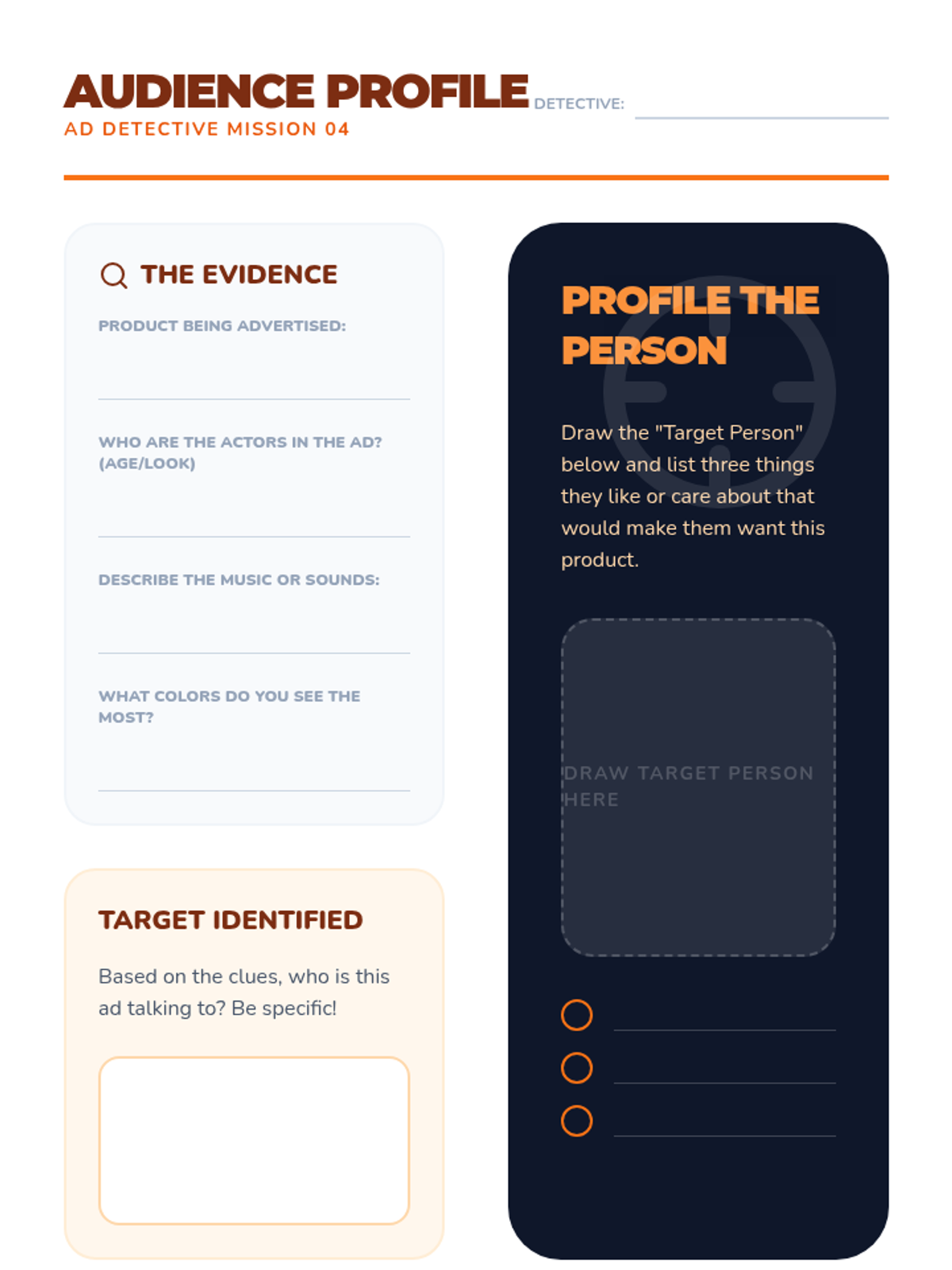
Student worksheet for Lesson 4 where students profile the target audience of a specific advertisement by identifying visual and auditory clues.
Slides for Lesson 4 on identifying target audiences using clues like actors, music, colors, and tone. Features a 'Minivan vs. Video Game' case study.
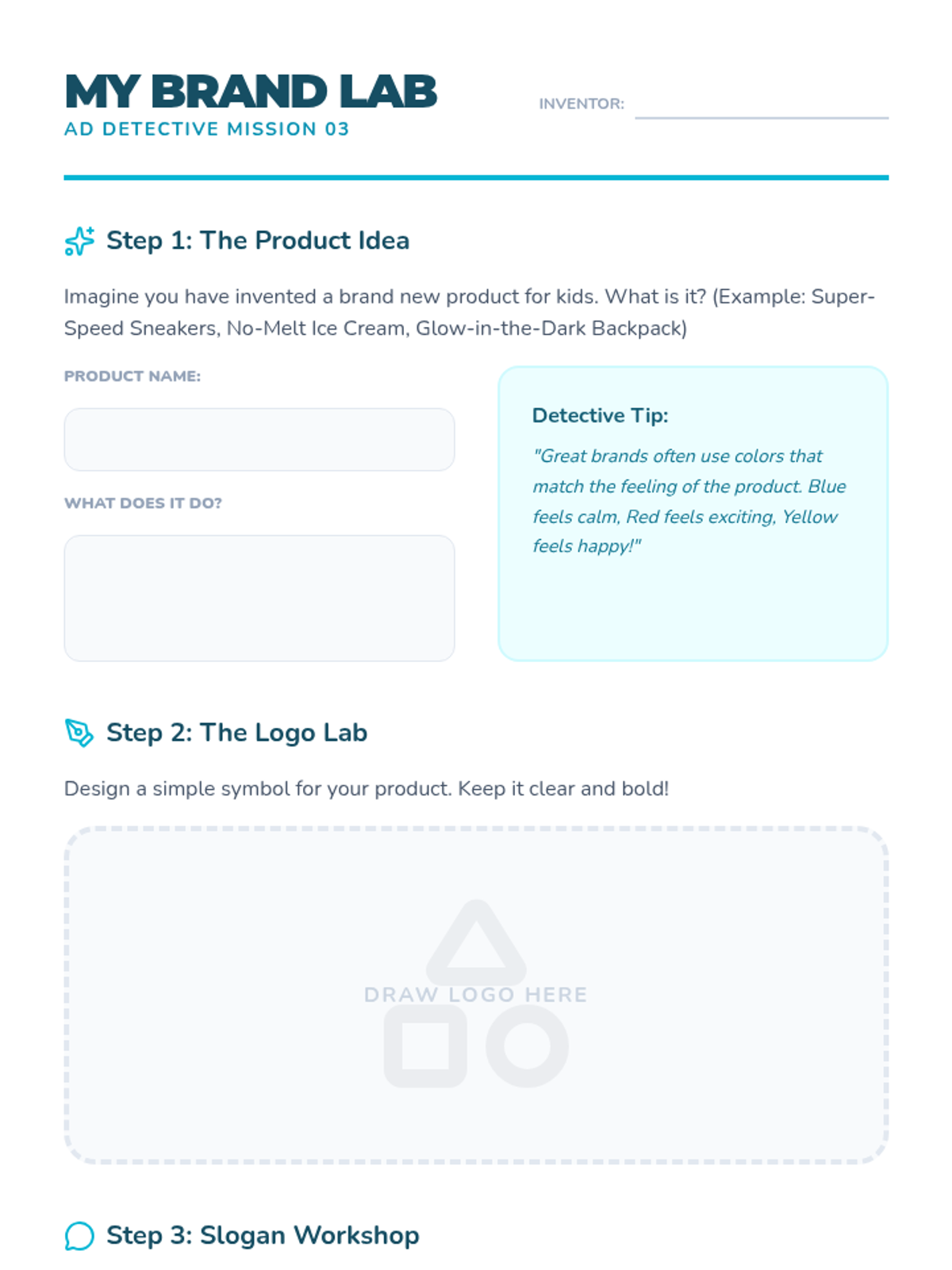
Student worksheet for Lesson 3 where students design their own product logo and slogan, applying branding concepts.
Slides for Lesson 3 exploring the role of logos and slogans in brand recognition and trust. Includes a 'Rapid-Fire Quiz' hook.
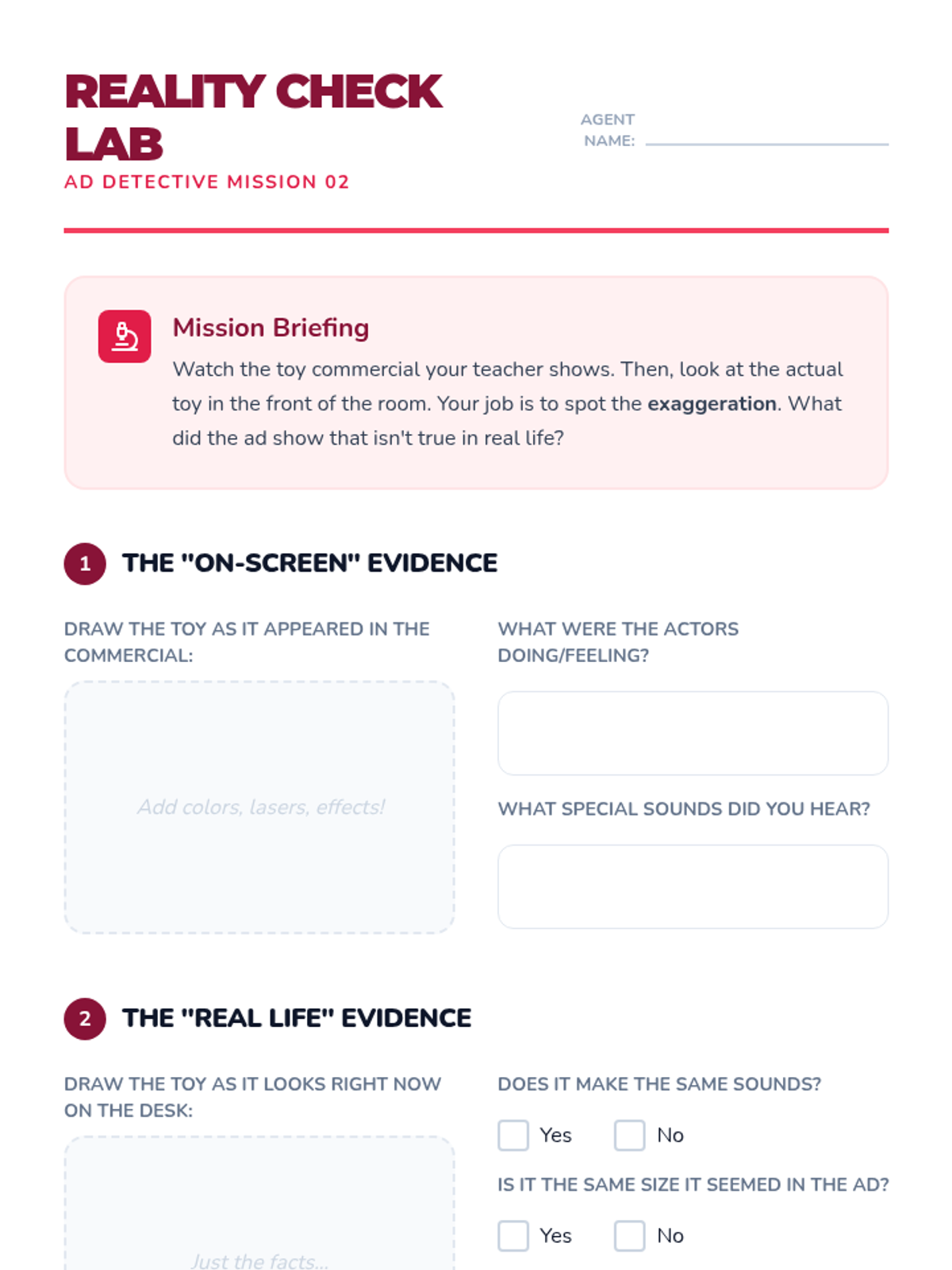
Student activity sheet for 'Reality Check Lab'. Students compare a commercial version of a toy to the real object to identify marketing tricks and exaggeration.
Slides for Lesson 2 focusing on visual and auditory persuasion techniques like lighting, angles, sound effects, and exaggeration in marketing.
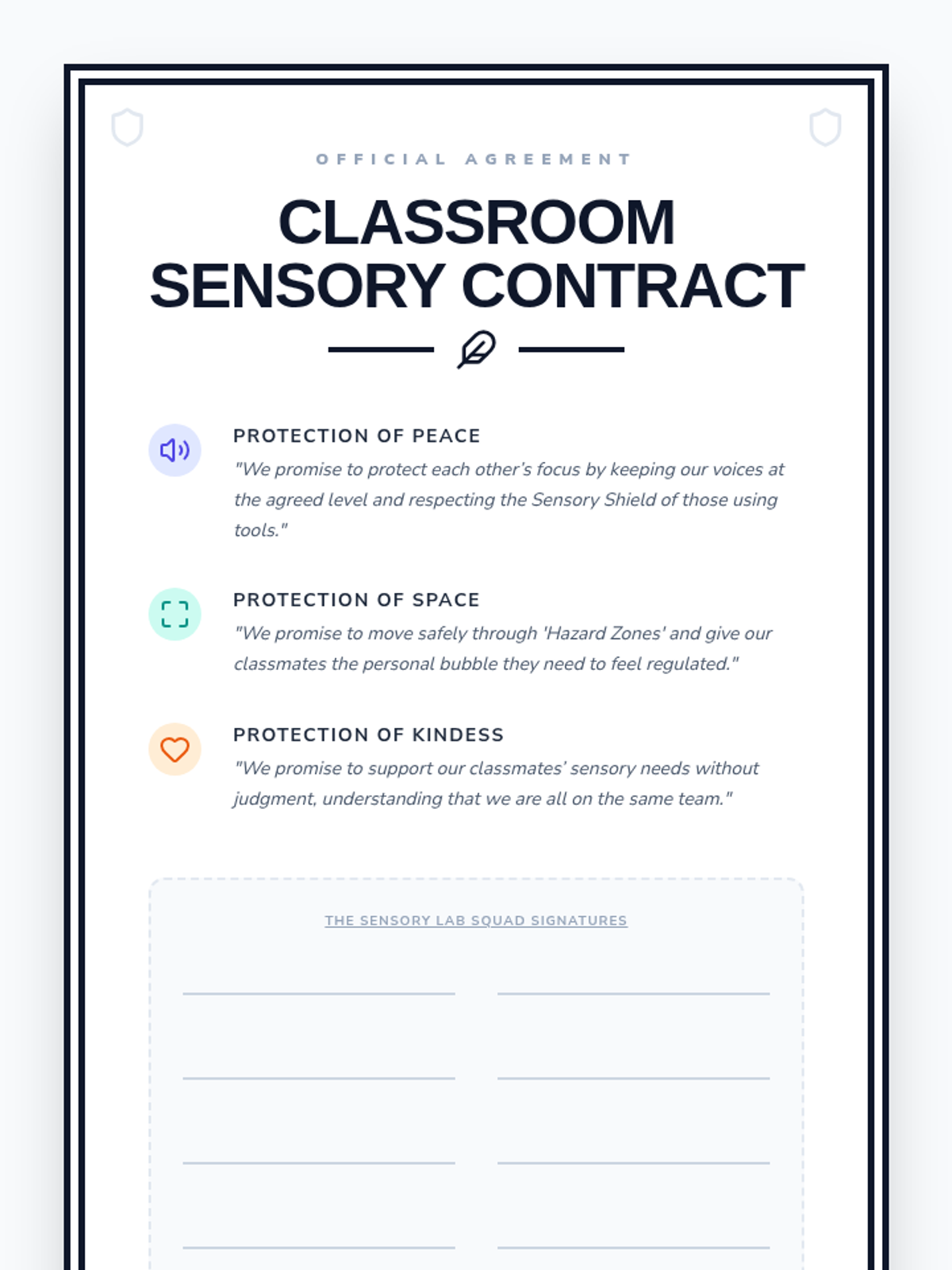
A formal classroom agreement document that establishes shared norms for noise, space, and sensory support, intended for all students to sign.
Slides for Lesson 5 consolidating learning into a classroom agreement on noise, space, and sensory support.
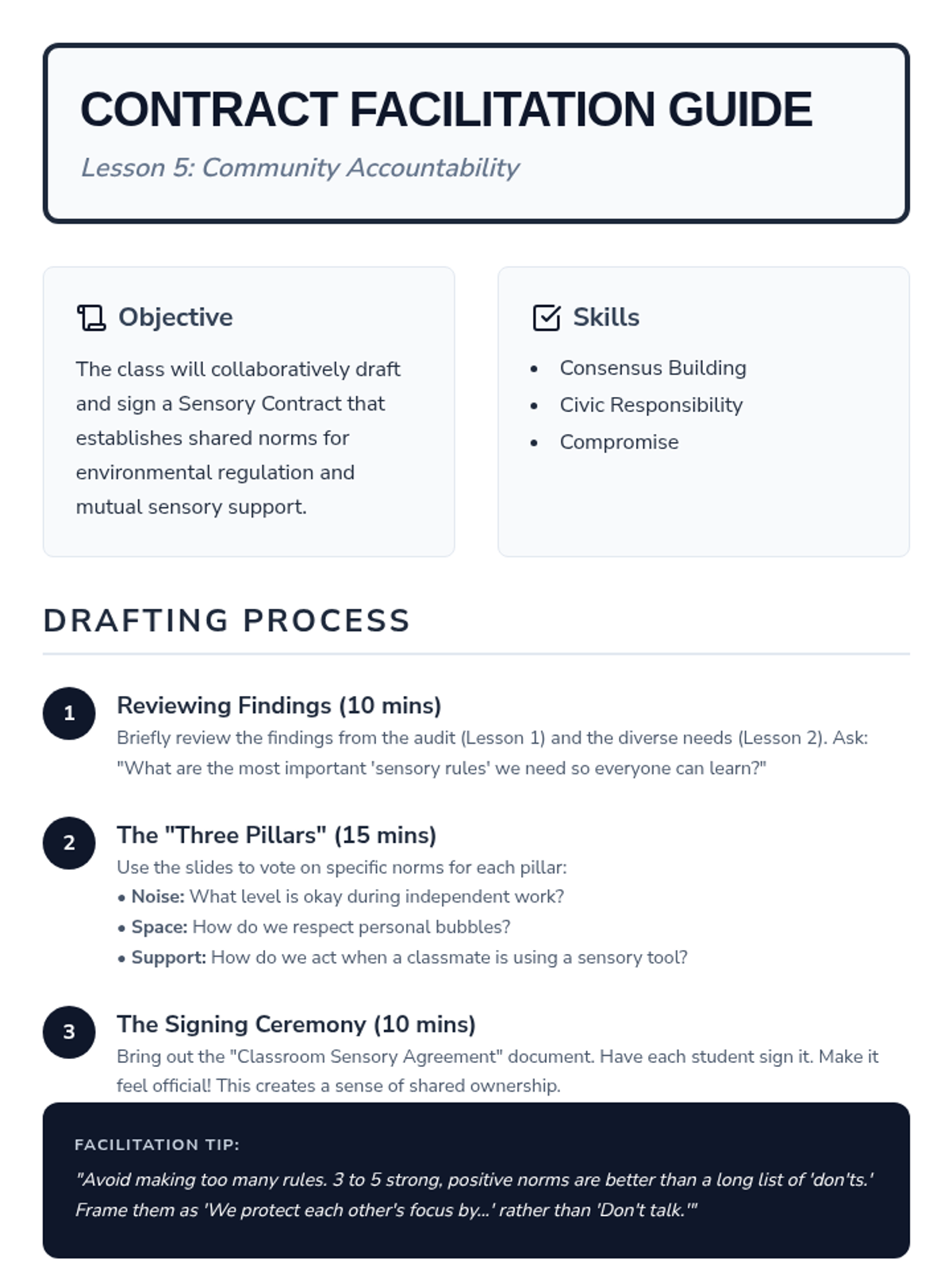
A teacher guide for the Classroom Sensory Contract lesson, featuring strategies for consensus building, signing ceremonies, and ongoing contract maintenance.
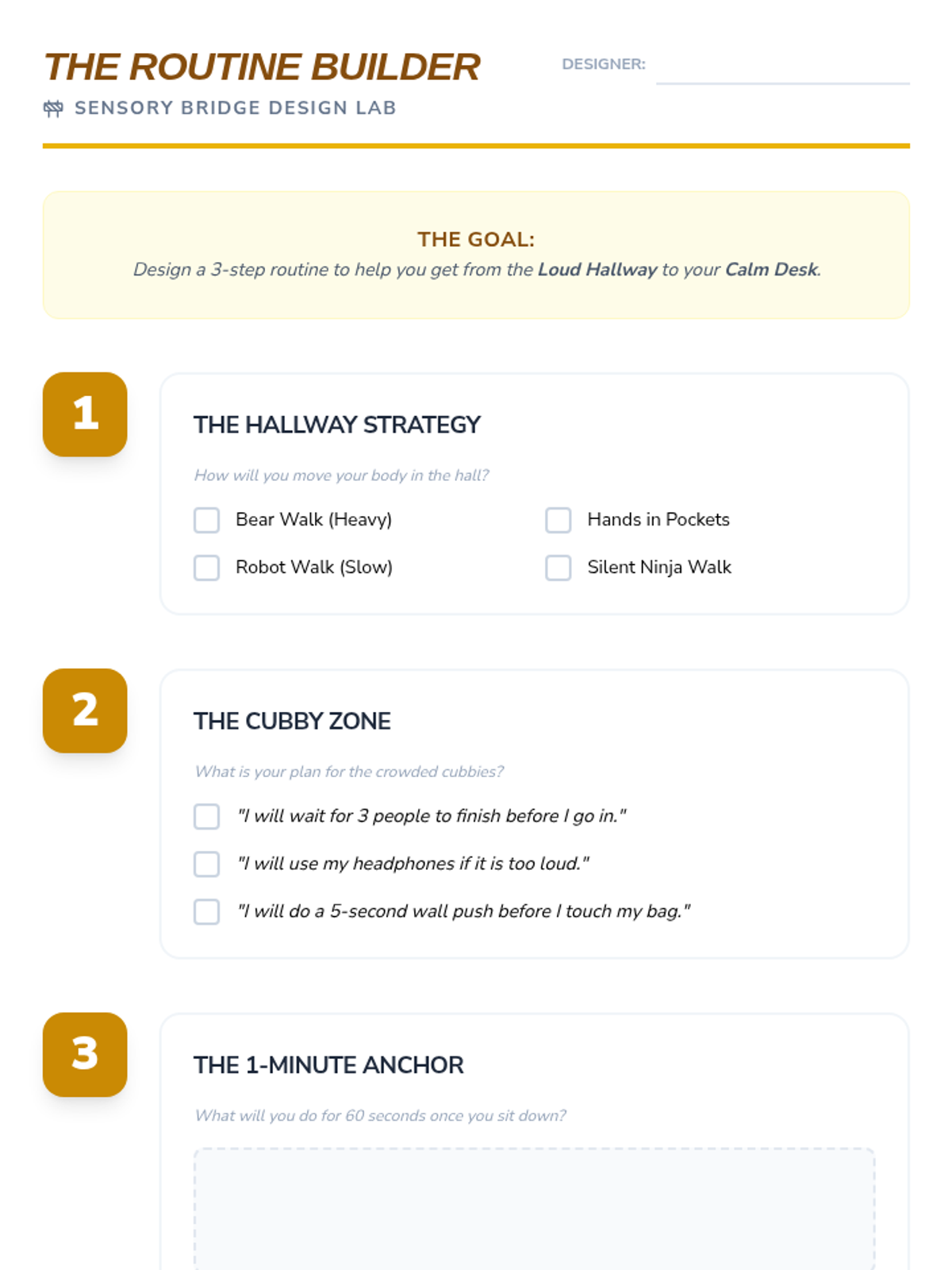
A student worksheet for building a personalized 3-step transition routine using sensory strategies.
Slides for Lesson 4 exploring the "Transition Bridge" concept and identifying sensory hazards during class changes.
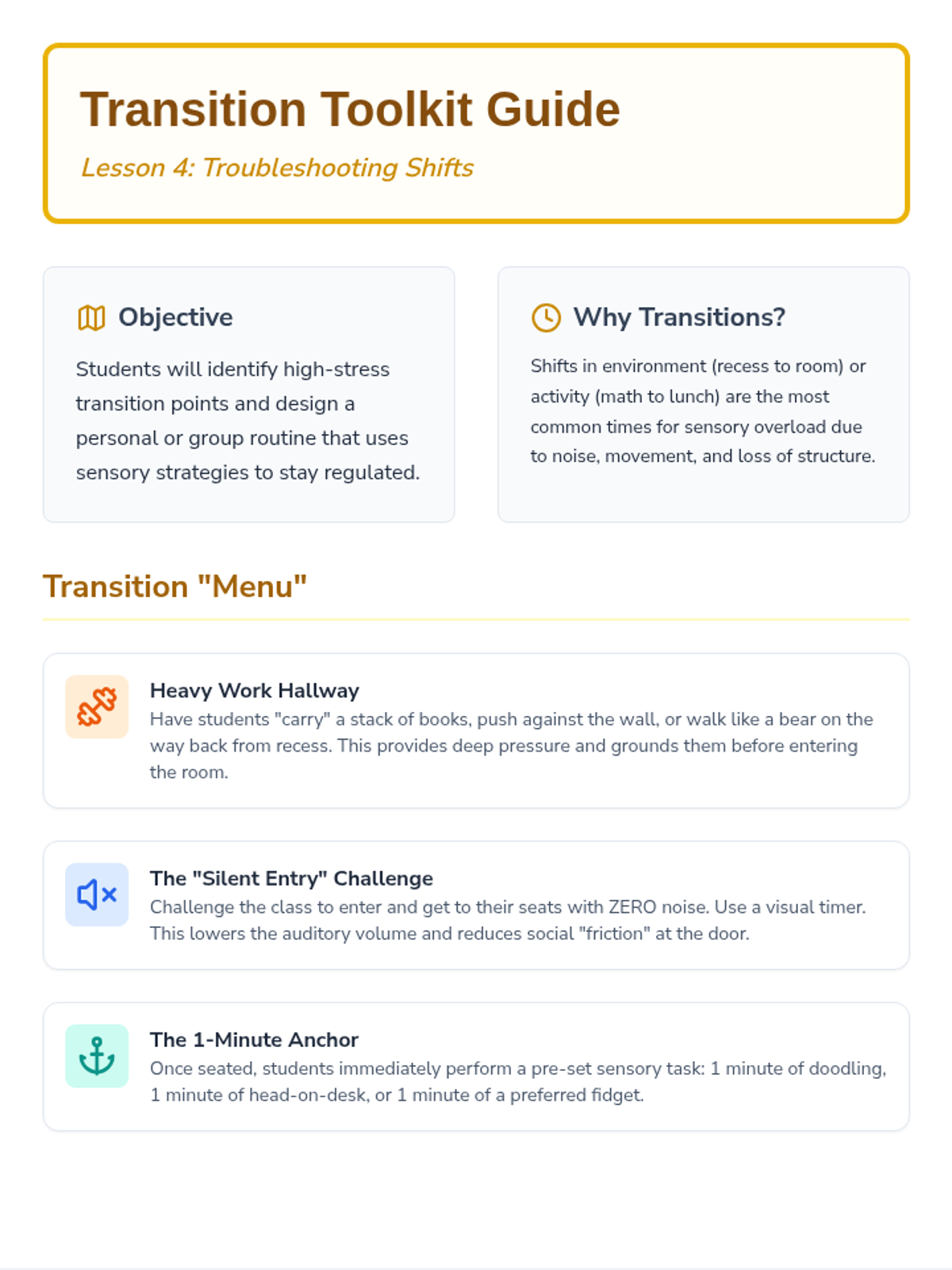
A teacher guide for the Transition Troubleshooting lesson, featuring specific strategies like "Heavy Work Hallway" and "The Buffer Zone".
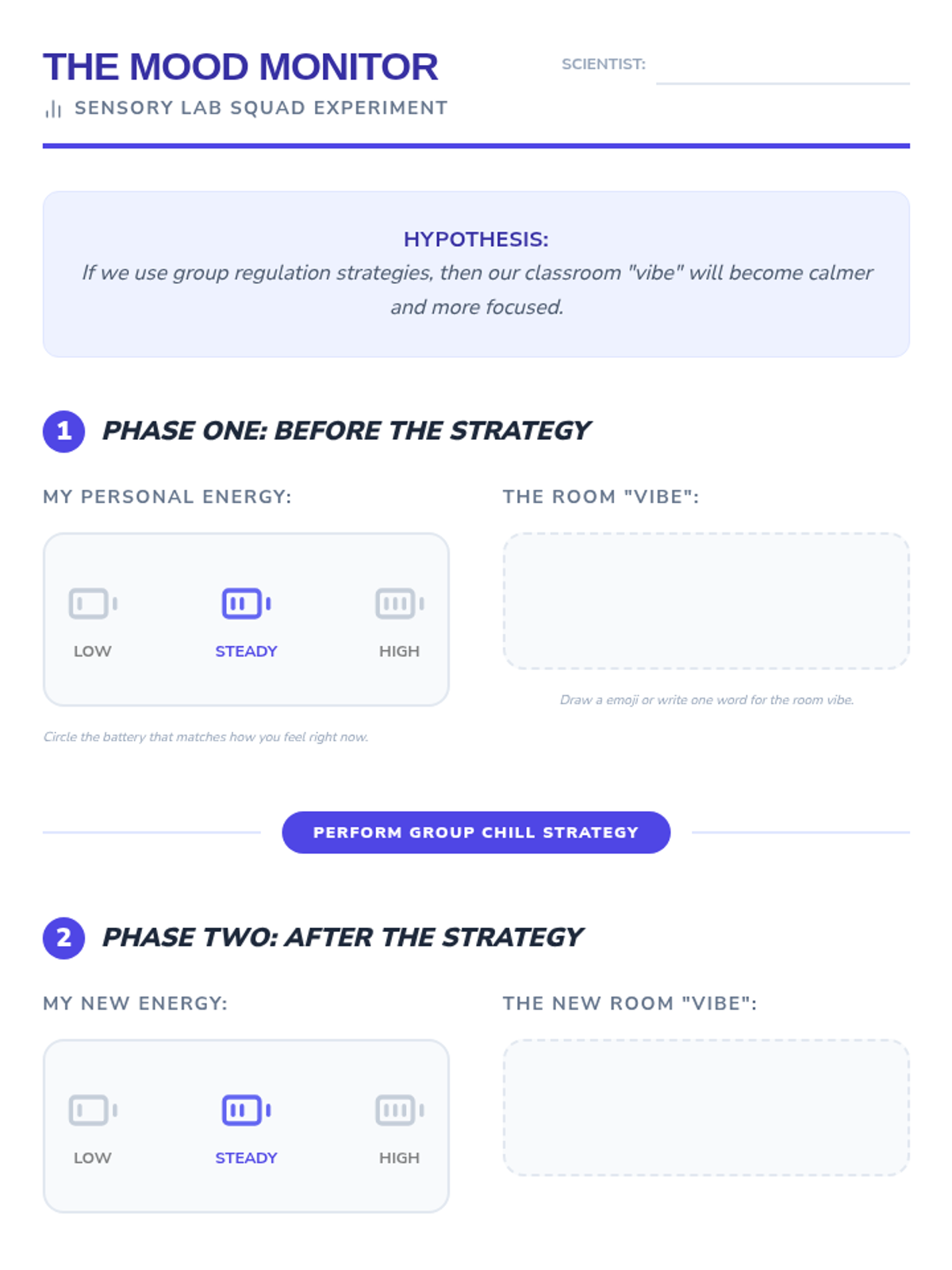
A student data sheet for tracking personal energy and classroom "vibe" before and after group regulation exercises.
Slides for Lesson 3 introducing collective regulation, "The Group Chill," and explaining the science of co-regulation and heavy work.
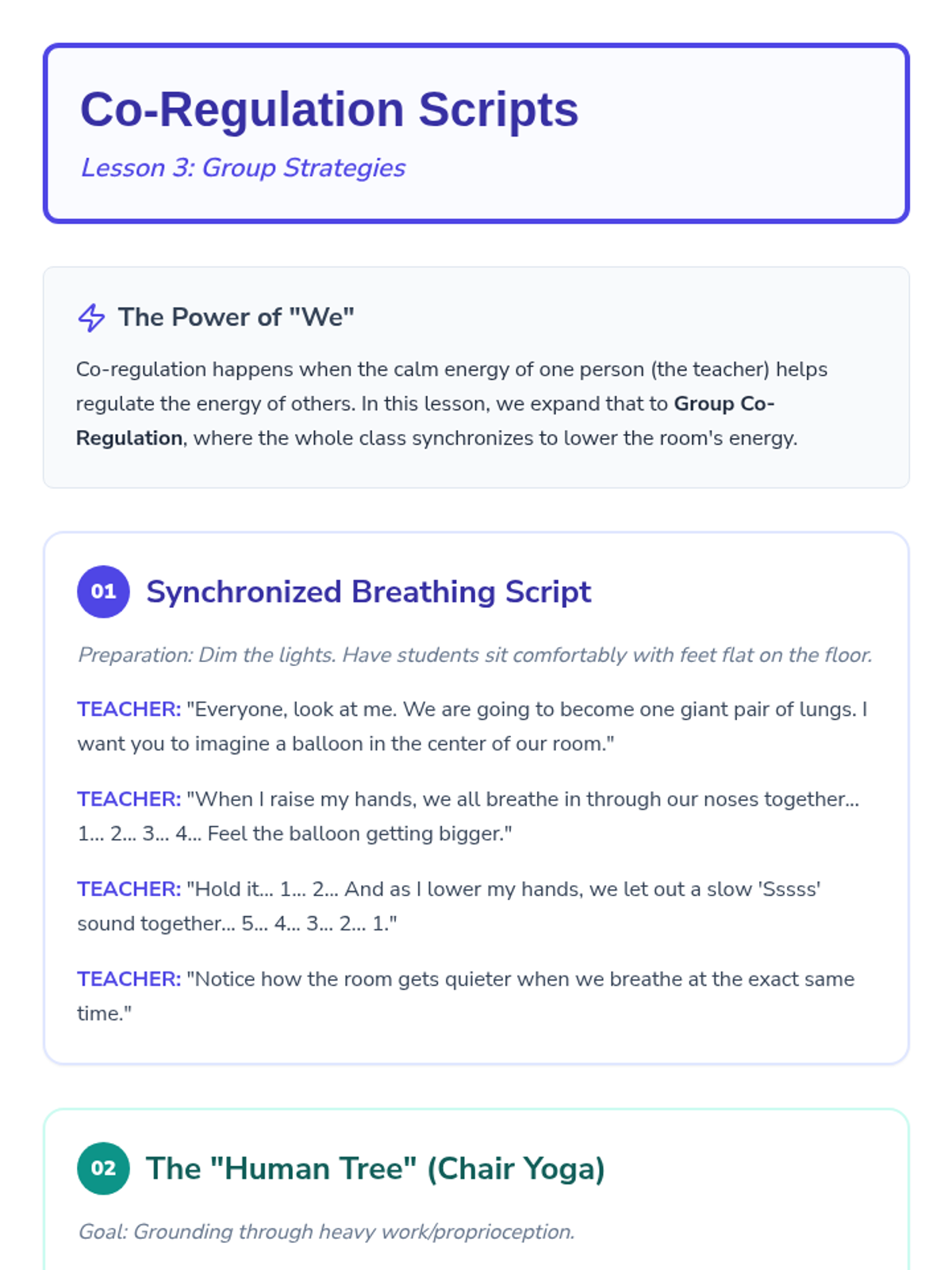
Teacher-facing co-regulation scripts and facilitation tips for synchronized breathing and chair yoga exercises.
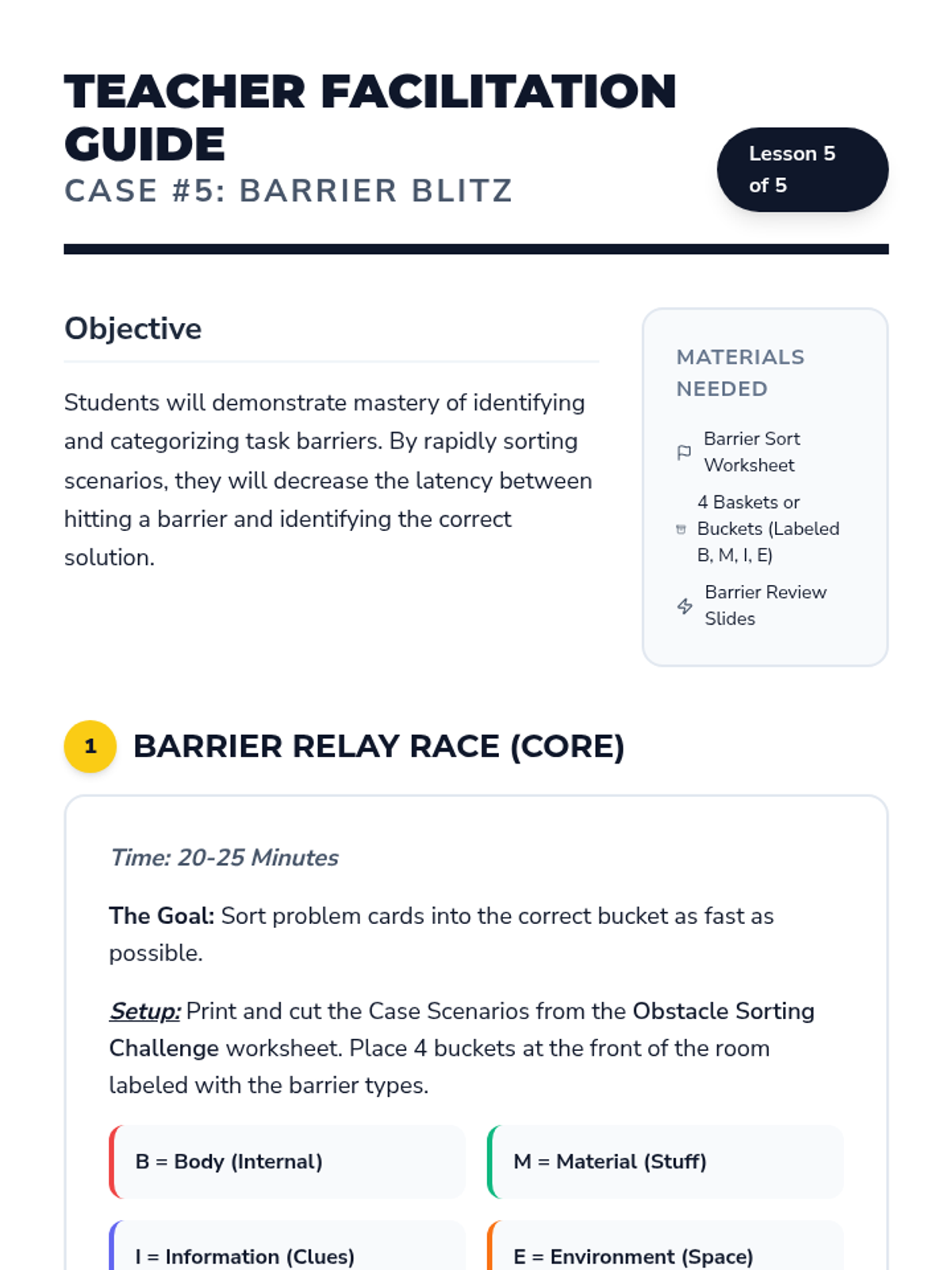
A teacher facilitation guide for Lesson 5, including instructions for the 'Barrier Relay Race' and a unit conclusion.
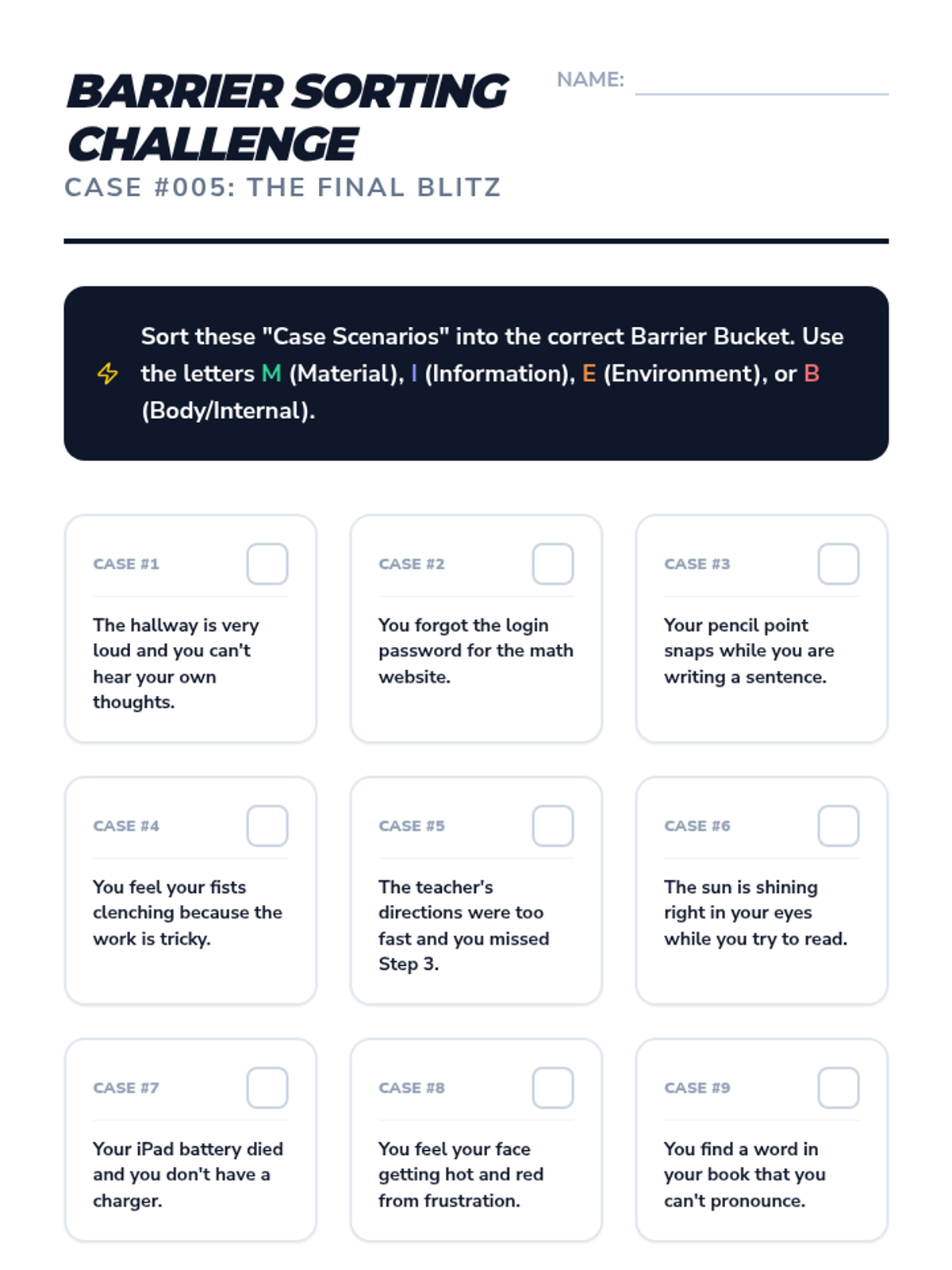
A culminating sorting activity where students categorize various problem scenarios into the four task barrier types.
A culminating slide deck for the 'Barrier Blitz' lesson, reviewing all 4 types of task barriers and preparing students for the final sorting activity.
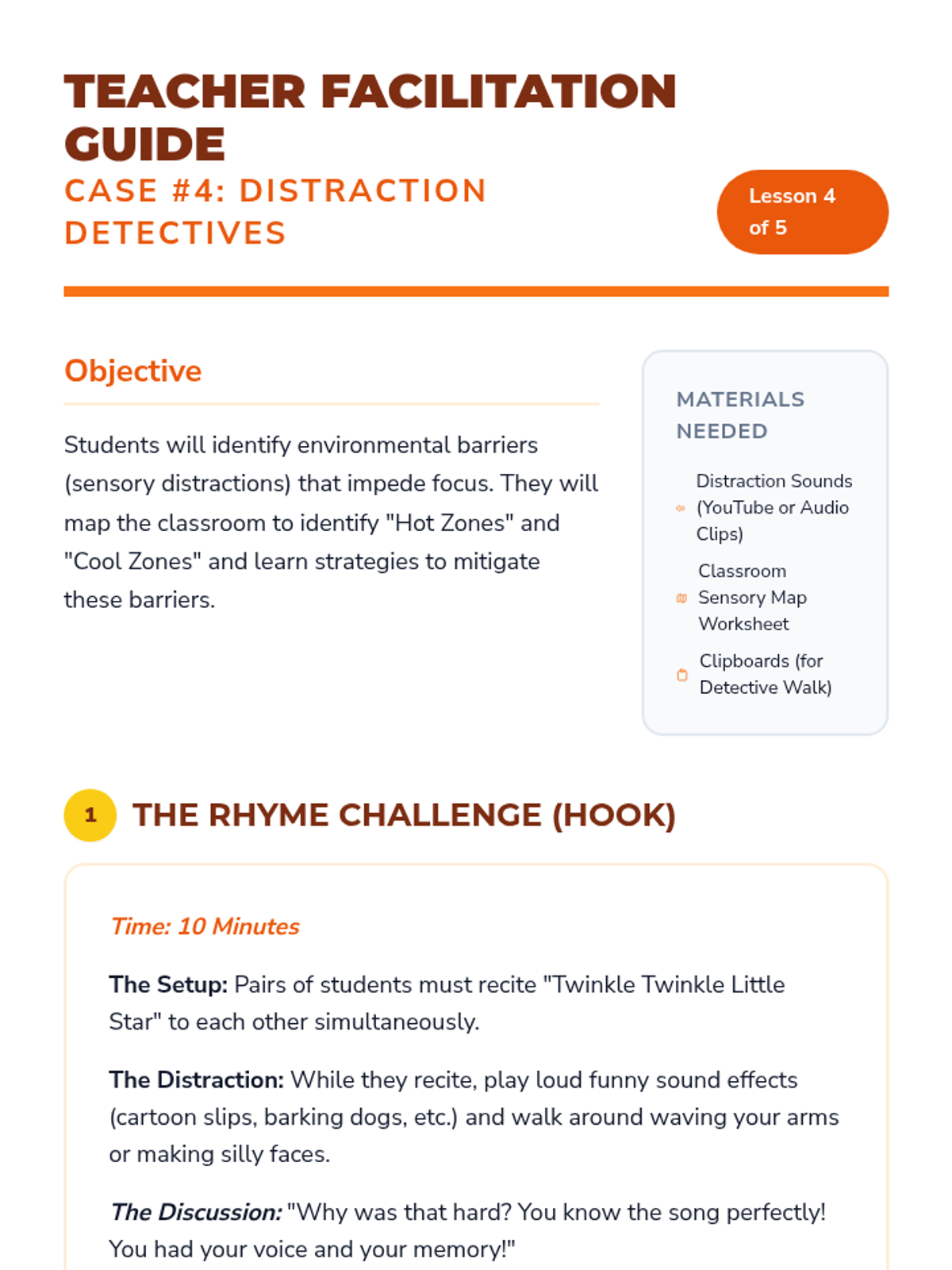
A teacher facilitation guide for Lesson 4, including instructions for the 'Stakeout Walk' and sensory mapping activity.
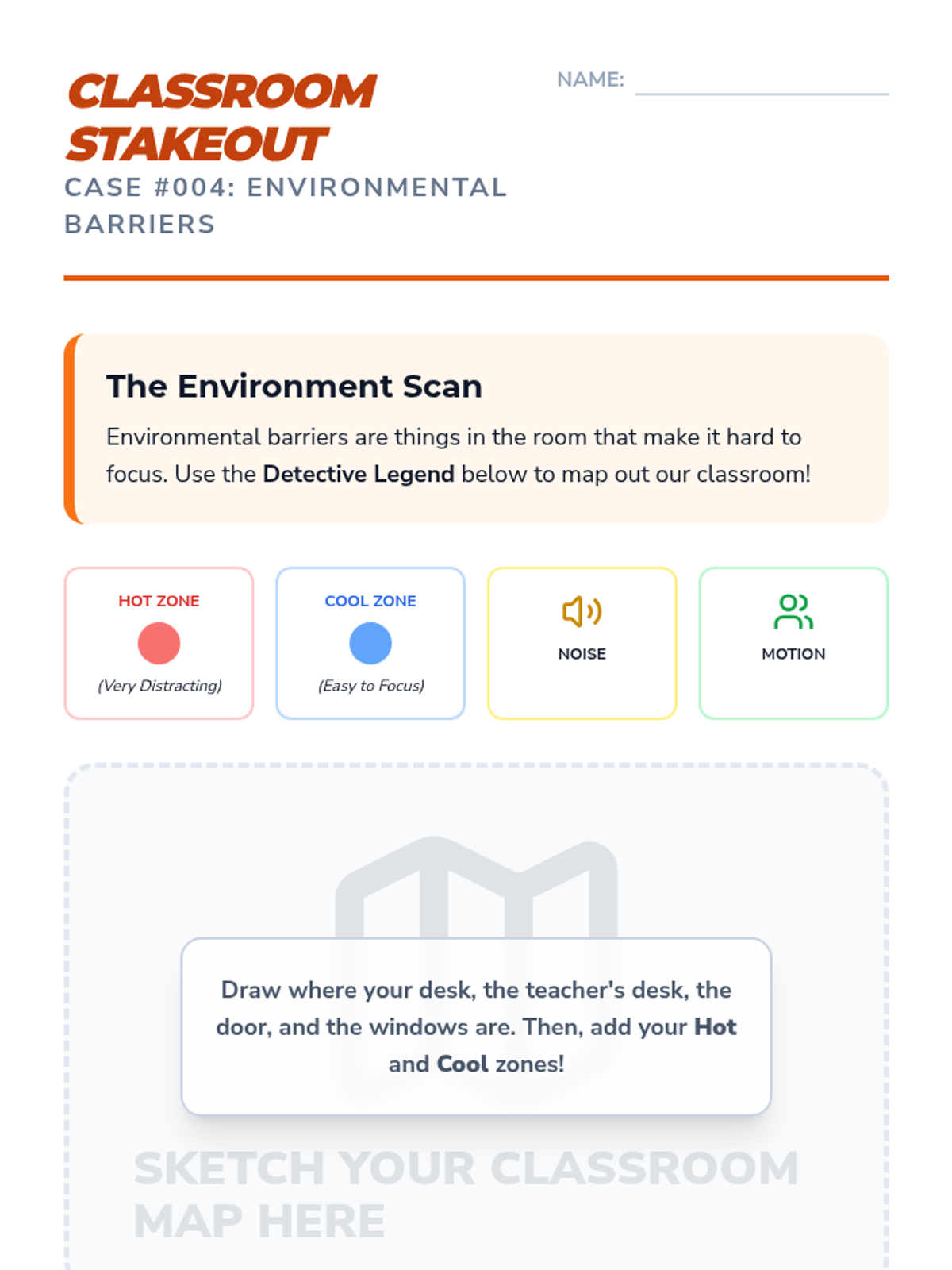
A mapping activity for students to identify 'Hot' and 'Cool' sensory zones in their classroom to manage environmental distractions.
A slide deck for Lesson 4 teaching students about sensory and environmental barriers to focus.
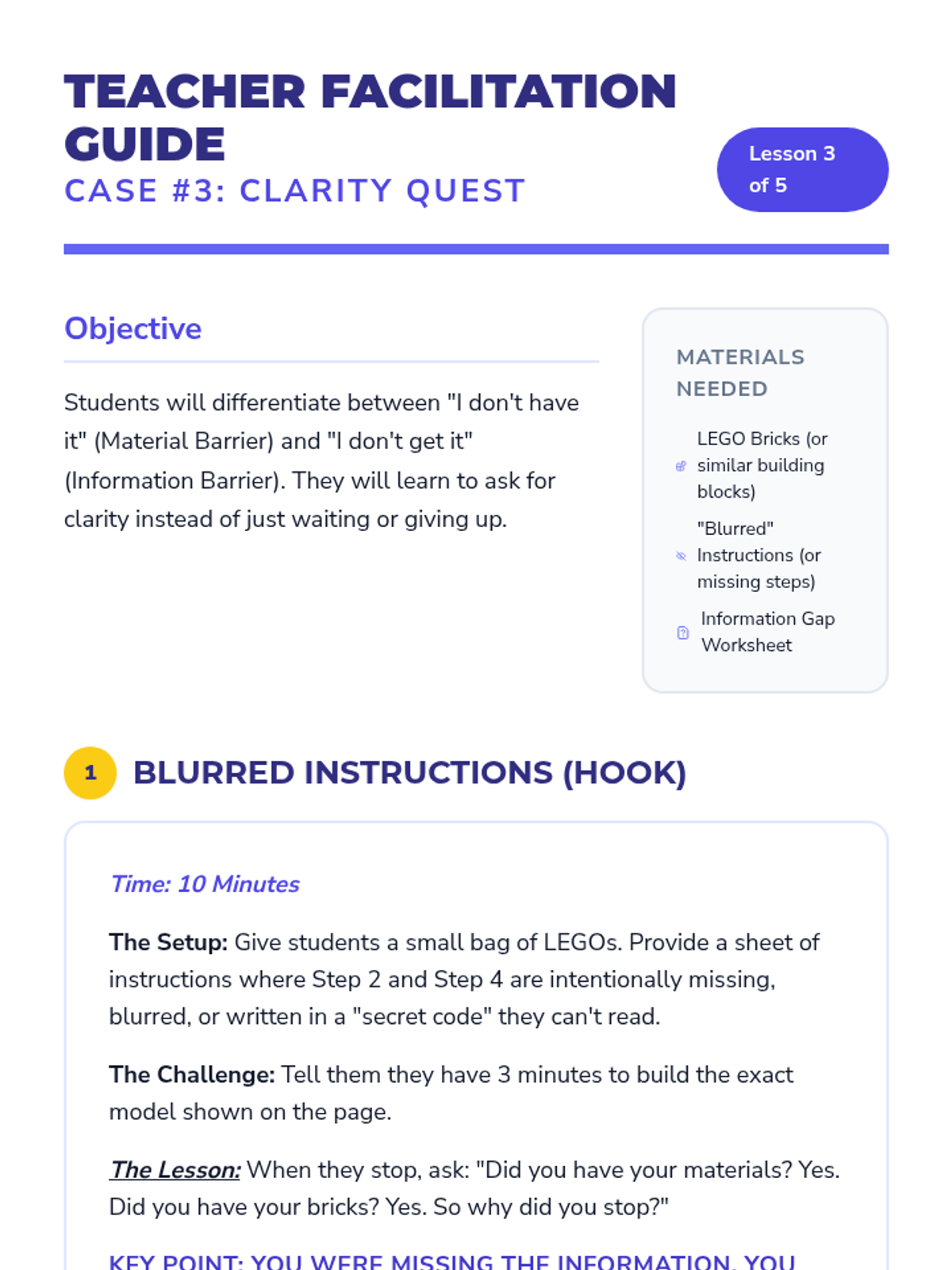
A teacher guide for Lesson 3, including instructions for the LEGO hook and advocacy scripting for students.
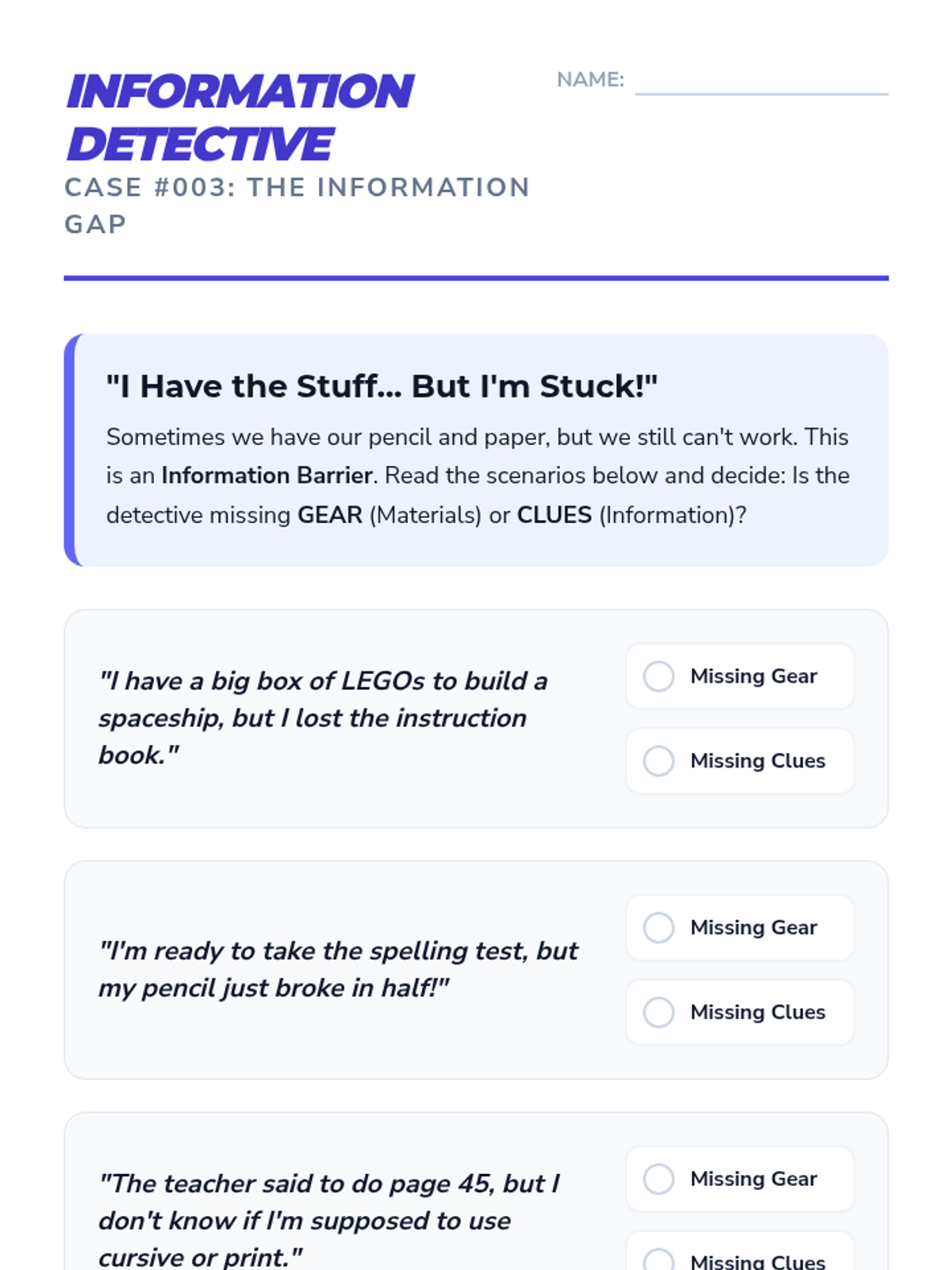
A worksheet for students to identify and differentiate between material barriers and information barriers in various classroom scenarios.
A slide deck teaching students how to identify information and clarity barriers, differentiating between 'I don't have it' and 'I don't get it.'
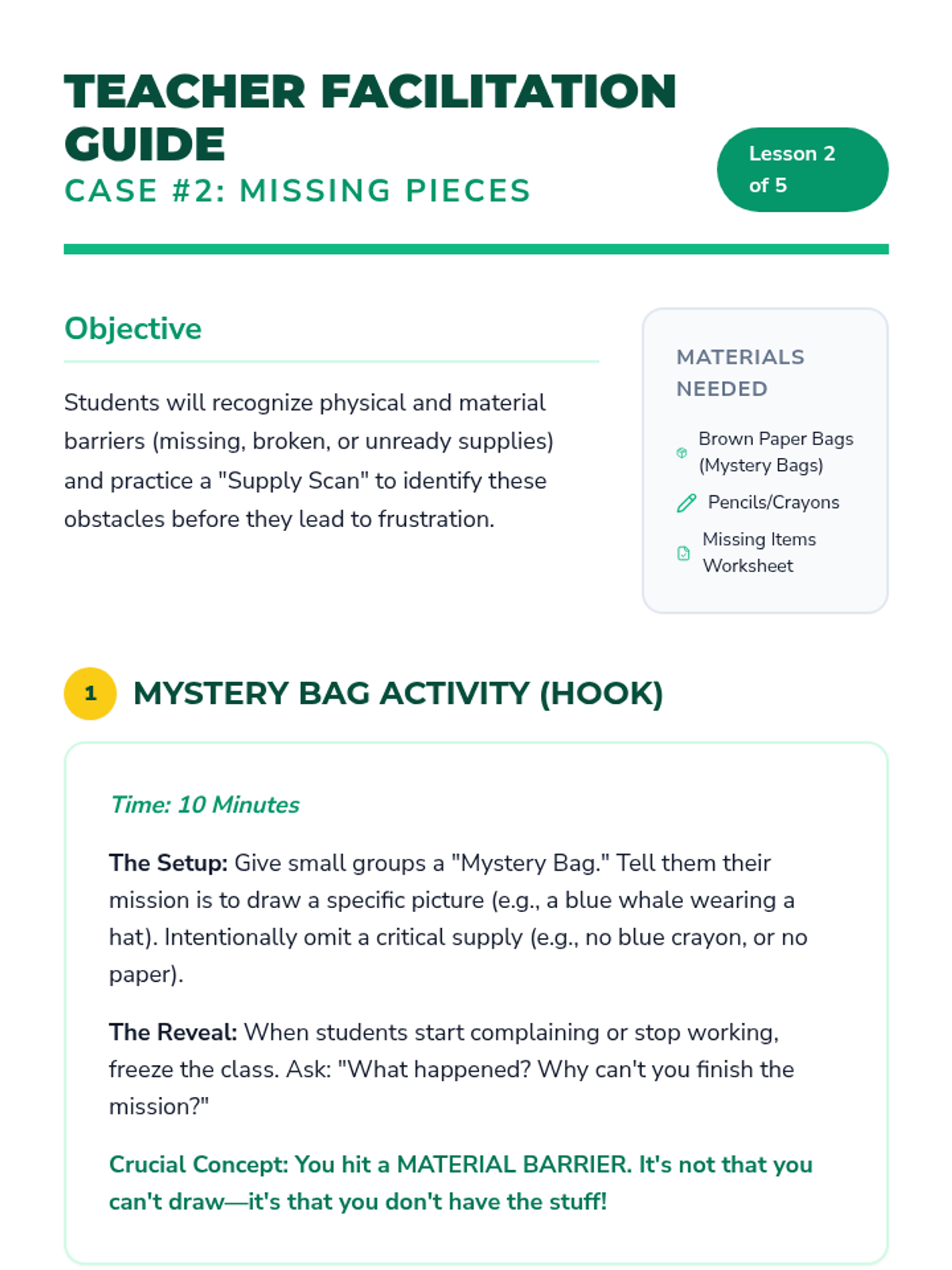
A teacher guide for Lesson 2, including instructions for the 'Mystery Bag' hook and how to facilitate a 'Supply Scan' in the classroom.
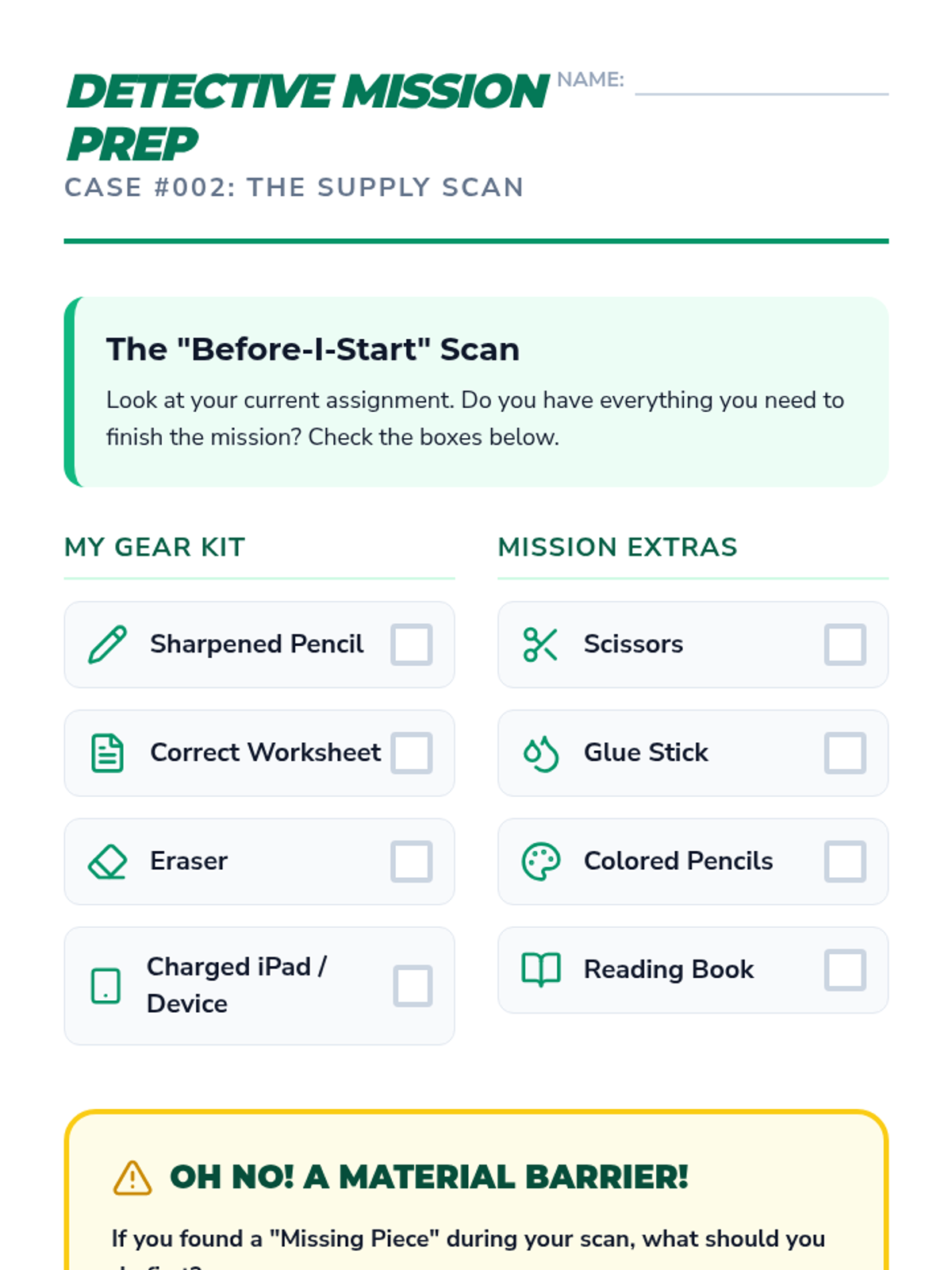
A worksheet for students to perform a 'Supply Scan' and identify physical materials needed for their tasks.
A slide deck teaching students about physical and material barriers, introducing the 'Supply Scan' technique.
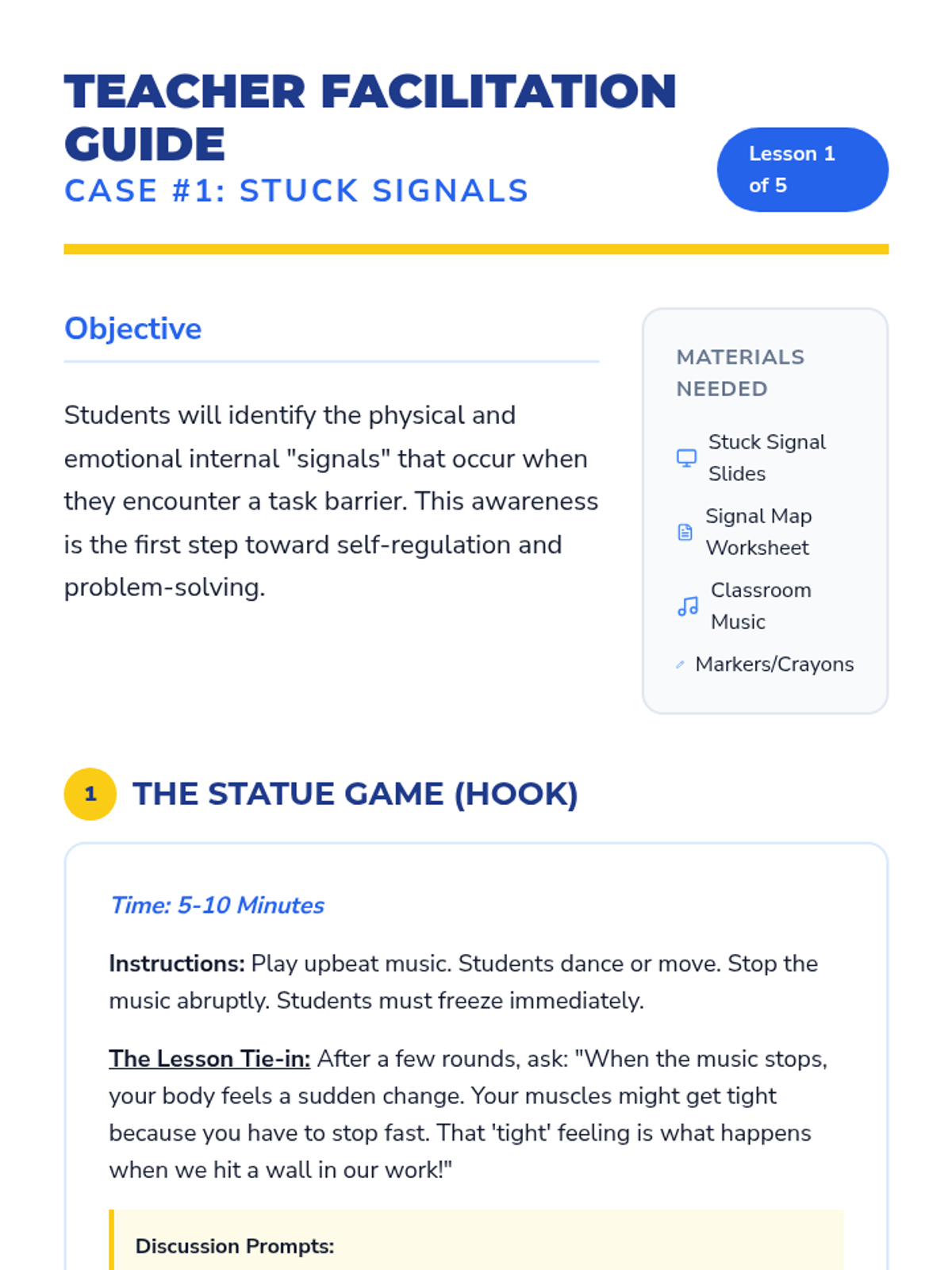
A teacher facilitation guide for Lesson 1, including instructions for the Statue Game hook and the Body Mapping core activity.
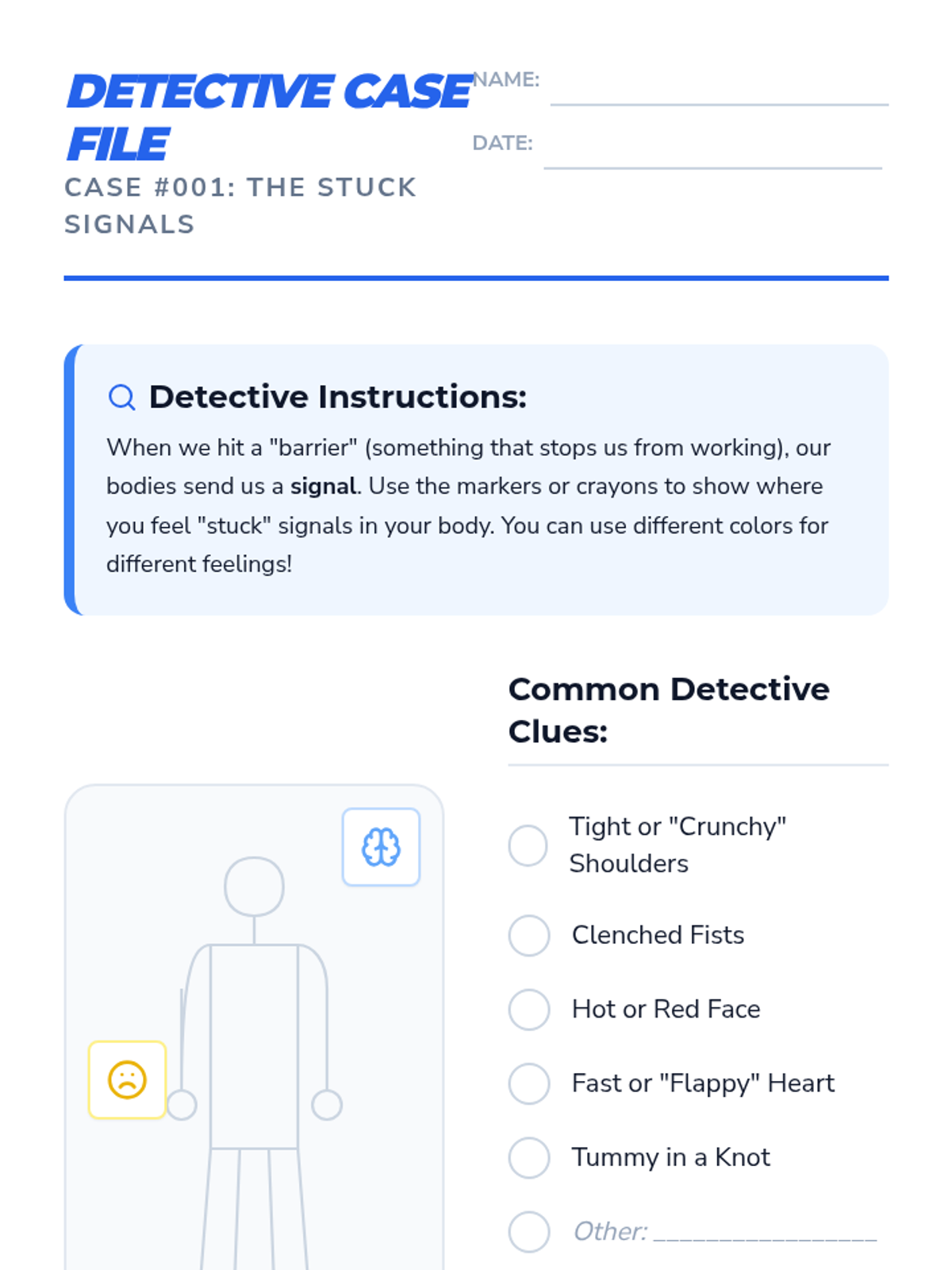
A worksheet for students to identify and map the physical signals of frustration and being 'stuck' in their own bodies.
An introductory slide deck for the 'Stuck Signals' lesson, using a Task Detective theme to help students recognize the physical and emotional sensations of being stuck.
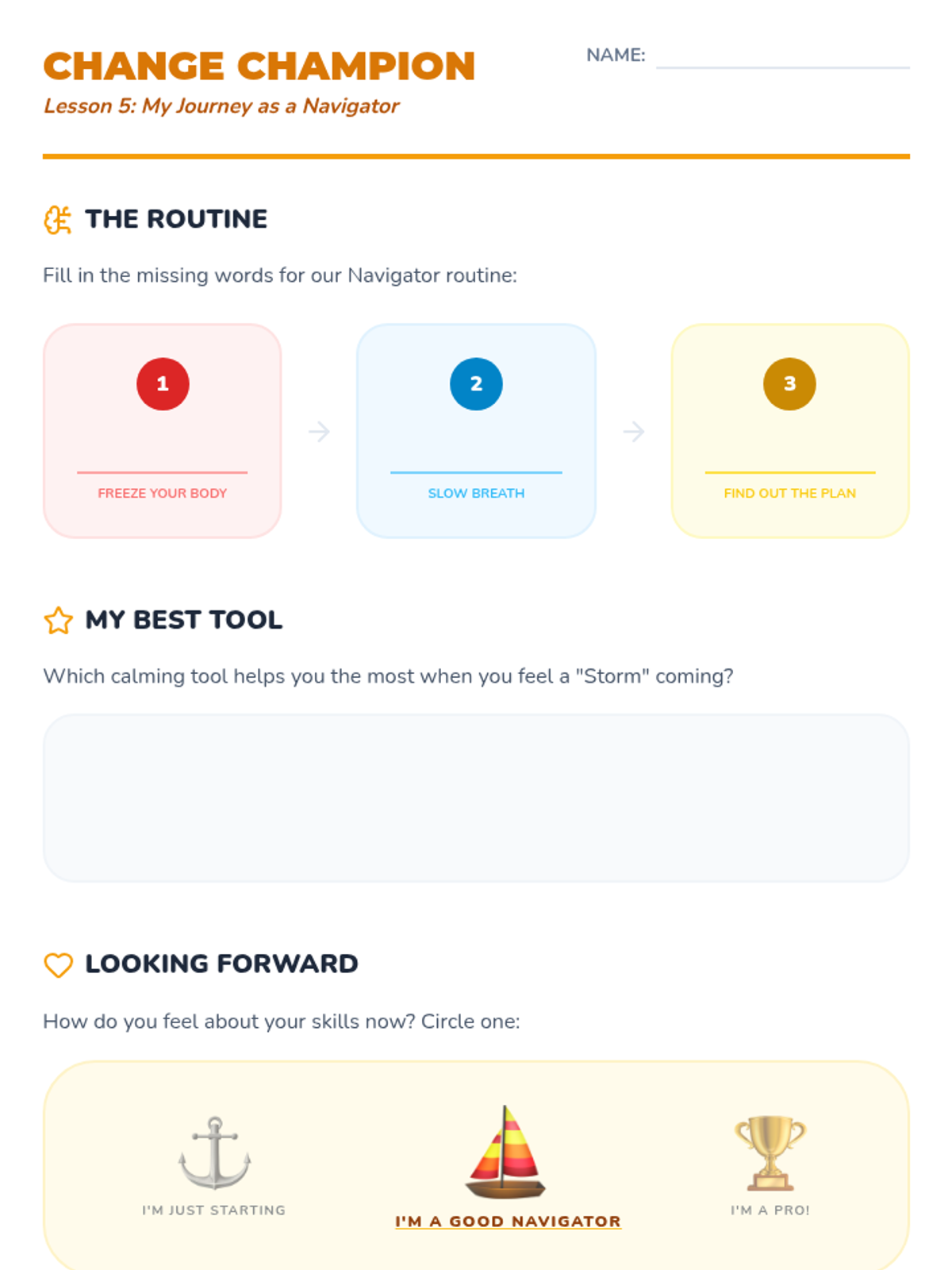
Final reflection worksheet for students to summarize their learning on identifying emotions, using calming strategies, and following the 'Stop, Breathe, Ask' routine.
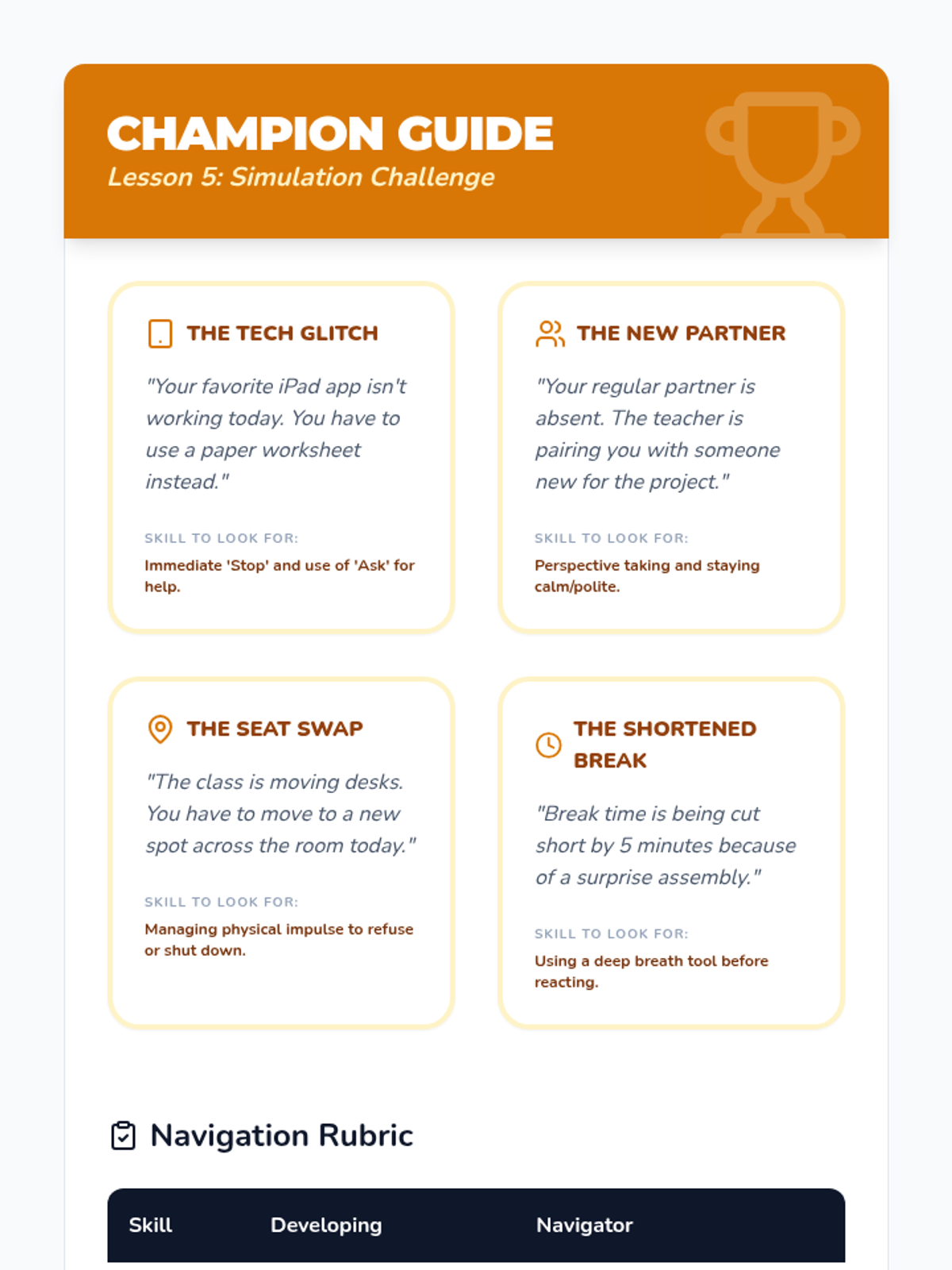
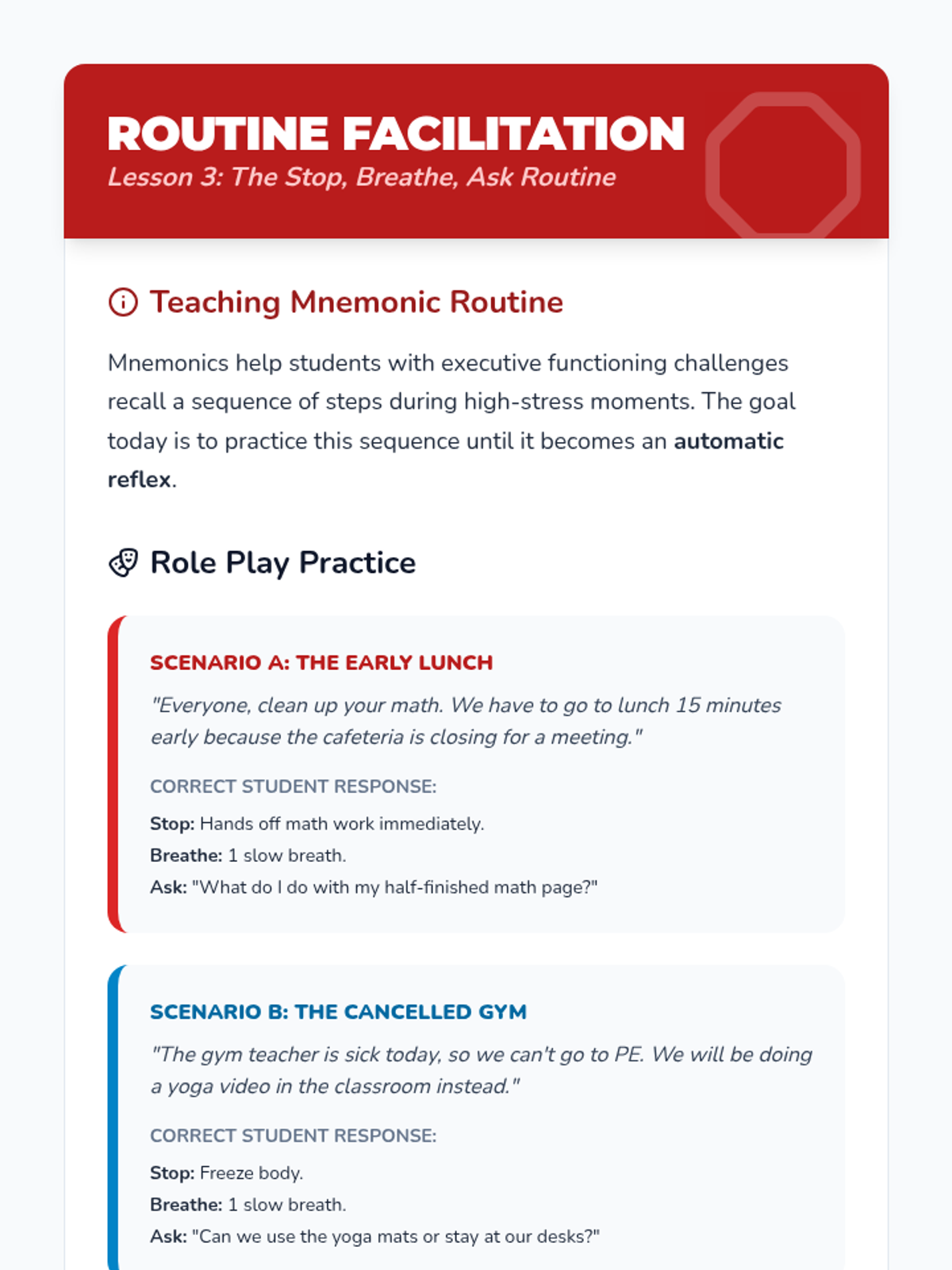
Facilitation guide for teachers to lead role-play exercises for the Stop, Breathe, Ask routine, including scenarios and observation checklists.
Final presentation for the simulation activity, reviewing all learned skills and introducing the 'Wheel of Change' game.
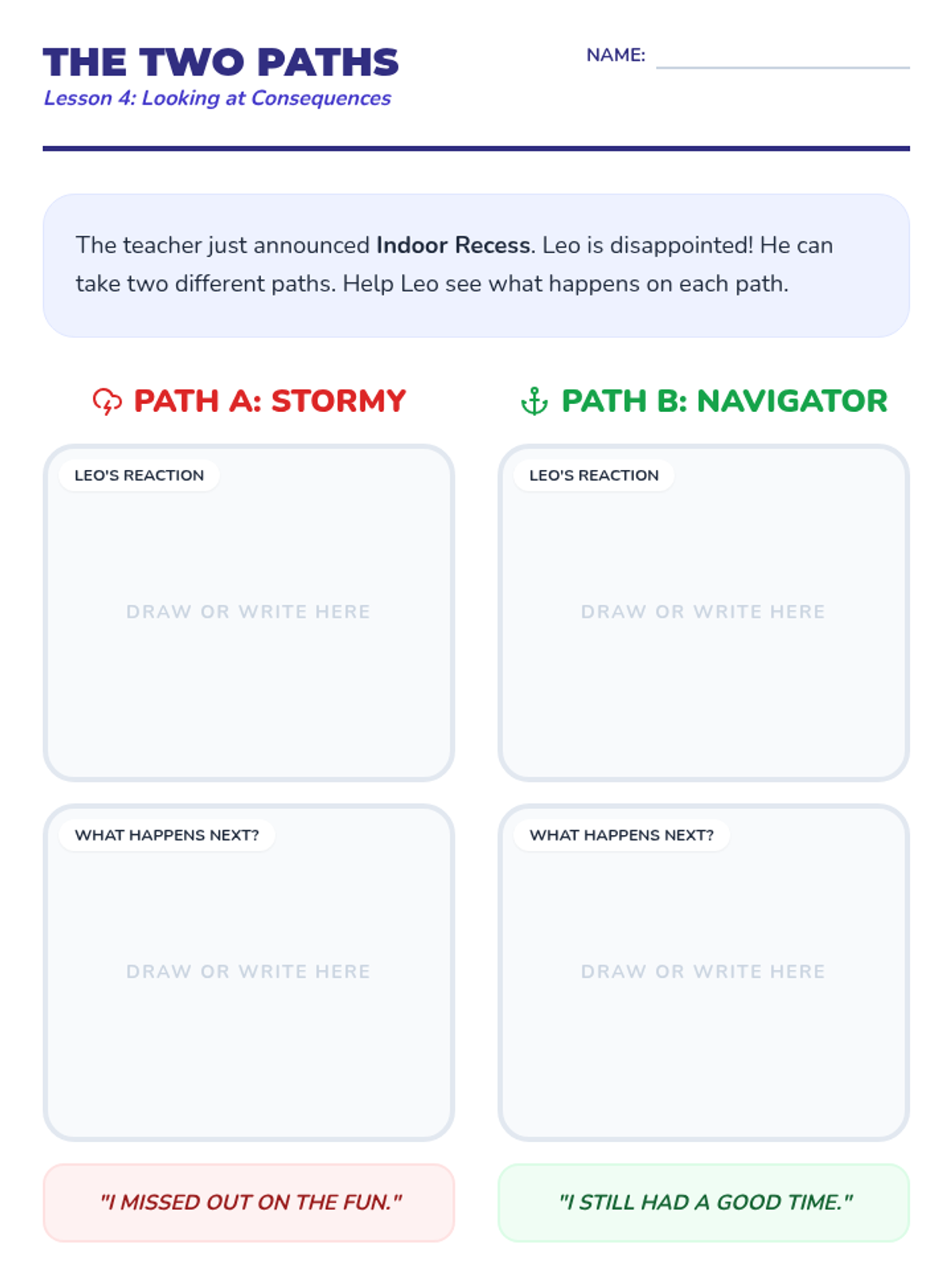
Student activity sheet for comparing the emotional and social outcomes of two different reactions to the 'Rainy Recess' scenario.
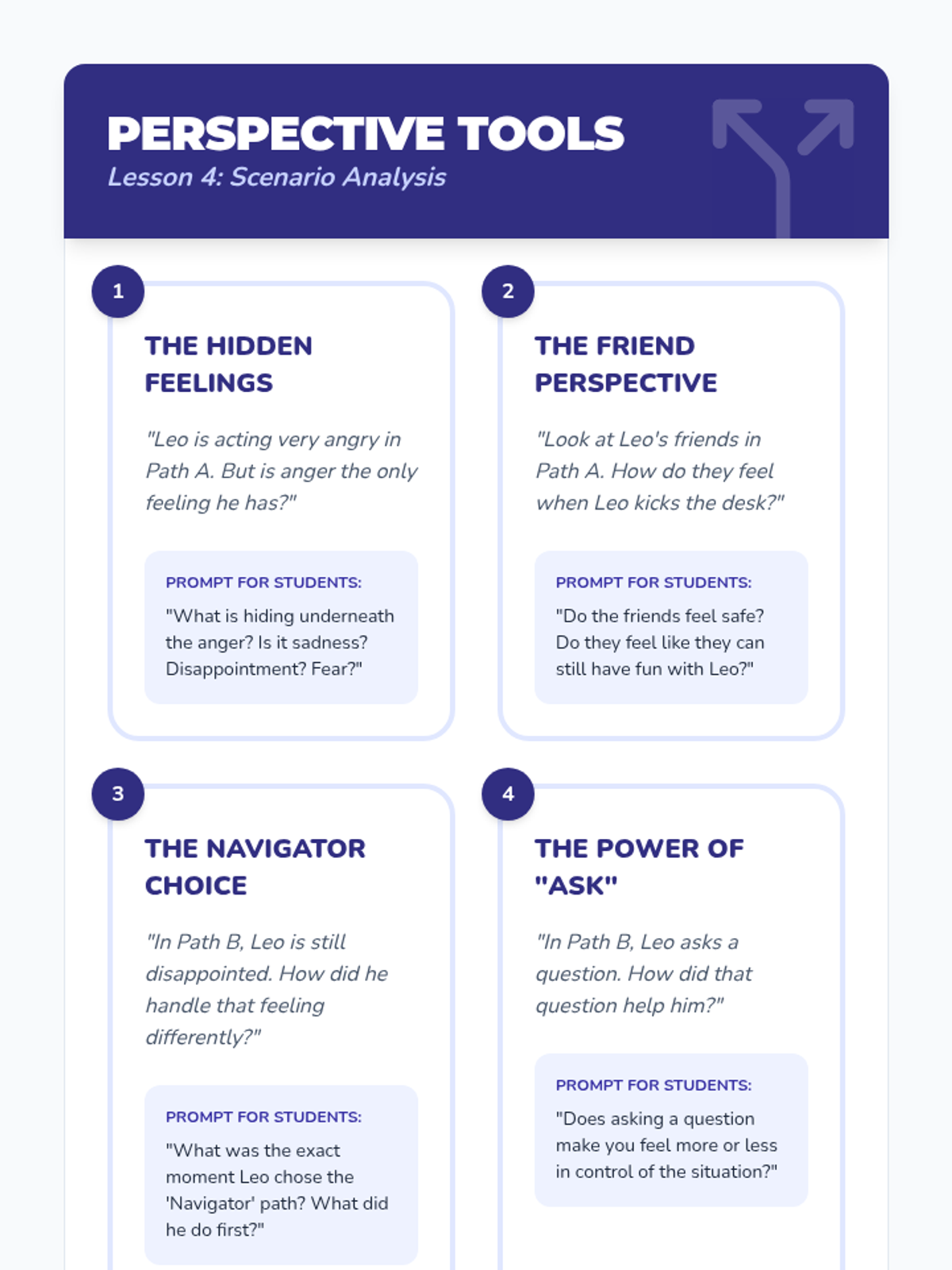
Discussion guide for teachers to help students explore perspective-taking and the consequences of different reactions to the 'Rainy Recess' scenario.
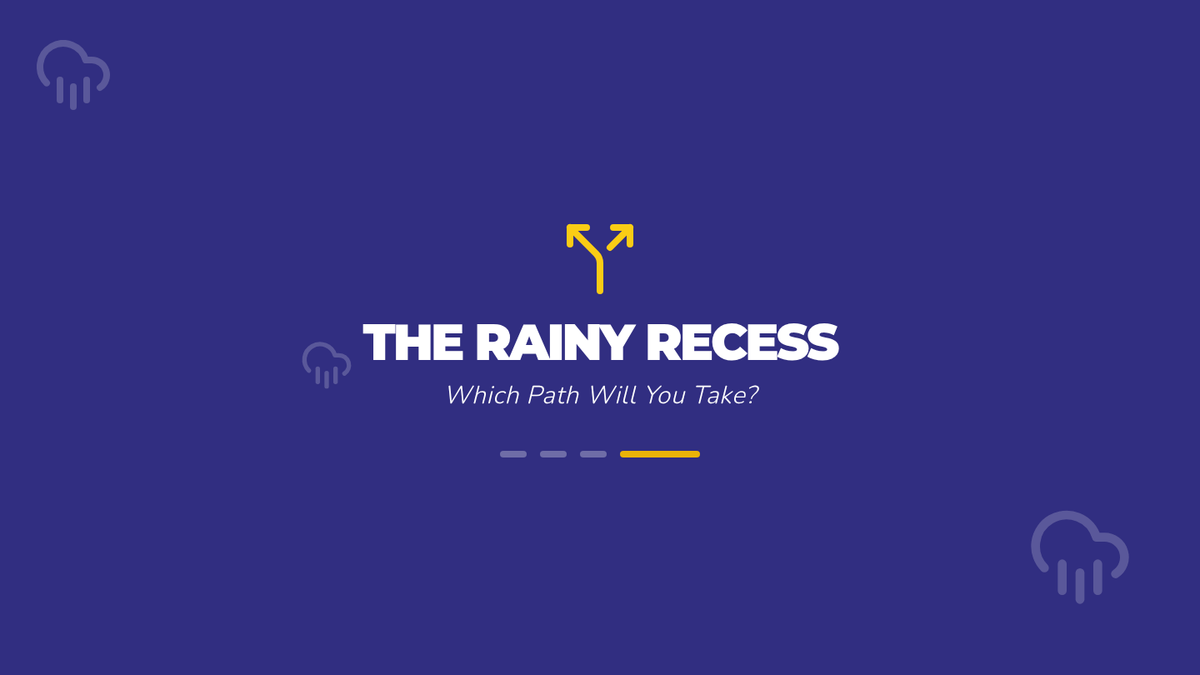
Case study slides exploring the 'Rainy Recess' scenario, comparing a dysregulated reaction versus a regulated 'Navigator' response.
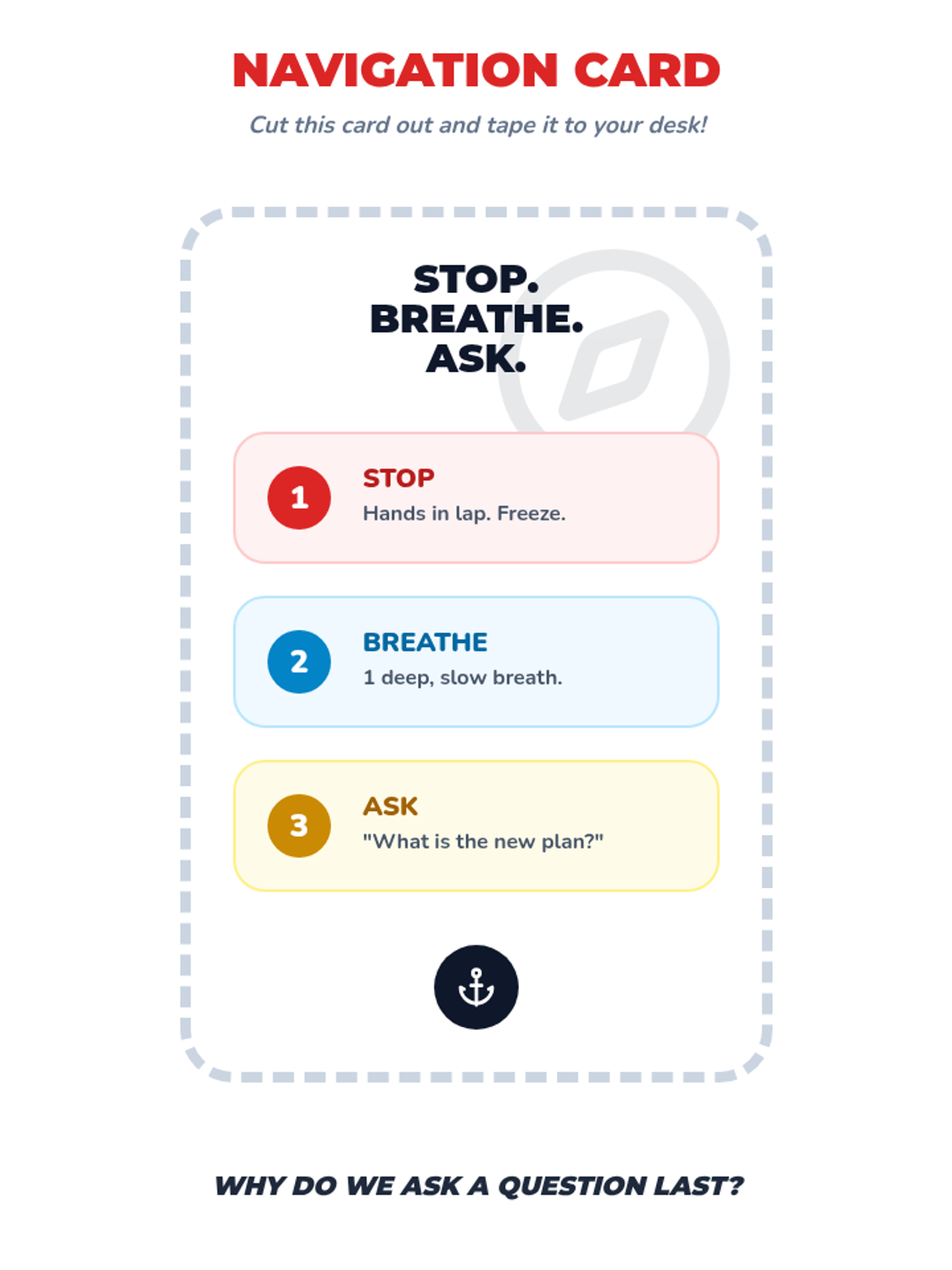
A portable reference card for students featuring the Stop, Breathe, Ask routine to be used during unexpected changes.
Instructional slides for the Stop, Breathe, Ask routine, breaking down each step with visuals and practice prompts.
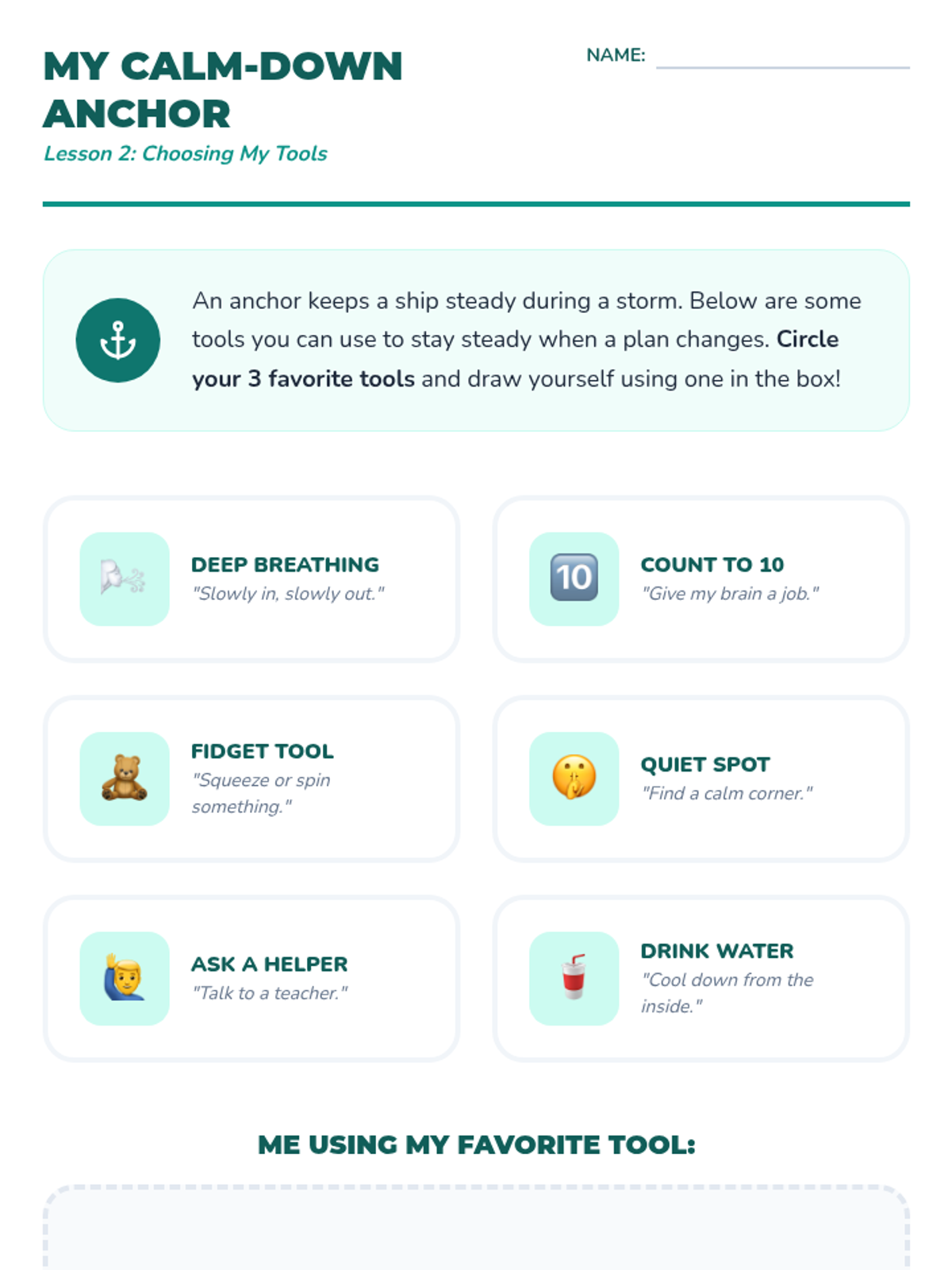
Student activity sheet for selecting personal calming strategies and visualizing their use.
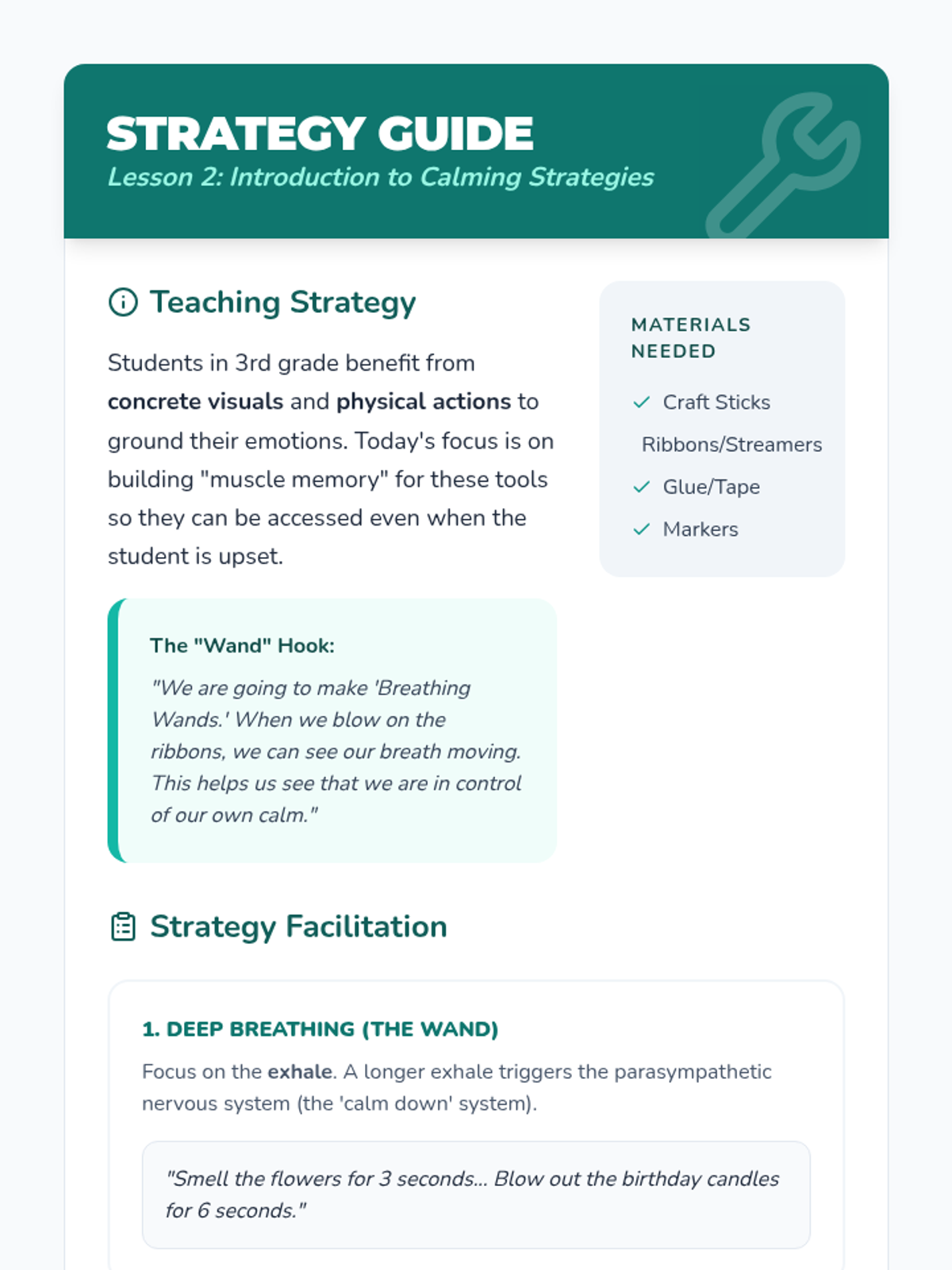
Facilitation guide for teachers focused on introducing and practicing deep breathing, counting, and grounding strategies with students.
Nautical-themed presentation introducing various calming strategies like deep breathing and counting to ten for self-regulation.
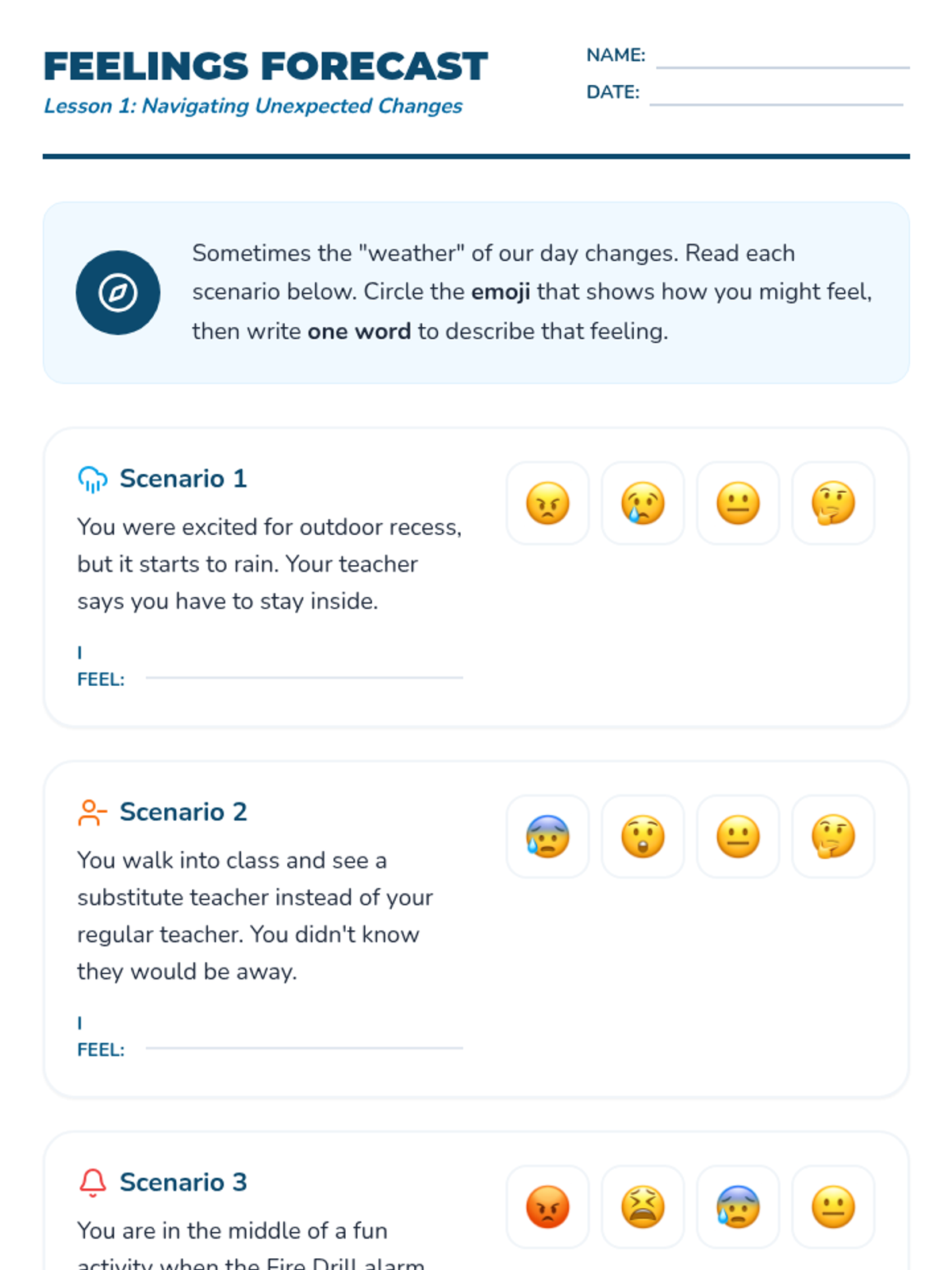
Worksheet for students to identify emotions in response to three common school scenarios involving unexpected changes.
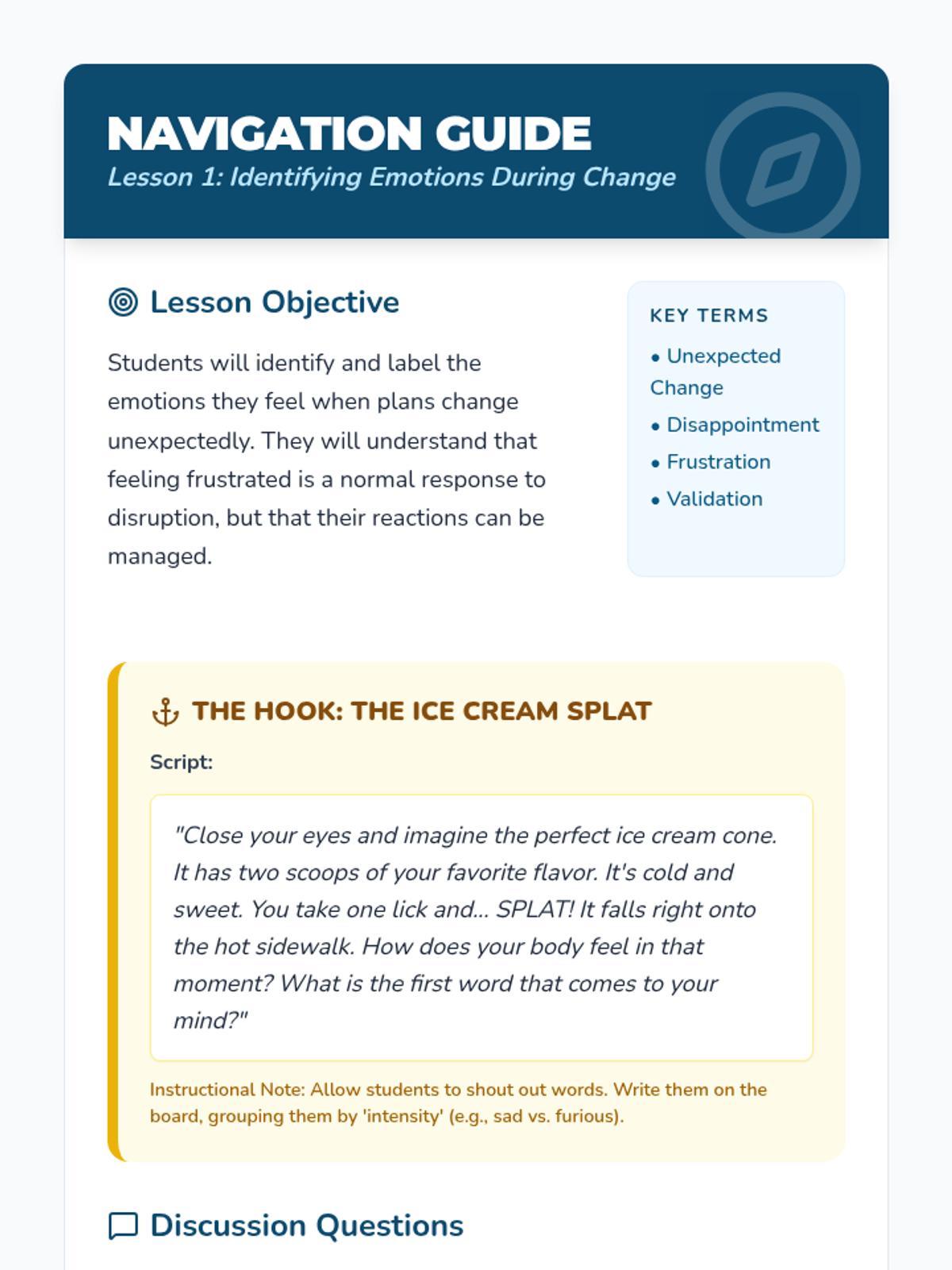
Facilitation guide for teachers including the ice cream hook script, discussion questions, and nautical metaphors for lesson 1.
Nautical-themed presentation introducing the concept of plan changes and the emotions associated with them for 3rd grade students.
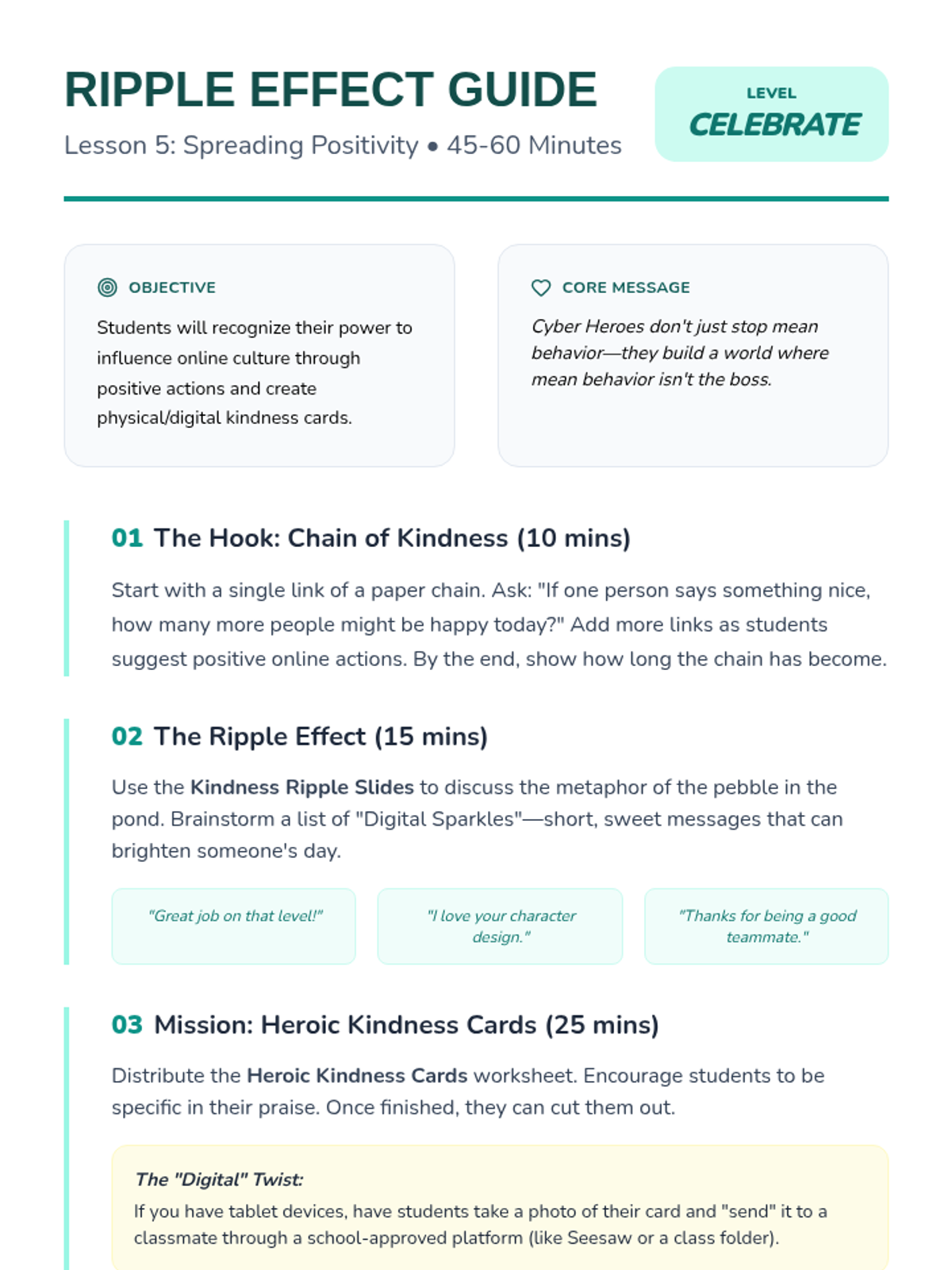
The sequence concludes with a positive project where students create digital kindness cards to promote a culture of positivity and prevent bullying.
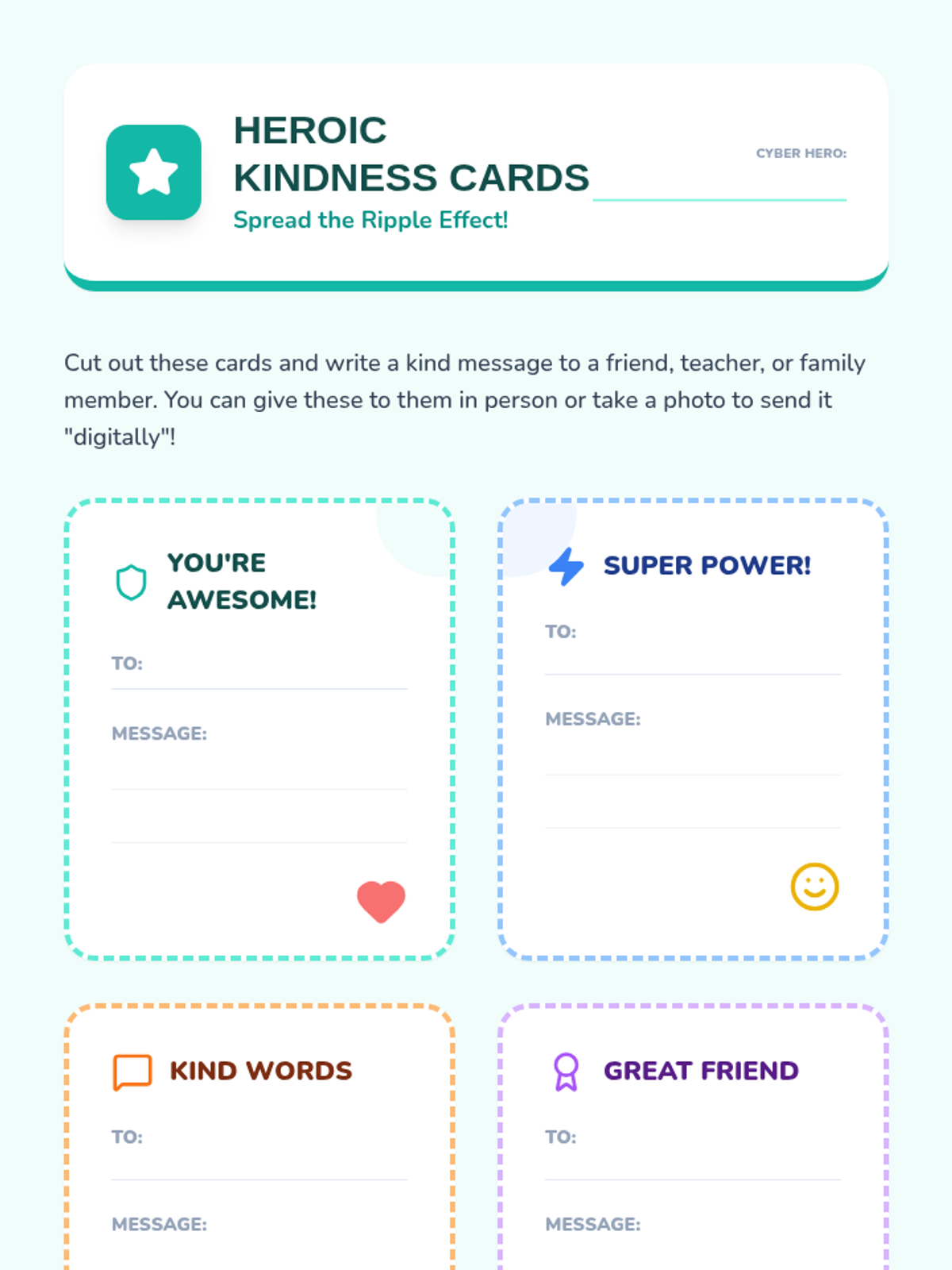
Student activity sheet for Lesson 5: Promoting Online Kindness. Contains four themed 'Kindness Cards' for students to customize and share.
Introductory slide deck for Lesson 5: Promoting Online Kindness. Focuses on the positive impact of kind messages and how to be a 'light' in digital spaces.
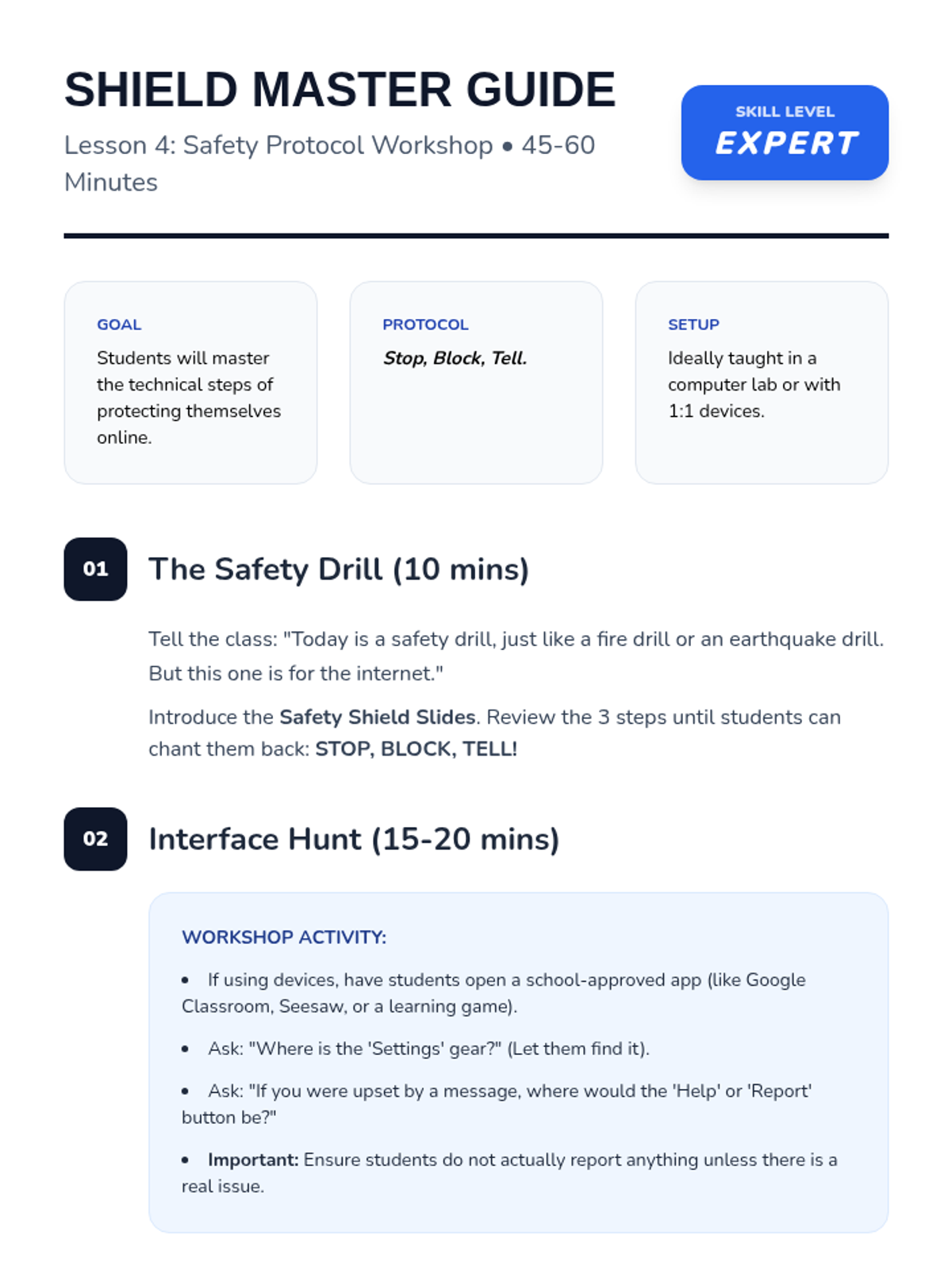
Teacher guide for Lesson 4: Safety Shield Protocol. Includes instructions for the technical 'Interface Hunt' and practicing the Stop, Block, Tell communication with adults.
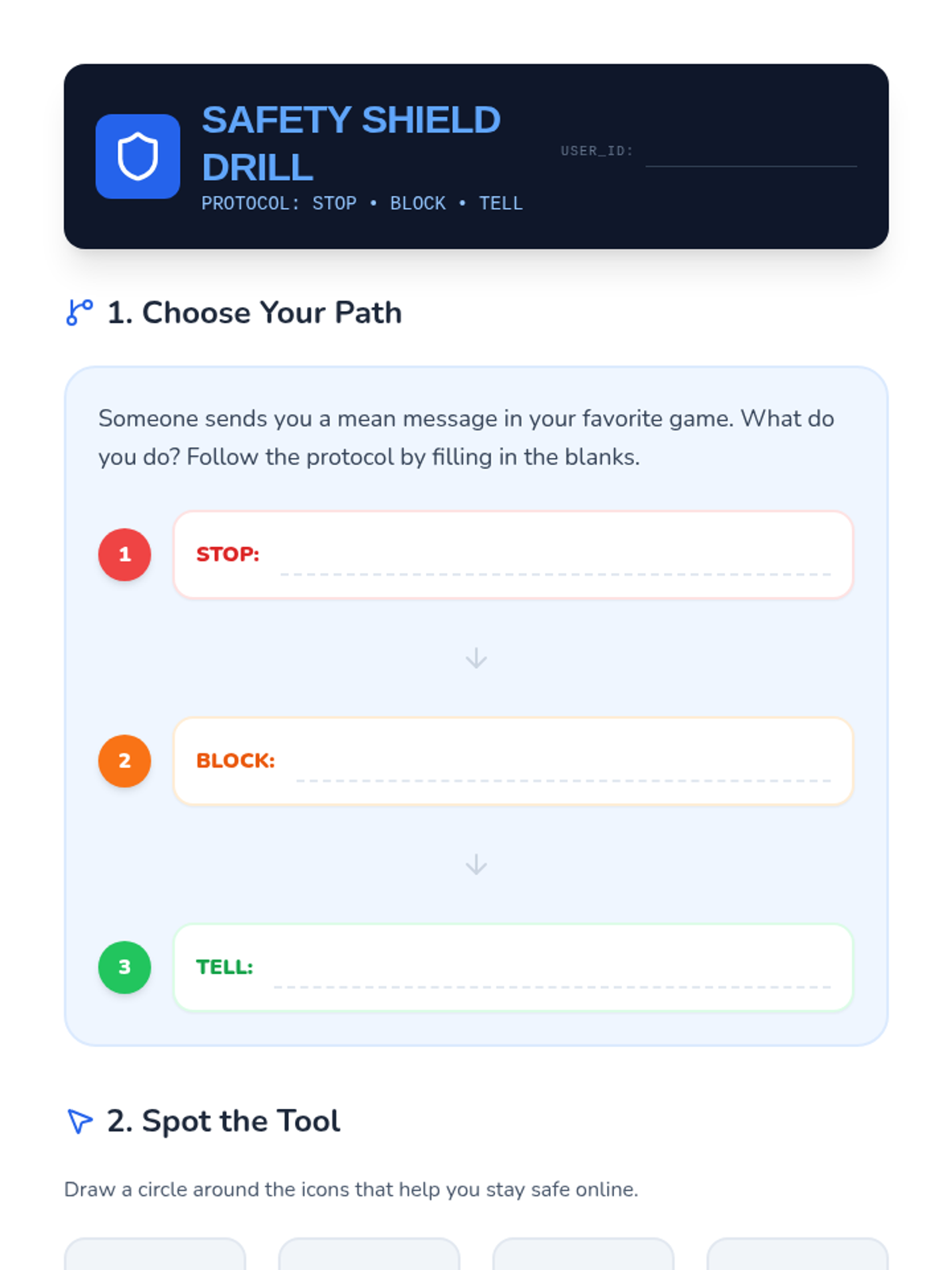
Student worksheet for Lesson 4: Safety Shield Protocol. Practical exercise for identifying reporting tools and planning the Stop, Block, Tell response.
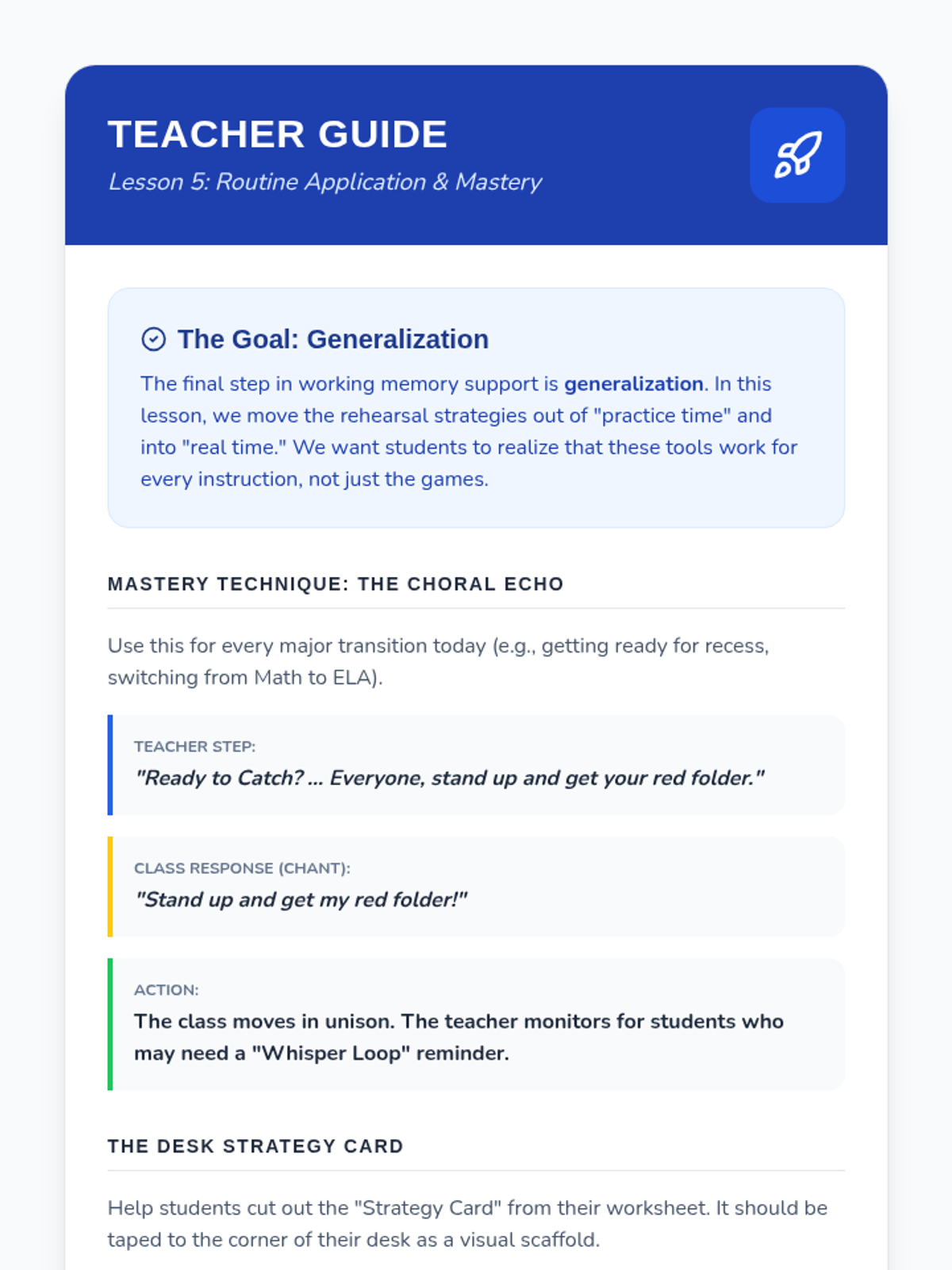
Final teacher guide for the sequence, focusing on choral response techniques, the use of desk-based strategy cards, and informal mastery assessment.
Final slides for the sequence, focusing on graduating the 'Brain Training' skills into everyday classroom routines like cleaning up and transitions.
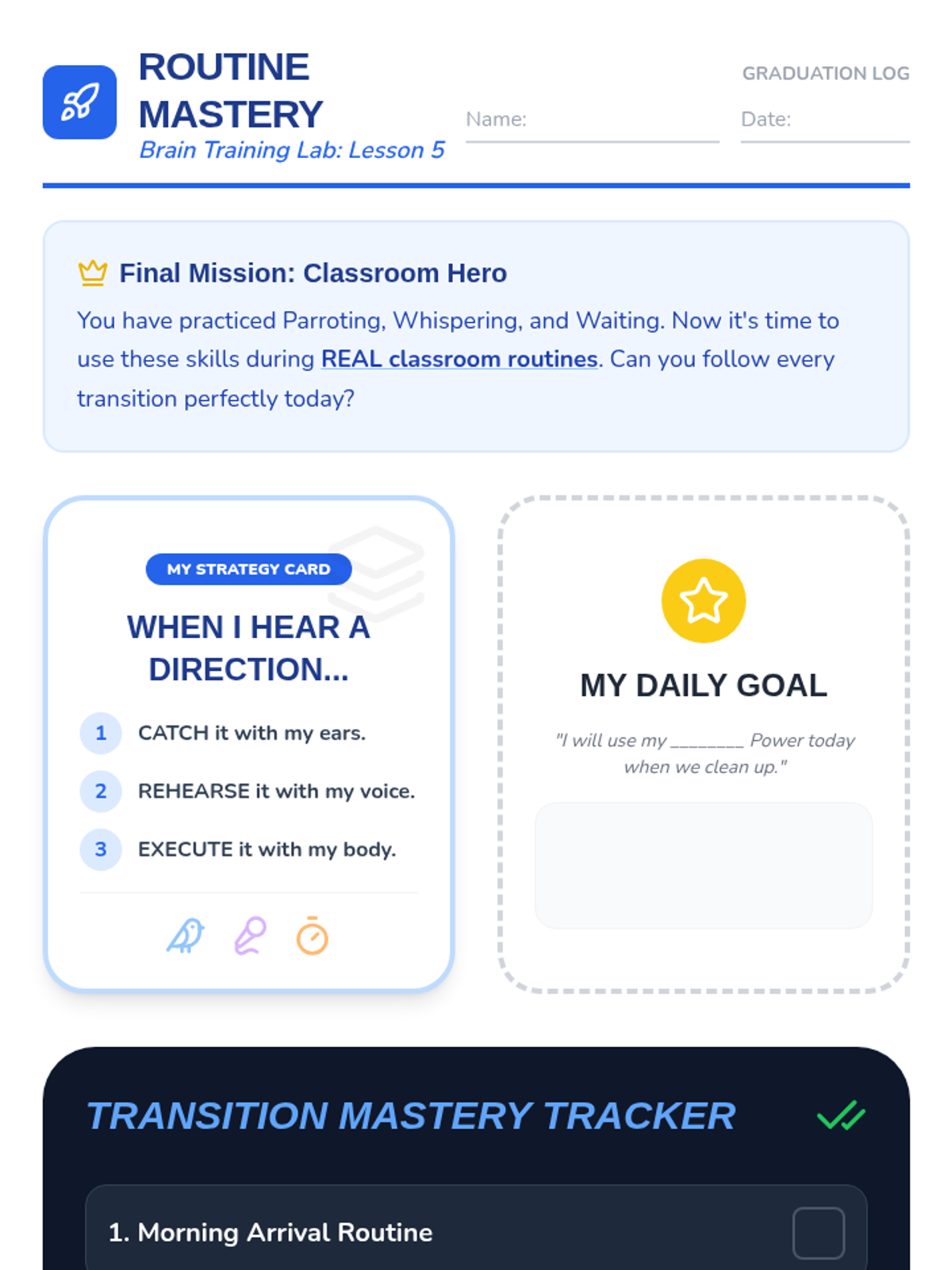
A cumulative resource for Lesson 5 including a strategy desk card and a transition mastery tracker to help students apply verbal rehearsal to real classroom routines.
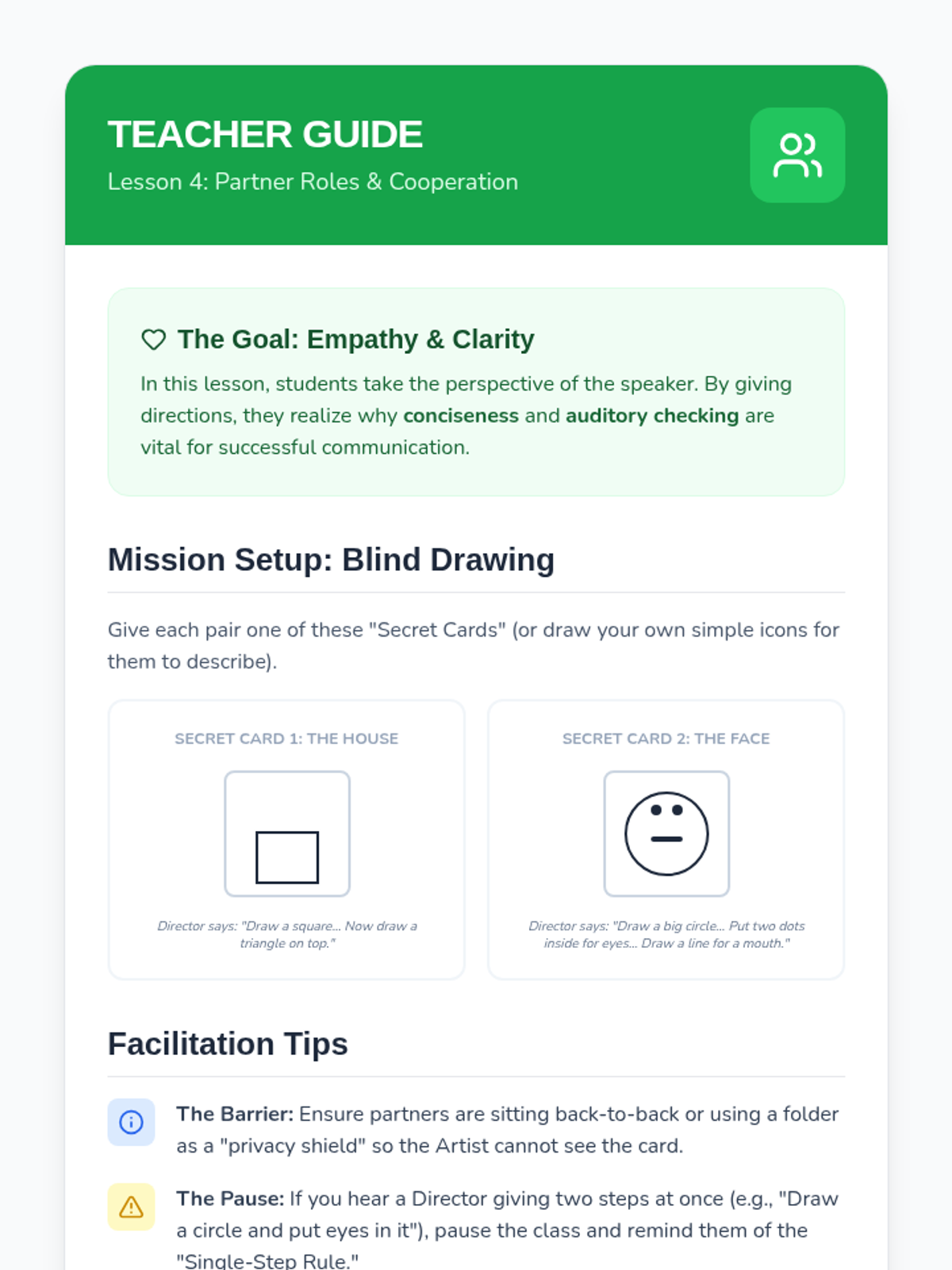
A teacher guide for Lesson 4 including secret cards for the blind drawing activity, facilitation scripts, and peer feedback prompts.
Slides for Lesson 4 facilitating a peer-to-peer communication activity. Introduces the roles of 'Director' and 'Artist' for a collaborative drawing challenge.