Active listening, assertive expression, and boundary-setting strategies for interpersonal success. Develops proficiency in conflict mediation, cooperative teamwork, and the cultivation of healthy romantic and platonic connections.
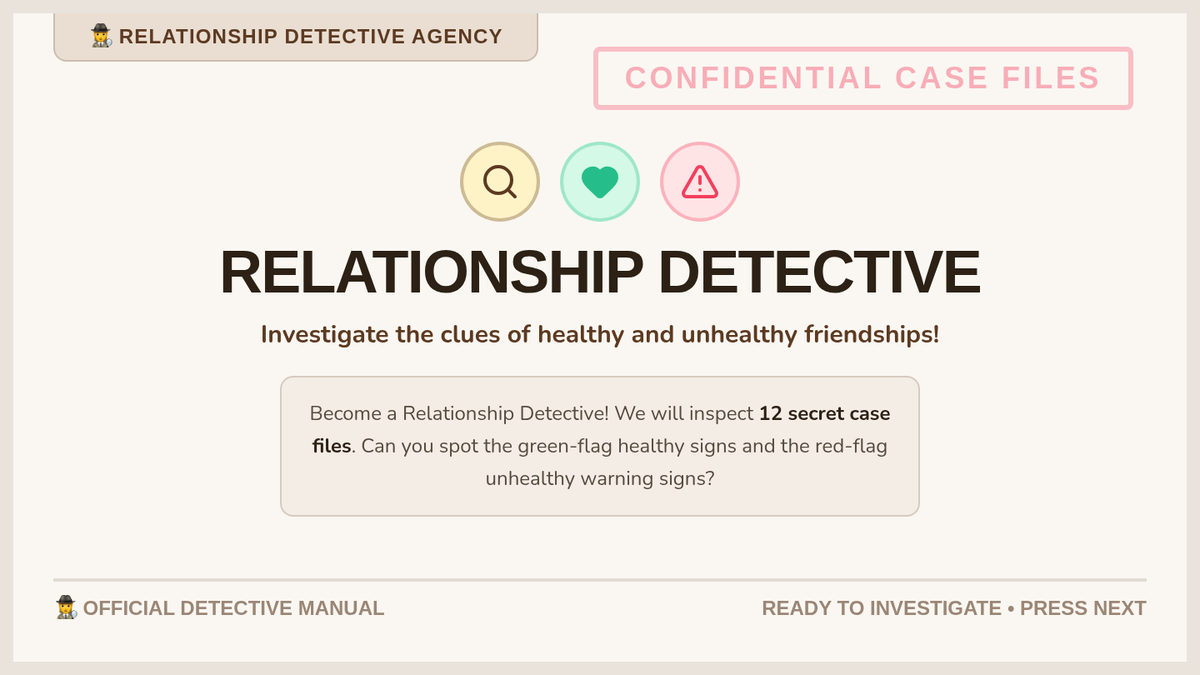
A highly visual and engaging slide deck with 25 slides. It guides students through 12 'Relationship Detective' case studies, presenting friendship behaviors and asking students to determine whether they represent healthy or unhealthy relationships. Each case file is followed by an answer slide color-coded in green (healthy) or red (unhealthy) with friendly icons and guiding text to support emerging readers.
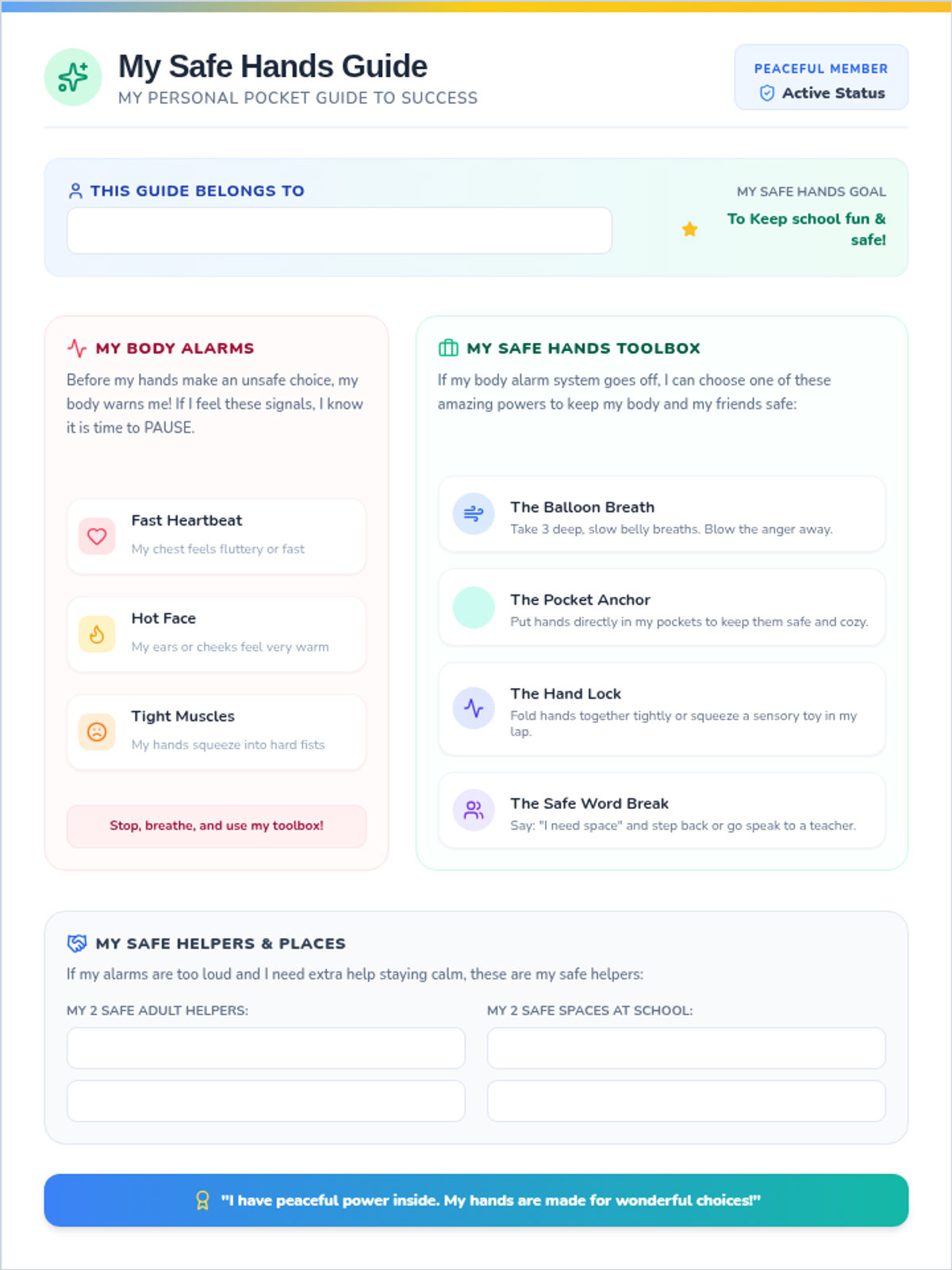
A printable, highly visual one-page student reference guide and reminder sheet. It acts as a personal pocket companion summarizing the student's personal body alarm signs, physical calm-down choices, and a personal list of trusted school allies.
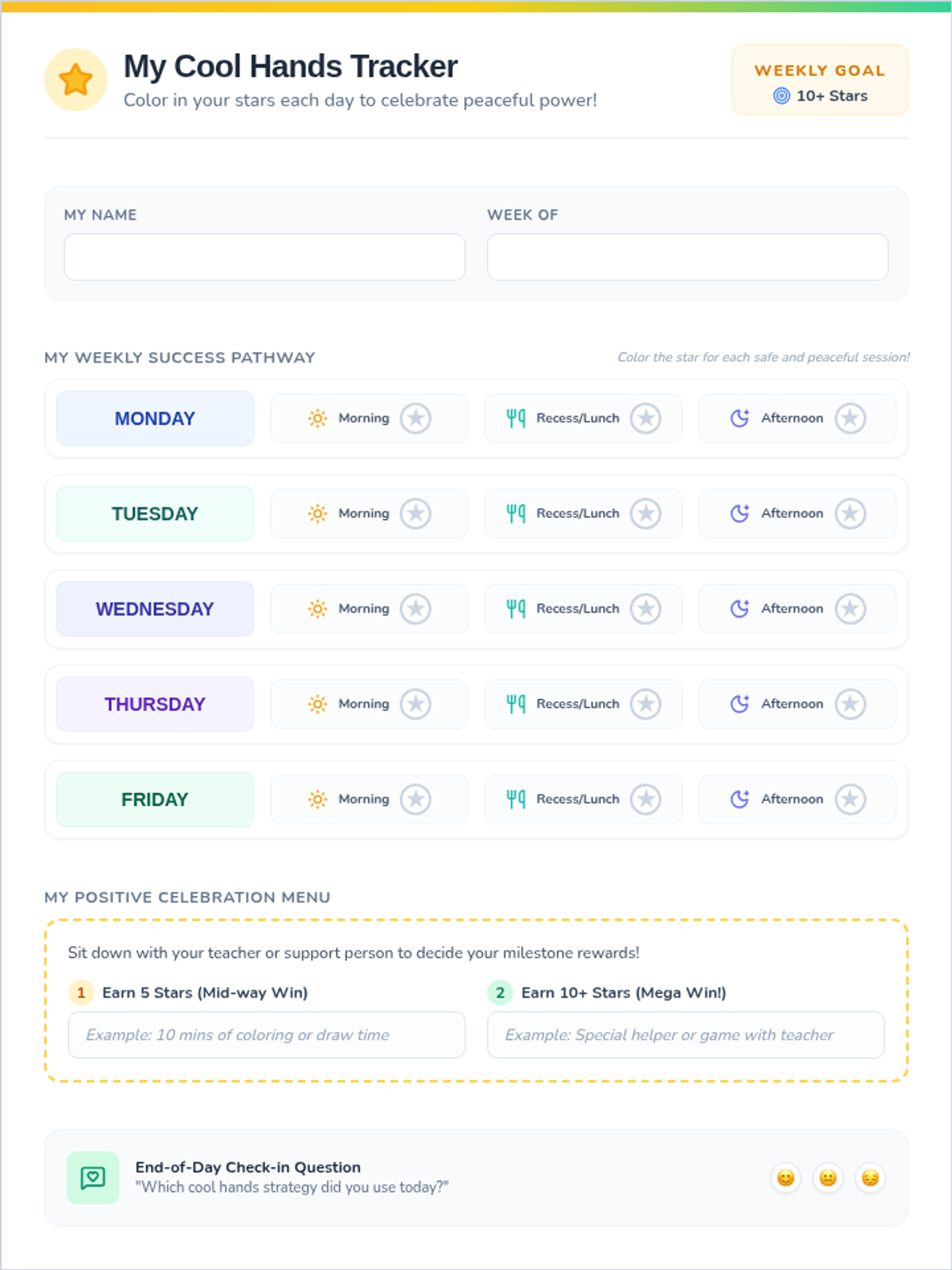
A student-friendly behavior progress tracker structured for 2nd and 3rd graders. It breaks each school day down into three manageable intervals (Morning, Midday, Afternoon) with visual coloring stars, a weekly reflection space, and a customizable positive reward menu.
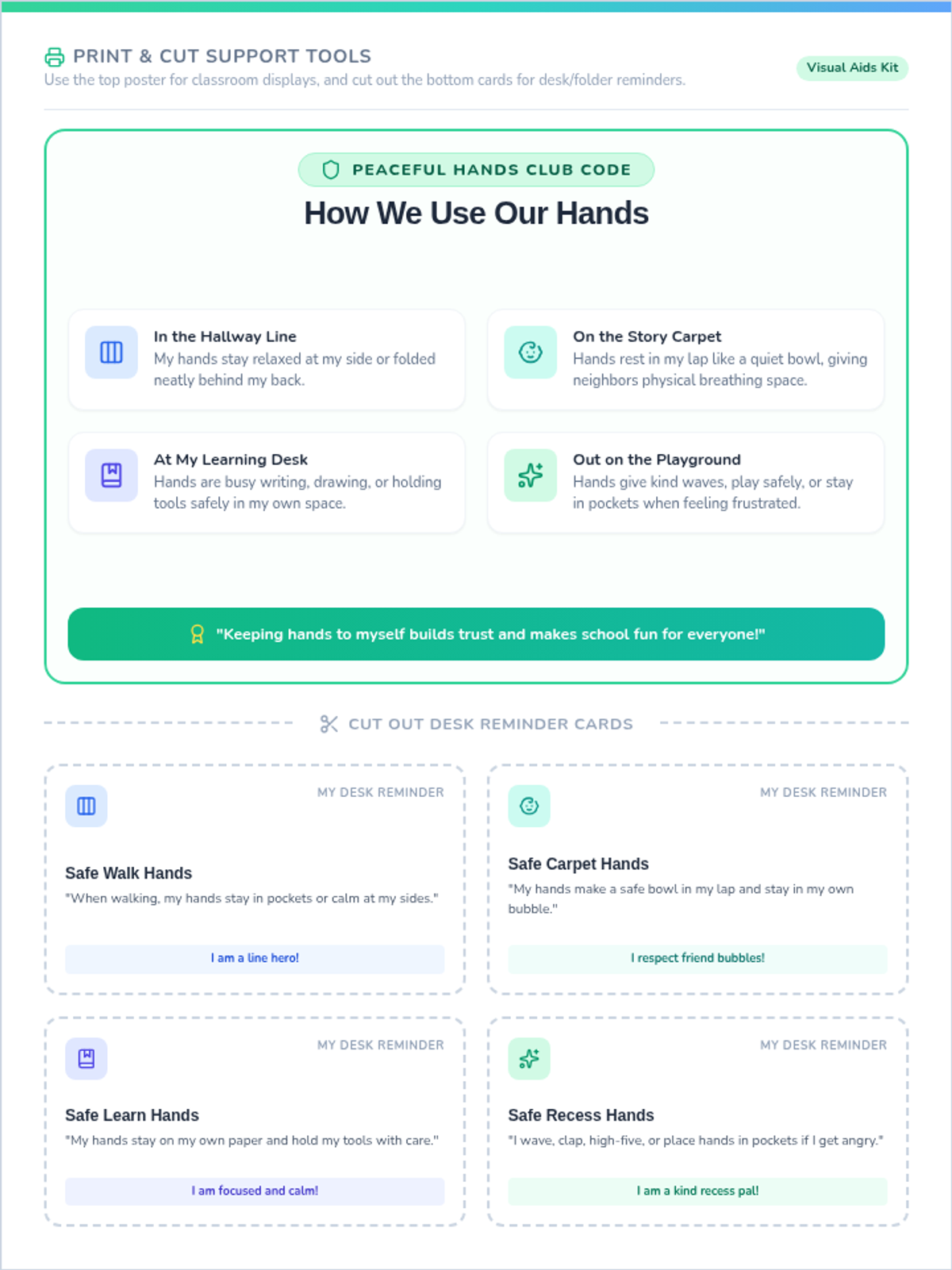
Printable anchor chart and desk reminder cards for visual reinforcement. Includes 4 cut-out mini reminders for the student's desk, folder, or notebook, depicting clear hands-to-self behavior in the hallway, carpet, desk, and playground.
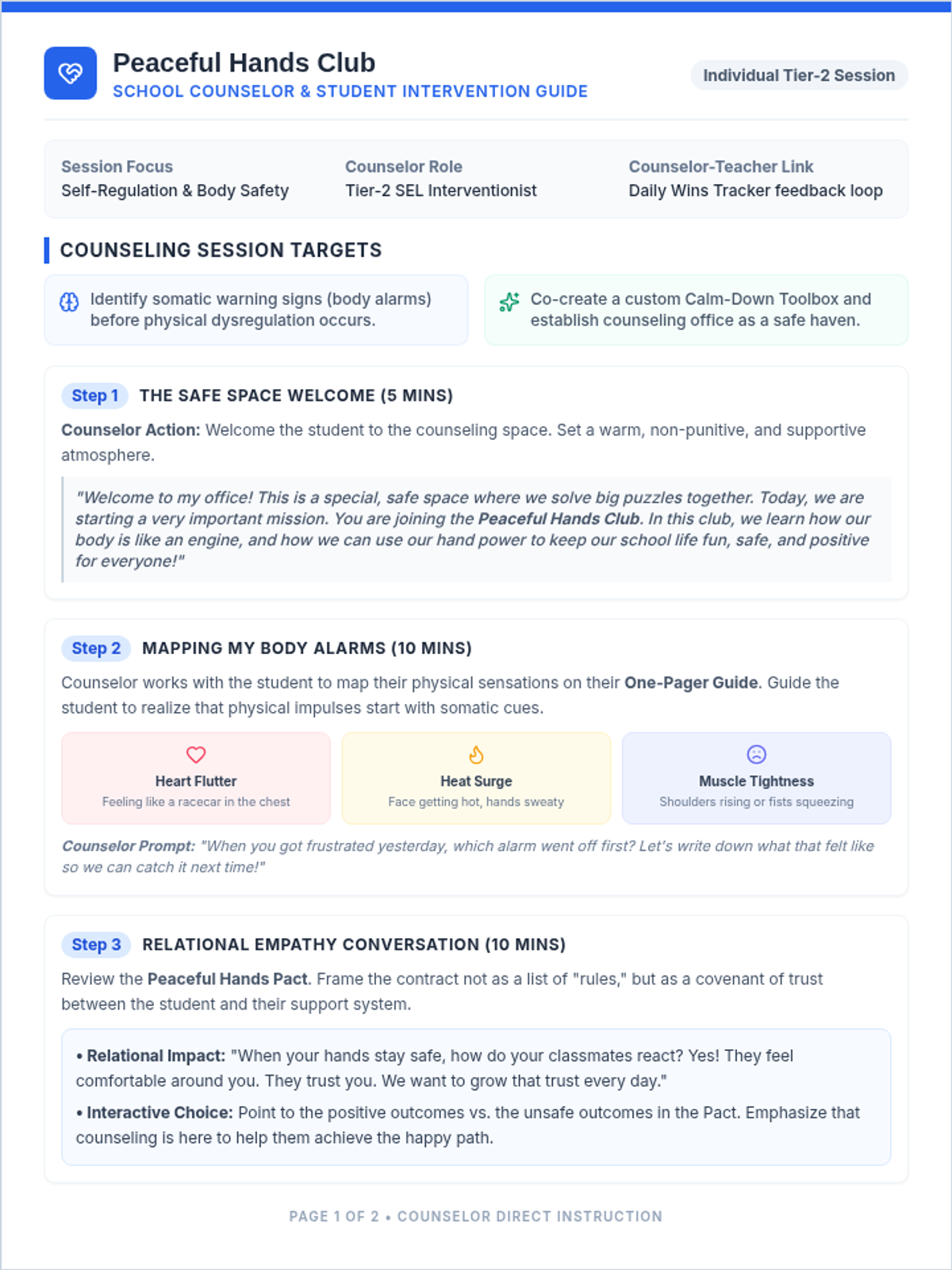
An interactive school counselor facilitation guide and lesson plan. Includes a clear step-by-step counseling intervention script, sensory self-awareness exercises, 3 scenario cards for role-playing, and counselor-teacher collaboration strategies.
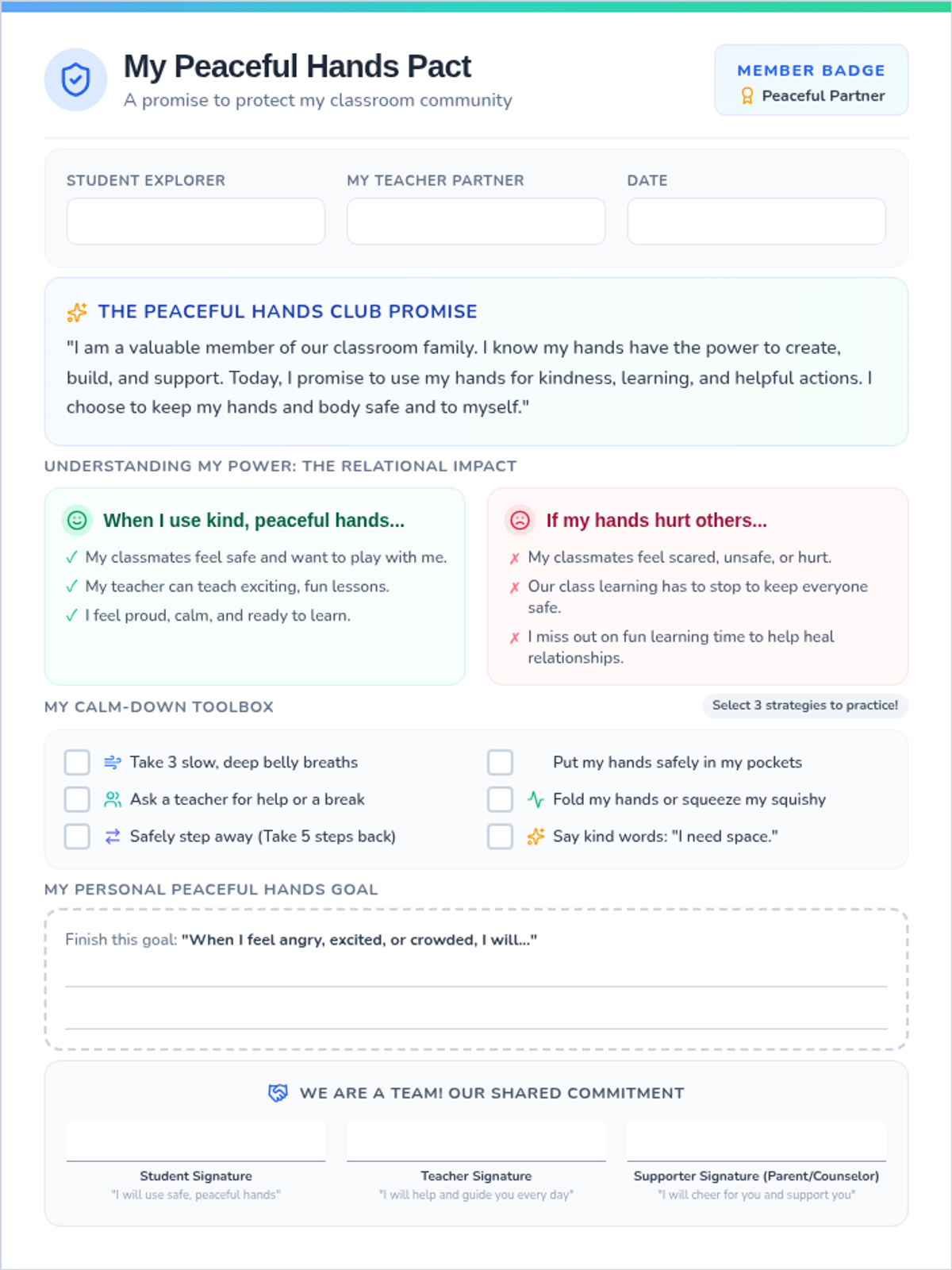
A printable, student-friendly relational behavior contract for 2nd and 3rd graders. It features clear, positive expectations, relational impact visuals, concrete calm-down strategies, and formal signature blocks for student, teacher, and parent commitment.
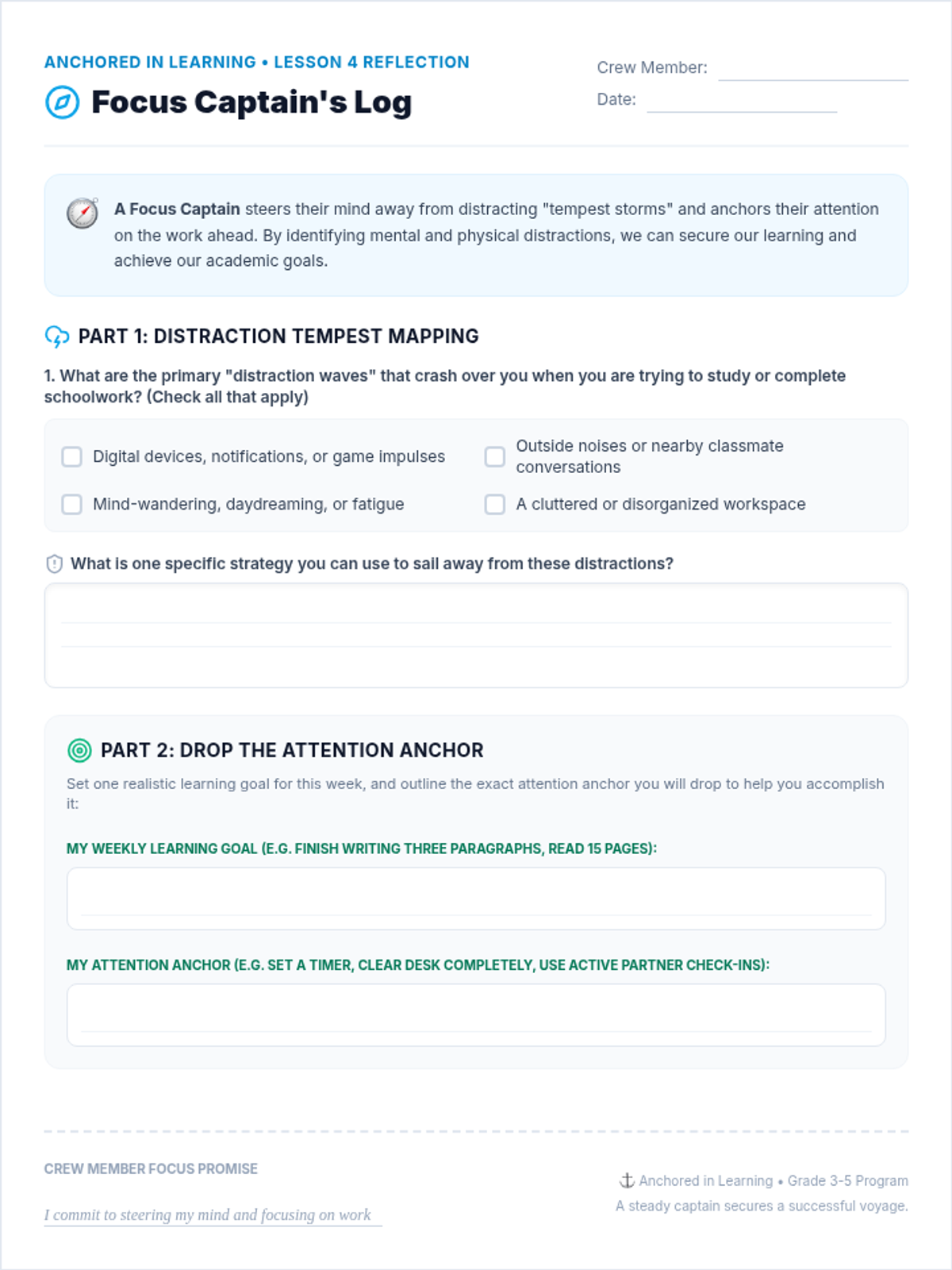
A print-ready reflective goal-setting and distraction-mapping worksheet for 3rd-5th grade students to anchor their executive attention, with 5th-grade differentiation.
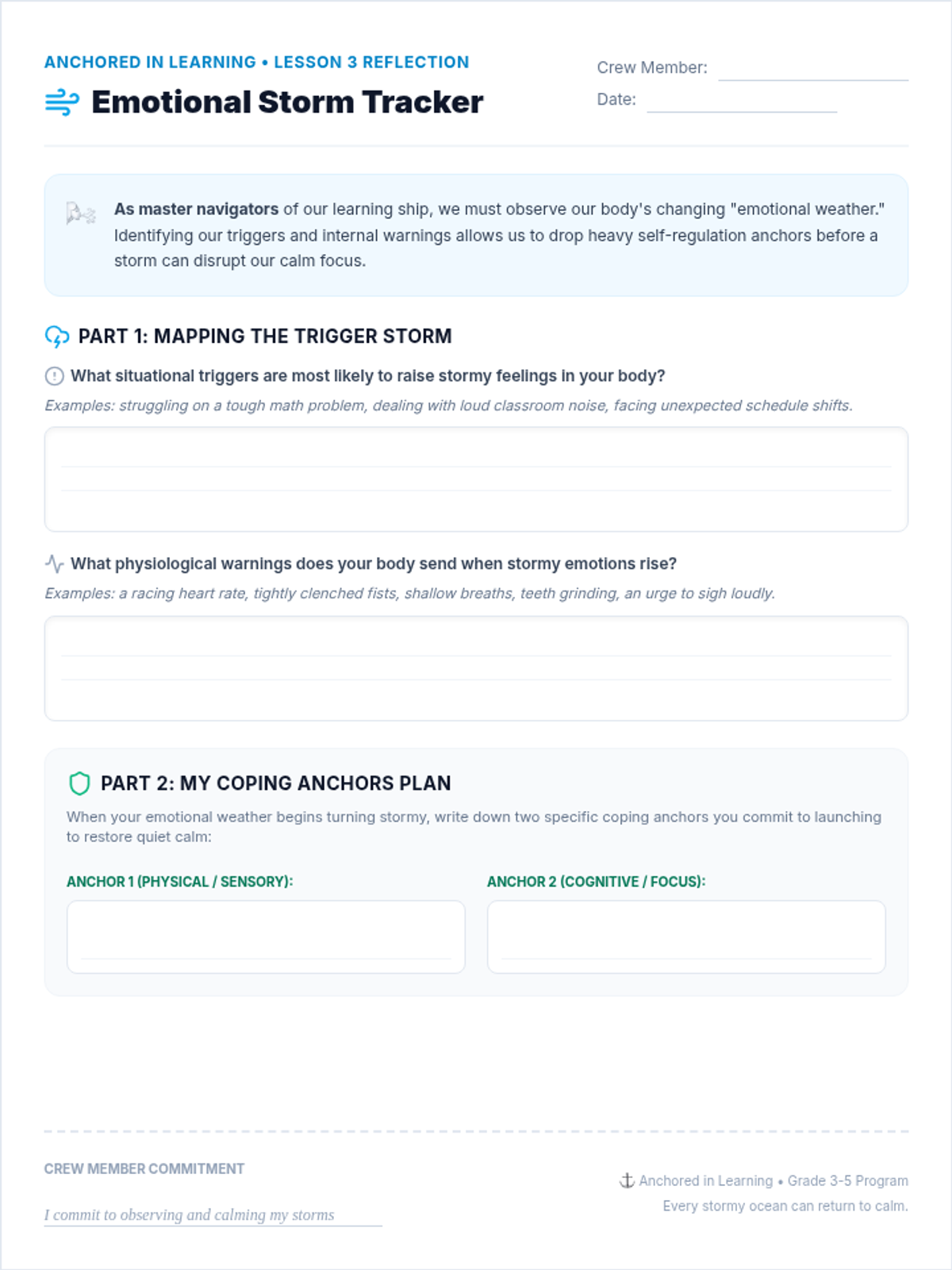
A print-ready coping anchor map and emotional trigger tracker for 3rd-5th grade students to recognize stress markers and select calming strategies, with 5th-grade differentiation.
A print-ready empathetic reflection worksheet for 3rd-5th grade students to analyze peer scenario solutions and track daily classroom kindness, with 5th-grade differentiation.
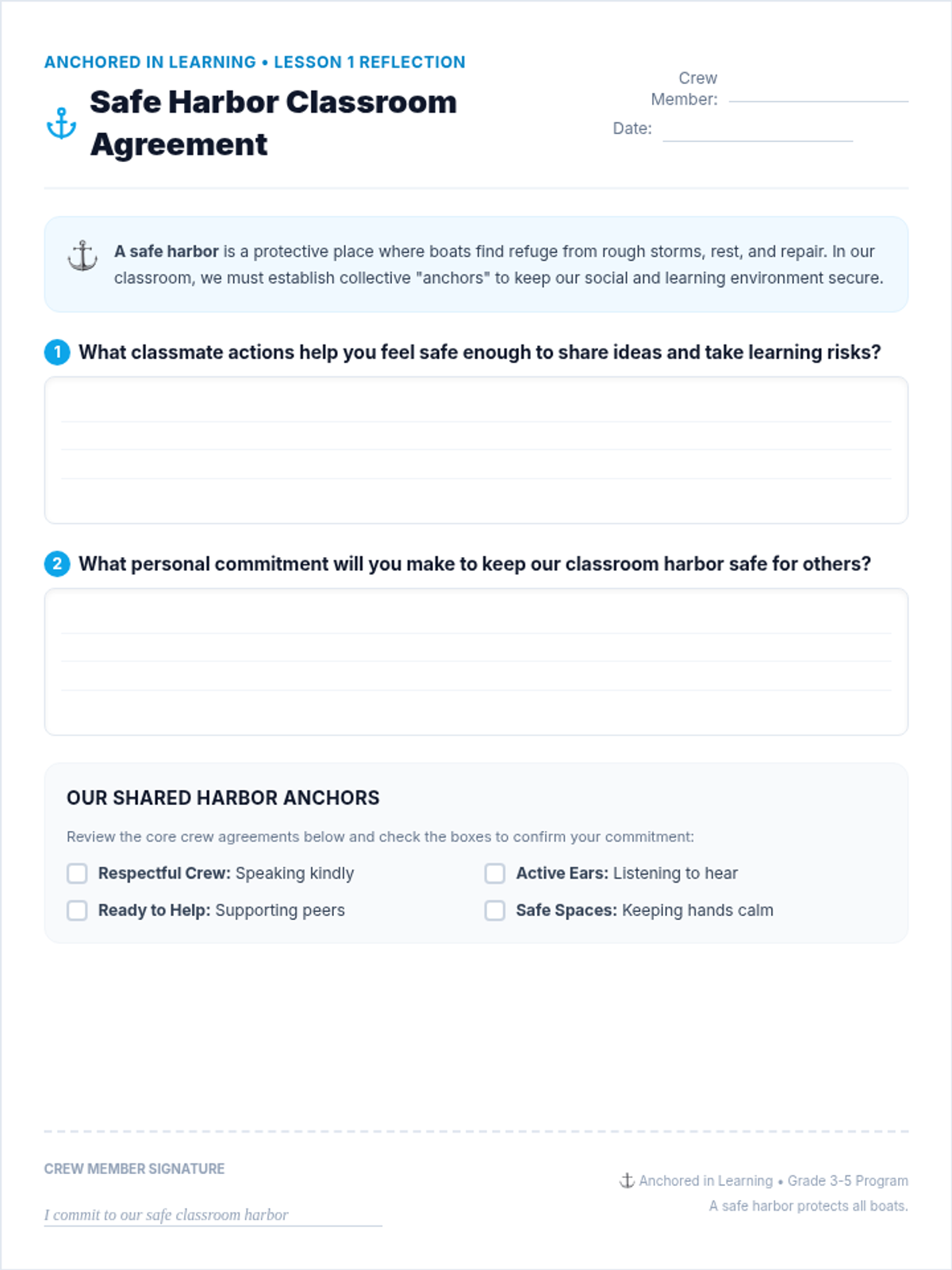
A print-ready reflective worksheet for 3rd-5th grade students to define their social-emotional safety needs and sign a Safe Harbor contract, with 5th-grade differentiation.
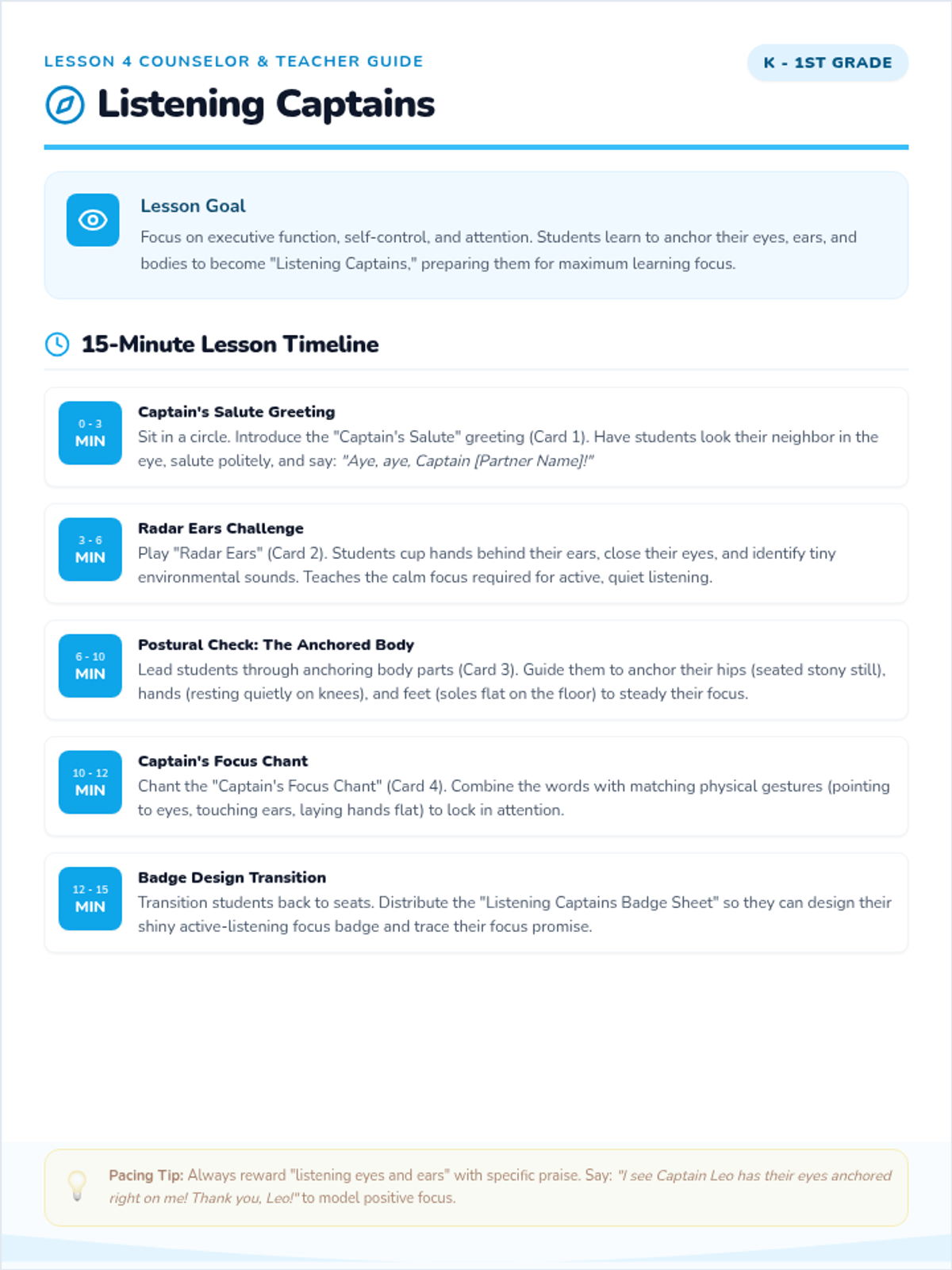
A 2-page print-ready teacher resource containing a detailed 15-minute lesson plan and 4 interactive circle cards to teach focus, attention, and active listening in Lesson 4, differentiated for 5th grade.
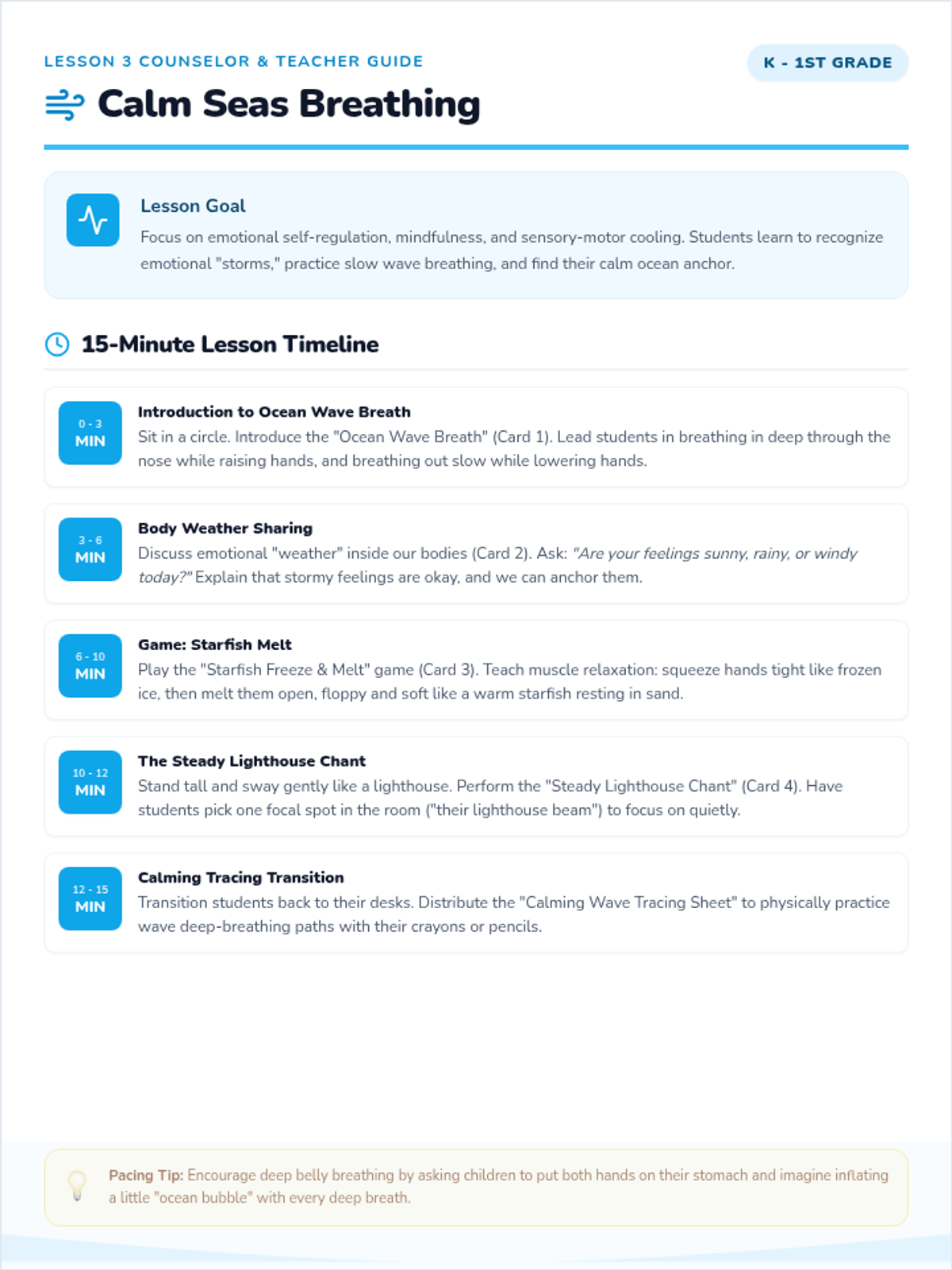
A 2-page print-ready teacher resource containing a detailed 15-minute lesson plan and 4 interactive circle cards to teach calming breathing and self-regulation in Lesson 3, differentiated for 5th grade.
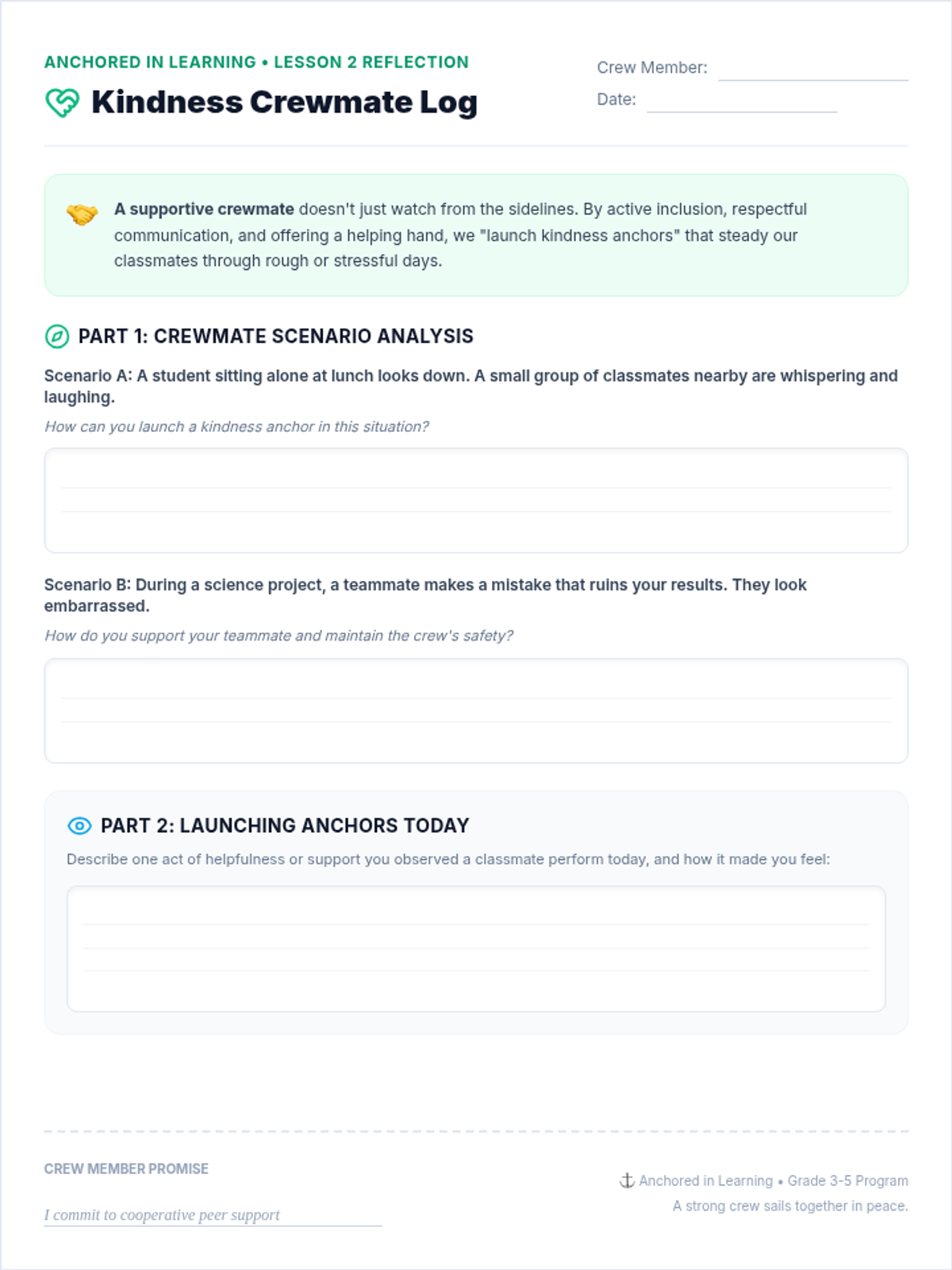
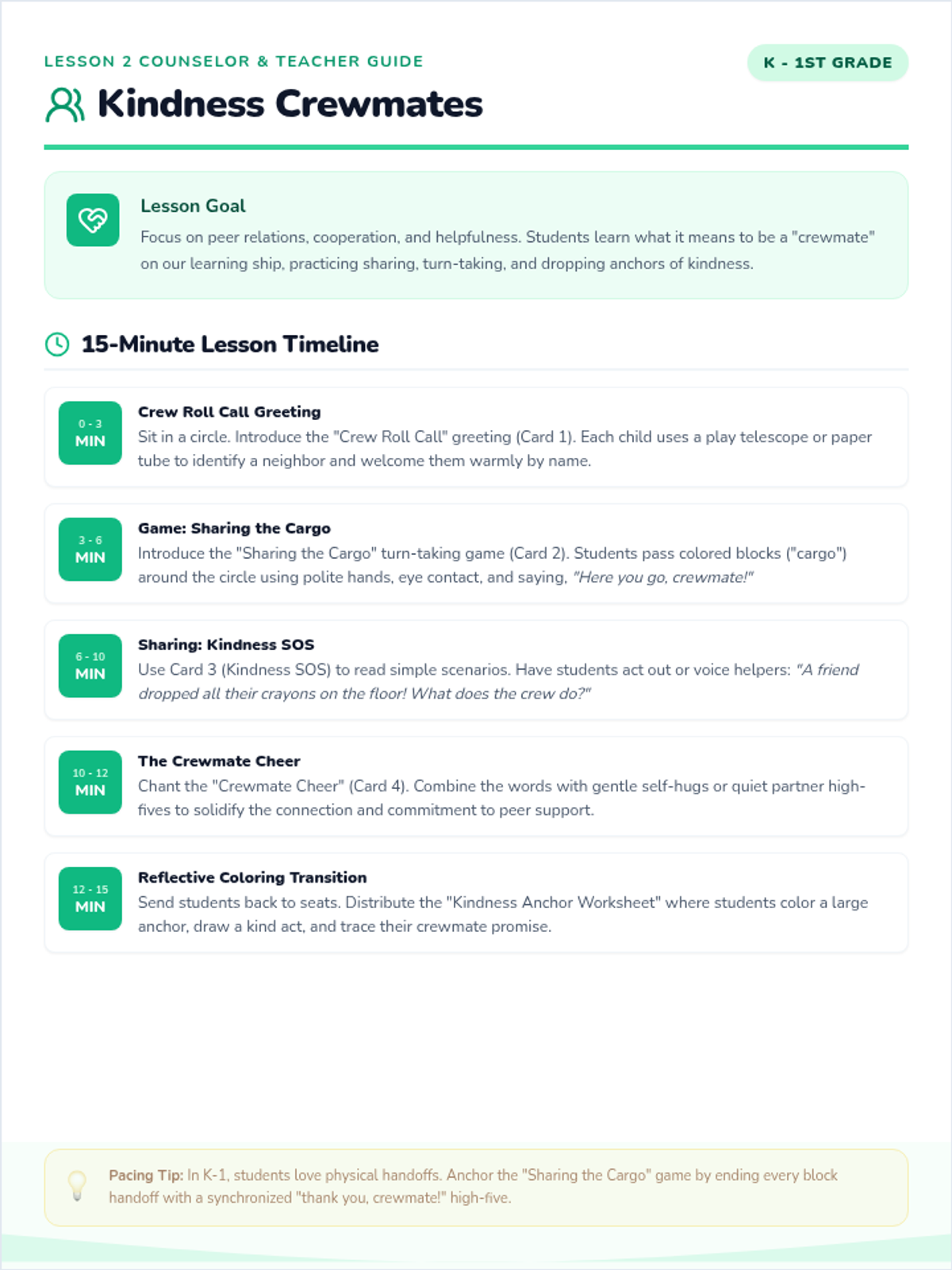
A 2-page print-ready teacher resource containing a detailed 15-minute lesson plan and 4 interactive circle cards to practice kindness and cooperation in Lesson 2, differentiated for 5th grade.
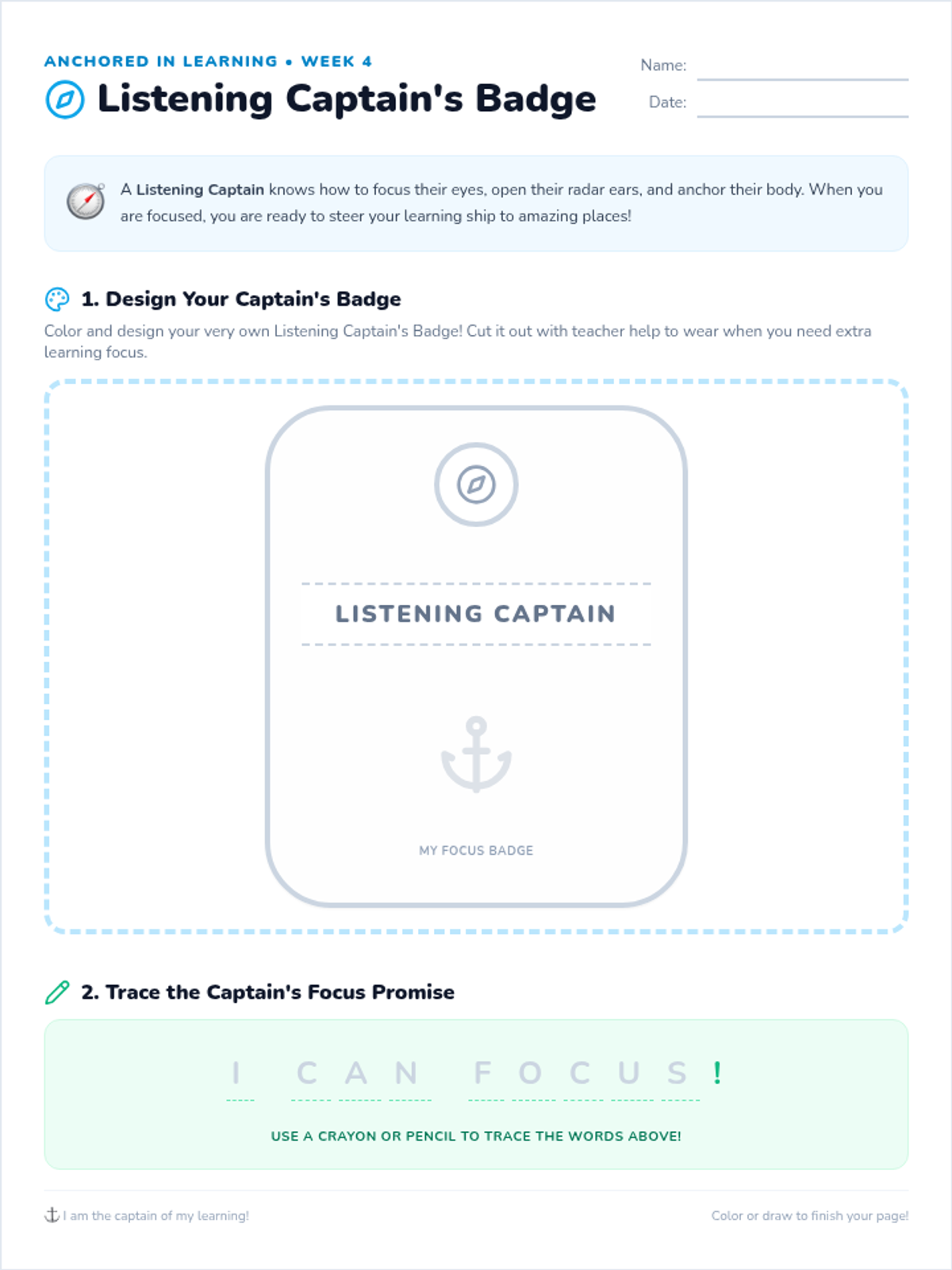
A print-ready coloring and drawing badge tracker worksheet for K-1 students to show attention and focus skills.
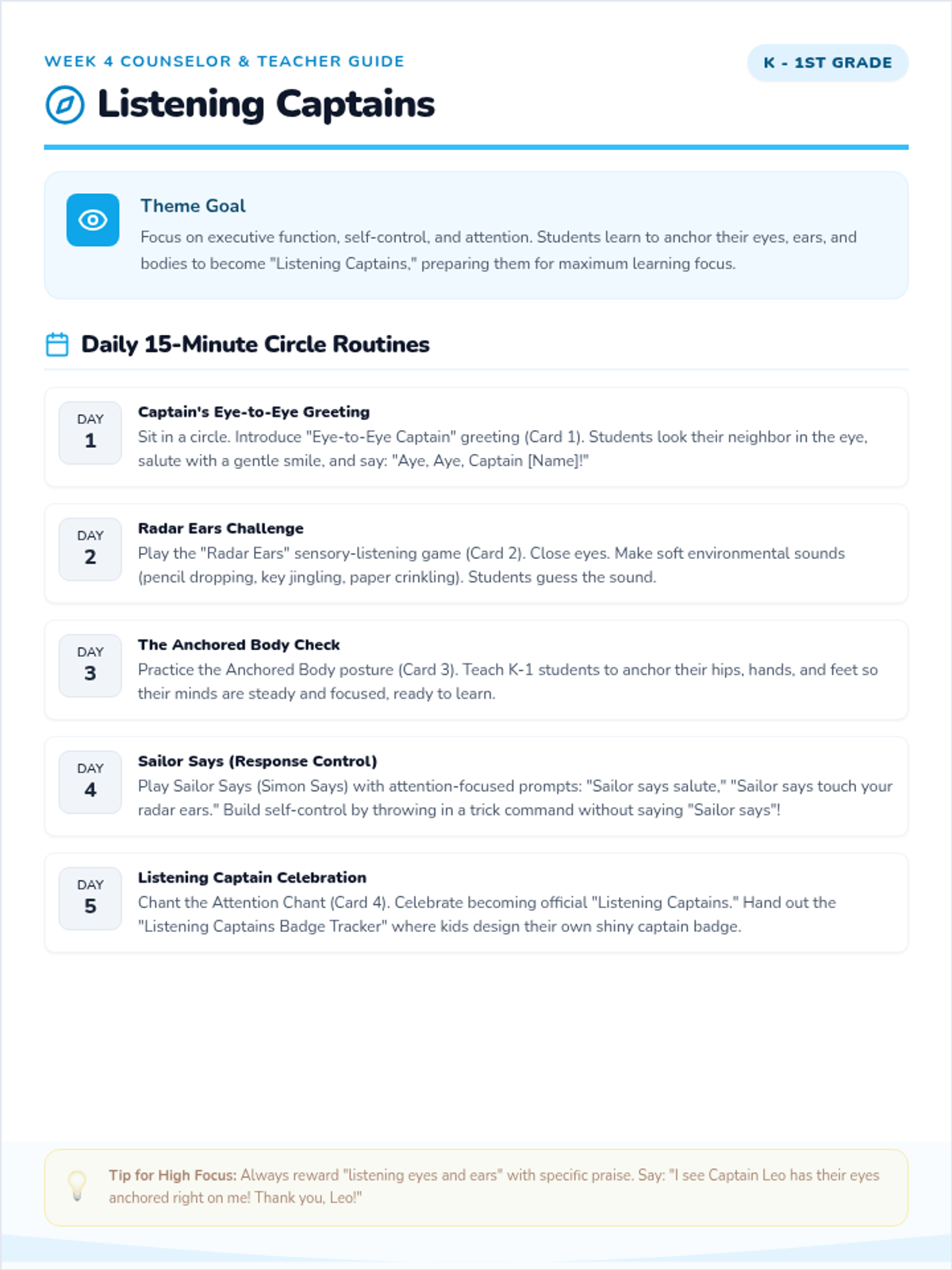
A 2-page print-ready teacher resource containing a 5-day circle guide and 4 interactive circle cards to teach focus, attention, and active listening in Week 4.
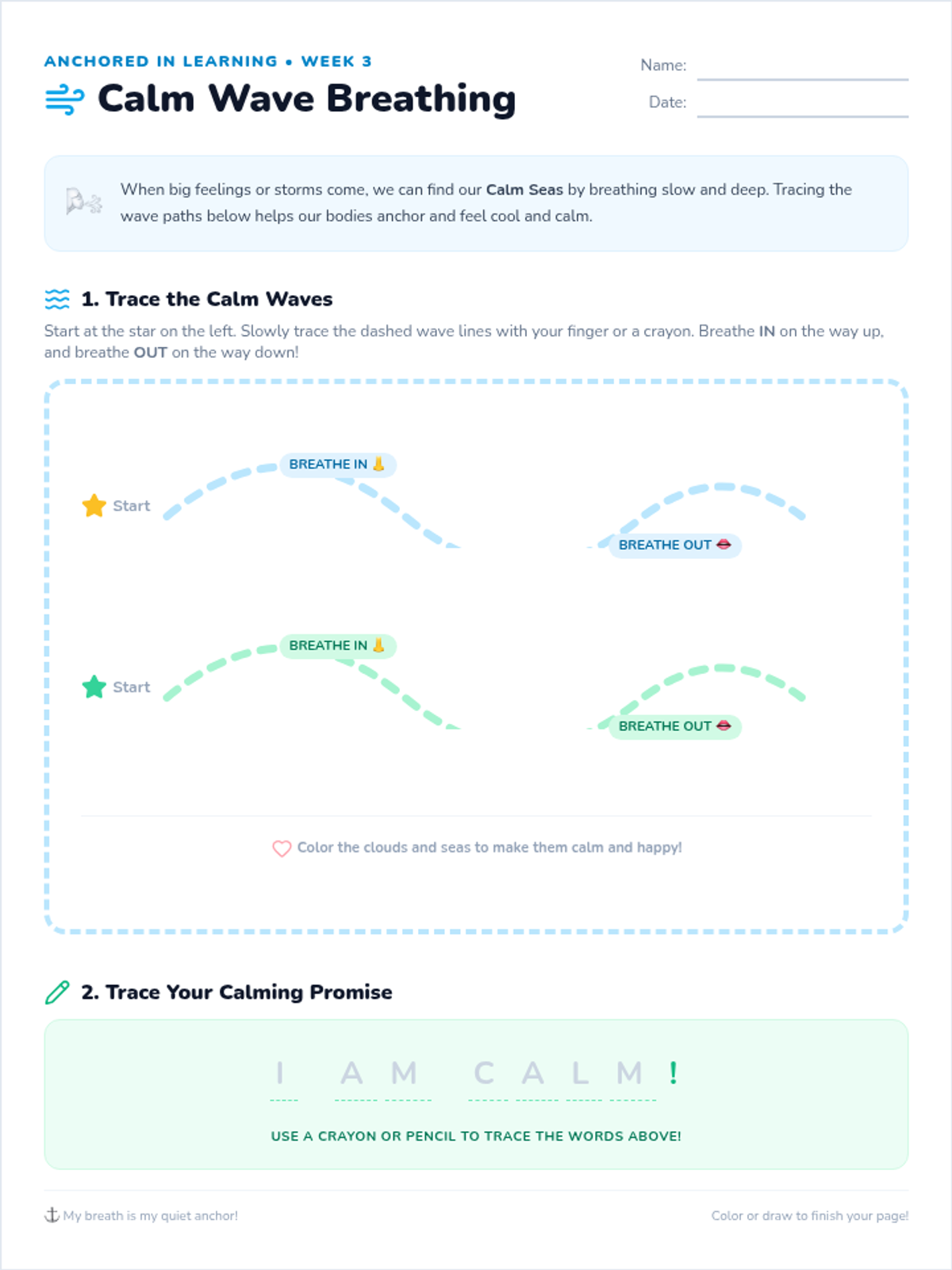
A print-ready wave finger-tracing and coloring worksheet for K-1 students to practice self-regulation and calming breathing.
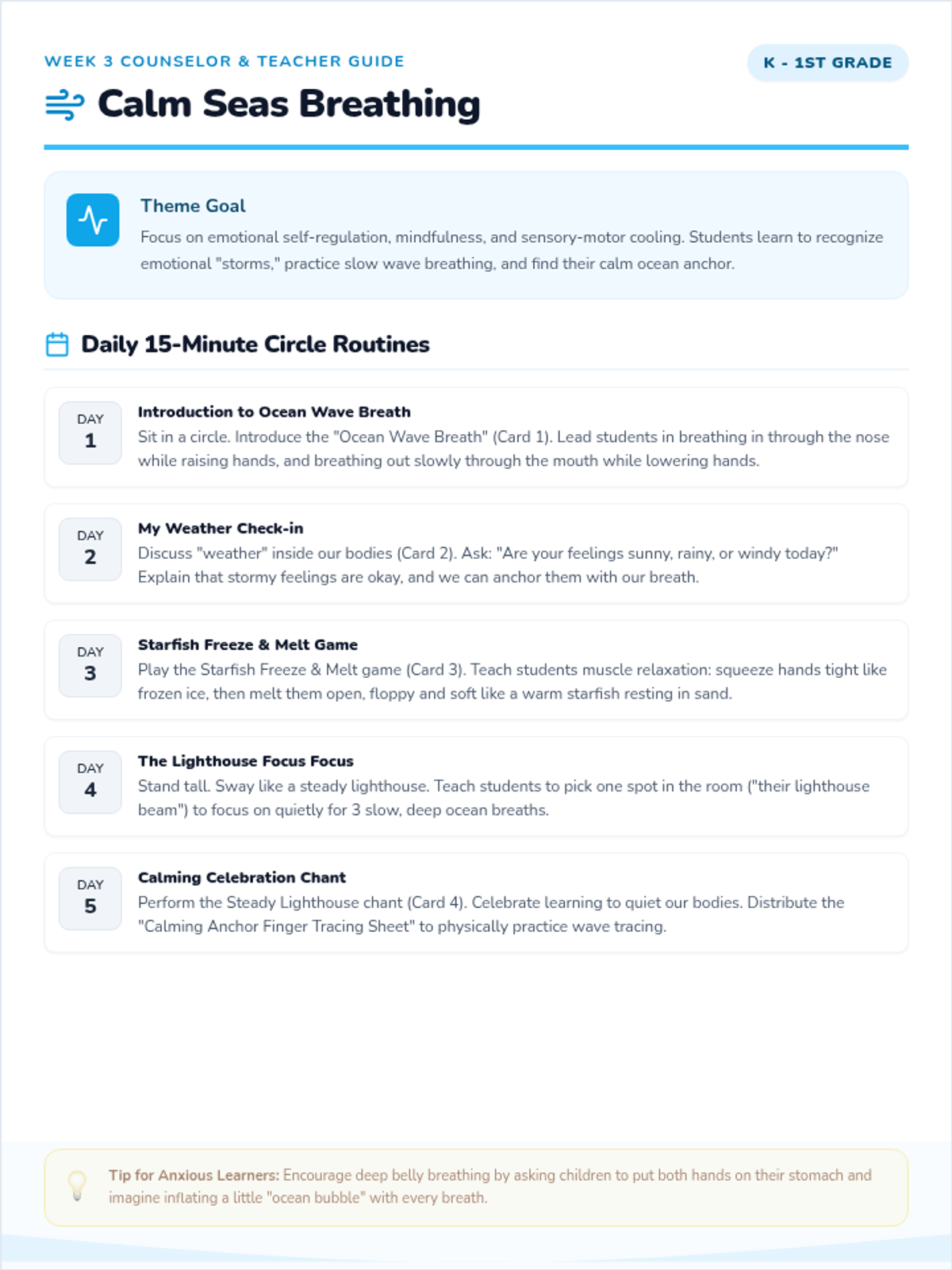
A 2-page print-ready teacher resource containing a 5-day circle guide and 4 interactive circle cards to teach calming breathing and self-regulation in Week 3.
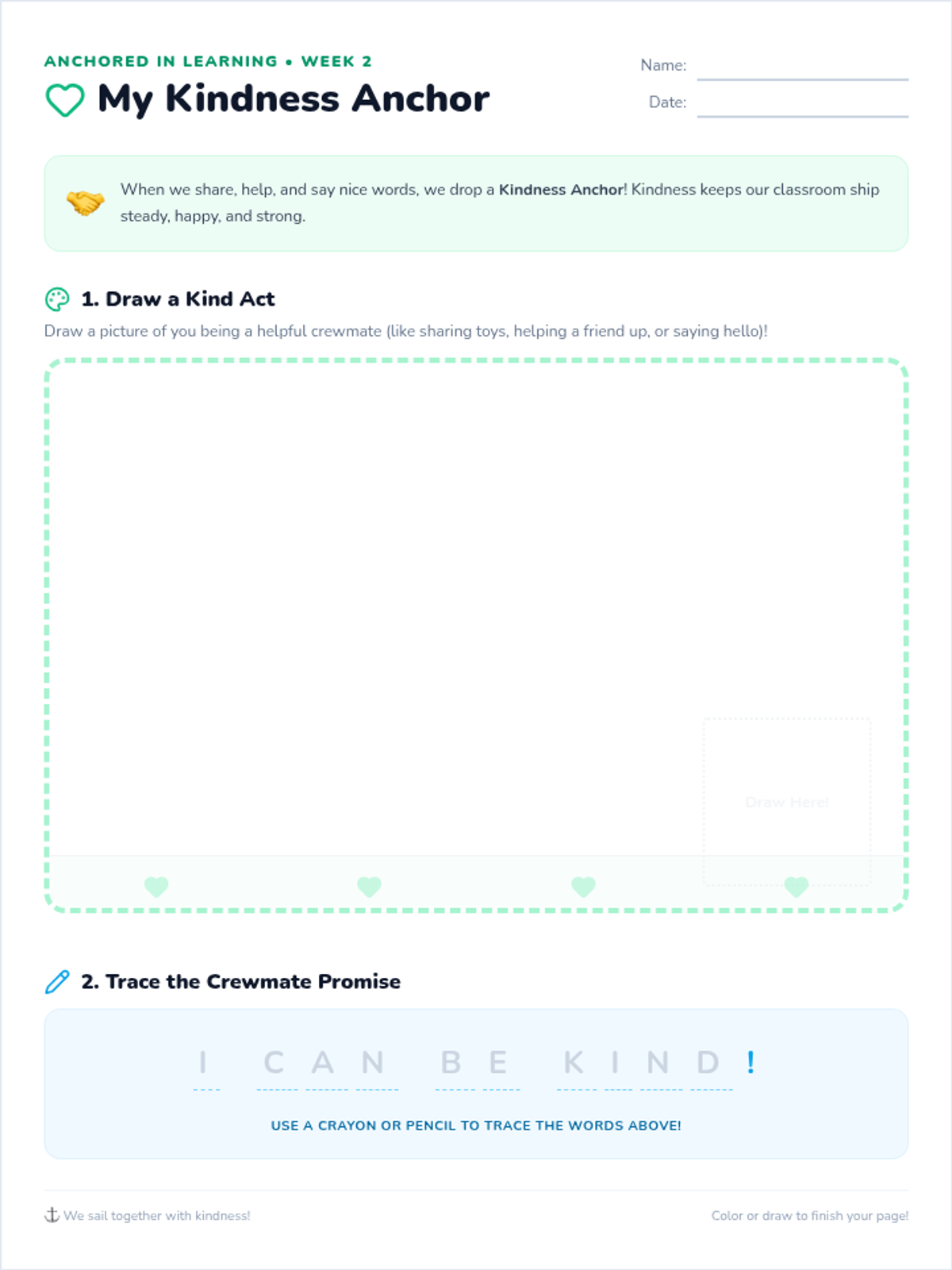
A print-ready drawing and coloring activity worksheet for K-1 students to show how they drop a 'kindness anchor' by helping classmates.
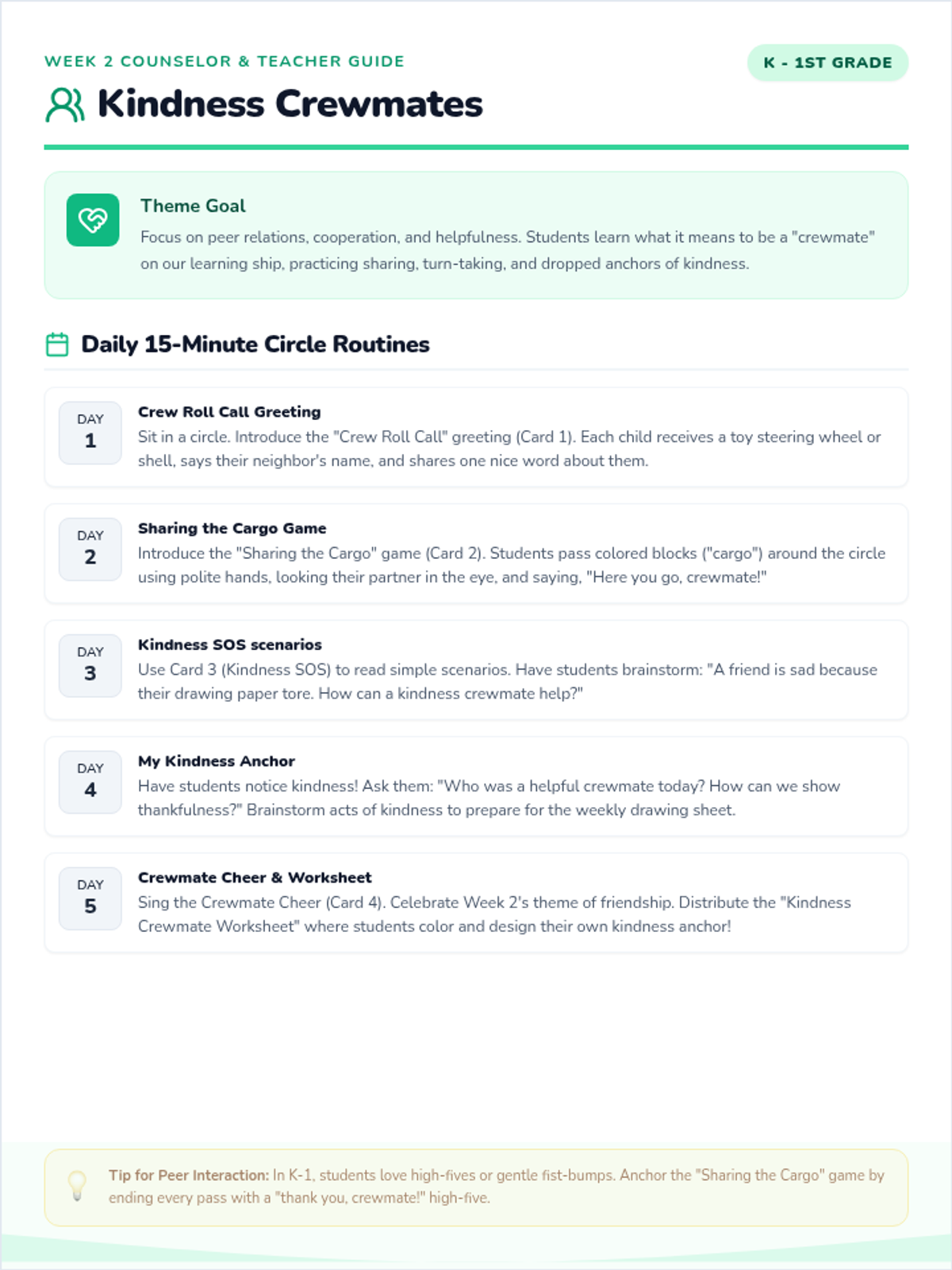
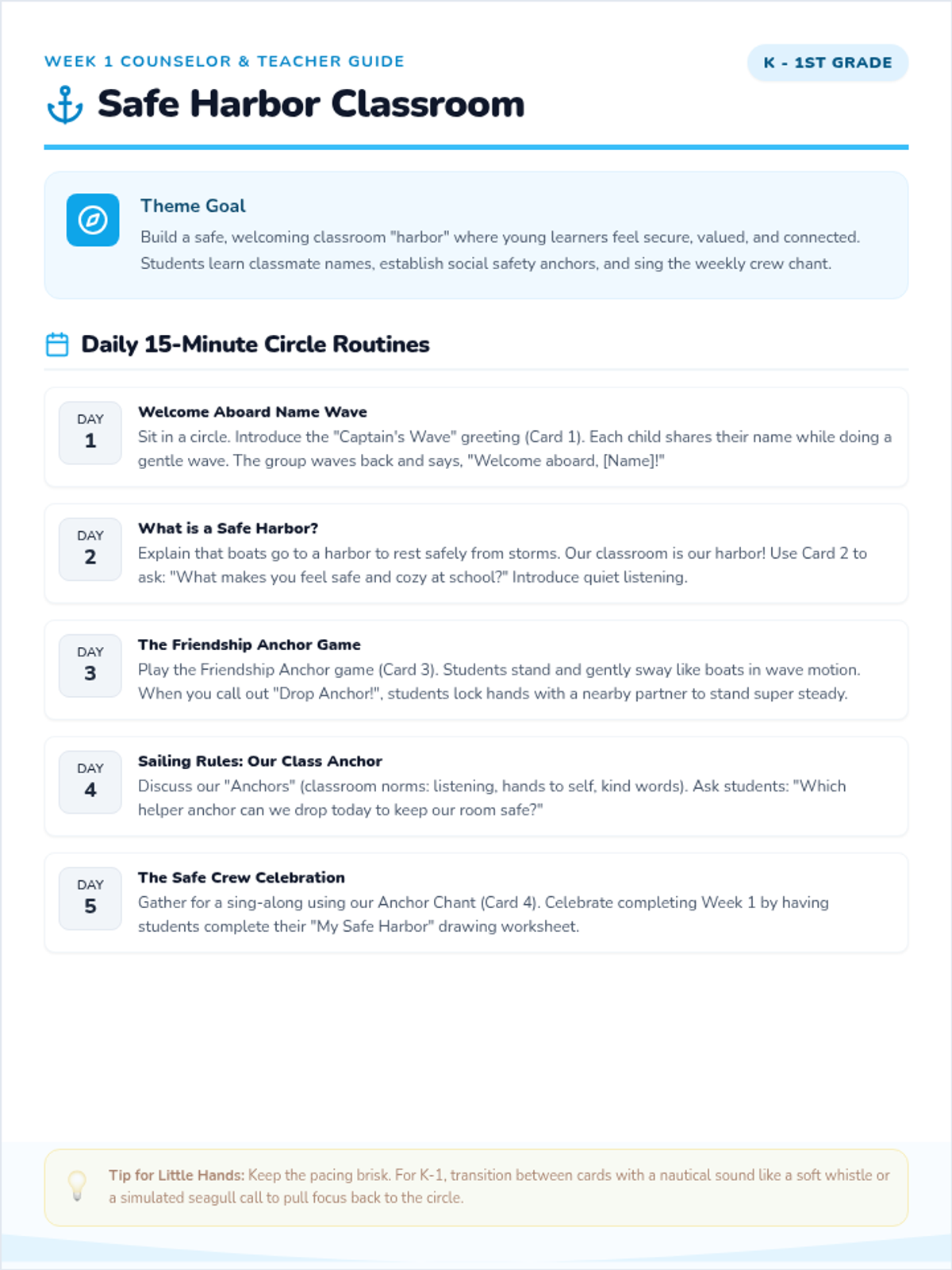
A 2-page print-ready teacher resource containing a 5-day circle guide and 4 interactive circle cards to practice kindness and cooperation in Week 2.
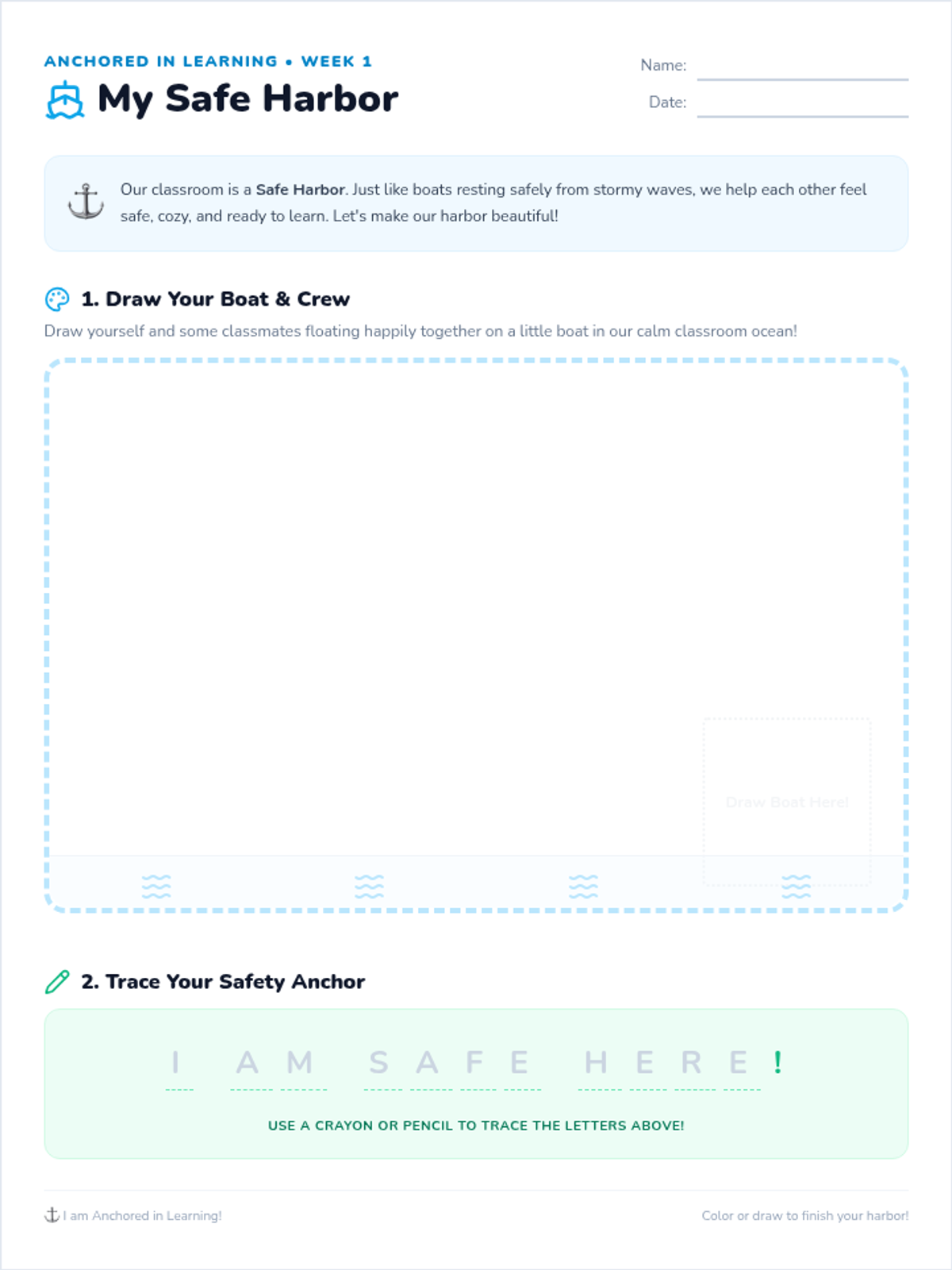
A simple print-ready coloring and drawing worksheet for K-1 students to illustrate their safe classroom harbor and practice name-writing.
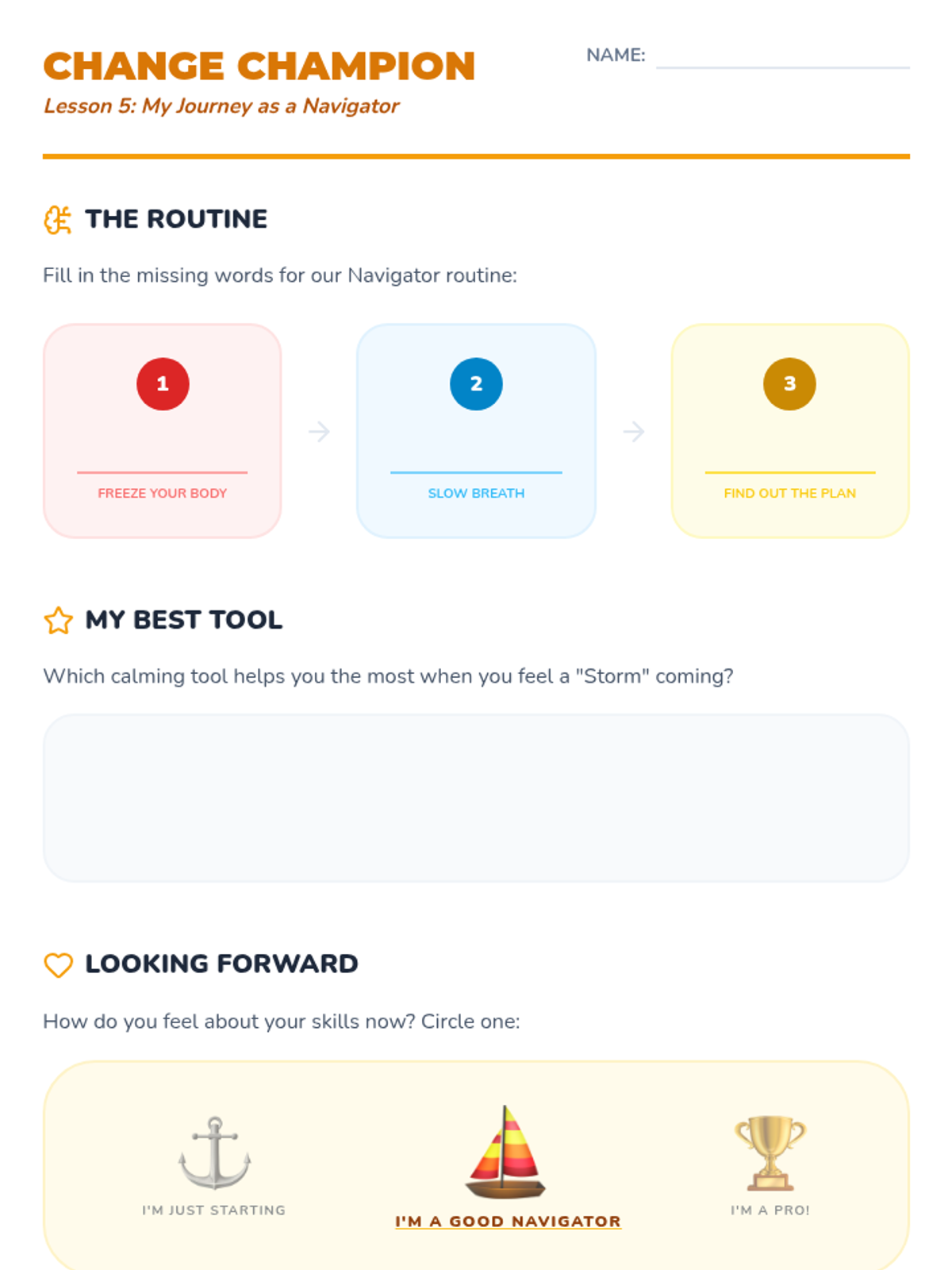
Final reflection worksheet for students to summarize their learning on identifying emotions, using calming strategies, and following the 'Stop, Breathe, Ask' routine.
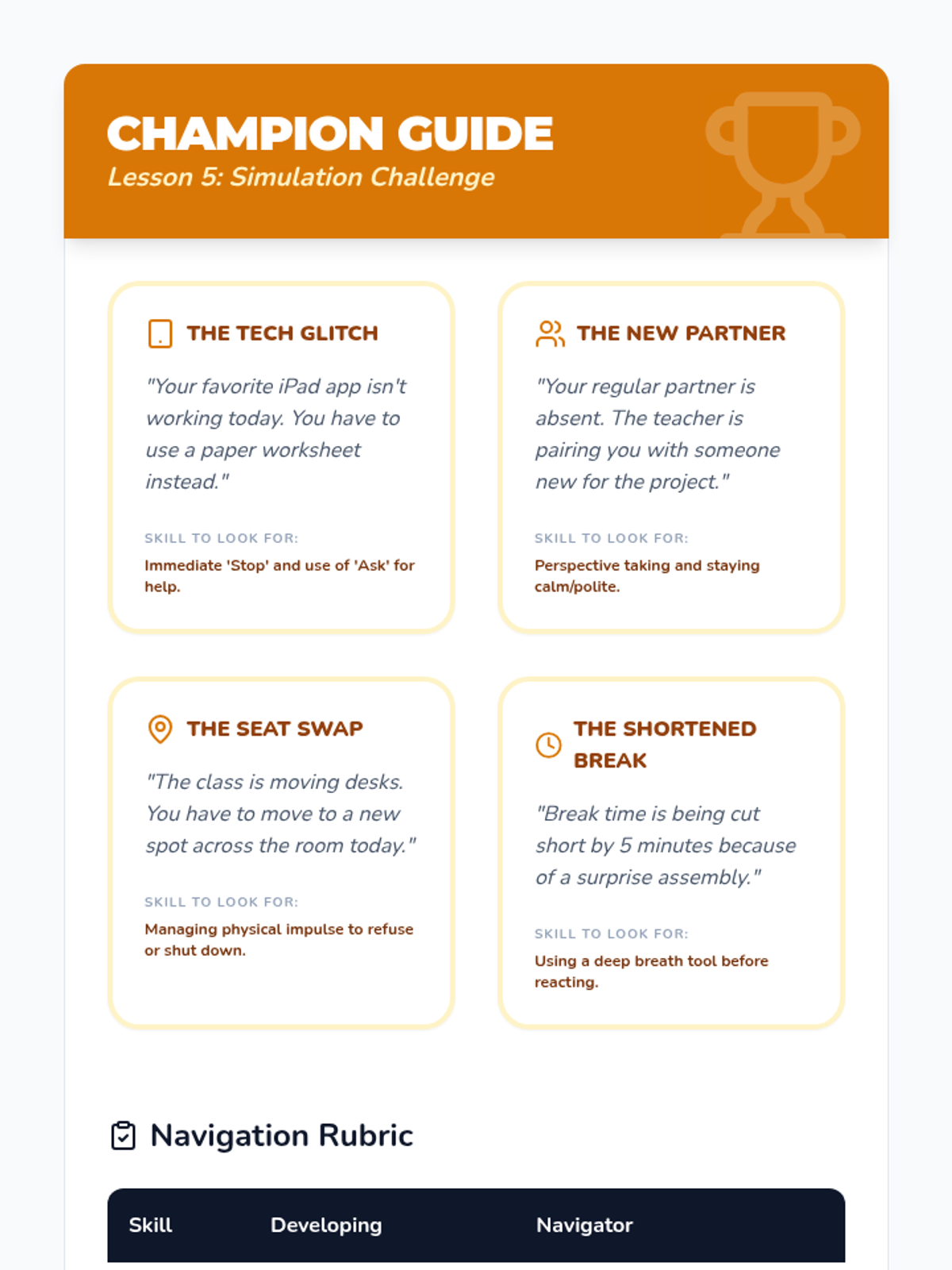
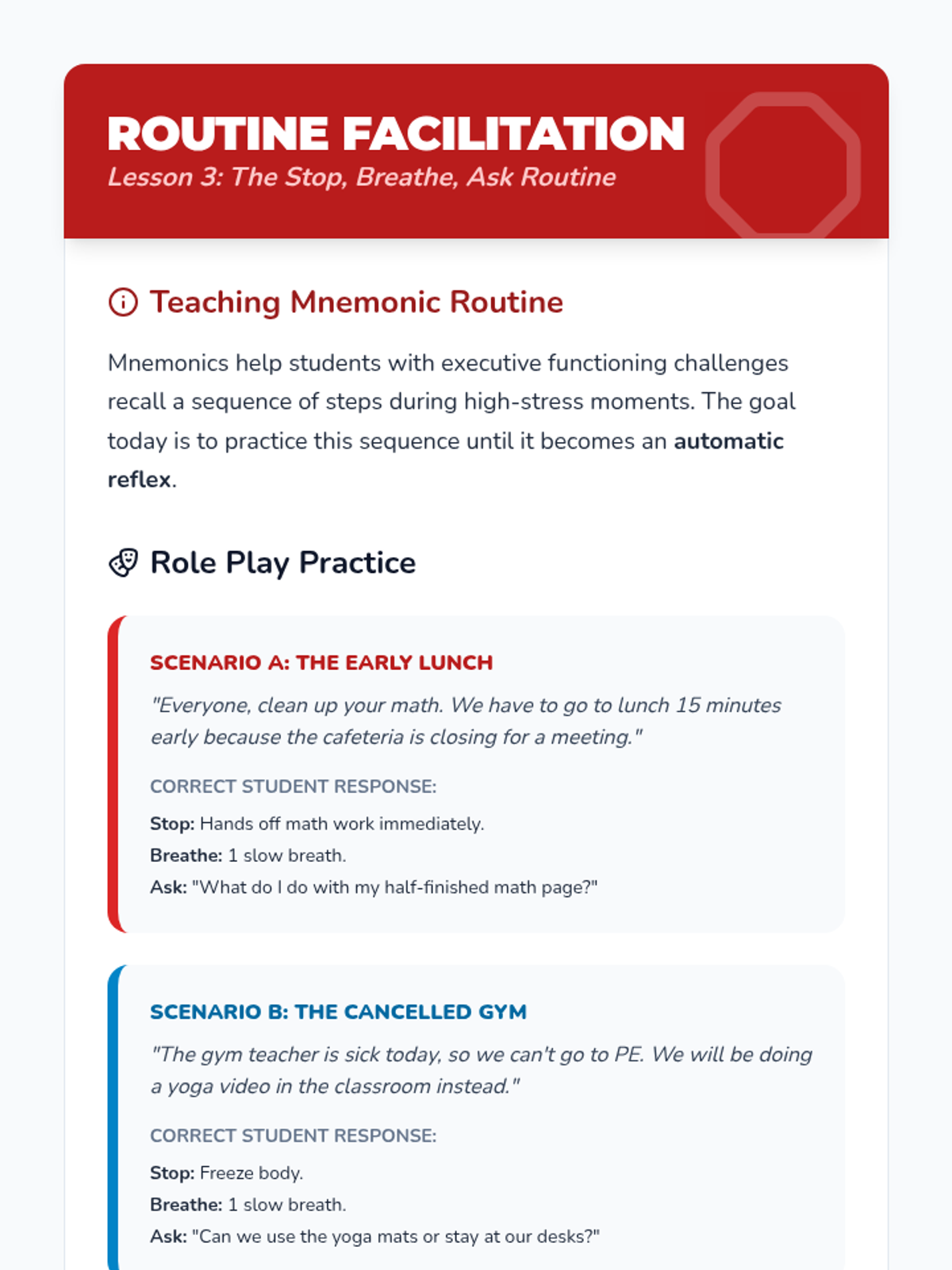
Facilitation guide for teachers to lead role-play exercises for the Stop, Breathe, Ask routine, including scenarios and observation checklists.
Final presentation for the simulation activity, reviewing all learned skills and introducing the 'Wheel of Change' game.
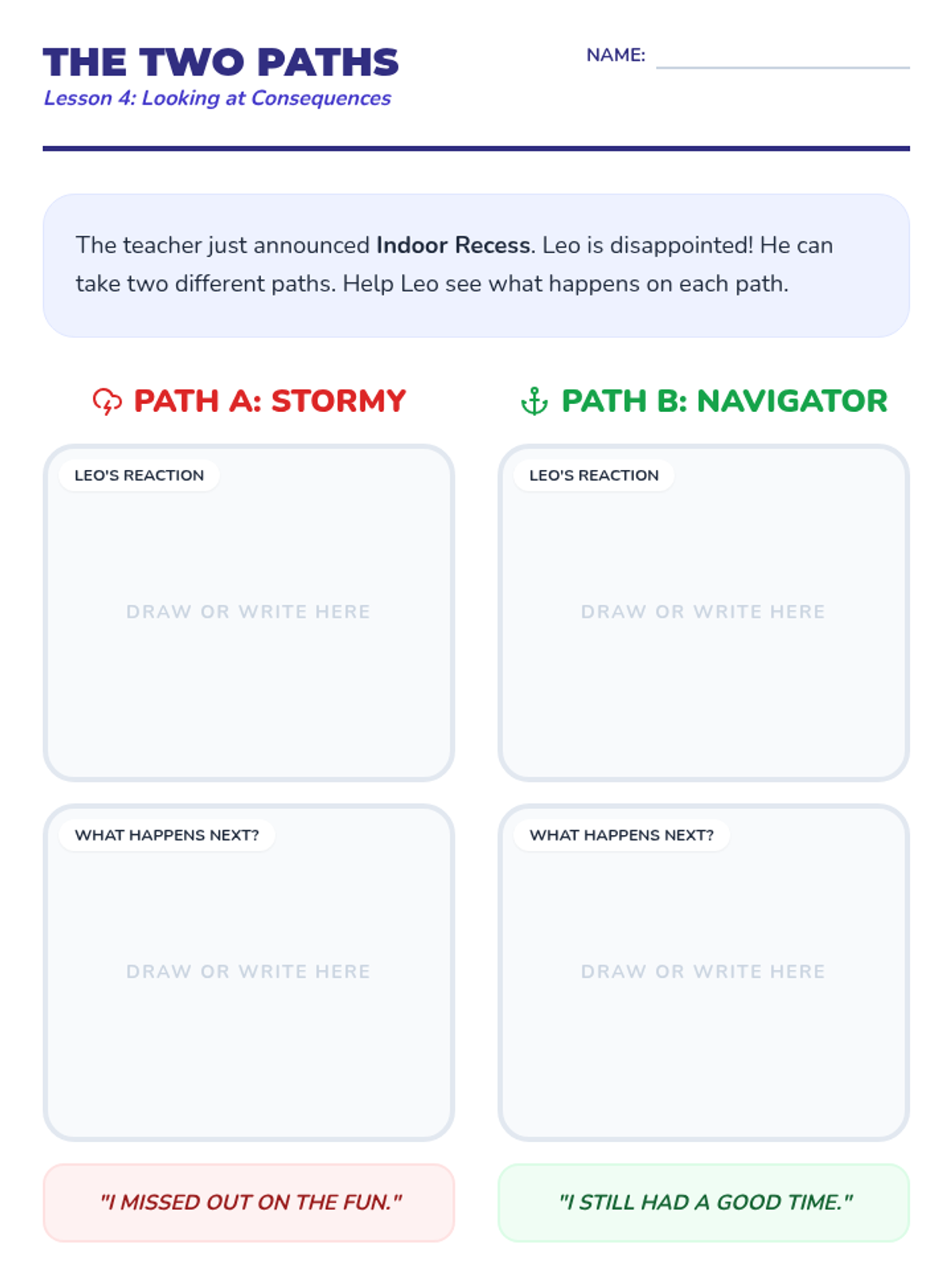
Student activity sheet for comparing the emotional and social outcomes of two different reactions to the 'Rainy Recess' scenario.
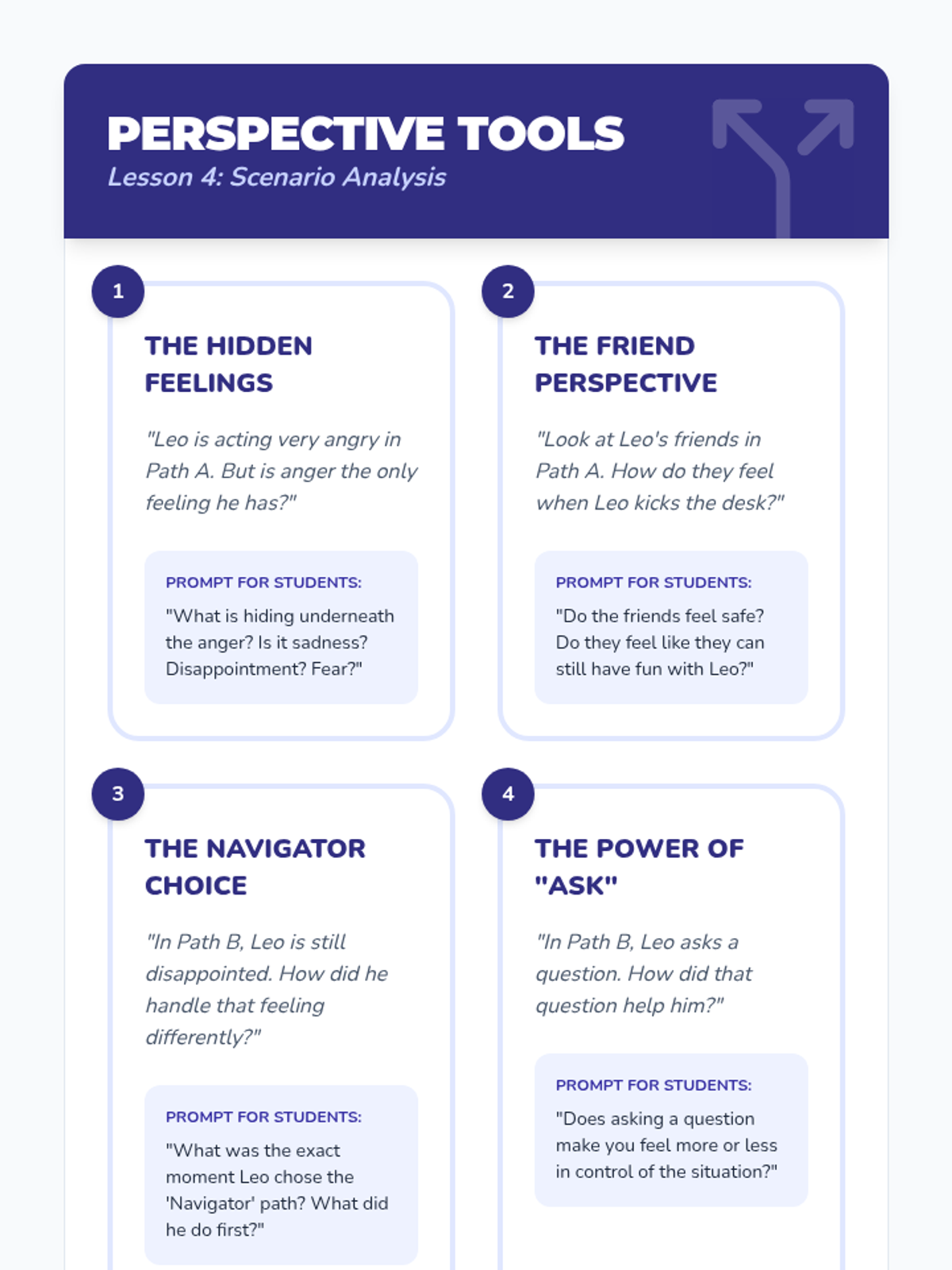
Discussion guide for teachers to help students explore perspective-taking and the consequences of different reactions to the 'Rainy Recess' scenario.
Case study slides exploring the 'Rainy Recess' scenario, comparing a dysregulated reaction versus a regulated 'Navigator' response.
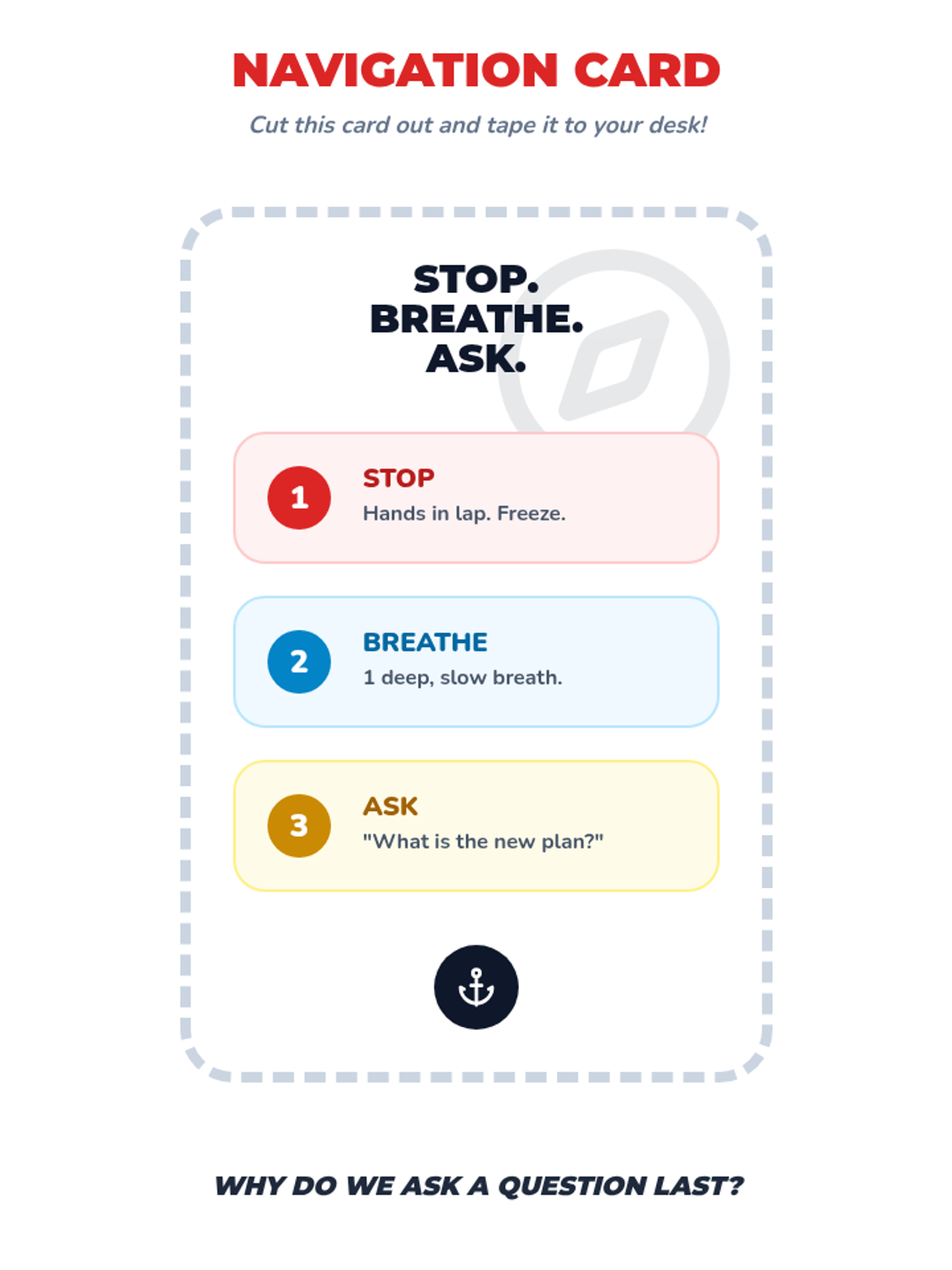
A portable reference card for students featuring the Stop, Breathe, Ask routine to be used during unexpected changes.
Instructional slides for the Stop, Breathe, Ask routine, breaking down each step with visuals and practice prompts.
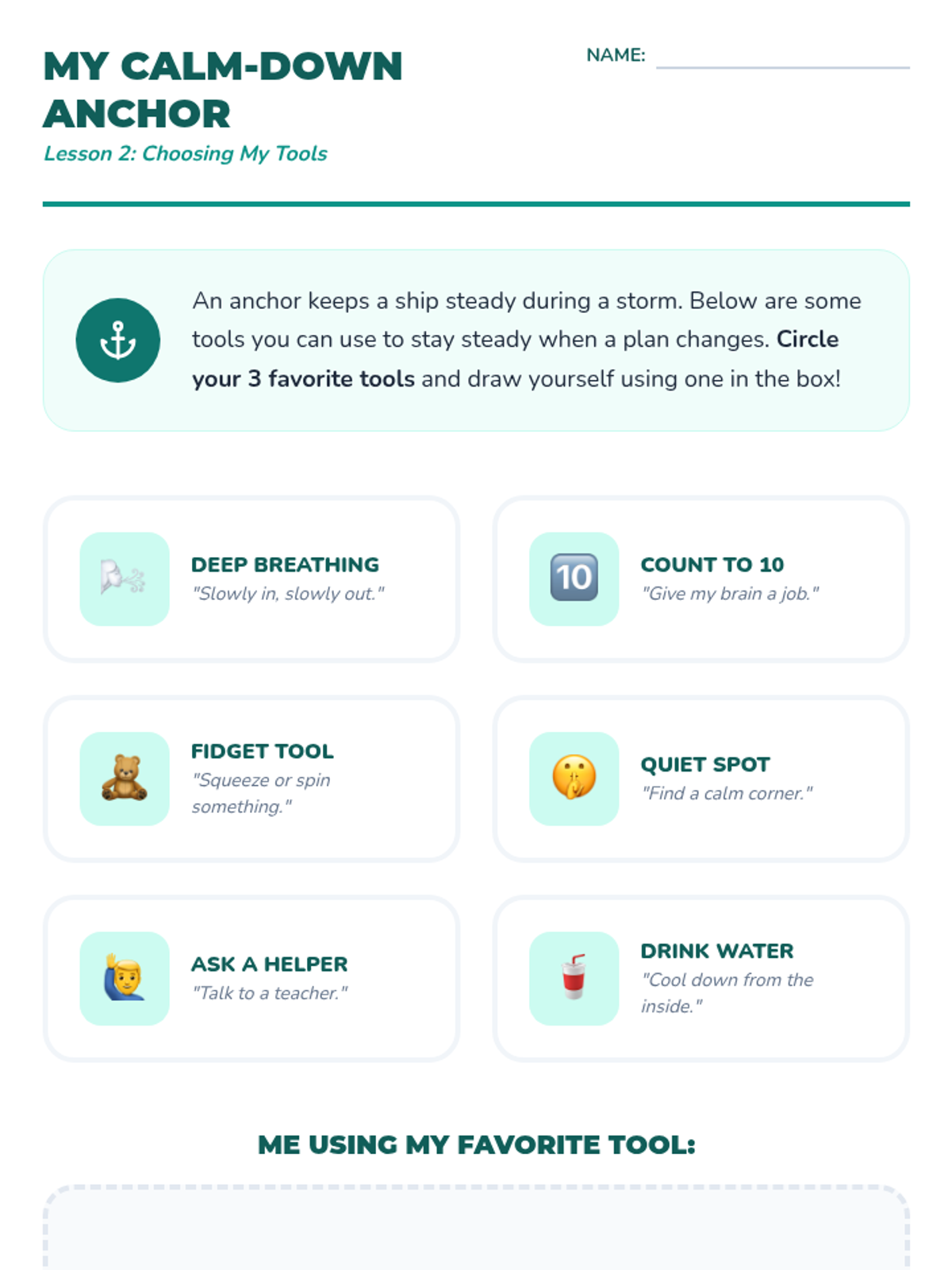
Student activity sheet for selecting personal calming strategies and visualizing their use.
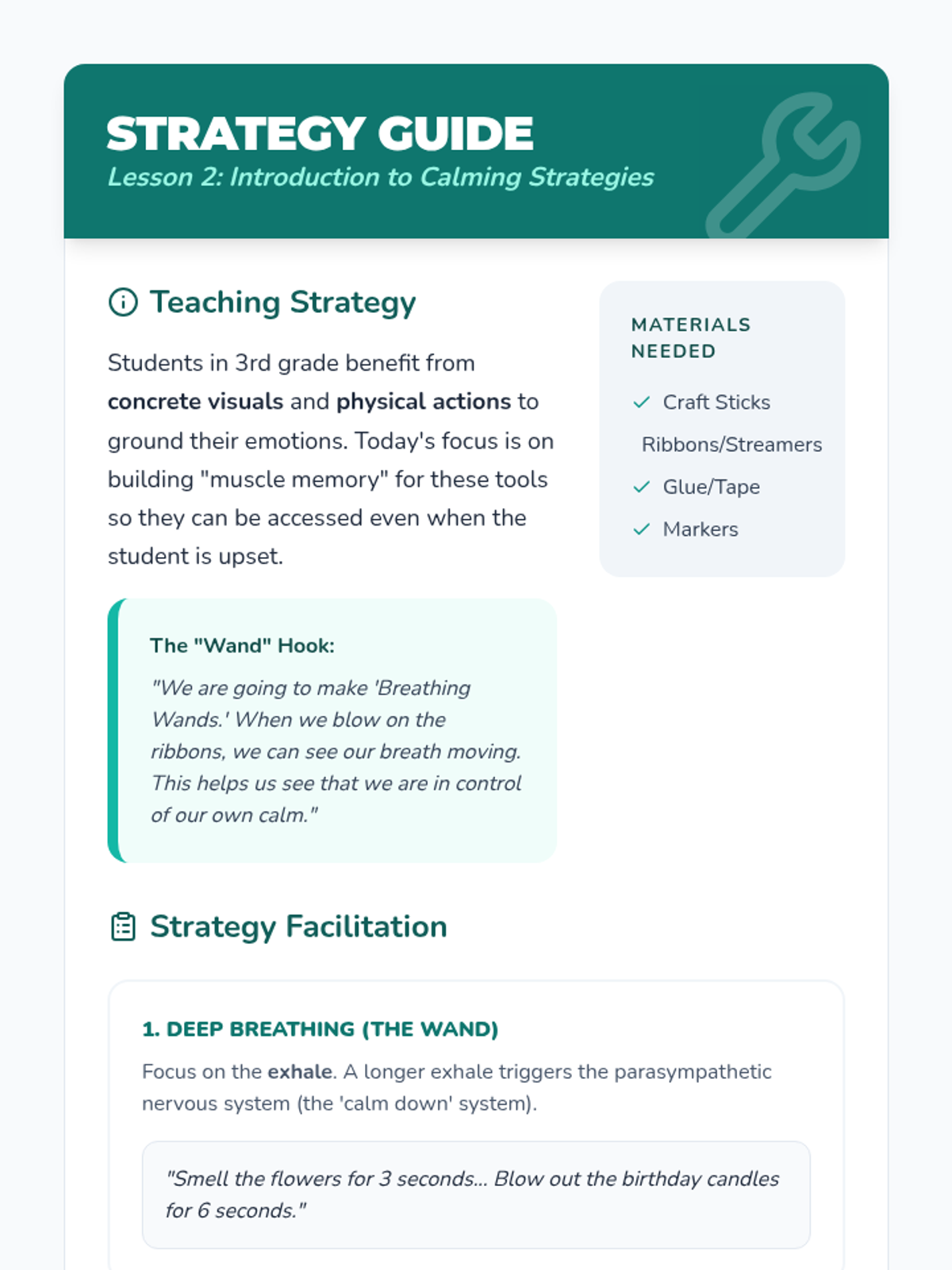
Facilitation guide for teachers focused on introducing and practicing deep breathing, counting, and grounding strategies with students.
Nautical-themed presentation introducing various calming strategies like deep breathing and counting to ten for self-regulation.
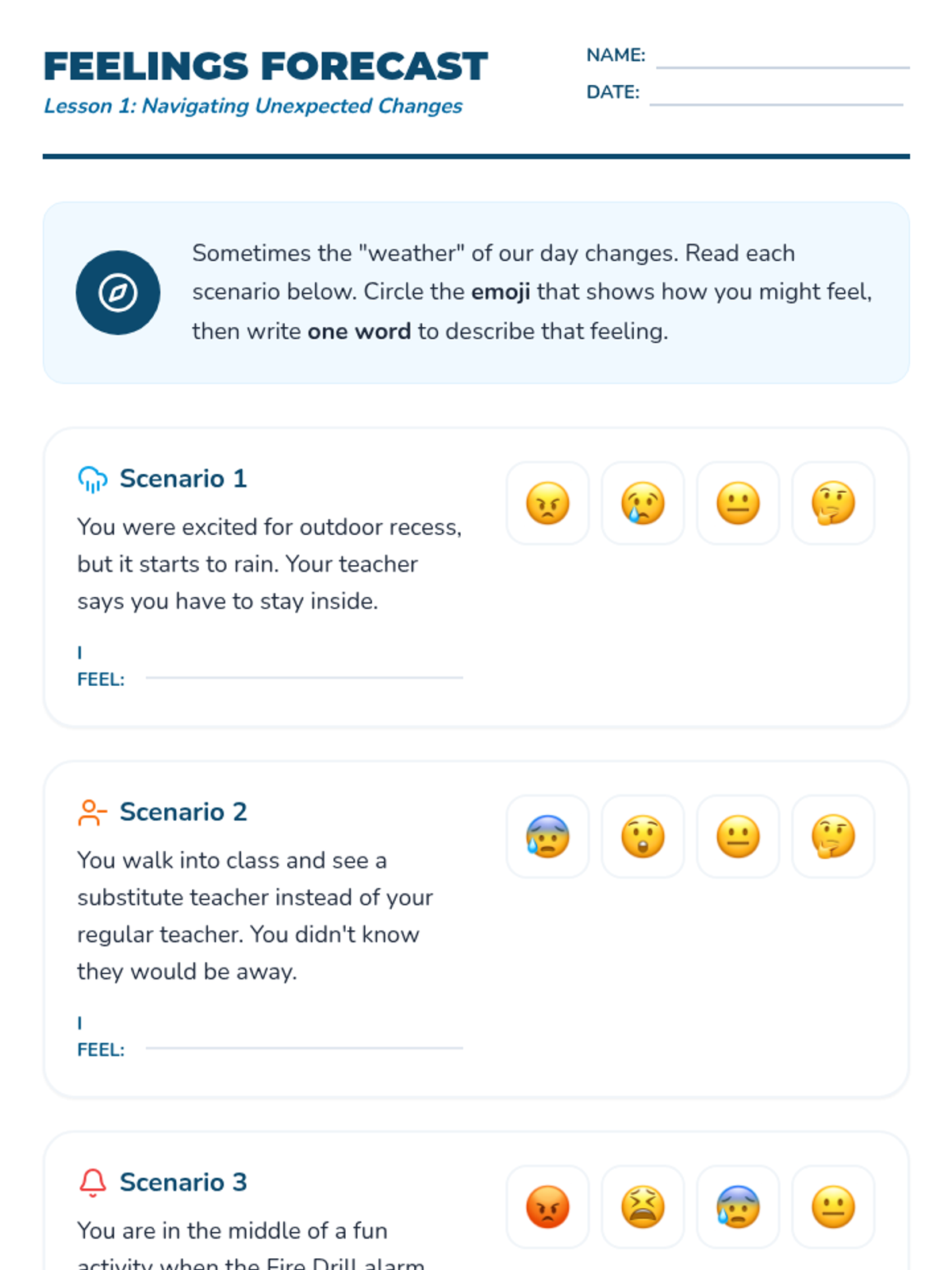
Worksheet for students to identify emotions in response to three common school scenarios involving unexpected changes.
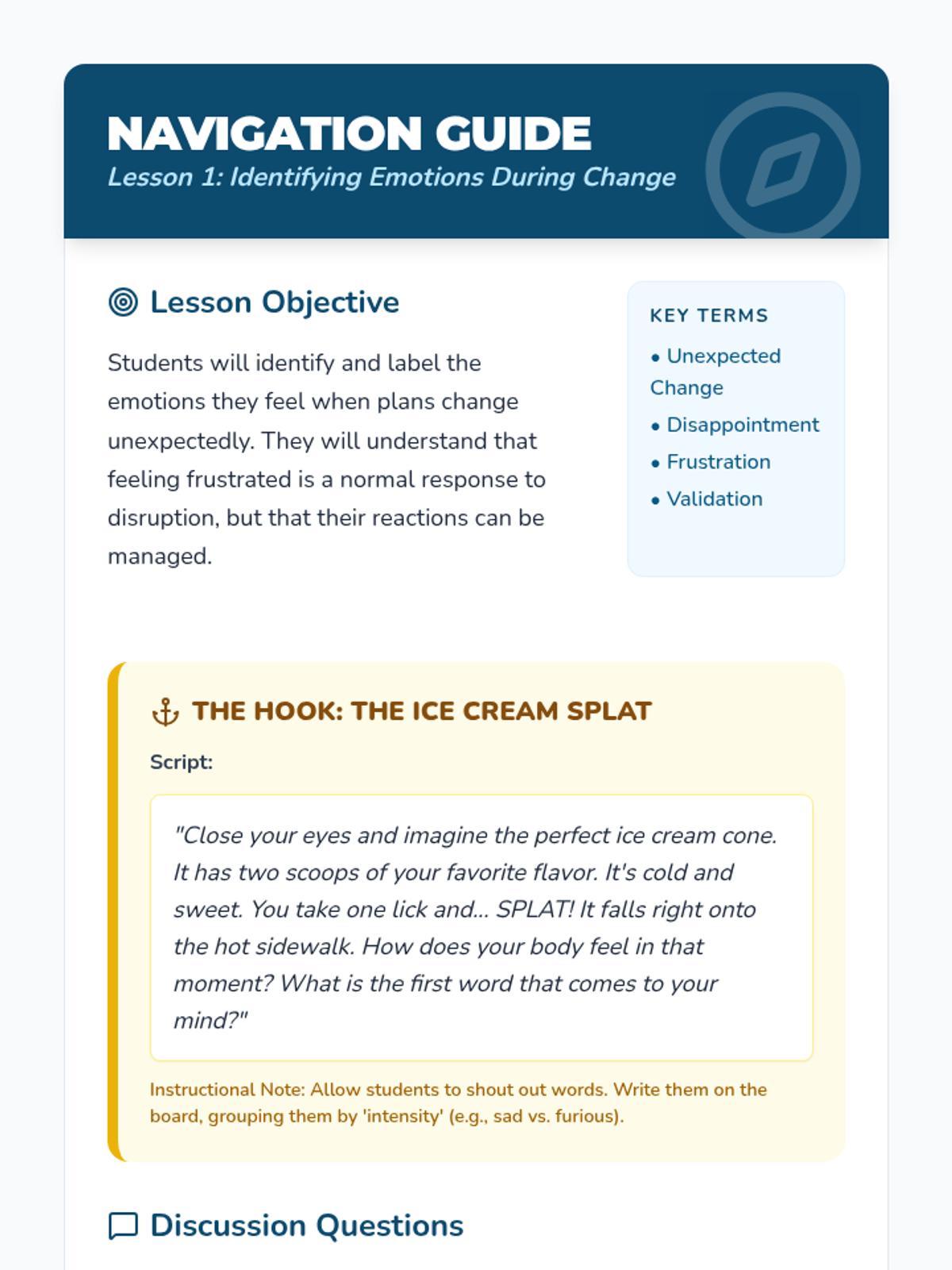
Facilitation guide for teachers including the ice cream hook script, discussion questions, and nautical metaphors for lesson 1.
Nautical-themed presentation introducing the concept of plan changes and the emotions associated with them for 3rd grade students.
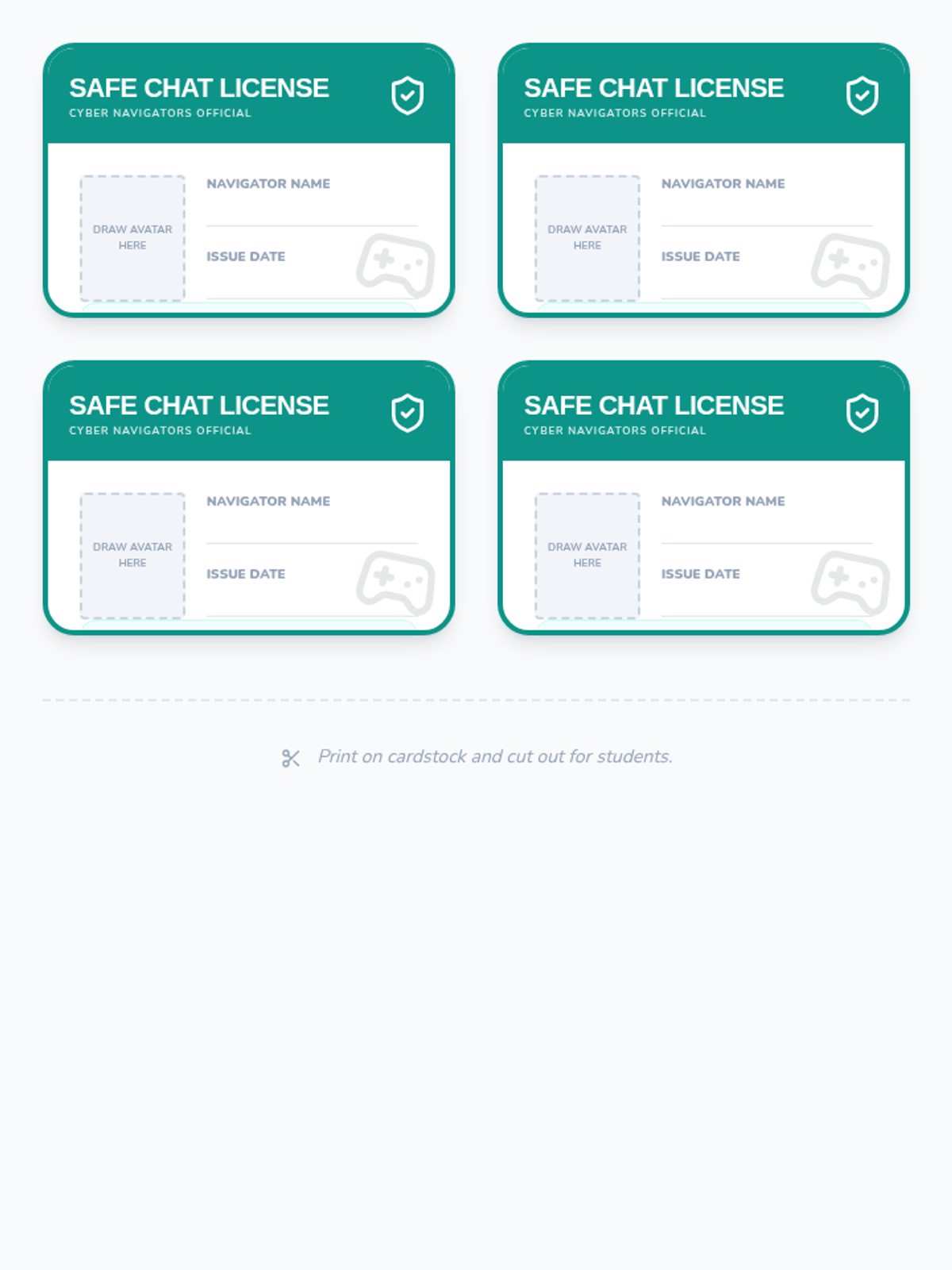
A page of 4 collectible 'Safe Chat License' cards for students to receive after completing the sequence and establishing their personal safety code.
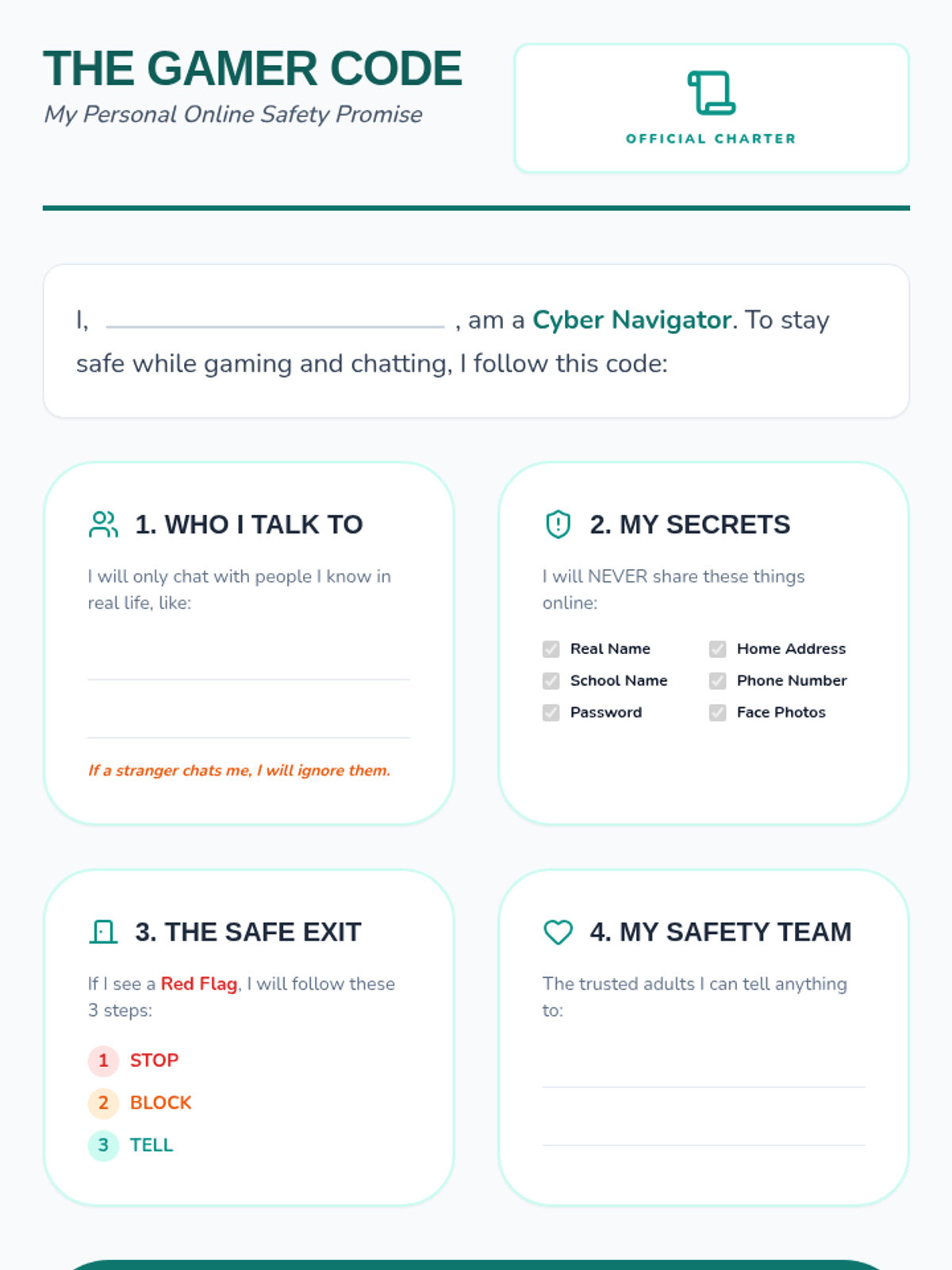
Worksheet for Lesson 5 where students synthesize their learning by creating a personal code of conduct for safe online gaming and communication.
Slides for Lesson 5, focusing on synthesizing the sequence's lessons into a personal 'Gamer's Code of Conduct' and introducing the Safe Chat License.
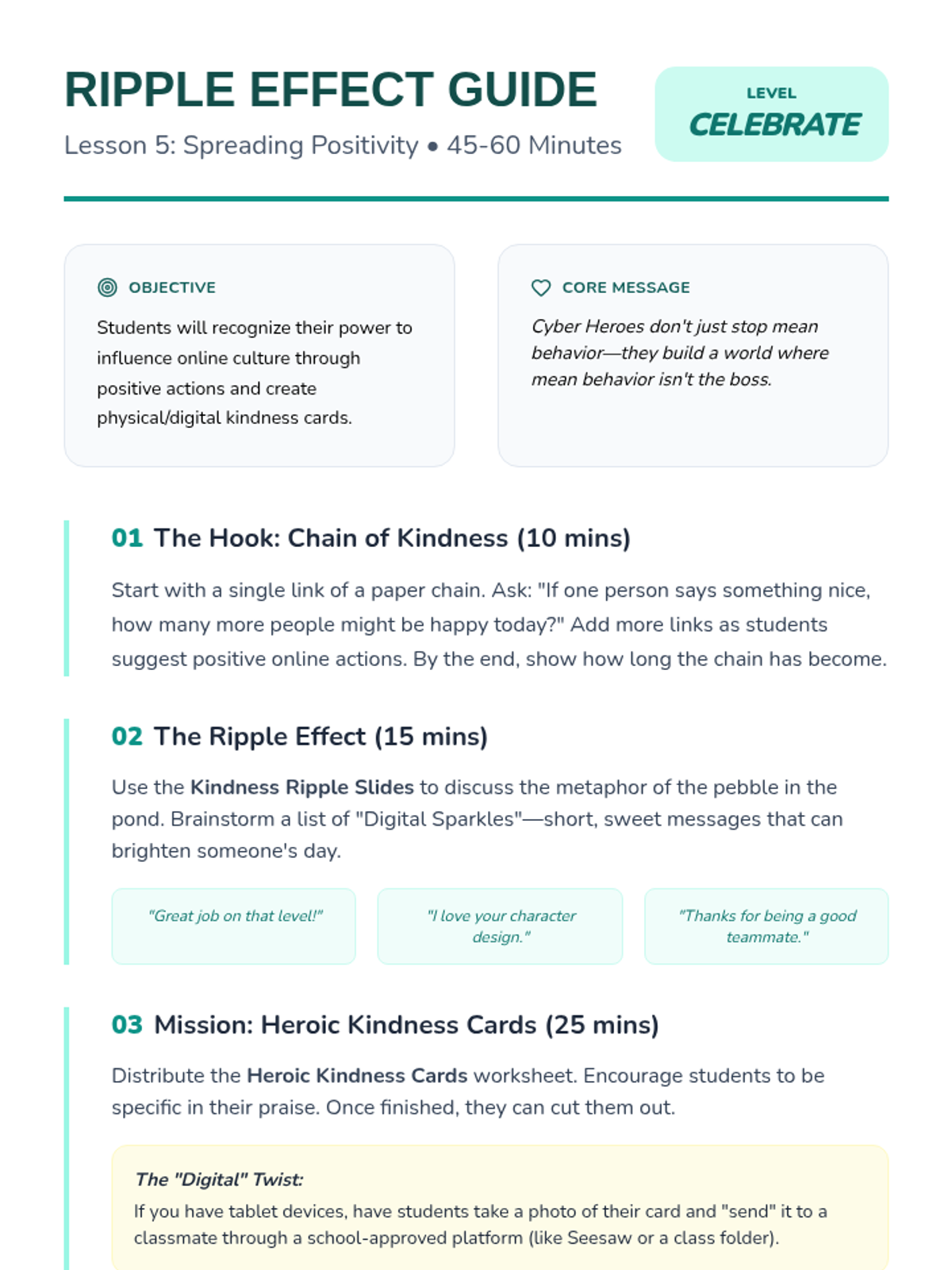
The sequence concludes with a positive project where students create digital kindness cards to promote a culture of positivity and prevent bullying.
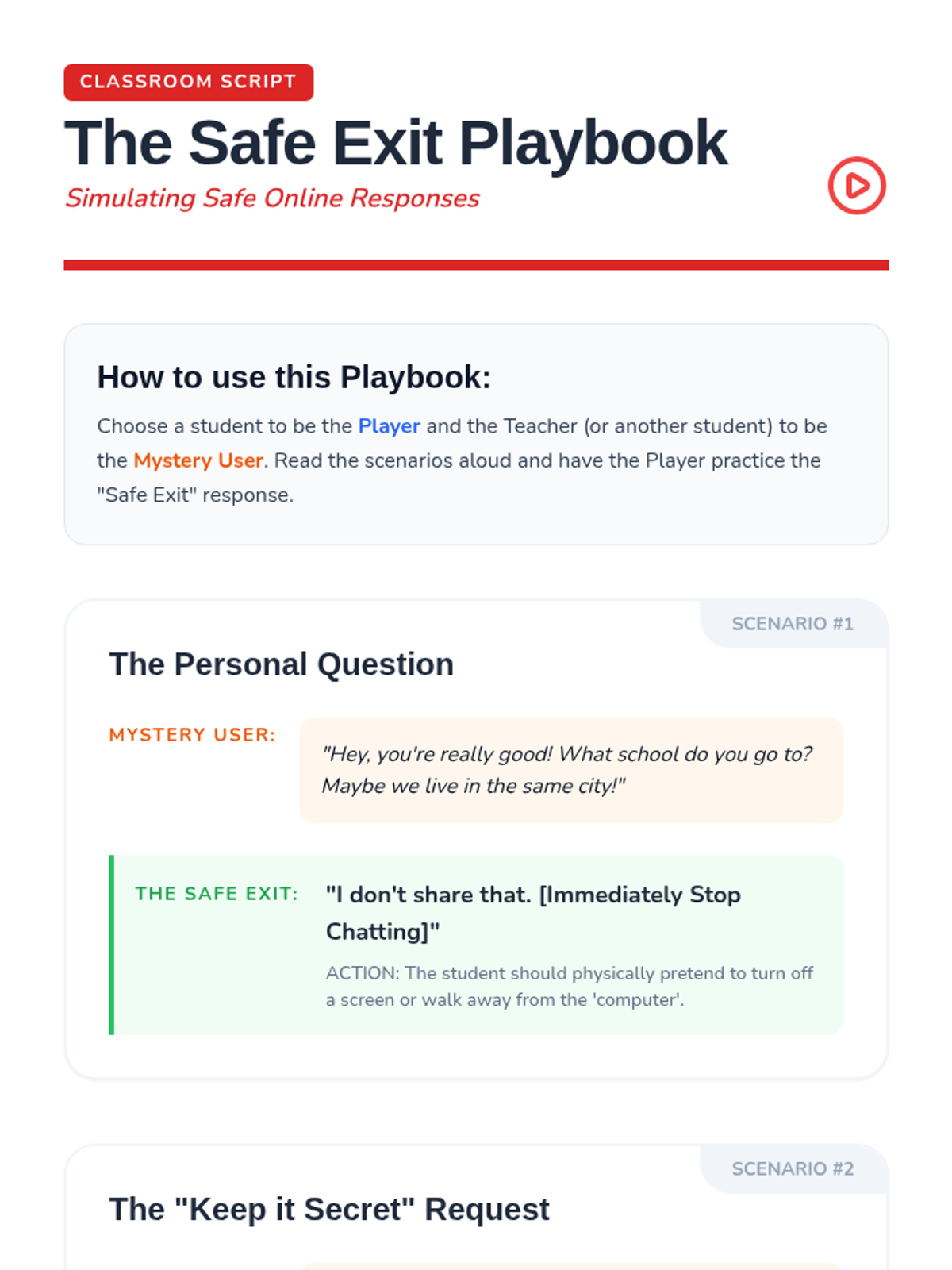
Teacher/Class scripts for roleplaying safe responses to uncomfortable online situations, including saying no, blocking users, and reporting to trusted adults.
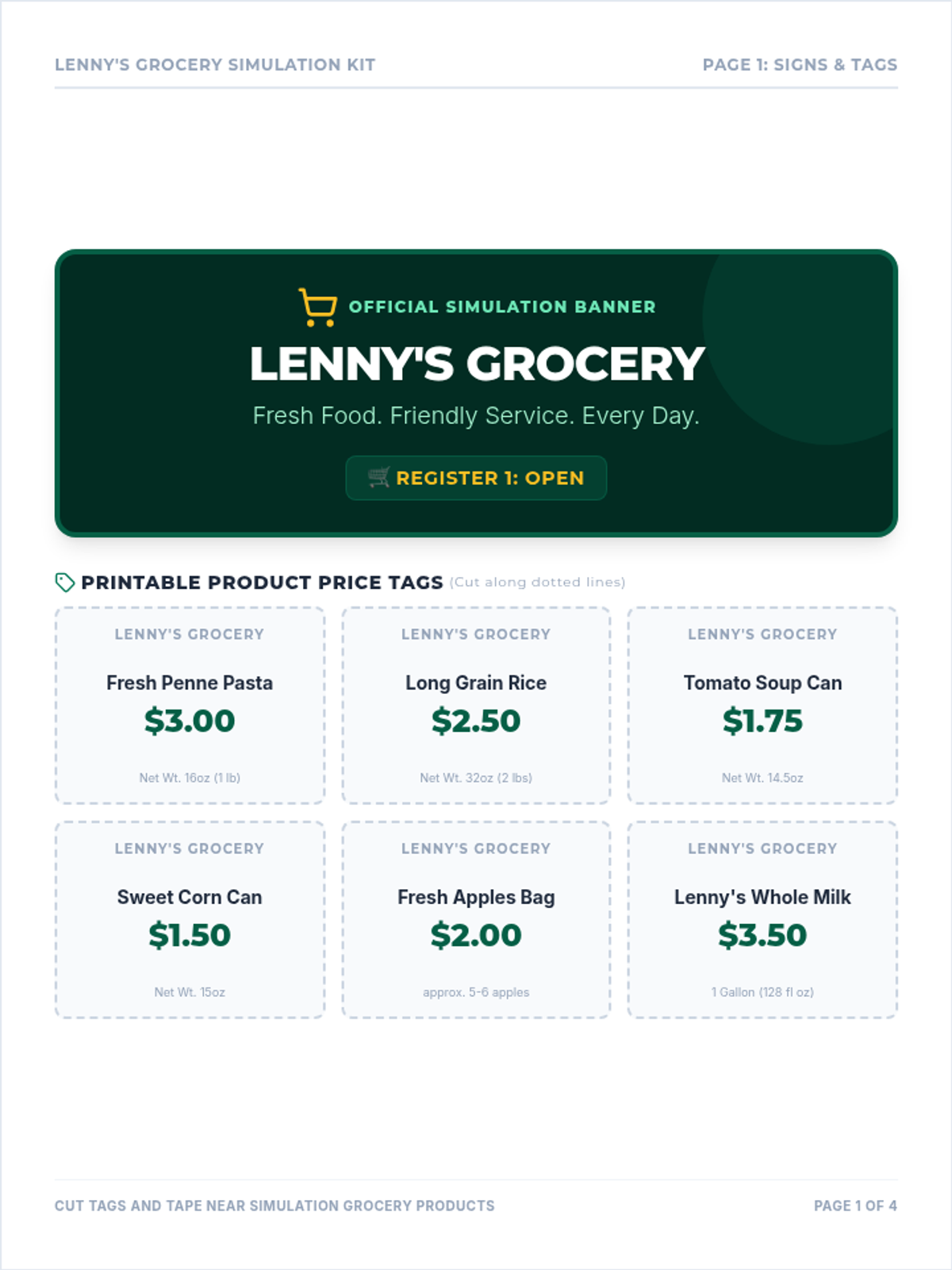
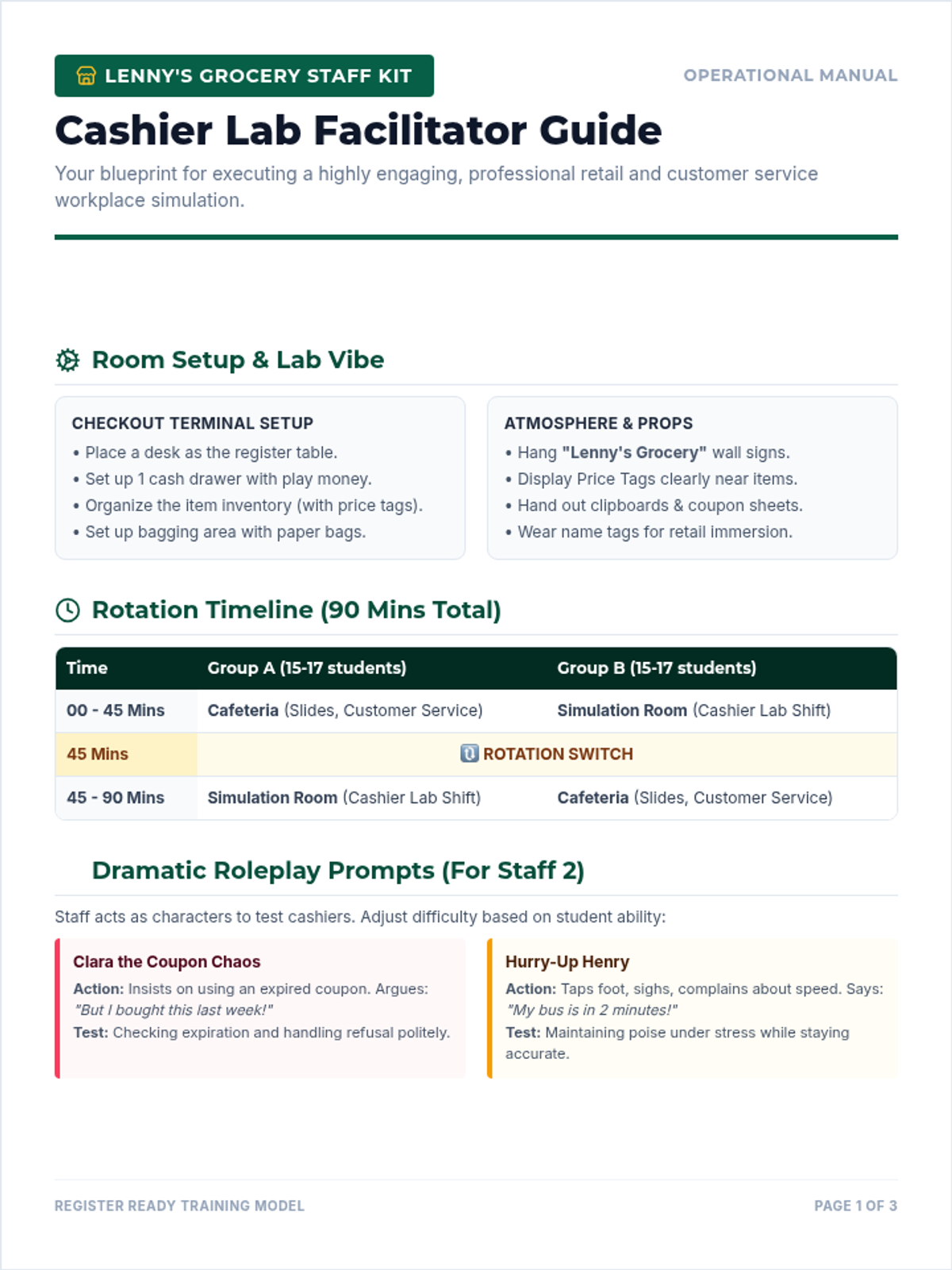
Printable store simulation resources for Lenny's Grocery. Includes store banners, product price tags, role badges, practice coupons, customer mission cards, and job duty checklist guides.
A complete lesson facilitator guide for trainers running the Cashier Lab and Cafeteria rotation. Includes classroom setup, roleplay prompt scripts, a debrief discussion guide, and an employability skill evaluation rubric.
Interactive training slides for cashiers covering customer service, coupon calculations, and making change using the counting-up method. Includes dedicated slides for all 5 instructional YouTube videos.
A 2-page print-ready teacher resource containing a detailed 15-minute lesson plan and 4 interactive circle cards to build a safe classroom harbor in Lesson 1, differentiated for 5th grade.
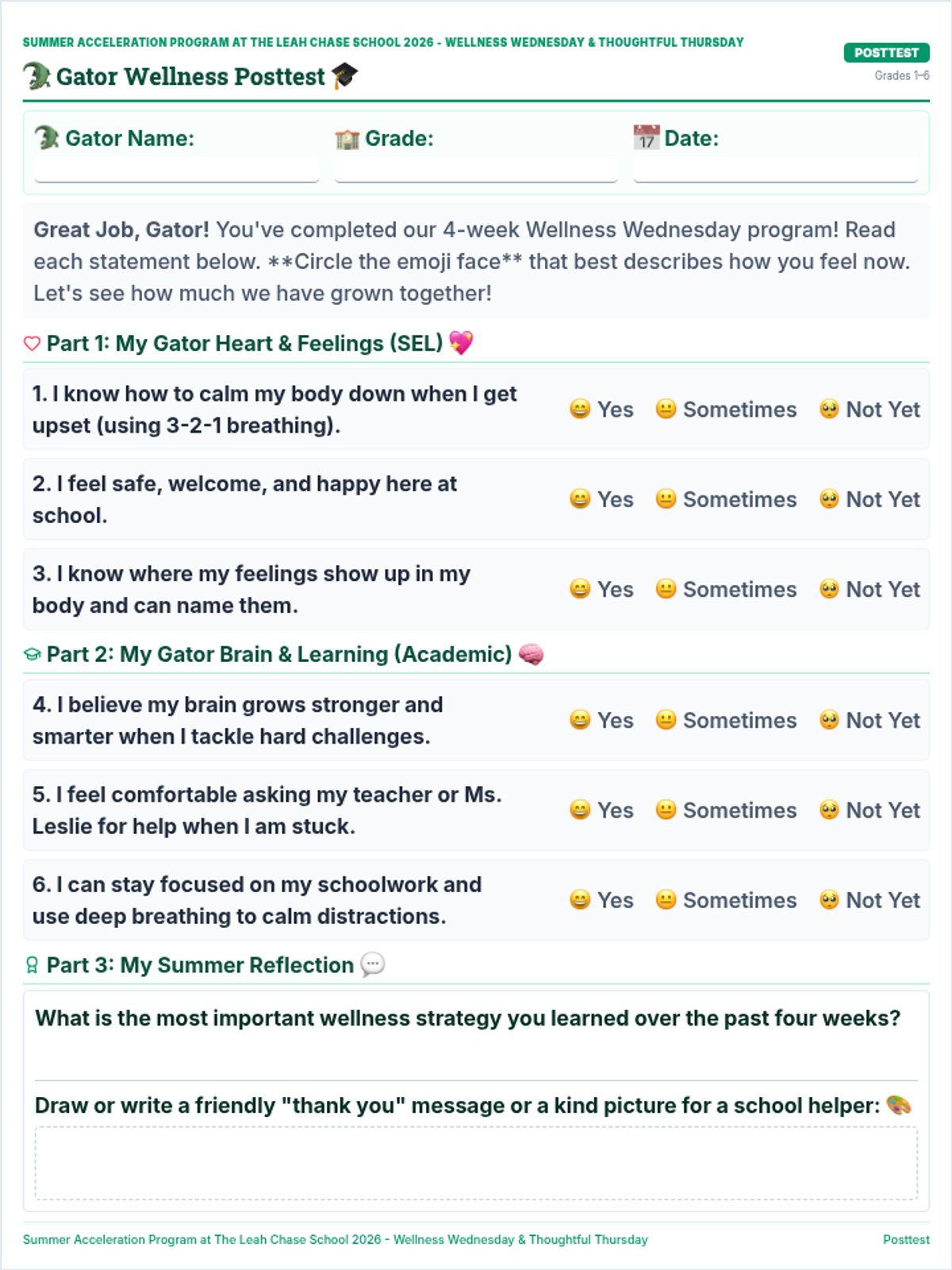
A school-wide student-facing post-assessment measuring growth in SEL (self-regulation, breathing, kindness) and Academic Support (growth mindset, asking for help, overcoming challenges).
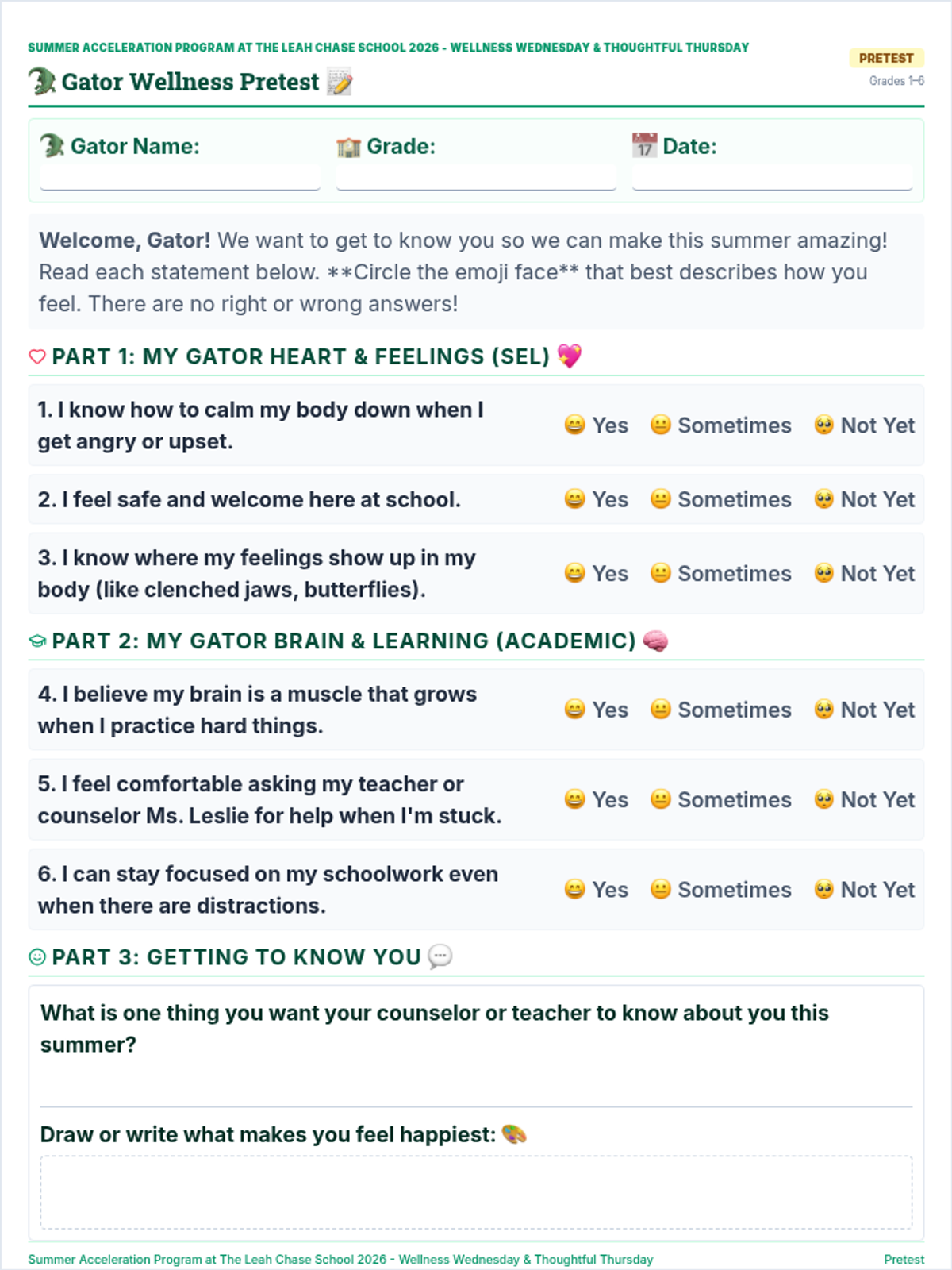
A school-wide student-facing pre-assessment covering SEL (feelings, self-regulation, coping skills) and Academic Support (attitude toward learning, asking for help, classroom focus).
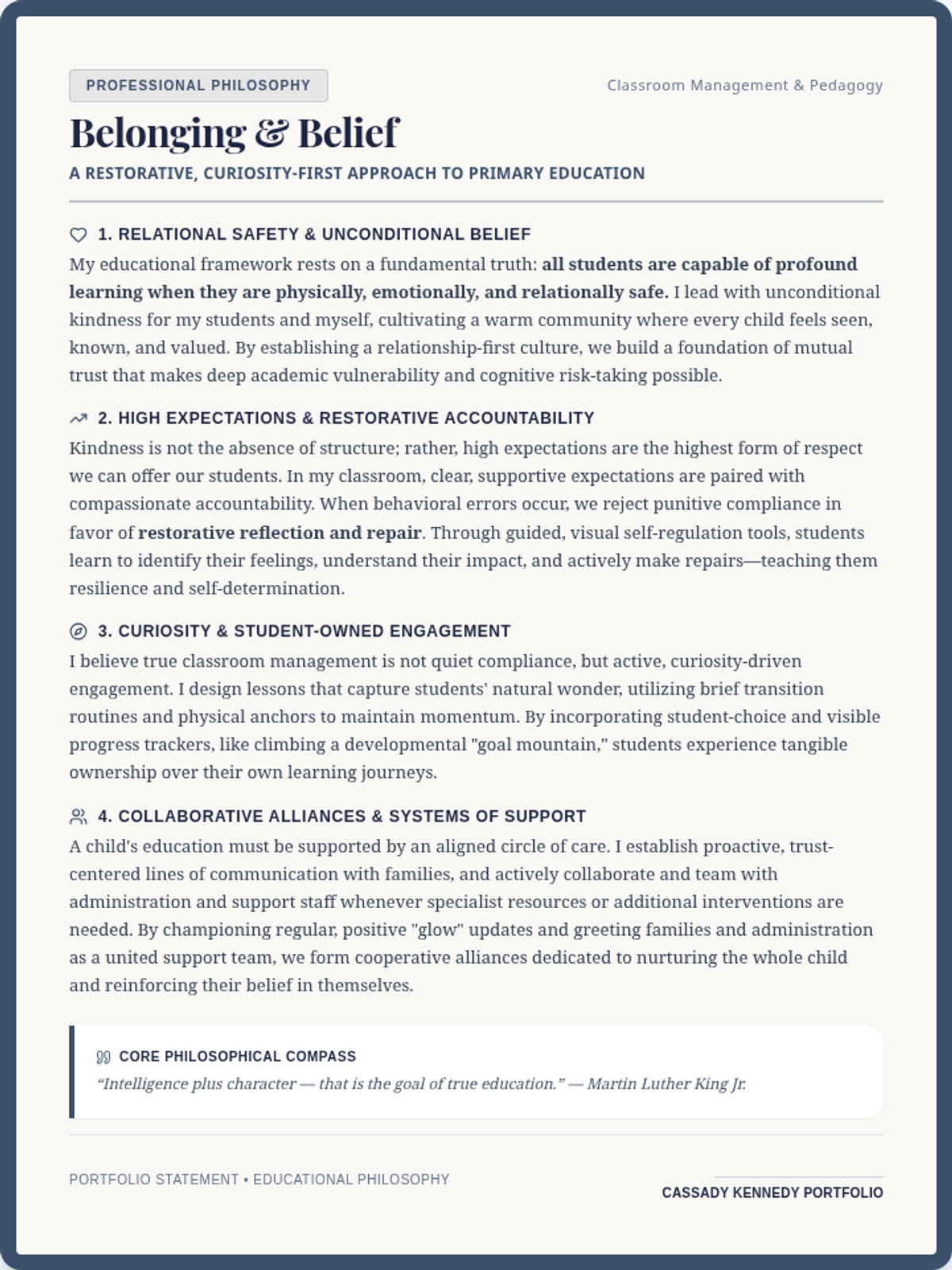
A polished, executive professional teaching philosophy statement for a teacher's portfolio. It frames the classroom management system through the lenses of high expectations, relationship-focused restorative practices, active family collaboration, and curiosity-driven instructional engagement.
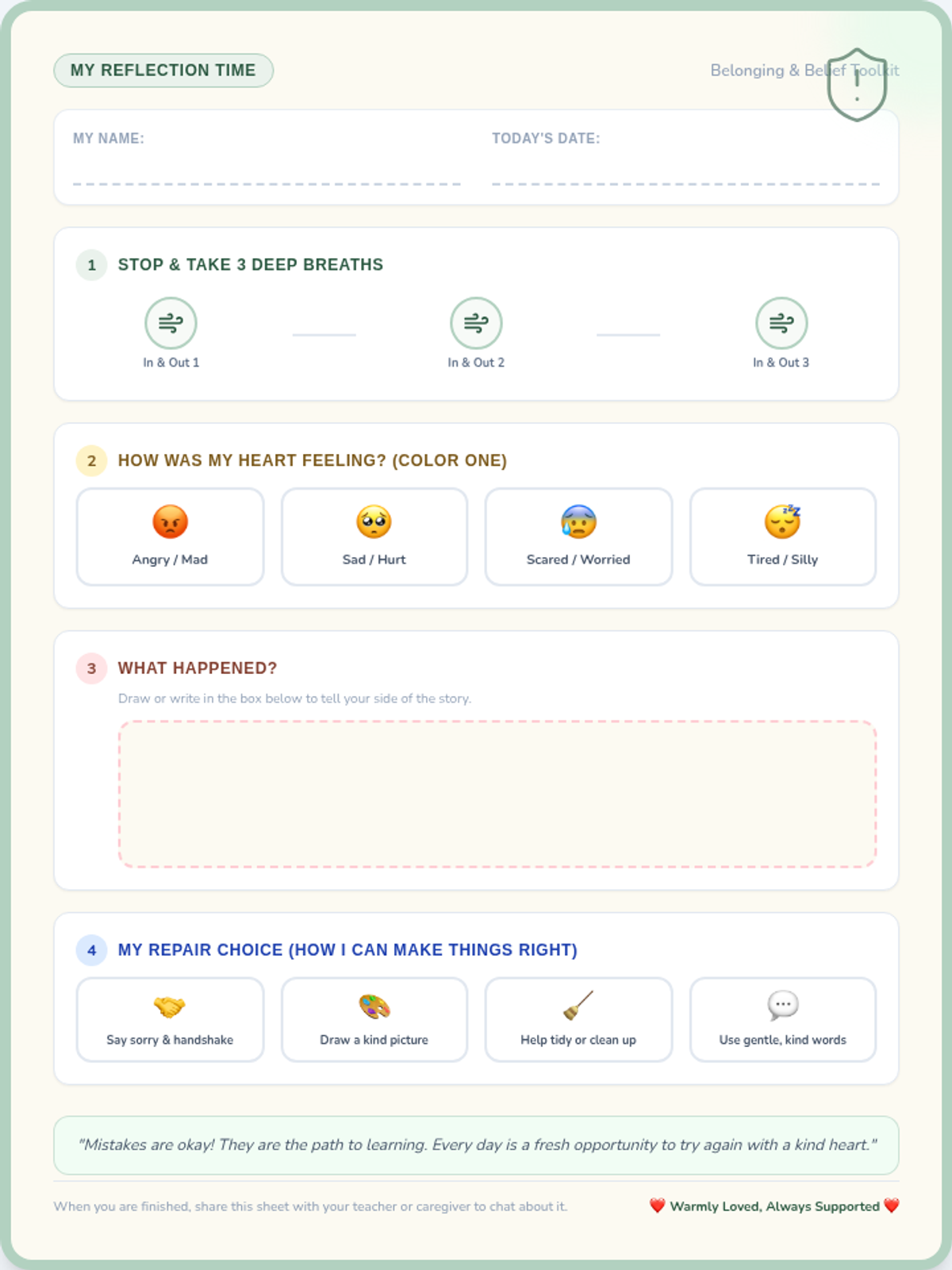
Simple visual reflection guides designed for first-grade self-regulation. Focuses on physical grounding, labeling feelings, identifying what went wrong, and choosing a restoration action.
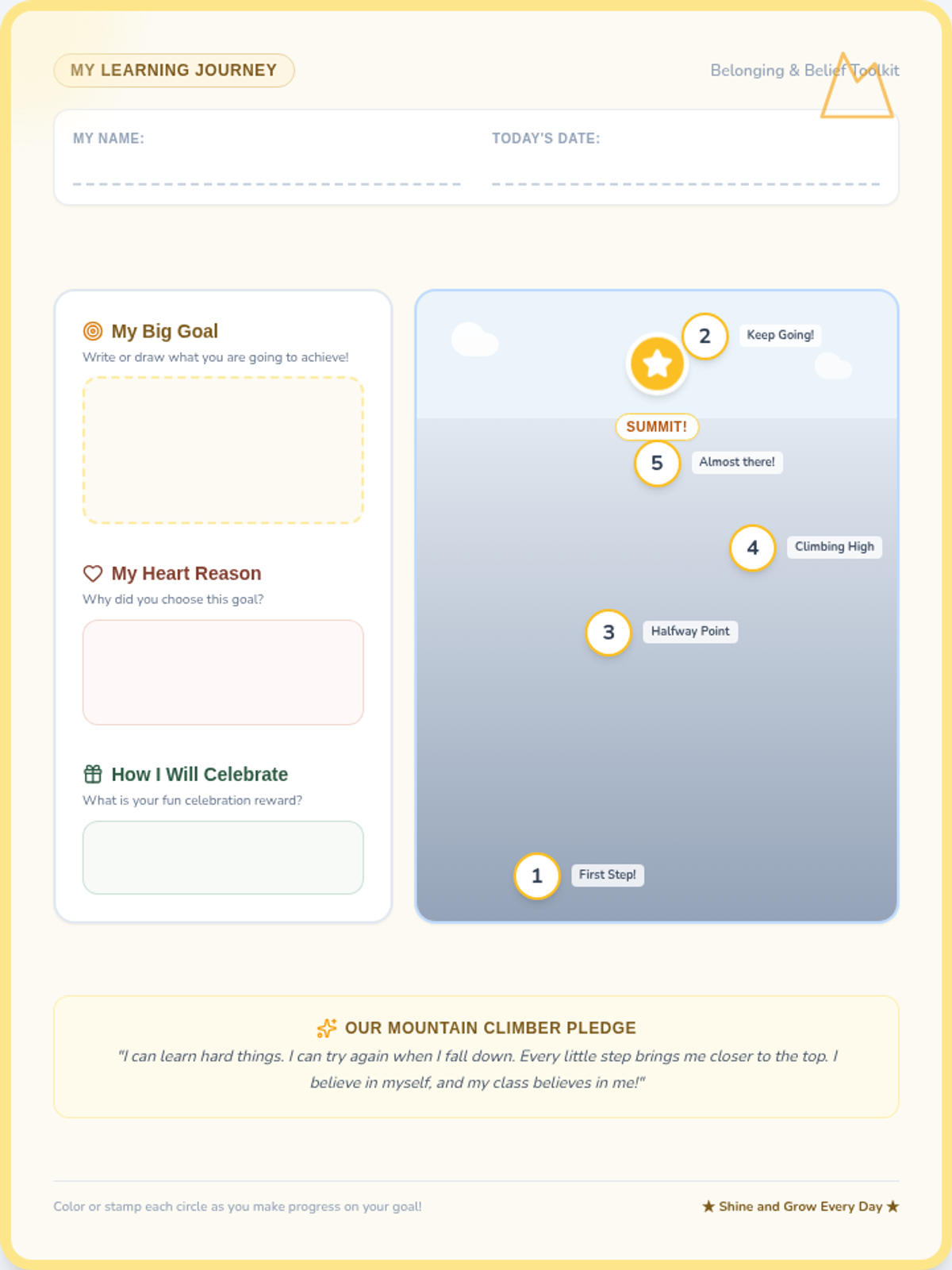
A kid-friendly progress tracker that promotes student ownership, choice, and visible goal celebration. It features a playful trail climbing up a mountain with interactive coloring steps.
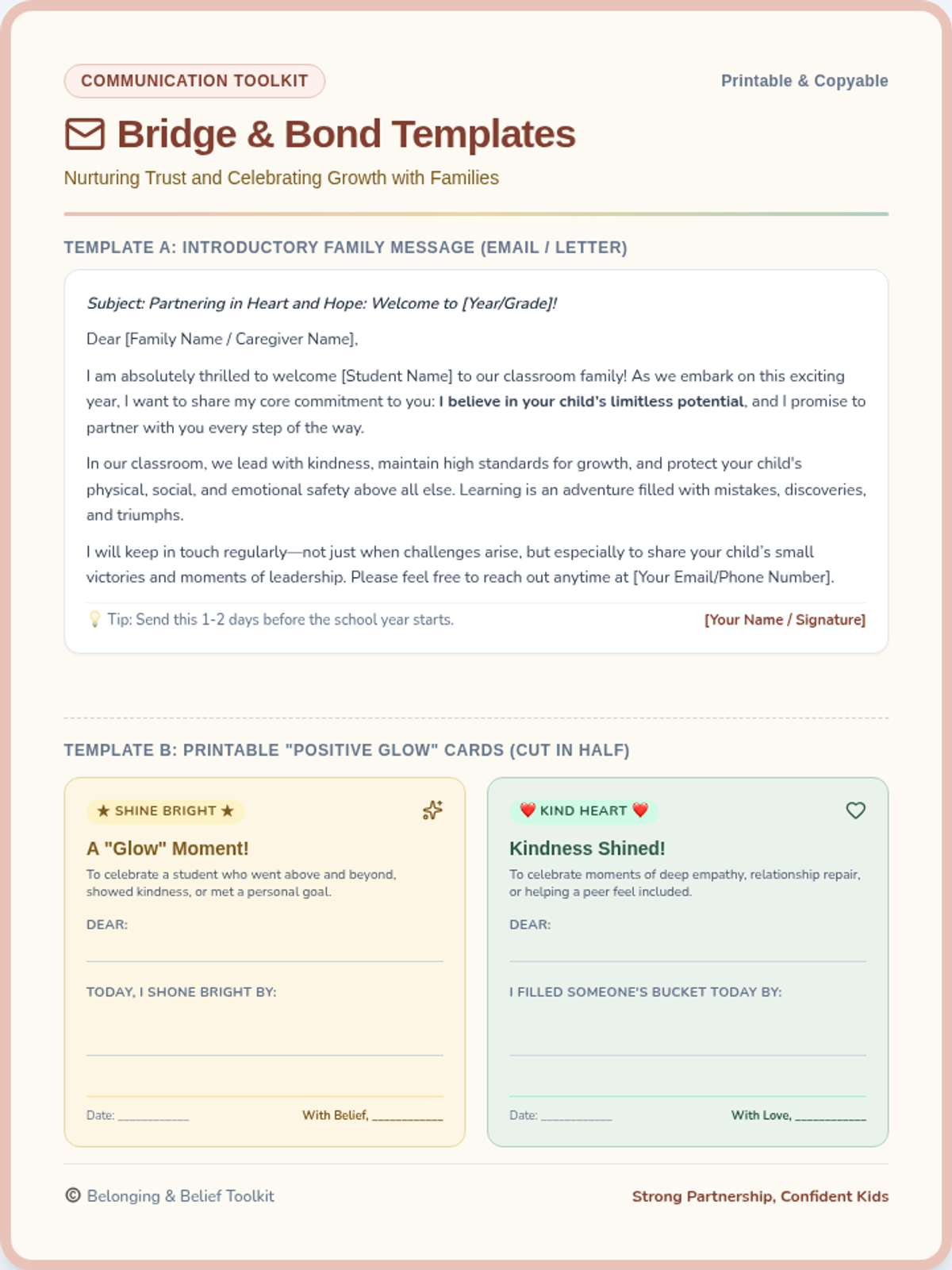
Positive outreach templates and introductory letters to build strong, collaborative home-school partnerships. Includes a welcoming letter and fill-in-the-blank positive glow templates.
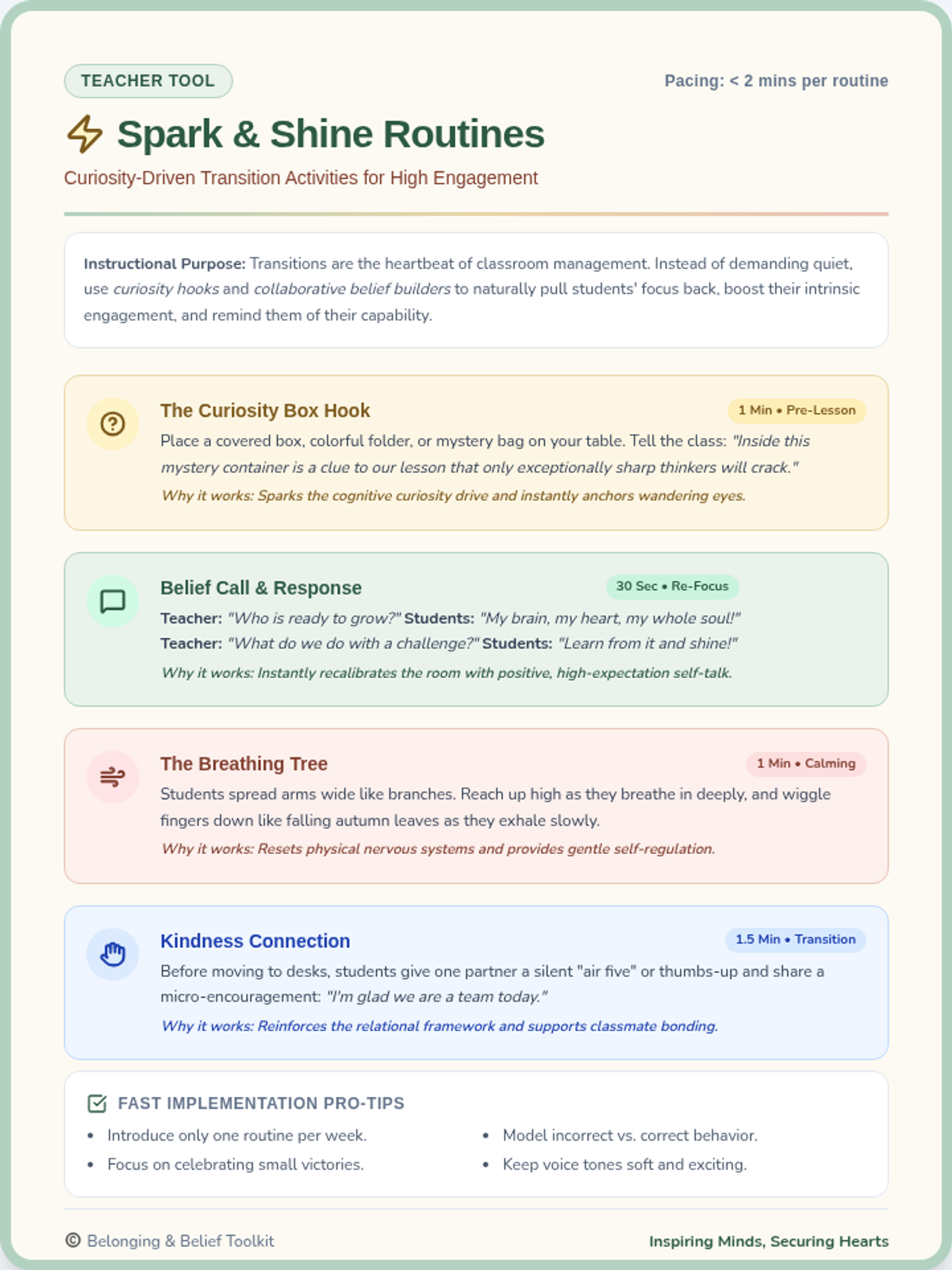
A teacher-facing guide outlining quick, 1-minute daily transition and curiosity-driven routines. These spark imagination, focus student energy, and increase academic engagement through playful interaction.
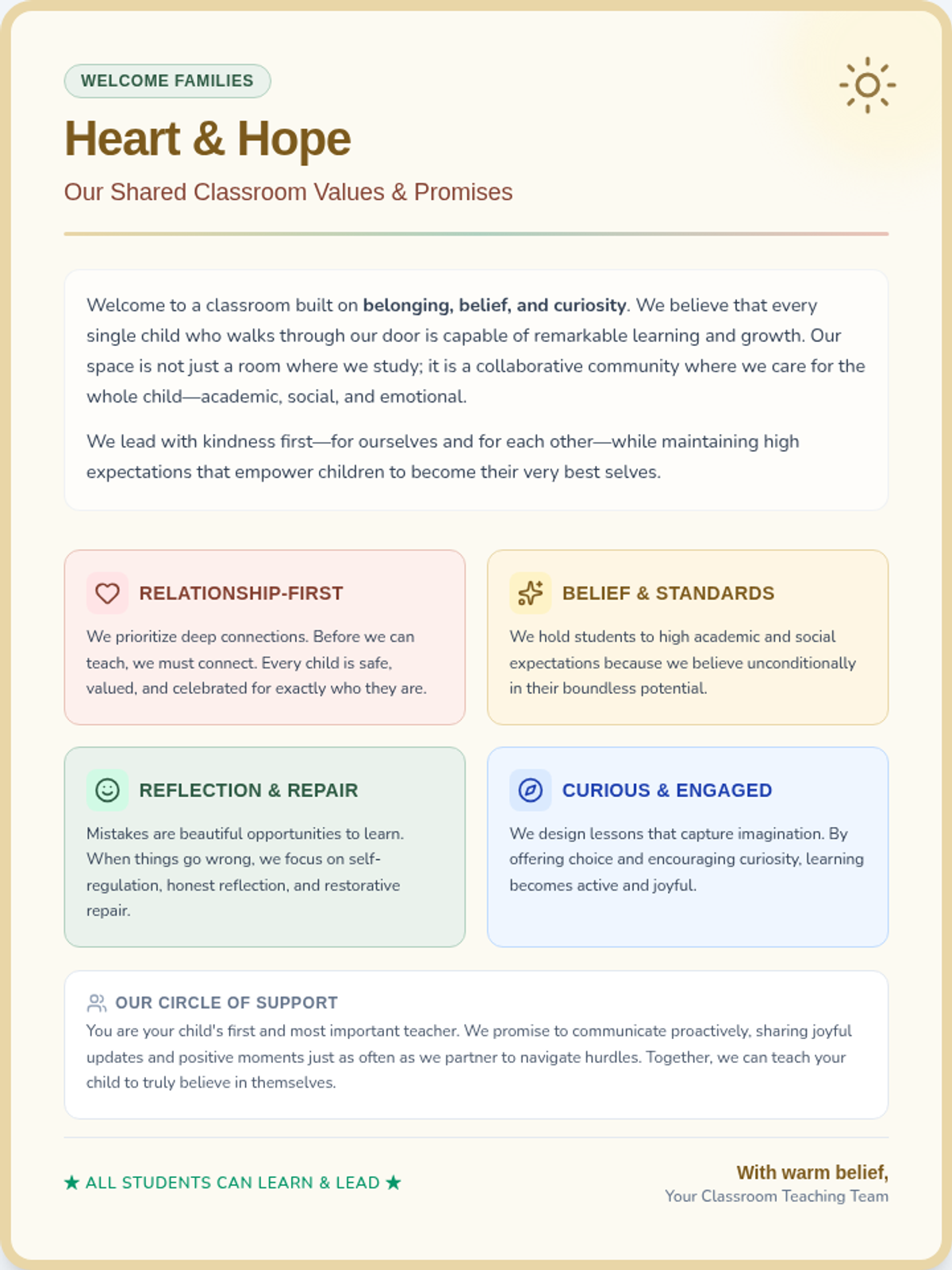
A polished, warm family introduction section for the classroom handbook. It outlines the classroom core beliefs in kindness, high expectations, relationship-focused accountability, whole-child support, and collaborative family partnership.
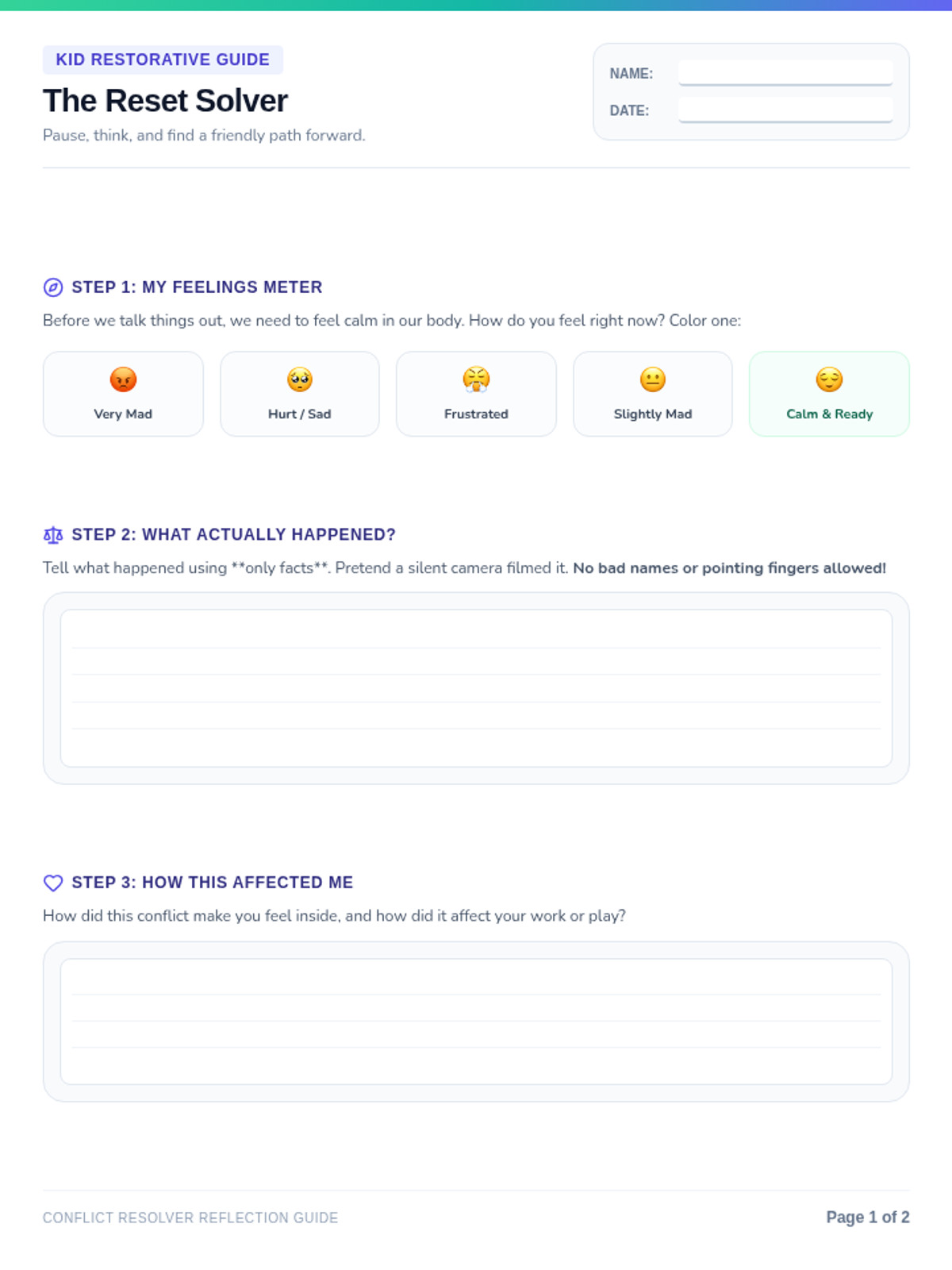
A 2-page student self-reflection guide designed for resolving active conflicts, helping students calm down, evaluate facts, map perspectives, and draft restorative action steps.
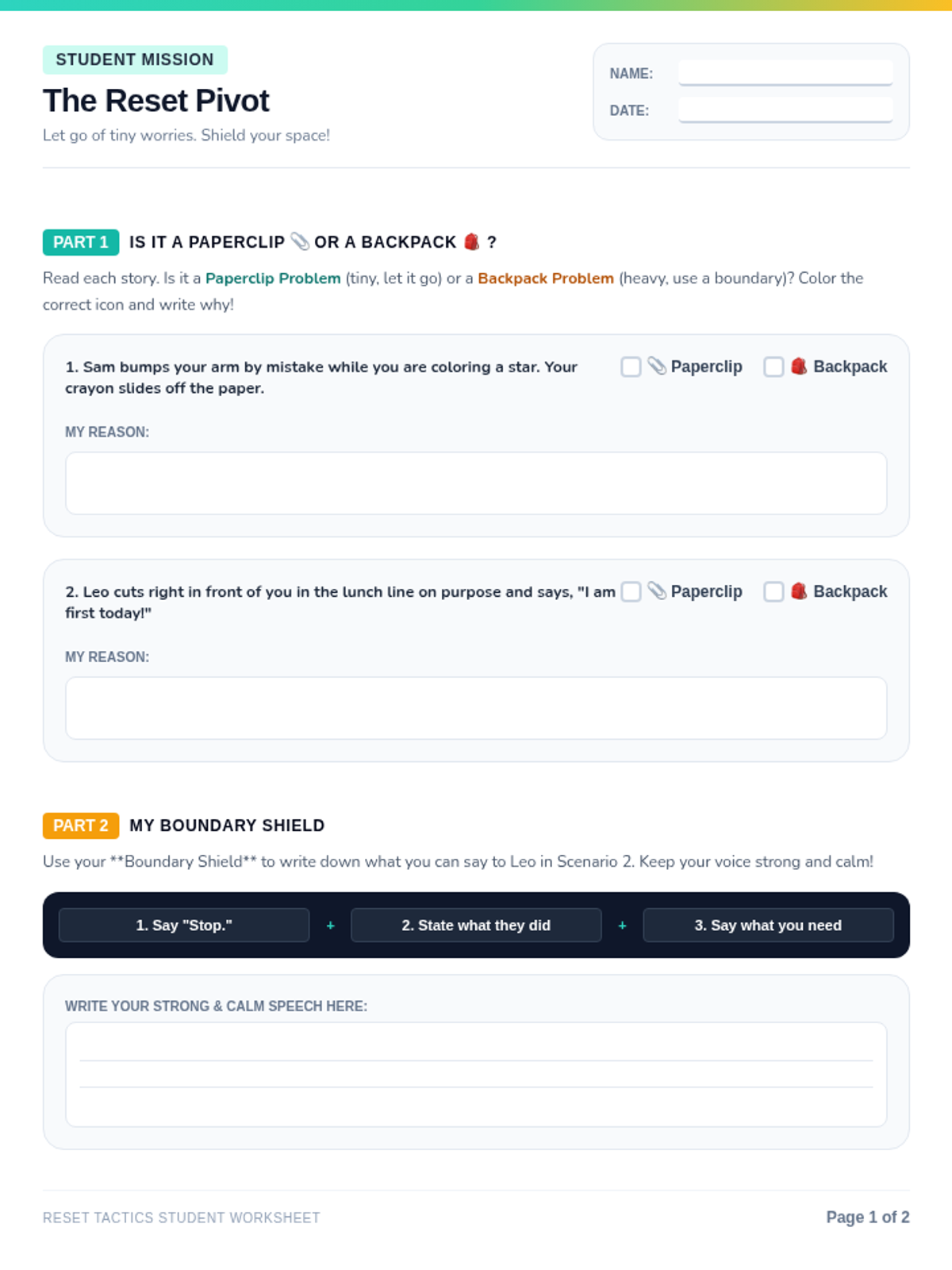
A 2-page student worksheet. Page 1 guides students to analyze peer friction as 'Paperclip vs. Backpack' and write assertive boundary scripts. Page 2 applies the Apology Decision Tree to realistic scenarios, prompting students to draft repairs and apologies.
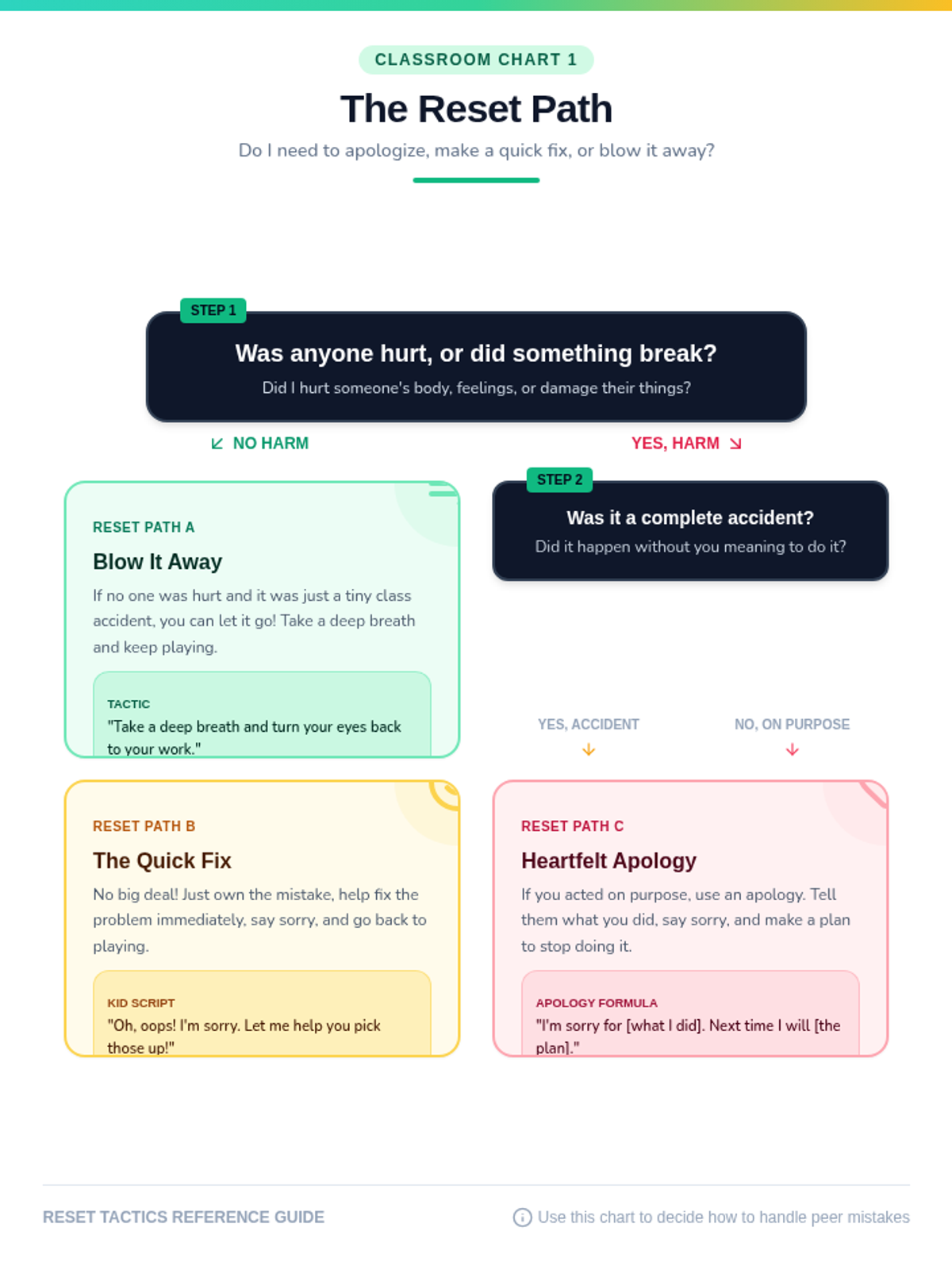
Printable anchor charts for classroom display. Page 1 presents the visual Apology Decision Tree. Page 2 outlines 'Paperclip vs. Backpack' friction levels and the Boundary Shield formula.
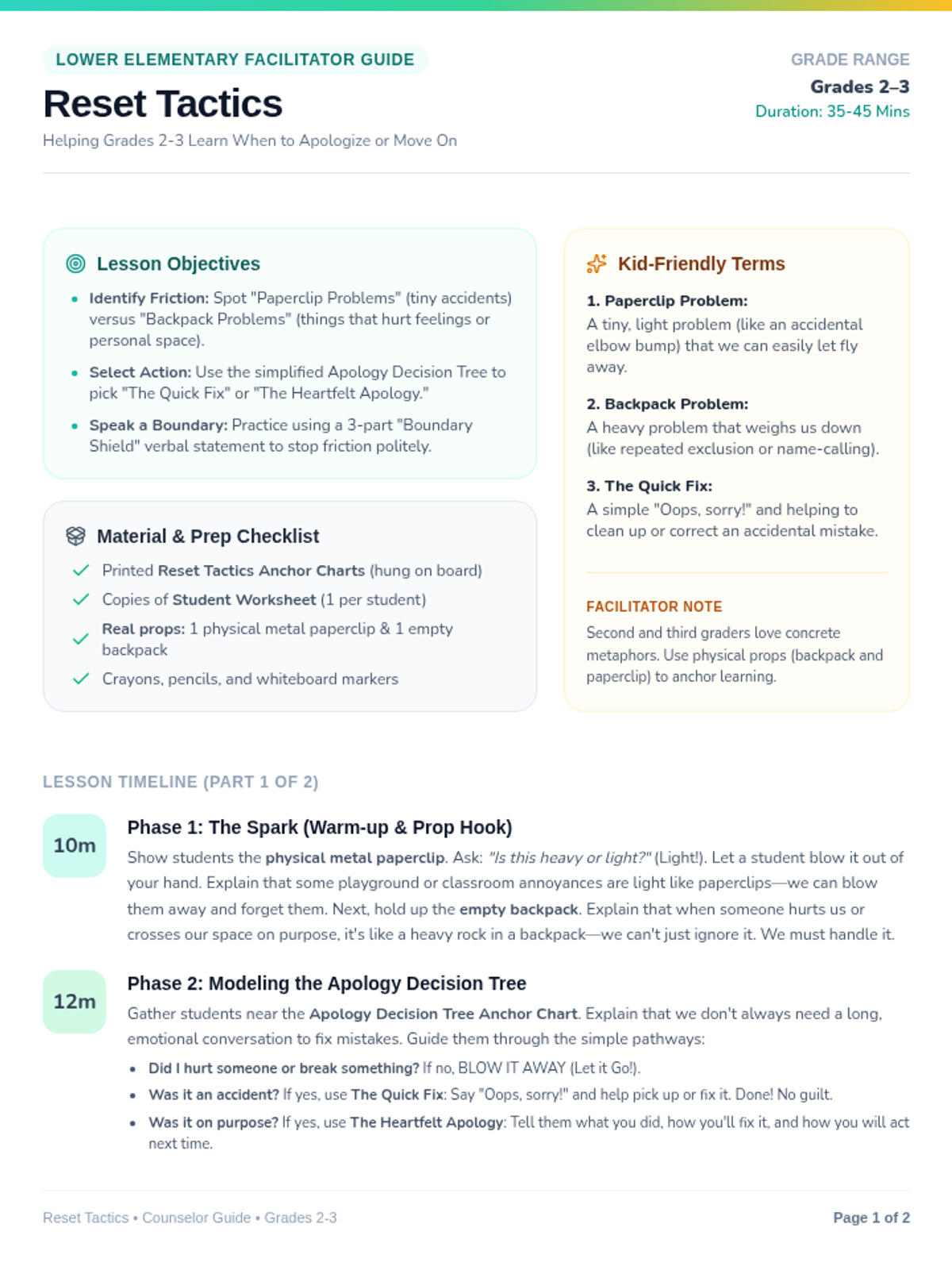
A complete 2-page counseling lesson plan for teachers, outlining objectives, warm-ups, direct instruction for the Apology Decision Tree, group activities for letting go of minor friction, and classroom facilitation notes.
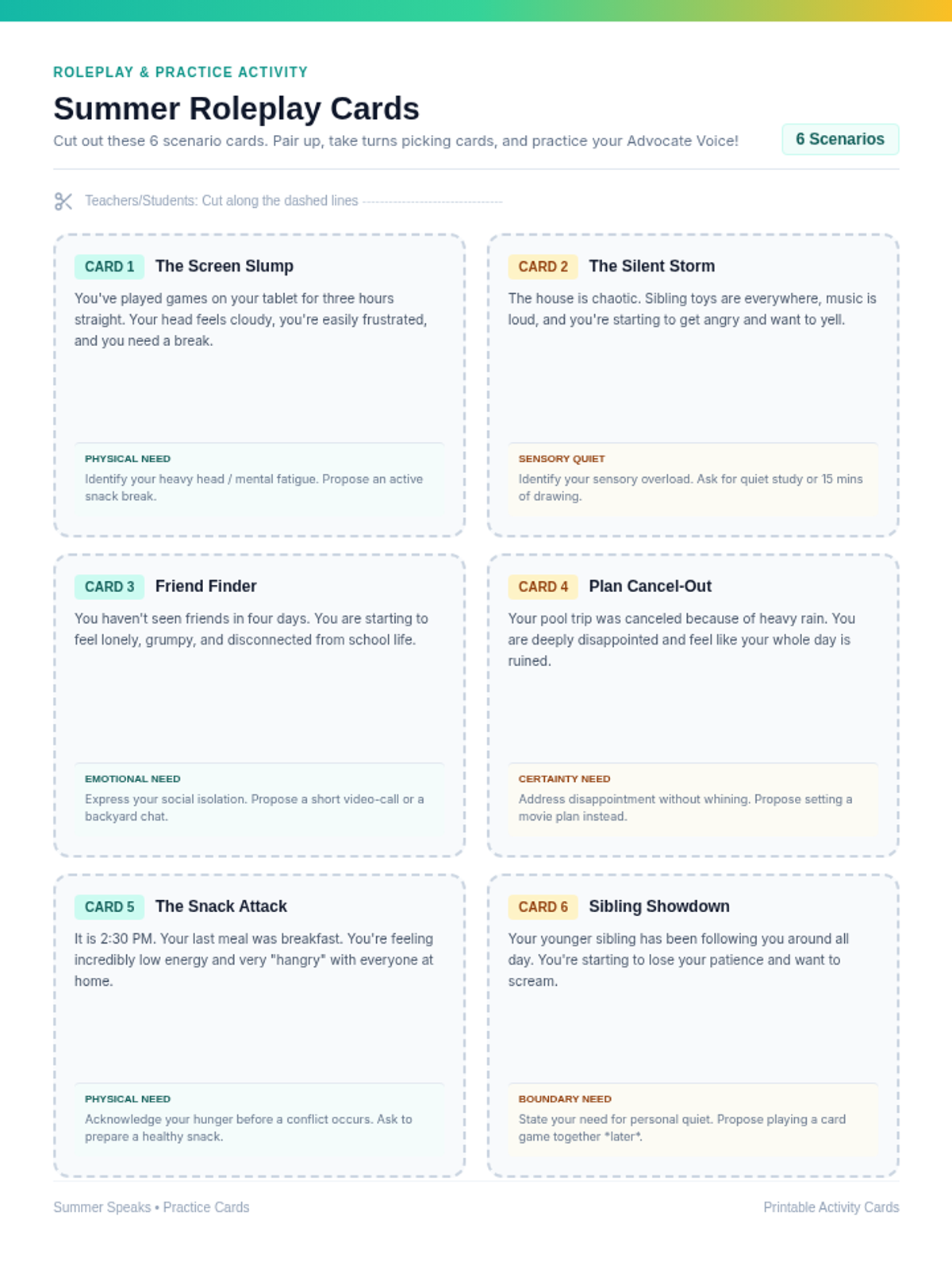
A 1-page printable activity card deck for 'Summer Speaks'. It contains 6 unique summer scenario cards designed with scissor lines for classroom roleplay and discussion.
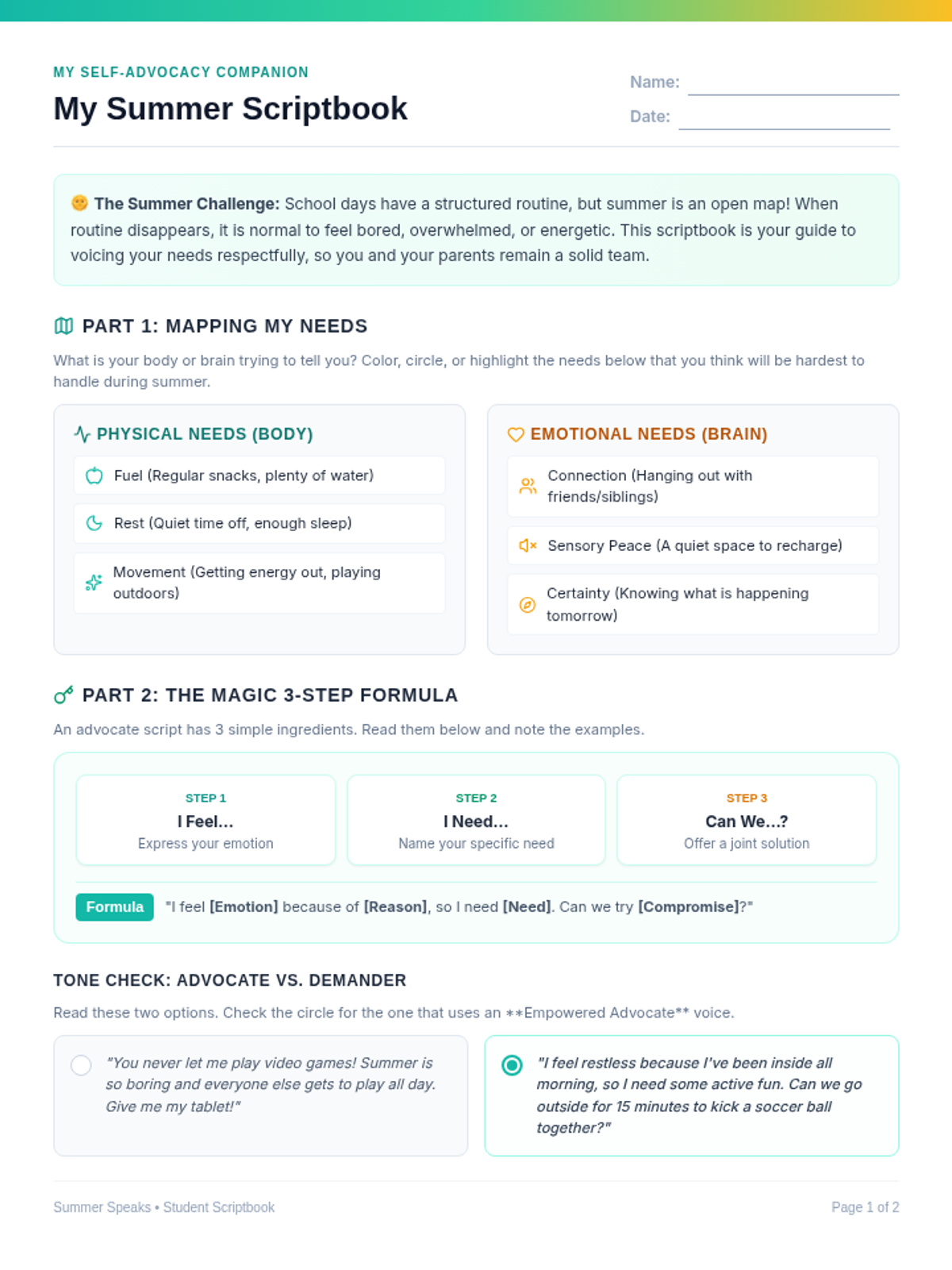
A 2-page interactive student workbook for 'Summer Speaks'. Students map out physical and emotional needs, study the 3-step script formula, and write custom self-advocacy scripts for common summer situations.
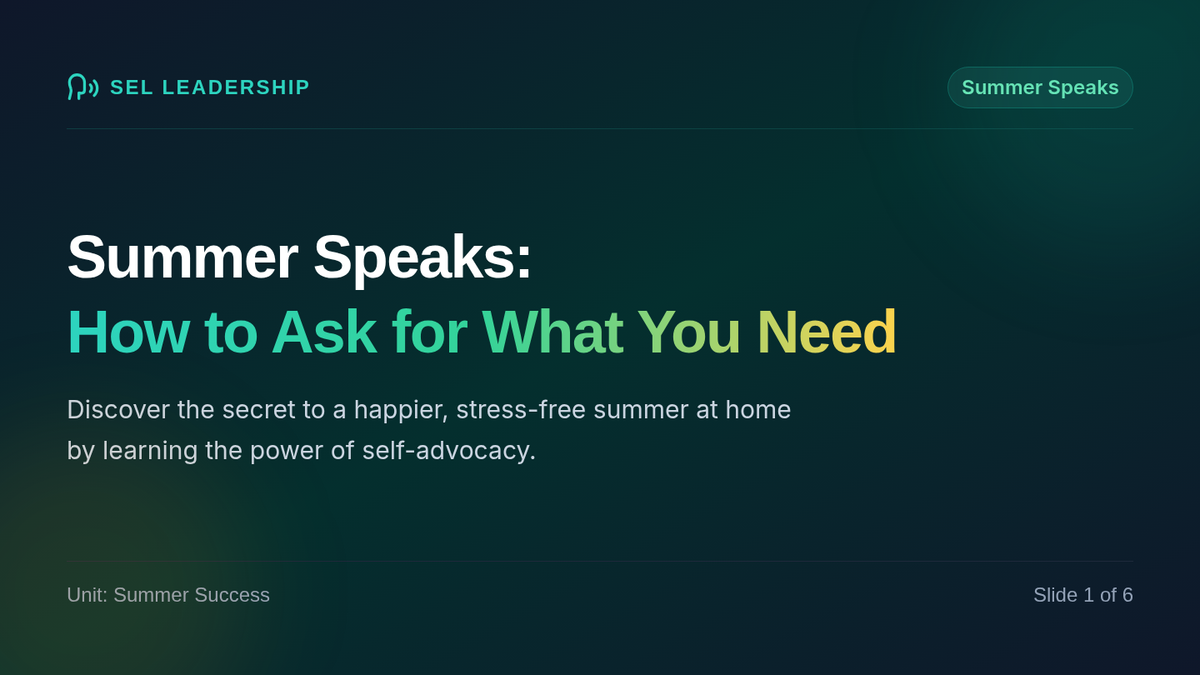
A 6-slide visual presentation for 'Summer Speaks'. It introduces the concept of unstructured summer routine changes, helps students categorize physical vs. emotional needs, and teaches the 3-step self-advocacy formula with interactive class discussion prompts.
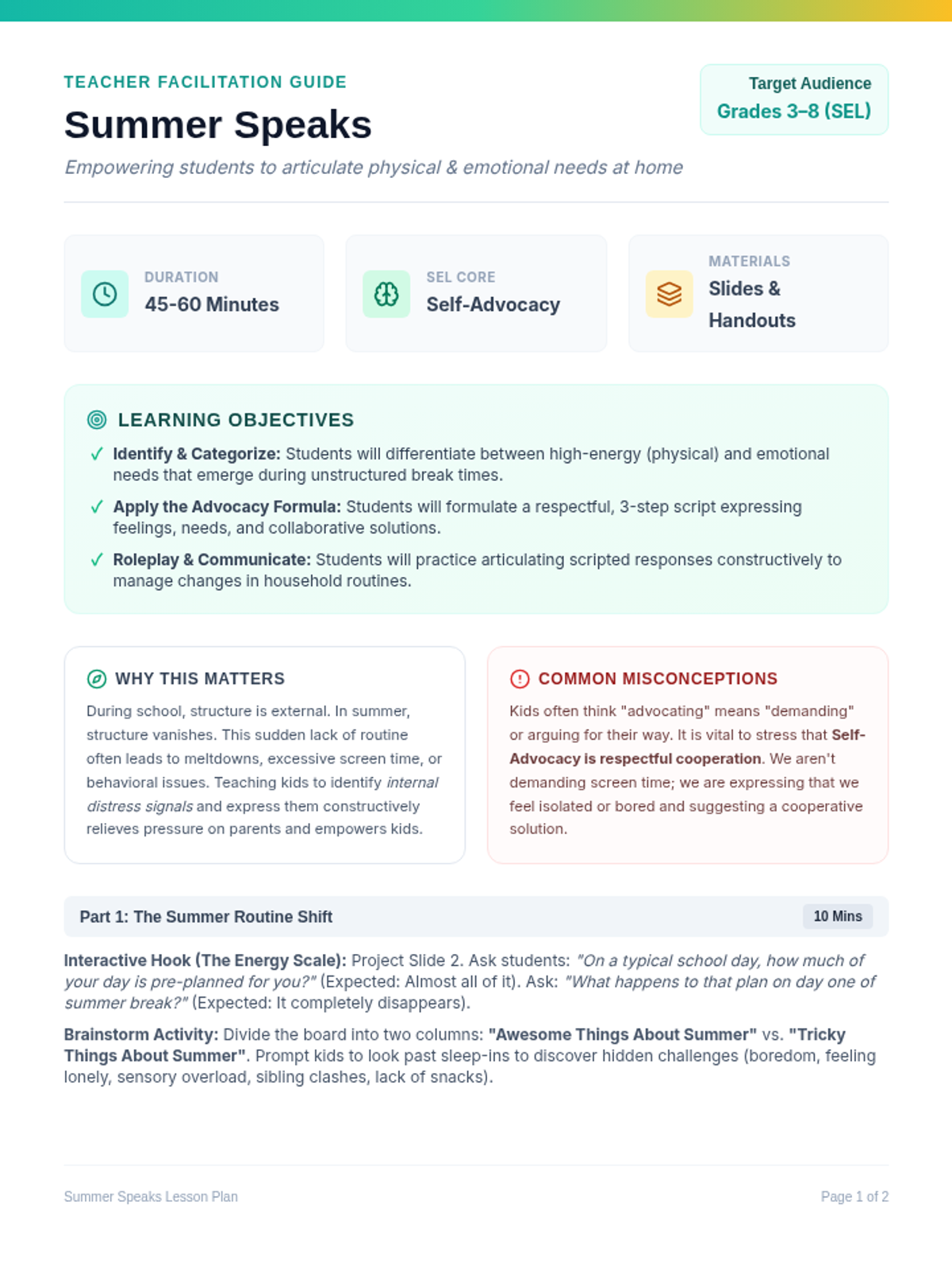
A 2-page teacher-facing lesson plan for 'Summer Speaks'. It outlines the objectives, standard alignments, materials needed, and step-by-step facilitation instructions for teaching summer self-advocacy to elementary and middle school students.
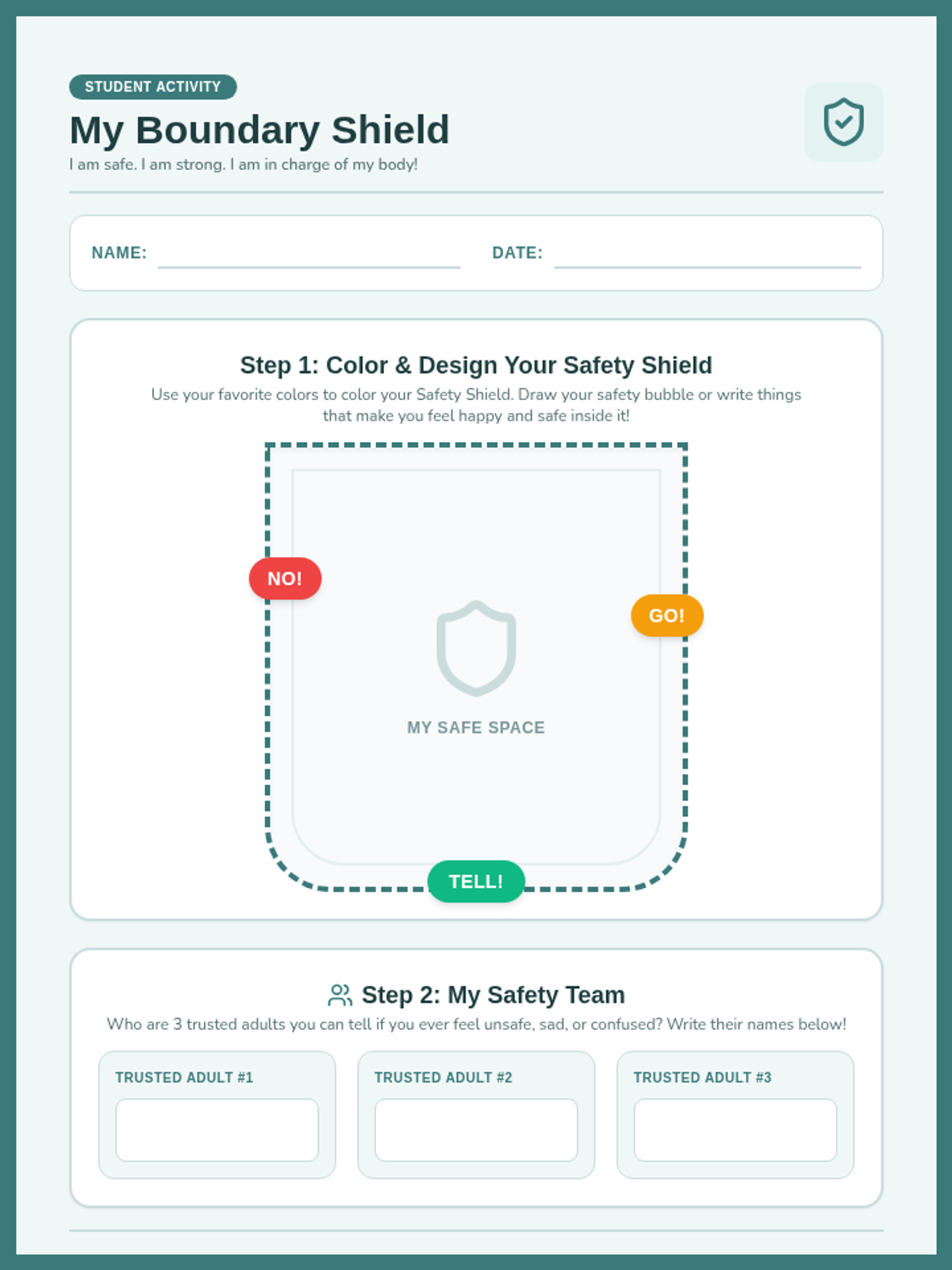
A student worksheet where children design their own Boundary Shield, trace body safety rules, and list three trusted adults who make up their personal safety team.
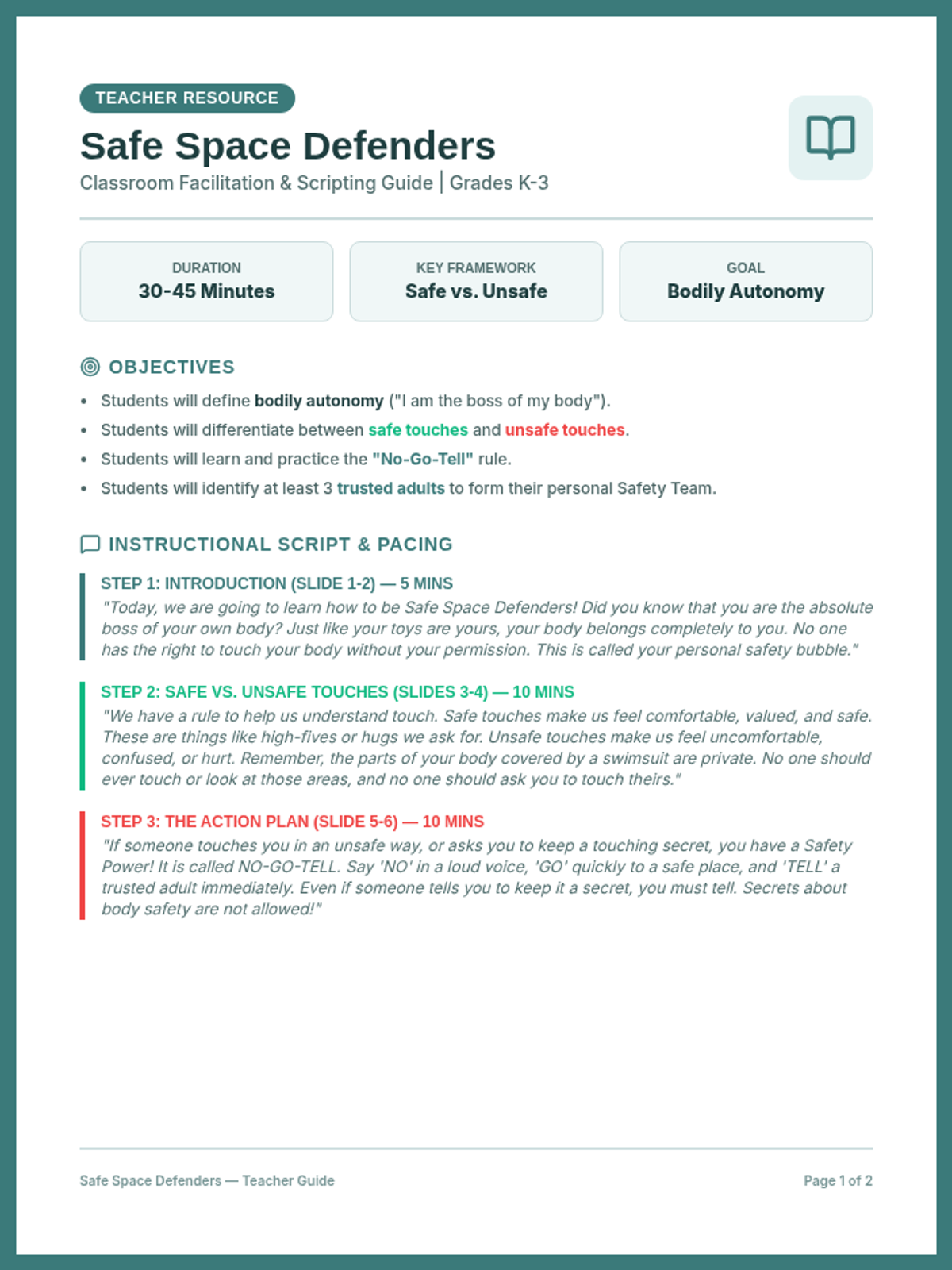
A detailed instructional guide for educators delivering the Safe Space Defenders lesson. It includes direct teaching scripts, discussion prompts, handling child disclosure protocols, and guidance for classroom activities.
Interactive assembly slides for Counselor's Week 4 session on Celebration, Reflection, and administering the school-wide student post-assessment.
Interactive assembly slides for Counselor's Week 3 session on Kindness and Community, teaching students about bucket filling and empathy.
Interactive assembly slides for Counselor's Week 1 session on Growth Mindset, featuring the power of 'Yet' and pre-assessment instructions.
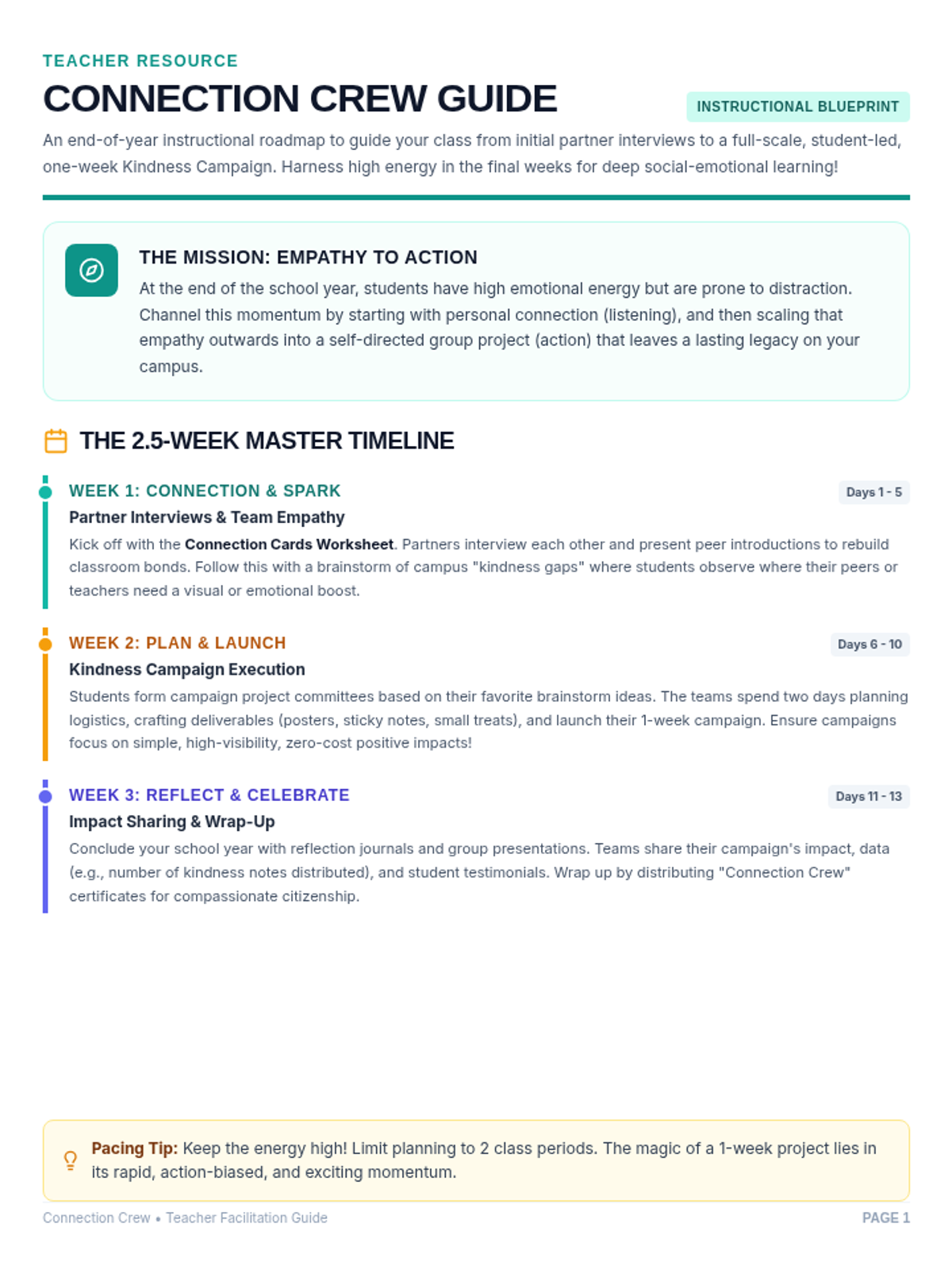
A comprehensive 2-page teacher facilitation guide outlining a 2.5-week pacing roadmap, step-by-step interview instructions, and curated blueprints for student-led 1-week kindness campaigns.
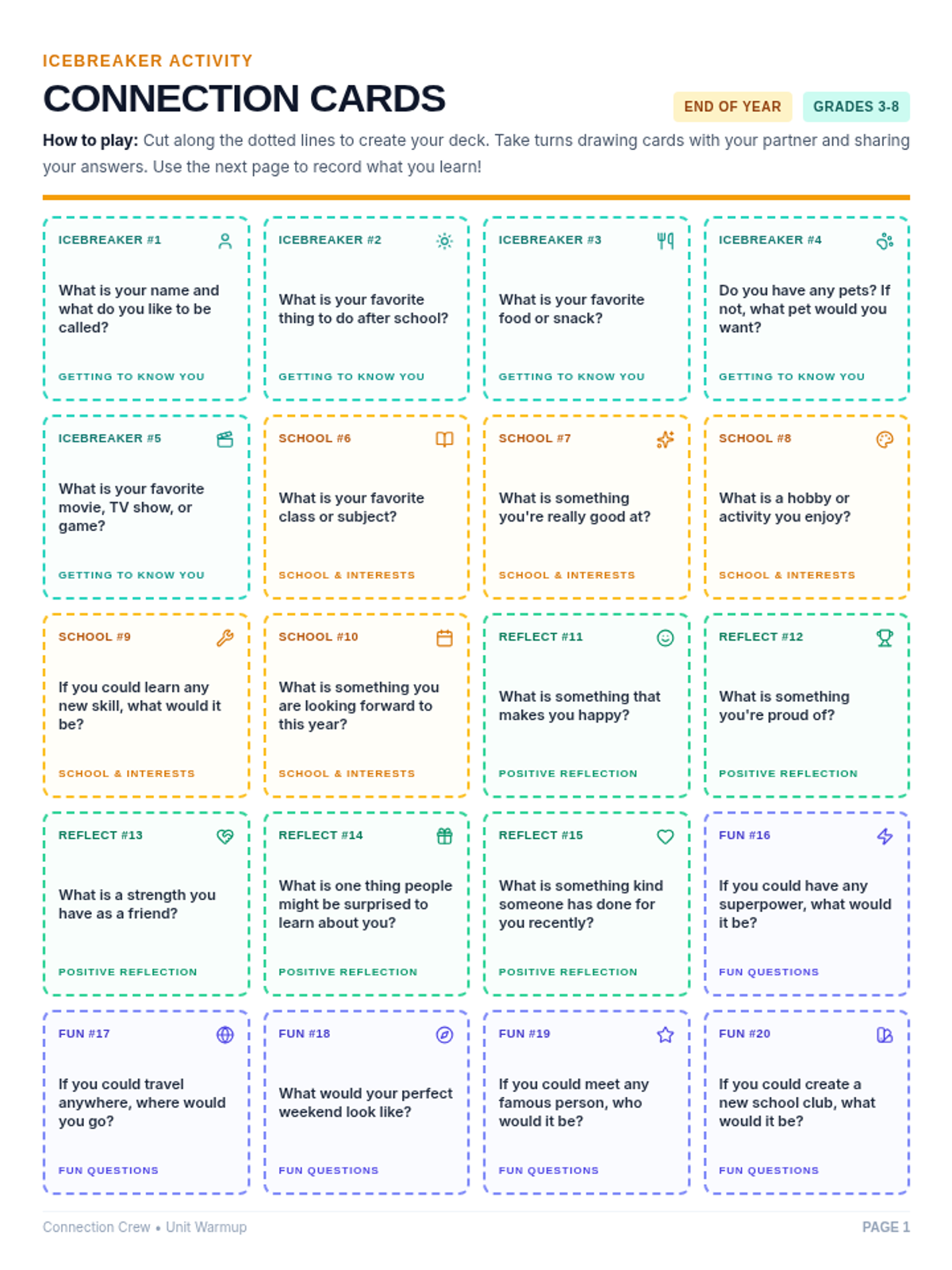
A printable double-sided student resource featuring 20 cut-out interview prompt cards color-coded by category, paired with a structured Partner Profile worksheet and introduction script generator.
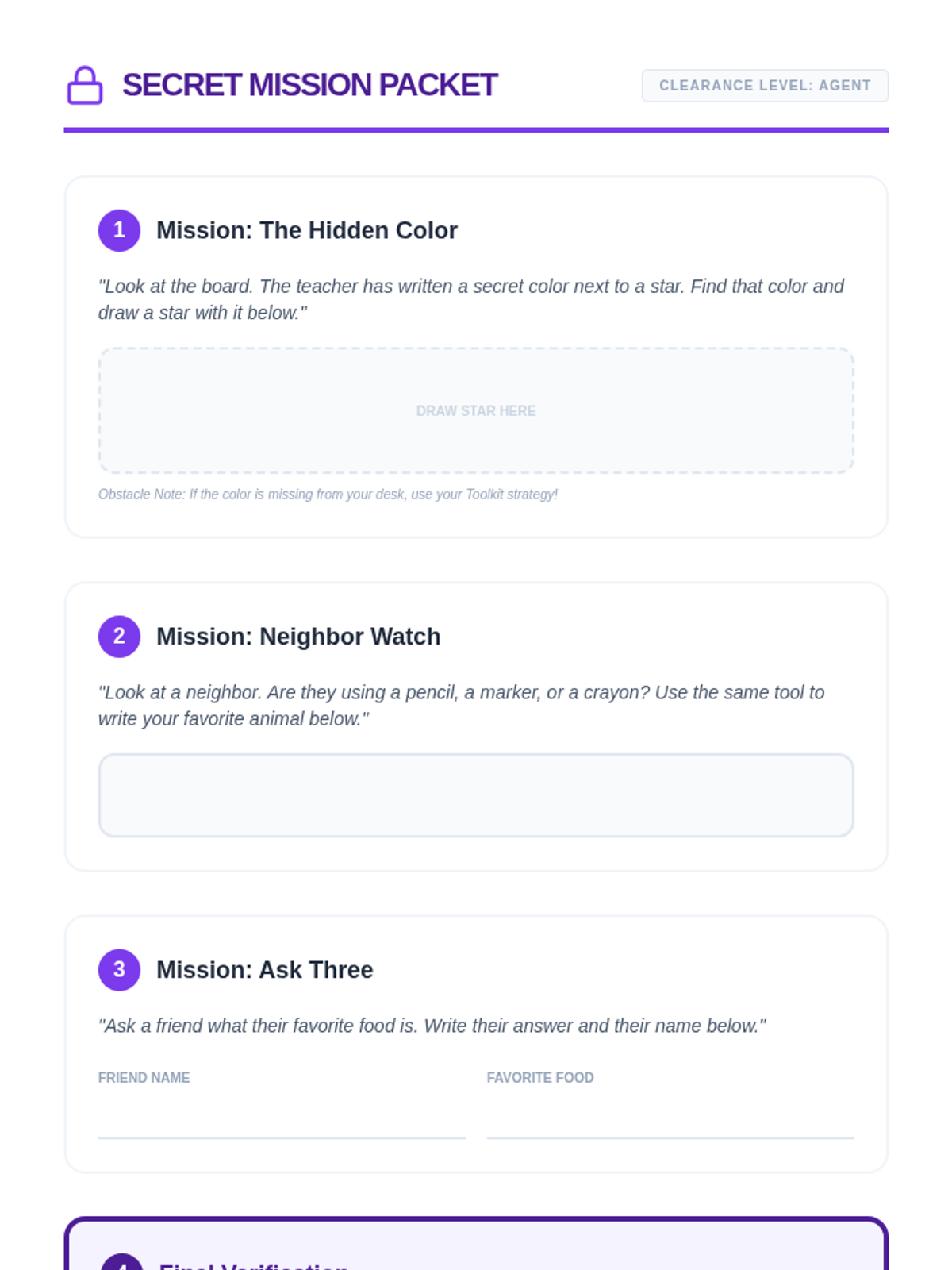
The 'Secret Packet' for the Lesson 5 Obstacle Course challenge. This document provides a series of multi-step tasks that require students to use the strategies they've learned throughout the sequence.
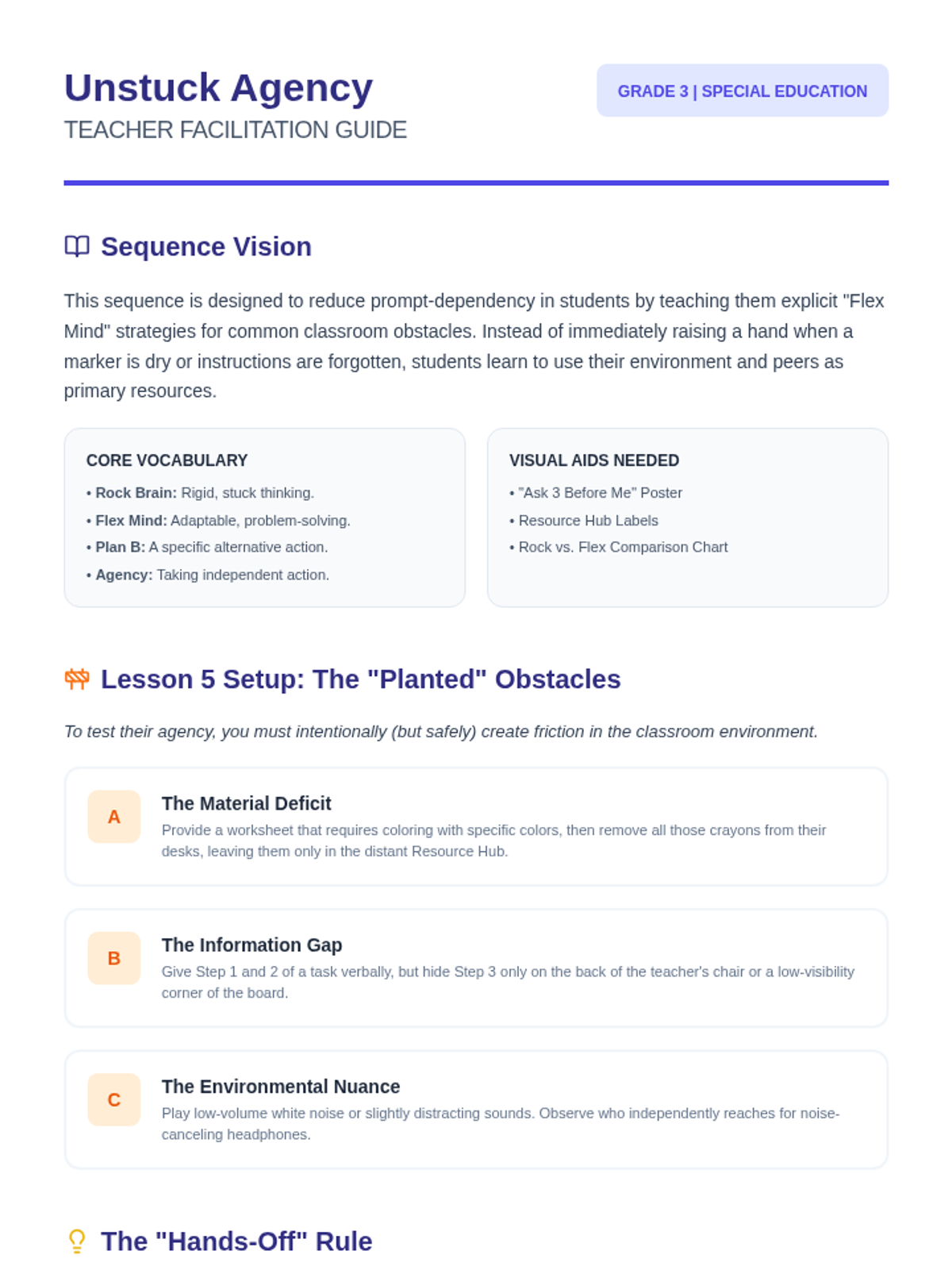
A teacher-facing facilitation guide for the Unstuck Agency sequence, providing classroom setup instructions for the Lesson 5 simulation and tips for reducing prompt-dependency.
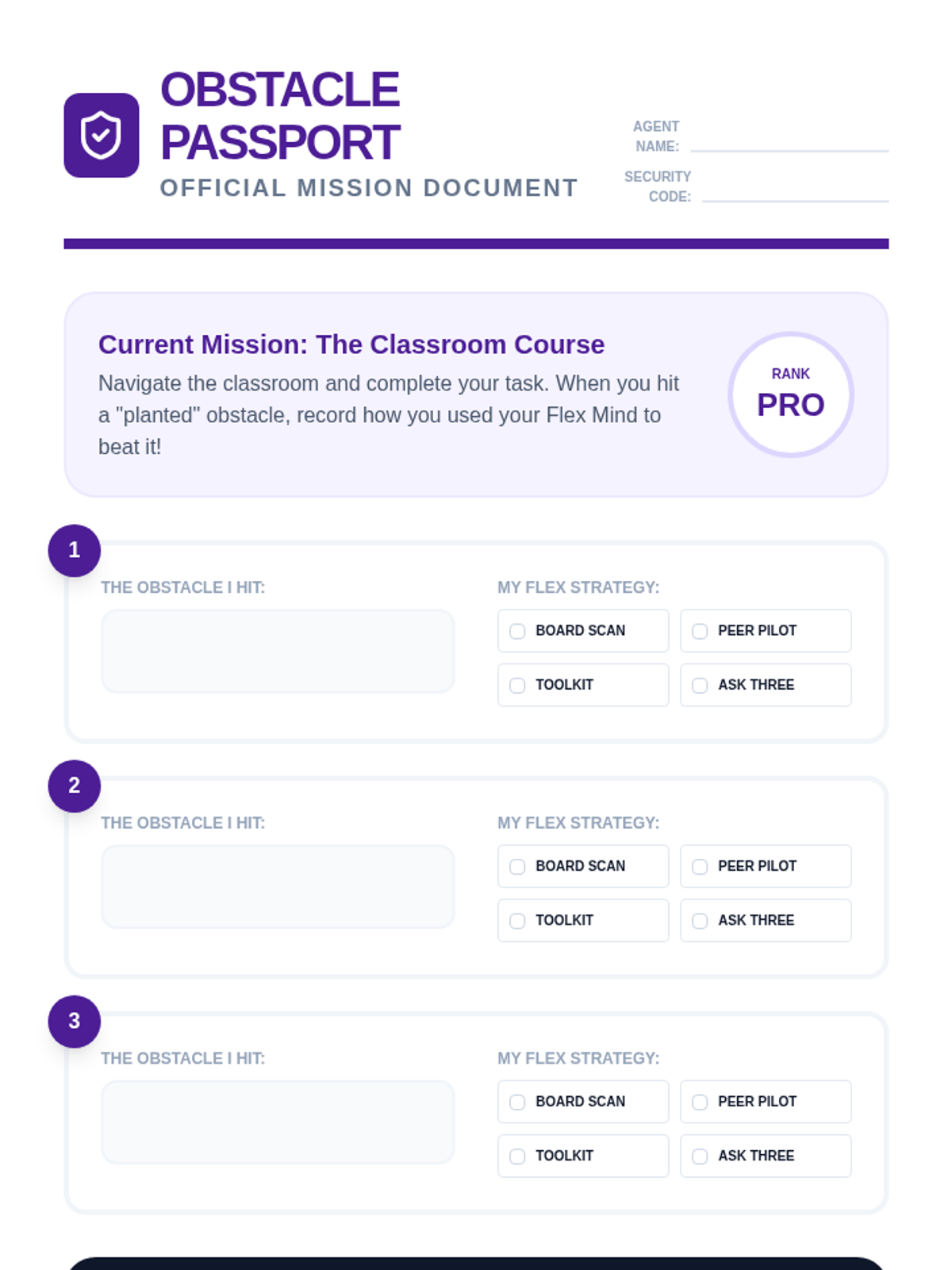
A student mission log for Lesson 5 where students record the specific obstacles they encountered and the 'Flex Mind' strategies they used to overcome them.
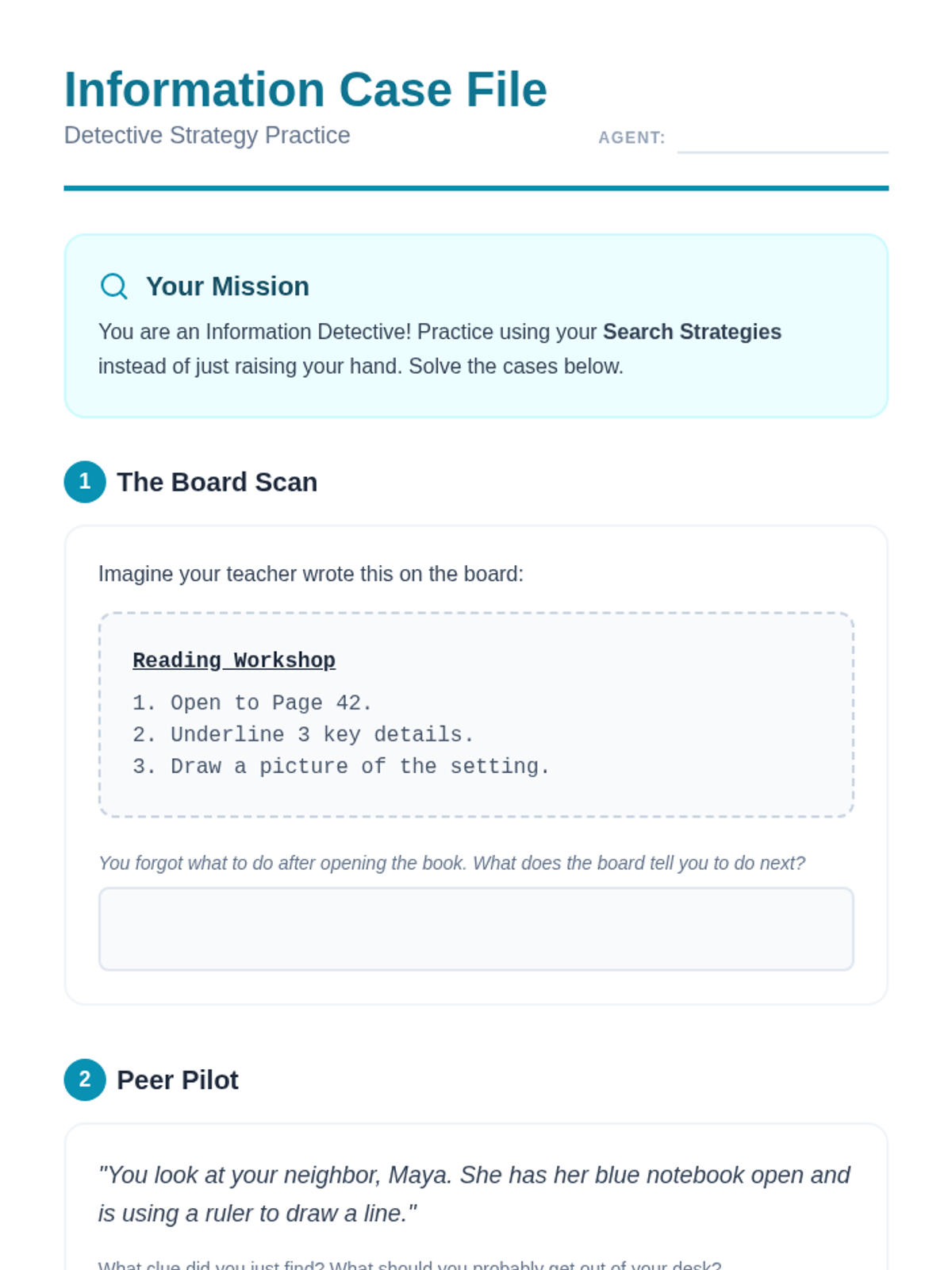
A worksheet for Lesson 4 where students practice the "Board Scan," "Peer Pilot," and "Ask Three Before Me" strategies through simulated classroom scenarios.
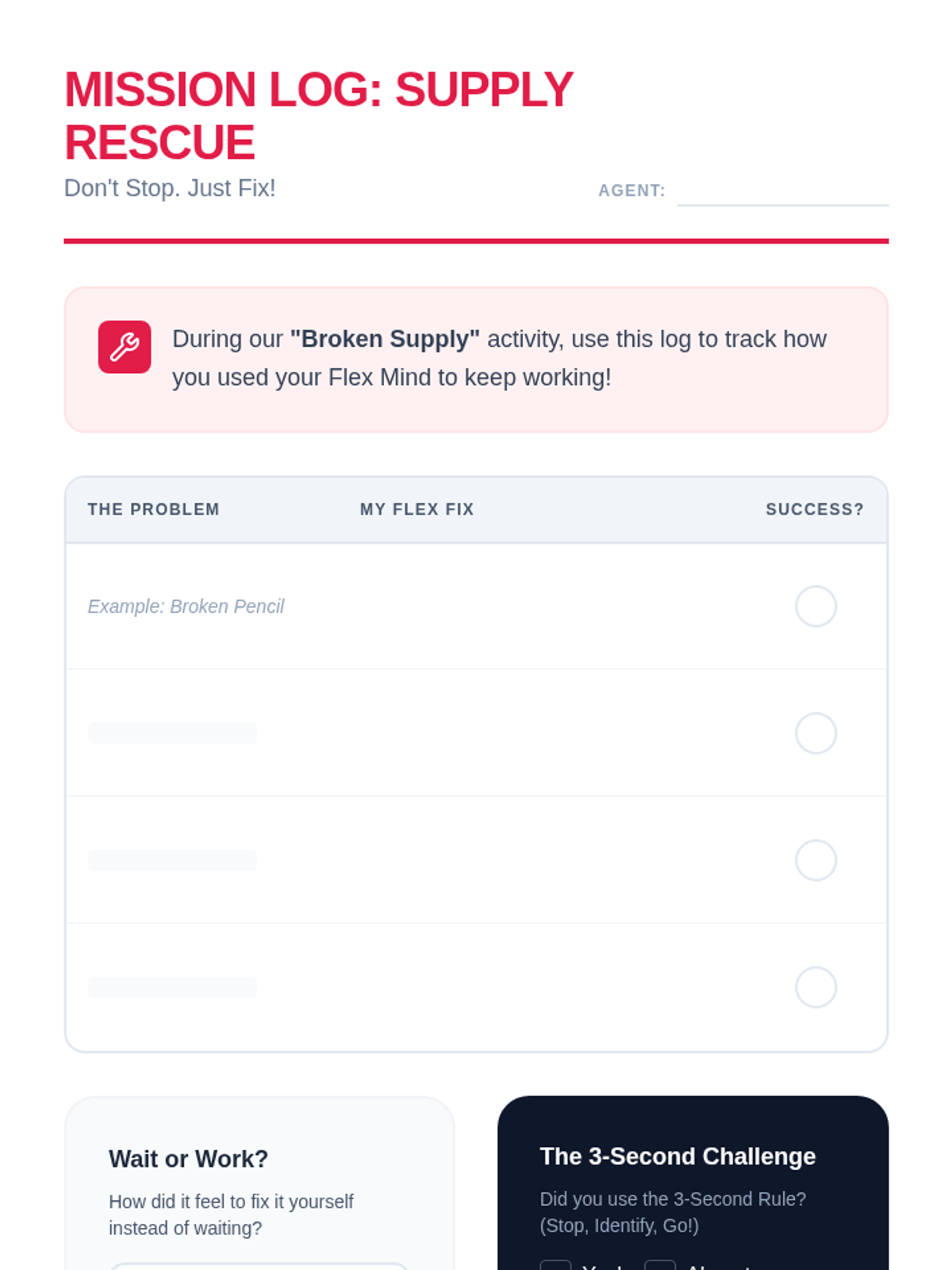
A tracking log for Lesson 3 where students record classroom material problems they encountered and the 'Flex Fix' they used to resolve them independently.
A slide deck introducing the final 'Obstacle Course' challenge, setting the rules for independent problem-solving and encouraging students to use their 'Flex Minds'.
A slide deck teaching students strategies for independently finding instructions using the "Board Scan," "Peer Pilot," and "Ask Three Before Me" techniques.
A slide deck for Lesson 3 focusing on independent material problem-solving through the '3-Second Rule' and role-playing scenarios like dry markers and broken pencils.
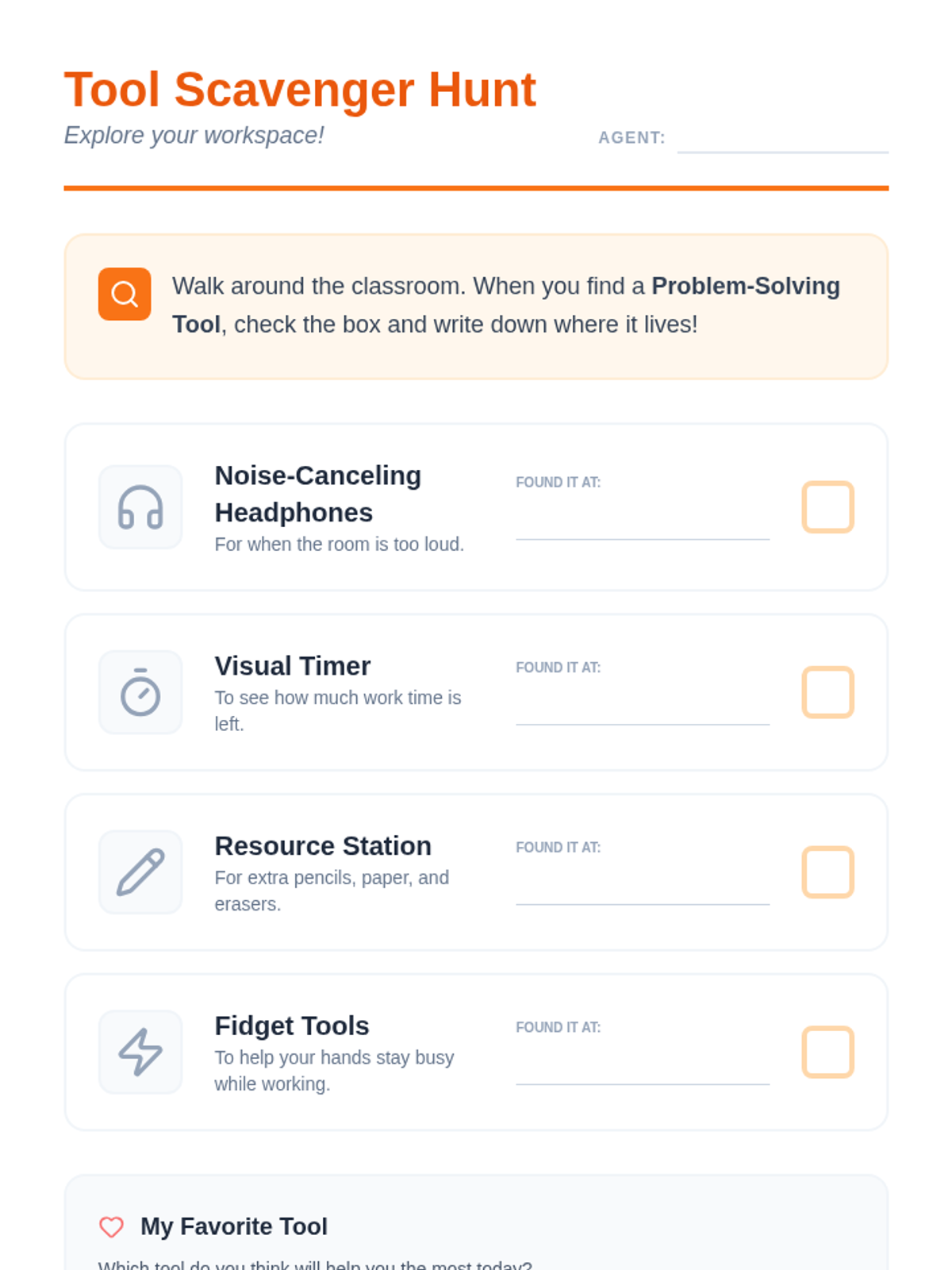
A scavenger hunt checklist for Lesson 2 where students locate physical problem-solving tools in their classroom and identify their locations.
A visual guide for identifying classroom problem-solving tools, including noise-canceling headphones, visual timers, and the resource center, with a hook activity and scavenger hunt introduction.
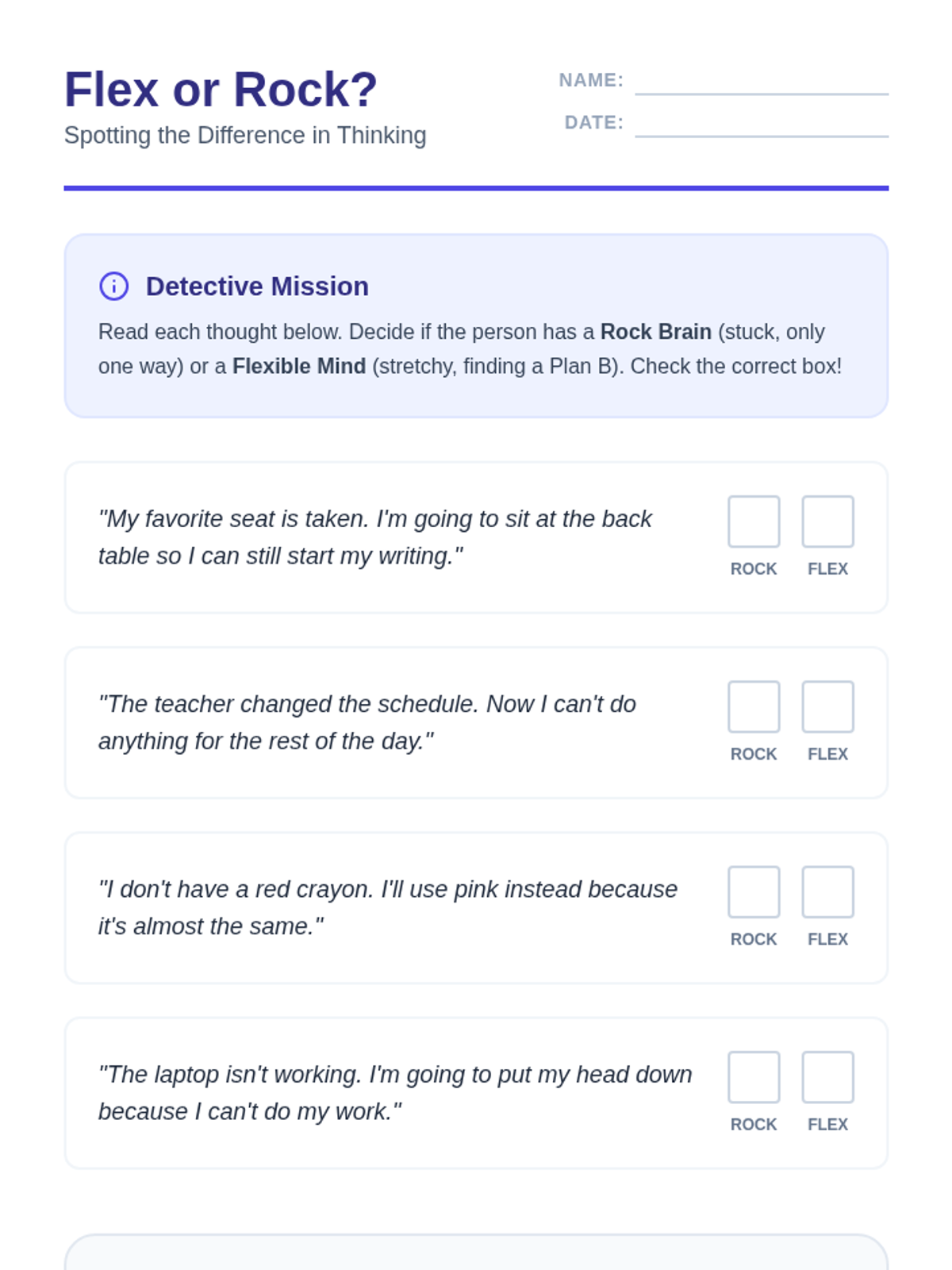
A sorting worksheet where students identify 'Rock Brain' versus 'Flexible Thinking' in various classroom scenarios, followed by a personal reflection prompt.
An introductory slide deck for 3rd graders explaining the concepts of 'Rock Brain' (rigid thinking) versus 'Flexible Thinking' (problem-solving mindset) using relatable classroom examples. Revised for font size compliance.
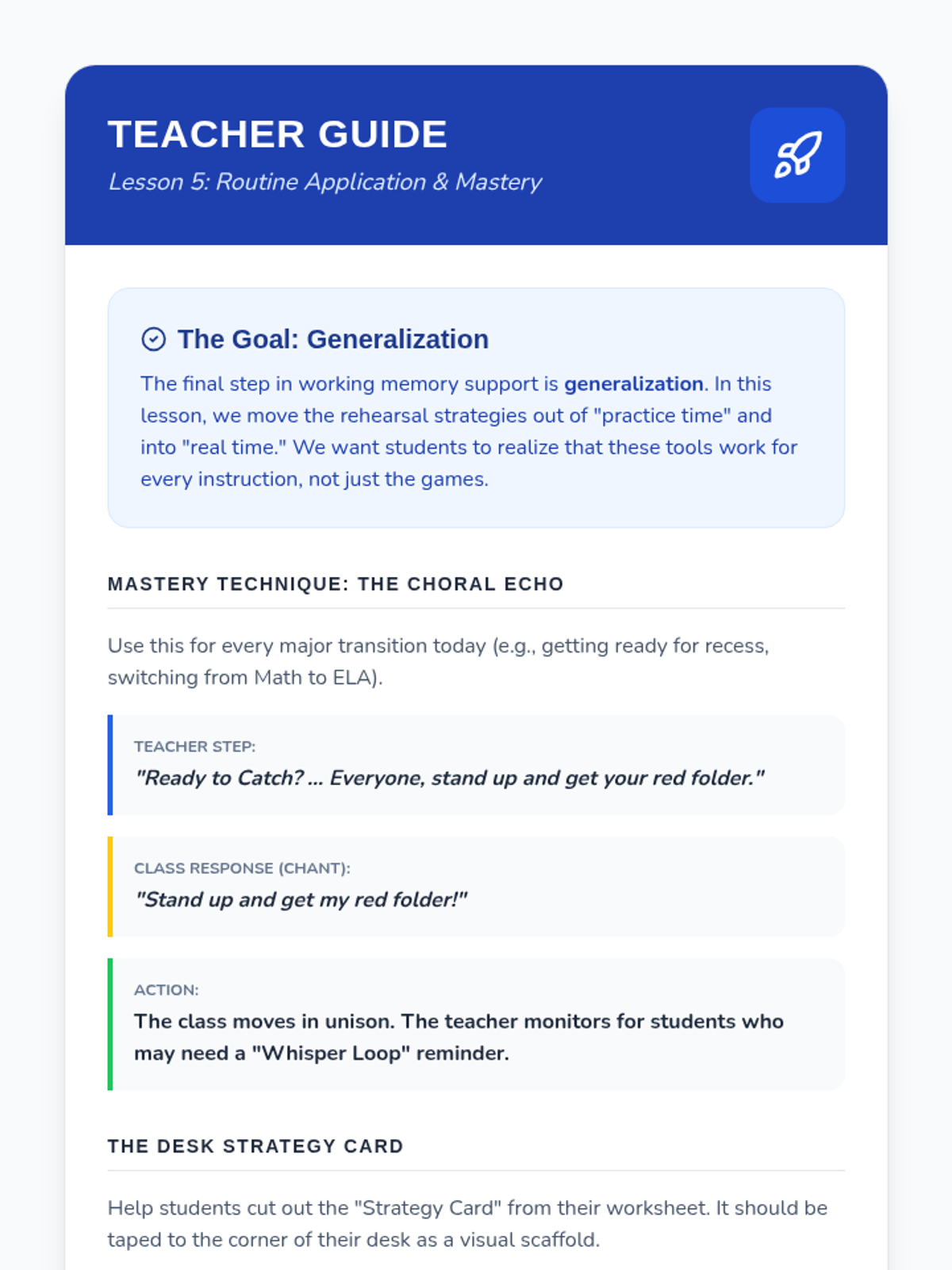
Final teacher guide for the sequence, focusing on choral response techniques, the use of desk-based strategy cards, and informal mastery assessment.
Final slides for the sequence, focusing on graduating the 'Brain Training' skills into everyday classroom routines like cleaning up and transitions.
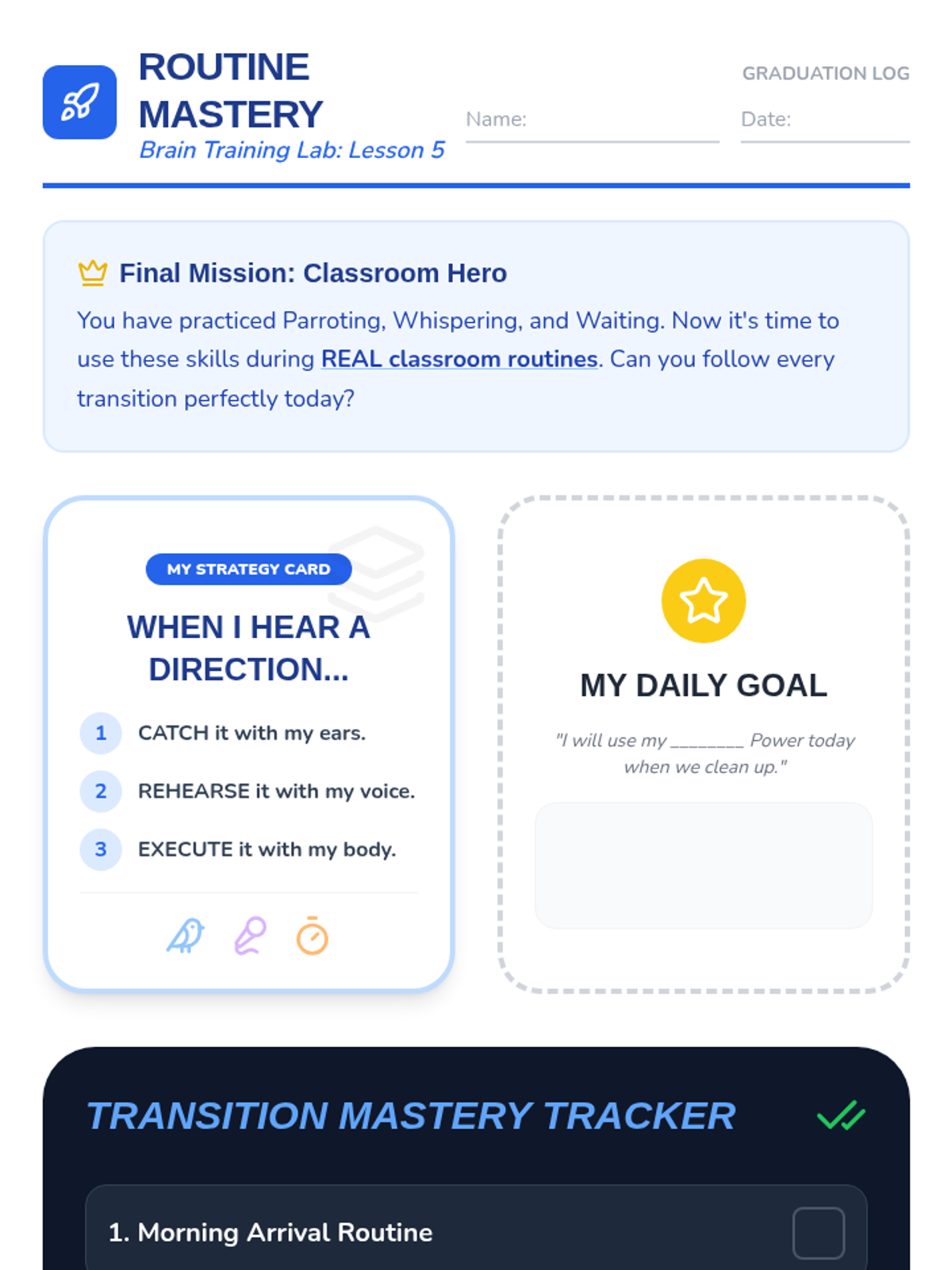
A cumulative resource for Lesson 5 including a strategy desk card and a transition mastery tracker to help students apply verbal rehearsal to real classroom routines.
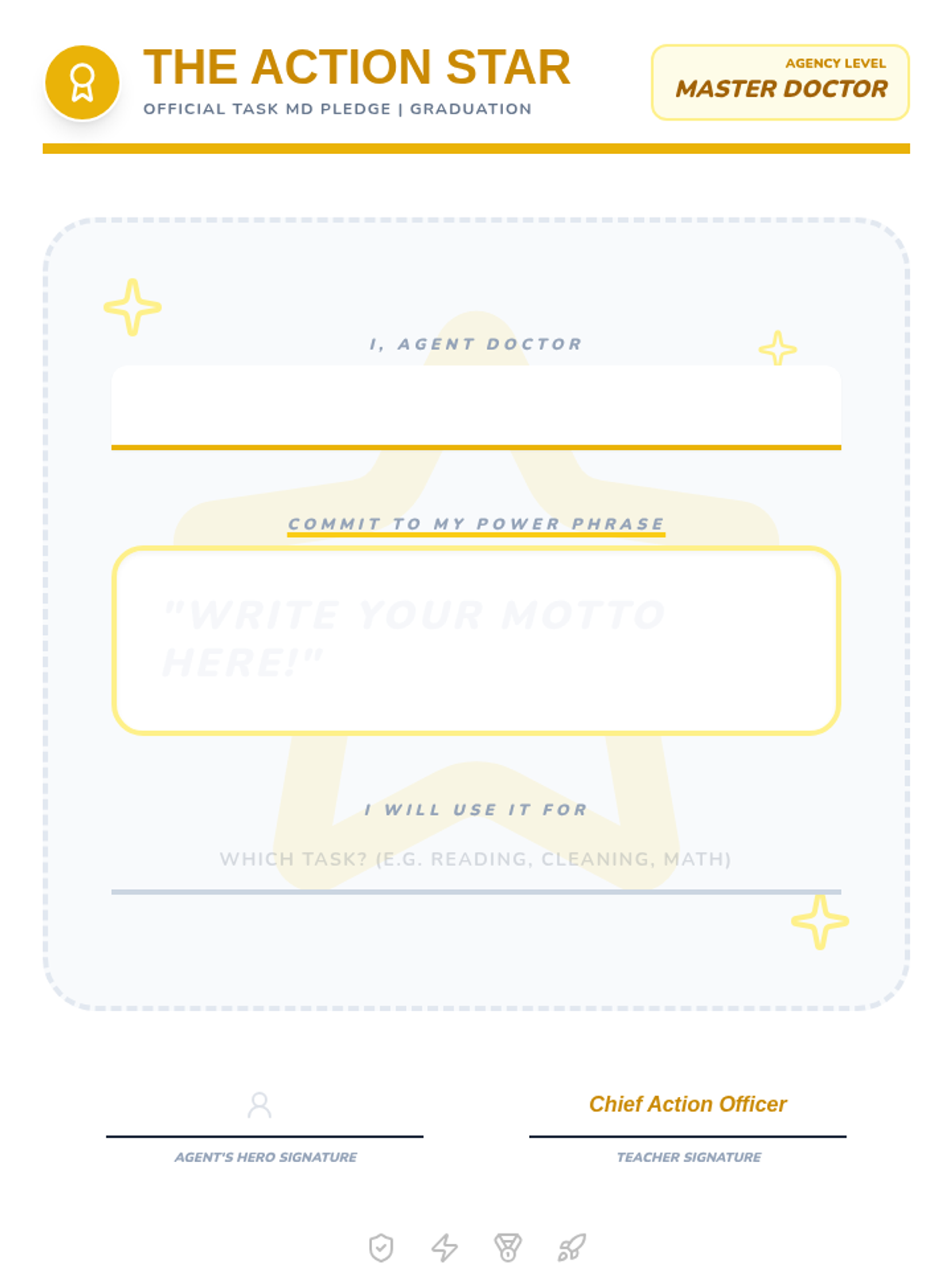
A student worksheet for the final lesson, where students write their personal 'Power Phrase' motto on a star-themed pledge sheet to be displayed on the 'Wall of Action'.
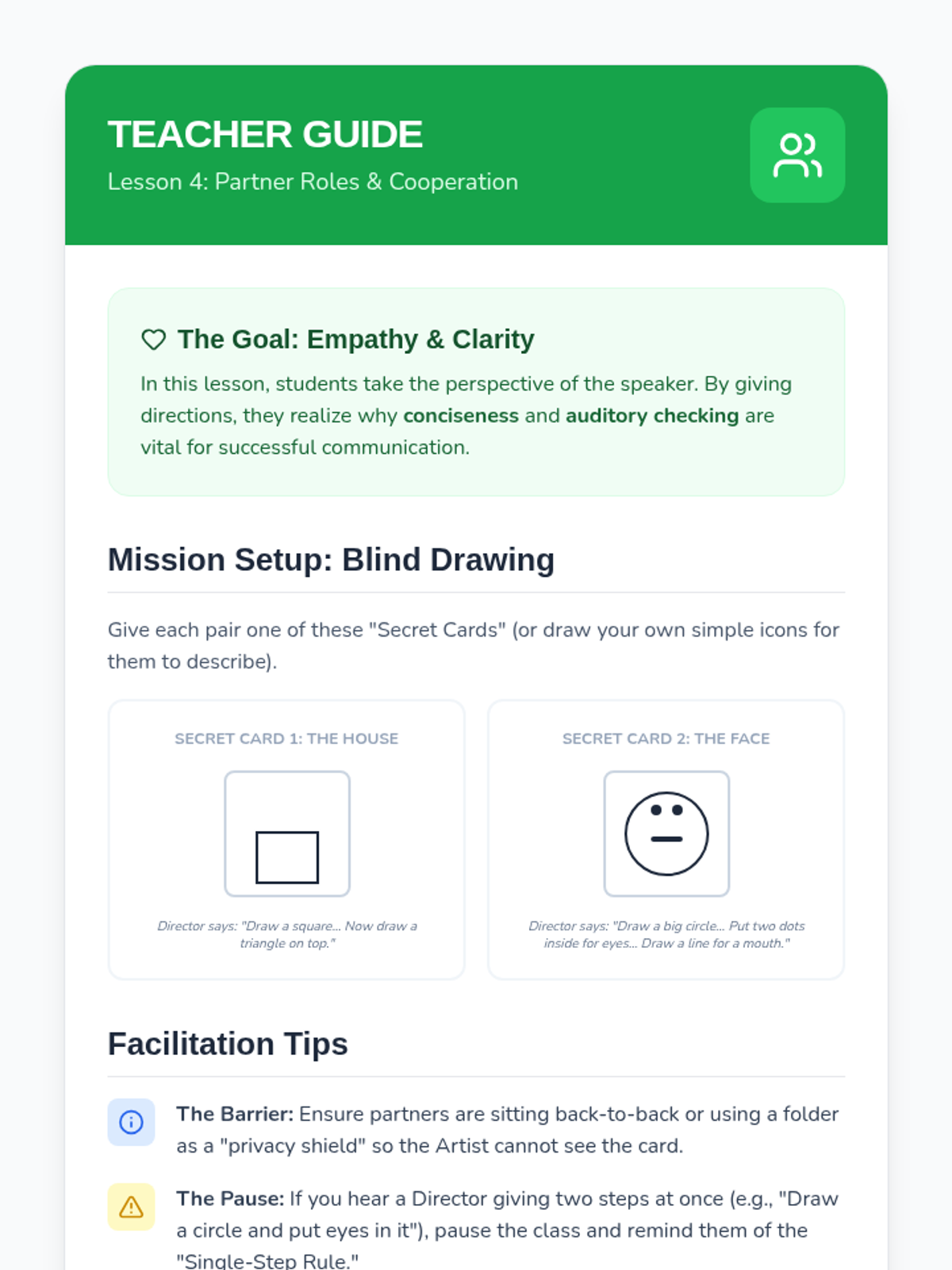
A teacher guide for Lesson 4 including secret cards for the blind drawing activity, facilitation scripts, and peer feedback prompts.
Engaging slides for Lesson 5 that guide the student self-reflection process and introduce the 'Wall of Action' graduation ceremony.
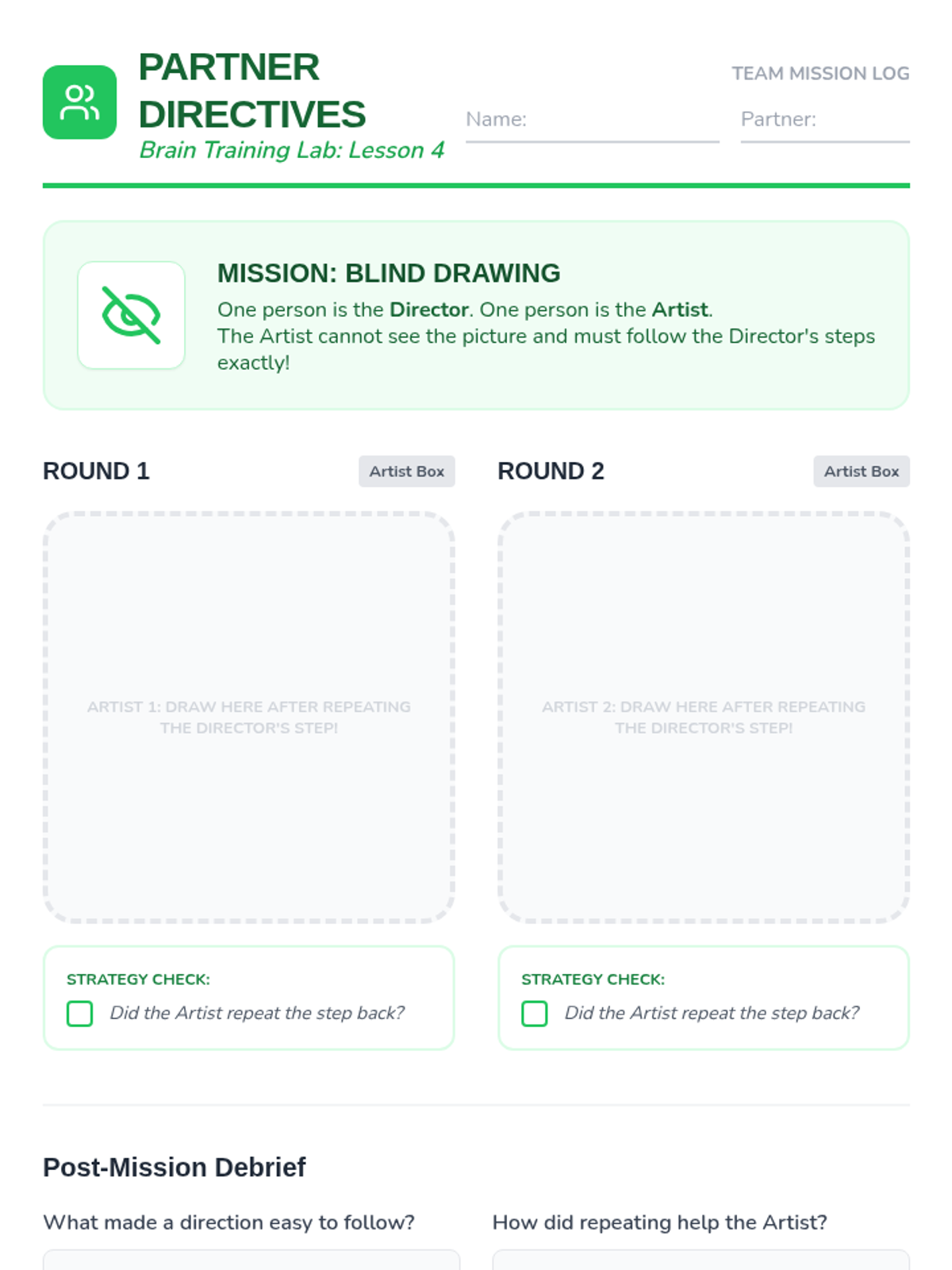
Slides for Lesson 4 facilitating a peer-to-peer communication activity. Introduces the roles of 'Director' and 'Artist' for a collaborative drawing challenge.
A collaborative worksheet for Lesson 4 where students work in pairs to practice giving and repeating directions through a 'Blind Drawing' activity.
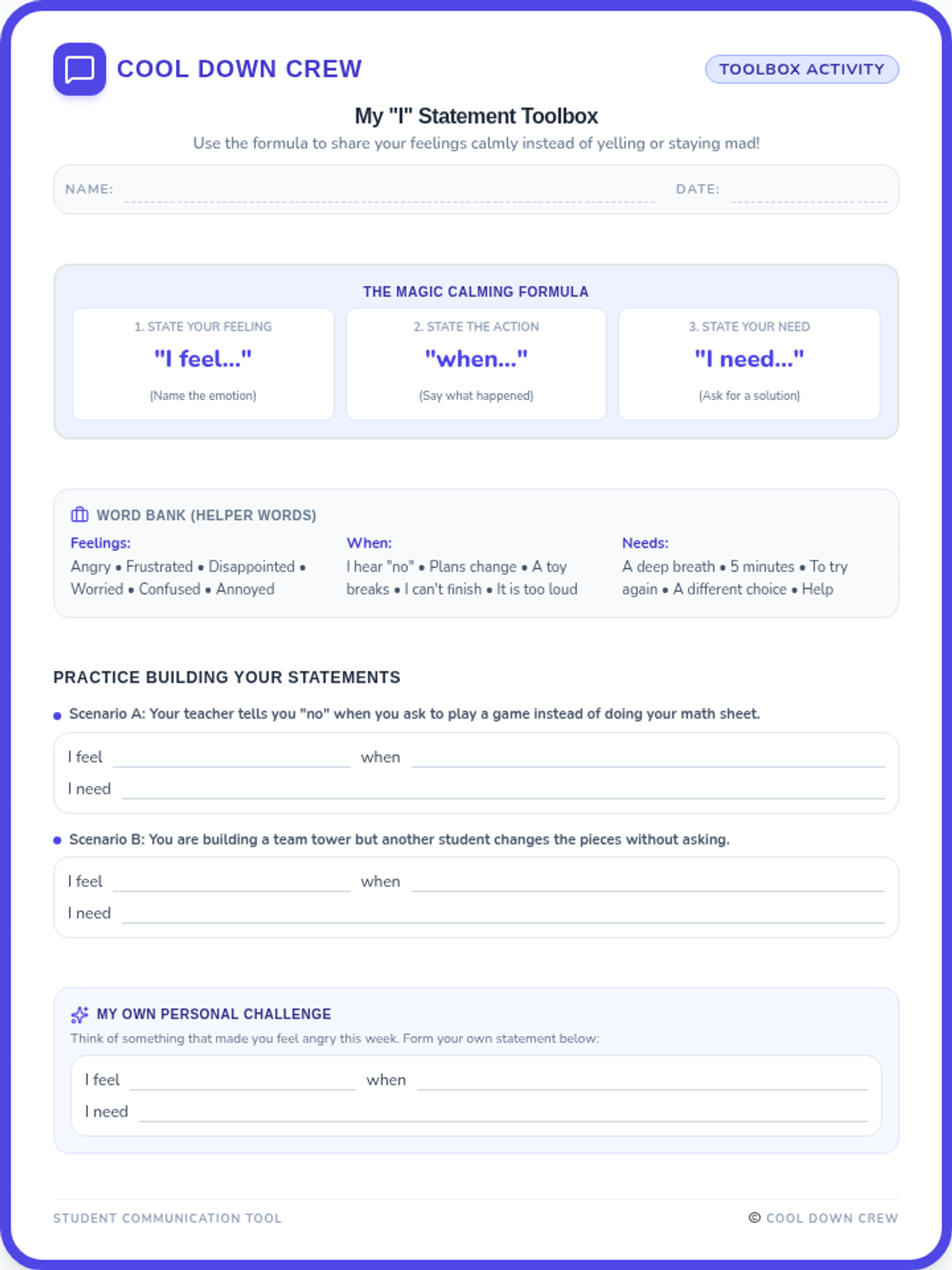
A structured practice worksheet for students to learn and construct effective 'I feel... when... I need...' statements for expressing anger constructively.
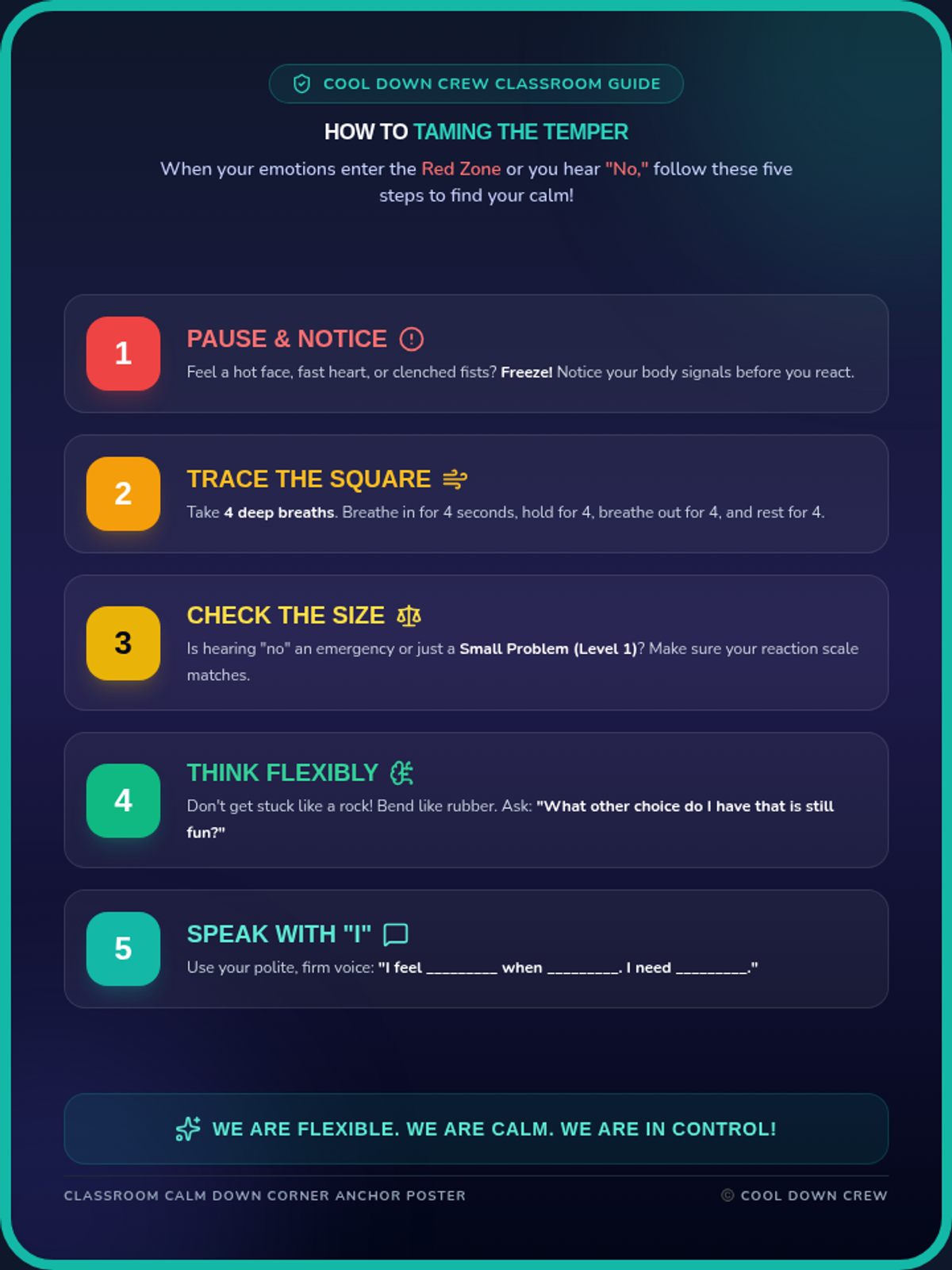
A printable classroom poster summarizing key steps to handle anger and hearing 'no'. Designed for laminating and hanging in the classroom calming corner.
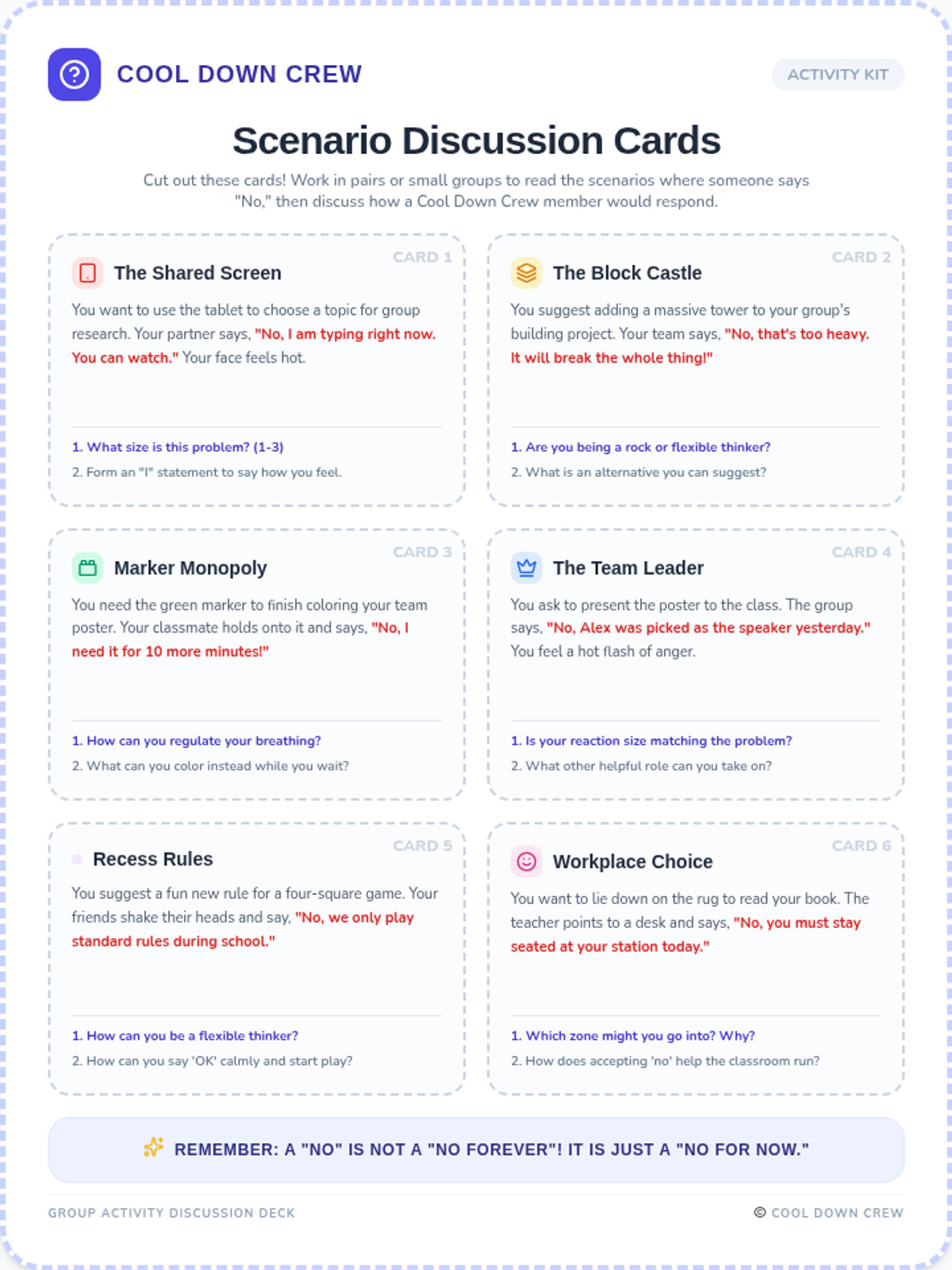
Real-life situations to practice accepting 'no' during group work. Includes discussion prompts on the size of the problem and emotional regulation.
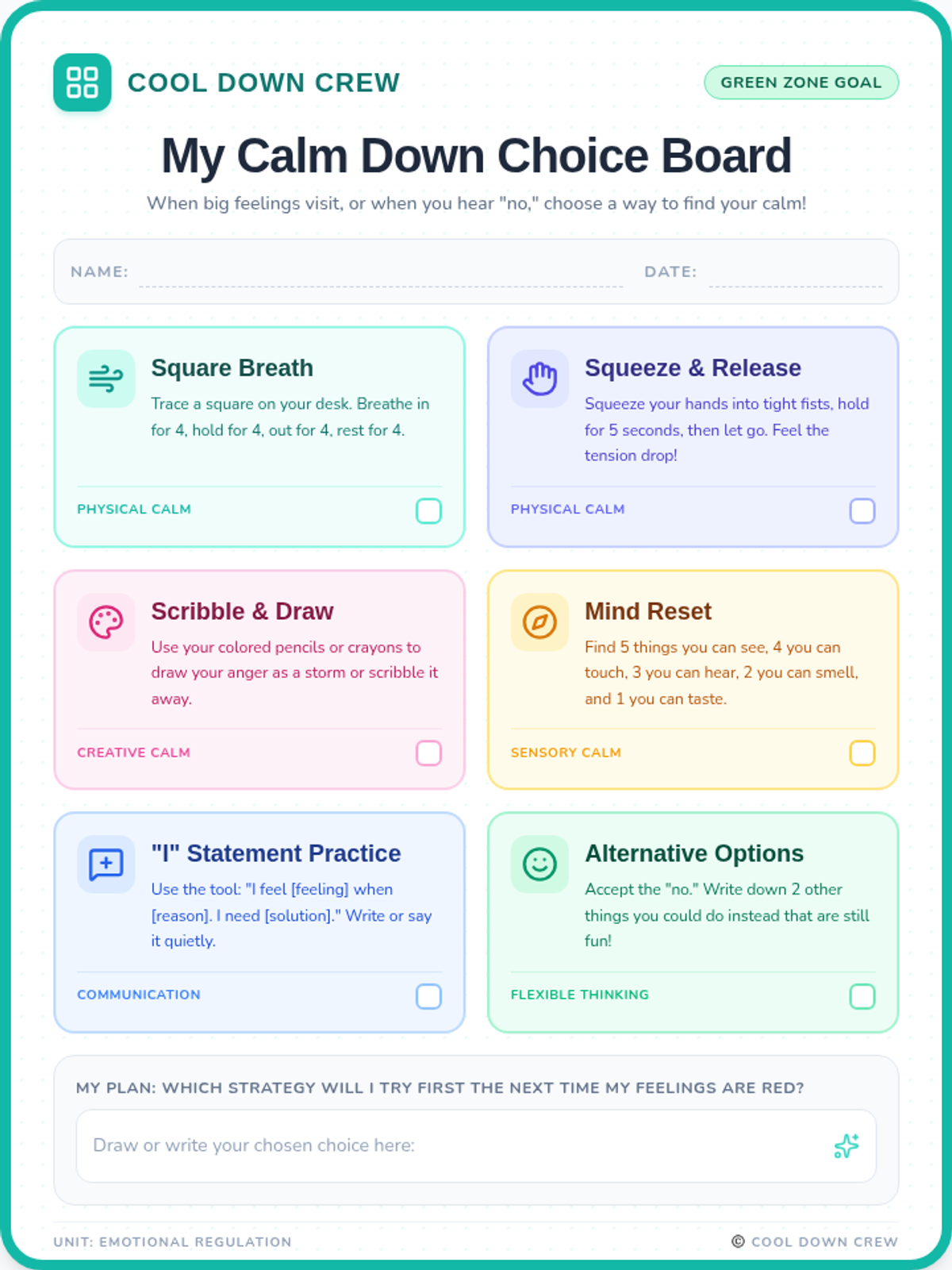
A visual menu of strategies 10-year-olds can choose from when angry. Features a grid of physical, sensory, and cognitive calming techniques.
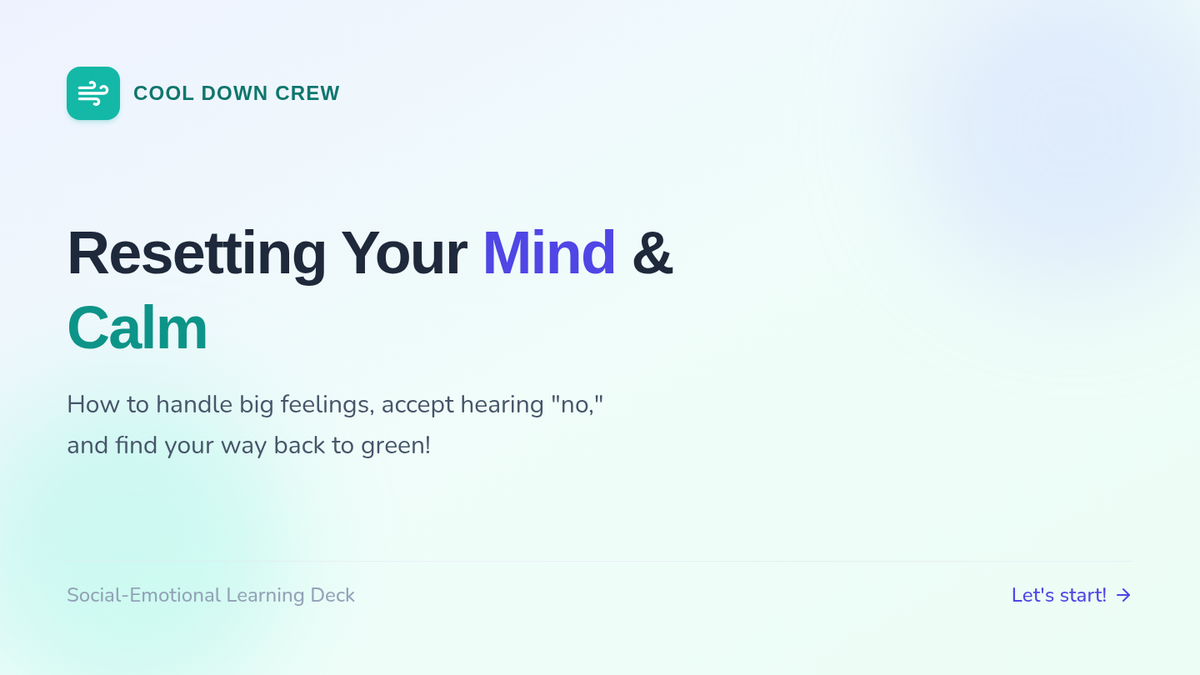
A presentation for 10-year-olds teaching them how to recognize emotional stress states, apply physiological grounding, match reaction size to problem scale, and communicate assertively.
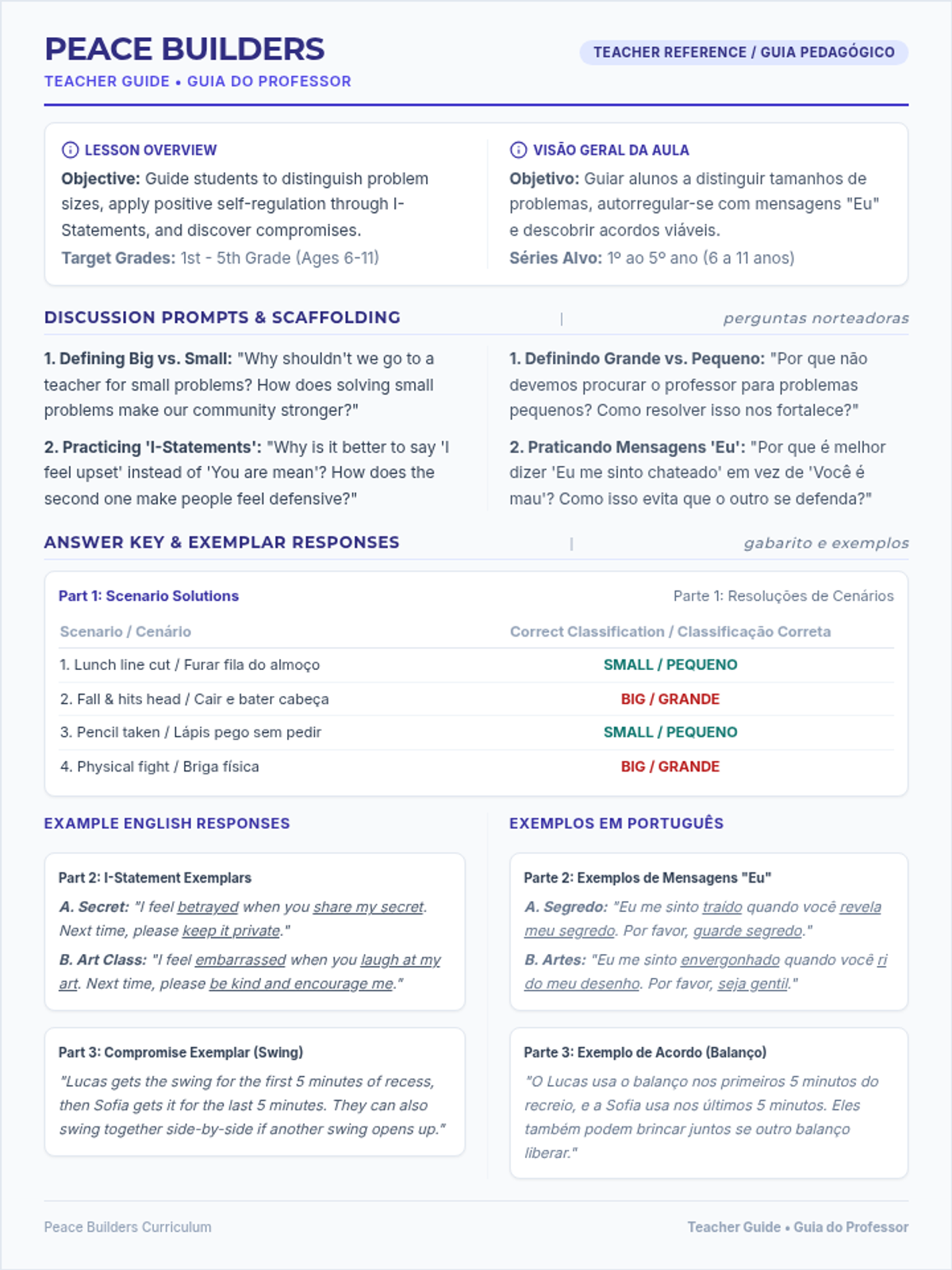
A side-by-side bilingual lesson plan and reference sheet for teachers, detailing lesson delivery steps, interactive discussion questions, and an answer key with sample responses for the student worksheet.
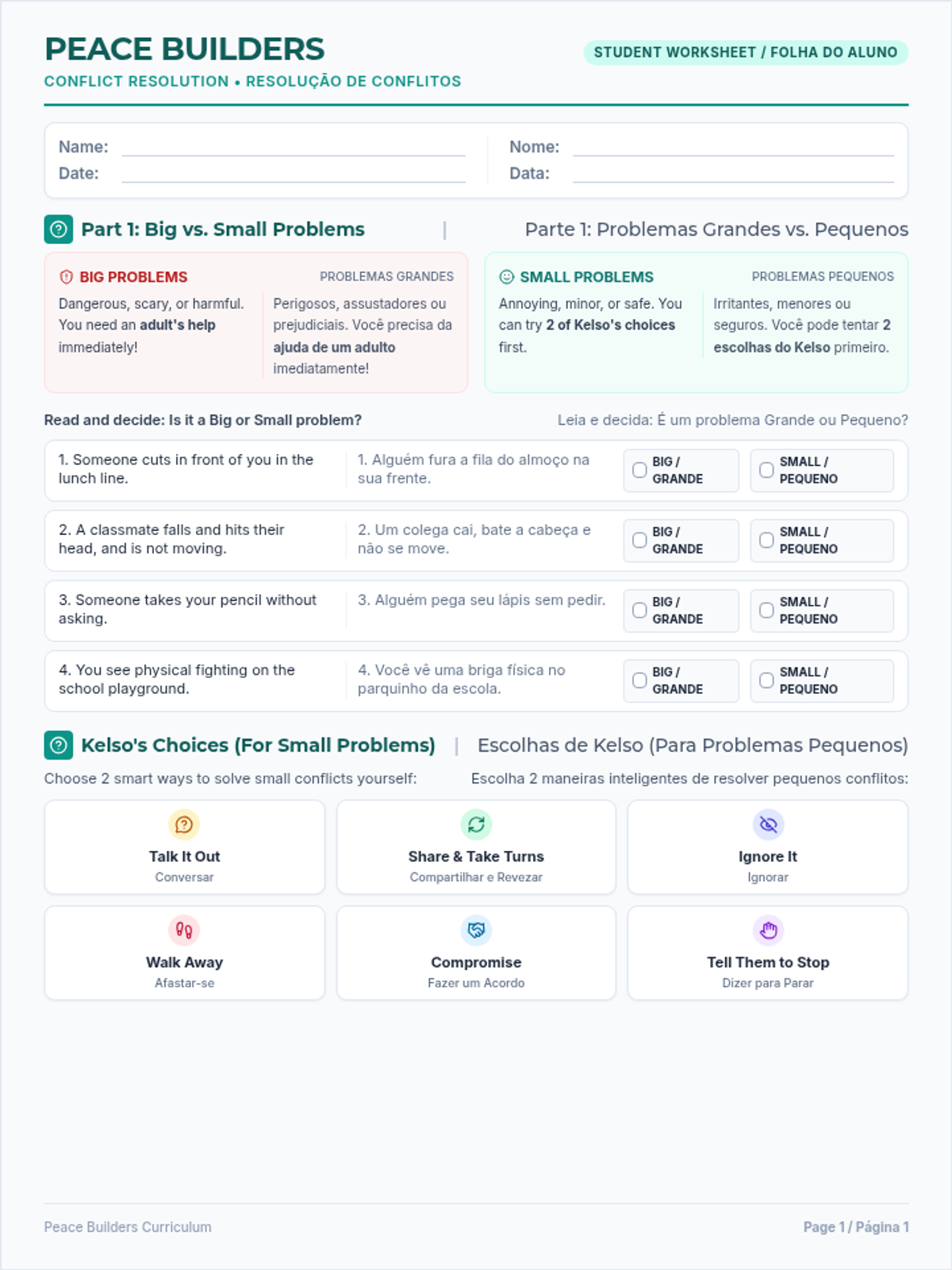
A side-by-side bilingual student worksheet on conflict resolution, guiding students through identifying Big vs. Small problems (Kelso's Choices), writing I-statements, and finding compromises. Contains writing fields and checkboxes.
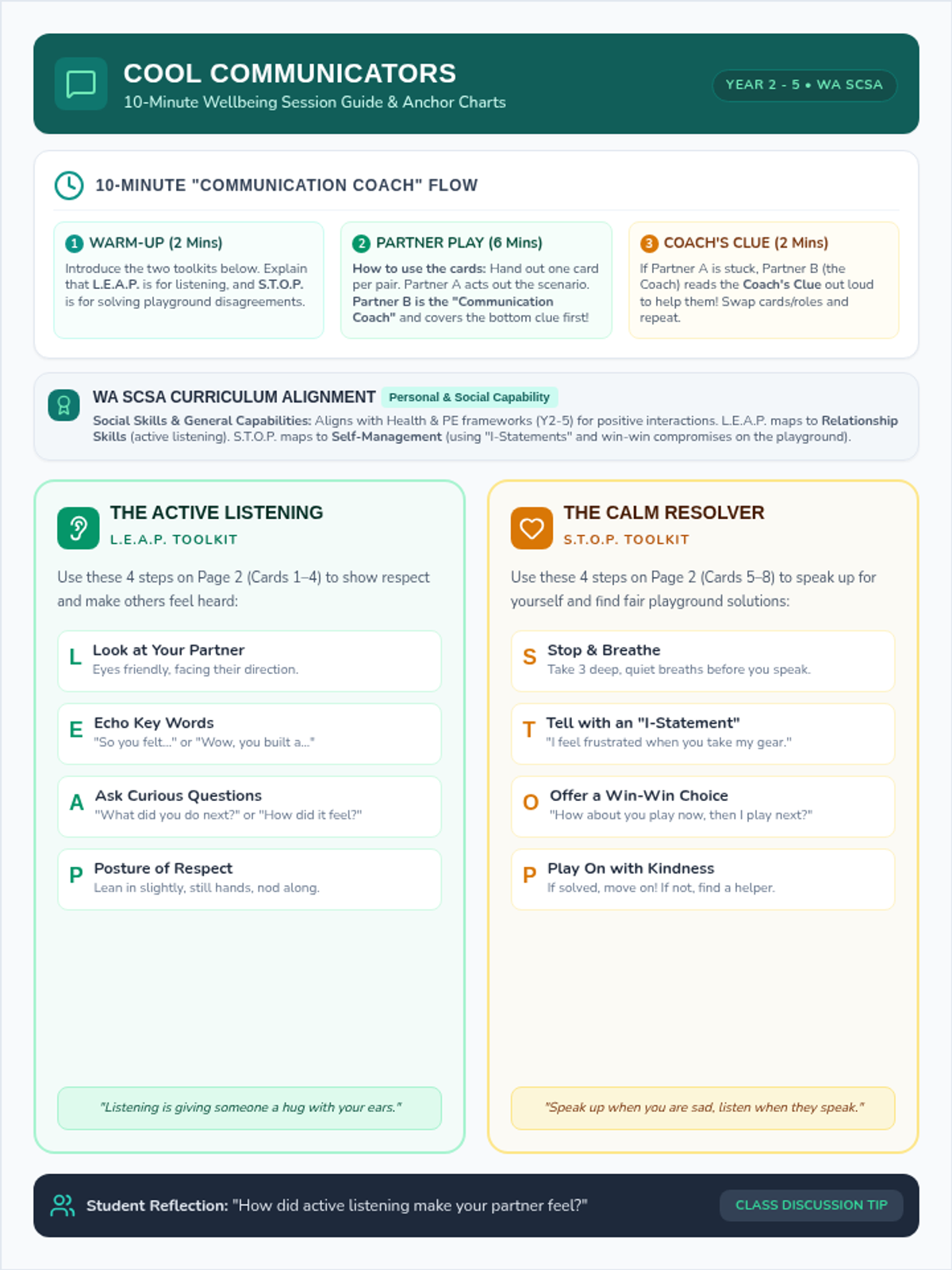
A 2-page print-ready activity card pack for Year 2-5 students. Page 1 features a 10-minute facilitation playbook explaining how to use the dual toolkits (L.E.A.P. and S.T.O.P.) and how partners act as 'Communication Coaches' using the cards on Page 2, which contain hidden coach's clues.
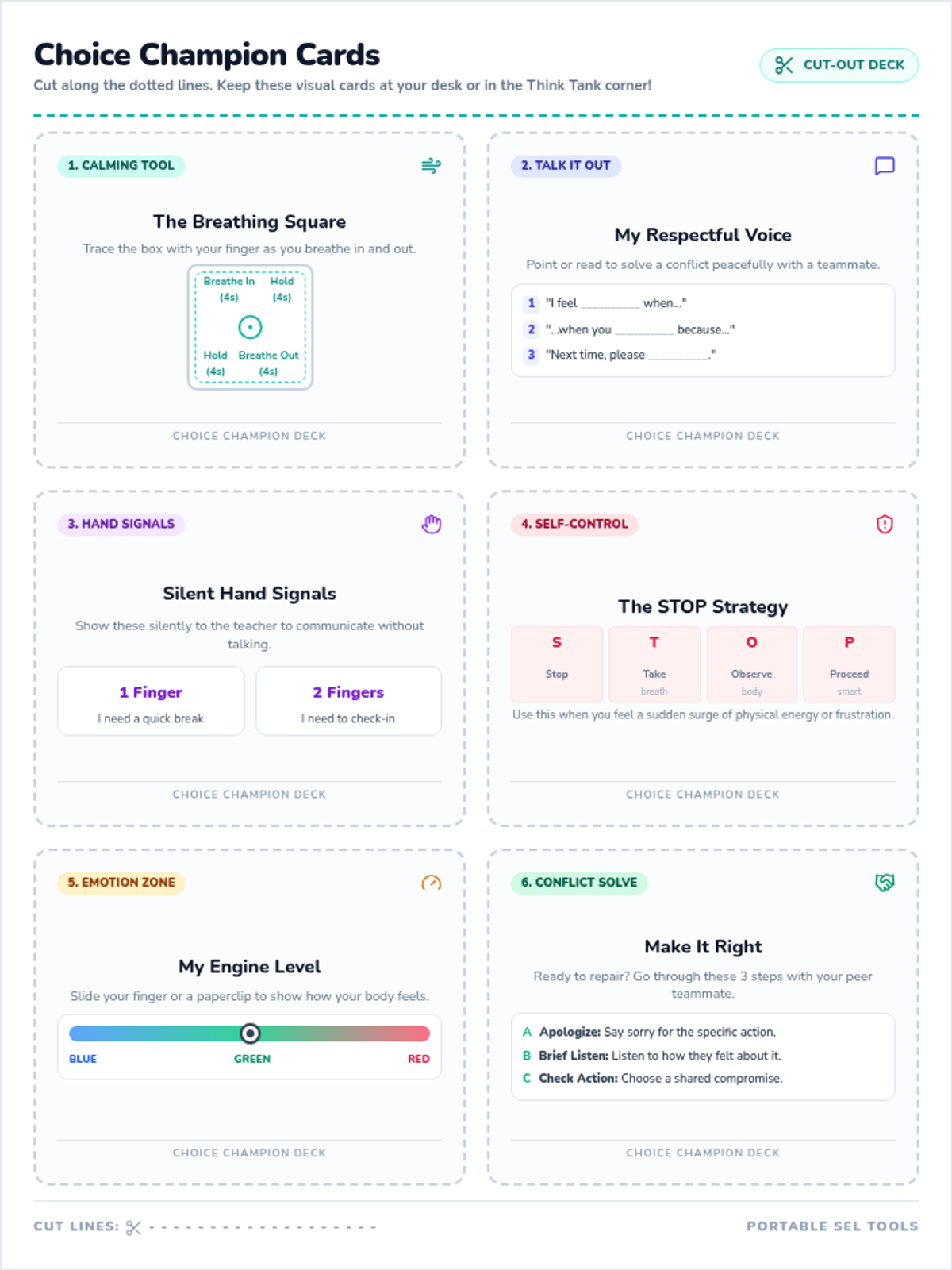
A printable set of 6 pocket-sized visual choice cards. Features guided breathing, I-statement scaffolding, hand-signals, the STOP strategy, and zone checkers to give students concrete, portable self-regulation support.
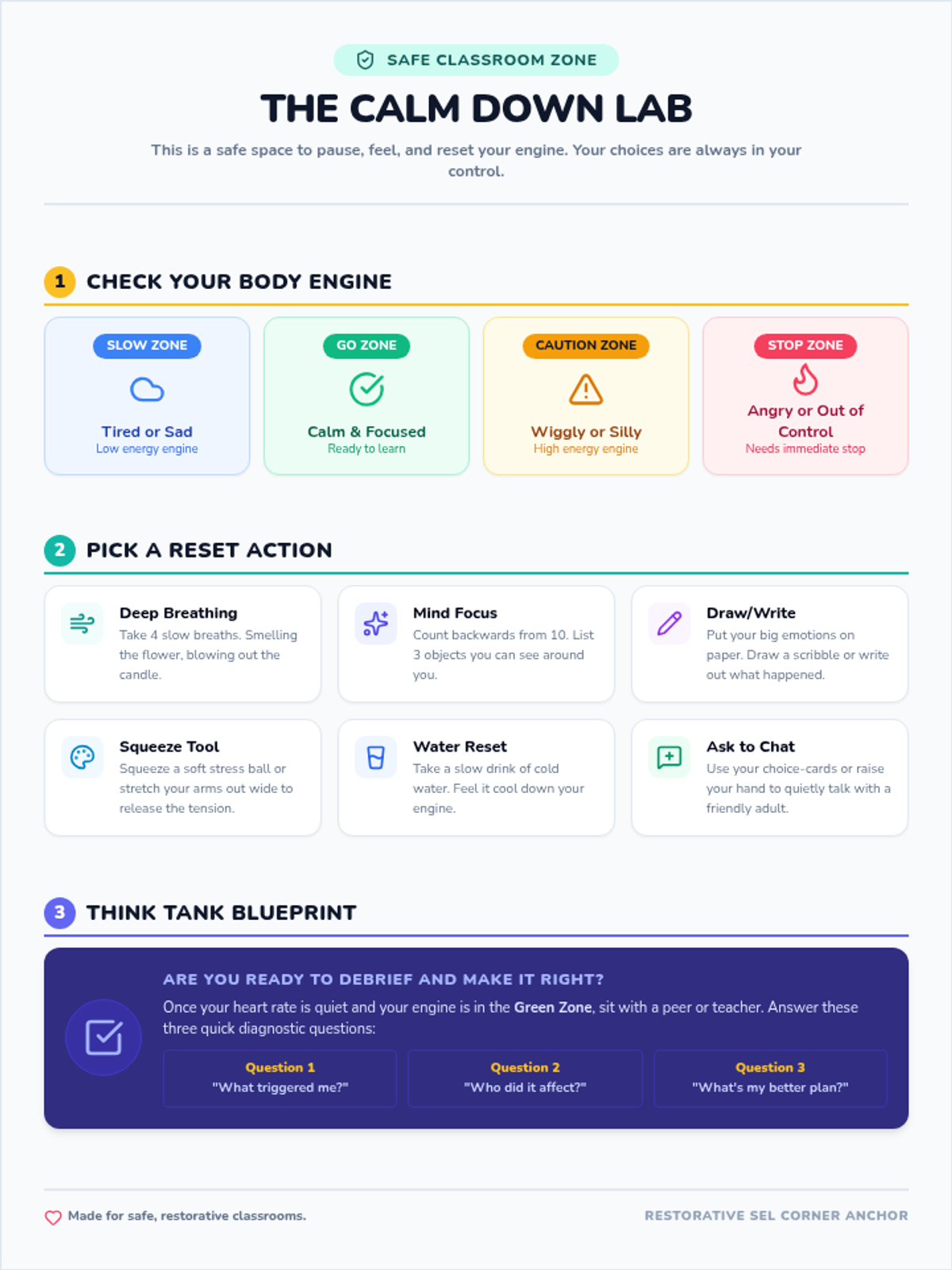
A high-visibility classroom anchor chart for the Think Tank reflection corner. Outlines a simple three-step calming protocol, visual emotional energy zones, and concrete self-regulation strategies to support independent conflict resolution.
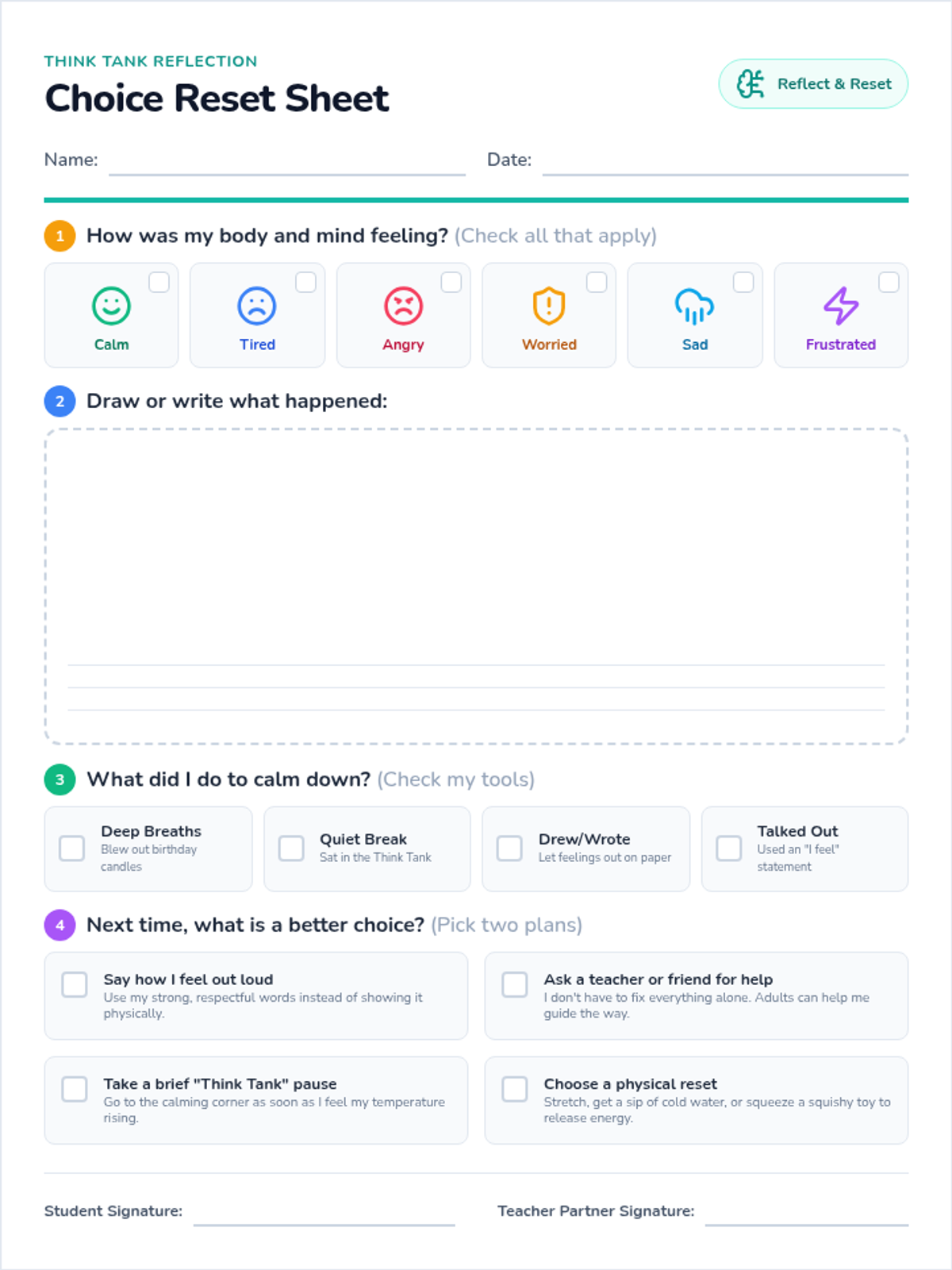
A visual, student-facing behavior reflection sheet designed for elementary and struggling writers. Features emoji feelings charts, a dedicated white canvas area for drawing or writing, and simple visual check-boxes for tracking calming strategies and future positive choices.
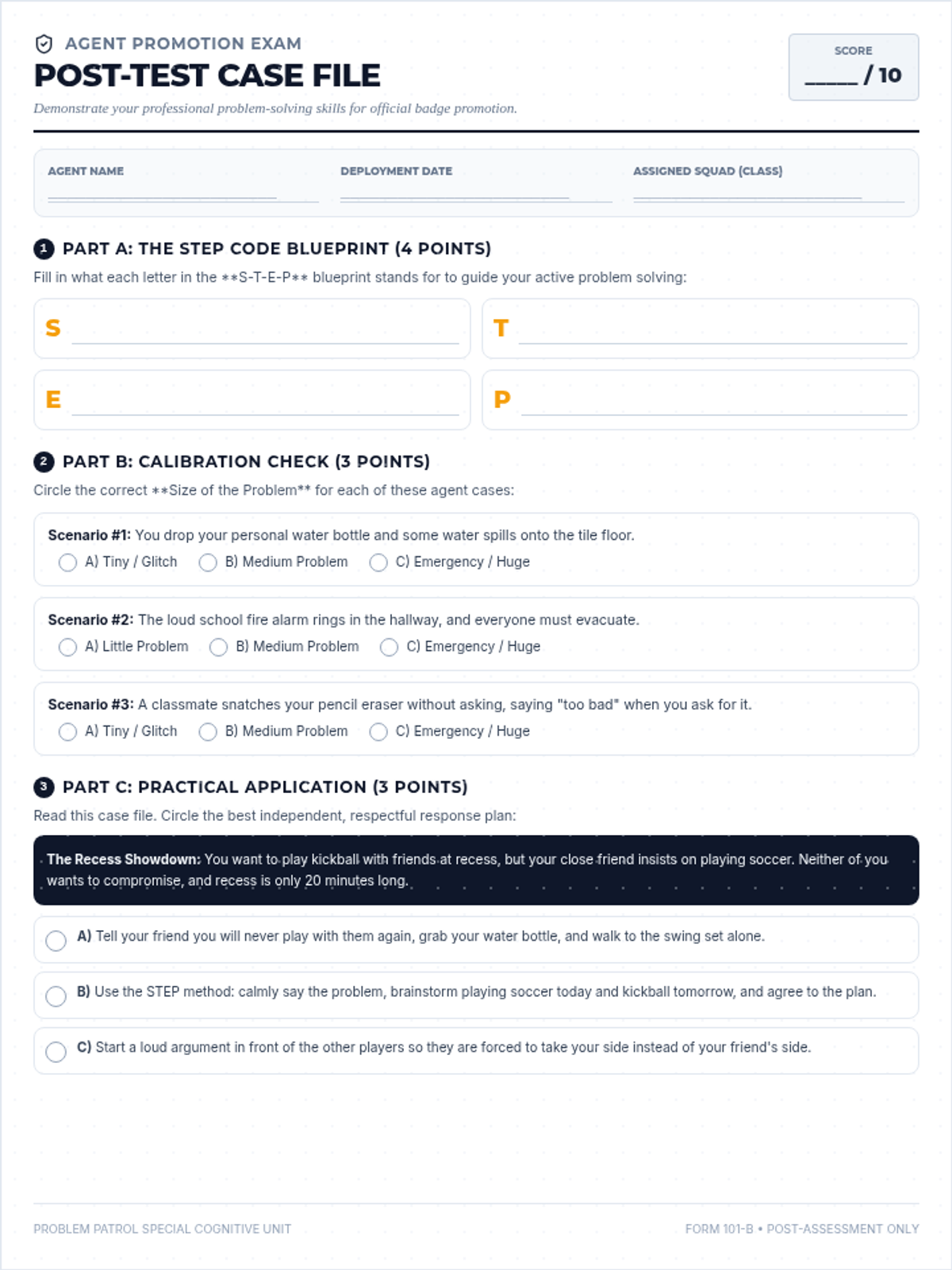
A single-page printable student post-assessment sheet to evaluate learning gains, comprehension of the STEP method, and problem sizing skills, using a matching detective theme.
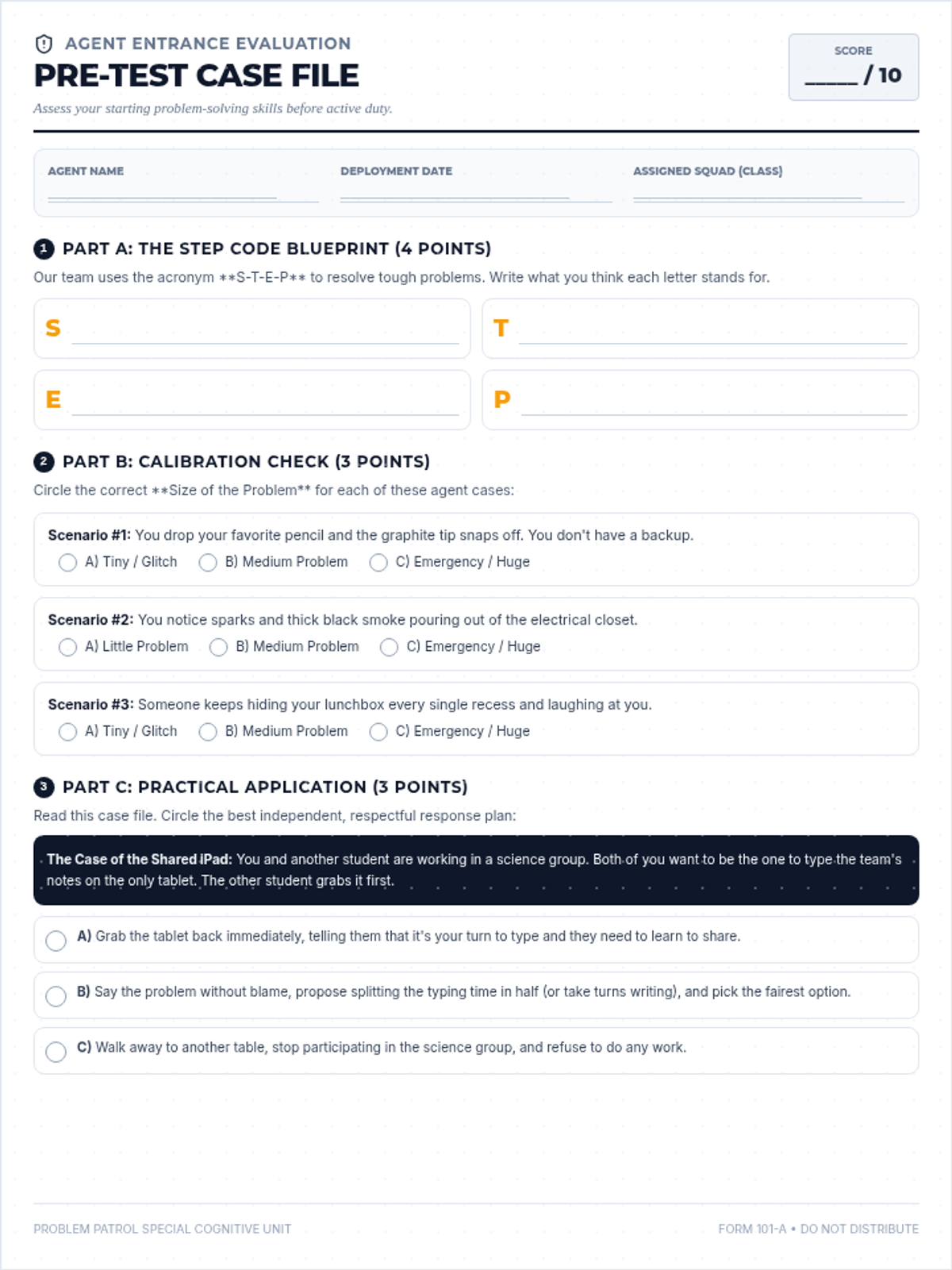
A single-page printable student pre-assessment sheet to establish a baseline of their problem-solving and emotional regulation knowledge, using a detective case file theme, now with multiple-choice questions.
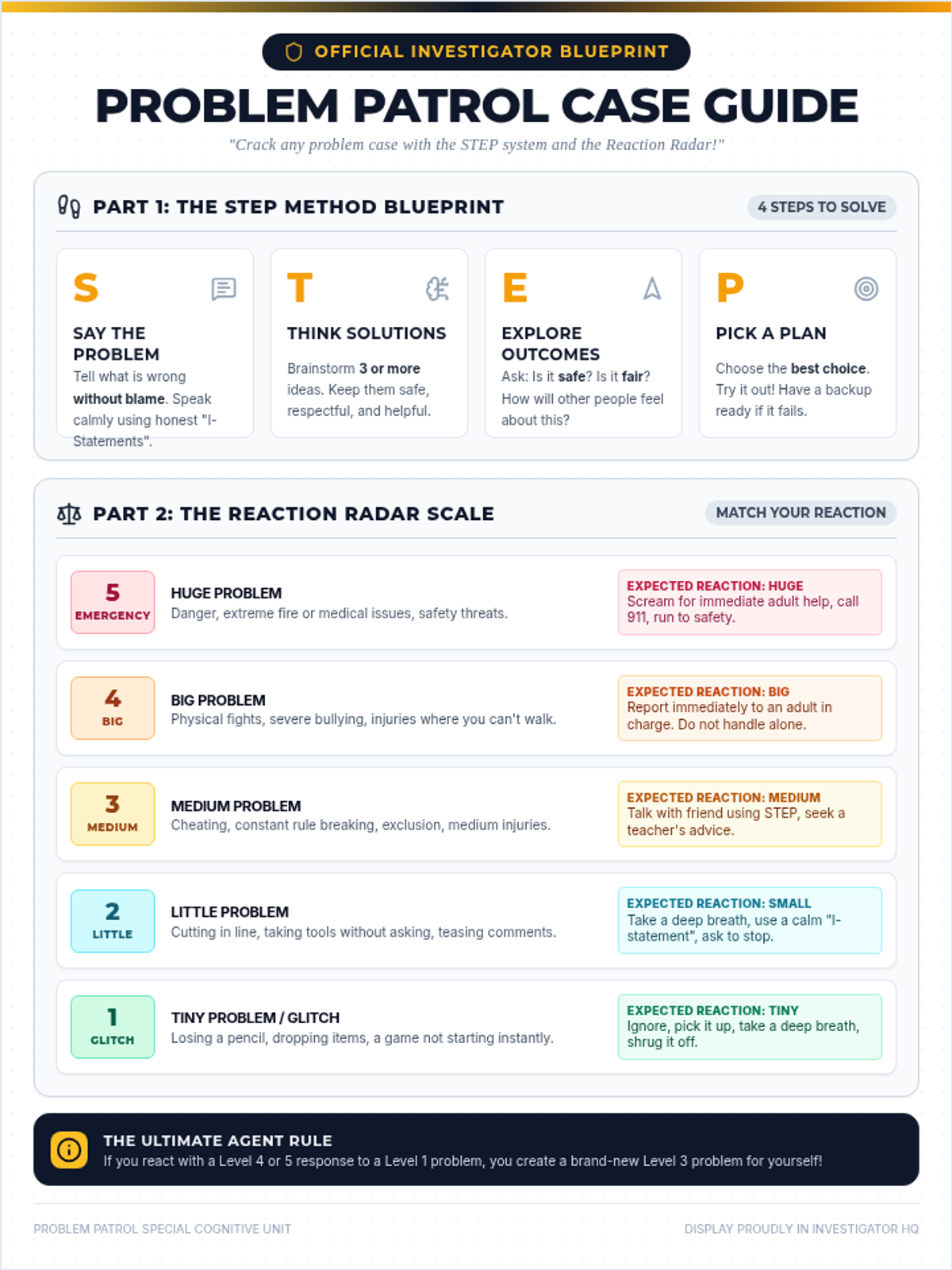
A single-page, highly visual classroom anchor chart poster detailing the STEP problem-solving method and the 1-5 Size of the Problem Reaction Scale with a detective theme.
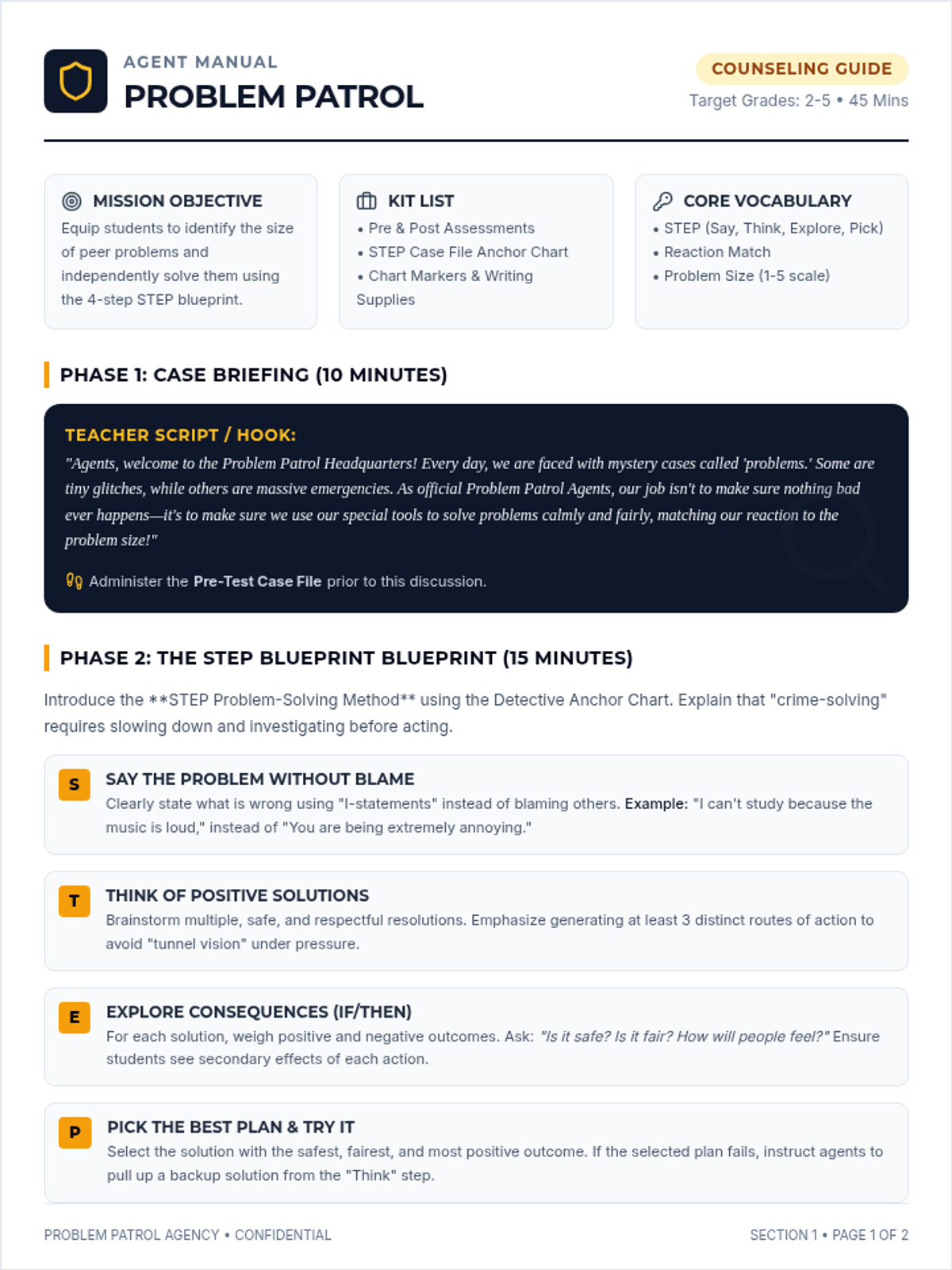
A 2-page instructional facilitation guide for counselors and teachers detailing how to introduce the STEP problem-solving method and Size of the Problem scale using a cohesive detective theme.
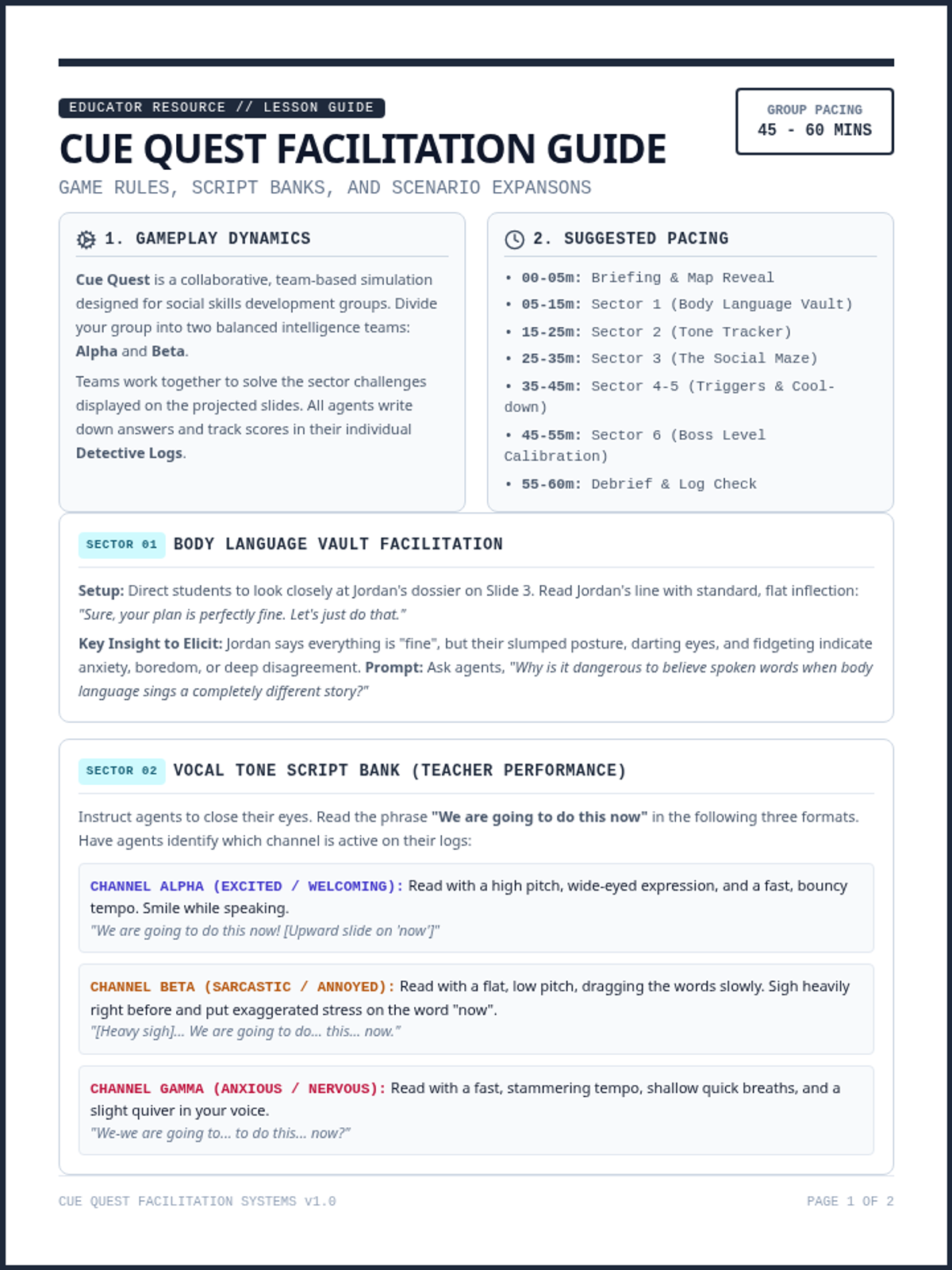
A print-ready teacher facilitation and script guide outlining setup procedures, pacing suggestions, vocal tone performance cues, roleplay prompt expansions, and reflective group debrief questions.
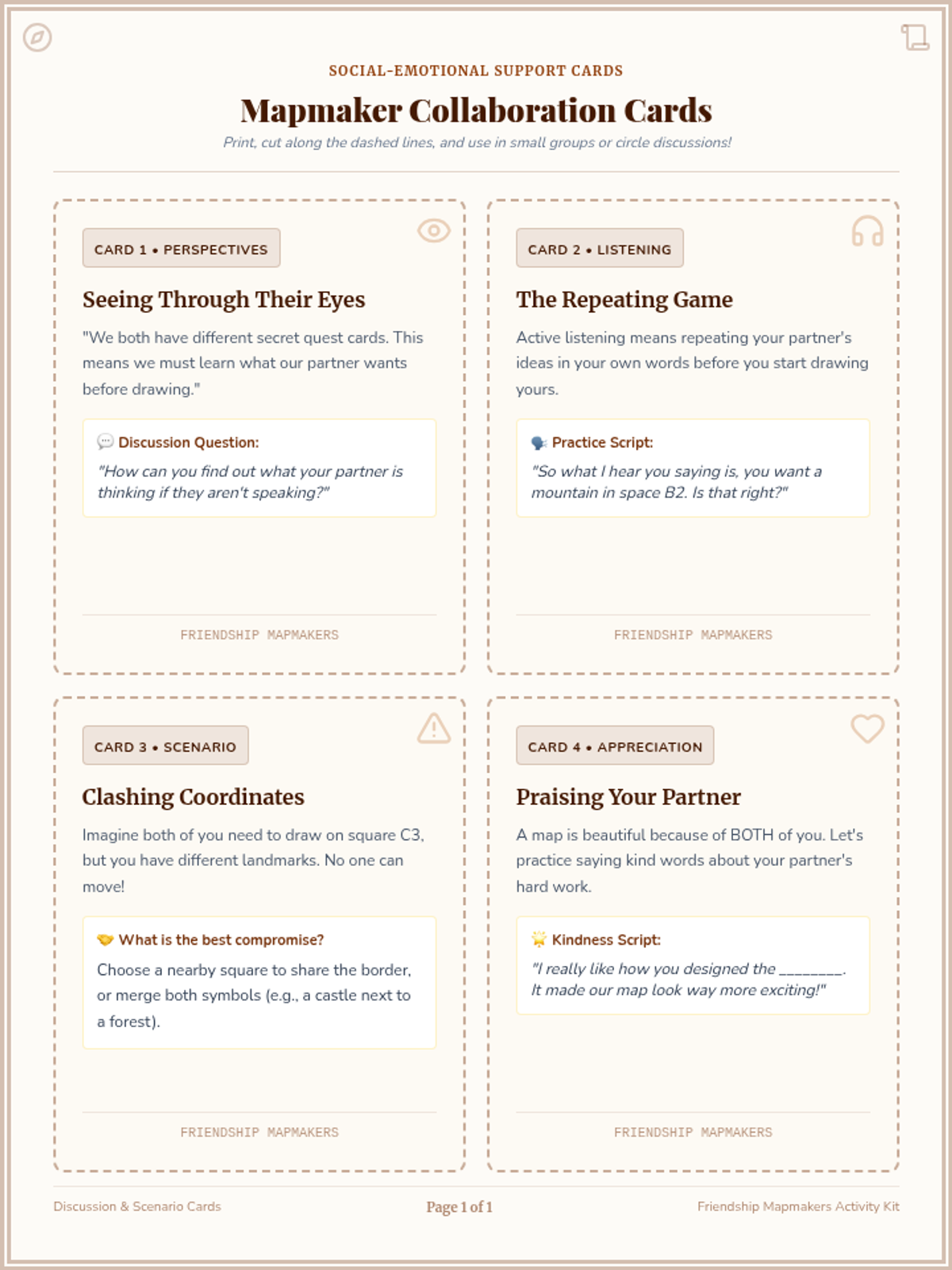
A 1-page printable set of 4 collaborative discussion and scenario cards. Designed for student small groups or teacher-led circles to support perspective-taking and active listening.
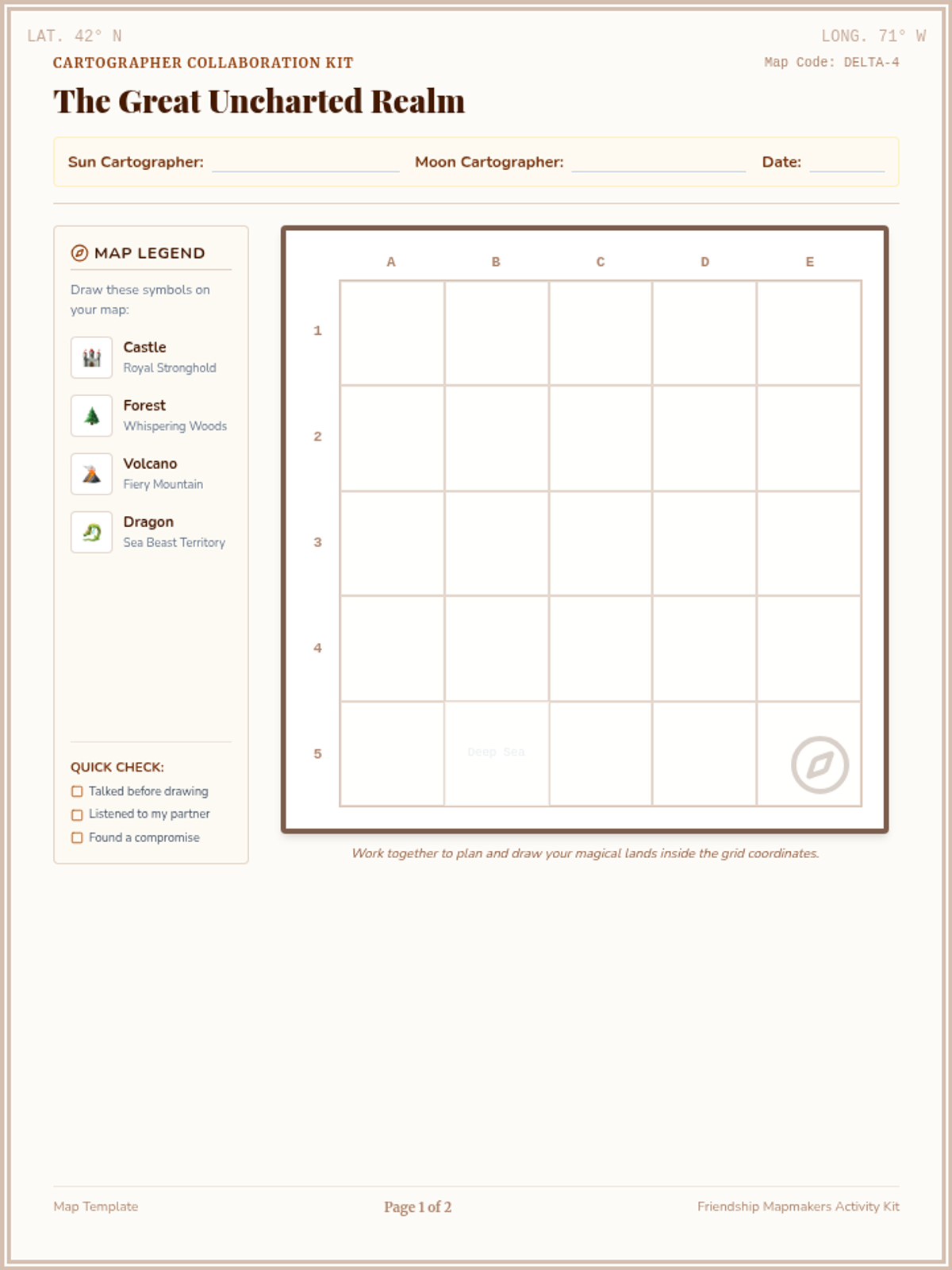
A 2-page printable student-facing activity booklet. Page 1 features a beautiful grid-based coordinate map template and map legend. Page 2 includes cut-out Secret Quest Cards and a compromise log for logging shared decisions.
A 5-slide instructional presentation for classroom delivery. It introduces students to the key concepts of perspective, active listening scripts, compromise, and guides them through the activity rules.
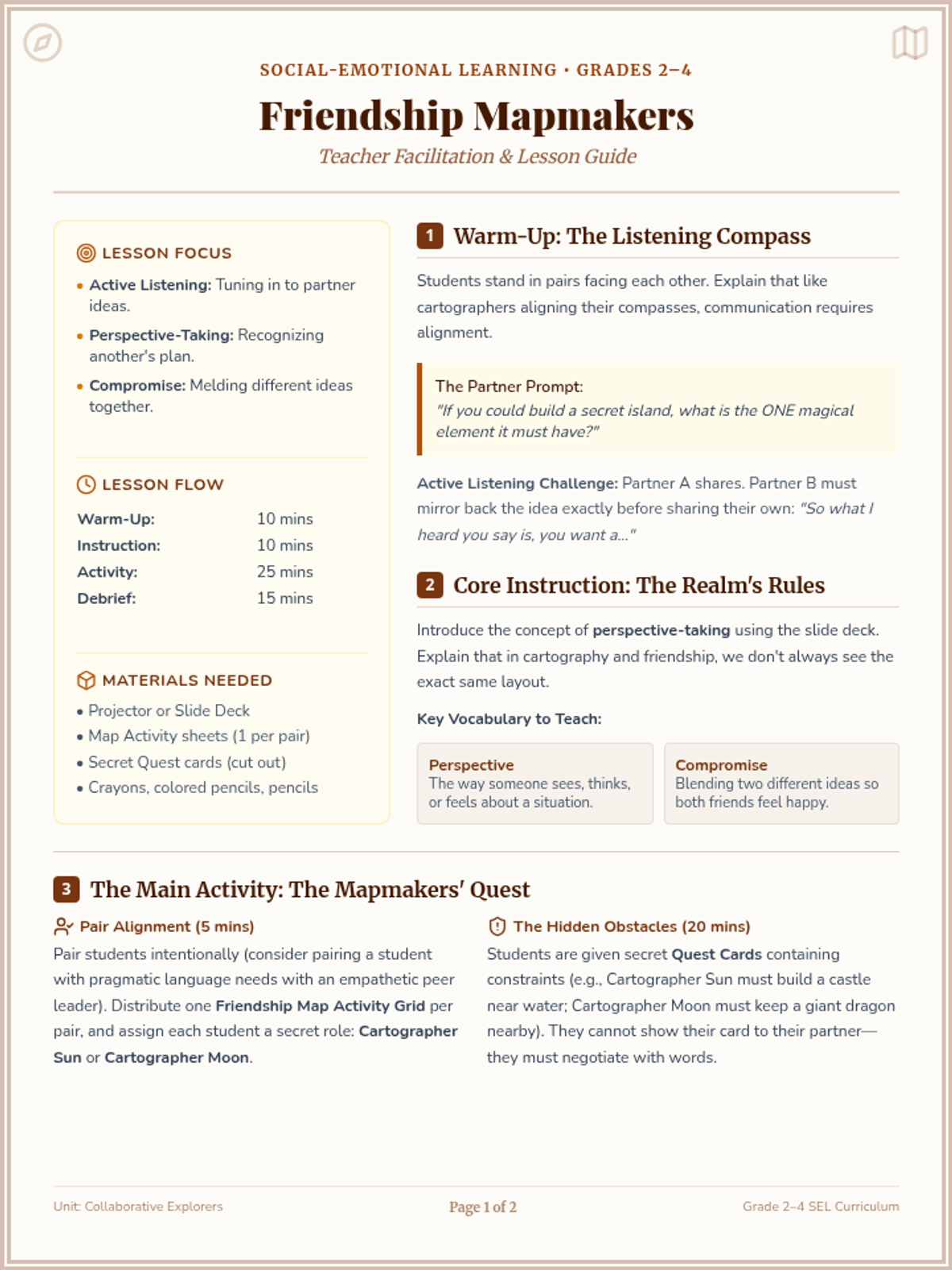
A 2-page teacher-facing facilitation guide for the Friendship Mapmakers lesson. It contains step-by-step instructions, developmental targets, scaffolding for pragmatic language challenges, and a progress tracking checklist.
The final instructional slide deck for Lesson 5, guiding students through synthesizing their research into a "Joy Menu" and practicing their new skills through role-play.
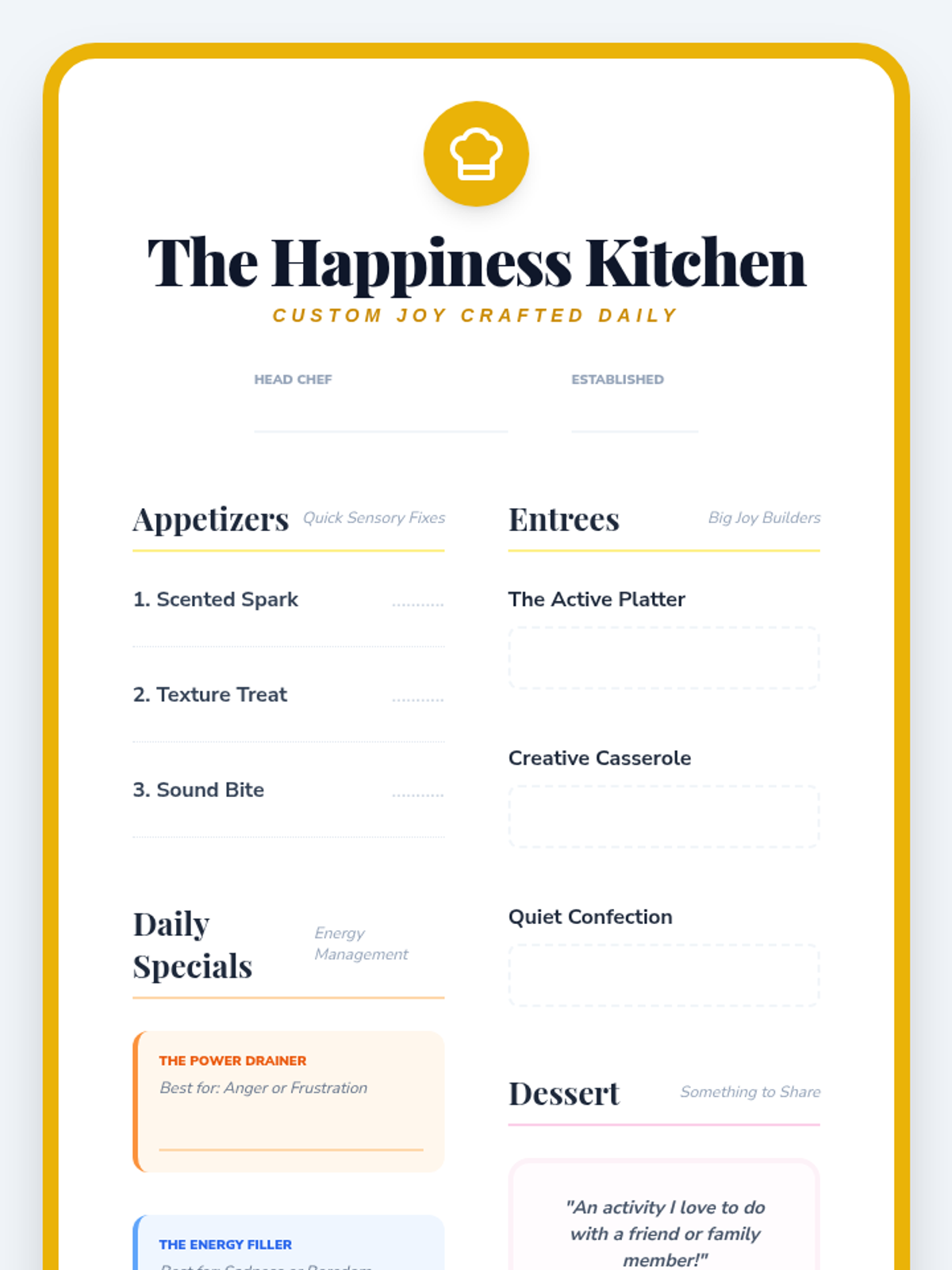
A student-facing restaurant-style menu template for synthesizing and illustrating personal mood-lifting activities and coping strategies.
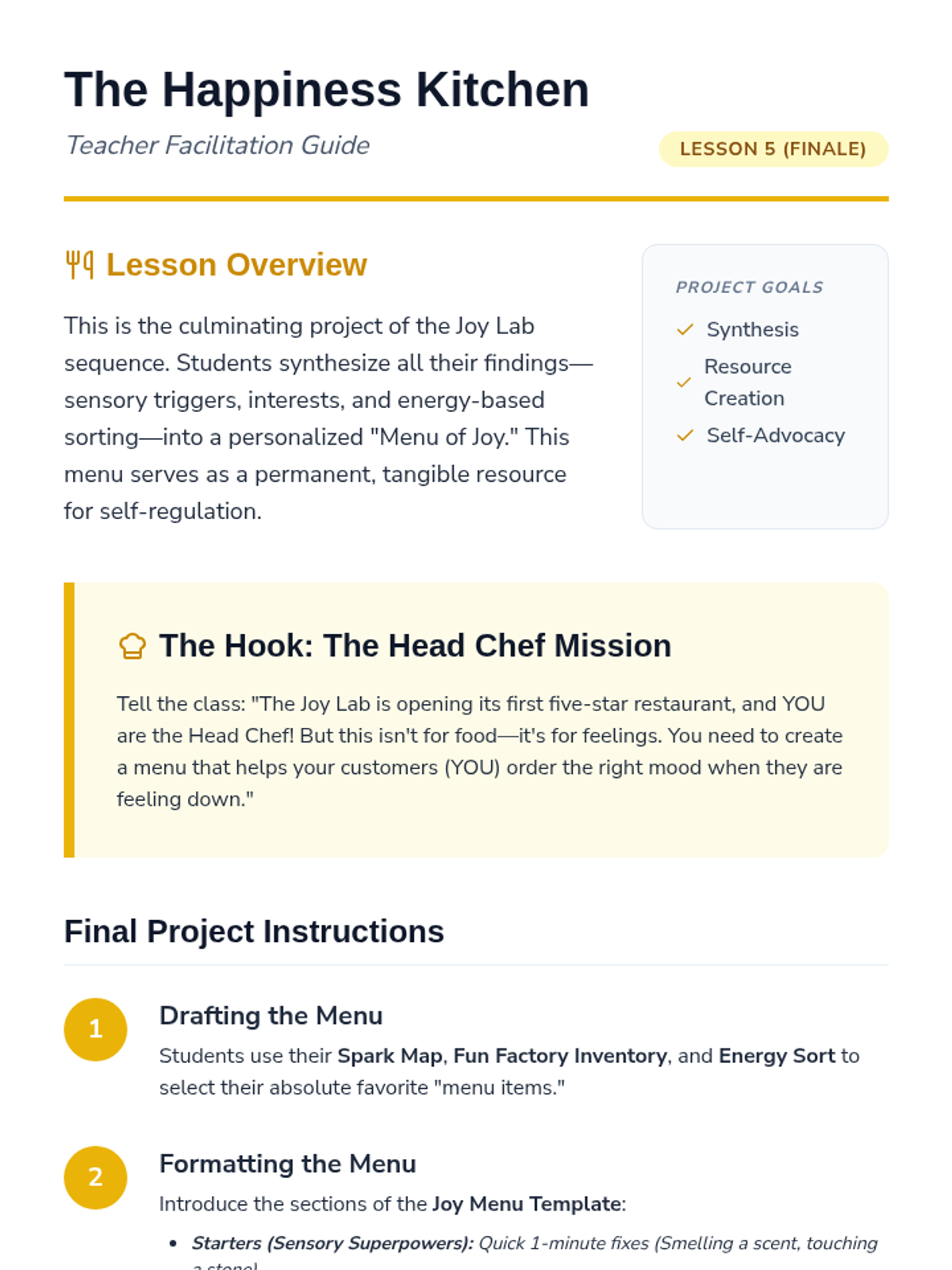
A teacher guide for Lesson 5, focusing on synthesis of learned coping strategies into a personalized "Joy Menu" and providing instructions for role-play scenarios.
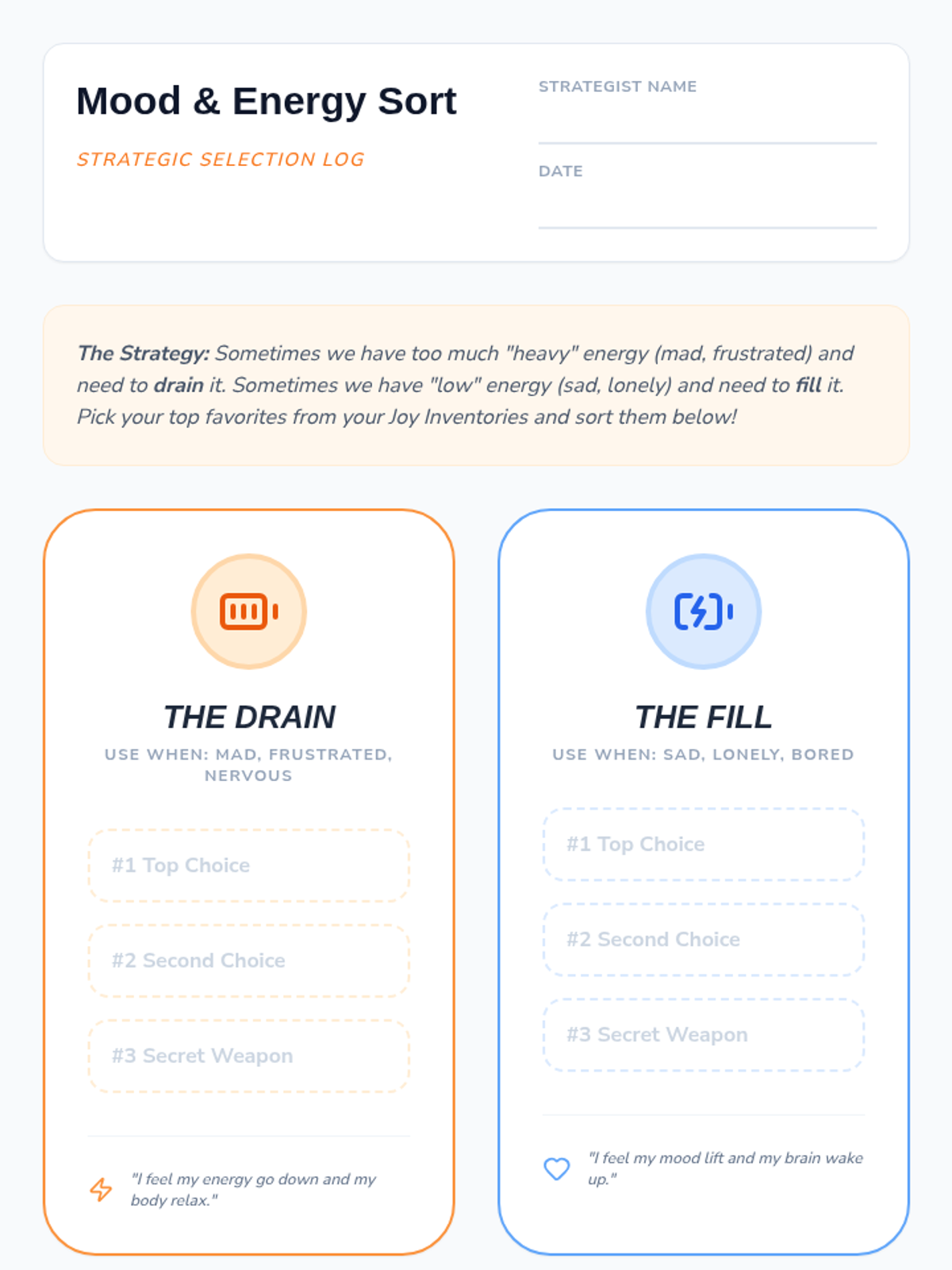
A student worksheet for sorting personal joy activities into High Energy (Drain) and Low Energy (Fill) categories for strategic emotional regulation.
An instructional slide deck for Lesson 4 that teaches students how to strategically match activities to their current emotional energy levels.
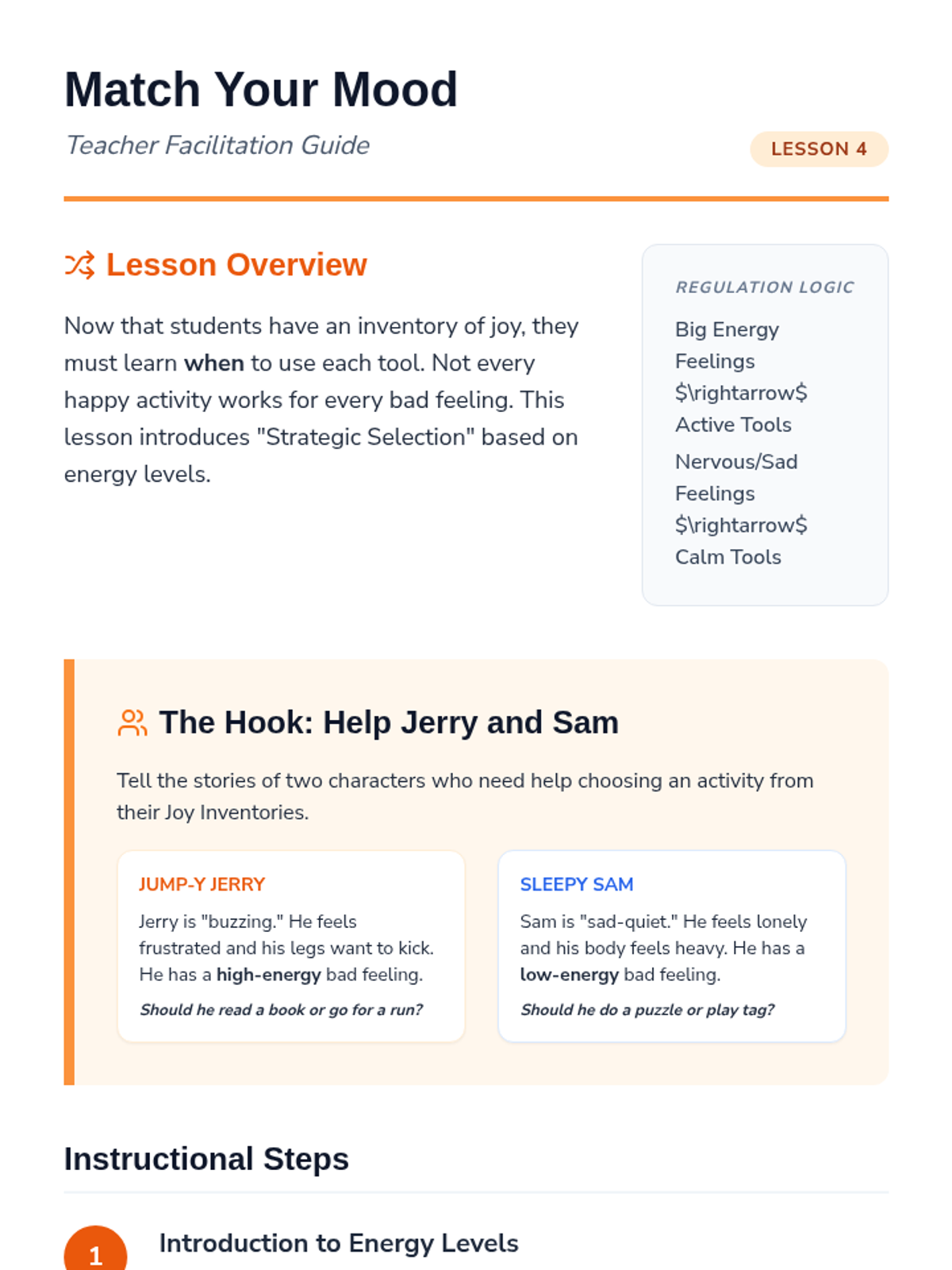
A teacher guide for Lesson 4, focusing on strategic selection of activities based on emotional energy levels (High Energy vs. Low Energy).
An instructional slide deck for Lesson 3 that introduces sensory mood boosters and guides students through a series of "laboratory" experiments with smell, sound, and touch.
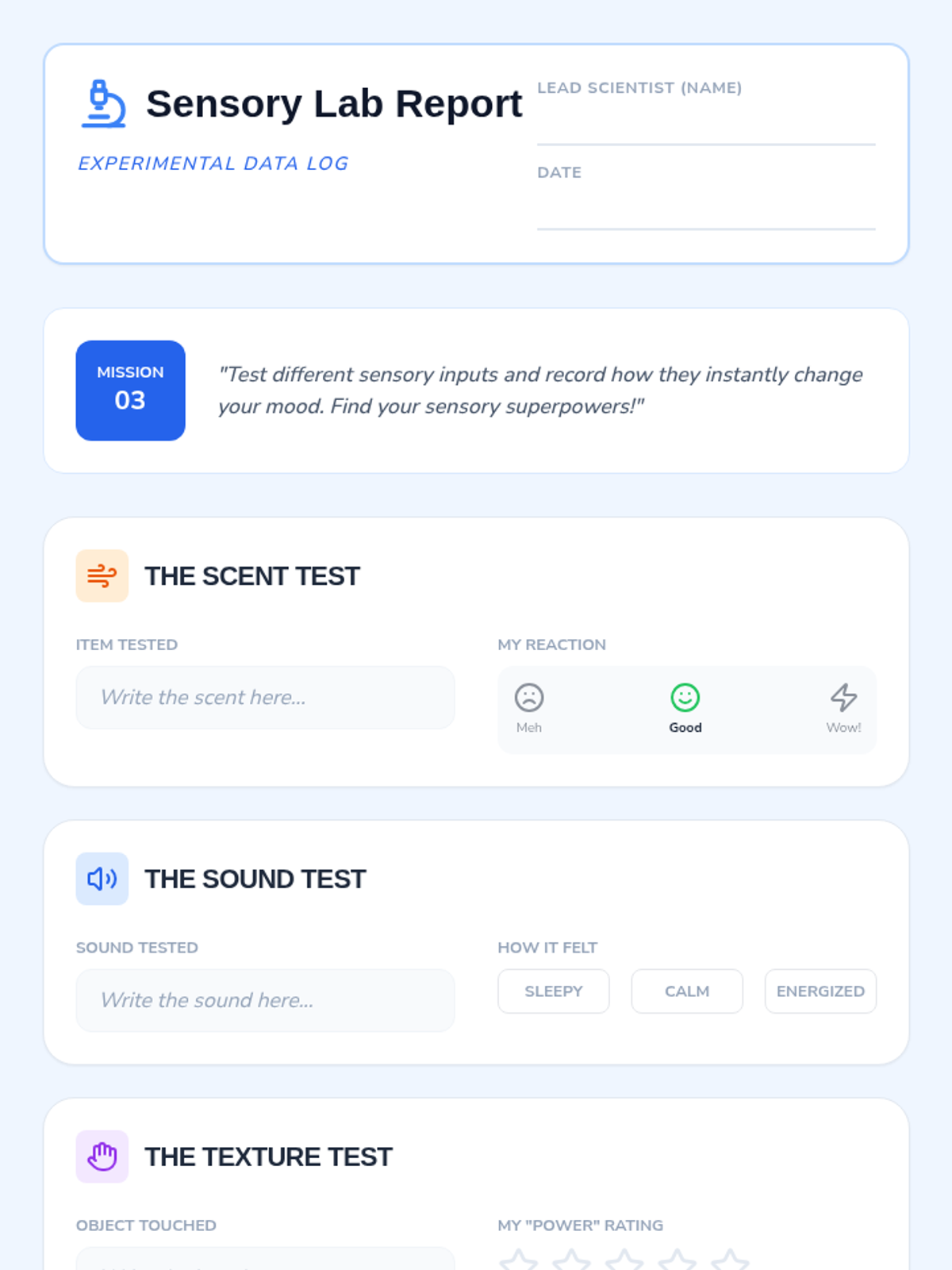
A student lab report worksheet for recording observations and emotional reactions during the "Sensory Superpowers" lab station activity.
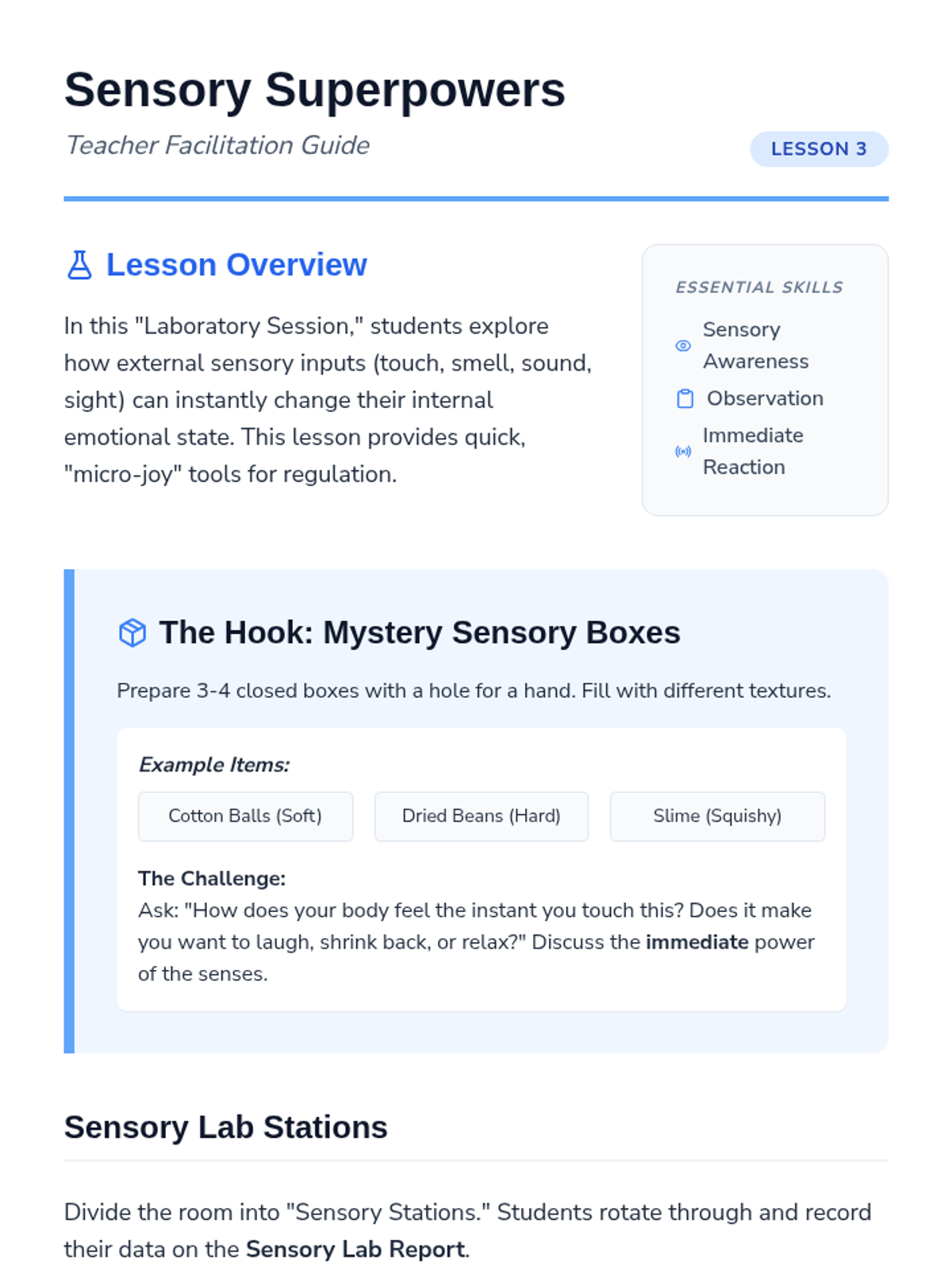
A teacher guide for Lesson 3, focusing on sensory-based mood boosters (smell, touch, sound, sight) through a "Sensory Lab" station rotation.
An instructional slide deck for Lesson 2 that introduces the three departments of fun: active, creative, and quiet, and guides students through building a personal joy stockpile.
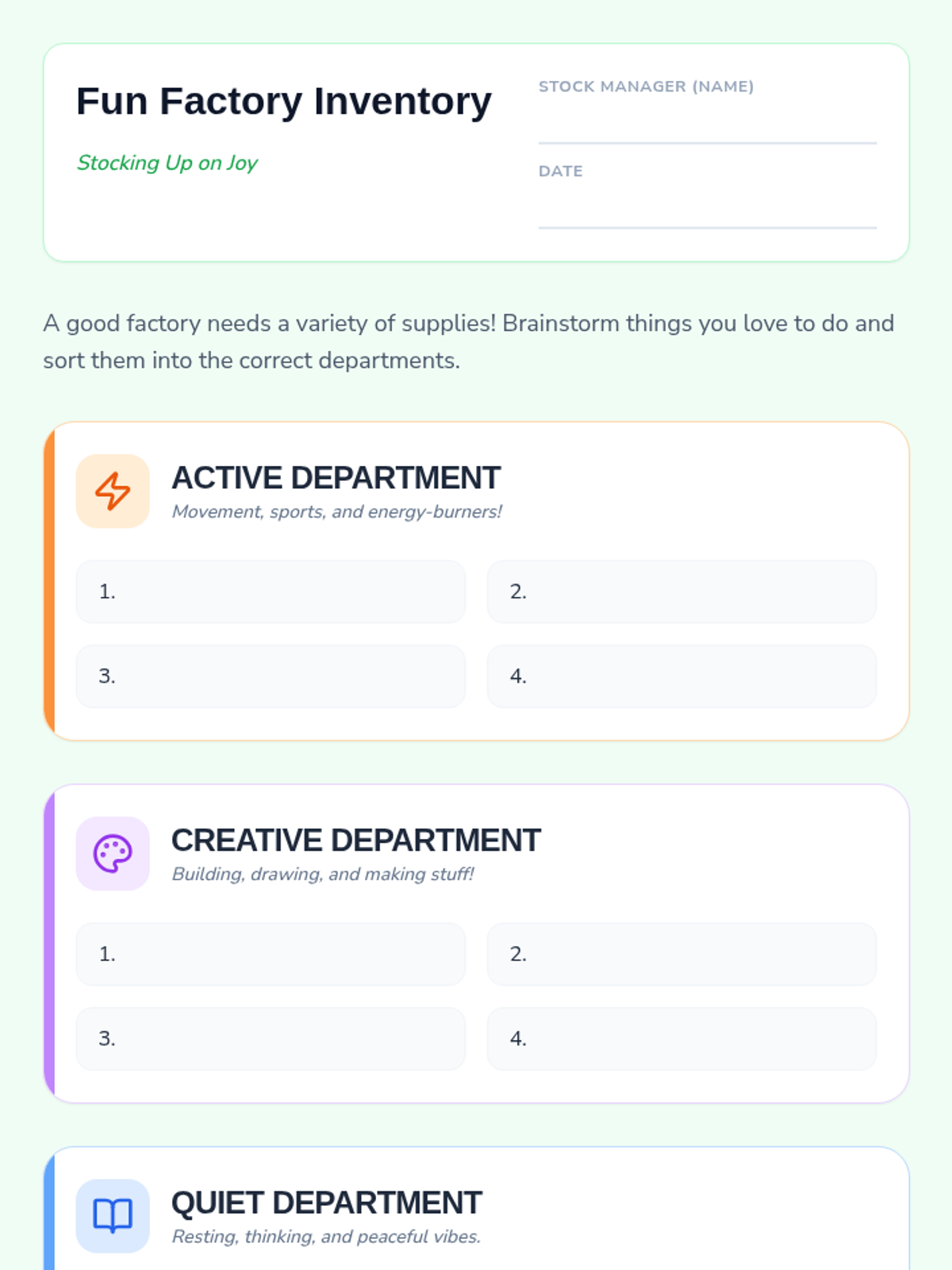
A student worksheet for identifying and categorizing favorite activities into active, creative, and quiet categories to build a diverse joy inventory.
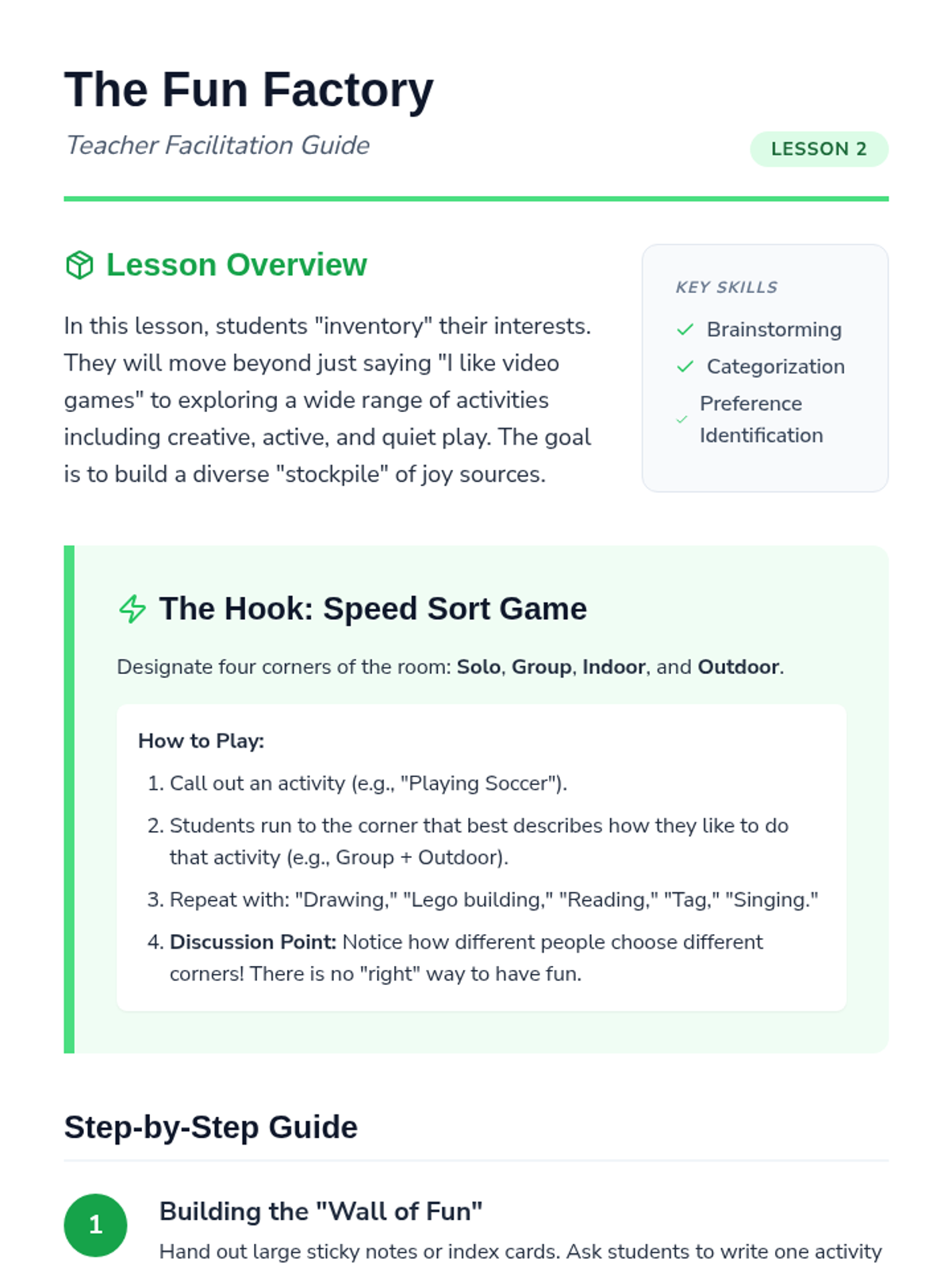
A teacher guide for Lesson 2, focusing on brainstorming activities and categorizing them into active, creative, and quiet "departments" to build a diverse emotional toolkit.
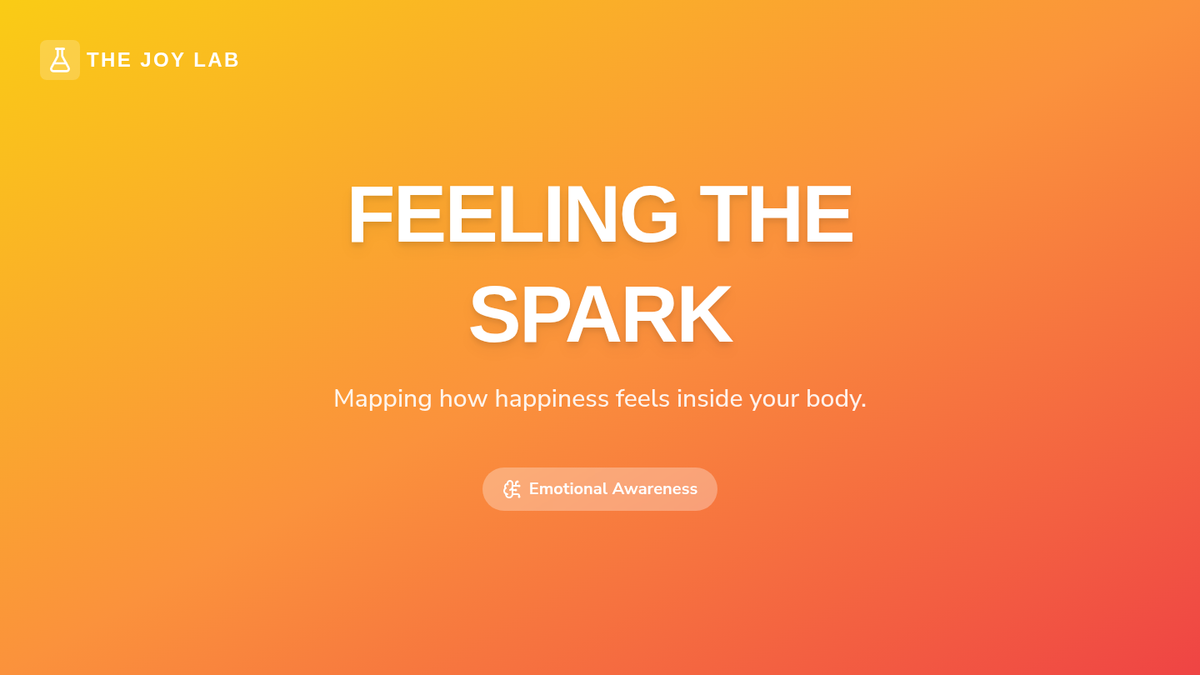
An engaging slide deck for the first lesson of the Joy Lab, introducing the concept of mapping physical sensations associated with high-energy and low-energy positive emotions.
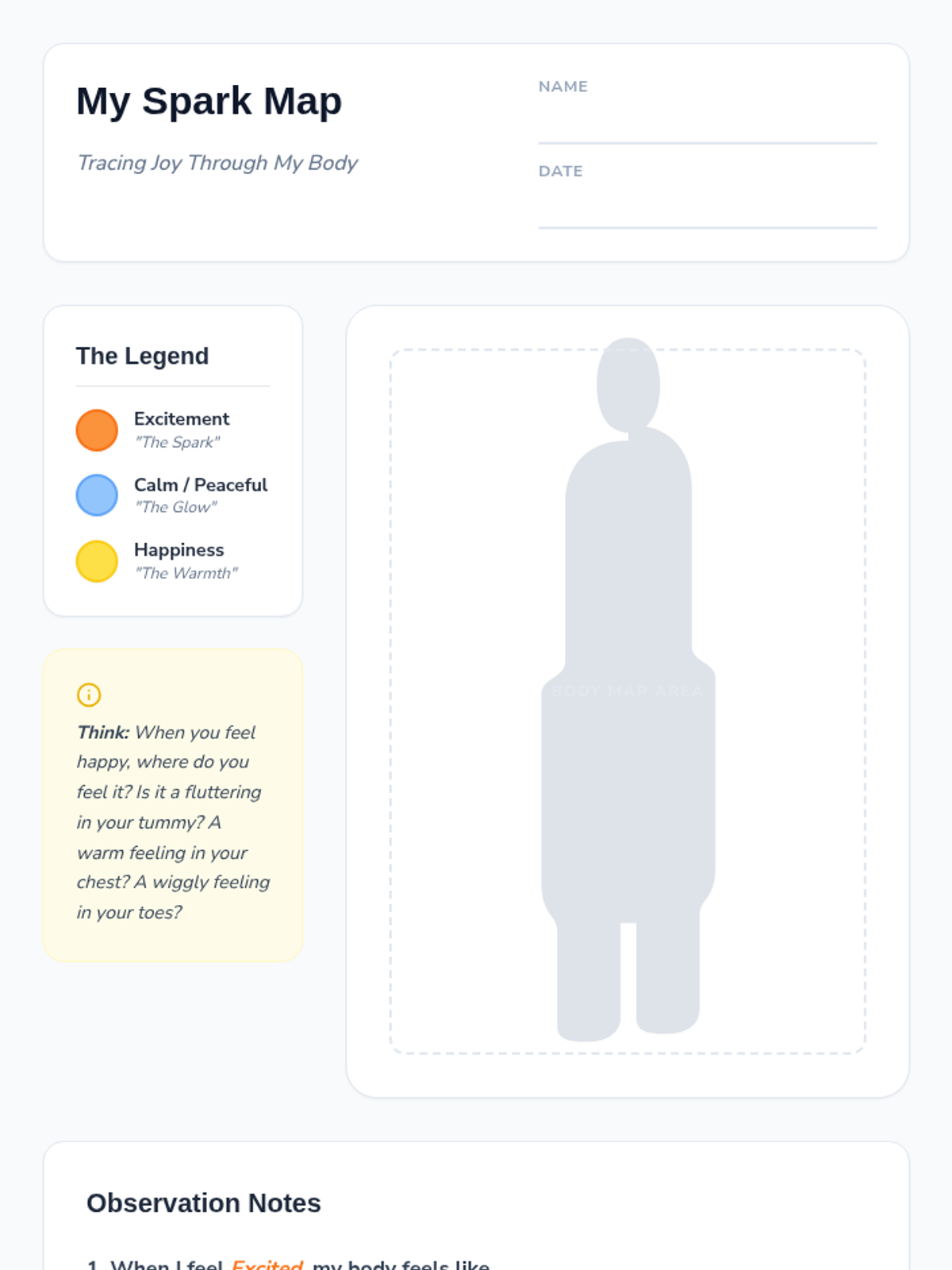
A student worksheet featuring a body map outline where children can trace and color physical sensations associated with positive emotions like excitement, calm, and happiness.
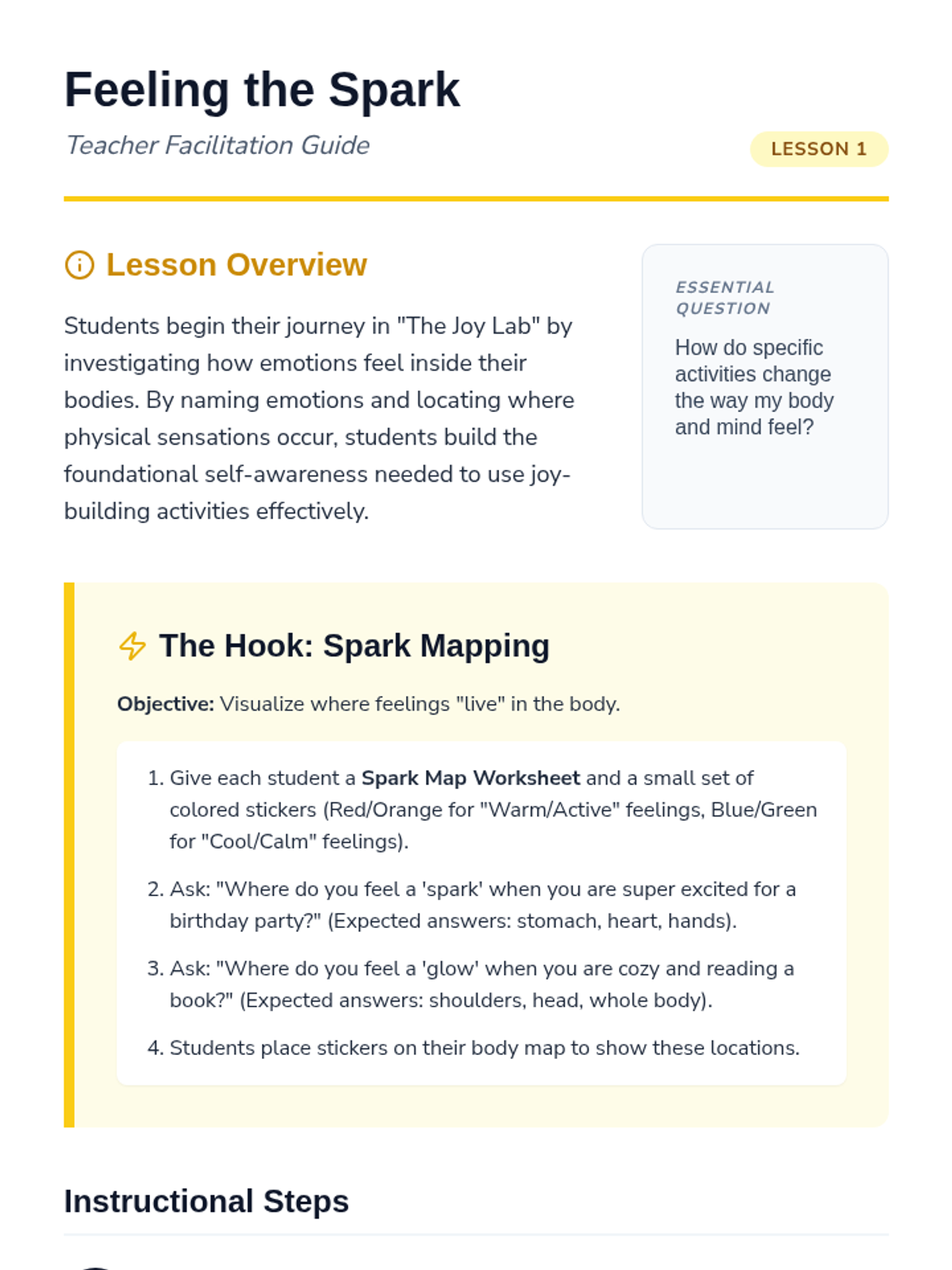
A comprehensive teacher guide for the first lesson of the Joy Lab sequence, focusing on identifying physical sensations associated with positive emotions through body mapping and vocabulary building.