Budgeting, saving, and investment strategies alongside practical skills for managing credit, taxes, and banking. Addresses insurance needs, employment income, and major purchase decisions to support comprehensive long-term financial planning.
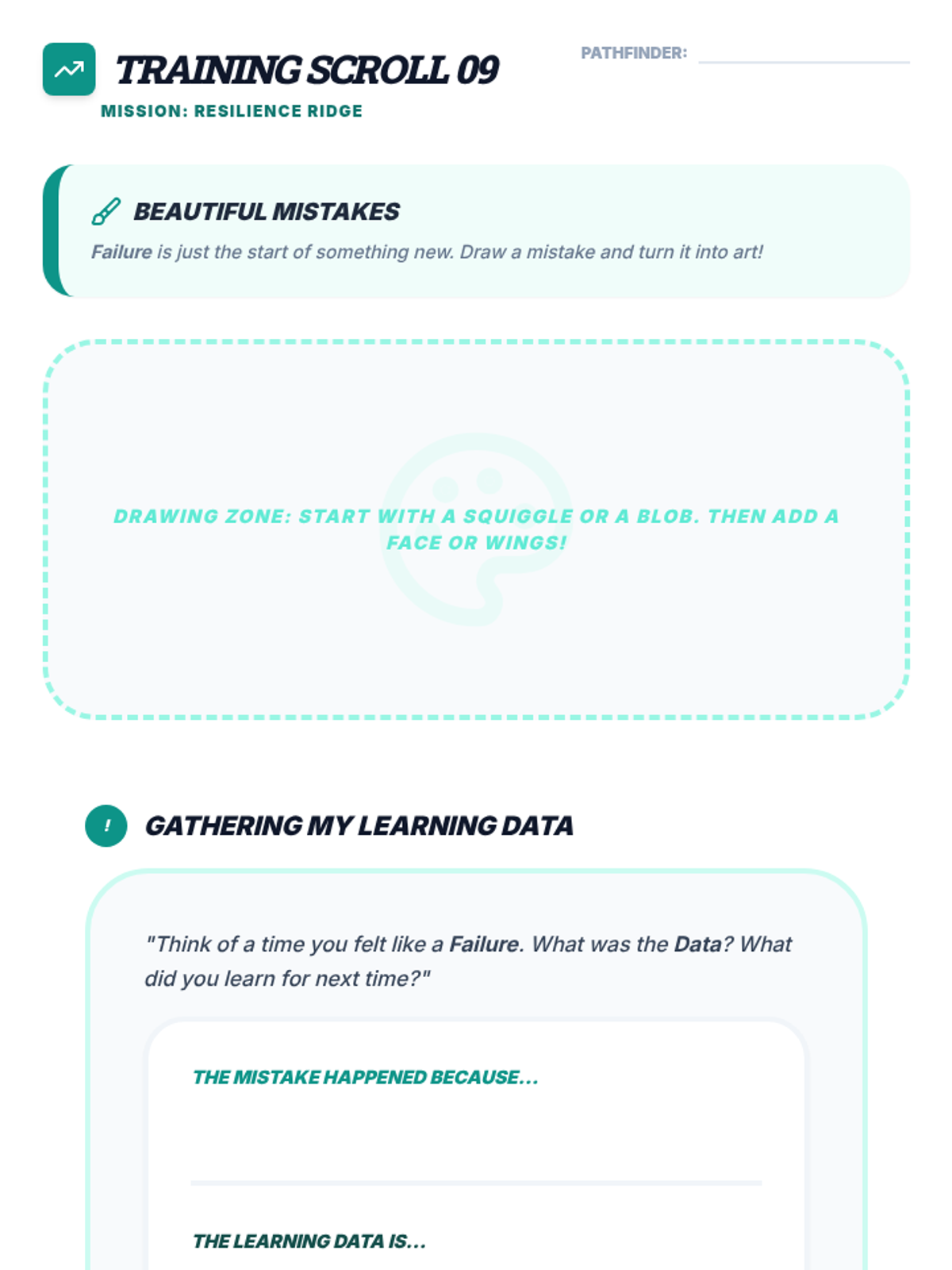
Learner workbook for Mission 09: Resilience Ridge. Features a "Beautiful Oops" drawing canvas, a "Data Collection" reflection area for learning from mistakes, and vocabulary definitions. Revised to emphasize failure as data and include vocabulary matching. No "ninja" references.
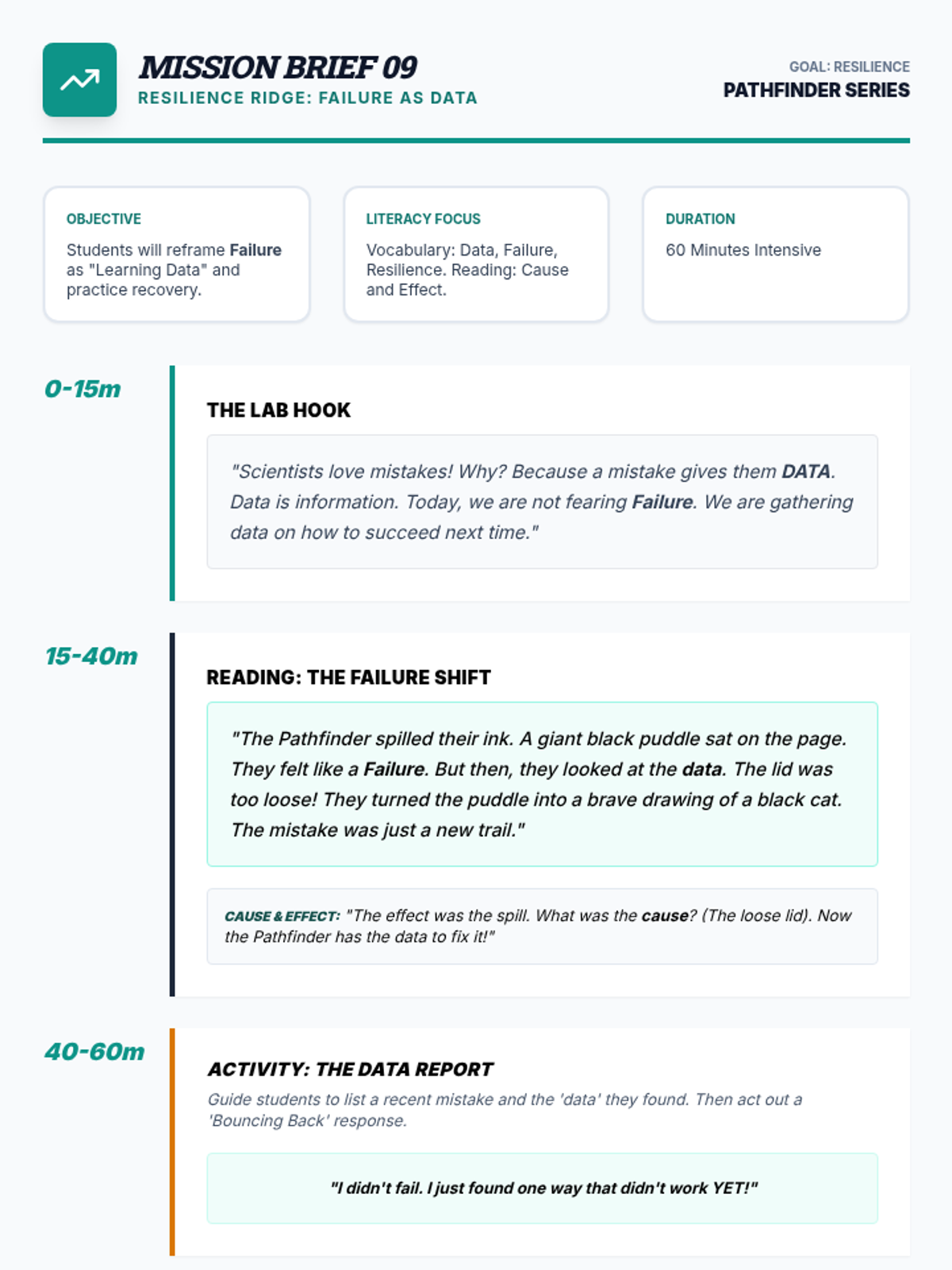
Facilitator script for Mission 09: Resilience Ridge. Teaches students to reframe failure as "learning data" and practice cause-and-effect thinking. Revised to emphasize the concept of failure as a learning opportunity. No "ninja" references.
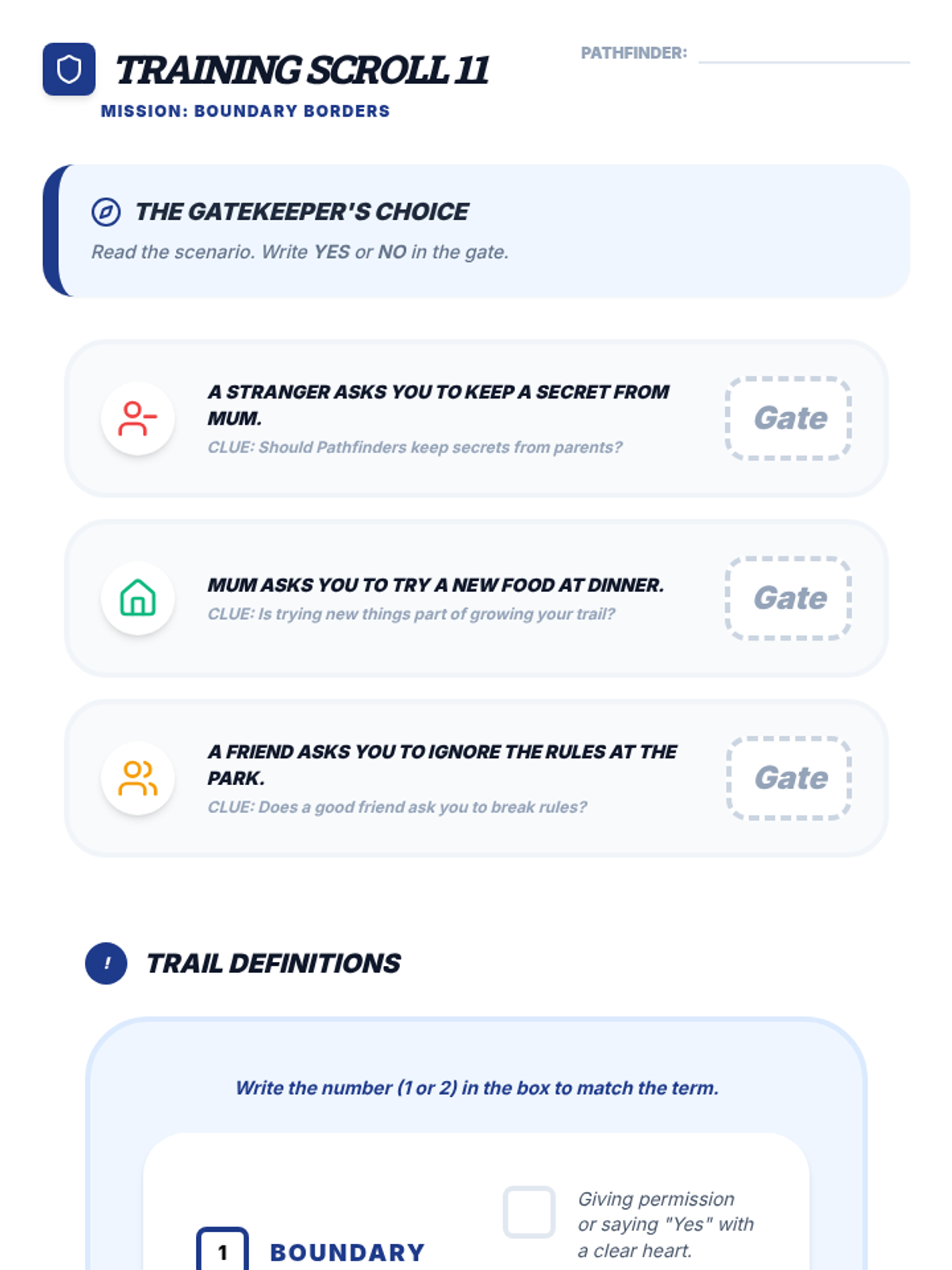
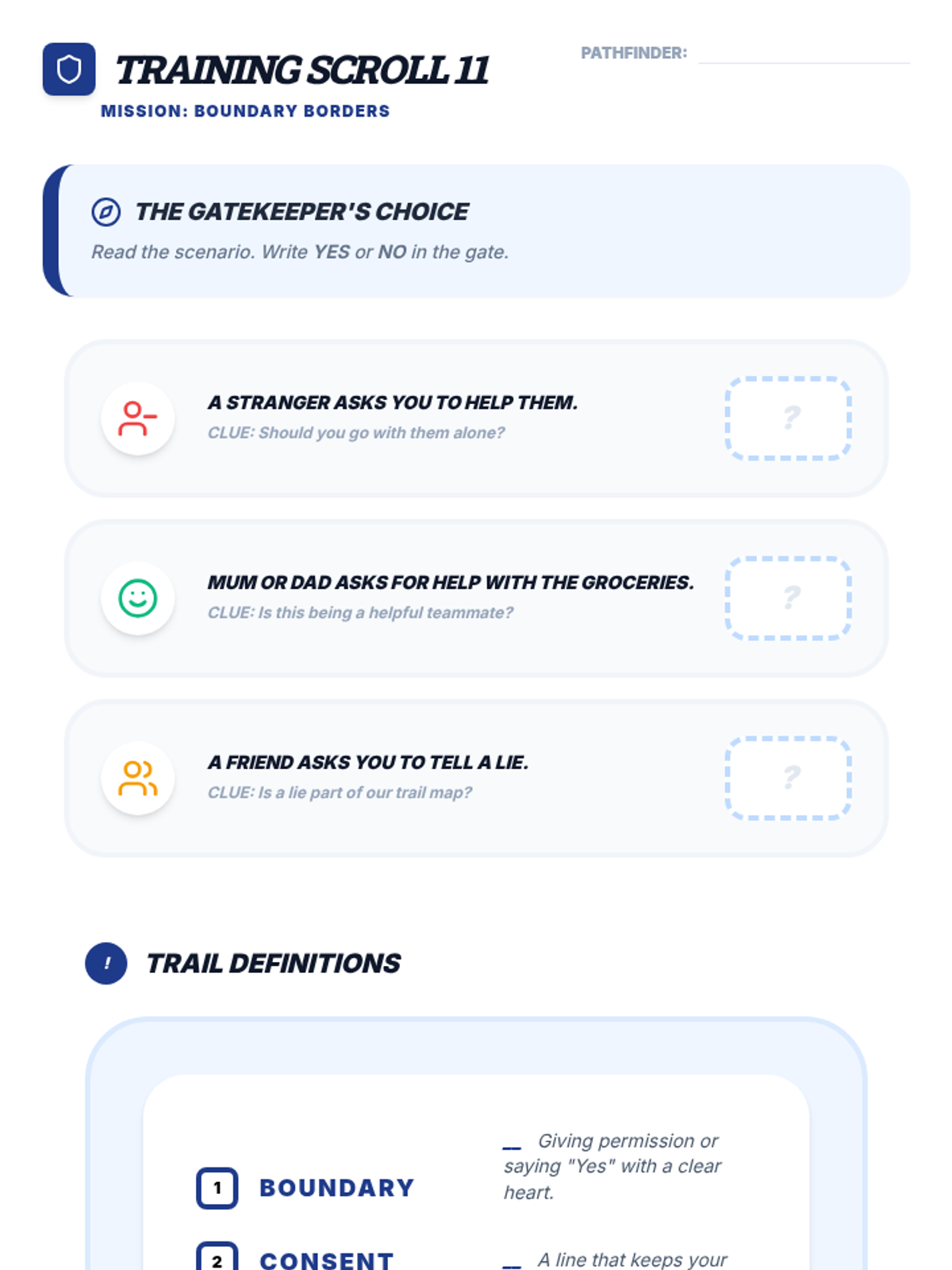
Learner workbook for Mission 11: Boundary Borders. Condensed to a single page with explicit scenario decision-making (Strangers, Family, Friends) and vocabulary matching. Revised for contrast, handwriting space, and missing keyword integration. No pre-filled "NO!".
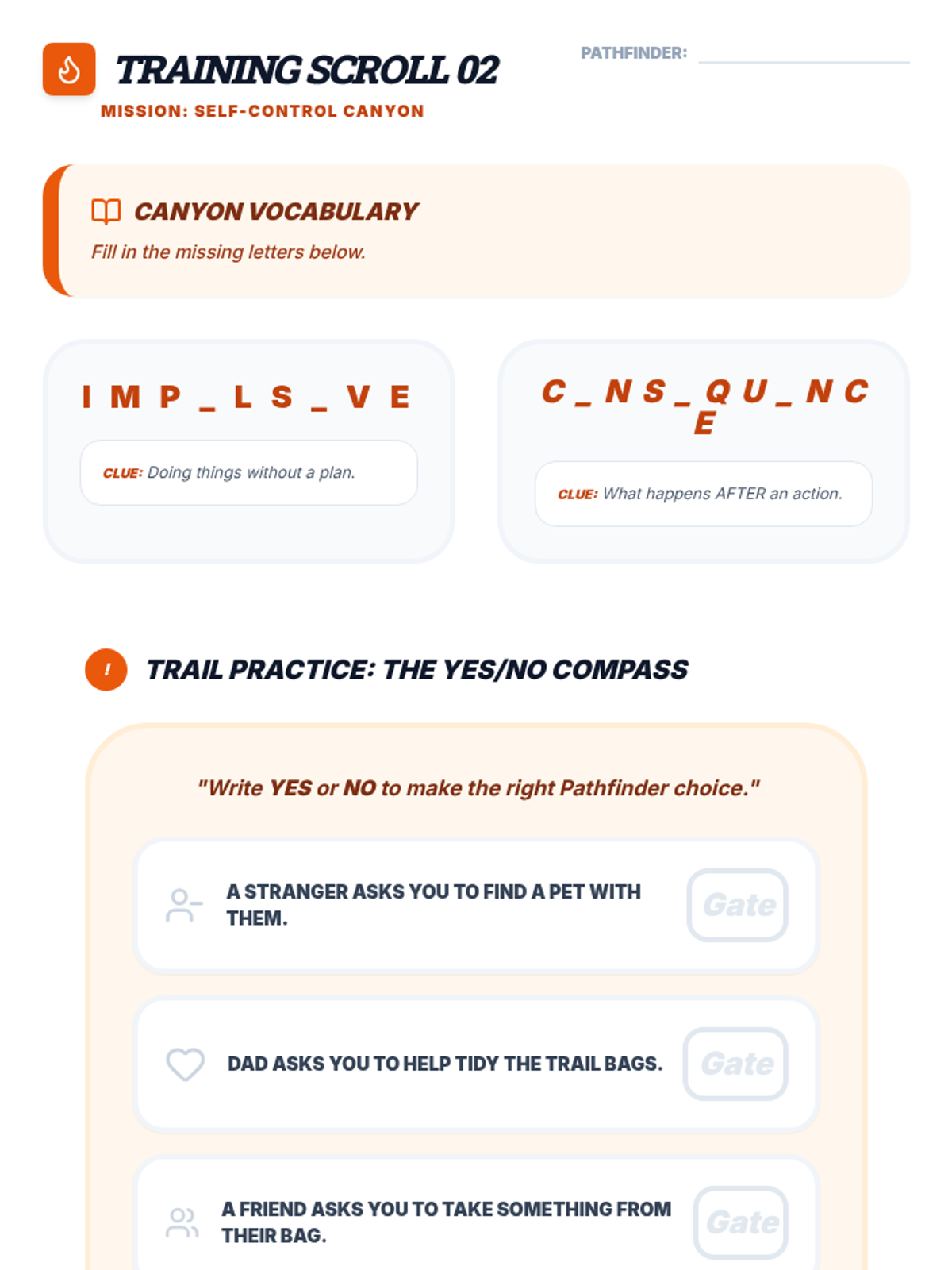
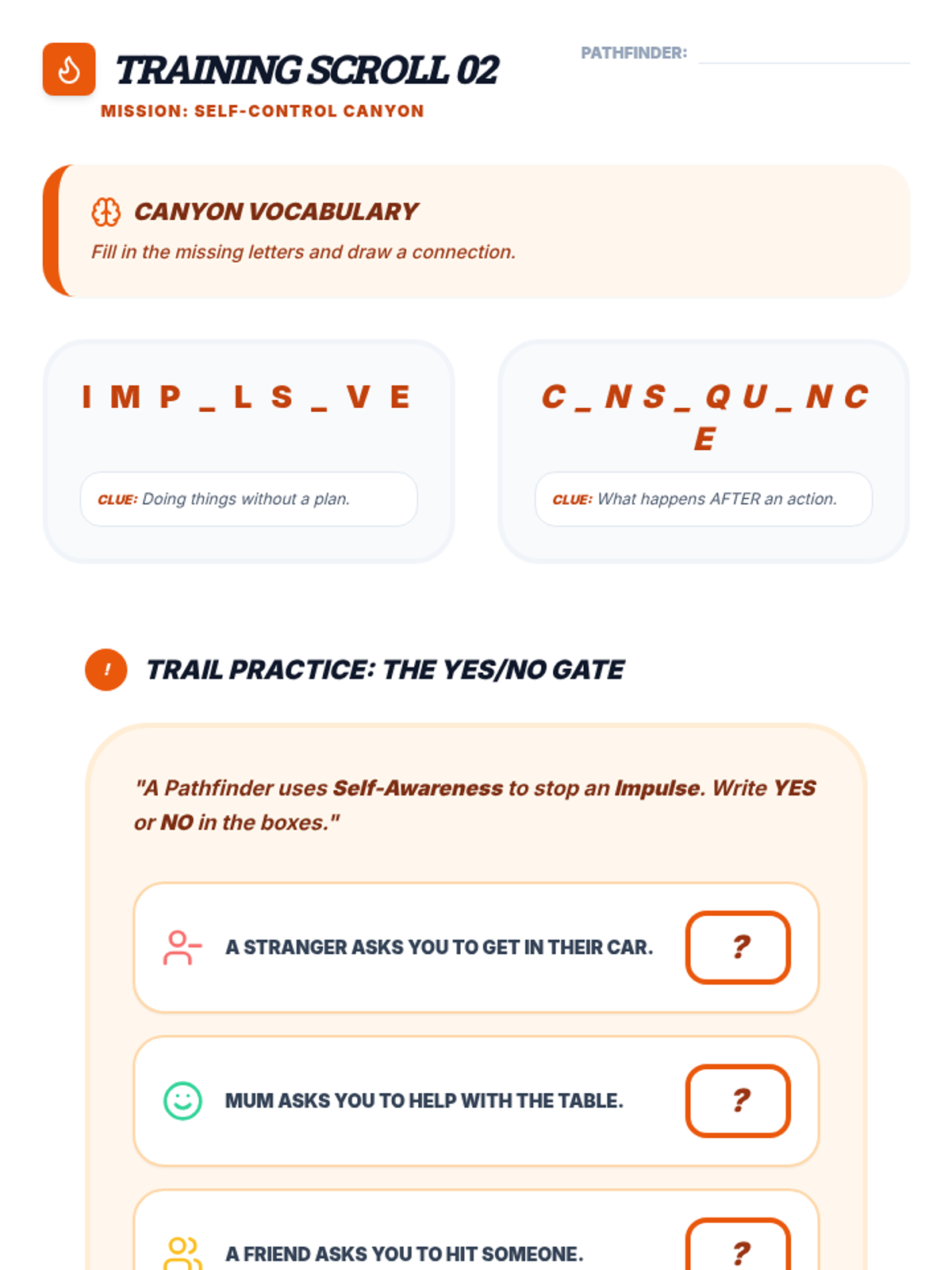
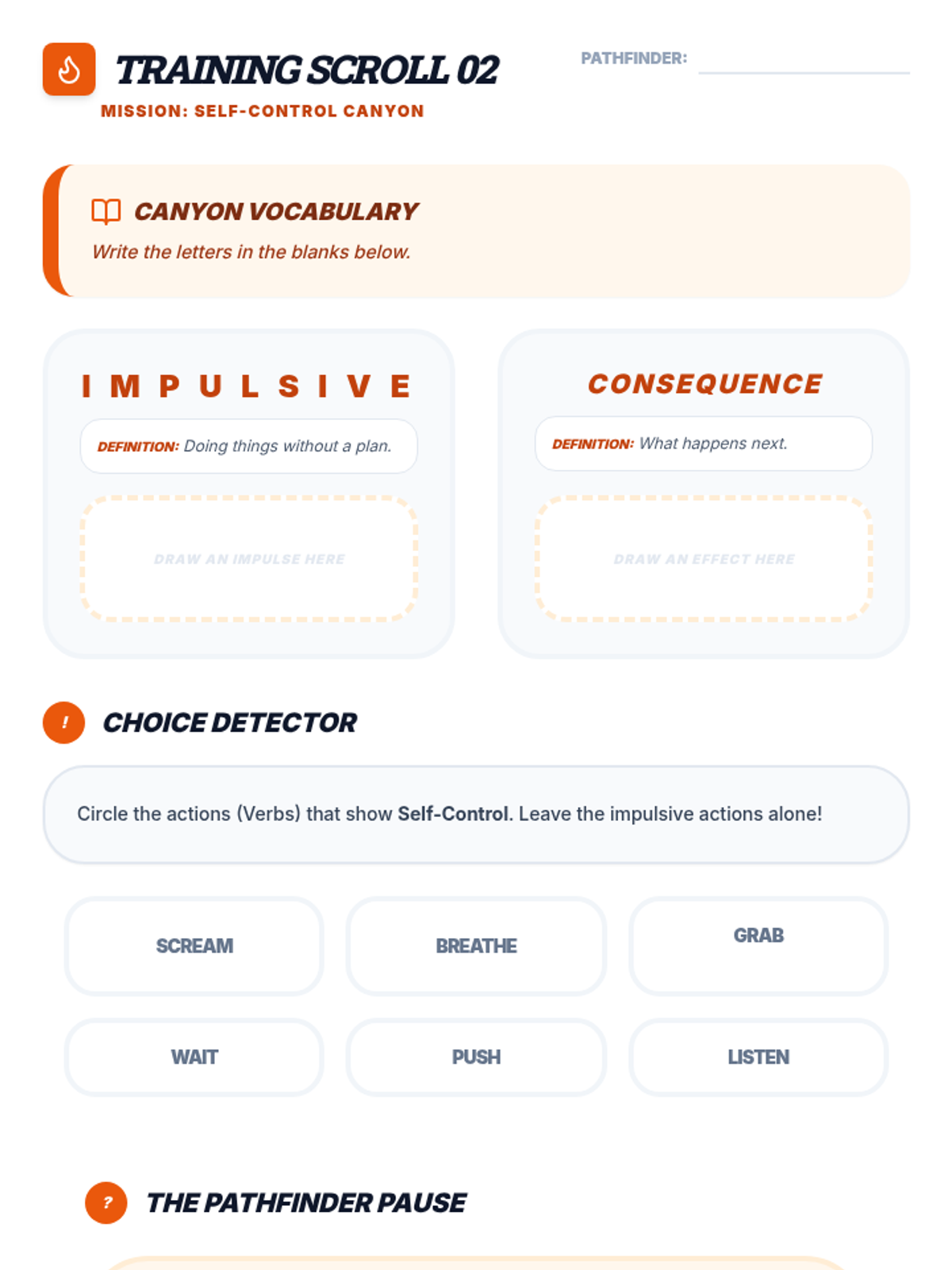
Learner workbook for Mission 02: Self-Control Canyon. Revised to include uniform styling for choices, increased writing space for creative reflection, and the requested parent/stranger scenarios. No "ninja" references. No telegraphing answers with colors.
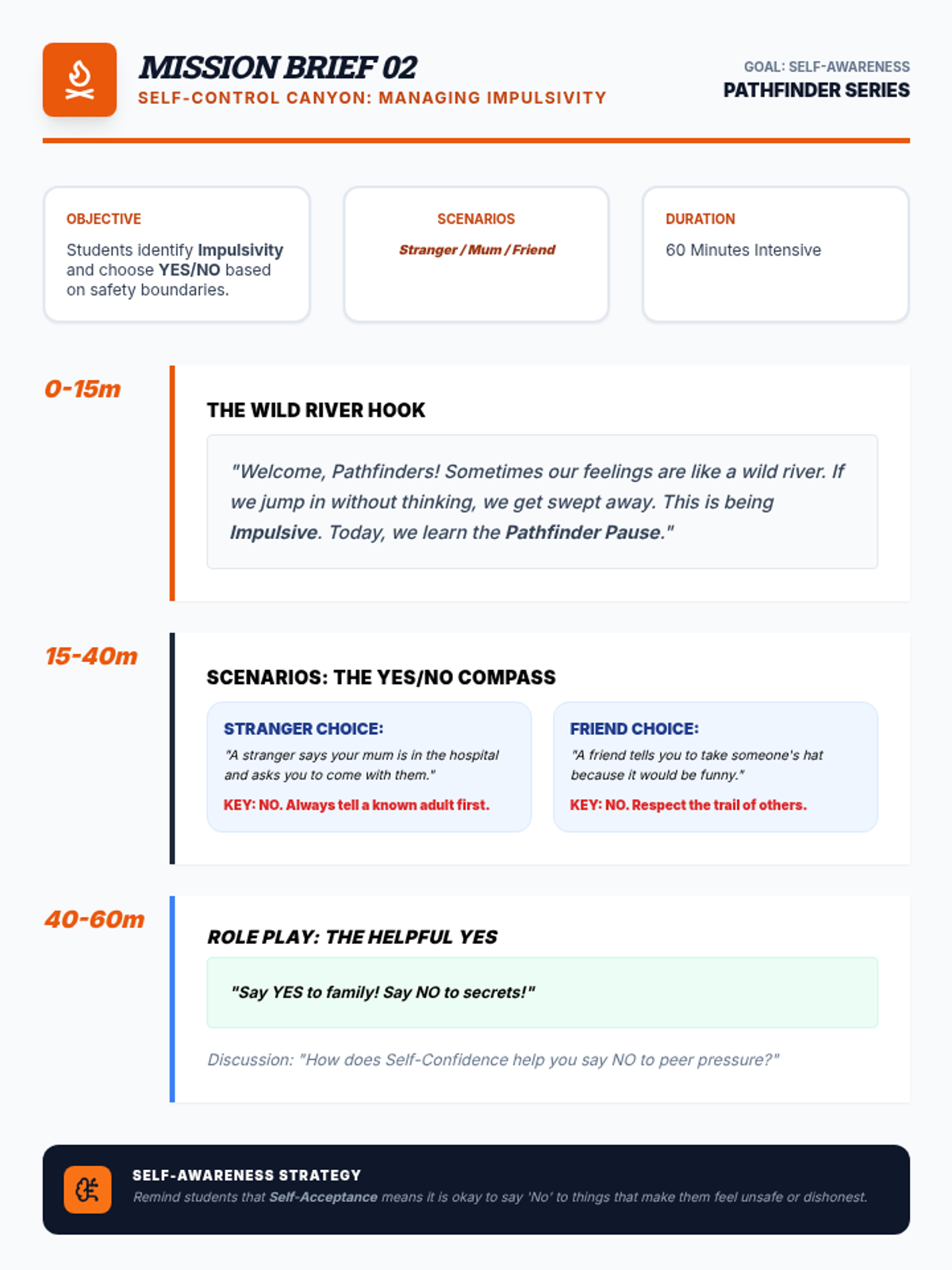
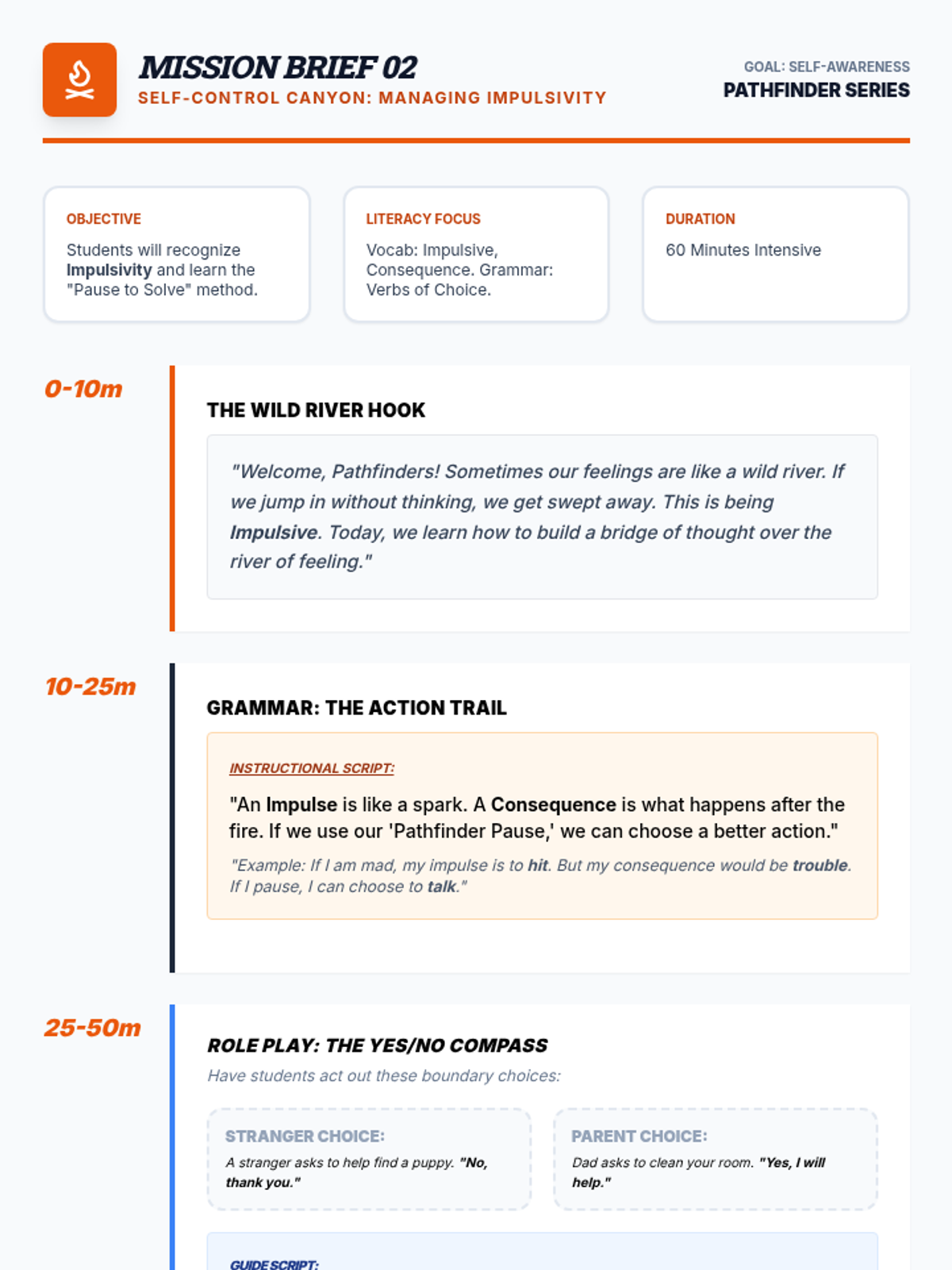
Facilitator script for Mission 02: Self-Control Canyon. Revised to remove "ninja" references, include full 60-minute duration, and add the requested social scenarios for parents and strangers. No self-referential draft notes.
Learner workbook for Mission 11: Boundary Borders. Condensed to a single page with explicit scenario decision-making (Strangers, Family, Friends) and vocabulary matching. Revised for contrast, handwriting space, and missing keyword integration.
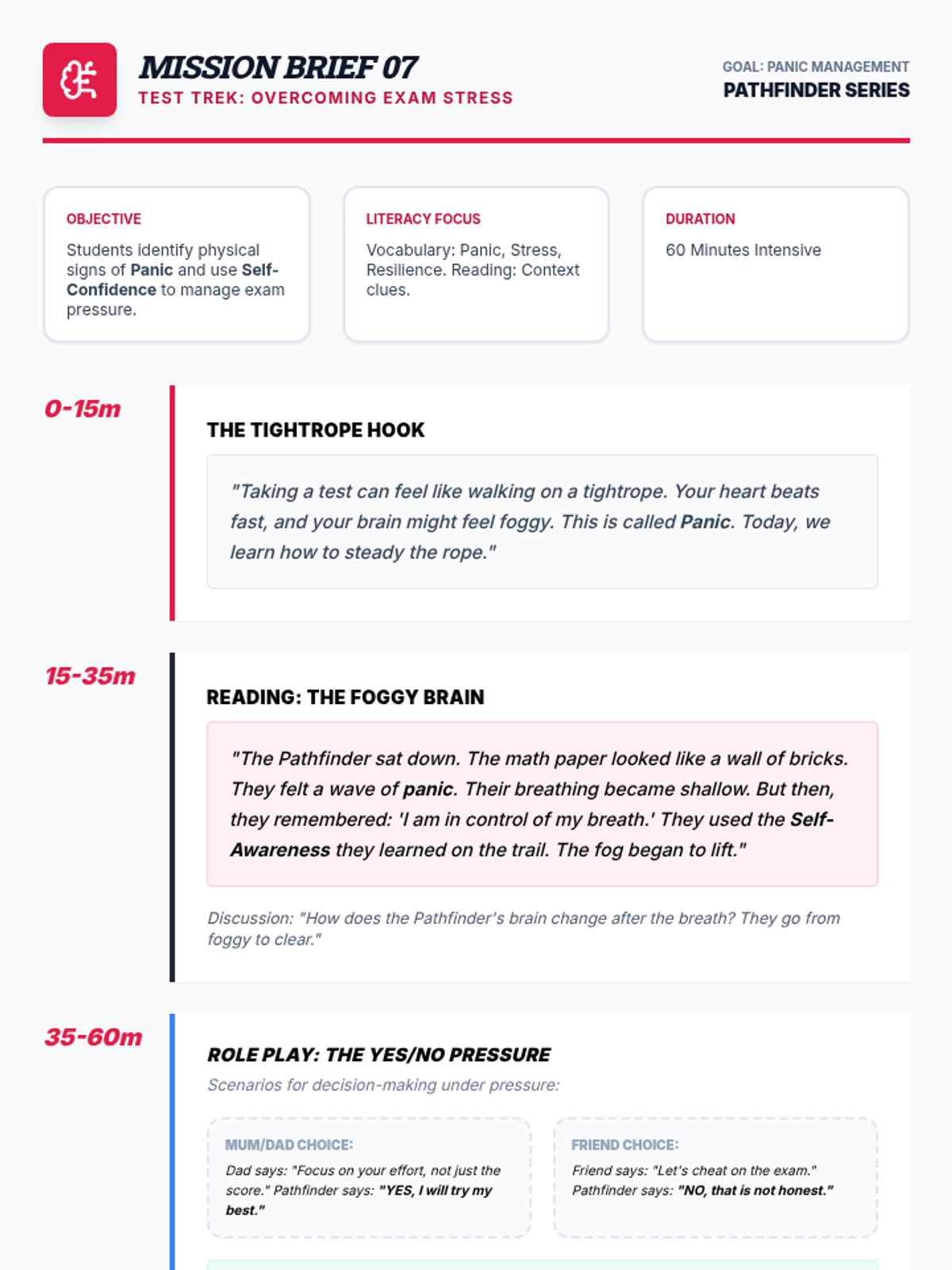
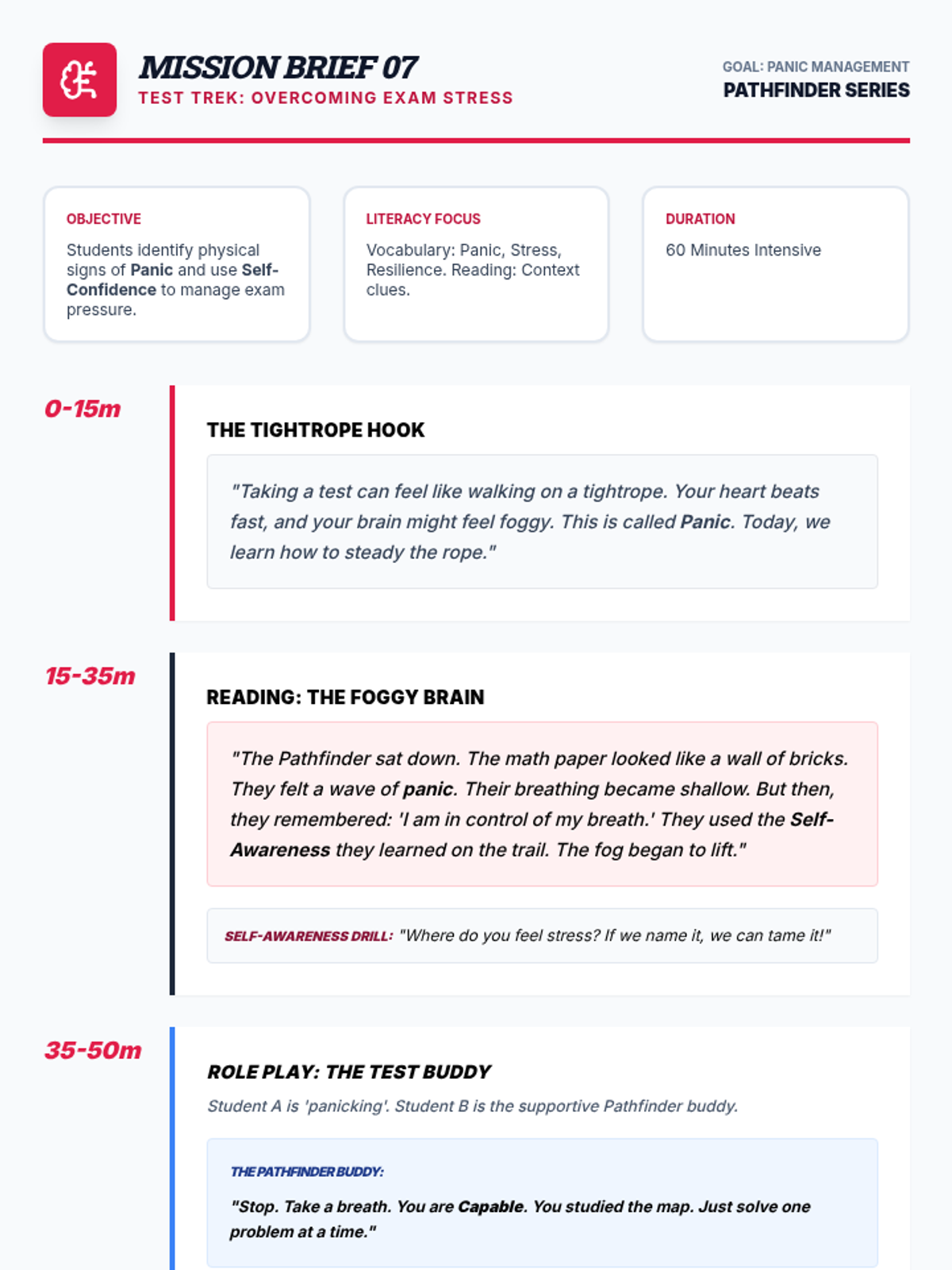
Facilitator script for Mission 07: Test Trek. Revised for better spacing, full 60-minute duration, and removed "ninja" references. Includes core concepts of Self-Awareness, integrity scenarios with Mom/Dad/Friends, and Exam Stress.
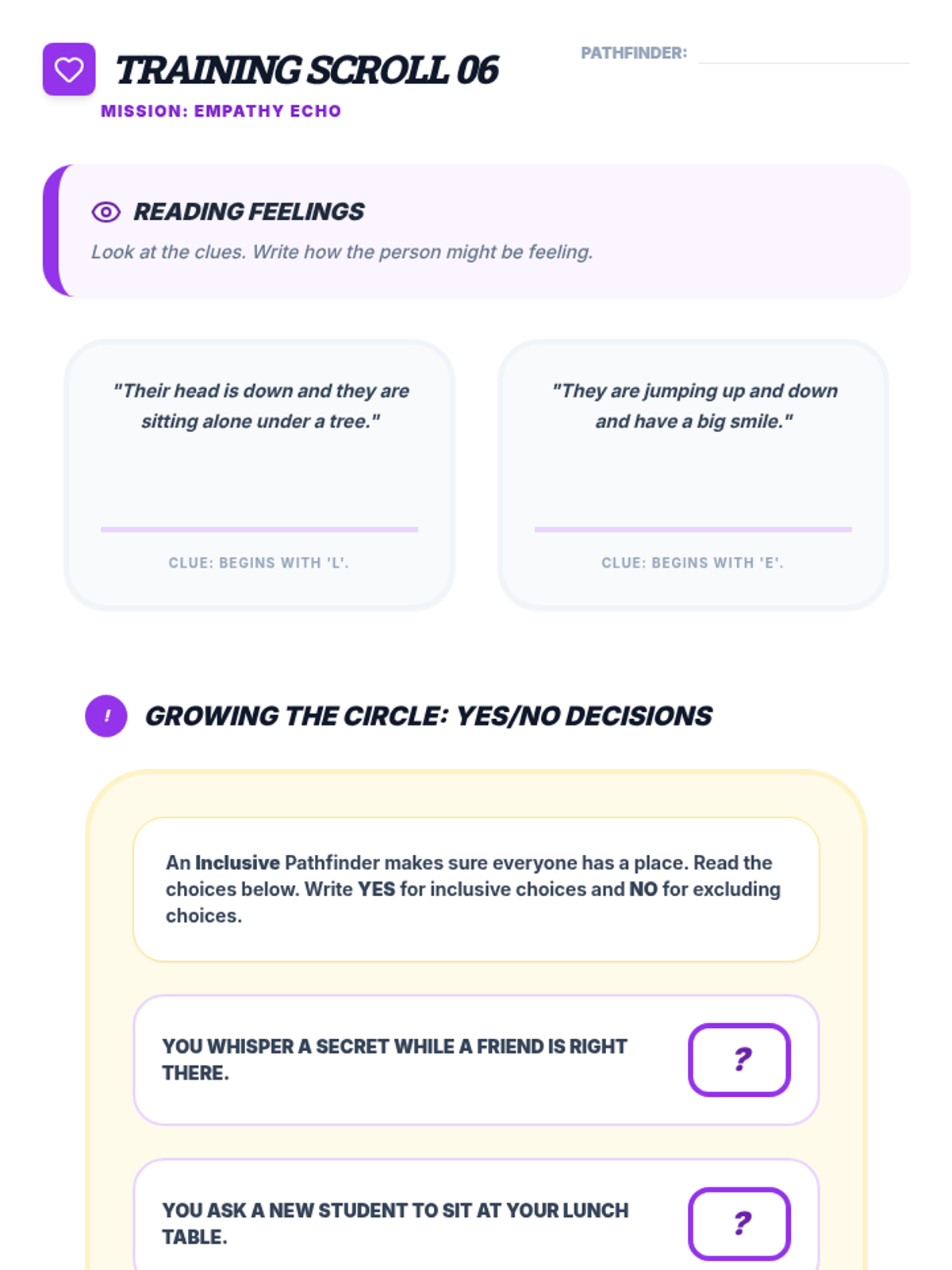
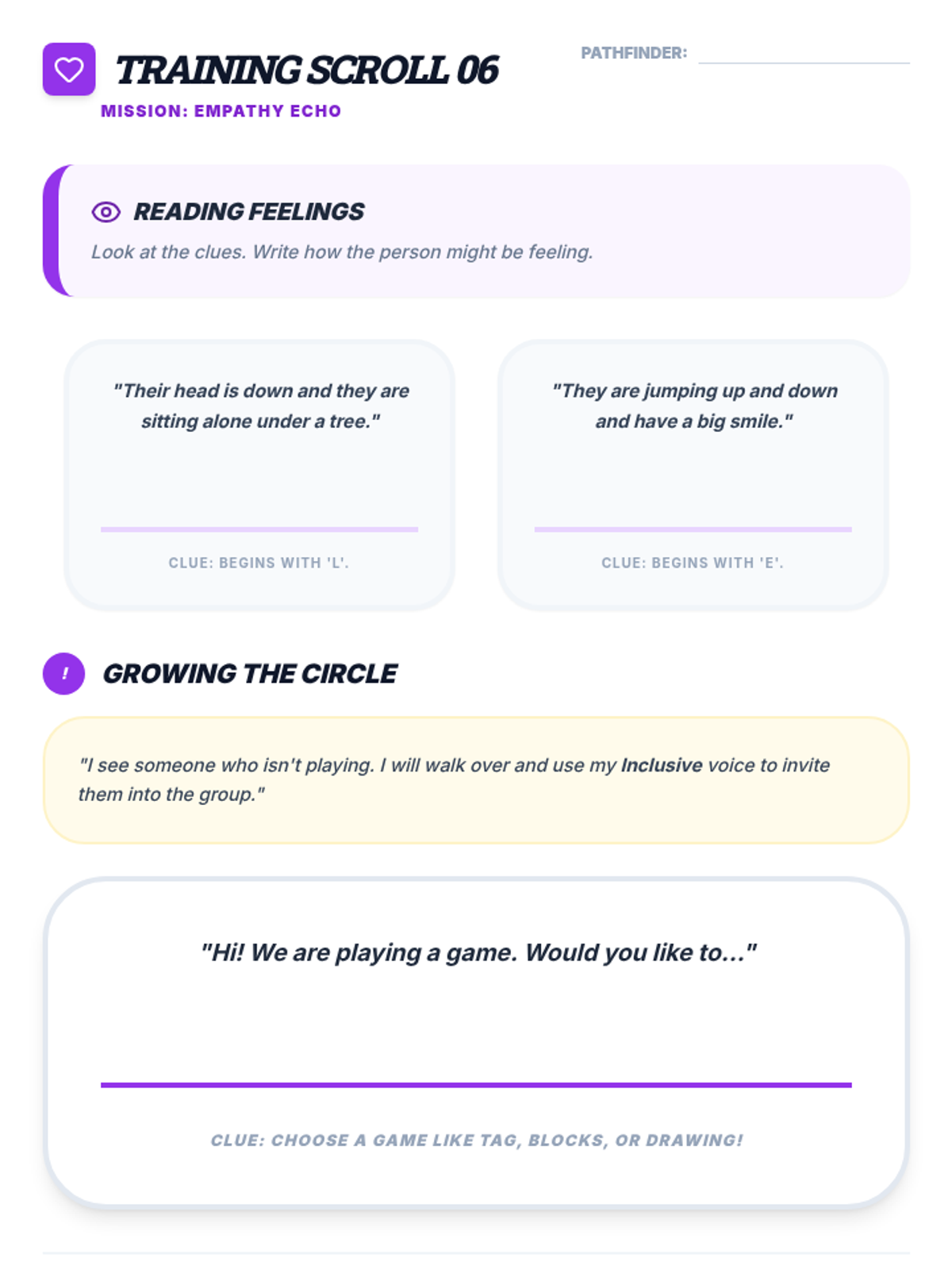
Learner workbook for Mission 06: Empathy Echo. Features emotion detection based on body language clues and new "Yes/No" inclusion decision scenarios. Revised to remove pre-filled answers and fill the full page.
Learner workbook for Mission 02: Self-Control Canyon. Revised to include uniform styling for choices, increased writing space for creative reflection, and the requested parent/stranger scenarios. No "ninja" references.
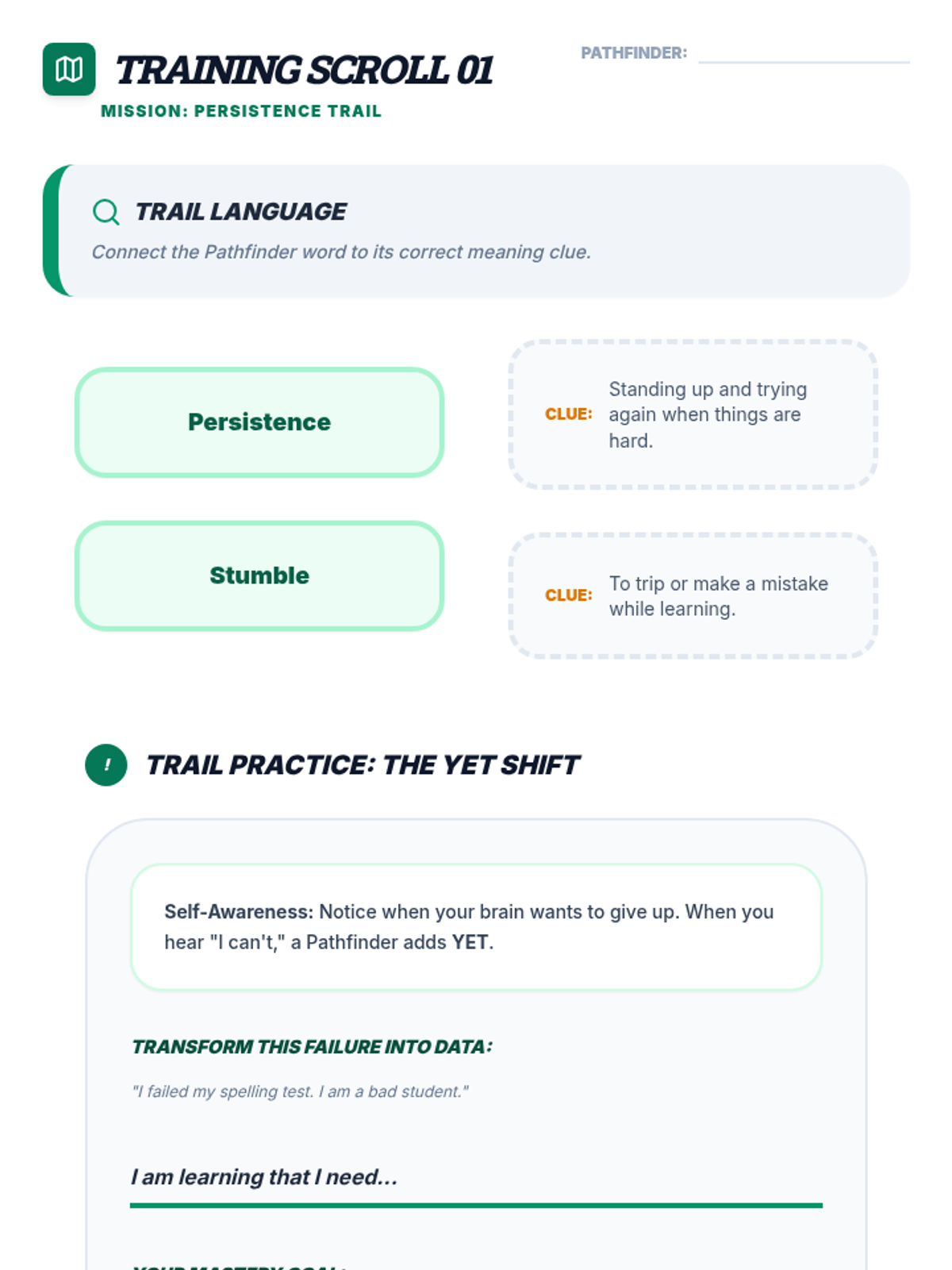
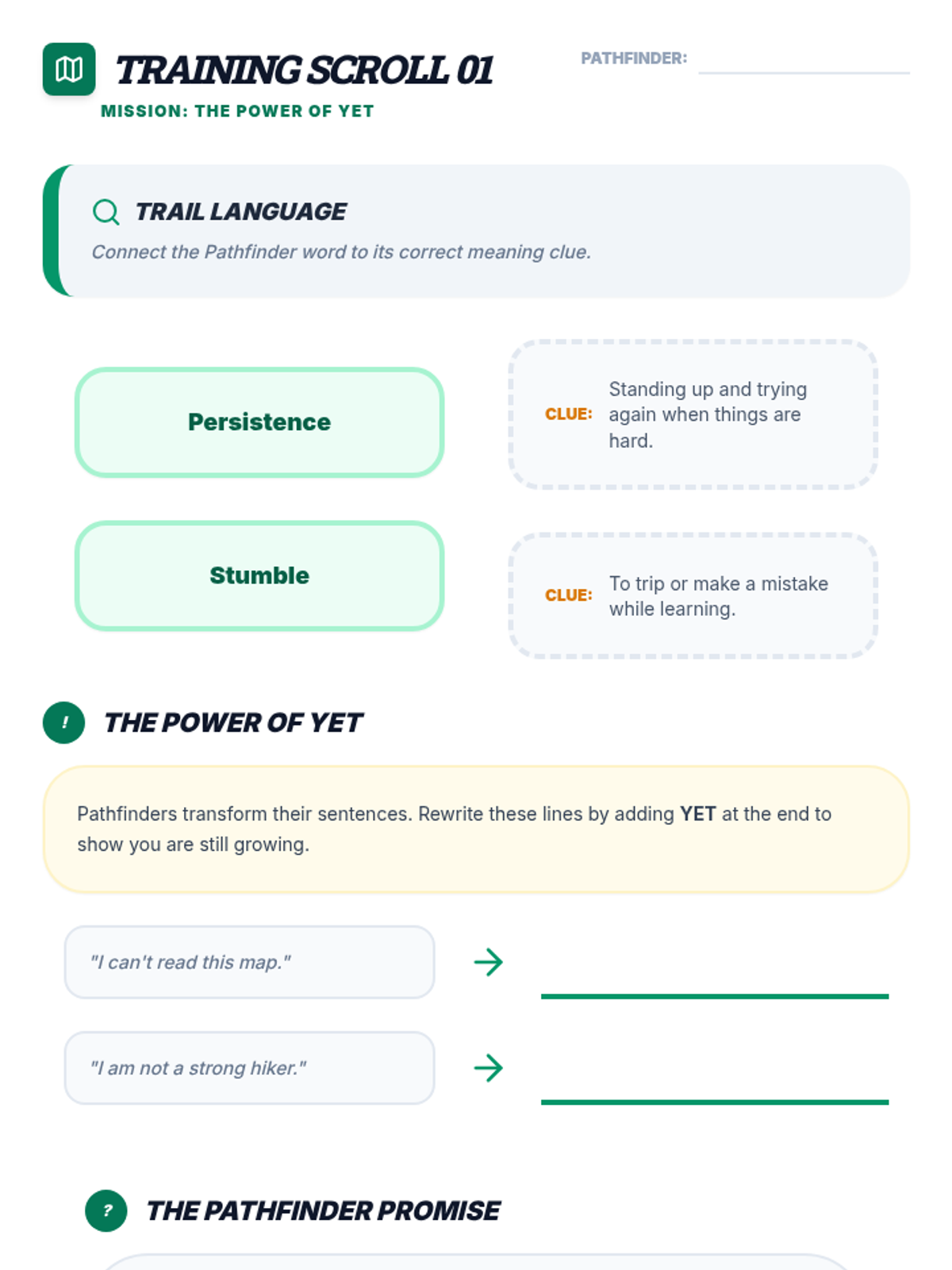
Learner workbook for Mission 01: Persistence Trail. Features corrected vocabulary matching, increased font sizes for clues, and expanded writing areas for student goals. Revised to include exam stress scenarios and data-based reframing. No reference to "ninja" term.
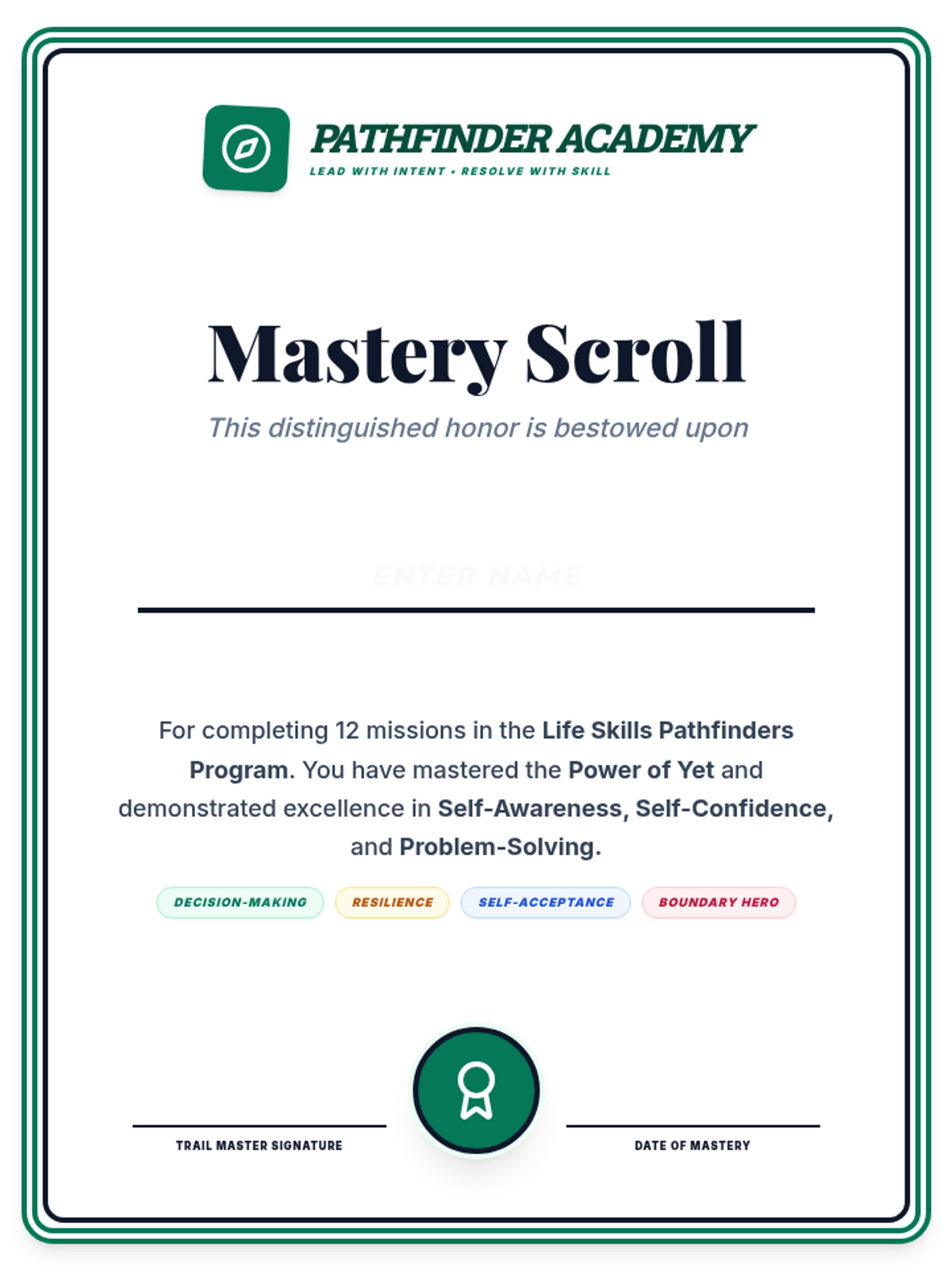
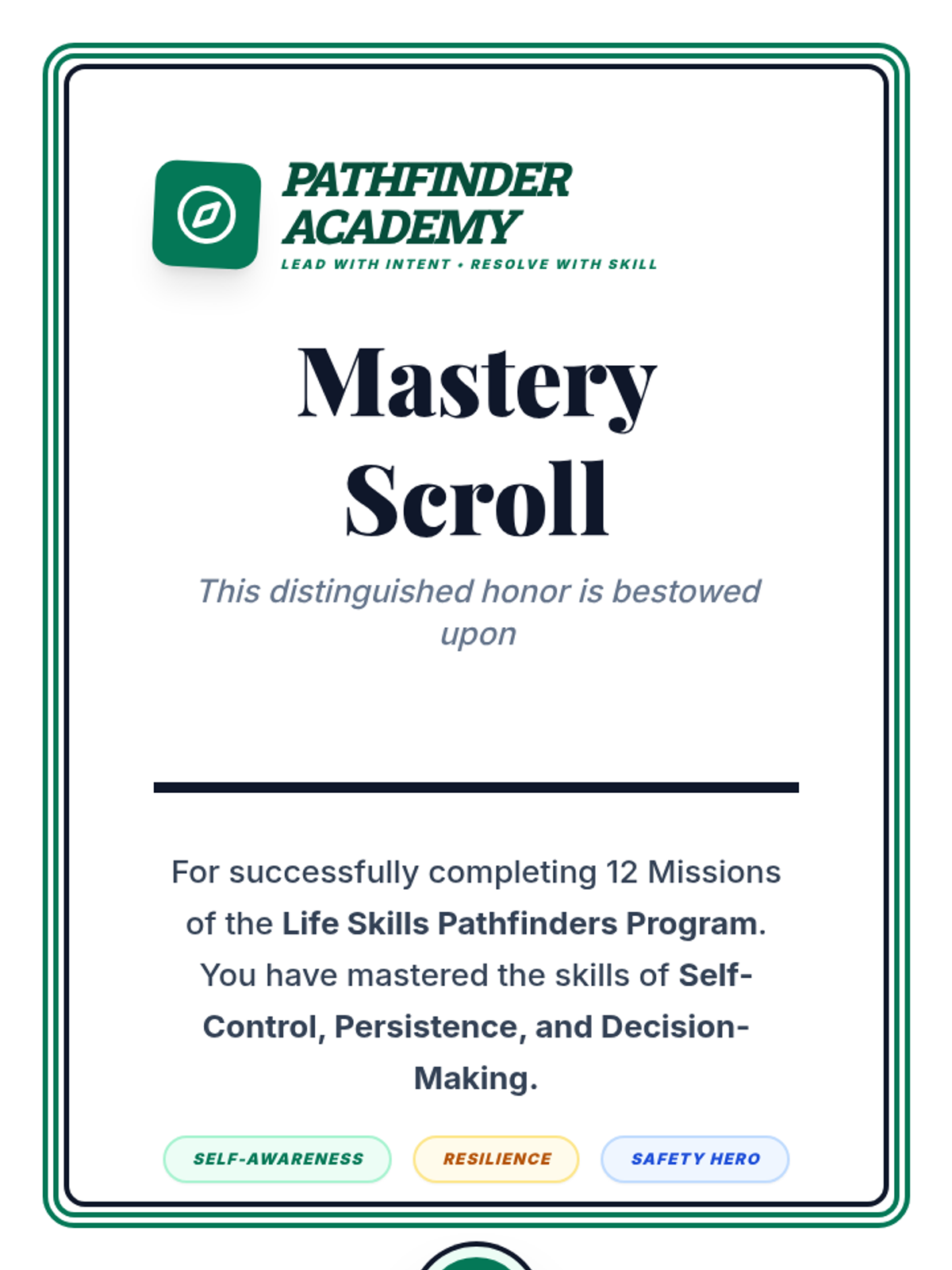
A student-friendly completion certificate for the Pathfinders Program. Revised for clear handwriting space, darker signature lines, and centered content. Fits on a single page and includes keywords like Power of Yet, Self-Awareness, and Problem-Solving.
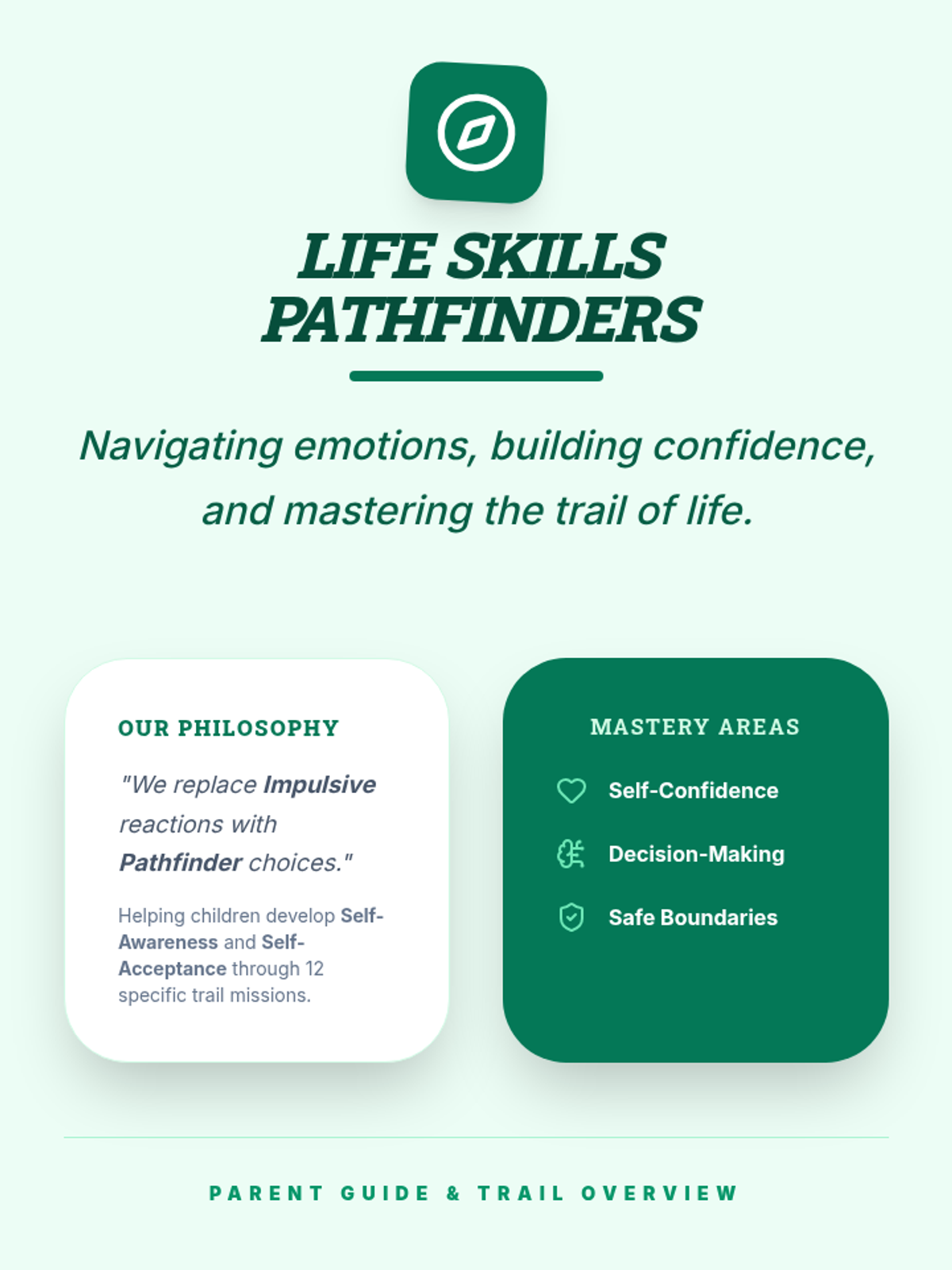
A complete 2-page parent brochure for the Life Skills Pathfinders Program. Lists all 12 missions, program philosophy, and a detailed "Boundary Cheat Sheet" with scenarios for saying no/yes to various figures. Revised for content completeness and specific scenario details.
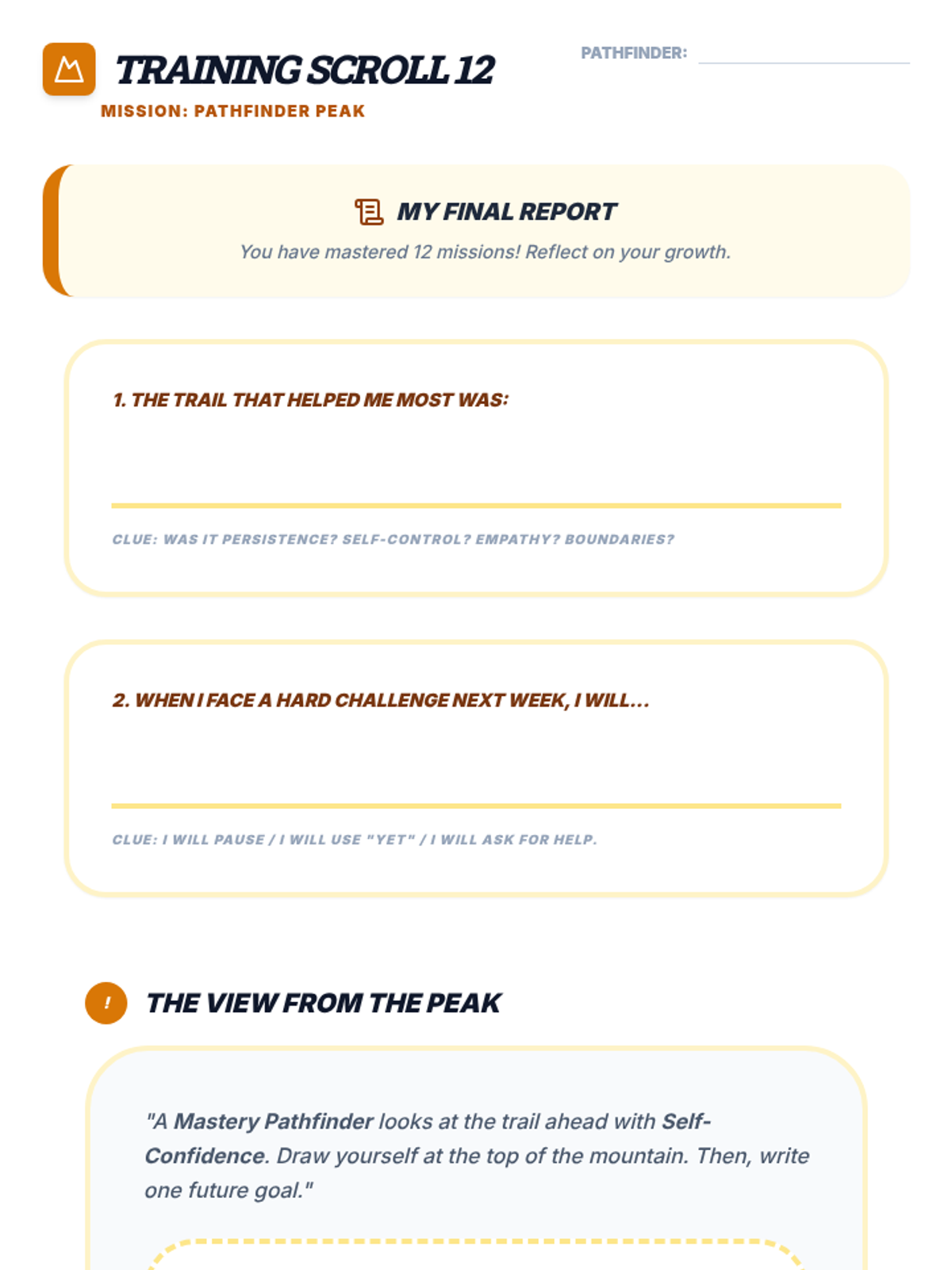
Learner workbook for Mission 12: Pathfinder Peak. Features reflective growth prompts, a visualization drawing area, and a future-goal writing task. Revised for content completeness, handwriting space, and layout stability. No "ninja" references.
Learner workbook for Mission 06: Empathy Echo. Features an emotion detection activity based on body language clues, a fill-in-the-blank inclusion prompt, and vocabulary matching. Revised to remove pre-filled answers and placeholder text.
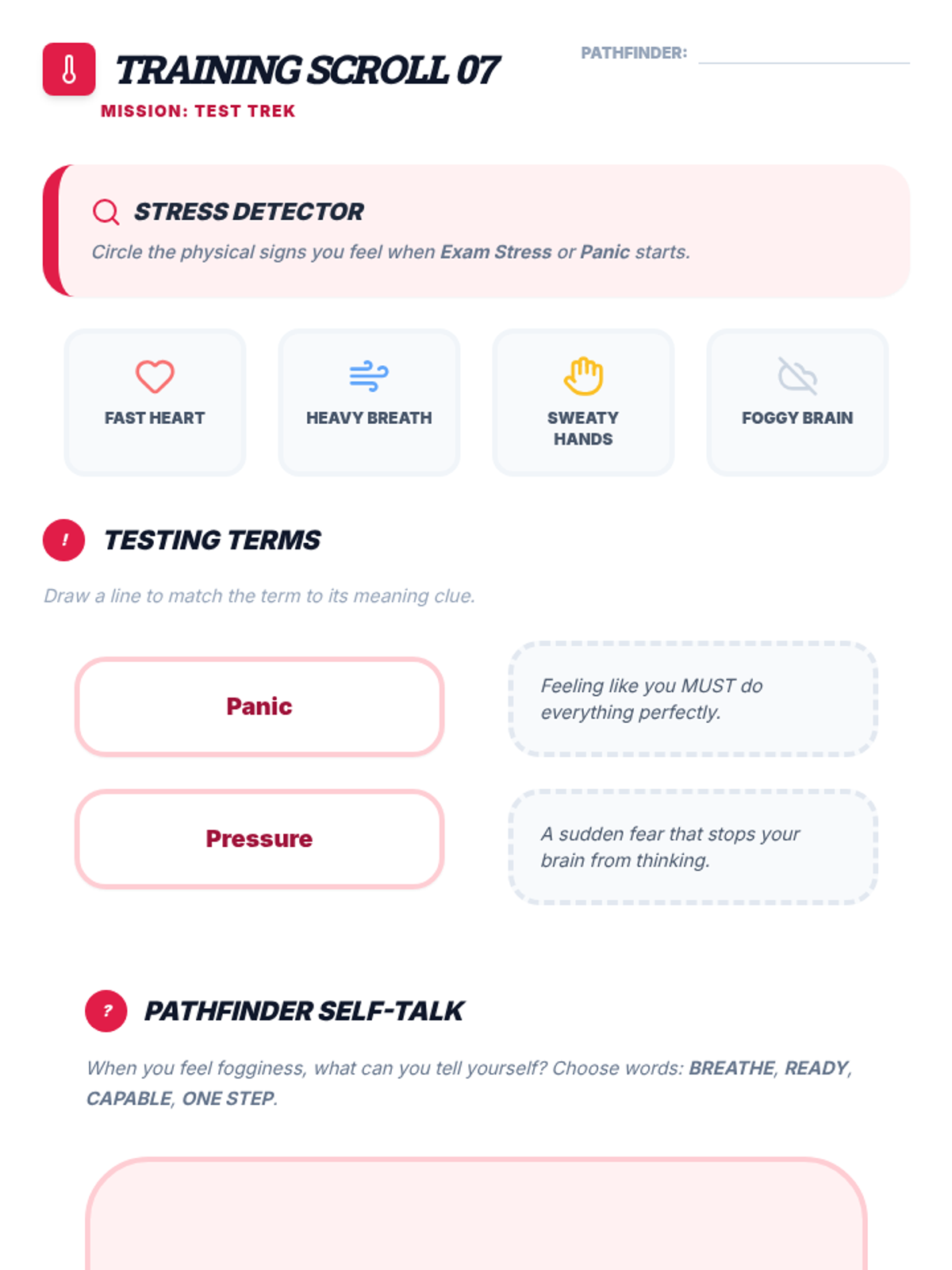
Learner workbook for Mission 07: Test Trek. Revised for better text alignment, matching activity for vocabulary, and removed "ninja" references. Includes high-contrast matching and self-talk script.
Facilitator script for Mission 07: Test Trek. Revised for better spacing, a full 60-minute duration, and removed "ninja" references. Includes core concepts of Self-Awareness and Exam Stress.
Learner workbook for Mission 02: Self-Control Canyon. Revised to include uniform styling for choices, increased writing space for creative reflection, and a sequencing task for the "Pathfinder Pause." No references to "ninja."
Facilitator script for Mission 02: Self-Control Canyon. Revised to remove "ninja" references, include full 60-minute duration, and add the requested social scenarios for parents and strangers.
Learner workbook for Mission 01: Persistence Trail. Features corrected vocabulary matching, increased font sizes for clues, and expanded writing areas for student goals. No reference to "ninja" term. Revised for single-page logic and student space.
A student-friendly completion certificate for the Pathfinders Program. Revised for clear handwriting space, darker signature lines, and centered content. No placeholder text in name field.
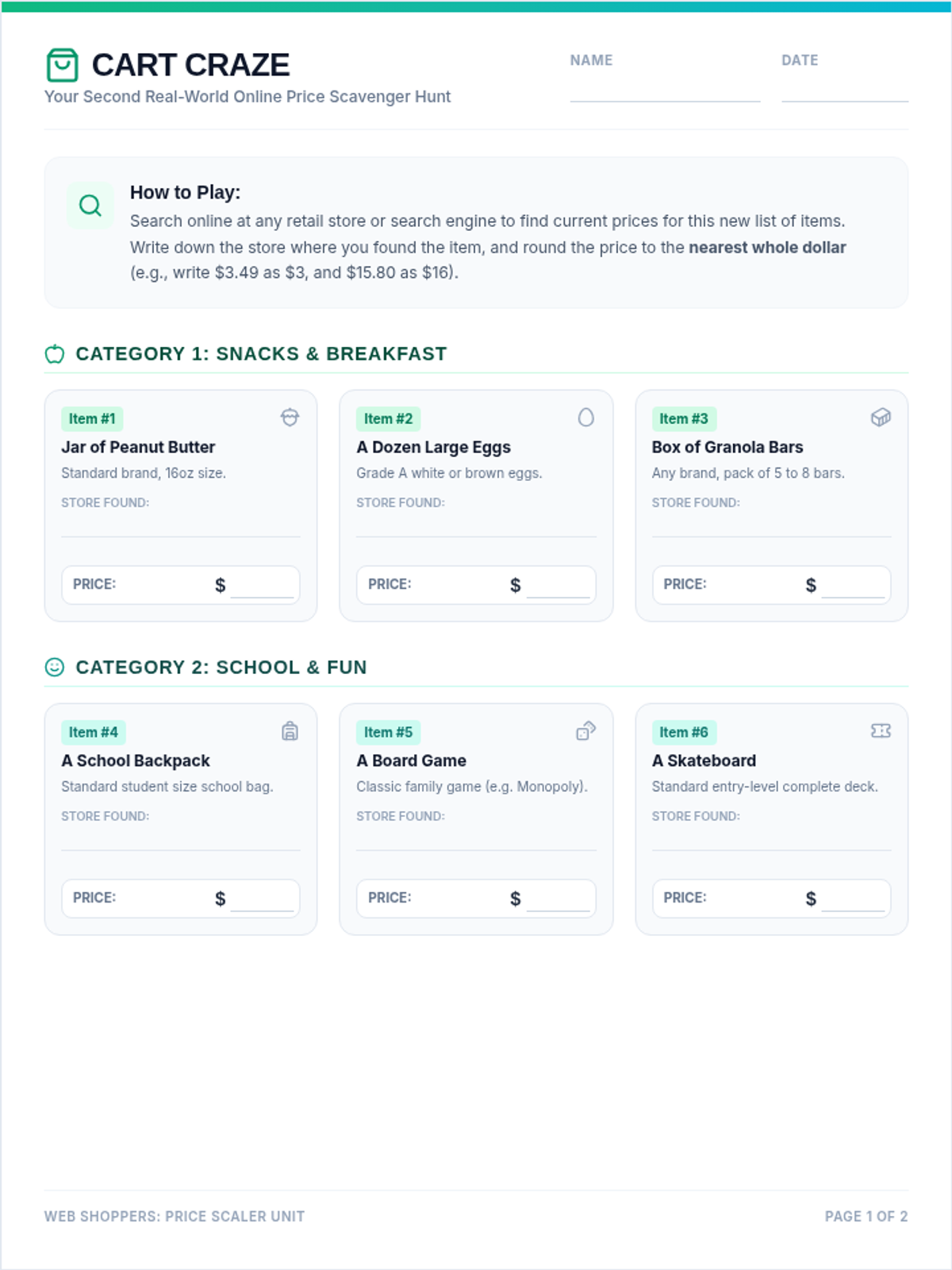
A 2-page print-ready companion worksheet featuring a new online retail scavenger hunt. Students search online for prices of snacks, school gear, and tech, then total their cart on a visual checkout receipt and answer budgeting reflections.
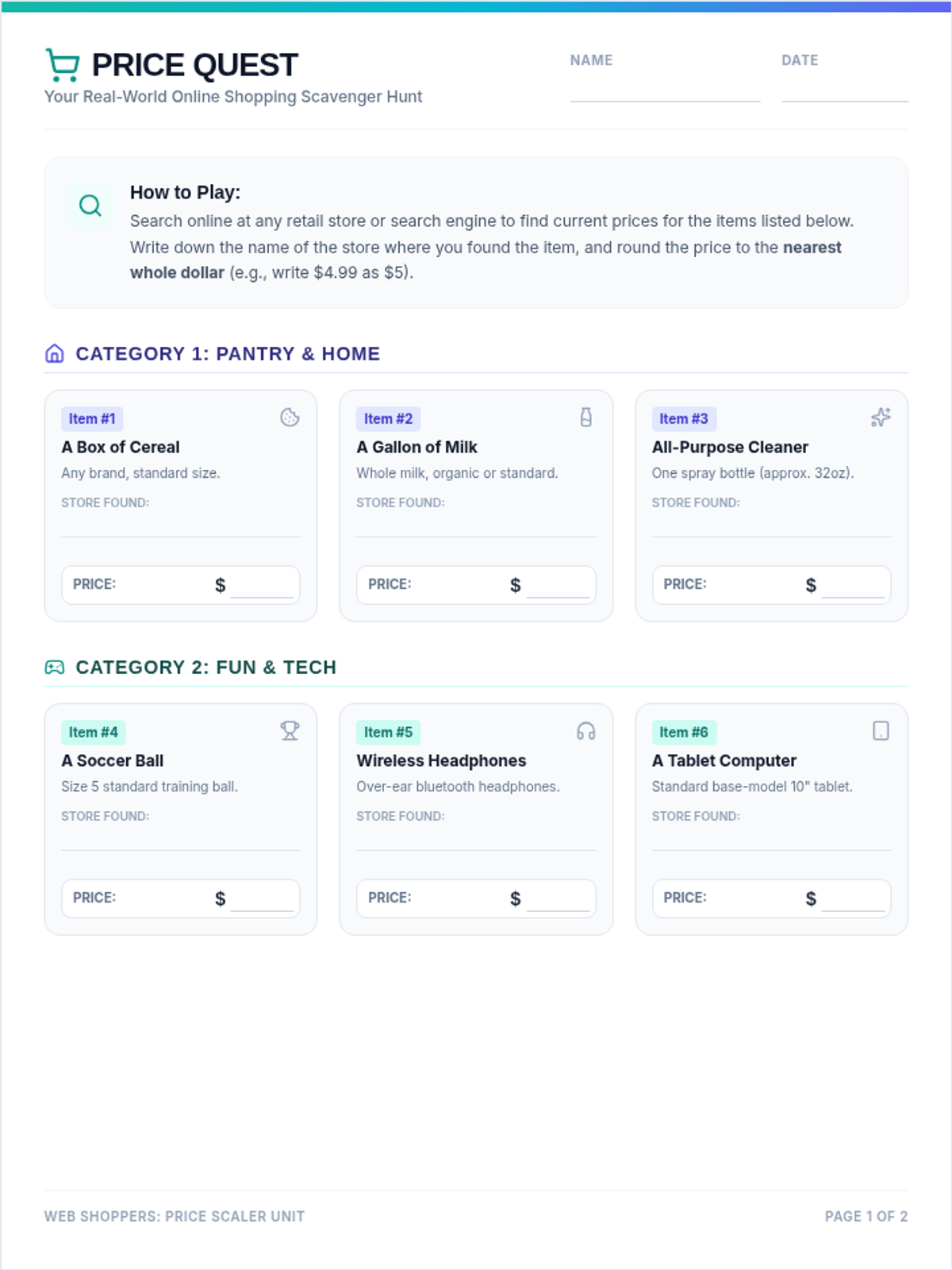
A 2-page print-ready student worksheet featuring a digital retail scavenger hunt. Students search online to find prices for common household, tech, and big-ticket items, then practice basic budget totaling on a creative visual checkout receipt.
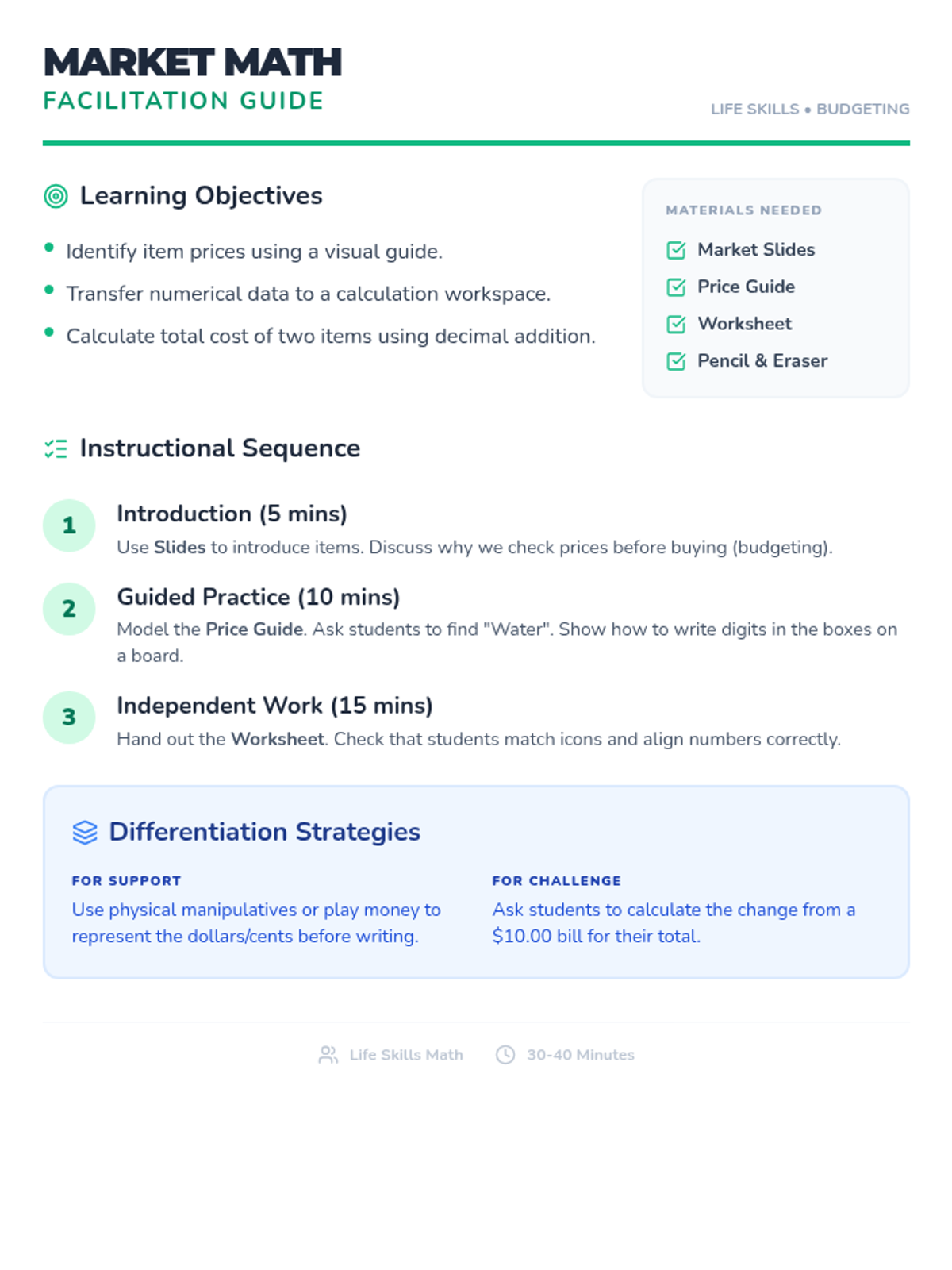
A facilitation guide for teachers to deliver the Market Math lesson, including objectives, material checklists, step-by-step instructions, and differentiation strategies.
A visual presentation for introducing the Market Math activity, featuring grocery item prices, shopping steps, and a demonstration of the color-coded addition process.
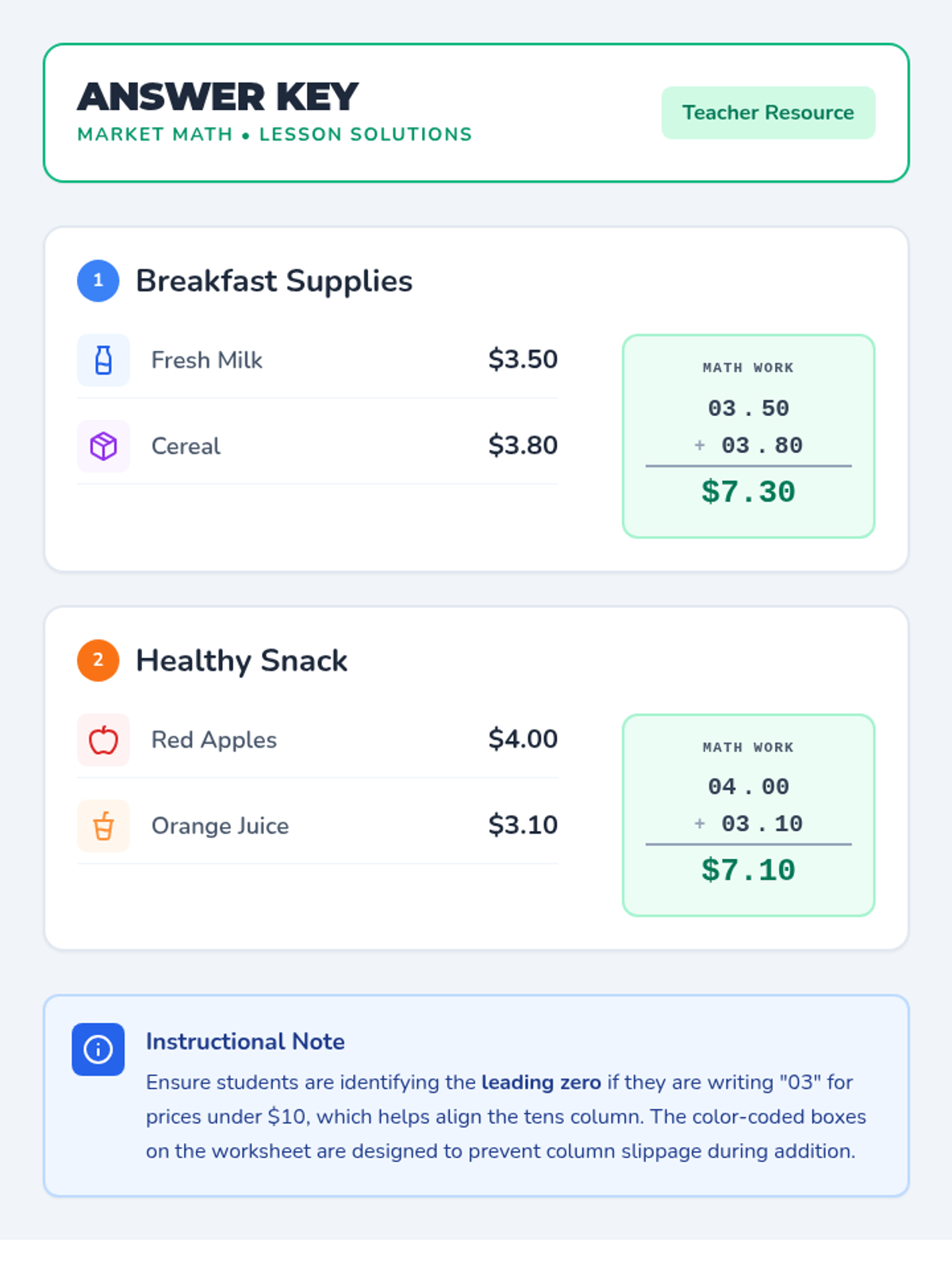
A teacher's answer key for the Market Math worksheet, including item prices, total calculations, and instructional notes.
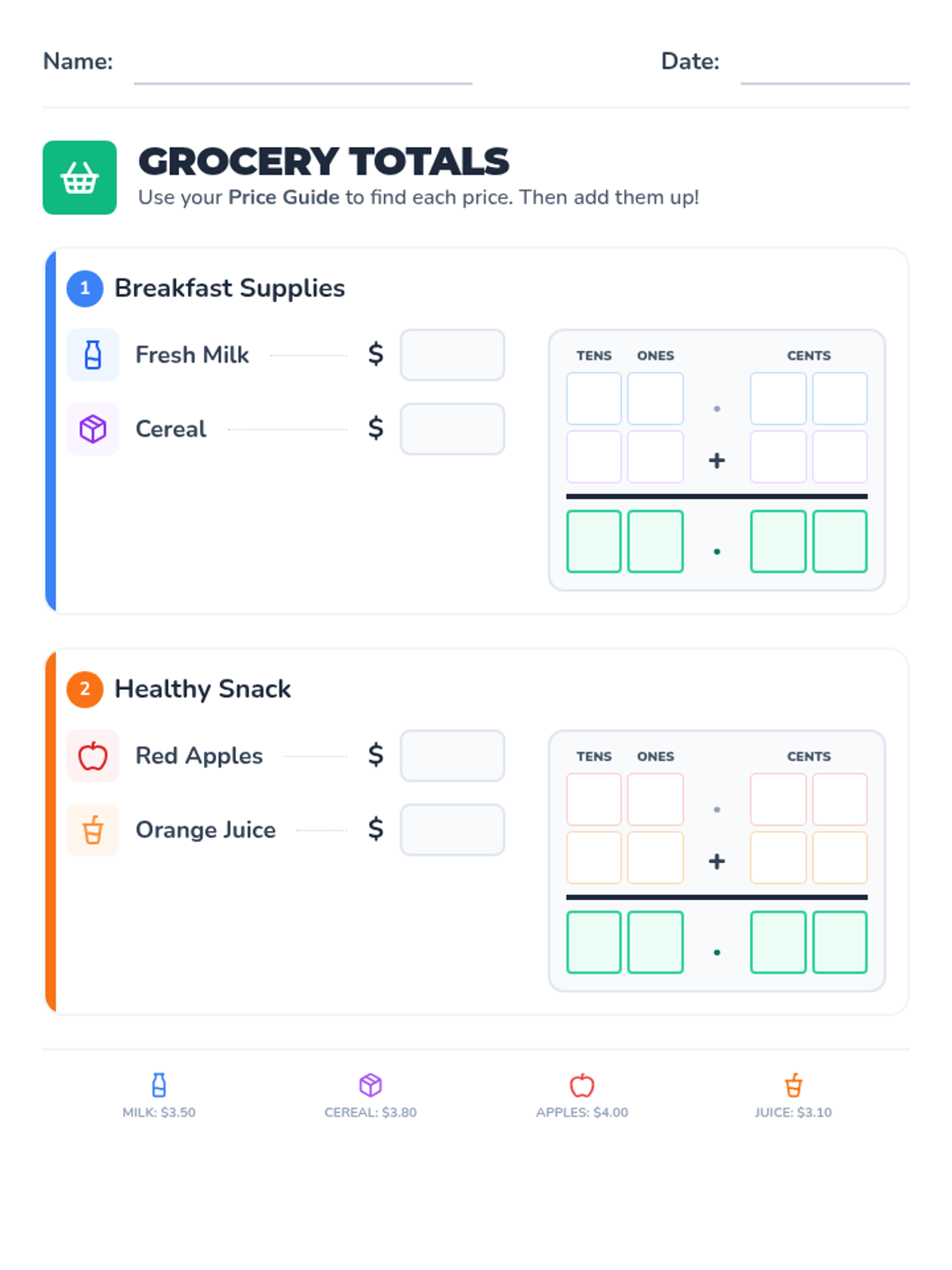
A budget worksheet for totaling two items using color-coded addition columns and icon-based grocery lists. Students find prices from the guide and calculate the sum.
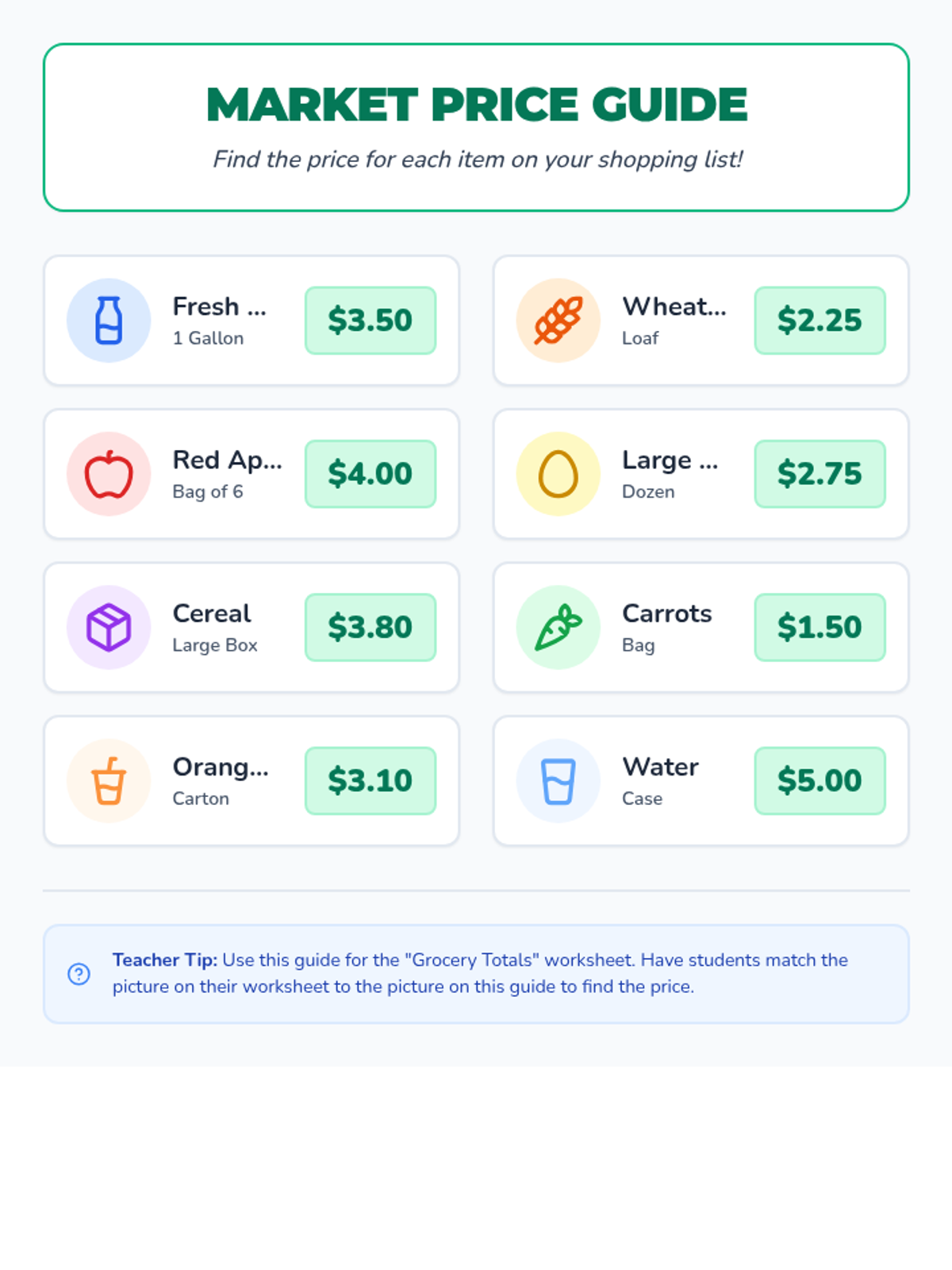
A visual price guide featuring grocery items with large icons, clear labels, and prominent prices for students to use as a reference during budgeting activities.
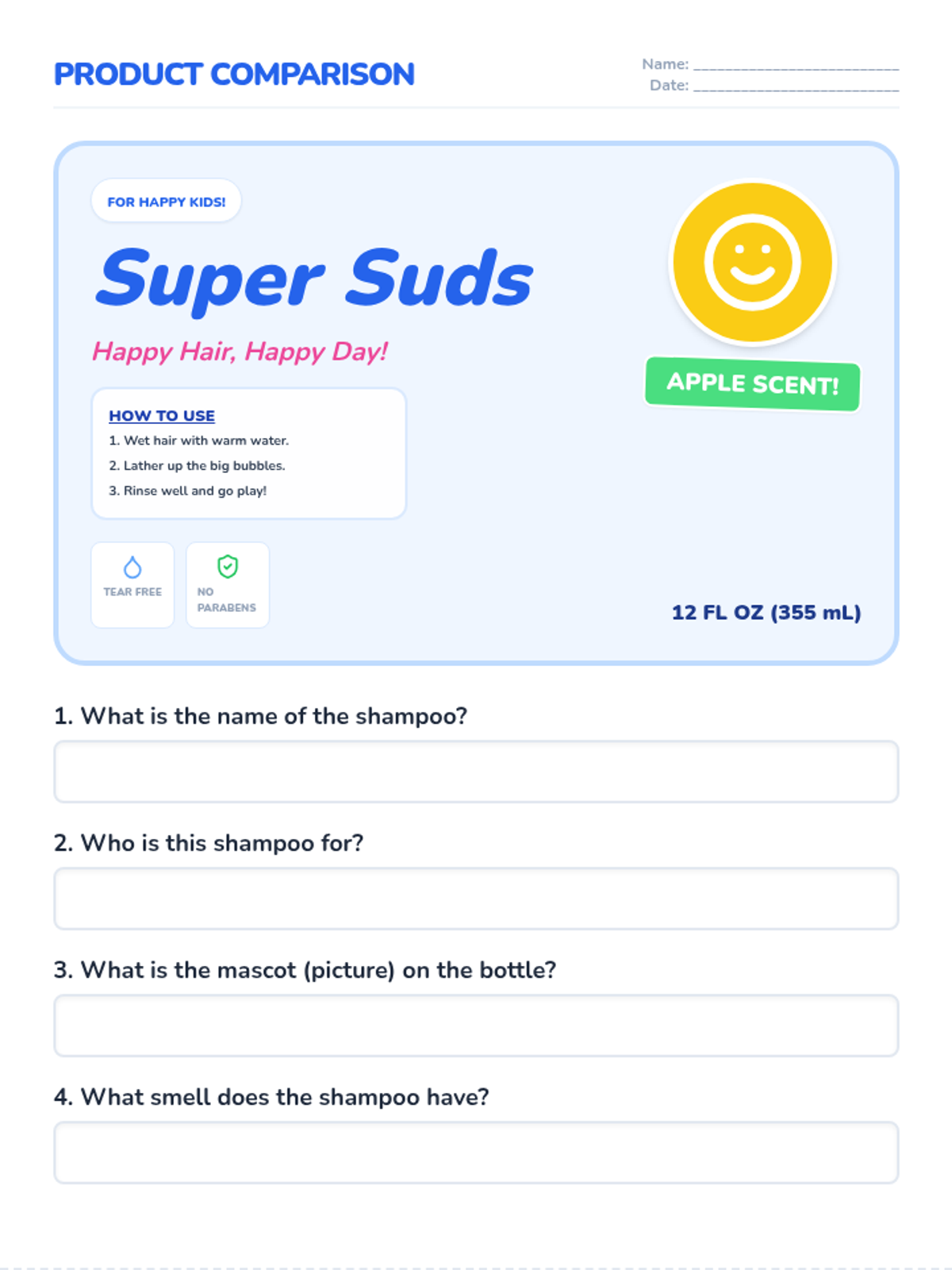
A compare and contrast reading comprehension worksheet featuring two different shampoo brands. Includes improved spacing, larger handwriting areas, and clearly separated customer scenarios for easier student use.
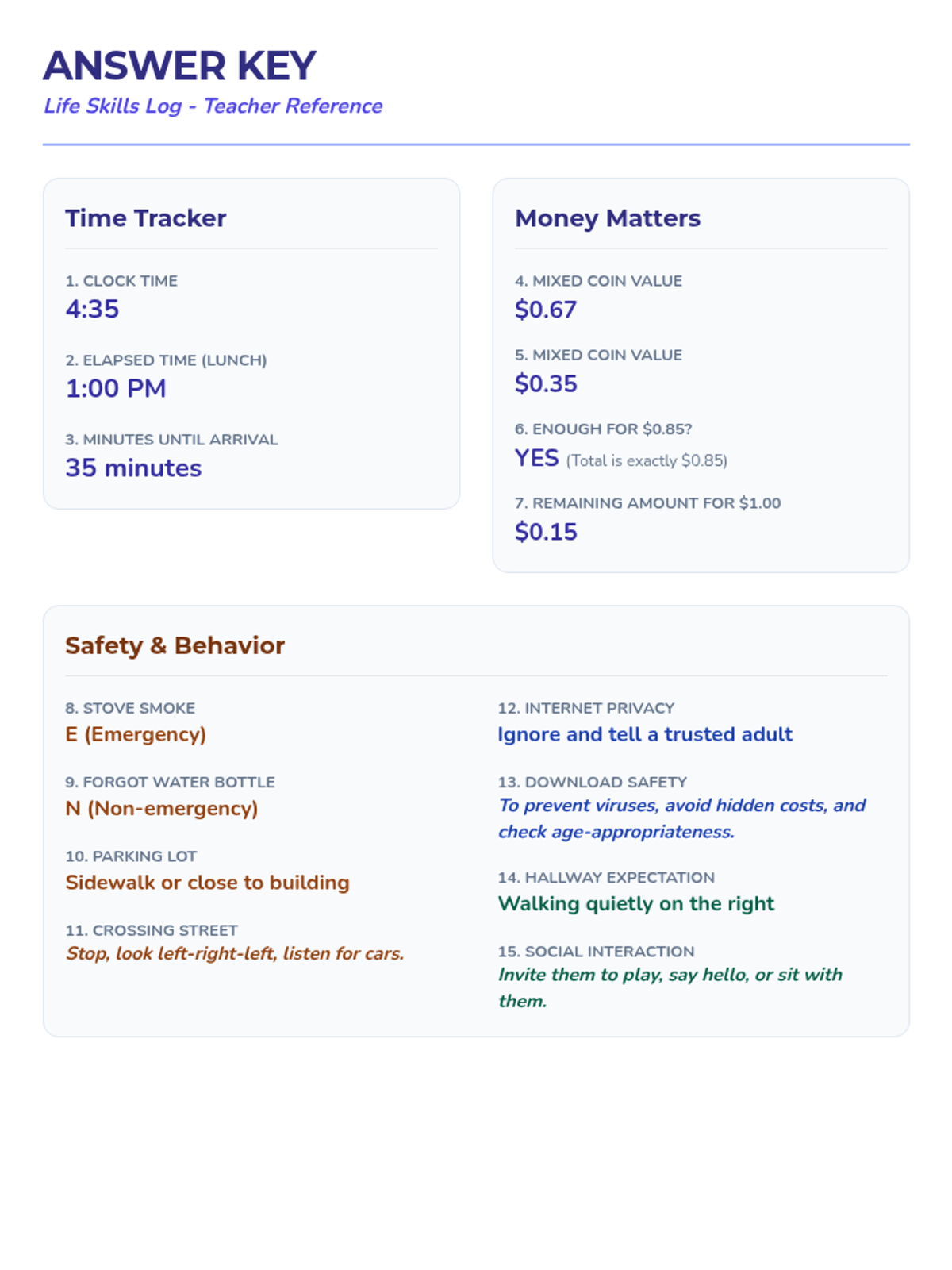
An answer key for the Life Skills Log Worksheet, providing clear solutions and logic for time, money, and behavioral scenarios. Optimized for single-page printing.
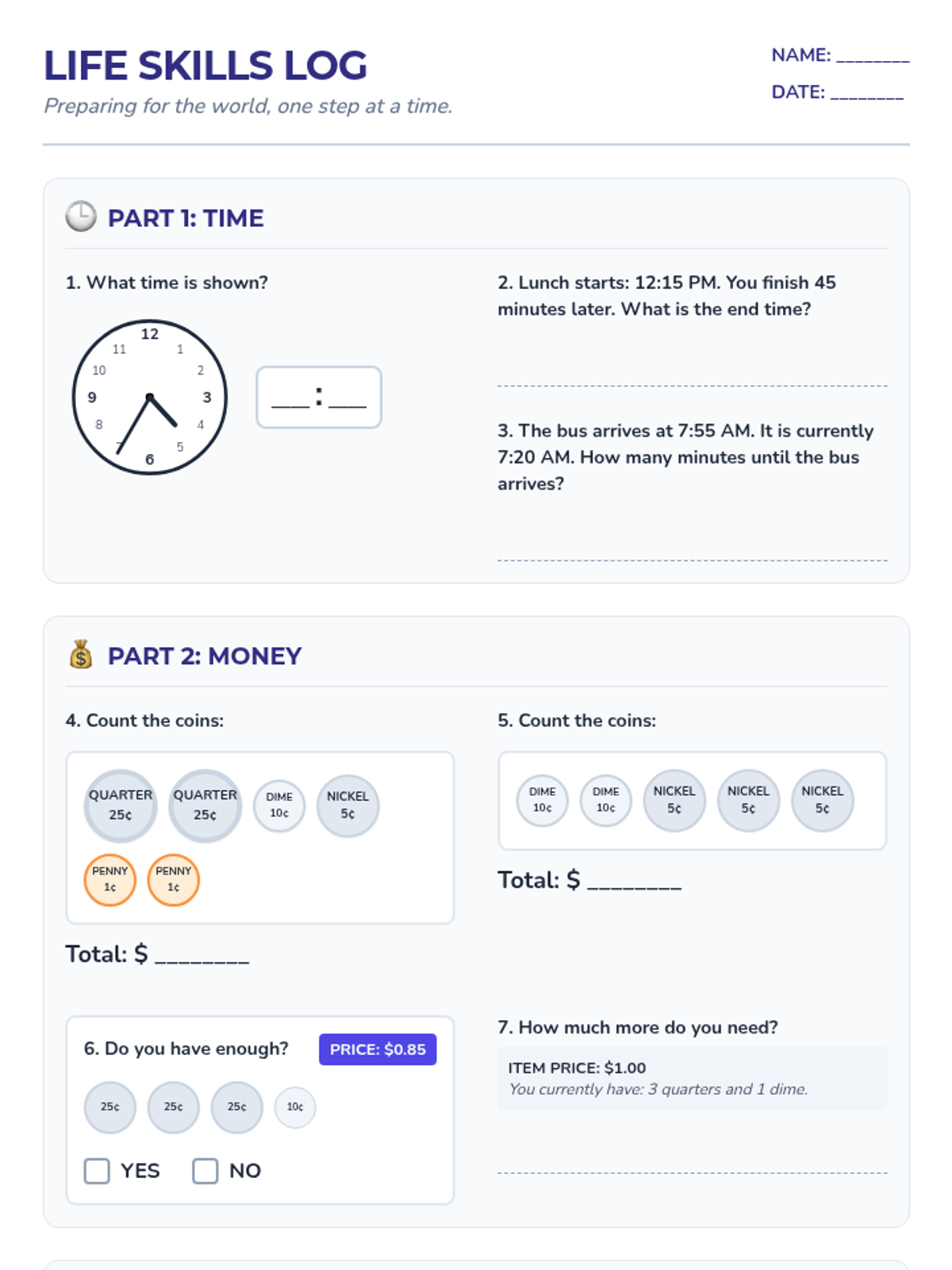
A morning work document for students to practice counting mixed coins with realistic coin representations, telling time to the nearest 5 minutes on a labeled clock, and identifying safe behaviors. Features expanded work areas for handwriting and clear sequential numbering.
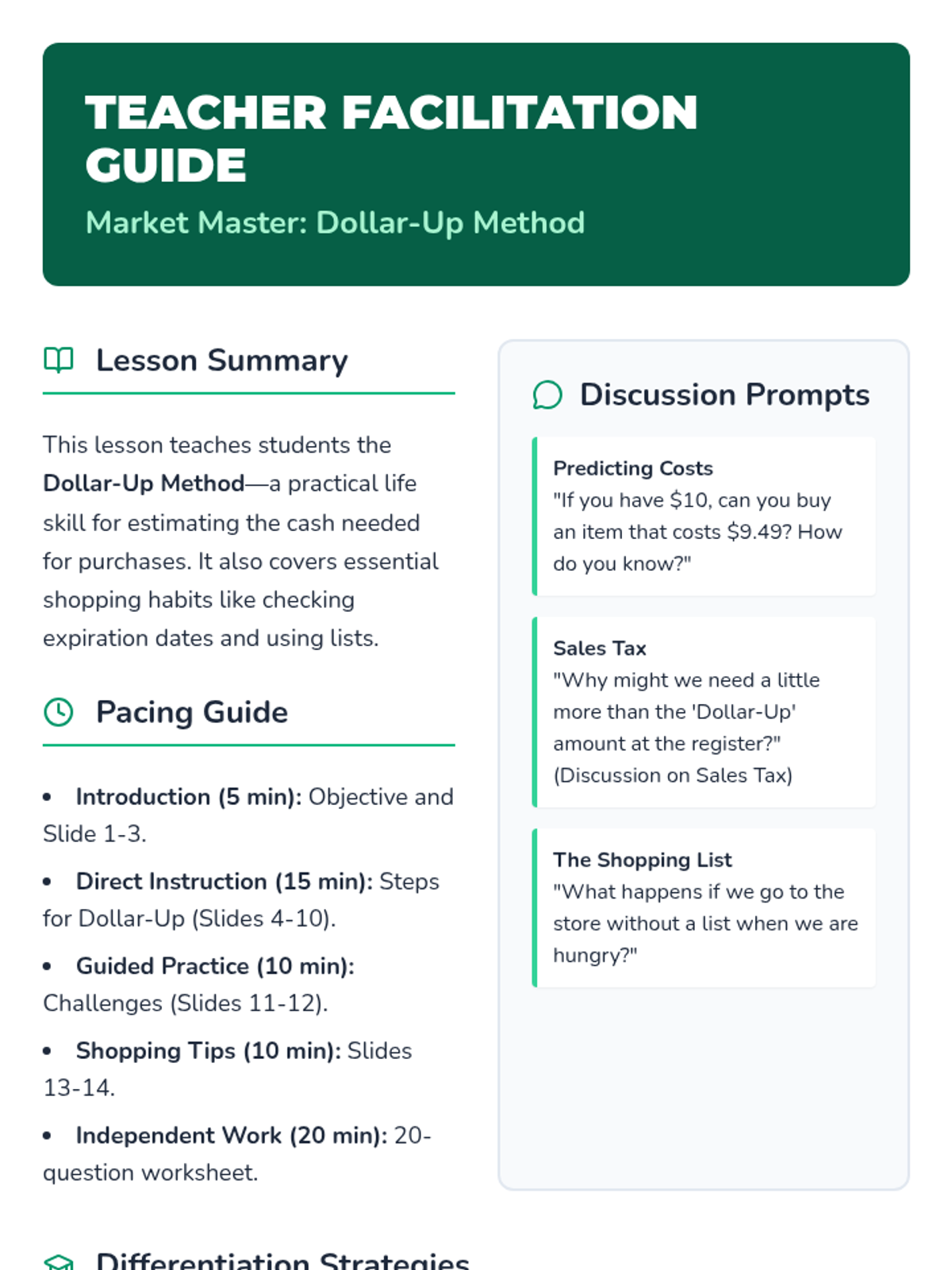
A teacher facilitation guide for the Market Master lesson, including pacing, discussion prompts, differentiation, and common misconceptions.
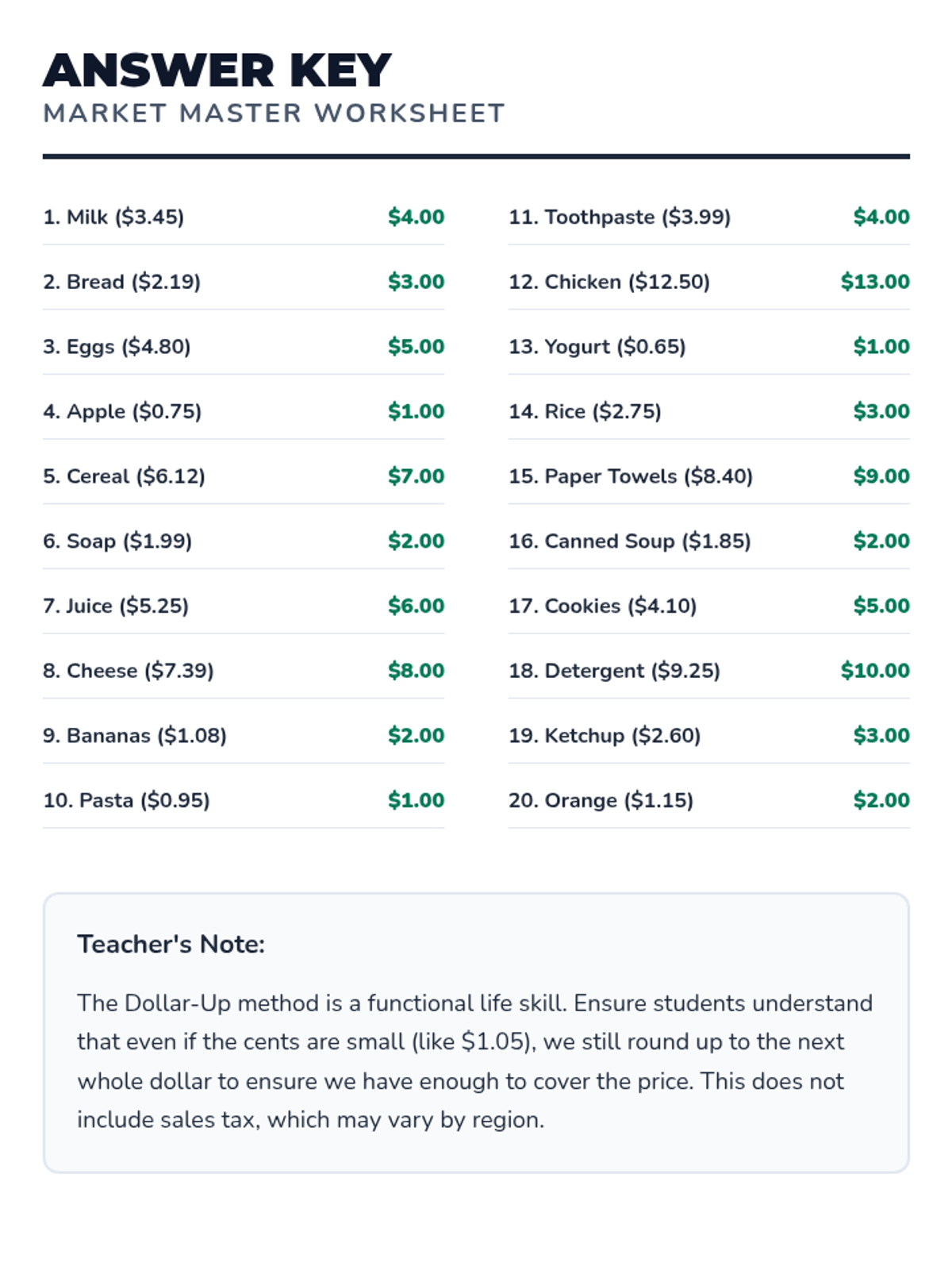
The answer key for the Market Master Worksheet, providing the correct dollar-up rounded values for all 20 questions.
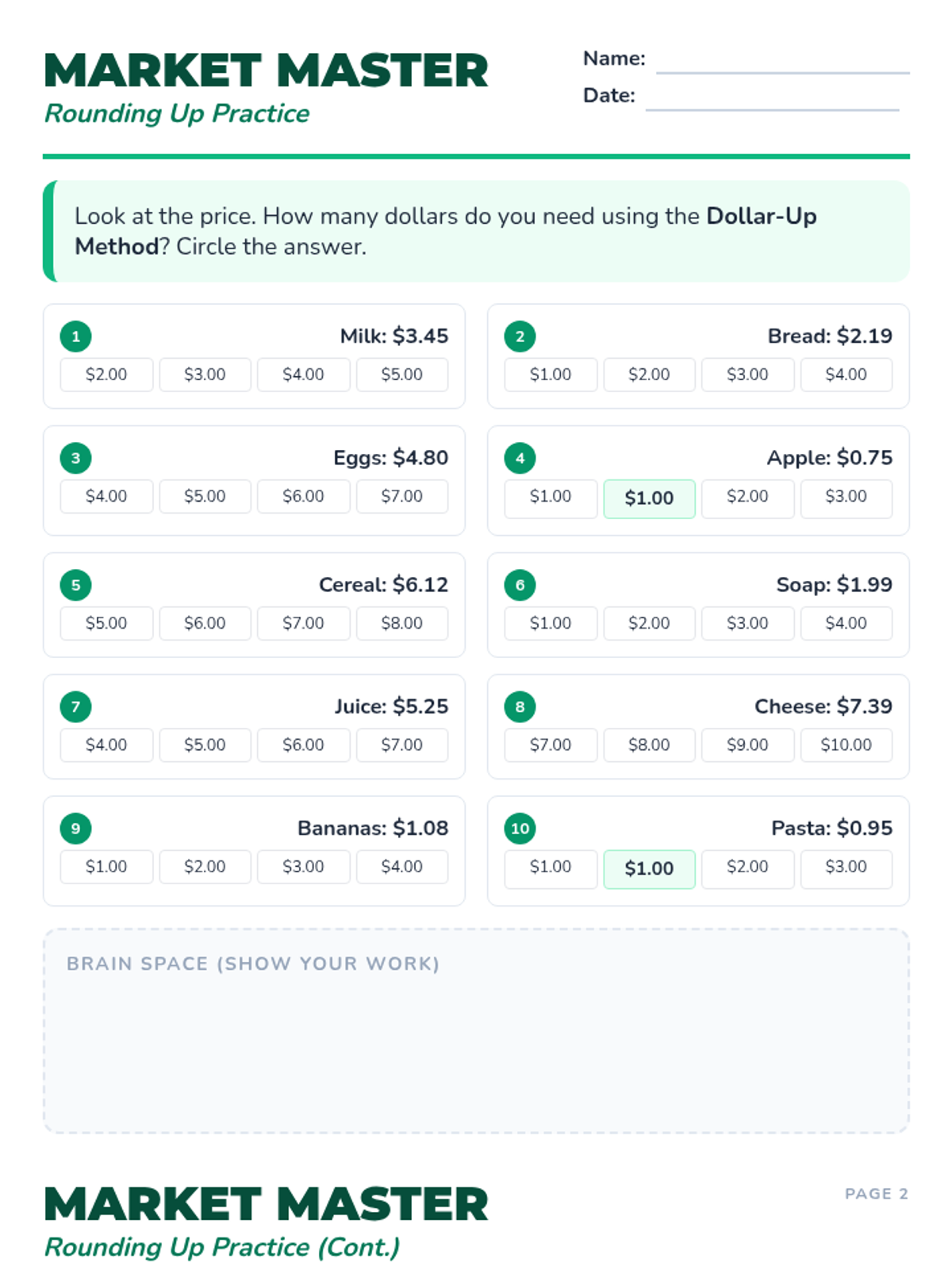
A 20-question multiple choice worksheet for practicing the dollar-up rounding method with grocery items, now optimized for 2-page printing with student work space and a clean grid layout.
A 15-slide presentation teaching the dollar-up rounding method for grocery shopping and essential shopping tips, now featuring answer reveal slides for practice challenges.
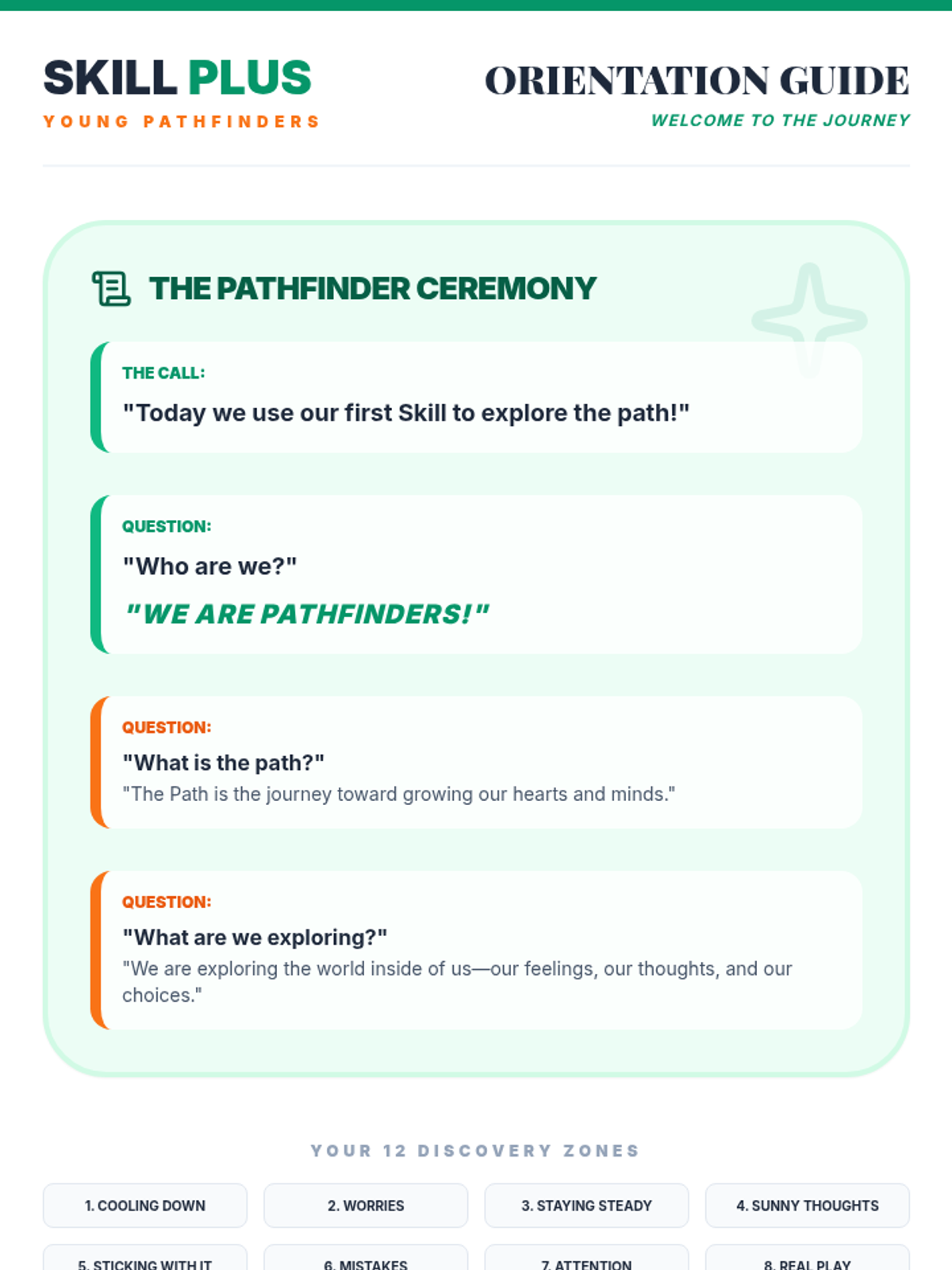
An introductory guide and discovery sheet for the Young Pathfinders program. Explains the core metaphors of 'The Path' and 'Exploring' with a structured Opening Ceremony script. Rebranded with Skill Plus text-only branding. Revised to fix page breaks, writing space, and contrast.
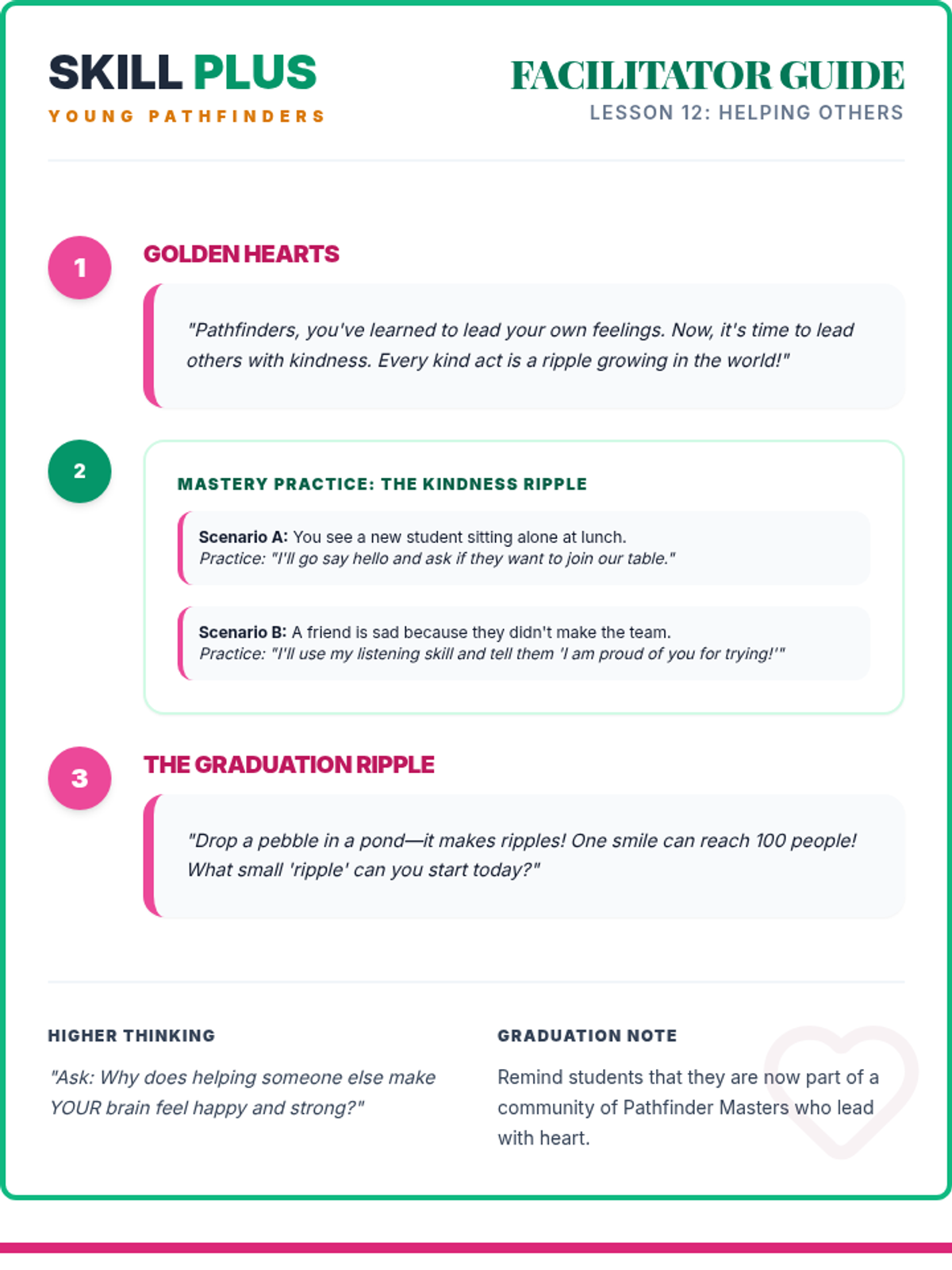
Teacher guide and student playbook for Helping Others. Rebranded for Young Pathfinders. Cultivates empathy and kindness through the 'Ripple Effect' and celebrates graduation as a 'Pathfinder Master'. Revised for page-fit, contrast, and added role-play scenarios.
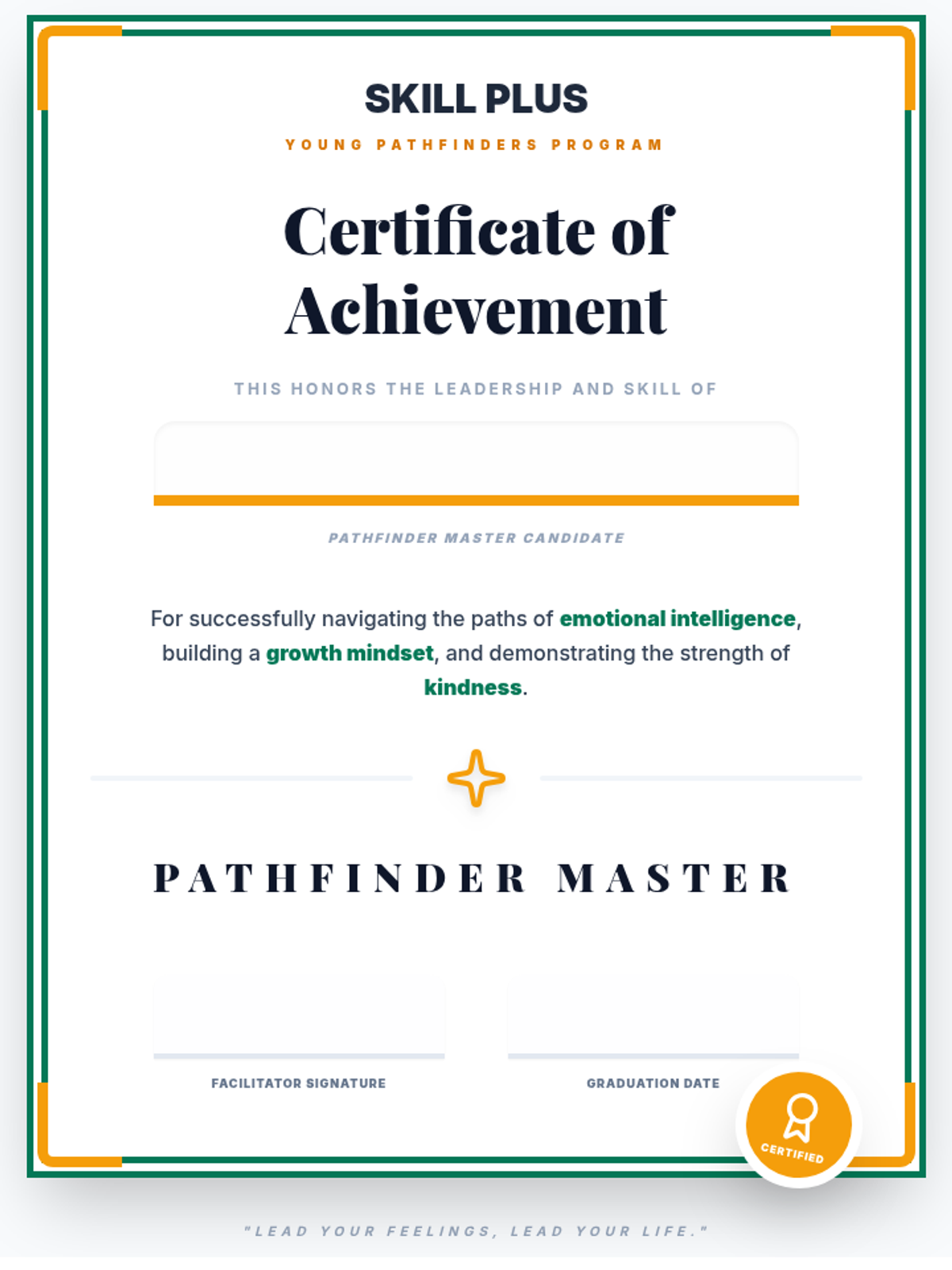
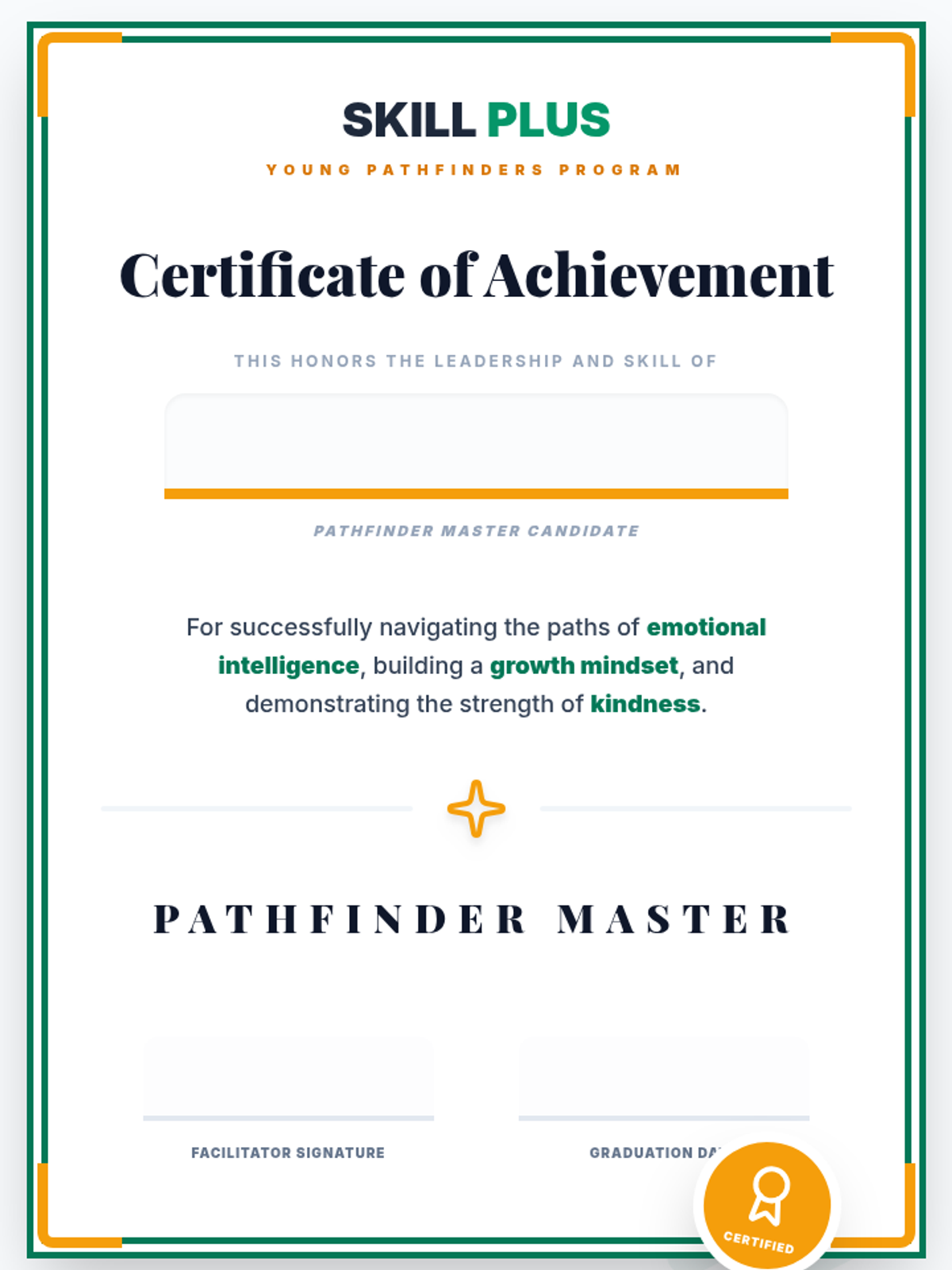
A formal graduation certificate for the Young Pathfinders program. Recognizes the achievement of 'Pathfinder Master' status with text-only 'Skill Plus' branding. Revised to fit 100% on a single page, fix signature spacing, and student name clearance. Removed distracting background text from handwriting area.
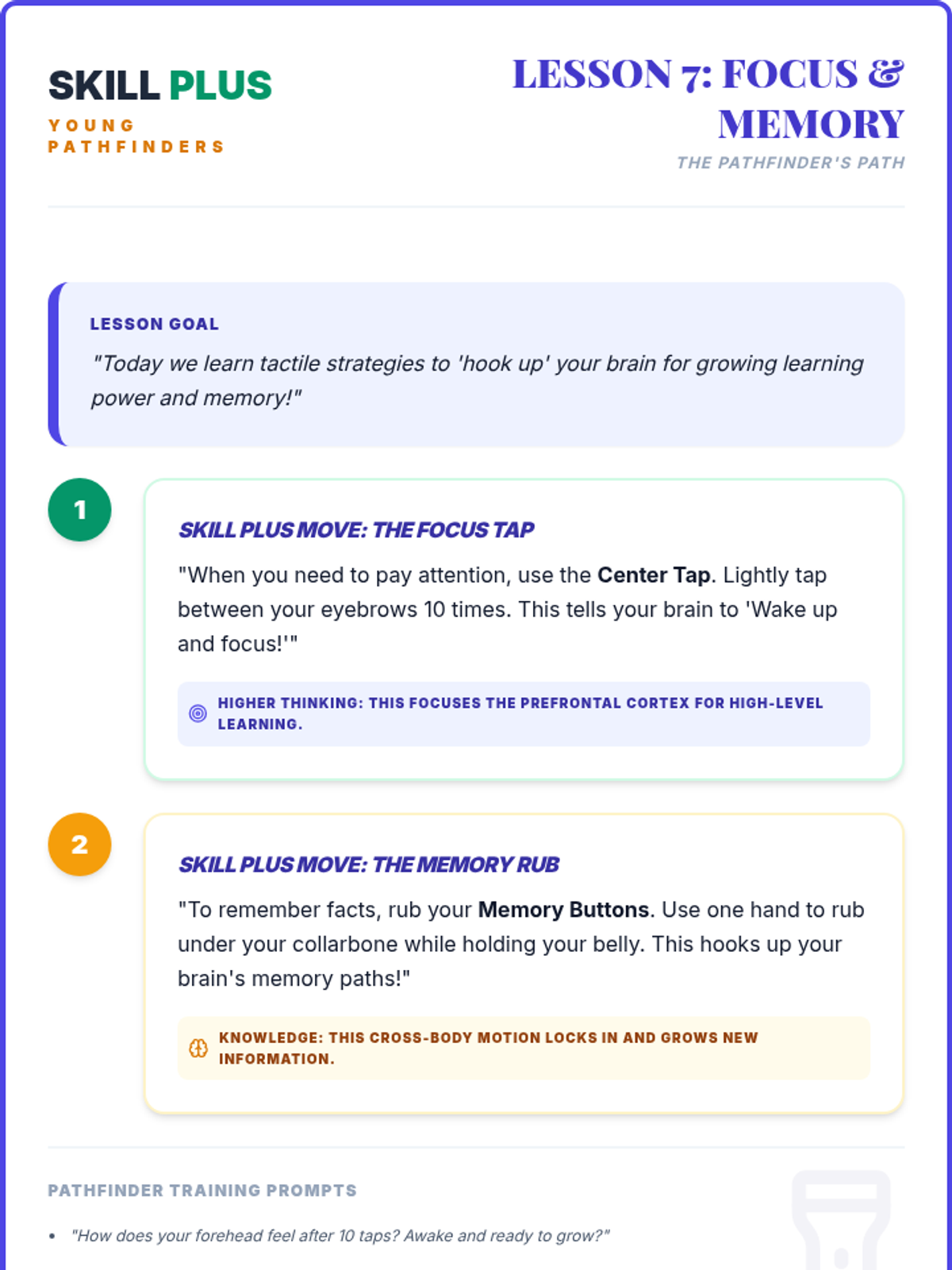
Facilitator guide and student playbook for Paying Attention. Includes tactile 'Focus Tap' and 'Memory Rub' techniques. Rebranded with 'Skill Plus' text-only logo. Revised for page-break consistency and higher contrast.
A formal graduation certificate for the Young Pathfinders program. Recognizes the achievement of 'Pathfinder Master' status with text-only 'Skill Plus' branding. Revised for page-breaks, signature spacing, and student name clearance.
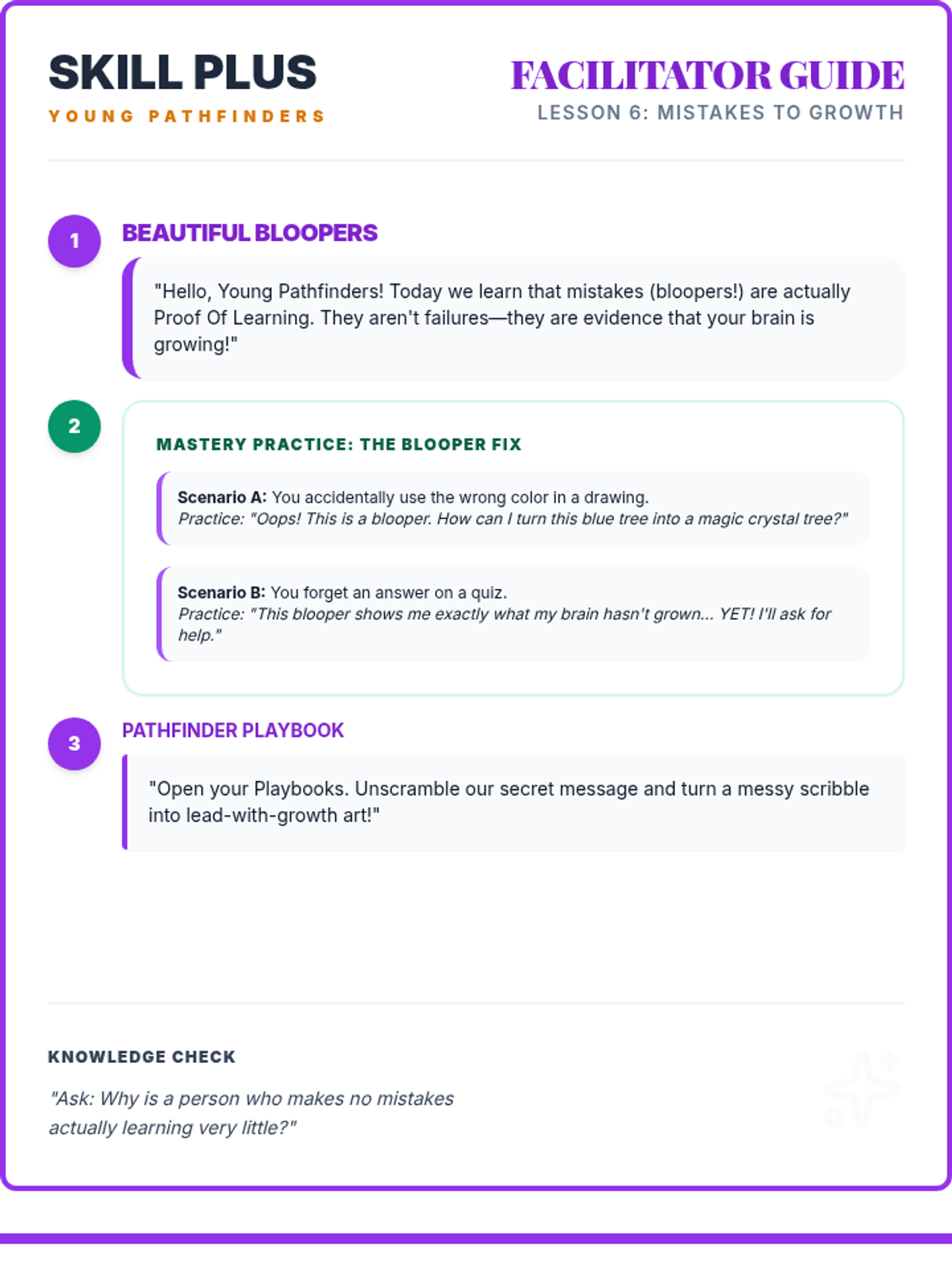
Facilitator guide and student playbook for Learning from Mistakes. Rebranded for Young Pathfinders. Includes 'The Blooper Fix' mastery scenarios and updated text-only 'Skill Plus' branding. Revised for logic fix (PROOF OF LEARNING) and page-fit.
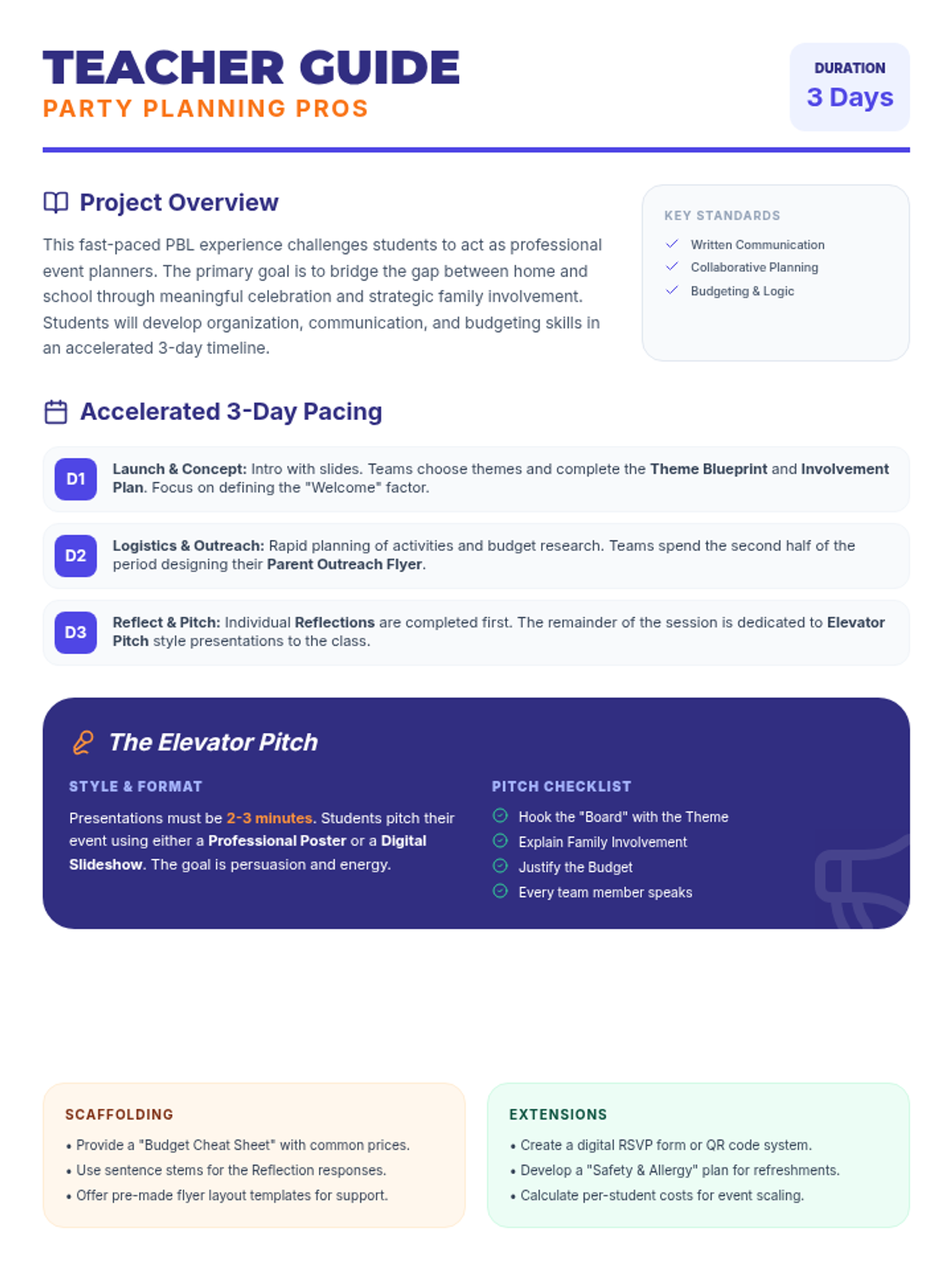
A professional teacher facilitation guide and scoring rubric for the classroom event planning project. Includes a condensed 3-day pacing guide, a dedicated "Elevator Pitch" instruction section, differentiation strategies, and a comprehensive 50-point rubric for assessment.
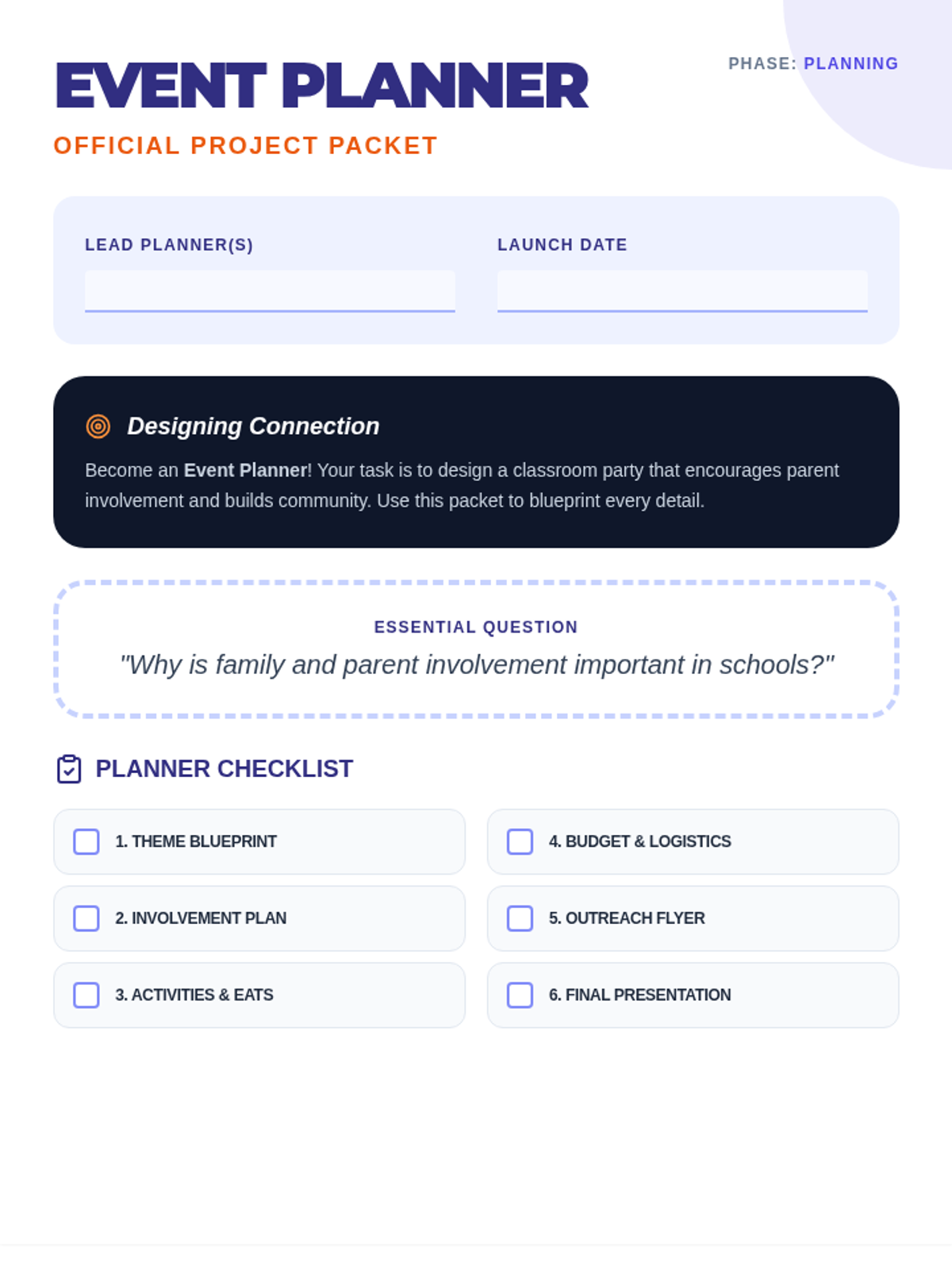
A comprehensive 4-page student project packet for classroom event planning. It guides students through theme selection, family involvement strategies, activity planning, budgeting, and reflection using a clean "event agency" layout with ample writing space.
A dynamic slide deck designed to introduce students to the classroom event planning project. It covers the mission, updated theme ideas, involvement strategies, budgeting, and final elevator pitch requirements using a professional event-agency aesthetic.
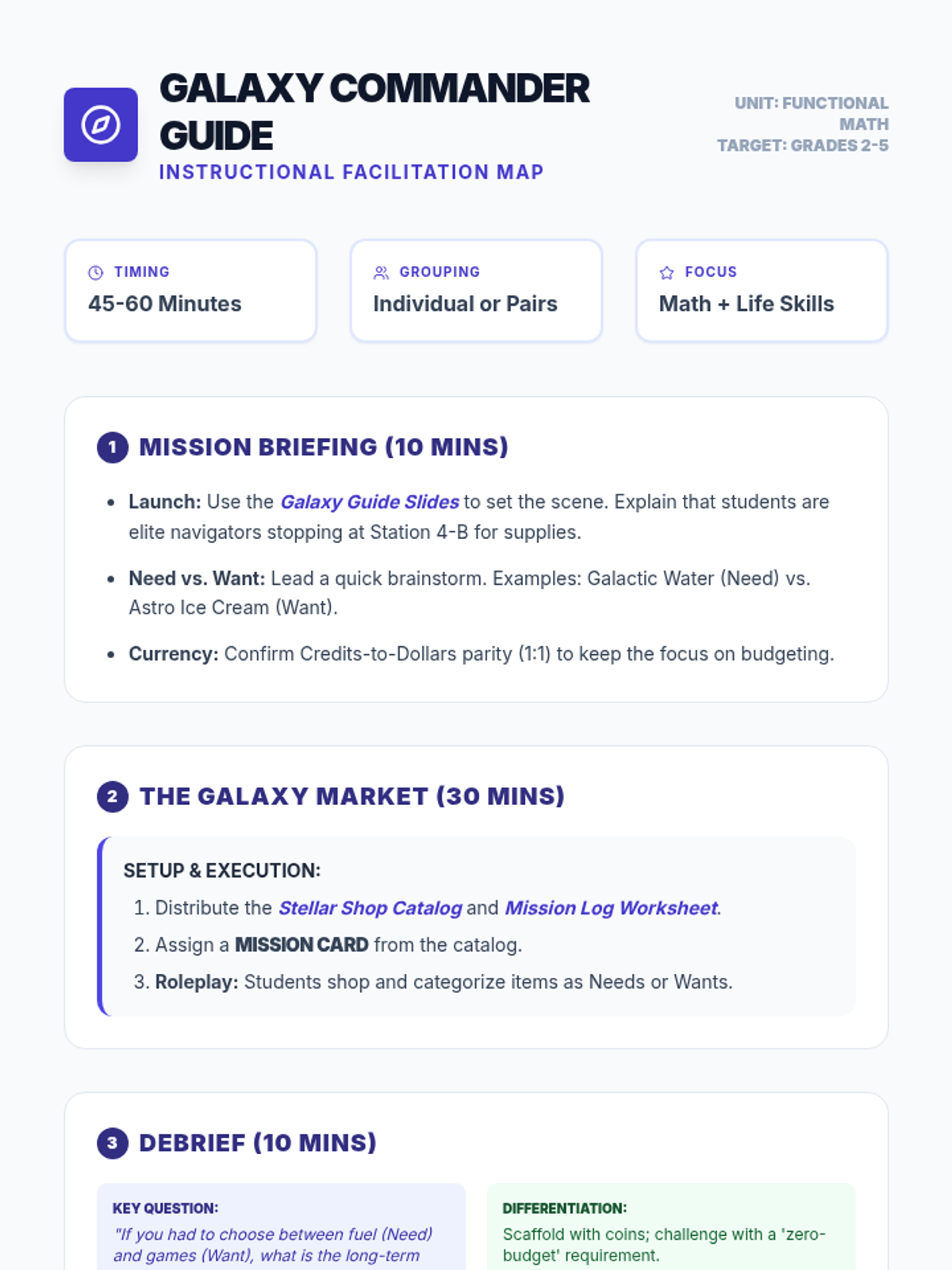
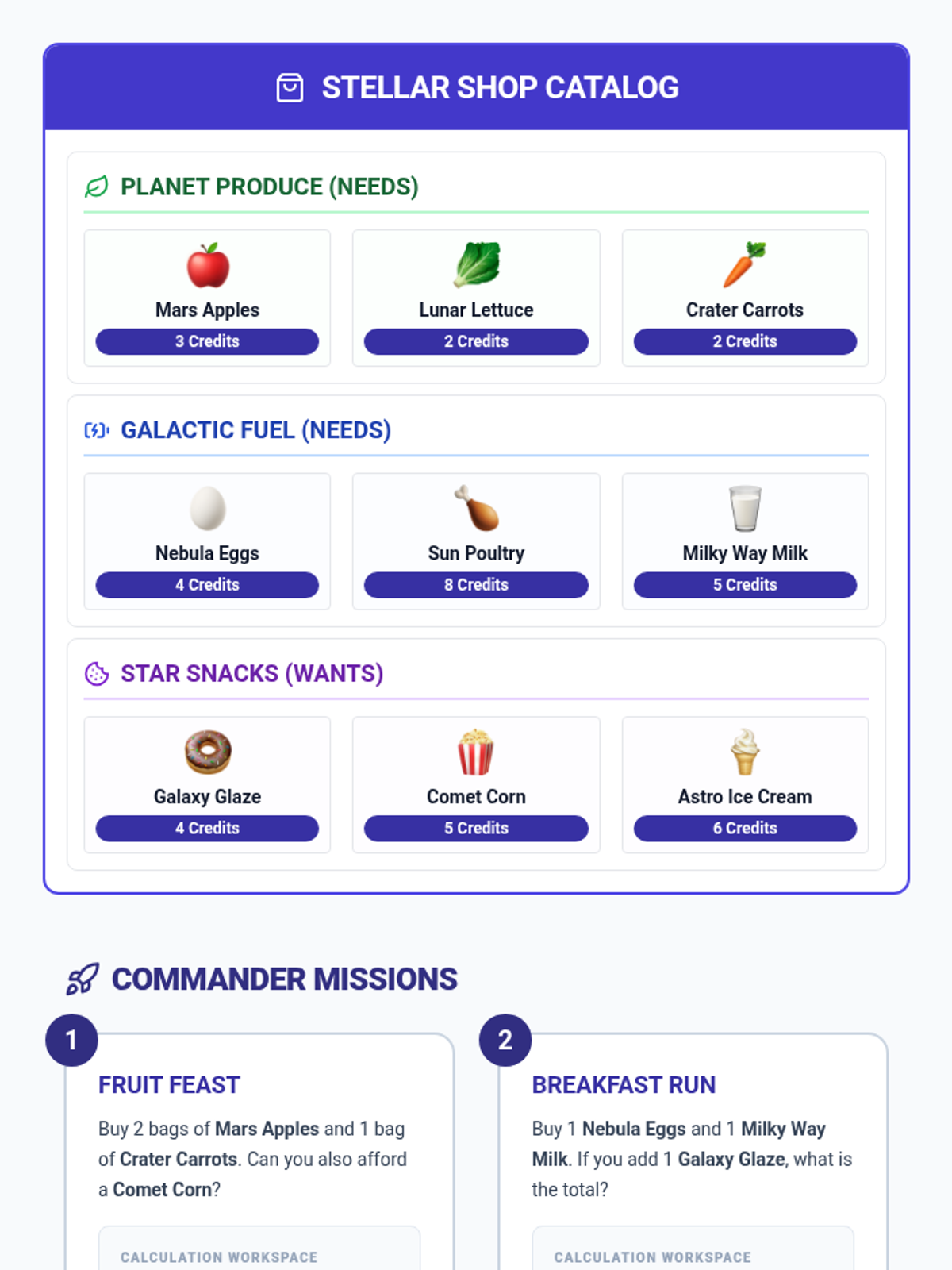
A comprehensive teacher's guide for 'The Grocery Galaxy'. Includes lesson phasing, differentiation tips, and an expanded answer key that provides both mathematical solutions and need/want categorization for all mission scenarios.
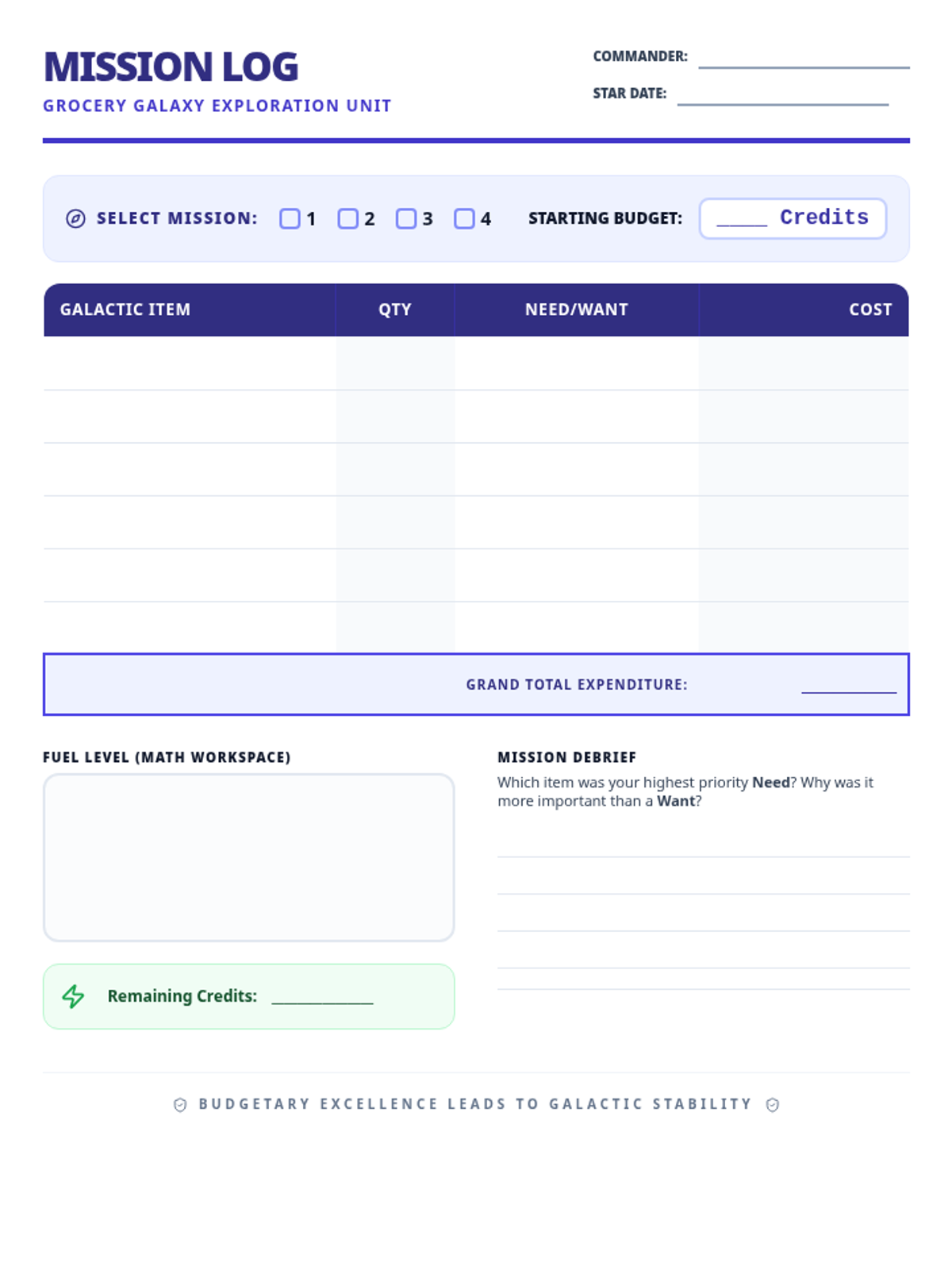
A refined student mission log with 6 entry rows for complex shopping simulations. Includes structured sections for budget calculation, need vs. want categorization, and written reflection.
A consolidated 2-page price catalog and mission card set for 'The Grocery Galaxy'. Featuring themed food items with costs and scenario cards with dedicated math workspaces for student calculations.
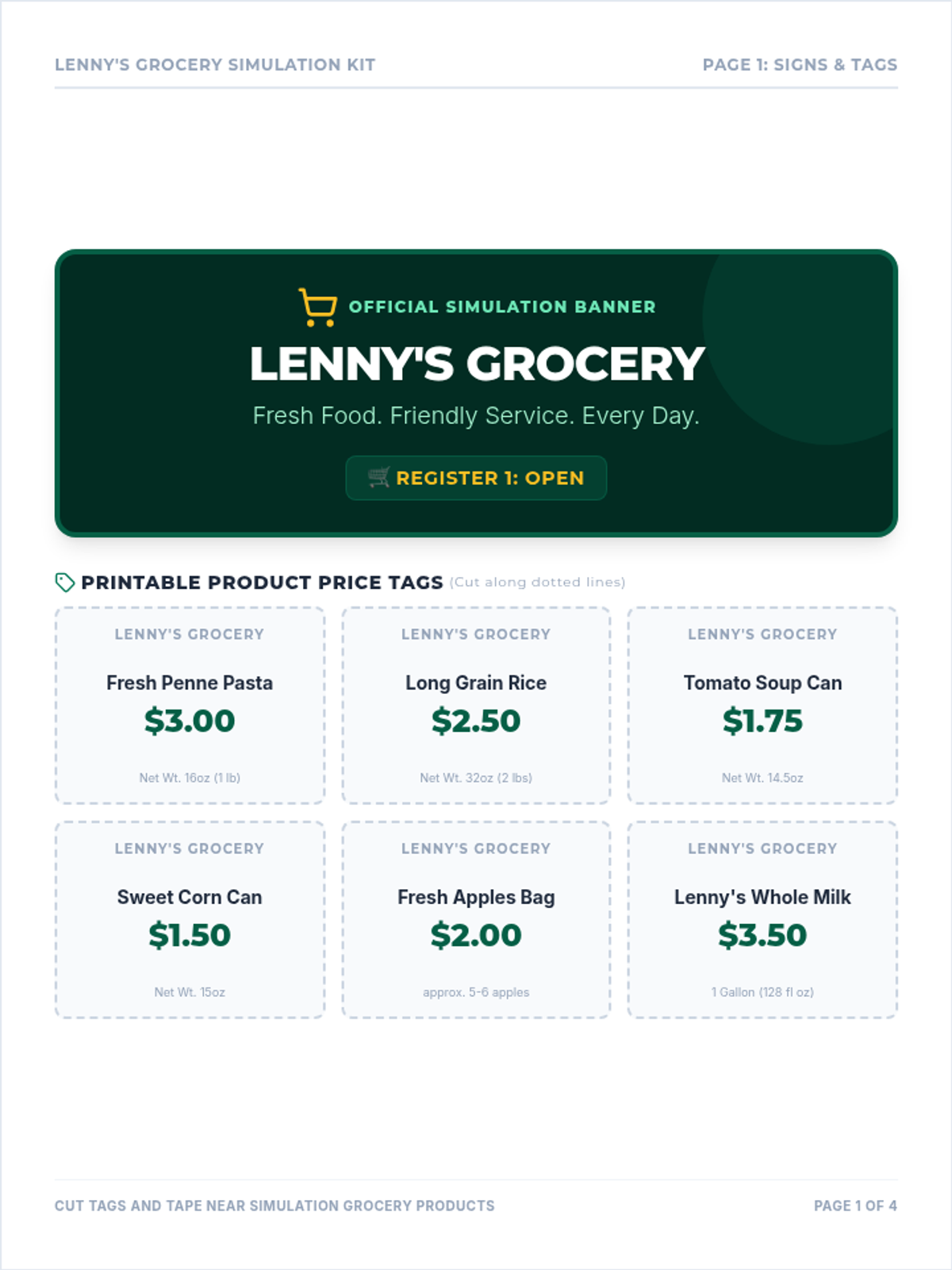
Printable store simulation resources for Lenny's Grocery. Includes store banners, product price tags, role badges, practice coupons, customer mission cards, and job duty checklist guides.
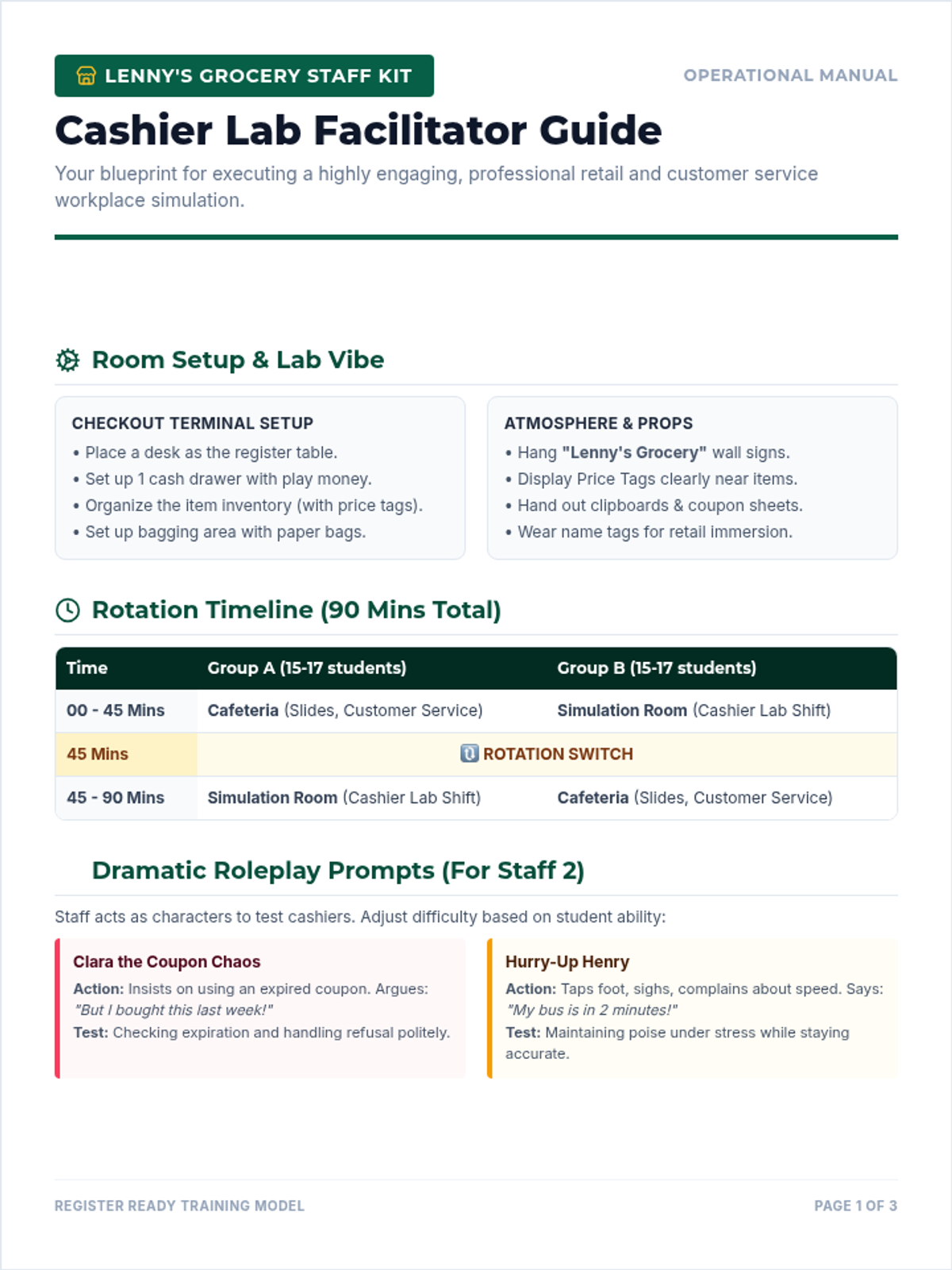
A complete lesson facilitator guide for trainers running the Cashier Lab and Cafeteria rotation. Includes classroom setup, roleplay prompt scripts, a debrief discussion guide, and an employability skill evaluation rubric.
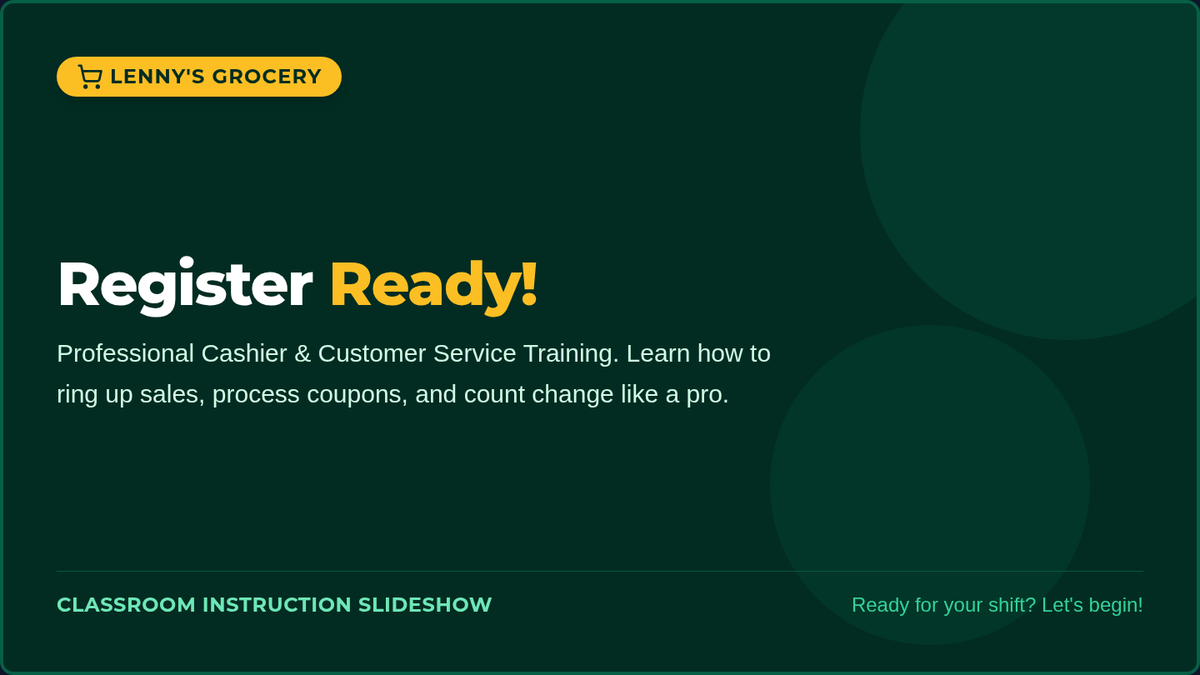
Interactive training slides for cashiers covering customer service, coupon calculations, and making change using the counting-up method. Includes dedicated slides for all 5 instructional YouTube videos.
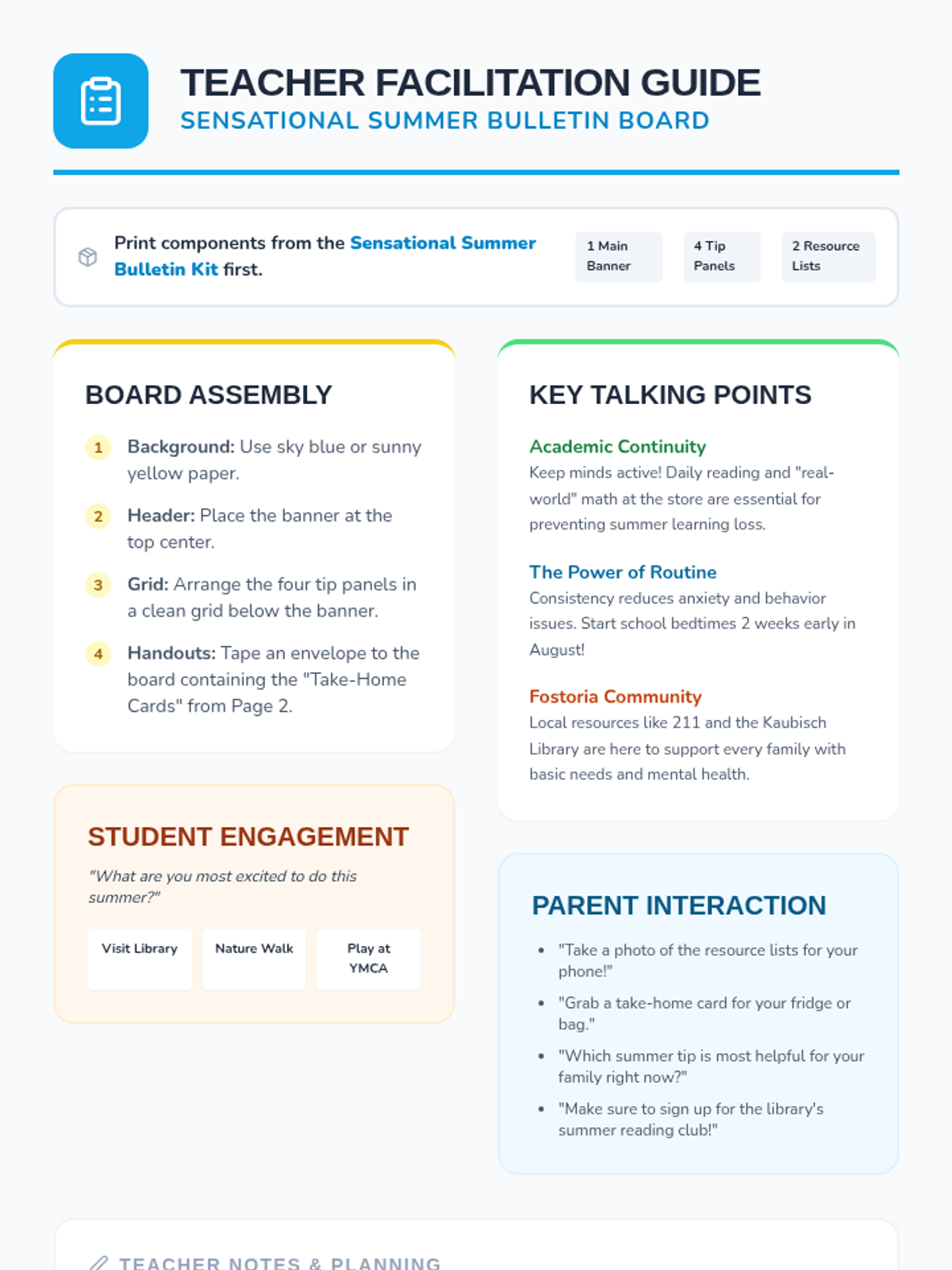
A practical guide for teachers and staff on how to assemble and facilitate the 'Sensational Summer' bulletin board. It includes board setup instructions, parent talking points, and printable quarter-page resource cards for families to take home, now updated to include the Fostoria Empowerment Hub. Labels are placed outside the cut-lines for clarity.
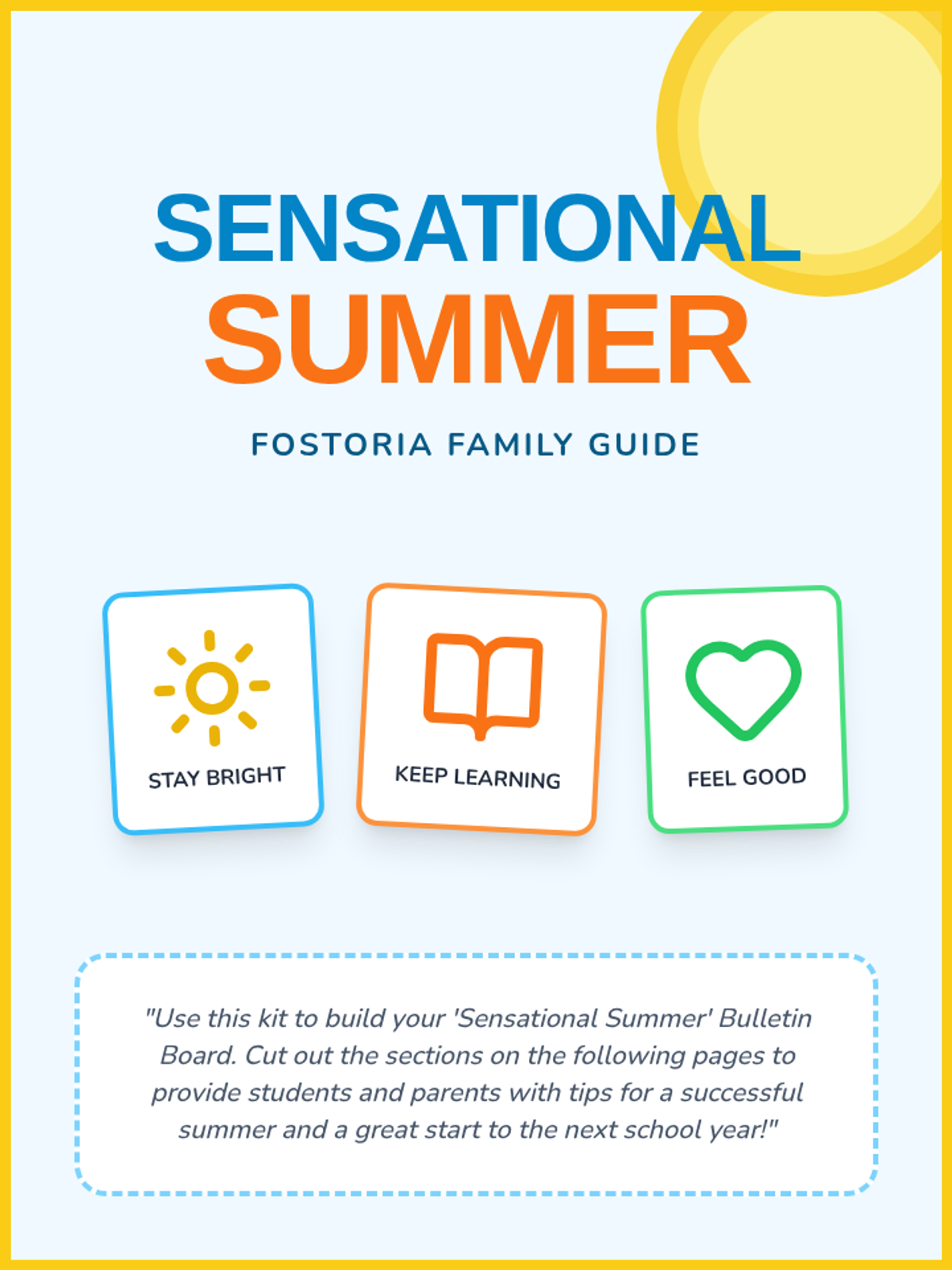
A vibrant, cut-ready bulletin board kit for PreK-6 buildings. Includes a themed banner, four educational tip panels for students and parents (SEL, academics, routines, wellness), a detailed Fostoria Empowerment Hub panel, and comprehensive local resource blocks. Visuals are summer-focused and text is student-friendly. Labels are placed outside cut-lines.
A comprehensive set of modular panels for a career fair poster board about Contractor Mining, featuring earnings, skills, a daily schedule, and pros/cons designed for elementary students. This version has significantly reduced font sizes and spacing to ensure all content fits comfortably within standard page margins for printing.
A comprehensive set of modular panels for a career fair poster board about Contractor Mining, featuring earnings, skills, a daily schedule, and pros/cons designed for elementary students. Font sizes have been adjusted to be significantly smaller for a better fit on the page.
A comprehensive set of modular panels for a career fair poster board about Contractor Mining, featuring earnings, skills, a daily schedule, and pros/cons designed for elementary students. Font sizes have been adjusted for optimal fit.
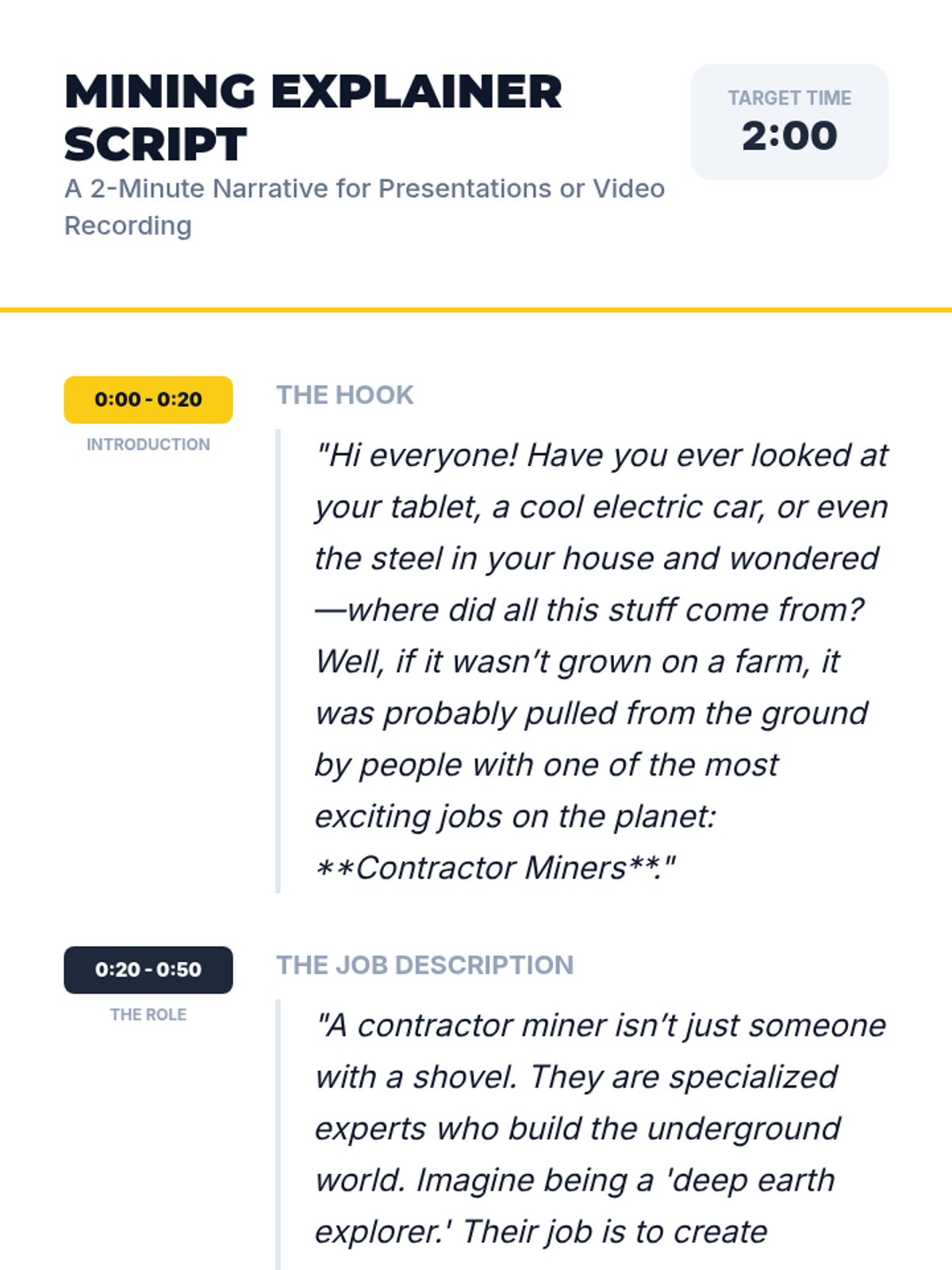
A professional 2-minute script for a career fair presentation or video, tailored for elementary students to explain the world of contractor mining.
A visual presentation for students that explains what contractor miners do, the giant machines they use, and why mining is essential for our modern world. Includes real photos of the work site and a miner.
A comprehensive set of modular panels for a career fair poster board about Contractor Mining, featuring earnings, skills, a daily schedule, and pros/cons designed for elementary students.
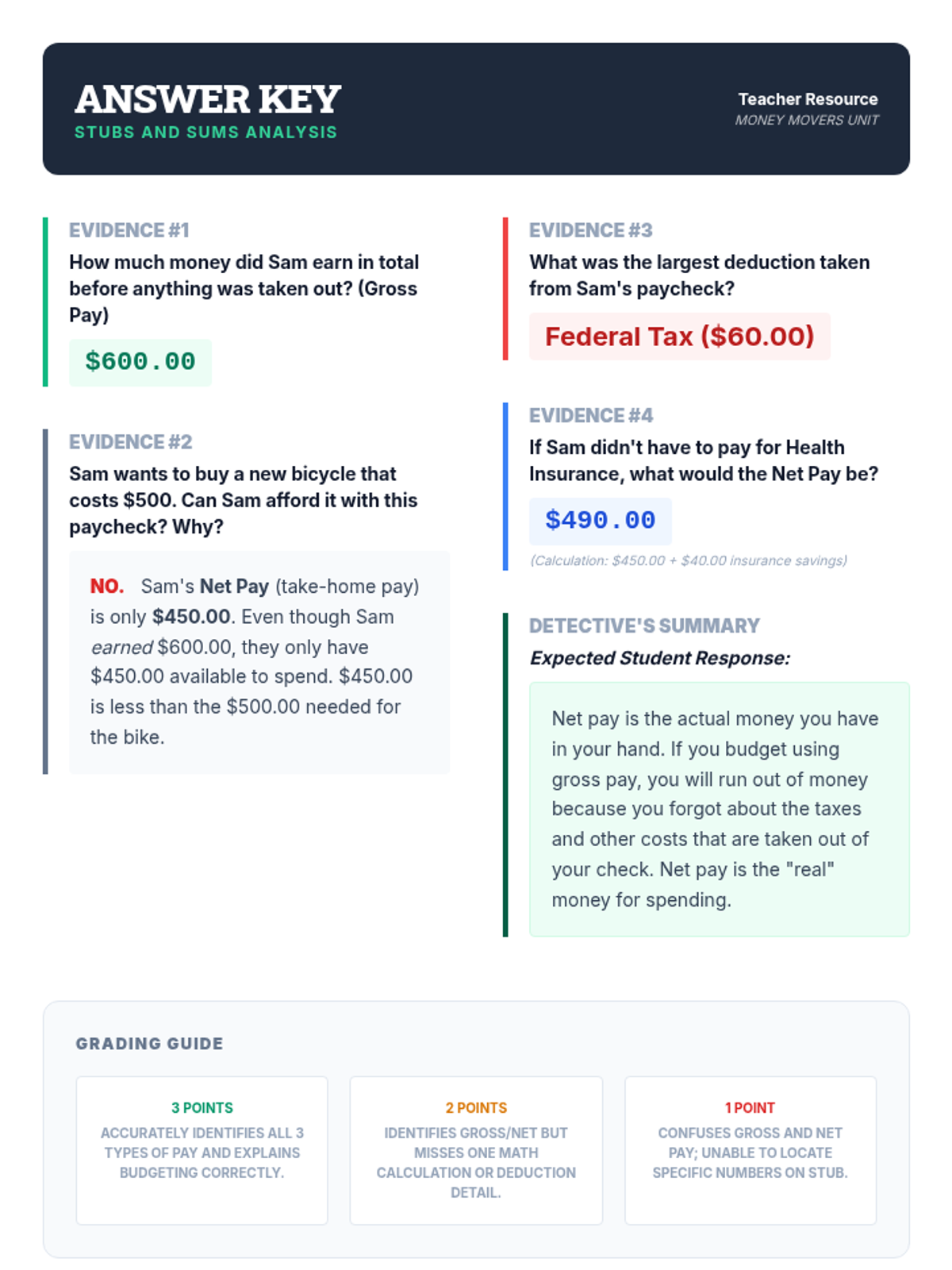
Teacher answer key for the 'Stubs and Sums' worksheet, including sample student responses and a simple grading rubric.
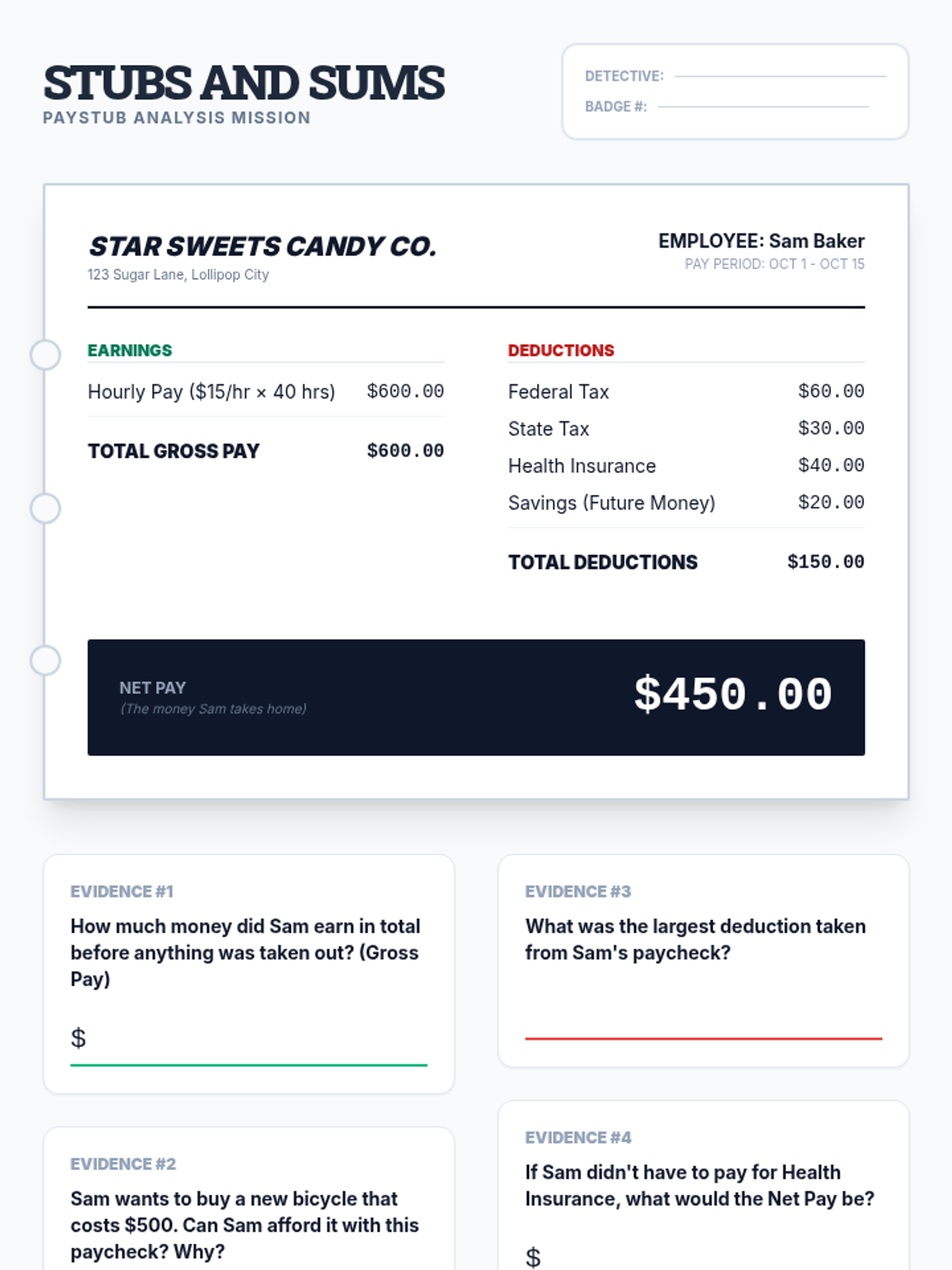
A worksheet where students analyze a fictional pay stub for 'Star Sweets Candy Co.' to practice finding gross pay, deductions, and net pay.
Final slides for the sequence, focusing on identifying components of a pay stub and reinforcing the importance of budgeting based on net pay.
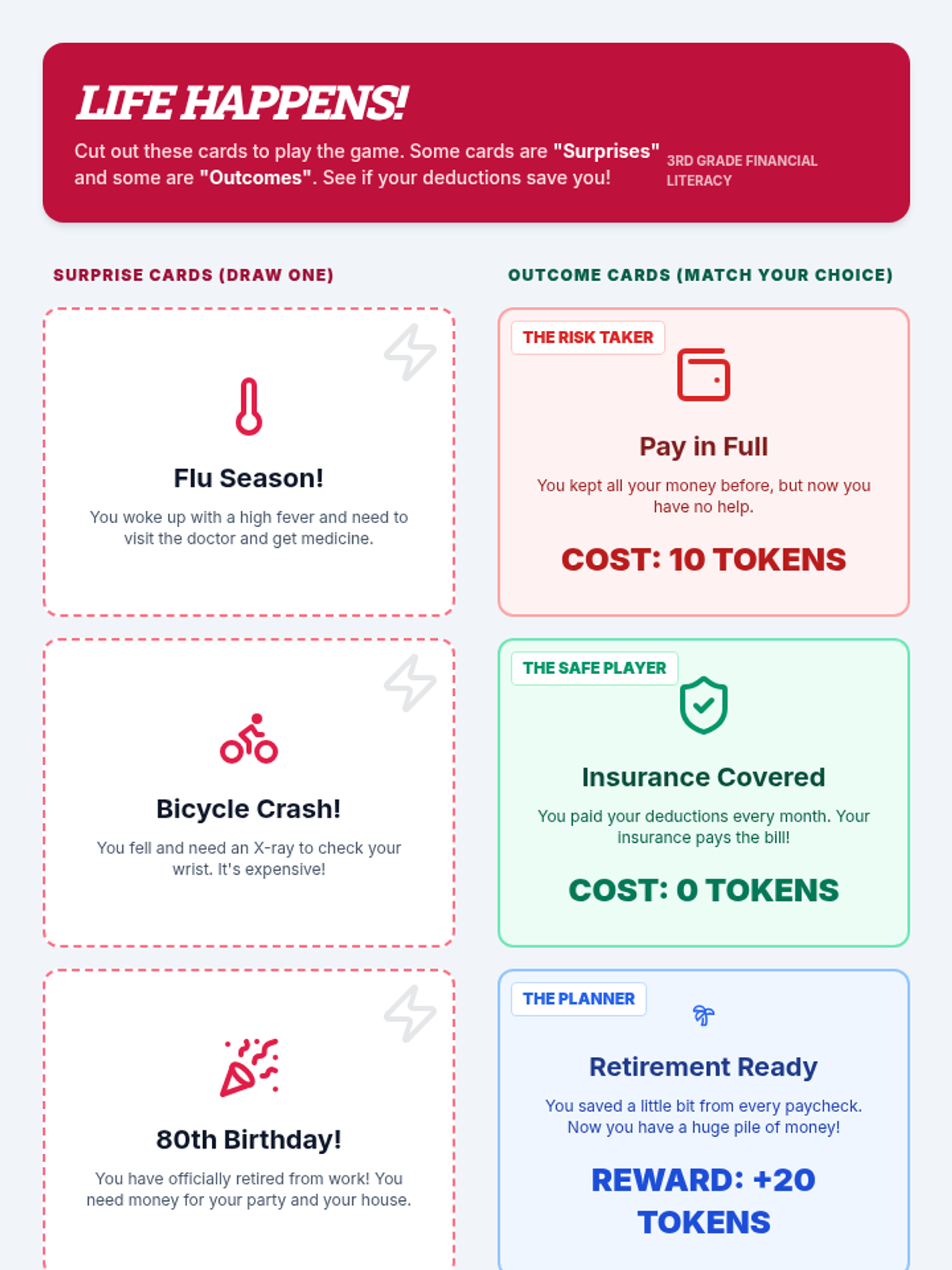
Game cards for 'Life Happens', a simulation activity where students experience the consequences of having or not having deductions for insurance and retirement.
Slides for the 'Future Funds' lesson, explaining health insurance and retirement savings as common non-tax deductions.
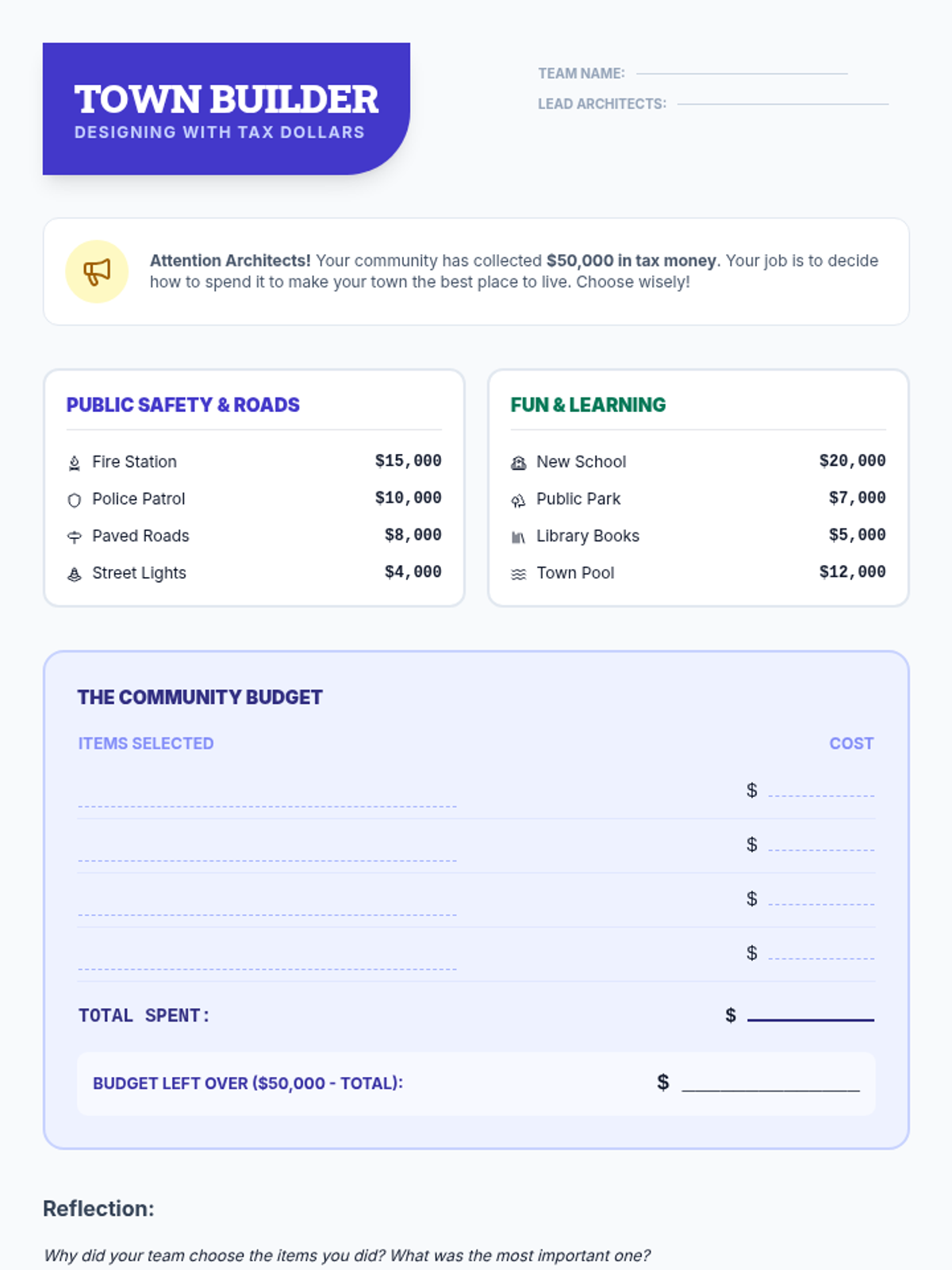
A collaborative budget-planning activity where students decide how to spend $50,000 in tax revenue to build community infrastructure.
Engaging slides explaining the concept of taxes and how they fund public services like schools, roads, and emergency response.
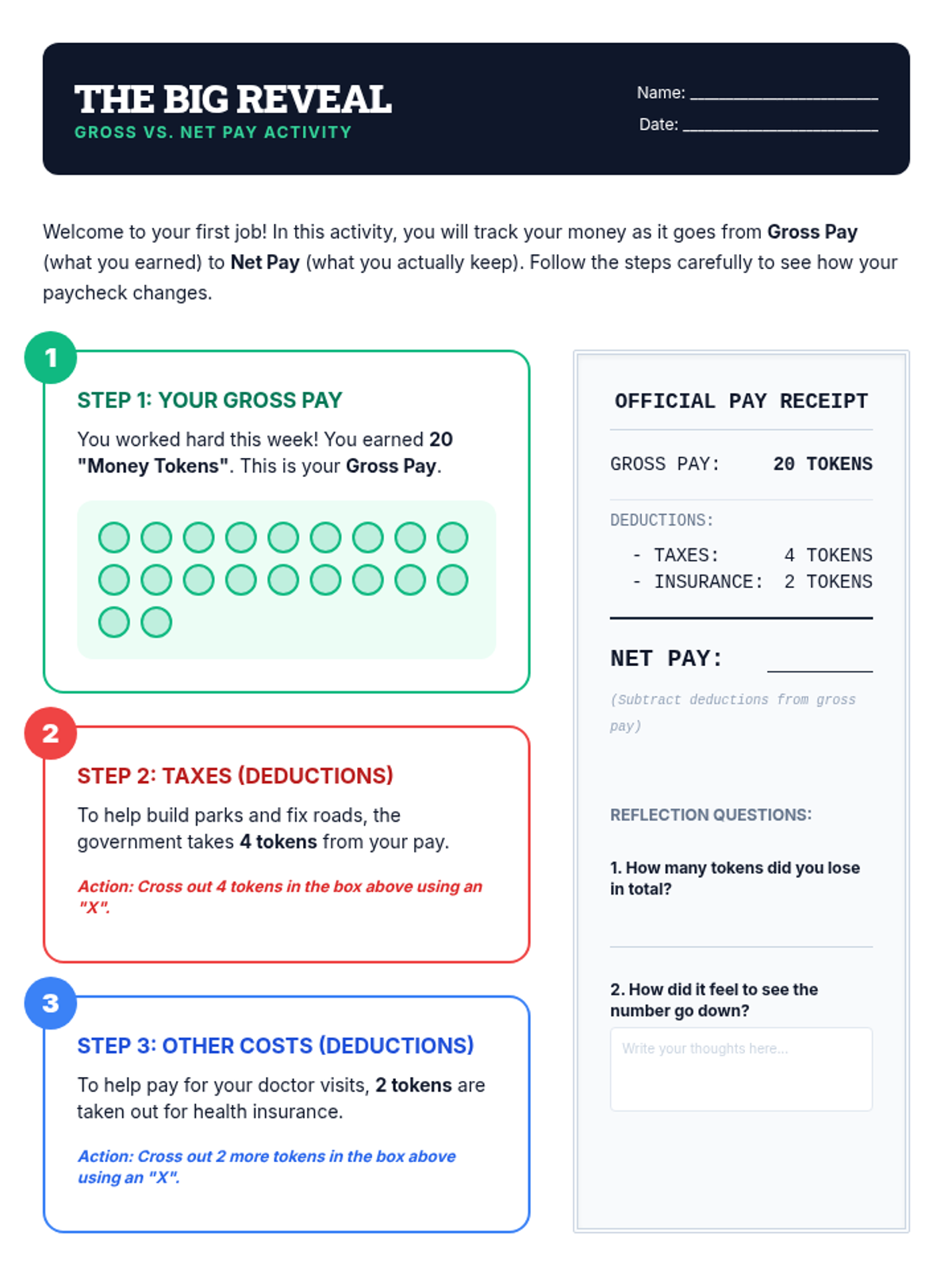
A simulation worksheet where students 'lose' tokens to deductions to visualize the difference between gross and net pay.