Emotion recognition ranging from basic feelings to complex nuances and mixed states. Strengthens accurate self-assessment through identity exploration, strength identification, and values-based decision making.
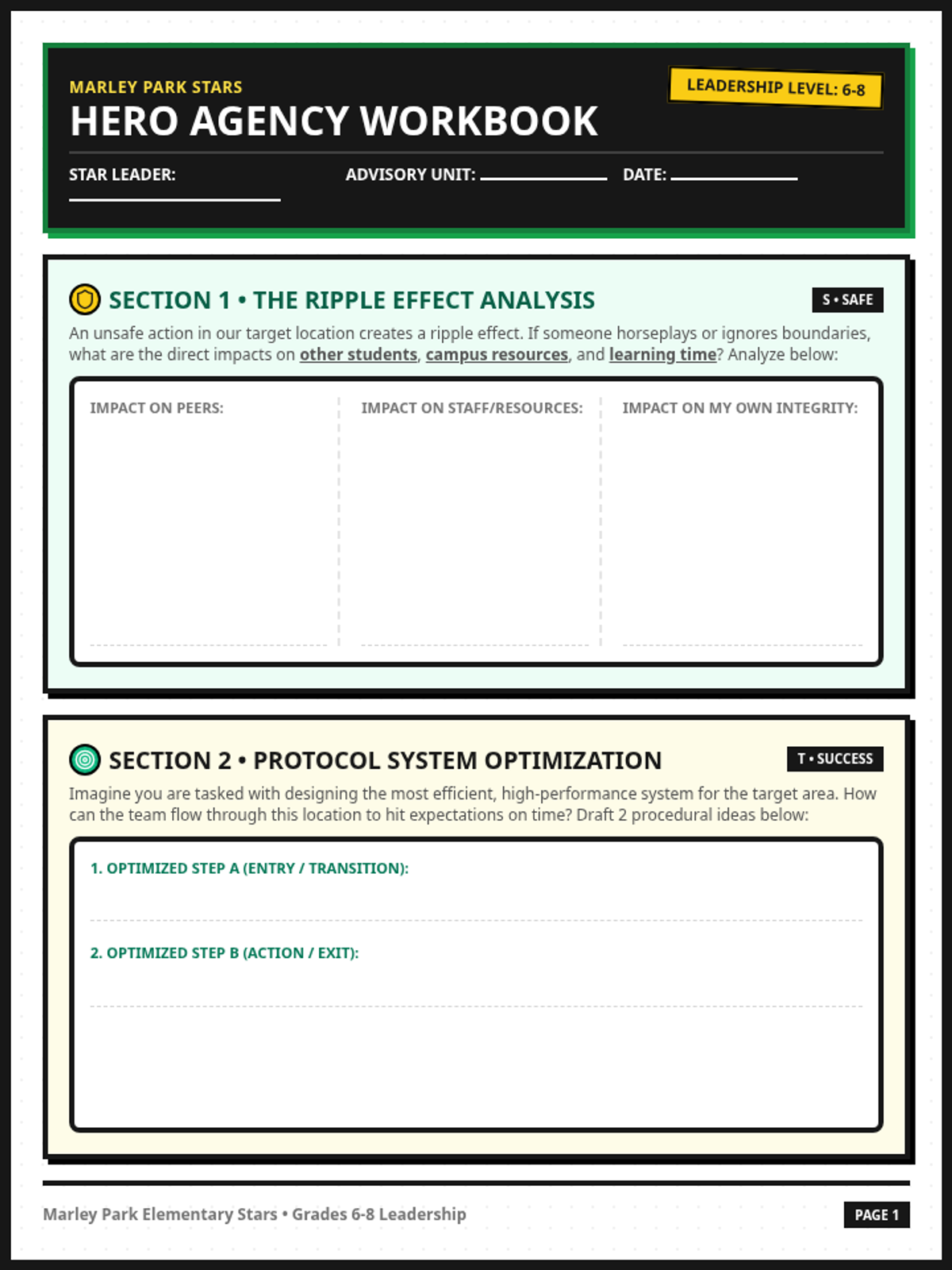
An interactive 2-page student agency workbook for middle school (grades 6-8) featuring debate analysis, a personal Integrity Meter, and a layout blueprint to design mentoring tutorials for younger Marley Park stars.
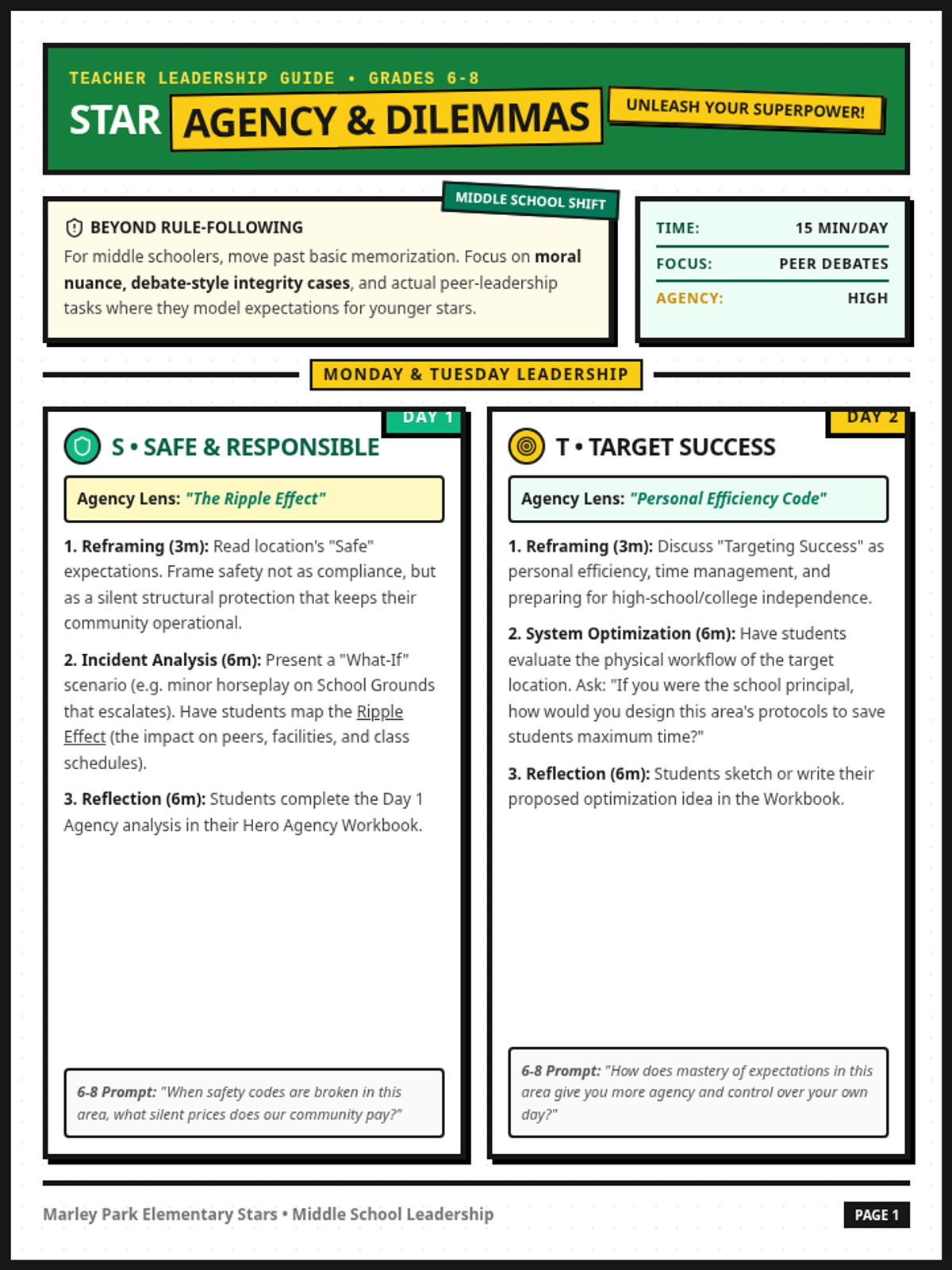
A 2-page universal 15-minute daily teacher guide for middle school (grades 6-8), focusing on moral dilemma debates, peer leadership design, and agency-driven self-regulation.
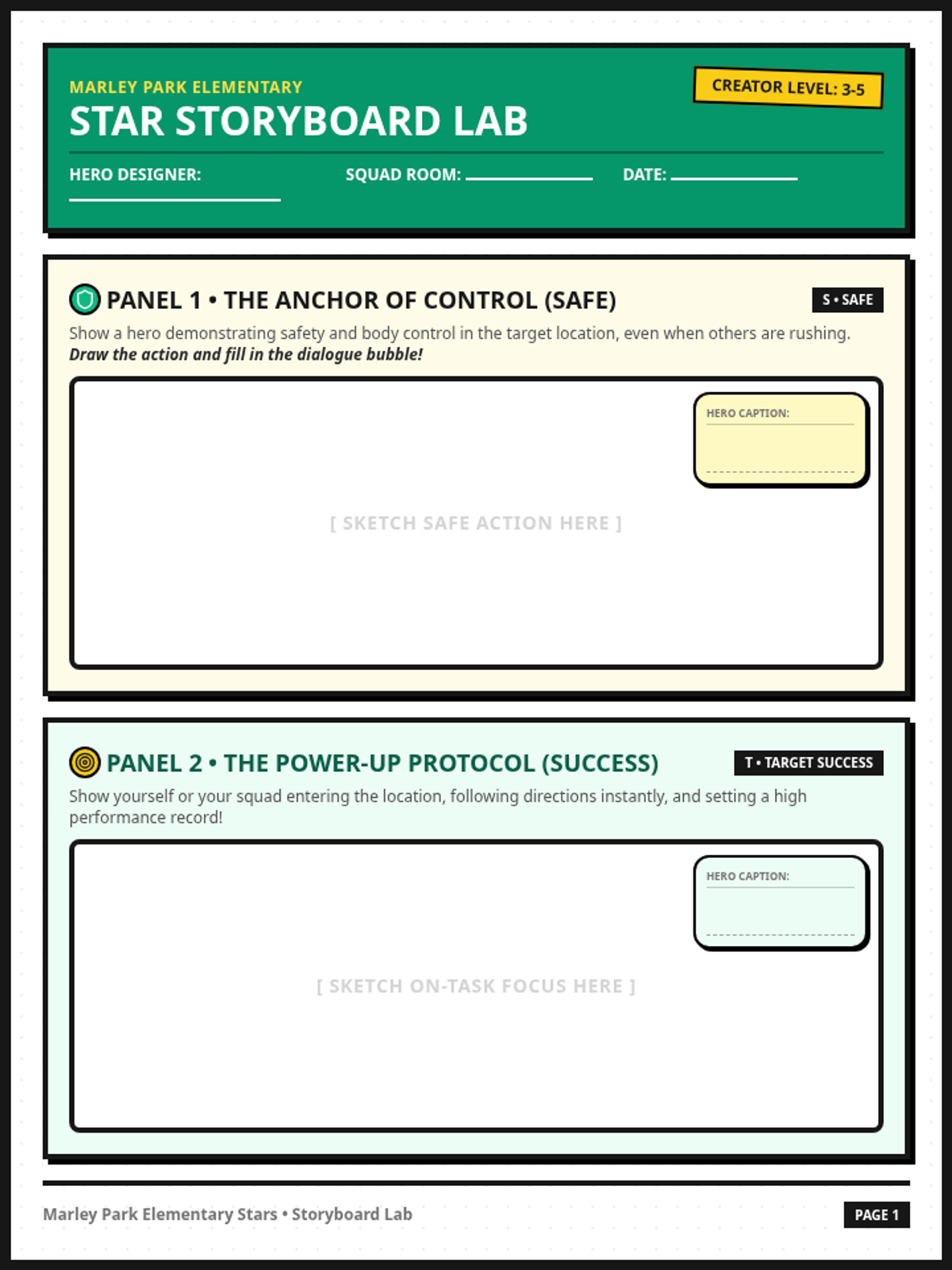
An interactive 2-page student worksheet for grades 3-5 shifting focus to comic storyboard creation and student ownership of STAR behavior.
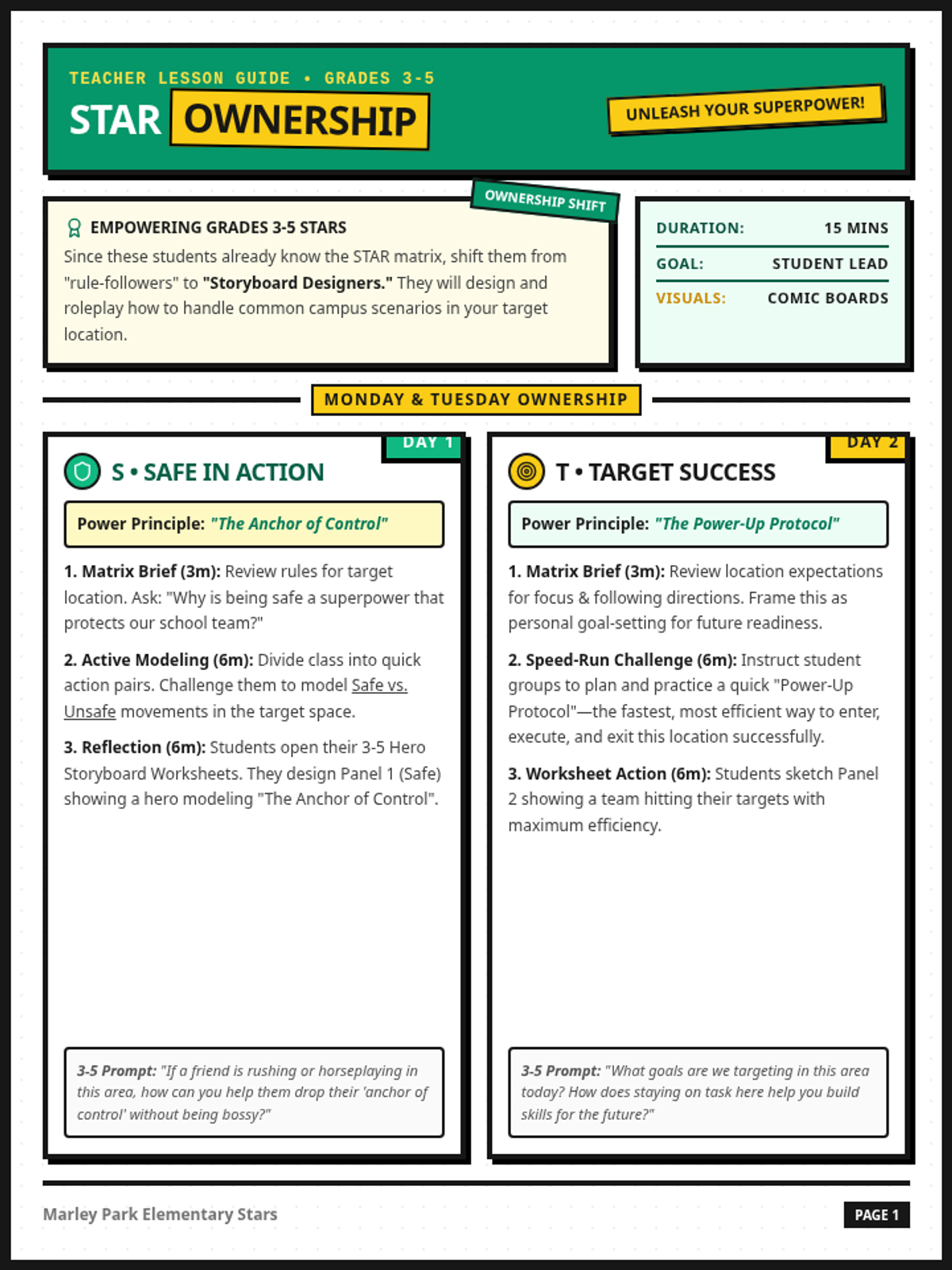
A 2-page universal 15-minute daily teacher guide for grades 3-5, structured around student-led demonstration teams, collaborative storyboard creation, and student ownership of STAR behavior.
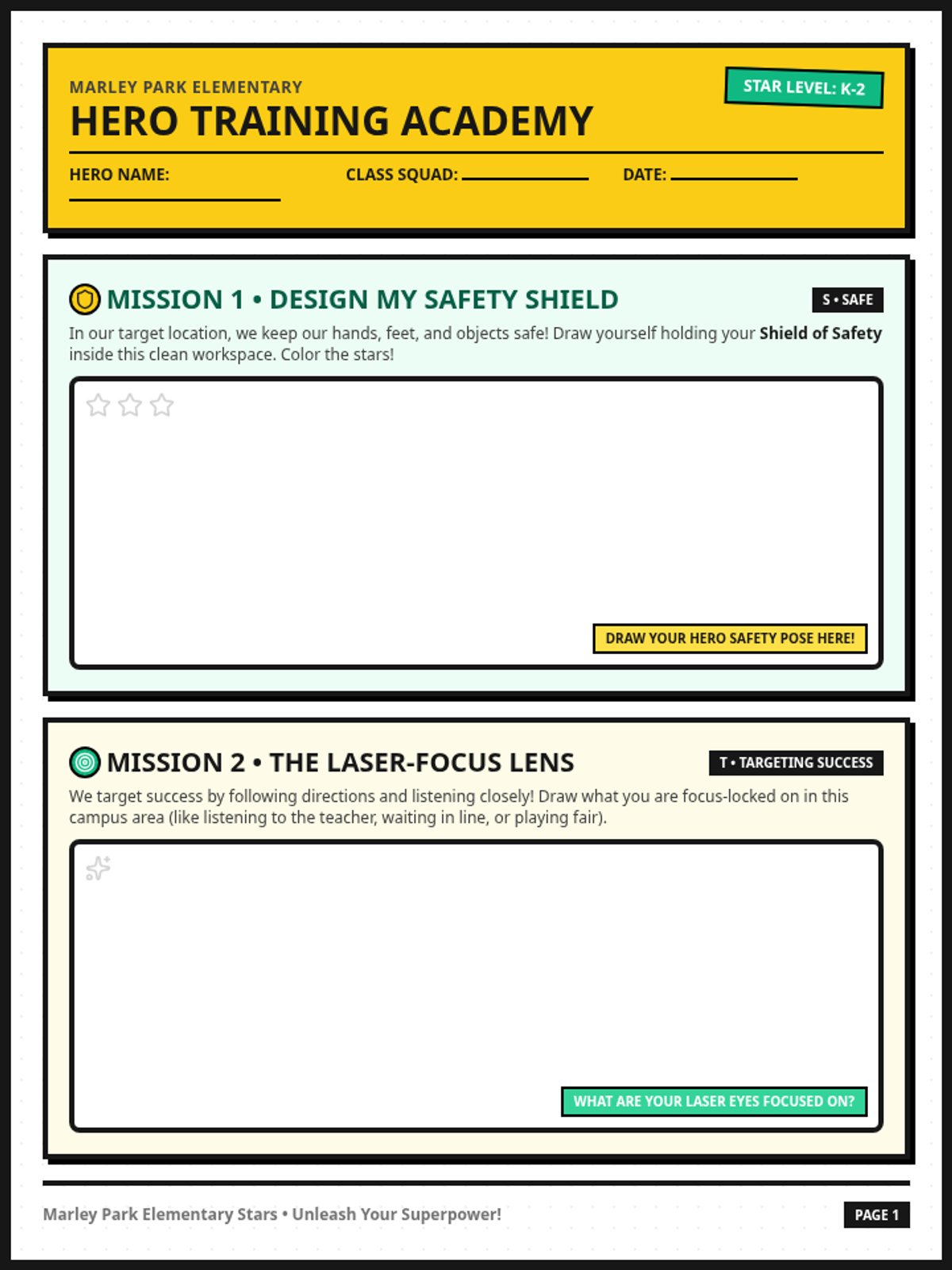
An interactive 2-page student worksheet for K-2 featuring a customizable comic-book layout, coloring spaces for superhero motifs, and drawing panels for practicing STAR expectations.
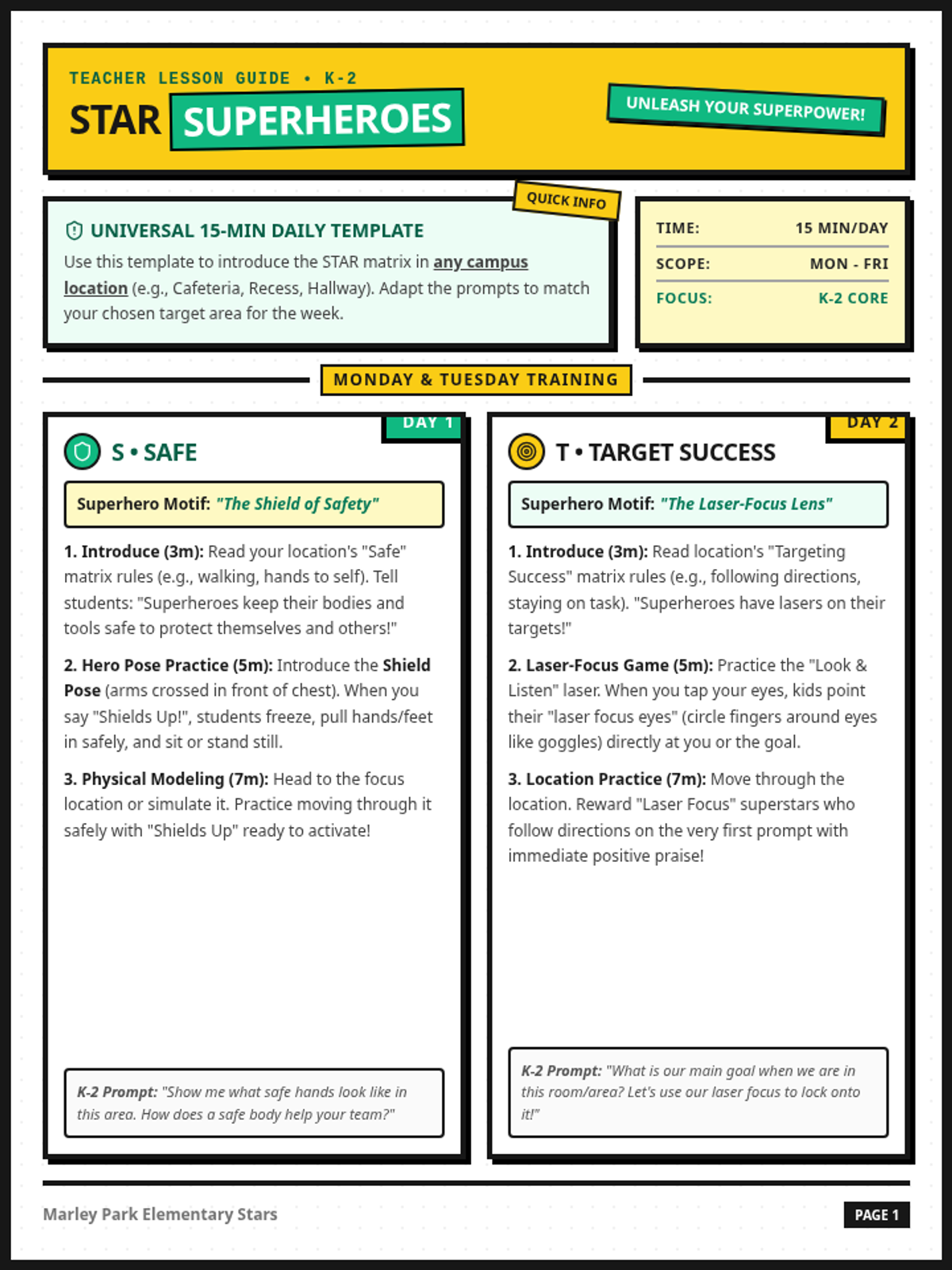
A 2-page universal 15-minute daily teacher guide for K-2 educators, featuring pop-art visual anchors, interactive physical modeling scenarios, and daily discussion prompts to teach STAR expectations.
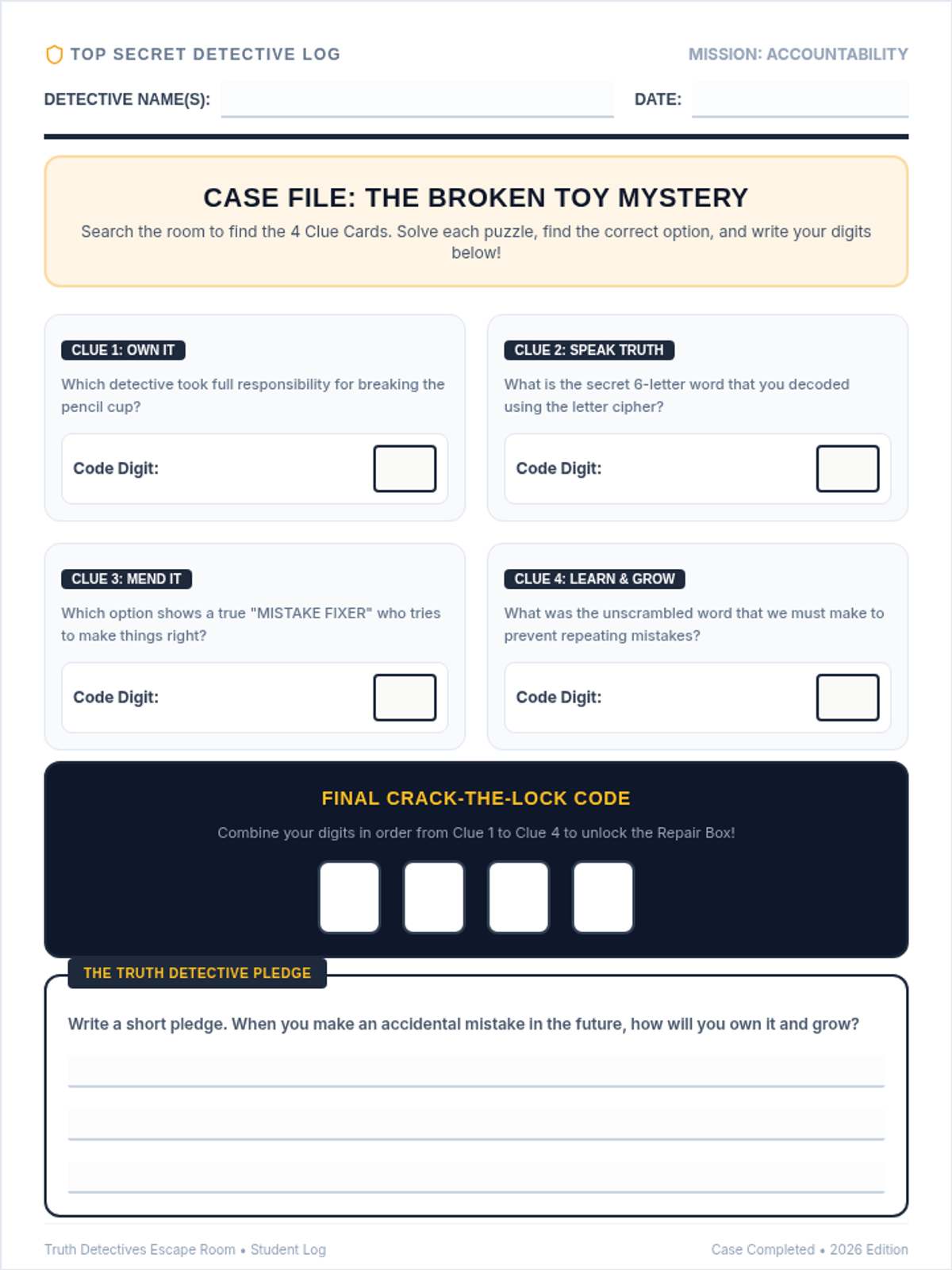
An interactive student recording sheet styled as a top-secret investigator's file. Students fill out their team names, log their clues, solve the 4-digit code to open the repair box, and write their personal accountability pledge.
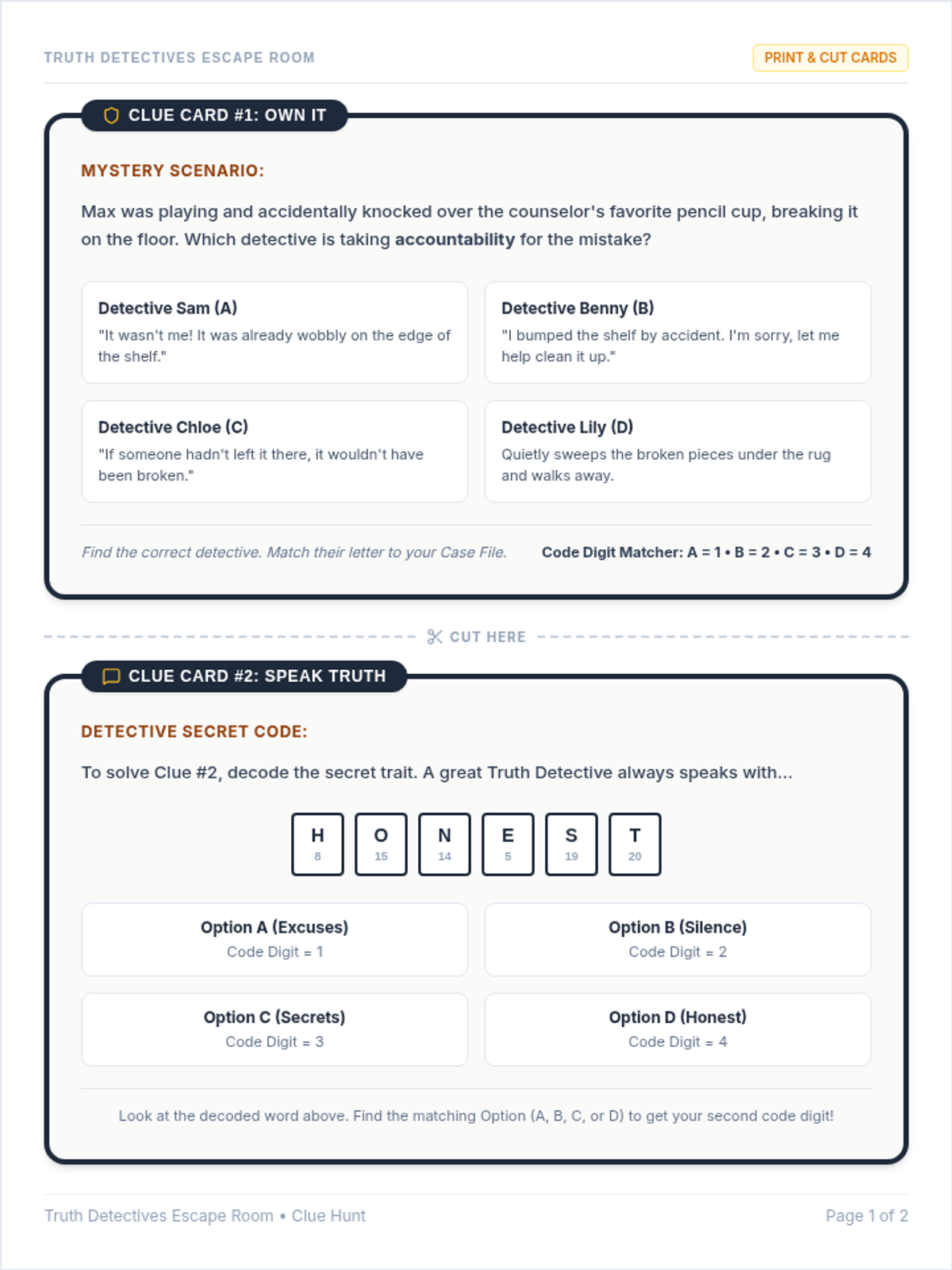
Printable clue cards for the counseling room search. Each card presents a realistic accountability dilemma or puzzle (Own It, Speak Truth, Mend It, Learn & Grow) designed for 2nd and 3rd graders. Students solve the puzzle to reveal a code digit.
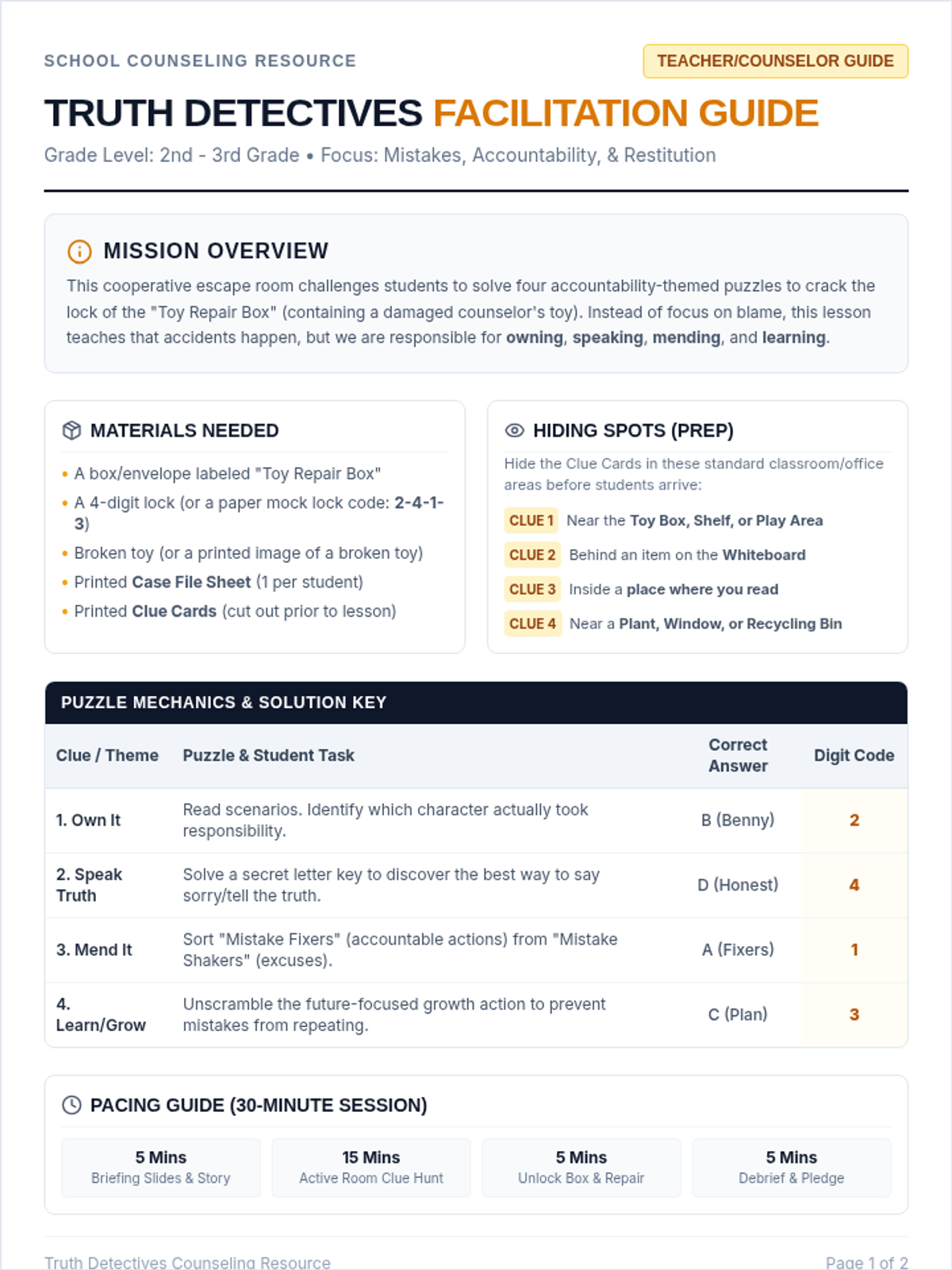
A step-by-step facilitator guide for counselors to successfully set up, run, and debrief the escape room. It includes preparation checklists, clue hiding suggestions, an interactive script, and deep debriefing questions focusing on accountability.
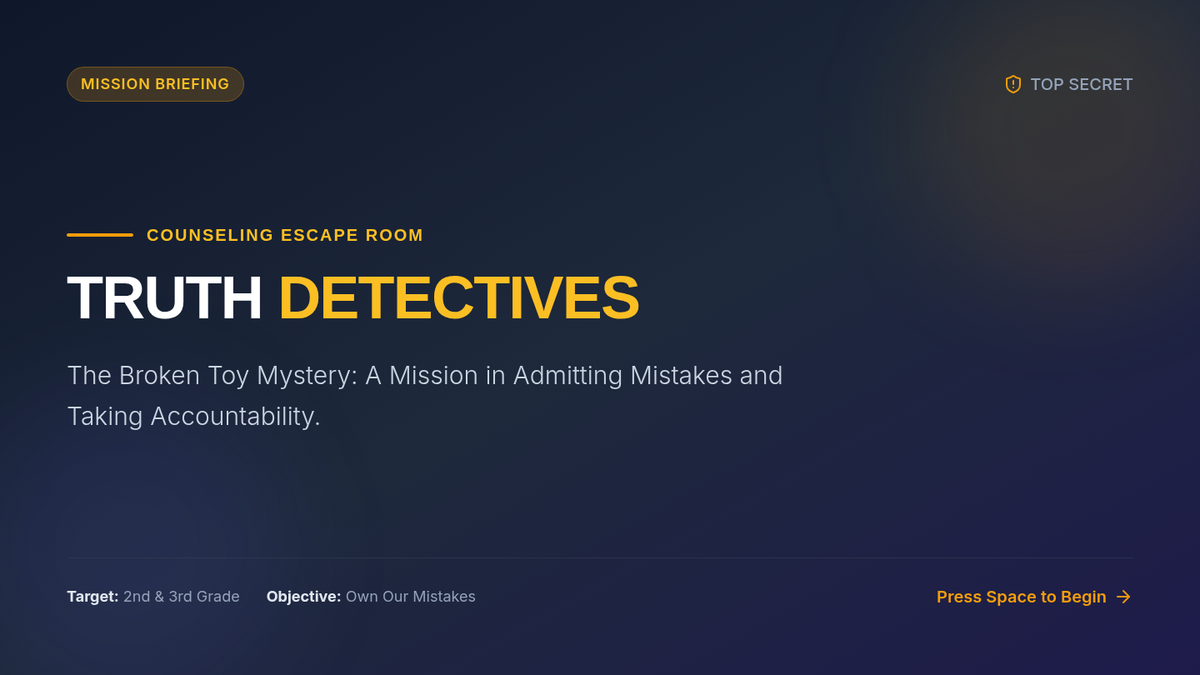
A highly visual slide presentation to kick off the Truth Detectives escape room. It introduces the scenario of 'The Broken Toy Mystery', sets up the rules of the physical room hunt, and defines key accountability concepts in a child-friendly way.
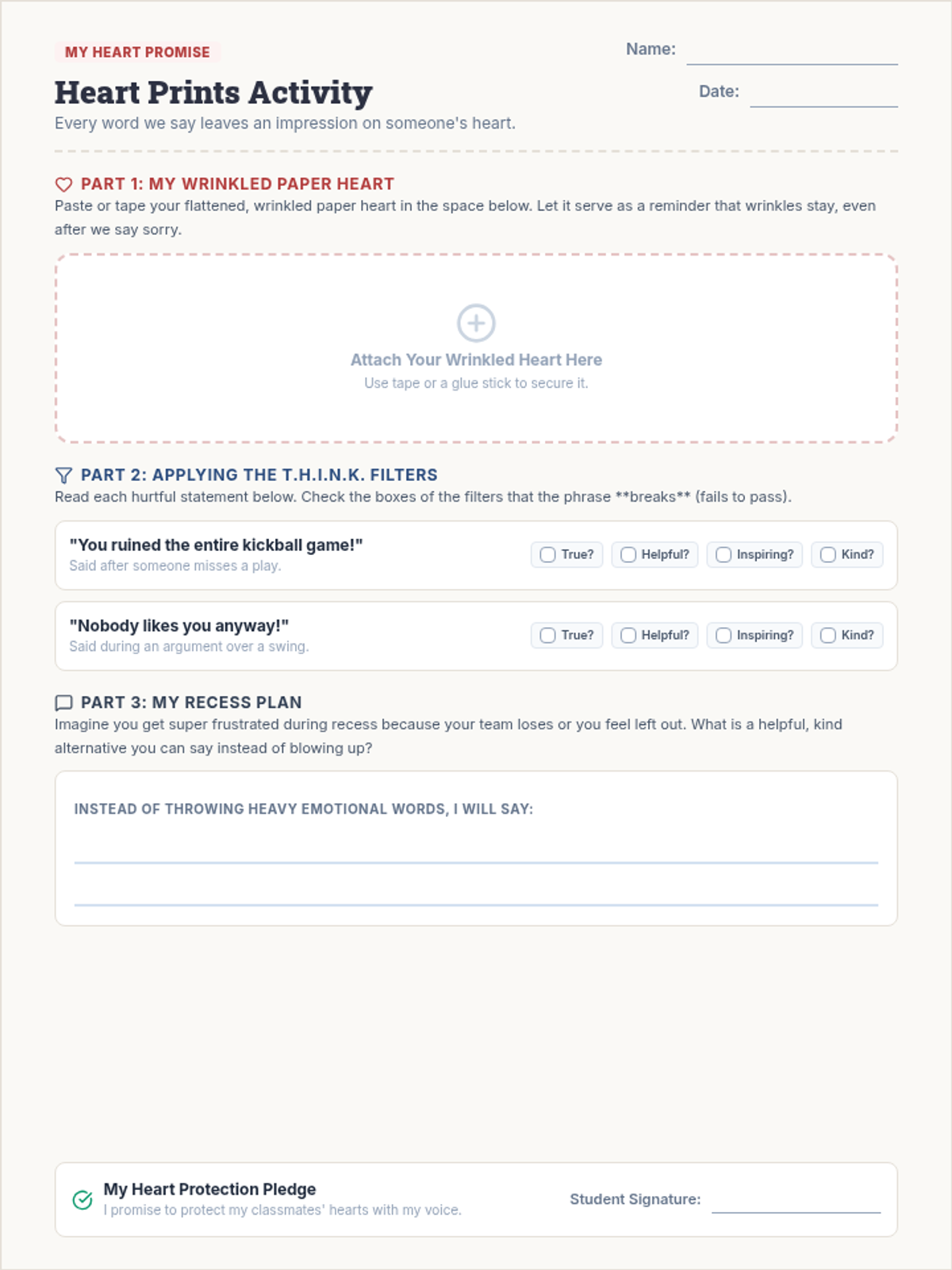
An interactive 3rd-grade worksheet designed for student self-reflection, where they paste their wrinkled paper heart, evaluate high-impact playground statements, and write their own restorative speech options.
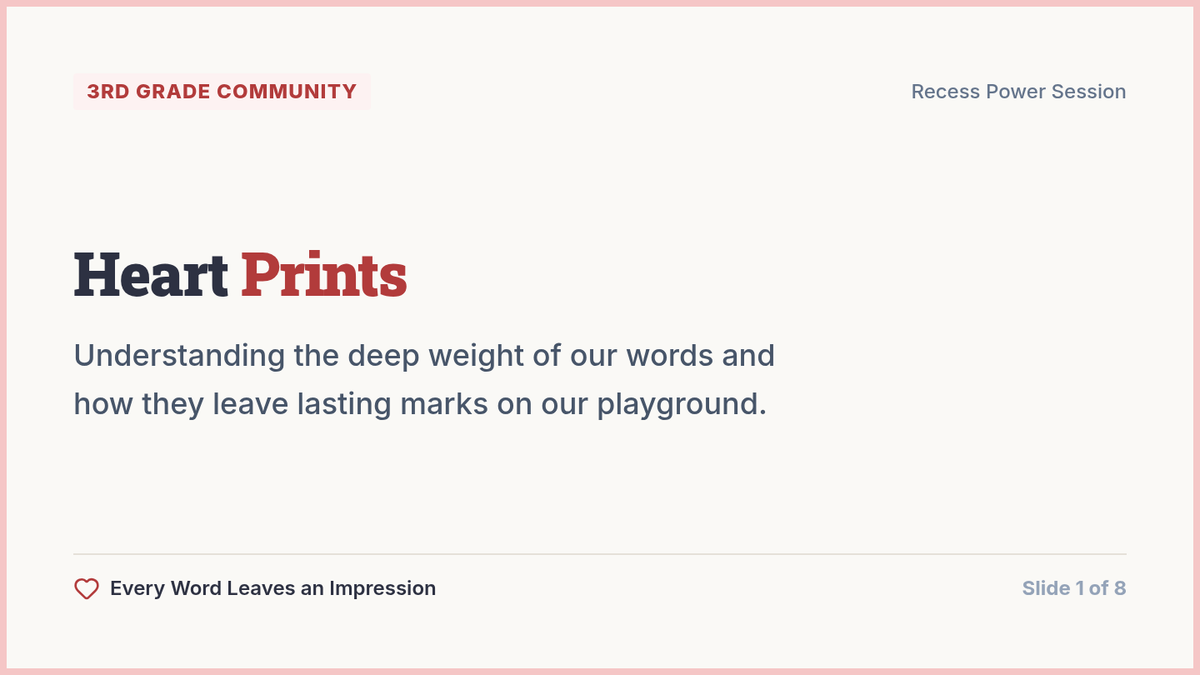
An updated visual slide deck for 3rd graders that illustrates the power of words using the THINK filter of speech, featuring scenario-specific guidance on what to avoid and what to practice saying.
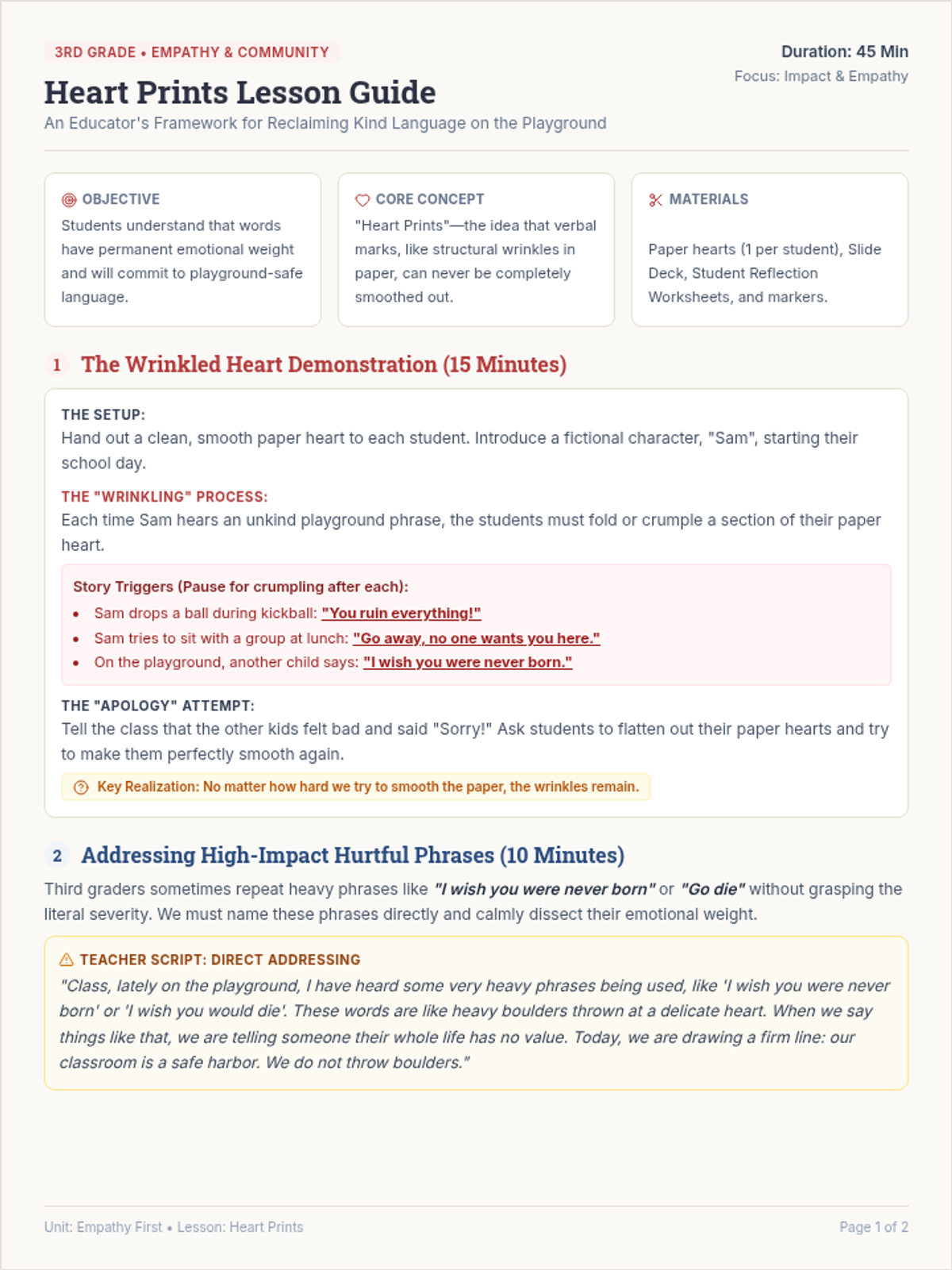
A comprehensive, empathetic lesson plan for 3rd-grade teachers, detailing a step-by-step framework to address hurtful language, facilitate a heart-wrinkling activity, and lead meaningful discussions about recess behavior.
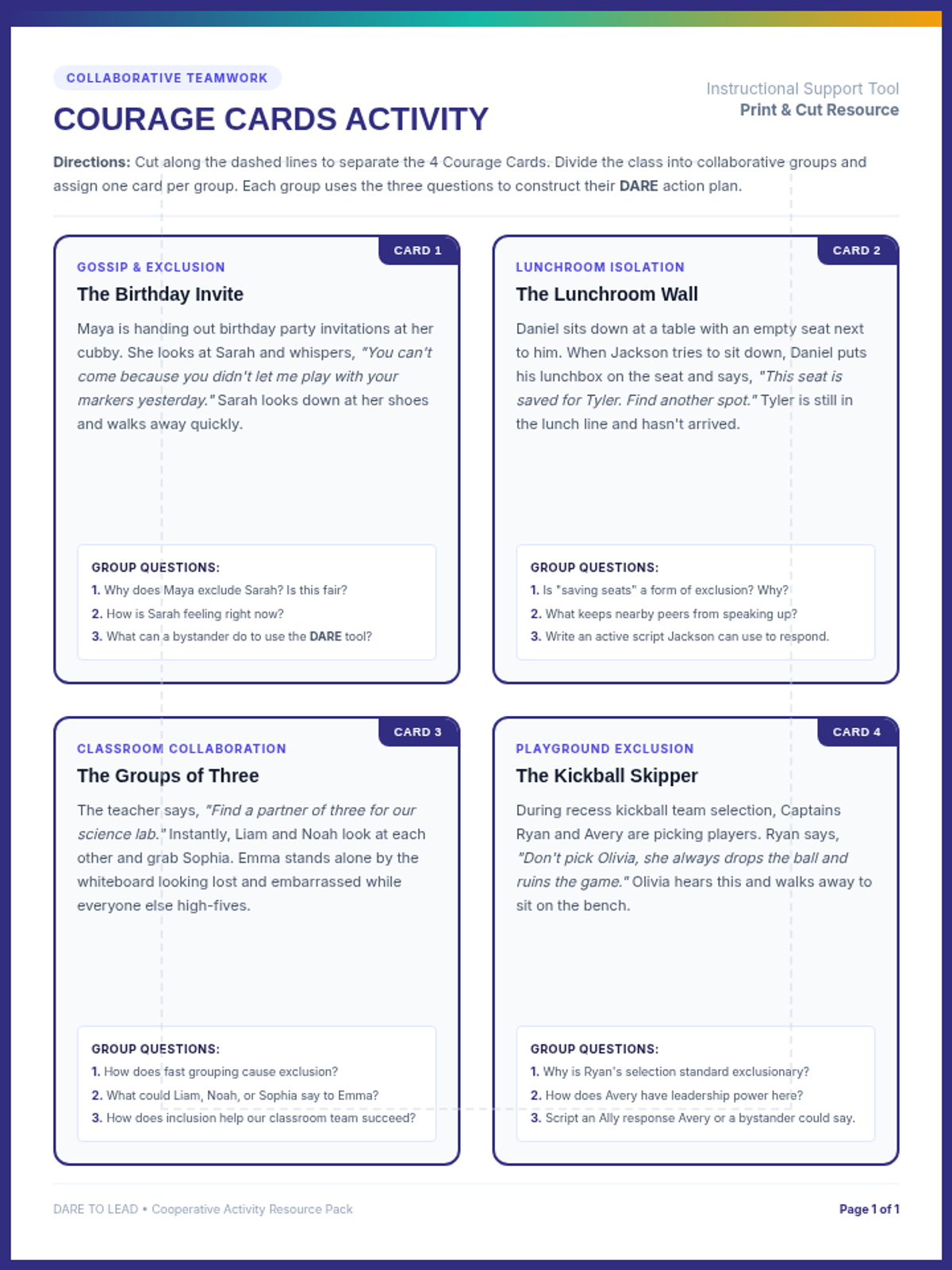
A printable 2-column, 2-row grid of 4 styled discussion cards containing challenging peer-conflict scenarios and team prompts for cooperative groups.
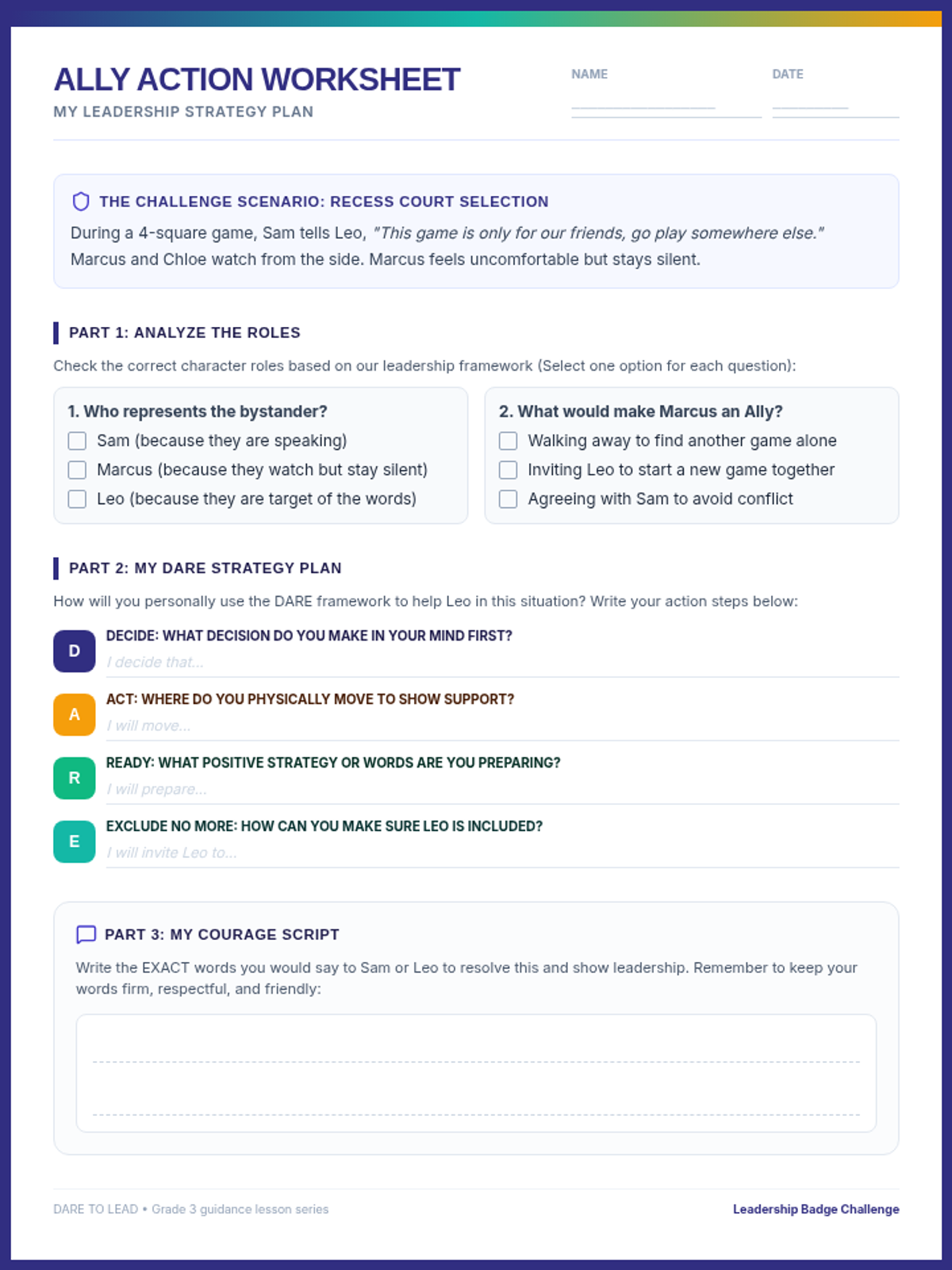
A single-page printable student worksheet for 'Dare to Lead' featuring student name/date fields, identical multiple-choice option styles, and structured handwriting spaces to plan an ally intervention.
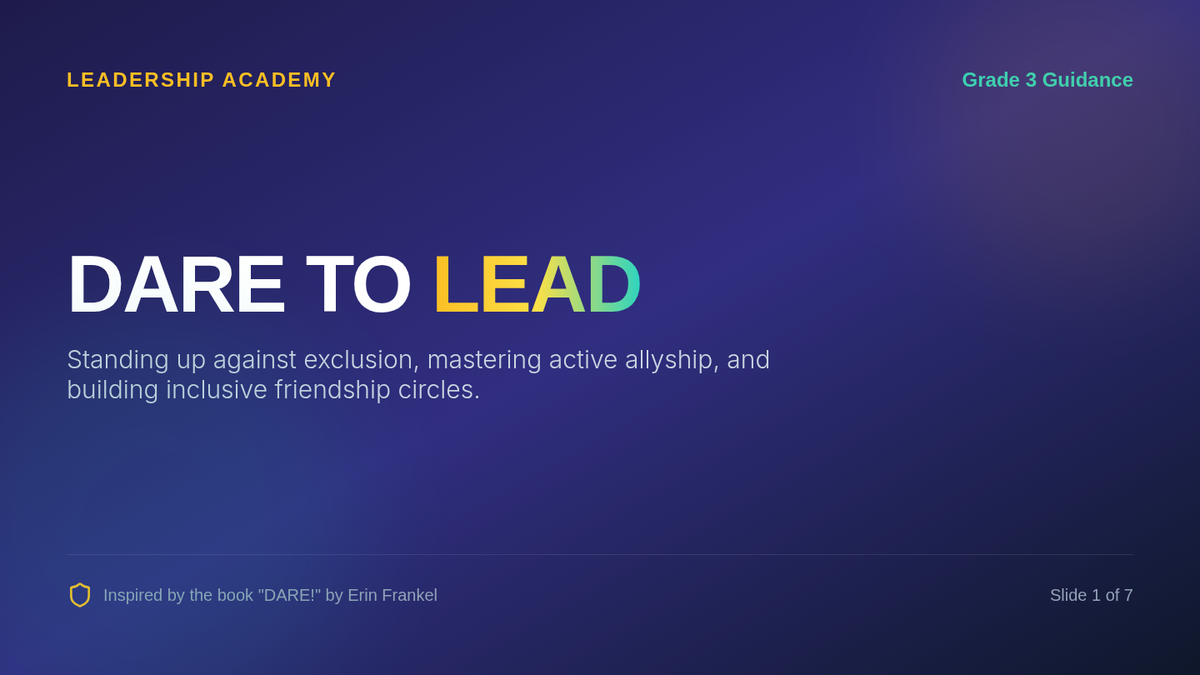
A presentation slide deck of 7 slides matching the 16:9 widescreen format, with minimum 24px font sizes, engaging visuals, and step-by-step facilitation prompts for the DARE framework.
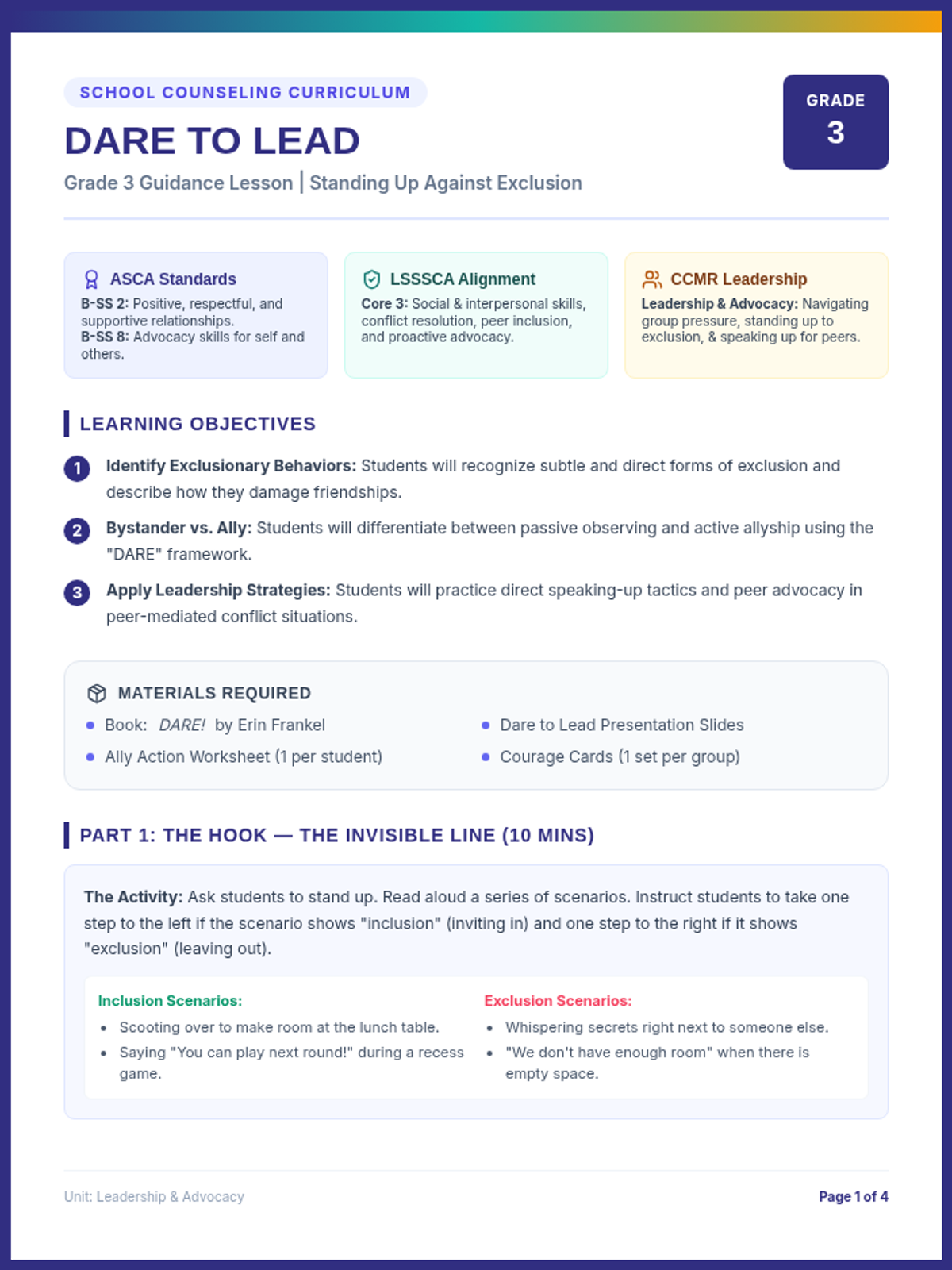
A comprehensive 4-page counselor lesson plan for 'Dare to Lead' aligned with ASCA, LSSSCA, and CCMR Leadership & Advocacy standards, featuring lesson objectives, book discussion guides for 'DARE!', and facilitation instructions.
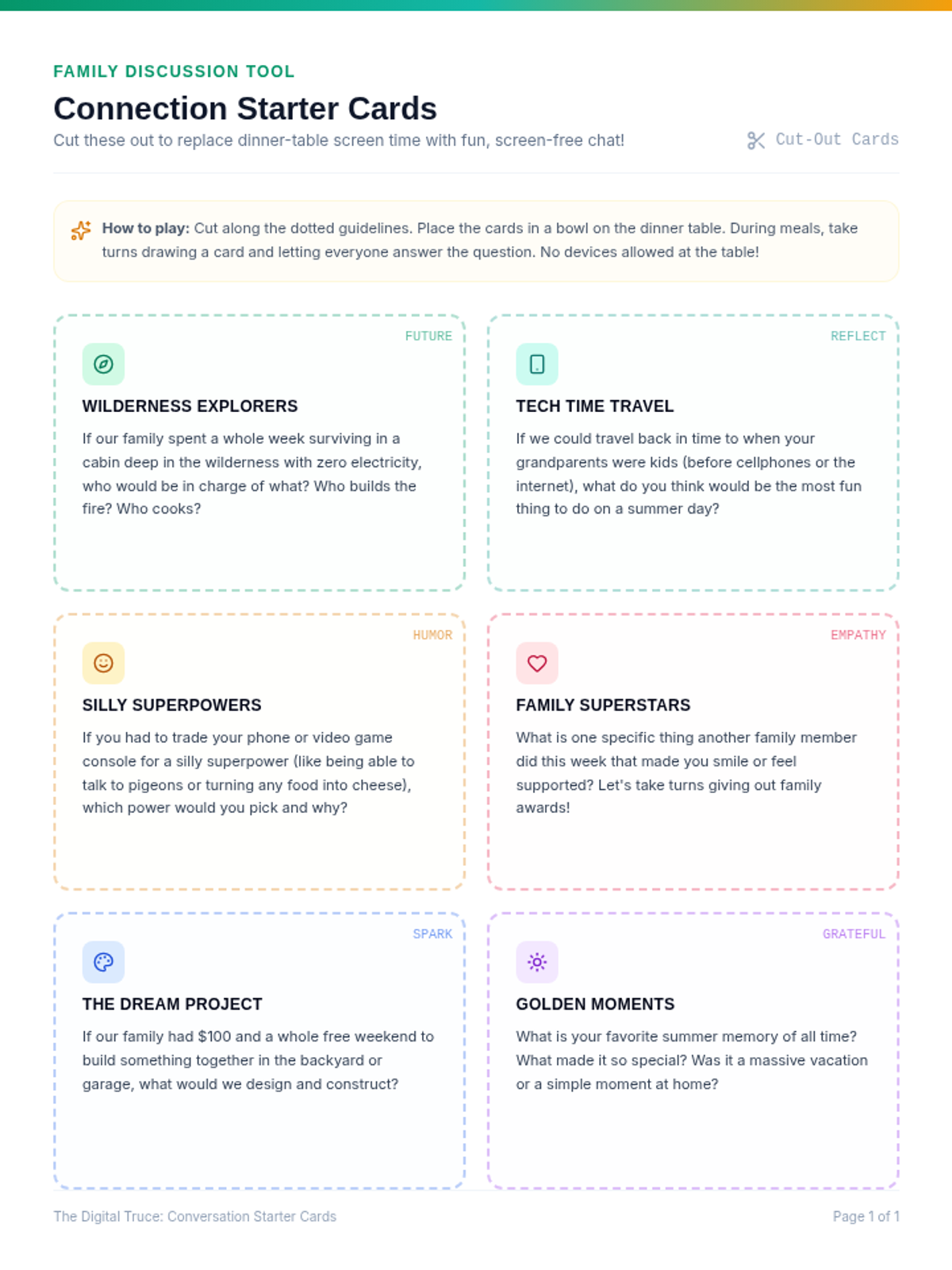
A set of 6 printable family conversation cards designed to replace screen-time with screen-free dinner table or bedtime discussion.
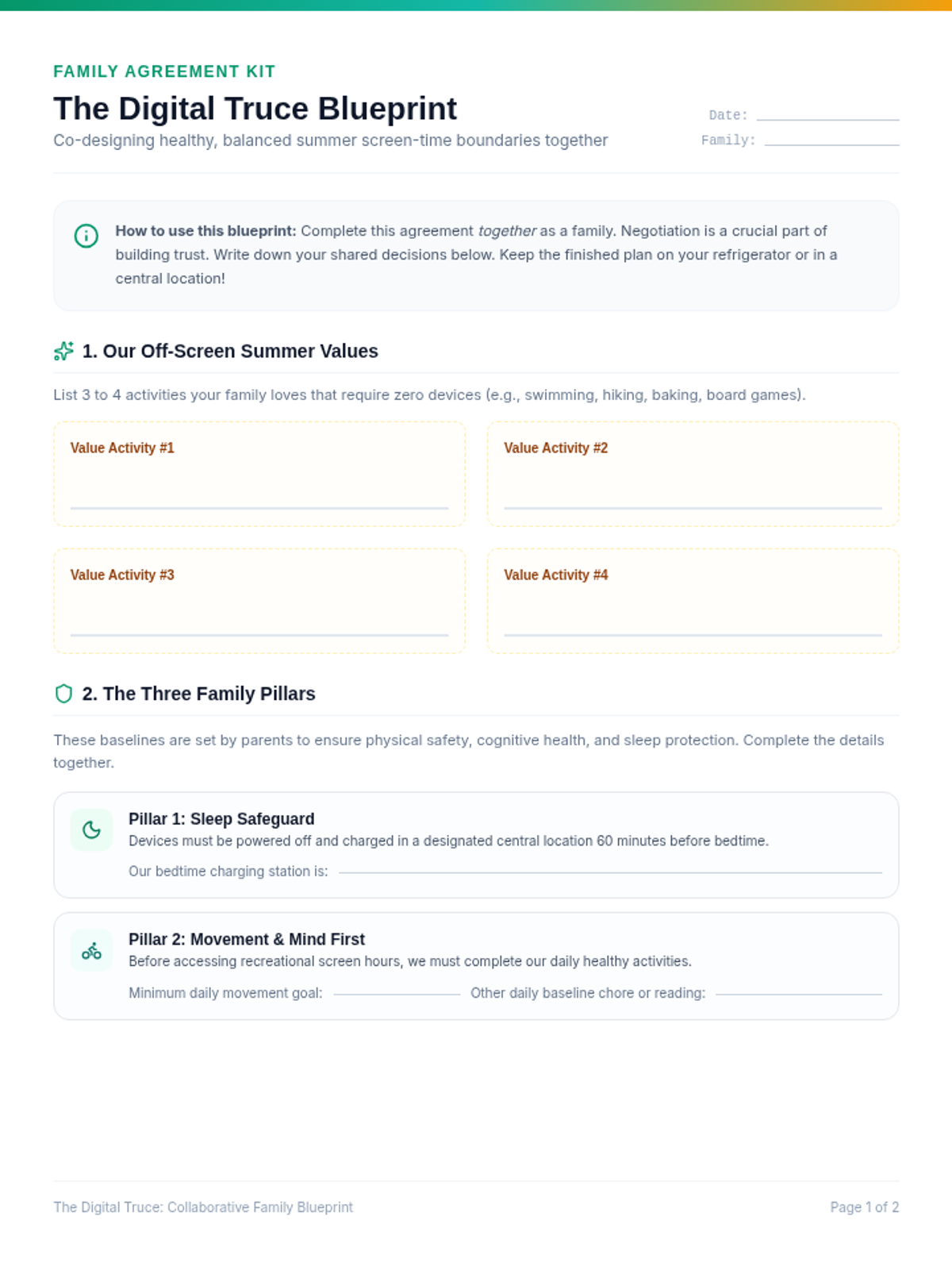
A beautifully designed, collaborative 2-page family agreement blueprint with fields for parents and kids to co-design and commit to screen boundaries.
An elegant 5-slide presentation deck (16:9 format) for leading the Digital Truce parent workshop, using clear layouts and a strict minimum 24px font size.
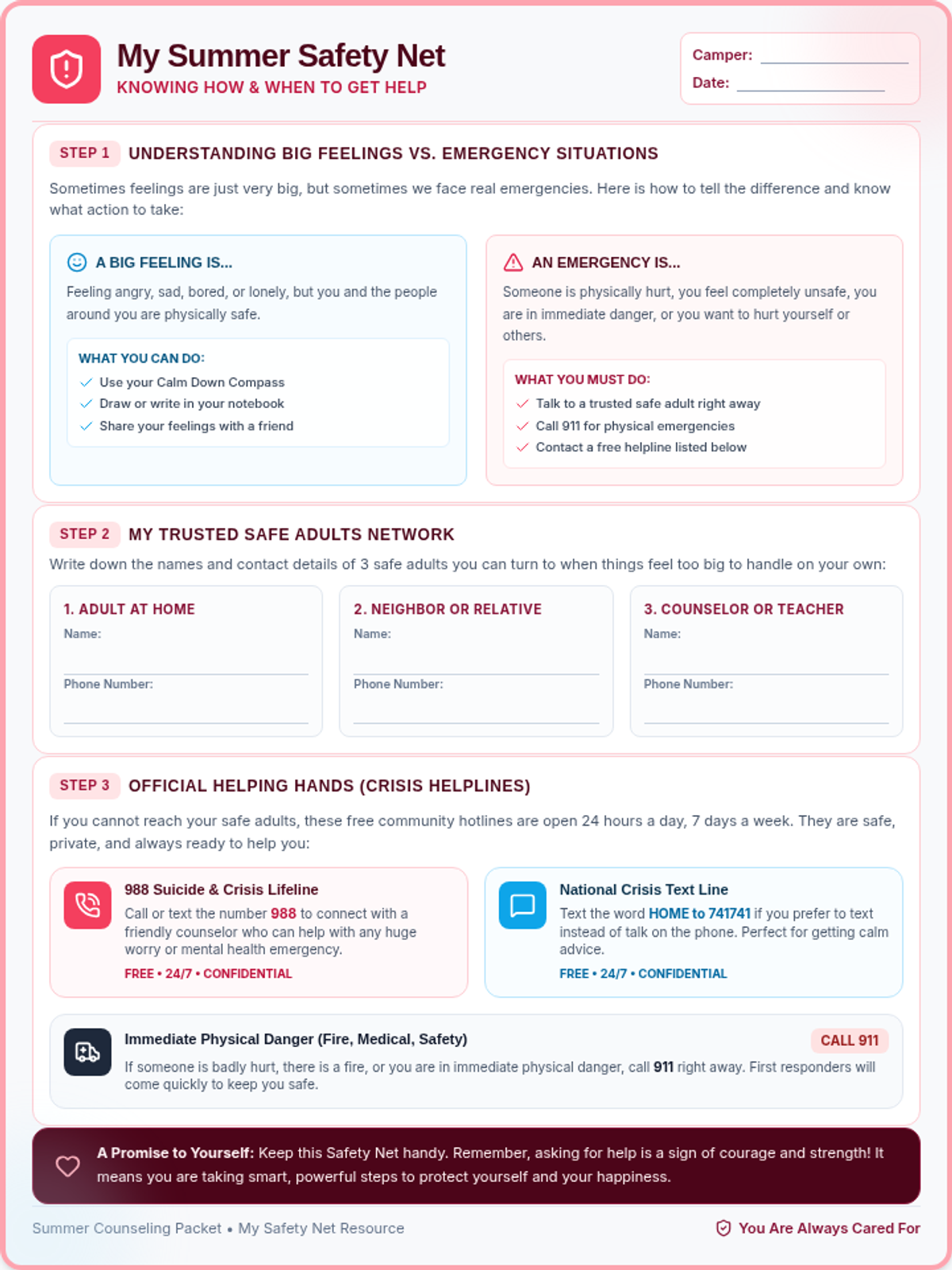
A 1-page kid-friendly safety resource and emergency contact guide helping students distinguish between big feelings and physical/emotional emergencies, map out safe adults, and access free crisis helplines.
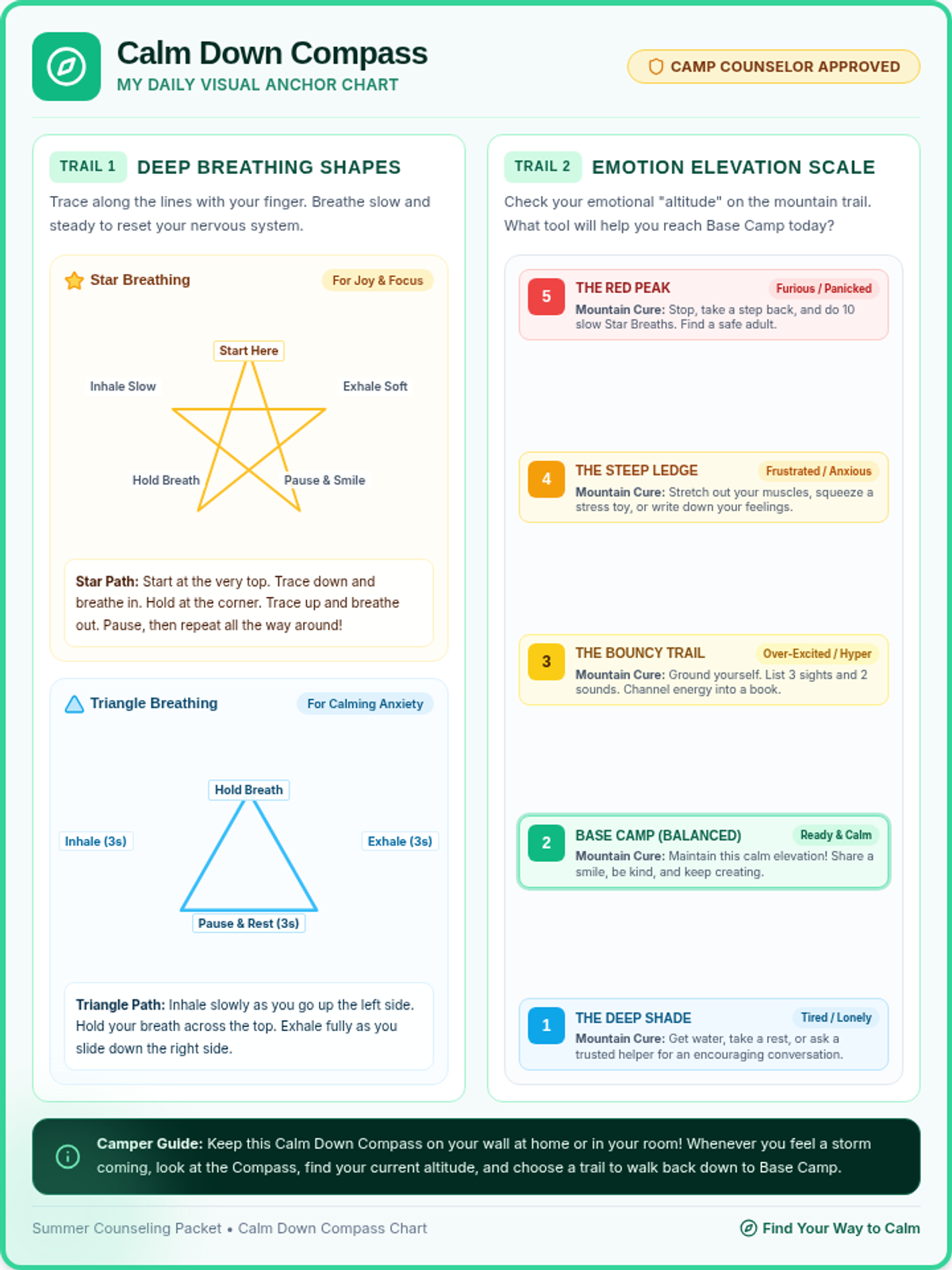
A 1-page visual anchor chart poster split into two columns: one side showing Star and Triangle deep breathing shapes, and the other side showing an mountain-themed emotional regulation scale.
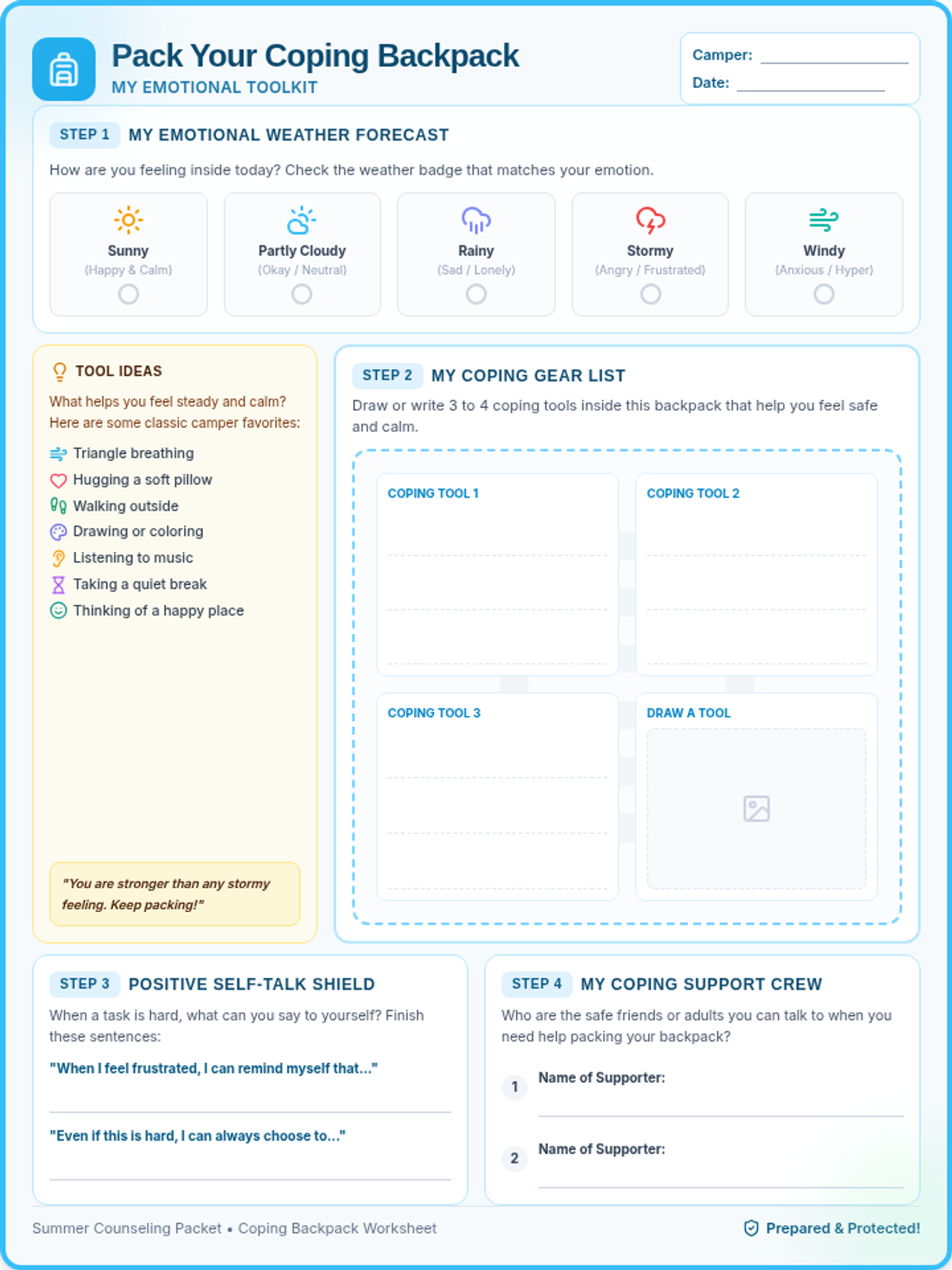
A 1-page interactive student worksheet styled as a camping backpack for students to draw, list, and organize their personal emotional coping strategies and positive self-talk statements.
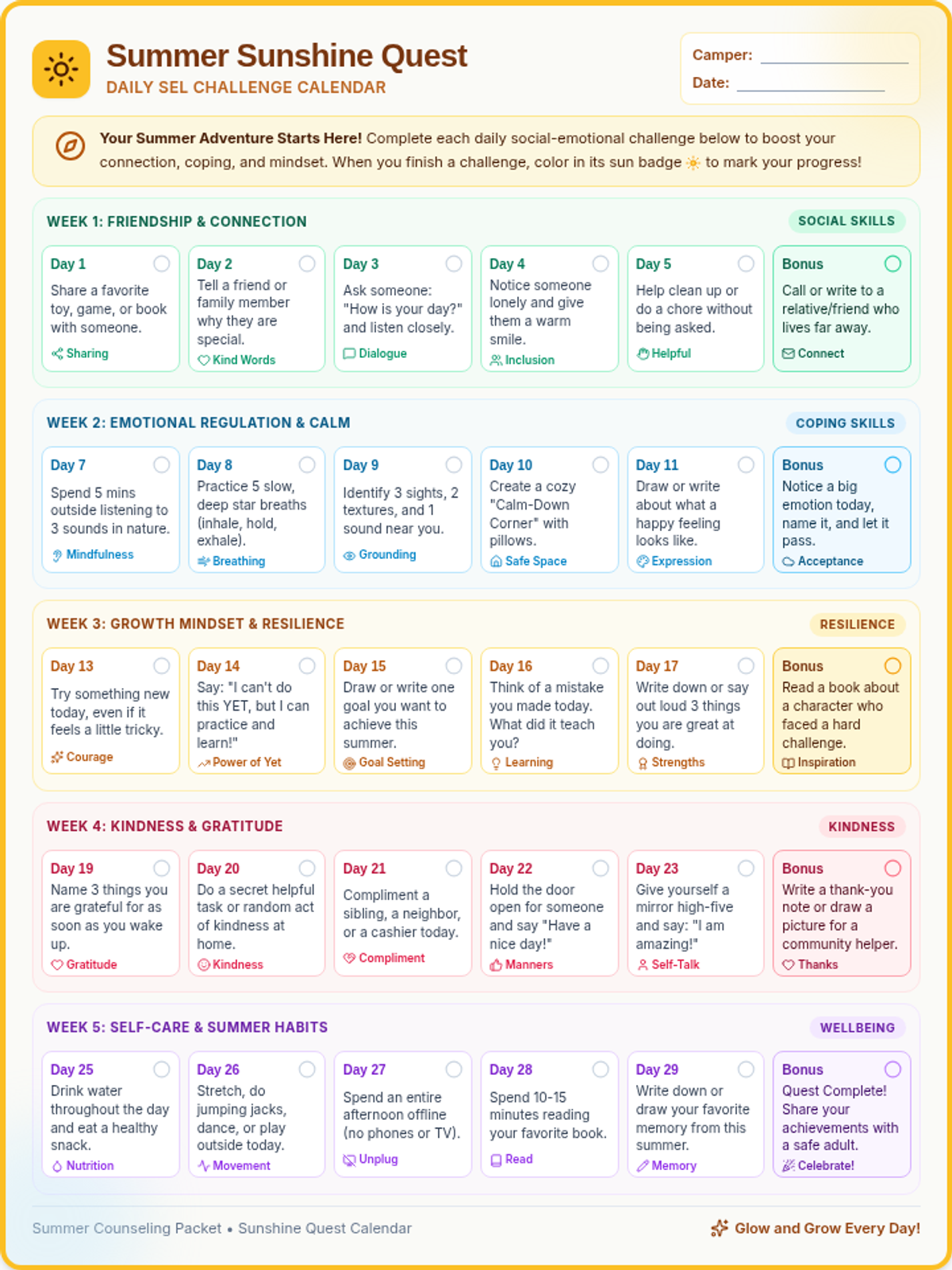
A 1-page summer SEL challenge calendar formatted as a 5-week tracking grid with 30 quick, actionable social-emotional, mindfulness, friendship, and growth-mindset daily challenges.
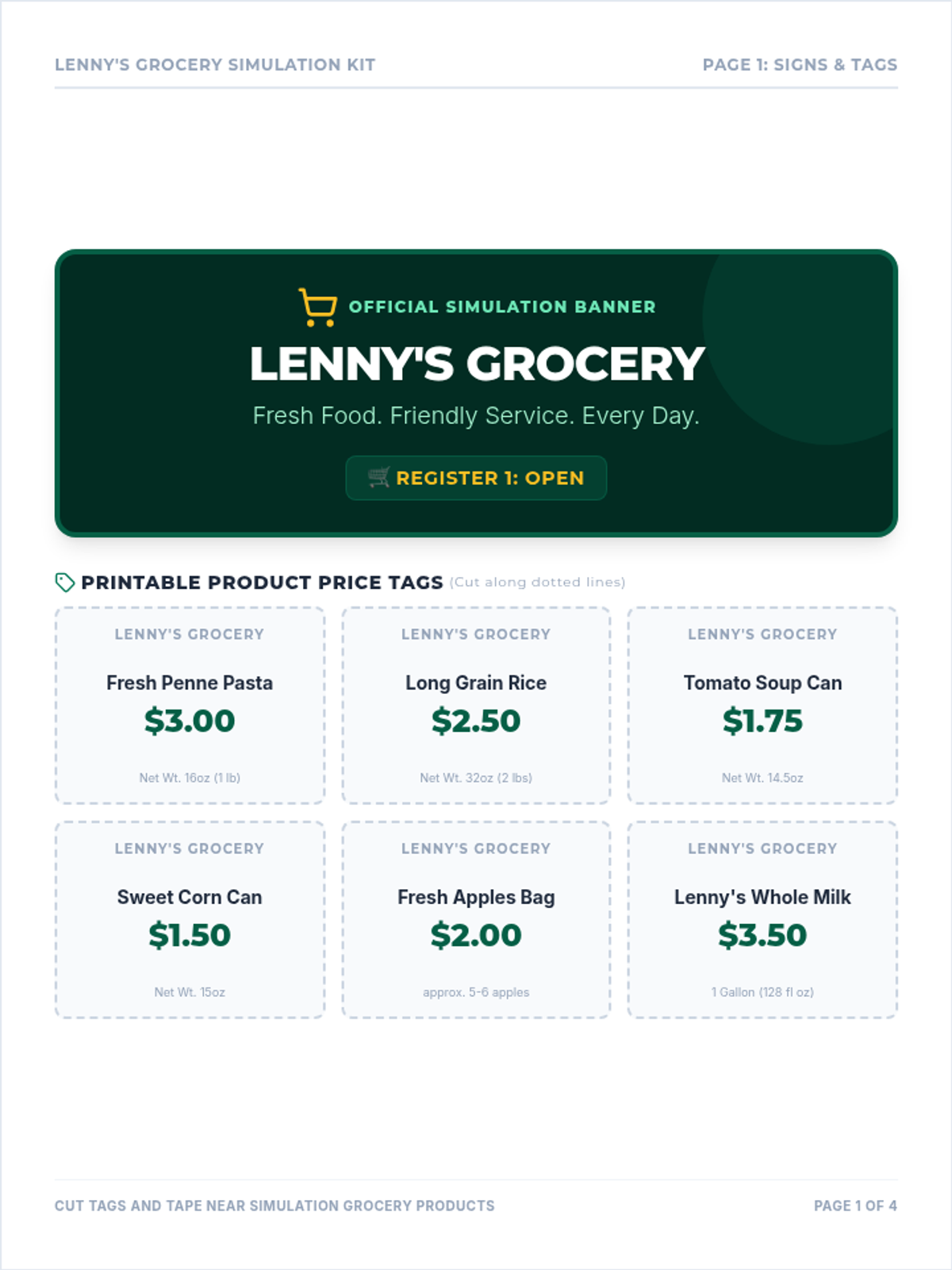
Printable store simulation resources for Lenny's Grocery. Includes store banners, product price tags, role badges, practice coupons, customer mission cards, and job duty checklist guides.
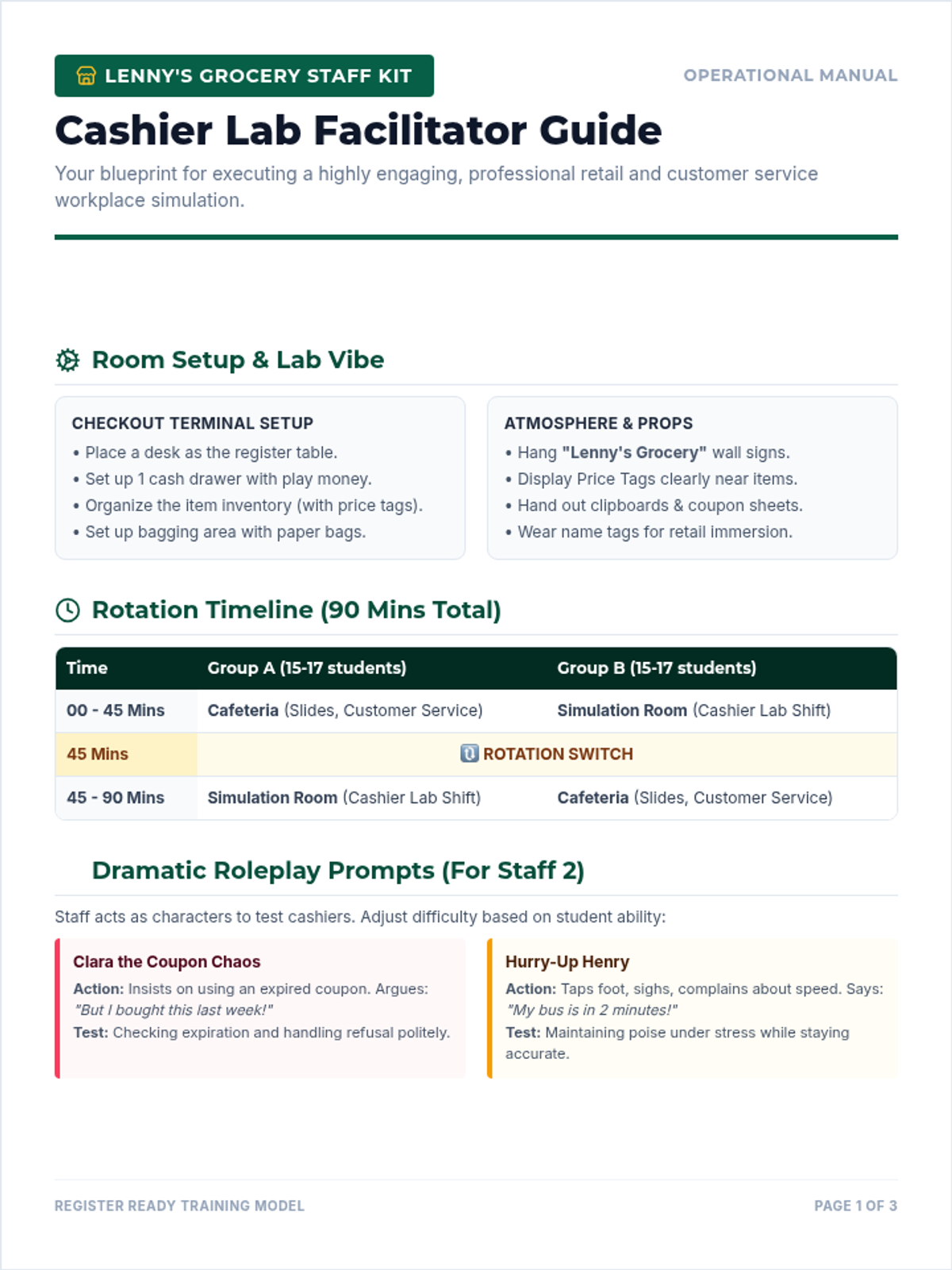
A complete lesson facilitator guide for trainers running the Cashier Lab and Cafeteria rotation. Includes classroom setup, roleplay prompt scripts, a debrief discussion guide, and an employability skill evaluation rubric.
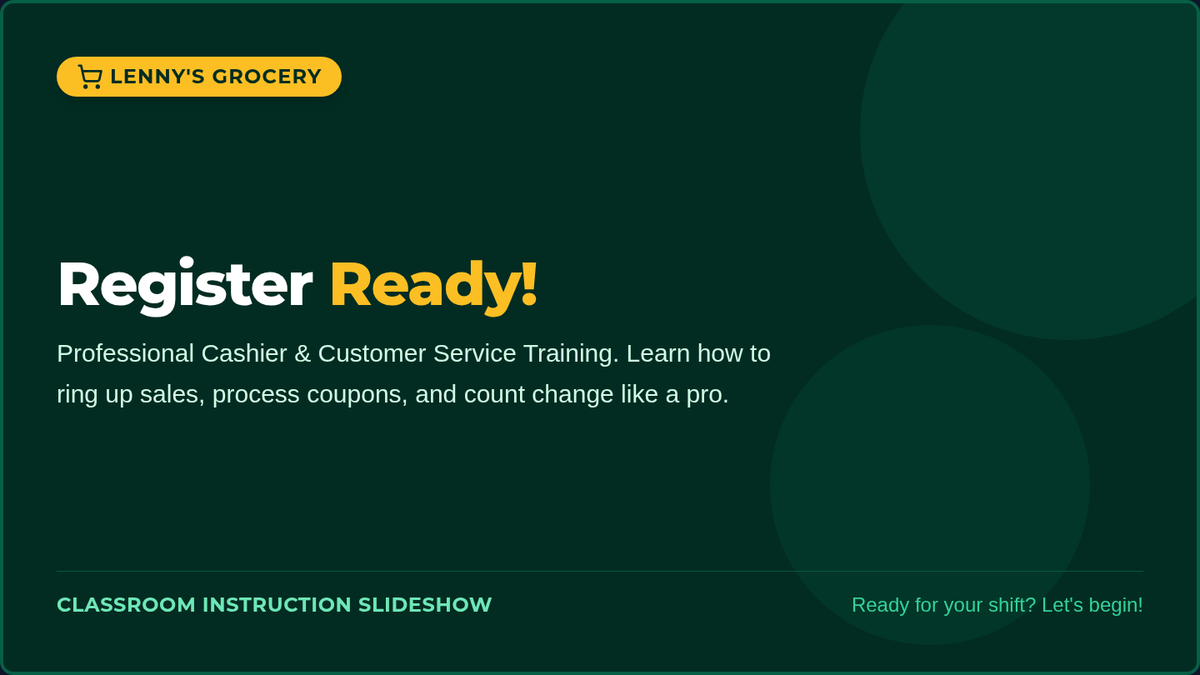
Interactive training slides for cashiers covering customer service, coupon calculations, and making change using the counting-up method. Includes dedicated slides for all 5 instructional YouTube videos.
Interactive assembly slides for Counselor's Week 4 session on Celebration, Reflection, and administering the school-wide student post-assessment.
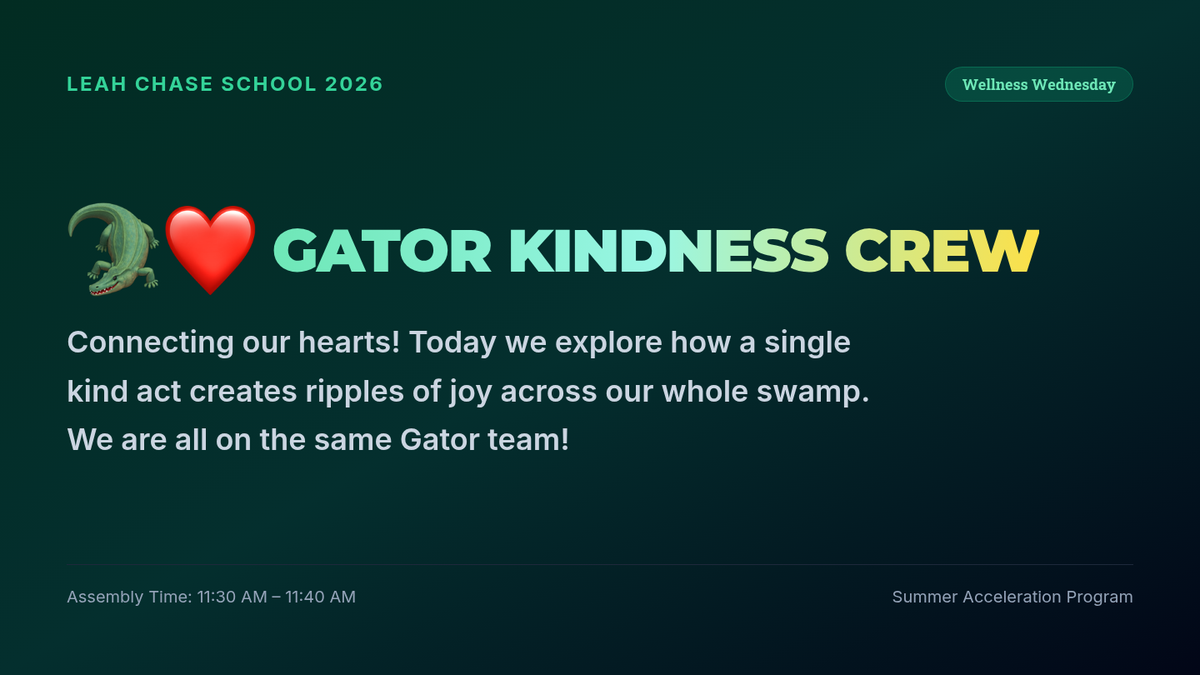
Interactive assembly slides for Counselor's Week 3 session on Kindness and Community, teaching students about bucket filling and empathy.
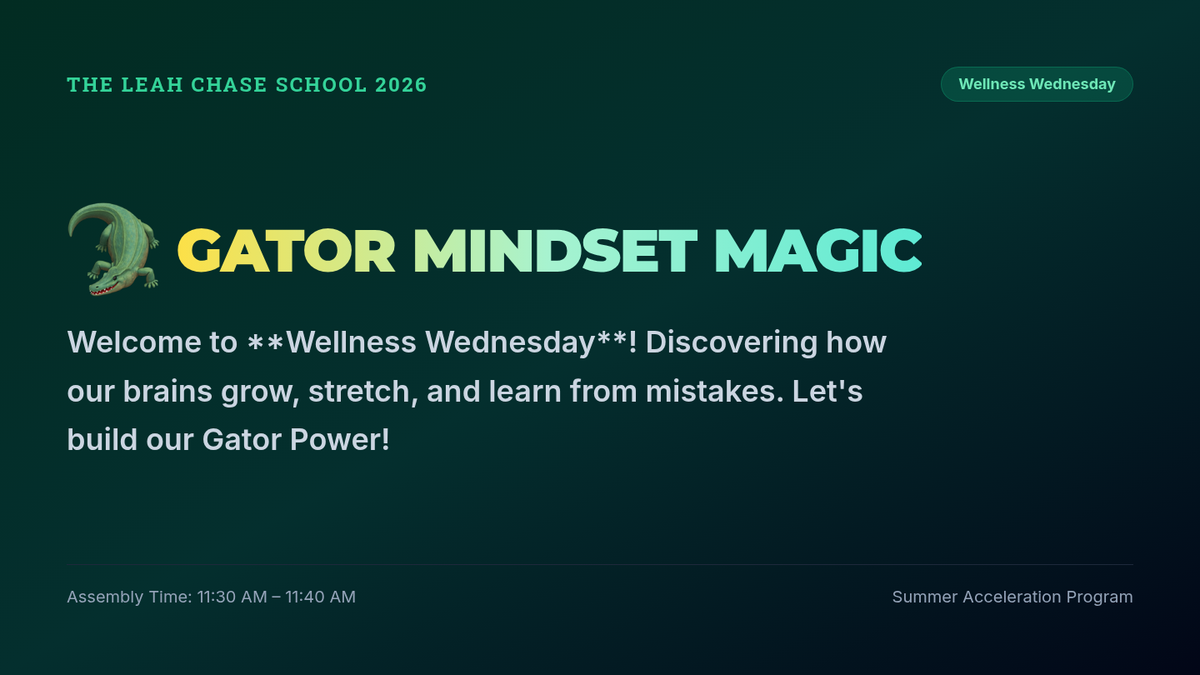
Interactive assembly slides for Counselor's Week 1 session on Growth Mindset, featuring the power of 'Yet' and pre-assessment instructions.
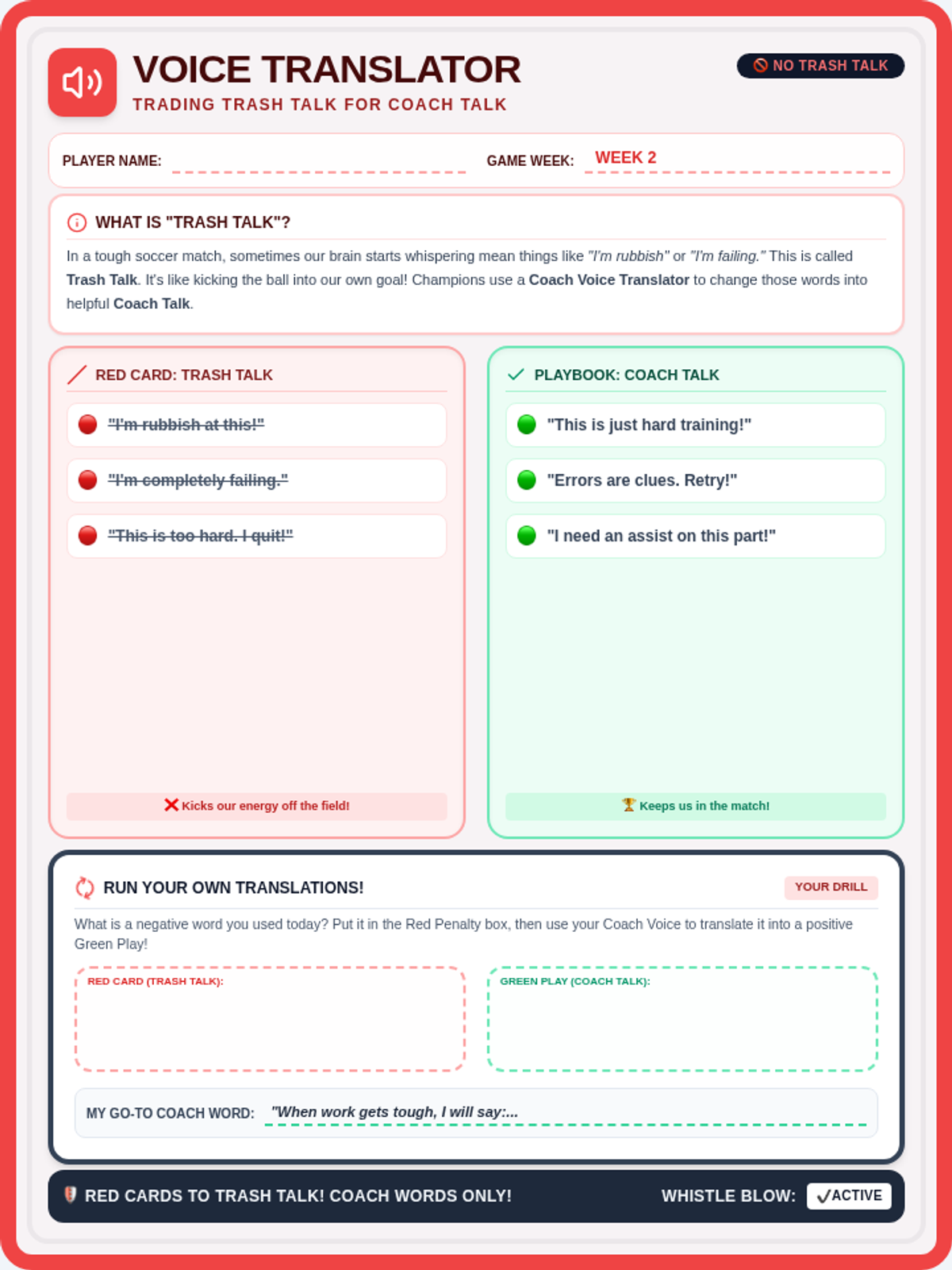
A highly visual, soccer-themed translation worksheet that helps the student change 'trash talk' (negative self-talk like 'I'm rubbish') into 'coach talk' (productive strategies like 'I need an assist' or 'let's run a replay').
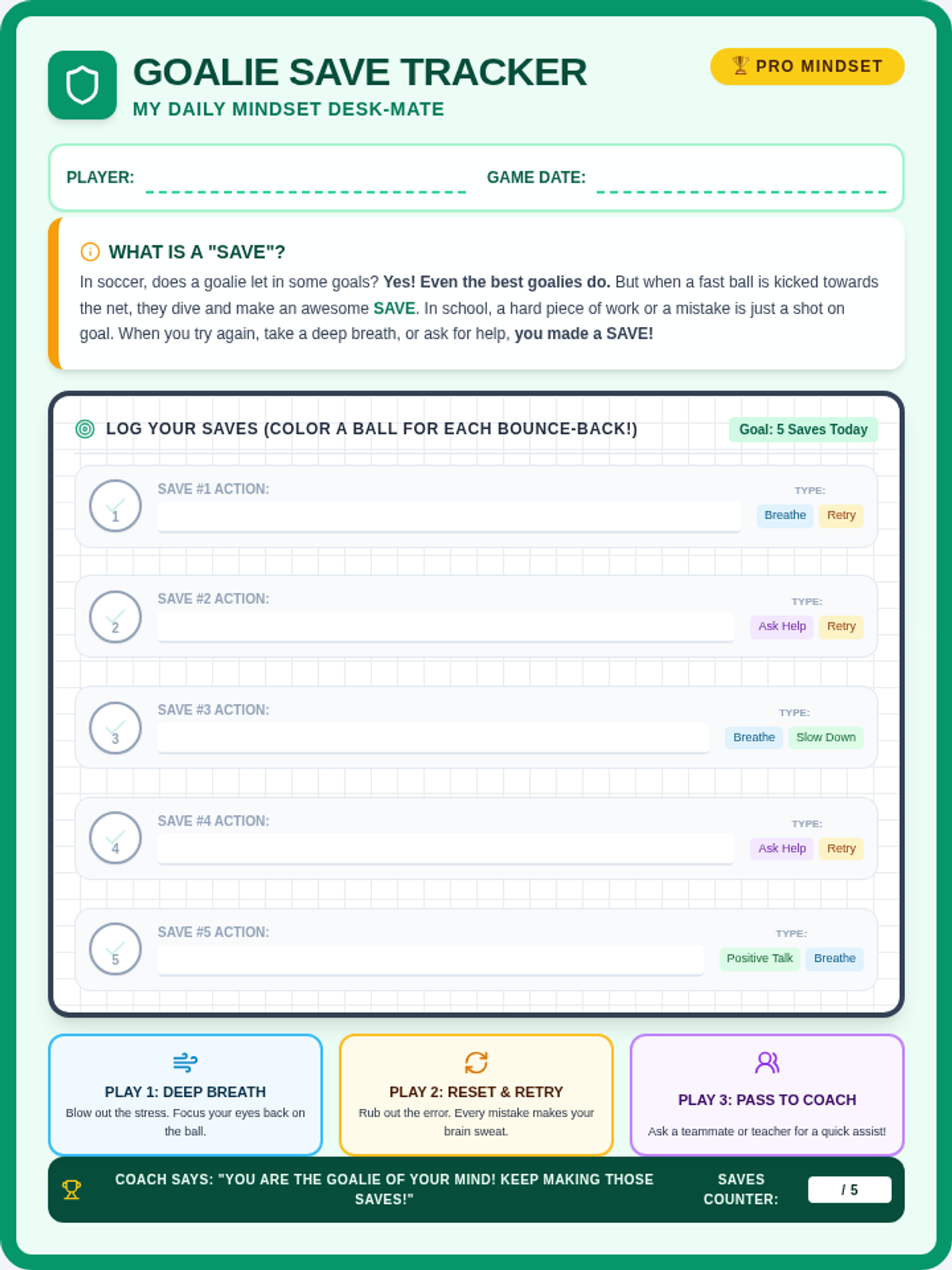
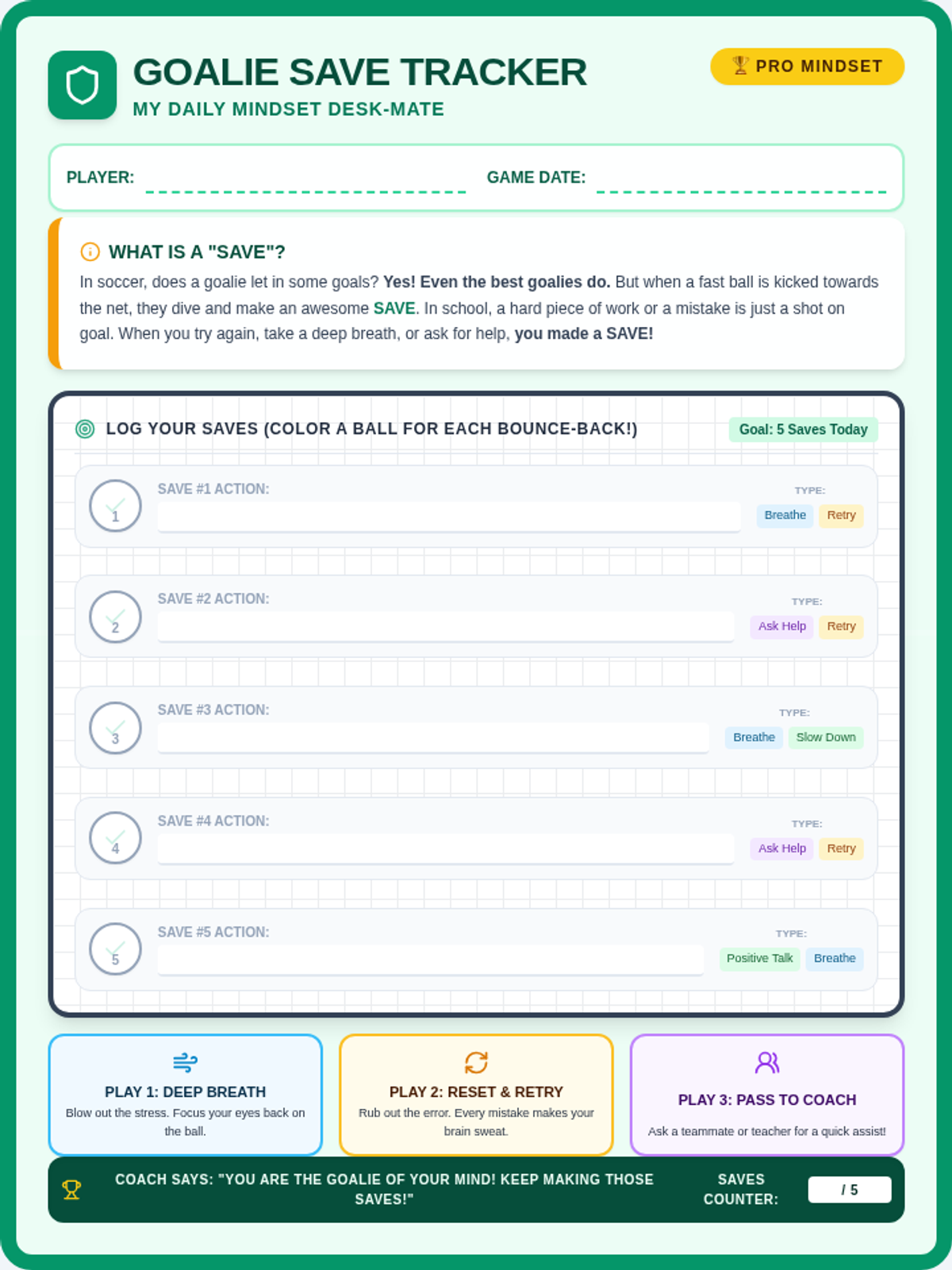
A printable soccer-themed desk tracker for Year 2 students to log 'saves'—instances where they bounced back from a mistake or coped with difficult work, framing mistakes as shots on goal that can be actively blocked and saved.
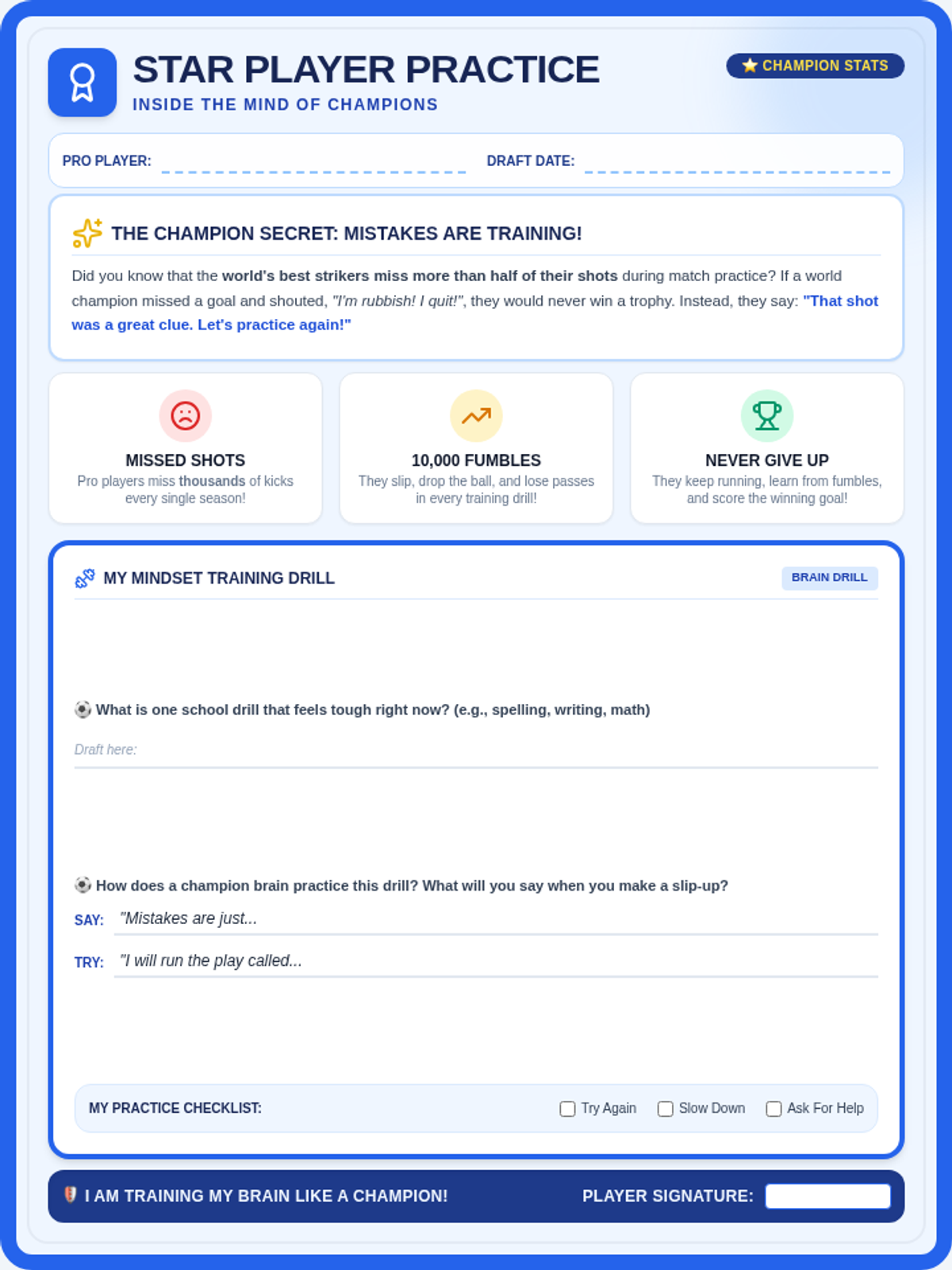
An engaging student activity sheet normalizing mistakes by showing how professional soccer champions fumbles, fail, and practice daily. Helps the student reframe errors as training exercises rather than failures.
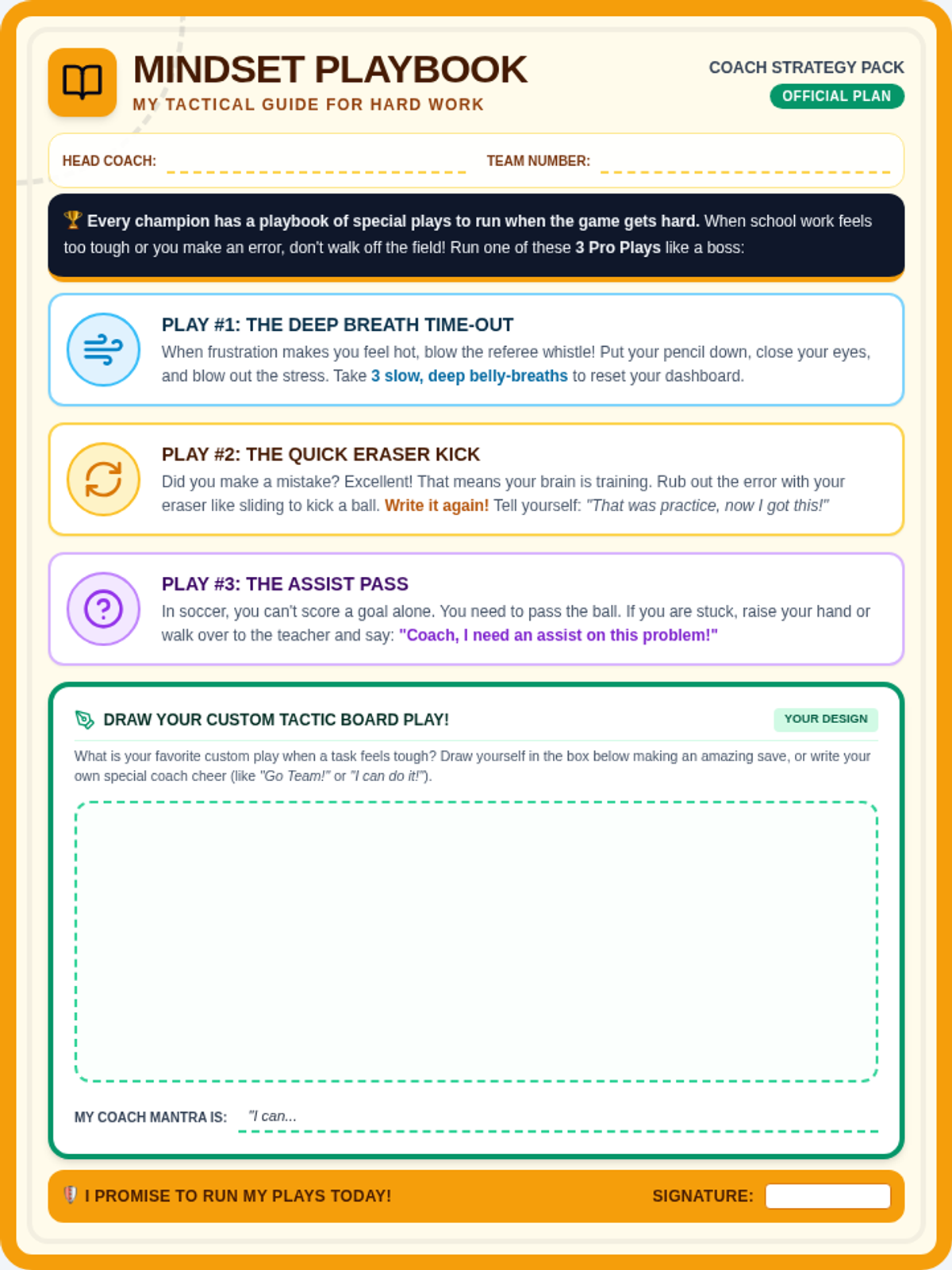
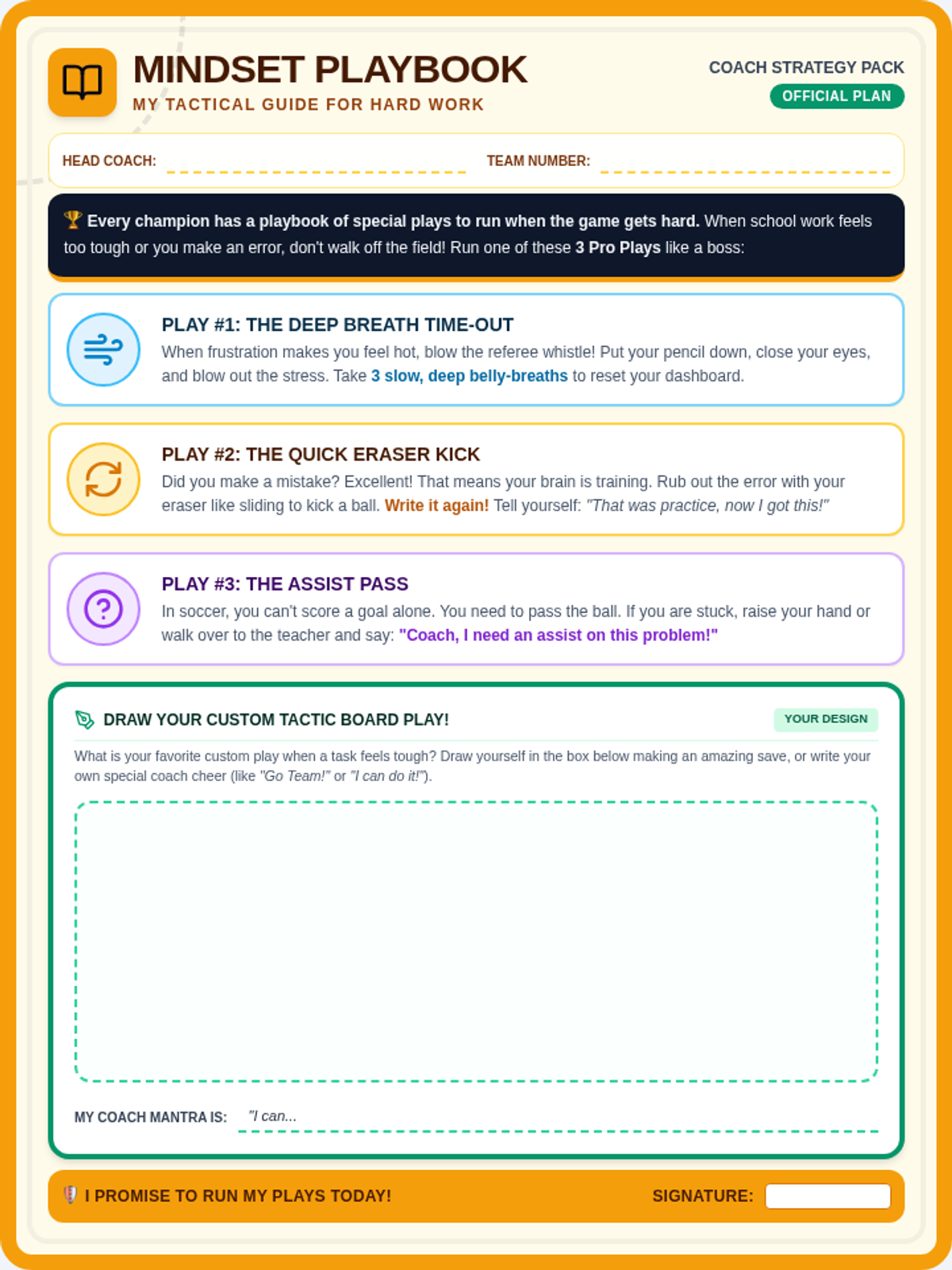
A step-by-step printable visual 'playbook' showing the exact positive actions ('plays') the student can run when a worksheet gets too difficult or frustration starts to rise. Includes a custom play design section.
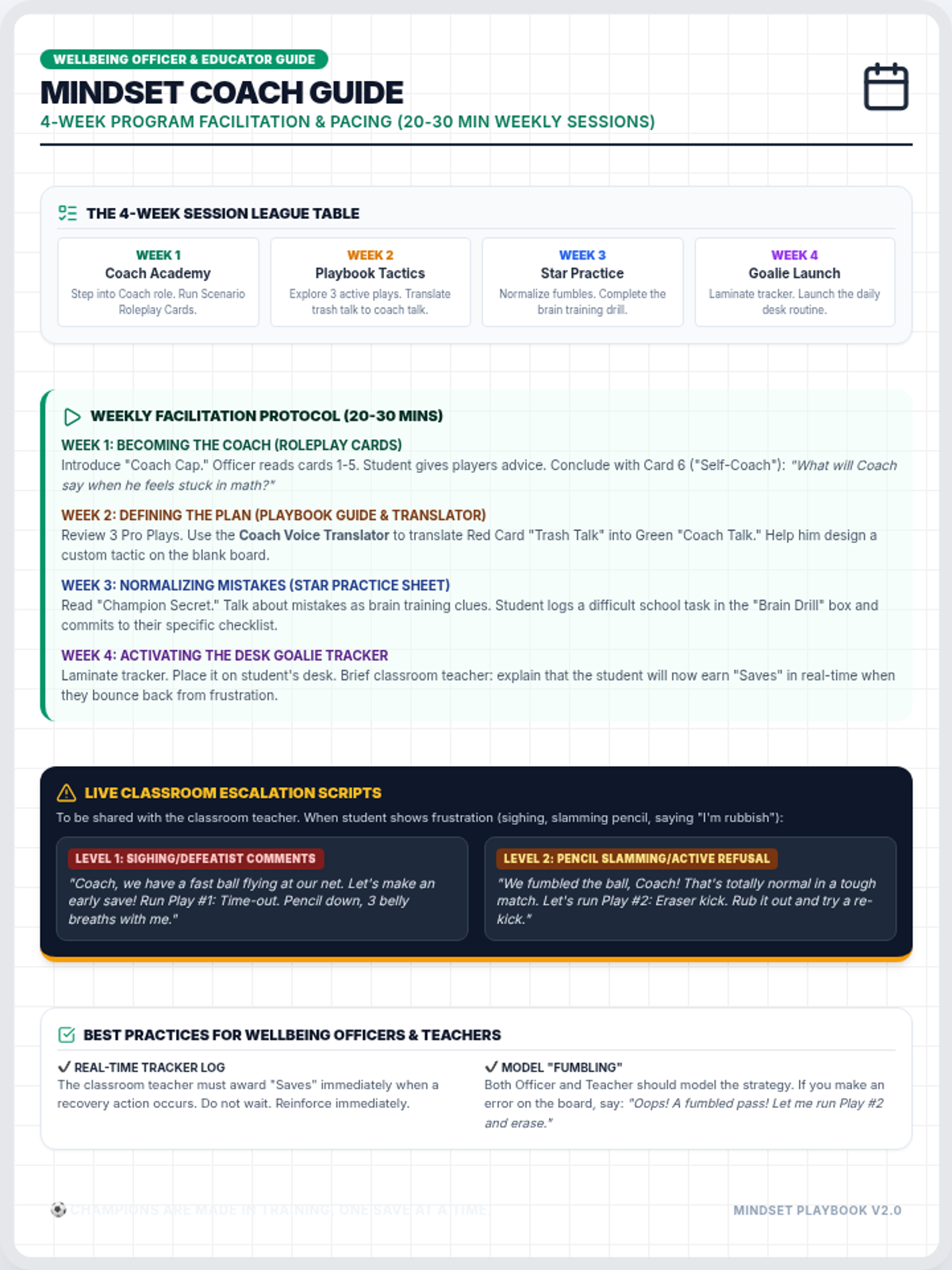
A professional facilitator guide for teachers and learning support assistants detailing how to introduce the soccer-themed package, run the roleplay cards, set up the desk-tracker routine, and manage live classroom escalation using 'coaching play' scripts.
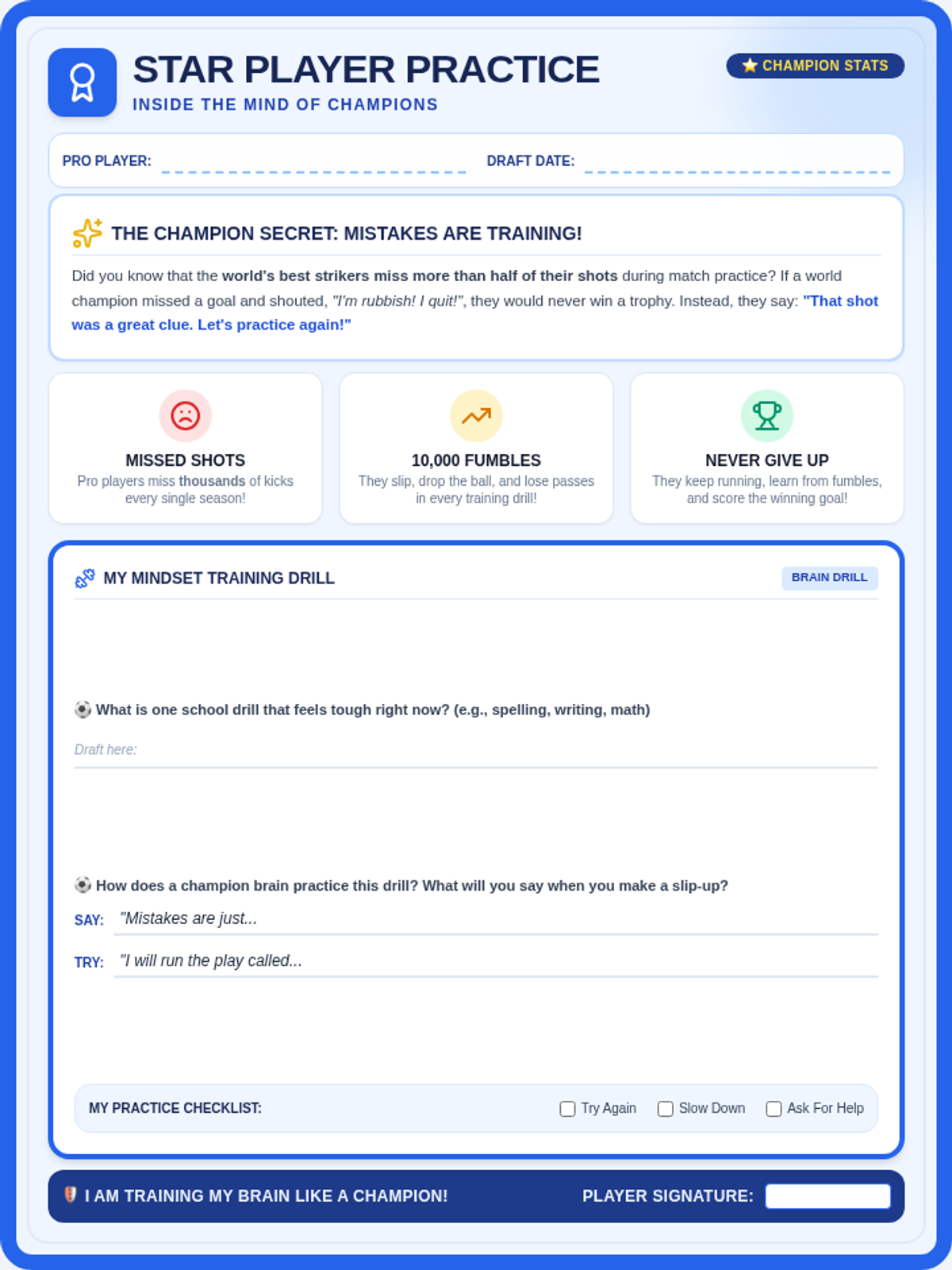
An engaging student activity sheet normalizing mistakes by showing how professional soccer champions fumble, fail, and practice daily. Helps the student reframe errors as training exercises rather than failures.
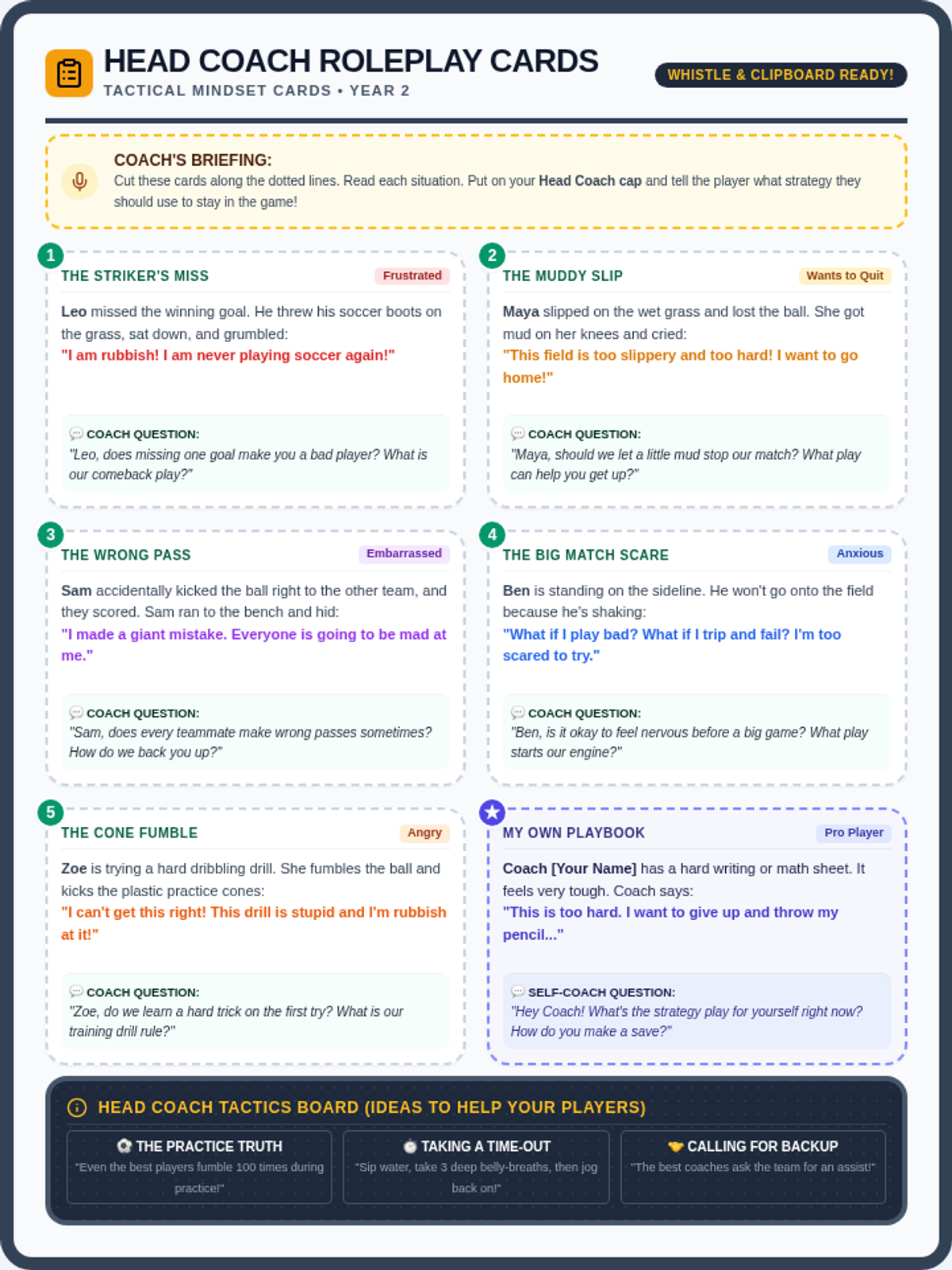
Roleplay scenario cards where the student plays the role of the 'Head Coach' giving expert strategic advice to soccer players who are frustrated or ready to quit due to making mistakes. Helps build projection and positive self-talk.
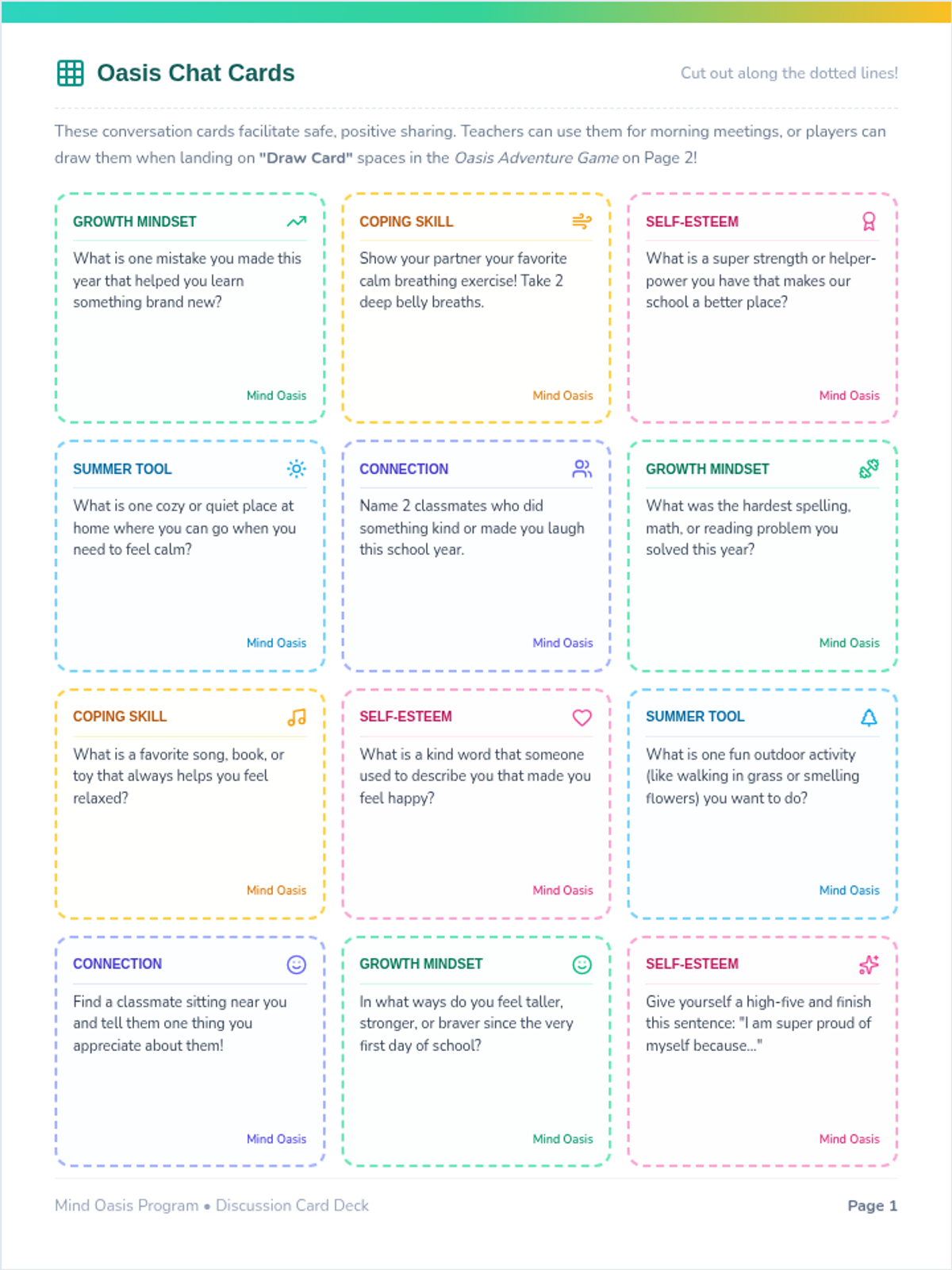
Printable classroom board game and discussion cards resource. Page 1 contains 12 beautifully illustrated, easy-to-cut prompt cards focusing on growth mindset, coping strategies, and peer connection. Page 2 features a complete print-and-play cooperative board game called Oasis Adventure.
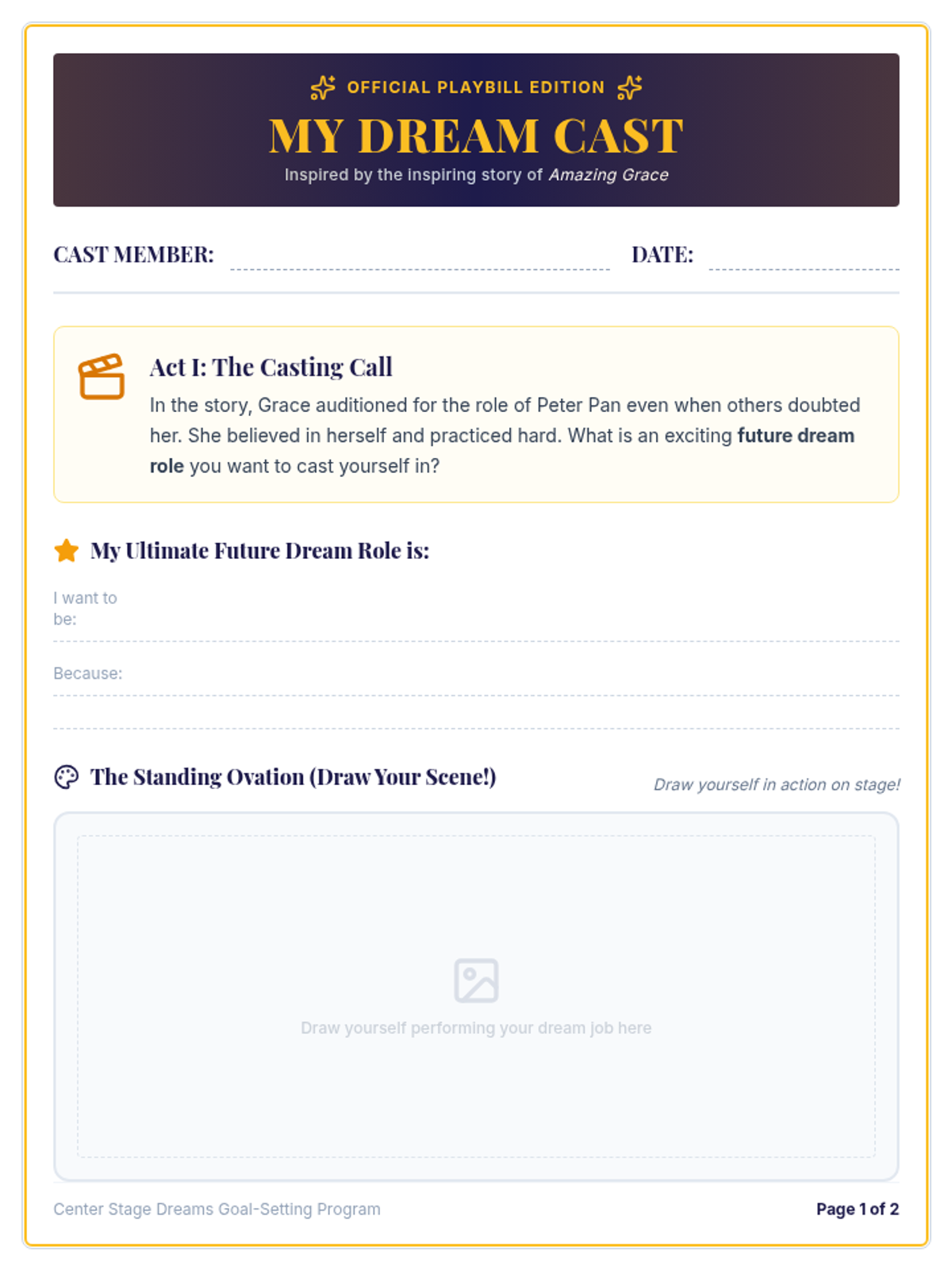
A 2-page print-ready goal-setting worksheet with a theater playbill design. Students brainstorm their dream career/role, illustrate their scene, map out three milestone actions (the audition, rehearsals, and opening night), and reflect on supportive figures in their life.
A theater-themed slide deck to guide discussions around Amazing Grace, exploring the themes of self-belief, casting oneself in big dream roles, and mapping out the action steps to succeed.
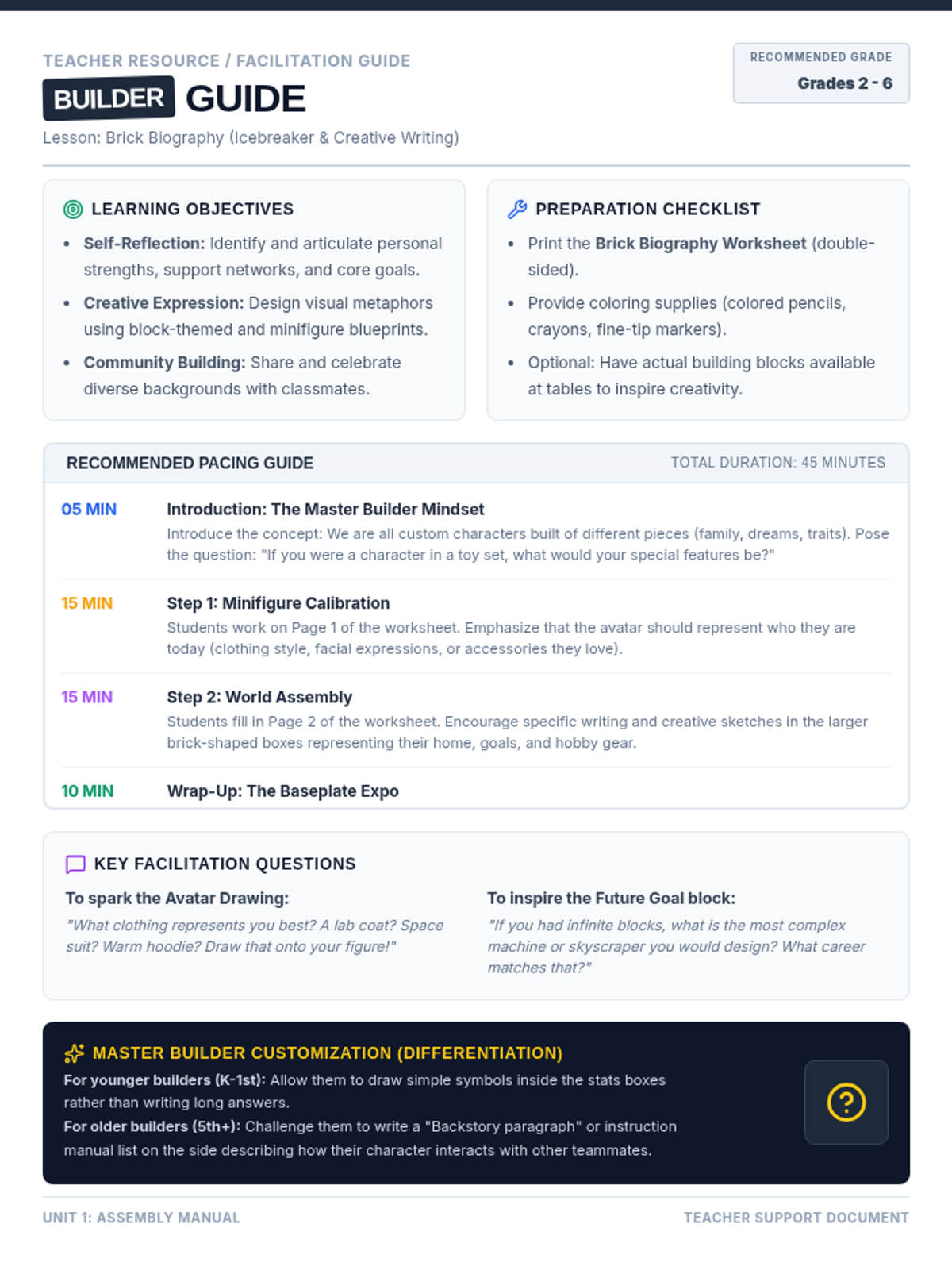
A professional lesson plan and facilitation guide for teachers to deliver the Brick Biography activity, including detailed pacing, icebreakers, and classroom connection ideas.
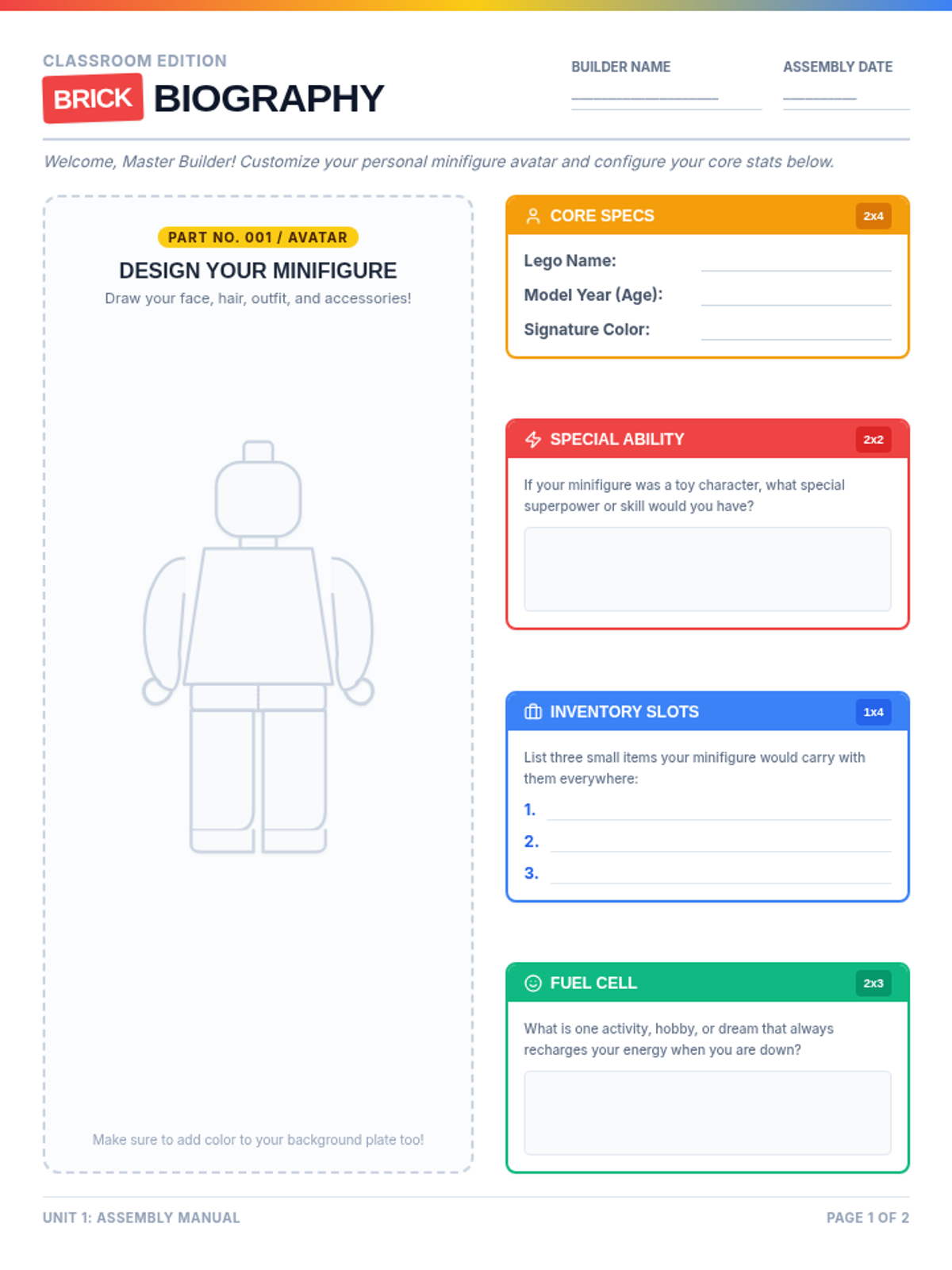
A double-sided, print-ready "About Me" worksheet featuring a customizable minifigure template, brick-themed prompt boxes, and building block layouts for students to express their unique identity.
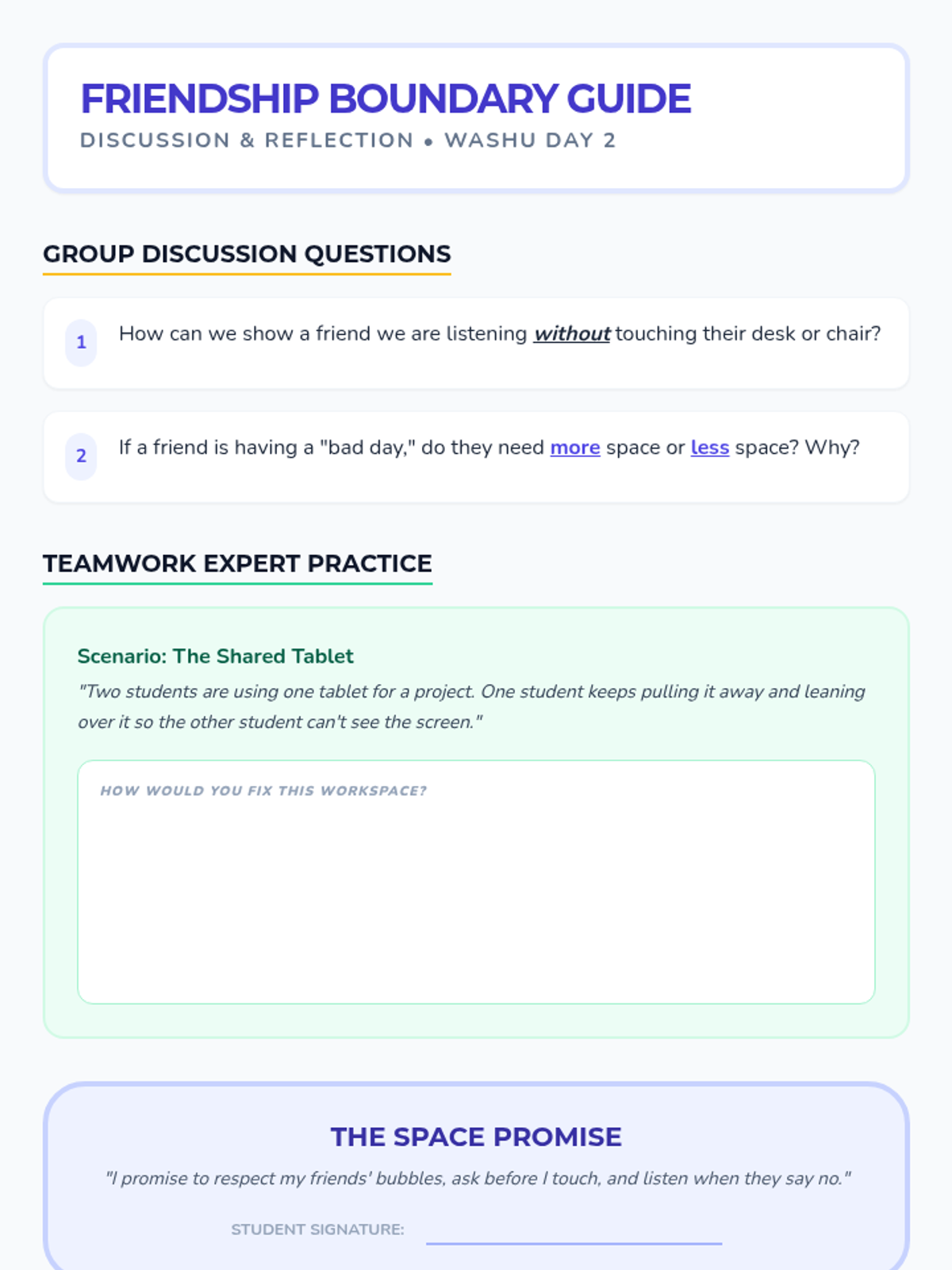
Revised Friendship Boundary Guide for WashU. Converted background to white, condensed layout to ensure the signature section stays on the same page, and expanded the brainstorming area.
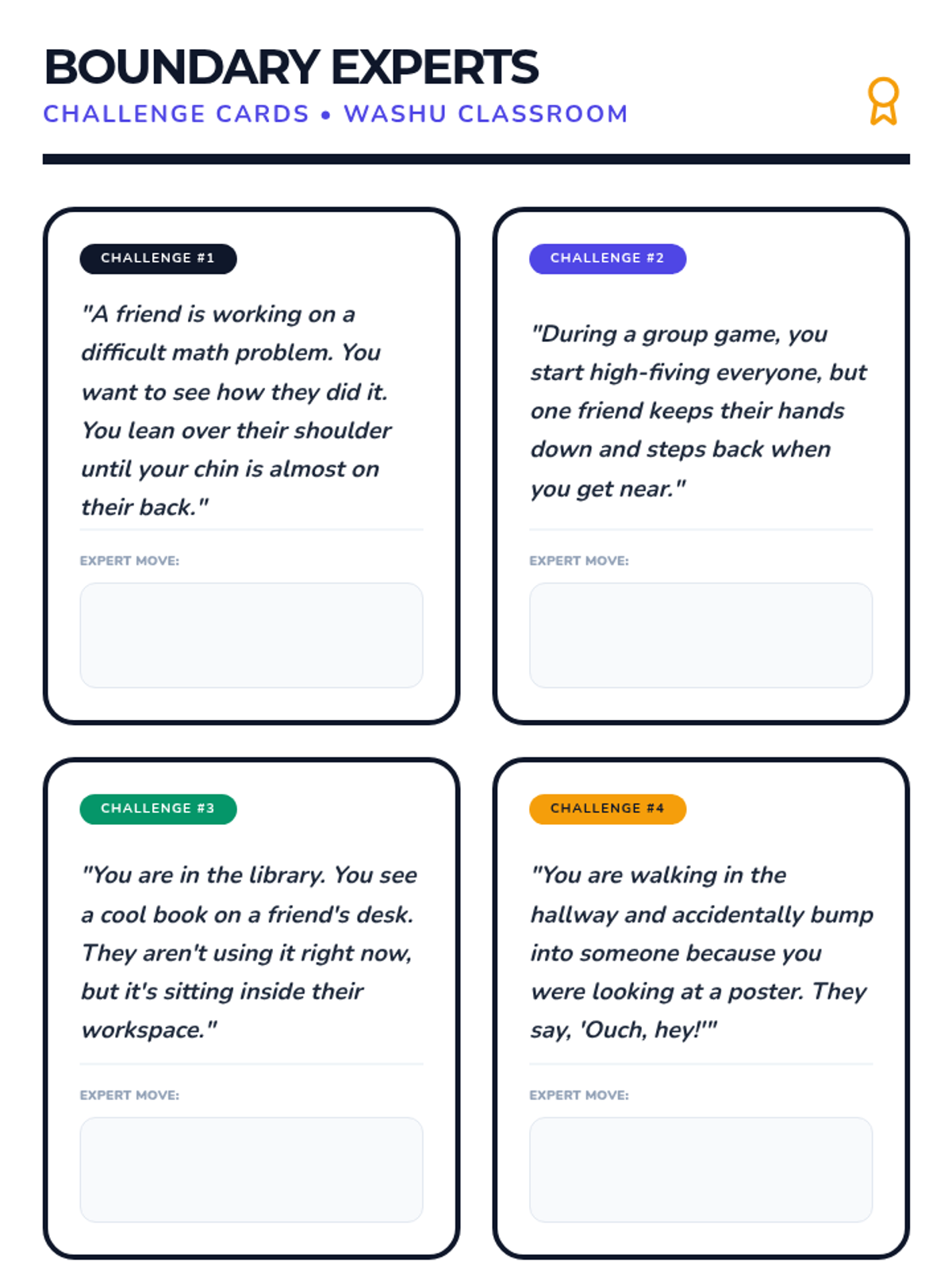
Revised challenge cards for WashU. Increased icon visibility, optimized response box backgrounds to white for better handwriting legibility, and improved footer readability.
Advanced slide deck for WashU students focusing on nuanced social boundaries. Covers teamwork, friendship etiquette, respecting the word "No," and complex school scenarios like group projects.
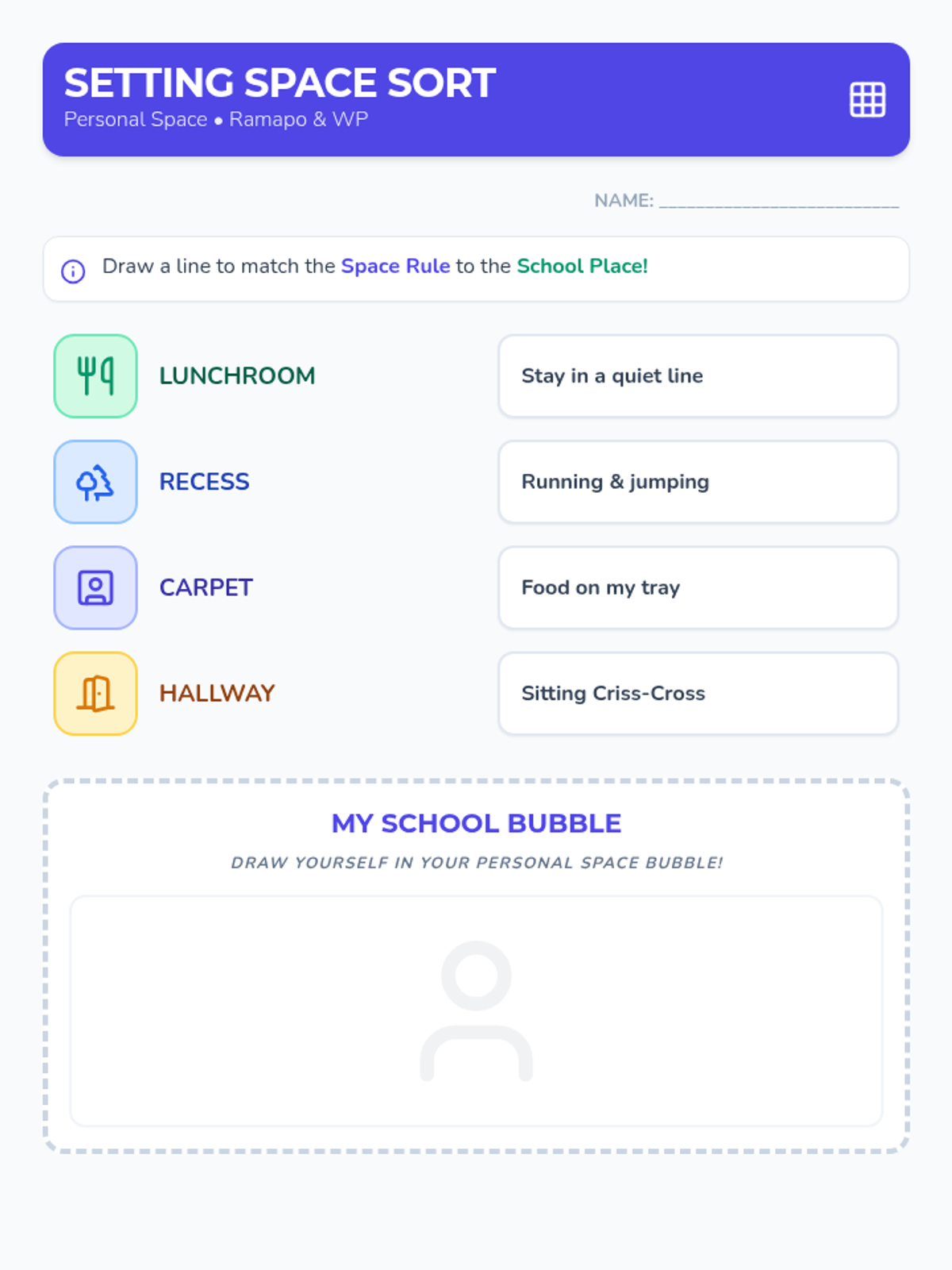
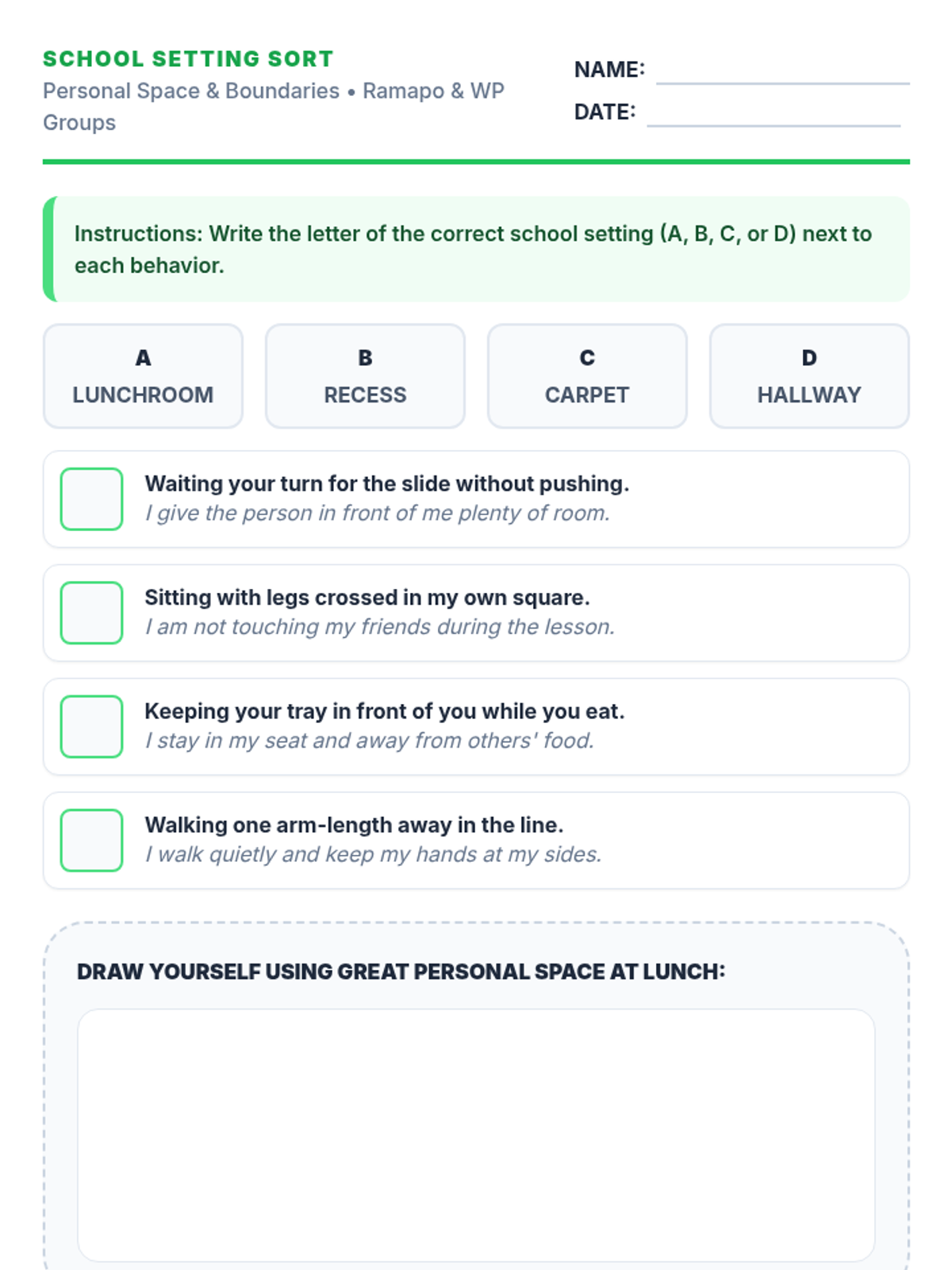
Revised Setting Space Sort worksheet for Ramapo and WP. Randomized the matching items, aligned the name field with the page margins, and removed the background icon from the drawing area for better legibility.
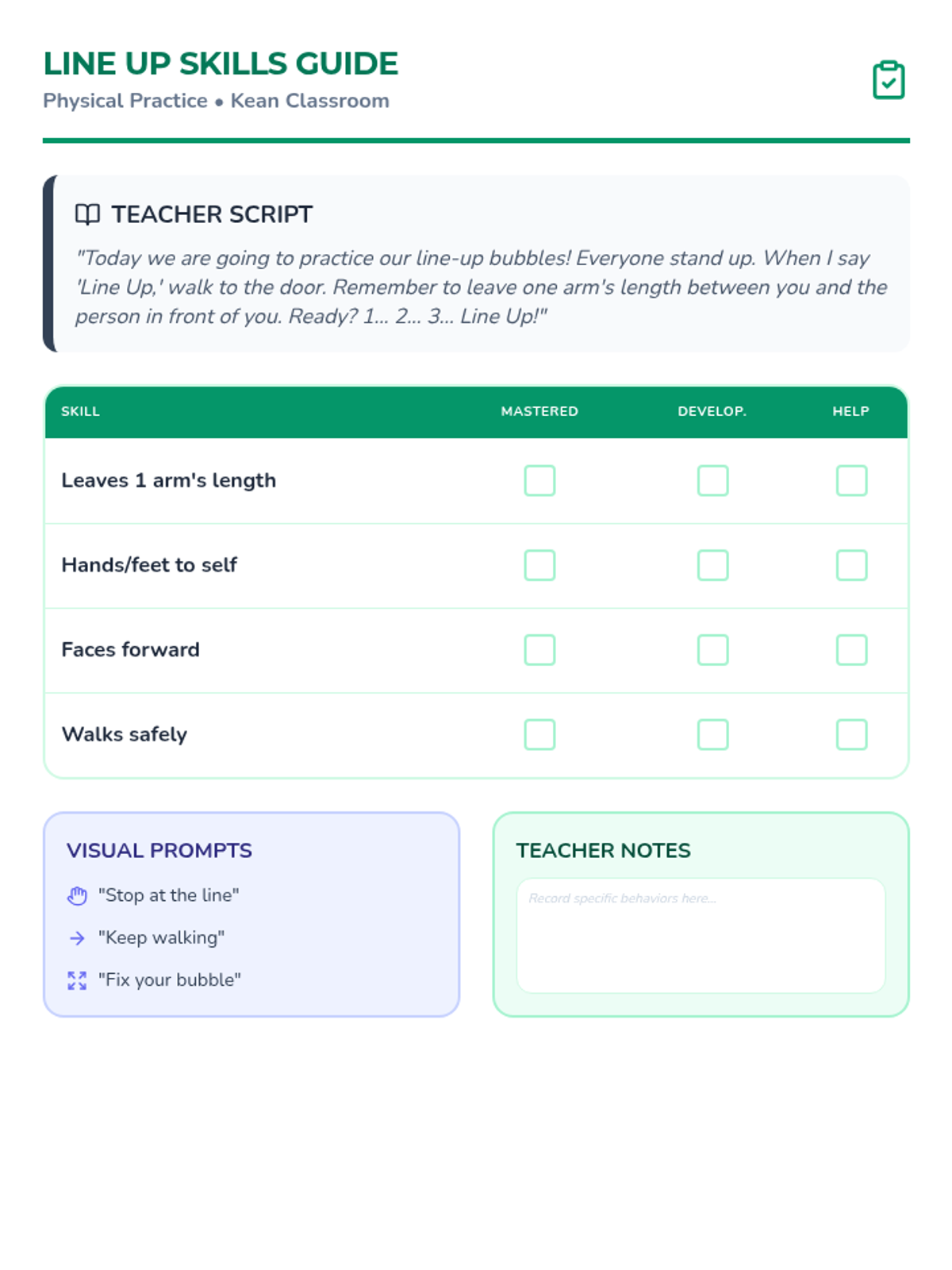
Revised teacher-facing resource for line-up practice, condensed to a single page with optimized table and larger notes area for classroom use.
Visual presentation for Day 2 focusing on specific school settings (Lunchroom, Recess, Hallway). Includes specific instructions for Kean (lining up) and sorting logic for Ramapo/WP.
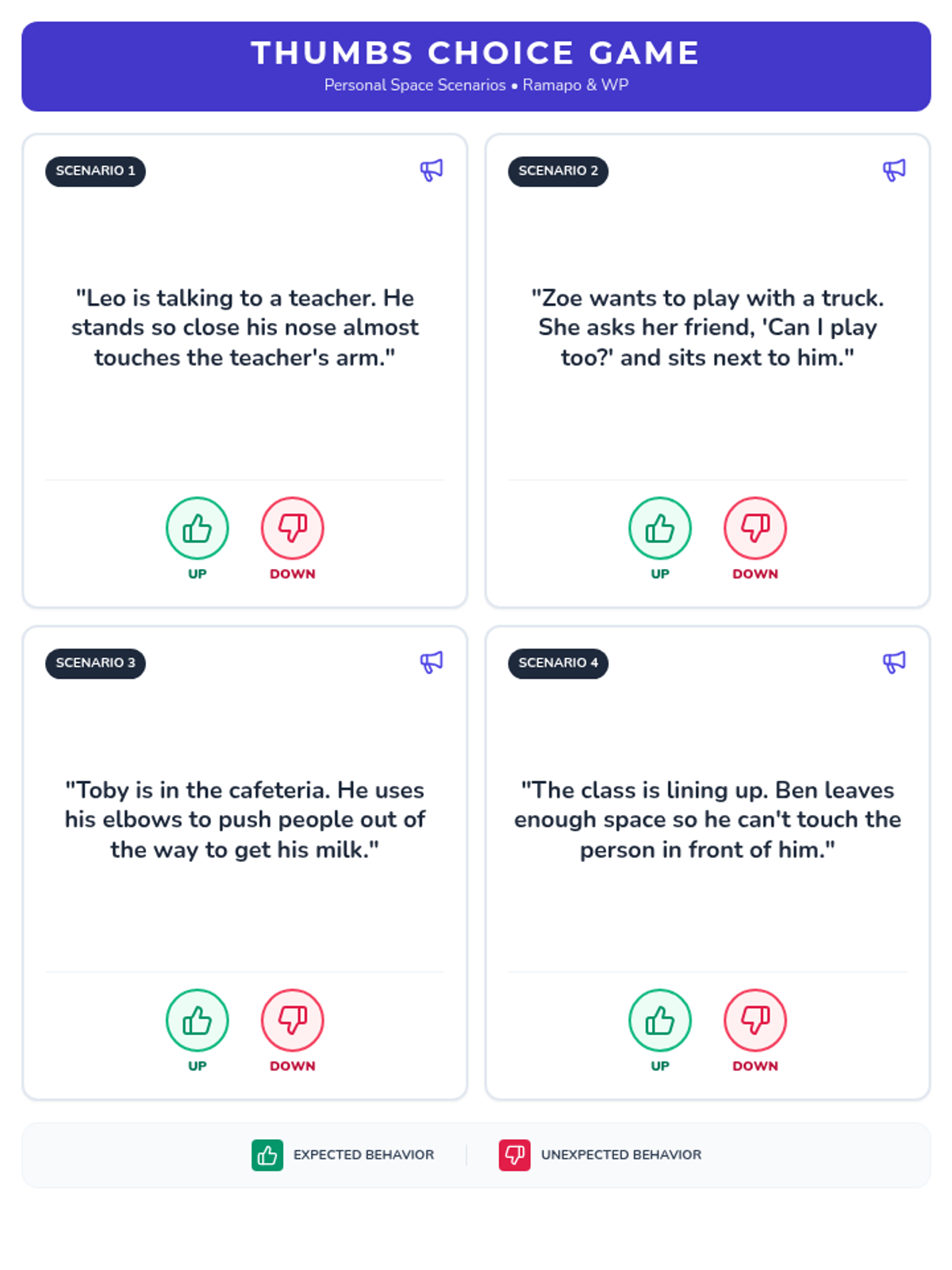
Revised Thumbs Choice Cards for Ramapo/WP. Added consistent labels to all cards, increased contrast on icons, and adjusted height to ensure the footer fits on a single page.
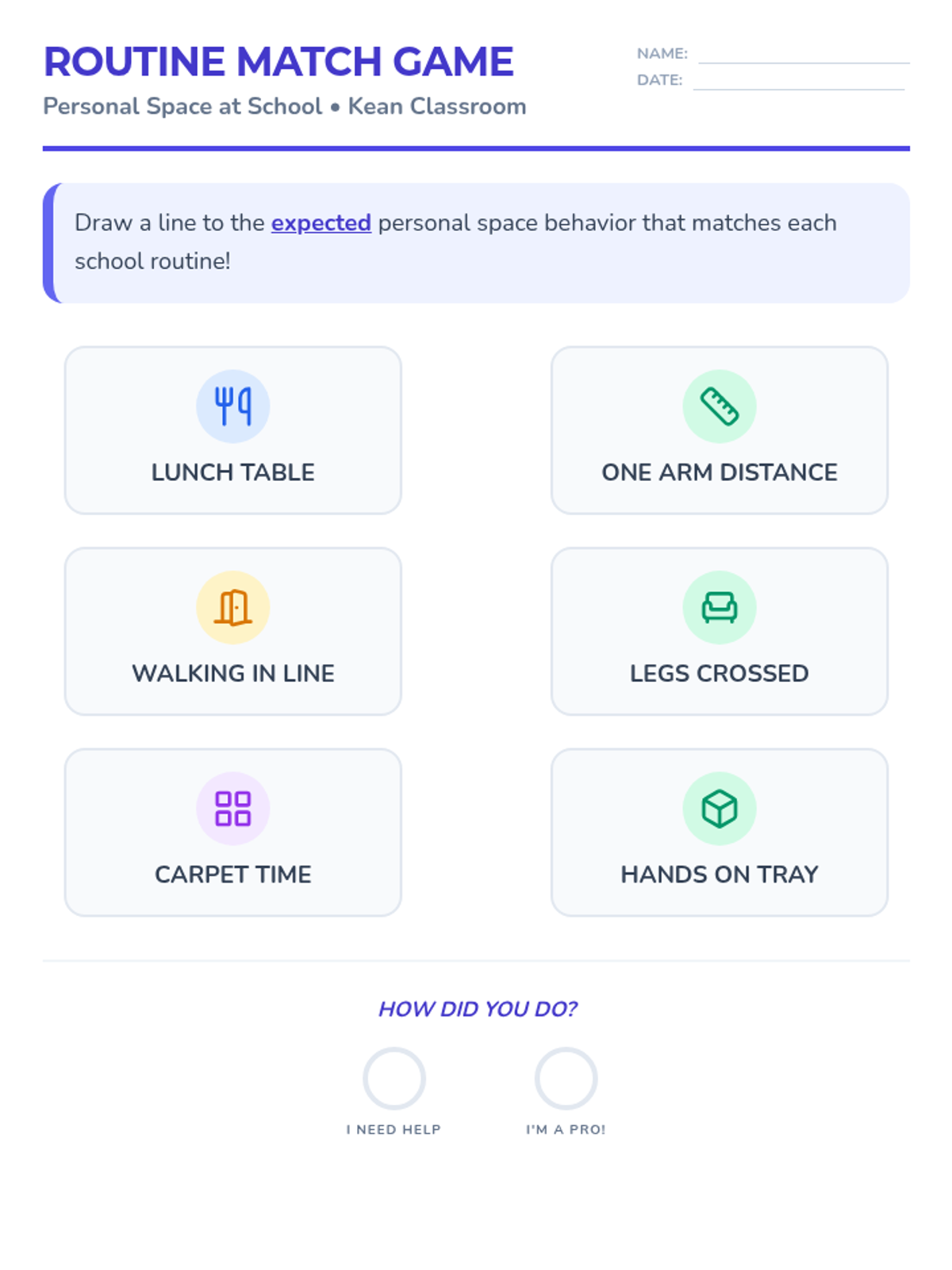
Revised matching worksheet for Kean students with shuffled answers and improved layout to fit on a single page. Connects school routines with expected personal space behaviors.
Interactive slides for Kean, Ramapo, and WP students focusing on personal space basics with social stories and a Thumbs Up/Down game. Includes scenarios for hallways, lunchrooms, and carpet time.
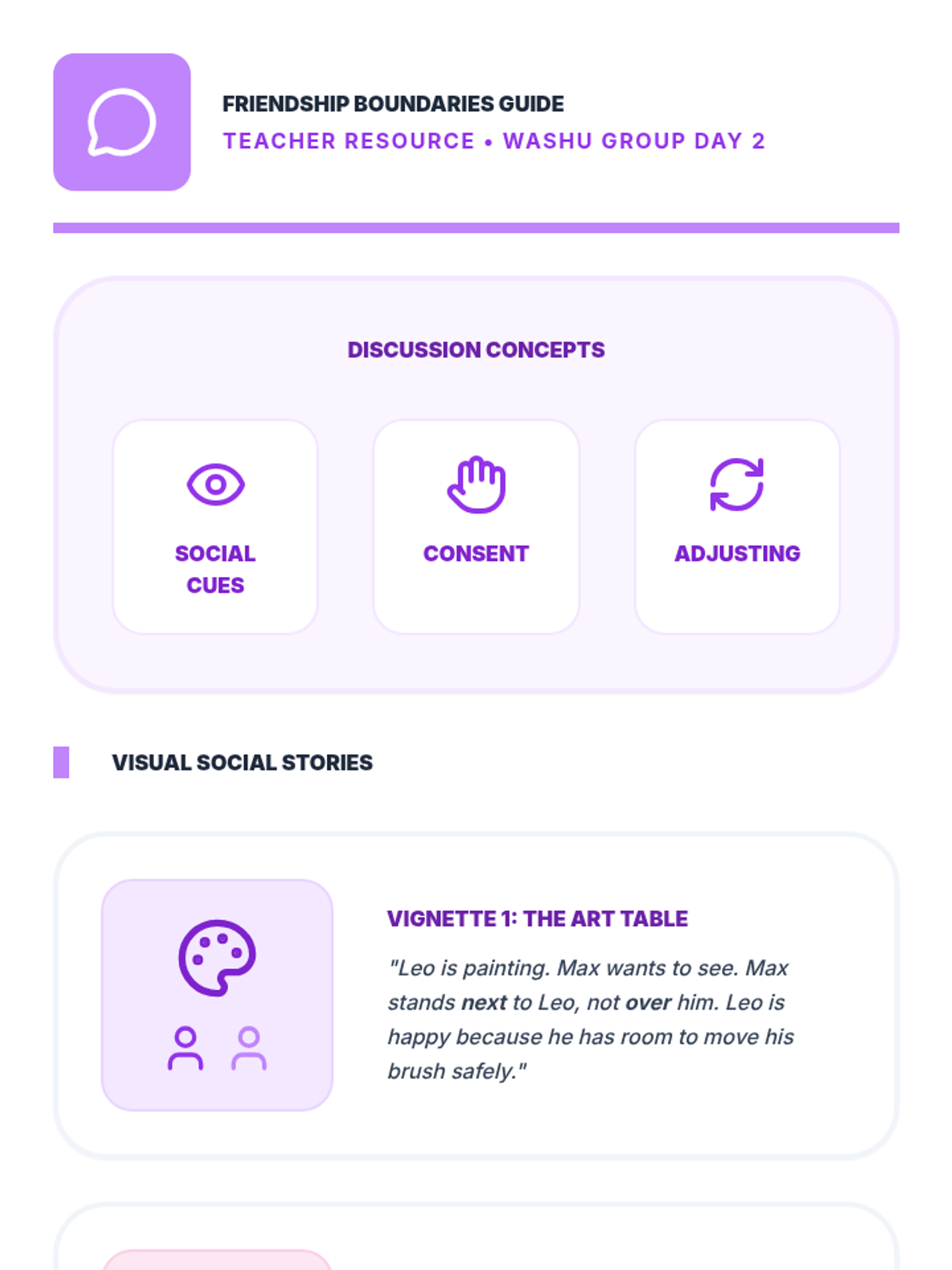
A facilitation guide for the WashU group's Day 2 discussion on friendship boundaries. It provides discussion prompts about teamwork, reading social cues, and the emotional impact of respecting personal space, along with 'Space Scripts' for students to practice.
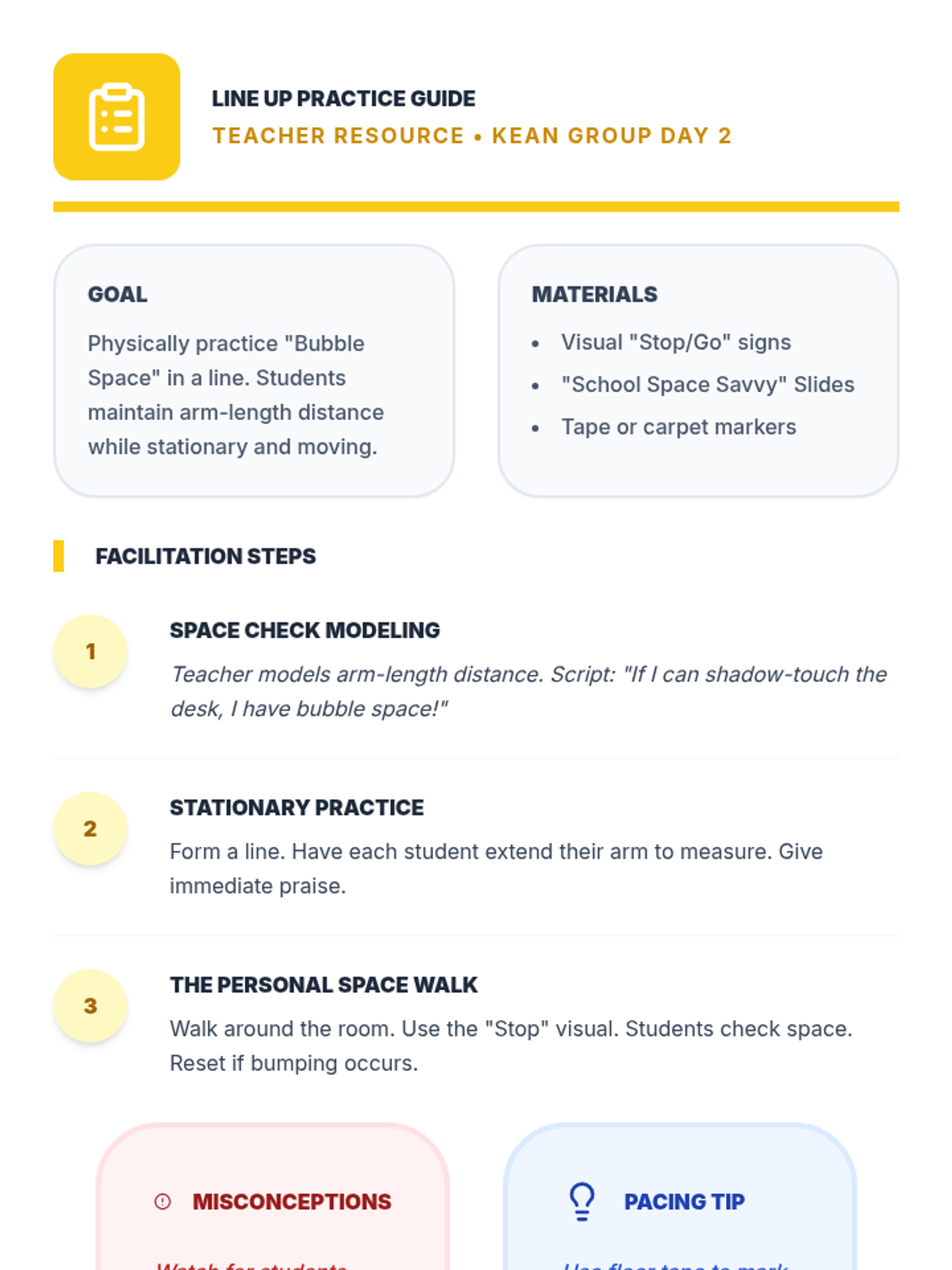
A teacher-facing instructional guide for facilitating the Day 2 'Line Up Practice' for the Kean group. Includes modeling scripts, step-by-step practice instructions, and strategies for addressing common student misconceptions about personal space.
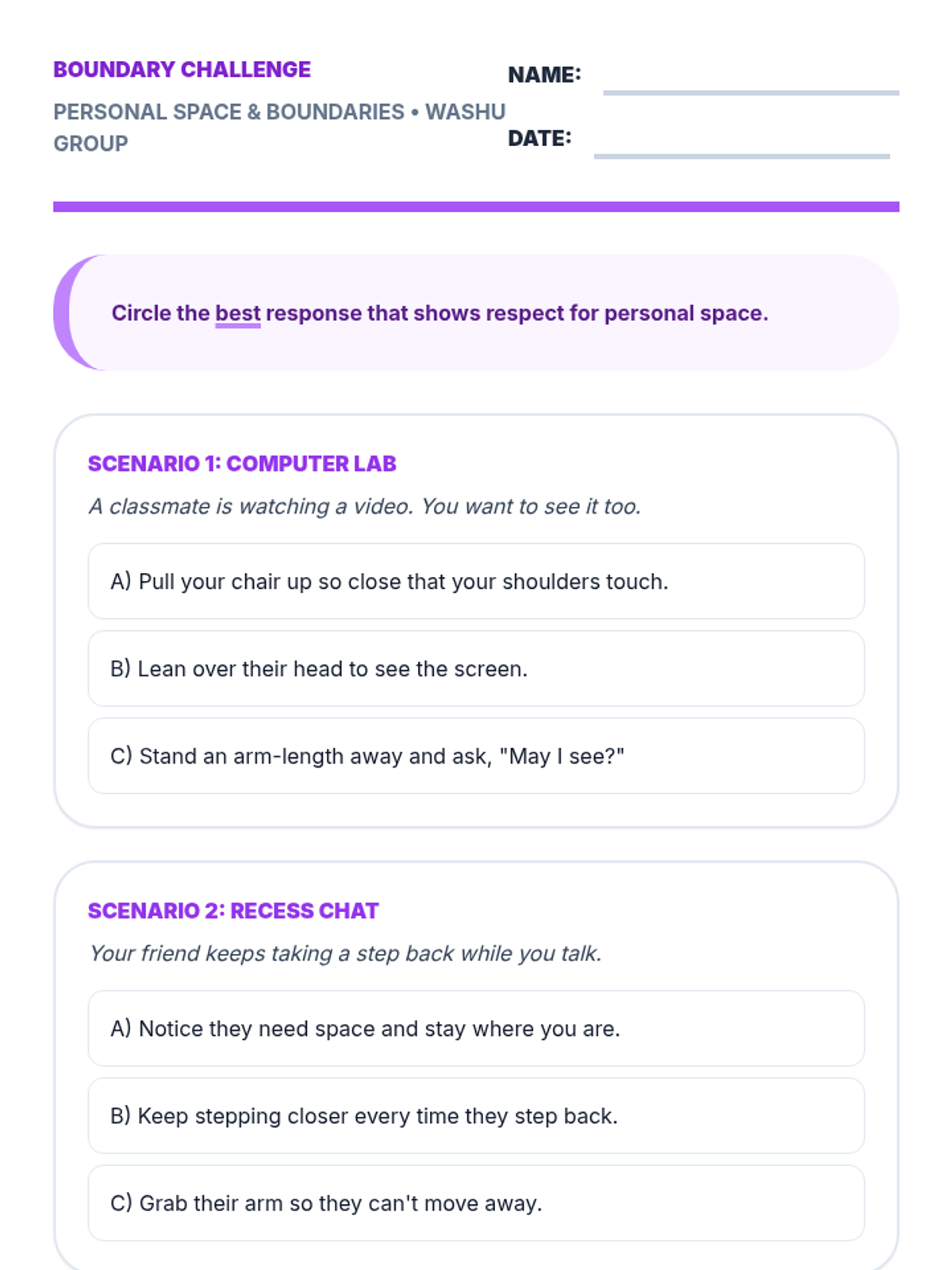
A social skills challenge worksheet for the WashU group focused on resolving boundary-related school situations in the computer lab, during recess conversations, and while sharing art supplies. Features multiple-choice scenarios and a critical thinking reflection section.
Advanced social skill slides for the WashU group, focusing on navigating boundaries in teamwork and friendships. Includes a 'Boundary Boss' social skills challenge game with scenarios and multiple-choice responses to build social problem-solving skills.
A matching and categorization activity for the Ramapo and WP groups, where students link specific personal space behaviors to school settings like the lunchroom, recess, carpet time, and hallways. Features a blank drawing area for student expression.
A visual scenario-based slide deck for the Ramapo and WP groups, featuring social stories about the lunchroom and recess. Includes an interactive Thumbs Up/Thumbs Down game to evaluate personal space behaviors and a preview of the school setting sorting activity.
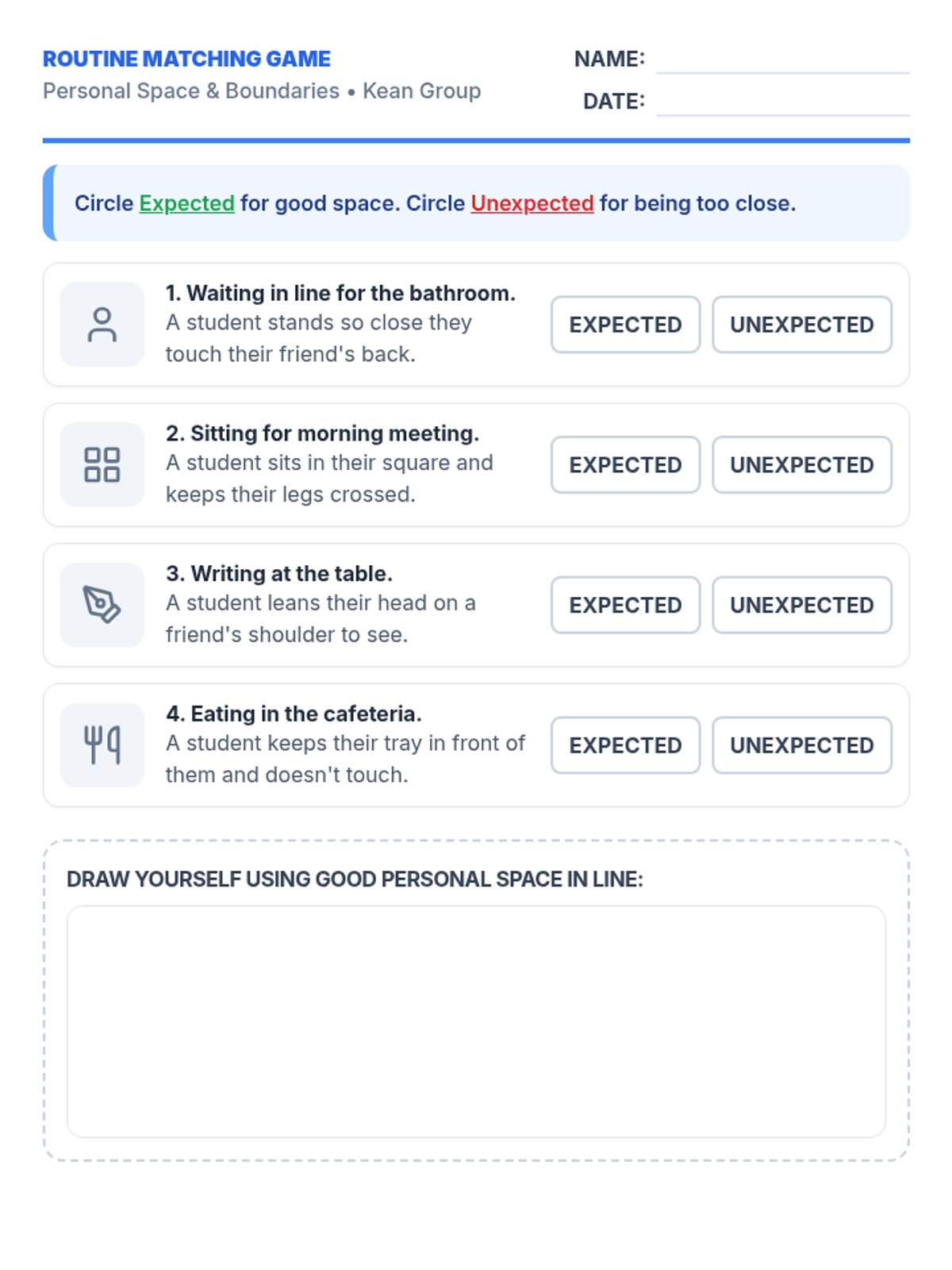
A worksheet for the Kean group to identify 'Expected' vs. 'Unexpected' personal space behaviors across various school routines, such as hallway transitions, carpet time, and lunch. Includes a drawing reflection area for student work.
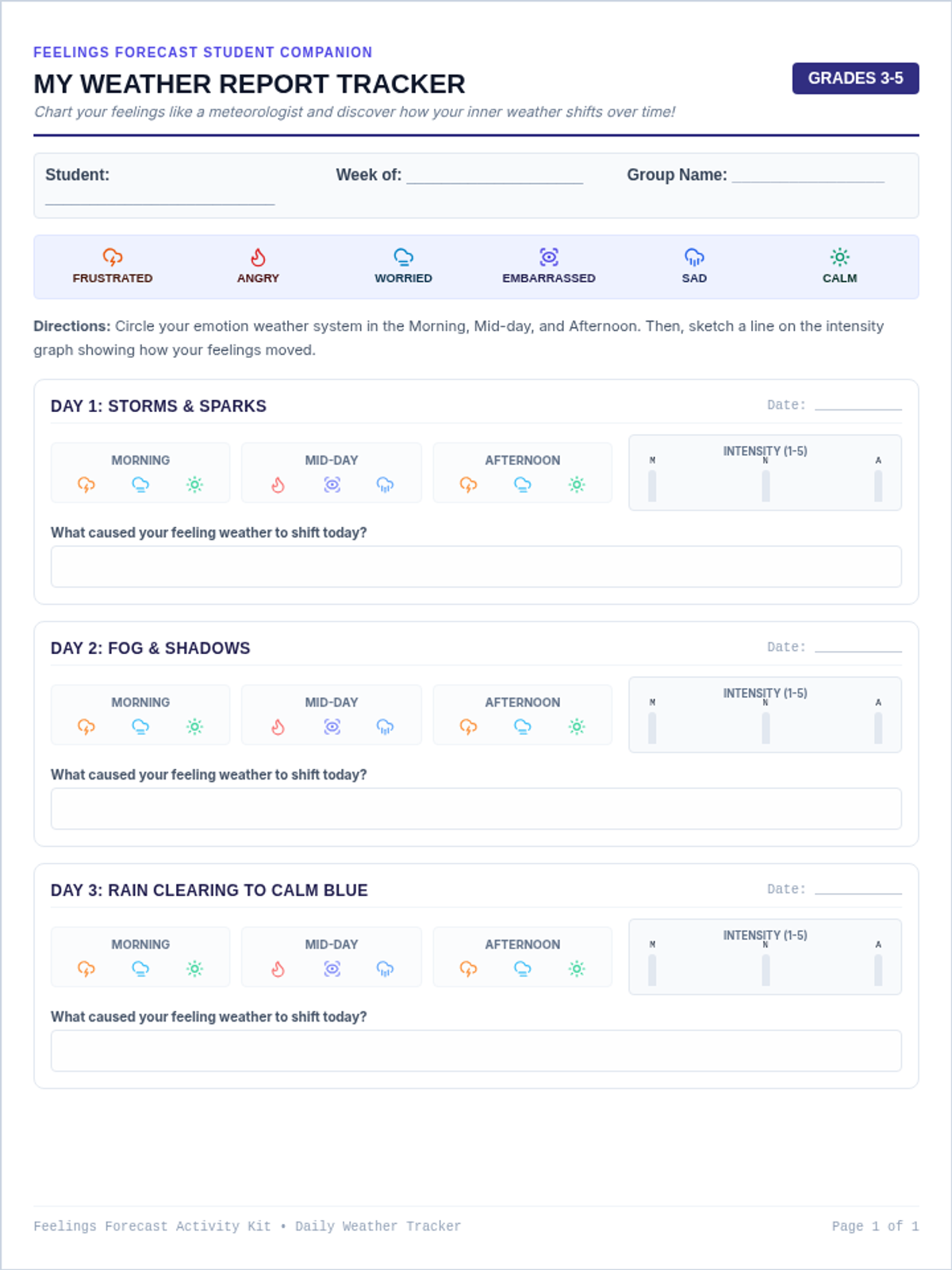
An interactive, meteorological-themed student feelings log. Features structured grids for a 3-day tracking cycle, visual weather icons (Stormy, Foggy, Sunlit, Rain, etc.) for daily emotional check-ins, a creative coordinate space for graphing feeling intensity shifts, and open-ended reflection areas for frustrated, angry, worried, embarrassed, sad, and calm emotions.
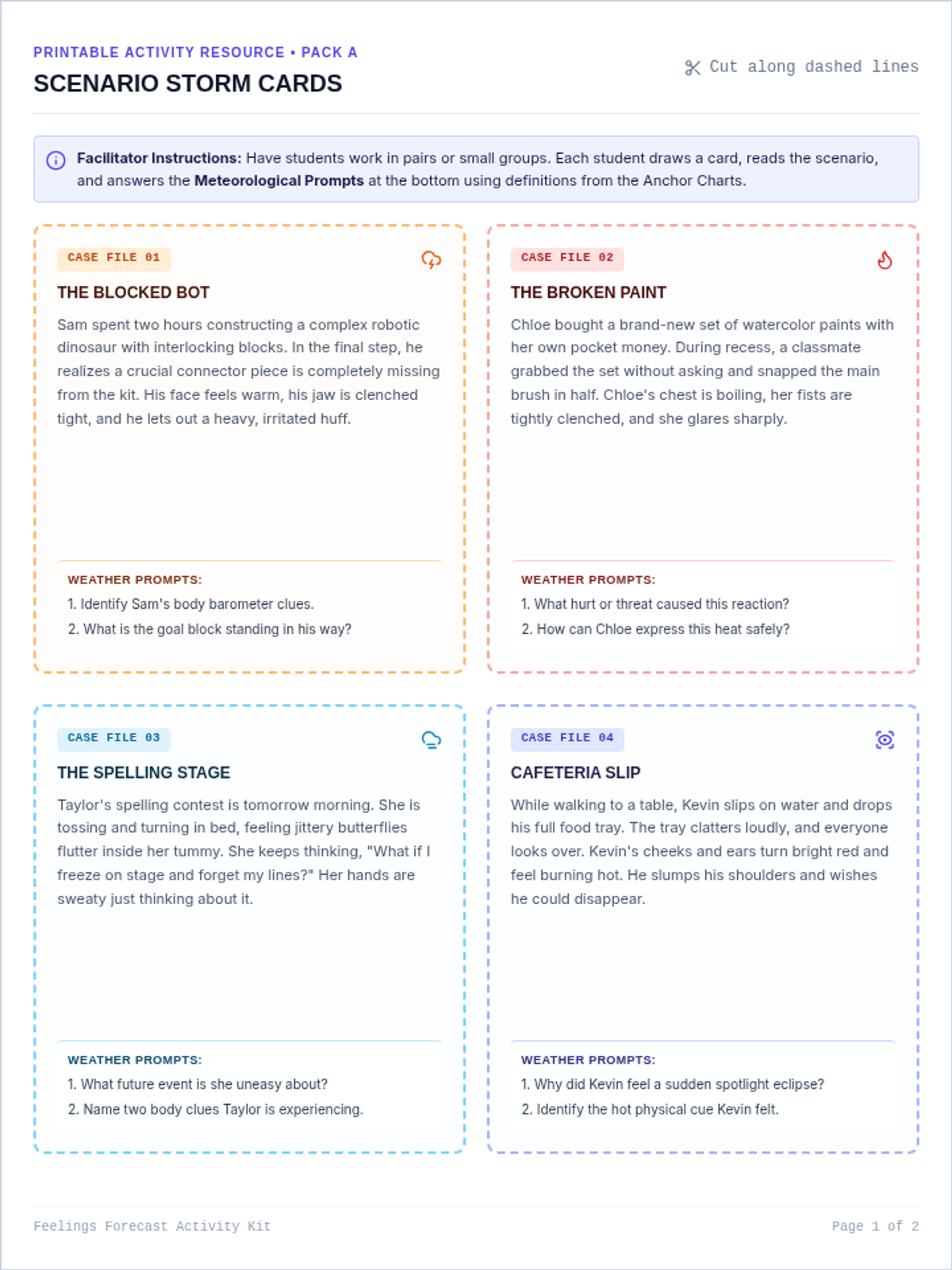
A set of 8 printable, easy-to-cut scenario discussion cards with dashed border guidelines. Each card represents a real-world upper elementary school challenge (e.g., spelling bees, sports tryouts, group work, learning an instrument) tailored to explore frustration, anger, worry, embarrassment, sadness, and calm emotional shifts over time.
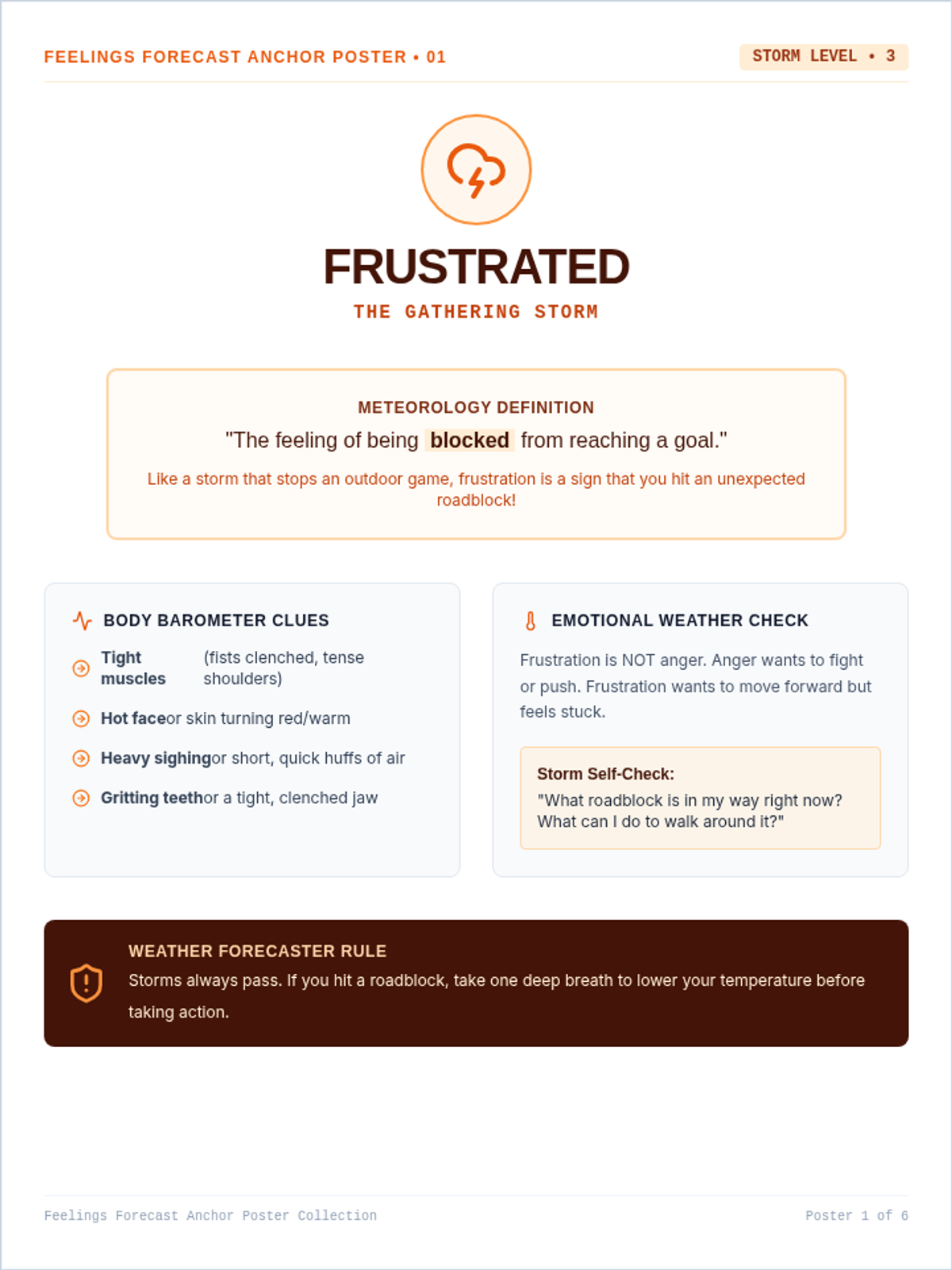
A set of 6 printable, visually cohesive meteorological-themed anchor charts defining Frustrated, Angry, Worried, Embarrassed, Sad, and Calm. Each chart details the definition, physical body barometer clues, and self-regulation check-in questions for upper elementary students.
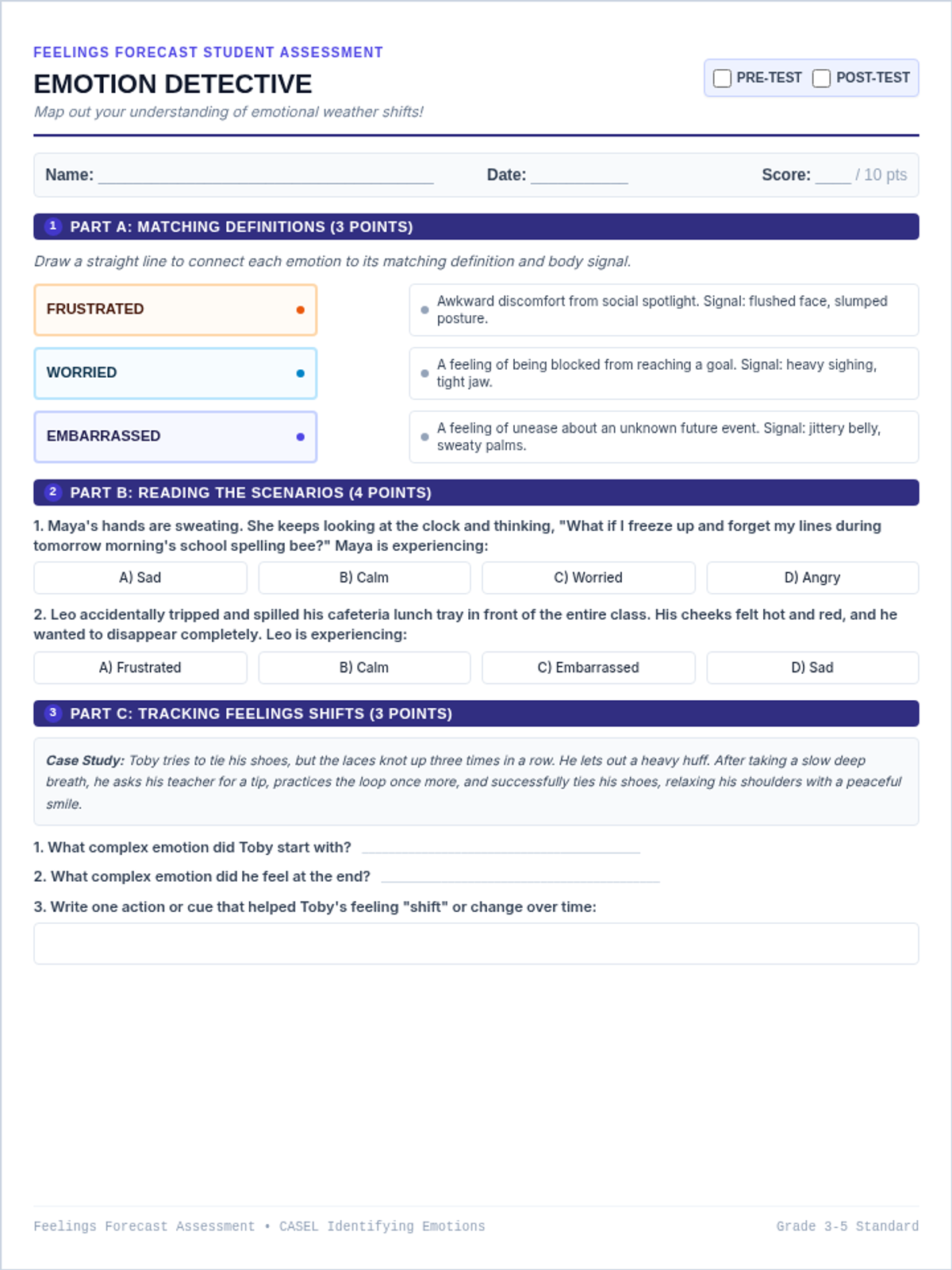
An identical pre-test and post-test student assessment tool. Features name/date lines, clear checkable labels for Pre-Test and Post-Test modes, vocabulary matching for frustration, worry, and embarrassment, multiple-choice scenario analysis, and a structured short-answer section on tracking emotional shifts over time.
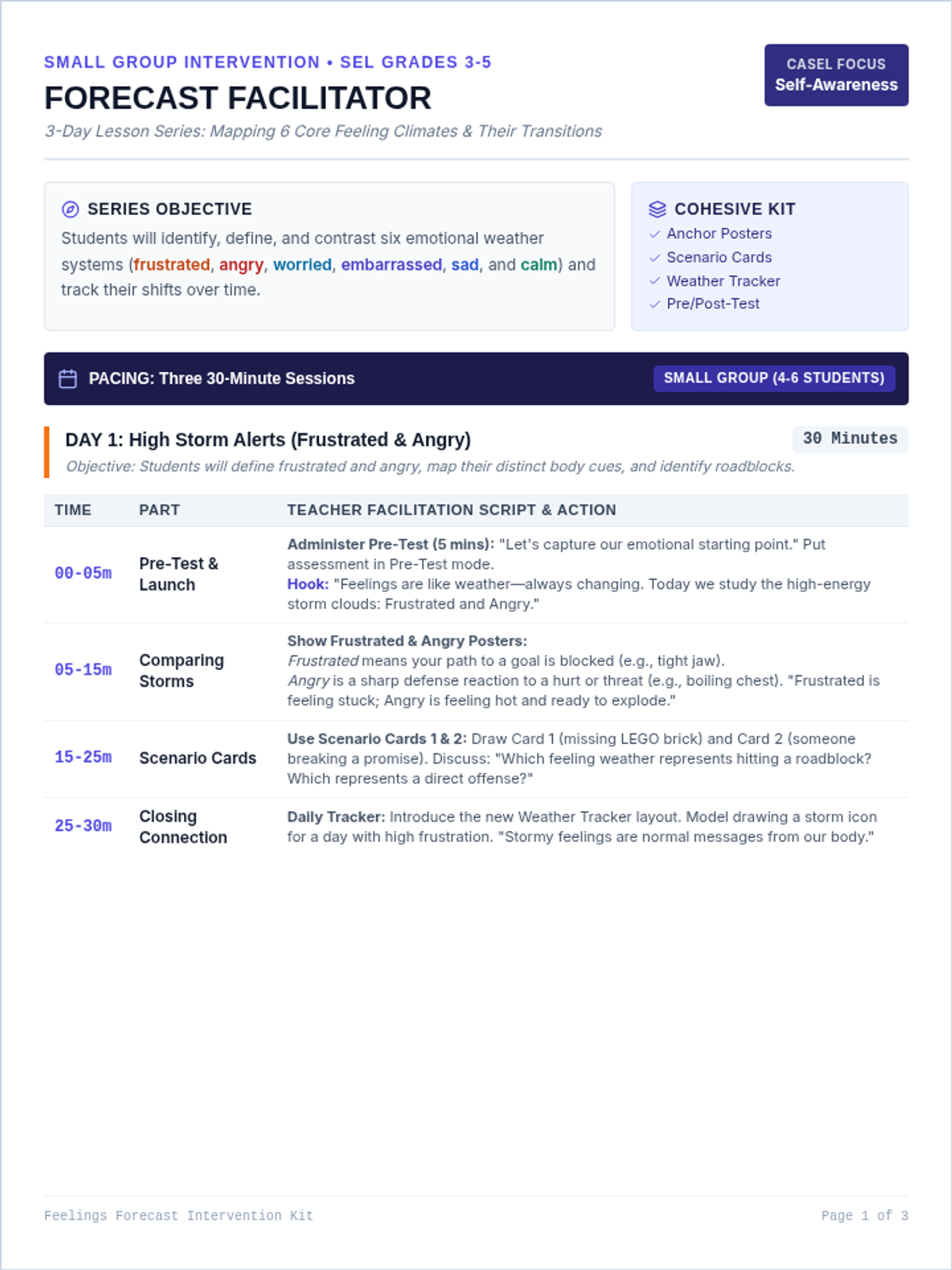
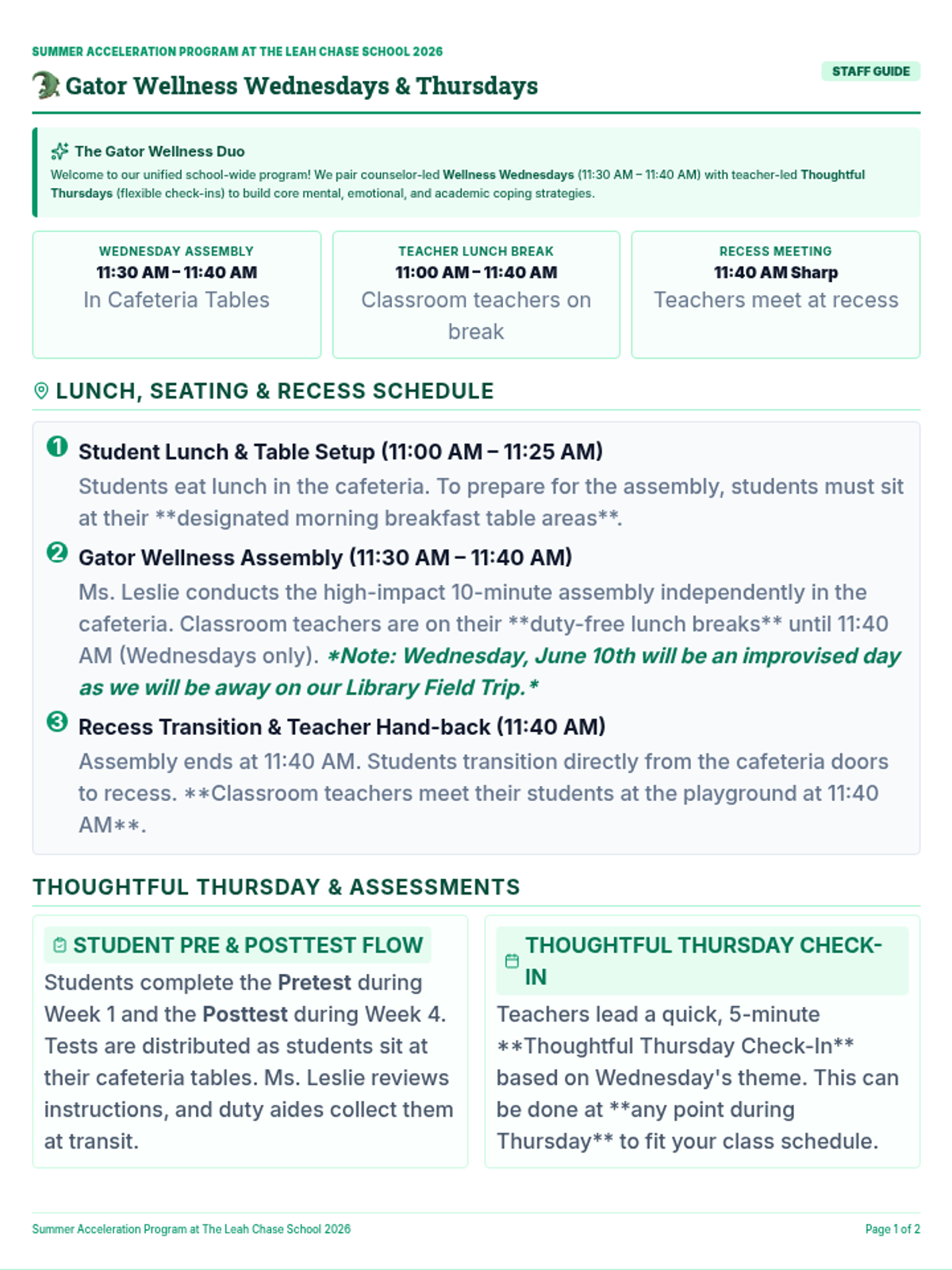
A comprehensive 3-day small group facilitation guide for teachers with updated emotions: frustrated, angry, worried, embarrassed, sad, and calm. Features hourly and minute-by-minute timestamps, lesson plans, scaffolding, and discussion scripts on tracking emotional shifts.
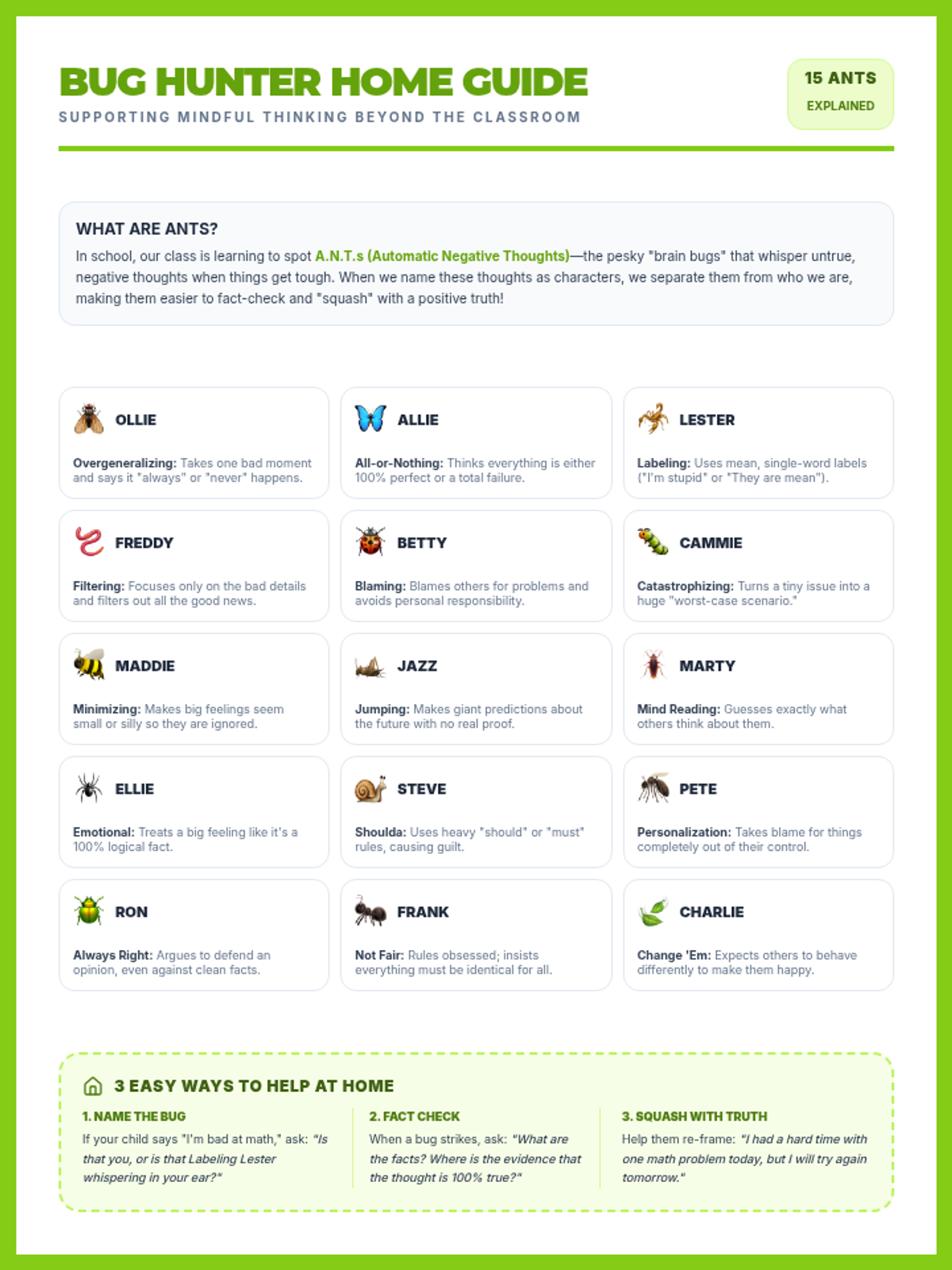
A clean, one-page parent guide designed to be sent home, listing all 15 ANT Buddies with parent-friendly descriptions and tips for squashing automatic negative thoughts at home.
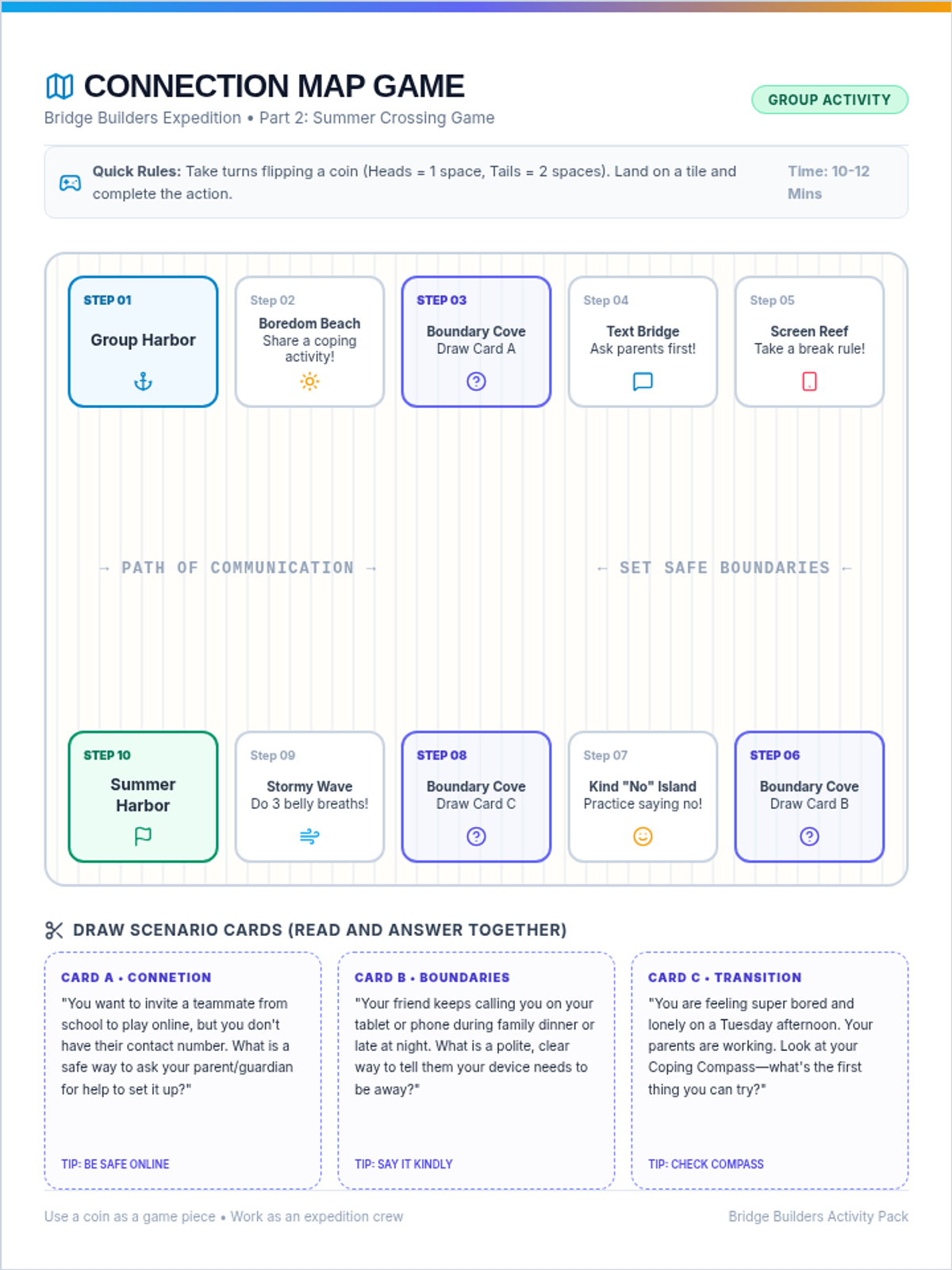
A printable group board game with a 10-step serpentine adventure track and 4 cut-out social scenario cards to help students practice communication, summer connection, and boundary-setting.
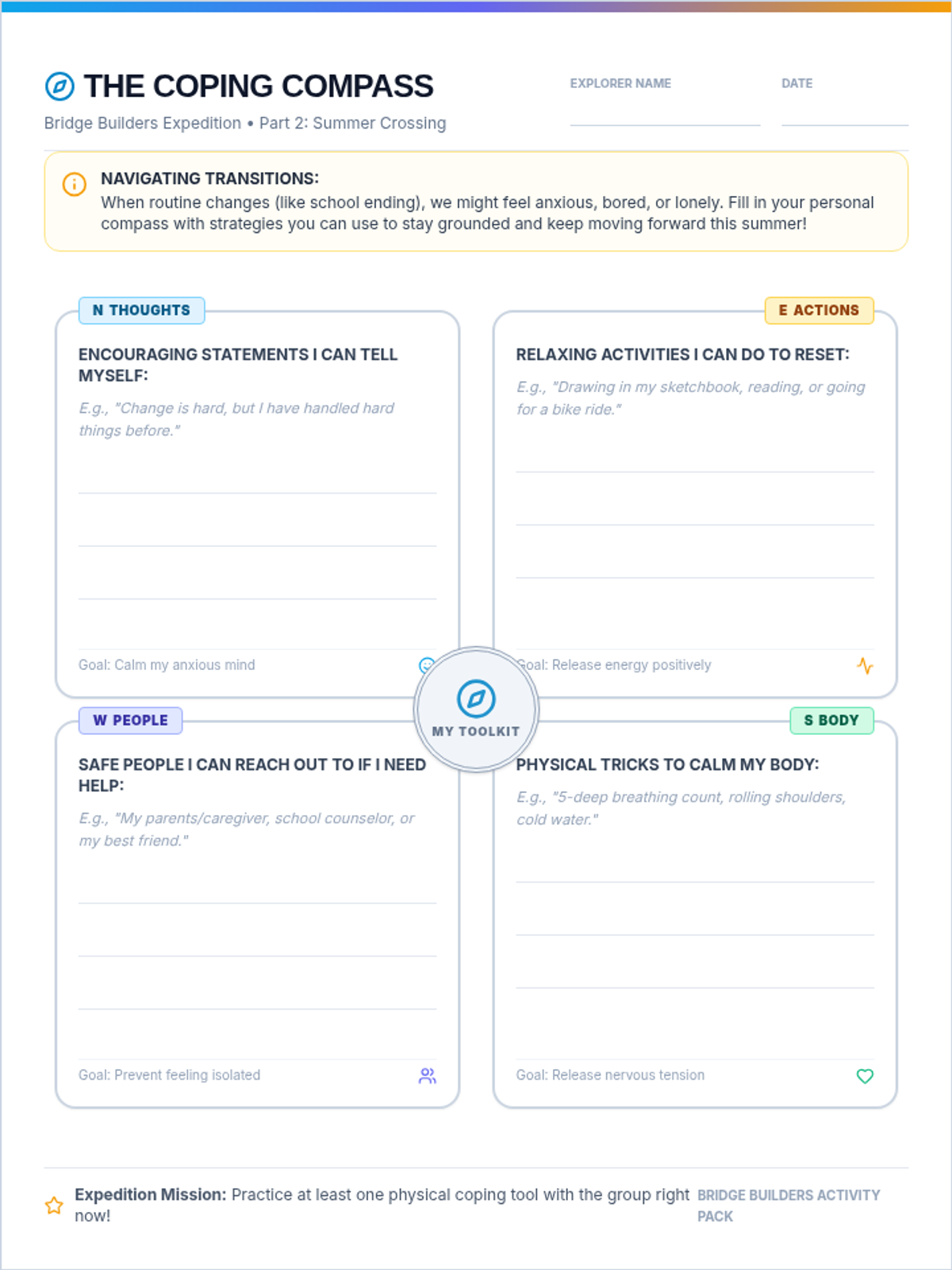
A printable planning guide where students fill in their personalized coping strategies for the summer break across four domains: thoughts, body, activities, and people.
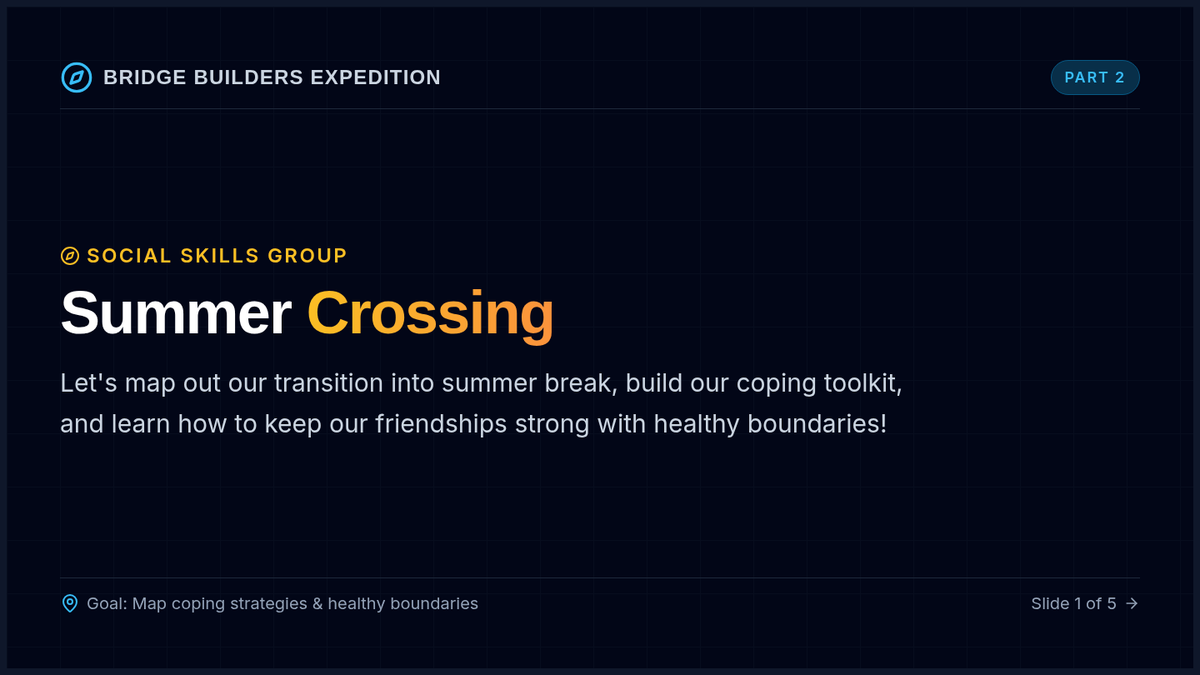
A 5-slide visual presentation for Lesson 2 to guide transition discussions, introduce the Coping Compass, and outline the rules for the Connection Map game. Styled with a dark blue blueprint design.
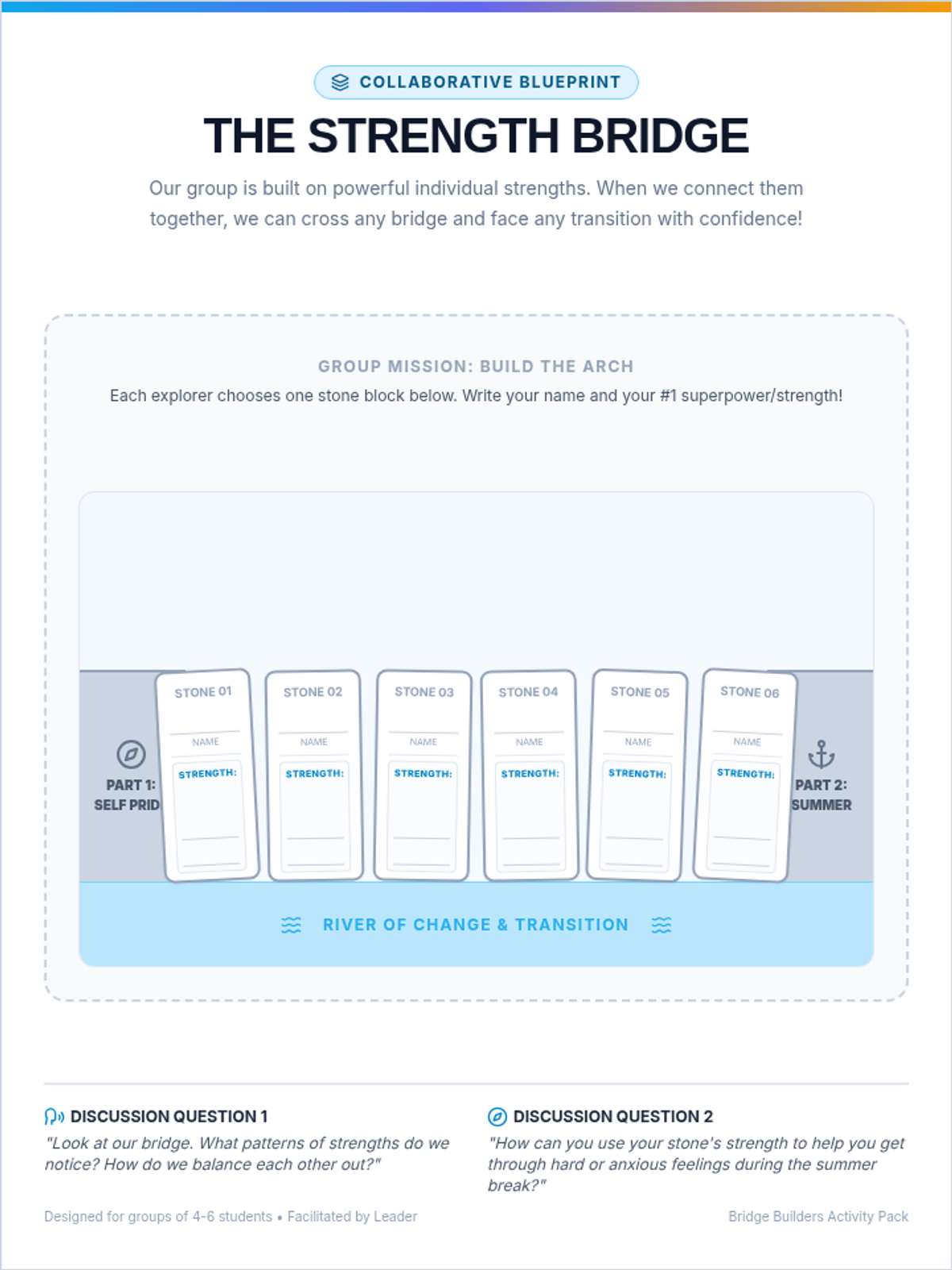
A collaborative poster template featuring a beautifully drawn 'Strength Bridge' with dedicated stones for students to write their names and anchor strengths. Perfect as a group-building centerpiece.
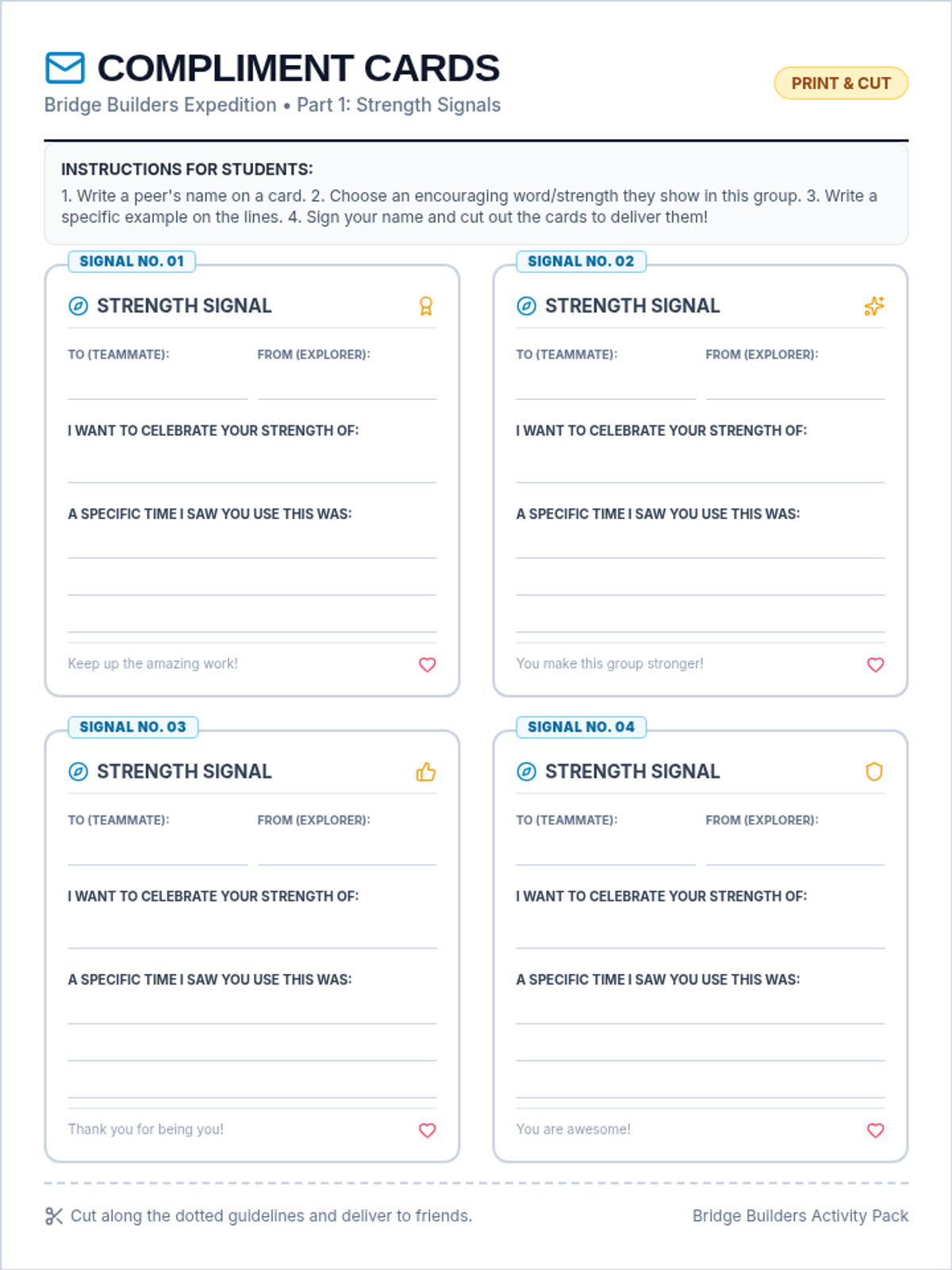
Printable compliment and peer-affirmation cards styled as explorer signals. Includes 4 cards per page with clear handwriting lines and cutting guides.
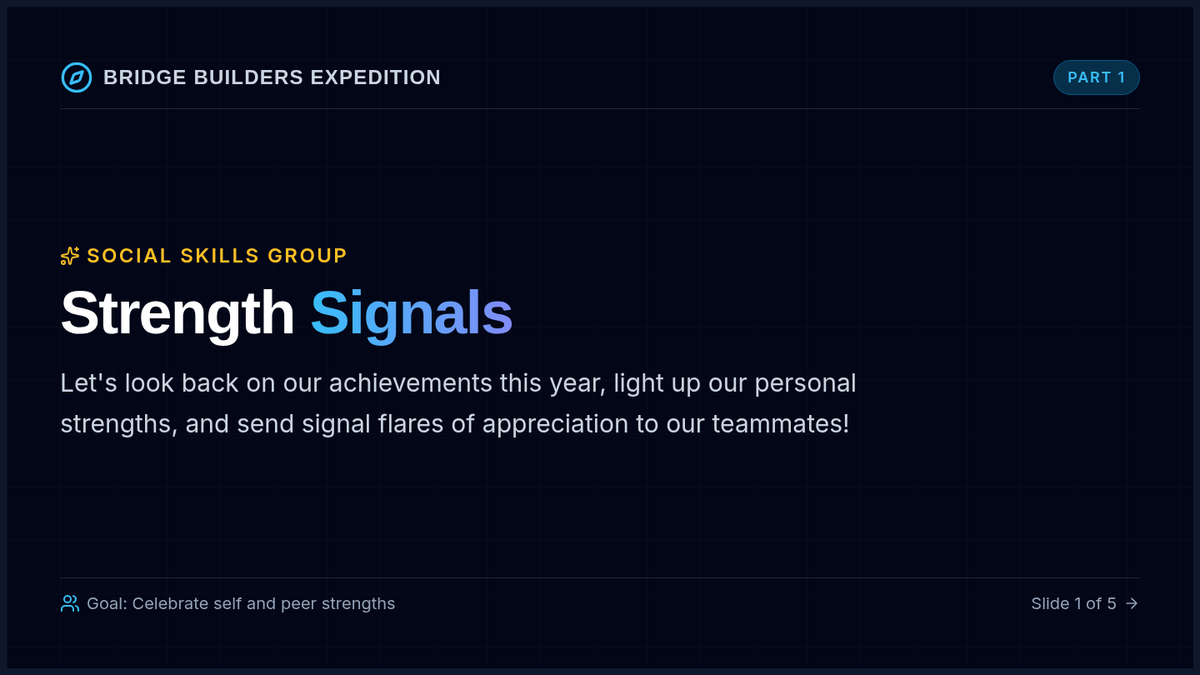
A 5-slide visual presentation for Lesson 1 to guide the group warm-up, lead strength-sharing activities, and introduce the collaborative 'Strength Squad Poster'. Designed with a high-contrast dark blueprint theme.
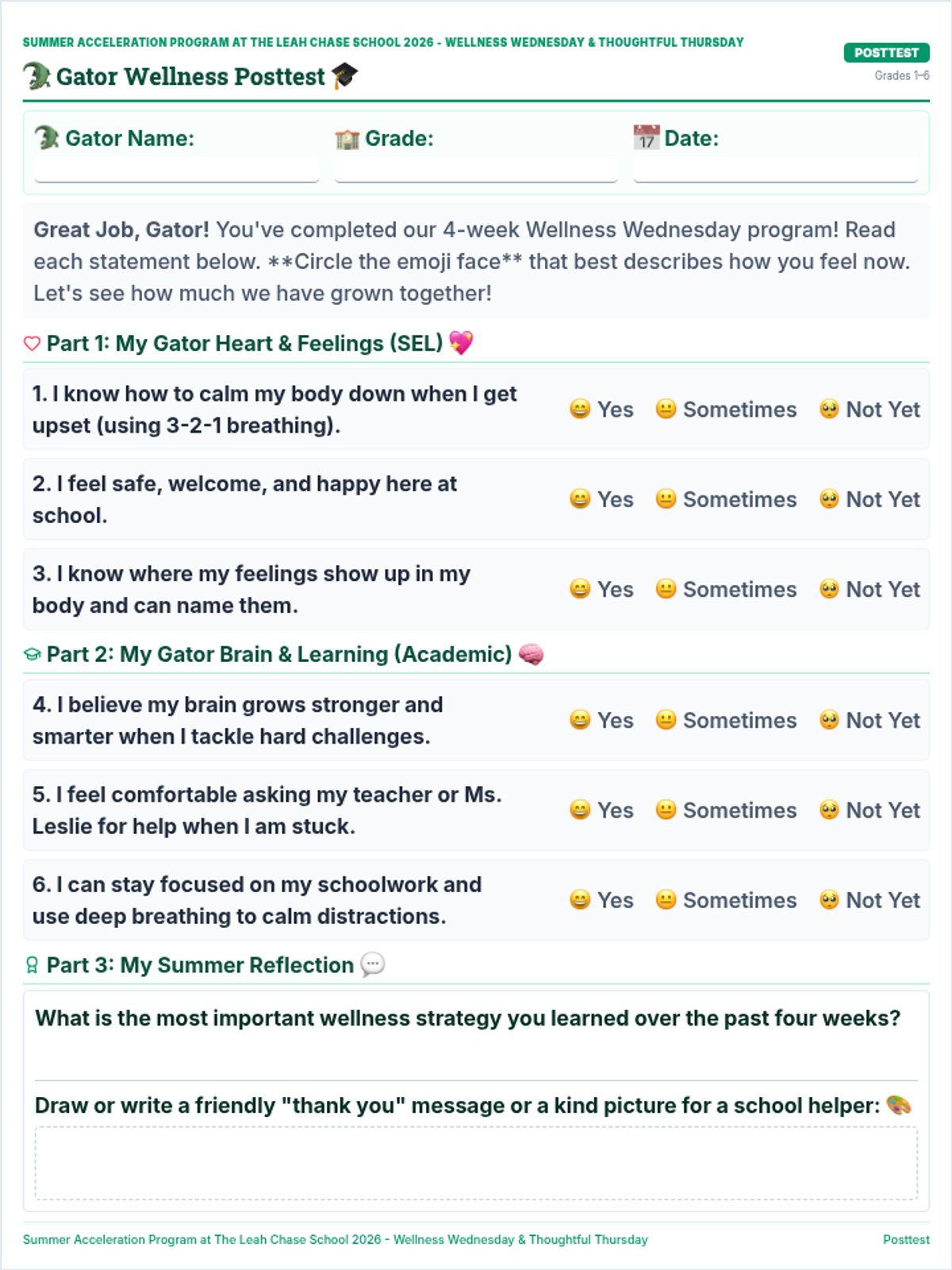
A school-wide student-facing post-assessment measuring growth in SEL (self-regulation, breathing, kindness) and Academic Support (growth mindset, asking for help, overcoming challenges).
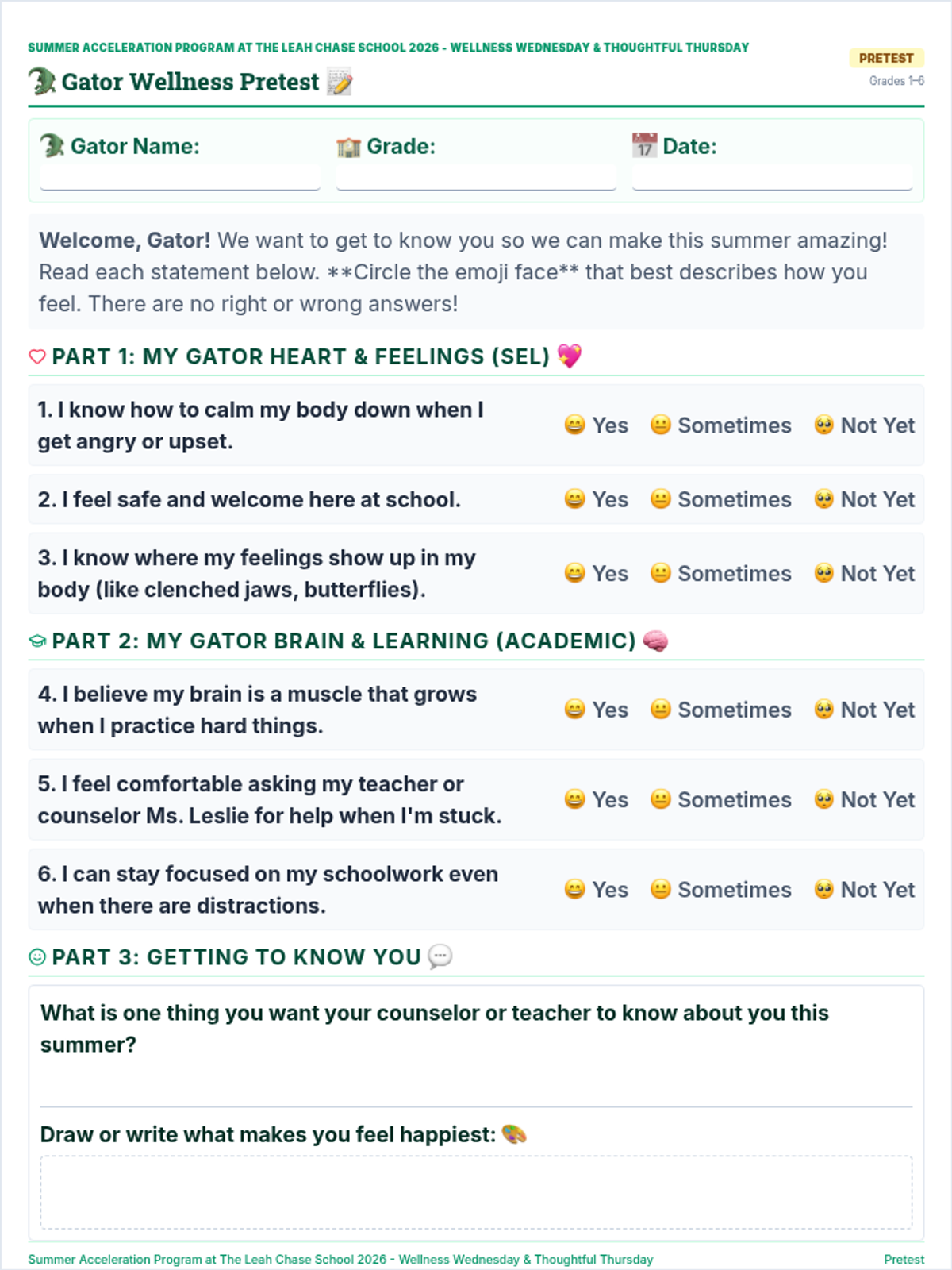
A school-wide student-facing pre-assessment covering SEL (feelings, self-regulation, coping skills) and Academic Support (attitude toward learning, asking for help, classroom focus).
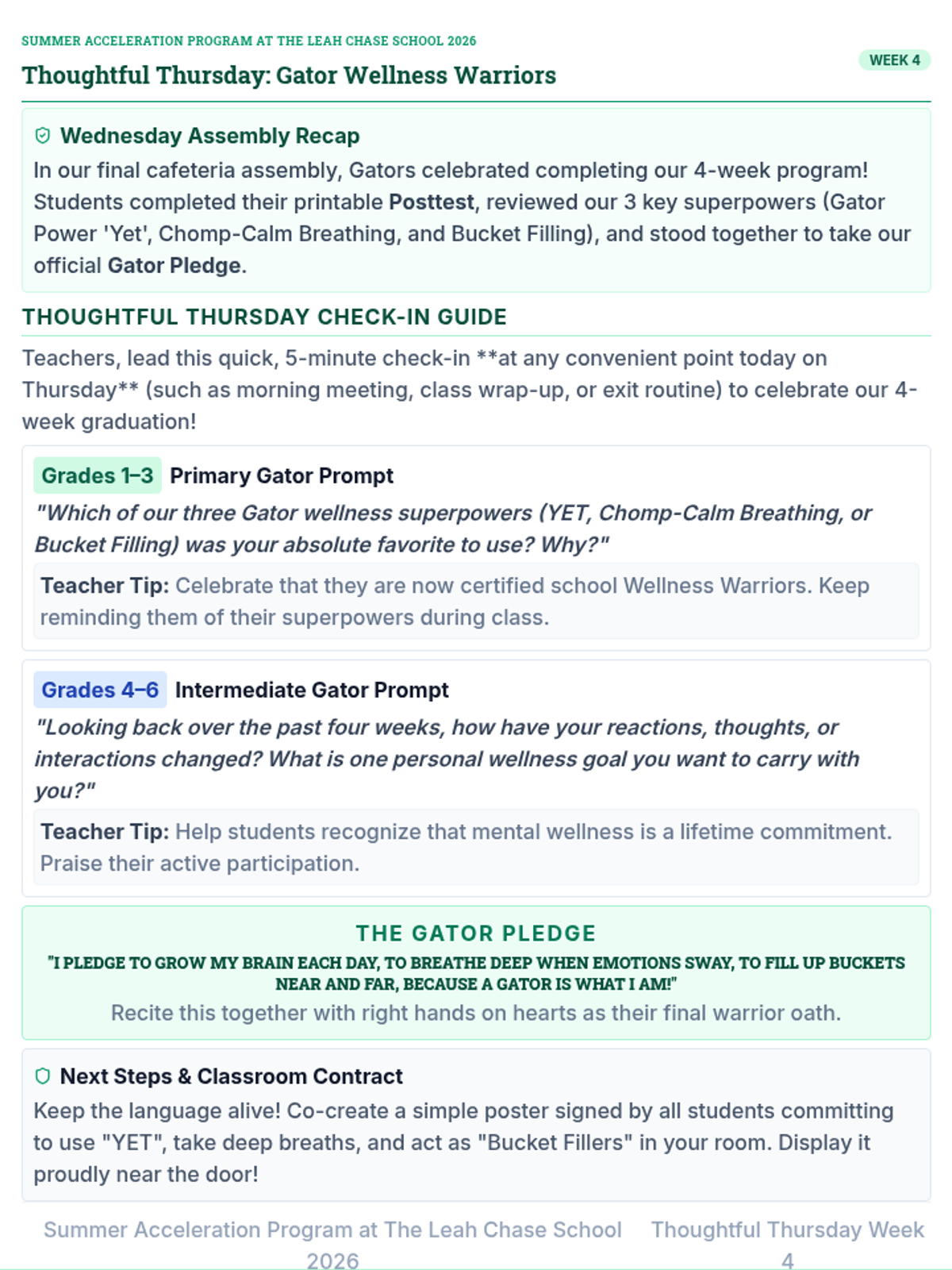
A 1-page printable classroom guide for teachers to lead the 5-minute Week 4 follow-up circle on Celebration, Reflection, and the Warrior Pledge.
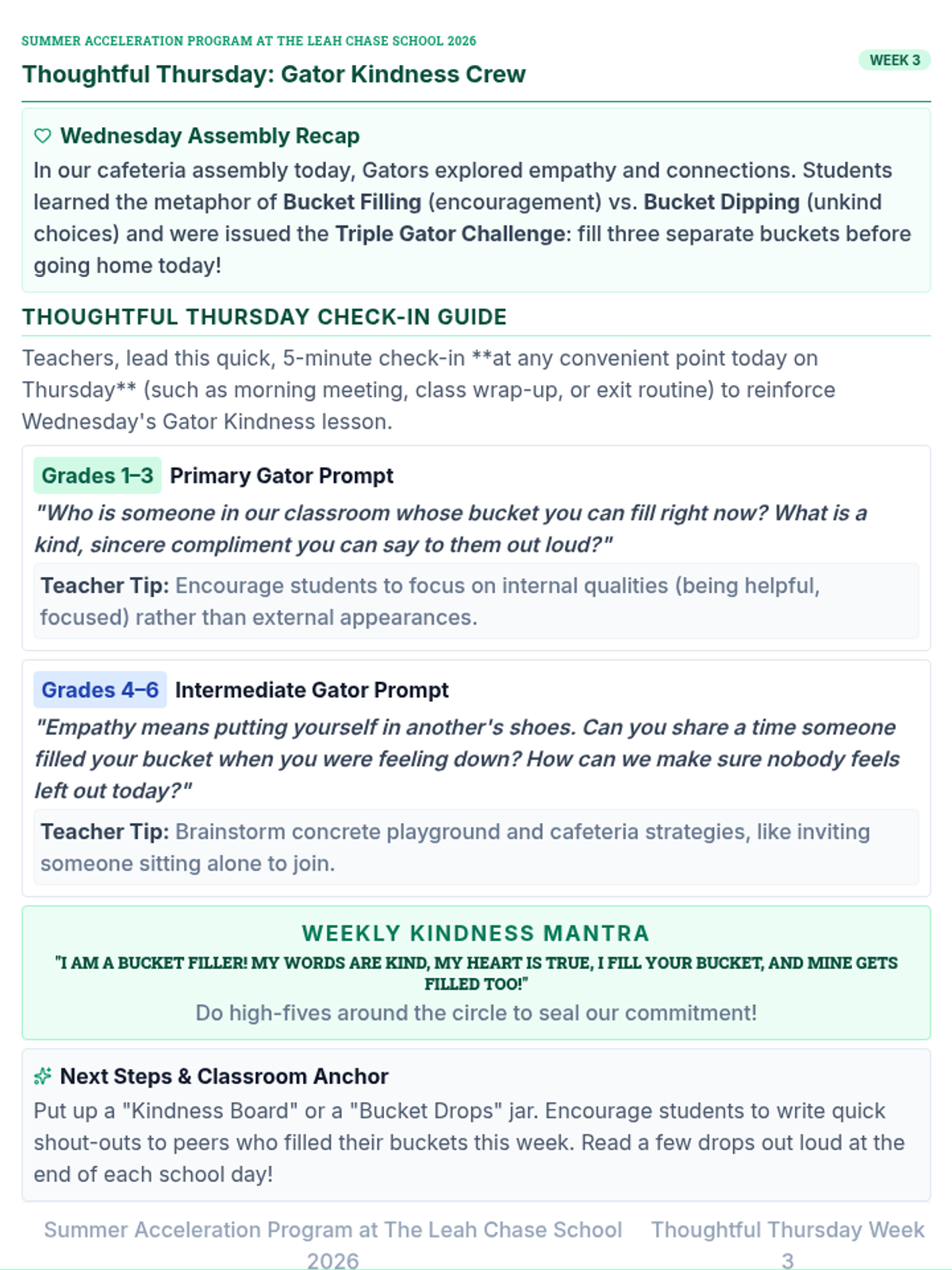
A 1-page printable classroom guide for teachers to lead the 5-minute Week 3 follow-up circle on Empathy, Kindness, and Bucket Filling.
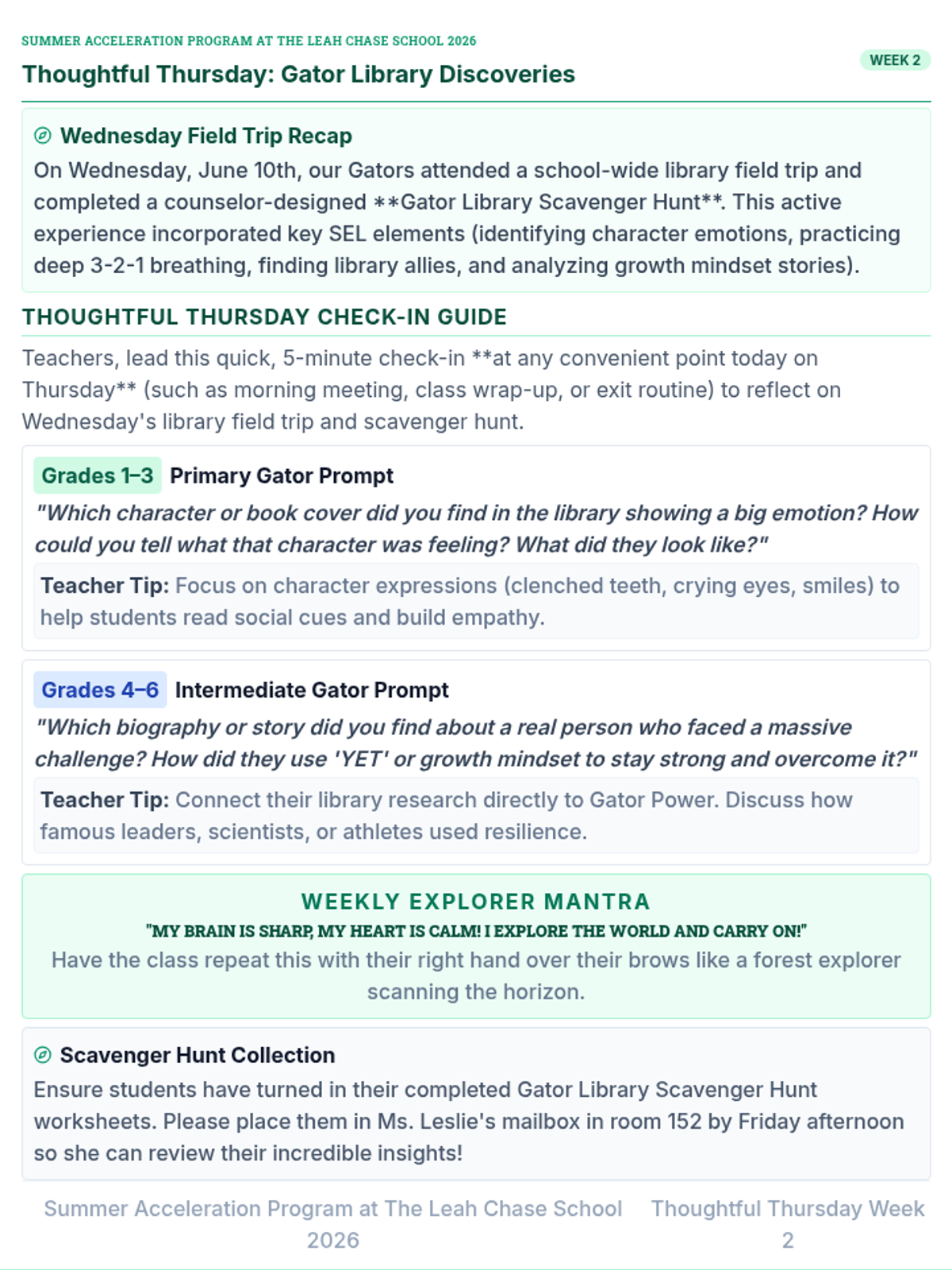
A 1-page printable classroom guide for teachers to lead the 5-minute Week 2 follow-up circle on Managing Big Emotions and the 3-2-1 breathing technique.
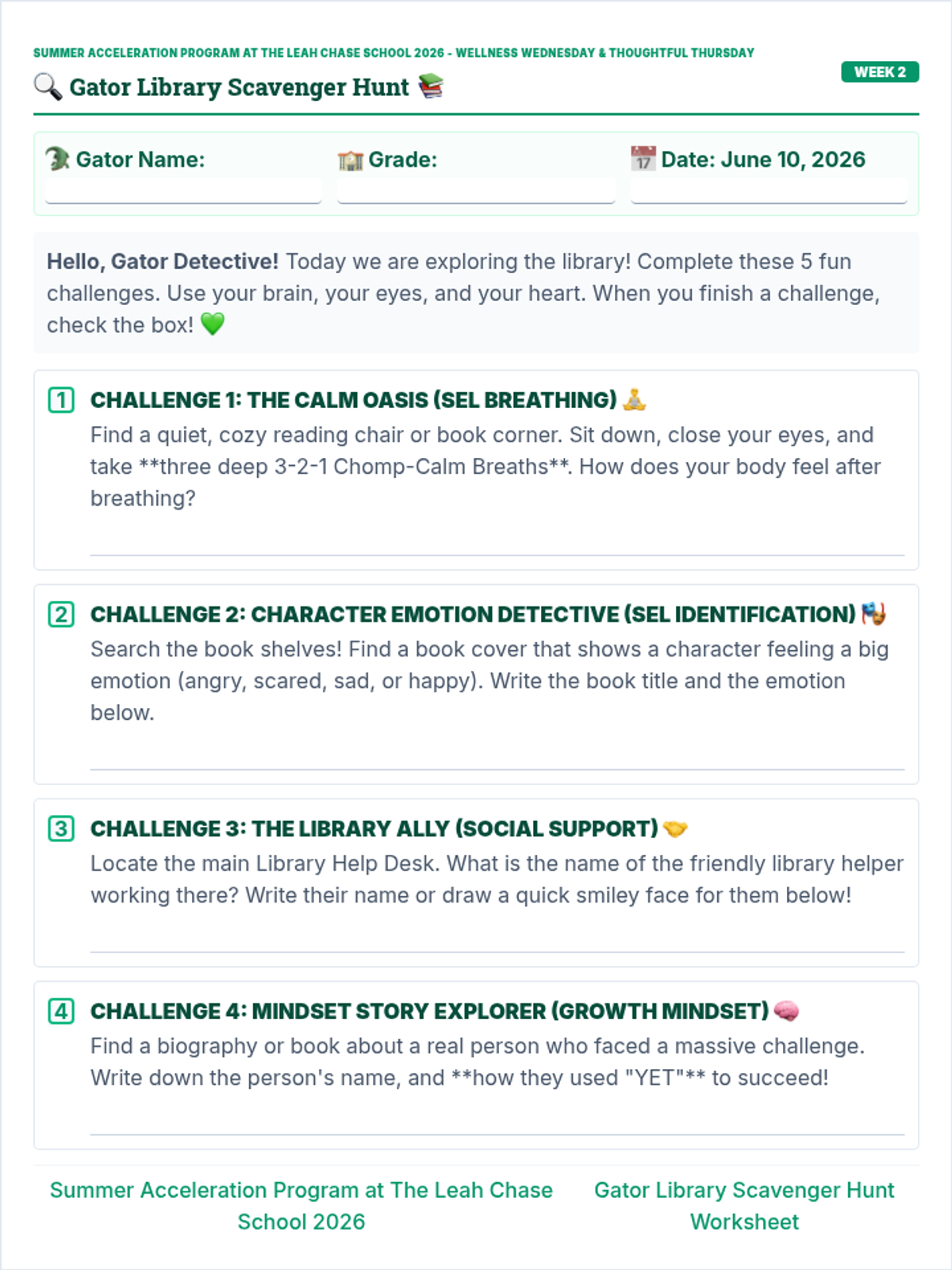
A student-facing printable SEL and Growth Mindset library scavenger hunt worksheet tailored specifically for 1st through 3rd grade students to be completed during the June 10th library field trip.
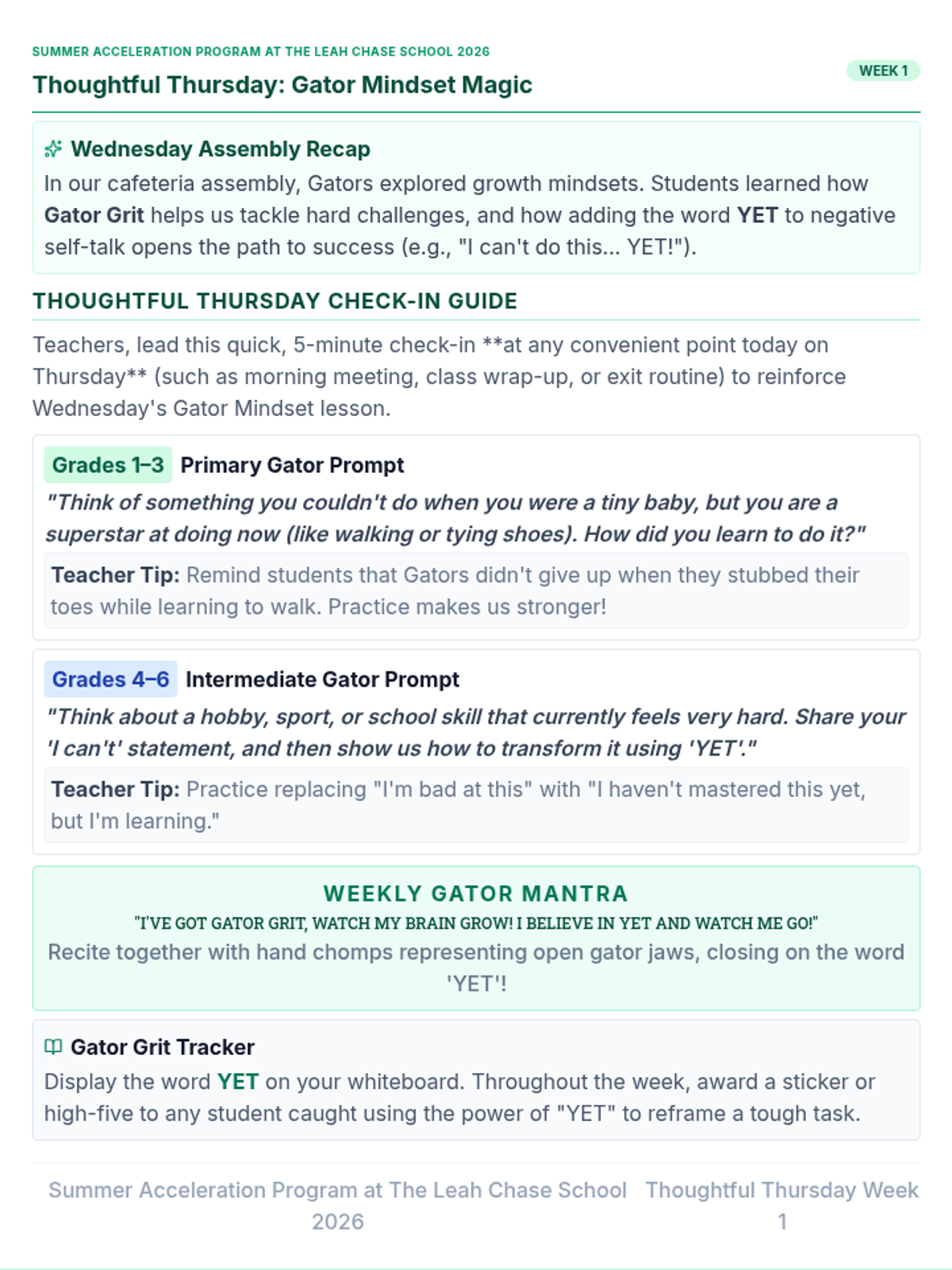
A 1-page printable classroom guide for teachers to lead the 5-minute Week 1 follow-up circle on Growth Mindset and the power of 'Yet'.
A professional school-wide implementation guide and schedule for administrators and teachers, outlining the 4-week program structure, assembly logistics, and weekly follow-up procedures.
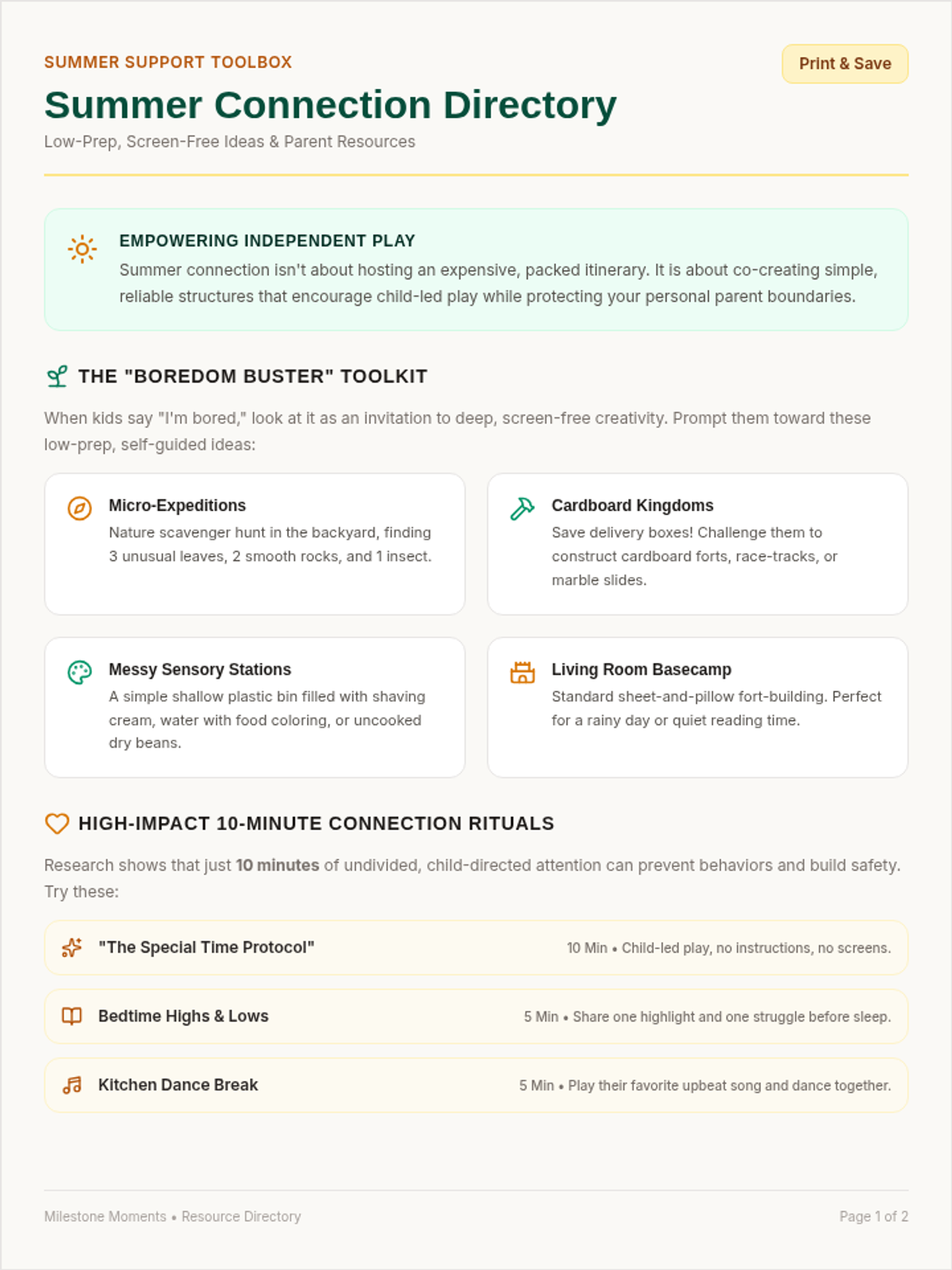
A curated summer resource directory for parents, featuring screen-free activity toolkits, sibling coping strategies, positive reinforcement ideas, and essential community resources.
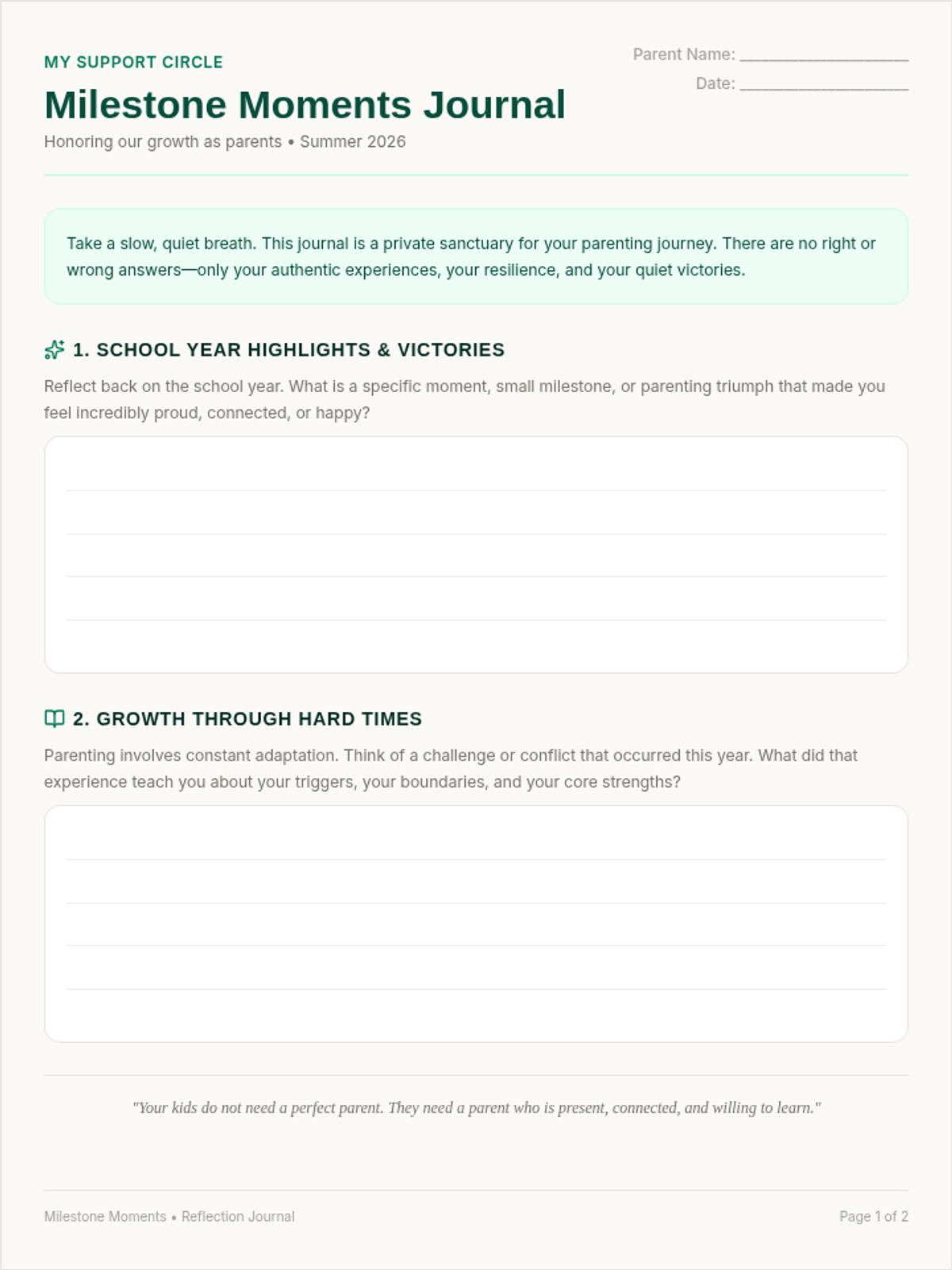
A printable reflection journal for parents to process school year insights, document family victories, list screen-free summer goals, and design mindful connection routines.
An aesthetic, warm, and highly visual virtual presentation slide deck to guide parents through reflections, year-end celebrations, and screen-free summer planning.
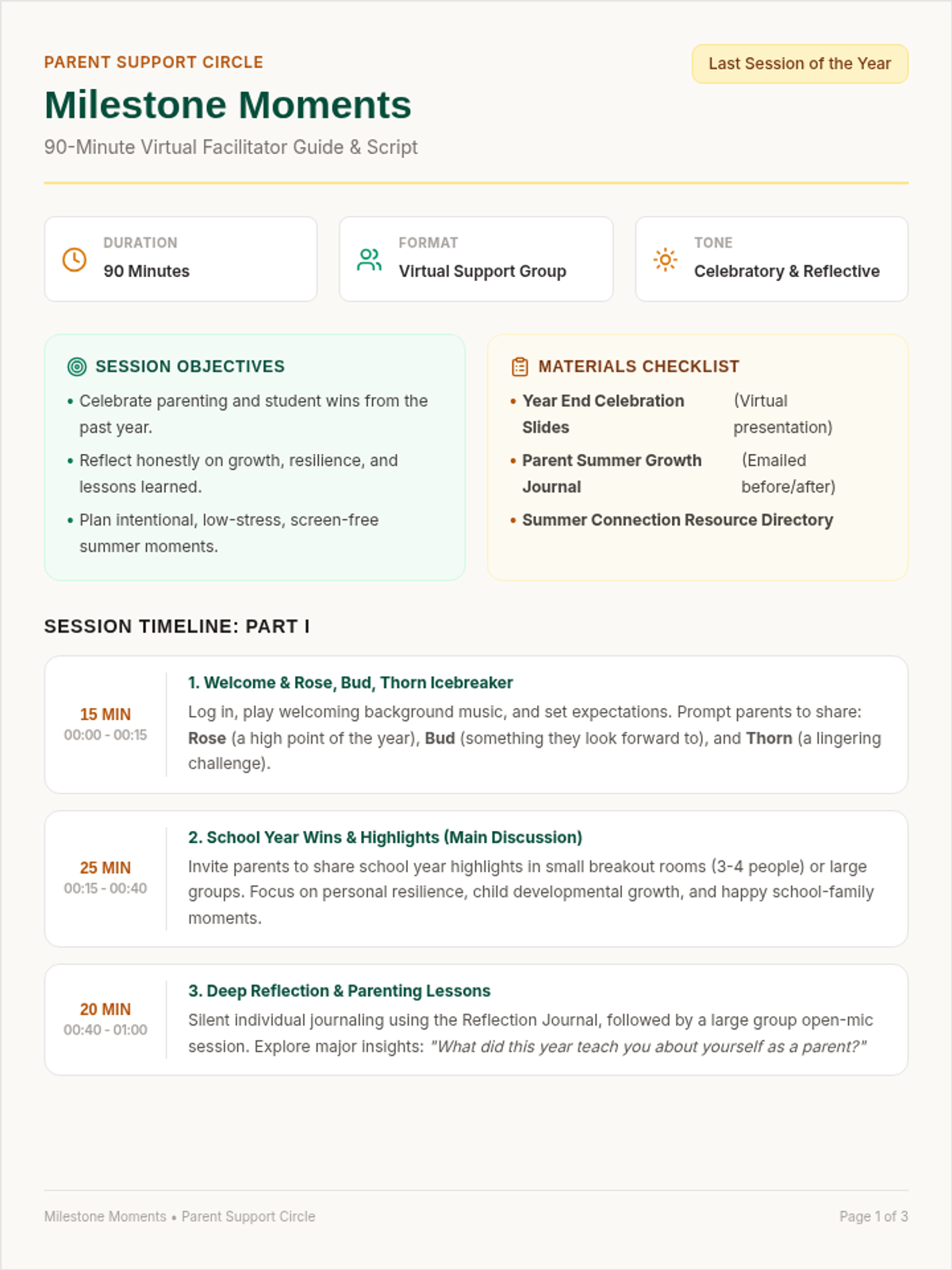
A comprehensive 90-minute facilitator guide and script for a parent support group session, complete with timestamps, virtual icebreakers, and discussion prompts.
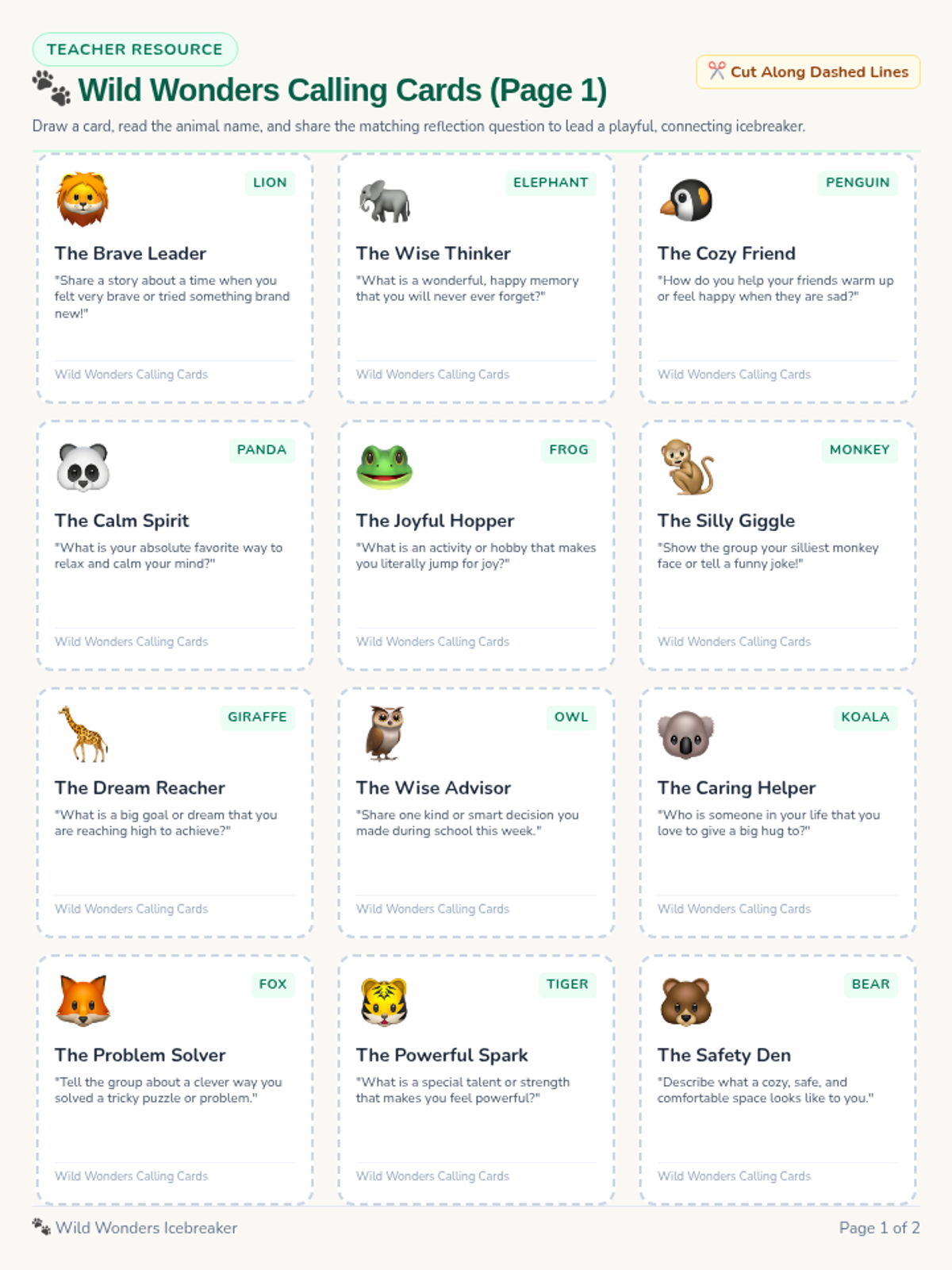
A set of 24 printable teacher calling cards with dotted cut lines, featuring massive, adorable animal graphics and engaging counseling icebreaker questions for each card.
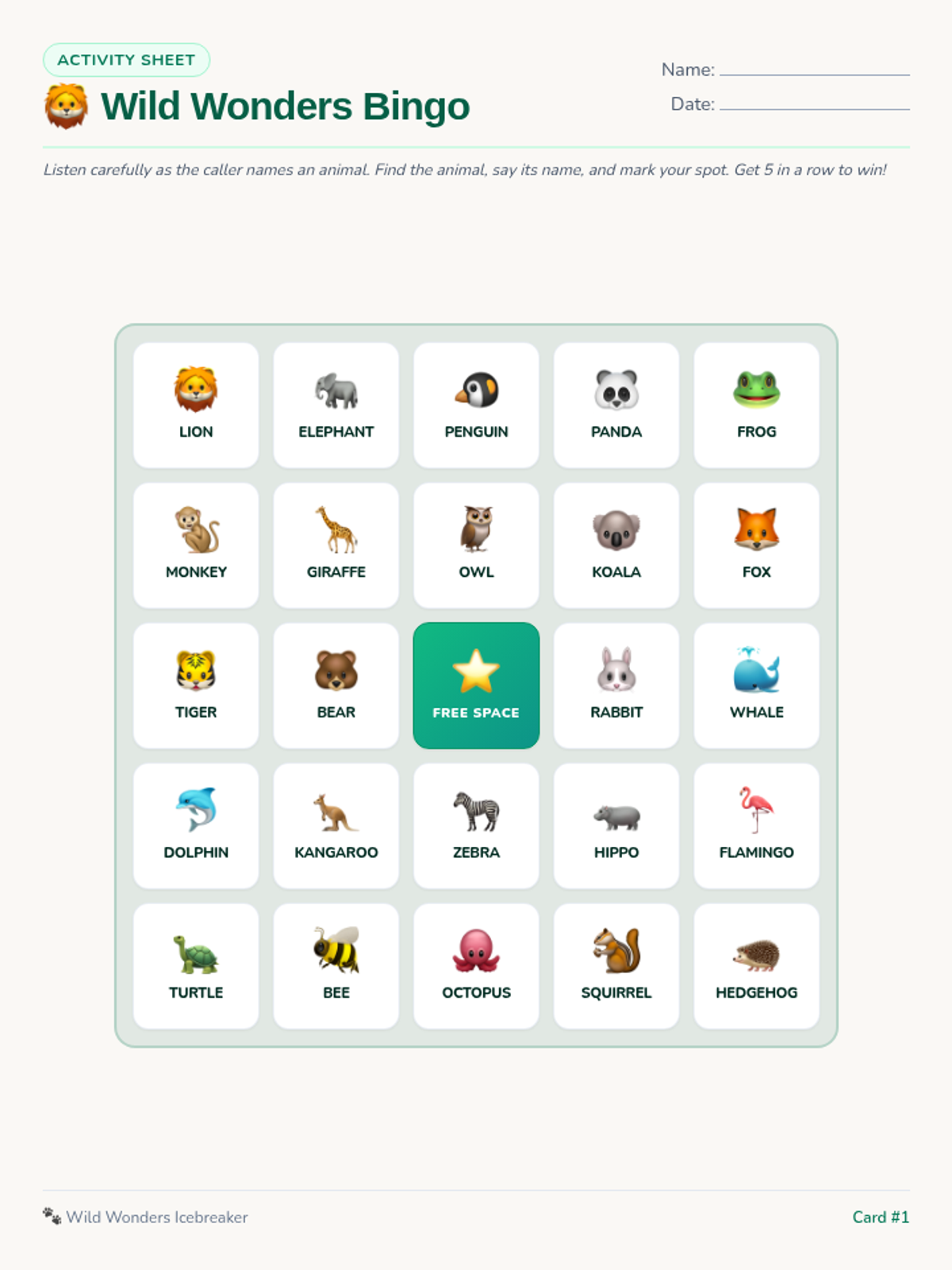
An expanded collection of twenty unique, printable 5x5 student bingo cards featuring animal names and emojis with a central free space. Perfect for managing larger groups and ensuring highly varied play paths.
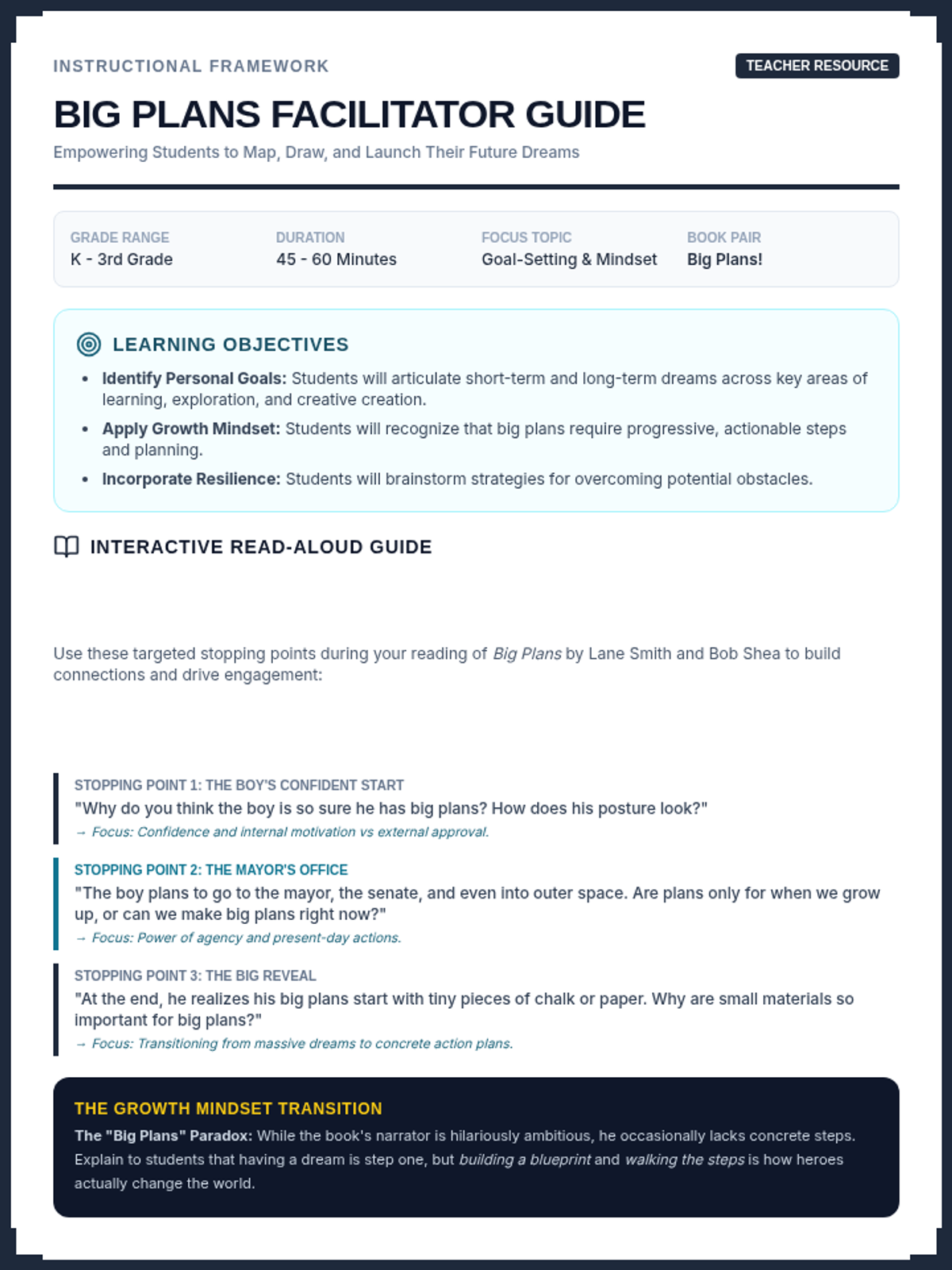
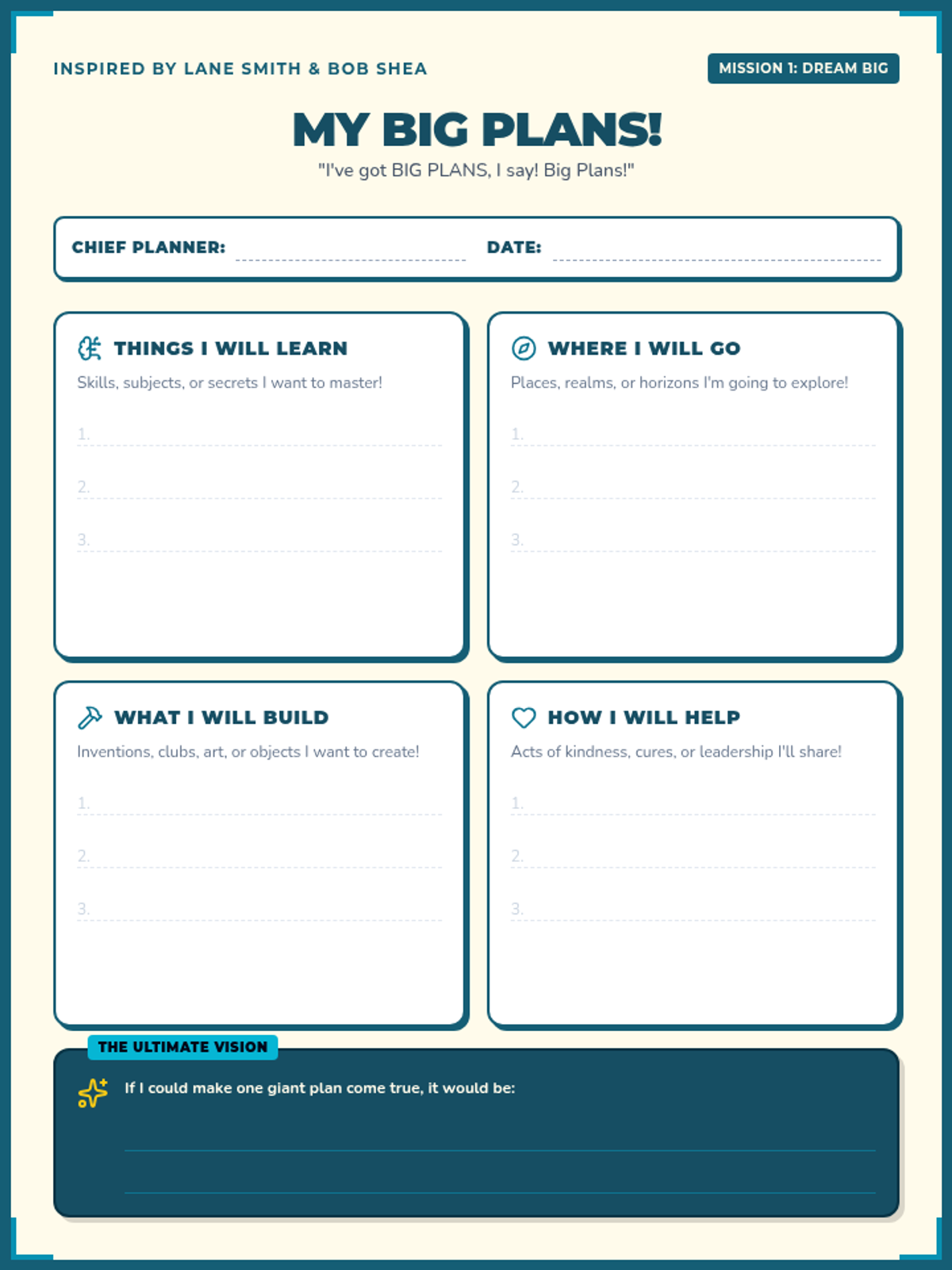
A 2-page print-ready lesson plan and facilitation guide for teachers. Includes interactive read-aloud prompts for the book 'Big Plans', growth mindset discussion guides, activity tips, and a simple rubric.
A 3-page printable student workbook containing creative graphic organizers, a blueprint drawing sheet, and an action roadmap inspired by the book 'Big Plans' to help students map out their dreams.
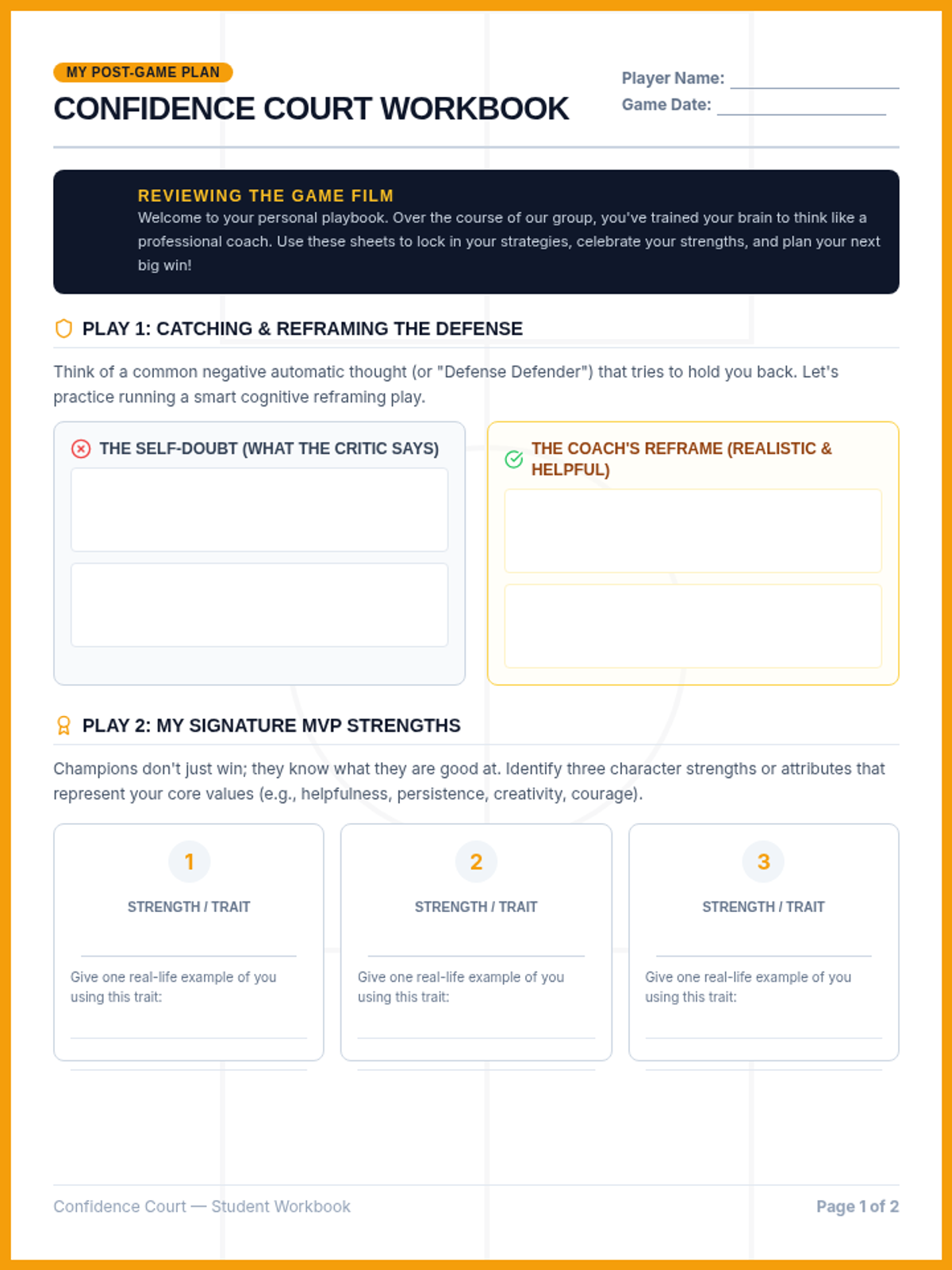
A 2-page print-ready reflection workbook and CBT action plan for students. Features structured self-esteem builders, reframe templates, and future goal planning.
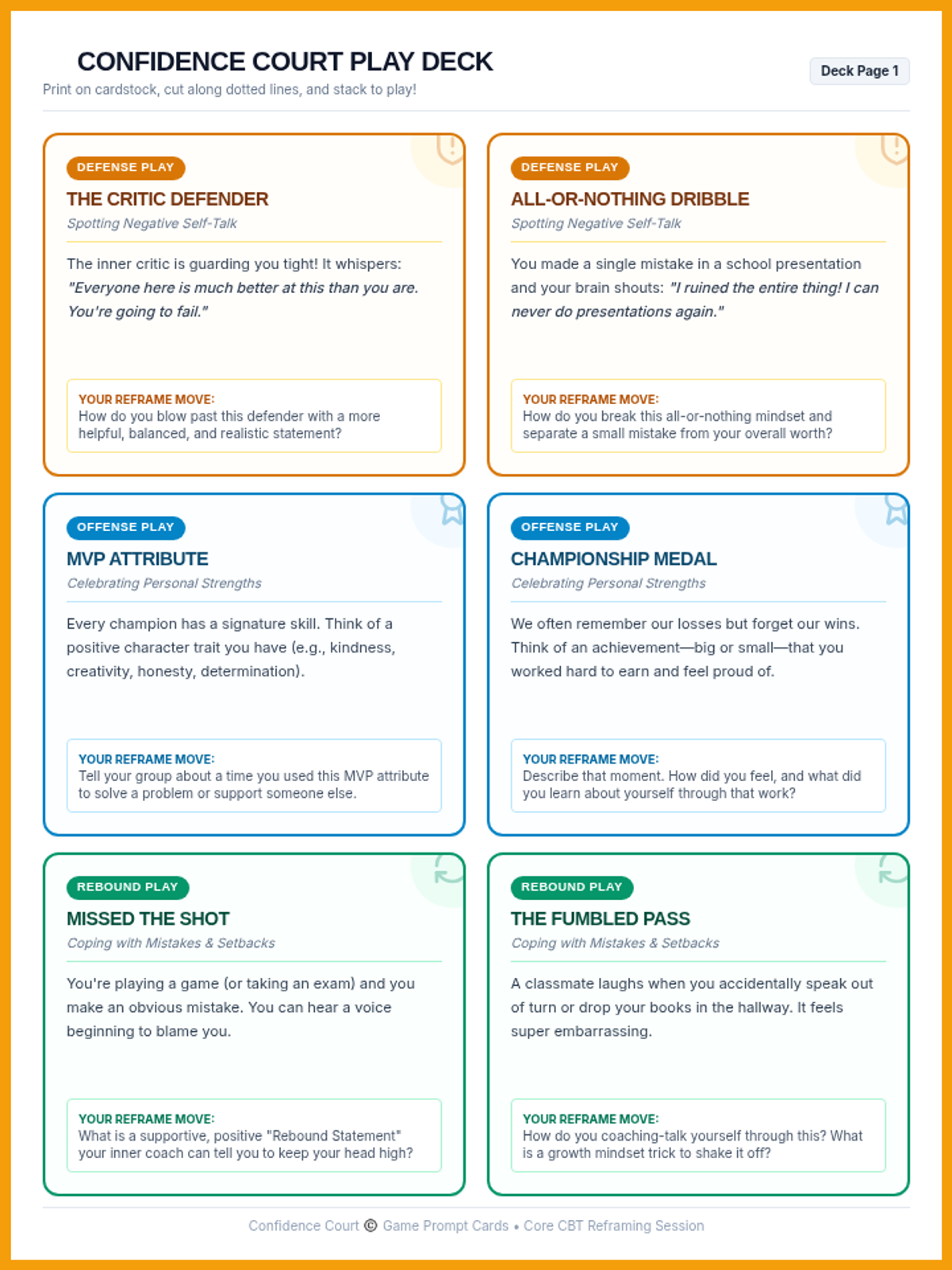
Interactive CBT prompt cards for the Confidence Court basketball shootout. Features 12 beautifully illustrated cards across 4 categories: Defense (Catch & Reframe), Offense (Strength Spotlight), Rebound (Growth Mindset), and Next Season (Future Goals).
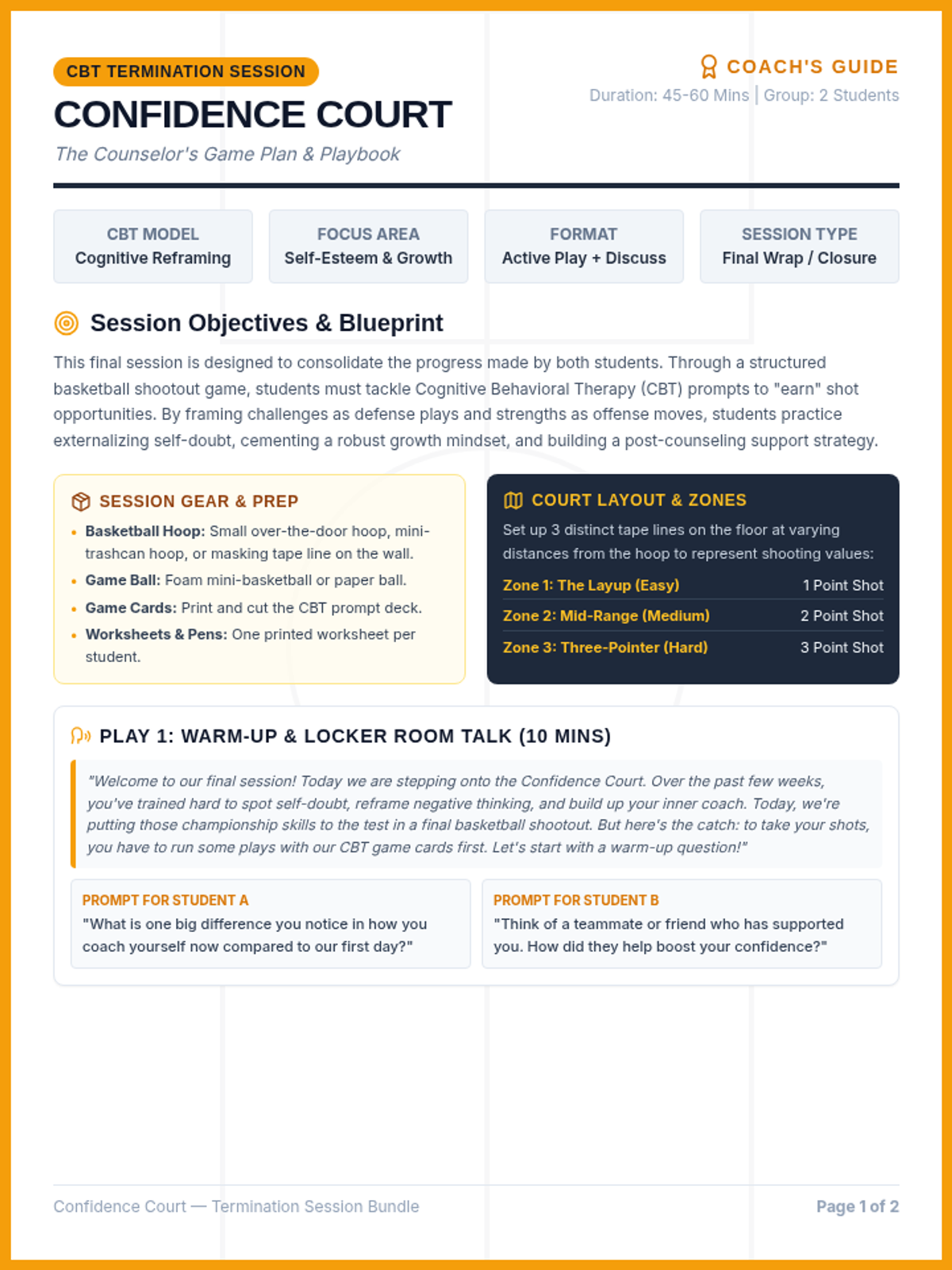
A comprehensive, 2-page counselor guide and playbook for the Confidence Court termination session. Includes materials setup, CBT coaching scripts, warm-up prompts, and step-by-step game rules.
The final instructional slide deck for Lesson 5, guiding students through synthesizing their research into a "Joy Menu" and practicing their new skills through role-play.
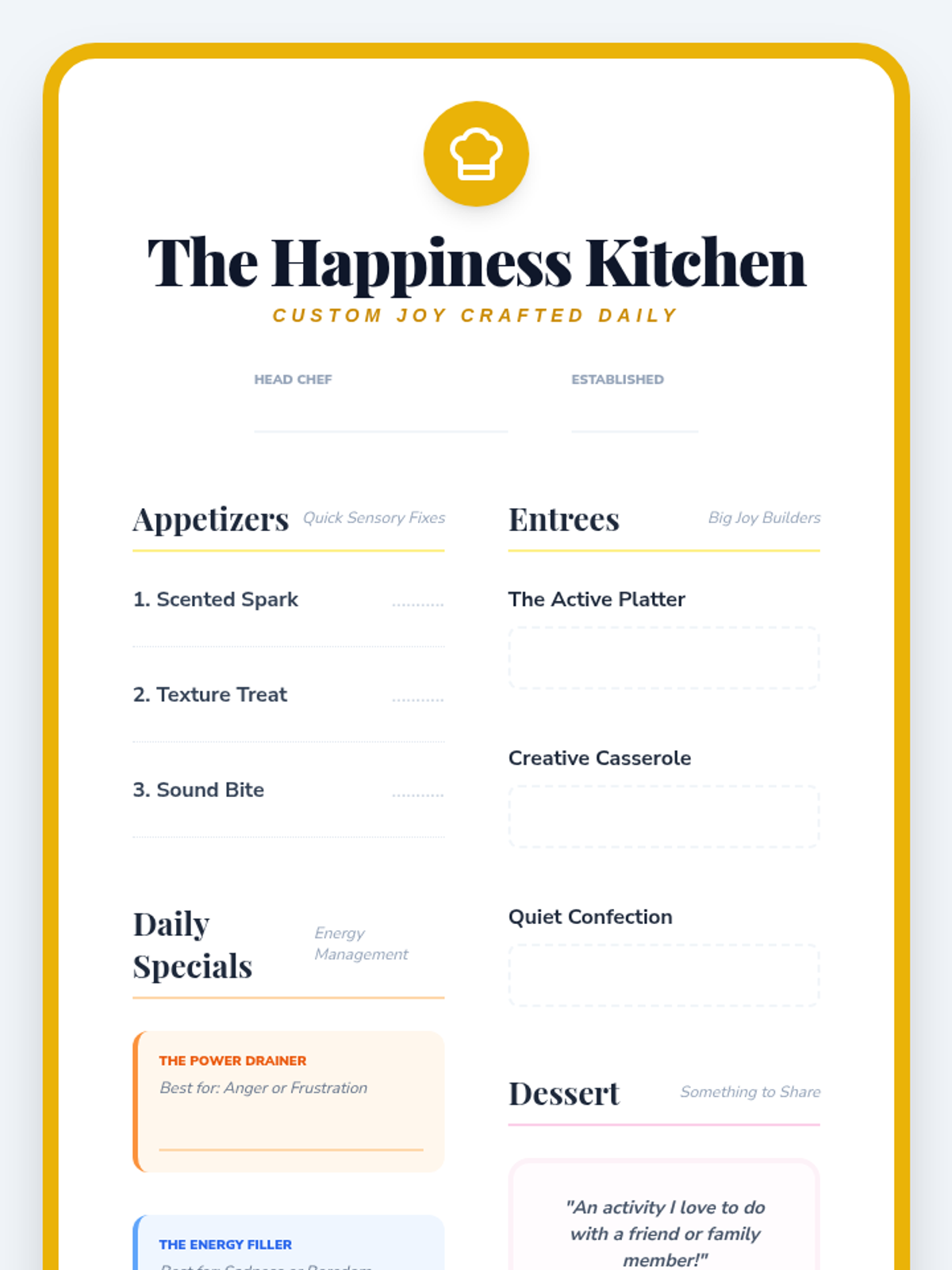
A student-facing restaurant-style menu template for synthesizing and illustrating personal mood-lifting activities and coping strategies.
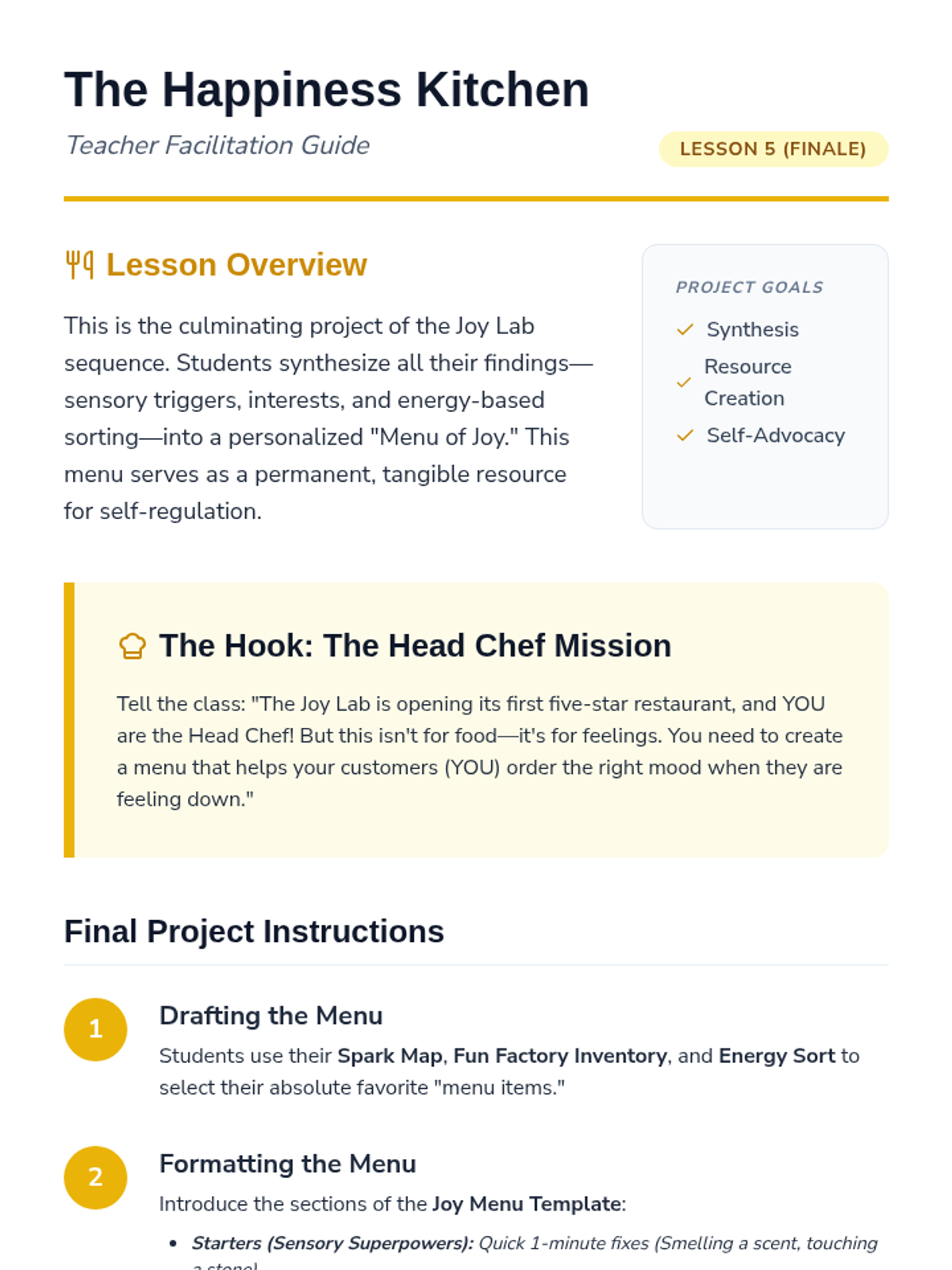
A teacher guide for Lesson 5, focusing on synthesis of learned coping strategies into a personalized "Joy Menu" and providing instructions for role-play scenarios.
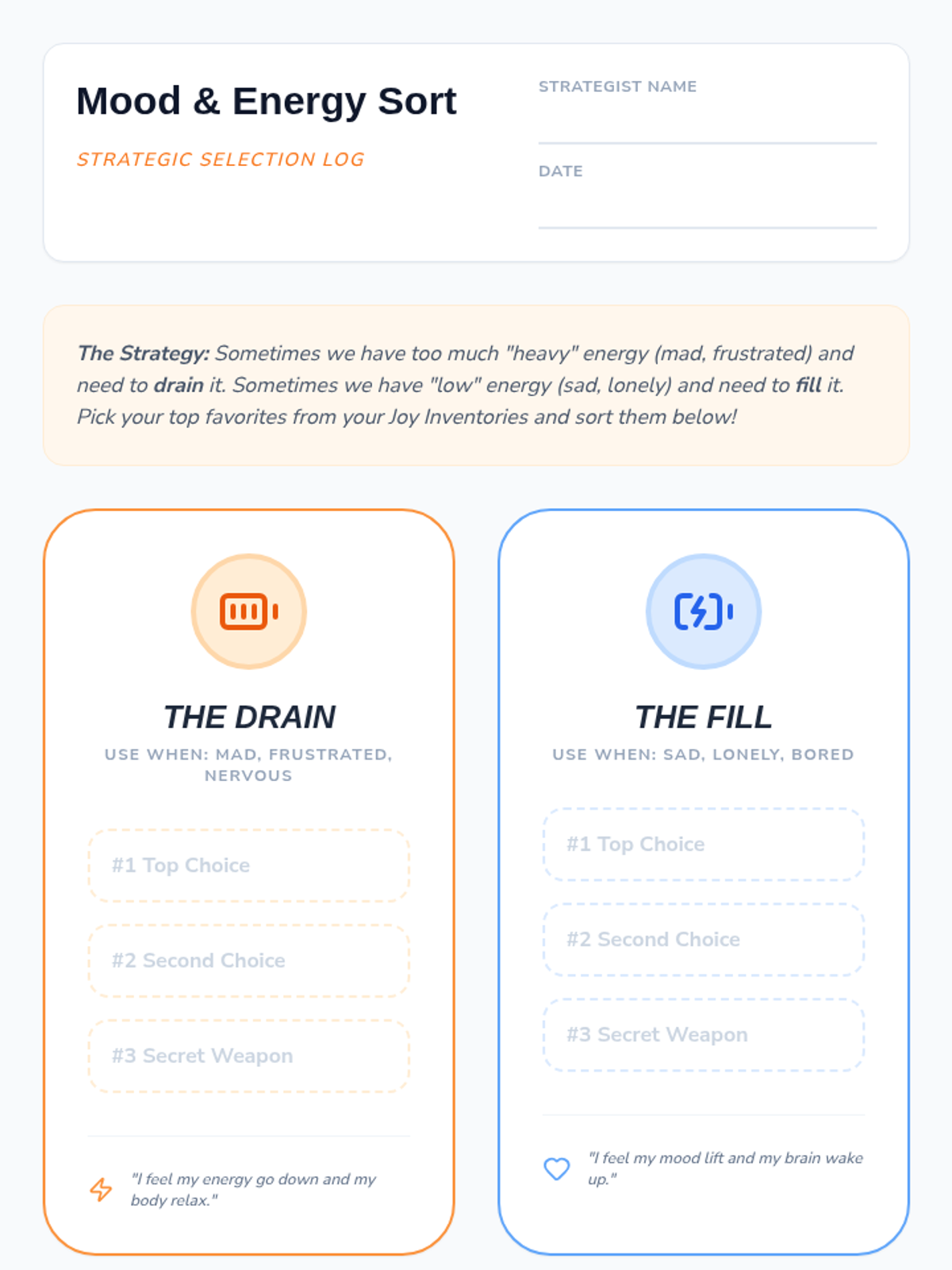
A student worksheet for sorting personal joy activities into High Energy (Drain) and Low Energy (Fill) categories for strategic emotional regulation.
An instructional slide deck for Lesson 4 that teaches students how to strategically match activities to their current emotional energy levels.
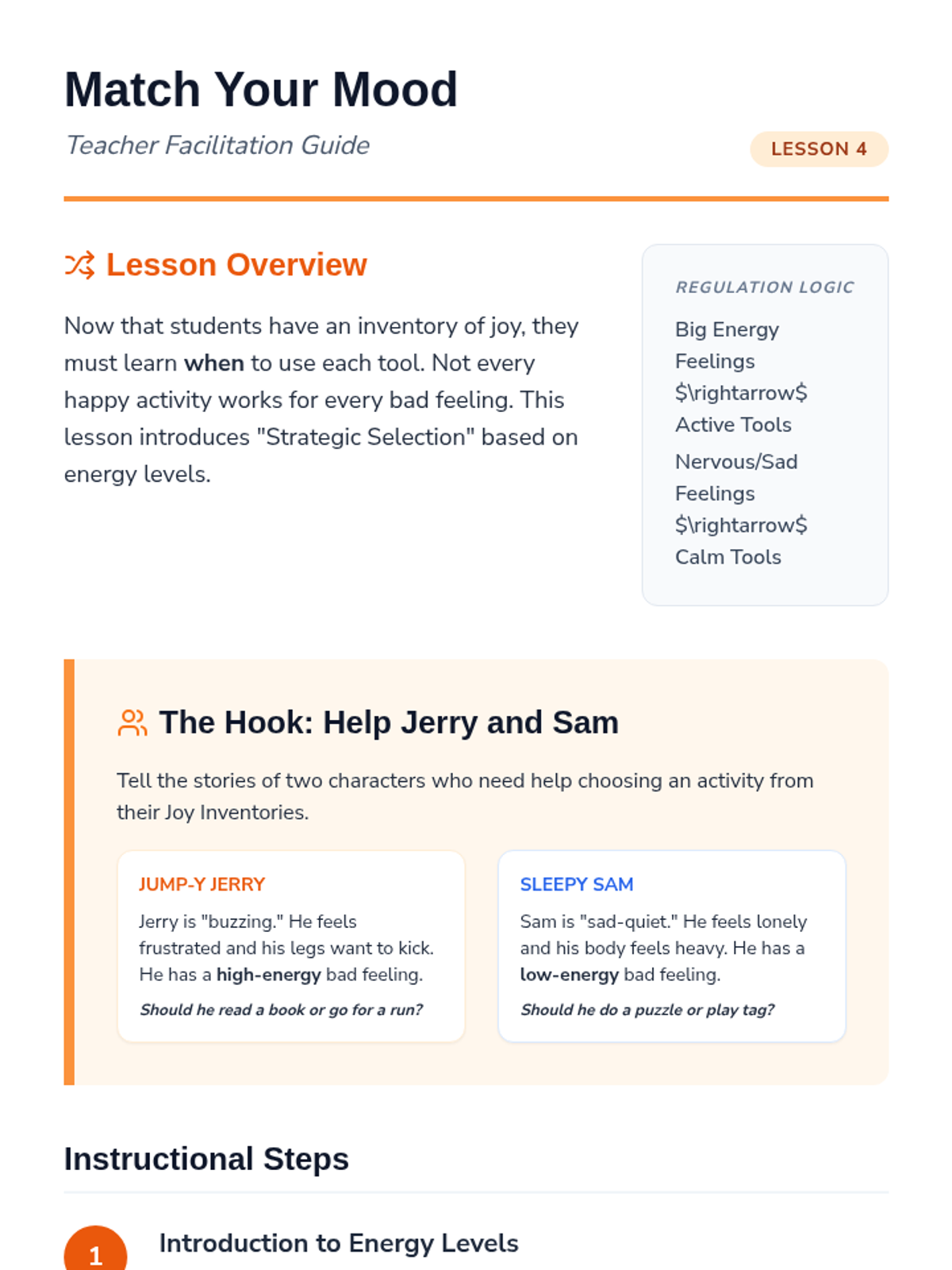
A teacher guide for Lesson 4, focusing on strategic selection of activities based on emotional energy levels (High Energy vs. Low Energy).
An instructional slide deck for Lesson 3 that introduces sensory mood boosters and guides students through a series of "laboratory" experiments with smell, sound, and touch.
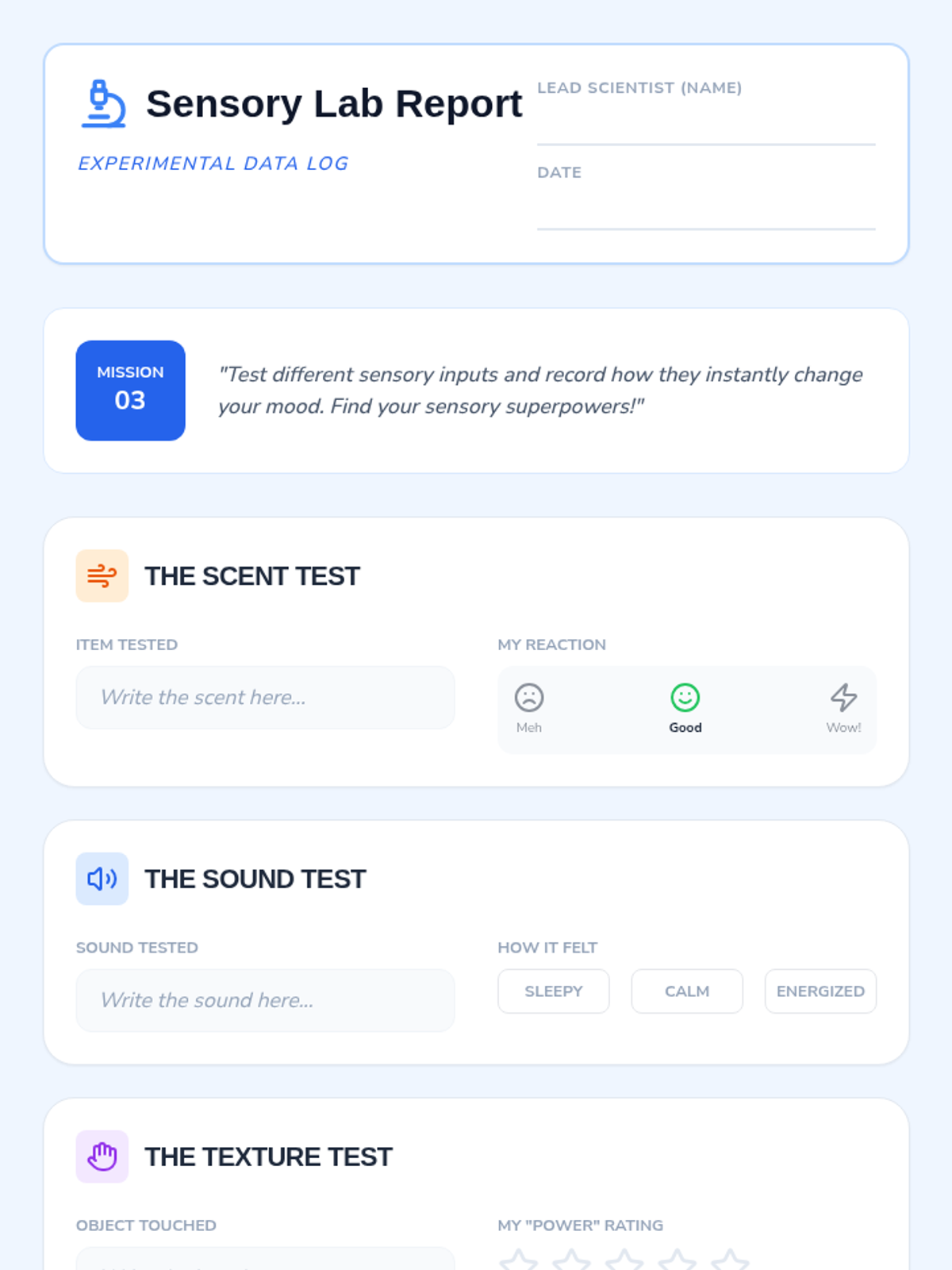
A student lab report worksheet for recording observations and emotional reactions during the "Sensory Superpowers" lab station activity.
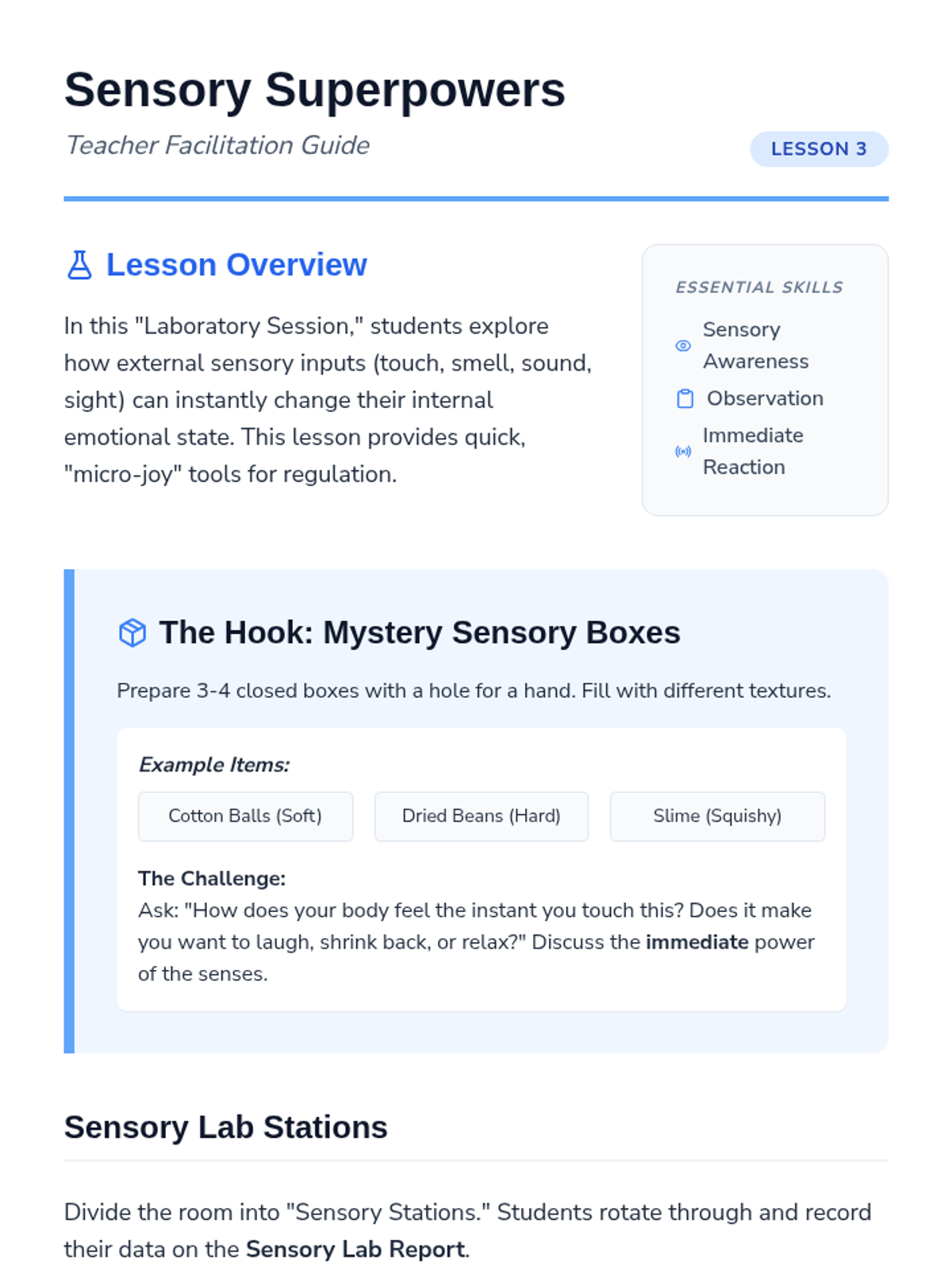
A teacher guide for Lesson 3, focusing on sensory-based mood boosters (smell, touch, sound, sight) through a "Sensory Lab" station rotation.
An instructional slide deck for Lesson 2 that introduces the three departments of fun: active, creative, and quiet, and guides students through building a personal joy stockpile.
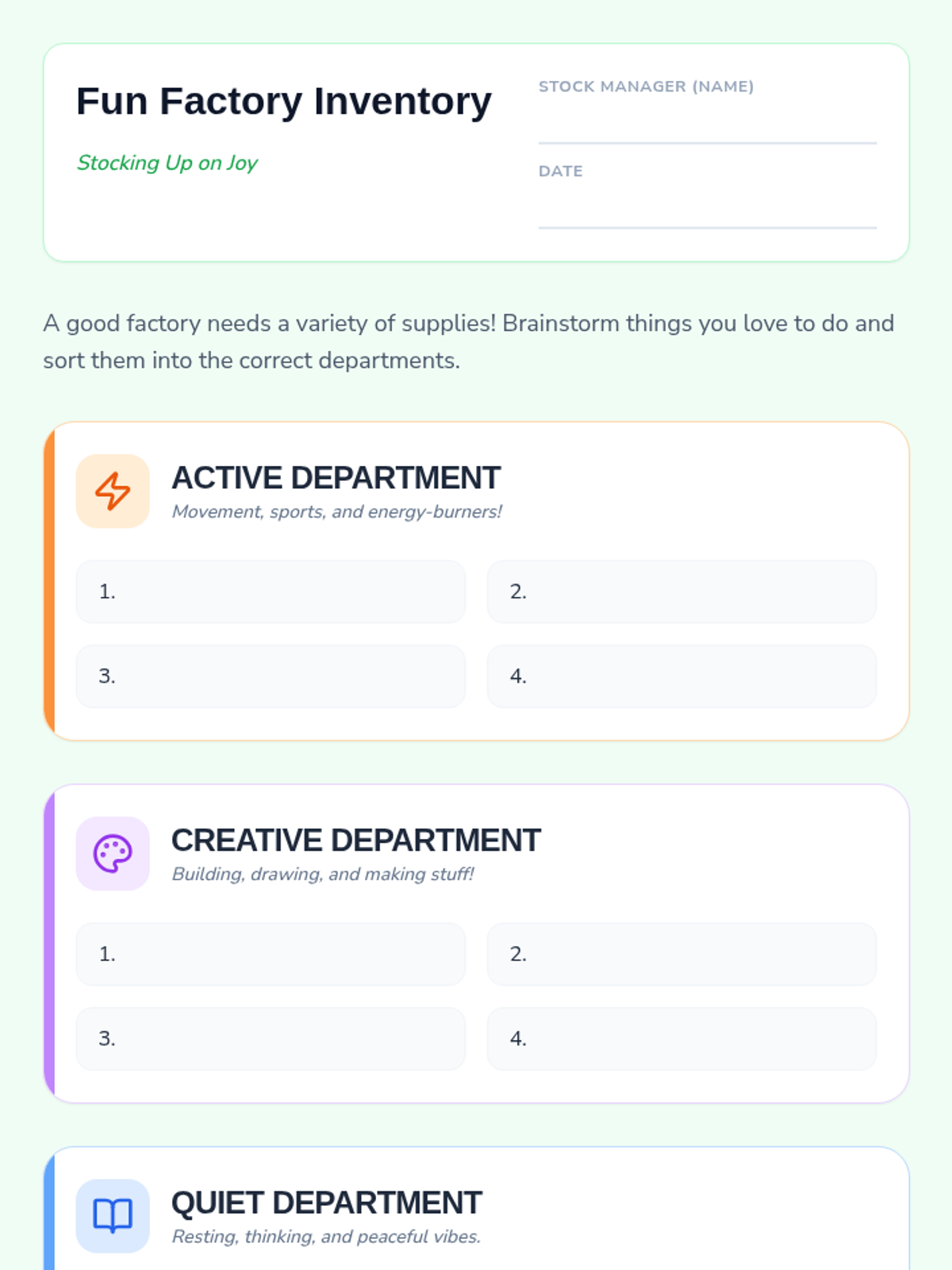
A student worksheet for identifying and categorizing favorite activities into active, creative, and quiet categories to build a diverse joy inventory.
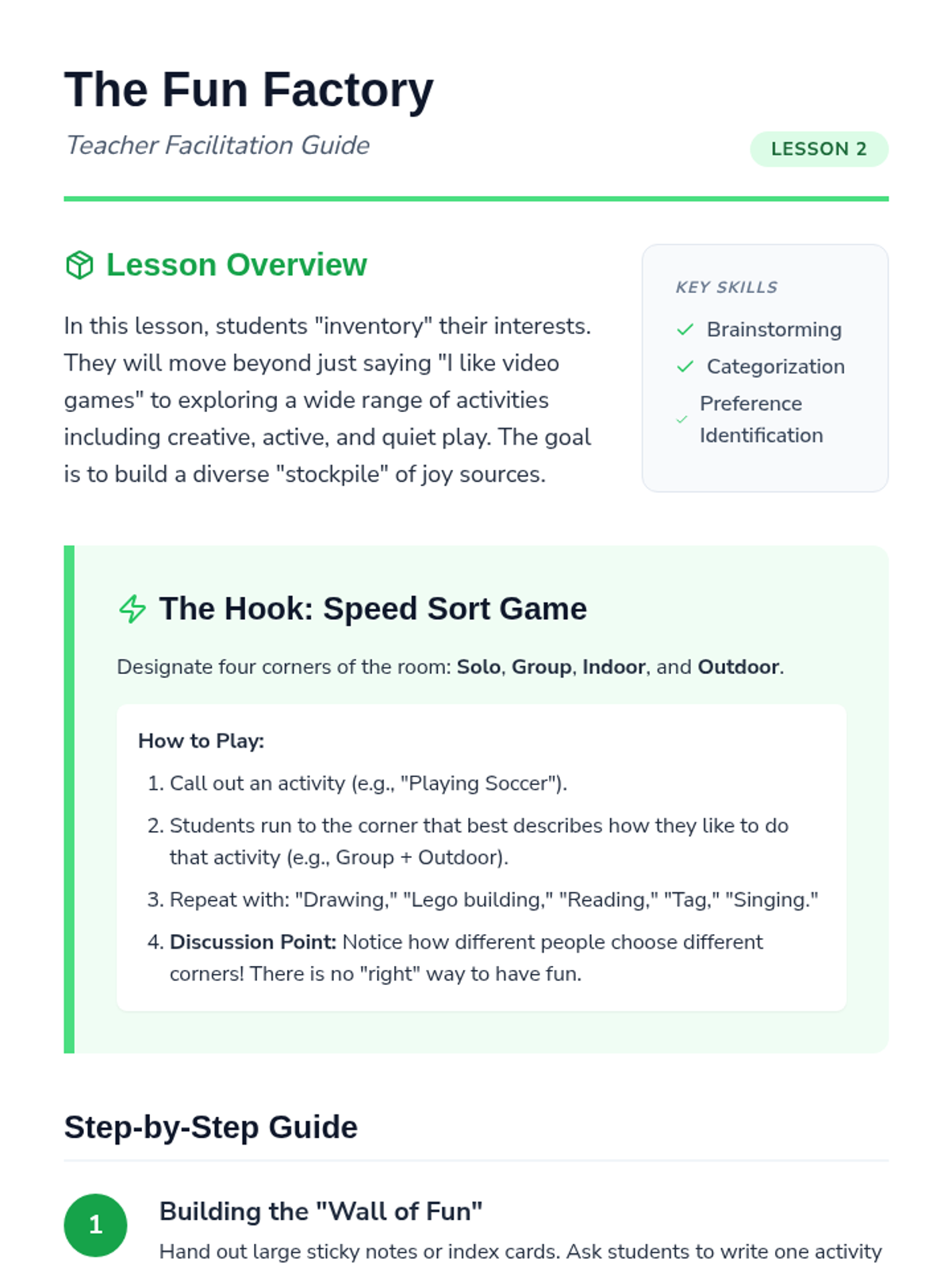
A teacher guide for Lesson 2, focusing on brainstorming activities and categorizing them into active, creative, and quiet "departments" to build a diverse emotional toolkit.
An engaging slide deck for the first lesson of the Joy Lab, introducing the concept of mapping physical sensations associated with high-energy and low-energy positive emotions.
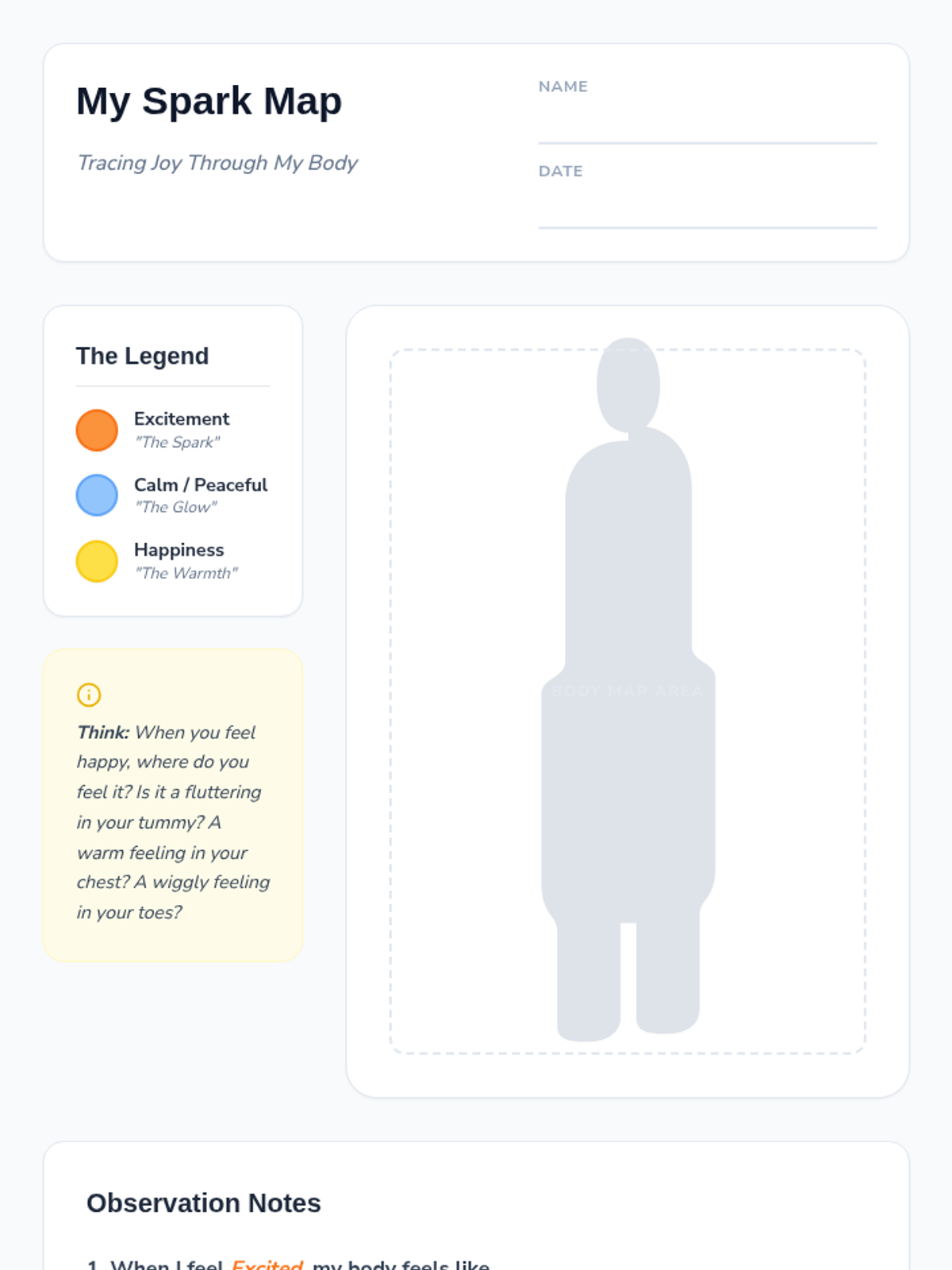
A student worksheet featuring a body map outline where children can trace and color physical sensations associated with positive emotions like excitement, calm, and happiness.
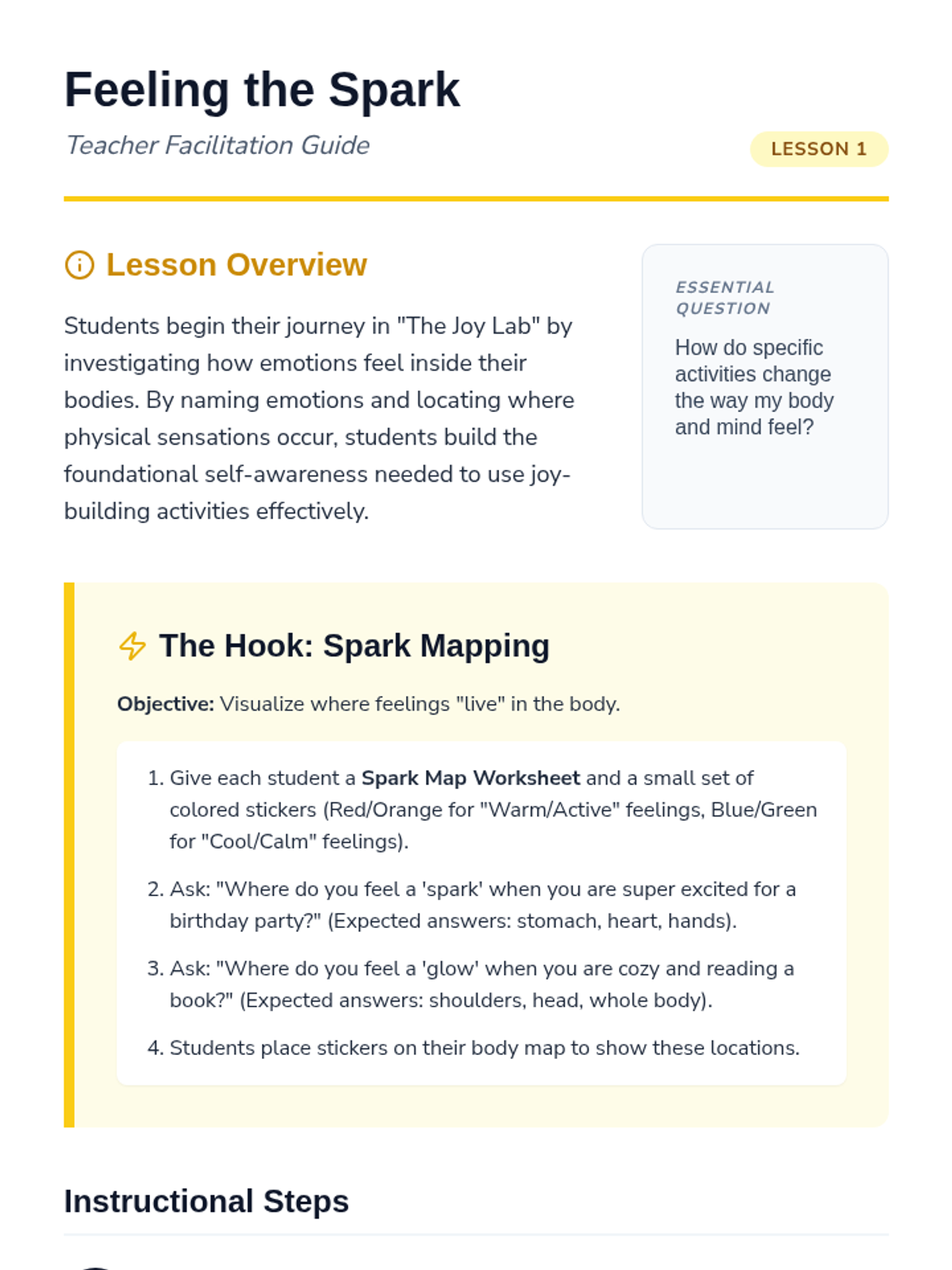
A comprehensive teacher guide for the first lesson of the Joy Lab sequence, focusing on identifying physical sensations associated with positive emotions through body mapping and vocabulary building.
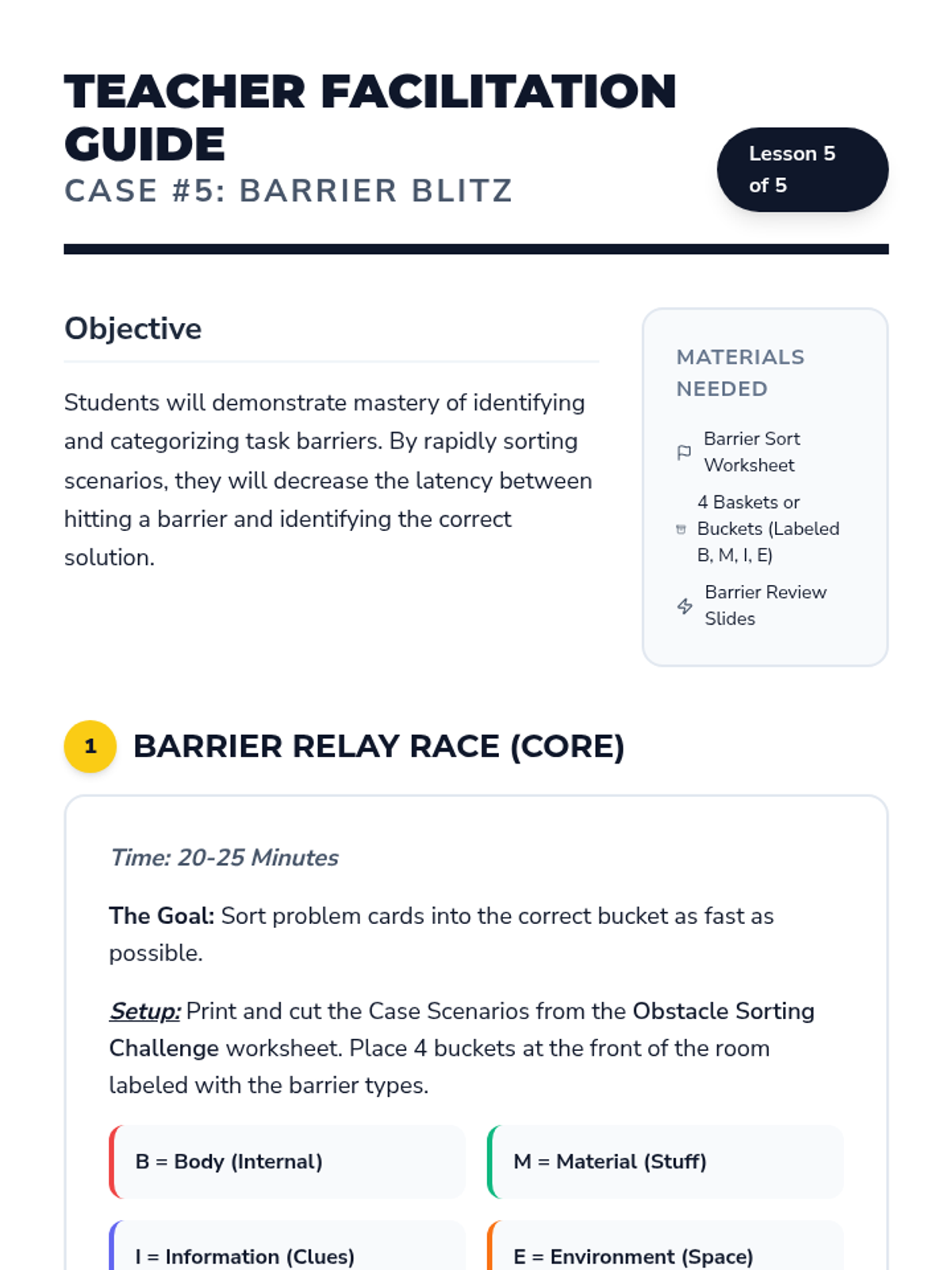
A teacher facilitation guide for Lesson 5, including instructions for the 'Barrier Relay Race' and a unit conclusion.
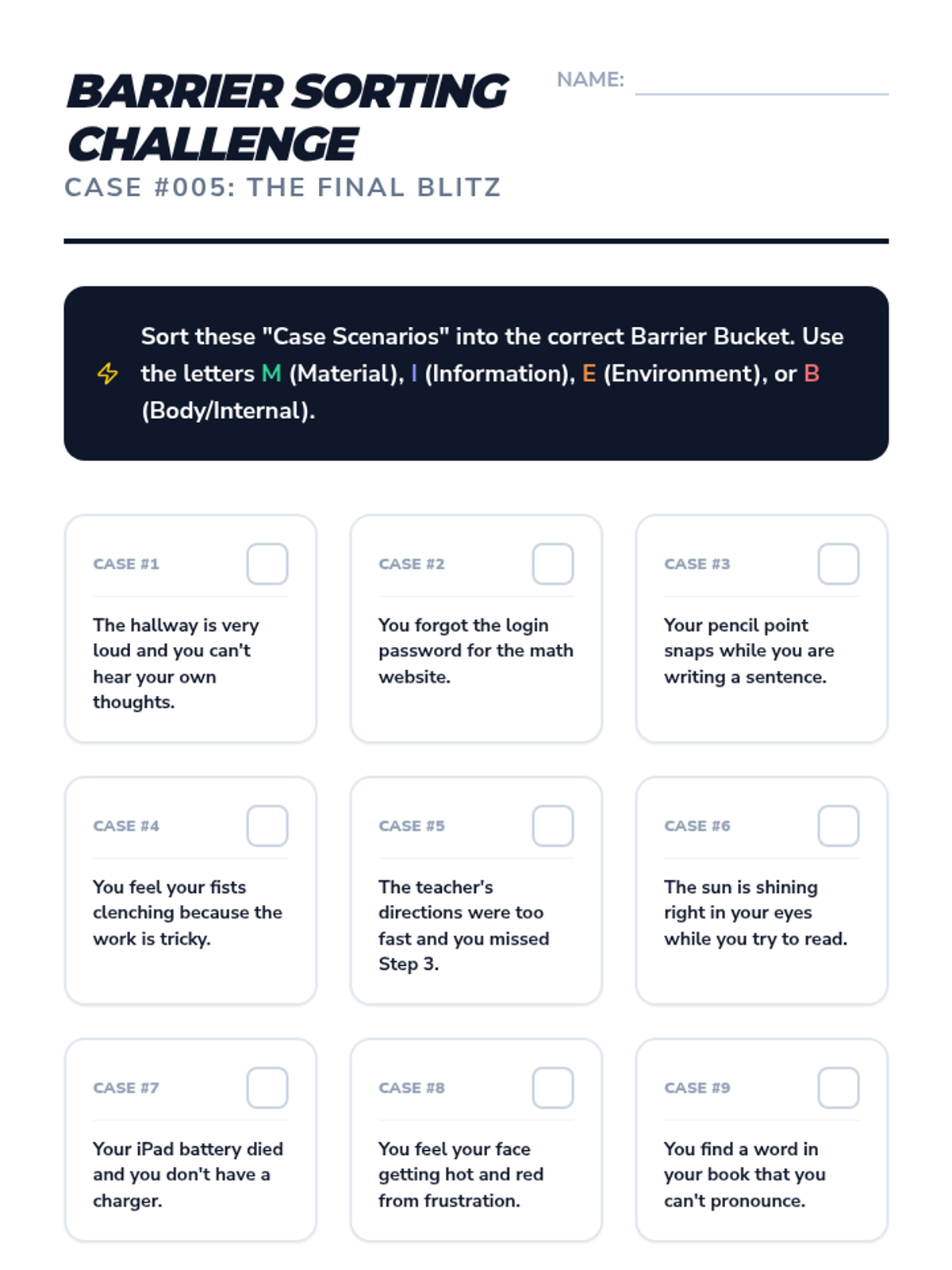
A culminating sorting activity where students categorize various problem scenarios into the four task barrier types.
A culminating slide deck for the 'Barrier Blitz' lesson, reviewing all 4 types of task barriers and preparing students for the final sorting activity.
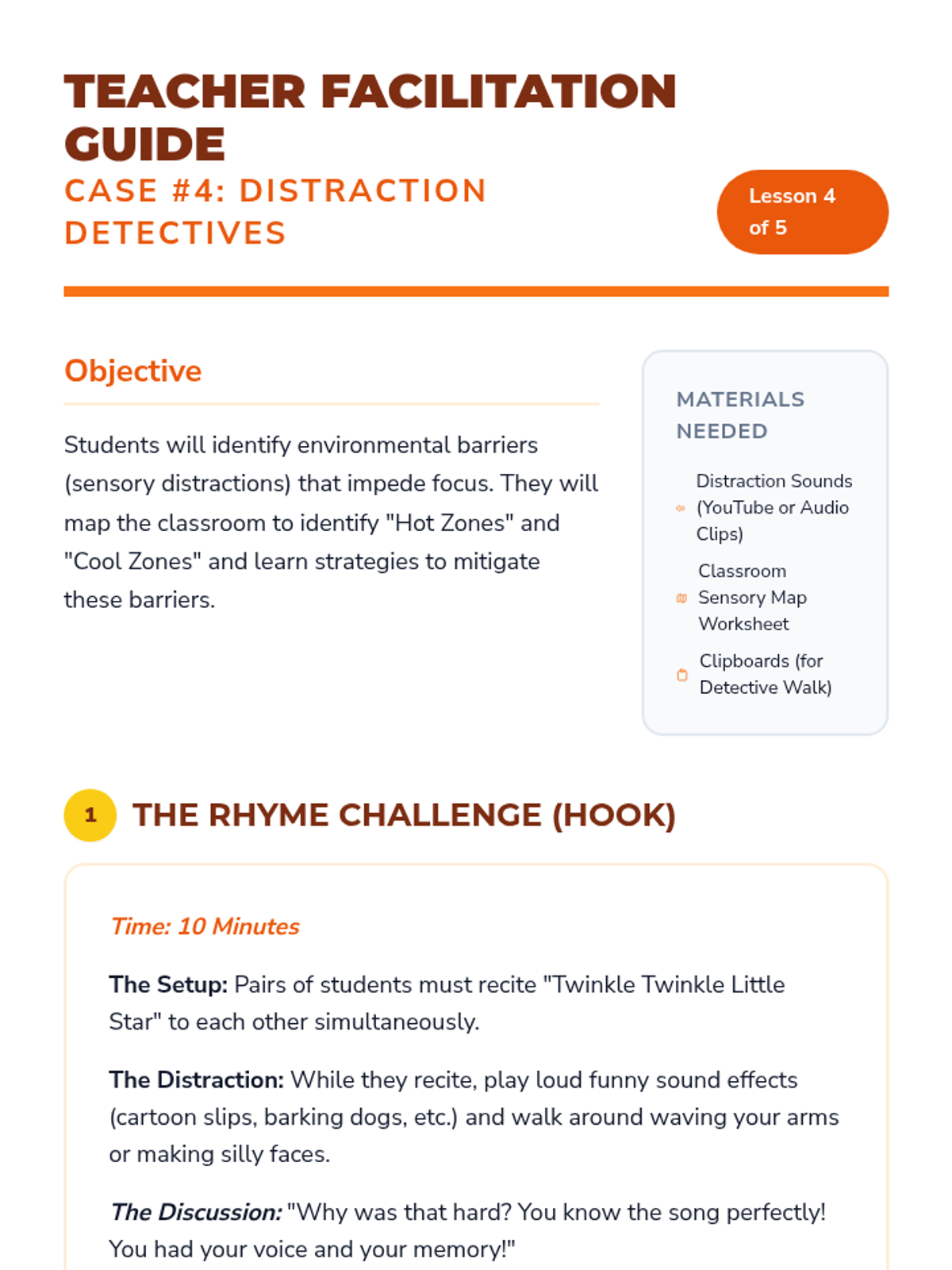
A teacher facilitation guide for Lesson 4, including instructions for the 'Stakeout Walk' and sensory mapping activity.
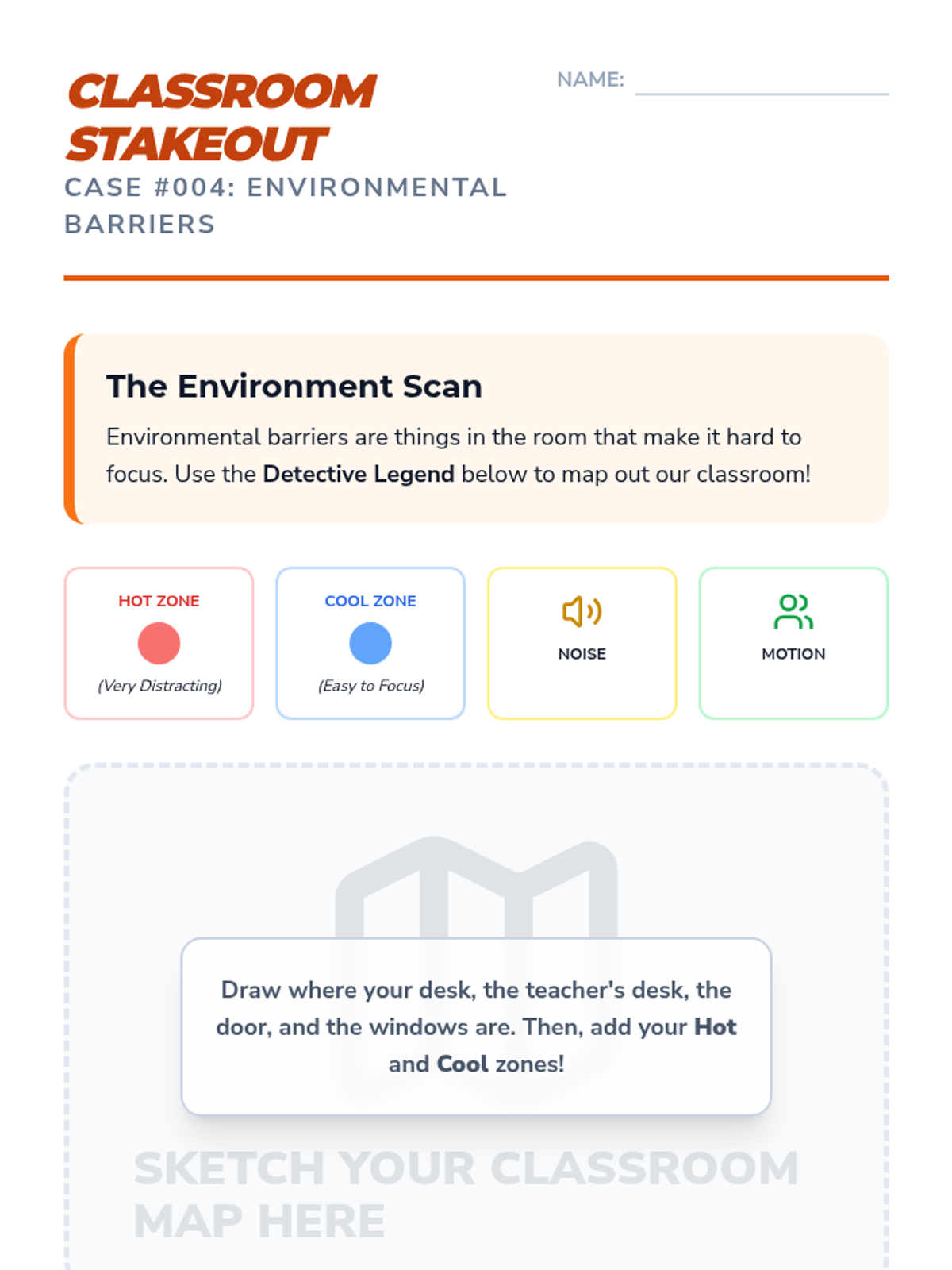
A mapping activity for students to identify 'Hot' and 'Cool' sensory zones in their classroom to manage environmental distractions.
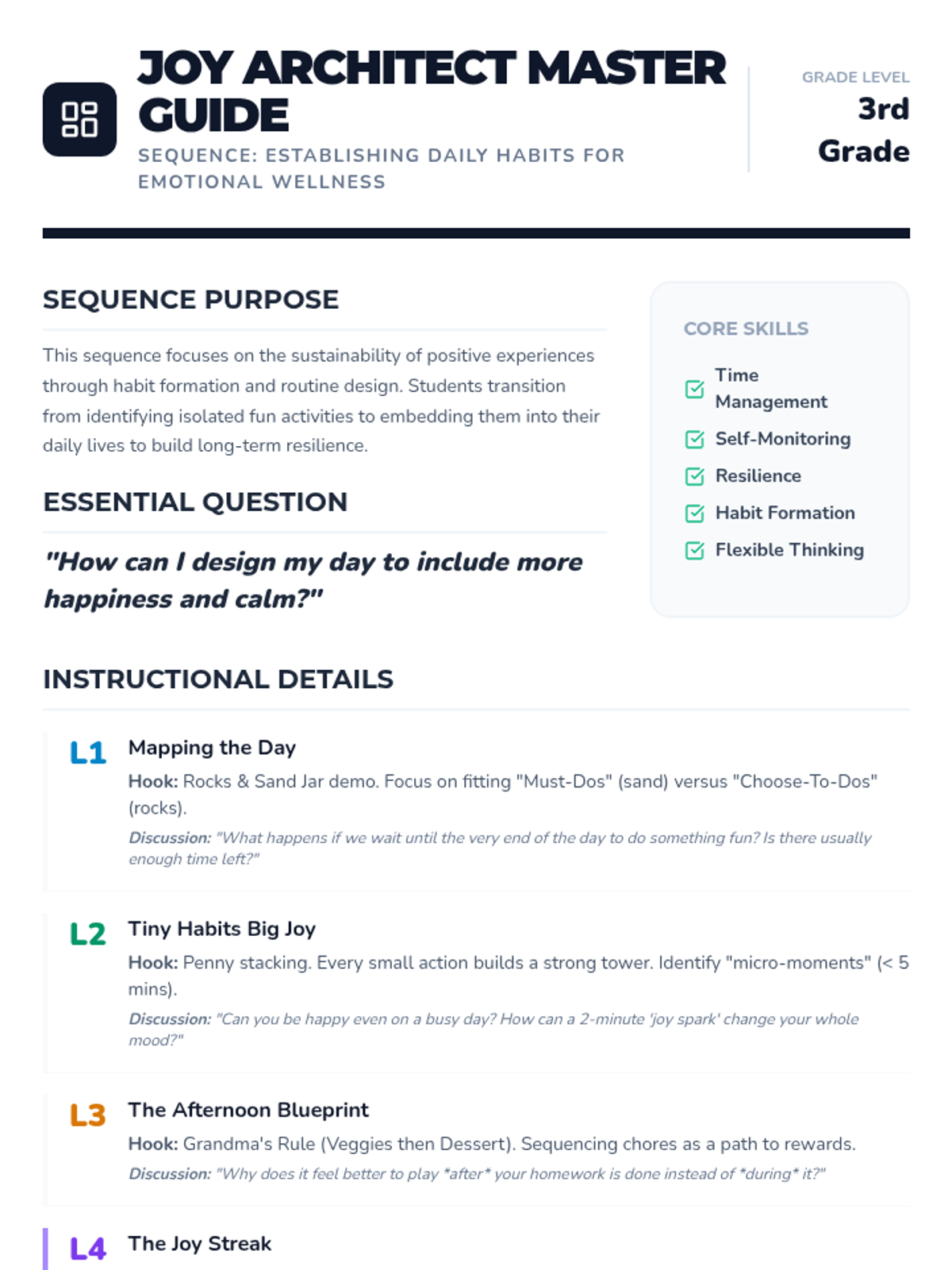
A comprehensive teacher guide for the Joy Architect sequence, outlining the instructional arc, key concepts for each lesson, and the core skills developed.
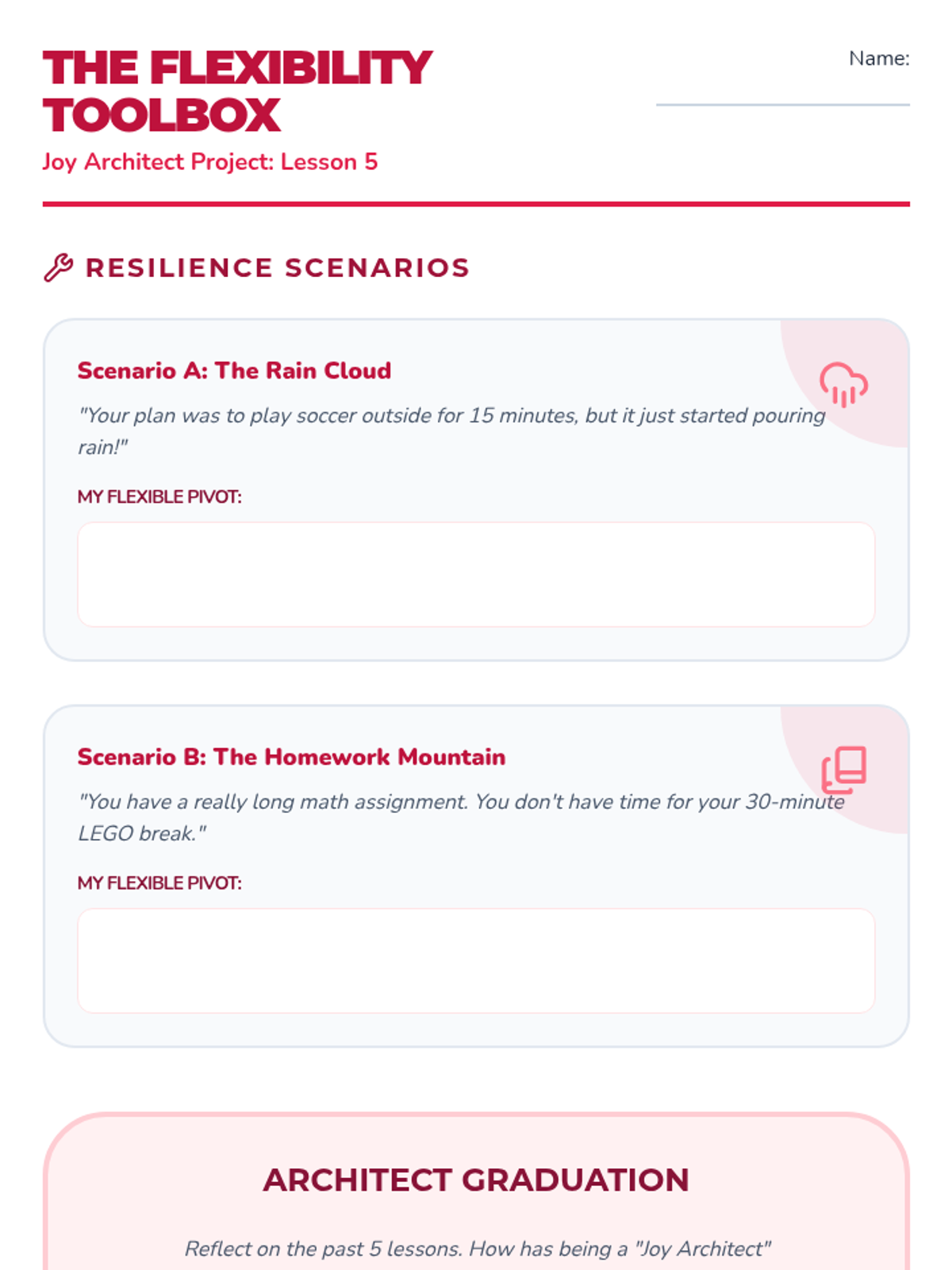
Student reflection sheet for the final lesson. Features 'resilience scenarios' for practicing flexible thinking and a final reflection on the unit's key takeaways.
Final slide deck for Lesson 5. Focuses on resilience, 'flexible thinking' when routines are disrupted, and celebrates students' progress as 'Joy Architects'.
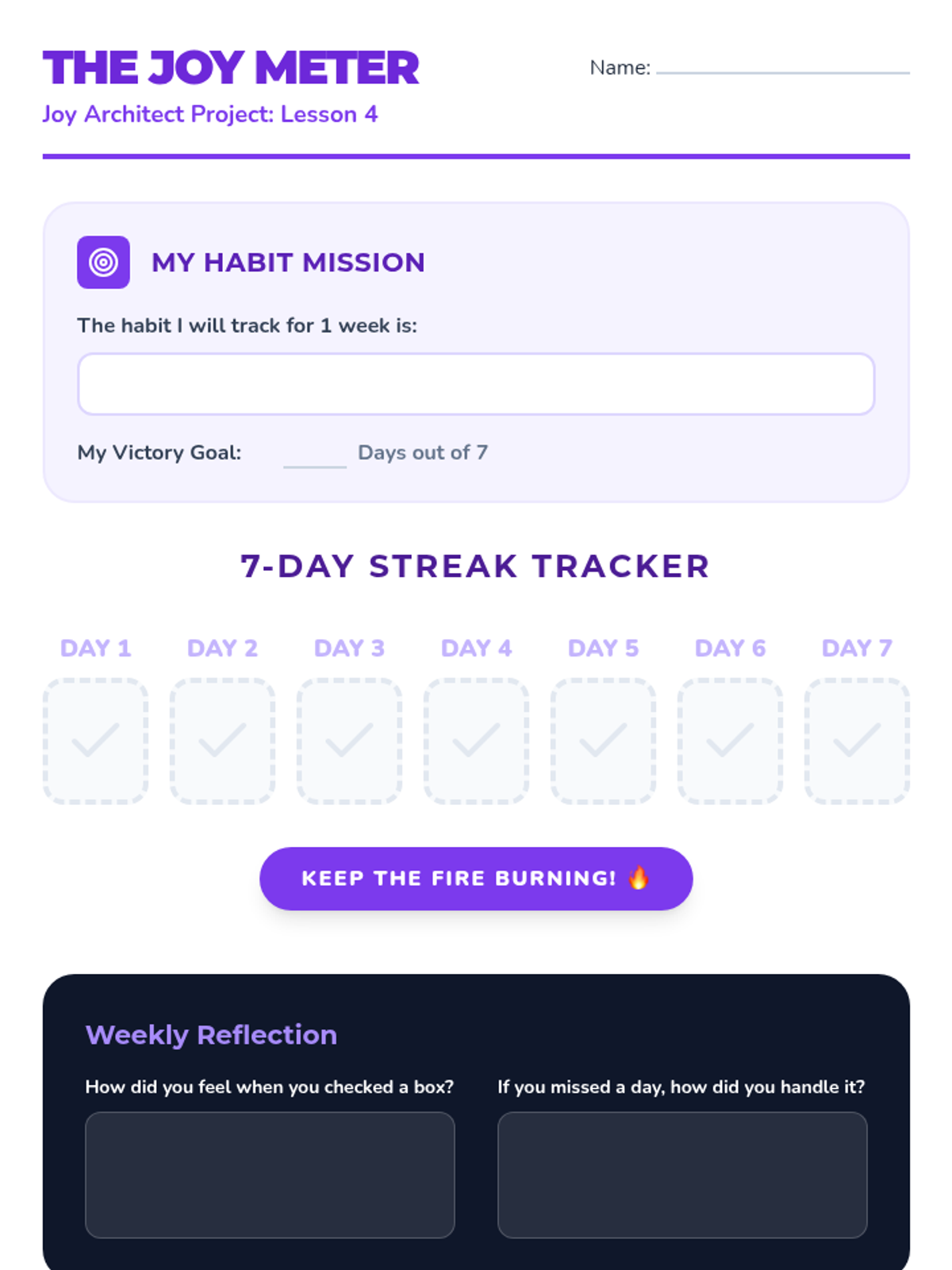
A 7-day progress tracker for students to monitor their consistency with a chosen joy habit. Includes goal setting and reflection sections.
Slide deck for Lesson 4 on creating a progress tracker. Explains the concept of 'streaks' and the importance of self-monitoring and honesty in habit formation.
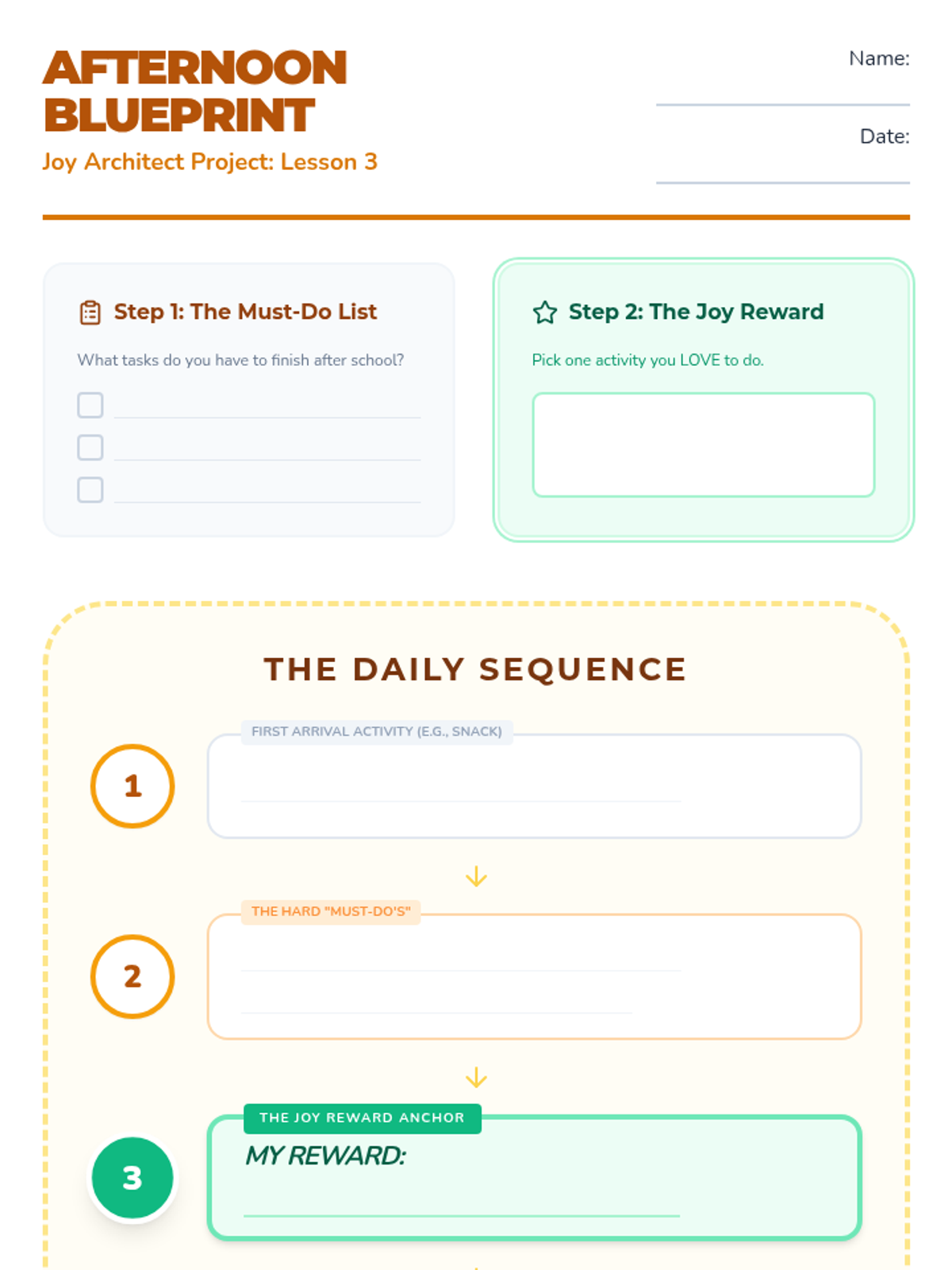
Student worksheet for designing an afternoon schedule. Uses the 'Grandma's Rule' concept to sequence chores before rewarding joy activities.
Slide deck for Lesson 3 on designing a balanced schedule. Introduces 'Grandma's Rule' (sequencing chores before rewards) and using joy as a motivation anchor.
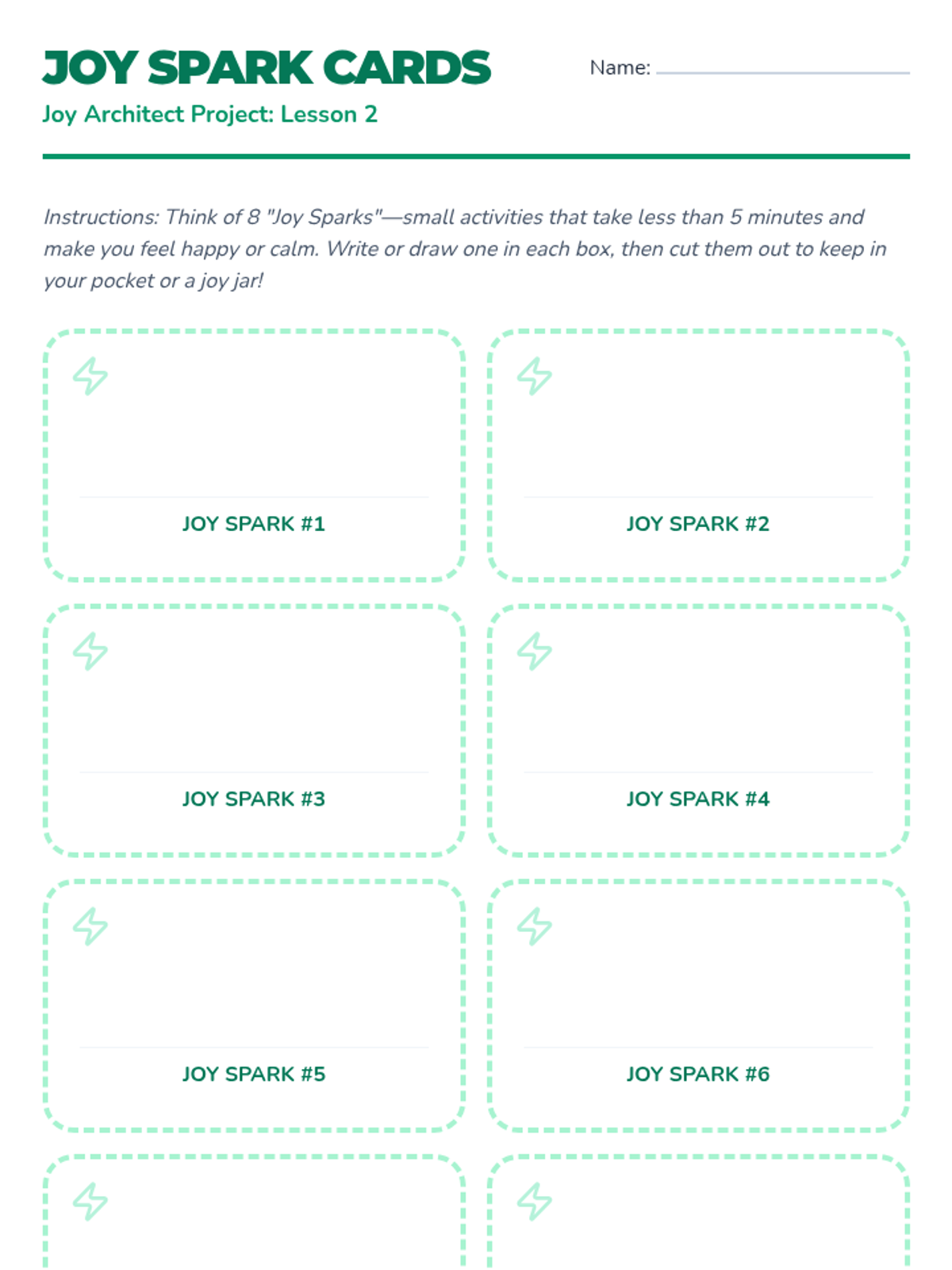
A set of cut-out cards for students to brainstorm and record 'micro-moments' of joy they can easily integrate into their day.