Empathetic skill development through emotion recognition, cultural diversity appreciation, and bias confrontation. Targets multi-perspective analysis to support respectful interactions and complex social responses.
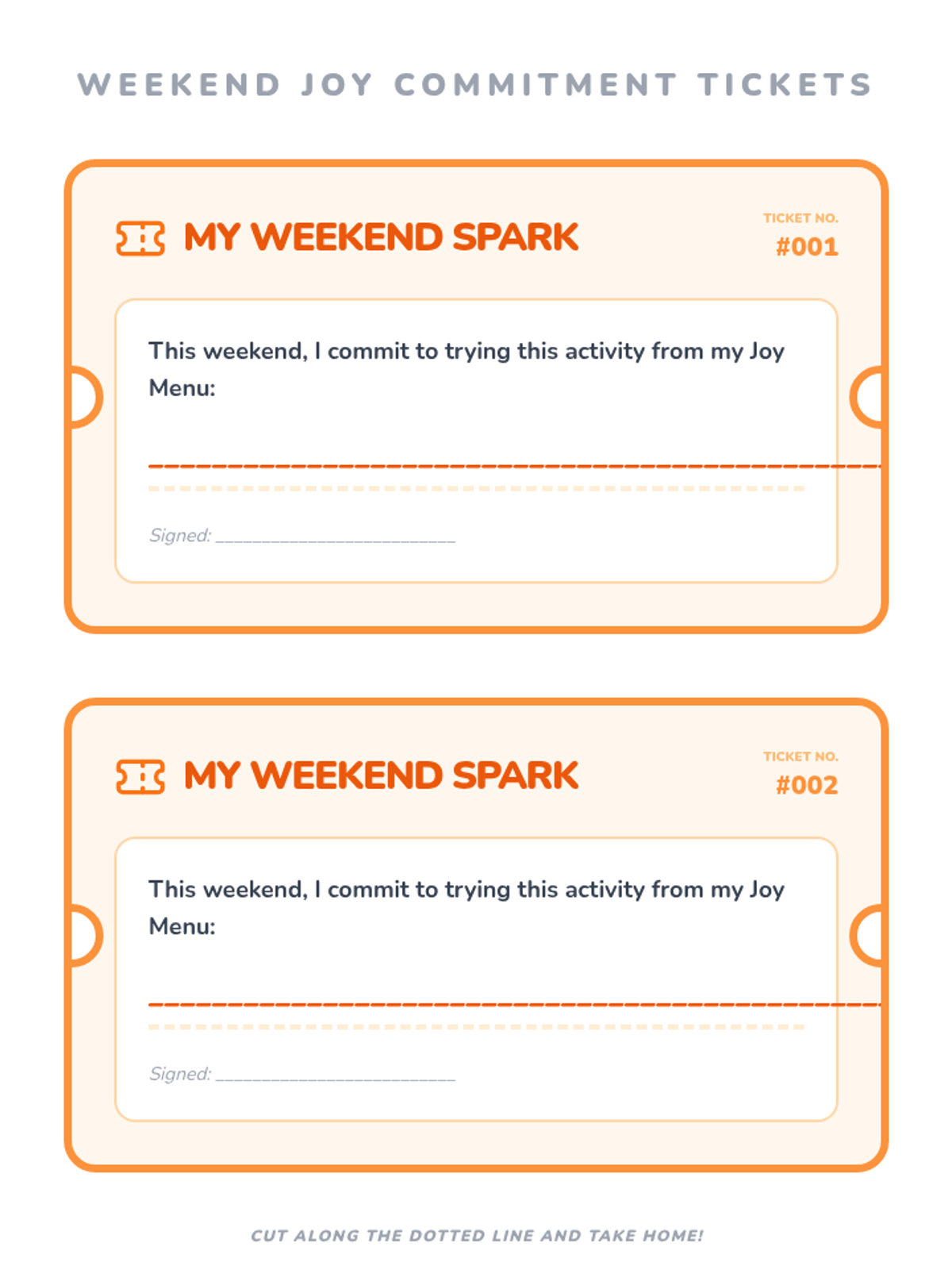
Weekend commitment exit tickets for Lesson 5, where students pledge to try one activity from their Joy Menu.
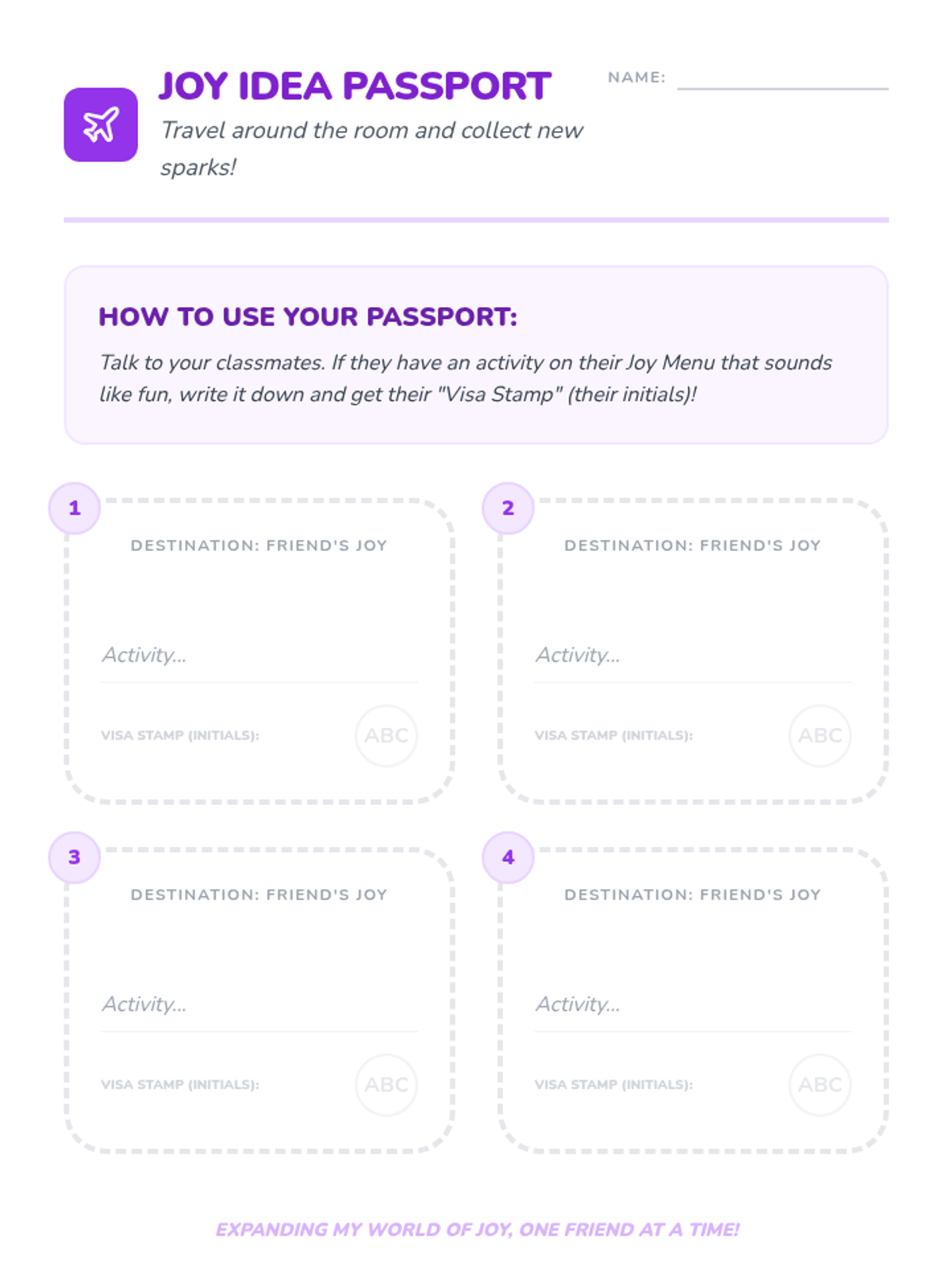
Student worksheet for Lesson 5, used during the Joy Exchange to collect activity ideas from classmates.
Visual presentation for Lesson 5, guiding the 'Joy Scavenger Hunt' and the sharing of personalized menus.
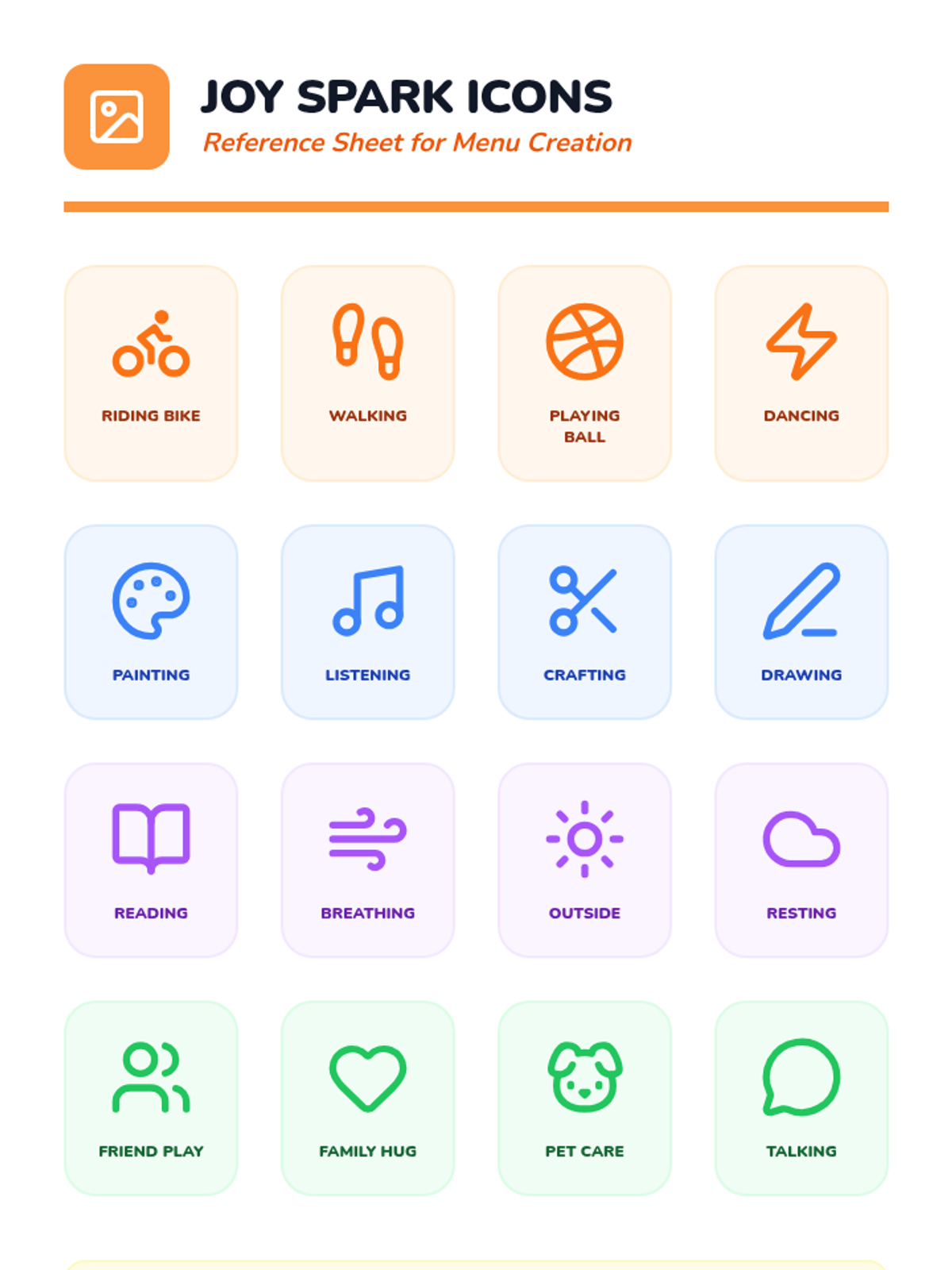
Reference sheet for students to use when illustrating their Joy Menus, providing simple icons and labels for various activities.
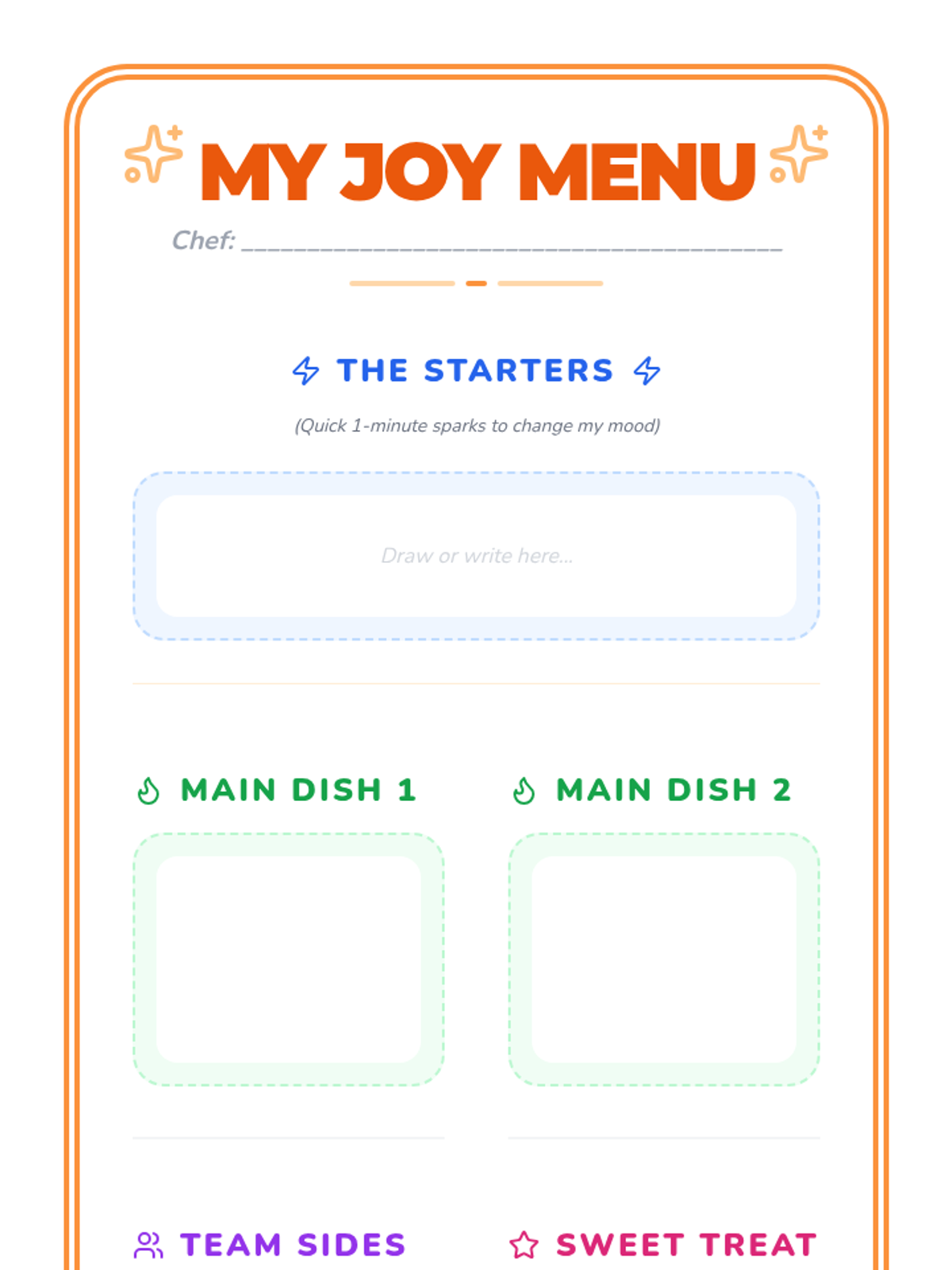
Personalized Joy Menu template for Lesson 4, designed like a restaurant menu for students to fill with their favorite activities.
Visual presentation for Lesson 4, introducing the concept of a 'Joy Menu' with categories for different types of activities.
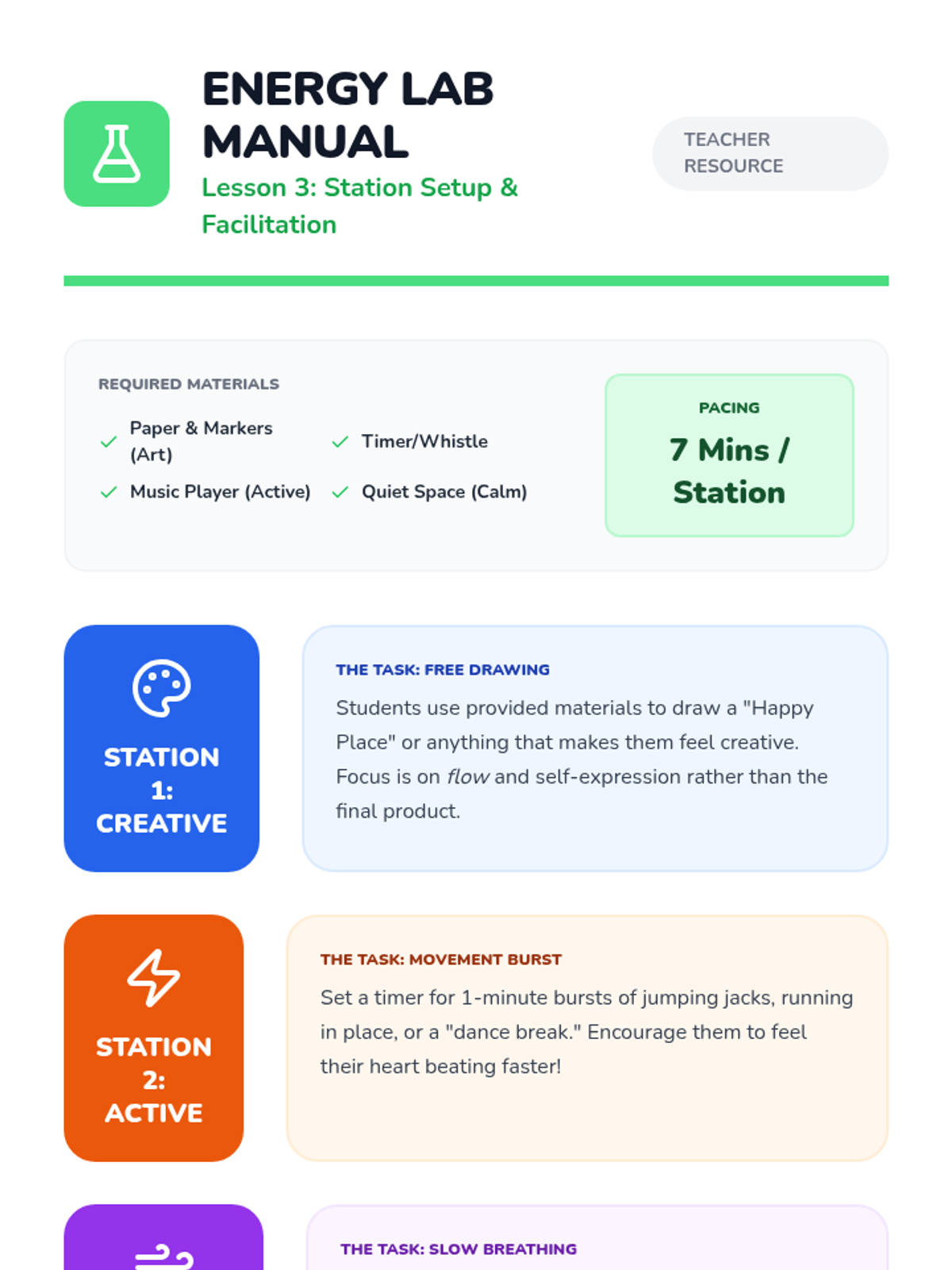
Facilitator guide for Lesson 3, including station setup instructions and debrief questions.
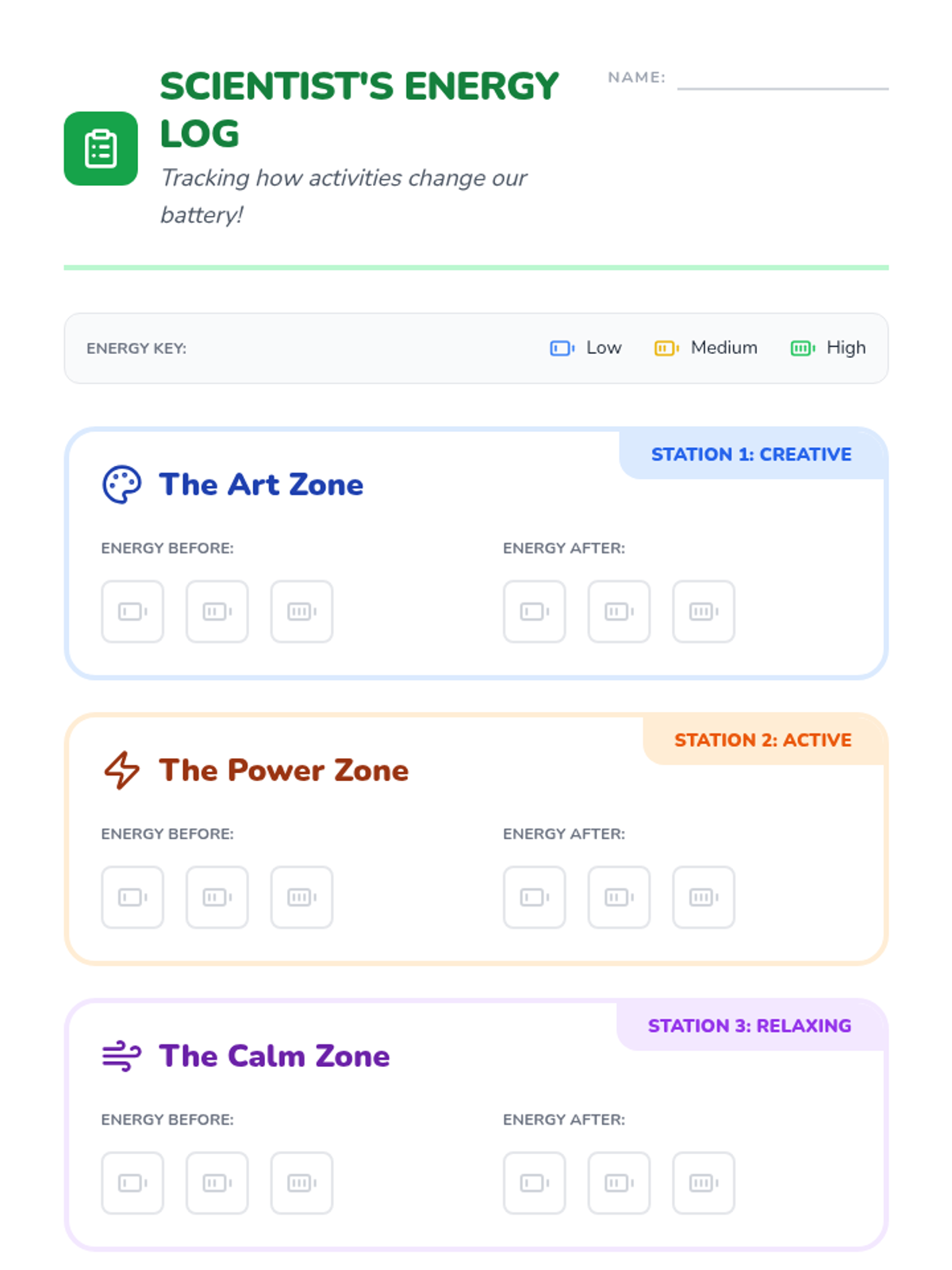
Energy Lab Log for Lesson 3, where students record their energy levels before and after different types of activities.
Visual presentation for Lesson 3, introducing the 'Energy Lab' stations and the human thermometer activity.
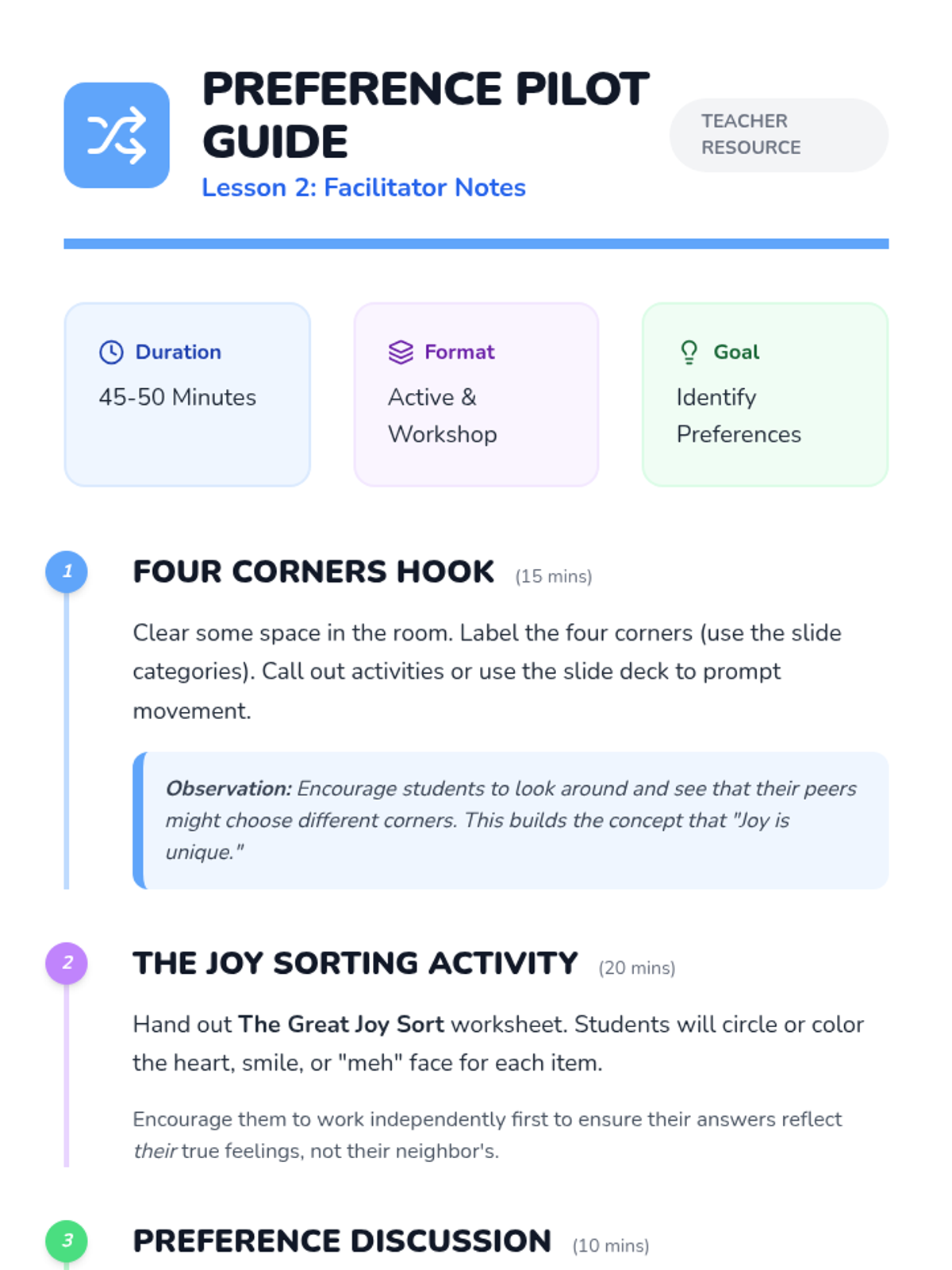
Facilitator guide for Lesson 2, including the Four Corners setup, activity management, and discussion prompts.
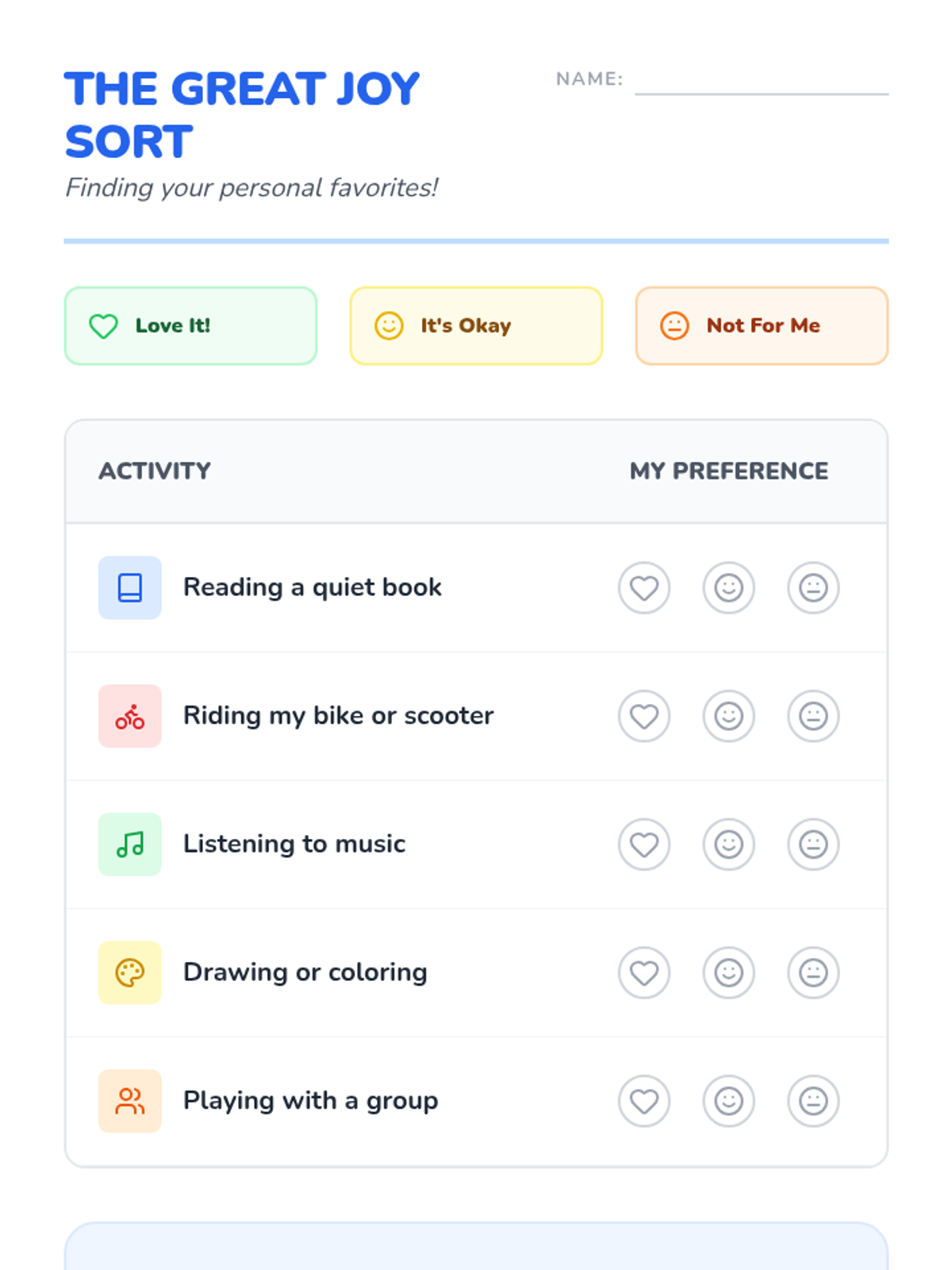
Activity worksheet for Lesson 2, where students categorize various pastimes into preference levels.
Visual presentation for Lesson 2, guiding the 'Four Corners' hook and explaining the concept of individual preferences.
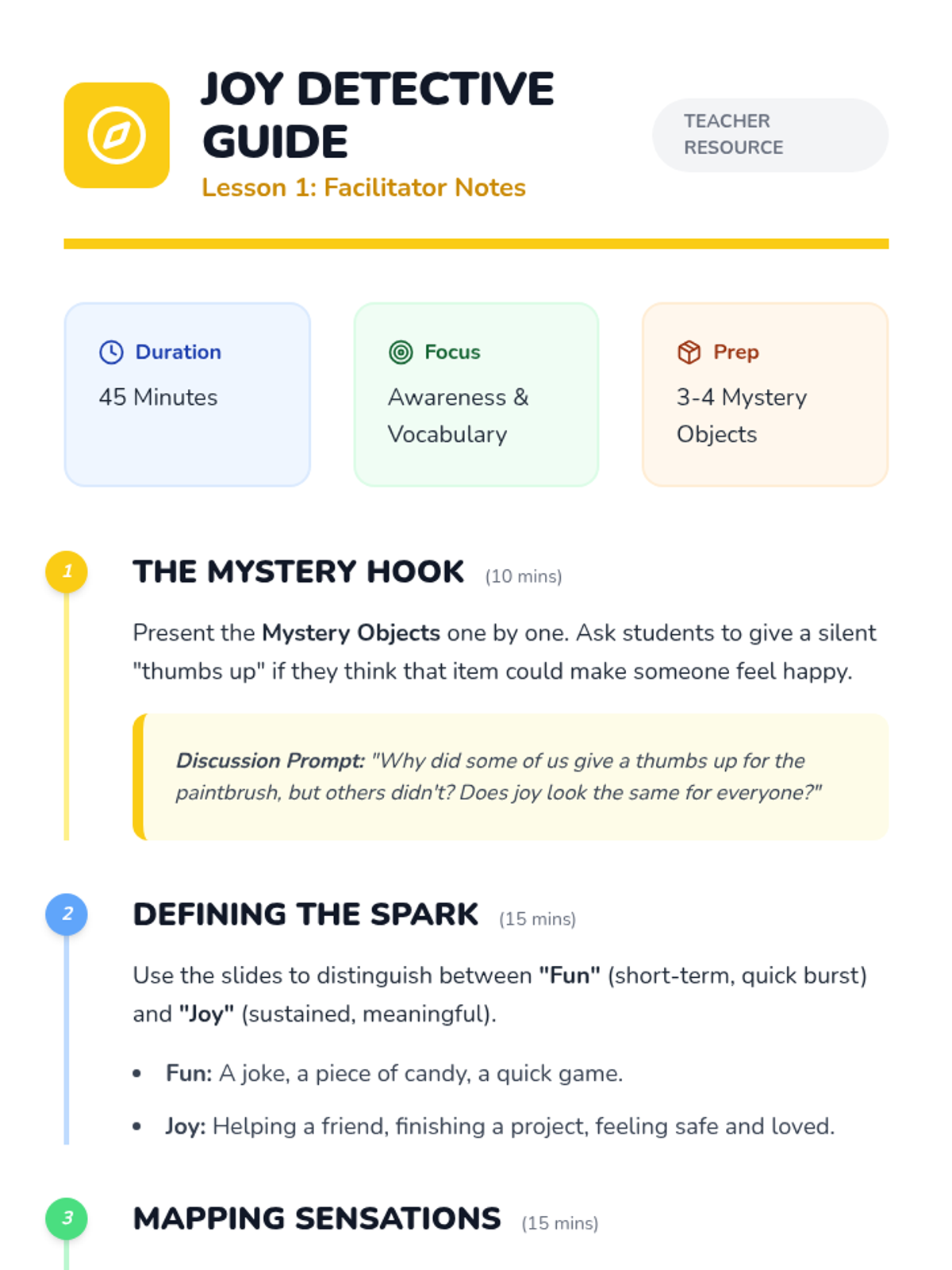
Facilitator guide for the first lesson, including discussion prompts, time breakdown, and troubleshooting tips.
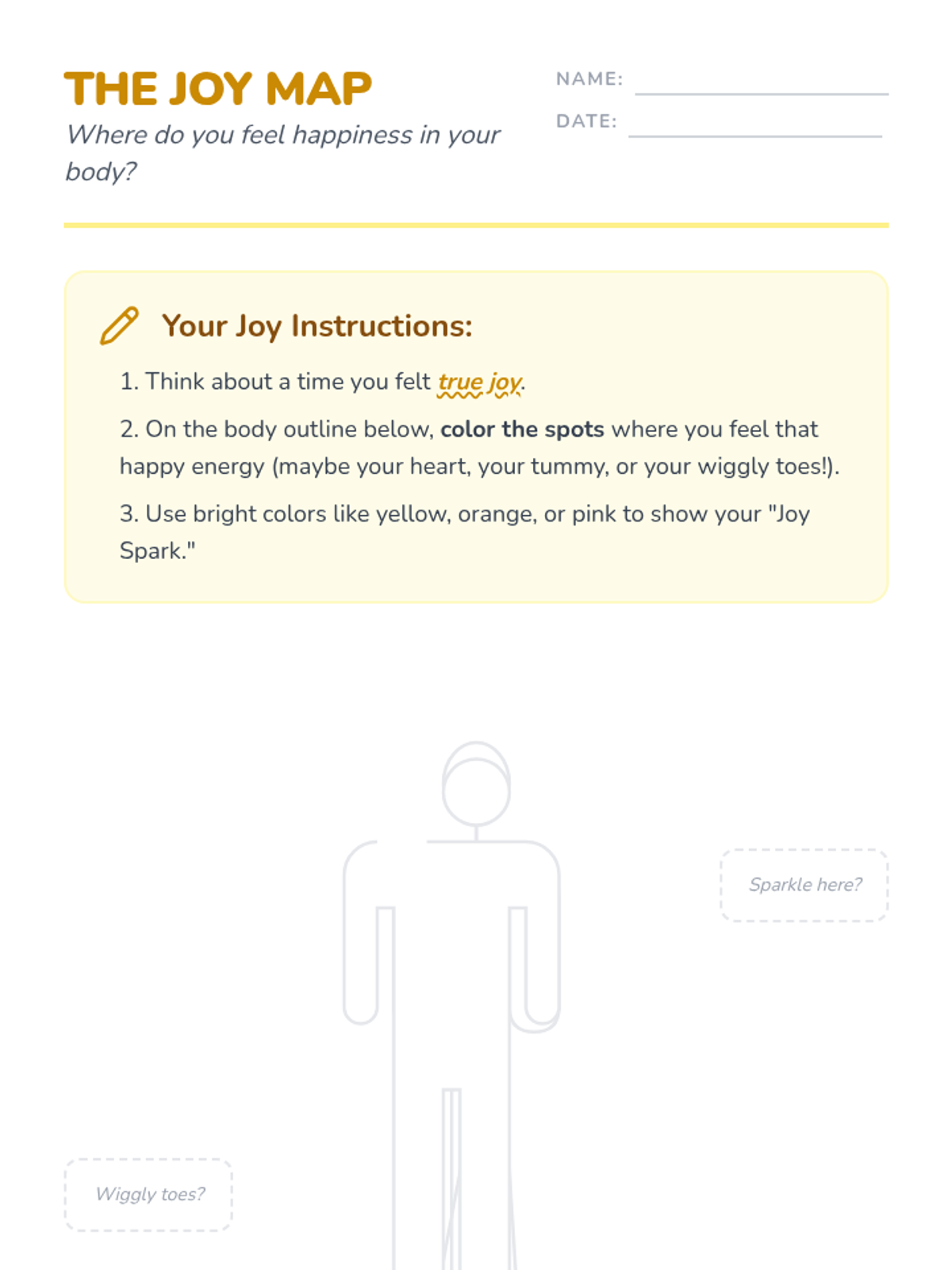
Student worksheet for Lesson 1, where students map the physical sensations of joy onto a body outline.
Introductory presentation for Lesson 1, defining joy and exploring the physical sensations of happiness.
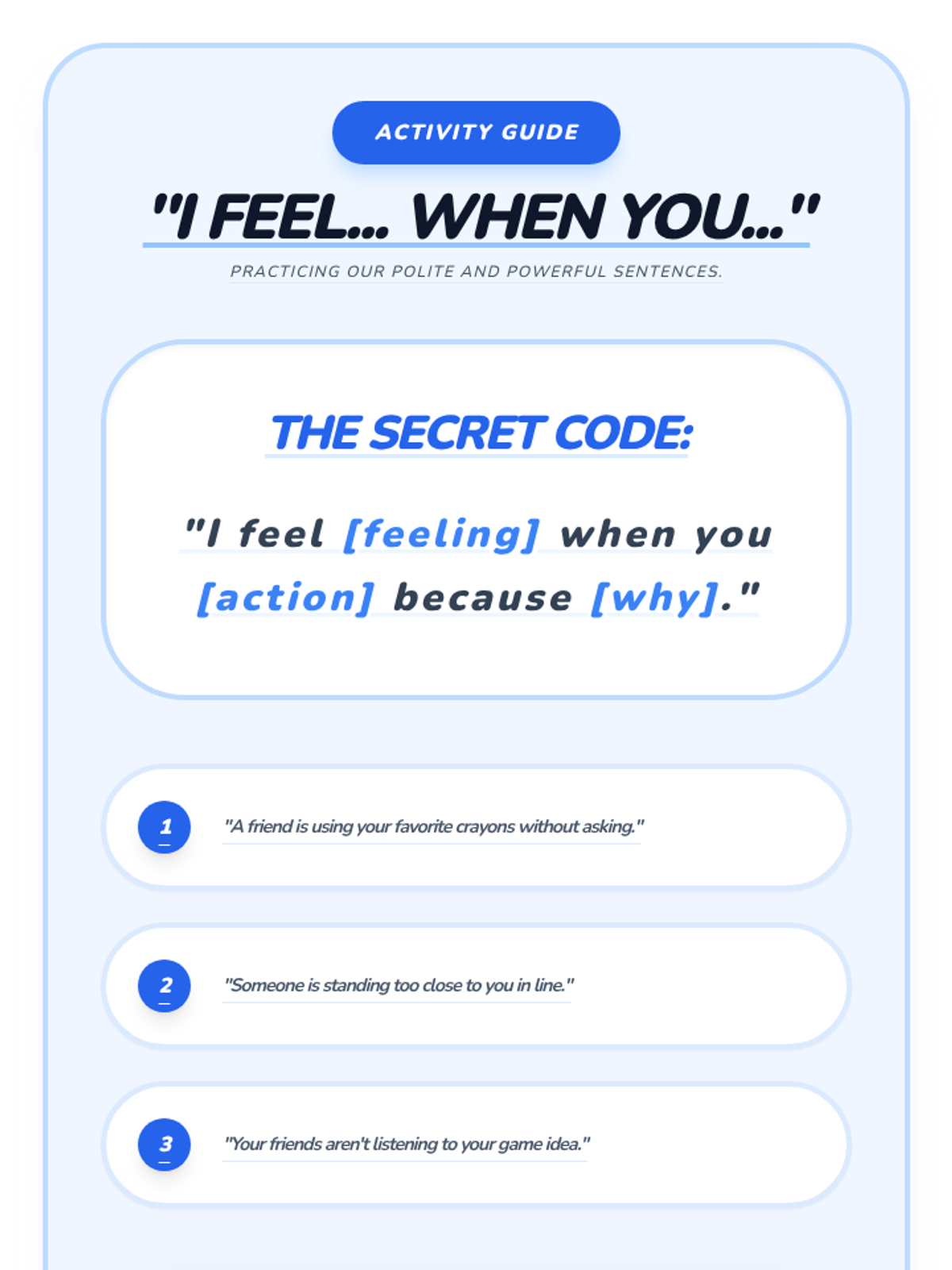
Instructional guide for the "I statements" activity, helping students practice the formula in various scenarios.
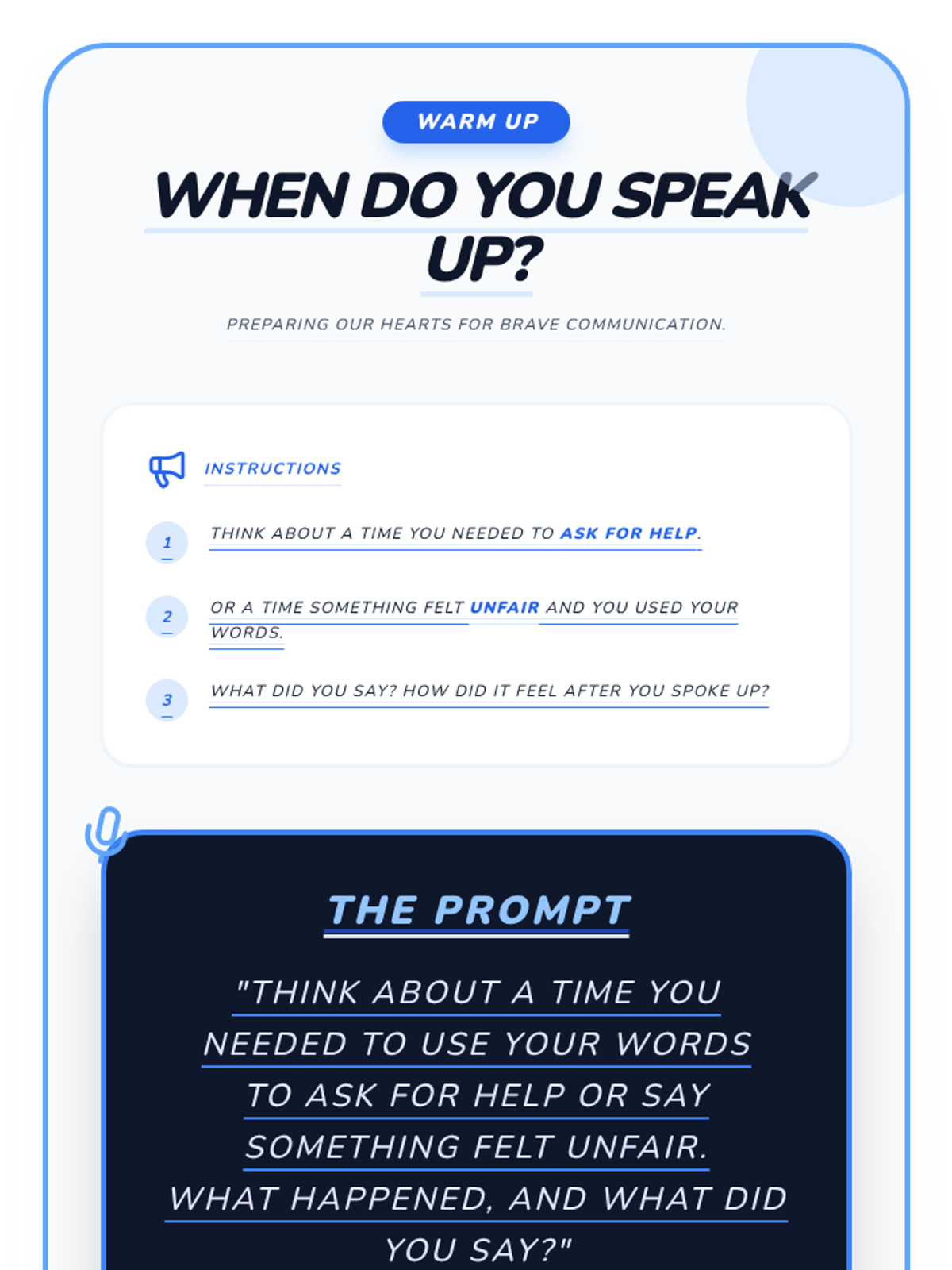
A short warm-up activity guide for Session 8, helping students prepare to discuss assertive communication.
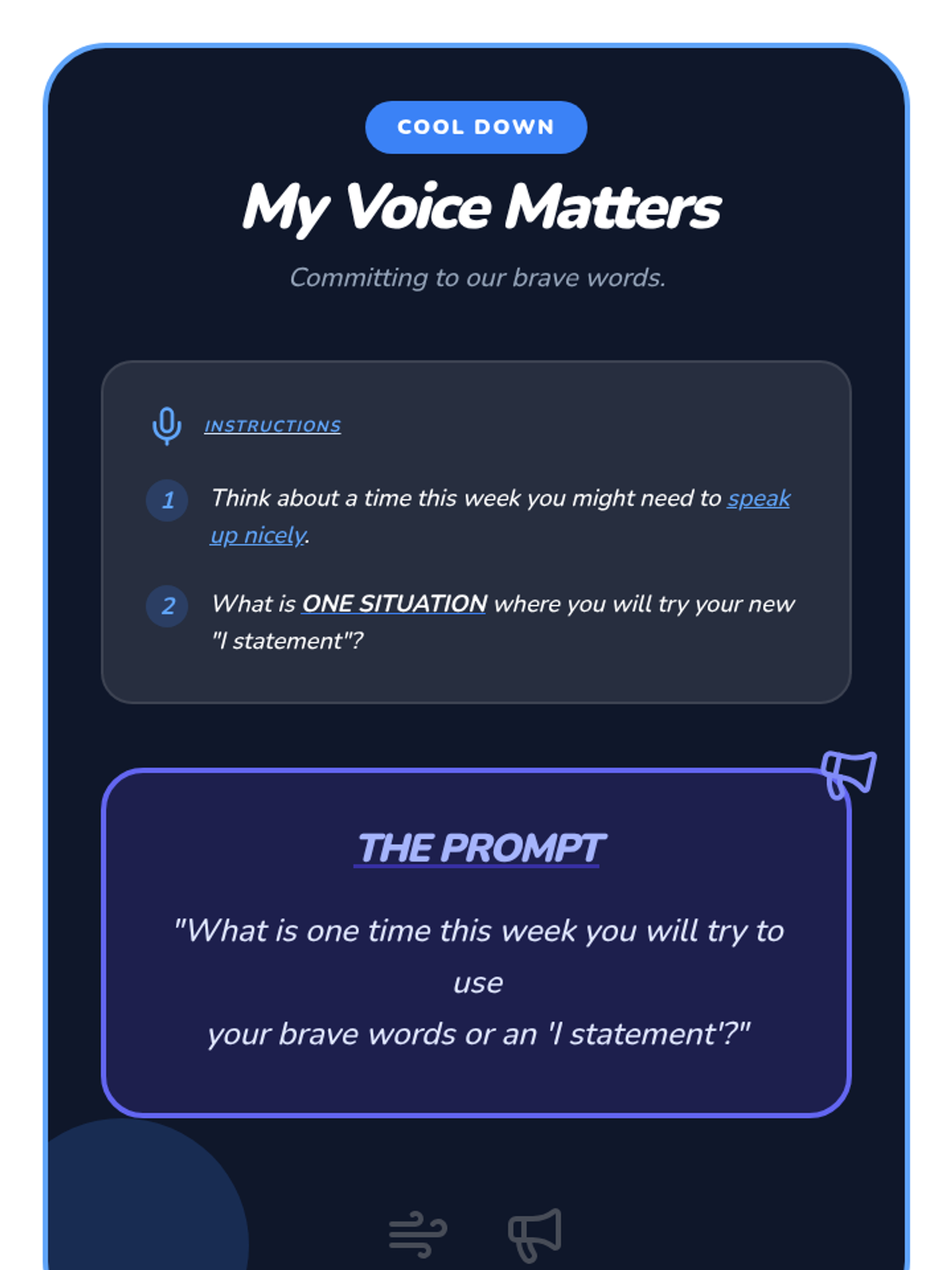
A short cool-down reflection guide for Session 8, helping students recognize the value of their own voice.
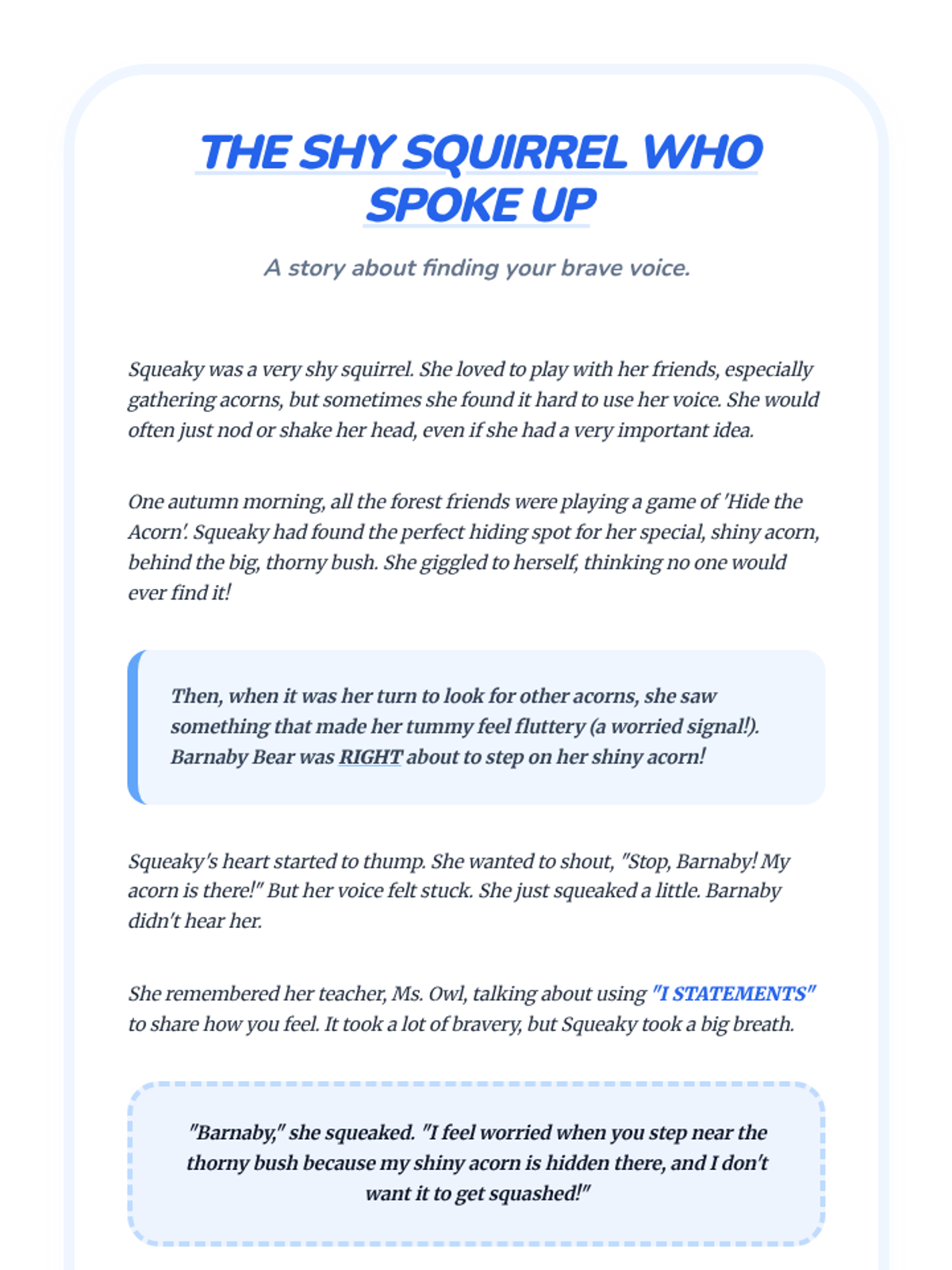
The Shy Squirrel Who Spoke Up reading passage for Session 8, exploring how Squeaky uses an "I statement" to advocate for herself.
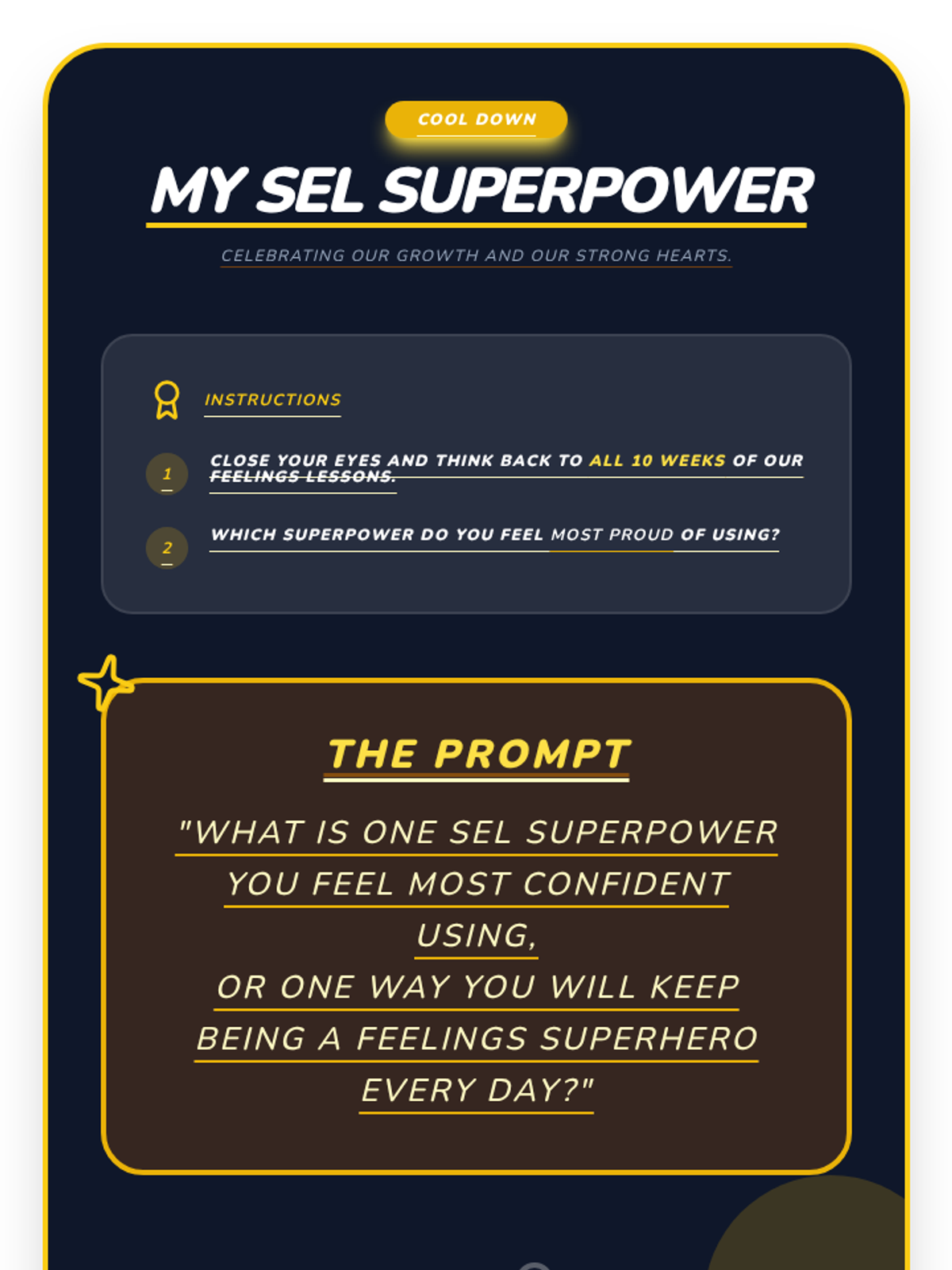
A short cool-down reflection guide for the final session, helping students recognize their personal social-emotional growth over the 10-week series.
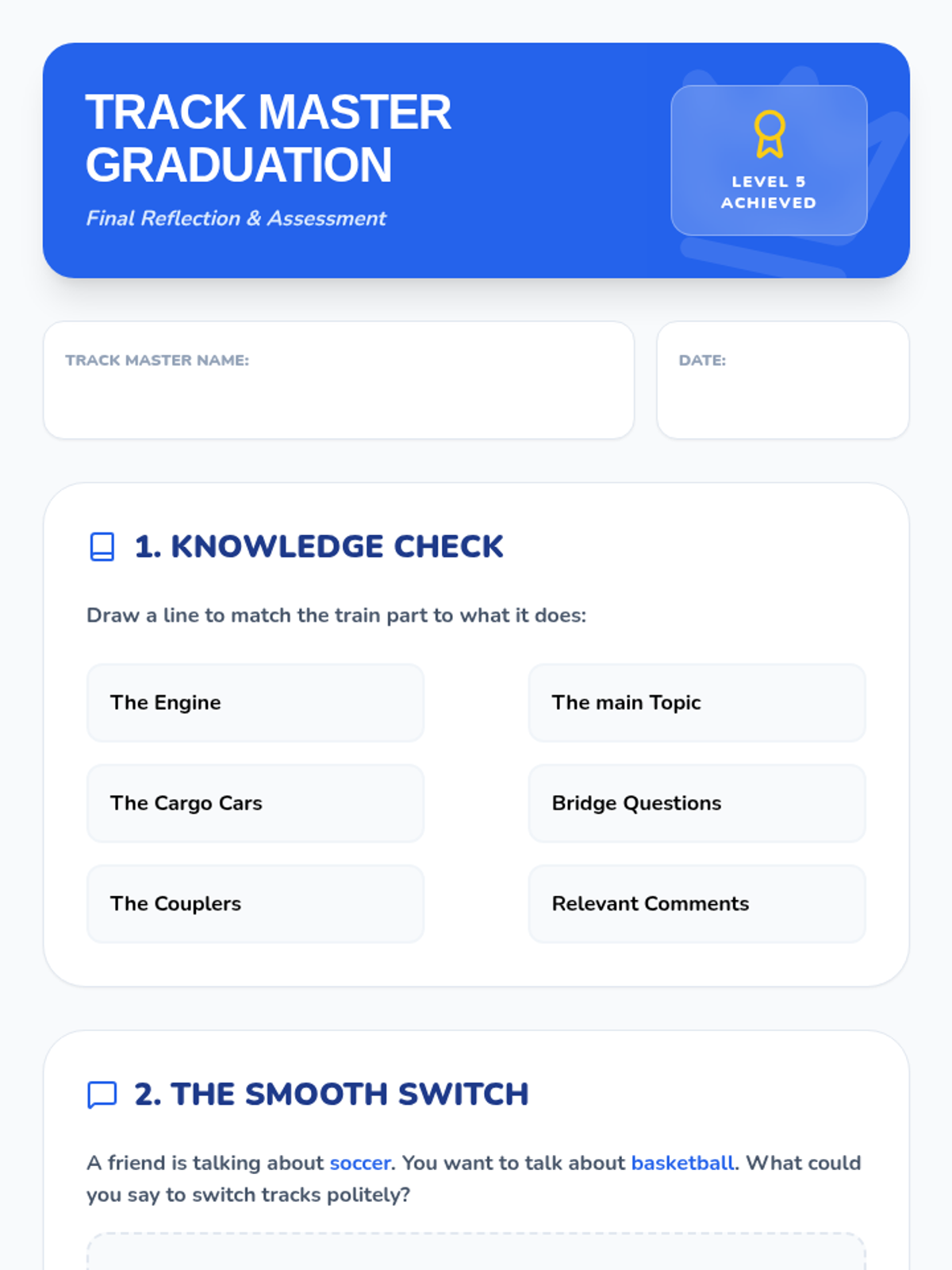
Final reflection and assessment worksheet for Lesson 5. Evaluates student understanding of the conversation train metaphor and topic switching techniques.
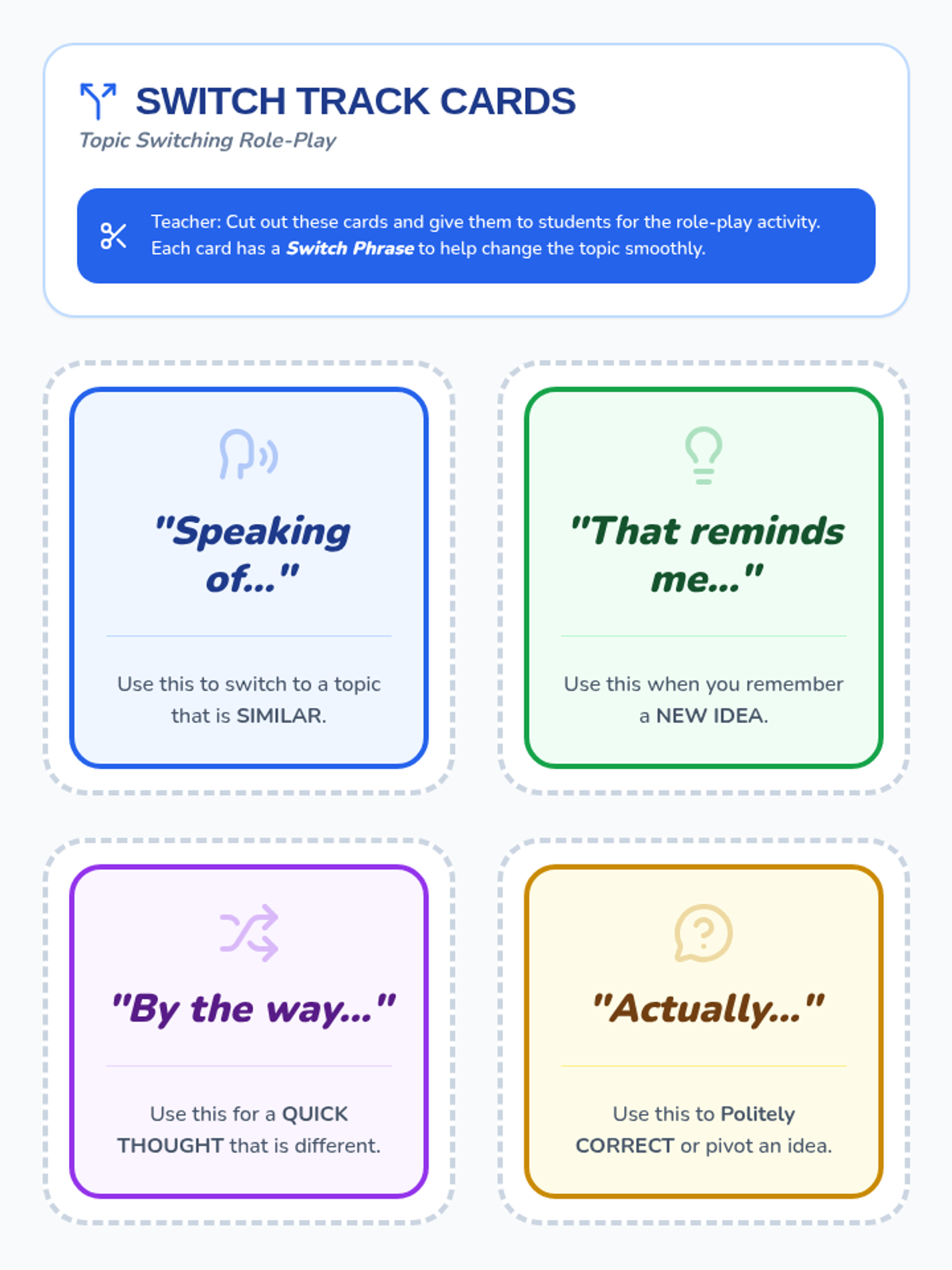
Role-play cards for Lesson 5 containing transition phrases ('Speaking of...', 'That reminds me...') to help students practice changing conversation topics politely.
Final instructional slide deck for Lesson 5 focusing on topic switching techniques and graduation from the 'Talk Train Trackers' program.
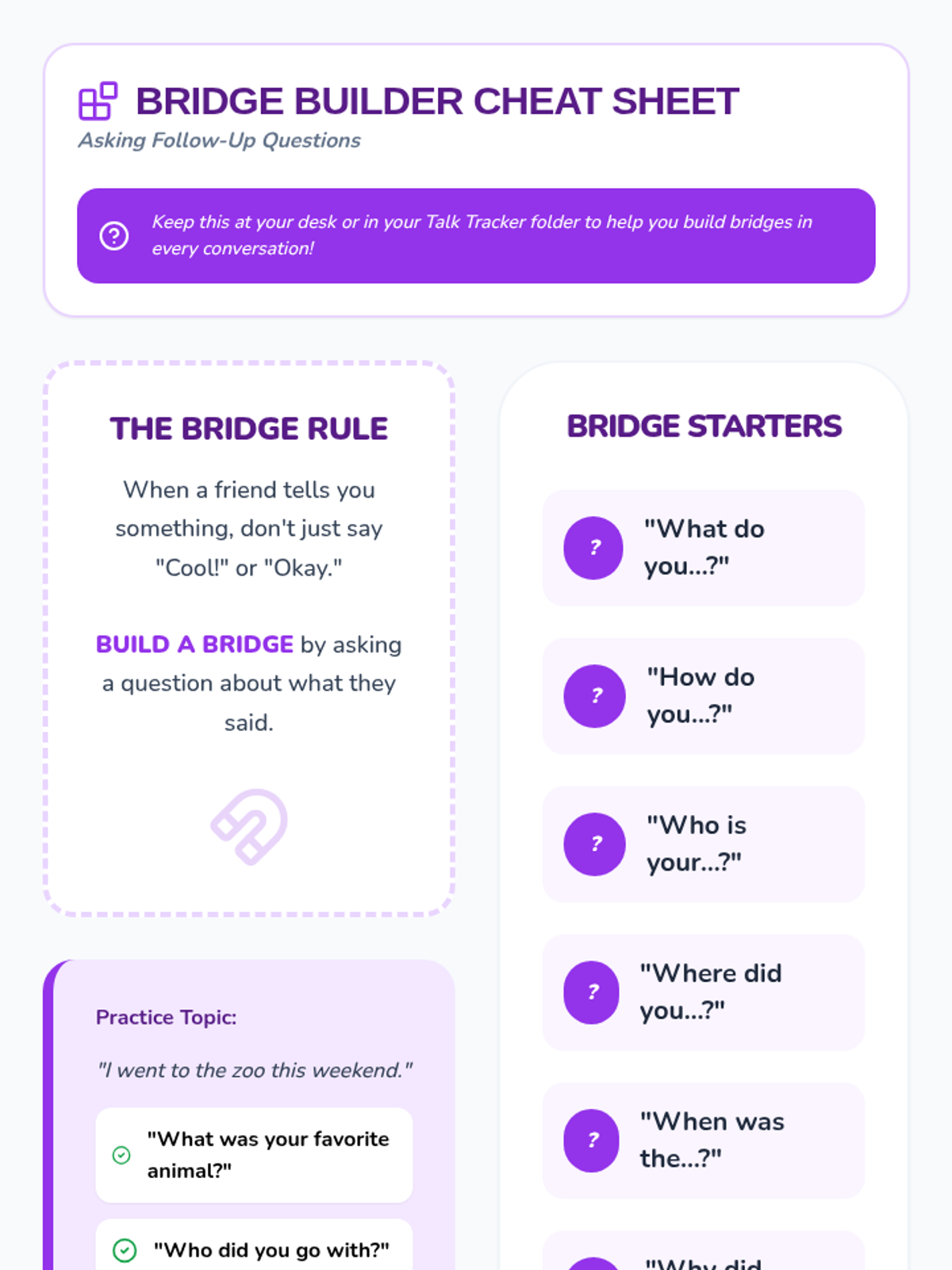
Reference sheet for Lesson 4 containing bridge question starters (who, what, when, where, why, how) to help students formulate follow-up questions.
Visual support for Lesson 4 focusing on using follow-up questions (bridge questions) to maintain conversations. Includes question starters and game instructions.
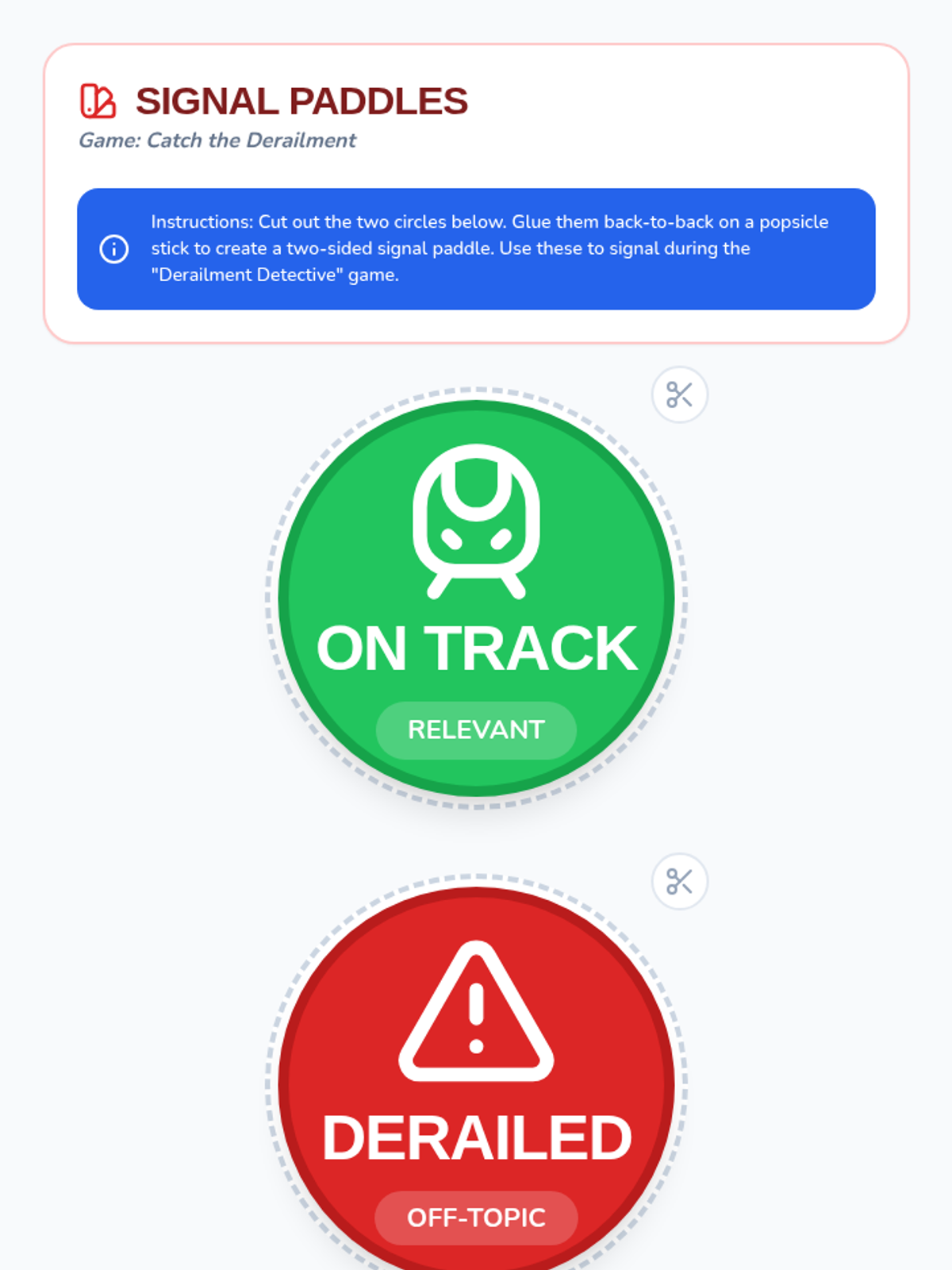
Printable red and green signaling paddles for Lesson 3. Students use these to indicate if a conversational comment is on-topic (green) or off-topic (red).
Instructional slides for Lesson 3 focusing on identifying 'off-topic' remarks as conversation 'derailments'. Includes a scenario practice and game instructions.
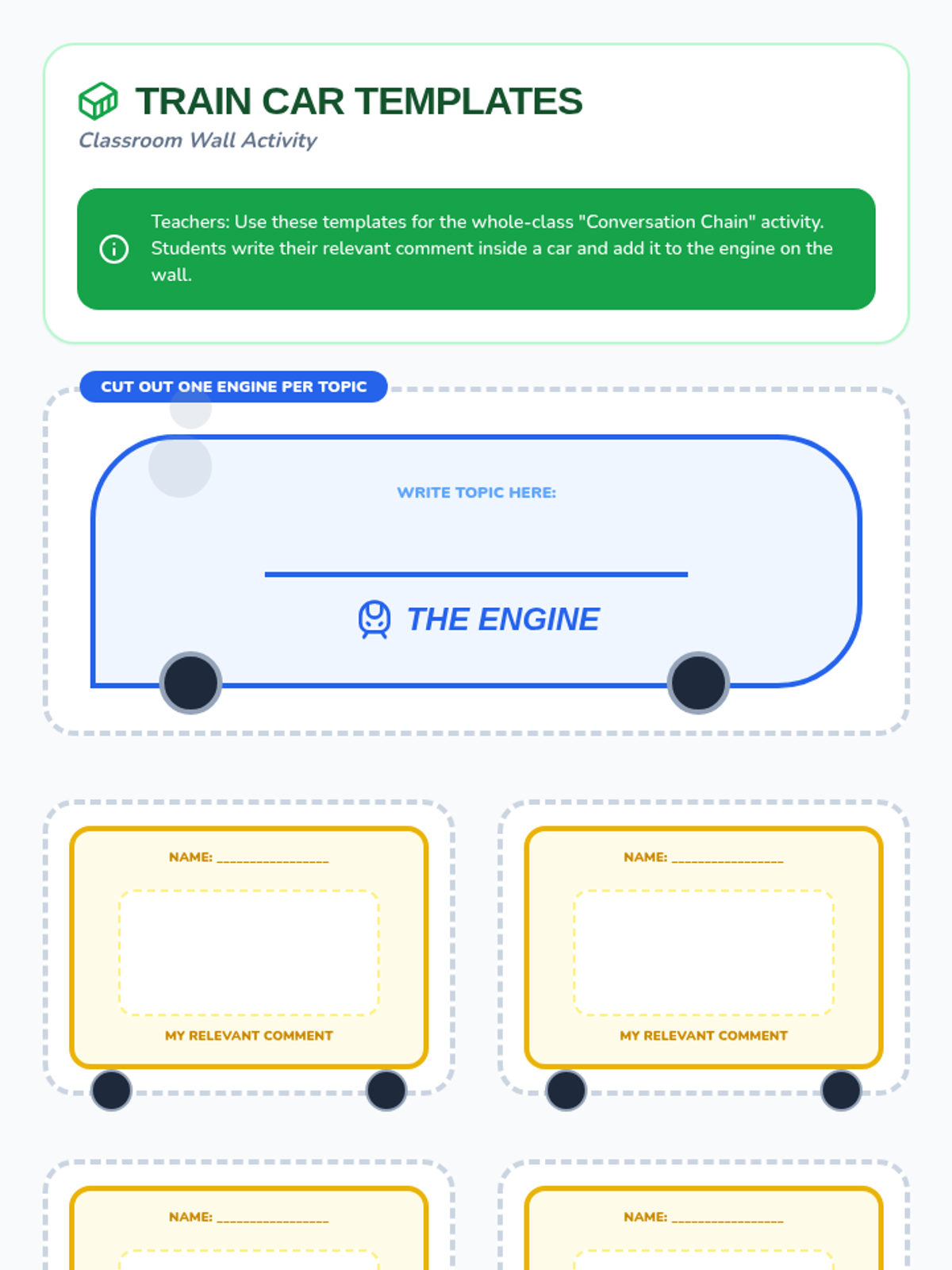
Printable train engine and cargo car templates for the whole-class wall activity in Lesson 2. Students write relevant comments on cars to connect them to the topic engine.
Visual support for Lesson 2 focusing on how each relevant comment acts as a 'cargo car' that connects to the topic engine. Includes a 'Mystery Bag' game explanation and a conversational chain example.
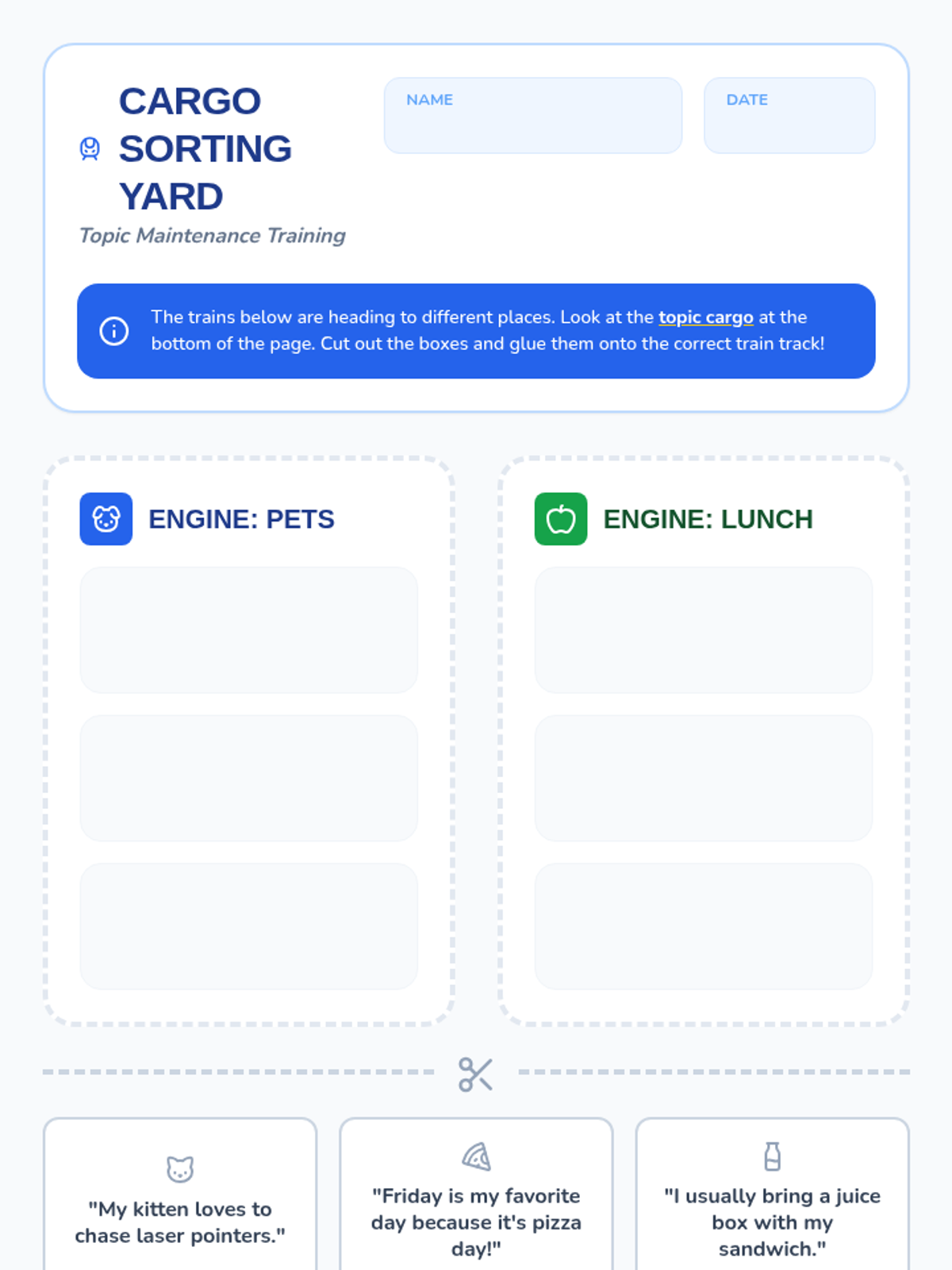
Sorting activity for Lesson 1 where students cut and paste conversational comments (cargo) onto the correct topic engines (Pets or Lunch).
Introductory slide deck for Lesson 1 using the 'Conversation Train' metaphor. Defines 'topic' as the engine and 'relevant' as staying on track, including a practice activity.
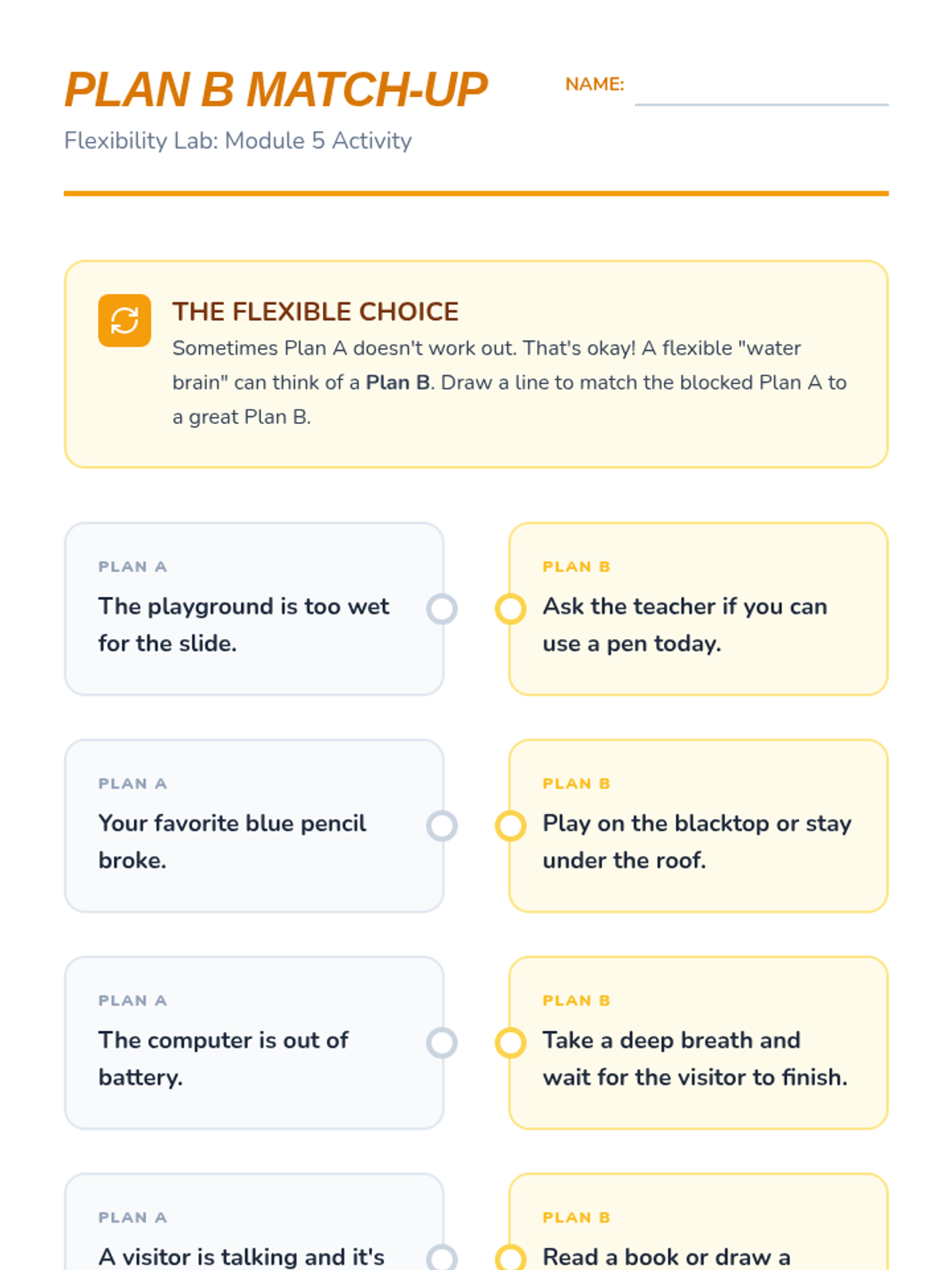
A matching activity for 2nd graders to pair unexpected Plan A disruptions with appropriate Plan B alternatives.
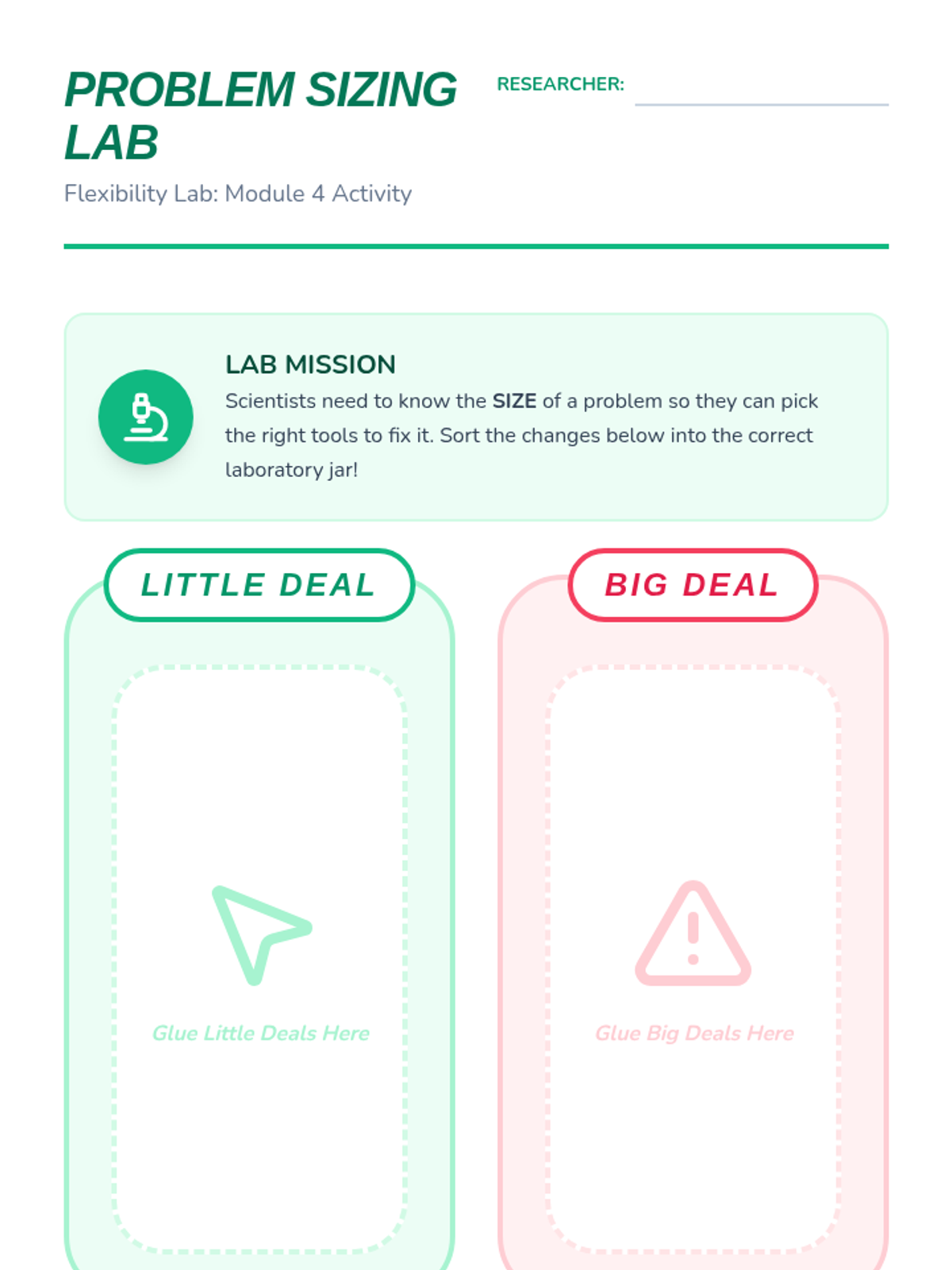
A sorting worksheet for 2nd graders to differentiate between 'big deal' and 'little deal' problems using a laboratory-themed categorization activity.
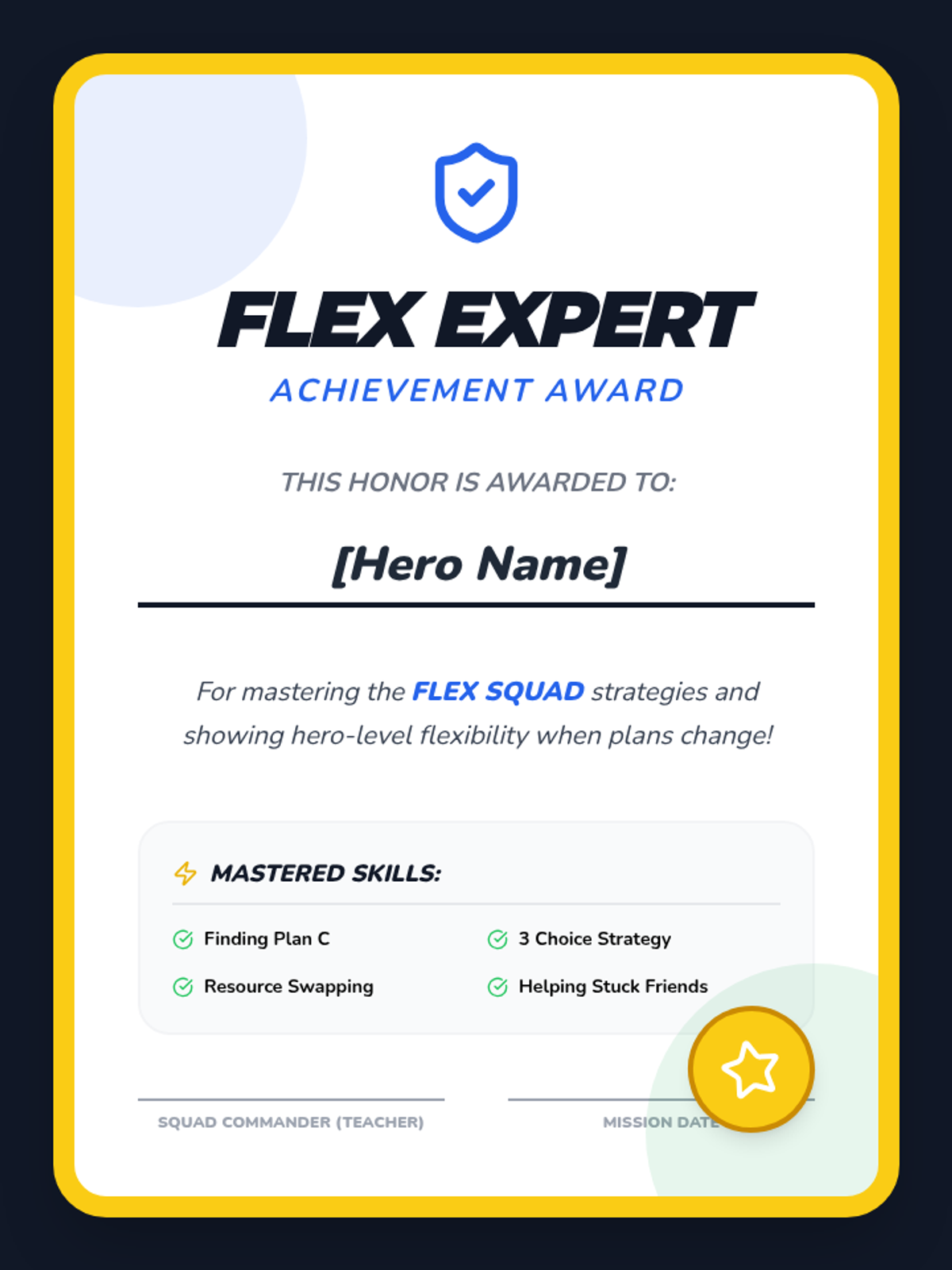
Commemorative certificate for Lesson 5, awarded to students who complete the Flex Squad sequence and demonstrate mastery of social flexibility strategies.
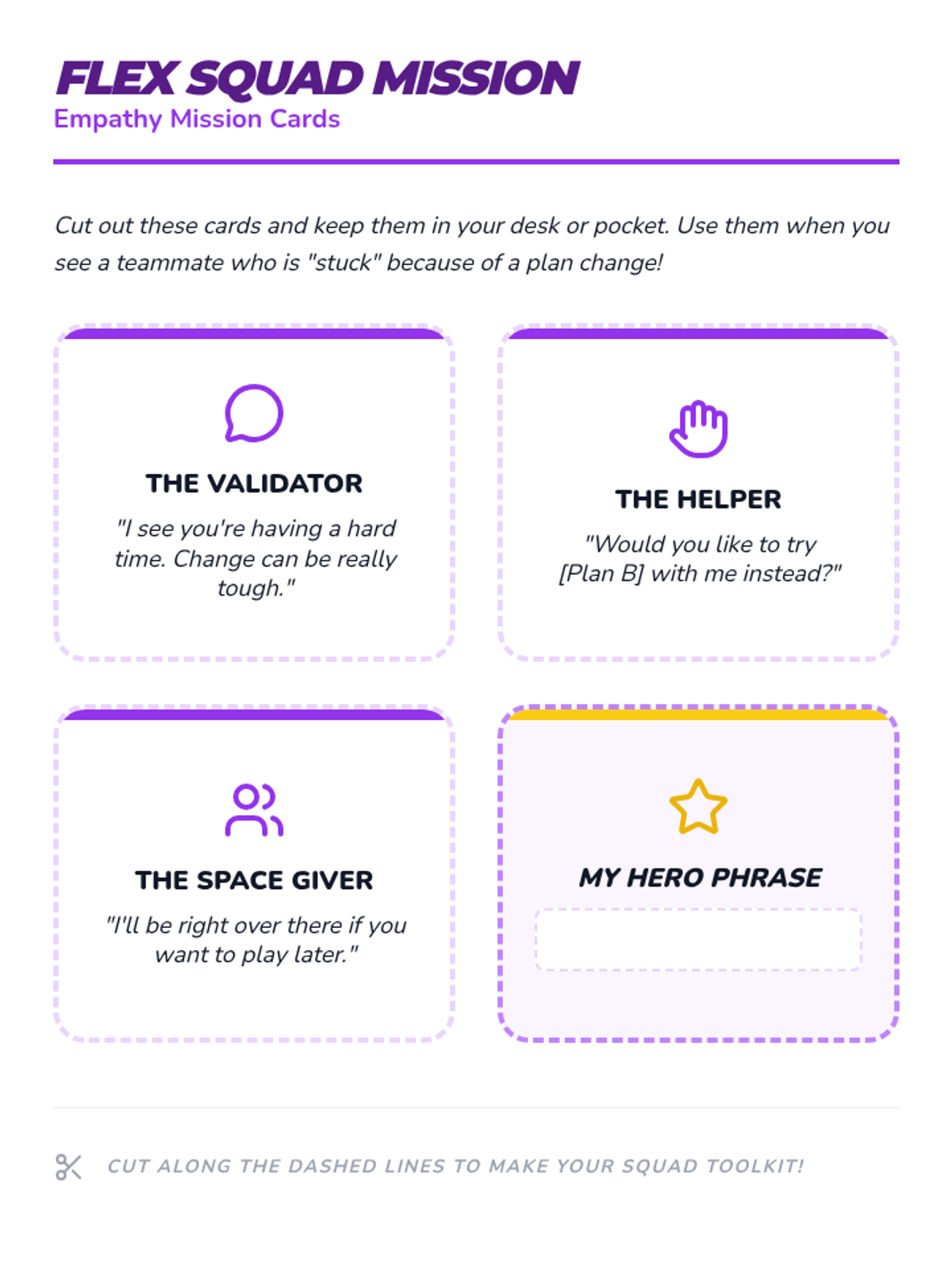
Visual support cards for Lesson 4 that students can cut out and keep to remember phrases to use with peers struggling with plan changes.
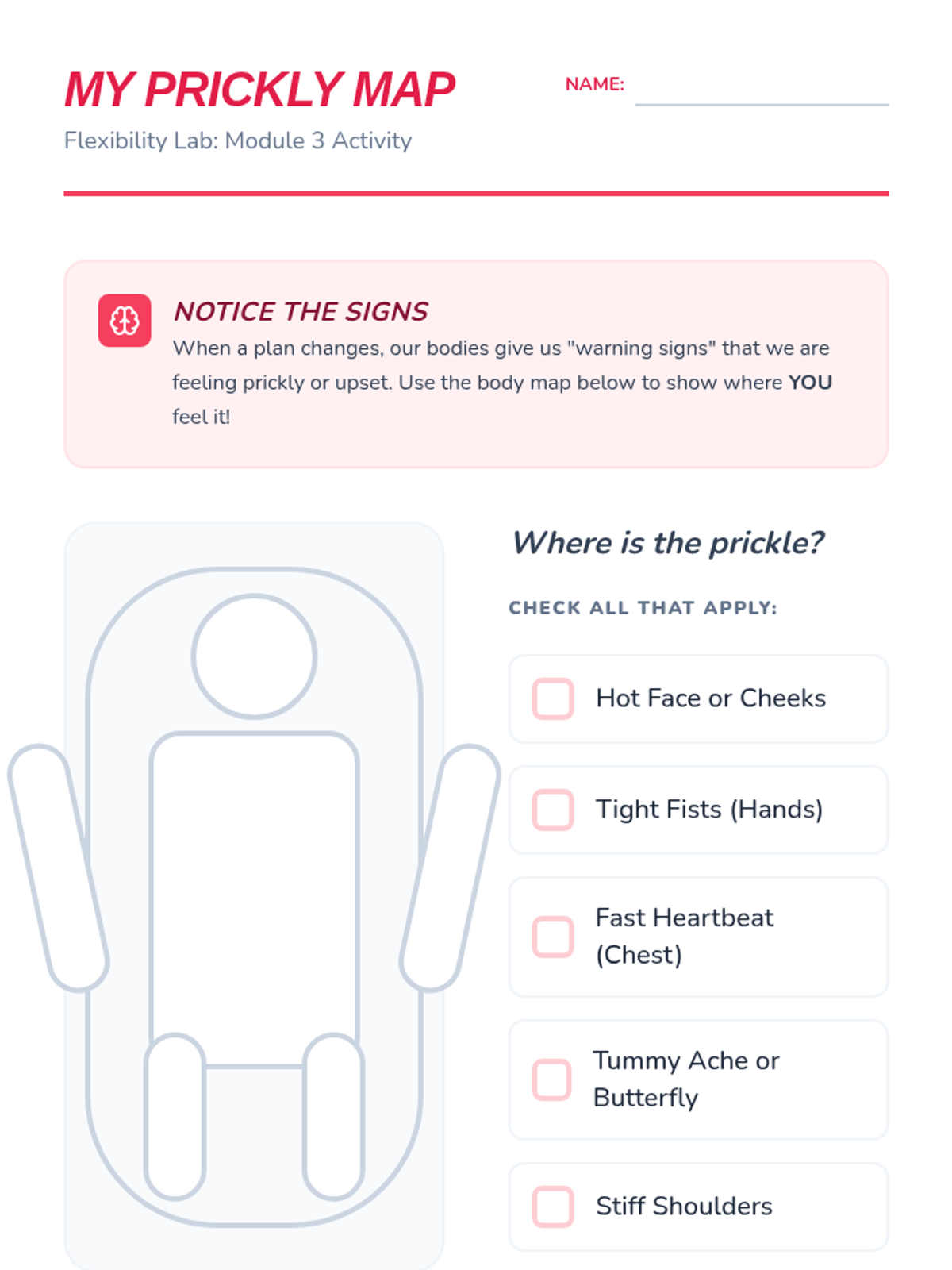
A student worksheet for 2nd graders to map out their physical and emotional reactions to unexpected plan changes.
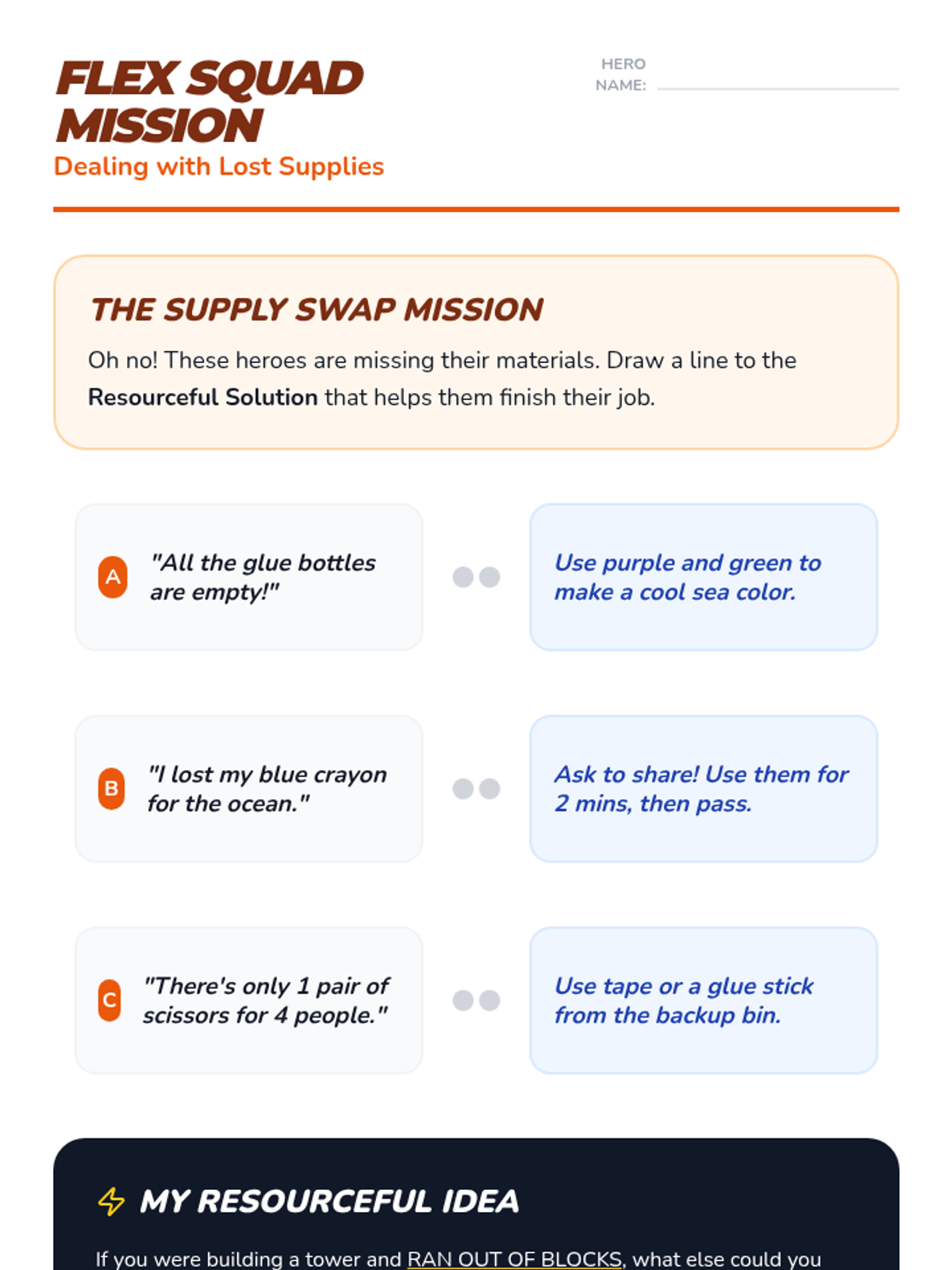
Student worksheet for Lesson 3 where students solve resource problems by matching missing supplies to creative solutions.
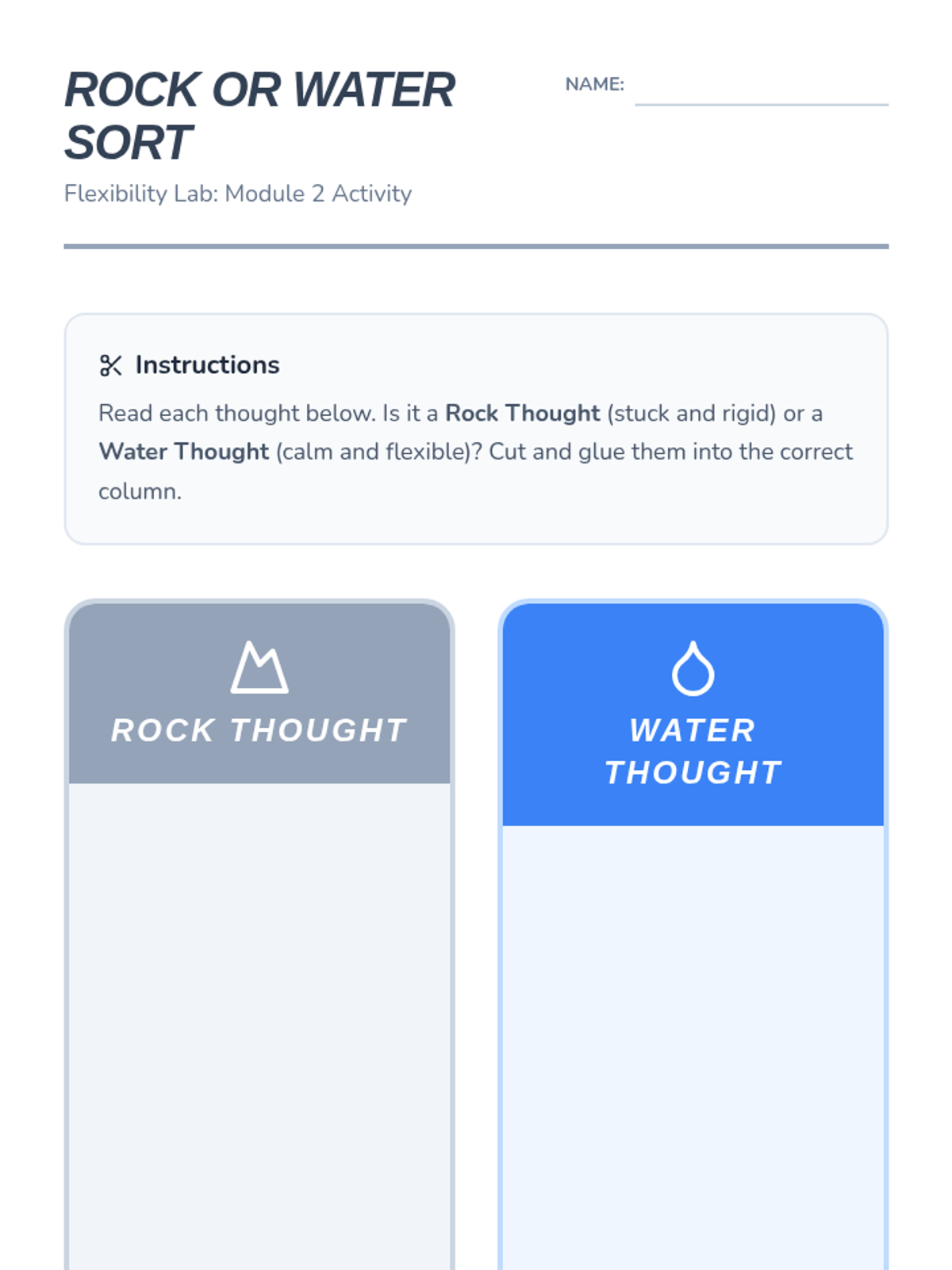
A cut-and-paste sorting activity for 2nd graders to differentiate between rigid (rock) thoughts and flexible (water) thoughts.
Introductory slide deck for Lesson 5, teaching students how to adapt to a substitute teacher or guest by practicing patience and flexibility.
An instructional slide deck for Lesson 5 that introduces students to the concept of 'Plan B' and how to generate alternatives when plans change.
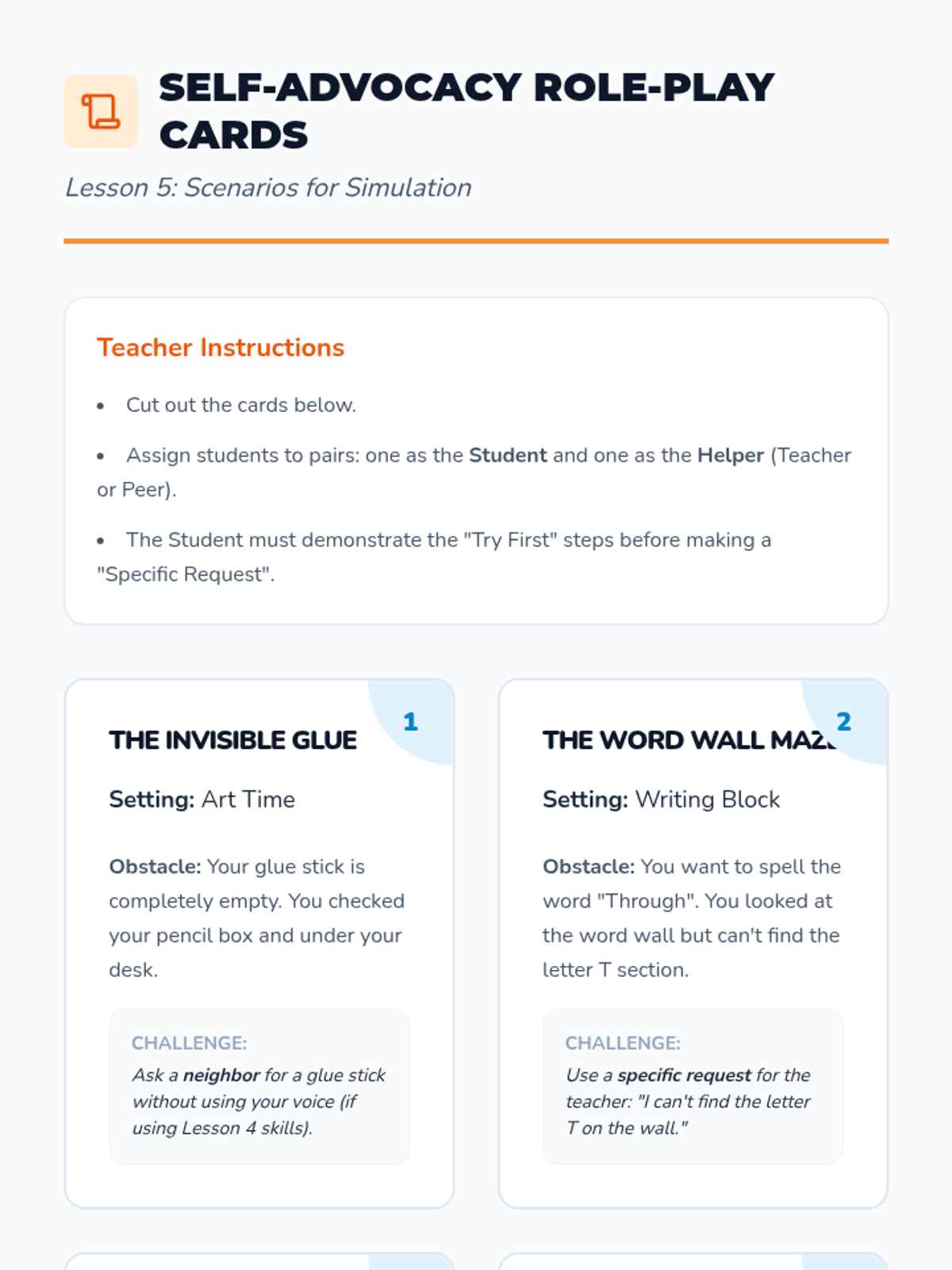
Scenario cards for teacher use during Lesson 5 to facilitate role-playing exercises on self-advocacy and obstacle problem-solving.
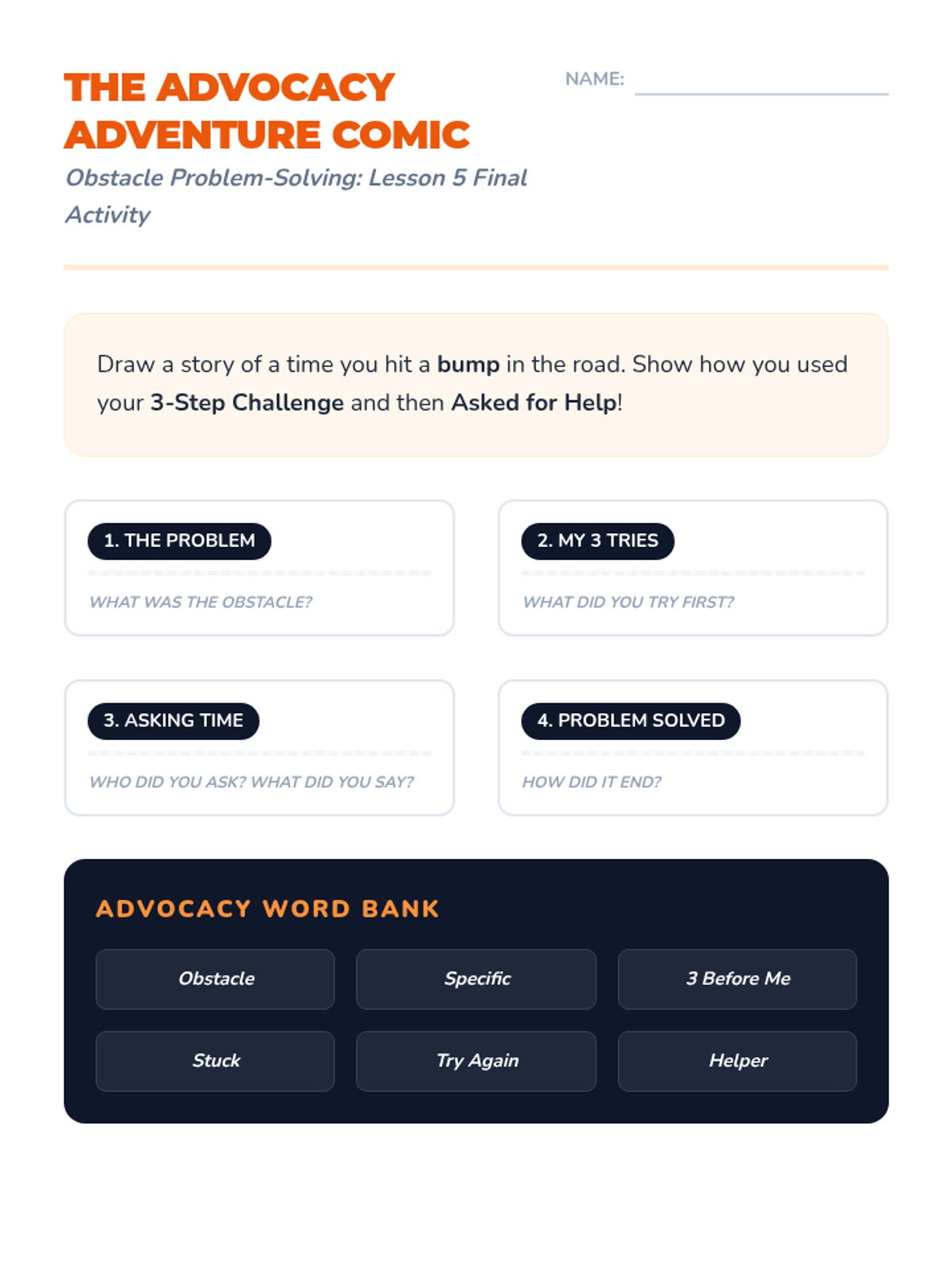
A final project worksheet where students create a comic strip illustrating a personal self-advocacy experience, from obstacle to resolution.
Visual slides for Lesson 5 that facilitate role-playing scenarios where students practice applying all the self-advocacy skills learned in the sequence.
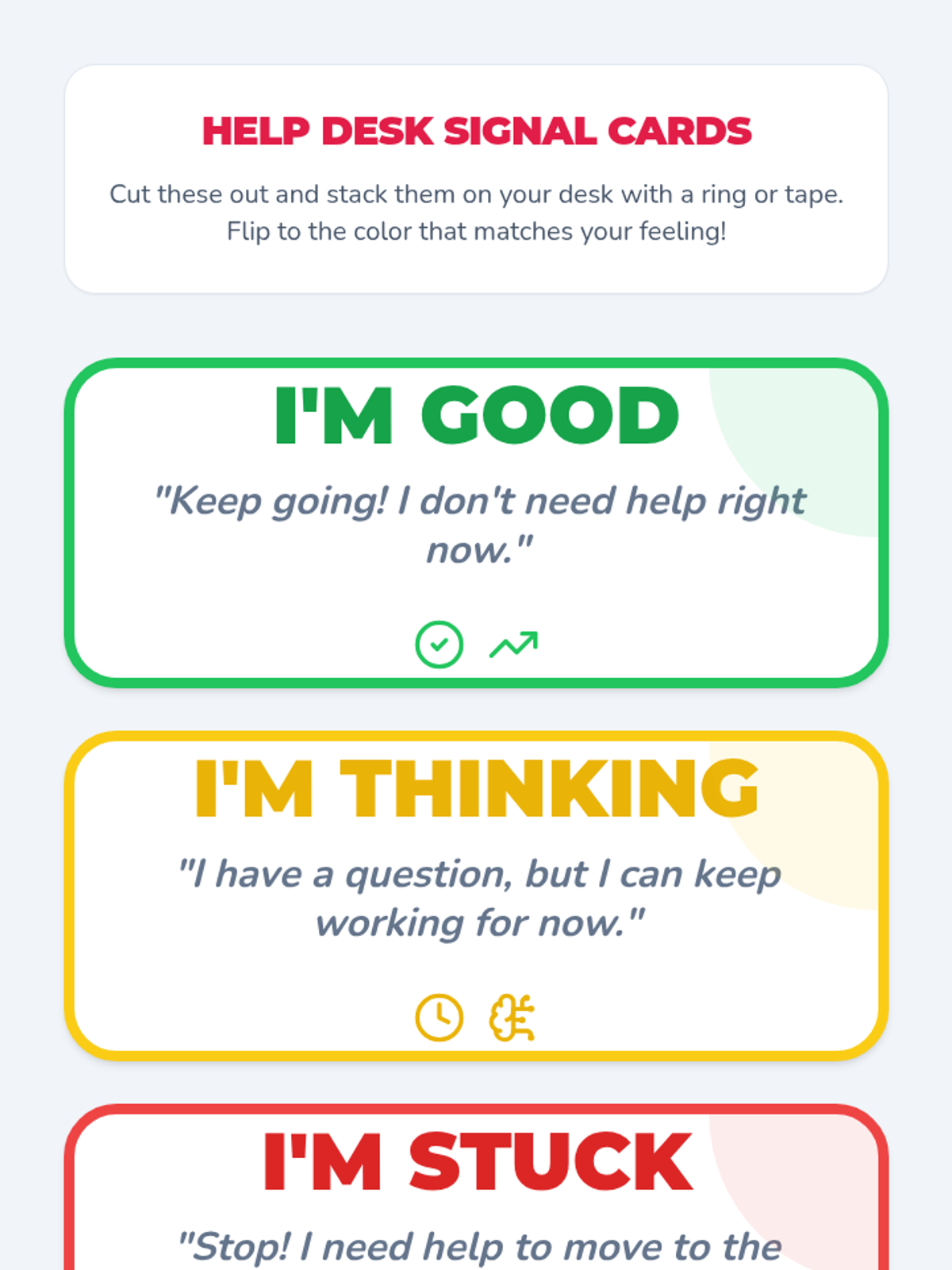
Printable desk flip cards (Green, Yellow, Red) for students to communicate their task status and need for assistance non-verbally.
Visual slides for Lesson 4 that introduce non-verbal communication tools like desk flip cards and hand signals for effective classroom self-advocacy.
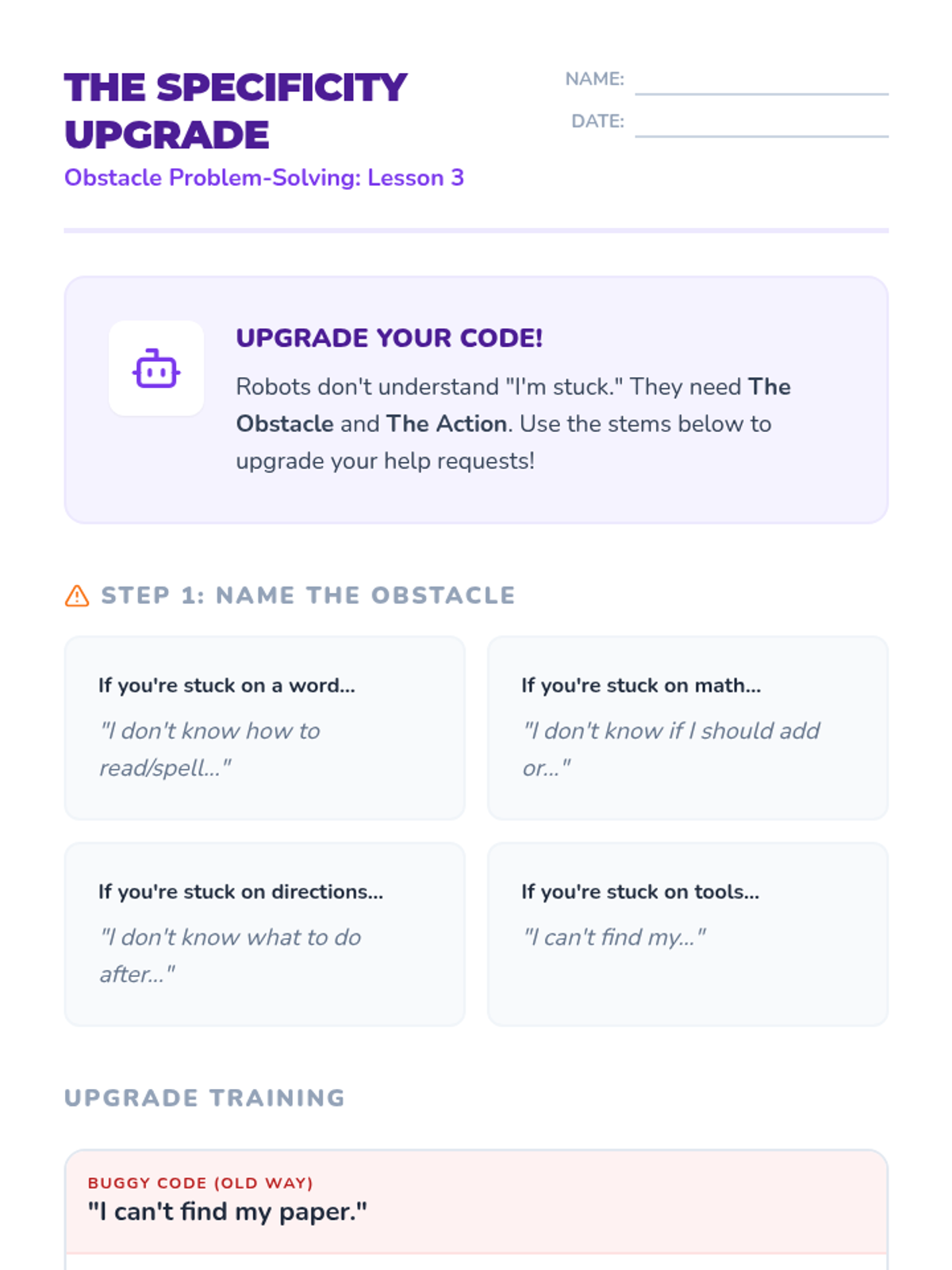
A student worksheet for practicing the language of specificity, transforming vague requests into clear, two-part help commands.
Visual slides for Lesson 3 that teach students how to transform generic complaints into specific, actionable requests using the 'Specificity Robot' metaphor.
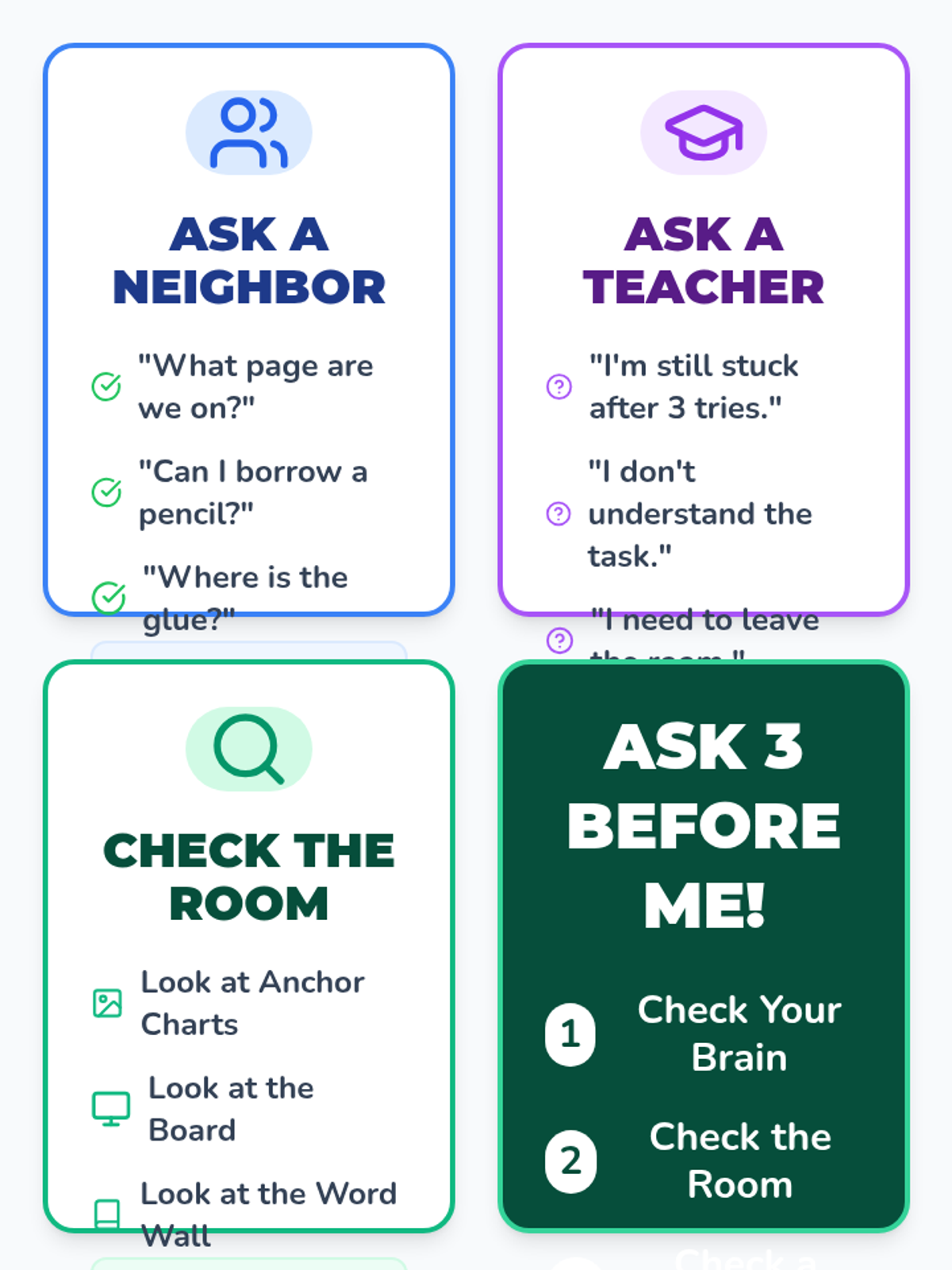
Classroom reference cards that visually categorize which problems should be directed to peers vs. teachers, reinforcing the 'Ask 3 Before Me' routine.
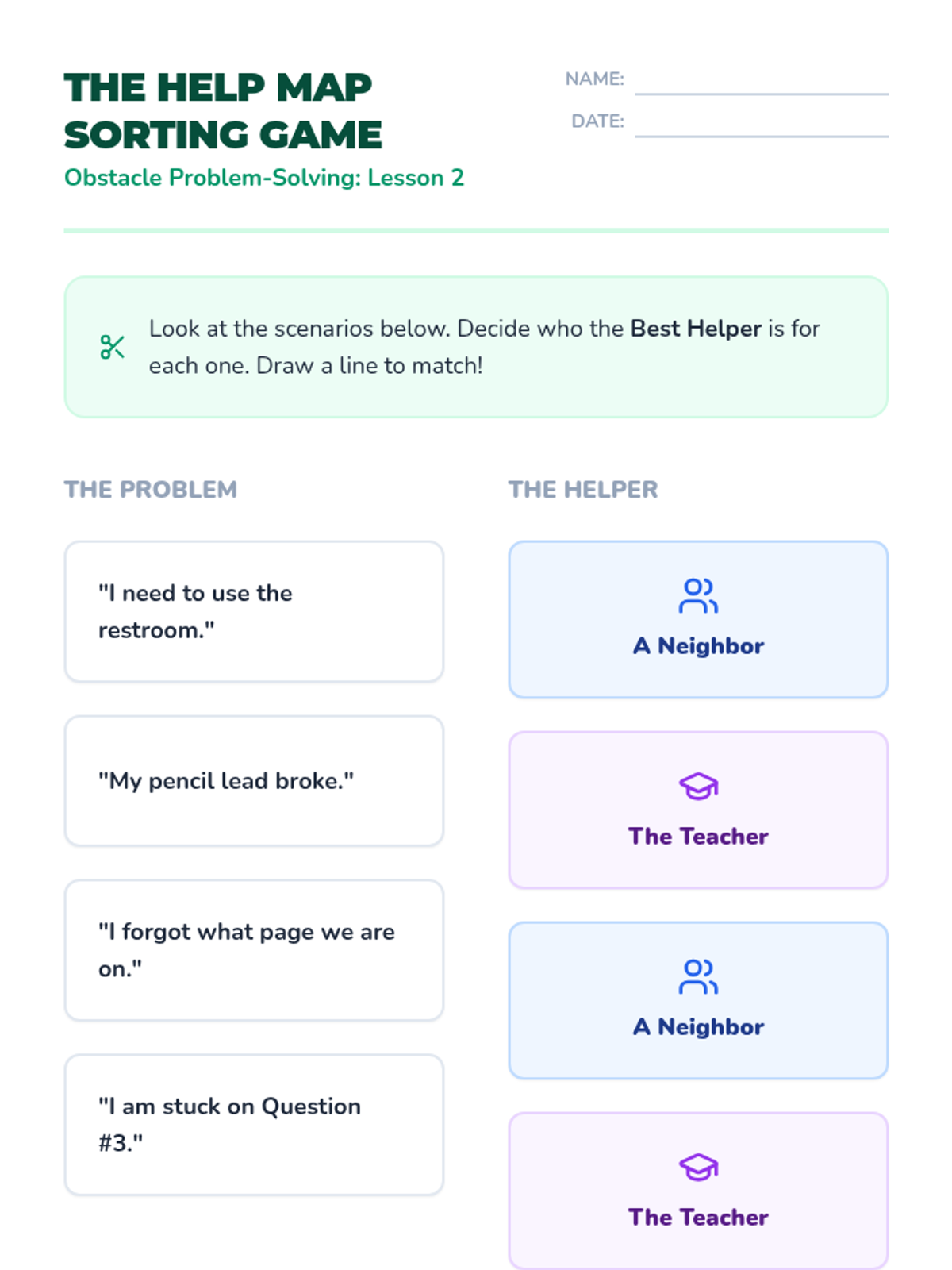
A student worksheet for identifying appropriate helpers for specific classroom scenarios and reinforcing the 'Ask 3 Before Me' routine.
Visual slides for Lesson 2 that help students identify different 'helpers' in the classroom and practice the 'Ask 3 Before Me' strategy.
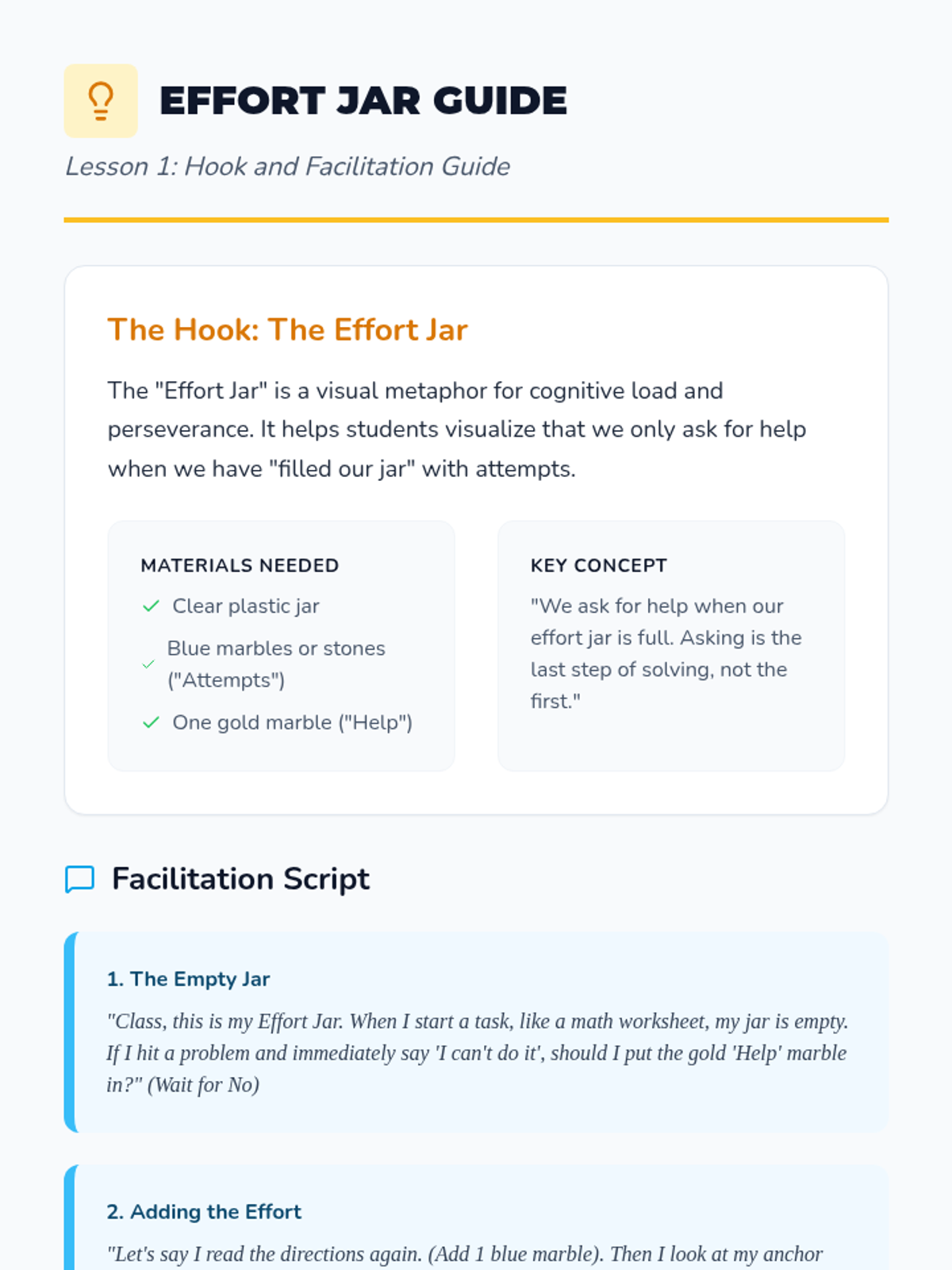
A teacher facilitation guide for the 'Effort Jar' hook activity, providing a script and pedagogical strategies for teaching the tipping point concept.
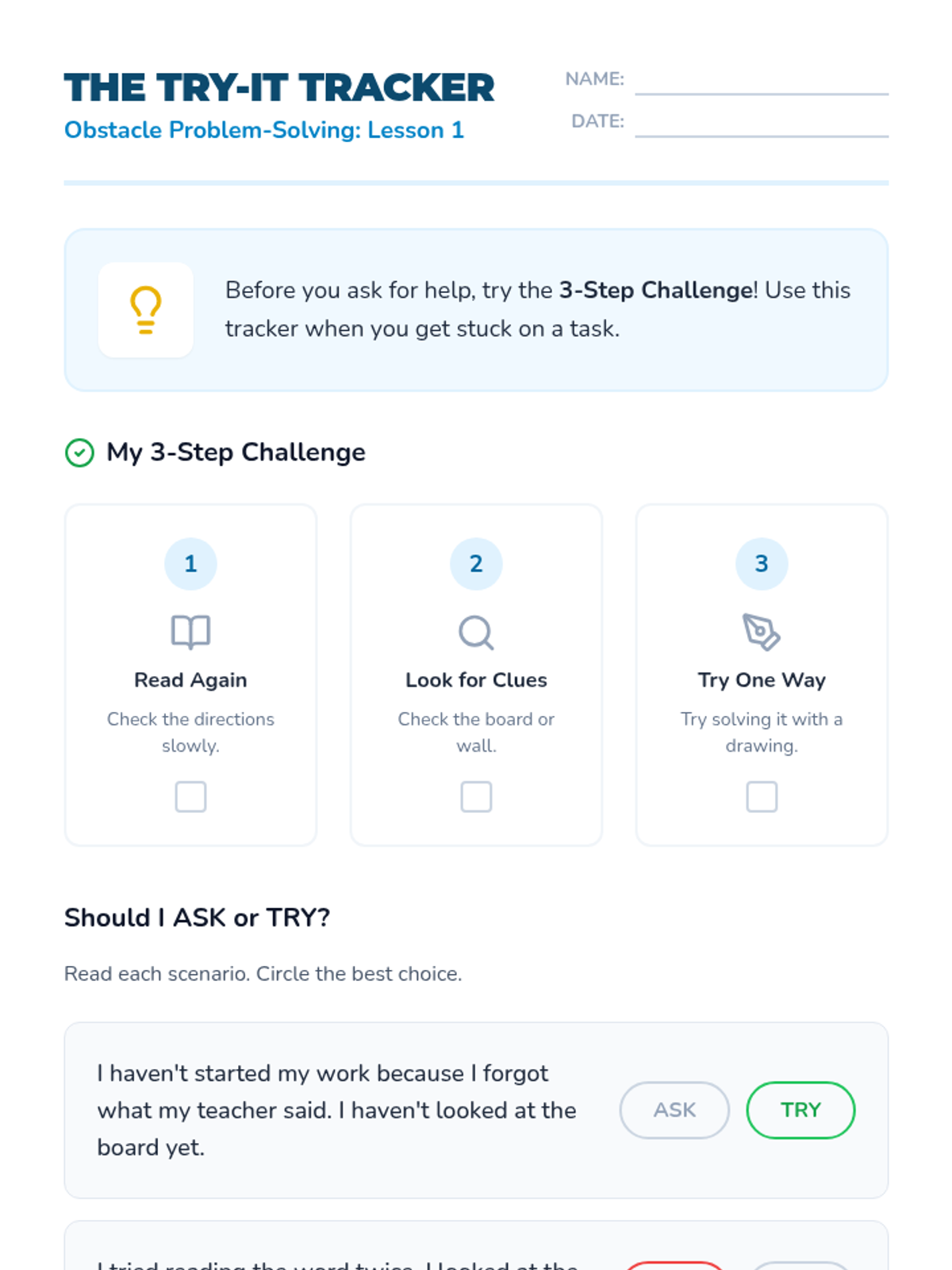
A student worksheet for practicing the 'Try 3 Before Me' strategy and identifying the tipping point between independent effort and asking for help.
Visual slides for Lesson 1 that introduce students to the concept of the 'Tipping Point'—the moment to transition from independent effort to asking for help.
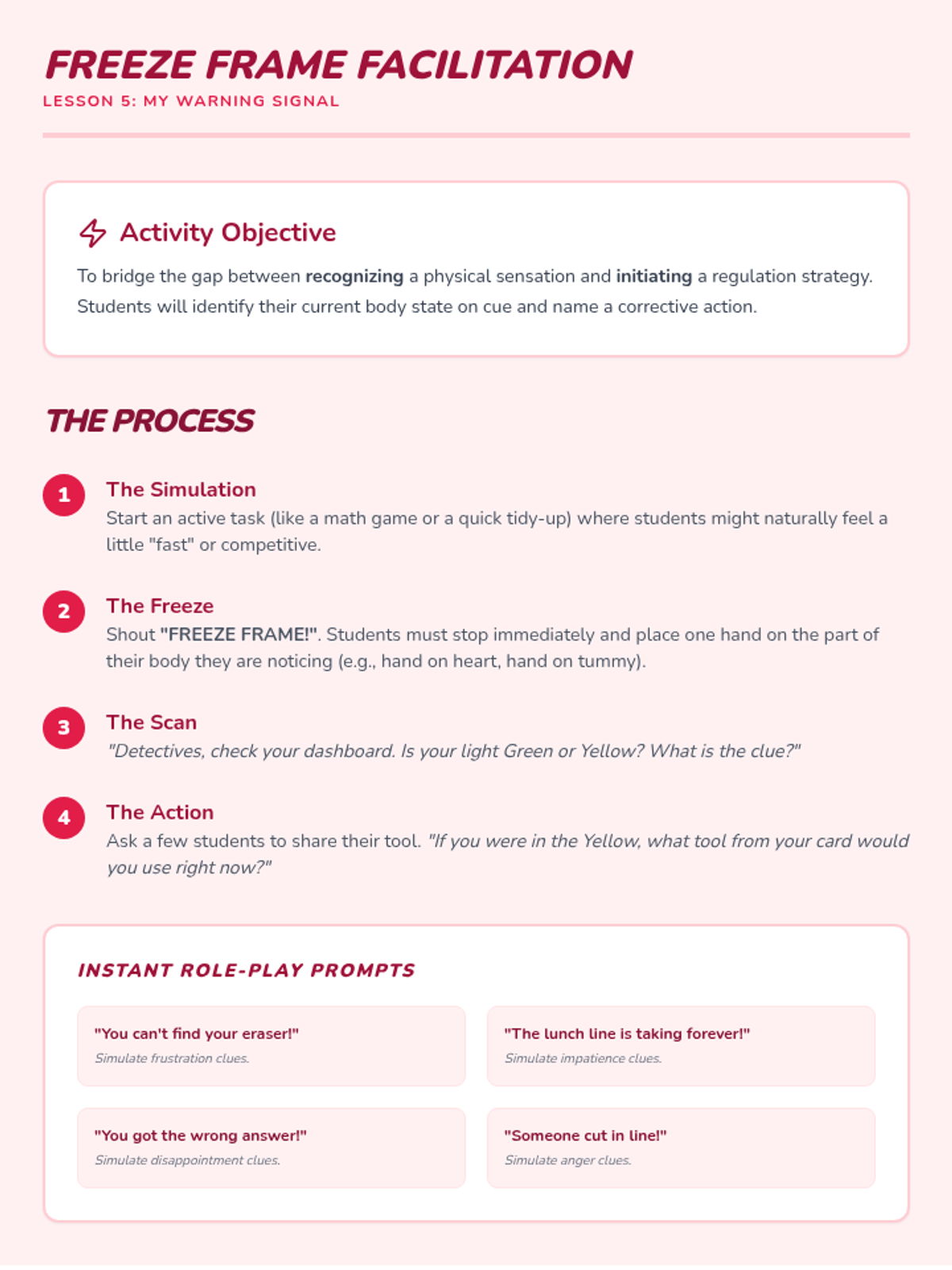
A facilitation guide for the Freeze Frame activity, helping teachers bridge the gap between emotion recognition and regulation actions.
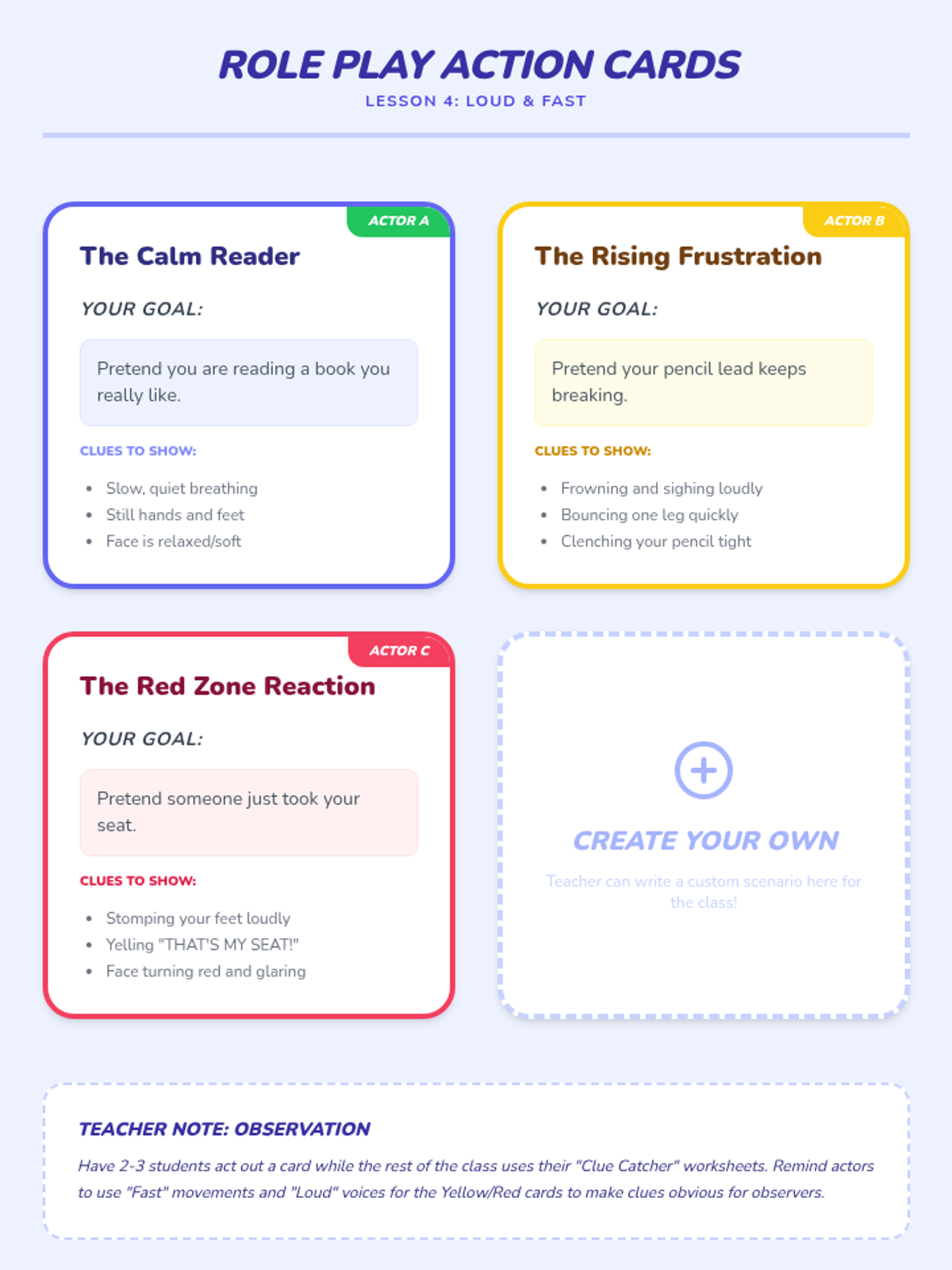
Role-play cards for students to act out different emotional states, focusing on vocal volume and movement speed.
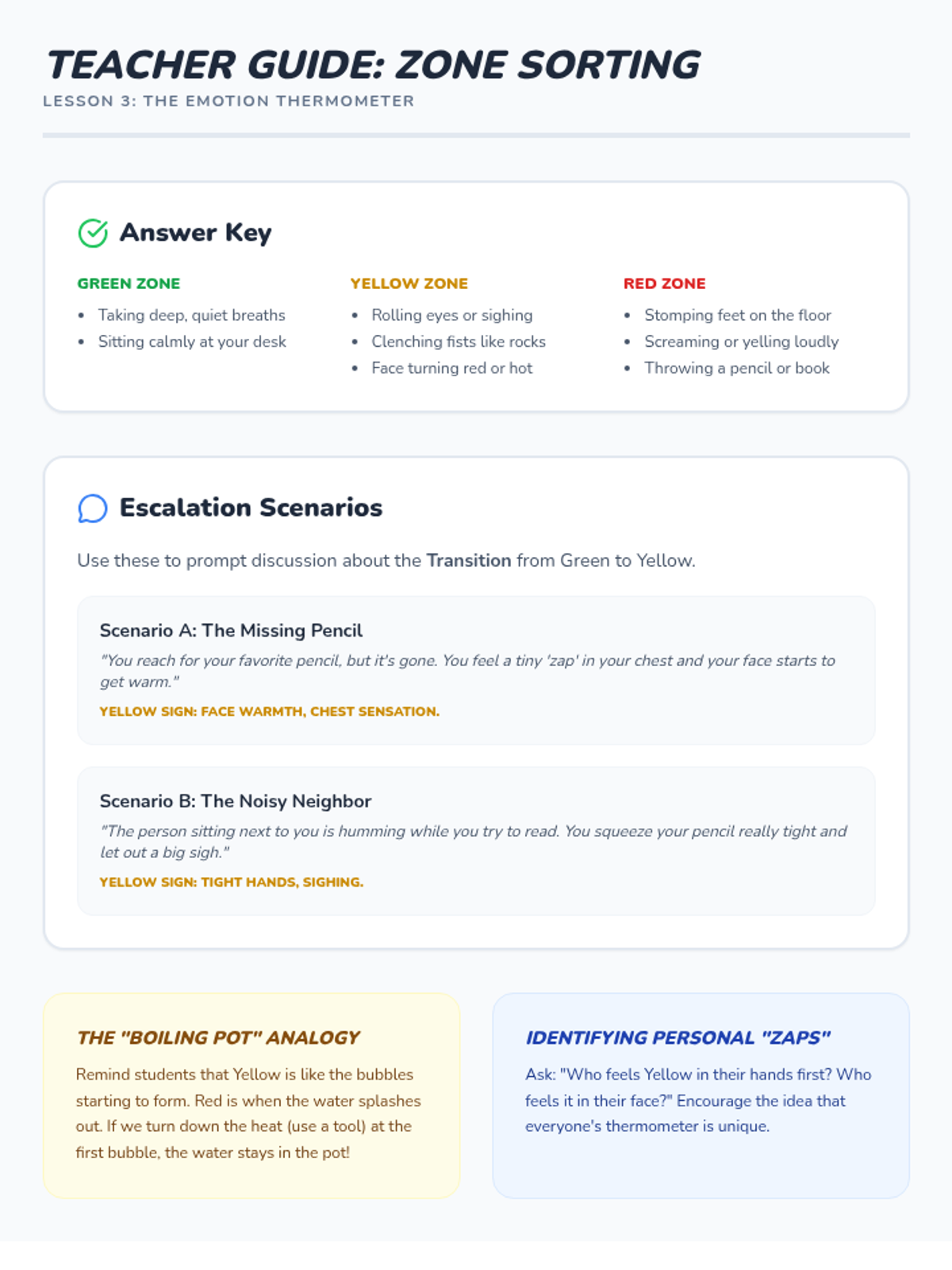
A teacher guide for the Intensity Sorting Activity, including an answer key and discussion scenarios for identifying escalation levels.
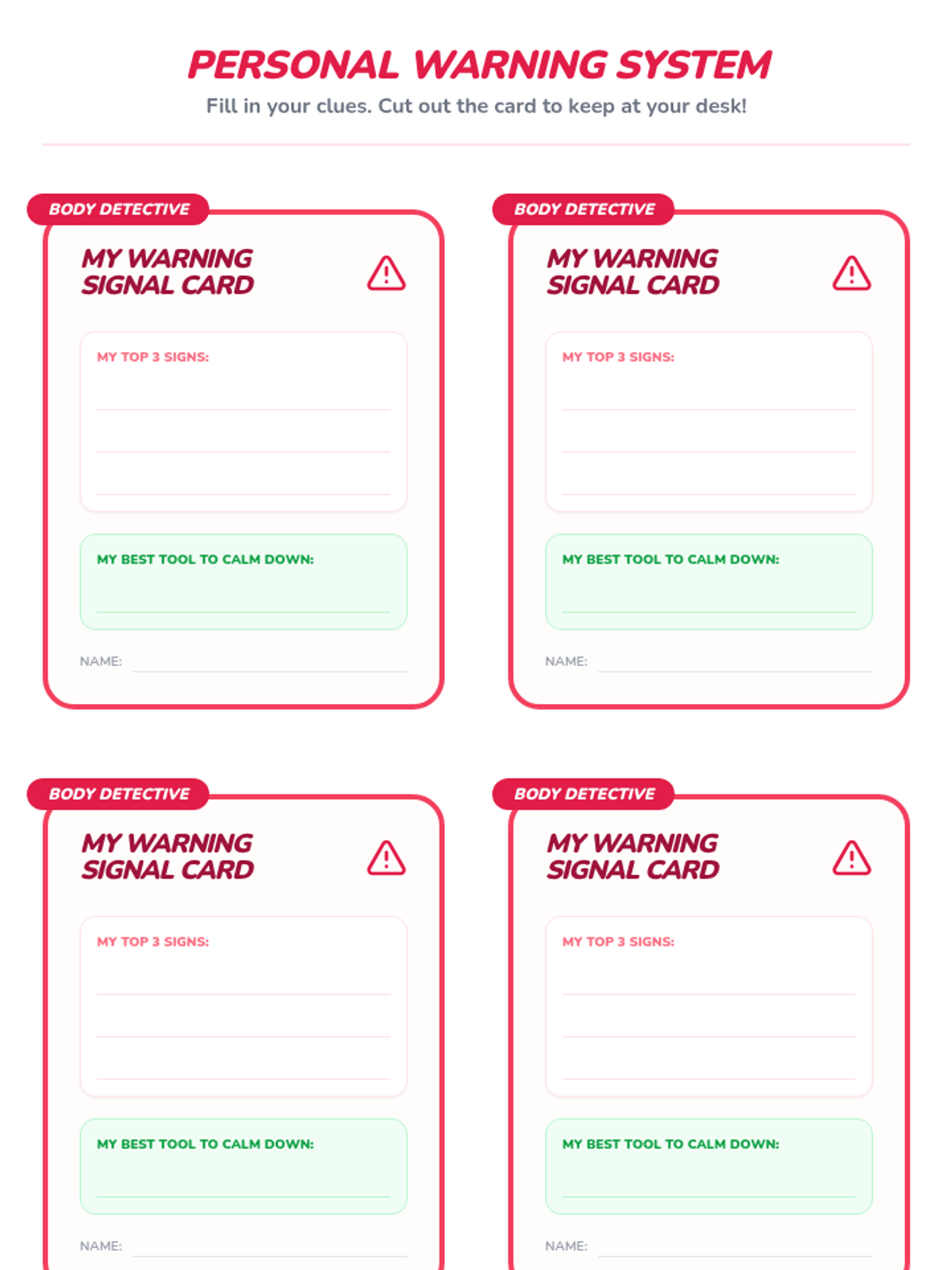
Student desk cards for identifying top personal warning signs and a chosen regulation strategy.
Visual presentation helping students identify personal warning signs and connect them to regulation strategies.
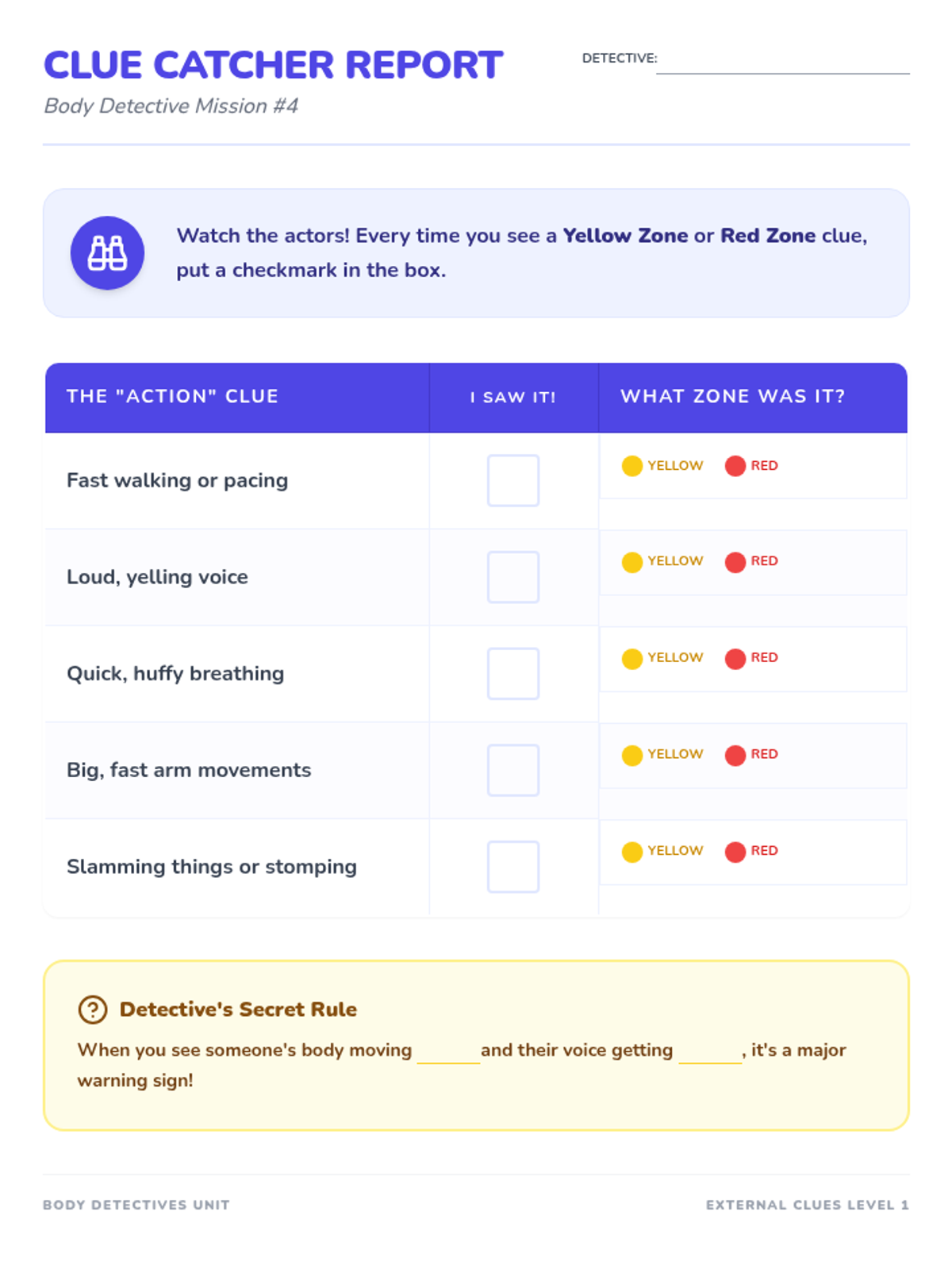
A student observation worksheet for identifying vocal volume and movement speed changes during escalation exercises.
Visual presentation helping students observe vocal volume and movement speed during escalation.
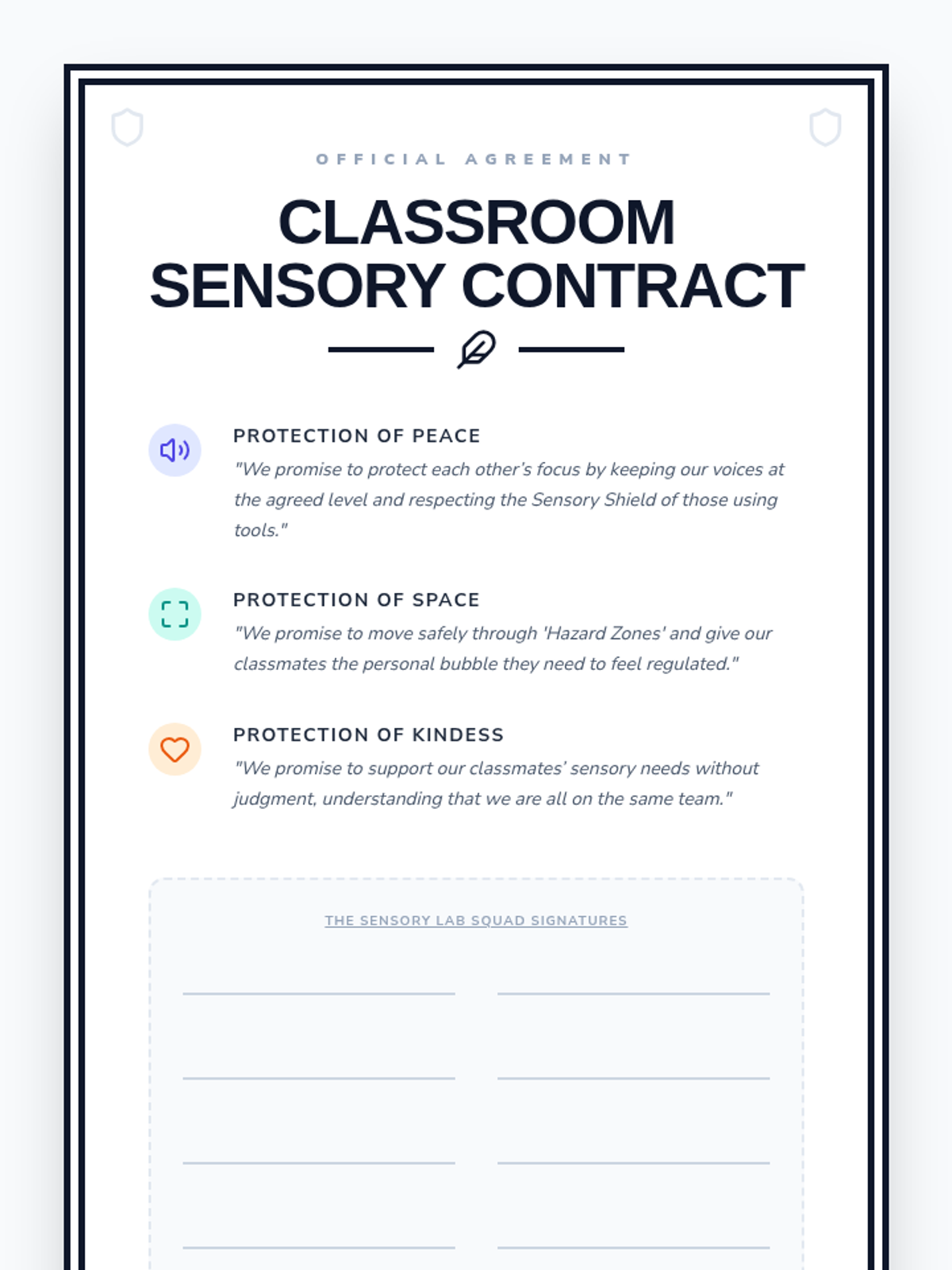
A formal classroom agreement document that establishes shared norms for noise, space, and sensory support, intended for all students to sign.
Slides for Lesson 5 consolidating learning into a classroom agreement on noise, space, and sensory support.
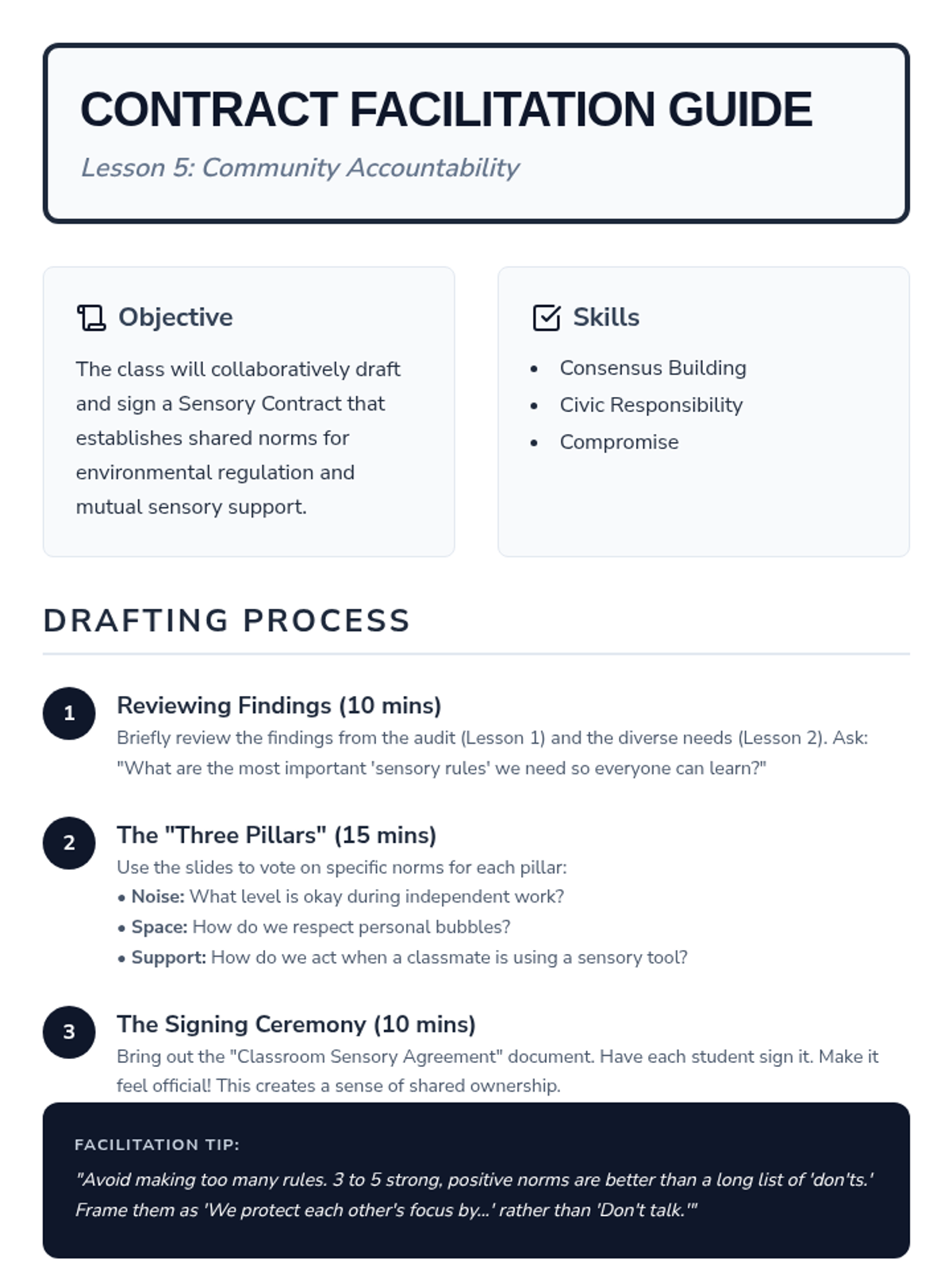
A teacher guide for the Classroom Sensory Contract lesson, featuring strategies for consensus building, signing ceremonies, and ongoing contract maintenance.
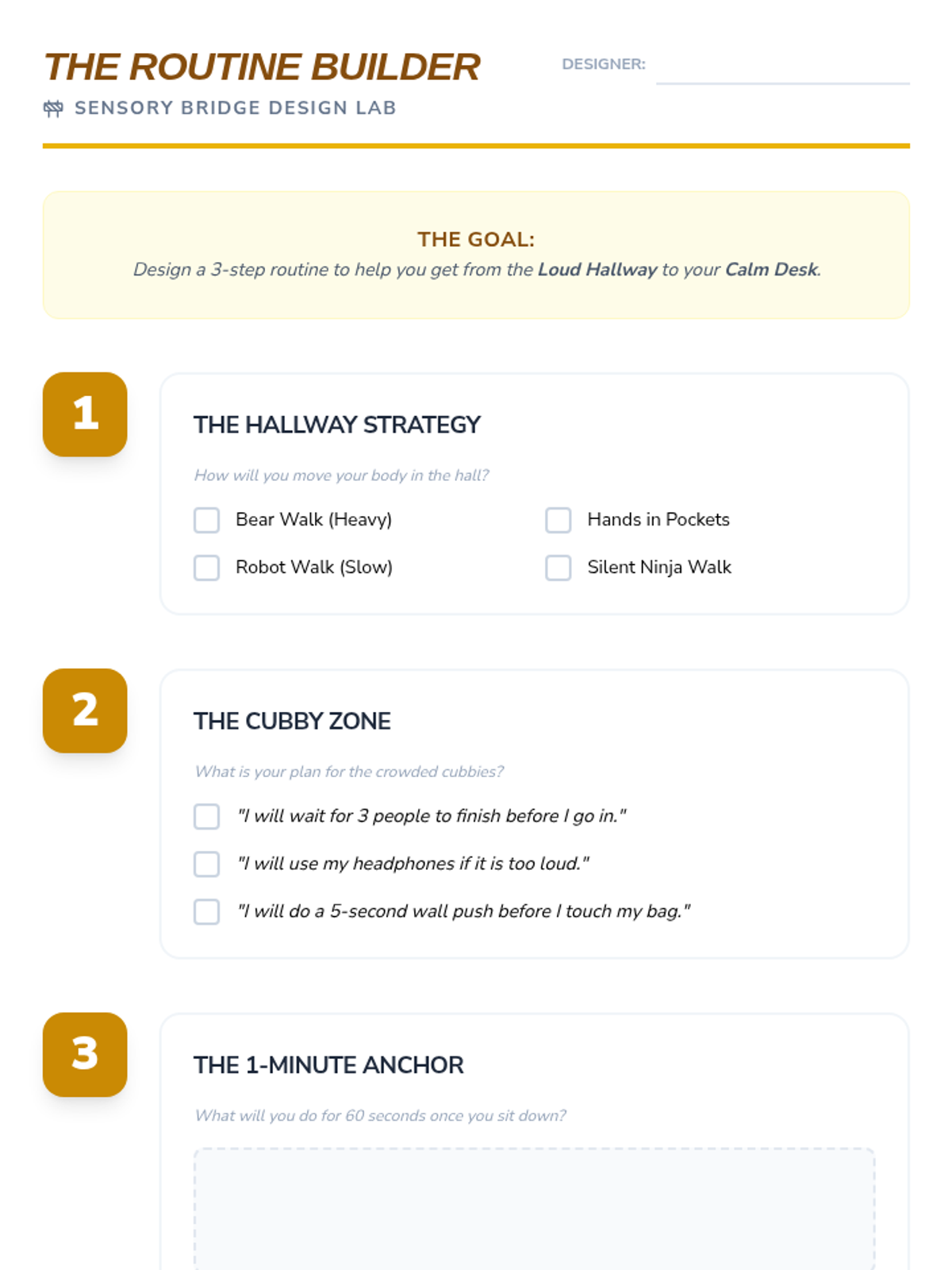
A student worksheet for building a personalized 3-step transition routine using sensory strategies.
Slides for Lesson 4 exploring the "Transition Bridge" concept and identifying sensory hazards during class changes.
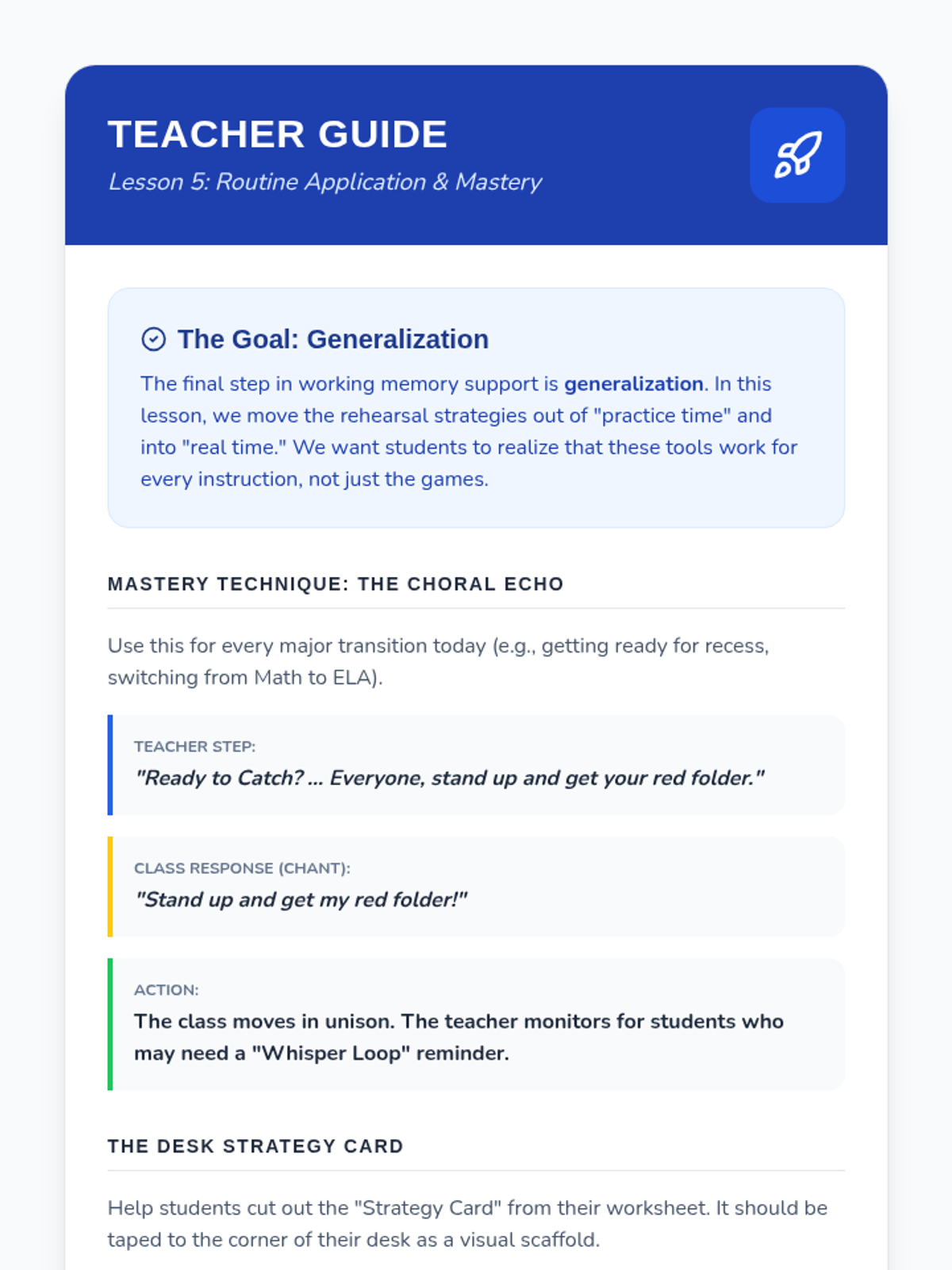
Final teacher guide for the sequence, focusing on choral response techniques, the use of desk-based strategy cards, and informal mastery assessment.
Final slides for the sequence, focusing on graduating the 'Brain Training' skills into everyday classroom routines like cleaning up and transitions.
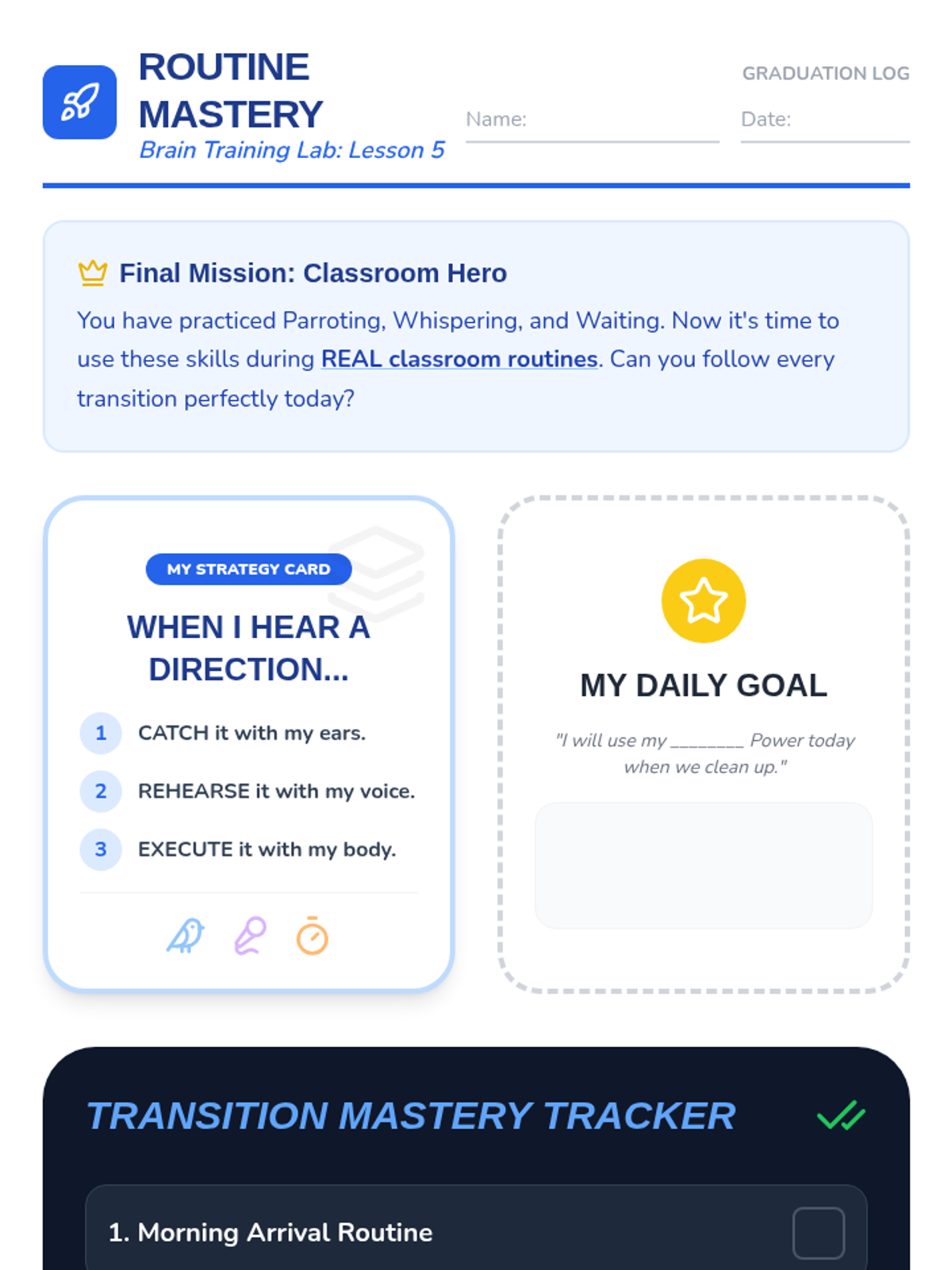
A cumulative resource for Lesson 5 including a strategy desk card and a transition mastery tracker to help students apply verbal rehearsal to real classroom routines.
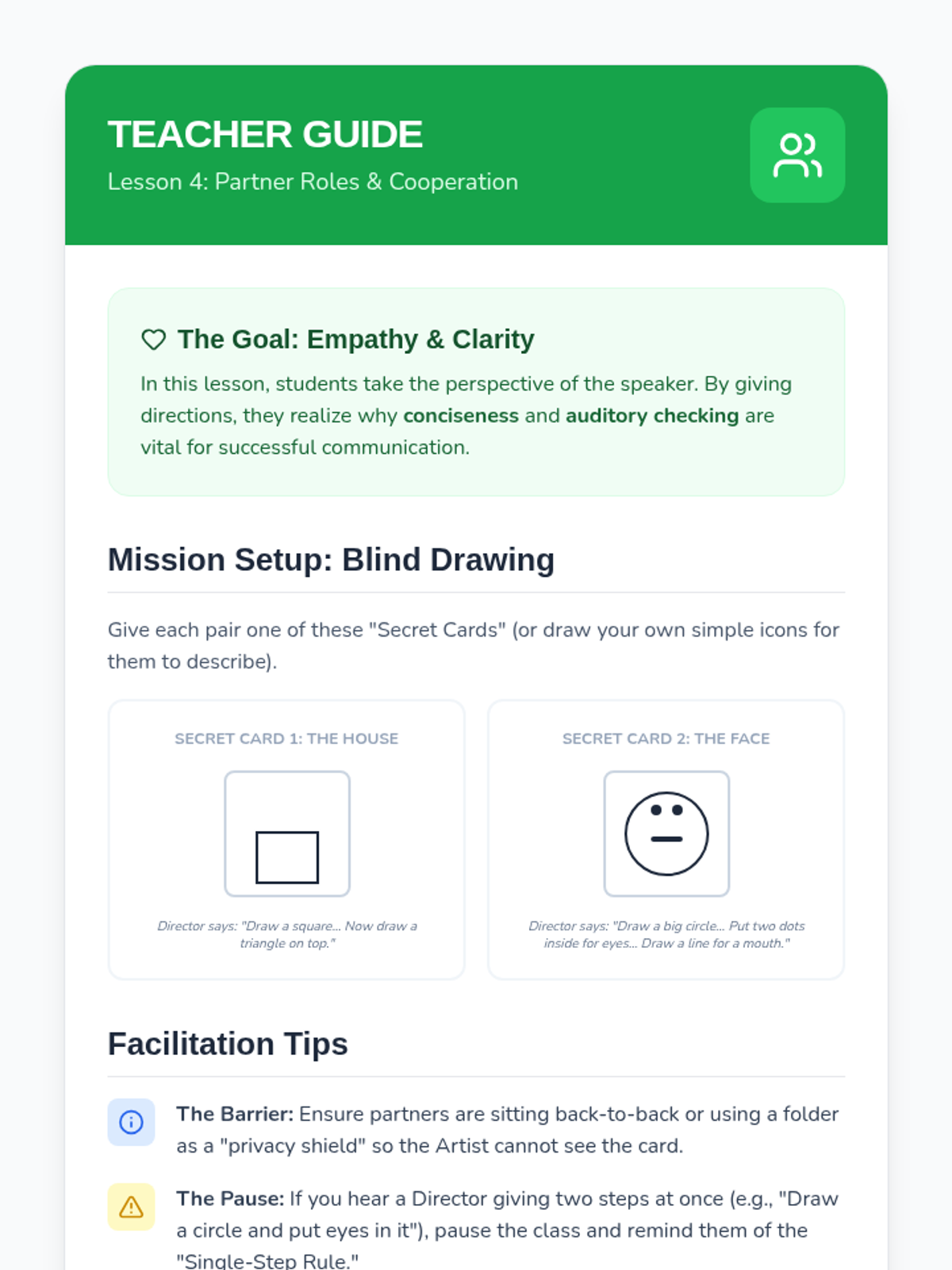
A teacher guide for Lesson 4 including secret cards for the blind drawing activity, facilitation scripts, and peer feedback prompts.
Slides for Lesson 4 facilitating a peer-to-peer communication activity. Introduces the roles of 'Director' and 'Artist' for a collaborative drawing challenge.
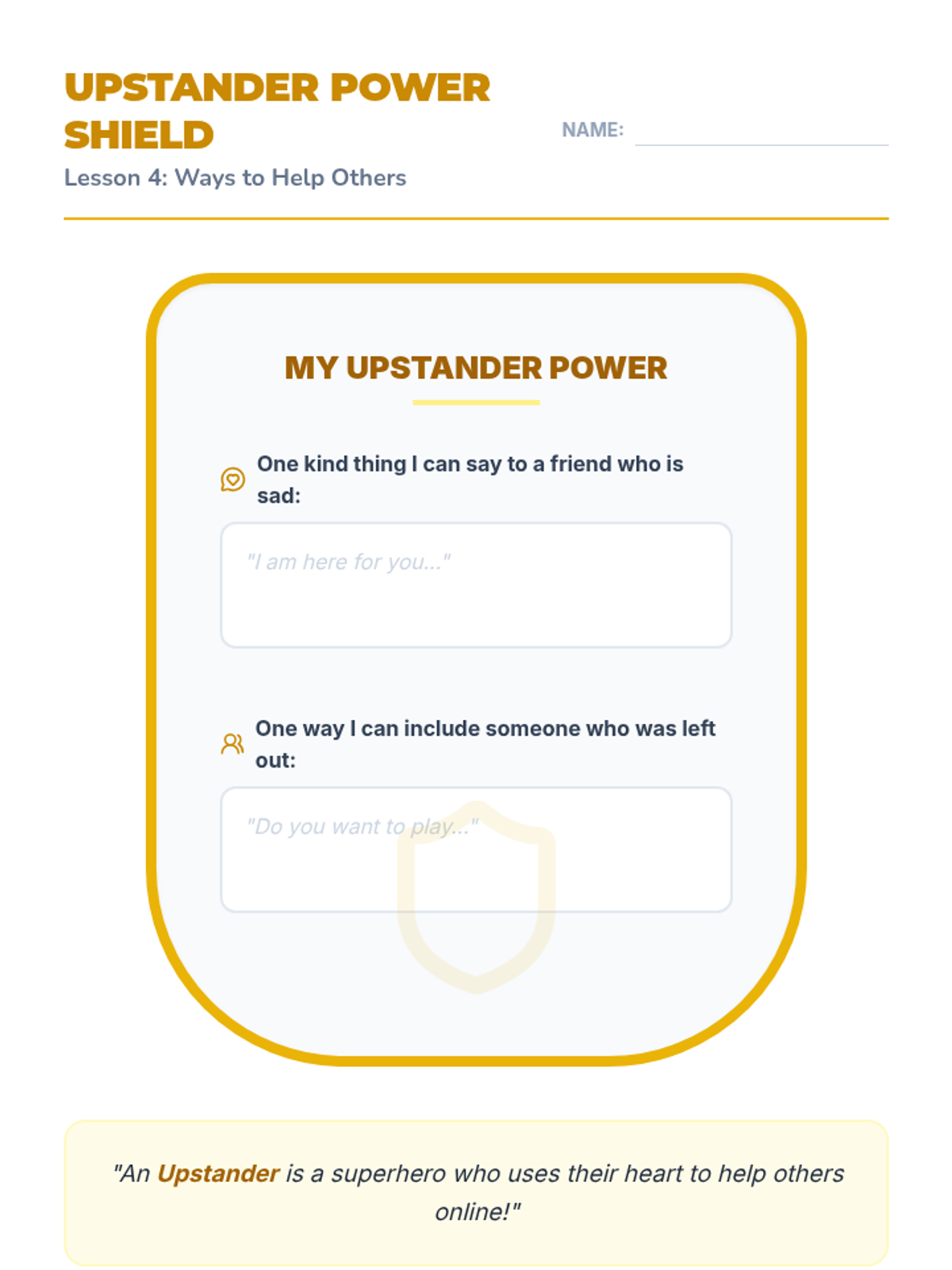
A graphic organizer shaped like a shield where students brainstorm and write down specific ways they can support peers online.
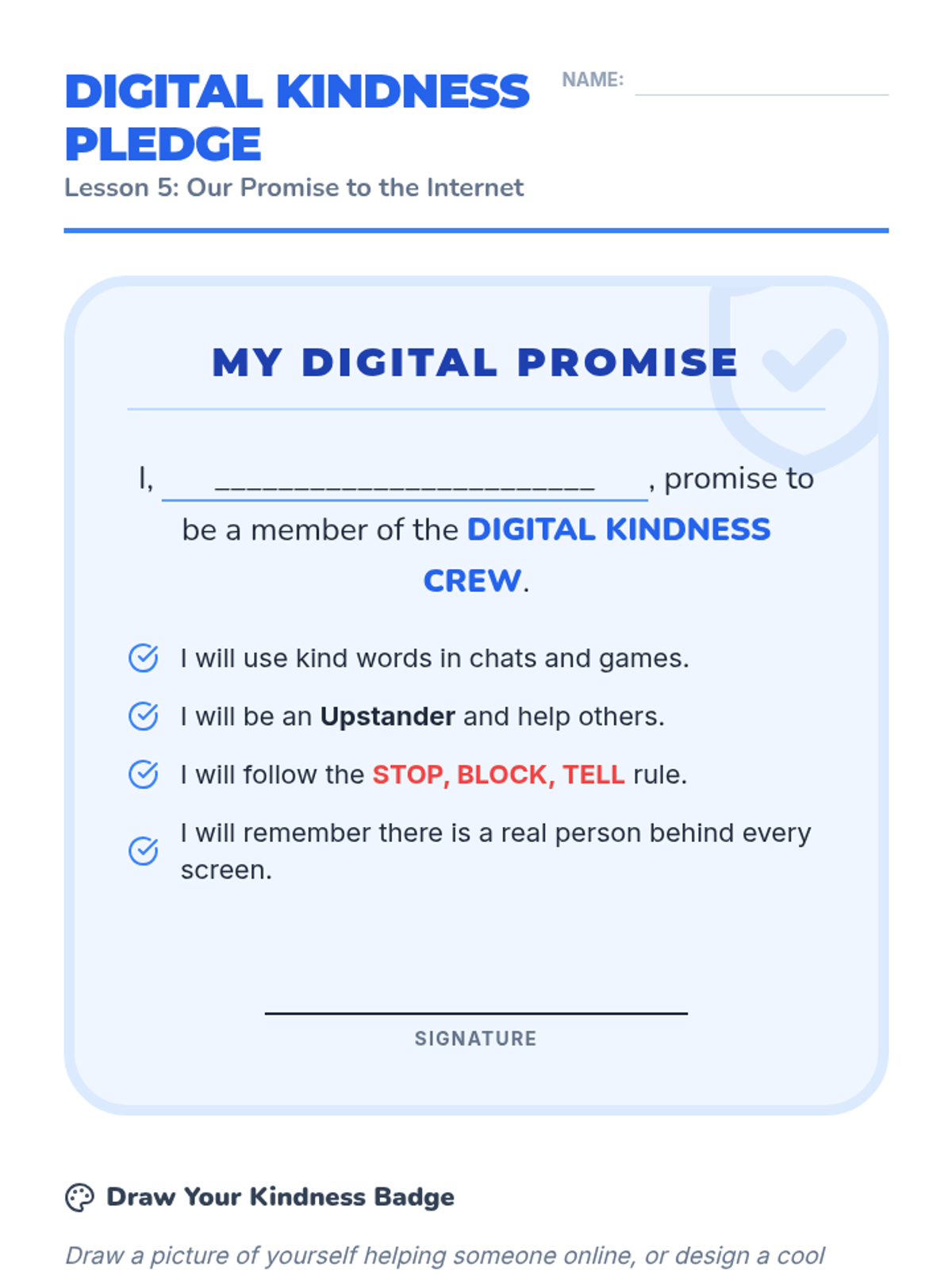
The final project for the Digital Kindness Crew sequence where students sign a personal pledge and create artwork representing their commitment to online respect.
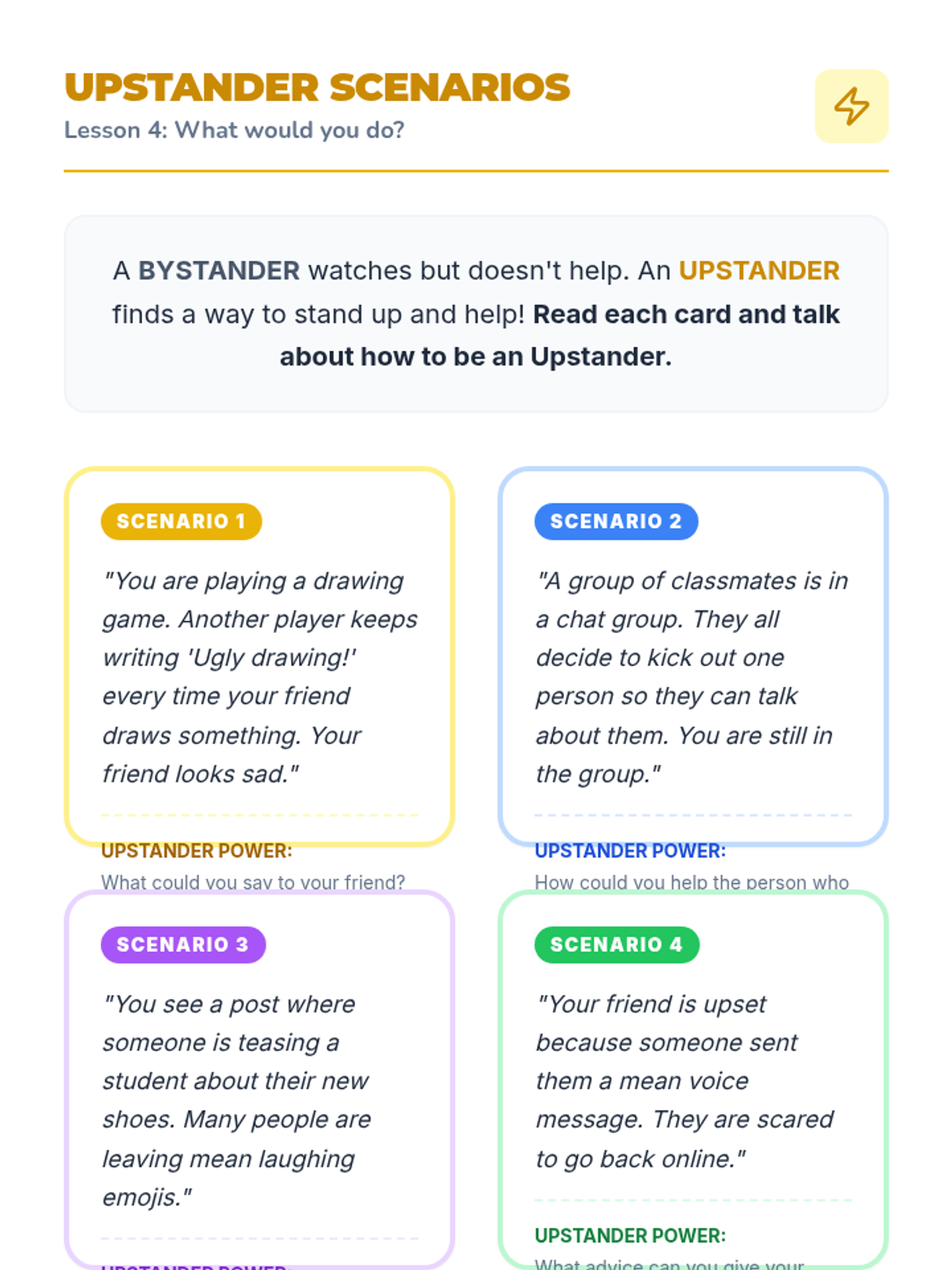
Discussion cards featuring common online scenarios for 2nd graders to practice shifting from a bystander to an upstander.
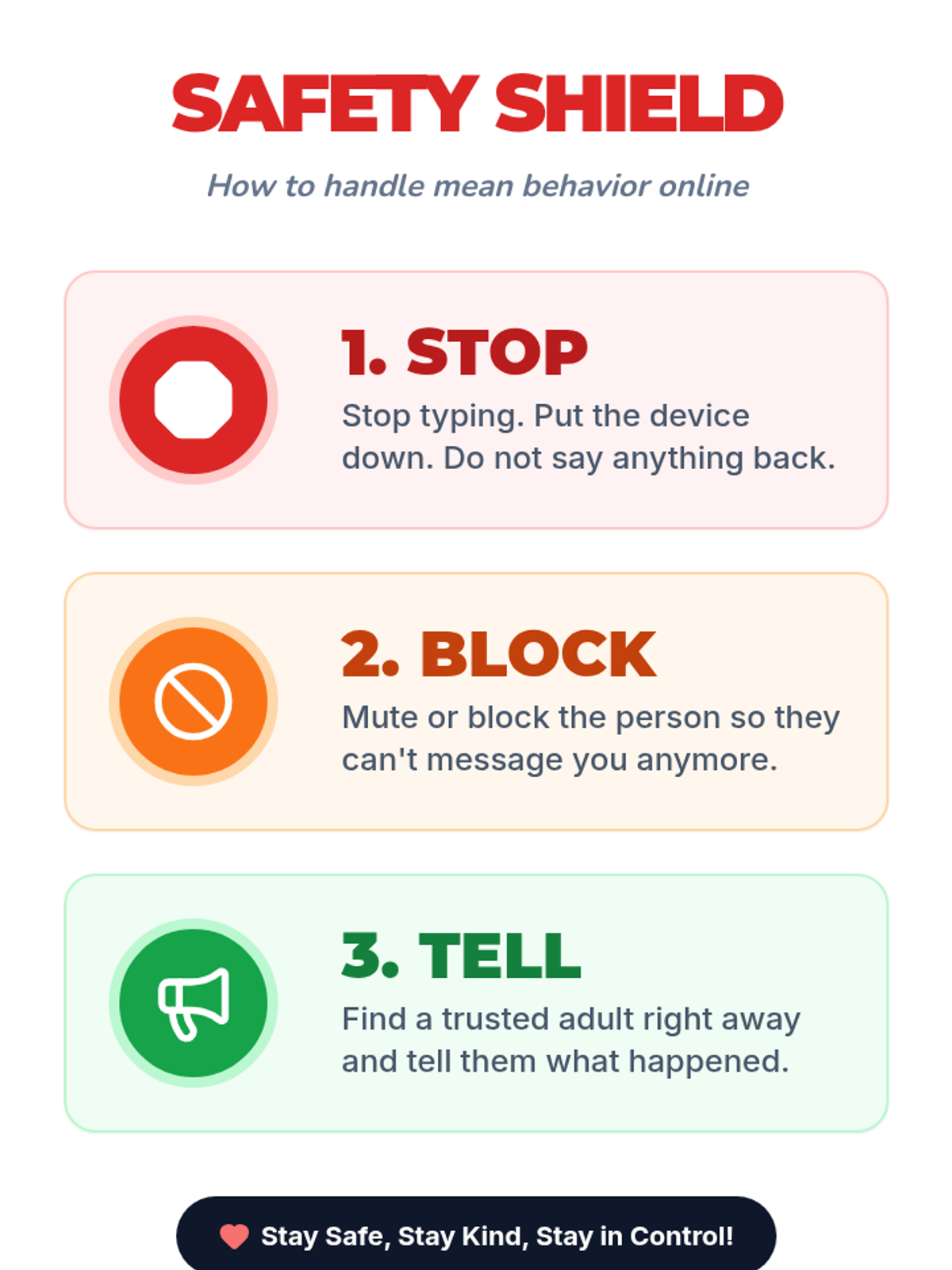
A bright, visual reference poster for the 'Stop, Block, and Tell' safety protocol, perfect for classroom display or as a student handout.
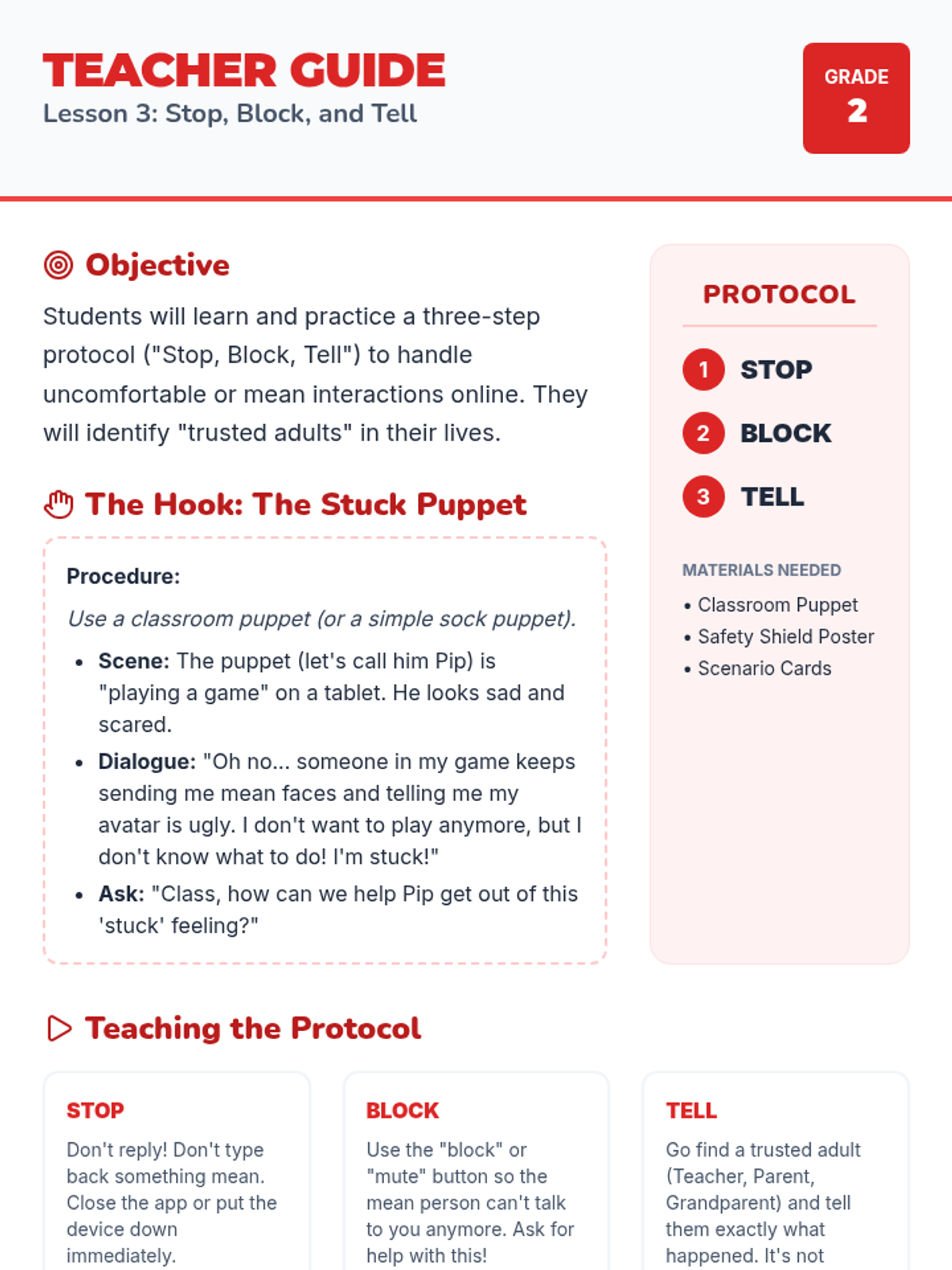
A teacher guide for the 'Stop, Block, Tell' safety lesson, featuring a puppet hook, protocol breakdown, and role-play instructions for 2nd graders.
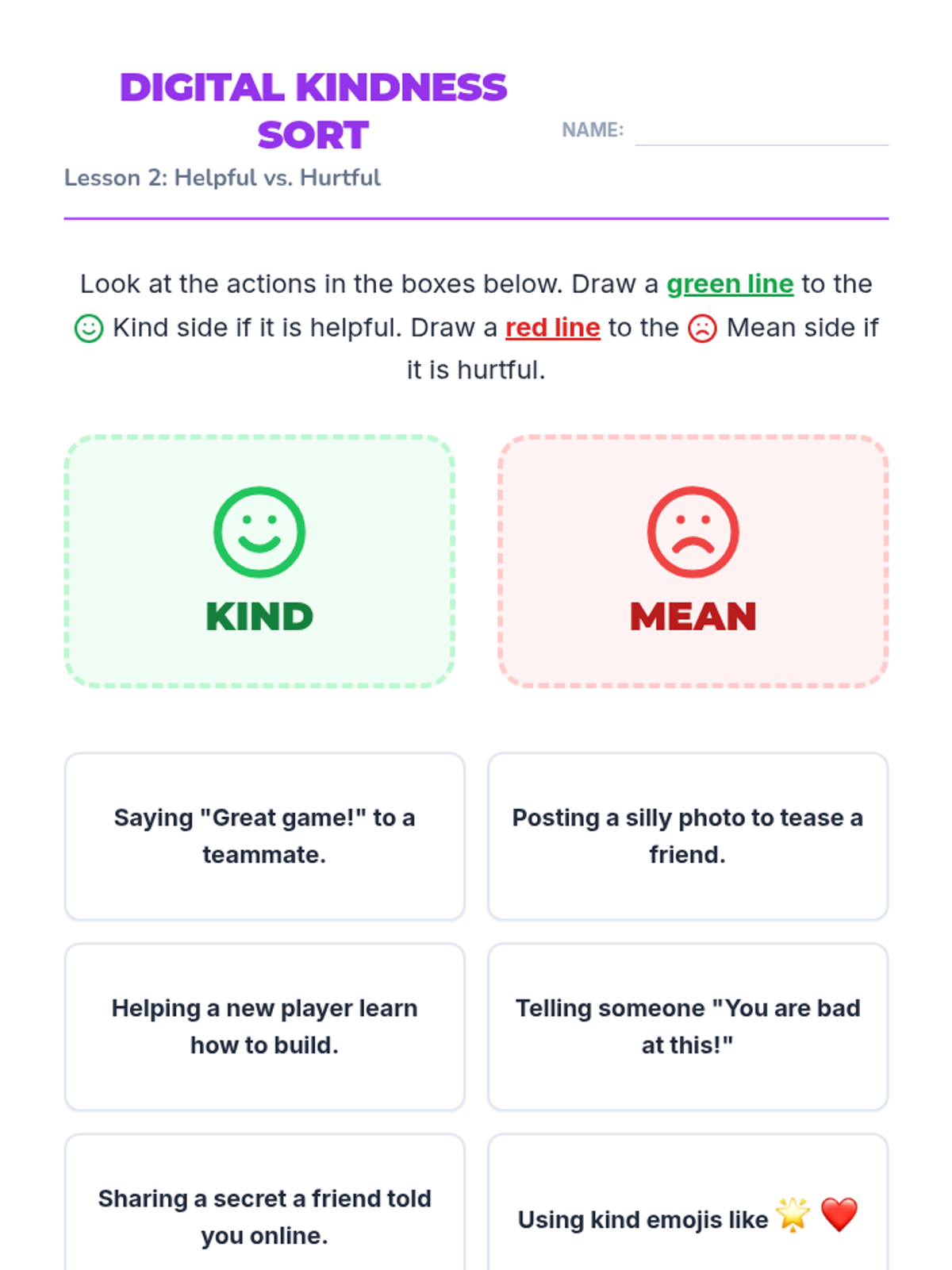
A sorting activity where students categorize digital behaviors as kind or mean, helping them identify cyberbullying and helpful online actions.
Slide deck for Lesson 2 focusing on identifying mean vs. kind behavior online through the story of Sam and an introduction to the concept of cyberbullying.
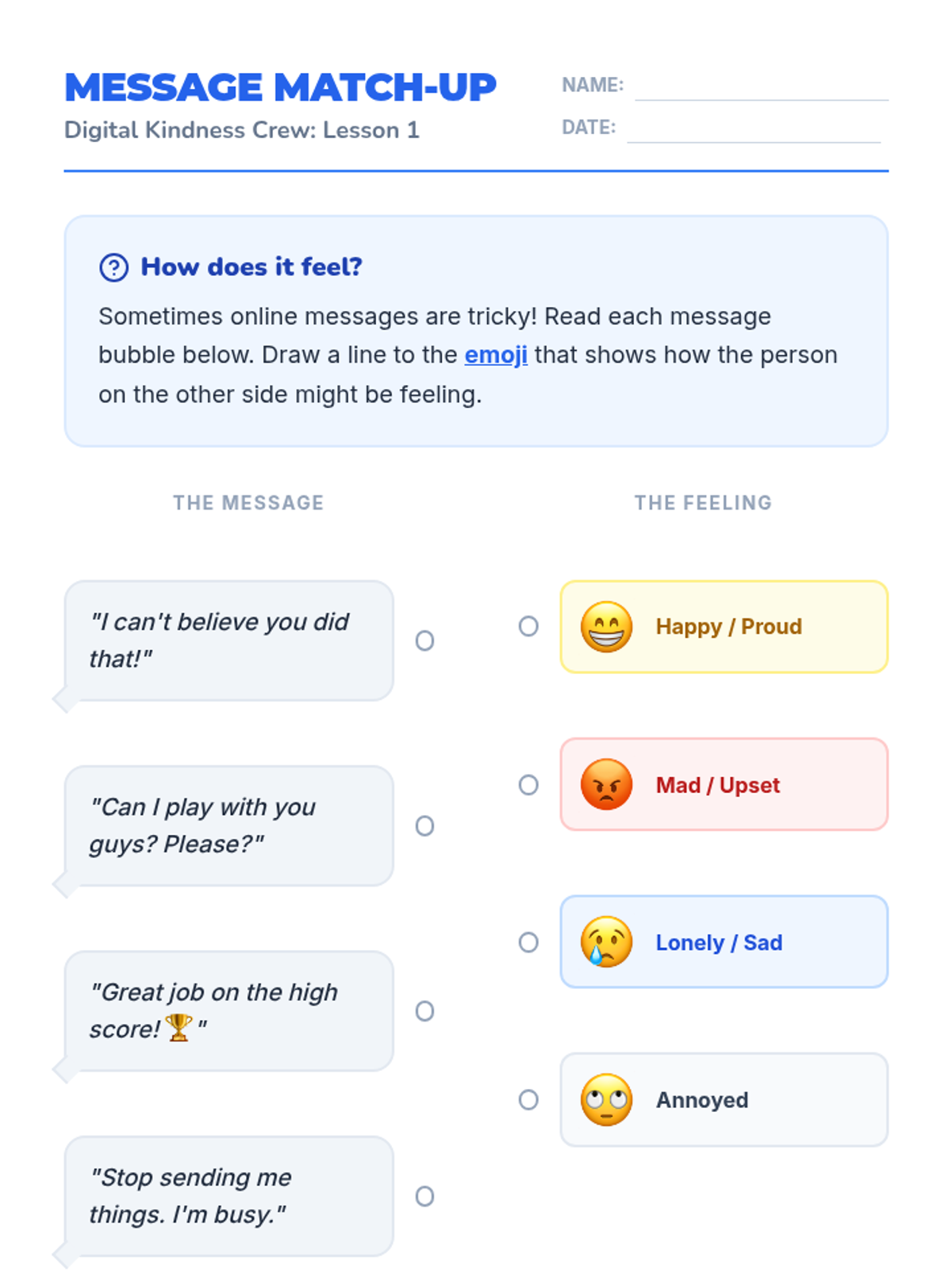
A worksheet where students match digital messages to the likely emotions of the person behind the screen, reinforcing empathy in online communication.
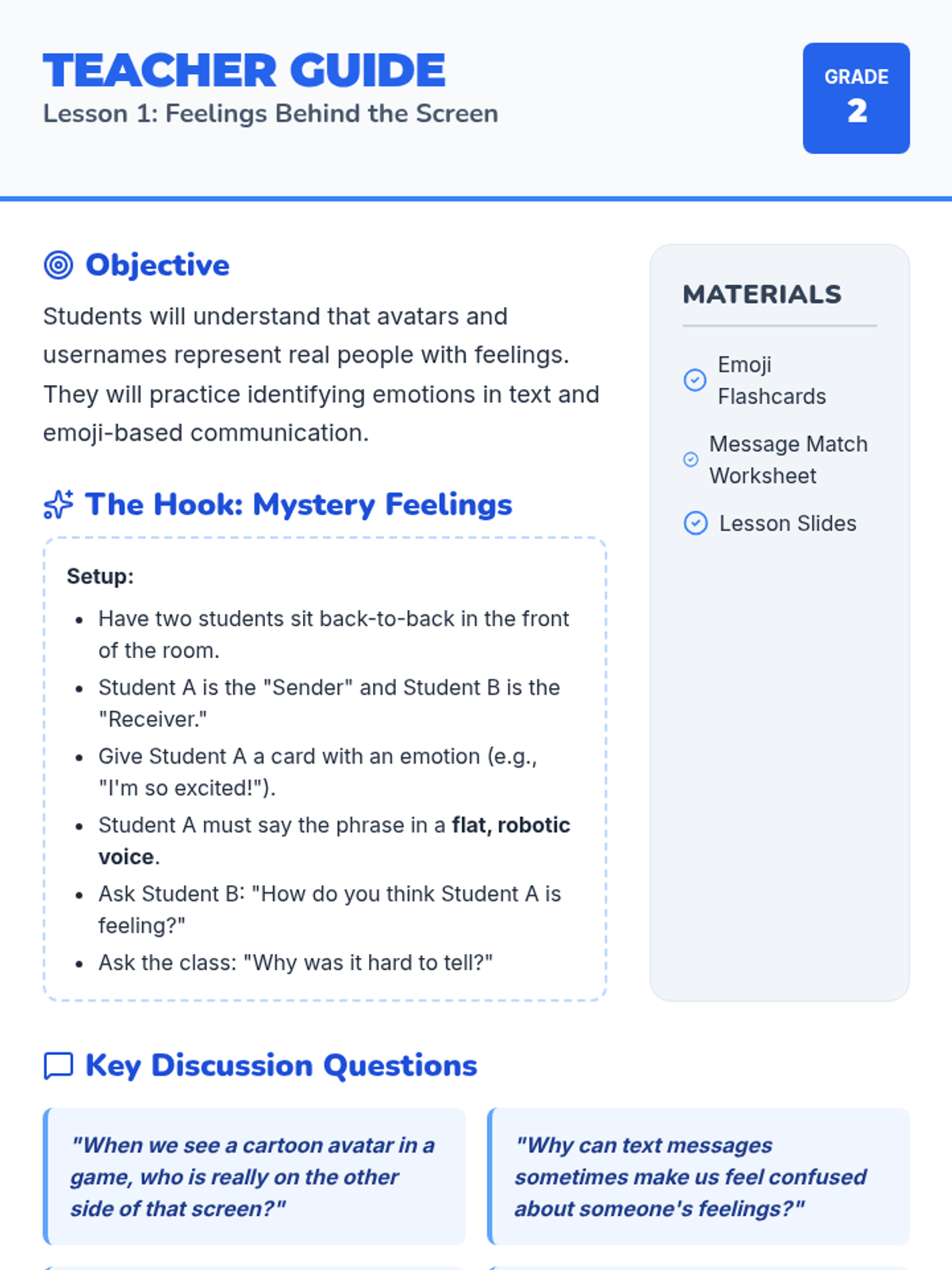
A teacher guide for the first lesson of the Digital Kindness Crew sequence, detailing the "back-to-back" hook activity and discussion prompts about online empathy.
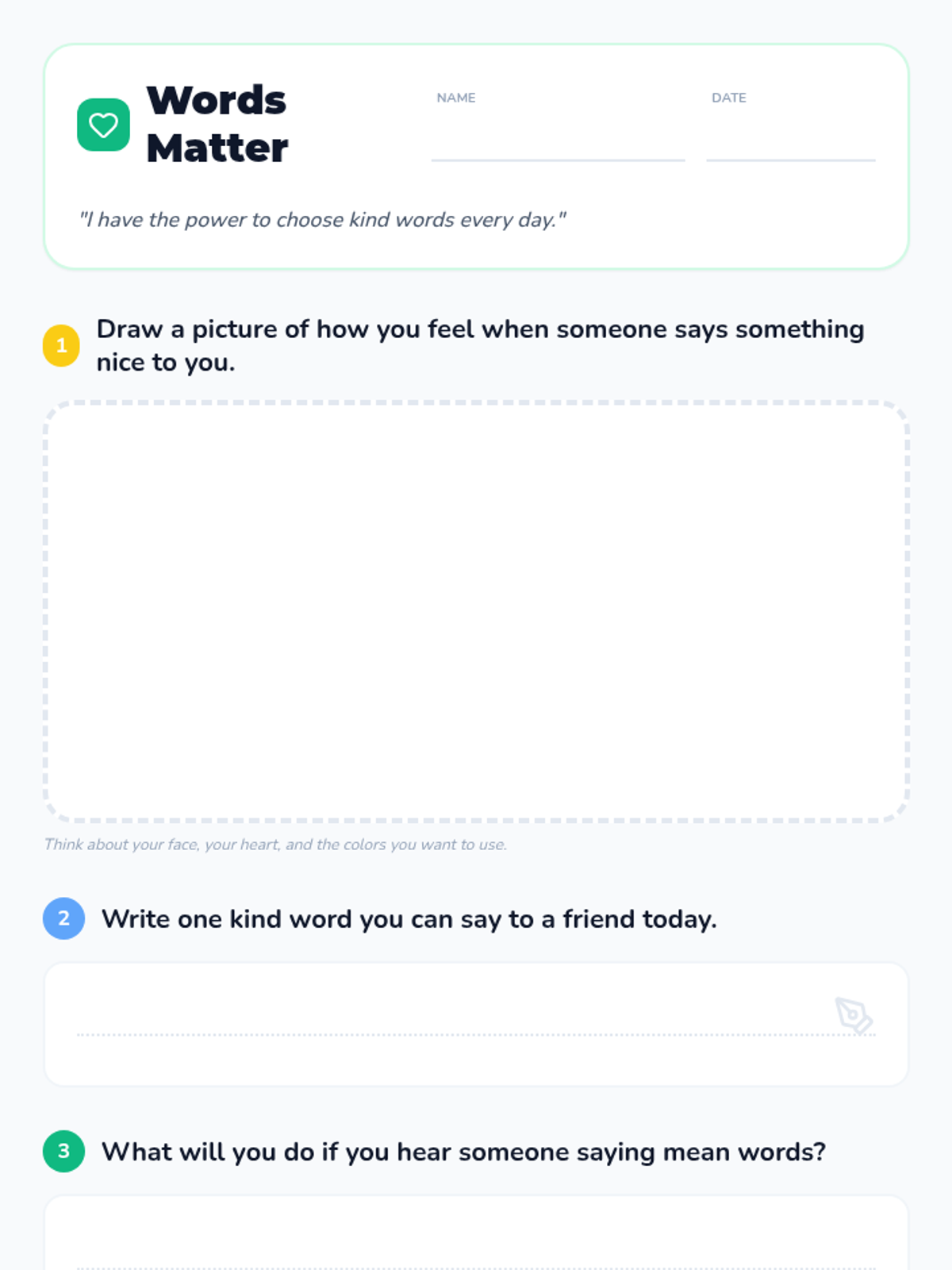
A student reflection worksheet where second graders can draw and write about the positive impact of kind words and plan restorative responses to mean comments.
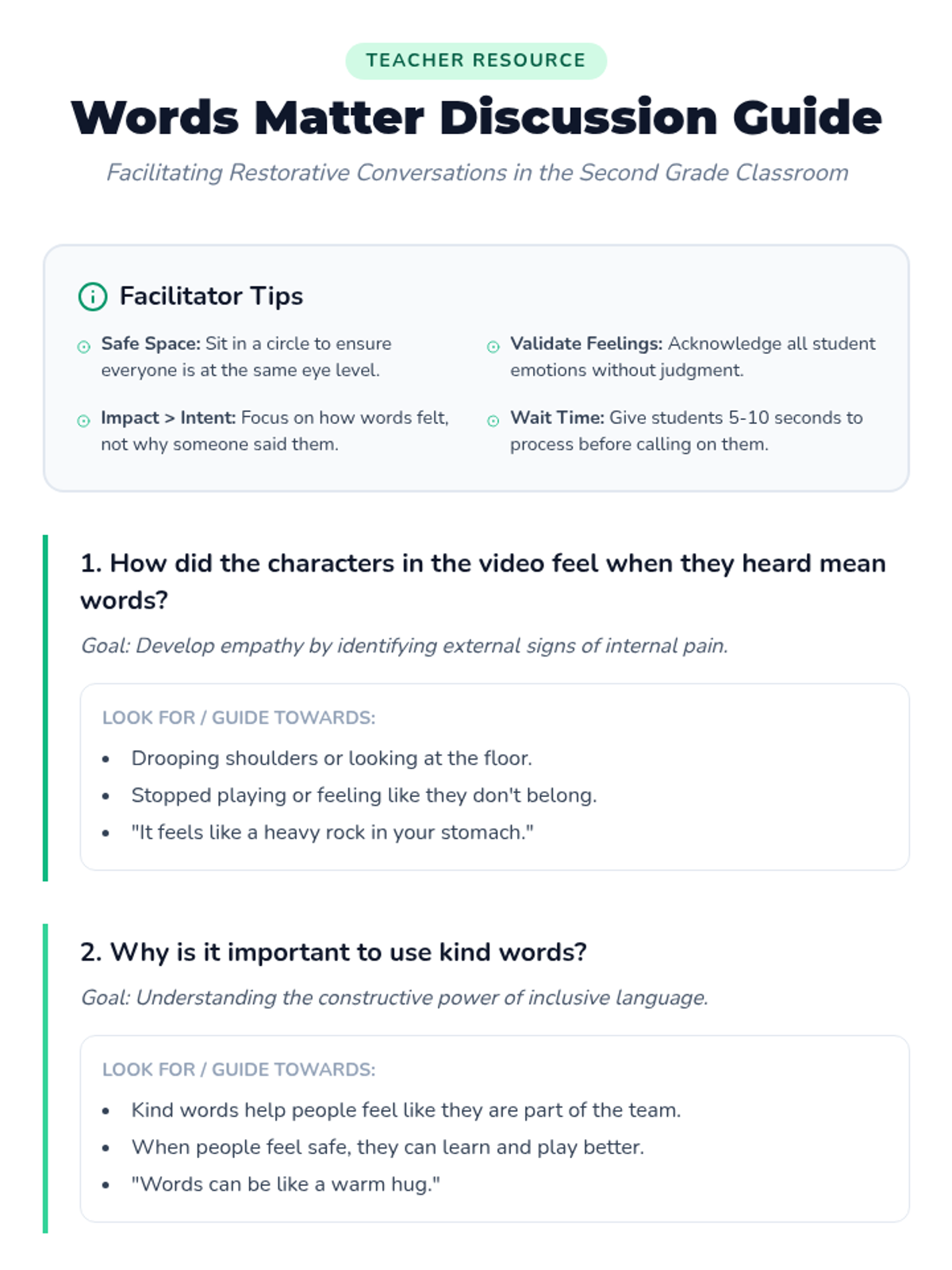
A guide for teachers to lead restorative discussions about the impact of words and racial comments, including specific scenarios for roleplay.
Engaging slide presentation for the Words Matter lesson, featuring visual prompts for discussion, video viewing, and activity instructions.
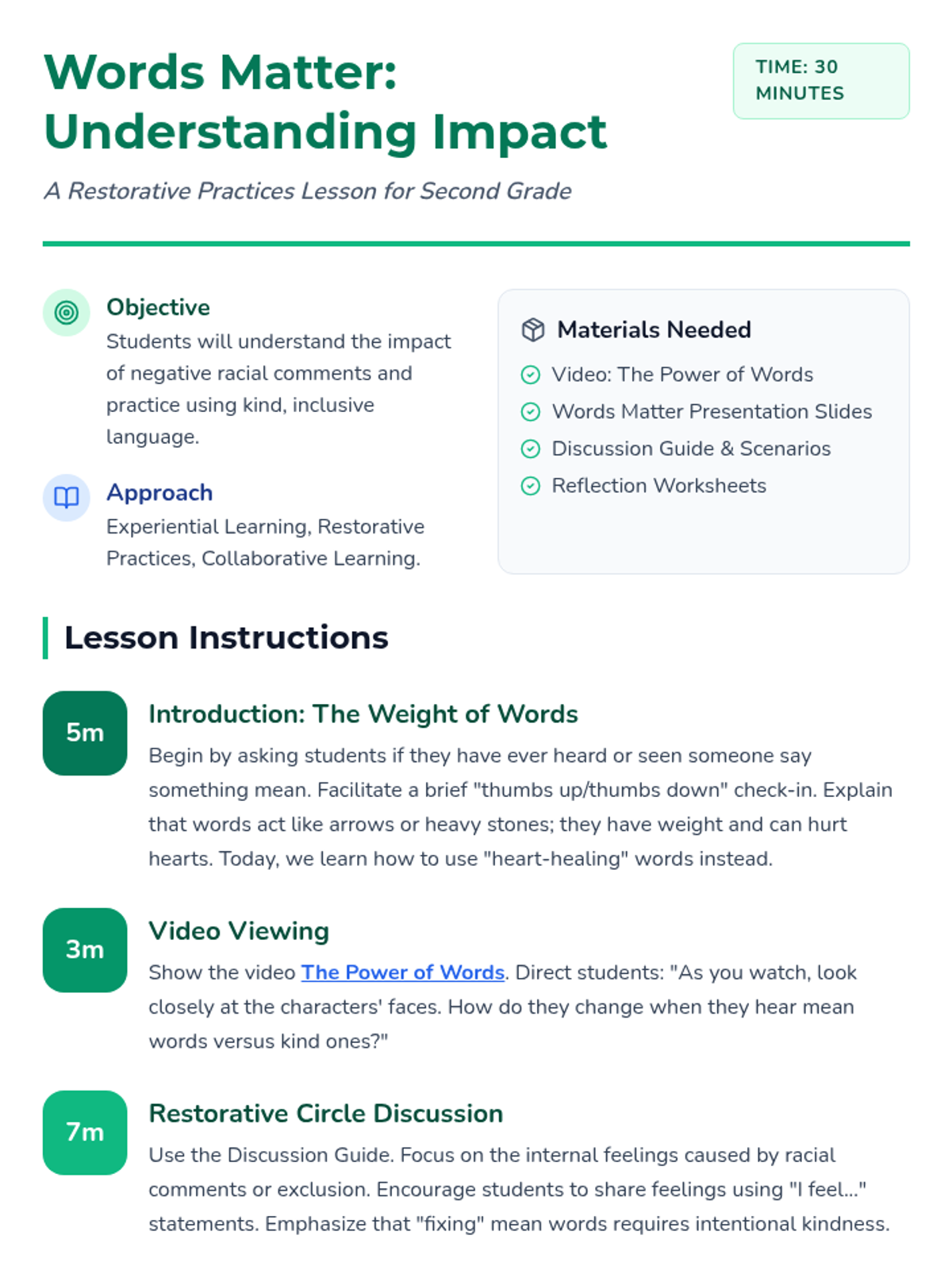
A comprehensive lesson plan for second-grade teachers on teaching the impact of negative racial comments and the power of restorative communication.
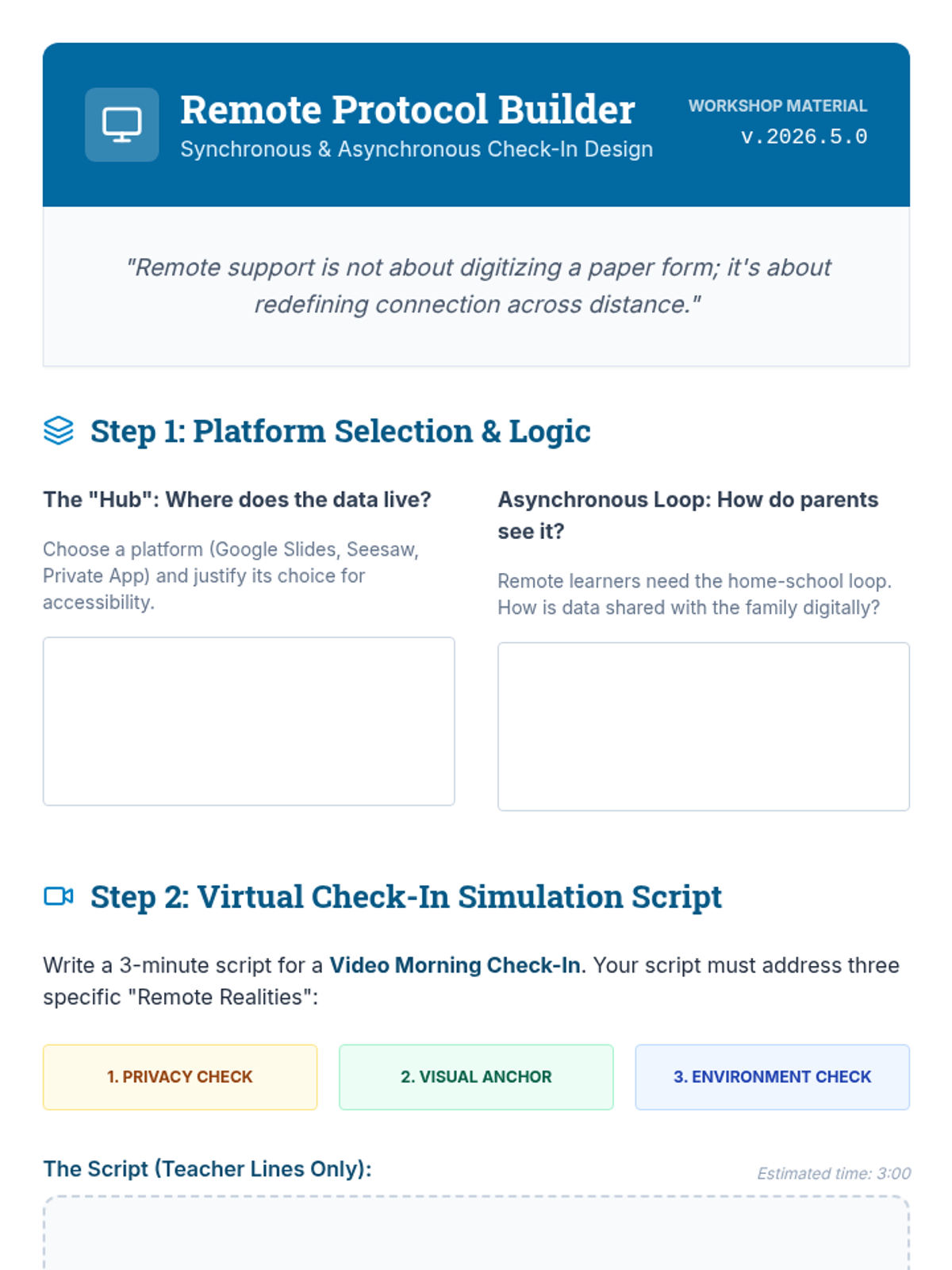
A workshop worksheet for building a digital behavioral check-in protocol, including platform selection, script writing for video calls, and designing low-bandwidth digital rewards.
Slide deck for Lesson 5 on implementing behavioral check-in procedures in virtual and remote environments, covering digital platforms and video protocols.
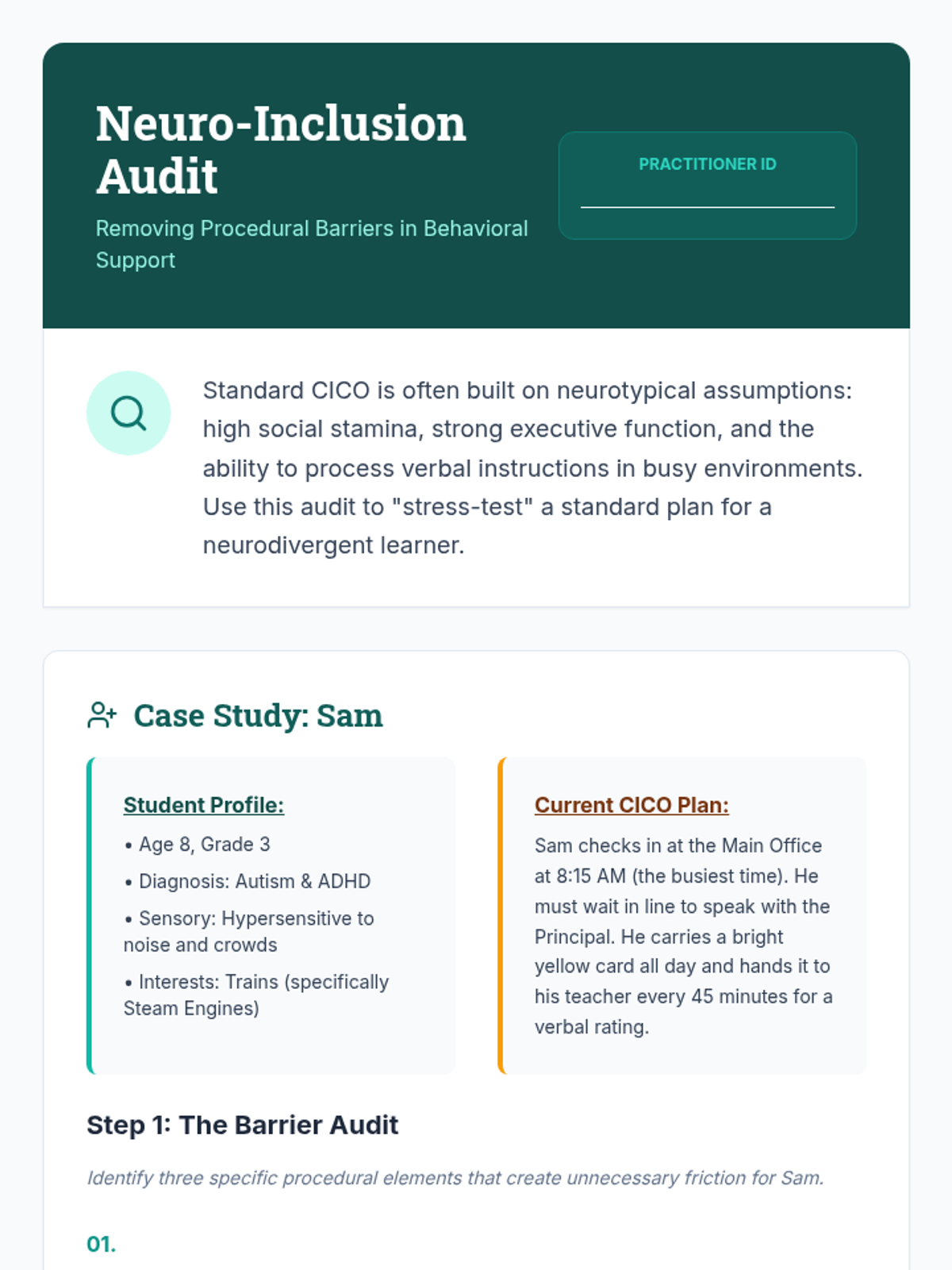
A practitioner's audit worksheet for identifying and removing barriers for neurodivergent learners in behavioral support plans, using a detailed case study.
Slide deck for Lesson 4 exploring sensory and cognitive adaptations for neurodivergent learners in behavioral support systems.
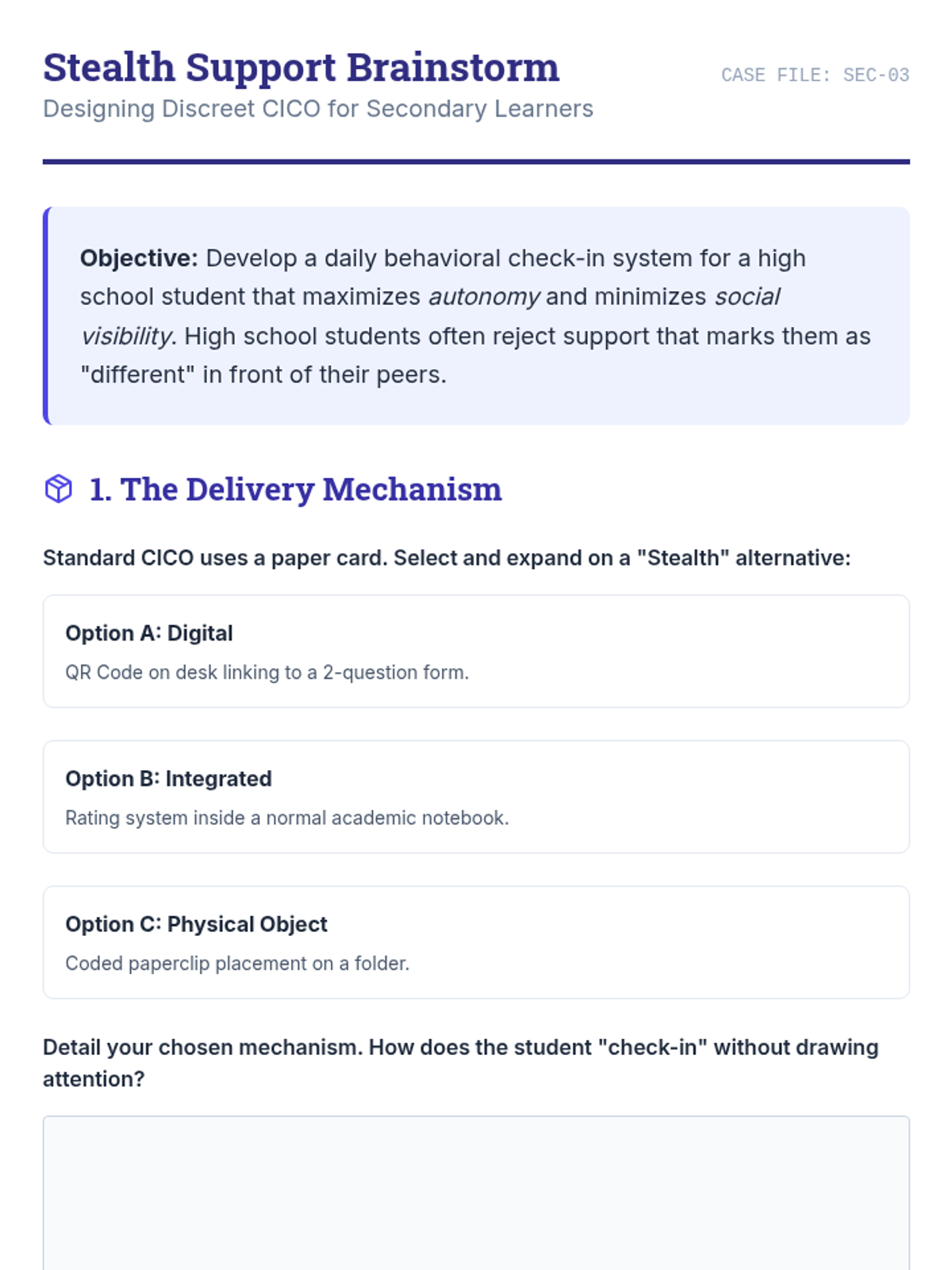
A student strategy worksheet for designing discreet behavioral check-in delivery methods and practicing coaching-based communication for adolescents.
Slide deck for Lesson 3 focusing on adolescent autonomy, featuring strategies for discreet feedback, student-led goal setting, and secondary-appropriate reinforcement.
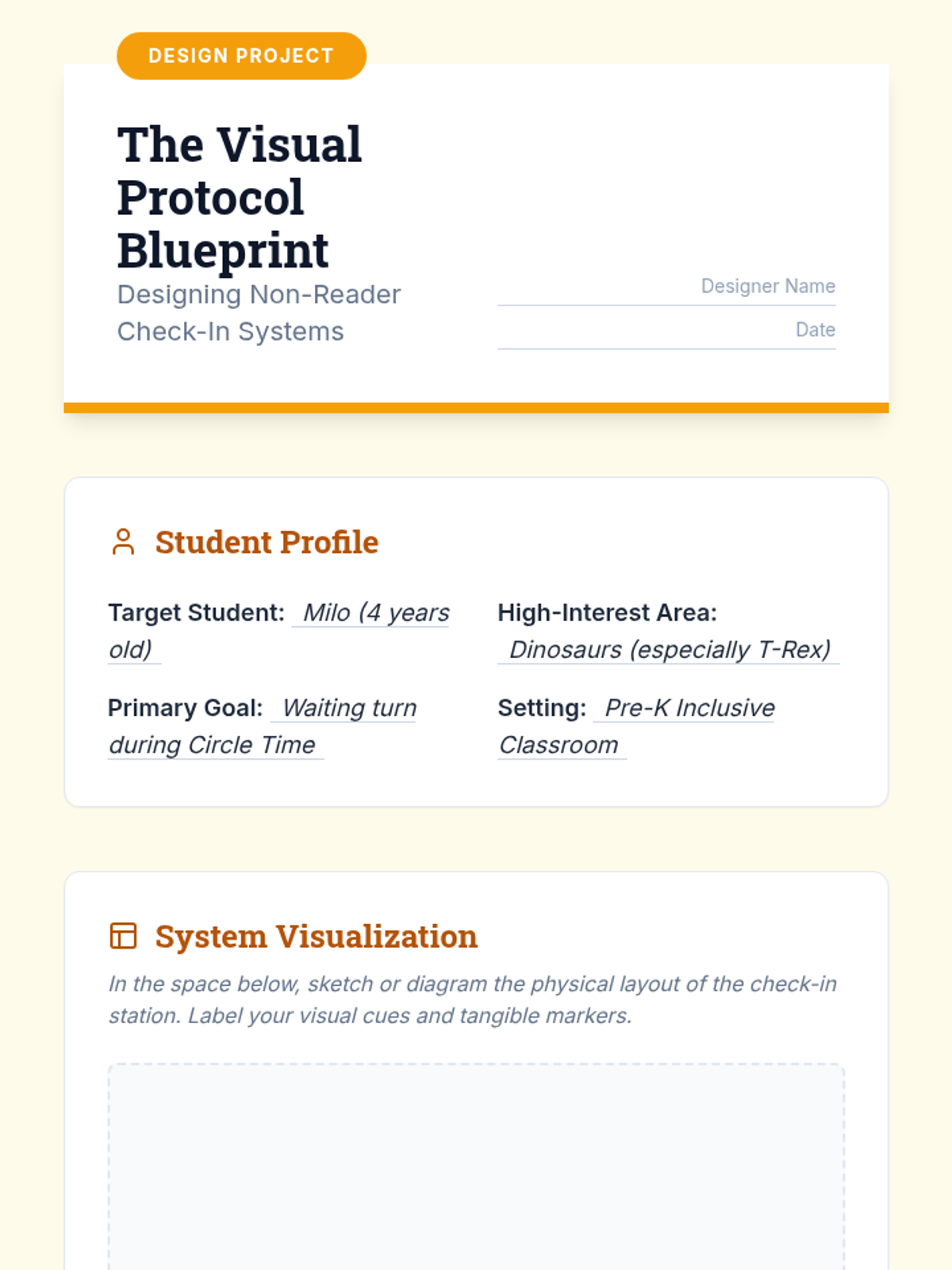
A design project template where students create a visual, non-literate check-in station for a specific early childhood student profile.