Root cause analysis and brainstorming techniques for everyday problem-solving. Equips learners with ethical frameworks and risk-benefit evaluation skills to predict consequences and make informed choices.
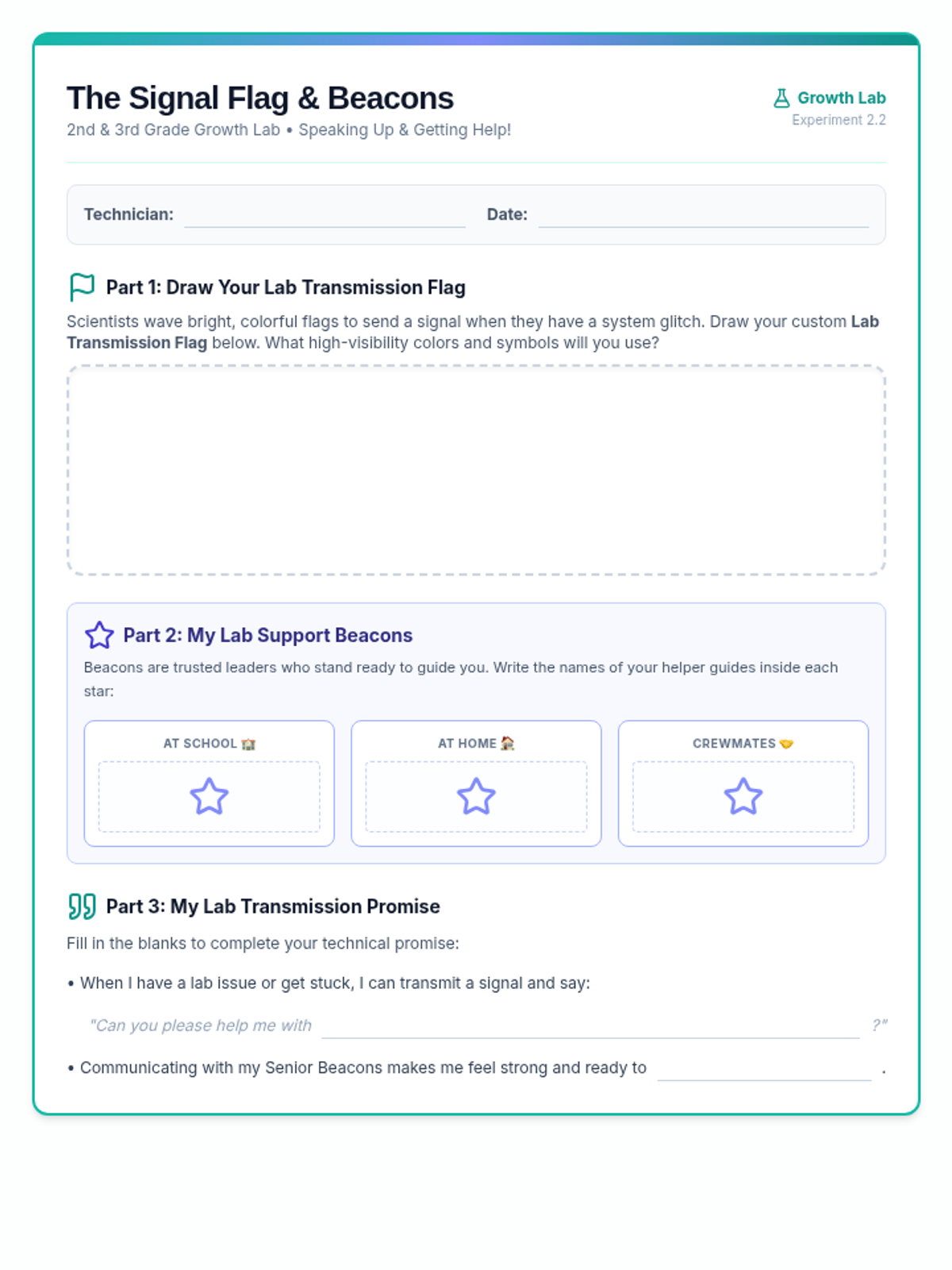
An interactive self-advocacy and support mapping worksheet designed for 2nd and 3rd-grade students. Features a 'Help Signal Flag' design space, a 'Guide Stars' helper mapping exercise, and simple fill-in-the-blank safety prompts.
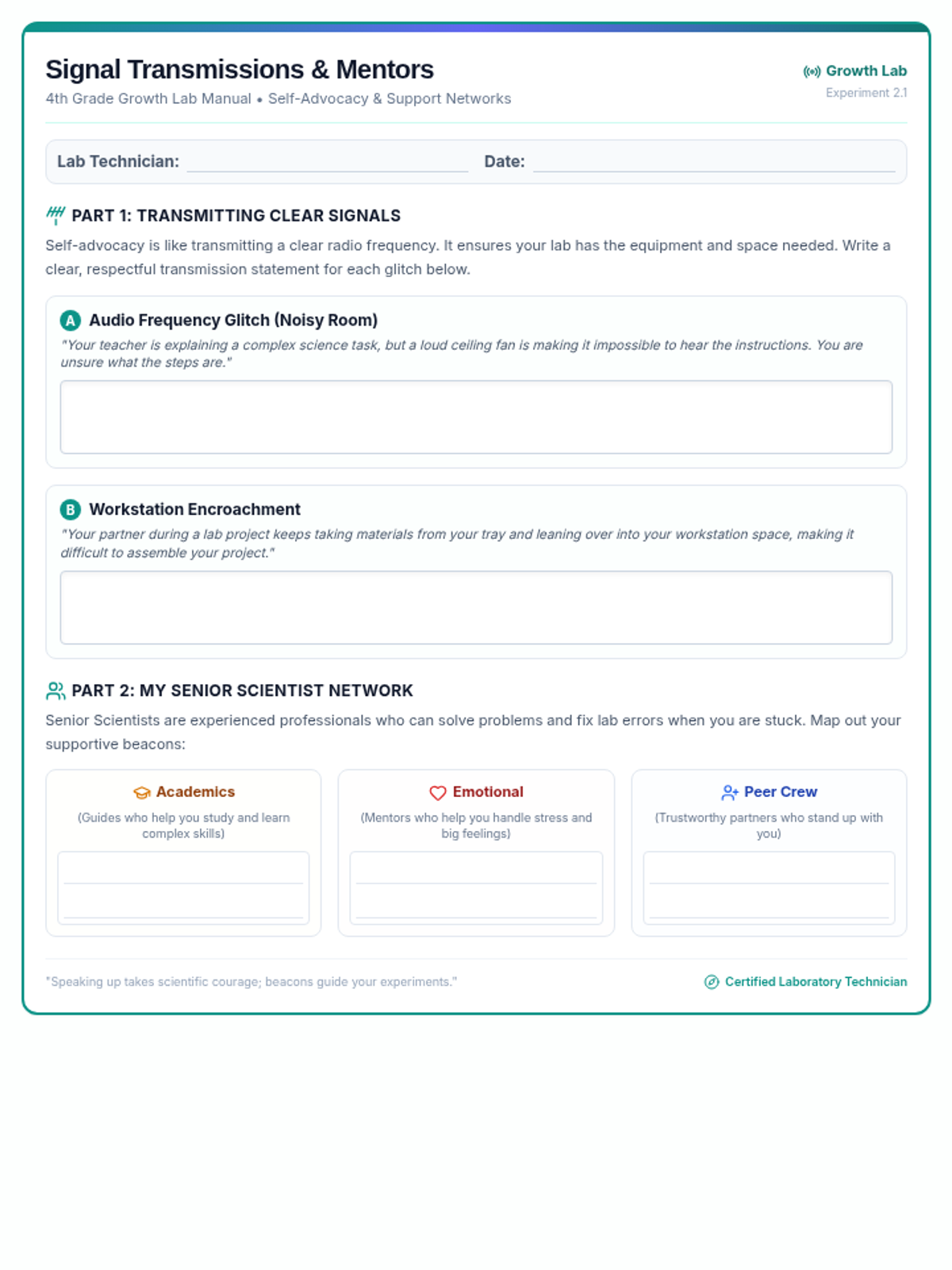
An independent self-advocacy and support mapping worksheet for 4th-grade students. Prompts students to draft self-advocacy responses to common school scenarios and map their personal support systems across academic, emotional, and social dimensions.
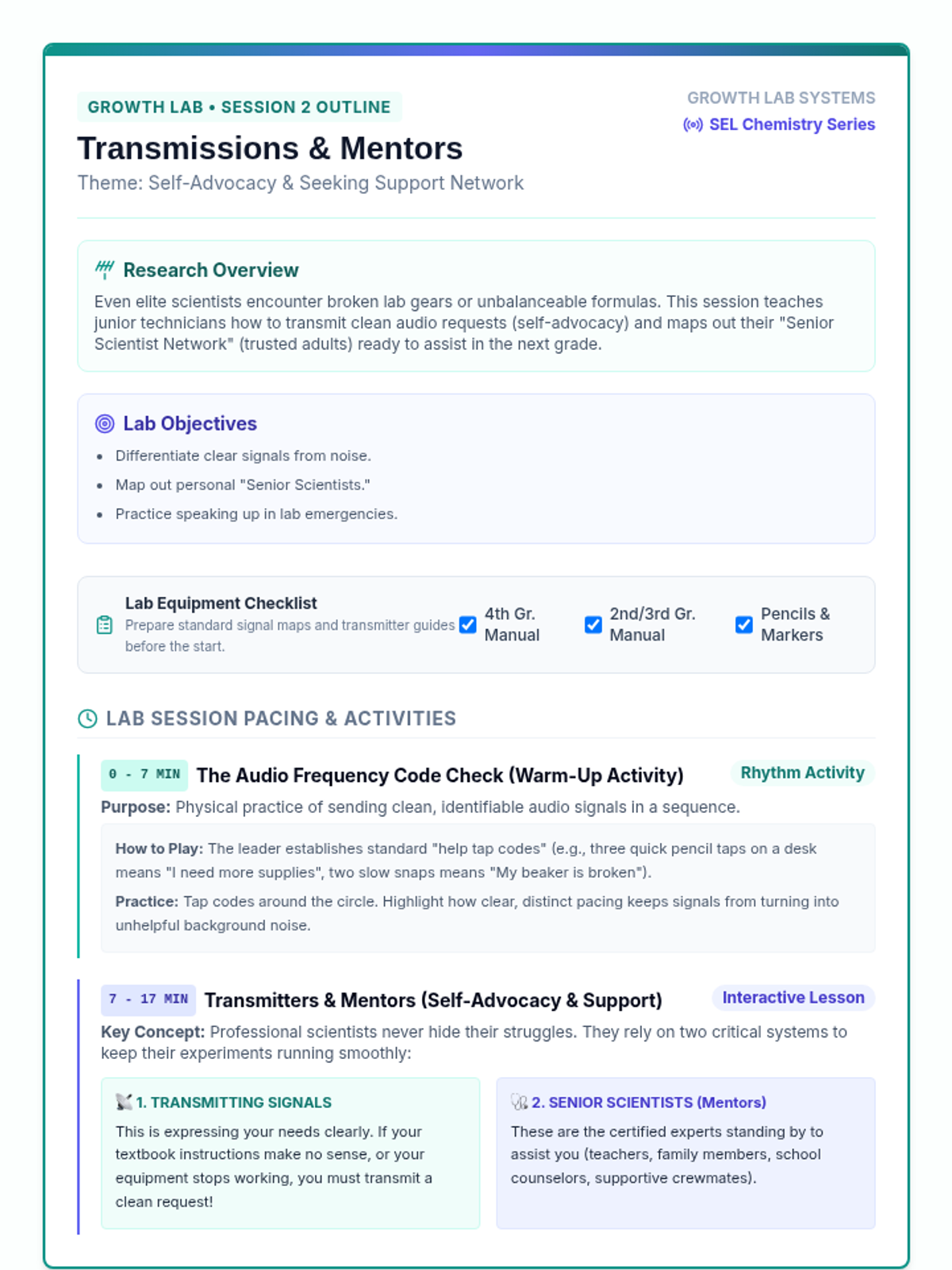
A premium facilitation guide for the second session of the end-of-year reflection series, focusing on self-advocacy and seeking support. Includes pacing, SOS Morse Code warm-ups, 'Trail Signals & Guides' role-play scenarios, grade-differentiated instructions, and collaborative group discussion prompts.
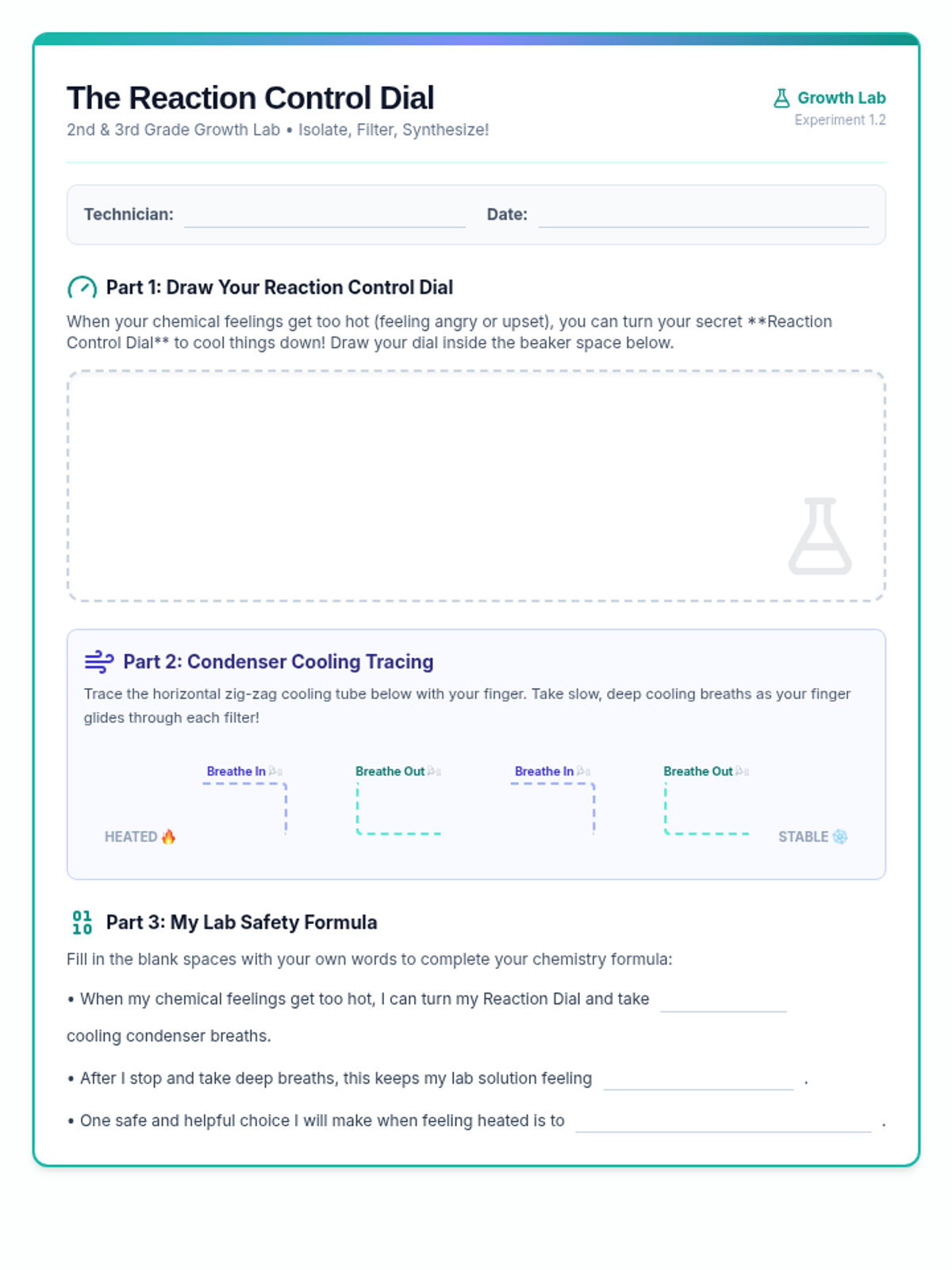
An interactive reflection and drawing activity designed for 2nd and 3rd-grade students to practice self-regulation. Features a design-your-own 'Pause Button' space, a tactile mountain-breathing tracing graphic, and guided fill-in-the-blank sentences to solidify personal self-soothing goals.
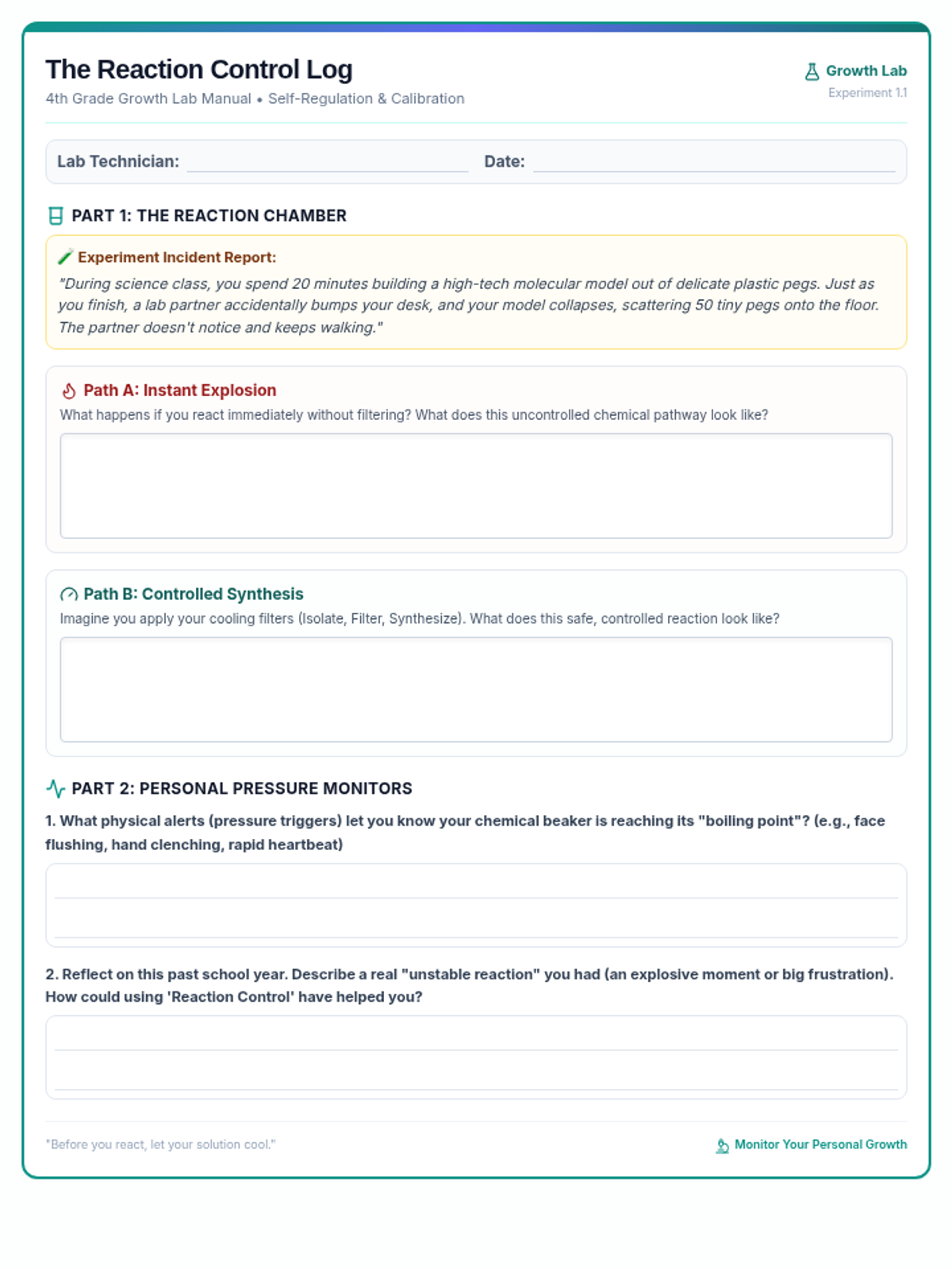
An independent reflection worksheet designed for 4th-grade students. Features a real-world scenario where students analyze and contrast impulsive immediate reactions with deliberate, 'paused' decision-making, followed by guided prompts to identify physiological body signals and reflect on personal growth over the past school year.
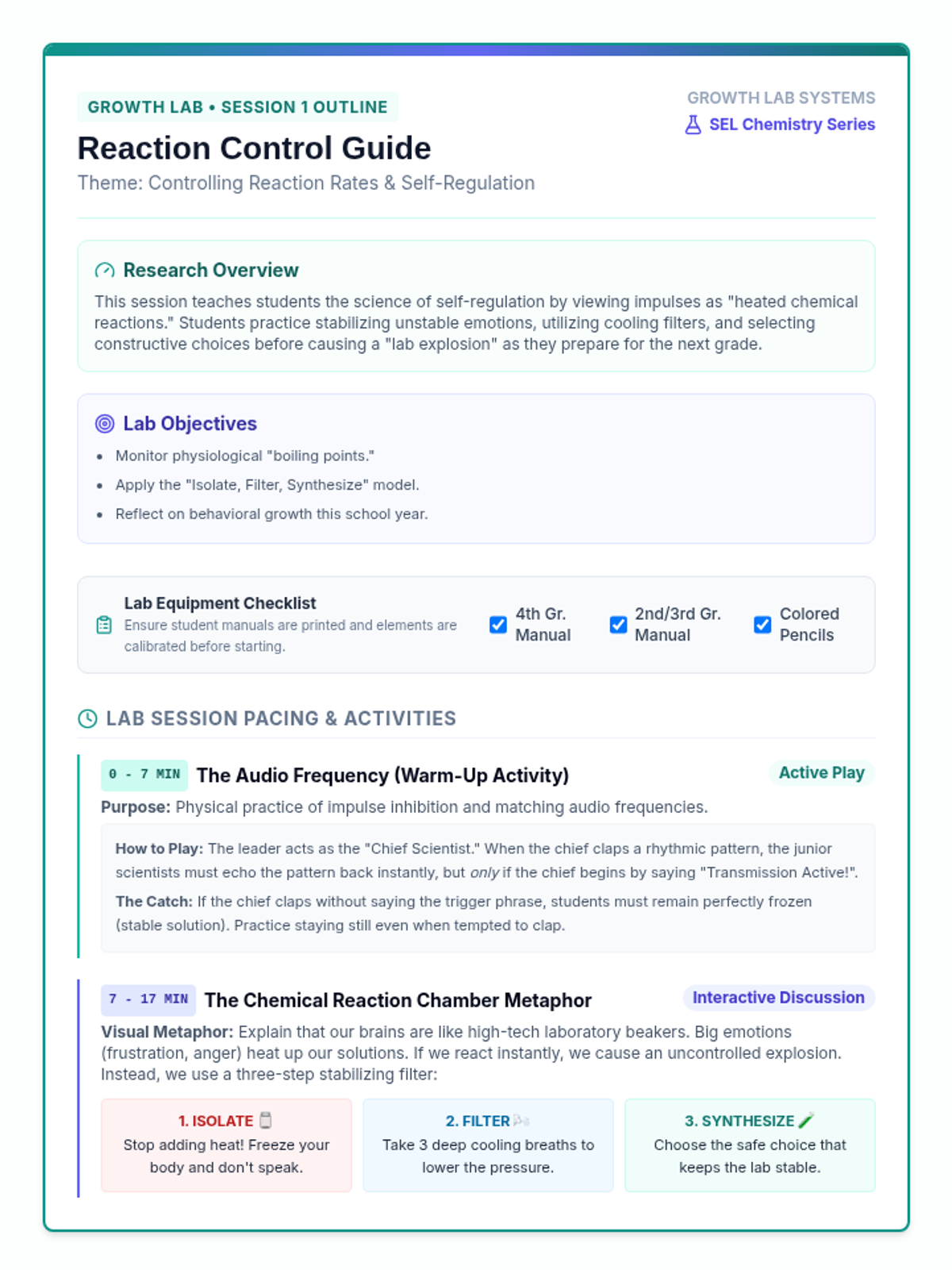
A premium facilitation guide for the first session of the end-of-year reflection series, focusing on impulse control and self-regulation. Includes pacing, active play warm-ups, the 'Trail Fork' physical/mental model, grade-differentiated instructions, and collaborative group discussion prompts.
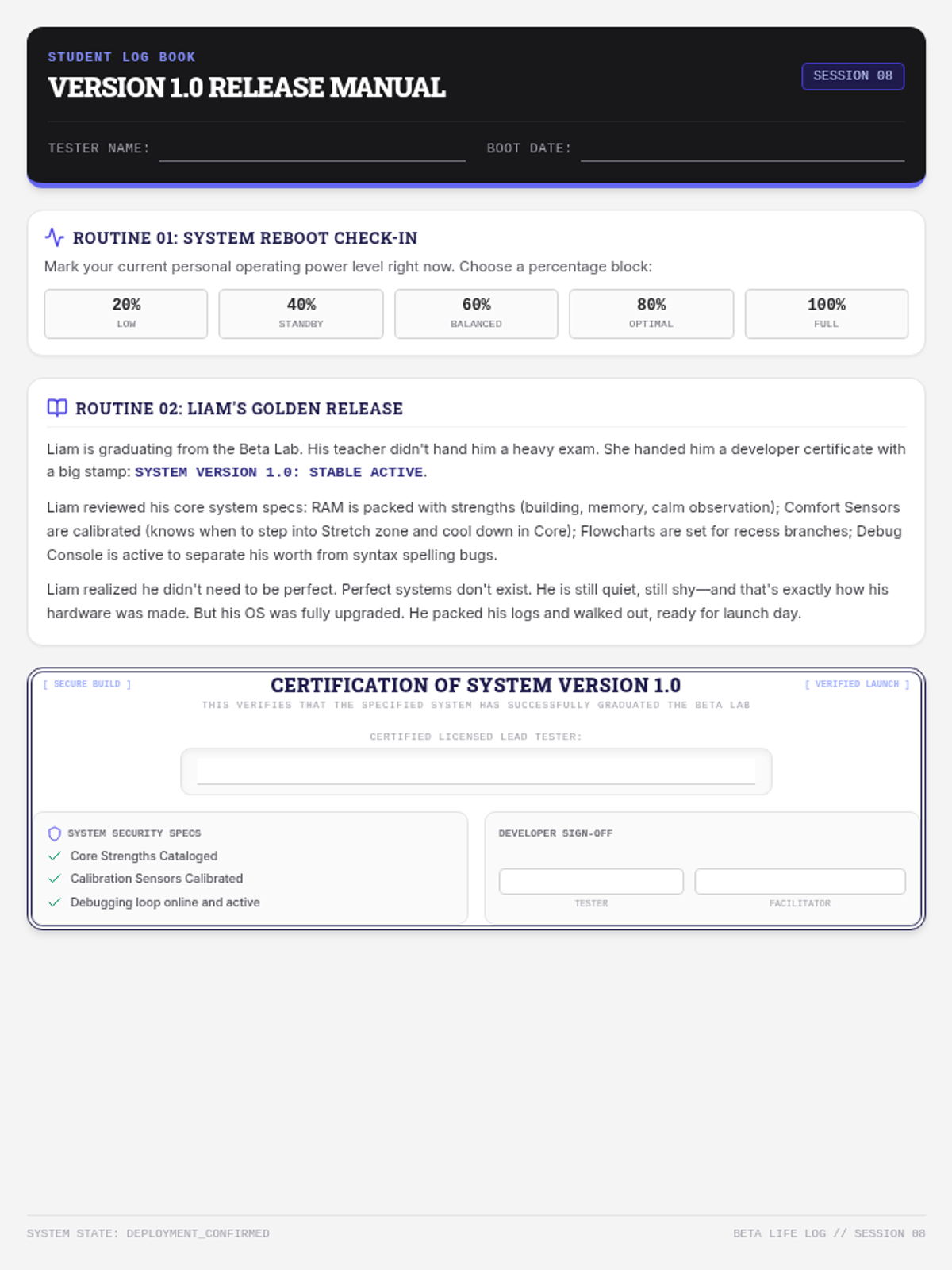
This student-facing spec sheet serves as the primary workspace for Session 8. It contains a predictable energy level check-in, Liam's story on graduating from the Beta Lab, and a beautiful certificate layout for the final signoff.
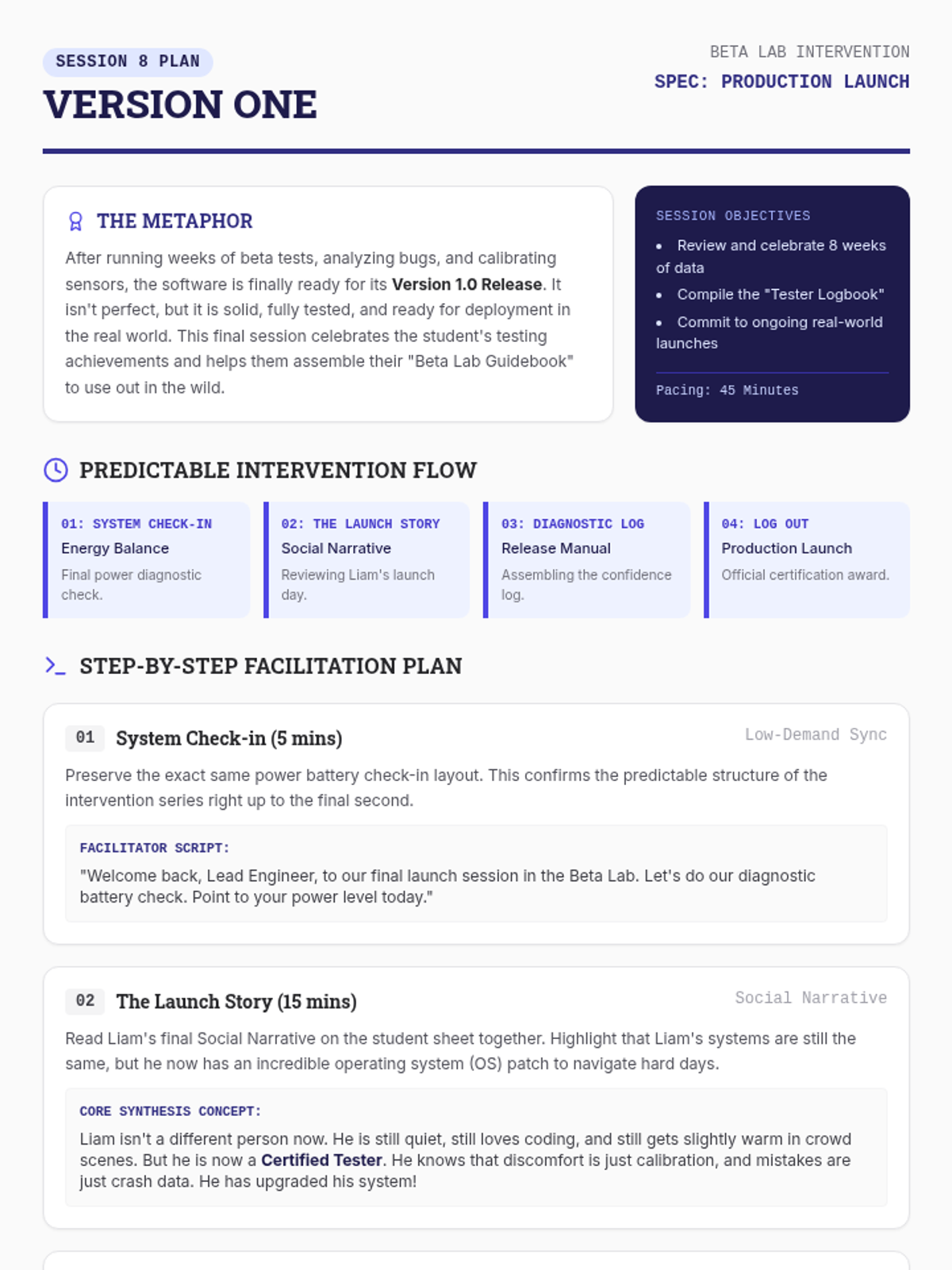
This facilitation guide provides the step-by-step lesson plan and engagement tips for Session 8, synthesizing the 8-week journey and guiding the teacher in organizing a quiet, professional celebration of the student's testing achievements.
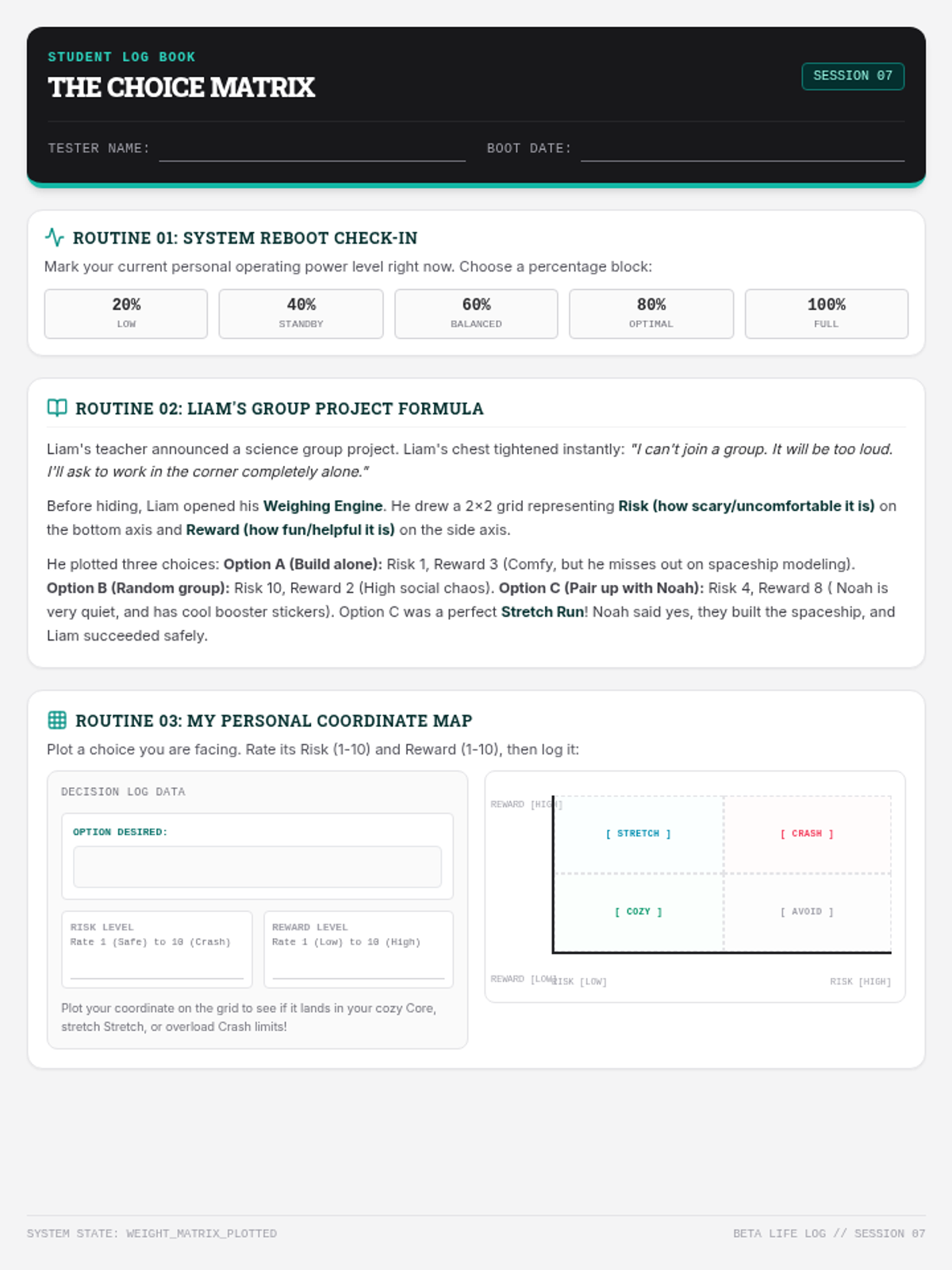
This student-facing spec sheet serves as the primary workspace for Session 7. It contains a predictable energy level check-in, Liam's story on using coordinates to analyze a scary science group assignment, and a structured 2x2 plotting grid.
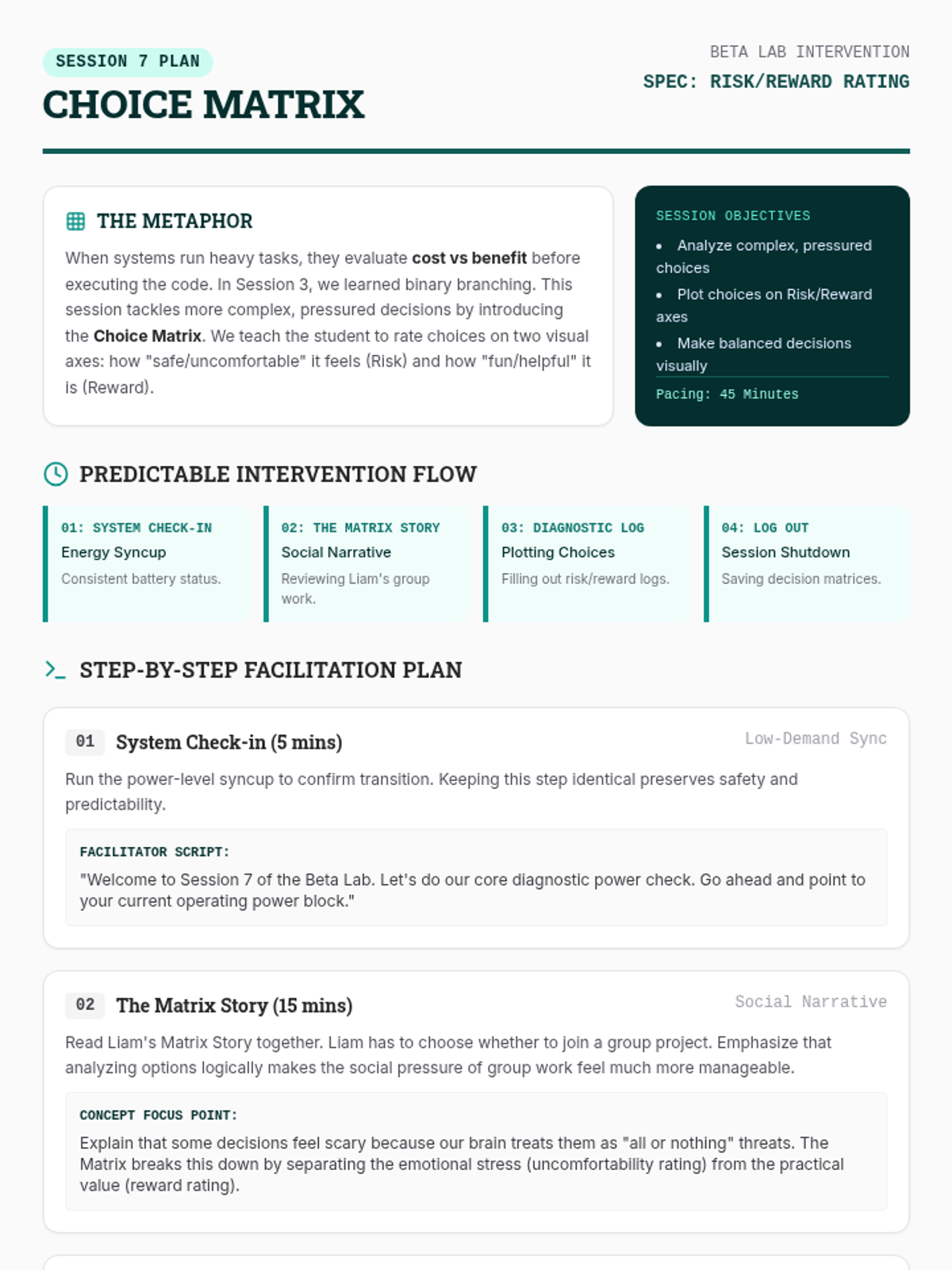
This facilitation guide provides the step-by-step lesson plan and engagement tips for Session 7, teaching the student how to use a visual Risk/Reward rating matrix to analyze complex choices.
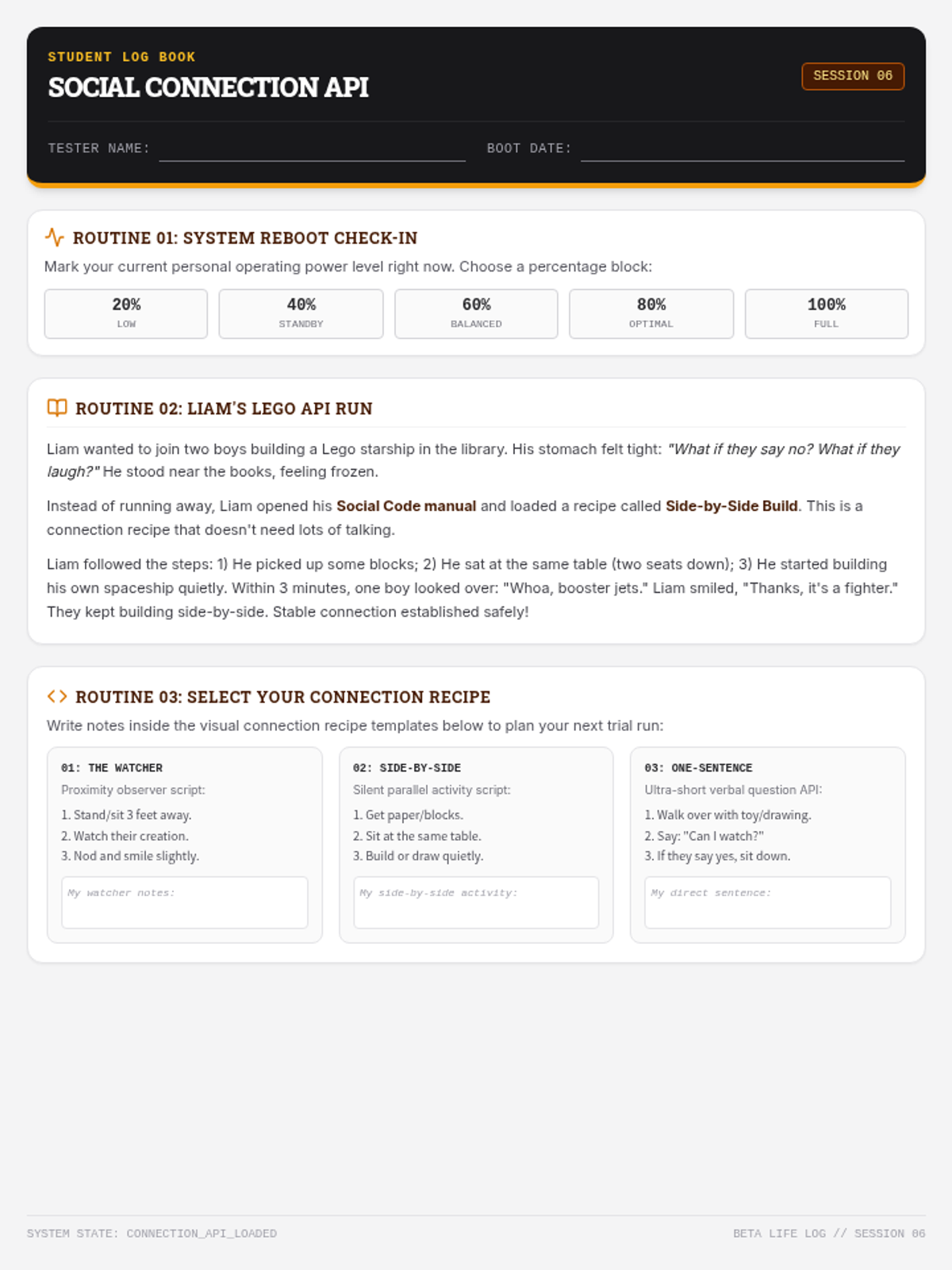
This student-facing spec sheet serves as the primary workspace for Session 6. It contains a predictable energy level check-in, Liam's story on parallel play lego connection, and three visual recipes for peer connection.
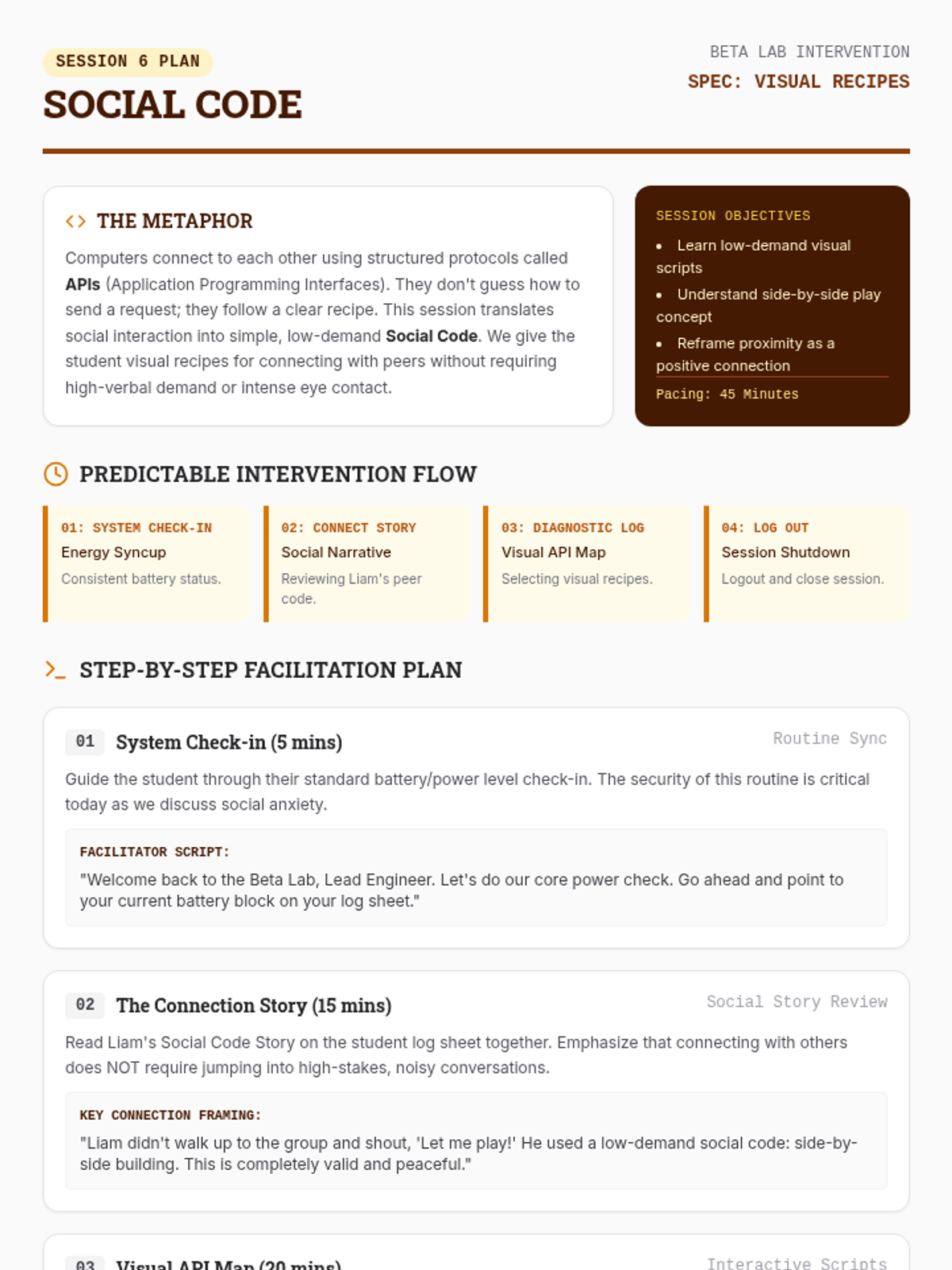
This facilitation guide provides the step-by-step lesson plan and engagement tips for Session 6, introducing low-demand social scripts and structured visual recipes for peer connection.
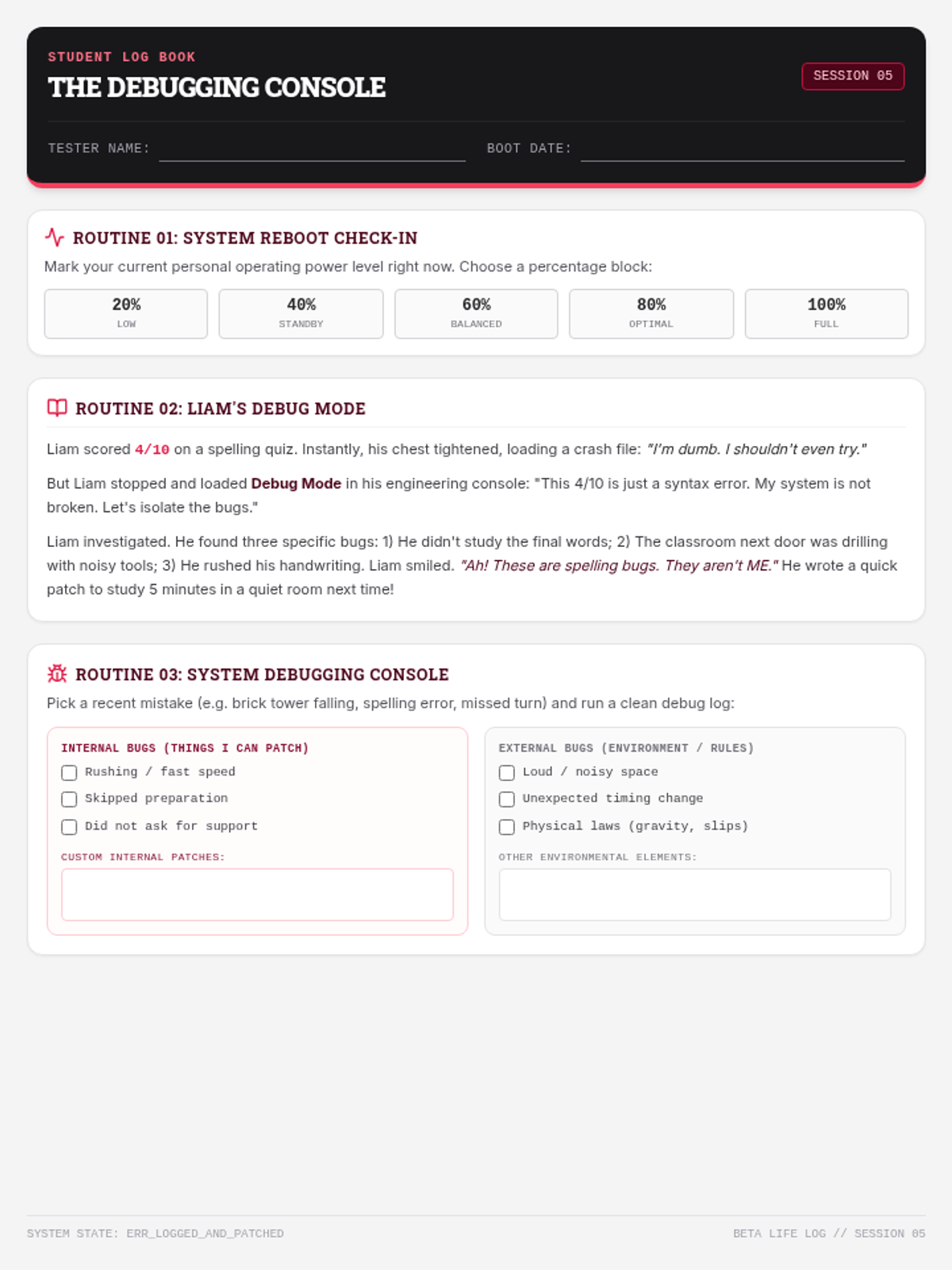
This student-facing spec sheet serves as the primary workspace for Session 5. It contains a predictable energy level check-in, Liam's story on debug mode, and an interactive sorting console for isolating internal vs. external error sources.
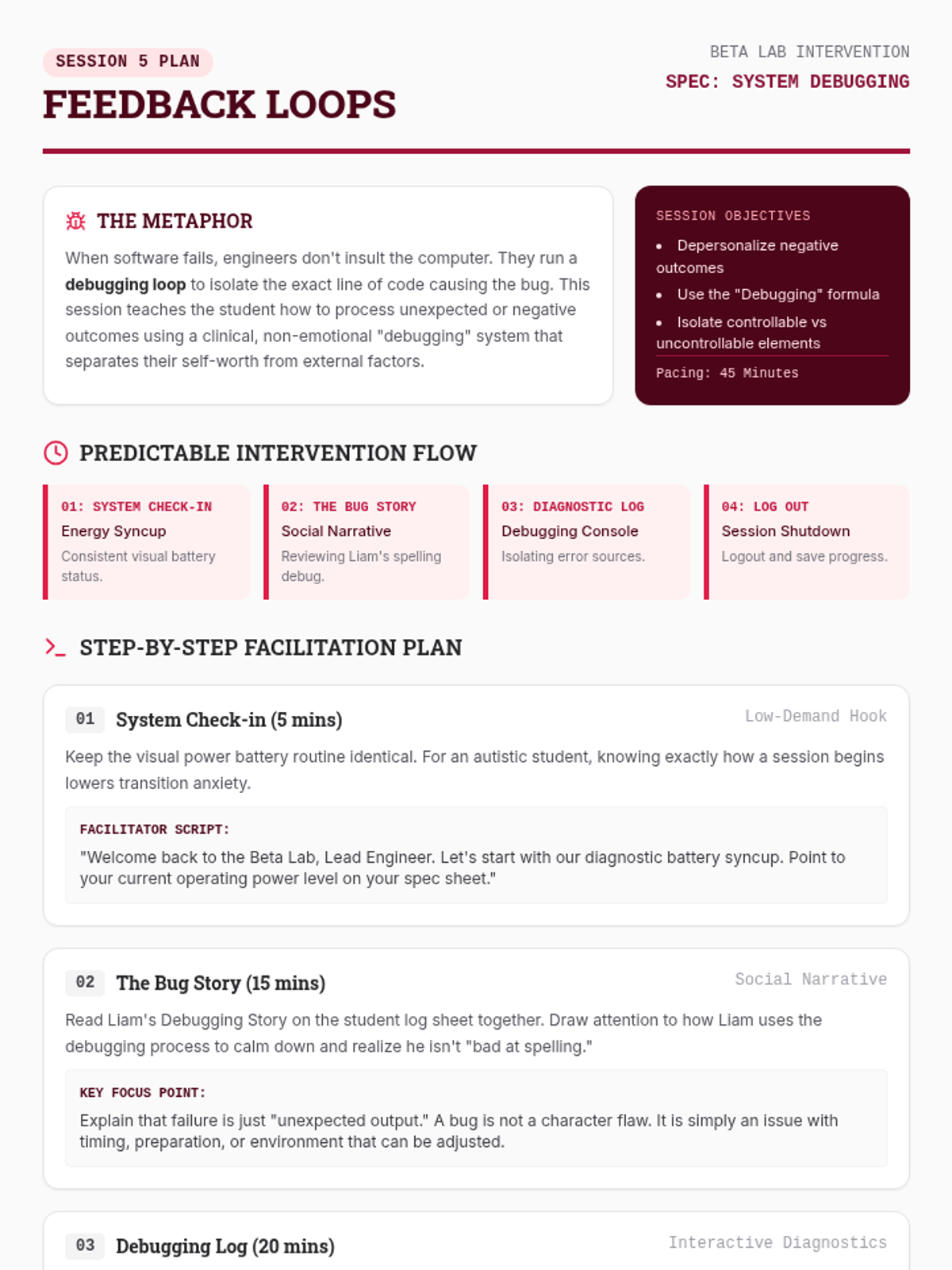
This facilitation guide provides the step-by-step lesson plan and engagement tips for Session 5, focusing on a structured, objective 'debugging' framework to help students analyze mistakes without personal shame.
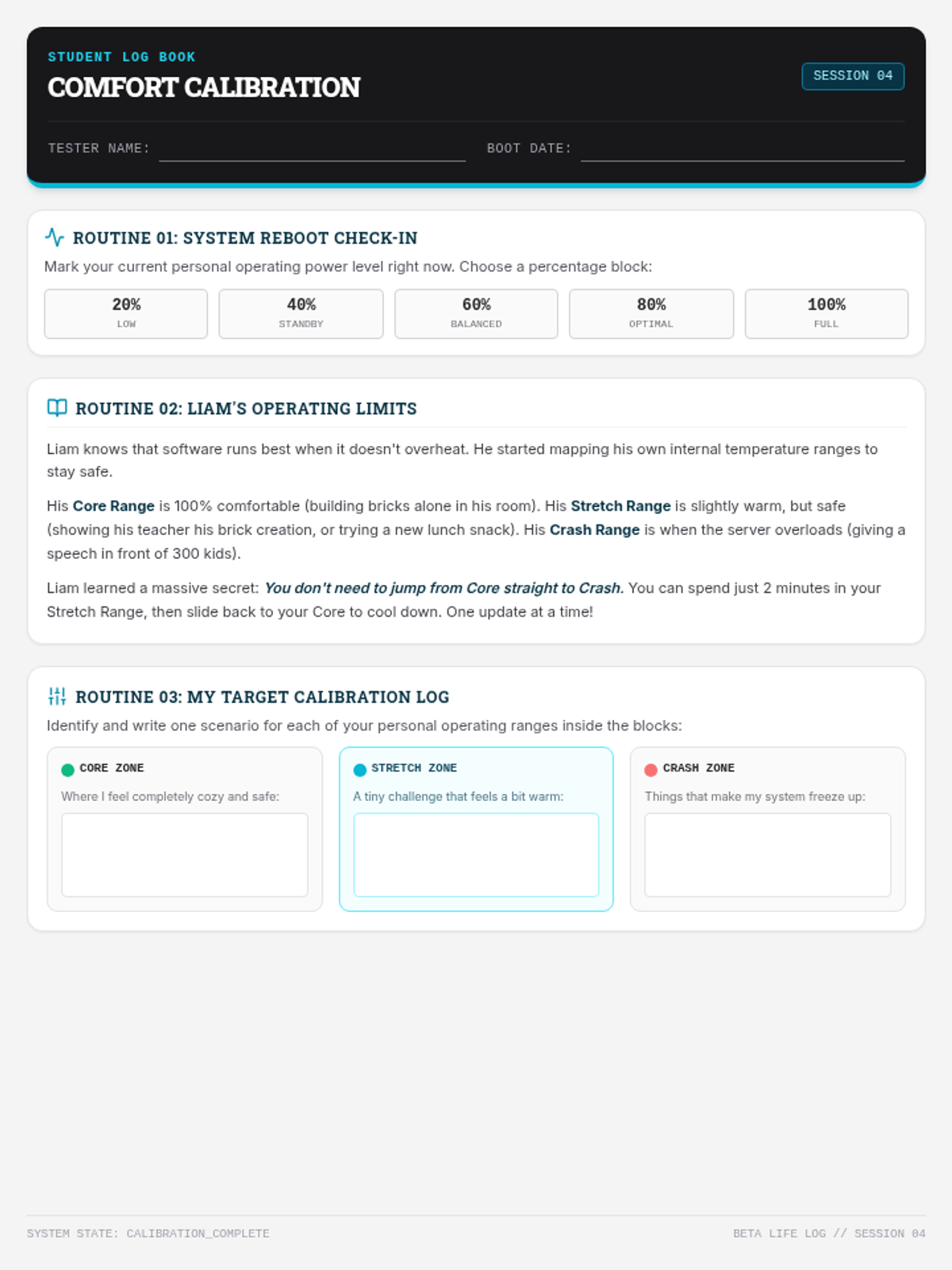
This student-facing spec sheet serves as the primary workspace for Session 4. It contains a predictable energy level check-in, Liam's story on comfort zones (Core, Stretch, and Crash), and a structured 3-tier calibration log.
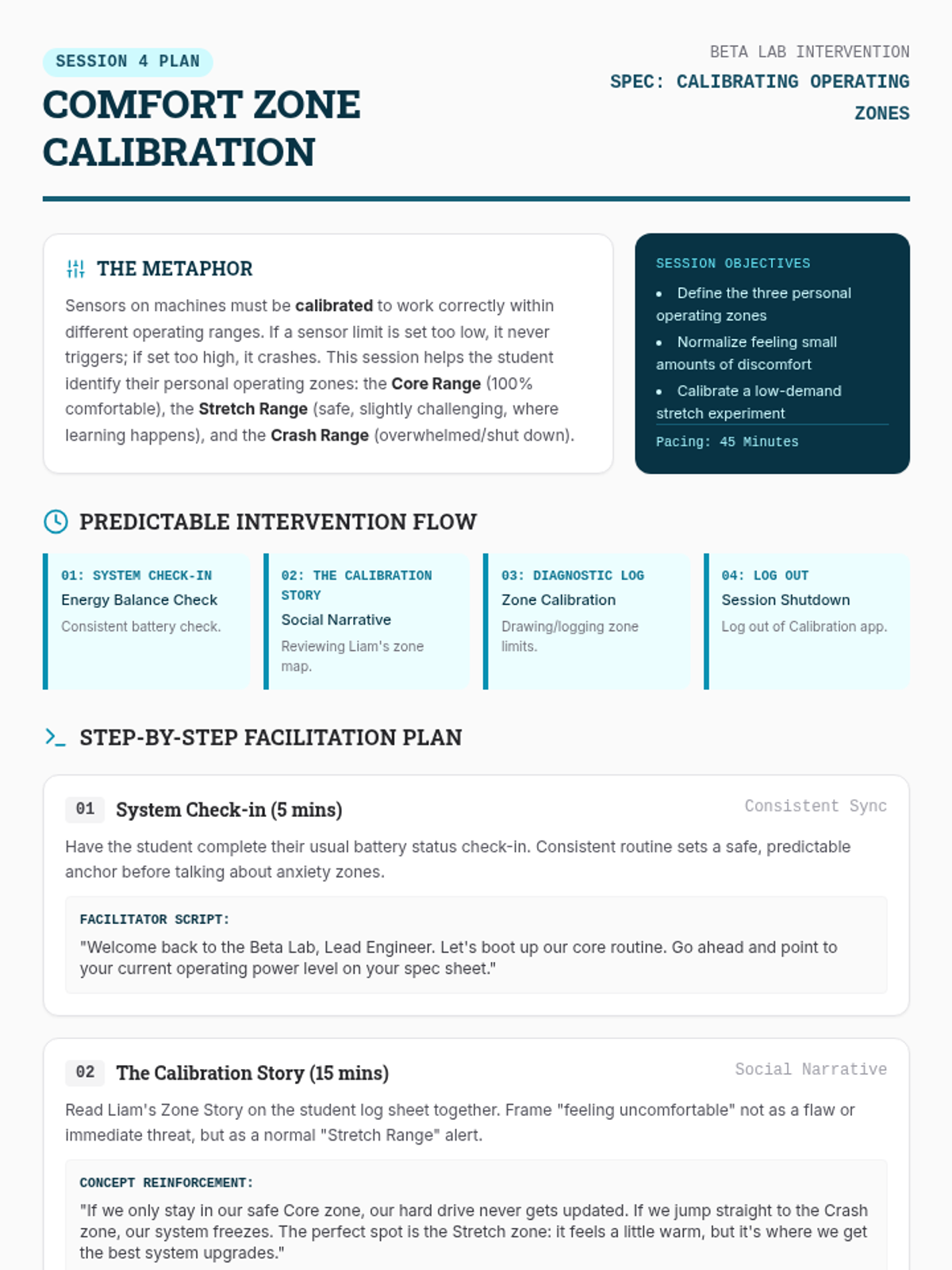
This facilitation guide provides the step-by-step lesson plan and engagement tips for Session 4, focusing on helping the student map their comfortable operating zones (Core, Stretch, and Crash) to make gradated risk-taking feel structured and safe.
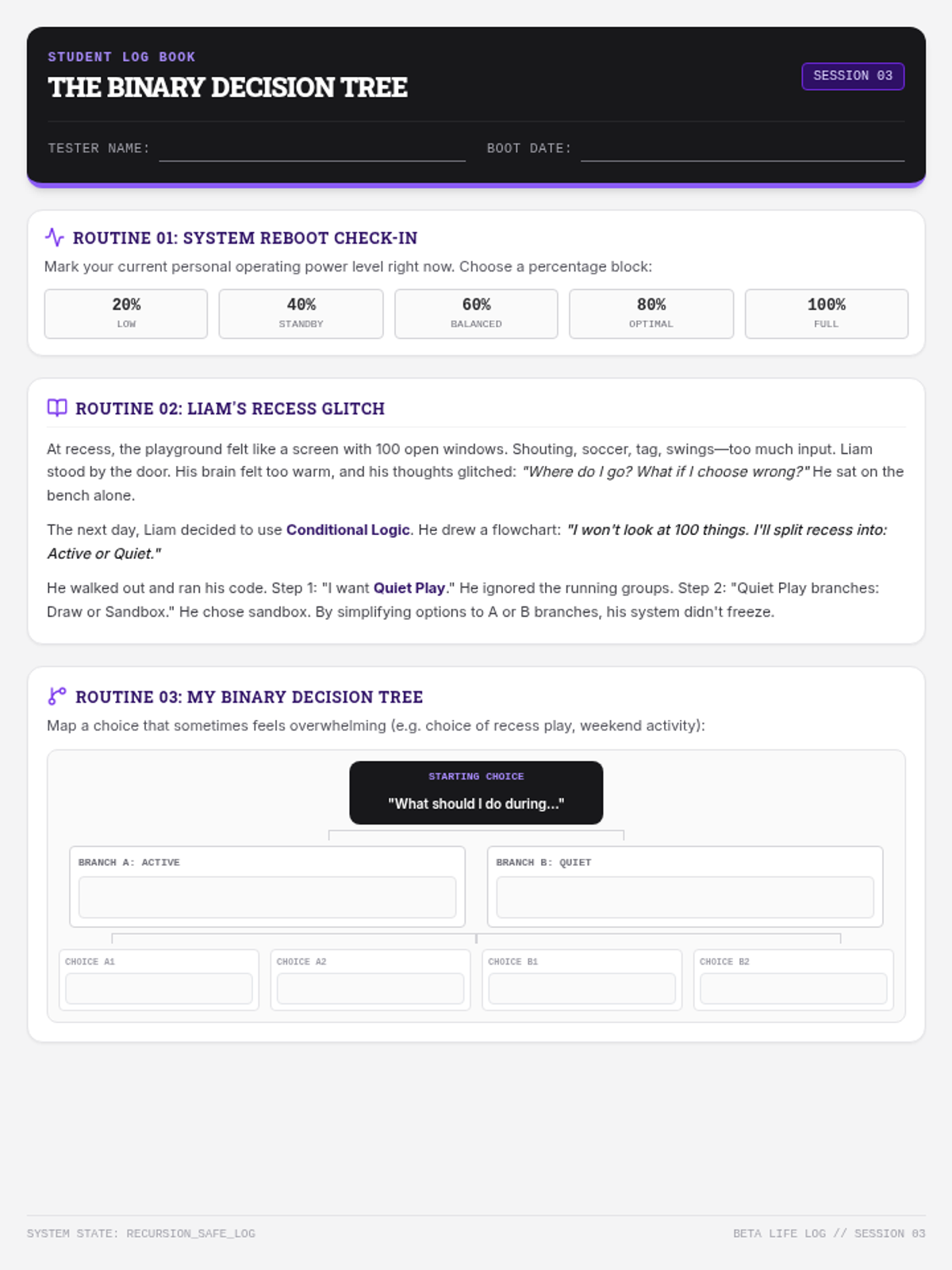
This student-facing spec sheet serves as the primary workspace for Session 3. It contains a predictable energy level check-in, Liam's story on choice overload at recess, and a structured flowchart for practicing binary choice branch logic.
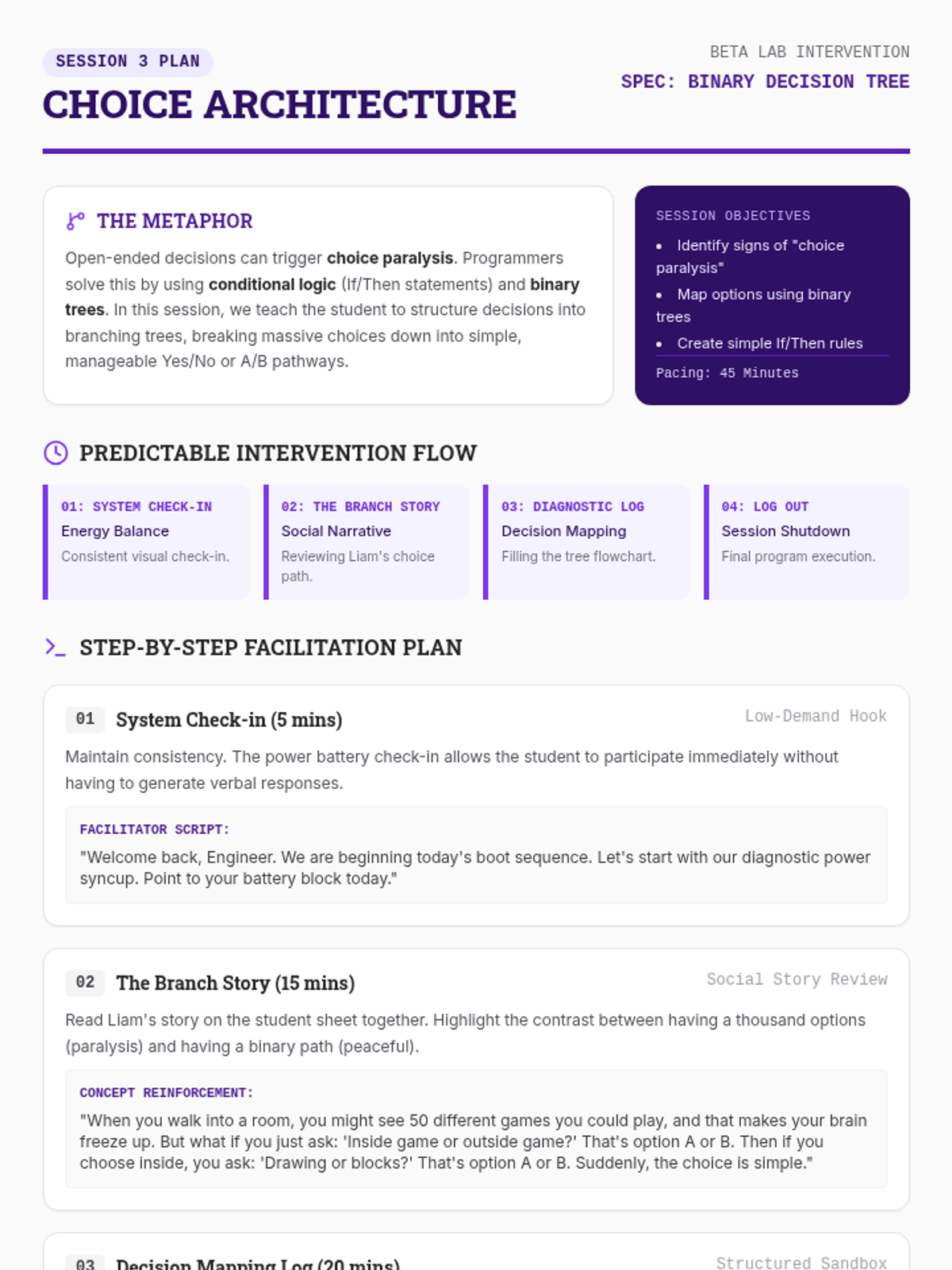
This facilitation guide provides the step-by-step lesson plan and engagement tips for Session 3, introducing branching choice architecture to simplify decisions and lower cognitive load for the student.
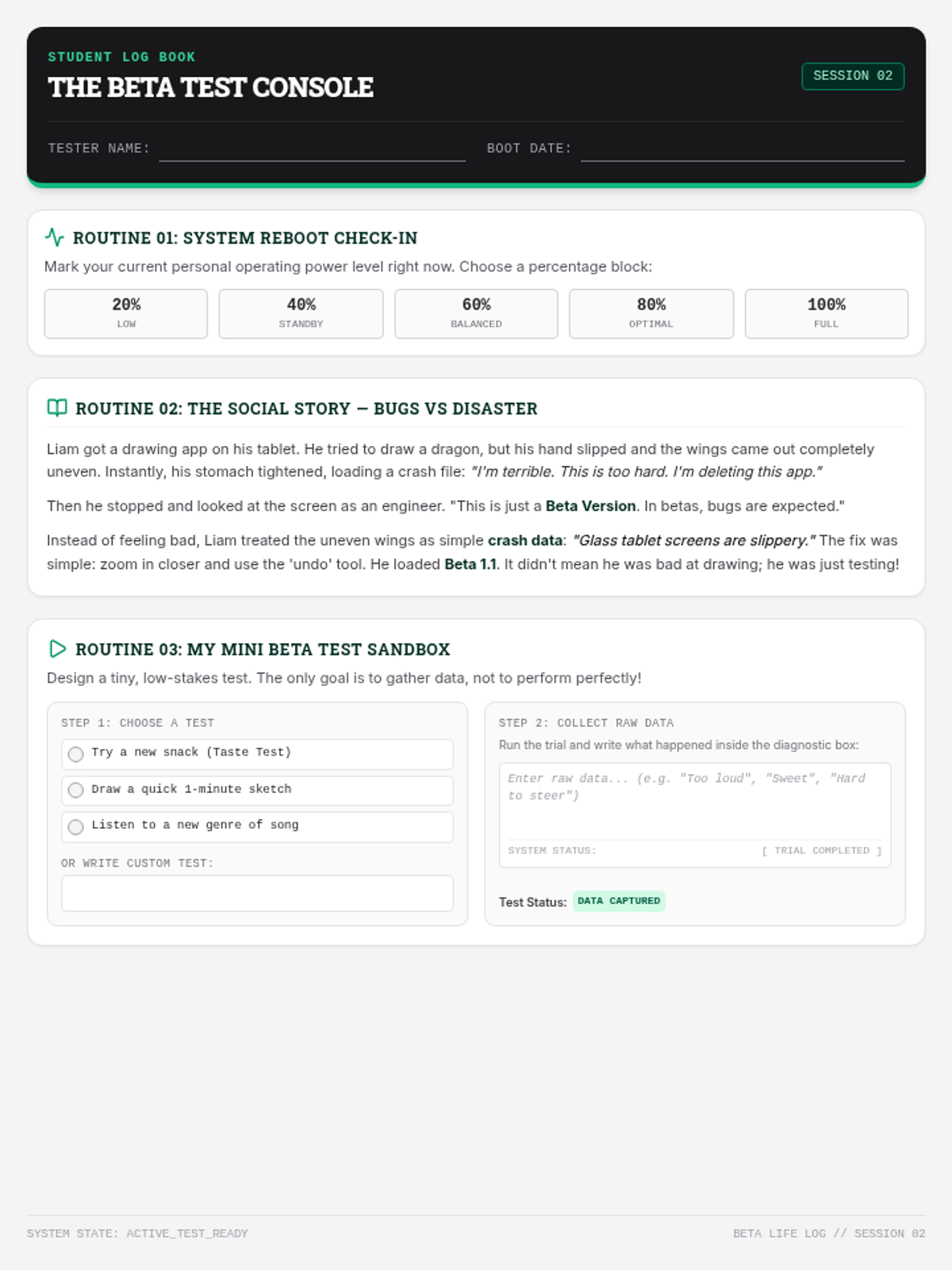
This student-facing spec sheet serves as the primary workspace for Session 2. It contains a predictable energy level check-in, Liam's beta story on reframing failure as simple crash data, and a structured sandbox for designing and running a tiny beta test.
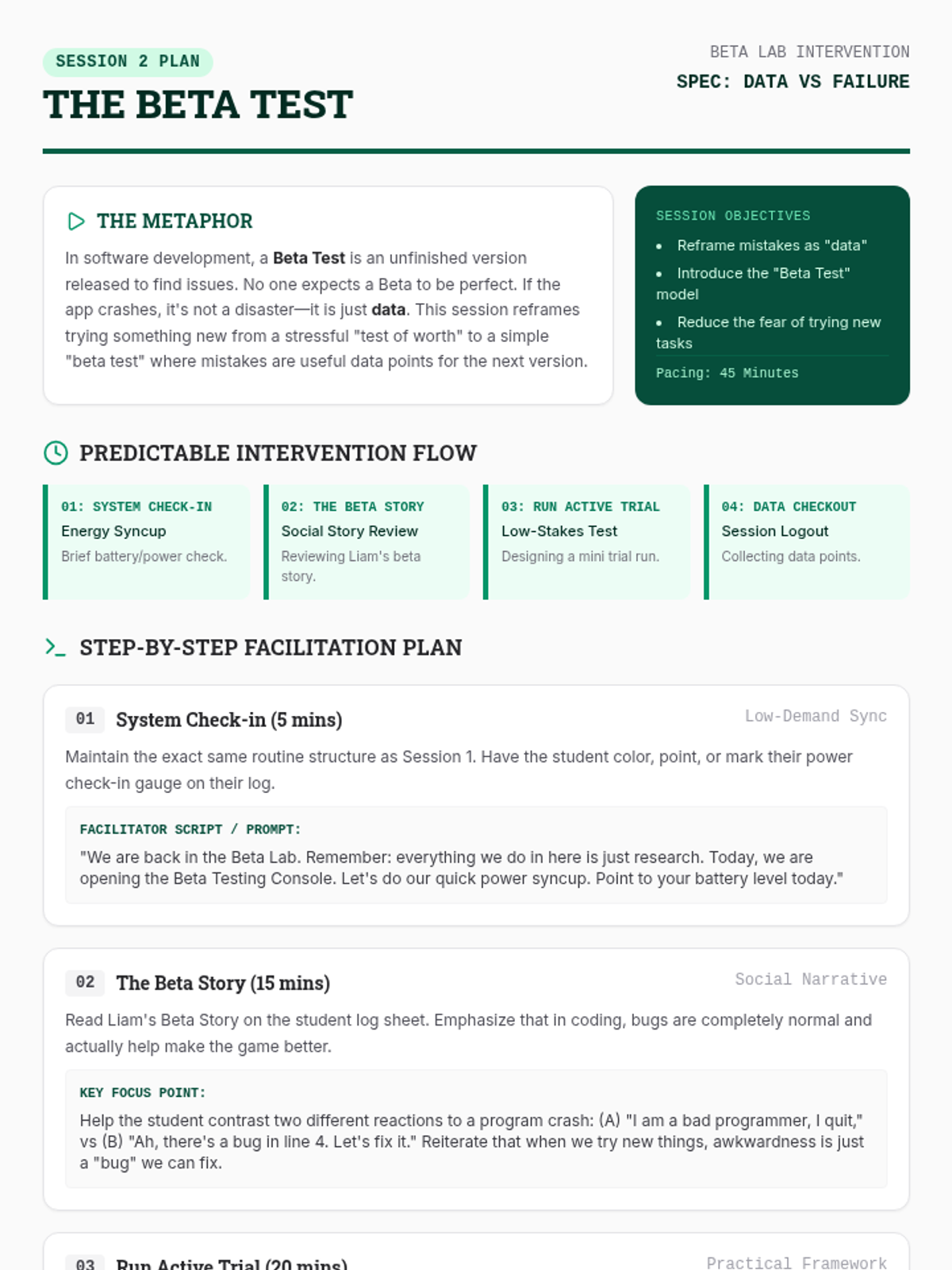
This facilitation guide provides the step-by-step lesson plan and engagement tips for Session 2, helping teachers reframe mistakes as data and guiding the student to outline a low-stakes 'beta test' in their environment.
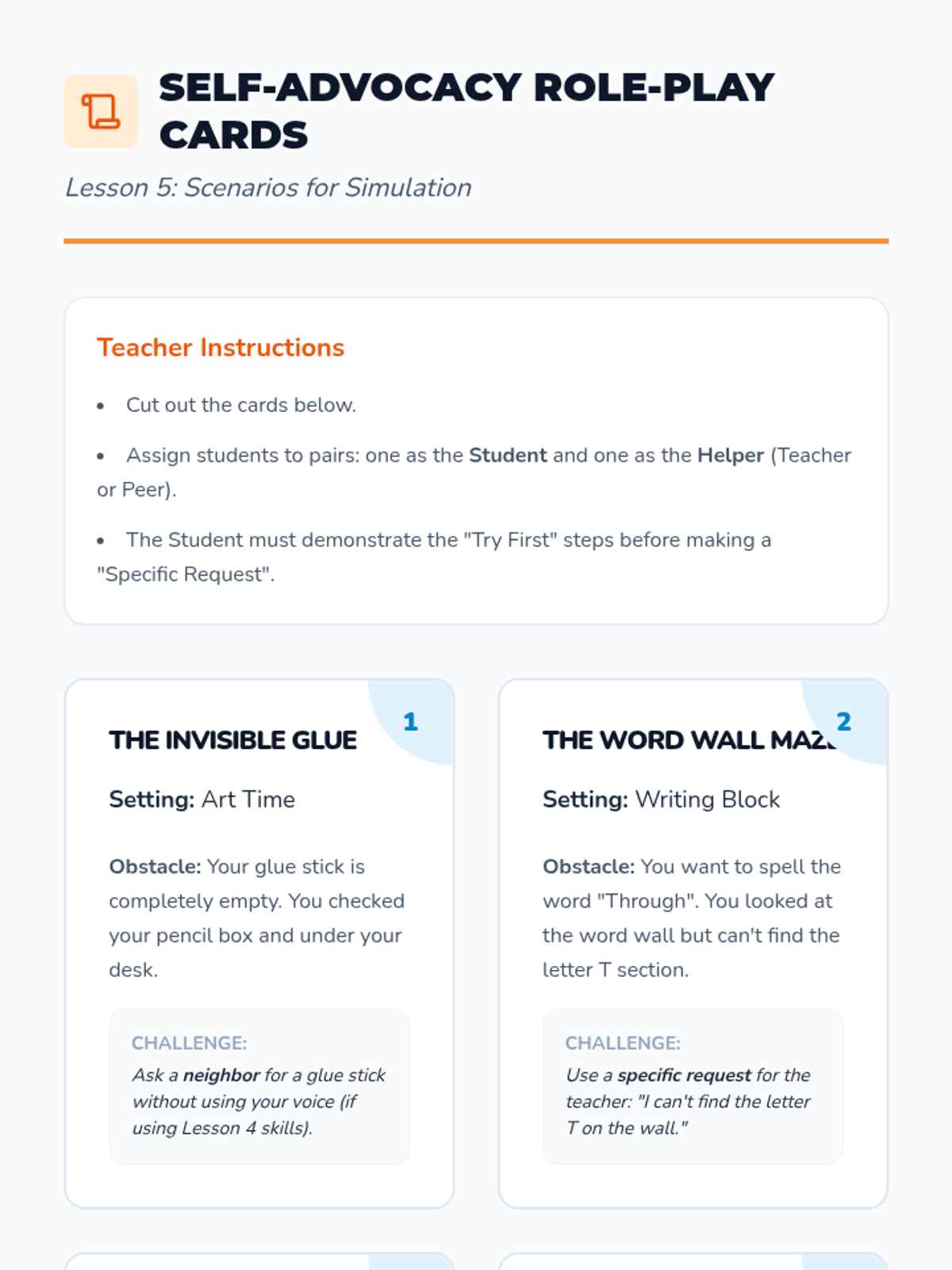
Scenario cards for teacher use during Lesson 5 to facilitate role-playing exercises on self-advocacy and obstacle problem-solving.
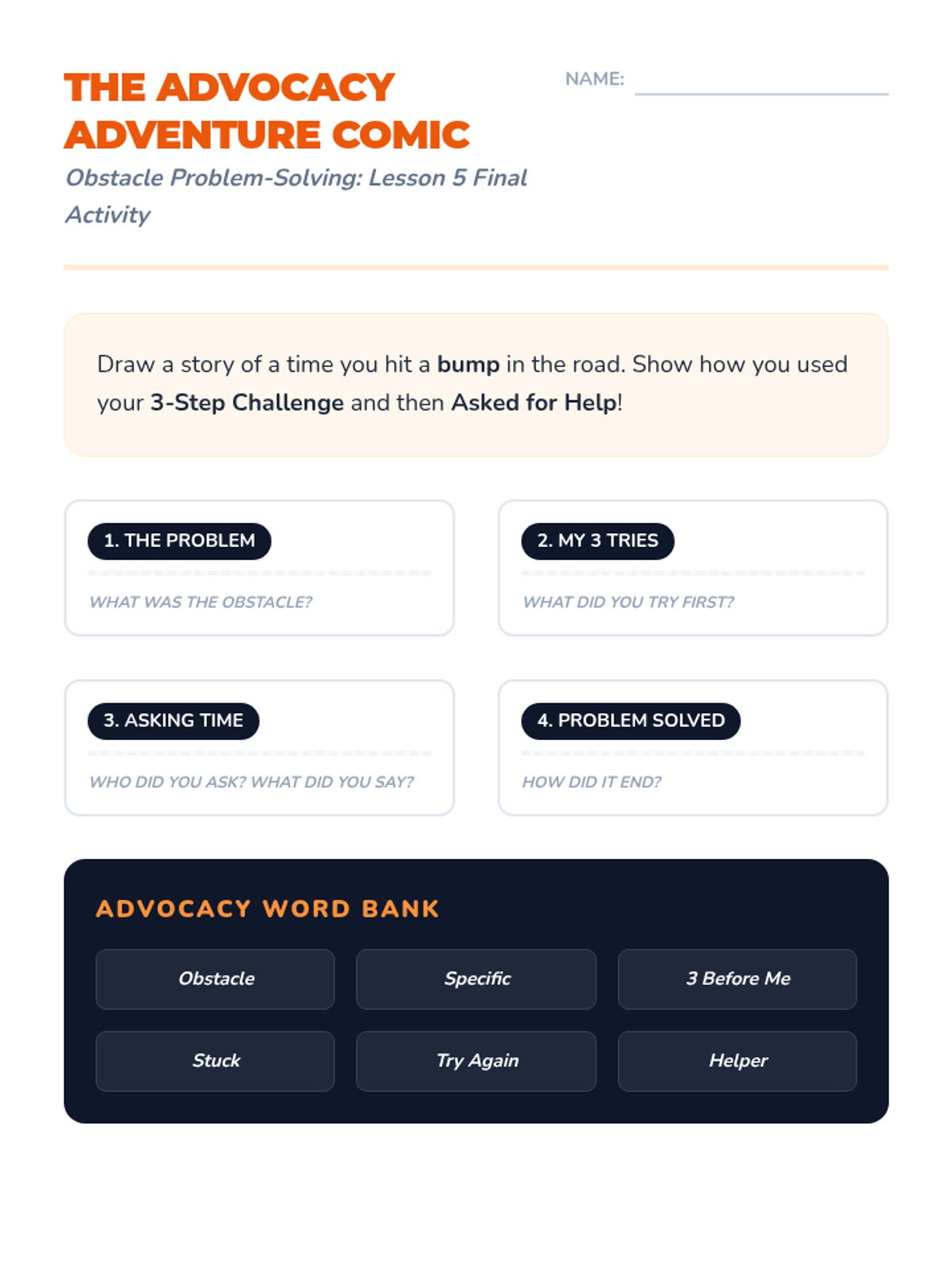
A final project worksheet where students create a comic strip illustrating a personal self-advocacy experience, from obstacle to resolution.
Visual slides for Lesson 5 that facilitate role-playing scenarios where students practice applying all the self-advocacy skills learned in the sequence.
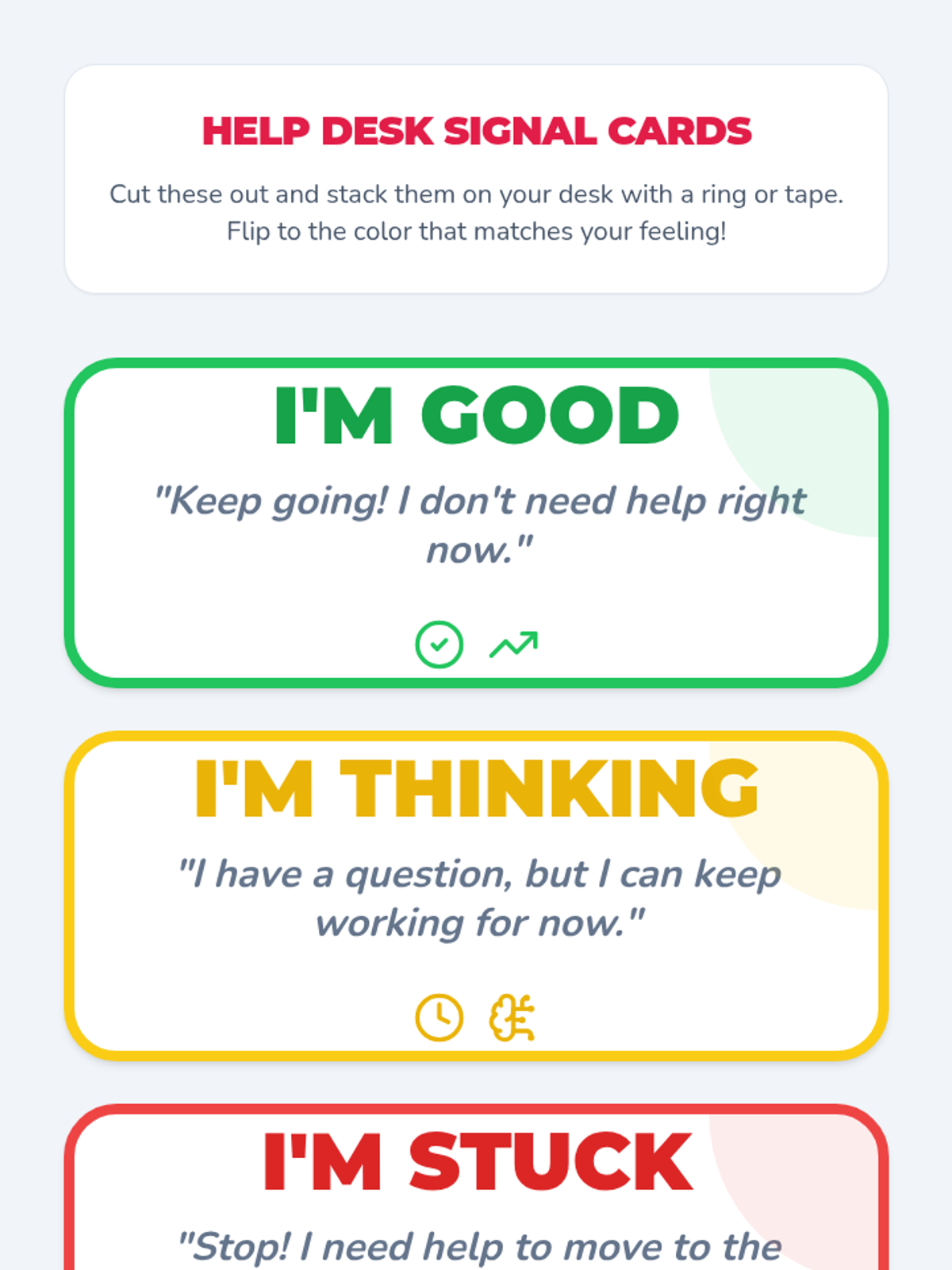
Printable desk flip cards (Green, Yellow, Red) for students to communicate their task status and need for assistance non-verbally.
Visual slides for Lesson 4 that introduce non-verbal communication tools like desk flip cards and hand signals for effective classroom self-advocacy.
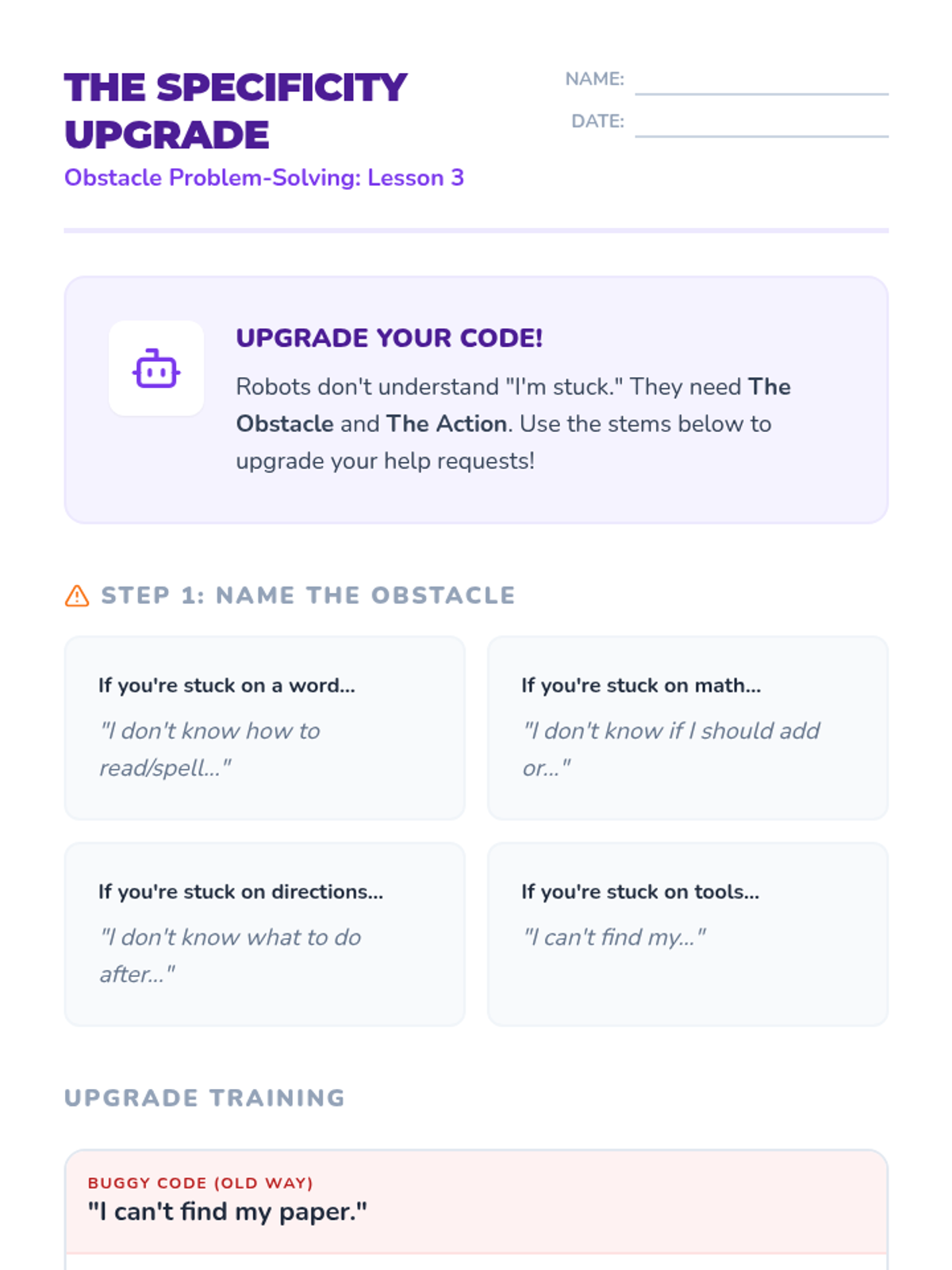
A student worksheet for practicing the language of specificity, transforming vague requests into clear, two-part help commands.
Visual slides for Lesson 3 that teach students how to transform generic complaints into specific, actionable requests using the 'Specificity Robot' metaphor.
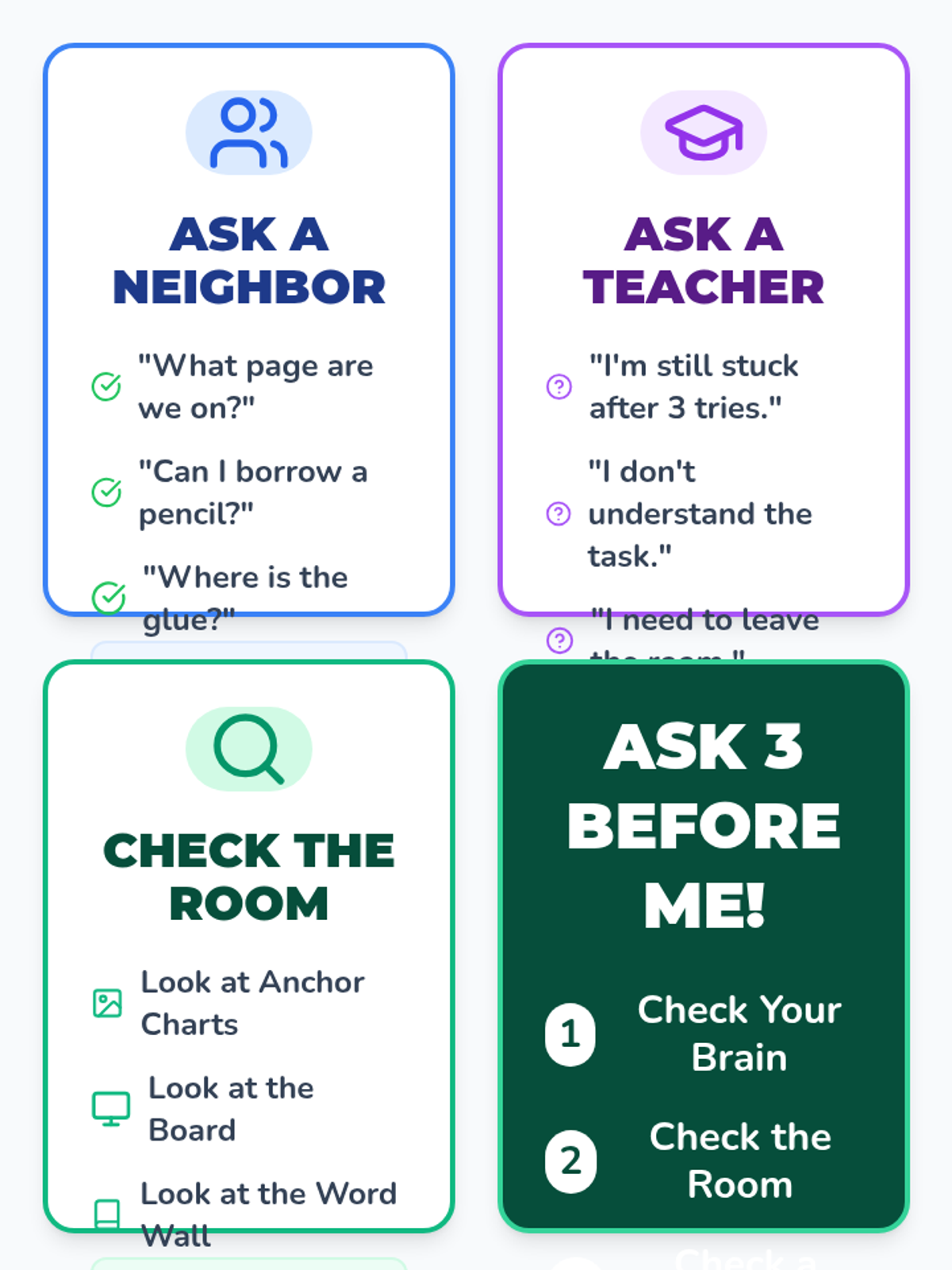
Classroom reference cards that visually categorize which problems should be directed to peers vs. teachers, reinforcing the 'Ask 3 Before Me' routine.
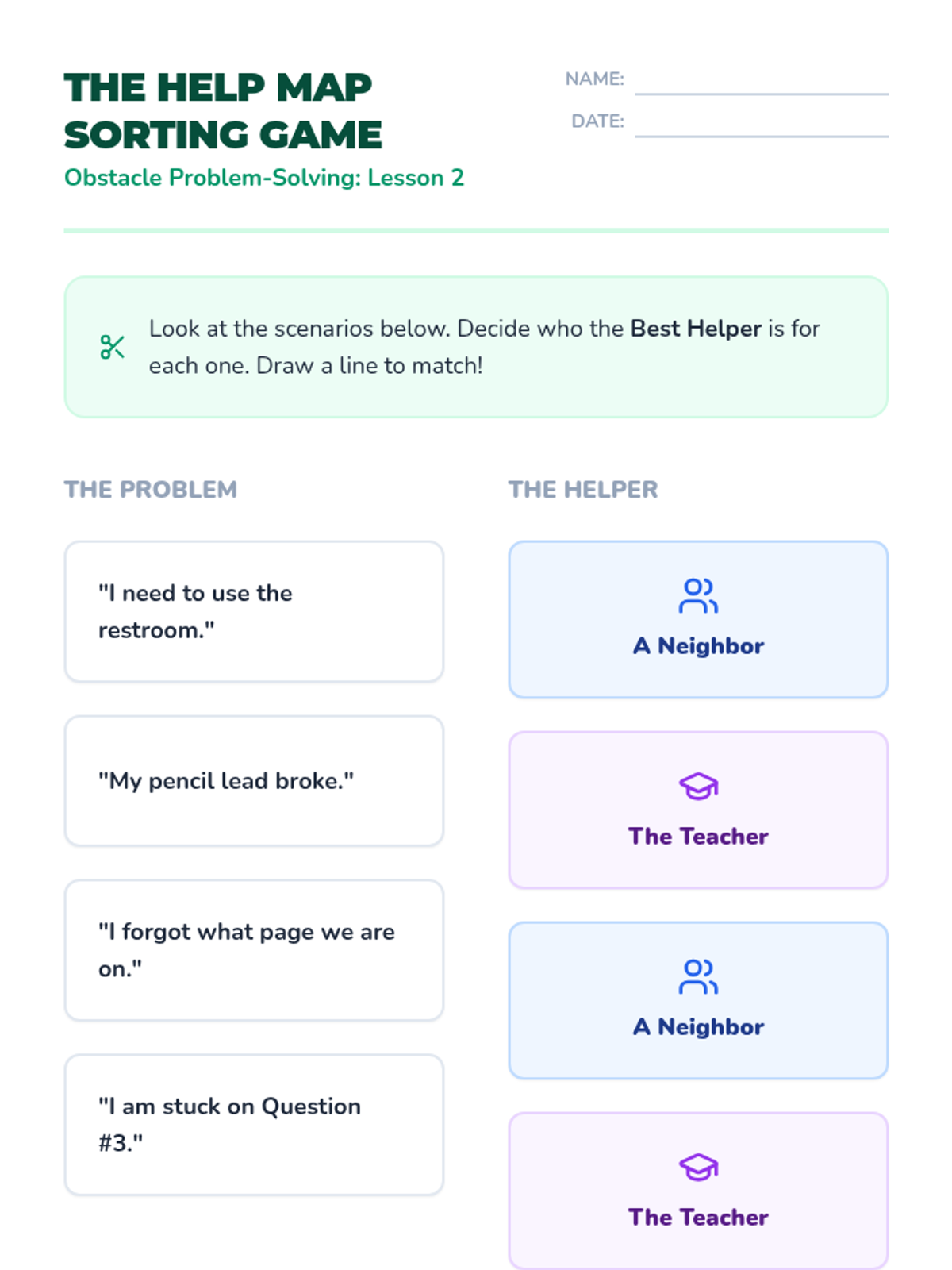
A student worksheet for identifying appropriate helpers for specific classroom scenarios and reinforcing the 'Ask 3 Before Me' routine.
Visual slides for Lesson 2 that help students identify different 'helpers' in the classroom and practice the 'Ask 3 Before Me' strategy.
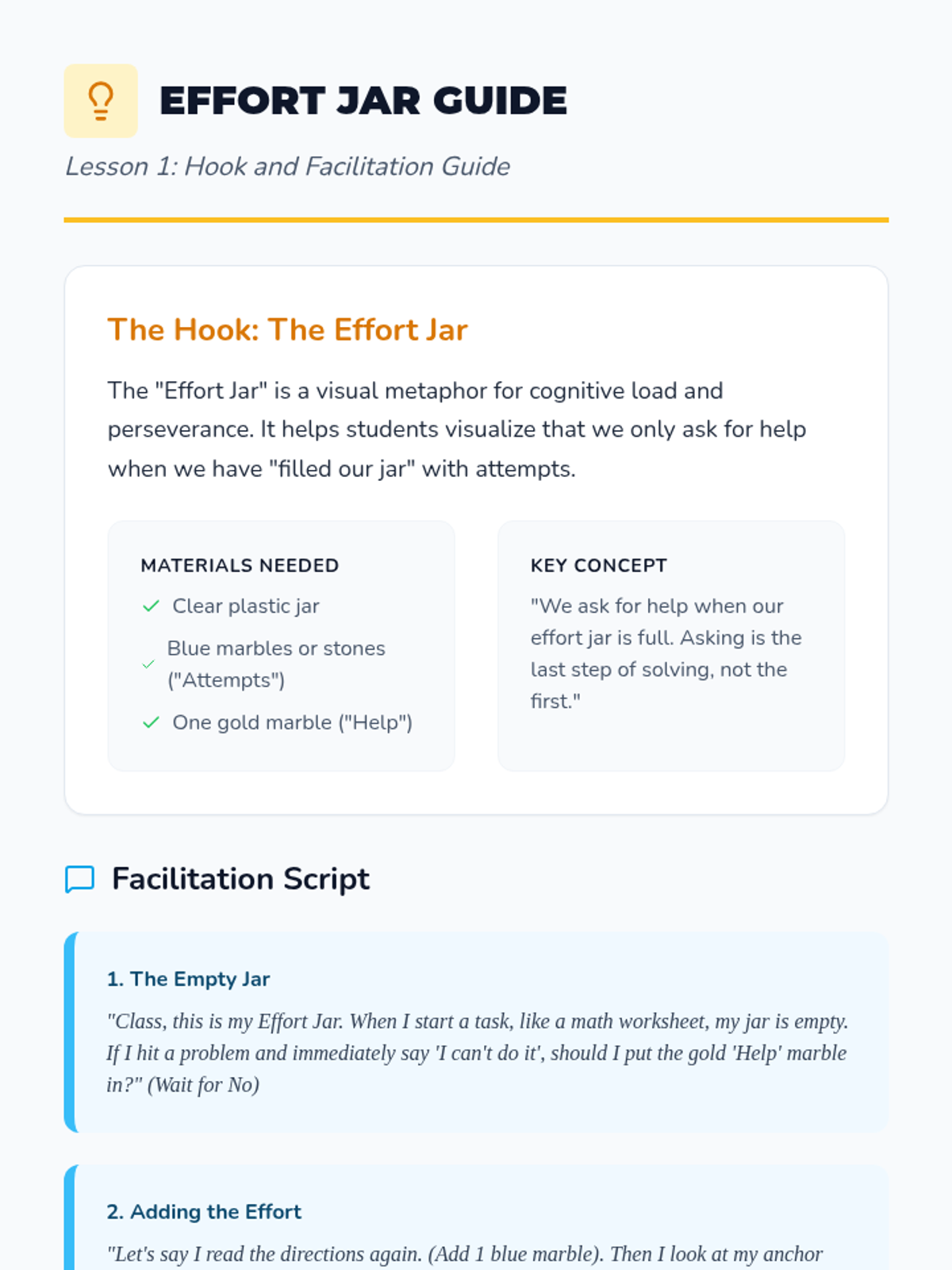
A teacher facilitation guide for the 'Effort Jar' hook activity, providing a script and pedagogical strategies for teaching the tipping point concept.
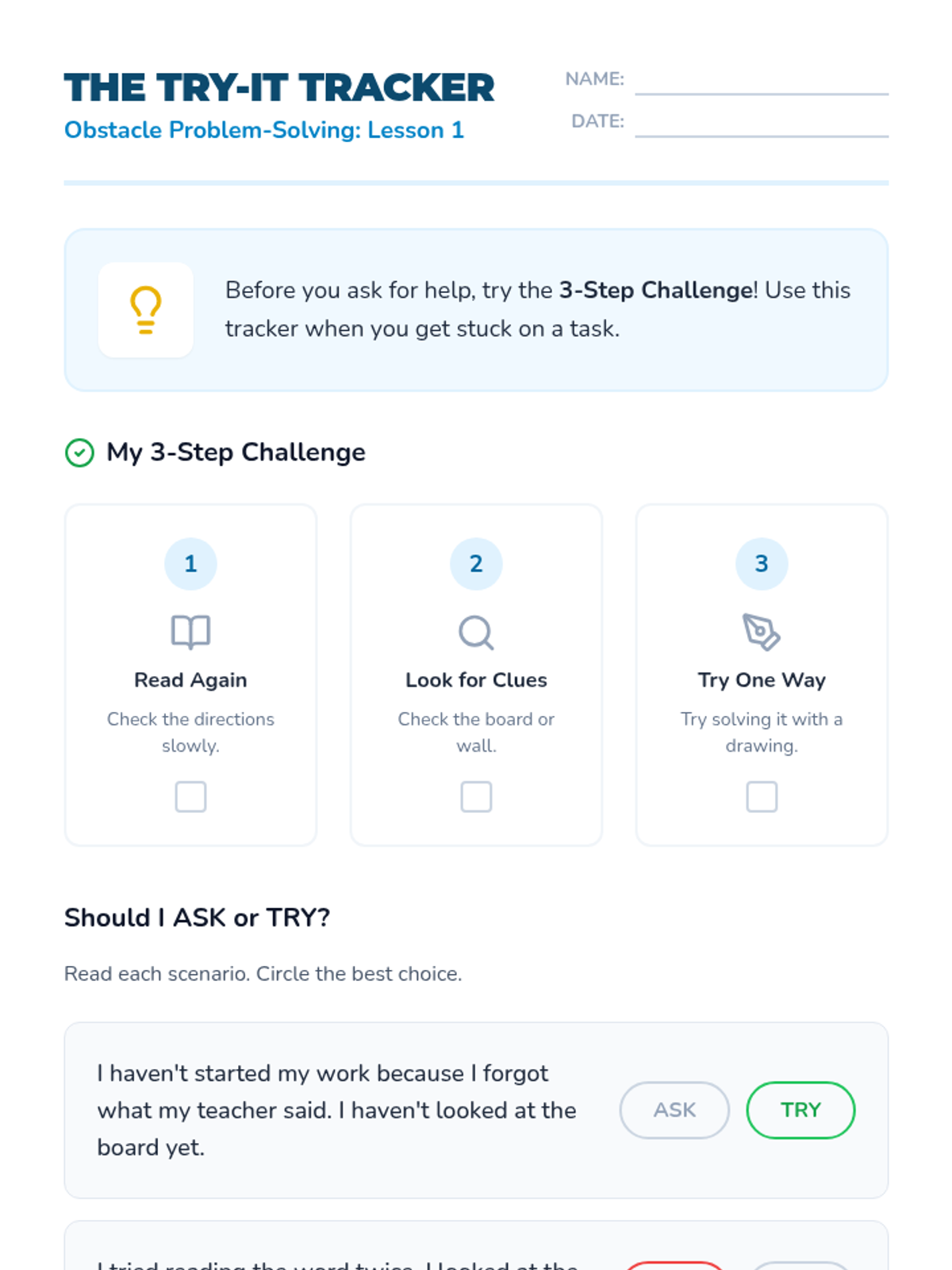
A student worksheet for practicing the 'Try 3 Before Me' strategy and identifying the tipping point between independent effort and asking for help.
Visual slides for Lesson 1 that introduce students to the concept of the 'Tipping Point'—the moment to transition from independent effort to asking for help.
Gallery walk instructions and reflection prompts for the final lesson, emphasizing the transfer of working memory strategies to other subjects.
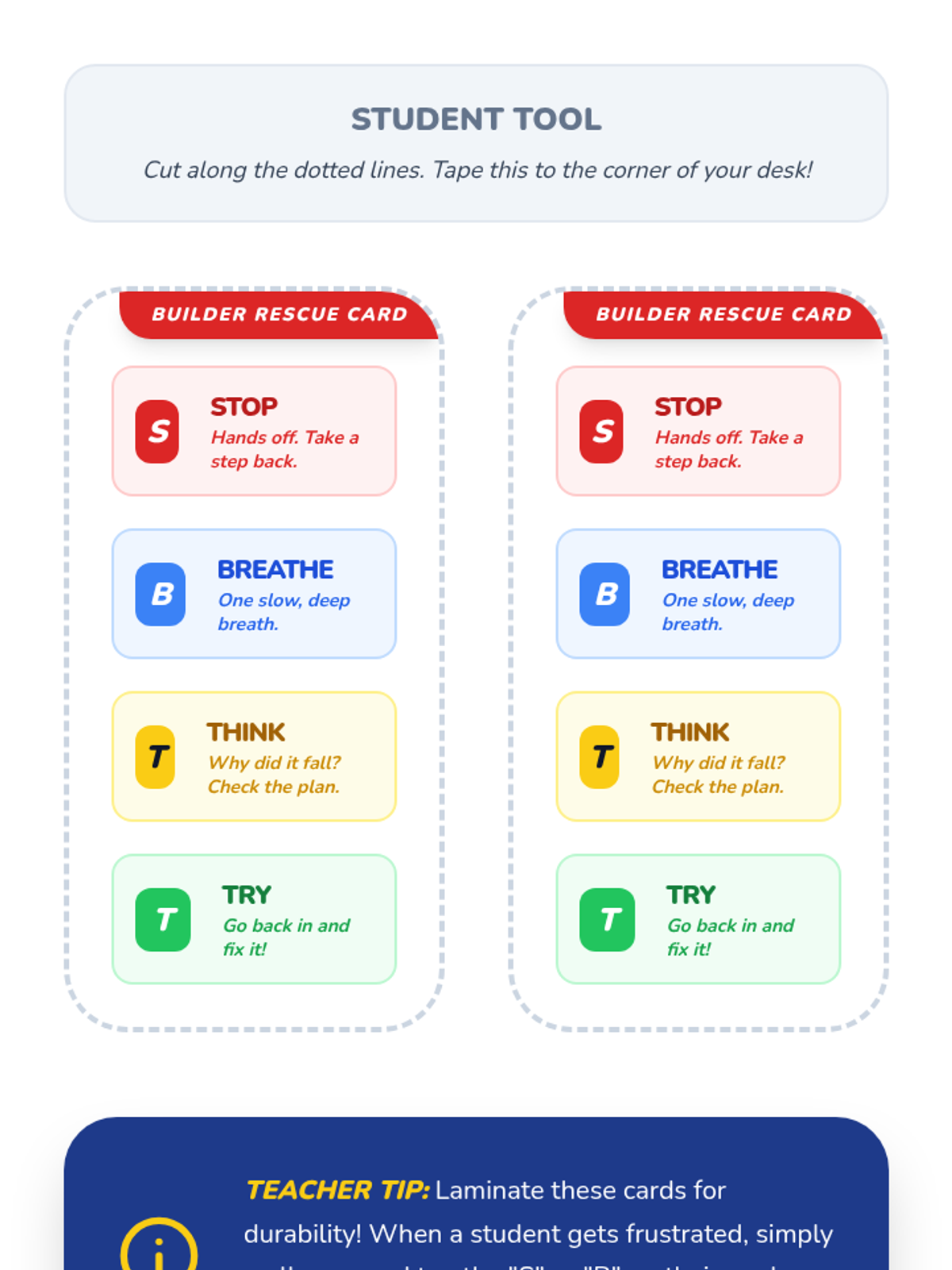
A visual reference card for students to keep at their desks, featuring the S.B.T.T. (Stop, Breathe, Think, Try) protocol for emotional regulation.
Visual presentation for the "Overcoming Obstacles" lesson, modeling the Stop-Breathe-Think-Try (SBTT) protocol for emotional regulation during structural failures.
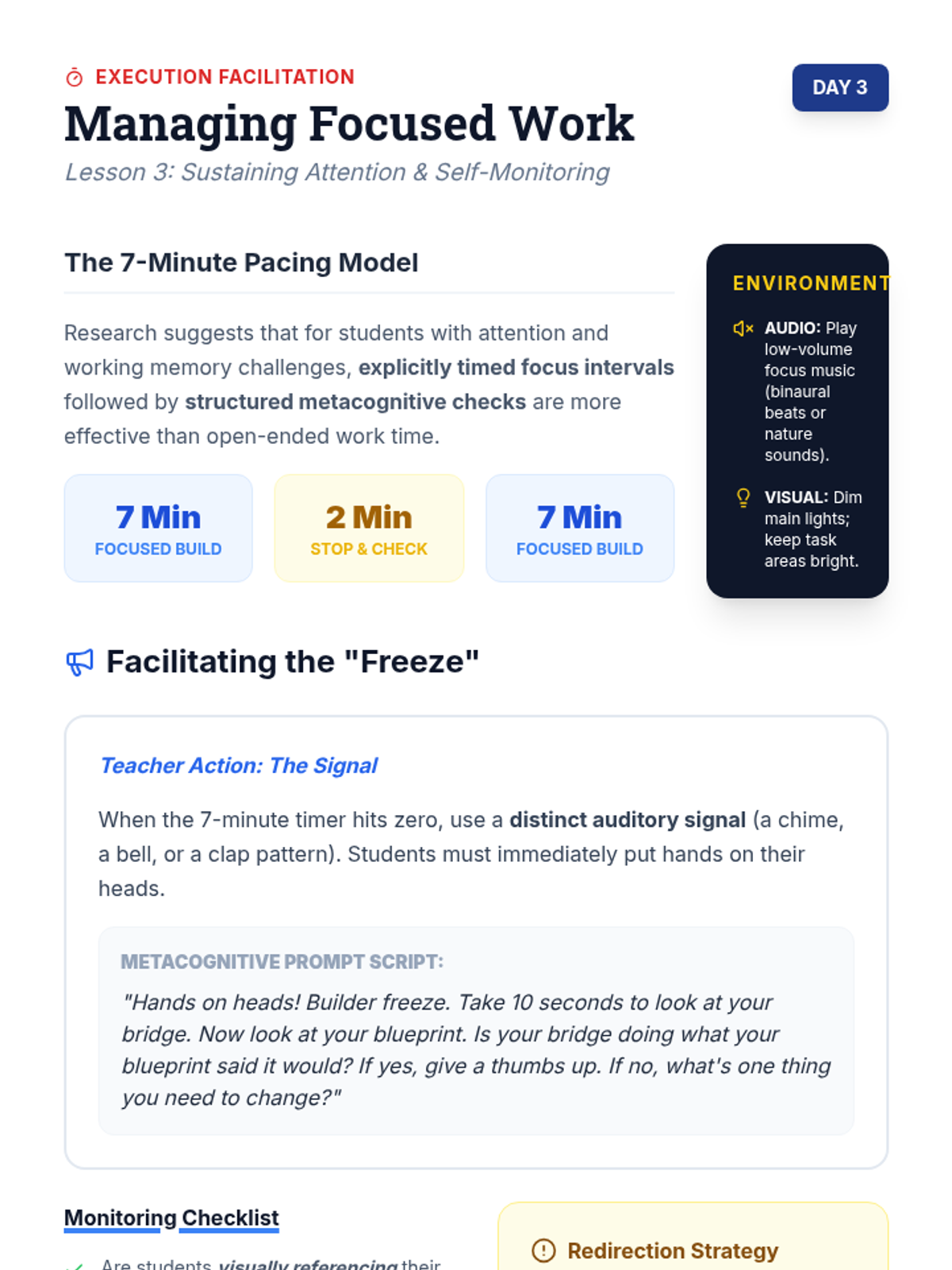
A facilitation guide for teachers on managing the "Stop and Check" intervals, including pacing models and non-verbal redirection strategies.
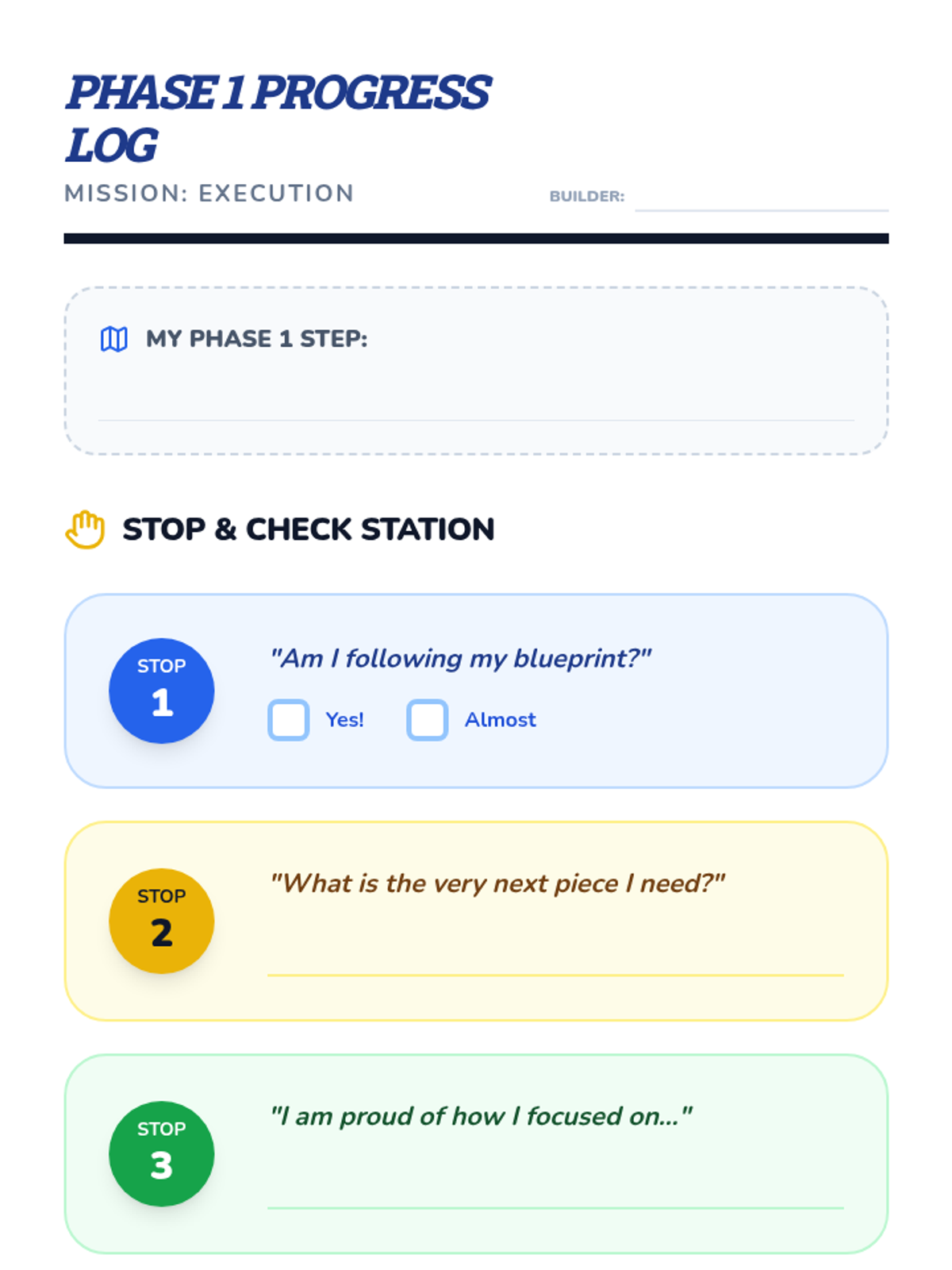
A student log for the "Stop and Check" intervals, designed to encourage self-monitoring and task adherence during the building phase.
Visual presentation for the construction phase, introducing the 7-minute focus challenge and the "Stop and Check" intervals to support task adherence.
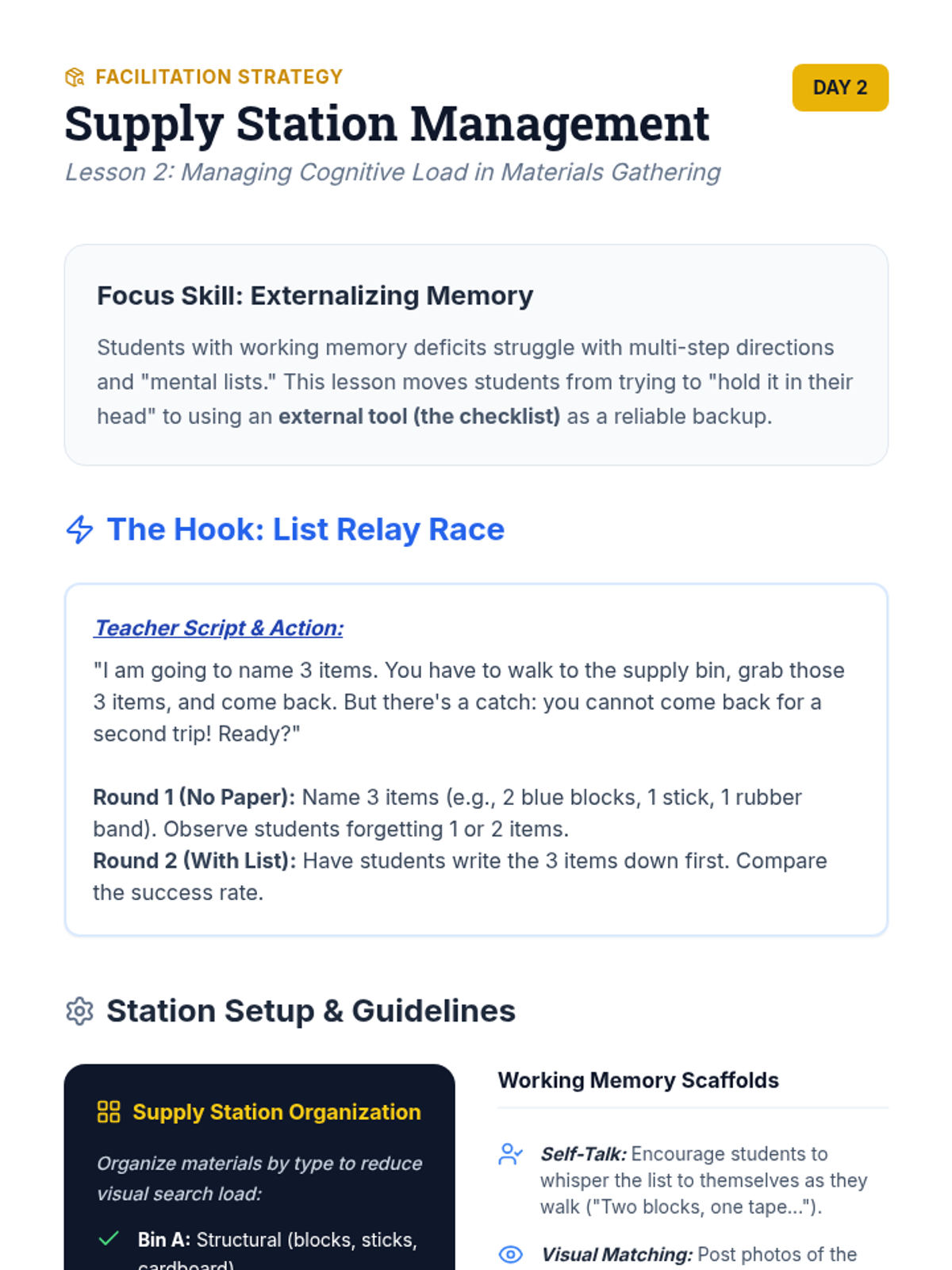
Instructions for teachers on setting up the supply station simulation and facilitating the "one-trip" working memory challenge.
Slide deck for Lesson 5 summarizing all strategies and introducing the 'Expert Pilot' checklist concept for the final project.
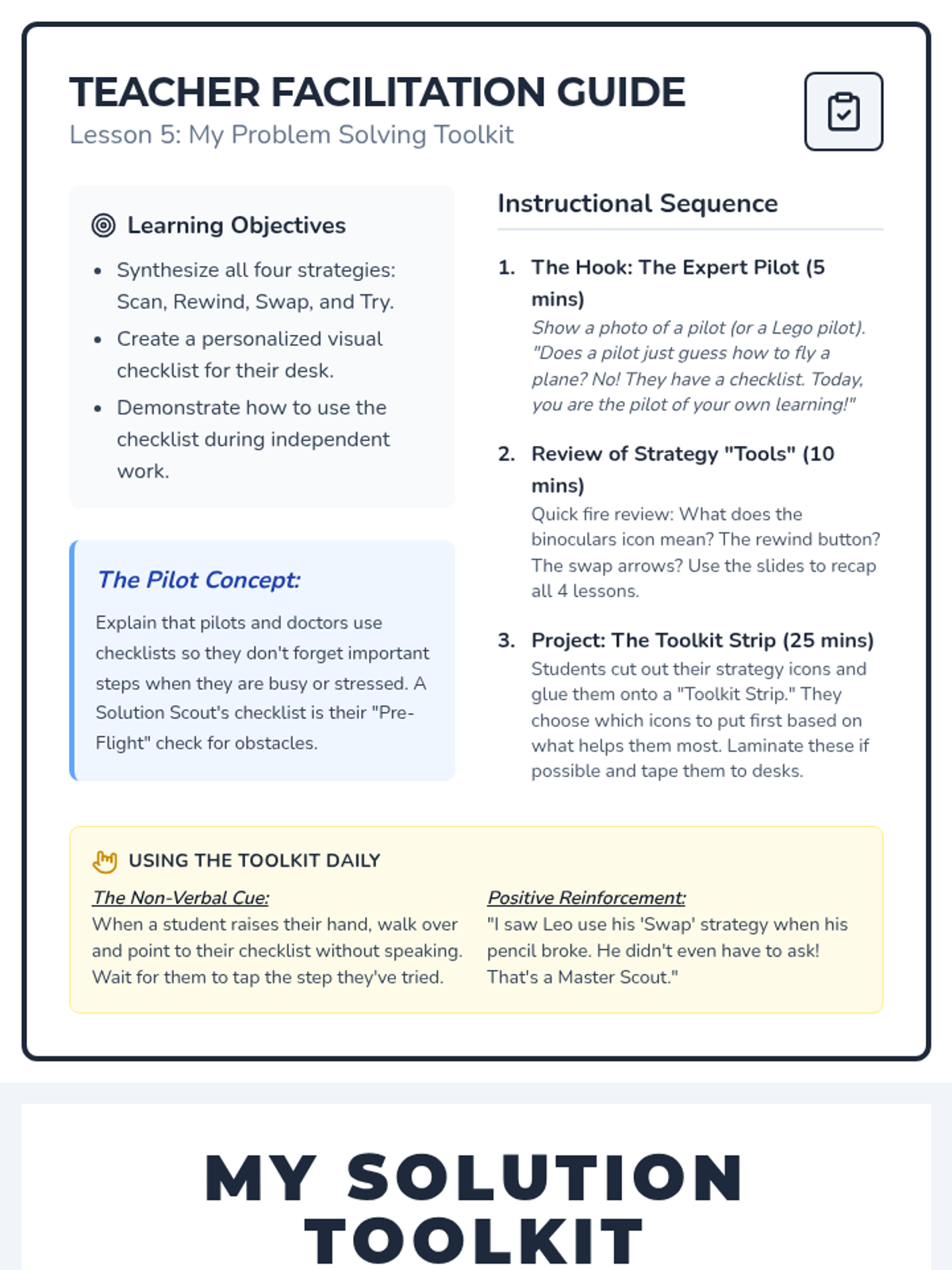
Teacher facilitation guide and a cut-and-paste 'Troubleshooting Toolkit' desk strip for Lesson 5, helping students finalize their personal problem-solving system.
Slide deck for Lesson 4 that normalizes the trial-and-error process and teaches students resilience through 'Scout Talk' and the 'Success Loop'.
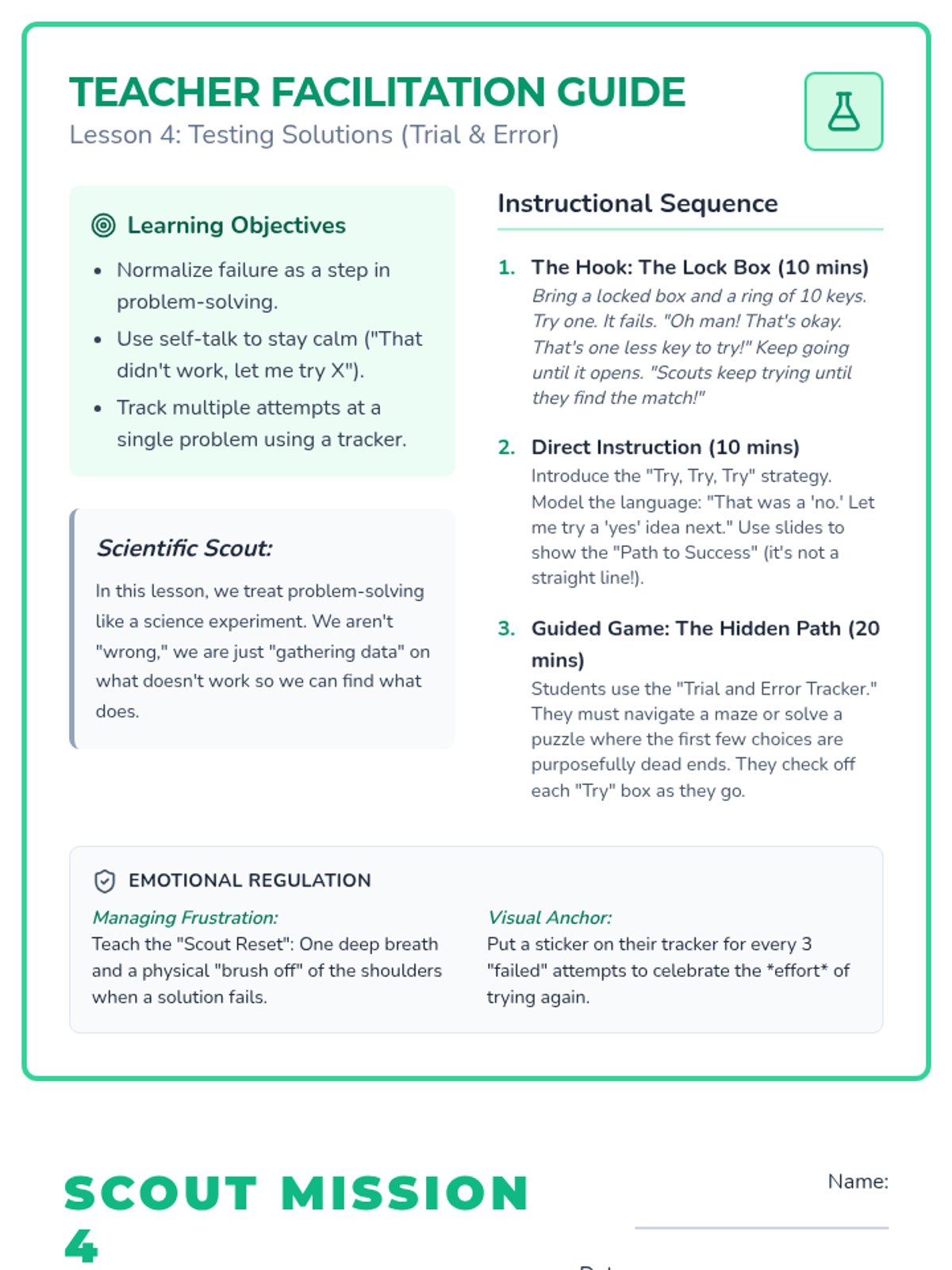
Teacher facilitation guide and 'Trial and Error Tracker' for Lesson 4, designed to help students persevere through multiple attempts at a task.
Slide deck for Lesson 3 focusing on cognitive flexibility and finding 'Plan B' solutions when classroom tools or methods are unavailable.
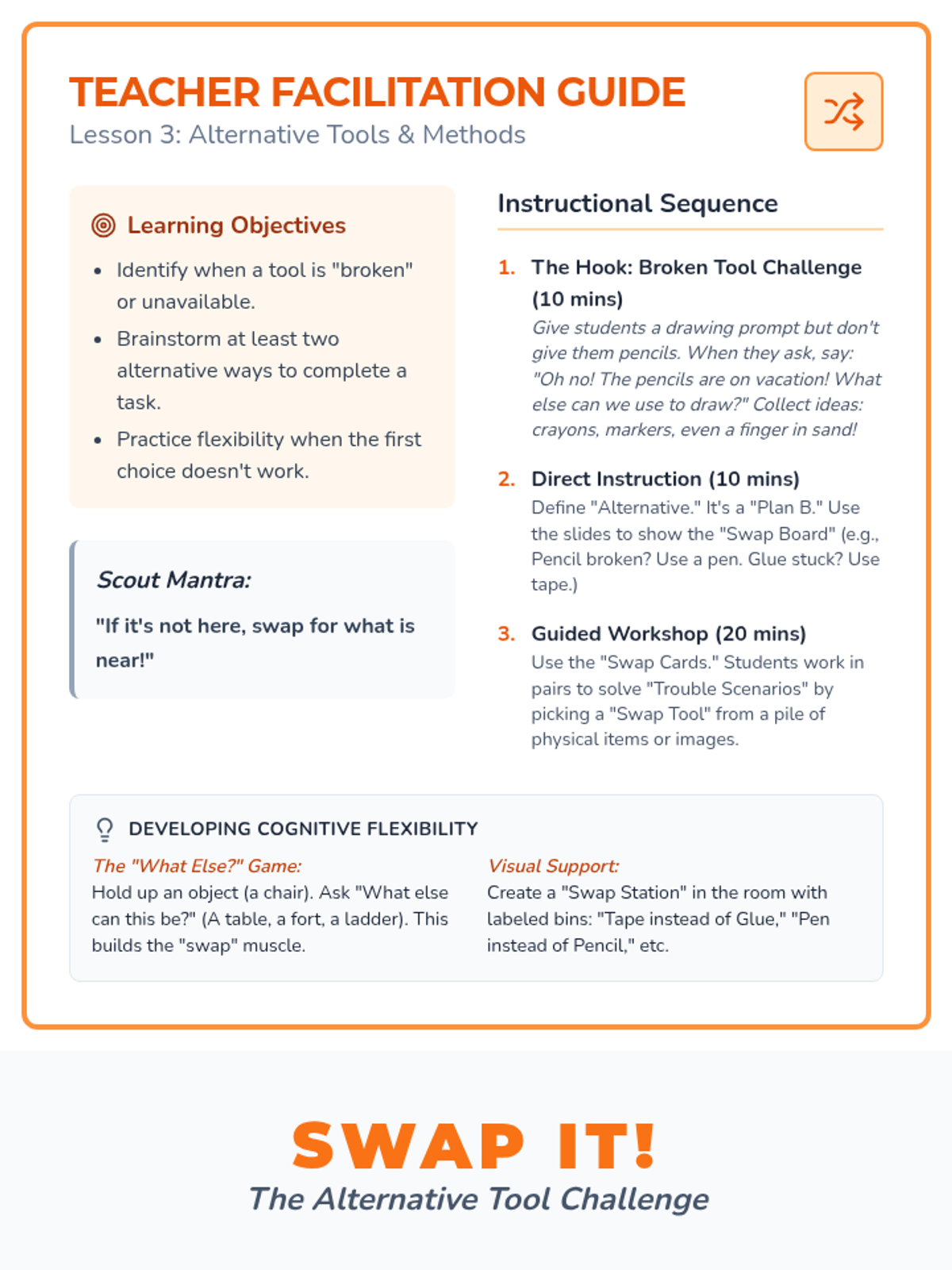
Teacher facilitation guide and 'Swap It!' challenge cards for Lesson 3, encouraging students to find alternative tools and methods when facing obstacles.
Slide deck for Lesson 2 focusing on the 'Rewind' cognitive strategy, providing visual examples of sequencing actions backward to solve problems.
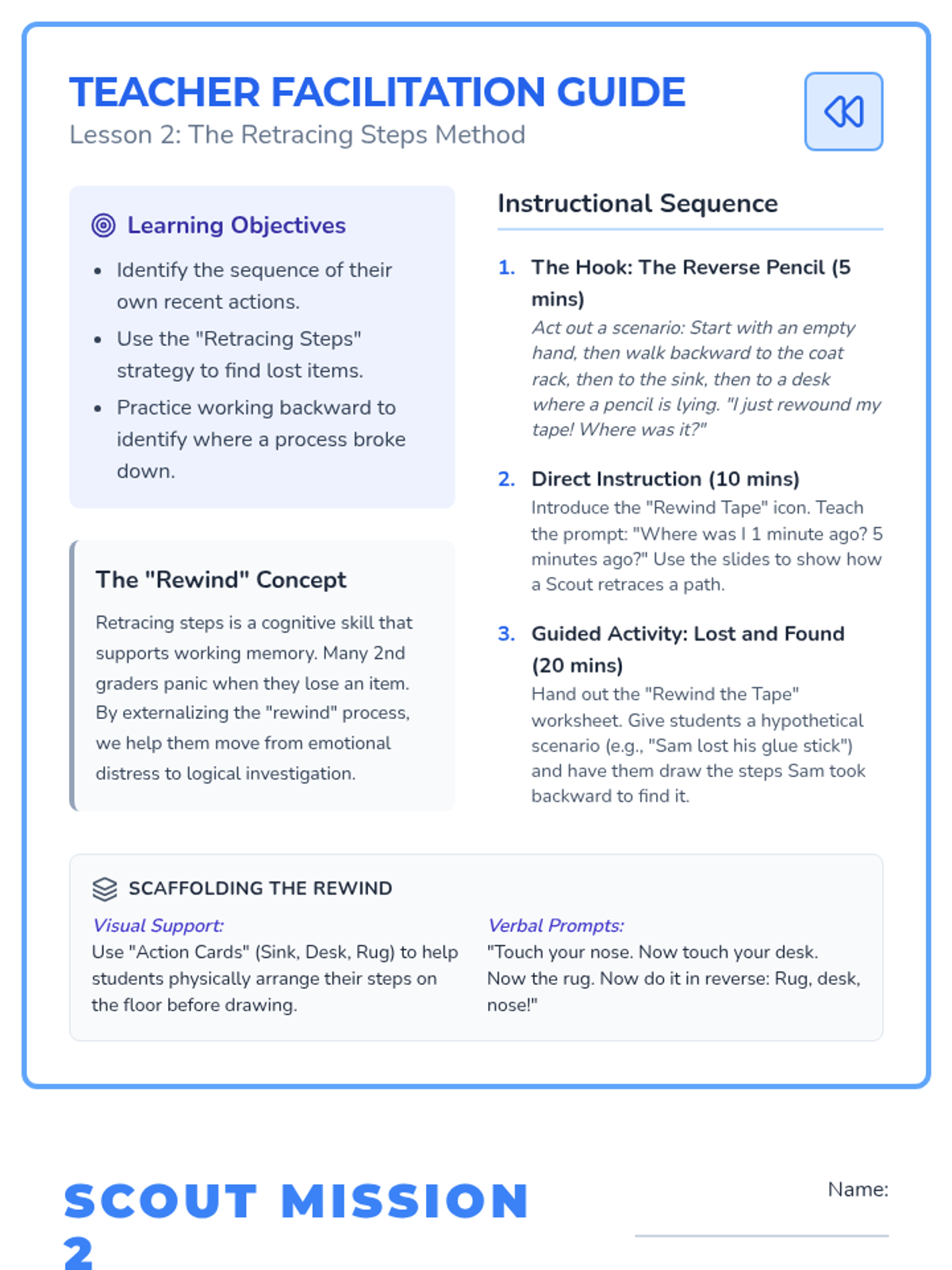
Teacher facilitation guide and a 'Rewind the Tape' worksheet for Lesson 2, teaching students how to sequence their actions backward to find lost items.
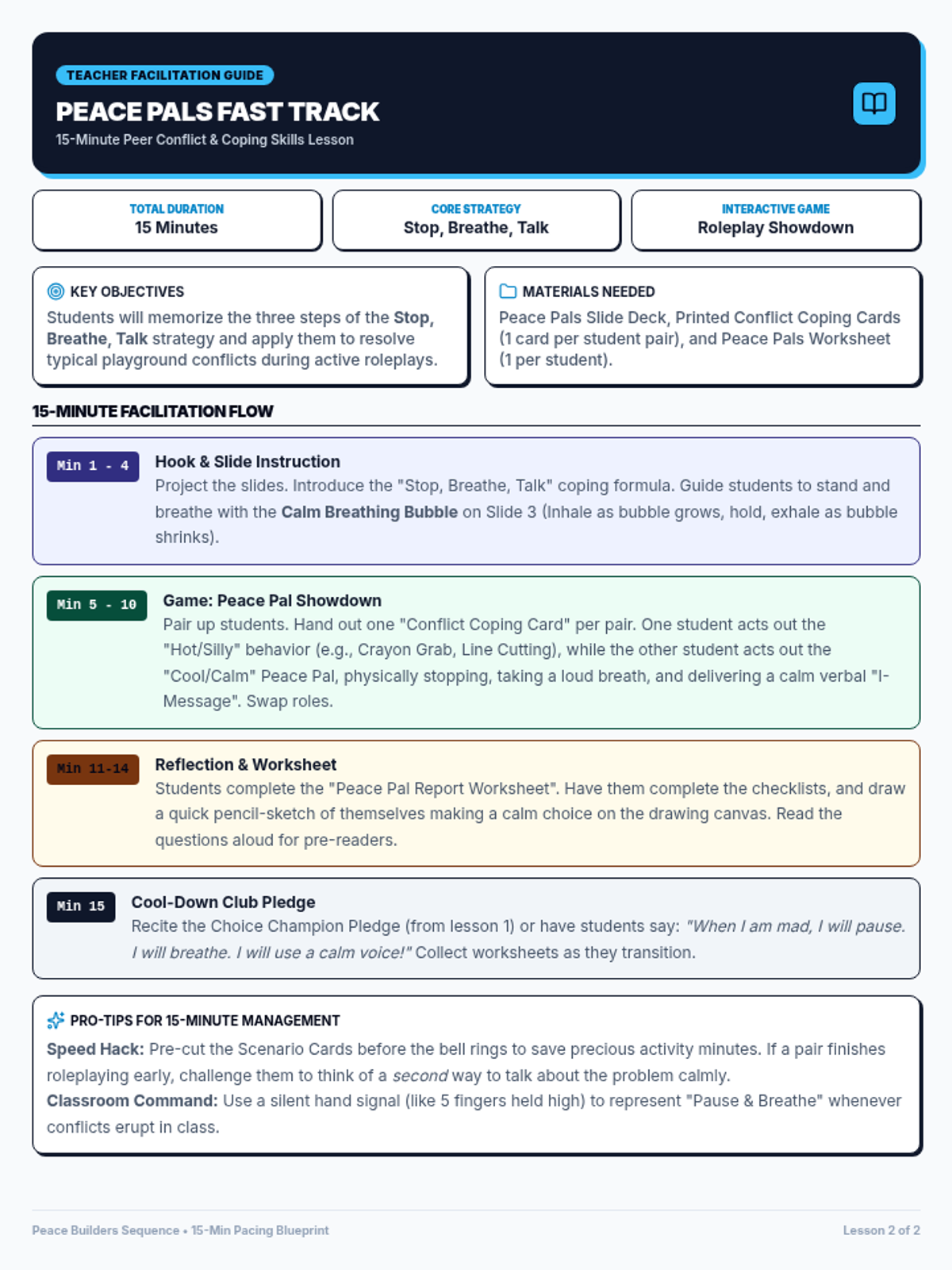
A comprehensive pacing and facilitation guide for teachers to deliver the Peace Pals lesson. It details a fast-track 15-minute delivery timeline with specific scripts, active roleplay management, and rapid transitions.
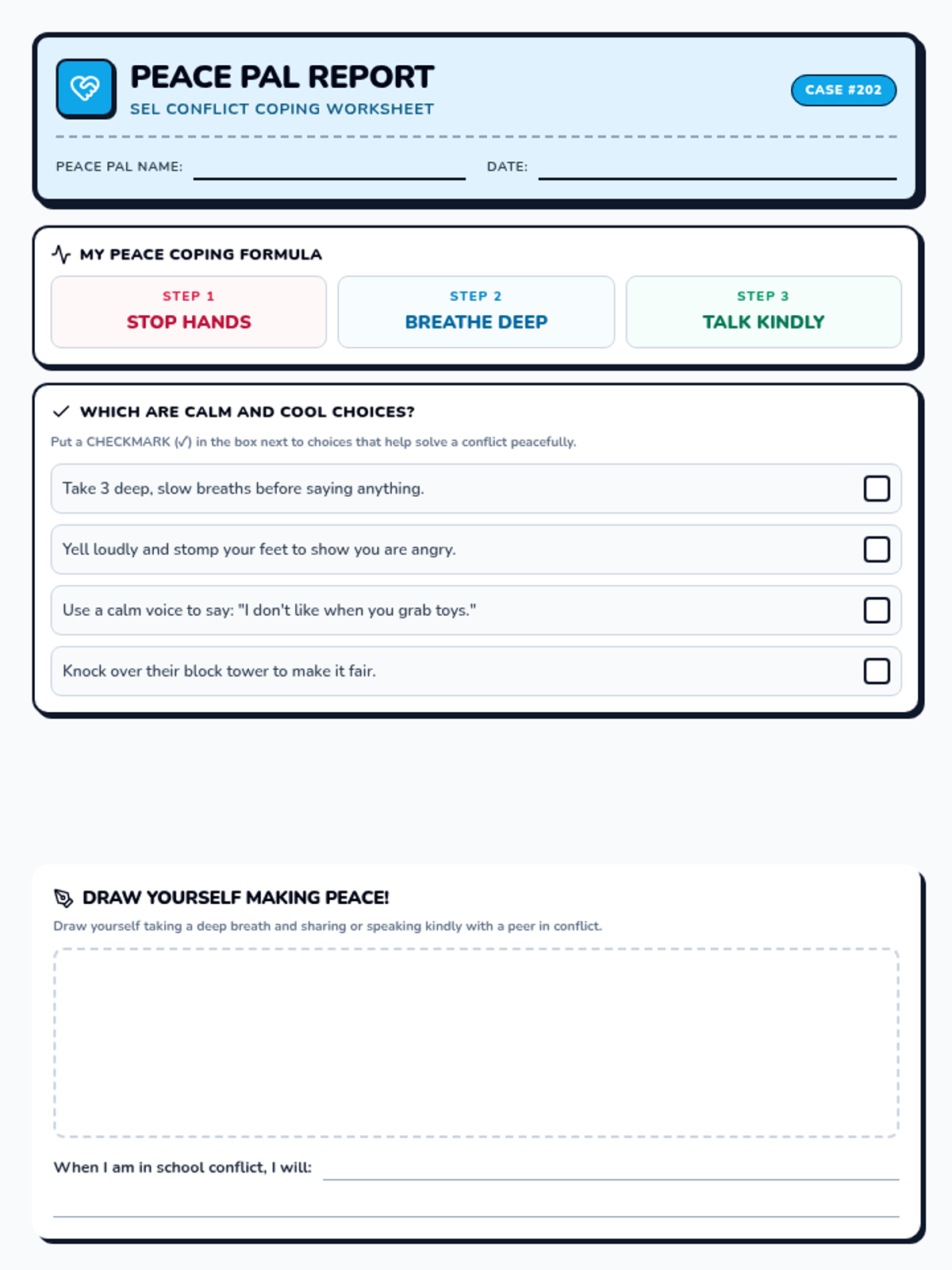
A reflection and matching worksheet for K-3 students to practice conflict self-regulation. Students identify calm coping choices (with identically styled check-boxes) and draw a visual representation of peaceful conflict resolution.
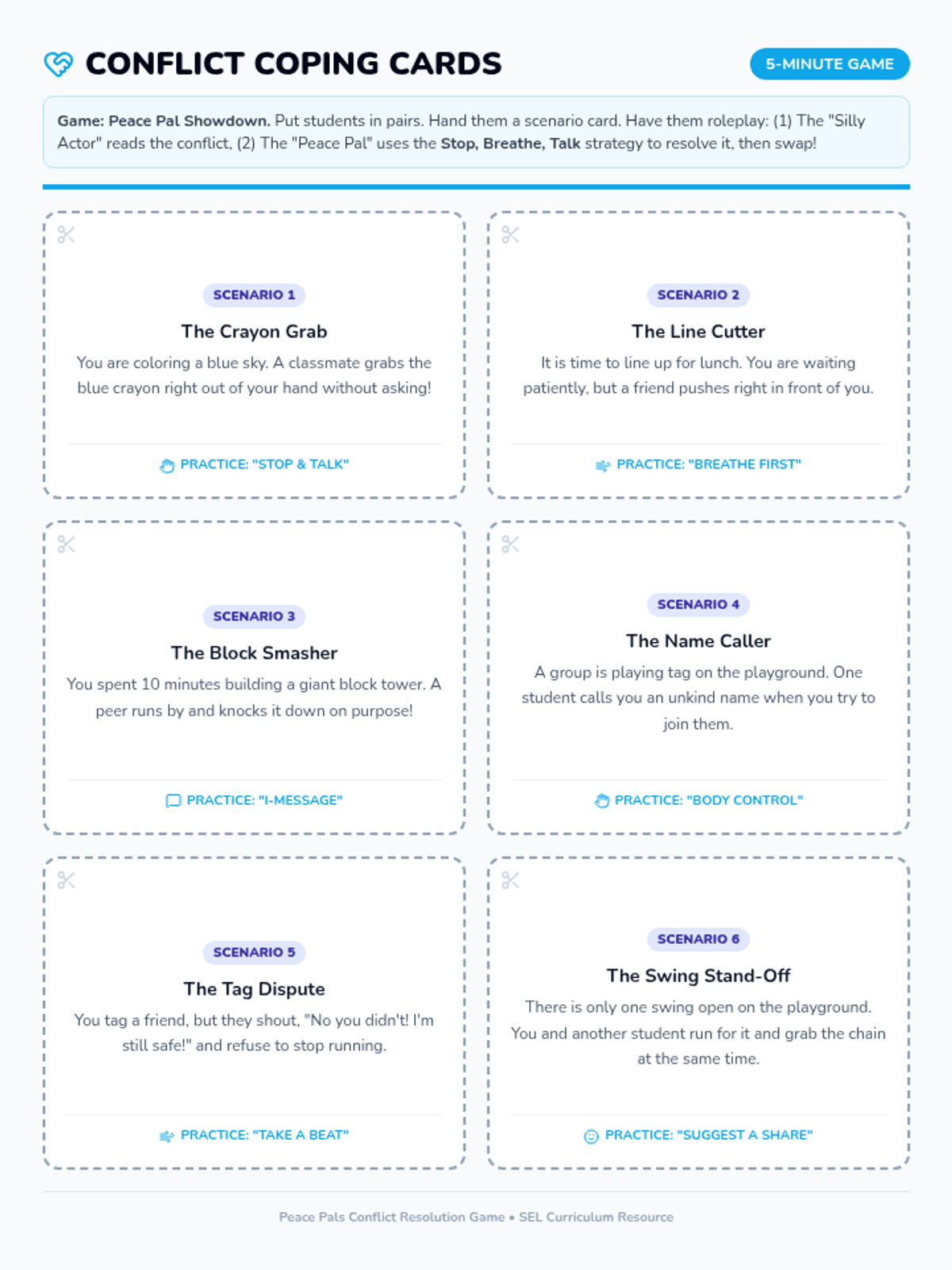
Print-ready role-play activity cards designed to be done as a fast-paced classroom game called 'Peace Pal Showdown'. Includes 6 distinct student-centered peer conflict scenarios to practice positive self-regulation and verbal resolution.
Interactive slides for a K-3 classroom lesson on conflict resolution. Introduces the "Stop, Breathe, Talk" coping strategy with custom CSS animated breathing exercises, and includes an interactive playground conflict voting scenario.
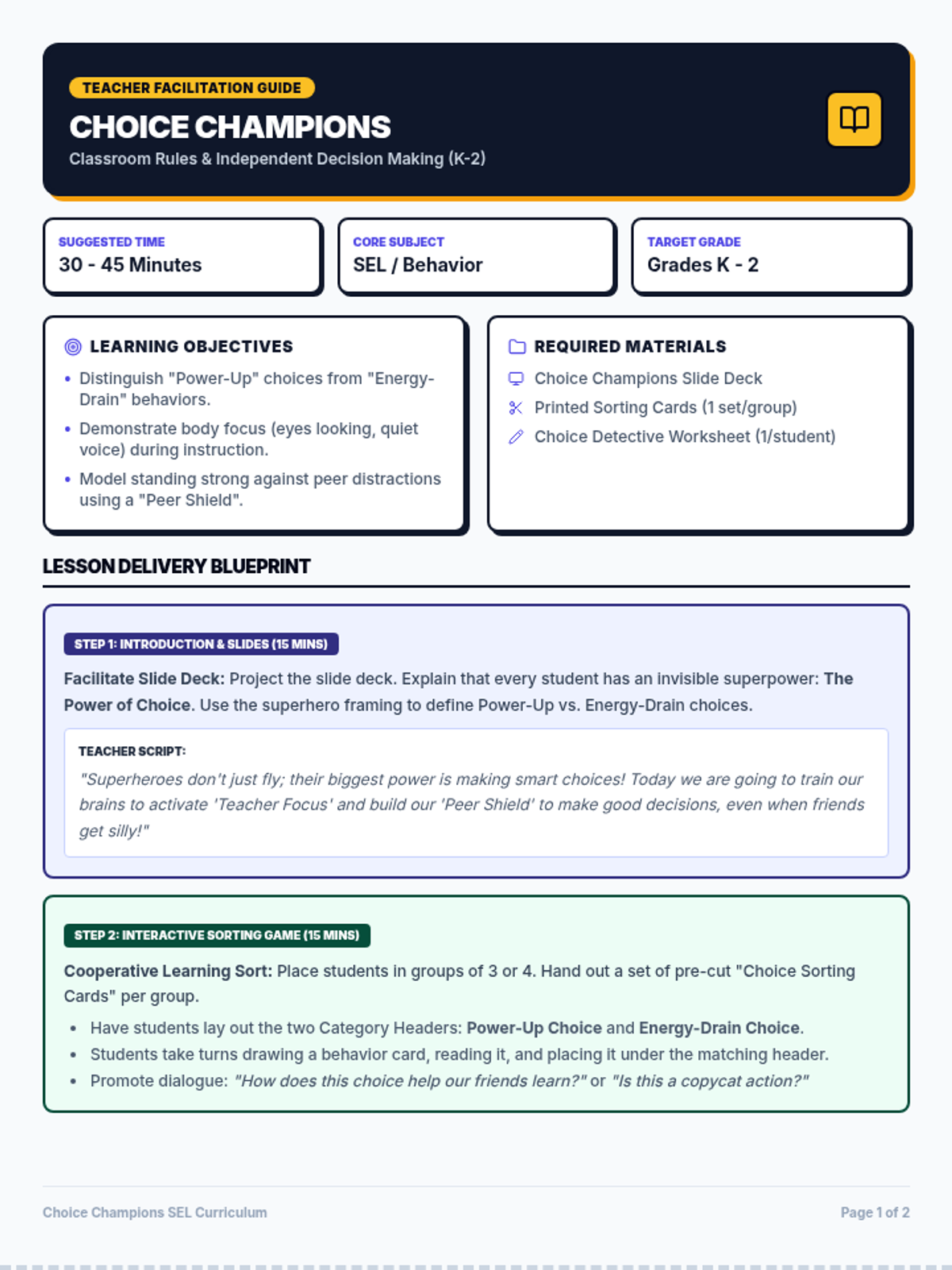
A comprehensive 2-page pacing and facilitation guide for teachers to deliver the Choice Champions lesson. It includes learning objectives, materials checklist, step-by-step instructions, verbal scripts, and targeted classroom management and differentiation tips.
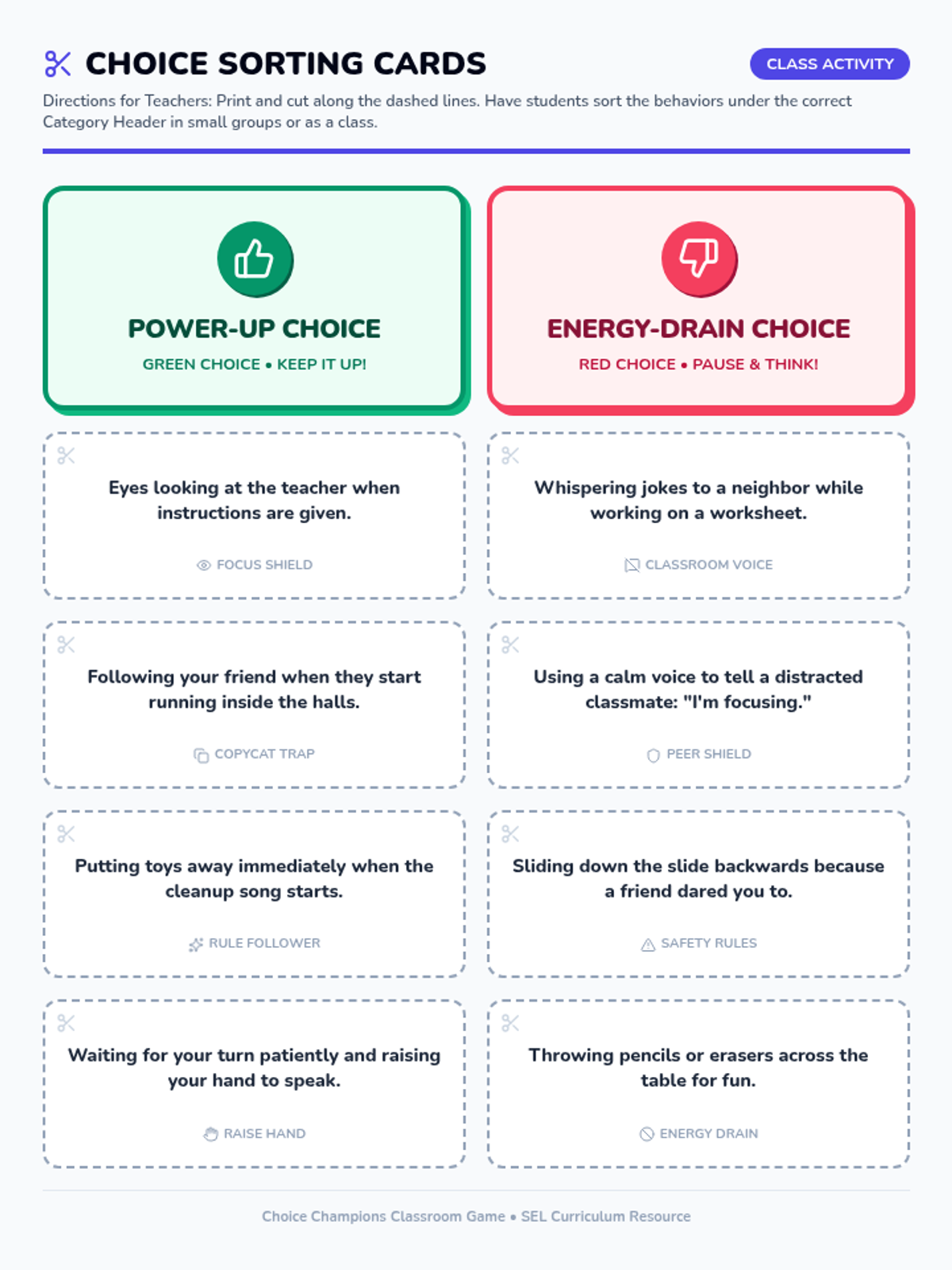
A set of printable sorting cards featuring two main category header cards (Power-Up Choice vs Energy-Drain Choice) and eight behavior scenario cards designed to be cut and sorted. Helps early childhood students visually distinguish between following rules and succumbing to peer distractions.
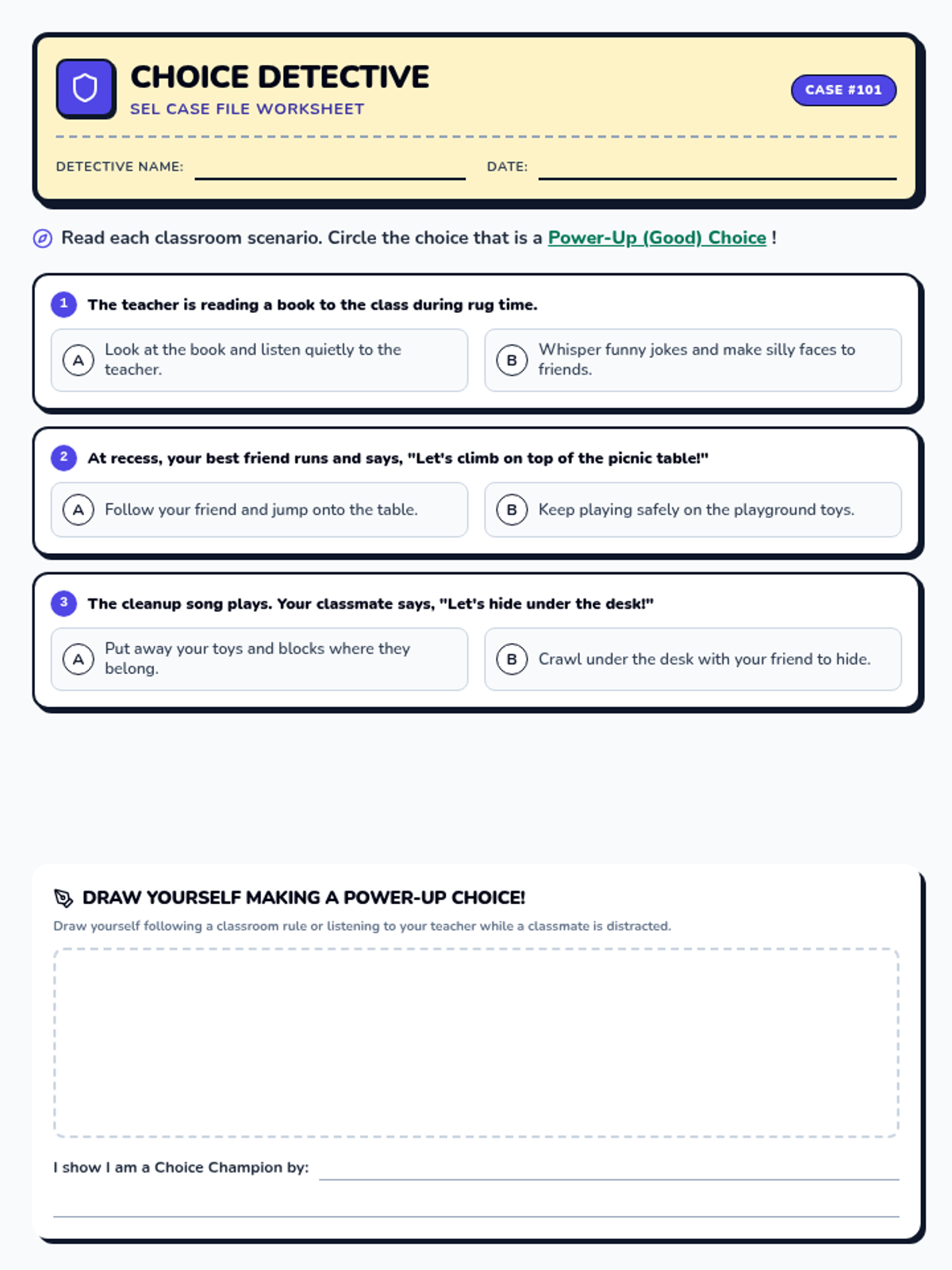
A matching and drawing worksheet for students (K-2) to demonstrate knowledge of 'Power-Up' choices vs 'Energy-Drain' choices. Students circle smart choices from identical options to avoid styling hints, and then draw themselves making a positive independent decision on a clean white drawing canvas.
Interactive slides for a K-2 classroom lesson on making good choices. It features a superhero theme ('Choice Champions') and guides students through learning to listen to the teacher, following rules, and using their 'peer shield' to resist negative peer behaviors. includes multiple voting scenarios.
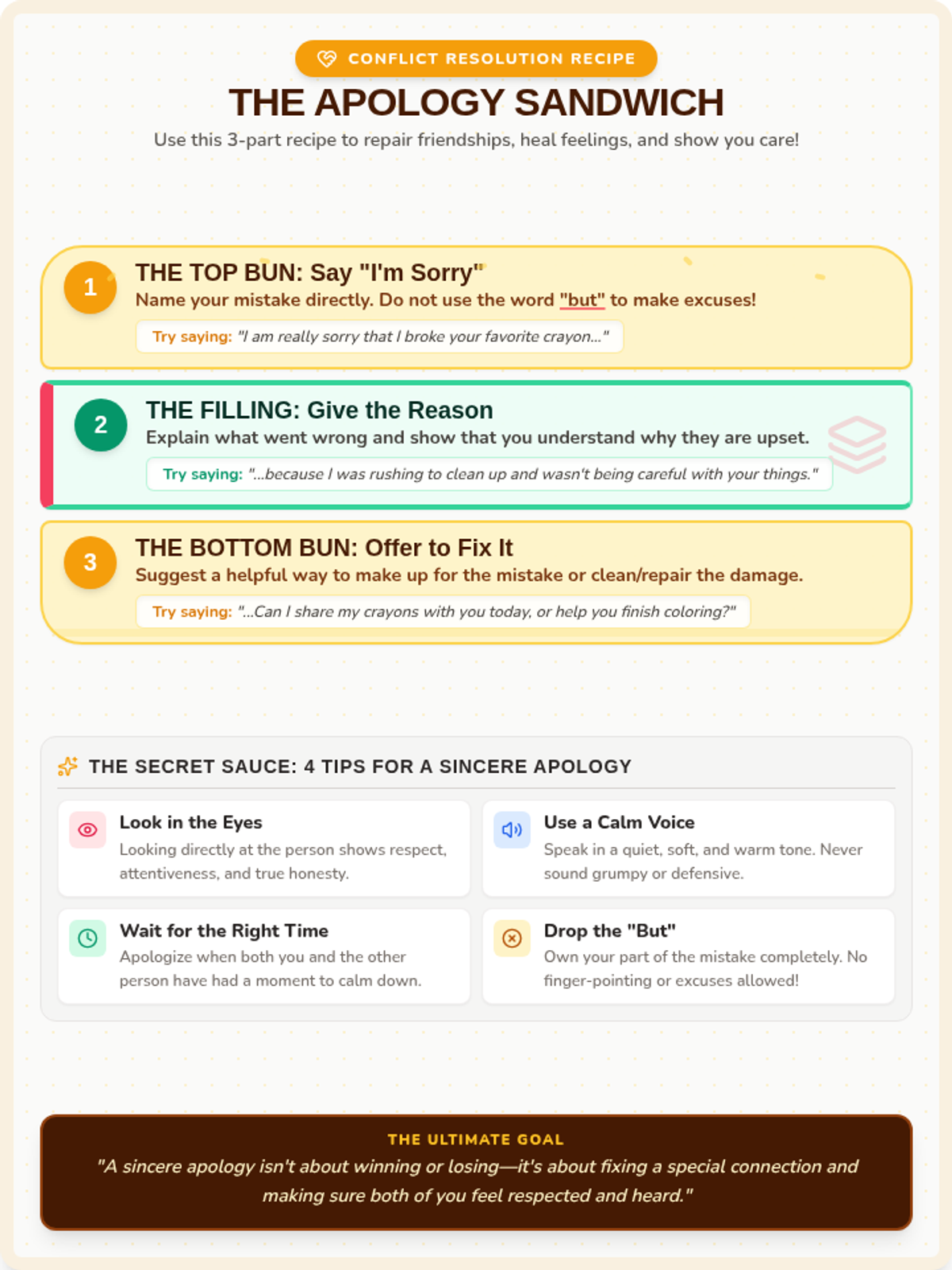
A beautifully formatted one-page classroom poster and infographic displaying the 3-step Apology Sandwich model and four golden tips for delivering a sincere apology. Perfect for posting as a reminder on Google Classroom.
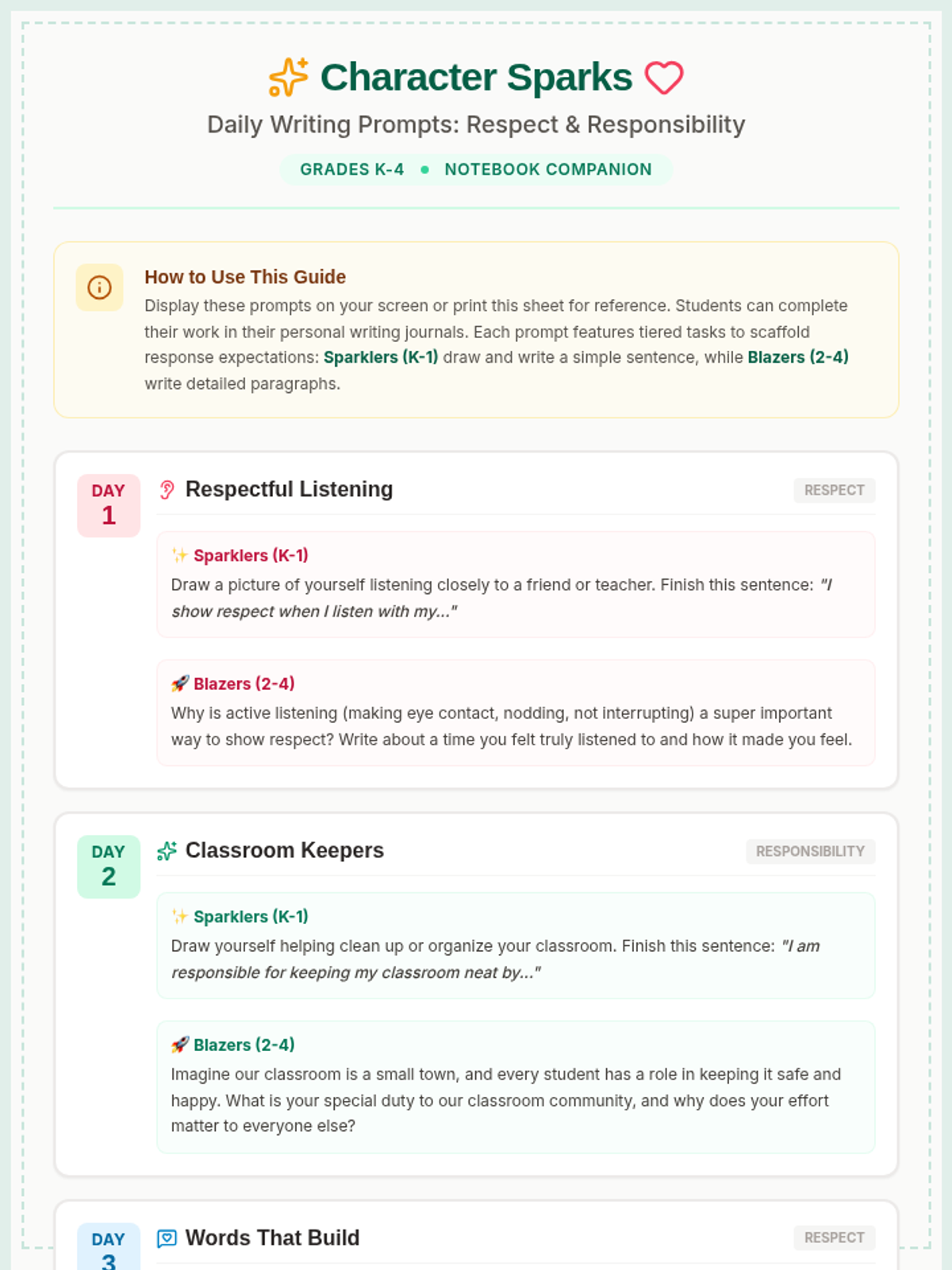
A daily writing prompt reference sheet for elementary classrooms (K-4). Features 10 structured prompts (2 full weeks) focused on respect, responsibility, readiness to learn, and safety, with differentiated requirements for younger (K-1) and older (2-4) students.