Active listening, assertive expression, and boundary-setting strategies for interpersonal success. Develops proficiency in conflict mediation, cooperative teamwork, and the cultivation of healthy romantic and platonic connections.
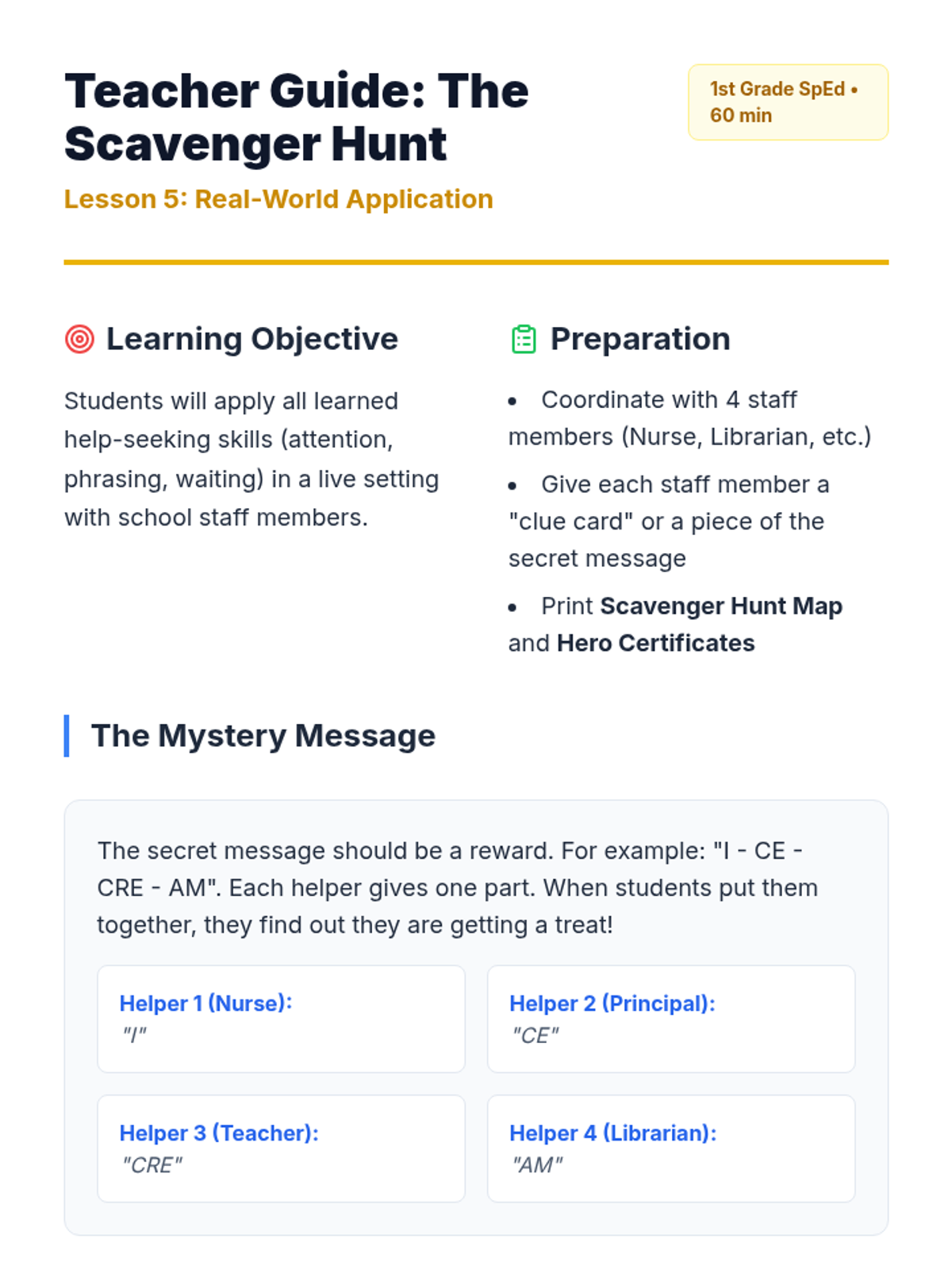
Teacher facilitation guide for Lesson 5, focusing on the setup and execution of the Helper Scavenger Hunt application activity.
A formal certificate for students who complete the Help Hero Training sequence, celebrating their self-advocacy skills.
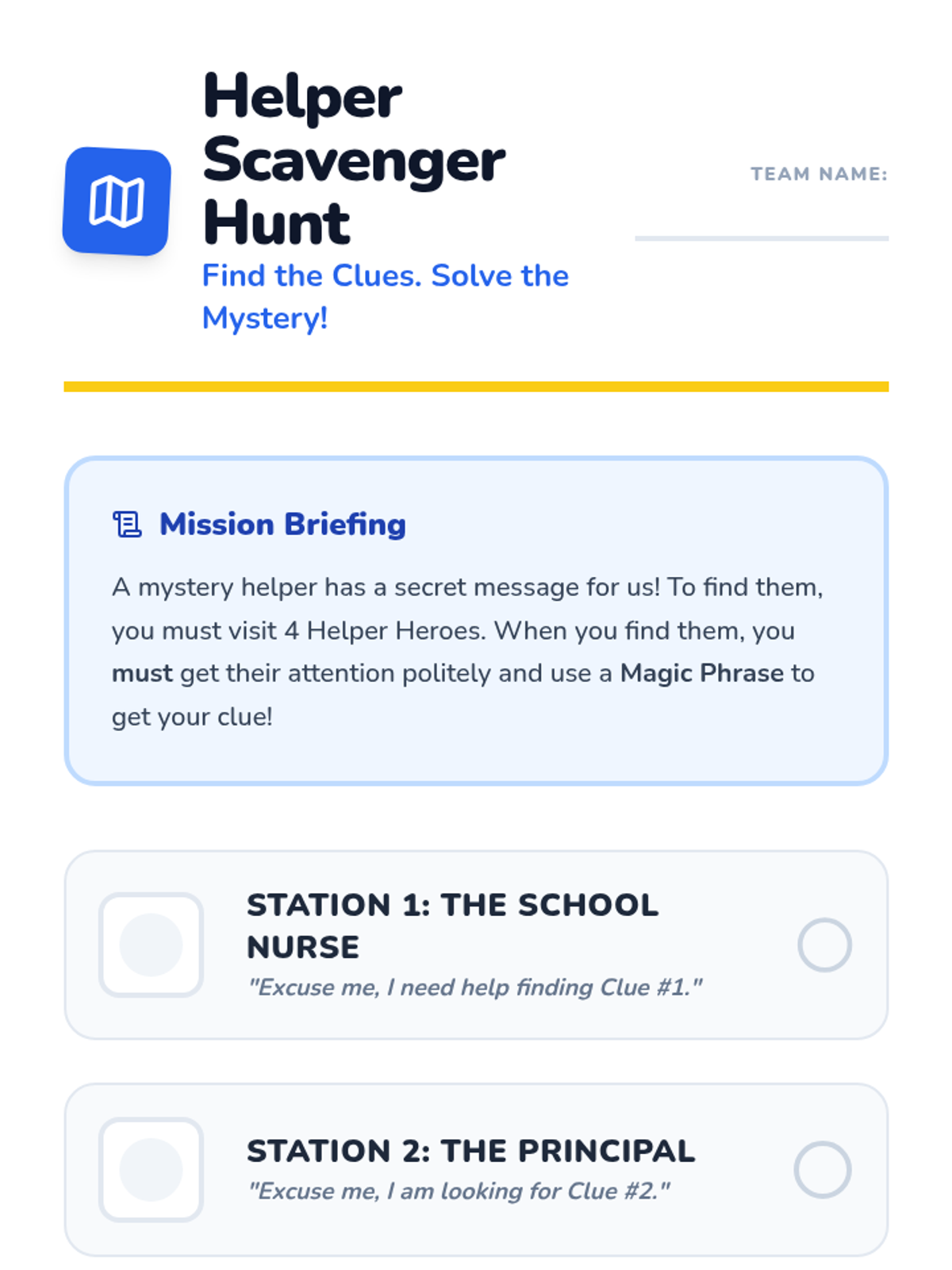
A scavenger hunt checklist for Lesson 5 where students apply help-seeking skills with various staff members to solve a classroom mystery.
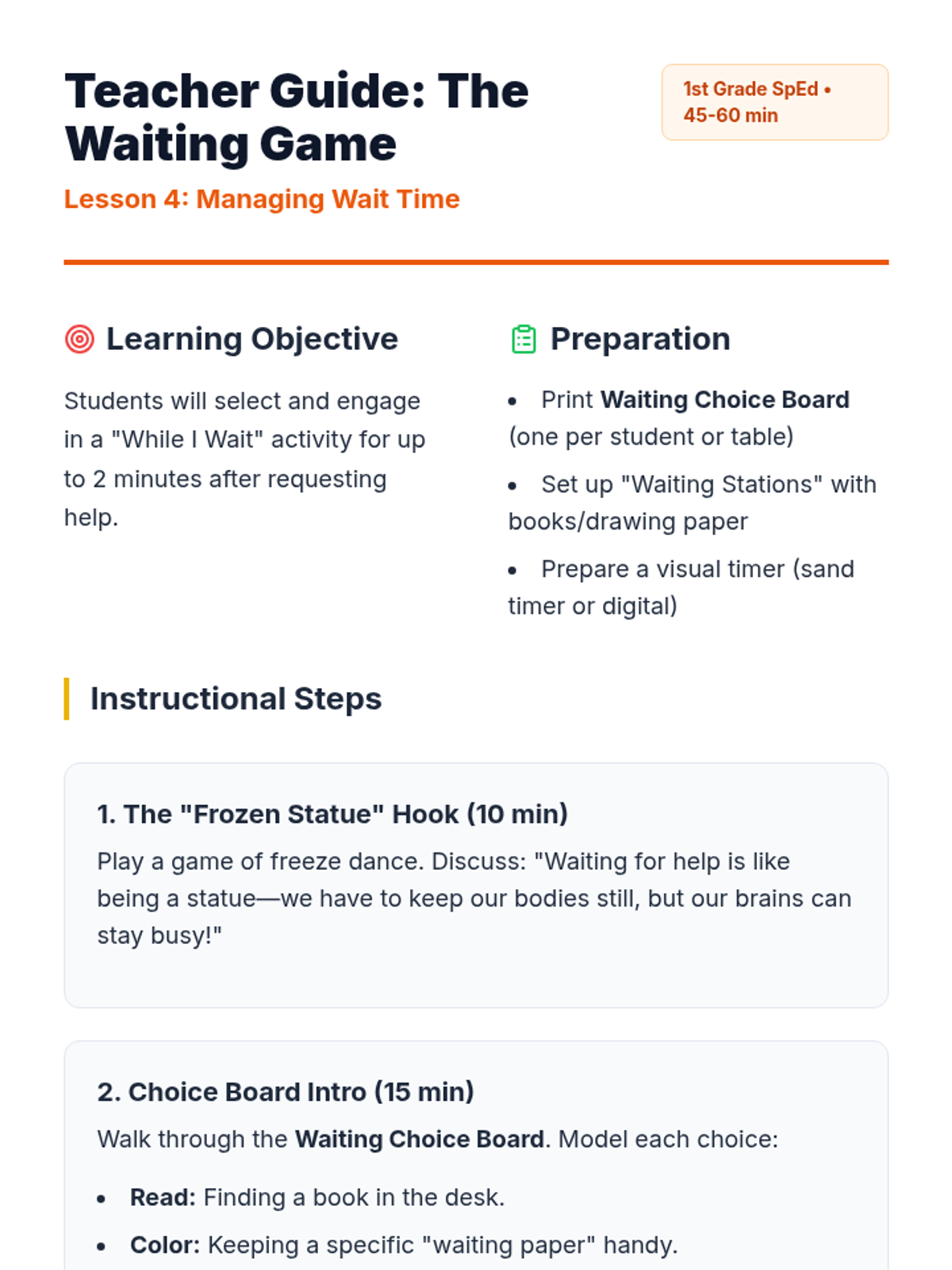
Teacher facilitation guide for Lesson 4, focusing on managing wait time and using the Choice Board.
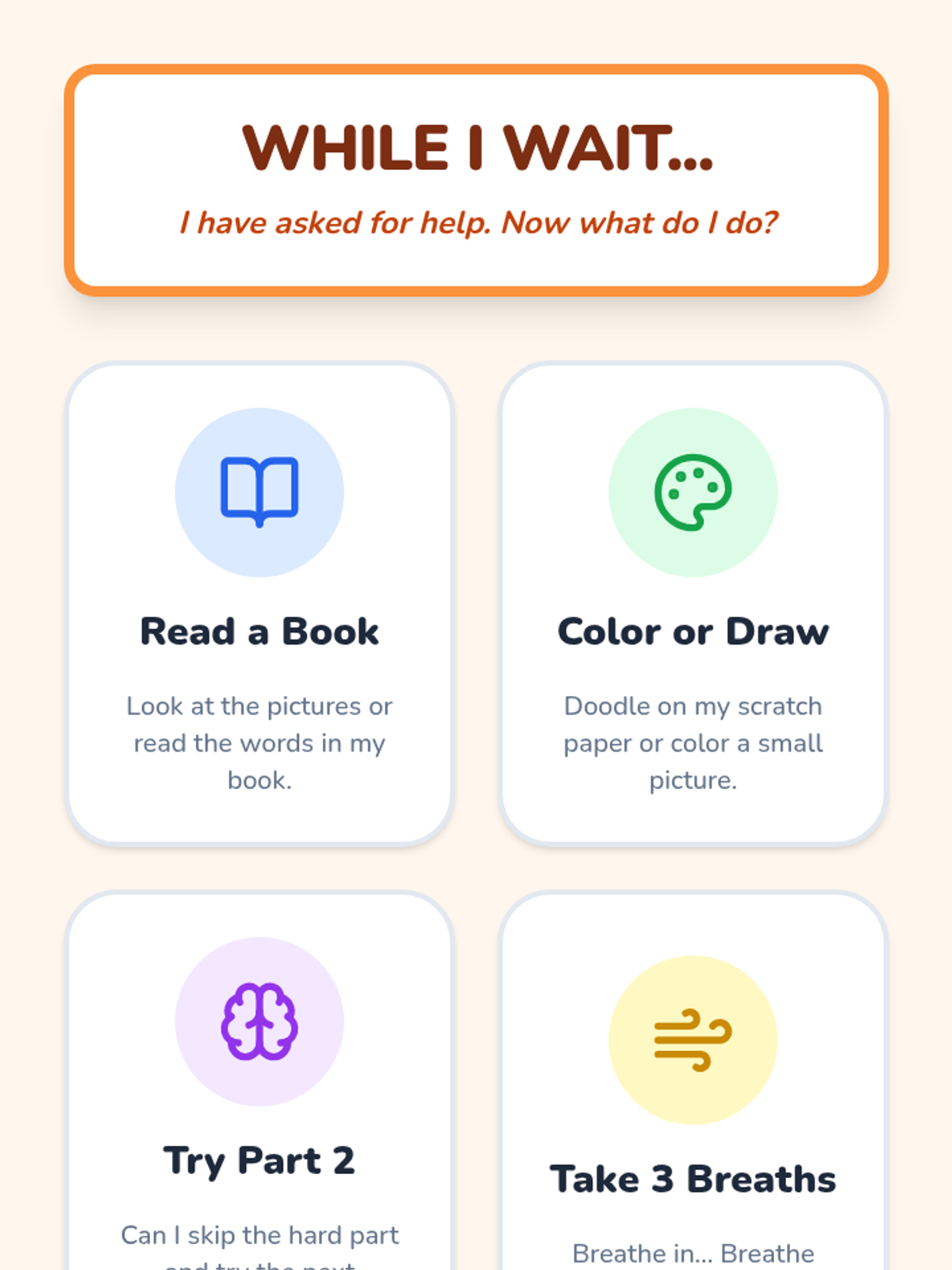
A visual choice board for students to use while waiting for assistance, providing four productive 'while I wait' activities.
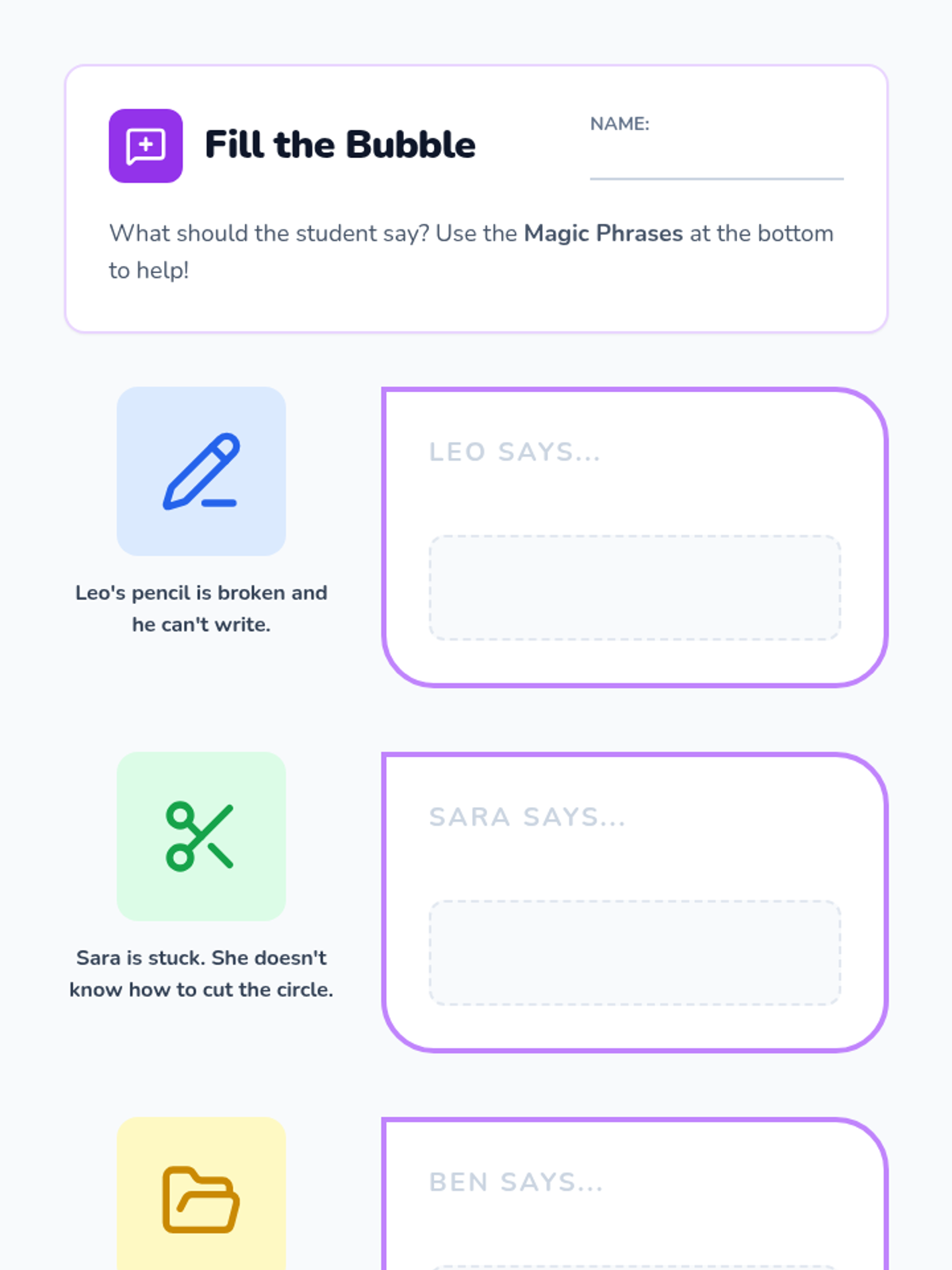
A speech bubble worksheet where students practice writing or selecting appropriate help-seeking phrases for specific classroom scenarios.
Visual slide deck for Lesson 3 teaching specific phrasing for help-seeking, moving from complaints to requests.
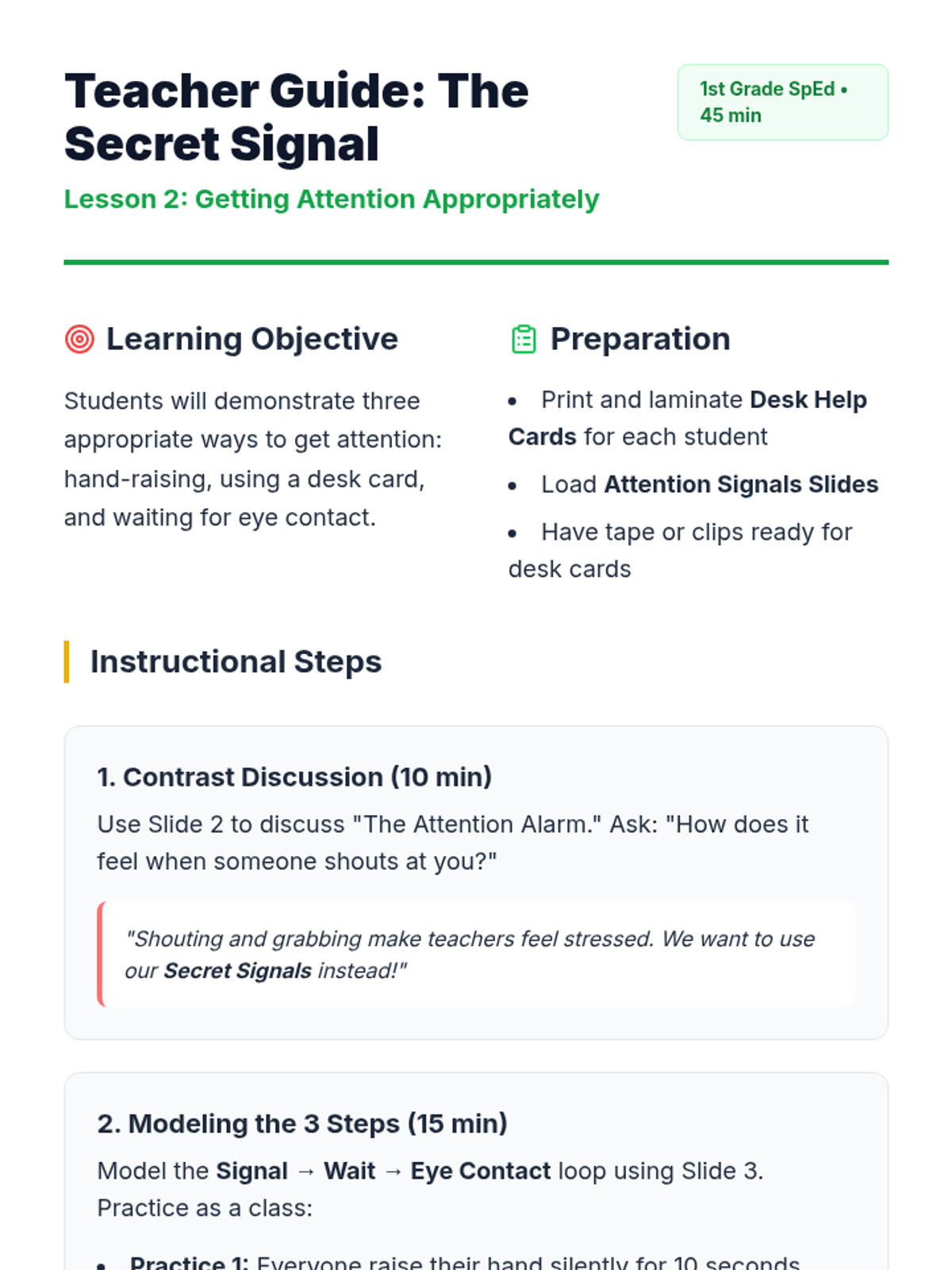
Teacher facilitation guide for Lesson 2, focusing on getting attention appropriately and using the Desk Help Cards.
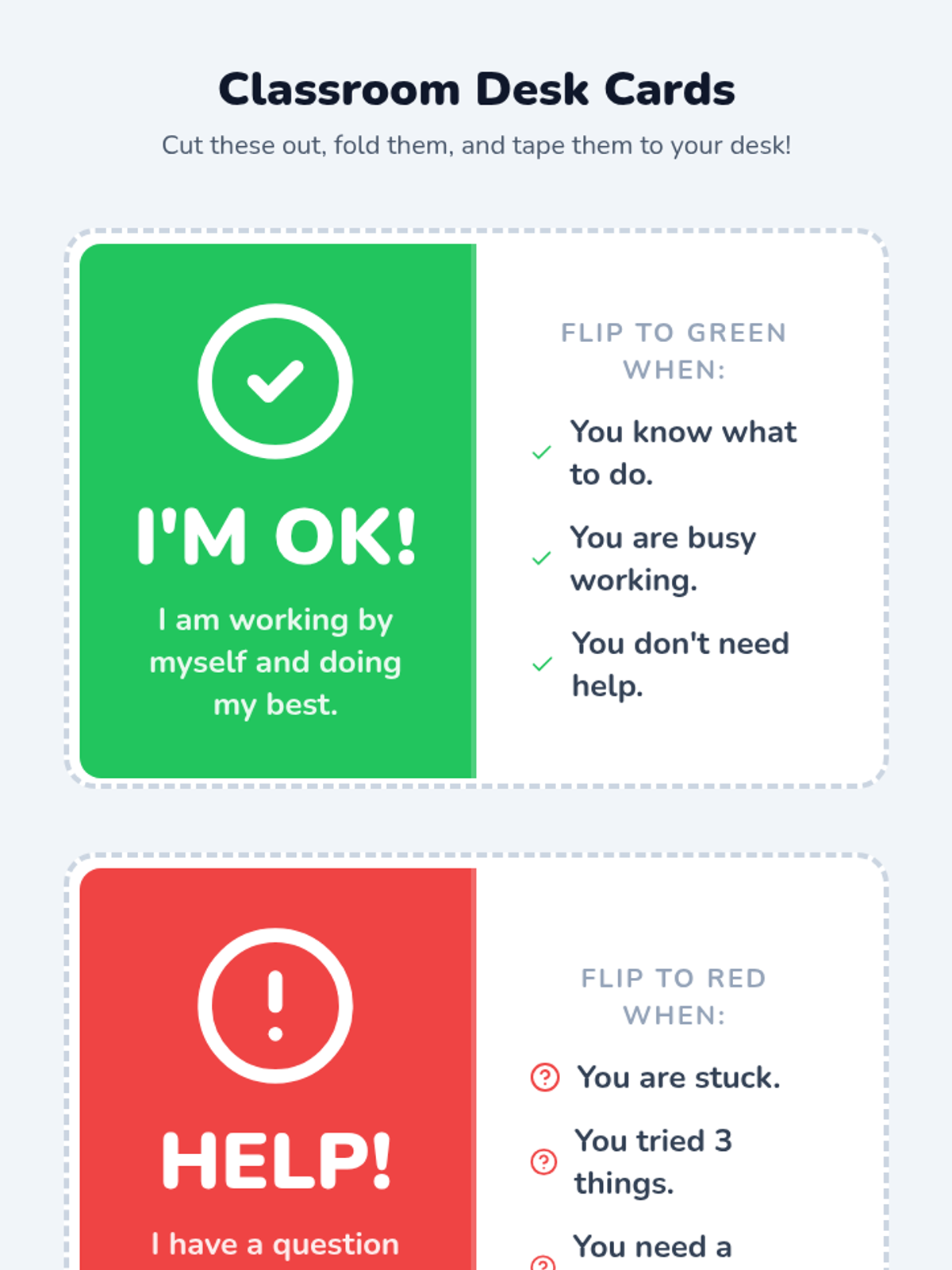
Printable double-sided desk cards for students to signal their status (Green for 'working independently', Red for 'needs help'). A vital non-verbal communication tool for the classroom.
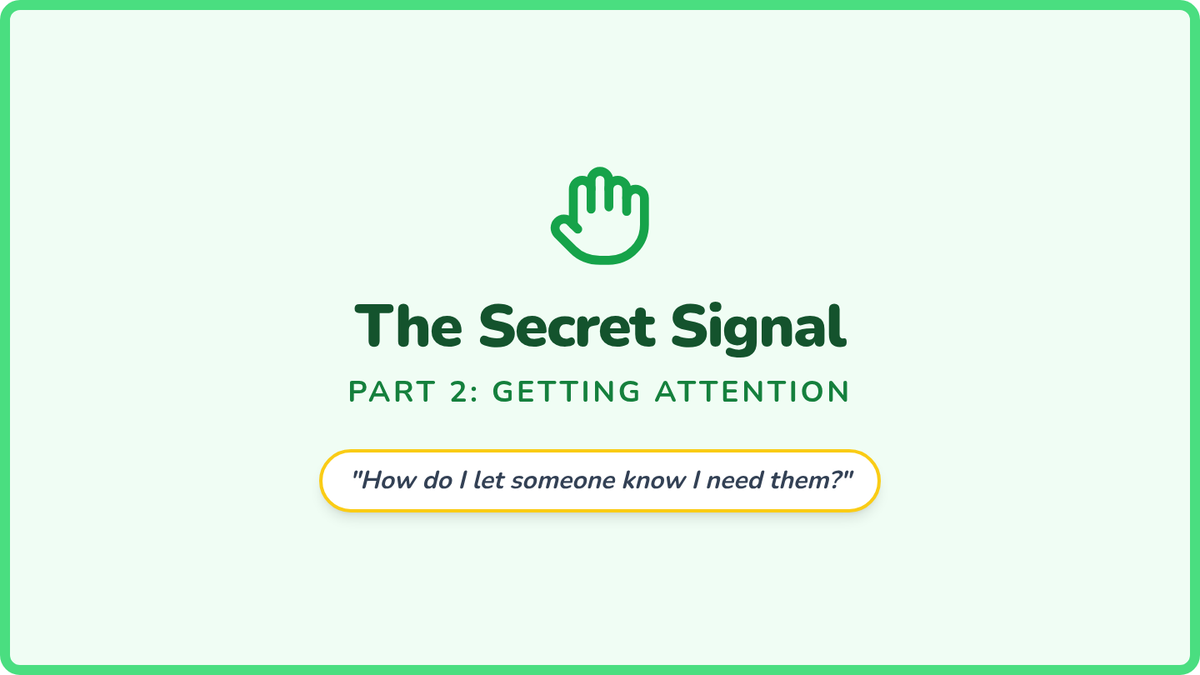
Visual slide deck for Lesson 2 teaching appropriate ways to get attention, contrasting shouting/grabbing with signaling and waiting.
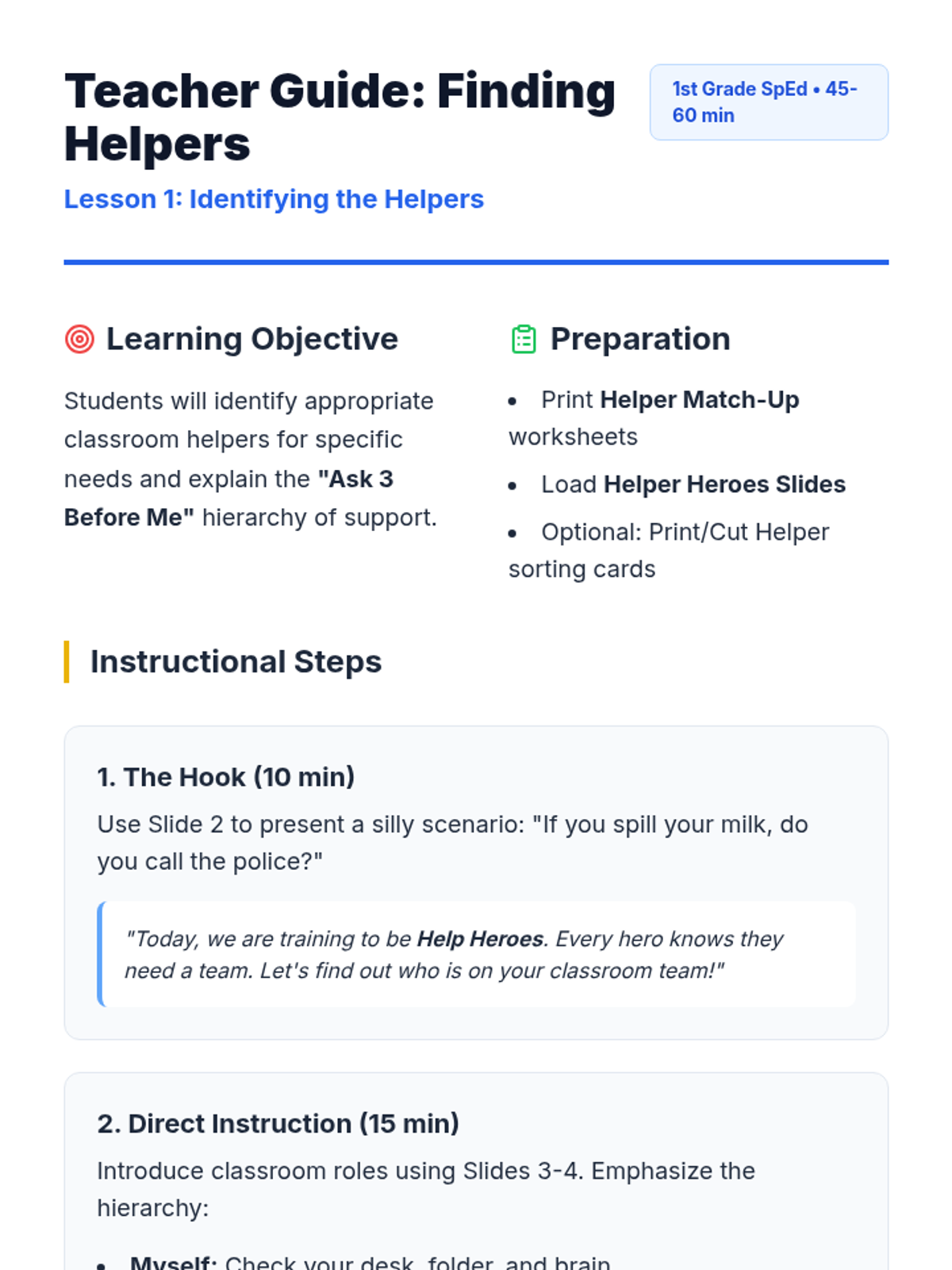
Teacher facilitation guide for Lesson 1, including instructional steps, differentiation tips, and classroom management strategies for the 'Ask 3 Before Me' rule.
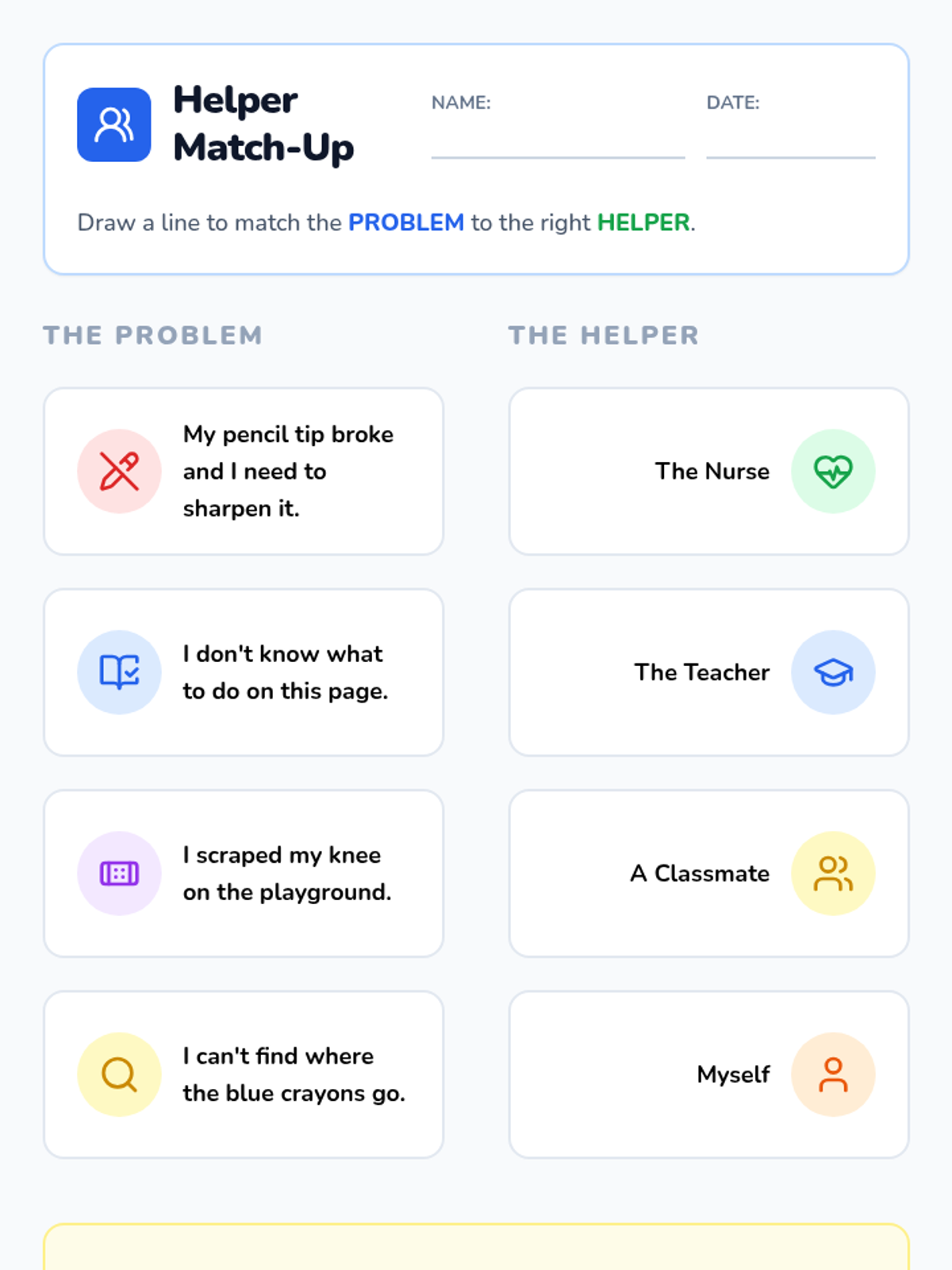
A matching activity worksheet for students to identify appropriate helpers for common classroom problems. Includes a section for reflecting on the 'Ask 3 Before Me' rule.
Introductory slide deck for identifying classroom helpers and understanding the 'Ask 3 Before Me' rule. features visual cues and large font sizes for accessibility.
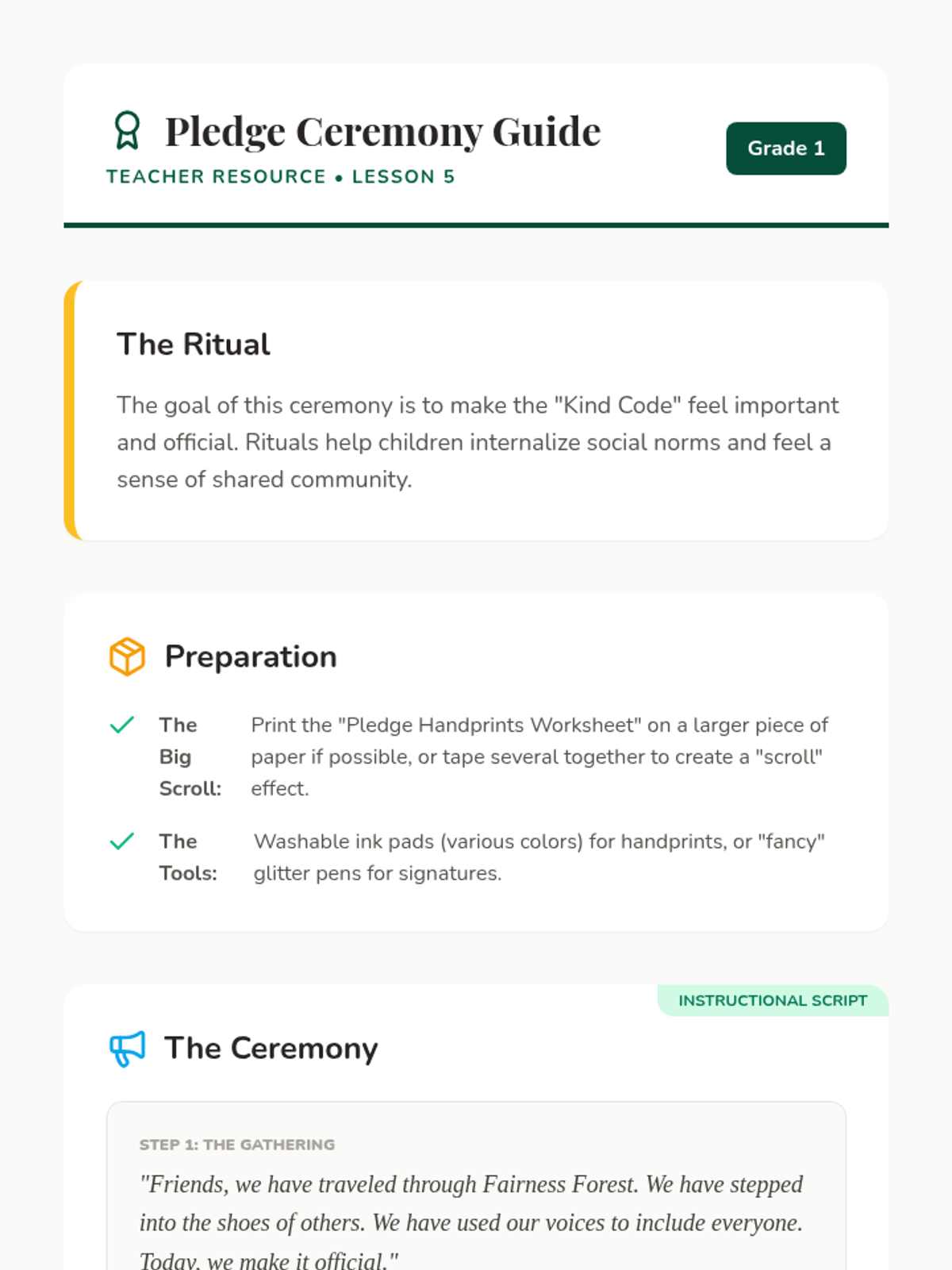
A teacher guide for the classroom inclusion pledge ceremony. Includes preparation tips and a script to make the event feel formal and significant for 1st graders.
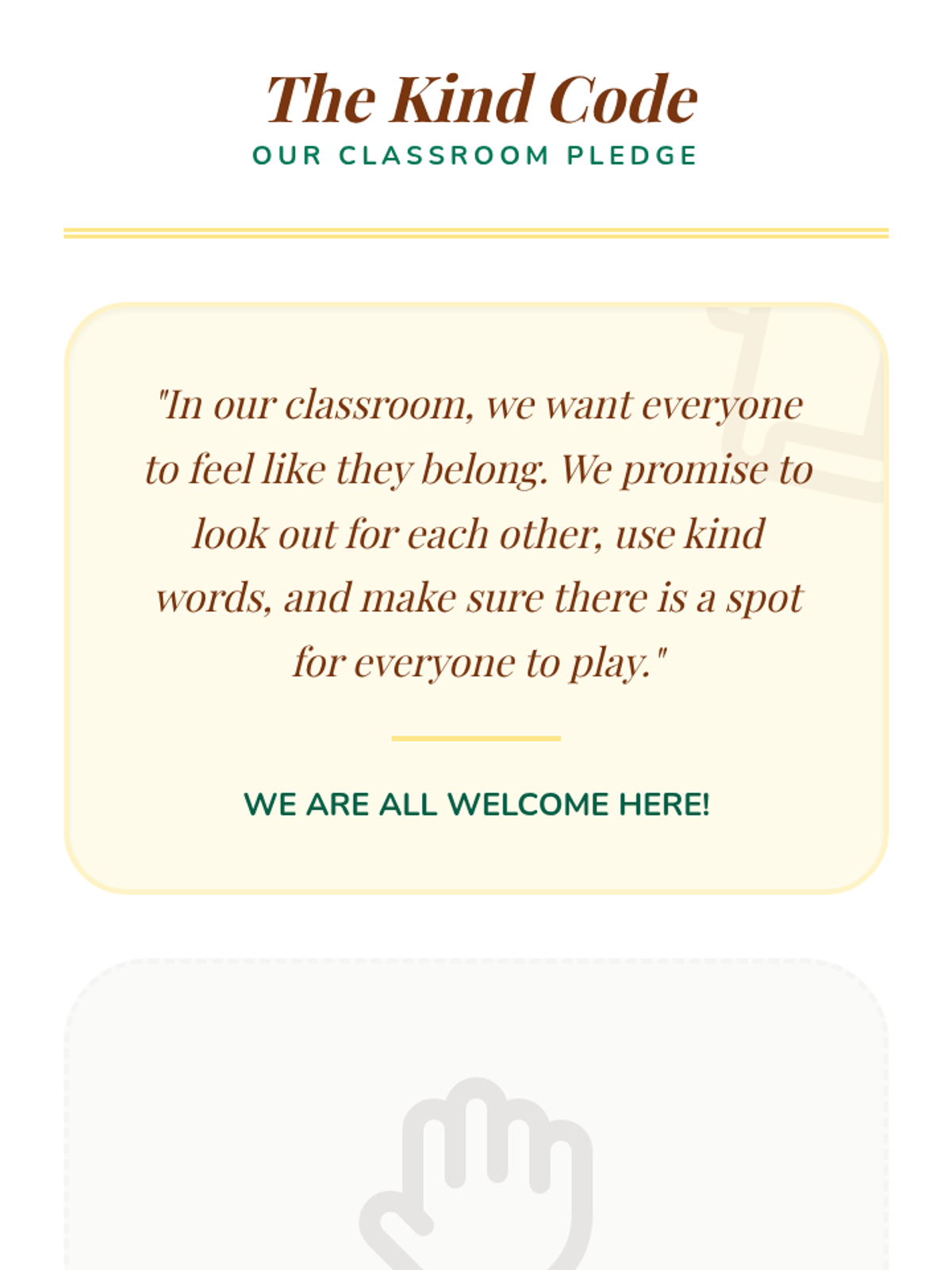
A classroom inclusion pledge for students to 'sign' with a handprint or name. It formalizes their commitment to the inclusive behaviors learned throughout the sequence.
A slide deck for Lesson 5 summarizing the sequence and guiding the co-creation of the classroom inclusion pledge.
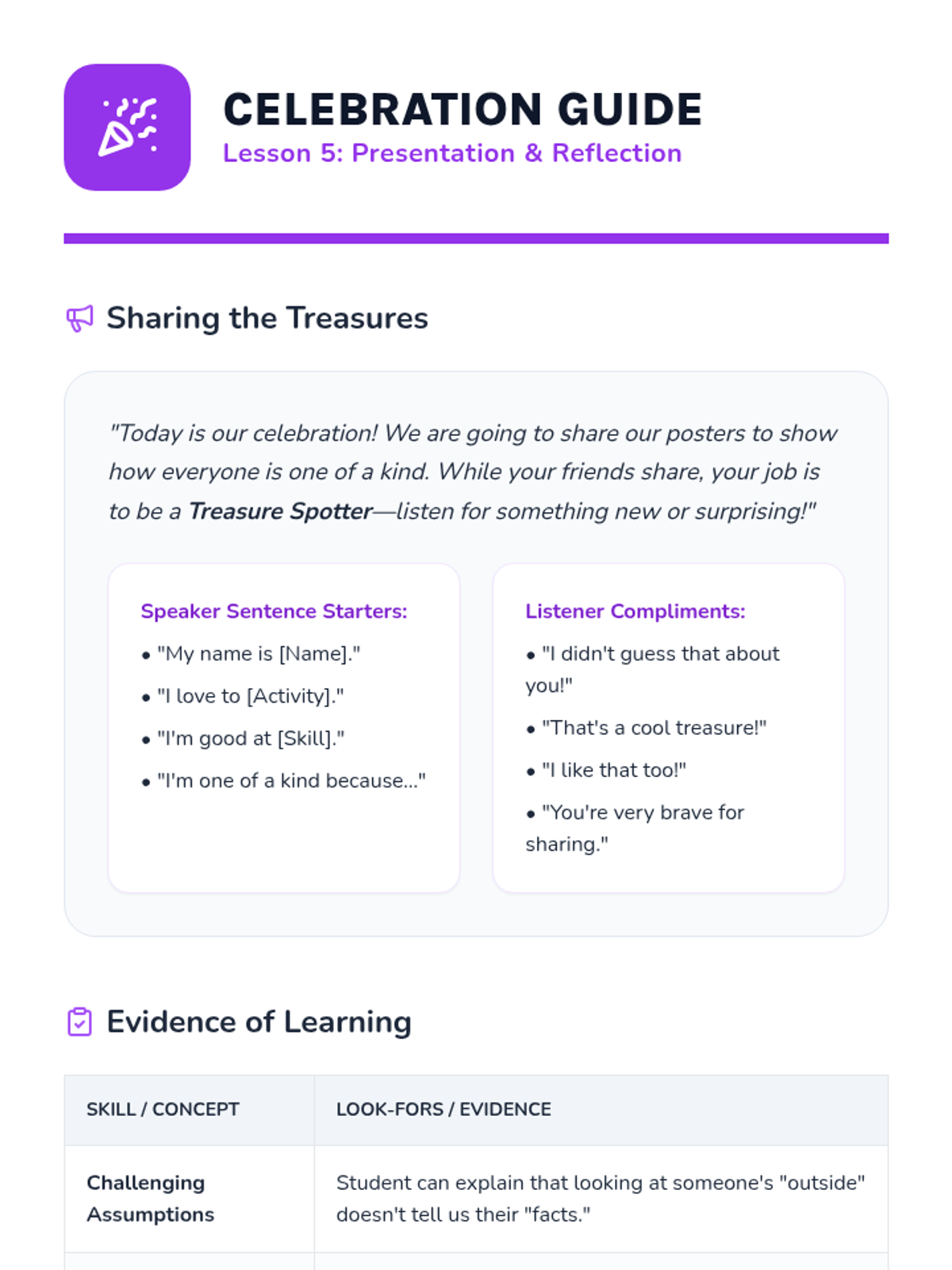
Teacher facilitation guide for the final celebration. Includes presentation sentence starters, a reflection checklist for learning outcomes, and closing discussion prompts.
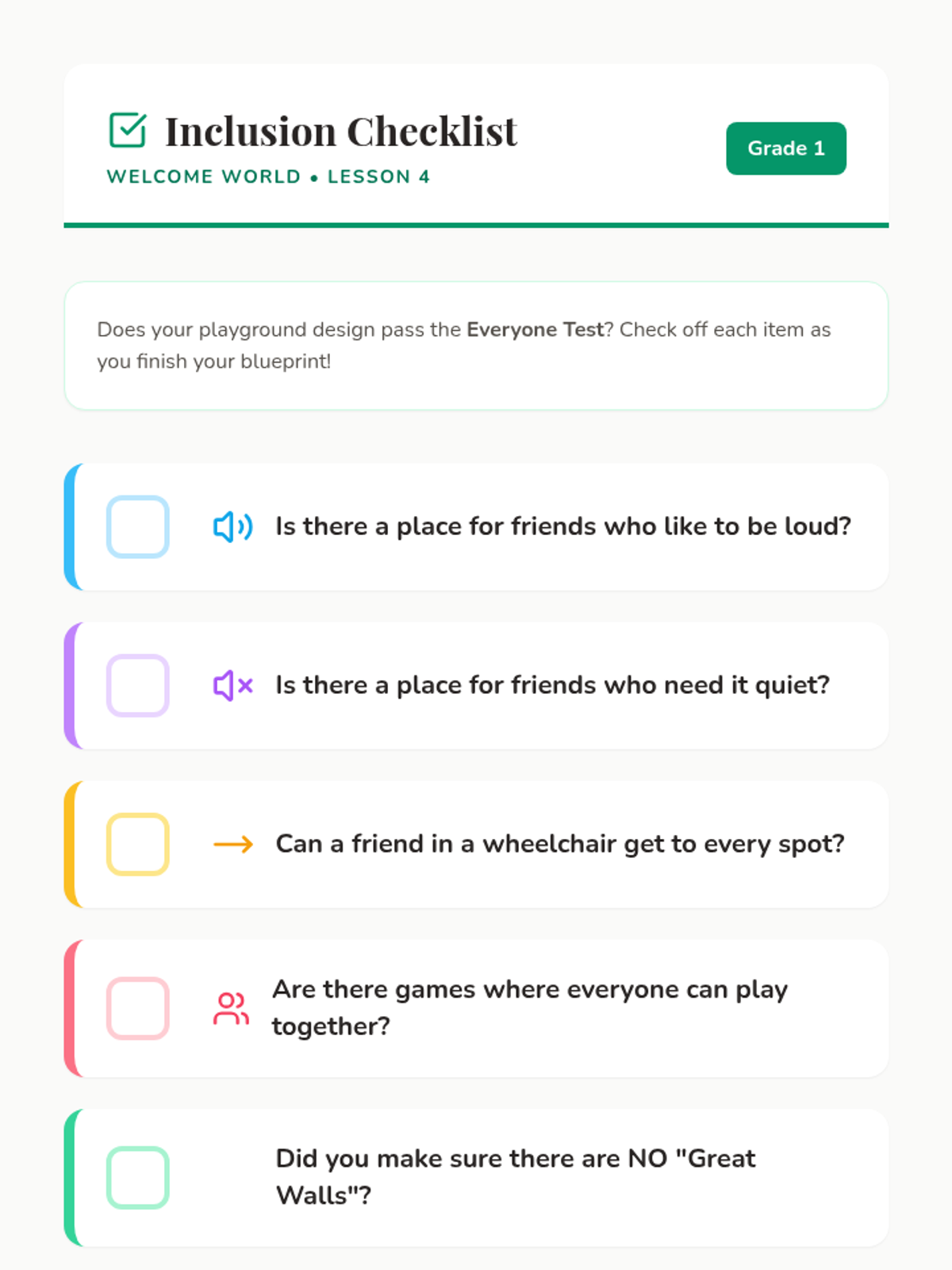
A checklist for students to self-assess their inclusive playground designs, ensuring features for different social and physical needs are included.
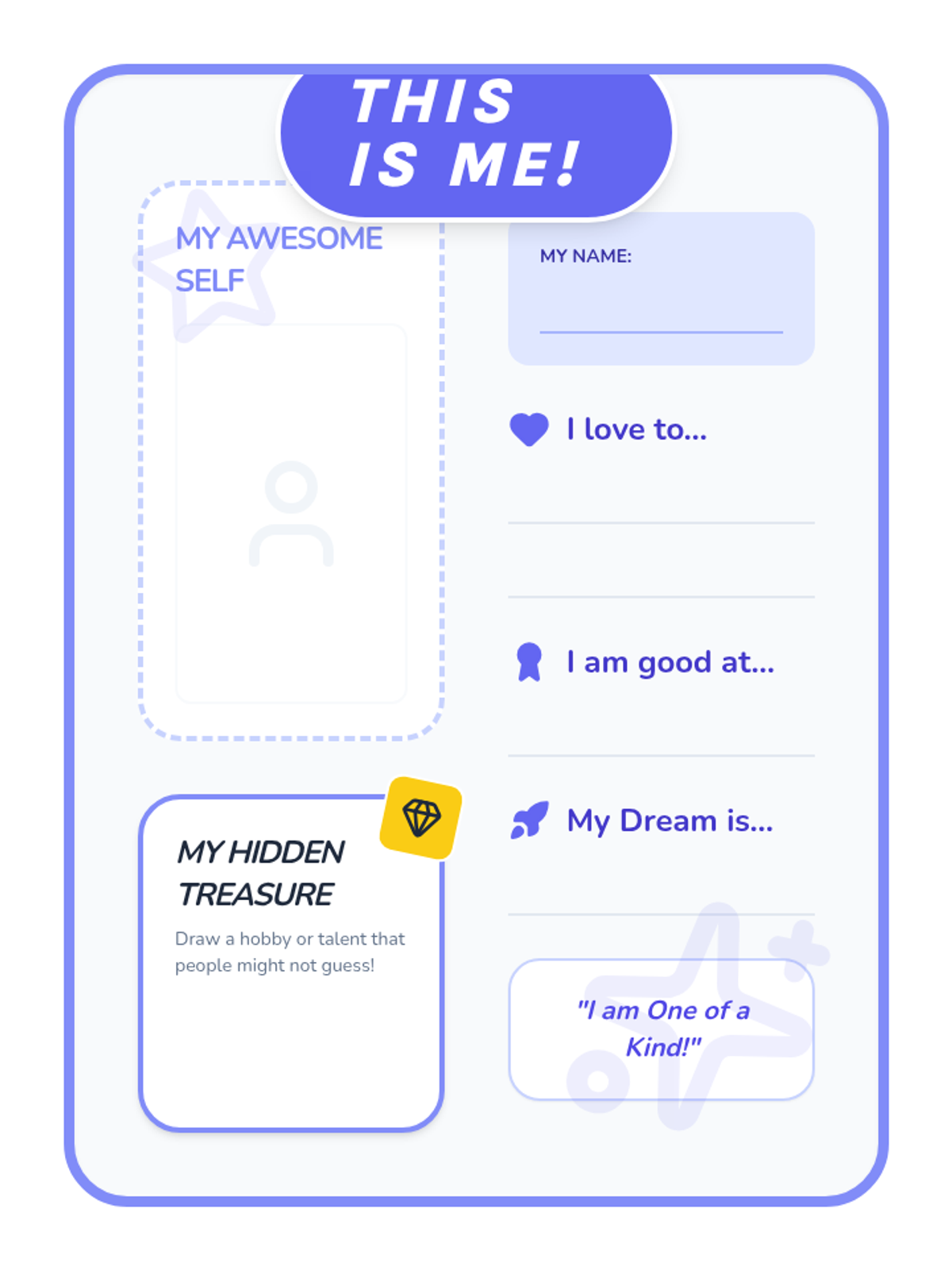
Student worksheet/project template for Lesson 5. Students showcase their personal identity, interests, and talents on a "This is Me" poster.
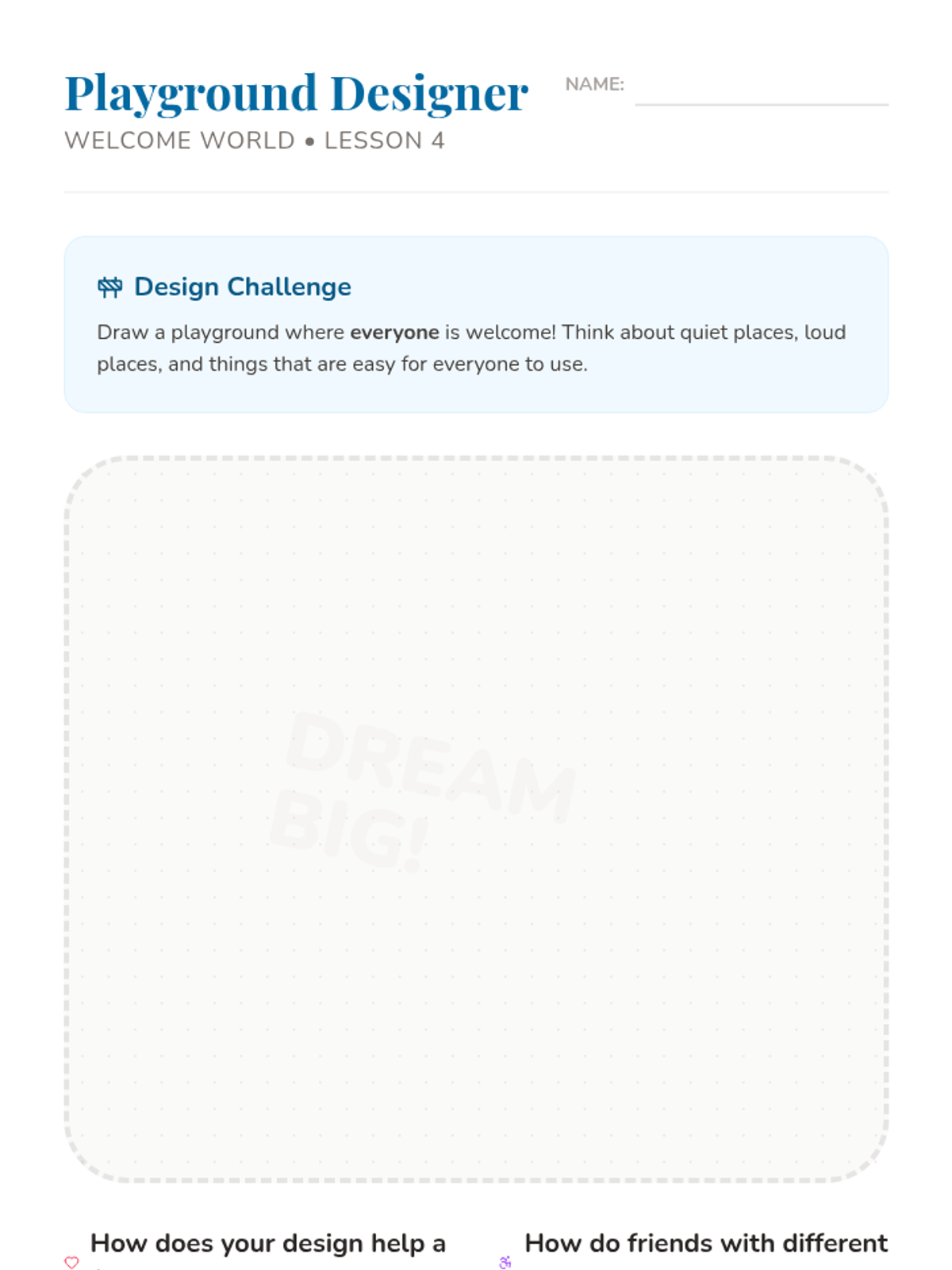
A student design sheet for creating an inclusive playground model. Includes prompts for explaining accessibility and social inclusion features.
Instructional slides for Lesson 3: Designing the Sunshine Kit, guiding students through the decoration and curation process.
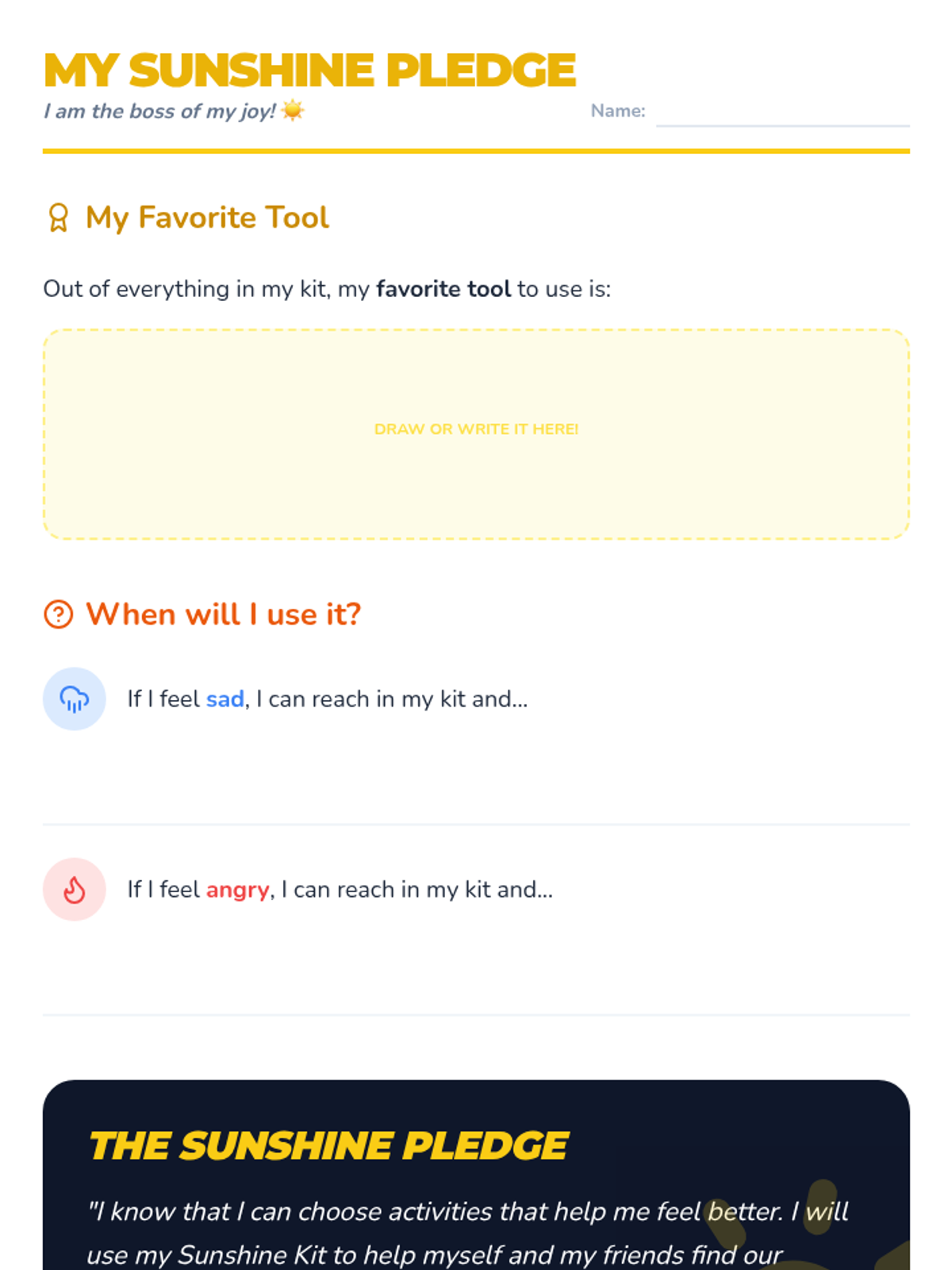
Student reflection sheet for the end of the project. Includes a personal favorite tool drawing area, application scenarios, and a 'Sunshine Pledge'.
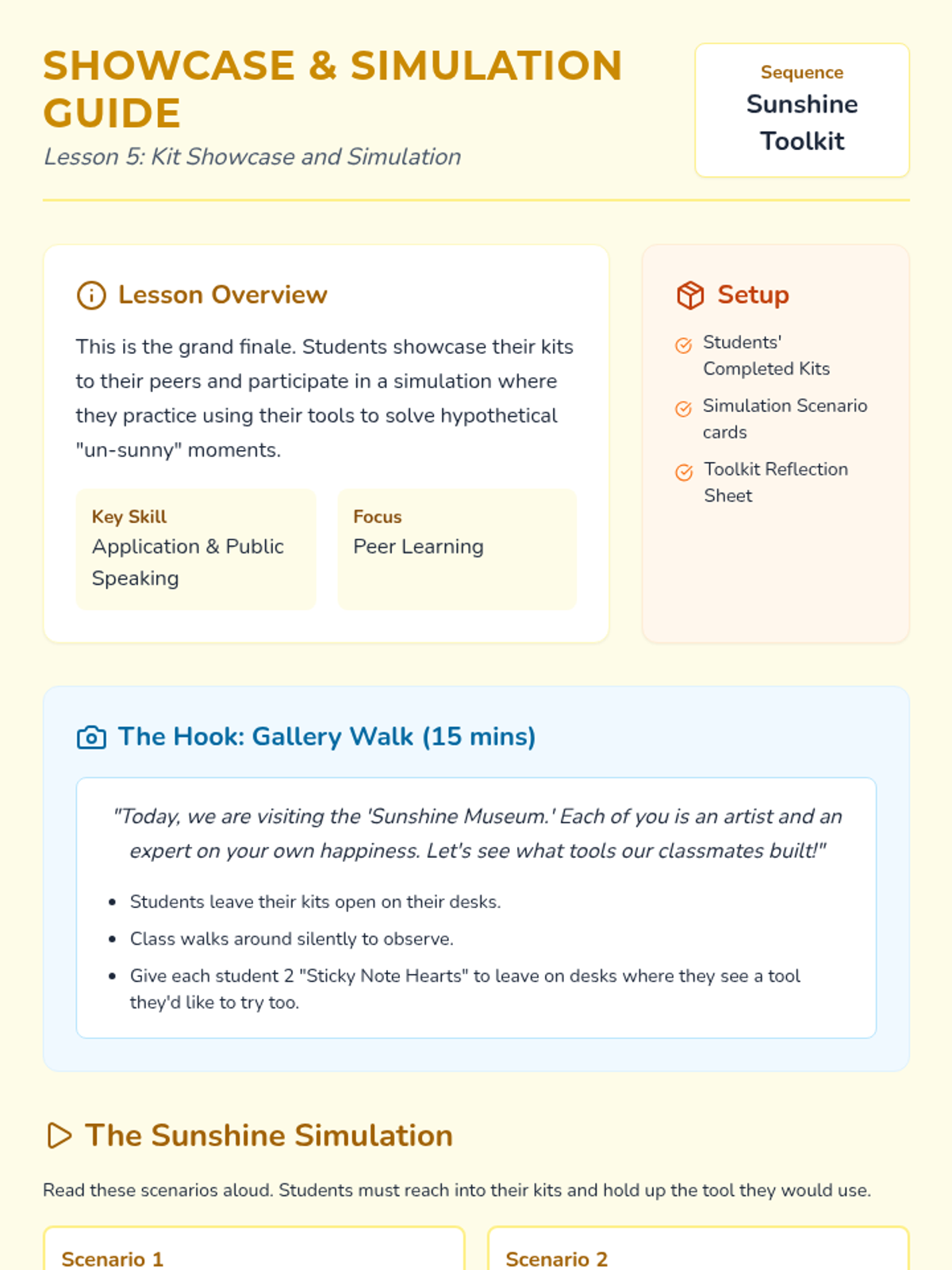
Teacher guide for the culminating Lesson 5: Kit Showcase and Simulation. Includes Gallery Walk instructions and simulation scenarios for practicing kit use.
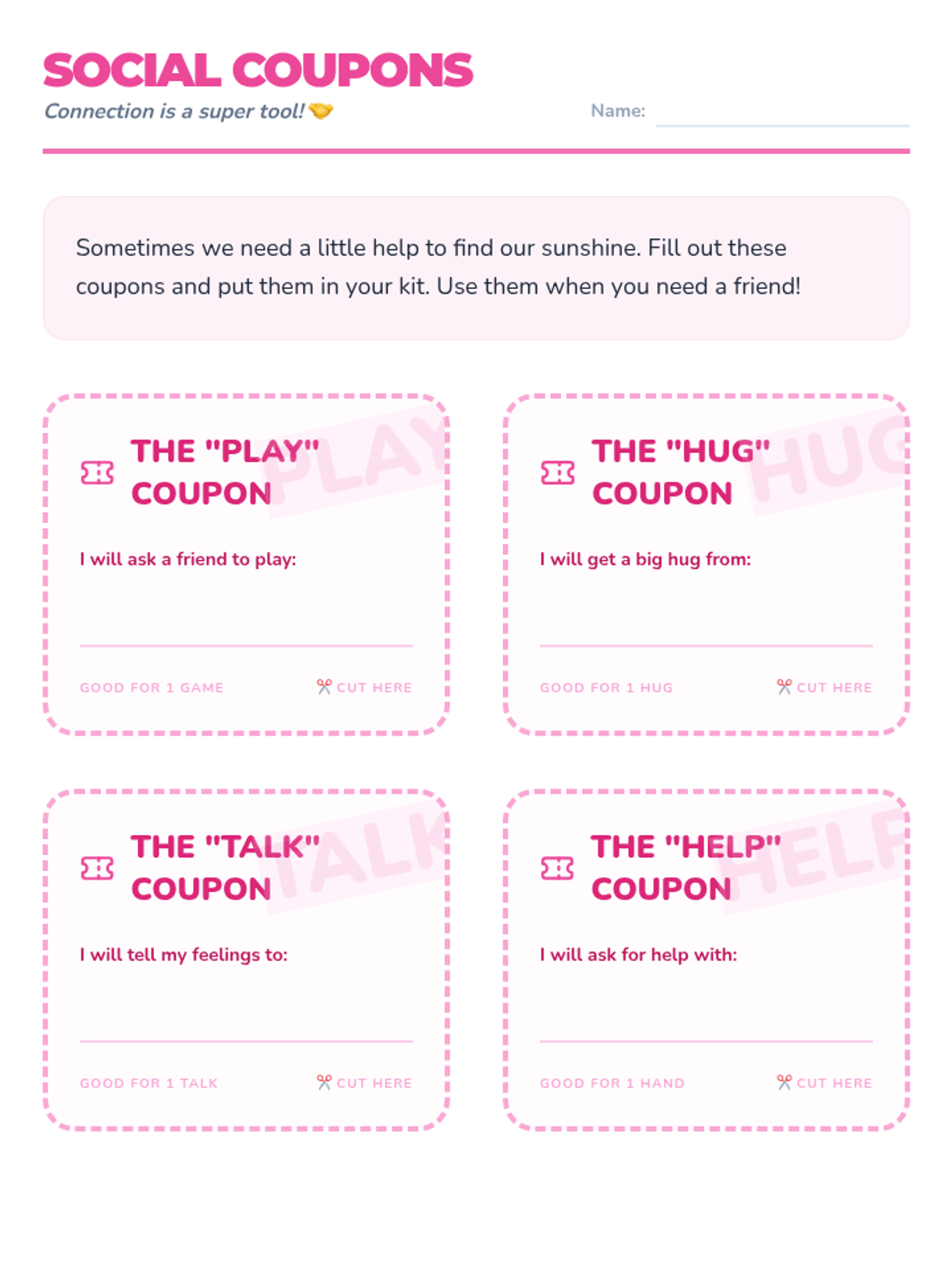
Student worksheet featuring customizable social coupons (play, hug, talk, help) to be cut out and added to their Sunshine Kits.
Instructional slides for Lesson 4: Connecting with Others, highlighting the role of social interaction in emotional well-being.
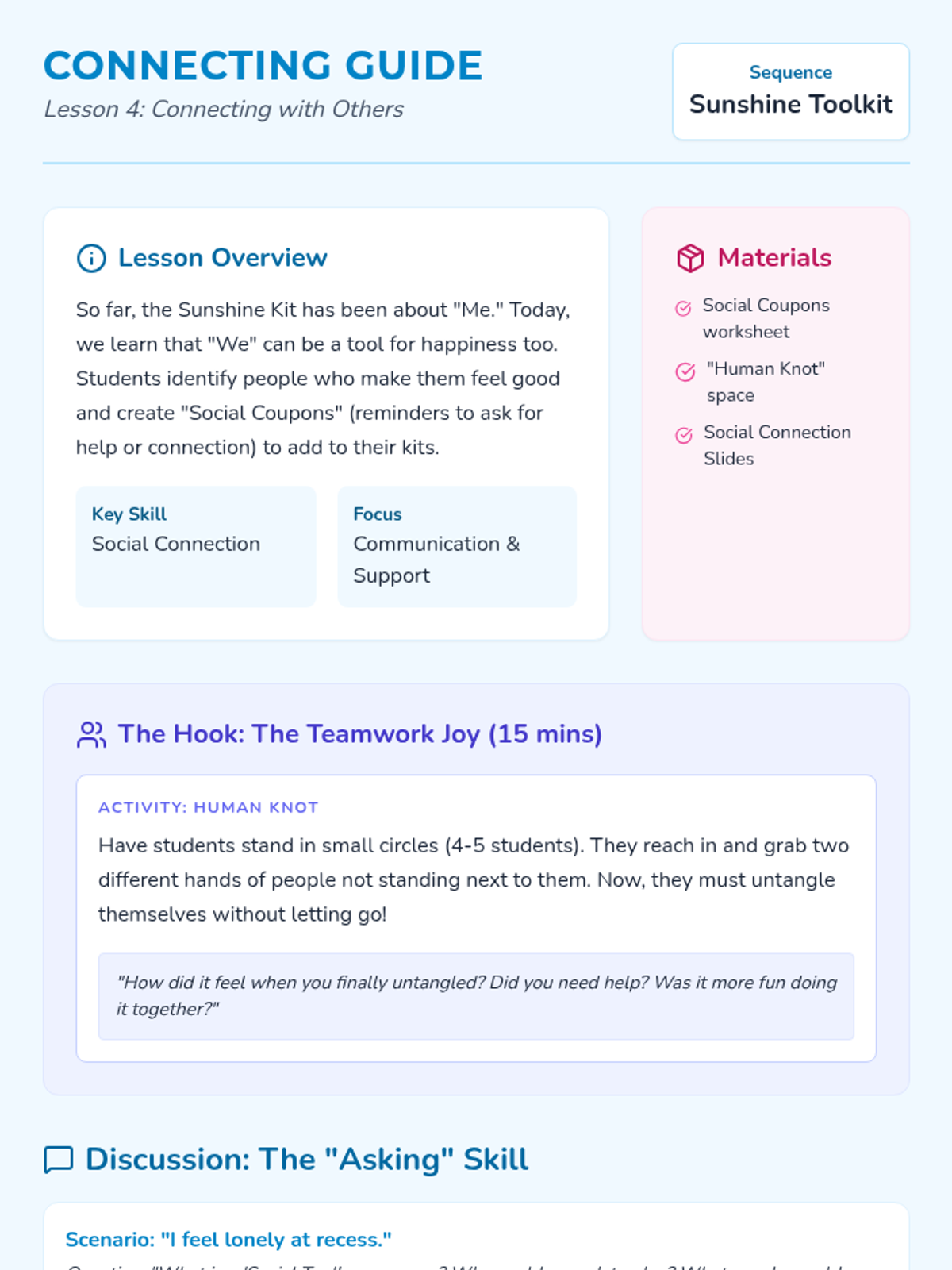
Teacher guide for Lesson 4: Connecting with Others. Includes the 'Human Knot' hook, discussion scenarios for asking for help, and instructions for Social Coupons.
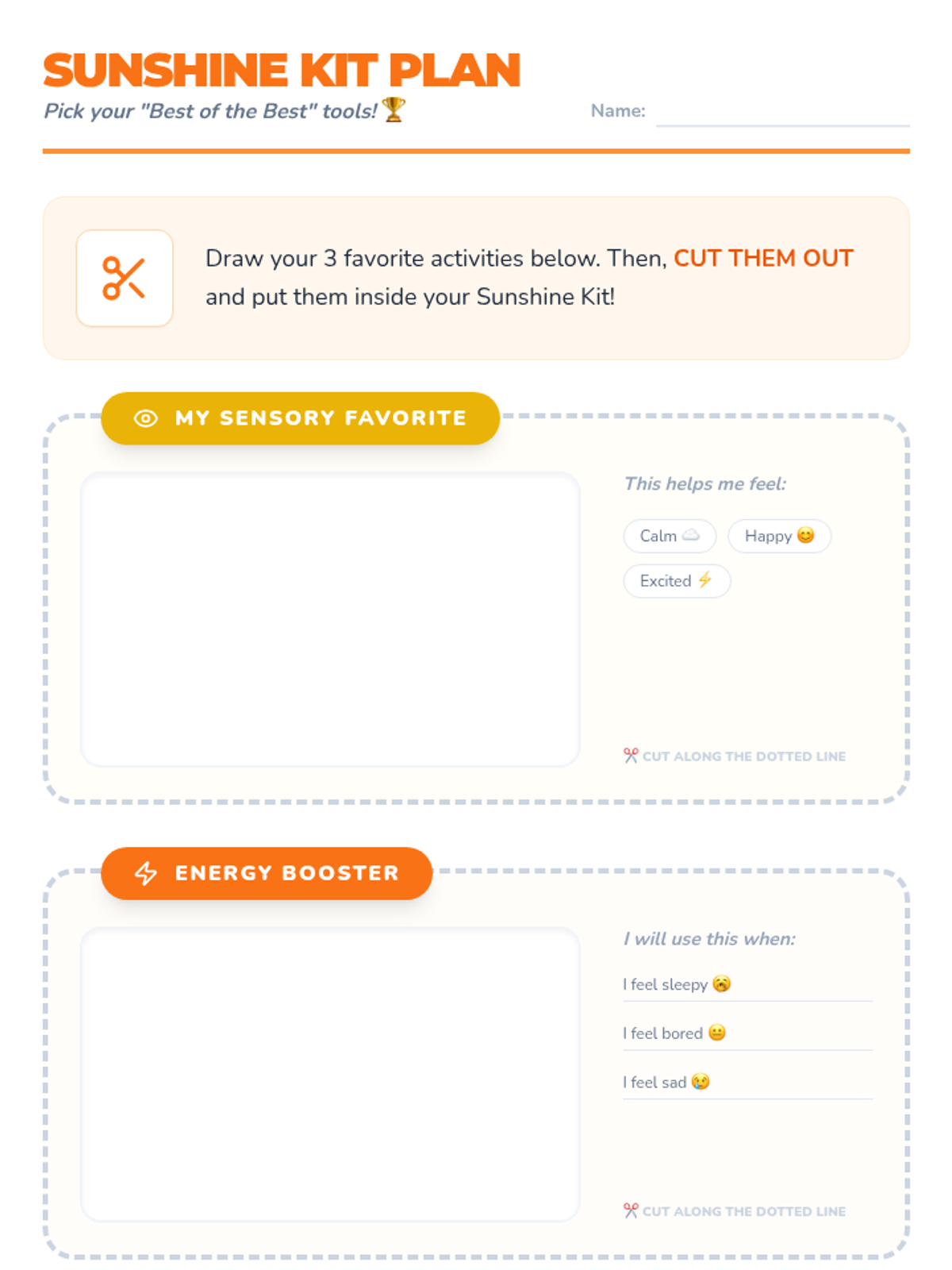
Student planning and creation worksheet for selecting favorite sensory and movement activities to include in their physical Sunshine Kit. Cards are designed to be cut out.
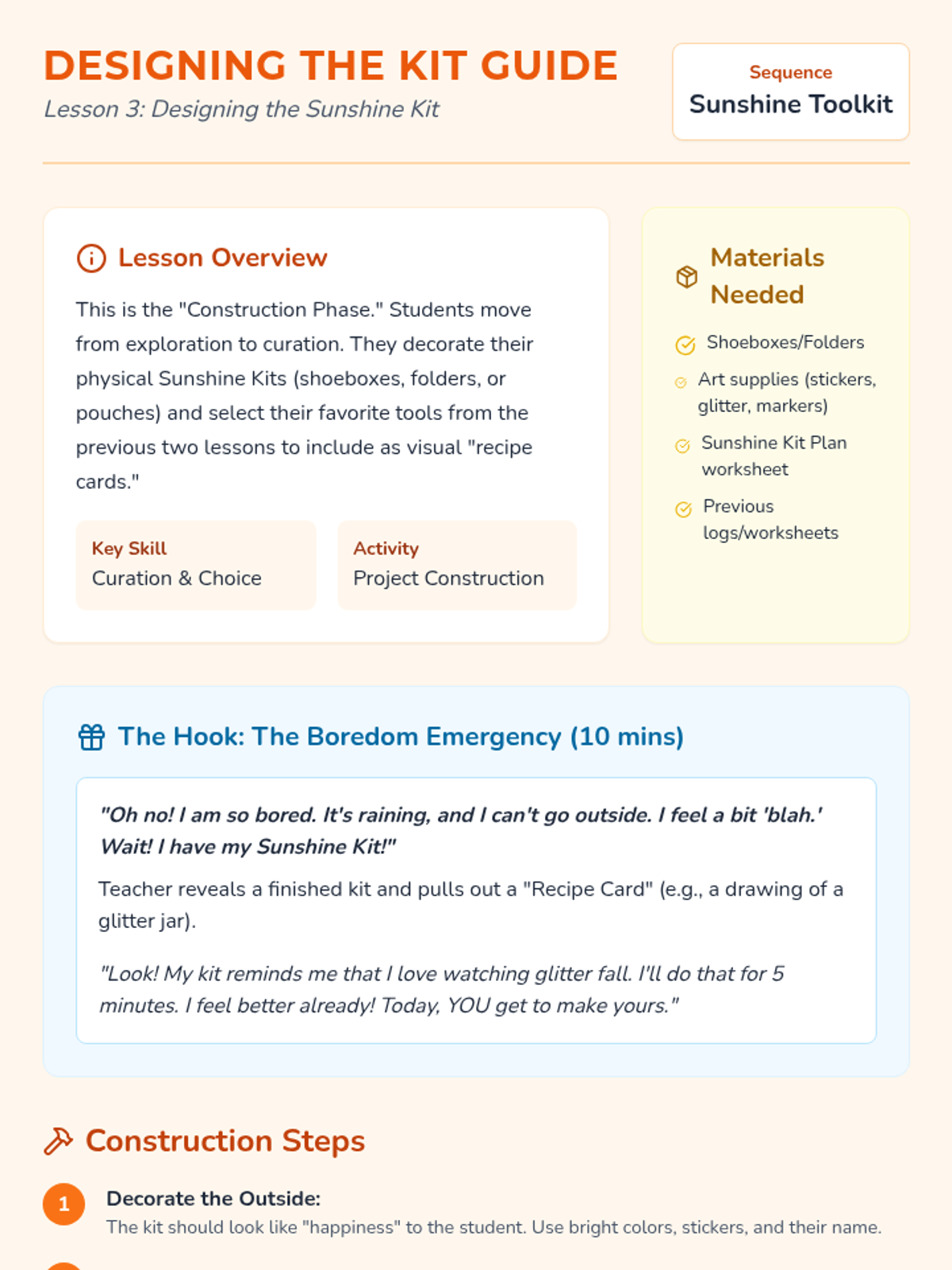
Teacher guide for Lesson 3: Designing the Sunshine Kit. Includes the 'Boredom Emergency' hook and step-by-step instructions for kit construction.
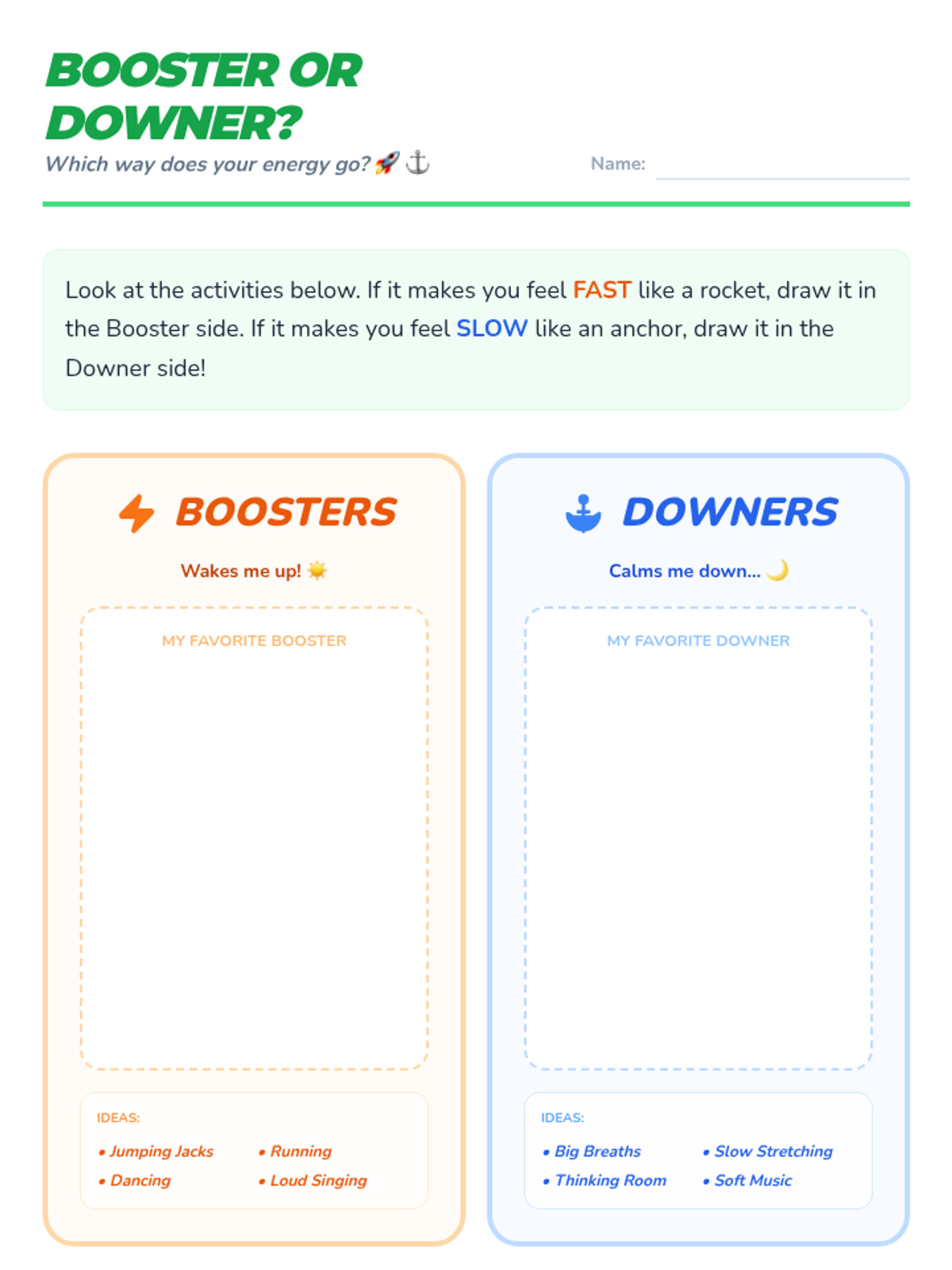
Student worksheet for classifying physical activities as Energy Boosters or Calm Downers. Includes drawing spaces and visual cues for 1st-grade students.
Instructional slides for Lesson 2: Movement and Energy Shifts, teaching students to categorize physical activities as Energy Boosters or Calm Downers.
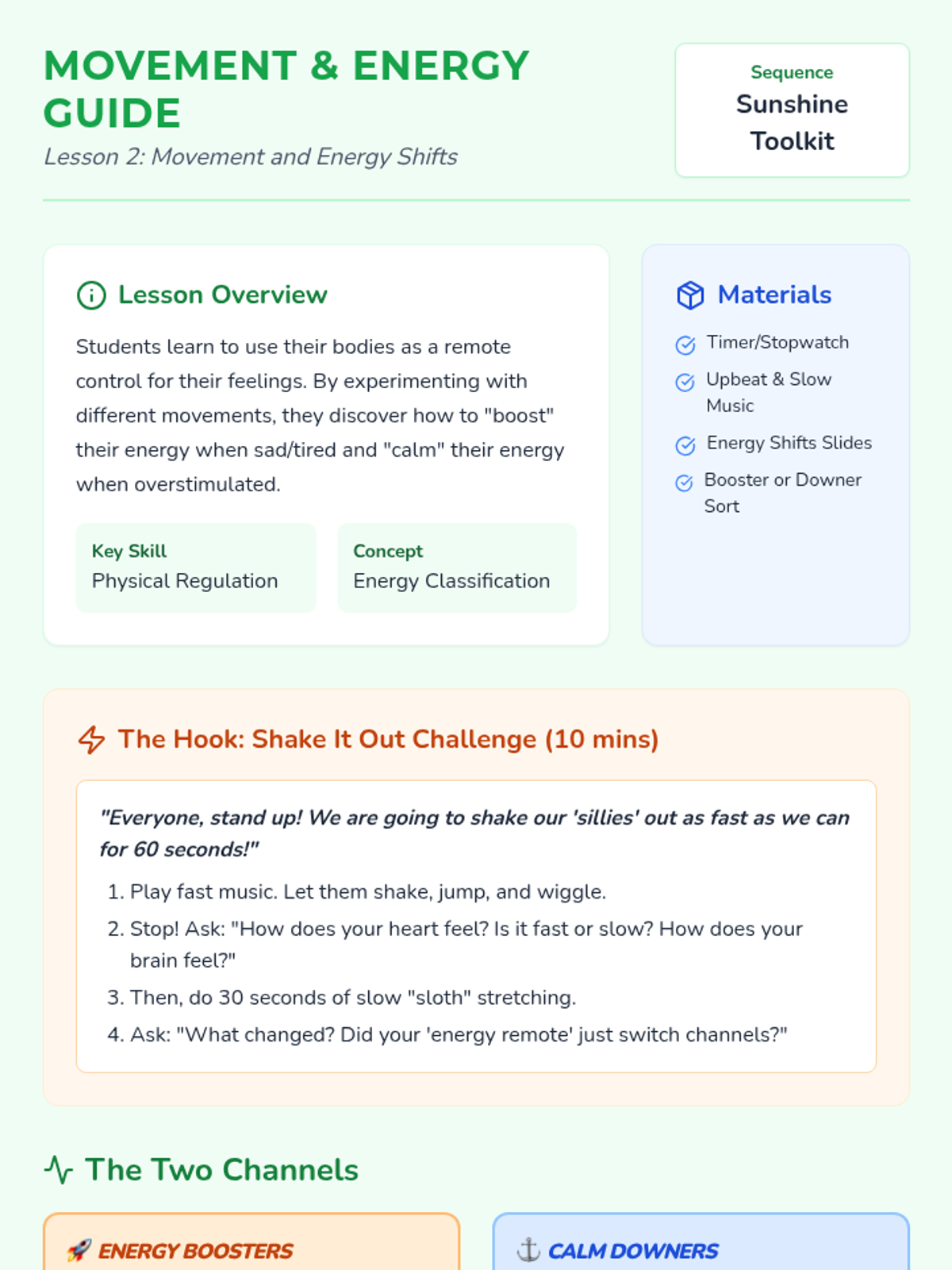
Teacher guide for Lesson 2: Movement and Energy Shifts. Includes instructions for the 'Shake It Out' hook and definitions for Energy Boosters and Calm Downers.
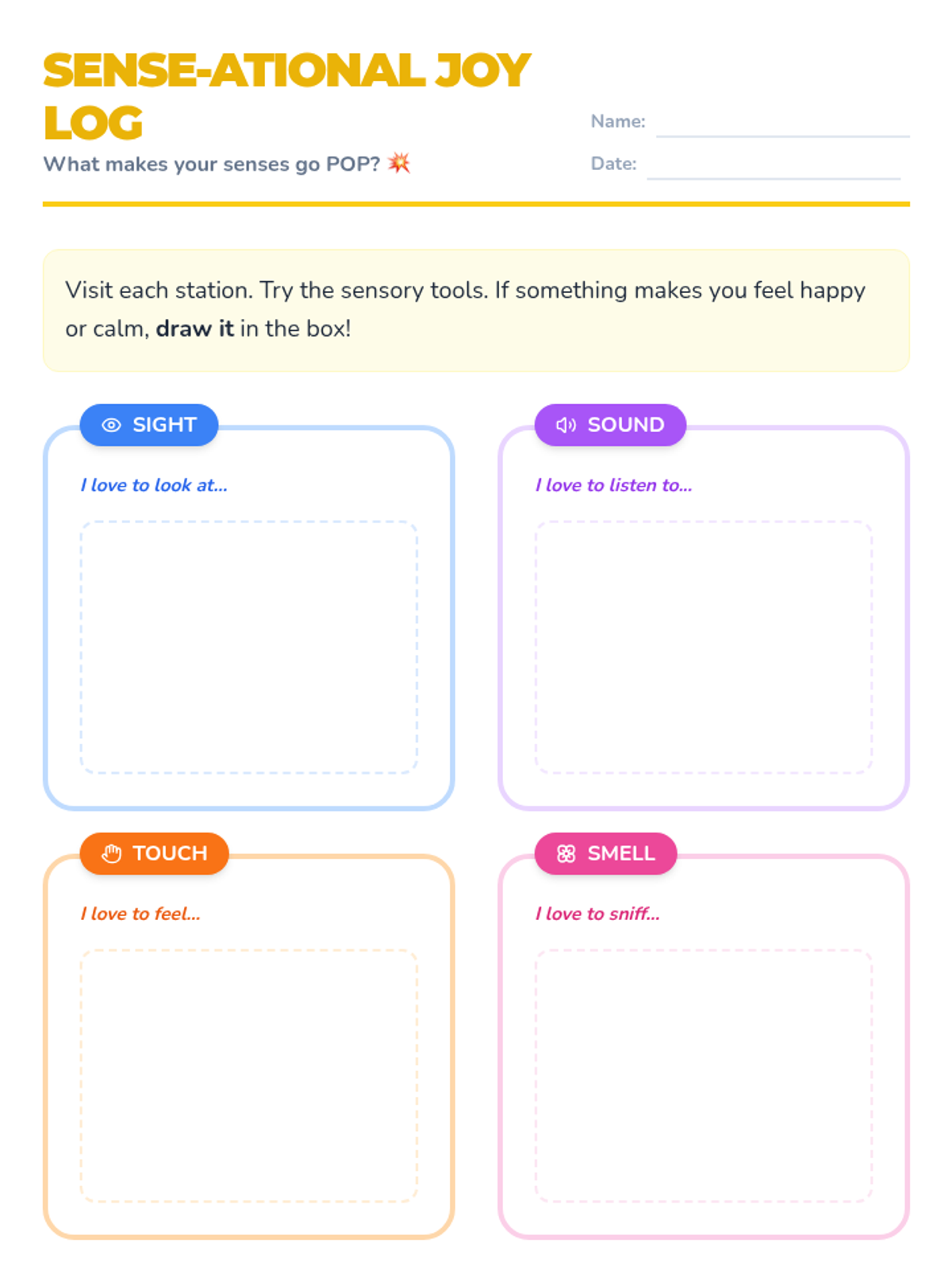
Student station rotation worksheet for recording sensory preferences through drawing. High-contrast labels and clear boundaries for 1st-grade motor skills.
Instructional slides for Lesson 1: Exploring Sensory Joy, introducing the concept of the Sunshine Kit and the five senses as emotional regulation tools.
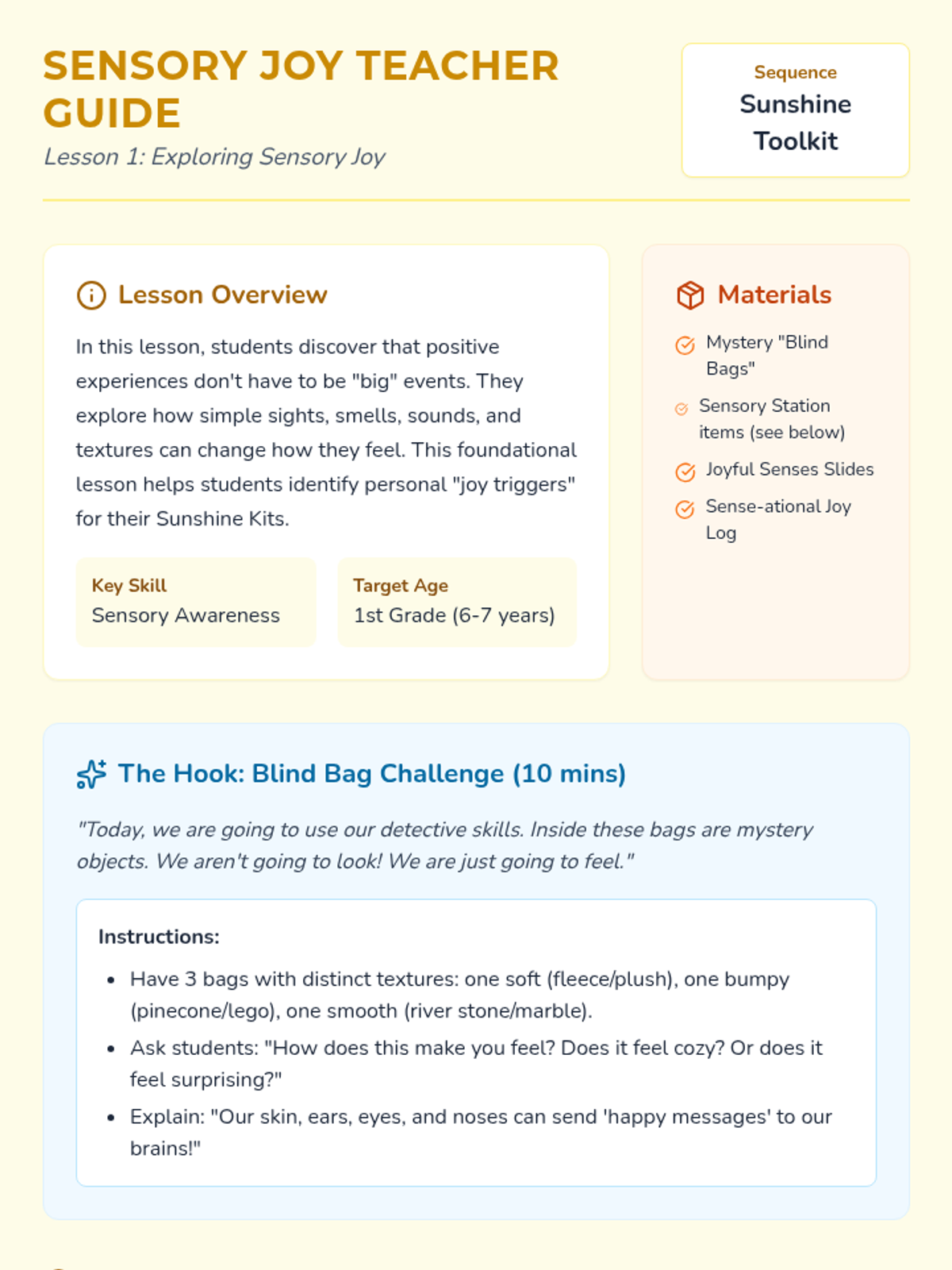
Teacher guide for Lesson 1: Exploring Sensory Joy, including setup for sensory stations, hook instructions, and discussion prompts for 1st-grade students.
A vibrant 7-slide visual presentation including new 'We Will' and 'I Will' statements, and a dedicated definition slide for charity.
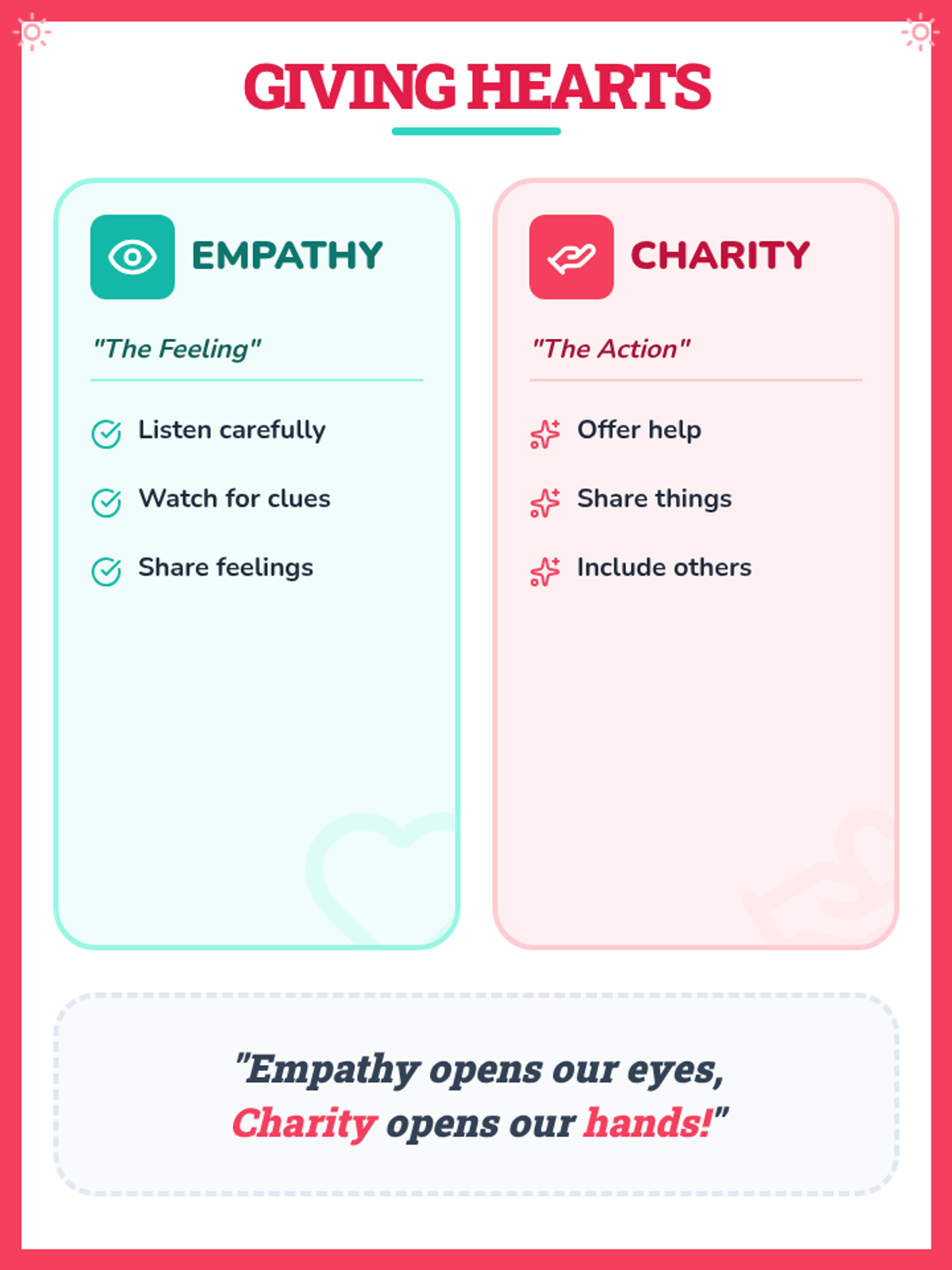
A bold, visual anchor chart for classroom display that reinforces the connection between empathy (the feeling) and charity (the action) with clear examples.
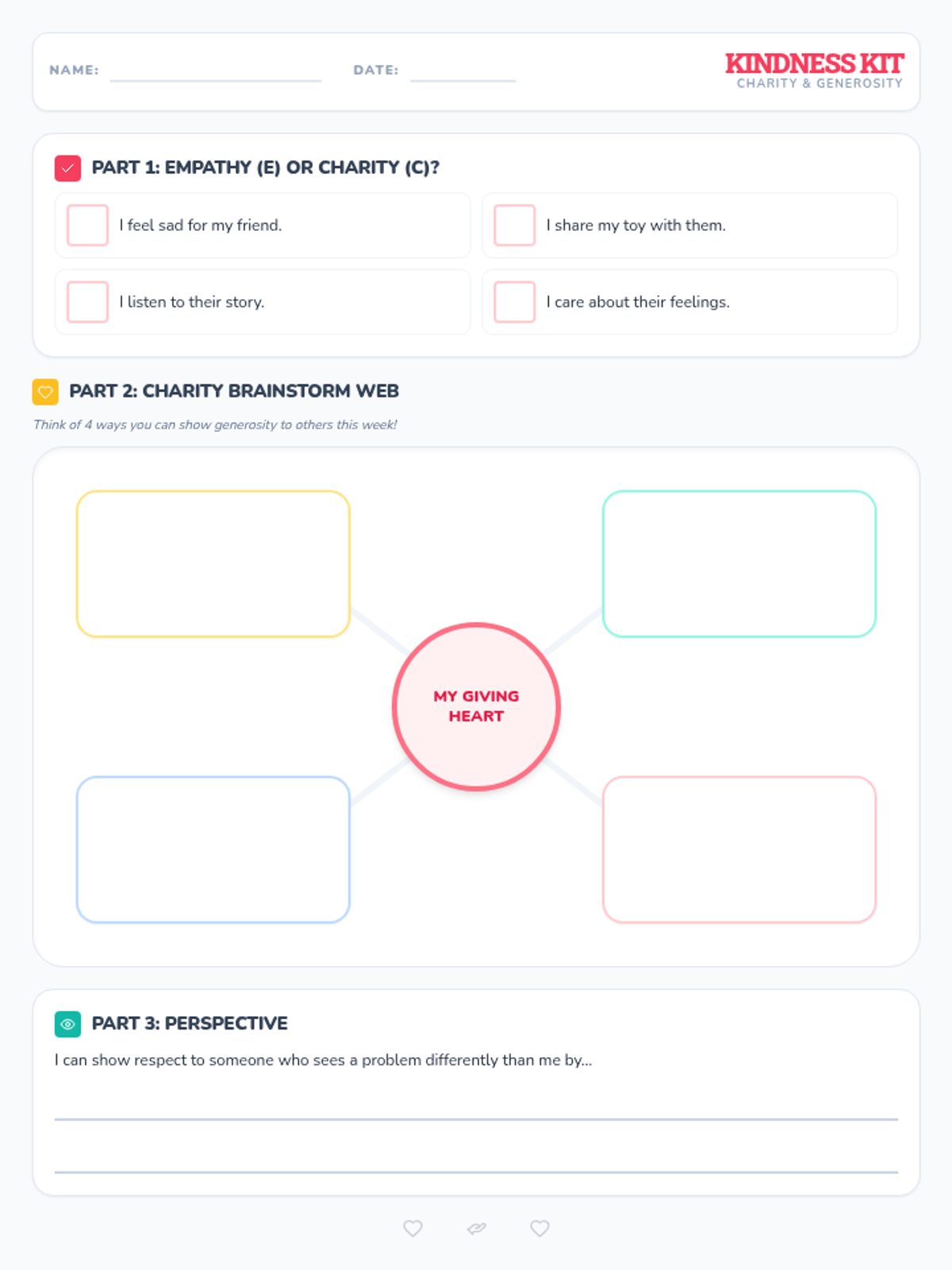
A student-facing worksheet featuring a categorization task to distinguish empathy from charity, a visual brainstorming web for identifying acts of generosity, and a reflection prompt on perspective-taking.
A vibrant 6-slide visual presentation including new 'We Will' and 'I Will' statements to frame the lesson goals and student accountability.
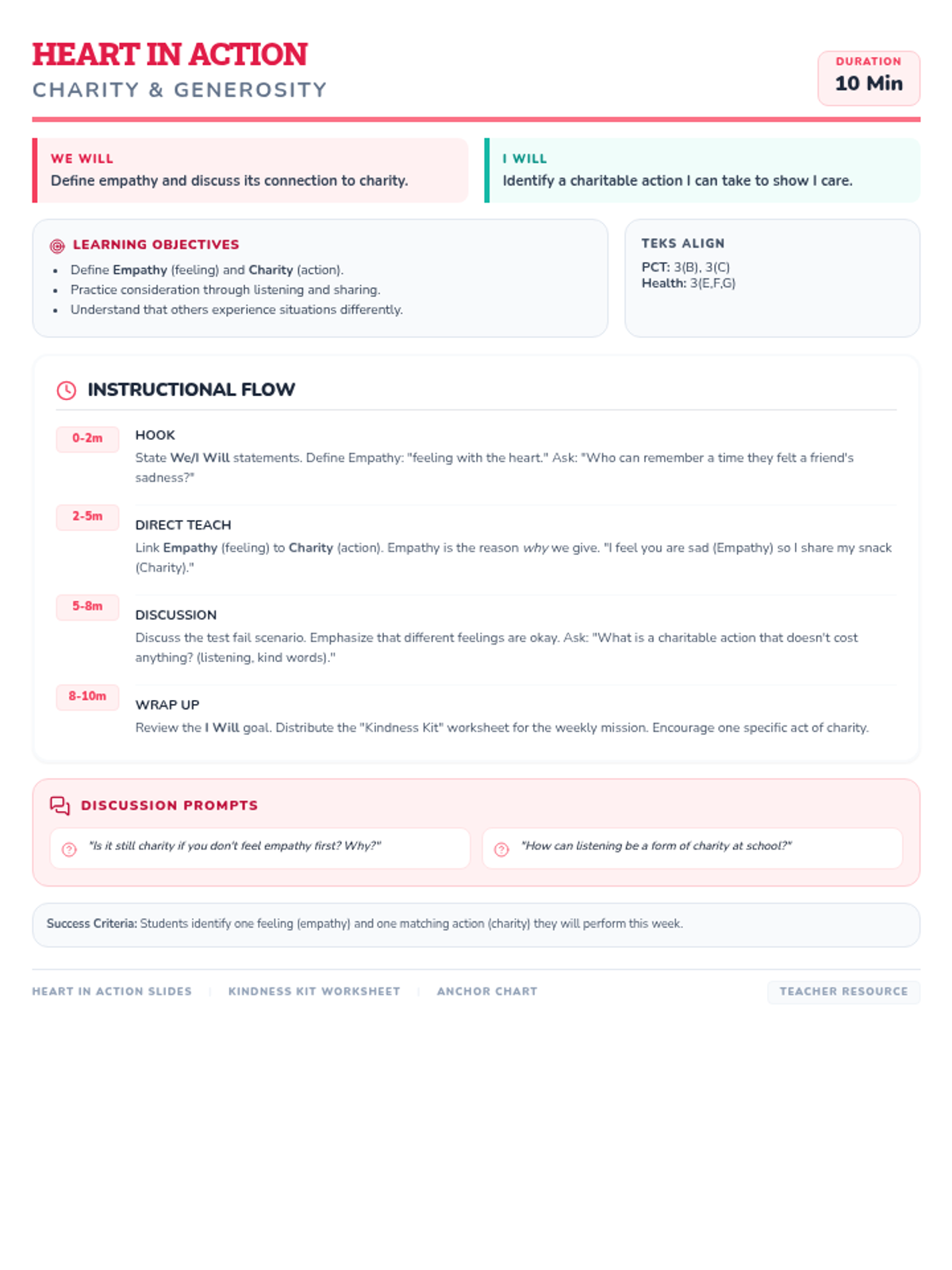
A comprehensive facilitator guide for a 10-minute whole-group lesson on empathy and charity, now featuring explicit 'We Will' and 'I Will' statements for standard-aligned instruction.
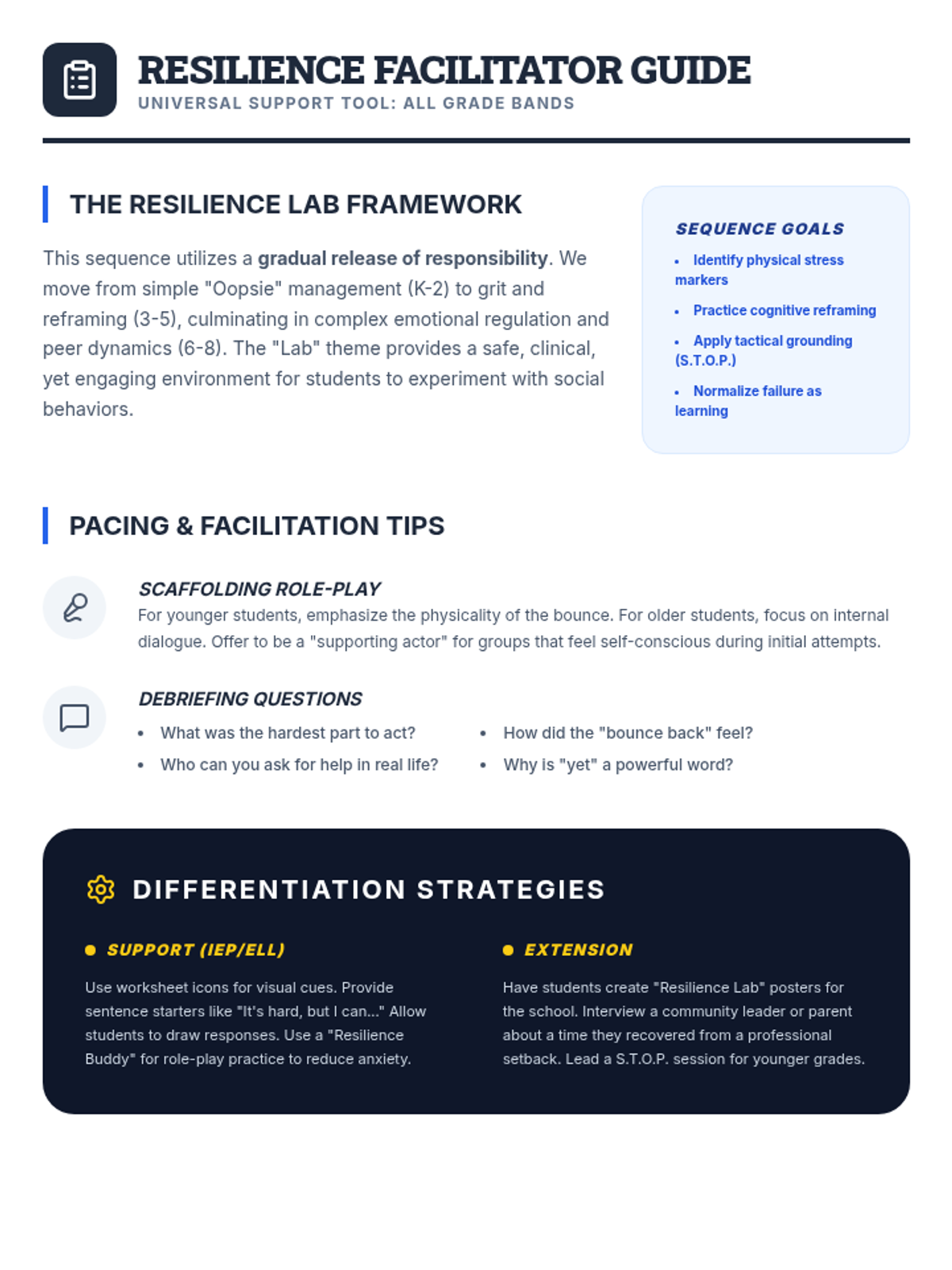
Revised facilitator guide. Fixed page break issues in the differentiation section by using 'break-inside-avoid'. Optimized layout and spacing to ensure all content fits professionally on a single page.
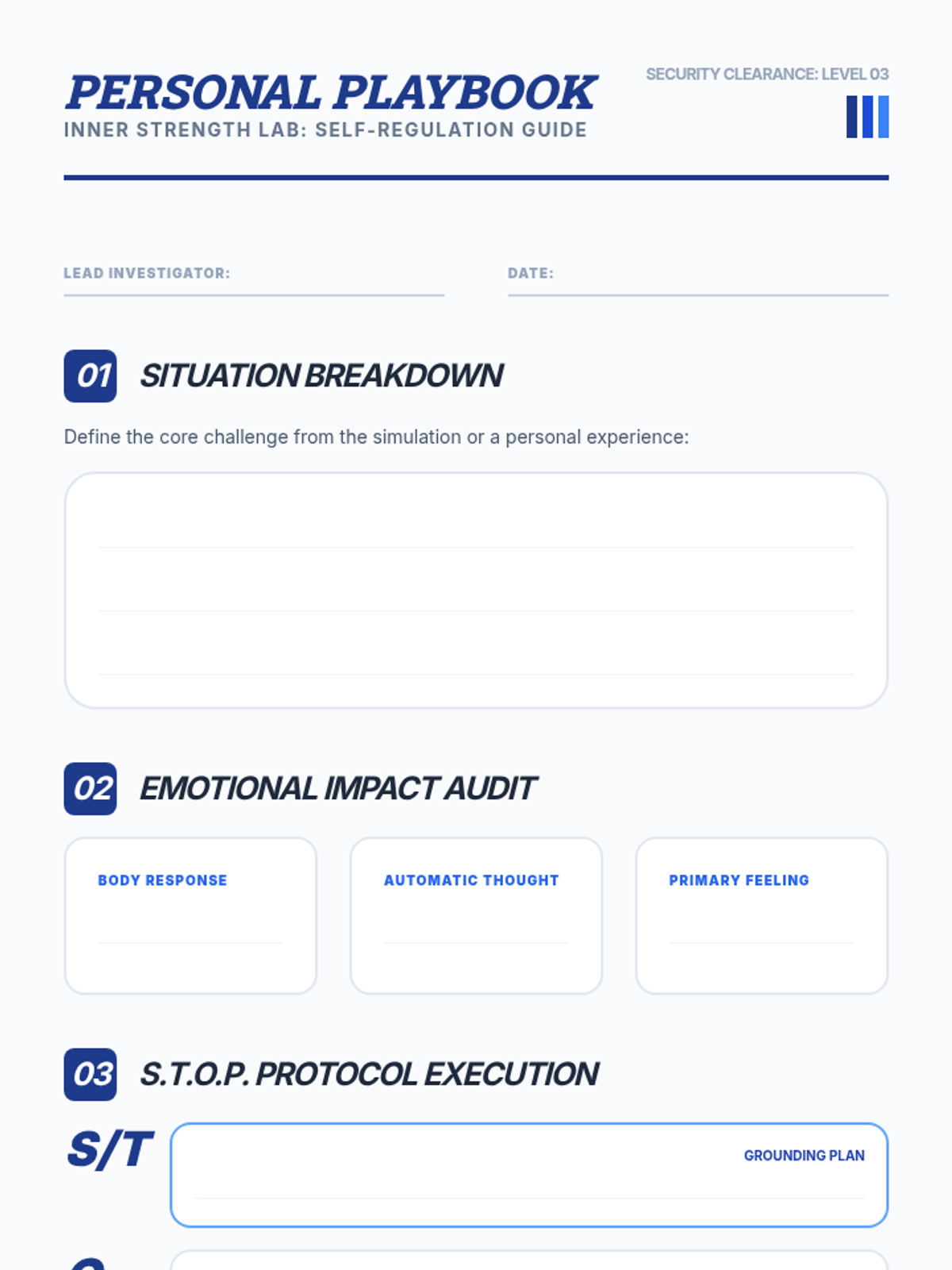
Revised worksheet for 6th-8th graders. Fixed page break issues for Section 3, increased height for emotional audit boxes (min-h-120px), and added input lines for S.T.O.P. execution steps. Improved overall tracking and legibility.
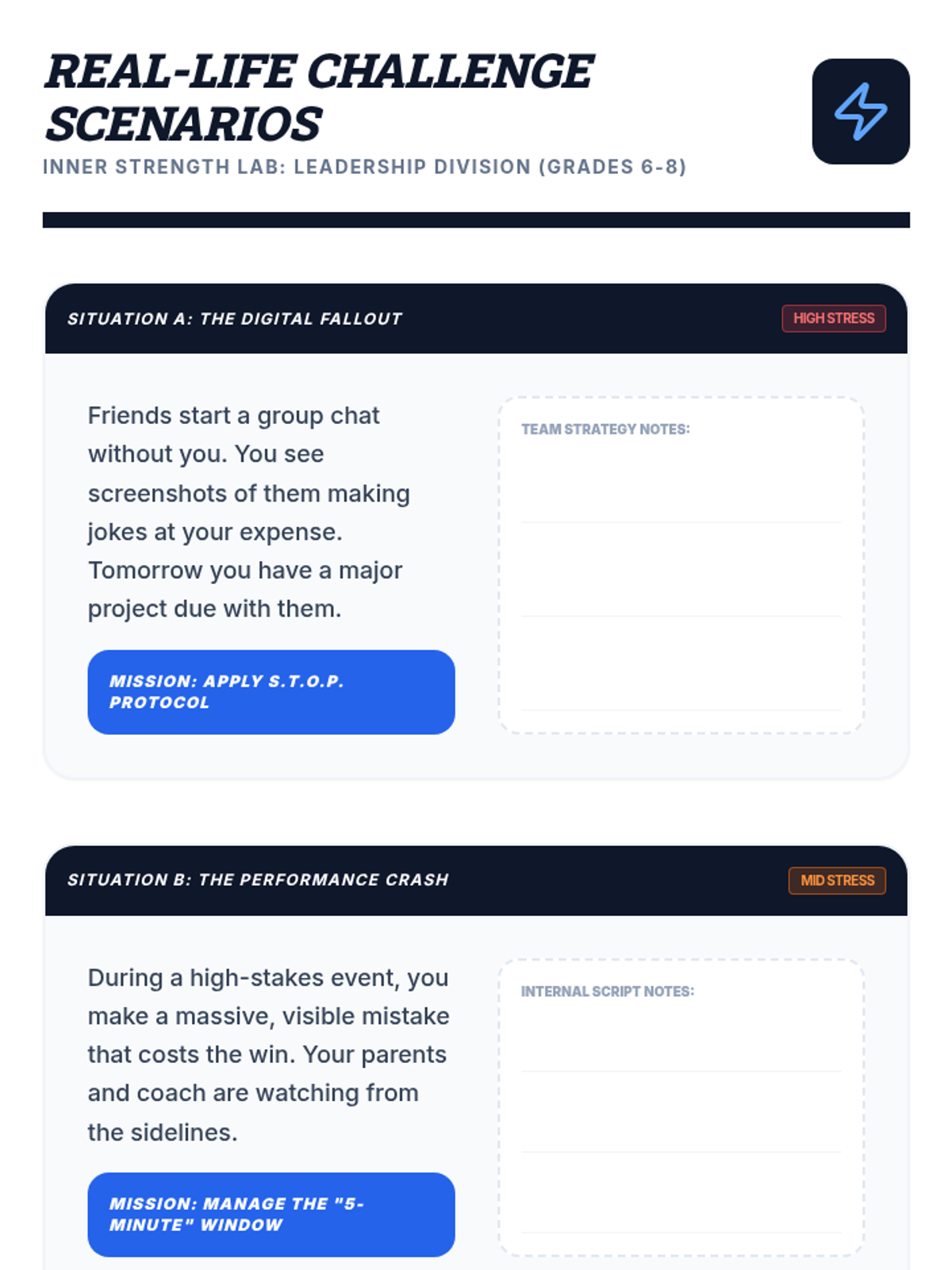
Revised scenario handout for 6th-8th graders. Added dedicated student response areas for each situation, fixed page break issues with 'break-inside-avoid', and included a S.T.O.P. protocol reference for self-contained usability.
Revised slides for 6th-8th graders. Fixed tracking in headers for clarity and added specific, high-stress social scenarios for the simulation activity on Slide 4. Improved overall visual impact and layout consistency. Final revision to fix collided words and opacity.
Revised worksheet for 3rd-5th graders with expanded student work areas (min-h-160px/100px) and improved visual instructions. Final revision to fix page break, icon rendering, and line contrast.
Revised scenario cards for 3rd-5th graders with fluid height containers to ensure no text is truncated. Improved visual design for instructions and consistent card layout. Final revision to fix footer page break and text sizing.
Revised instructional slides for 3rd-5th graders. Added specific role-play scenarios and improved visual balance on Slide 2. Slide 4 now includes actual Lab Challenges for group work.
Revised worksheet for 1st-2nd graders with significantly larger student work areas (h-24), a graphic checkbox, and optimized layout to prevent page breaks. Final revision to fix minor spillover and line contrast.
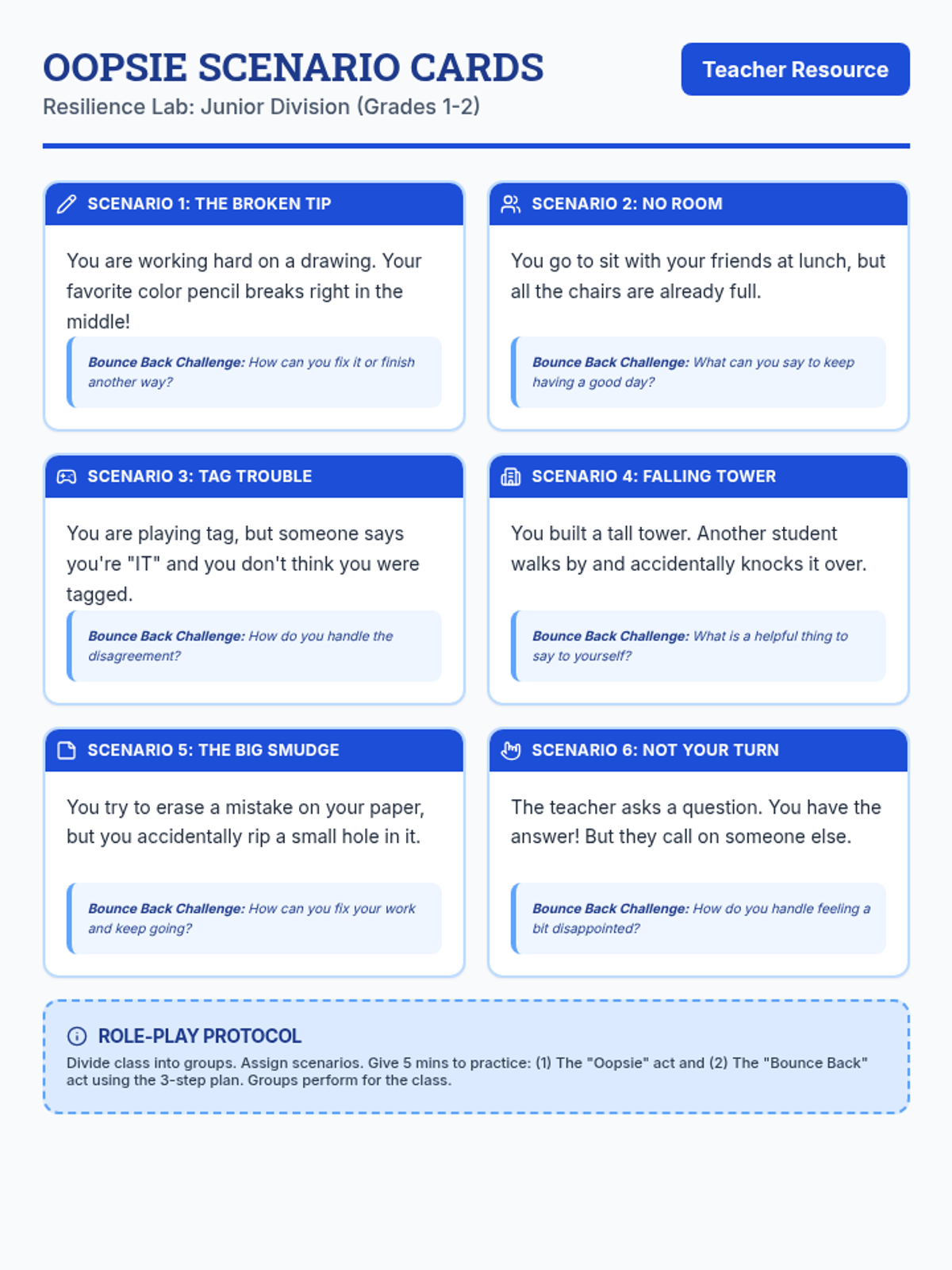
Updated scenario cards for 1st-2nd graders with 6 unique situations and optimized layout to fit on a single page. Fixed truncated text and added variety. Revised to fix footer page break and ensure icon rendering.
Visual presentation for Grades 1-2 introducing resilience through the 'Bounce-Back Plan' with engaging graphics and prompts for group role-play. Revisions include added scenarios and improved contrast.
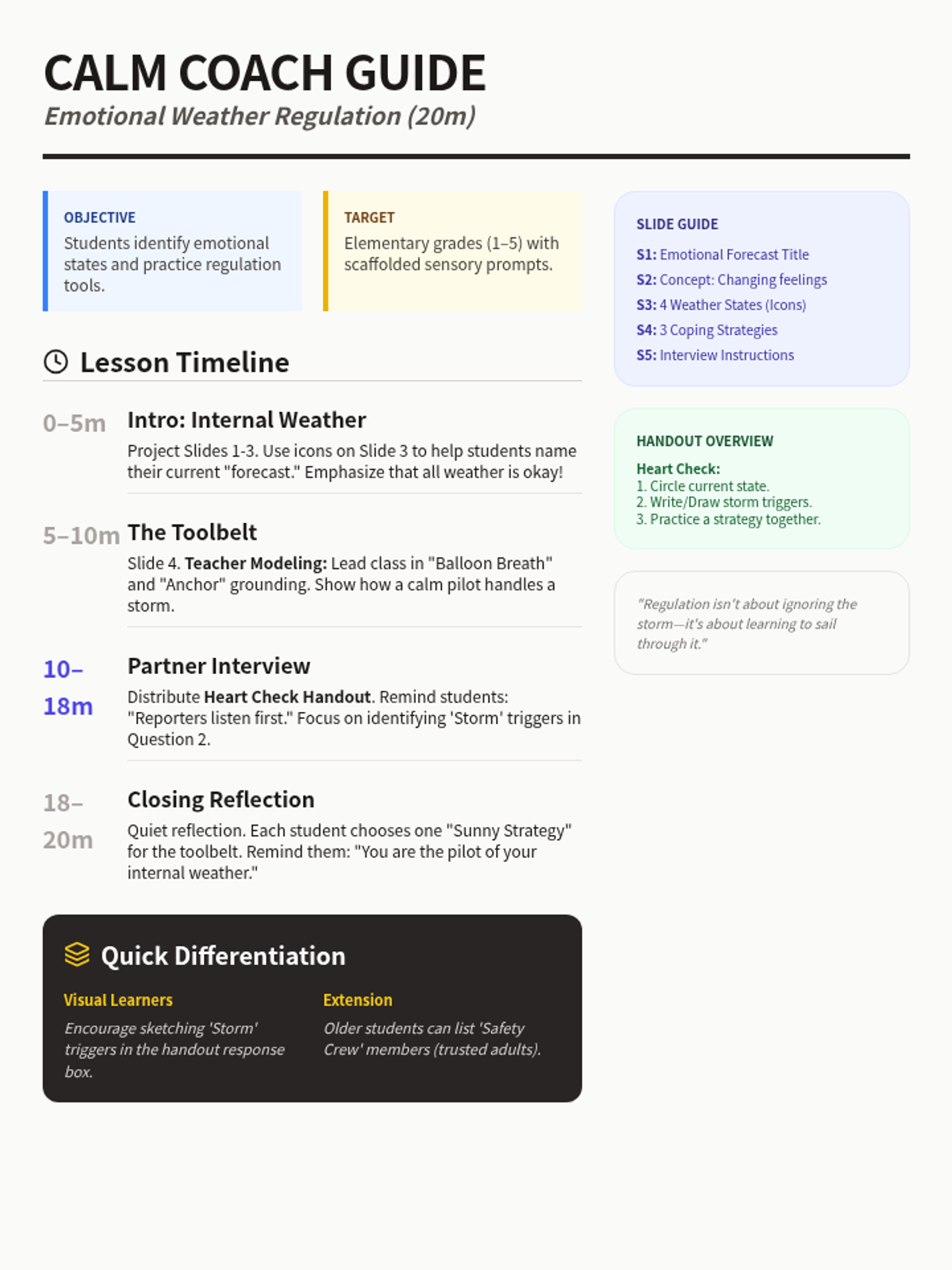
A detailed teacher guide for facilitating the 20-minute emotional regulation lesson, including pacing, modeling tips, and differentiation. Revised for a more compact one-page layout.
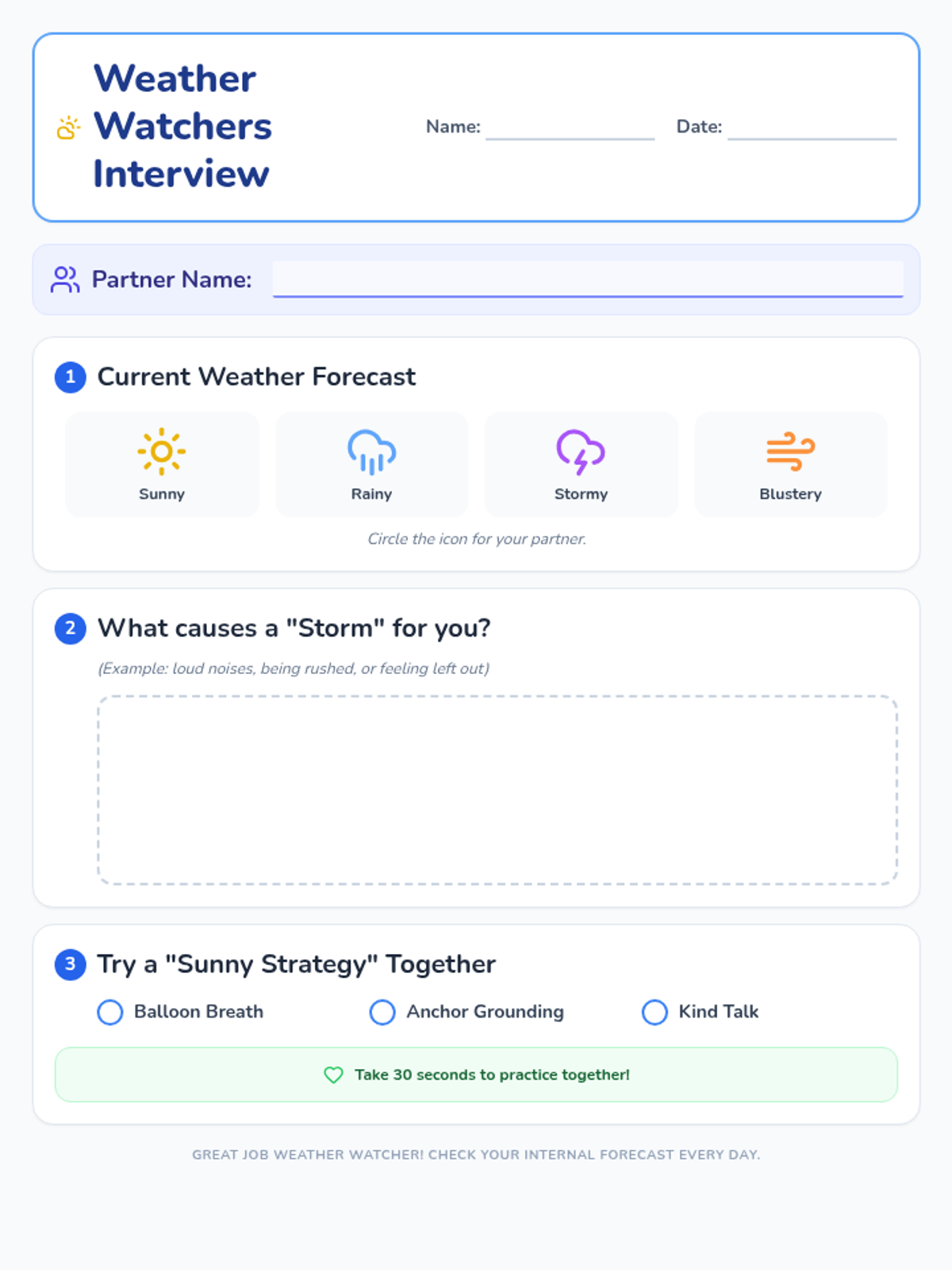
A structured partner interview worksheet where students check in on each other's emotional states ('weather') and practice regulation strategies together. Optimized for a single-page layout with ample handwriting space.
Interactive slides using an 'internal weather' metaphor to teach emotional regulation, recognizing different feelings (sunny, stormy, rainy), and introducing self-care strategies.
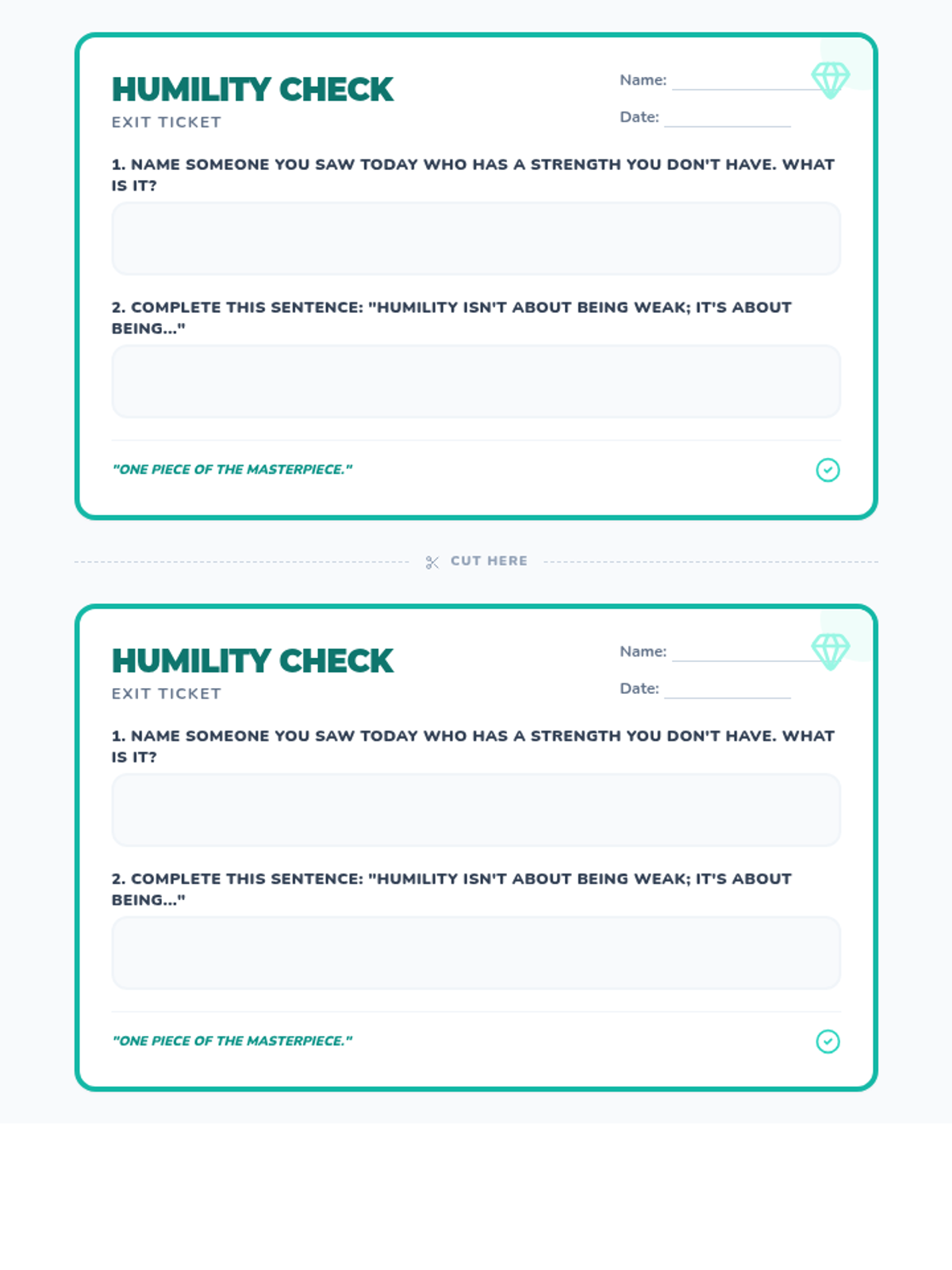
A quick exit ticket for students to demonstrate understanding of humility and their ability to recognize strengths in others.
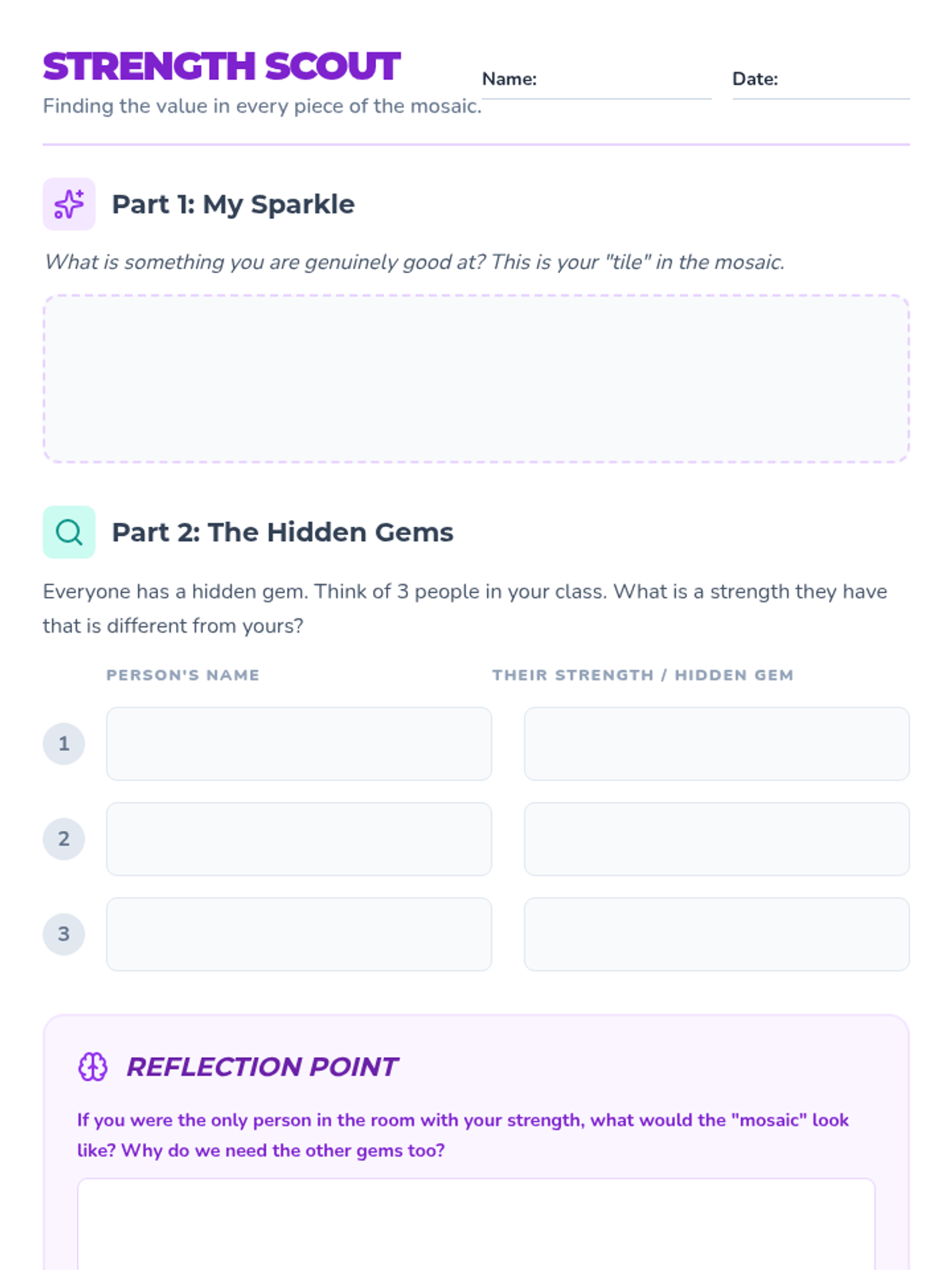
An individual self-assessment and strengths-spotting worksheet designed to help students recognize their own value while actively finding and valuing the strengths of their peers.
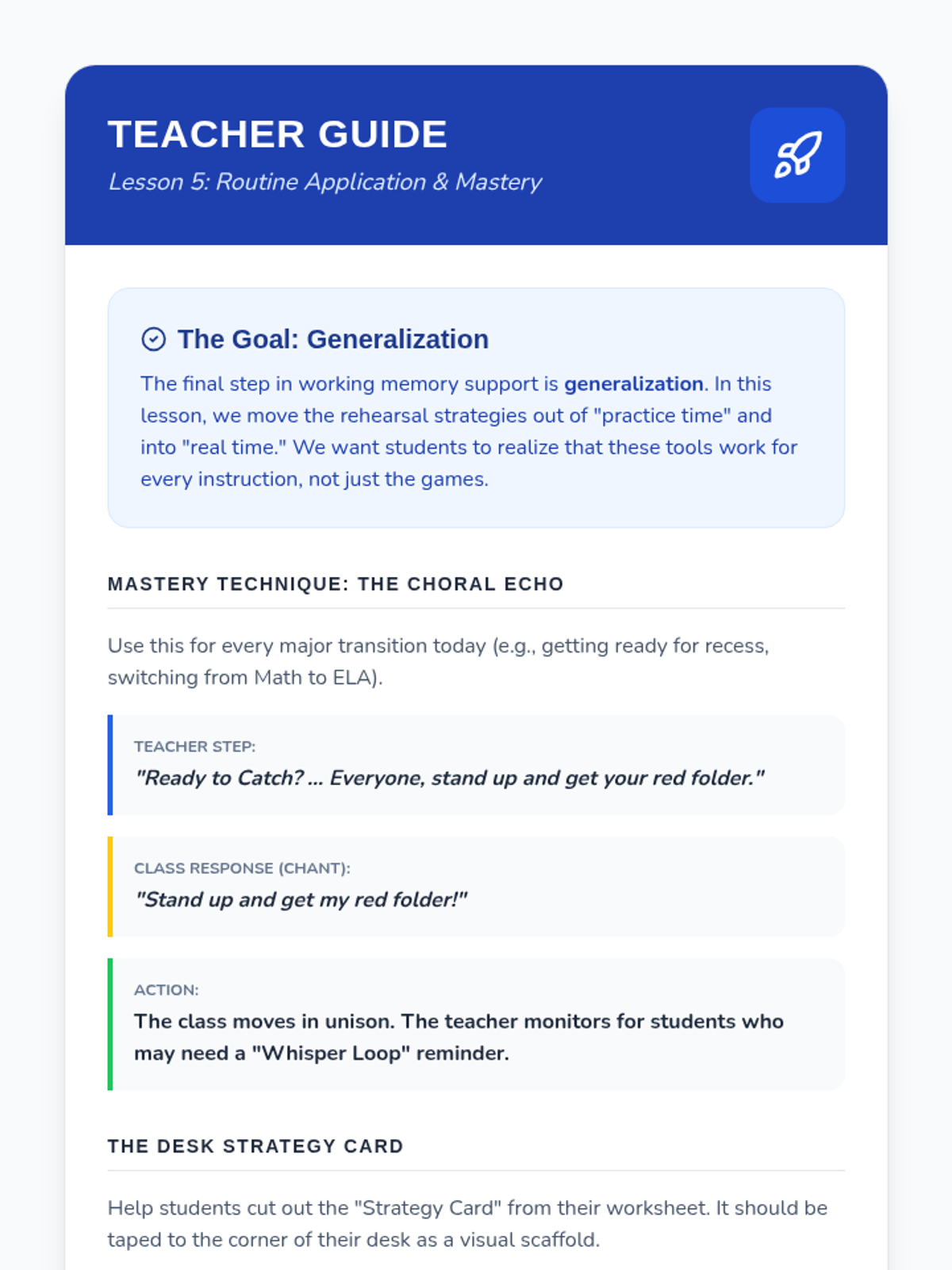
Final teacher guide for the sequence, focusing on choral response techniques, the use of desk-based strategy cards, and informal mastery assessment.
Final slides for the sequence, focusing on graduating the 'Brain Training' skills into everyday classroom routines like cleaning up and transitions.
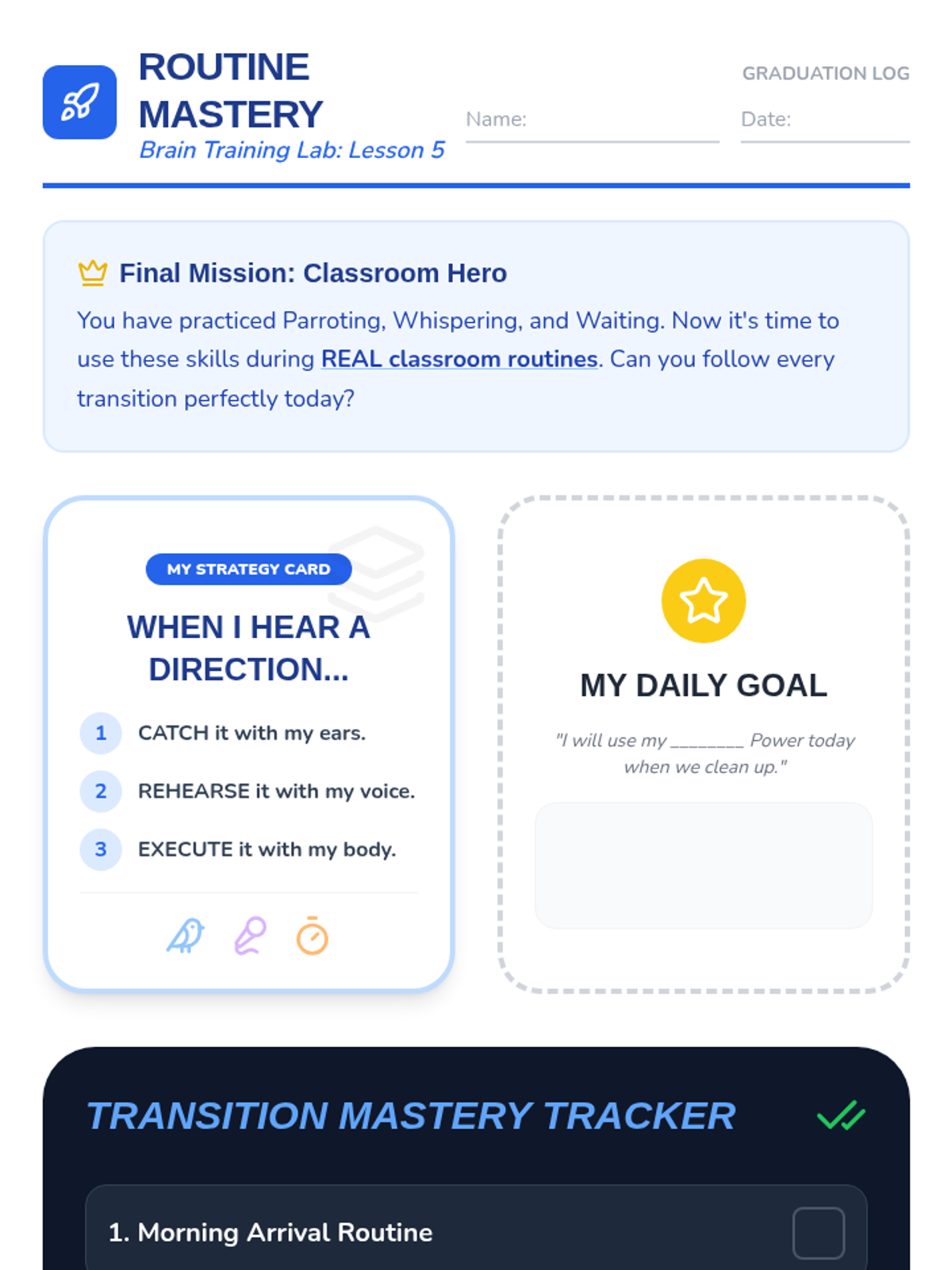
A cumulative resource for Lesson 5 including a strategy desk card and a transition mastery tracker to help students apply verbal rehearsal to real classroom routines.
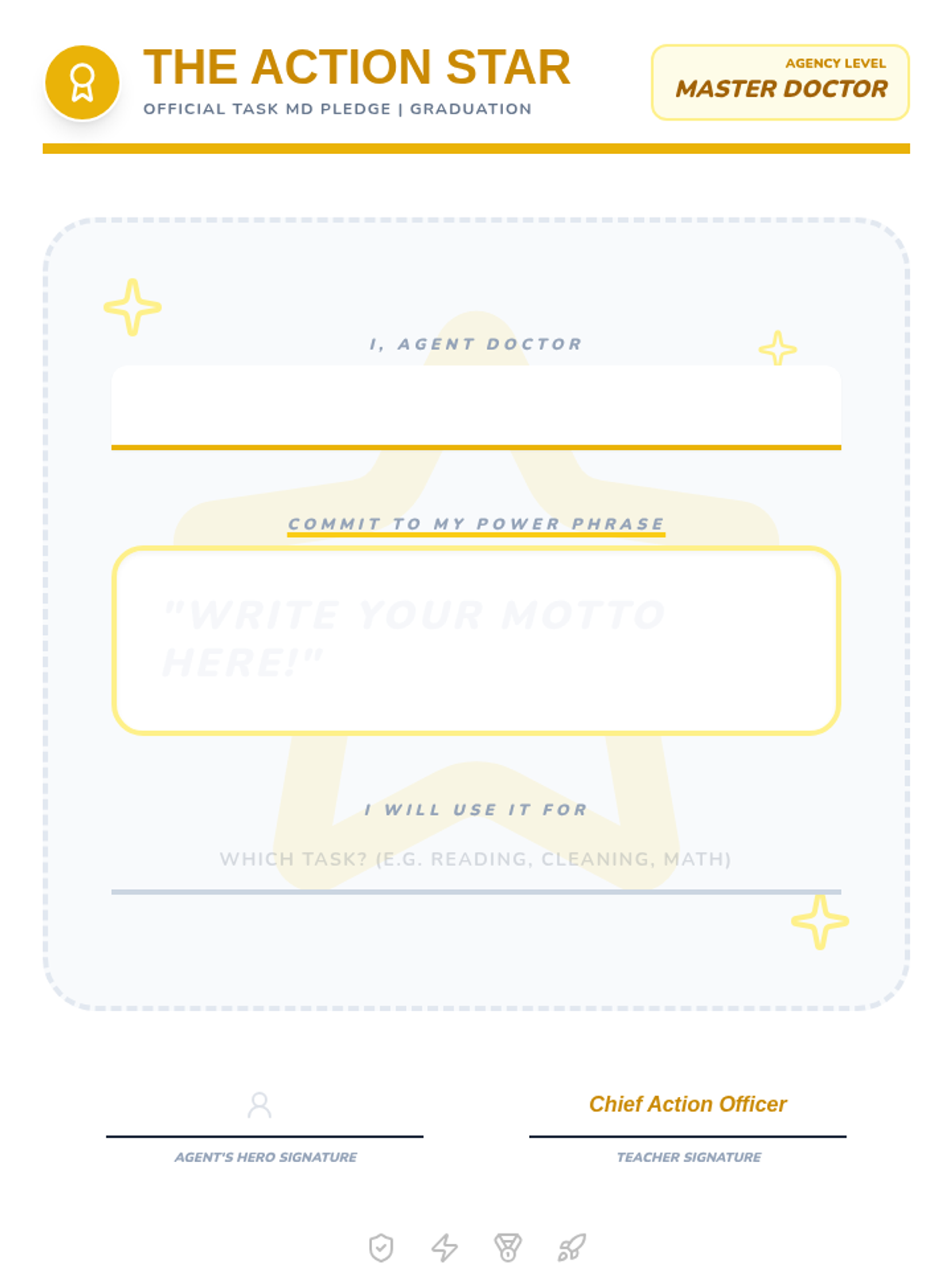
A student worksheet for the final lesson, where students write their personal 'Power Phrase' motto on a star-themed pledge sheet to be displayed on the 'Wall of Action'.
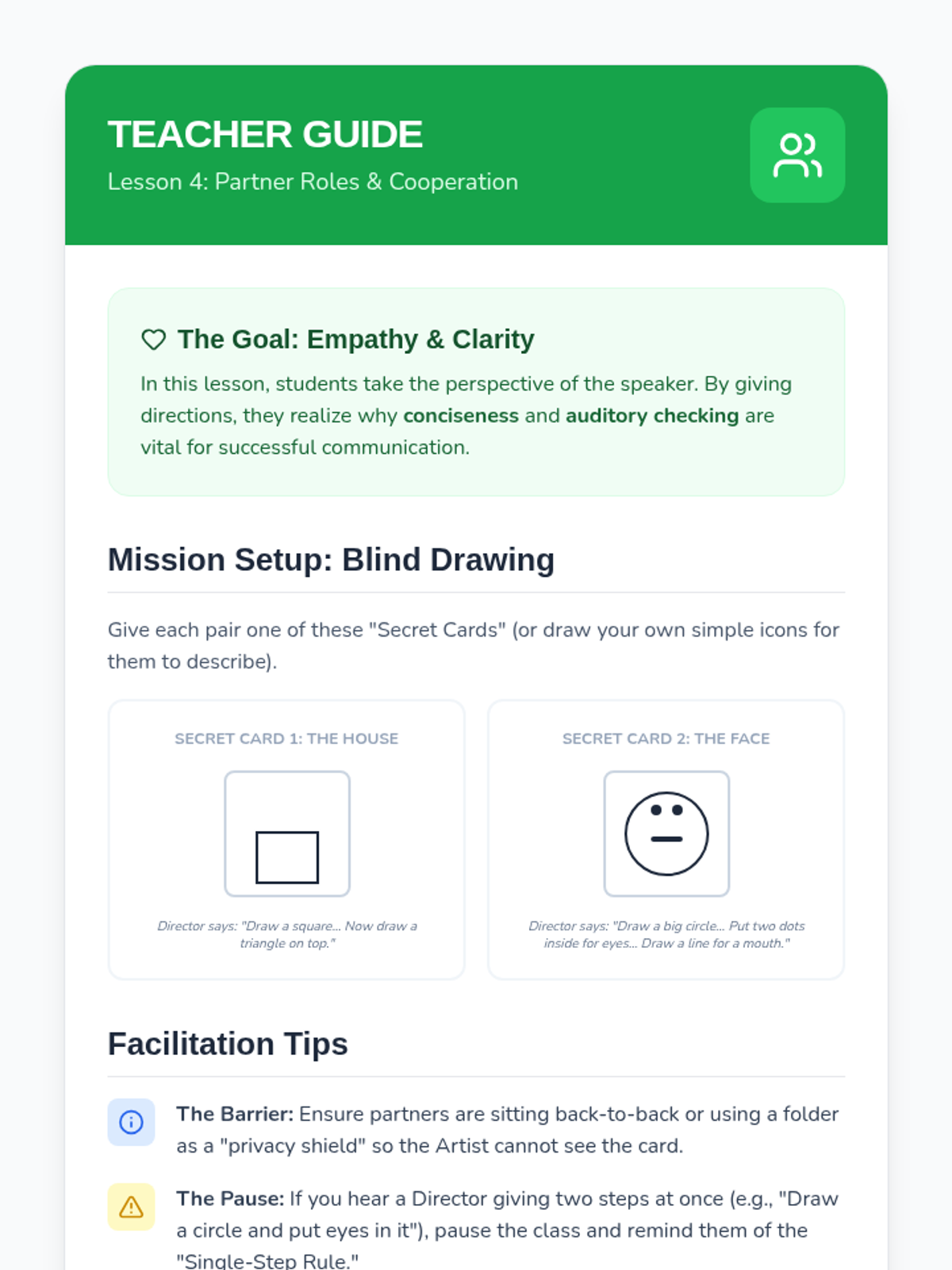
A teacher guide for Lesson 4 including secret cards for the blind drawing activity, facilitation scripts, and peer feedback prompts.
Engaging slides for Lesson 5 that guide the student self-reflection process and introduce the 'Wall of Action' graduation ceremony.
Slides for Lesson 4 facilitating a peer-to-peer communication activity. Introduces the roles of 'Director' and 'Artist' for a collaborative drawing challenge.
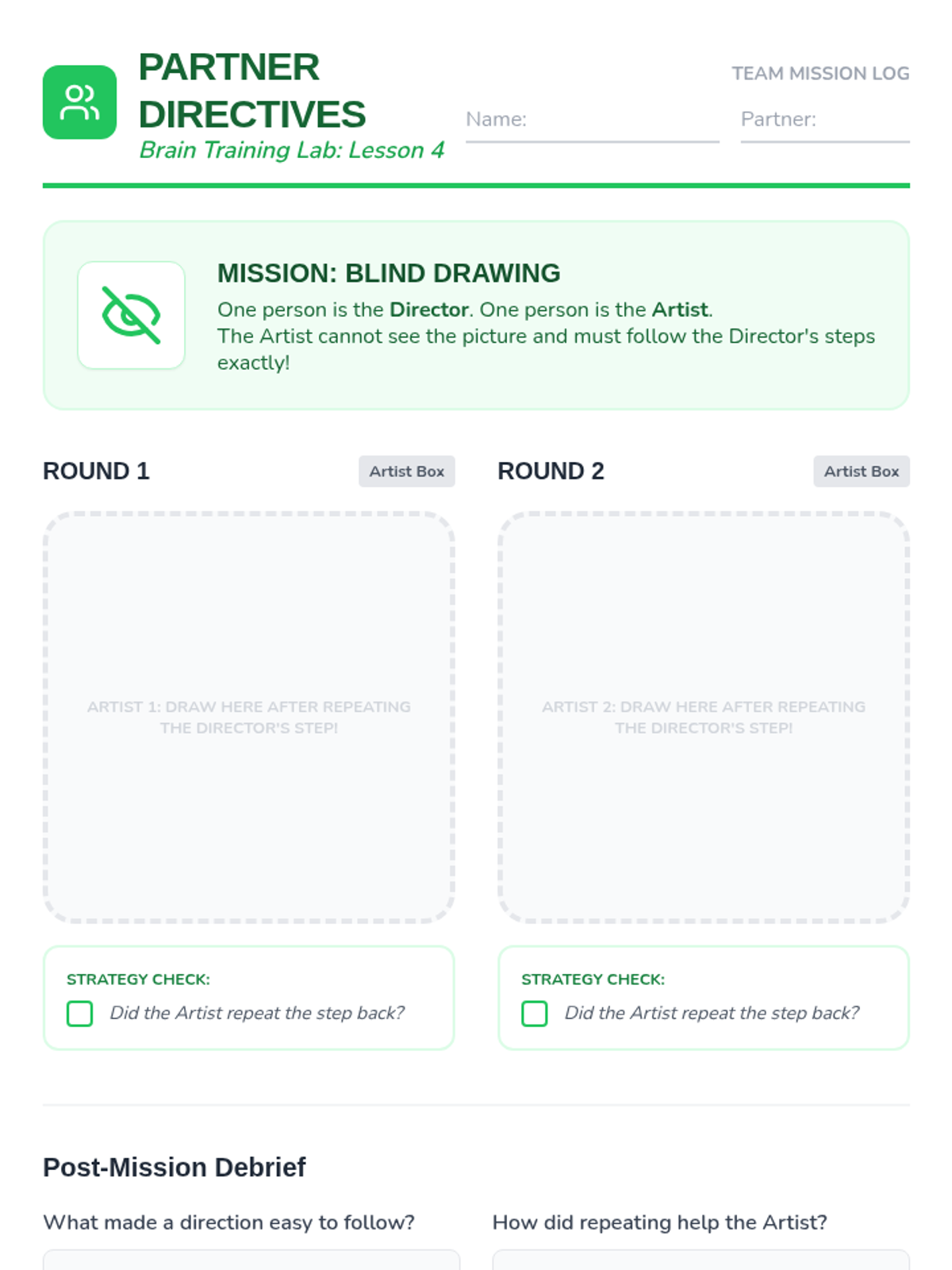
A collaborative worksheet for Lesson 4 where students work in pairs to practice giving and repeating directions through a 'Blind Drawing' activity.
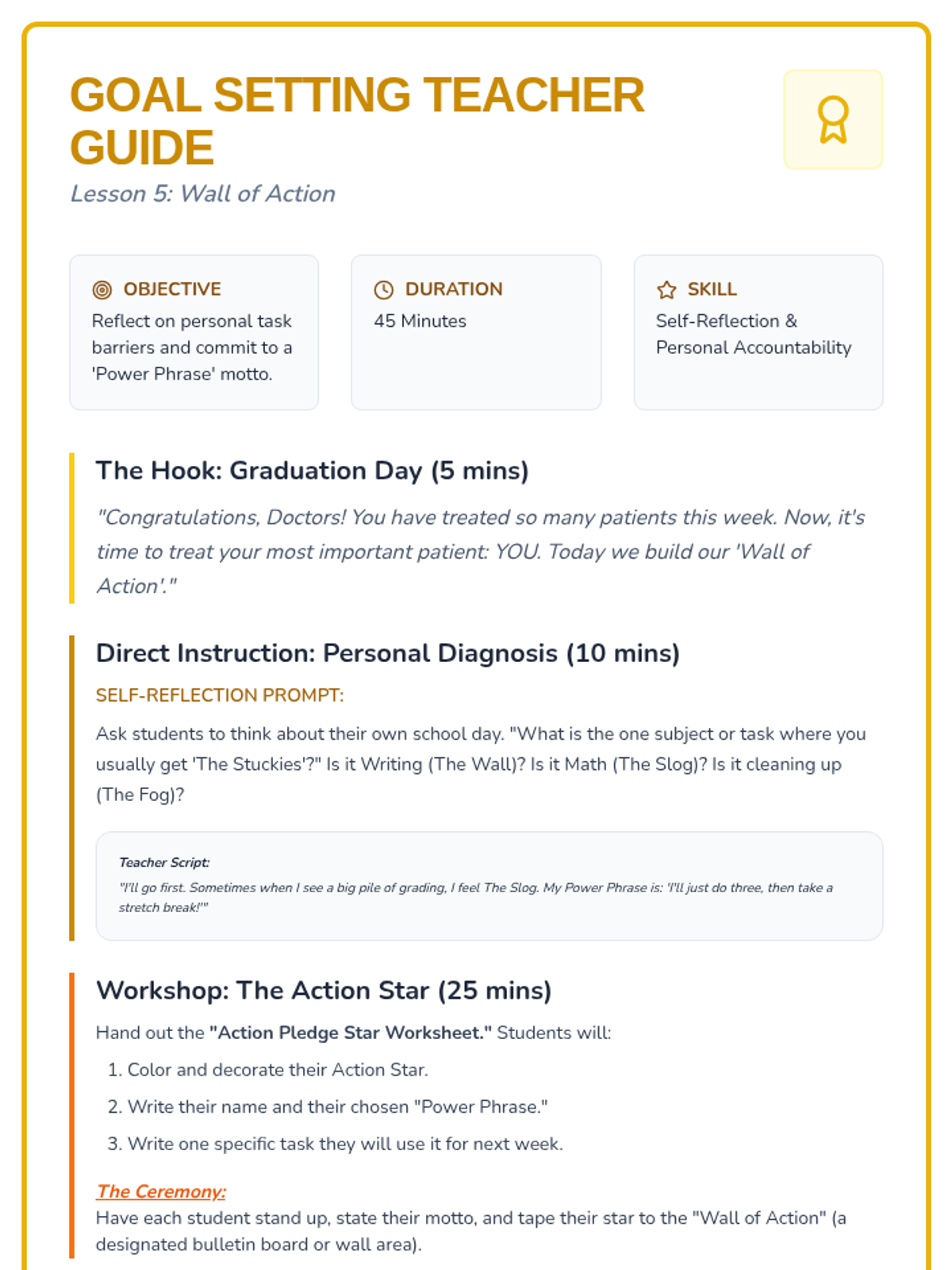
A comprehensive teacher's guide for the fifth lesson, focused on student self-reflection and creating a 'Wall of Action' with personal self-talk mottos.
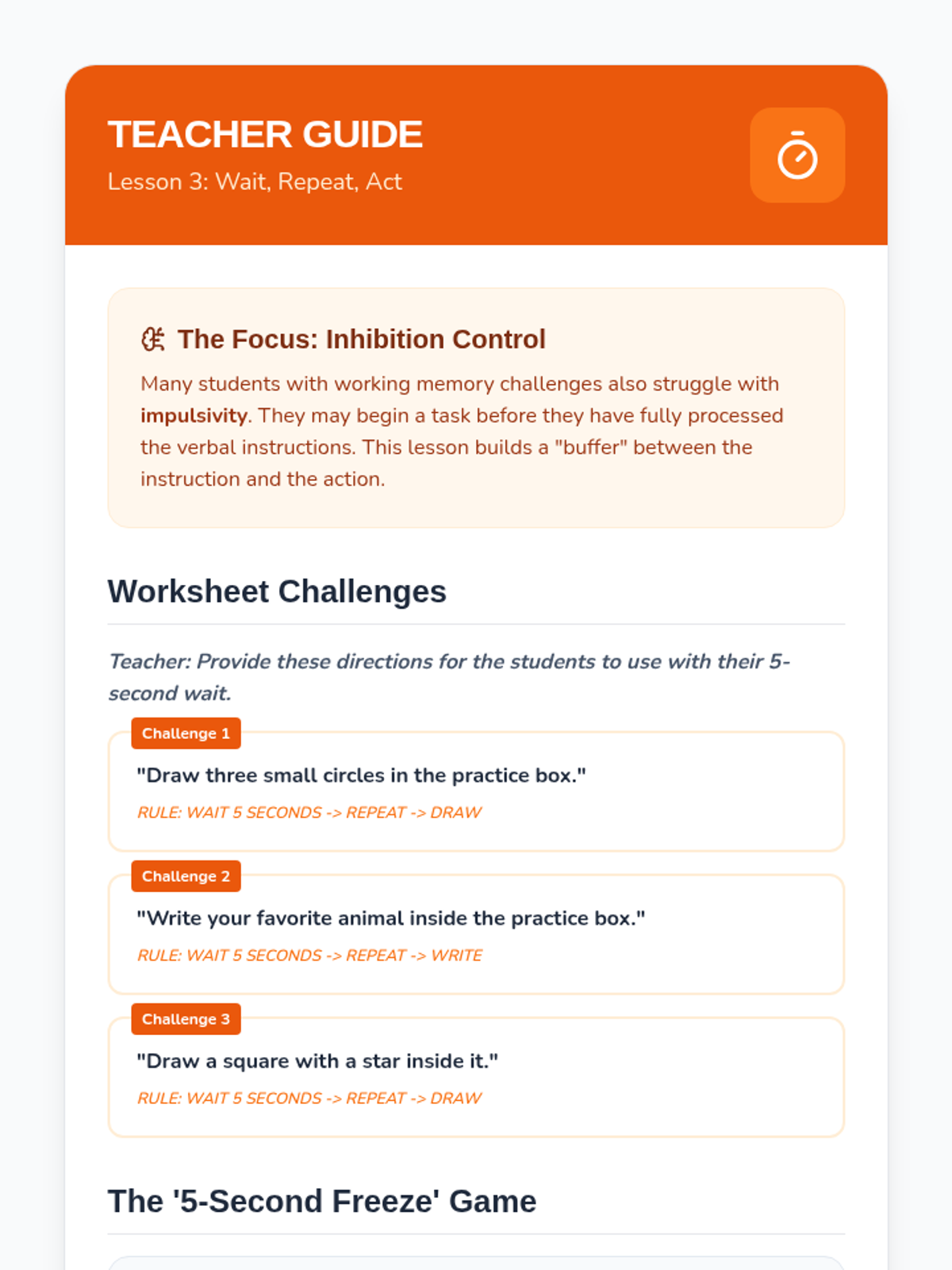
Teacher guide for Lesson 3 focusing on inhibition control strategies. Includes worksheet directions, a whole-class game, and instructional rationales for the 5-second wait period.
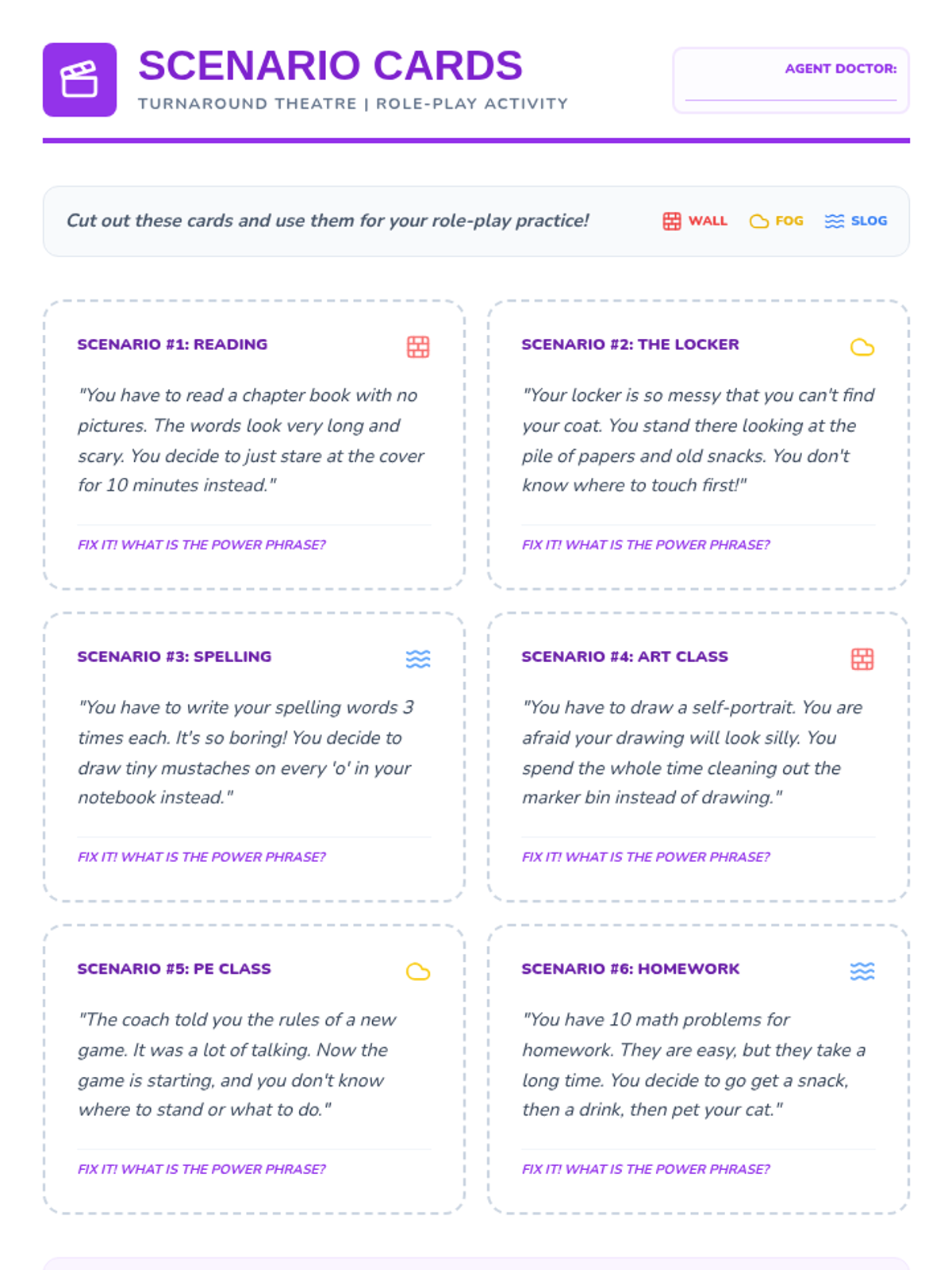
A set of role-play scenario cards for Lesson 4, allowing students to practice diagnosing barriers (Wall, Fog, Slog) and delivering self-talk prescriptions.
Slides for Lesson 3 focusing on 'The 5-Second Freeze' strategy to support inhibition control and processing time for single-step directions.
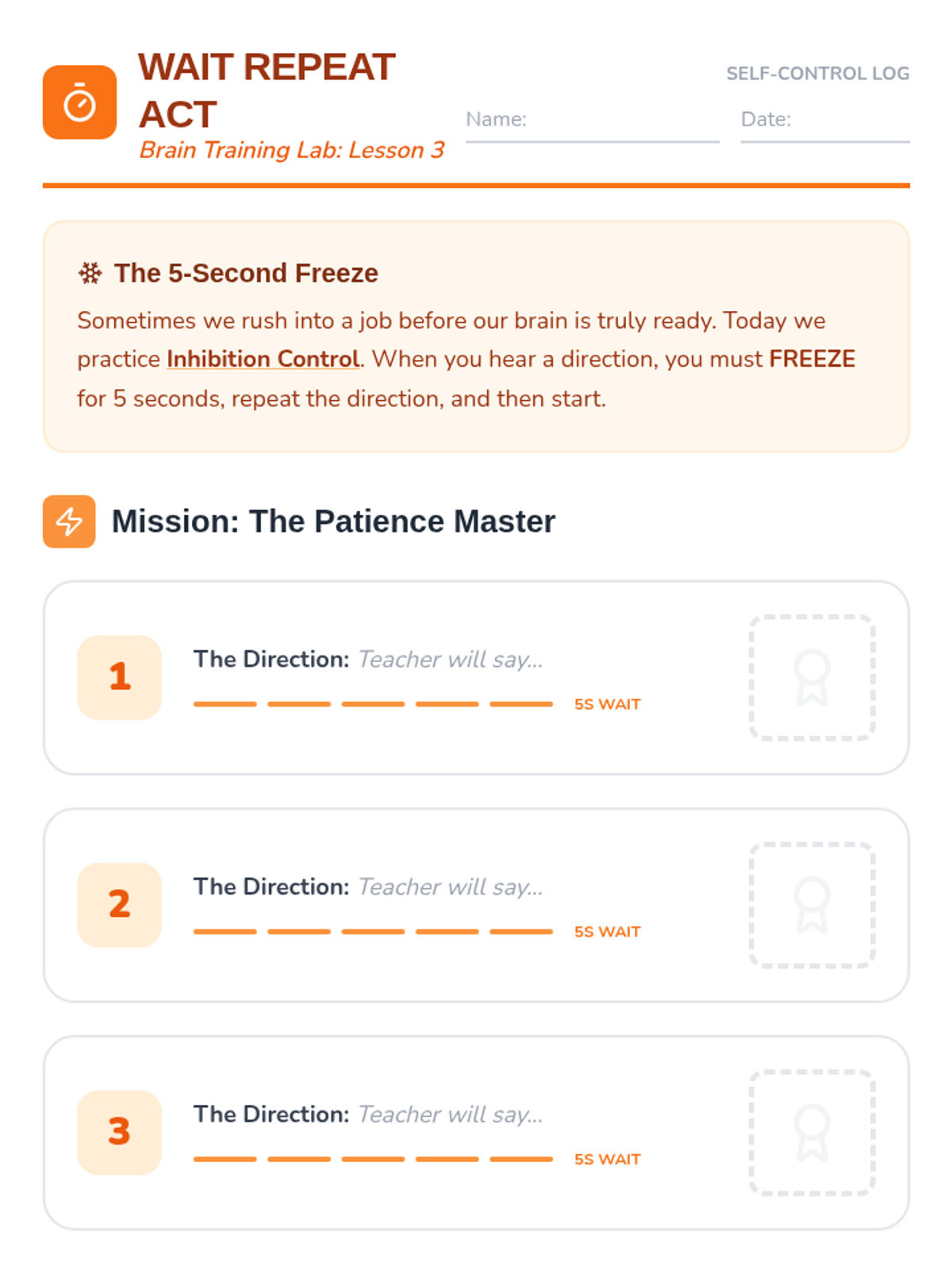
A student worksheet for Lesson 3 focusing on delayed execution and inhibition control. Students must wait 5 seconds and repeat a direction before completing tasks.
Engaging slides for Lesson 4 that guide the "Freeze and Fix" improvisational game and present role-play scenarios for students to practice self-talk solutions.
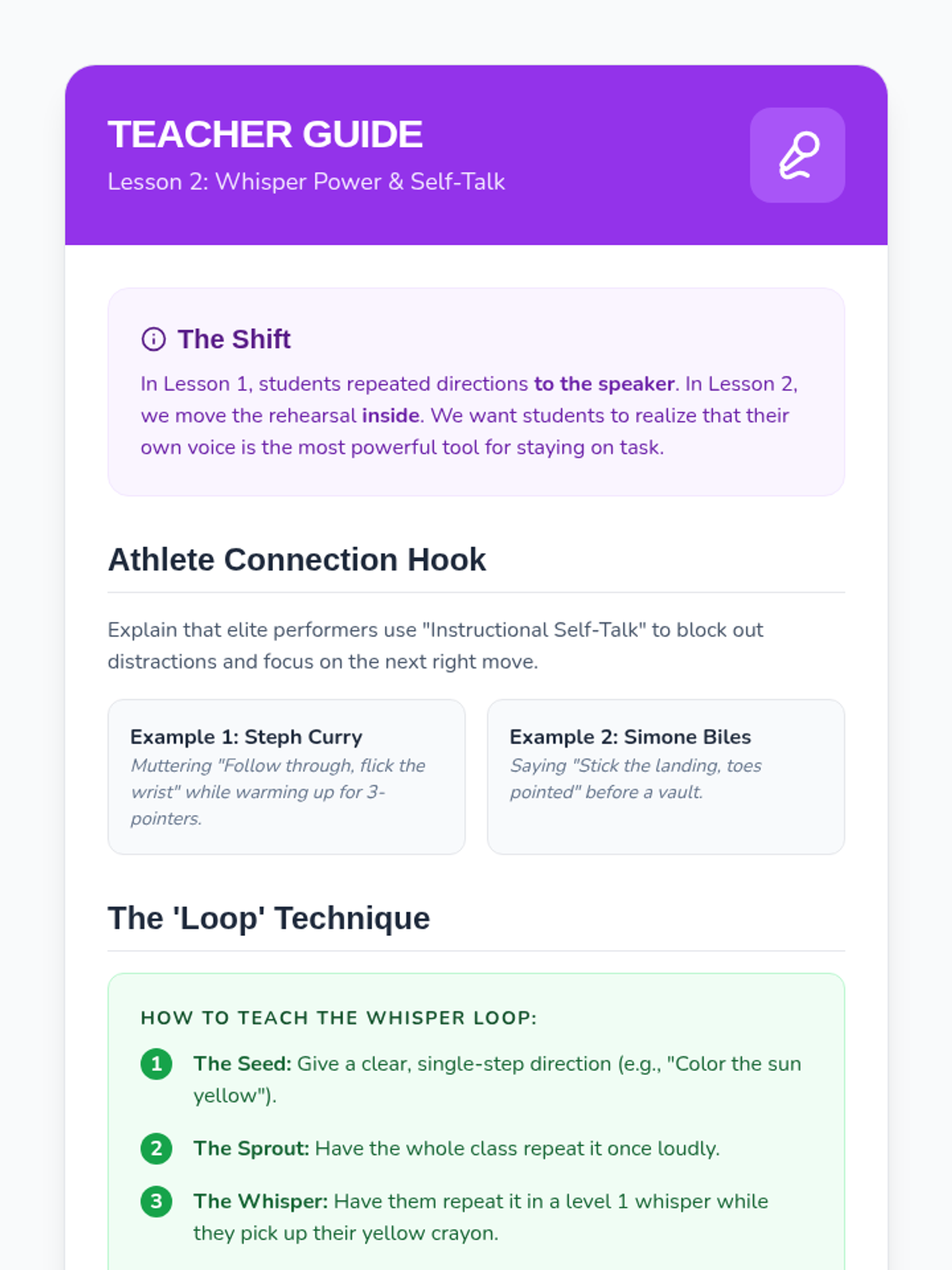
A teacher guide for Lesson 2 focusing on transitioning from external repetition to internal 'whisper power' and self-talk loops. Includes athlete connections and troubleshooting tips.
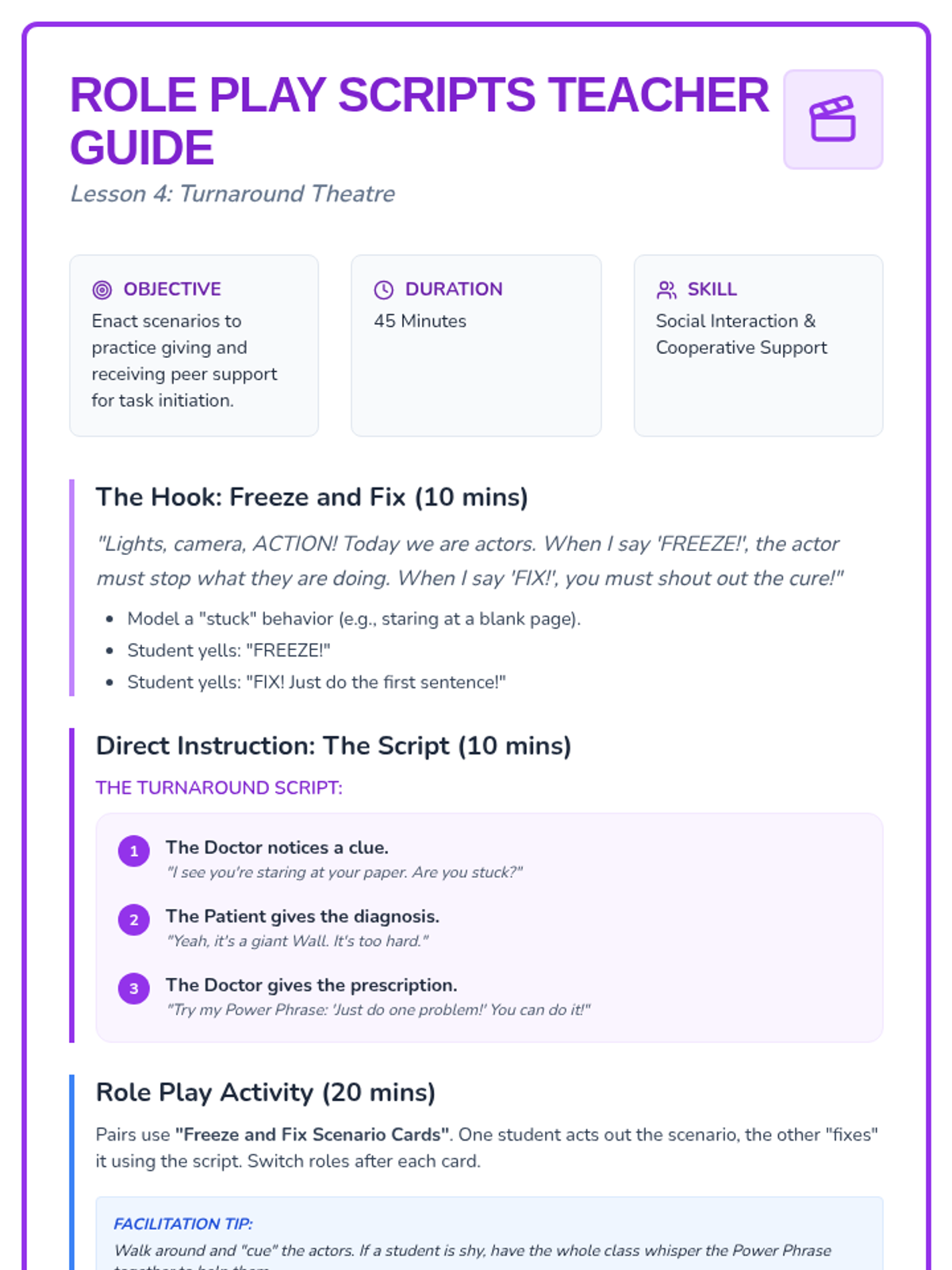
A comprehensive teacher's guide for the fourth lesson, outlining role-playing scripts and the "Freeze and Fix" improvisational activity.
Slides for Lesson 2 introducing 'Whisper Power' and 'Self-Talk Loops'. Uses professional athlete examples to normalize talking to oneself for focus.
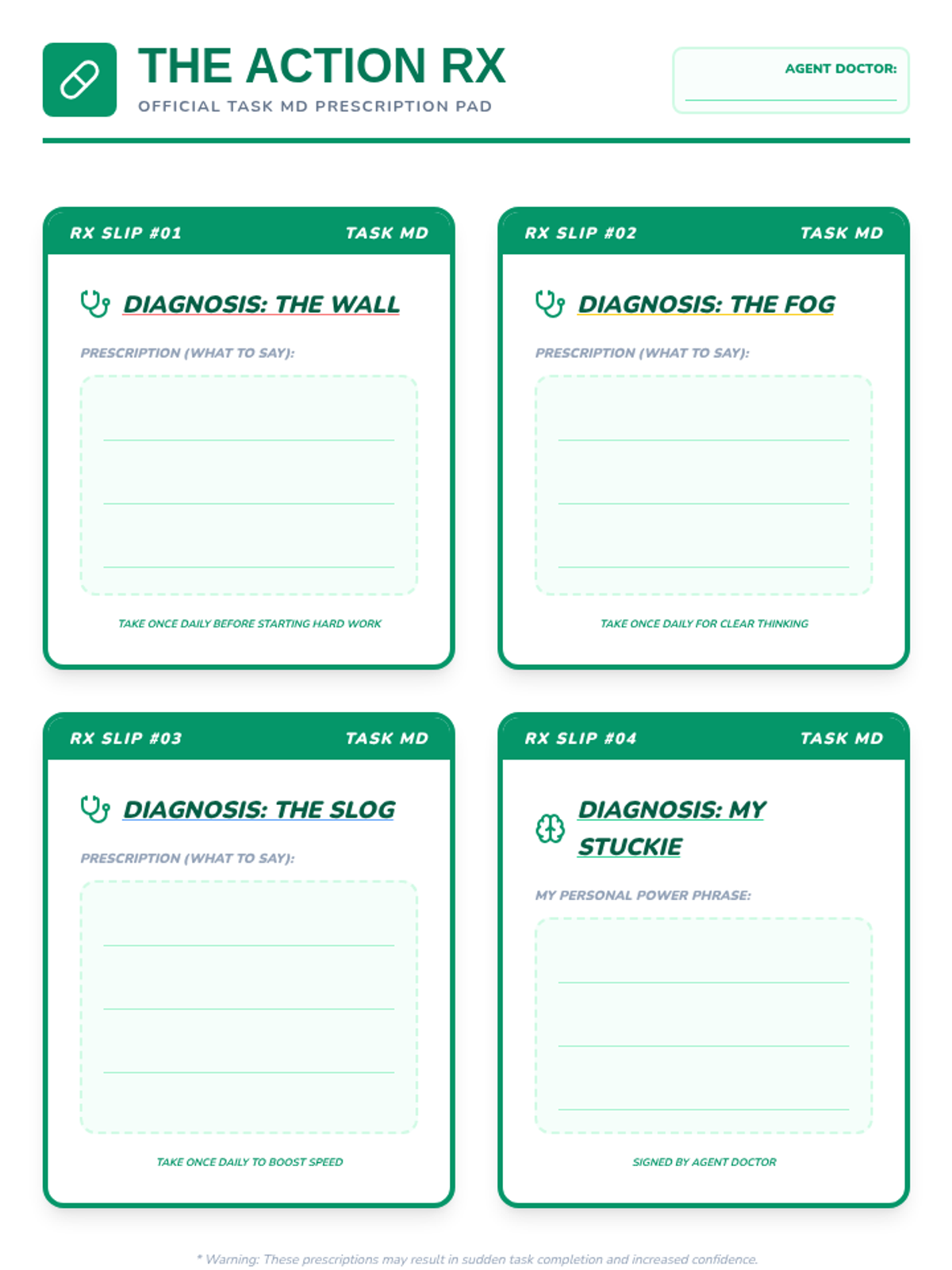
A student worksheet for the third lesson, using an oversized 'prescription pad' design to practice writing self-talk power phrases for different task barriers.
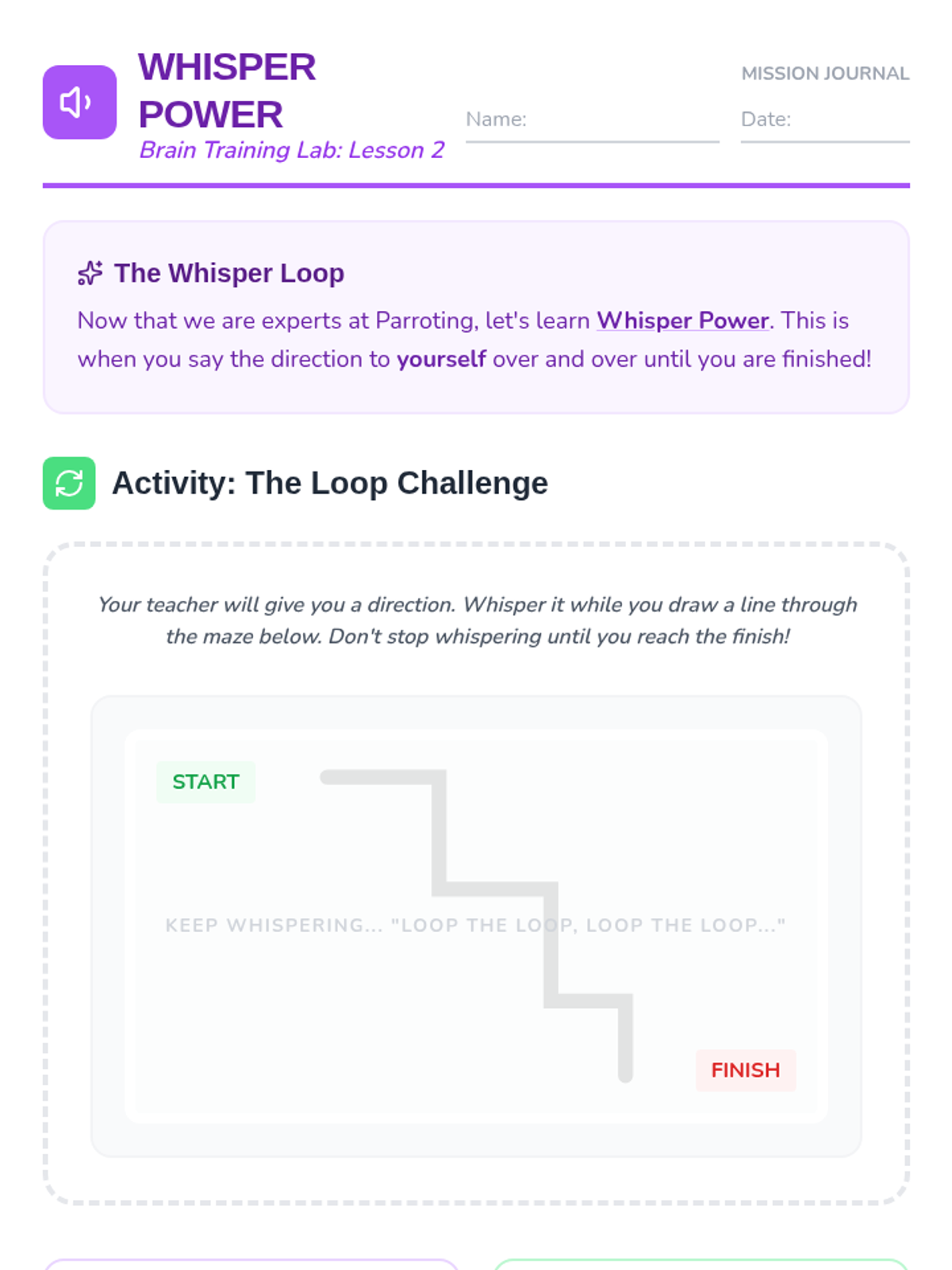
A worksheet for Lesson 2 focusing on 'Whisper Power' (verbal rehearsal loops). Includes a maze activity designed to be completed while students maintain a self-talk loop.
Visual slide deck for Lesson 1 to introduce the concept of 'Parrot Power' and the catch-repeat-act cycle. Features high-contrast visuals and clear step-by-step instructions.
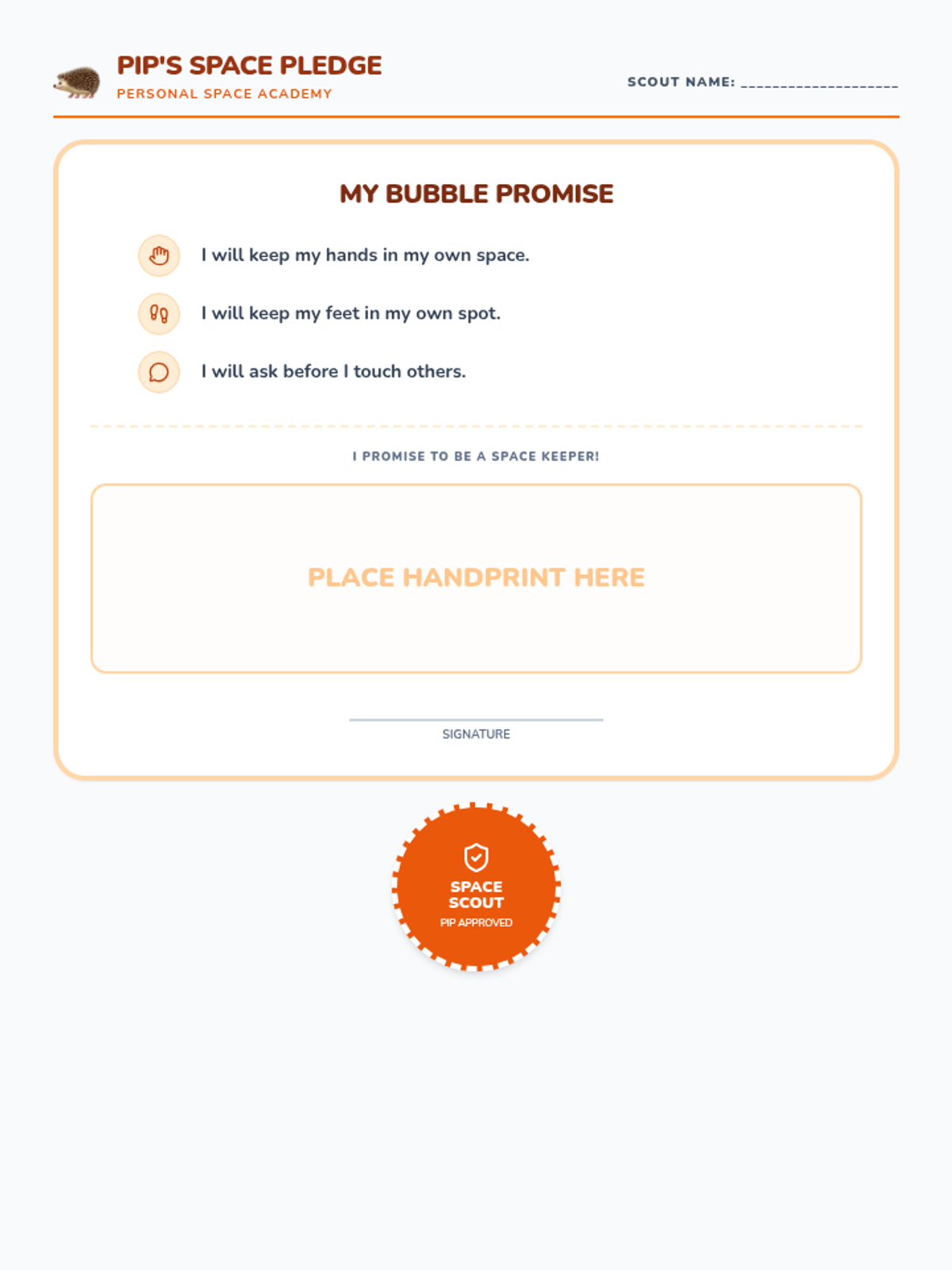
Final revised Pip's Space Pledge. Resolved page overflow by reducing the handprint area height and overall header padding. Increased contrast of the 'Place Handprint Here' watermark for better printability and ensured all elements fit on a single page. Layout is now polished and classroom-ready.
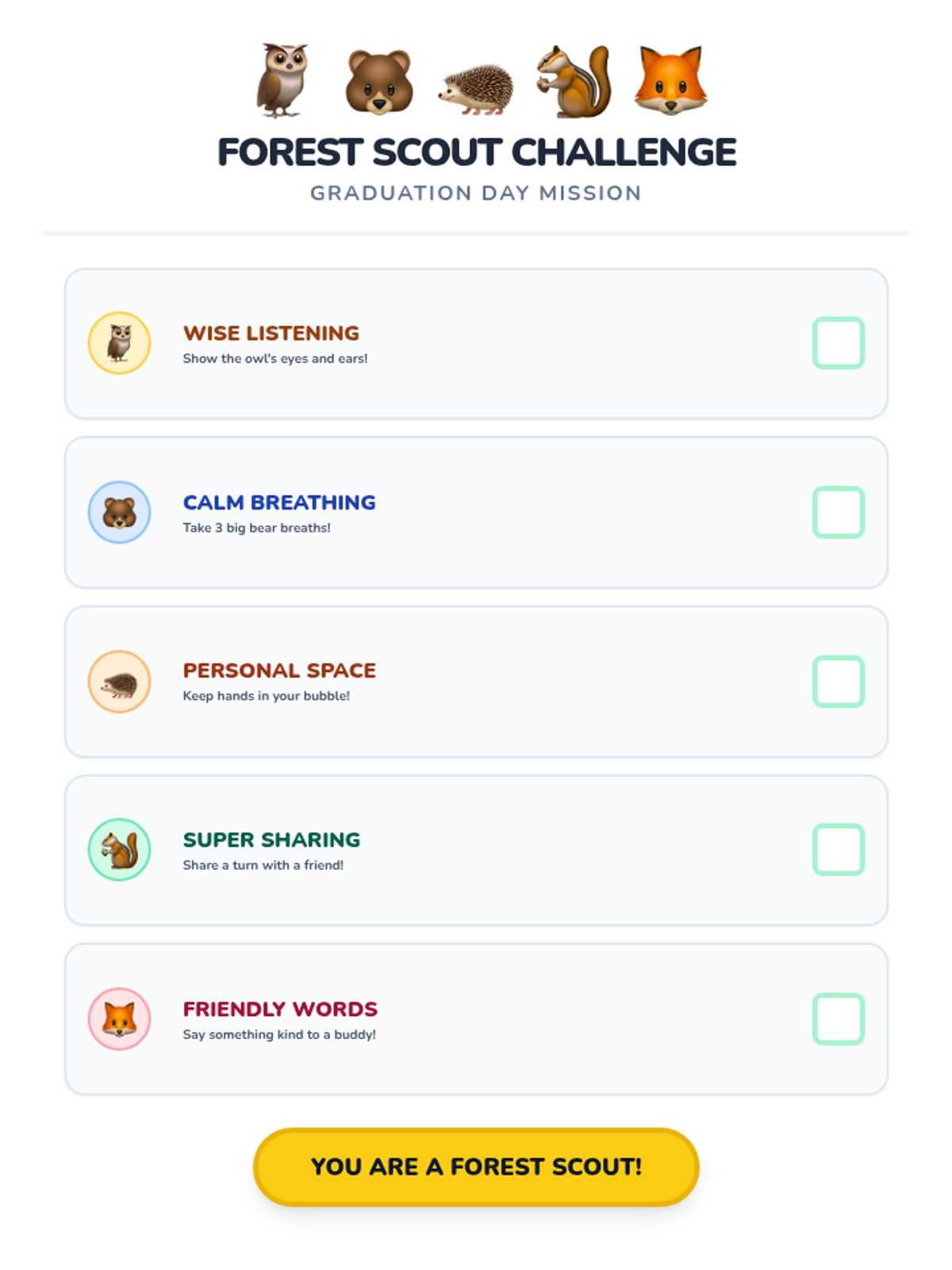
Final revised Forest Scout Challenge Sheet. Vertical spacing reduced to ensure all challenges and the celebratory footer fit on a single page. Checkboxes updated to be completely empty for student marking and text contrast increased for primary classroom use.
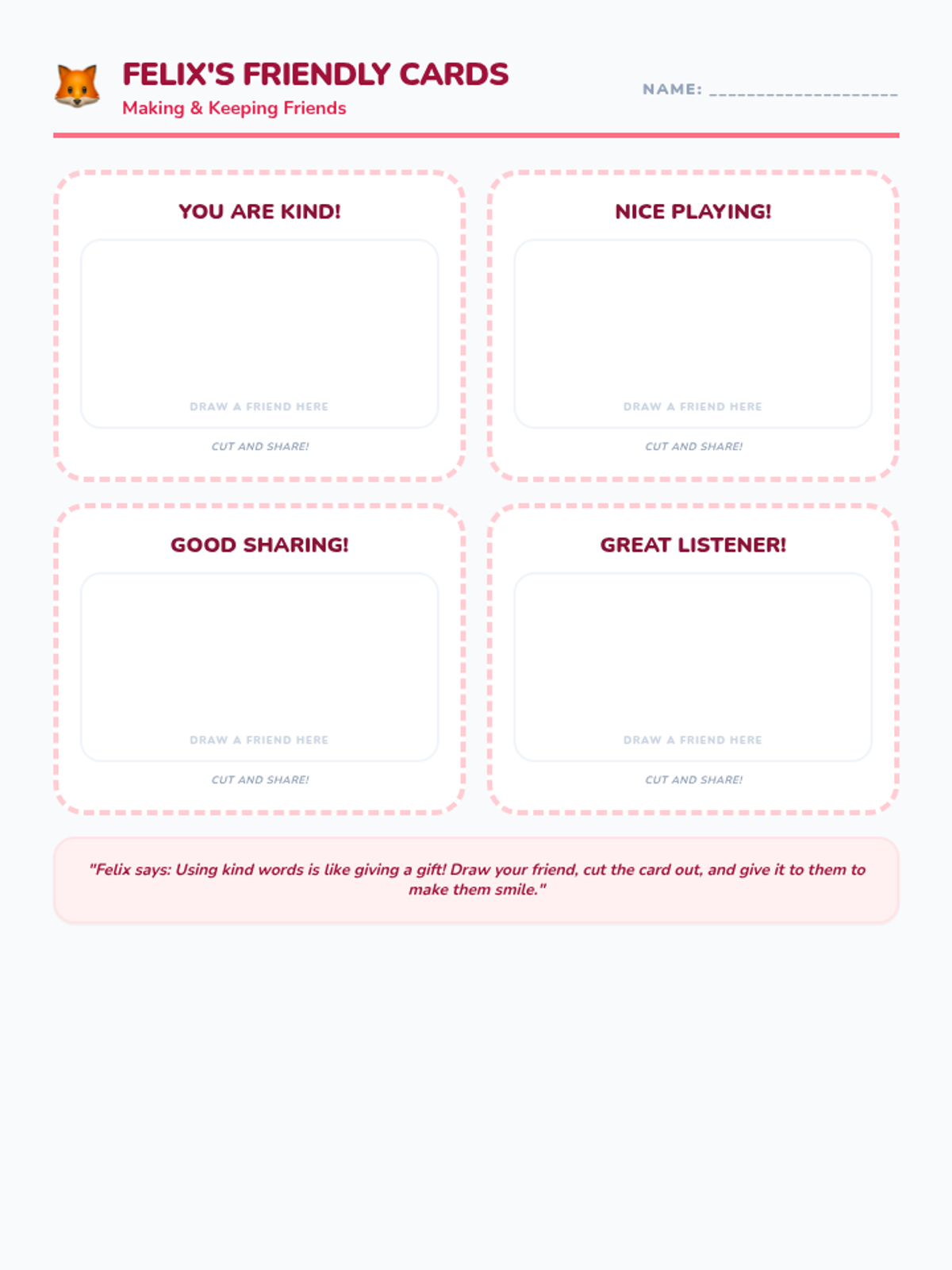
Updated Friendly Fox Cards. Fixed page overflow by reducing card heights and instruction padding. Drawing areas updated to pure white with subtle borders for better visibility. Instructions simplified to ensure the entire activity fits on a single page.
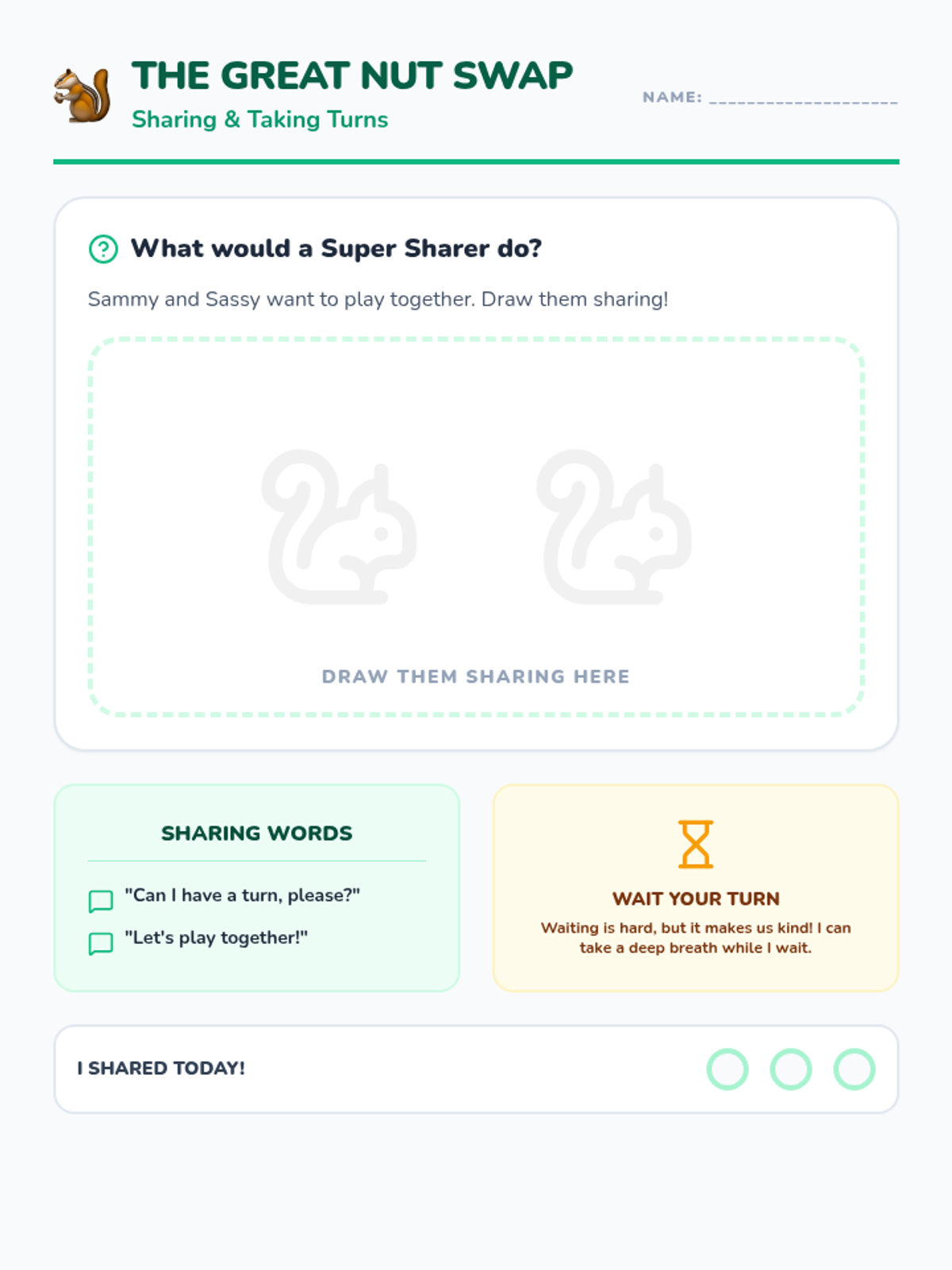
Revised 'Sharing Squirrels' worksheet. Reduced drawing area height to prevent page overflow, updated placeholder text contrast for better visibility, and darkened 'Wait Time' text. Opacity of decorative icons was reduced to ensure student drawings remain the focus.
English presentation slides for Lesson 2, explaining how to set up and maintain a sticker chart reward system to motivate school attendance and positive routines.
English presentation slides for Lesson 1, focusing on validating school anxiety while maintaining firm attendance boundaries. Includes practical scripts and morning routine tips.
Spanish presentation slides for Lesson 2, explaining how to set up and maintain a sticker chart reward system to motivate school attendance and positive routines.
Spanish presentation slides for Lesson 1, focusing on validating school anxiety while maintaining firm attendance boundaries. Includes practical scripts and morning routine tips.
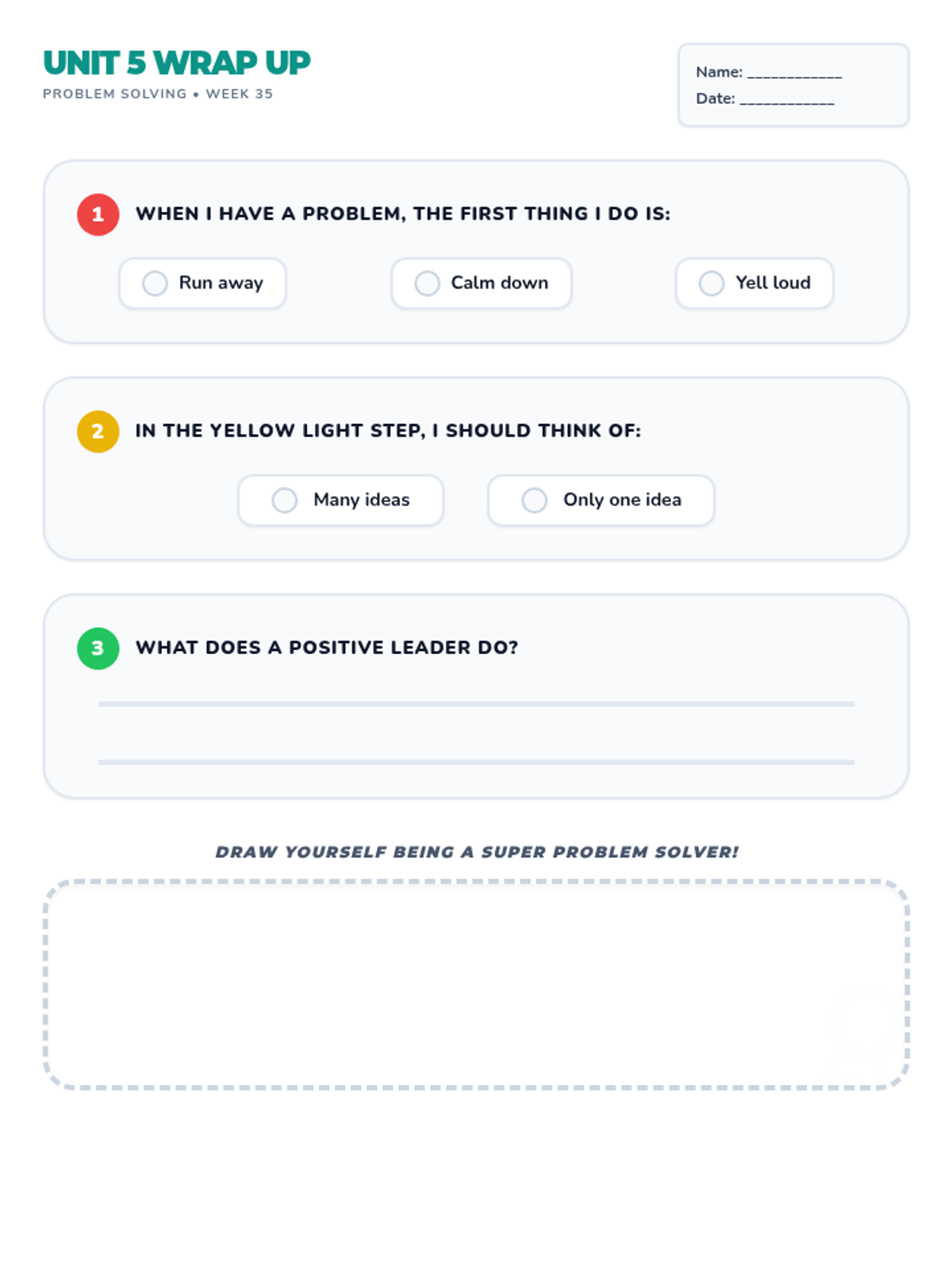
A final assessment for Unit 5. Revised with standardized answer choice styling, improved contrast, and significantly larger handwriting lines for 1st graders. Updated week label.
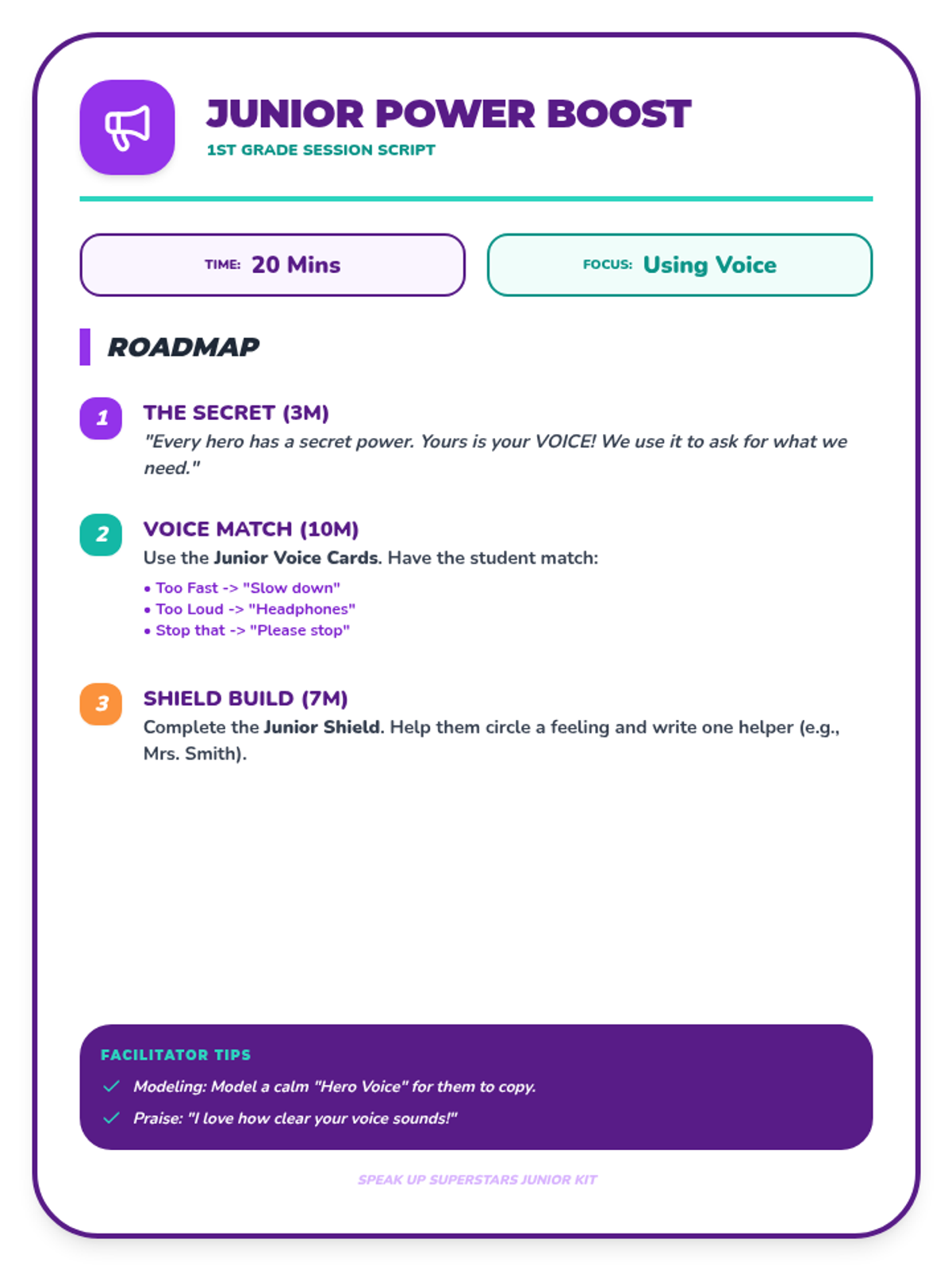
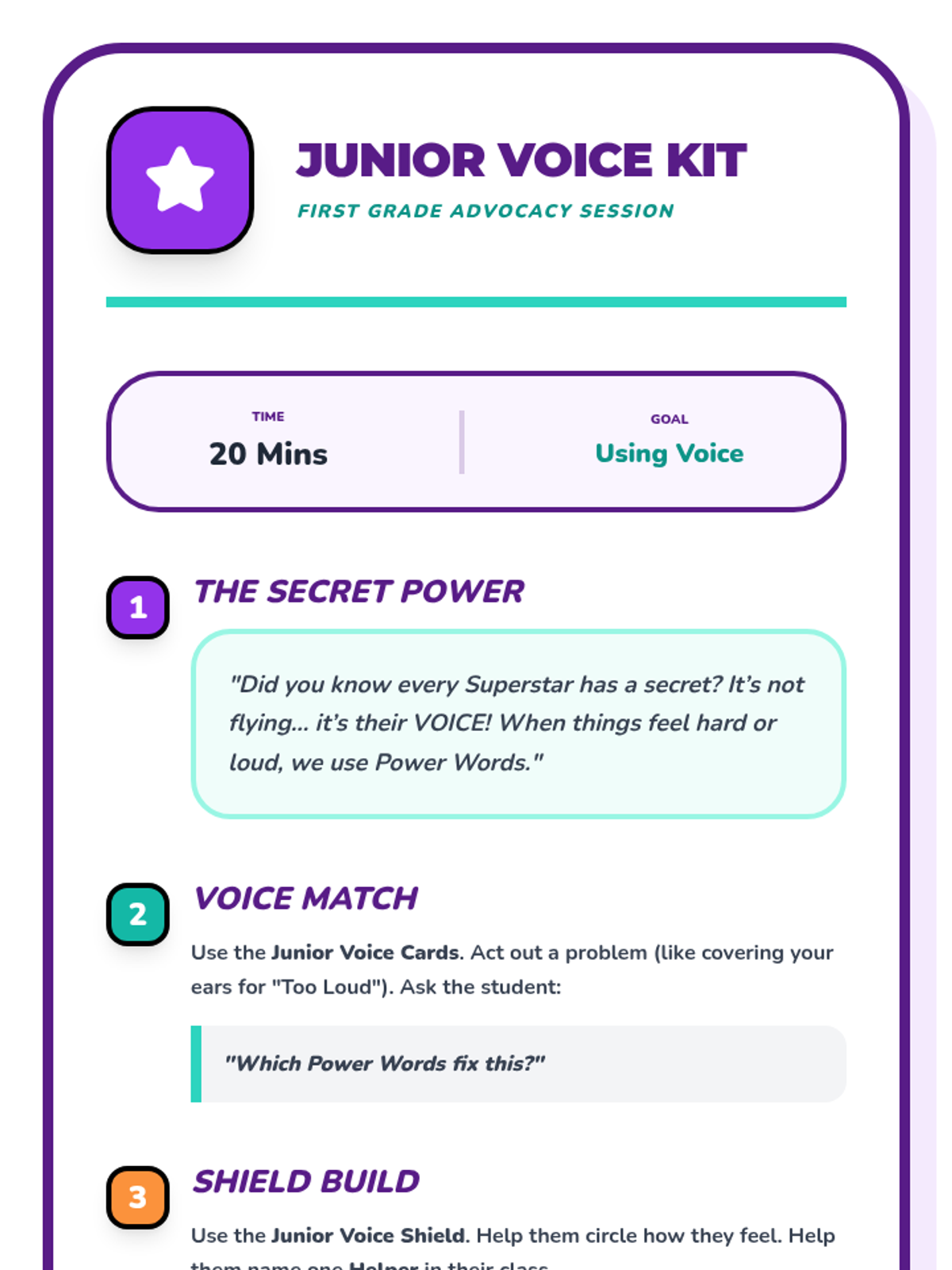
Simplified 1st-grade facilitator guide for the Junior Advocacy Boost. Features a distinct purple/teal visual theme, scripted prompts for easy delivery, and large, clear instructions. No bundled pages for maximum clarity. Condensed to a single page.
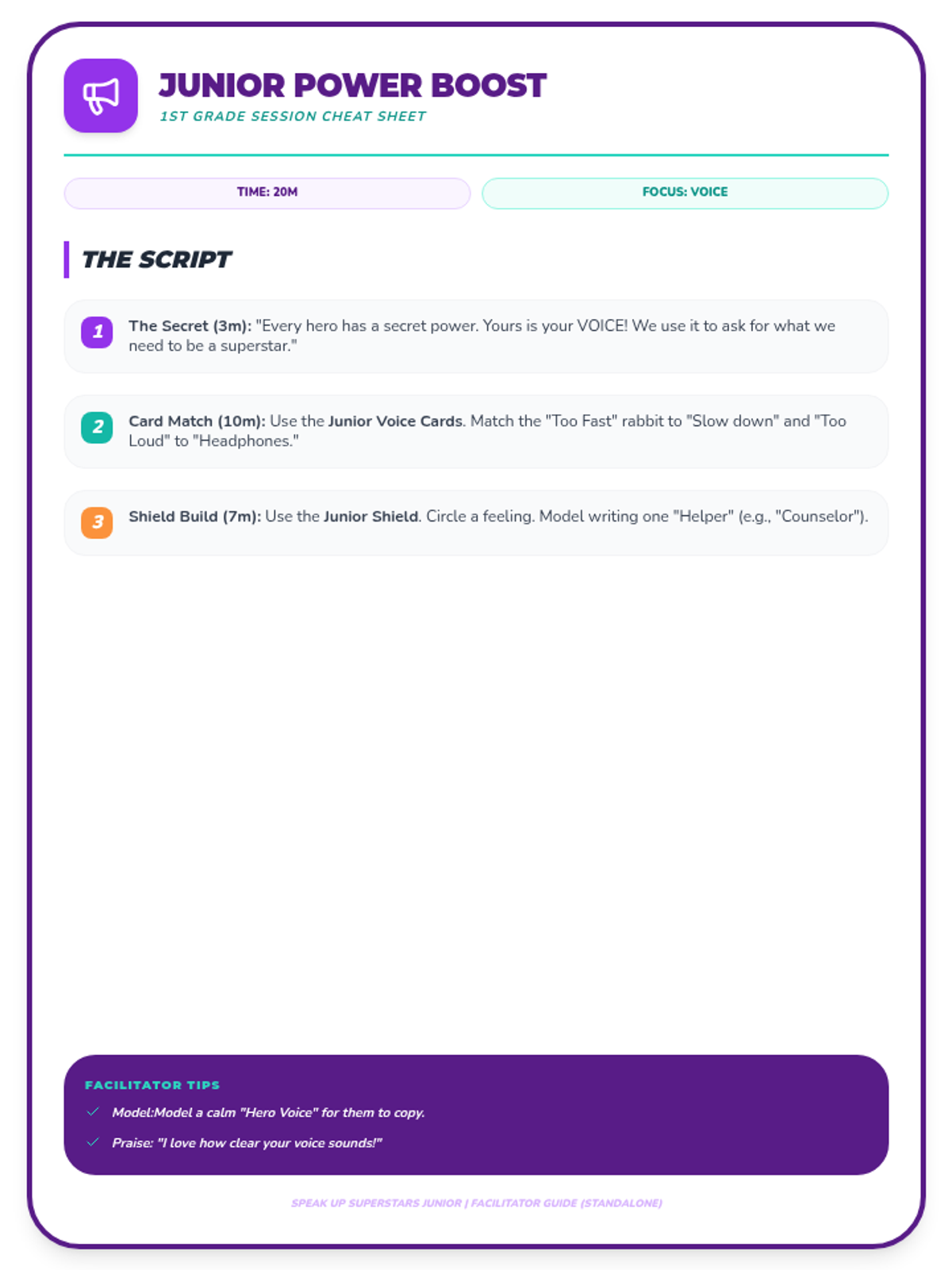
Simplified 1st-grade facilitator guide for the Junior Advocacy Boost. Features a distinct purple/teal visual theme, scripted prompts for easy delivery, and large, clear instructions. No bundled pages for maximum clarity. Now condensed to a single page.
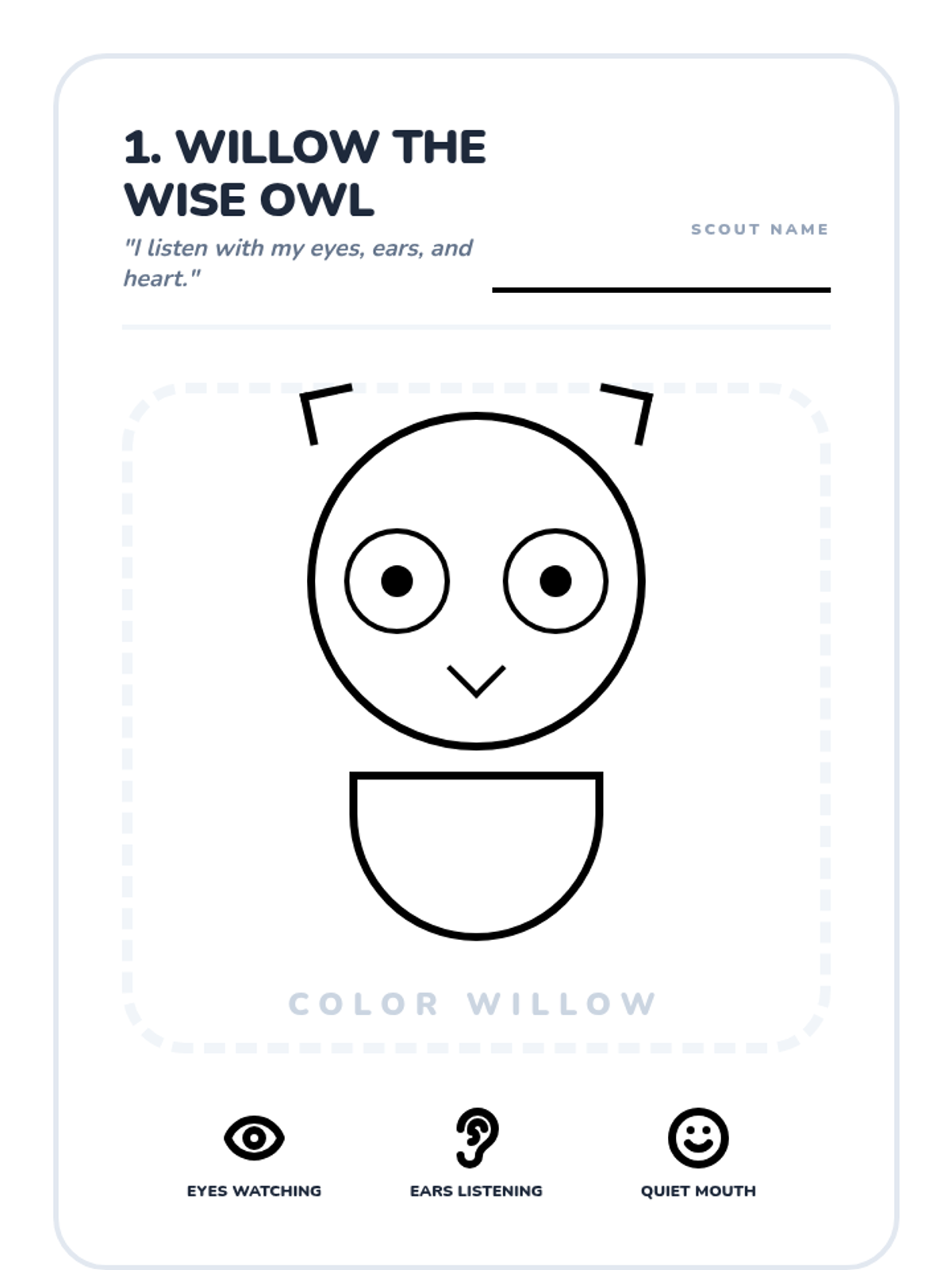
Final polished coloring book. Replaced generic icons with custom-built owl and bear-themed line art for a more authentic character experience. Darkened all strokes to solid black and increased the size of instructional icons. Improved the name field with more space and a high-contrast border. Guaranteed single-page layout for each sheet.
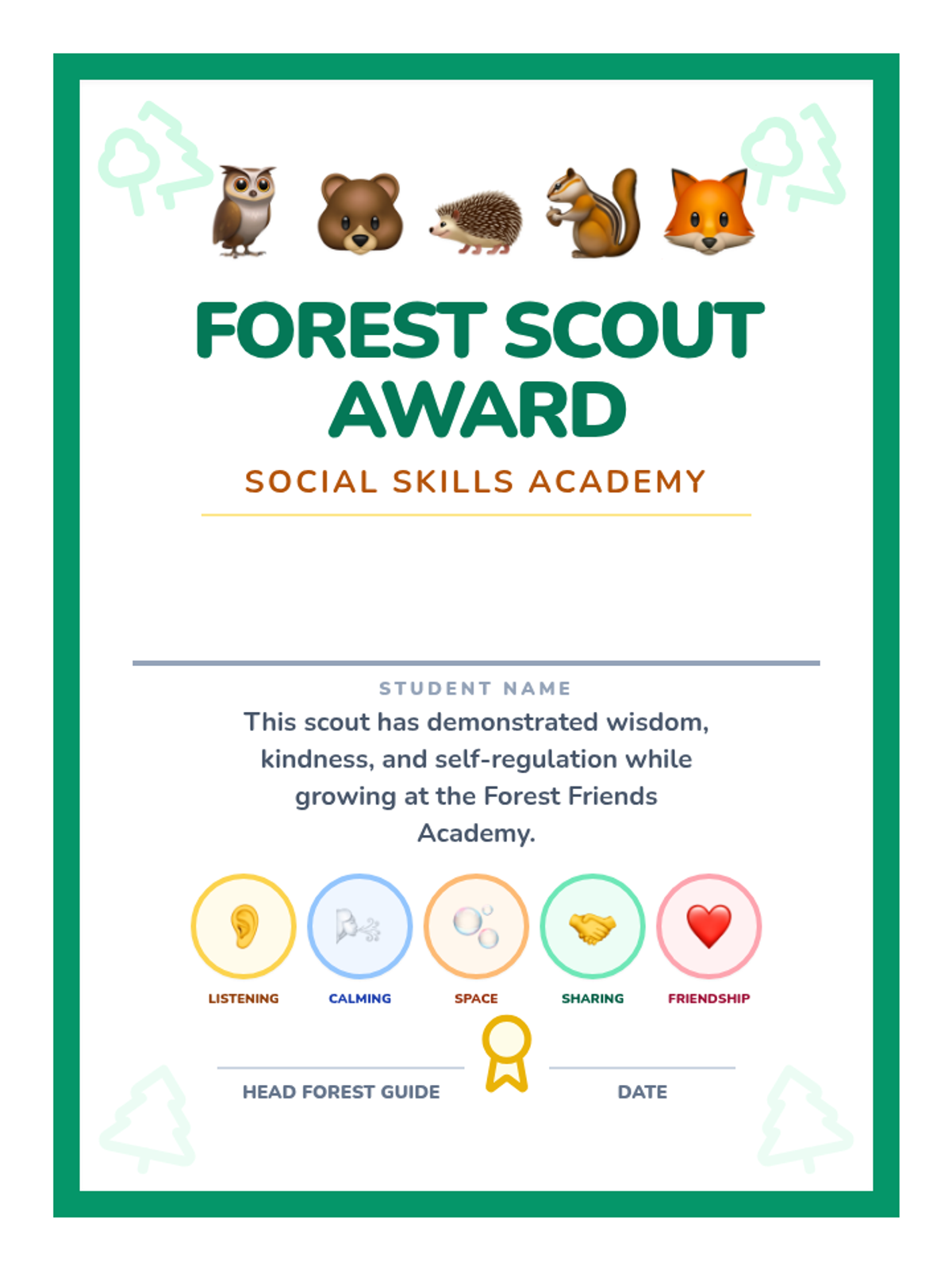
Revised graduation award. Replaced underscores in the name field with a solid CSS border for a professional look. Repositioned signature lines and decorative icons to prevent overlapping text. Updated the 'Space' badge to a more literal bubble emoji for clarity.
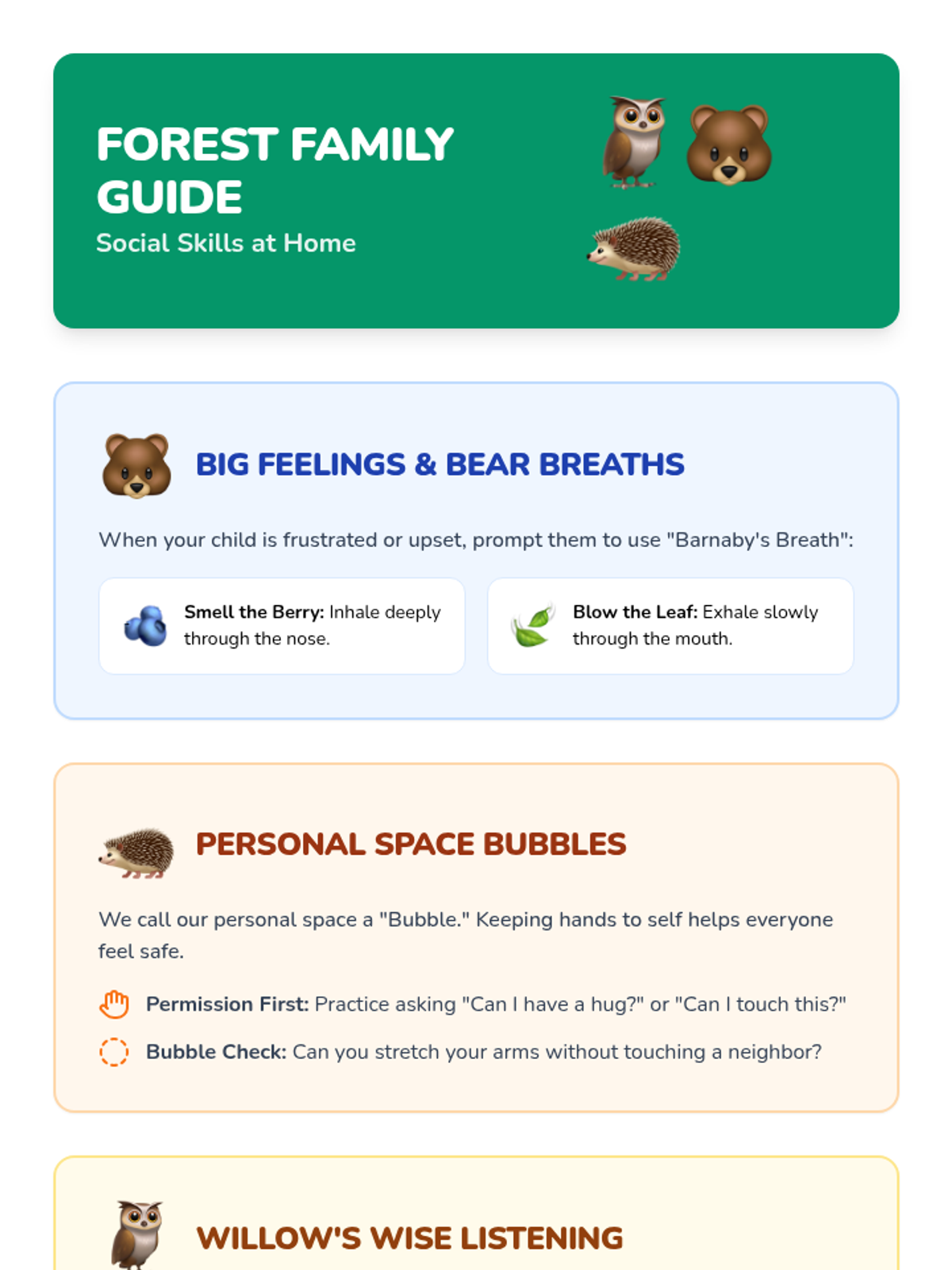
Updated parent guide. Fixed page break issue by adding 'break-inside-avoid' to cards, ensuring sections like 'Personal Space Bubbles' stay on one page. Increased footer scale, added a parent notes section, and improved checklist contrast with darker amber text.
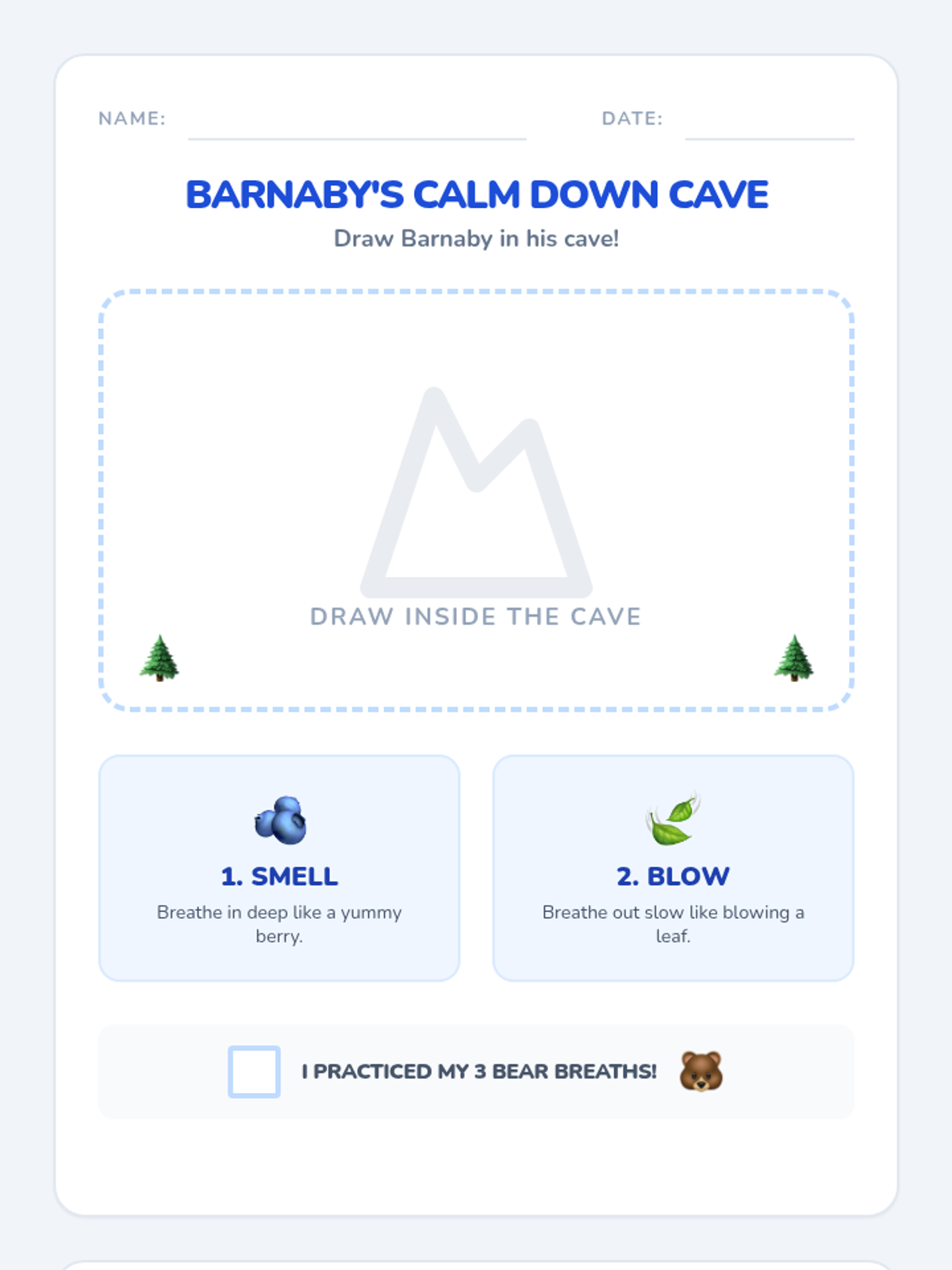
Revised two-page practice packet. Fixed Page 1 overflow by reducing drawing area height, added Name/Date fields to both pages, updated drawing areas to pure white for better visibility, and improved contrast for instructional placeholder text.
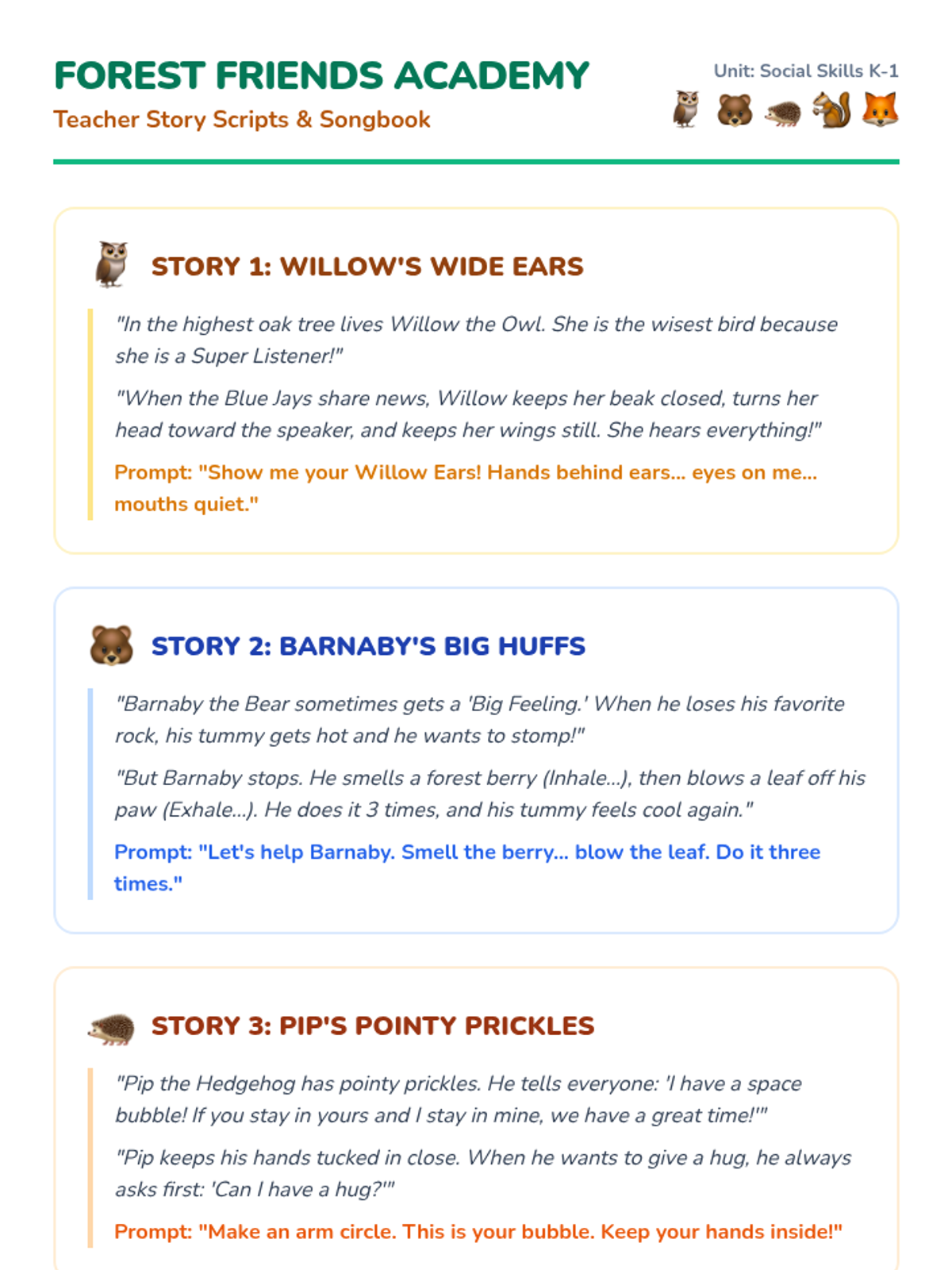
Updated teacher's resource containing all six narrative scripts (Willow, Barnaby, Pip, Sammy, Felix, and Graduation) and instructional songs. Improved layout with 'break-inside-avoid' to ensure stories stay together and reduced whitespace for better printing.
Comprehensive 8-slide presentation for the 'Forest Friends Academy' unit, introducing five animal characters and their associated social skills: wise listening, deep breathing, personal space, sharing, and friendship. Each slide features clear visuals, minimum 24px font size, and simple actionable steps for K-1 students.
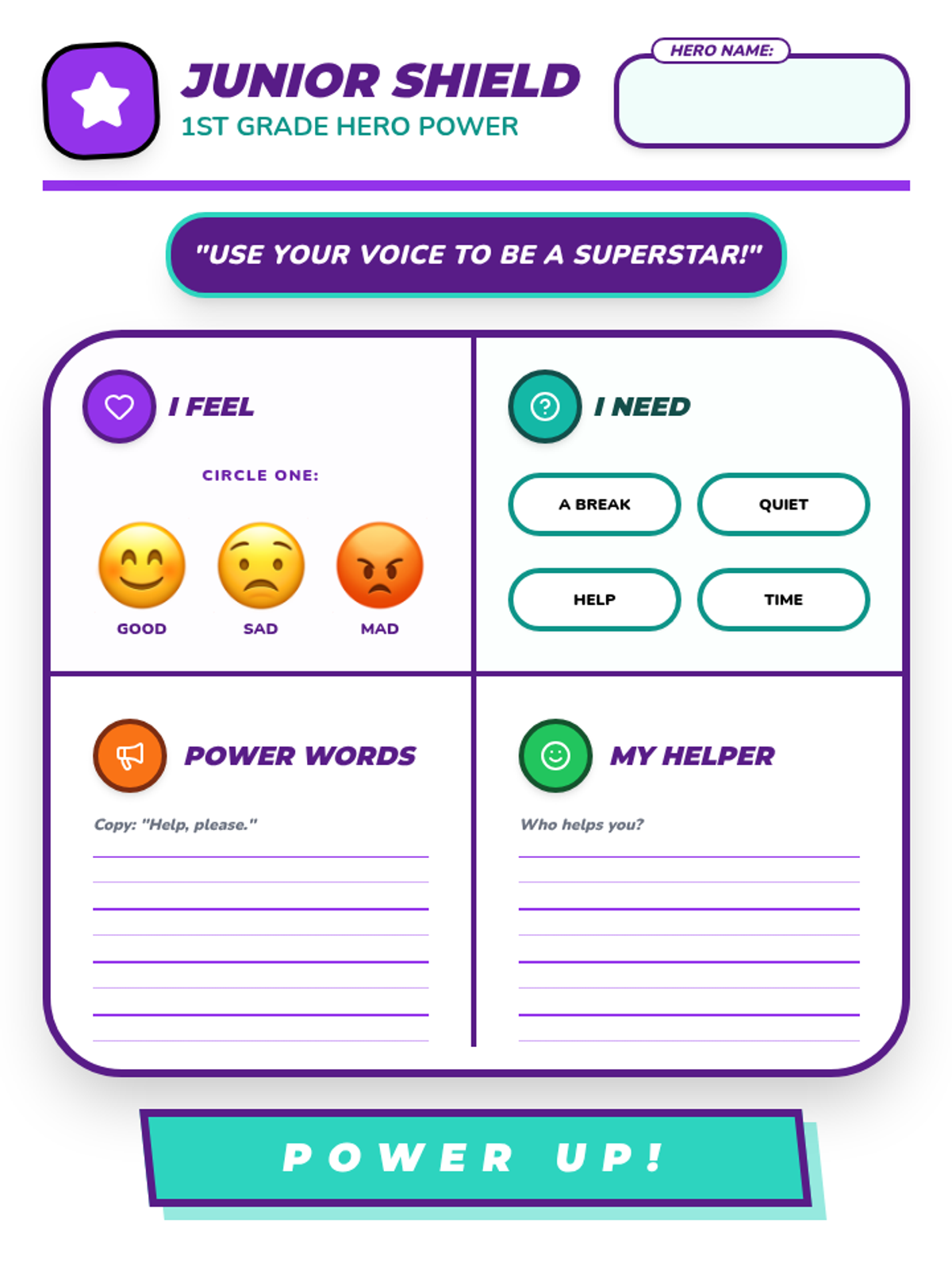
Junior Hero Voice Shield for first graders. Features a distinct purple and teal visual theme, oversized emojis, high-contrast choice boxes, and clear primary handwriting lines. Designed for single-page use with minimal text.
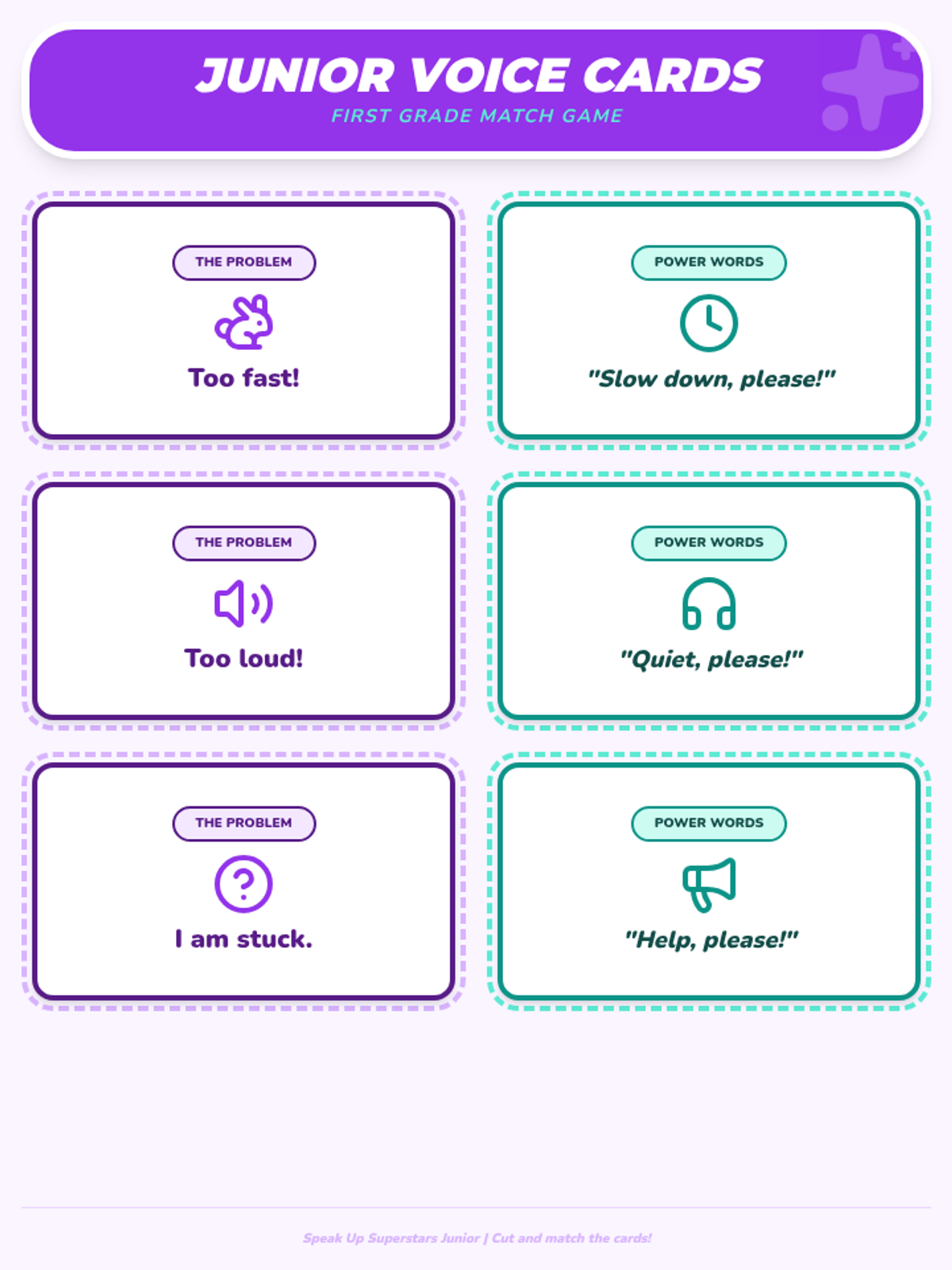
Simplified card sort for first graders with huge icons, minimal text, and clear "Problem/Power Voice" labels. Uses a distinct purple and teal theme to differentiate from the older student lesson. Revised for logical matching and single-page fit.
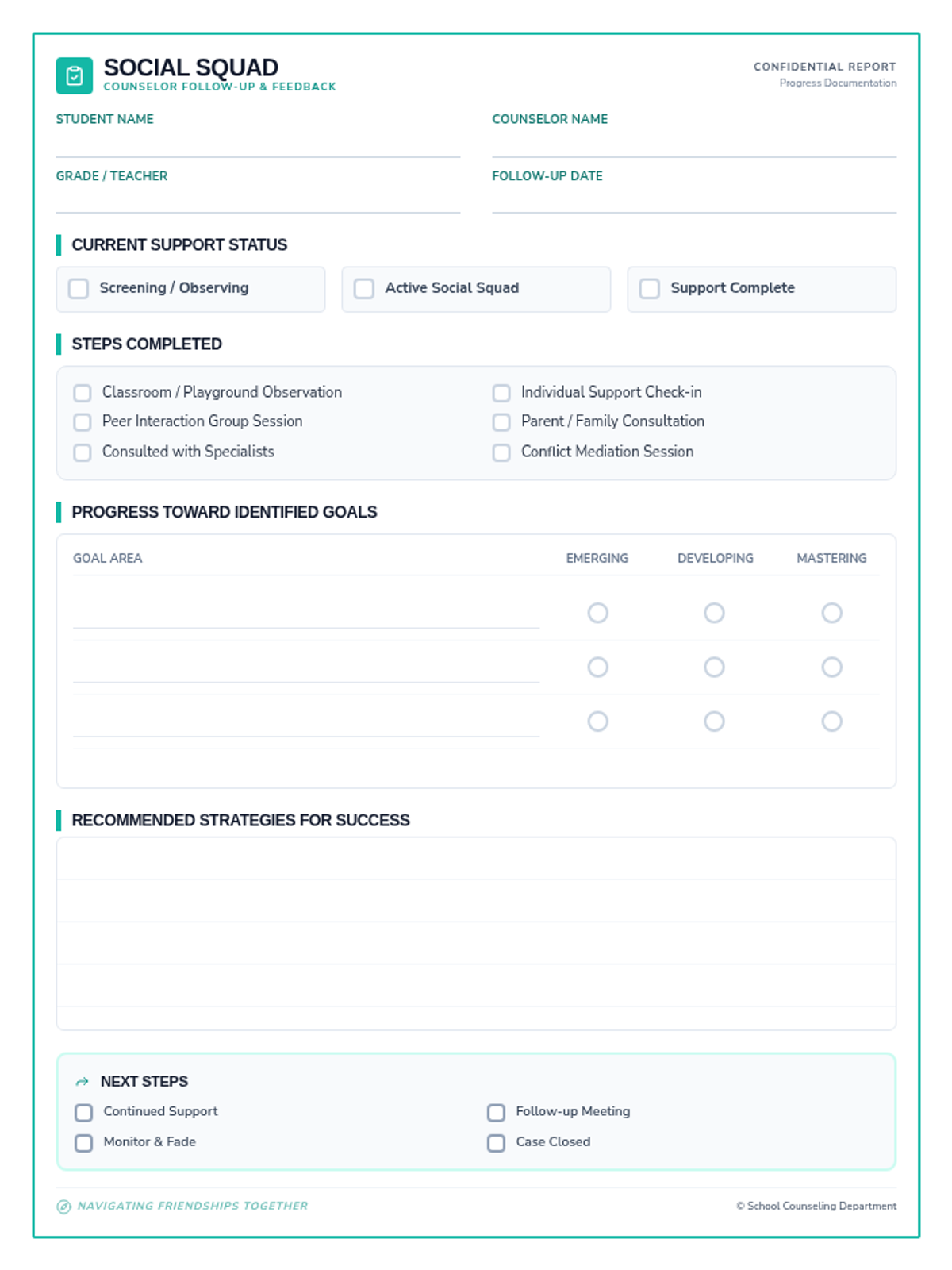
A revised school counselor follow-up and feedback form. It features a new introductory referral sentence, detailed intervention logs with dates and goals, a dedicated 'At this time' status section, and a professional closing message inviting continued collaboration. Now includes 'Outside Referral' in next steps.
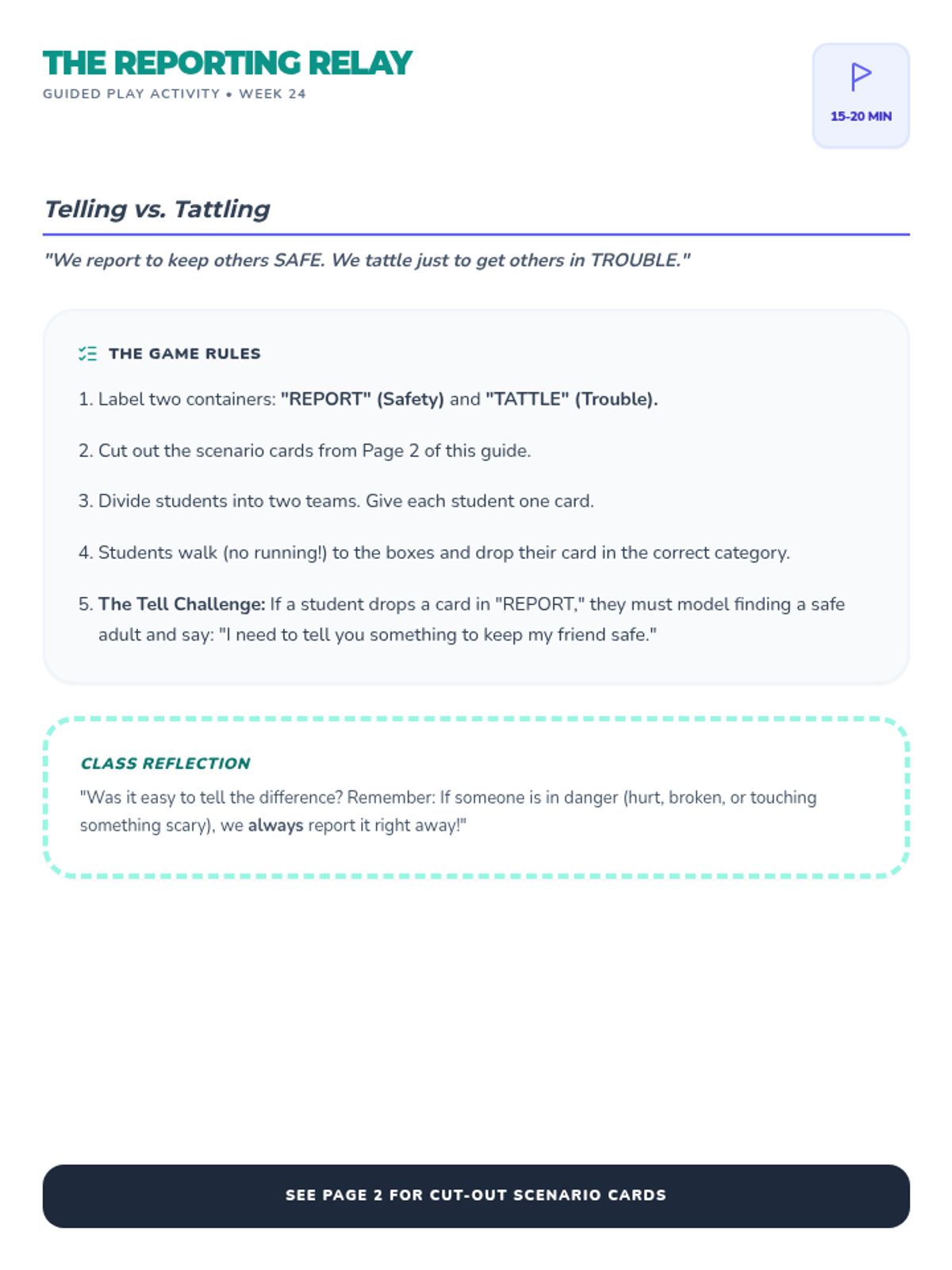
A teacher-facing guided play activity for Week 24. Revised with updated week label and full scenario cards.
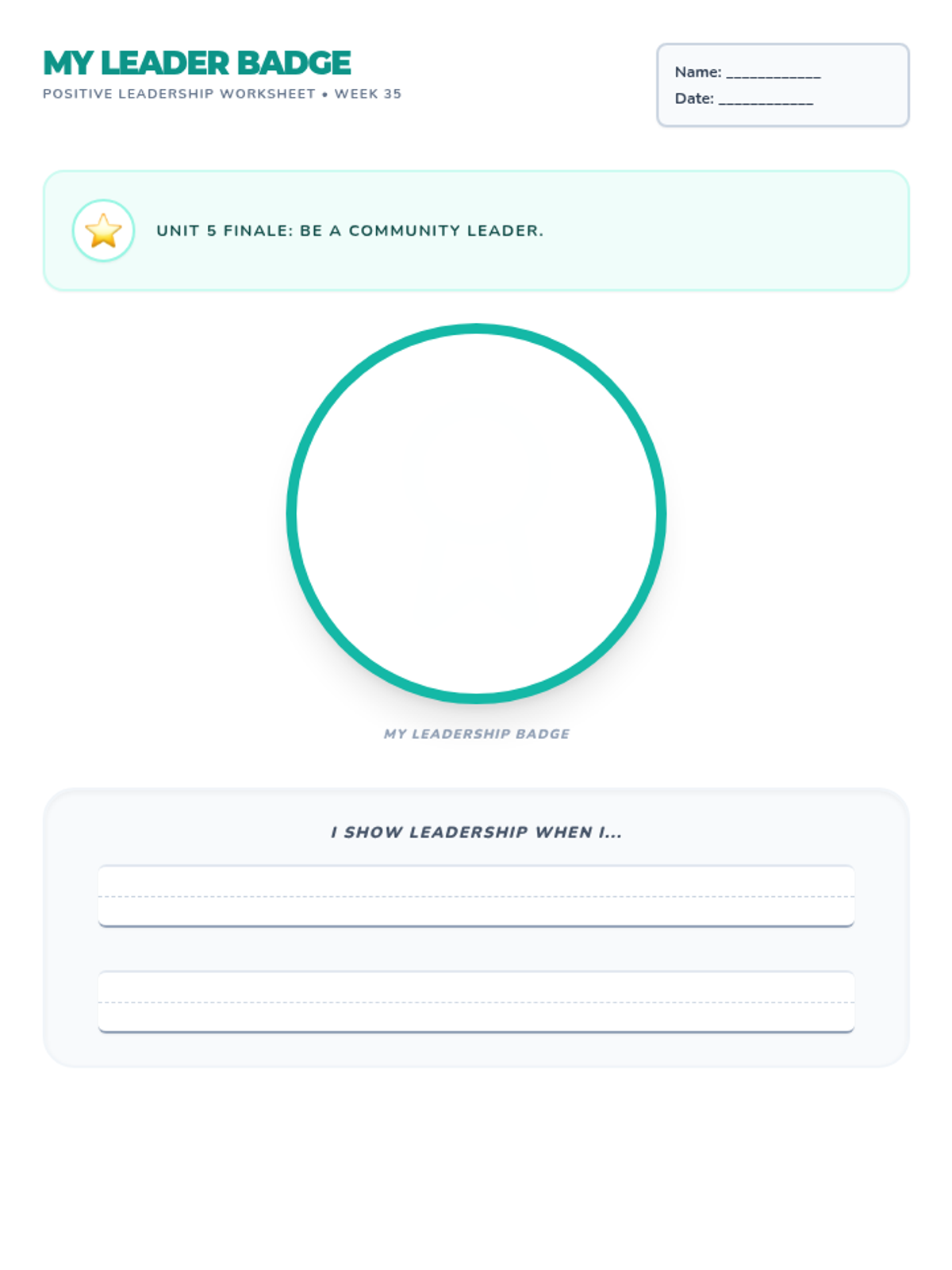
A student-facing worksheet for Week 35. Students design a personal "Leadership Badge" and identify positive actions. Revised for new sequence position.
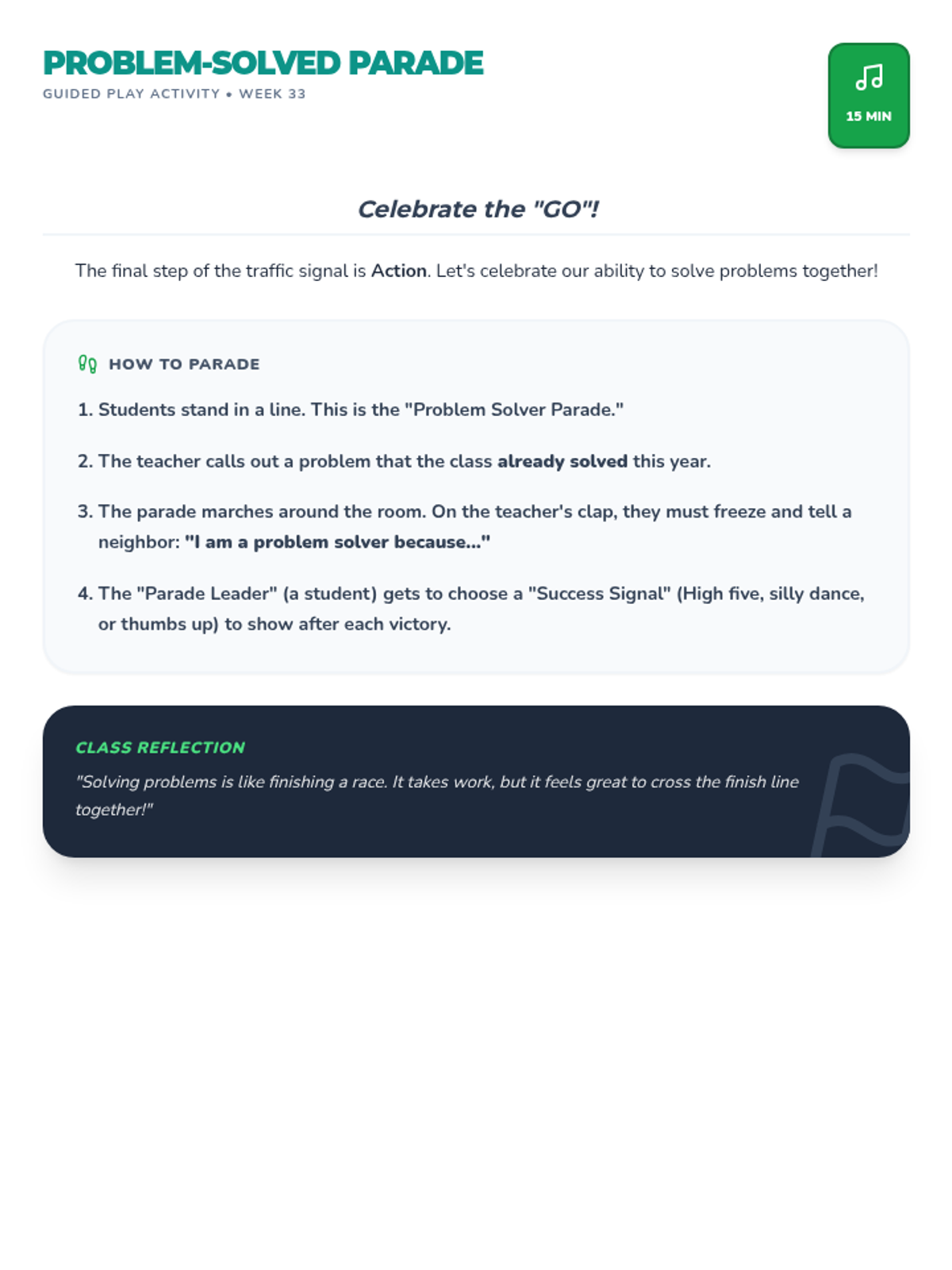
A teacher-facing guided play activity for Week 33. A movement-based celebration of collective problem-solving successes throughout the school year. Updated week label.
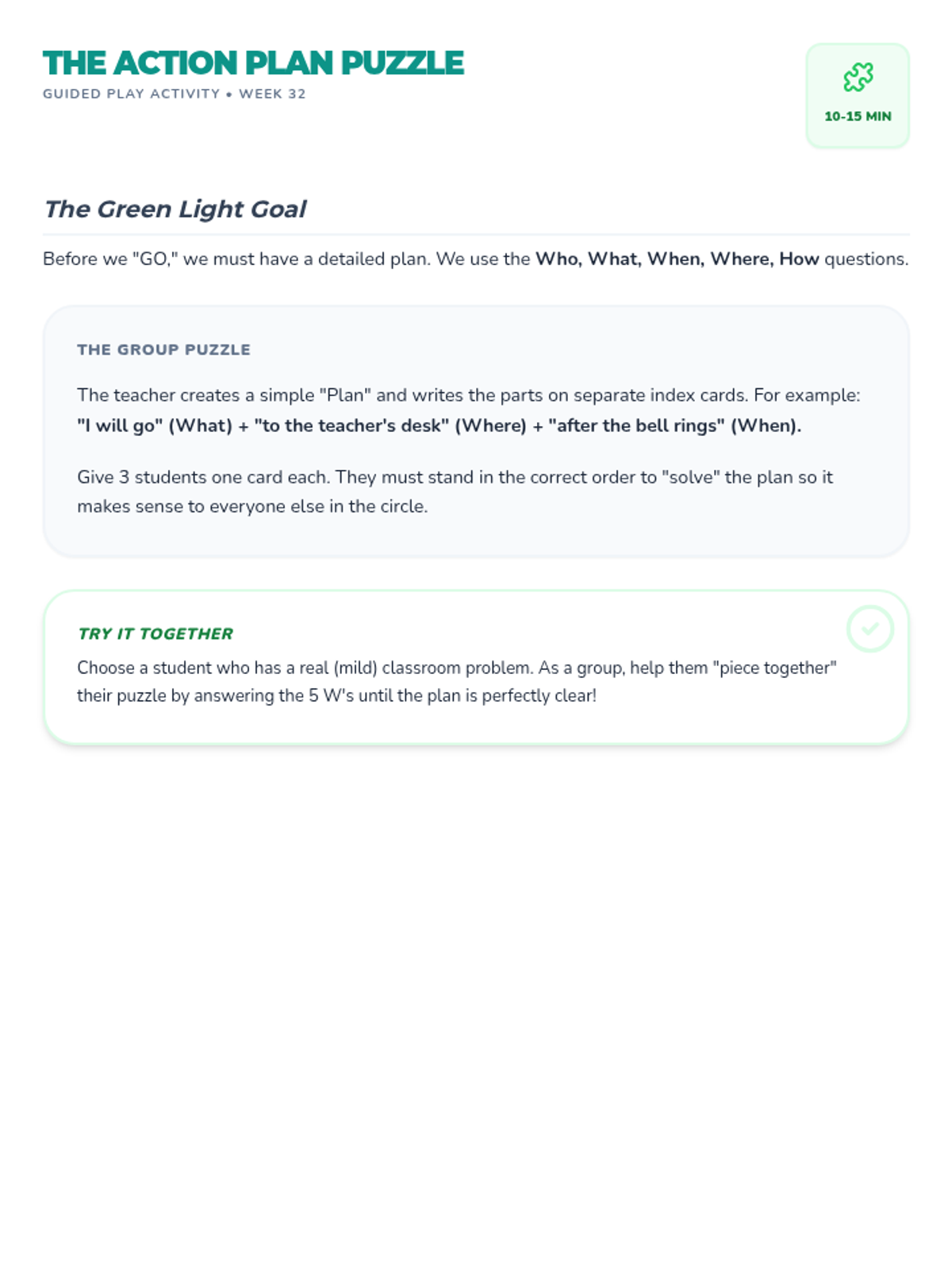
A teacher-facing guided play activity for Week 32. Students work together to "build" a detailed action plan by answering key questions (Who, What, When, etc.). Updated week label.
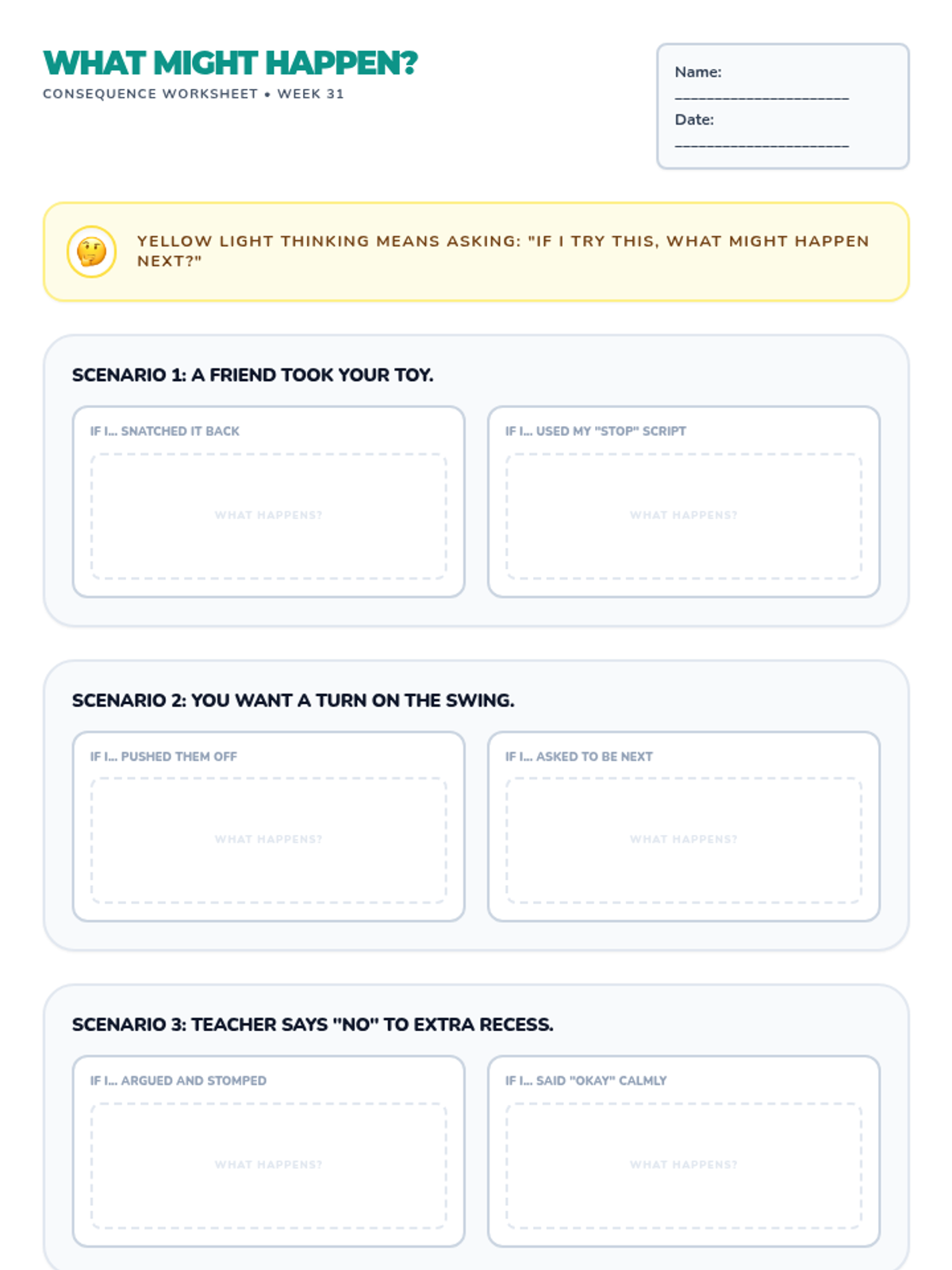
A student-facing worksheet for Week 31. Students evaluate consequences for multiple social scenarios by predicting likely outcomes. Updated week label.
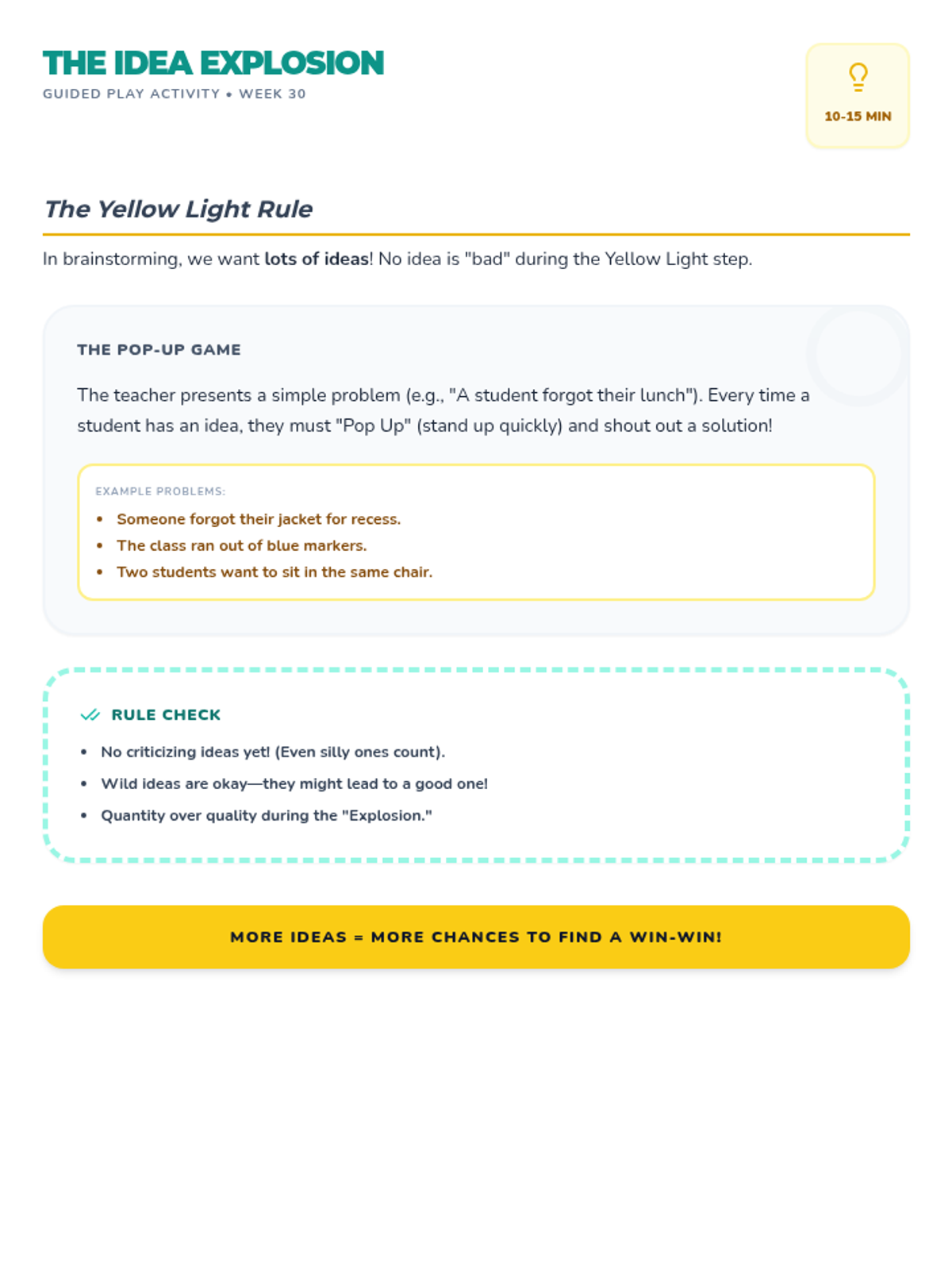
A teacher-facing guided play activity for Week 30. A rapid-fire brainstorming game that encourages students to generate multiple solutions without judgment. Updated week label and examples.
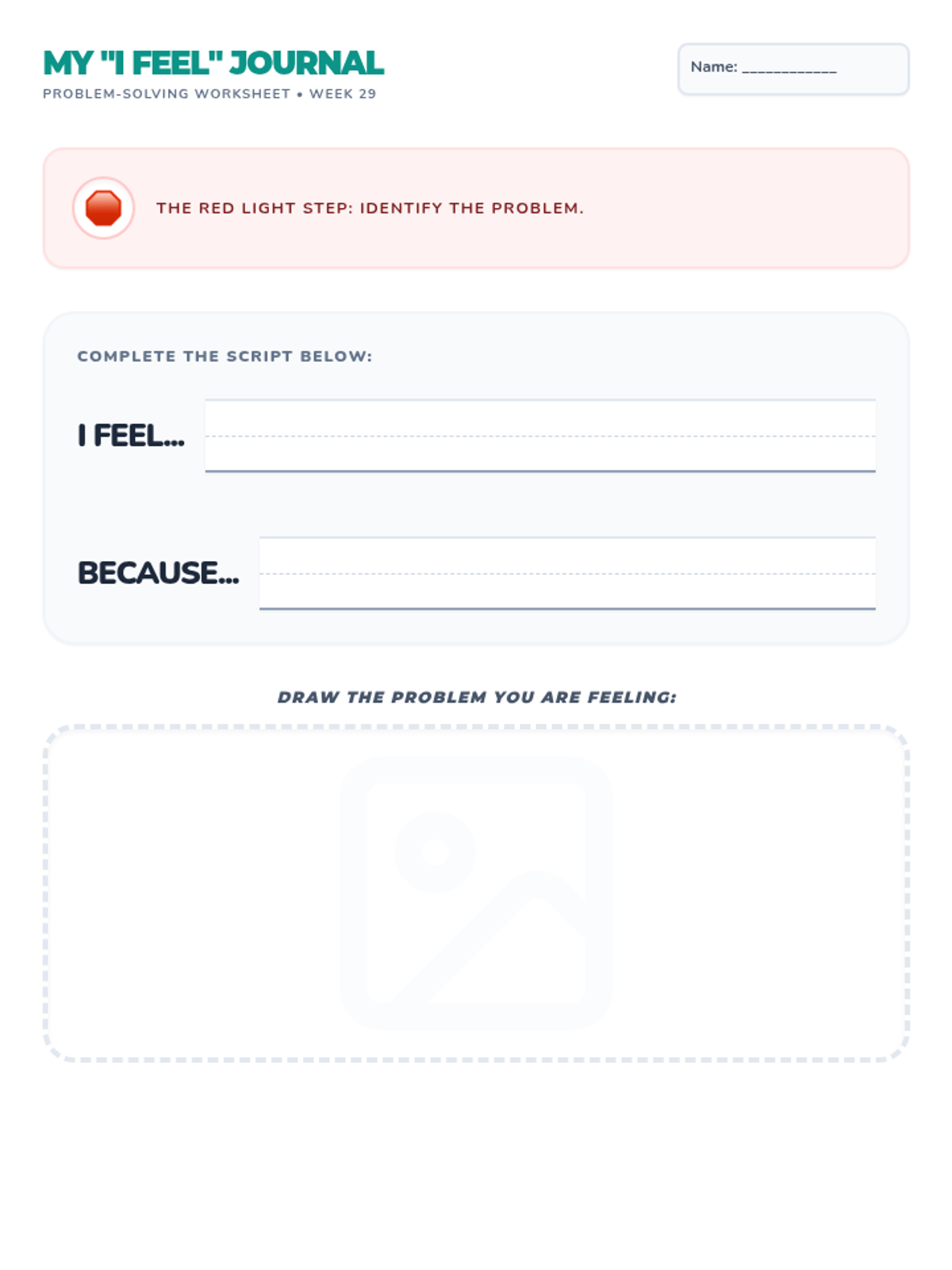
A student-facing worksheet for Week 29. Students practice using the "I feel... because..." script to clearly state a problem as part of the traffic signal model. Updated week label.
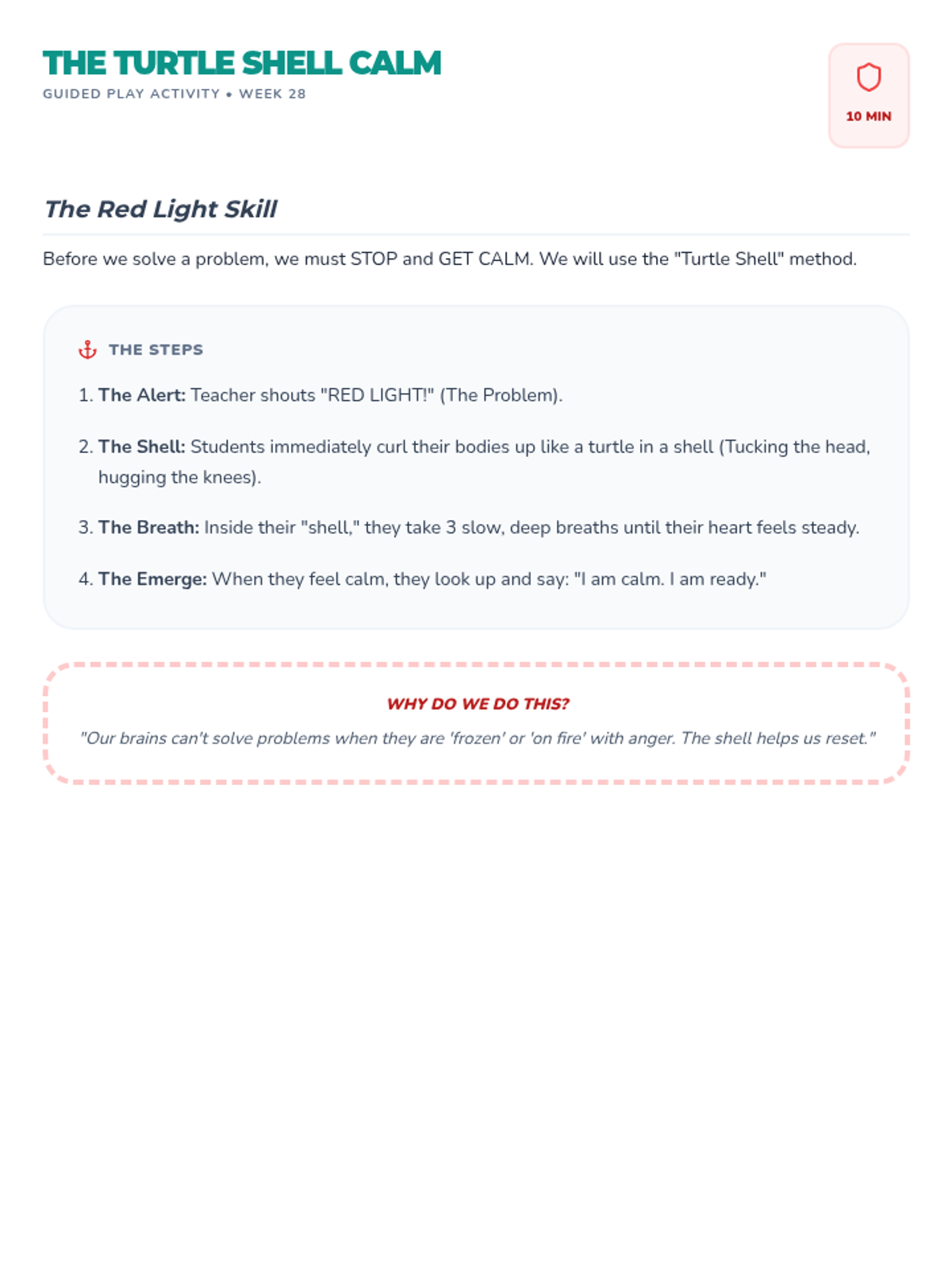
A teacher-facing guided play activity for Week 28. Teaches students the "Turtle Shell" technique for immediate self-regulation when faced with a problem. Updated week label.
Engaging visual slides for the Mosaic Masterpiece lesson, introducing the concept of humility through the metaphor of a mosaic.
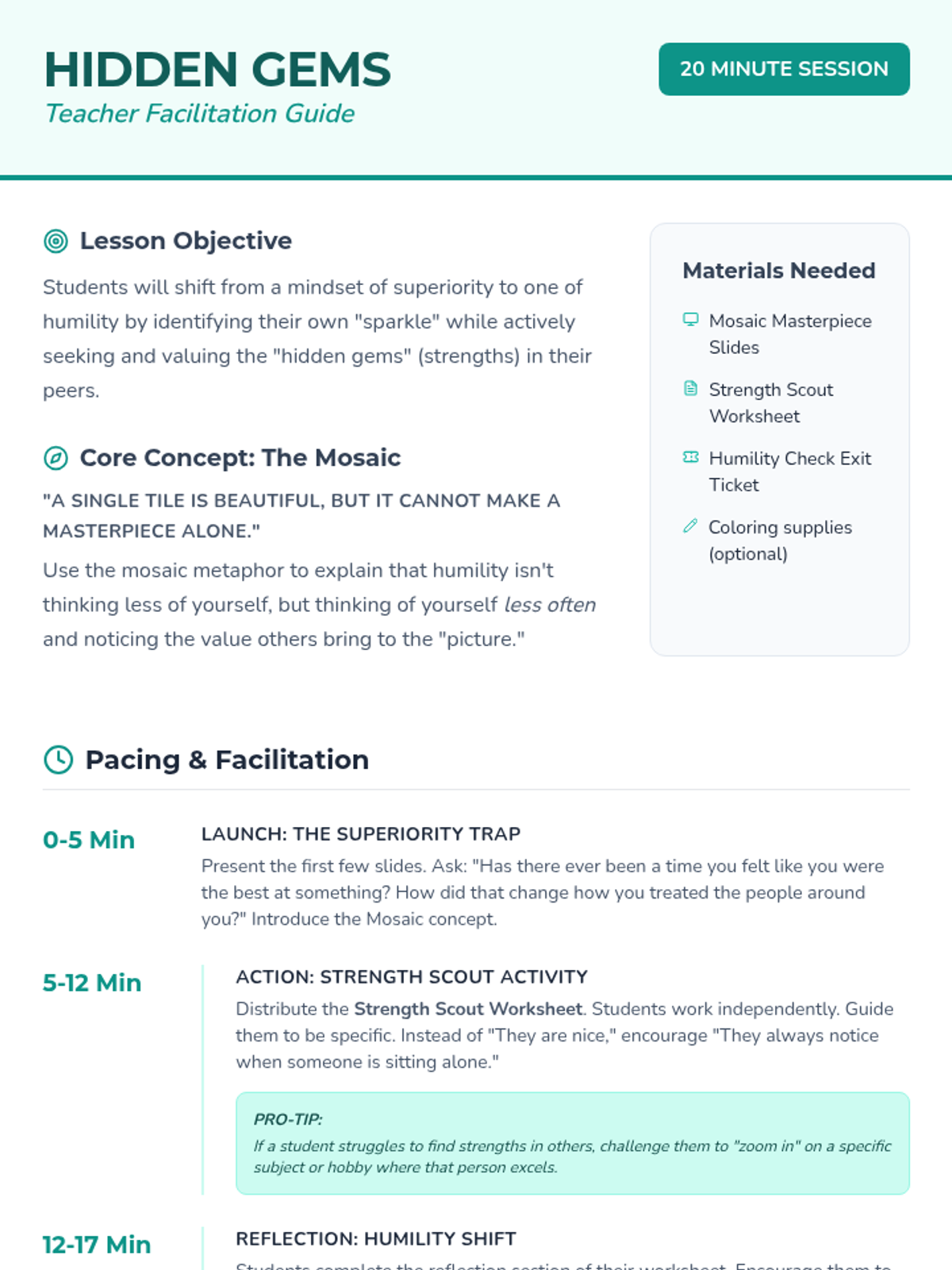
A comprehensive facilitation guide for the Mosaic Masterpiece lesson, including objective, pacing, and discussion prompts.
A bright and engaging slide deck to introduce collaborative behaviors to young learners.
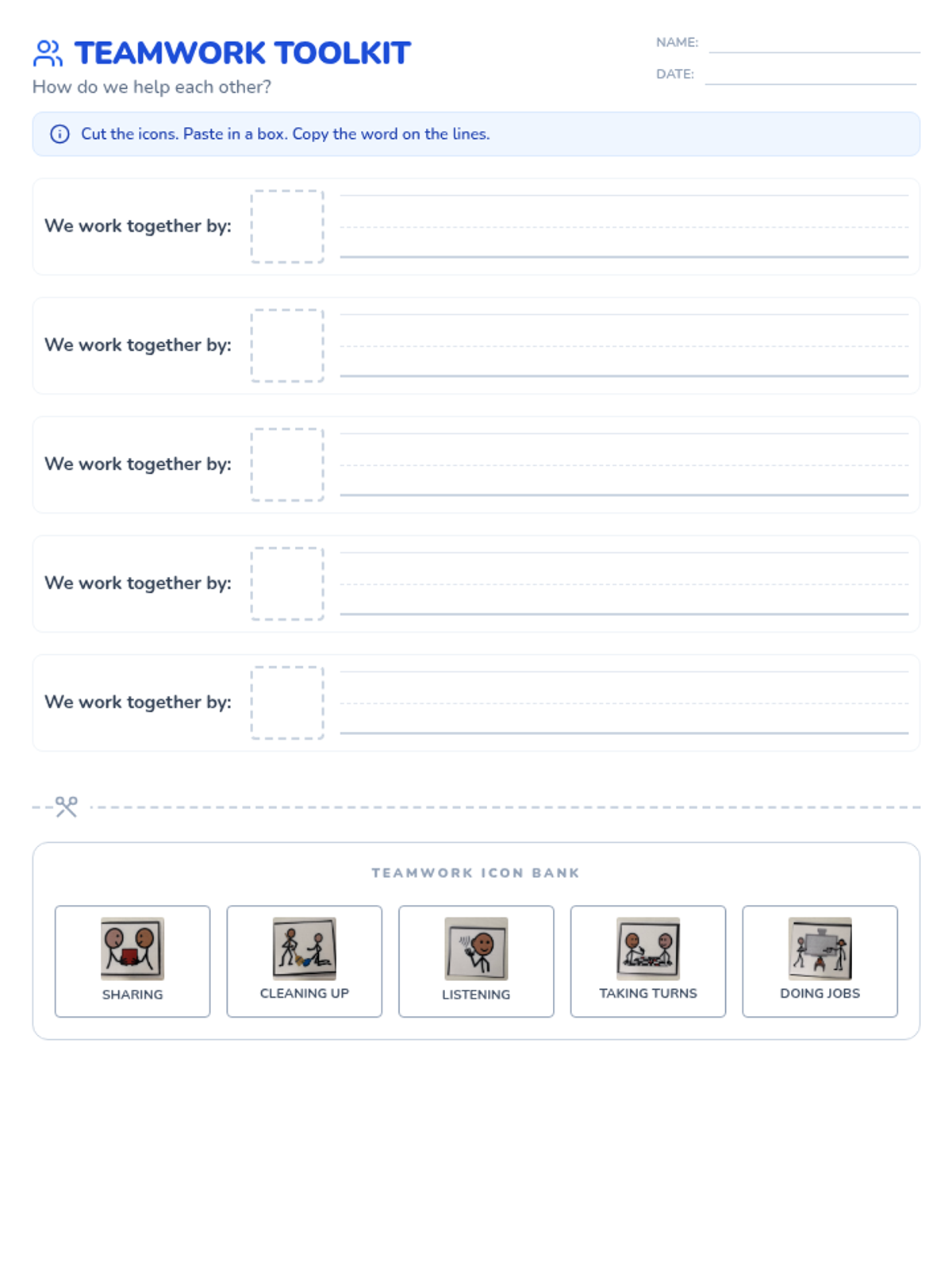
A cut-and-paste worksheet for early learners to build sentences about teamwork using visual icons, featuring high-contrast writing lines.
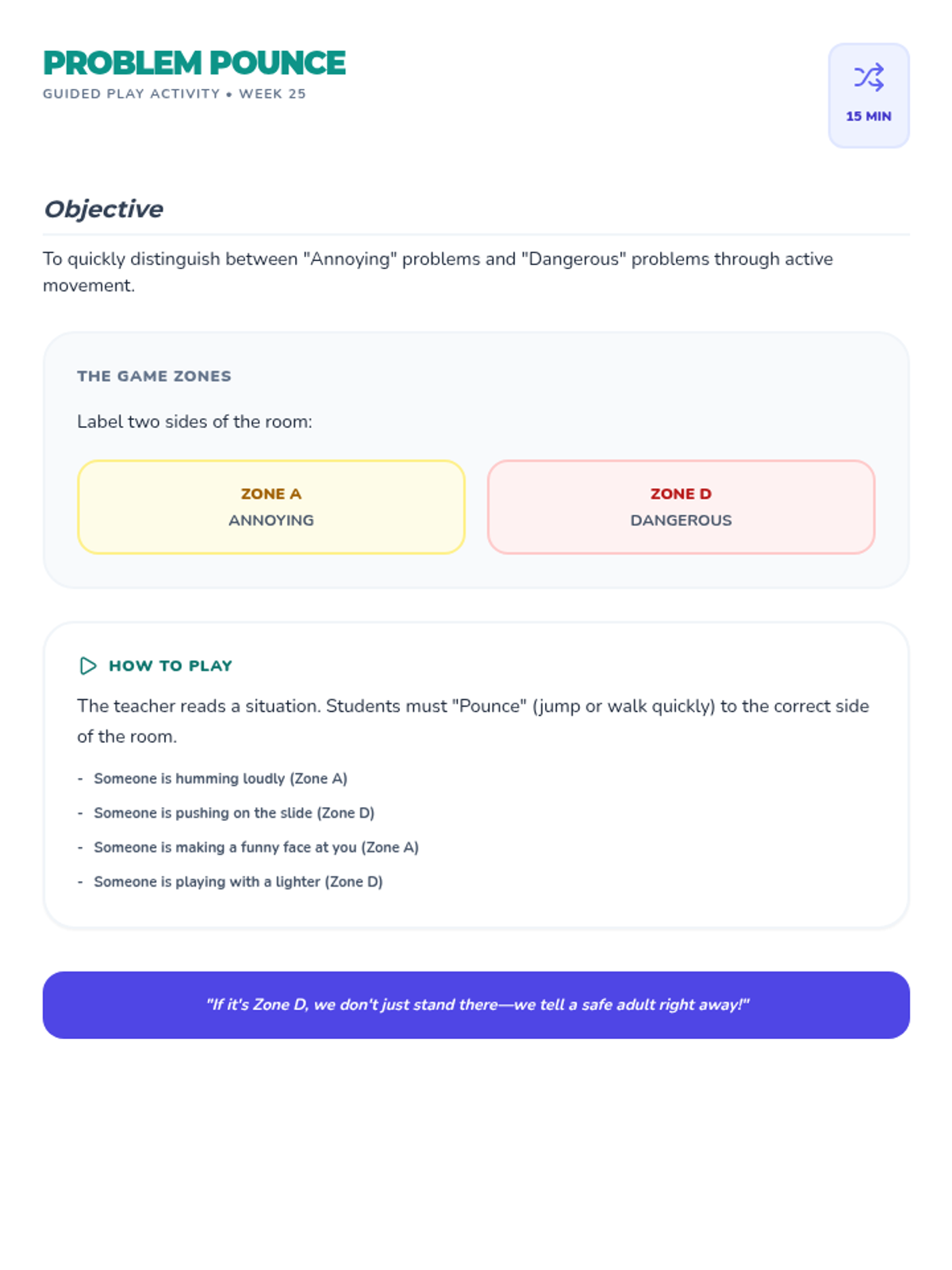
A teacher-facing guided play activity for Week 25. A movement-based sorting game where students categorize classroom problems as "Annoying" or "Dangerous." Updated week label.
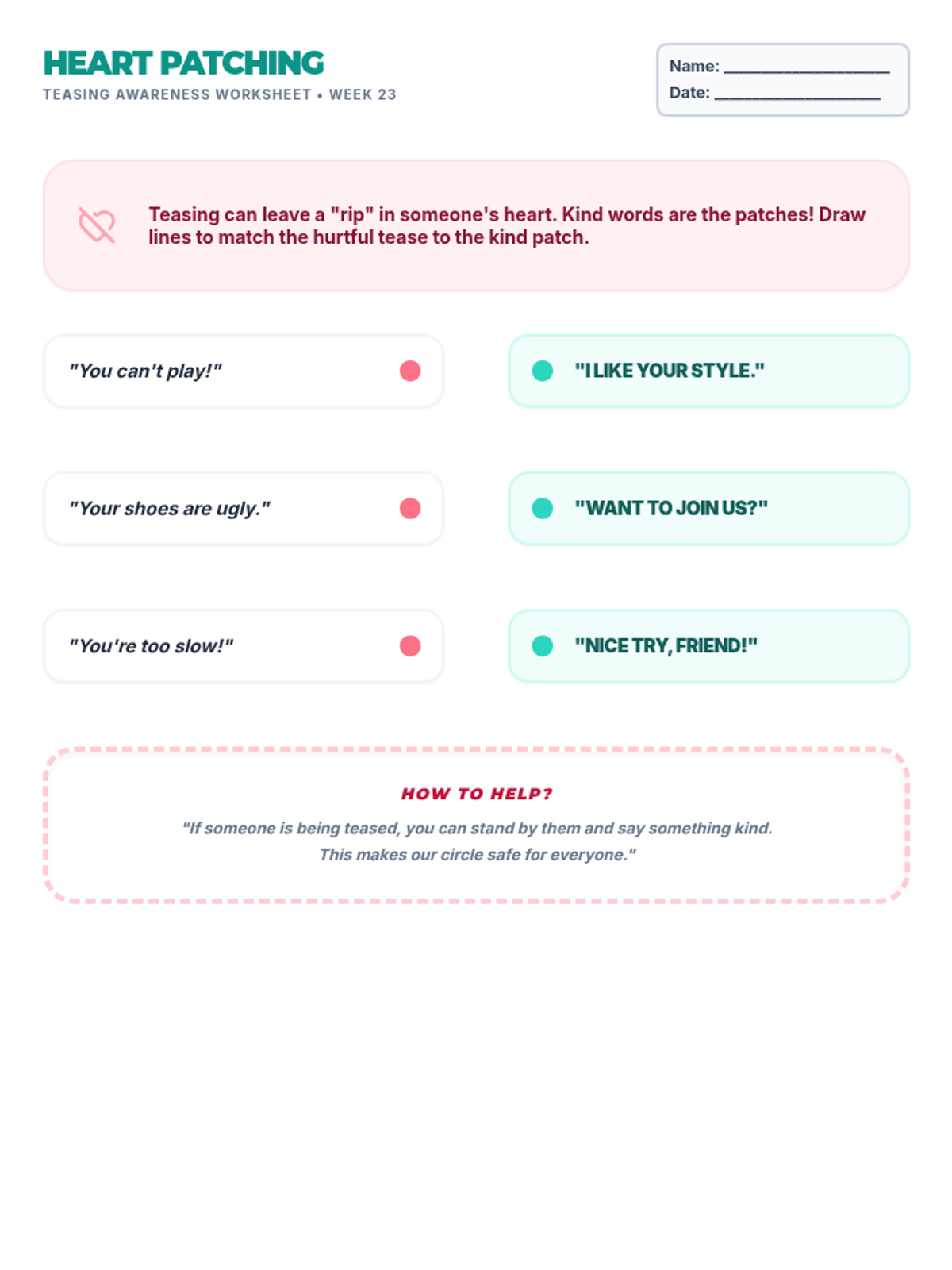
A student-facing worksheet for Week 23 focusing on the impact of teasing. Students match hurtful "teases" with helpful "patches" (kind words), promoting empathy and bystander intervention. Revised with shuffled answers for challenge and improved contrast.
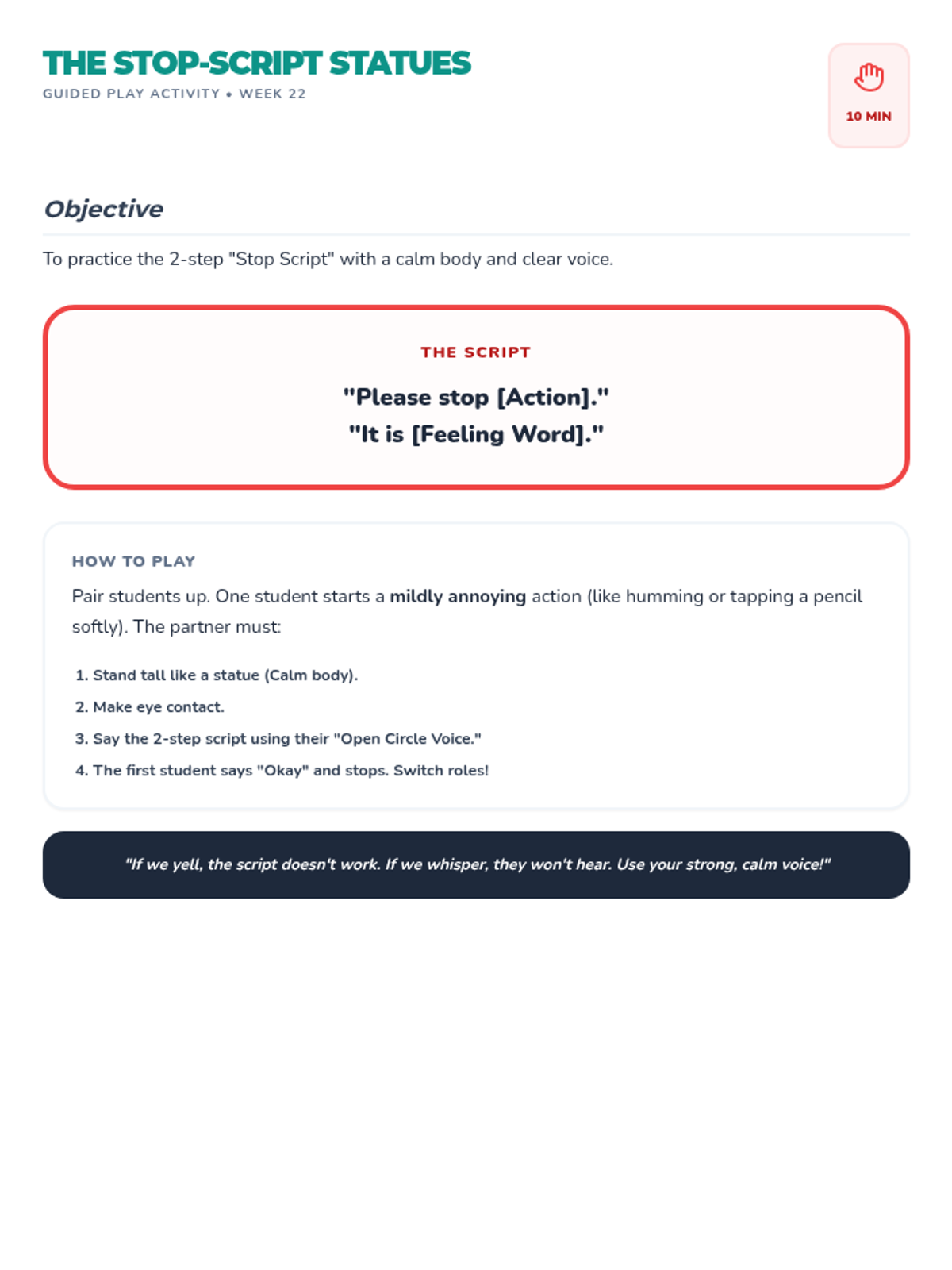
A teacher-facing guided play activity for Week 22. Students practice using the two-step "Please stop" script in a controlled, safe role-play environment.
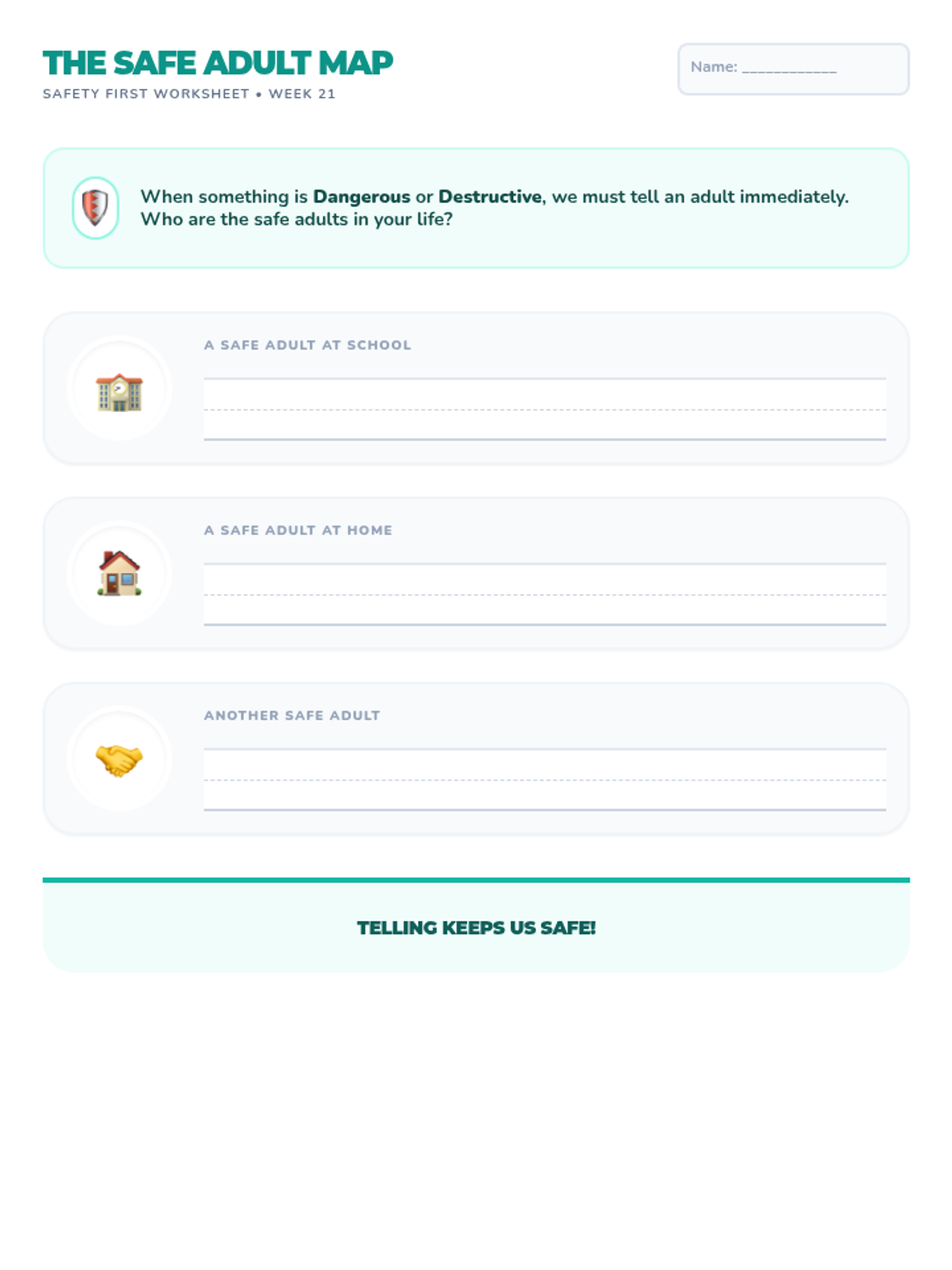
A student-facing worksheet for Week 21. Students identify and record "safe adults" in different environments (school, home, community) to ensure they know whom to contact for dangerous problems.
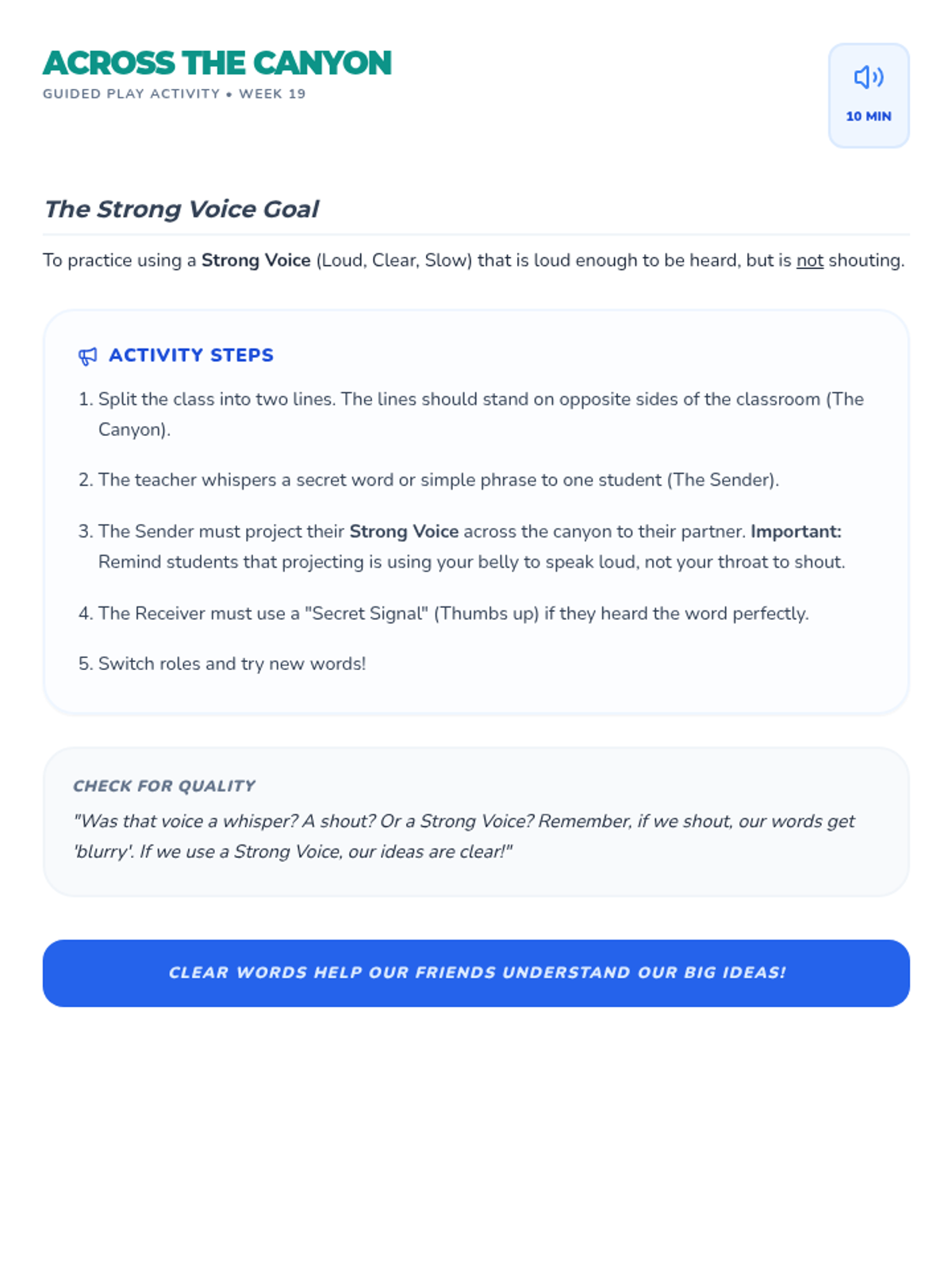
A teacher-facing guided play activity for Week 19. Revised to clarify the distinction between shouting and a "Strong Voice" and standardized terminology.
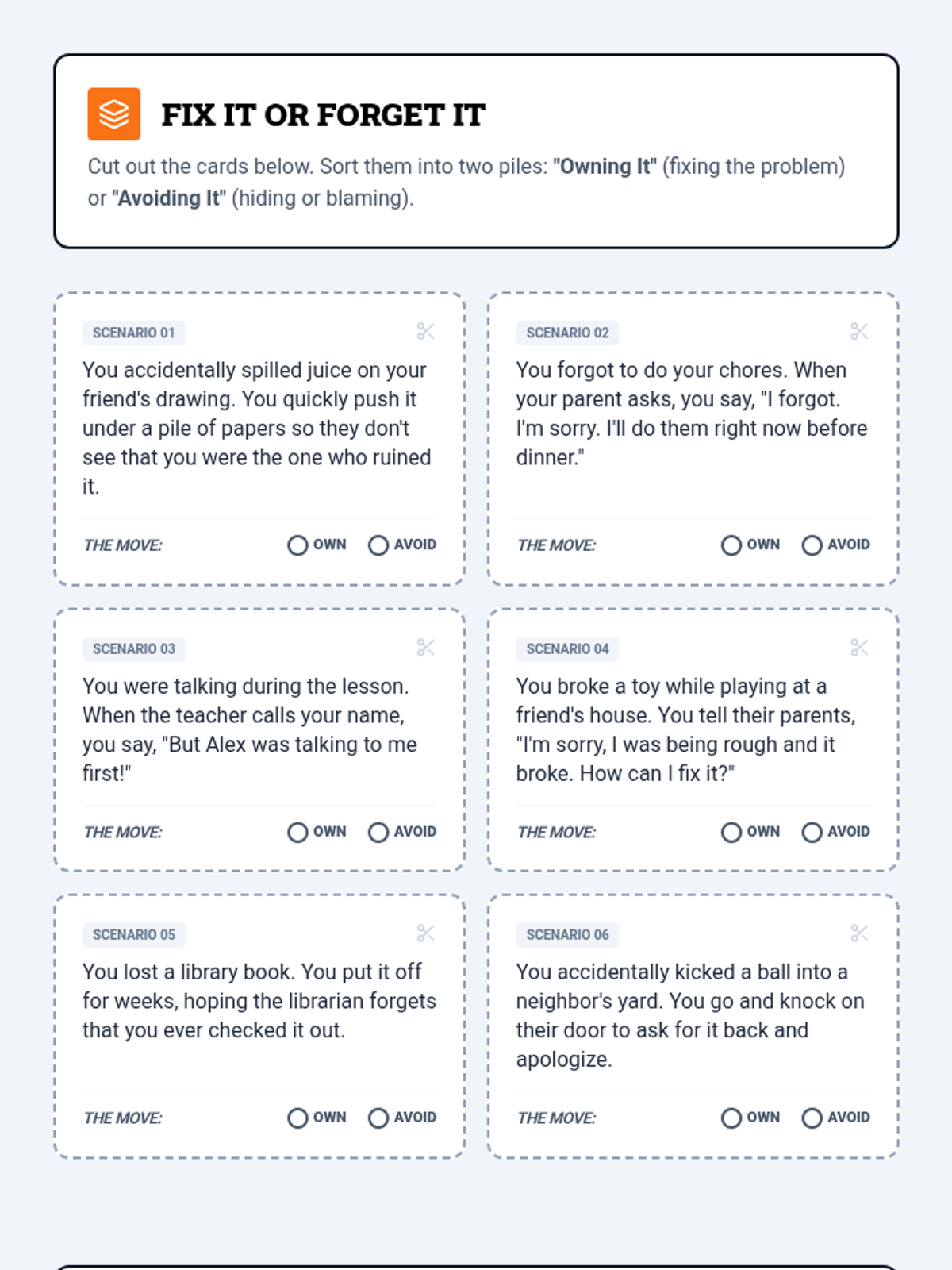
A hands-on sorting activity featuring 6 scenario cards where characters either take ownership or avoid accountability. Includes two large sorting mats ('Owning It' and 'Avoiding It') for group discussion and categorization.
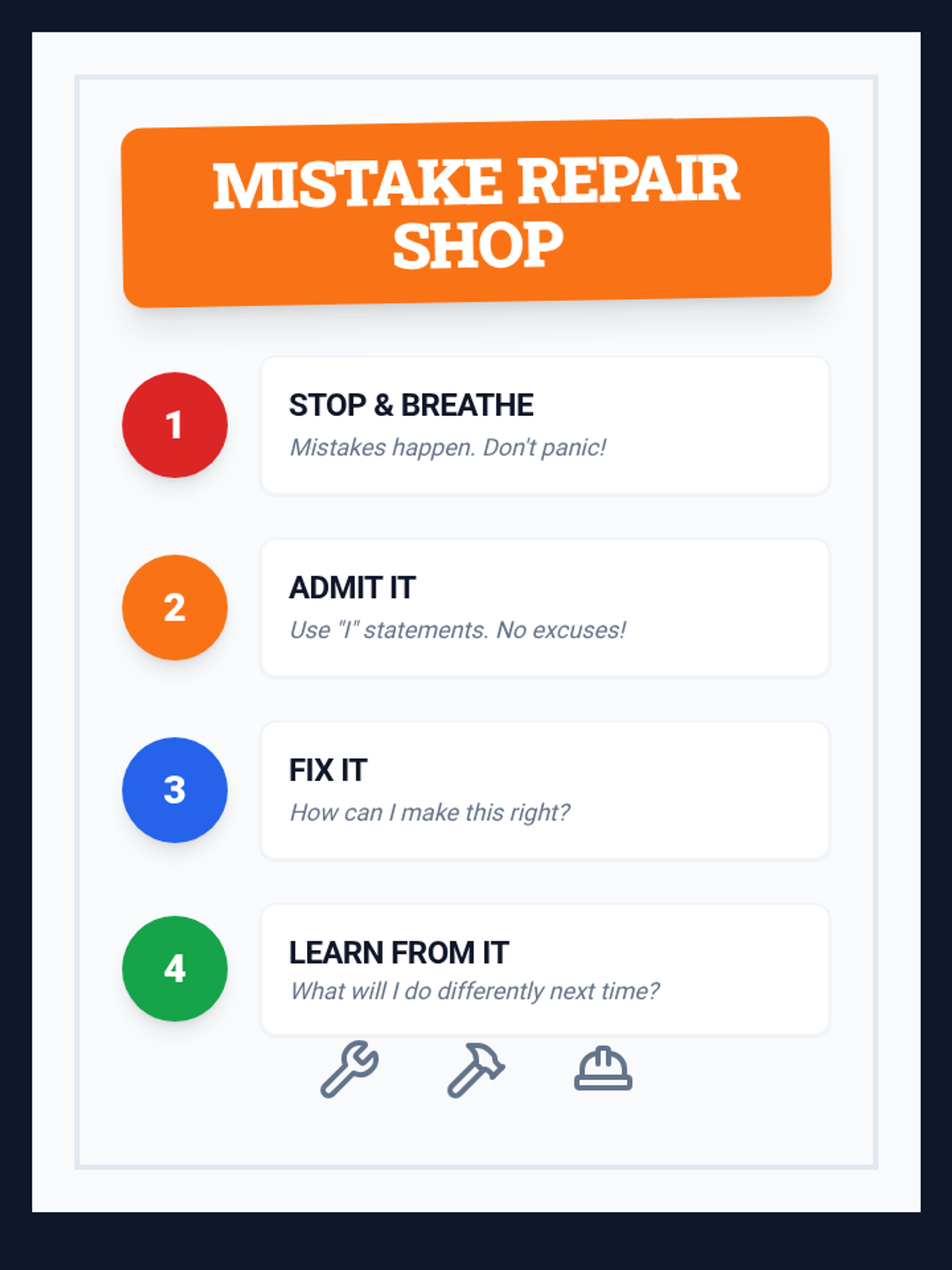
A set of classroom visuals including a large 'Mistake Repair Shop' anchor chart outlining the four-step ownership process, plus two motivational posters focusing on integrity and the growth mindset of 'upgrading' through mistakes.
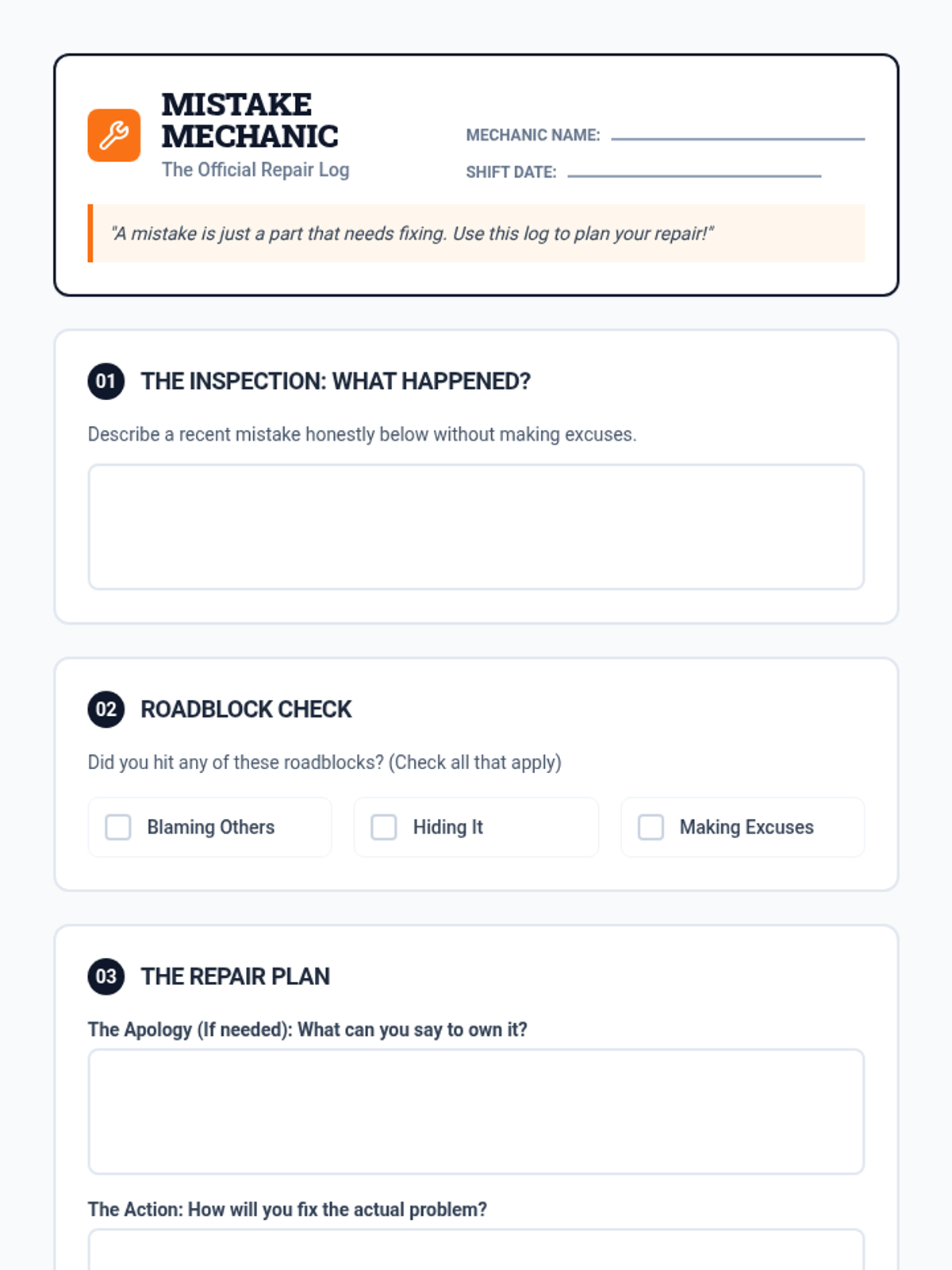
A reflection worksheet that guides students through the 'Mistake Mechanic' process. It includes sections for identifying a mistake, checking for emotional roadblocks (blame, hiding), planning a 'repair' (apology and action), and identifying the lesson learned for future 'system upgrades'.
An interactive slide deck introducing the 'Mistake Repair Shop' metaphor. It defines ownership, identifies common roadblocks like blaming and hiding, and provides a four-step 'Repair Manual' for students to follow when they make mistakes.
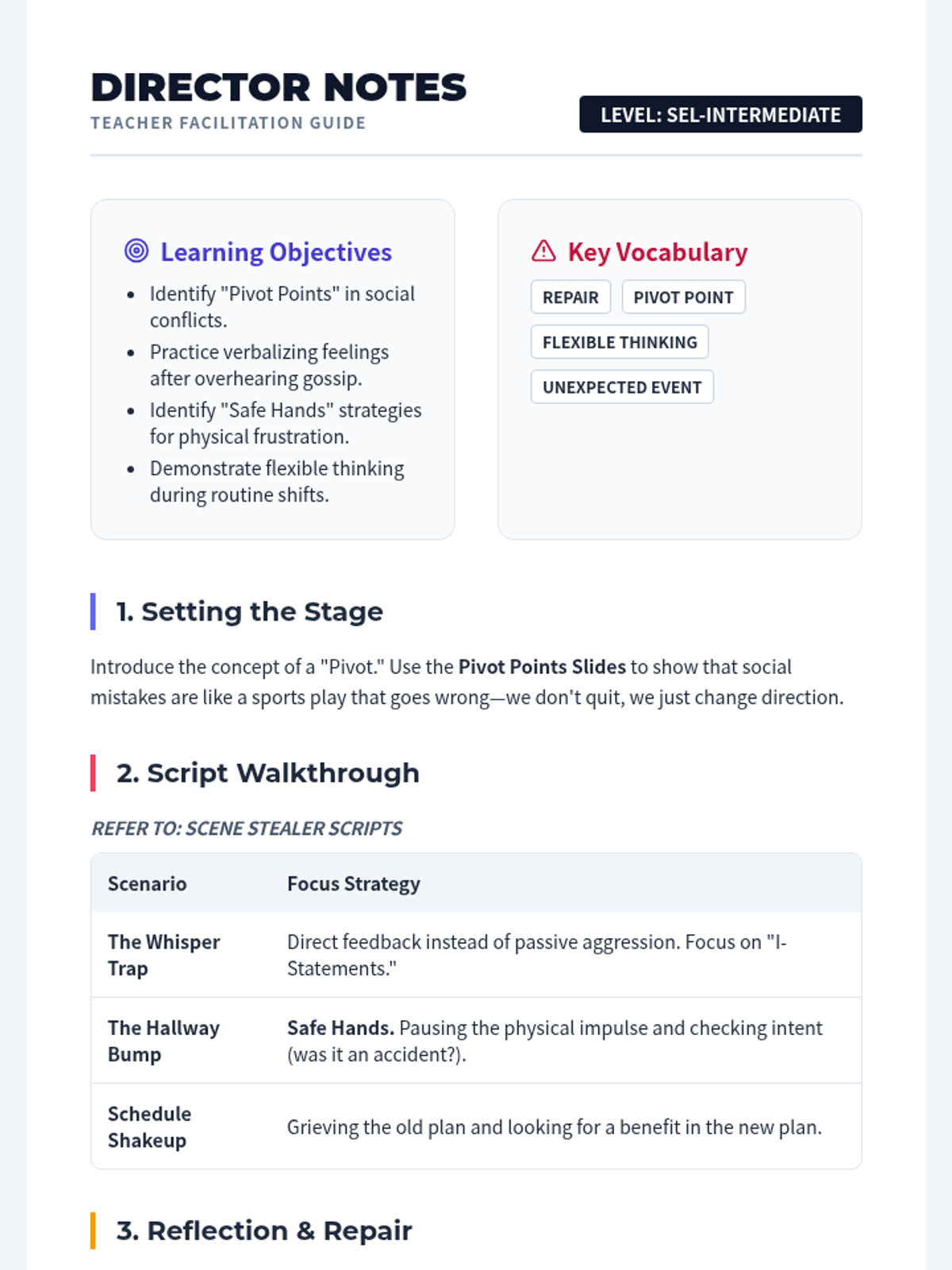
A teacher's guide for facilitating the "Social Pivot" lesson. Includes learning objectives, key vocabulary, facilitation steps for roleplay, and tips for handling sensitive social scenarios like physical aggression.
A visual slide deck introducing the concept of the "Social Pivot." It defines social repair and outlines the three key scenarios (overhearing gossip, physical impulses, and routine changes) with strategies for handling each.
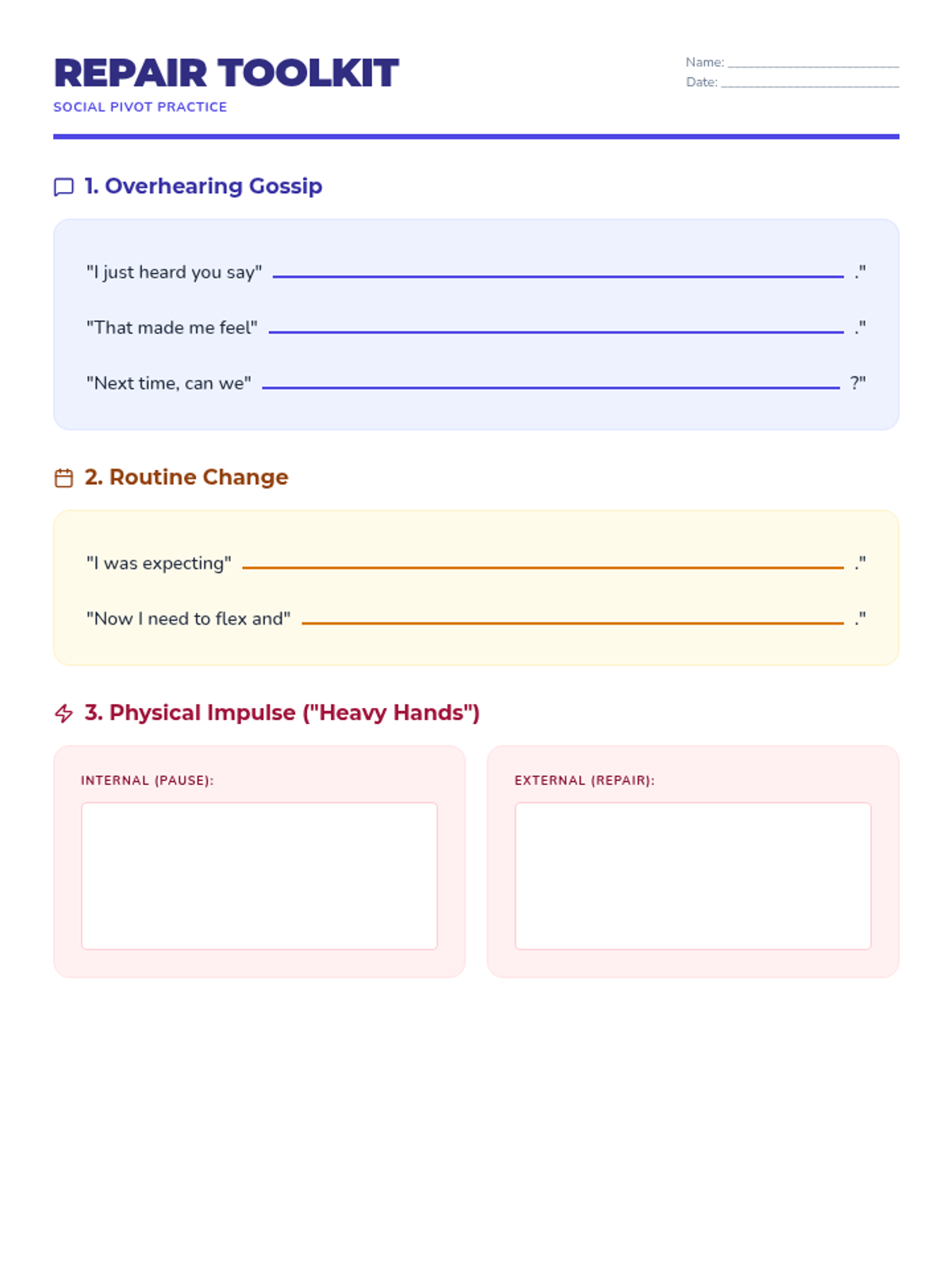
A student worksheet to practice "Social Pivot" phrases. It provides fill-in-the-blank templates for repairing relationships after overhearing gossip, managing physical impulses, and adapting to changes in routine.
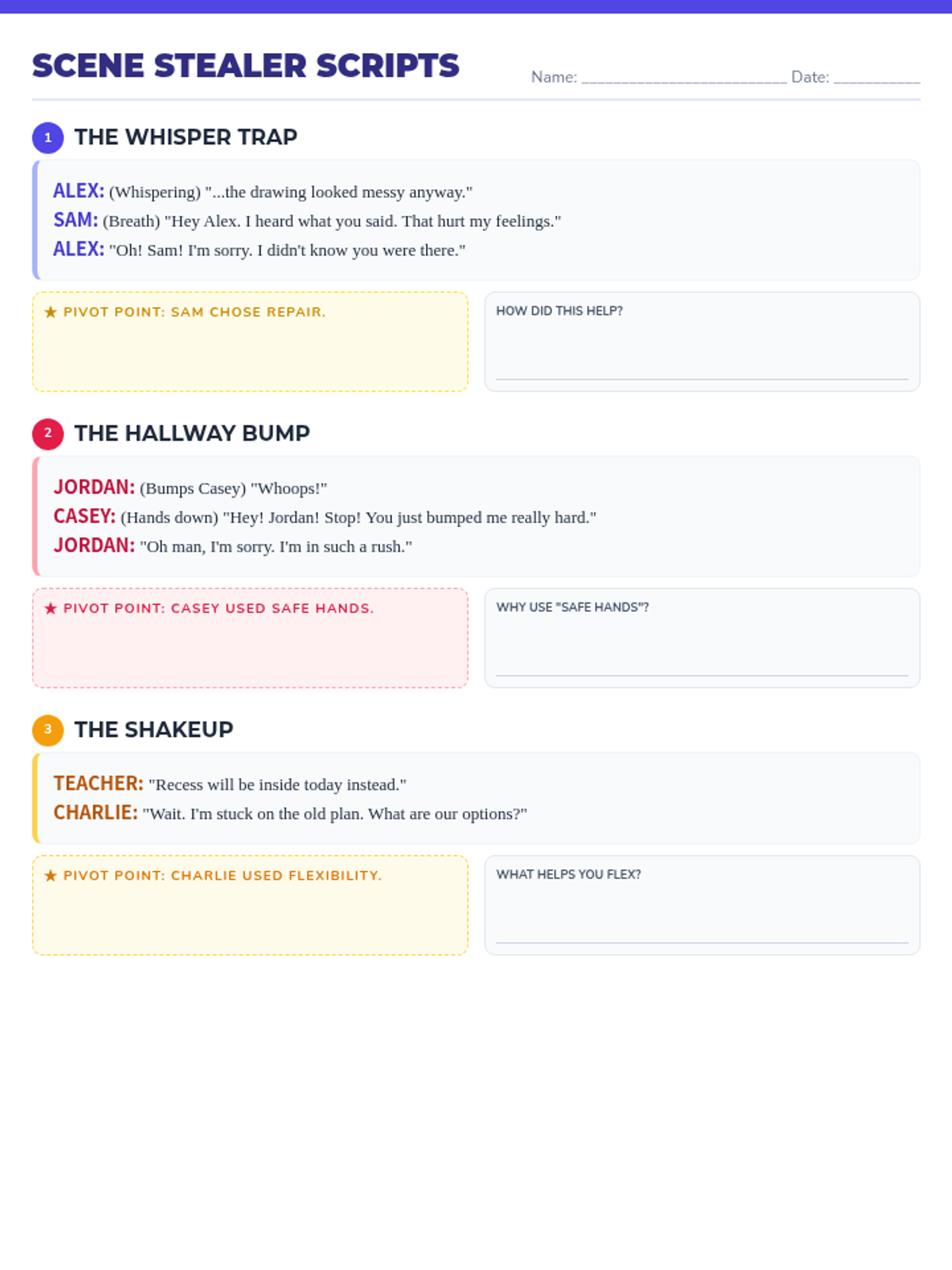
A set of three two-person dialogue scripts focusing on social thinking challenges: overhearing gossip, managing physical aggression impulses, and handling unexpected routine changes. Each script includes a "Pivot Point" where students practice repair and flexible thinking.
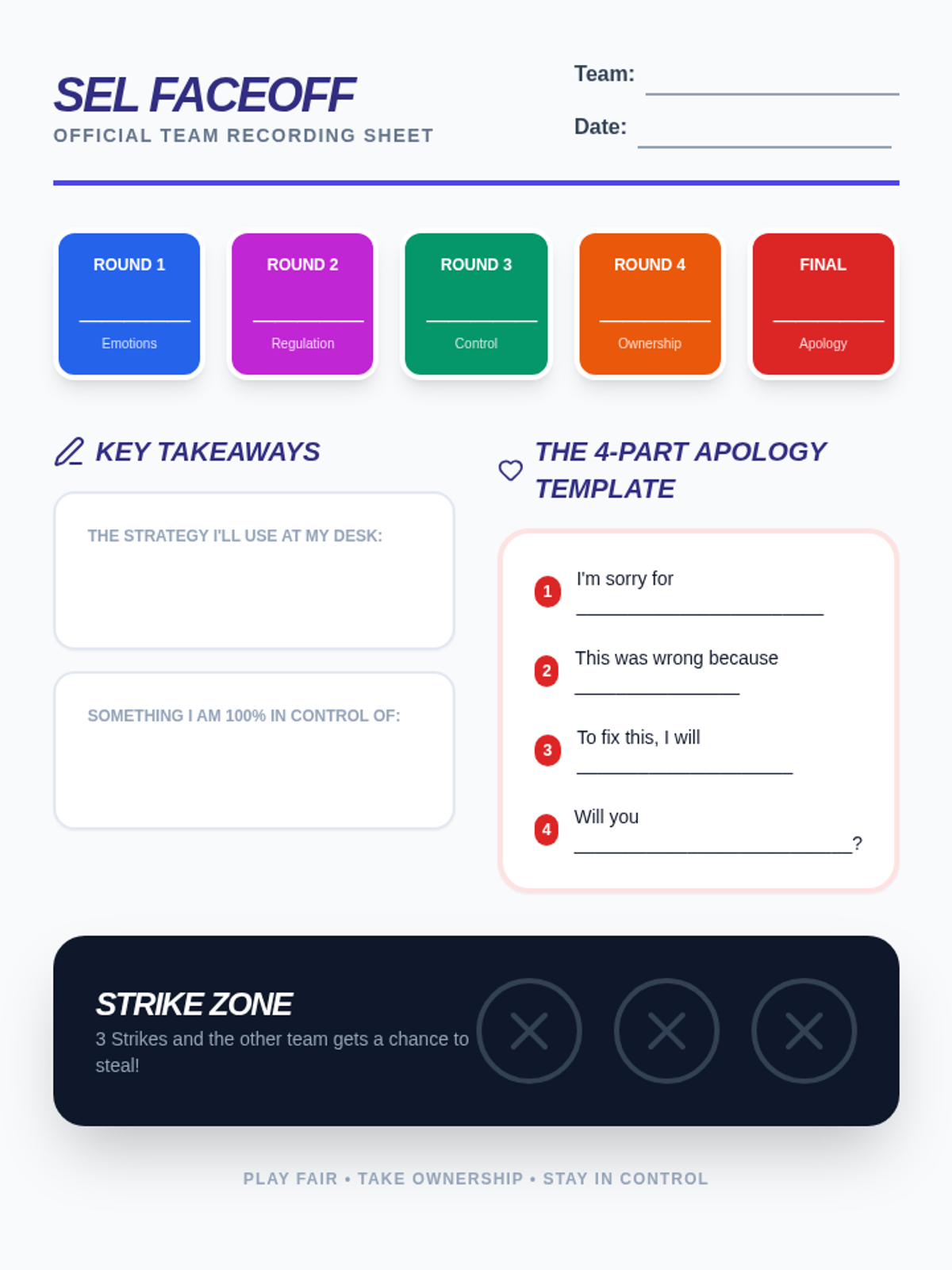
A student recording sheet for the 'SEL Faceoff' game. Includes a point tracker, strike zone, key takeaway fields, and a fill-in-the-blank template for the 4-part apology method.