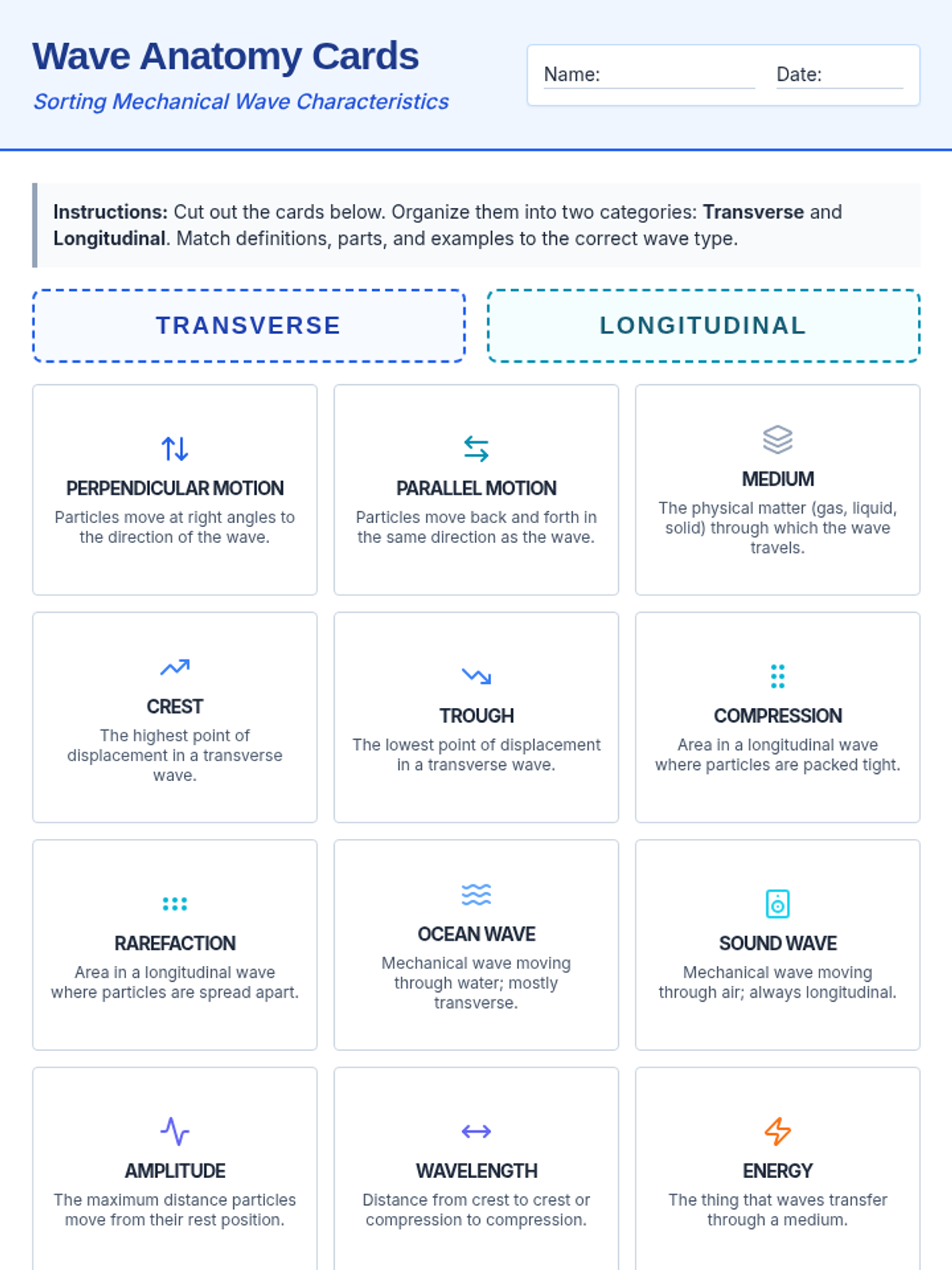
A set of 8 task cards for reviewing mechanical wave concepts like frequency, amplitude, and medium. Includes a student recording sheet for individual or station-based work. Optimized with cutting guides and improved contrast.
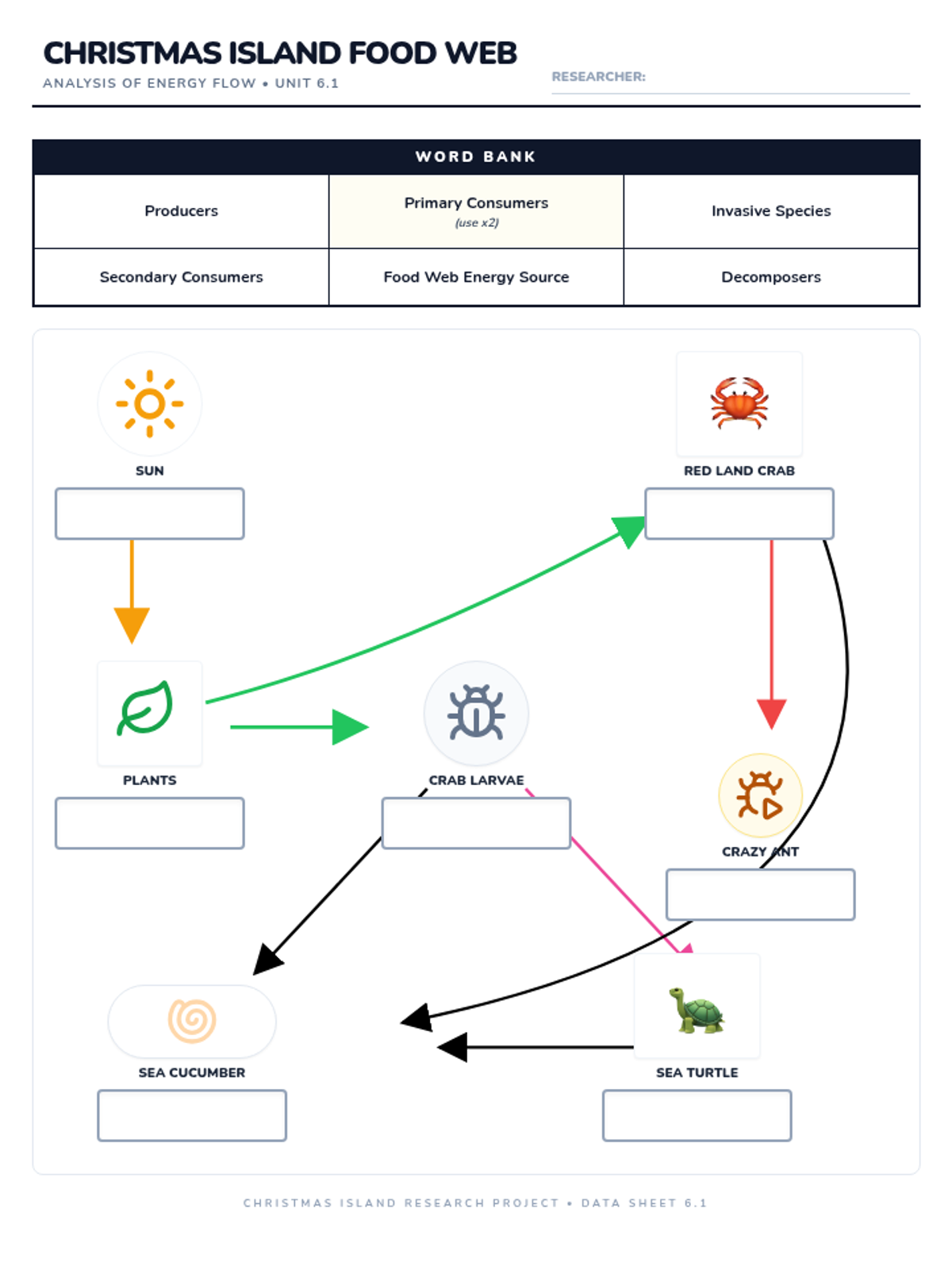
A visually refined Christmas Island food web worksheet with a biological field guide aesthetic. It uses representative emojis and scientific names for organisms, maintains the original 8 energy flow arrows with color coding, and provides clear, high-contrast response areas for students.
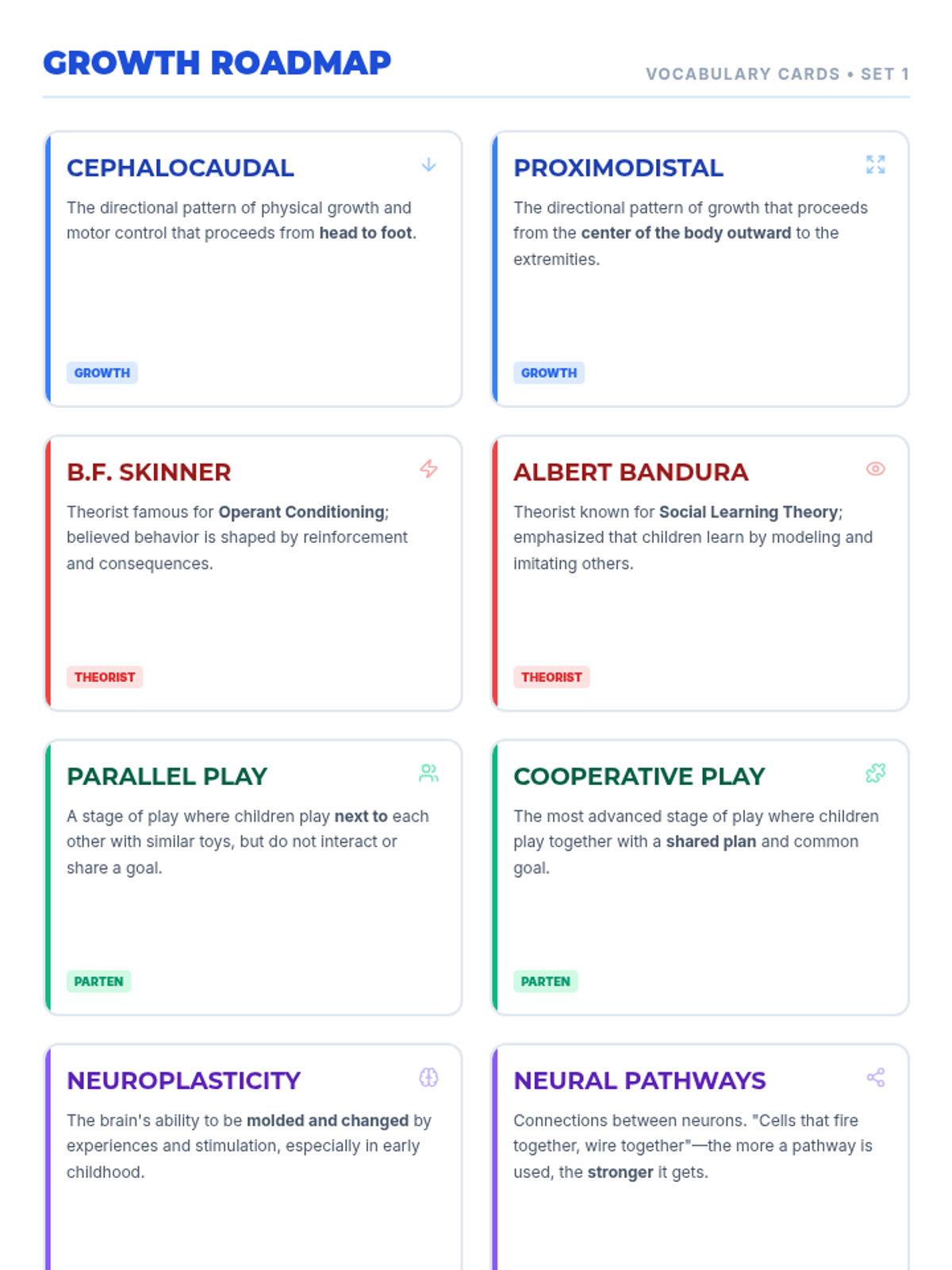
A set of 16 printable vocabulary cards for the Growth and Guidance Unit, featuring key terms from brain development, theorists, and play stages. Designed for student study and classroom review.
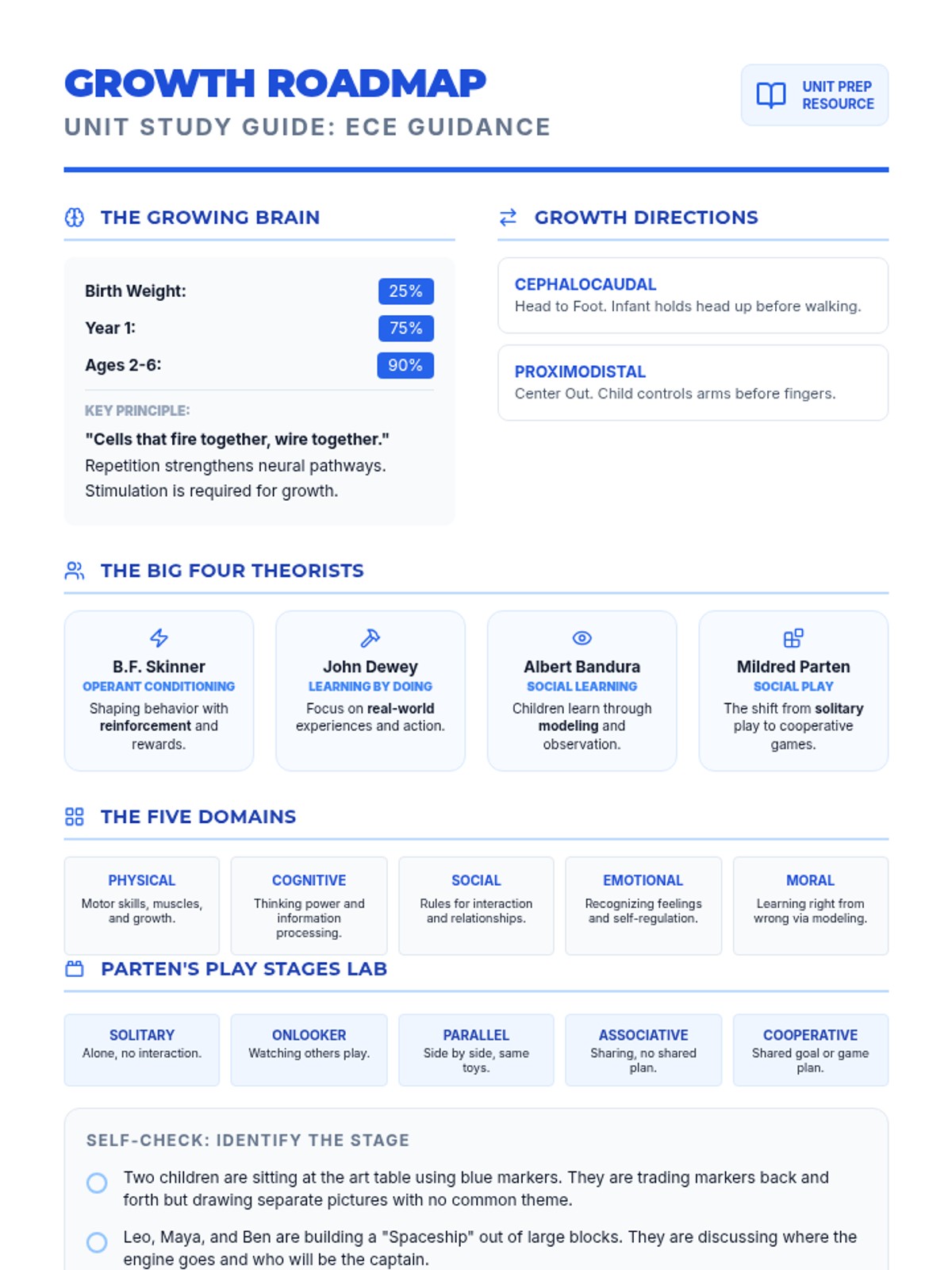
A comprehensive 3-page study guide for the Growth and Guidance Unit, covering brain development percentages, directional growth (Cephalocaudal/Proximodistal), the four major ECE theorists, the five developmental domains, Parten's play stages, and identity formation strategies. Now includes a dedicated page for practice short-answer questions to help students prepare for writing responses on the unit test.
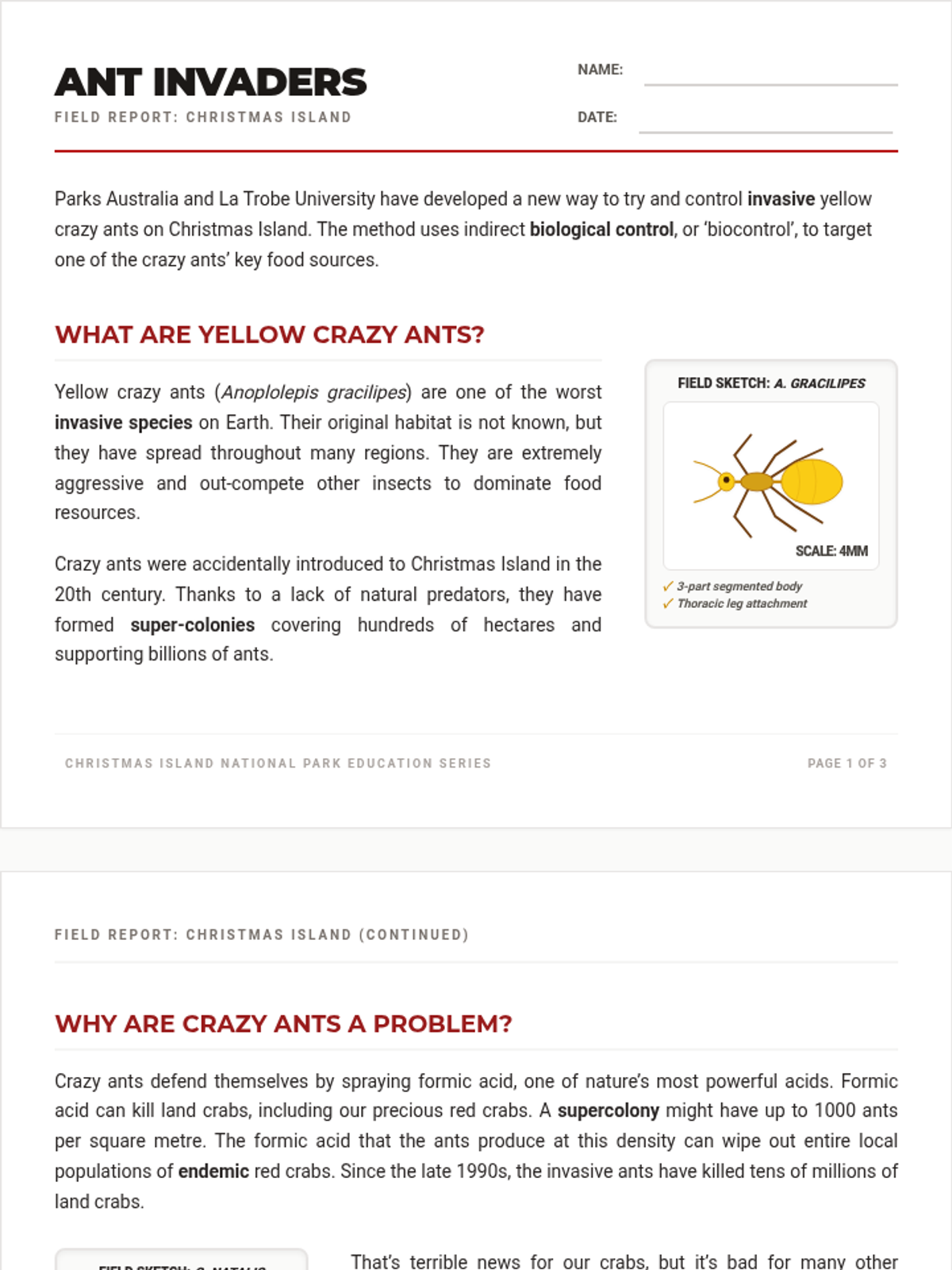
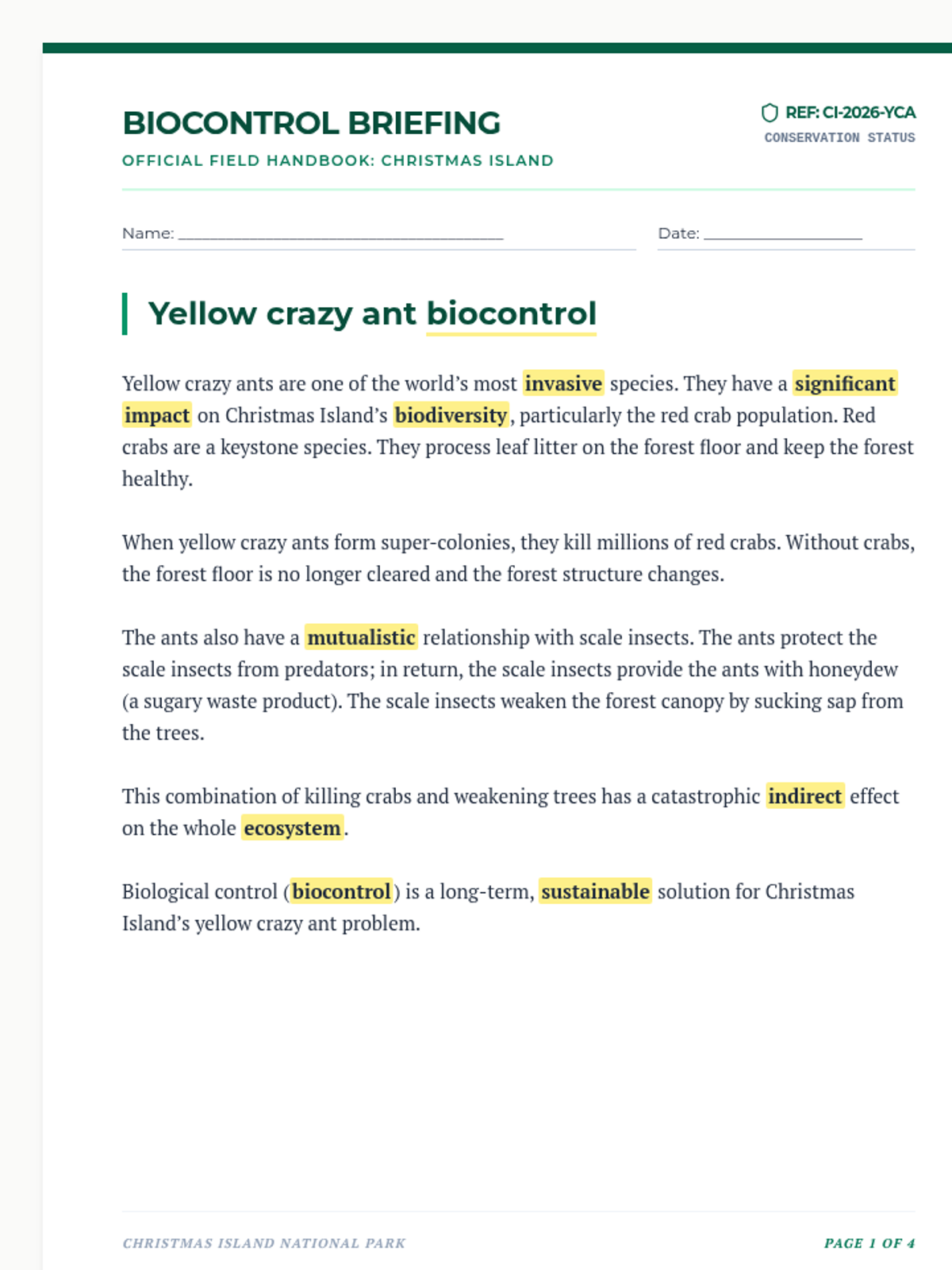
An updated three-page reading passage about yellow crazy ants on Christmas Island, now featuring realistic, anatomically accurate SVG "Field Sketch" illustrations of the ants, red crabs, lac scale insects, and honeydew. Formatted for consistent alignment and perfect page flow.
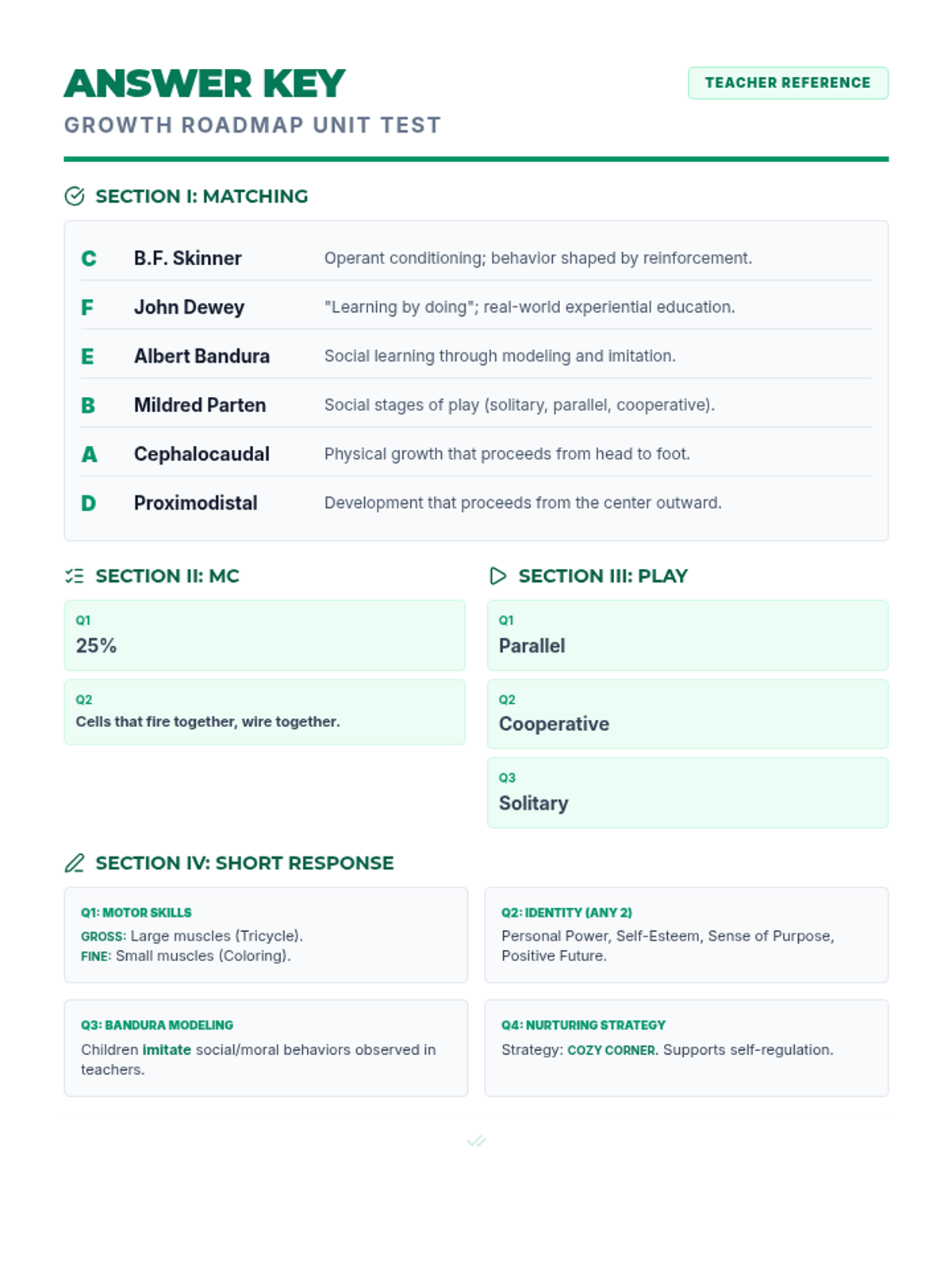
A detailed teacher's answer key for the Growth Roadmap Unit Test, providing correct answers for matching, multiple-choice, and Parten's play scenarios. Optimized for a single-page quick reference.
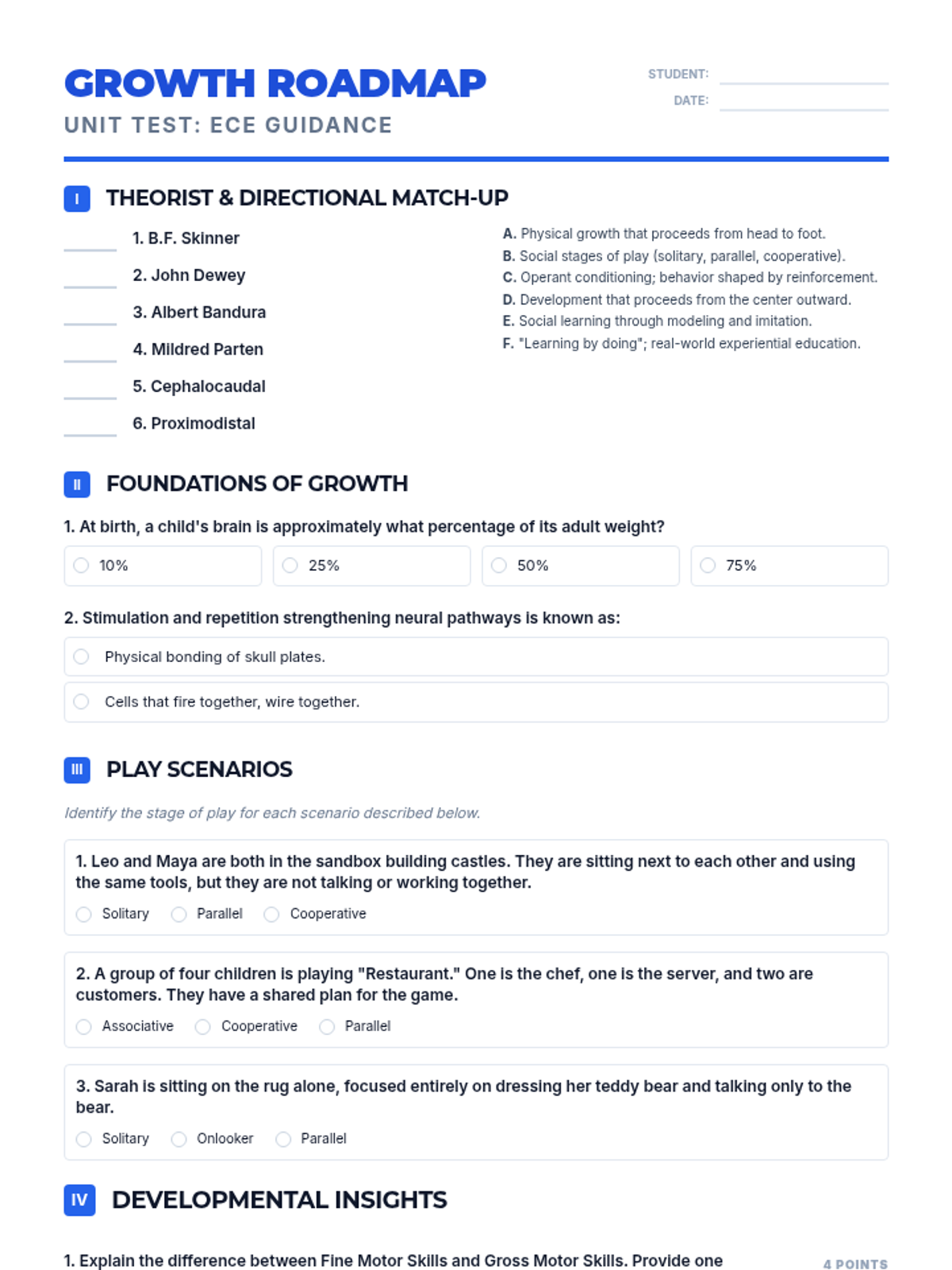
A comprehensive unit test for ECE guidance students, covering brain growth, developmental domains, theorists (Skinner, Dewey, Bandura, Parten), and identity formation. Now includes a dedicated section for Parten's play scenarios. Optimized for a clean 2-page layout.
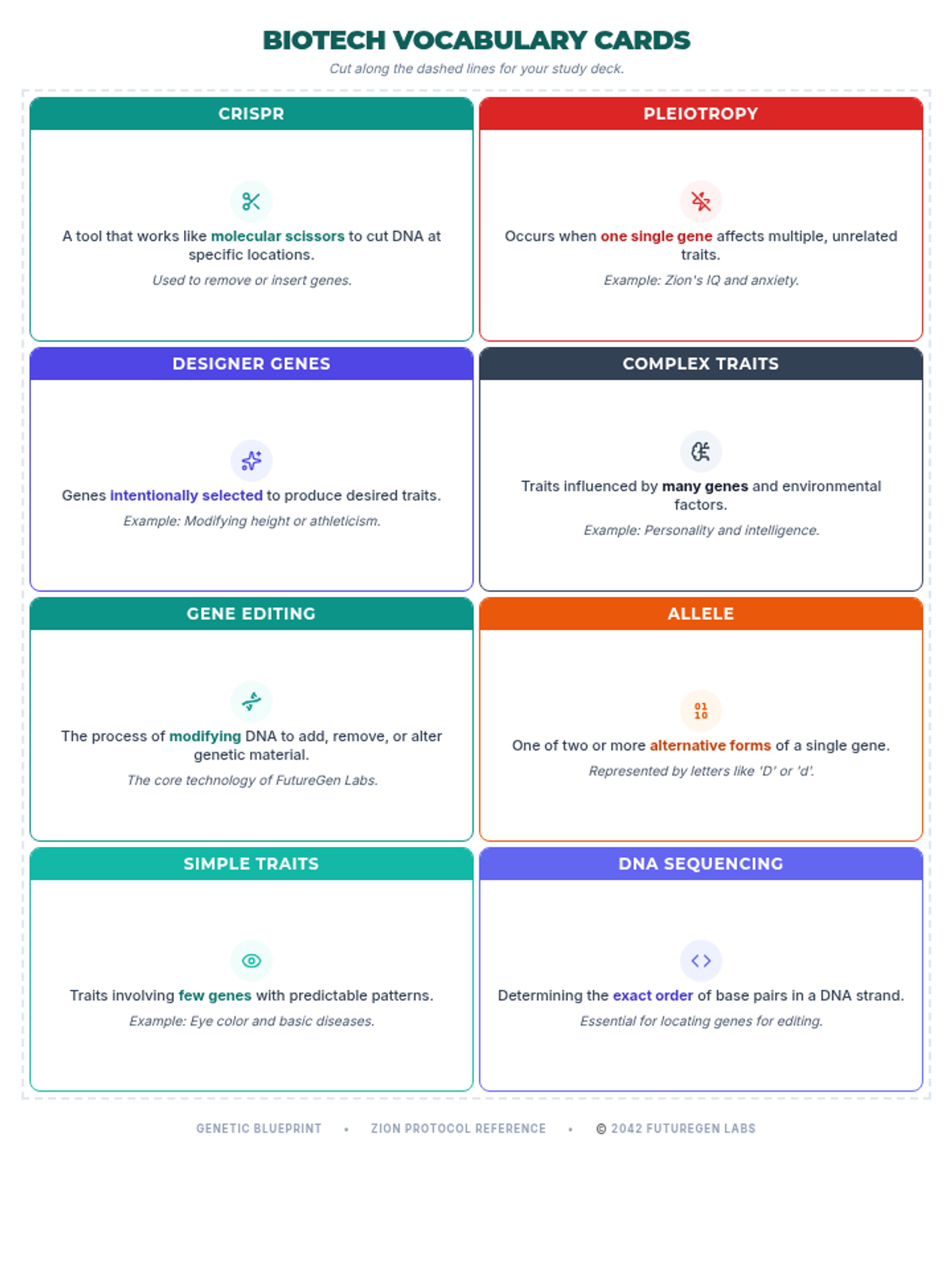
A set of 8 printable biotechnology vocabulary cards for student reference. Each card features a key term, definition, icon, and illustrative example from the Zion Protocol case study. Cards are themed with color-coded borders for easy organization. Revised for better print layout and contrast to fit on a single page.
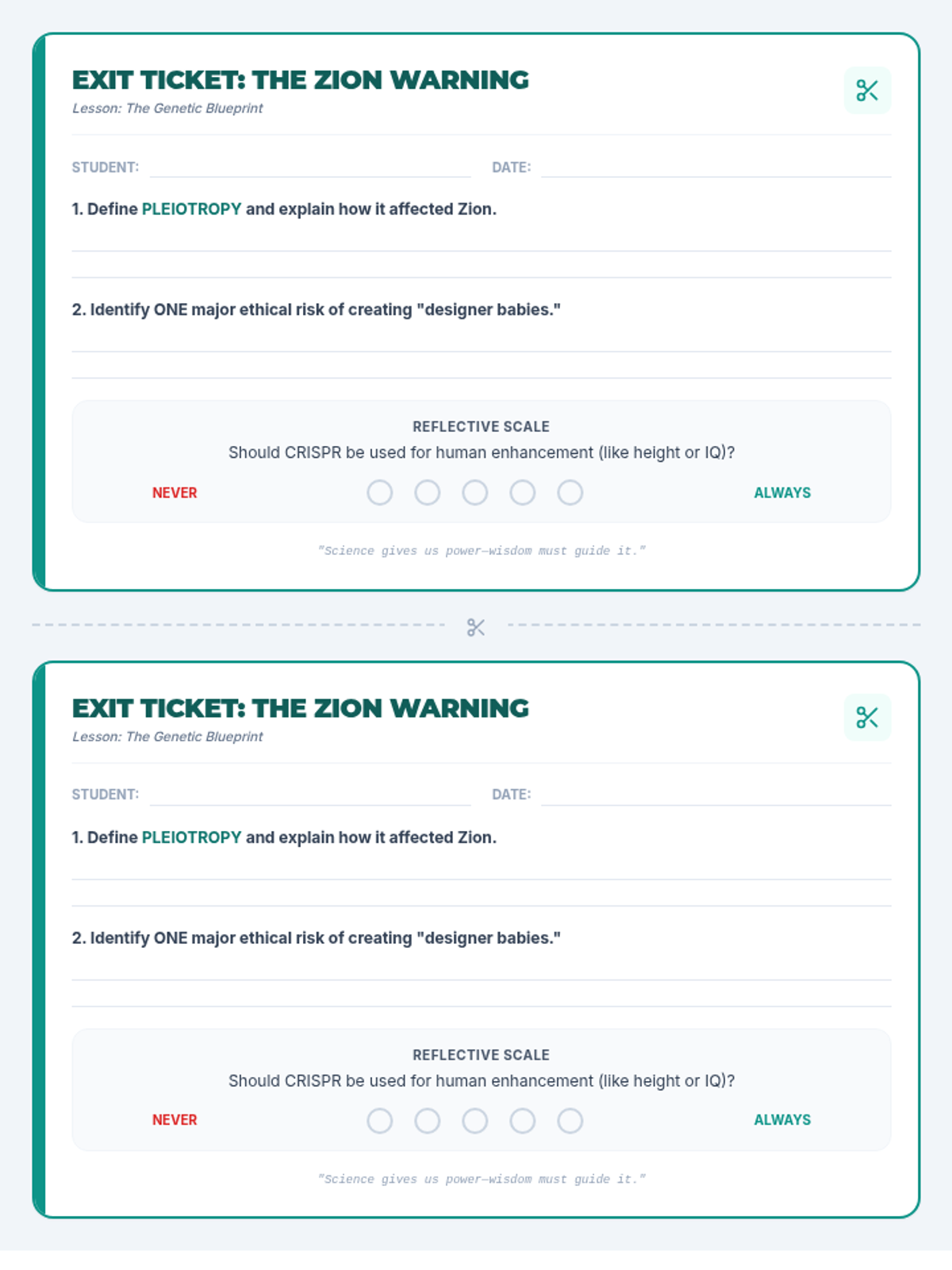
A printable exit ticket for the gene editing lesson, featuring two cards per page. Includes assessment questions on pleiotropy and ethics, alongside a reflective scale for student engagement. Now optimized for page breaks.
A visual slide deck supporting the gene editing lesson. Includes definitions of CRISPR, the concept of pleiotropy, a visualization of Zion's case study, and discussion prompts for classroom engagement. Updated with Lab Activities.
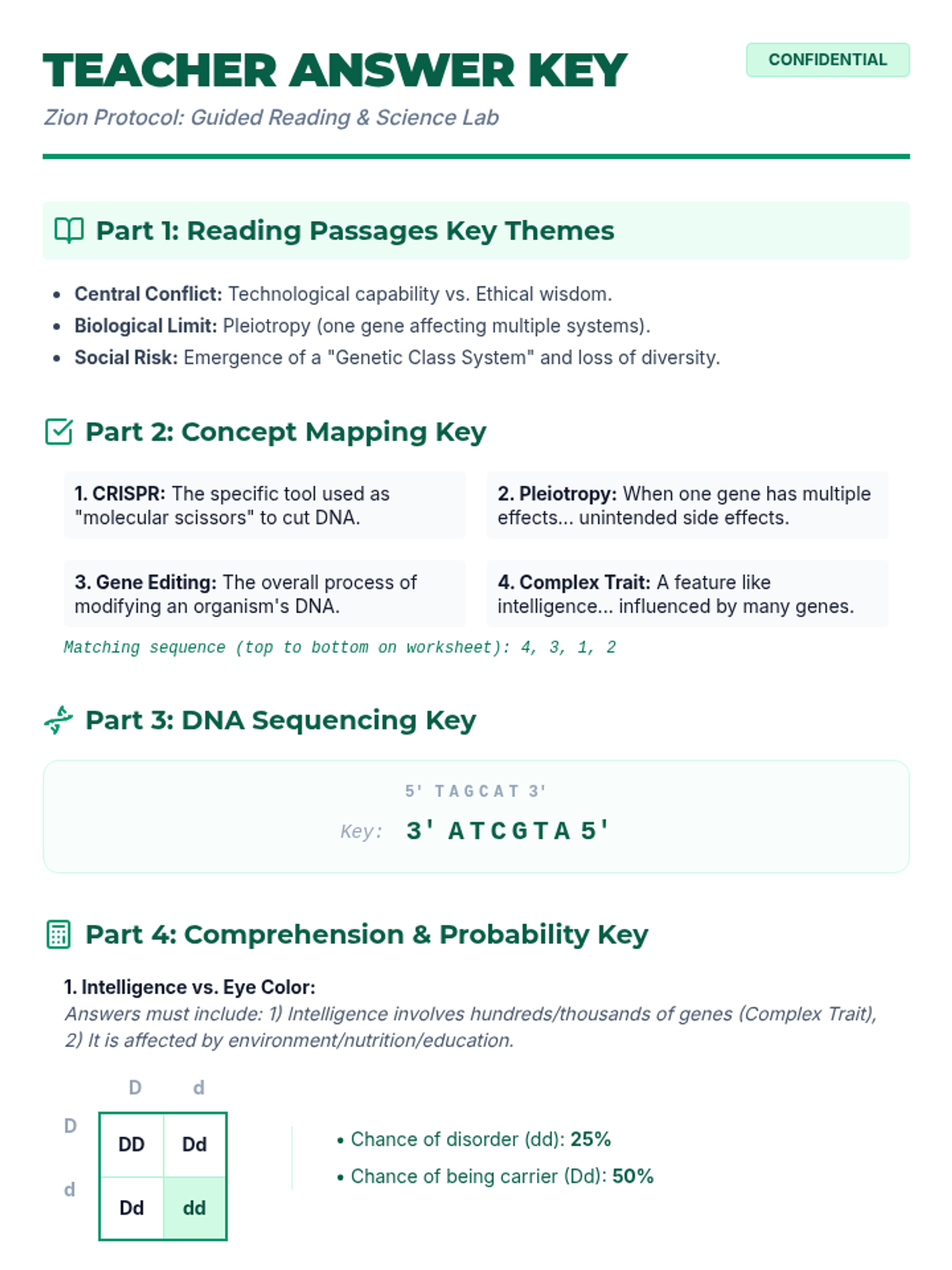
The official teacher answer key for the Zion Protocol Worksheet. Provides matching answers, completed Punnett squares, DNA sequences, and grading rubrics/guidance for ethics discussion questions. Now with improved labeling and parent alleles.
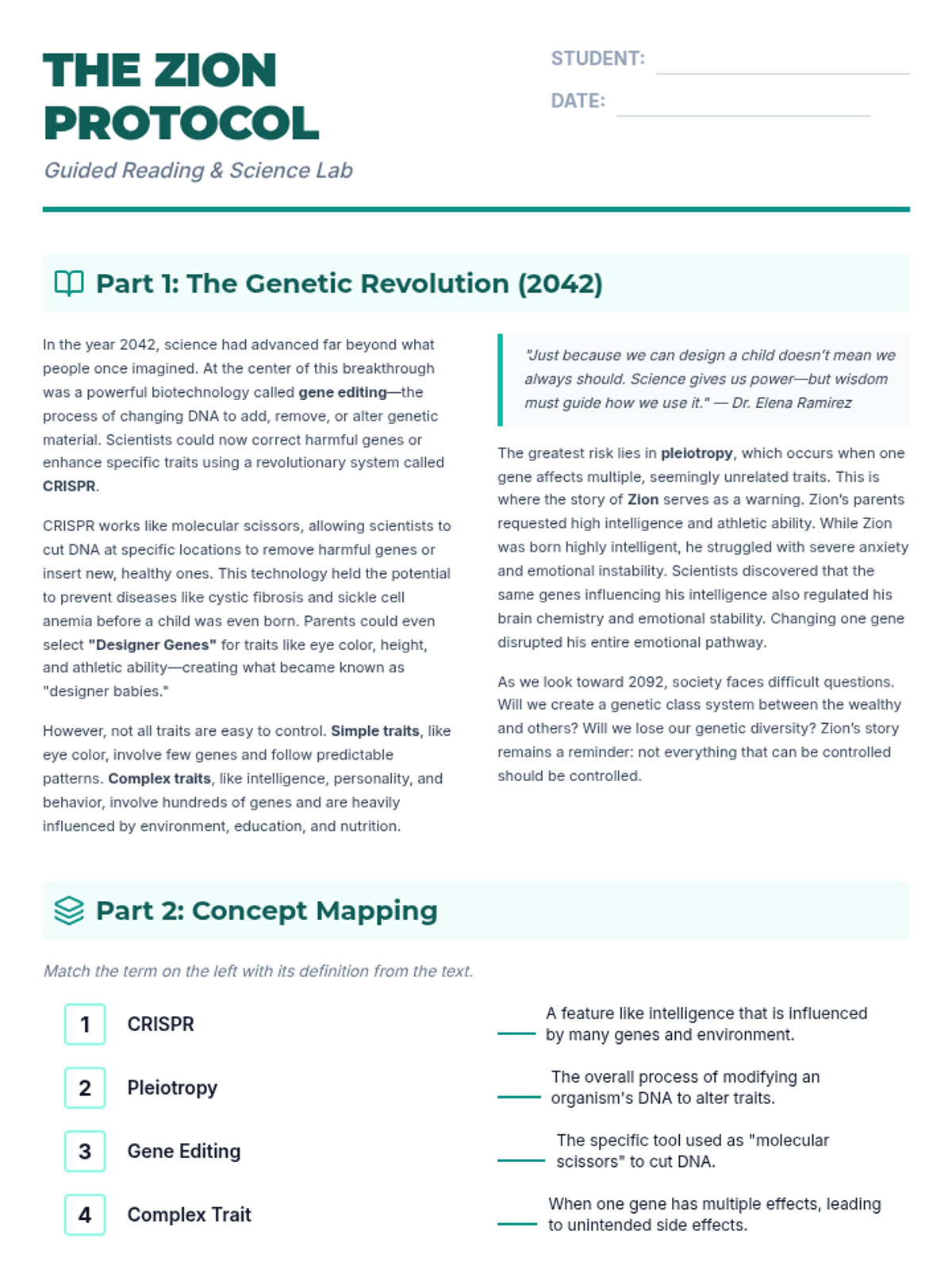
A comprehensive guided reading worksheet covering gene editing, vocabulary matching, DNA sequencing, Punnett square probability, and an ethics case study based on the Story of Zion. Includes the full reading passage for a self-contained activity. Now with improved layout and labeling.
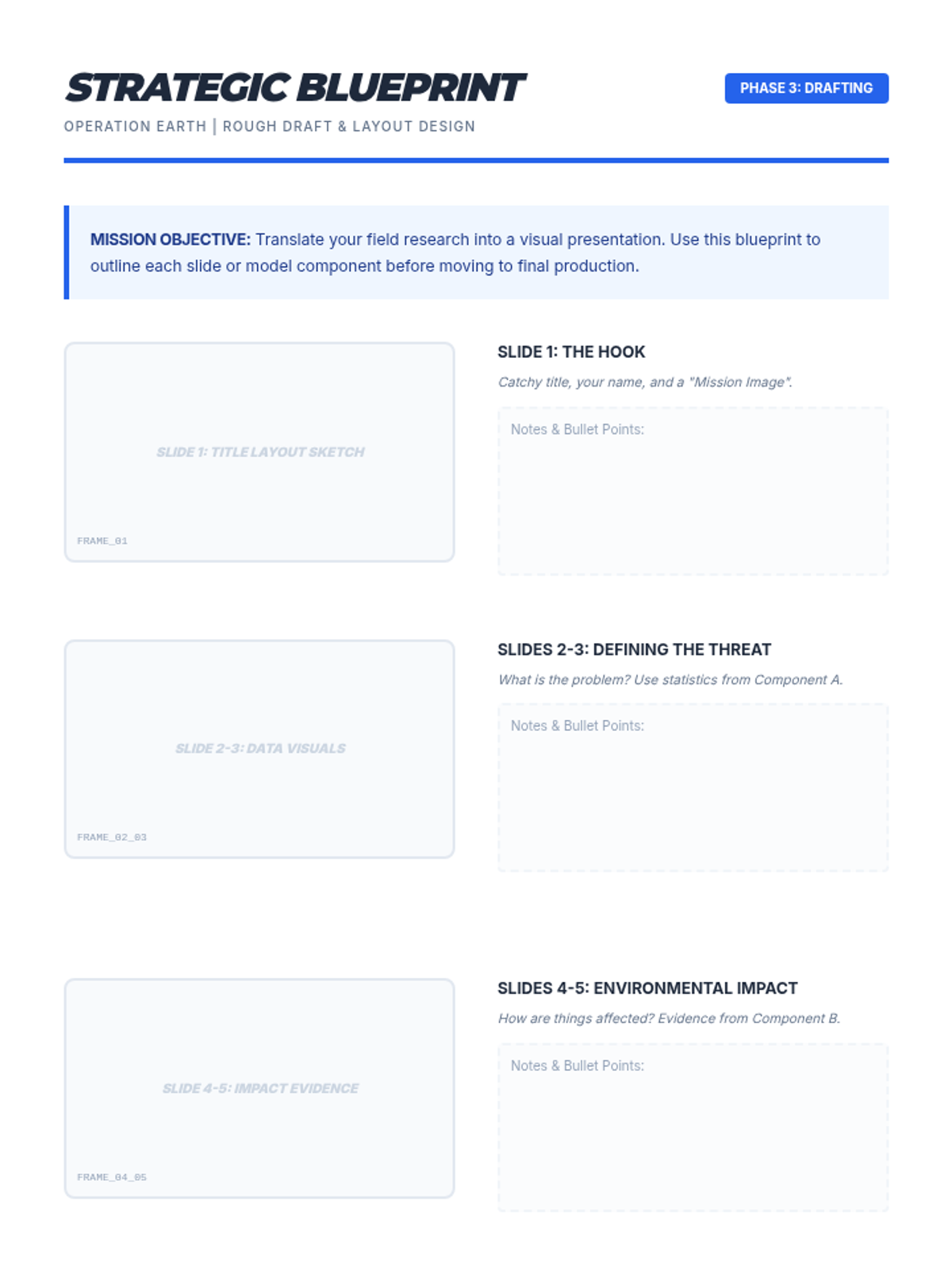
A "rough draft" planning document for Operation Earth. It helps students map their research findings into a logical slide-by-slide sequence, including spaces for layout sketches and peer feedback.
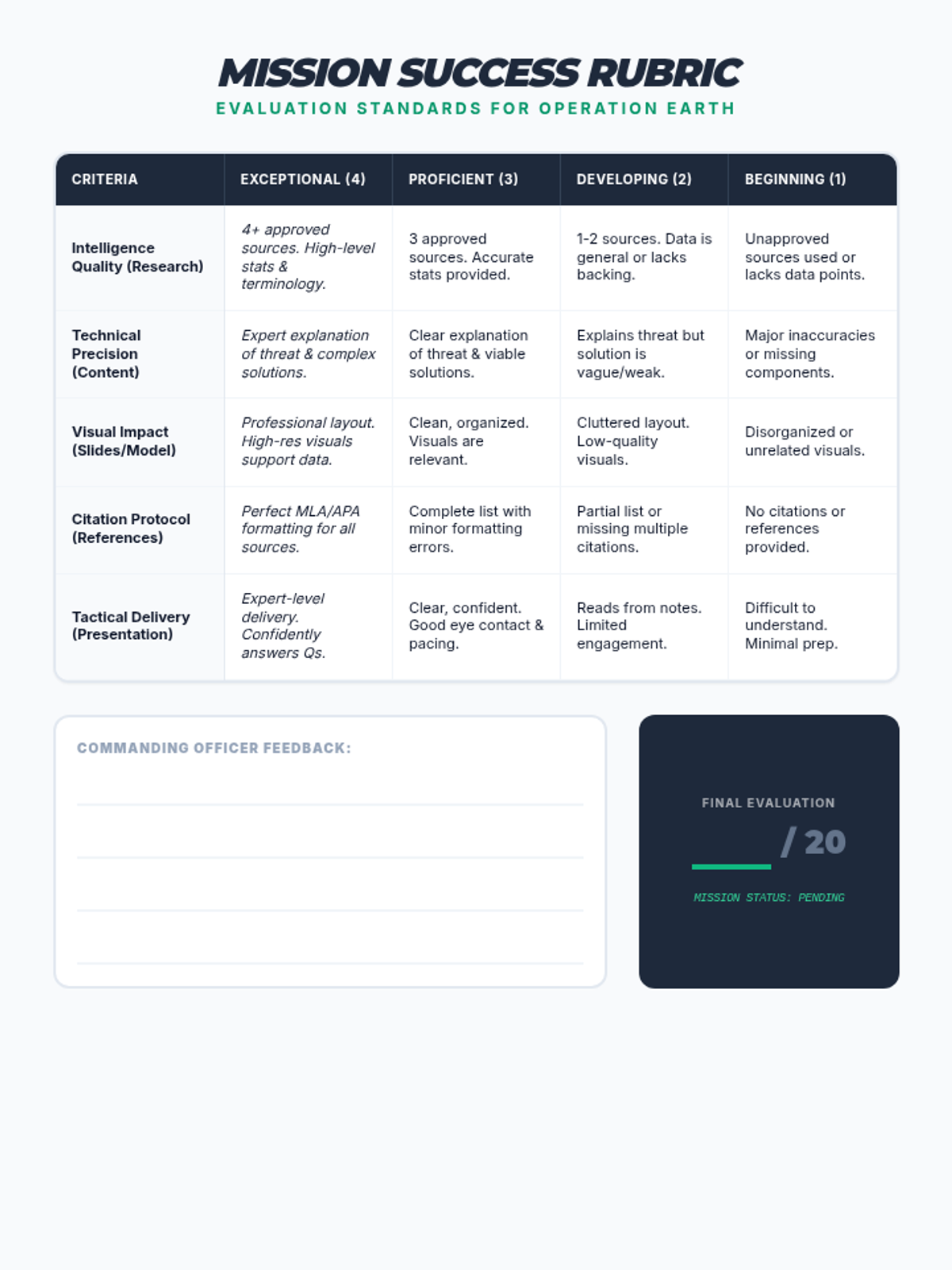
A project-specific rubric for Operation Earth, evaluating research quality, content accuracy, visual presentation, and citations. Uses a 'Mission Success' theme to maintain project immersion.
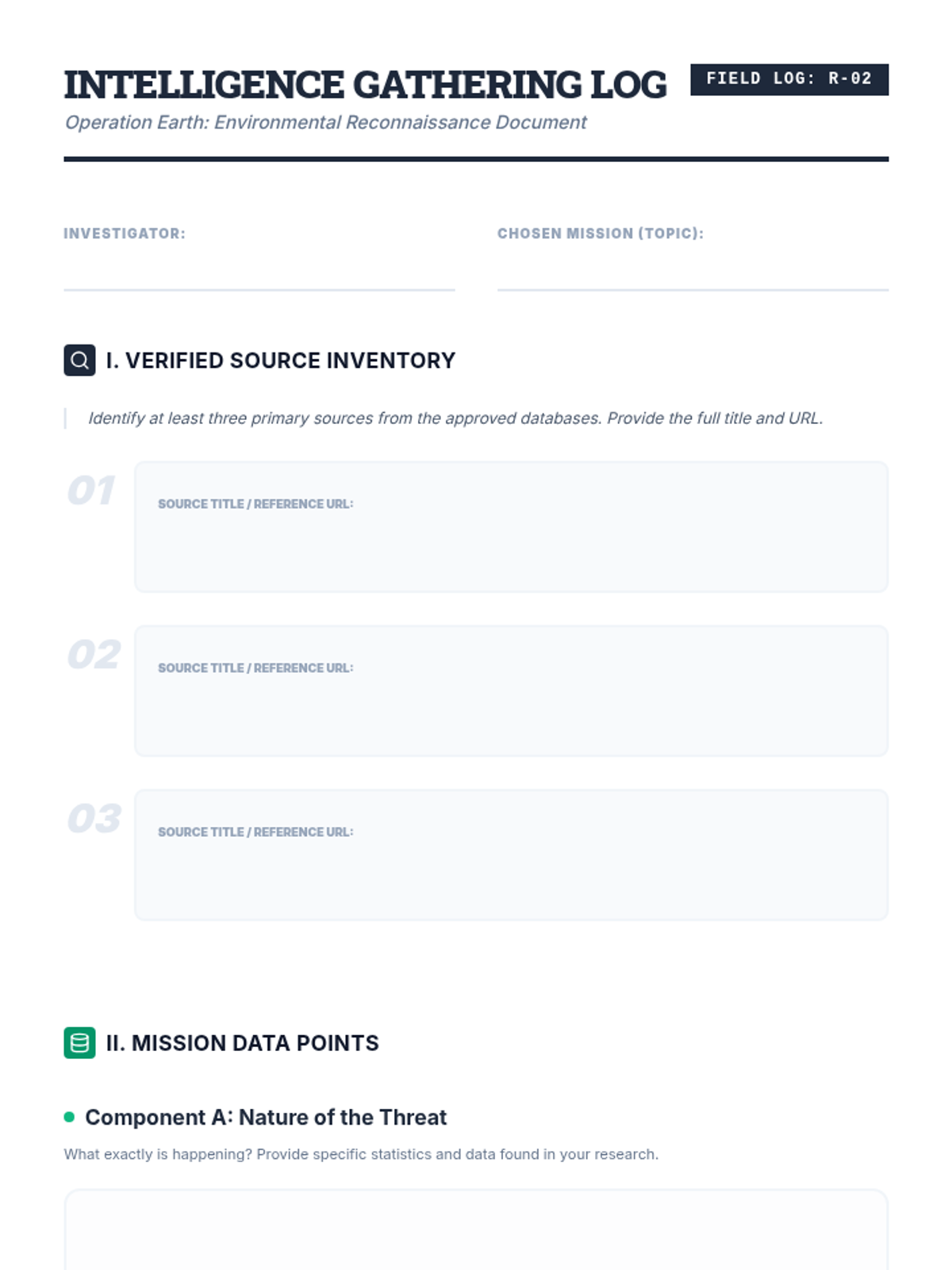
A formal research document for Operation Earth, structured as a field log. It provides guided sections for source validation, data collection (Problem, Impact, Solutions), and a final reference list.
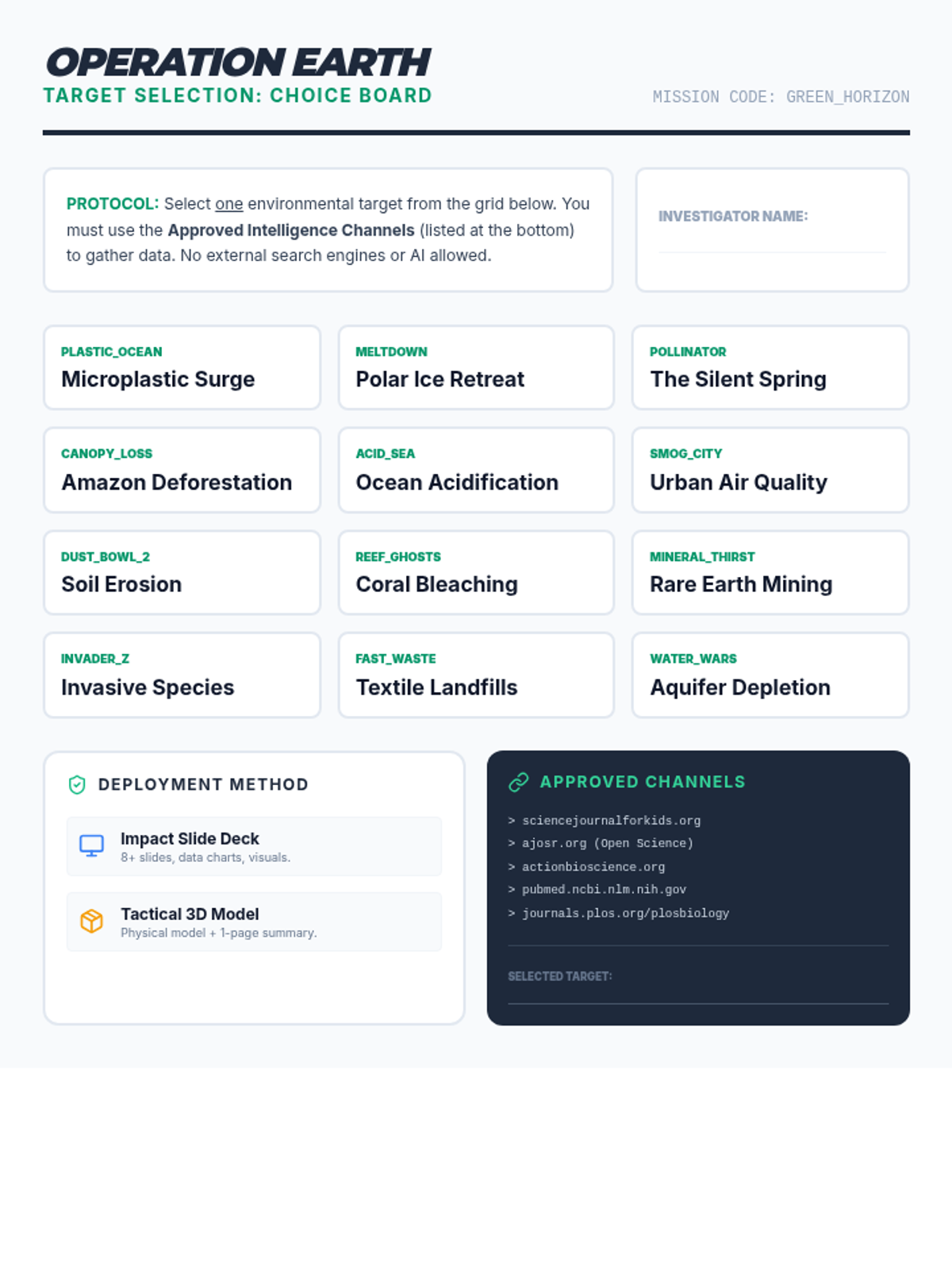
A mission-style choice board for Operation Earth featuring 12 environmental challenges and two project delivery options. Designed with a high-tech tactical aesthetic to engage students in their 'mission selection'.
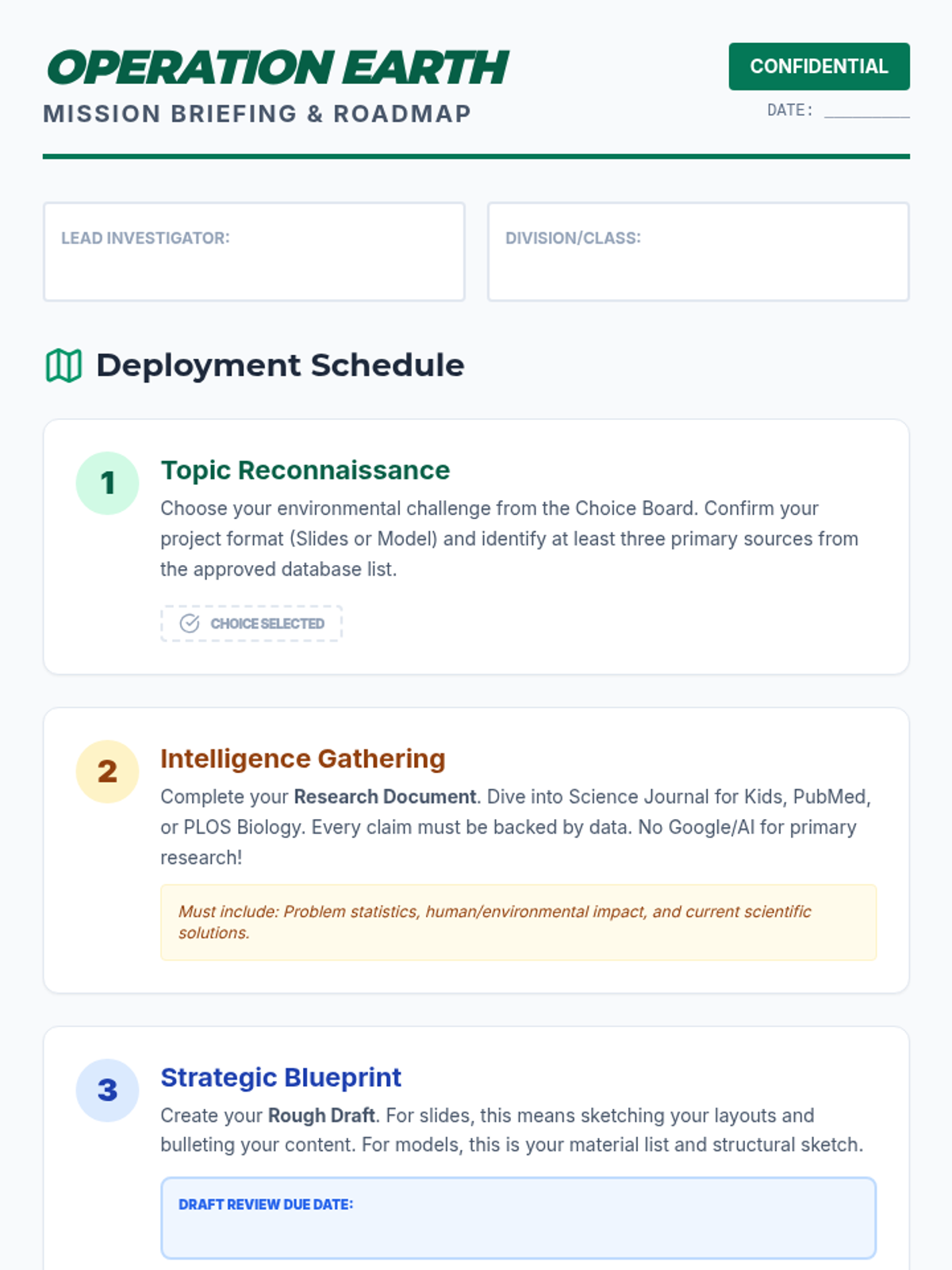
A student-facing project roadmap and timeline for Operation Earth. It breaks the project into four distinct phases: Topic Reconnaissance, Intelligence Gathering, Strategic Blueprint, and Final Deployment.
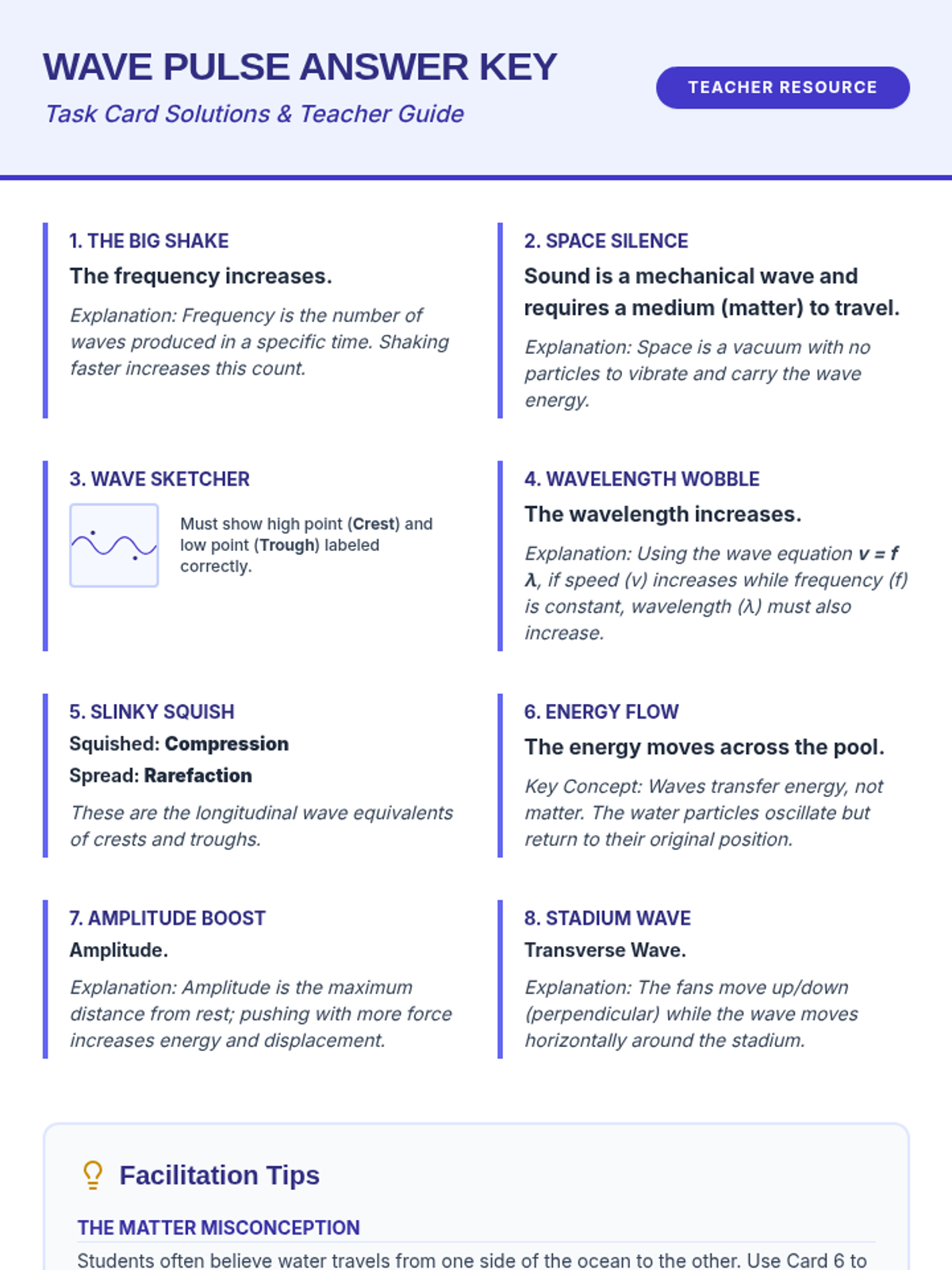
A comprehensive teacher answer key for the Wave Pulse Task Cards, featuring explained solutions, a visual diagram key, and pedagogical tips for addressing common wave misconceptions. Revised for better contrast and page flow.
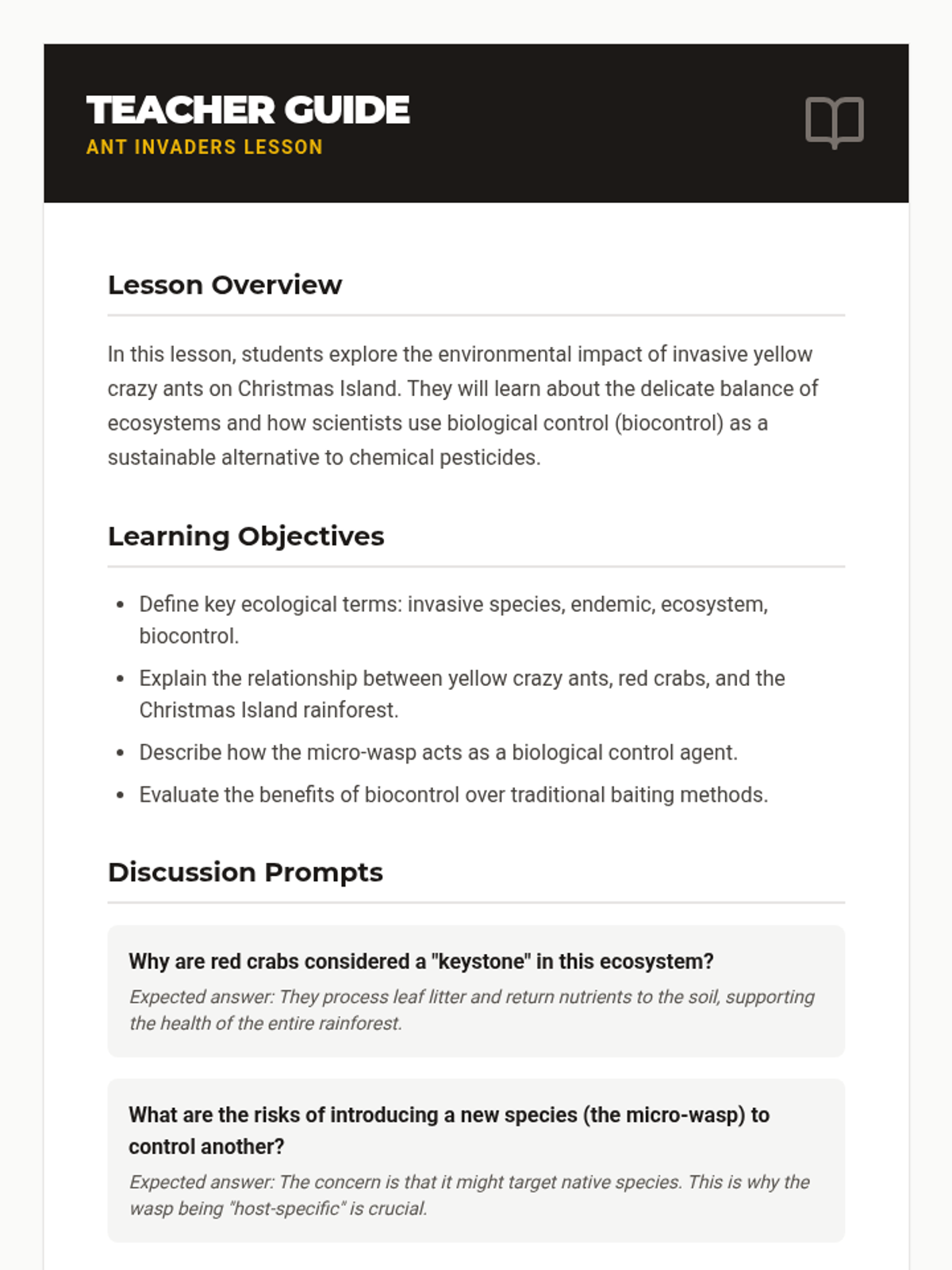
Instructional support for the Ant Invaders lesson, including learning objectives, discussion prompts, and an answer key for vocabulary. Updated to remove references to the graphic organizer.
Visual slides for instruction. Added vocabulary slide, improved text contrast, fixed text sizing, and removed overflow issues.
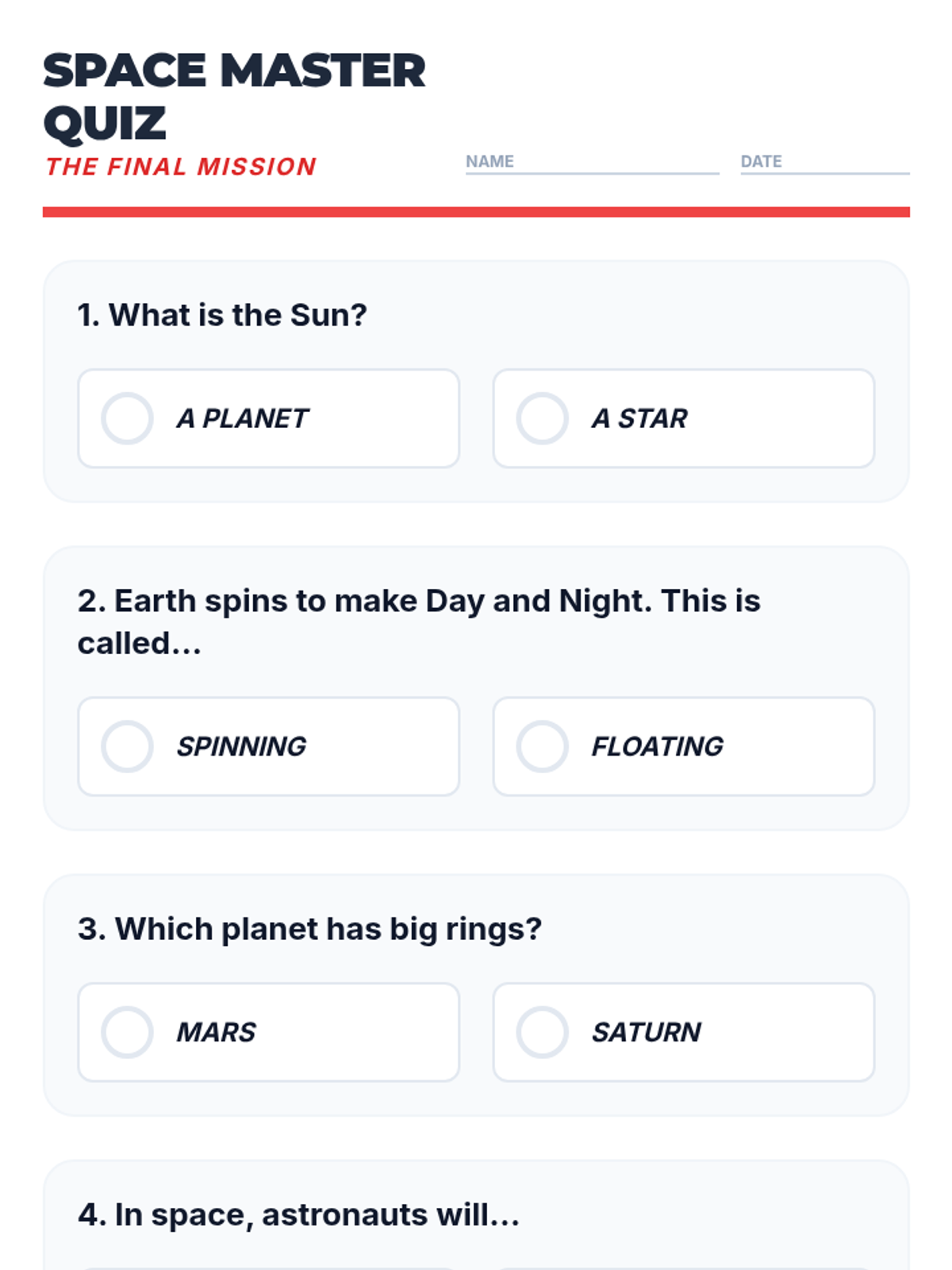
A final unit assessment designed for accessibility. It features large, clear fonts, simplified multiple-choice options with identical styling to prevent cues, and a creative drawing area for students to demonstrate their favorite concept from the unit.
A fun, interactive trivia-style slide deck to review unit concepts. It poses multiple-choice questions about the Sun, Earth's cycles, and the planets with high-contrast, visually supportive layouts to encourage student participation and confidence before the final assessment.
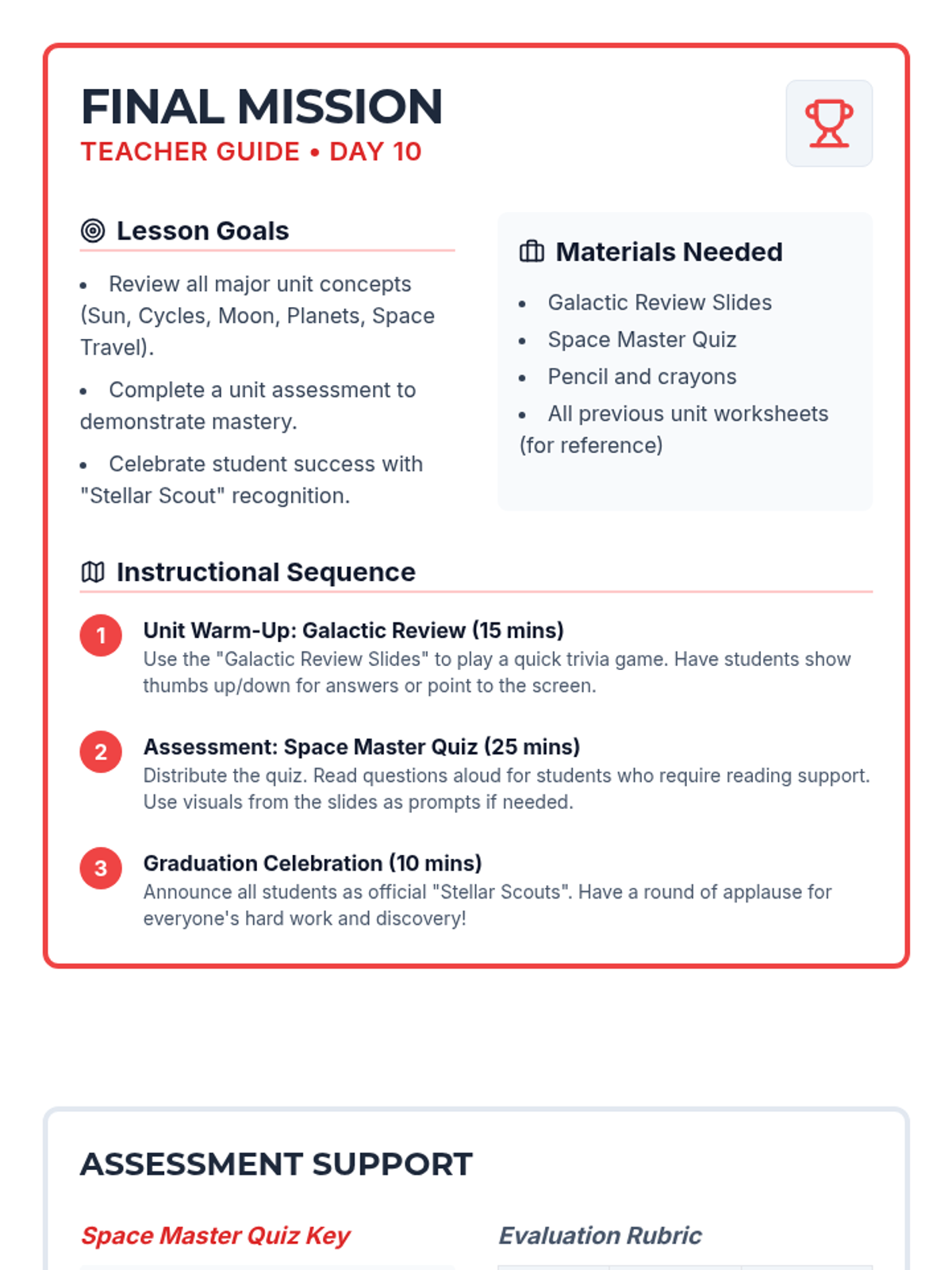
A teacher guide for the final lesson of the unit. It includes a structured review plan, an assessment guide for the Space Master Quiz, and a simple rubric for evaluating student progress without requiring stickers or prizes.
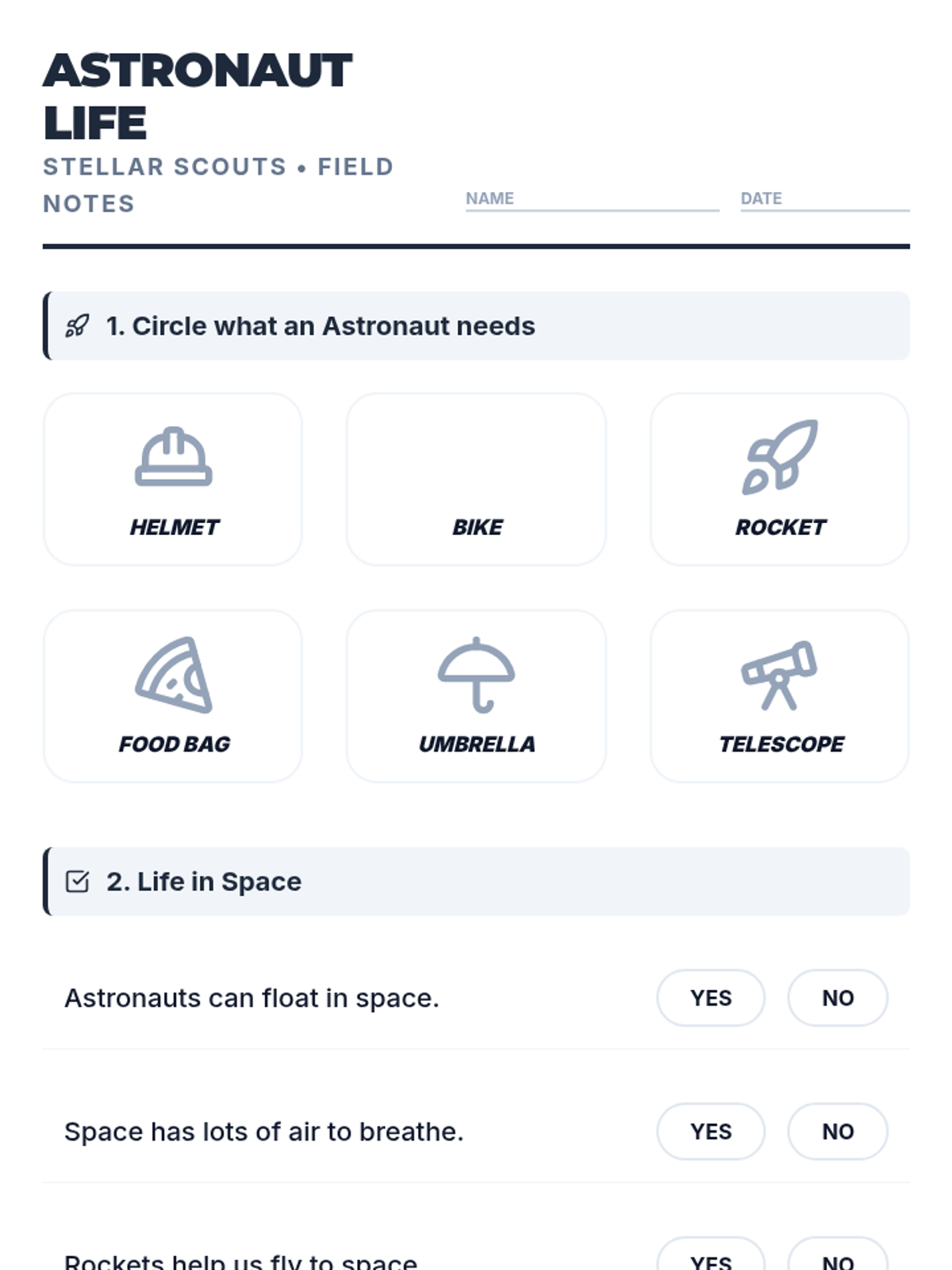
A worksheet helping students identify the tools and experiences of an astronaut. It features a categorization task (what is needed in space), simple Yes/No comprehension questions about space travel, and a personal reflection prompt about being an explorer.
An instructional slide deck about space exploration. Features clear visuals of telescopes and rockets, explains the concept of zero gravity with relatable examples, and includes an embedded video tour of the International Space Station to show how astronauts live in space.
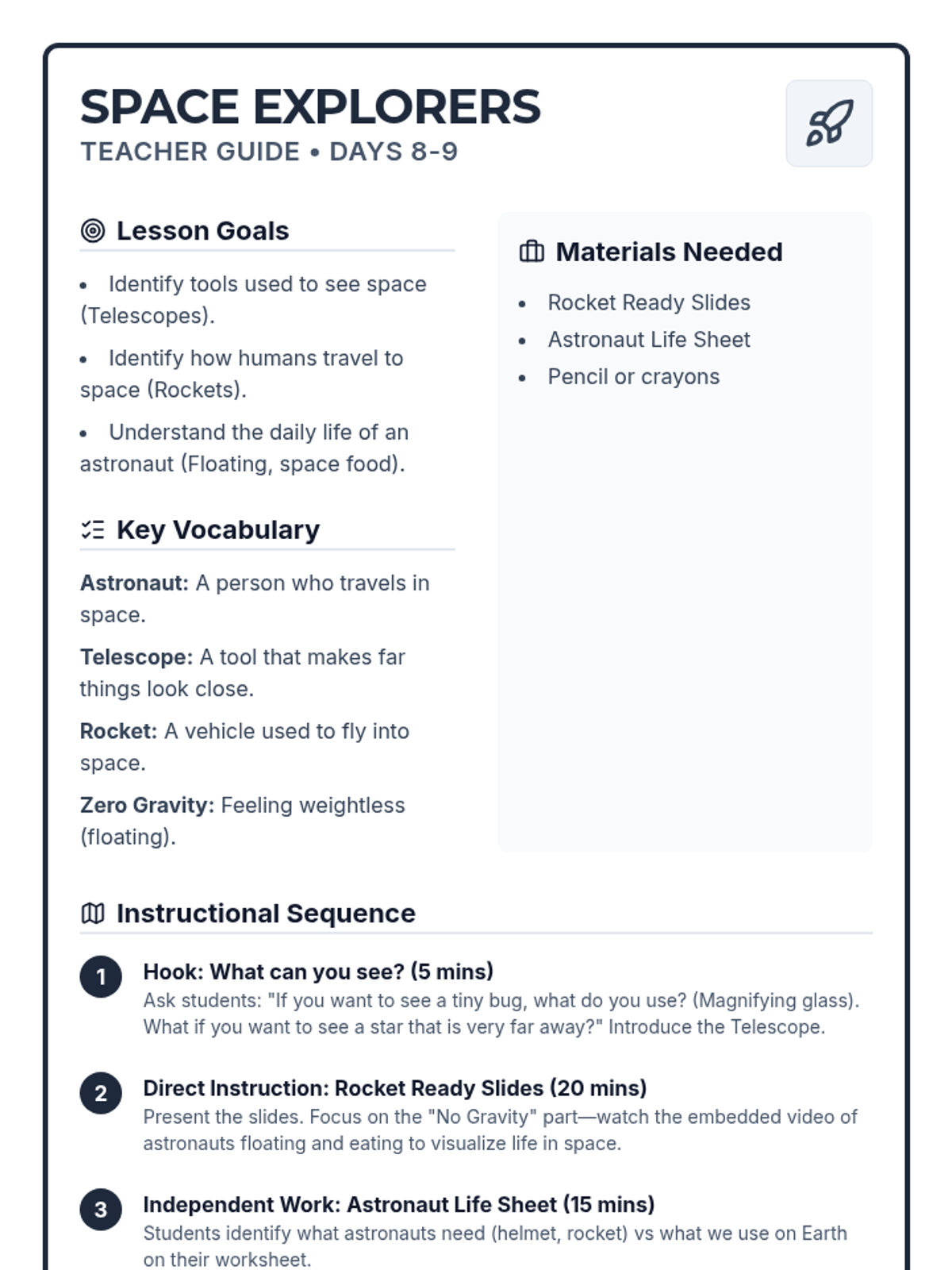
A teacher guide for the Space Explorers lesson, covering astronauts, rockets, and telescopes. Includes interesting facts about daily life in space with focus on visual and video instruction, without requiring physical props.
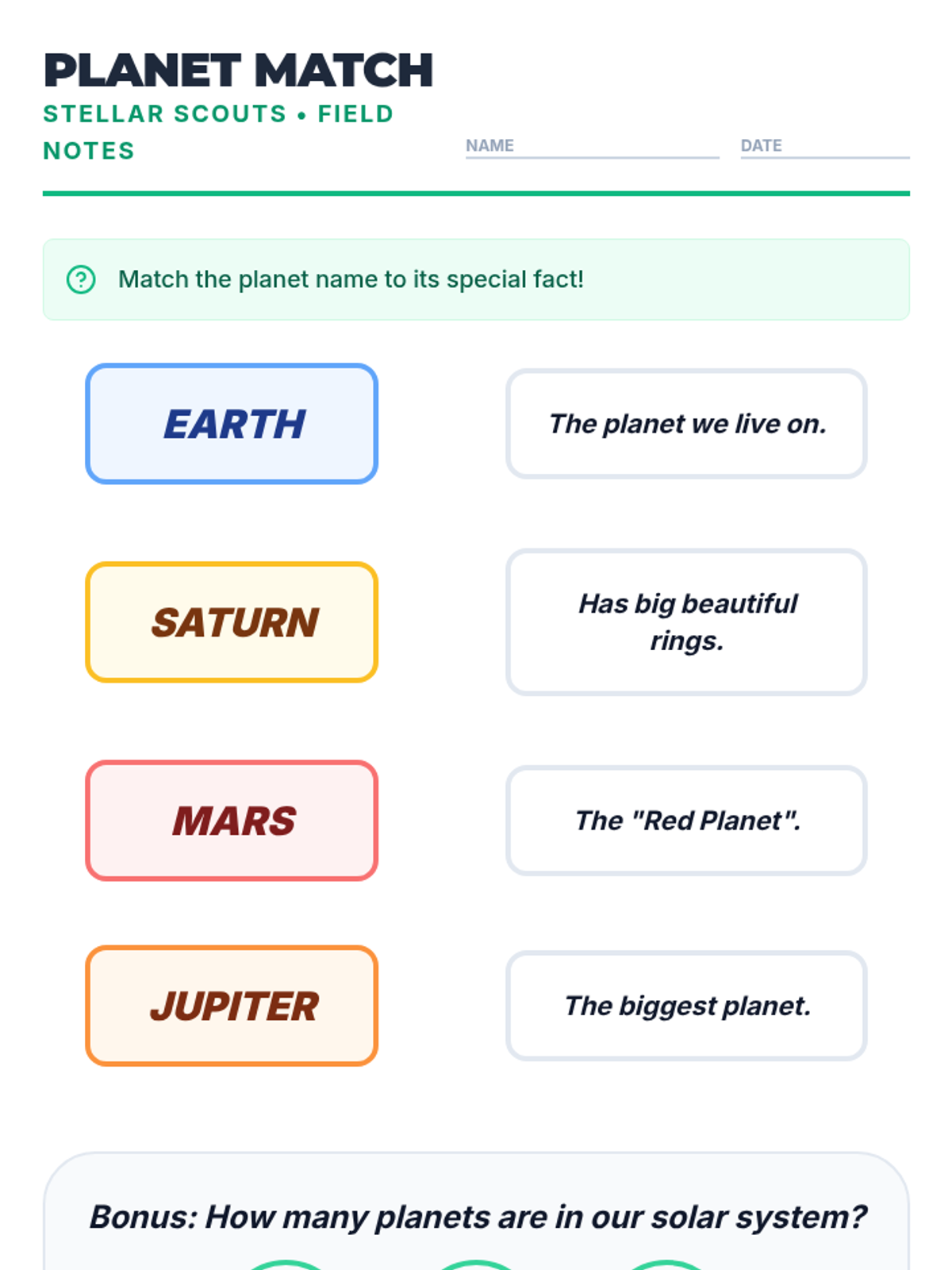
A matching worksheet focusing on key planets. Students match Earth, Saturn, Mars, and Jupiter to their defining characteristics using a clear, large-print layout suitable for students with diverse learning needs.
An engaging slide deck that tours the eight planets of the solar system. It categorizes planets into rocky inner worlds and gaseous outer giants, highlights iconic features (like Saturn's rings), and teaches a mnemonic device for remembering the order of the planets.
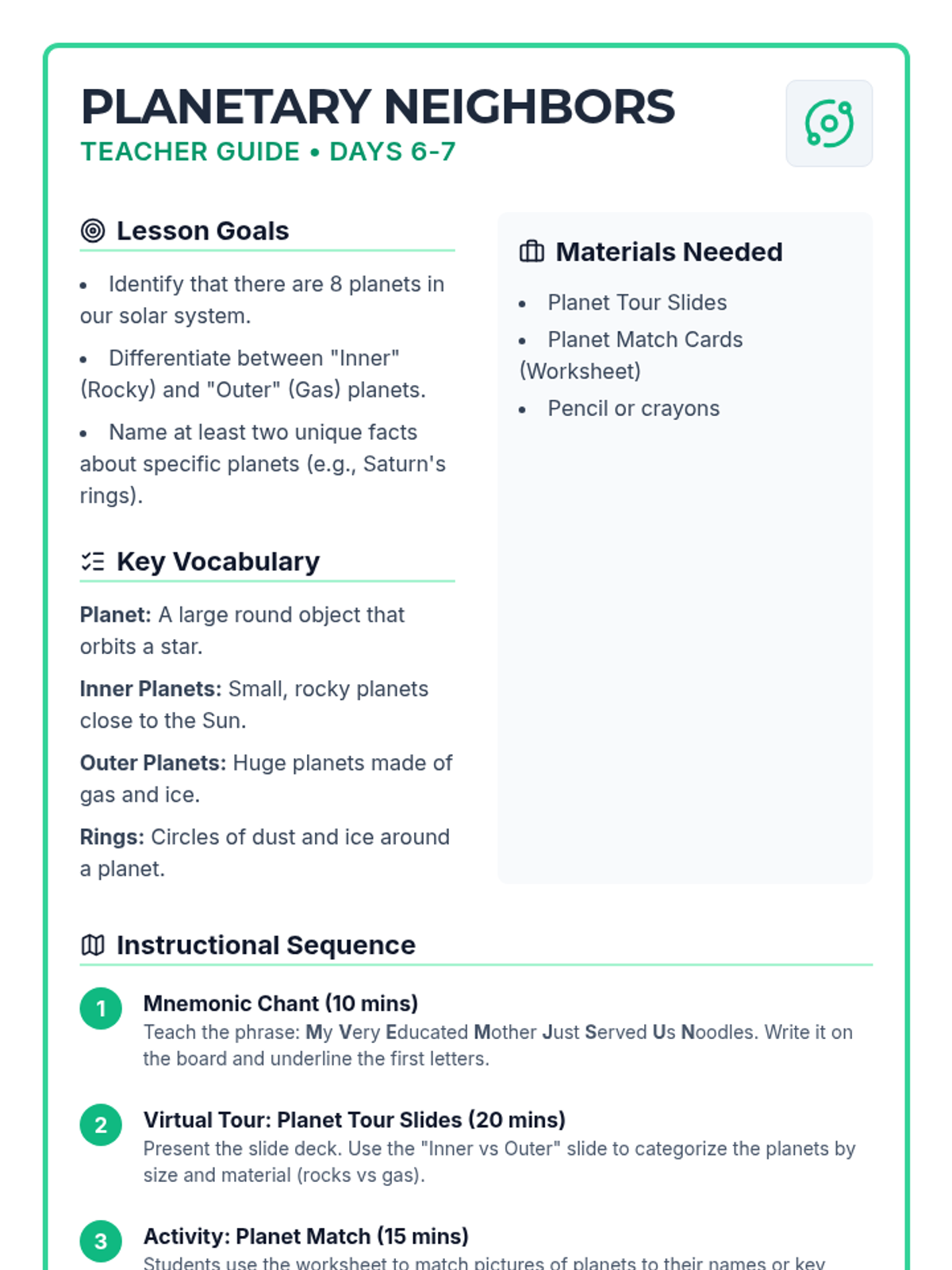
A teacher guide for the Planetary Neighbors lesson. It covers the eight planets, differentiating between inner rocky planets and outer gas giants. Includes a mnemonic for memory and quick-fact summaries without physical models.
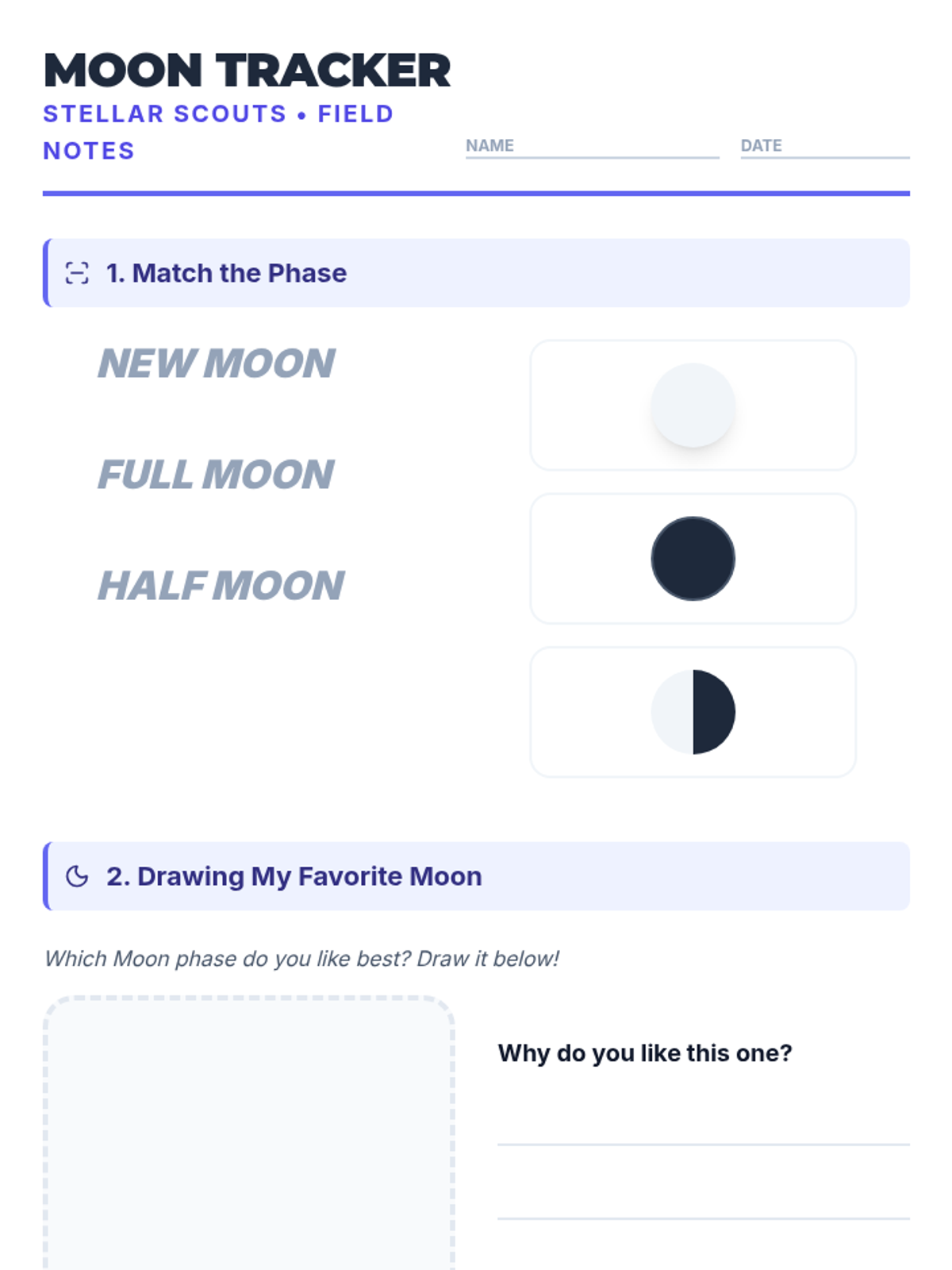
A worksheet for students to identify and match moon phases (New, Full, Half). It includes a creative drawing section for students to illustrate their favorite phase and write a simple sentence about it.
An instructional slide deck covering the Moon's characteristics and its phases. It uses high-contrast visuals to explain that the Moon orbits Earth, reflects sunlight, and appears in different shapes throughout the month.
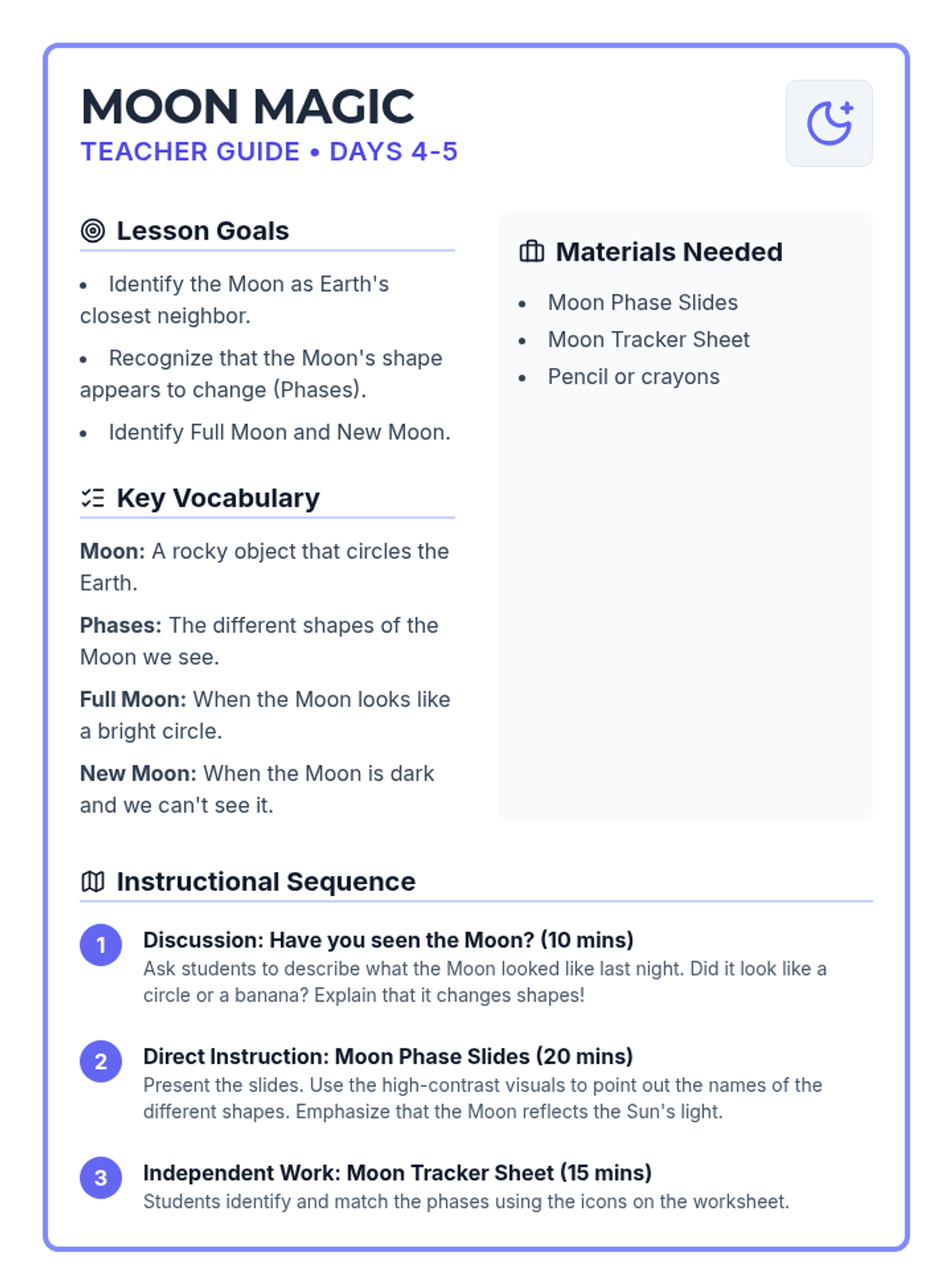
A teacher guide for the Moon Magic lesson, focusing on moon phases. Includes visual analogies and discussion prompts to explain the lunar cycle without requiring physical cookies or props.
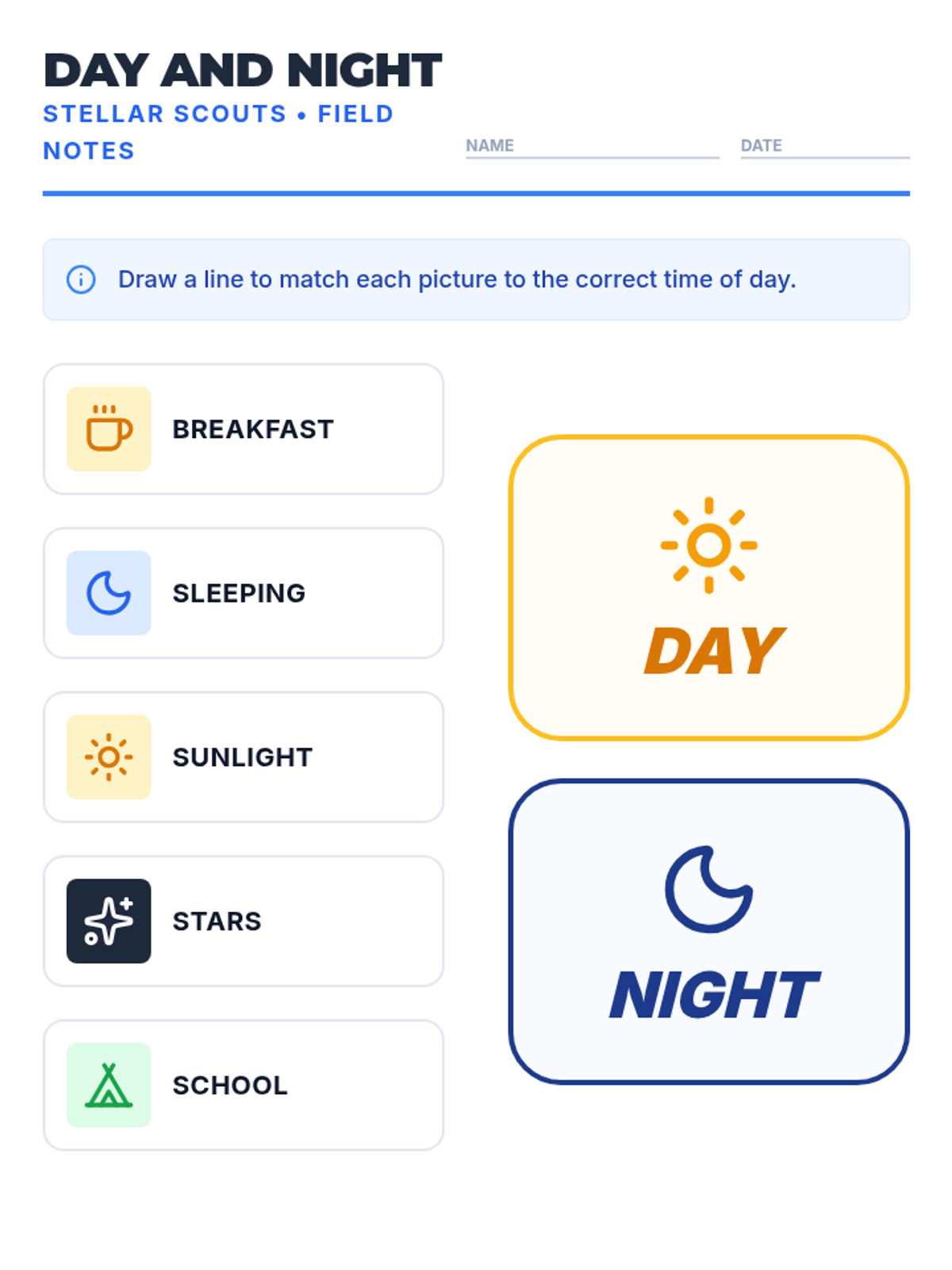
A matching activity worksheet where students connect images of daily activities (like eating breakfast or seeing stars) to either the 'Day' or 'Night' category. Designed with clear icons and large targets for students with fine motor challenges.
An instructional slide deck explaining Earth's rotation and revolution. Uses high-contrast visuals, animations, and simple comparisons (like spinning like a top) to teach students about day, night, and the length of a year.
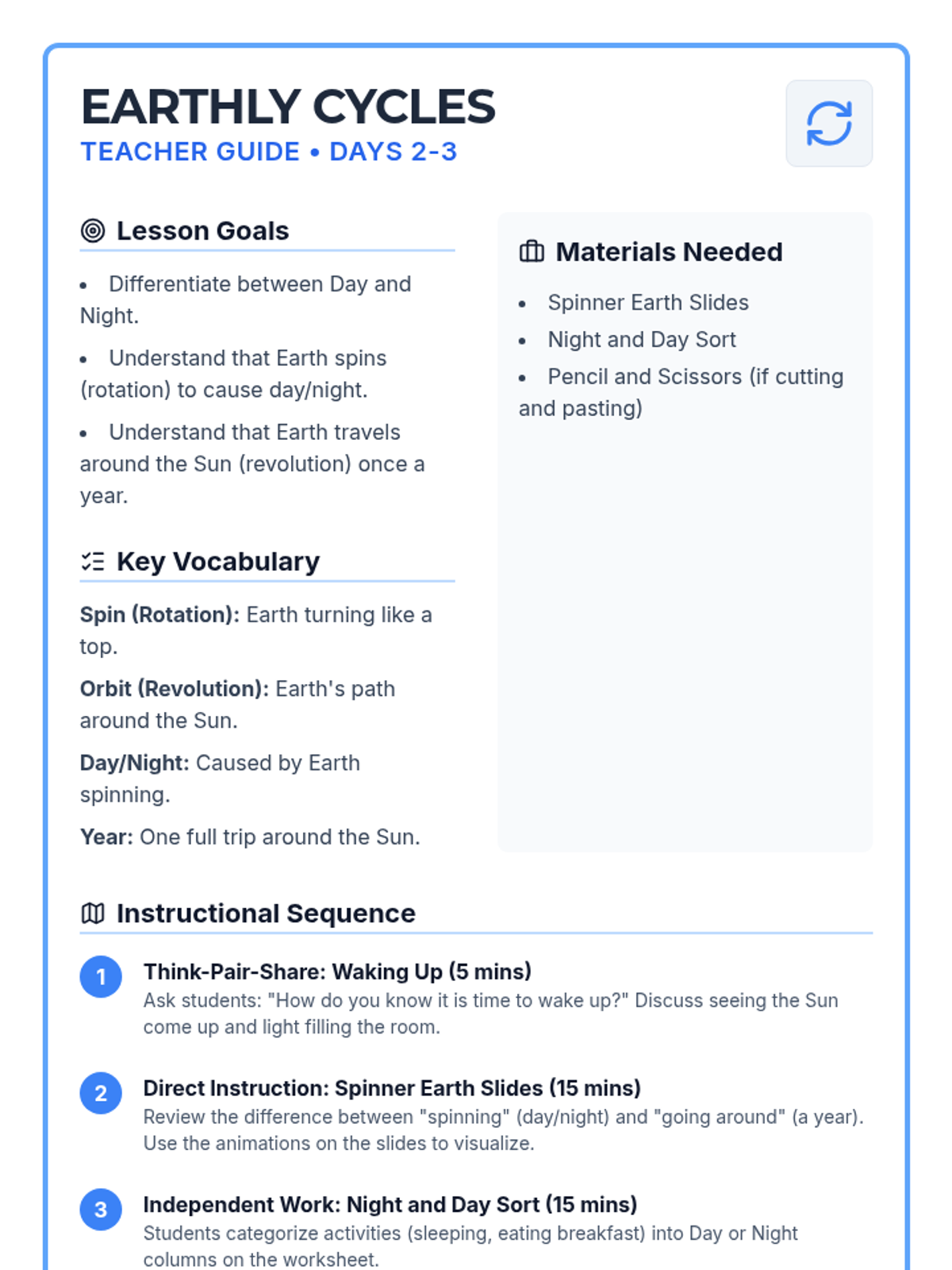
A detailed teacher guide for Lesson 2, covering Earth's rotation and revolution. Includes instructional strategies for differentiating day and night using visual analogies and movement, without physical props.
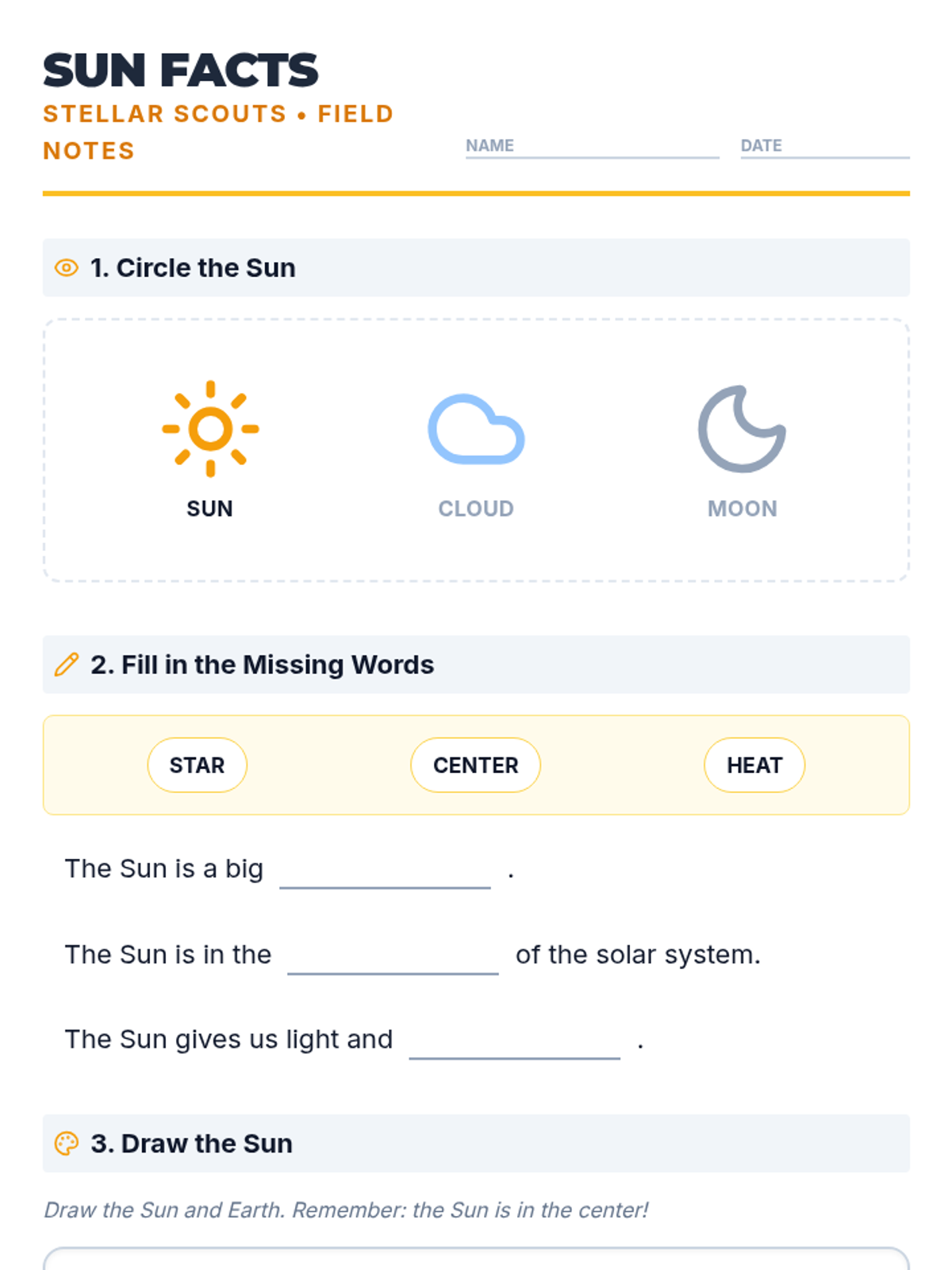
A student worksheet for the Sun Center lesson. It includes a visual identification task, simple fill-in-the-blank sentences using a word bank, and a drawing area to reinforce the concept of the Sun as the center of the solar system.
A high-contrast, visually engaging slide deck introducing the Sun. It features large text, clear icons, and simple diagrams to help students understand that the Sun is a star at the center of our solar system that provides heat and light.
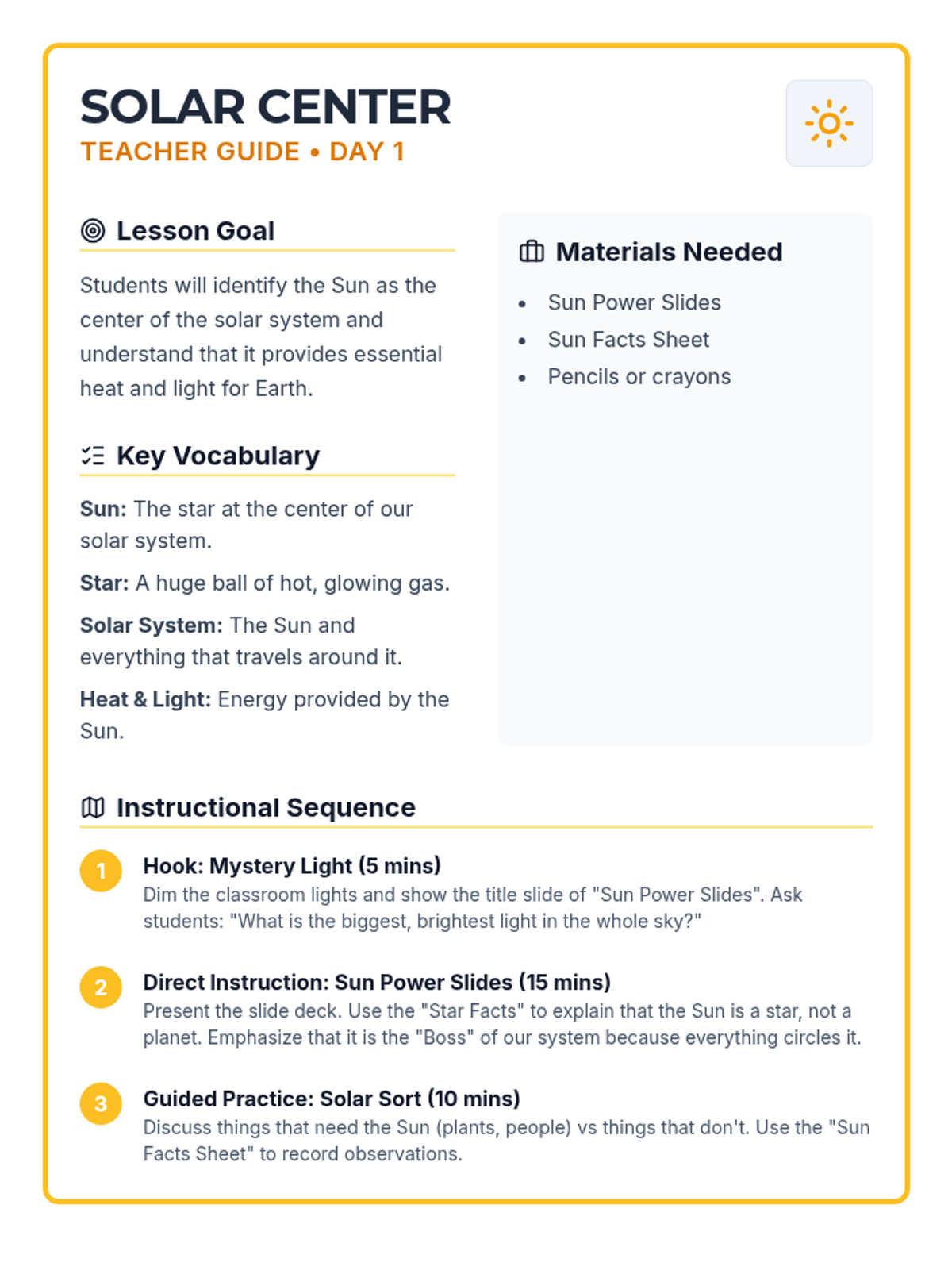
A comprehensive teacher guide for the first lesson of the Stellar Scouts unit, including lesson objectives, vocabulary, a detailed instructional sequence, and scaffolding strategies for students with special needs. Revised to remove physical material requirements.
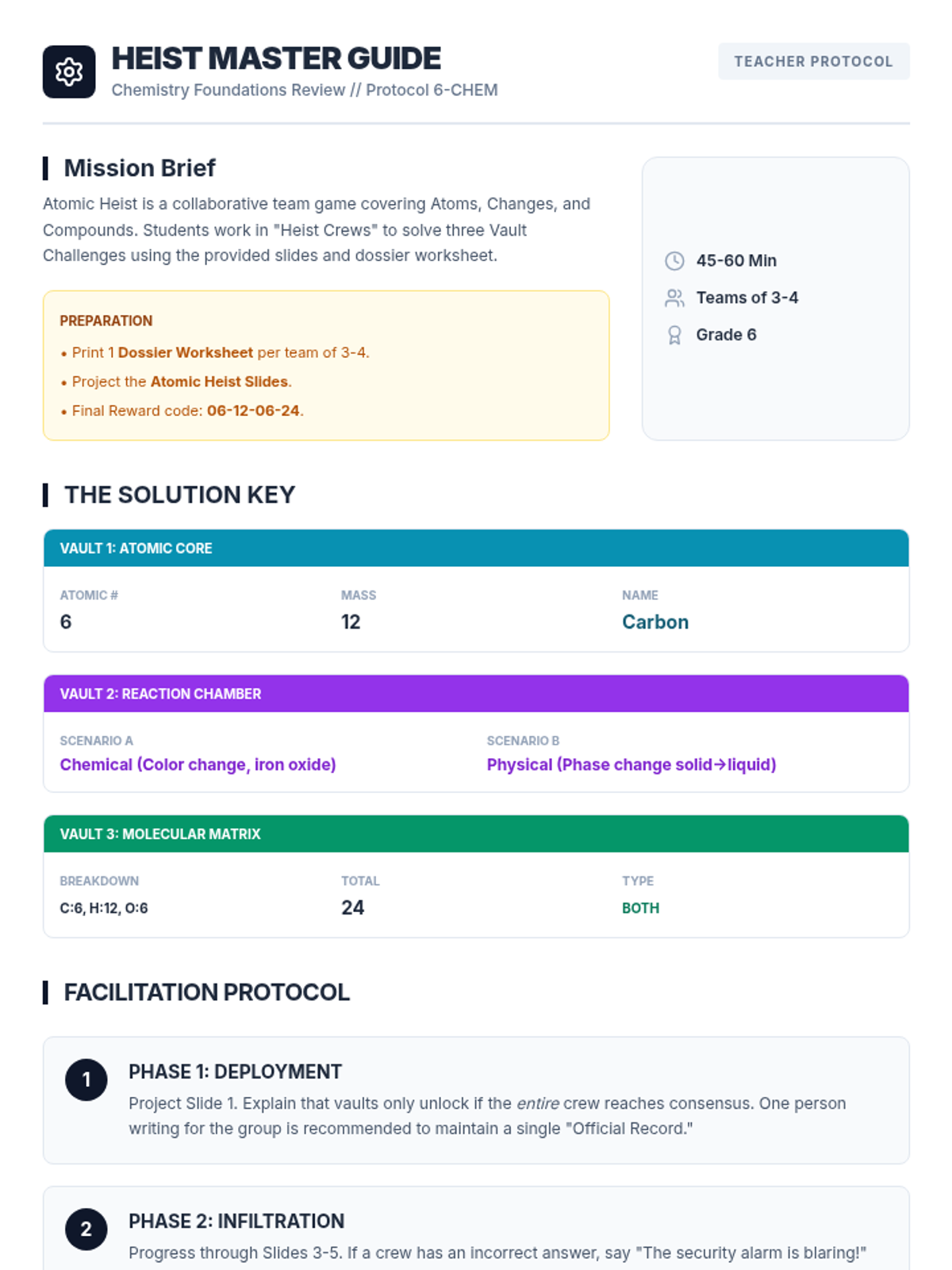
A comprehensive teacher facilitation guide for the Atomic Heist review game, including an answer key, prep checklist, and step-by-step instructions.
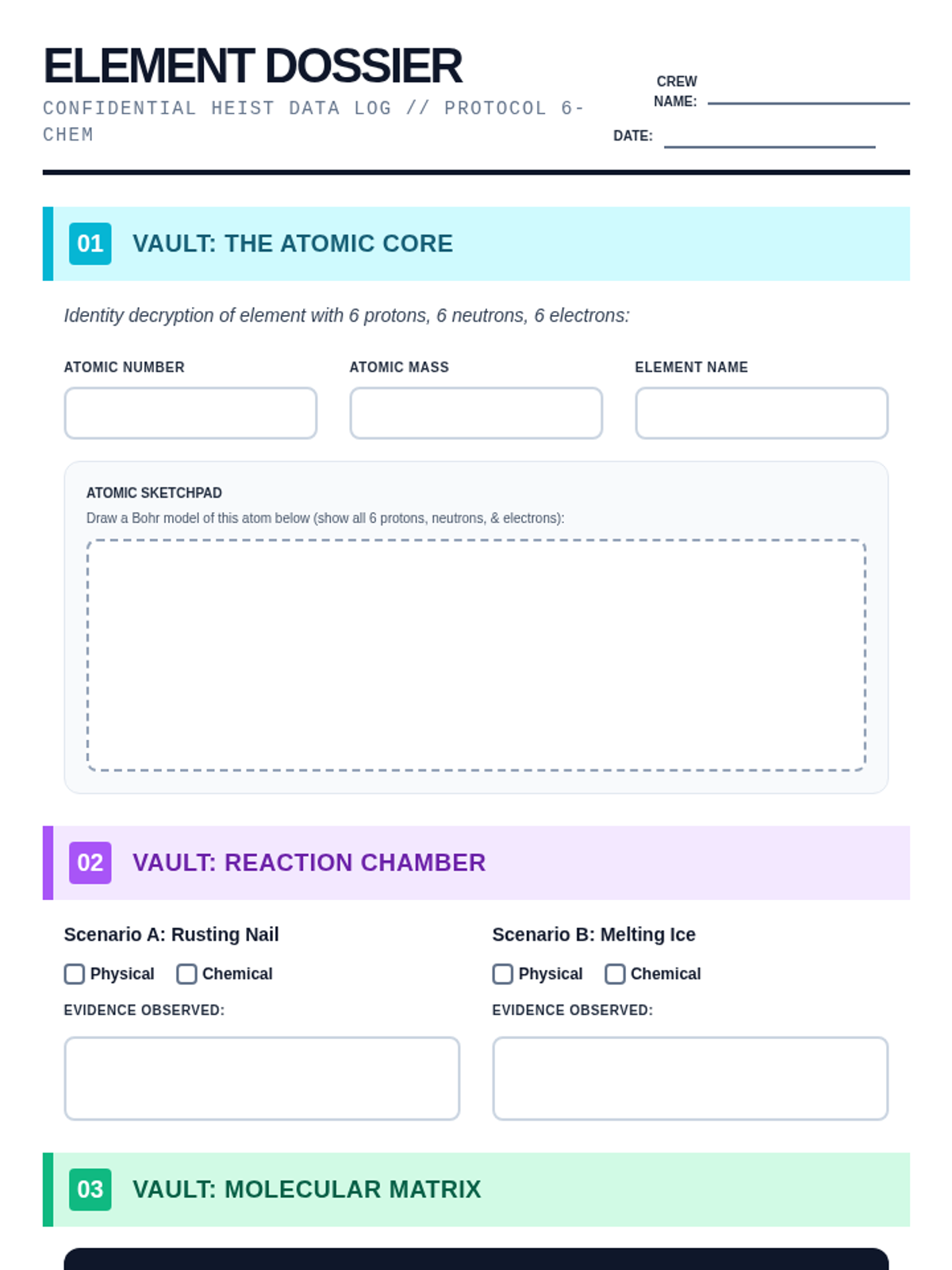
A student response sheet for the Atomic Heist game, providing organized sections for teams to record their scientific findings and solve chemistry challenges.
A high-energy review presentation designed to guide students through the Atomic Heist game, featuring challenges for atoms, chemical changes, and molecular formulas.
The complete article regarding yellow crazy ant biocontrol, featuring all original text and headings from the official website. It includes a comprehensive vocabulary glossary with definitions and models, presented in a four-page Field Guide format. Revised for visual consistency and polished layouts.
A card sort activity where students categorize mechanical wave characteristics, definitions, and examples into transverse and longitudinal groups. Includes 15 standardized cards and a teacher reference key. Optimized for single-page student printing with a separate answer key page.