A teacher guide for the Introduction to Wave Mechanics lesson, including hook instructions, demonstration tips, and notes on common student misconceptions regarding wave anatomy and propagation.
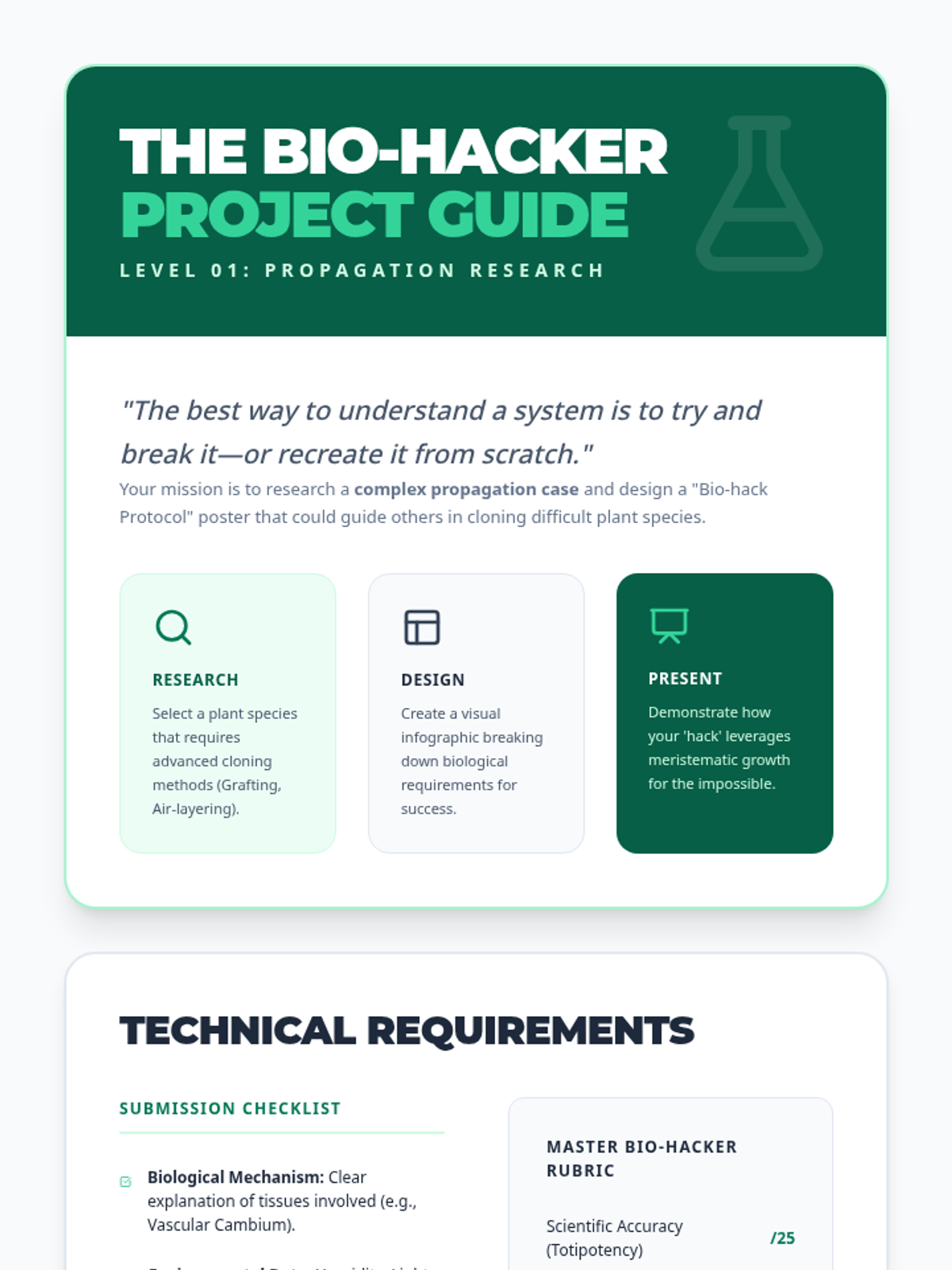
A culminating project guide for the Botanical Bio-hackers unit. Students are challenged to research and design a propagation protocol for a difficult plant species, applying their knowledge of cellular regeneration and environmental factors. Includes a technical rubric and a project proposal template.
A comprehensive growth journal for students to track their plant propagation experiment over several weeks. Features space for qualitative and quantitative data collection, weekly sketches, and a final analysis section connecting findings to the concept of cellular totipotency.
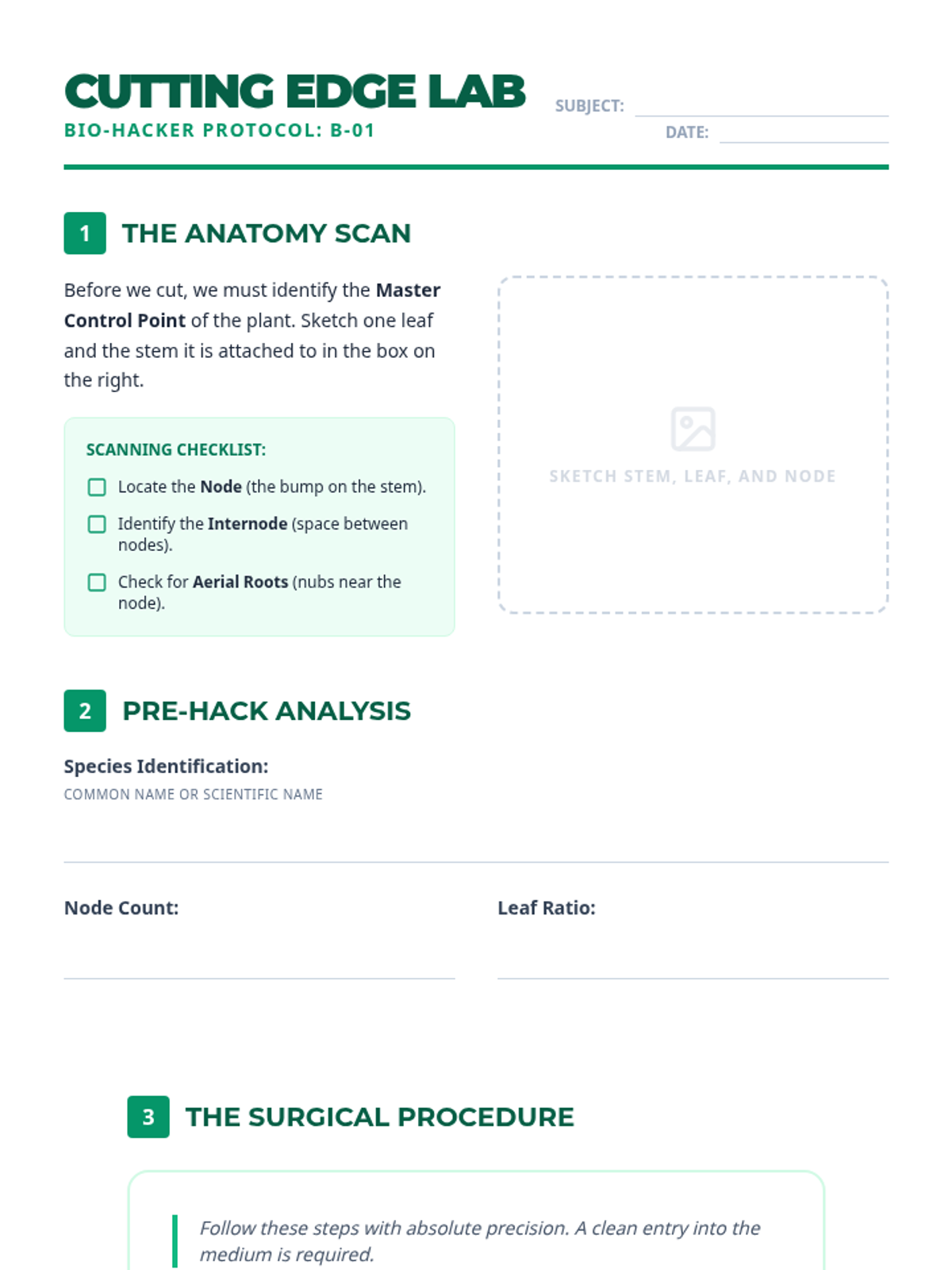
A student-facing laboratory sheet for the plant propagation activity. Includes sections for anatomical sketching, pre-activity analysis, step-by-step surgical procedures for taking cuttings, and a hypothesis section based on the biological principle of totipotency.
An immersive slide deck for the Botanical Bio-hackers lesson, using a high-contrast 'tech' aesthetic to teach totipotency, asexual reproduction, and the practical steps of plant propagation. Features bold visual hierarchies and clear procedural instructions.
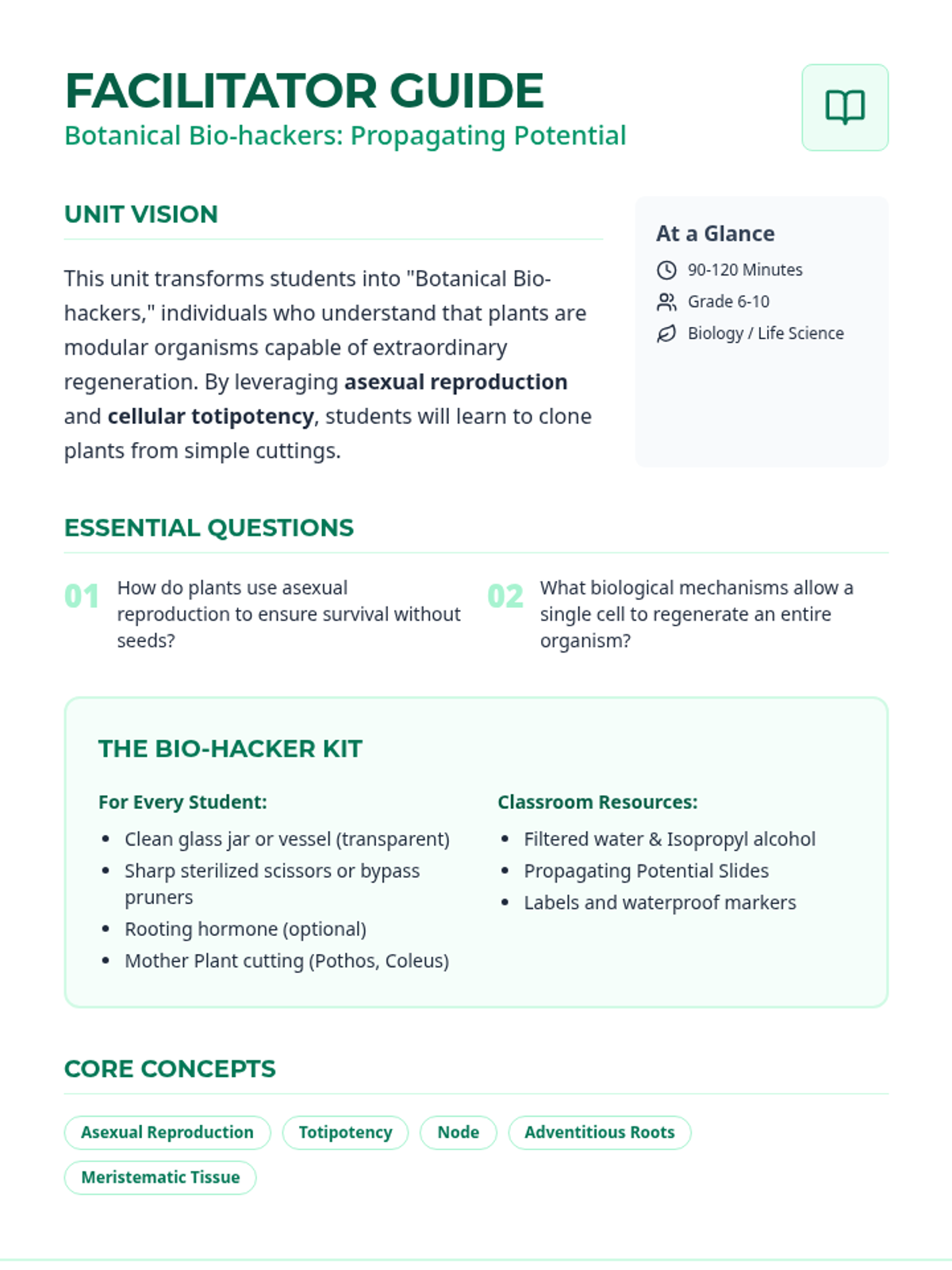
A comprehensive teacher's guide for the Botanical Bio-hackers lesson, featuring unit visions, essential questions, detailed lab materials, and a step-by-step instructional flow for teaching plant propagation.
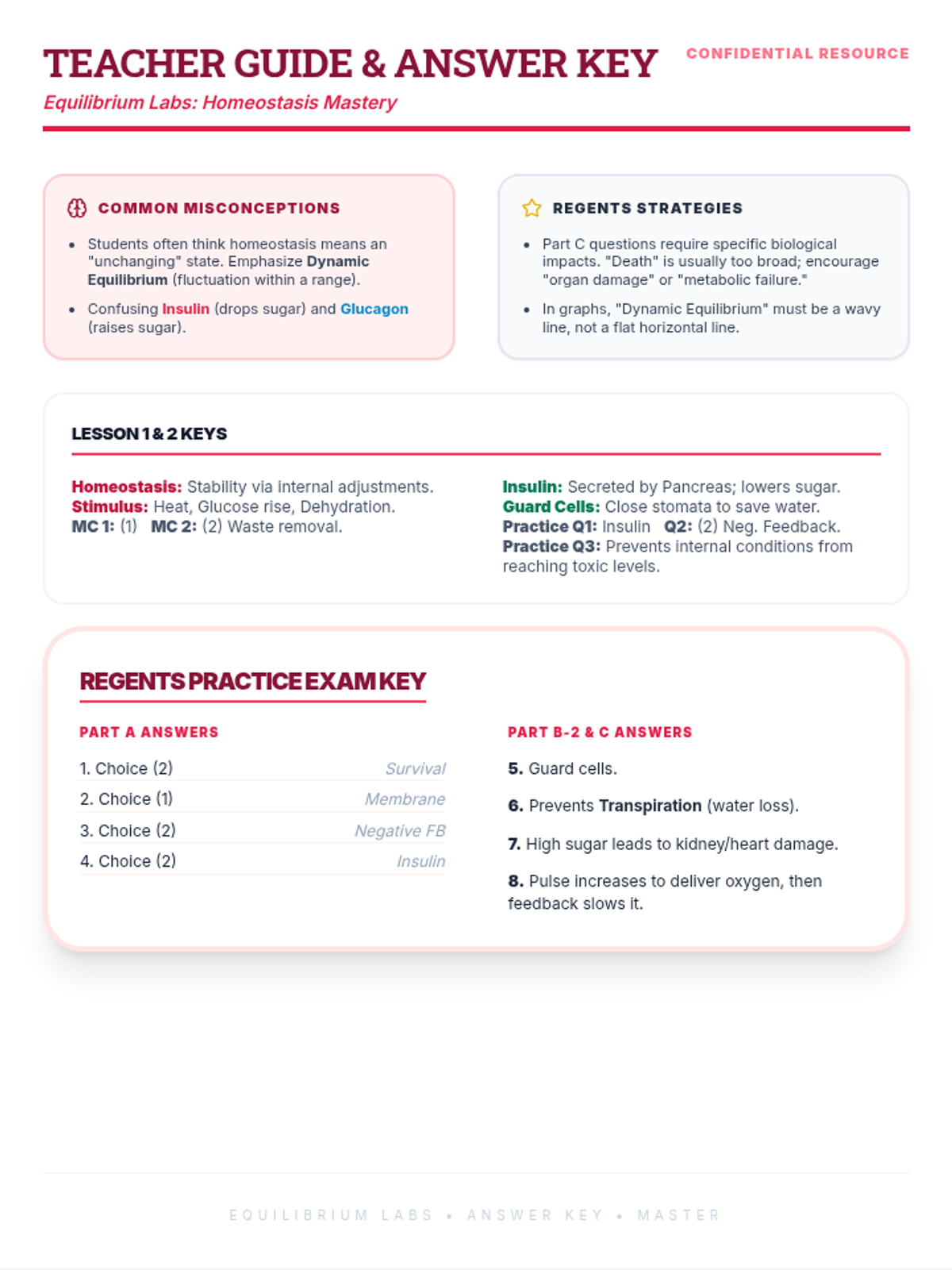
Comprehensive answer key and teacher guide for all materials in the Equilibrium Labs sequence. Includes teaching tips, common misconceptions, and Regents exam strategies.
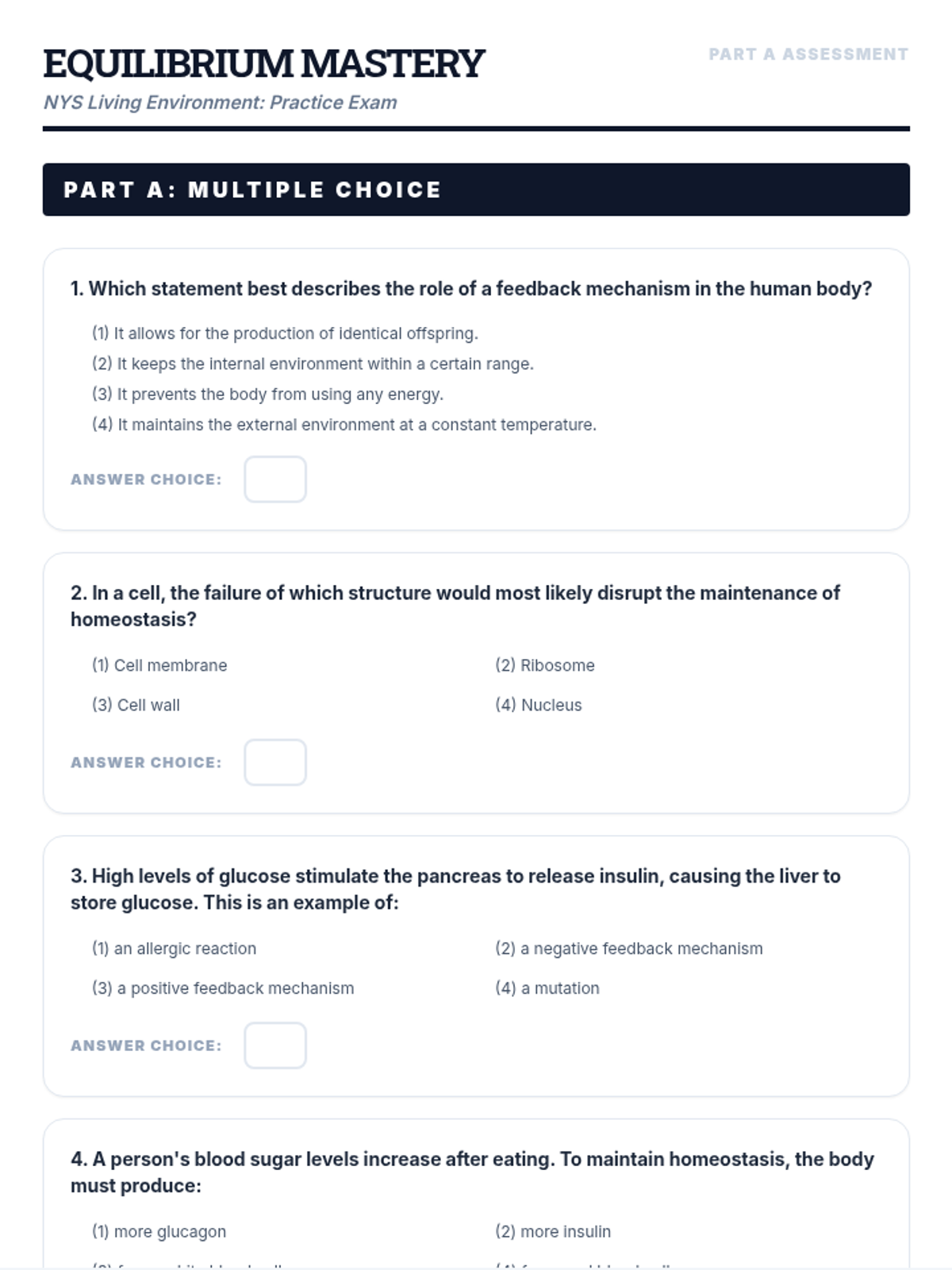
A comprehensive practice exam featuring Part A (Multiple Choice) and Part B/C (Constructed Response) questions modeled after authentic NYS Regents Biology exam questions on homeostasis and homeostasis feedback.
Visual presentation for Lesson 2, covering negative feedback loops, the insulin/glucagon cycle, and the role of guard cells in plant homeostasis.
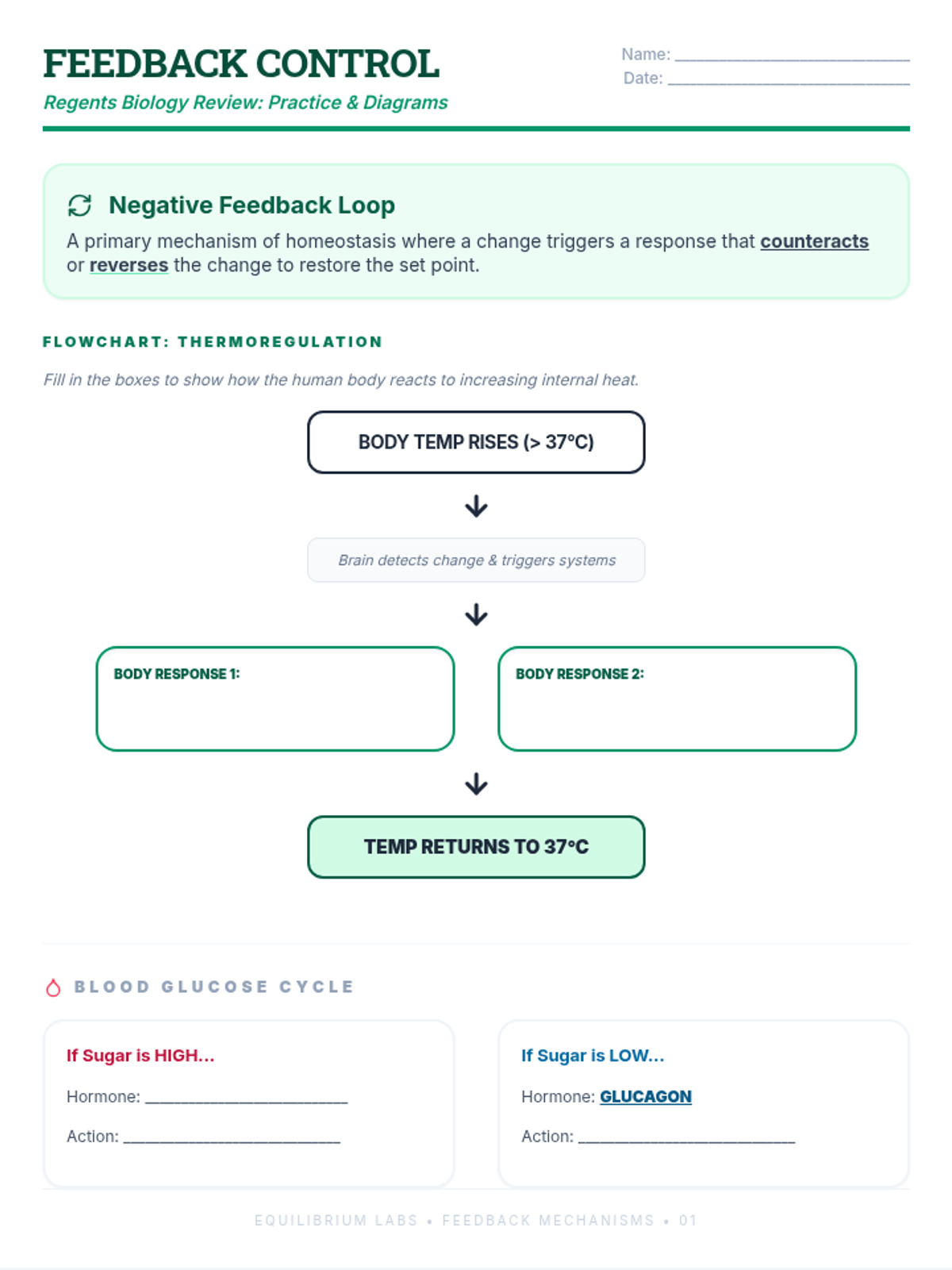
Practice worksheet for Lesson 2 focusing on negative feedback loops, thermoregulation, blood glucose control, and plant guard cells. Includes Regents-style multiple choice and short answer questions.
Visual presentation for Lesson 1, introducing the concepts of homeostasis, dynamic equilibrium, and failure of balance with high-impact visuals.
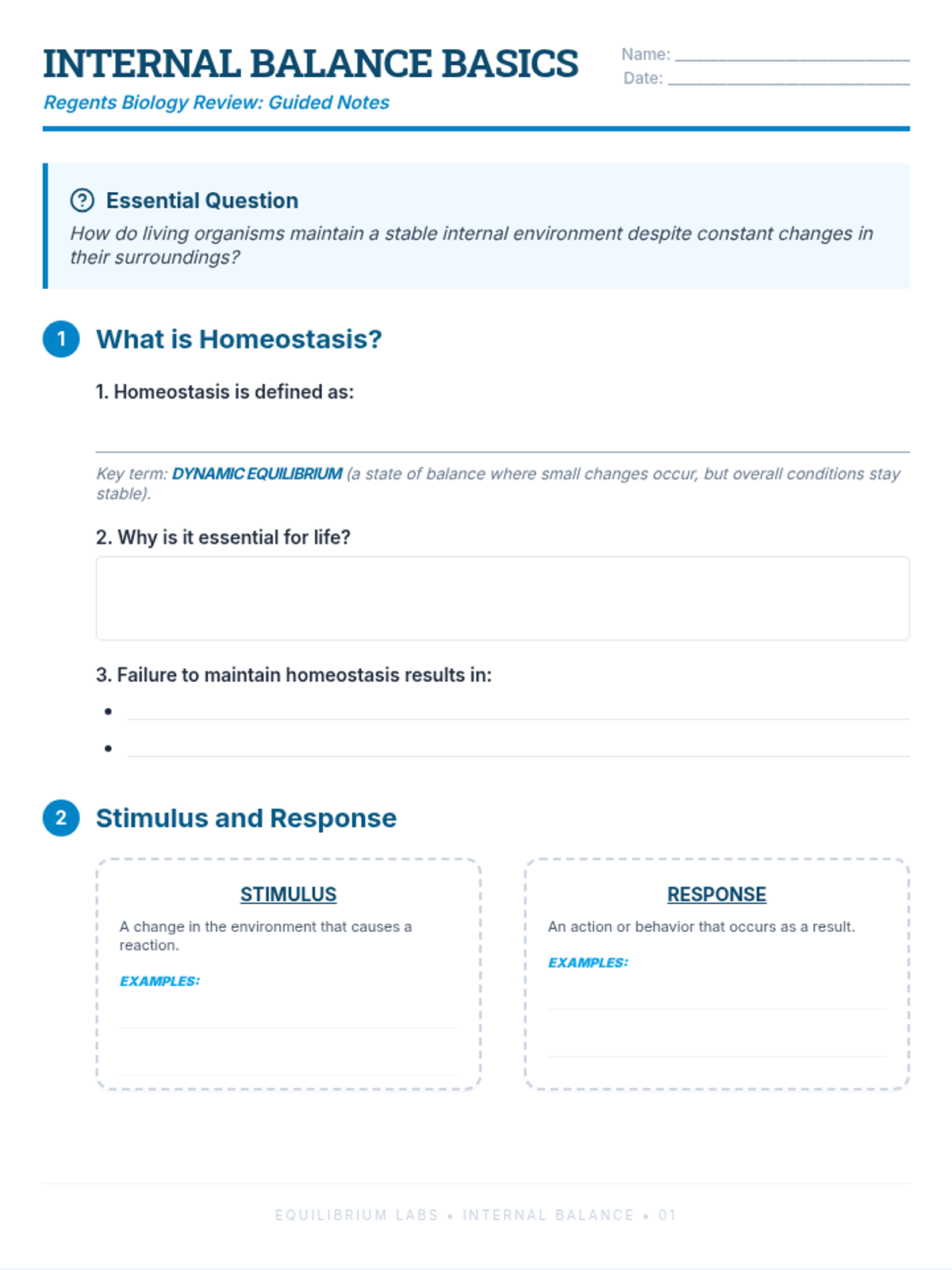
Guided notes for Lesson 1, covering the definitions of homeostasis, dynamic equilibrium, and basic stimulus-response mechanisms. Includes Regents-style practice questions.
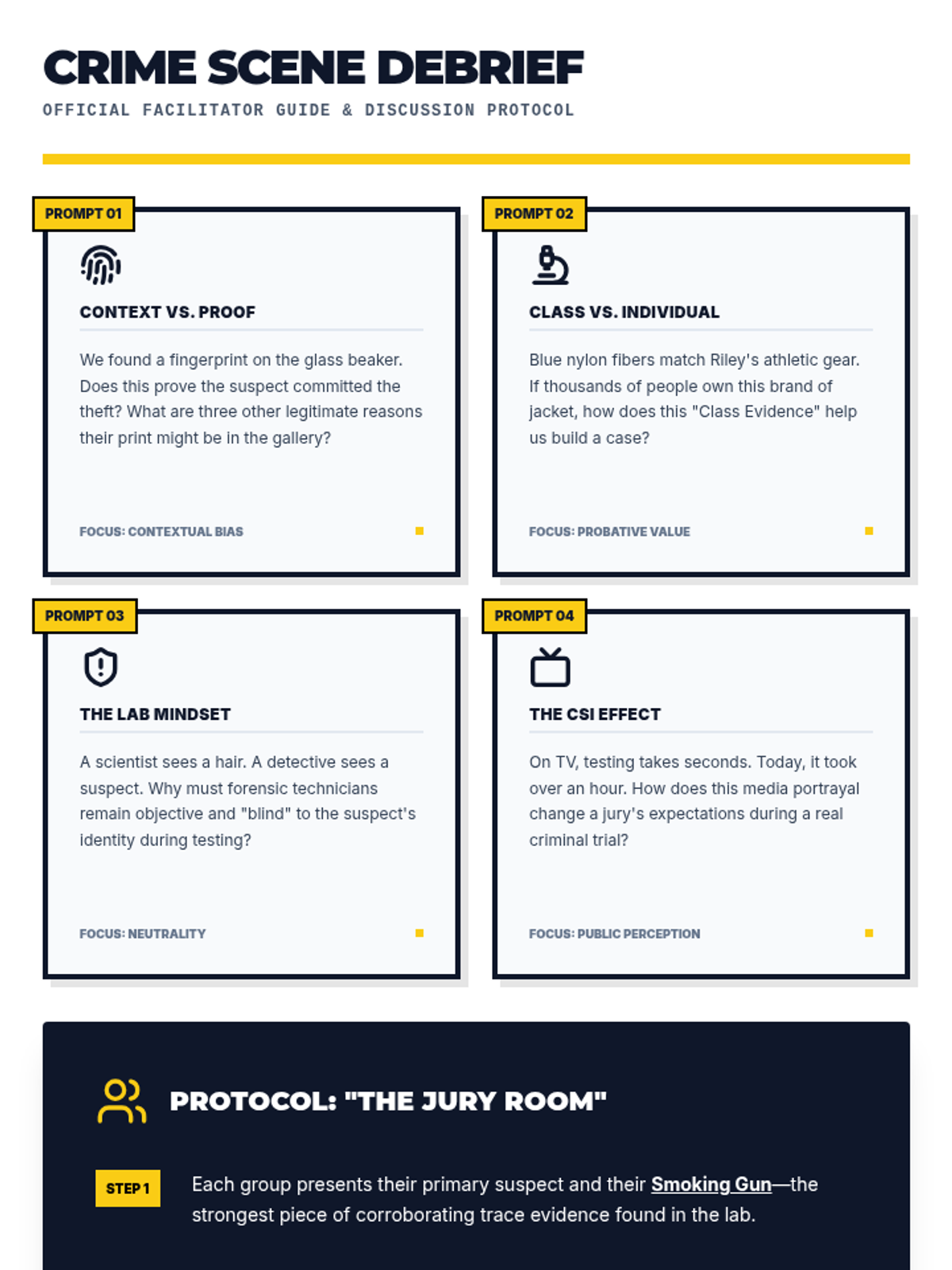
A set of high-level discussion prompts and a group protocol for debriefing a forensic simulation, focusing on evidence reliability, bias, and the "CSI Effect."
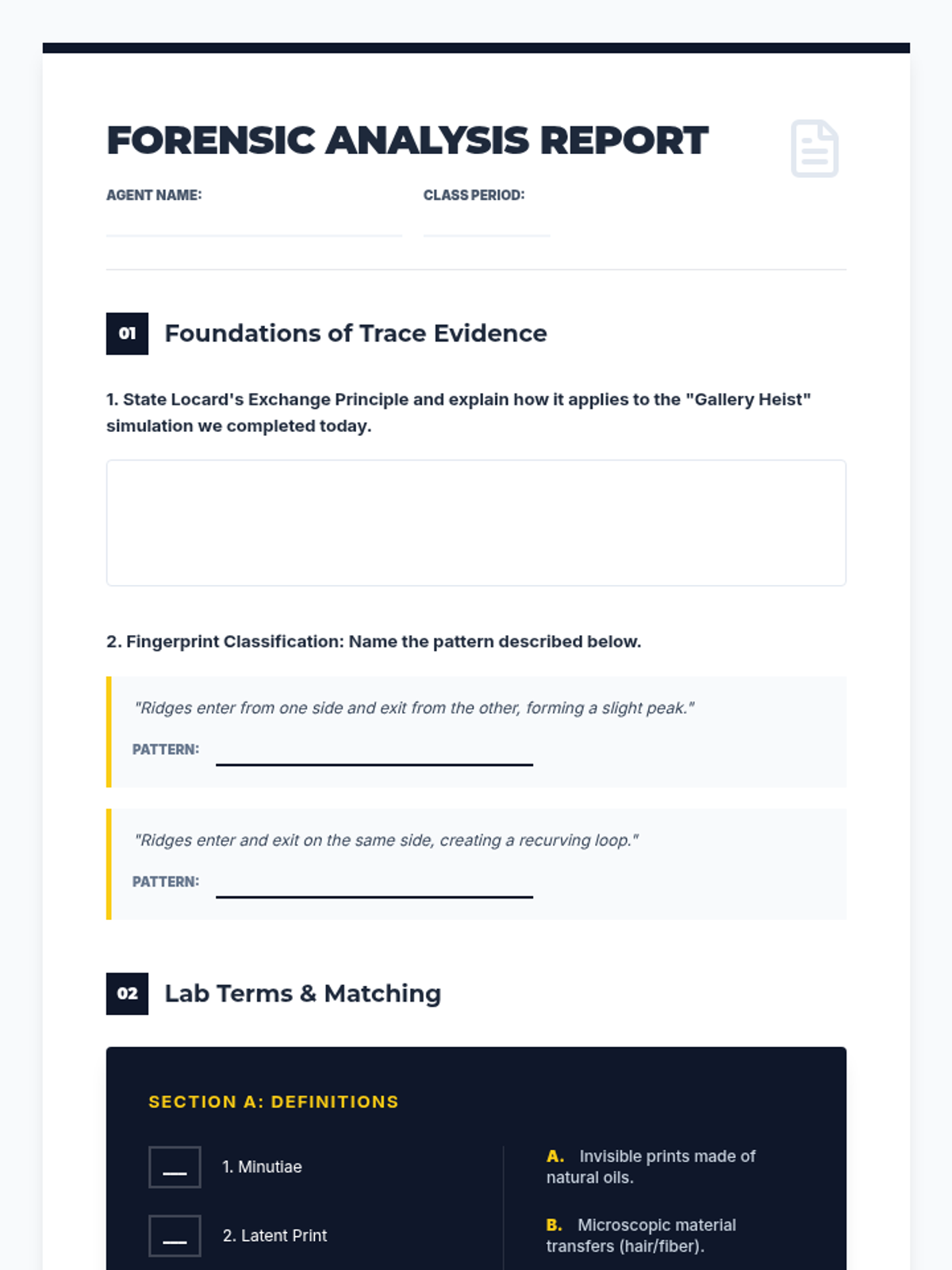
An academic worksheet for high school students to test their knowledge of Locard's Exchange Principle, fingerprint classification, hair anatomy, and forensic terminology.
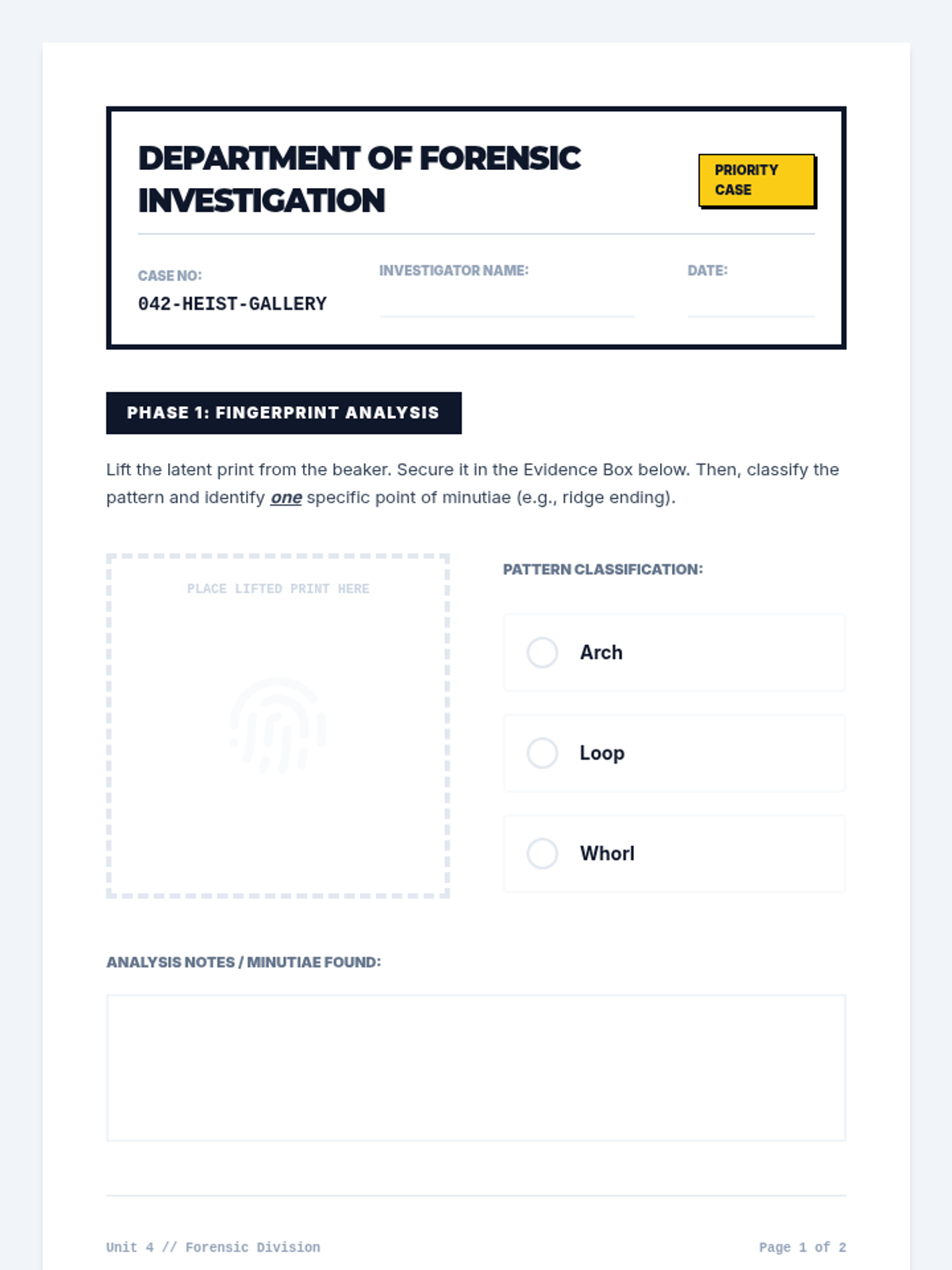
A forensic case file activity sheet where students record their findings from fingerprint lifting and microscopic fiber analysis to identify a primary suspect.
Visual presentation for the Trace Evidence Detective Lab, featuring Locard's Exchange Principle, suspect profiles, fingerprint classification guides, and lab procedures for student reference.
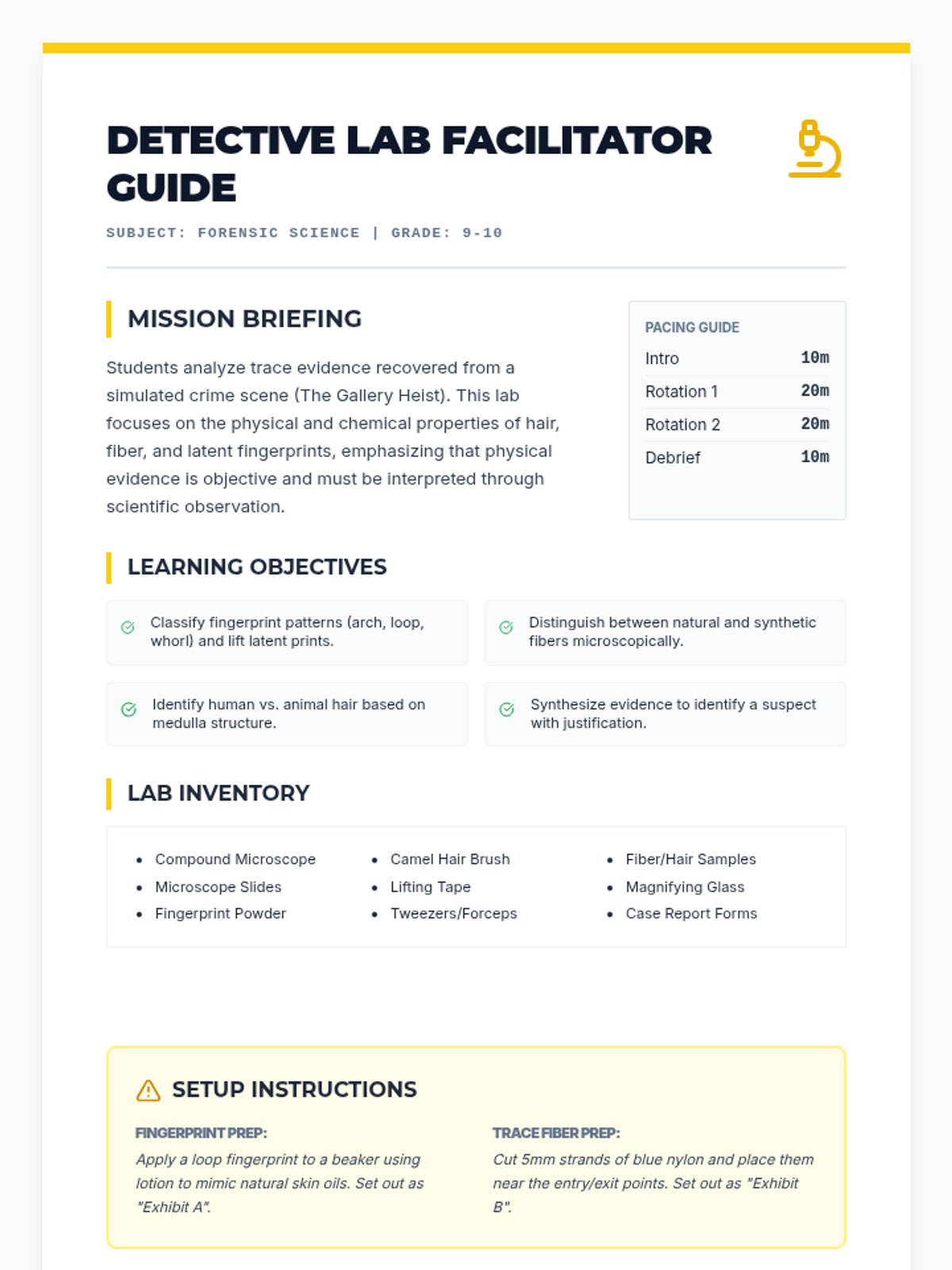
A comprehensive teacher's guide for a high school forensic science lab, featuring learning objectives, material lists, and step-by-step procedural instructions for fingerprint and fiber analysis.
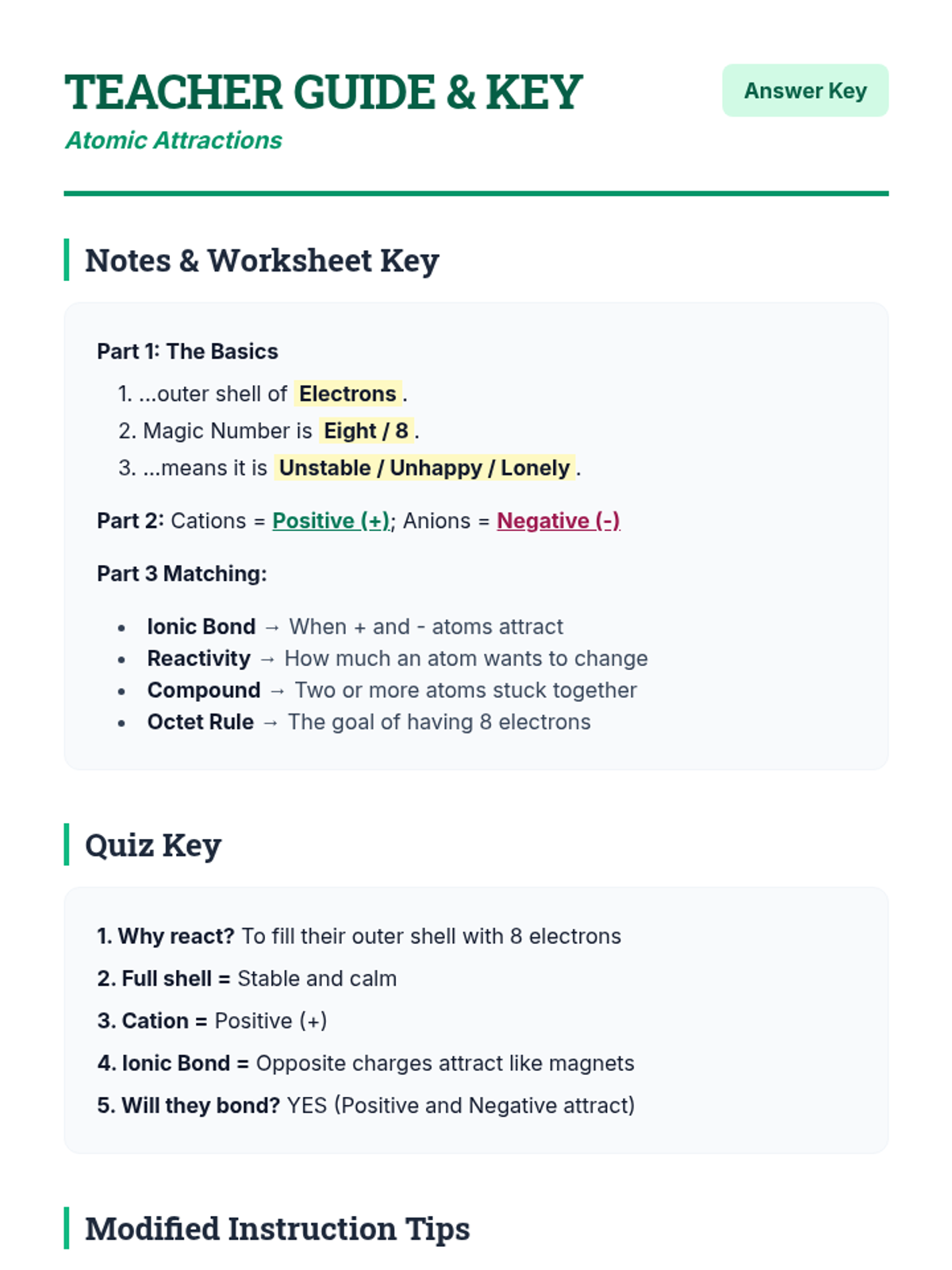
Teacher answer key and instructional support guide for the Atomic Attractions lesson materials. Includes modified instruction tips.
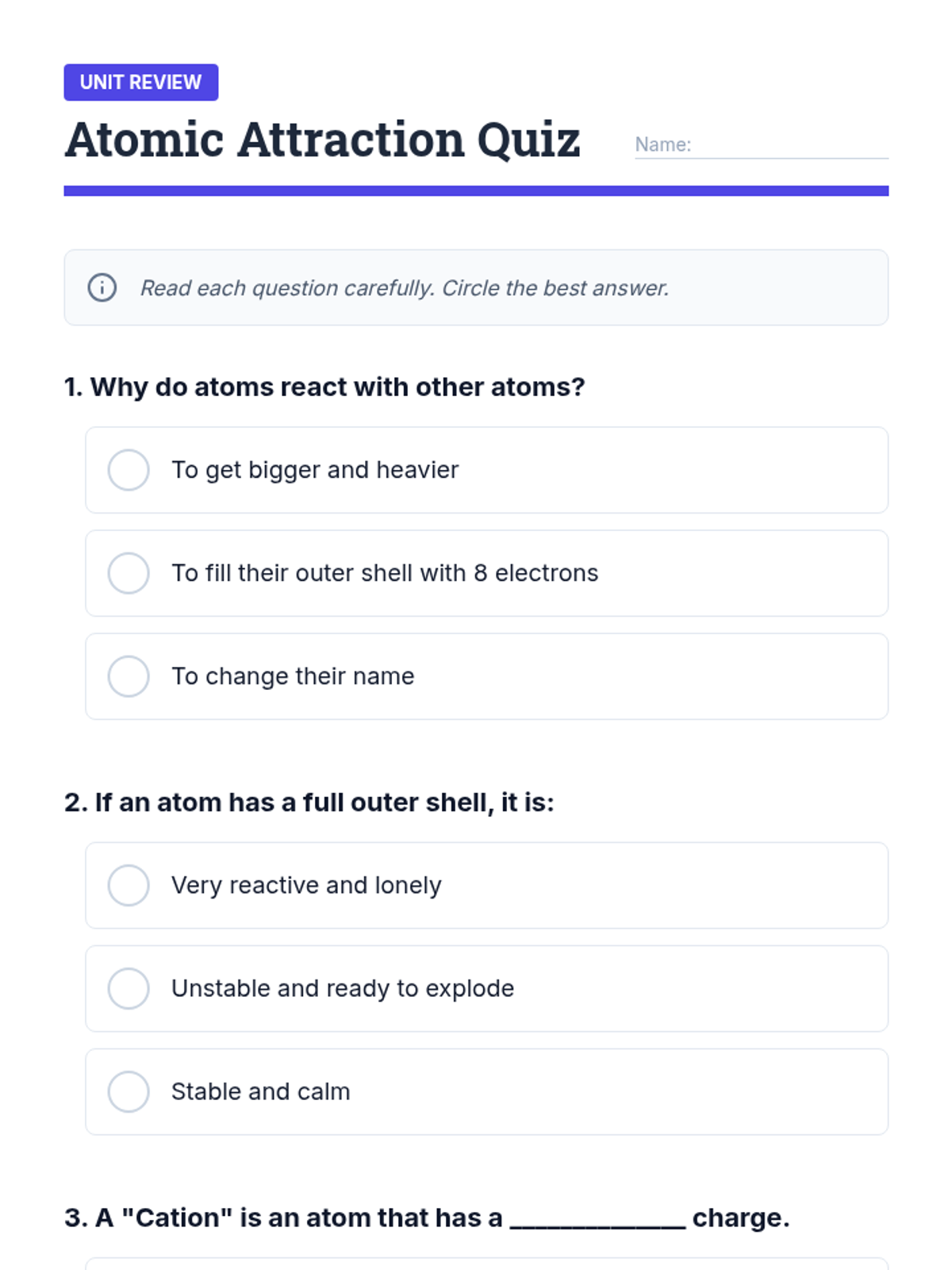
A multiple-choice and short-answer review quiz for the Atomic Attractions lesson. Features simplified language and clear visual prompts.
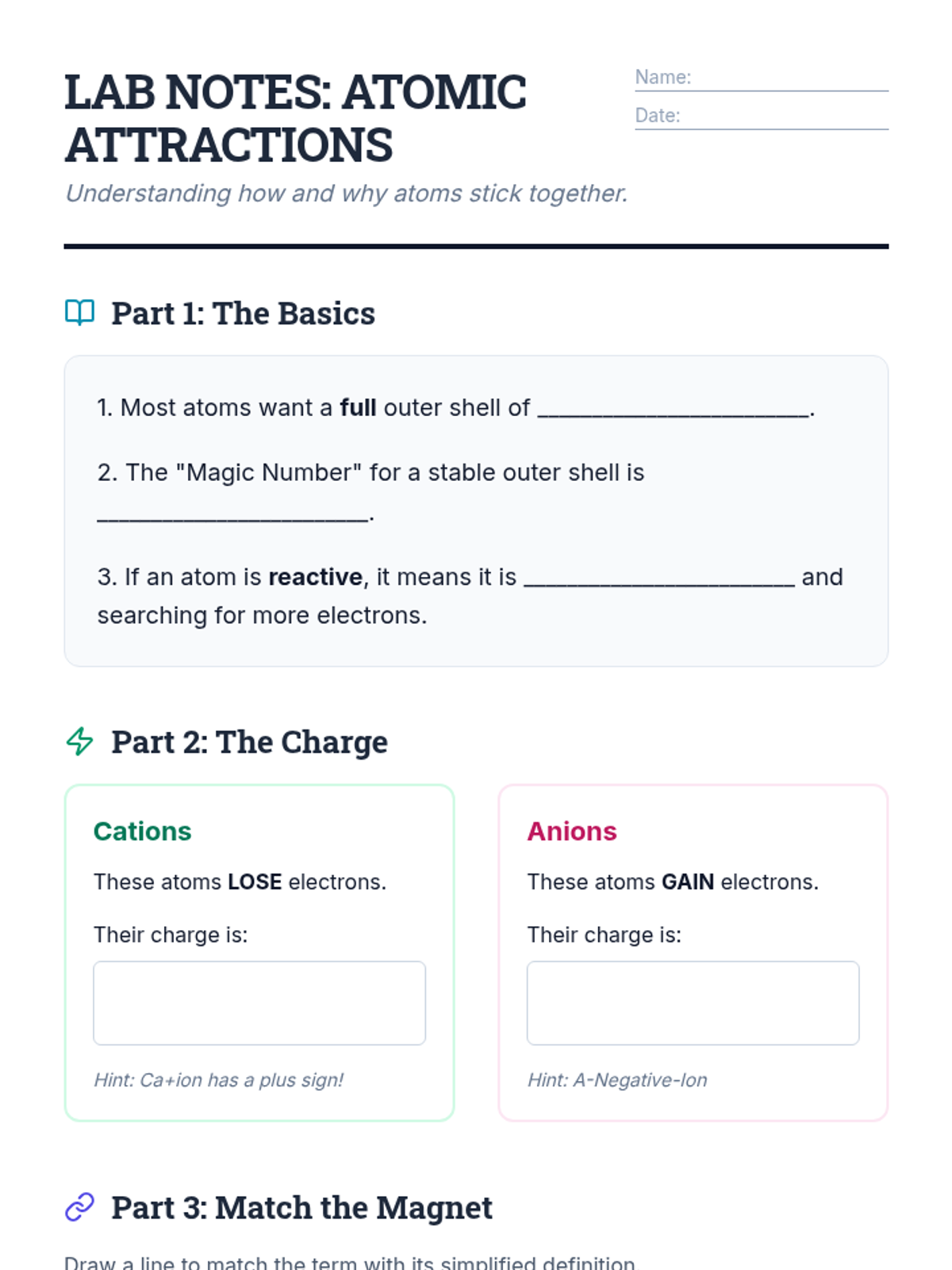
Guided notes and worksheet for students to complete while following the presentation. Includes vocabulary matching and a space for illustrating ionic bonds.
A set of educational slides about atomic reactivity, ions, and ionic bonding. Uses simplified text and bold visuals to support lower reading levels.
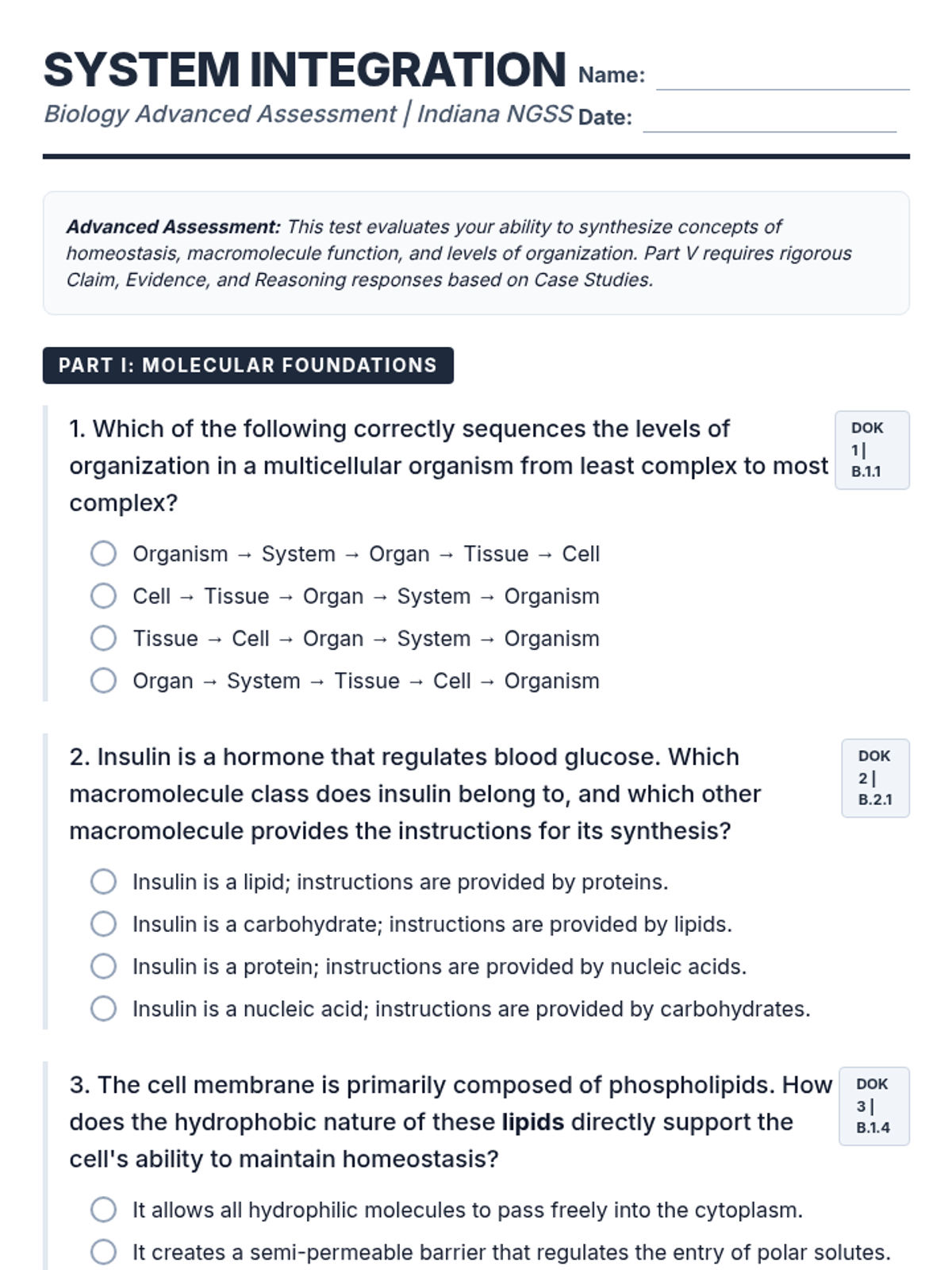
A comprehensive 37-item Biology assessment focusing on Indiana standards for homeostasis and macromolecules. It features a majority of DOK 2 and 3 questions, authored contiguously with items on atoms, enzymes, and cell transport. Part V includes extended reading passages (case studies) with integrated data for high-rigor CER synthesis. Revised for optimal page breaks.
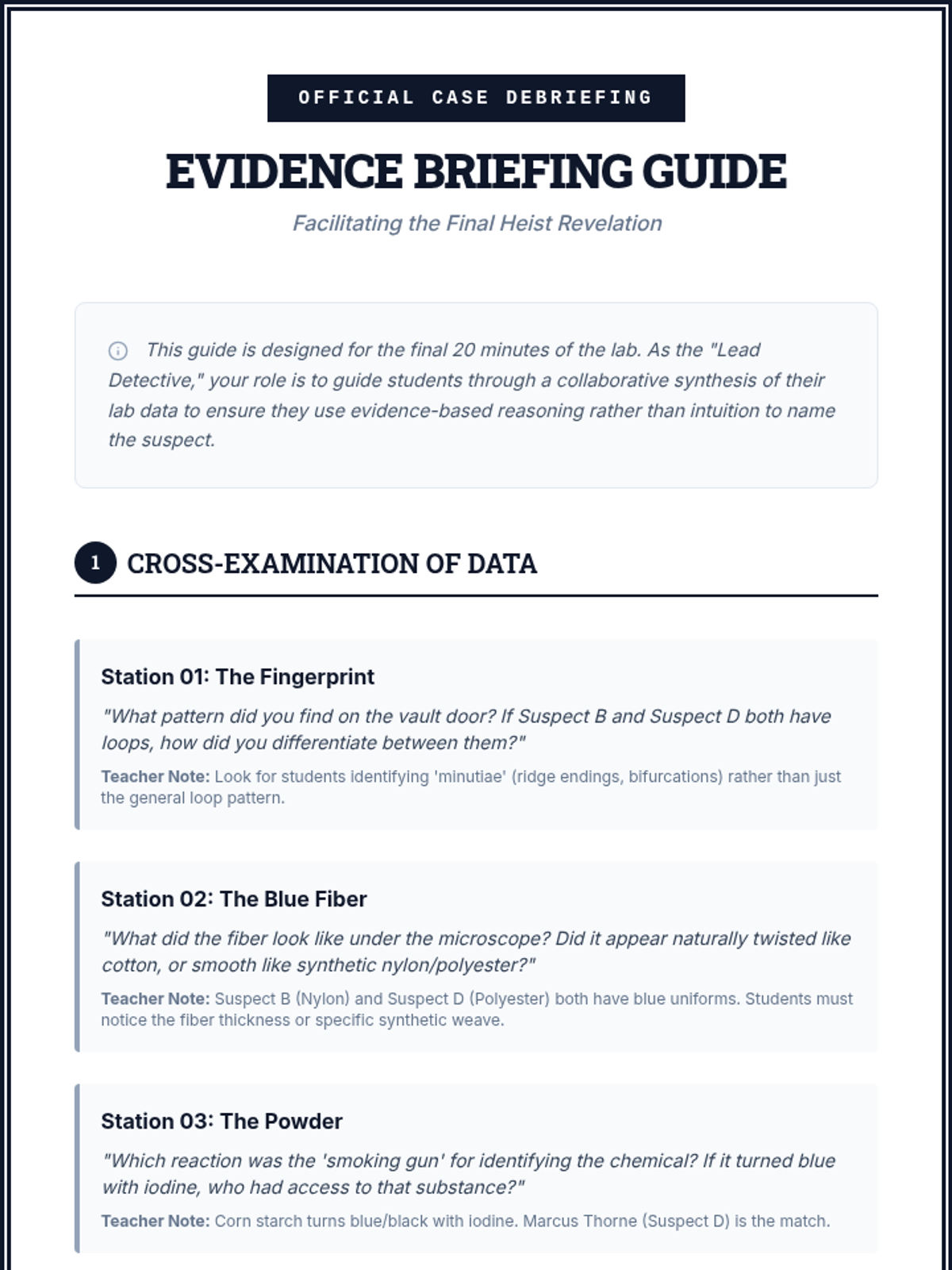
A teacher-facing discussion guide to facilitate the final debrief of the Detective Lab heist. It provides high-order questioning prompts for each evidence station and a framework for students to synthesize their findings into a final case presentation.
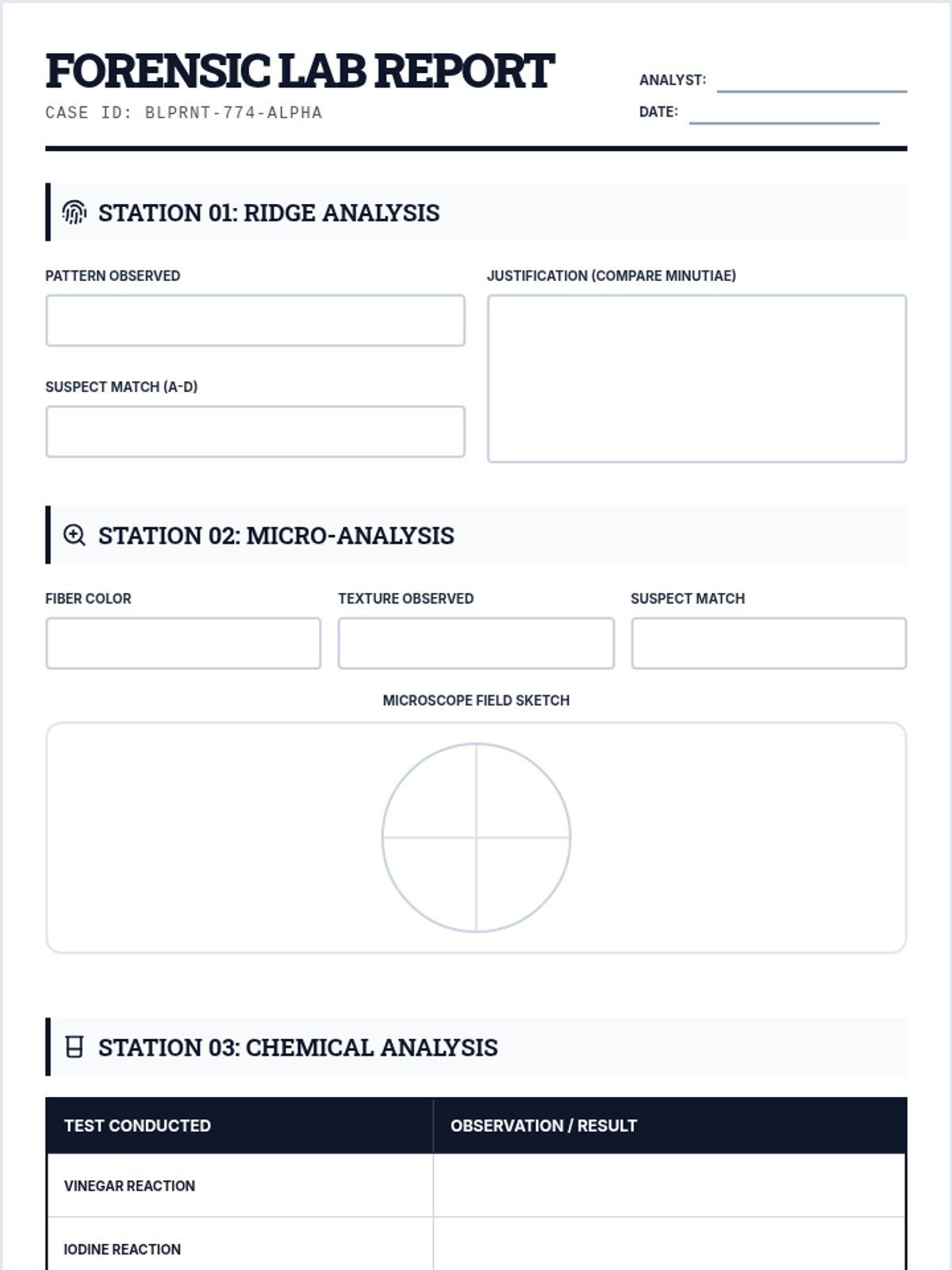
A structured student lab report for recording forensic data. It includes dedicated sections for fingerprint analysis, microscope sketches for fiber identification, chemical reaction tables, and a correlation matrix to help students synthesize their findings into a final verdict.
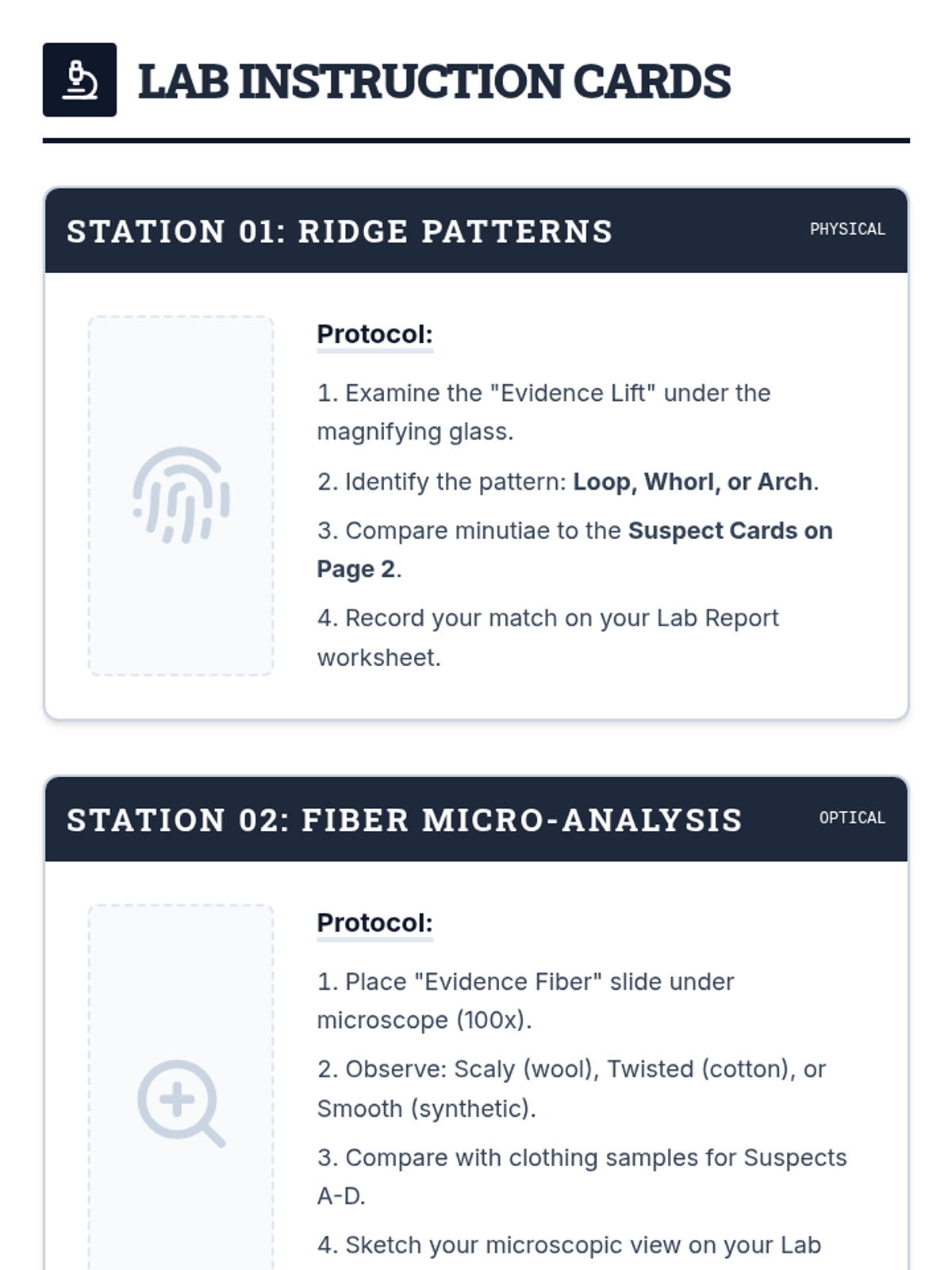
Lab station instruction cards and suspect physical reference guides for the Detective Lab activity. Includes clear scientific protocols for fingerprinting, fiber analysis, and chemical testing, along with a substance identification key.
Instructional slide deck for the Detective Lab, presenting the heist scenario, introducing the four suspects with their physical profiles, and explaining Locard's Exchange Principle to ground the forensic analysis.
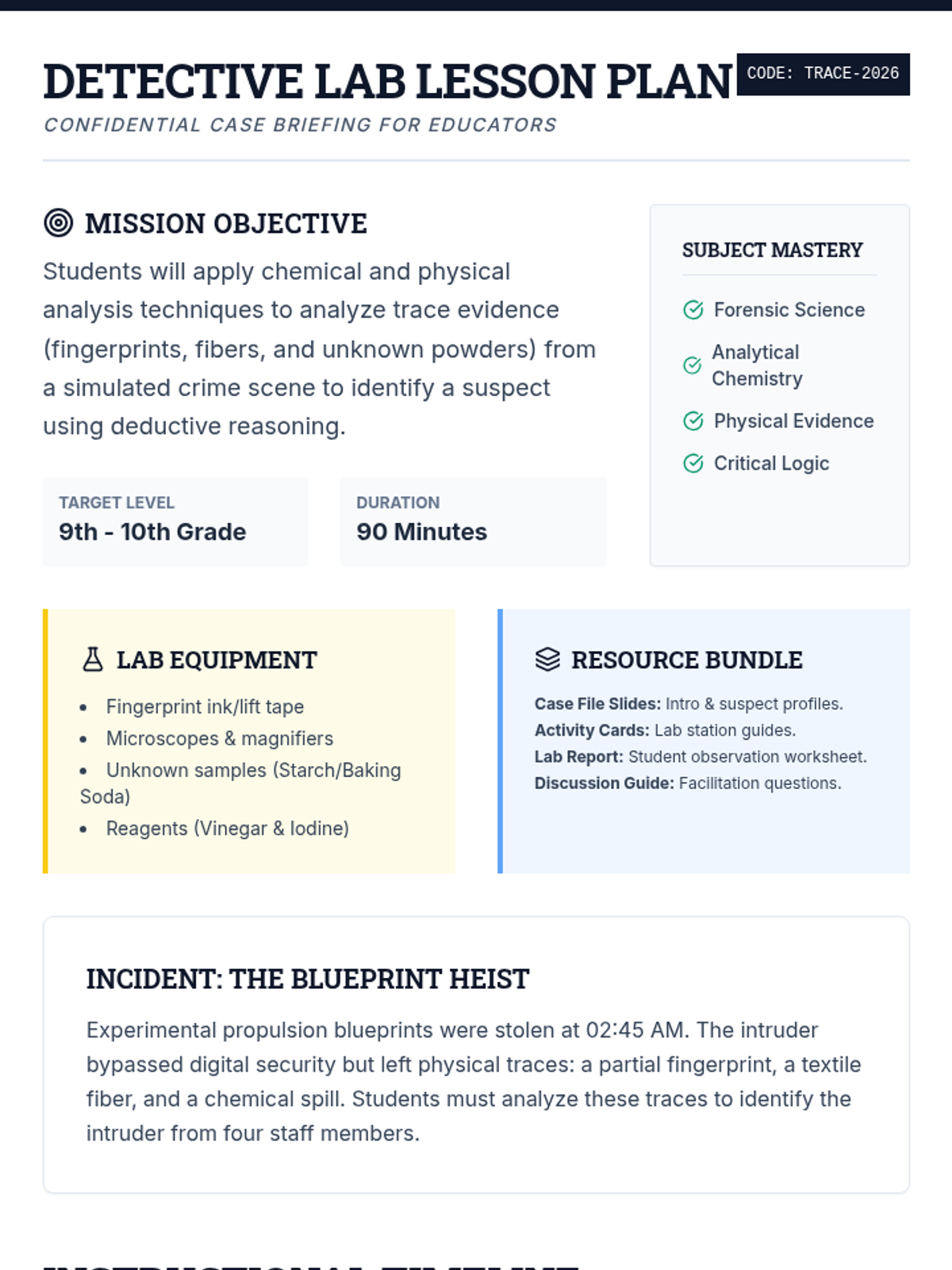
A comprehensive teacher lesson plan for the Detective Lab, including mission objectives, a detailed 90-minute timeline, lab preparation tips, and differentiation strategies for forensic science instruction.
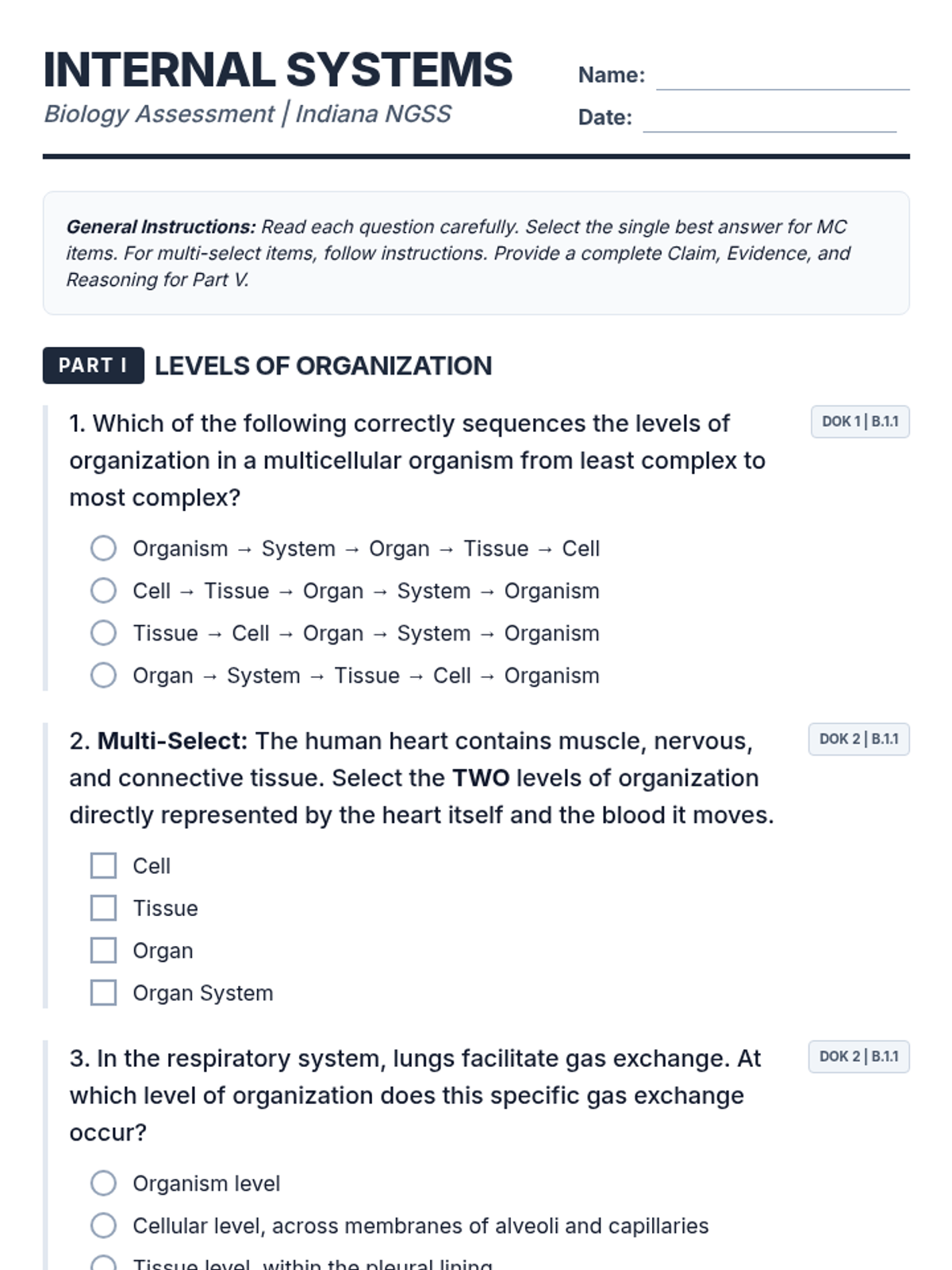
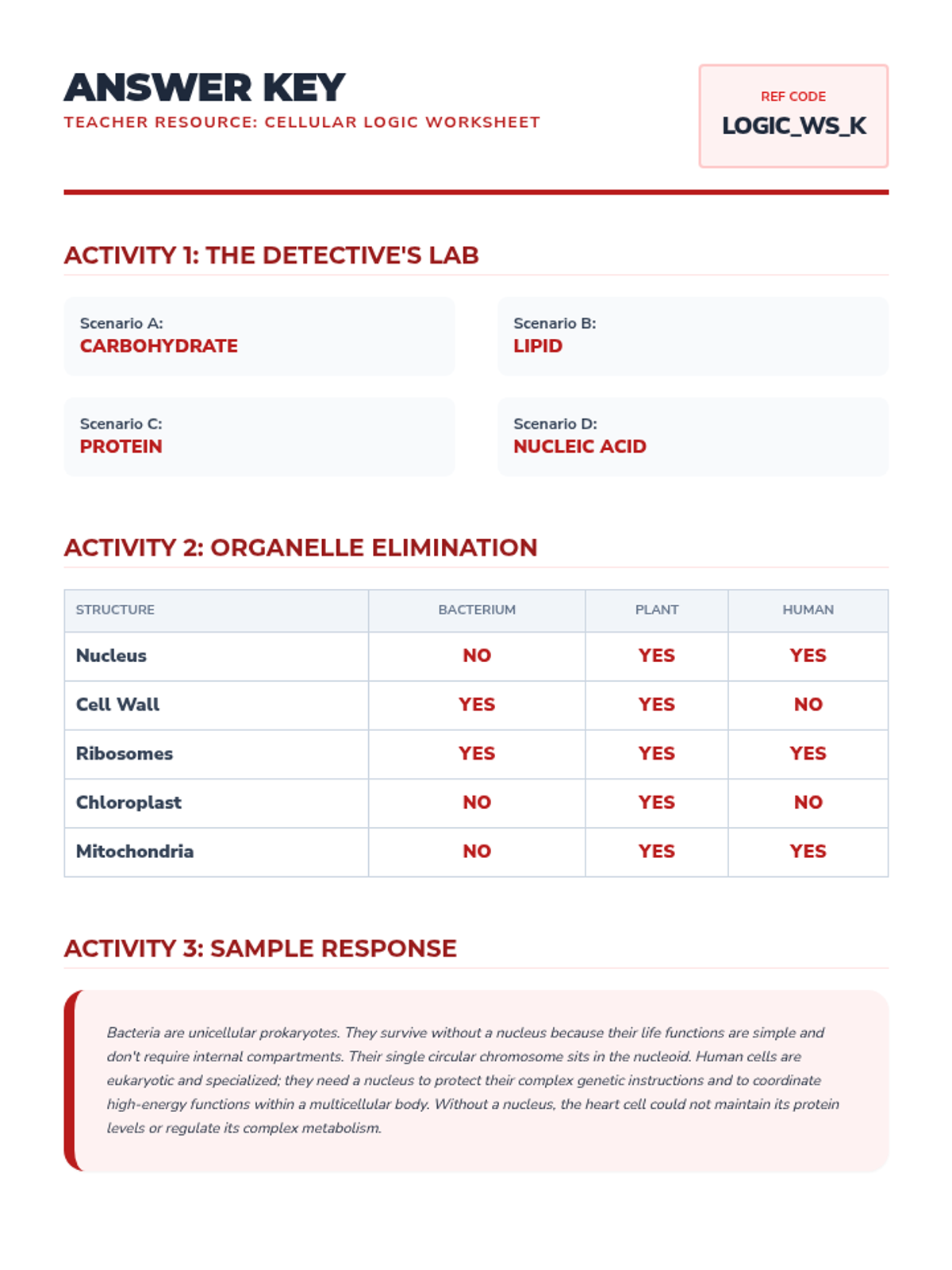
A teacher answer key for the Cellular Logic Worksheet with correct scenario identifications, table answers, and sample short-answer responses.
A practice worksheet with logic-based scenarios and comparison tables to reinforce concepts of macromolecules and cell types.
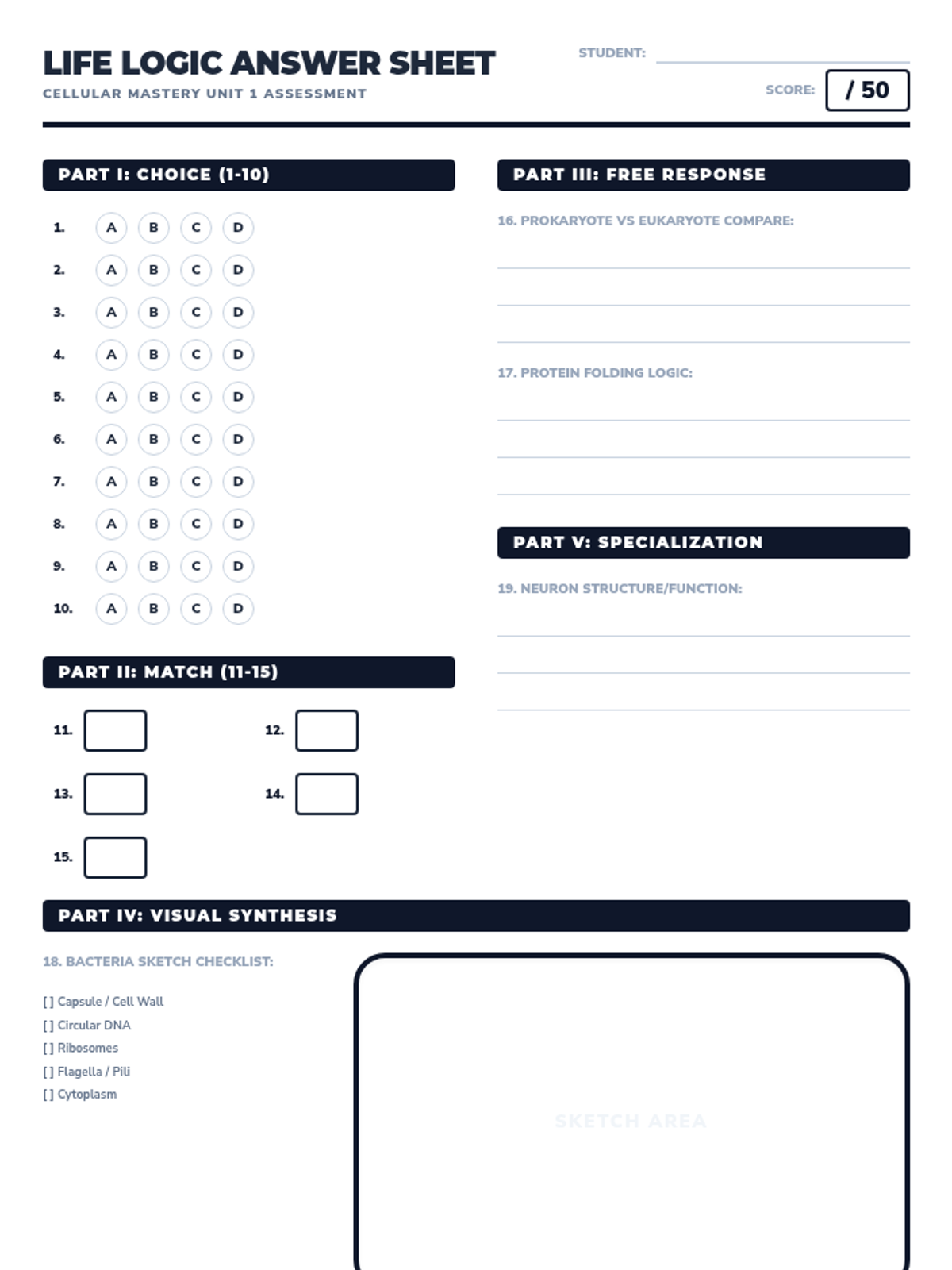
A clean, student-facing answer sheet for the Cellular Mastery Test, allowing for easy grading and the reuse of test booklets.
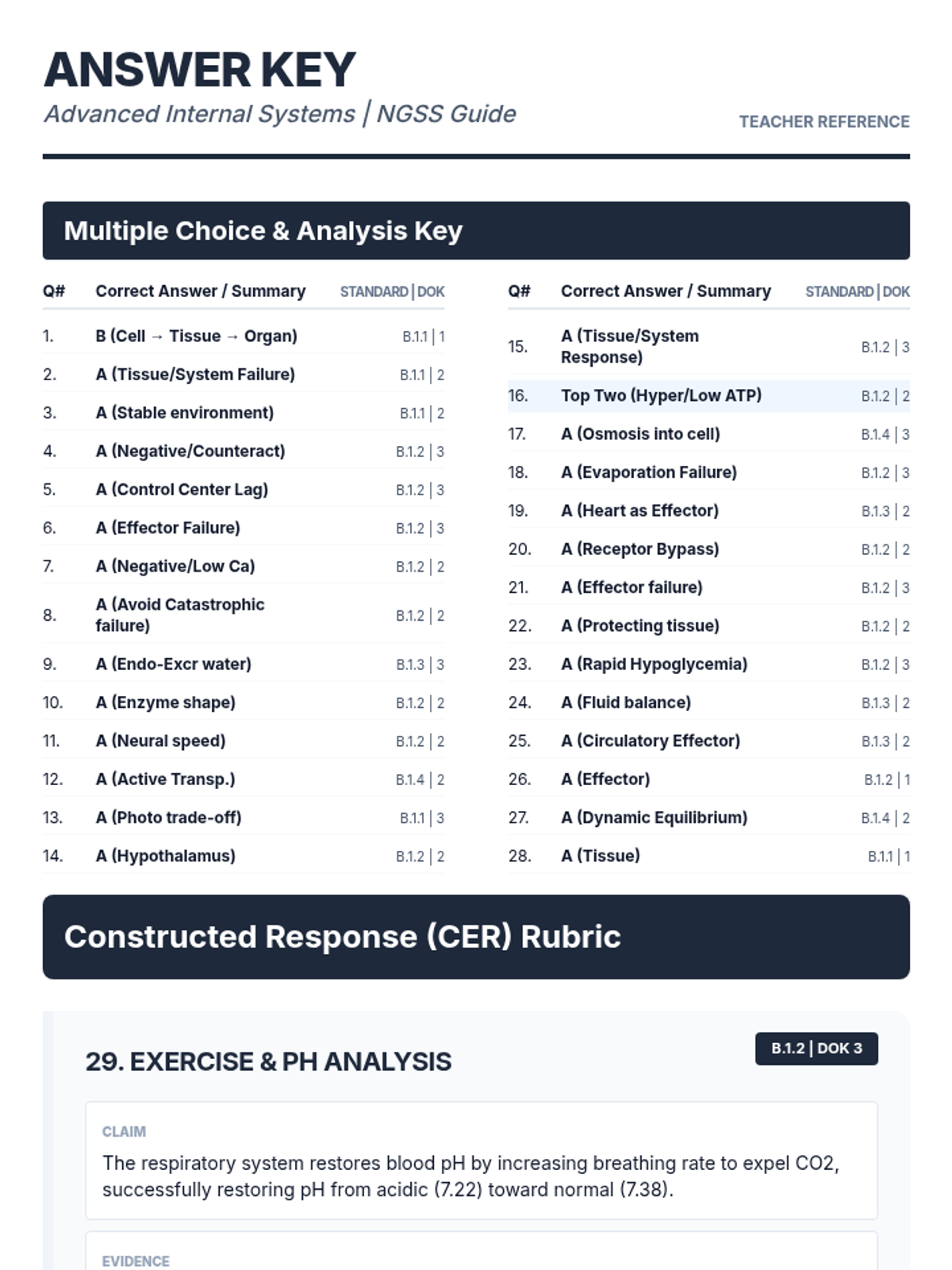
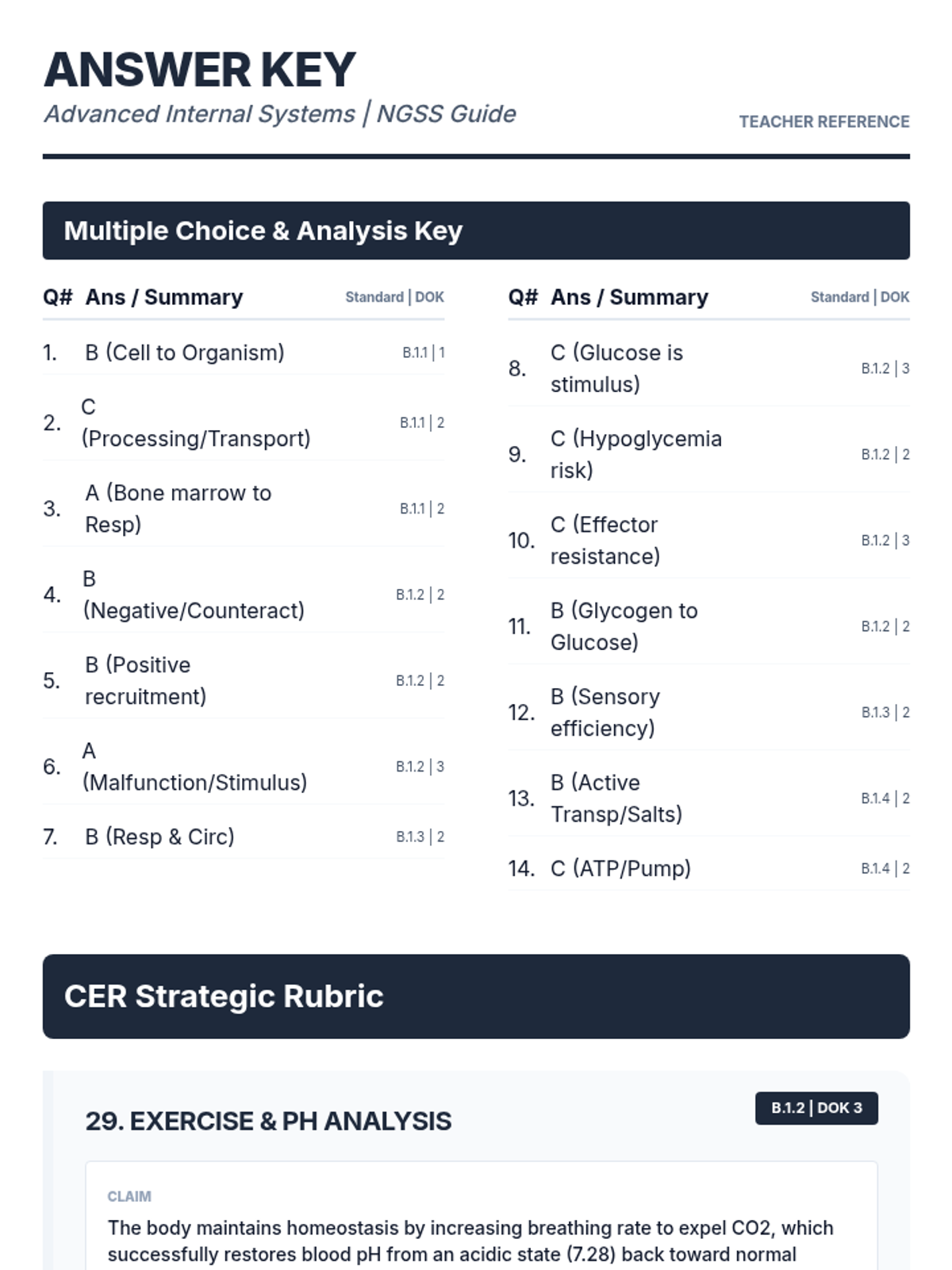
Answer key for the Advanced Internal Systems Biology Assessment. Features standard-aligned summaries, DOK levels, and comprehensive CER scoring rubrics for high-level data analysis scenarios. All 30 items included. Column headers standardized. CER reasoning sections are properly formatted to stay on one page.
Complete answer key for the Advanced Internal Systems Biology Assessment. Features standard-aligned summaries, DOK levels, and comprehensive CER scoring rubrics for high-level data analysis scenarios. CER reasoning sections are properly formatted to stay on one page. All 30 items included. Column headers standardized.
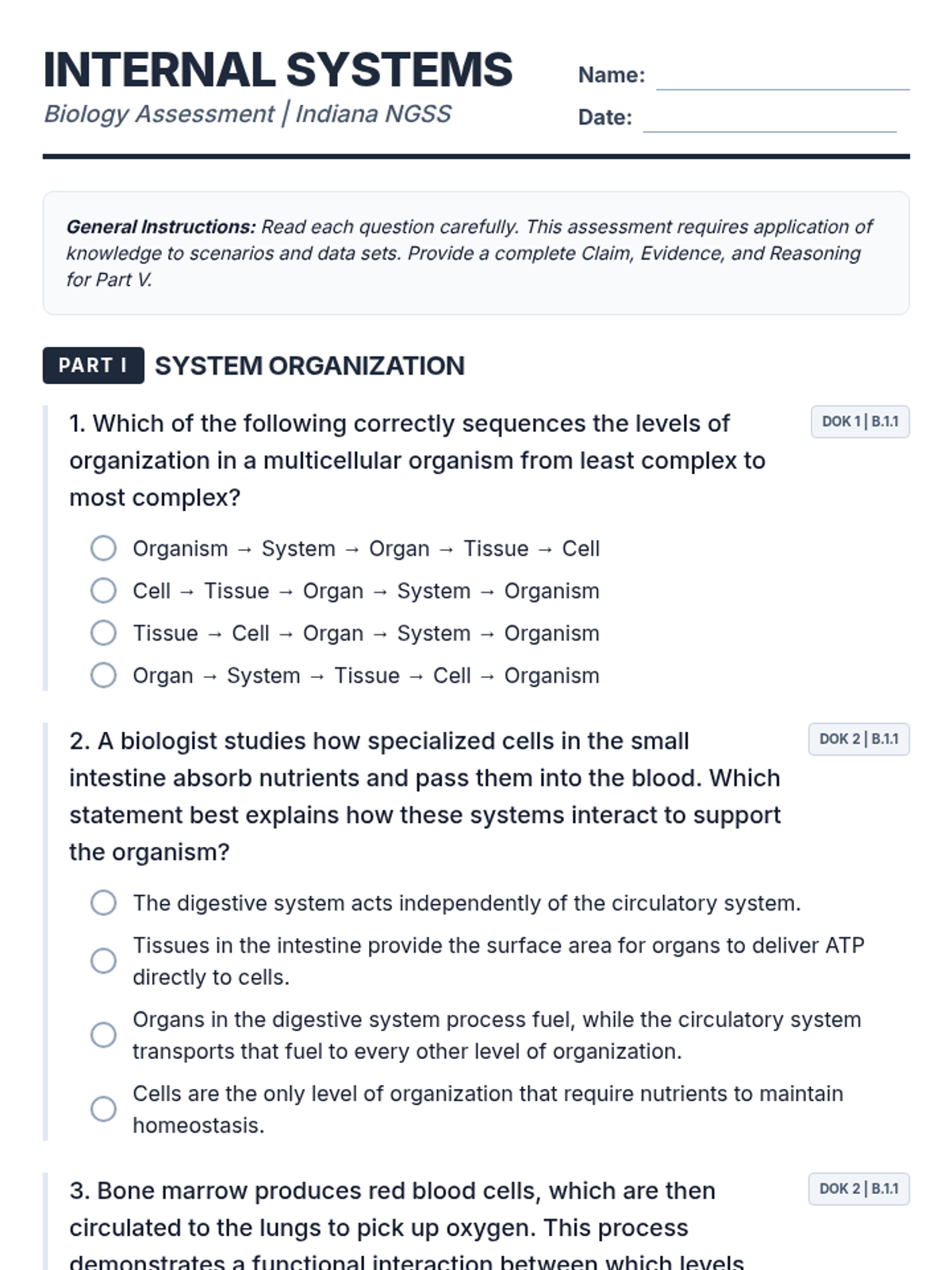
A rigorous 30-item Biology assessment with a focus on higher-order thinking (DOK 2-3). Features multi-page layout optimization for print efficiency, fully authored distractors for all questions, and polished data visualizations with legends. CER response areas now include writing lines. Section numbering fixed.
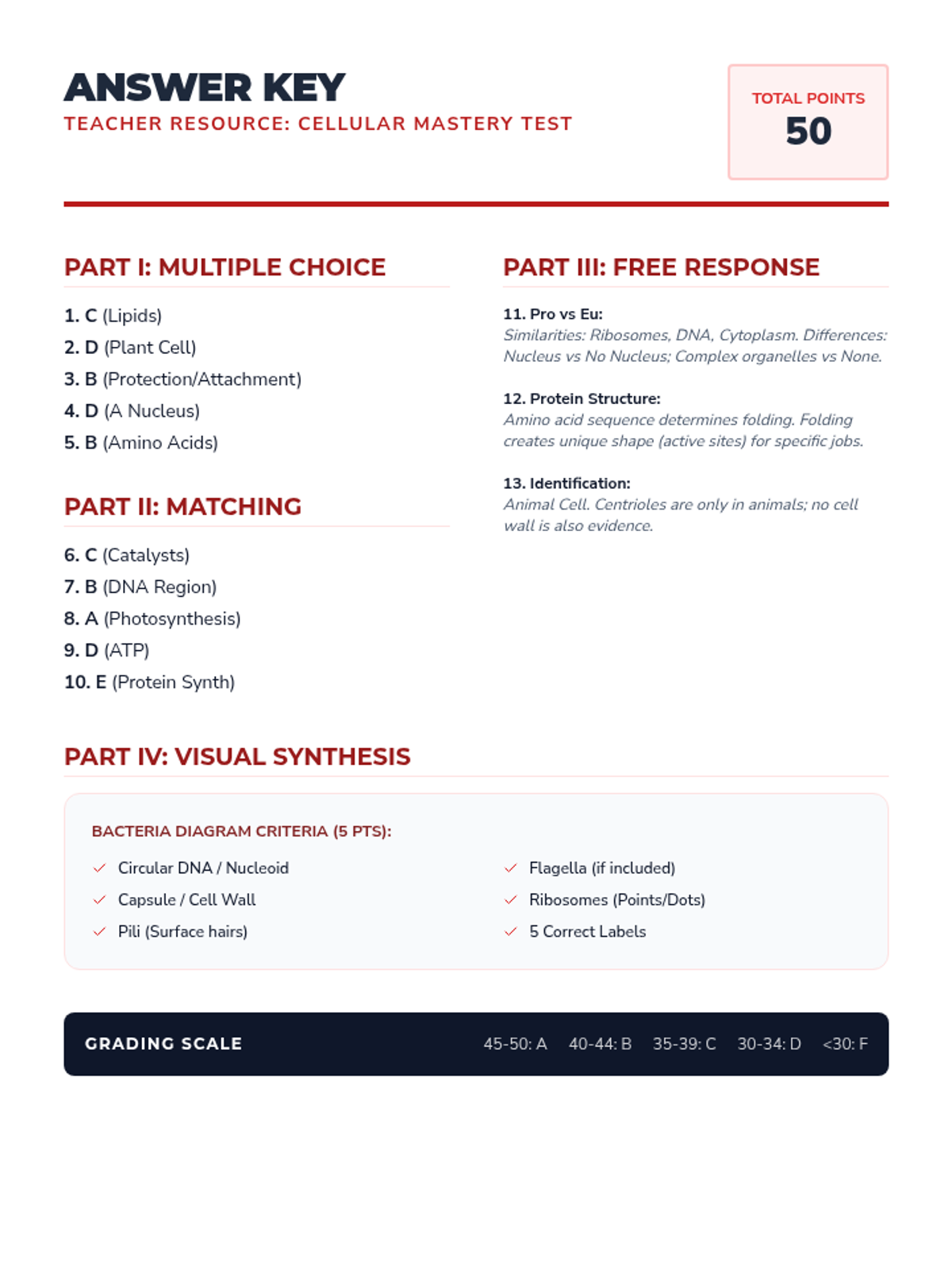
A teacher answer key and grading guide for the Cellular Mastery Test, including sample responses for short answer questions and visual synthesis criteria.
A formal biology unit test for high school students assessing knowledge of macromolecules, prokaryotic vs. eukaryotic cells, bacterial anatomy, and plant/animal cell distinctions. expanded to 19 items for a robust 50-point assessment.
Complete answer key for the advanced 37-item Biology assessment. Features detailed rubrics for the extended CER case studies and a crosswalk for all MC items, including the newly added questions on atoms, enzymes, and system interactions.
A fully realized 30-item Biology assessment focusing on Indiana standards for homeostasis and macromolecules. It features a majority of DOK 2 and 3 questions, authored contiguously. Part V includes extended reading passages (case studies) with integrated data for high-rigor CER synthesis.
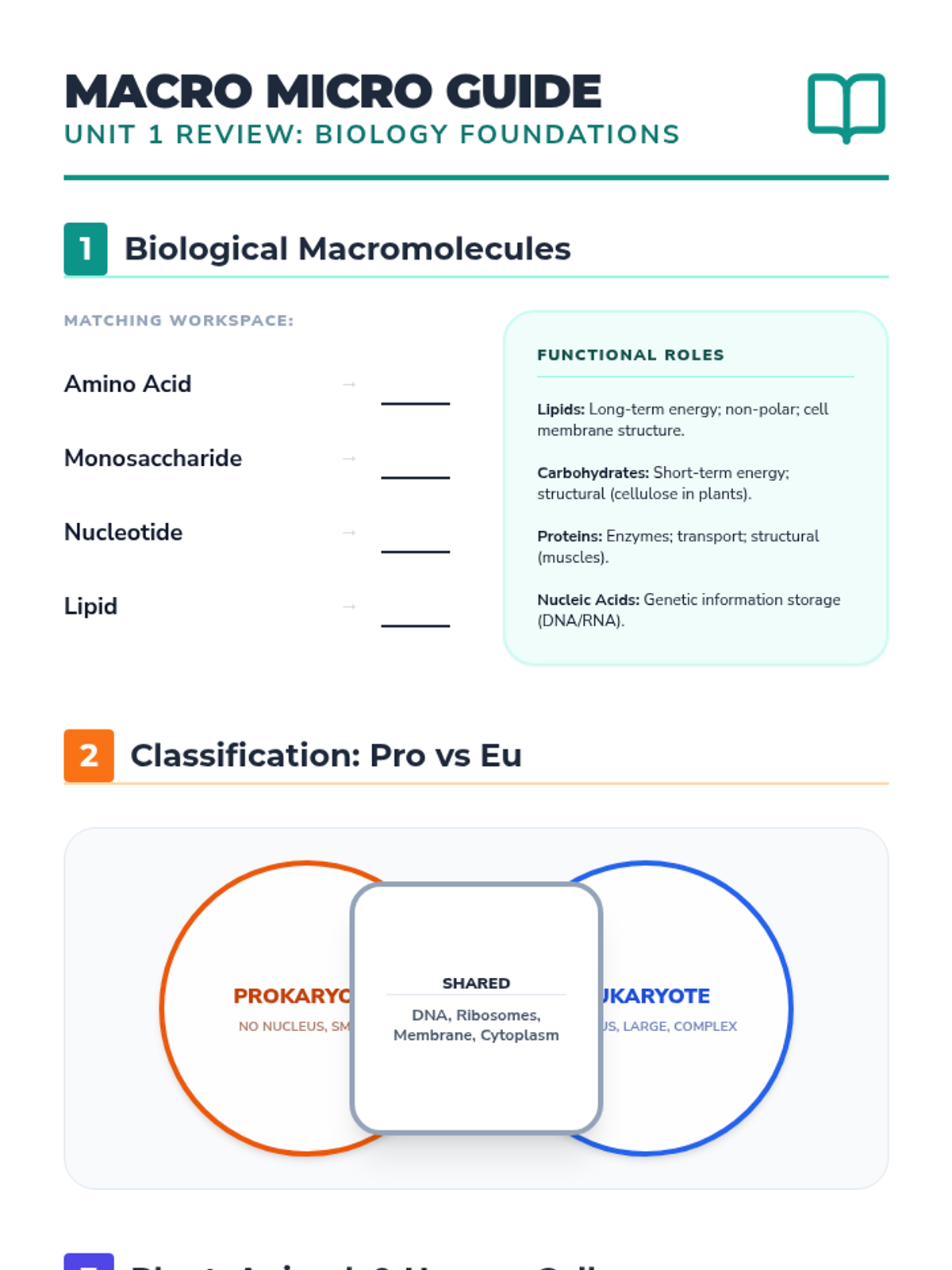
A comprehensive study guide for high school biology students reviewing macromolecules, prokaryotic/eukaryotic differences, bacterial structures, and the nuances between plant, animal, and human cells.
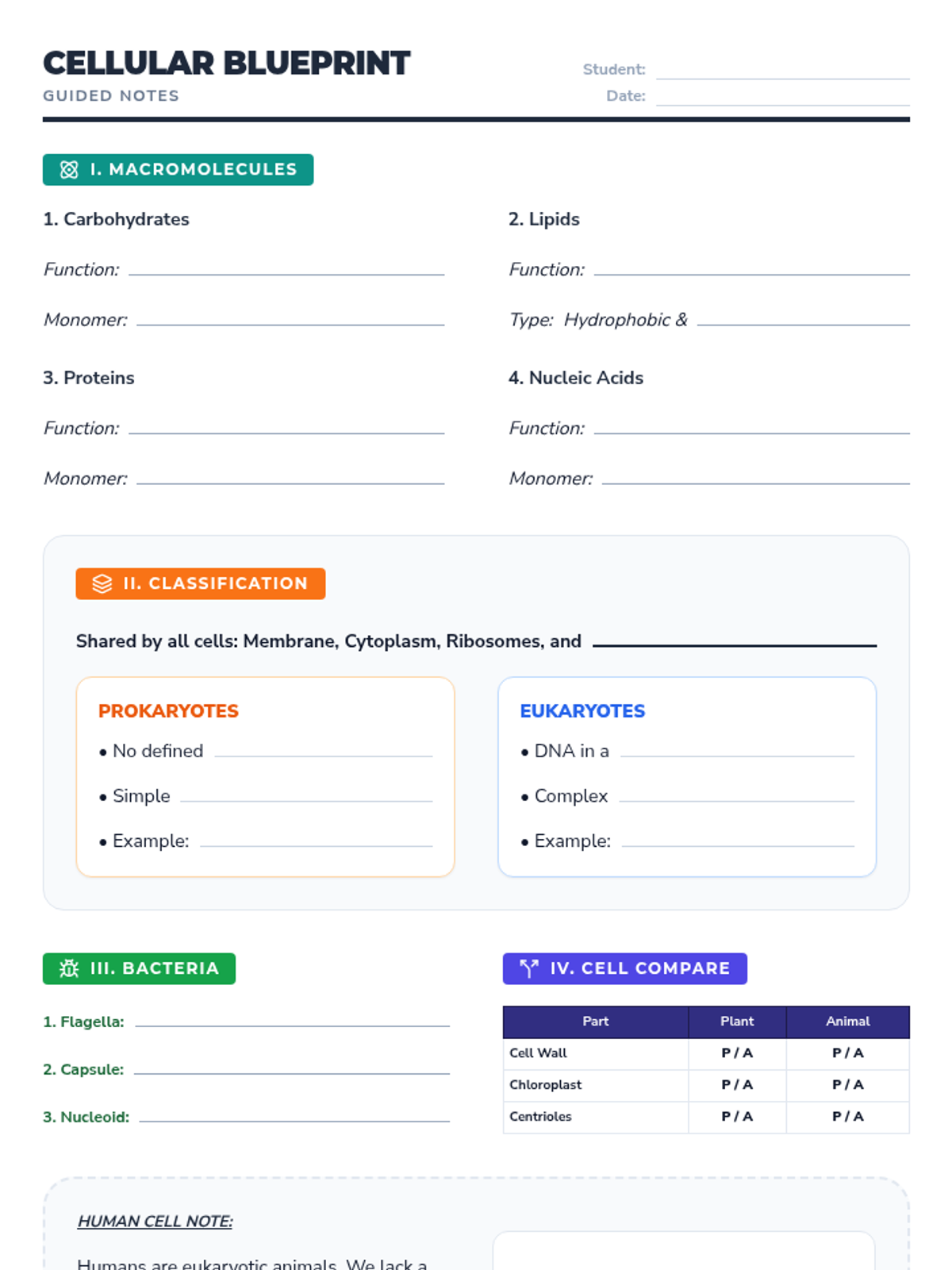
A fill-in-the-blank guided notes packet designed for high school biology students to accompany a presentation on macromolecules, prokaryotes, and eukaryotic cell differences.
A visual presentation for a high school biology review lesson covering biological macromolecules, prokaryotic vs. eukaryotic cells, bacterial structures, and the key differences between plant, animal, and human cells.
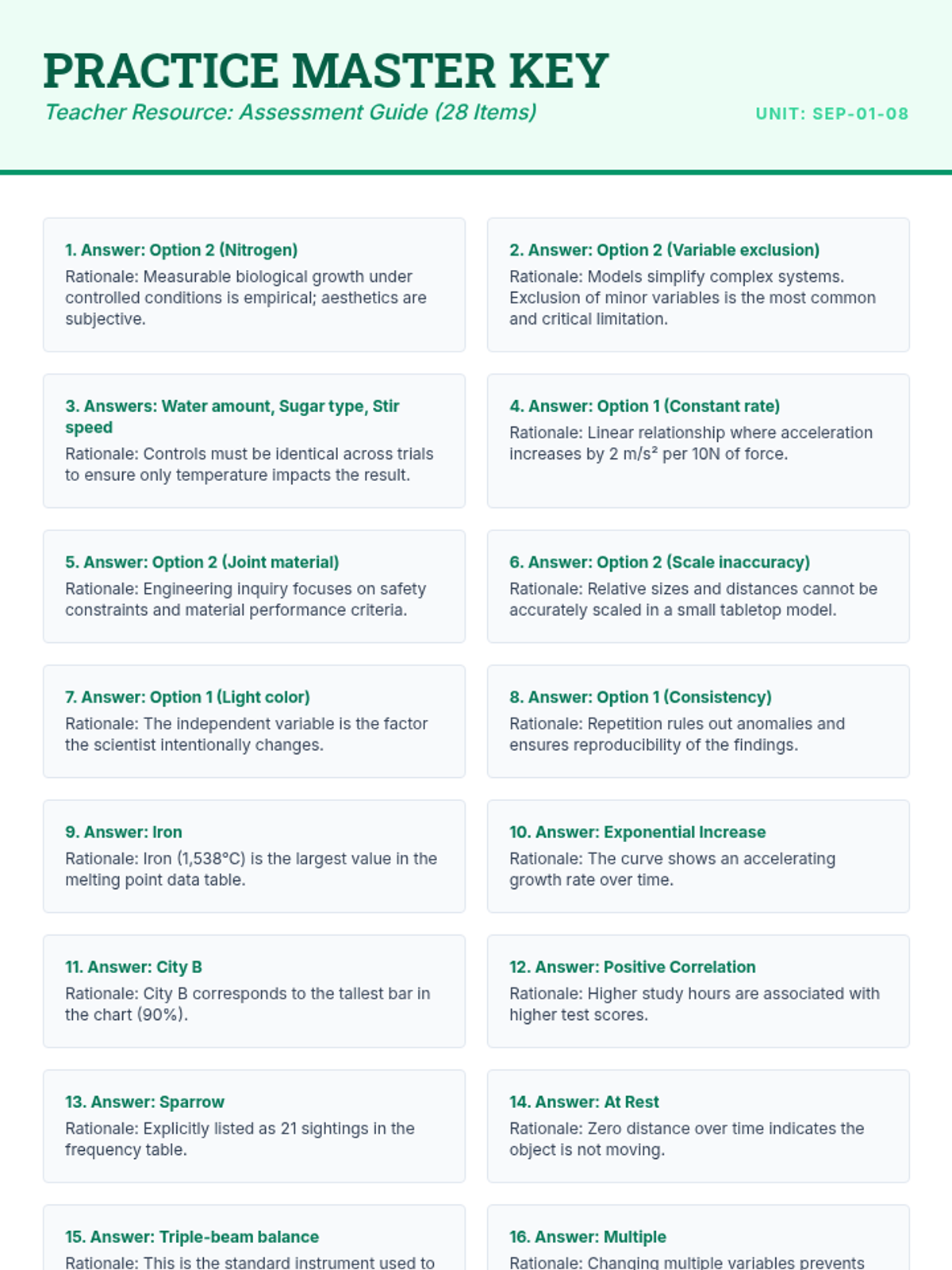
A teacher-facing answer key and instructional guide for the expanded SEP Challenge Bank. Provides correct answers and rationales for all 28 questions, organized to match the worksheet layout.
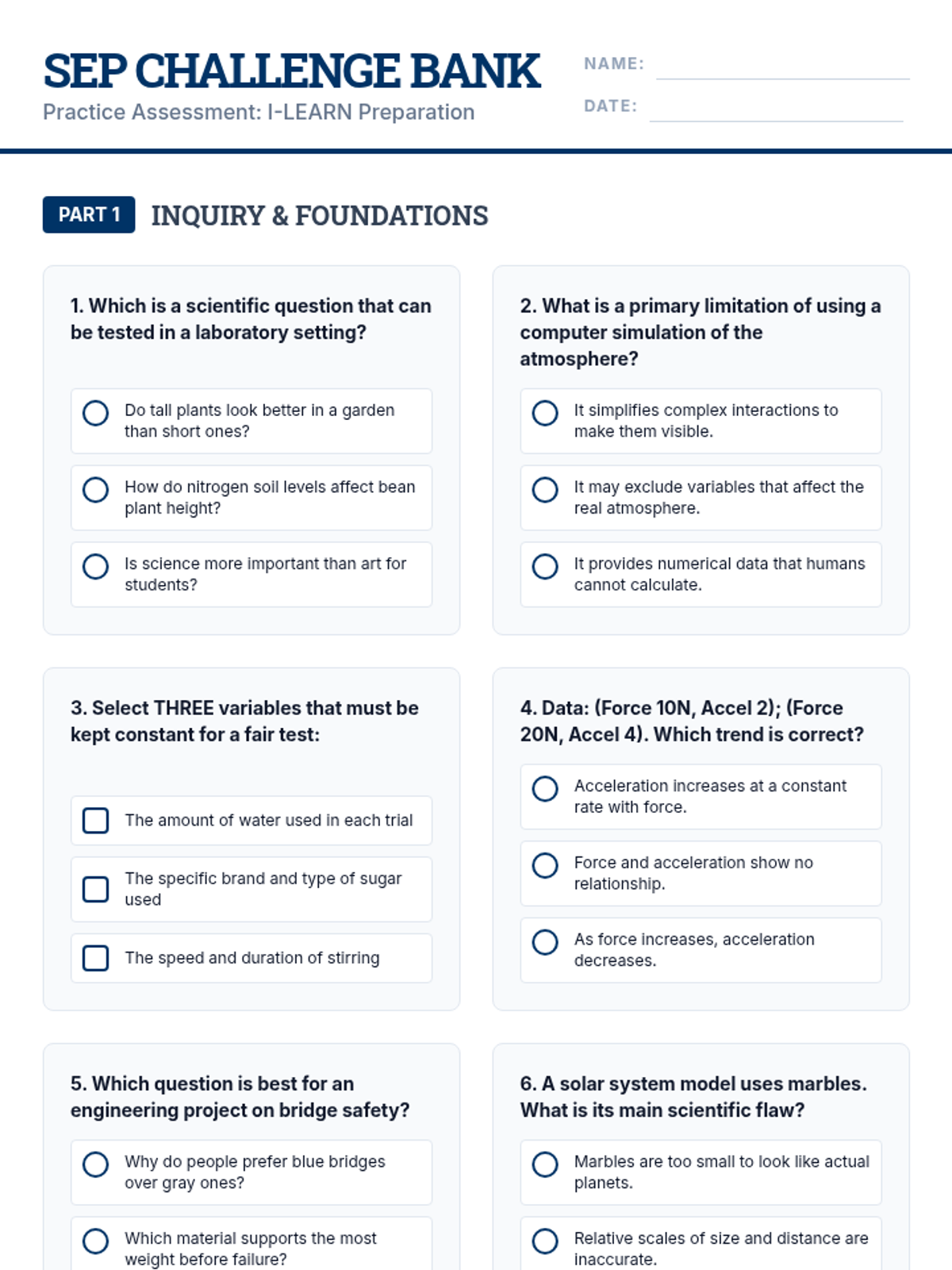
An expanded question bank for students featuring 28 I-LEARN style questions covering all 8 Science and Engineering Practices. Includes 5 new visual data interpretation items (graphs/tables) and a mix of question formats.
A visual slide deck designed to introduce and review the eight Science and Engineering Practices (SEP). It uses a clean 'Blueprint' aesthetic with clear definitions, test-taking strategies, and critical frameworks like CER.