A 5-slide presentation introducing Grade 7 students to the concepts of Solid, Frame, and Shell structures, stability, and the center of gravity, culminating in the instructions for the Marshmallow Tower Challenge.
A comprehensive teacher professional development guide including essential AI concepts, facilitation strategies, and quick-reference prompt cheat sheets.
A high school activity sheet requiring students to apply the CO-STAR prompt engineering framework, map industry impacts, and draft ethical AI policies.
Advanced slide deck for high school students exploring generative AI paradigms, professional prompt engineering frameworks (CO-STAR), and the future of work.
A middle school activity sheet involving ethical analysis of recommendation engines, labeling neural network structures, and debating facial recognition bias.
A middle school slide deck focused on the technical basics of neural networks and the ethical challenges of recommendation engines and deepfakes.
A grade 3-5 worksheet focusing on analyzing AI bias scenarios and practicing prompt engineering using a structured 'Role + Task + Detail' framework.
Instructional slides for grades 3-5, focusing on 'Pattern Detectives' - understanding data, spotting bias, and learning the basics of effective prompting.
An activity sheet for grades 1-2 focusing on distinguishing between traditional machines and AI, and designing an AI solution for a simple problem.
Instructional slides for grades 1-2 focused on 'Smart Helpers' - identifying AI in the world and understanding simple machine learning patterns.
A comprehensive teacher guide for the 'Robot Brains' lesson, including a script, instructional sequence, and differentiation tips for Kindergarten.
A simple, visual worksheet for Kindergarten students to practice identifying AI and 'training' a robot.
Introductory slide deck for Kindergarten students exploring the difference between human brains and computer 'brains'.
The comprehensive K-12 AI literacy curriculum scope and implementation guidelines for district-wide alignment.
A teacher facilitation guide for the Microscope Observations microscope lab. Includes lesson objectives, materials checklists, suggested specimen sets, an organelle identification guide, and safety tips.
A multi-page laboratory worksheet for students to document microscope observations. It features large drawing circles, blank lines for specimen labels, and spaces for recording magnification levels for 5 different samples across 3 zoom levels. Includes a reflection question on identifying cell organelles.
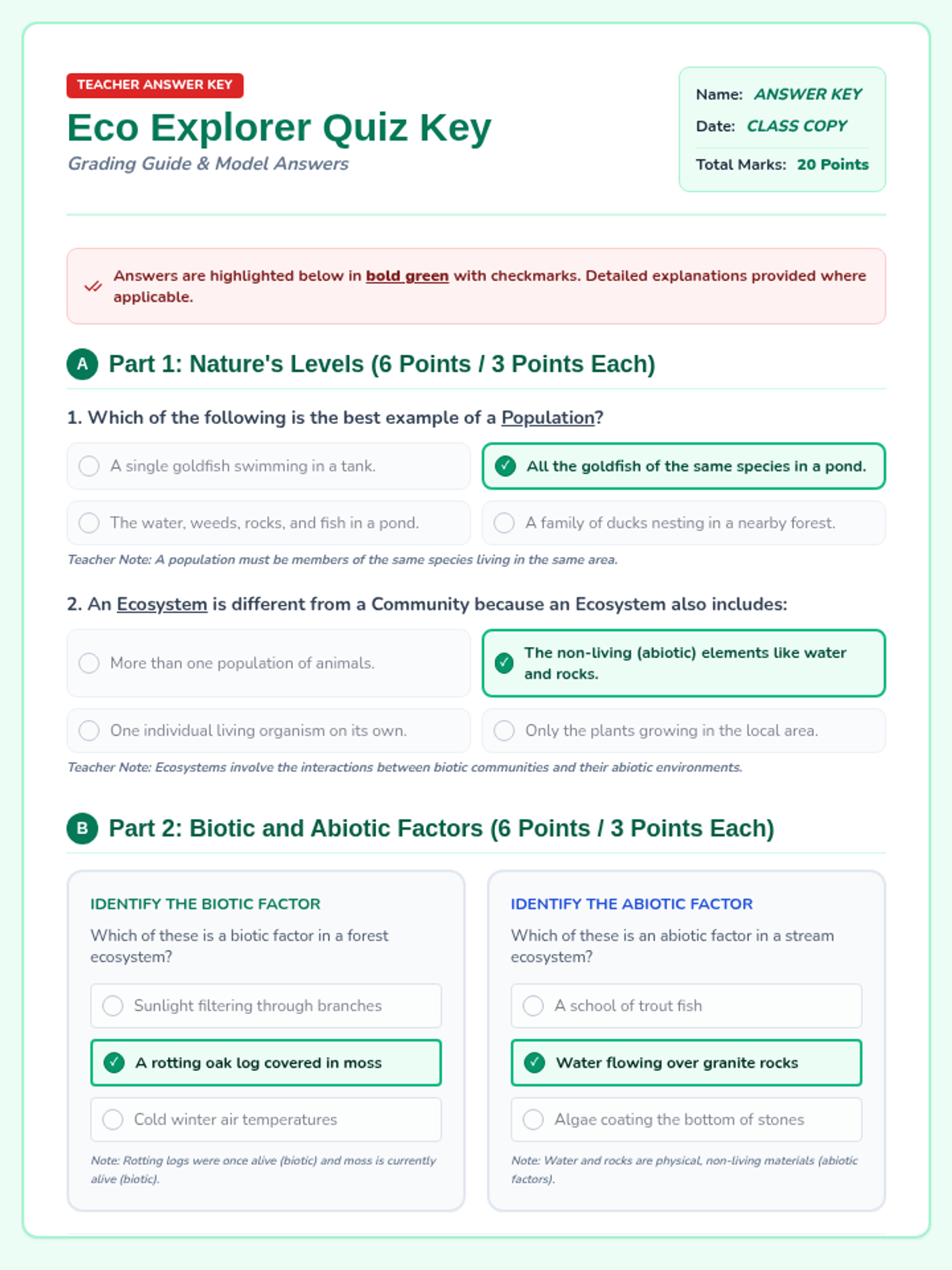
A comprehensive answer key for both the standard and support versions of the ecology worksheet. Includes sample high-quality responses for open-ended questions.
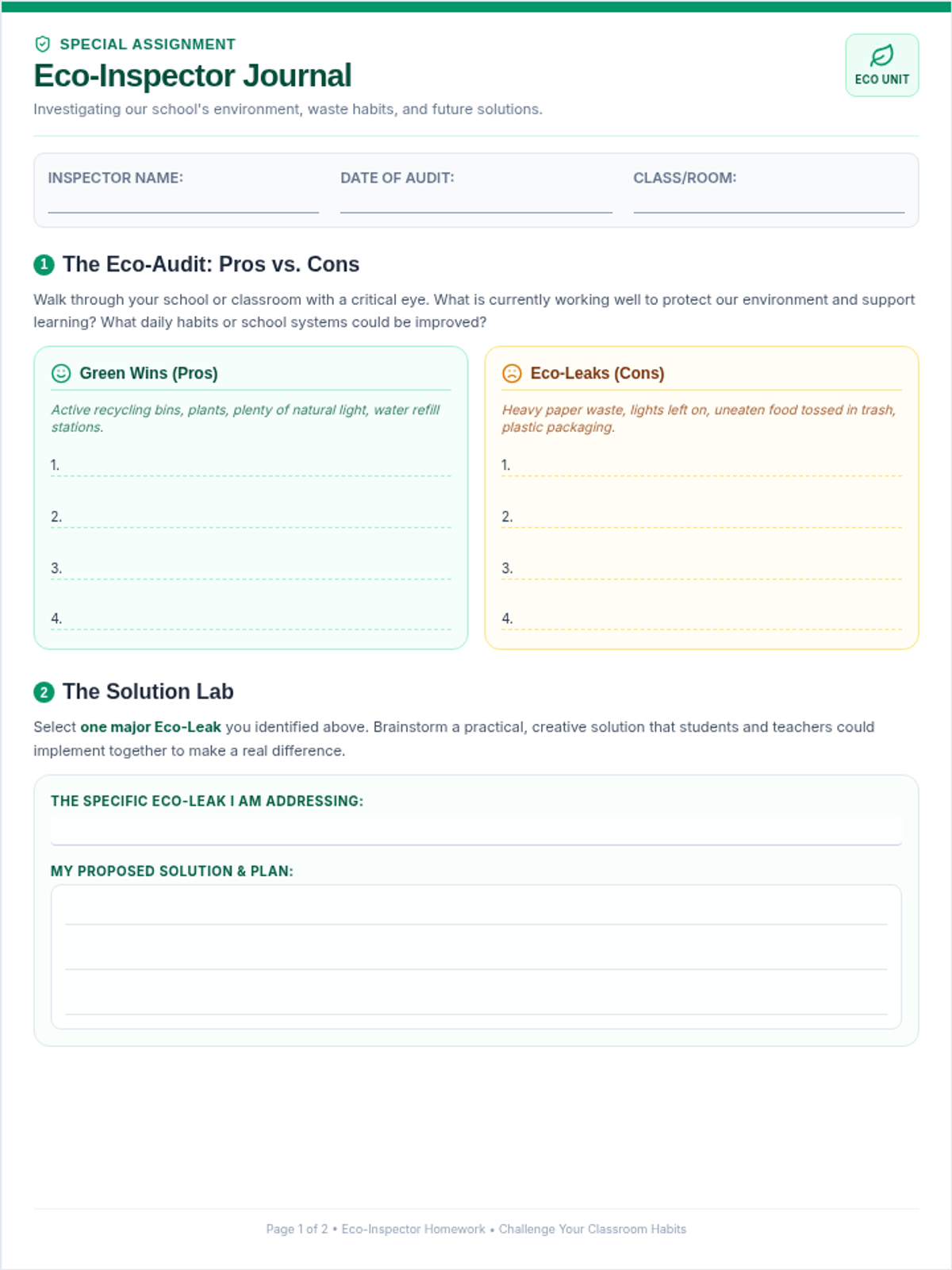
A dynamic presentation covering biodiversity, human impact, and conservation strategies. Includes a 'Chain Reaction' word association activity to reinforce key ecological terms.
A modified version of the ecology worksheet designed for Special Education support. Features a clear word bank, simplified scenarios with multiple-choice options, and guided writing prompts.
A page of printable entry and exit tickets focused on ecosystem biodiversity and human impact. Features quick brainstorms and self-assessment tools.
A vocabulary matching and scenario-based worksheet focusing on biodiversity, human impact, and conservation efforts. Includes word association and real-world impact analysis.
A teacher's answer key for the Energy Transfer Map Graphic Organizer, providing correct categorizations for conduction, convection, and radiation scenarios with brief pedagogical explanations.
A comprehensive teacher answer key and facilitation guide for the Matter Decoded lesson set. Includes completed guided notes, activity answers, and practical teaching tips for common student misconceptions.
A classification activity where students identify particle models, categorize common substances into a taxonomy table (elements, compounds, mixtures), and solve critical thinking scenarios about matter separation and classification.
A guided notes worksheet designed to accompany the Matter Decoded presentation. It features fill-in-the-blank definitions, space for student-generated examples, and a quick-check section to reinforce key concepts like pure substances and mixtures.
A visual slide deck introducing the fundamentals of matter, atoms, elements, compounds, and the two types of mixtures. Features clean diagrams, clear definitions, and a classification flowchart for easy understanding.
A teacher reference guide for the Evolution Echo Cards game, including the master loop sequence and a vocabulary definition list.
A complete set of 12 'I Have, Who Has' cards for evolution vocabulary, featuring illustrative diagrams and clear definitions to facilitate classroom-wide collaborative learning.
A comprehensive teacher facilitation guide for the Ocean Guardians lesson, including pacing, vocabulary strategies, and tiered support for mixed-proficiency 7th grade ELD students.
A 3-page student investigation log focused on marine pollution, featuring a reading passage, cause-and-effect graphic organizers, and structured collaborative conversation prompts.
A 7-slide presentation introducing marine pollution concepts, academic vocabulary, and cause-and-effect structures for 7th grade ELD students.
A comprehensive facilitation guide for the Urban Jungle Explorers lesson, featuring instructional pacing, ELD standards alignment, and tiered differentiation strategies for Emerging, Expanding, and Bridging students.
A 3-page student explorer's journal including a reading passage on urban forests, a problem/solution graphic organizer, and a collaborative conversation log with tiered sentence frames.
A vibrant 7-slide presentation introducing urban forest concepts, academic vocabulary, and tiered collaborative conversation prompts for 7th grade ELD students.
A comprehensive set of 14 multiple-choice review questions for 7th-grade students, modeled directly after their genetics and population test. It covers asexual vs. sexual reproduction, natural selection, and selective breeding with test-aligned scenarios.
An updated 15-slide lecture on vertebrate evolution featuring detailed SVG diagrams of fossils (Tiktaalik), comparative anatomy (pentadactyl limbs), and ecological transitions to simulate high-quality imagery.
A redesigned 3-page student worksheet for the Fins to Feet lesson. Features a dedicated full-page cladogram work area, user-friendly language, and clear visual hierarchy for student engagement.