A beautifully formatted, 2-page reading passage styled as an explorer's field journal. It covers renewable vs non-renewable resources, fossil fuel formation, geographic distribution variations, and active conservation frameworks.
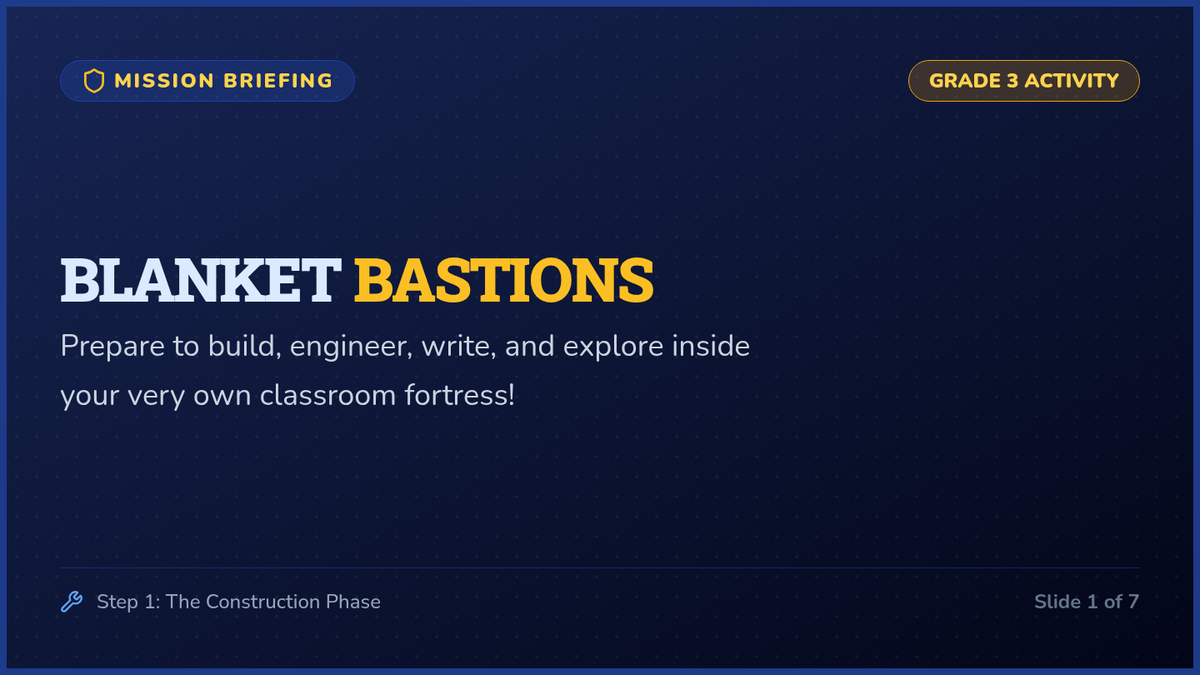
Visually striking slide deck for classroom presentation. Features grid blueprint styling, safety guidelines, and 5 interactive "mission" slides outlining math, writing, science, reading, and communication challenges with font size strictly 24px or larger.
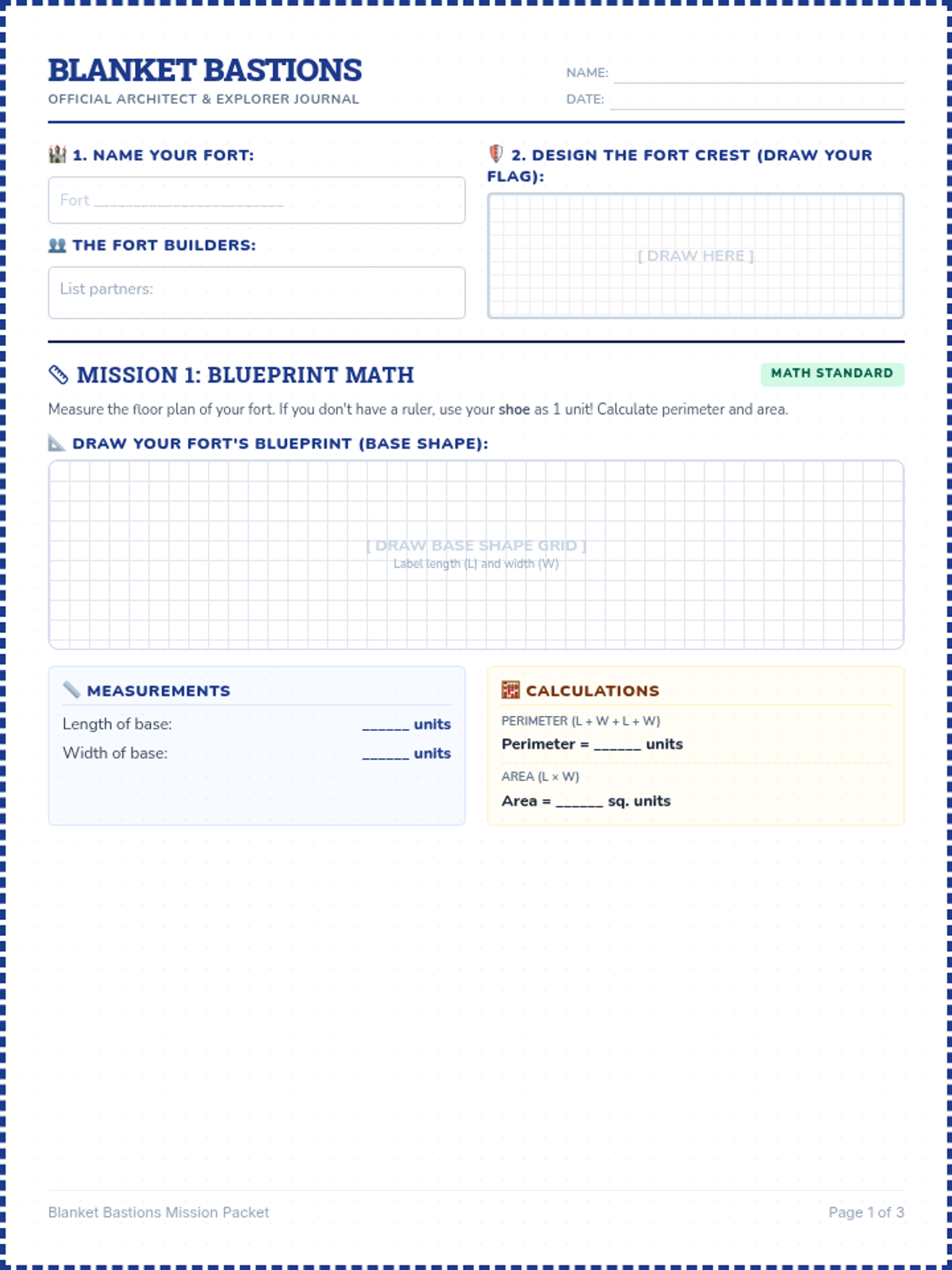
An engaging 3-page printable student activity packet for Fort Day. Features structural crest designs, a blueprint math section (perimeter and area), a creative writing legend page, a wind storm STEM testing chart, a silent reading cozy book review block, and a flashlight signal coding grid.
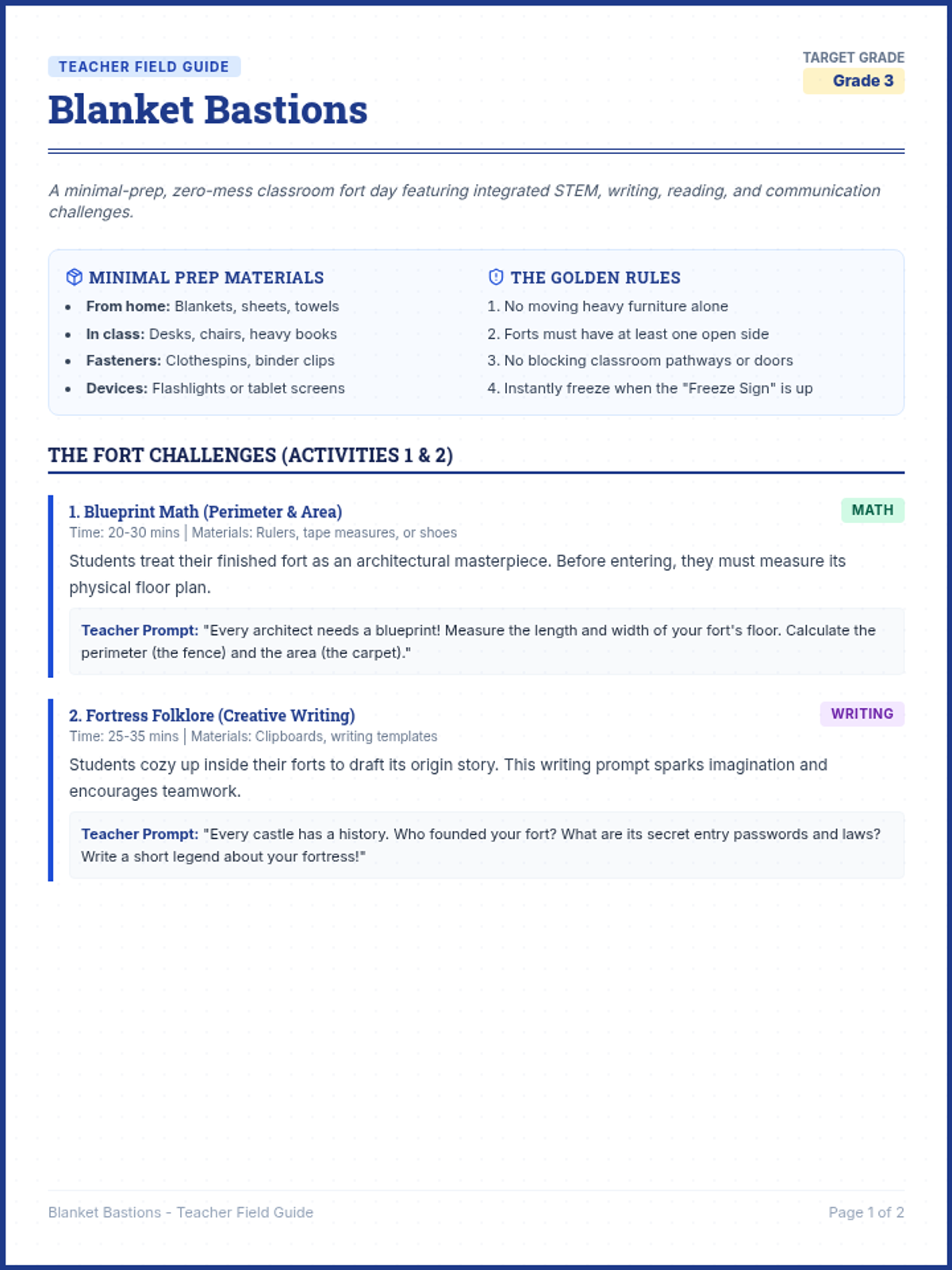
A comprehensive, 2-page teacher guide for Blanket Bastions. Outlines safety rules, material lists, and details five creative challenges integrated with third-grade Math, STEM, Writing, Reading, and Communication standards. Includes a pacing guide and classroom management hacks.
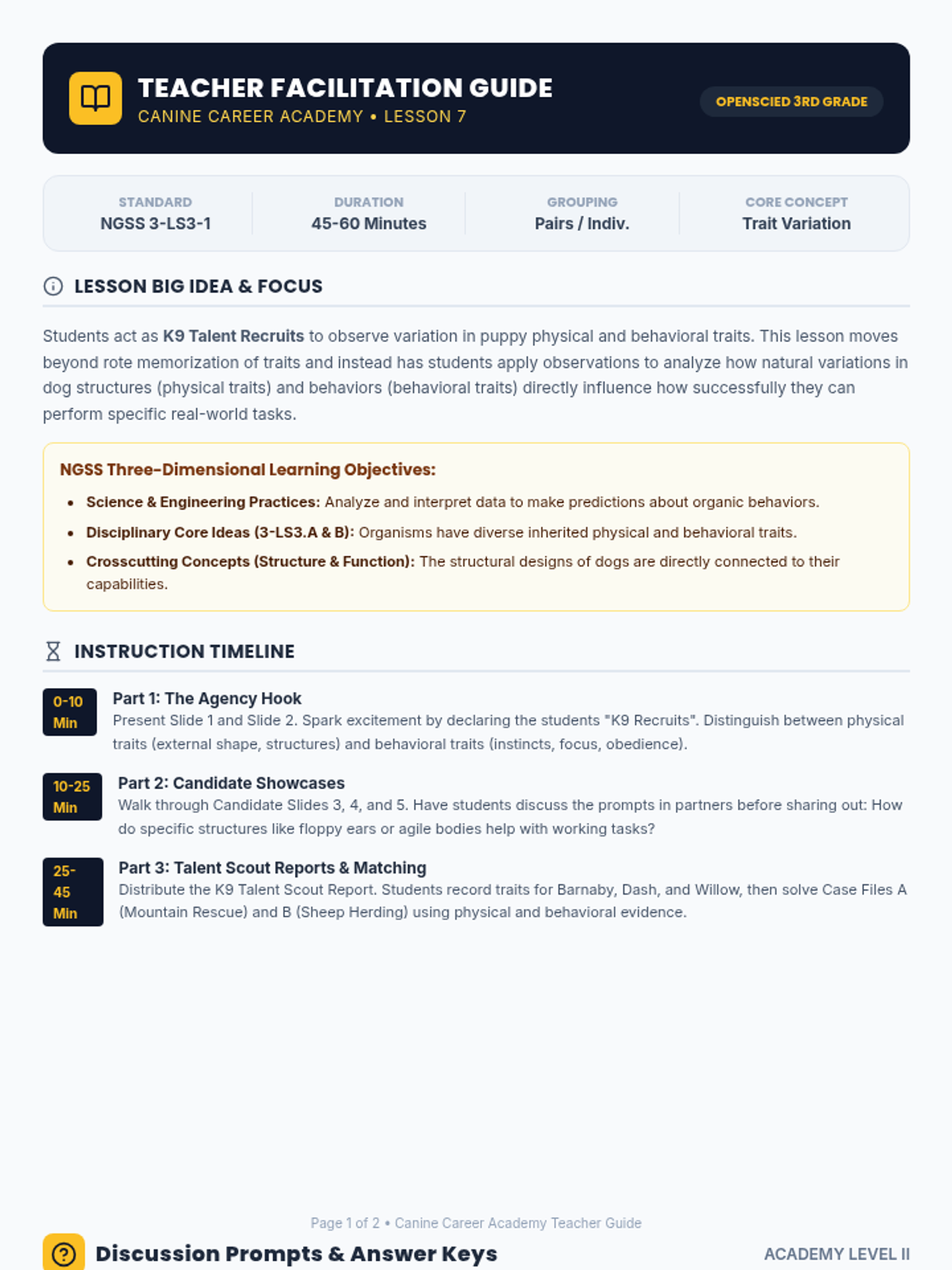
A comprehensive teacher guide for Lesson 7, outlining lesson flow, discussion facilitation questions, student misconceptions, and a full official answer key.
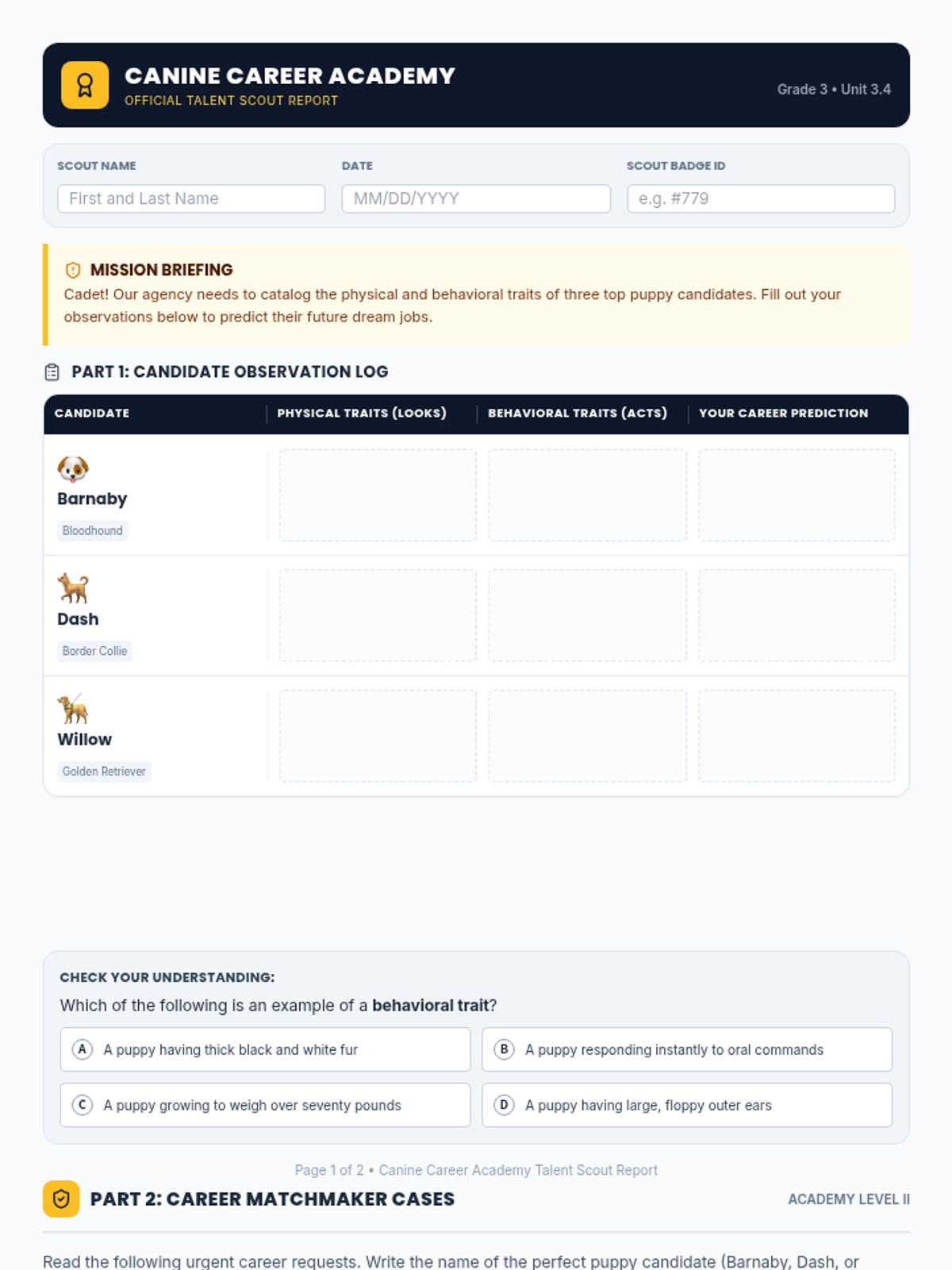
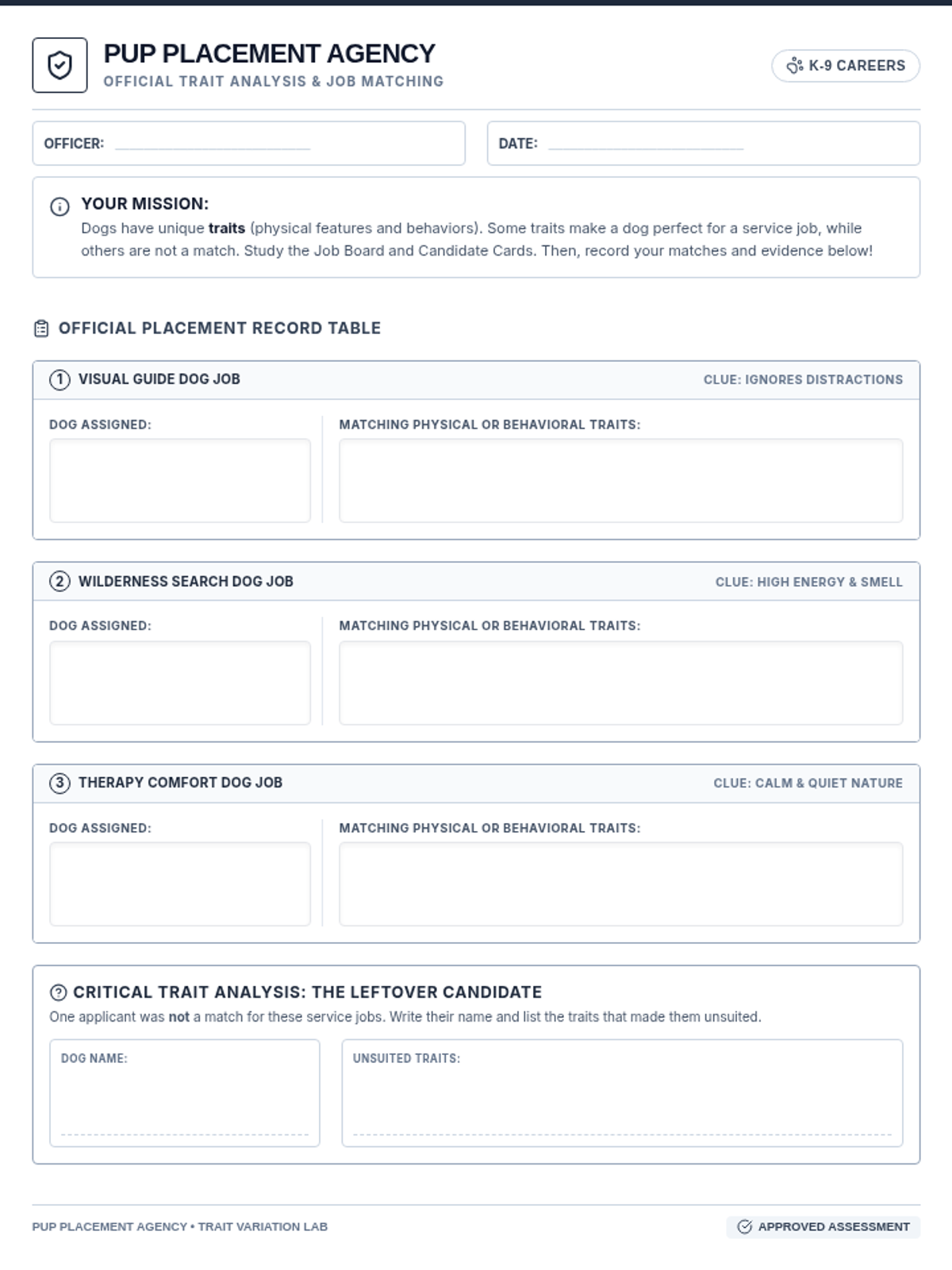
A print-ready student worksheet styled as an official 'Talent Scout Report', allowing third-graders to record traits, predict careers, and solve real-world puppy matchmaking scenarios.
An engaging slide deck introduces the core concepts of physical and behavioral traits, guiding 3rd-grade students through puppy candidate profiles to predict successful canine careers.
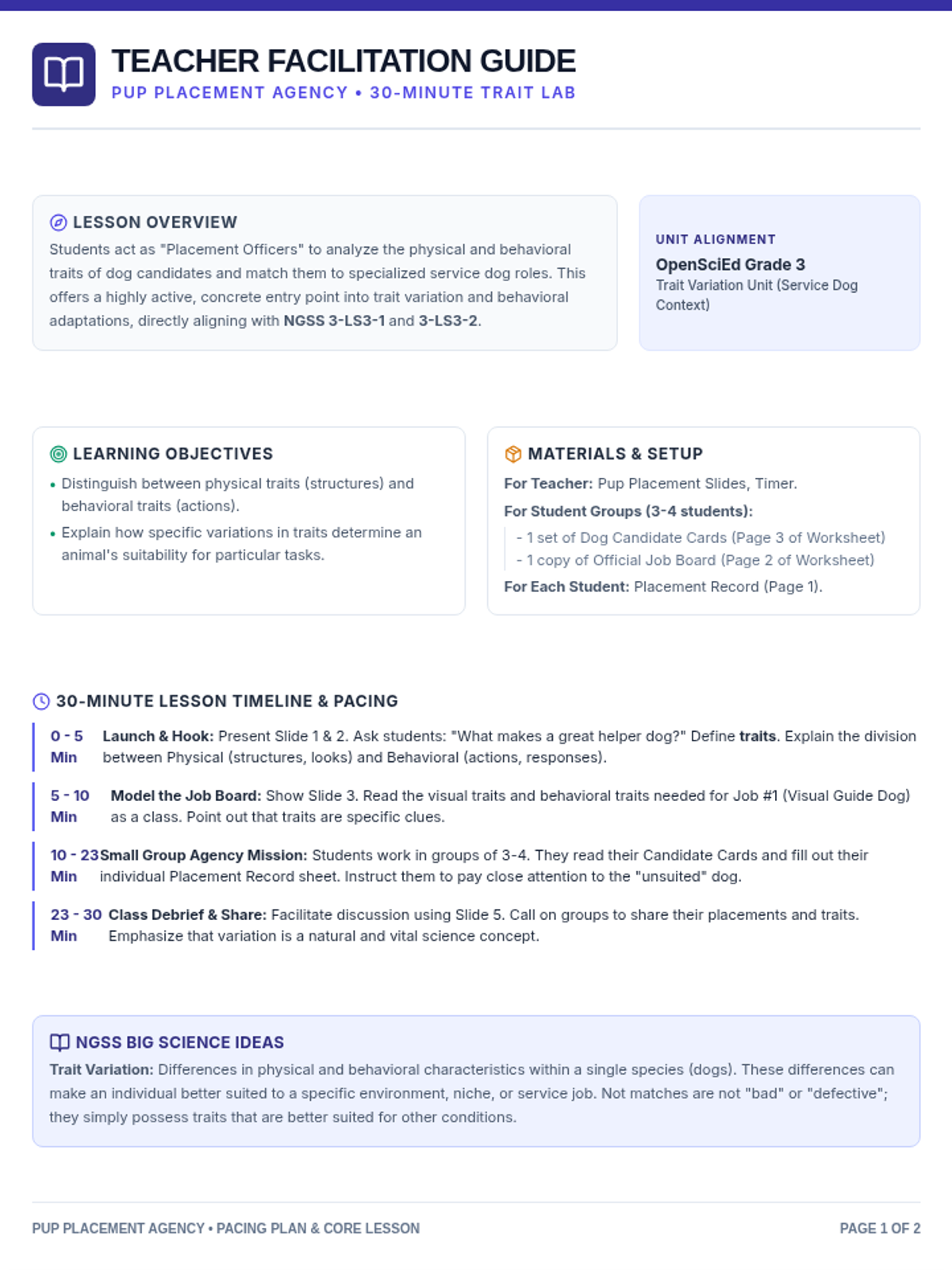
A comprehensive 2-page print-ready Teacher Guide for the 30-minute Pup Placement Agency lesson. It features a minute-by-minute timeline, multi-tier differentiated instruction strategies matching 1st to 4th grade reading levels, lists of common student misconceptions, official solution keys, and detailed scripted discussion prompts to reinforce core OpenSciEd and NGSS third-grade trait variation standards.
An engaging, professional slide deck with 5 slides designed for classroom presentation. Guides students through the lesson starting from 'What is a Trait' with visual explanations, through 'K-9 Jobs on the Board', instructions for their 'Placement Officer Mission', and finishes with structured 'Debrief & Share' discussion prompts. Fully compliant with a strict minimum 24px text size limit for high readability.
A beautifully styled, printer-friendly 3-page student sorting activity and matching worksheet. Features minimal ink usage, solid high-contrast borders, clean layout spaces with zero heavy ink blocks, beautiful polaroid-style dog snapshot images, and clear scaffolding for readers at 1st to 4th grade levels.
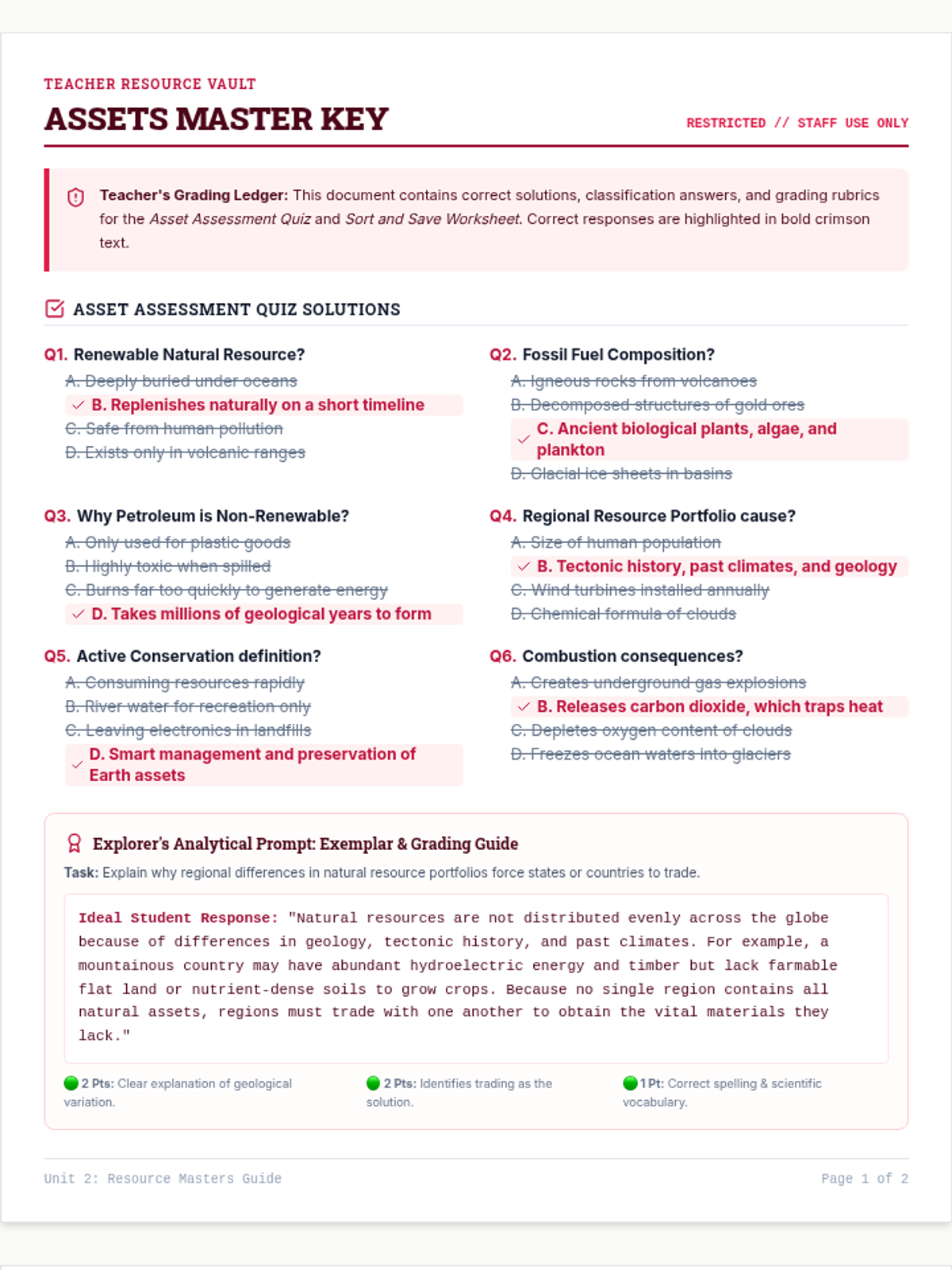
A comprehensive, 2-page teacher answer key matching the unit's quiz and worksheets. It includes answers to all multiple-choice questions, sorting tables, matching layouts, and evaluation rubrics.
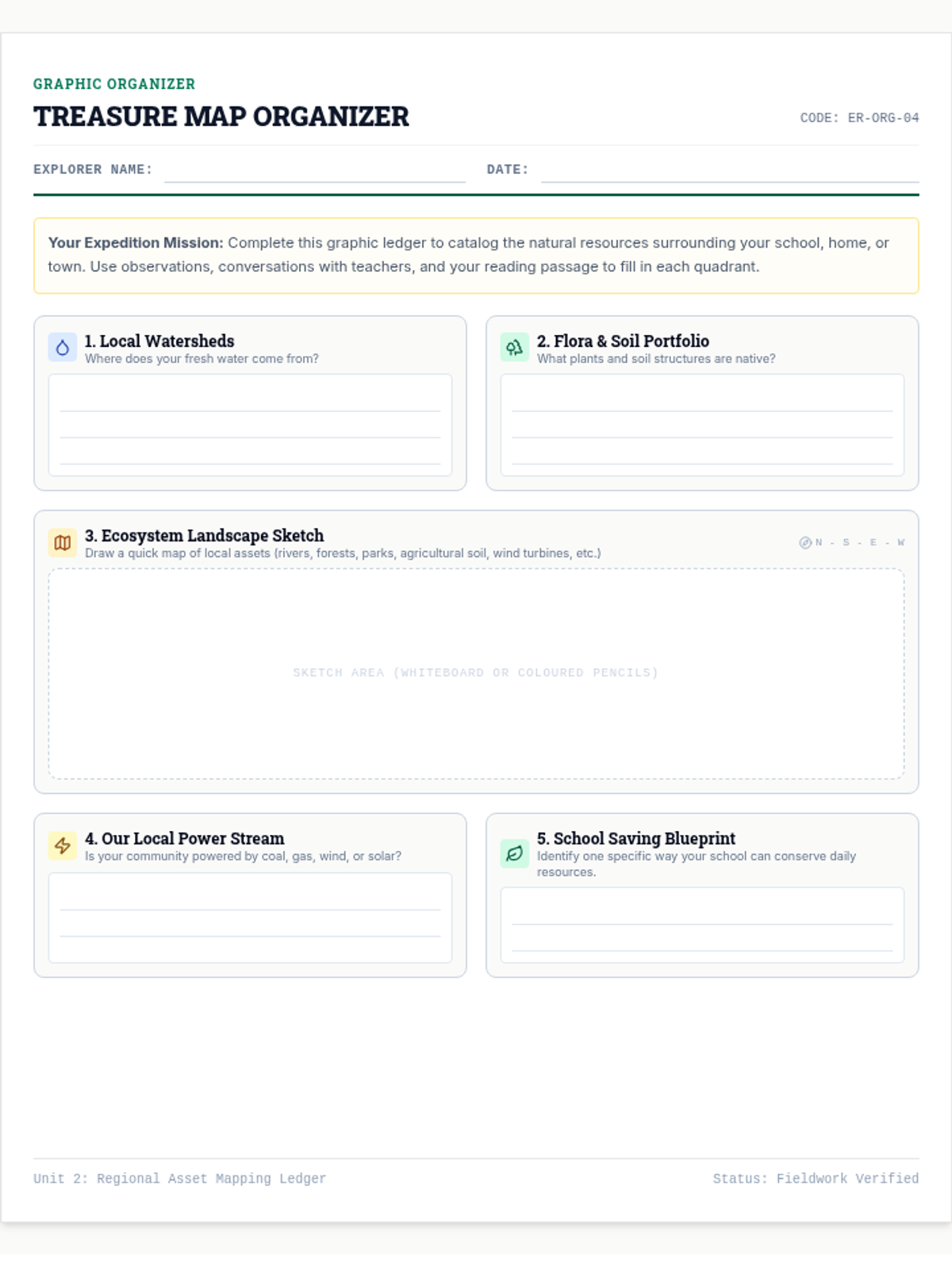
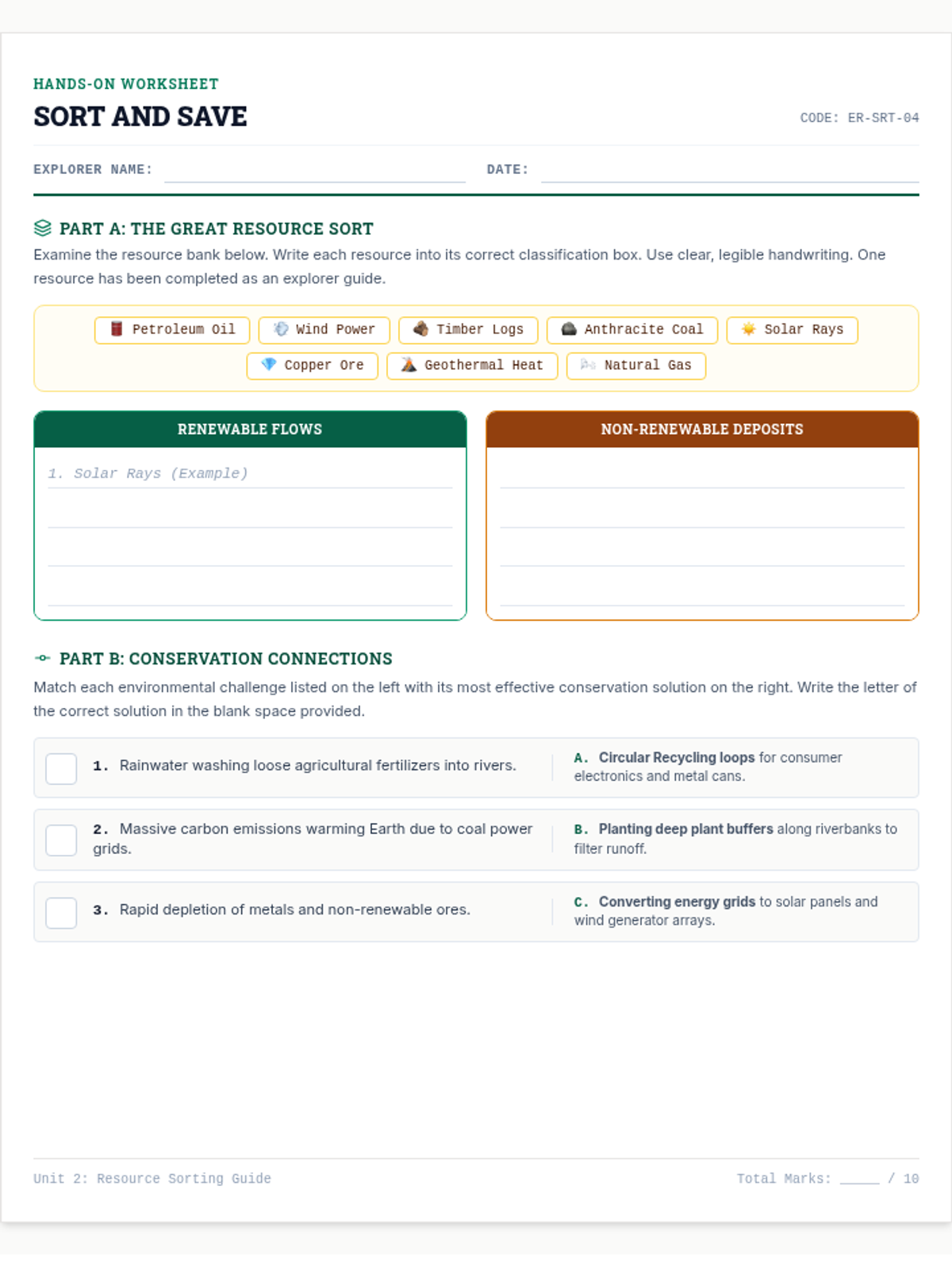
A visually striking graphic organizer that guides students in mapping out local resources, renewable flows, and non-renewable energy deposits.
A matching and sorting worksheet where students categorize resources and align conservation actions with ecological benefits.
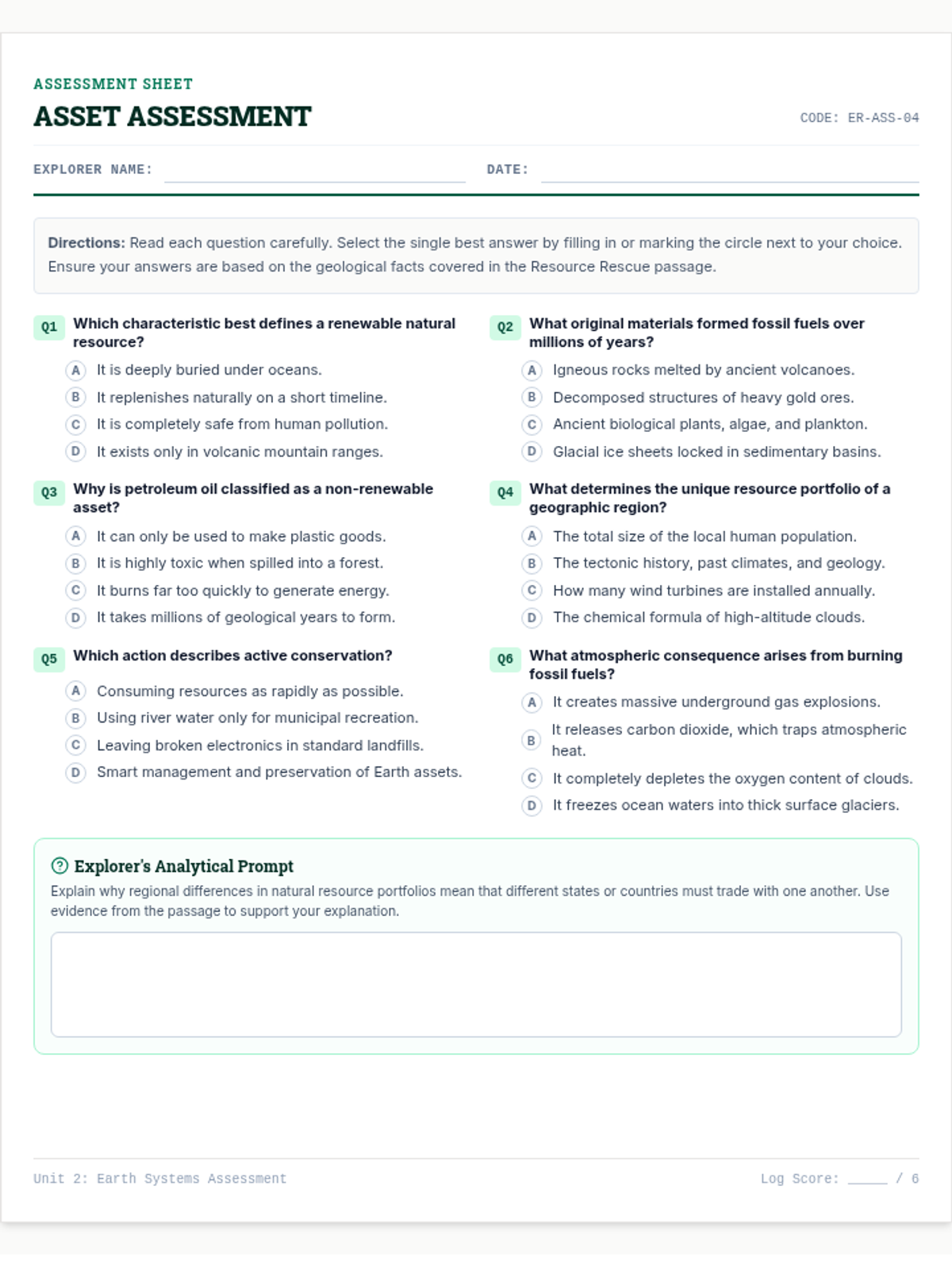
A student-facing quiz sheet containing six carefully aligned multiple-choice questions and one critical thinking short-response prompt on natural resources. All multiple-choice answer elements follow uniform design principles.
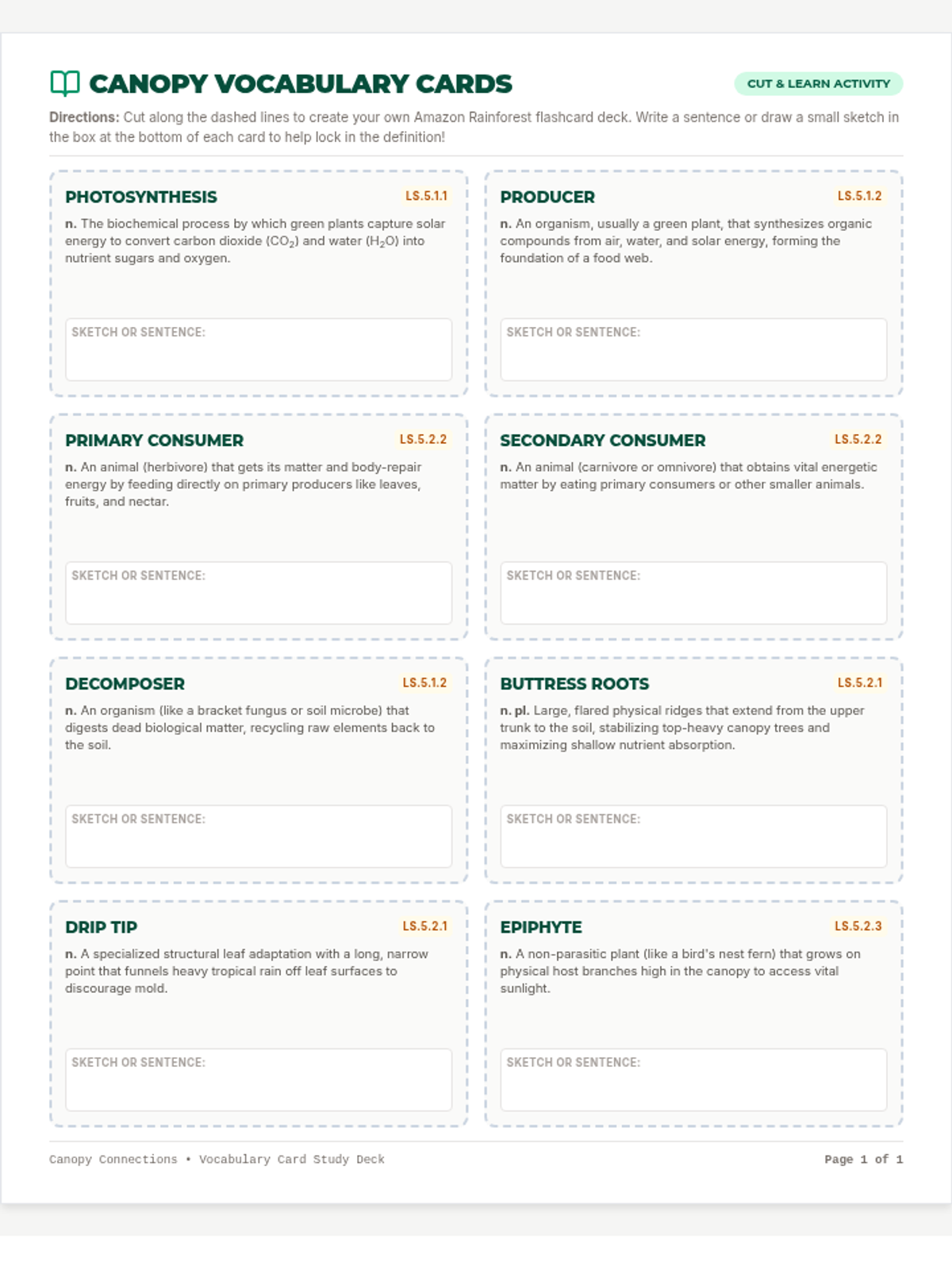
A set of 8 beautifully themed printable vocabulary cards (2x4 grid on a single page) featuring key ecological terms and plant adaptations from the texts, with designated spaces for students to sketch or write an example.
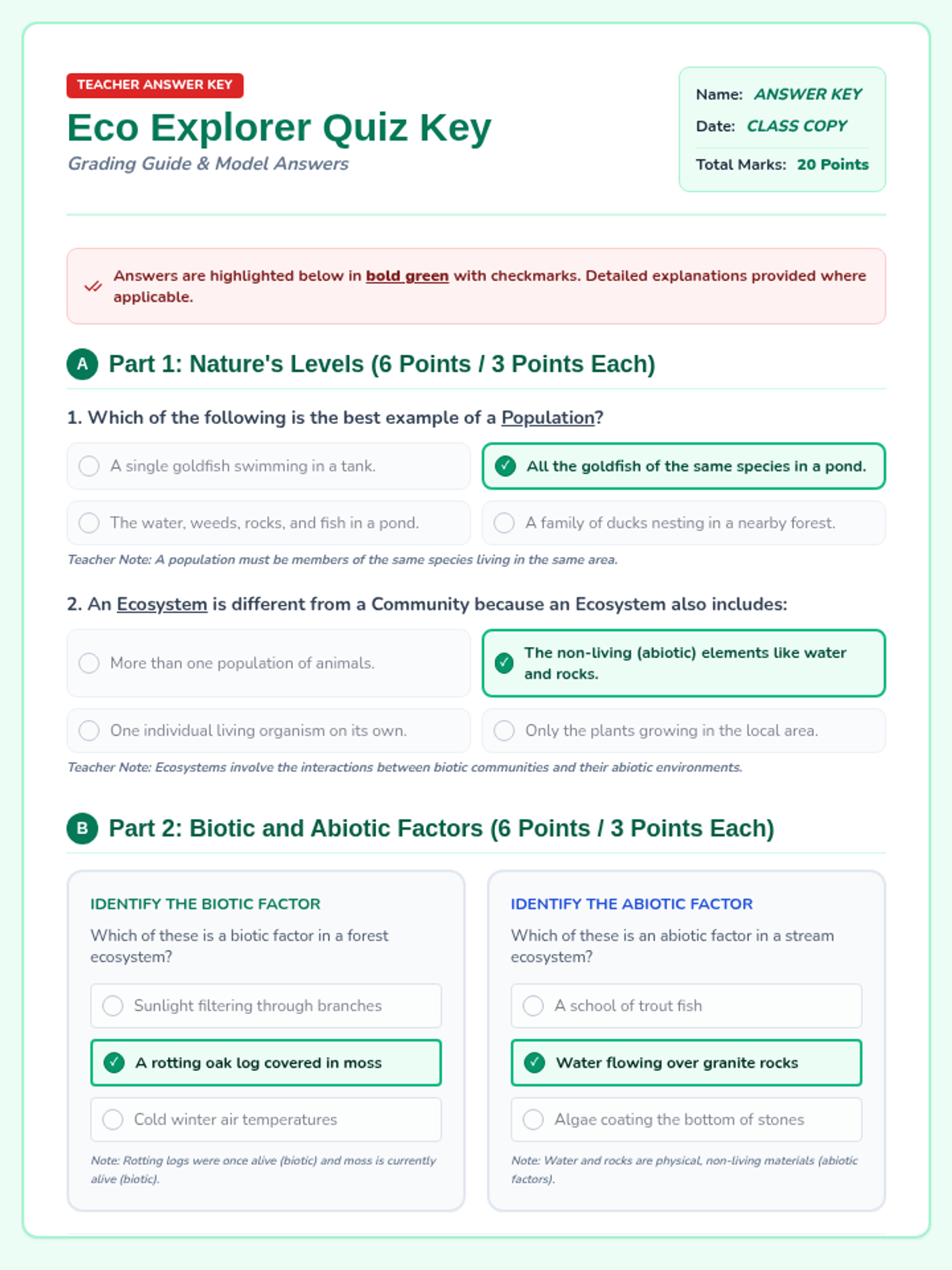
A 2-page print-ready teacher answer key with highlighted answers, grading guidance, and model responses for the Eco Explorer Practice Quiz.
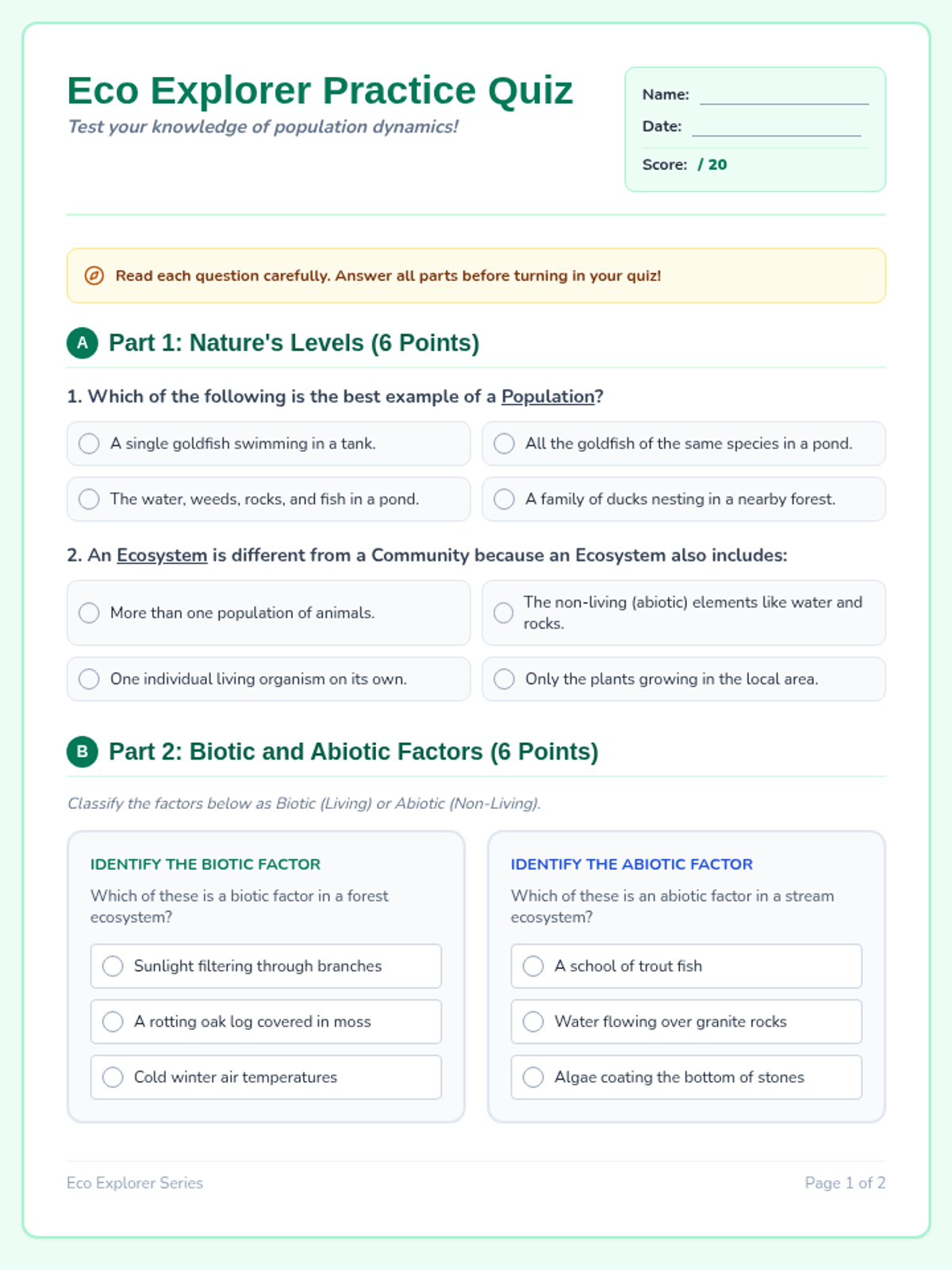
A 2-page print-ready practice quiz covering population dynamics, ecological levels, biotic/abiotic factors, density-dependent/independent limiting factors, and a carrying capacity graph analysis. Designed to align with the Eco Explorer series visual theme.
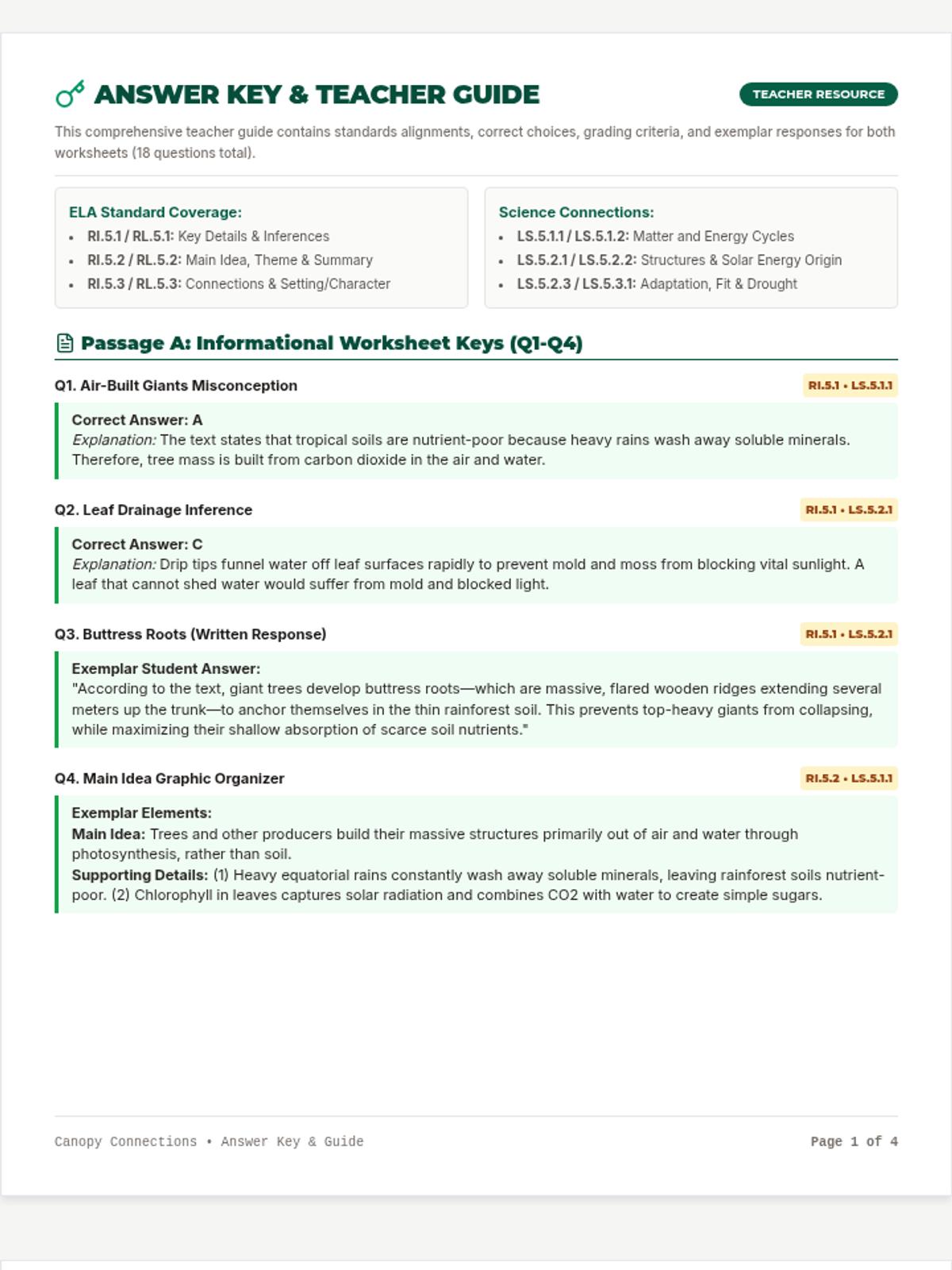
A comprehensive teacher answer key and guide containing detailed standards alignment, grading rubrics, and exemplar answers for both the informational and literature worksheets.
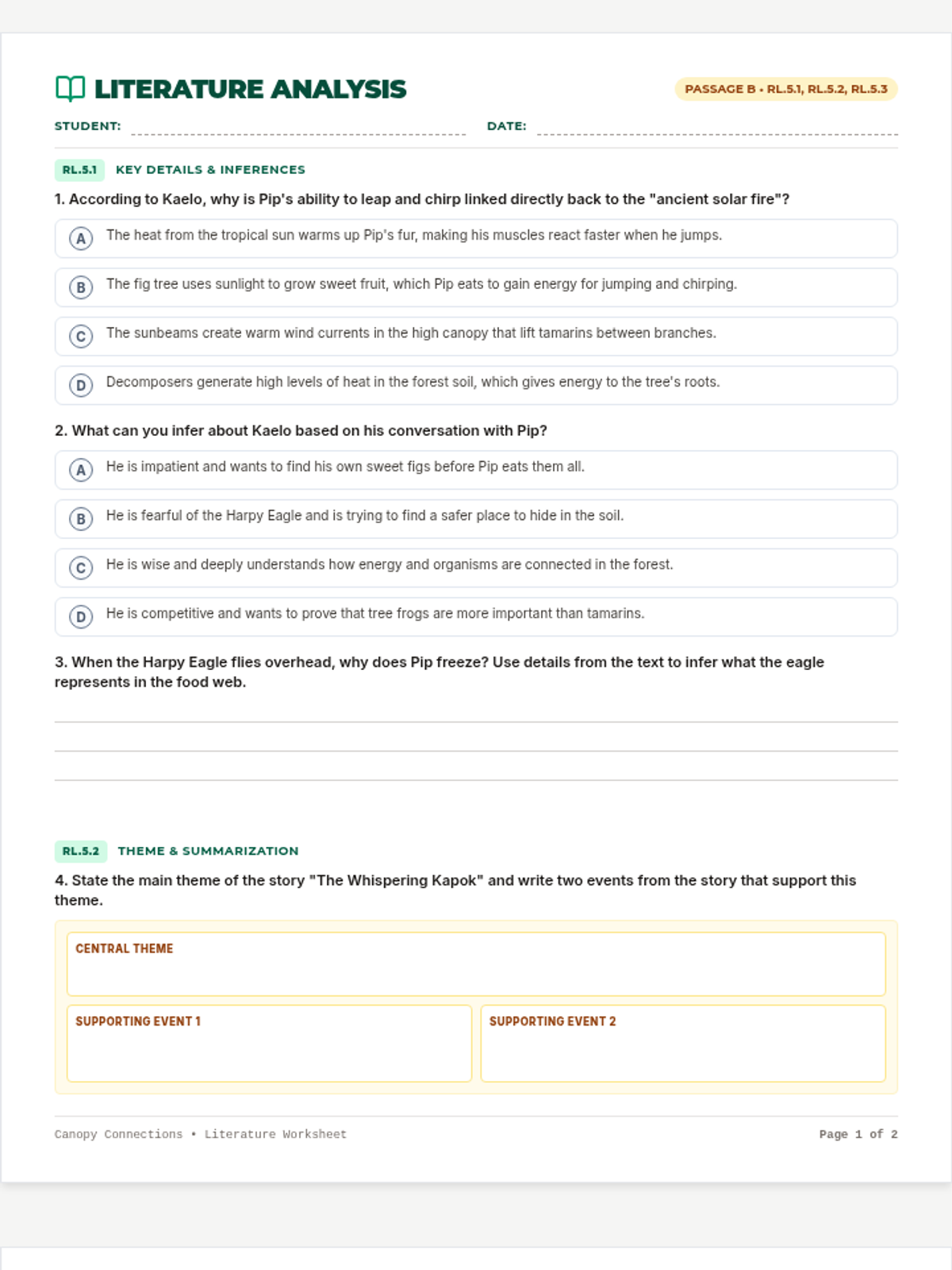
A comprehensive ELA worksheet featuring 9 standards-aligned questions (3 for RL.1, 3 for RL.2, and 3 for RL.3) based on the fictional short story 'The Whispering Kapok'.
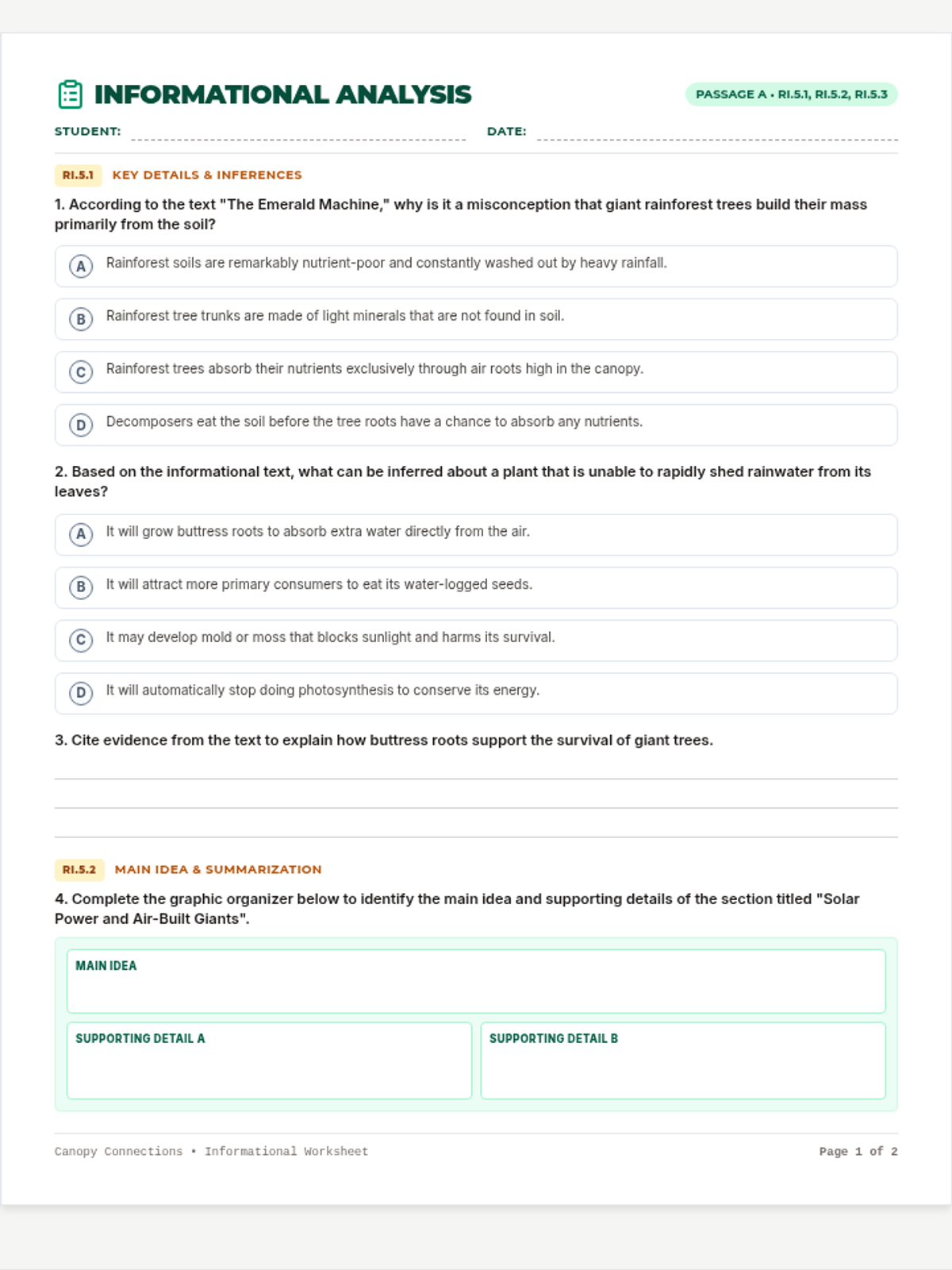
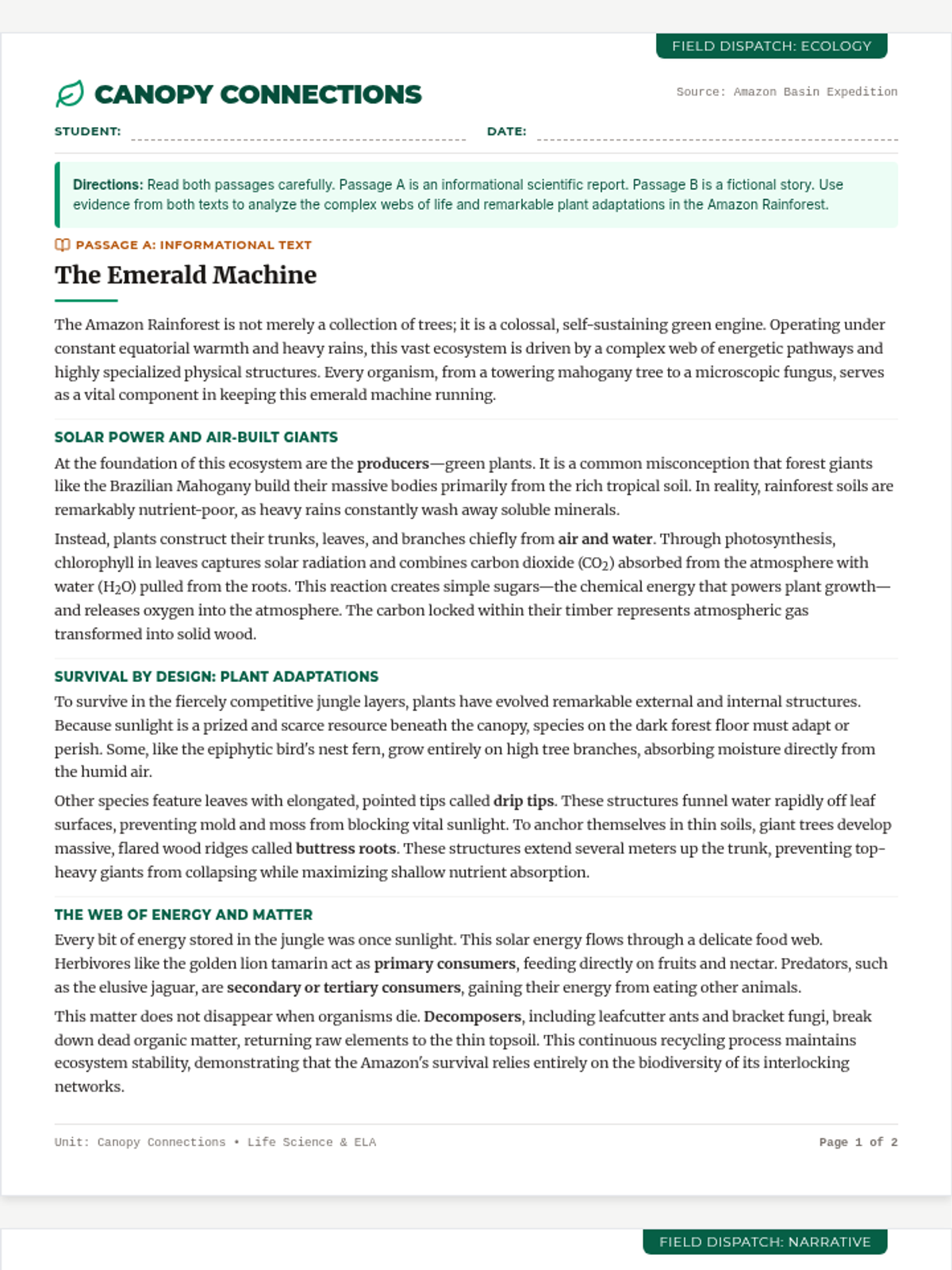
A comprehensive ELA worksheet featuring 9 standards-aligned questions (3 for RI.1, 3 for RI.2, and 3 for RI.3) based on the informational text 'The Emerald Machine'.
A beautifully designed 2-page paired reading passage for 5th grade. Page 1 contains "The Emerald Machine", an informational text on the Amazon food web and plant structures. Page 2 features "The Whispering Kapok", a narrative passage about Pip the tamarin discovering ecosystem interactions.
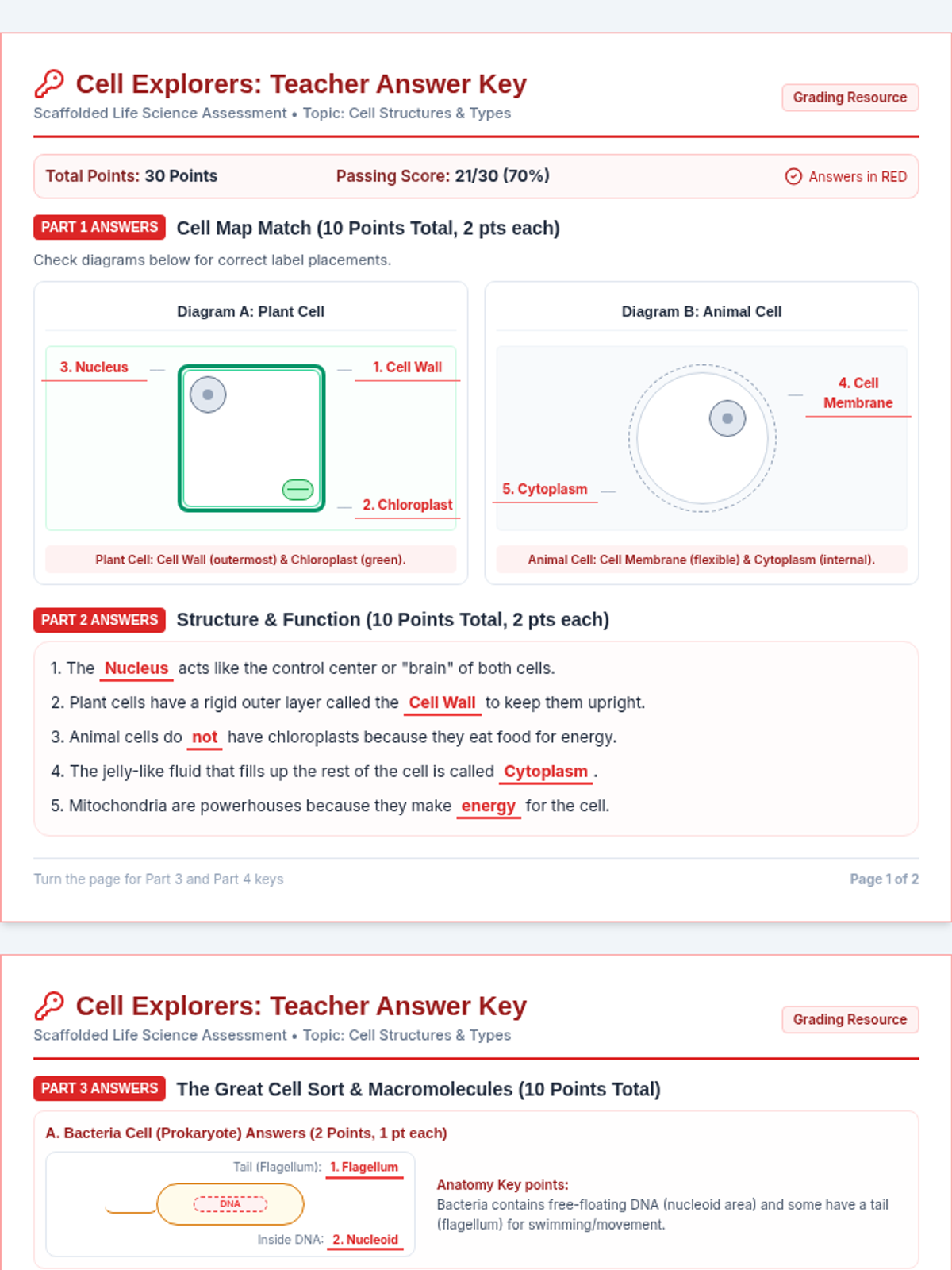
A 2-page teacher answer key companion for the scaffolded cell unit assessment, featuring highlighted correct diagrams, finished sentence frames, and student model short answers.
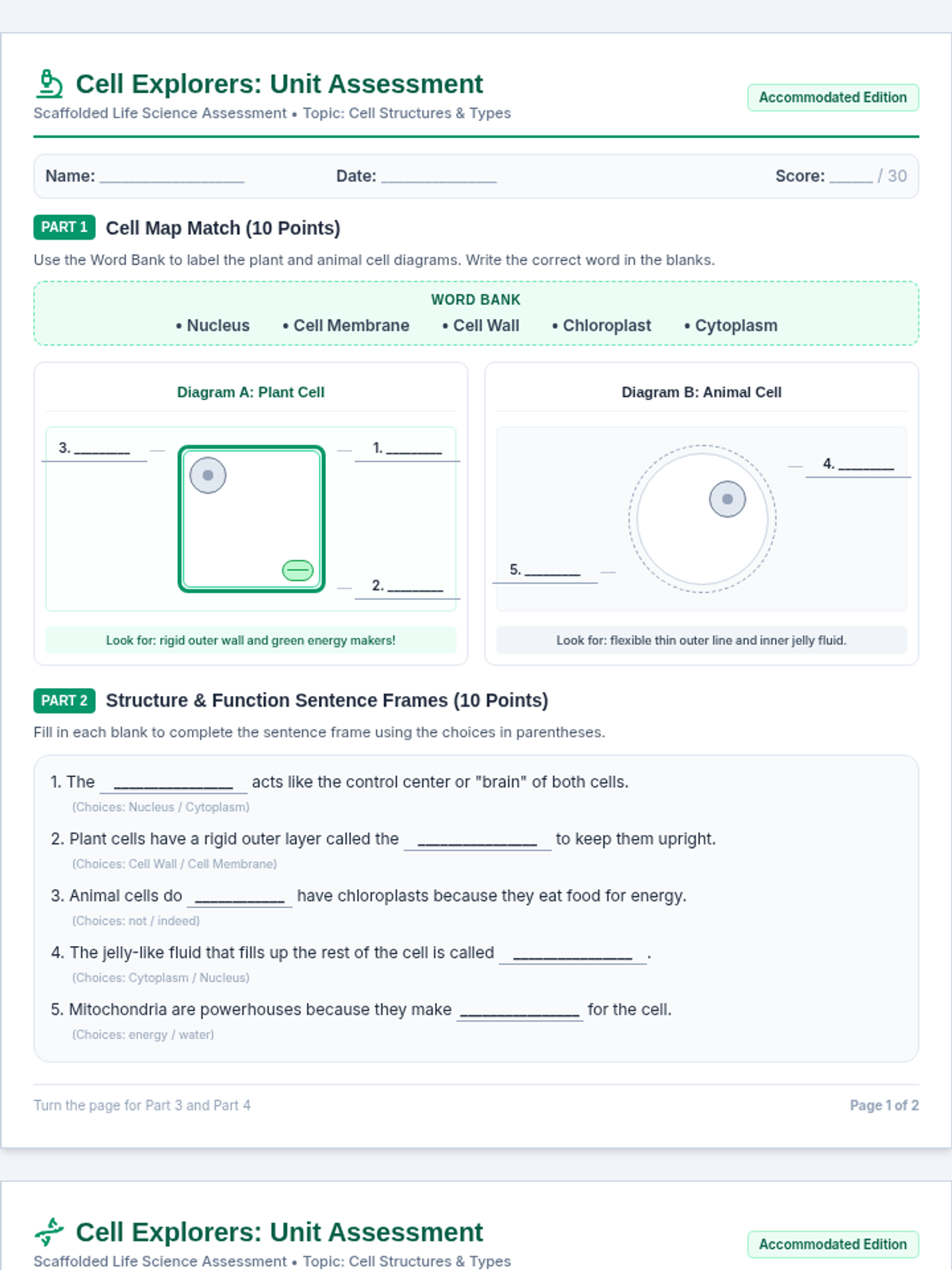
A 2-page scaffolded student assessment covering cell organelles, prokaryotic and eukaryotic structures, plant vs. animal cells, and bacterial anatomy. Features word banks, sentence frames, and guided sentence starters.
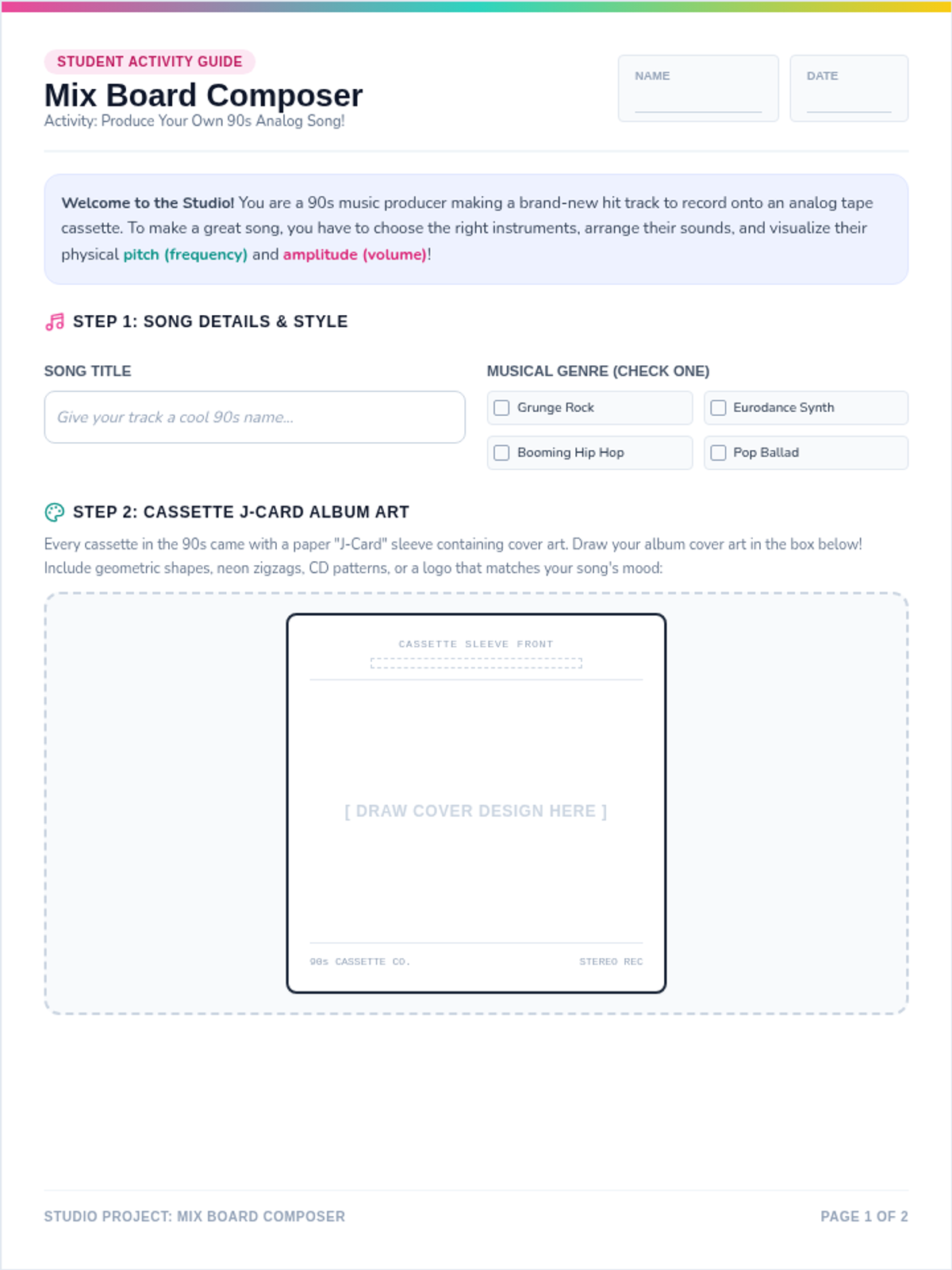
A student-facing activity sheet where students act as song producers to design their own 4-track EP. They compose songs by drawing physical wave representations of different instruments and vocals, manipulating pitch and amplitude.
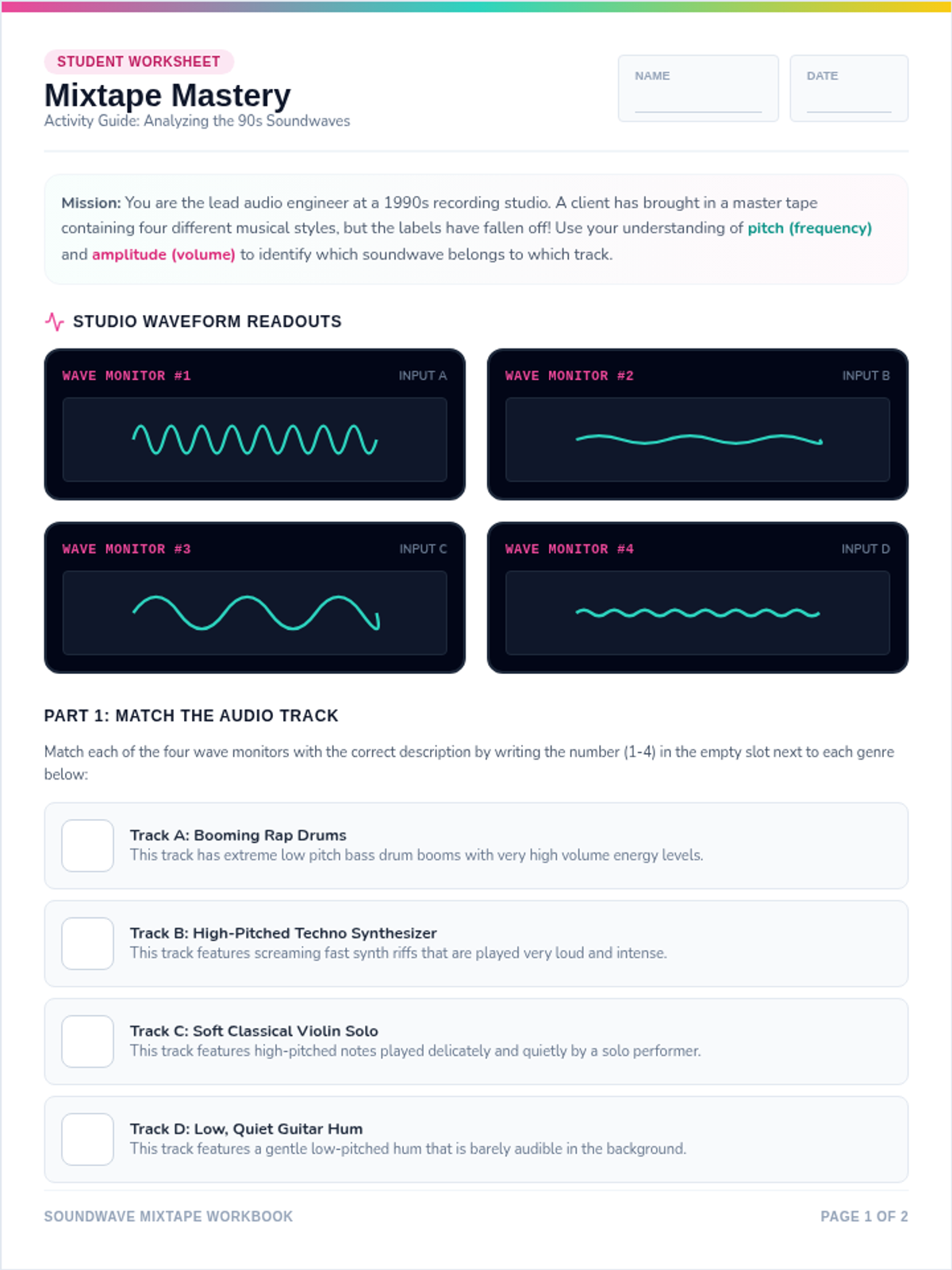
A quiet, technology-free activity sheet and worksheet where students analyze sound wave diagrams of different 90s music genres, matching tape speed and sound levels to pitch and amplitude. It includes a wave-drawing lab and realistic analog scenarios for assessing conceptual understanding.
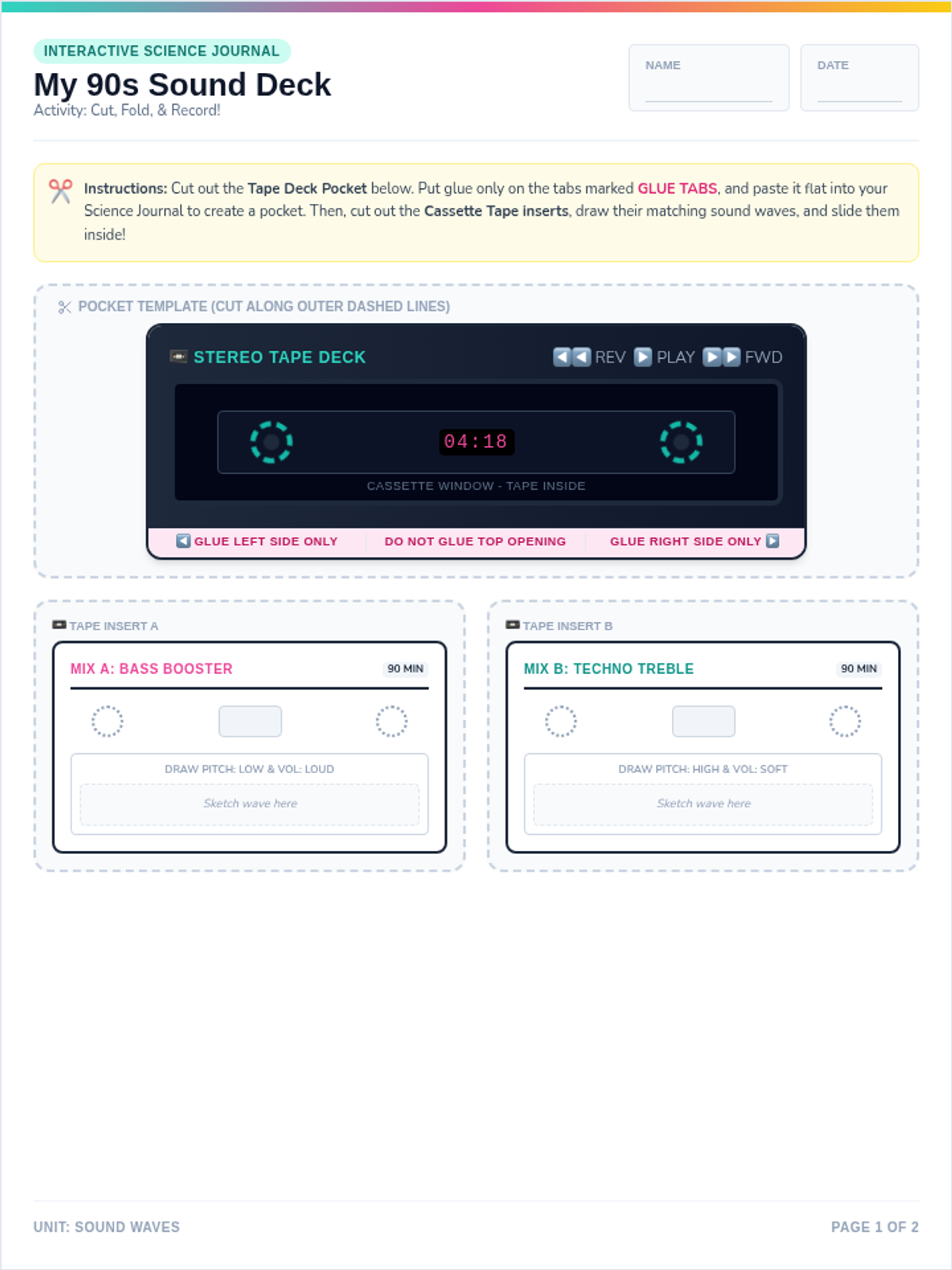
Interactive science journal inserts where students design their own cassette tape labels and chart the physical representation of high/low pitch and loud/soft amplitude as wave diagrams.
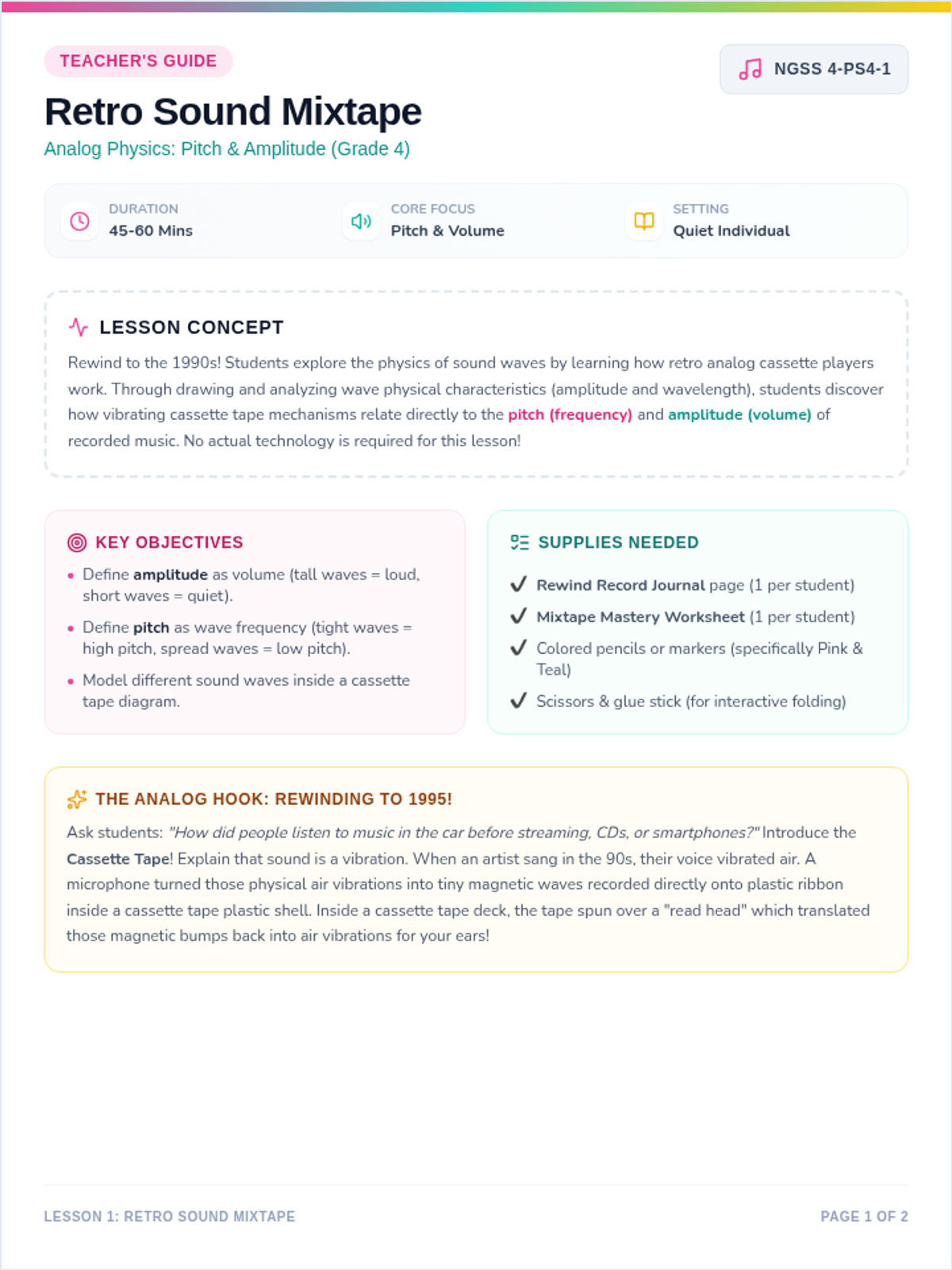
A teacher-facing step-by-step lesson plan designed for teaching 4th grade students sound wave properties (pitch and amplitude) using a retro 90s cassette mixtape hook. It includes duration, objectives, a class hook, step-by-step procedure, discussion prompts, common misconceptions, and differentiation strategies.
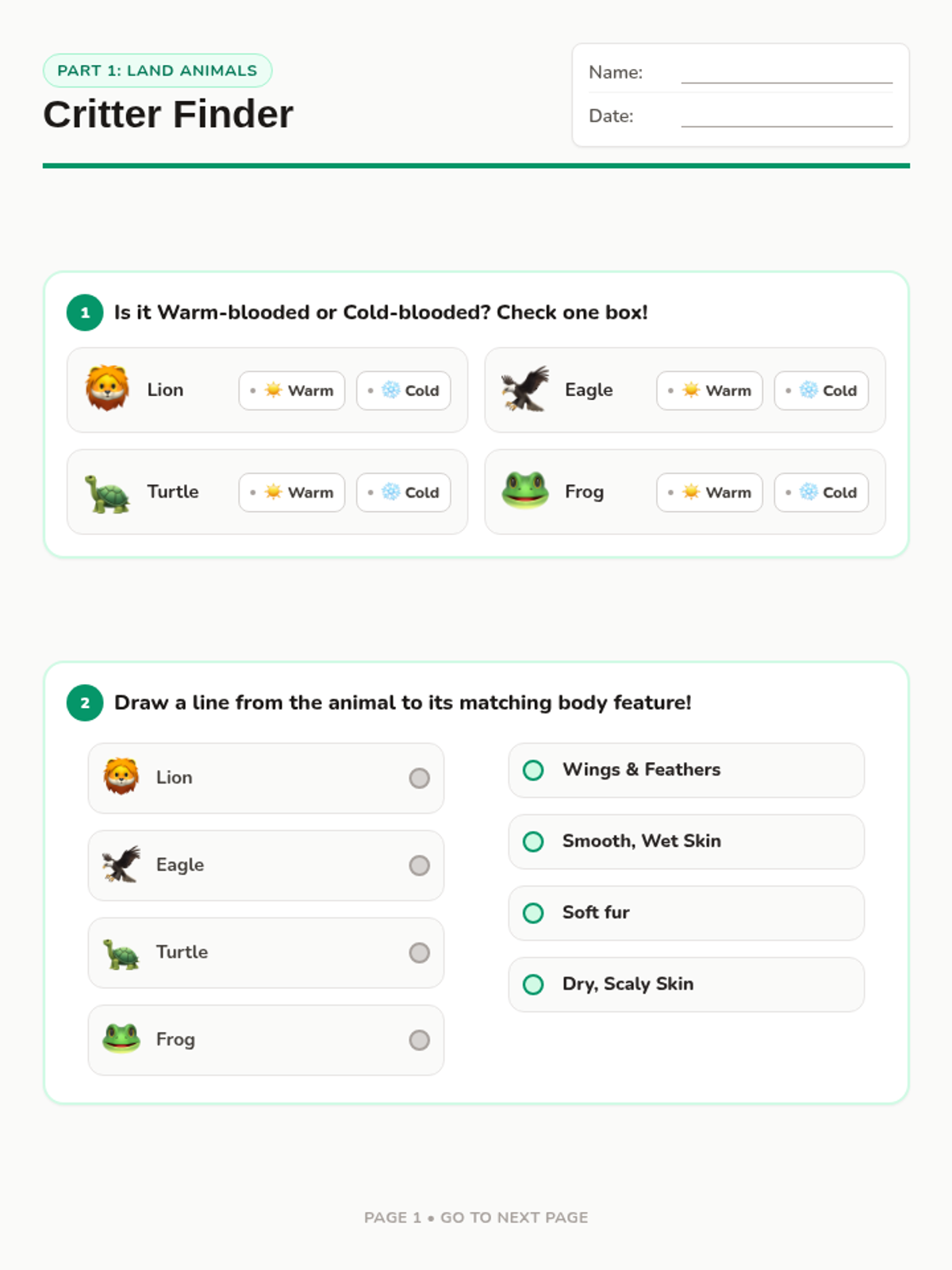
An updated version of the Critter Finder Worksheet where Page 1 has been transformed from a static reference chart to an active, highly interactive matching and sorting worksheet just like Page 2. The activities are balanced across both pages to classify land animals (mammals, birds, reptiles, amphibians) on Page 1 and water/shelled creatures (fish, arthropods, mollusks, worms) on Page 2 using large, clear, low-text visual check-boxes and drawing lines.
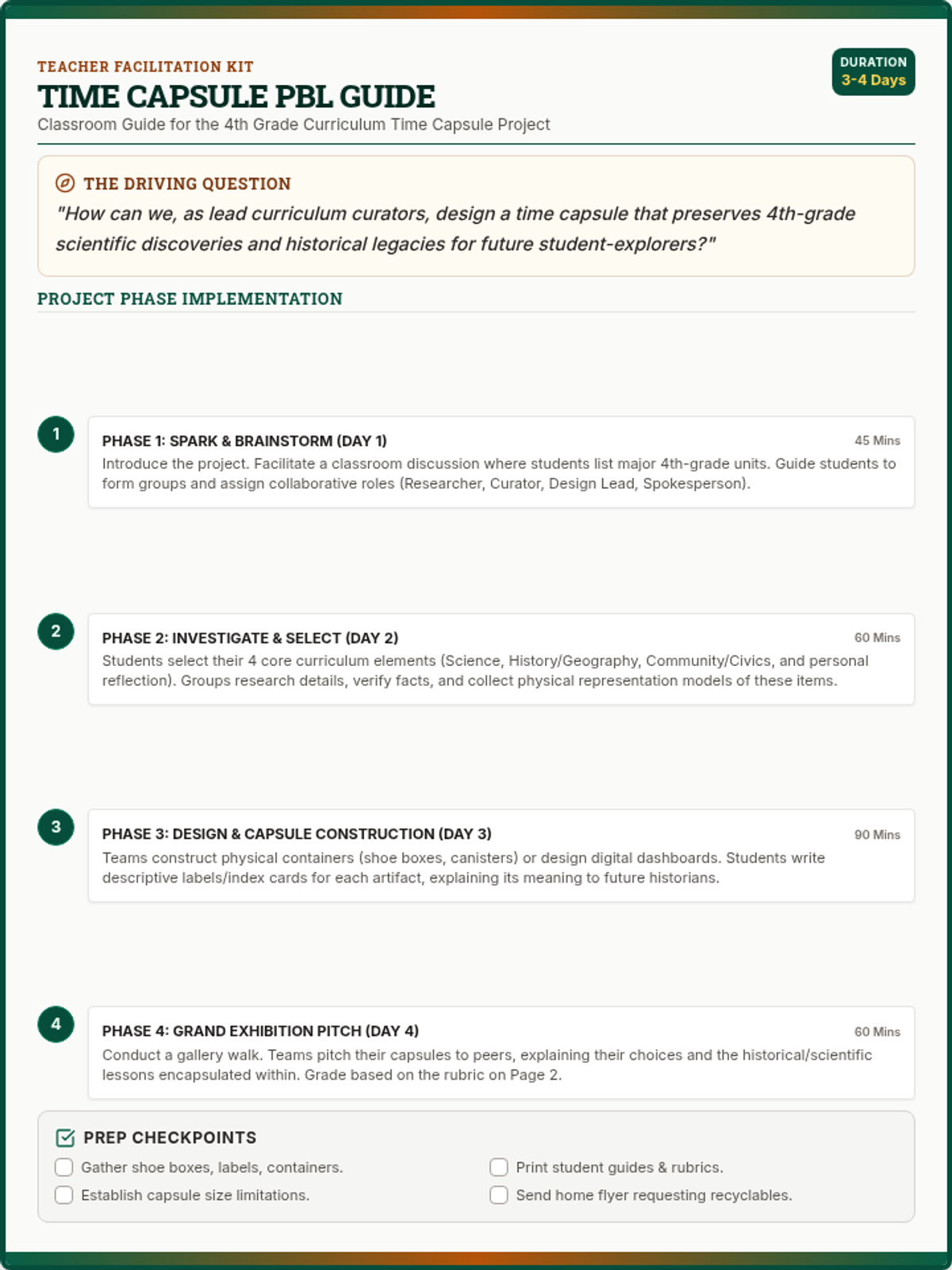
A beautifully styled, 2-page curriculum time capsule project-based learning guide designed for teachers and students. Page 1 contains a comprehensive 4-phase pedagogical facilitation roadmap with timelines. Page 2 features an artifact collection checklist, an exhibition scoring rubric, and a dedicated team drafting space.
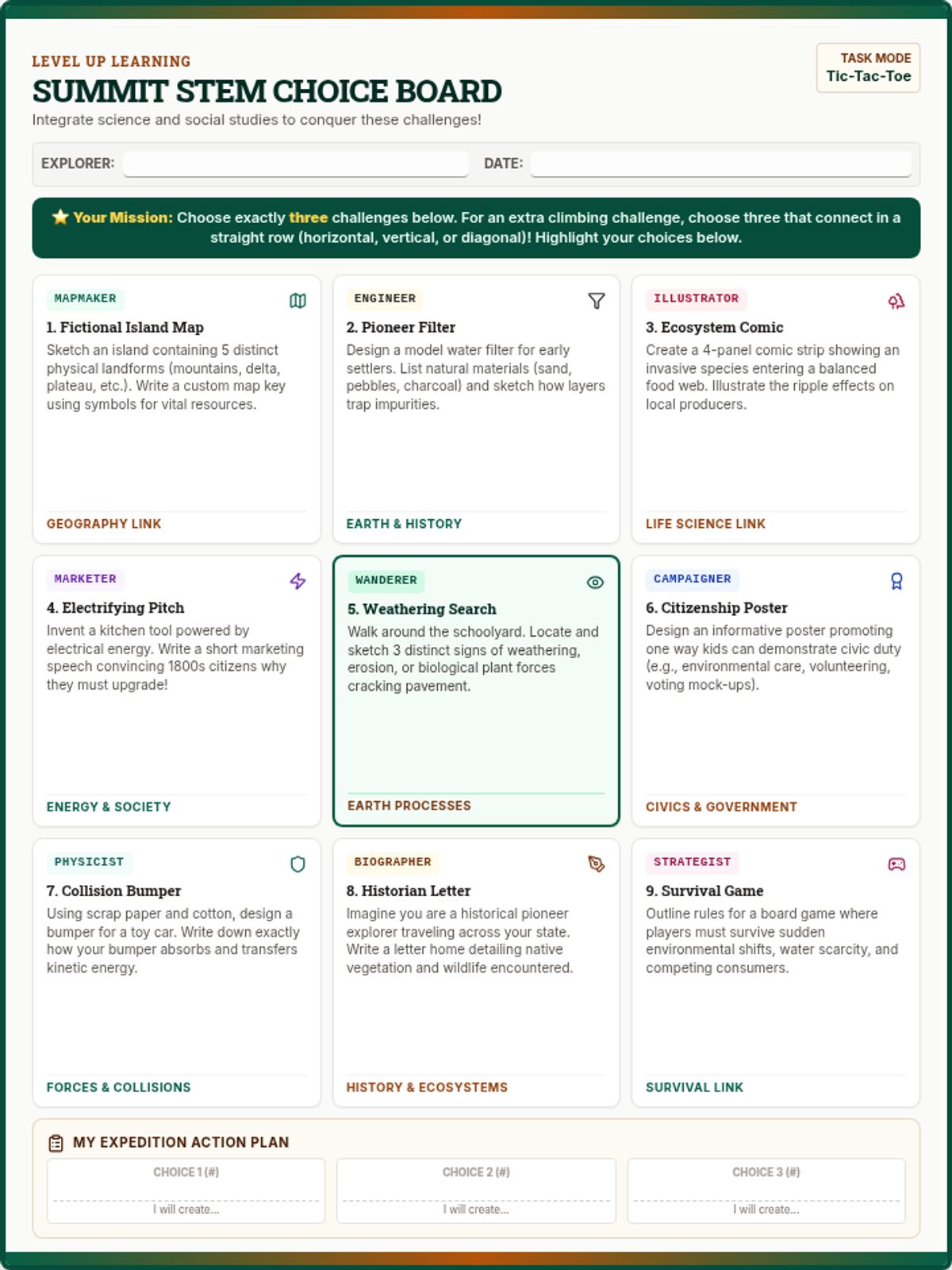
A gorgeous, grid-structured 1-page STEM Choice Board that challenges students to integrate 4th-grade science and social studies in customizable projects. Organizes 9 highly specific tasks—including mapping, water filtration modeling, cartoon creation, and electrical advertising—in a fun Tic-Tac-Toe layout, complete with an explorer planning section at the bottom.
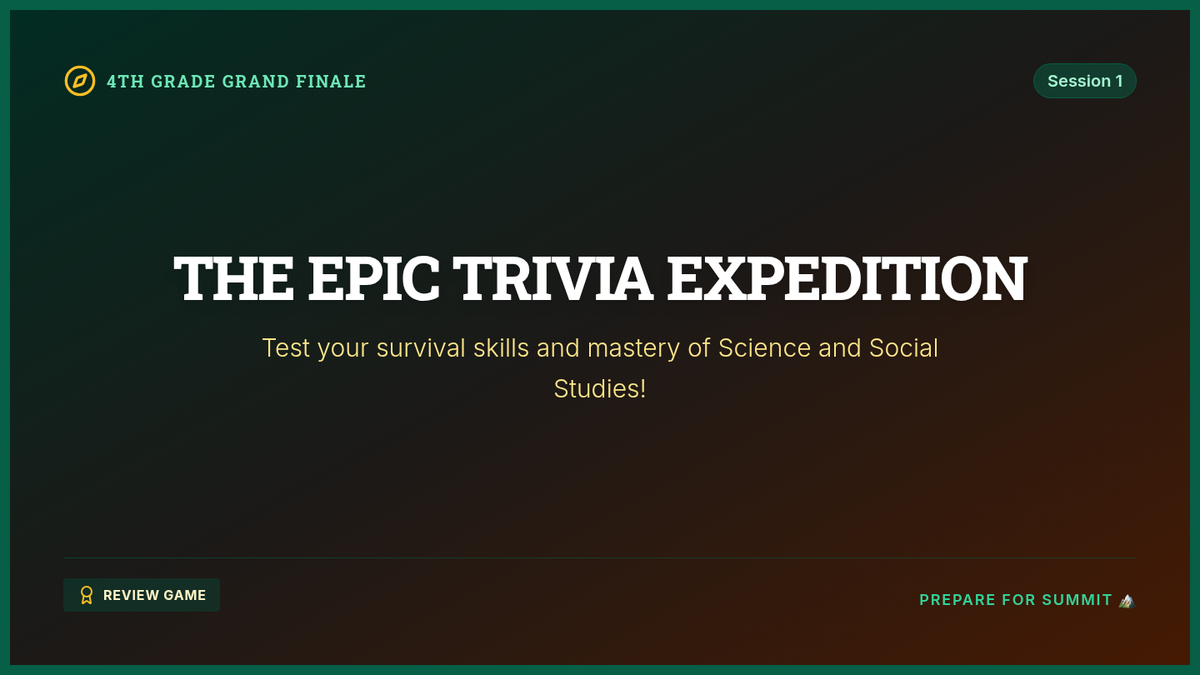
An interactive and highly visual 12-slide review trivia game deck formatted for 16:9 widescreen viewports. Integrates core 4th-grade science concepts (ecosystems, energy, motion) and social studies subjects (geography, map interpretation, government structures, STEM history). Features big, bold text (minimum 24px) for visibility, detailed answer-reveal explanations, and clear team-building guides.
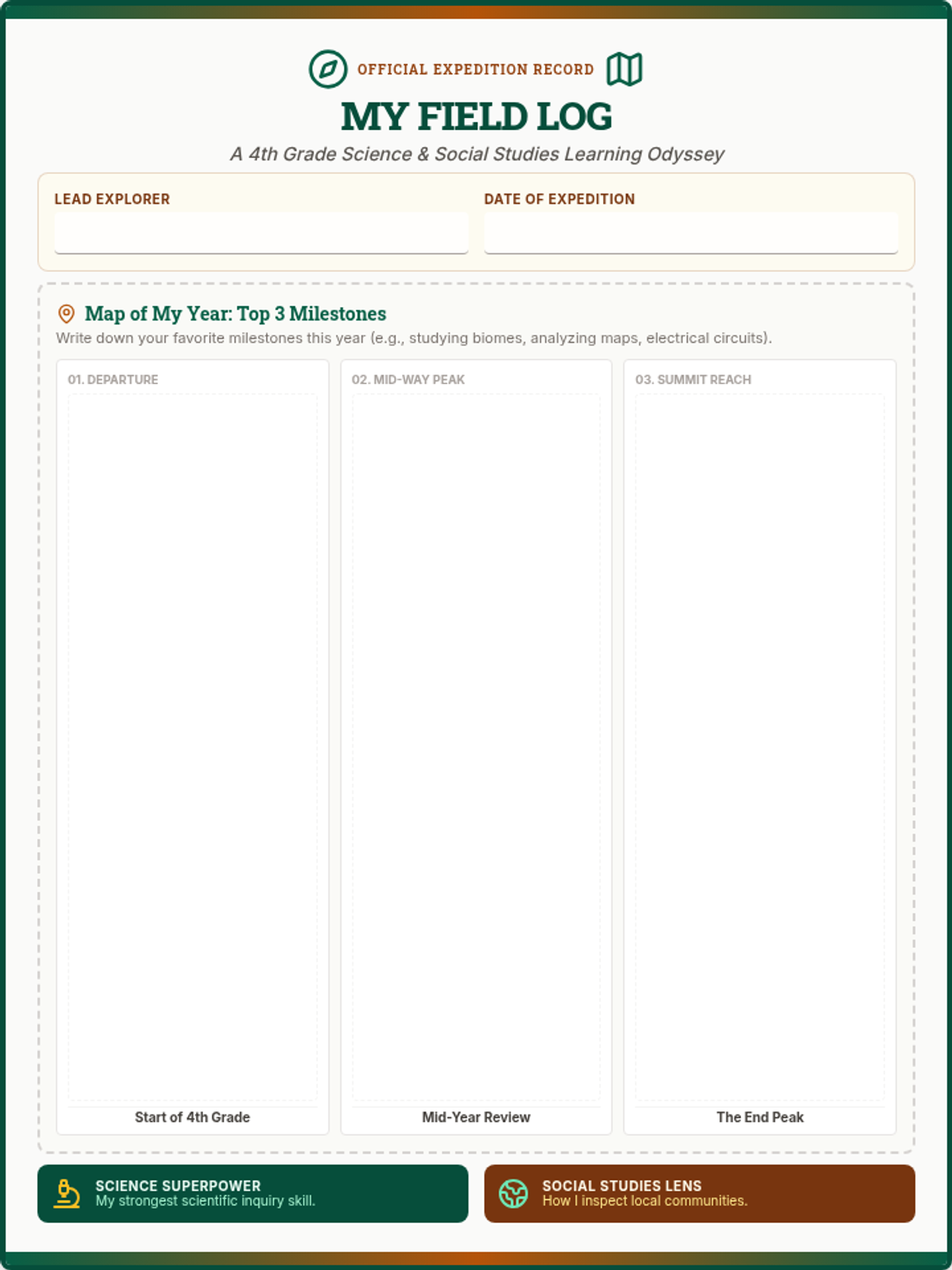
A beautifully styled, printable 3-page learning reflection booklet structured as an "Explorer Field Log". Students reflect on 4th-grade science topics (ecosystems, energy, forces, weathering) and social studies subjects (geography, regions, history, civics). Includes dedicated spaces for structured writing, field sketches, milestones, and a letter to future students.
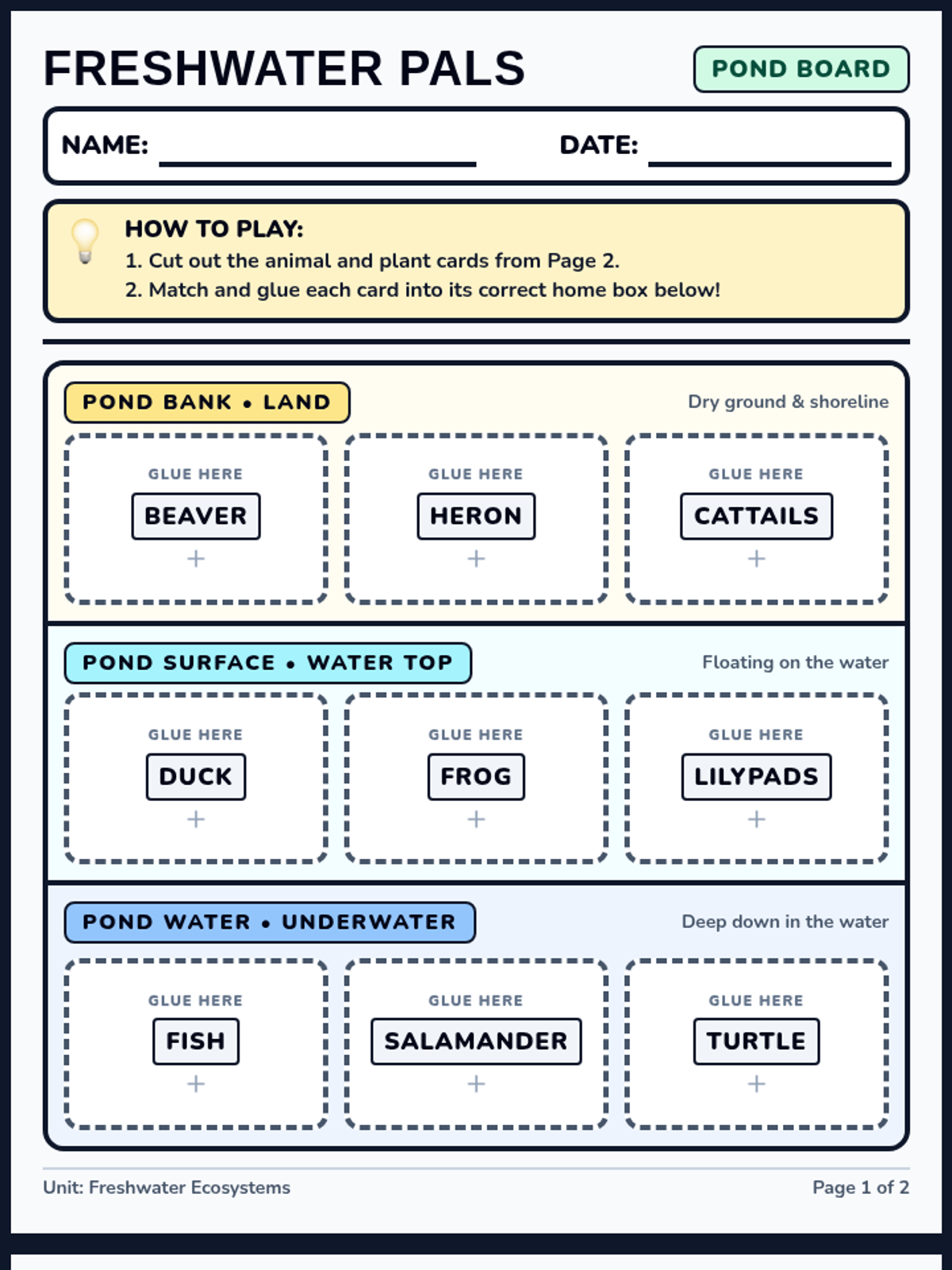
A highly accessible, large-print, high-contrast cut-and-paste matching activity designed for low-literacy and visually impaired students to match freshwater animals and plants to their specific zones (land, surface, underwater) on a pond habitat board.
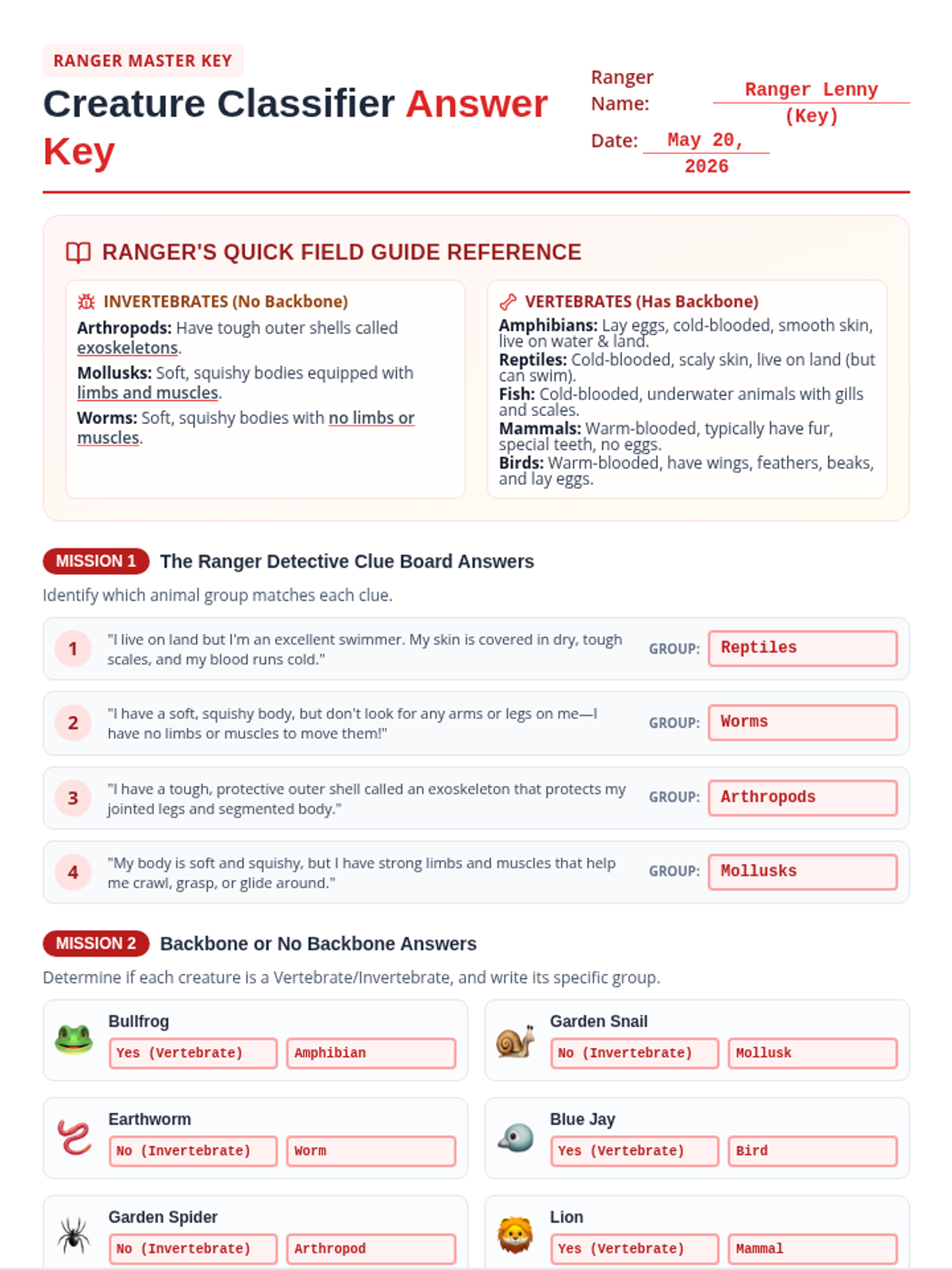
The complete teacher answer key for the Creature Classifier Worksheet. Features the exact same layouts with correct classification answers and grading rubrics displayed in a highly visible red font.
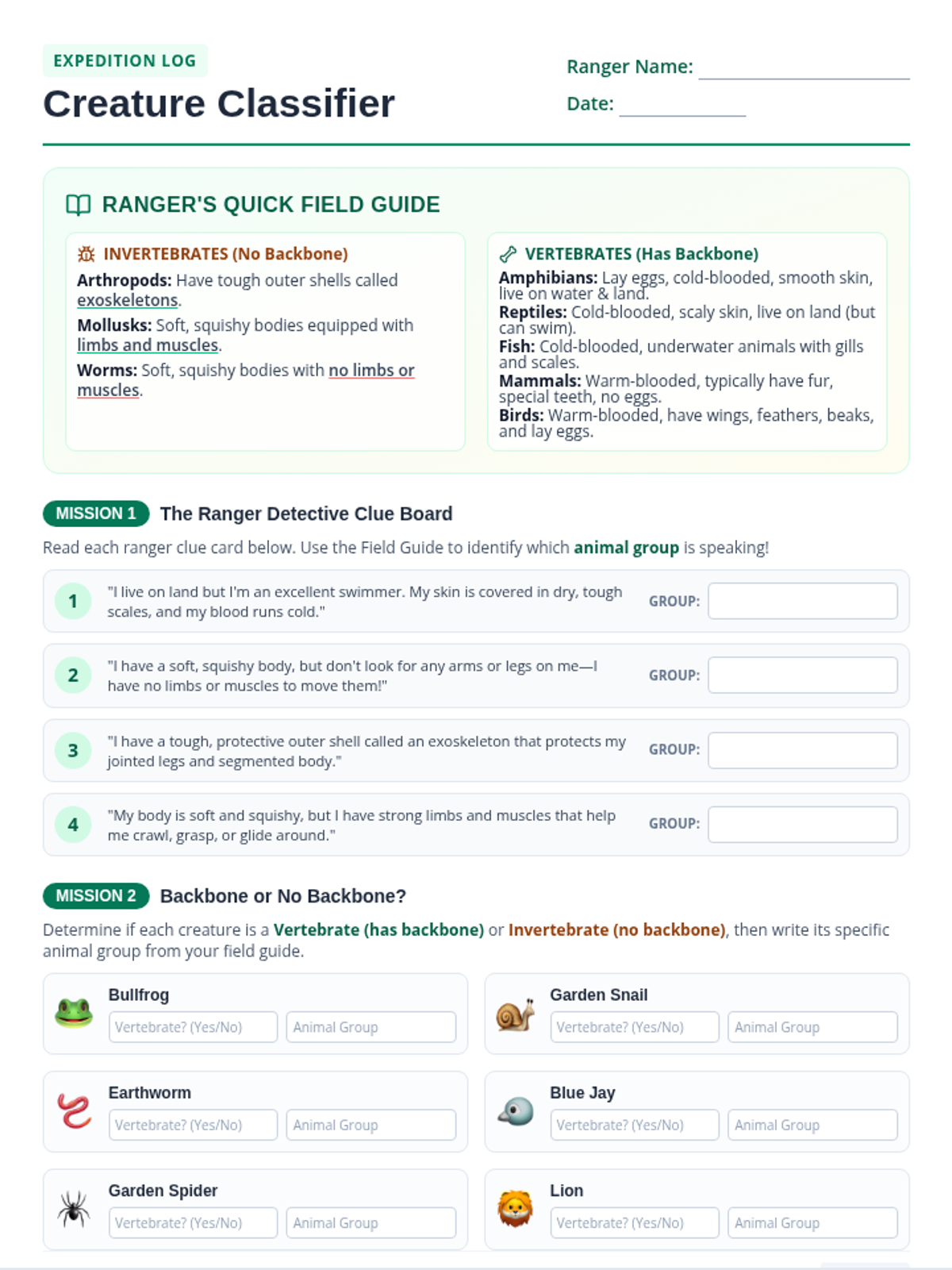
An engaging, 2-page student worksheet centered around animal classification. Features an explorer's notebook theme with a field guide summary, clue-based detective challenges, sorting activities, and a high-creativity design-a-creature lab challenge.