A lab investigation worksheet for students to record predictions and results for luster, magnetism, and conductivity across various everyday objects.
An answer key for the Bone Blueprint labeling worksheet, providing the correct identifying labels for teachers on an anatomically improved skeletal blueprint.
A labeling activity for 3rd graders to identify the skull, rib cage, spine, and femur on a highly detailed, accurate skeletal blueprint.
A museum-themed presentation introducing the skull, rib cage, spine, and femur with fun facts and anatomically accurate custom CSS visuals.
An answer key for the Bone Zone worksheet, providing correct matches, labels, and acceptable reflection answers. Updated to match the latest worksheet structure.
A student worksheet for identifying skeletal functions, labeling major bones, and reflecting on bone health. Updated with elongated limbs and precisely placed indicators for better instructional clarity.
An engaging slide deck for the Bone Zone lesson, featuring bright visuals, key vocabulary, and interactive prompts to teach skeletal functions and major bones.
A concise teacher facilitation guide for the 30-minute Bone Zone lesson, including a detailed timeline, materials list, and helpful teaching tips.
Teacher answer key for the Tree Tenant Worksheet, including expected animal names, habitat descriptions, and sample reflection responses.
A visual presentation introducing 8 tree-dwelling animals, their specific habitats (nests, hollows, branches), and why trees are essential for their survival.
A student worksheet for identifying 8 tree-dwelling animals and describing their specific habitats within the tree.
A detailed two-page field guide featuring "notebook-style" observations of 12 subterranean animals, focusing on their scientific observations and underground nesting habits.
A coloring sheet featuring the 12 subterranean animals in a grid format with large labels for coloring and literacy practice.
Updated page of 12 animal cards for cutting out, now including larger den-dwelling and nesting animals like foxes, badgers, and rabbits.
Updated landscape worksheet with 12 spots for animals that live in tunnels, dens, or nests beneath the soil.
An educator's guide for the Sabertooth Secrets lesson, including a full answer key and instructional notes on Smilodon fatalis.
A student worksheet designed to be used alongside the Sabertooth Secrets presentation, updated to include Smilodon genus and extinction questions.
A visual slide deck about Sabertooth cats, featuring instructional text on biological classification, prehistoric facts, and Smilodon genus specifics with comprehension questions.
A quick formative assessment for the end of the lesson, featuring two identical tickets per page for easy printing. It tests students on layer sequencing, fossil relative dating, and the formation process.
A comprehensive lesson plan for teachers, outlining objectives, materials, and a step-by-step instructional procedure for teaching sedimentary rock formation and fossil sequencing.
A teacher's answer key for the Rock Record Worksheet, providing correct sequencing, explanations for layer relative dating, and evidence for ancient plant life.
A student worksheet for practicing the sequencing of sedimentary rock formation and analyzing fossil layers. It includes a step-by-step ordering task and short-answer questions.
A comprehensive visual presentation covering the definition of sedimentary rocks, the four-step formation sequence, and the concept of relative dating using rock layers and fossils.
An educational anchor chart illustrating the four-step sequence of sedimentary rock formation and the concept of fossil age layers. It features a field-journal aesthetic with clear visual diagrams of rock stratification.
A simplified reading passage about periodical cicadas adapted for 3rd-grade readers, maintaining key science vocabulary and homework formatting while removing the original questions.
A 3rd-grade adapted homework worksheet about periodical cicadas, reformatted to match the visual style of the original 6th-grade PDF. Includes all specific vocabulary words and two pages of content with adapted reading level. No "3rd grade" label included as requested.
A 3rd-grade adapted homework worksheet about periodical cicadas, reformatted to match the visual style of the original 6th-grade PDF. Includes all specific vocabulary words and two pages of content with adapted reading level.
An answer key for the Cicada Invasion Homework, providing correct responses and exemplar explanations for teachers based on the 3rd-grade adapted content.
A quick exit ticket for the Grumble Guts lab to assess student understanding of mechanical vs chemical digestion and organ roles.
A digestive system mapping activity where students label and color the organs, including a simplified version for students who need more visual support.
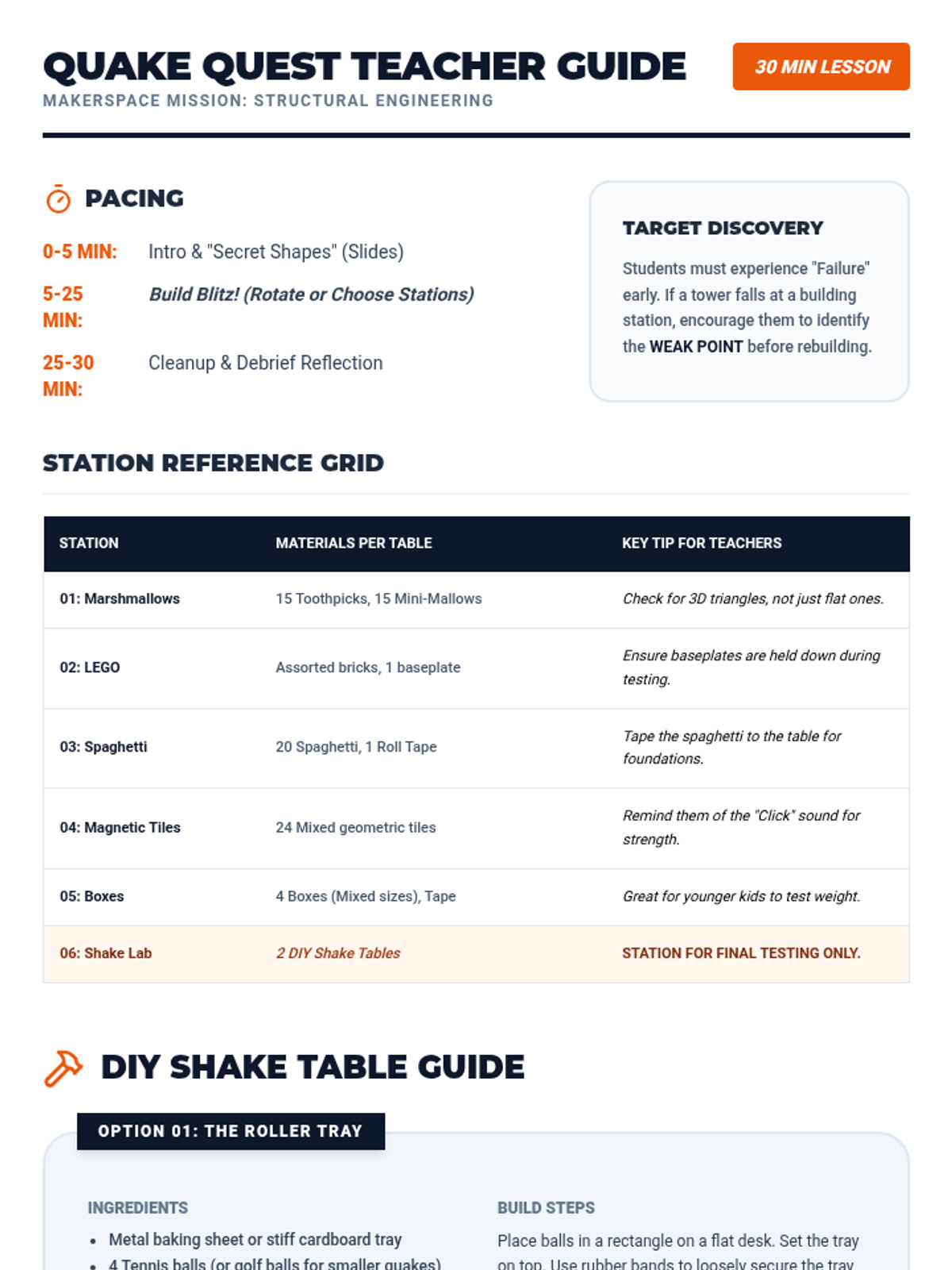
A comprehensive teacher guide for the Grumble Guts lab, featuring a detailed 60-minute pacing guide, materials list, answer keys, and sensory-focused teaching tips for diverse learners.
A pictorial lab observation sheet for students with significant intellectual disabilities, focusing on visual steps and simple 'small vs big' recognition.
A guided lab worksheet for the Grumble Guts experiment, featuring organ matching (including intestines, liver, and gallbladder), a step-by-step procedure, and observation areas for modified learners.
A visual presentation for the Grumble Guts lab, introducing the concepts of mechanical and chemical digestion, helper organs (liver/gallbladder), and guiding students through the cracker-and-bag simulation.
A teacher resource for the Ecosystem Explorers lesson, including instructional pacing, differentiation strategies, and a full answer key for the Detective Worksheet. Designed with a clean, professional layout for easy reference.
A field-journal styled worksheet for students to apply their knowledge of ecosystems. Includes identification matching, component categorization, a habitat sketching area, and a reflective writing prompt on biodiversity.
A visual presentation introducing the concept of ecosystems, focusing on forest, desert, and ocean biomes. Includes key vocabulary, characteristics of different ecosystems, and the importance of biodiversity.
A set of 12 printable vocabulary cards featuring key ecosystem terms and definitions. Each card includes a clear definition, a thematic icon, and a specific ecosystem category, designed with a clean field guide aesthetic.
A visual anchor chart comparing the 'Mystery Drink' metaphor to the reality of computer viruses, designed as a classroom reference for safe downloading practices.
A creative comic strip template where students illustrate a character facing an online 'Mystery Download' to demonstrate their understanding of malware risks and permission-seeking behavior.
Visual slide deck for classroom instruction, featuring the '5 Internet Safety Tips' video, an analysis of the 'Mystery Drink' metaphor, and guidelines for the comic strip activity.
A comprehensive teacher facilitation guide for the Virus Metaphor lesson, including learning objectives, a detailed pacing guide, and strategic video pause points for classroom discussion.
A reference word list for students to identify the schwa sound in common multisyllabic words, accompanied by a reflective 'Captain's Log' writing activity.
A comprehensive teacher guide for the Schwa Shipwreck game, featuring instructional objectives, game flow instructions, troubleshooting tips, and a detailed master word list with schwa locations for easy verification.
A nautical-themed battleship game board for practicing multisyllabic schwa words. Optimized as a single-page printable, it features larger player and opponent grids (cell height increased to 105px per row) while ensuring the 8-slot log fits on the same page with much more horizontal space for handwriting.
A homework worksheet for the Spider Silk Science lesson. Includes three varied questions and a short answer response about "runner" silk, encouraging students to refer back to their workbooks.
A revised student workbook for the Spider Silk Science lesson, now including the missing 'Do Now' and 'Spider Offspring' sections. Diagrams have been updated to more accurately reflect the specific 'puzzle piece' shapes from the curriculum while maintaining a 3rd-grade reading level.
Updated Teacher Guide reflecting the expanded workbook sections including Do Now and Spider Offspring. Includes updated instructional steps and answer keys for the 3rd-grade reading level adaptation.
A set of 12 printable task cards featuring sensory scenarios and questions to encourage discussion and critical thinking about the five senses.
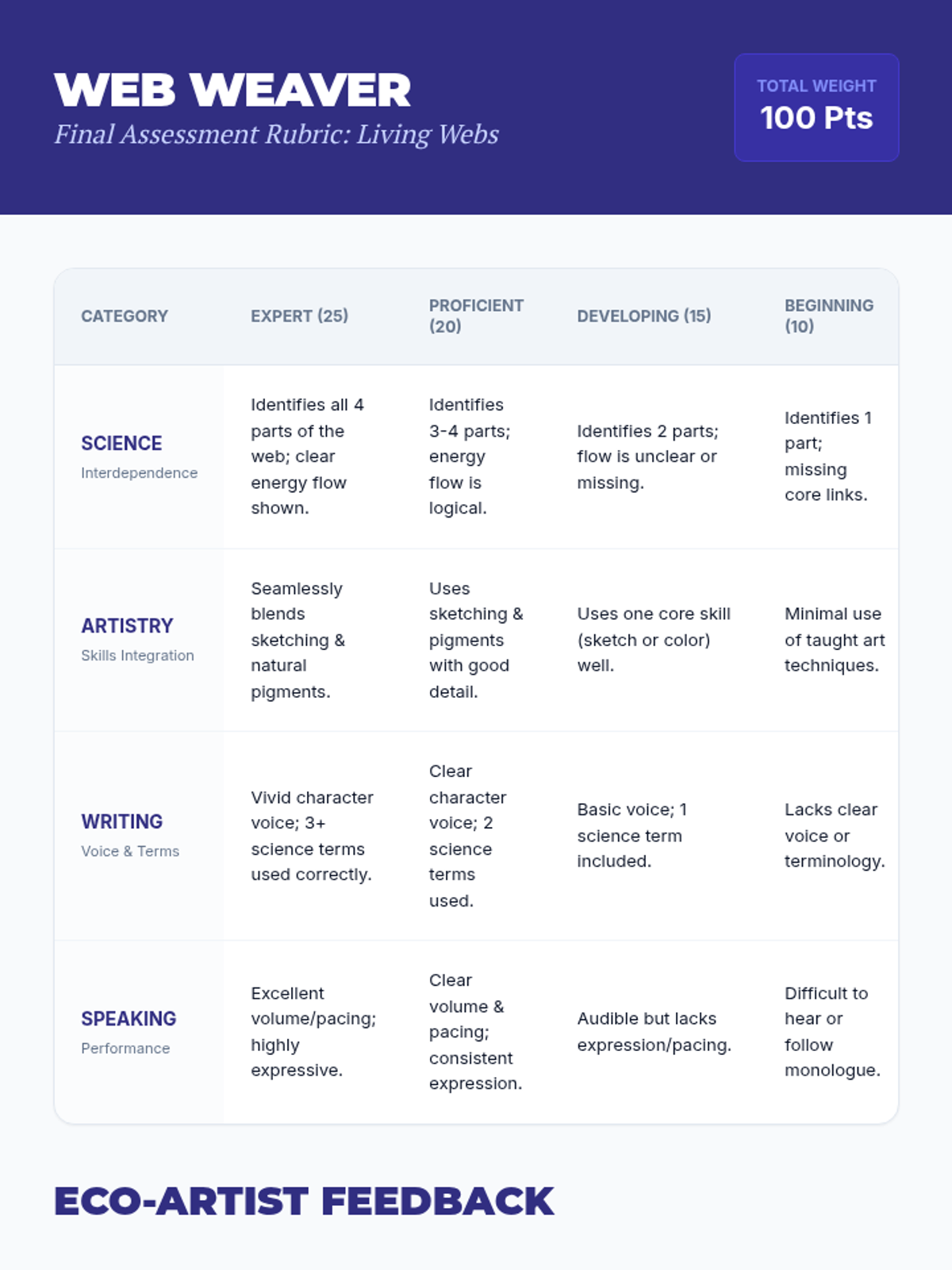
A comprehensive teacher rubric for evaluating student performance on the Sensory Superpowers informational text and quiz, featuring clear criteria and scoring levels.