Teacher guidance for the Lesson 3 mapping activity, helping students transition from abstract yarn webs to real-world physical infrastructure like cables and wires.
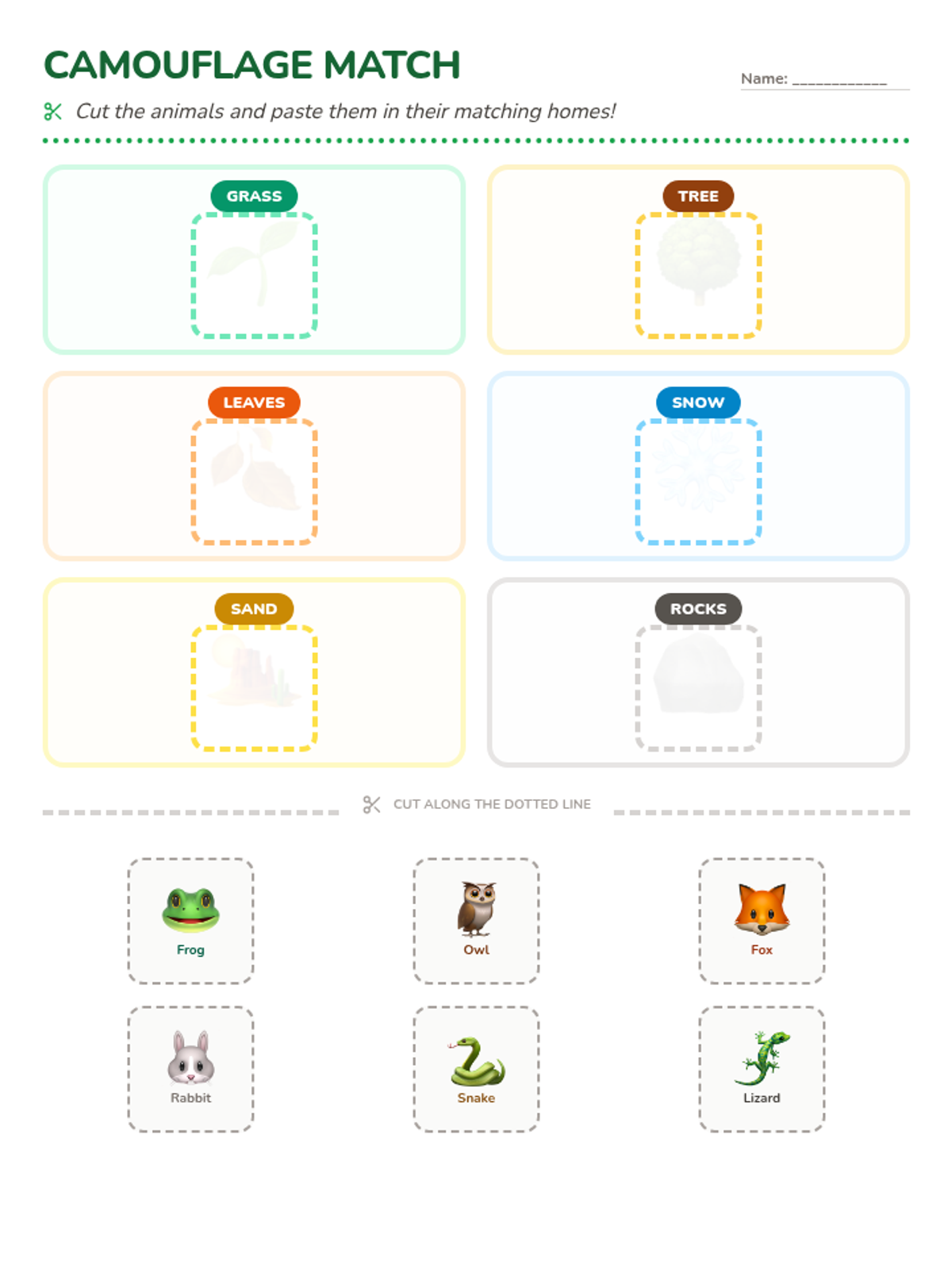
A cut-and-paste activity for kindergarten students to match animals to their camouflaged habitats. Revised to fix logical matches and improve visual patterns.
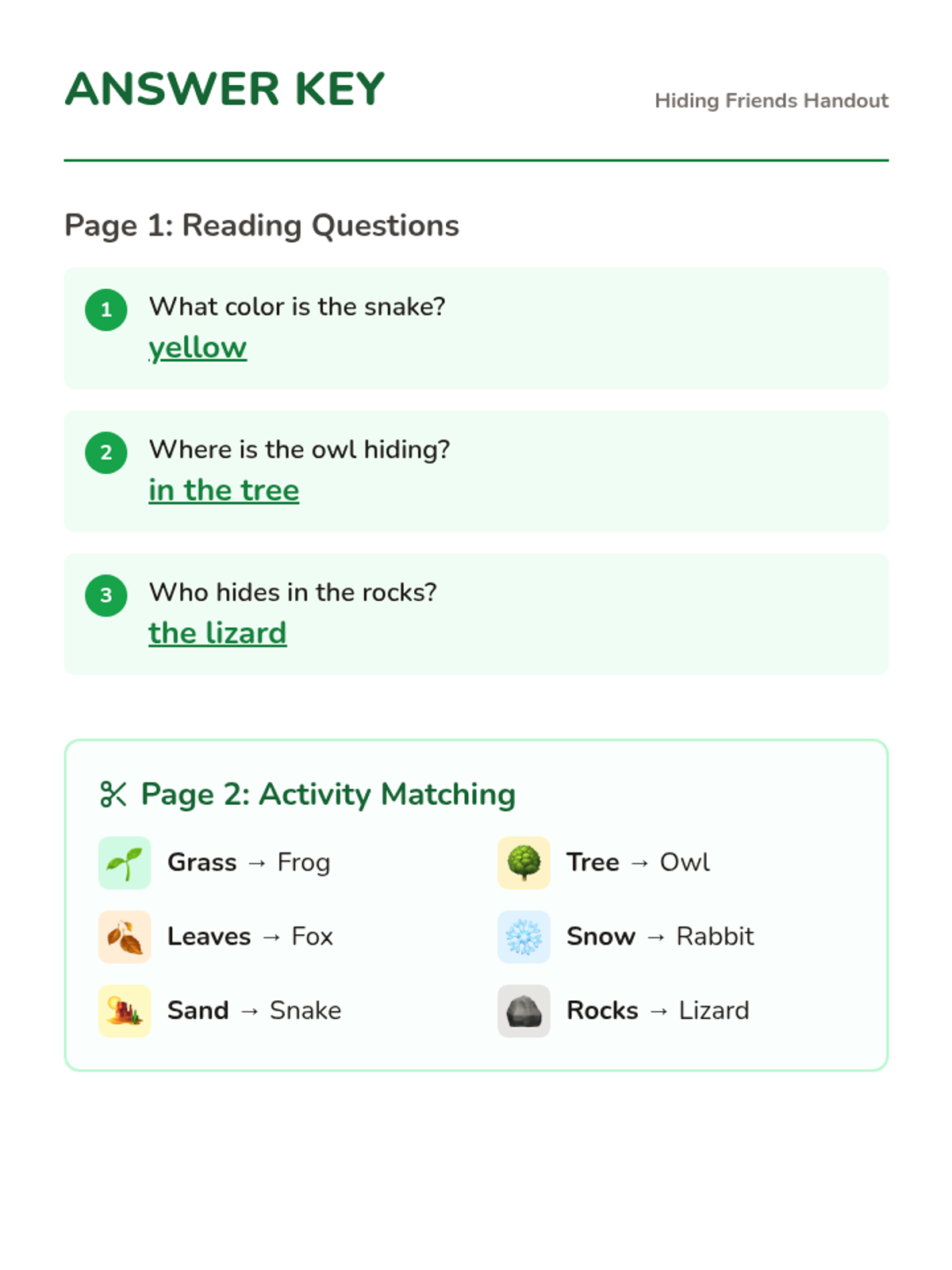
Teacher answer key for the Hiding Friends handout.
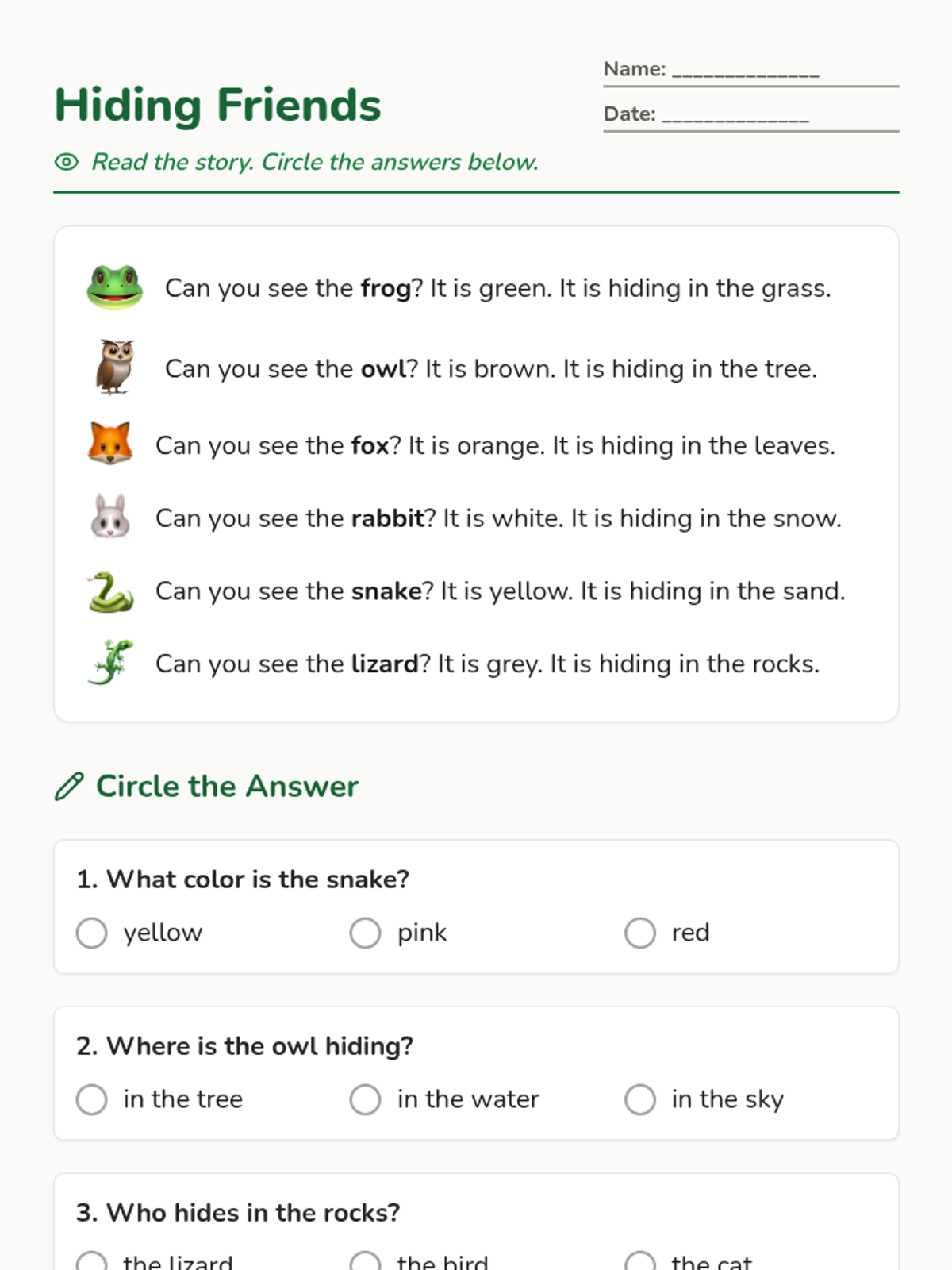
A kindergarten reading passage about camouflage with comprehension questions. Fits on a single page. Revised for answer choice uniformity and alignment.
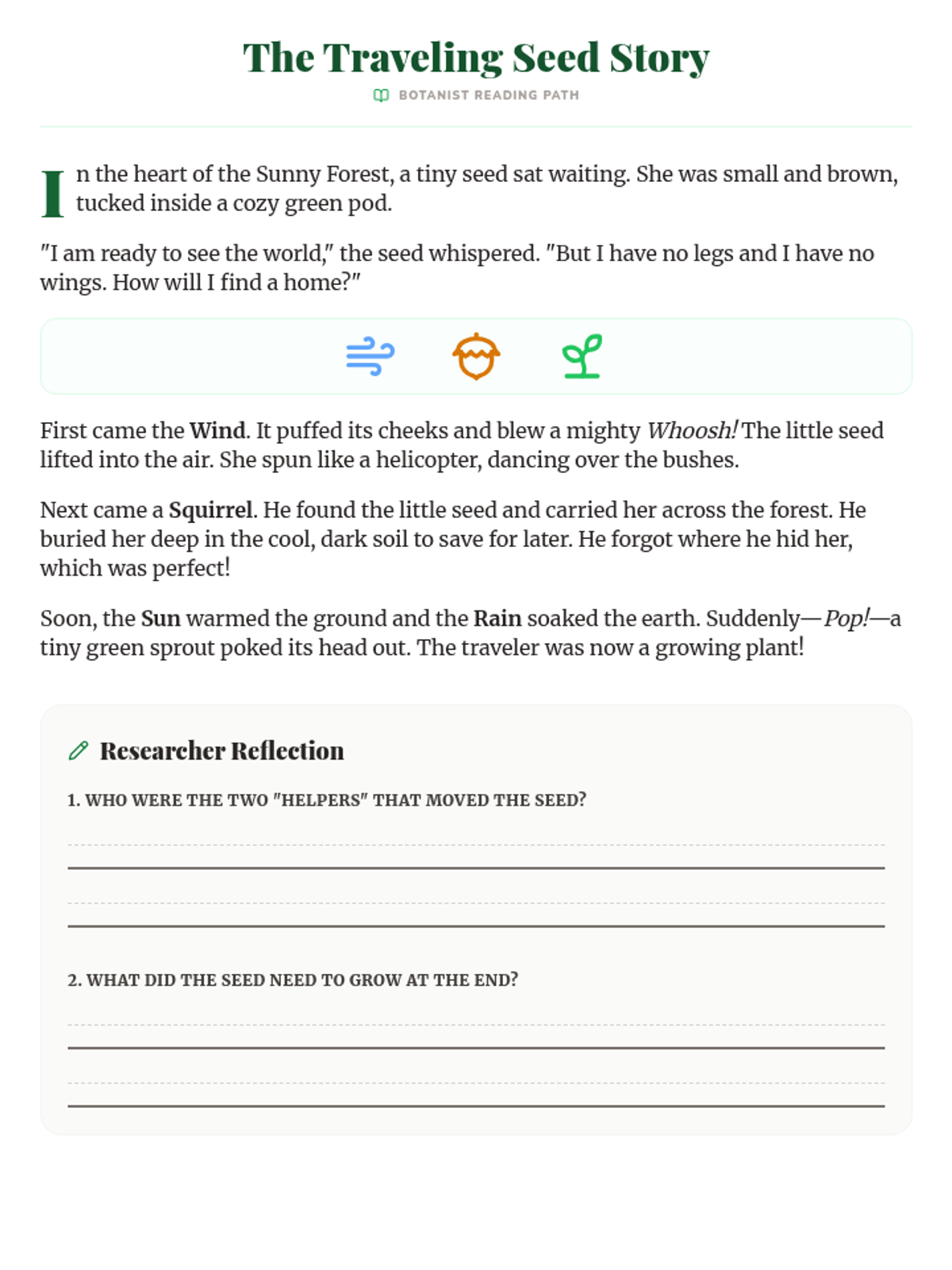
A reading passage about a seed's journey. Revised to fit a single page, provide massive handwriting spaces for young learners, and use clean Lucide icons.
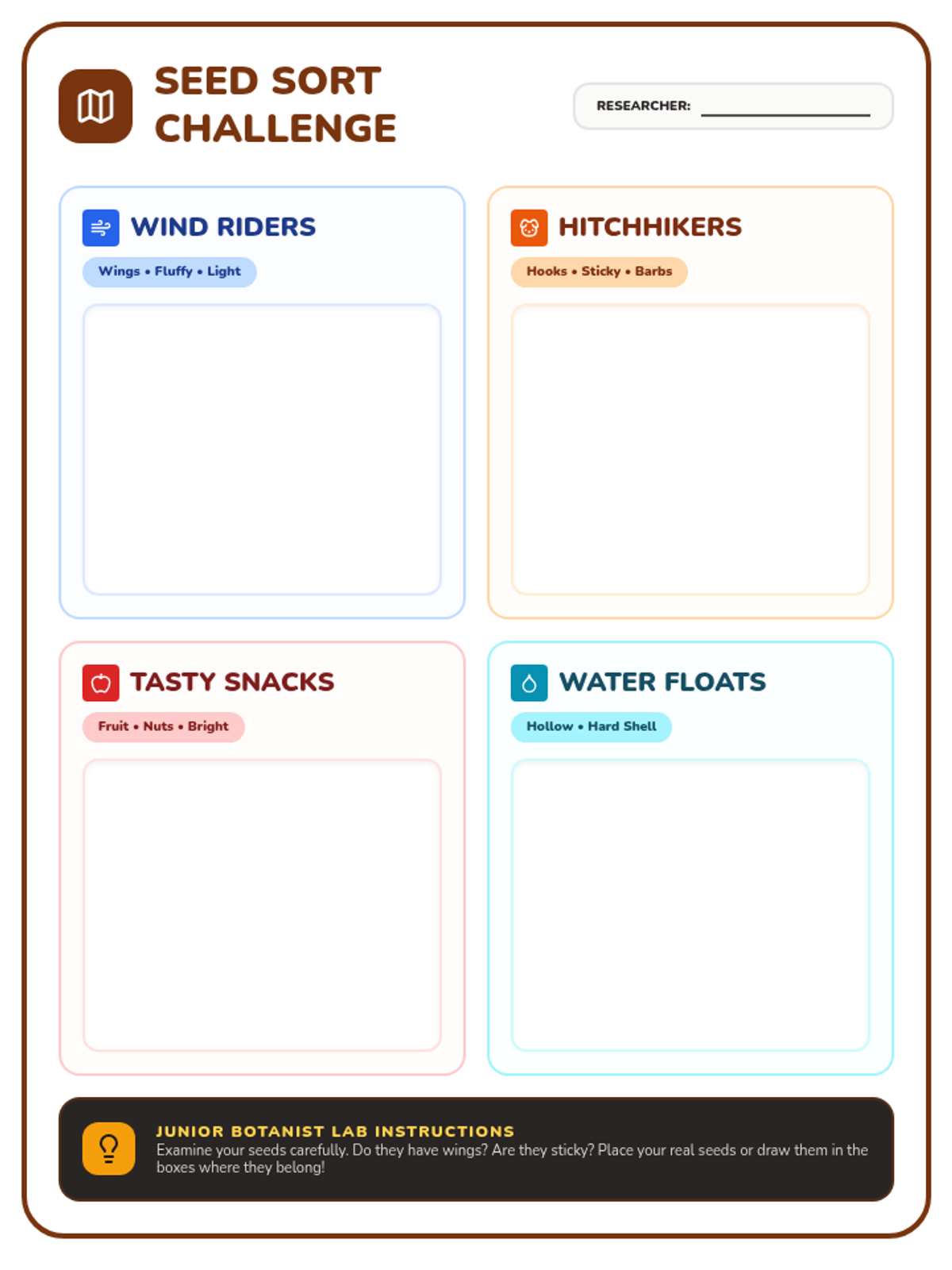
A hands-on sorting mat for students to categorize seeds. Revised for single-page print optimization, improved text contrast, and consistent work areas.
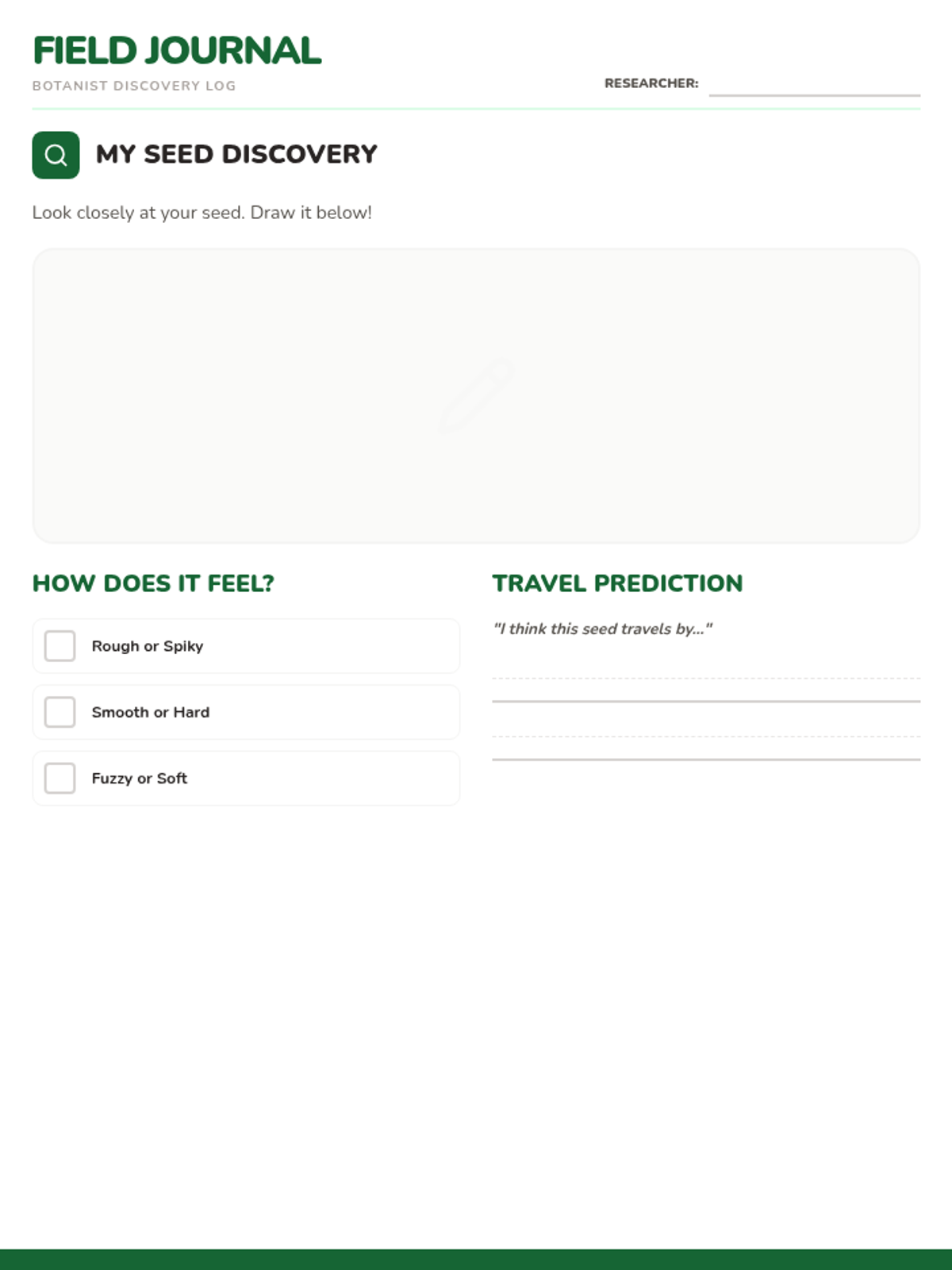
A student-facing field journal for recording seed observations and growth predictions. Revised with optimized printable layout, larger writing areas, and improved legibility for young students.
A visual presentation for students that explains the different ways seeds travel (wind, animals, snacks) and identifies the three essential conditions for plant growth (sun, water, soil). Revised with larger visuals and improved legibility.
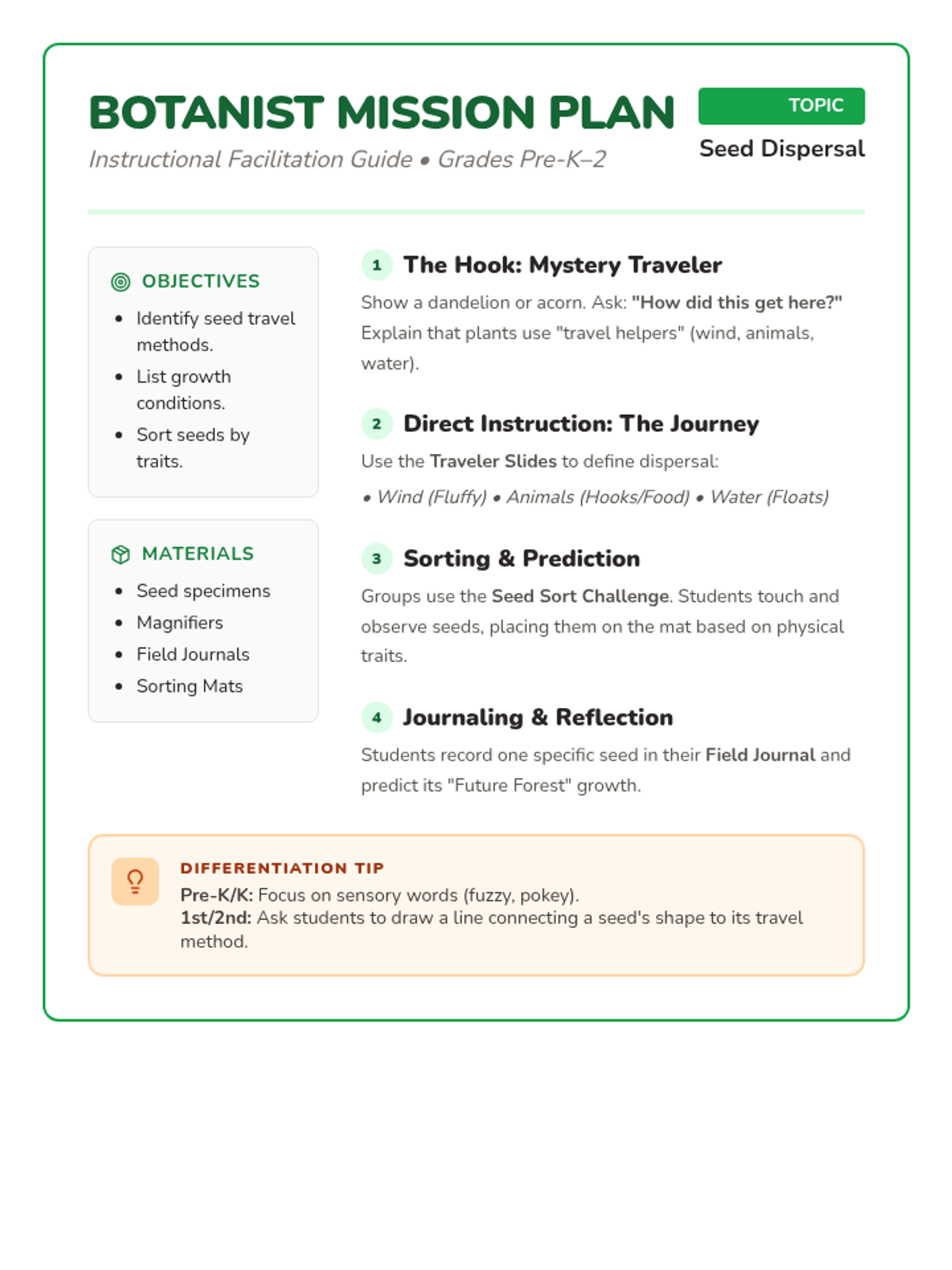
A comprehensive teacher's guide for 'The Great Seed Journey' lesson, including learning objectives, material lists, and a step-by-step instructional flow for exploring seed dispersal and plant growth. Revised for single-page layout.
A high-contrast visual presentation about stars and space exploration tools, designed to be accessible for students with diverse learning needs.
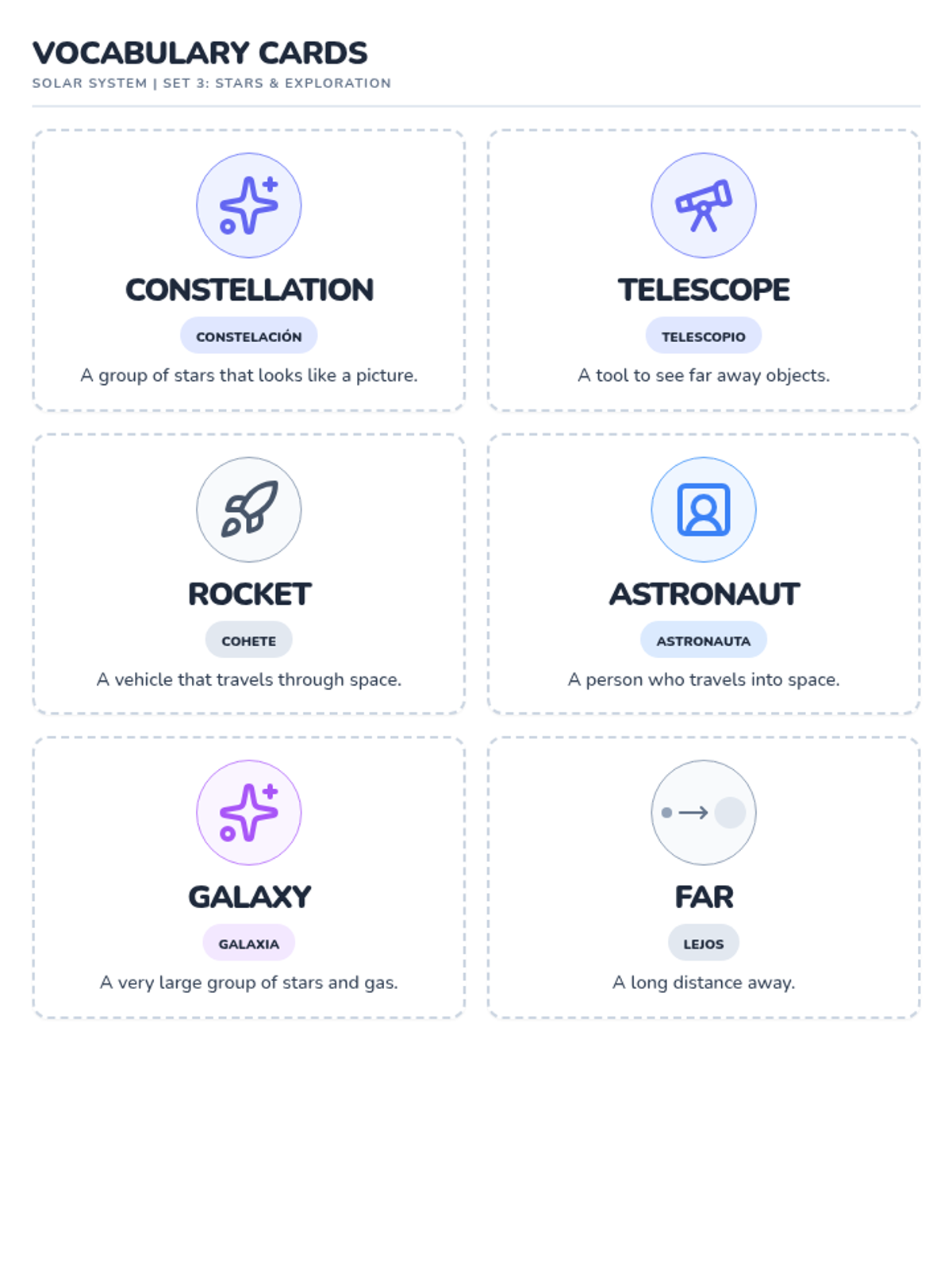
Vocabulary cards for stars and space exploration, featuring bilingual labels and simple definitions to assist newcomers and students with special needs.
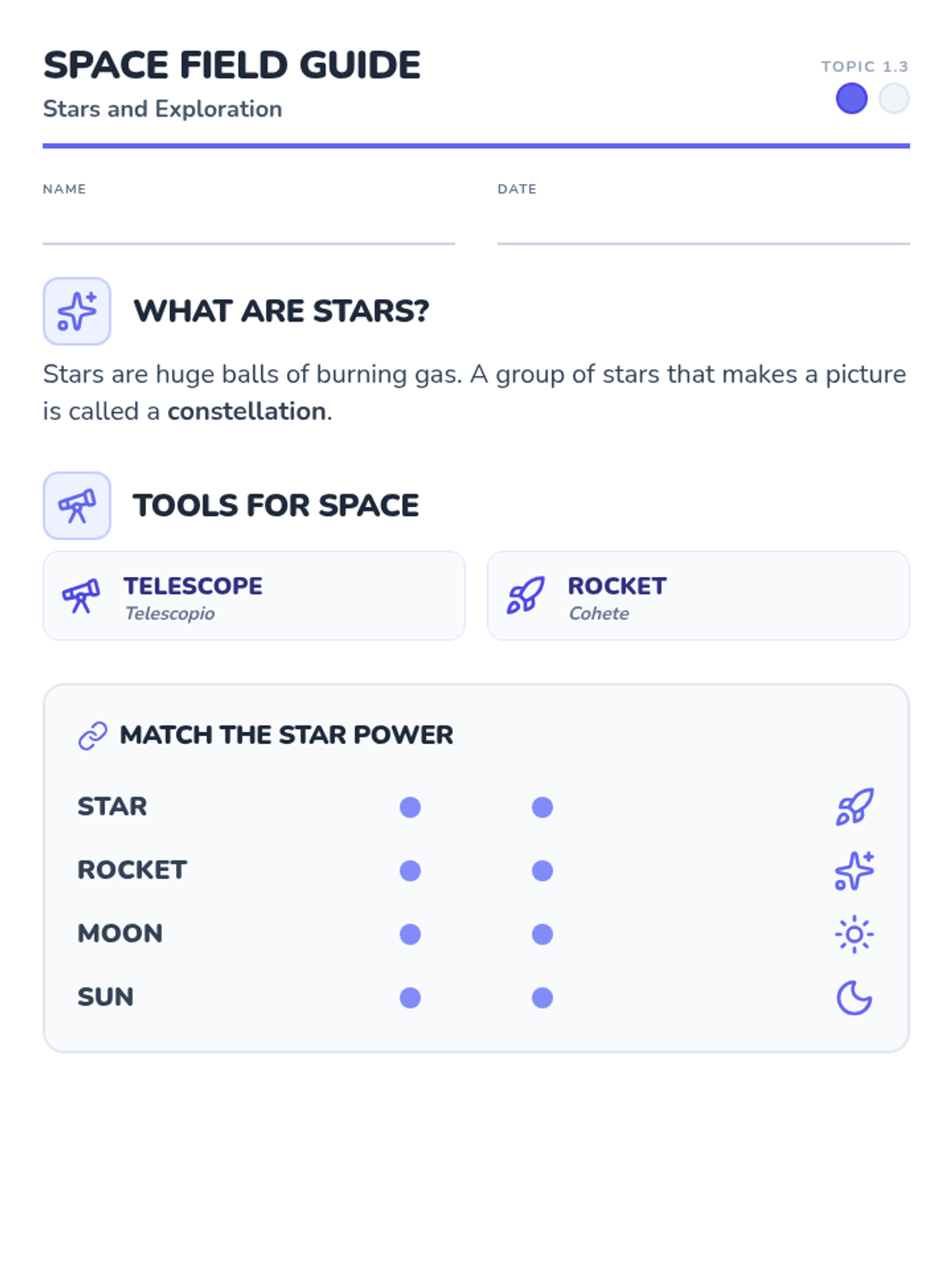
A simplified reading passage about stars, telescopes, and rockets with matching activities for students with cognitive differences.
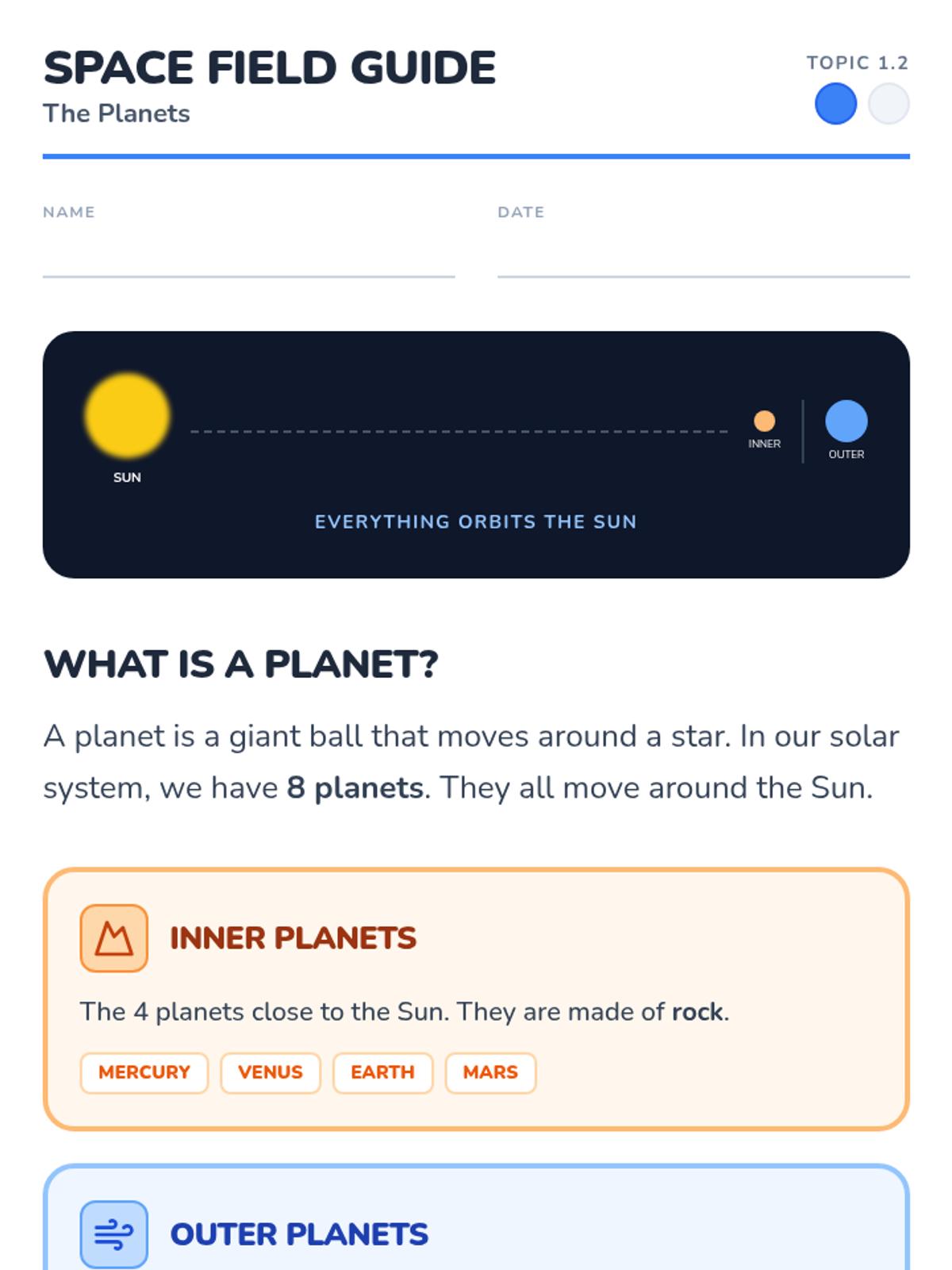
Visual presentation for the planets lesson, illustrating the differences between rocky inner planets and gas giant outer planets with clear graphics and large text.
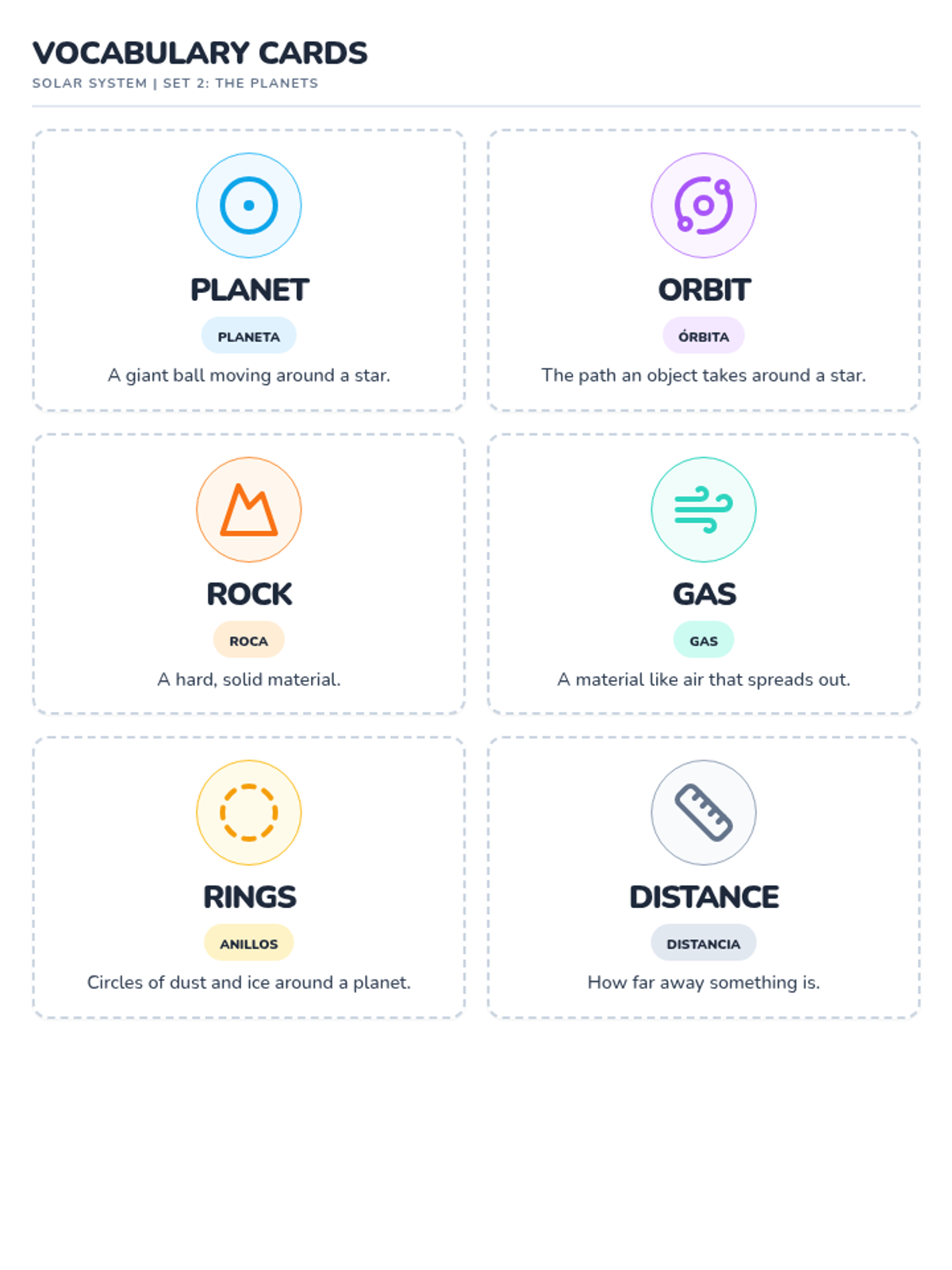
Vocabulary cards focusing on planetary concepts like orbit, rock, and gas, with bilingual support and simplified definitions.
A simplified reading passage about the eight planets, divided into inner rocky planets and outer gas giants, designed for students with lower reading levels.
Highly visual presentation slides for the Sun and Moon, featuring large text and bold icons to support newcomers and students with special needs.
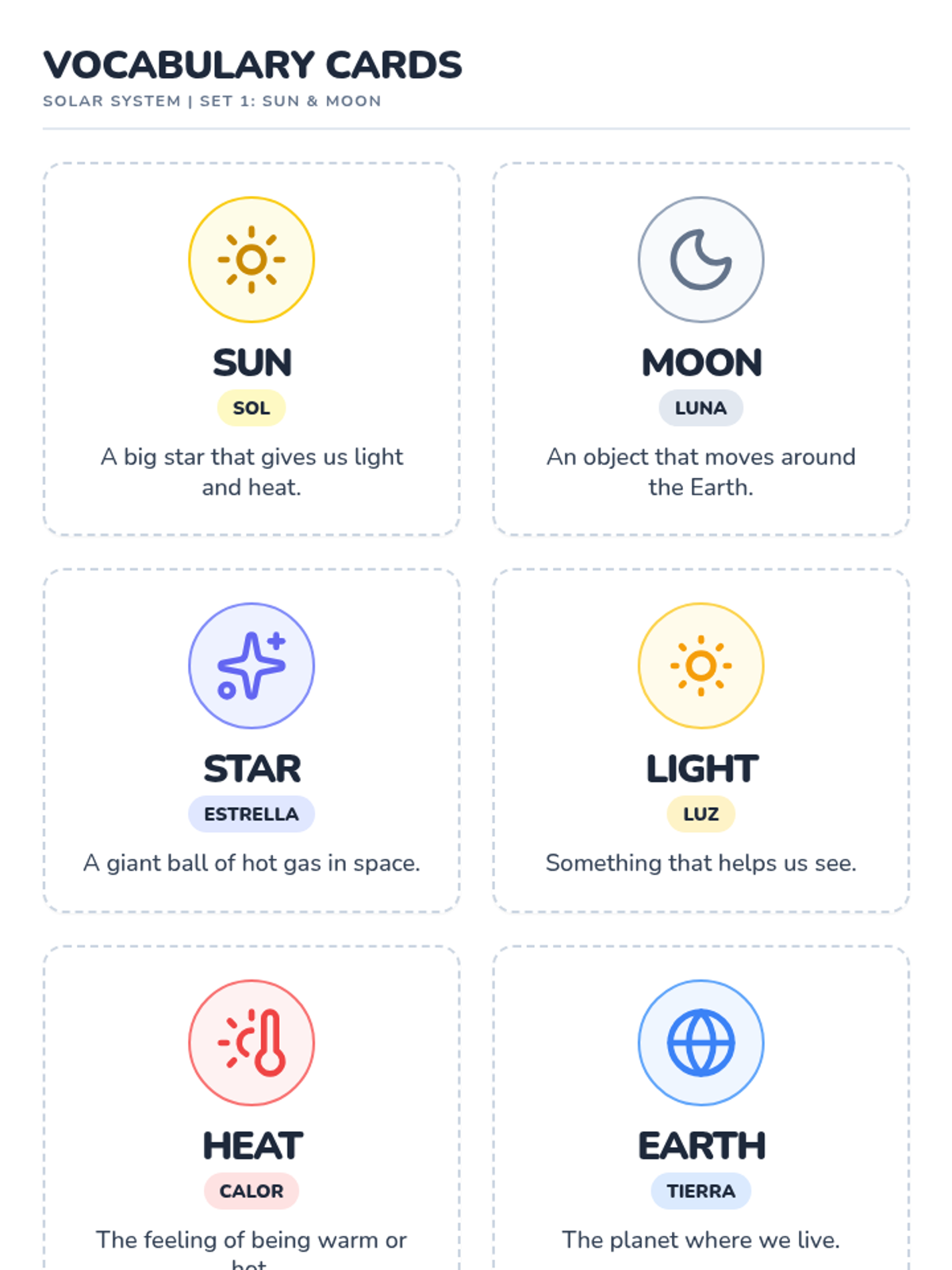
Visual vocabulary cards for the Sun and Moon lesson, including Spanish translations for newcomers and simplified definitions for IEP students.
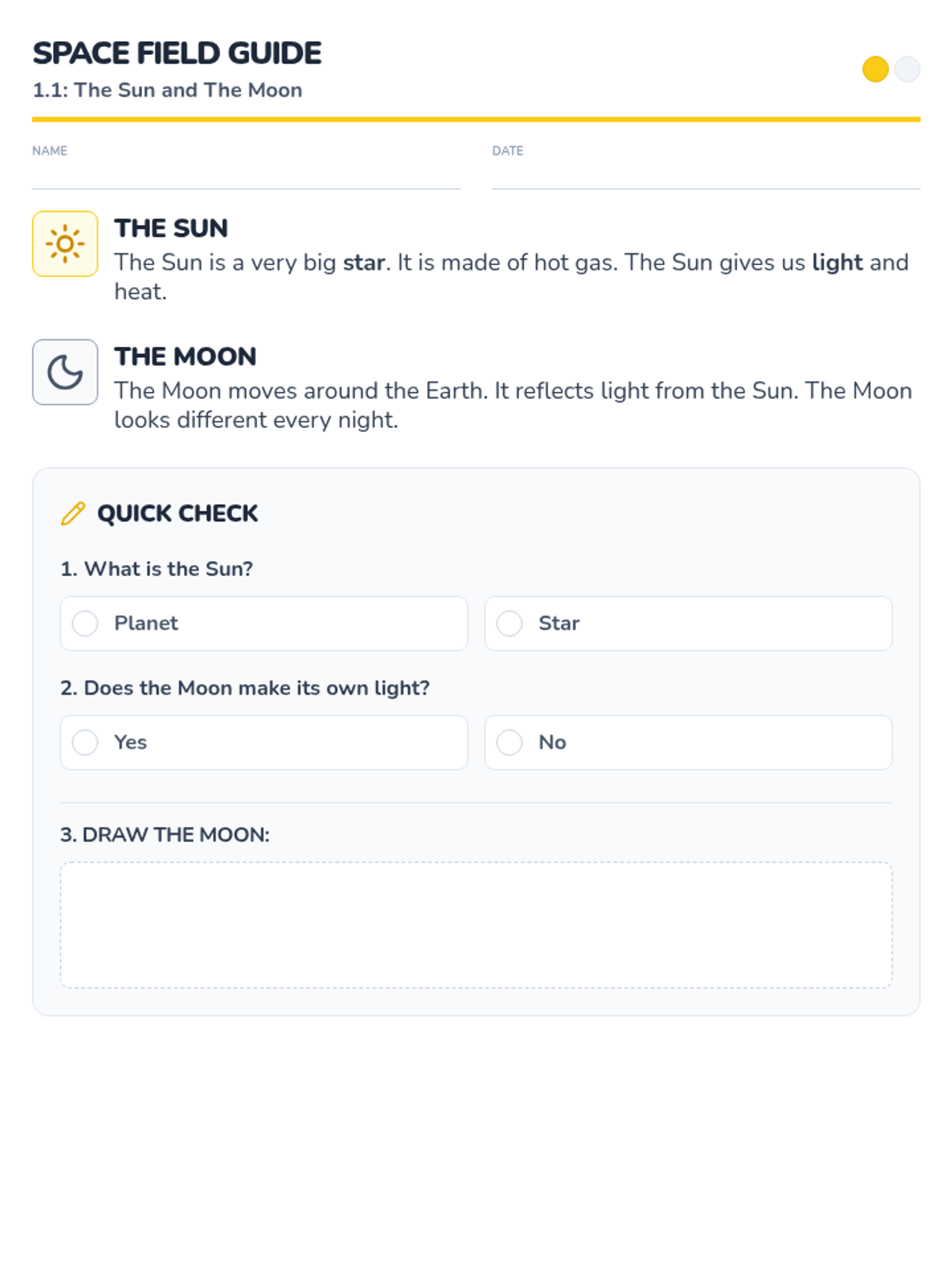
A simplified reading passage about the Sun and Moon with large text, visual icons, and simple comprehension questions for students with reading difficulties.
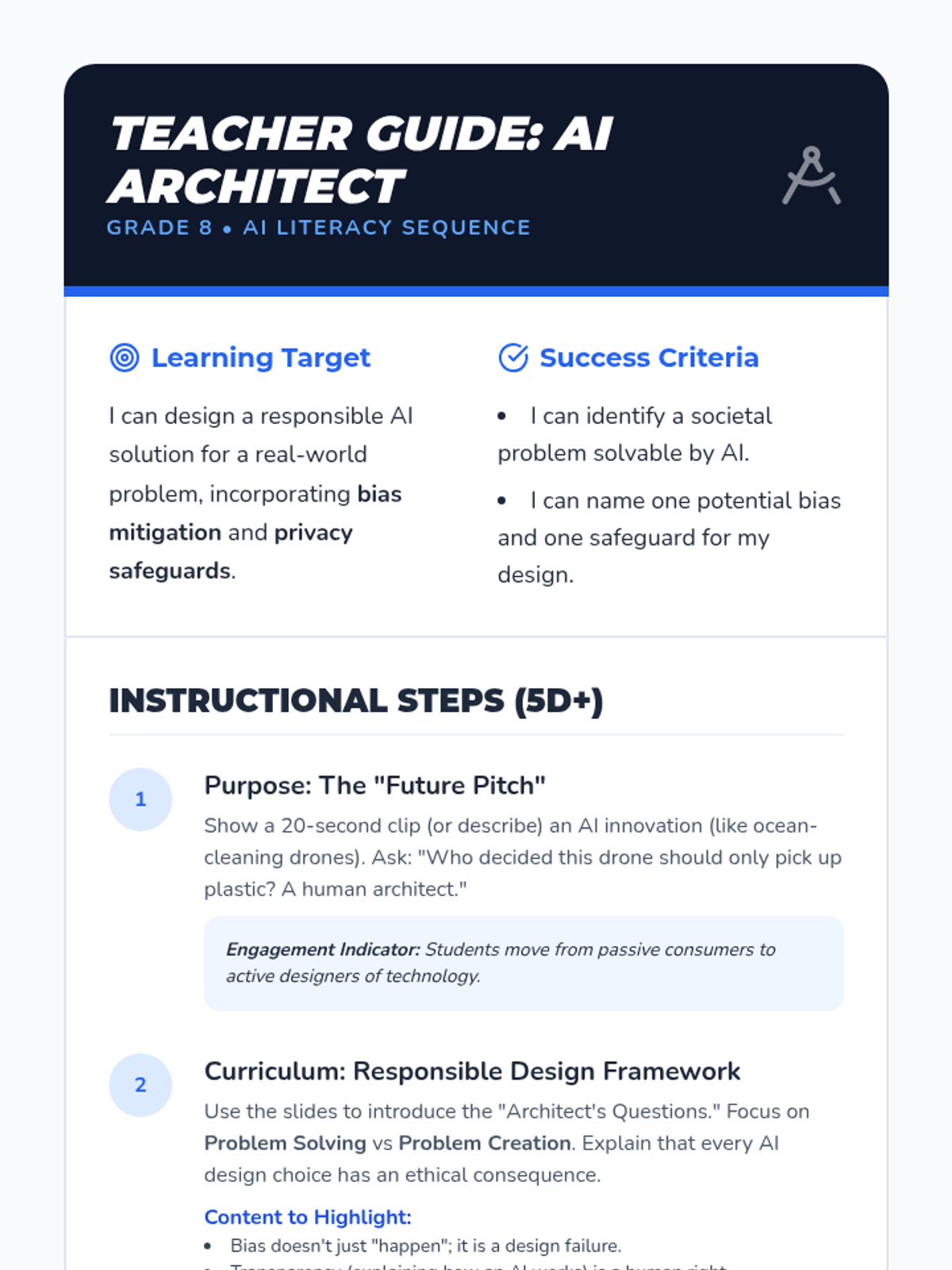
A teacher guide for the culminating Grade 8 AI Literacy lesson. Includes instructional steps for facilitating a "Design Studio" project, 5D+ framework alignment, and strategies for peer-led ethical audits.
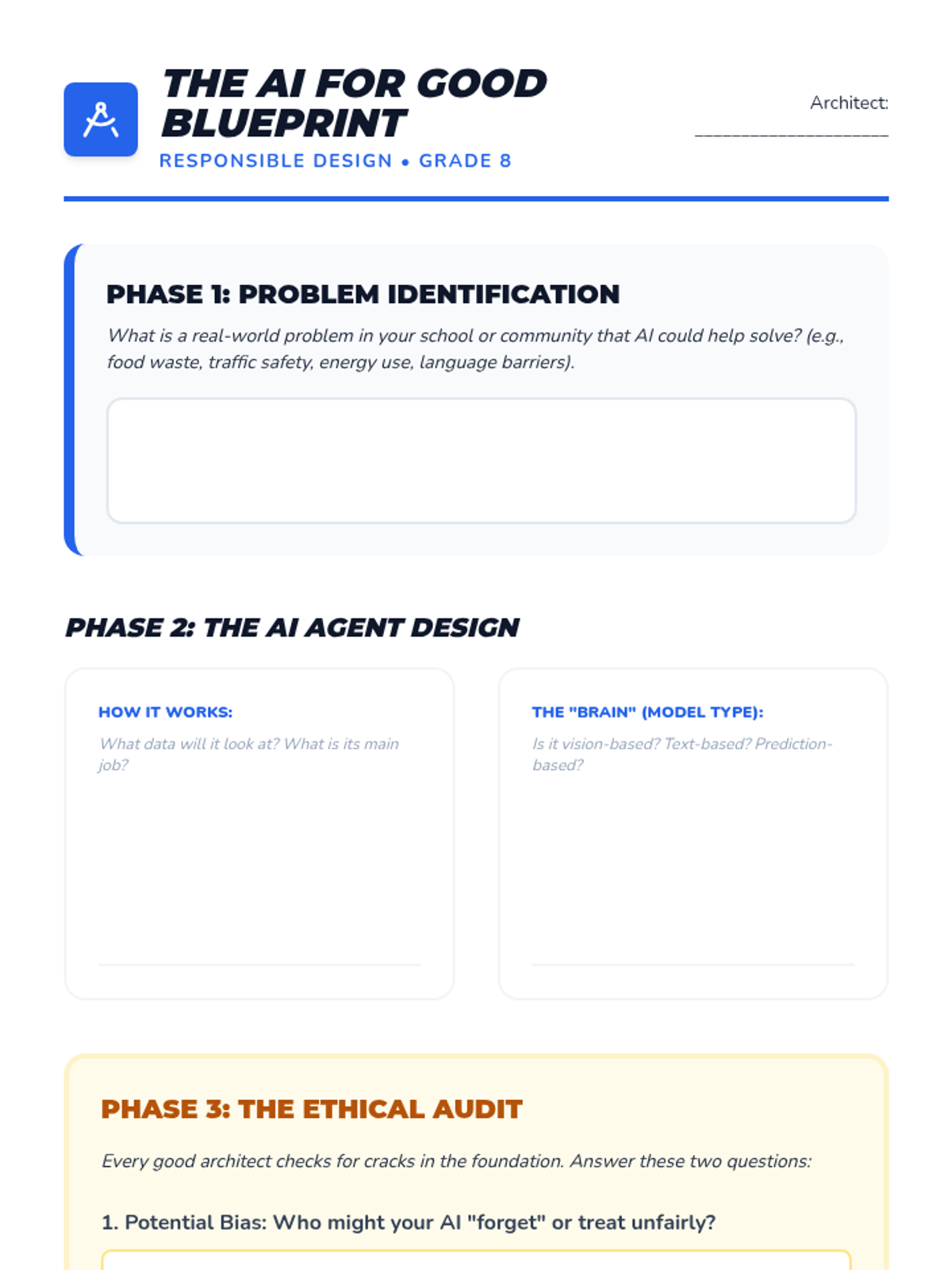
A project blueprint for Grade 8 students to design a responsible AI solution for a real-world problem. It includes sections for problem identification, technical design, an ethical audit (bias and safeguards), and a creative motto.
A 6-slide presentation for 8th Grade students on responsible AI design. It encourages students to move from consumers to creators ("Architects") and outlines a framework for designing AI solutions that are fair, transparent, and safe.
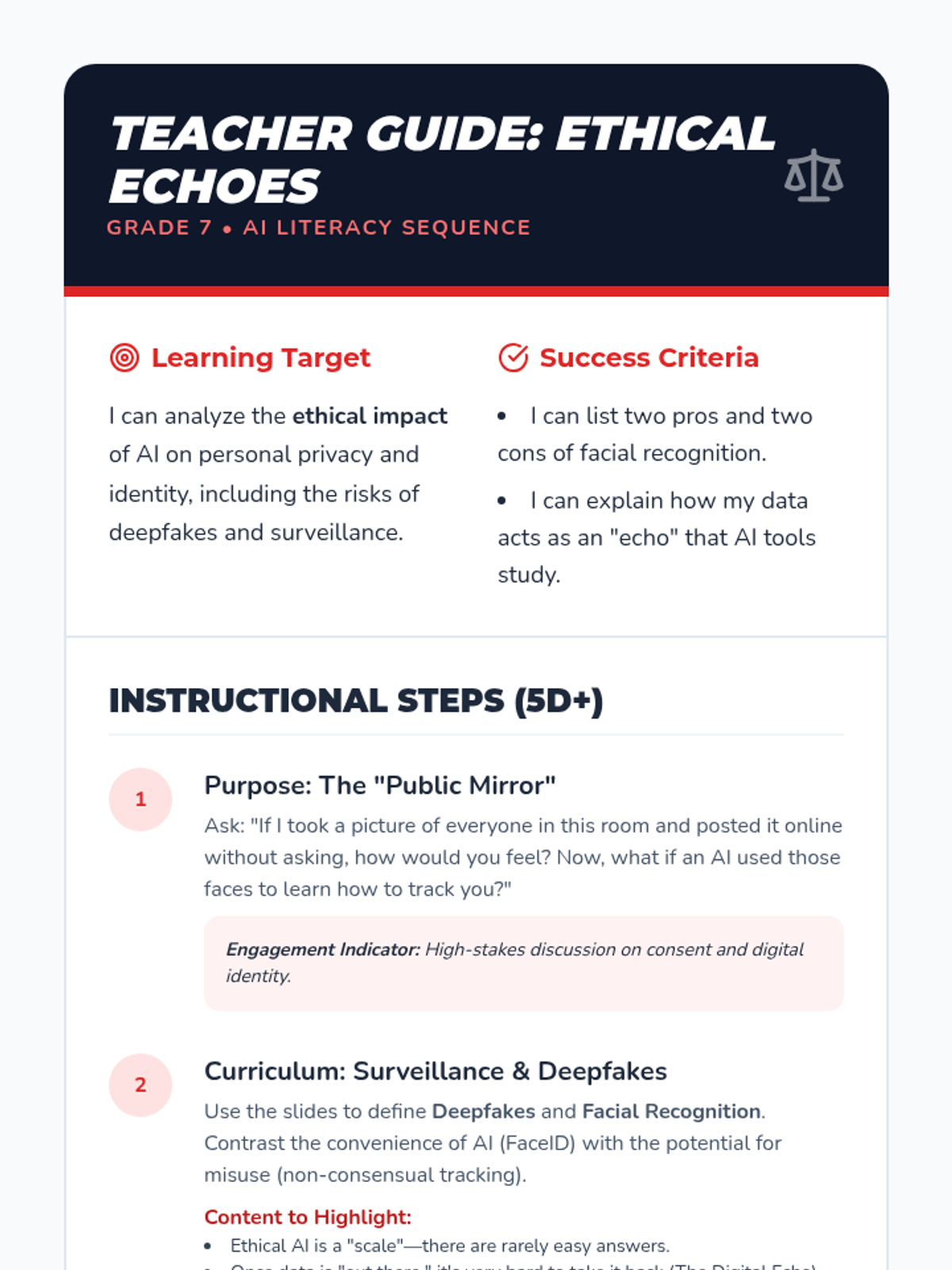
A teacher guide for the Grade 7 AI Literacy lesson on ethics and privacy. Includes instructional steps for facilitating debates on surveillance, alignment with 5D+ framework, and strategies for teaching deepfake awareness.
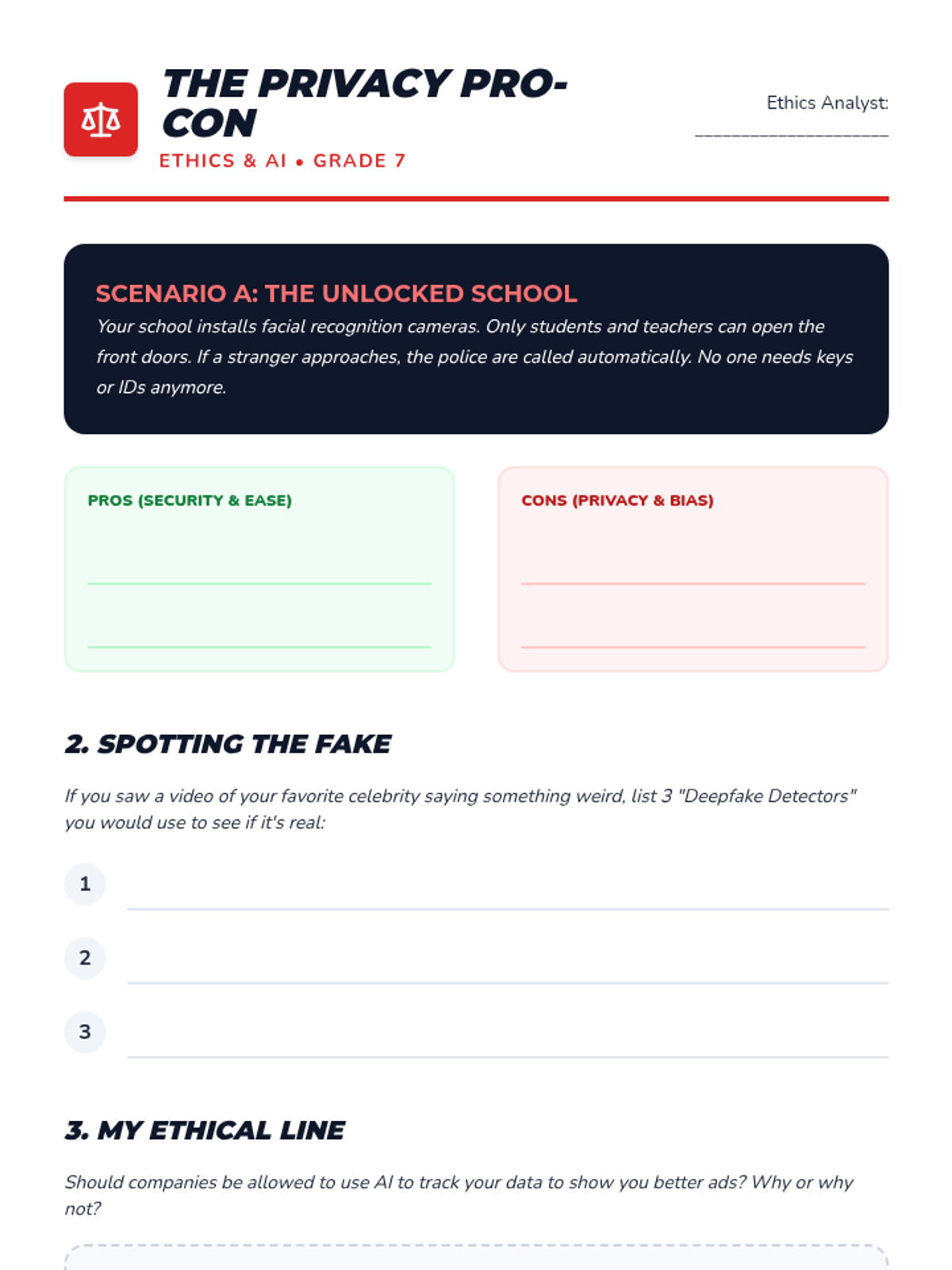
A worksheet for Grade 7 students to explore AI ethics. It includes a pro-con analysis of facial recognition in schools, strategies for detecting deepfakes, and a reflective exercise on personal data privacy boundaries.
A 6-slide presentation for 7th Grade students on AI ethics and privacy. It covers facial recognition, deepfakes, and the trade-off between security and personal privacy, encouraging students to consider where "the line" should be drawn.
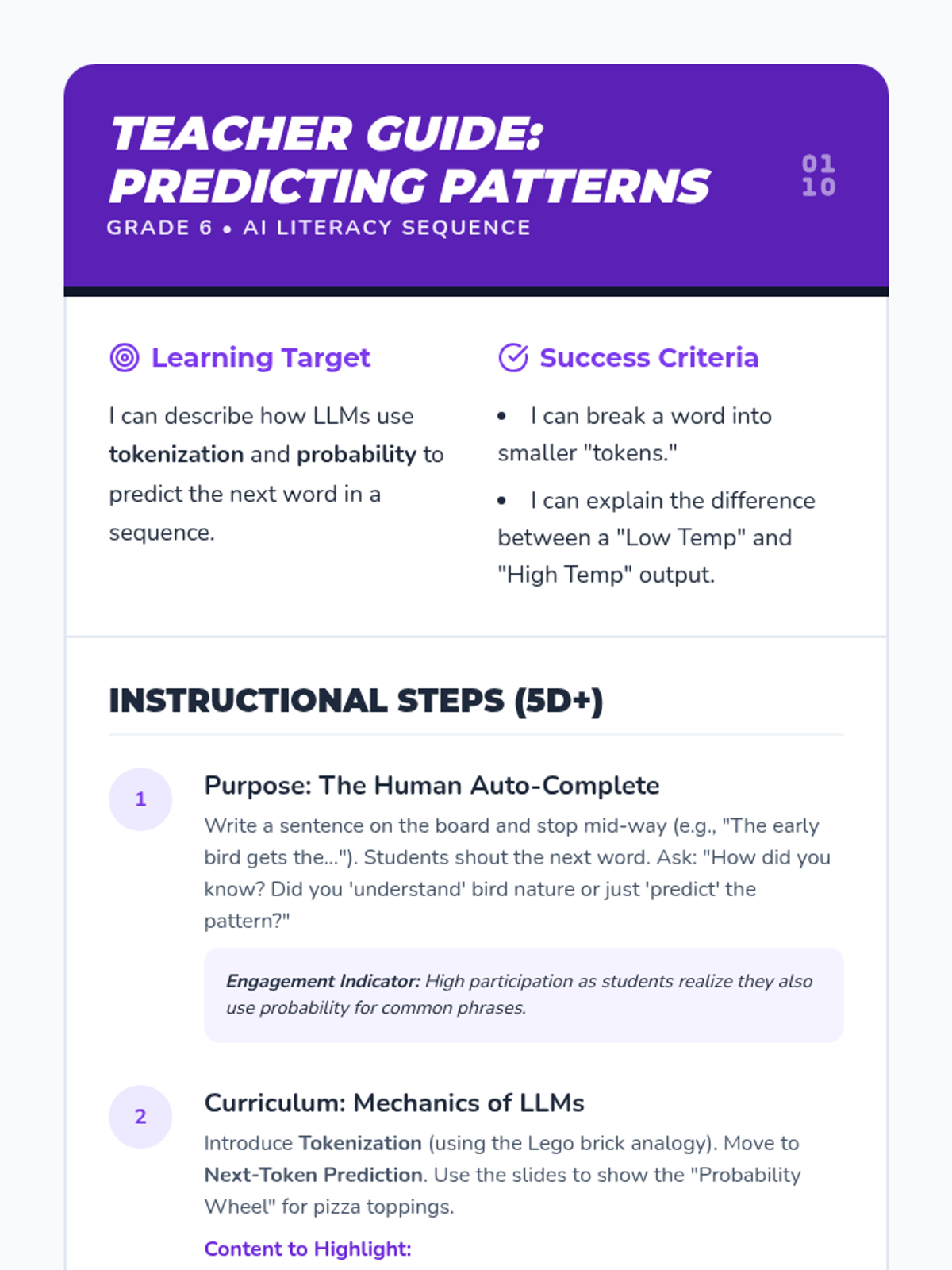
A teacher guide for the Grade 6 AI Literacy lesson on LLM mechanics. Includes instructional steps for teaching tokenization and probability, 5D+ alignment, and discussion prompts on AI creativity.
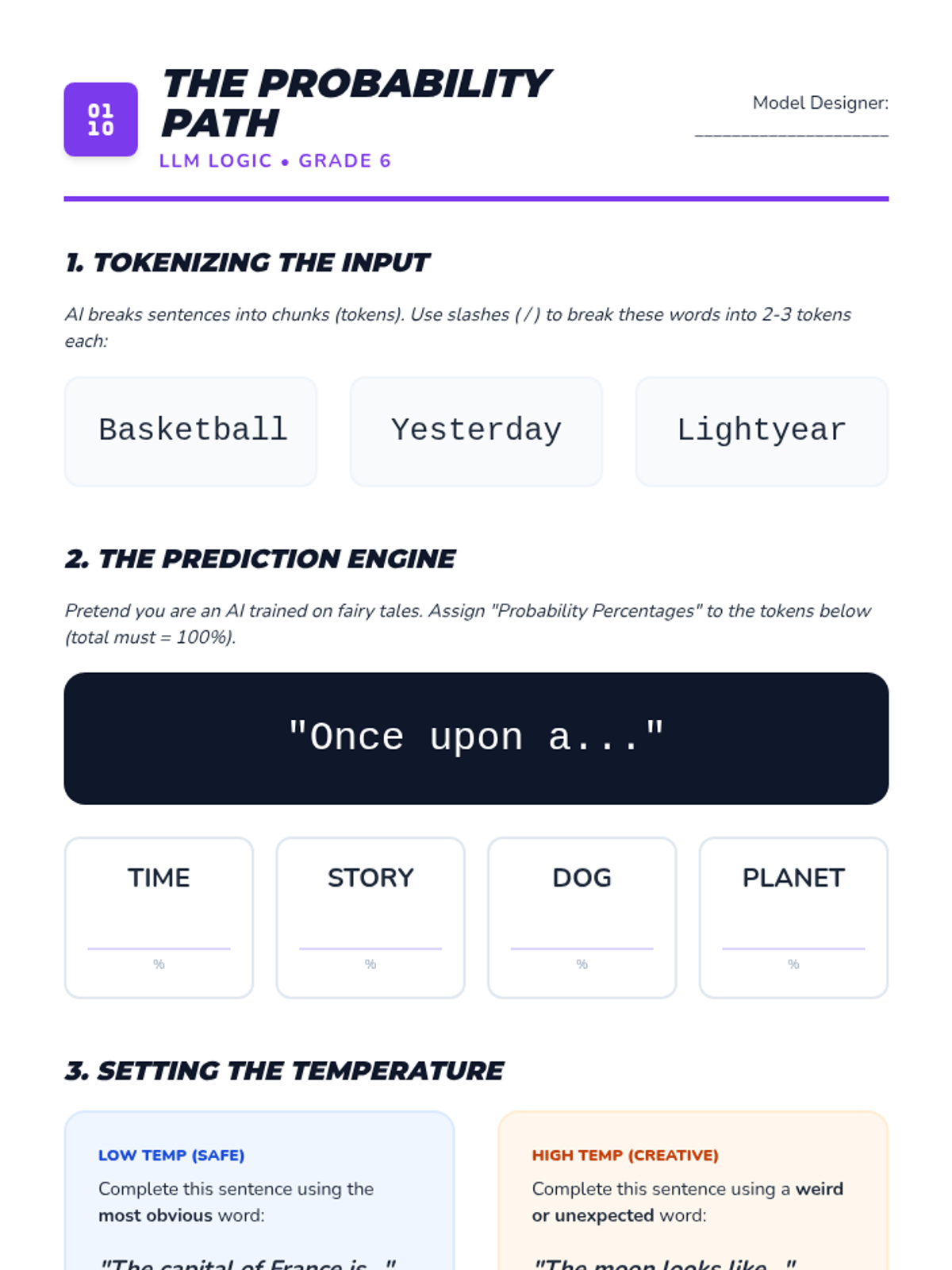
A worksheet for Grade 6 students to practice LLM concepts. It includes exercises on tokenization, assigning probabilities to word predictions, and experimenting with "temperature" settings for safe vs. creative outputs.
A 6-slide presentation for 6th Grade students on the mechanics of LLMs. It explains tokenization, next-word prediction based on probability, and the "temperature" setting that balances precision with creativity.
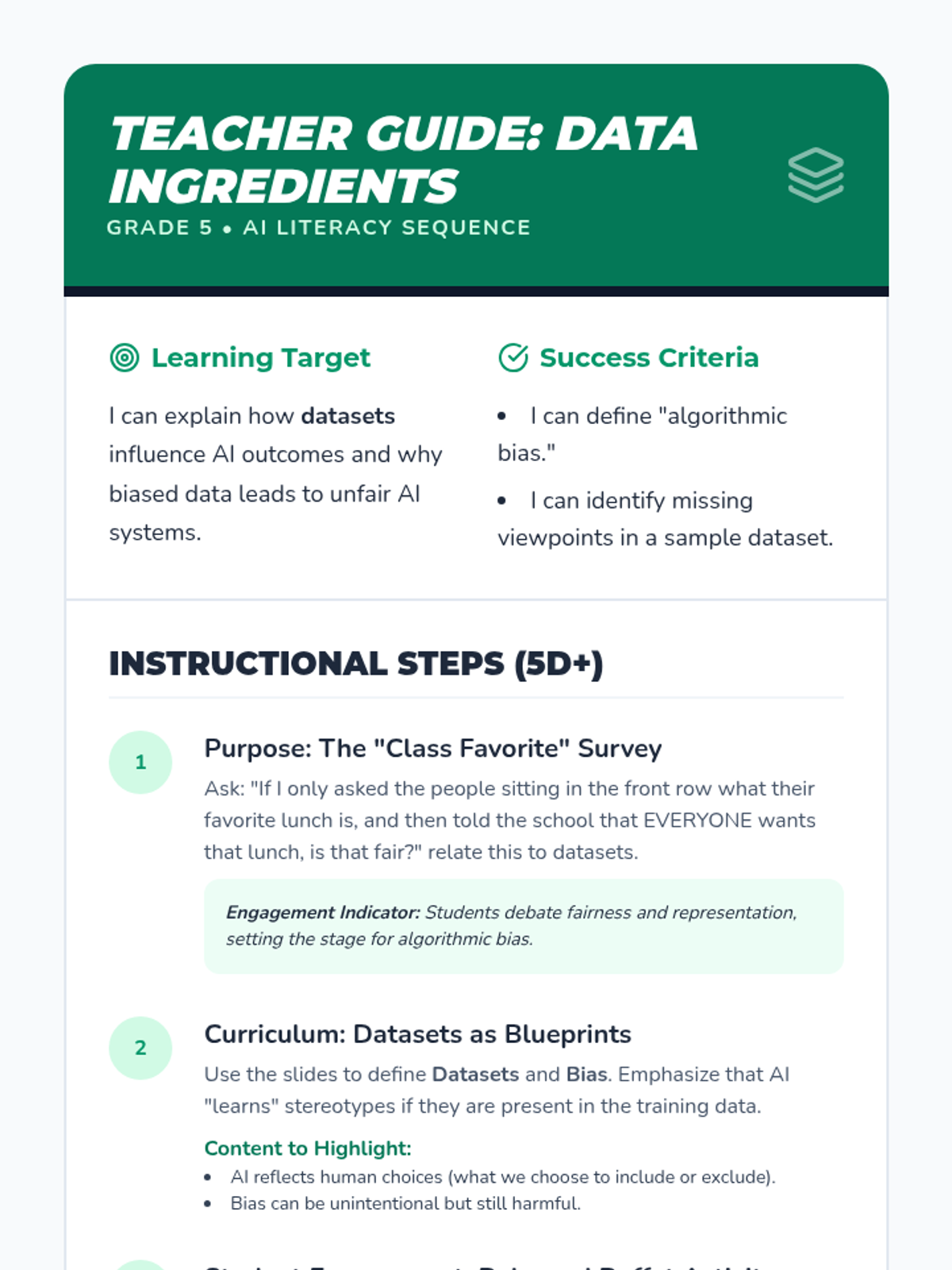
A teacher guide for the Grade 5 AI Literacy lesson on datasets and bias. Includes instructional steps aligned with 5D+, key discussion points on algorithmic fairness, and guidance for the "Balanced Buffet" activity.
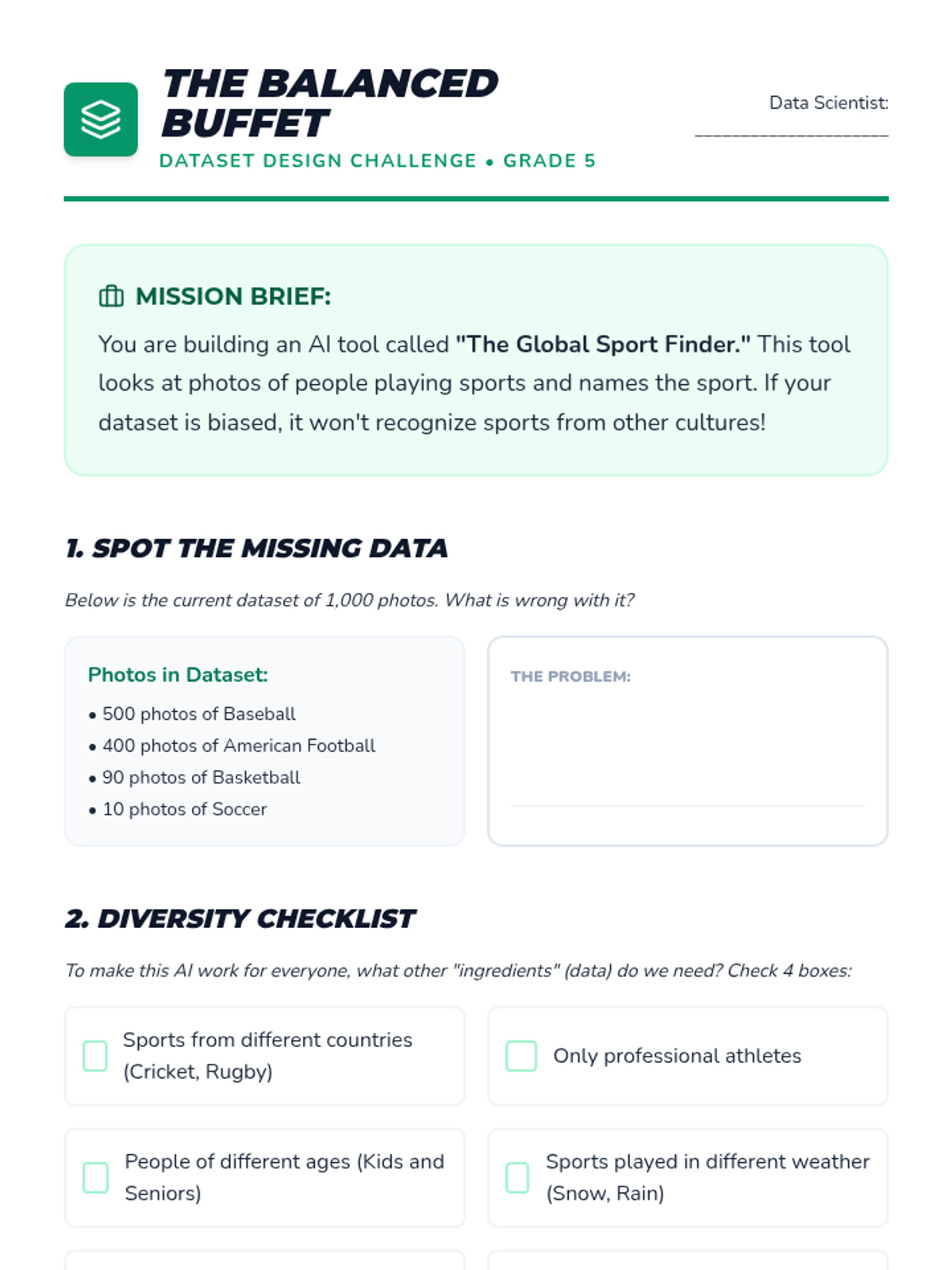
An activity for Grade 5 students to explore dataset bias and fairness. It includes a case study on a sports recognition AI, a diversity checklist for data collection, and a creative section for designing a more equitable dataset.