A slide deck to guide the Radical Log Lab lesson, featuring a warm-up, embedded video instruction with pause points, and instructions for the group activity.
A quick, high-impact exit ticket for 3rd-grade students to demonstrate mastery of multiplication and division concepts using arrays. Includes a student self-reflection component.
A 3rd-grade math worksheet for SPED/Tier 2 students focused on using arrays to solve multiplication and division problems. Features clear visual supports, bold headers, and ample space for student work.
A high-contrast visual slide deck designed for 3rd-grade SPED/Tier 2 students, illustrating the difference between rows and columns and demonstrating how arrays represent both multiplication and division.
A teacher facilitation guide for the Array Architects lesson, providing a 20-minute instructional sequence, SPED-specific scaffolding strategies, and lesson objectives aligned with TEKS 3.4F and 3.4G.
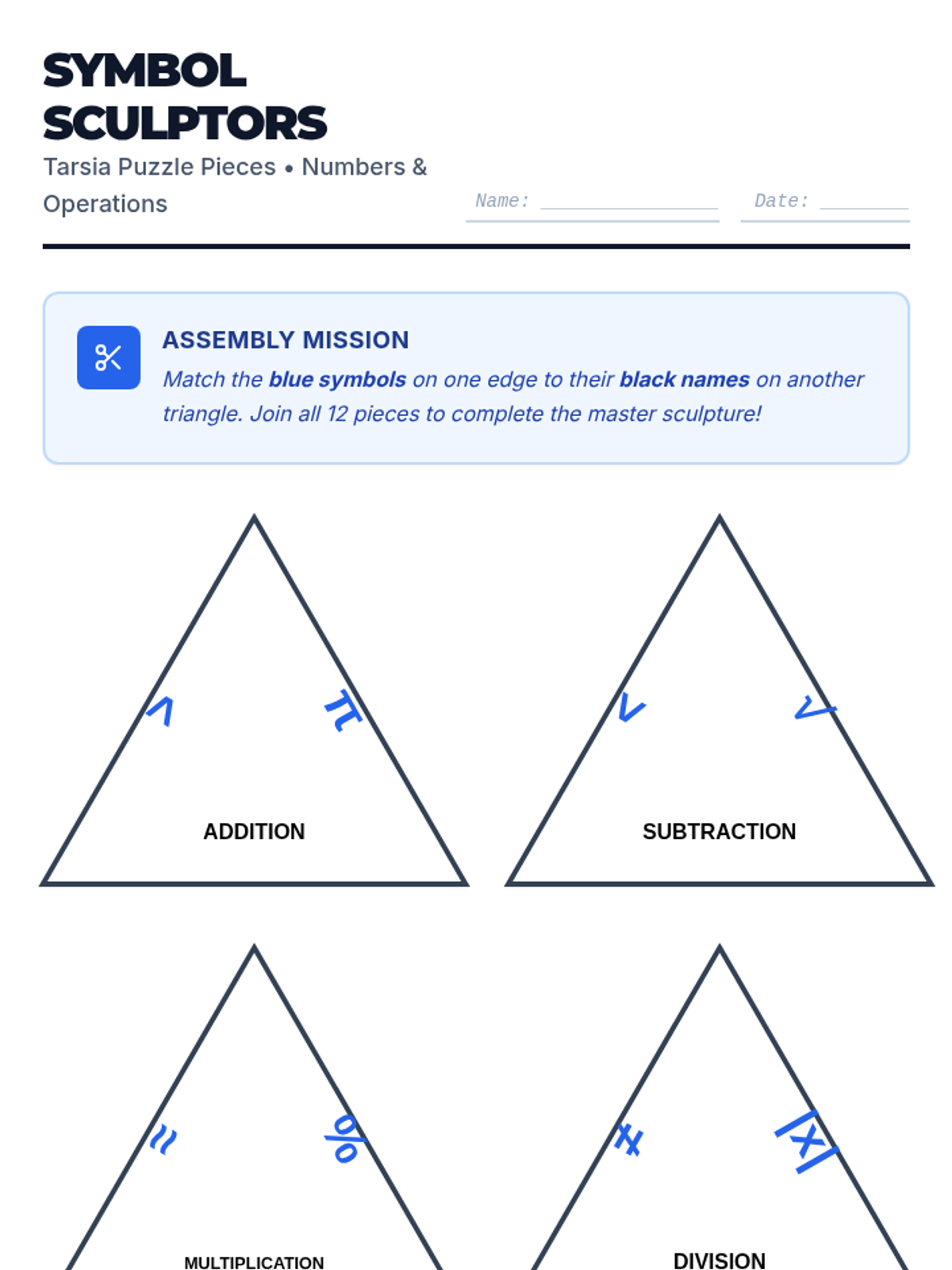
A redesigned advanced Tarsia puzzle featuring a 2:1 ratio of terms to symbols on each piece. Each piece contains exactly one matching blue symbol and one black word, plus one distractor symbol. This ensures text dominance while maintaining a complex notation theme. Labels are precisely aligned inside triangle boundaries.
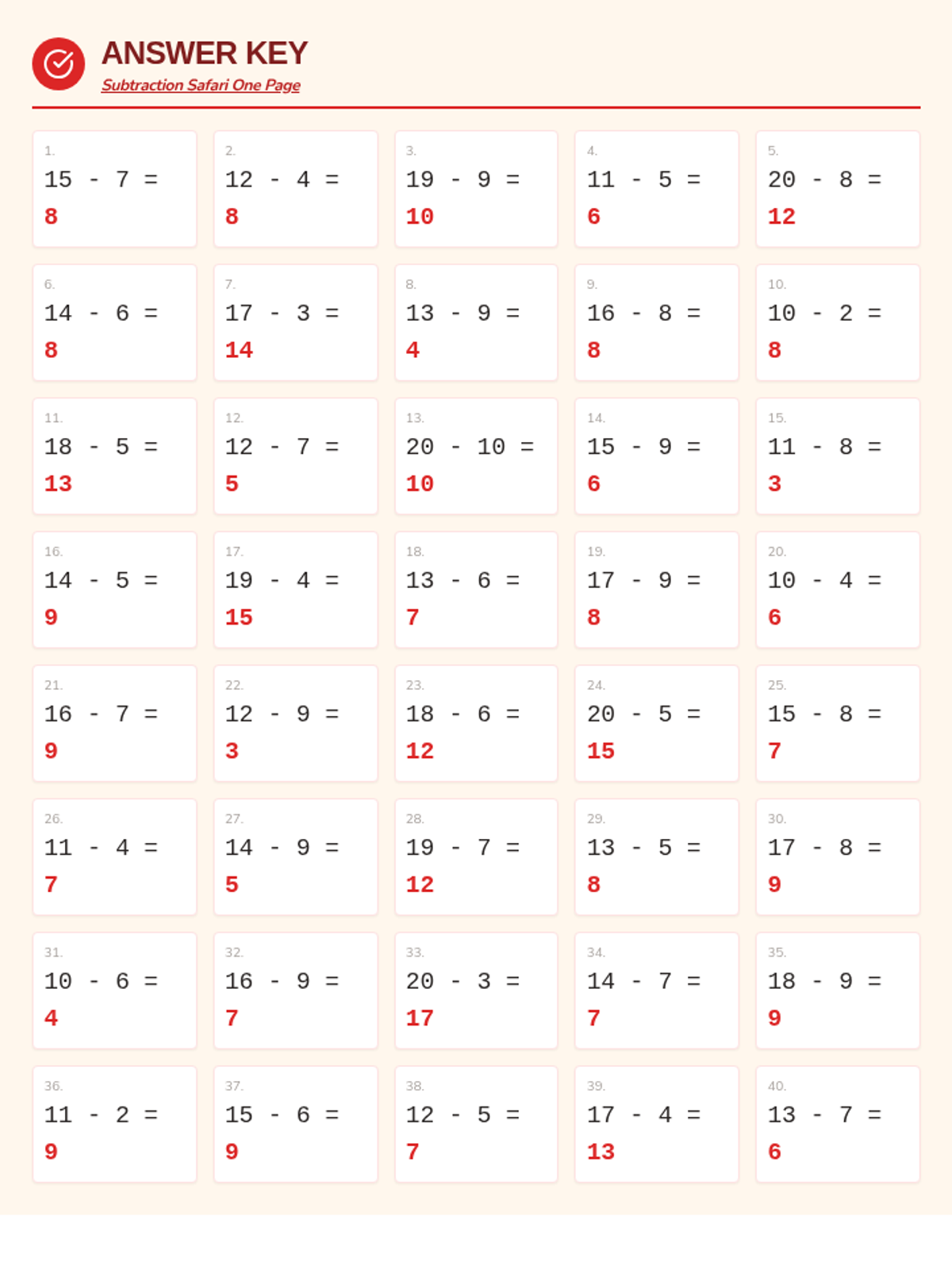
Condensed teacher answer key for the Subtraction Safari one-page worksheet, showing all 40 facts in a 5-column grid.
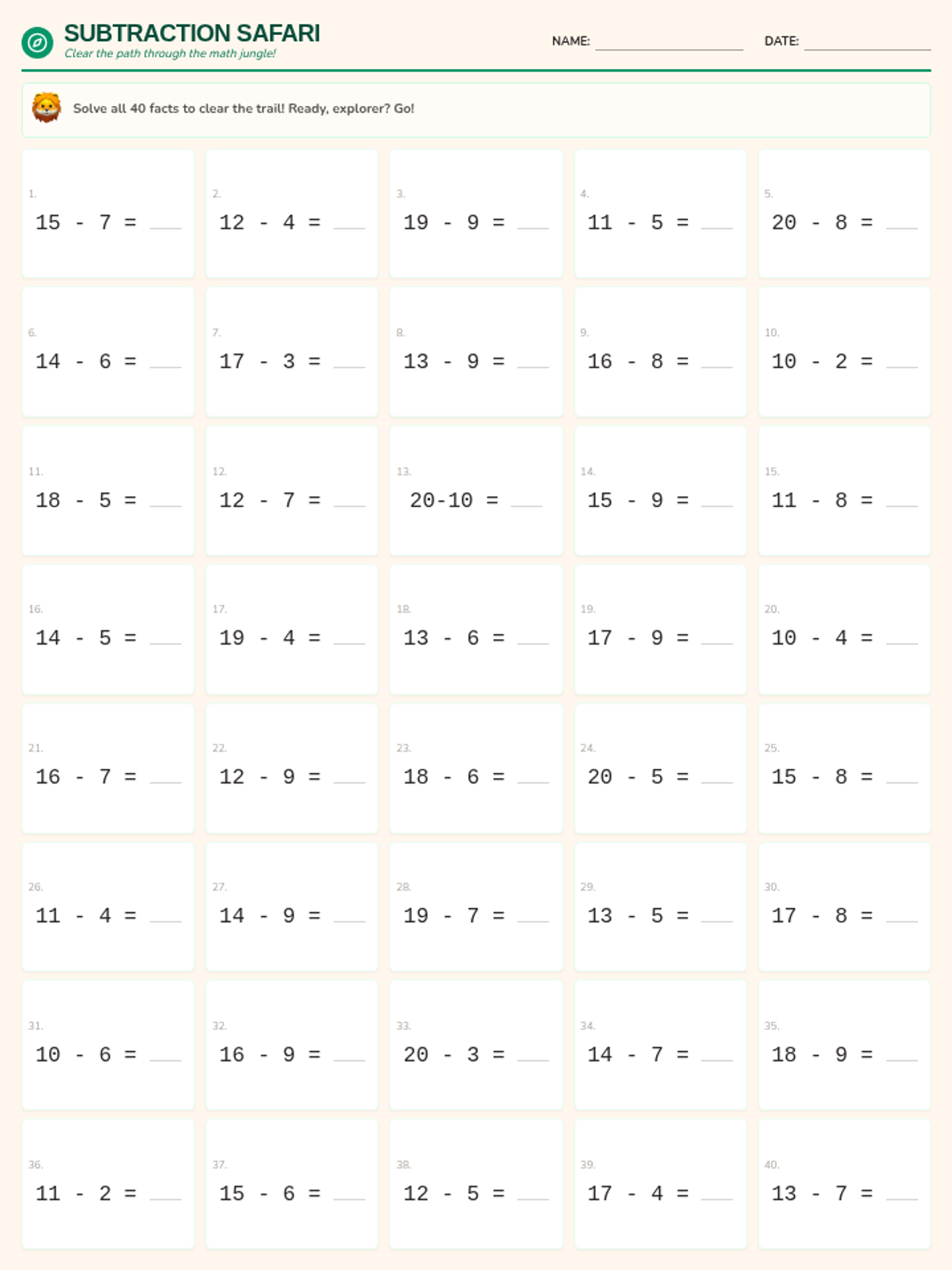
A condensed safari-themed math worksheet featuring 40 subtraction facts within 20, optimized to fit on a single page with a 5-column grid and tighter spacing.
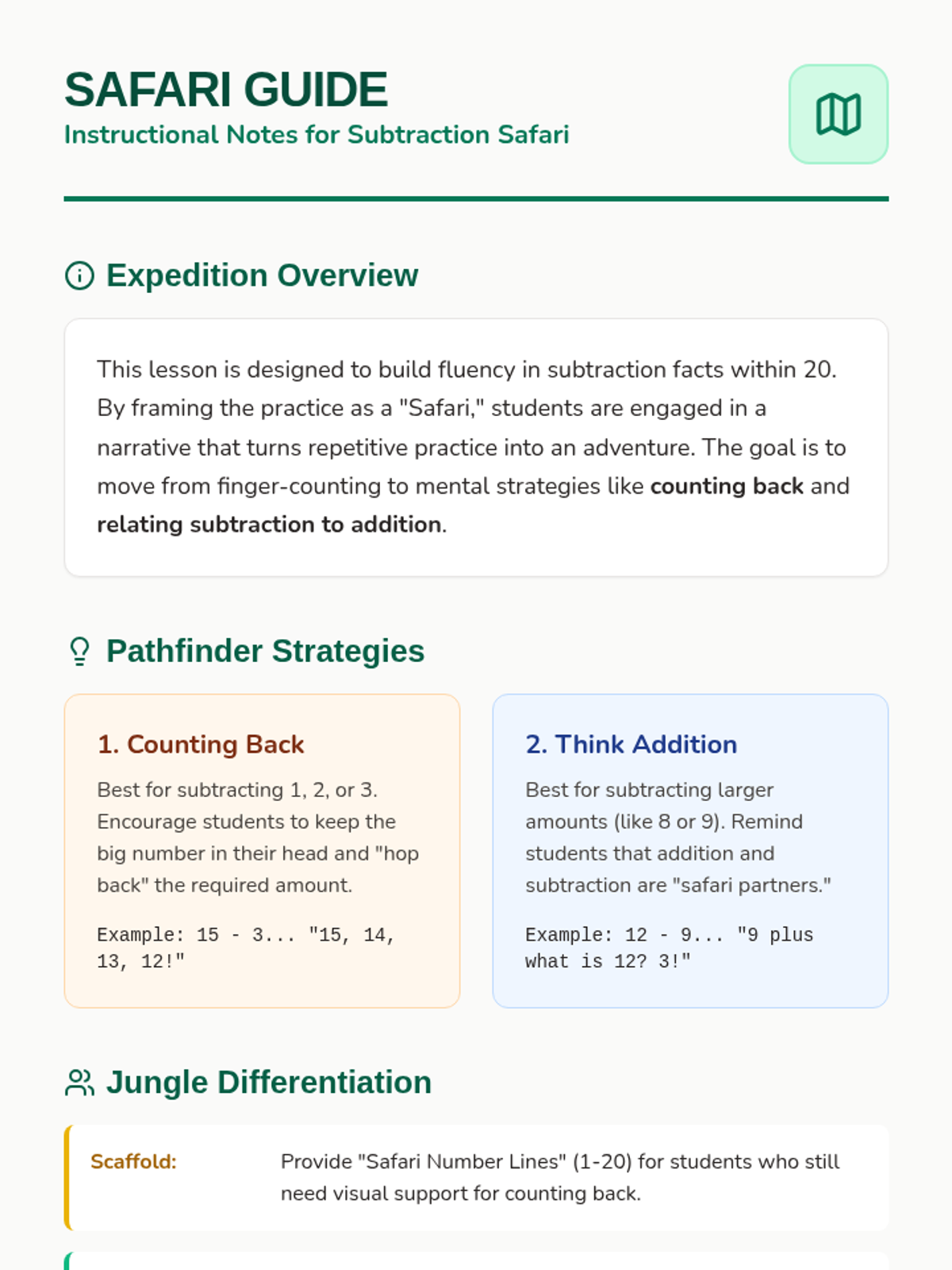
A teacher guide for the Subtraction Safari lesson, including instructional strategies (counting back, think addition), differentiation tips, and delivery suggestions.
A vibrant, safari-themed slide deck to introduce basic subtraction strategies (counting back and related addition) and warm up the class for practice.
Teacher answer key for the Subtraction Safari worksheet, showing all 40 subtraction facts with answers clearly marked in red.
A safari-themed math worksheet featuring 40 subtraction facts within 20, organized in a clean grid with space for student answers.
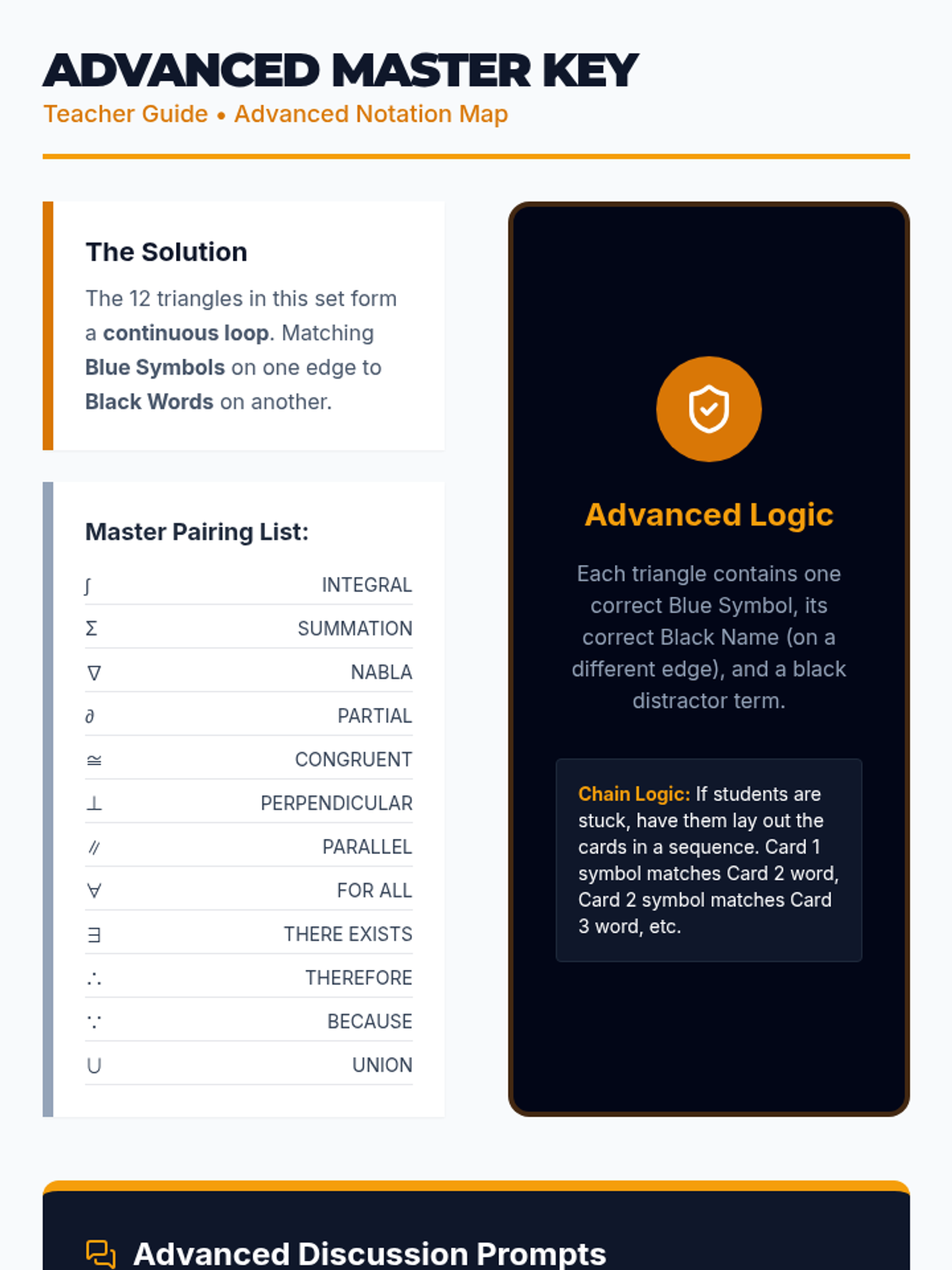
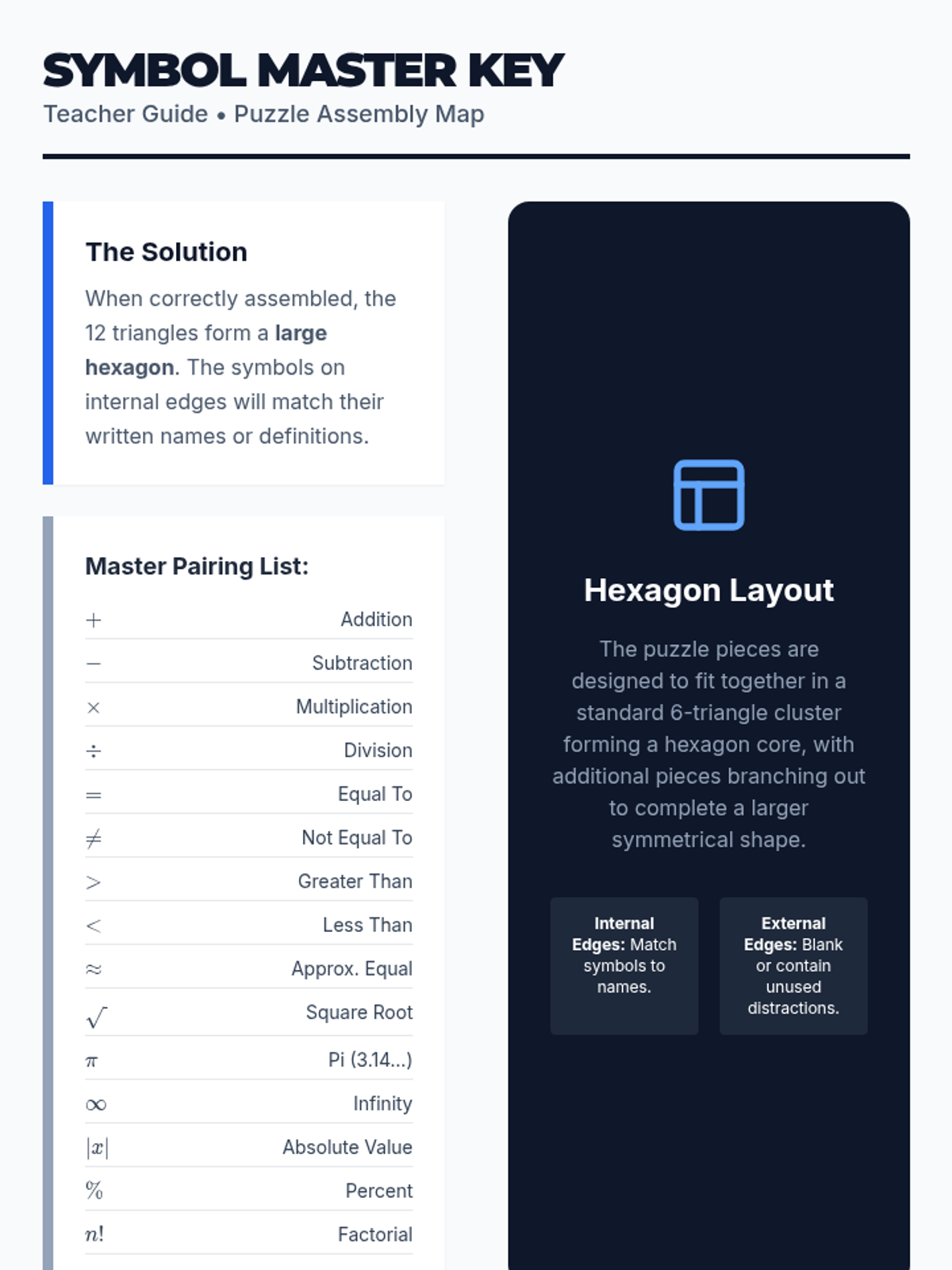
A teacher guide and answer key for the advanced notation Tarsia puzzle, including a master pairing list for complex symbols like Nabla, Integral, and Partial.
An advanced instructional slide deck introducing higher-level mathematical symbols from calculus, set theory, and geometry.
A student activity sheet containing 12 triangular puzzle pieces with mathematical symbols and their names. This is the finalized Version 3 with corrected alignment and logic. Match blue symbols on one piece to black names on another.
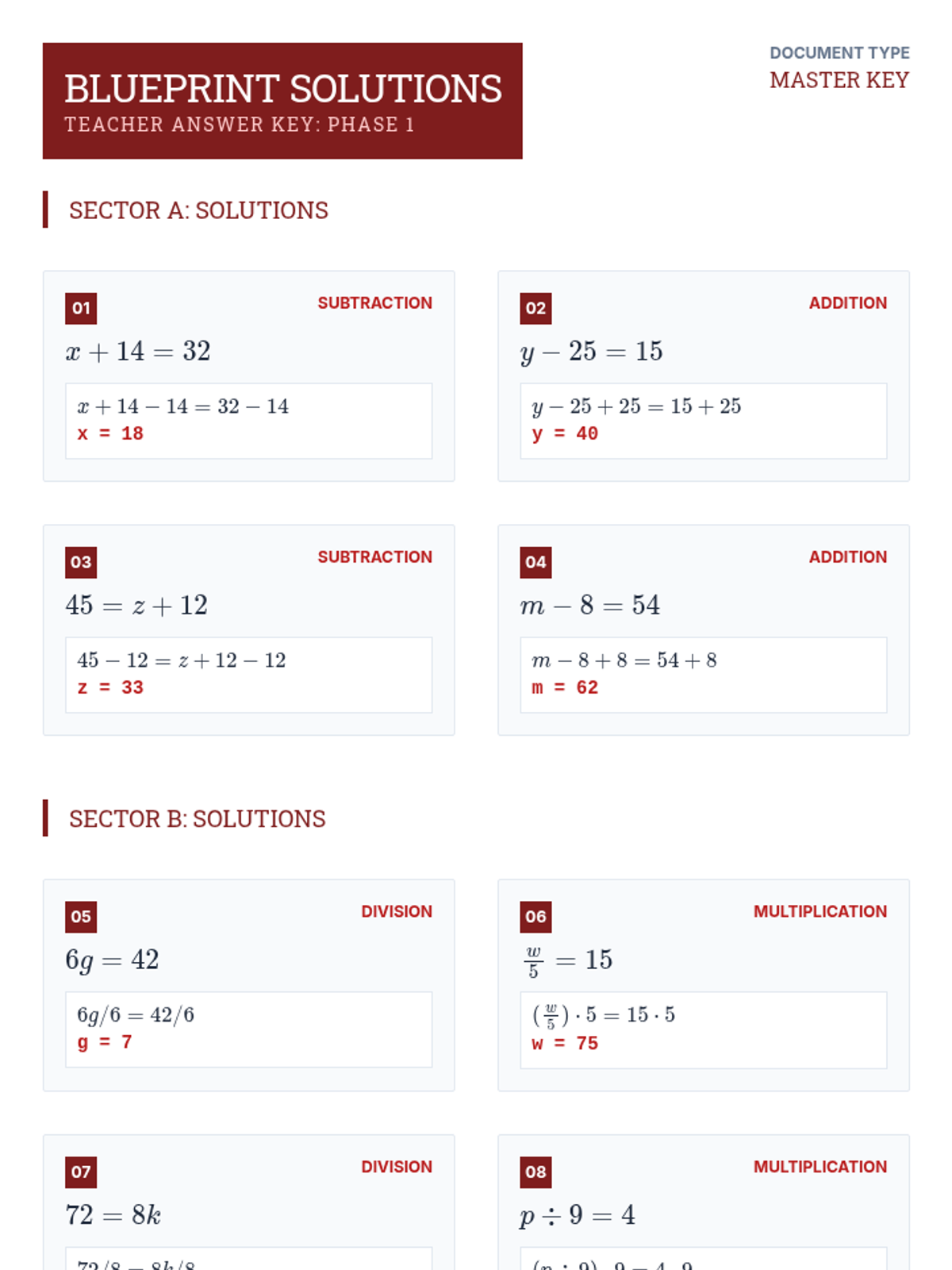
A teacher answer key for the Blueprint Builder Worksheet. It includes step-by-step solutions and identifies the inverse operation used for each problem.
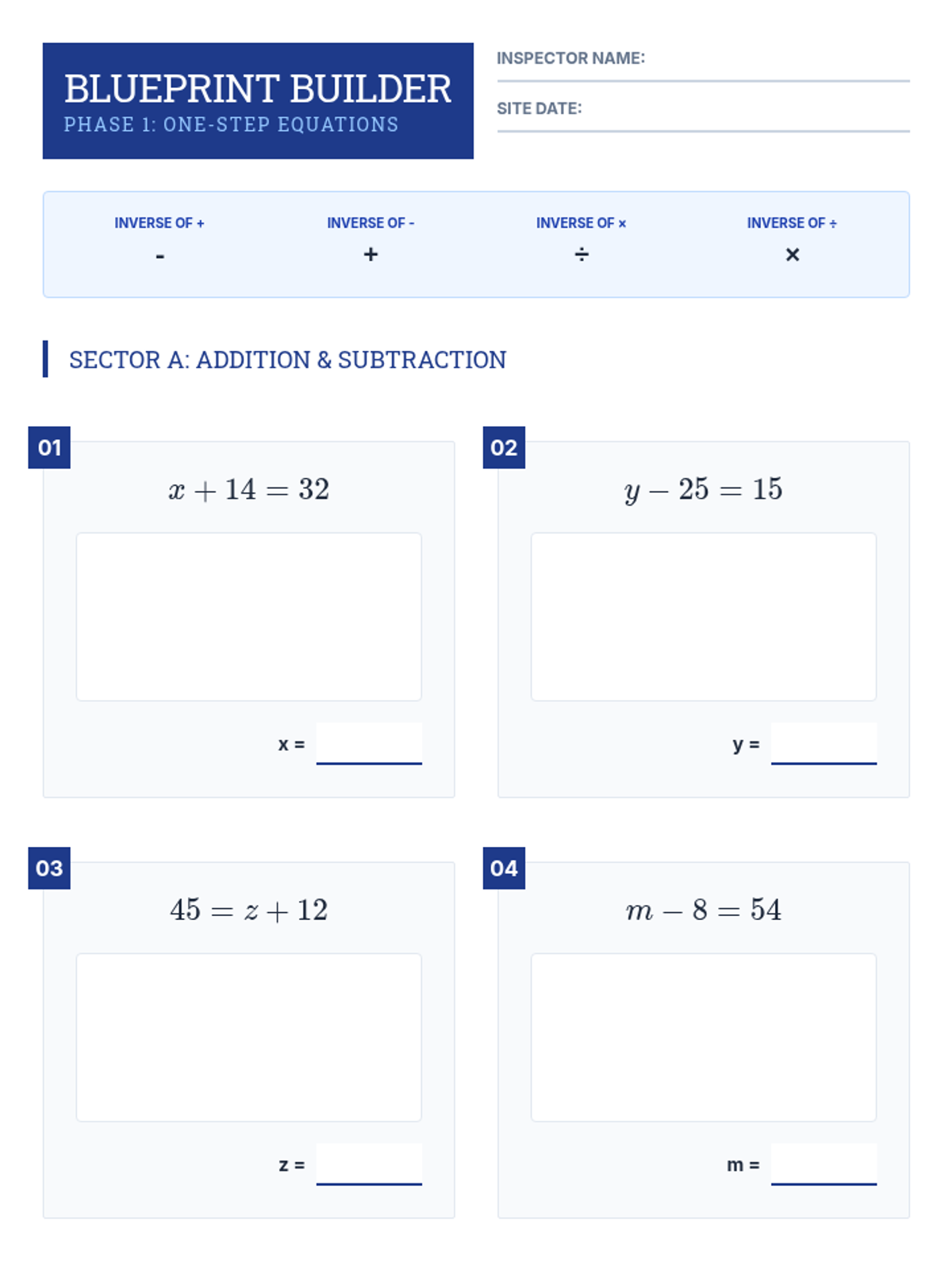
A student worksheet for practicing one-step equations across all four operations. Features a blueprint-themed layout with dedicated space for students to show their work and final answers.
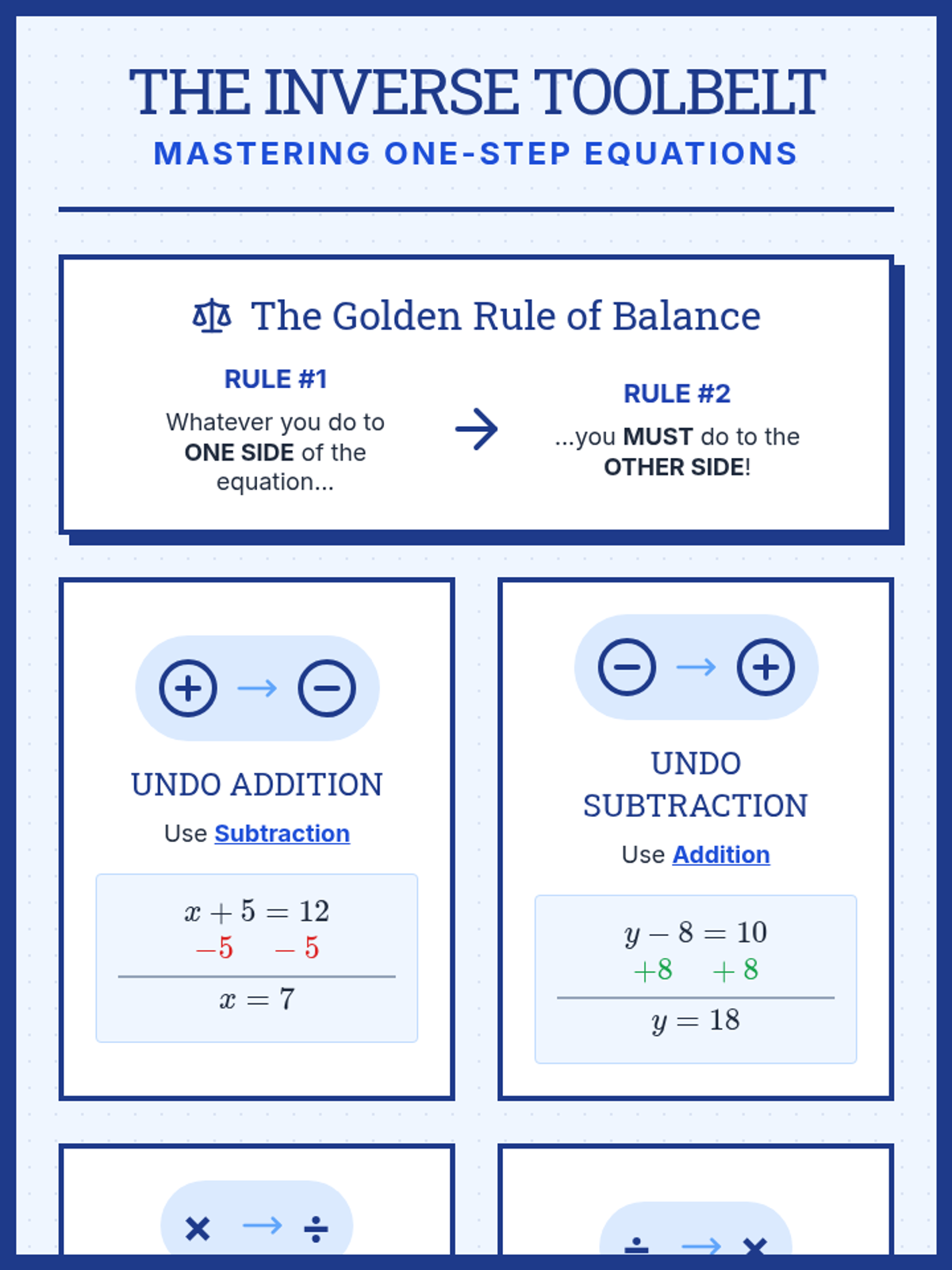
A comprehensive slide deck for instructing students on one-step equations. It covers the 'Isolate the Variable' goal, the Golden Rule of balance, and specific inverse operation techniques for all four operations with a consistent blueprint theme.
A visually striking anchor chart designed for classroom display. It illustrates the 'Inverse Toolbelt'—pairing addition with subtraction and multiplication with division to solve one-step equations while maintaining balance.
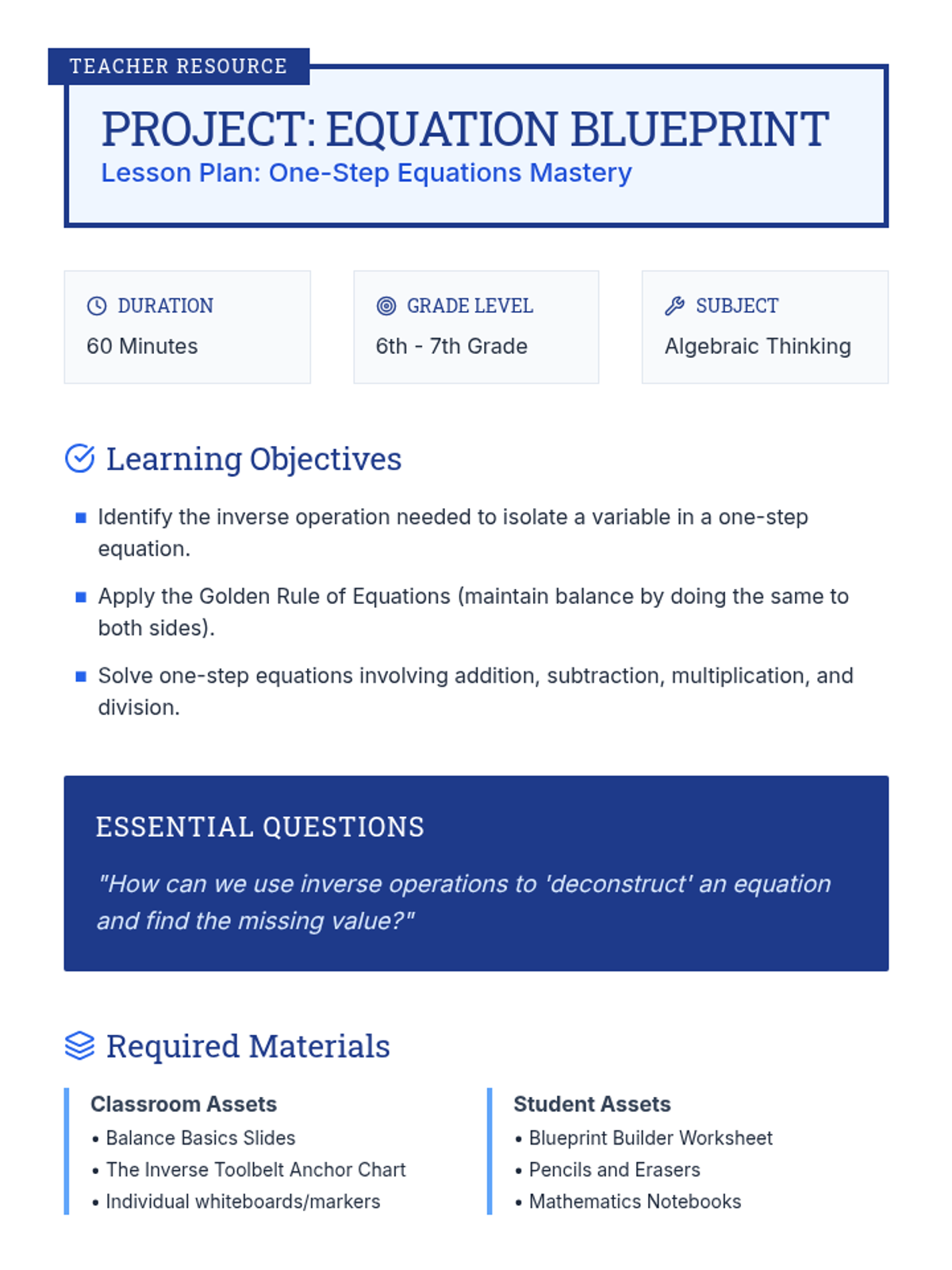
A comprehensive lesson plan for teaching one-step algebra equations, featuring a blueprint theme. Includes objectives, a step-by-step instructional sequence, and differentiation strategies.
A teacher's answer key and facilitation guide for the Tarsia puzzle, including a master pairing list and assembly tips.
An instructional slide deck introducing common and advanced mathematical symbols used in operations and number relationships, featuring clear visual definitions and examples.
A visual presentation for introducing division through equal groups. Uses the bakery theme to guide students through the "One-by-One" sharing strategy.
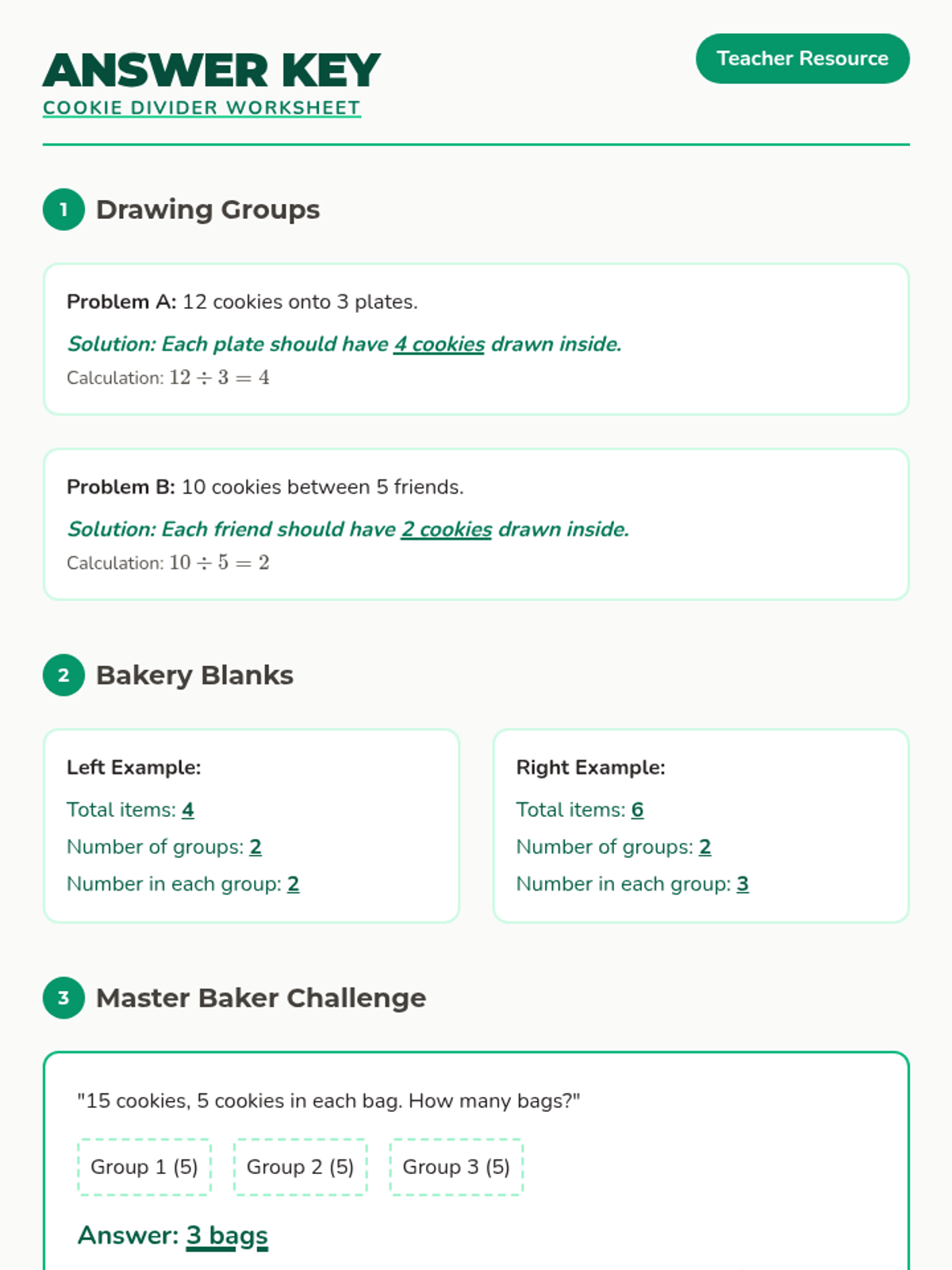
An answer key for the Cookie Divider Worksheet, providing clear solutions and calculations for the drawing and word problems.
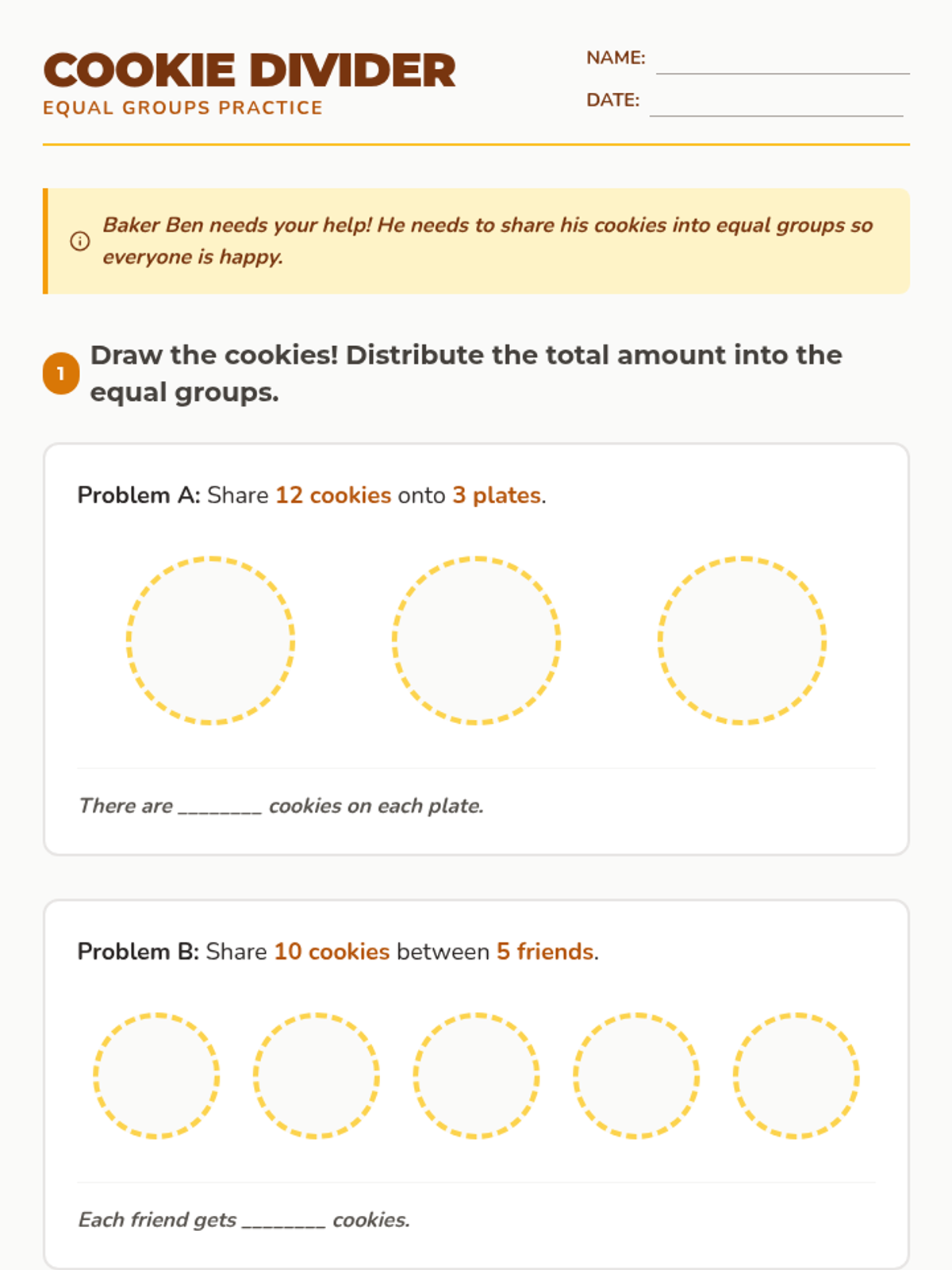
A student worksheet for practicing division through equal groups. Features drawing activities, fill-in-the-blank identification, and a bakery-themed word problem.
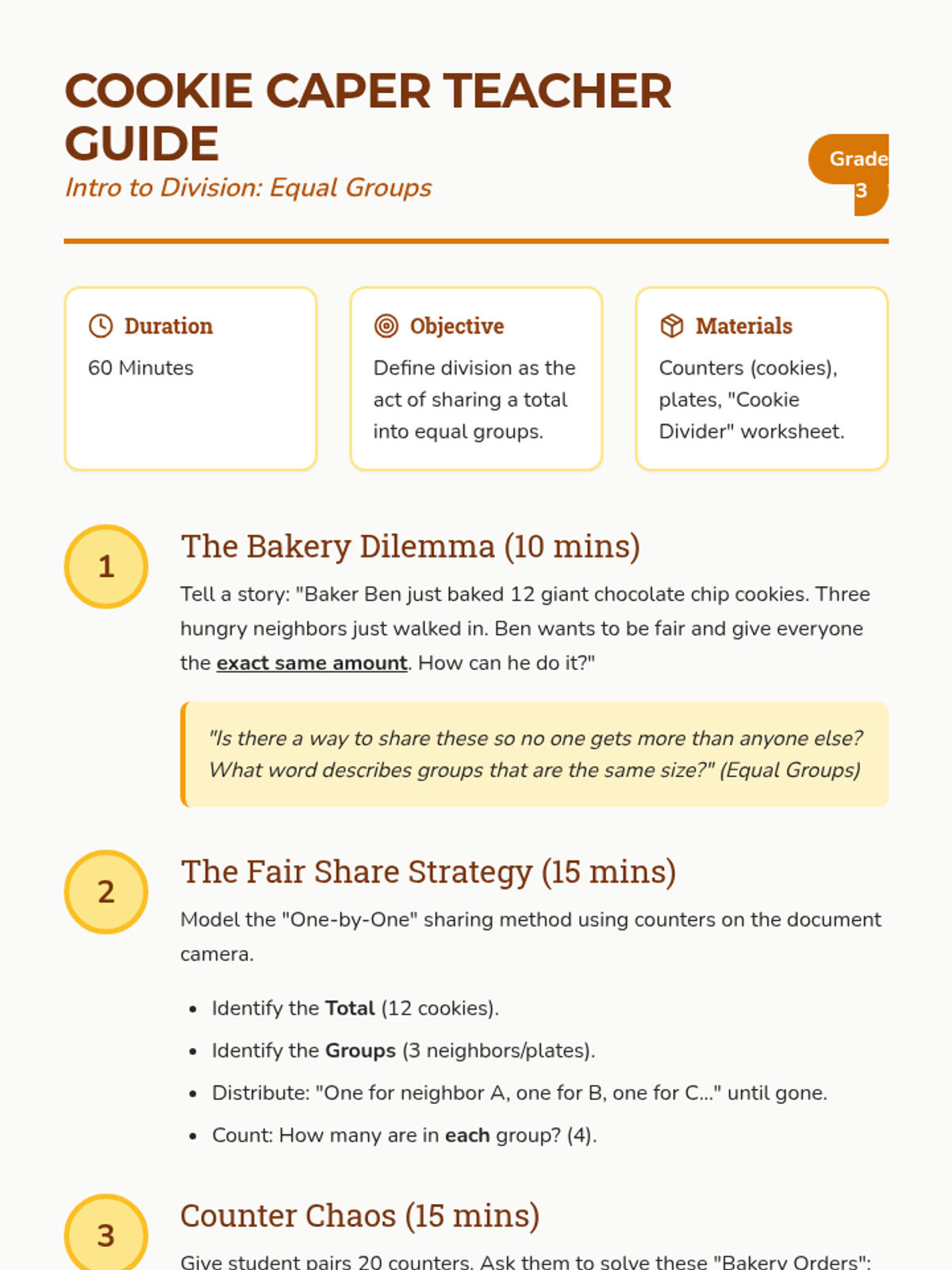
A comprehensive lesson plan for teachers, outlining a bakery-themed introduction to division using equal groups. Includes a hook, modeling steps, and guided practice activities.
A visual presentation for teaching the five methods of proving a quadrilateral is a parallelogram, featuring architectural diagrams, coordinate geometry formulas, and critical thinking checks.
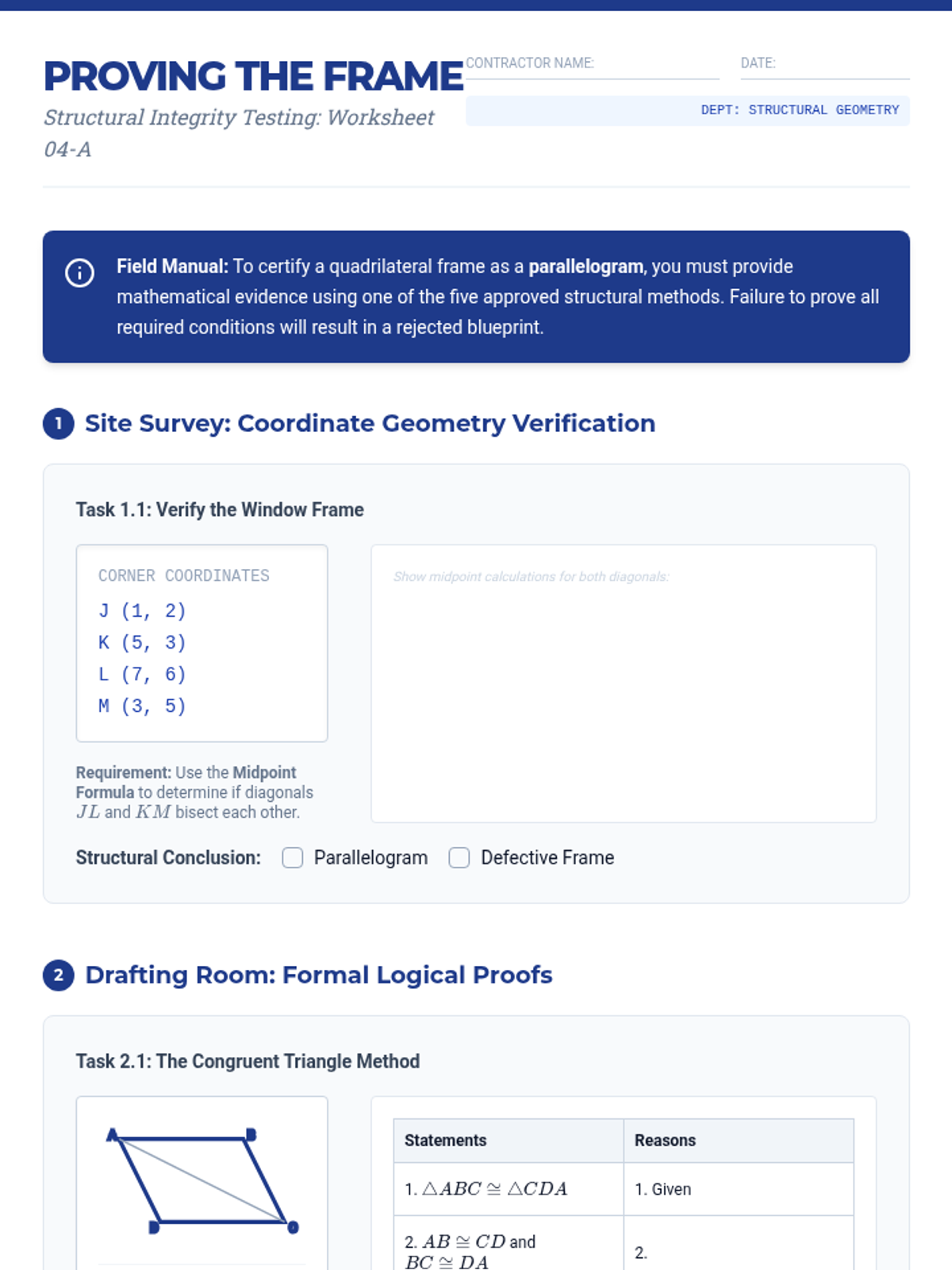
An architectural-themed worksheet for 10th-grade geometry focused on proving quadrilaterals are parallelograms through coordinate geometry, formal two-column proofs, and critical thinking.
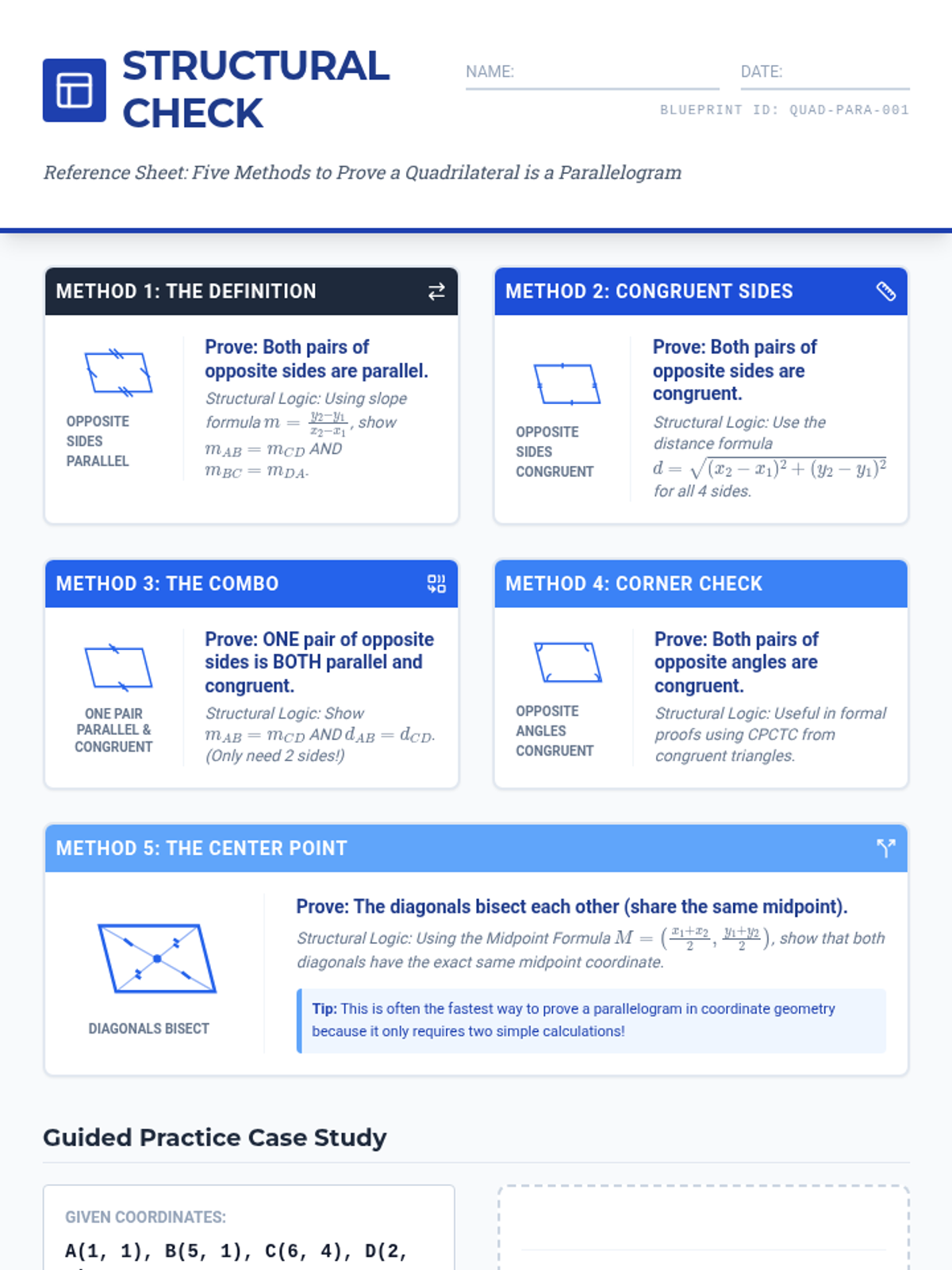
An architectural-themed graphic organizer summarizing the five methods to prove a quadrilateral is a parallelogram, featuring visual diagrams and coordinate geometry logic.
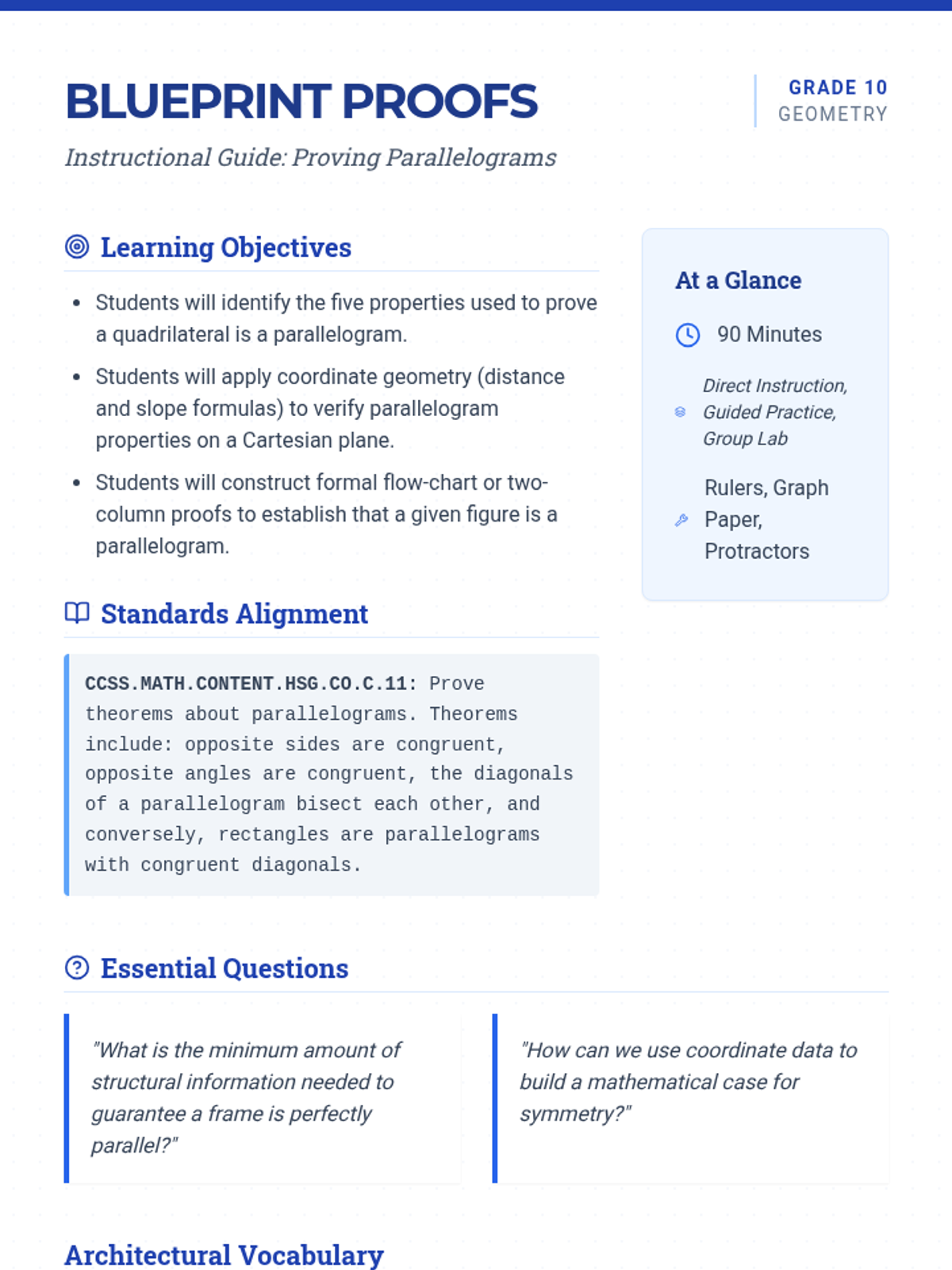
A comprehensive teacher's guide for a 10th-grade geometry lesson on proving parallelograms. Includes learning objectives, step-by-step instructional procedures, common pitfalls, and differentiation strategies with an architectural theme.
A visual 8-slide presentation teaching the definition and 7 core properties of parallelograms, featuring memory tricks, clear geometric diagrams, and summarized takeaways.
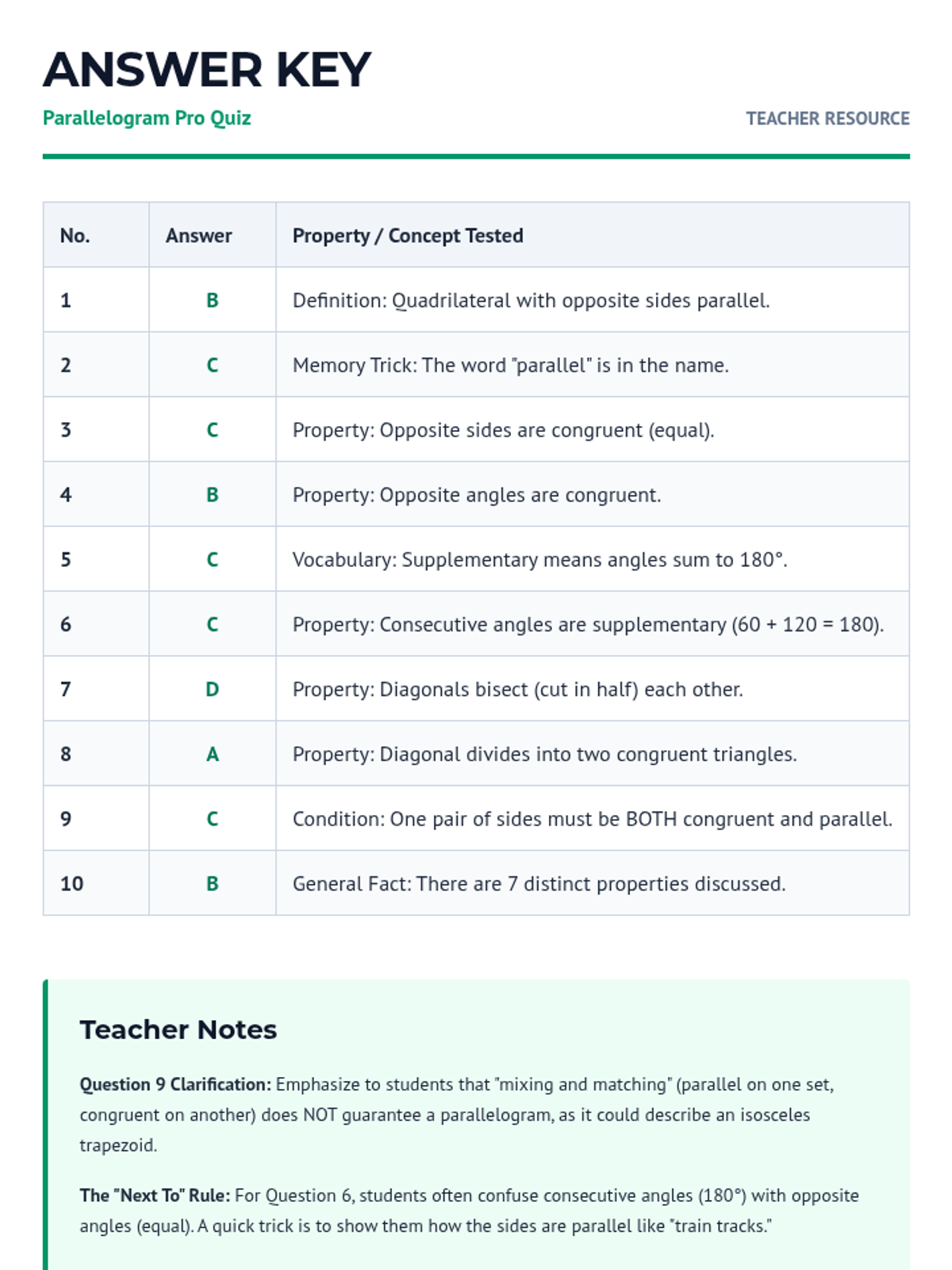
The complete answer key for the Parallelogram Pro Quiz, including property references and helpful teacher tips for common student misconceptions.
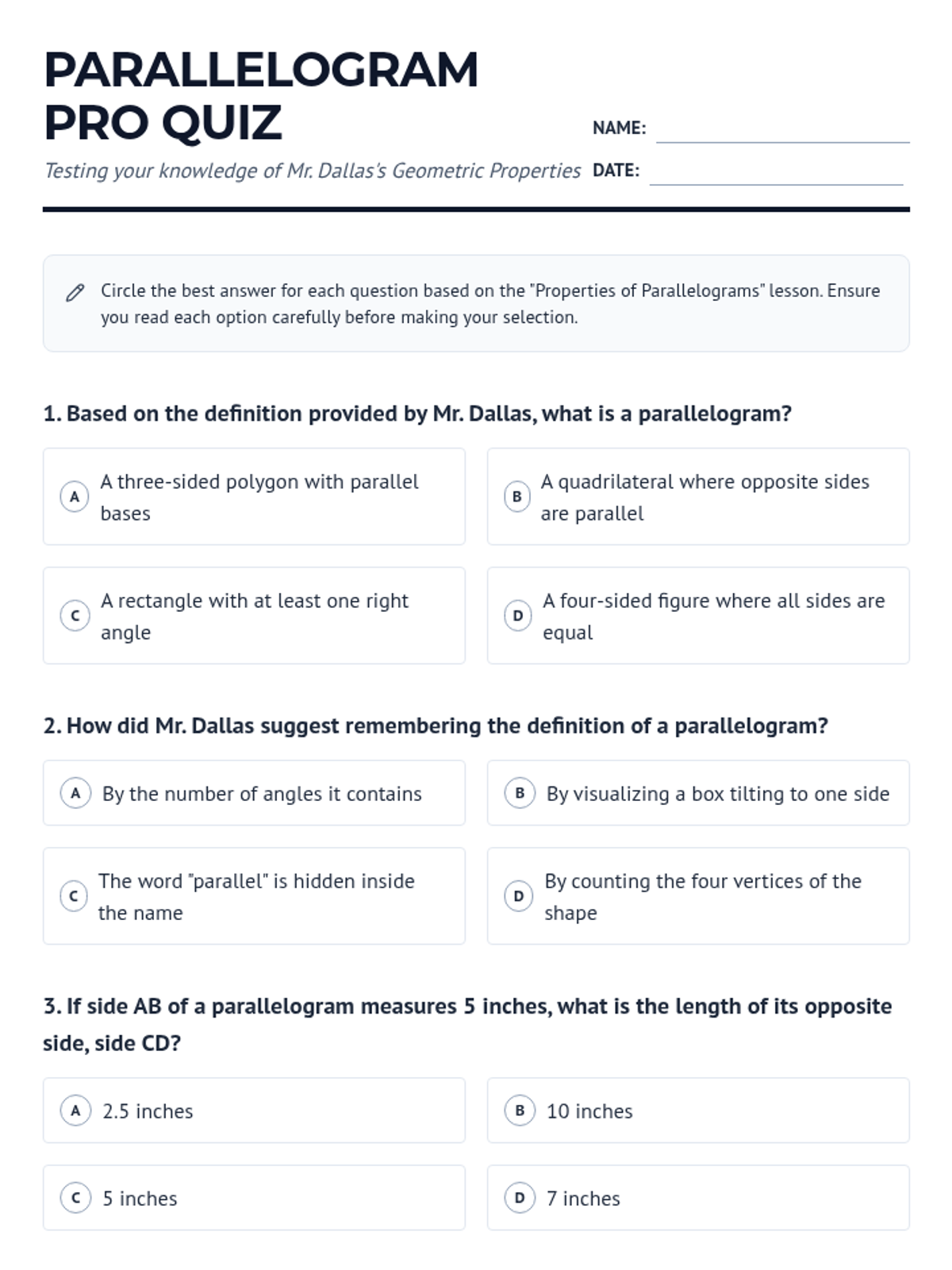
A 10-question multiple-choice quiz based on Mr. Dallas's lesson on parallelogram properties, covering definitions, congruent sides and angles, supplementary consecutive angles, and diagonal behavior.
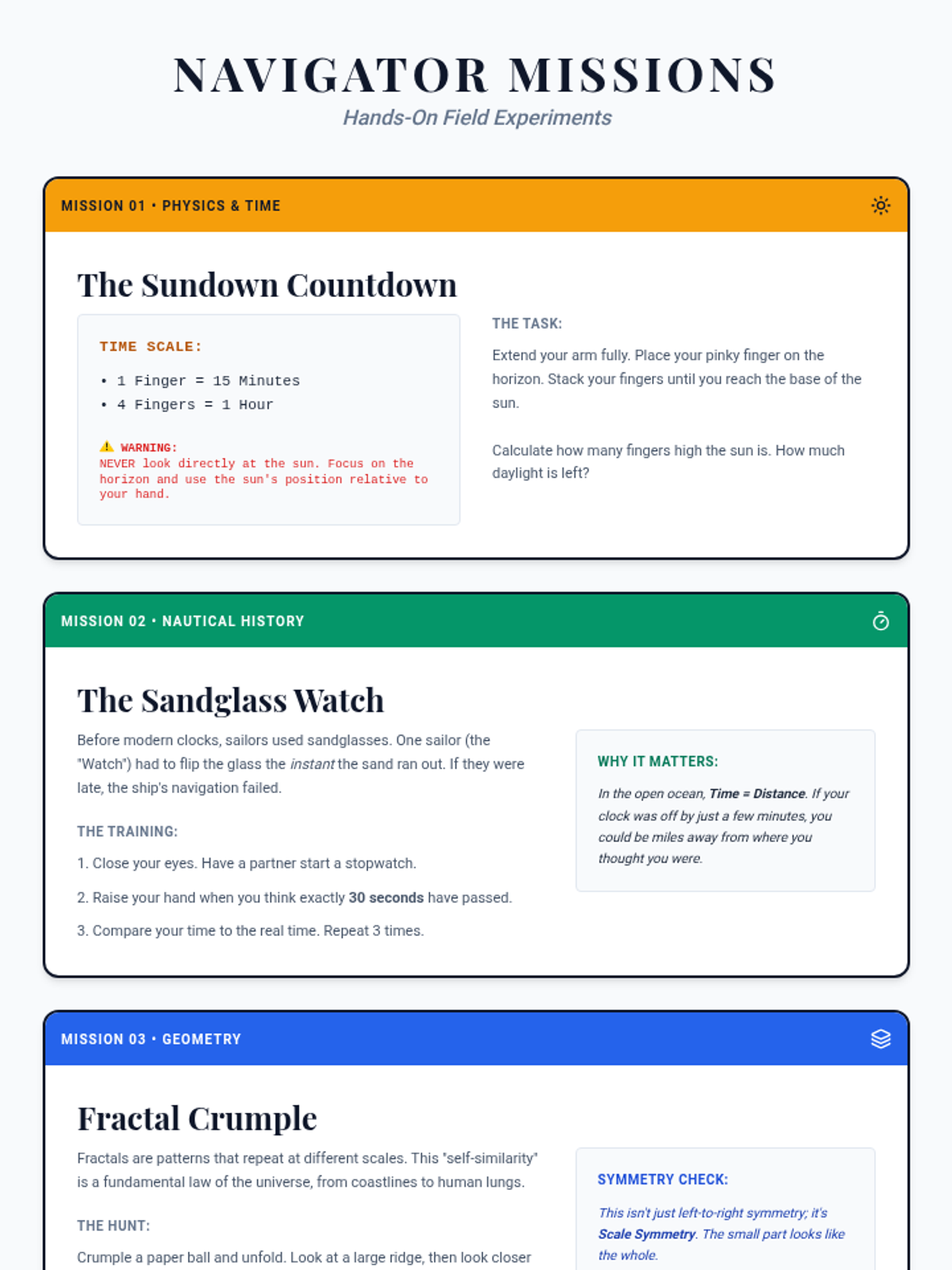
A set of four hands-on field missions for students to experiment with daylight estimation, historical nautical timekeeping, fractal scaling, and sun-based coordinate mapping. All missions now feature consistent, professional layouts with scientific sidebars.
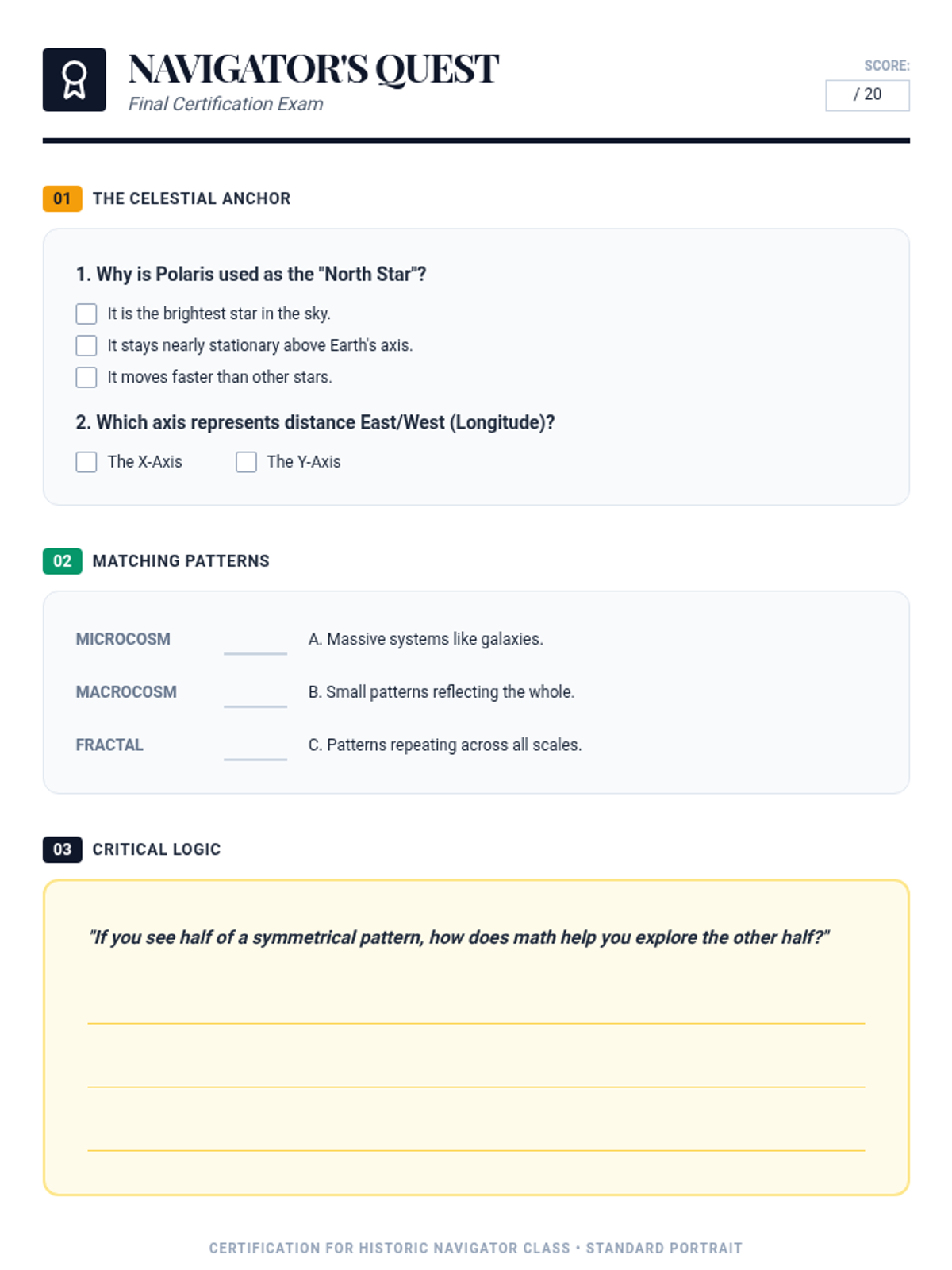
A comprehensive quiz covering fixed-point navigation, coordinate axes, microcosms vs macrocosms, and different types of symmetry. Refactored for standard portrait format.
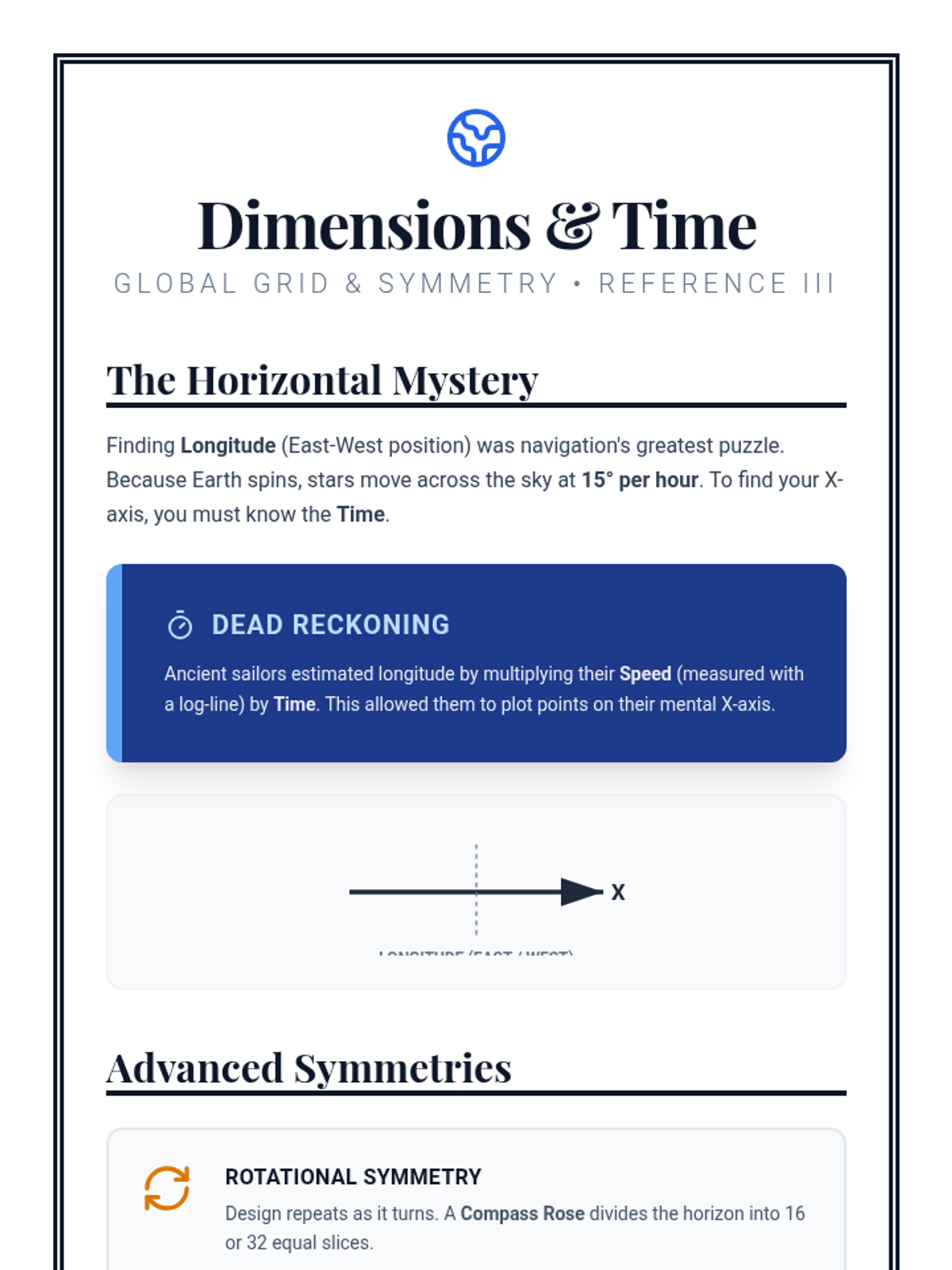
A reference page explaining Longitude as the X-axis of navigation, along with advanced symmetry concepts like Rotational and Logarithmic Spirals. Updated for scientific accuracy regarding the difficulty of longitude and spiral patterns. Standard portrait format.
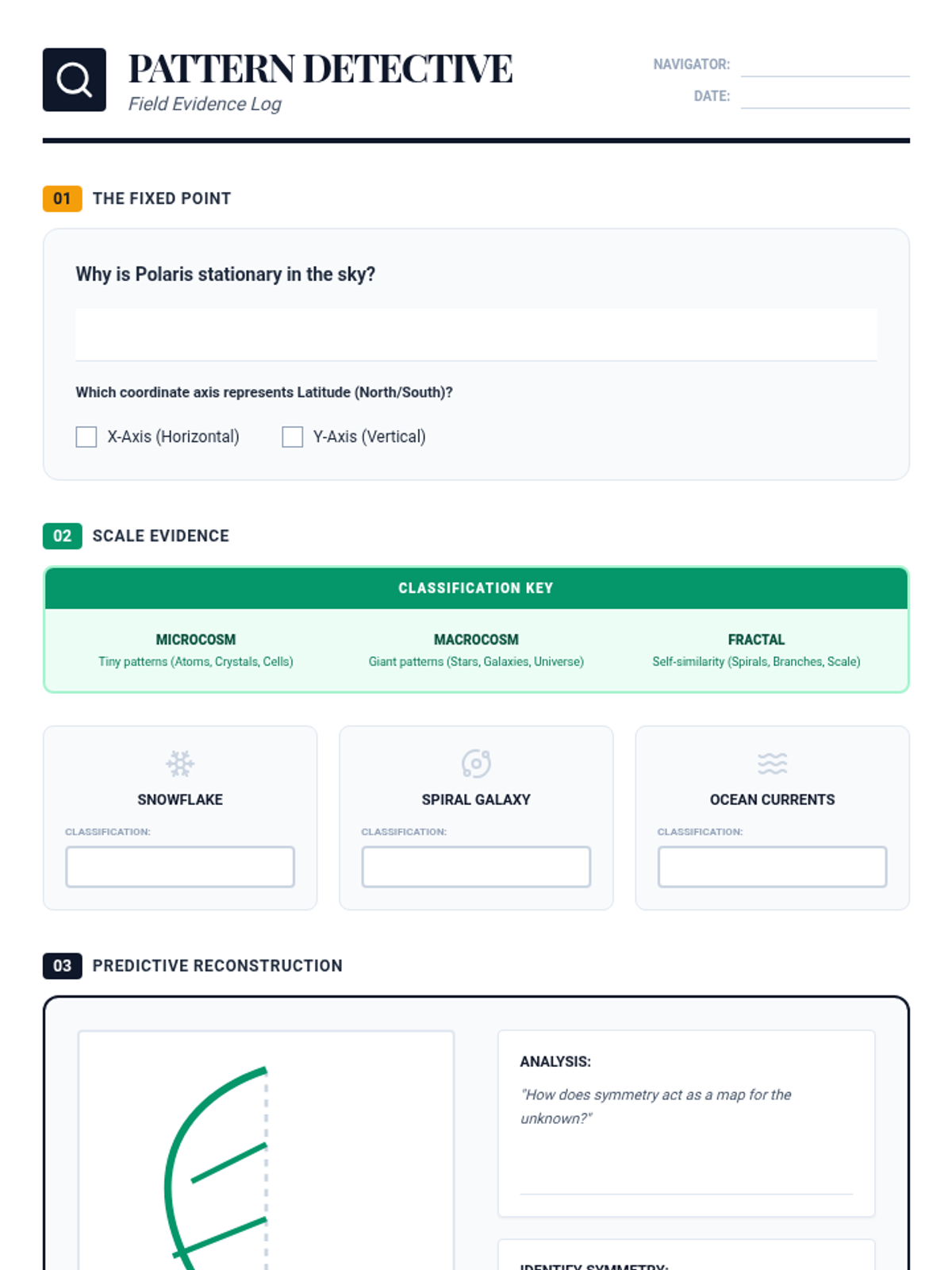
A conceptual worksheet for students to identify patterns of symmetry and scale in nature. Updated with 'Mission Break' callouts after Section 1 and Section 2 to guide students to specific field activities.