A visual presentation for the lesson including objectives, 'Two Truths and a Lie' warm-up slides, embedded video context, and prompts for the gallery walk and class discussion.
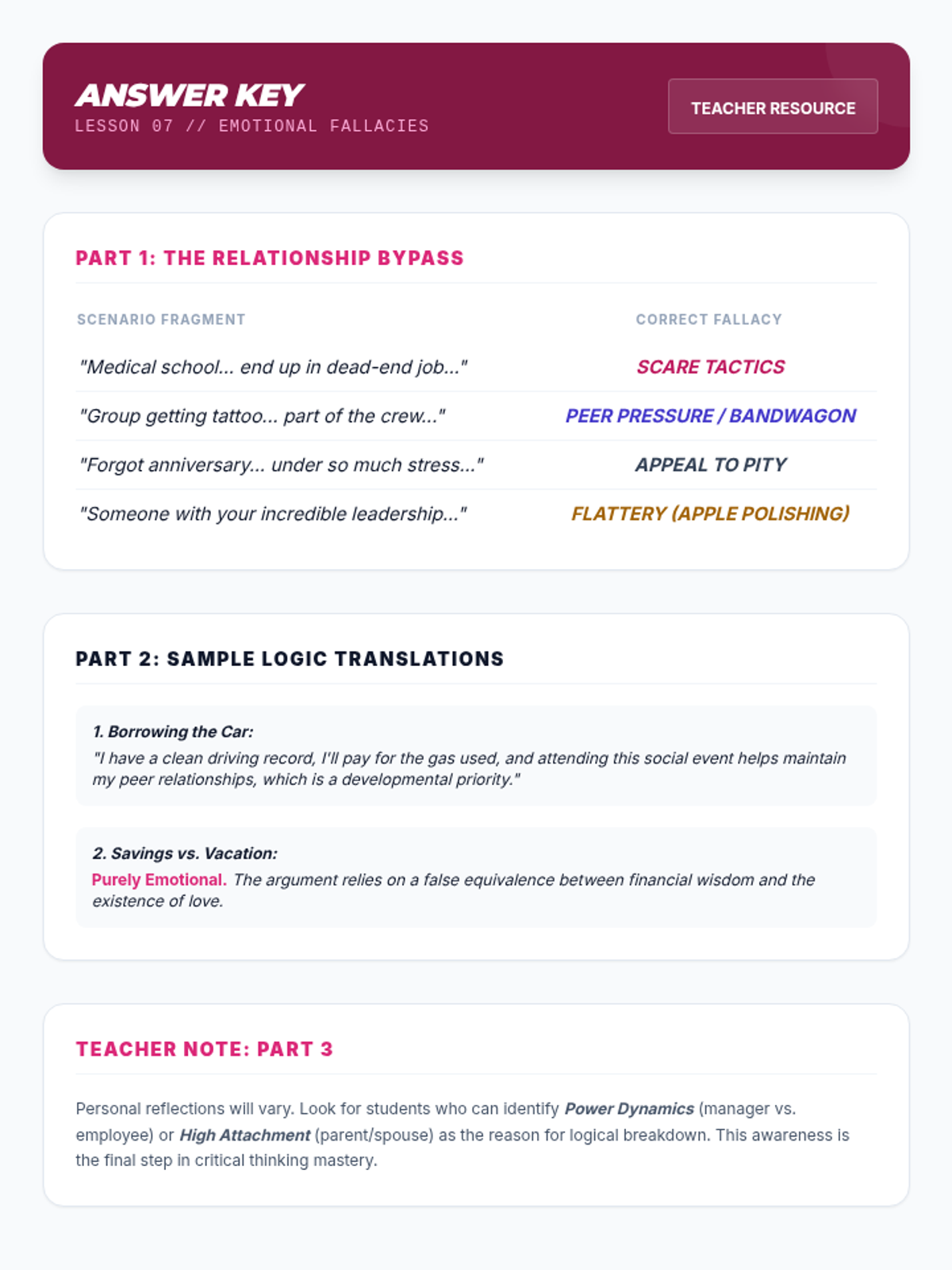
Complete answer key for the updated Lesson 7 worksheet, providing correct fallacy identifications and sample logic translations for emotional appeals in interpersonal contexts.
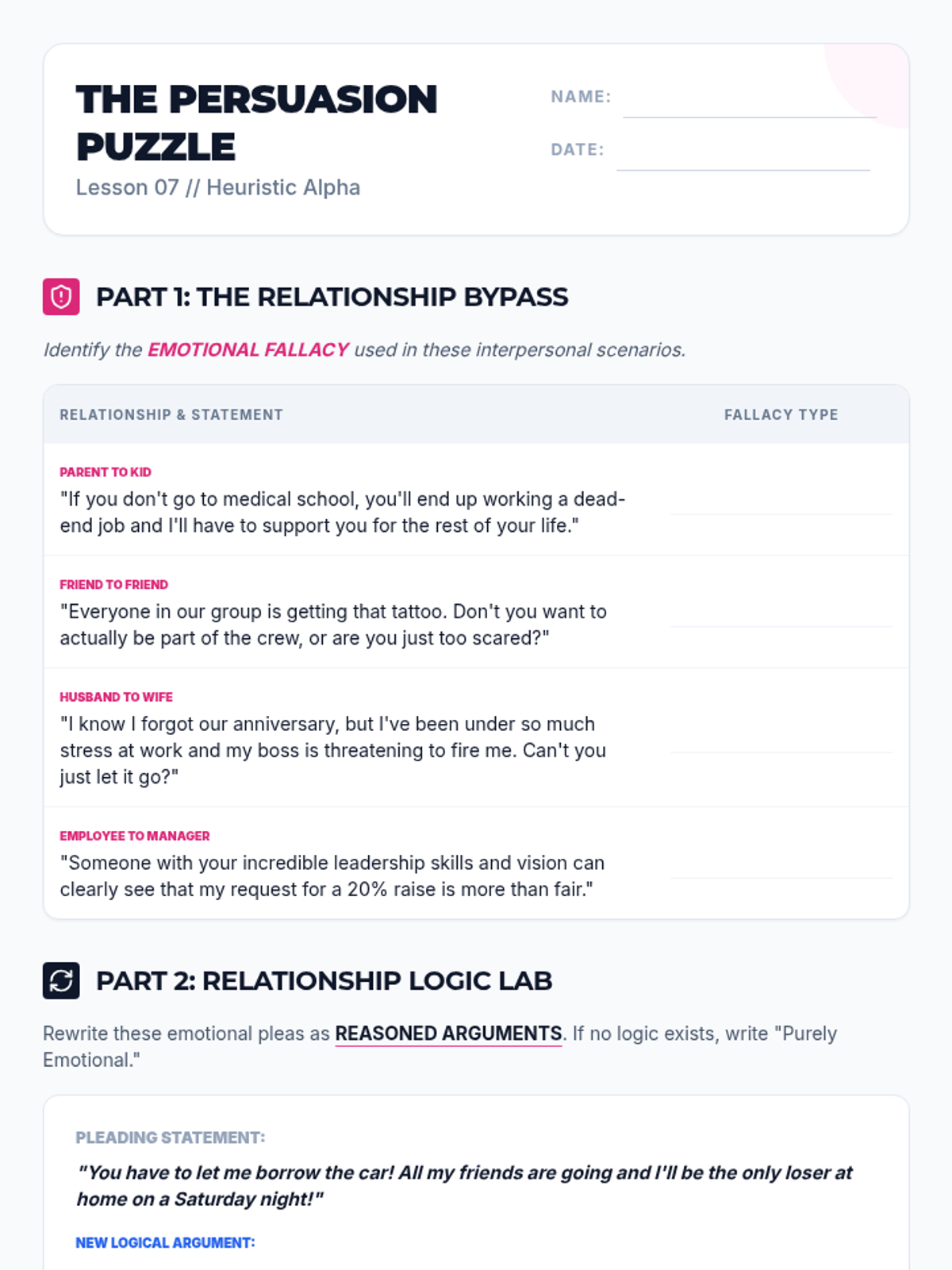
Student worksheet for Lesson 7 focusing on emotional fallacies within family, friendship, and work relationships. Includes logic translation exercises and personal reflection.
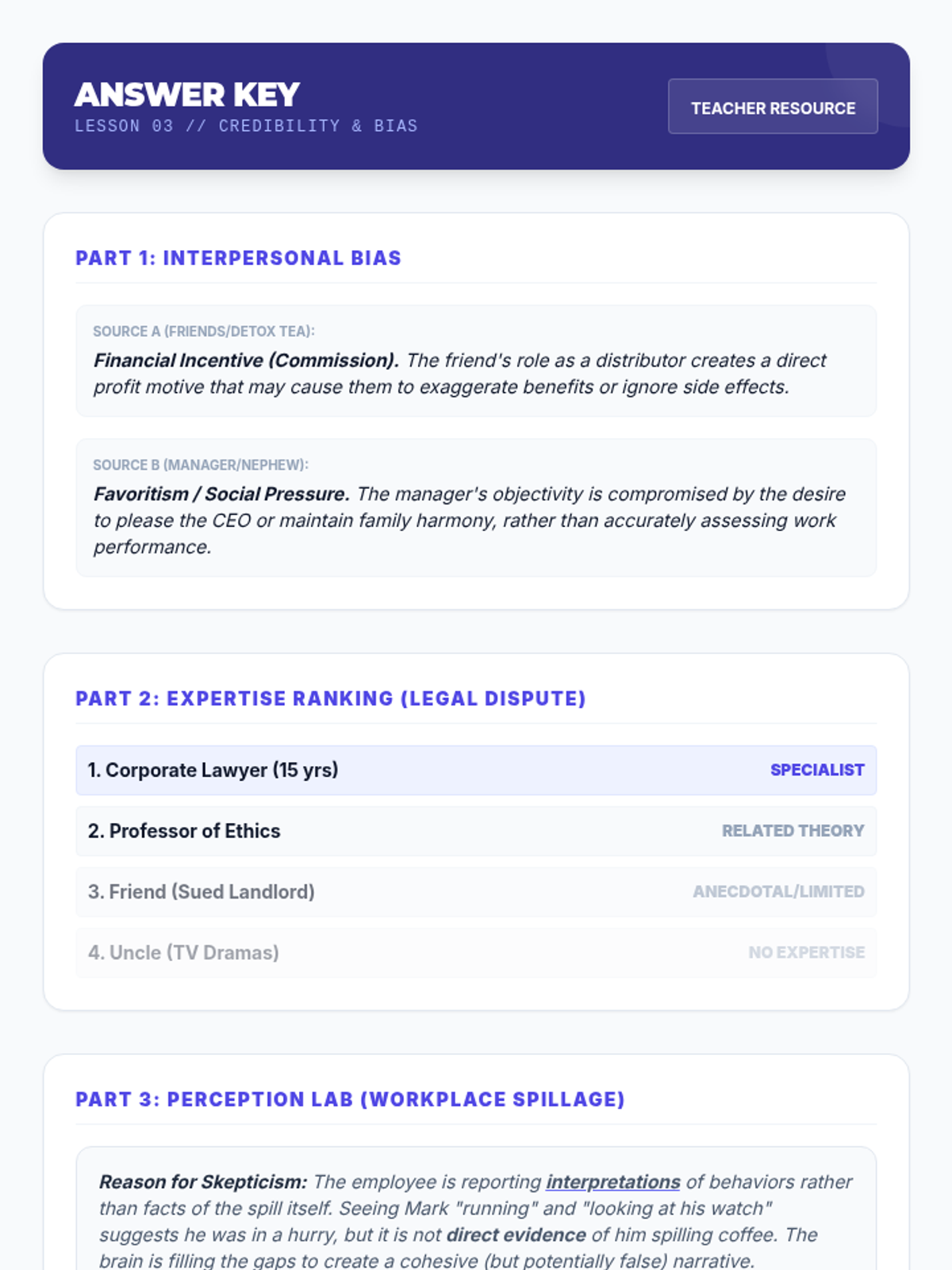
Complete answer key for the Lesson 3 worksheet, covering bias identification, expertise ranking, and analysis of eyewitness reliability factors in relationship and work contexts.
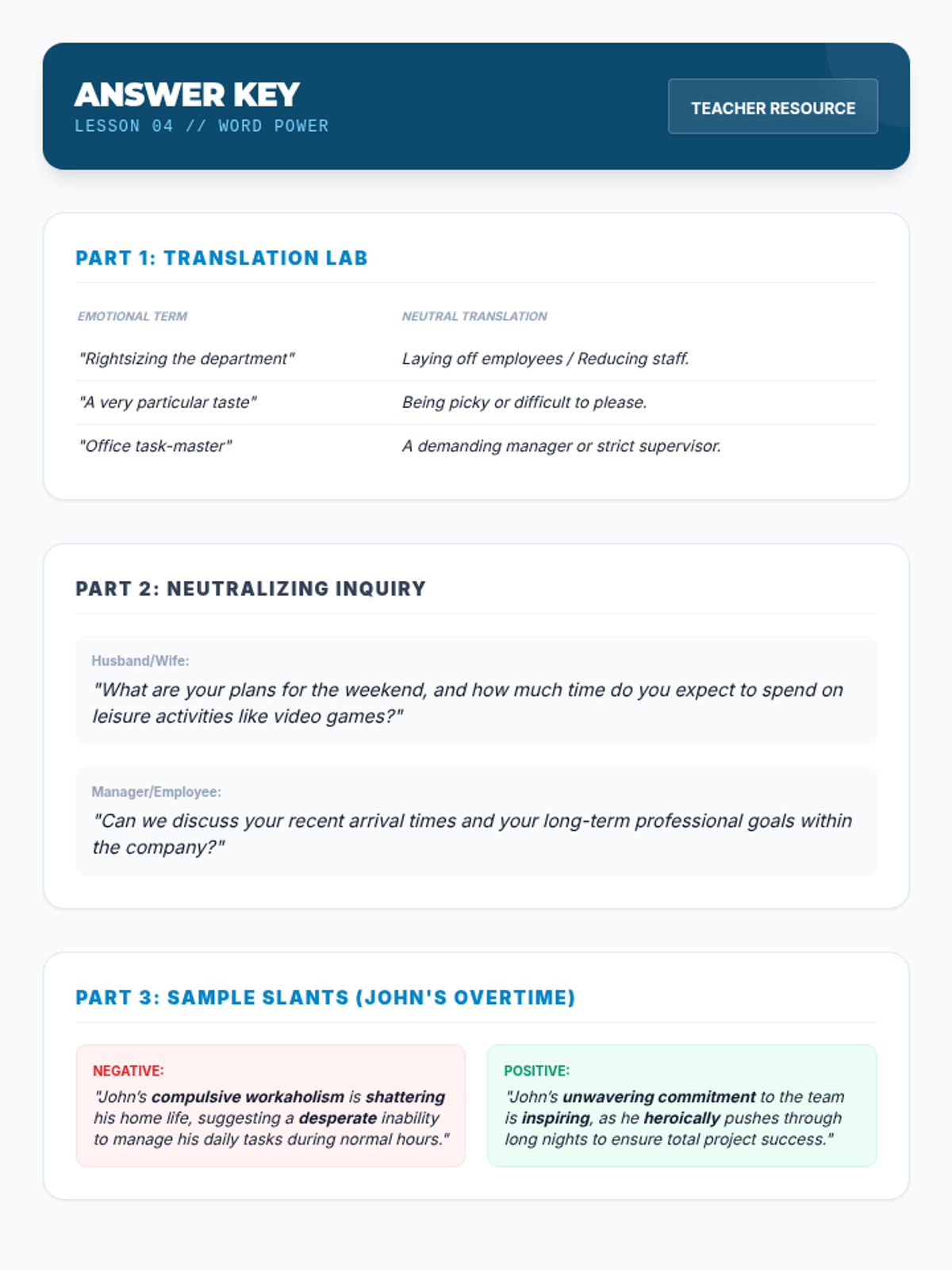
Complete answer key for the updated Lesson 4 worksheet, providing neutral translations and neutral inquiry rewrites for interpersonal scenarios.
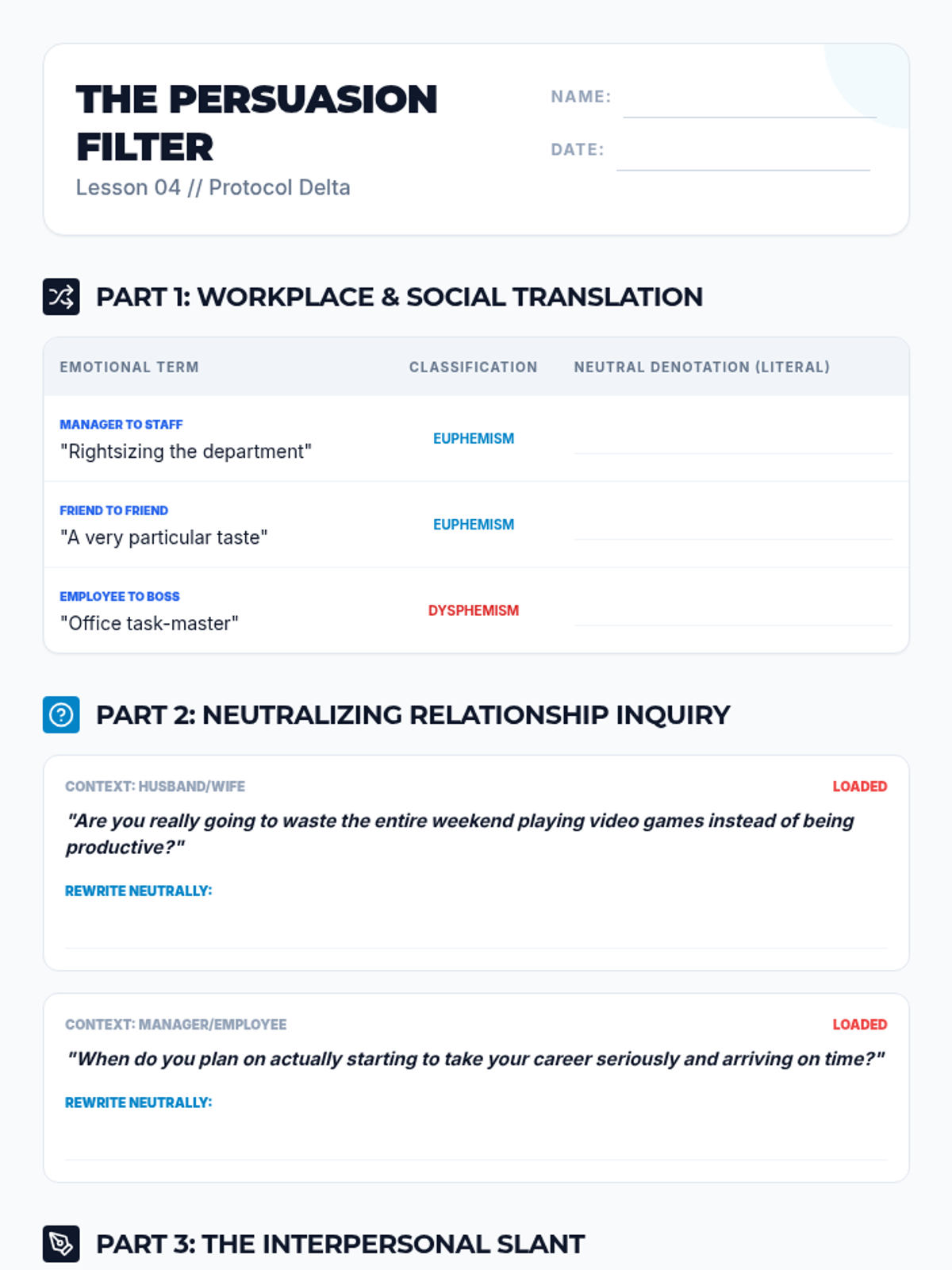
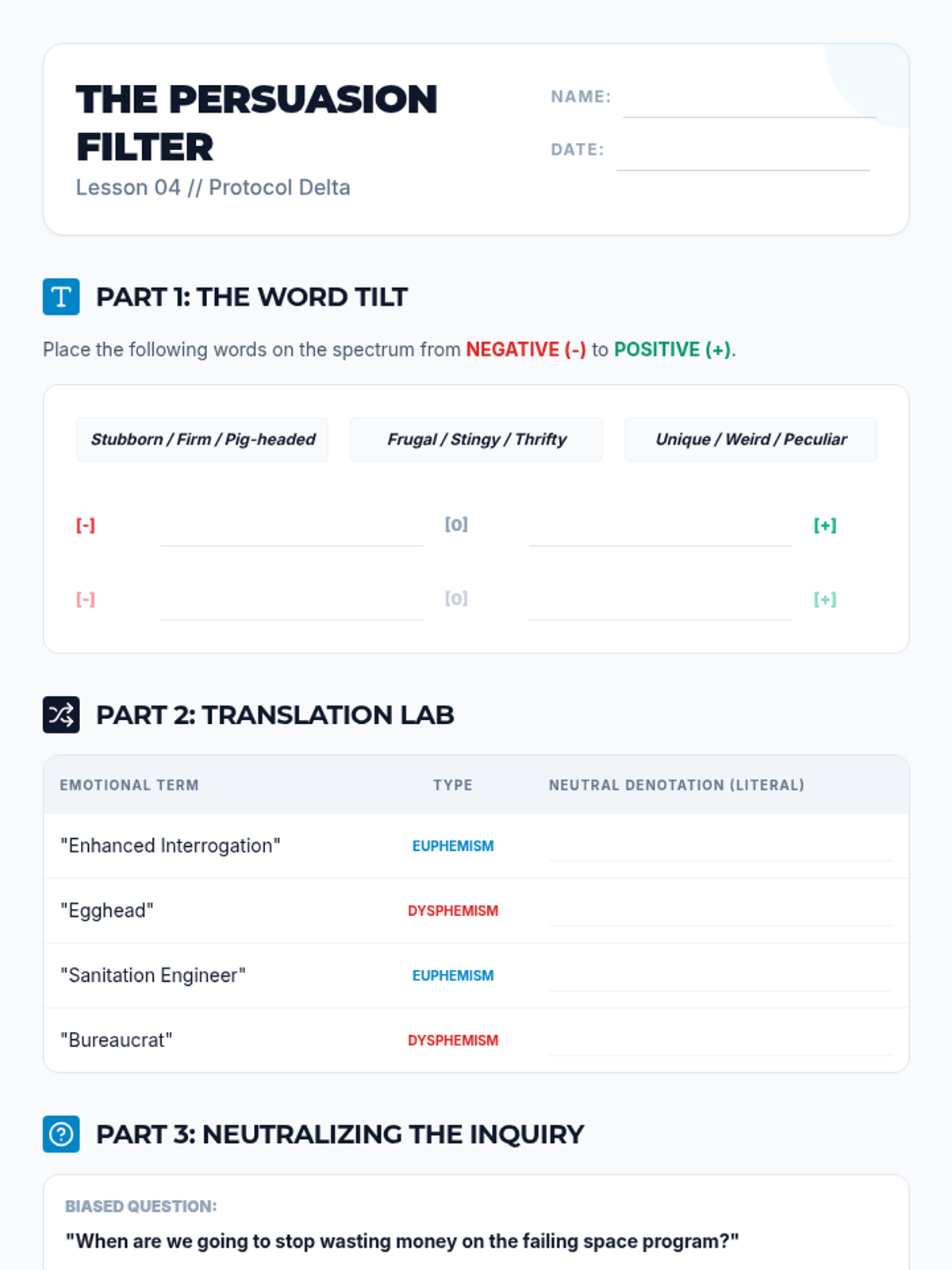
Student worksheet for Lesson 4 focusing on euphemisms and biased questioning within workplace, marriage, and friendship contexts.
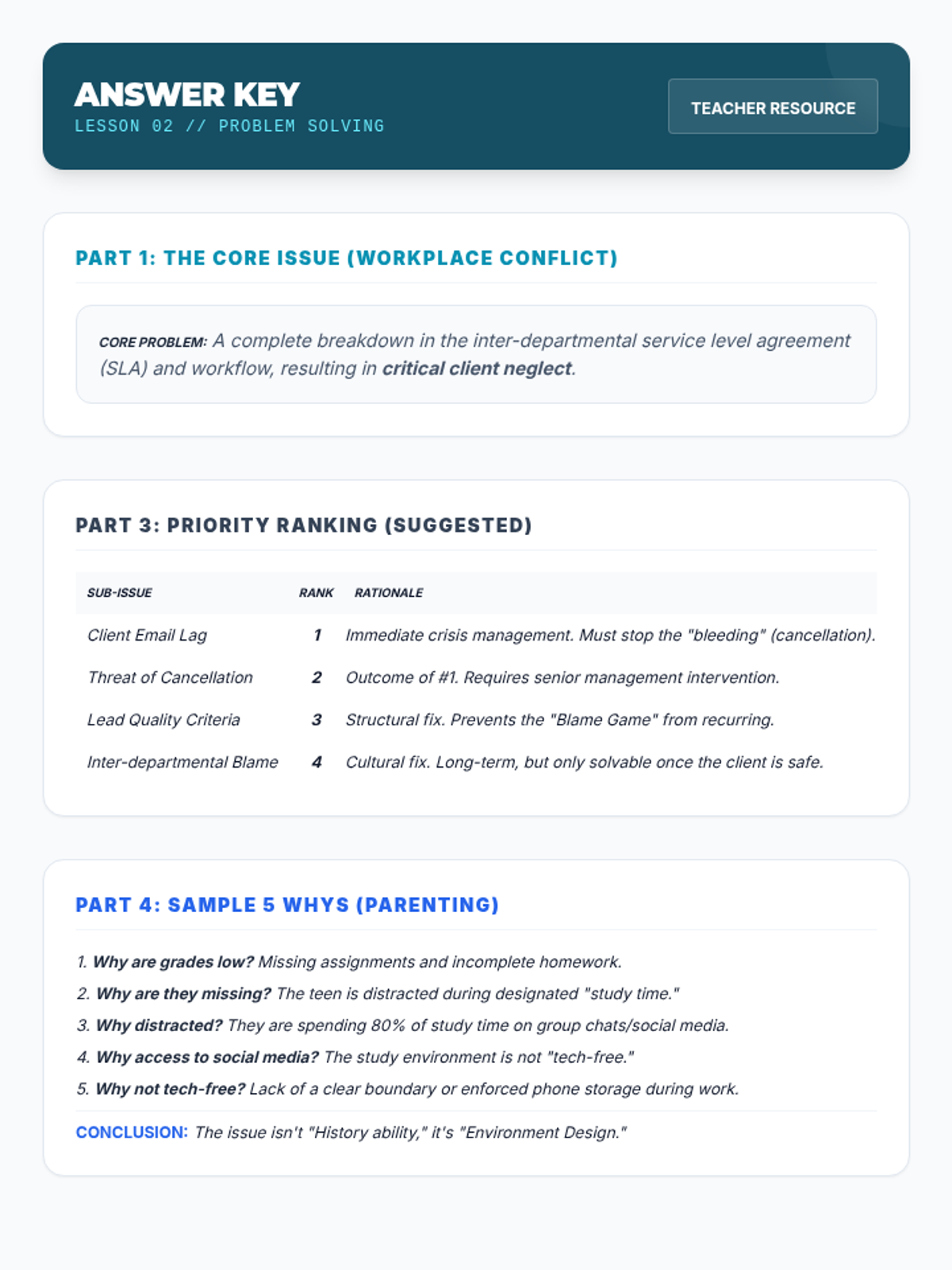
Complete answer key for the updated Lesson 2 worksheet, featuring problem decomposition and root cause analysis for workplace and parenting scenarios.
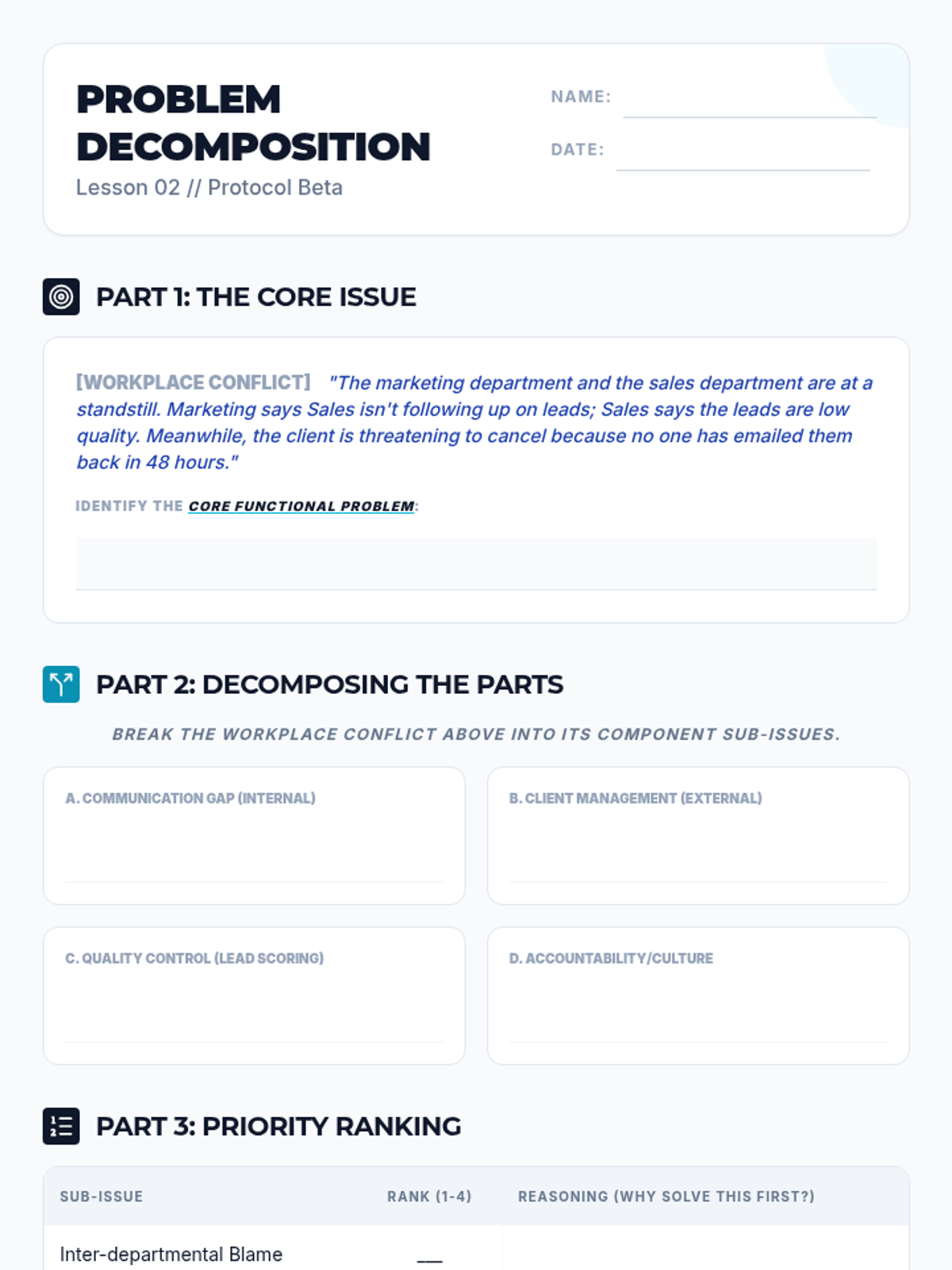
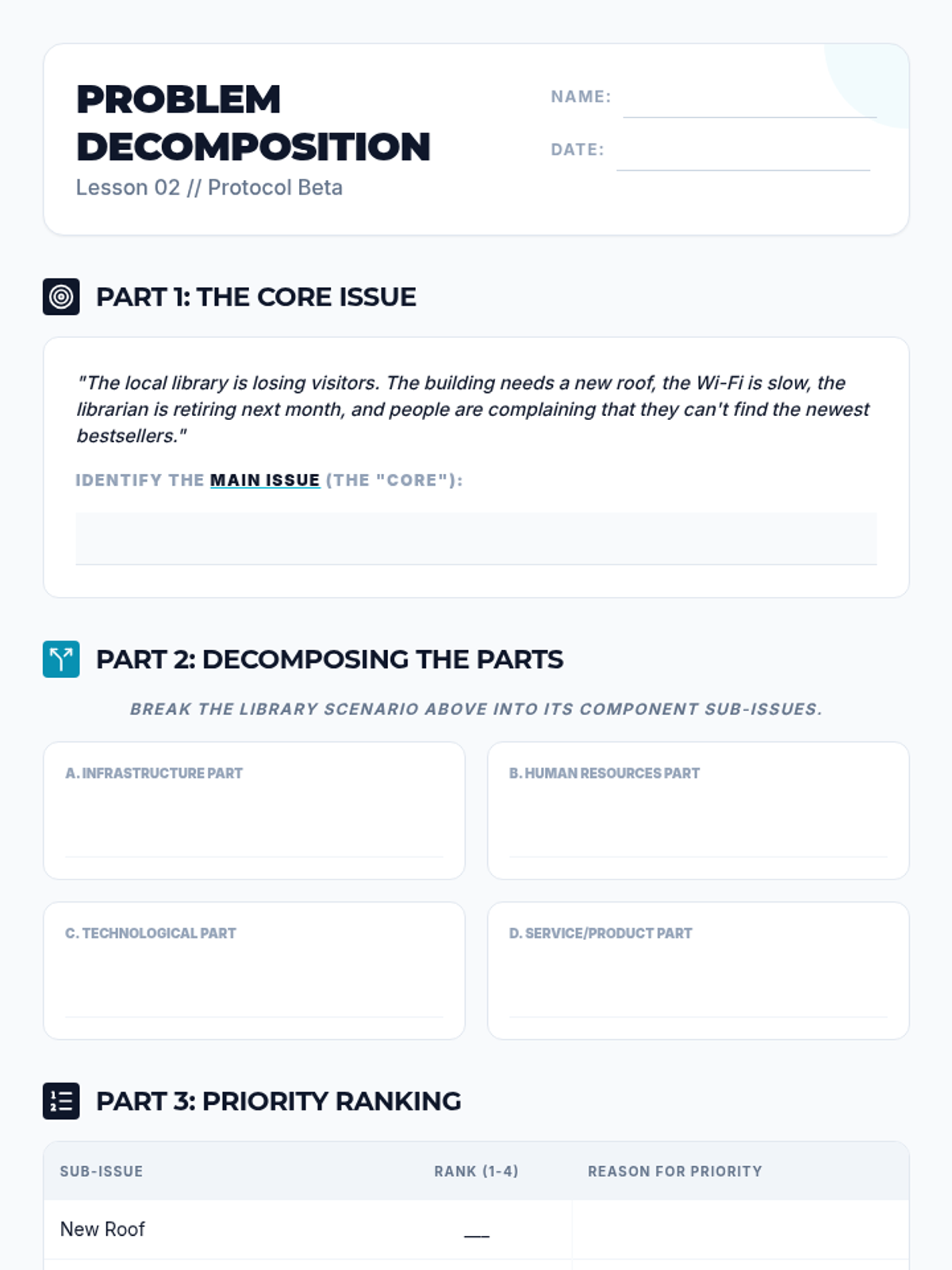
Student worksheet for Lesson 2 focusing on reframing problem statements and performing a '5 Whys' root cause analysis within workplace and parenting contexts.
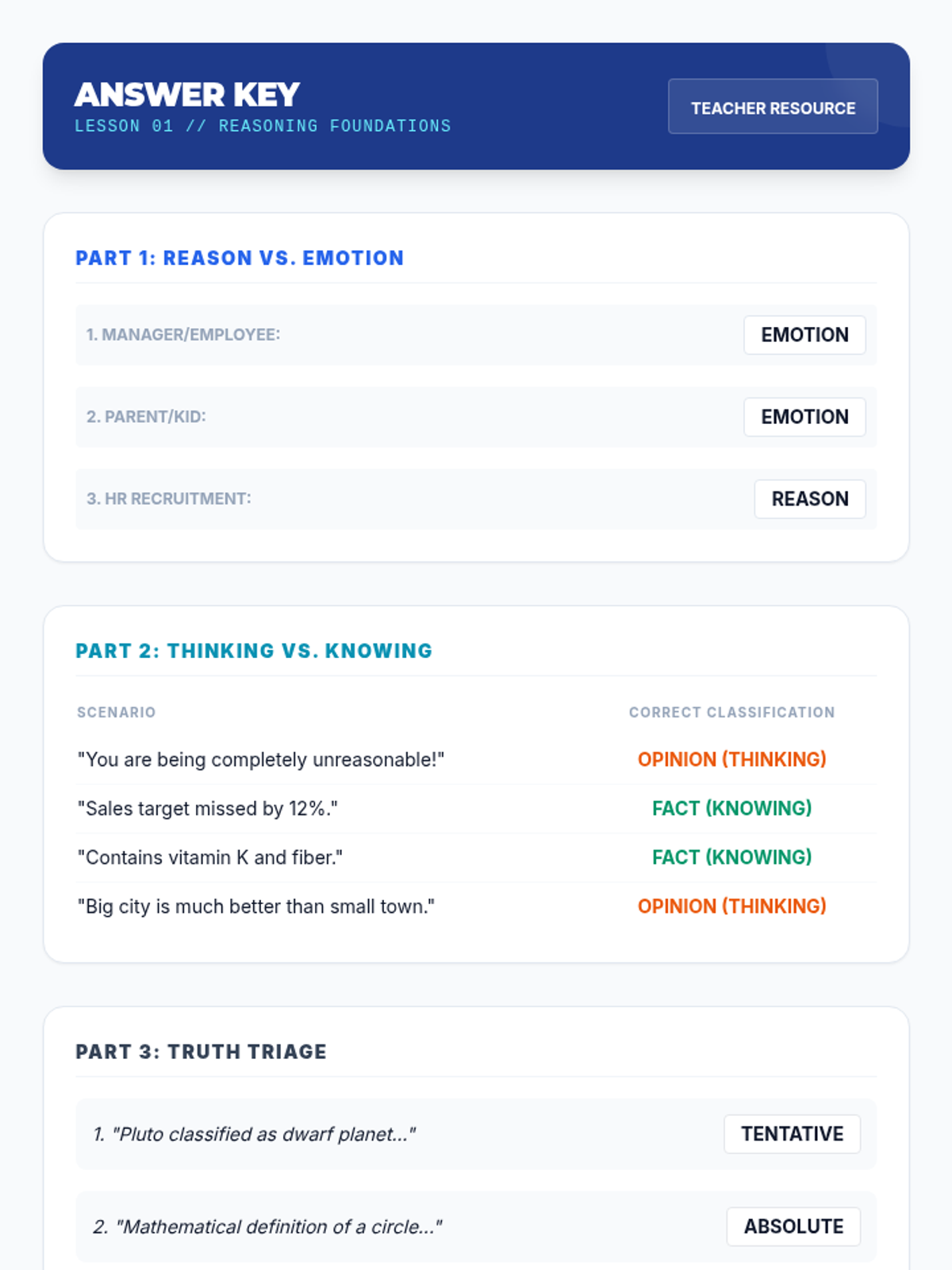
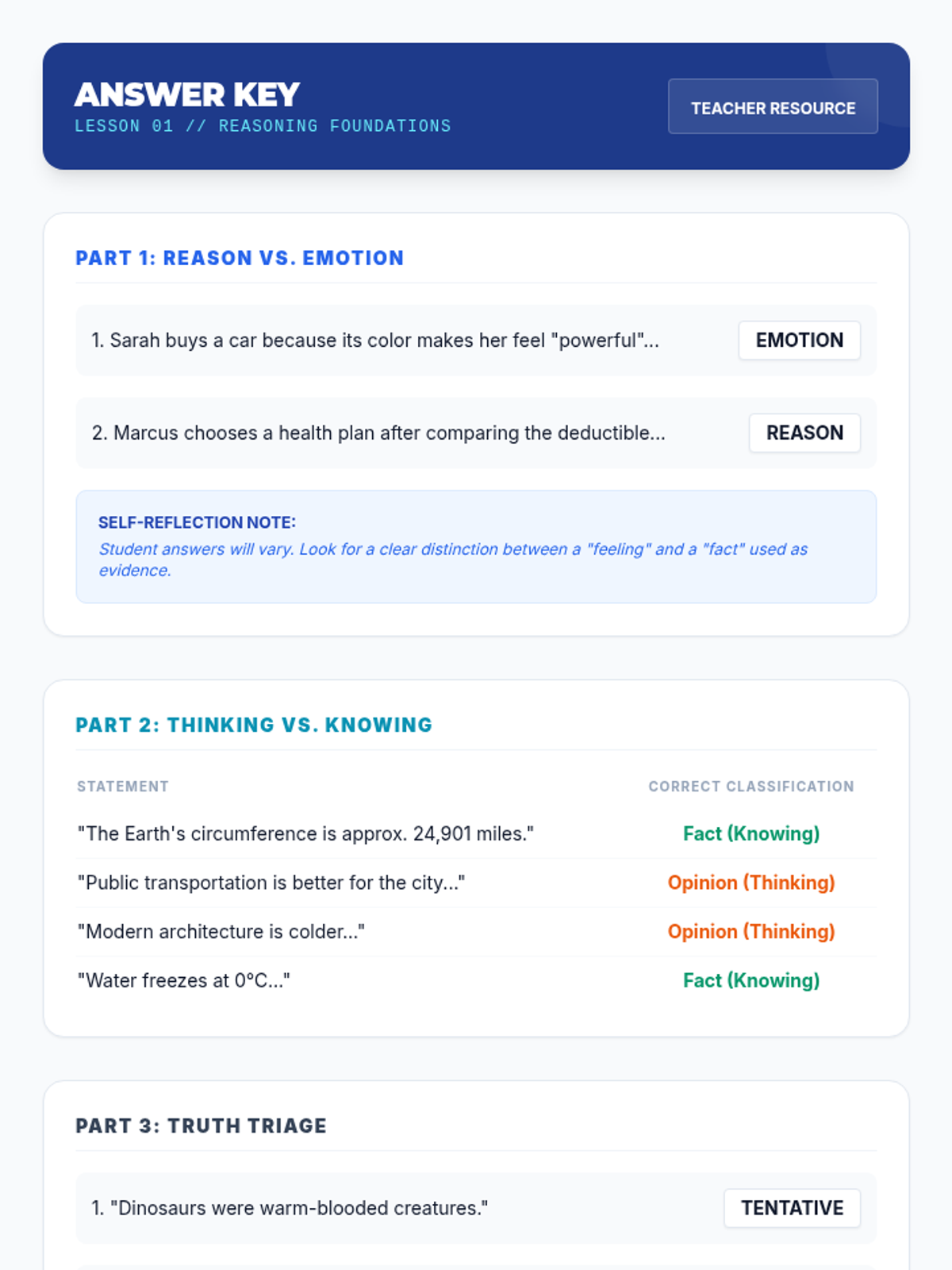
Complete answer key for the updated Lesson 1 worksheet, featuring classifications for relationship-based reason/emotion and fact/opinion scenarios.
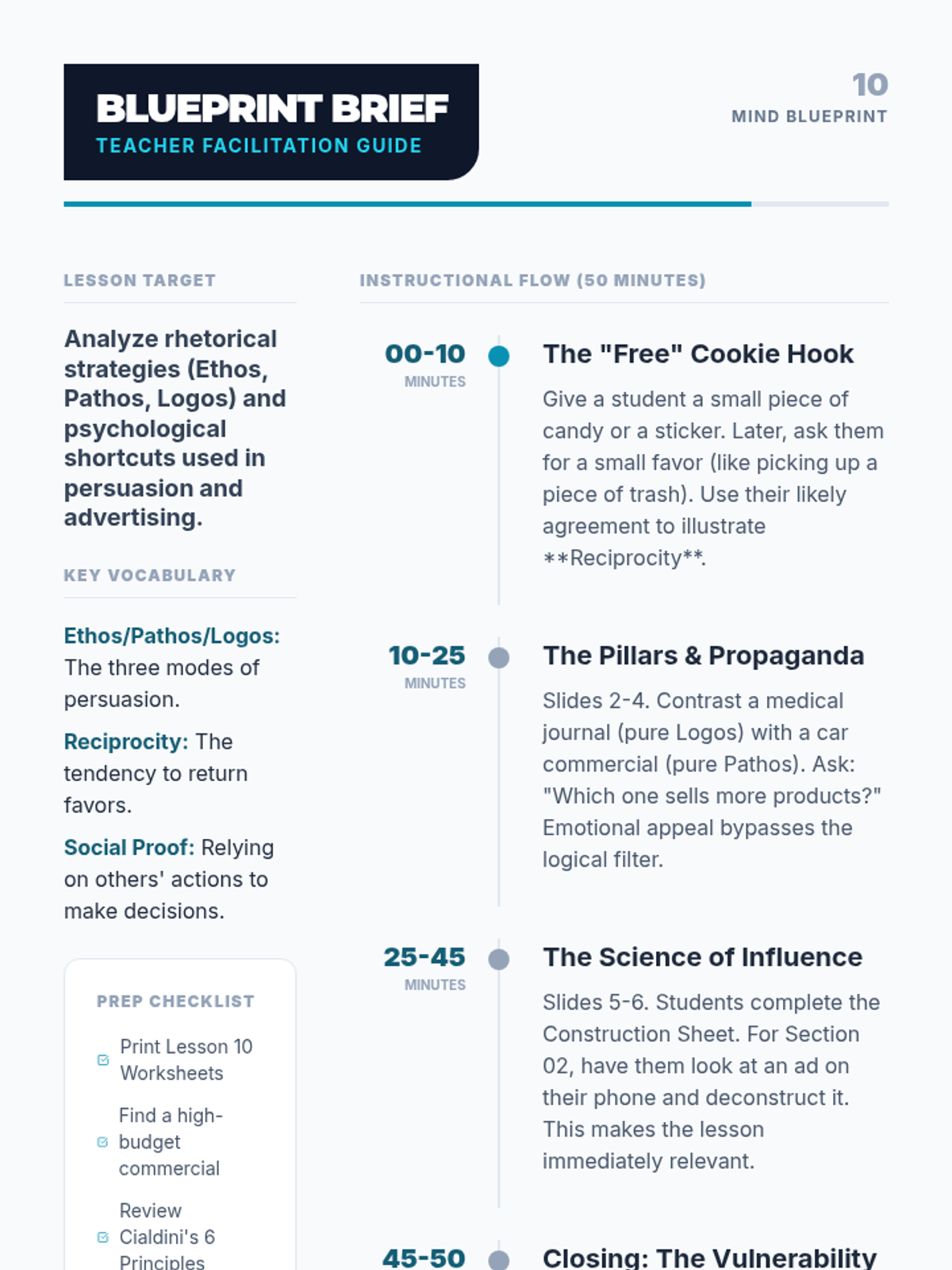
Facilitation guide for Lesson 10 on persuasion and rhetoric. Covers Aristotle's pillars, Cialdini's shortcuts, and the "Free Cookie" hook.
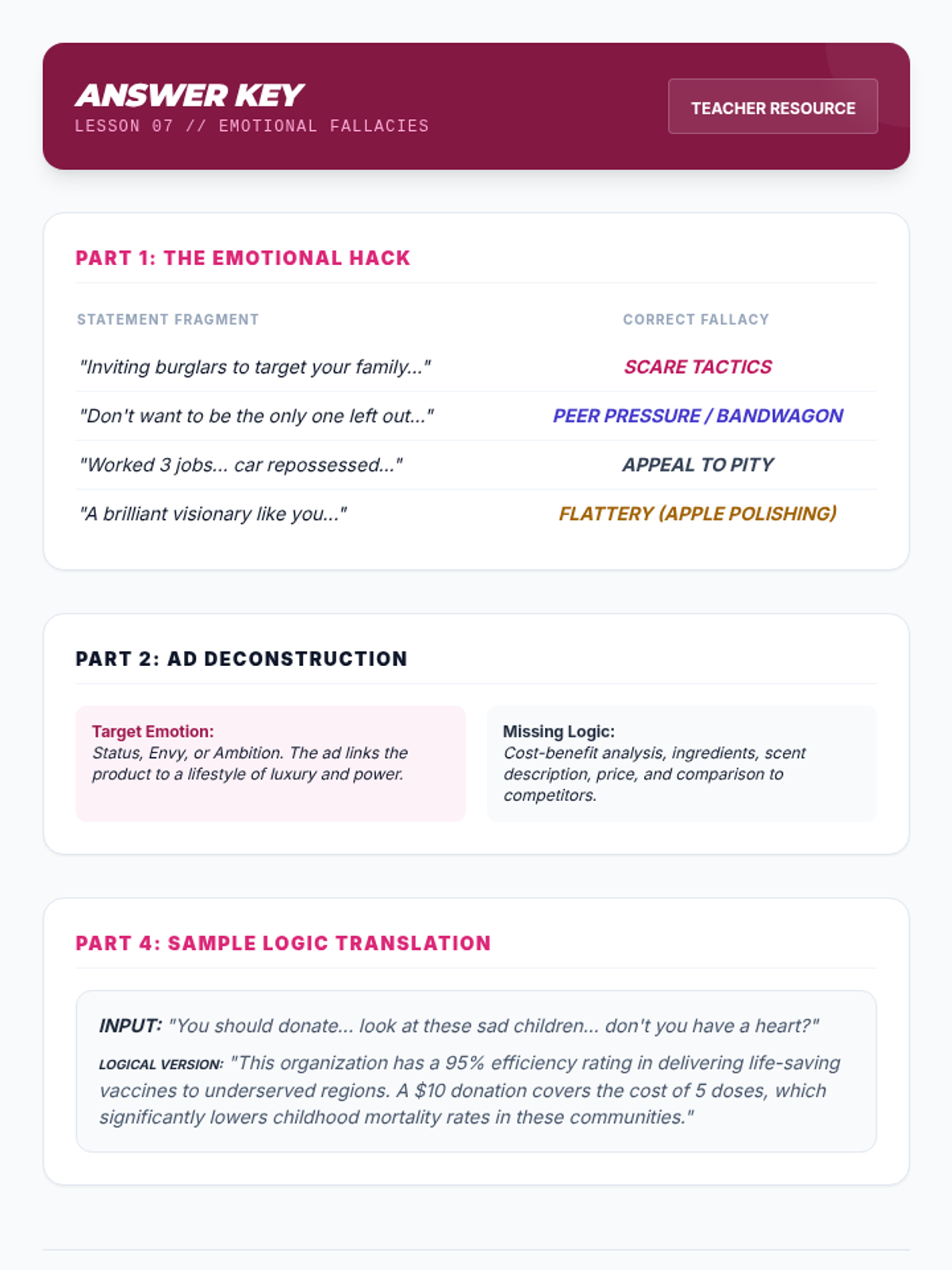
Complete answer key for the Lesson 7 worksheet, providing correct fallacy identifications and sample logic translations for emotional appeals.
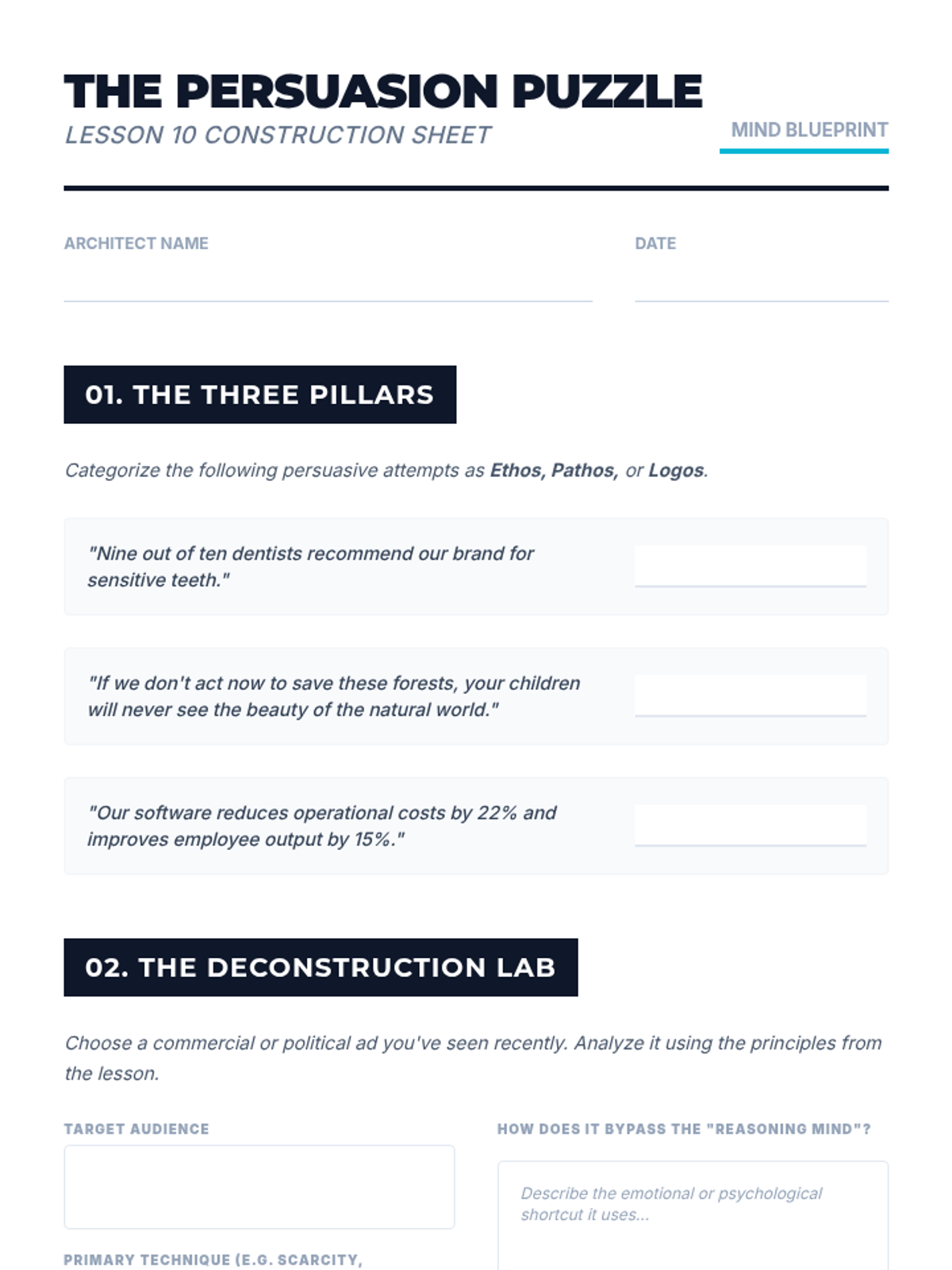
Student worksheet for Lesson 10. Features identification of Ethos/Pathos/Logos, a deconstruction lab for analyzing real-world advertisements, and a reflection on personal psychological vulnerabilities to influence.
Slide deck for Lesson 10 on persuasion and rhetoric. Covers Aristotle's pillars (Ethos, Pathos, Logos), emotional appeals, propaganda techniques, and Cialdini's principles of influence.
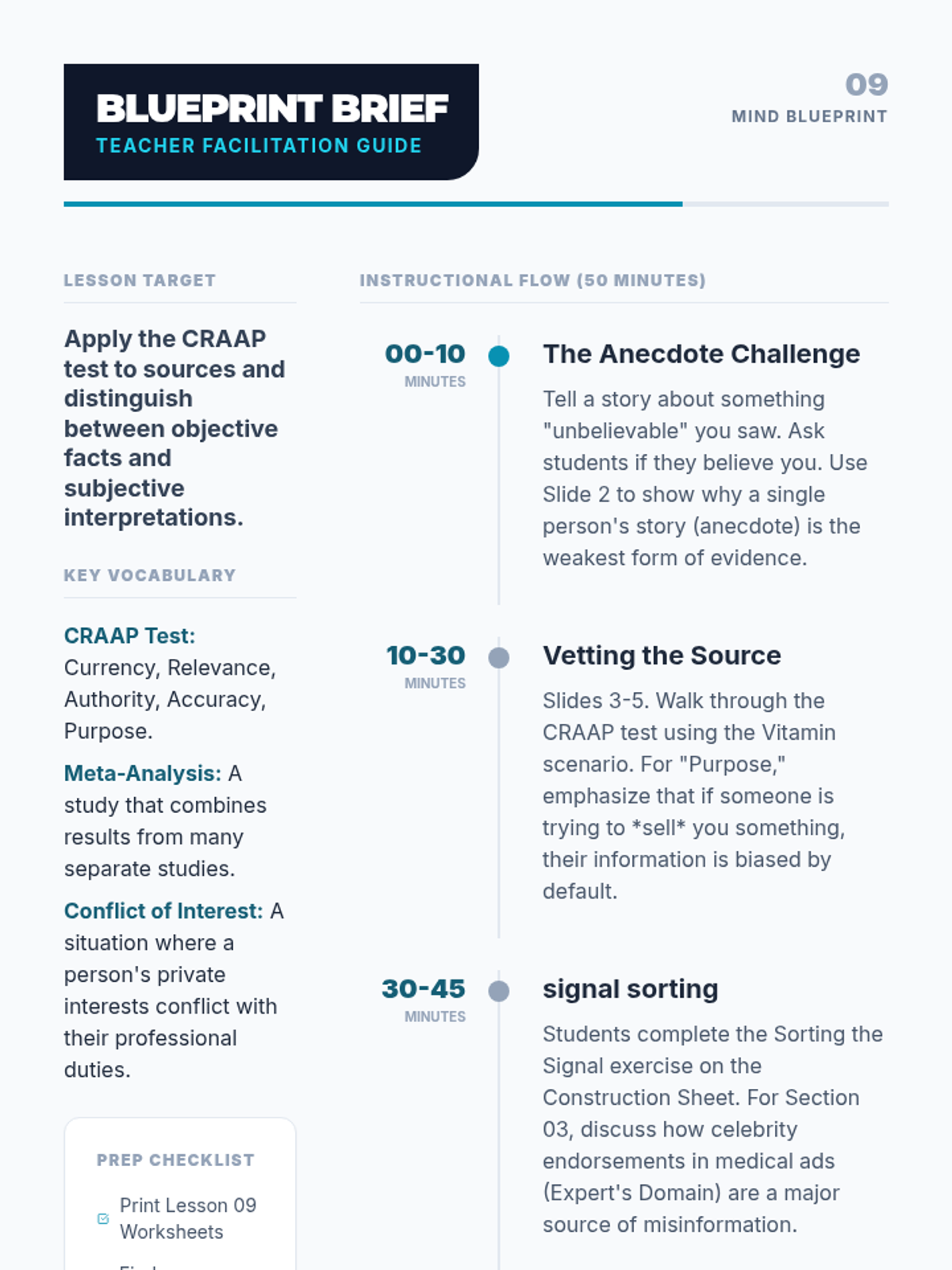
Facilitation guide for Lesson 9 on source credibility. Features the Anecdote Challenge and guidance for applying the CRAAP test to health claims.
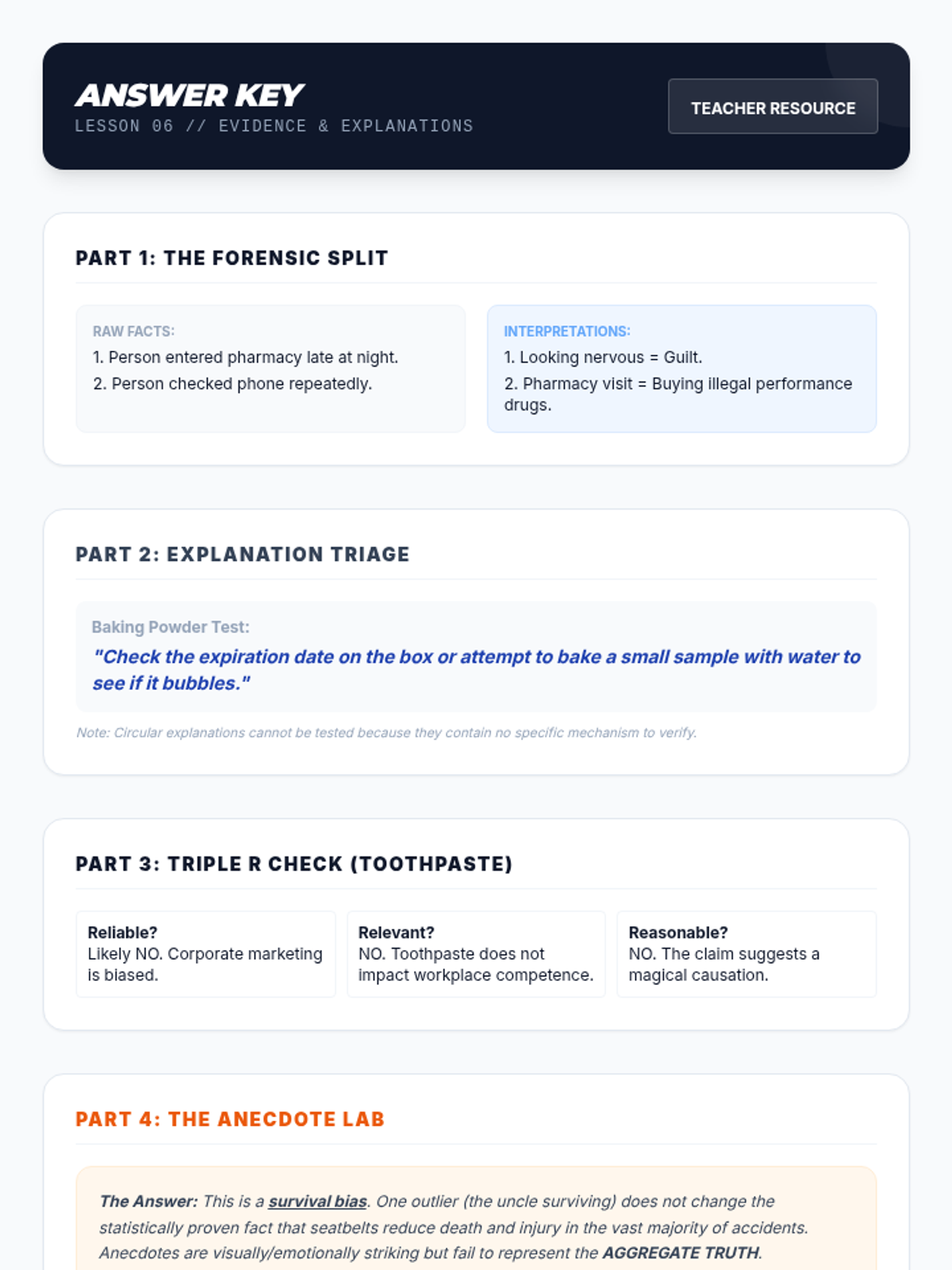
Complete answer key for the Lesson 6 worksheet, providing premises/conclusions for syllogisms and explanations for logical validity/invalidity.
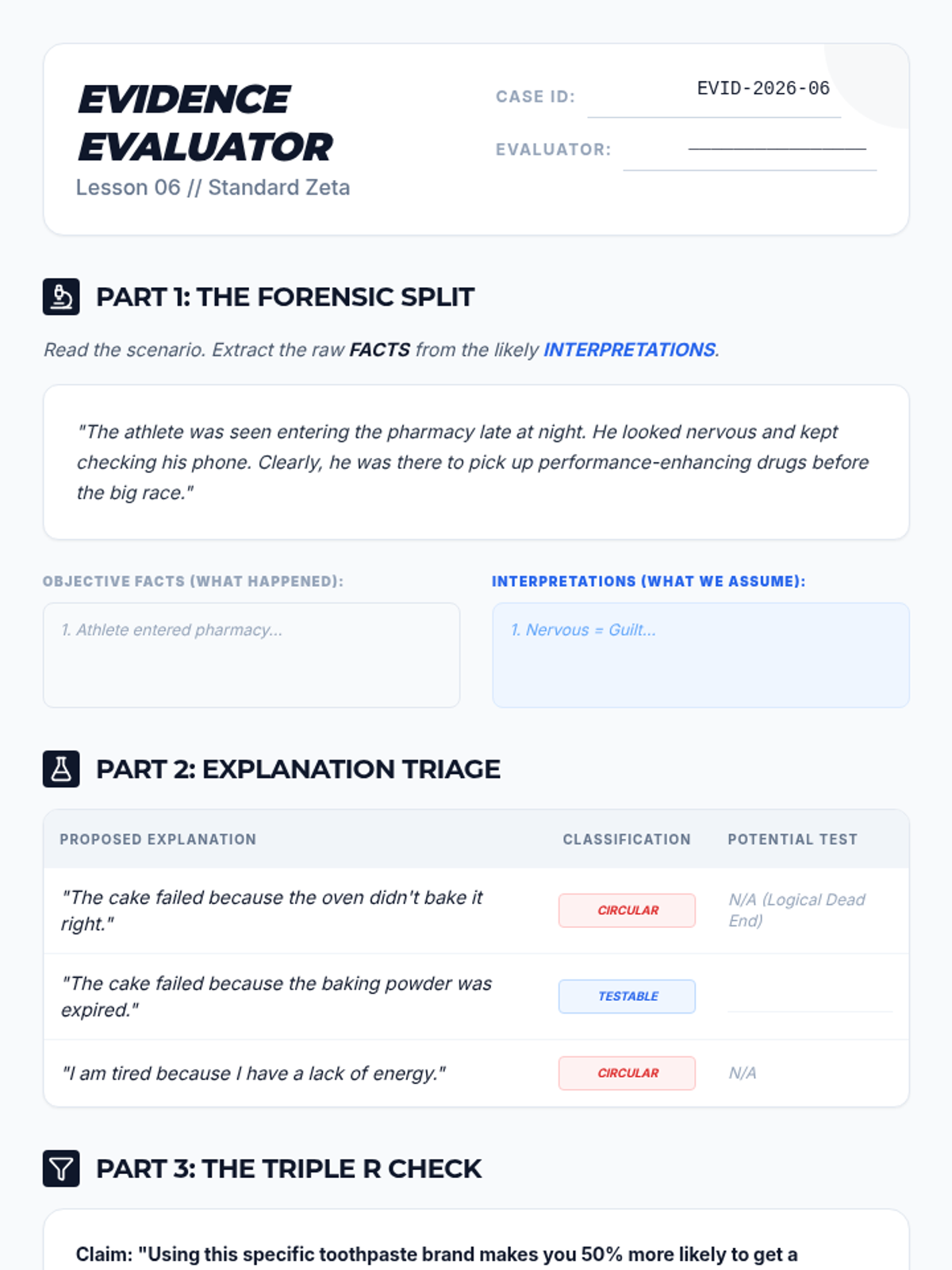
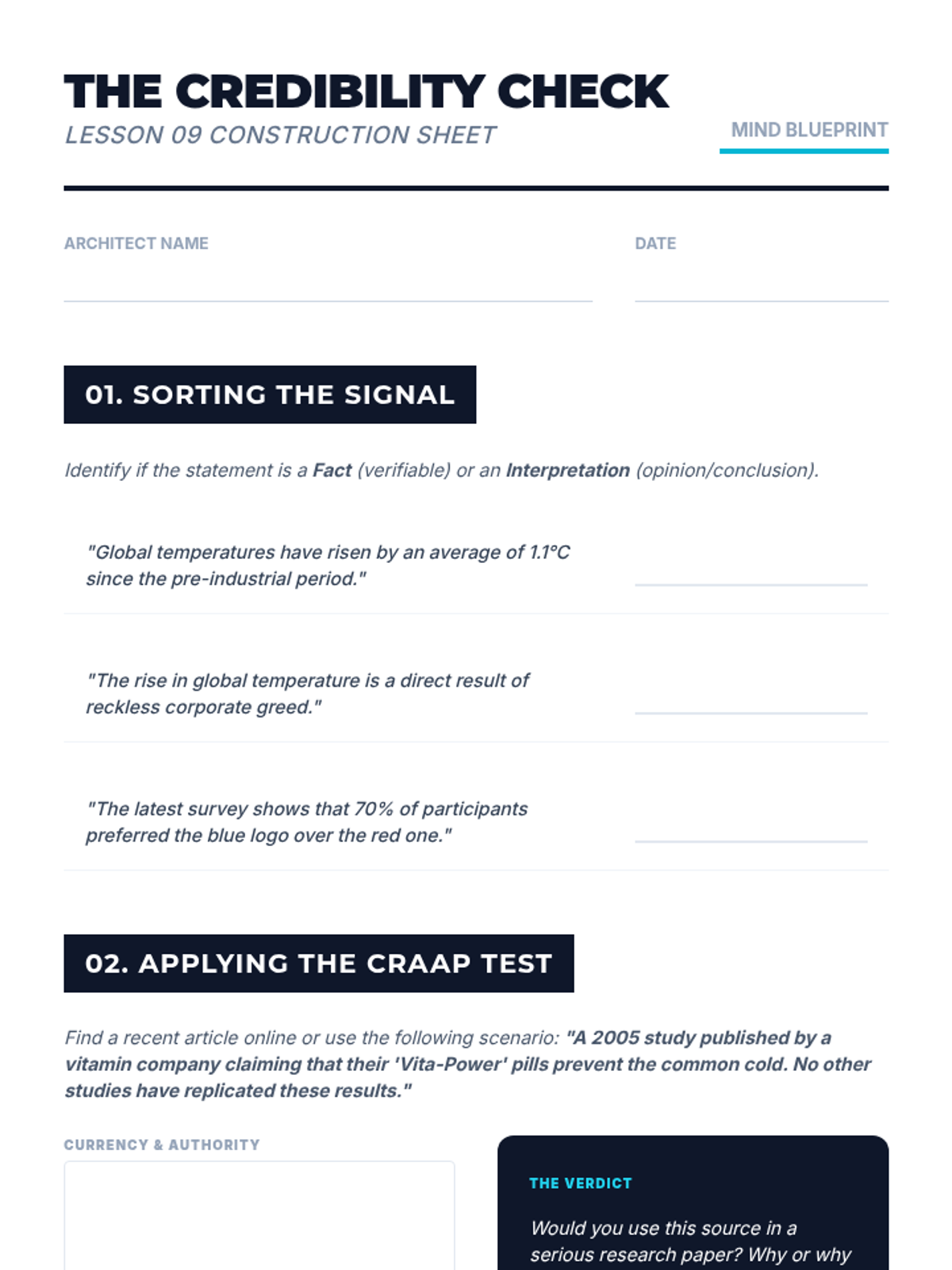
Student worksheet for Lesson 9 on evidence and credibility. Includes exercises for sorting facts from interpretations, applying the CRAAP test, and reflecting on domain-specific expertise.
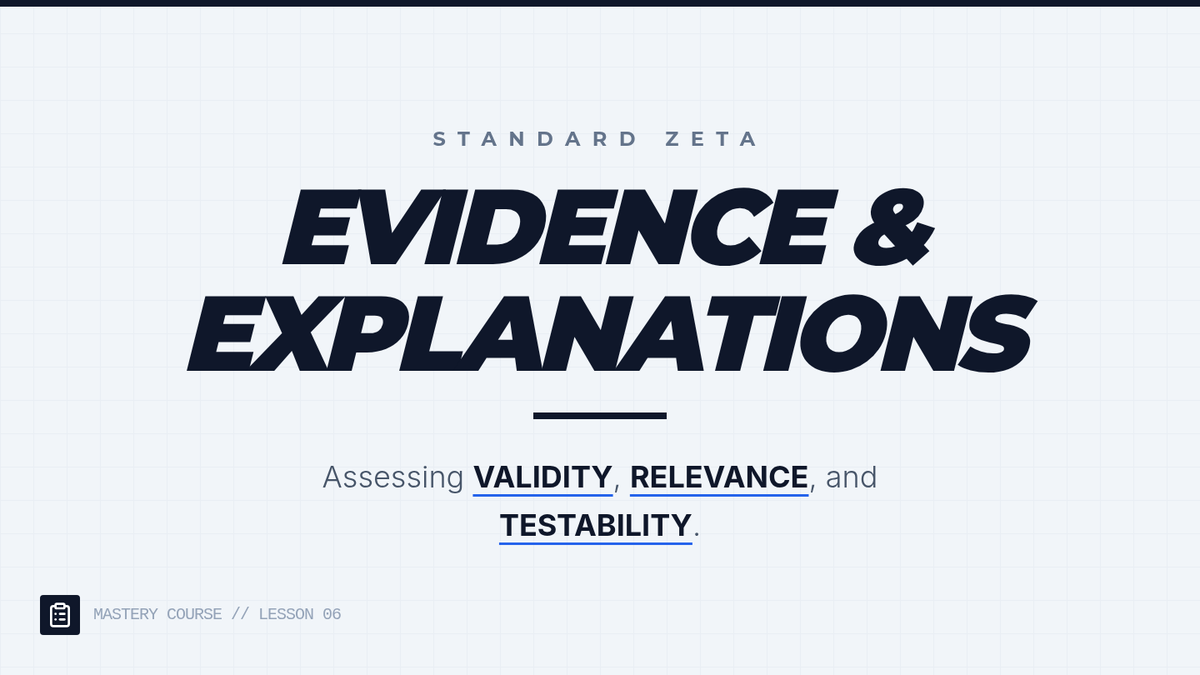
Slide deck for Lesson 9 on evaluating evidence and source credibility. Covers the hierarchy of evidence, expert domain-specific credibility, the CRAAP test, and distinguishing fact from interpretation.
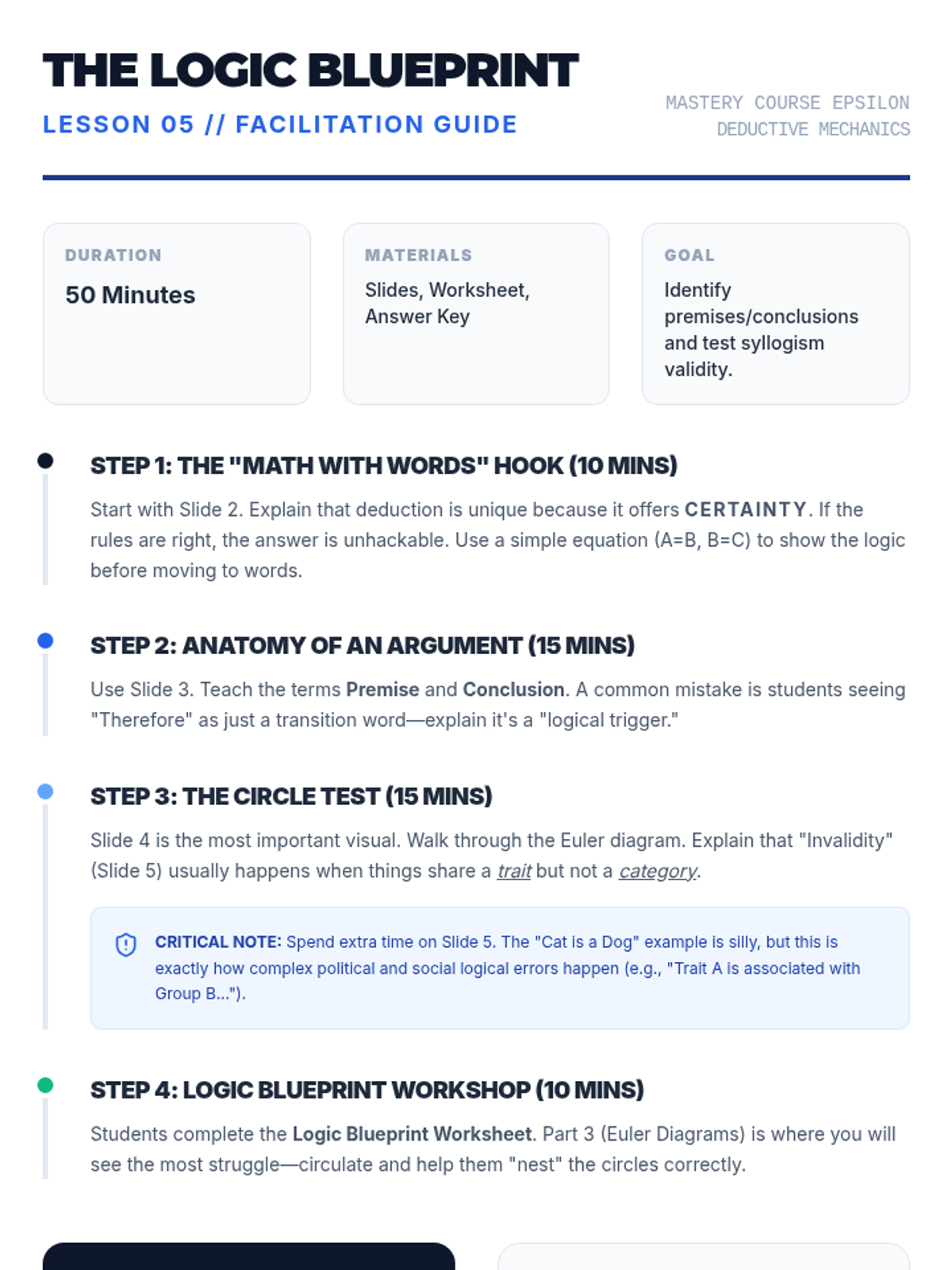
Facilitation guide for Lesson 3. Optimized layout to ensure all content fits on a single page with high-contrast elements.
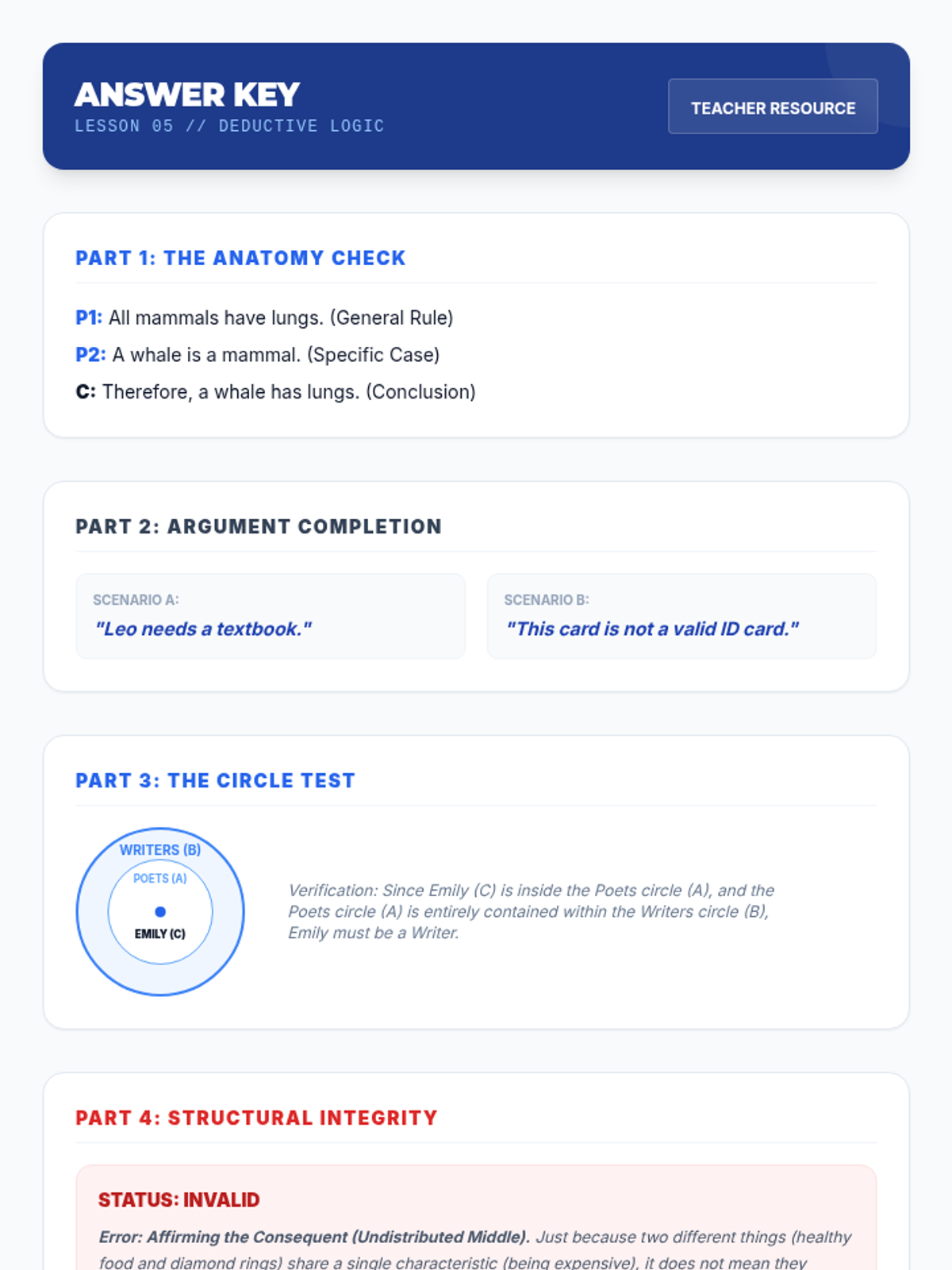
Complete answer key for the Lesson 5 worksheet, providing premises/conclusions for syllogisms and explanations for logical validity/invalidity.
Student worksheet for Lesson 3, featuring syllogism evaluation and categorical logic diagramming. Improved spacing ensures all content fits on a single page.
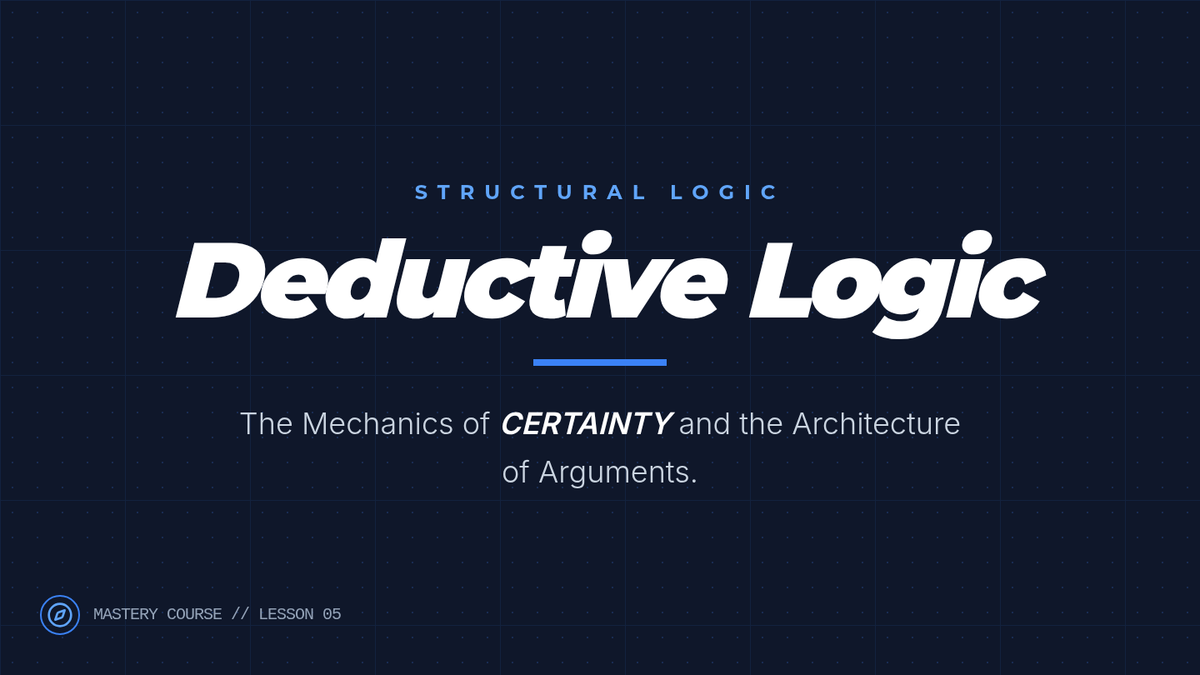
A comprehensive slide deck on deductive reasoning, syllogisms, and categorical logic. Features corrected visual models for categorical logic and high-contrast text.
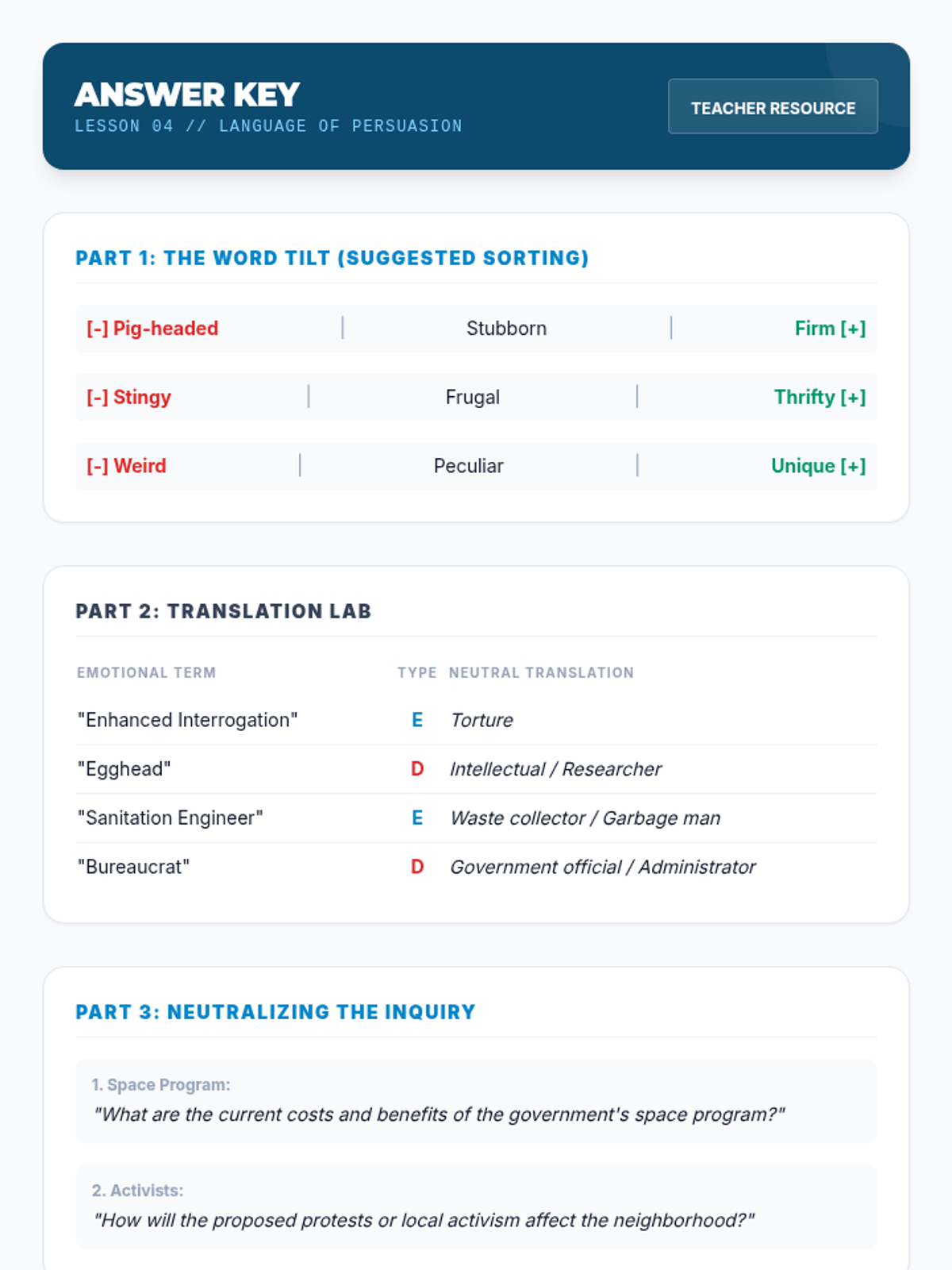
Complete answer key for the Lesson 4 worksheet, providing neutral translations for euphemisms/dysphemisms and sample slanted vs. neutral paragraphs.
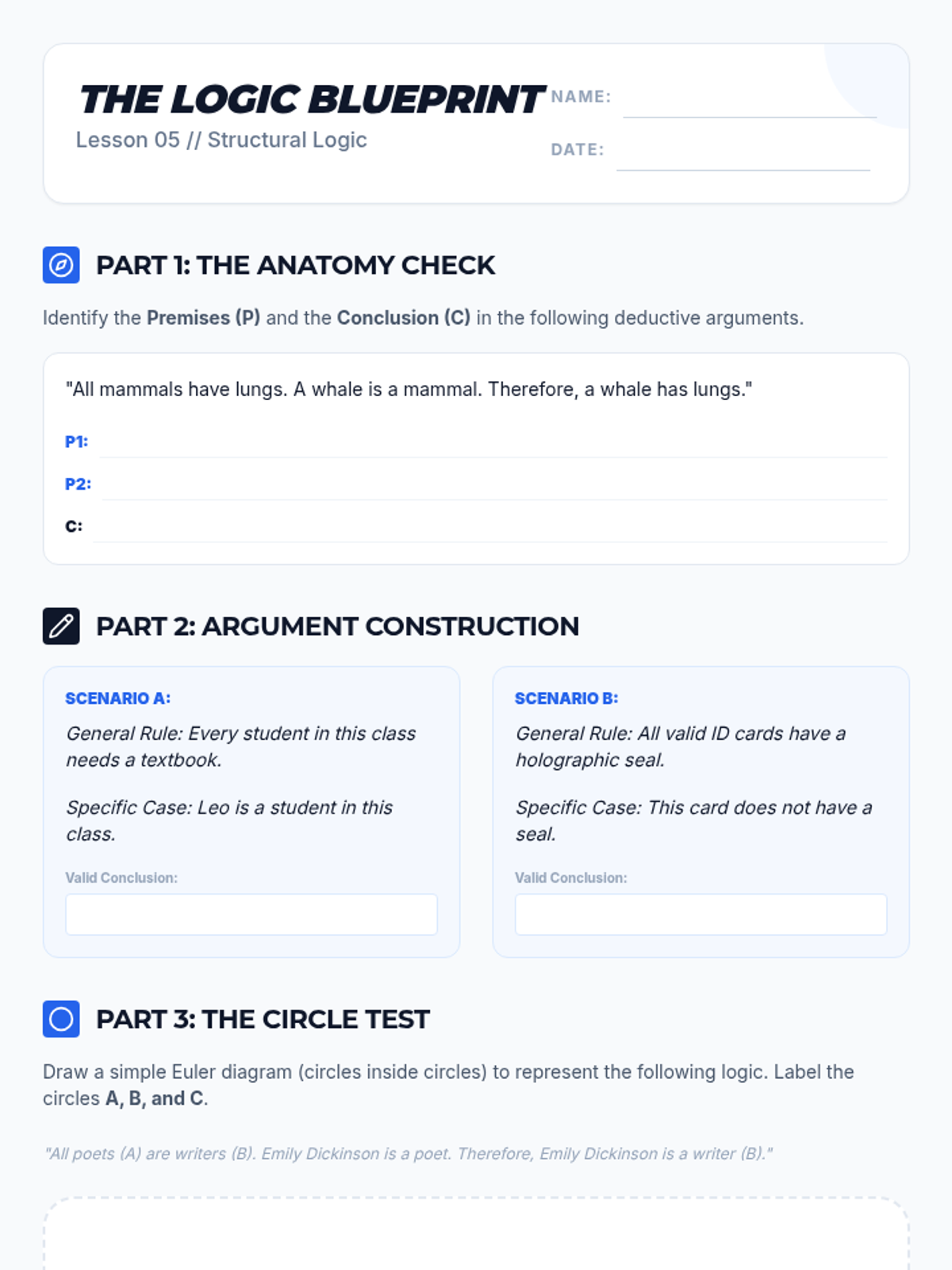
Revised student worksheet for Lesson 5 with improved text contrast for labels, increased letter-spacing for readability, and standardized input row heights.
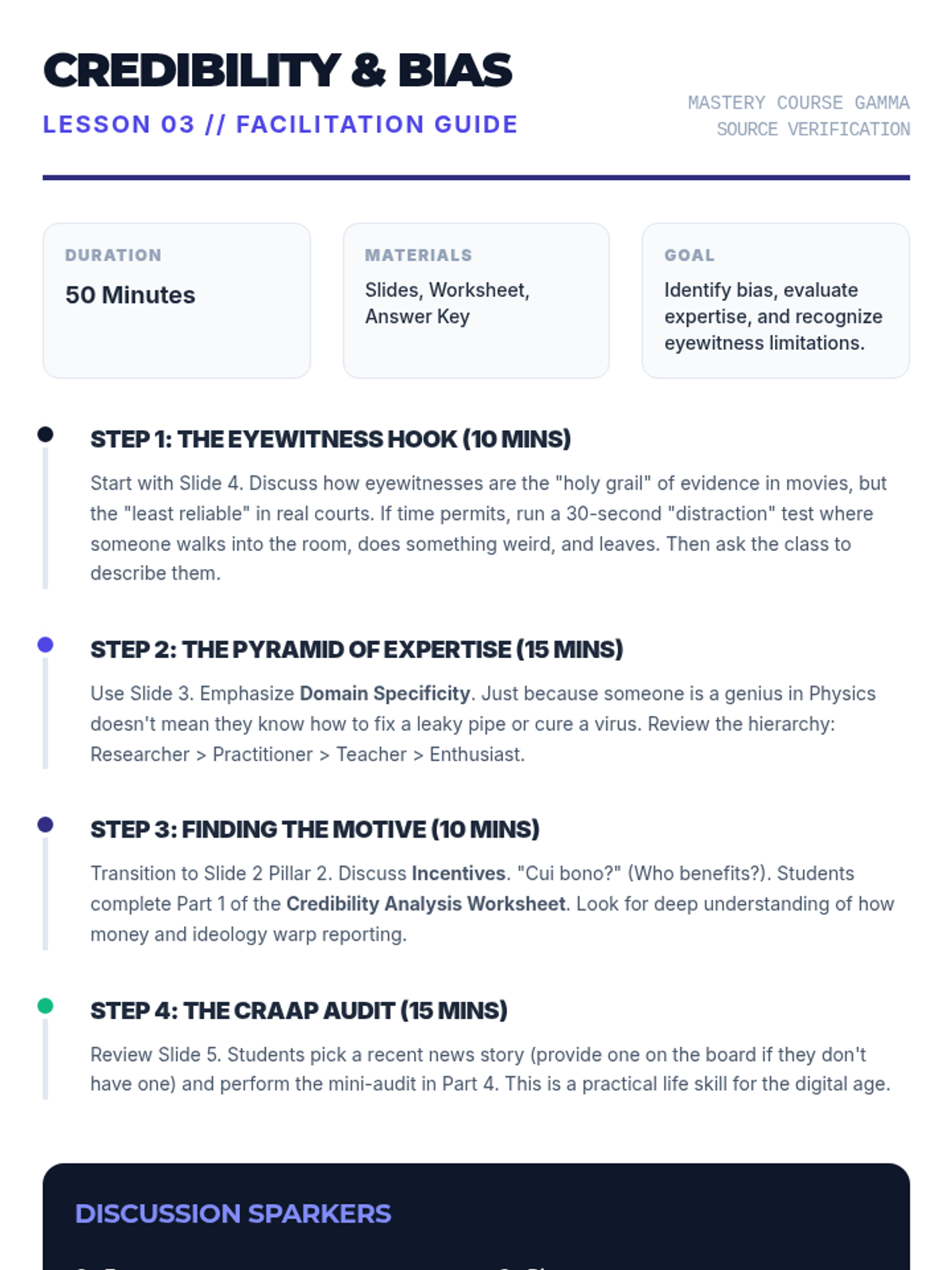
Revised Teacher's Guide for Lesson 3. Single-page layout with improved label sizes, consistent timeline styling, and increased contrast.
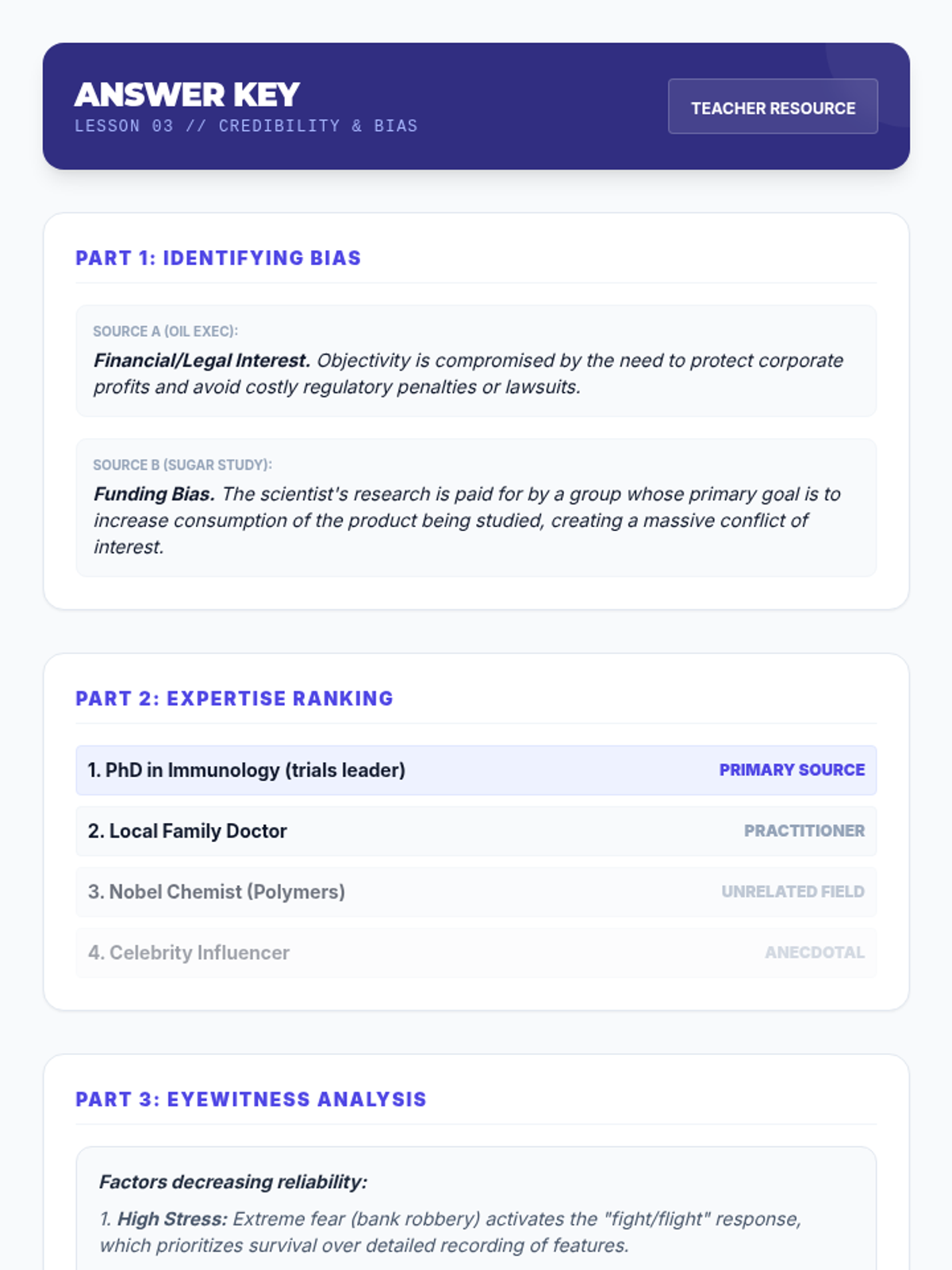
Complete answer key for the Lesson 3 worksheet, covering bias identification, expertise ranking, and analysis of eyewitness reliability factors.
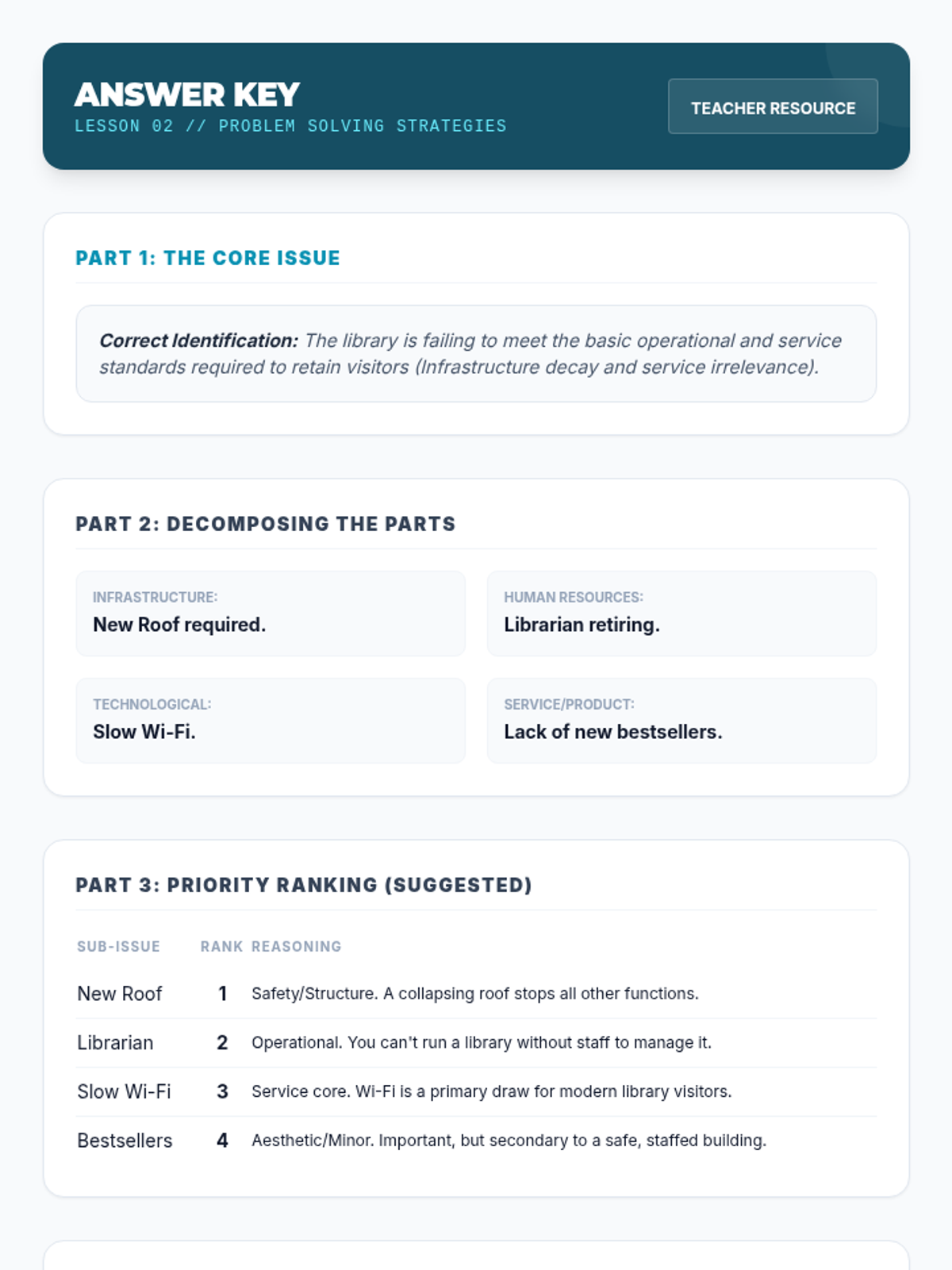
Complete answer key for the Lesson 2 worksheet, featuring core issue identification, sub-issue decomposition, priority ranking, and a sample 5 Whys analysis.
Student worksheet for Lesson 2 focusing on reframing problem statements and performing a '5 Whys' root cause analysis. Improved spacing and layout for legibility.
Complete answer key for the Lesson 1 worksheet, featuring correct classifications for reason/emotion scenarios, fact/opinion statements, and absolute/tentative truths.
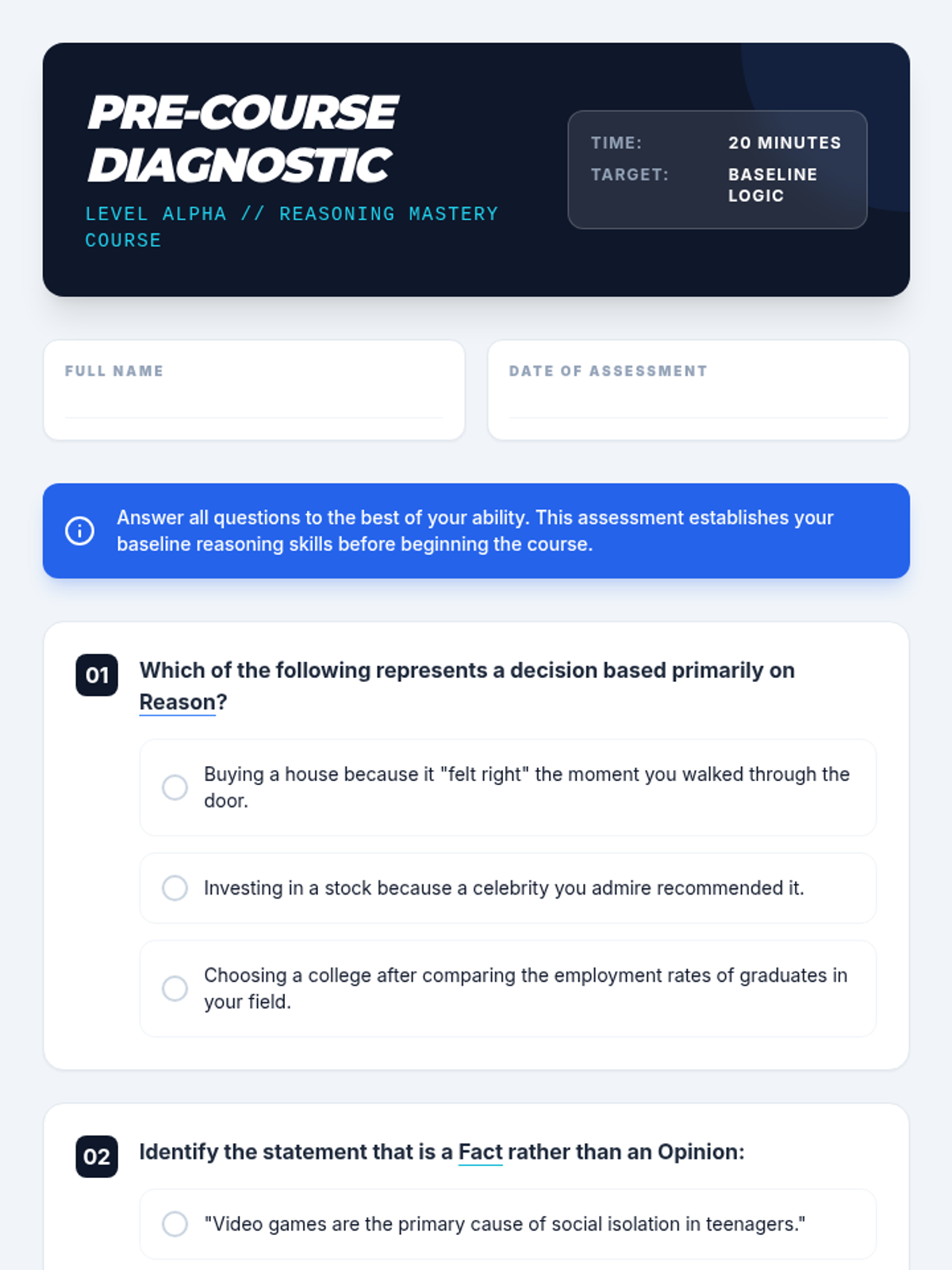
Baseline assessment for the Reasoning Mastery Course, covering key concepts from all 12 lessons including logic types, fallacies, and statistical reasoning. Designed for administration at the start of Lesson 1.
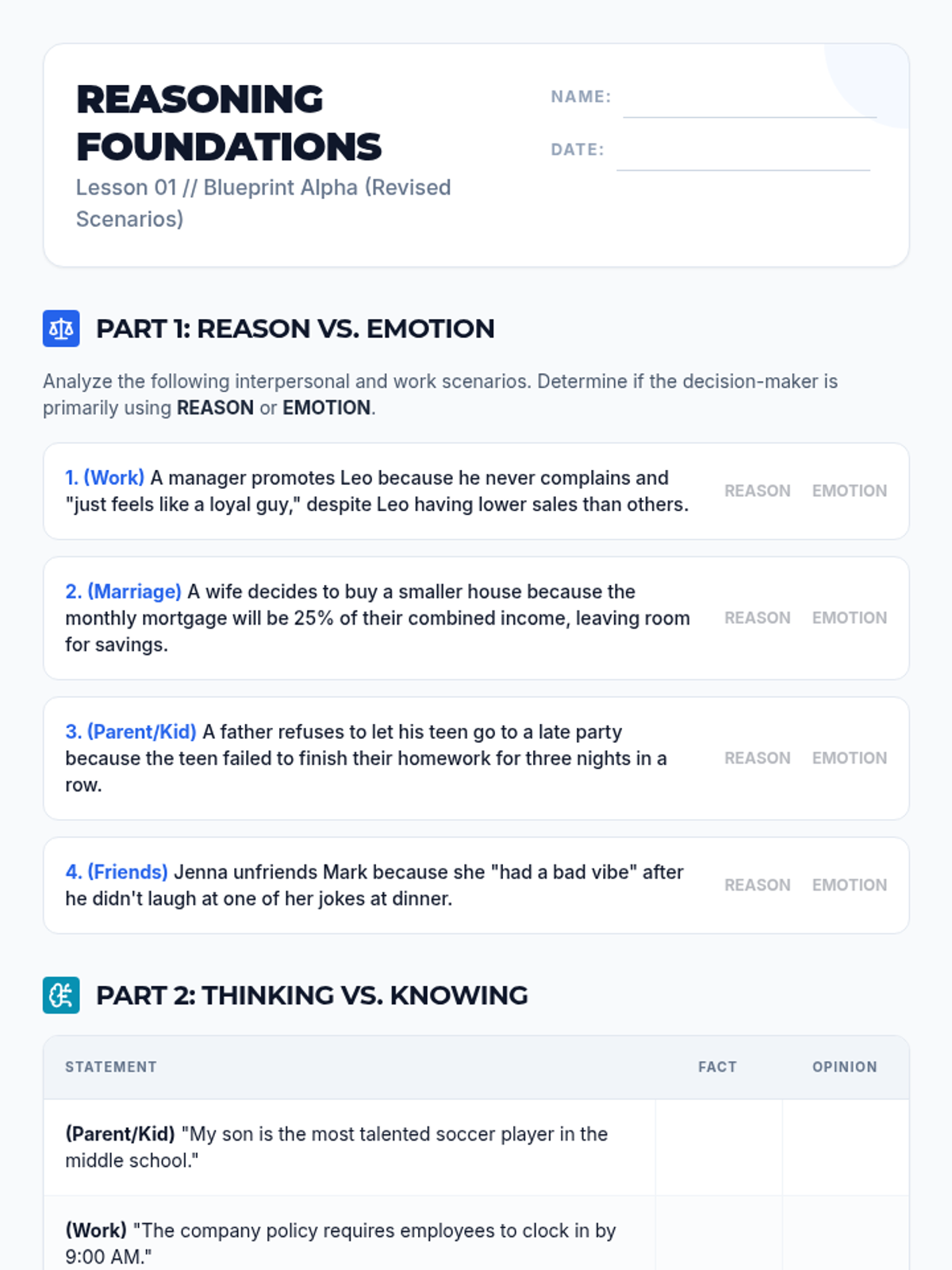
Revised student worksheet for Lesson 1, featuring interpersonal and workplace scenarios (Parent/Kid, Marriage, Work, Friends) to practice distinguishing Reason/Emotion and Fact/Opinion.
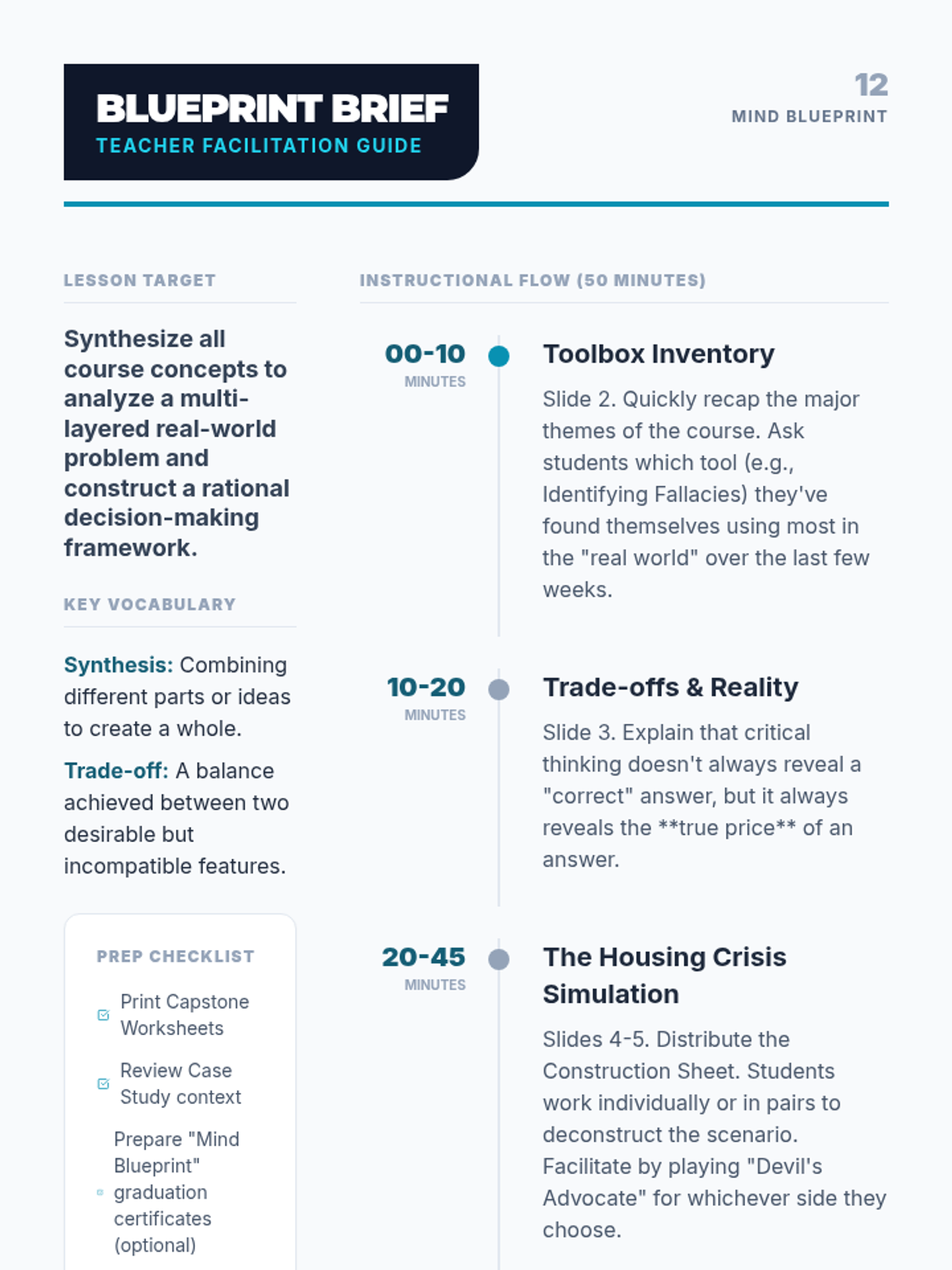
Facilitation guide for the final lesson of the Mind Blueprint course. Focuses on synthesizing all course tools to address a complex urban housing crisis scenario.
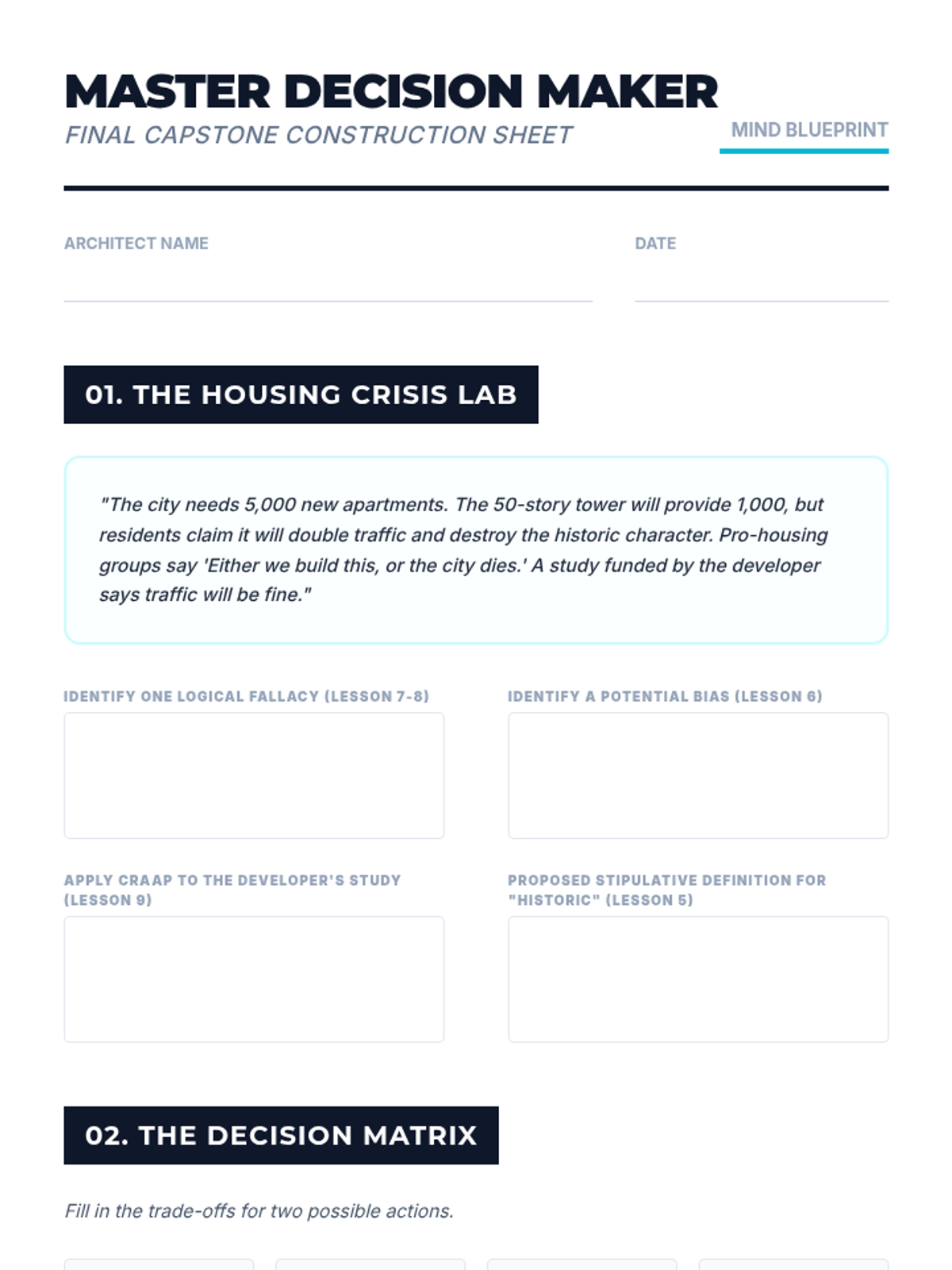
Capstone worksheet for the Mind Blueprint course. Students apply logic, evidence evaluation, bias detection, and definition precision to a complex urban housing crisis scenario.
Capstone slide deck for the Mind Blueprint course. Synthesizes all previous lessons into a single decision-making framework applied to complex, real-world scenarios.
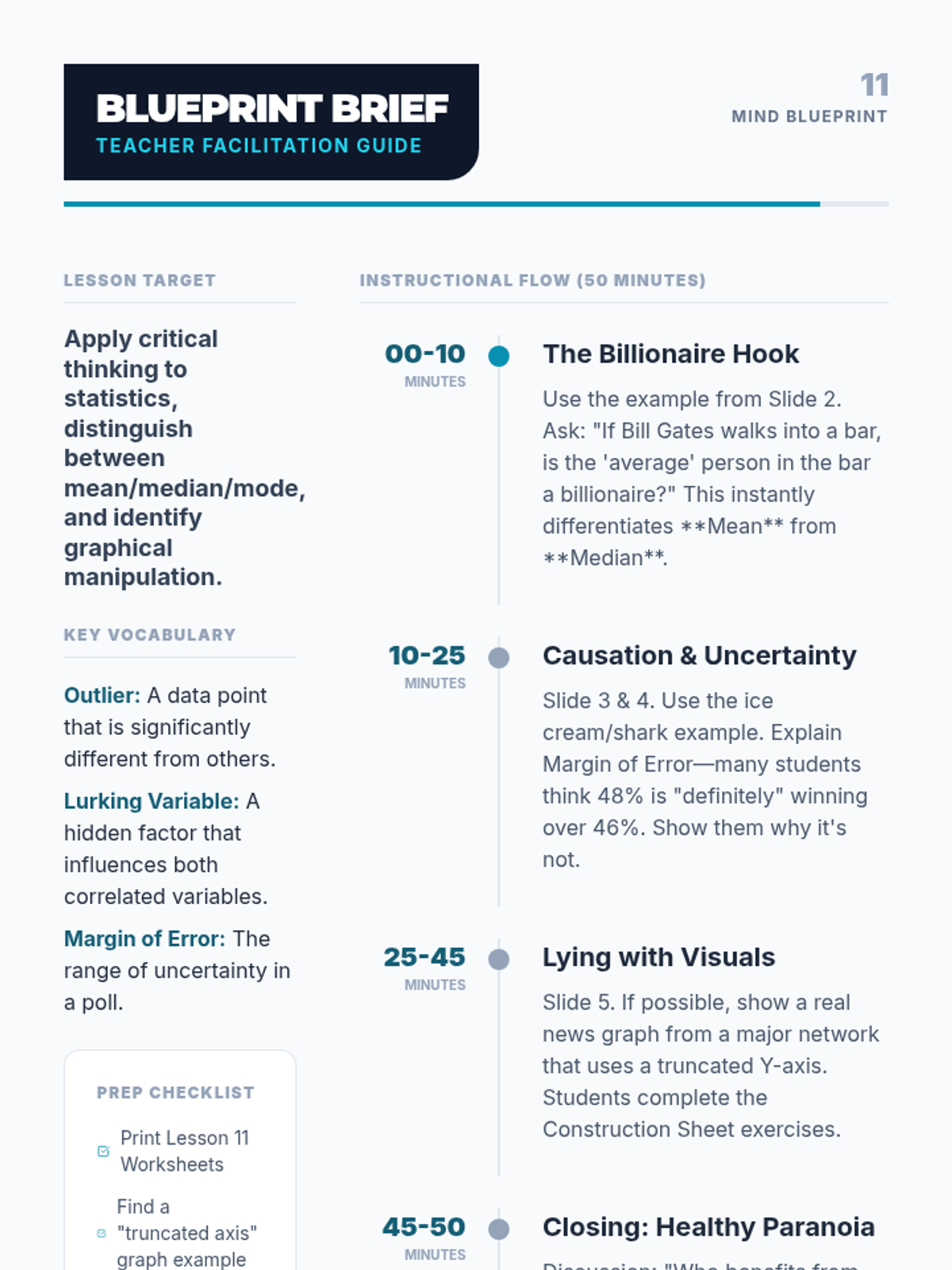
Facilitation guide for Lesson 11 on statistical reasoning. Includes the Billionaire Hook and guidance for discussing mean vs. median and margin of error.
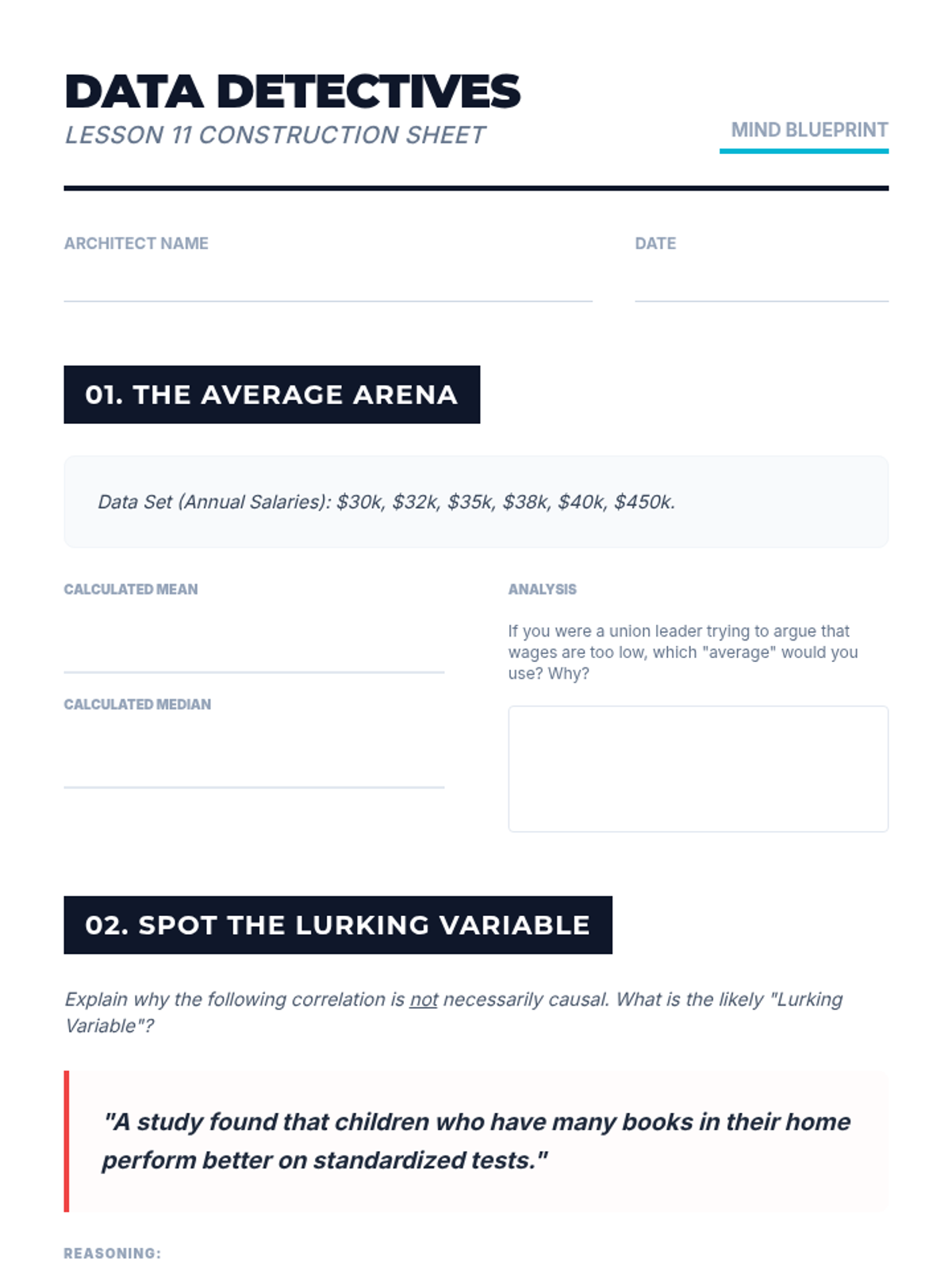
Student worksheet for Lesson 11 on statistical reasoning. Includes mean/median calculations, identifying lurking variables in correlations, and critiquing graphical manipulations.
Slide deck for Lesson 11 on statistical reasoning. Covers the three types of averages, the 'Correlation vs. Causation' rule, margin of error in polling, and graphical manipulation techniques.
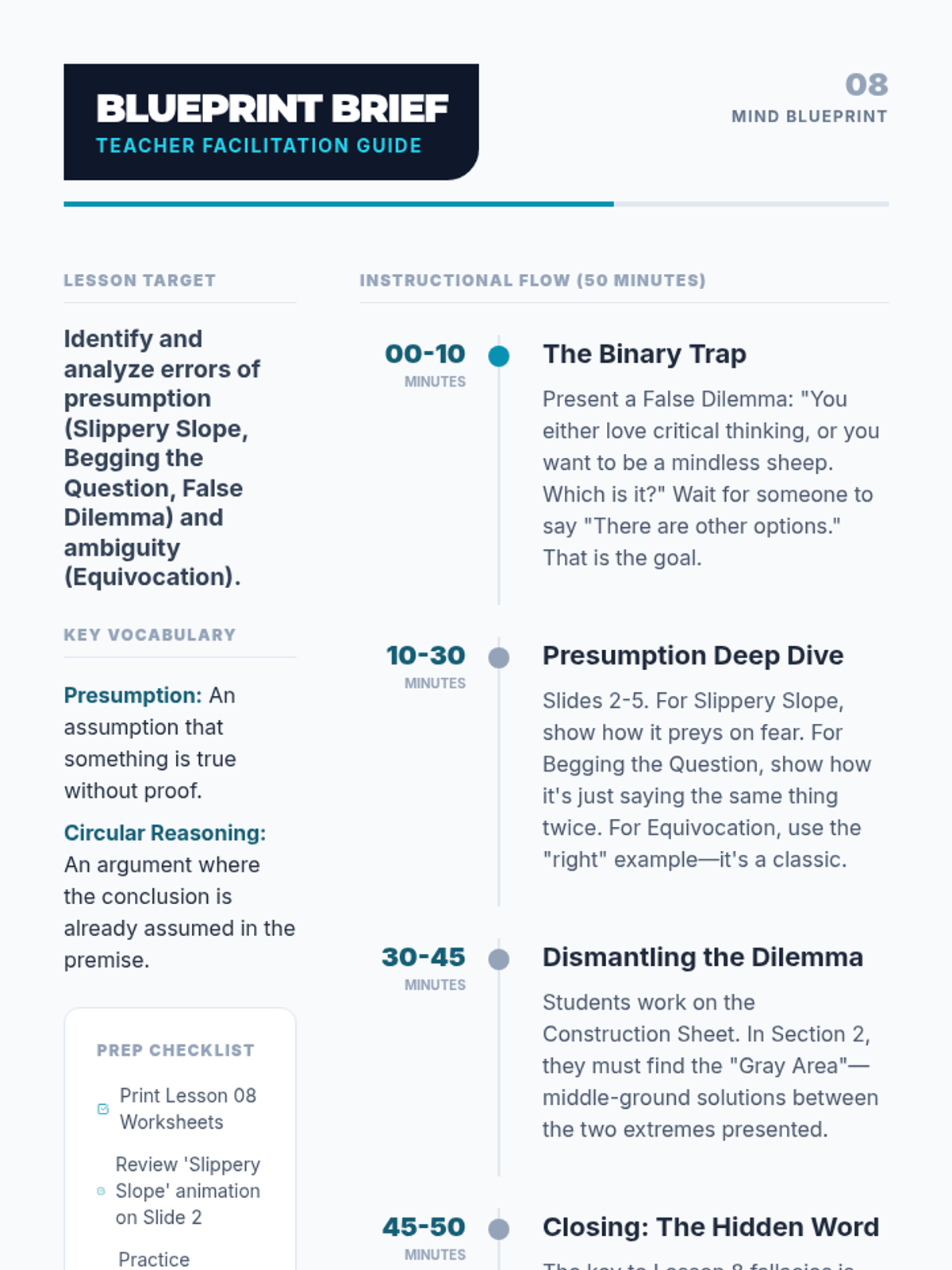
Facilitation guide for Lesson 8 on errors of presumption and ambiguity. Includes the Binary Trap hook and guidance for finding smuggled assumptions in complex arguments.
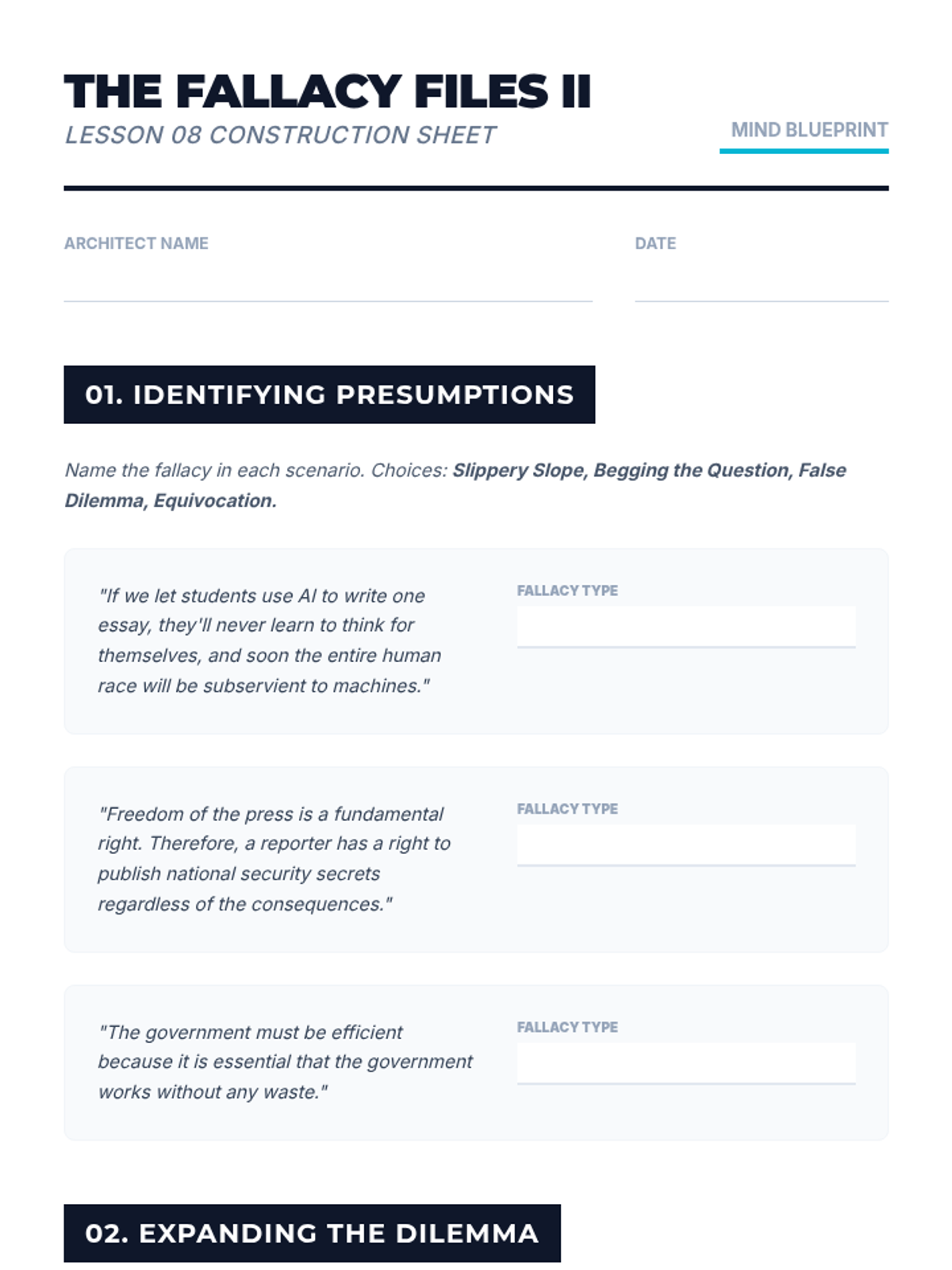
Student worksheet for Lesson 8 on informal fallacies of presumption and ambiguity. Includes identifying fallacies from complex scenarios and expanding false dilemmas to find alternative options.
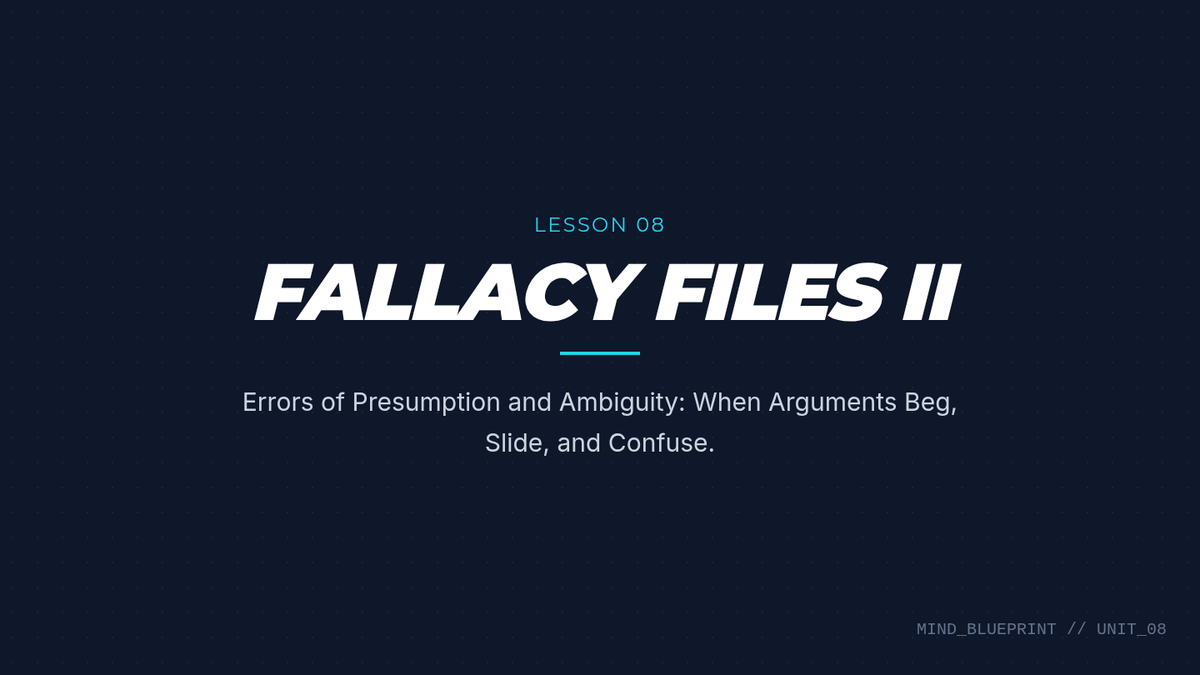
Slide deck for Lesson 8 on informal logical fallacies. Focuses on errors of presumption (Slippery Slope, Begging the Question, False Dilemma) and ambiguity (Equivocation) with interactive quiz examples.
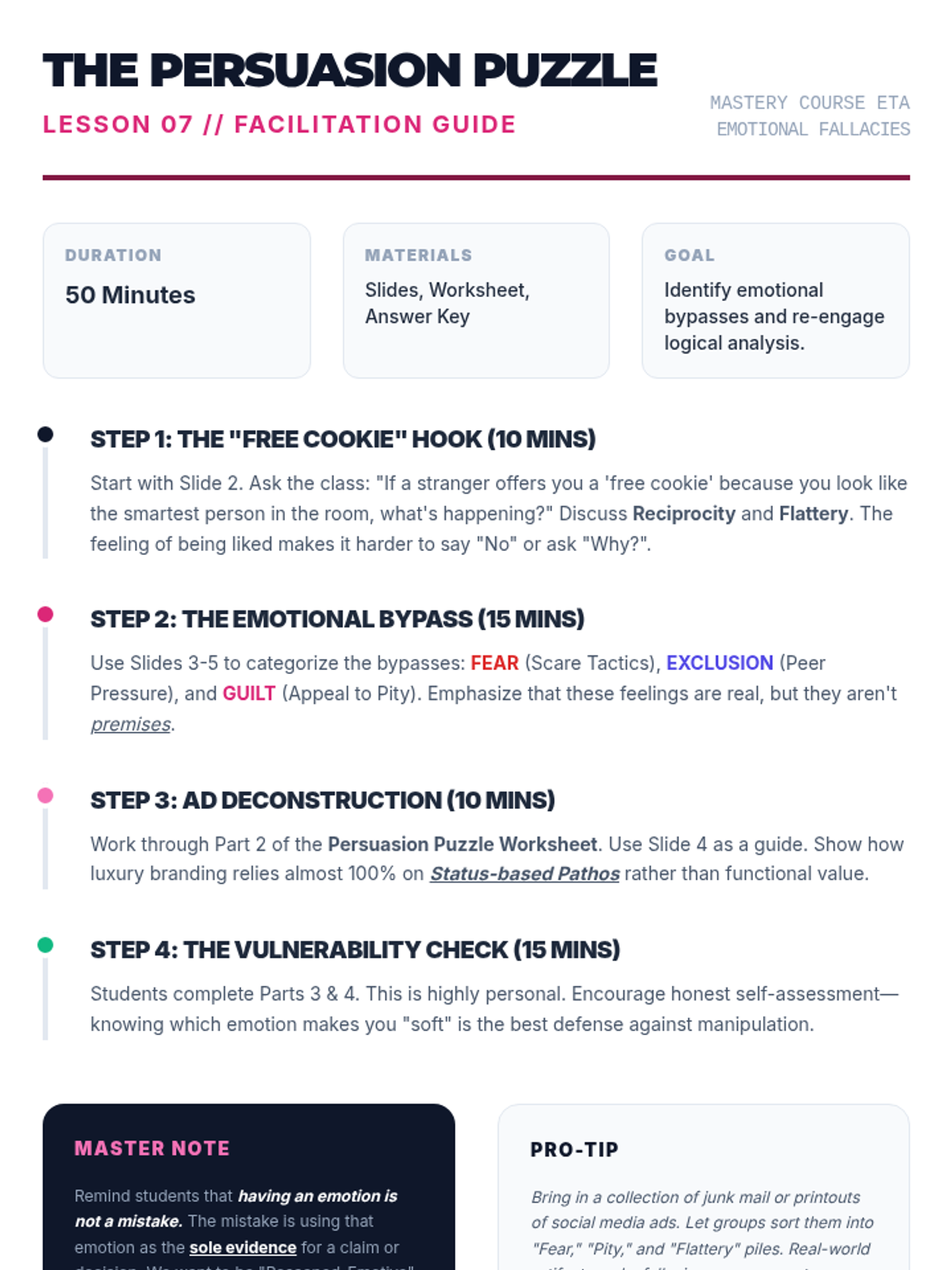
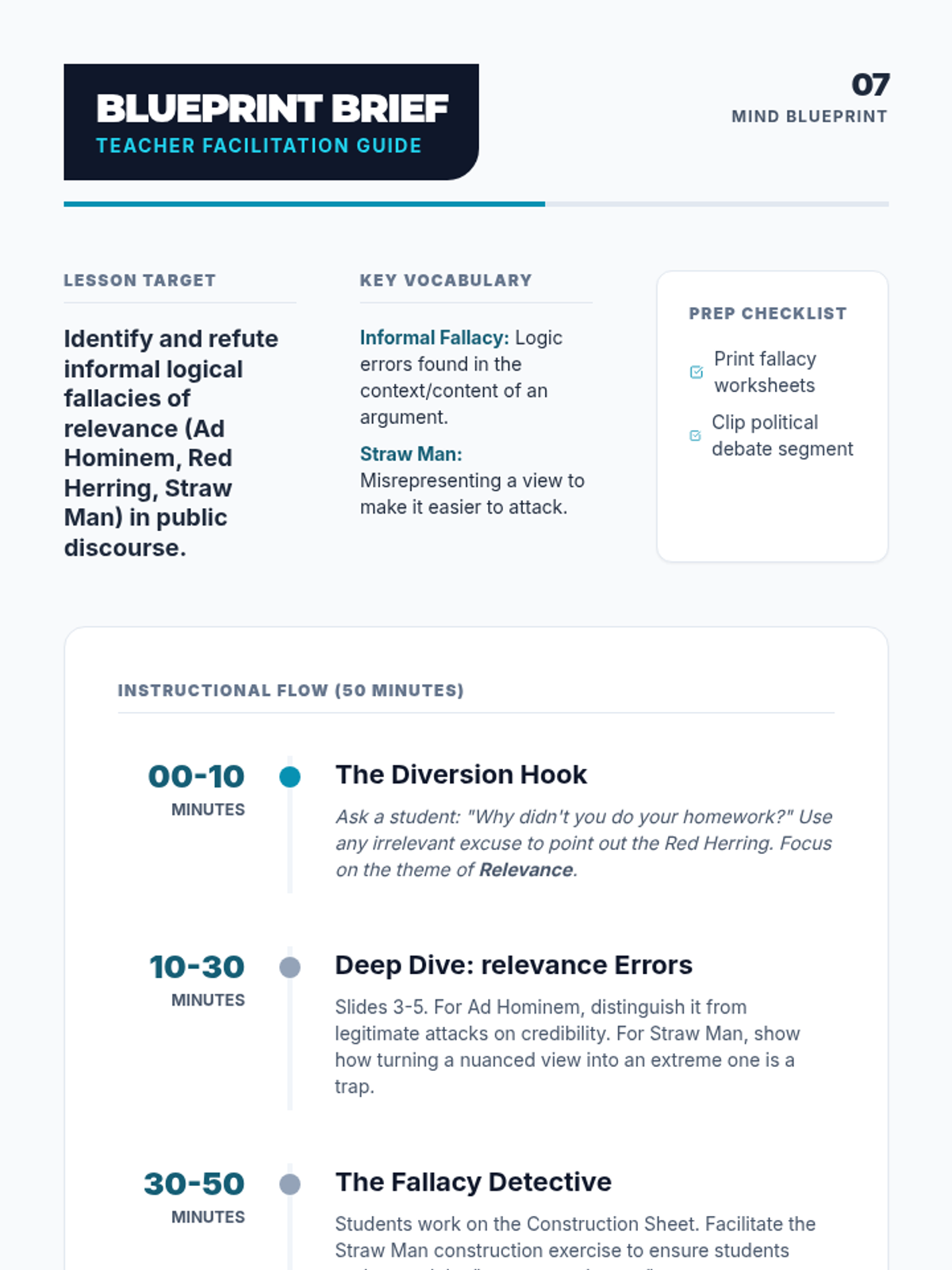
Revised Teacher's Guide for Lesson 7. Single-page layout ensures all Specs and Flow steps are visible at once, with removed markdown artifacts and improved contrast.
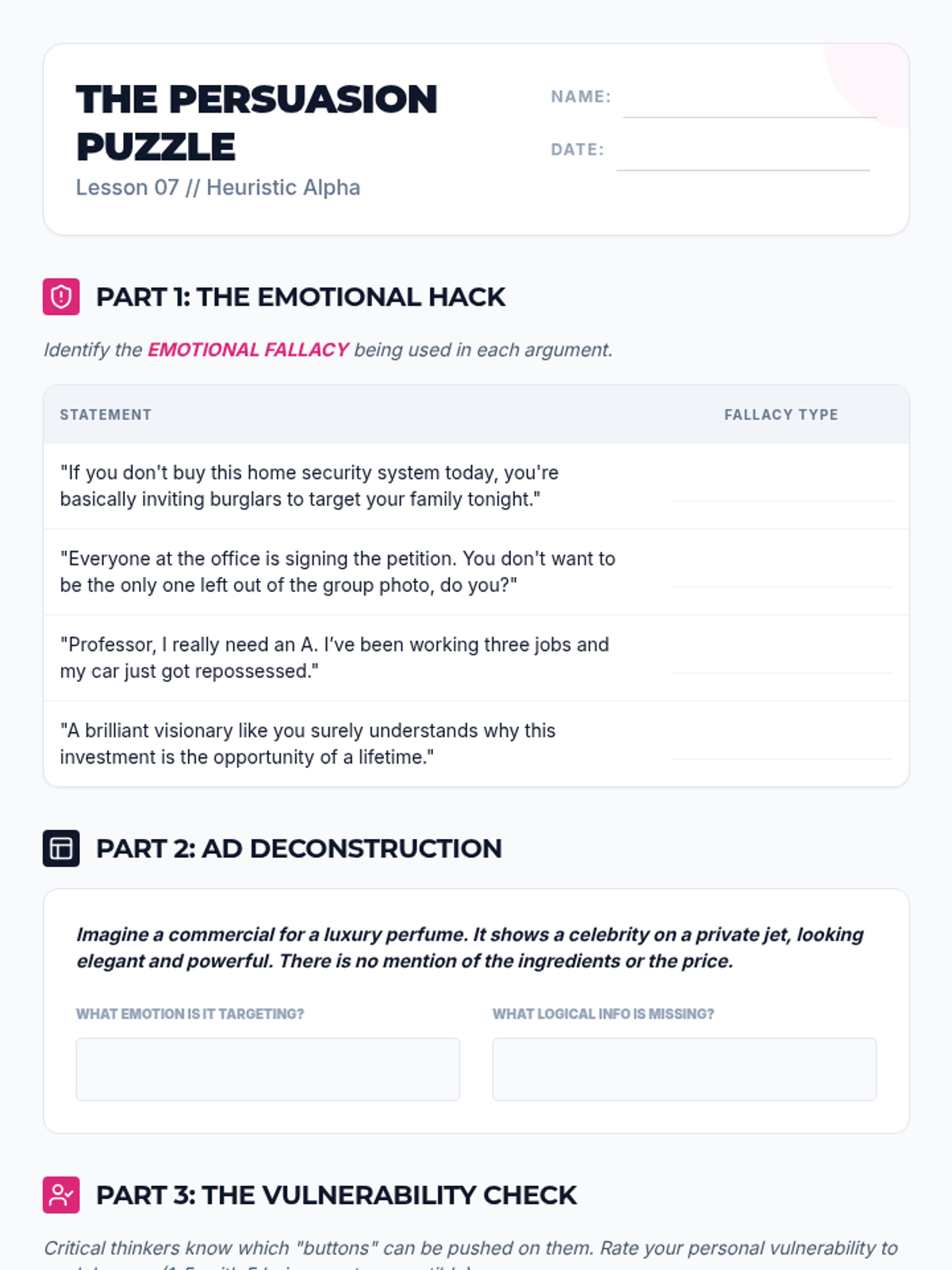
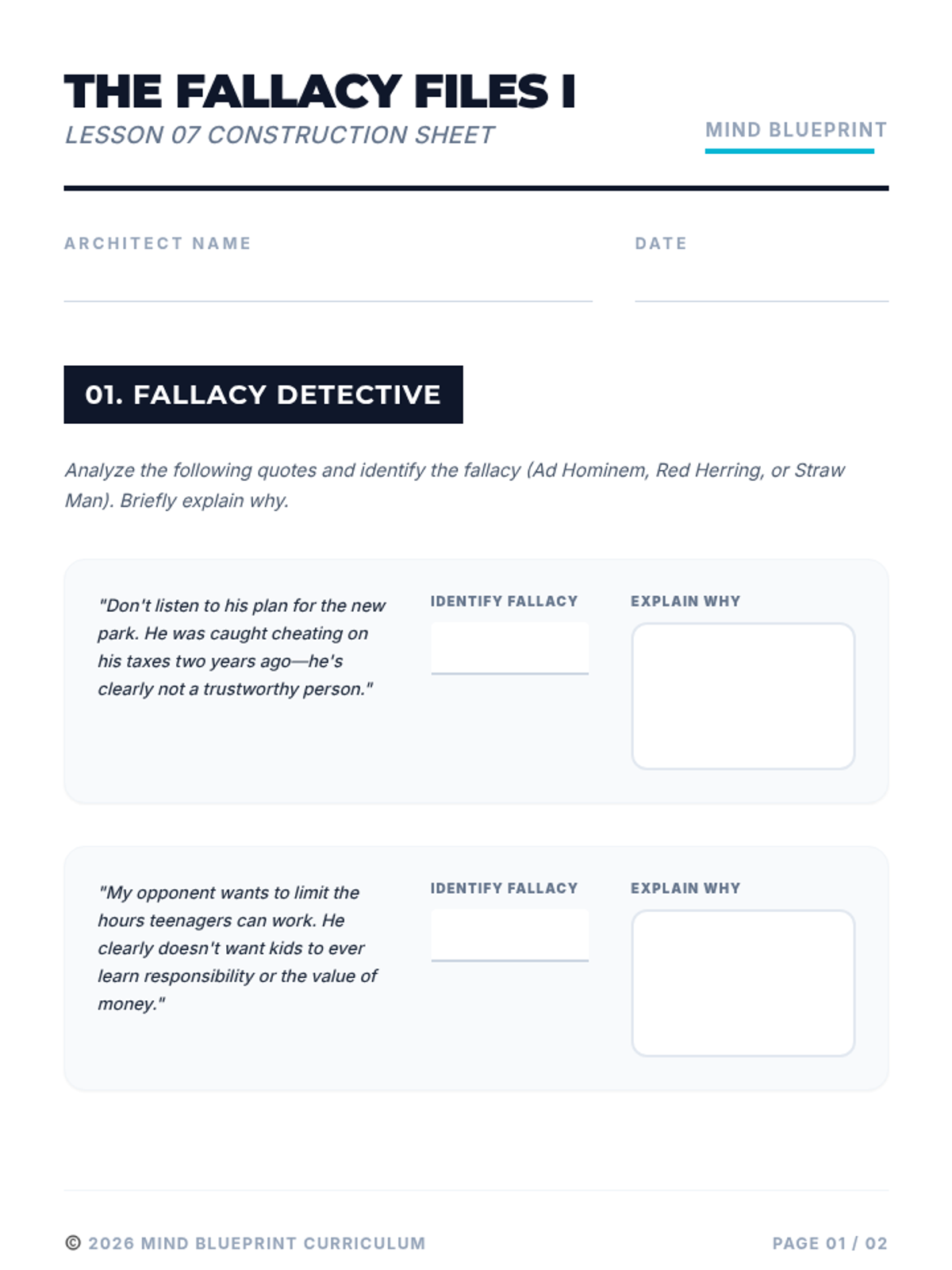
Revised student worksheet for Lesson 7. Features increased response box heights, repeated column labels for all scenarios, and corrected footer pagination.
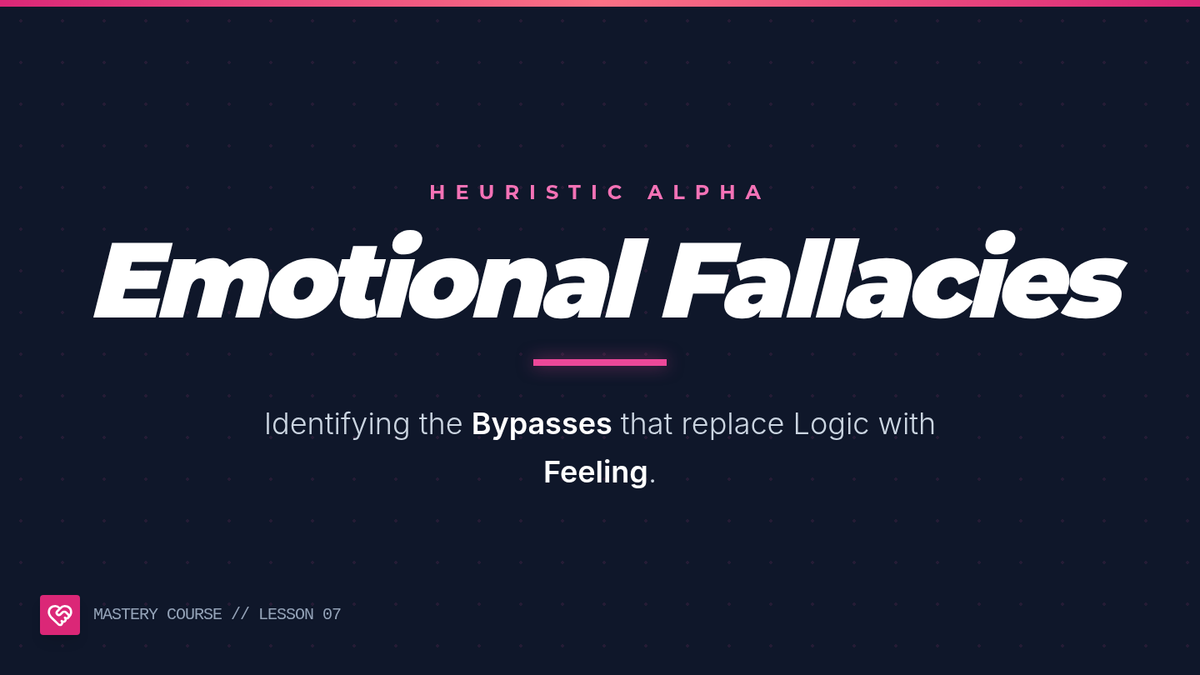
Revised slide deck for Lesson 7. Hidden answers on practice slide to encourage student participation, added space in title text, and increased contrast for italicized text.
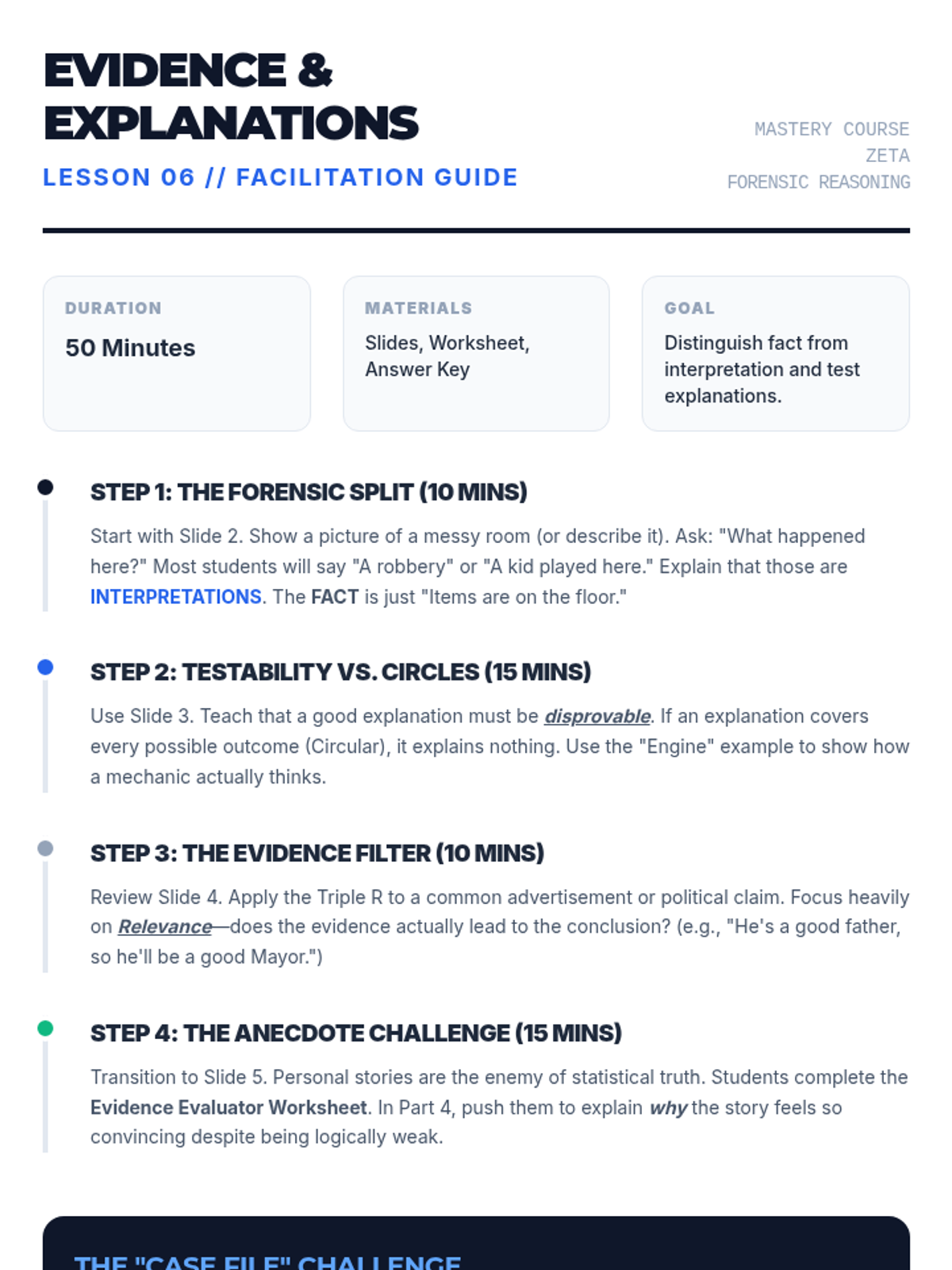
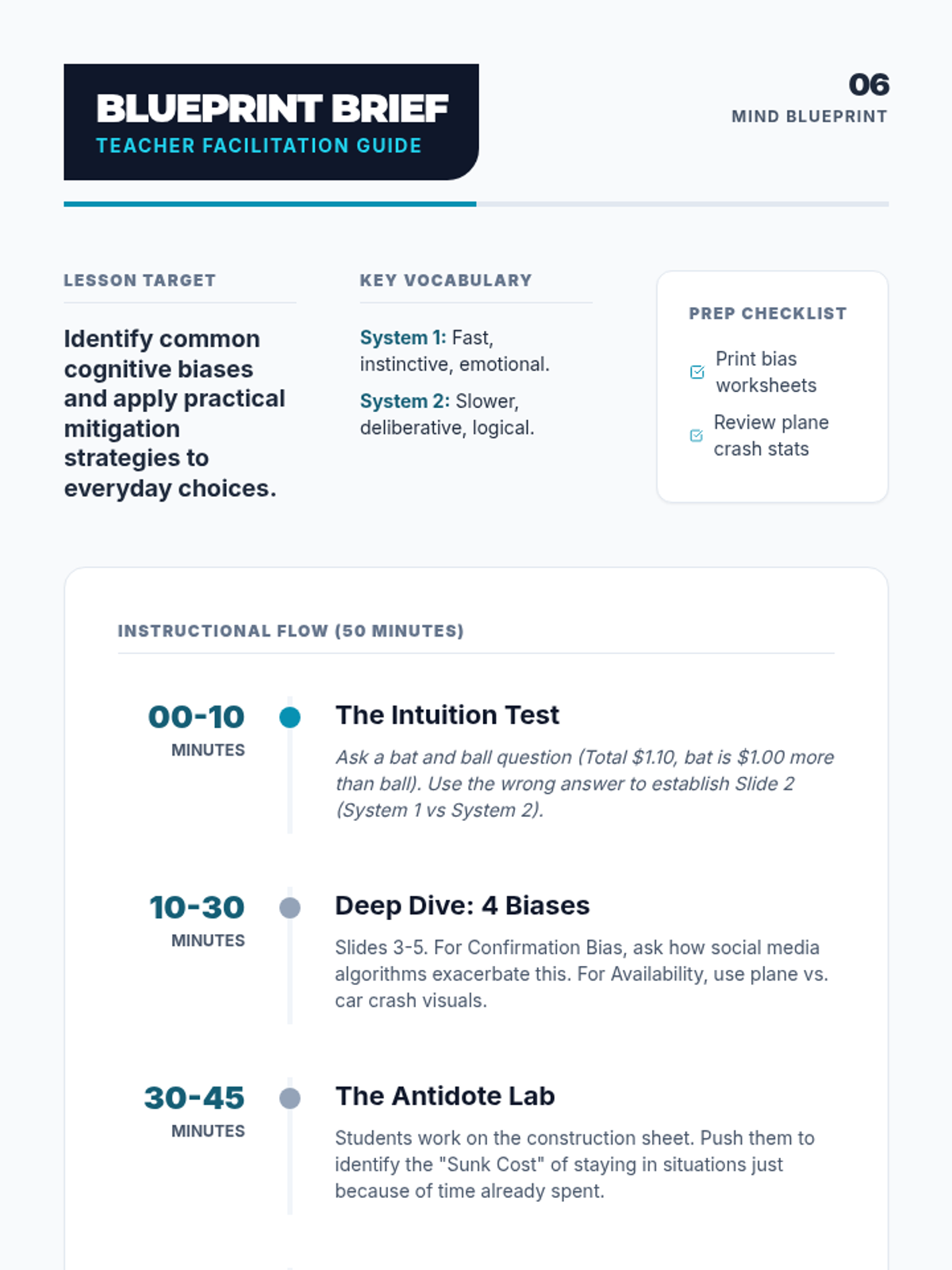
Revised Teacher's Guide for Lesson 6. Single-page layout with improved label sizes, consistent timeline styling, and increased contrast.
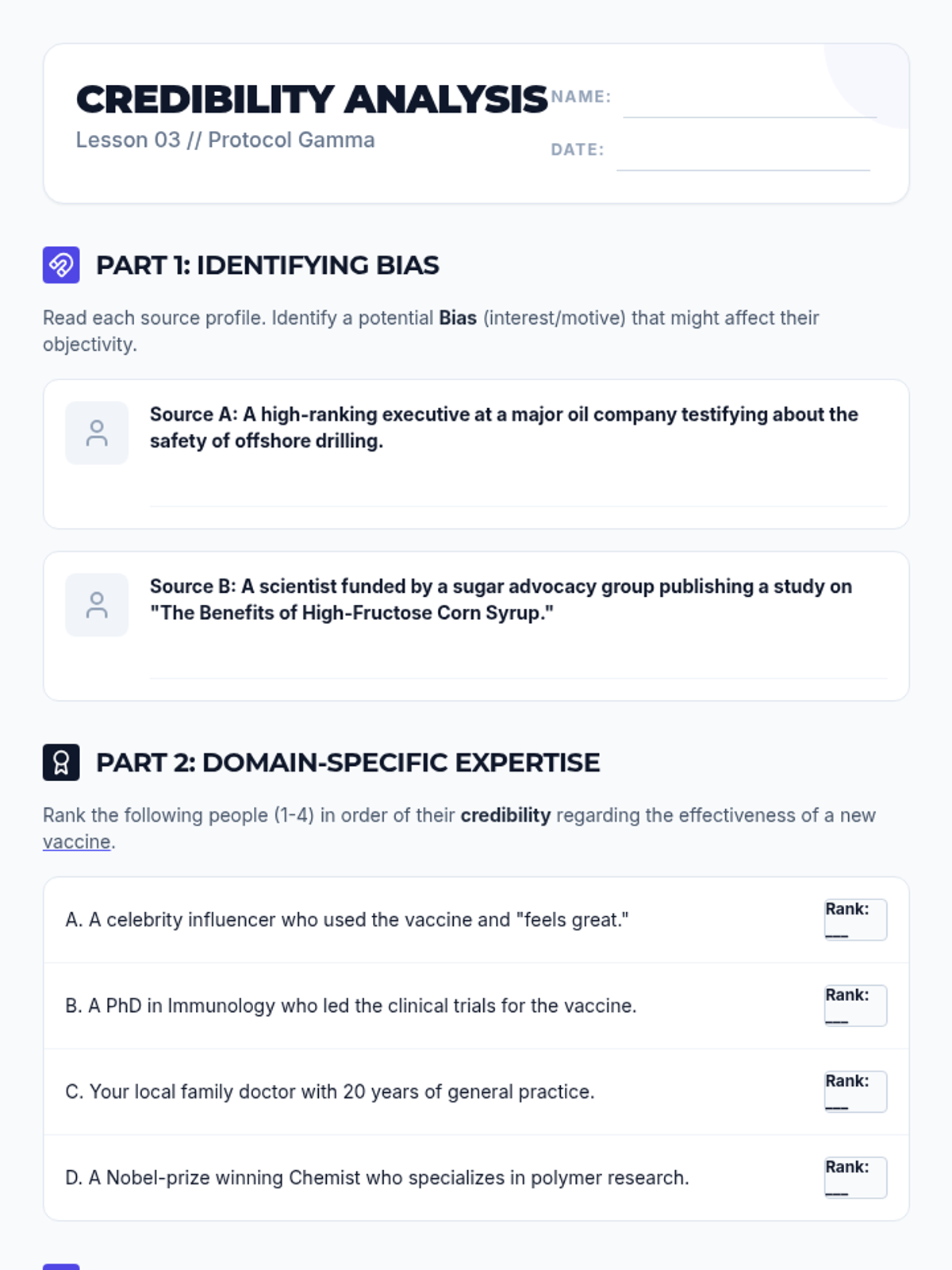
Revised student worksheet for Lesson 3 with corrected page breaks, increased contrast for labels, and balanced 2-page structure.
Slide deck for Lesson 3 on evaluating source reliability, recognizing bias, determining levels of expertise, and understanding the specific challenges of eyewitness testimony. Features a dark 'Investigation' aesthetic.