A bright, summer-themed slide deck that guides 2nd-grade students through the Island Oasis STEM challenge, featuring clear missions, material guides, and build requirements.
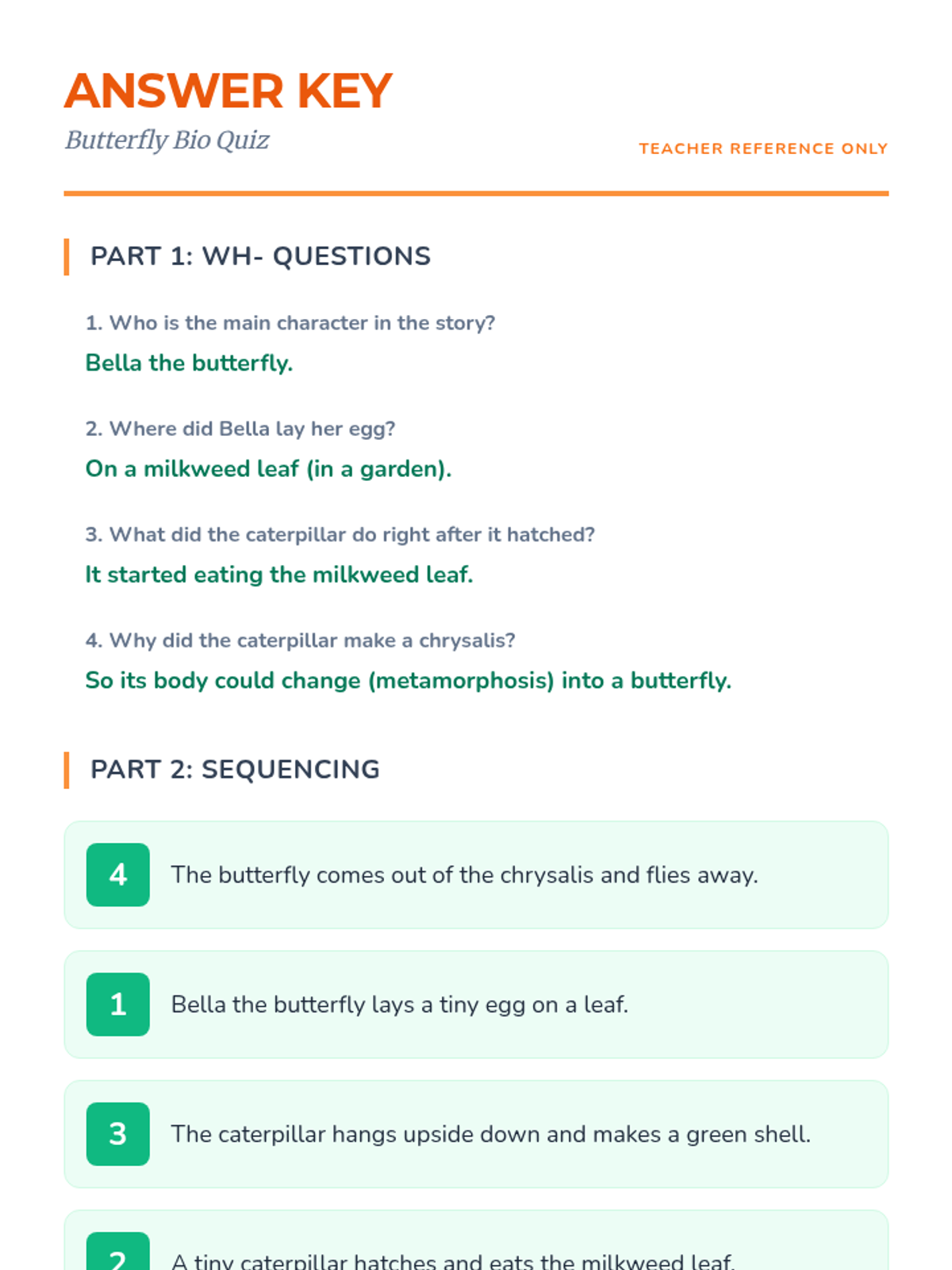
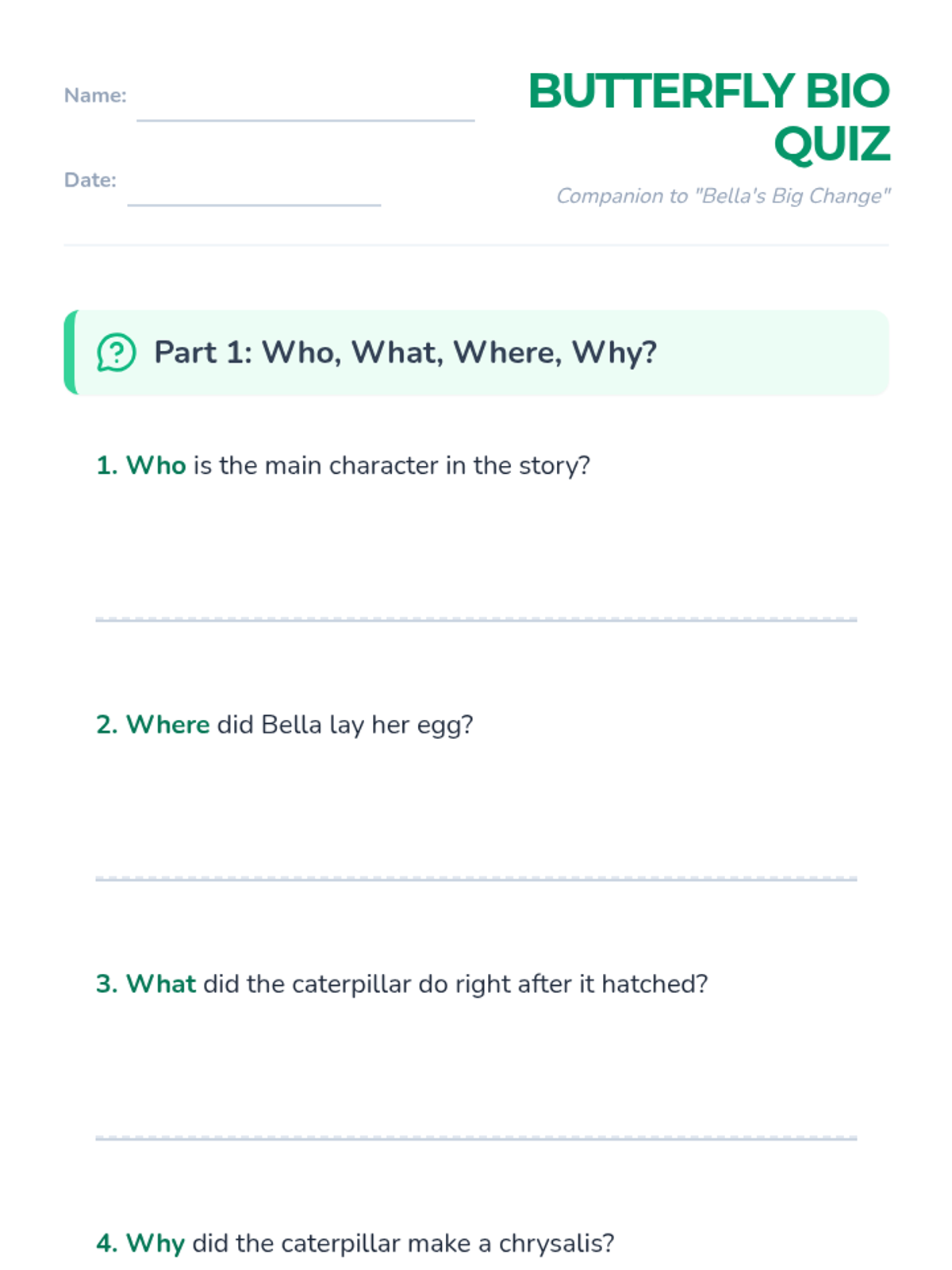
A clear and concise answer key for the Butterfly Bio Quiz, providing expected responses and teaching tips for the instructor.
A comprehensive worksheet for 2nd graders to practice Wh- questions and sequencing based on the 'Bella's Big Change' passage, featuring primary-ruled writing lines.
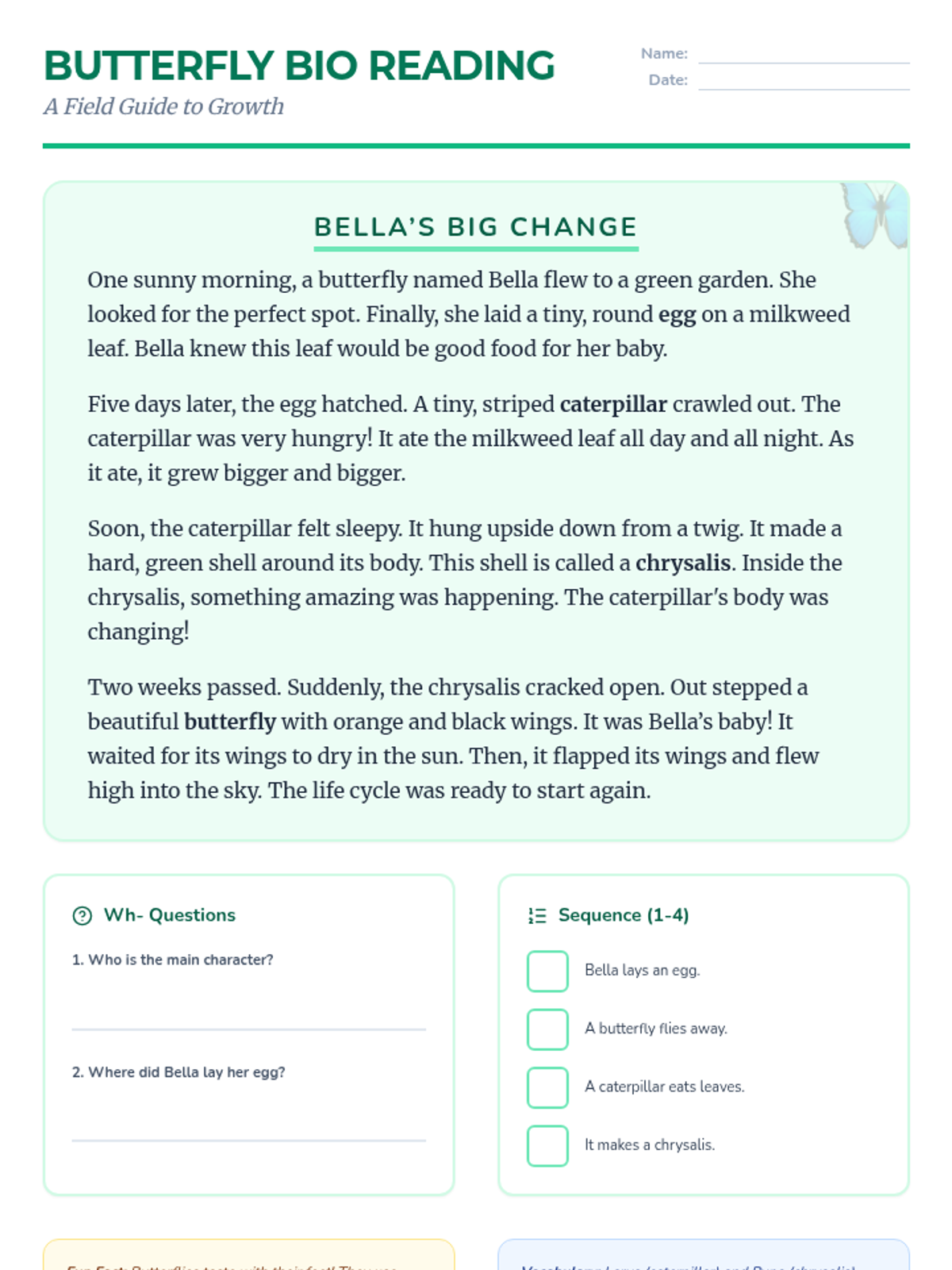
A 2nd-grade reading passage about a butterfly named Bella, detailing the four stages of the life cycle with mini-comprehension questions.
An engaging slide presentation introducing the four stages of the butterfly life cycle with vibrant visuals and vocabulary support.
A Grade 2 worksheet for practicing regular and irregular plural nouns. Includes sections for adding -s and -es, converting structural rule-breakers, and applying plural forms in sentence contexts. Optimized with generous spacing and expanded content to utilize the full 8.5x11 printable area. Revised for stability and consistent layout.
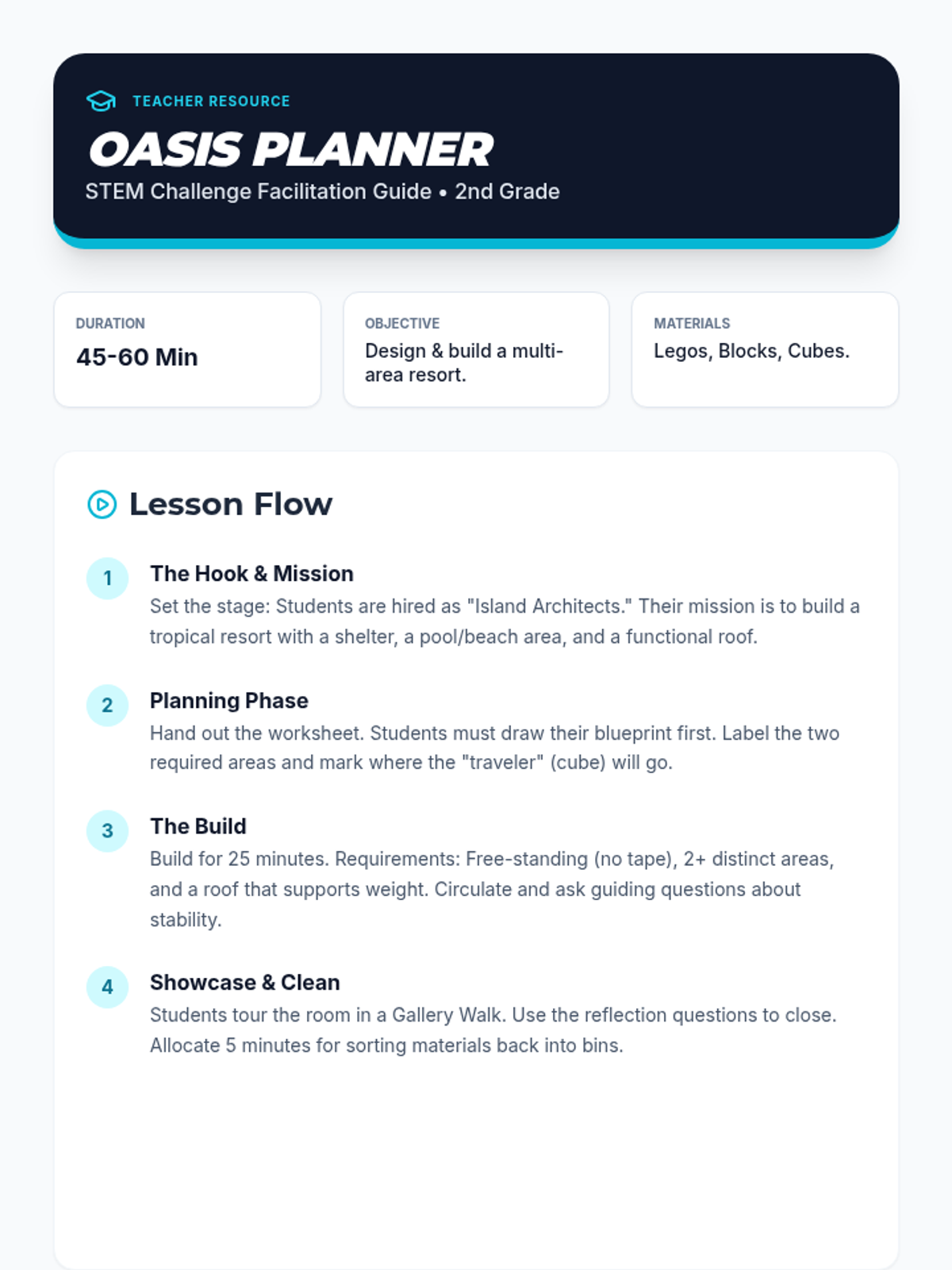
A comprehensive teacher's guide for facilitating the Island Oasis STEM challenge, including a detailed lesson plan, guiding questions, and an assessment checklist.
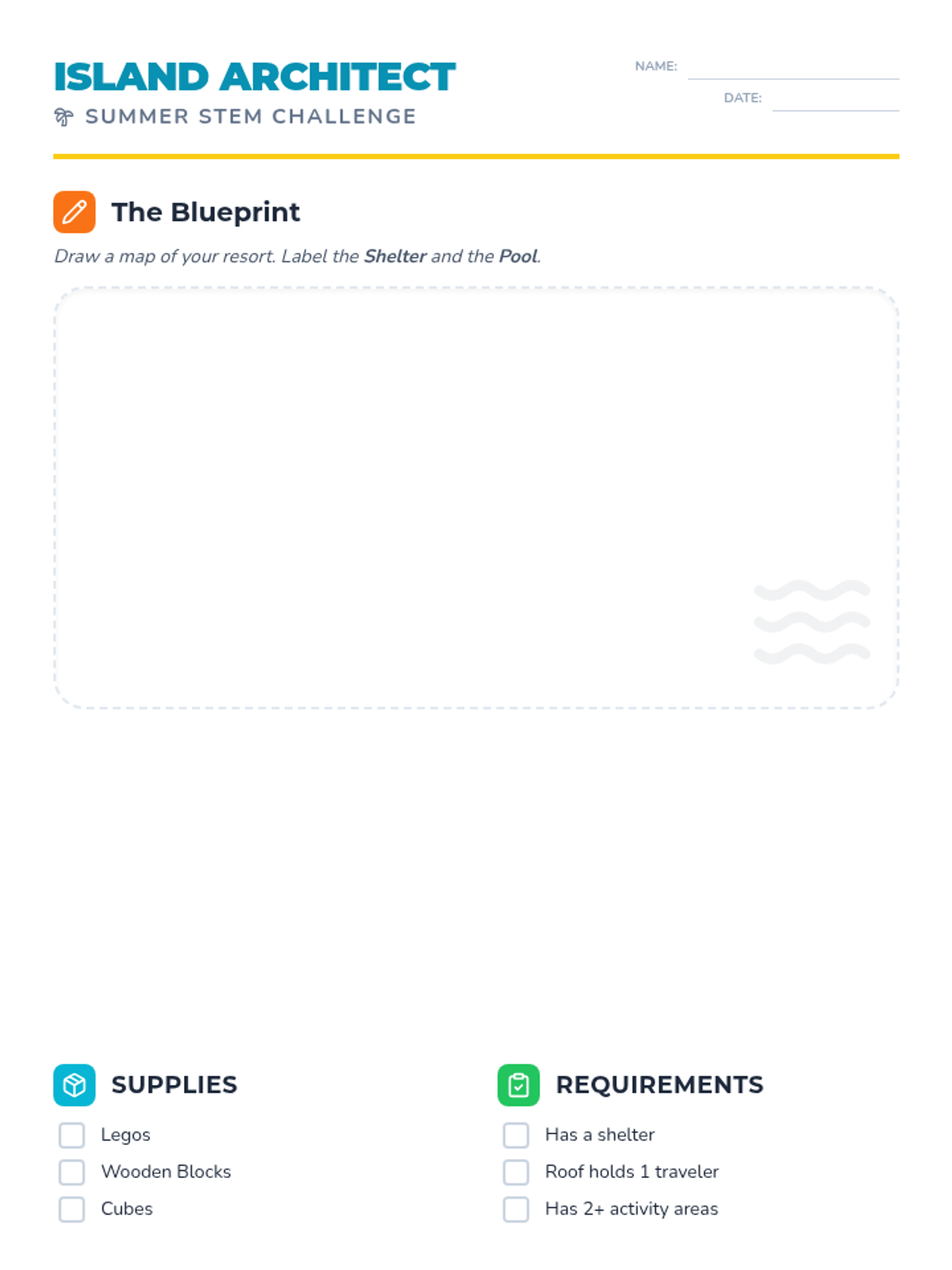
A student planning and reflection worksheet for the Island Oasis STEM challenge, featuring spaces for blueprinting, material tracking, and post-build evaluation.
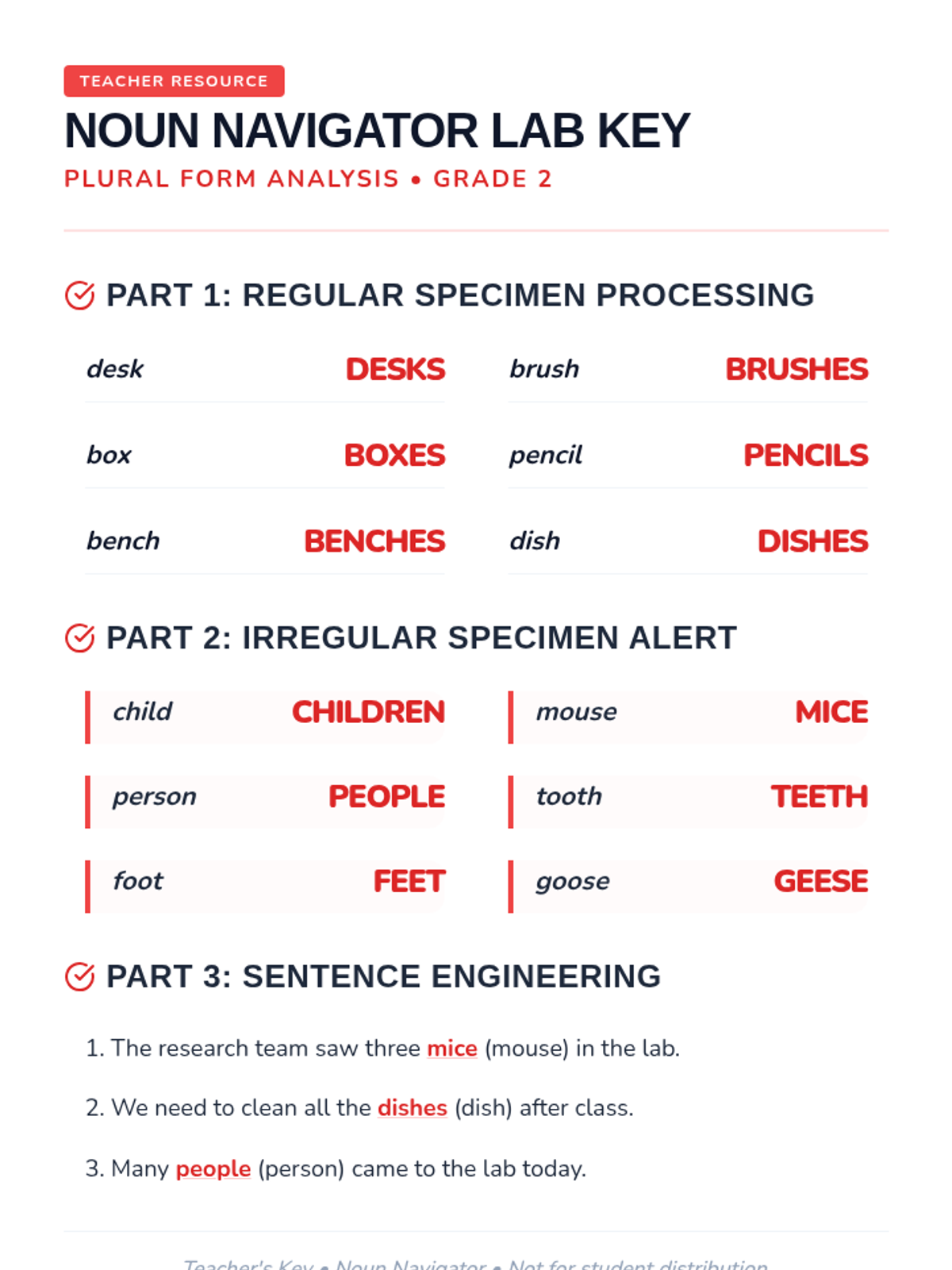
Answer key for the Noun Navigator Plural Worksheet, providing correct plural forms for regular and irregular nouns, as well as sentence application results. Revised for consistency and single-page layout.
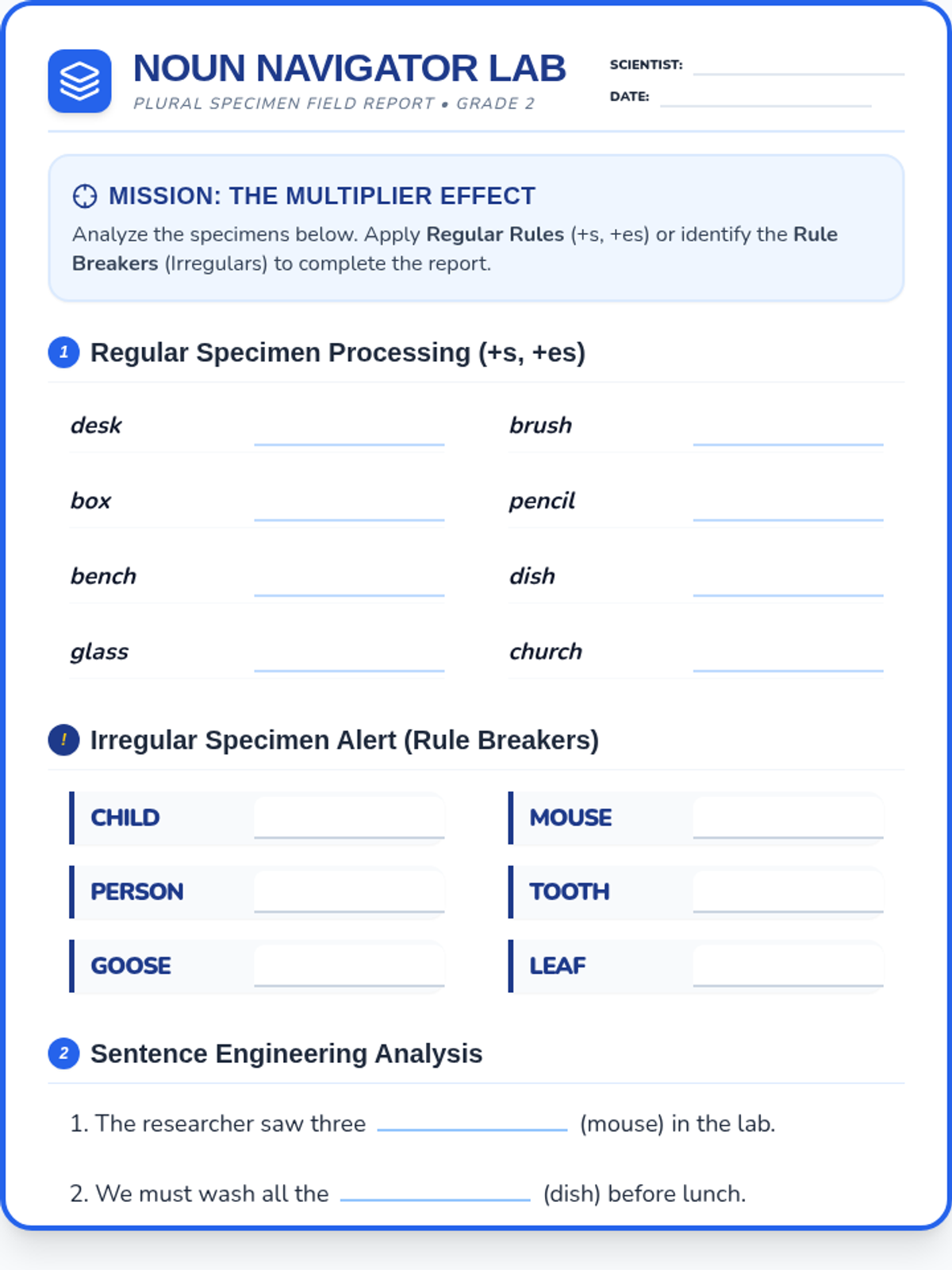
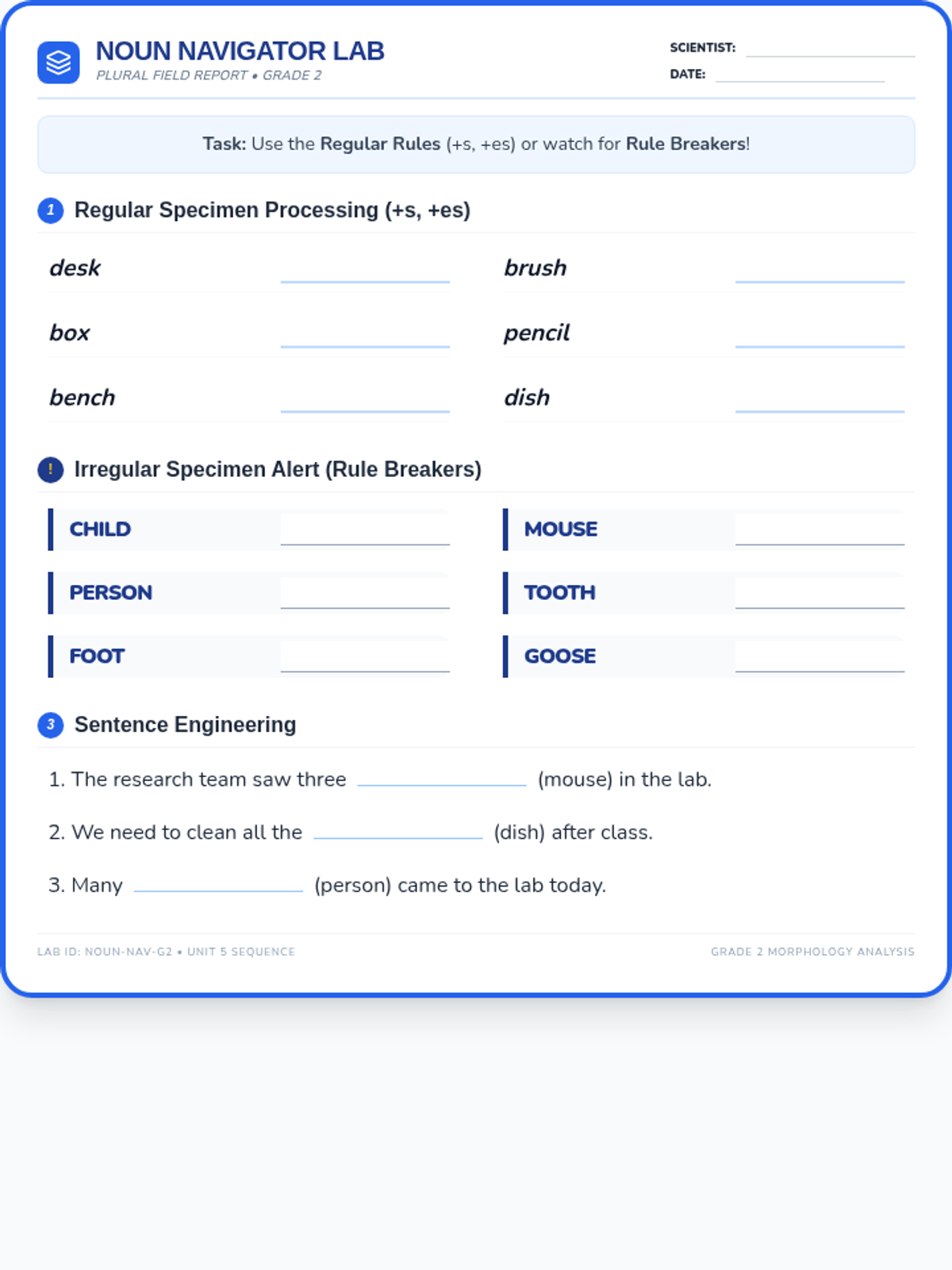
A Grade 2 worksheet for practicing regular and irregular plural nouns. Includes sections for adding -s and -es, converting structural rule-breakers like child and tooth, and applying plural forms in sentence contexts. Consistent laboratory theme. Revised for layout stability and blank page removal.
Instructional slide deck for introducing regular and irregular plural nouns. Includes rules for adding -s and -es, as well as structural structural change examples for common irregulars like mice, children, and people. technical blueprint theme. Revised for better contrast and spacing. Added common irregular body parts and the F to VES protocol.
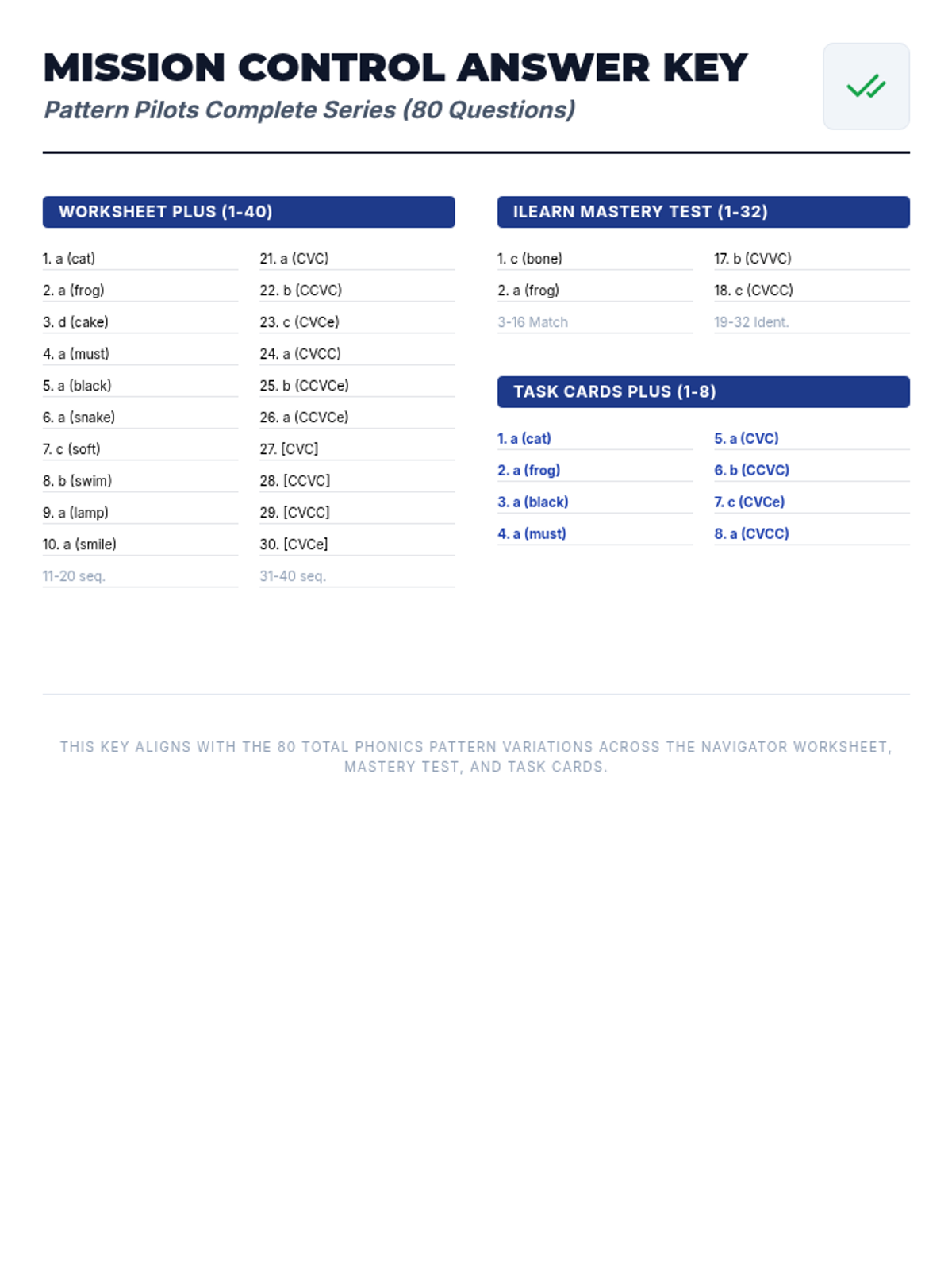
An answer key for all materials in the Pattern Pilots lesson, including the Word Navigator Worksheet, ILEARN Flight Prep Test, and Pattern Finder Task Cards. All 80 questions are fully populated.
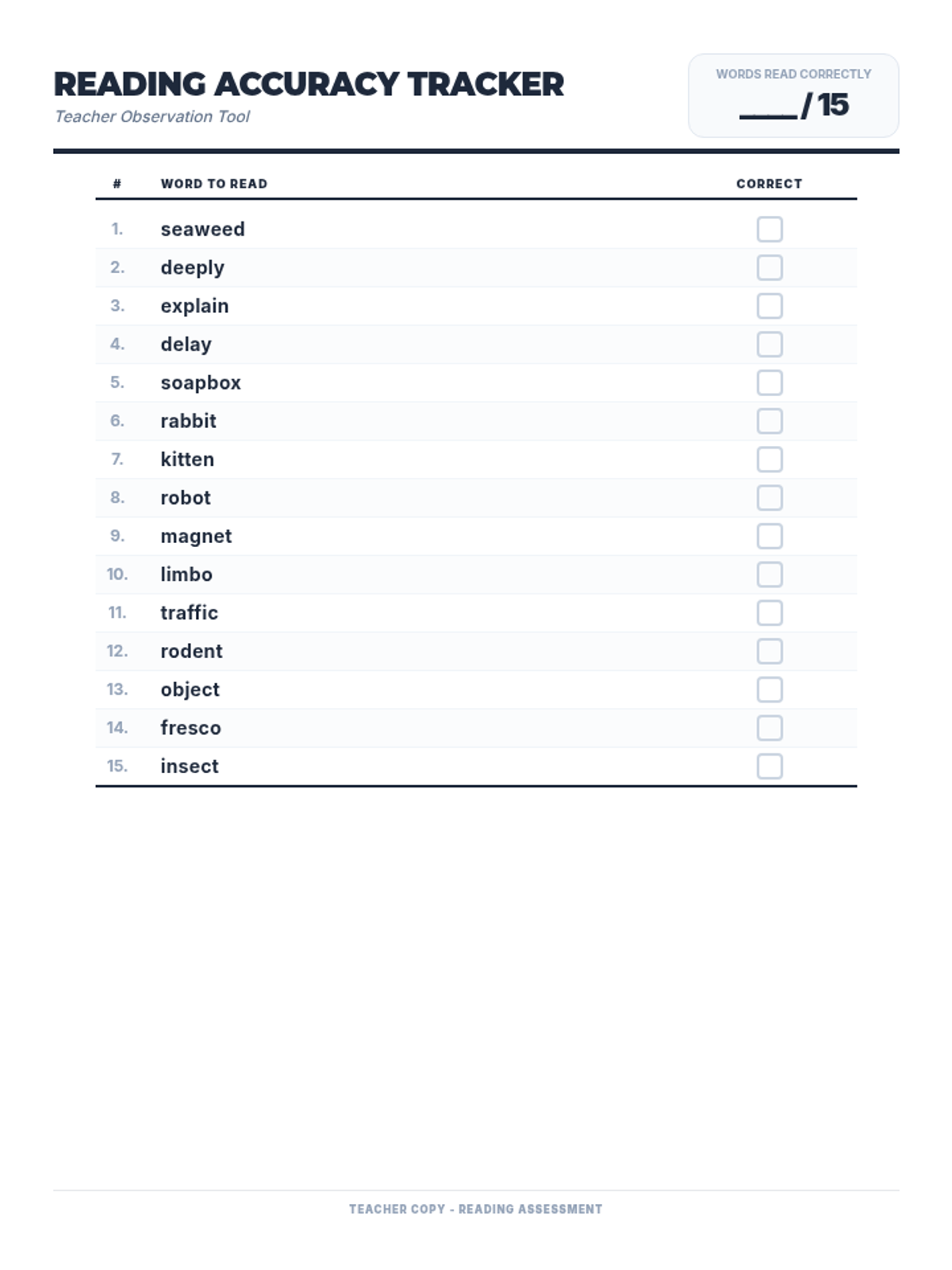
A two-page teacher resource for tracking reading accuracy. Page 1 is a teacher record sheet with checkboxes, and Page 2 is a clean, large-font word list for the student. Optimized for professional assessment flow. word list fits on one page.
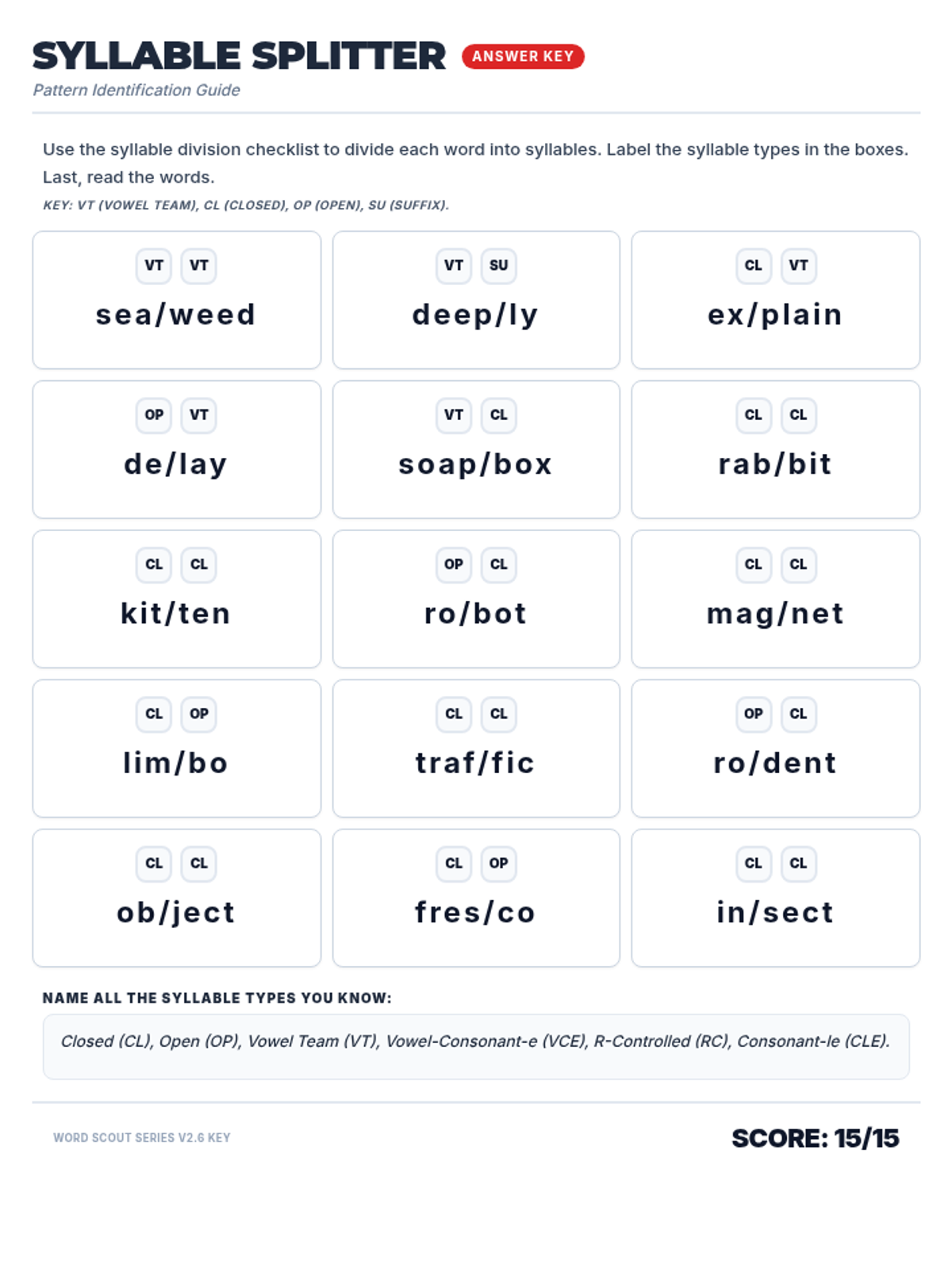
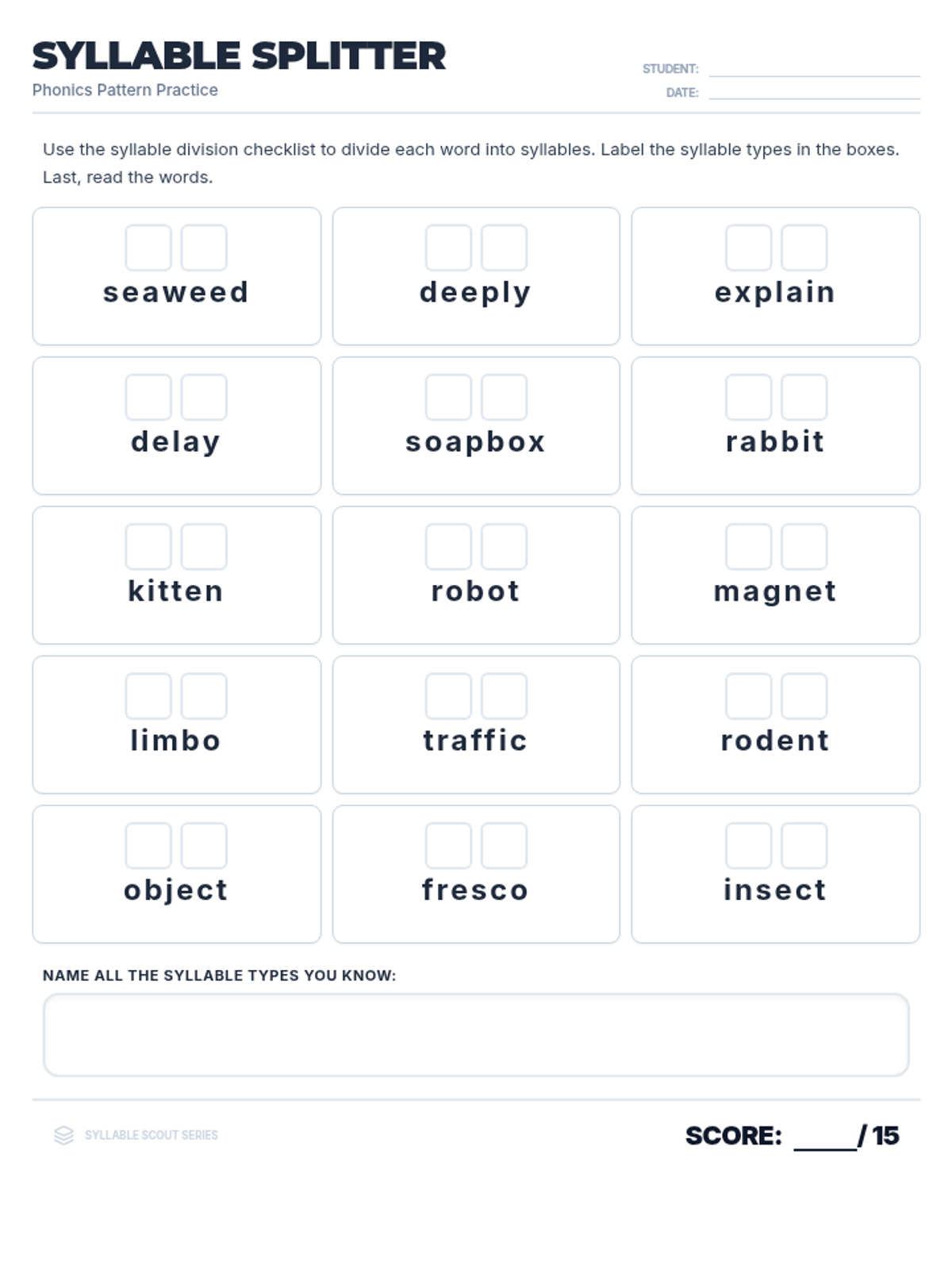
The answer key for the lowercase card-format syllable division quiz, featuring correct syllable types and divisions for all 15 words in high-contrast black text. Optimized for a single page.
A card-based syllable division quiz featuring 15 words in lowercase. Words are positioned high in each card to leave ample writing space below for student markings. Optimized for a single page with a new open-response box. Enlarged boxes for handwriting labels.
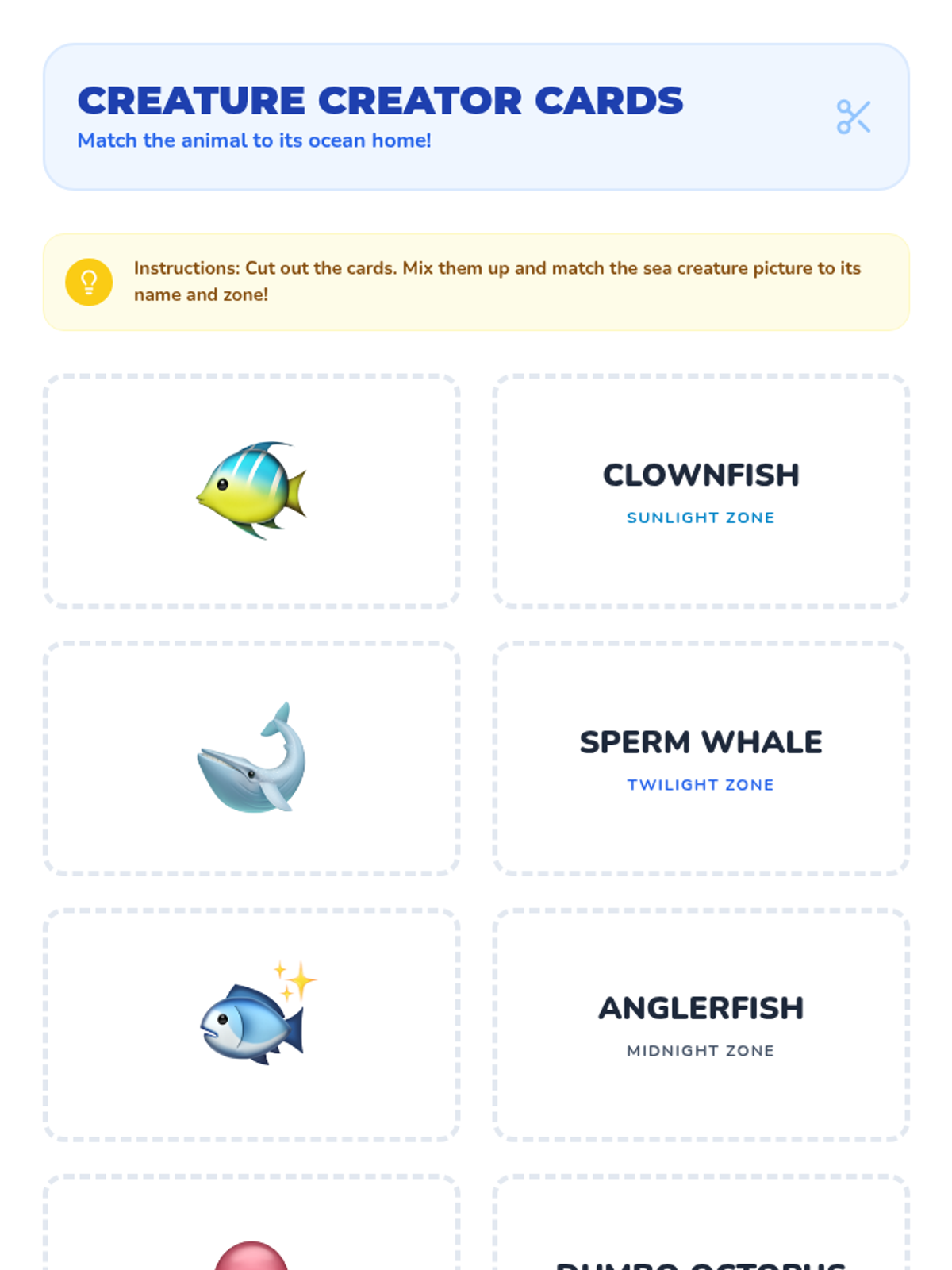
A matching activity with printable cards for students to pair sea creatures with their names and ocean zones. Perfect for hands-on learning in small groups.
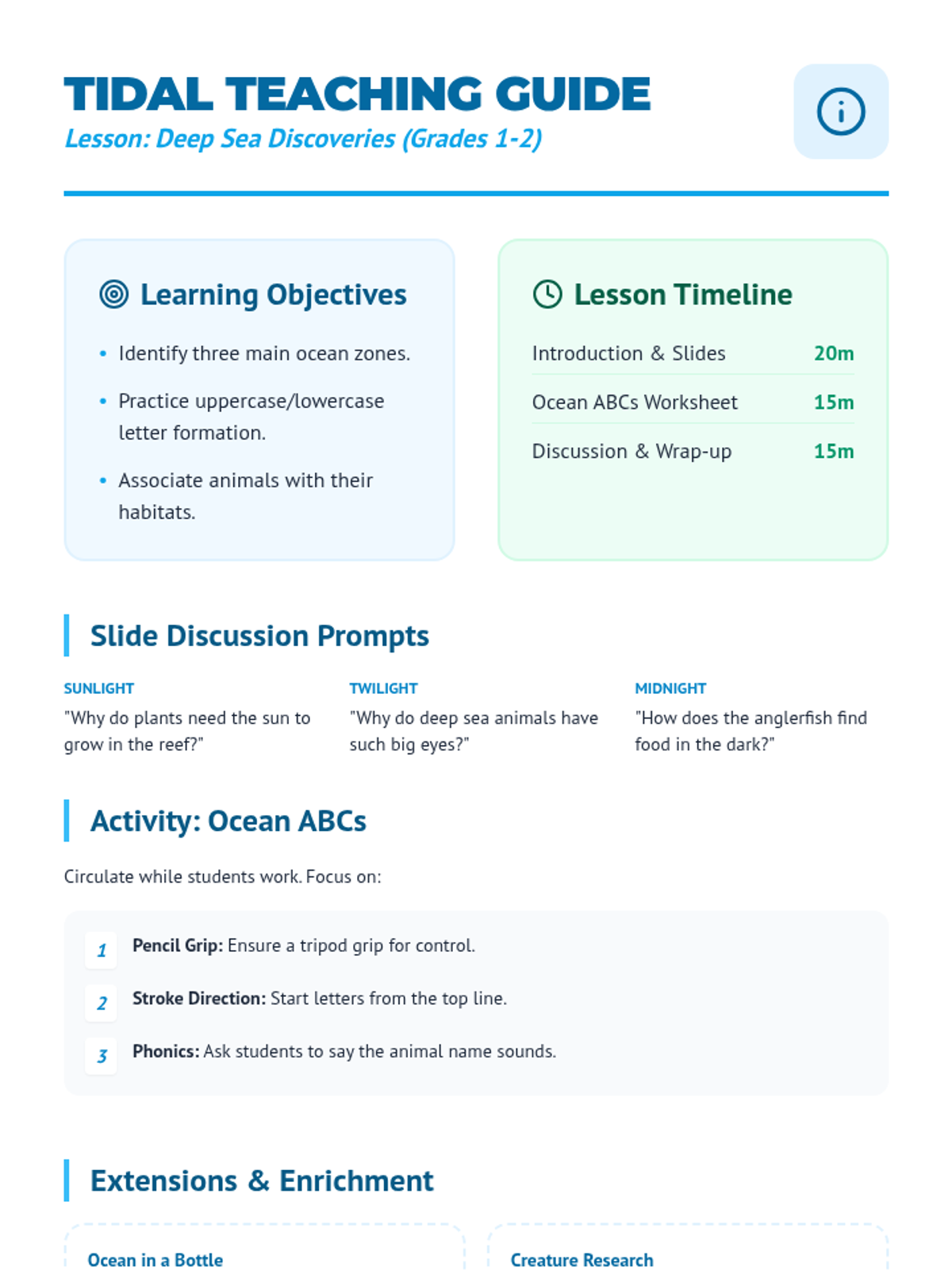
A comprehensive teaching guide for the Deep Sea Discoveries lesson. Includes learning objectives, a detailed timeline, discussion prompts for slides, and extension activity ideas.
A colorful presentation for 1st-2nd graders introducing ocean zones (Sunlight, Twilight, Midnight) and the creatures that live in each layer.
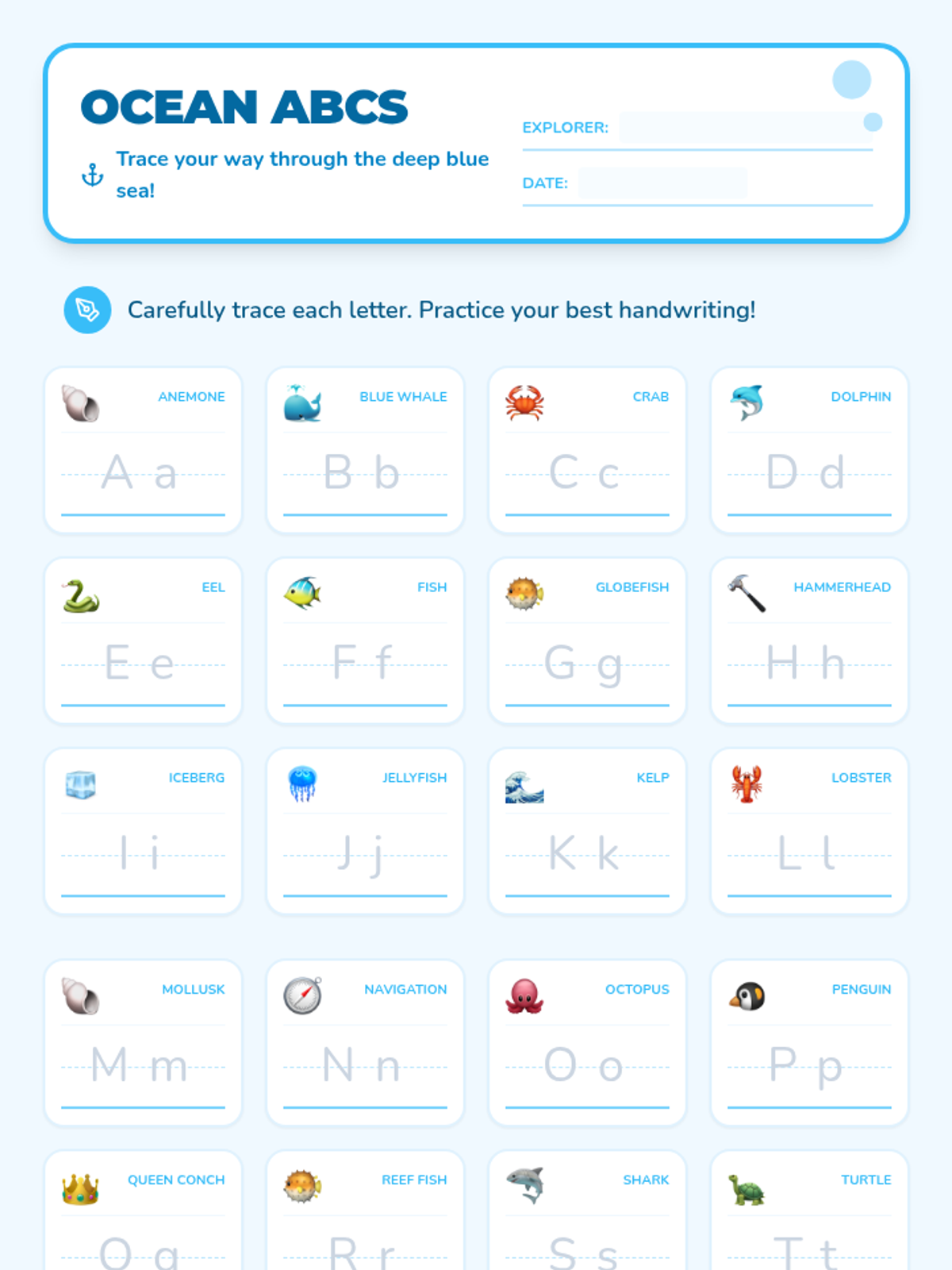
An under-the-sea themed alphabet tracing worksheet for early elementary students. Features primary writing guides, sea-themed phonics icons for A-Z, and sentence practice space.
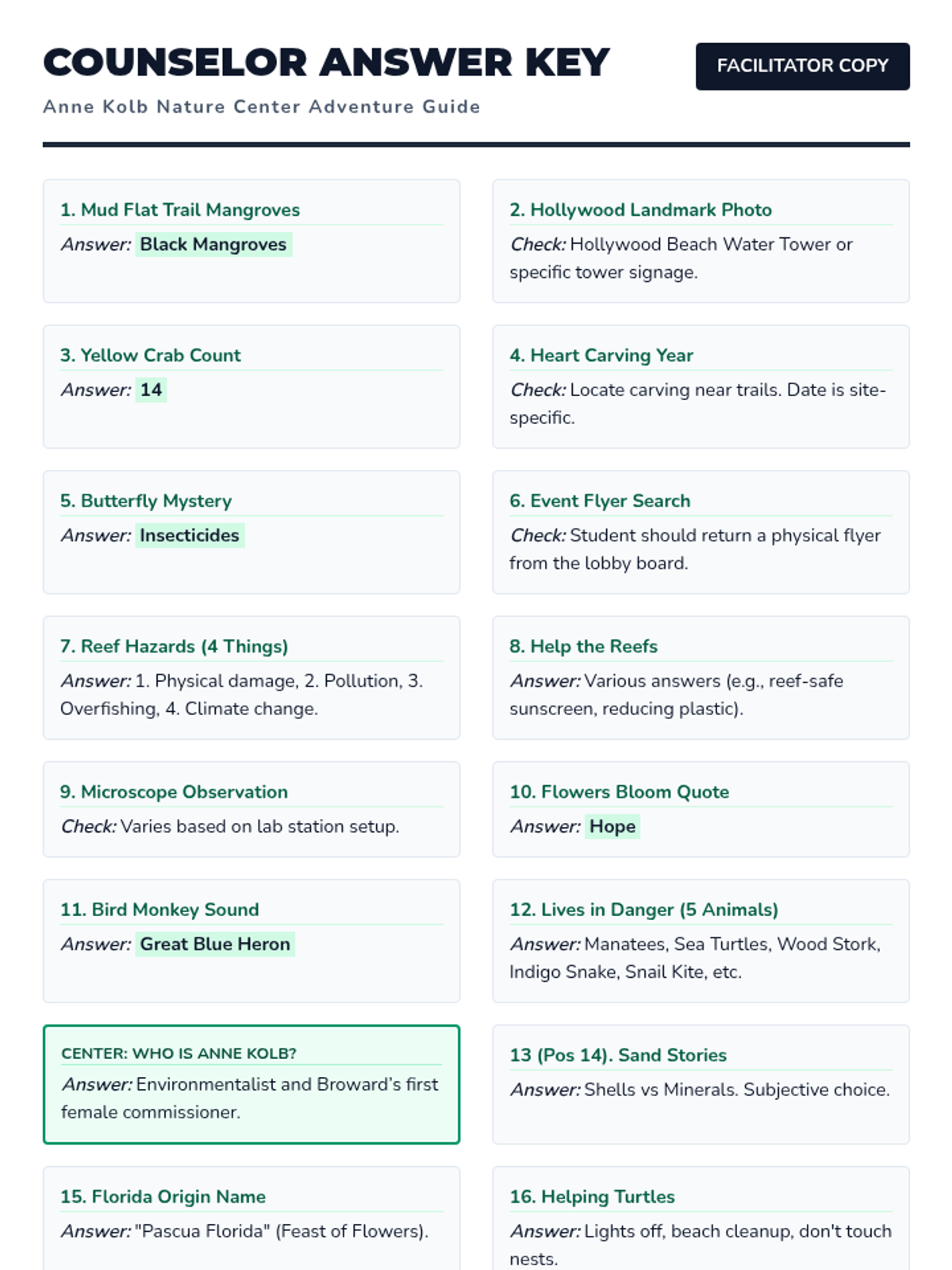
A comprehensive answer key and facilitator guide for the Anne Kolb Nature Center scavenger hunt, updated to match the 25-question BINGO grid order and exact wording.
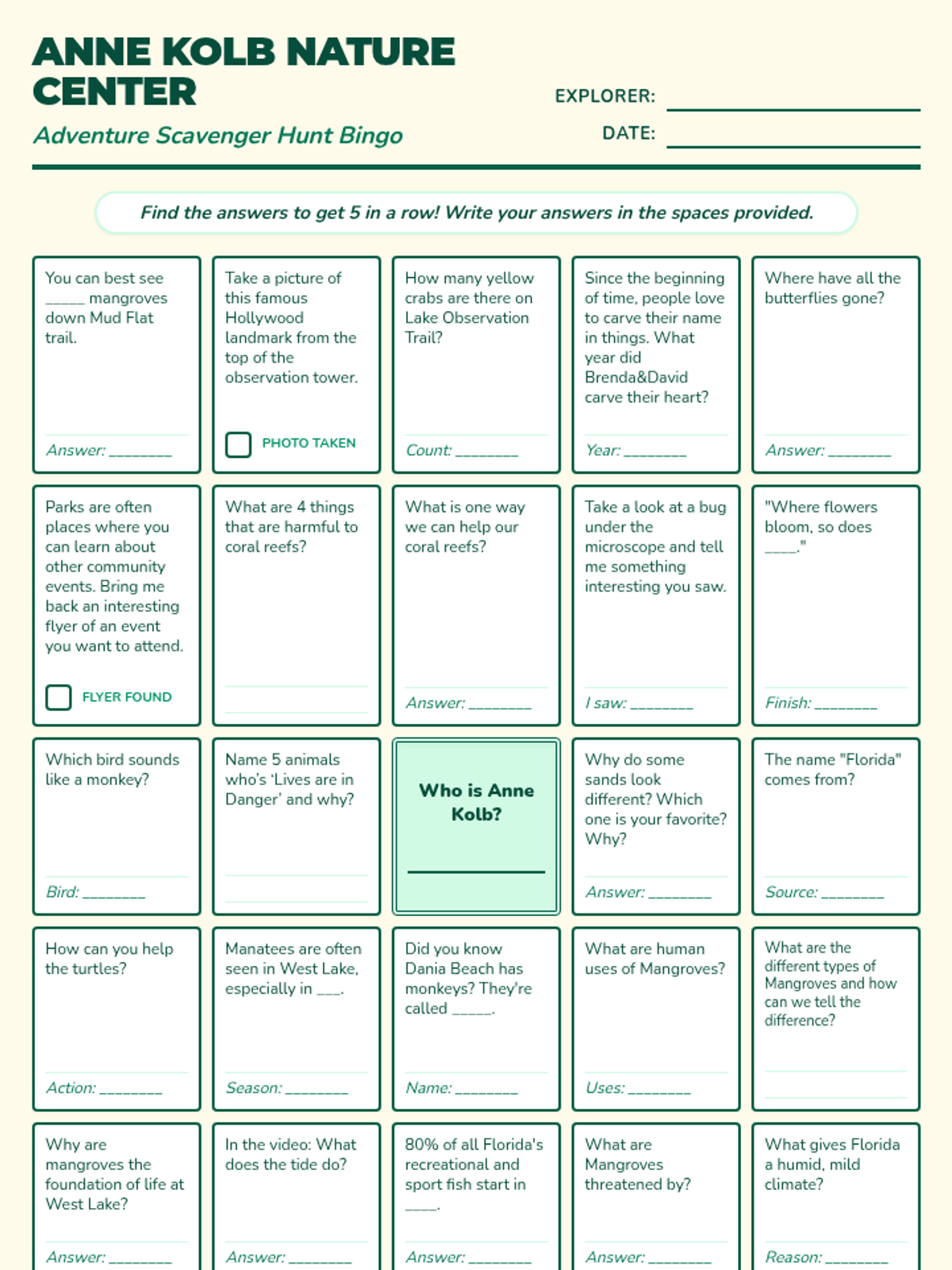
A nature-themed BINGO scavenger hunt for the Anne Kolb Nature Center featuring 25 exploration questions with exact user wording and a two-part reflection section. Question 14 (Anne Kolb) is placed in the center of the 5x5 grid.
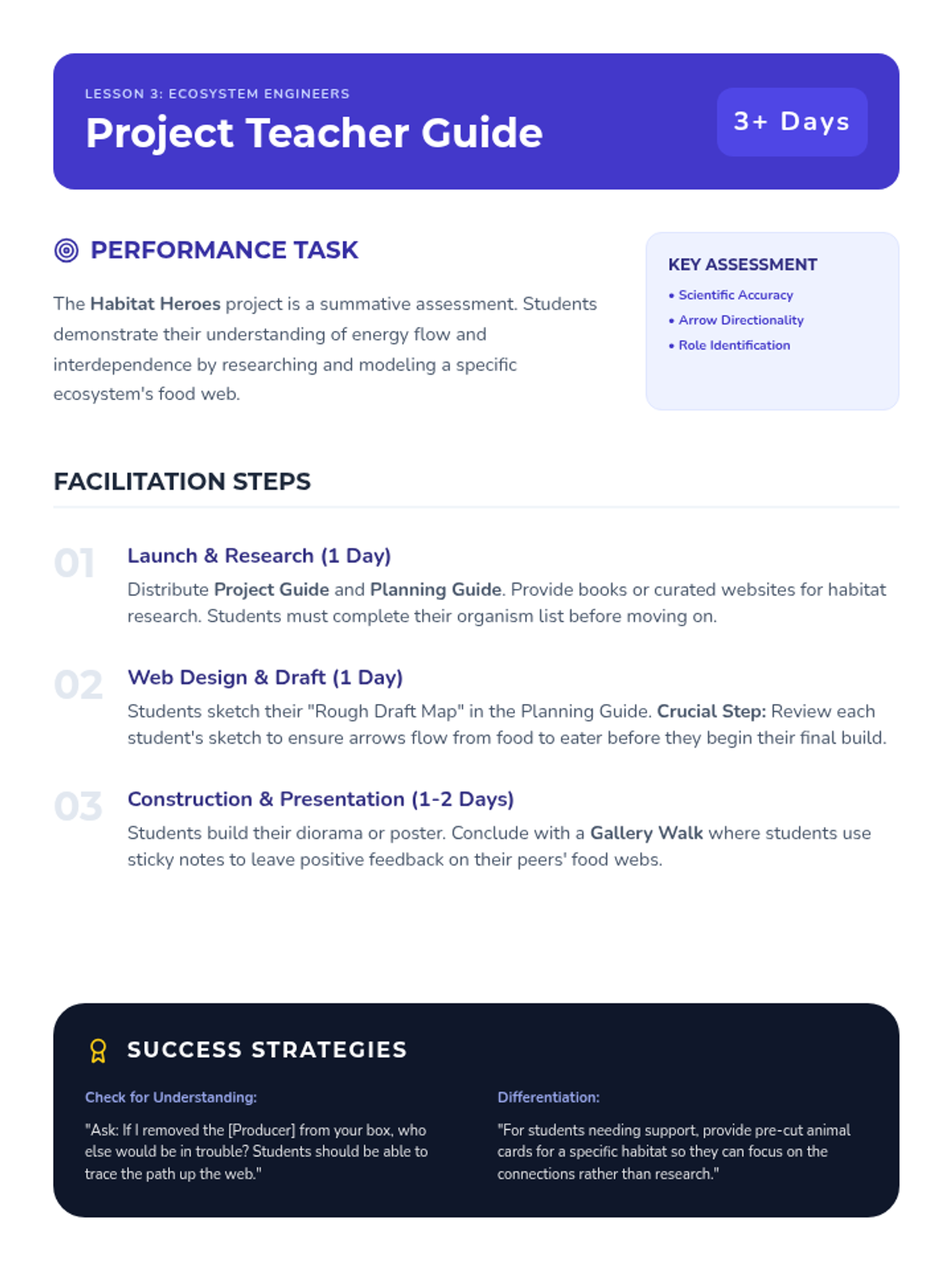
A teacher resource for Lesson 3, featuring project facilitation tips, a suggested implementation schedule, and strategies for supporting students during the Habitat Heroes project.
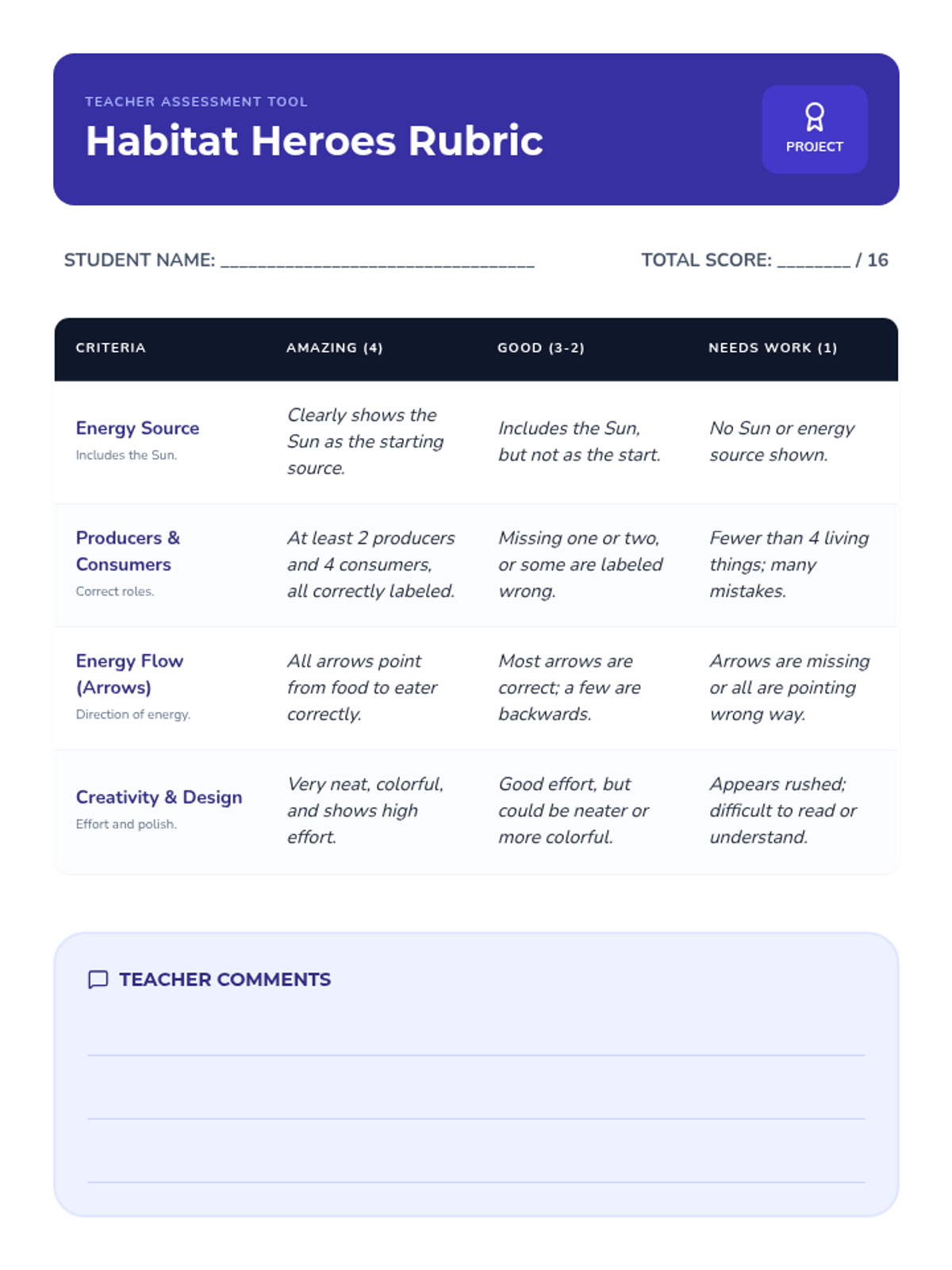
A grading rubric for teachers to assess the "Habitat Heroes" food web project based on scientific accuracy, design, and inclusion of required elements.
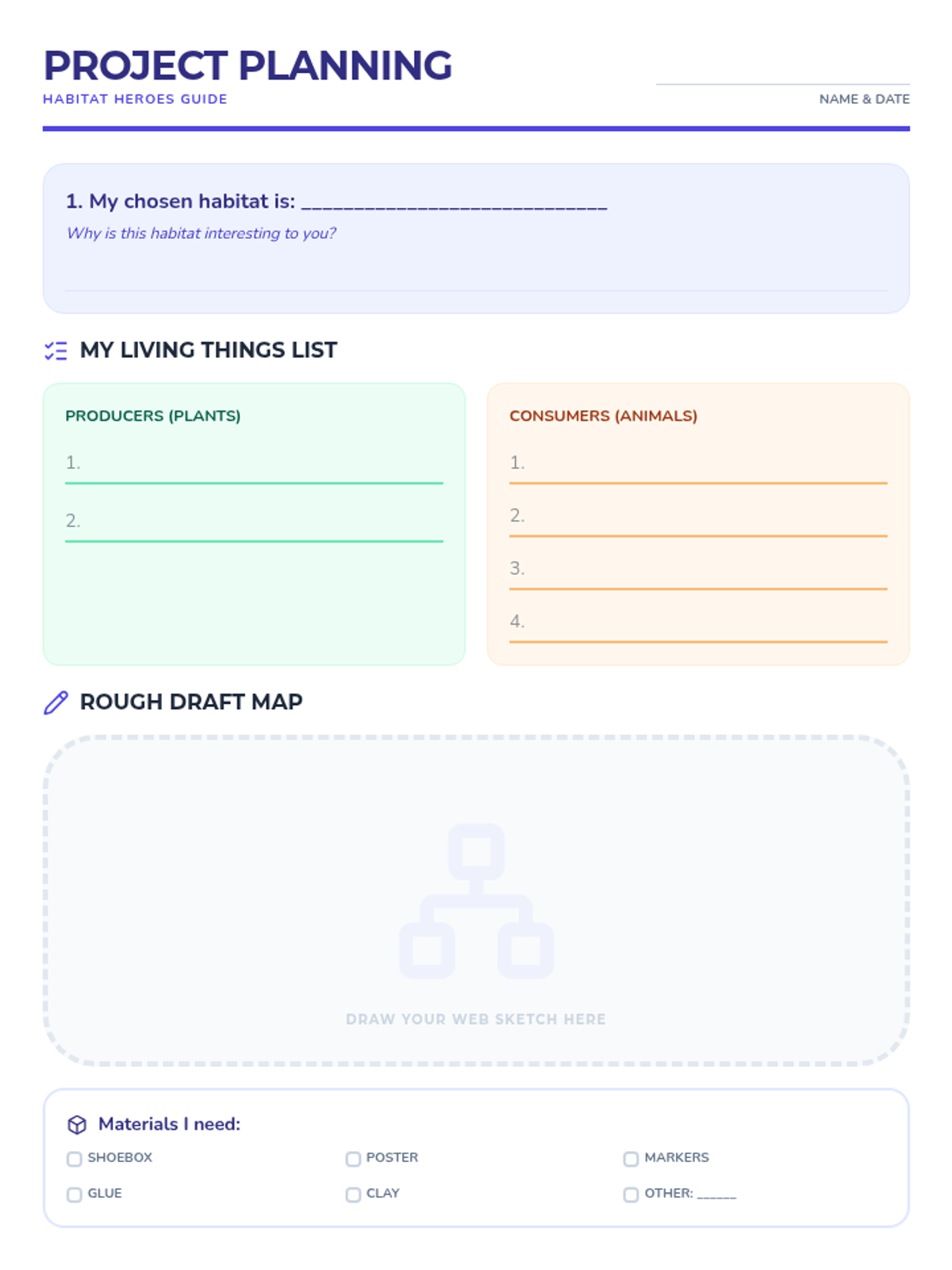
A planning sheet for students to organize their habitat research, list organisms by role, and sketch a rough draft of their food web before building their final project. Consolidated to a single page.
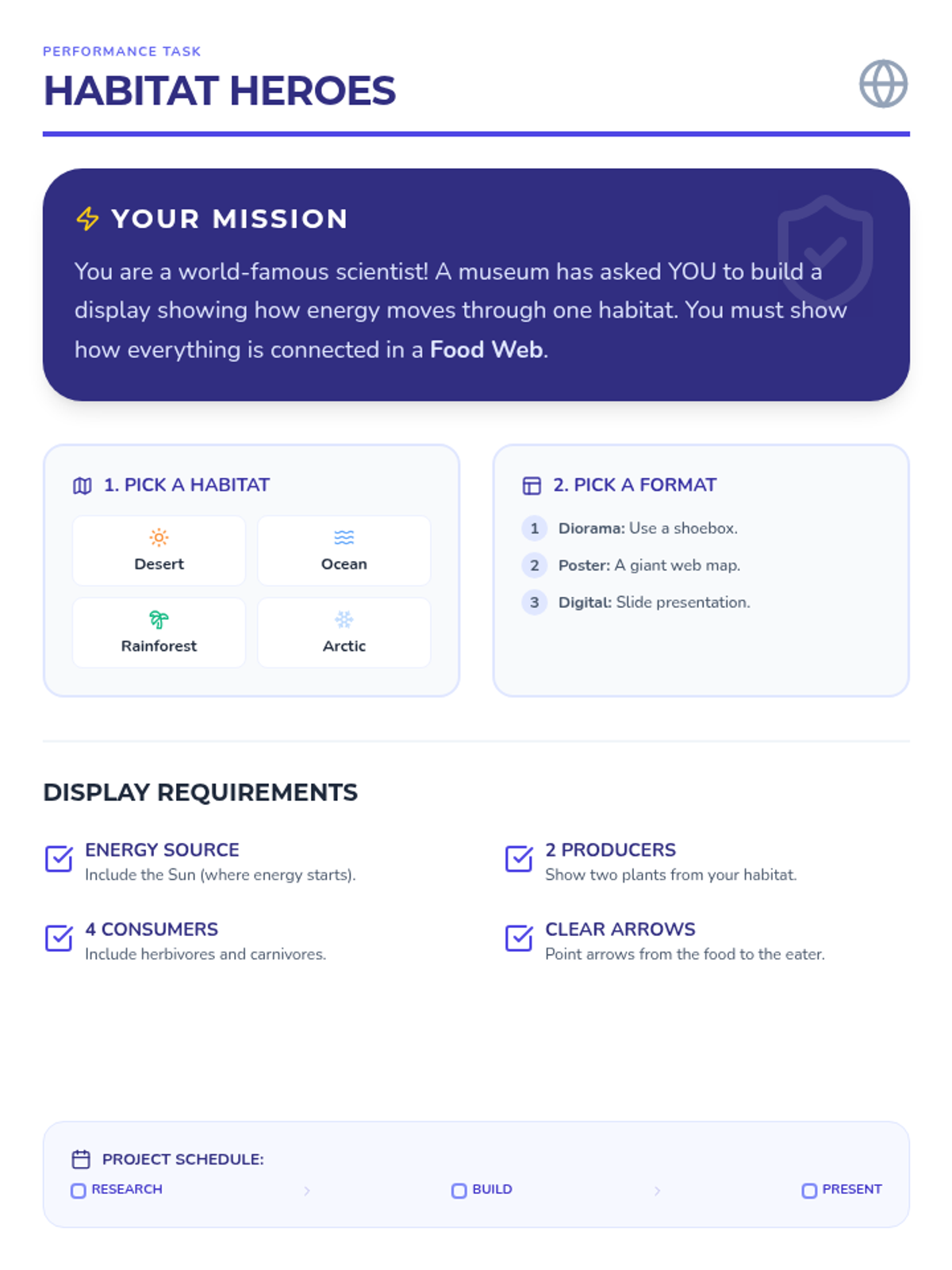
A student-facing project guide that outlines the "Habitat Heroes" performance task, where students create a 3D or visual food web for a chosen ecosystem. Consolidated to a single page.
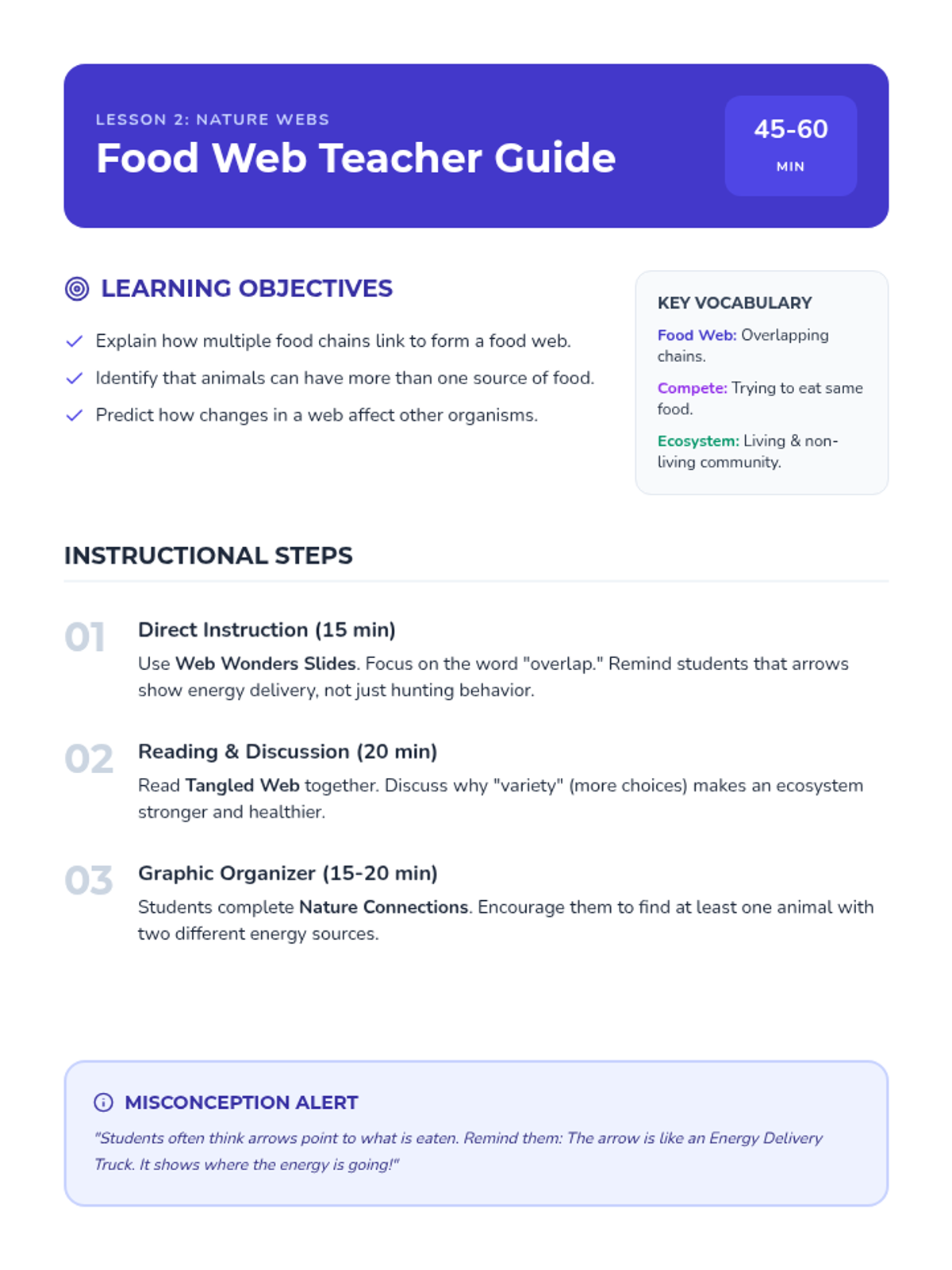
A teacher guide for Lesson 2. Revised to keep instructional steps together, include an Answer Key on Page 2, and add deeper Discussion Prompts.
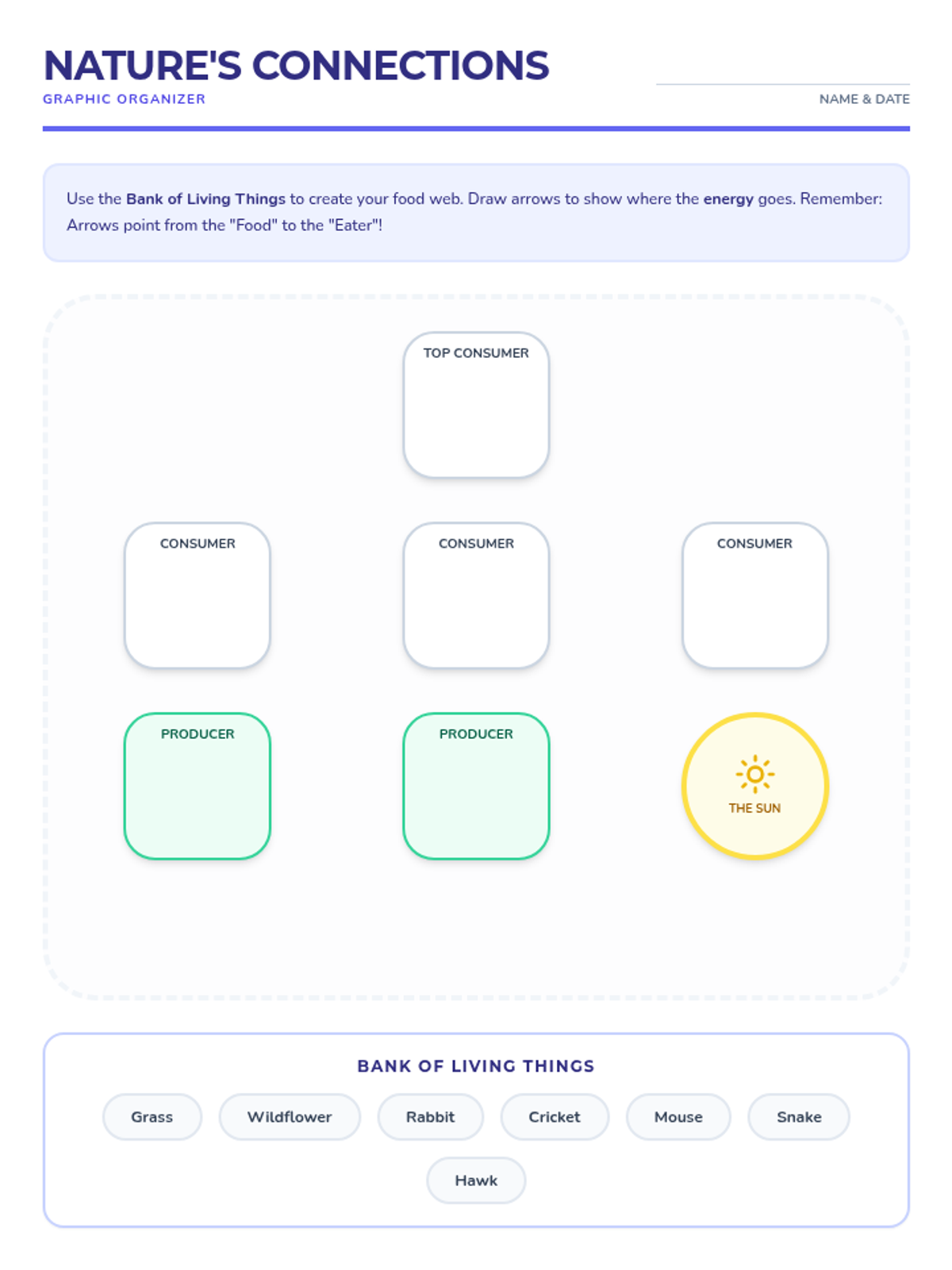
A graphic organizer where students map out a meadow-themed food web. Revised to consolidate the word bank and workspace on a single page, darken placeholder text, and match word bank item count to boxes.
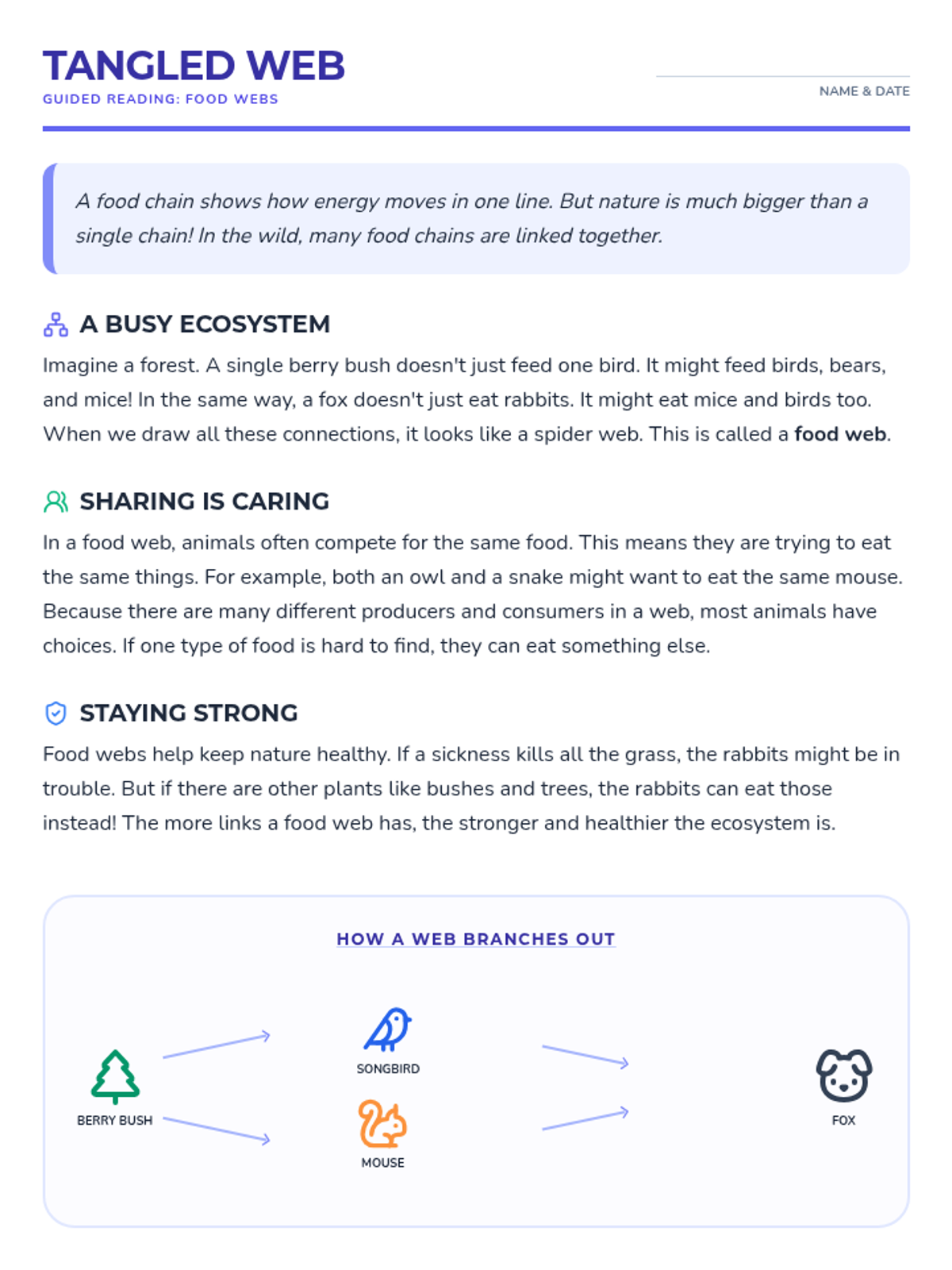
A reading passage about food webs. Revised to keep visual aids and questions on single pages, increase work area sizes, and add a dedicated critical thinking workspace. Corrected visual aid branching.
A slide deck for Lesson 2. Revised to fix overlapping elements on Slide 4, improve arrow visibility, and enhance text contrast for better accessibility. Corrected arrow directions on Slide 4.
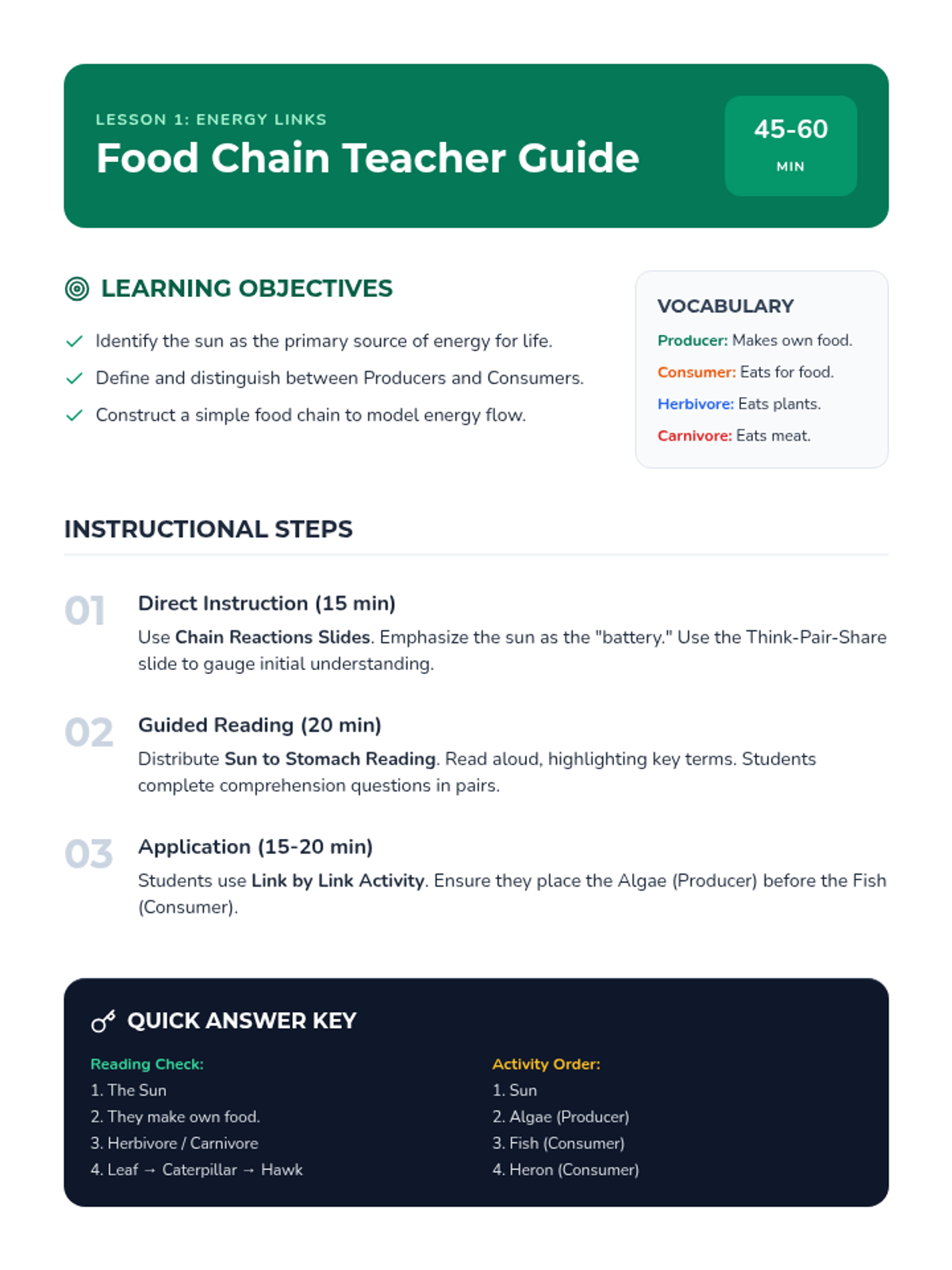
A teacher resource for Lesson 1. Revised to keep instructional steps together and include a new Differentiation & Extension section on Page 2.
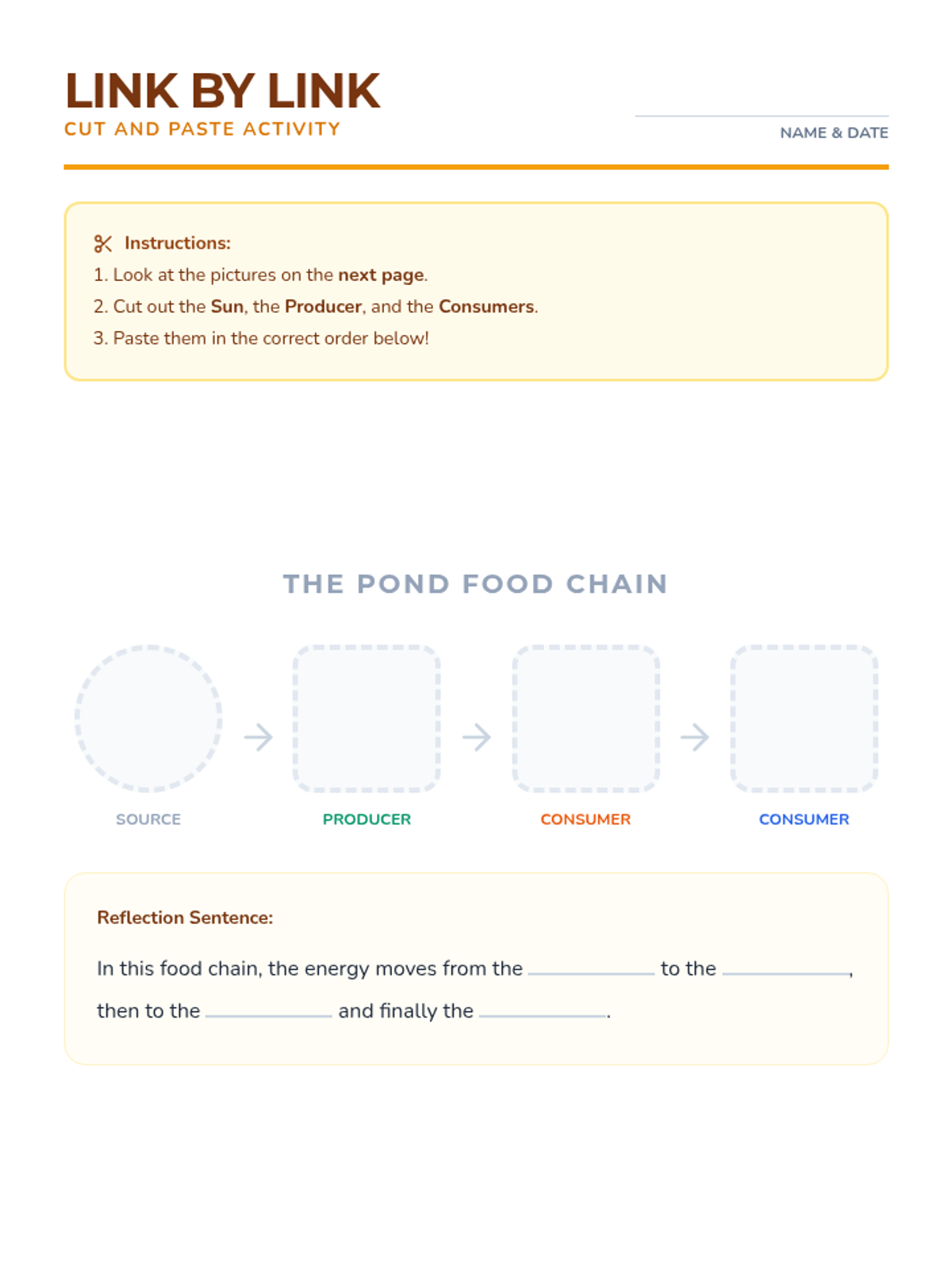
A cut-and-paste sorting activity where students assemble a pond-based food chain. Revised to consolidate content on Page 1 and include Teacher Tip on Page 2.
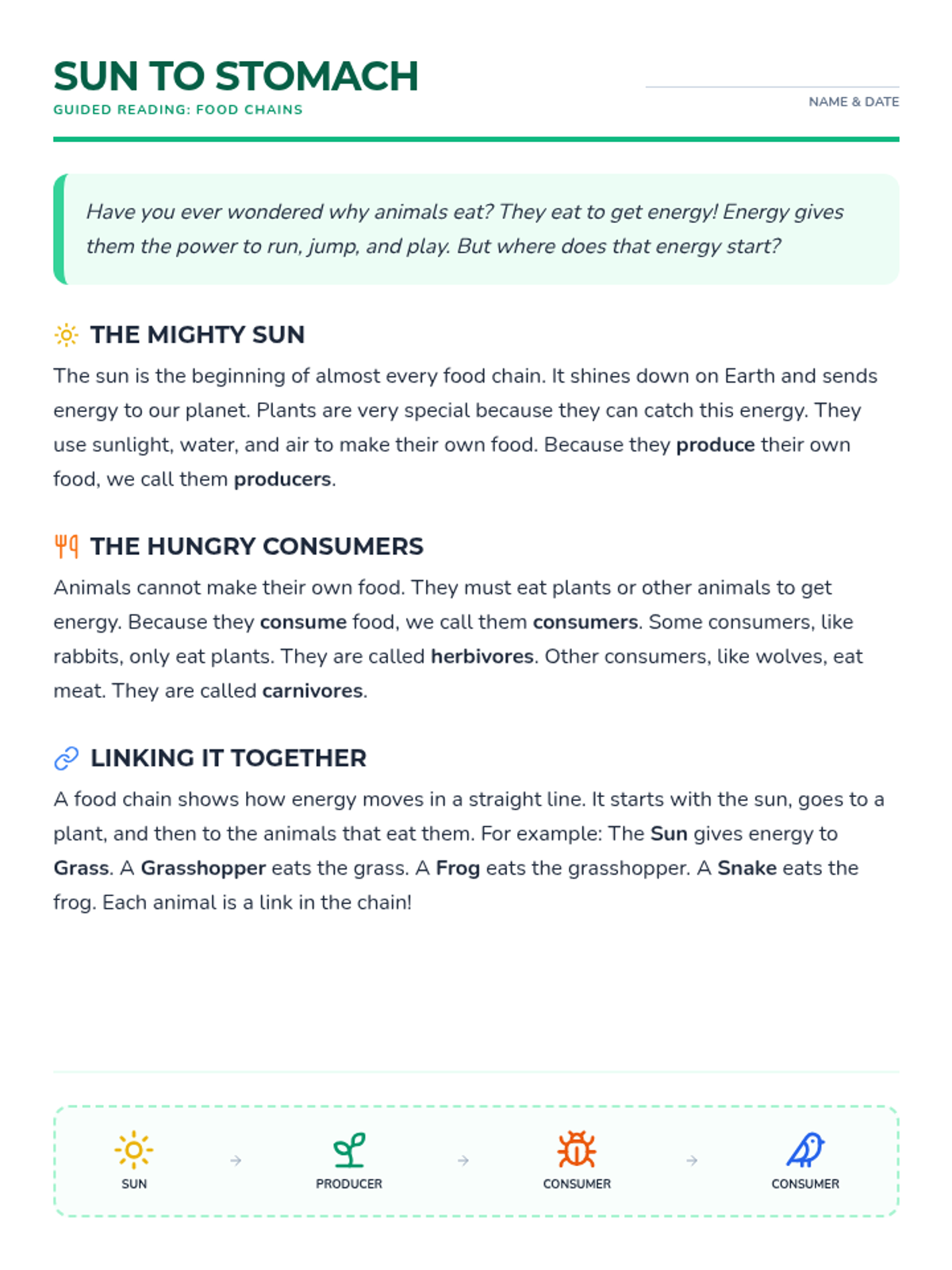
A two-page guided reading packet including a simplified text about food chains, producers, and consumers, followed by multiple-choice and open-ended comprehension questions. Revised for better page flow and student work areas.
A visual slide deck introducing the concepts of producers, consumers, and energy flow in a food chain. Includes clear diagrams and a discussion prompt for primary students. Revised with high-visibility arrows on Slide 5.

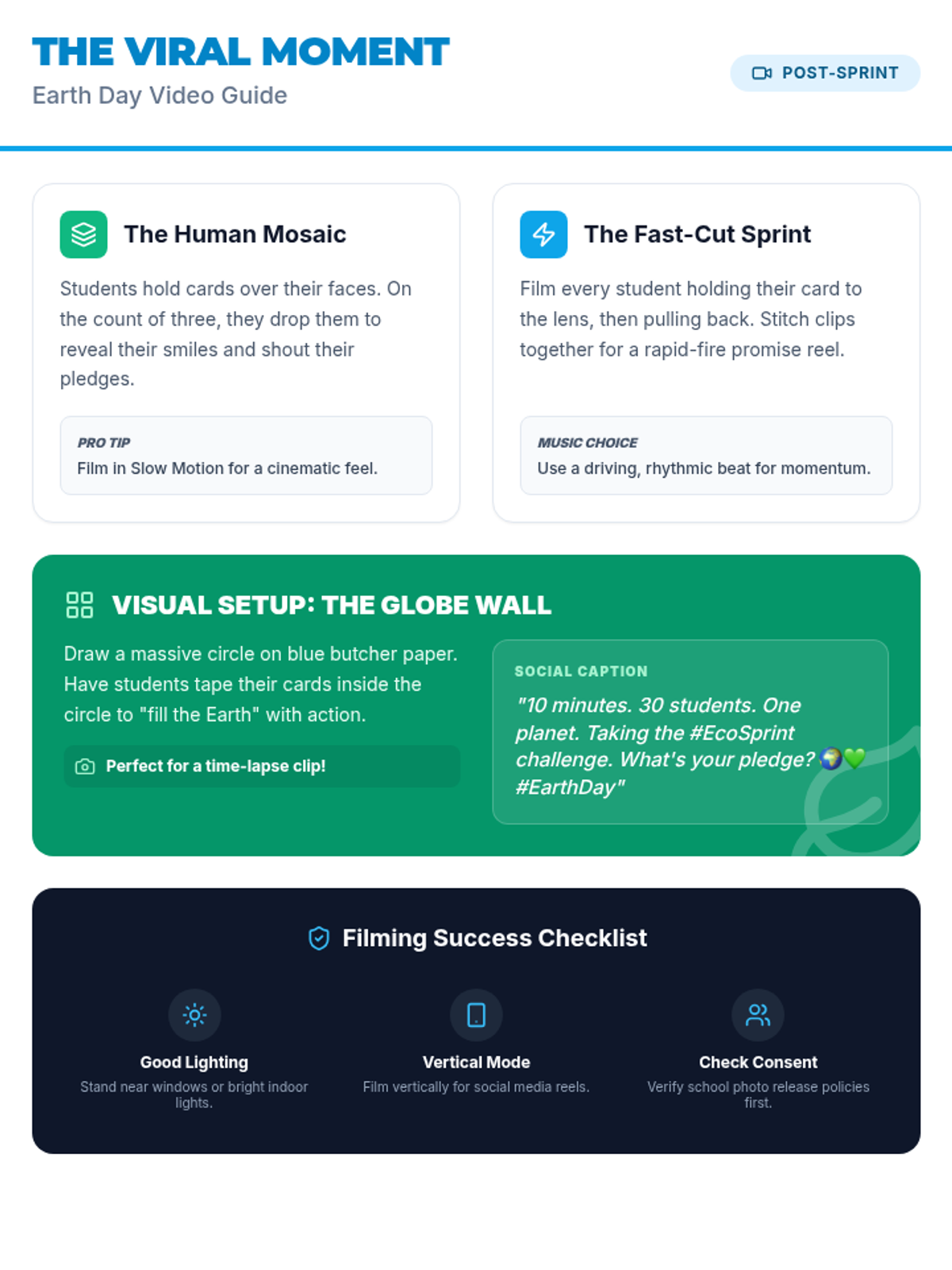
A creative guide for teachers on how to visually gather and film the Earth Hero Pledge cards, including social media caption ideas and cinematic filming techniques.
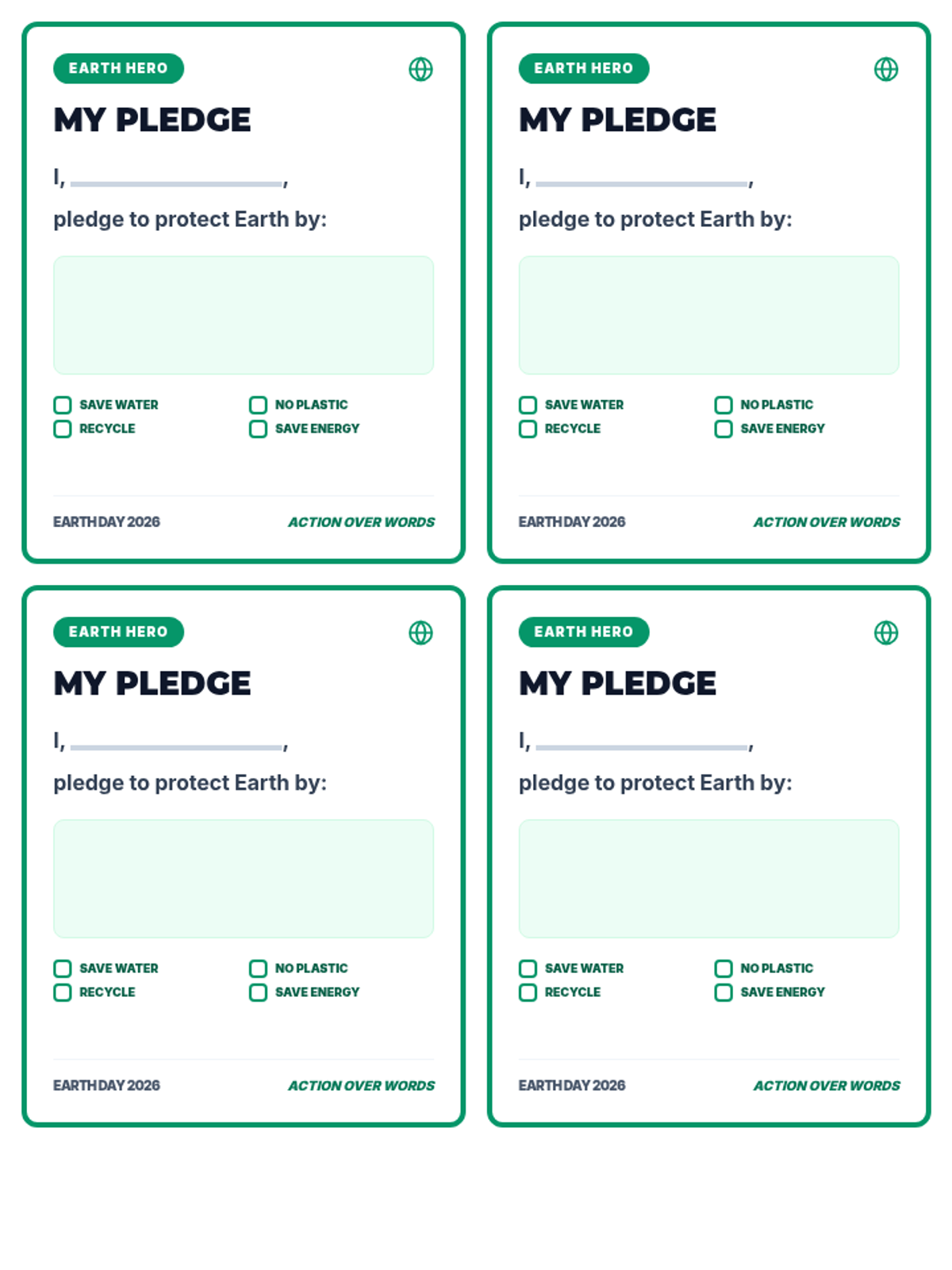
A printable set of 4 Earth Hero Pledge cards per page. Students commit to one specific environmental action and sign their name. Eco-friendly layout to minimize paper waste.
A high-impact, 5-slide presentation designed for a quick 10-minute Earth Day talk. Features bold visuals, key environmental statistics, and clear calls to action.
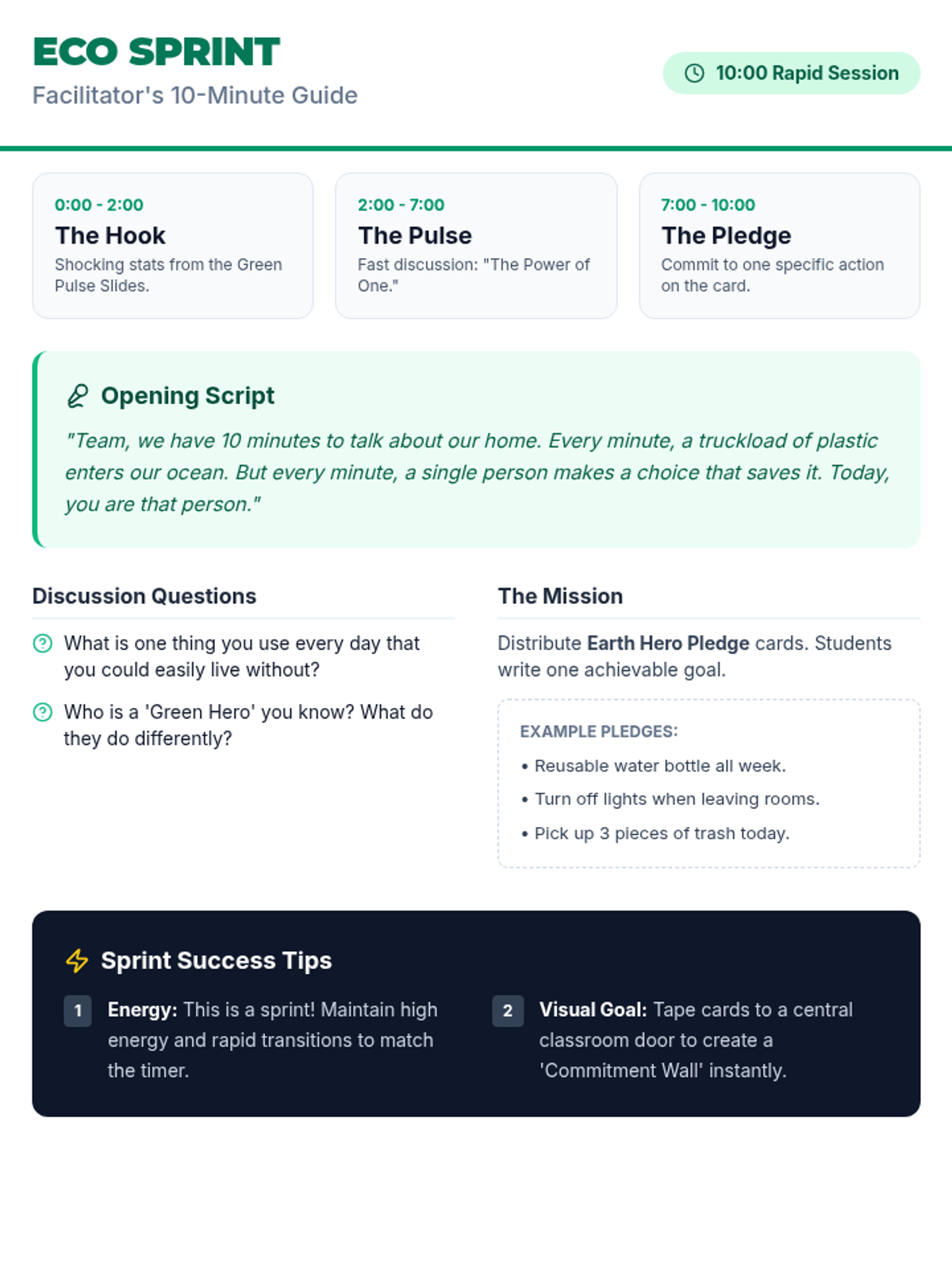
A concise teacher facilitation guide for a 10-minute Earth Day activation, including a timed script, discussion prompts, and success tips.
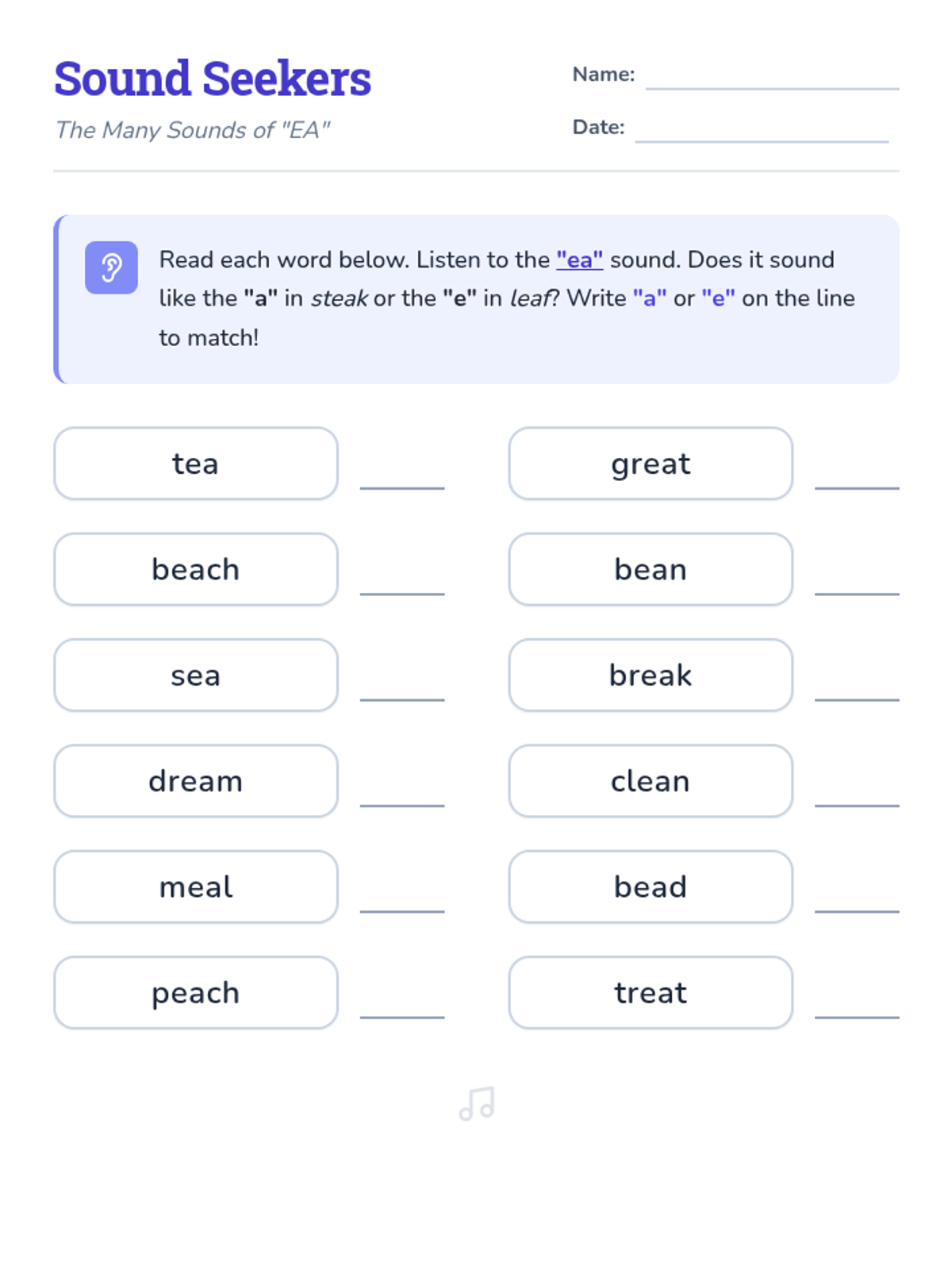
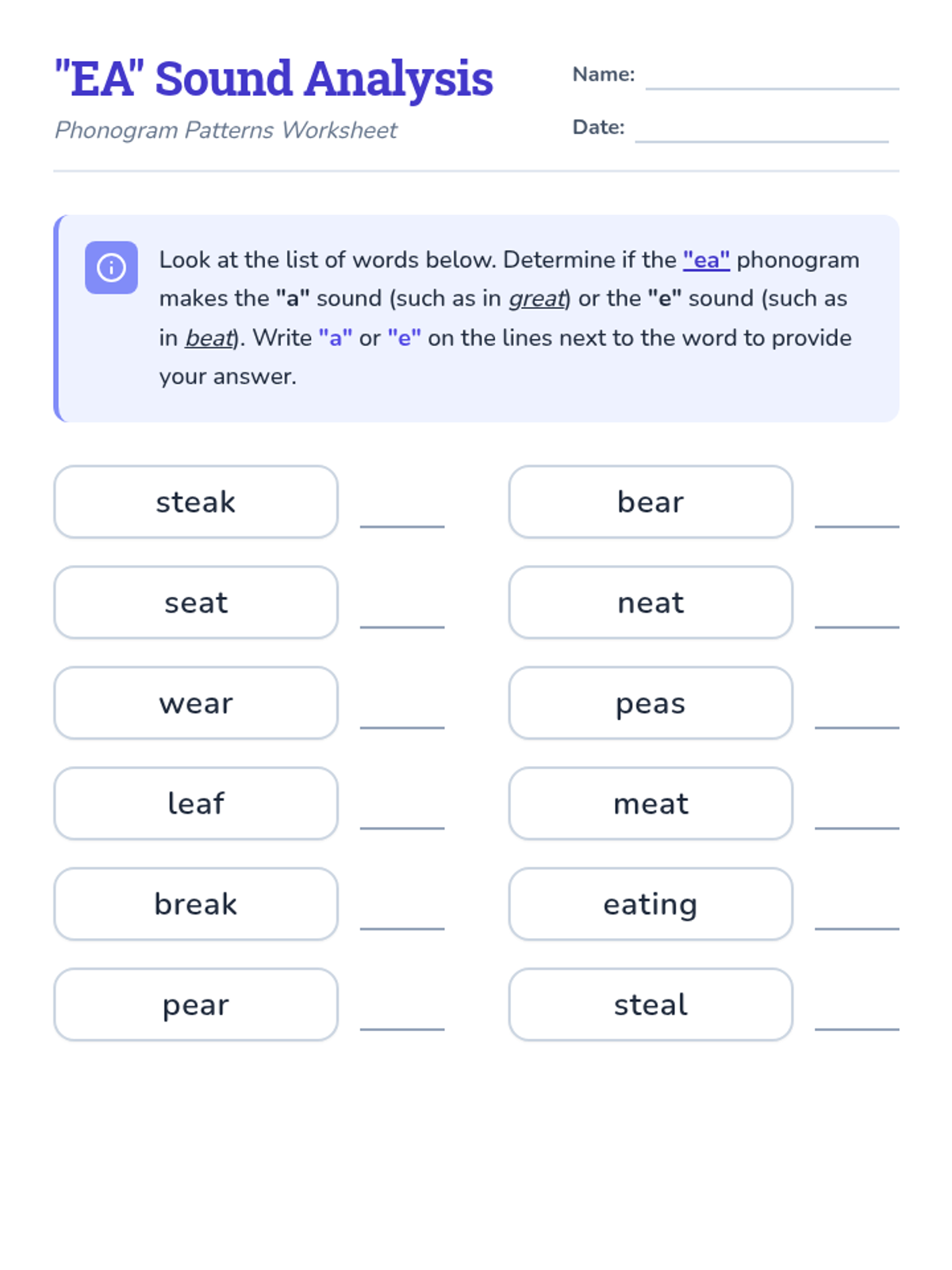
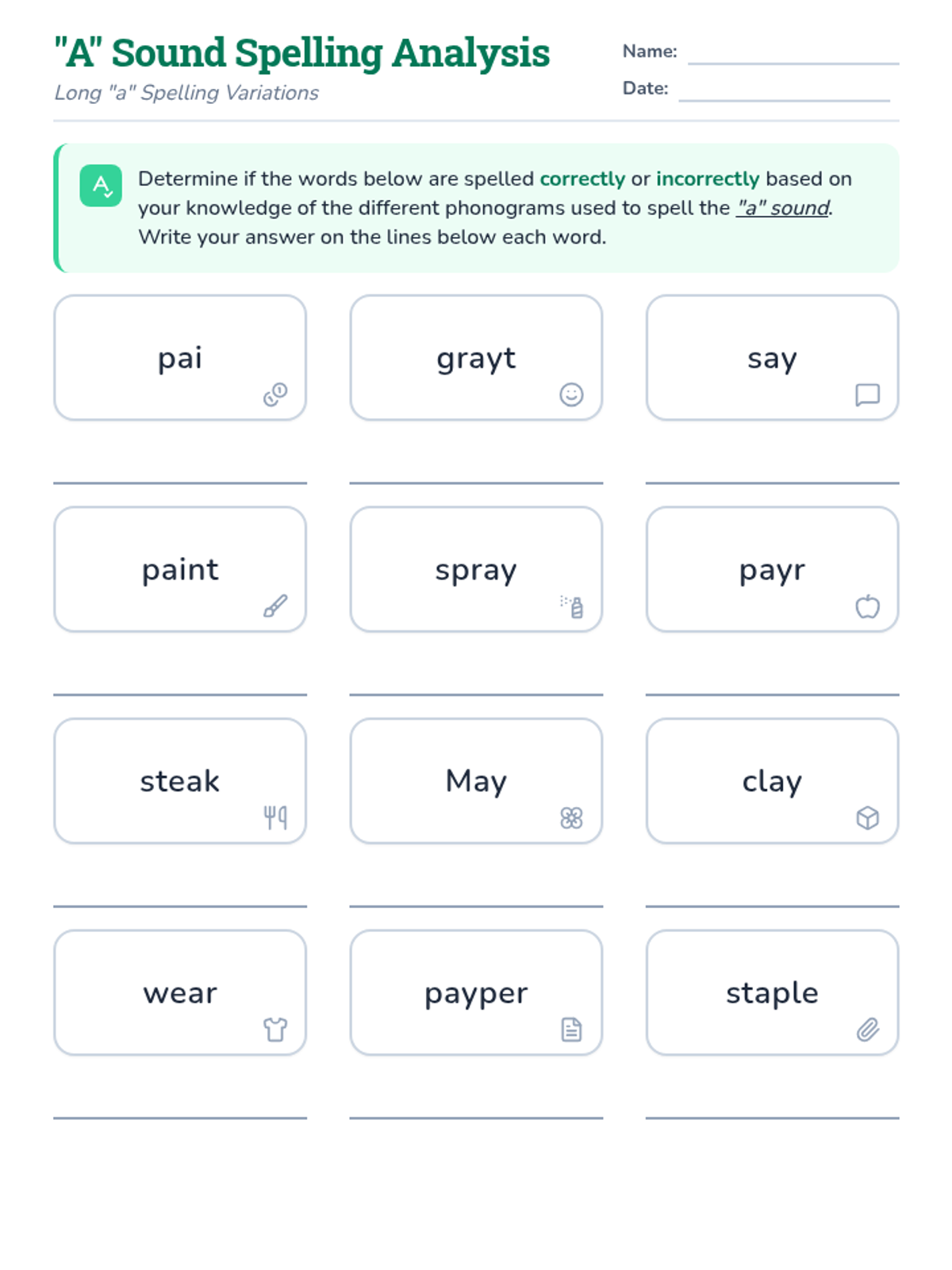
A double-sided phonics worksheet for Grade 2. Side 1 focuses on analyzing the sounds of the "ea" phonogram, and Side 2 focuses on identifying correct long "a" spellings using various phonograms.
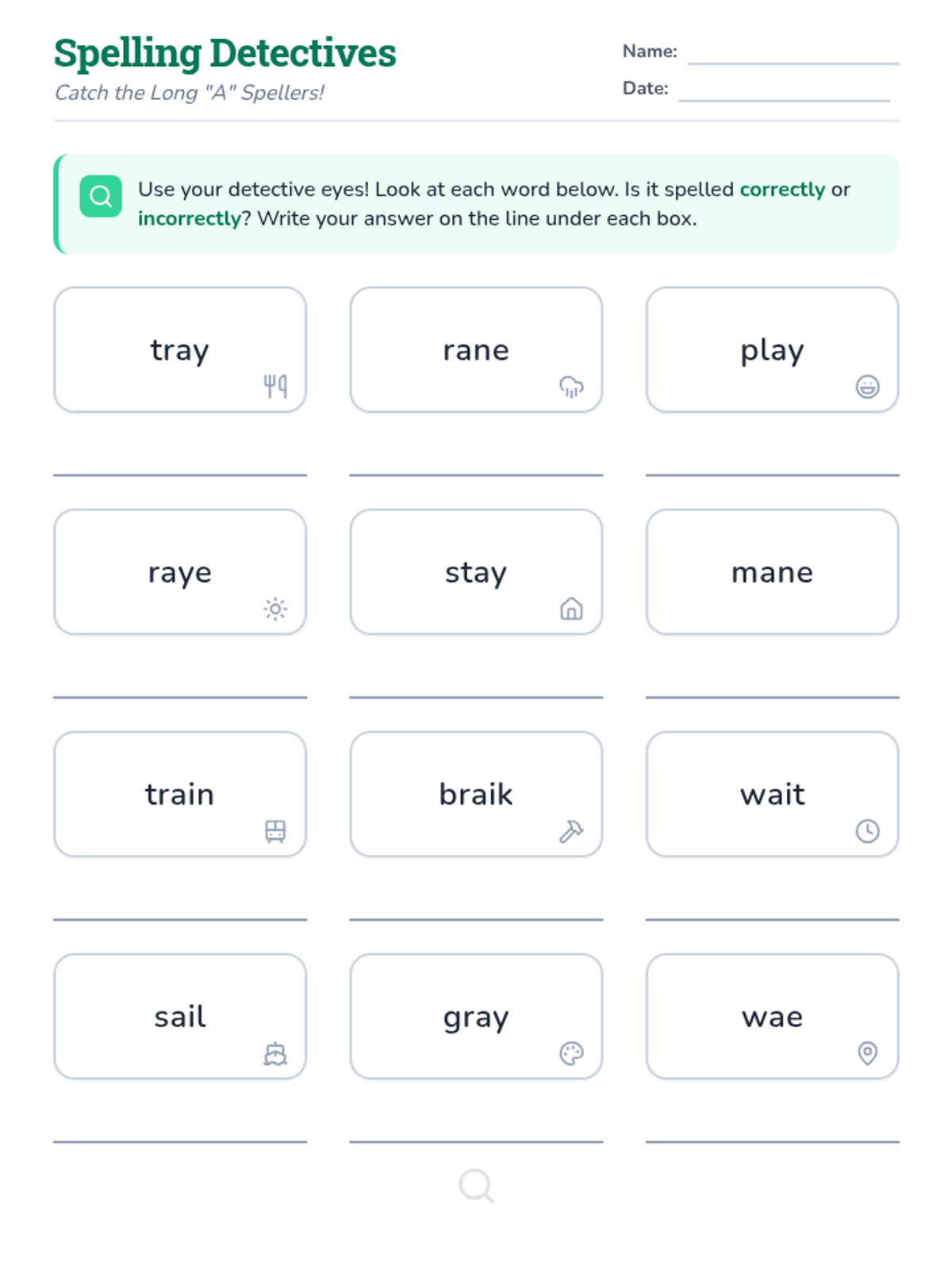
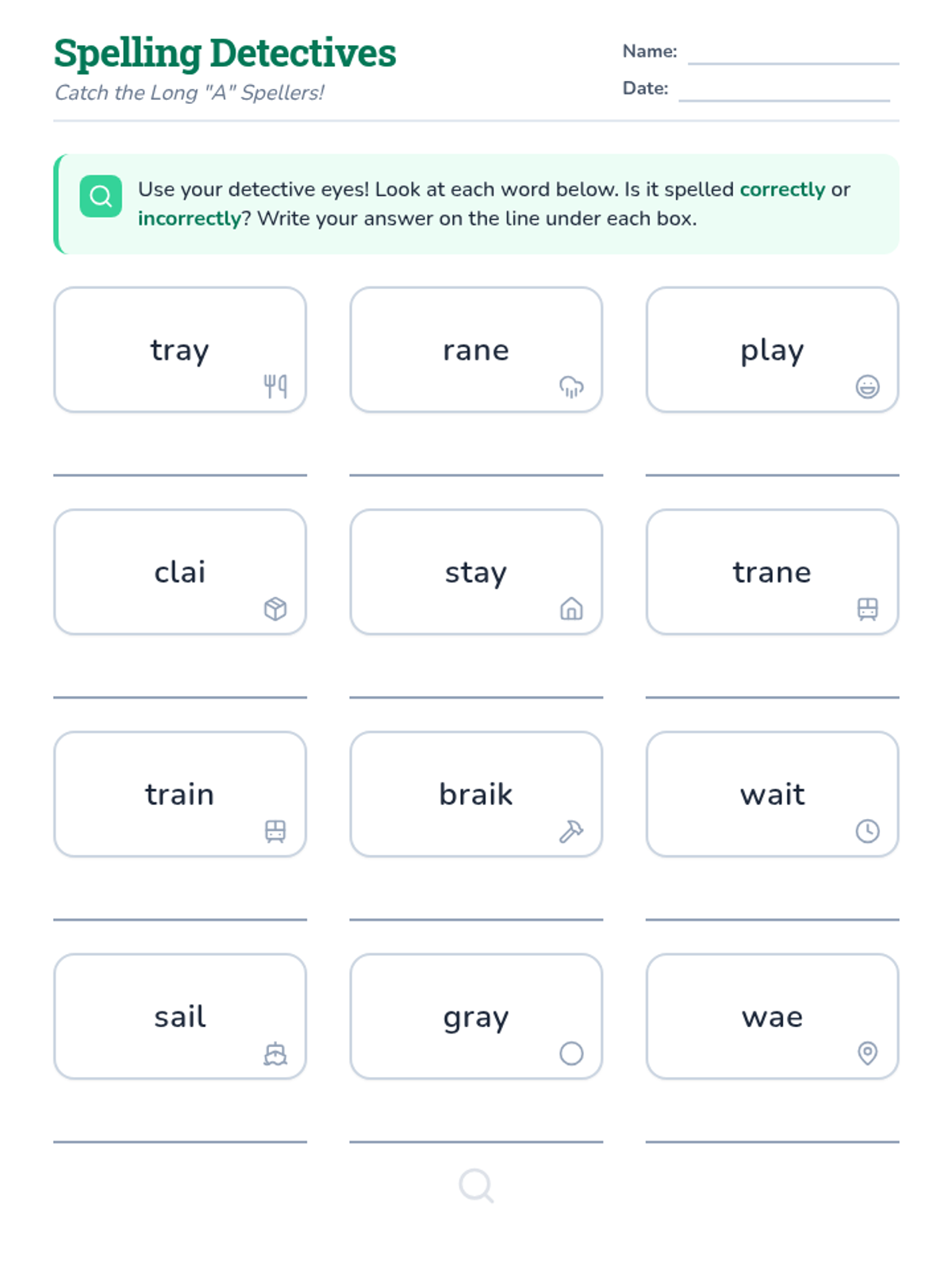
A spelling detective worksheet for Grade 2 students to identify correct and incorrect spellings of long 'a' sound words using phonograms like ai, ay, and ea. Updated for word variety.
A spelling detective worksheet for Grade 2 students to identify correct and incorrect spellings of long 'a' sound words using phonograms like ai, ay, and ea.
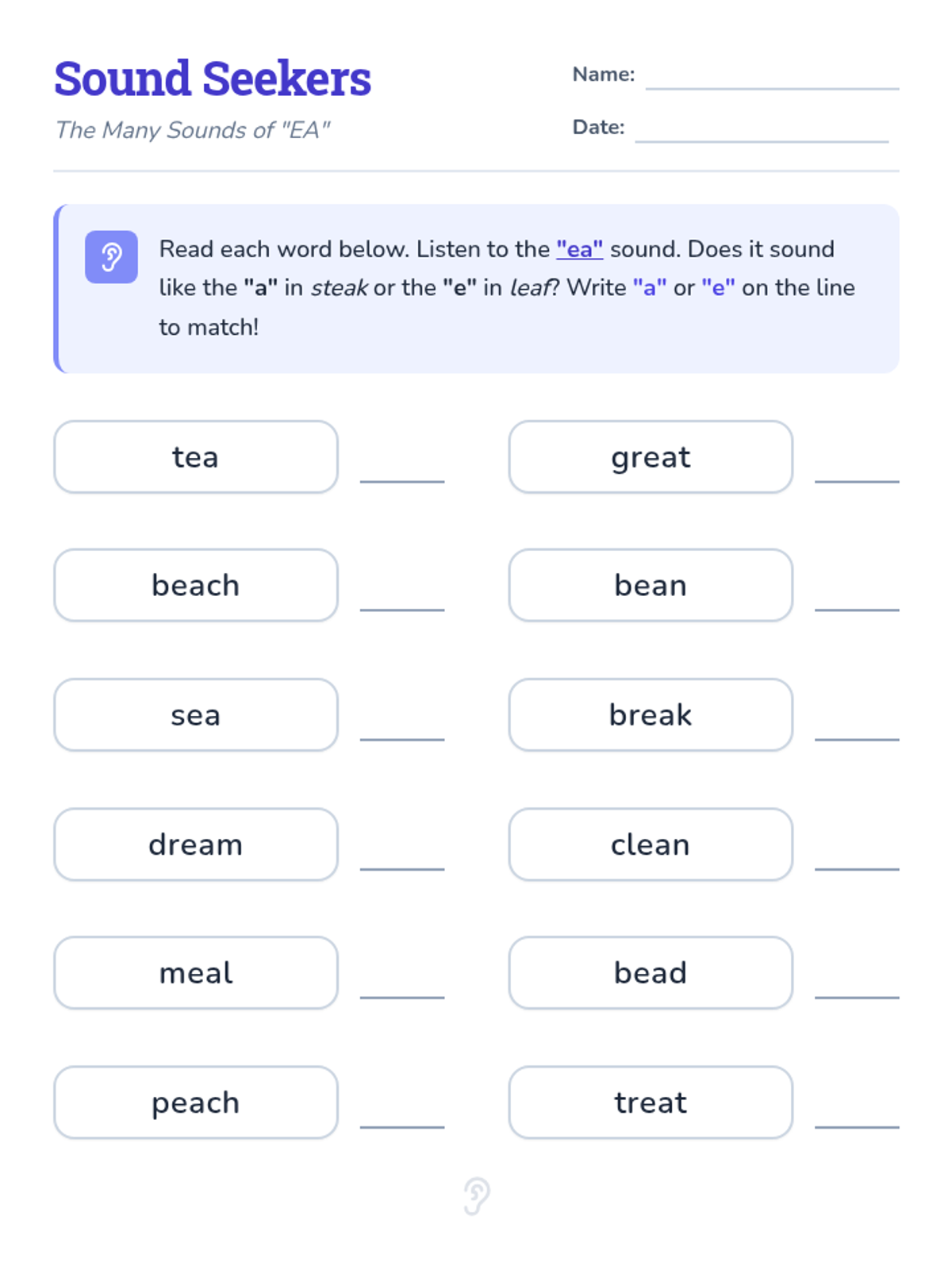
A phonics worksheet for Grade 2 students to distinguish between the long 'a' and long 'e' sounds made by the 'ea' phonogram. Word list polished to remove duplicates with instructions.
A worksheet for analyzing the different sounds the 'ea' phonogram can make, distinguishing between long 'a' and long 'e' sounds. 'Head' replaced with 'leaf' for phonetic consistency. Space tightened for single-page fit.
A worksheet for analyzing spelling accuracy of words containing the long 'a' sound, using various phonograms like 'ai', 'ay', and 'ea'. Box and lines grouped with break-avoidance for layout consistency. Spacing optimized for single-page fit.
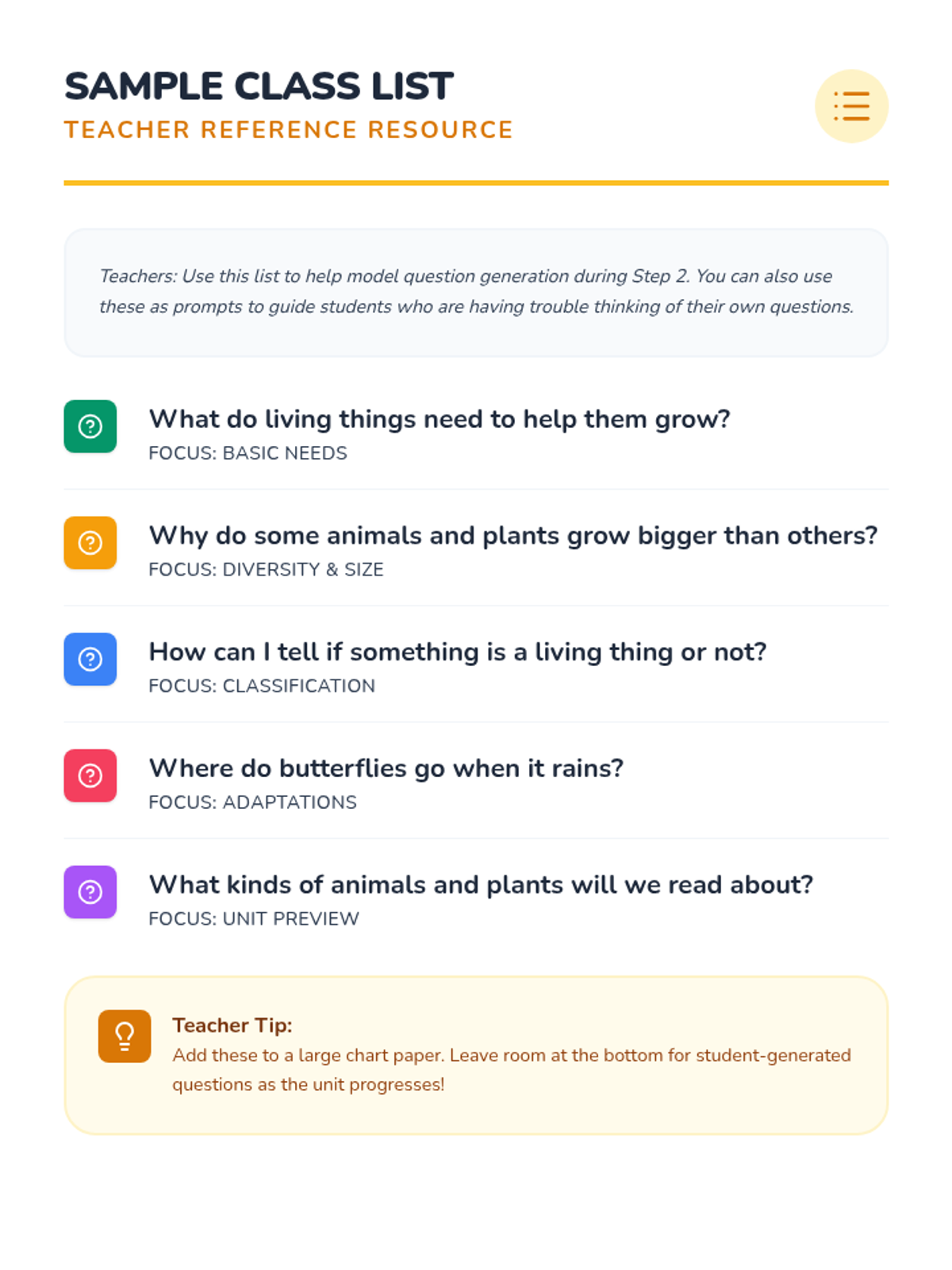
A sample list of curiosity questions for teachers to use when modeling how to ask questions about the natural world. This material serves as a reference for anchor charts and class discussions.
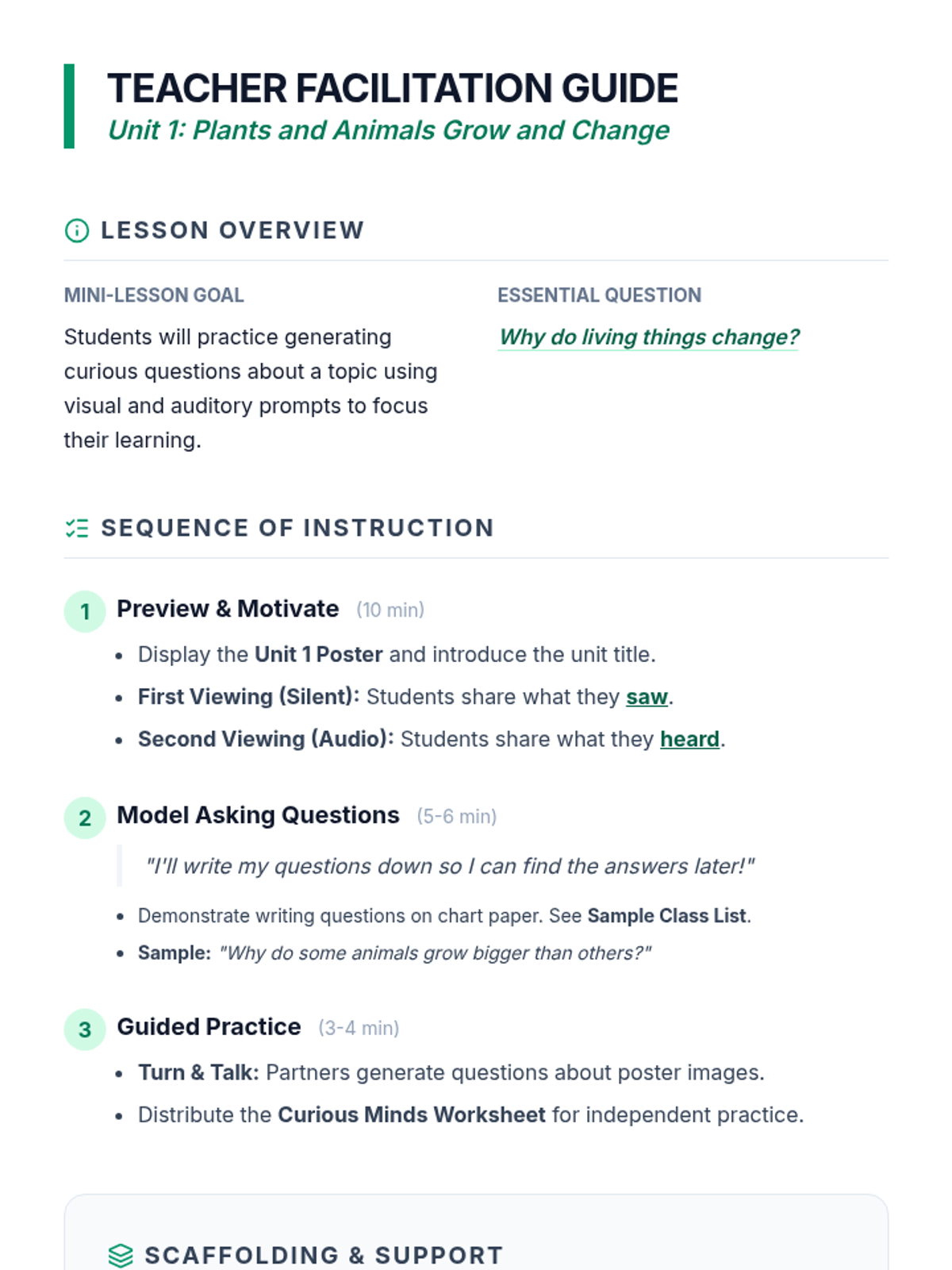
A teacher facilitation guide for the Nature Explorers lesson, revised for consistency with curriculum terminology and instructional steps. Fixed page break and contrast issues.