Un questionnaire complet pour évaluer la compréhension des 7 concepts clés d'ICT : Liquidité, FVG, Order Blocks, MSS, OTE, Kill Zones et AMD.

A comprehensive teacher professional development guide including essential AI concepts, facilitation strategies, and quick-reference prompt cheat sheets.
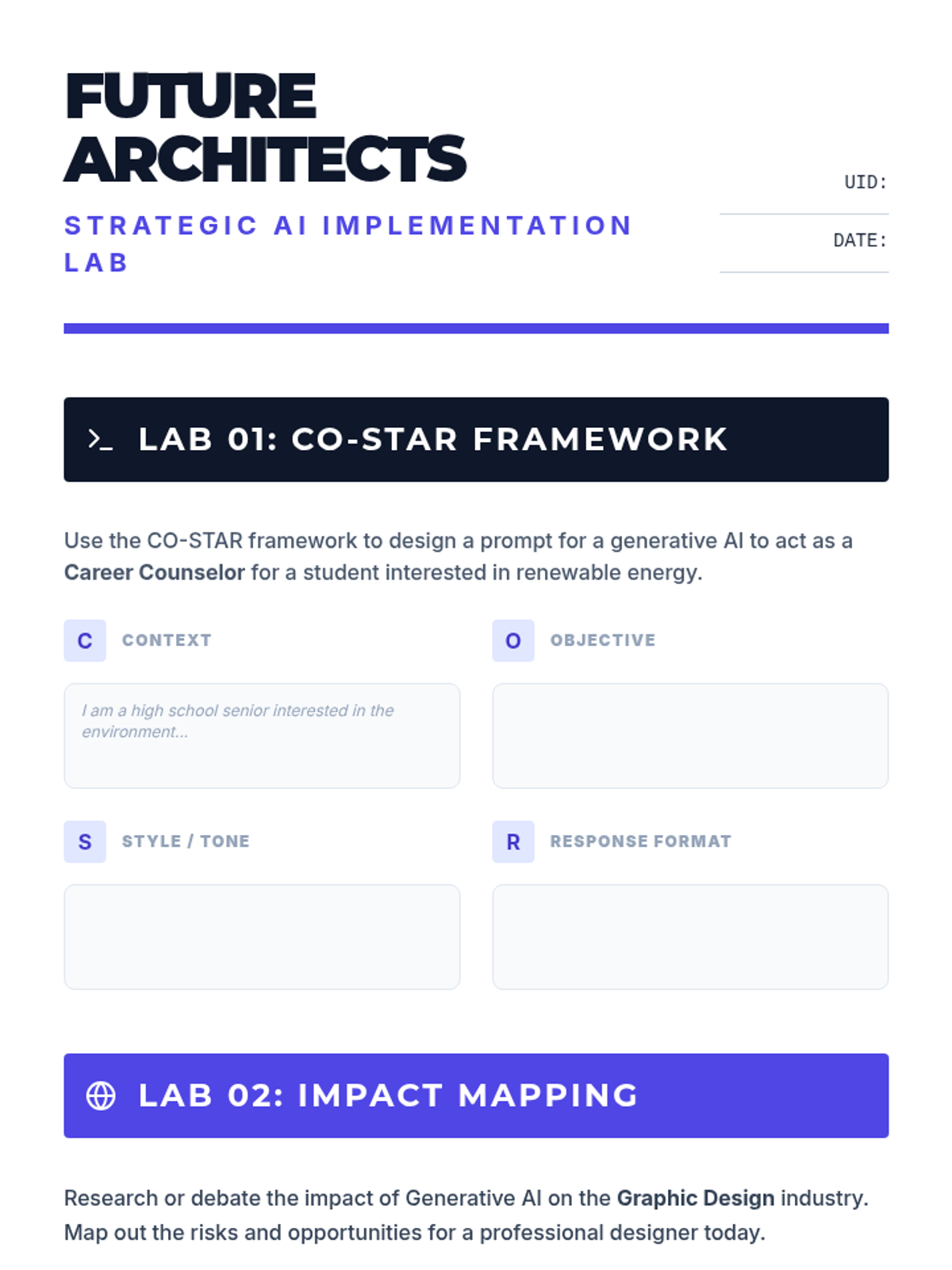
A high school activity sheet requiring students to apply the CO-STAR prompt engineering framework, map industry impacts, and draft ethical AI policies.
Advanced slide deck for high school students exploring generative AI paradigms, professional prompt engineering frameworks (CO-STAR), and the future of work.
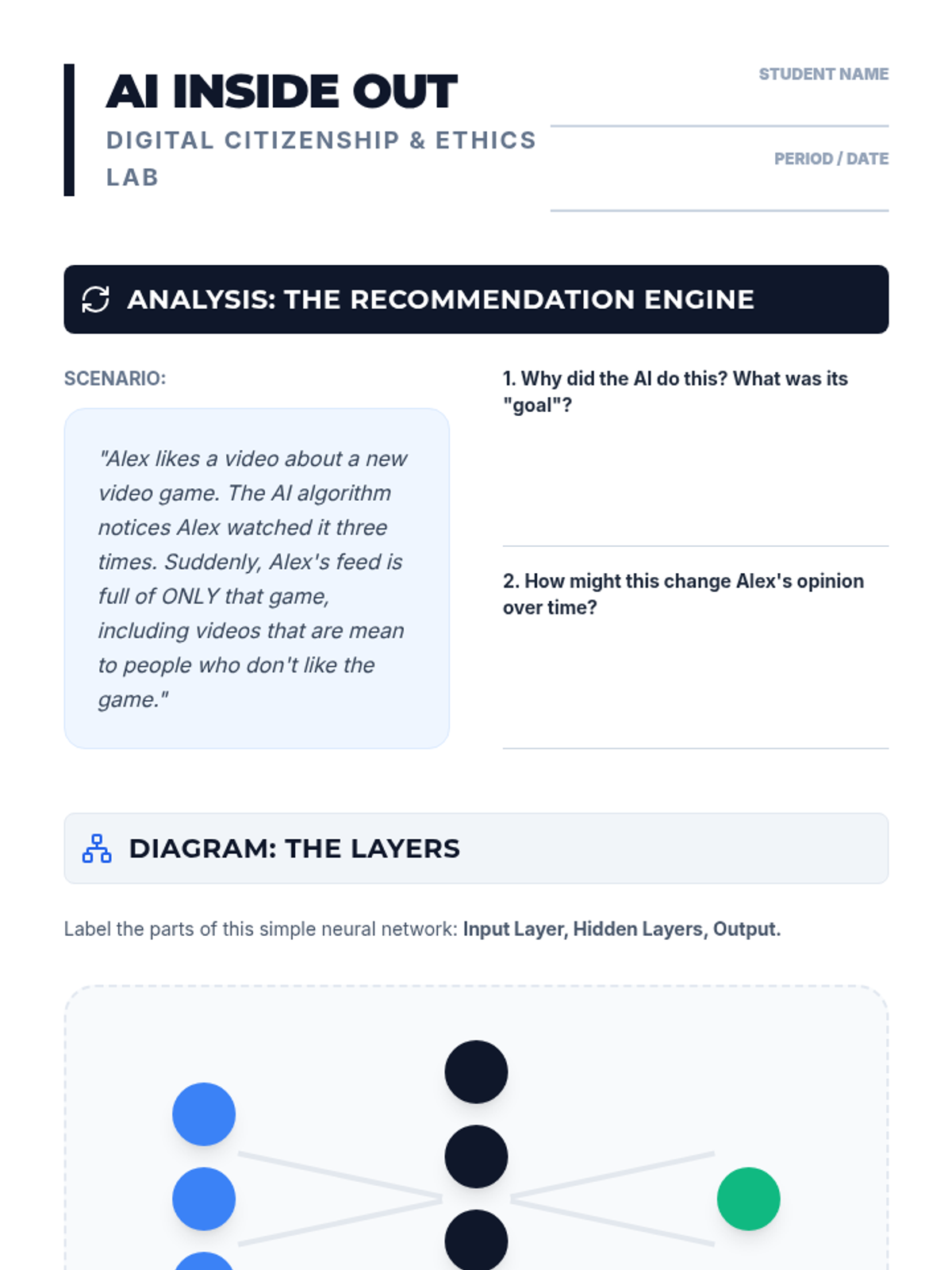
A middle school activity sheet involving ethical analysis of recommendation engines, labeling neural network structures, and debating facial recognition bias.
A middle school slide deck focused on the technical basics of neural networks and the ethical challenges of recommendation engines and deepfakes.
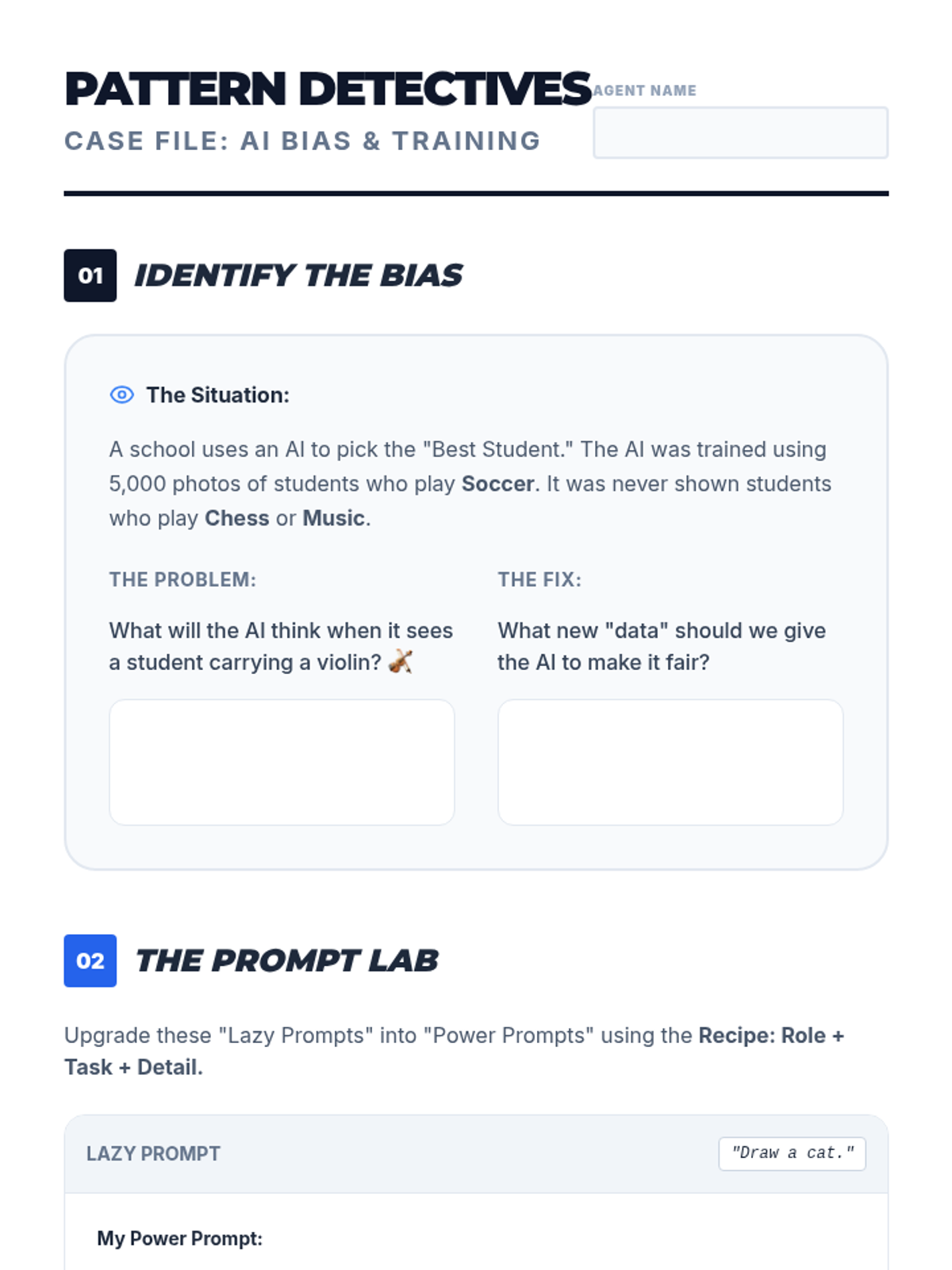
A grade 3-5 worksheet focusing on analyzing AI bias scenarios and practicing prompt engineering using a structured 'Role + Task + Detail' framework.
Instructional slides for grades 3-5, focusing on 'Pattern Detectives' - understanding data, spotting bias, and learning the basics of effective prompting.
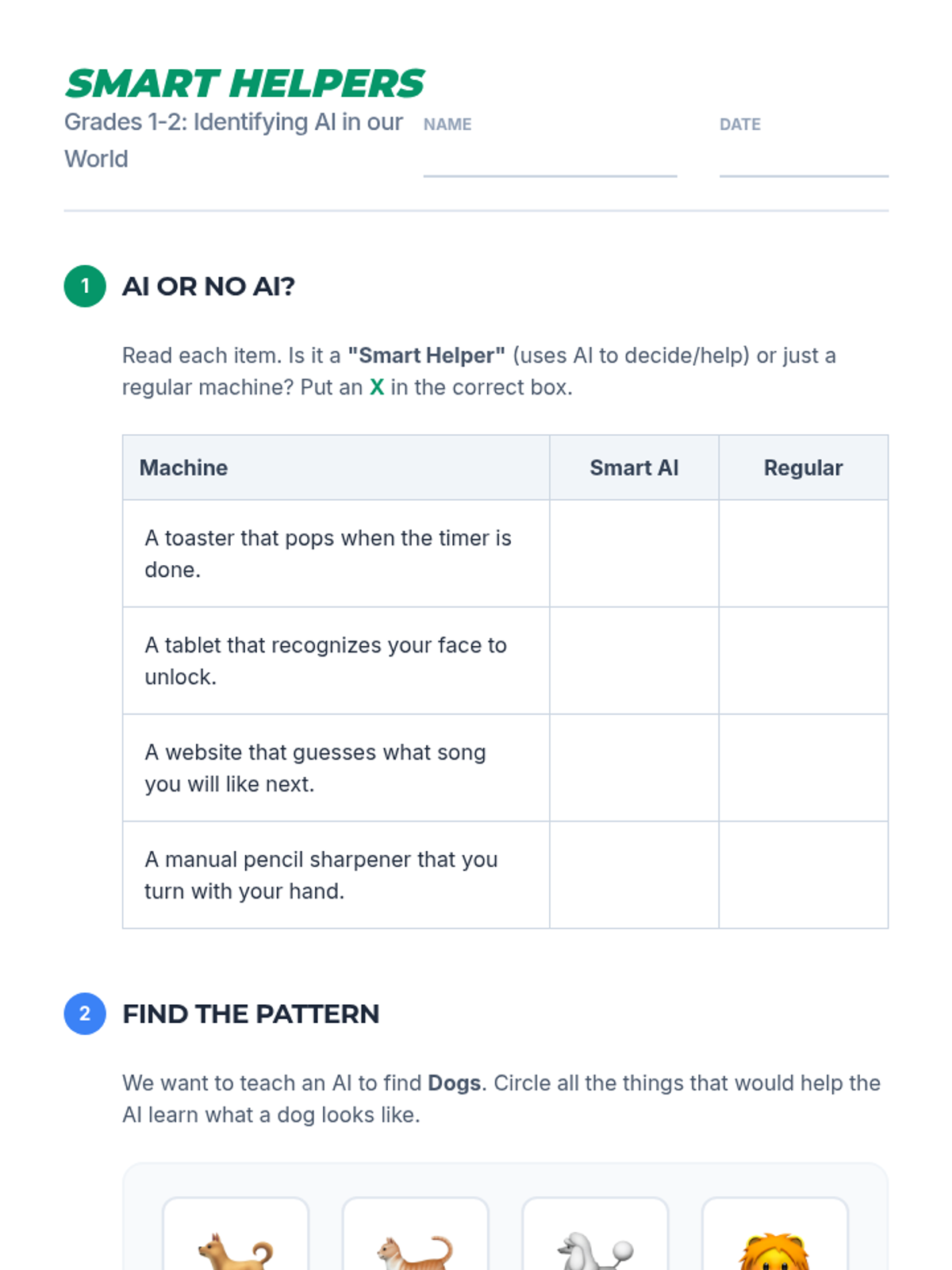
An activity sheet for grades 1-2 focusing on distinguishing between traditional machines and AI, and designing an AI solution for a simple problem.
Instructional slides for grades 1-2 focused on 'Smart Helpers' - identifying AI in the world and understanding simple machine learning patterns.
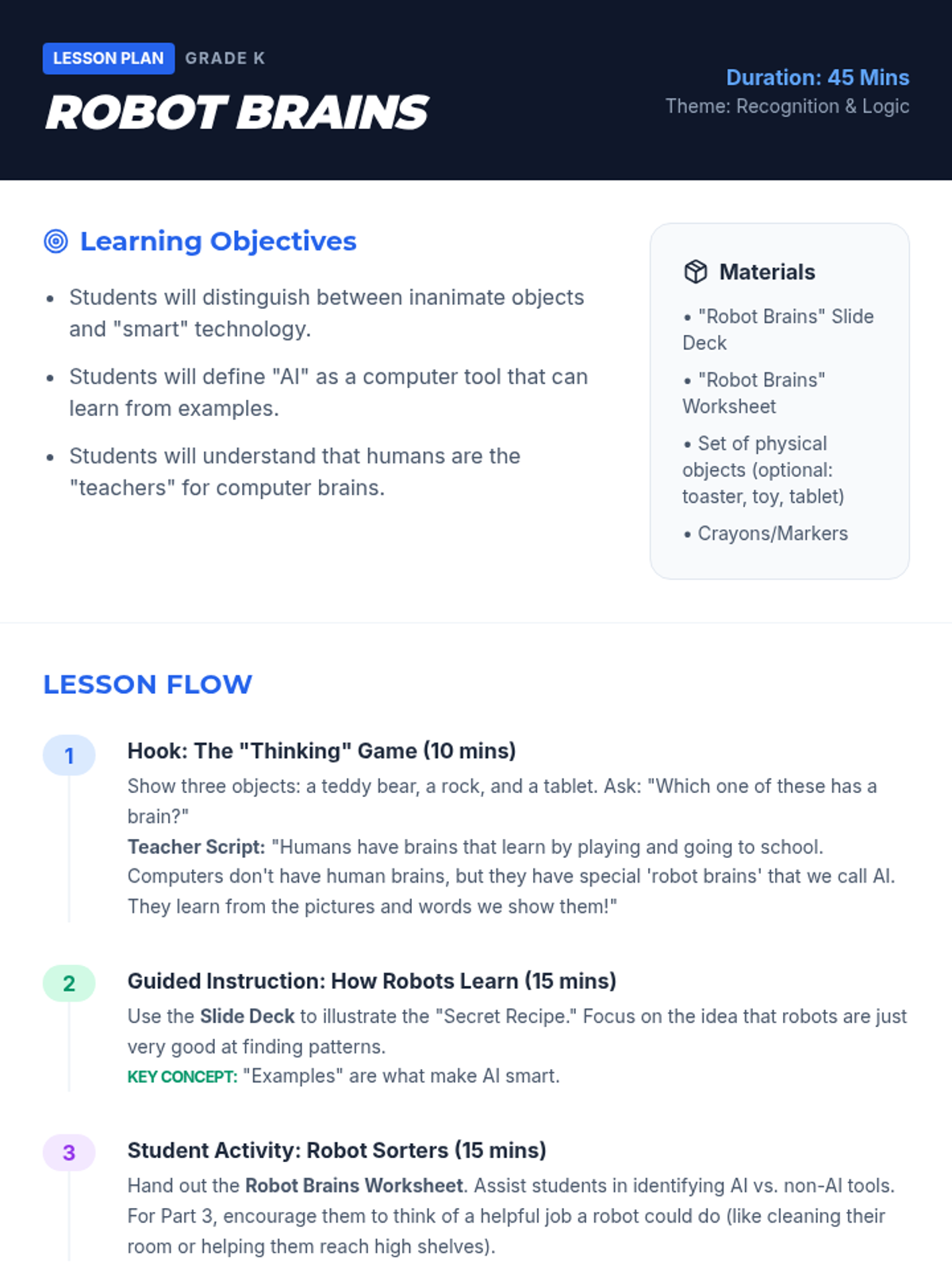
A comprehensive teacher guide for the 'Robot Brains' lesson, including a script, instructional sequence, and differentiation tips for Kindergarten.
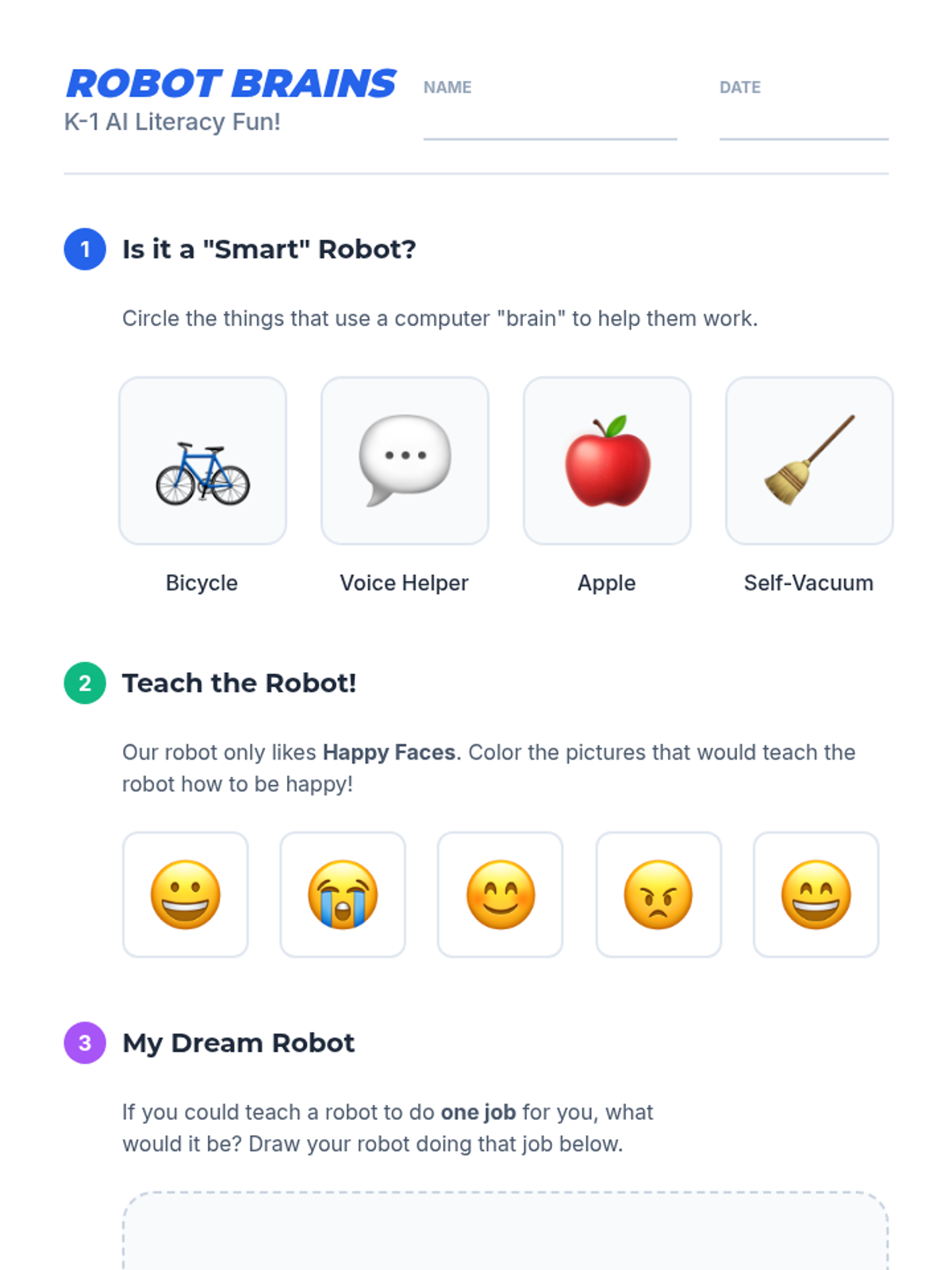
A simple, visual worksheet for Kindergarten students to practice identifying AI and 'training' a robot.
Introductory slide deck for Kindergarten students exploring the difference between human brains and computer 'brains'.
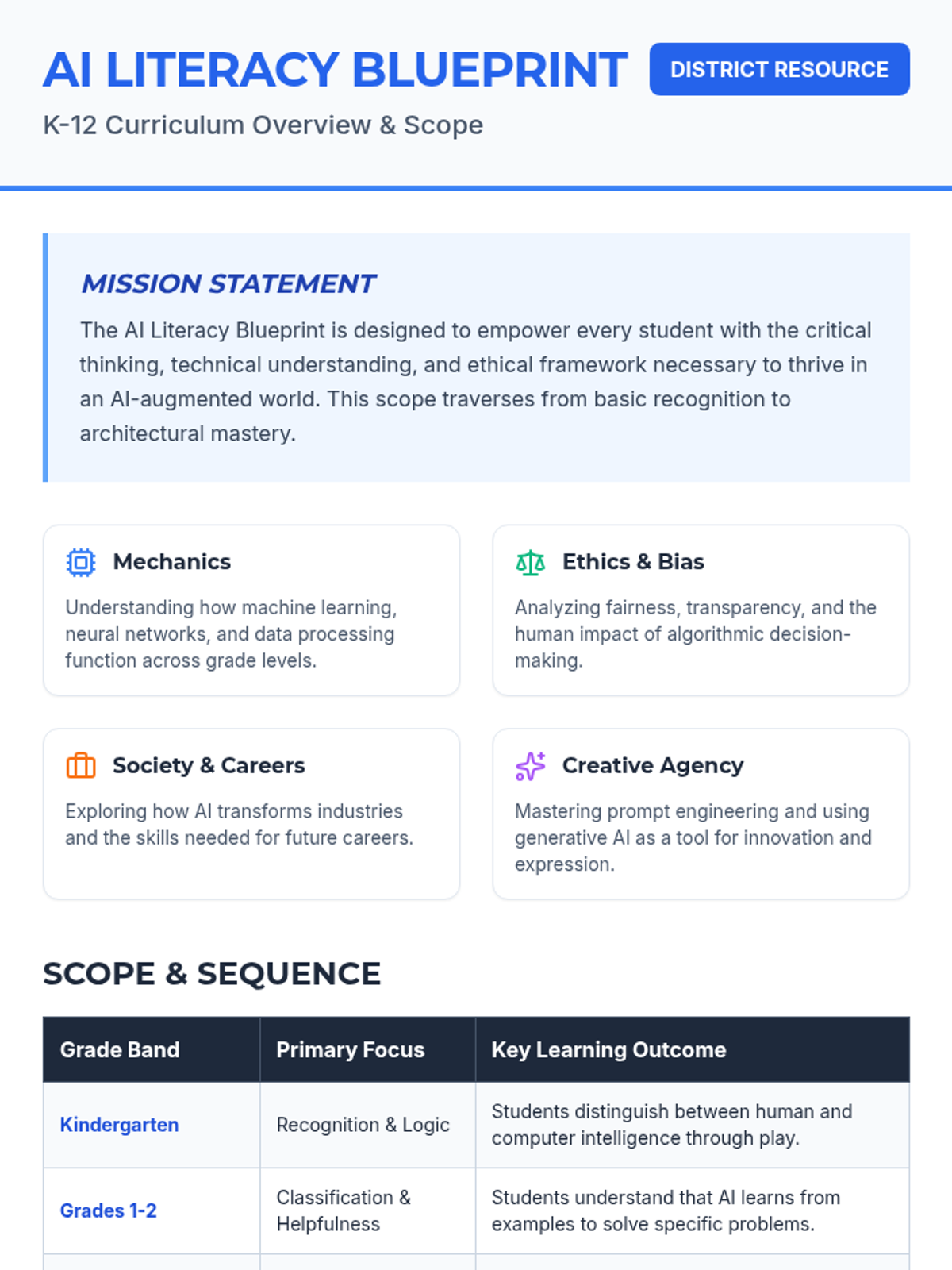
The comprehensive K-12 AI literacy curriculum scope and implementation guidelines for district-wide alignment.
A visual presentation slide deck designed for EOC Biology review, covering evolution, natural selection, ecological flow, and succession with clear diagrams and STAAR-specific testing tips.
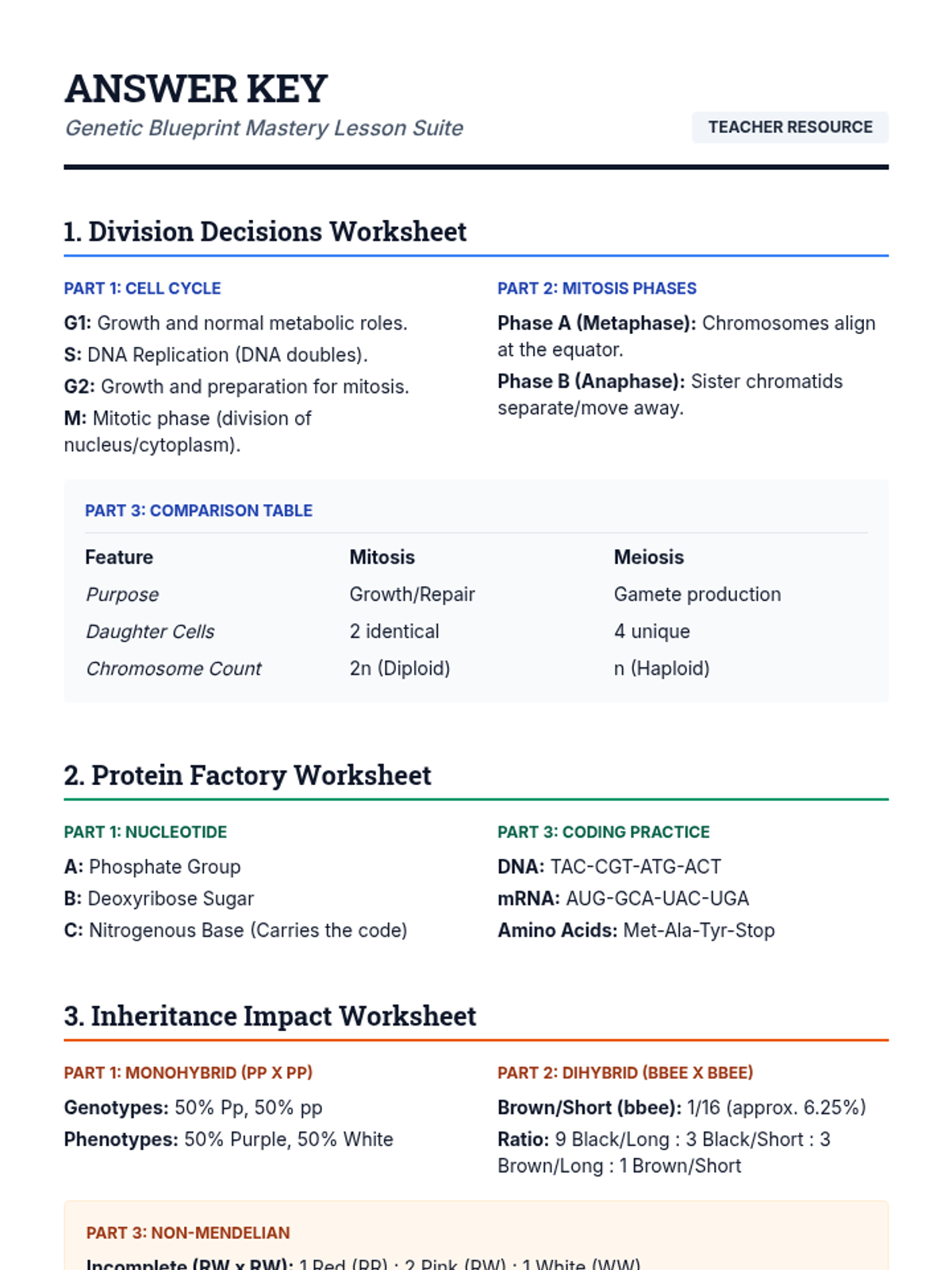
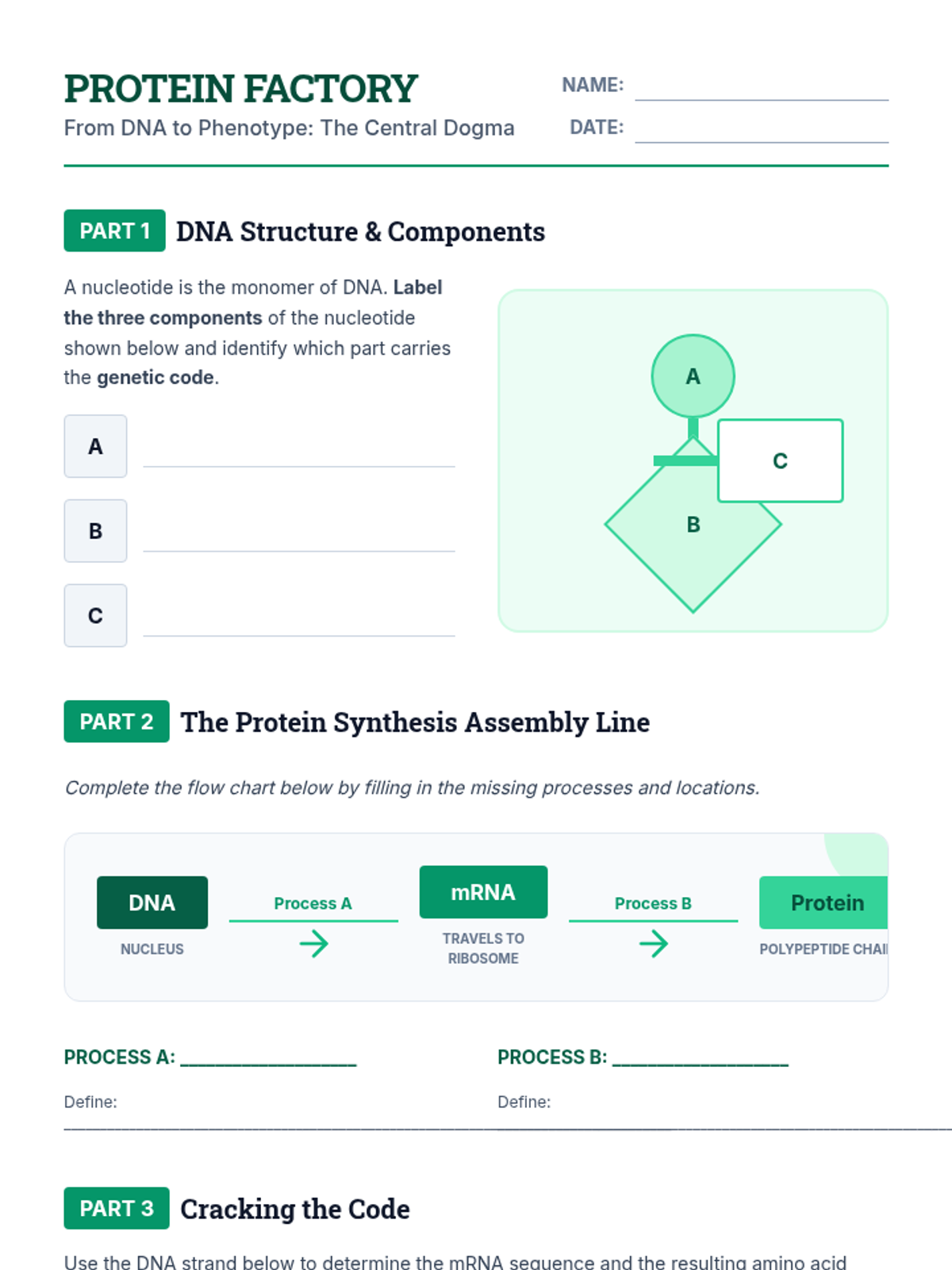
A comprehensive answer key for the Genetic Blueprint Mastery lesson. It provides solutions and explanations for the Division Decisions, Protein Factory, and Inheritance Impact worksheets, as well as the 10-question Genetics Mastery Quiz.
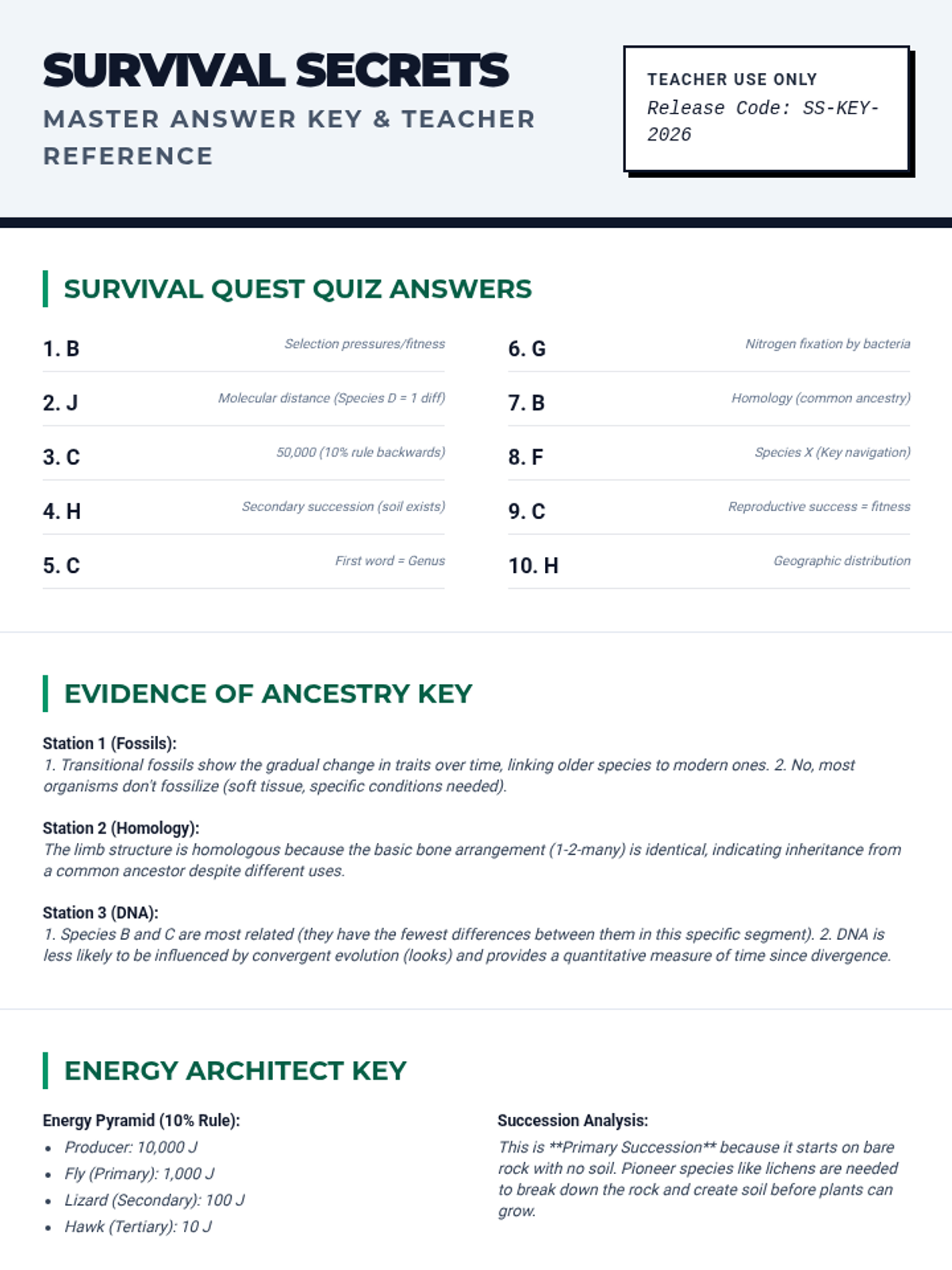
A comprehensive answer key for all student worksheets and the assessment quiz in the Survival Secrets lesson, including expected responses and common student misconceptions.
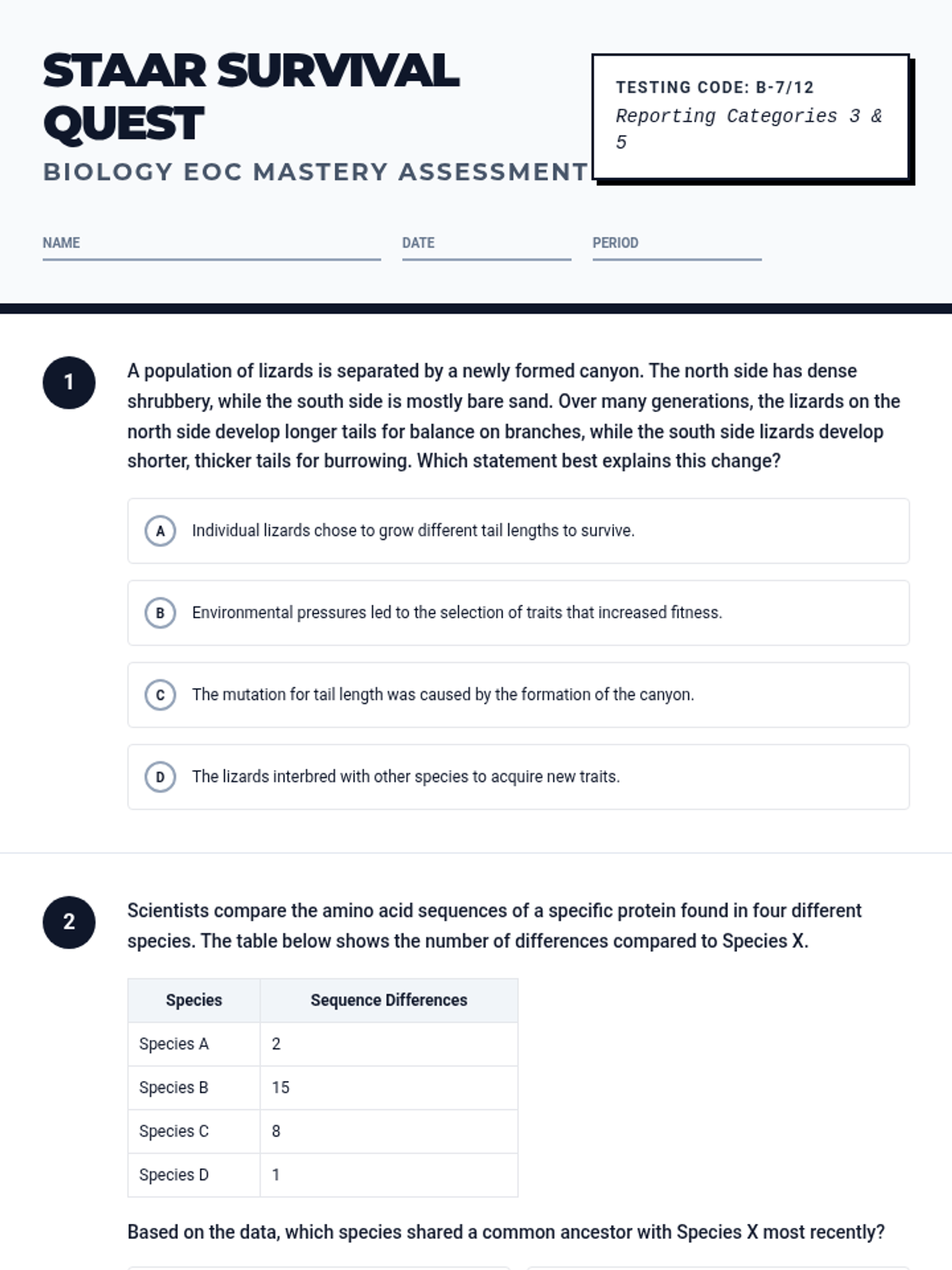
A 10-question multiple-choice assessment designed in the STAAR Biology EOC format, covering evolution, natural selection, taxonomy, and ecology. Includes diagrams and tables to mirror state testing standards.
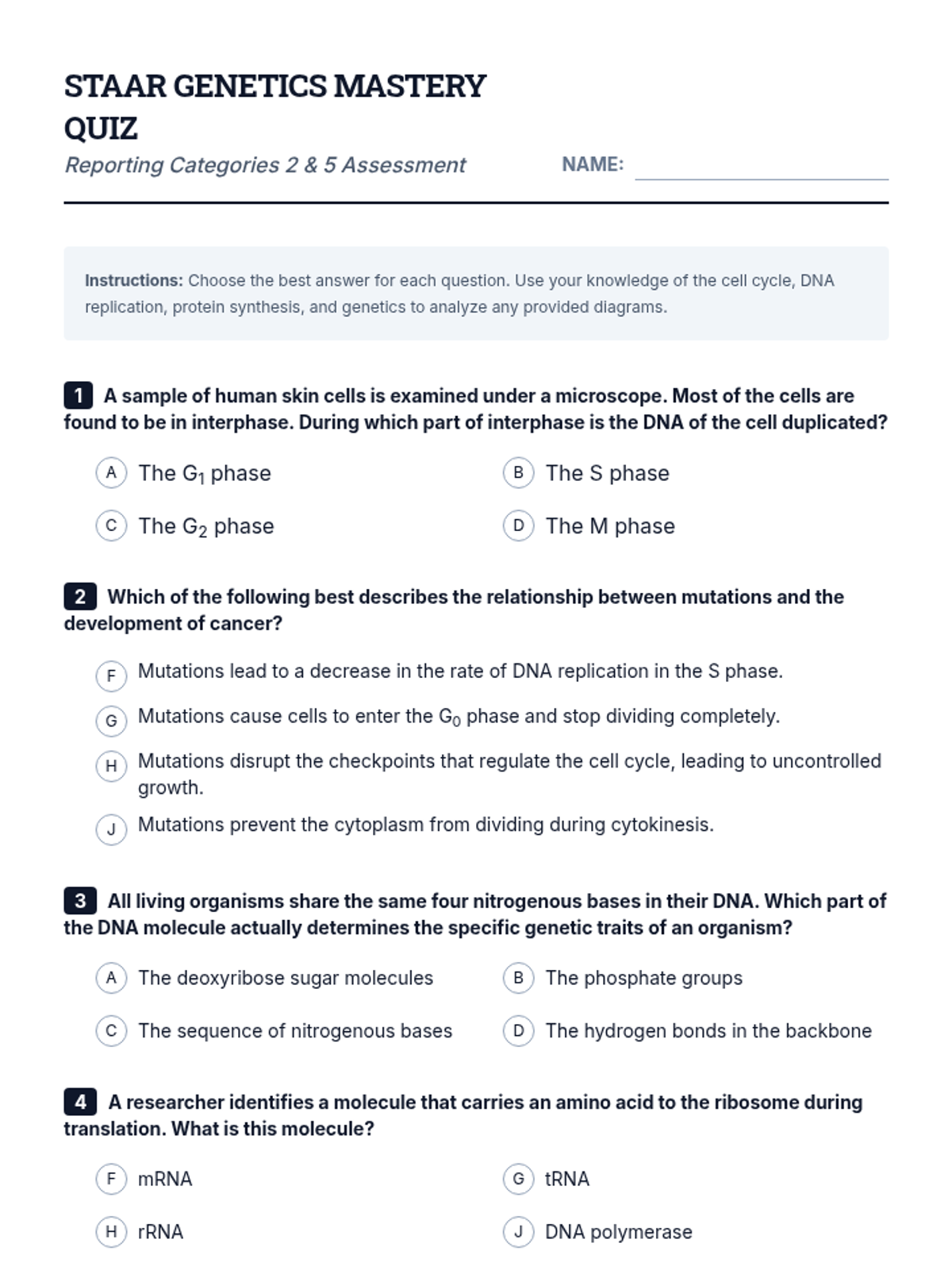
A 10-question multiple-choice assessment modeled after the STAAR Biology EOC. It covers cell cycle regulation, DNA structure, protein synthesis, and Mendelian/non-Mendelian genetics, focusing on Reporting Categories 2 and 5.
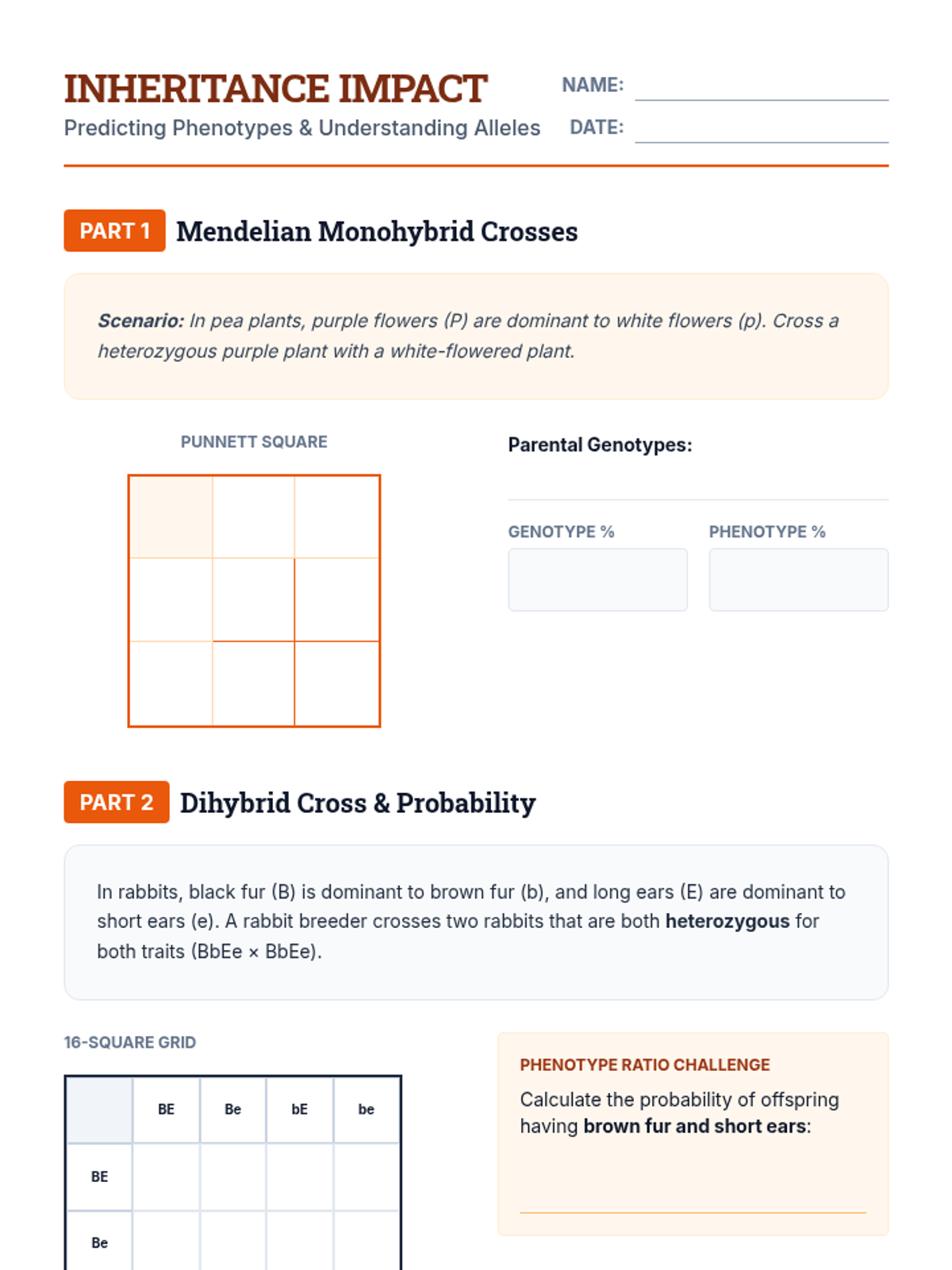
A student worksheet focusing on Mendelian and non-Mendelian inheritance. It provides practice problems for monohybrid and dihybrid crosses, incomplete dominance, codominance, and sex-linked traits with dedicated spaces for Punnett squares and ratio analysis.
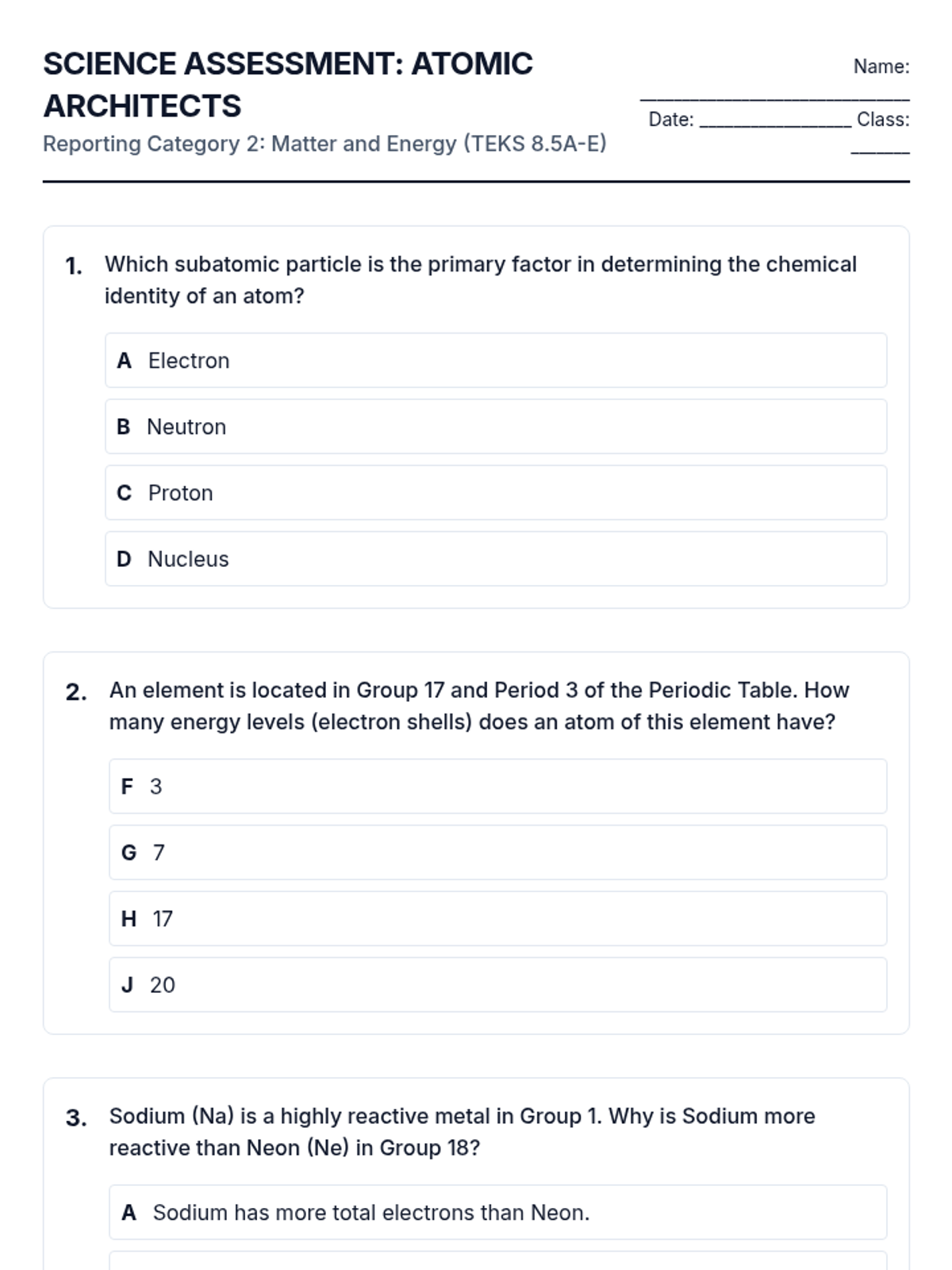
A set of 8 STAAR-format multiple-choice questions covering TEKS 8.5A-E, focusing on atomic structure, periodic table trends, chemical formulas, and the law of conservation of mass.
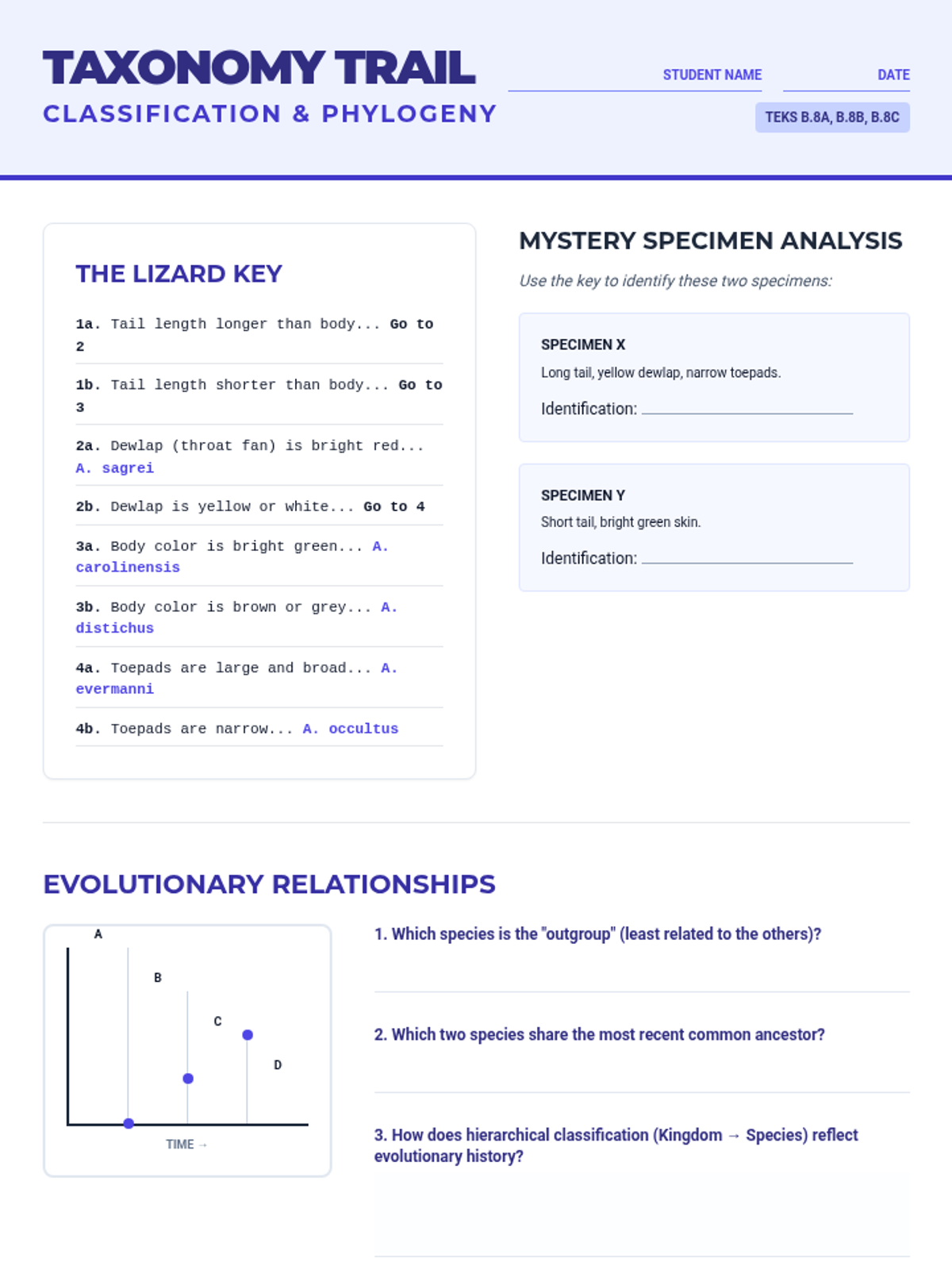
A student worksheet focusing on taxonomy, biological classification, dichotomous keys, and phylogenetic relationships within the context of the lizard case study.
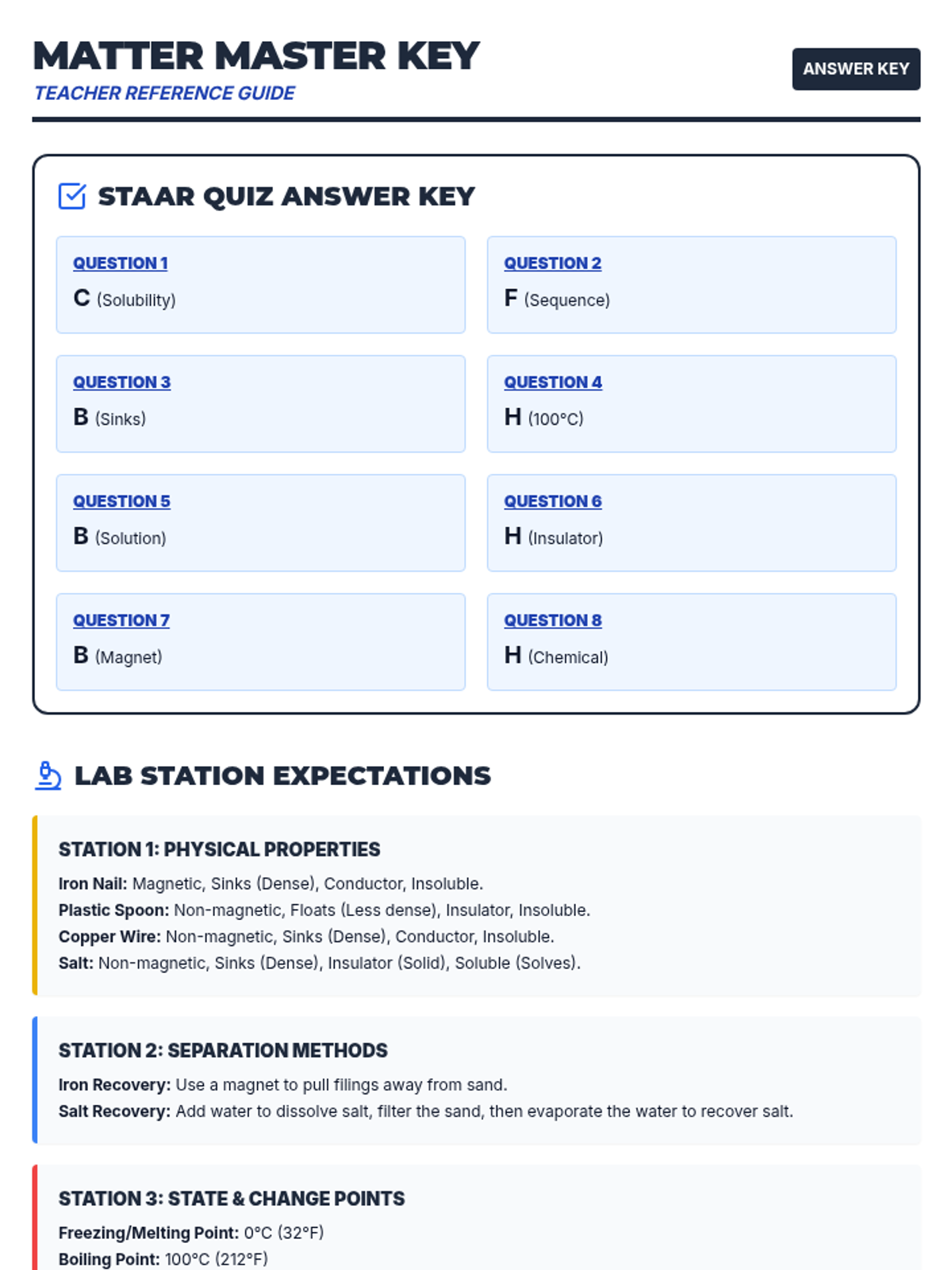
A teacher reference material providing answer keys for the Matter Master STAAR Quiz and sample data/exemplar responses for the laboratory stations. Includes CER writing exemplars.
A student worksheet for protein synthesis. It includes exercises for labeling DNA nucleotides, mapping the central dogma flow (DNA to RNA to protein), and practicing transcription and translation with mutation analysis.
A visual presentation to introduce the Matter Master Labs lesson. Includes briefings for the CER framework, station objectives, and rotation procedures.
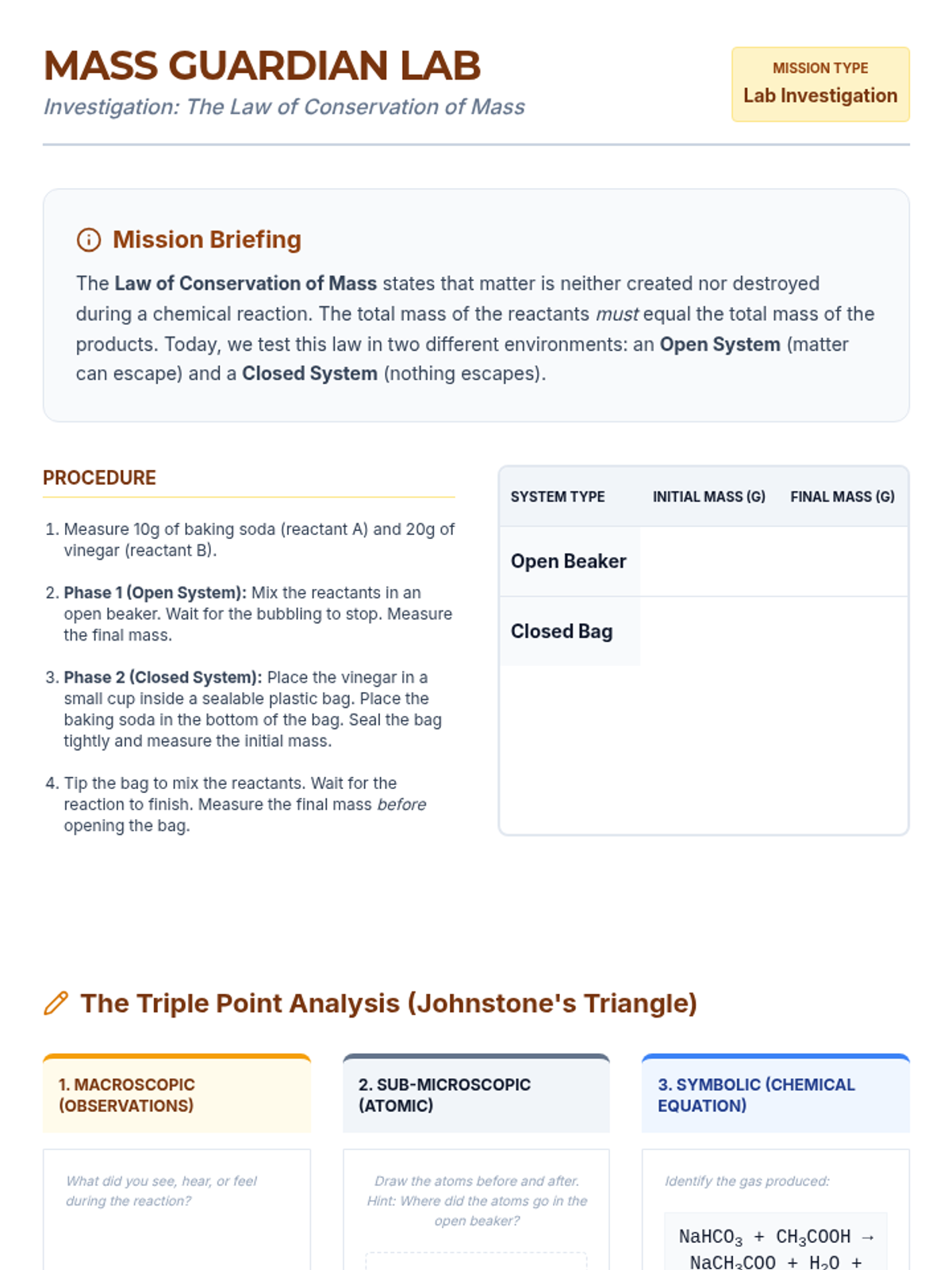
A lab investigation sheet focusing on the Law of Conservation of Mass, comparing open and closed systems through macroscopic observations, sub-microscopic modeling, and symbolic chemical equations.
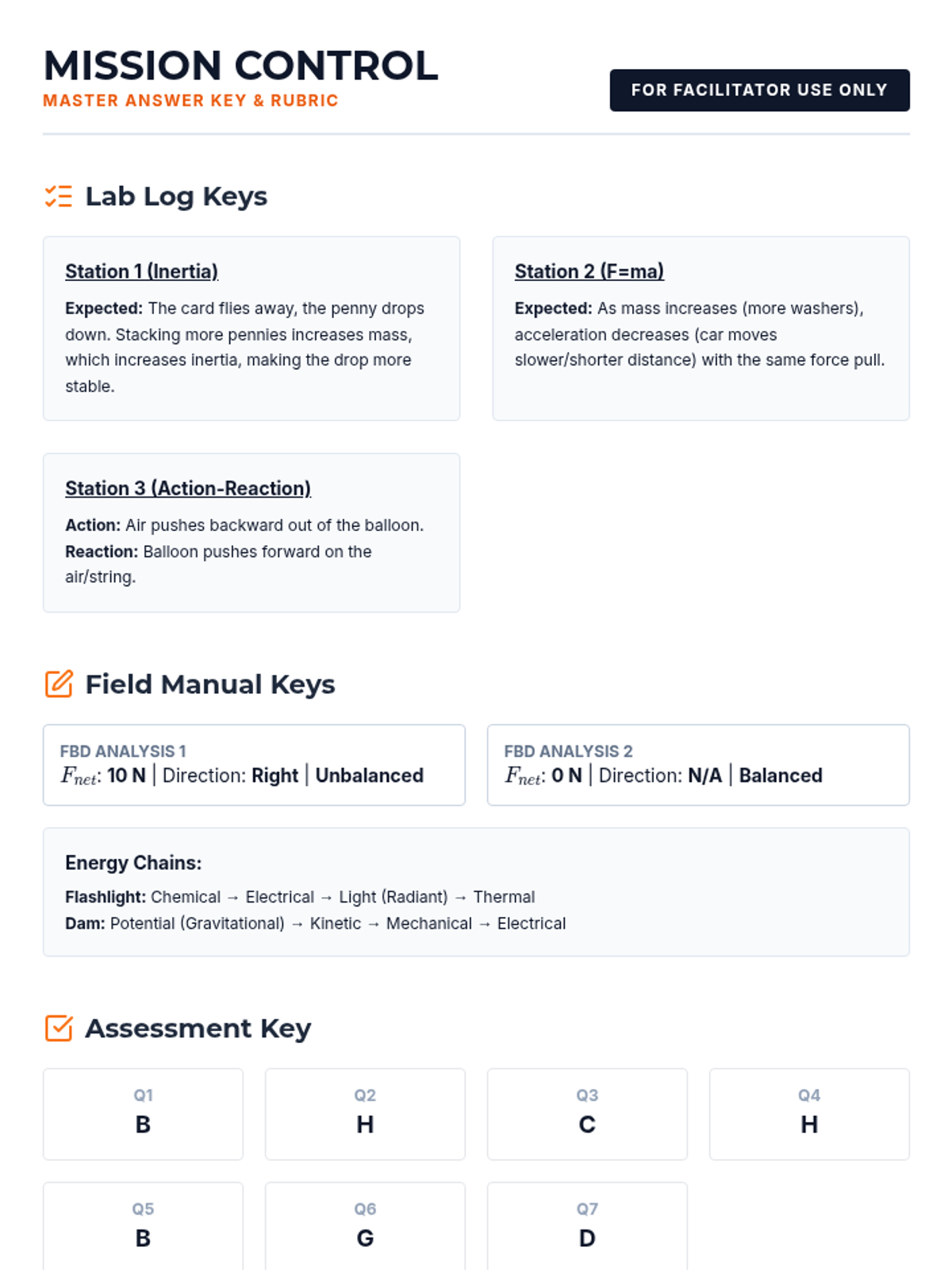
A master answer key and grading rubric for the Lab Log, Field Manual, and Assessment, including specific expected results and a CER scoring table.
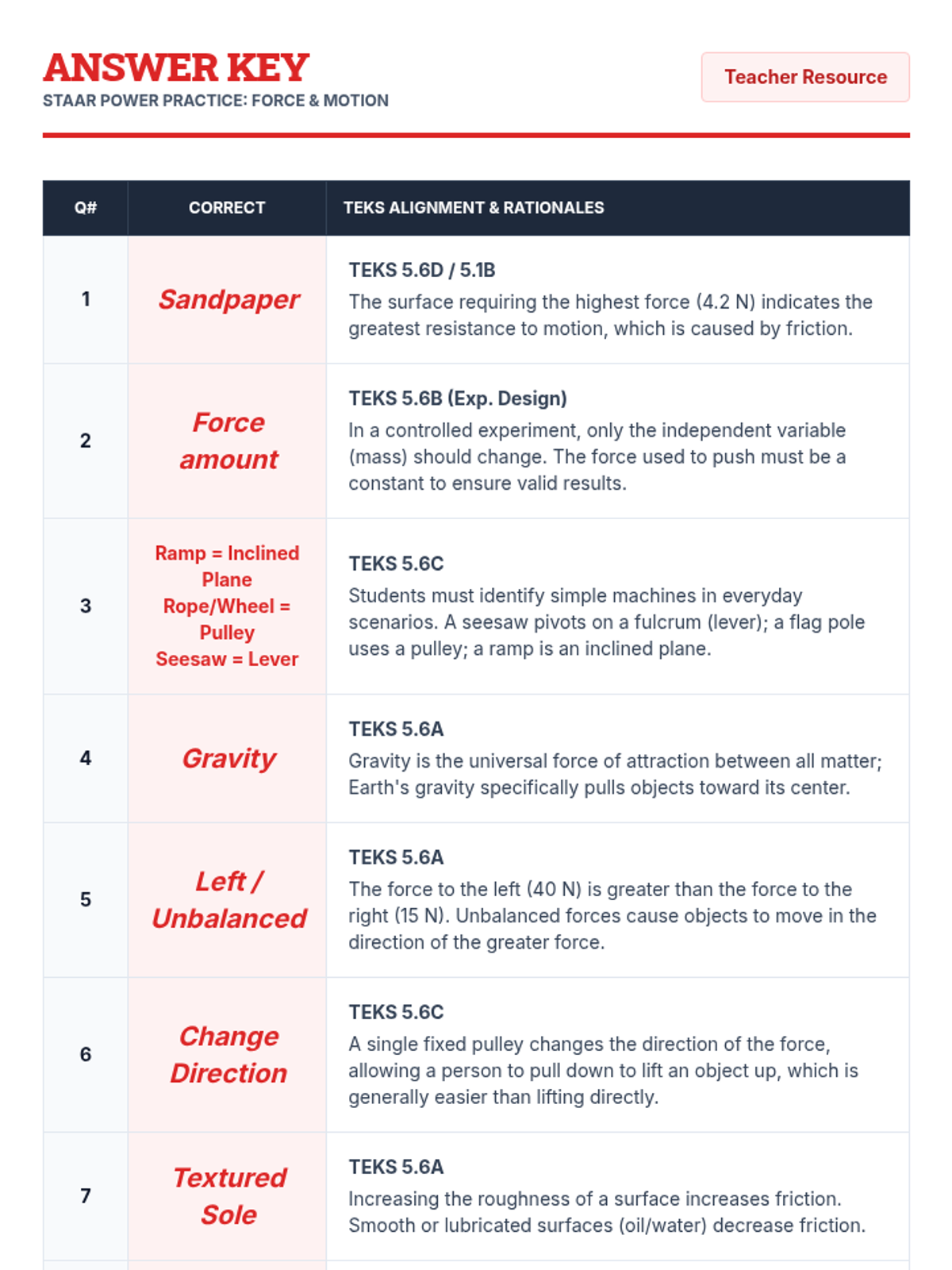
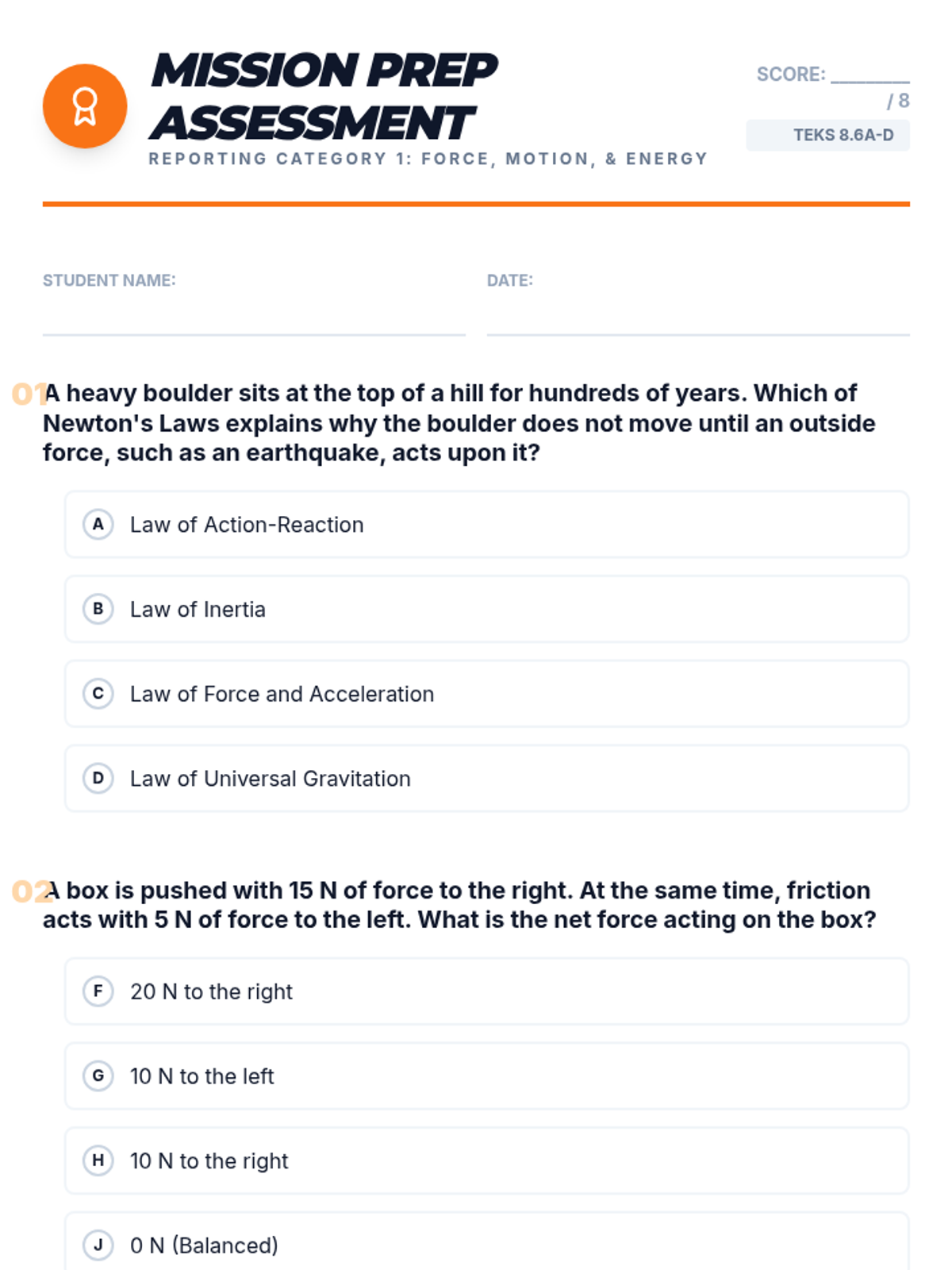
Teacher answer key for the STAAR Power Practice Force and Motion assessment. Includes correct answers, TEKS alignment, detailed rationales for each question, and classroom remediation strategies.
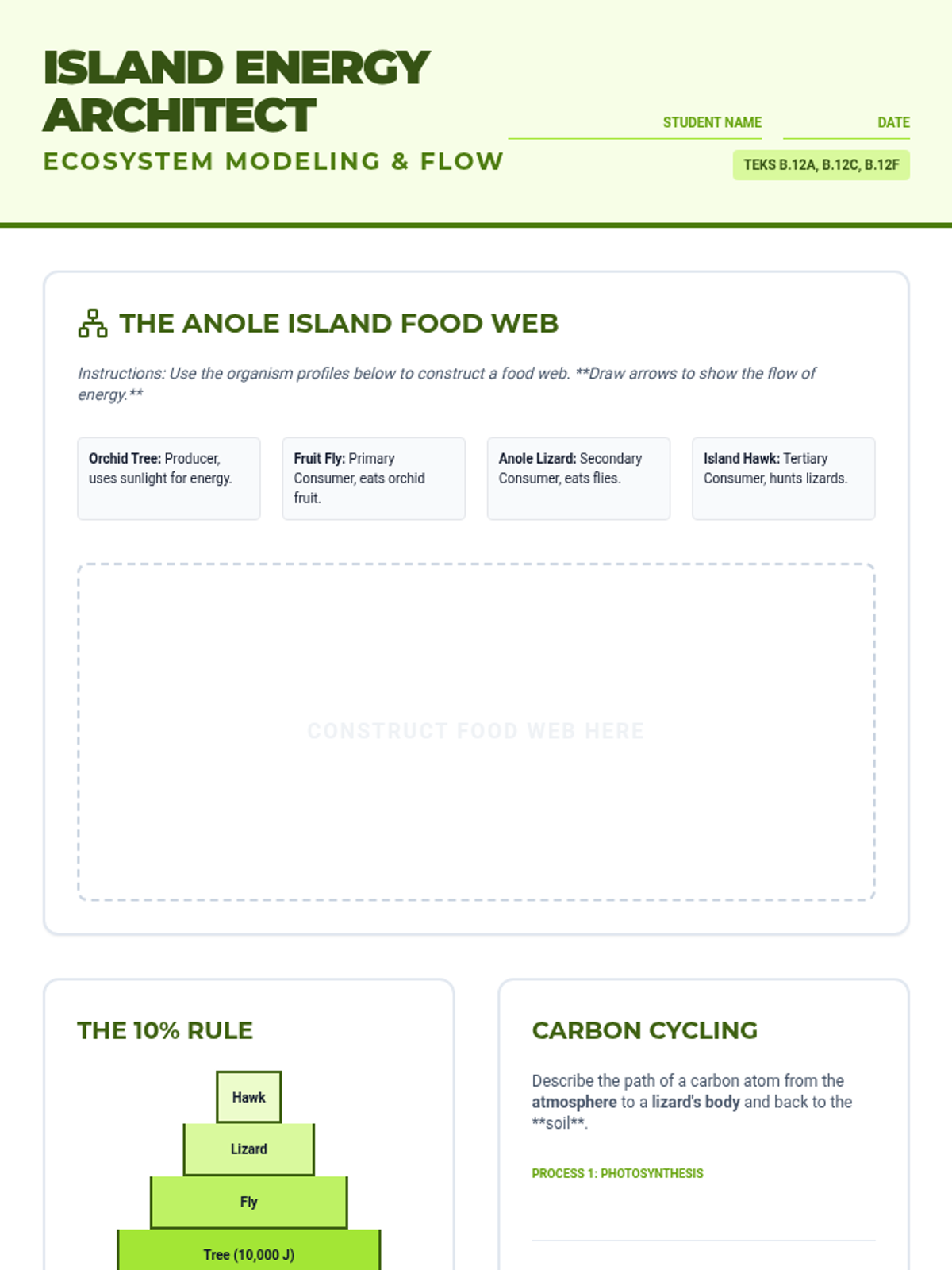
A student worksheet focusing on ecosystem modeling, energy pyramids, and biogeochemical cycles within the Caribbean island context. Includes 10% rule calculations and succession analysis.
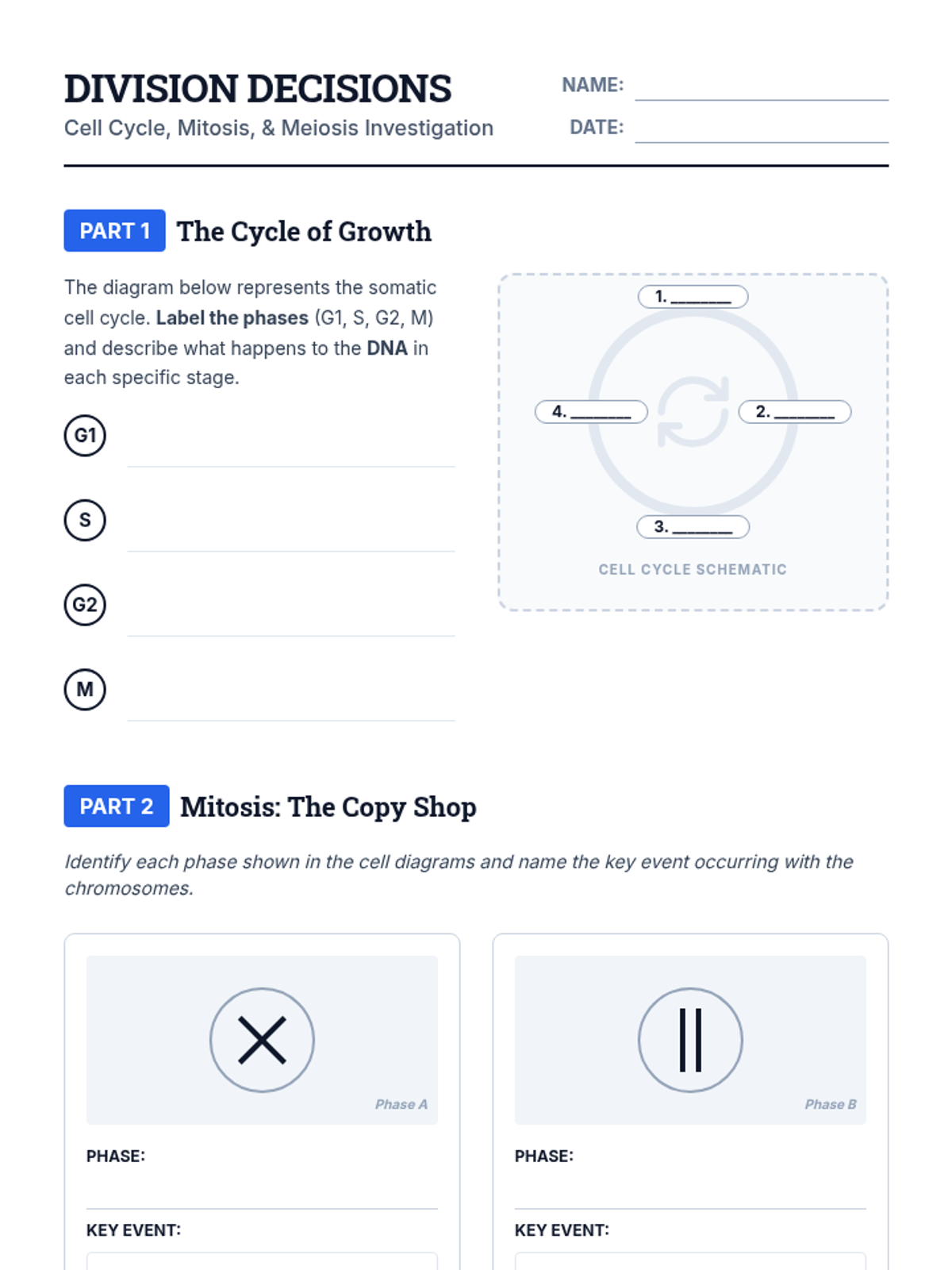
A student worksheet for the Genetic Blueprint Mastery lesson. It features activities to label the cell cycle, identify phases of mitosis through diagrams, and complete a detailed comparison table between mitosis and meiosis.
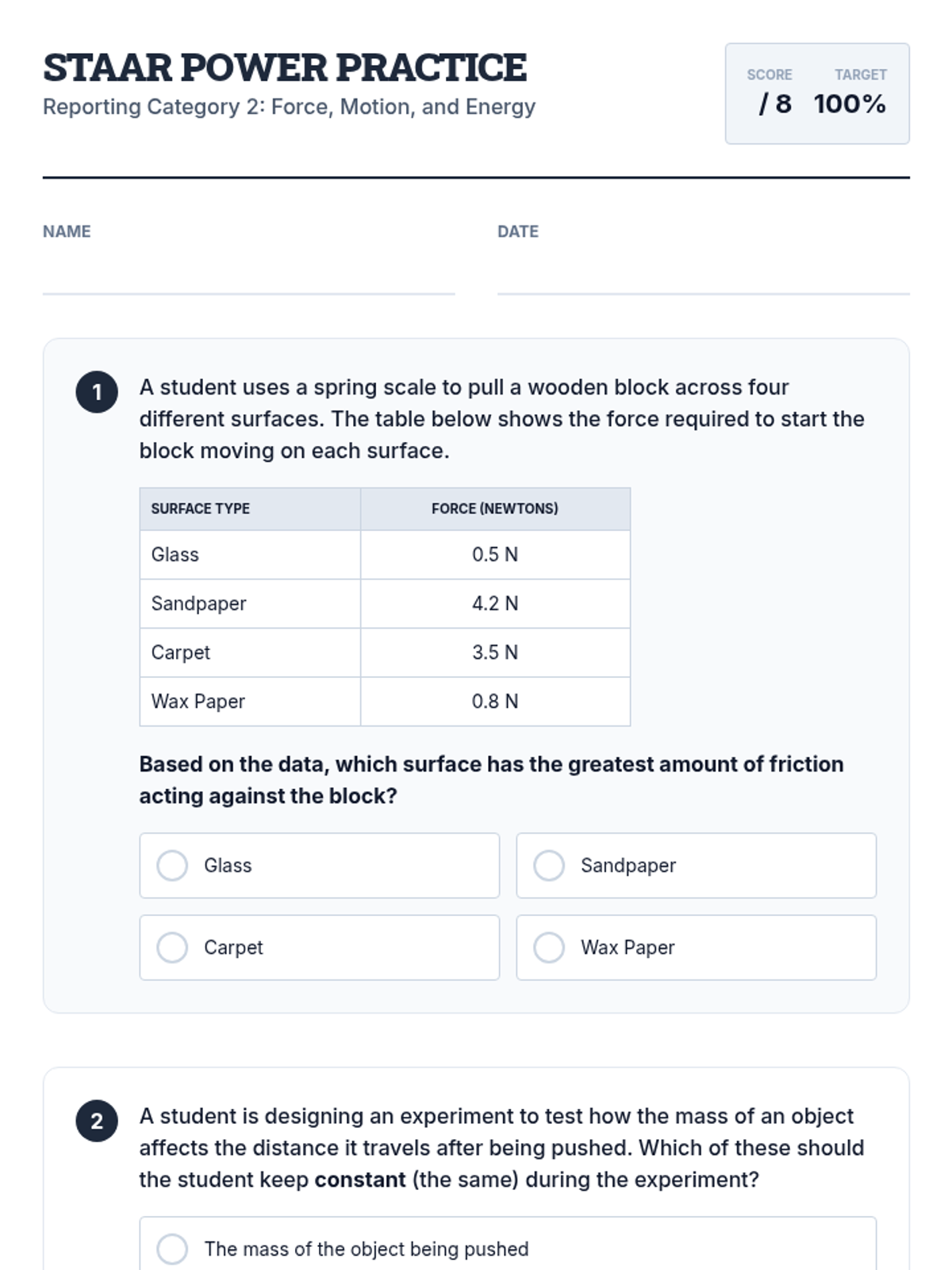
A set of 8 STAAR-formatted science practice questions for Grade 5, focusing on force, motion, and energy. Includes selected response and simulated drag-and-drop questions aligned with TEKS 5.6A-C.
A STAAR-formatted assessment featuring 7 multiple-choice questions and 1 constructed response (CER) covering Newton's Laws and energy transformations (TEKS 8.6A-D).
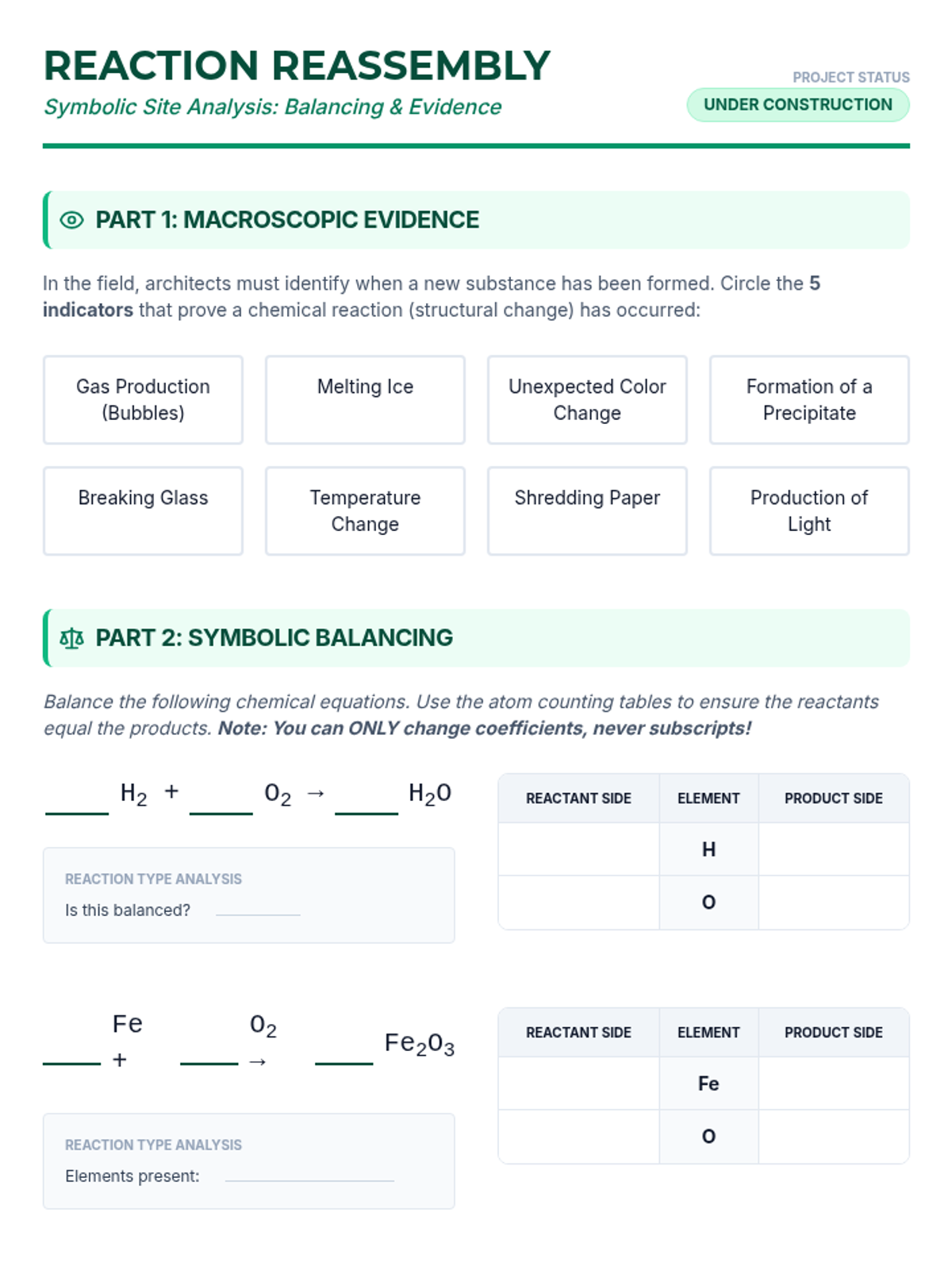
A student worksheet for practice with balancing chemical equations, identifying evidence of chemical reactions, and counting atoms in complex formulas using coefficients and subscripts.
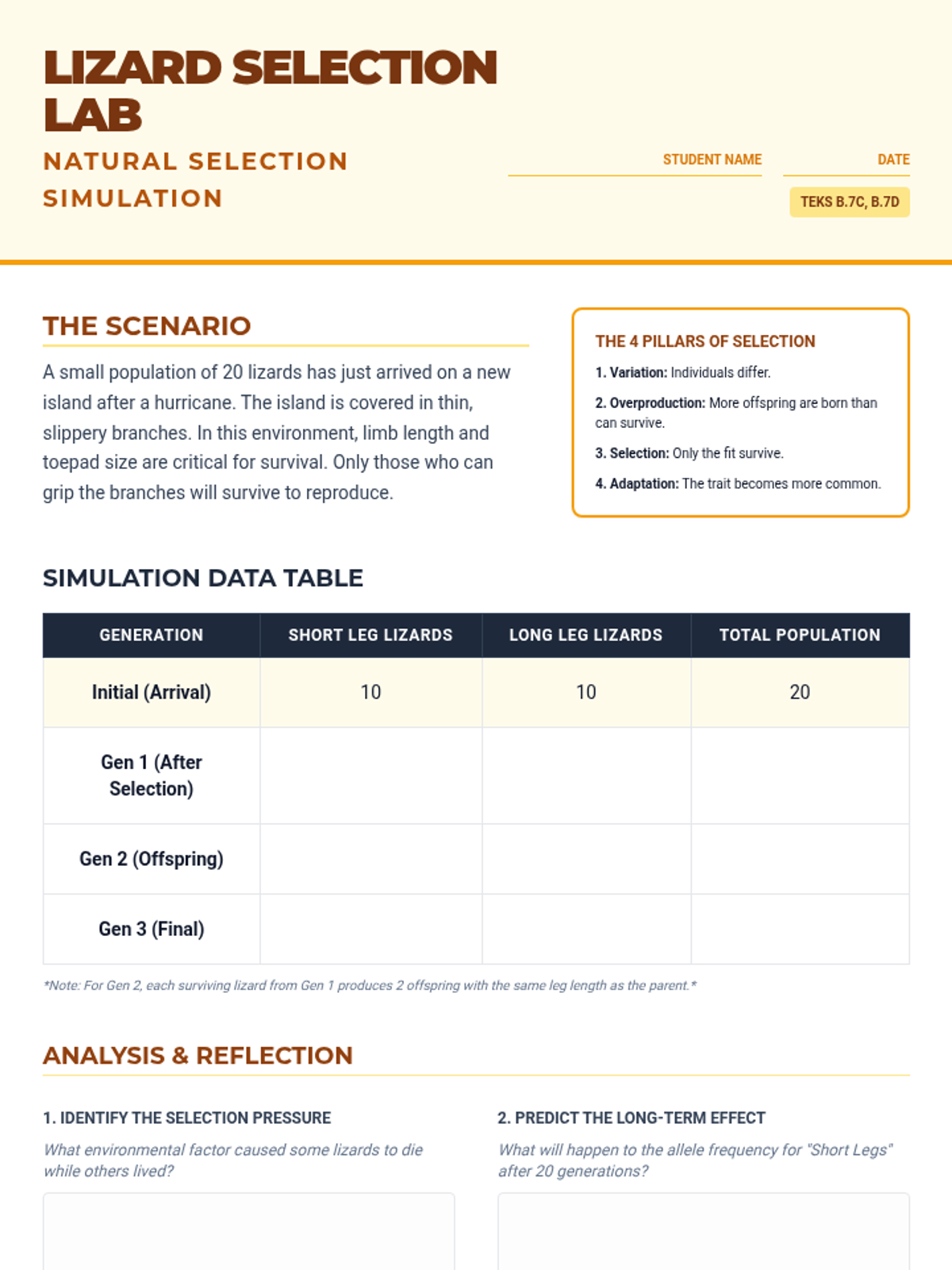
A student-facing simulation activity where students model natural selection using lizard limb length as a trait, analyzing population shifts and environmental pressures.
A visual presentation slide deck comparing mitosis and meiosis, explaining the cell cycle phases (Interphase and M-phase), detailing DNA replication during the S-phase, and illustrating the causes of uncontrolled cell growth (cancer).
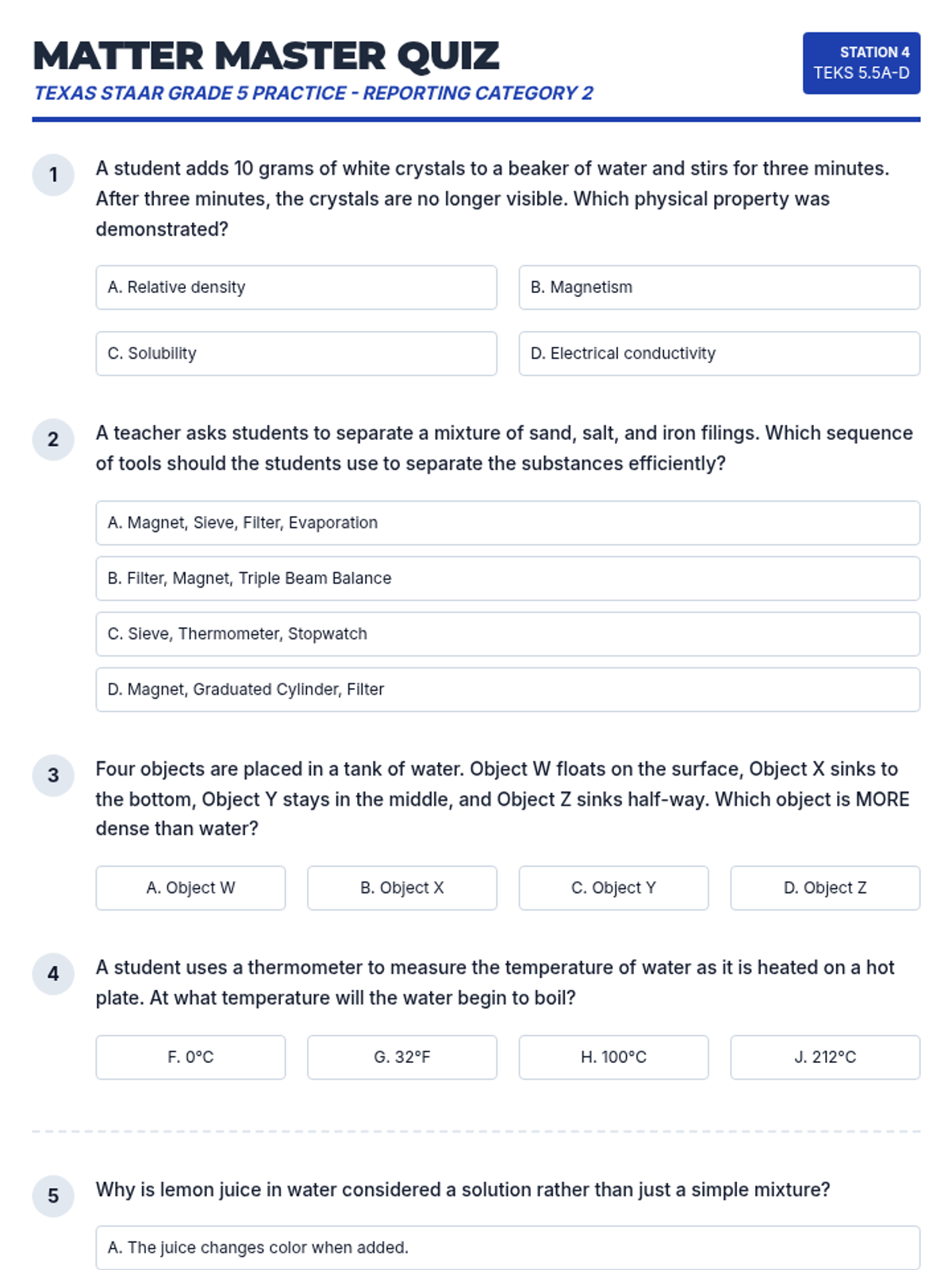
A STAAR-format practice quiz for 5th grade students covering physical properties, mixtures, solutions, and state changes. Includes rigorous multiple-choice questions with standard Texas-style distractors.
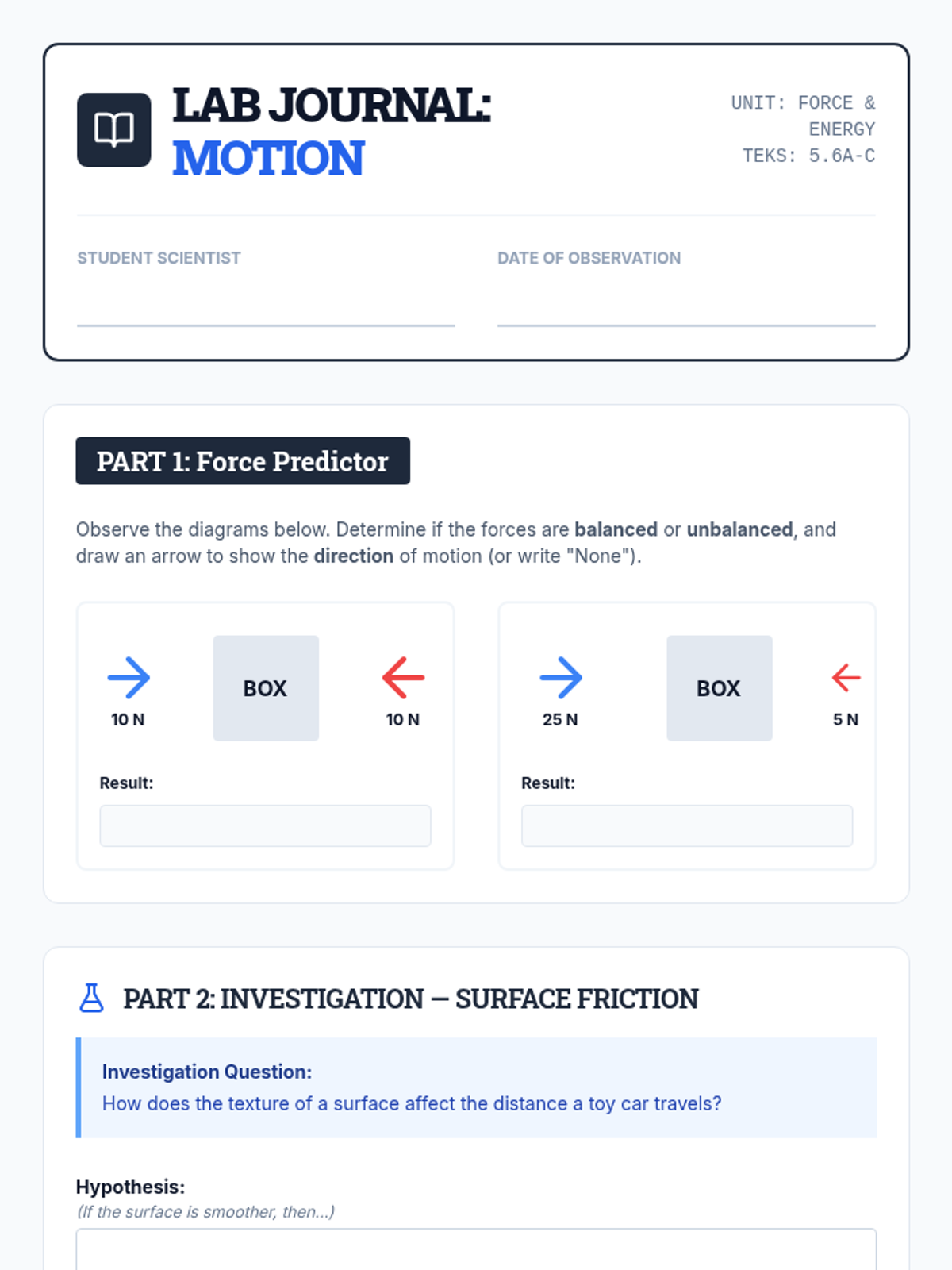
Student lab journal for force and motion investigations. Includes prediction tasks for balanced/unbalanced forces, a structured data table for a friction experiment, and an annotation activity for a roller coaster model.
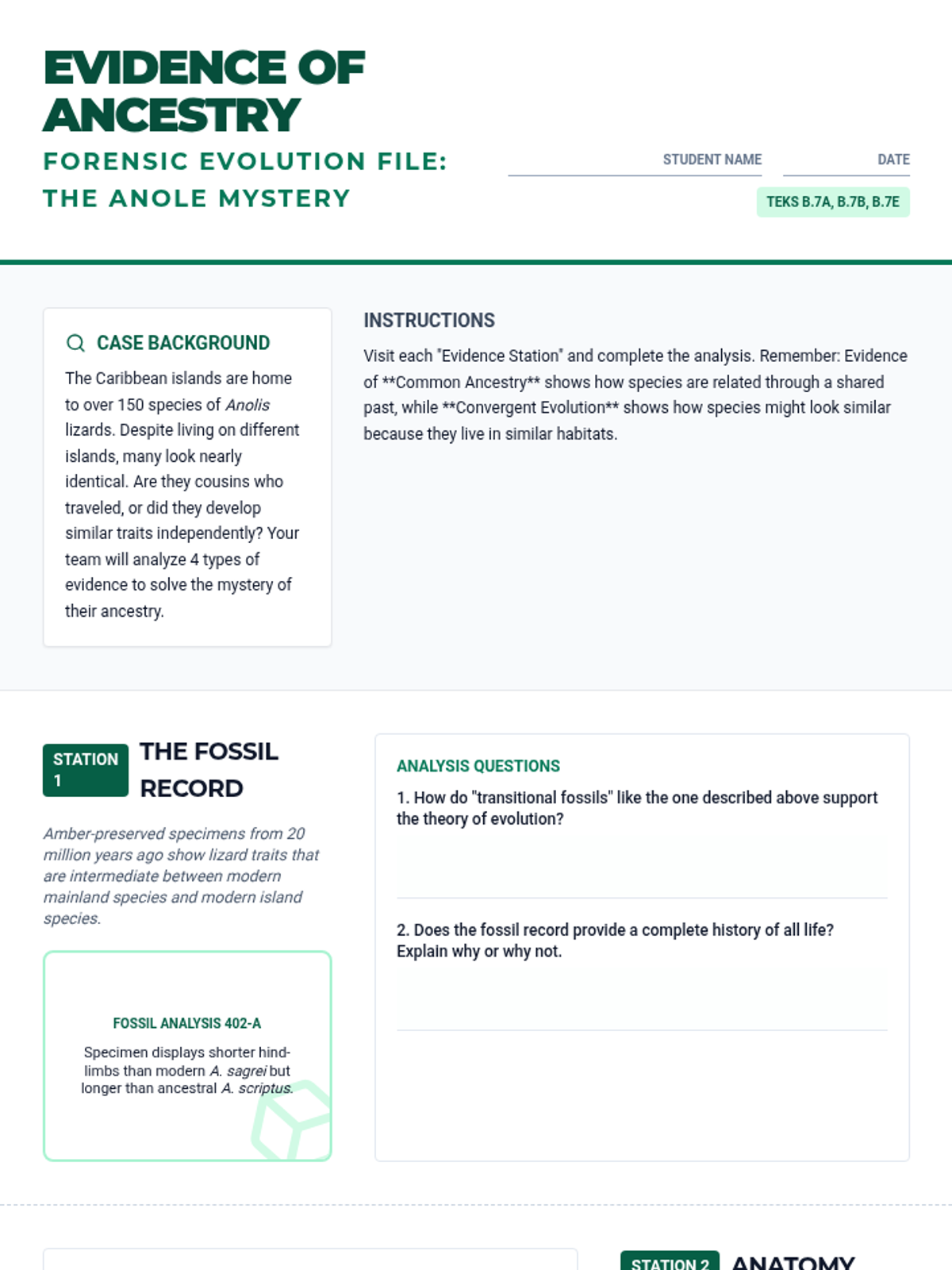
A student worksheet for analyzing four key types of evidence for evolution (fossils, homology, DNA, and biogeography) using a lizard case study theme.
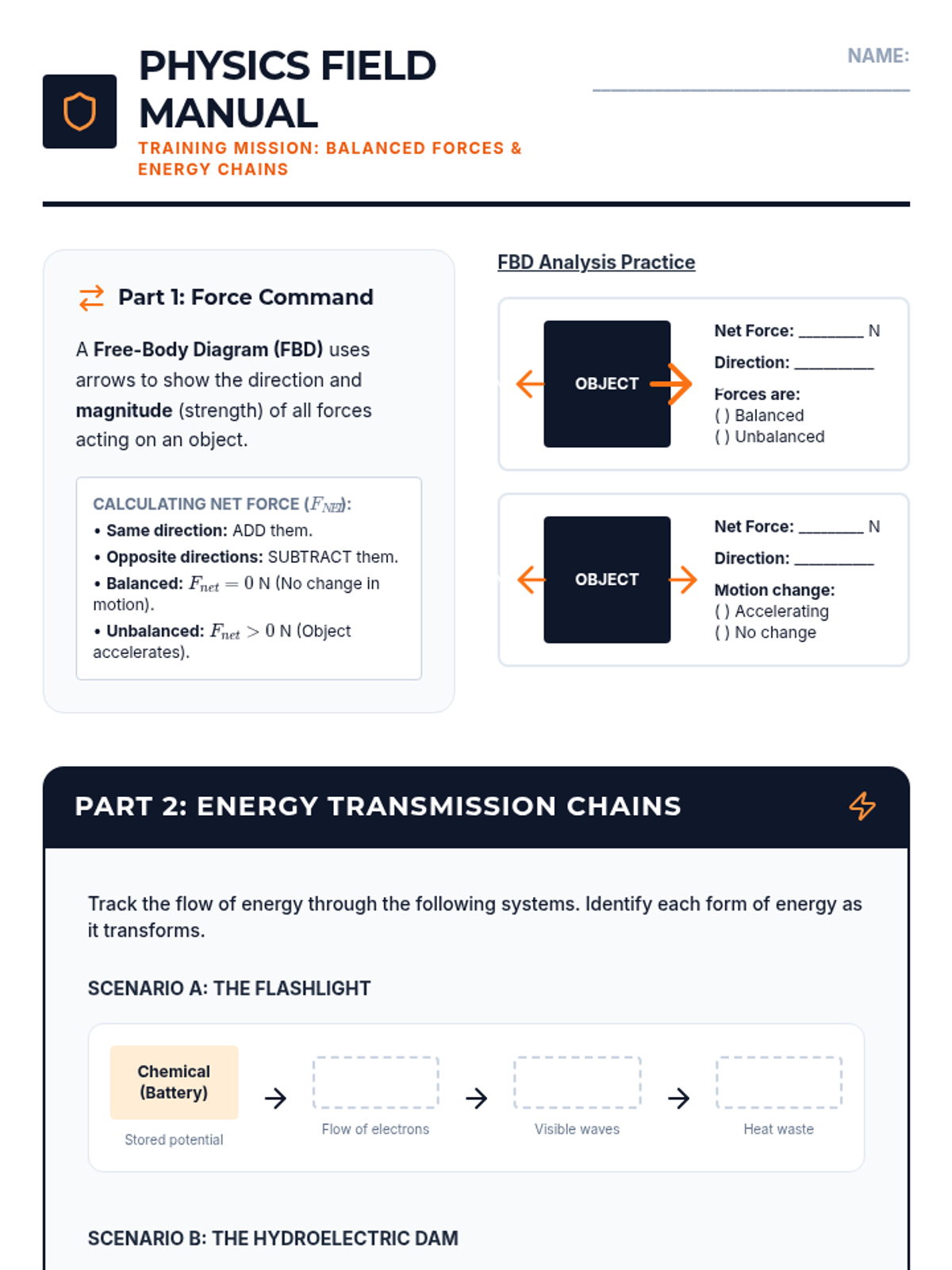
A student field manual focusing on calculating net force from free-body diagrams and identifying energy transformation chains in real-world systems. includes practice problems and critical thinking prompts.
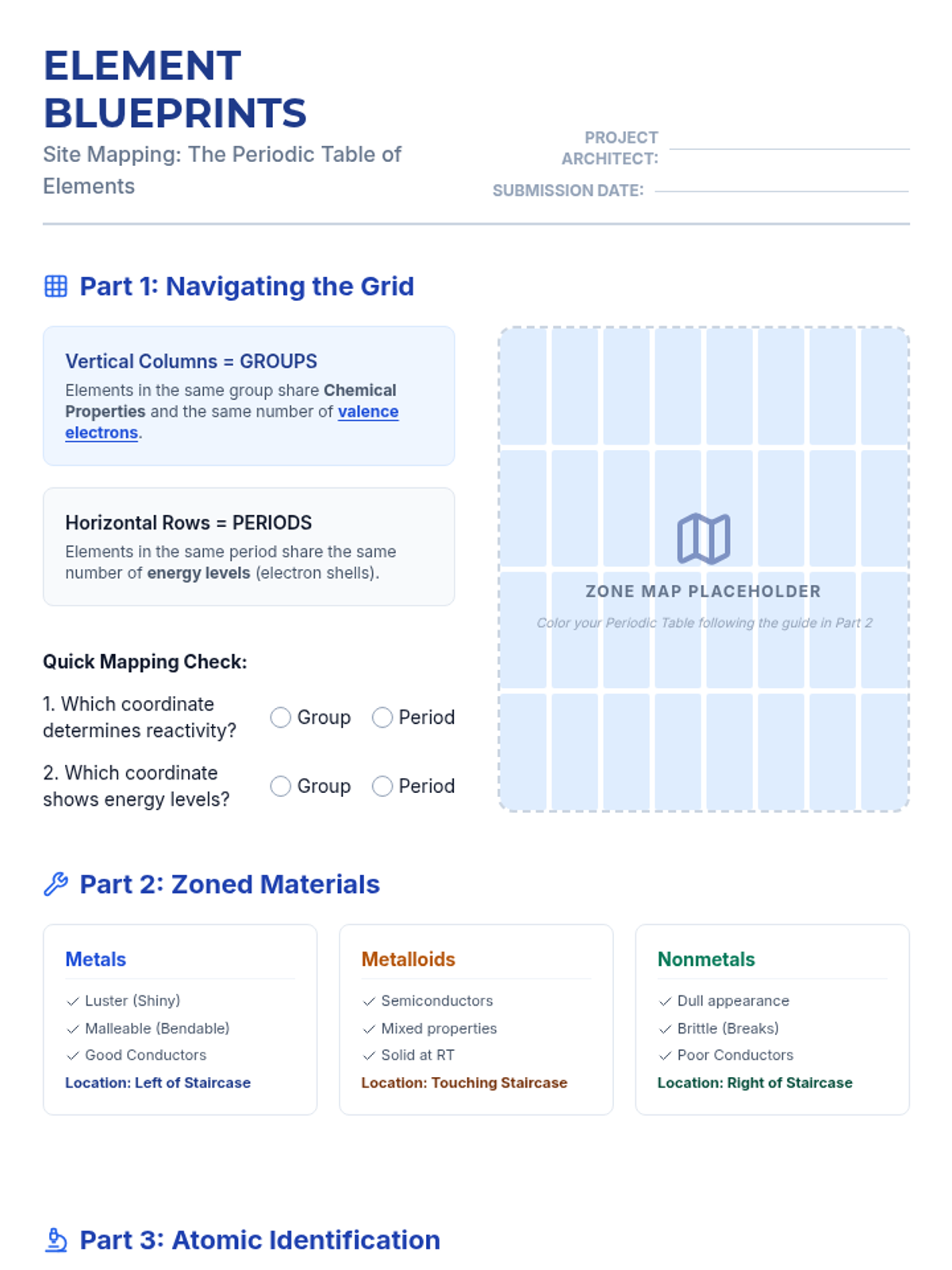
An interactive student exploration worksheet for the periodic table, focusing on groups, periods, classification of elements, and atomic identity through valence electrons and energy levels.
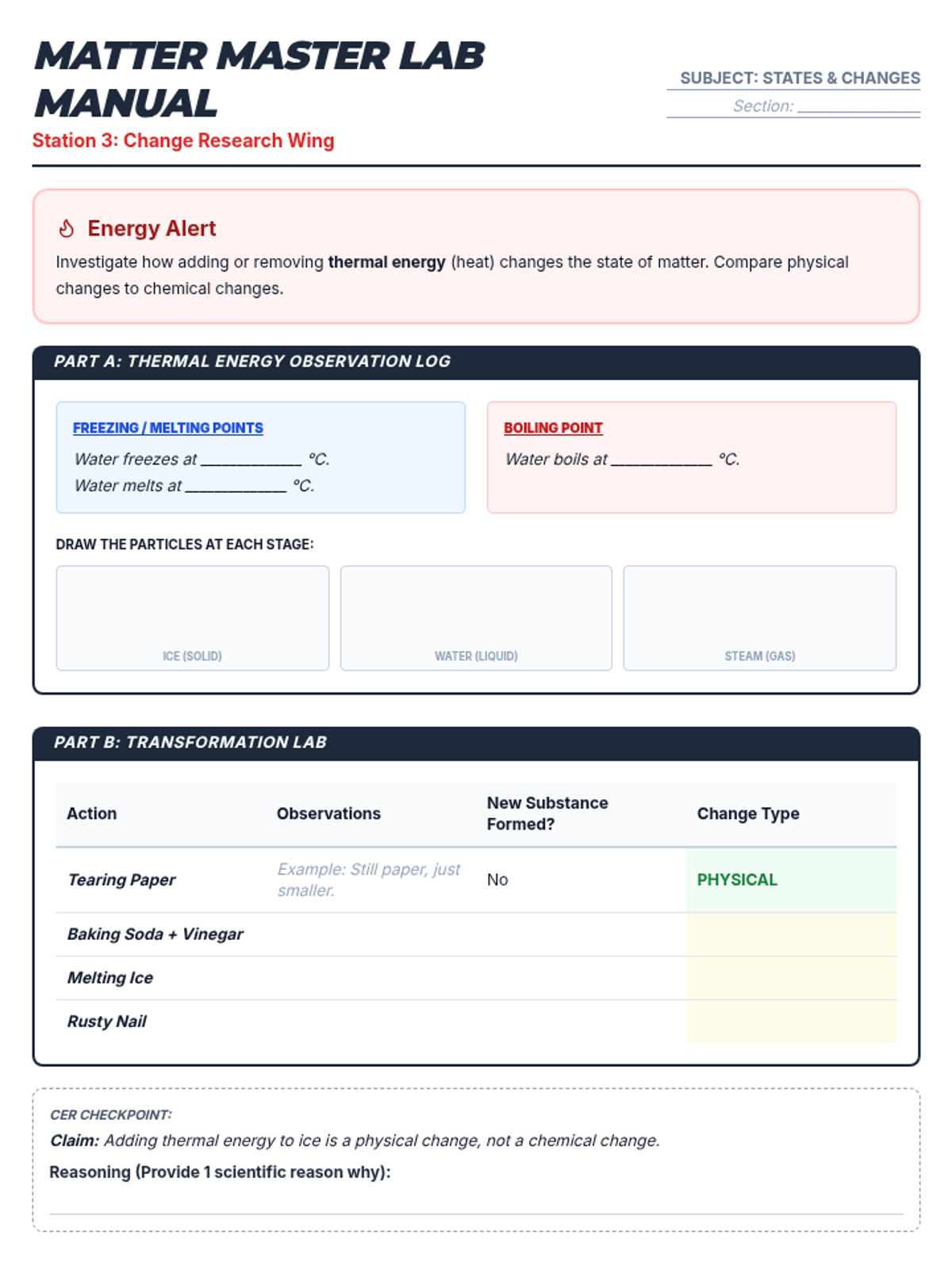
A student-facing laboratory sheet for Station 3: Changes in Matter. Includes observation logs for boiling/melting points and a transformation table for physical vs. chemical changes.
Visual presentation slides for Grade 5 Science on Force and Motion. Covers key definitions, balanced vs. unbalanced forces, friction, gravity, simple machines, and real-world roller coaster applications.
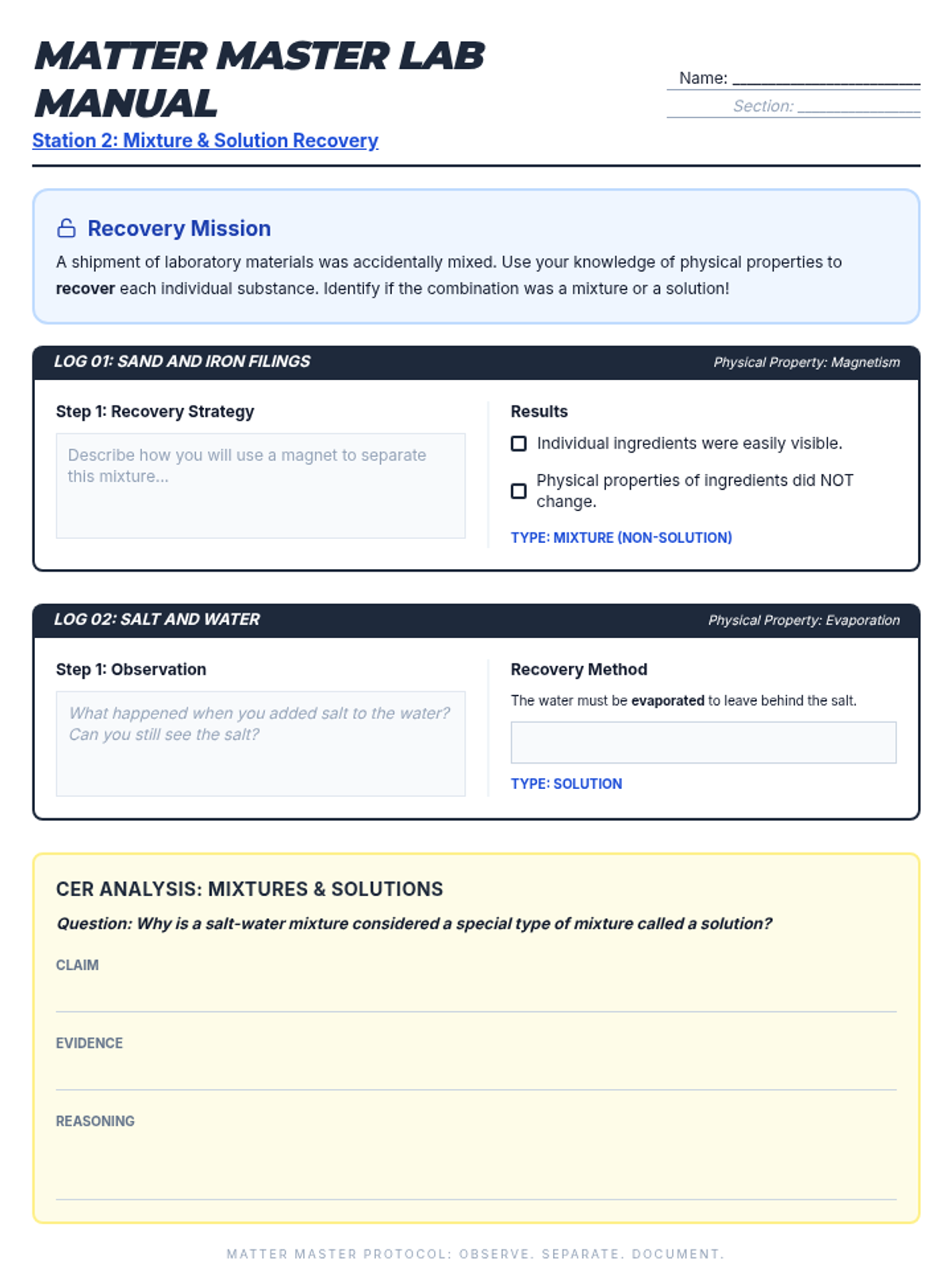
A student laboratory activity sheet for Station 2: Mixtures and Solutions. Students plan separation strategies using magnetism and evaporation, classify combinations, and complete a CER analysis.
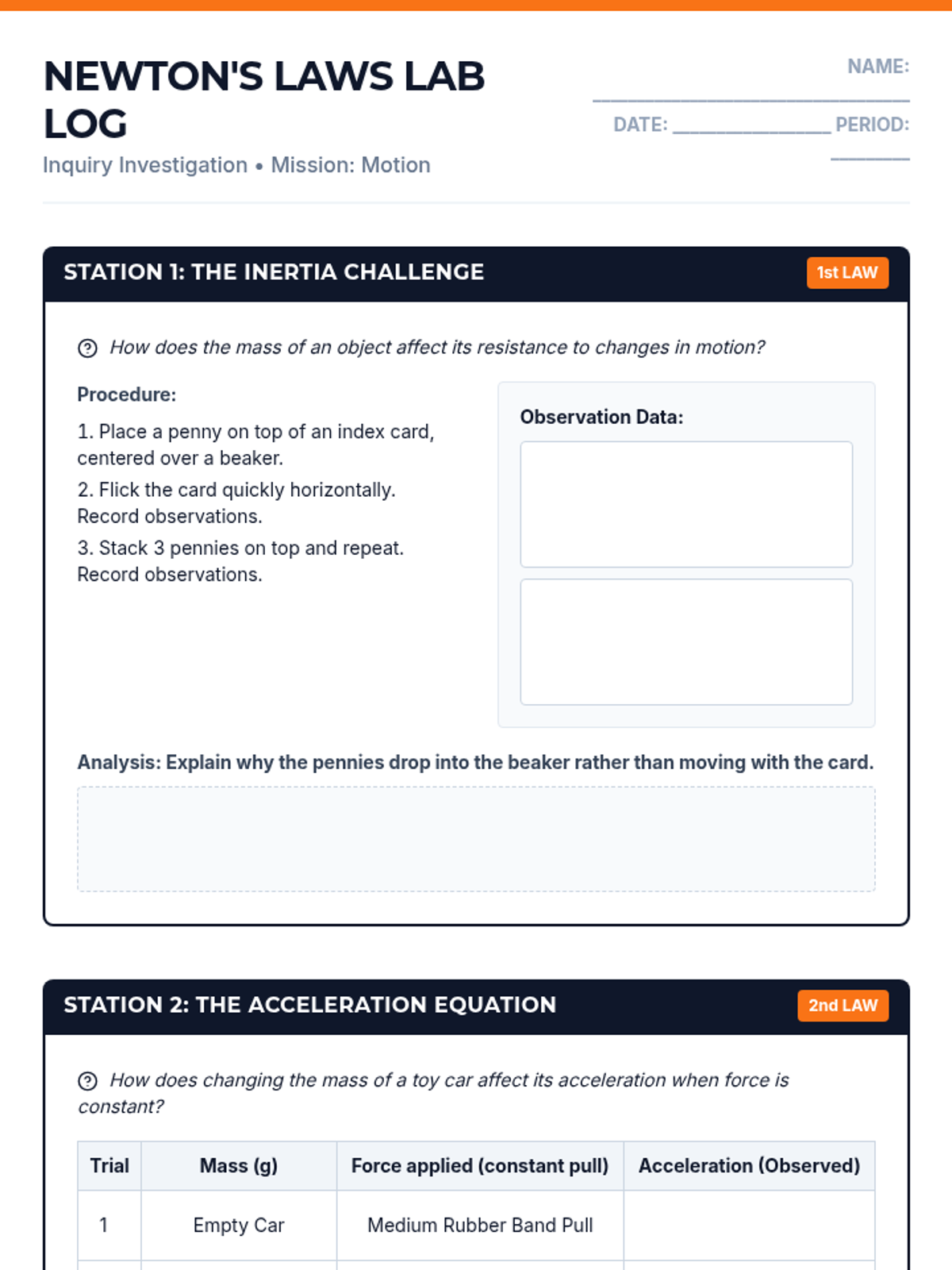
An inquiry-based investigation document covering Newton's three laws of motion through hands-on lab rotations. includes sections for the Law of Inertia, Force and Acceleration, and Action-Reaction forces.
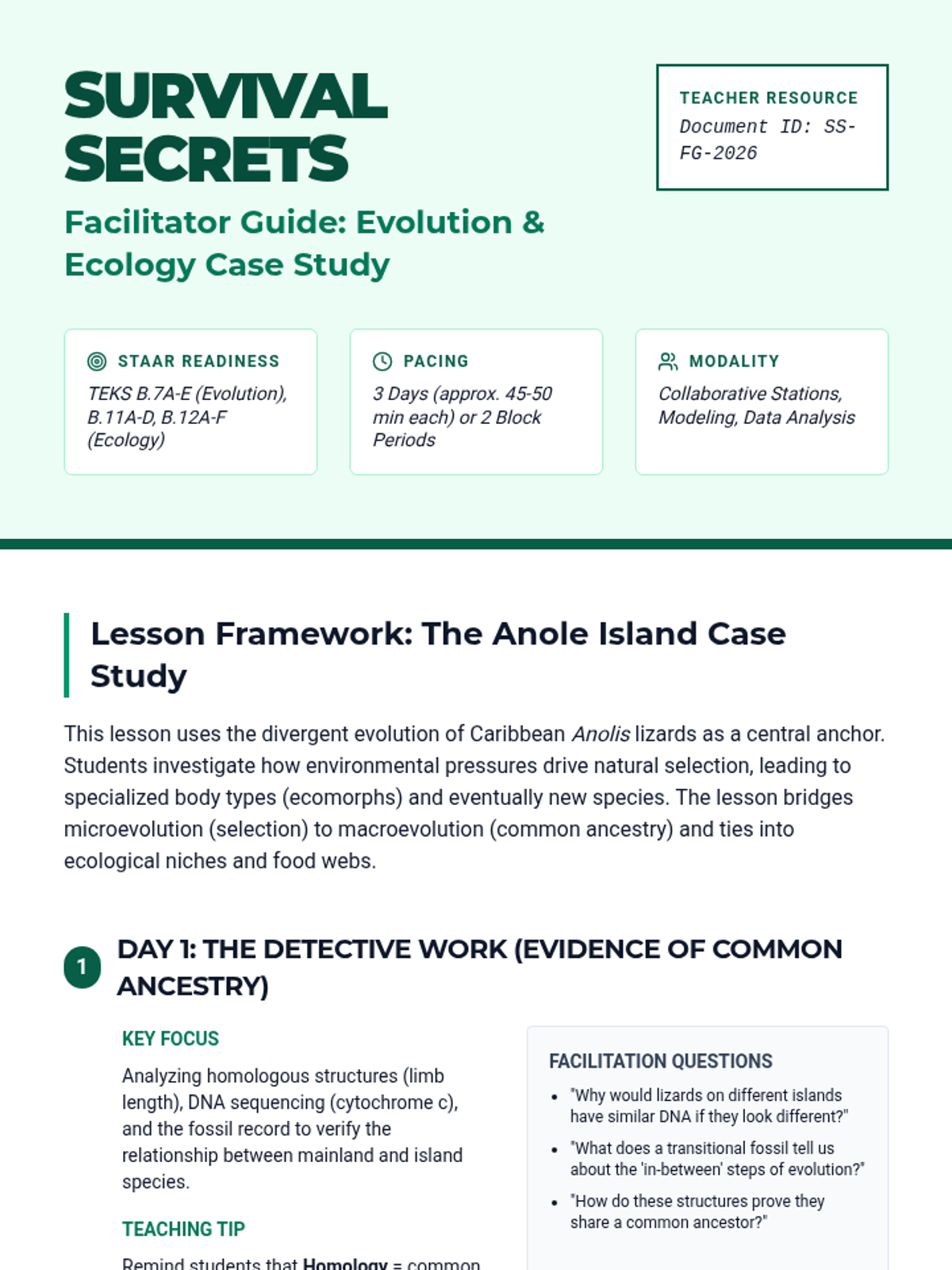
A detailed teacher's facilitator guide for a biology unit on evolution and ecology, featuring a case study approach, pacing suggestions, and collaborative learning strategies aligned with TEKS and STAAR standards.
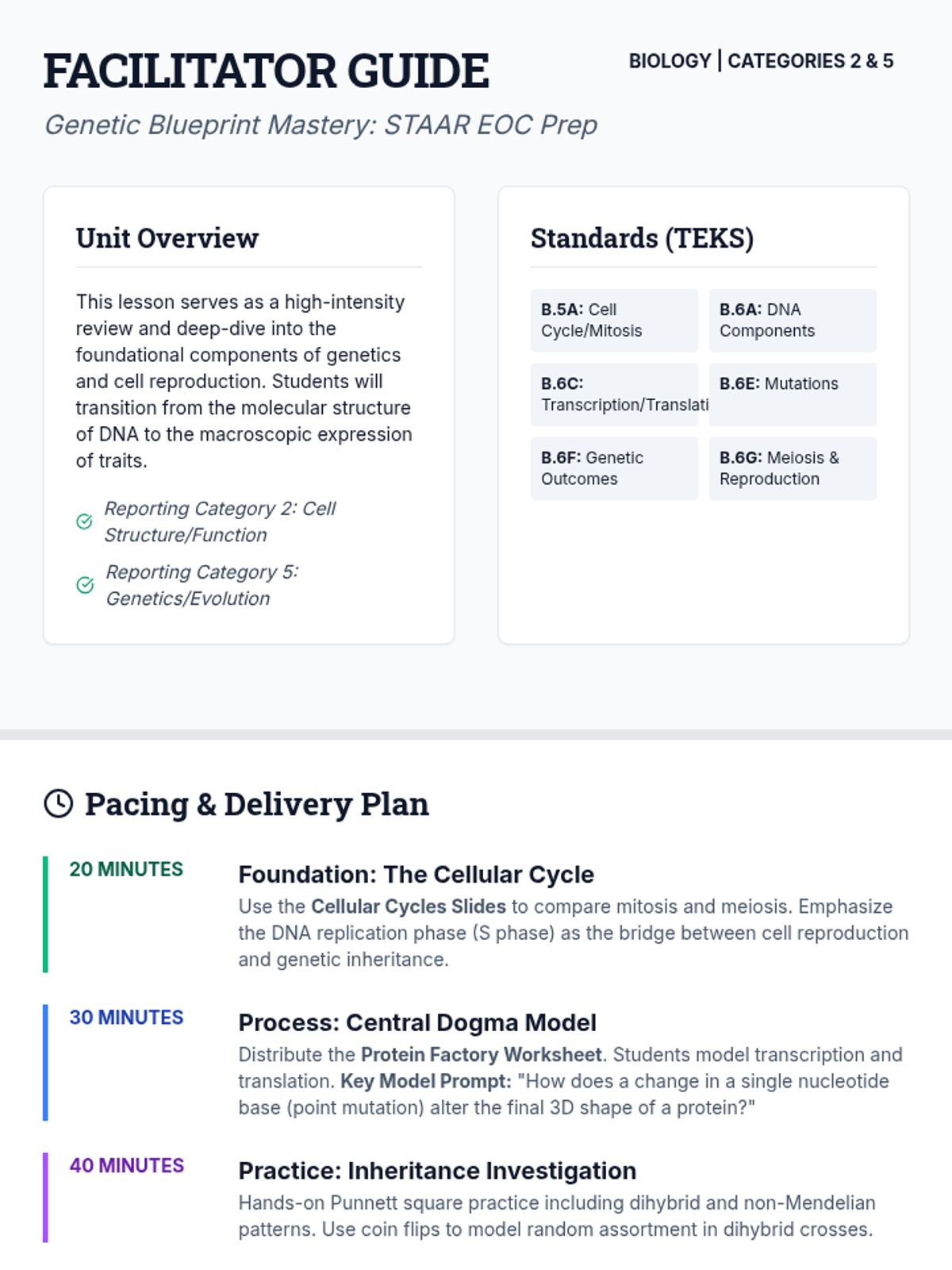
A teacher-facing facilitator guide for the Genetic Blueprint Mastery lesson. It includes a unit overview, TEKS alignment, a detailed pacing plan, a laboratory protocol for strawberry DNA extraction, and strategies for addressing common student misconceptions in genetics.
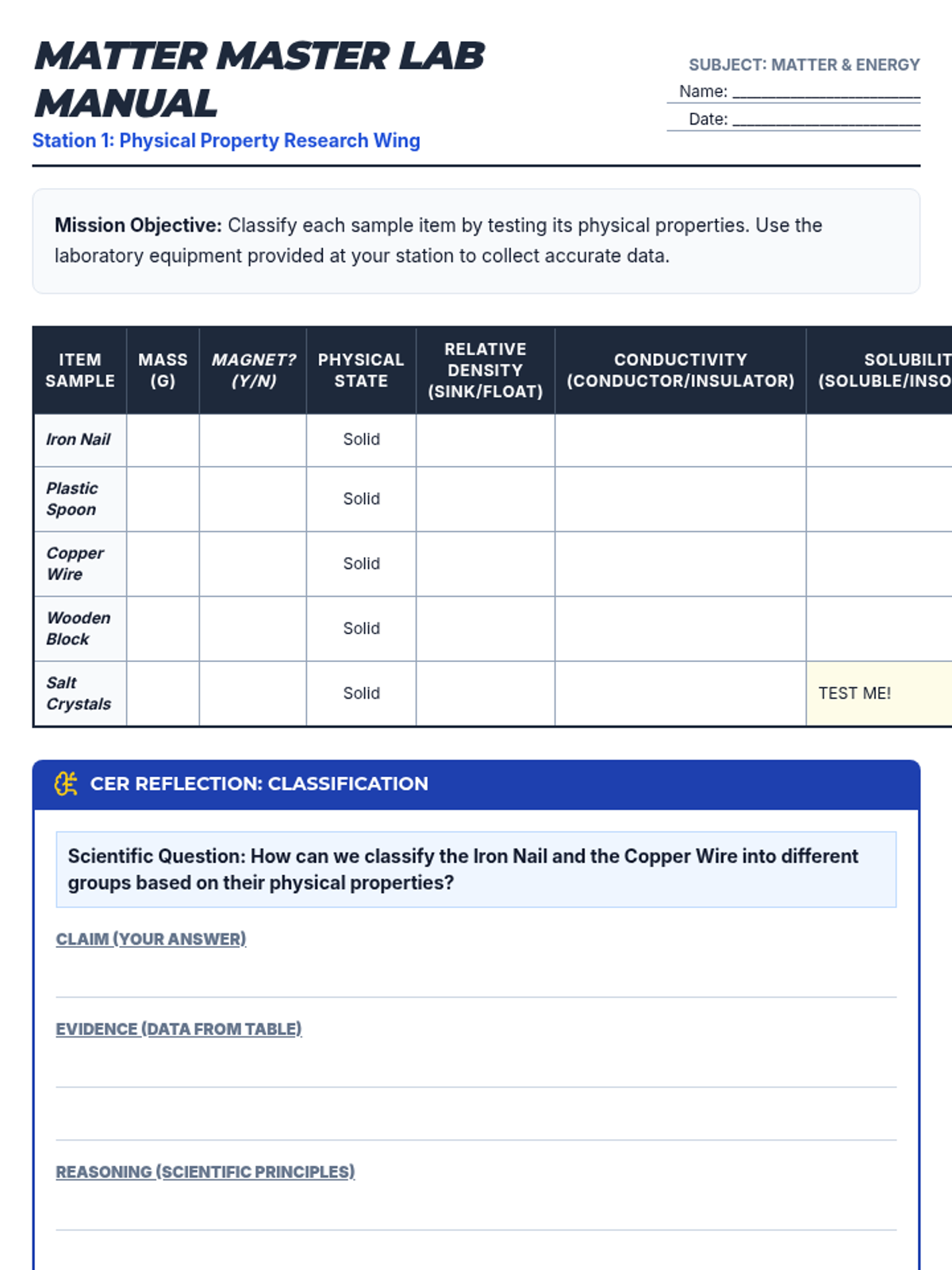
A student-facing laboratory worksheet for Station 1 focused on physical properties. Includes a data collection table for mass, magnetism, density, conductivity, and solubility, plus a CER framework for analysis.
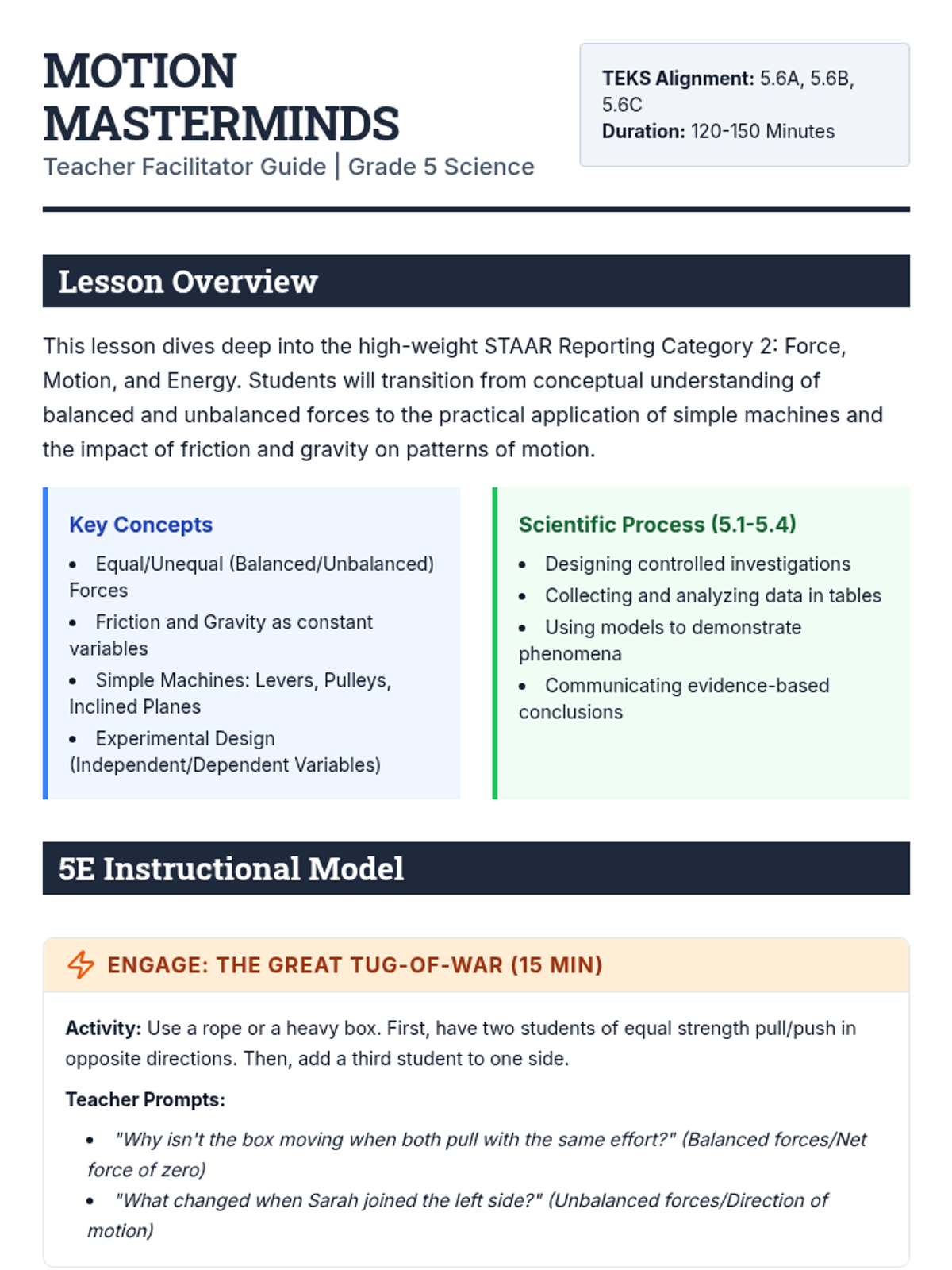
A comprehensive teacher's guide for a Grade 5 Science lesson on force and motion, structured using the 5E instructional model and aligned with TEKS 5.6A-C. It includes activity instructions, teacher prompts, and a misconceptions alert section.
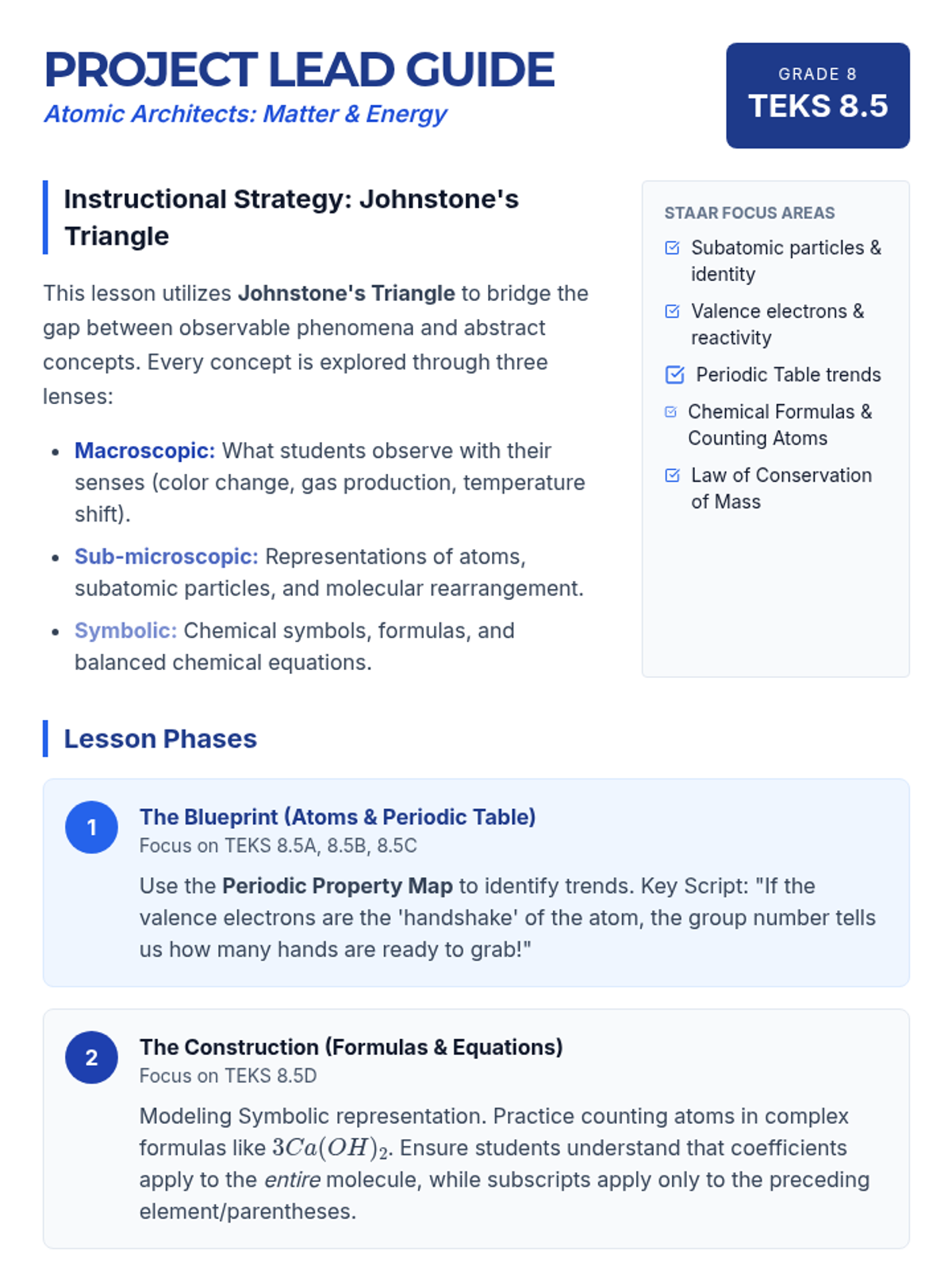
A comprehensive facilitator guide for the Atomic Architects lesson, featuring Johnstone's triangle instructional strategies, misconception alerts, and STAAR success tips for TEKS 8.5.
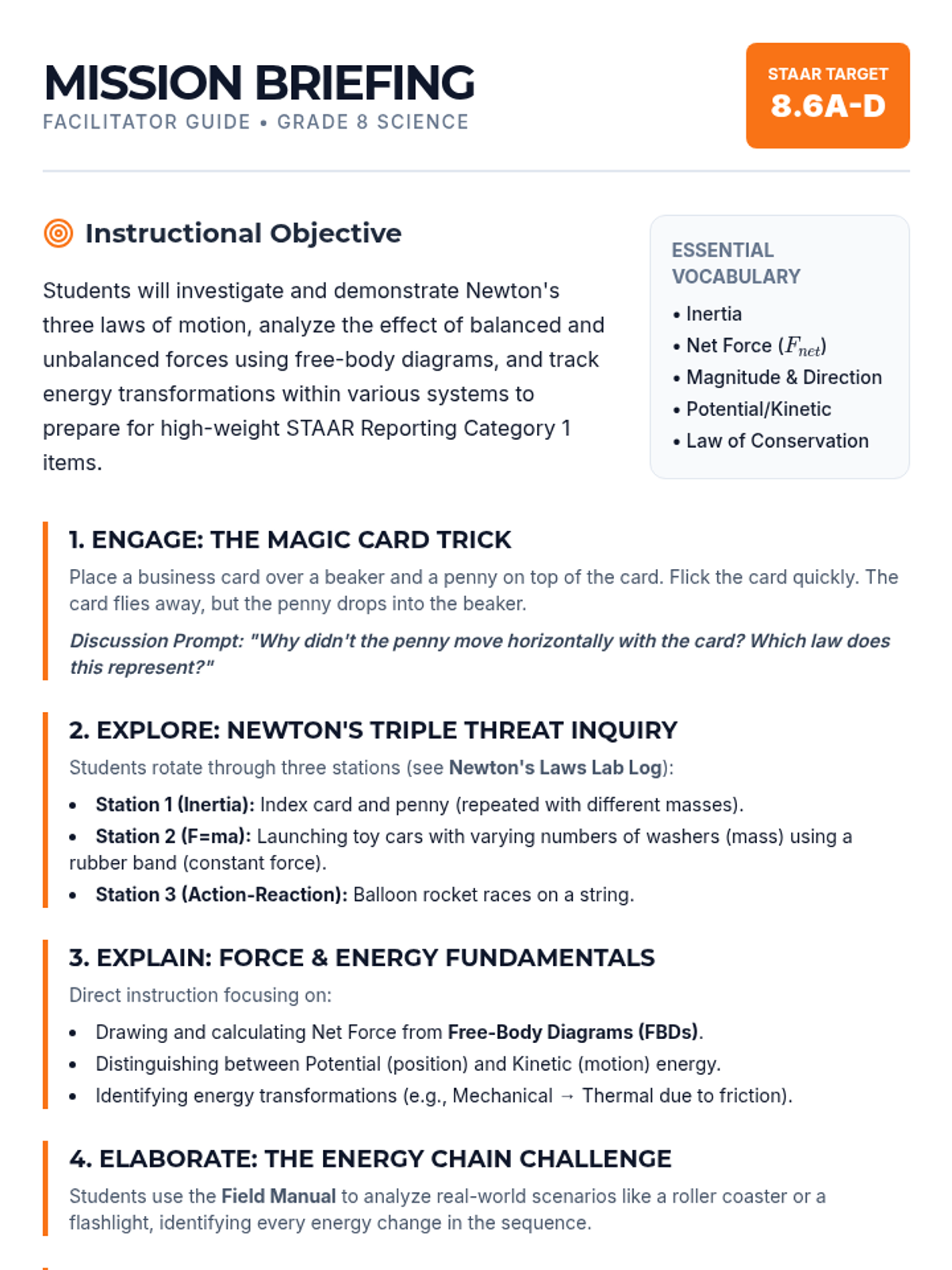
A comprehensive facilitator guide for Grade 8 Science (TEKS 8.6A-D), utilizing the 5E instructional model to teach Newton's Laws and energy transformations with STAAR-specific tips.
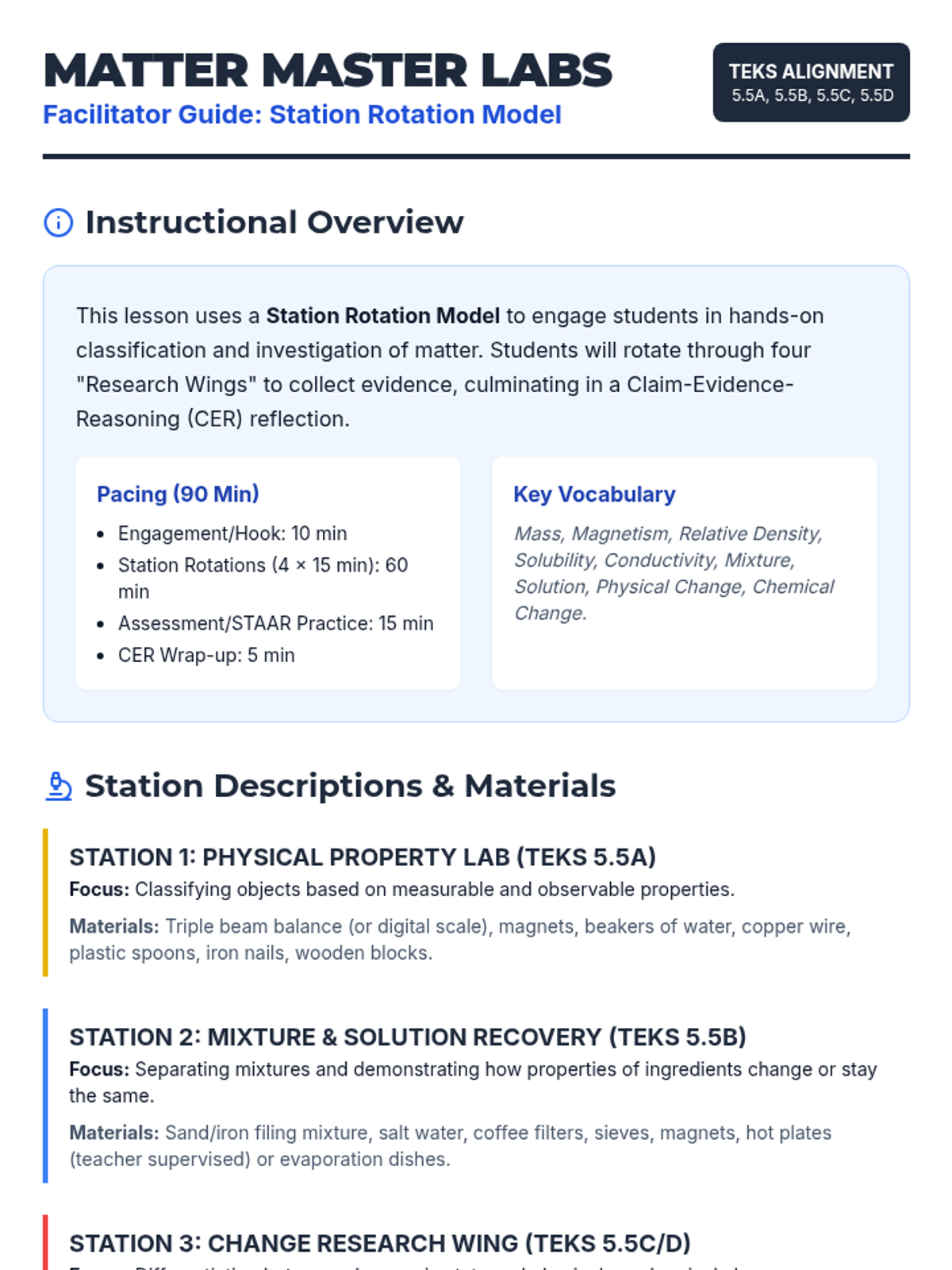
A teacher-facing facilitator guide outlining the station rotation model for a 5th grade science lesson on matter. Includes TEKS alignment, material lists, pacing, and instructional prompts.