Fiche expérimentale complète pour les élèves présentant en détail les trois protocoles de mesure de la distance focale d'une lentille convergente (objet à l'infini, autocollimation, méthode de Bessel) avec tableaux de mesures et questions d'analyse.
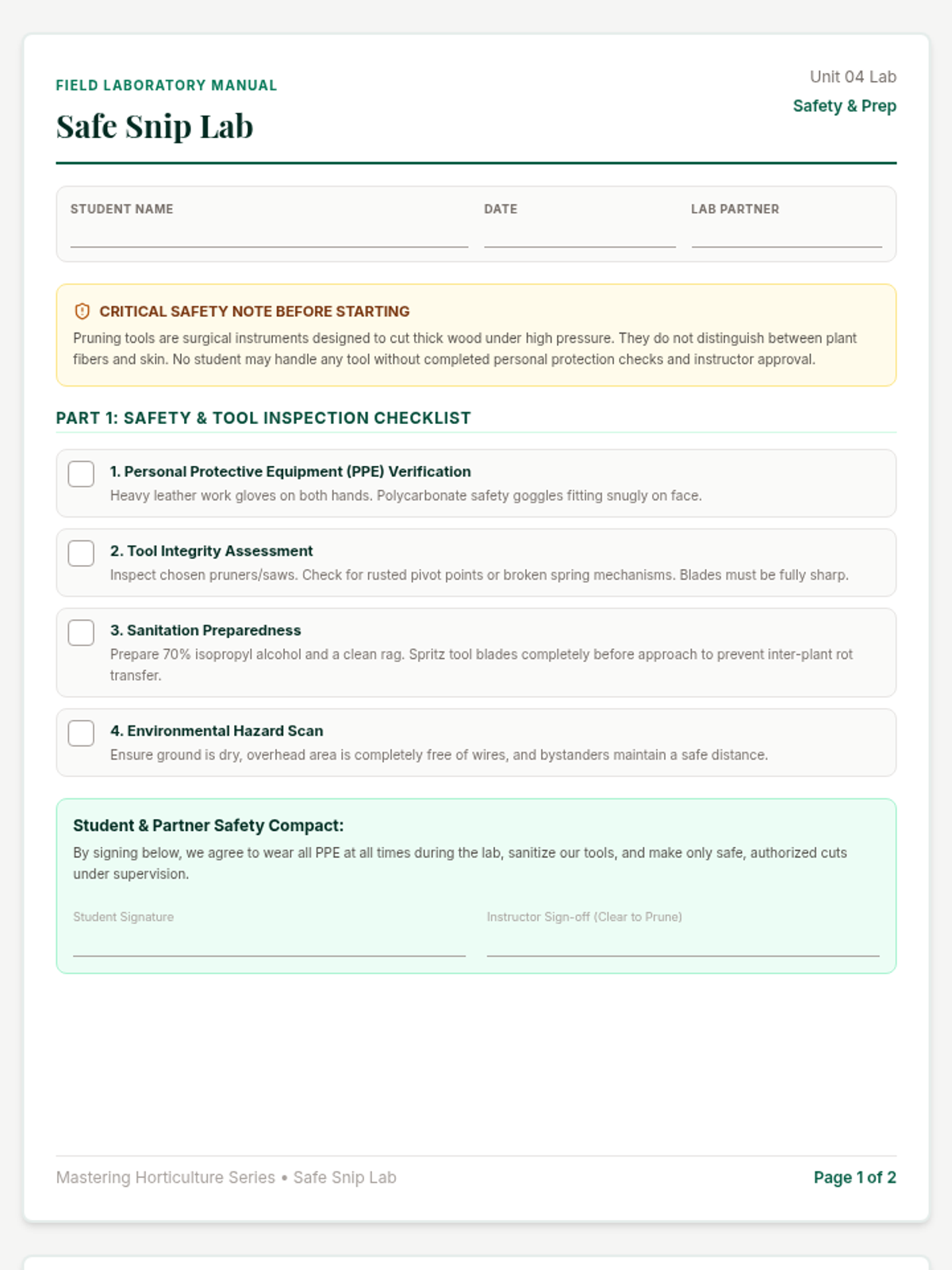
A two-page printable field laboratory manual including a comprehensive personal and workspace safety checklist, tool inspection guidelines, stem diagnosis metrics, a tree pruning execution log, and a peer critique matrix.
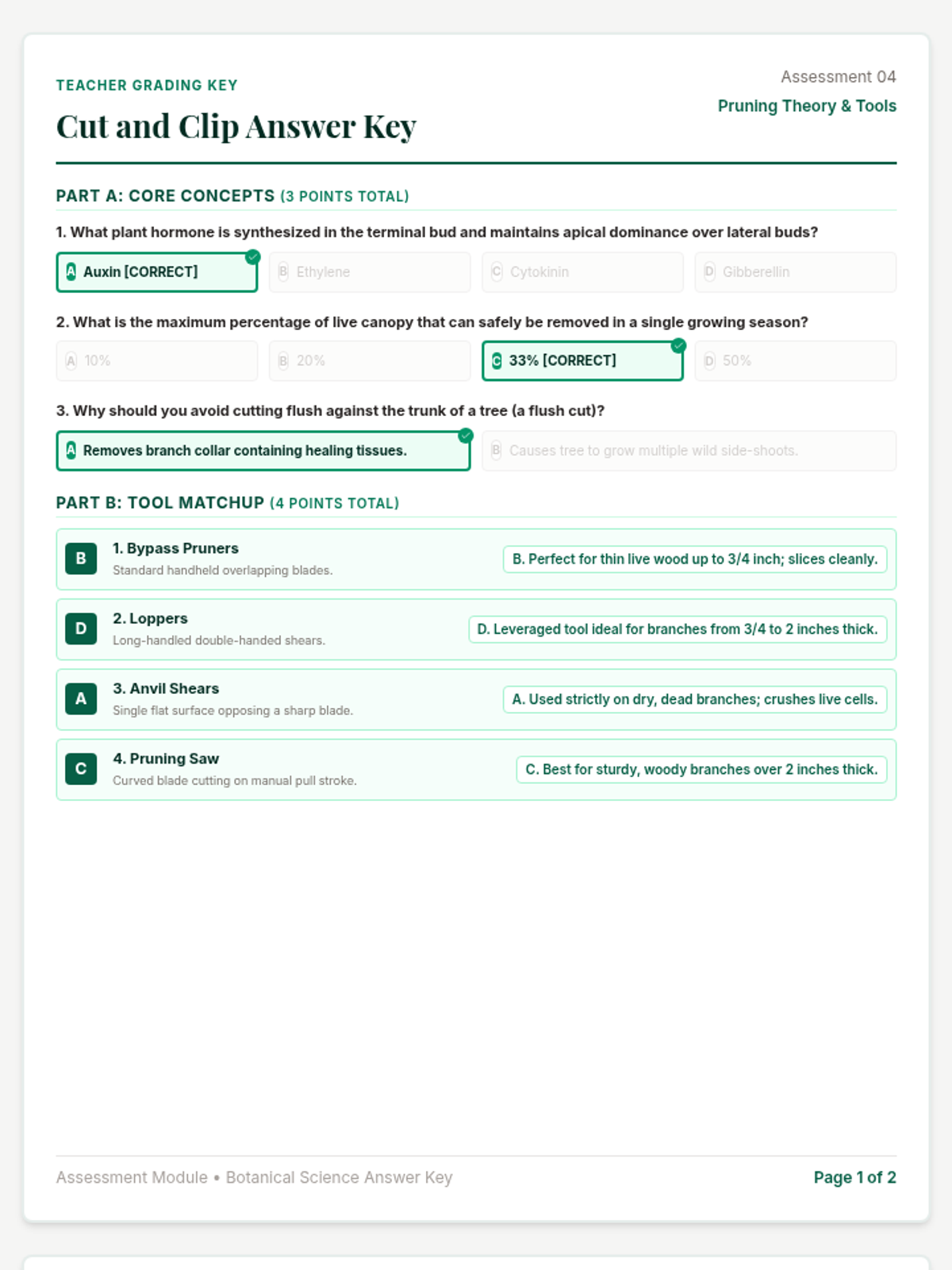
Complete two-page answer key for the Cut and Clip Quiz. Includes fully-realized model answers, color-coded grading prompts, diagnostic explanations for cut diagrams, and mathematical breakdown of the 1/3 rule problem.
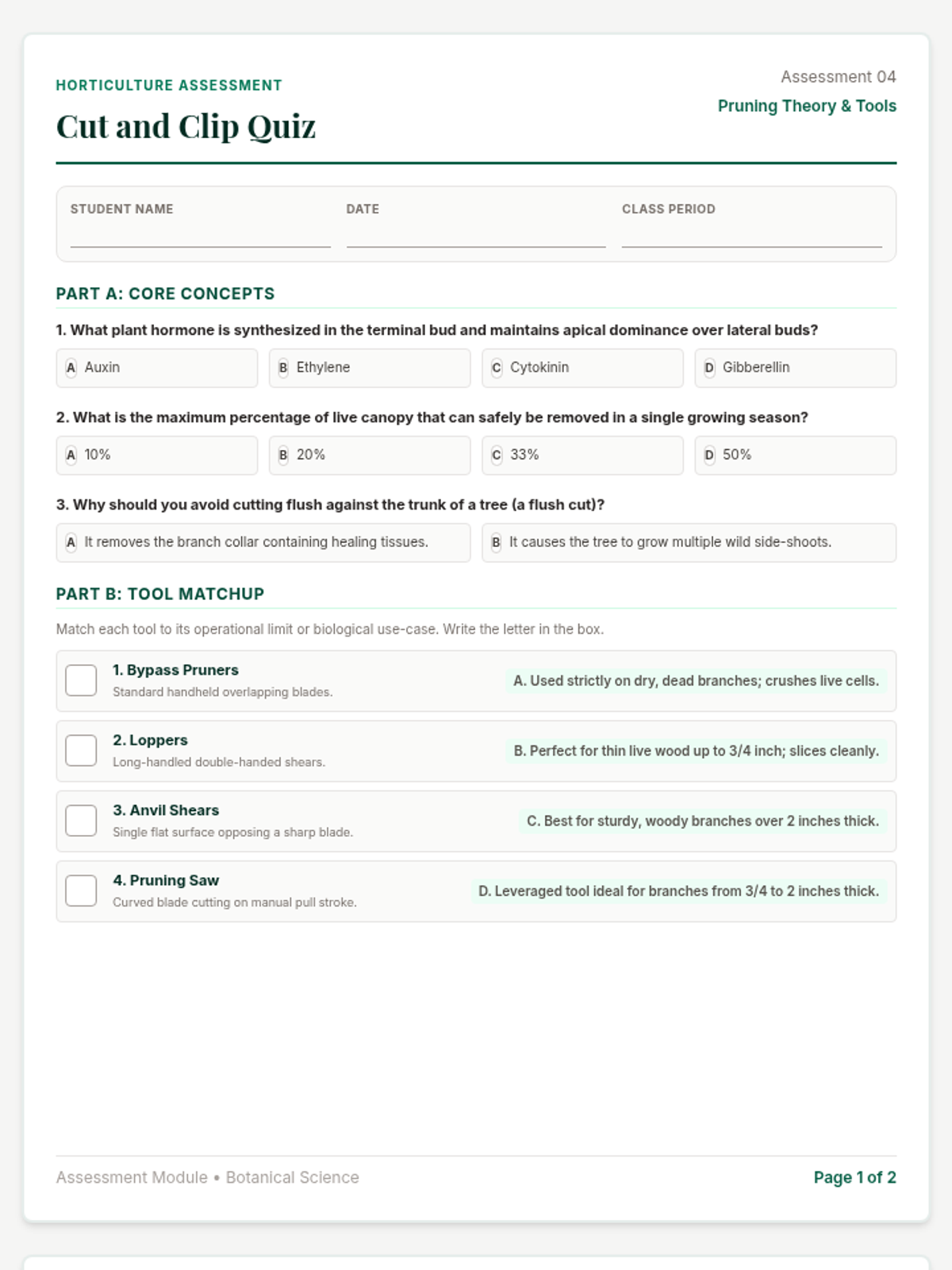
A professional, two-page student quiz on pruning tools, physiological mechanics, angle cutting, and complex techniques. Includes a visual diagram analysis section, a botanical calculation problem, and short-answer prompts, adhering strictly to uniform selectable answer styling guidelines.
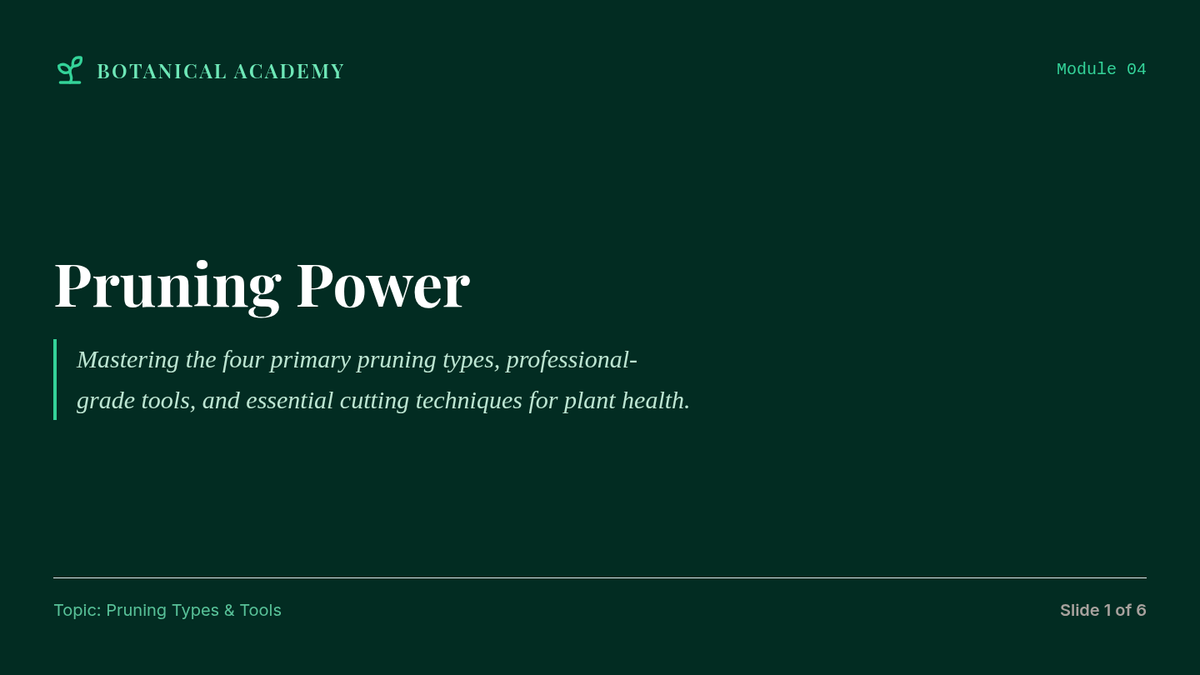
An elegant, high-impact presentation with slides highlighting the 4 primary pruning types (cleaning, thinning, raising, reduction), essential tools, cutting mechanics, and core safety procedures. Fully visual and compliant with the 24px minimum font rule.
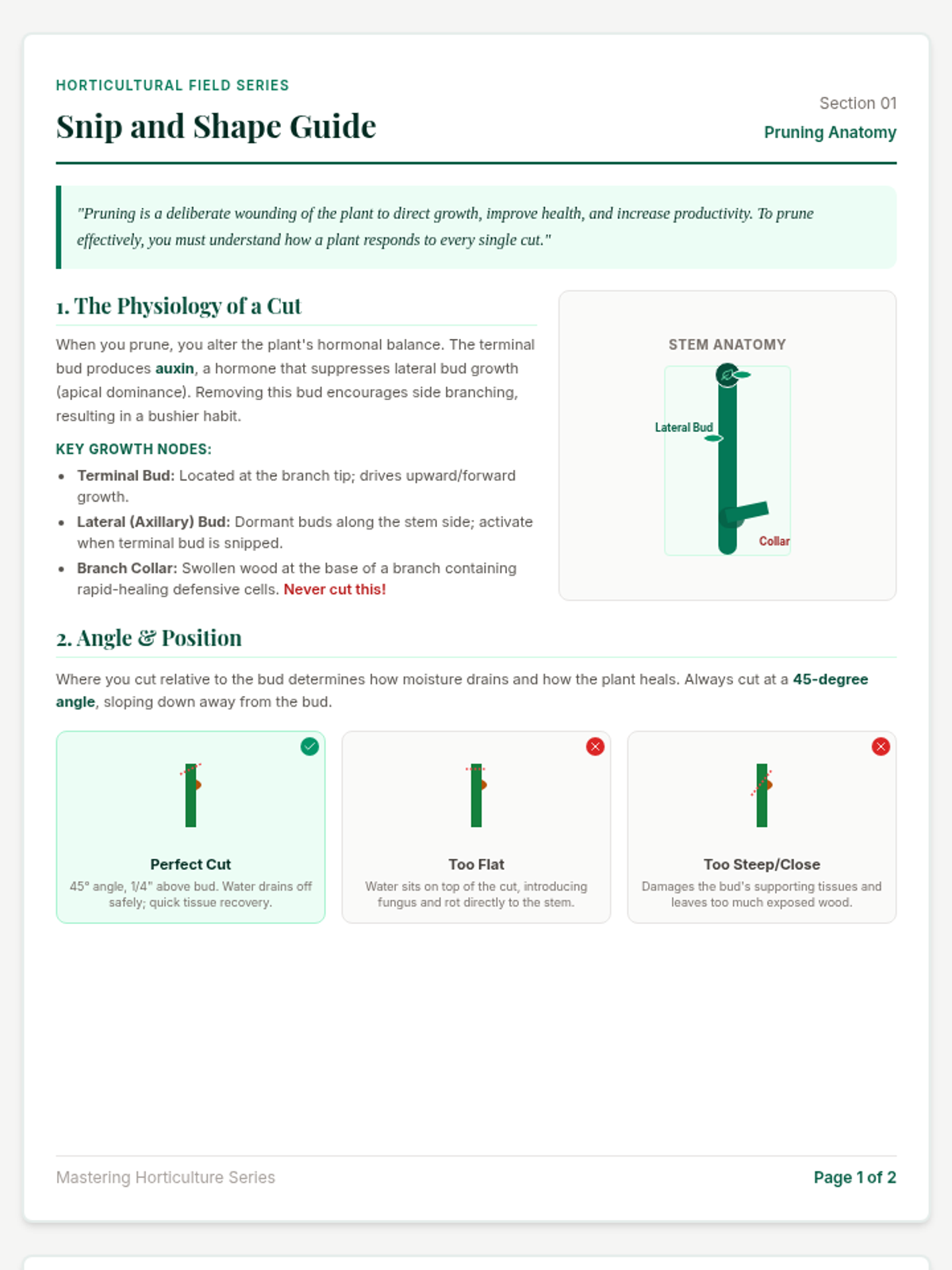
A highly visual, comprehensive two-page step-by-step pruning guide in botanical field book style. It includes stem physiology, lateral and axillary buds, angle diagrams, the three-cut pruning technique for branches, a timing table, and the 1/3 rule.
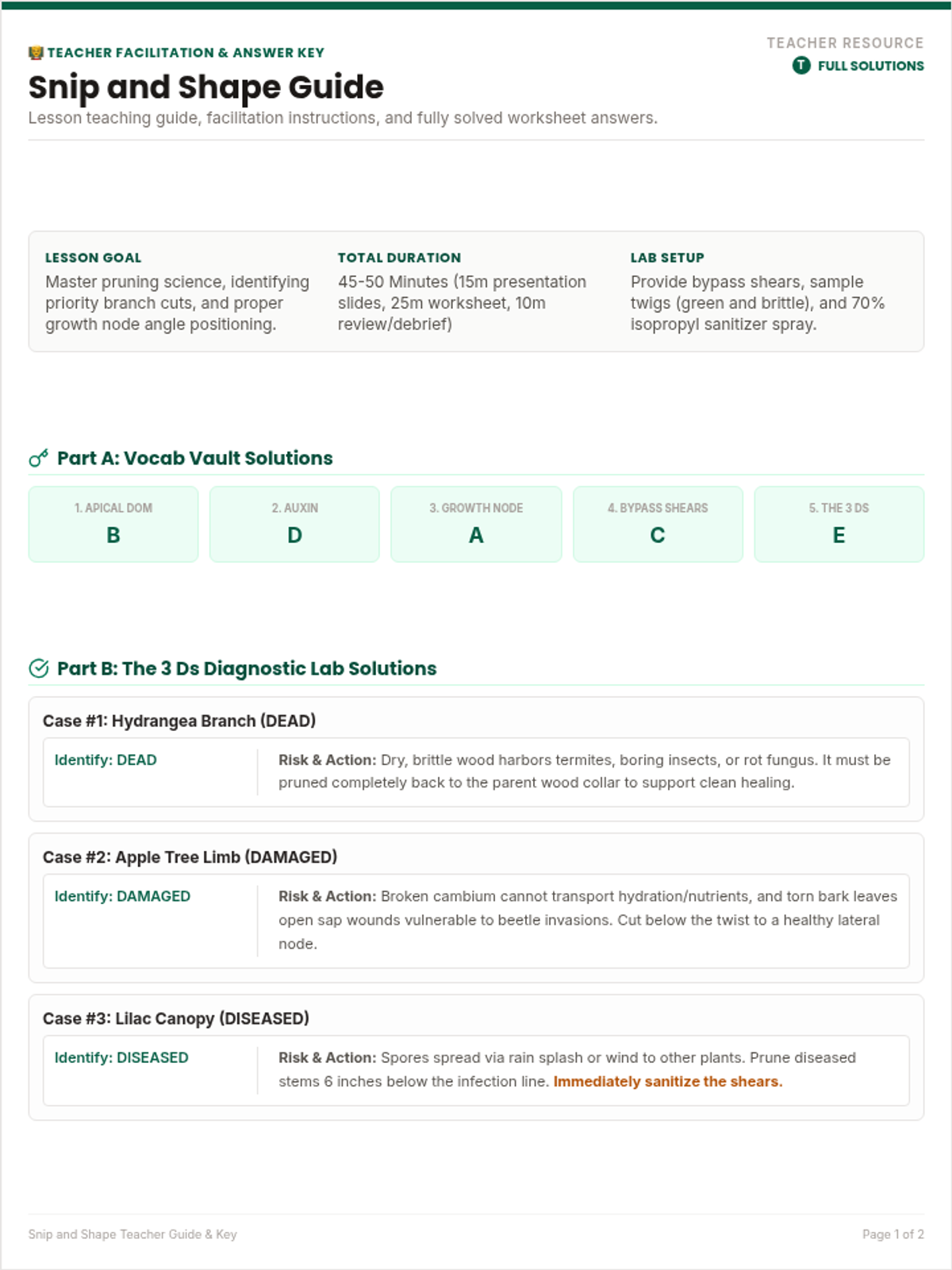
A comprehensive two-page teacher's guide and answer key for the Snip and Shape lesson, including pacing guides, common misconceptions, and detailed worksheet solution keys.
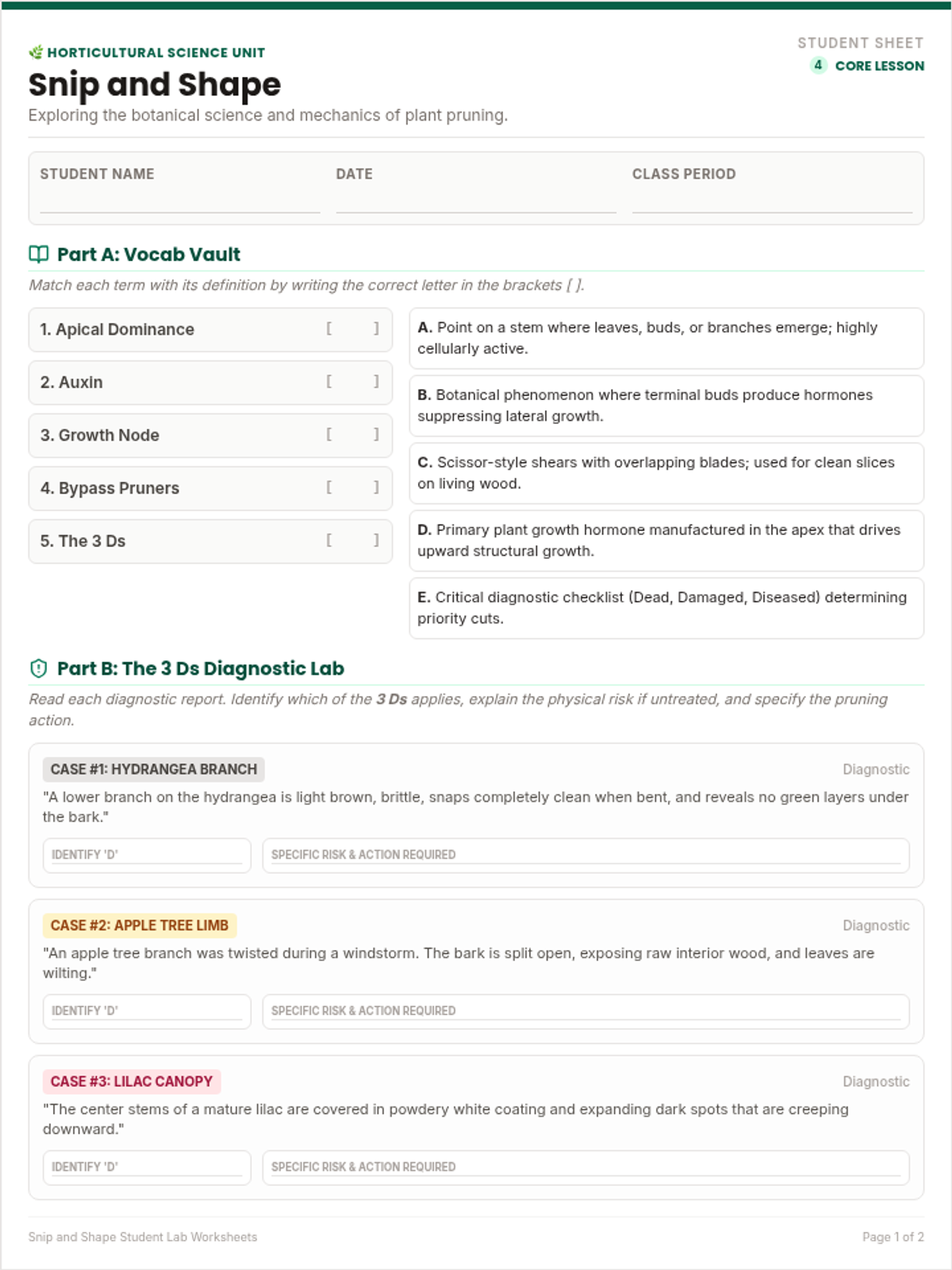
A two-page print-ready student worksheet on pruning science, containing vocabulary matching, a "3 Ds" diagnostic activity, cut angle analysis, and short-answer questions on apical dominance and tool sanitation.
Interactive lesson slides exploring the horticultural science and mechanics of pruning, detailing plant biology, apical dominance, proper cutting angles, the 3 Ds, and tool safety.
A visual presentation covering brand personas on social media. Highlights case studies contrasting Wendy's off-the-wall roasting style with a trusted corporate/professional persona, discussing digital footprints, design workflows, and layout alignment rules. Includes zero mention of assignments.
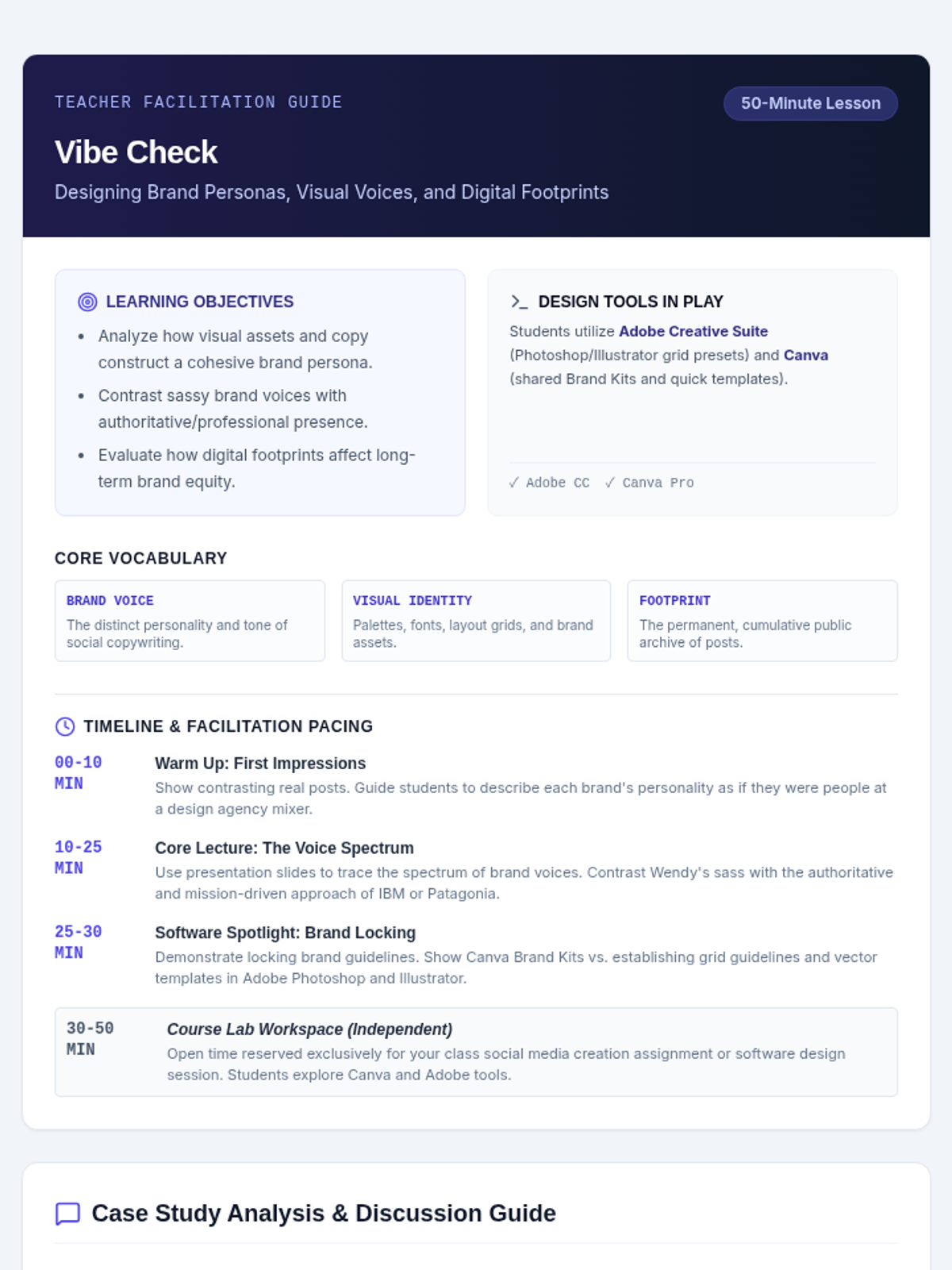
A professional teacher-facing lesson plan and facilitation guide outlining a 50-minute pacing structure, vocabulary terms, contrasting brand voice case studies (Wendy's vs. corporate), and tool integration tips for Canva and Adobe Creative Suite.
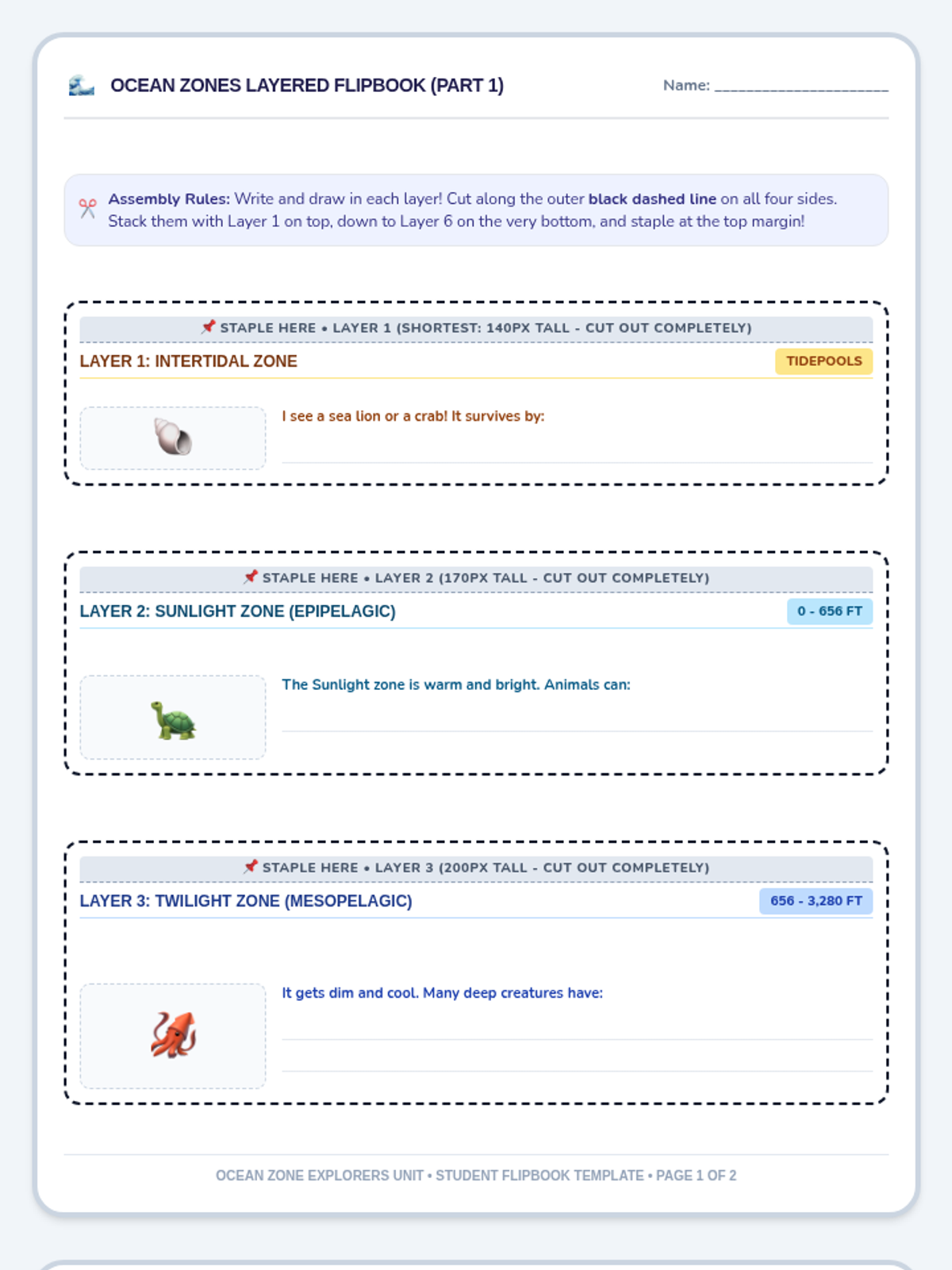
Printable layered flipbook templates containing the six ocean zones with interactive spaces for student drawing, coloring, and science writing. Designed for easy 1st-grade cutting, stacking, and stapling.
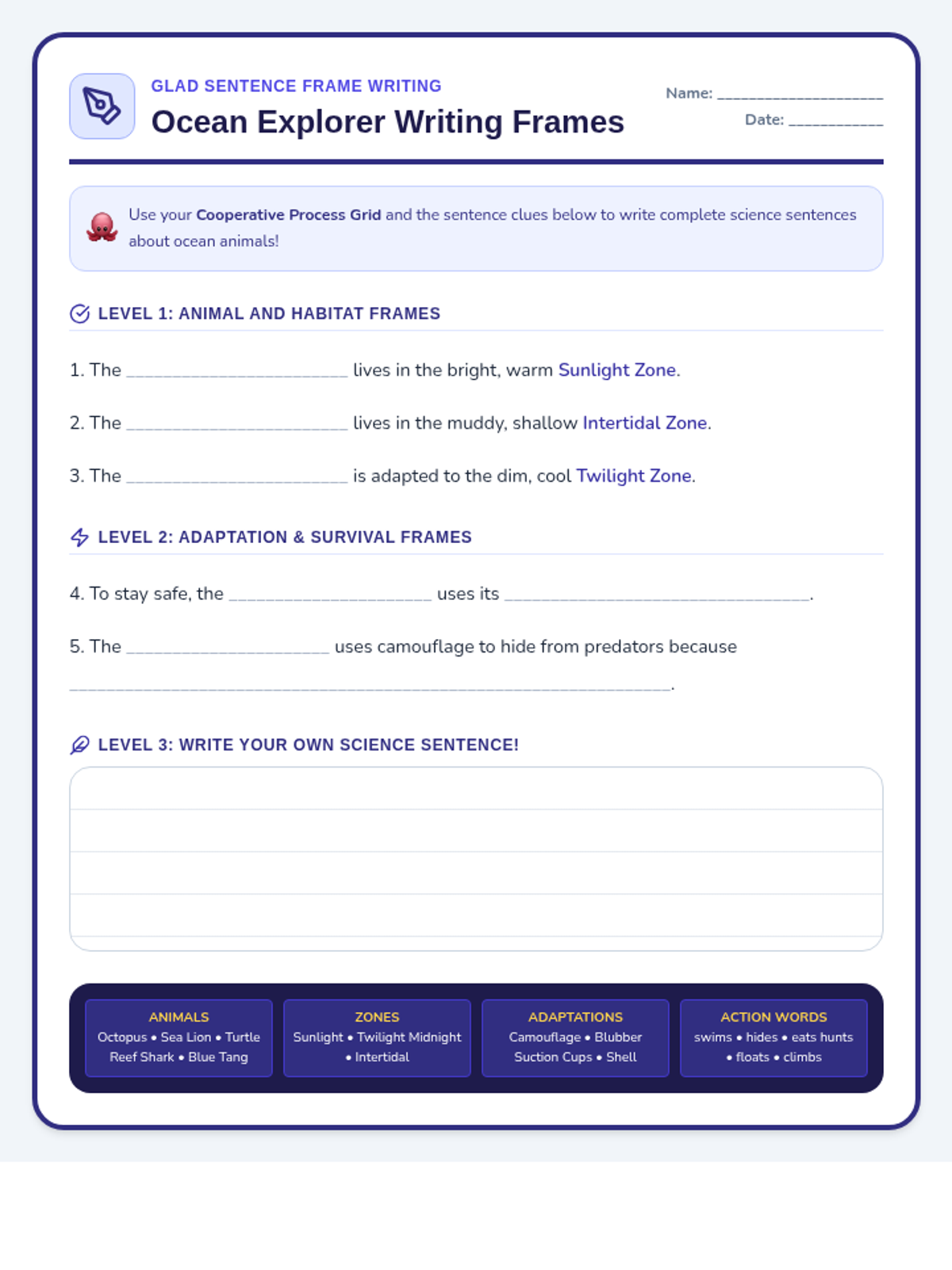
Differentiated sentence frames worksheet with structured writing lines and a categorised science word bank, helping 1st-grade students draft scientific paragraphs based on GLAD animal facts.
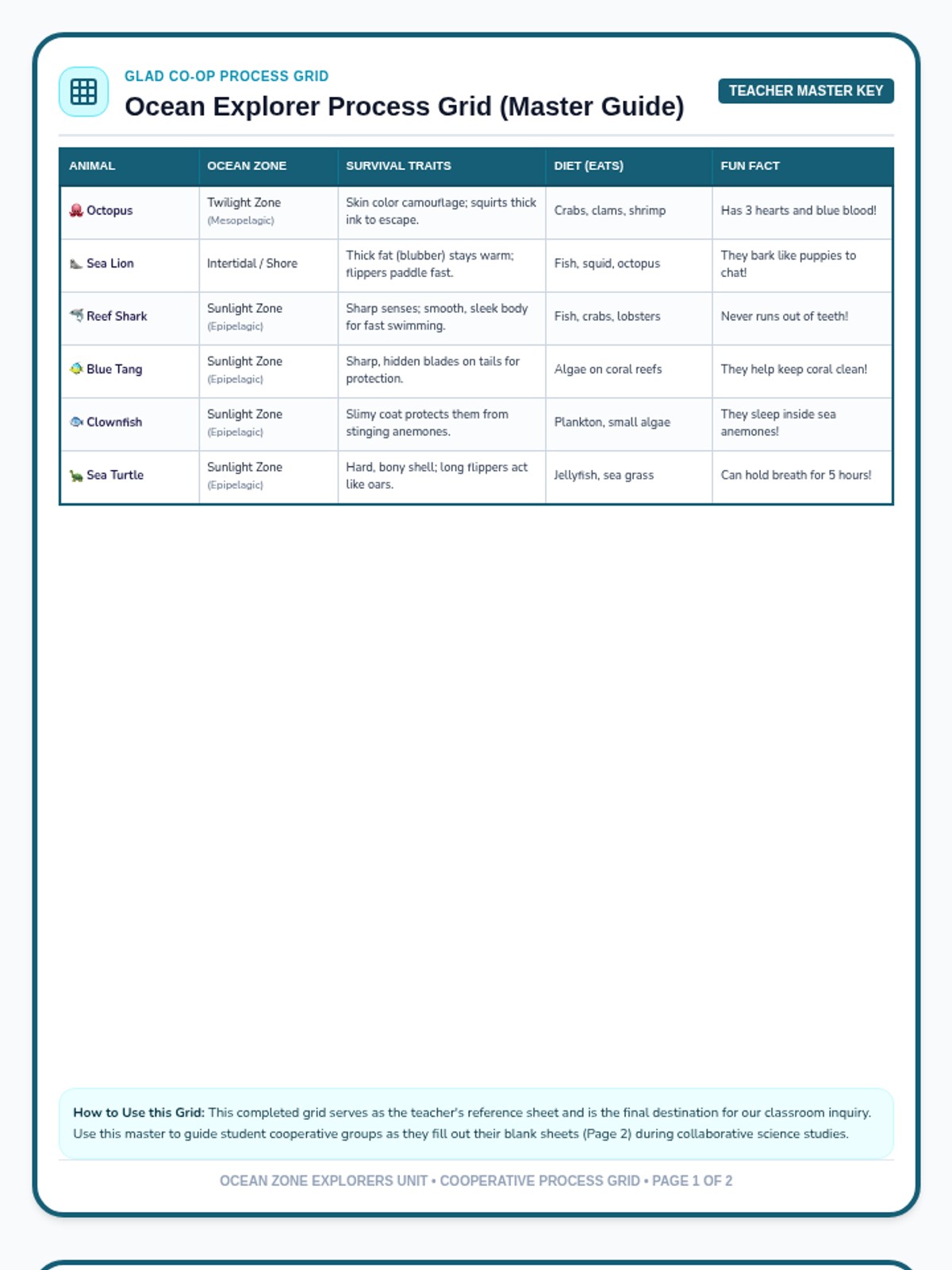
Interactive Cooperative Process Grid template tracking six key focus animals (Octopus, Sea Lion, Shark, Blue Tang, Clownfish, Sea Turtle) across their habitat zones, survival traits, diet, and fun facts. Includes completed Teacher Master Key and blank Student Investigation sheet.
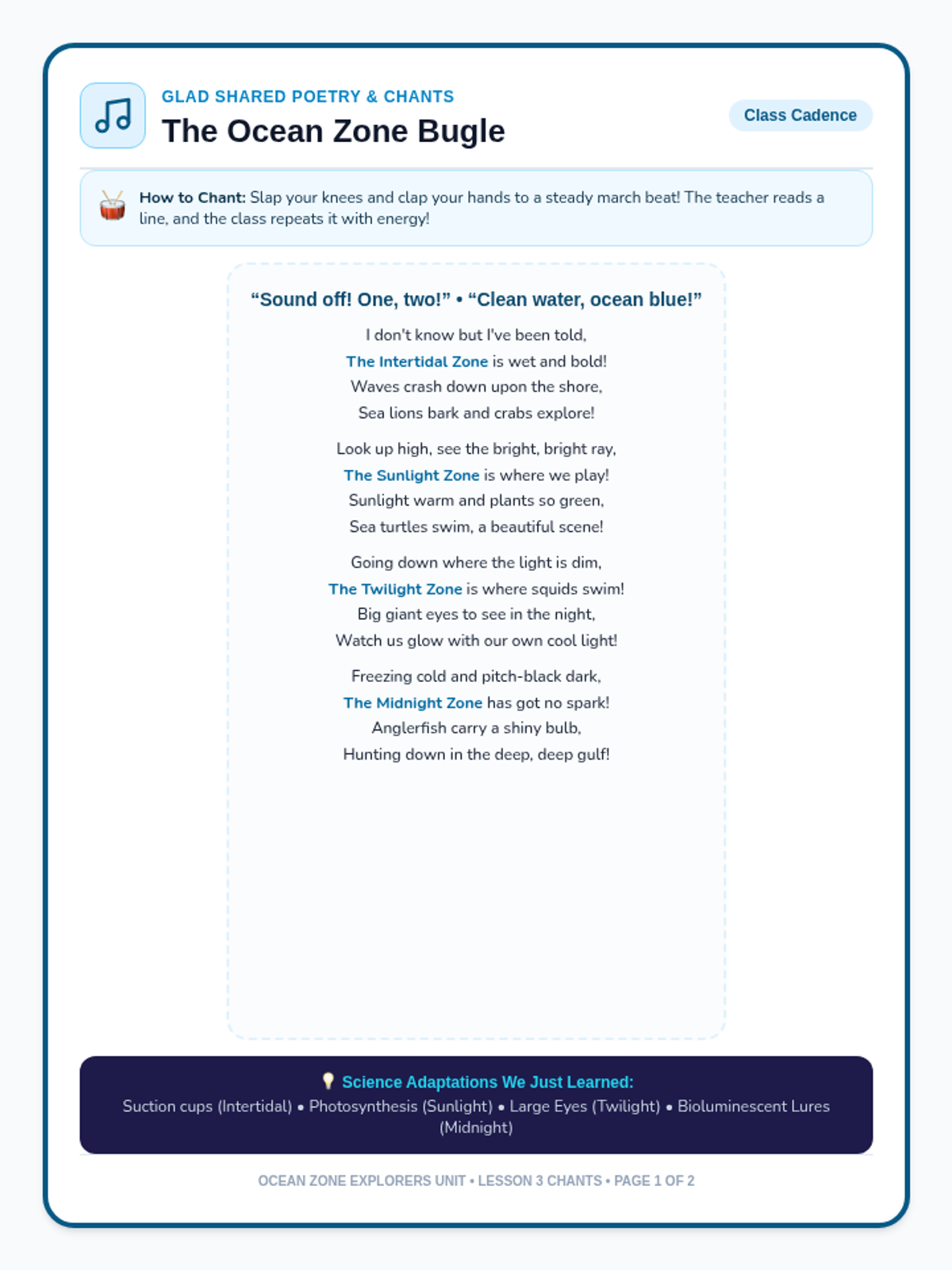
Printable shared poetry booklet featuring two high-energy GLAD chants ('The Ocean Zone Bugle' and 'Sunlight, Twilight, Midnight') designed to build academic vocabulary and fluency in 1st graders through rhythm and physical movement.
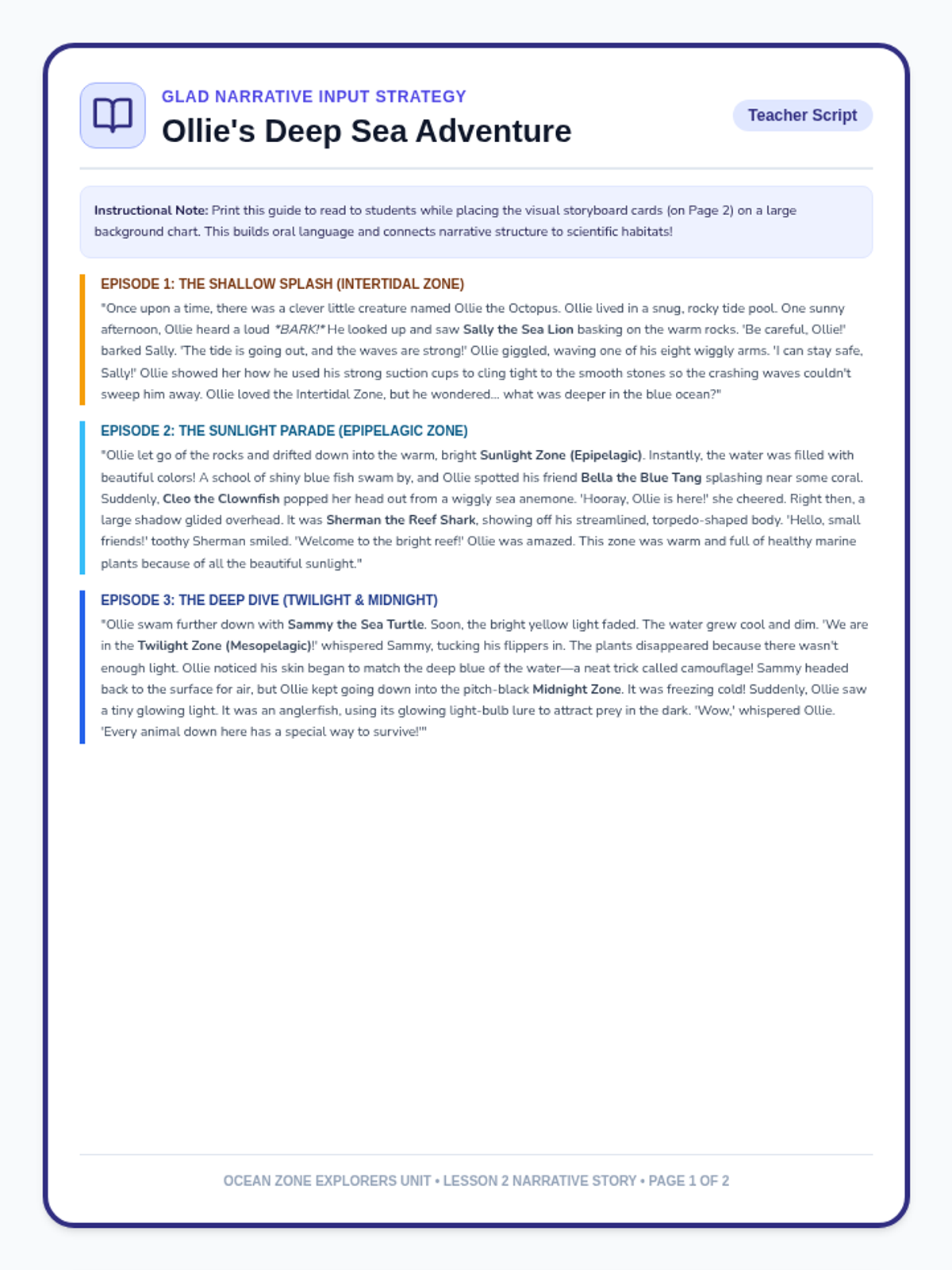
Teacher read-aloud script and visual storyboard cards for the GLAD Narrative Input Chart, chronicling Ollie the Octopus's deep-sea adventure down through the 6 ocean zones to meet sea lions, sharks, and glowing deep-sea life.
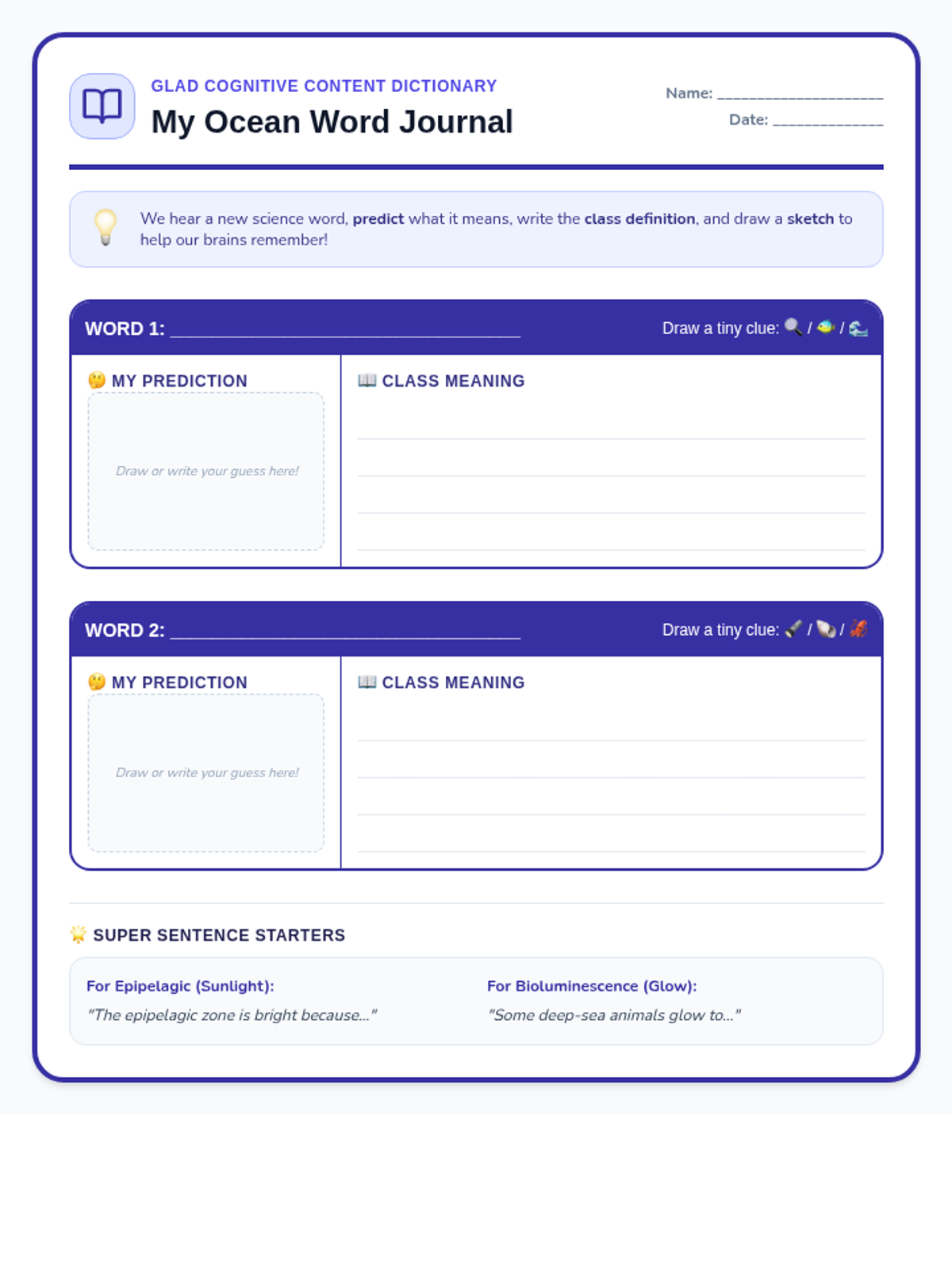
Interactive Cognitive Content Dictionary (CCD) template for 1st-grade students to predict, define, and sketch key ocean-related vocabulary words (such as Epipelagic and Bioluminescence) as they progress through the GLAD unit.
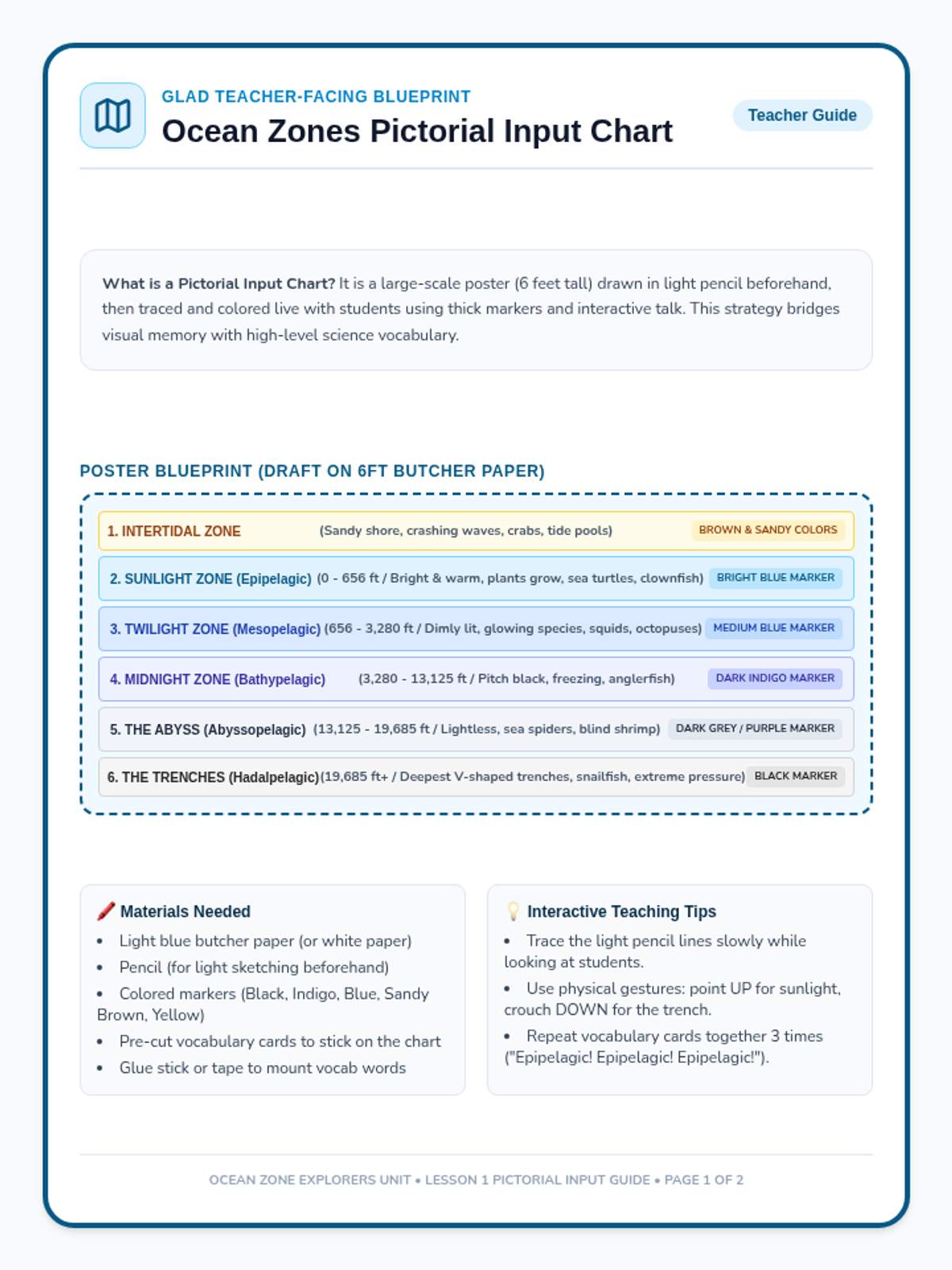
Teacher guide and interactive script for constructing the Ocean Zones Pictorial Input Chart in 1st grade. Features a clear drawing layout blueprint across 6 vertical zones (Intertidal to Trenches) with step-by-step teacher talk prompts and visual markers.
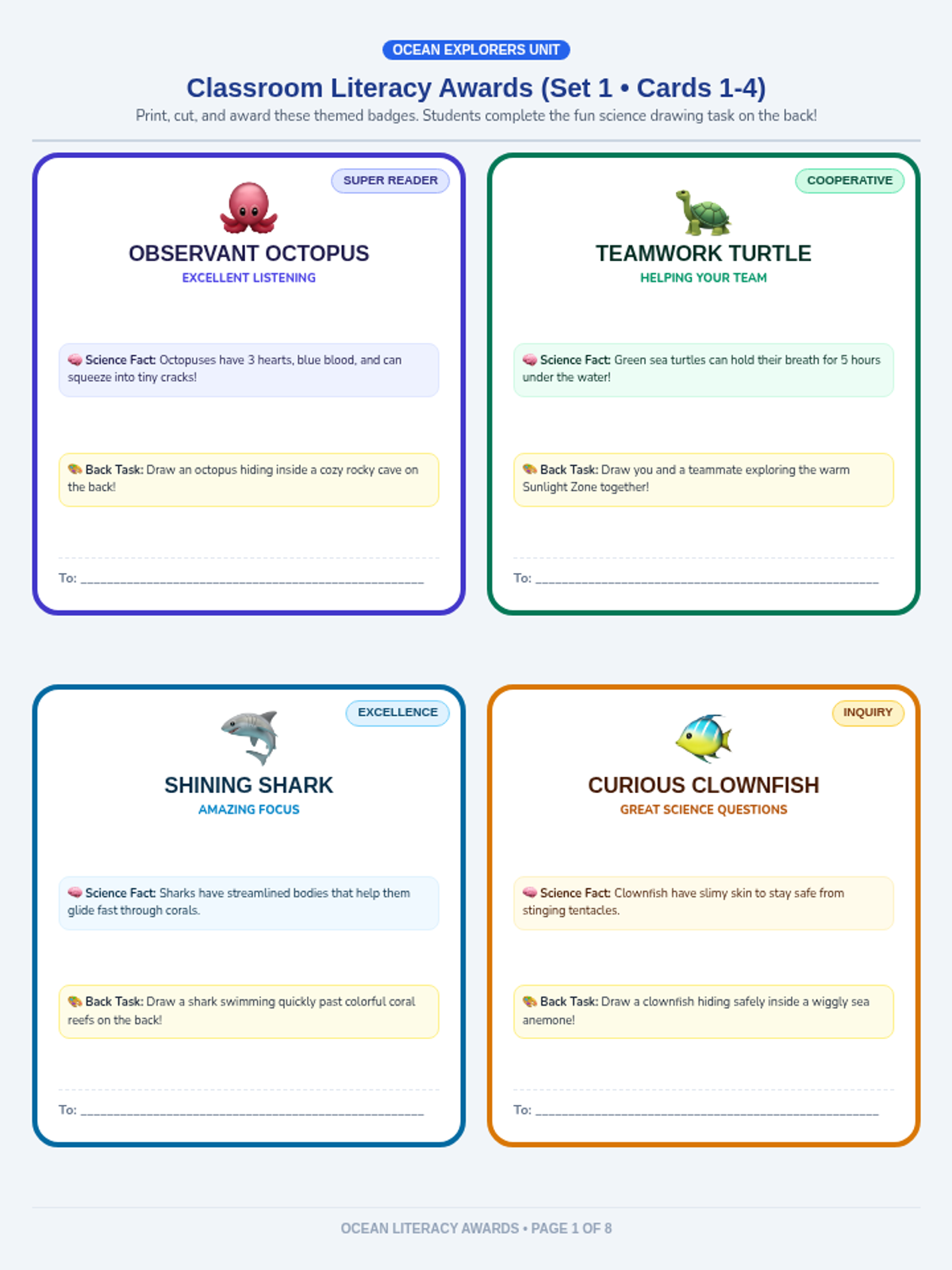
Set of 30 printable GLAD Literacy Awards certificates for positive classroom reinforcement. Each card features an ocean animal, a fascinating science fact, and an active interactive task tailored for 1st graders. Includes an integrated teacher record tracker.
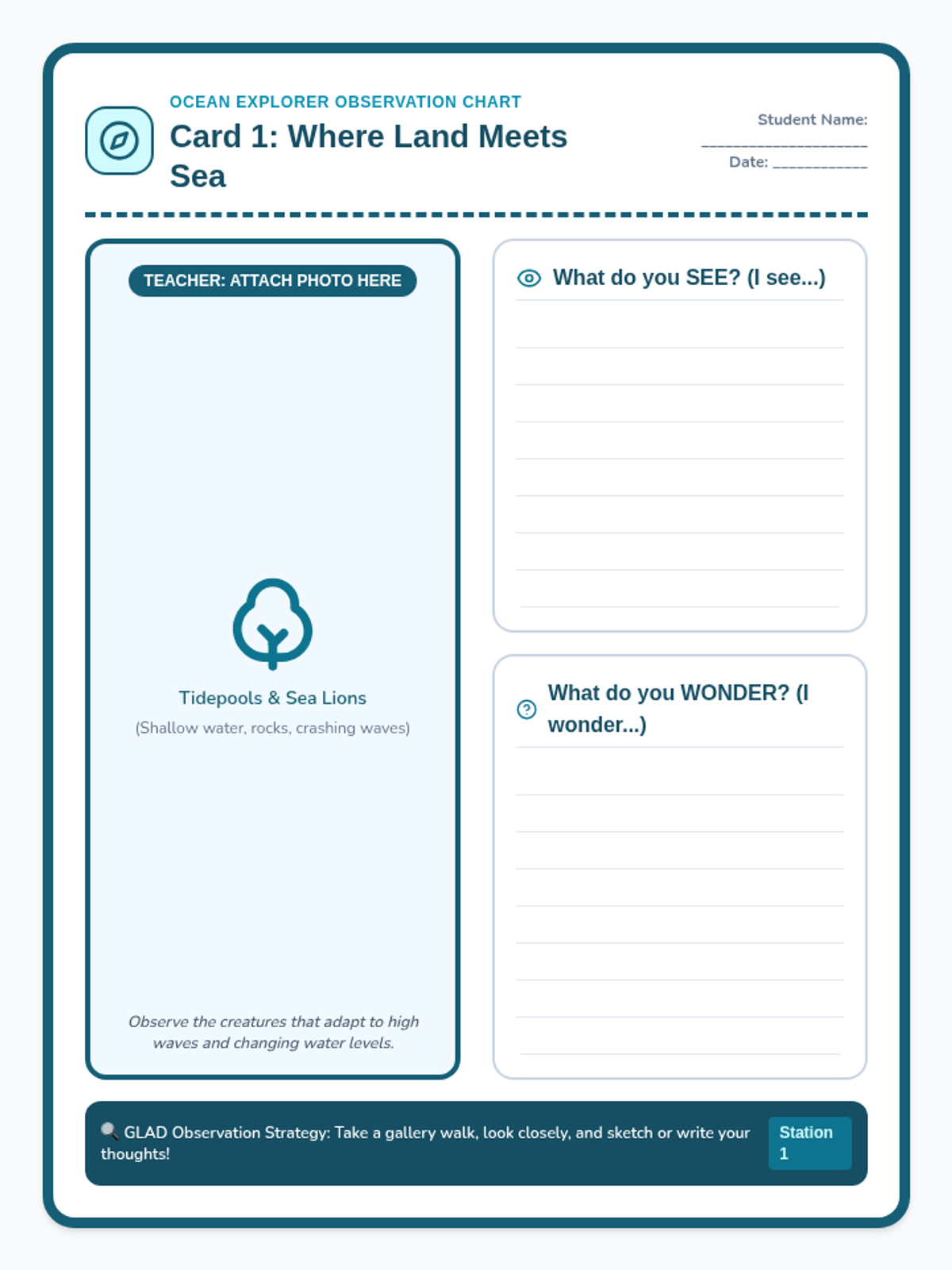
Highly visual GLAD Observation Charts for print-ready classroom inquiry. Features 4 distinct ocean zone zones/habitats with targeted 1st-grade writing lines for 'I see...' and 'I wonder...' prompts. Includes dedicated spaces for teacher-attached photos.
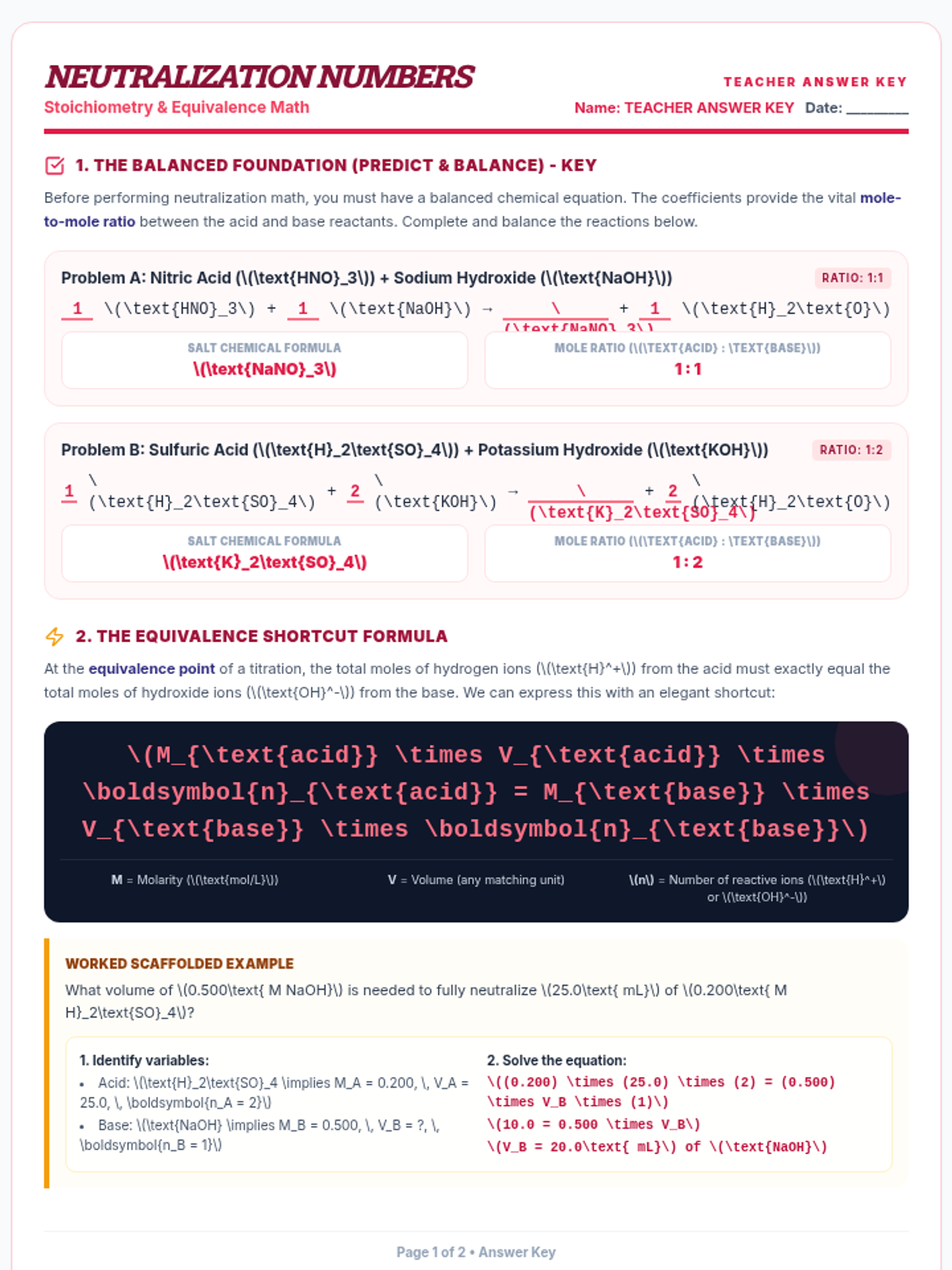
Teacher answer key for the Neutralization Numbers Worksheet, providing predicted products, balanced chemical equations, complete step-by-step mathematical setups, and correct values.
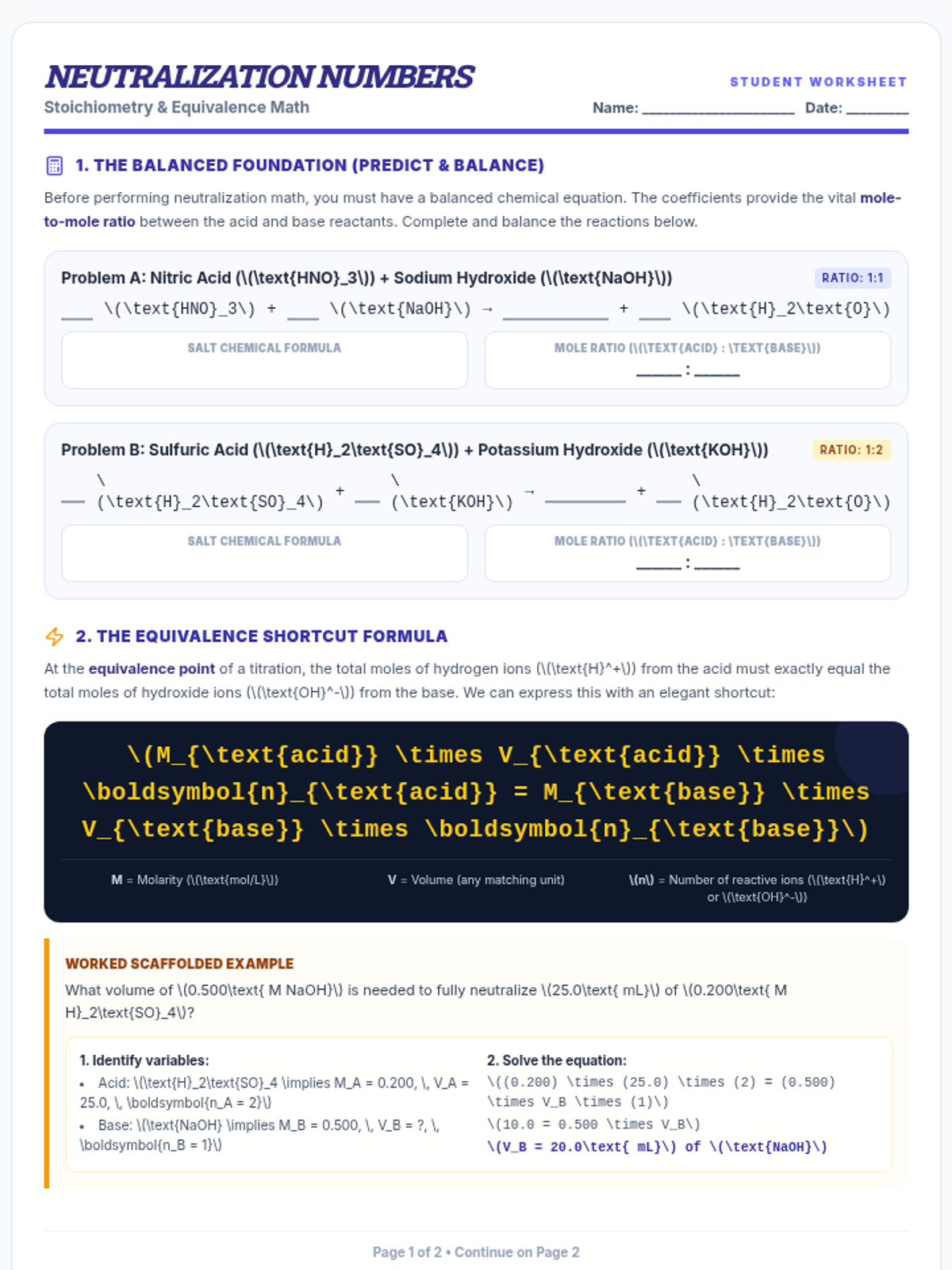
A comprehensive 2-page scaffolded student worksheet for neutralization calculations. It starts with predicting products and identifying mole ratios, introduces the equivalence shortcut formula, provides step-by-step guided practice for titration calculations, and concludes with a real-world solid-neutralization stoichiometry challenge.
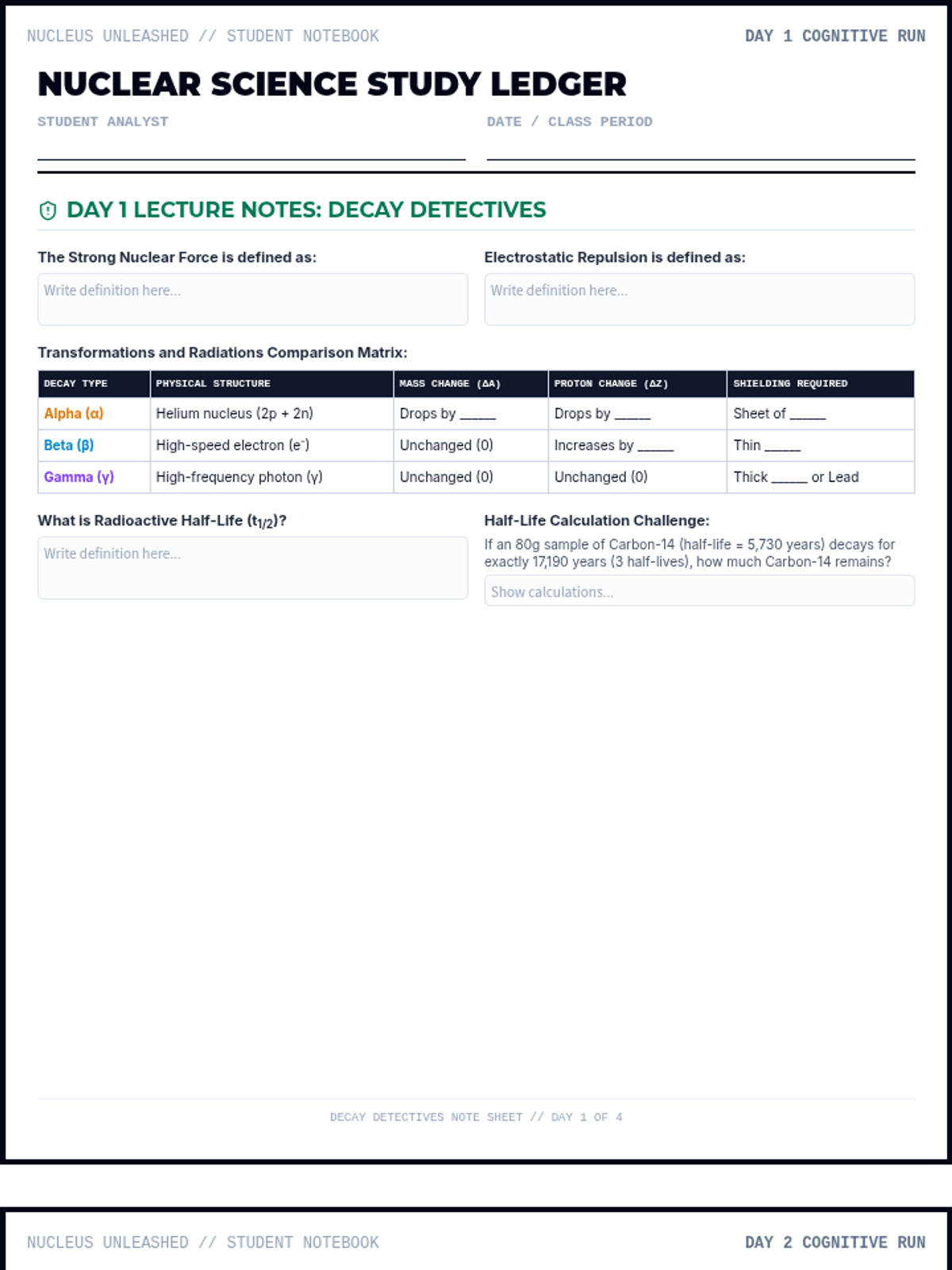
A comprehensive guided note-taking ledger for Days 1-4. Students fill out definitions, complete structural diagrams, and track key terms for radioactive decay, fission, fusion, and reactor operations while following along with slides.
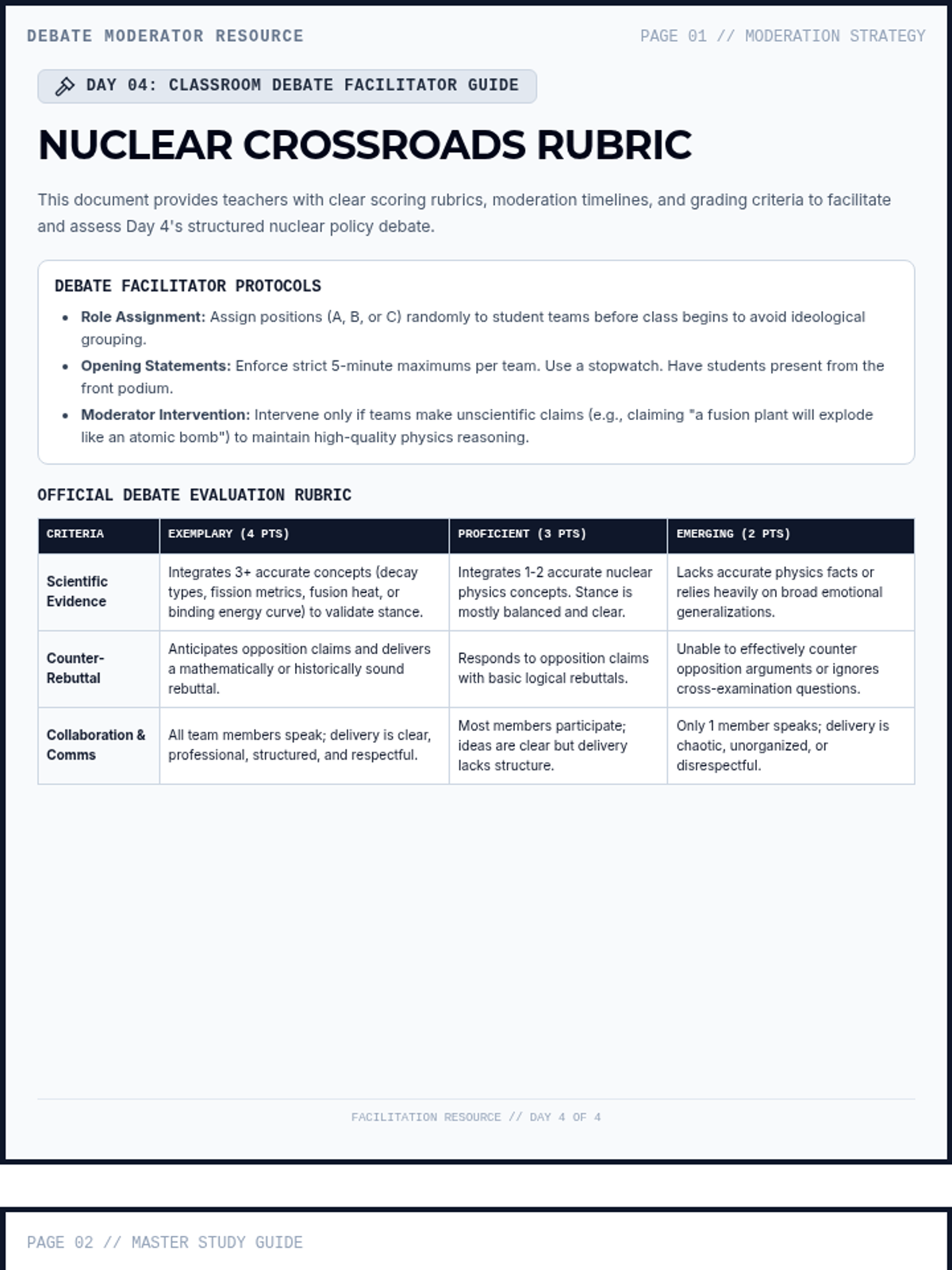
Day 4 Debate Evaluation Rubrics and Comprehensive Day 1-4 Master Review Key summarizing decay mechanics, fission/fusion thermodynamics, curve of binding energy, and core safety controls.
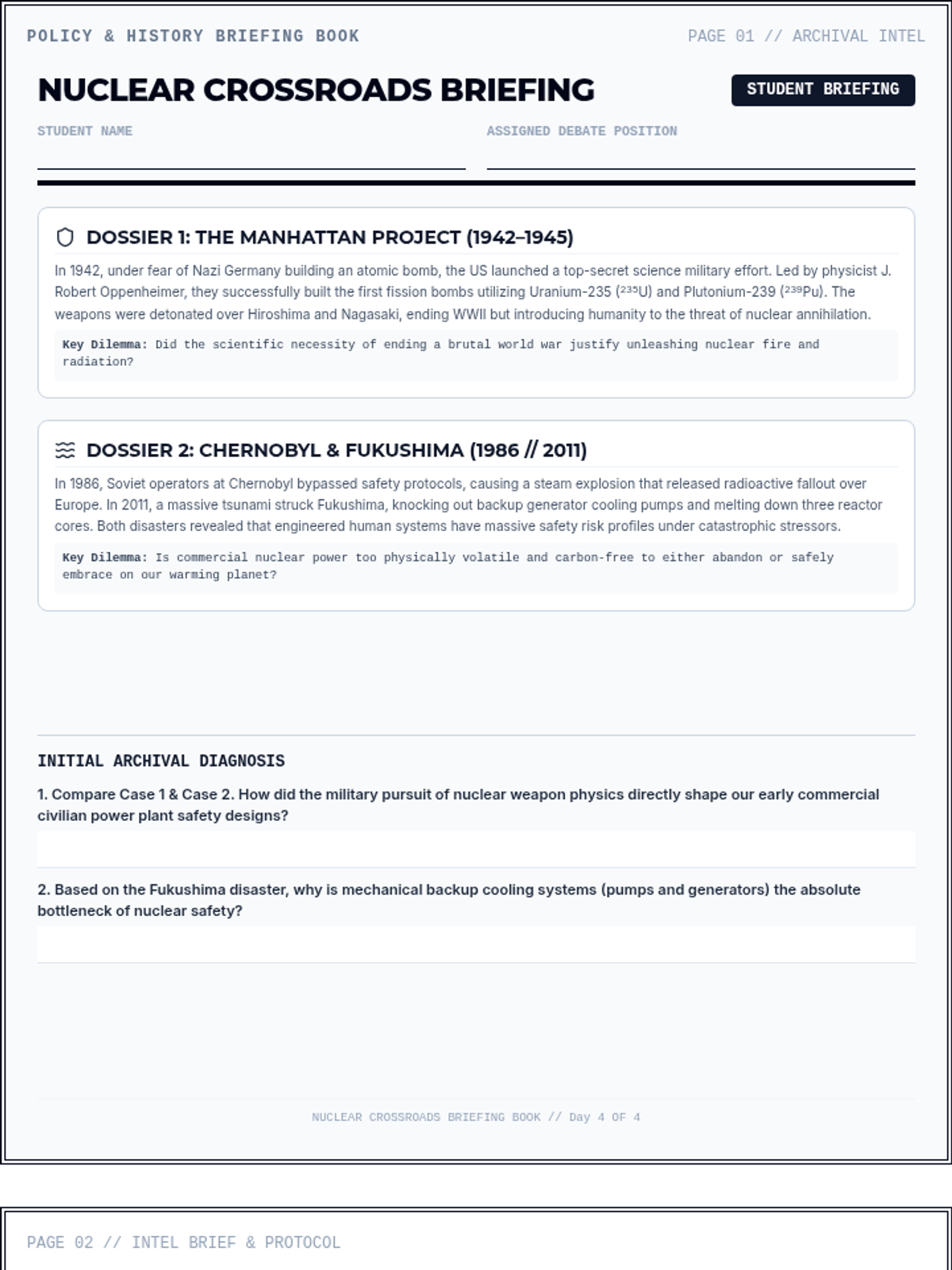
A historical case studies briefing document detailing the Manhattan Project, commercial nuclear failures, and next-generation fusion grids, coupled with structured debate rules and position worksheets.
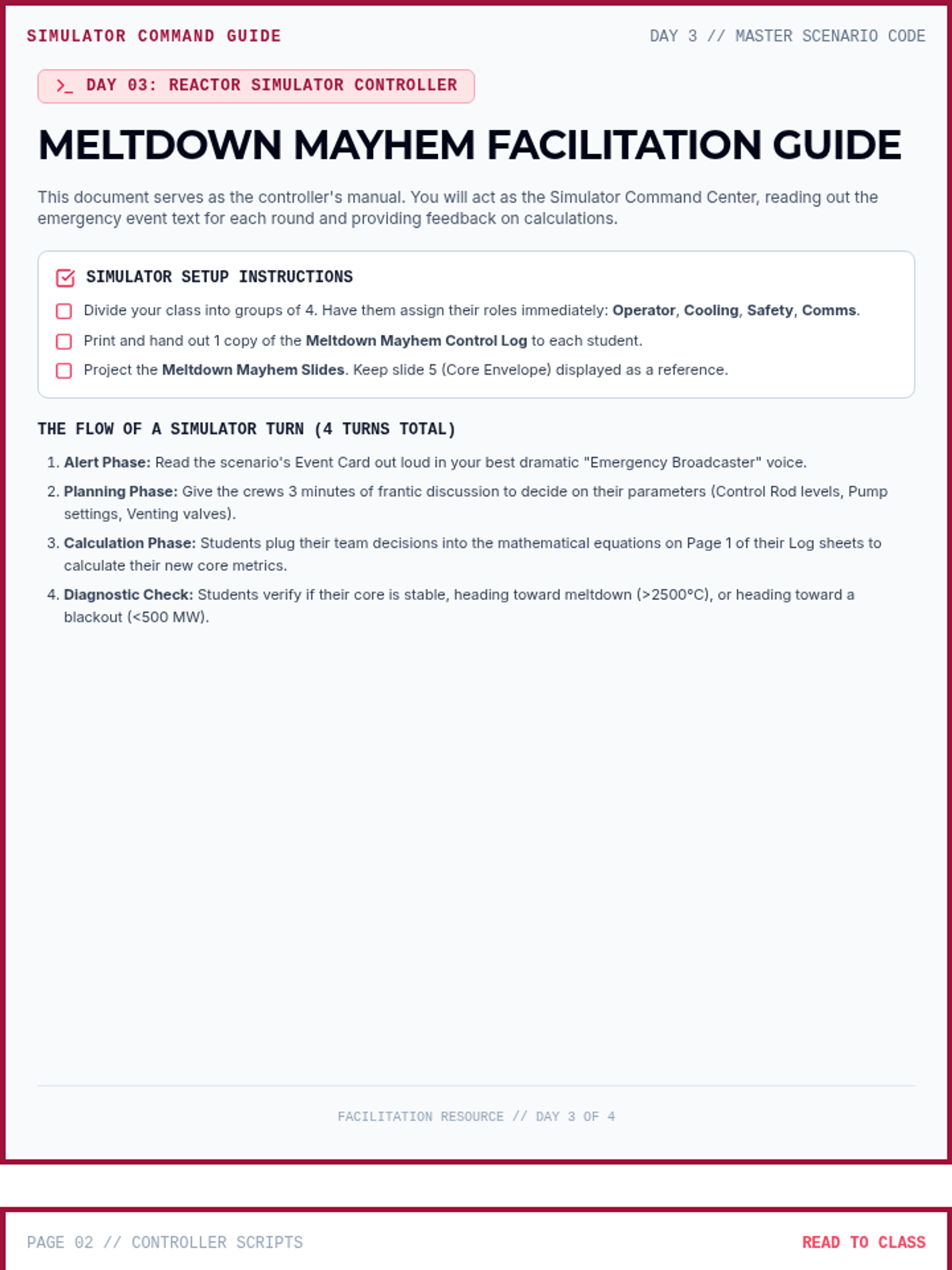
Day 3 Meltdown Mayhem Simulator Guide detailing full setup requirements, script, scenario events, and mathematical equations for managing the four reactor simulation crisis turns.
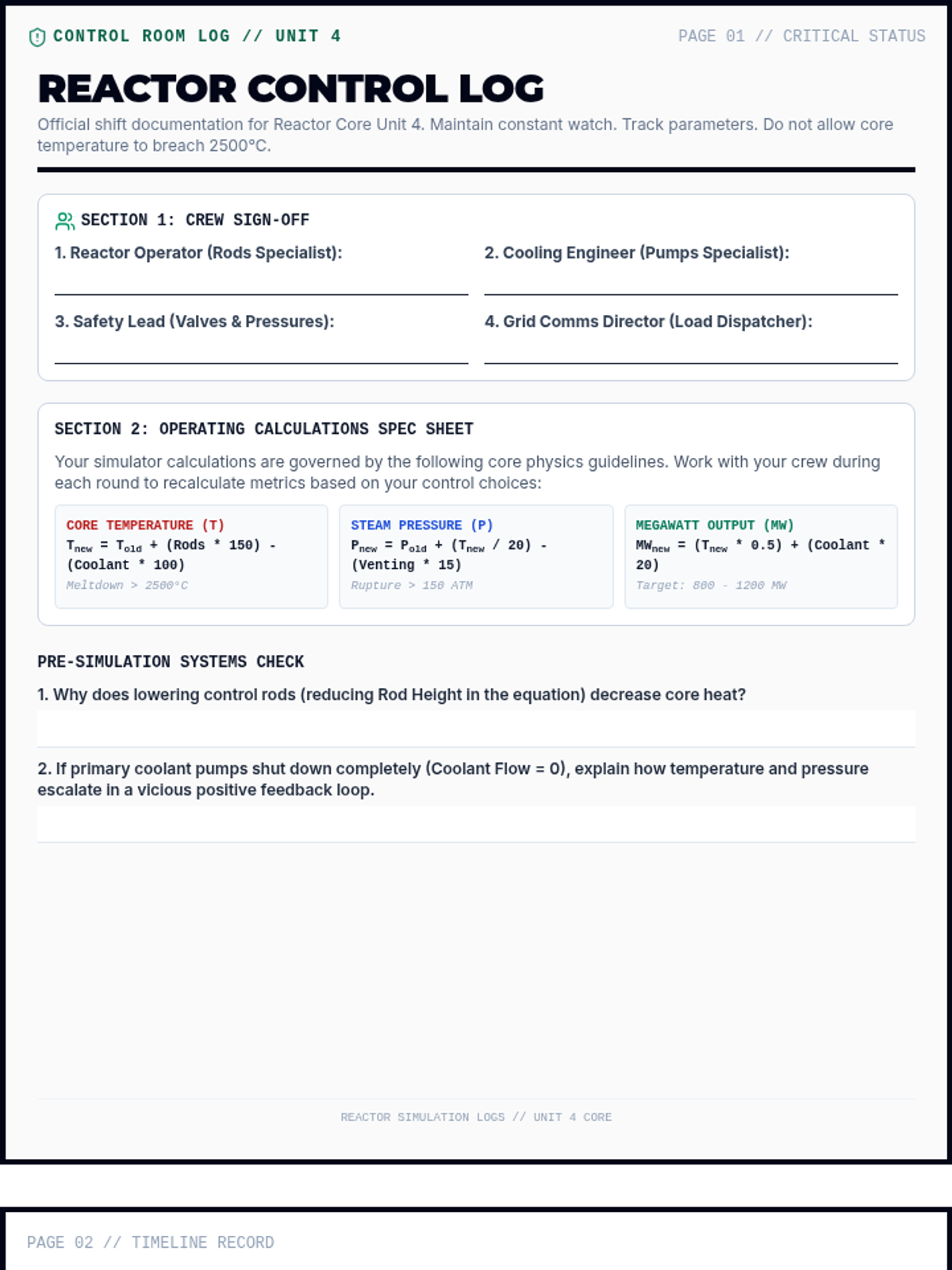
Day 3 Meltdown Mayhem Control Room Log where student control room teams of Operators, Cooling Leads, Safety Leads, and Comms Directors track core temperatures, pressures, and megawatts under 4 emergency event rounds.
A high-impact slideshow introducing mass defect, fission power plant core structures, operating boundaries (temperature, pressure, megawatts), and launching the live control room simulation game. Uses a bold, retro radioactive CRT green font-mono theme.
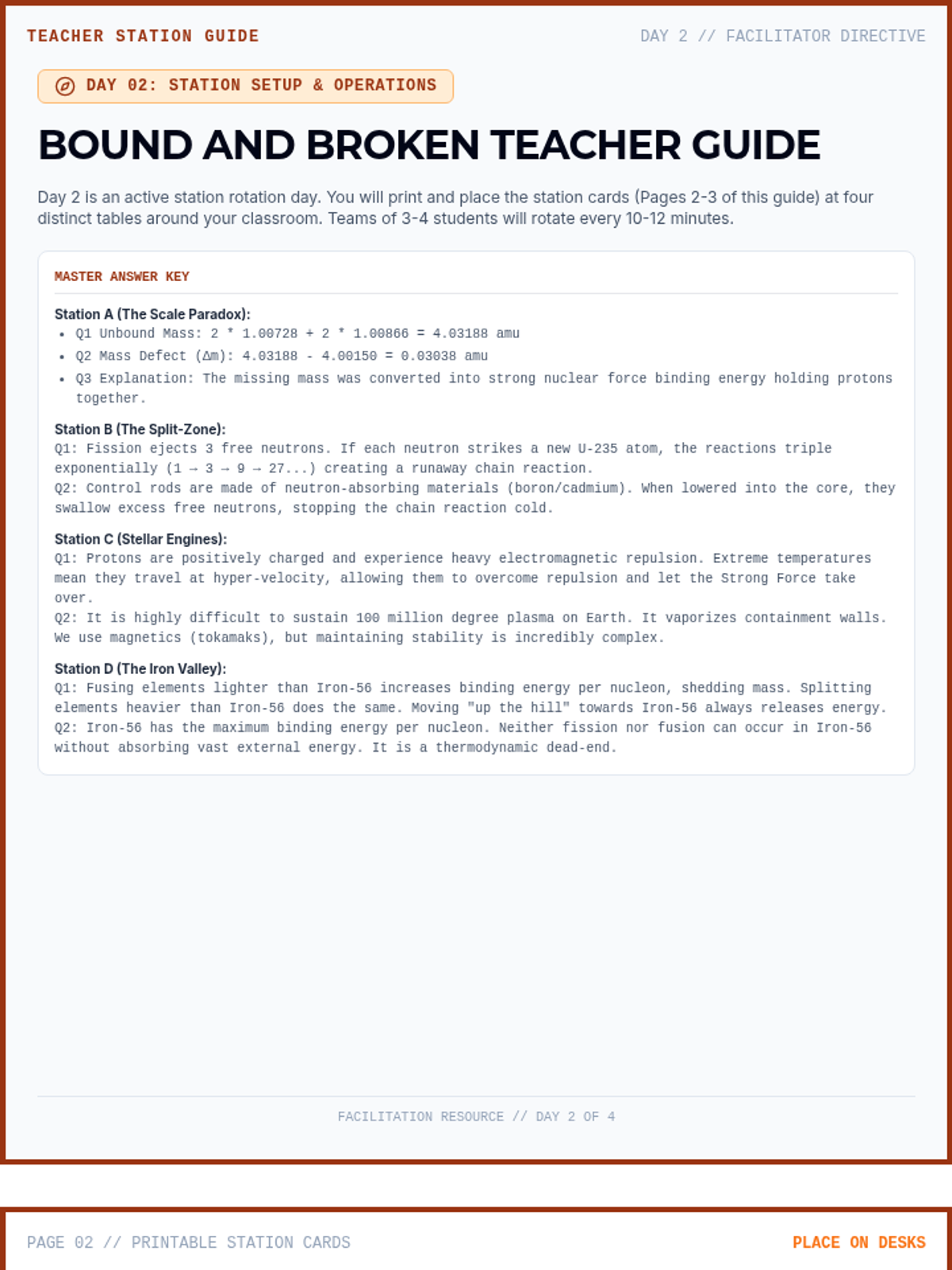
Day 2 Bound and Broken Station Cards and teacher's companion material. Contains comprehensive answers for stations A-D and printable classroom desk sign guides.
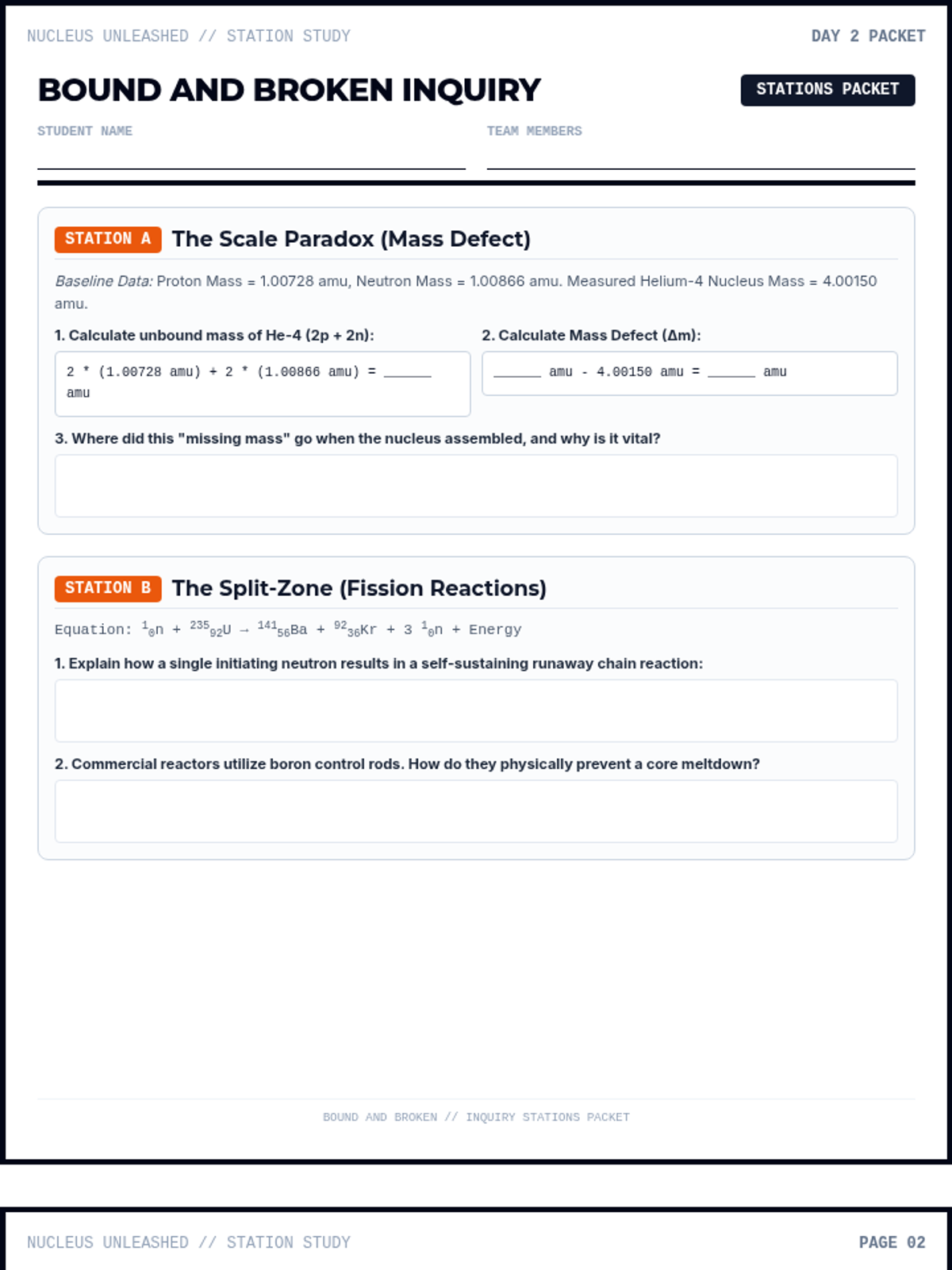
An active, guided inquiry station worksheet packet allowing students to transition through four key areas comparing nuclear mass defect, fission chain reactions, fusion requirements, and the curve of binding energy.
A high-impact slideshow introducing mass defect, binding energy calculations, Uranium fission chain reactions, stellar fusion, and the overarching curve of binding energy. Uses distinct, heavy industrial orange colors.
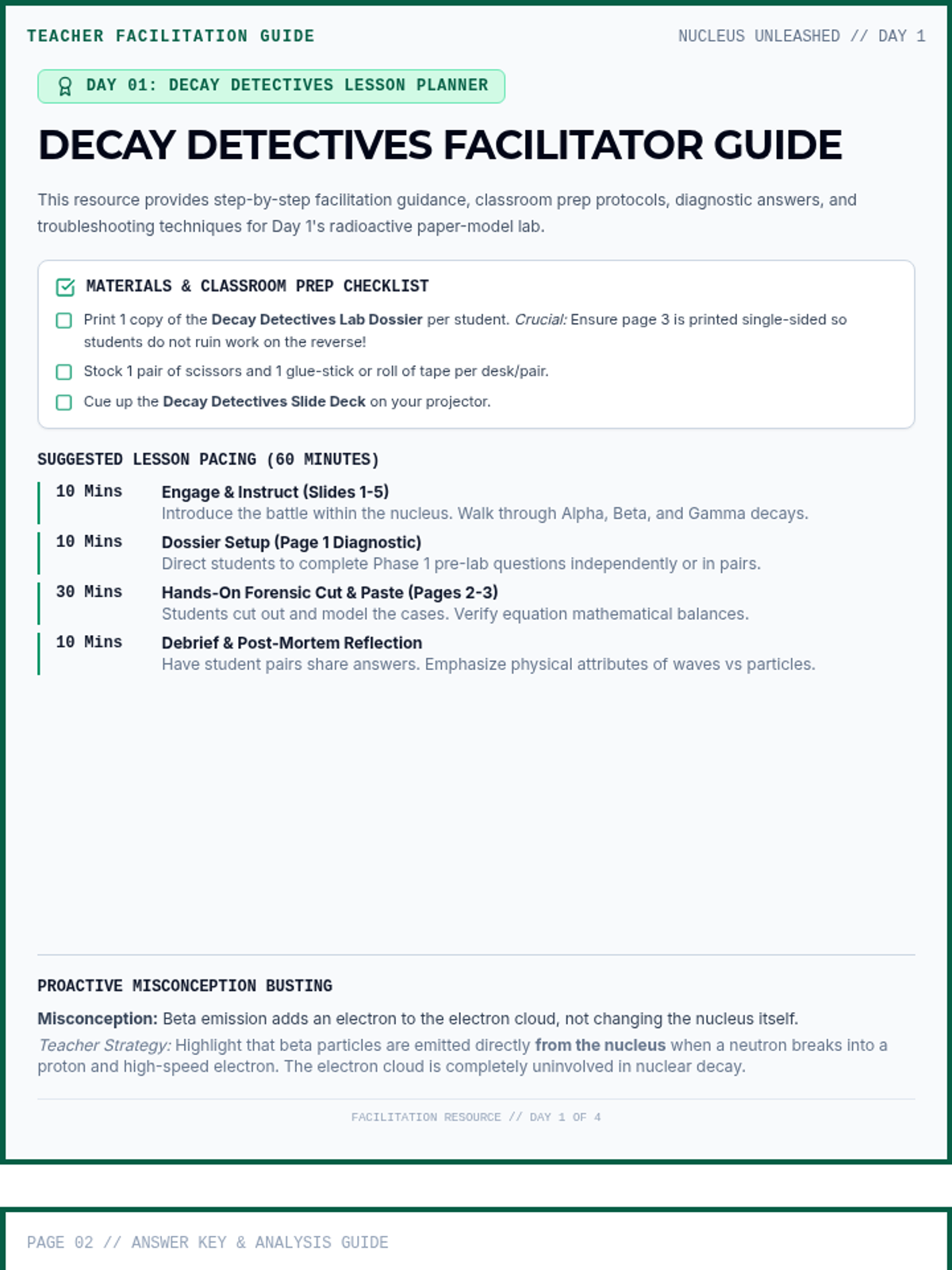
Day 1 Decay Detectives Teacher Guide detailing full printable setup requirements, structural pacing timelines, common misconceptions, and detailed diagnostic, equation, and reflection answer keys.
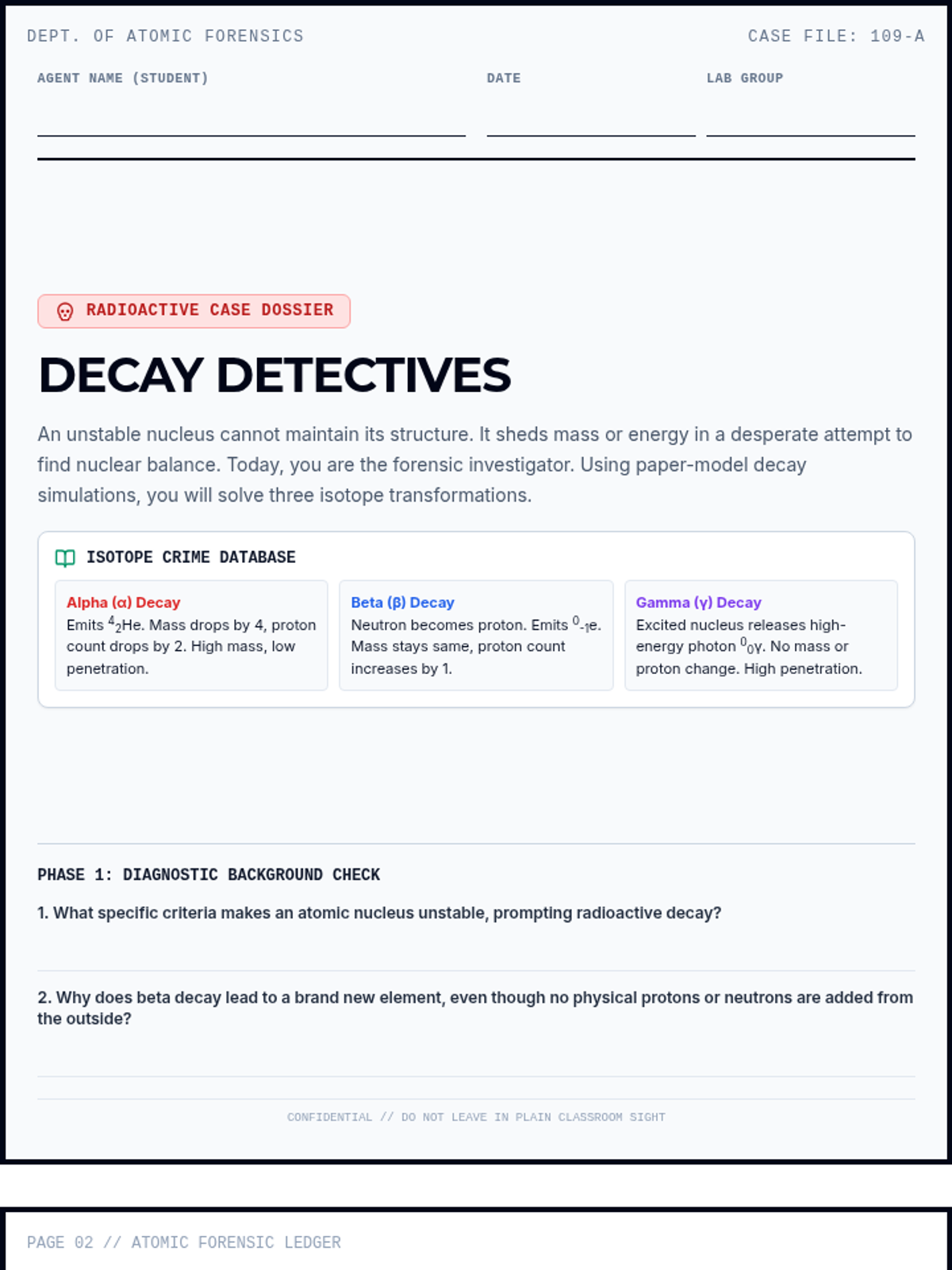
An interactive printable paper-model lab dossier where students cut out parent isotopes, daughter isotopes, and radiation tokens to physically simulate Alpha, Beta, and Gamma decays, followed by equation solving and forensic diagnostic analysis.
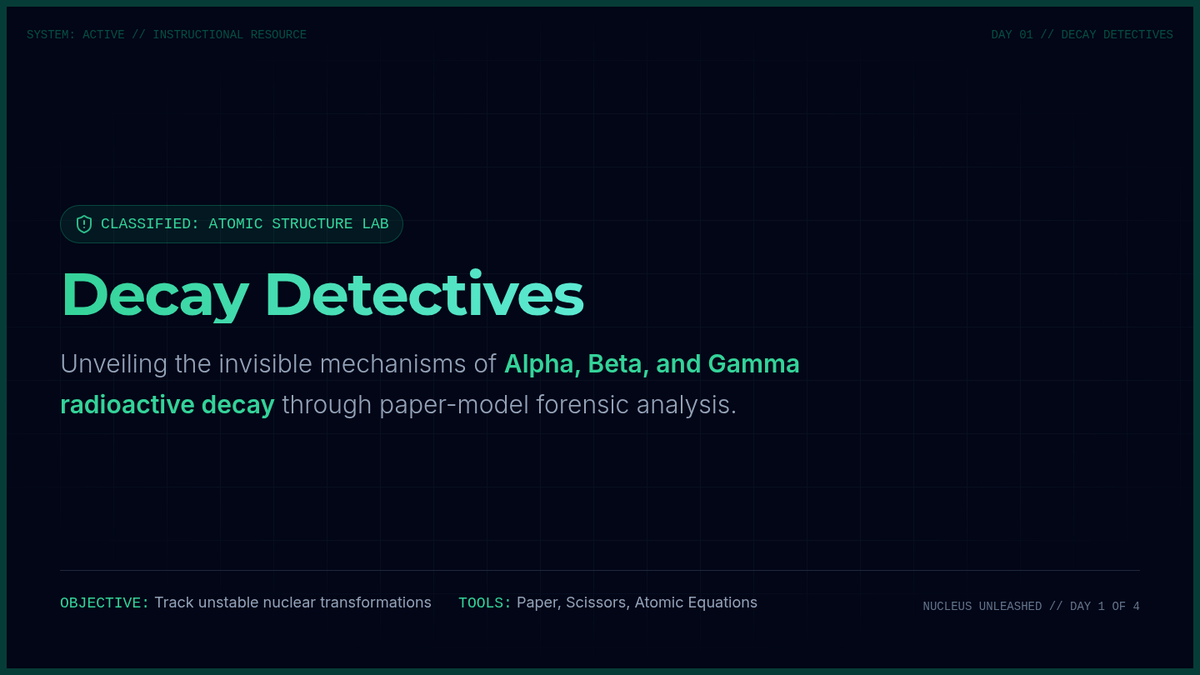
A sleek, interactive slideshow teaching the mechanisms of Alpha, Beta, and Gamma radioactive decays using clear, large visuals, symbolic equations, and nuclear structure breakdowns. Designed with a high-contrast chalkboard aesthetic for maximum classroom visibility.
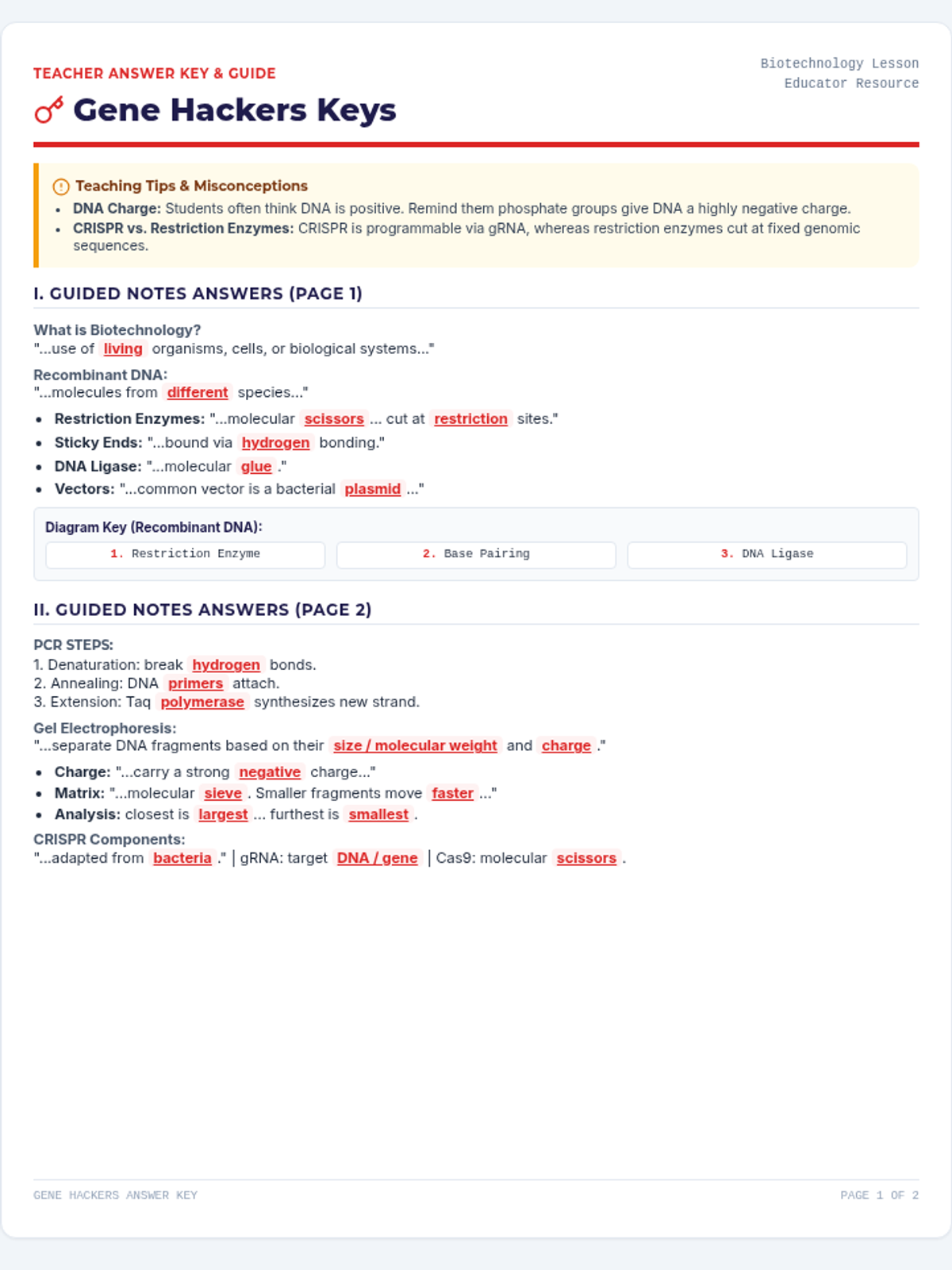
An educator's answer key and reference sheet containing all the filled-in guided notes answers, quiz answer key with detailed explanations, and classroom teaching points. Perfected to avoid physical page overflows.
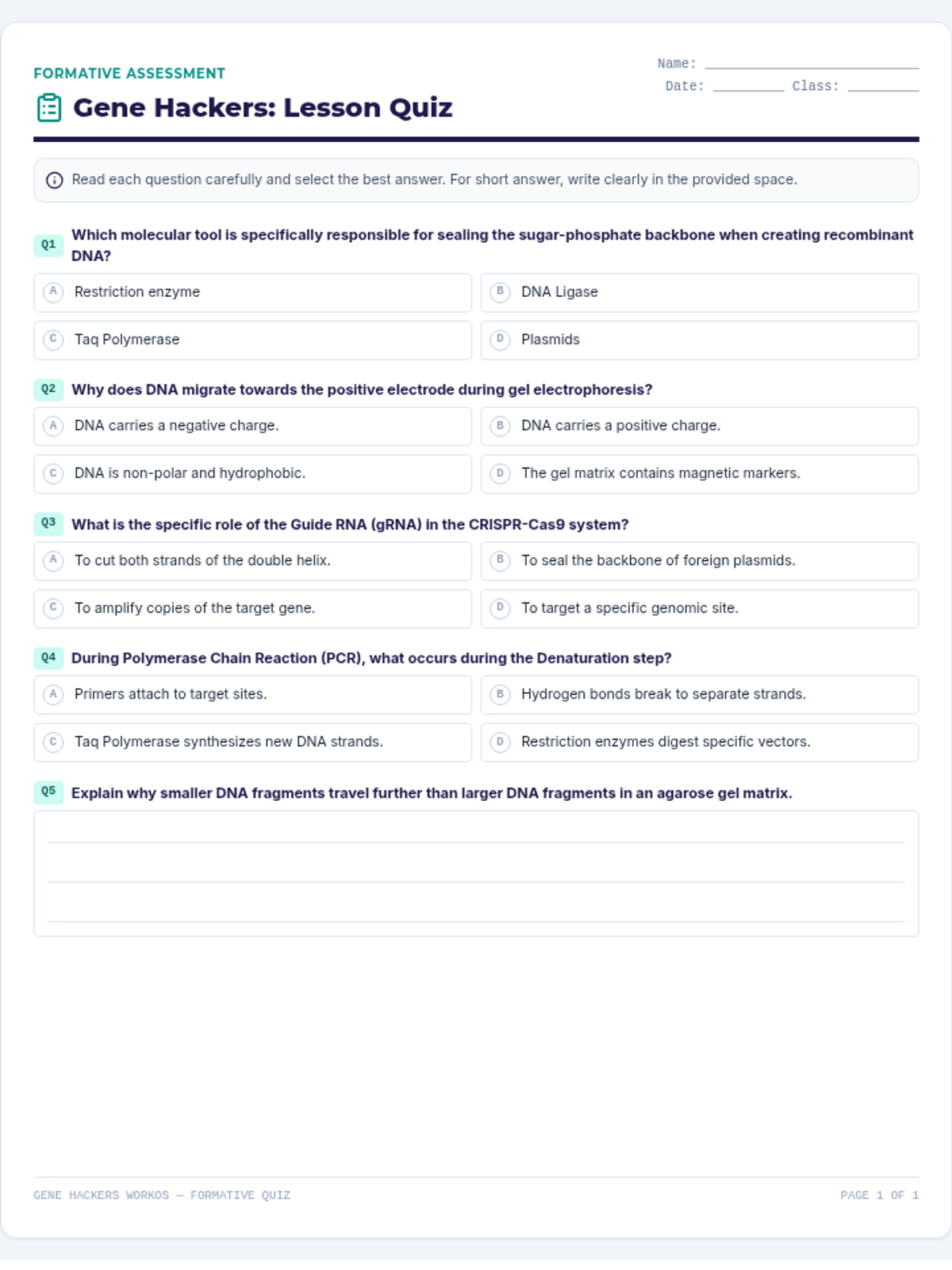
A formal, clean formative assessment quiz containing 4 carefully designed multiple-choice questions and 1 short answer question covering PCR, CRISPR, and Gel Electrophoresis. Perfected layout to fit exactly on one page.
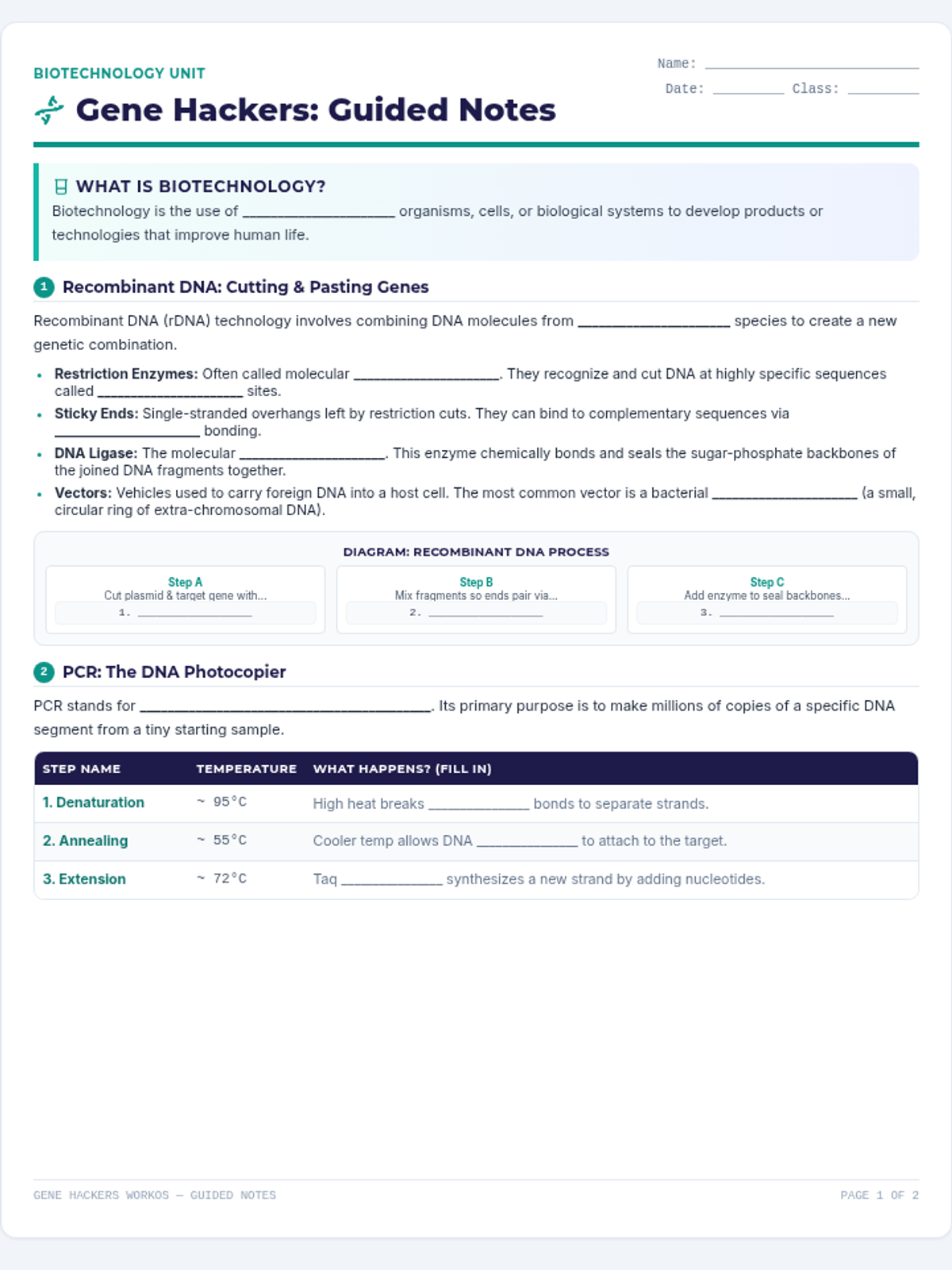
A structured student guided notes worksheet covering Biotechnology fundamentals: Recombinant DNA, PCR, Gel Electrophoresis, and CRISPR-Cas9, with diagram-labeling and handwritten answer lines. Perfected layout to prevent physical page overflows.
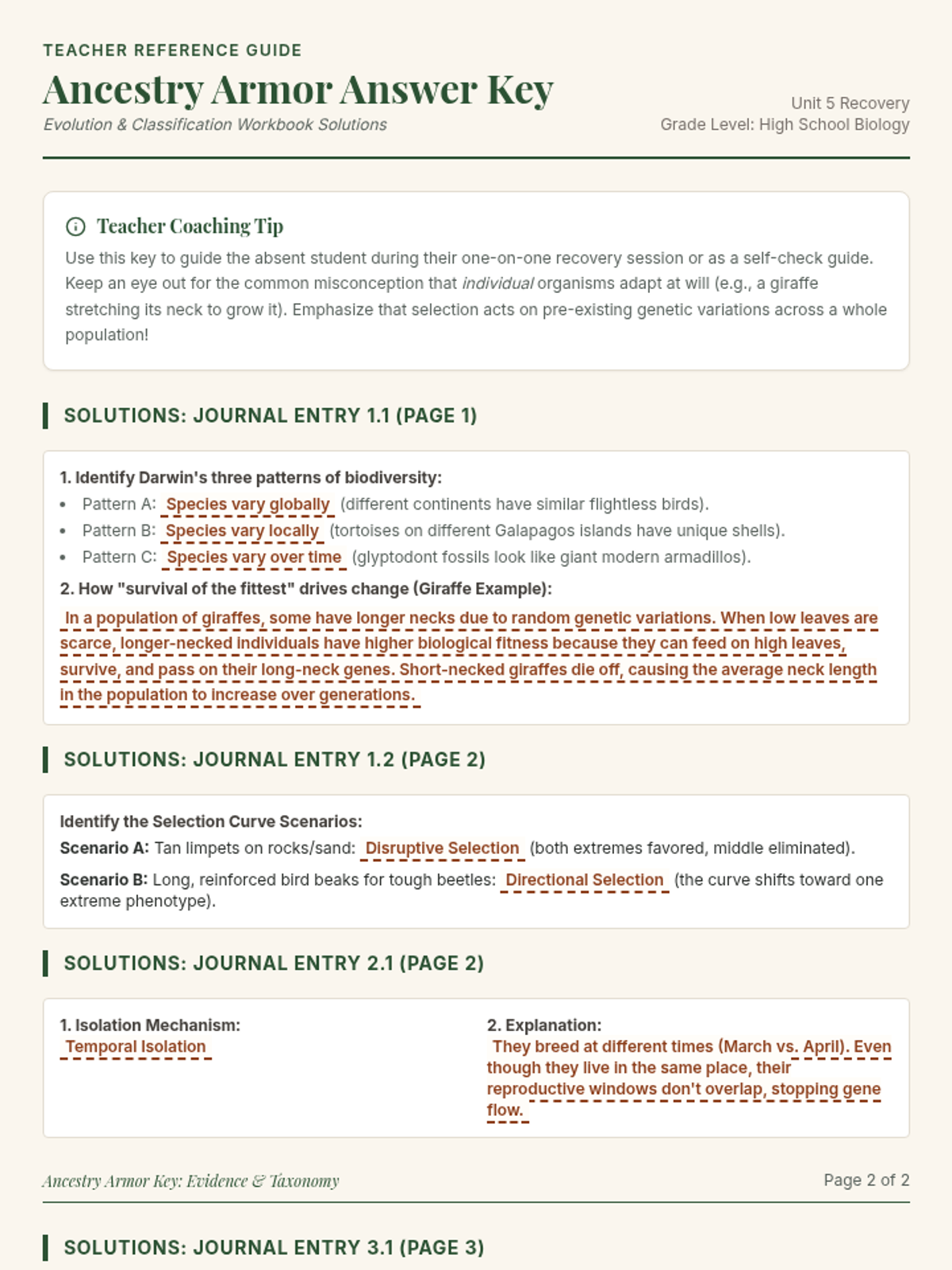
The complete teacher answer key and student self-check guide for the Ancestry Armor workbook. Features clear red/brown markings on filled-in solutions, comparative biology hints, and teacher-focused coaching tips for overcoming common student misconceptions.
Self-paced review and instructional slides formatted for high readability (all text larger than 24px) that covers Darwin's journey, the four engines of natural selection, the three selection graphs, speciation, lines of comparative evidence, and Linnaean taxonomy.