A step-by-step instruction sheet for students to create their own fossil molds and casts using clay and plaster. Includes a materials checklist and safety notes formatted as a field guide.
A high-contrast visual presentation about stars and space exploration tools, designed to be accessible for students with diverse learning needs.
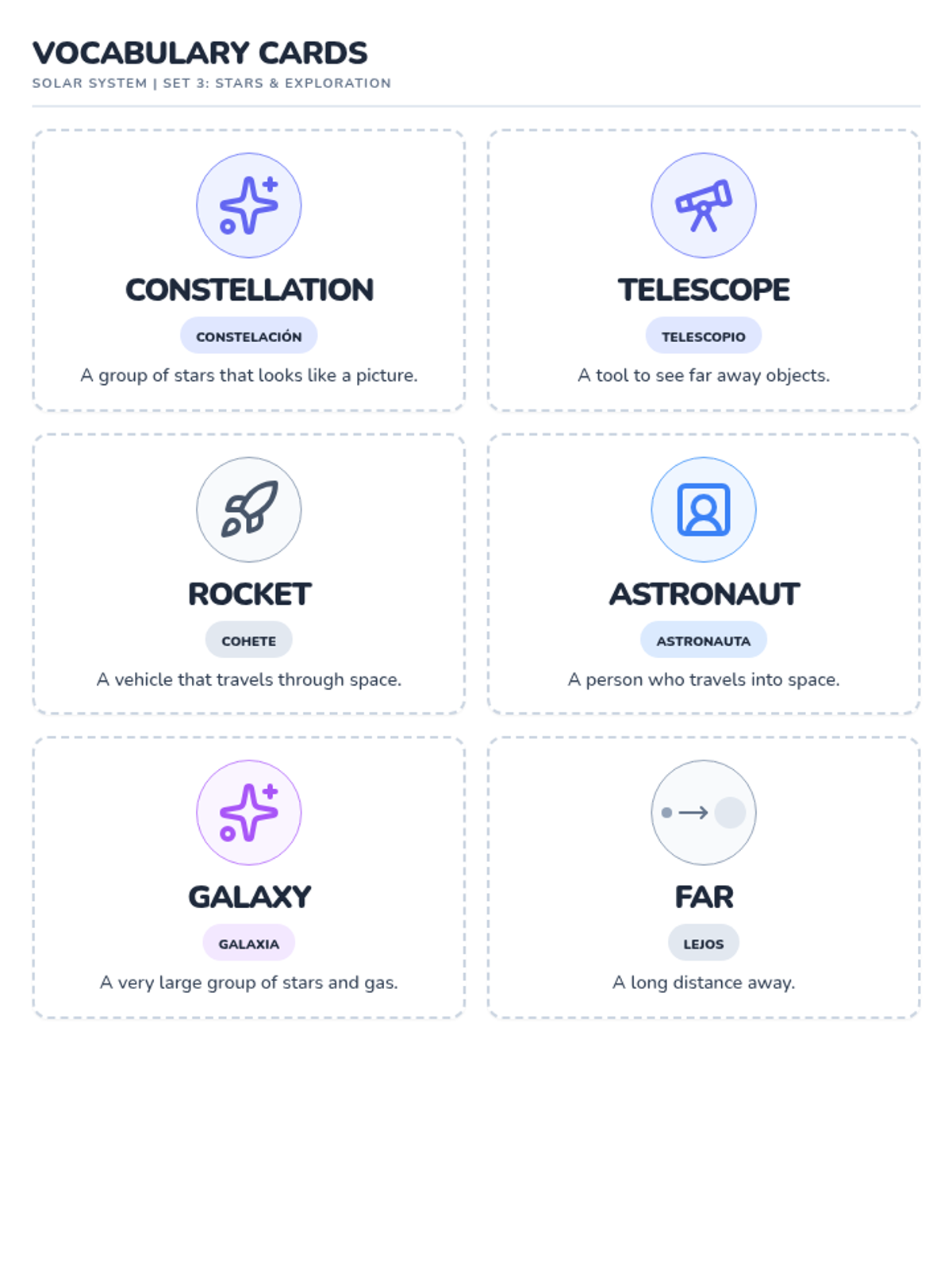
Vocabulary cards for stars and space exploration, featuring bilingual labels and simple definitions to assist newcomers and students with special needs.
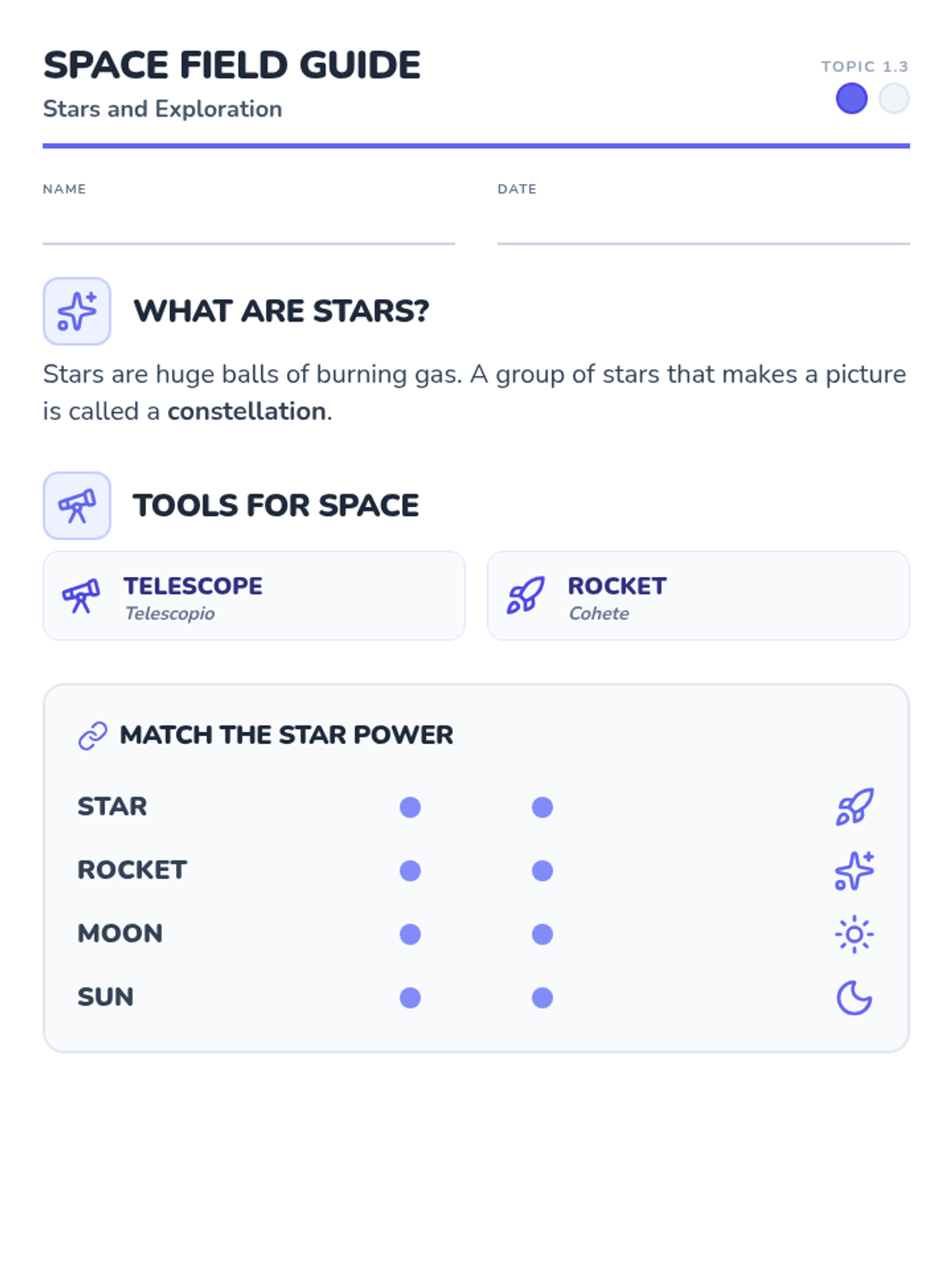
A simplified reading passage about stars, telescopes, and rockets with matching activities for students with cognitive differences.
Visual presentation for the planets lesson, illustrating the differences between rocky inner planets and gas giant outer planets with clear graphics and large text.
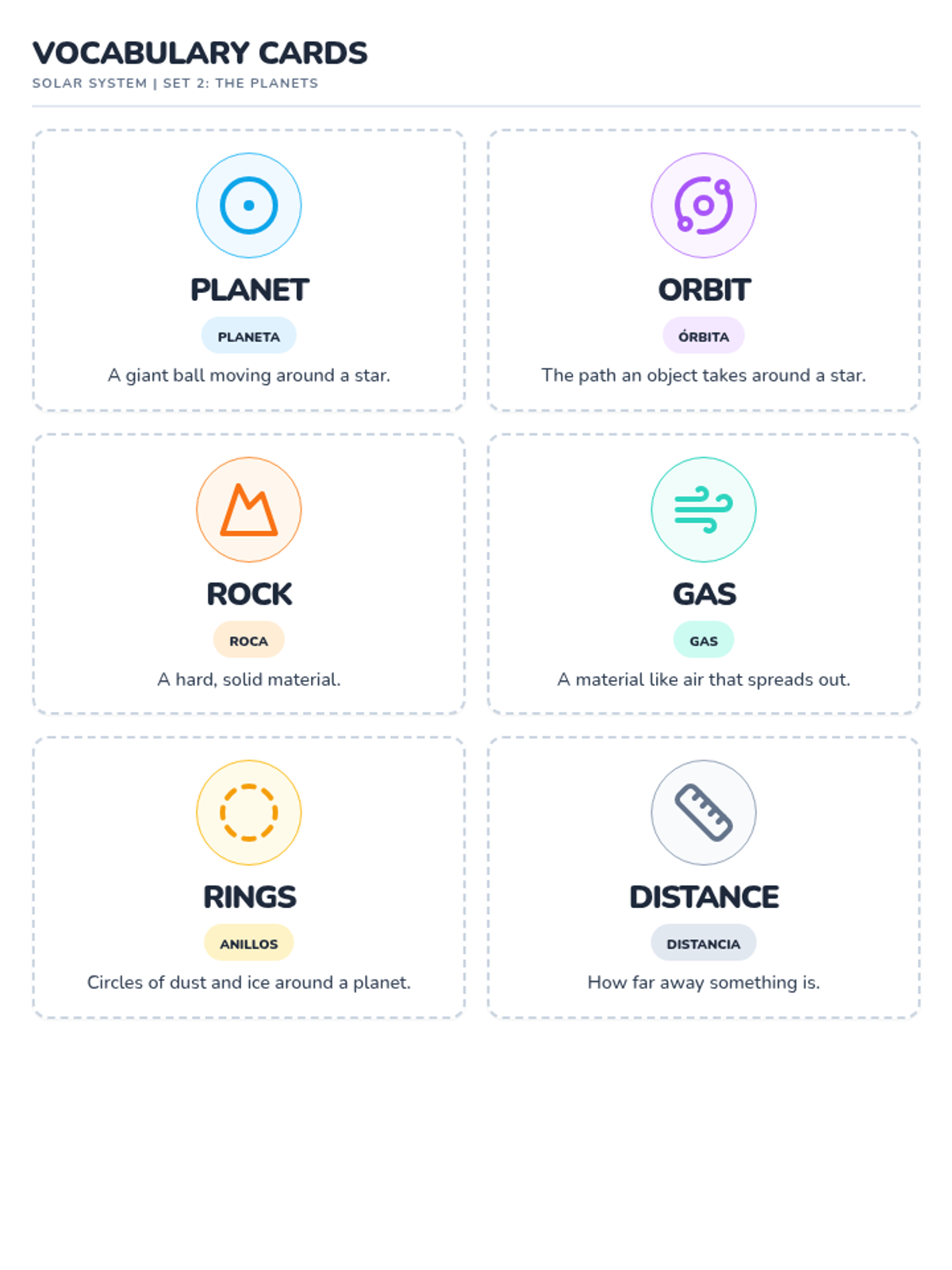
Vocabulary cards focusing on planetary concepts like orbit, rock, and gas, with bilingual support and simplified definitions.
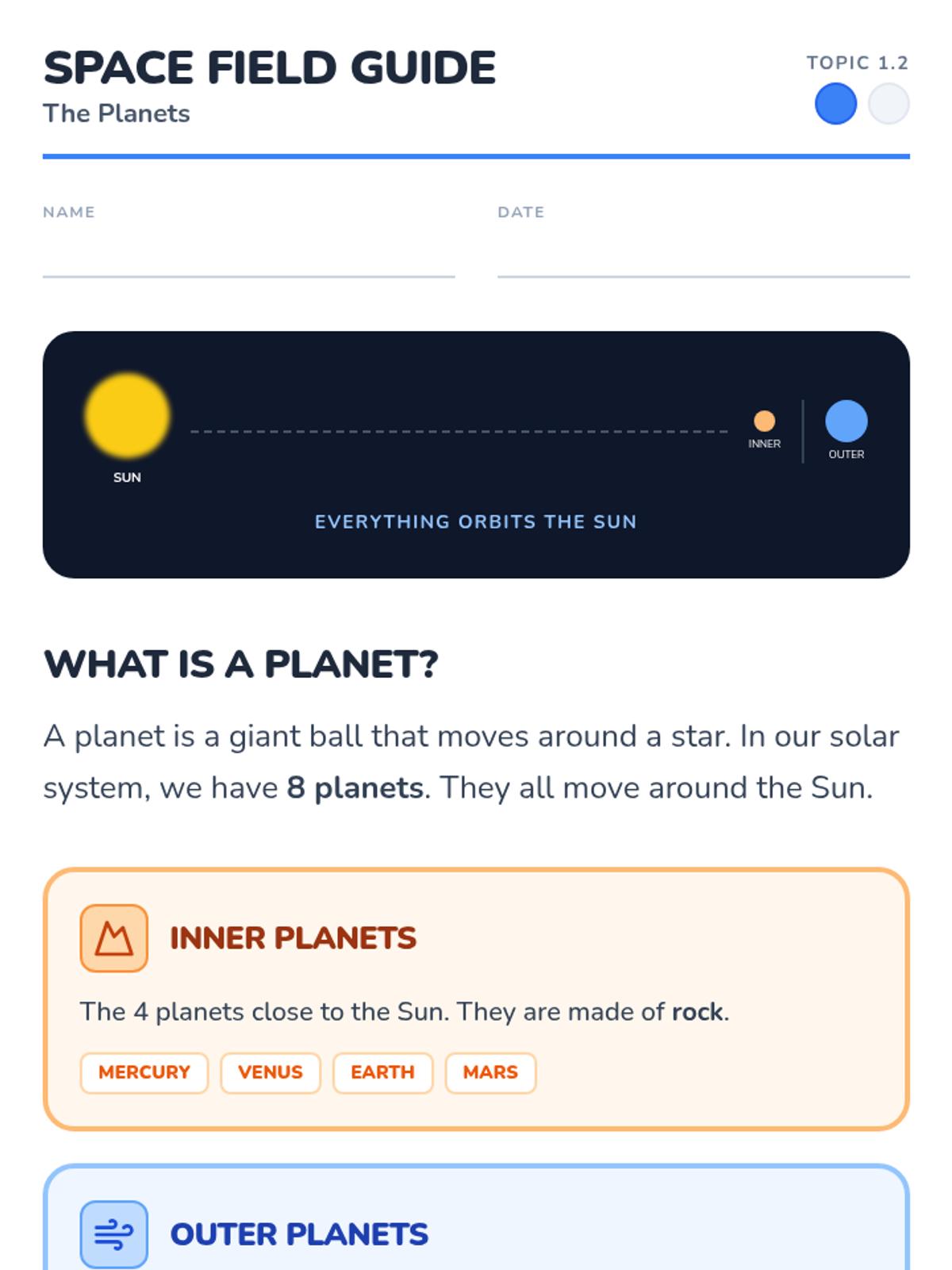
A simplified reading passage about the eight planets, divided into inner rocky planets and outer gas giants, designed for students with lower reading levels.
Highly visual presentation slides for the Sun and Moon, featuring large text and bold icons to support newcomers and students with special needs.
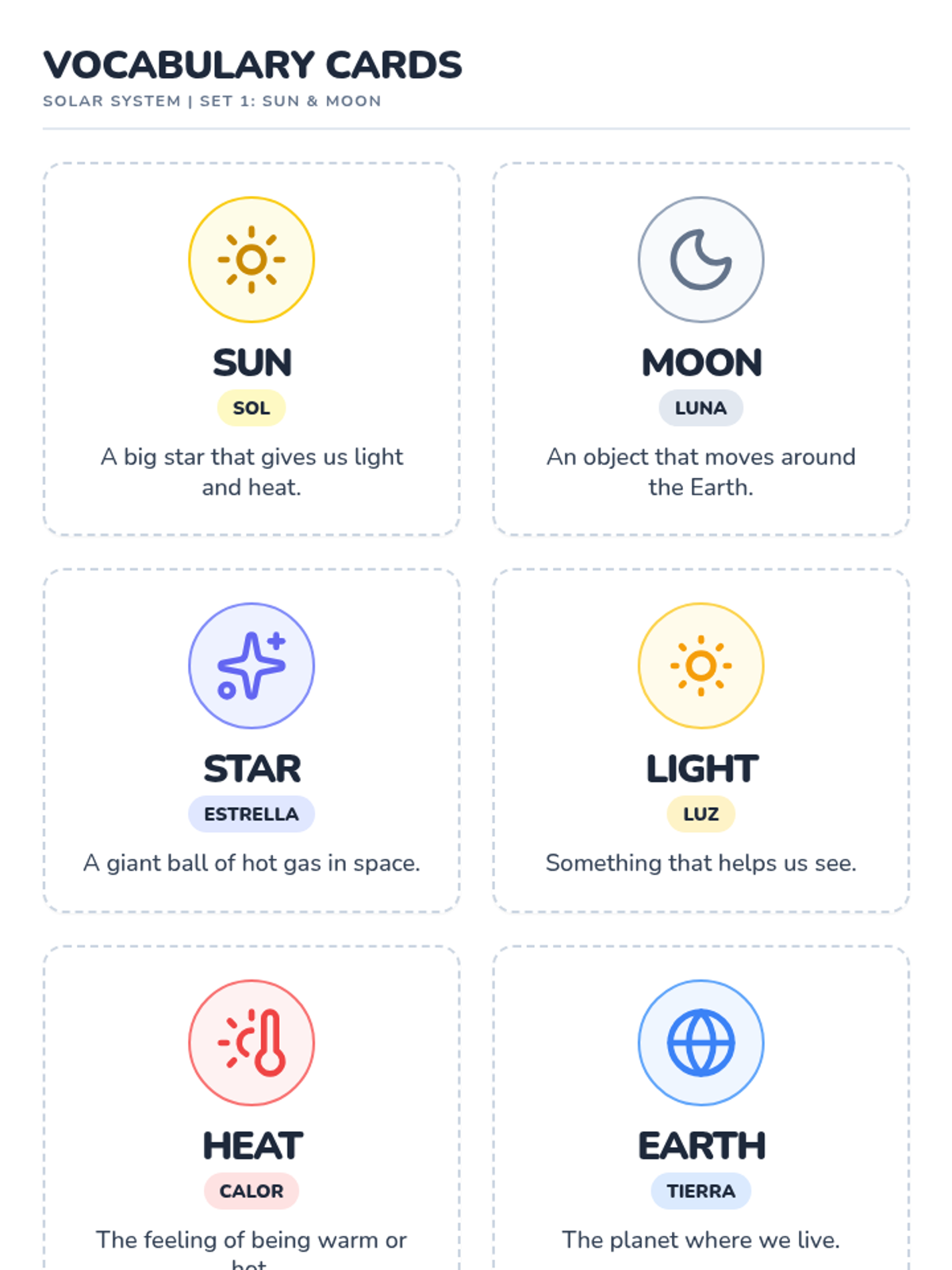
Visual vocabulary cards for the Sun and Moon lesson, including Spanish translations for newcomers and simplified definitions for IEP students.
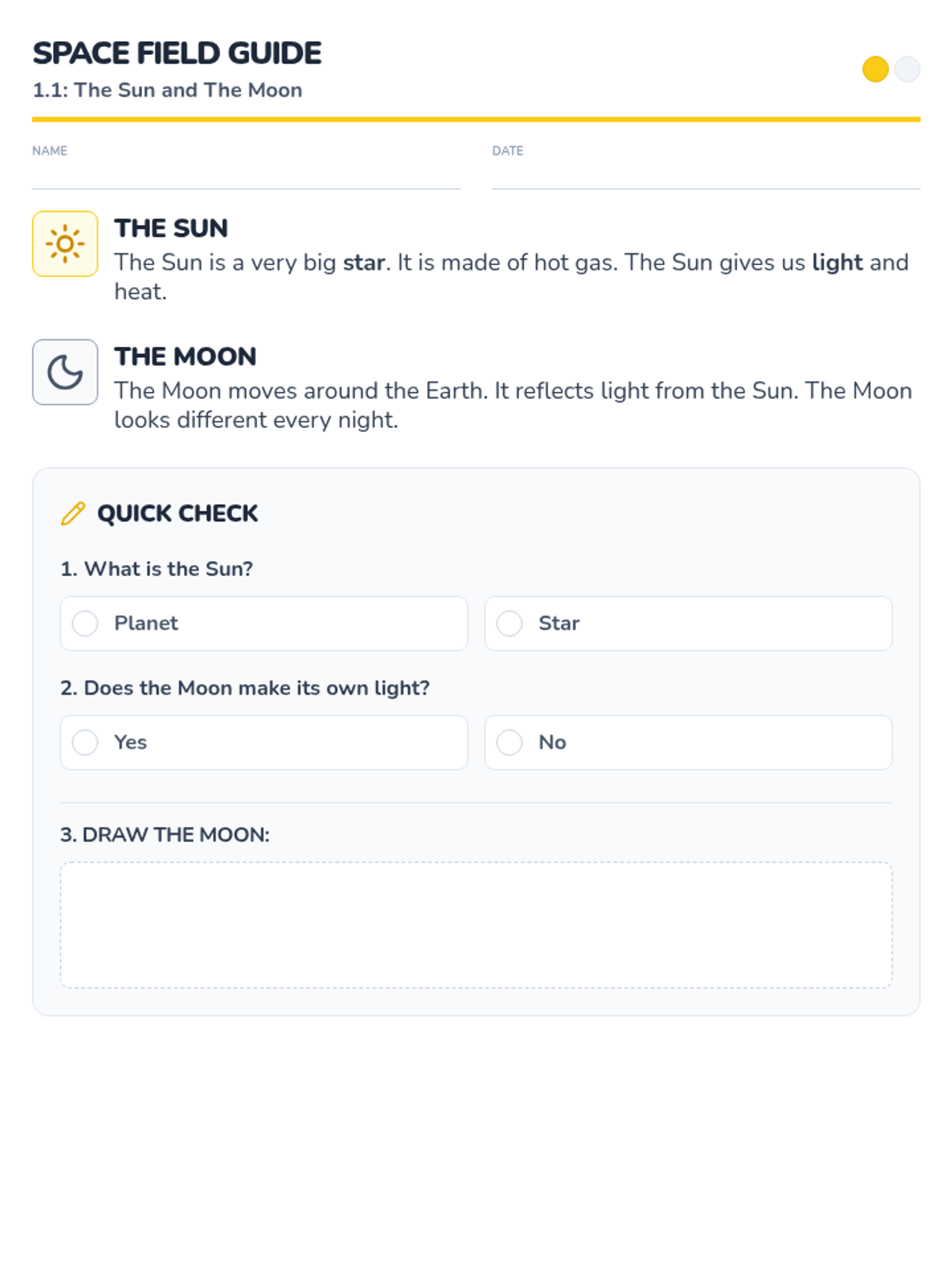
A simplified reading passage about the Sun and Moon with large text, visual icons, and simple comprehension questions for students with reading difficulties.
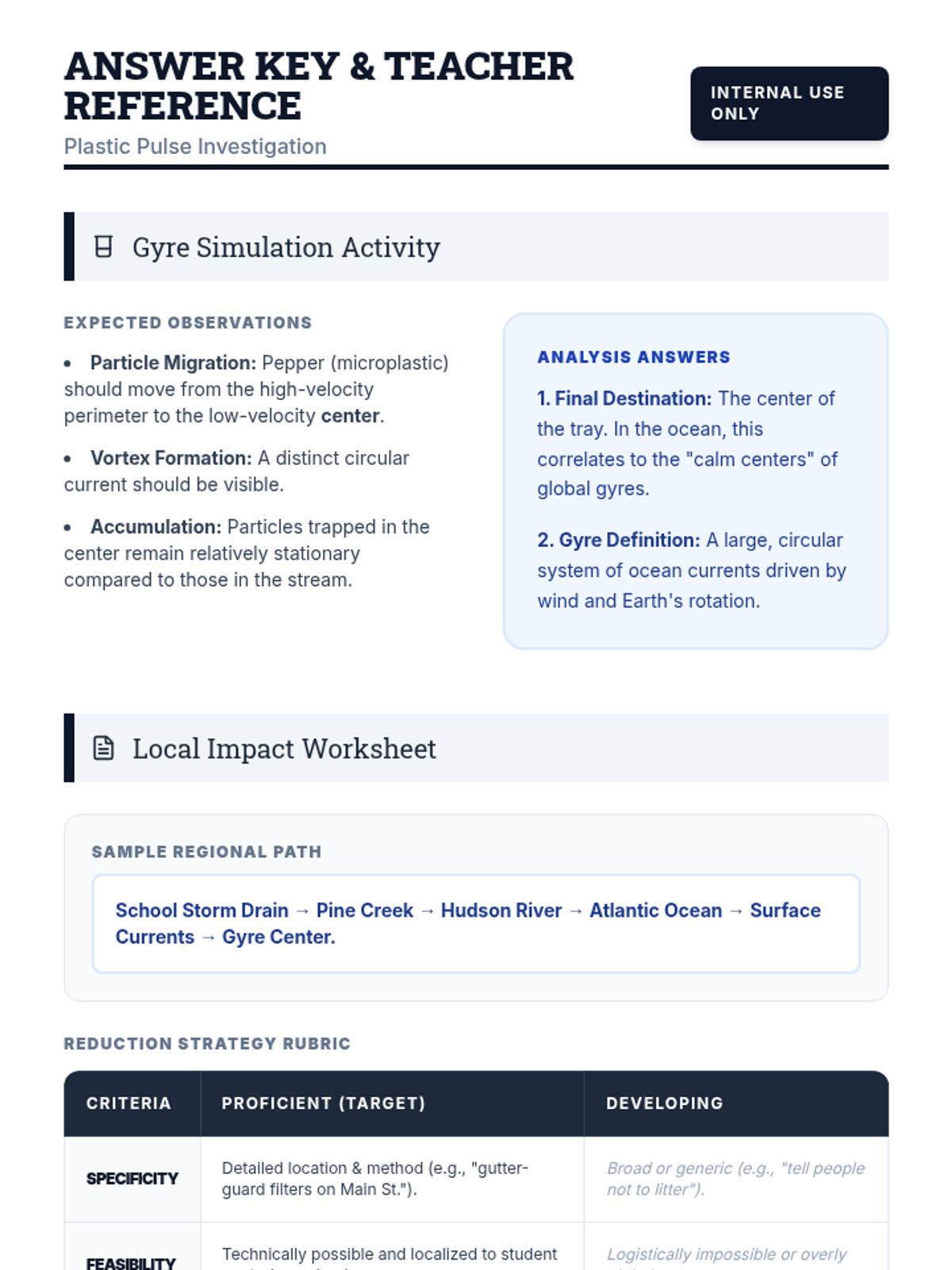
A teacher's reference guide containing expected student results, grading rubrics, and tips for addressing common misconceptions about ocean plastic pollution.
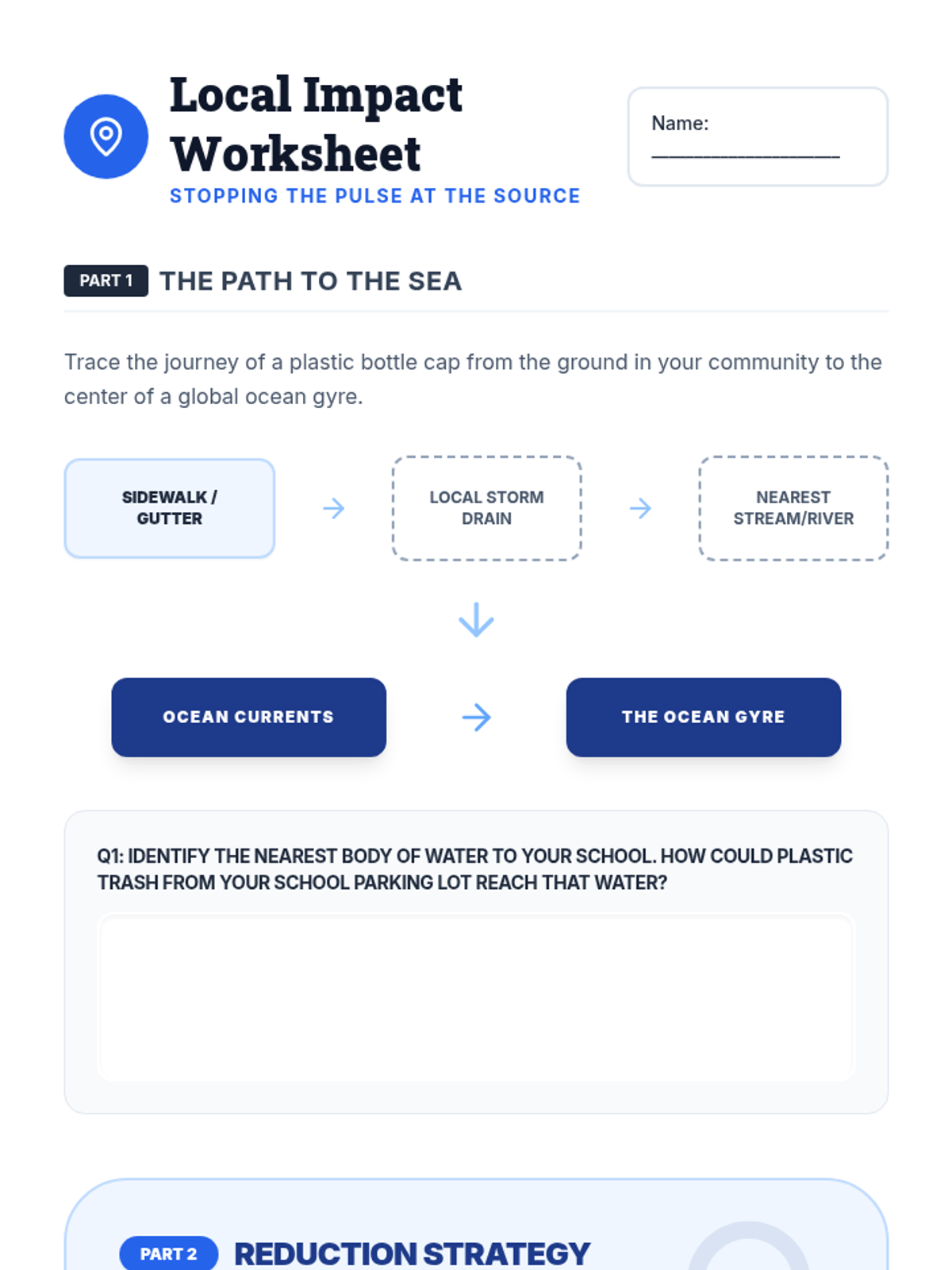
A synthesis worksheet where students trace the path of plastic from their local community to global gyres and design a localized intervention strategy to prevent plastic pollution.
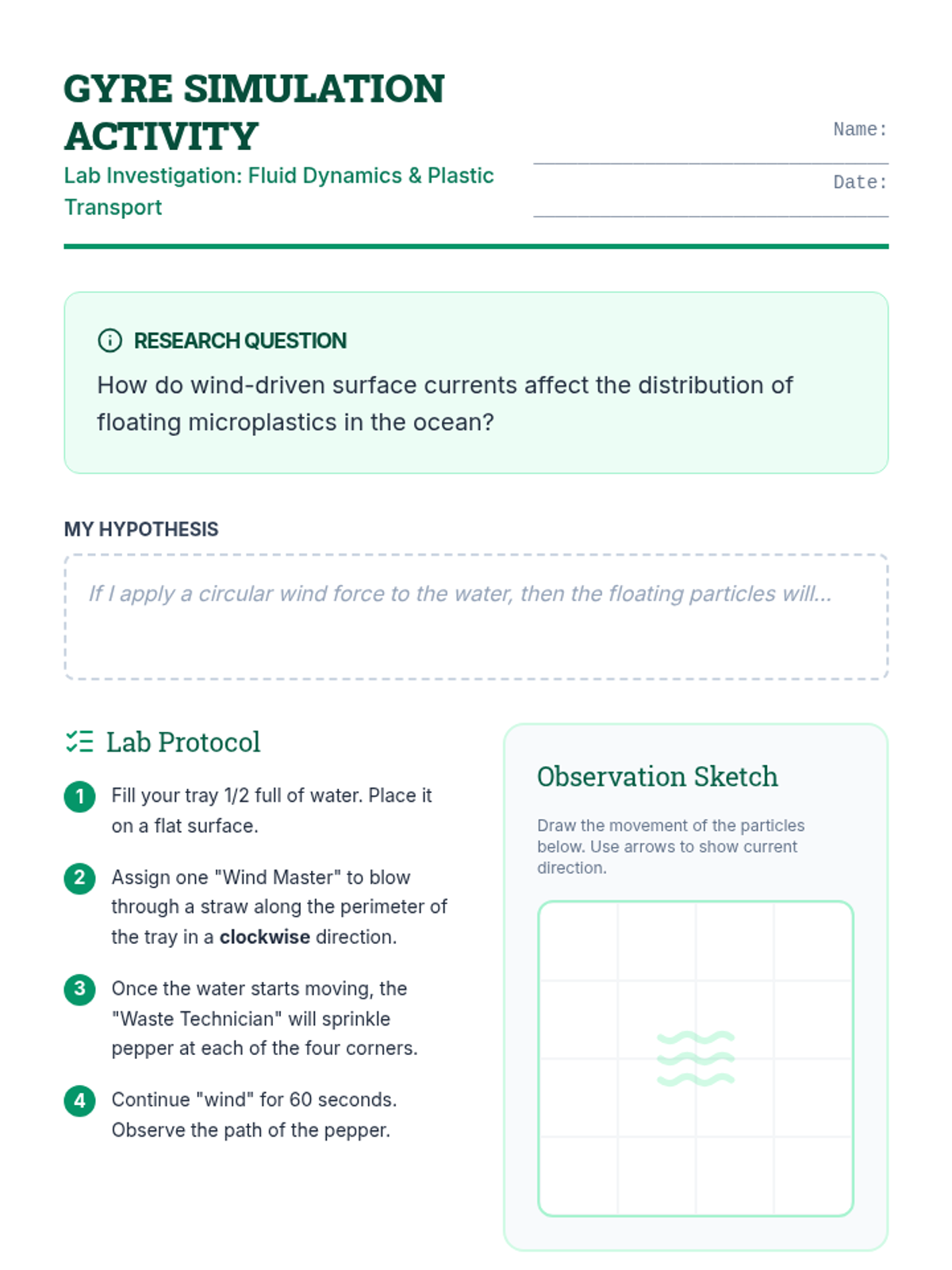
A structured lab sheet for students to document their ocean gyre simulation, including hypothesis formation, observation sketches, and analytical questions.
A visually engaging slide deck that introduces the concept of microplastics, explains ocean gyres and the Coriolis Effect, and sets up the hands-on simulation lab.
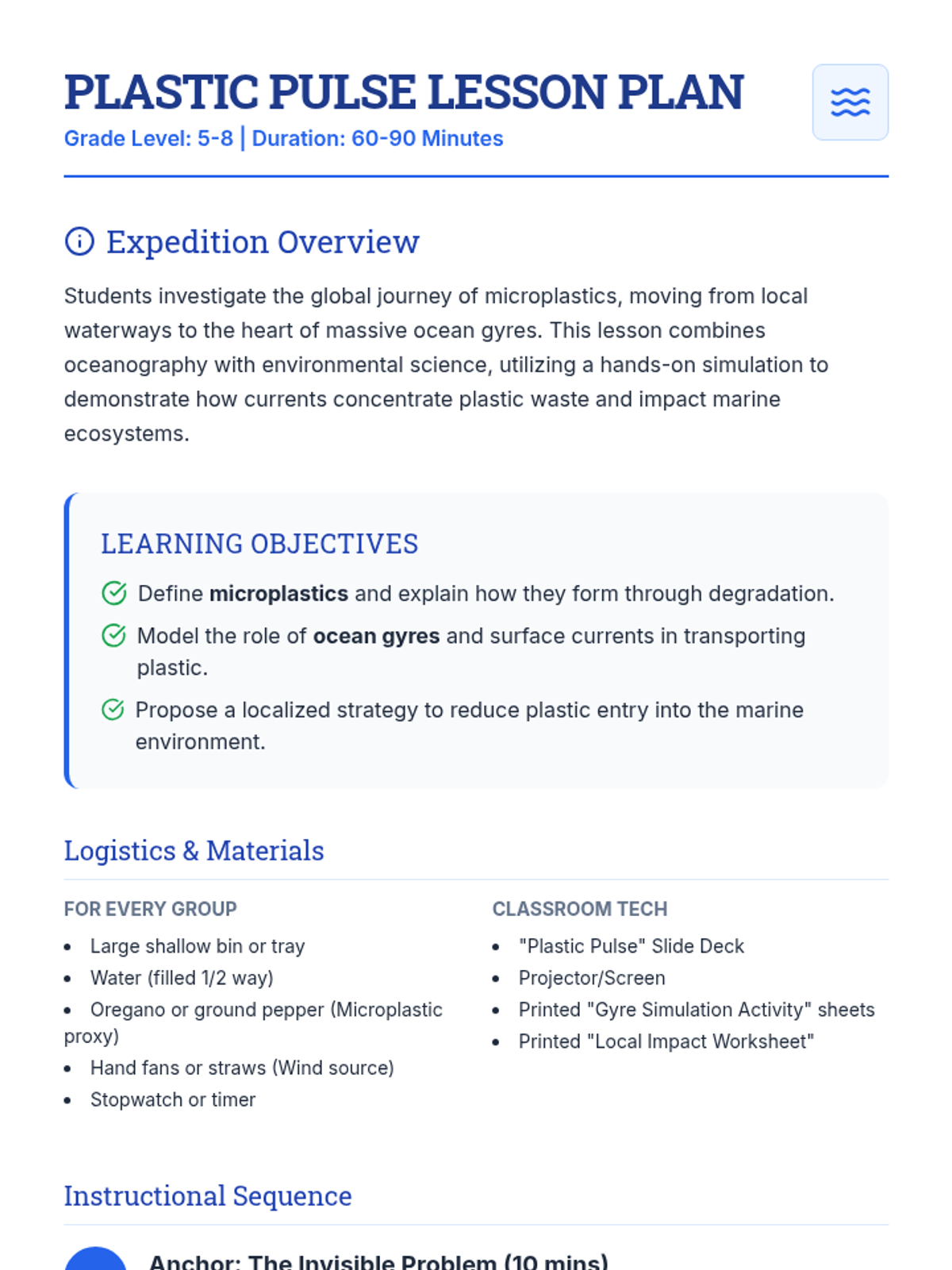
A comprehensive teacher's guide for the Plastic Pulse lesson, including learning objectives, a detailed instructional sequence, and differentiation strategies for investigating microplastic transport.
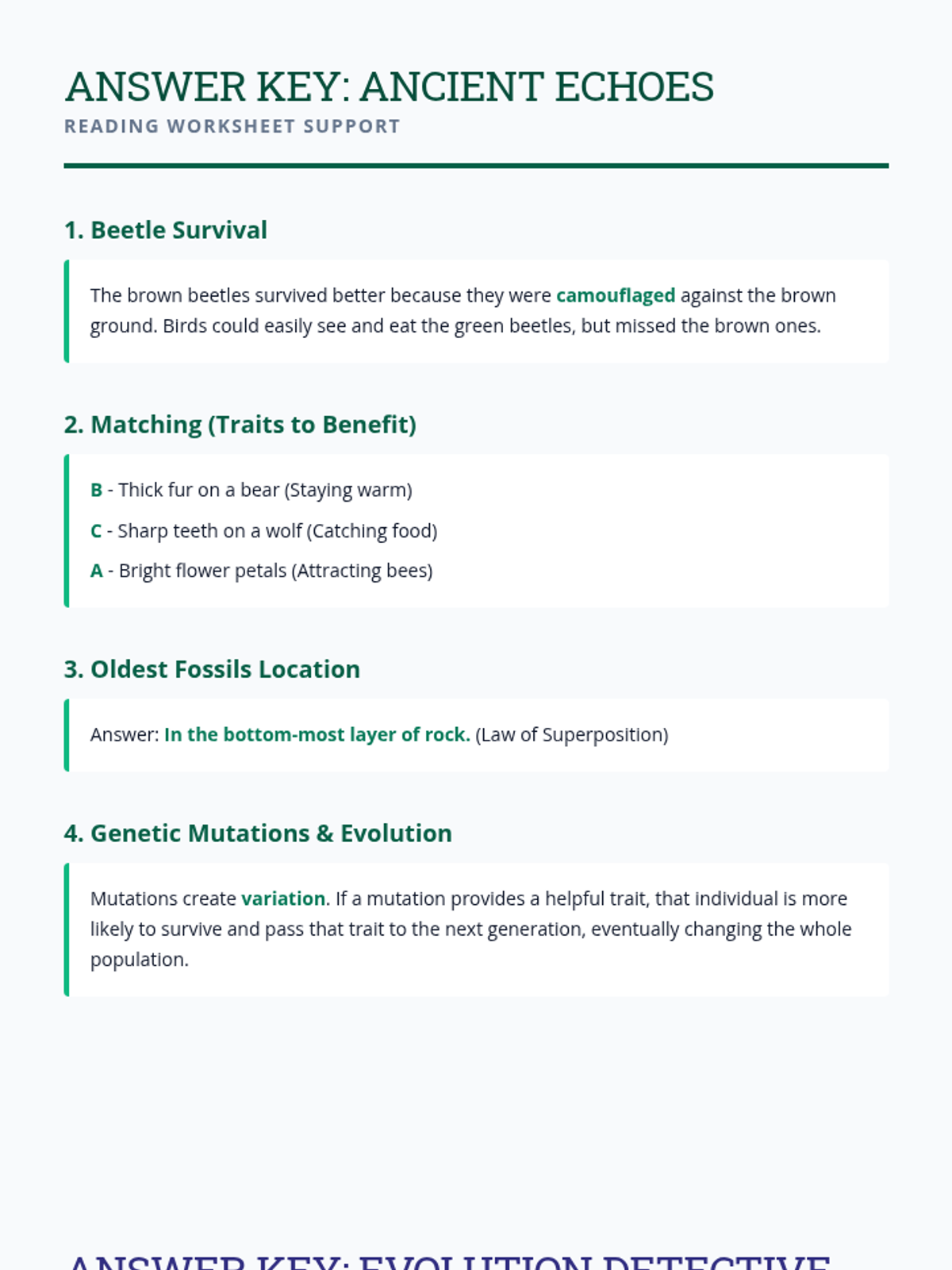
A teacher's answer key for both the Ancient Echoes reading worksheet and the Evolution Detective quiz, providing clear correct answers and brief explanations.
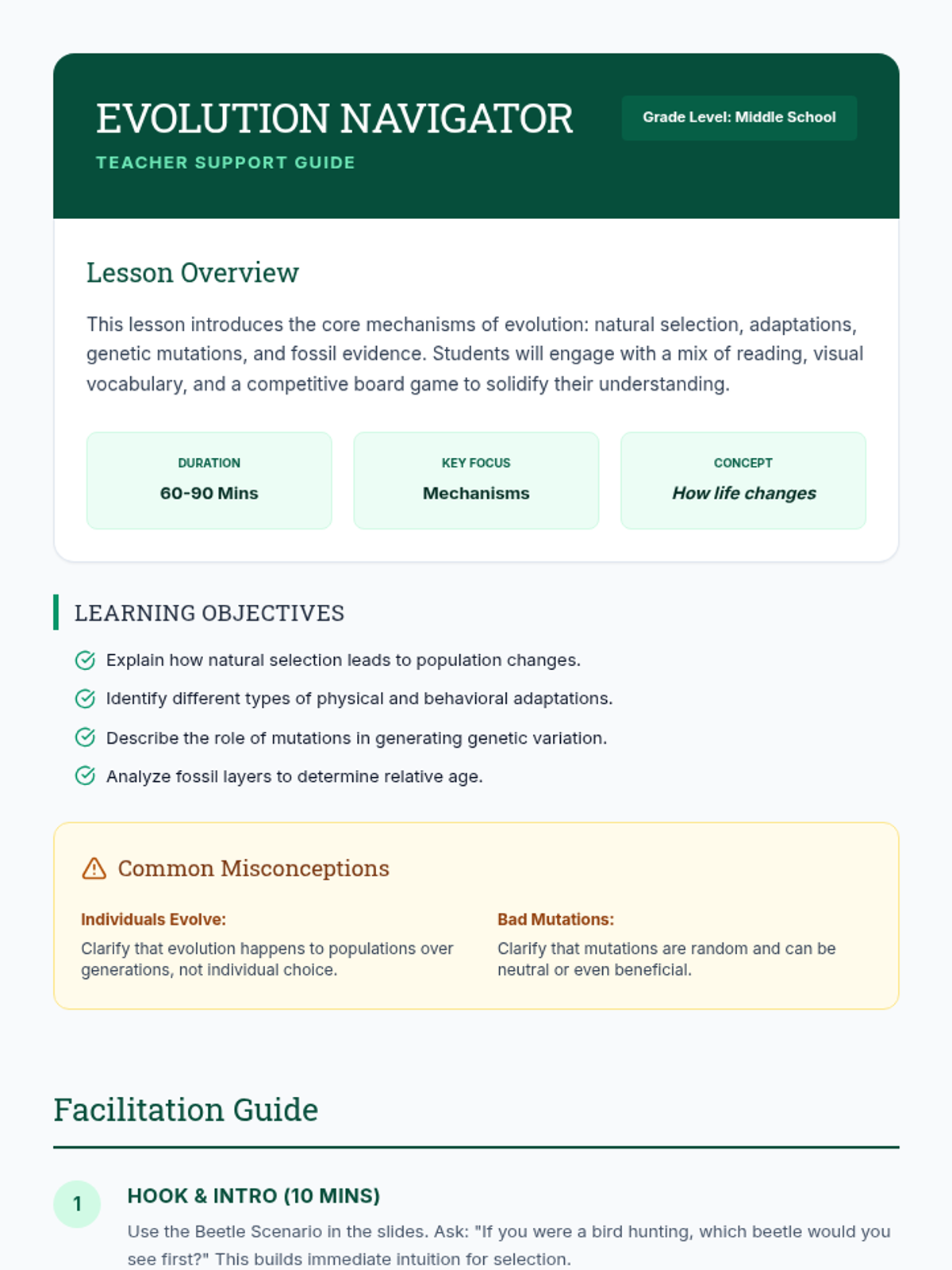
A comprehensive teacher guide for the Evolution Essentials lesson, providing learning objectives, common misconceptions, a step-by-step facilitation guide, and differentiation strategies.
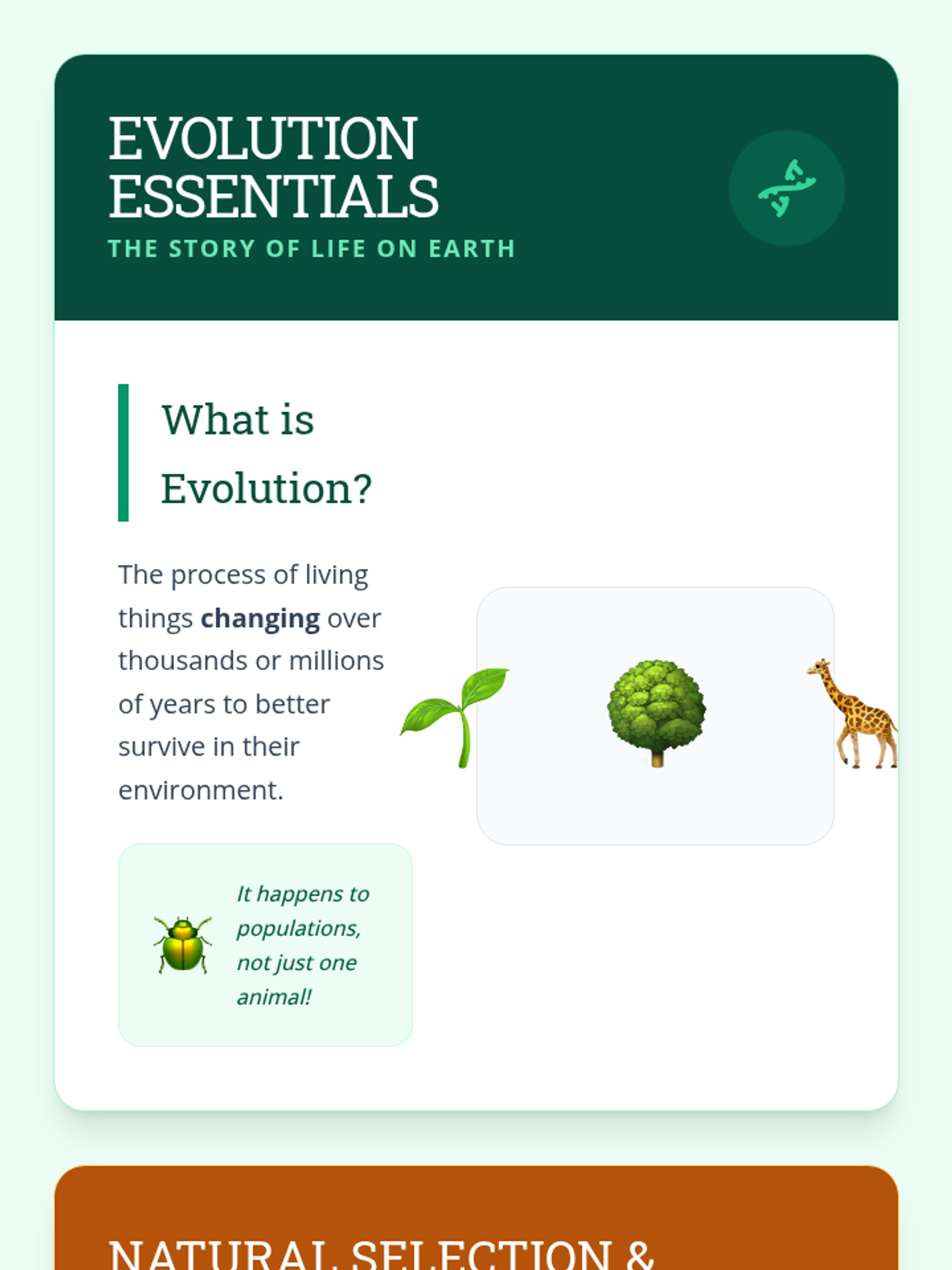
A dynamic set of printable slides (landscape) for the Evolution Essentials lesson, covering natural selection, adaptations, mutations, and fossil evidence with high-impact visuals.
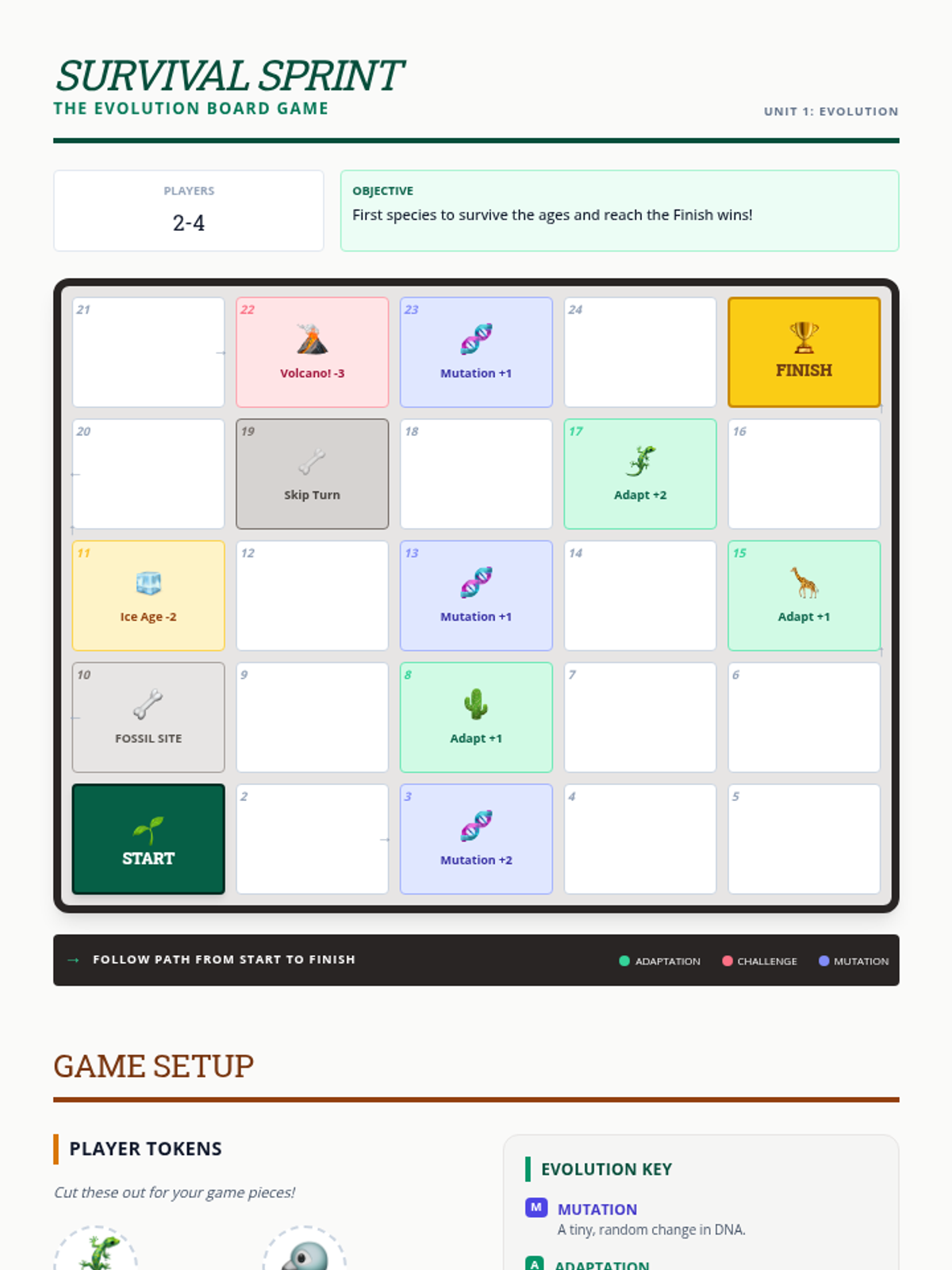
A printable board game for learning evolution concepts, optimized for 8.5x11 printing with a clear 5x5 grid, player tokens, and an evolution log.
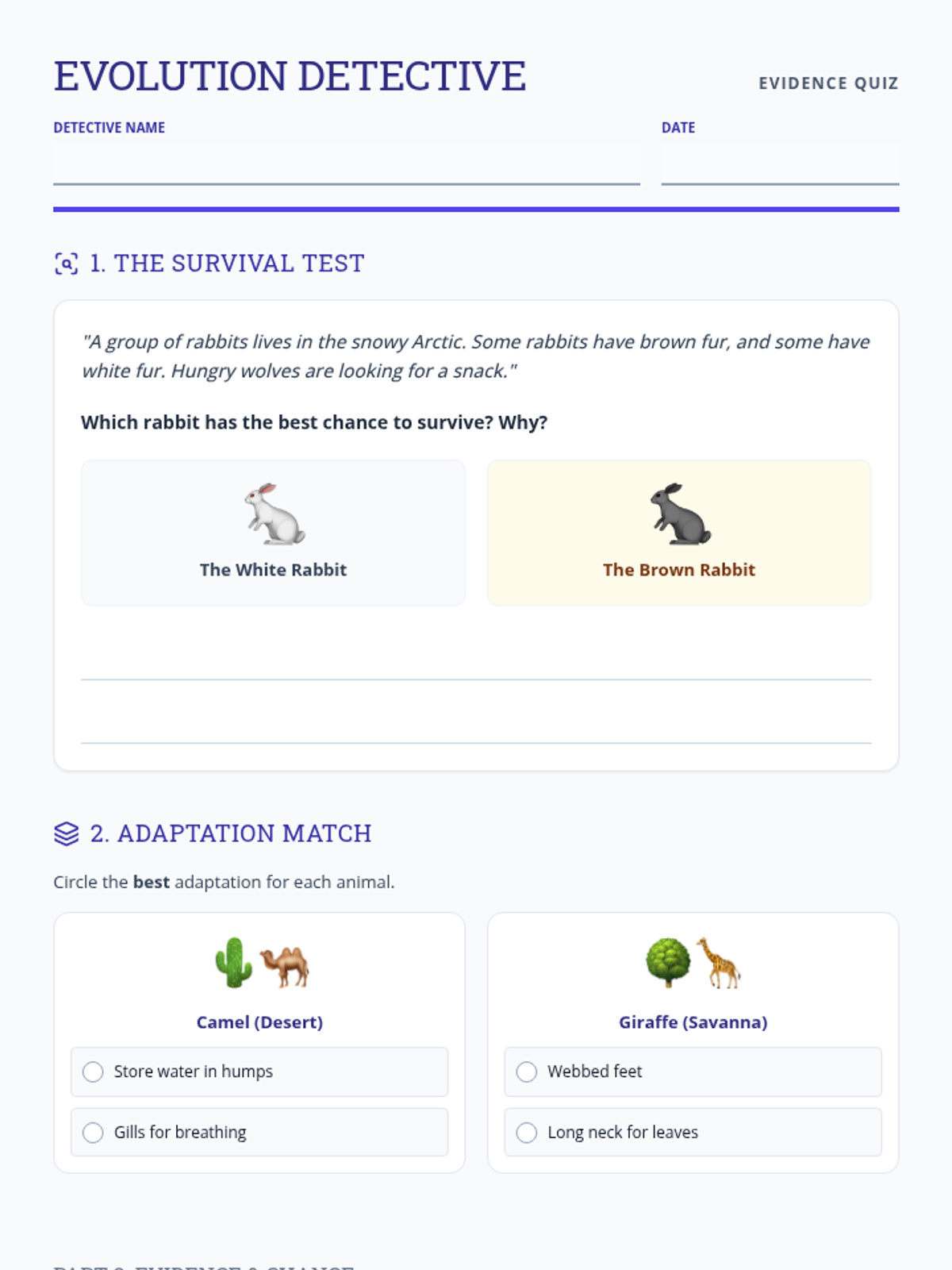
A revised evolution quiz optimized for 8.5x11 printing, featuring scenario-based questions, visual matching for adaptations, and a fossil layer analysis section.
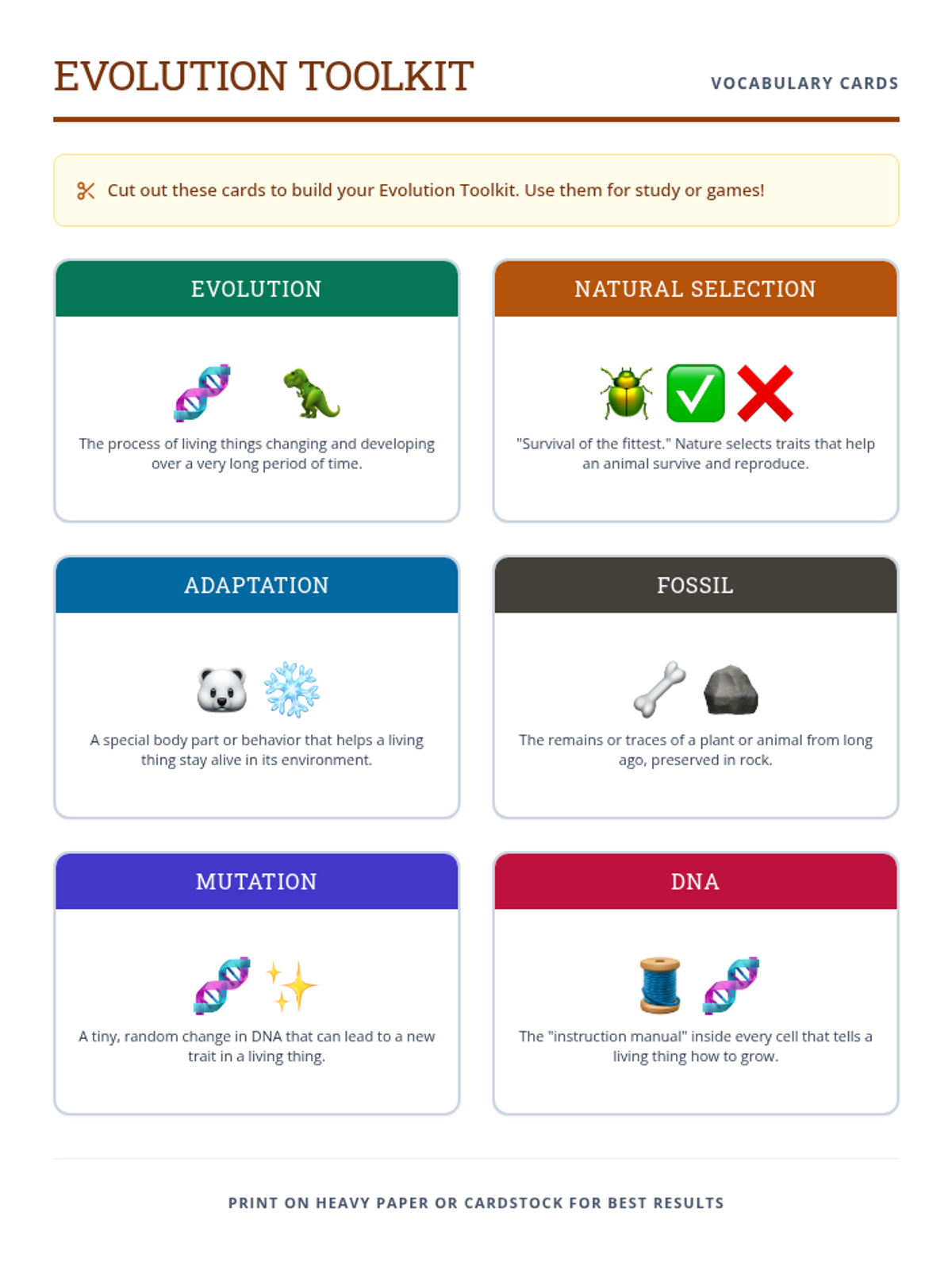
A set of 6 visual vocabulary cards for evolution terms, optimized for 8.5x11 printing with clear cut lines and vibrant, high-contrast designs.
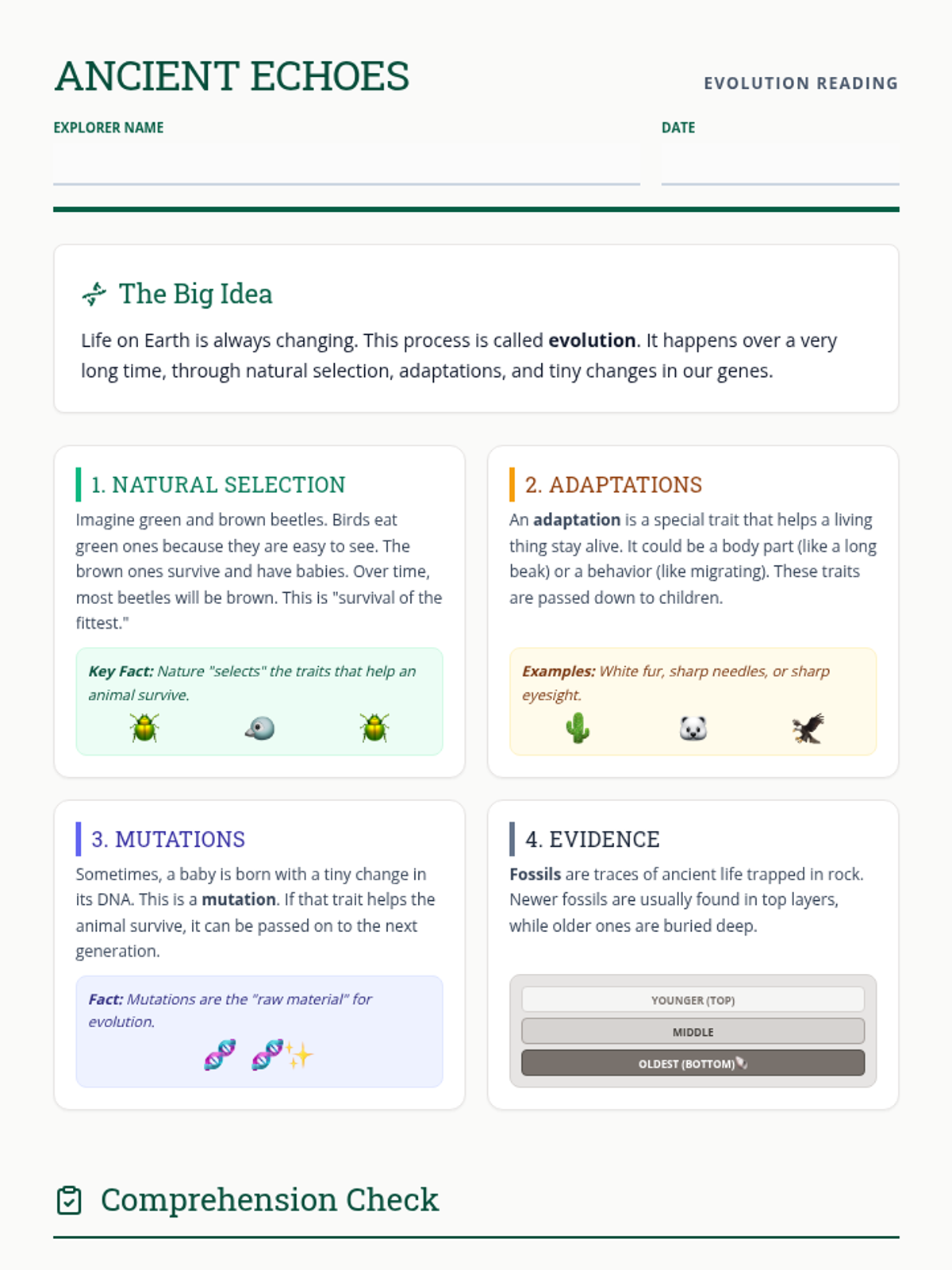
A revised reading worksheet on evolution, now optimized for 8.5x11 printing with clear sections on natural selection, adaptations, mutations, and fossils, followed by a comprehension check.
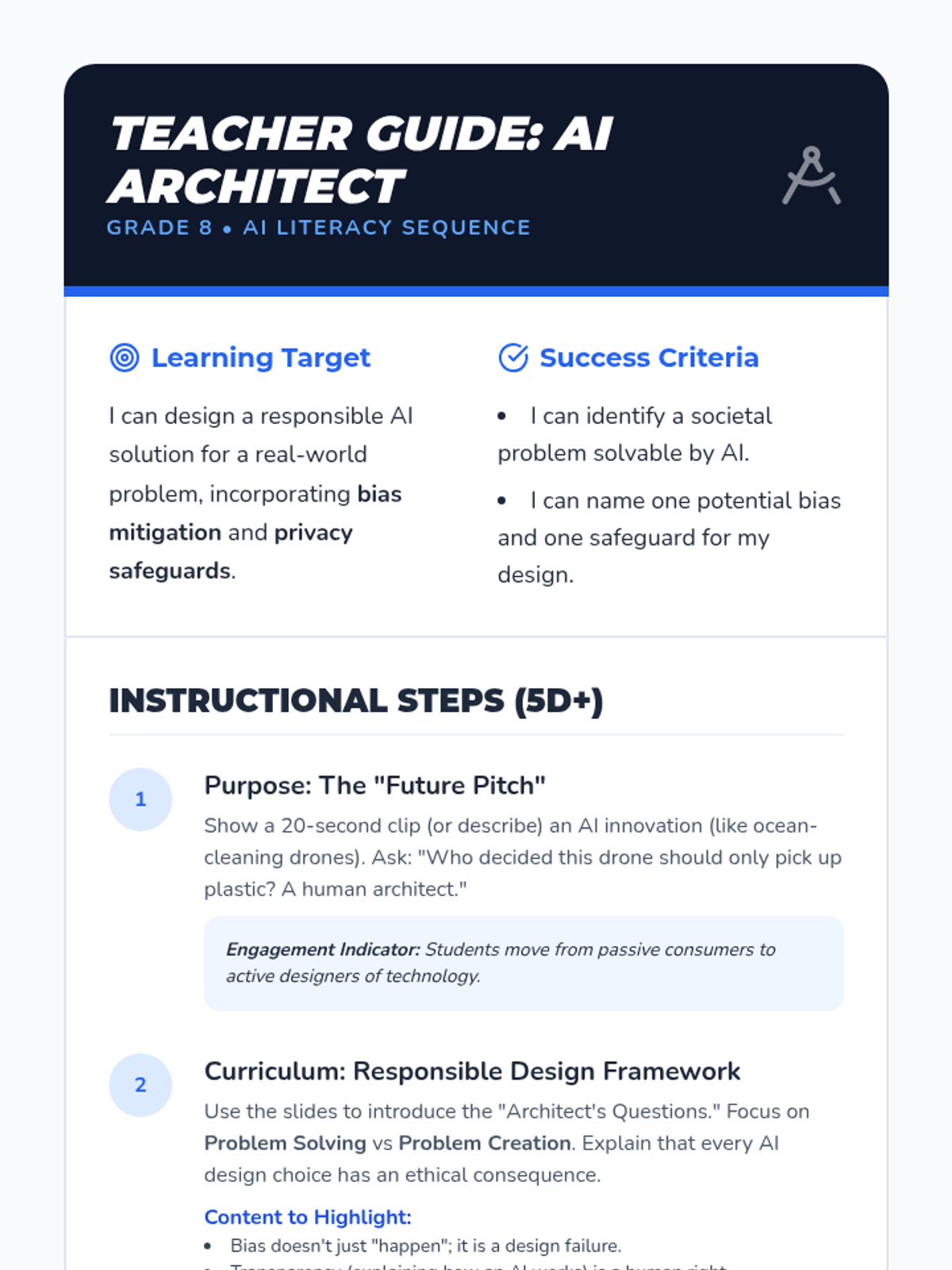
A teacher guide for the culminating Grade 8 AI Literacy lesson. Includes instructional steps for facilitating a "Design Studio" project, 5D+ framework alignment, and strategies for peer-led ethical audits.
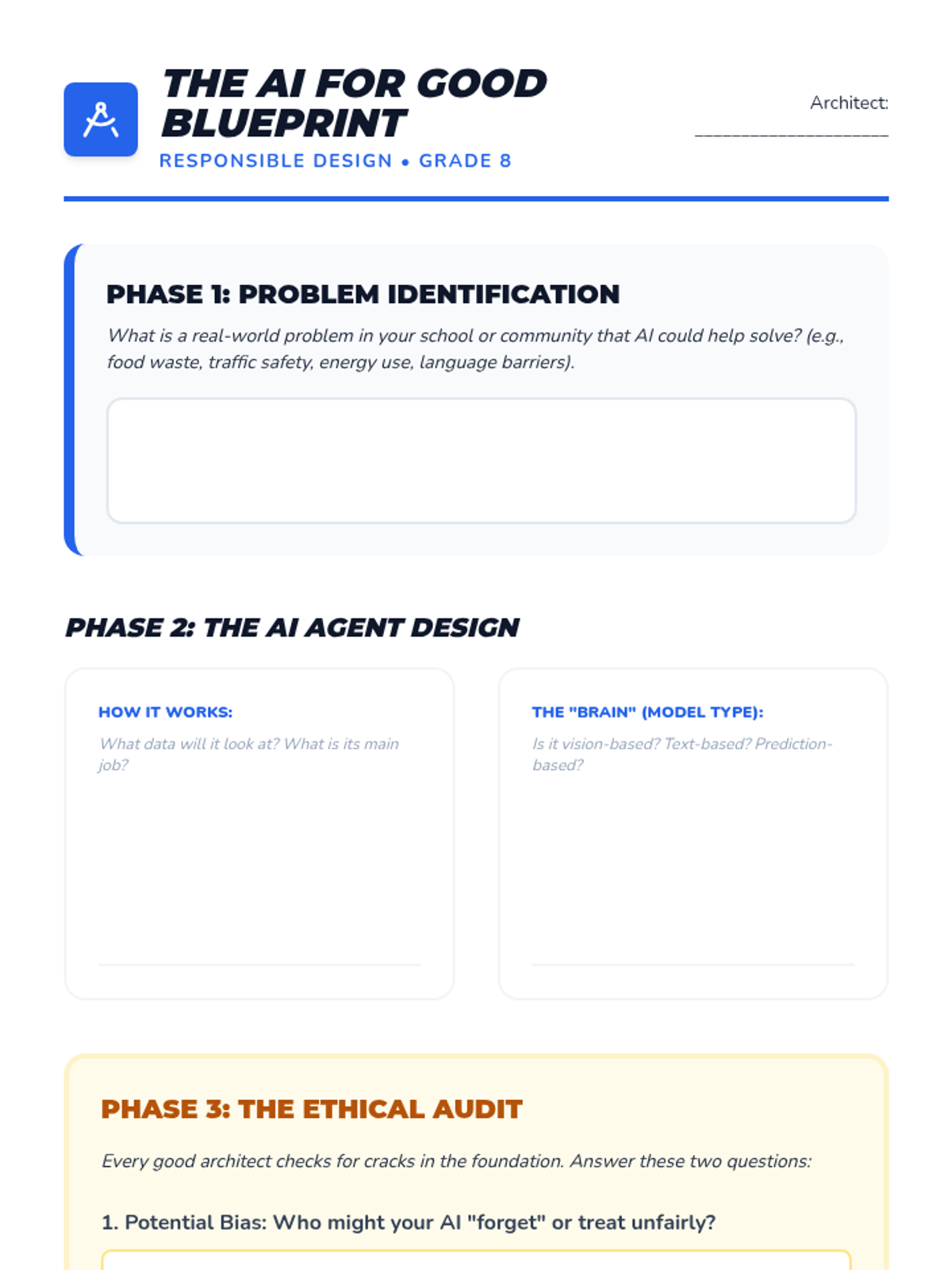
A project blueprint for Grade 8 students to design a responsible AI solution for a real-world problem. It includes sections for problem identification, technical design, an ethical audit (bias and safeguards), and a creative motto.
A 6-slide presentation for 8th Grade students on responsible AI design. It encourages students to move from consumers to creators ("Architects") and outlines a framework for designing AI solutions that are fair, transparent, and safe.
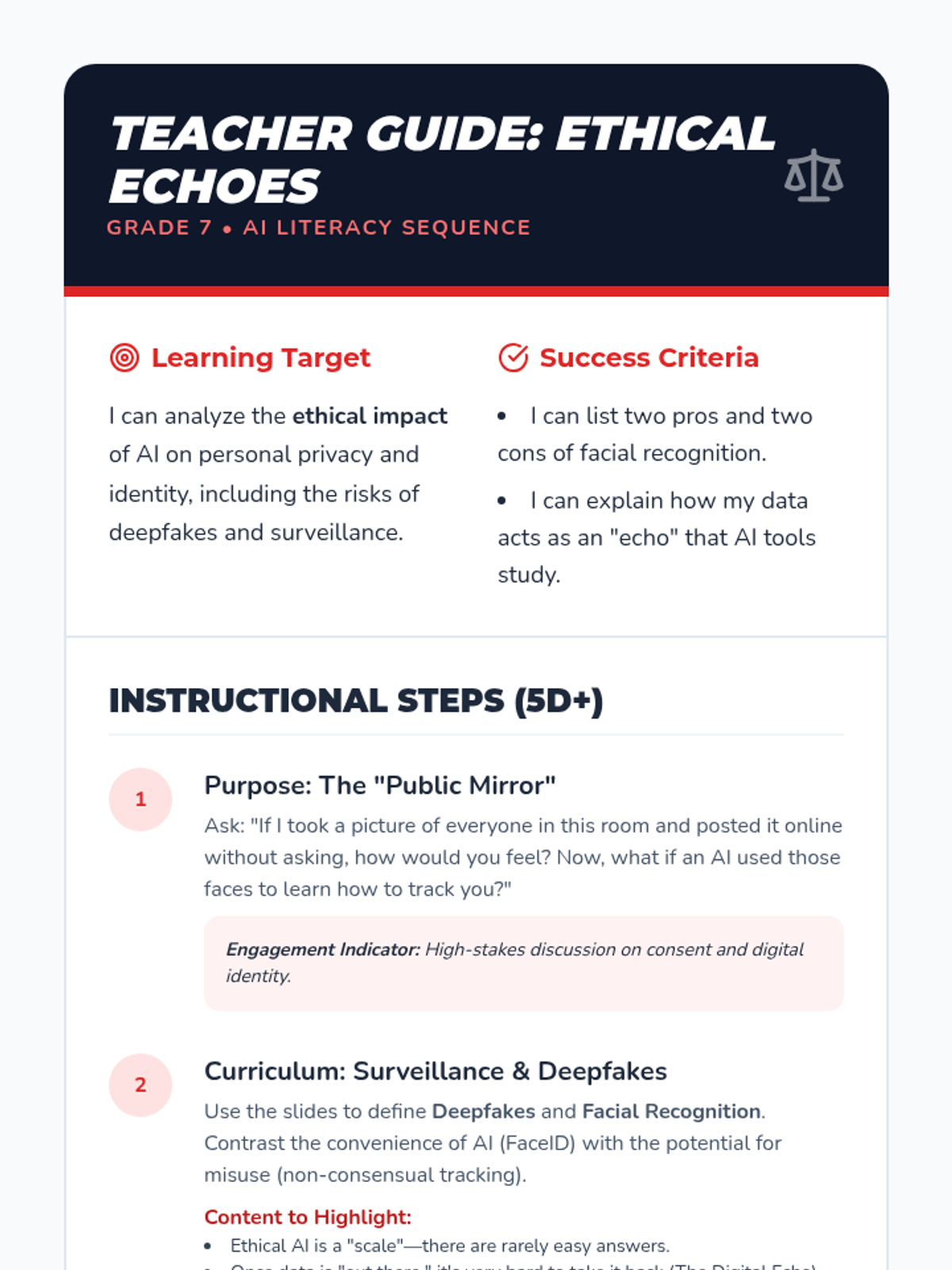
A teacher guide for the Grade 7 AI Literacy lesson on ethics and privacy. Includes instructional steps for facilitating debates on surveillance, alignment with 5D+ framework, and strategies for teaching deepfake awareness.
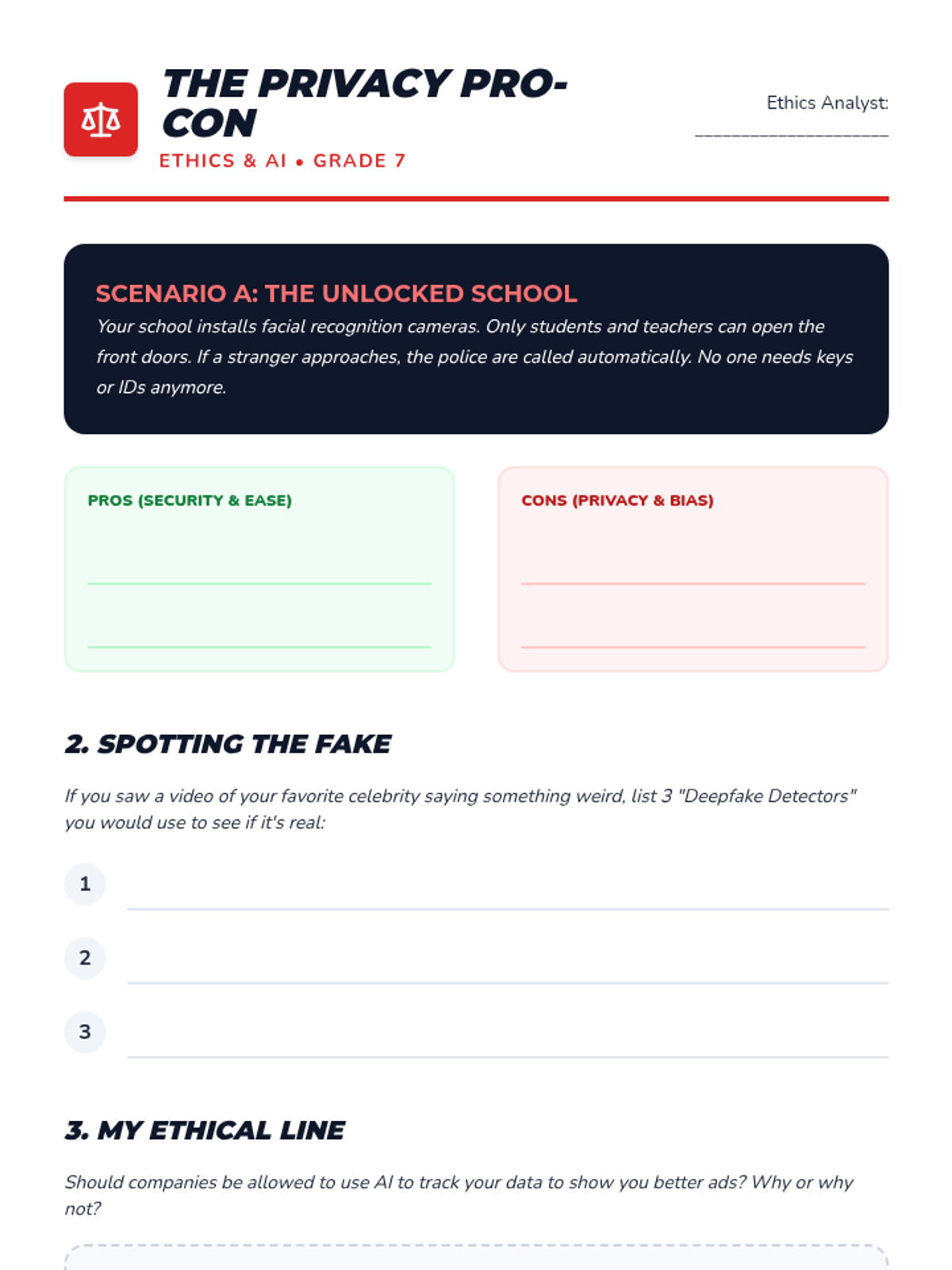
A worksheet for Grade 7 students to explore AI ethics. It includes a pro-con analysis of facial recognition in schools, strategies for detecting deepfakes, and a reflective exercise on personal data privacy boundaries.
A 6-slide presentation for 7th Grade students on AI ethics and privacy. It covers facial recognition, deepfakes, and the trade-off between security and personal privacy, encouraging students to consider where "the line" should be drawn.
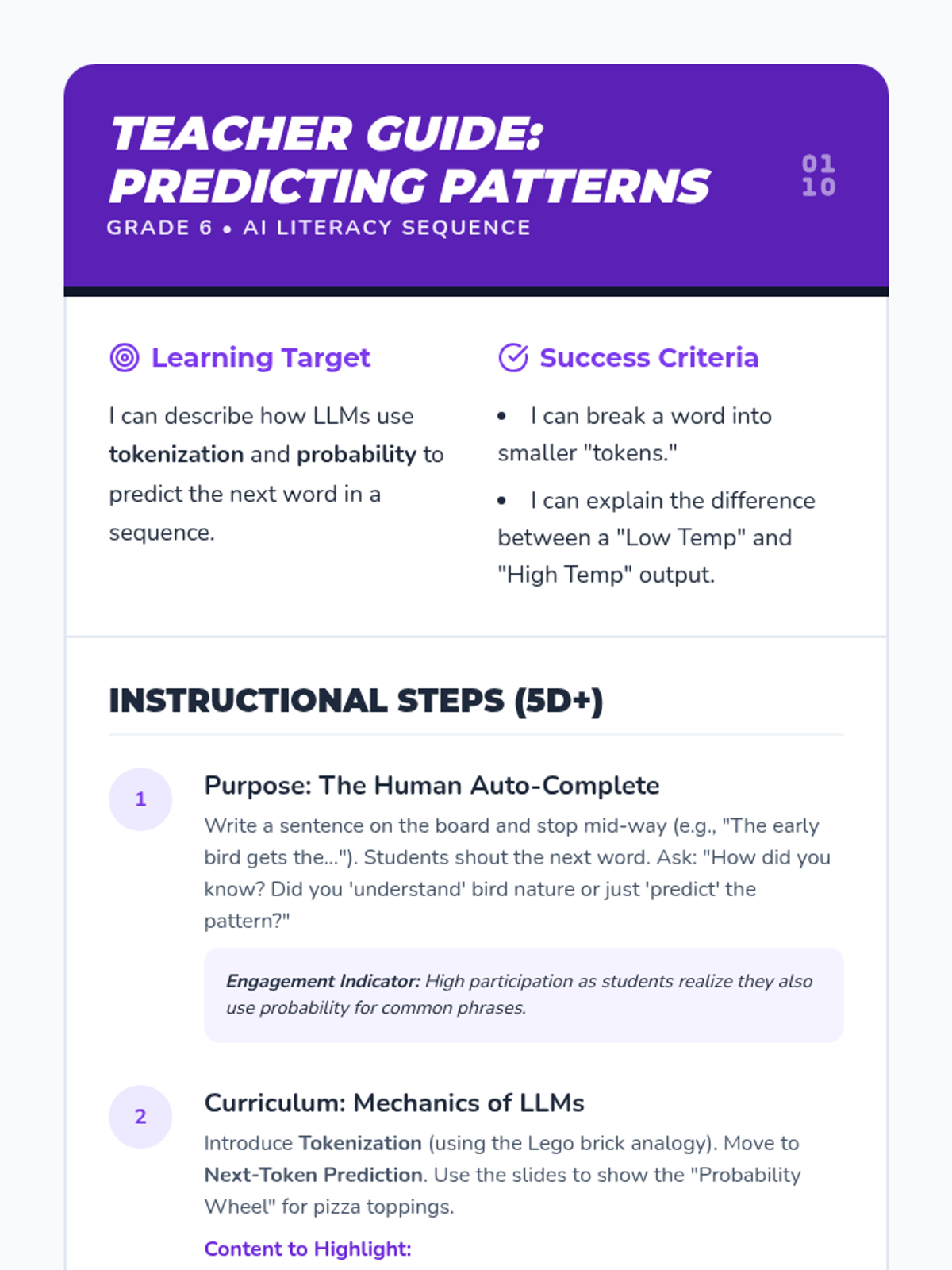
A teacher guide for the Grade 6 AI Literacy lesson on LLM mechanics. Includes instructional steps for teaching tokenization and probability, 5D+ alignment, and discussion prompts on AI creativity.
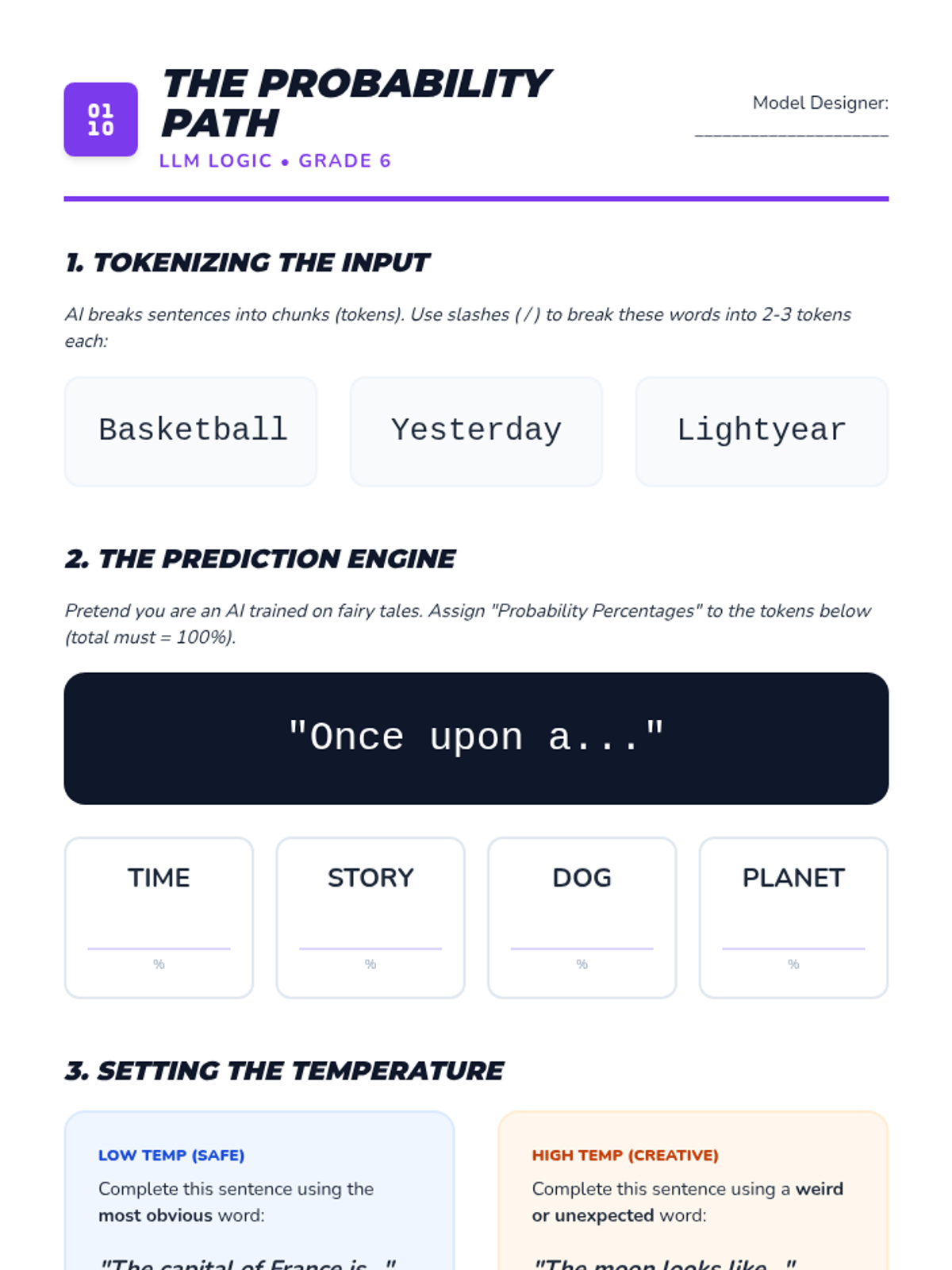
A worksheet for Grade 6 students to practice LLM concepts. It includes exercises on tokenization, assigning probabilities to word predictions, and experimenting with "temperature" settings for safe vs. creative outputs.
A 6-slide presentation for 6th Grade students on the mechanics of LLMs. It explains tokenization, next-word prediction based on probability, and the "temperature" setting that balances precision with creativity.
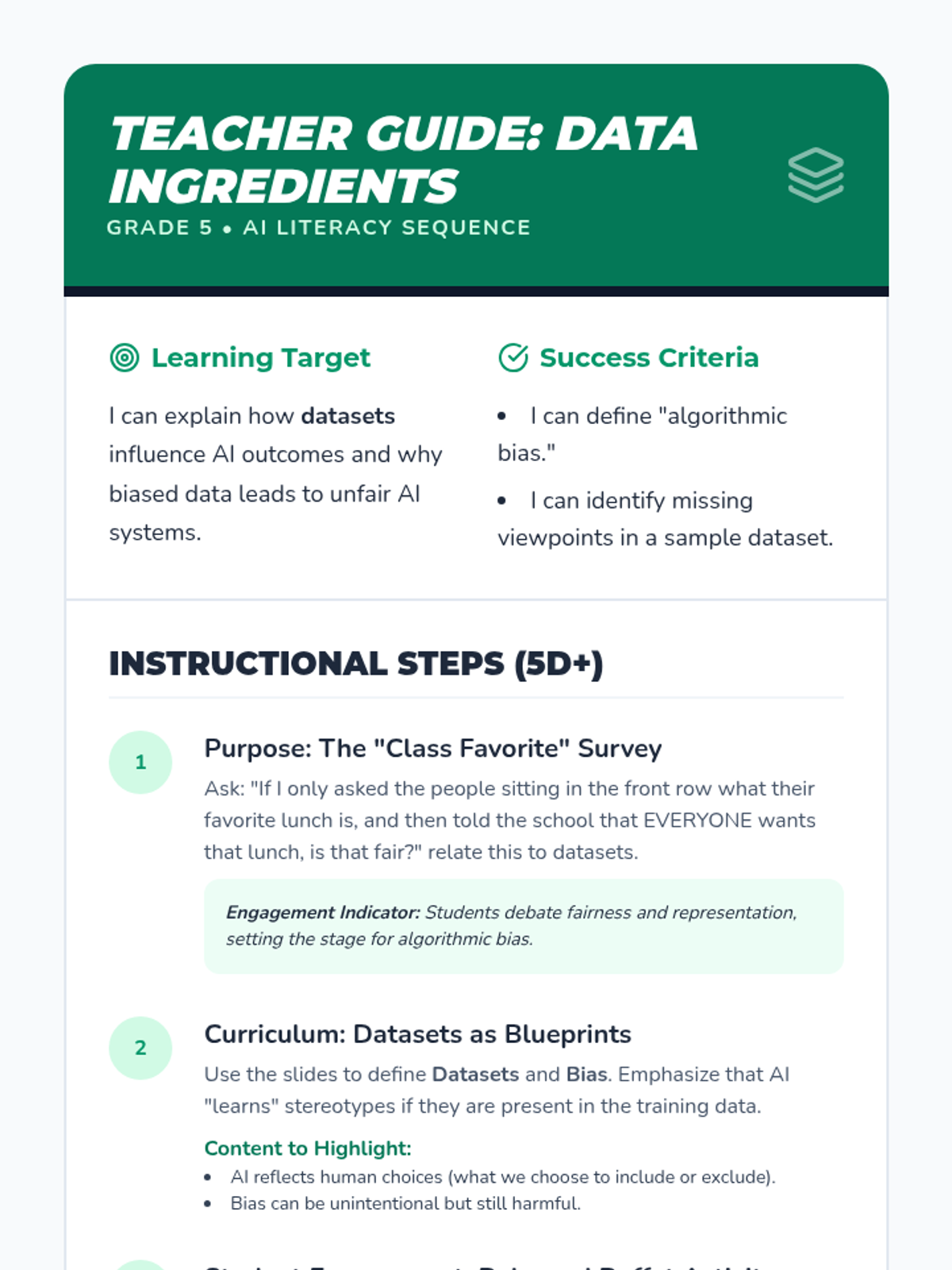
A teacher guide for the Grade 5 AI Literacy lesson on datasets and bias. Includes instructional steps aligned with 5D+, key discussion points on algorithmic fairness, and guidance for the "Balanced Buffet" activity.
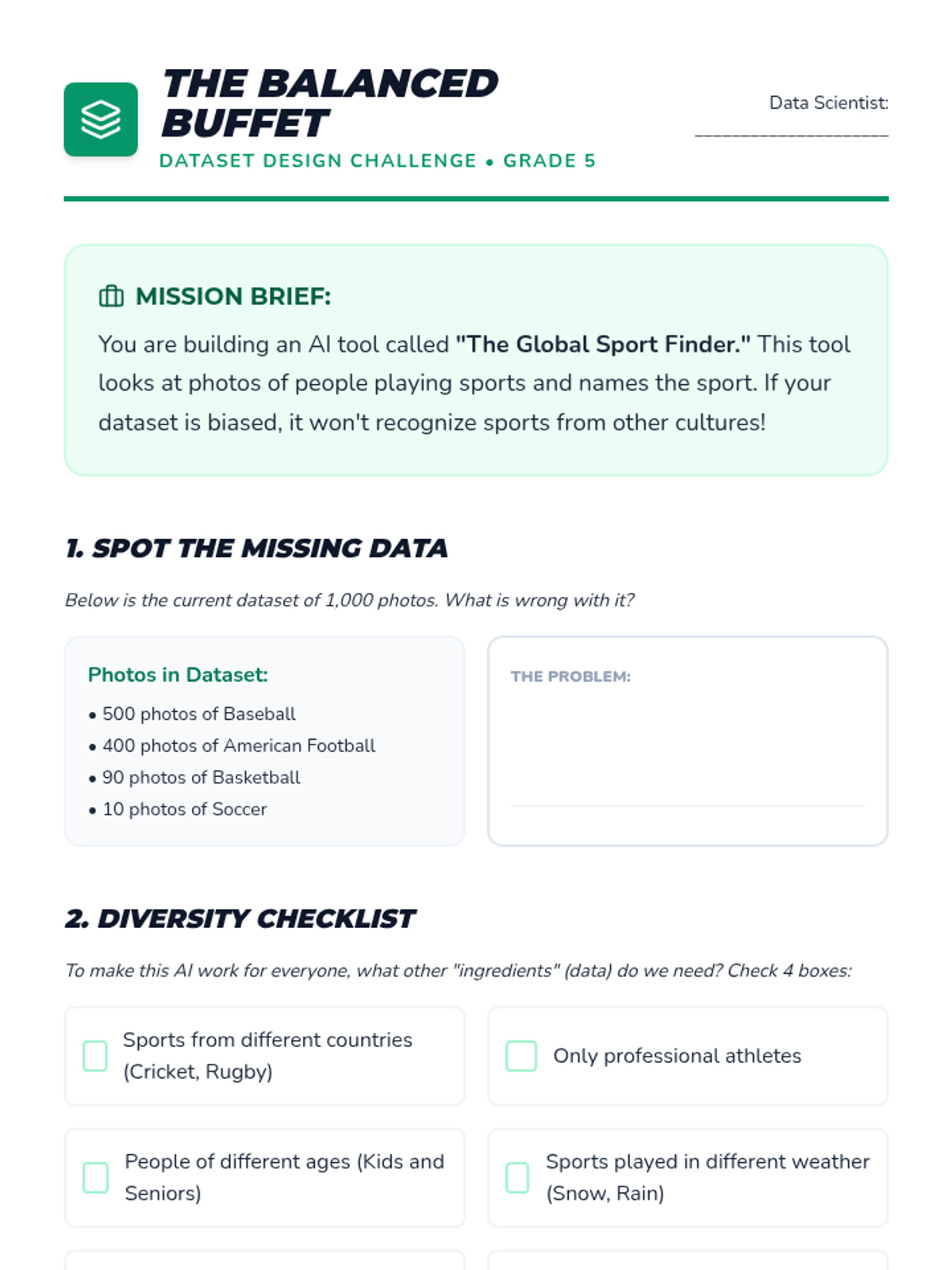
An activity for Grade 5 students to explore dataset bias and fairness. It includes a case study on a sports recognition AI, a diversity checklist for data collection, and a creative section for designing a more equitable dataset.
A 6-slide presentation for 5th Grade students on datasets and algorithmic bias. It uses a "cooking/ingredients" metaphor to explain how training data influences AI behavior and why diversity is essential for fairness.
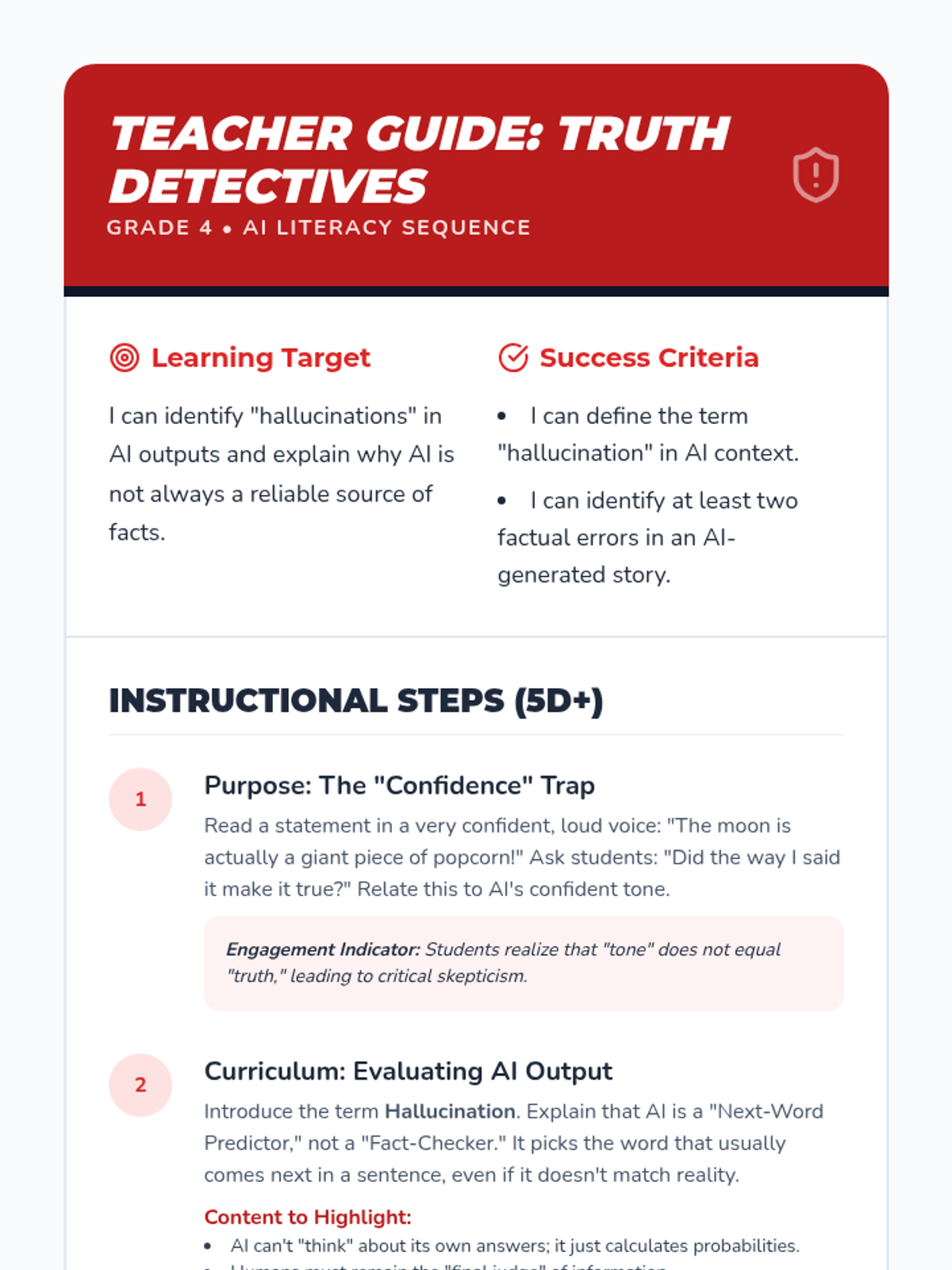
A teacher guide for the Grade 4 AI Literacy lesson on truth evaluation. Includes strategies for teaching the concept of "hallucinations," 5D+ instructional steps, and tips for facilitating the fact-checking activity.
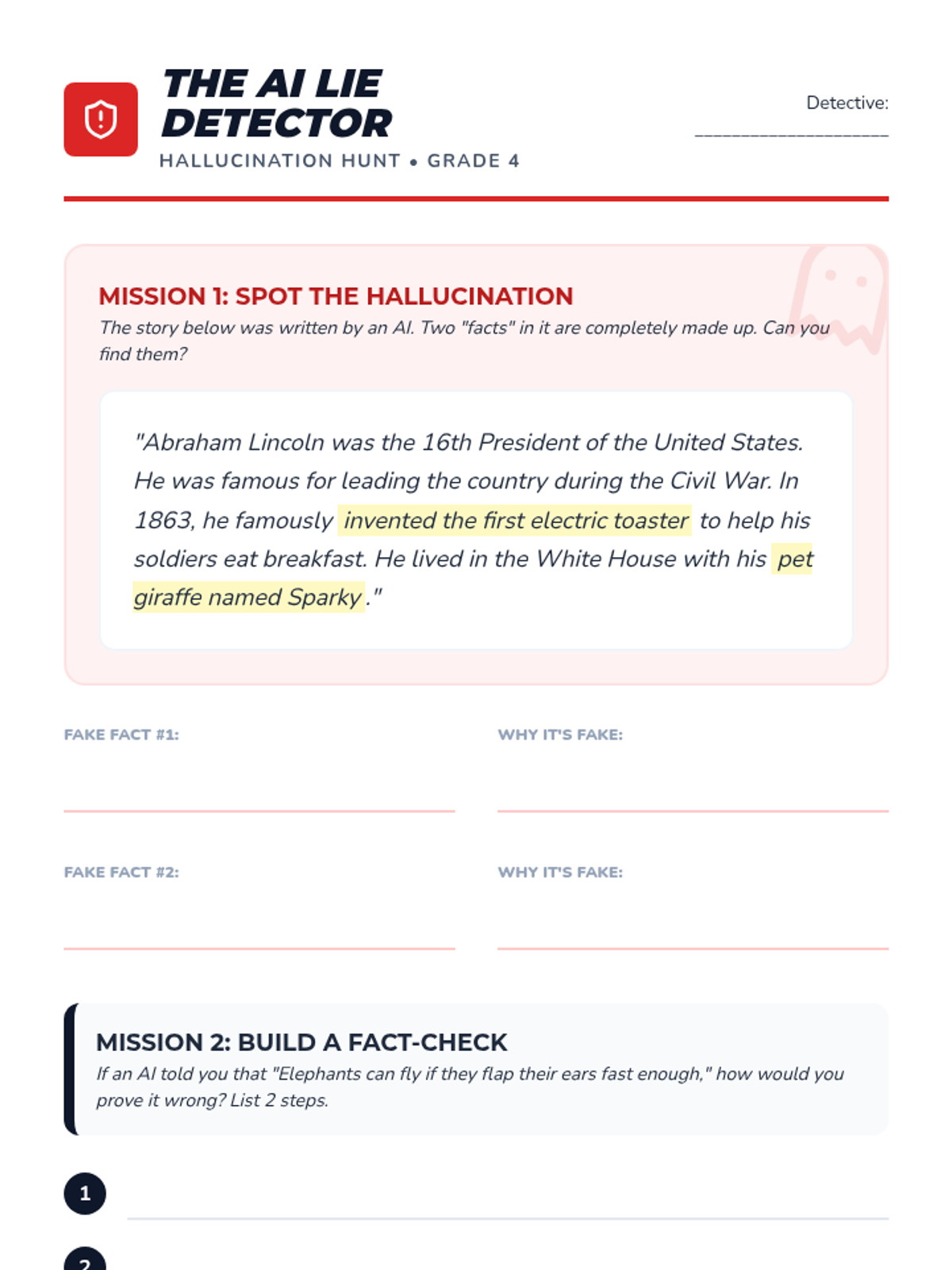
A worksheet for Grade 4 students to practice identifying AI hallucinations. It includes a "spot the error" historical passage, fact-checking strategy development, and a reflective motto-building exercise.
A 6-slide presentation for 4th Grade students on AI hallucinations. It defines hallucinations, explains why AI makes mistakes (word-guessing vs. knowing), and provides strategies for fact-checking AI outputs.