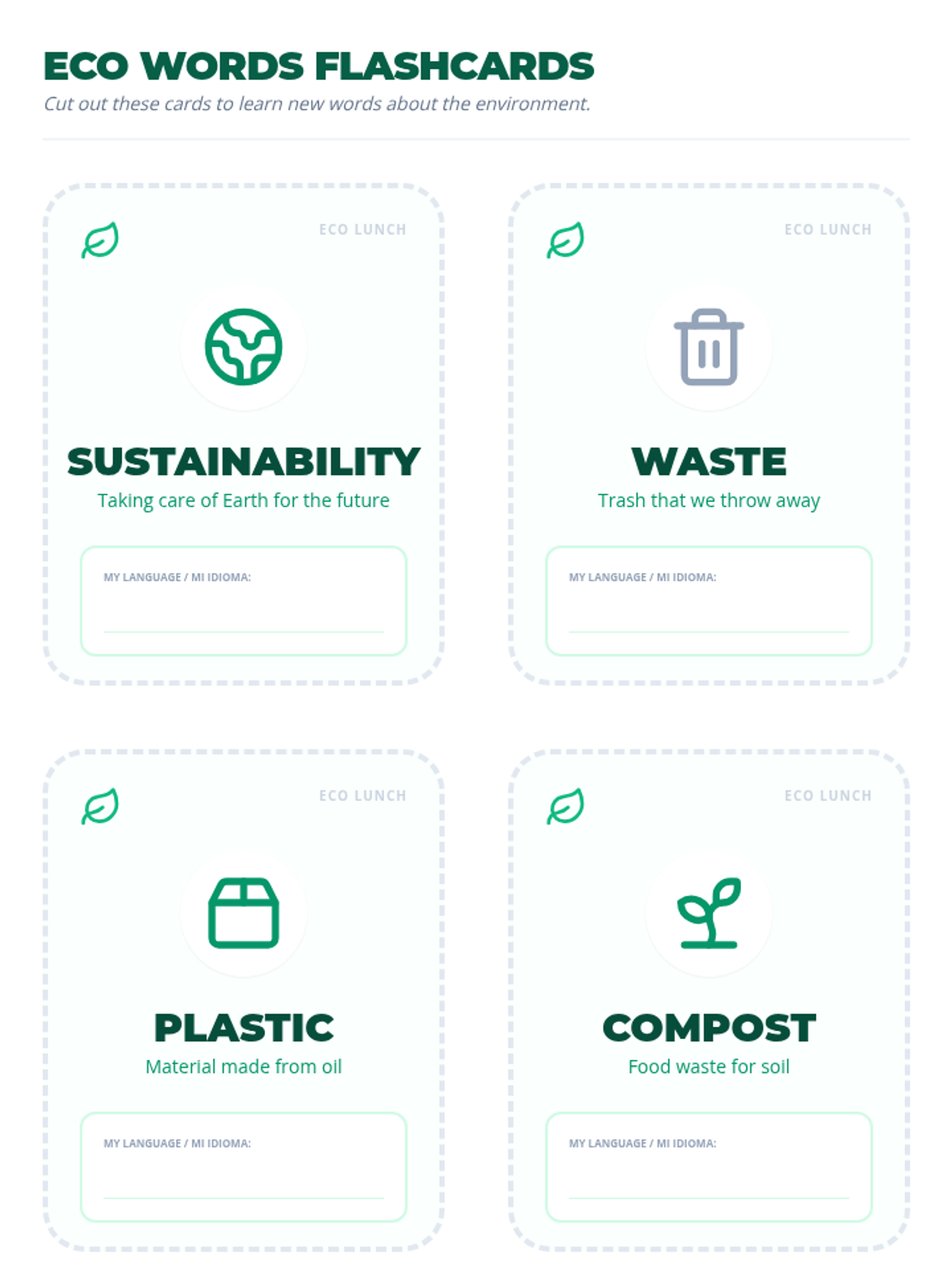
A facilitator guide focused on Multilingual Learner strategies for the Eco Lunch lesson. Includes scaffolded discussion prompts by proficiency level, TPR suggestions, and a worksheet answer key. Optimized for single-page use.
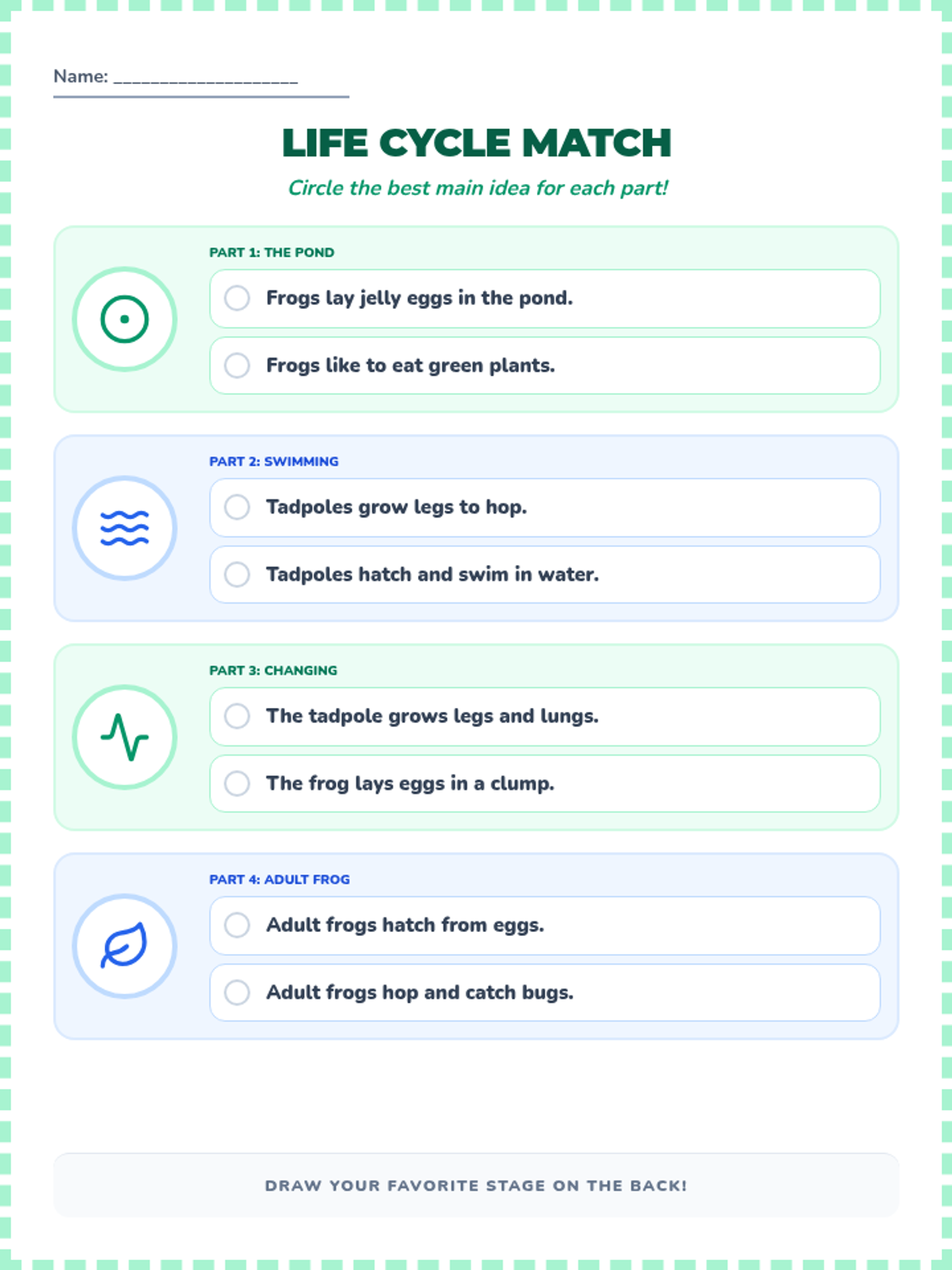
A Tier 3 support worksheet for identifying main ideas through a visual matching/selection activity, designed for students requiring intensive literacy support. Consolidated to one page.
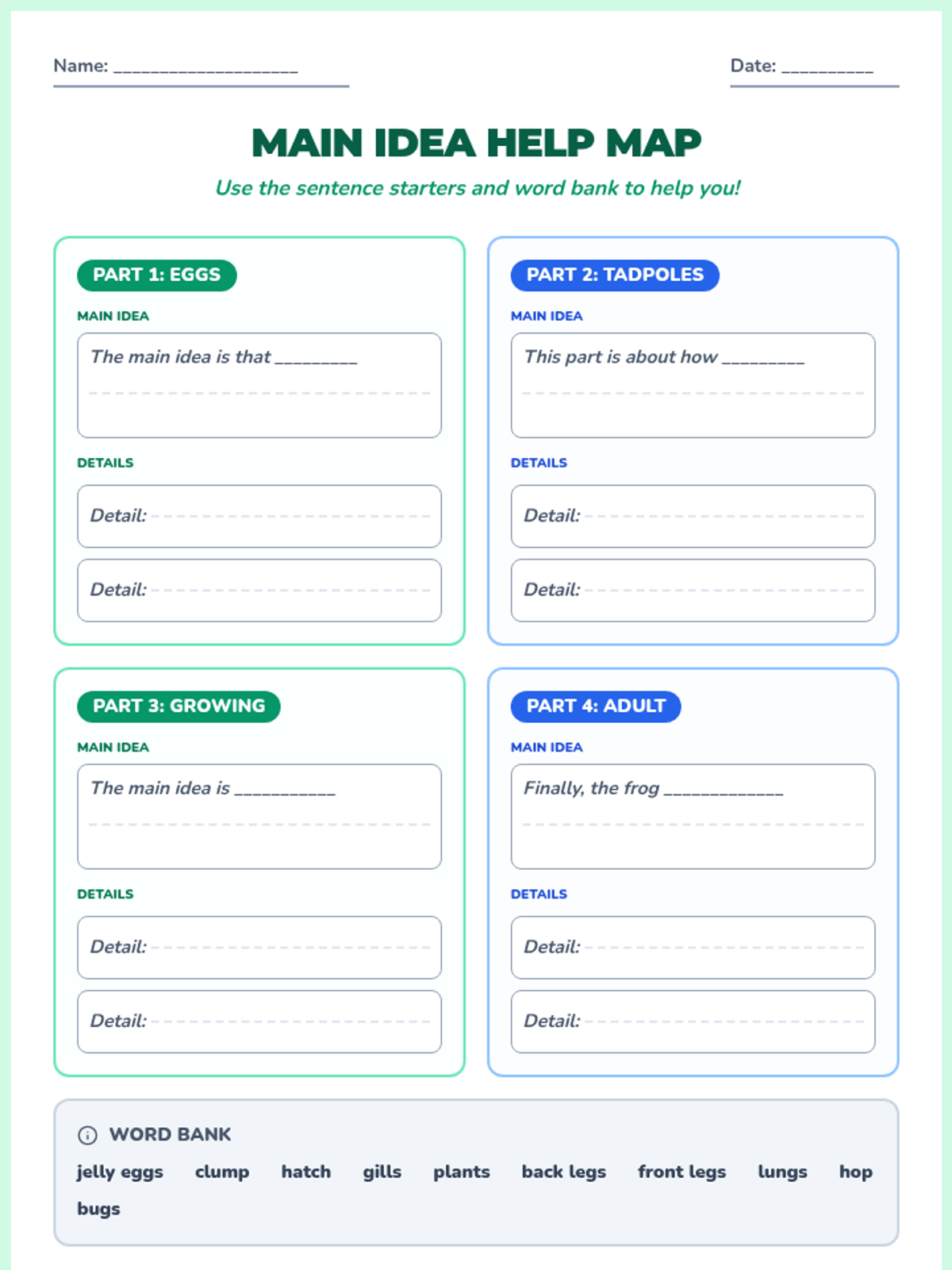
A Tier 2 support worksheet for identifying main ideas and details, featuring sentence starters and a word bank to scaffold the writing process for students needing moderate support. Writing areas and contrast improved for 2nd grade.
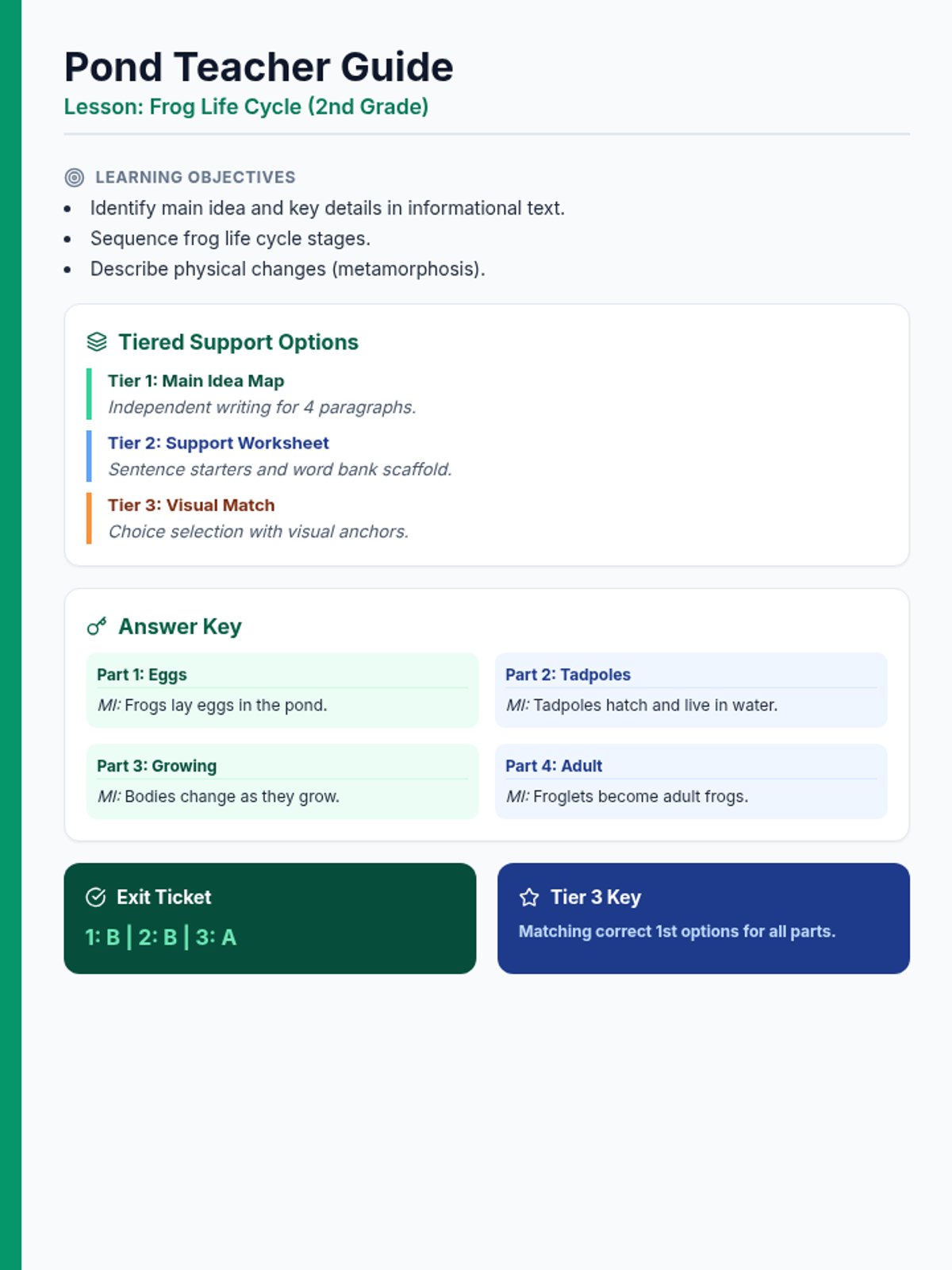
A teacher facilitation guide consolidated to one page. Includes learning objectives, tiered support breakdowns (Tier 1-3), comprehensive answer keys, and pedagogical tips. Layout optimized for single-page printing.
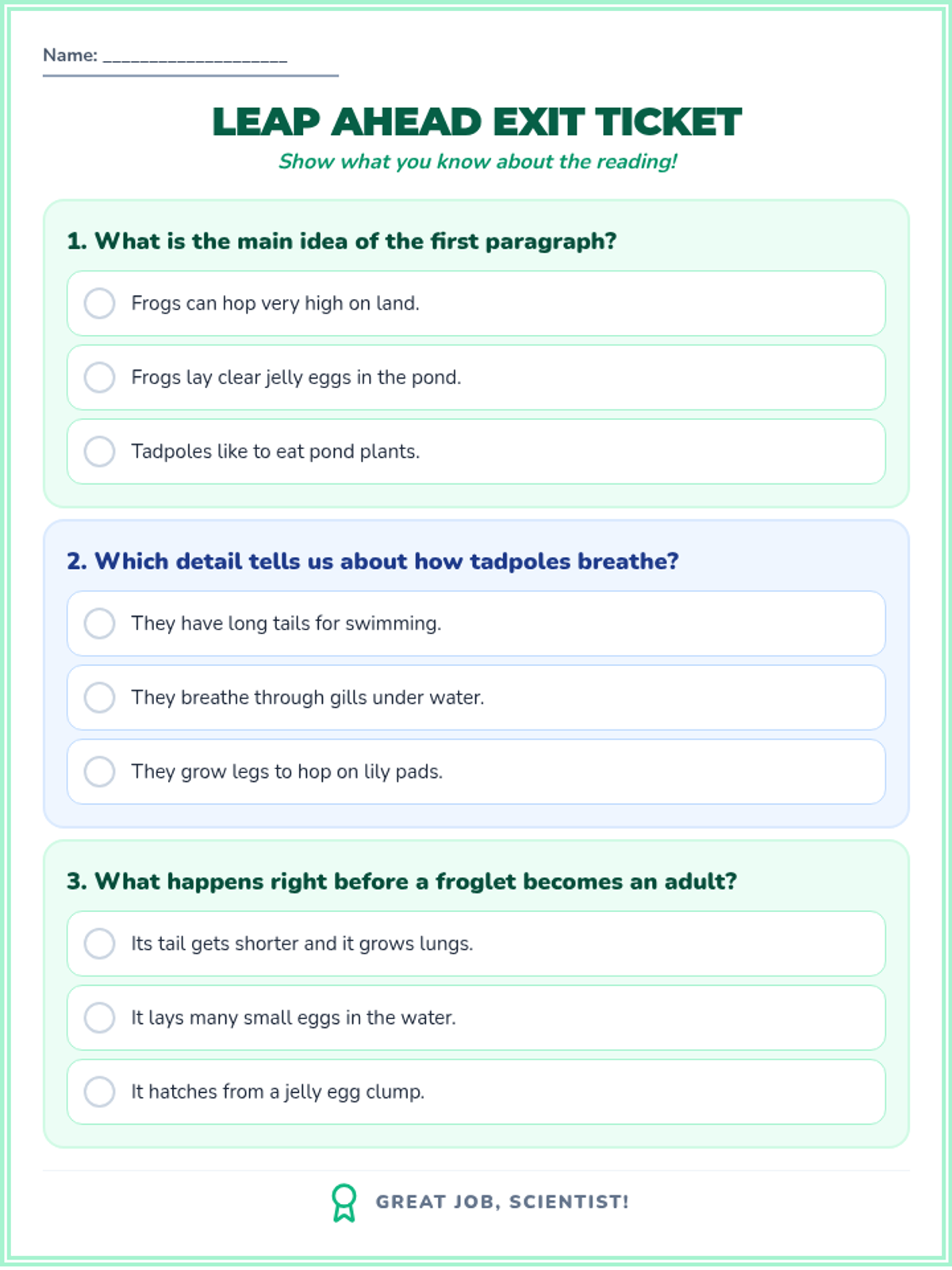
A multiple-choice exit ticket assessing student comprehension. Questions are styled for 2nd grade readability and all choices share uniform styling. Layout optimized to fit one page.
Interactive slides for teaching the frog life cycle, including definition of a life cycle, detailed stages, and discussion prompts. Visuals updated for better contrast and clarity.
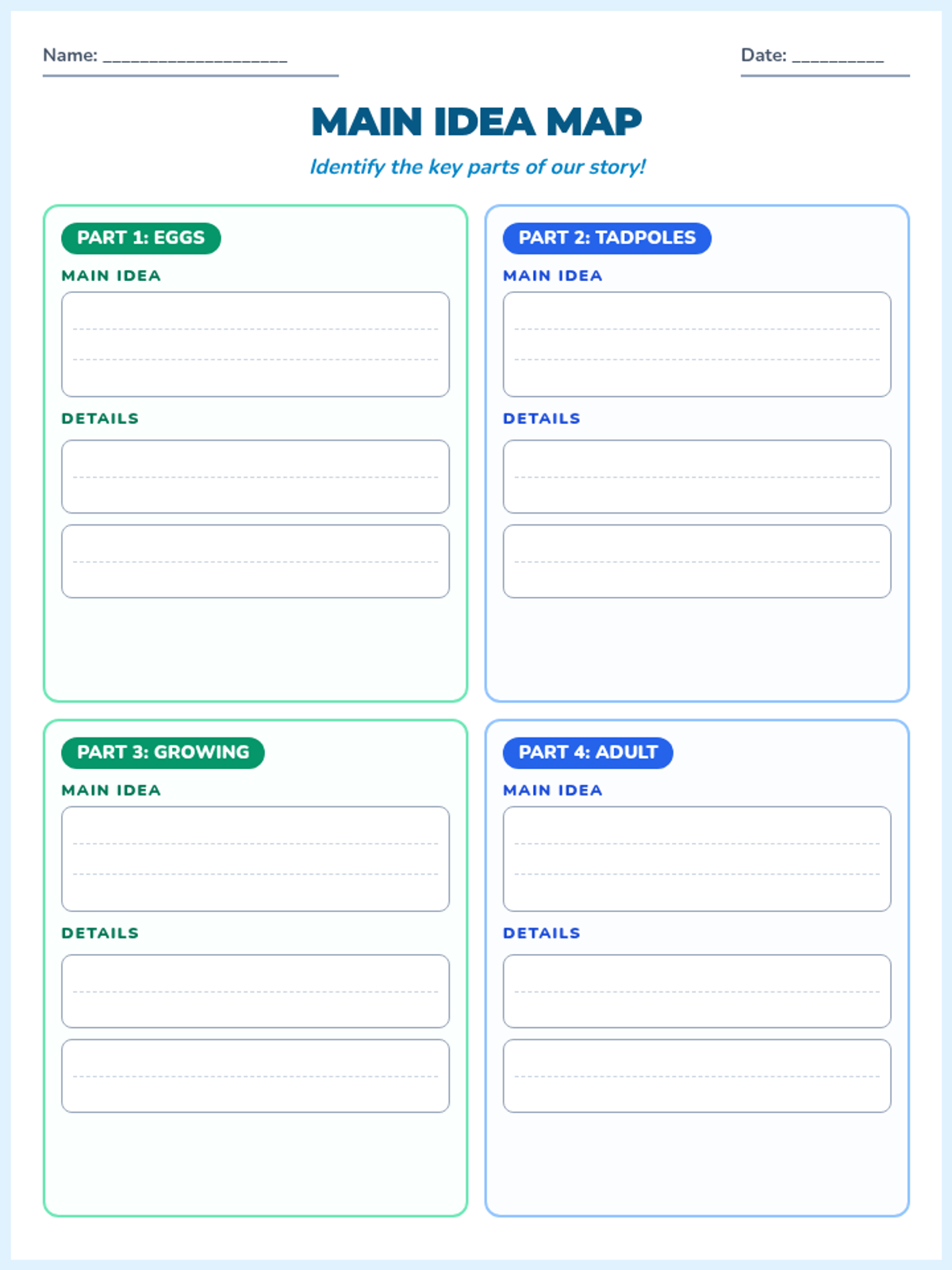
A graphic organizer for students to record the main idea and two supporting details for each of the four paragraphs in the frog life cycle passage. Provides ample space and guided lines for 2nd grade handwriting.
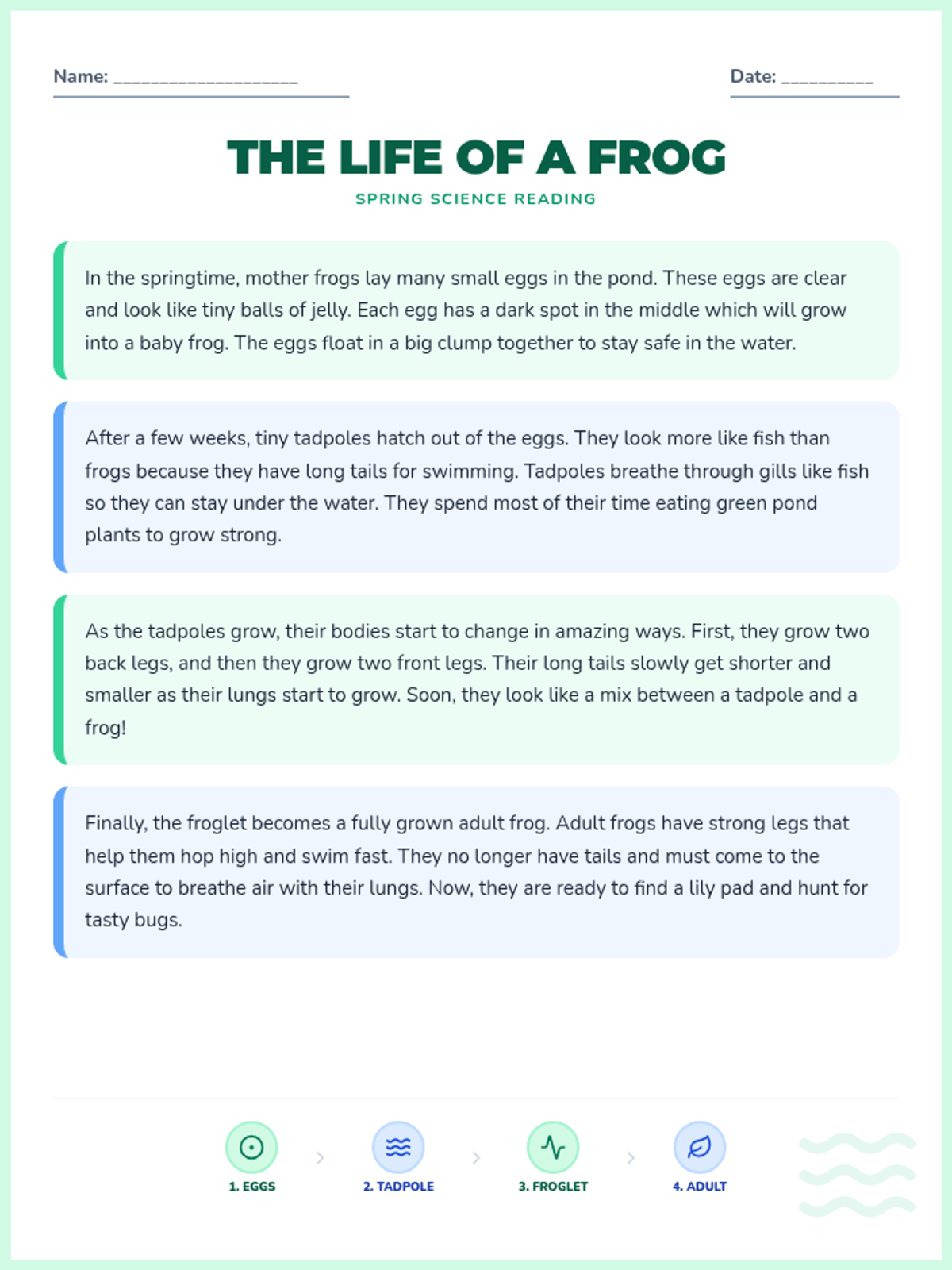
A 2nd-grade level reading passage about the frog life cycle, featuring four paragraphs covering eggs, tadpoles, growing legs, and adult frogs. Layout adjusted for better header spacing and icon rendering.
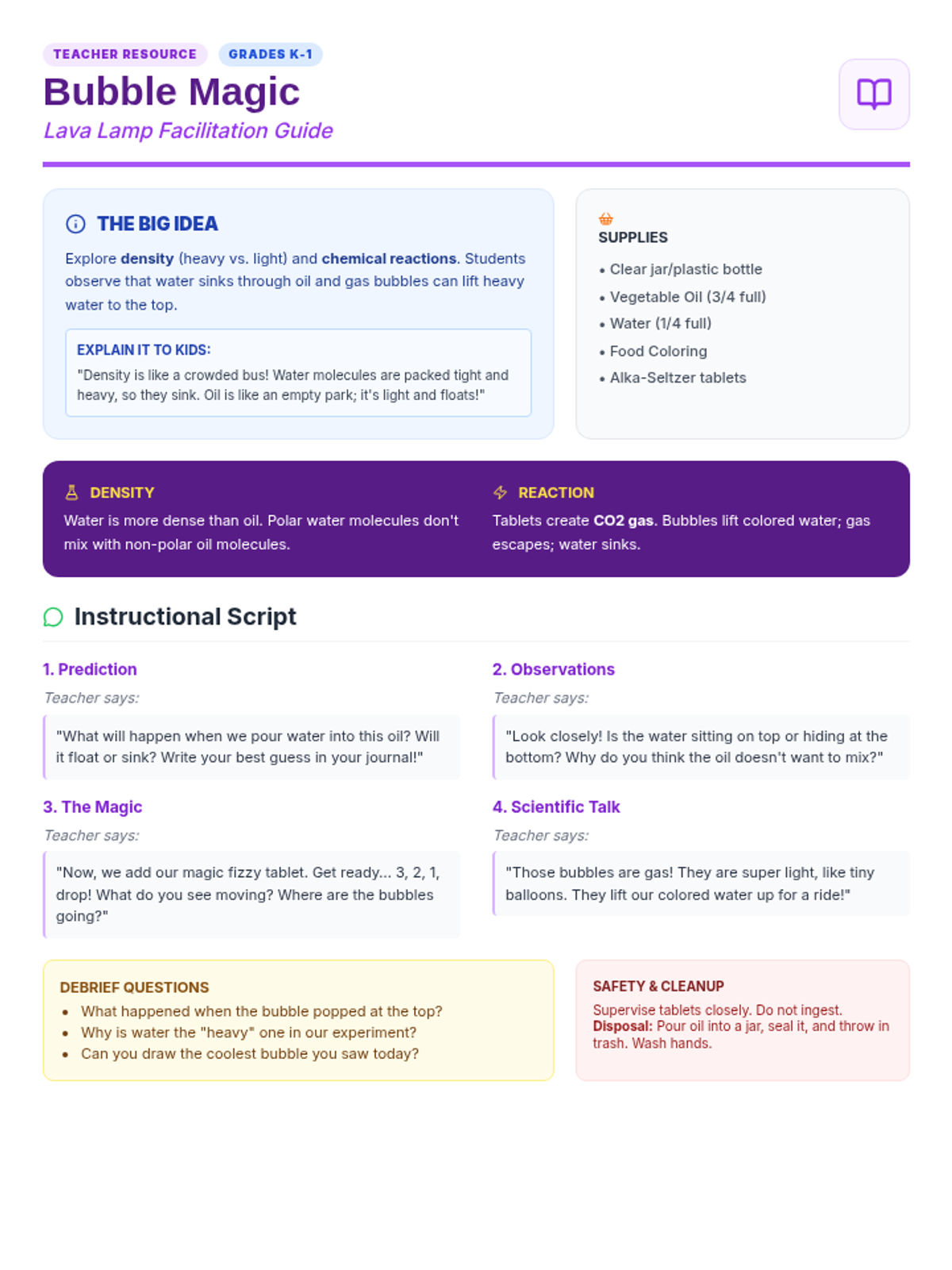
A teacher's facilitation guide for the Bubble Magic lava lamp experiment. It provides scientific background on density and chemical reactions, prep instructions, safety tips, and a step-by-step instructional script for the classroom.
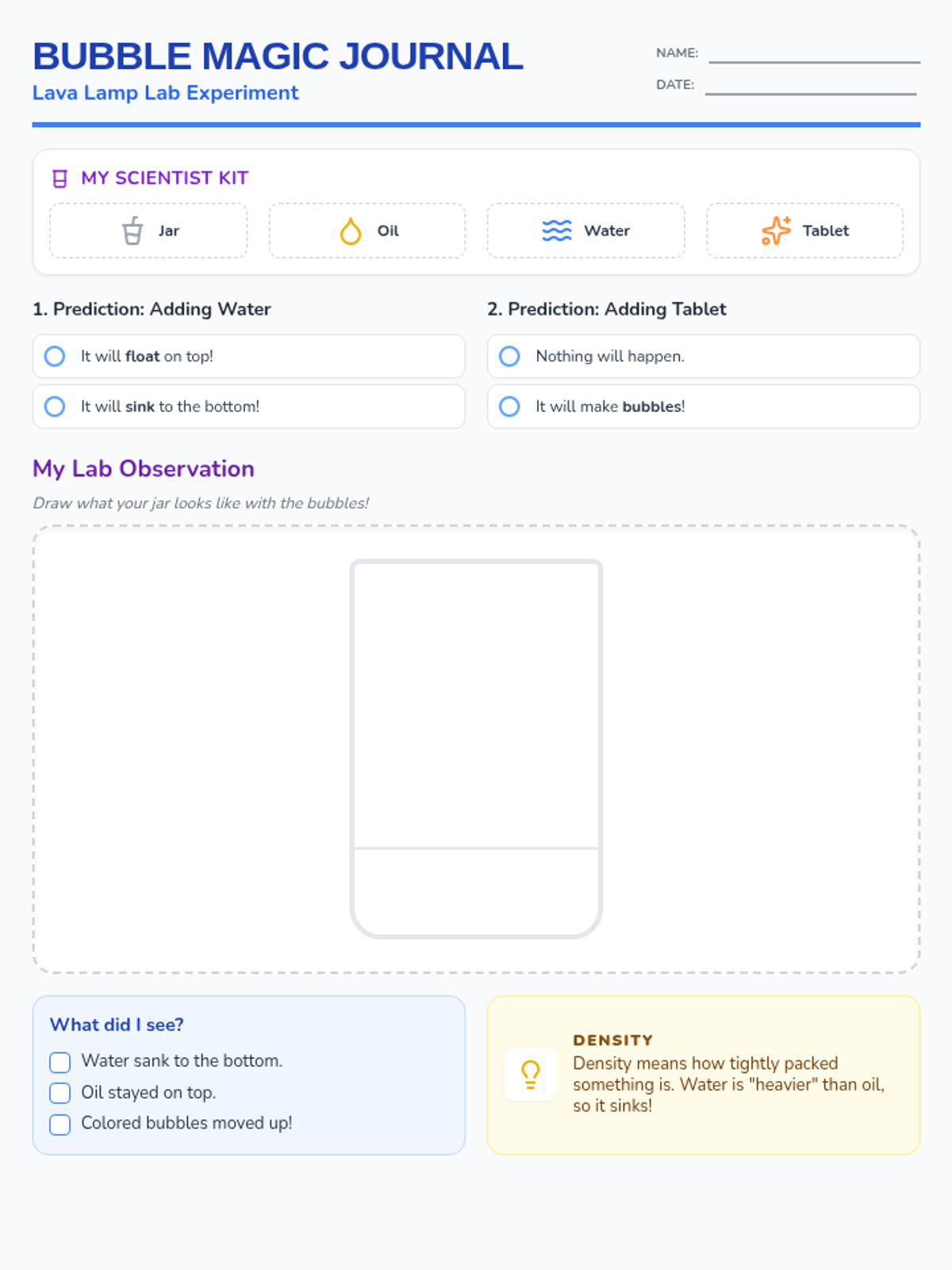
A student-facing observation worksheet for the lava lamp experiment. It includes sections for predictions, a space for drawing lab results, and checkboxes for making simple scientific observations.
A step-by-step presentation for Kindergarten and 1st grade students to create their own lava lamps. It includes simple explanations of density using child-friendly analogies and clear visual guides for the lab activity.
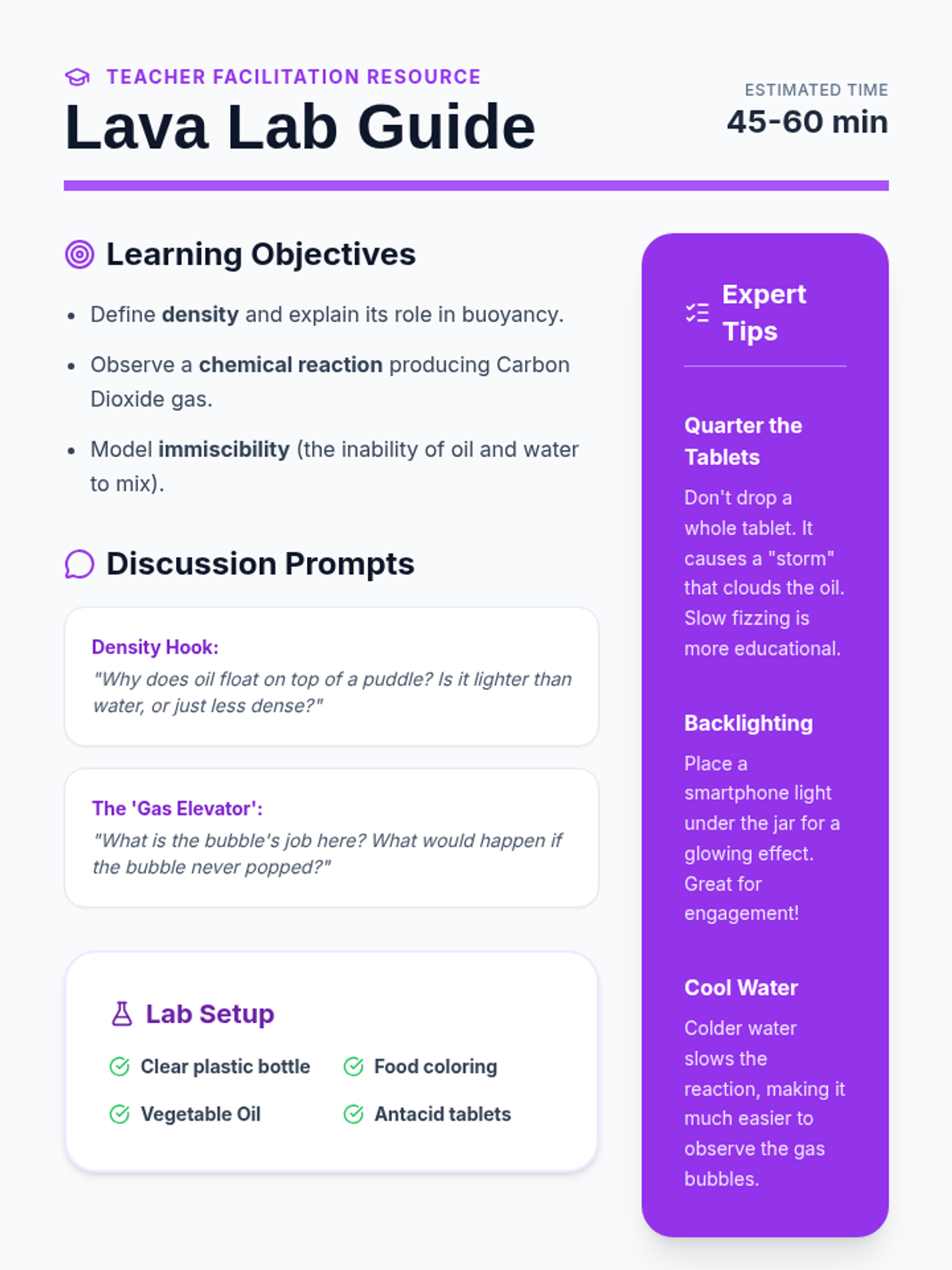
A comprehensive guide for teachers including learning objectives, discussion prompts, science troubleshooting tips, and pro-tips for facilitating the DIY lava lamp experiment.
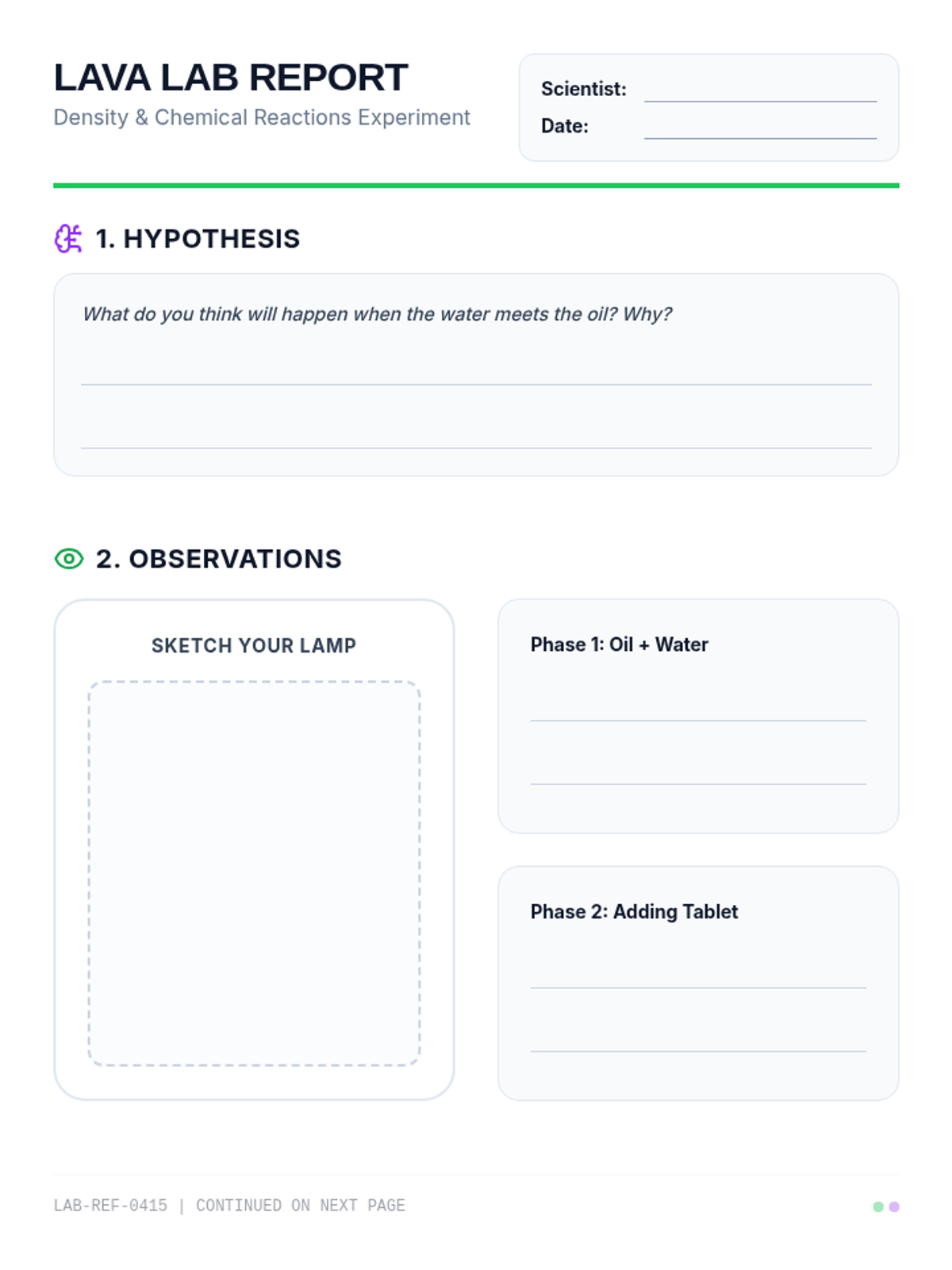
A structured lab report for students to record their hypothesis, observations with a sketch area, and analysis questions about density and the chemical reaction observed.
A visually engaging slide deck covering the concepts of density, intermolecular polarity (briefly), and step-by-step instructions for creating a DIY lava lamp experiment.
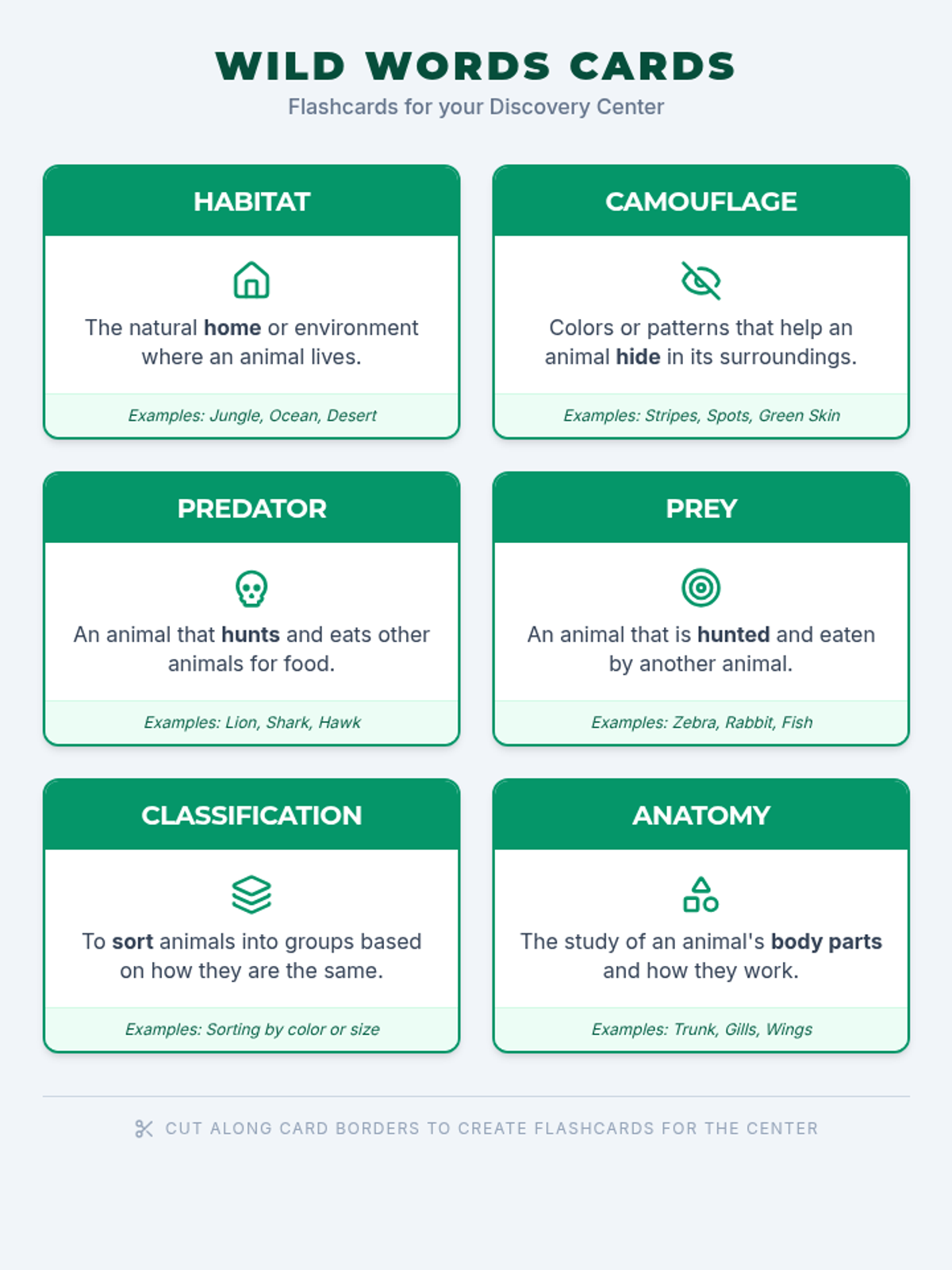
Visual vocabulary cards for the sensory center, providing simple definitions and examples for key science terms like habitat, camouflage, and classification.
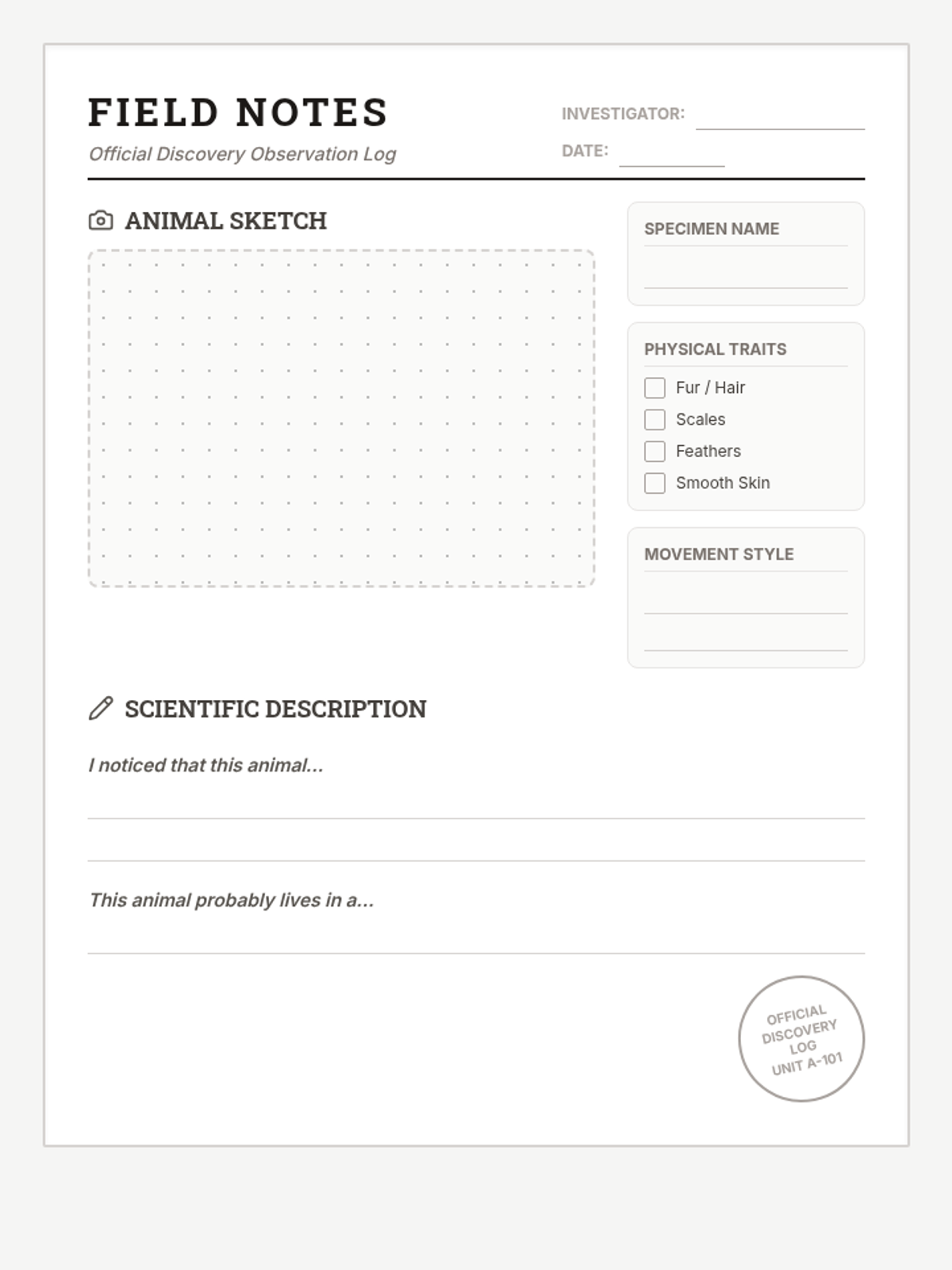
A field journal style worksheet for students to record their scientific observations, featuring a sketch area, trait checklist, and descriptive writing lines.
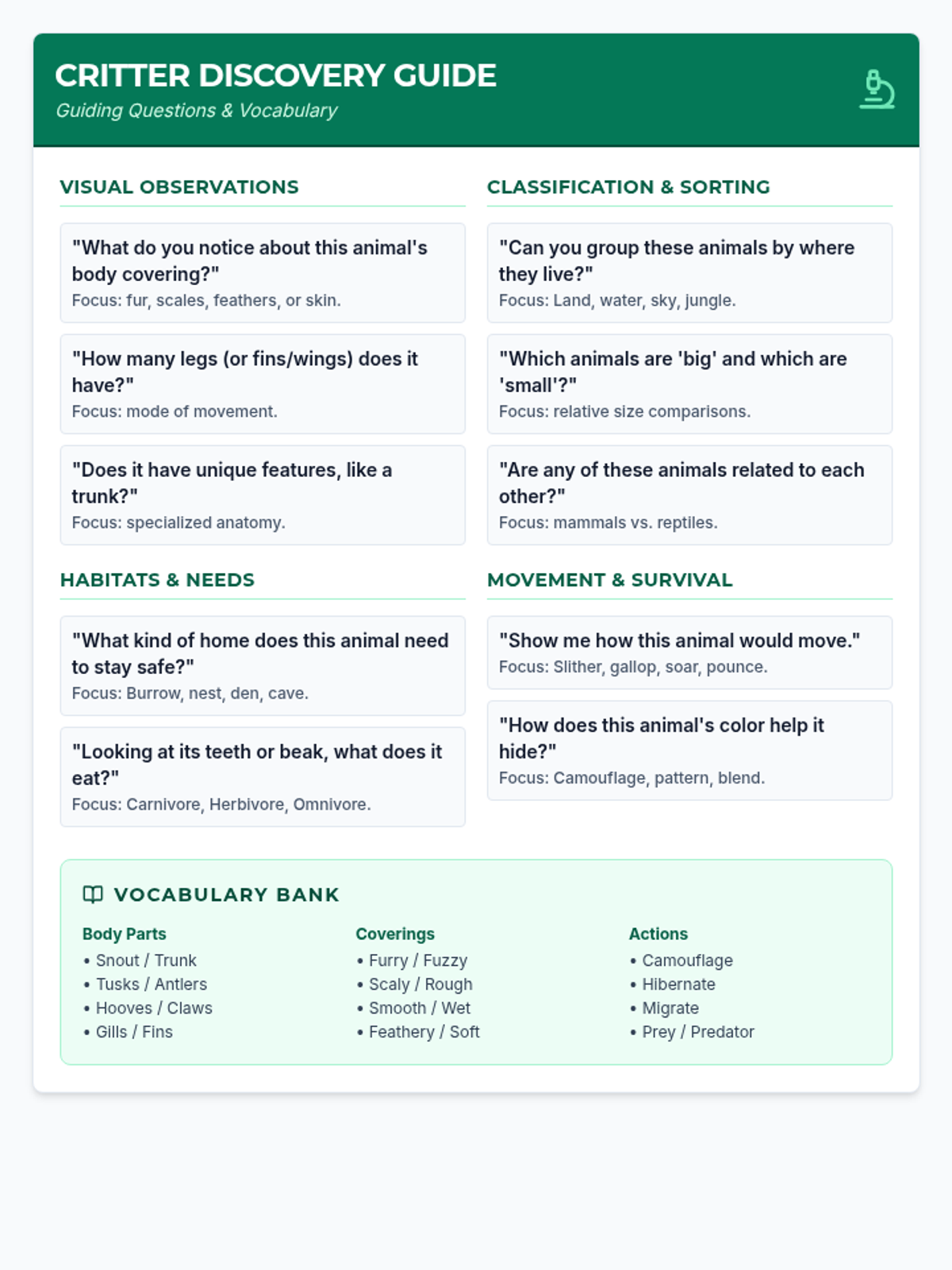
A teacher guide for the sensory center, featuring structured guiding questions and a vocabulary bank to facilitate science-based discussions.
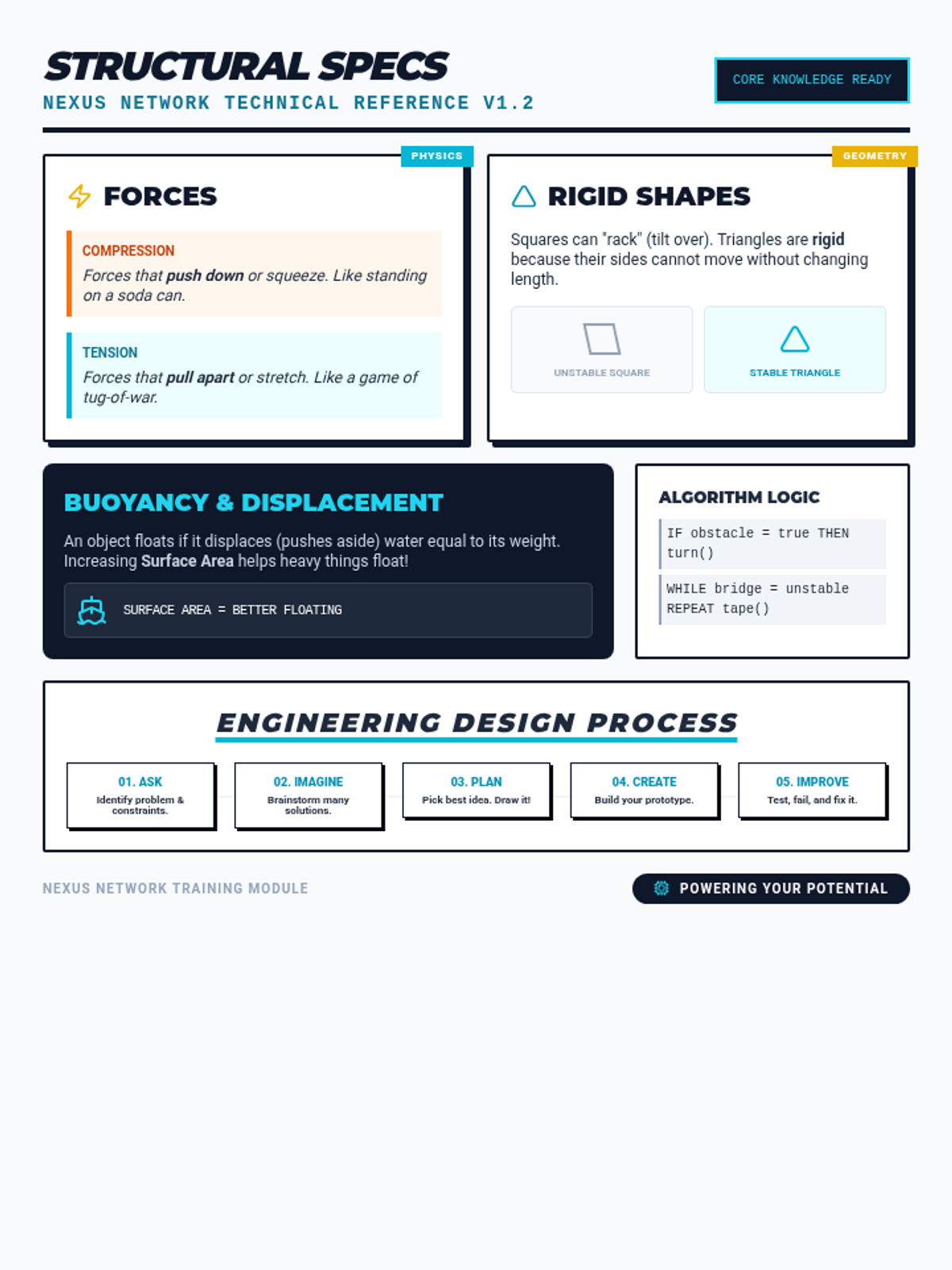
A technical reference sheet for students that explains core STEM concepts like compression, tension, structural shapes (triangles), buoyancy, and algorithms, as well as the Engineering Design Process.
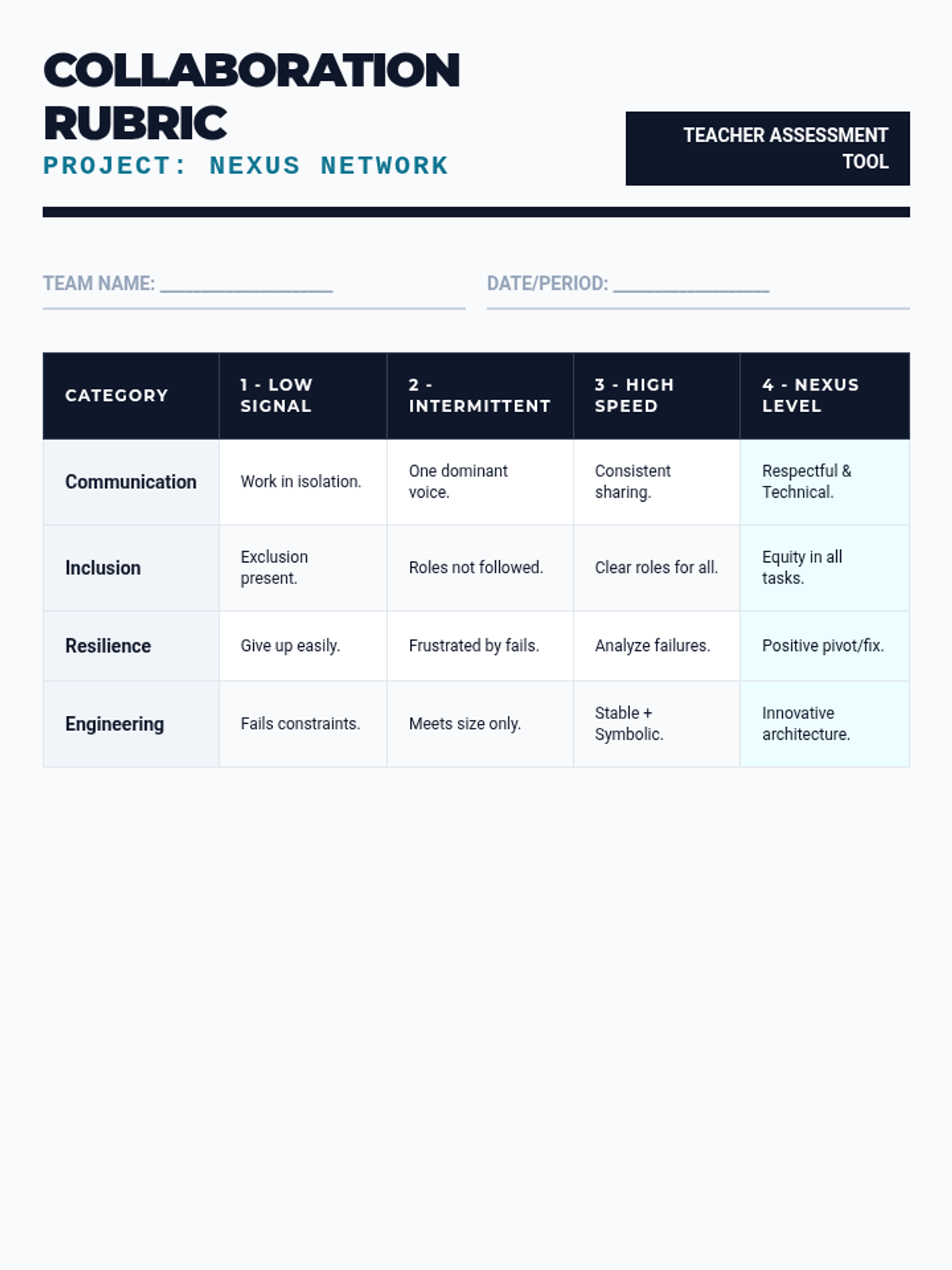
A teacher-facing assessment rubric for the Nexus Network lesson, evaluating teams on communication, inclusion, resilience, and engineering design on a 4-point scale.
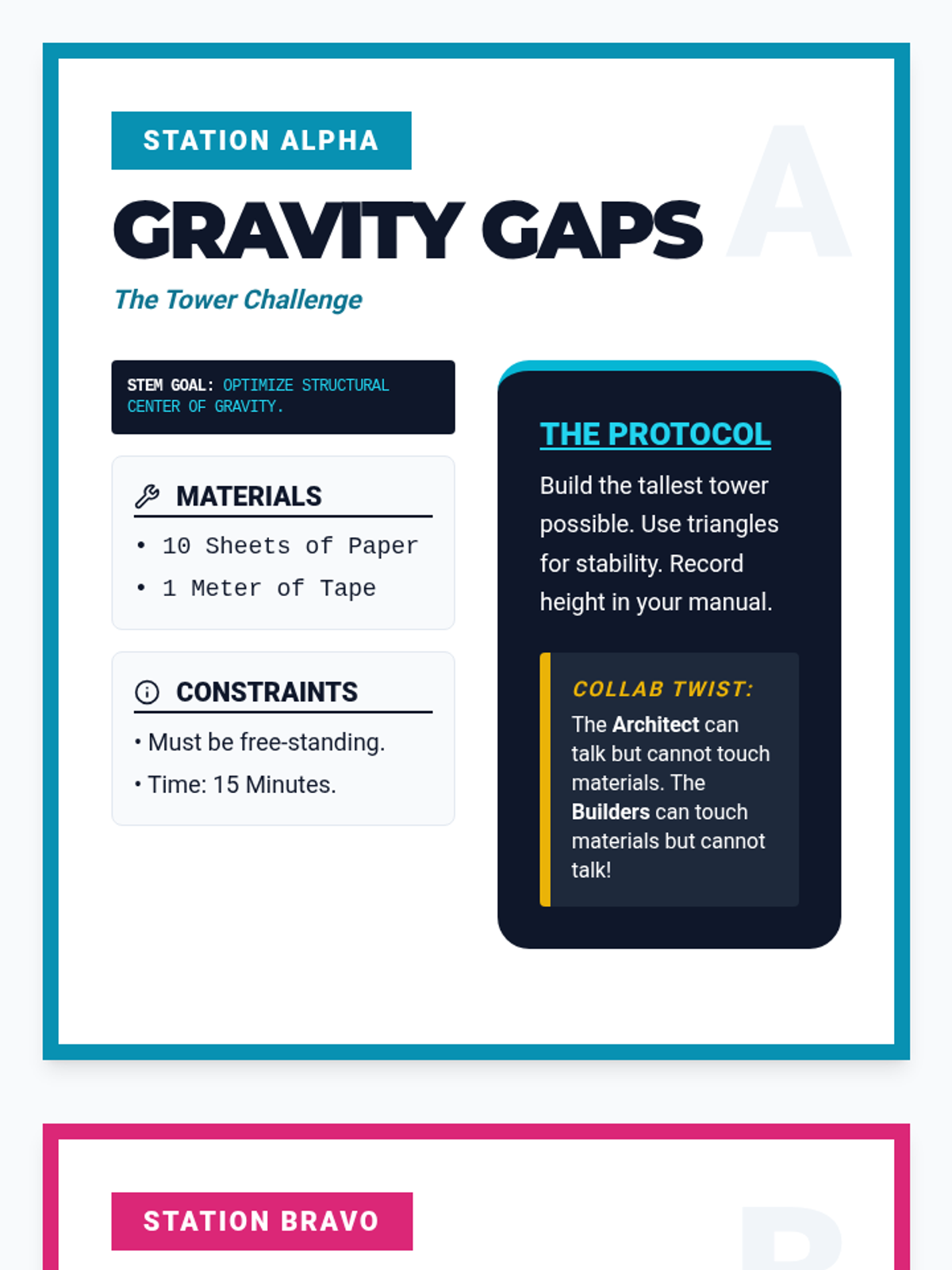
Printable station cards for the Nexus Network lesson, featuring large text and clear instructions for three collaborative STEM challenges with explicit STEM goals.
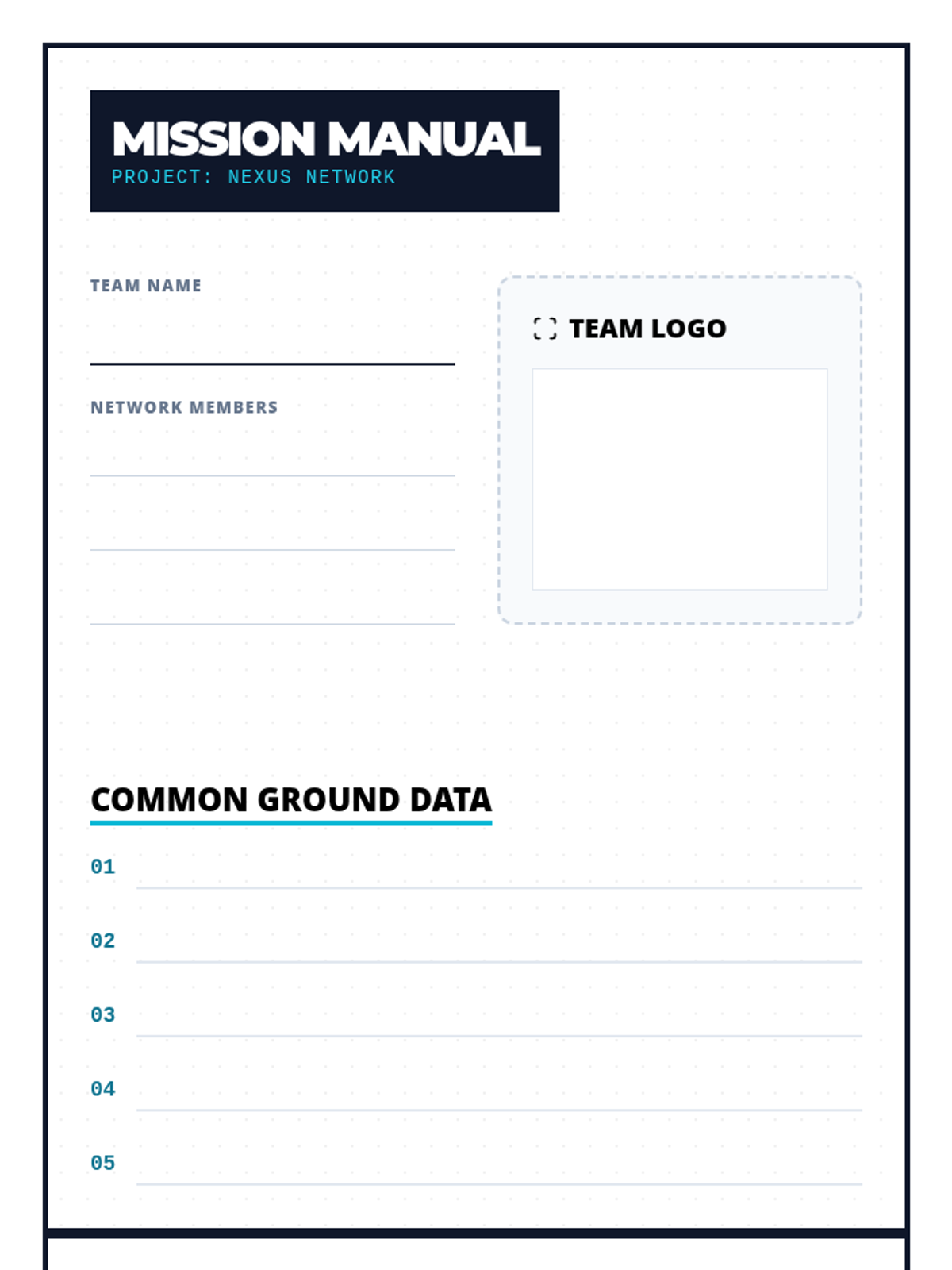
A student activity packet for the Nexus Network lesson, including team intake, station logs with data tables, bridge blueprinting space, a material marketplace for SEL credits, and a final reflection section.
An interactive slide deck for the Nexus Network lesson, featuring big text, clear visual cues, and specific prompts for icebreakers, stations, and the main bridge challenge.
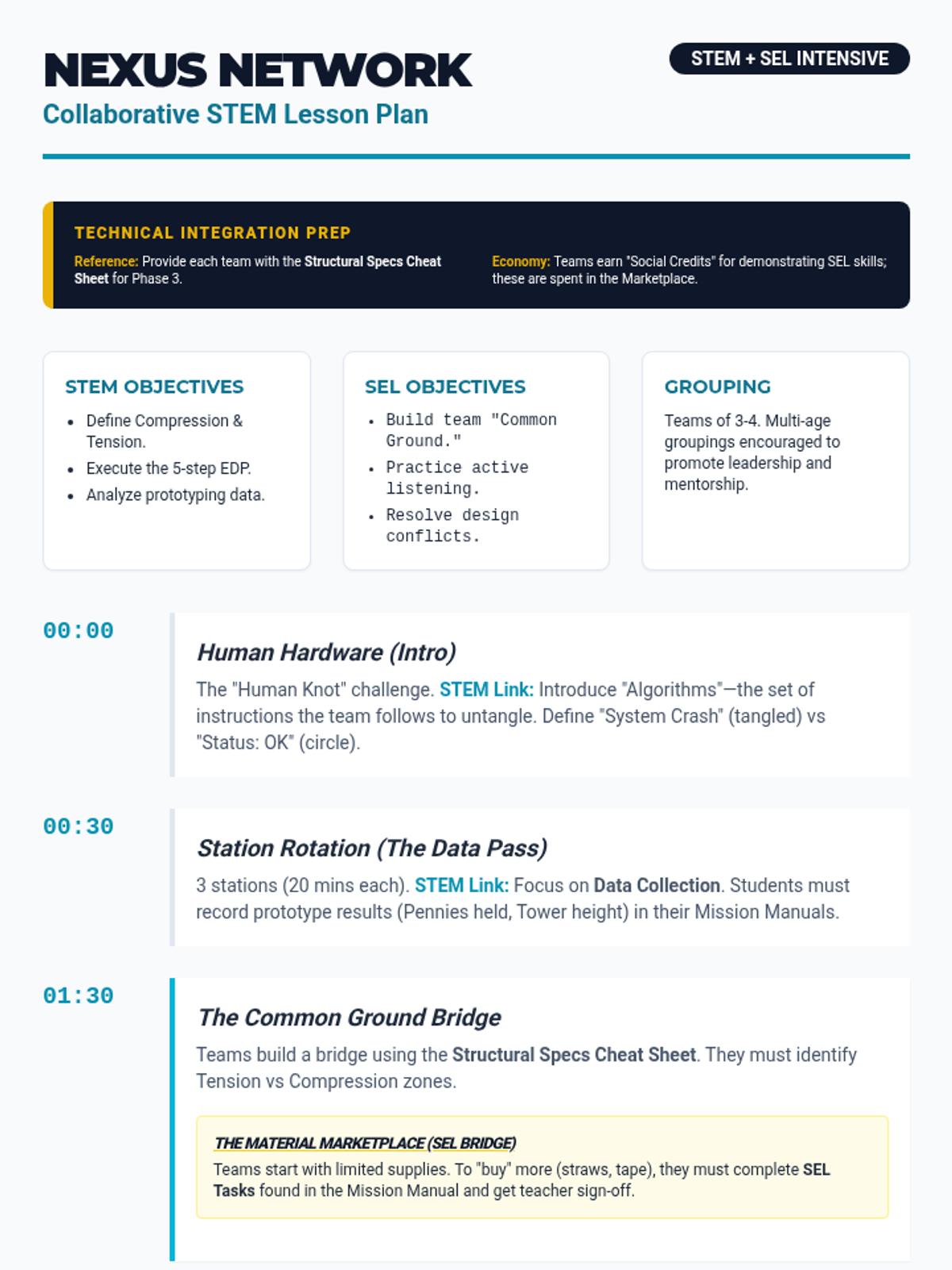
A comprehensive lesson plan for a 3-hour STEM collaboration event, featuring a detailed timeline, differentiation notes for elementary and middle school, and a structured engineering challenge with integrated SEL marketplace concepts.
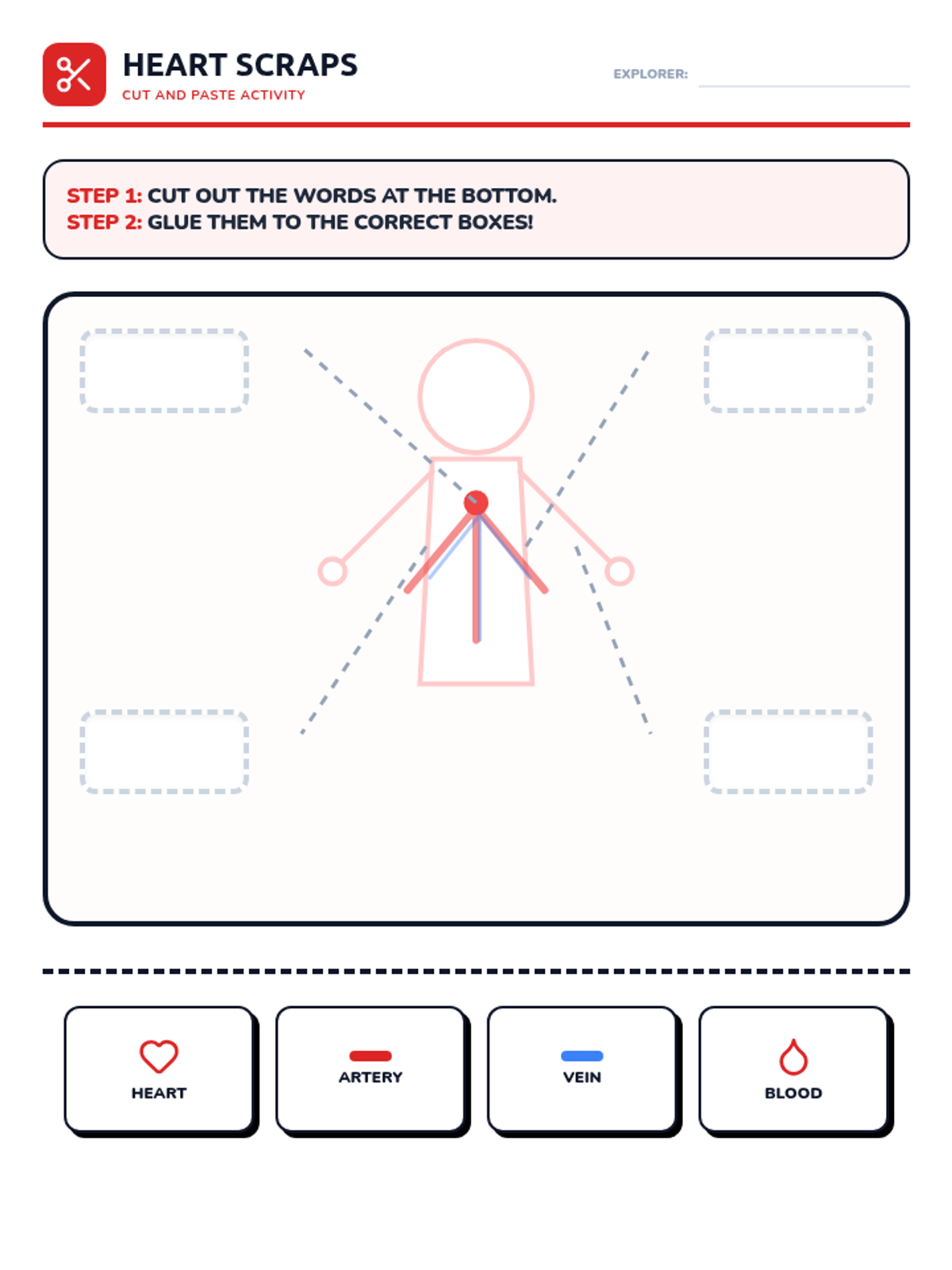
A cut-and-paste labeling worksheet for kindergarteners to identify the parts of the circulatory system (Heart, Artery, Vein, Blood).
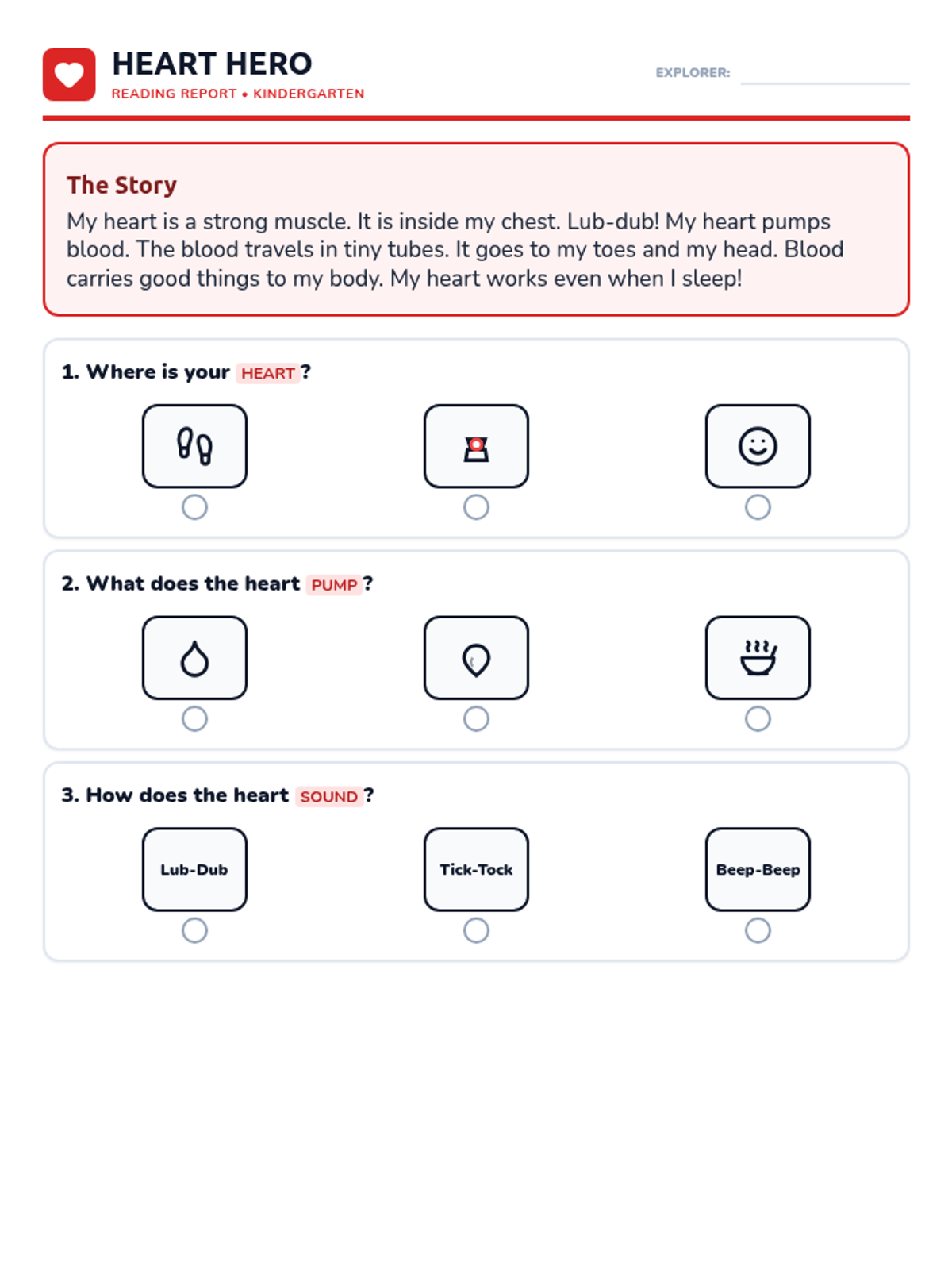
A short reading passage for kindergarten students about the circulatory system (heart and blood), with three picture-based multiple-choice questions.
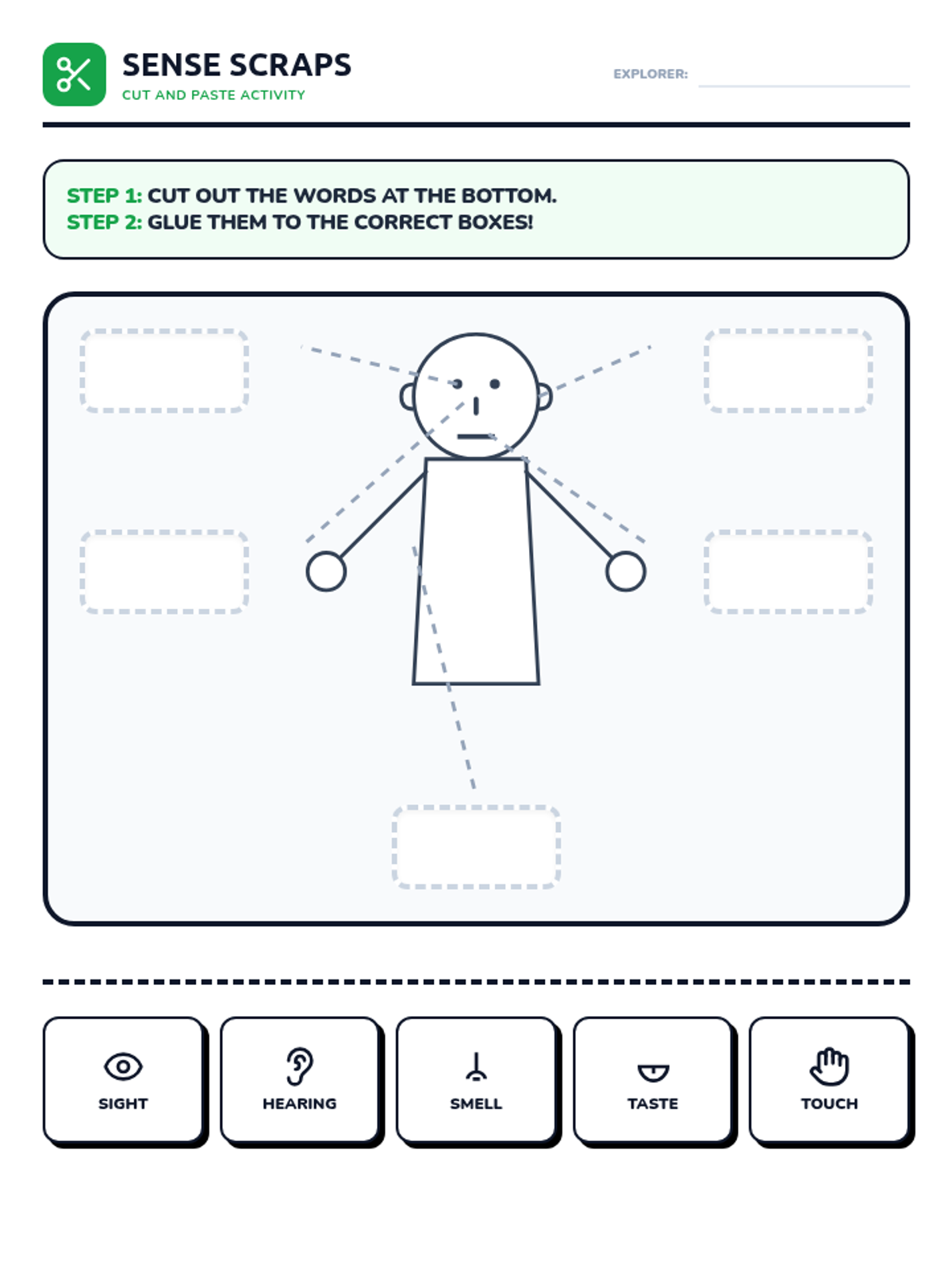
A cut-and-paste labeling worksheet for kindergarteners to identify the body parts associated with the five senses (Sight, Hearing, Smell, Taste, Touch).
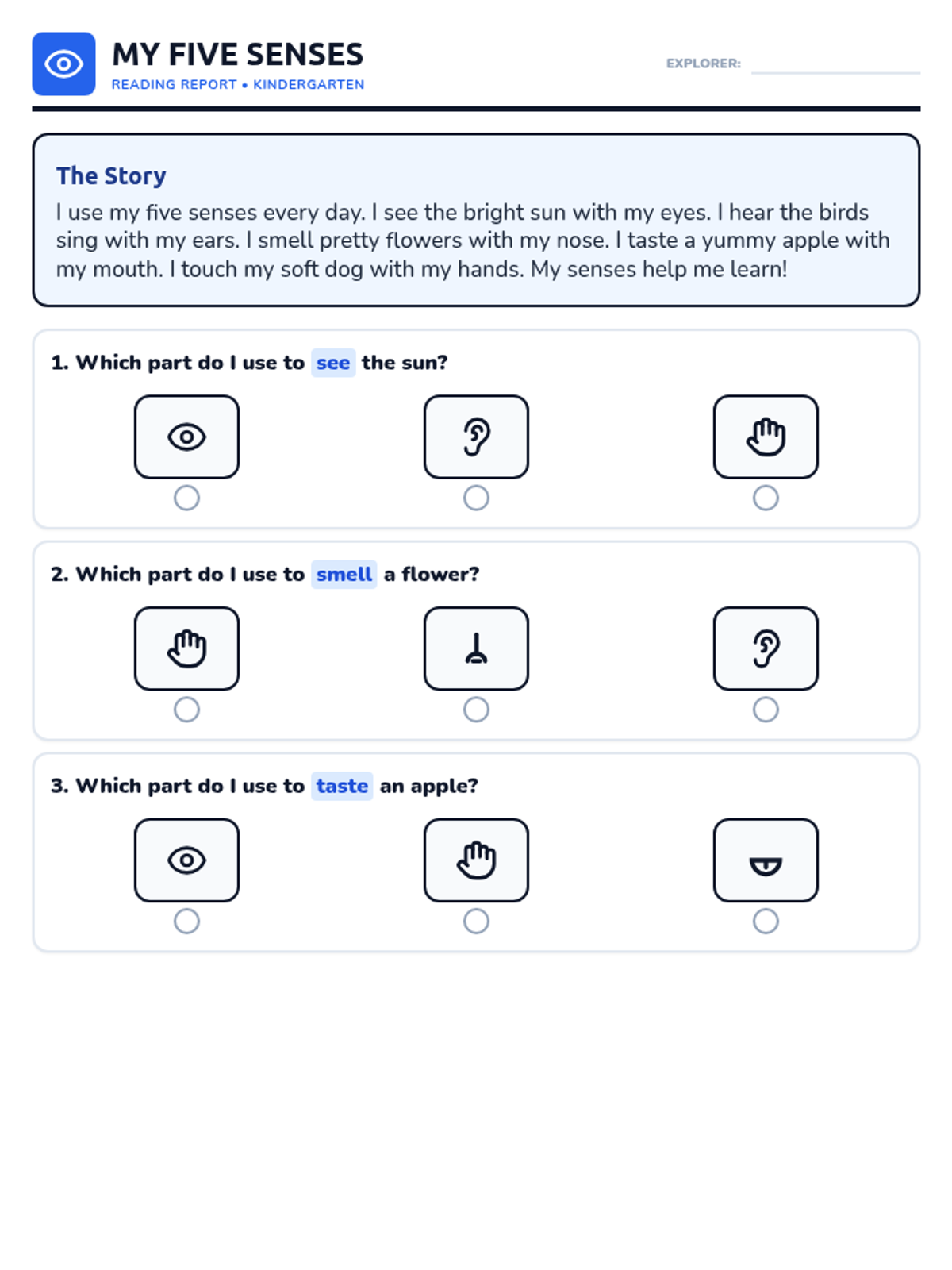
A short reading passage for kindergarten students about the five senses, accompanied by three multiple-choice questions using visual icons for answers.
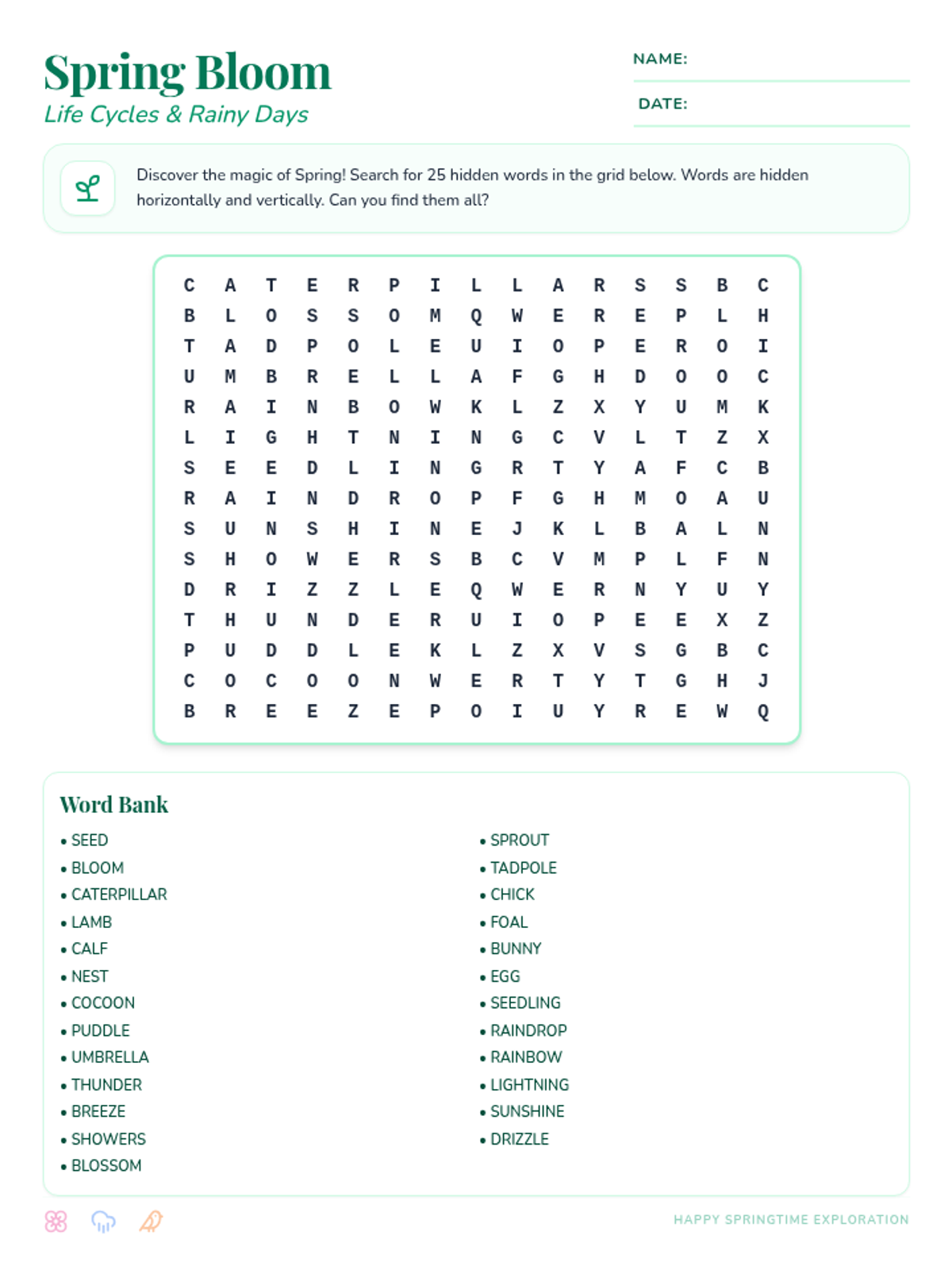
A spring-themed word search featuring 25 words related to life cycles, baby animals, and weather. Includes a decorative student worksheet and a corresponding answer key.
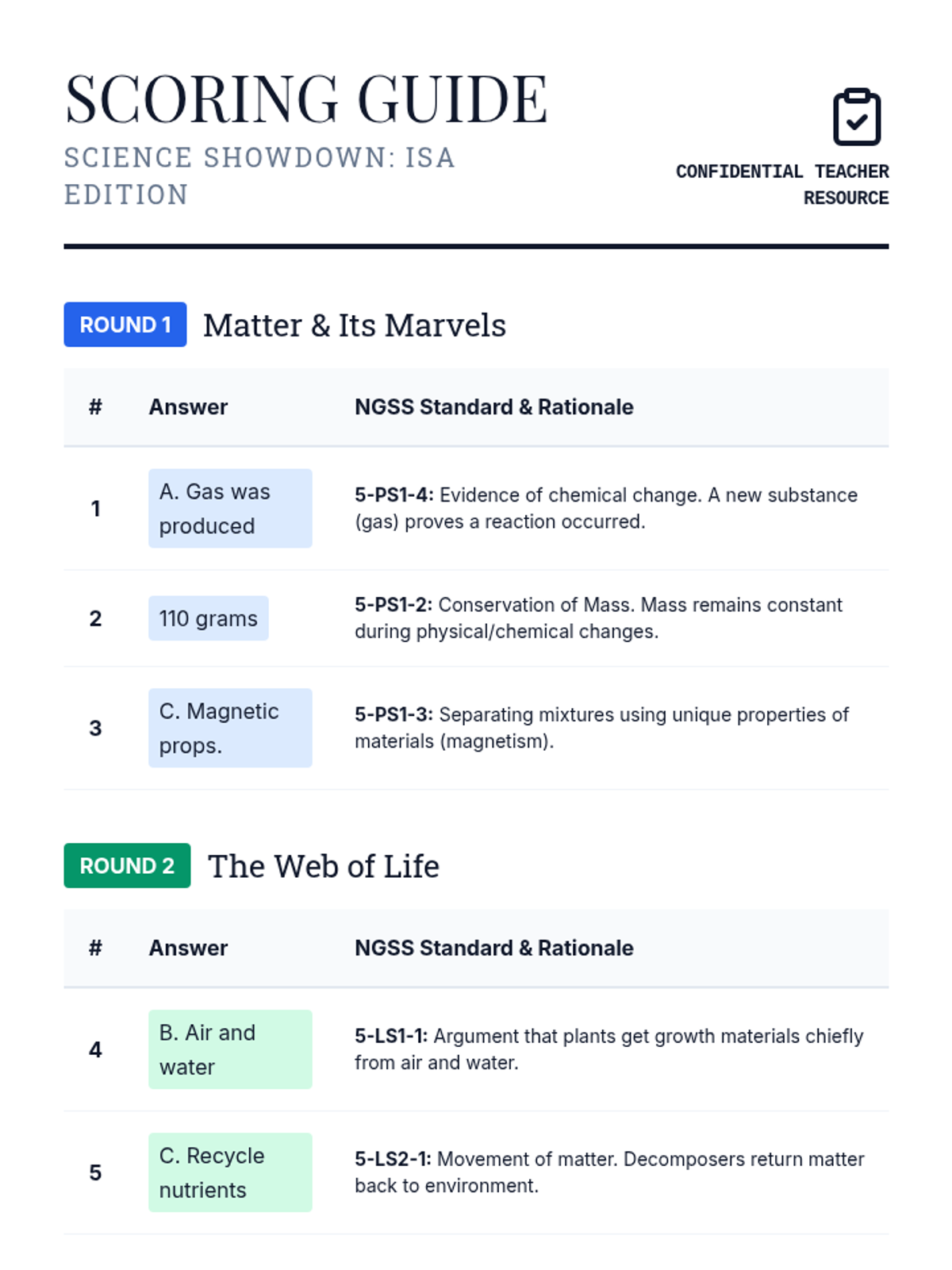
A comprehensive teacher scoring guide for the Science Showdown trivia game, featuring optimized table layouts, clear answer keys, and fixed page breaks.
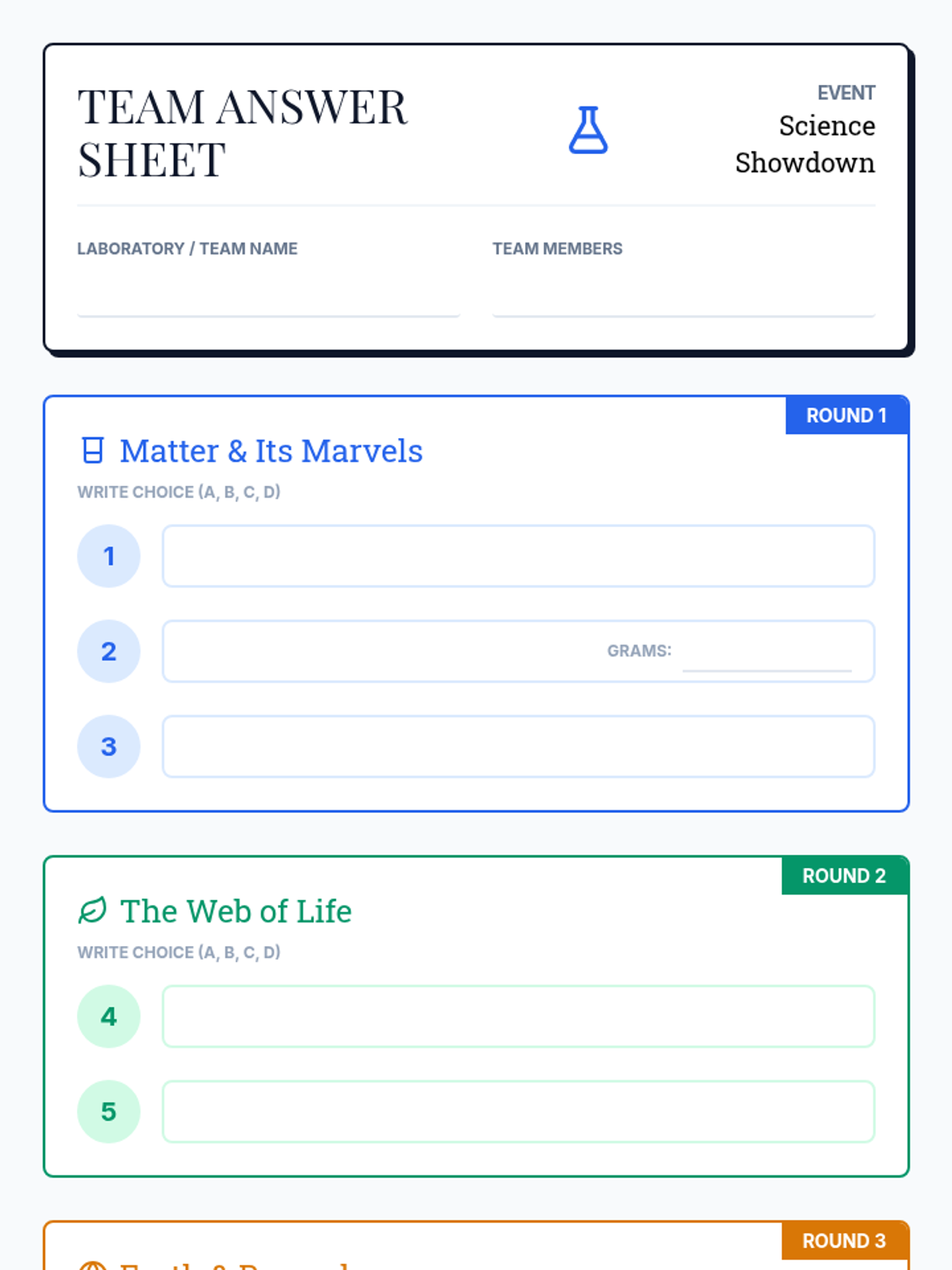
A structured team answer sheet for the Science Showdown trivia game, with clear answer boxes, avoided page splits, and improved legibility for student responses.
A high-energy, NGSS-aligned trivia presentation for 5th-grade ISA test prep, featuring standardized answer choice layouts, clear round headings, and a final results key.
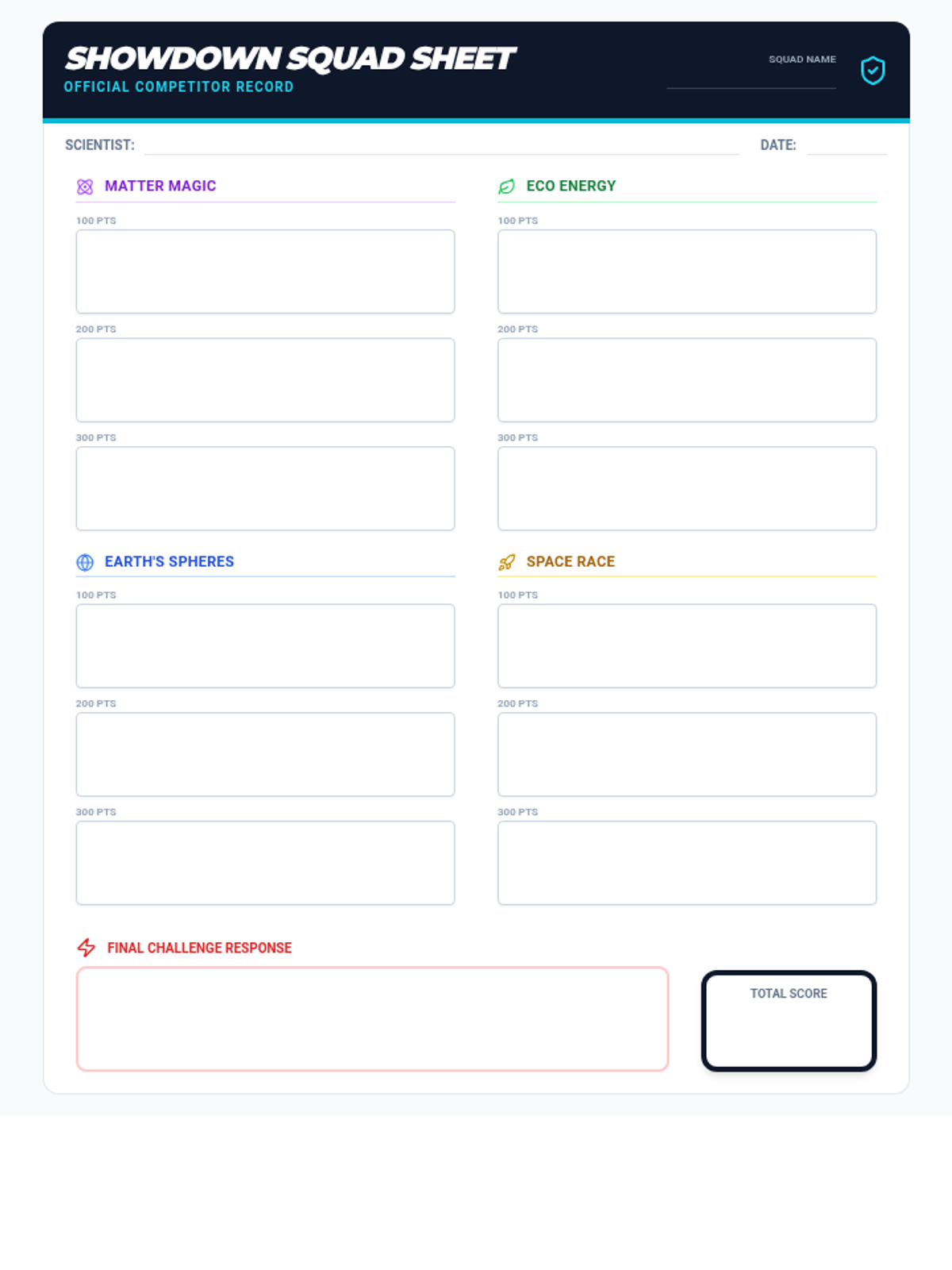
A student response sheet for the Science Showdown game, featuring organized boxes for each category and point level, a final challenge area, and a total score tracker.
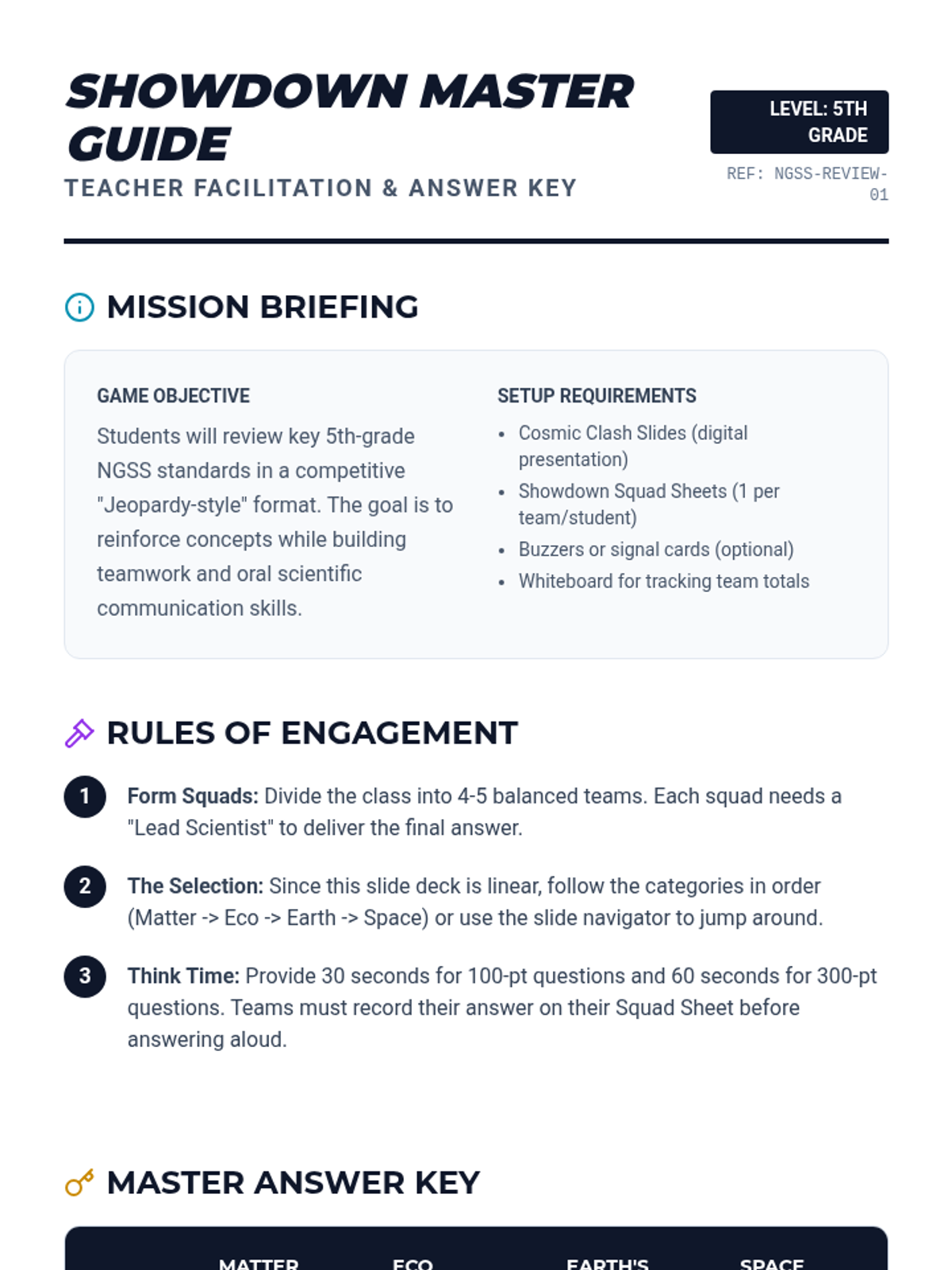
A comprehensive teacher guide for the Science Showdown game, including game rules, scoring tips, and a master answer key aligned to NGSS standards.
A vibrant, futuristic slide deck for a 5th grade NGSS science review game. Includes four categories: Matter, Ecosystems, Earth's Systems, and Space, with question and answer slides for each.
A 5-slide visual presentation for 5th-grade EL students introducing natural disasters with heavy visual scaffolding, diagrams, and discussion prompts. Features high-contrast visuals, optimized diagramming, and perfect slide-break formatting.
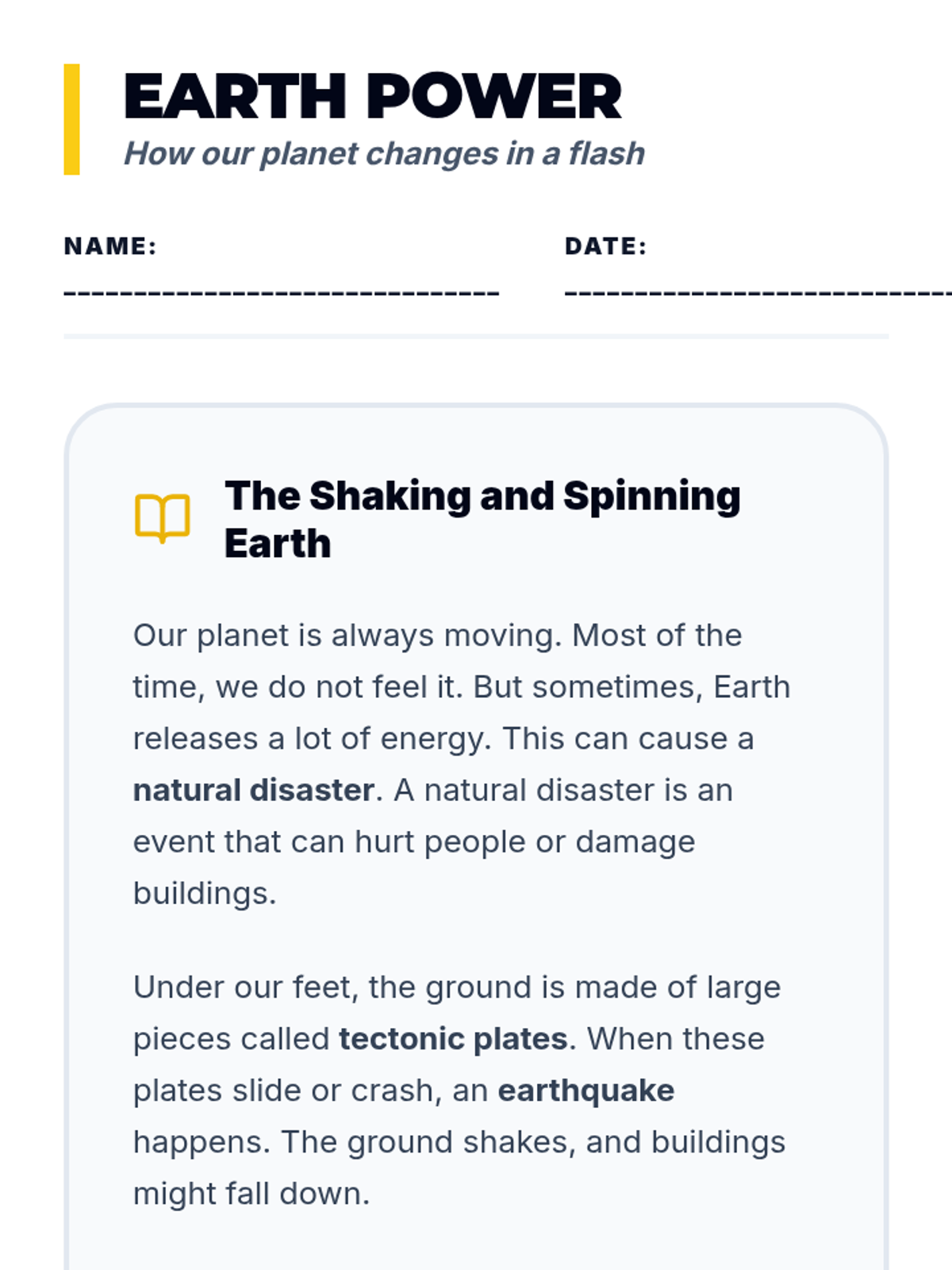
A reading passage with simplified language for 5th-grade EL students about natural disasters, followed by four scaffolded sentence frames. Features clear layout, enhanced text contrast, and improved student work areas.
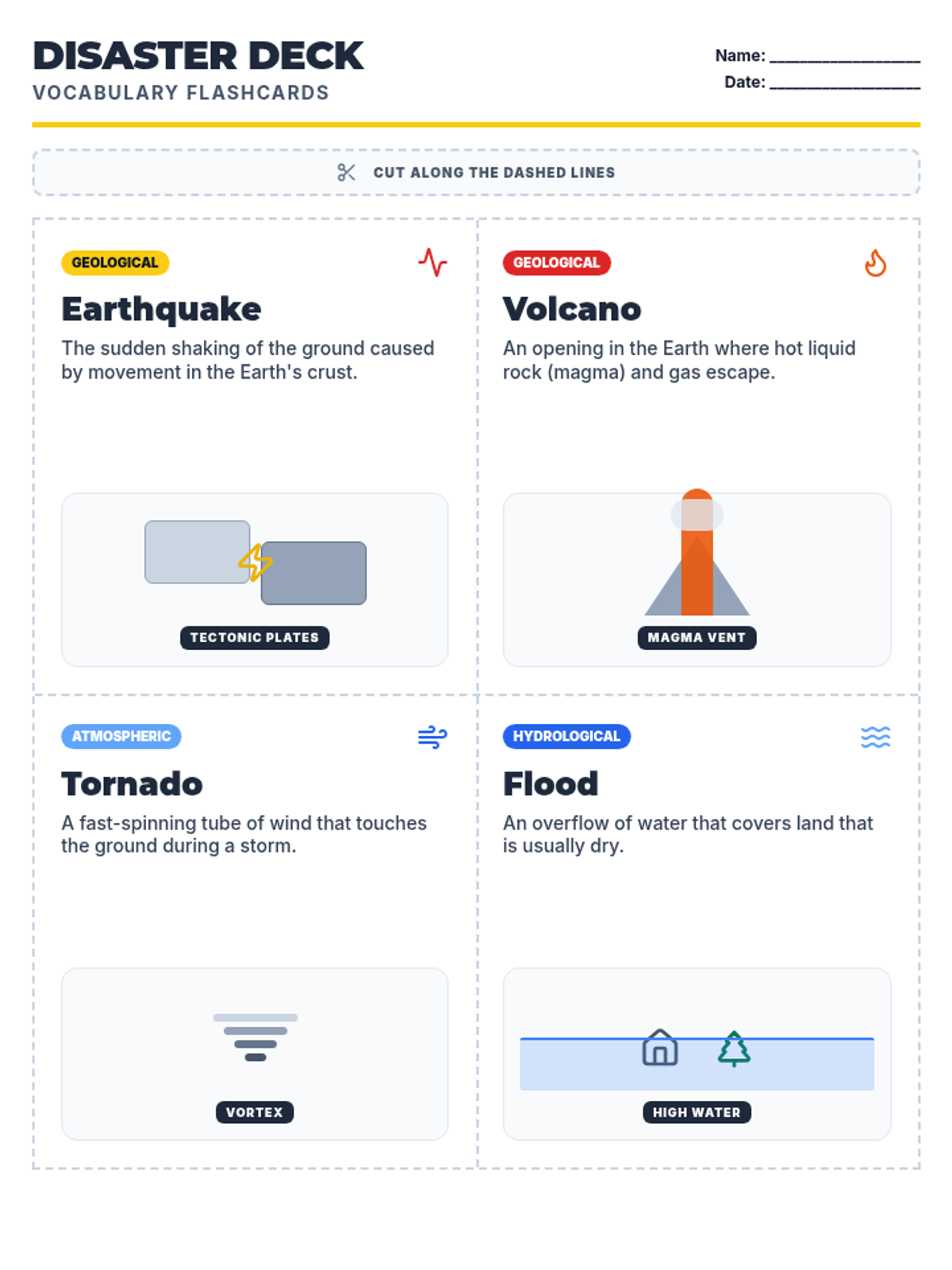
A set of four vocabulary flashcards for 5th-grade EL students featuring terms, simple definitions, and stylized diagrams for earthquakes, volcanoes, tornadoes, and floods. Includes clear cutting guides and print-optimized diagrams.
A set of vocabulary flashcards with visuals, definitions, and space for students to write translations in their home language. Ideal for Multilingual Learners to bridge conceptual understanding.