A set of four printable exit tickets for decoding and morphological awareness. Includes syllable division, prefix identification, and suffix application. Features a cyan blueprint aesthetic.
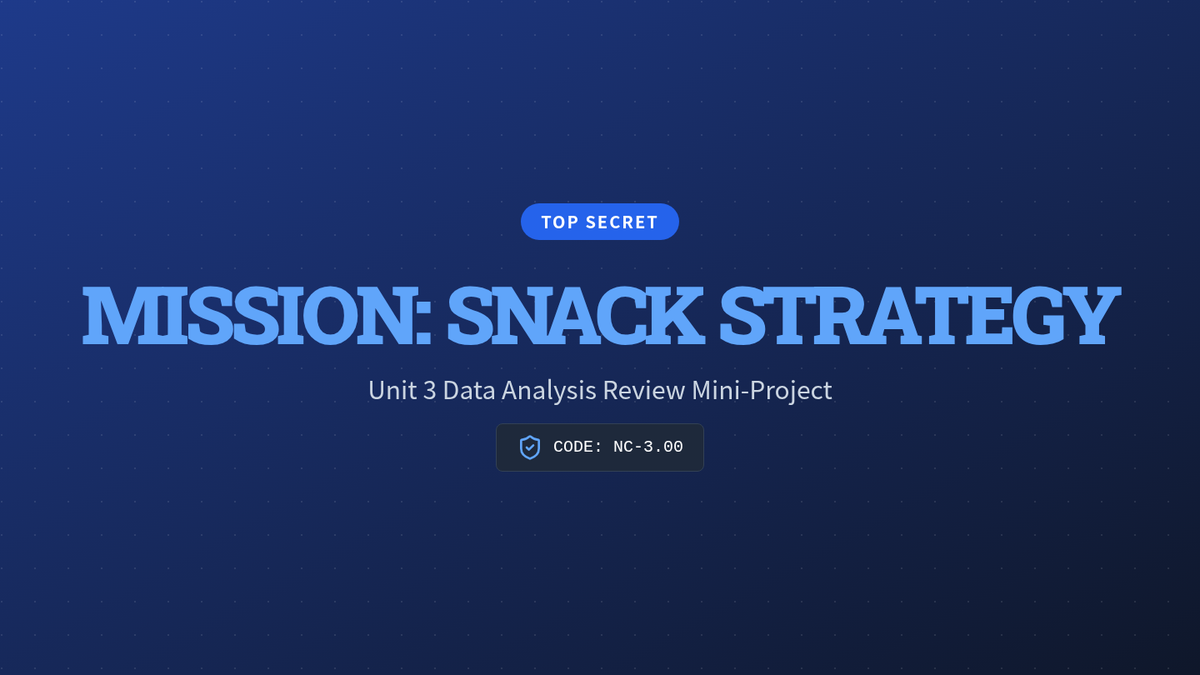
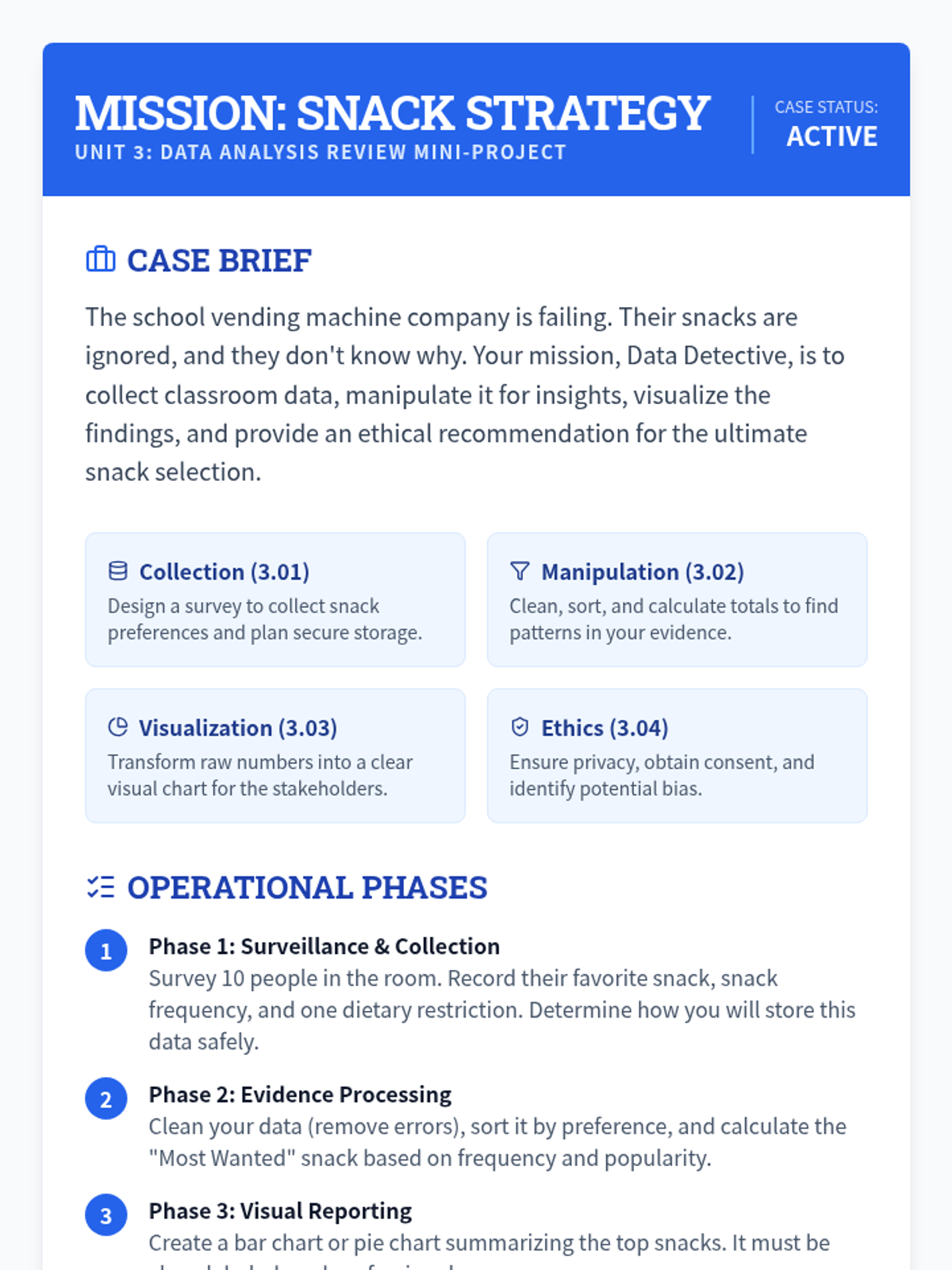
A visual presentation deck to launch the Snack Strategy mini-project, introducing the mission scenario, phases of data analysis, and success criteria.
A guided two-page worksheet for students to document their snack data project, featuring sections for collection, manipulation, visualization, and ethics.
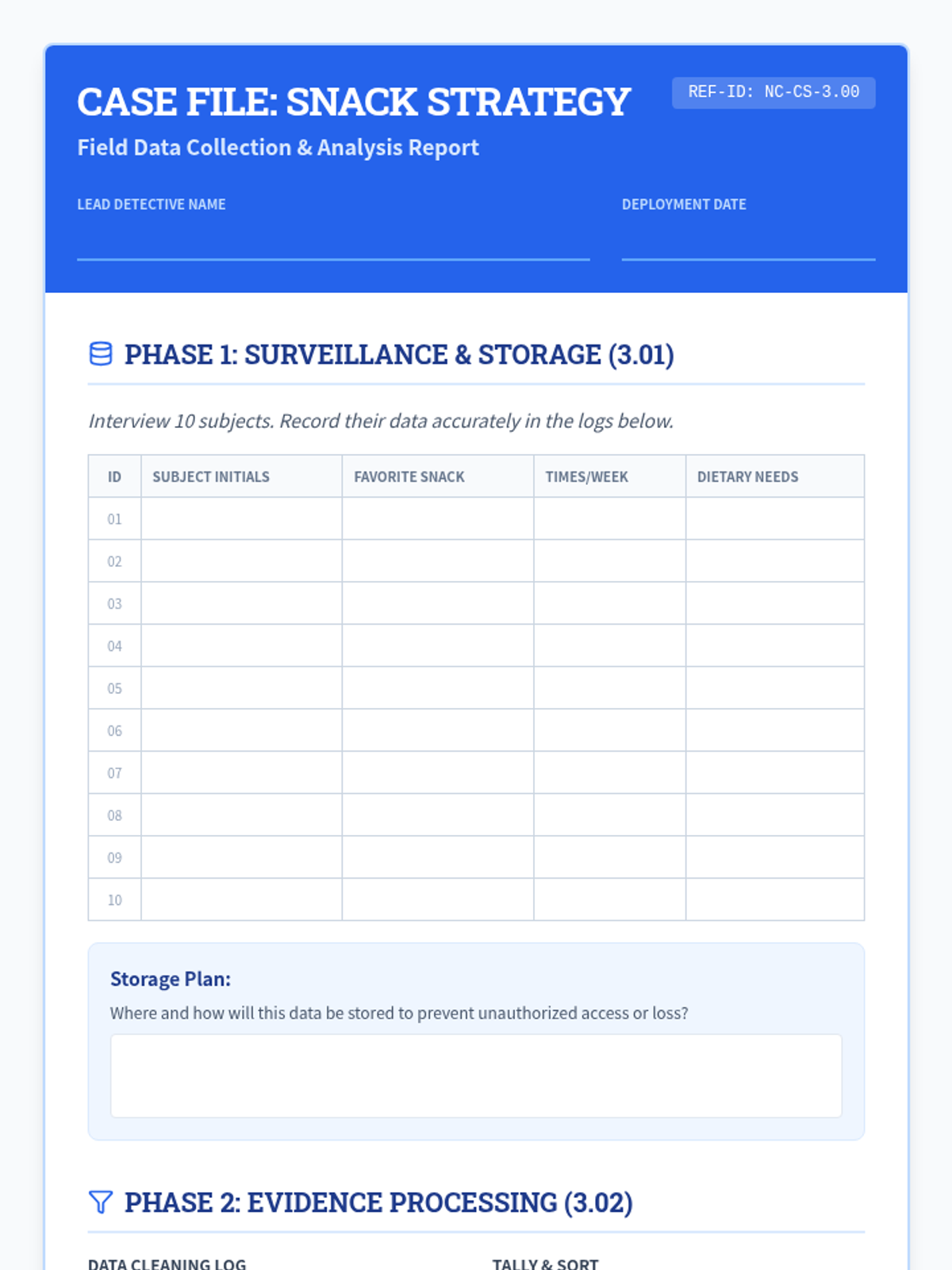
A comprehensive project guide for the Snack Strategy mini-project, including standard alignment, step-by-step instructions, and a grading rubric.
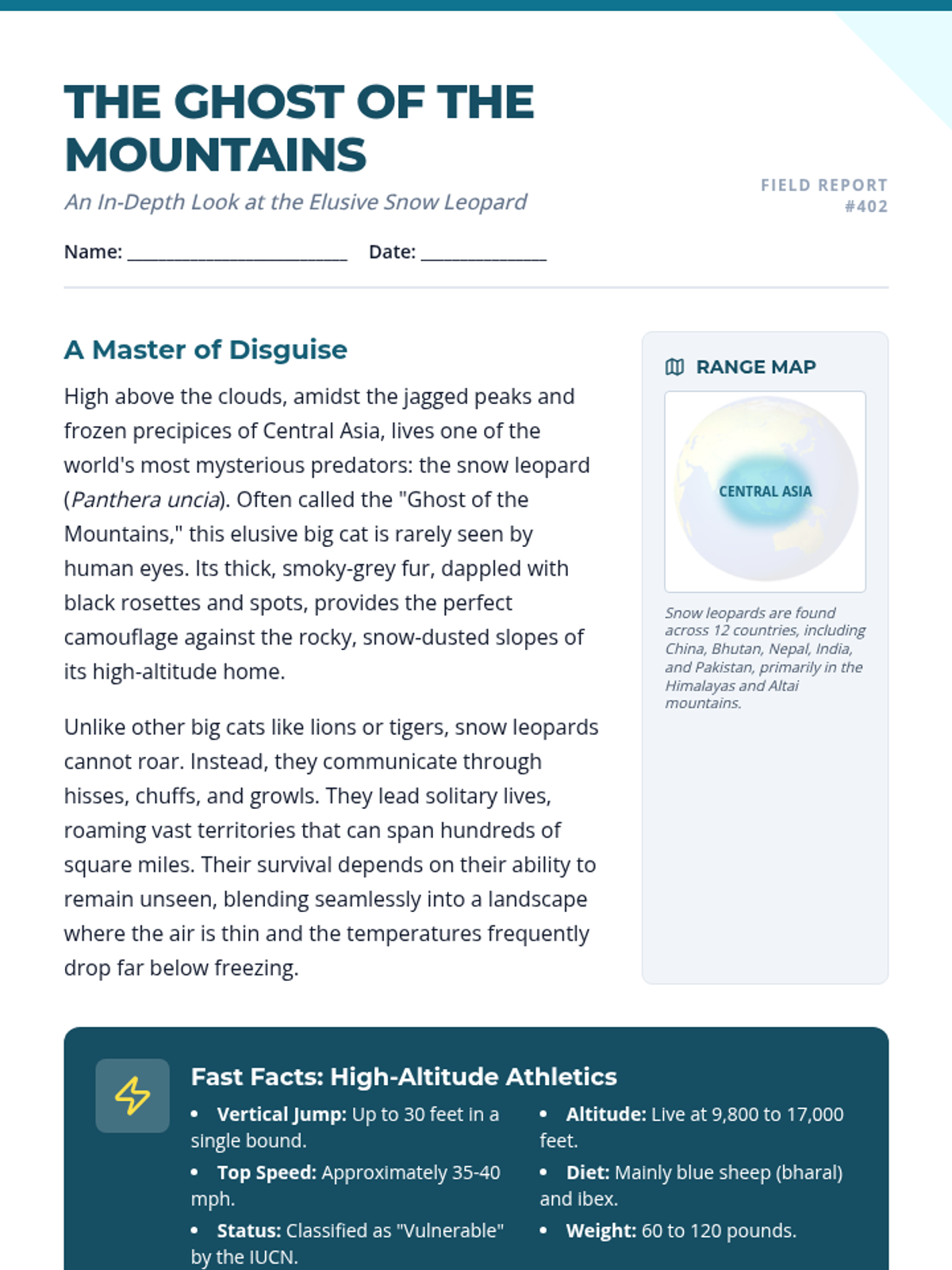
An informational text about snow leopards, featuring subheadings, a range map, a lifecycle timeline, a labeled diagram of adaptations, a fast-fact box, and an author's note. The text explores the habitat, physical traits, and conservation of this elusive predator.
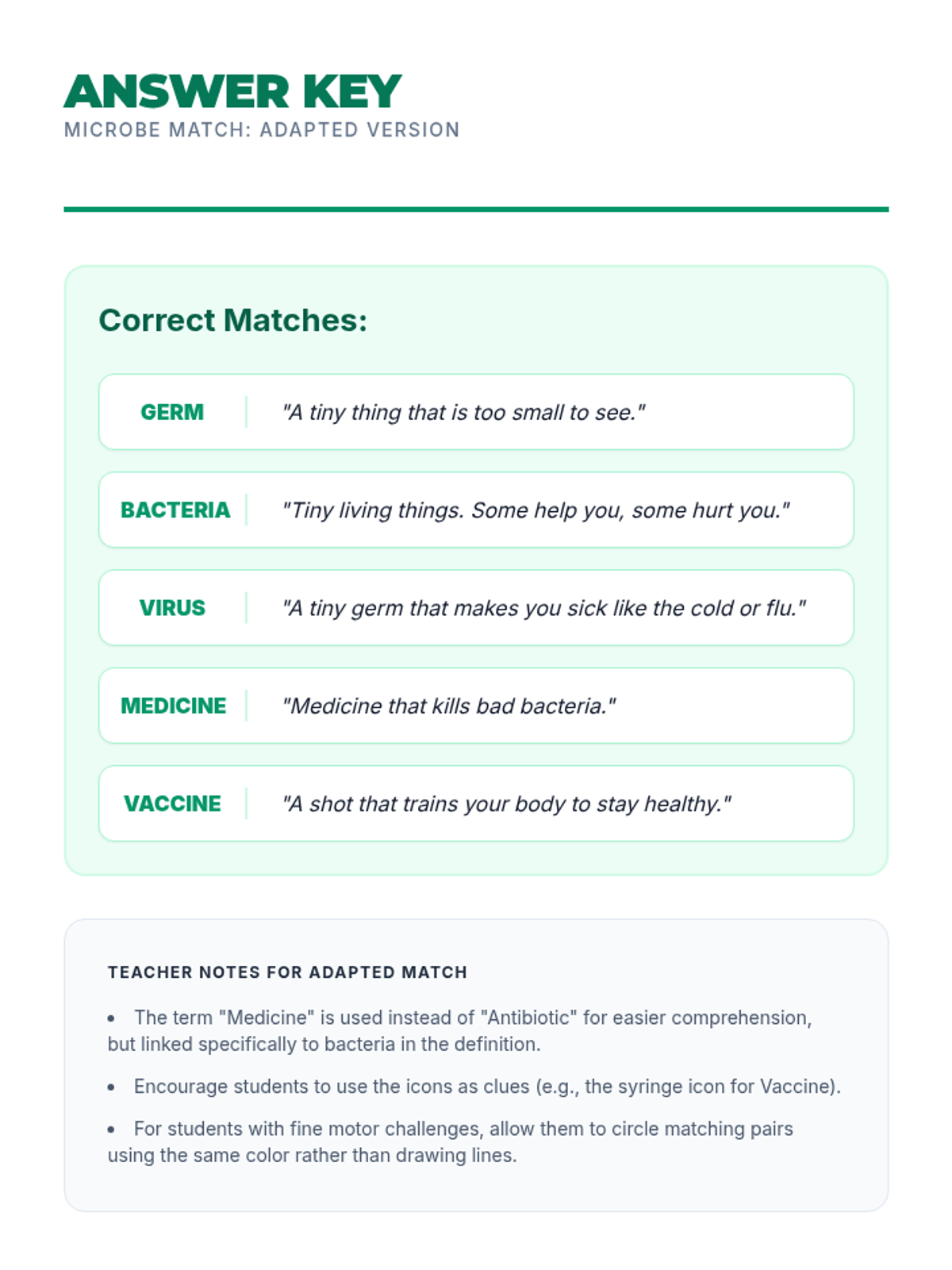
Teacher answer key for the Microbe Match Adapted Worksheet.
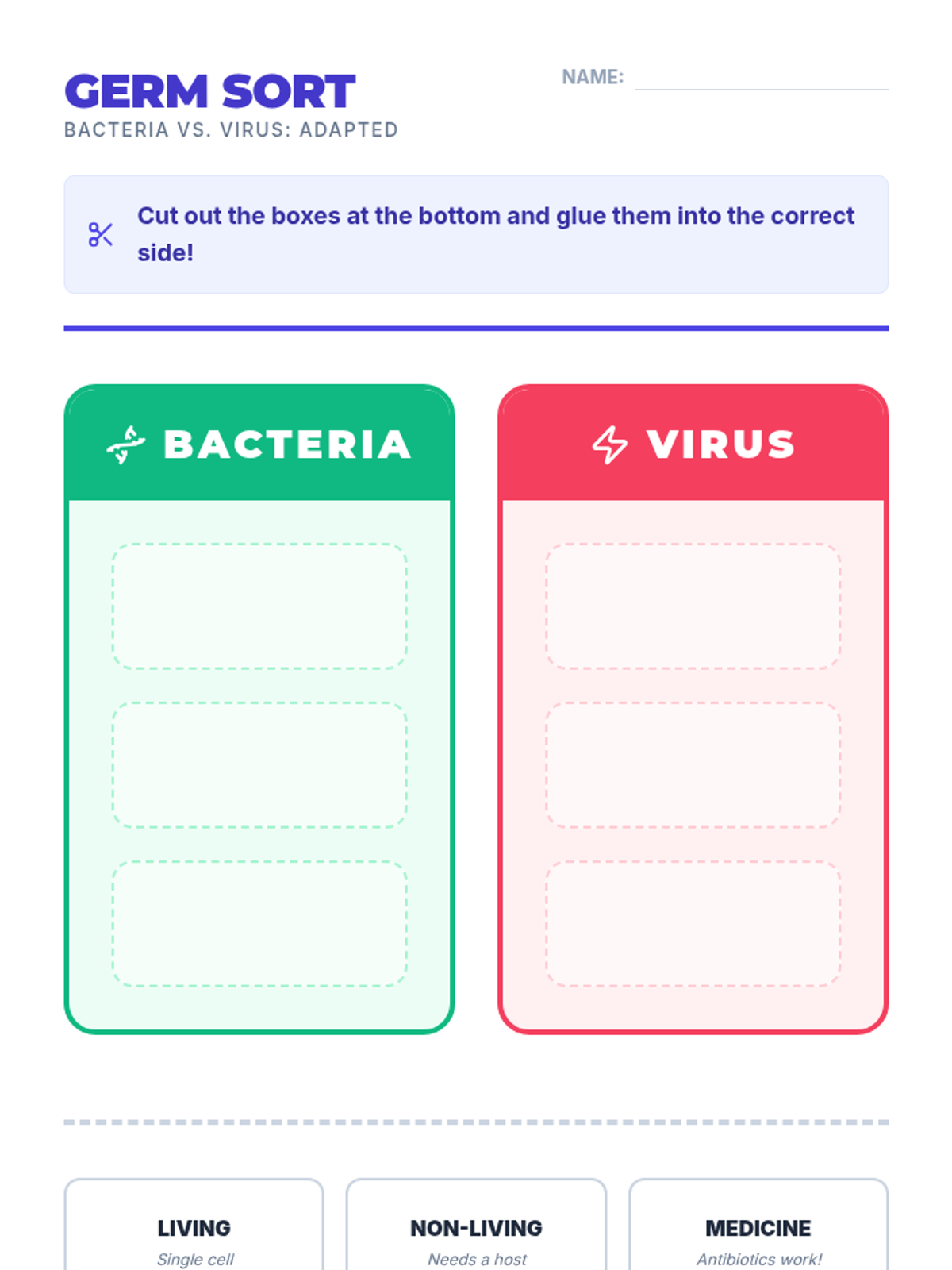
Adapted graphic organizer for special education students, featuring a cut-and-paste sorting activity to compare bacteria and viruses.
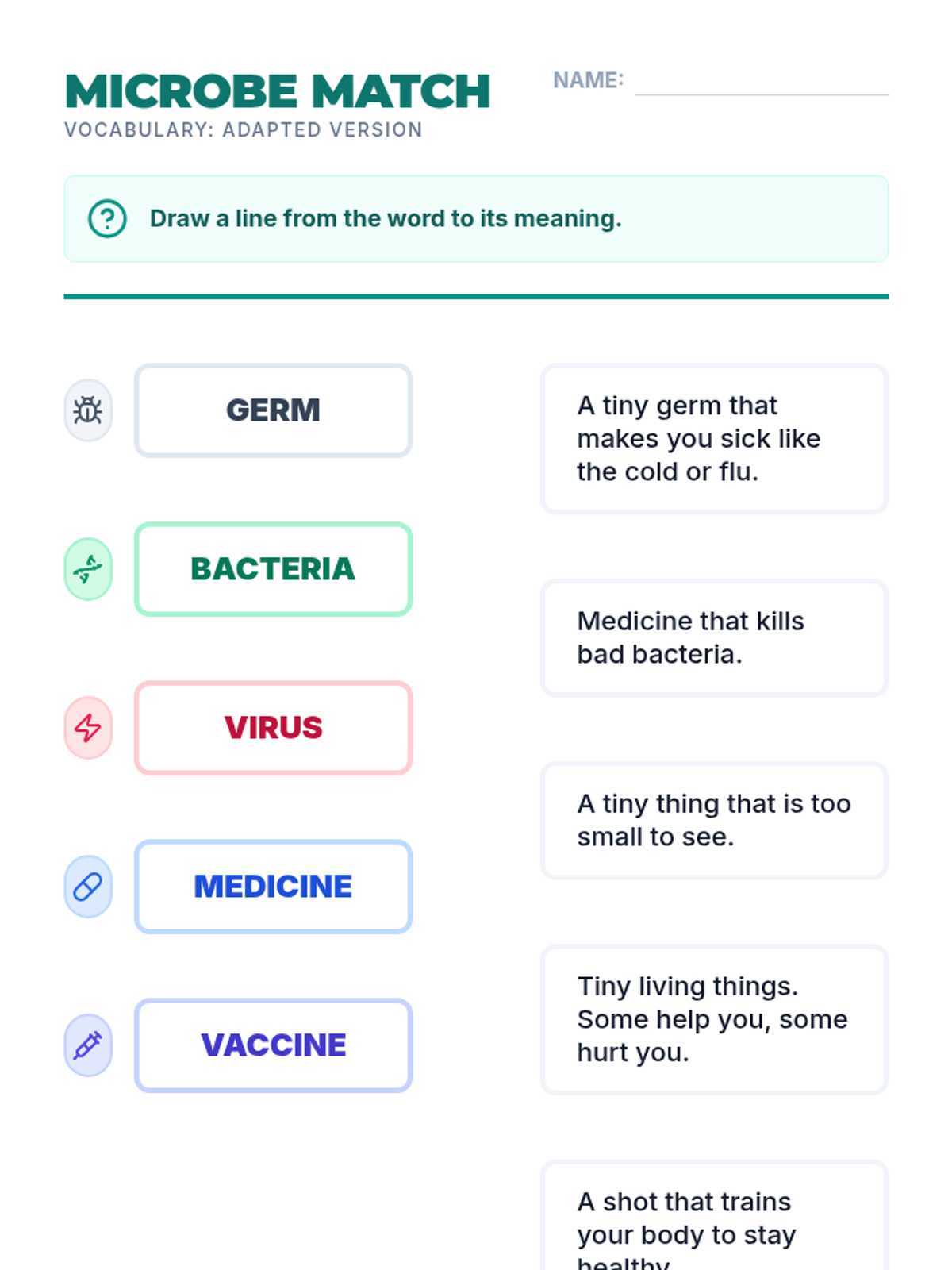
Simplified vocabulary matching activity for special education students, featuring fewer terms, visual icons, and larger text.
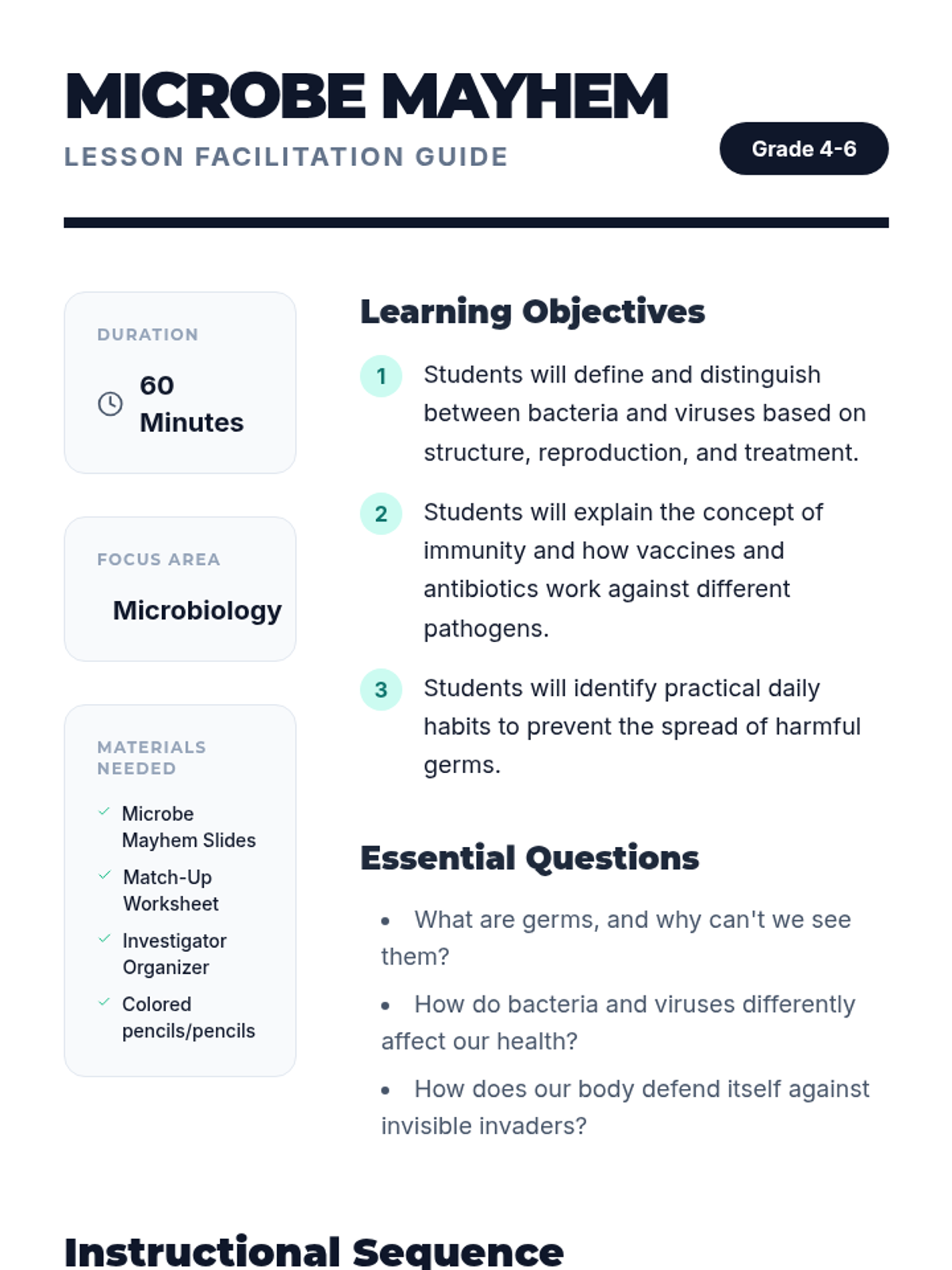
Facilitation guide for teachers, including learning objectives, a detailed 60-minute instructional sequence, and differentiation strategies for varied learners.
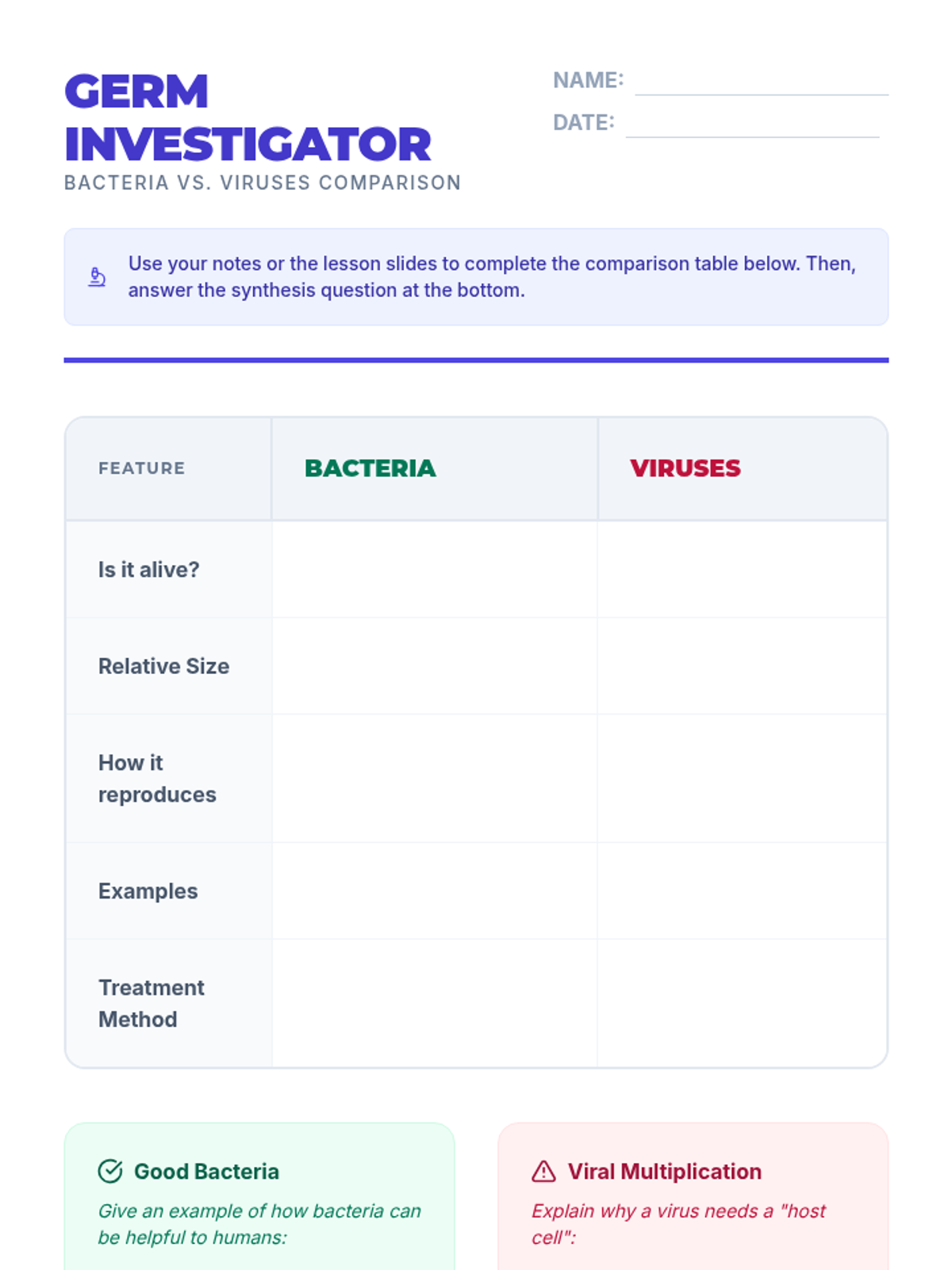
Graphic organizer for students to compare and contrast bacteria and viruses based on characteristics like size, reproduction, and treatment.
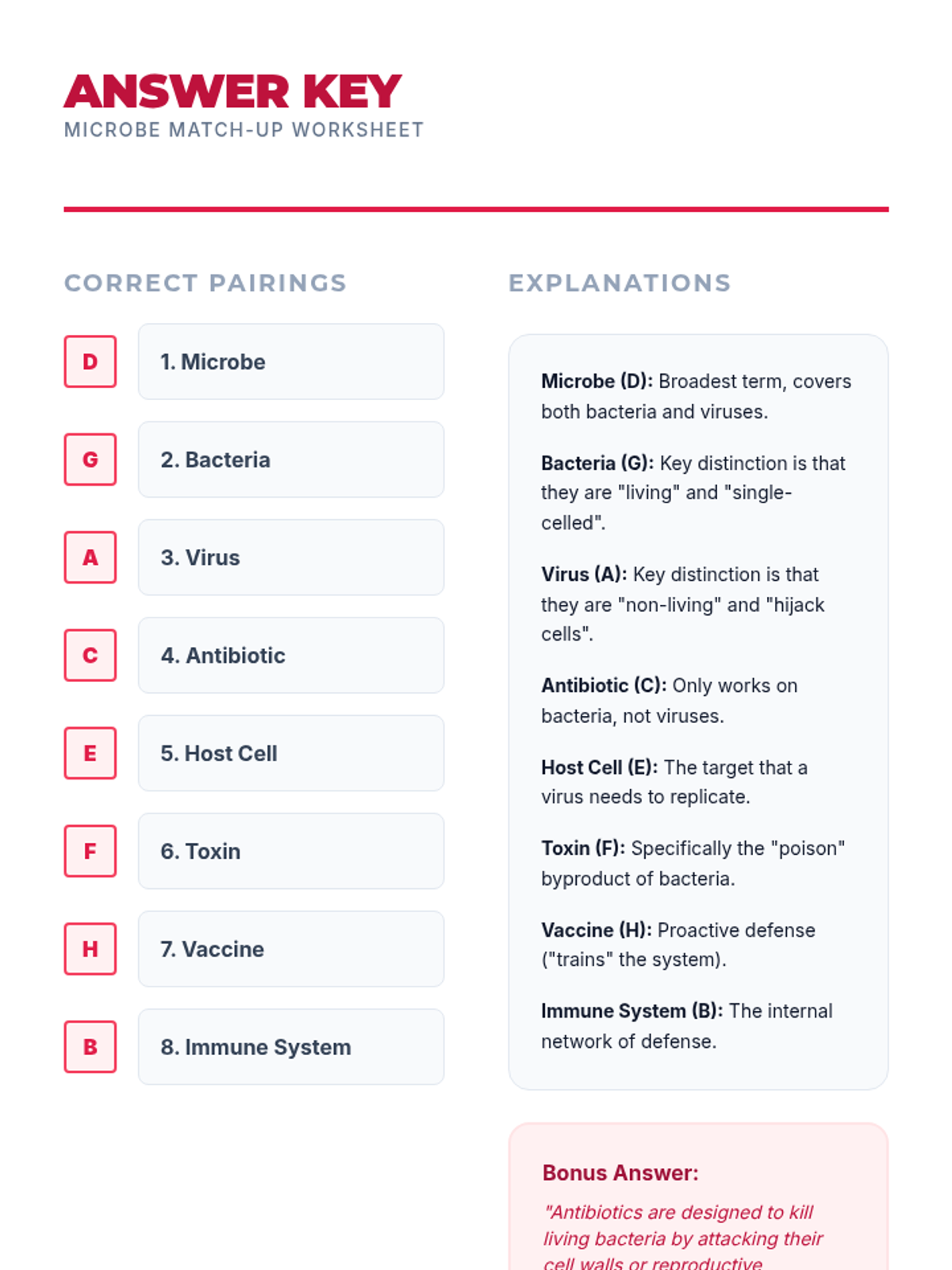
Teacher answer key for the Microbe Match-Up Worksheet.
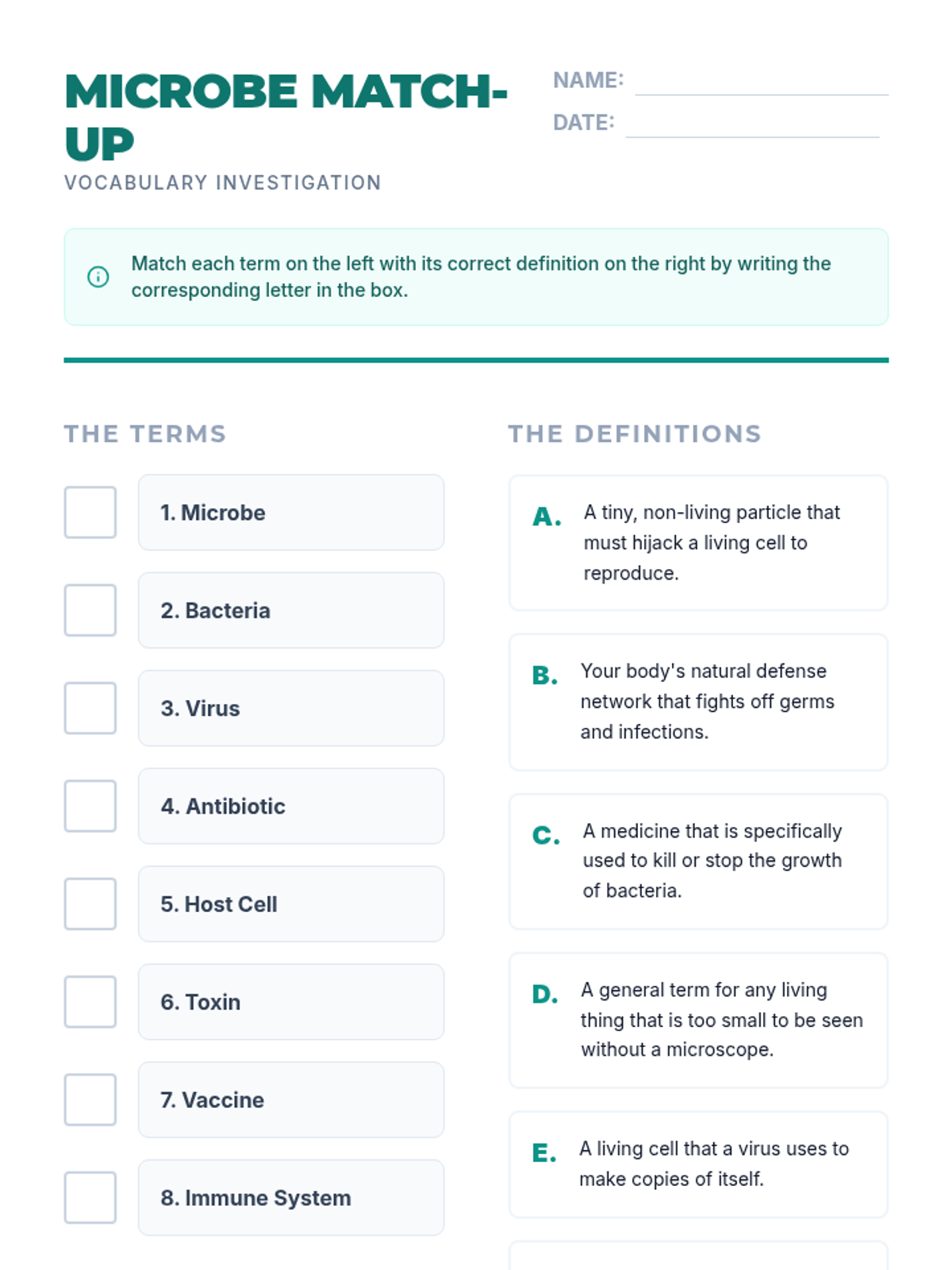
Vocabulary matching activity where students match key microbiology terms (microbe, bacteria, virus, antibiotic, etc.) with their definitions.
Introductory slide deck covering germs, the differences between bacteria and viruses, how they affect the body, and basic prevention methods.
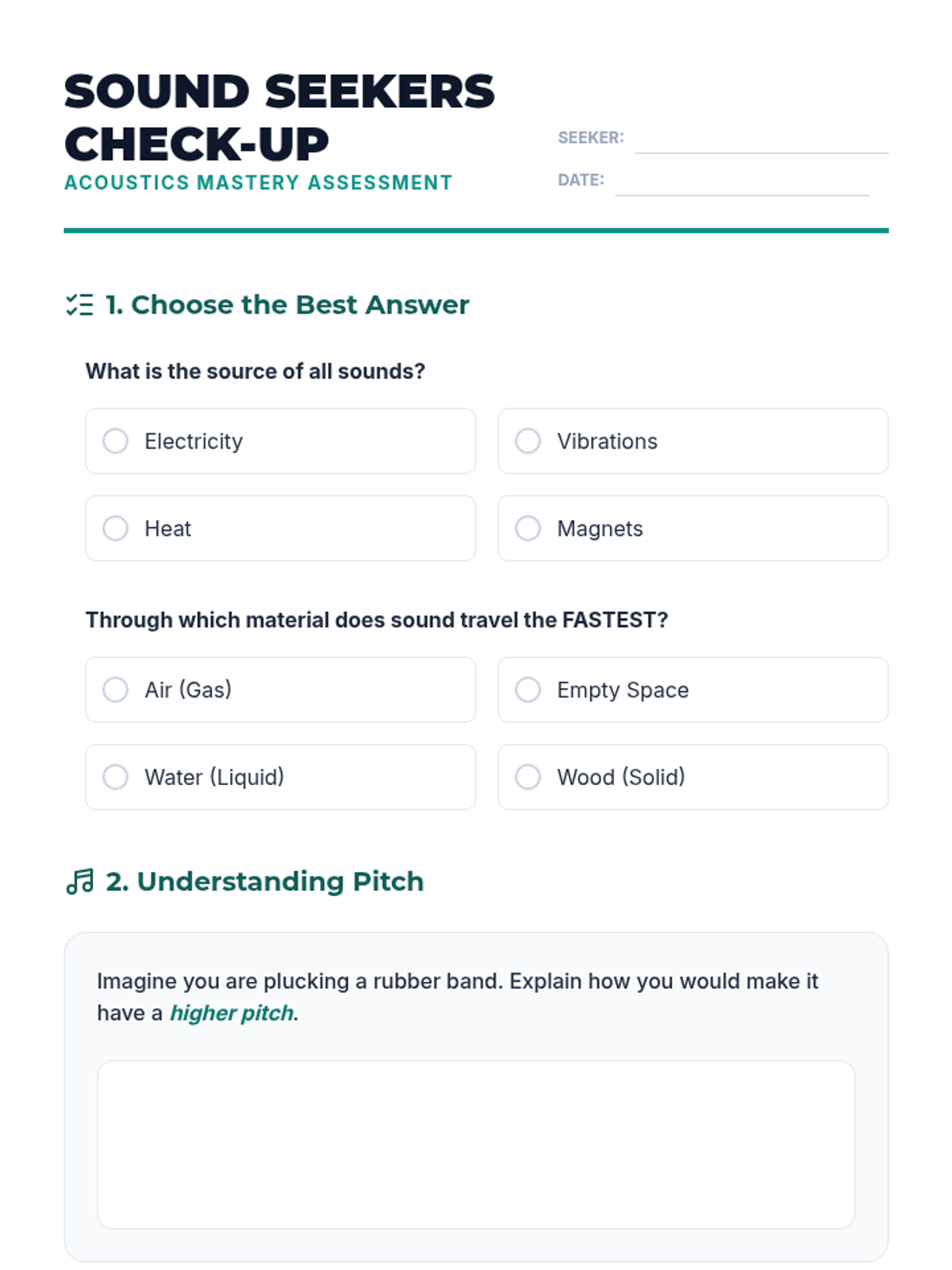
A formative assessment quiz for the Sound Seekers lesson, evaluating student understanding of vibrations, sound mediums, pitch, and the basic process of hearing.
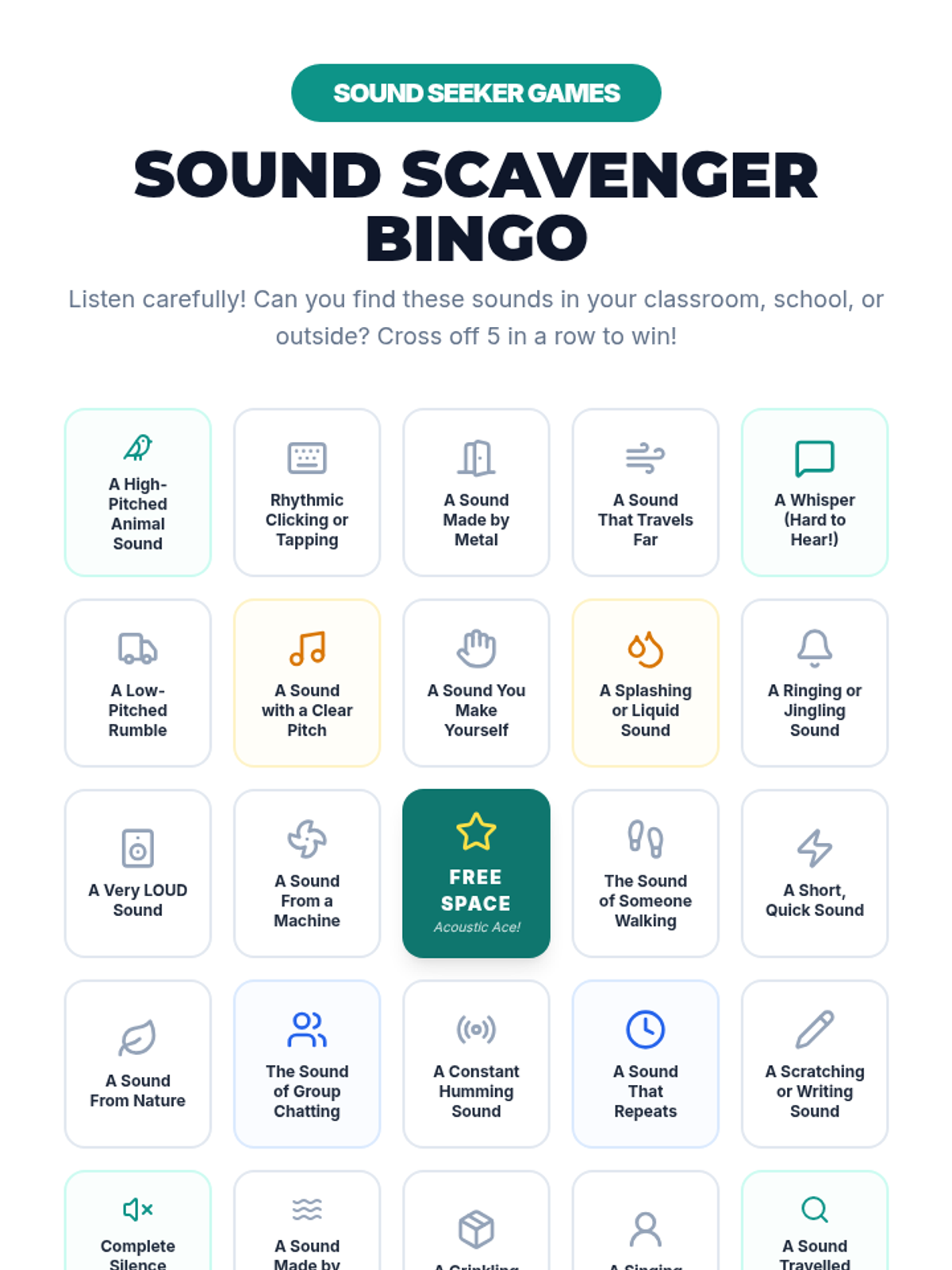
An interactive scavenger hunt bingo game for the Sound Seekers lesson, encouraging students to identify and categorize various sounds in their environment based on pitch, volume, and medium.
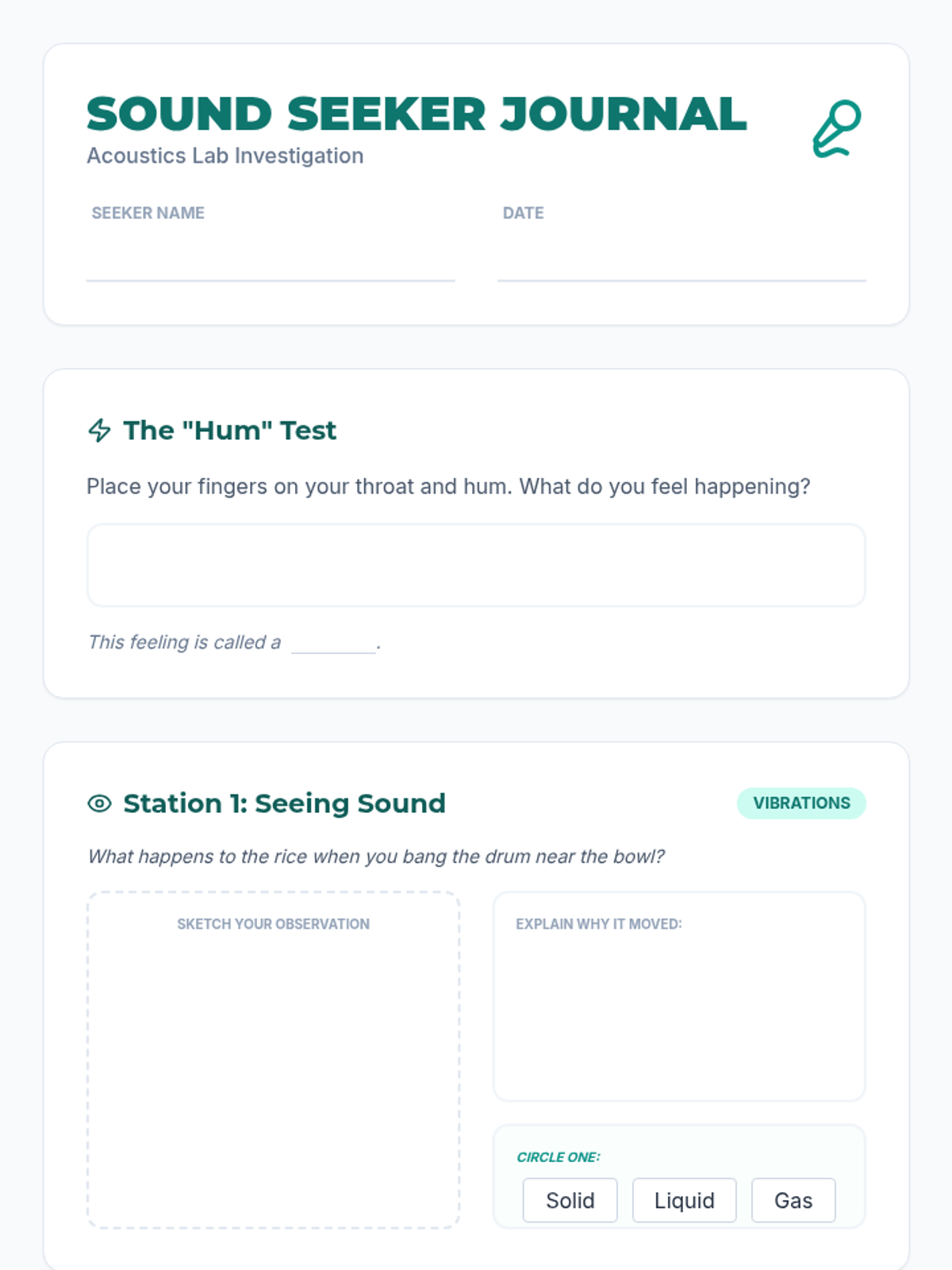
A student investigation journal for the Sound Seekers lesson, providing space for observations and results from the "Seeing Sound," "String Phone," and "Pitch Power" lab stations.
An engaging slide deck for the Sound Seekers lesson, explaining the science of vibrations, how sound travels through different mediums, and the basics of pitch and hearing.
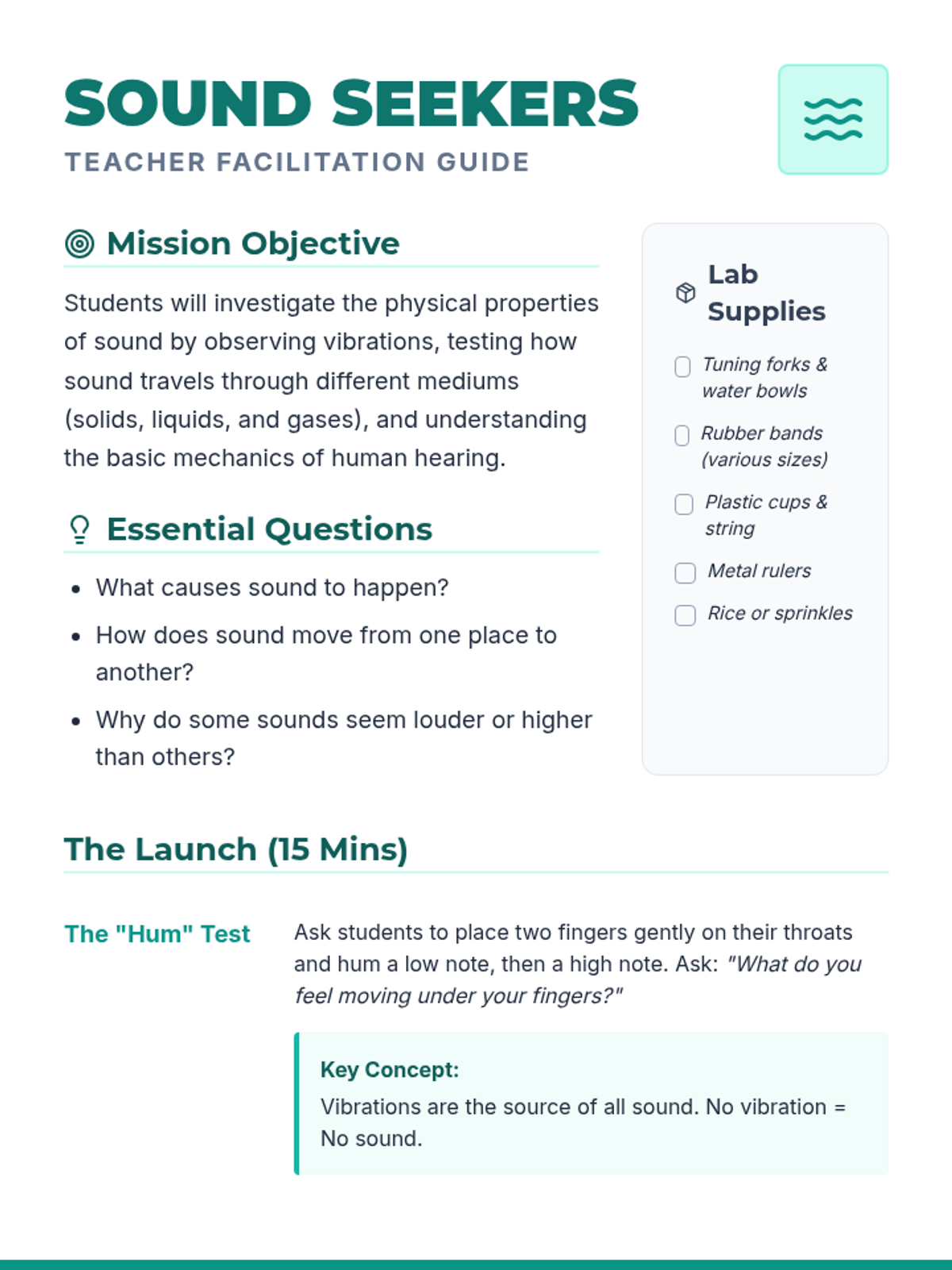
A comprehensive teacher facilitation guide for the Sound Seekers lesson, featuring lab station setups, essential questions, and discussion prompts for teaching 3rd graders about acoustics.
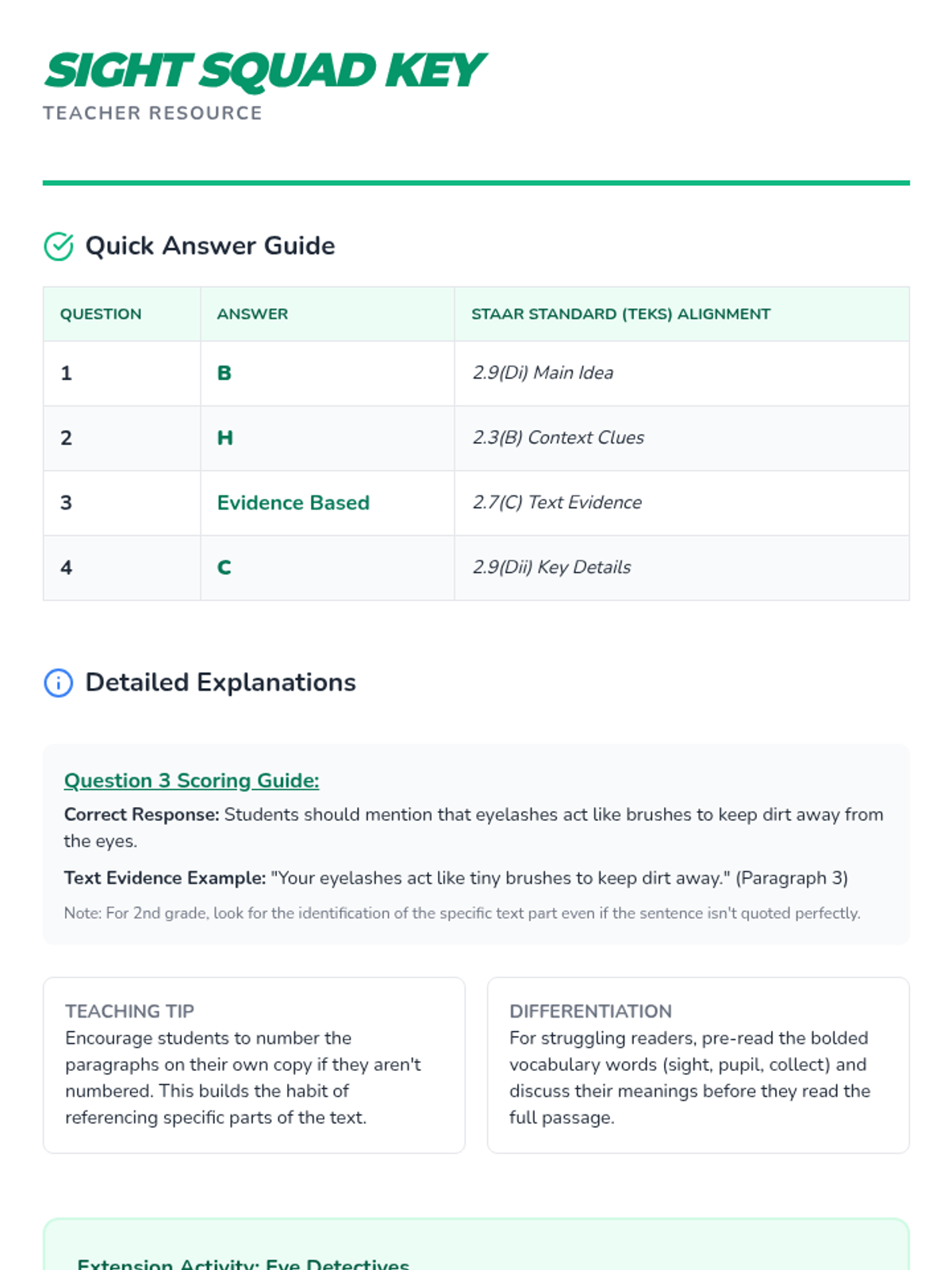
A teacher's answer key for the Sight Squad materials, including TEKS alignment, scoring guides for written responses, and instructional tips for second grade.
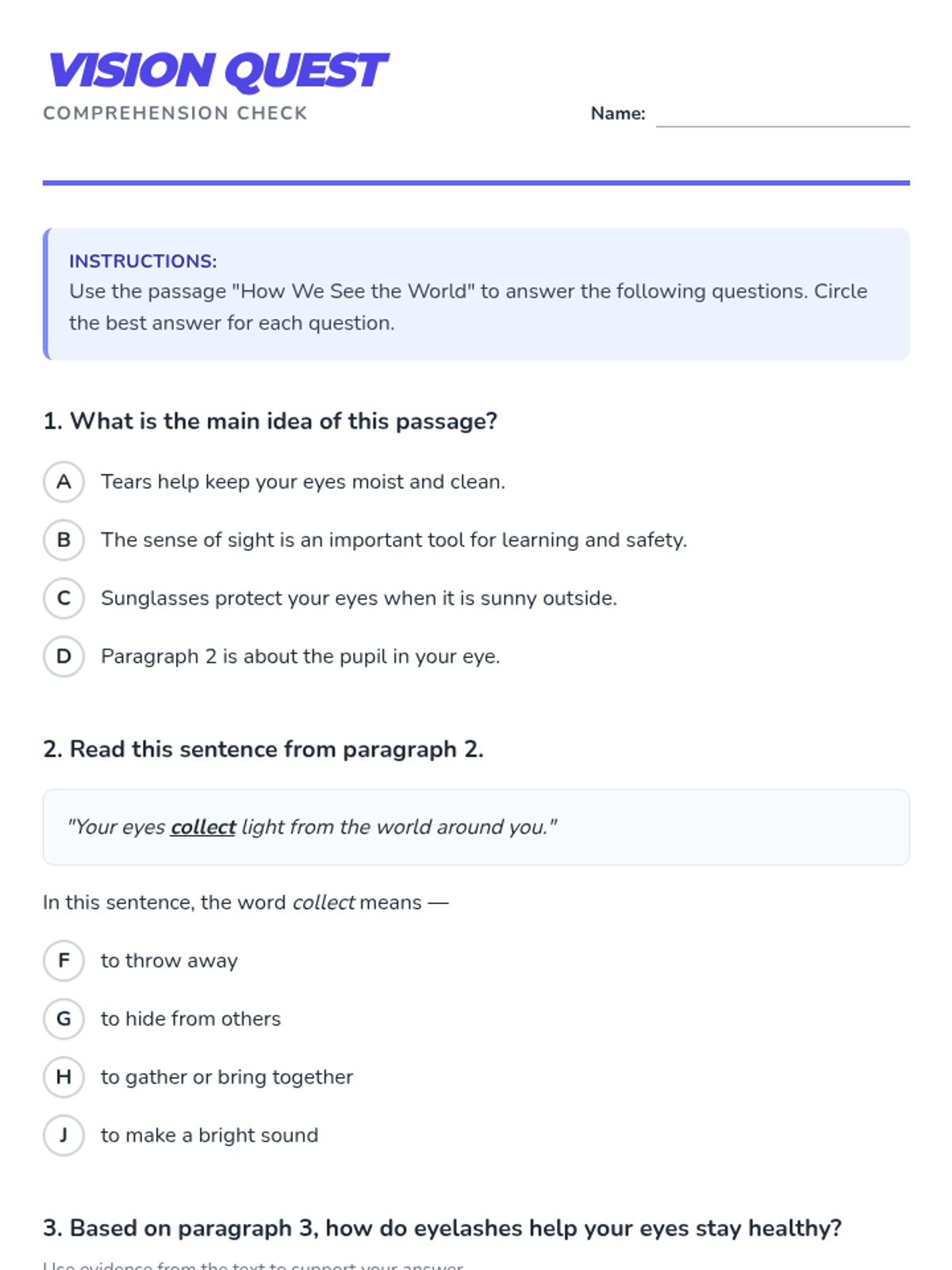
A STAAR-aligned assessment for second grade students focusing on the sense of sight passage. Includes main idea, vocabulary, text evidence, and detailed recall questions.
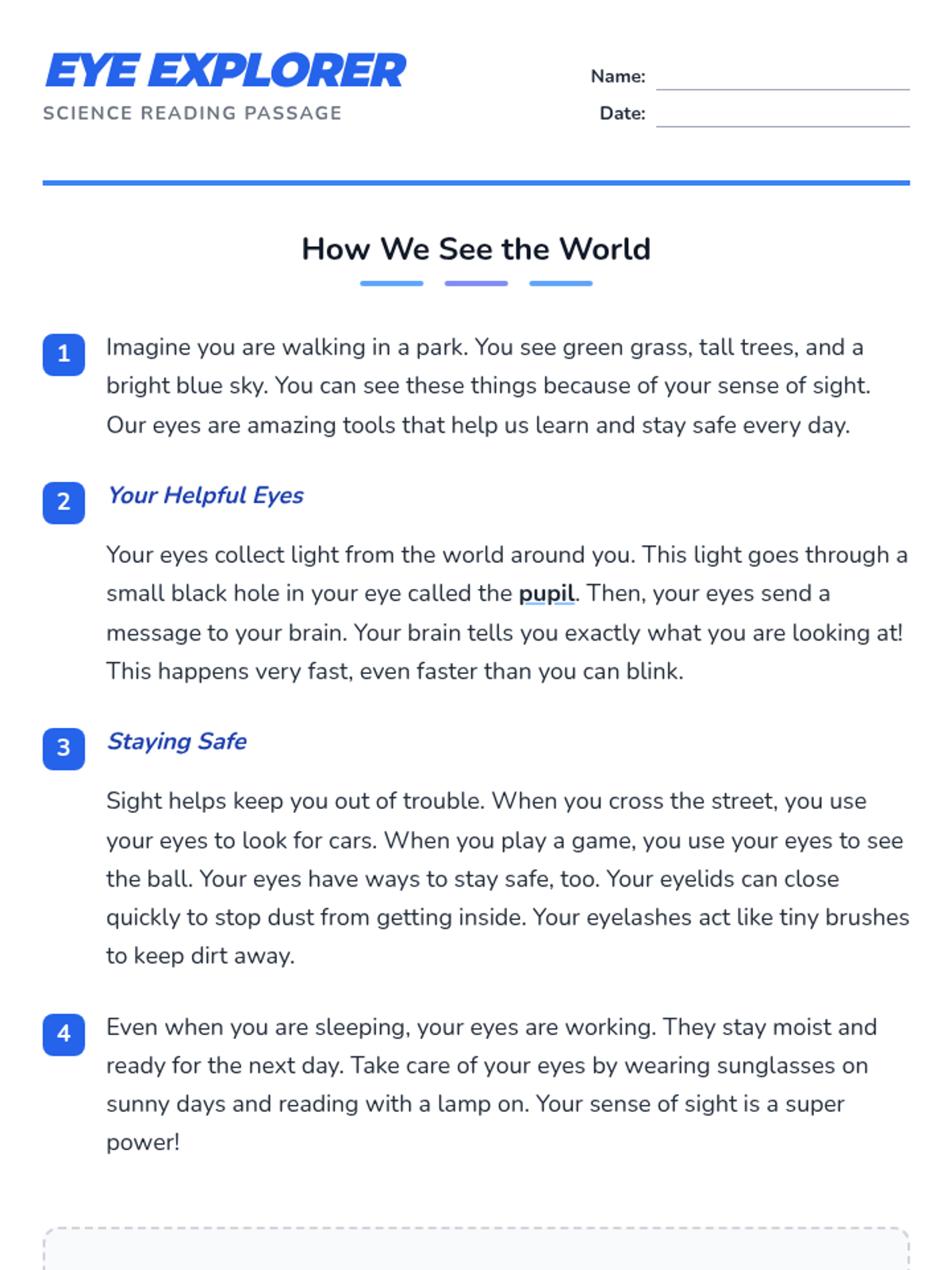
An engaging reading passage for second graders about the sense of sight, including numbered paragraphs for easy reference and a built-in text evidence task.
A visual presentation introducing the sense of sight, key parts of the eye, and how eyes protect themselves. Includes engagement prompts for second-grade students.
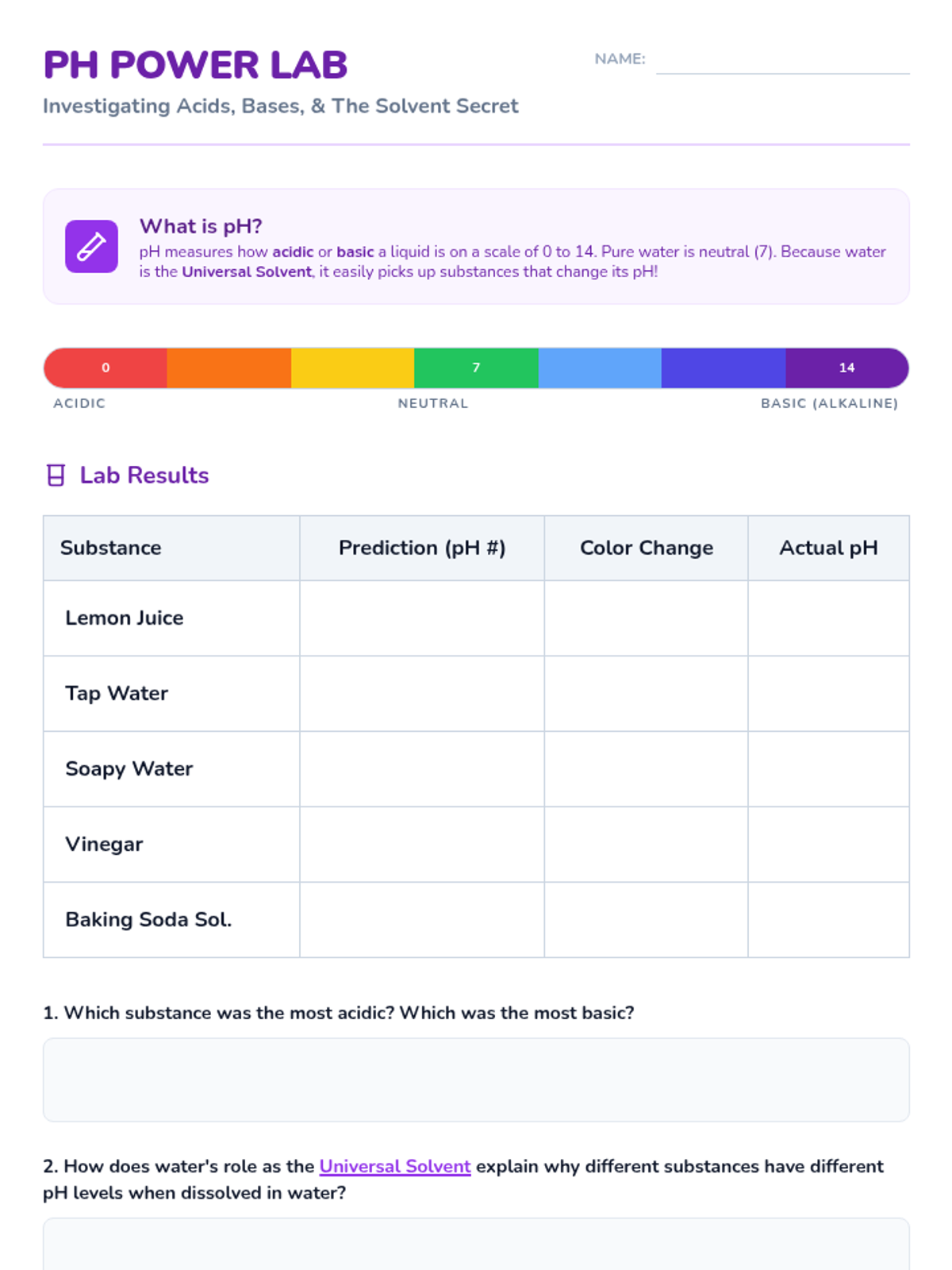
A student lab worksheet for investigating the pH of various common substances. Includes a pH scale reference, data collection table, and analysis questions connecting pH to water's role as a universal solvent and its impact on life.
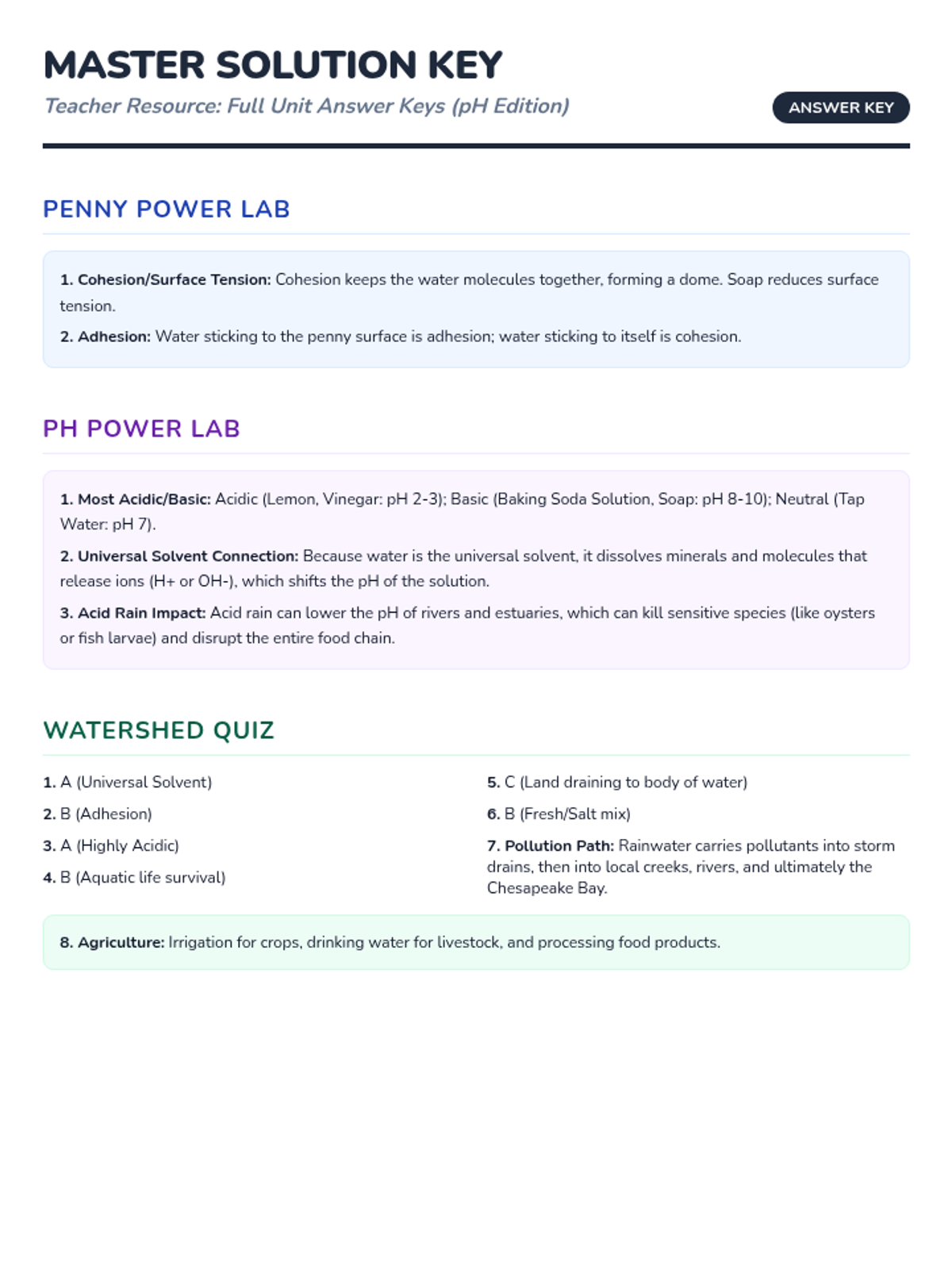
A teacher-facing answer key for the Penny Power Lab, pH Power Lab, and the Unit Quiz. Updated to reflect the removal of weathering content and addition of pH/acidity.
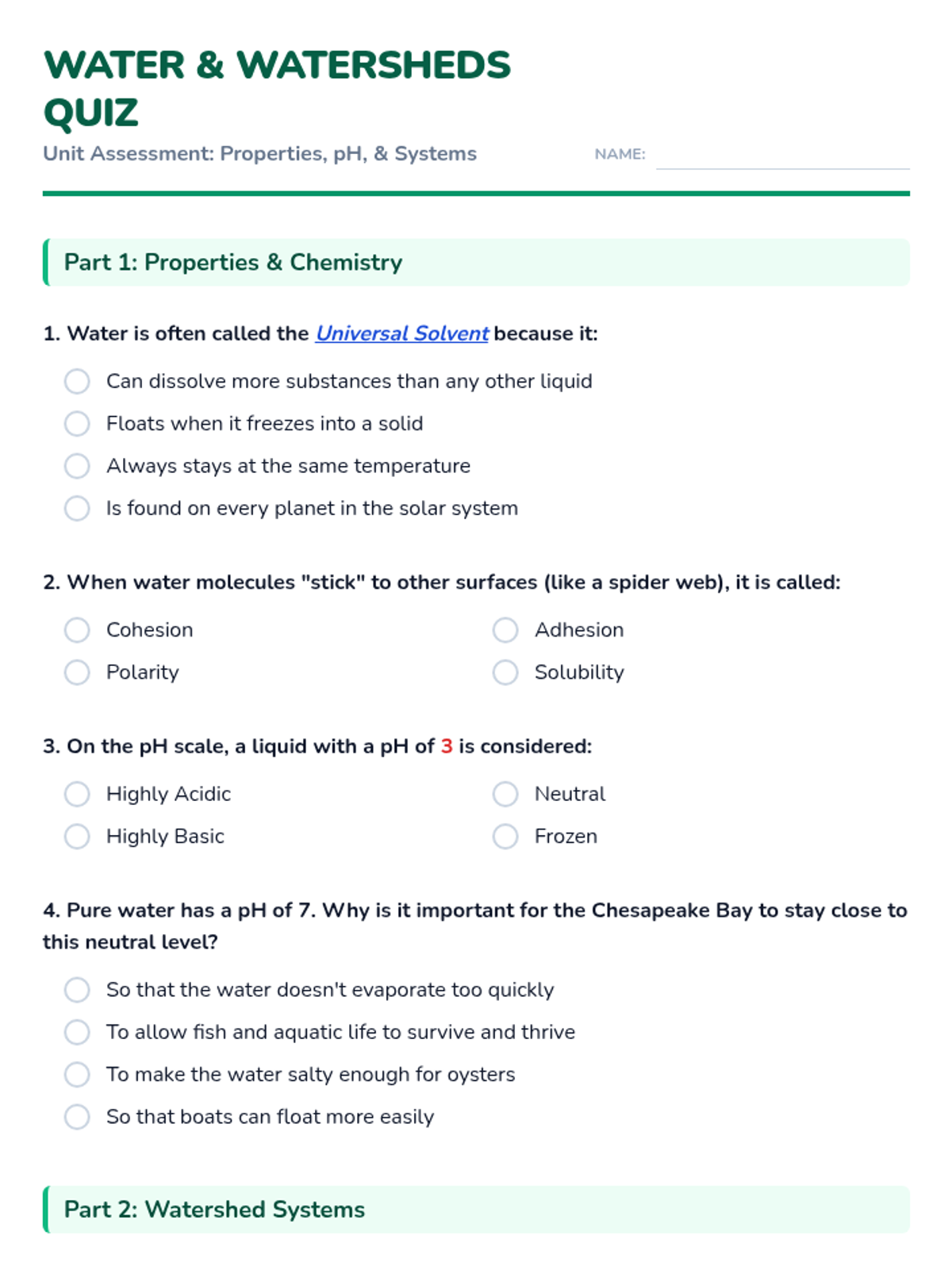
A short unit quiz covering the physical properties of water (solubility, adhesion, cohesion), pH basics, and watershed definitions including estuaries and human impact. Replacement for weathering content.
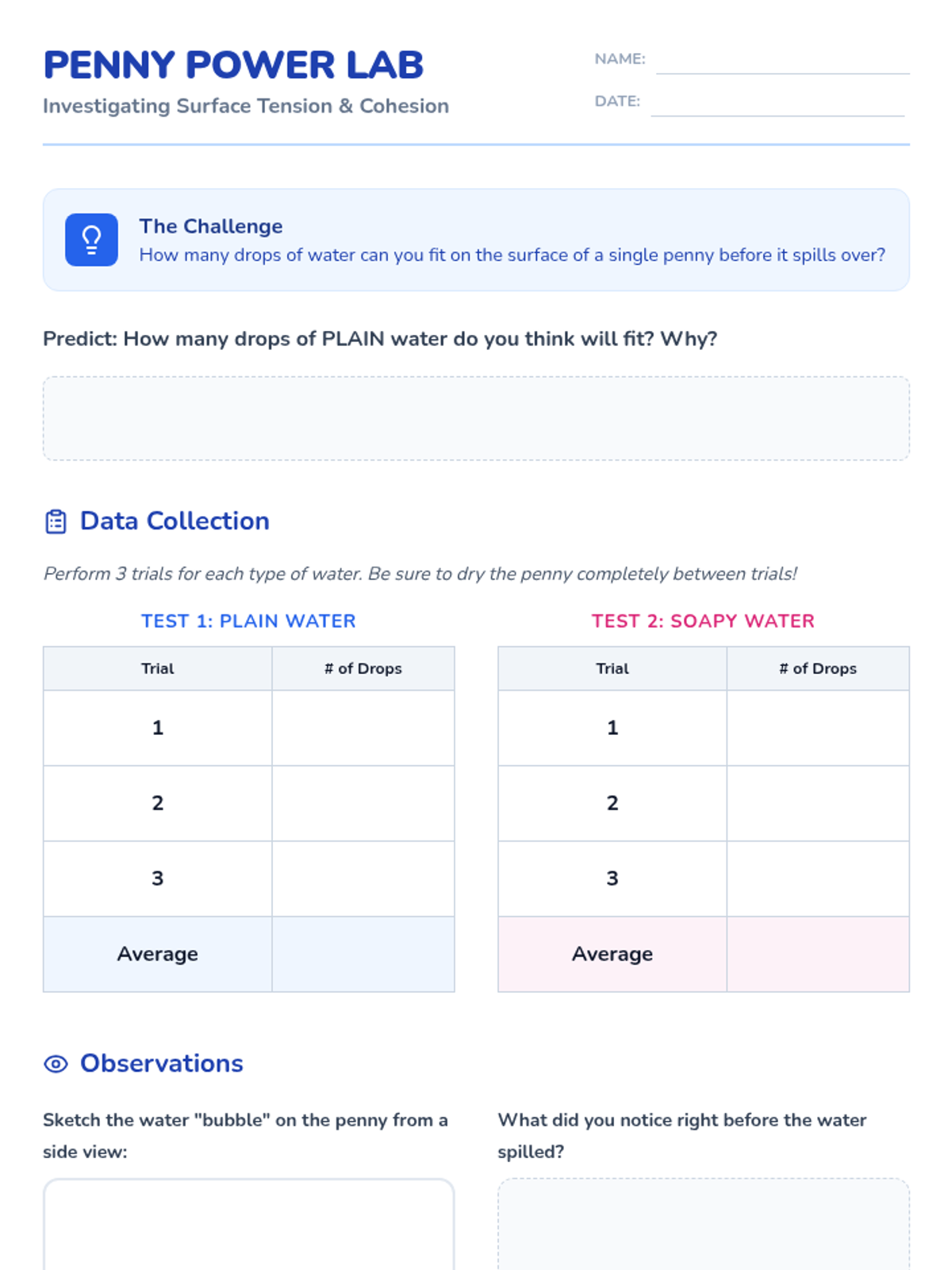
A student lab sheet for the 'Penny Power' investigation. Includes sections for hypothesis, data tables for multiple trials (plain vs. soapy water), sketching observations, and analysis questions focused on cohesion and surface tension.
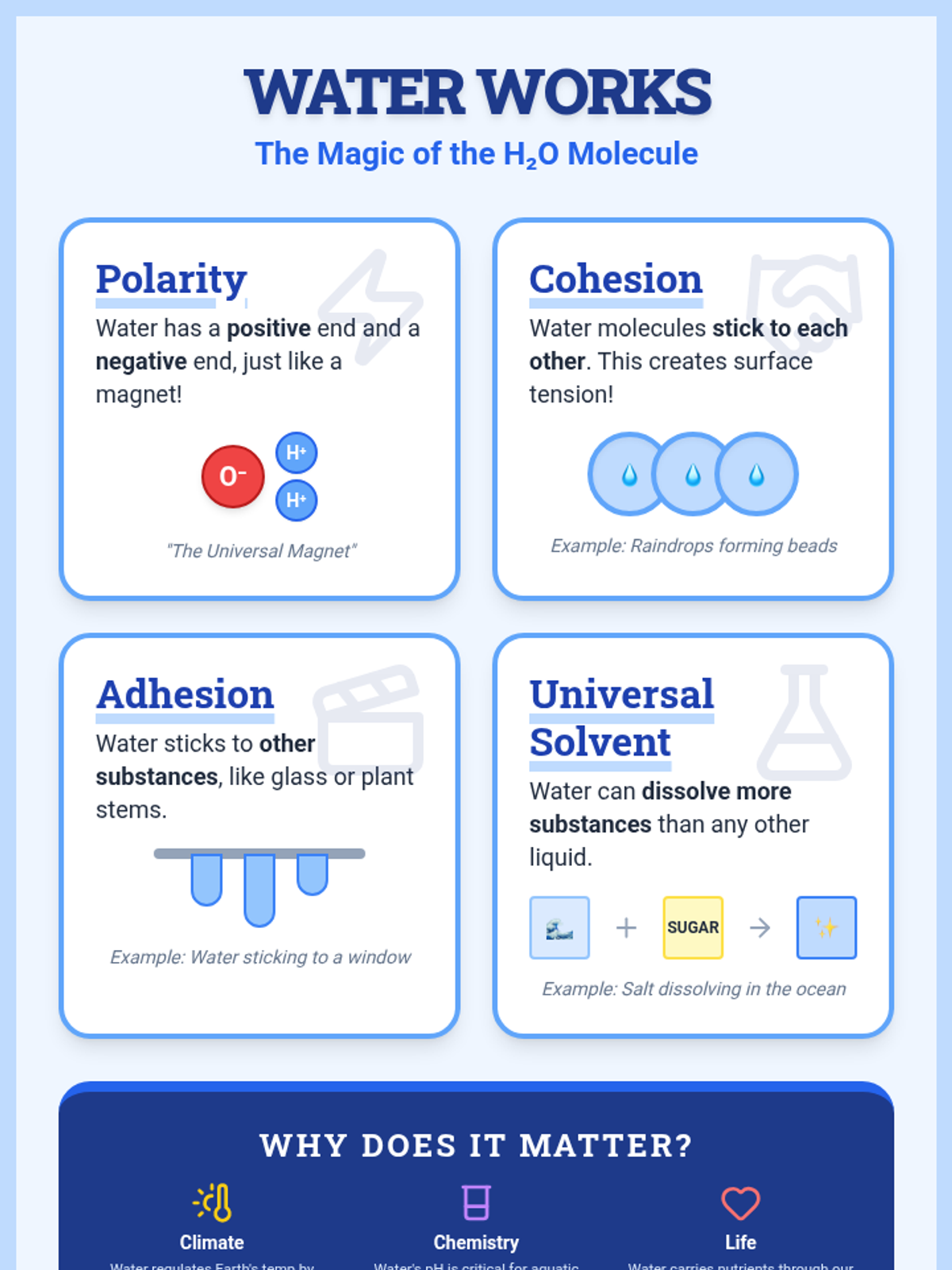
A vibrant anchor chart visualizing the unique physical properties of water: polarity, cohesion, adhesion, and universal solubility. Includes an updated bottom banner focusing on climate, chemistry/pH, and life processes.
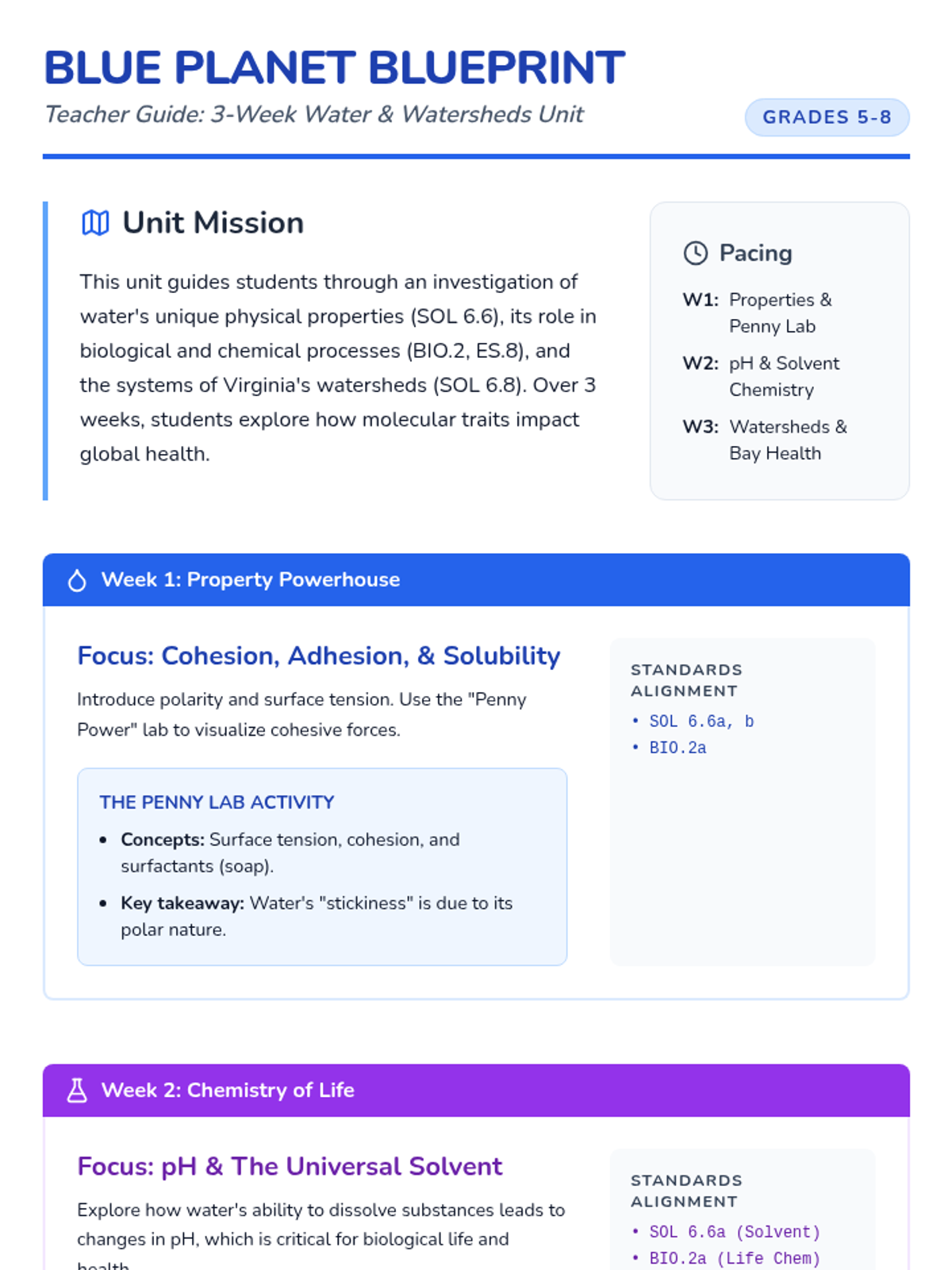
A comprehensive teacher guide for a 3-week unit on water properties, chemical nature (pH), and watersheds, aligning Virginia SOL standards. Includes weekly pacing, lab instructions for Penny Power and pH testing, and assessment strategies.
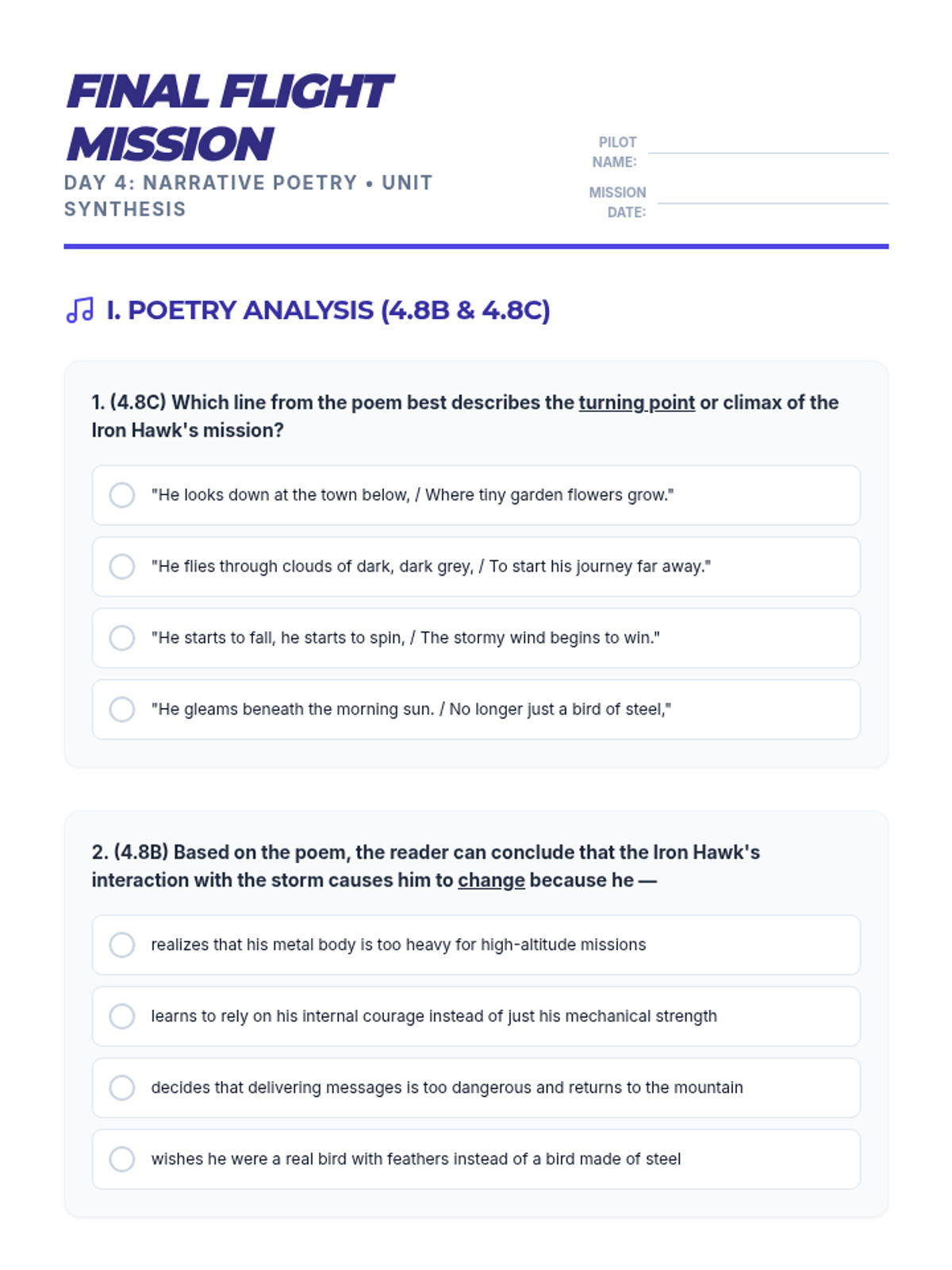
Updated Day 4 Worksheet for the Plot Pilots unit. Standardized to match the 3-question format plus comparison. Focuses on character growth (4.8B) and plot elements (4.8C) in narrative poetry.
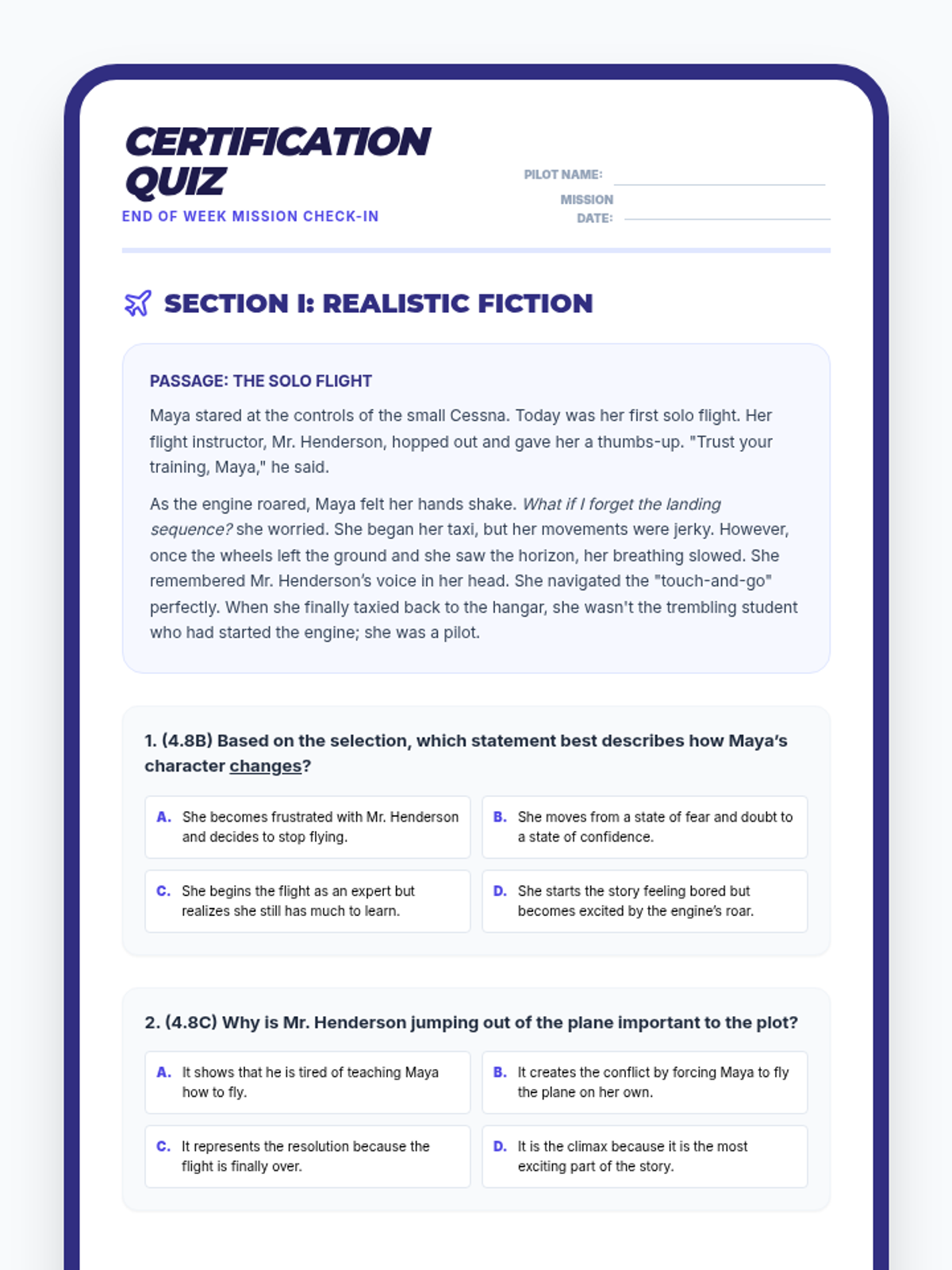
Updated end-of-the-week Quick Check Quiz for the Plot Pilots unit. Lightened the paired analysis section and adjusted all backgrounds for better printability and readability. Features "The Solo Flight" and "The Flight of Icarus" with STAAR-aligned multiple-choice questions.
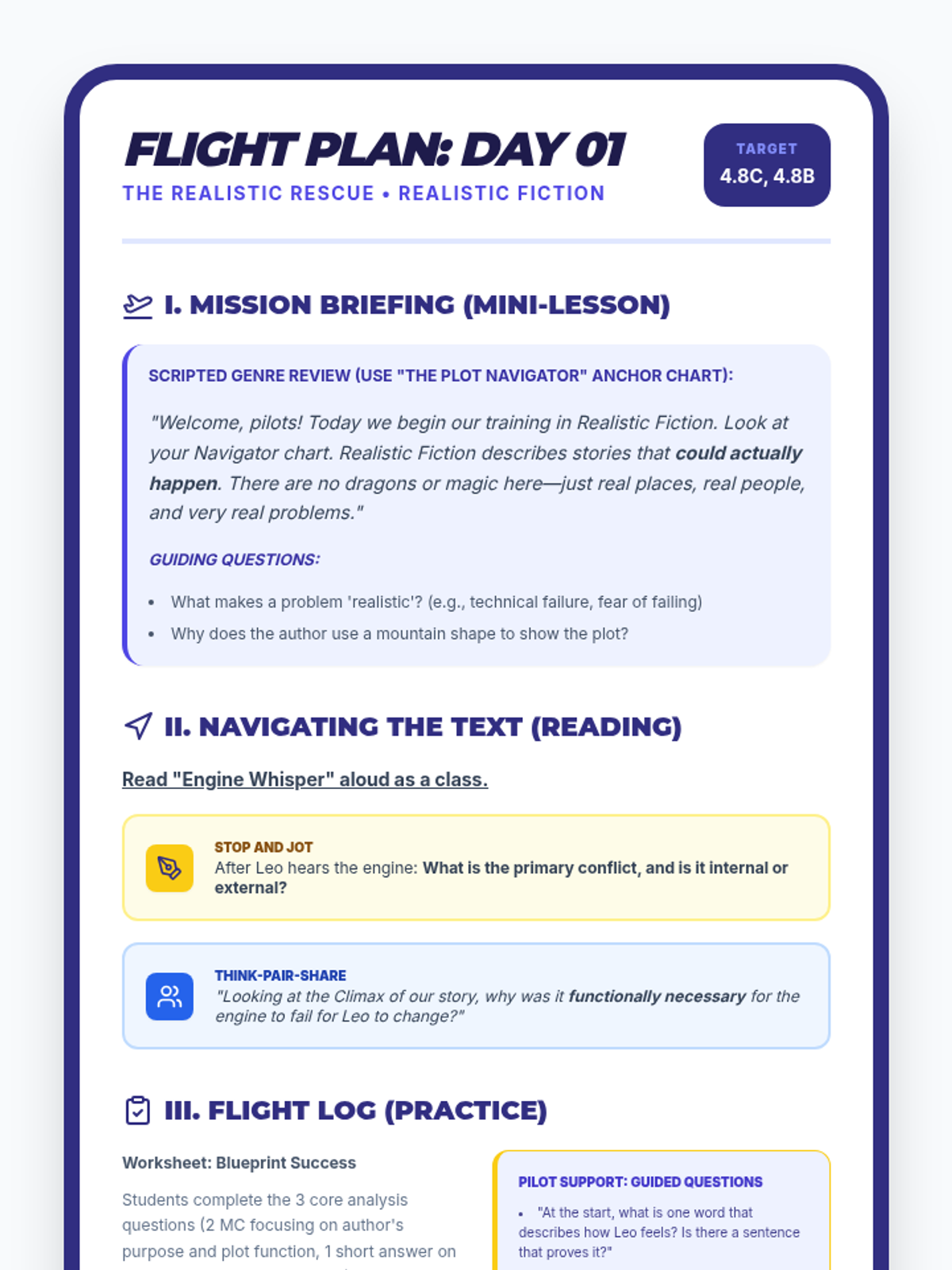
Updated 4-day Teacher Lesson Plans for the Plot Pilots unit with adjusted timings. Phase 1 (Mission Briefing) is now set to 3 minutes, Phase 3 (Guided Flight Practice) is set to 8-10 minutes, and Phase 4 (Independent Log Work) is set to 15 minutes to better match the requested instructional flow.
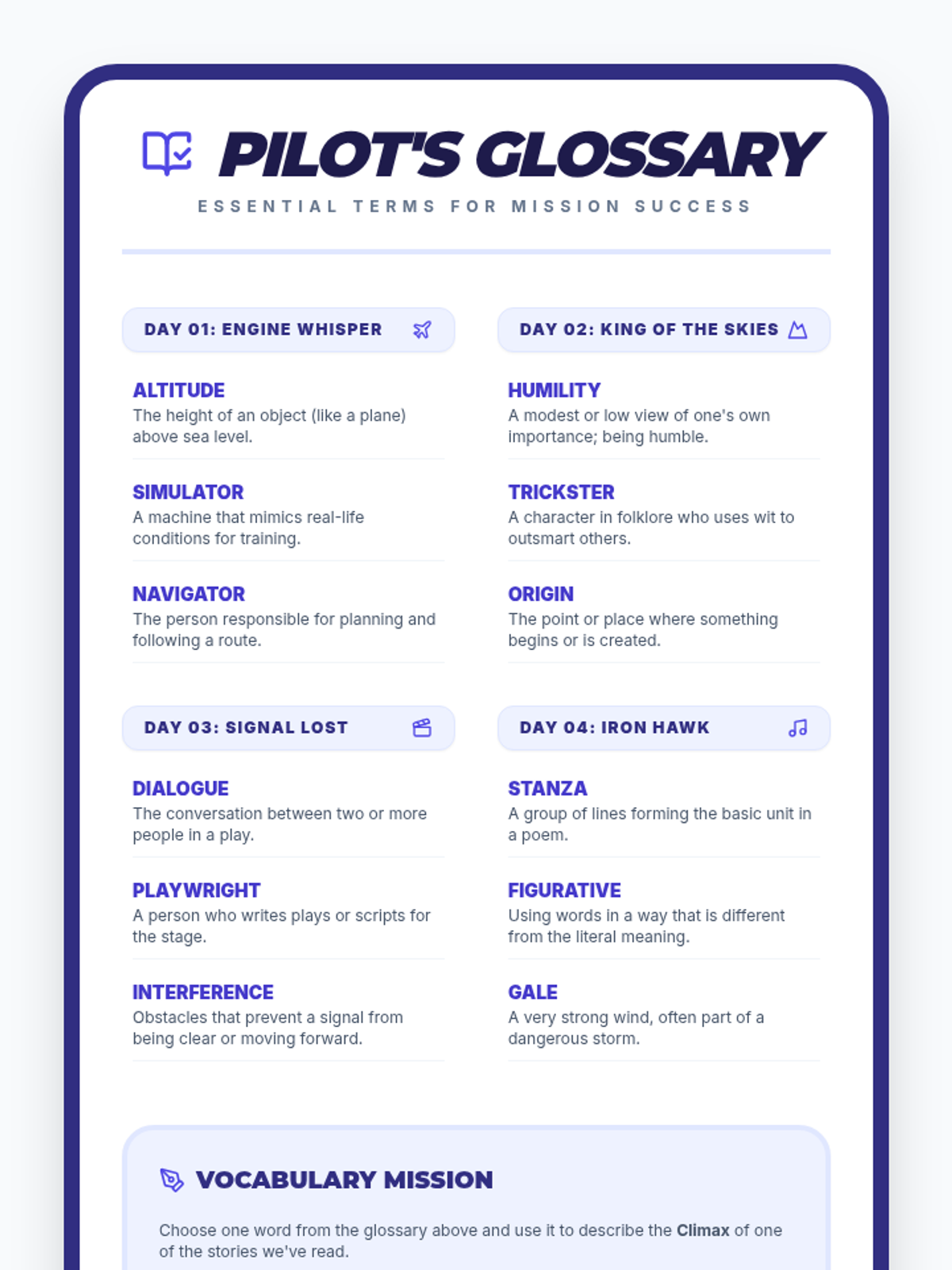
Updated vocabulary glossary for the Plot Pilots unit. Lightened all header and box backgrounds to improve readability and printability while maintaining the unit's professional indigo theme.
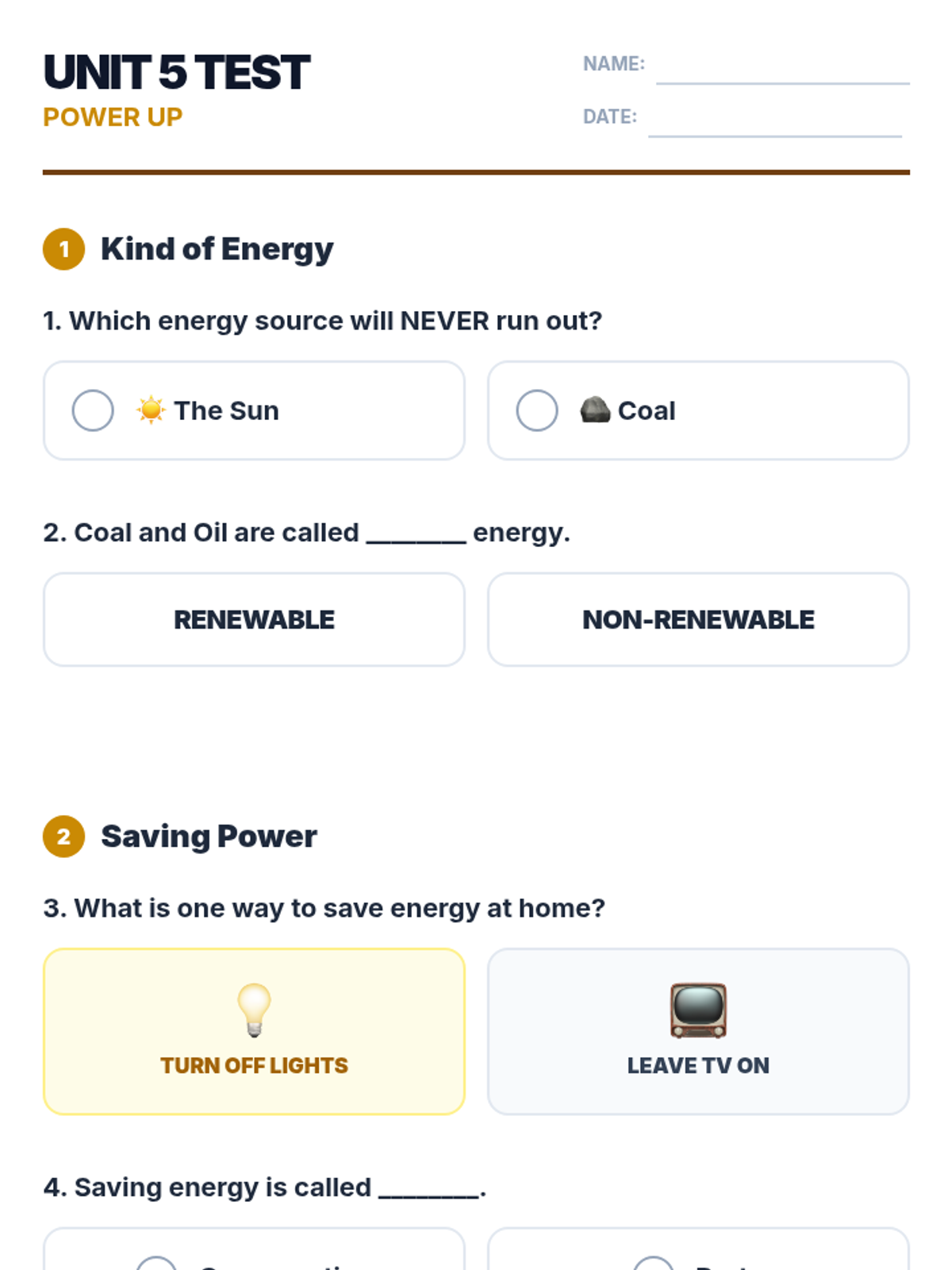
A simplified Unit 5 test on energy sources and conservation, featuring high-visual cues and clear multiple-choice questions for 1st grade level learners.
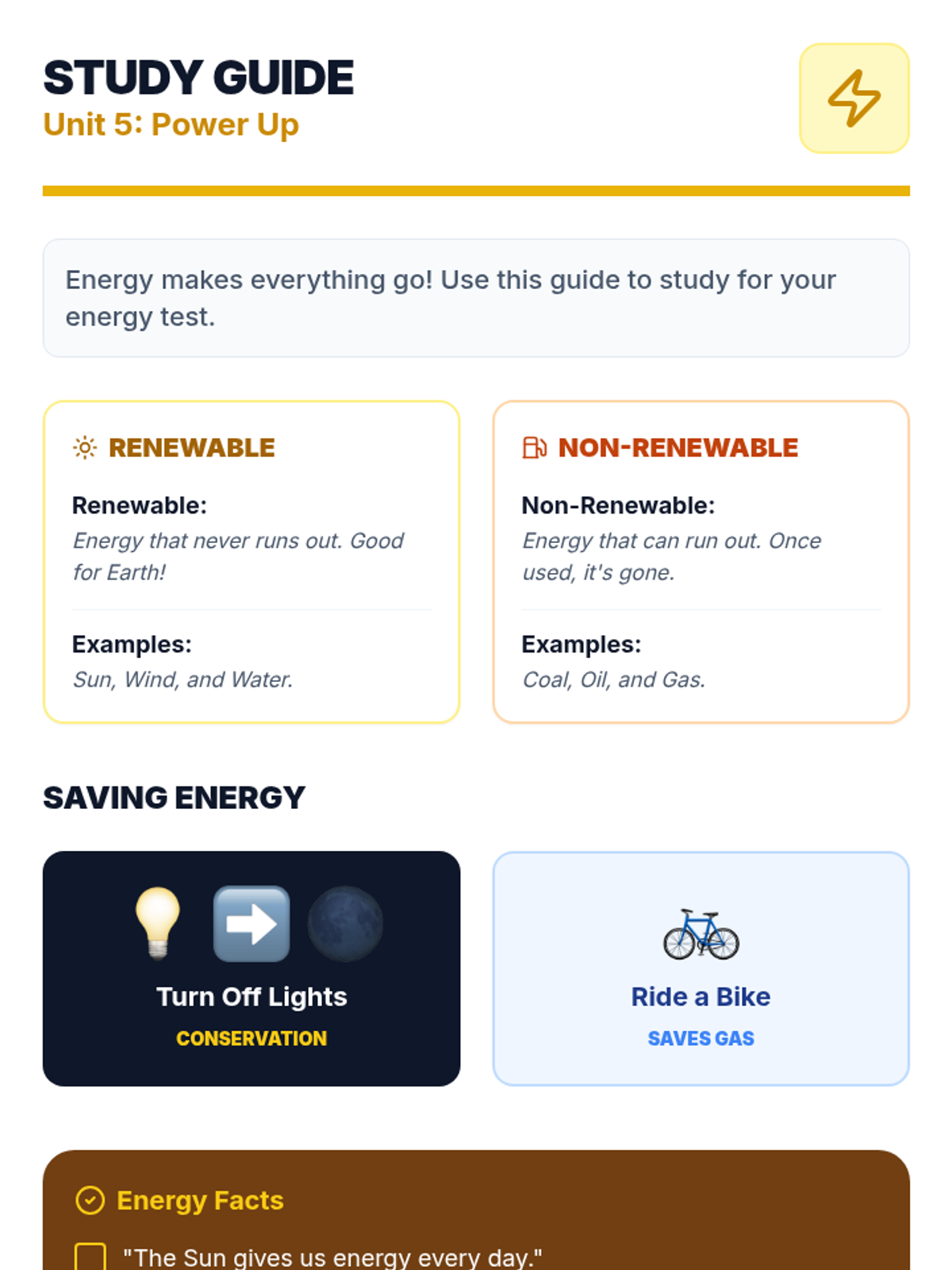
A visual study guide for Unit 5: Power Up, summarizing key concepts about renewable and non-renewable energy sources with simple language and high-visual support.
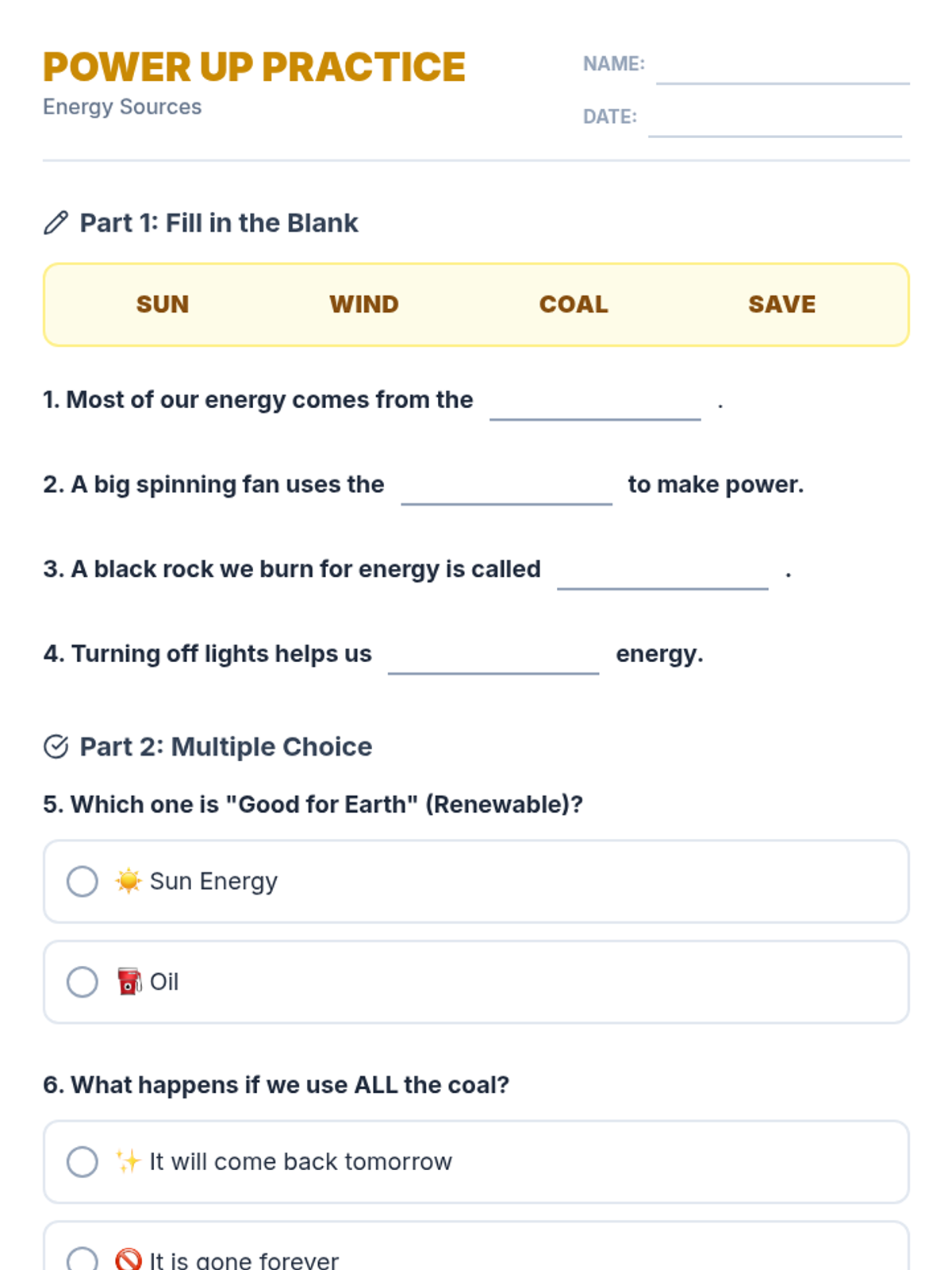
A simplified practice worksheet for energy sources, featuring word bank fill-in-the-blanks and multiple-choice questions with high-visual support.
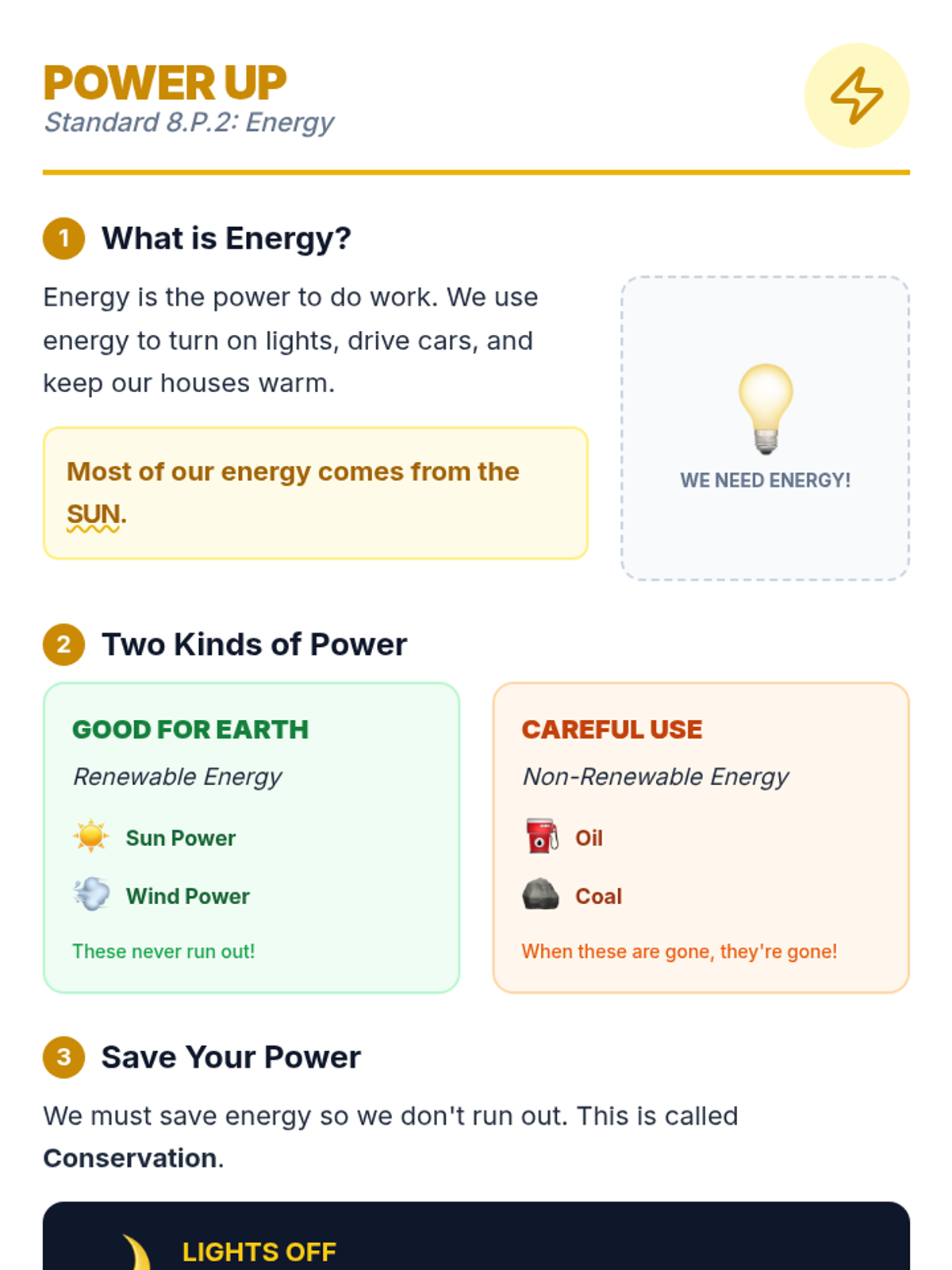
A simplified reading passage about renewable and non-renewable energy sources, designed for students at a 1st grade academic level.
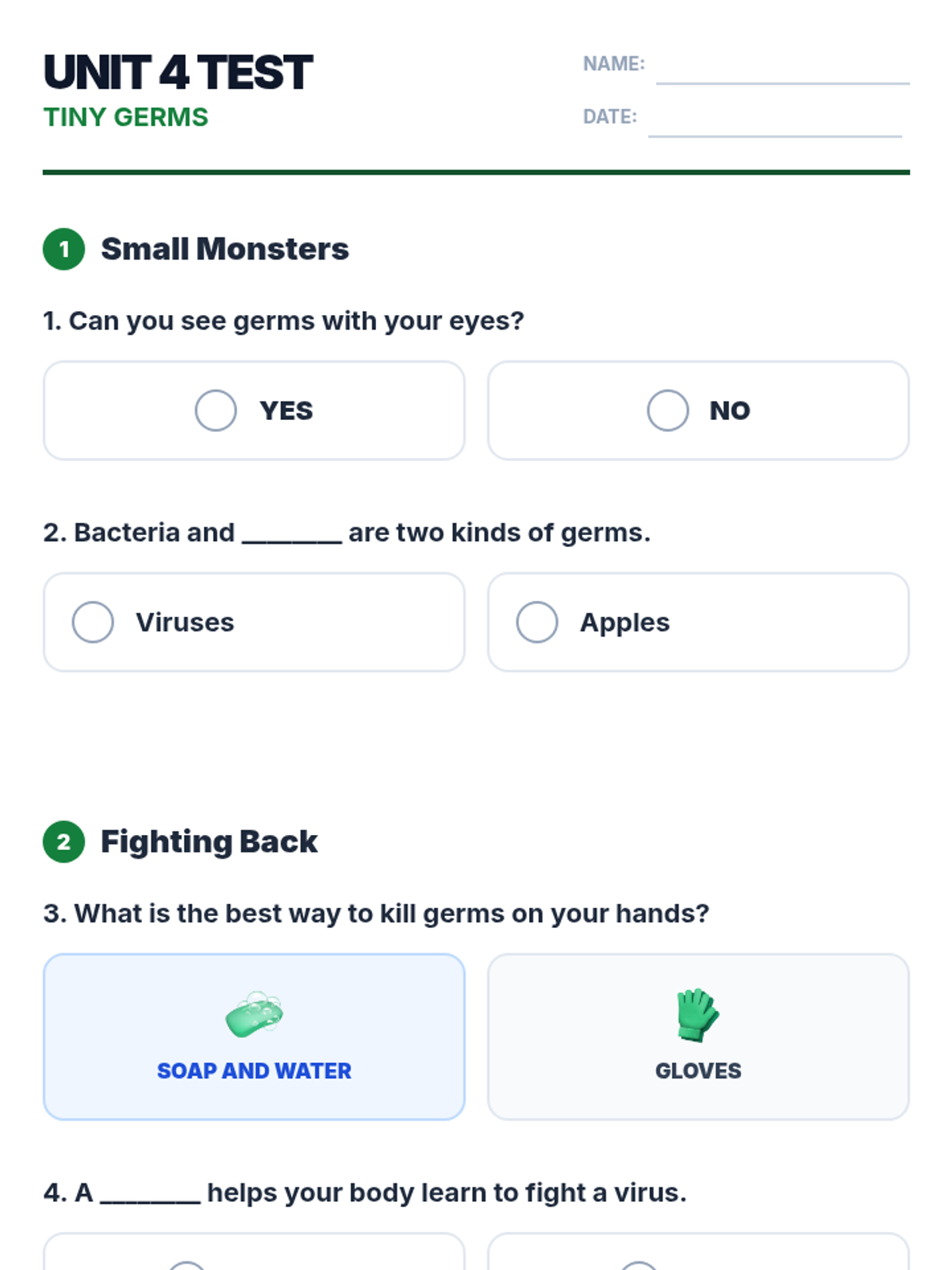
A simplified Unit 4 test on germs and health, featuring high-visual cues and clear multiple-choice questions for 1st grade level learners.
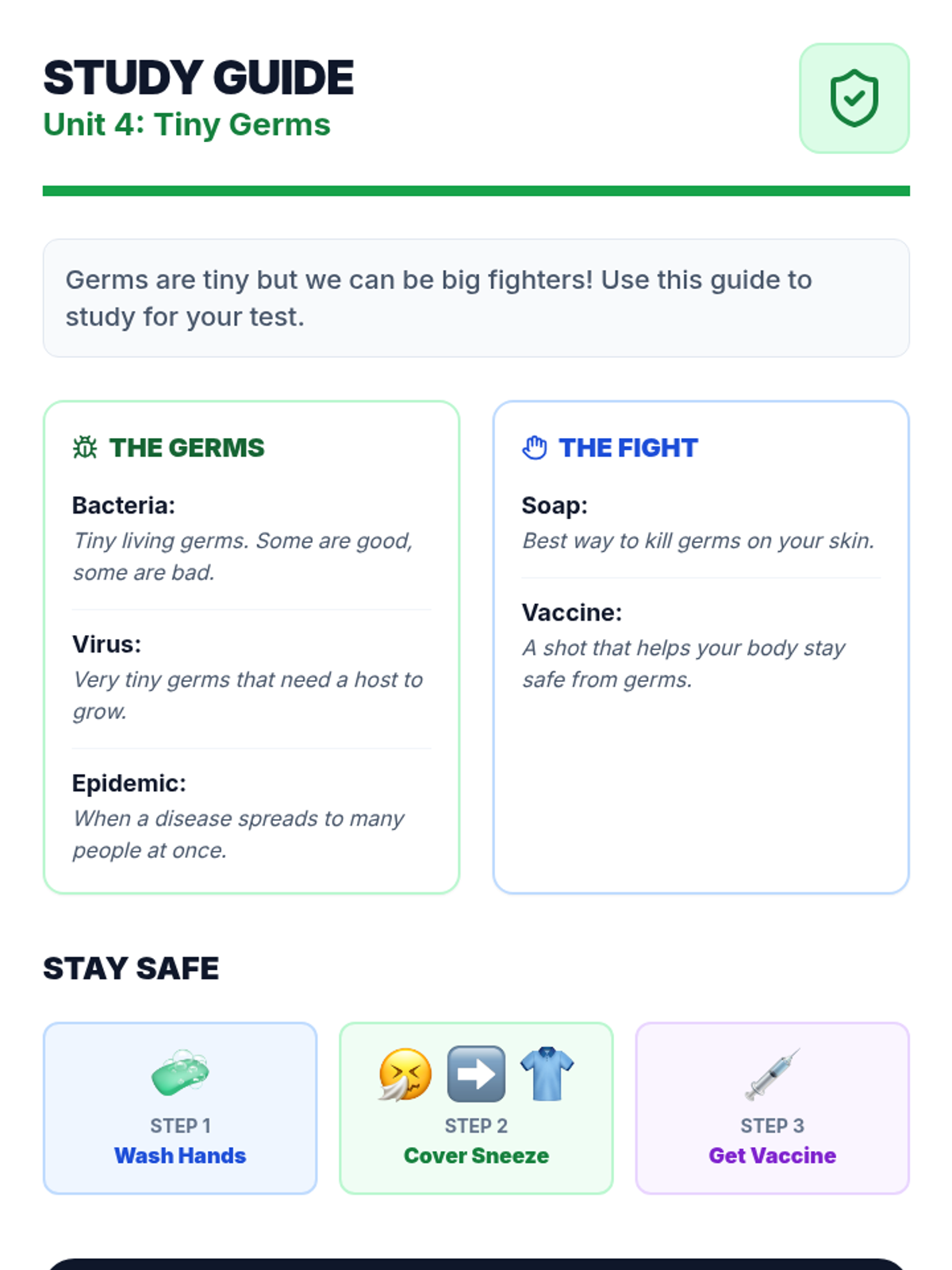
A visual study guide for Unit 4: Tiny Germs, summarizing key concepts about microbiology and staying healthy with simple language and high-visual support.
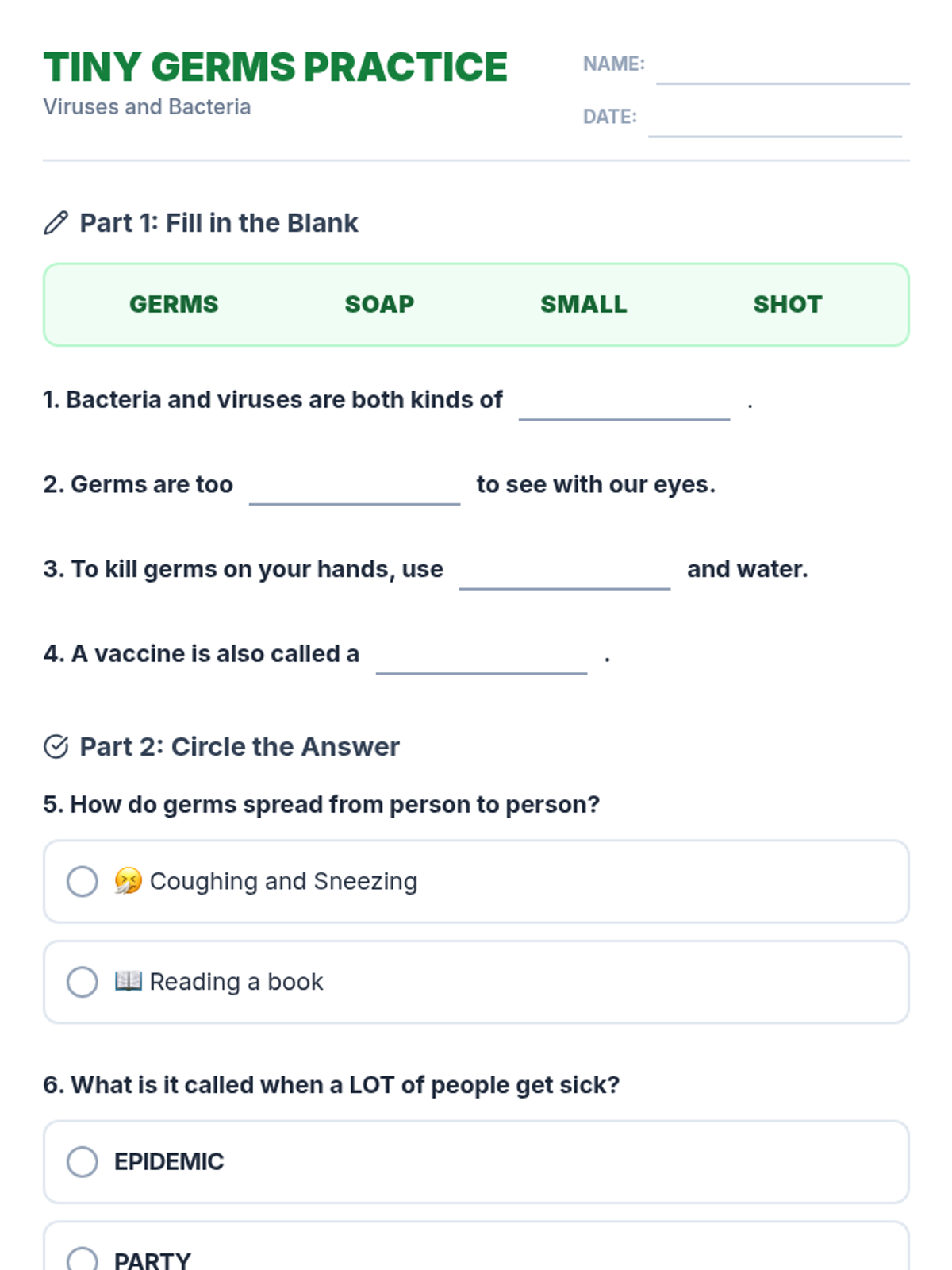
A simplified practice worksheet for germs and staying healthy, featuring word bank fill-in-the-blanks and multiple-choice questions with high-visual support.
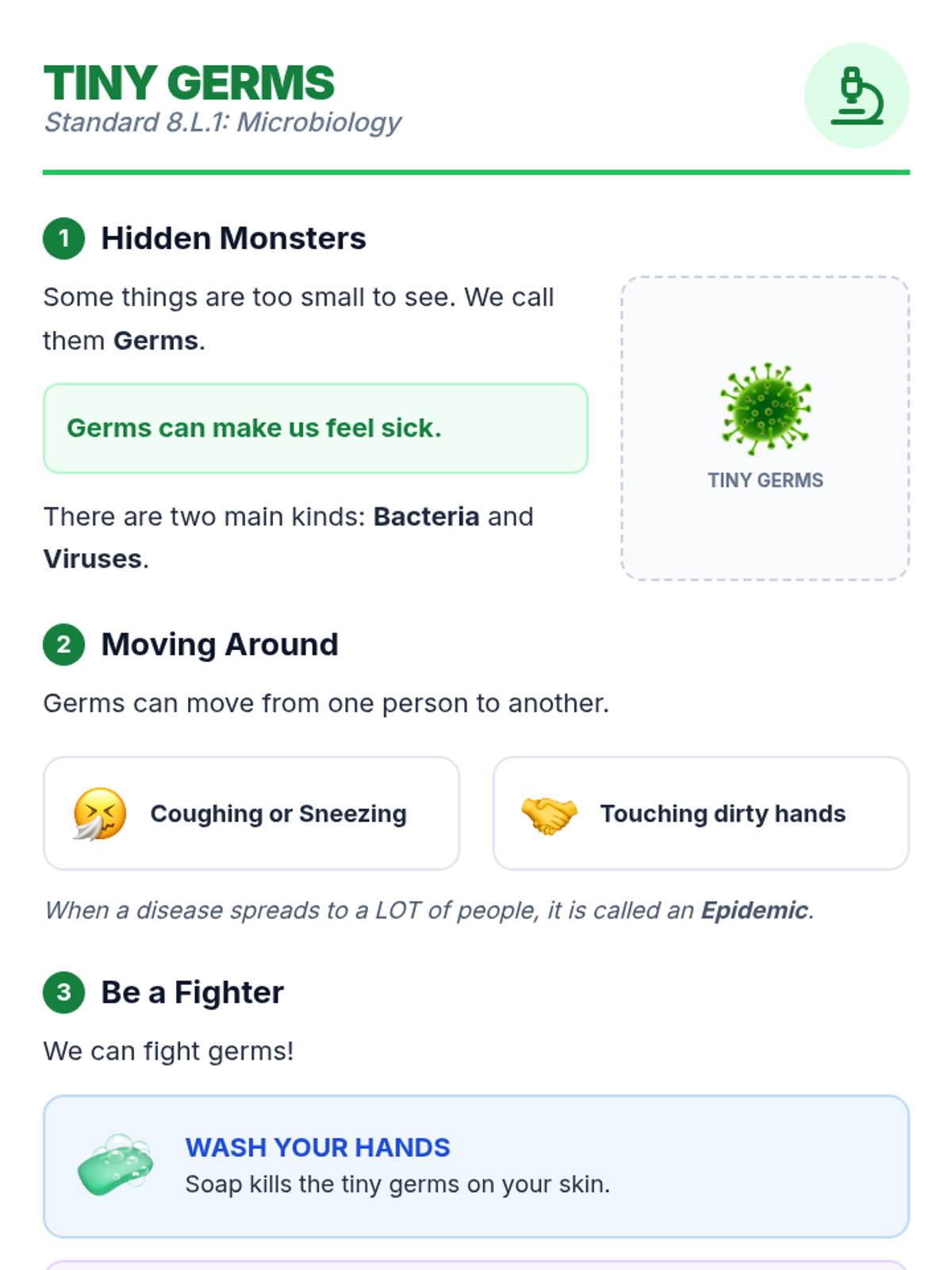
A simplified reading passage about germs, bacteria, viruses, and staying healthy, designed for students at a 1st grade academic level.
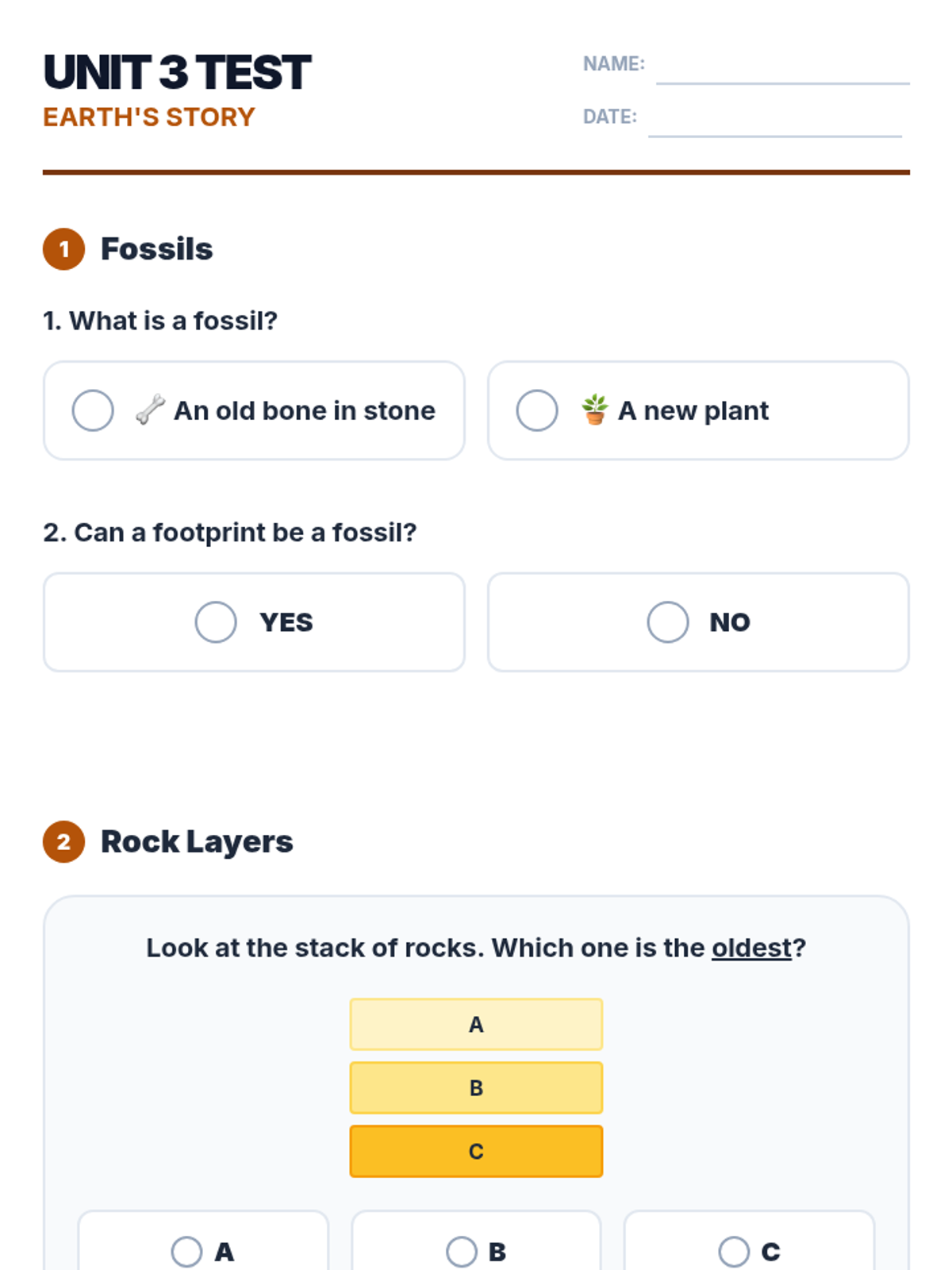
A simplified Unit 3 test on Earth's history, featuring high-visual cues and clear multiple-choice questions for 1st grade level learners.
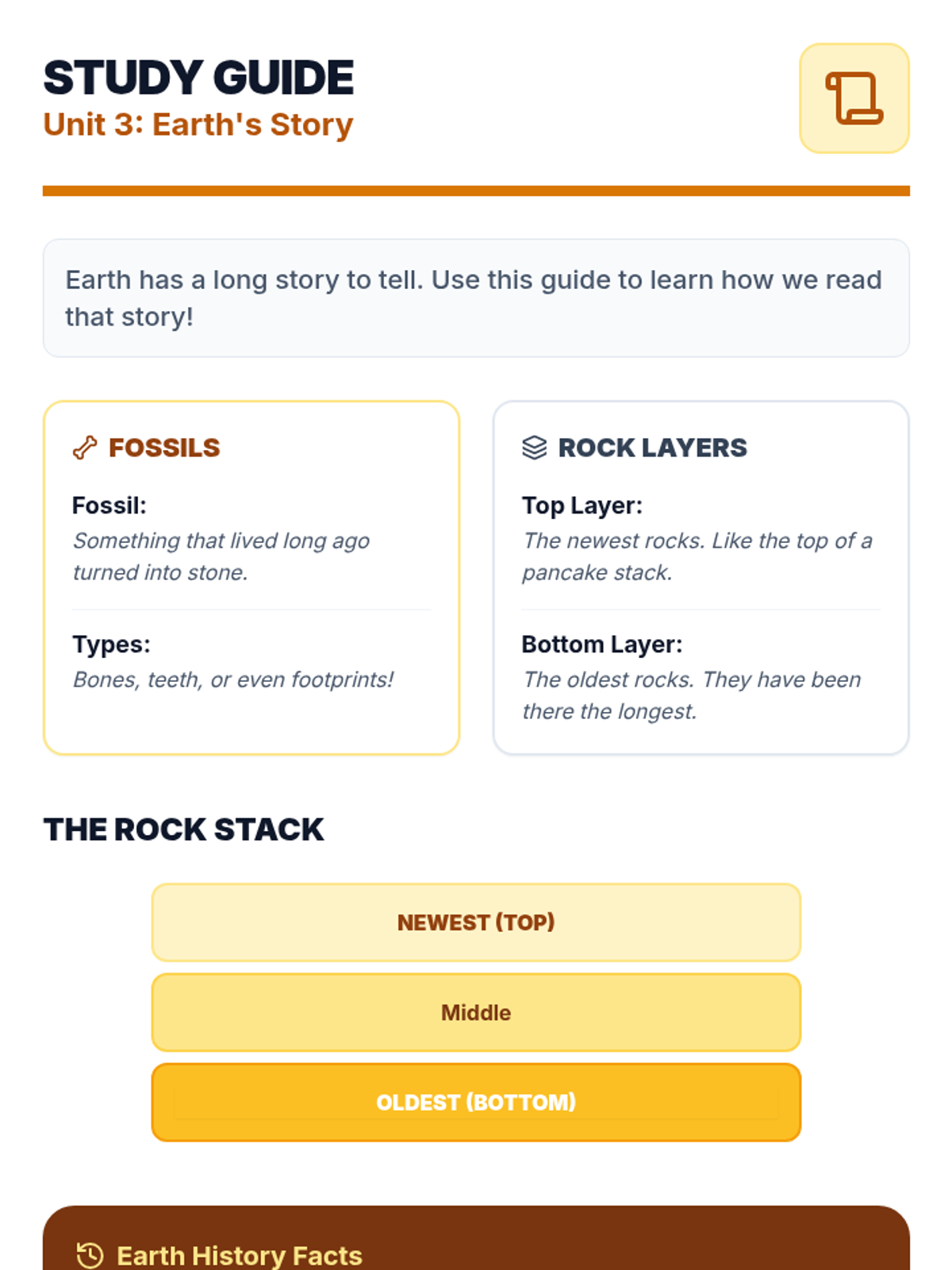
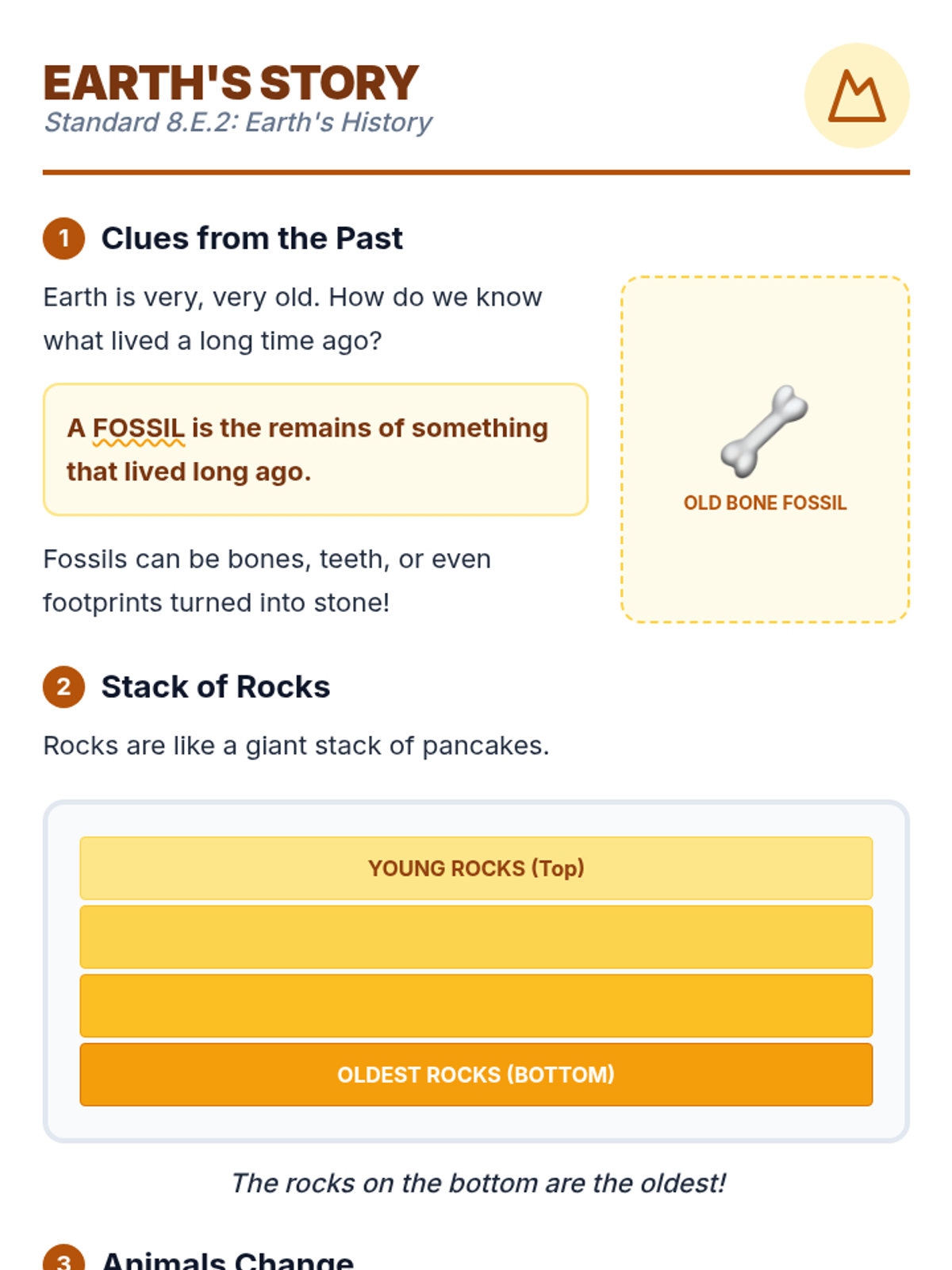
A visual study guide for Unit 3: Earth's Story, summarizing key concepts about fossils and rock layer positioning using 1st grade level language.
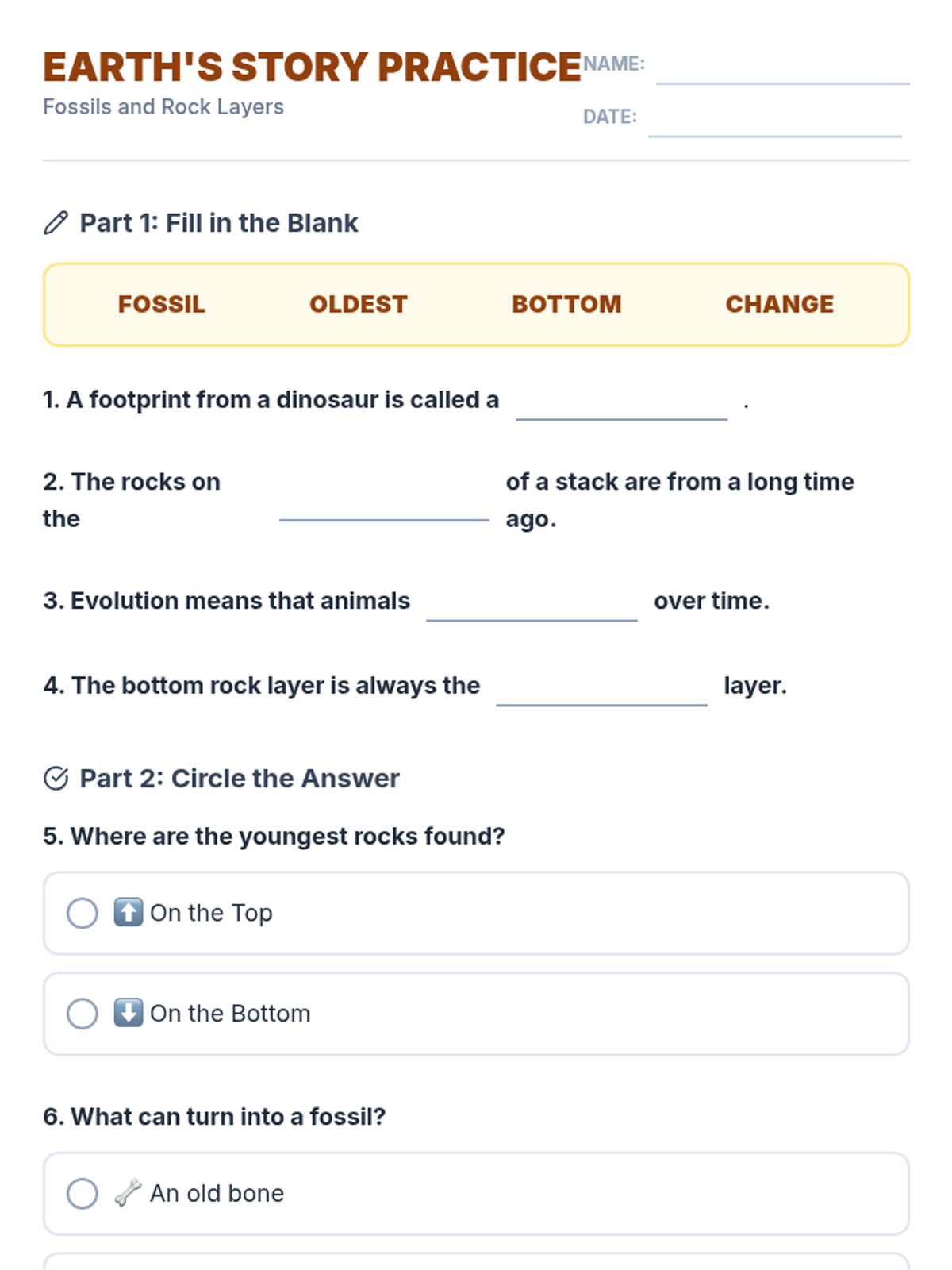
A simplified practice worksheet for Earth's history, featuring word bank fill-in-the-blanks and multiple-choice questions with high-visual support.
A simplified reading passage about fossils, rock layers, and how the Earth has changed over time, designed for students at a 1st grade academic level.
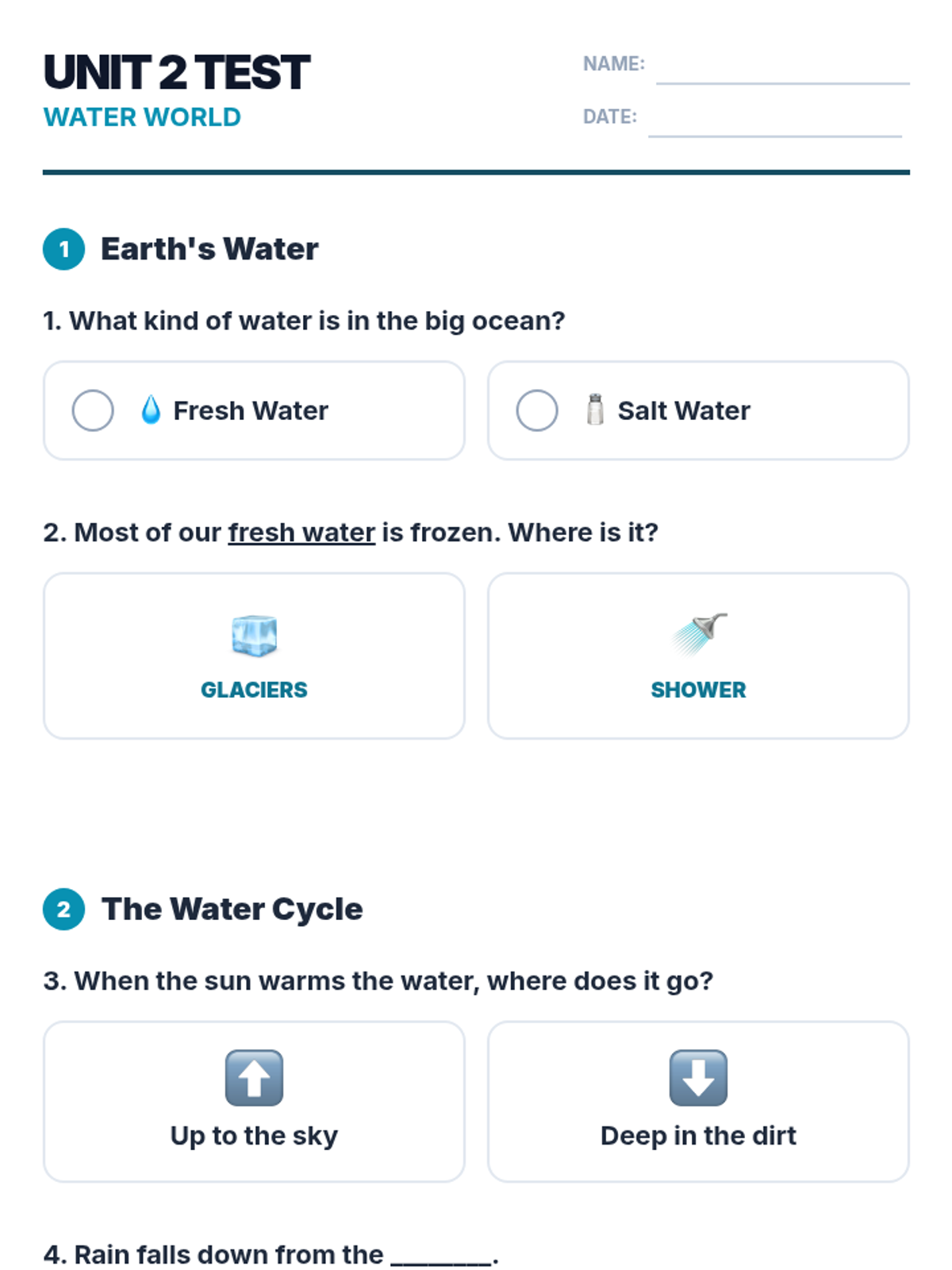
A simplified Unit 2 test on Earth's water and the water cycle, featuring high-visual support and 1st grade level language.
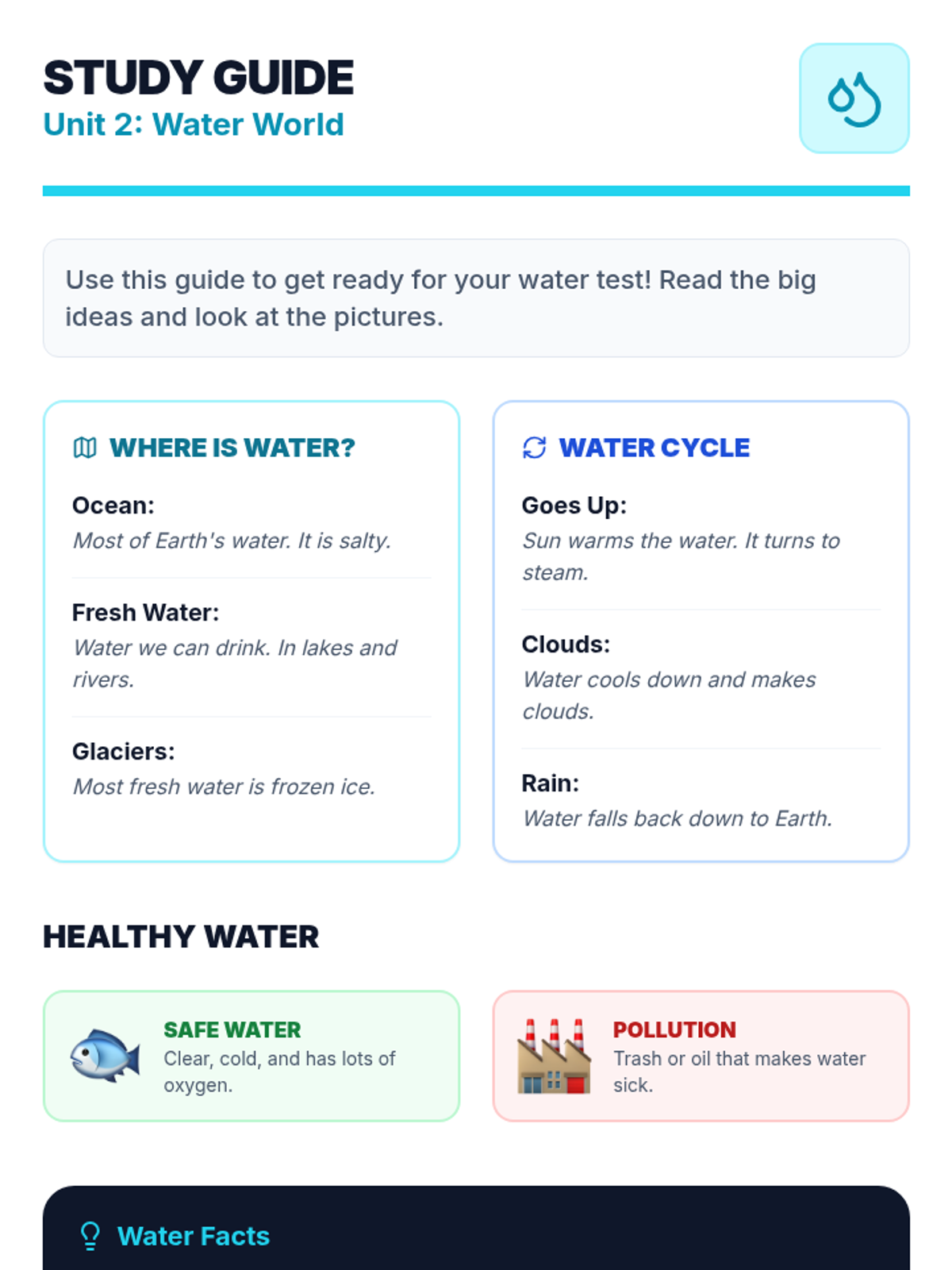
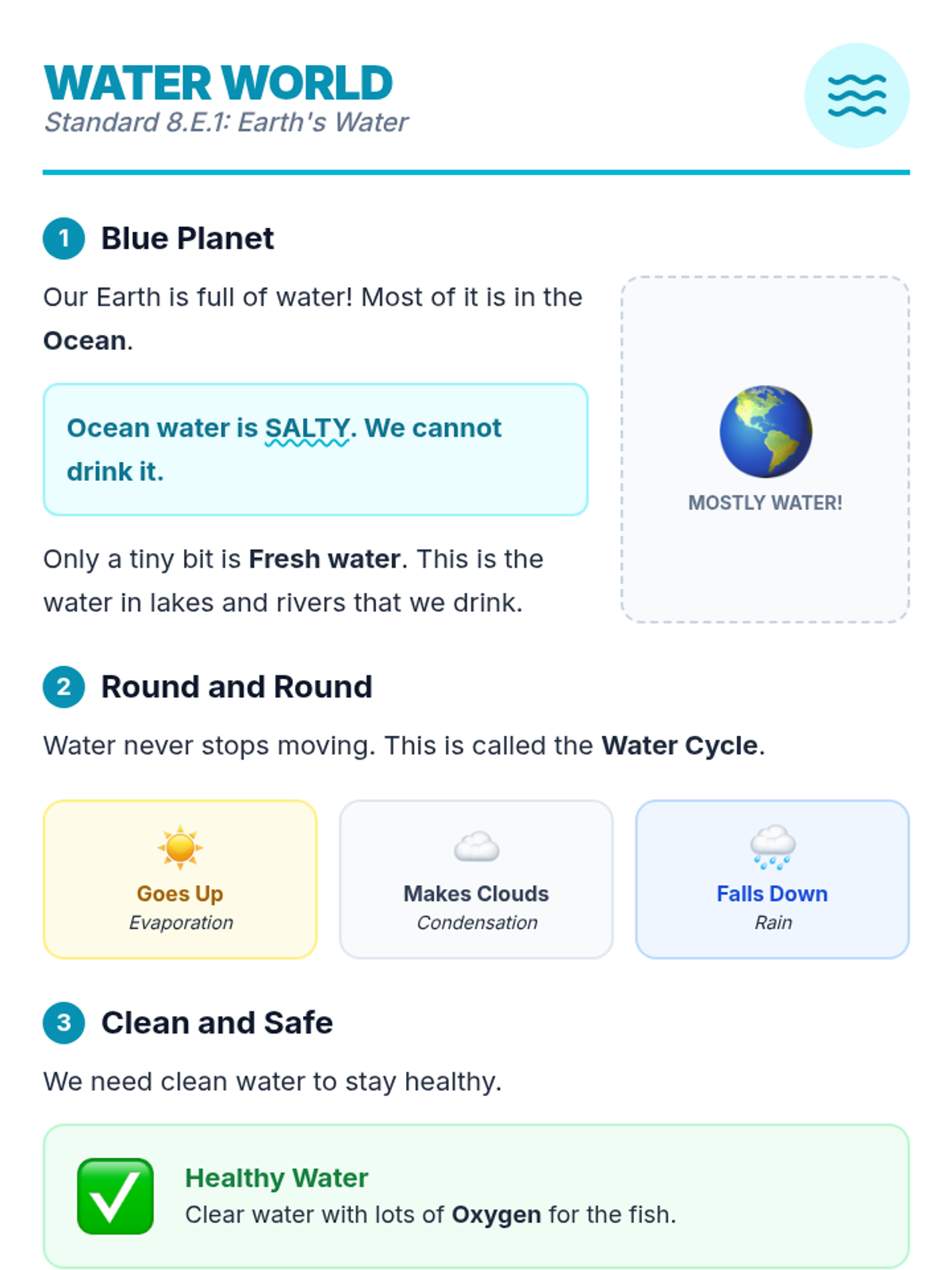
A visual study guide for Unit 2: Water World, summarizing key concepts about Earth's water distribution, the water cycle, and water quality with simple language and high-visual support.
A visual guide for students to understand the science fair research project process. Covers topic selection, research goals, poster layout tips, and an overview of the grading rubric.
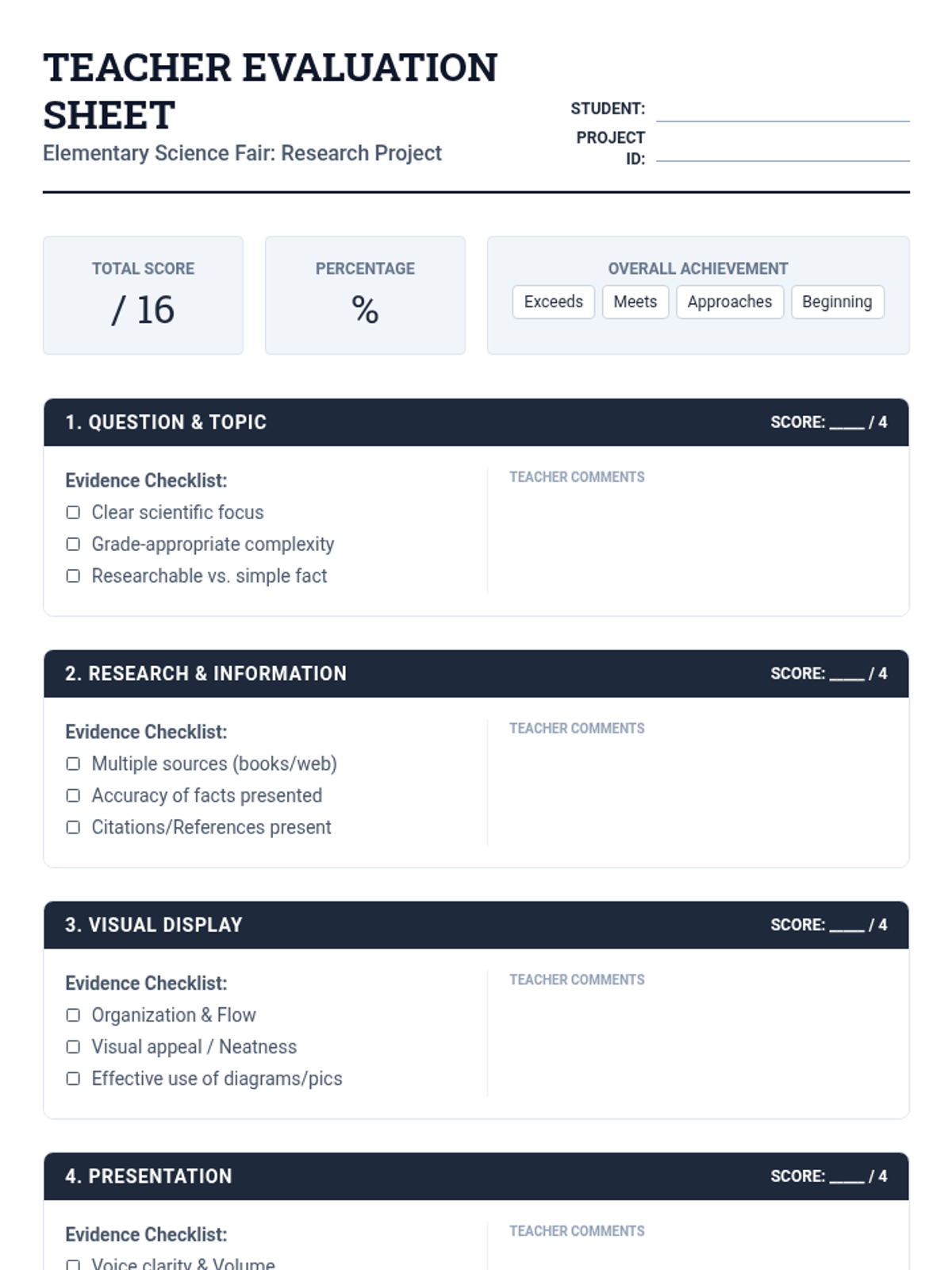
A formal evaluation sheet for teachers to grade elementary science fair research projects. It features scoring sections, evidence checklists for each criterion, and space for professional feedback.
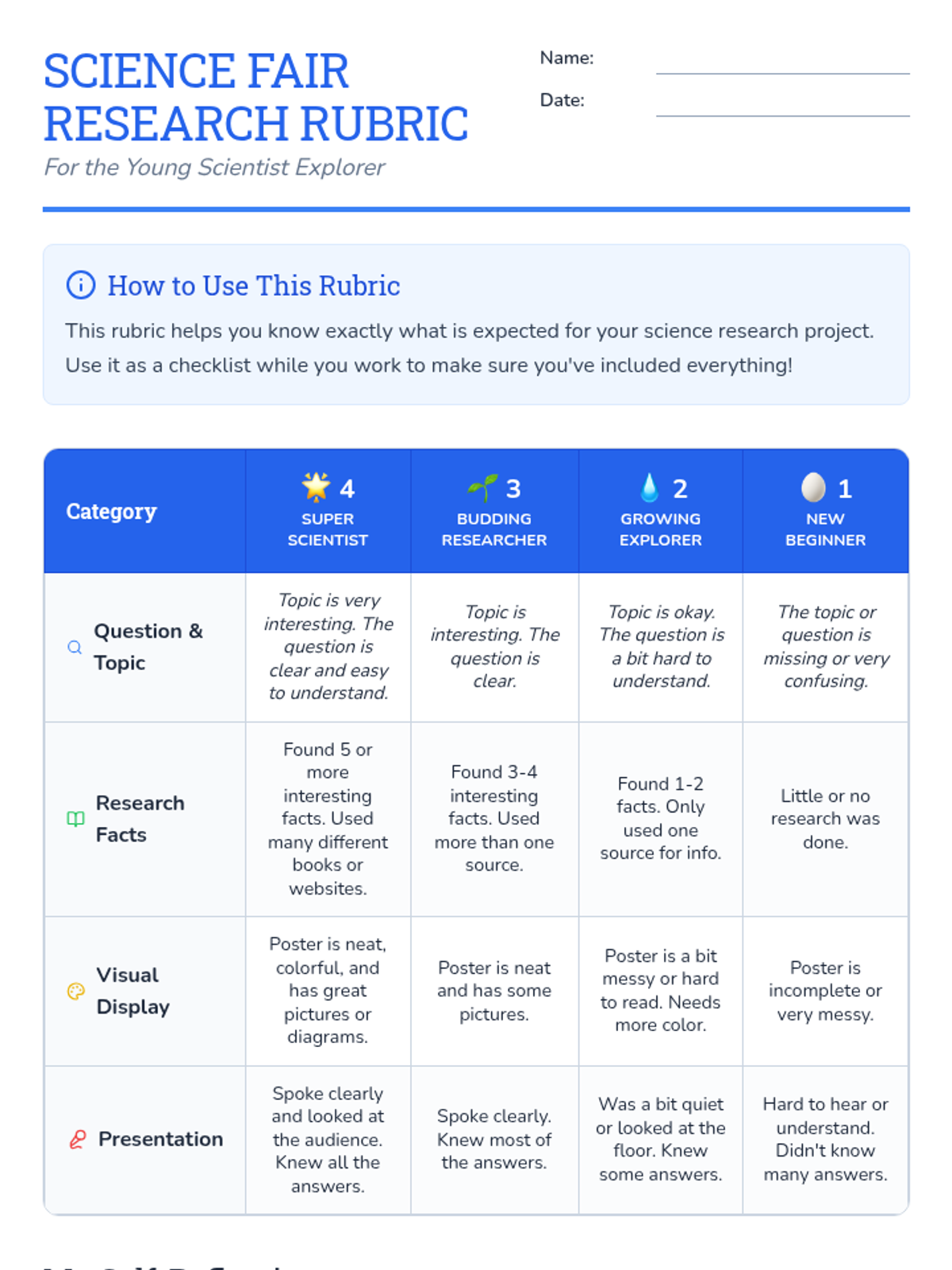
A student-friendly science fair rubric designed for elementary research projects. It features clear, descriptive language and levels (Super Scientist to New Beginner) with space for self-reflection.
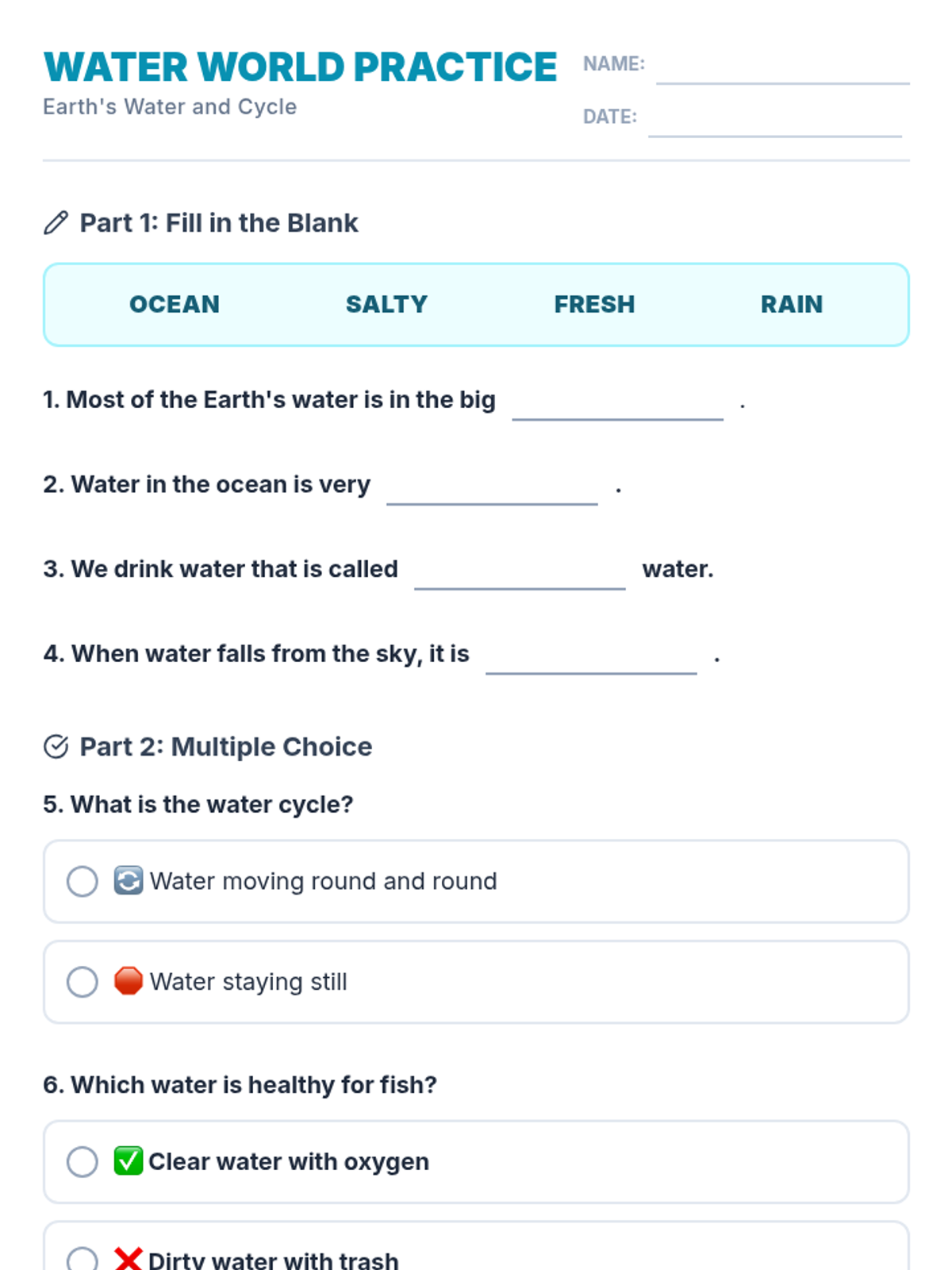
A simplified practice worksheet for Earth's water, featuring word bank fill-in-the-blanks and multiple-choice questions with high-visual support.
A simplified reading passage about Earth's water distribution, the water cycle, and water quality, designed for students at a 1st grade academic level.