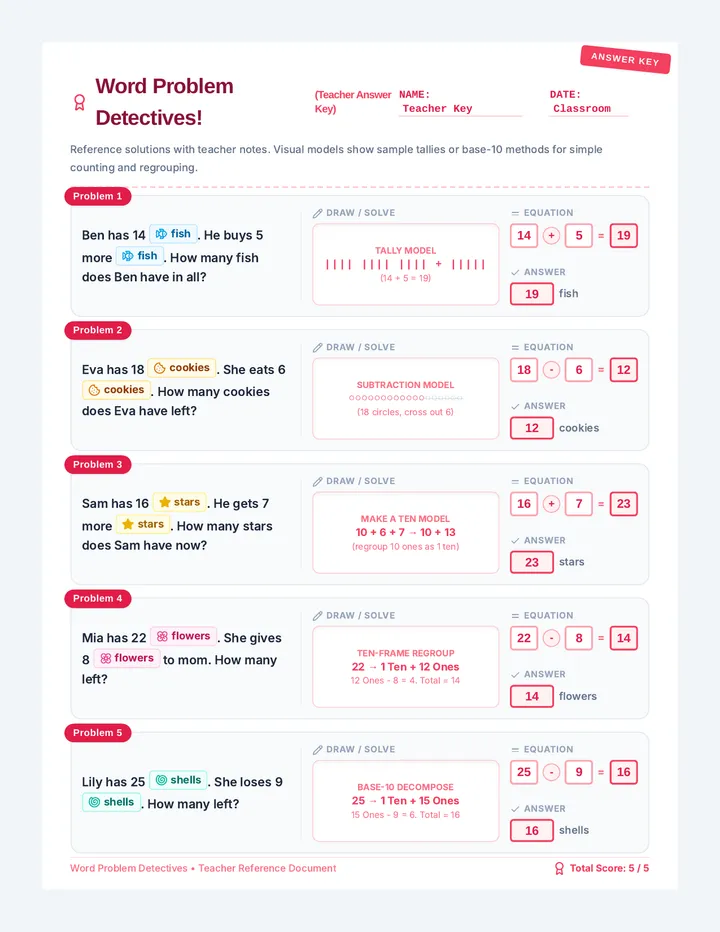
A set of 12 construction-themed task cards for solving length word problems within 100, featuring a mix of addition and subtraction scenarios.
Student worksheet for Lesson 5 (Double Up). Includes a doubling accelerator chart for 2s and 4s, a challenge on halving facts, and a real-world word problem about tires in a parking lot using the double-double strategy.
Lesson 5 slides on 'Double Up' strategy for 2s and 4s. Teaches the 'double-double' method through visual patterns and mental math routines. Includes a step-by-step breakdown of multiplying by 4.
Student worksheet for Lesson 4 (Family Ties). Features fact family houses to complete, a 'Think Multiplication' strategy section for solving division, and an area for students to draw their own array and generate a corresponding fact family.
Lesson 4 slides on Fact Families and Inverse Operations. Uses 'The Missing Piece' warm-up and a 'Fact Family House' visual to connect multiplication and division. Includes conceptual explanations of how multiplication helps with division.
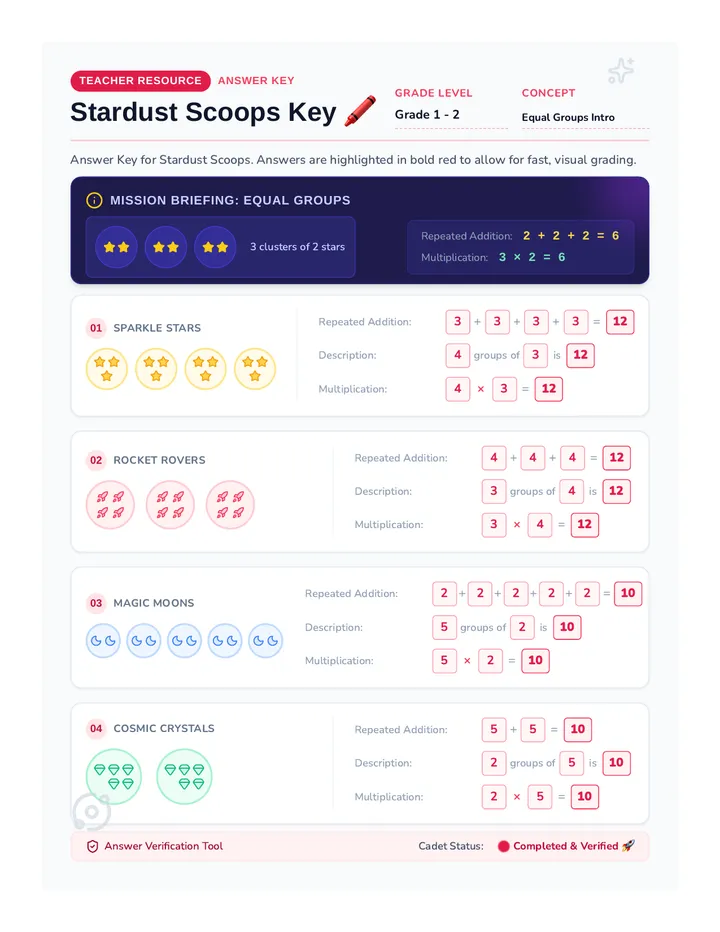
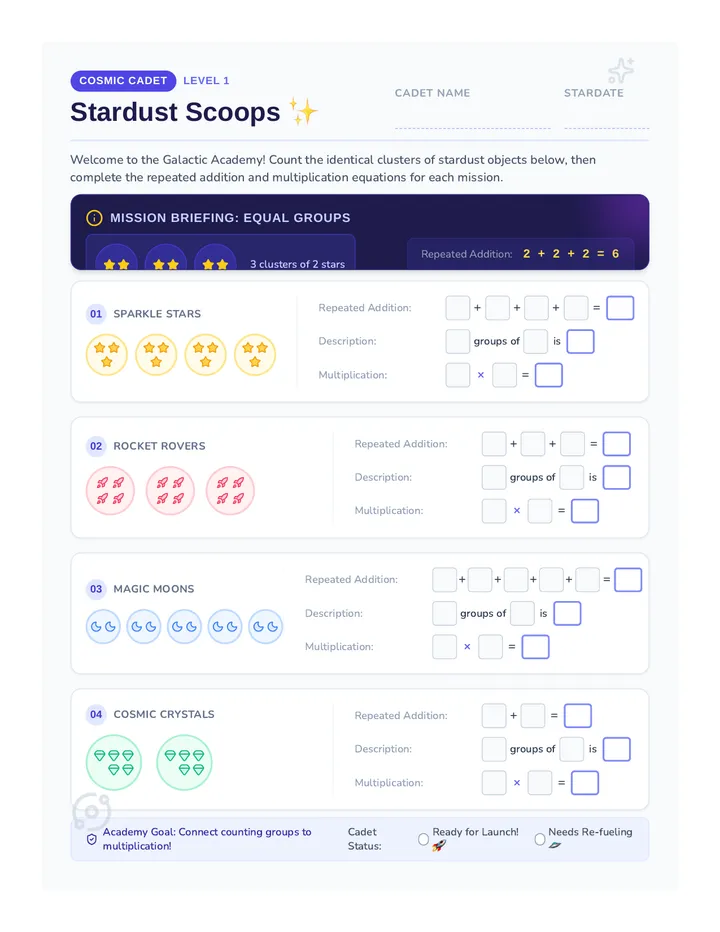
Student worksheet for Lesson 3 (Reverse Engineering). Practice partitioning items into jars and grouping items to find the number of racks. Connects multiplication facts to division problems in the investigator's notes.
Lesson 3 slides introducing division as the inverse of multiplication. Explains partitioning versus grouping and introduces formal division notation using a 'Reverse Engineering' theme.
Student worksheet for Lesson 2 (Array Architecture). Focuses on labeling rows and columns, drafting arrays from expressions, and solving a 'Brick Wall' array word problem.
Lesson 2 slides on Array Architecture. Introduces rows and columns using 'Which One Doesn't Belong?', anatomy of an array diagrams, and real-world array connections.
Teacher facilitation guide for Lesson 1 (Group Power). Includes pacing, high-leverage concepts from ALN, IM routines, specific teacher prompts for the Number Talk, and an answer key for the student worksheet.
Student worksheet for Lesson 1 (Group Power). Features problems on identifying equal groups, drawing groups from expressions, and a word problem scenario with Beetle jars. Includes an exit ticket section.
Lesson 1 visual slide deck introducing the concept of equal groups and multiplication notation. Includes a 'How Many Do You See?' warm-up, real-world examples, and a 'Notice and Wonder' prompt.
A teacher resource providing answer keys, instructional strategies, and data collection tips for the Market Masters money unit.
A comprehensive final assessment covering coin identification, money addition, and subtraction from $20 using a calculator. Features clear sectioning and scoring areas.
A set of four printable scenario cards featuring real-world math tasks. Each card presents a situation requiring either addition of multiple items or subtraction from $20, specifically designed for calculator use.
A subtraction-focused worksheet helping students calculate change from $20 using a calculator. Includes visual prompts for calculator steps and clear answer fields.
A worksheet featuring three grocery shopping scenarios requiring students to use a calculator to add money amounts up to $20. Includes structured work areas and clear total boxes.
A matching activity worksheet for students to identify penny, nickel, dime, and quarter names and values. includes visual representations and space for value notation.