A teacher's guide and answer key for the Busy Bees lesson, providing correct responses for the activity worksheet and assessment, along with instructional tips for Level I/J readers.
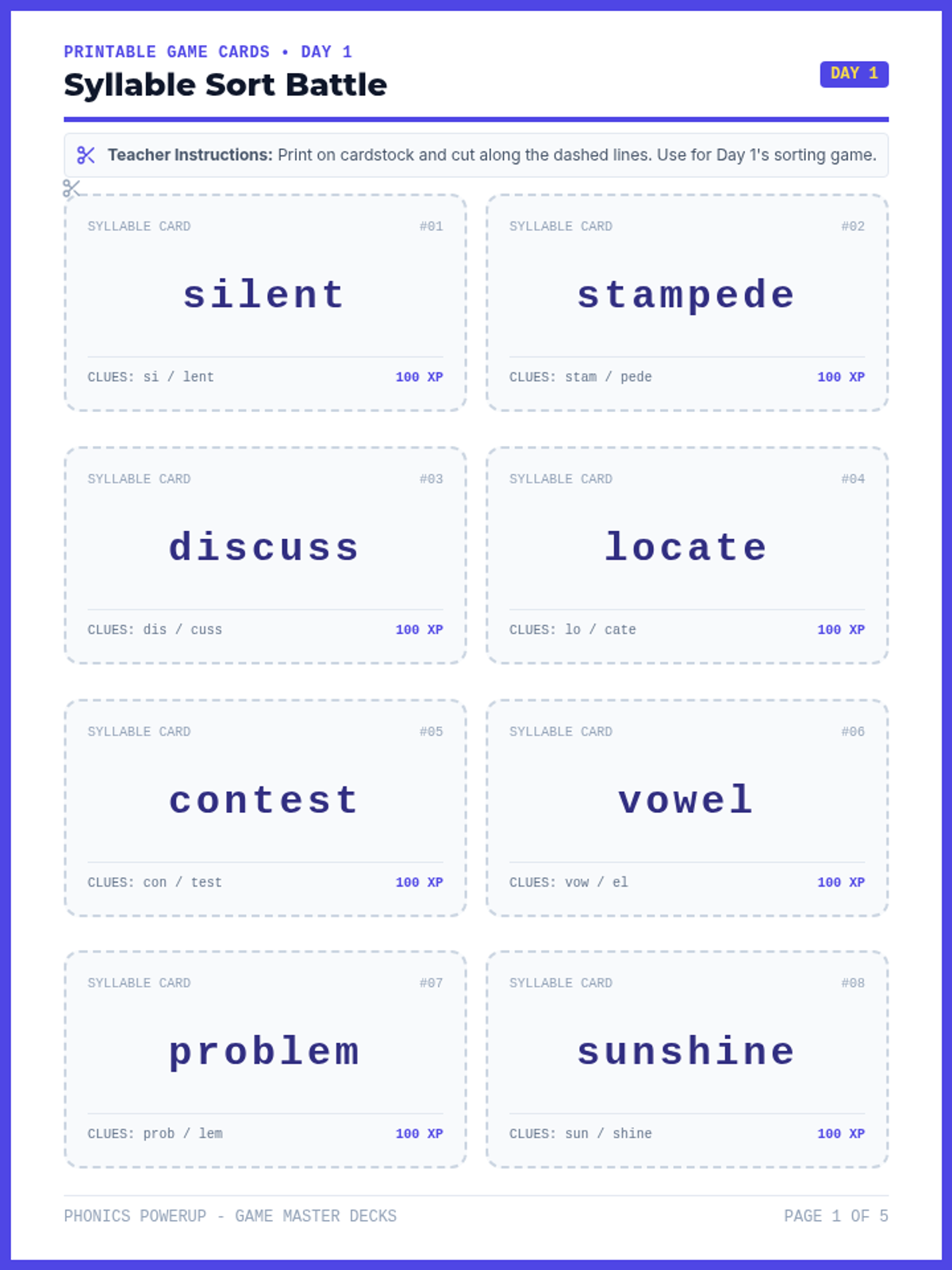
A 5-page printable resource featuring syllable sort cards, suffix math task cards, r-controlled and vowel team card decks, and instructions for interactive games.
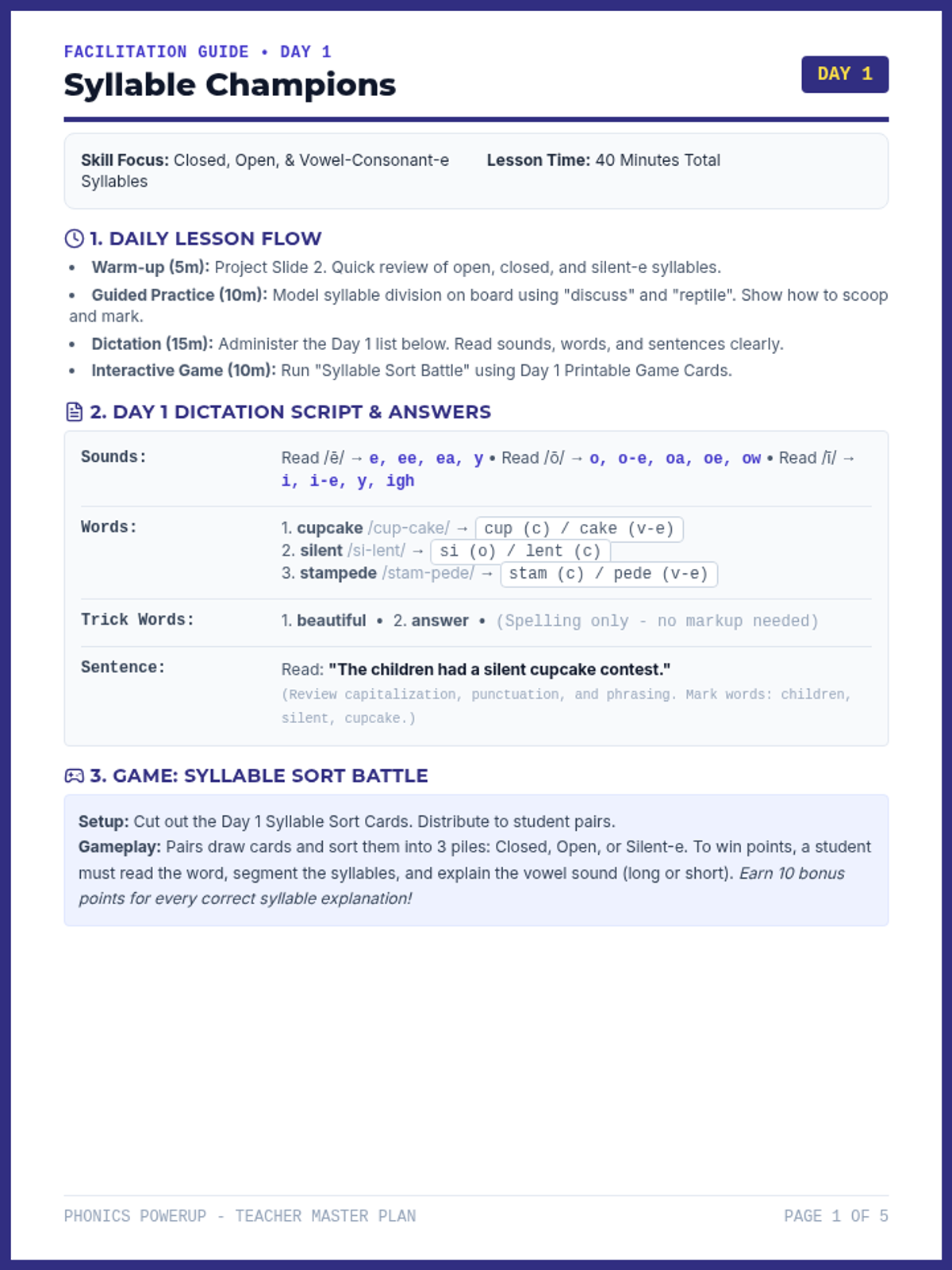
A 5-page master teacher script and facilitation guide (one page per day) outlining lessons, dictation lists (sounds, words, trick words, sentences), and game instructions.
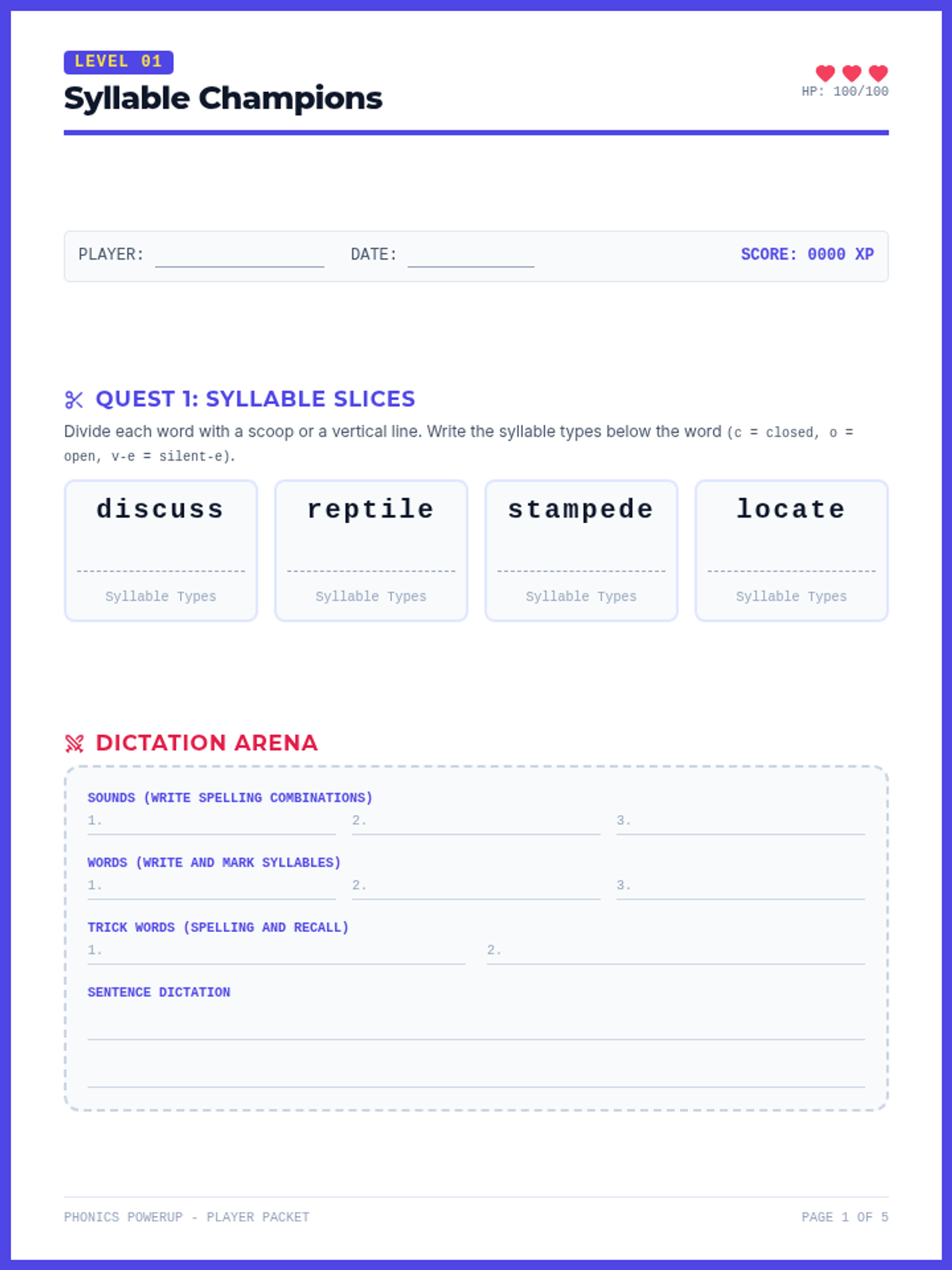
A 5-page printable student workbook (one page per day) with structured practice for syllable types, suffix rules, dictation templates, and daily review challenges.
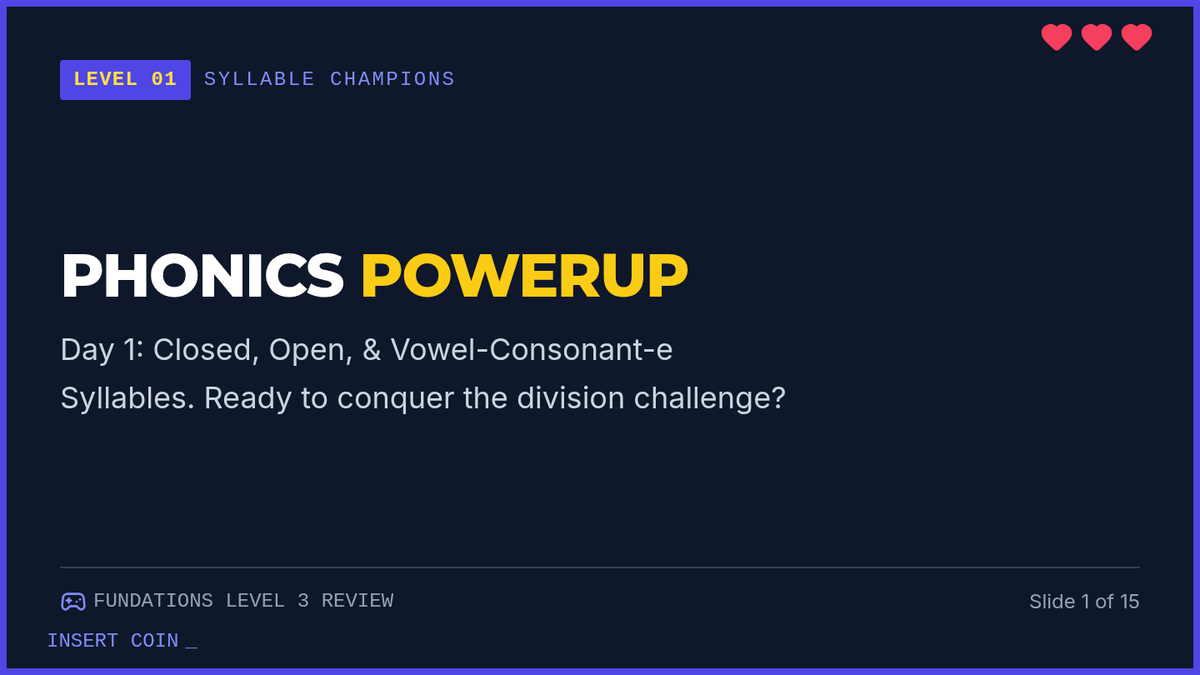
A 15-slide presentation deck providing daily visual support, review rules, interactive prompts, and daily dictation visual keys for a 5-day Fundations Level 3 review (Units 1-9).
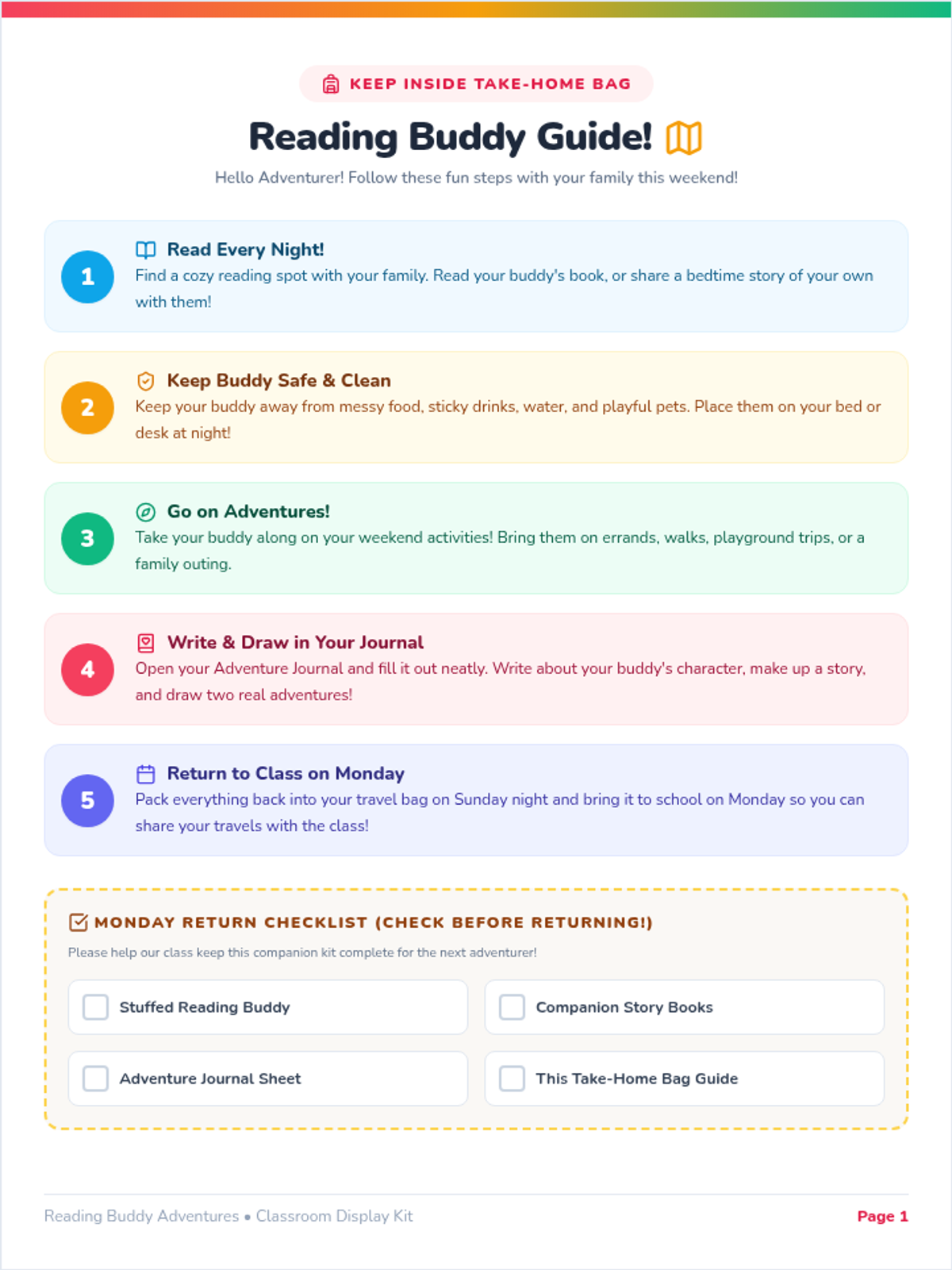
A 3-page classroom display and discussion kit featuring a 'Reading Buddy Rules' anchor chart, printable bulletin board headers and decorative accents, and 6 double-sided student sharing/discussion prompt cards to facilitate classroom sharing.
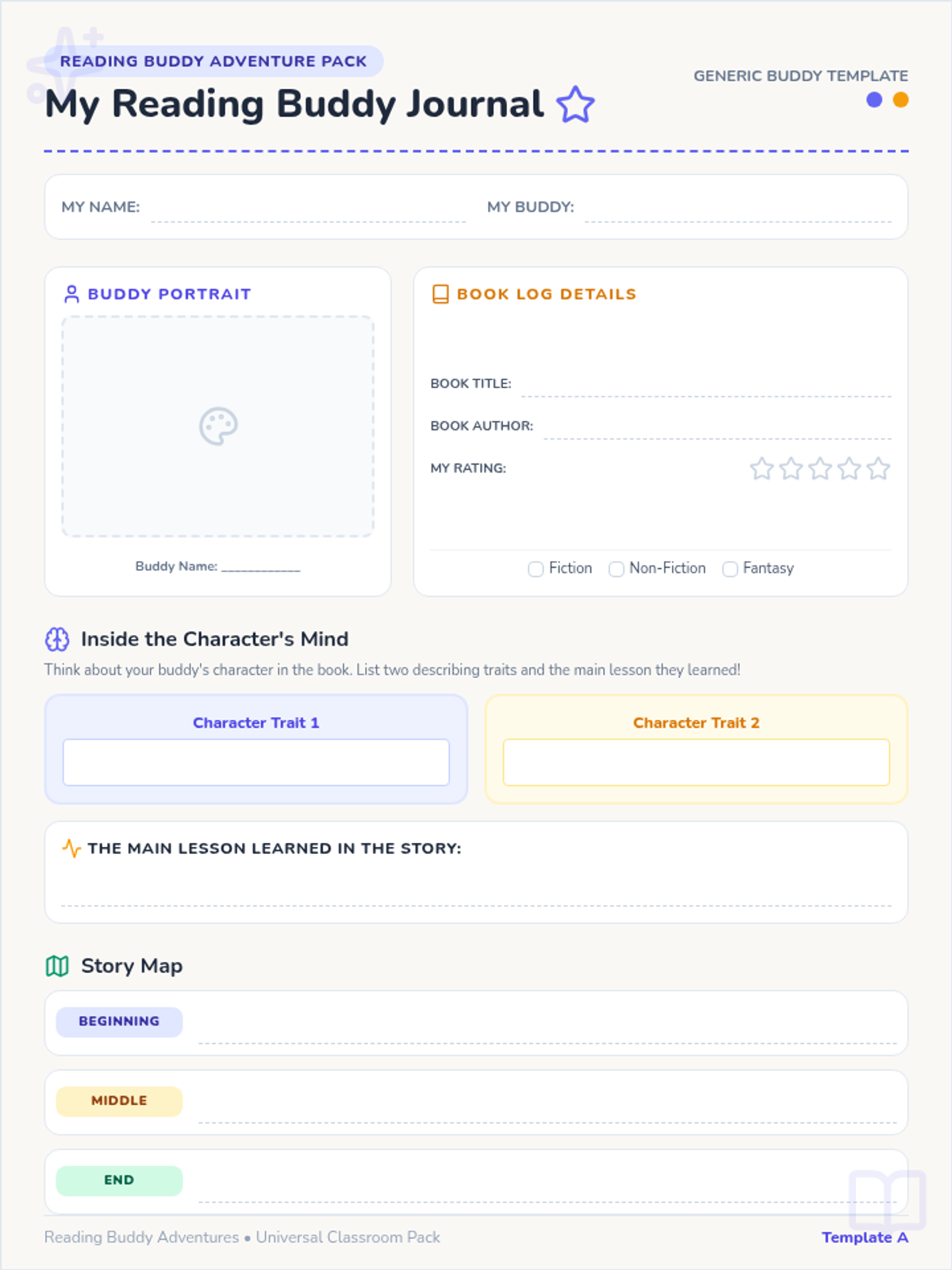
A 3-page customizable multi-character template pack allowing teachers or students to adapt the reading buddy journal for any book character. Features customizable buddy portrait, character analysis, narrative writing page, and travel diary with generic prompts.
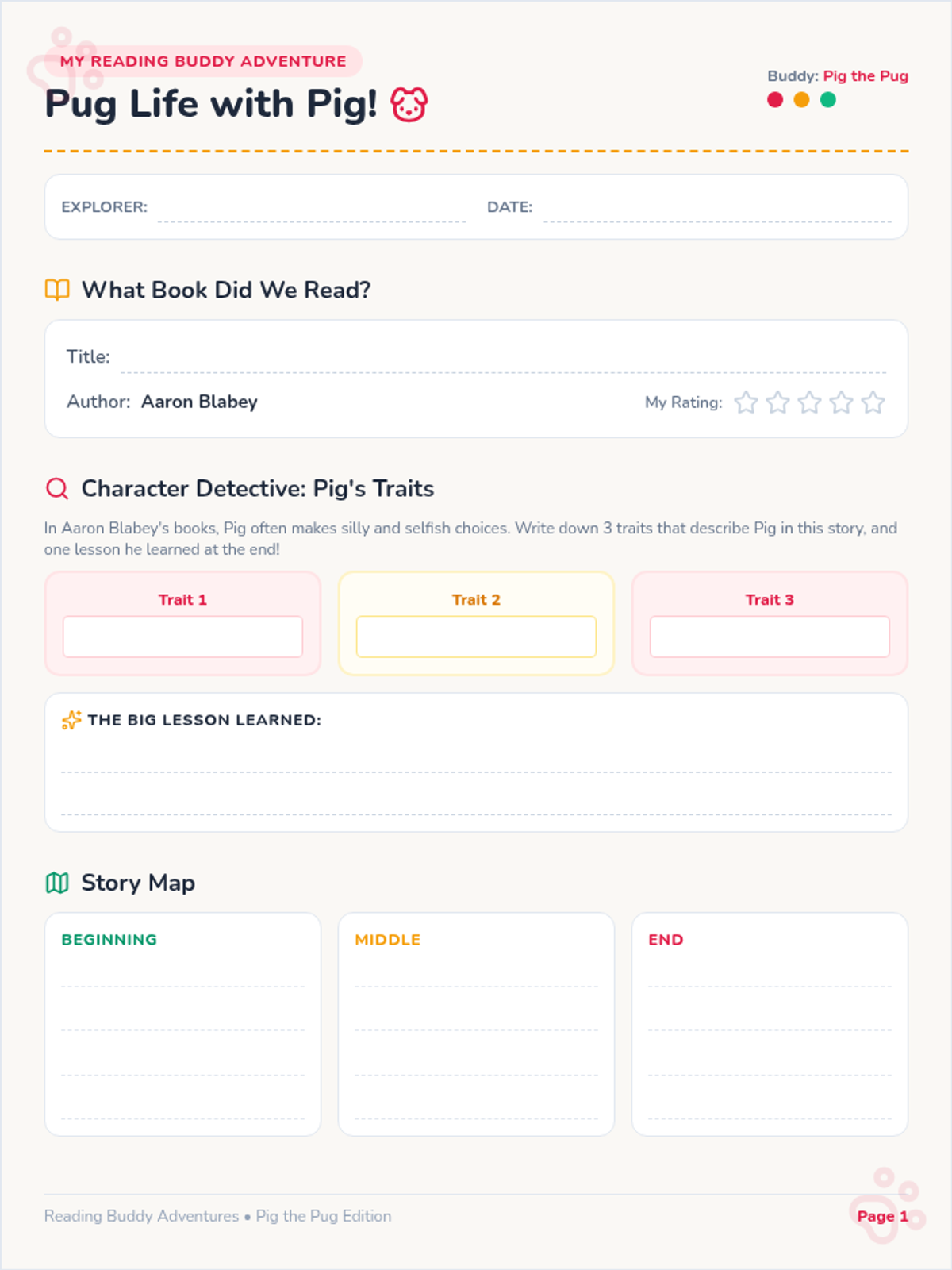
A simplified 3-page interactive student adventure journal featuring 'Pig the Pug'. Optimized for 3rd-grade motor skills with wider handwriting rows, horizontally stacked story maps (Beginning, Middle, End), 2 character traits, and spacious 2-line travel diary captions.
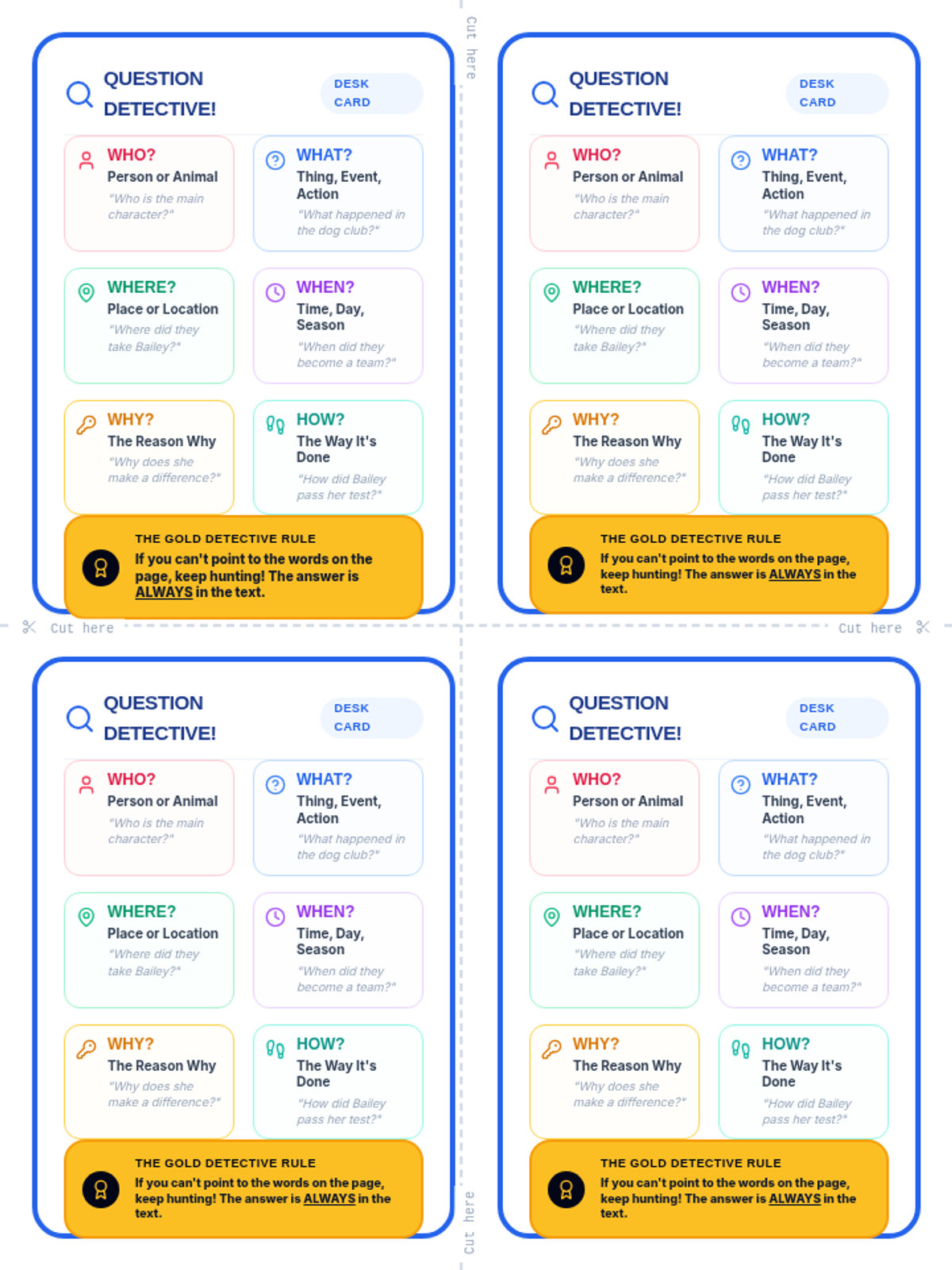
A printable sheet containing 4 mini-sized Student Desk Helpers (with the 6 boxes and Gold Detective Rule) designed to be printed, cut out, and taped to students' desks.
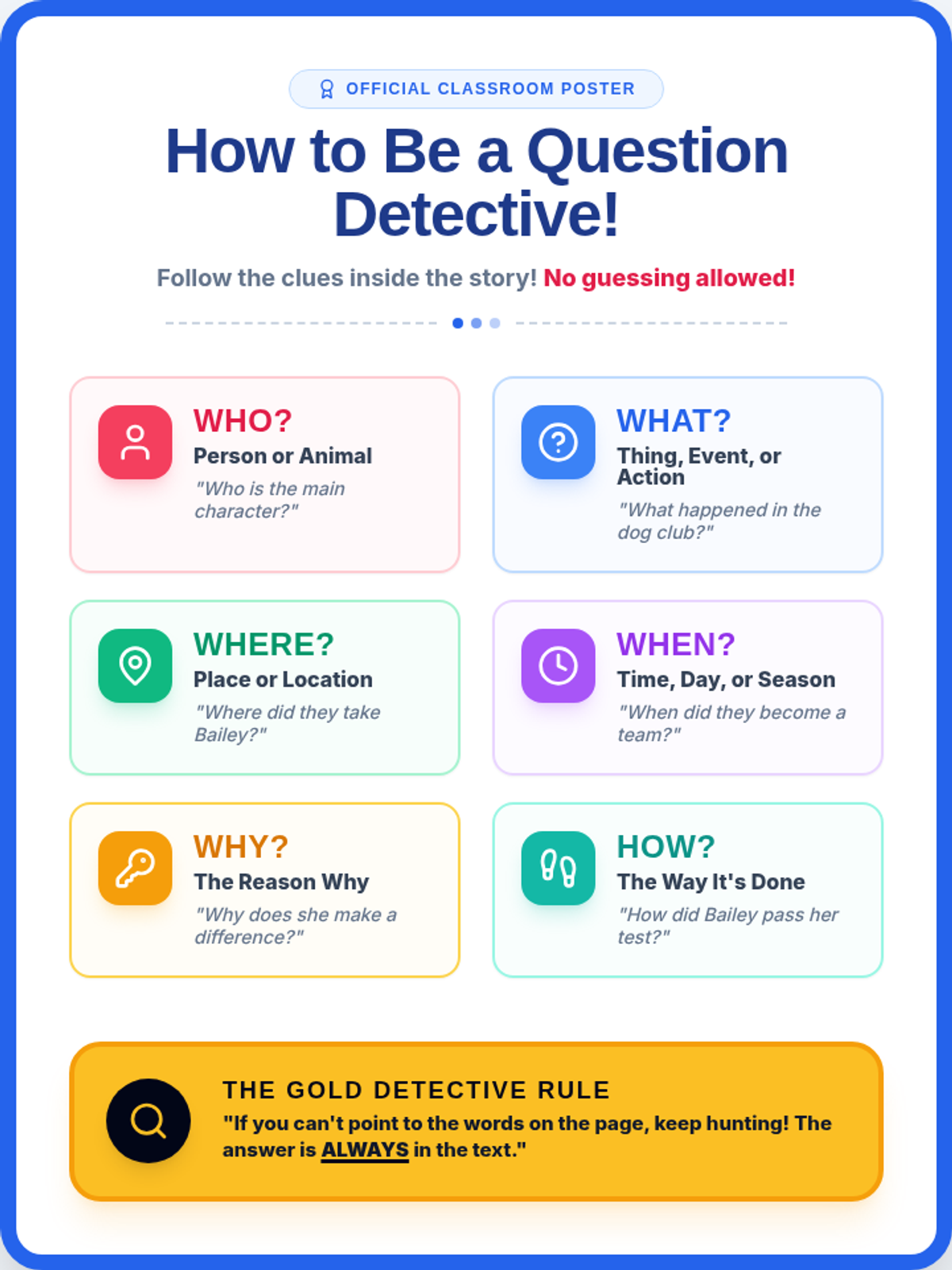
A premium, high-visibility classroom anchor chart poster containing the 6 key question words (Who, What, Where, When, Why, How) and the Gold Detective Rule for teaching reading comprehension and evidence gathering.
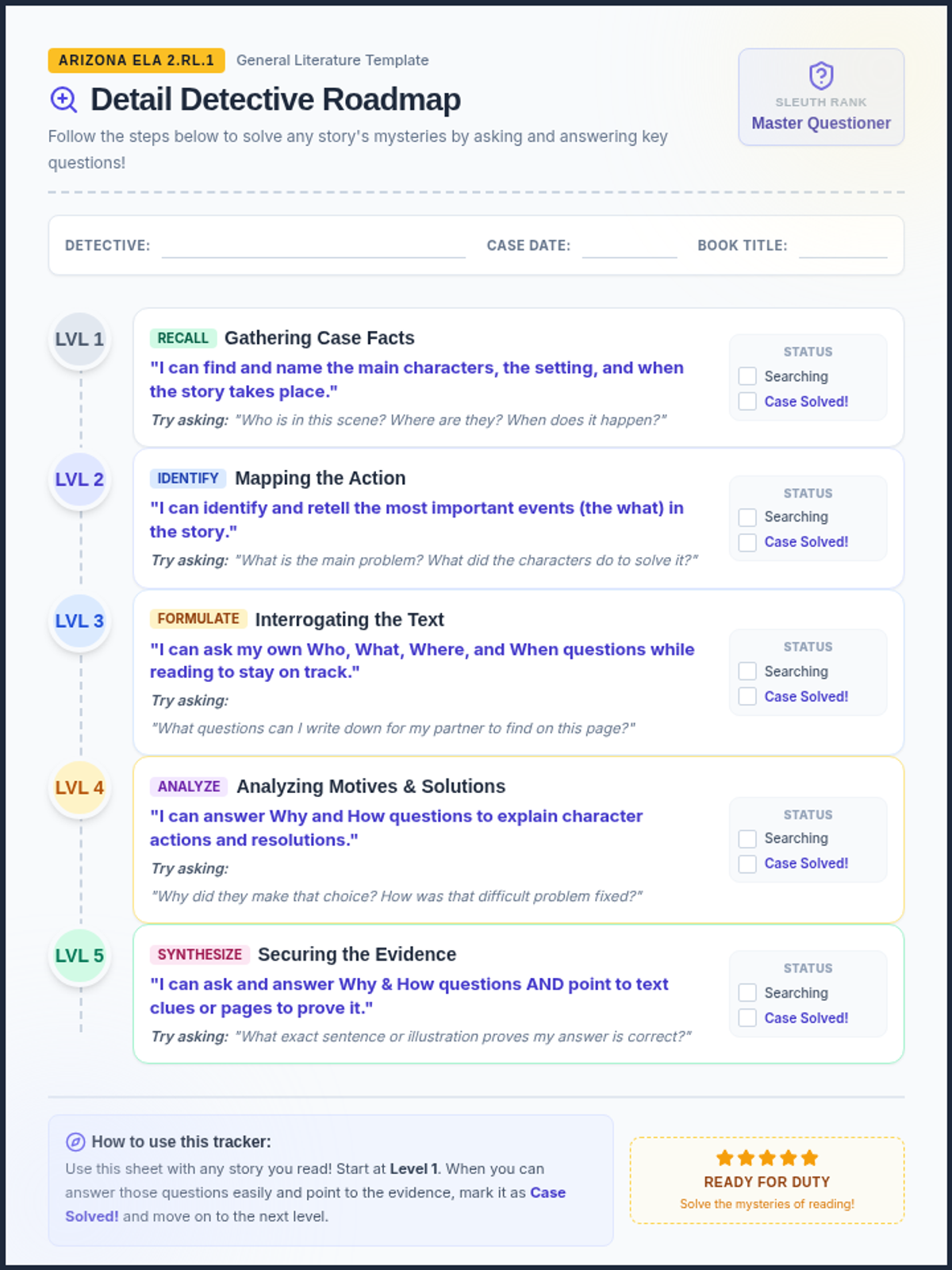
A visually engaging 1-page student learning target roadmap and self-tracking progression sheet for Arizona Standard 2.RL.1, guiding second graders from simple retrieval (who/where/when) to advanced integration (why/how with evidence).
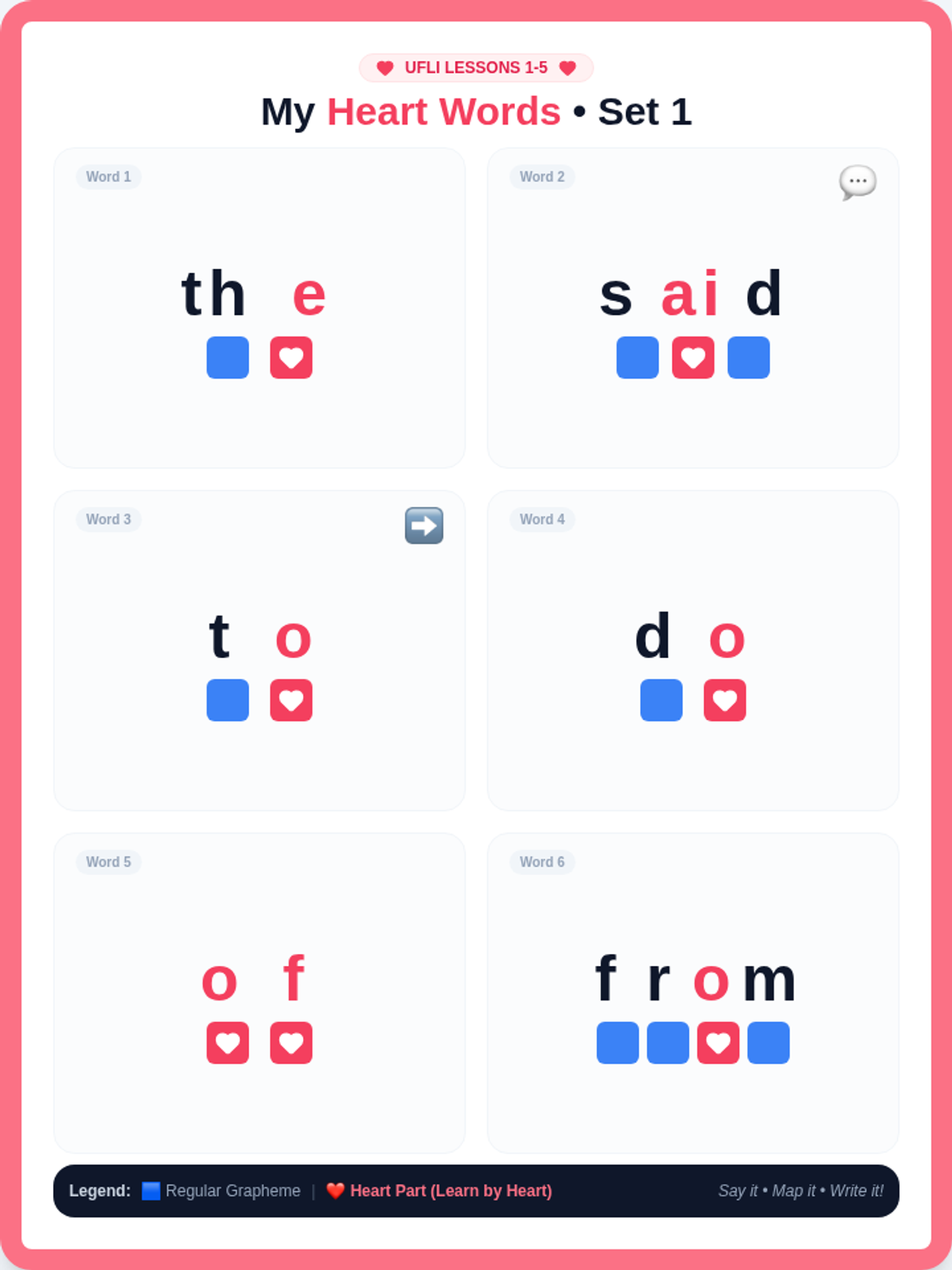
The complete 16-page UFLI Heart Words Master Poster Pack. Features all 94 Heart Words from UFLI Foundations with accurate orthographic mapping (blue boxes for regular graphemes, red hearts for tricky parts) and high-quality direct visual emojis, designed for easy print and display.
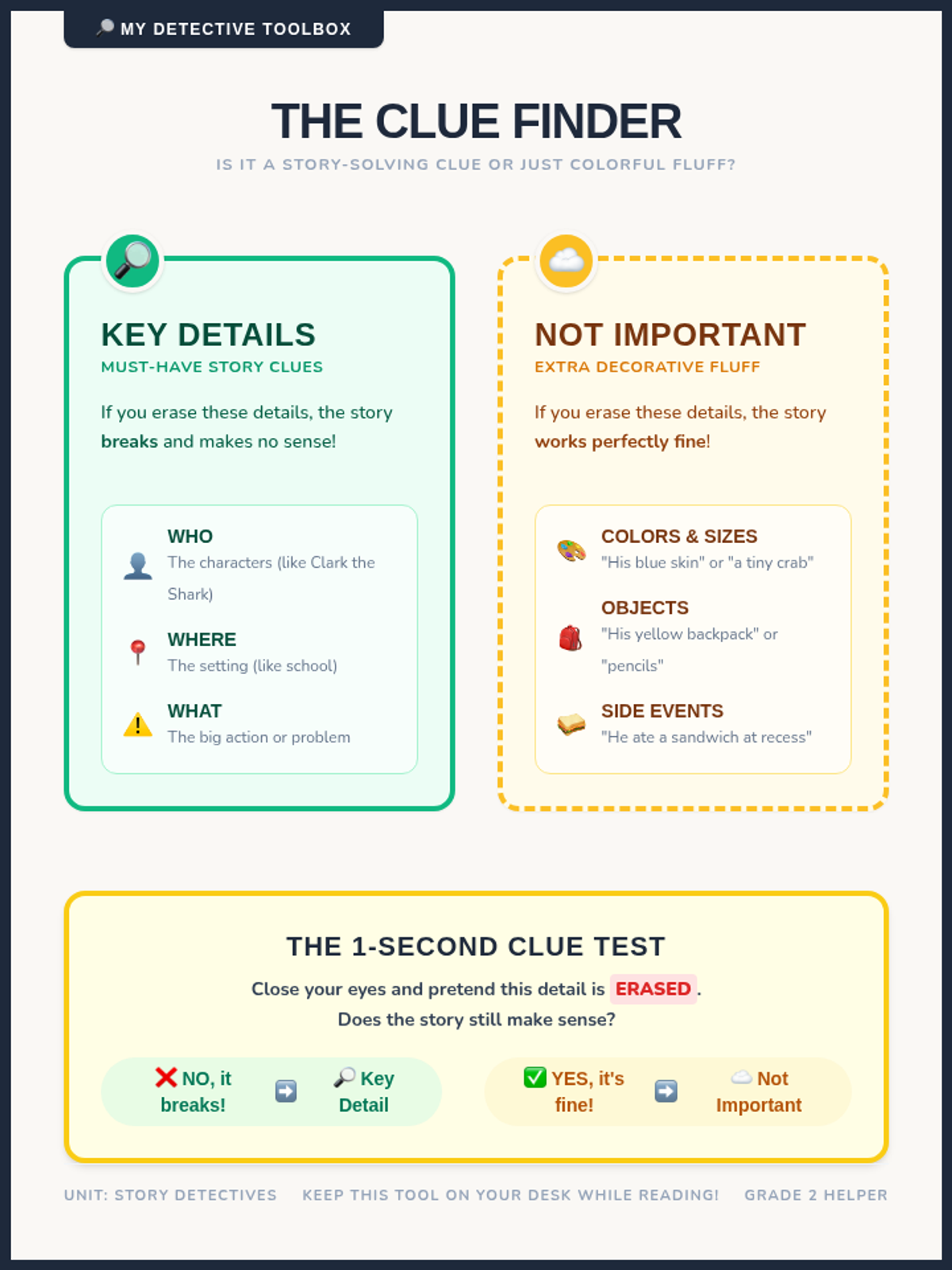
A hyper-simplified, high-contrast visual reference tool for 2nd graders to instantly compare key details vs. unimportant details. Perfect for laminating as a desk helper or bookmark reference.
Interactive slide deck for Day 9 explaining speaking/listening expectations for the final Author's Celebration (I Do), interactive group practice giving warm peer feedback (We Do), and independent worksheet publishing directions (You Do).
A 2-page student worksheet for Day 9. Page 1 contains a template for a decorated 'What I Did This Summer' book cover with title and author lines. Page 2 contains a polished final publishing page with a small 'About the Author' card at the bottom.
Interactive slide deck for Day 8 explaining the 5-point editing checklist (I Do), interactive editing practice on a sample draft (We Do), and independent writing workshop directions (You Do).
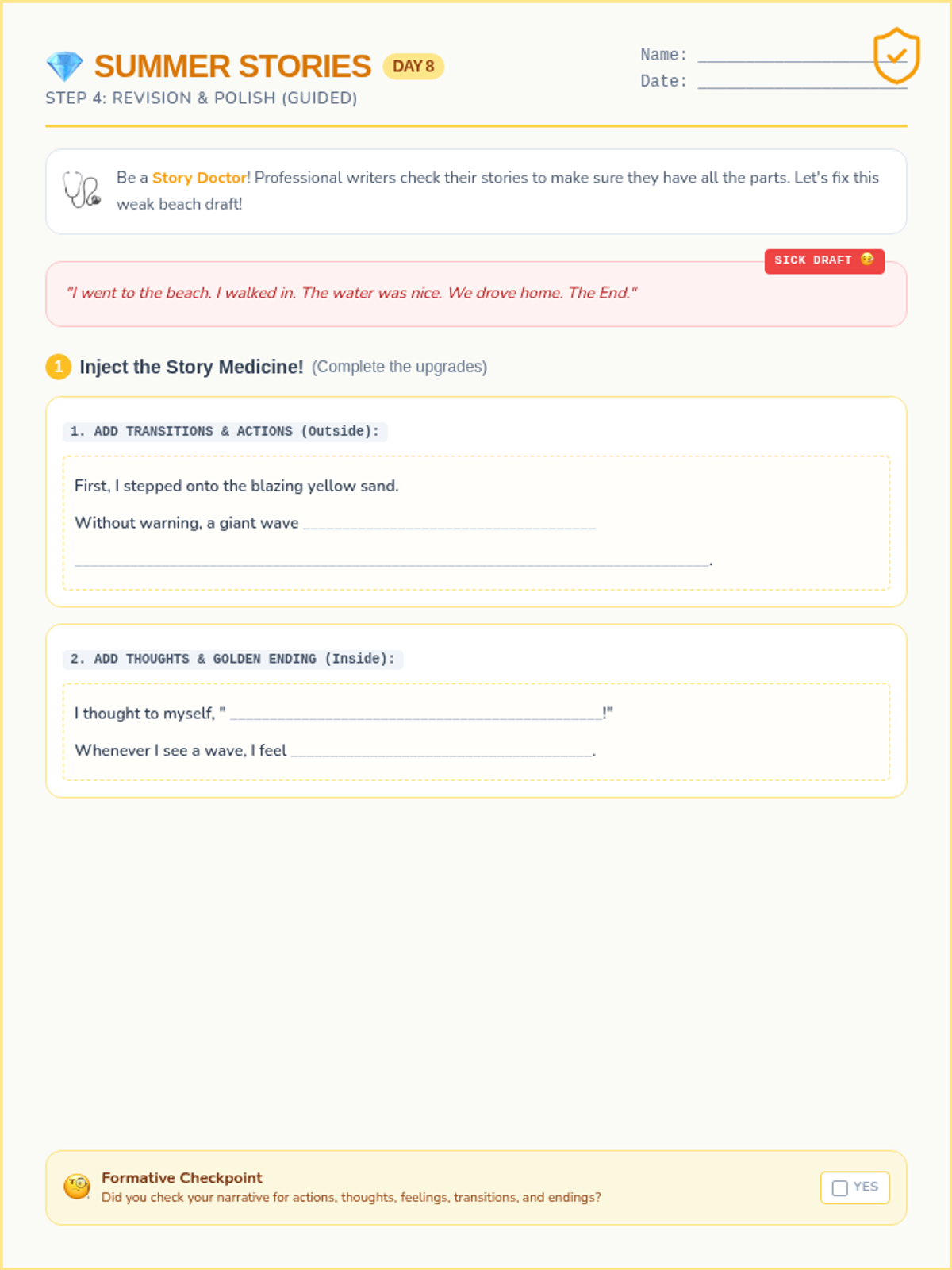
A 2-page student worksheet for Day 8. Page 1 (Scaffolded Version) contains an interactive 'Writing Doctor' editing activity. Page 2 (Independent Version) has a 5-point revision checklist and primary-ruled lines for writing their polished, final summer narrative draft.
Interactive slide deck for Day 7 explaining three categories of narrative closure: feeling, lesson, and future hope (I Do), interactive group brainstorm for a beach ending (We Do), and worksheet instructions (You Do).
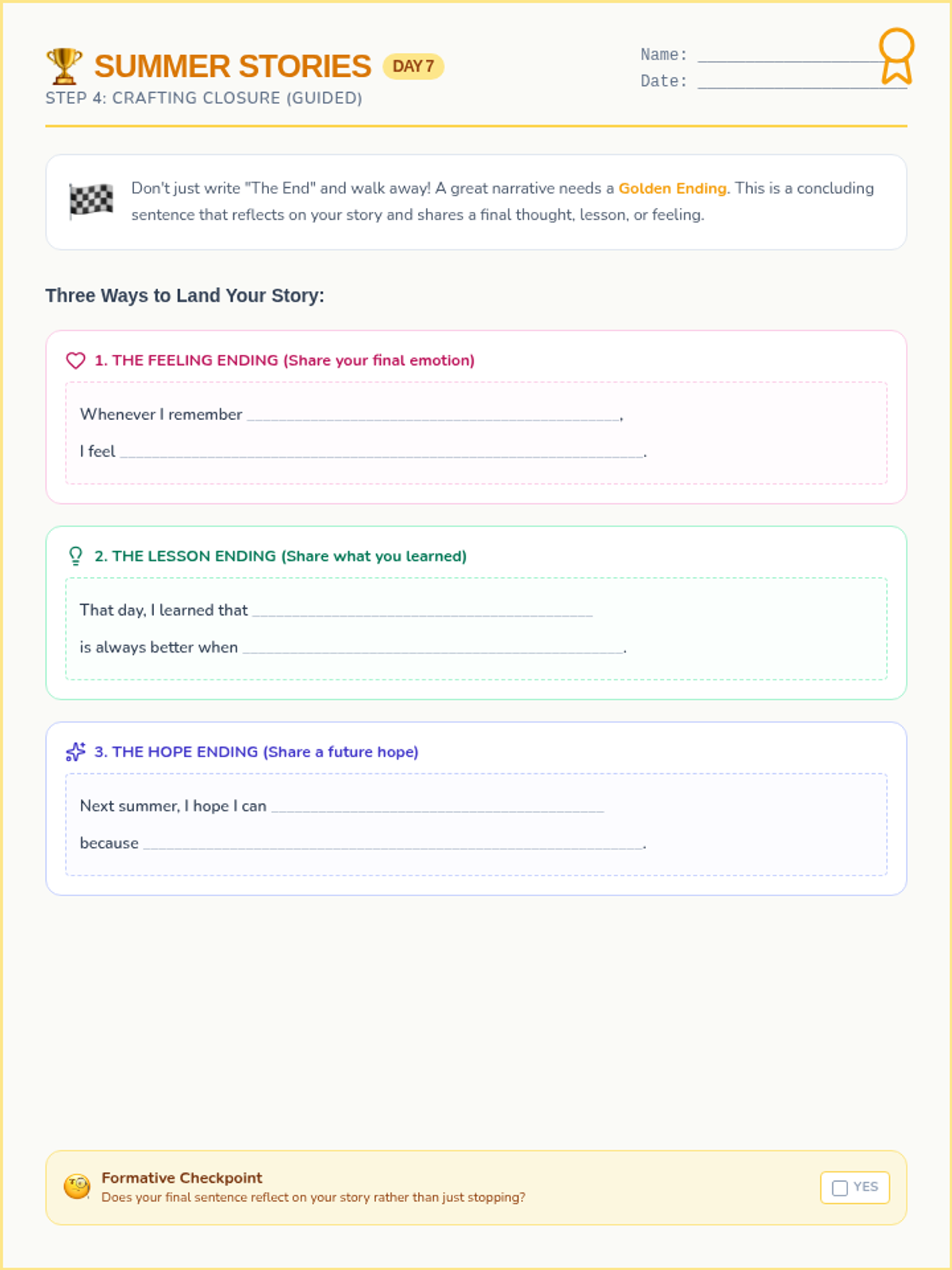
A 2-page student worksheet for Day 7. Page 1 (Scaffolded Version) contains sentence starters for three types of narrative closure: feeling, lesson, and future hope. Page 2 (Independent Version) has brainstorm boxes for all three styles and a dedicated primary-lined drafting space.
Interactive slide deck for Day 6 explaining how to add internal thoughts and feelings (I Do), a group practice adding inside details to a beach draft (We Do), and independent worksheet instructions (You Do).
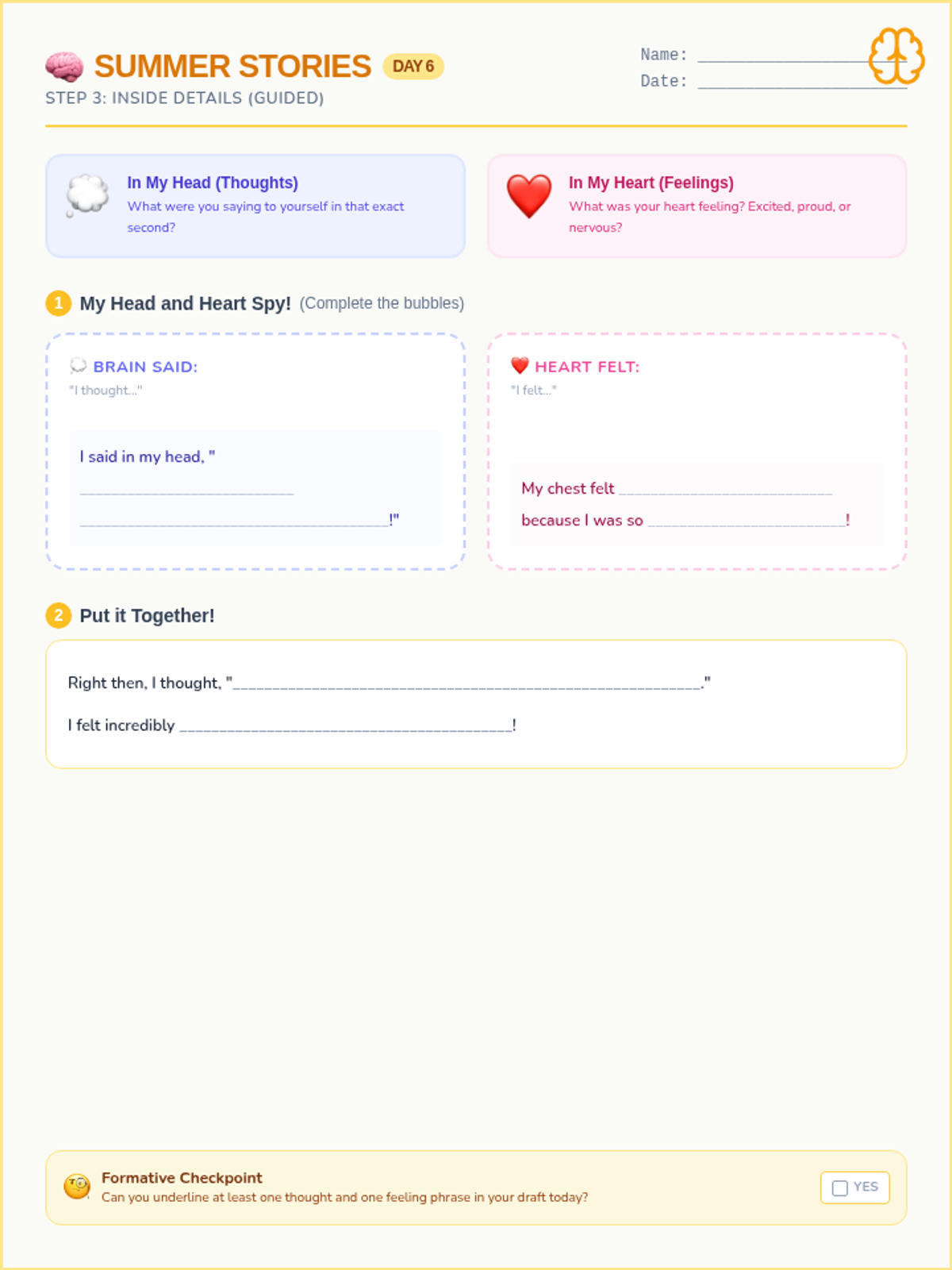
A 2-page student worksheet for Day 6. Page 1 (Scaffolded Version) contains guided thought bubbles and heart maps for recording internal details. Page 2 (Independent Version) has an Inside Details checklist and primary lines for adding thoughts and feelings to their draft.
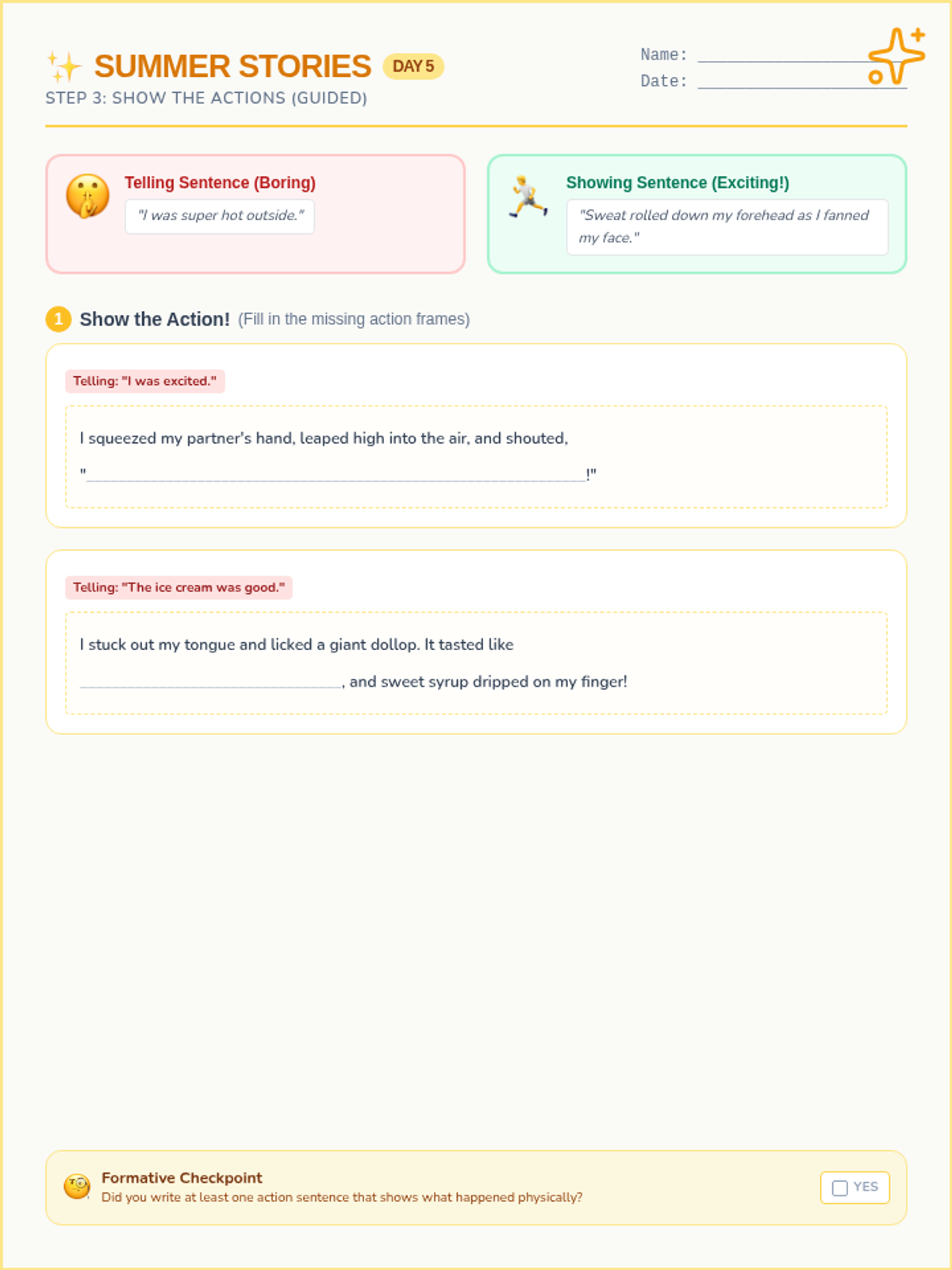
Interactive slide deck for Day 5 explaining how to add physical actions and vivid verbs to make a story 'show, don't tell' (I Do), an interactive physical modeling activity (We Do), and worksheet writing instructions (You Do).
A 2-page student worksheet for Day 5. Page 1 (Scaffolded Version) contains step-by-step 'Show, Don't Tell' action prompts and sentence frames. Page 2 (Independent Version) has a Vivid Verbs graphic organizer and a dedicated draft editing area with primary lines.
Interactive slide deck for Day 4 explaining the temporal transitions toolbox (I Do), an interactive editing practice where students eliminate 'and then' from a draft (We Do), and directions for drafting with at least three transition words (You Do).
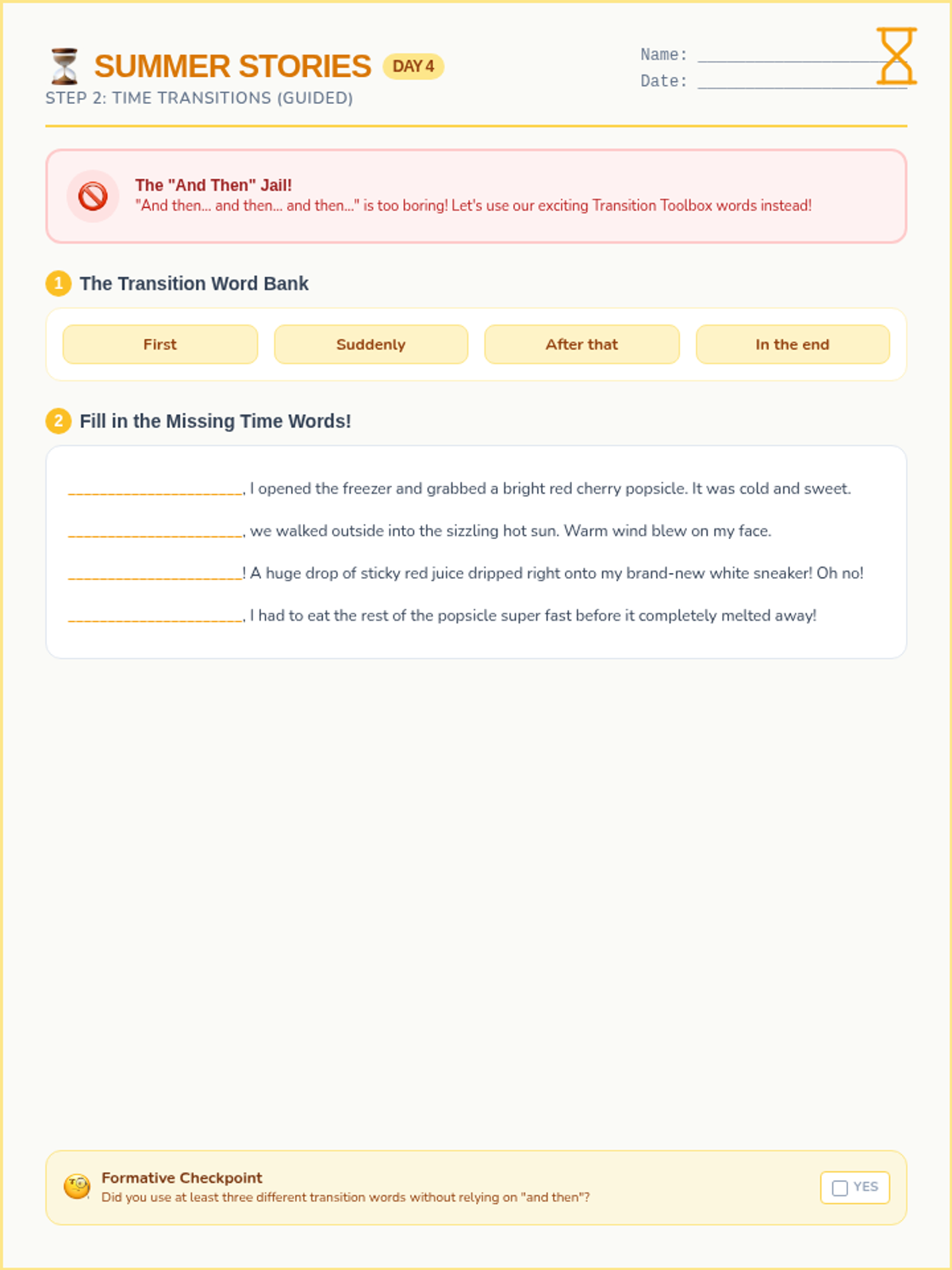
A 2-page student worksheet for Day 4. Page 1 (Scaffolded Version) has a cloze passage with transition word options. Page 2 (Independent Version) has a Transition Toolbox and primary-ruled lines where students write their first draft utilizing at least three different transition words.
Interactive slide deck for Day 3 explaining how to map a narrative with a Beginning, Middle, and End (I Do), an interactive story-mapping session on the board (We Do), and independent story mapping worksheet practice (You Do).
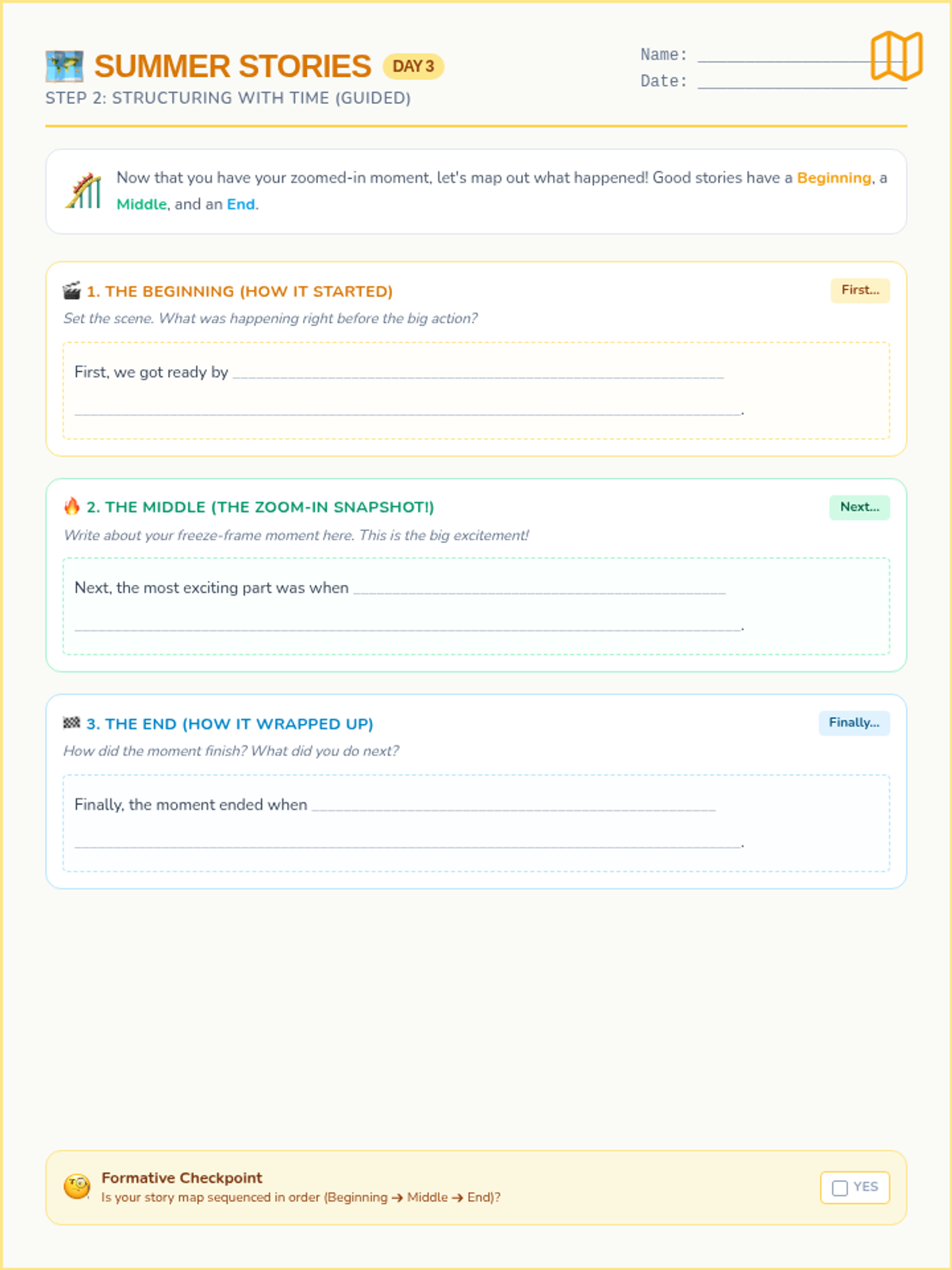
A 2-page student worksheet for Day 3. Page 1 (Scaffolded Version) contains a structured Beginning-Middle-End storyboard with primary lines and sentence starters. Page 2 (Independent Version) offers open story mapping boxes with blank primary lines and small sketch boxes.
Interactive slide deck for Day 2 explaining how to 'zoom in' on a story to find a specific freeze-frame moment (I Do), a collaborative modeling activity with sensory details (We Do), and directions for the Zoom Lens Worksheet (You Do).
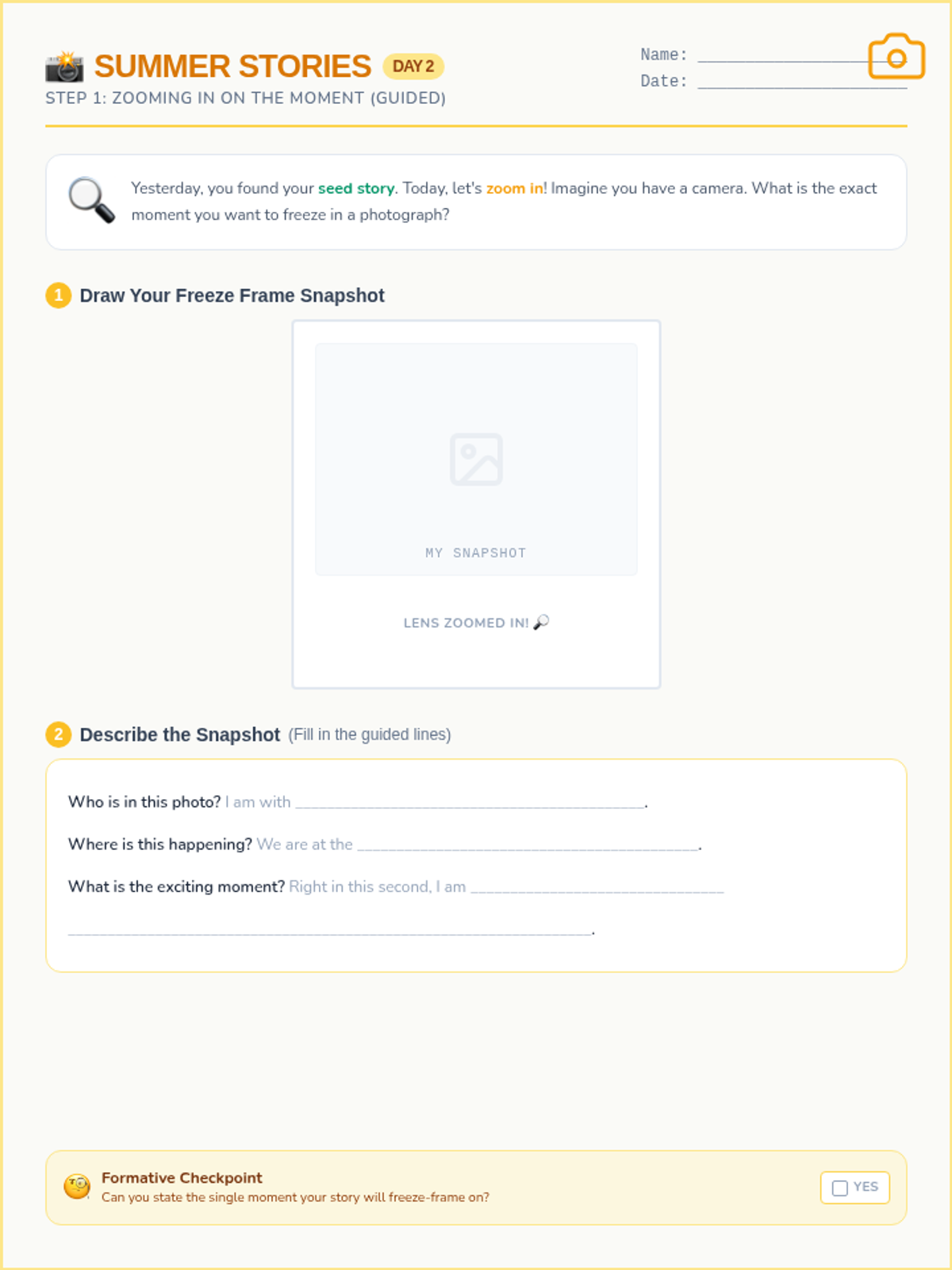
A 2-page student worksheet for Day 2. Page 1 (Scaffolded Version) uses primary-ruled sentence stems to guide students in identifying the who, where, and what of their story's central freeze-frame moment. Page 2 (Independent Version) includes a sensory details graphic organizer (See, Hear, Touch) and an independent sketch box.
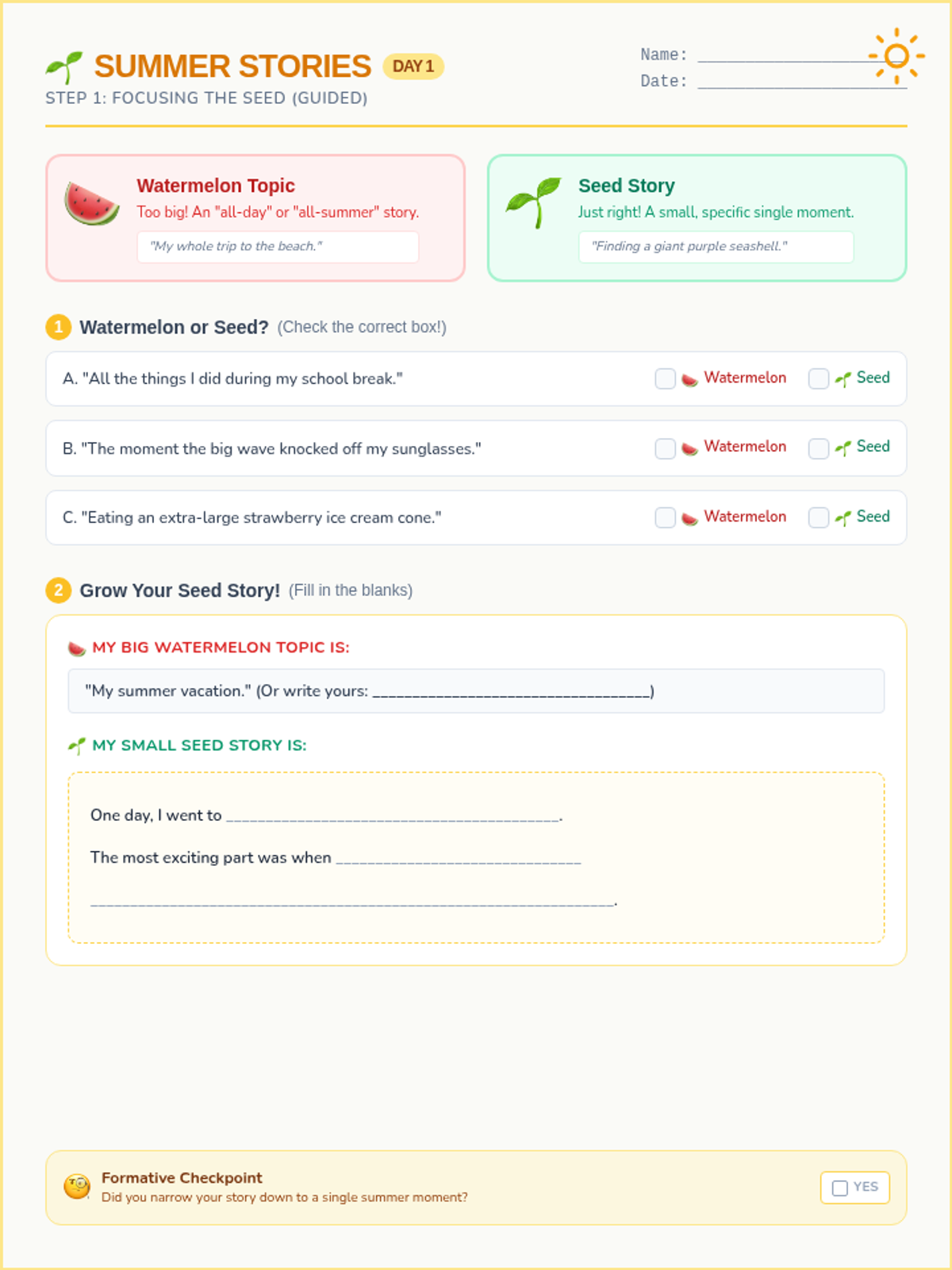
Interactive slide deck for Day 1 introducing the narrative writing unit, explaining the 'Watermelon vs. Seed' concept (I Do), interactive group sorting practice (We Do), and worksheet instructions (You Do).
A 2-page student worksheet for Day 1. Page 1 (Scaffolded Version) contains a guided Watermelon vs. Seed sorting activity with sentence frames. Page 2 (Independent Version) guides students through brainstorming and selecting their specific seed story with a custom drawing space.
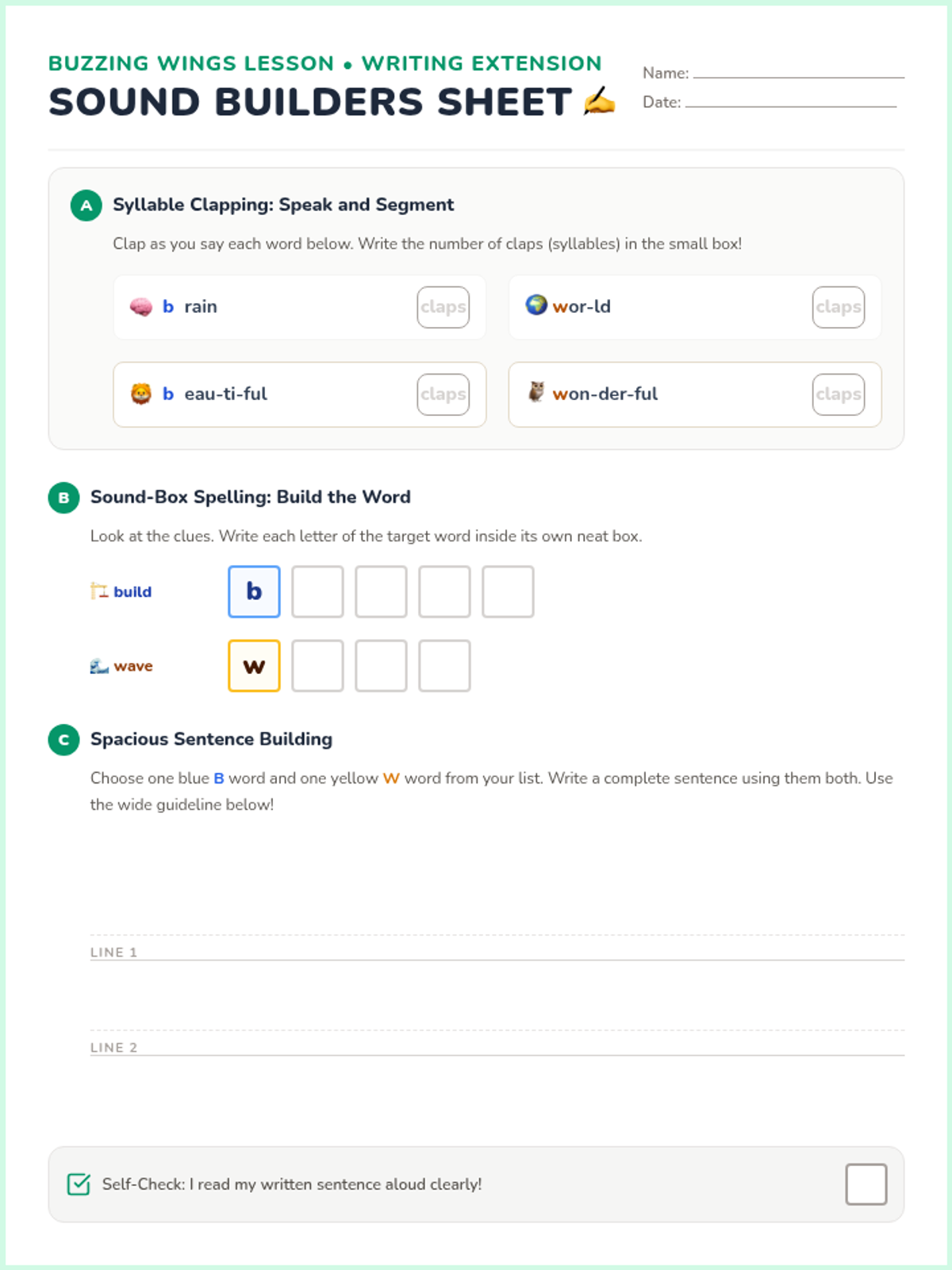
A multi-sensory spelling and writing worksheet. Includes syllable clapping, word builders, and creative sentence-writing with B and W words, using spacious writing lines to prevent visual crowding.
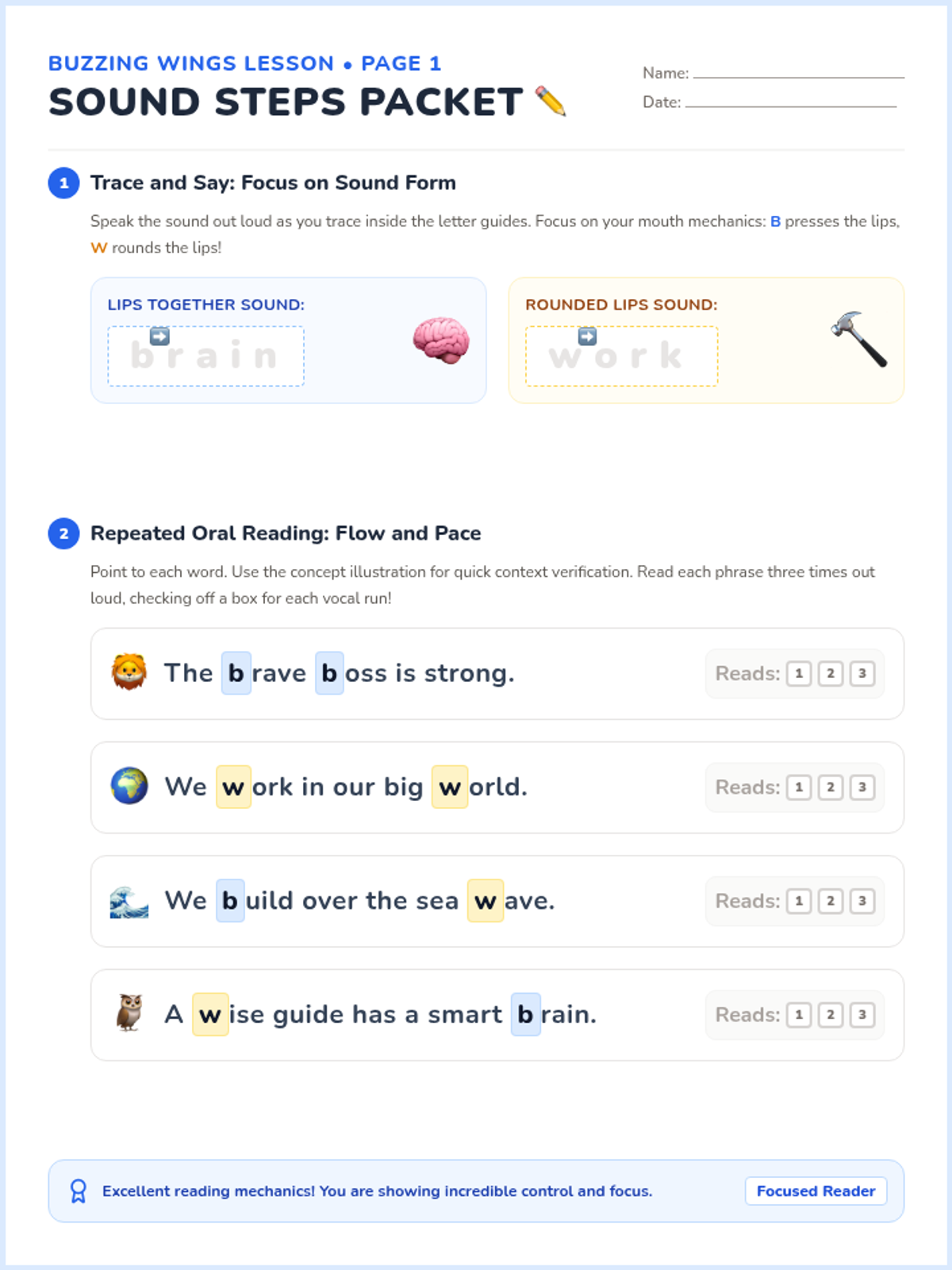
A 2-page dyslexia-friendly structured routine packet. Page 1 offers structured trace, read, and repeated reading check-offs. Page 2 provides an oral reading assessment with a built-in teacher evaluation rubric.
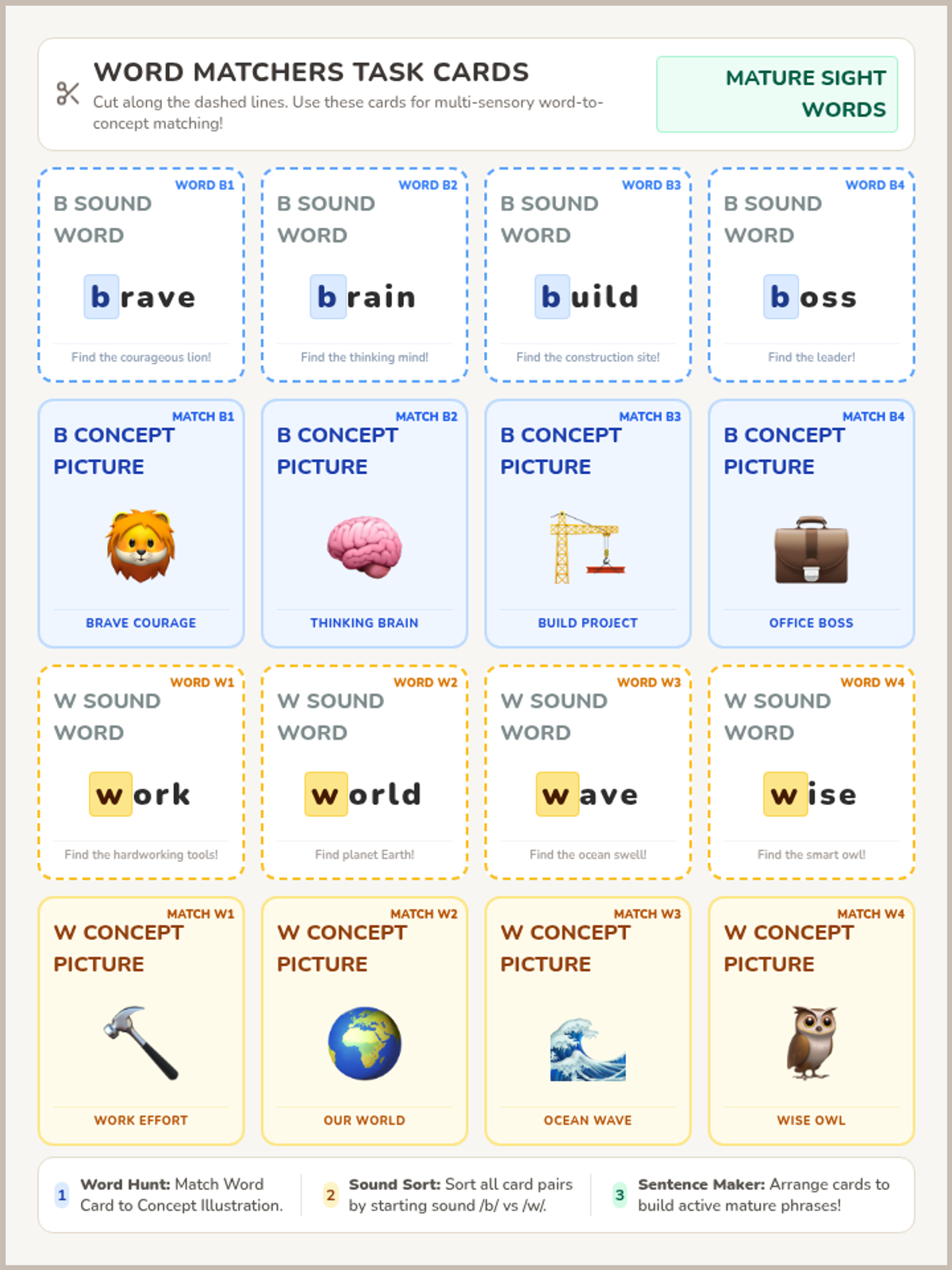
A printable sheet of 16 double-coded matching task cards. Features 8 word cards and 8 matching high-contrast picture cards, split between blue-themed B words and yellow-themed W words.
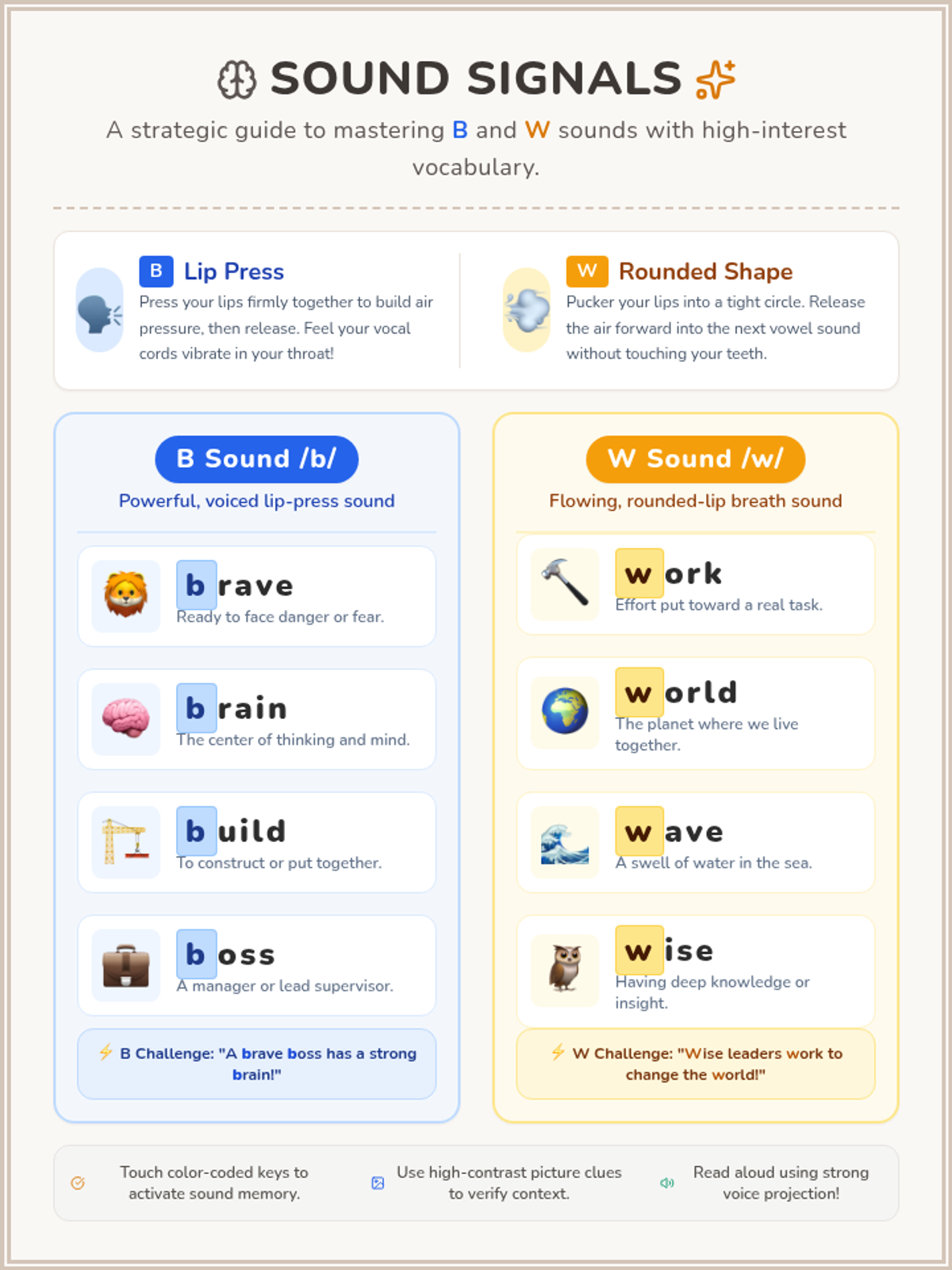
A color-coded visual reference anchor chart for letters B and W designed for older students. Includes anatomical mouth-shape cues, high-interest sight words (brave, brain, build, boss, work, world, wave, wise), and mature picture scaffolding.