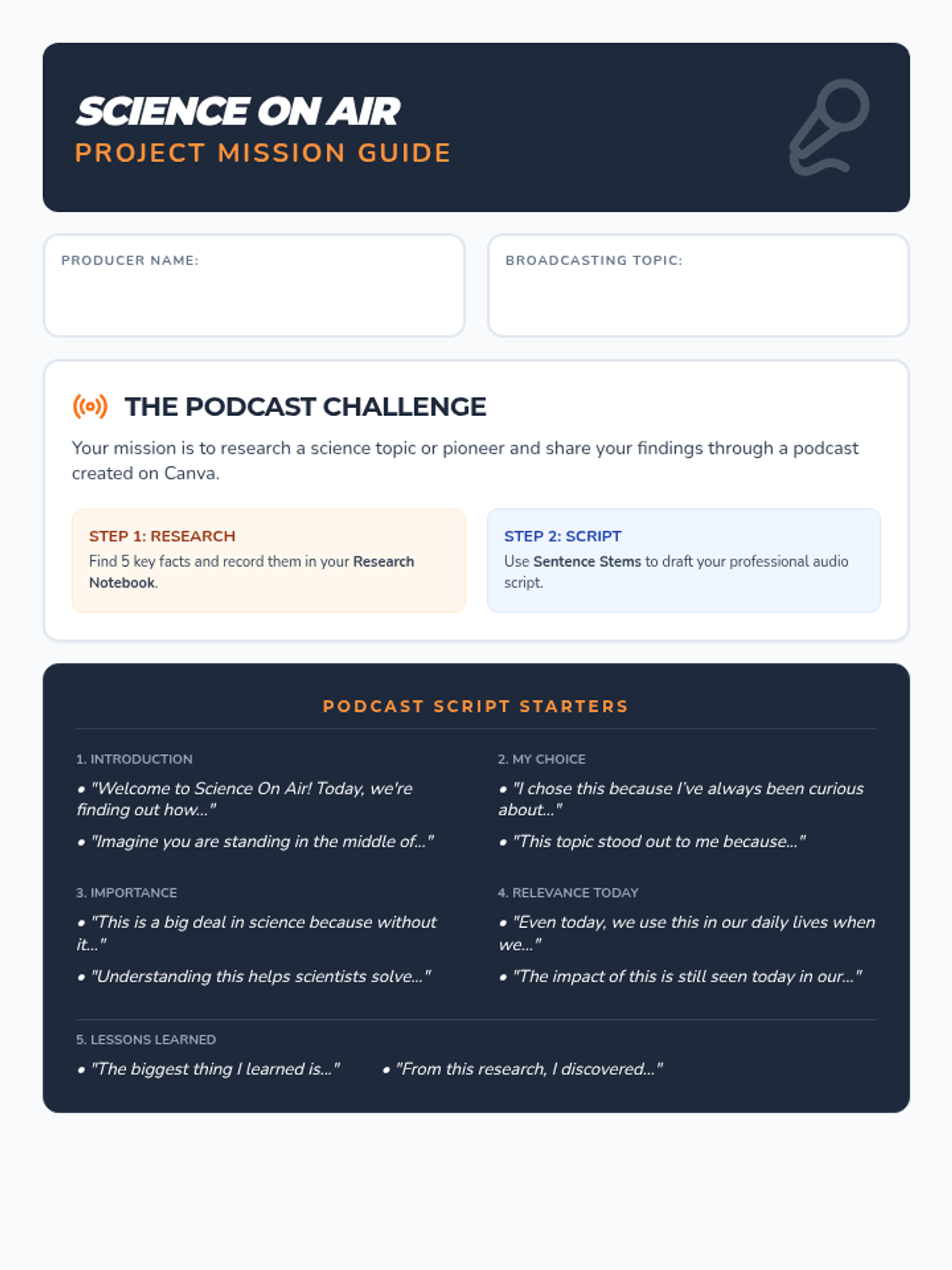
A script-building resource featuring 15 sentence stems across five categories to help students write a structured and professional podcast script. Features improved writing lines and high-contrast text.

Polished introductory slides for the Science On Air podcast project. Features high-contrast visuals, clear project steps, and an overview of digital tools.
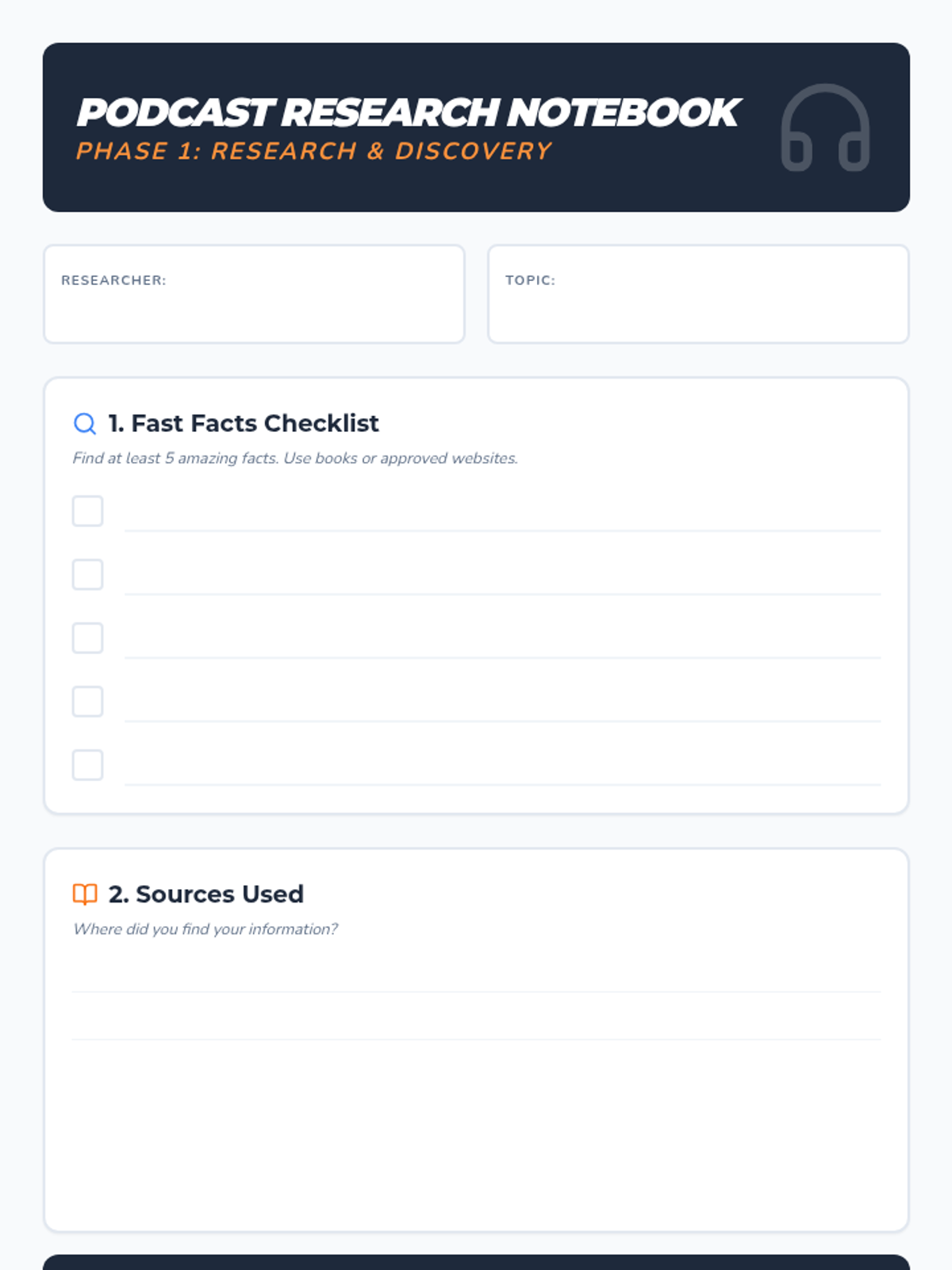
A comprehensive note-taking packet for students. Includes fact-gathering areas, scripting prompts with sentence stems, and a sound design planner. Optimized for handwriting with white work areas.
A one-page project outline for the Science On Air podcast project. It defines the mission, phases of production, and success criteria for 4th-grade students. Now includes a condensed script-starter section.
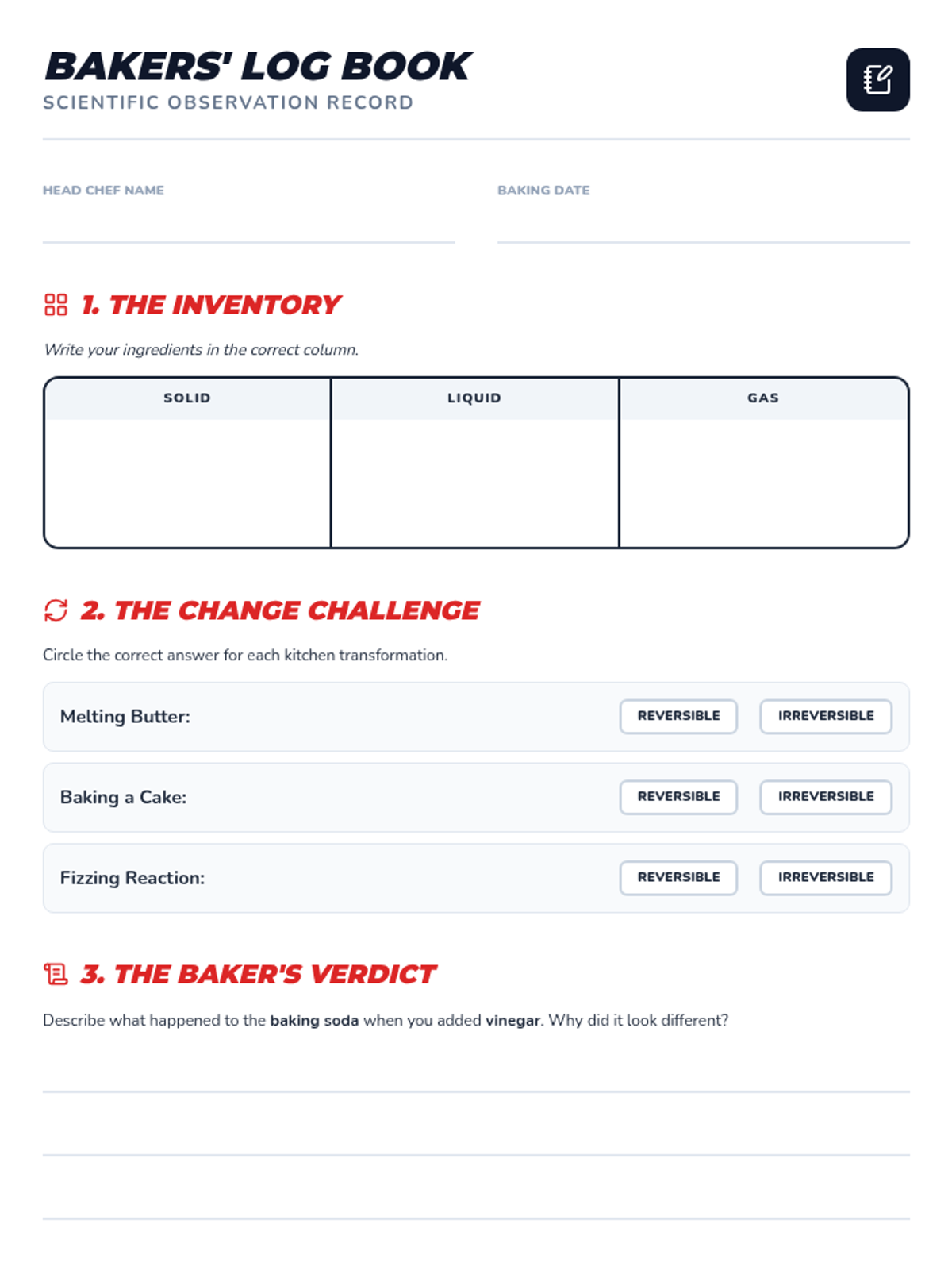
An assessment worksheet for students to record their observations during the lesson. It includes a classification table for states of matter, a matching exercise for reversible vs. irreversible changes, and a prompt for reflection.
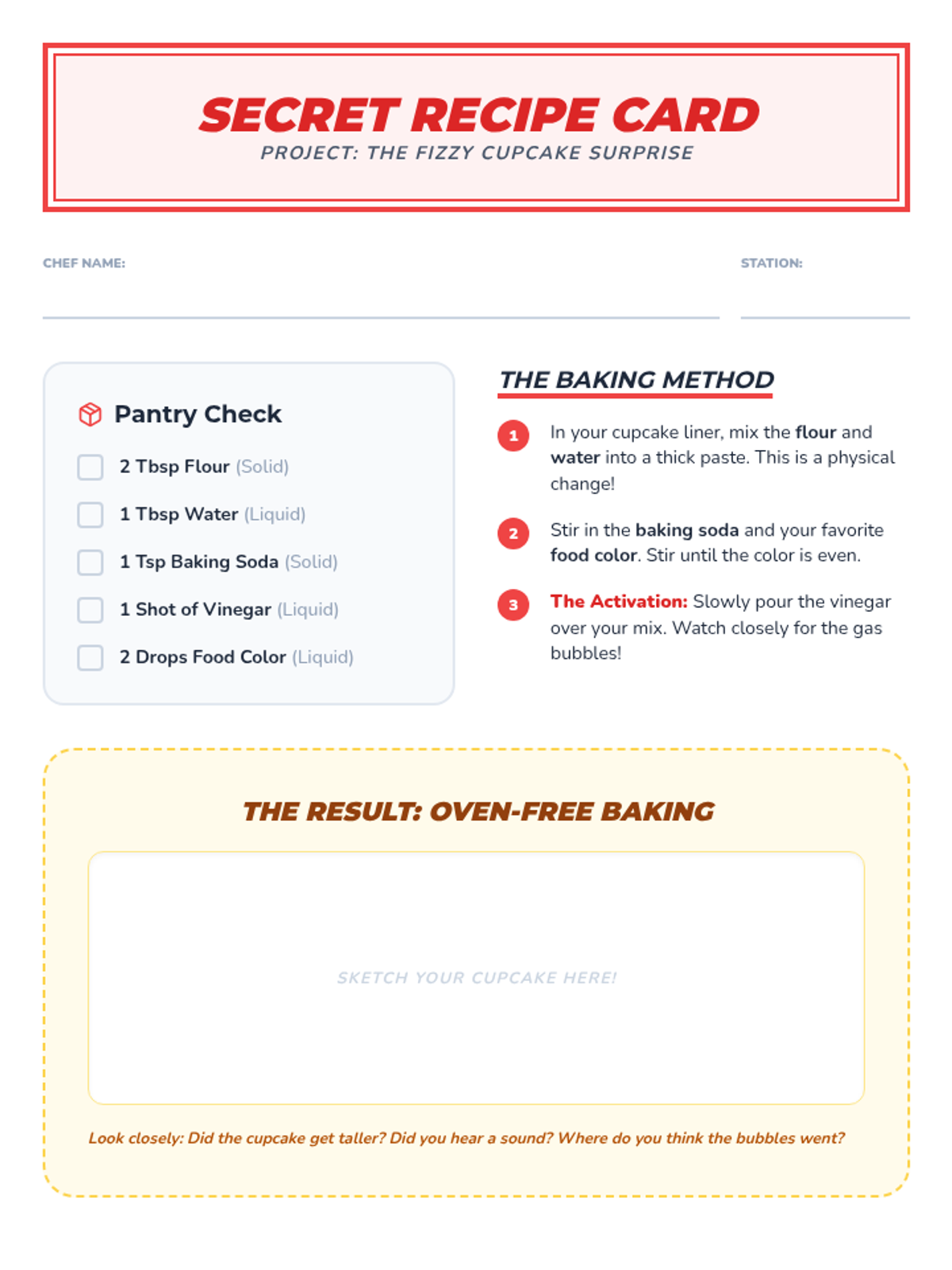
A student-facing hands-on guide for the 'Fizzy Cupcake' activity. It provides a structured 'recipe' for exploring chemical reactions and states of matter without heat, including space for sketching observations.
Engaging instructional slides for the Bronx Bake-Off lesson, defining states of matter, chemical reactions, and the difference between reversible and irreversible changes with vibrant, large-text visuals.
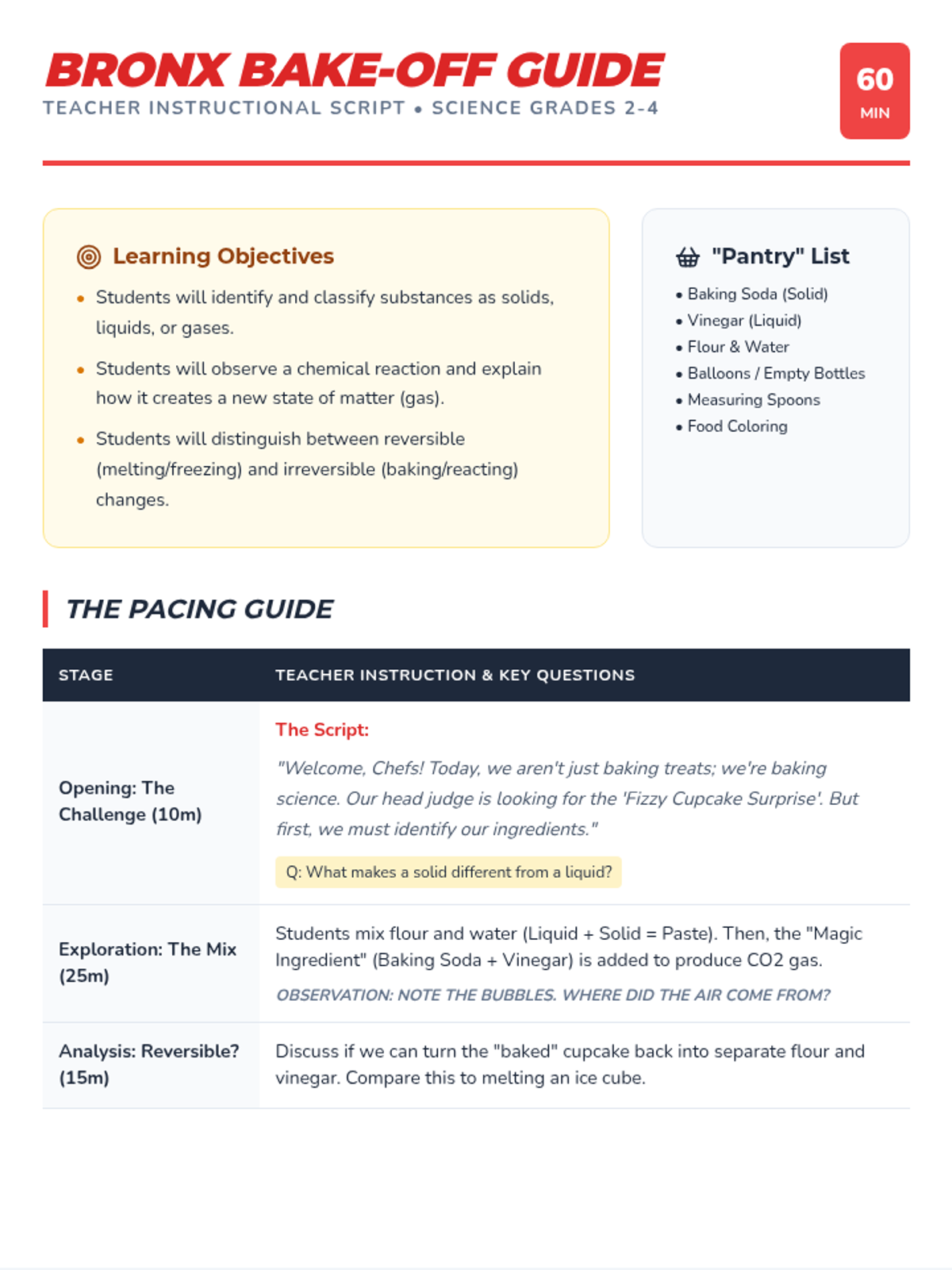
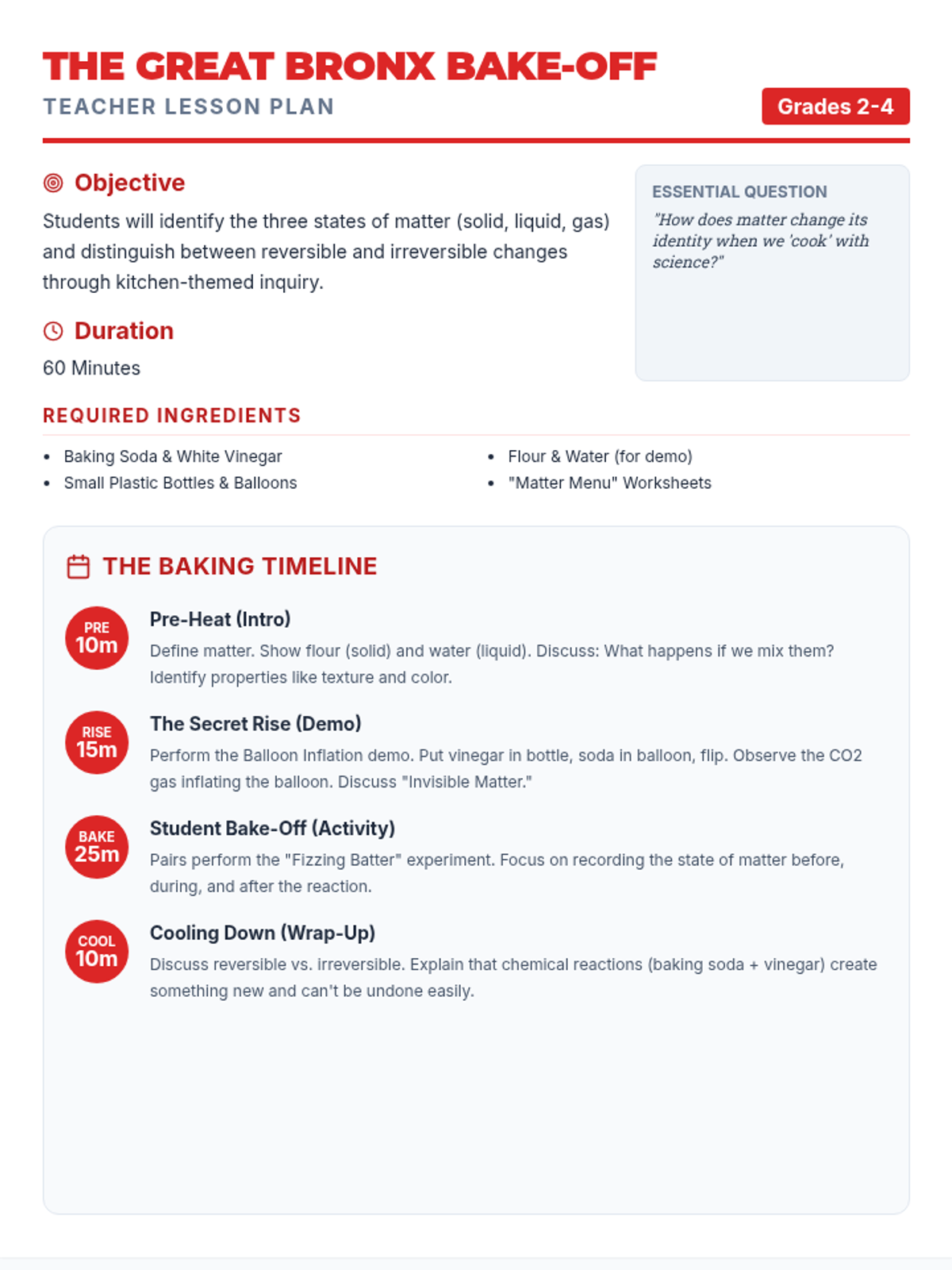
A comprehensive instructional guide for teachers to lead a hands-on kitchen science lesson. It includes learning objectives, a timed pacing guide, key questioning prompts, and safety protocols for grades 2-4.
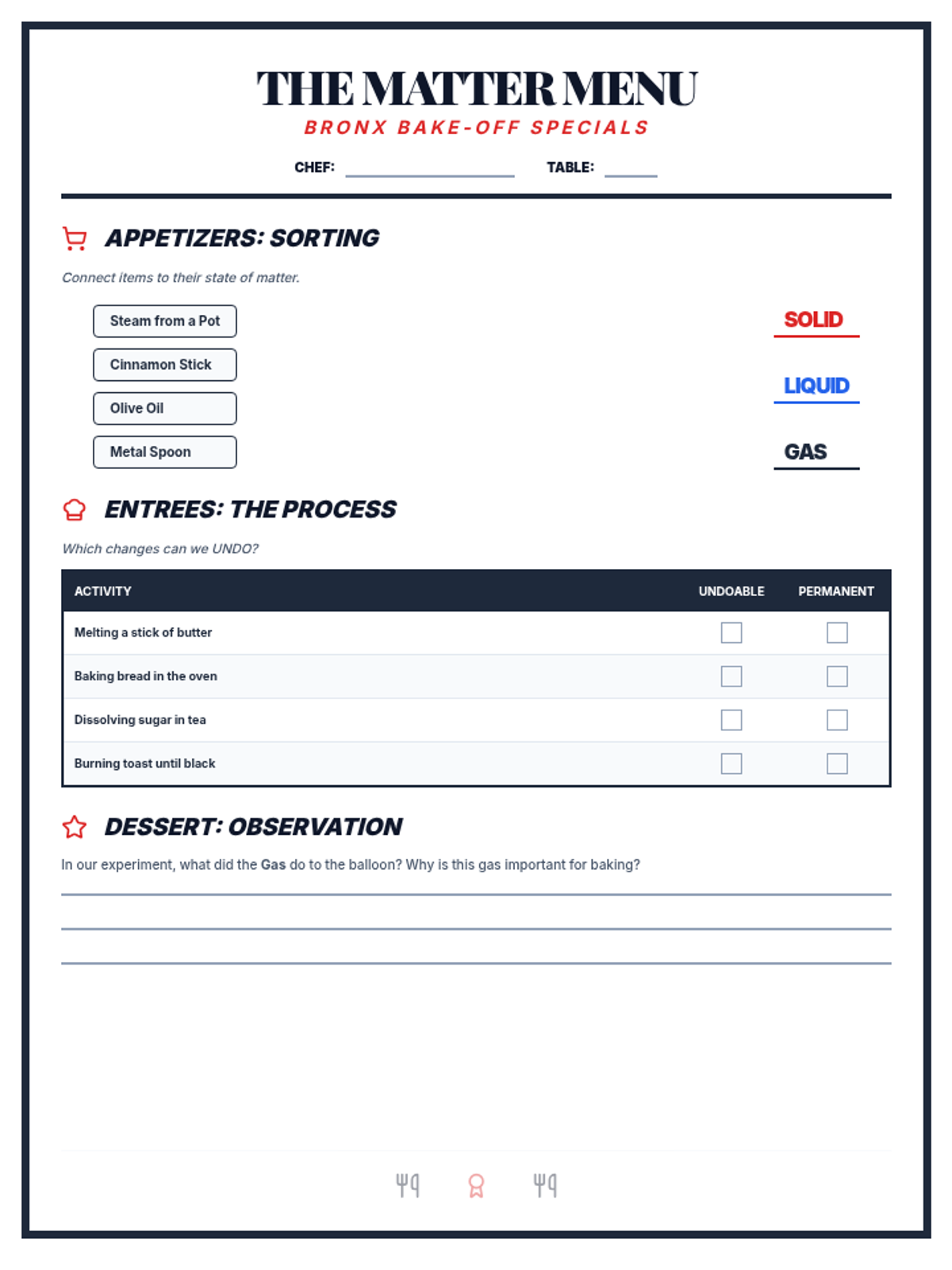
A 'Matter Menu' themed worksheet that assesses student understanding of states of matter and reversible/irreversible changes through sorting, matching, and short response questions.
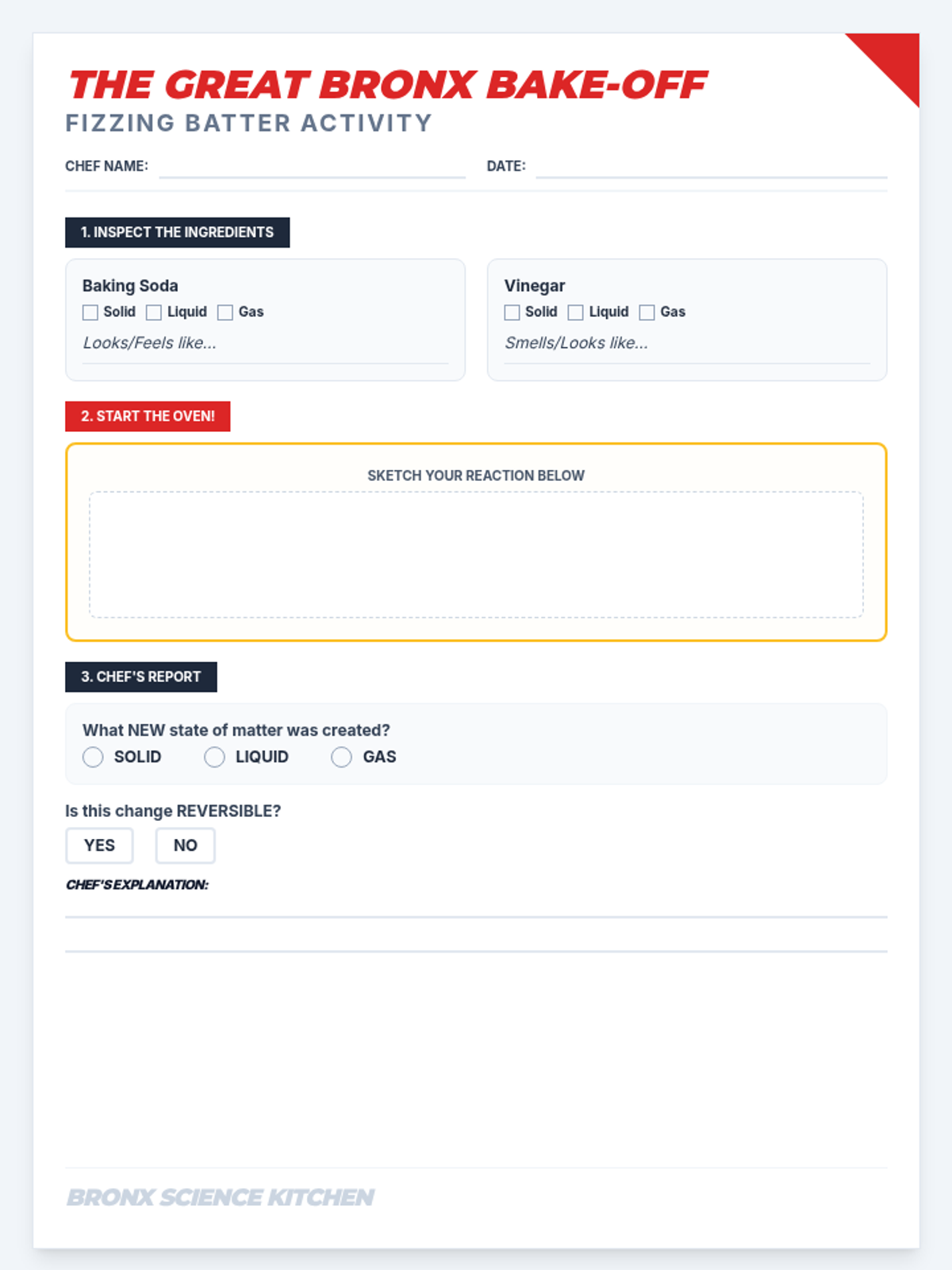
A student activity sheet for recording observations during the 'Fizzing Batter' experiment. It includes sections for ingredient properties, reaction sketching, and analysis of changes in states of matter.
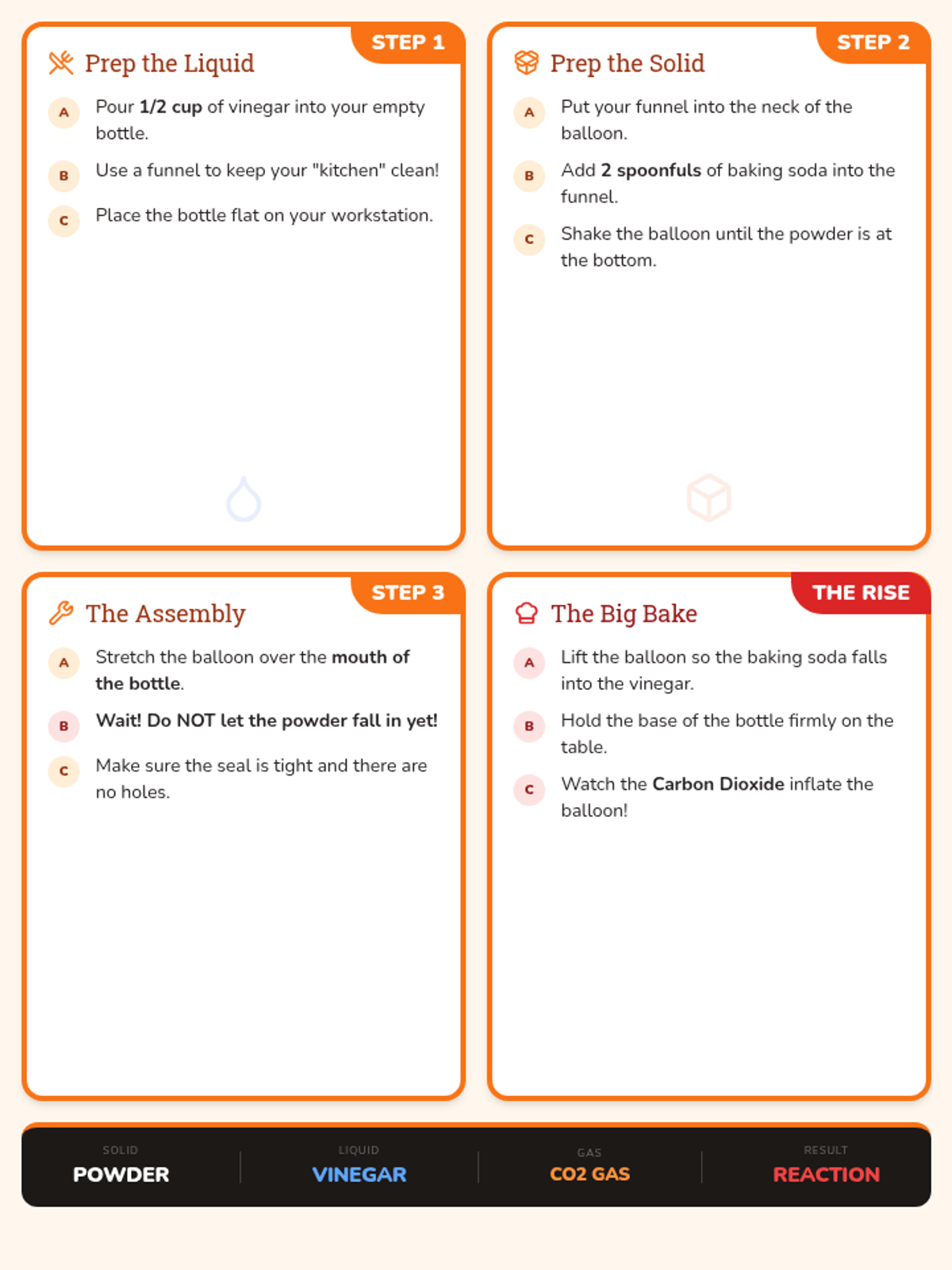
Step-by-step 'Recipe Challenge Cards' that guide students through the experiment process, formatted as a set of activity instruction cards.
A vibrant 5-slide presentation designed for elementary students, introducing the states of matter through the metaphor of baking and explaining chemical versus physical changes with engaging visuals.
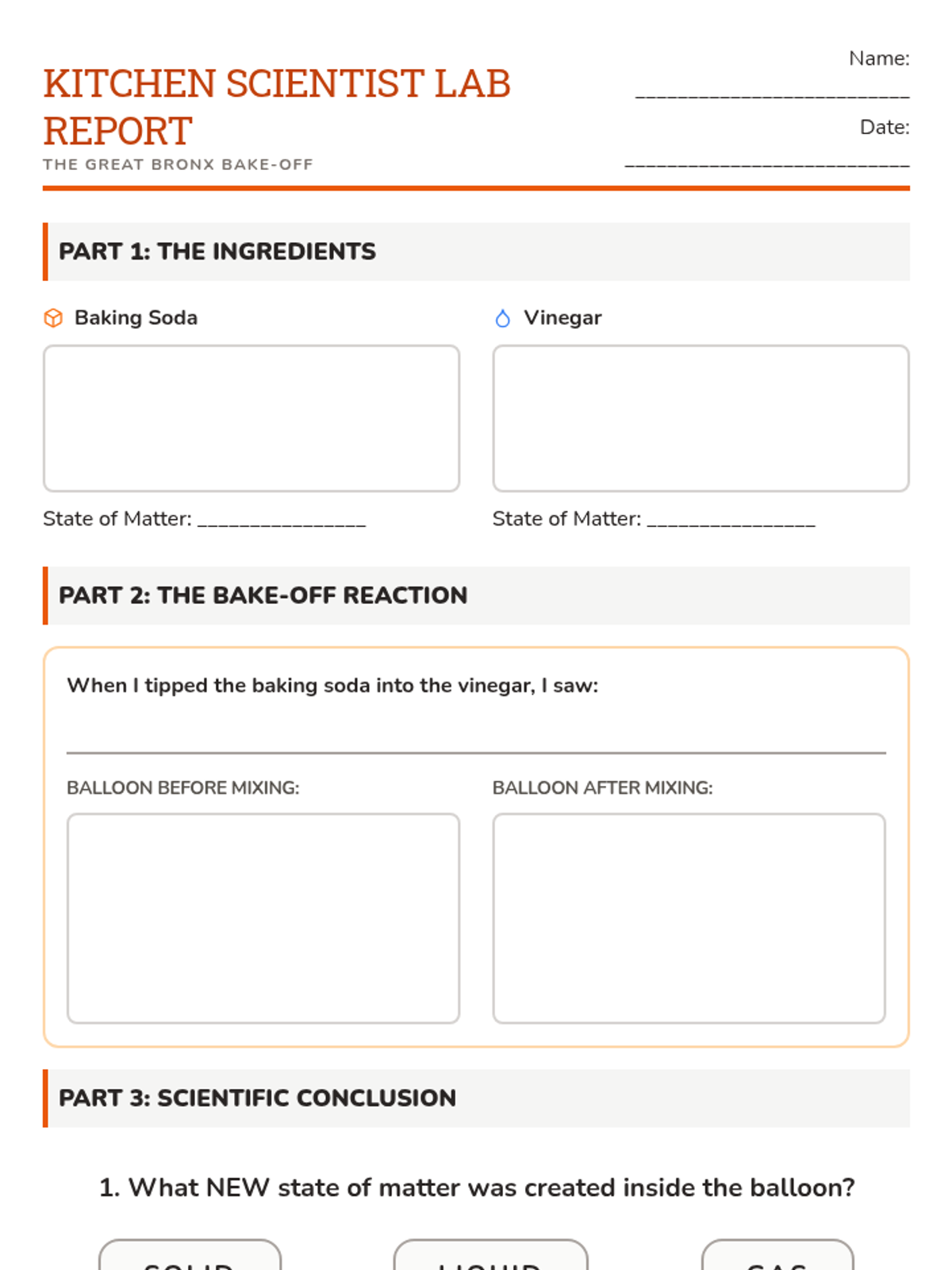
A lab report worksheet for students to document their observations of solids, liquids, and gases during 'The Great Bronx Bake-Off' experiment, including space for drawings and reflection.
A visually engaging 16:9 slide deck for 'The Great Bronx Bake-Off', introducing states of matter, the baking challenge, and safety procedures using a kitchen science theme.
A comprehensive teacher's lesson plan for the Bronx Bake-Off unit, featuring learning objectives, material lists, a detailed pacing guide, and pedagogical notes on differentiation and misconceptions.
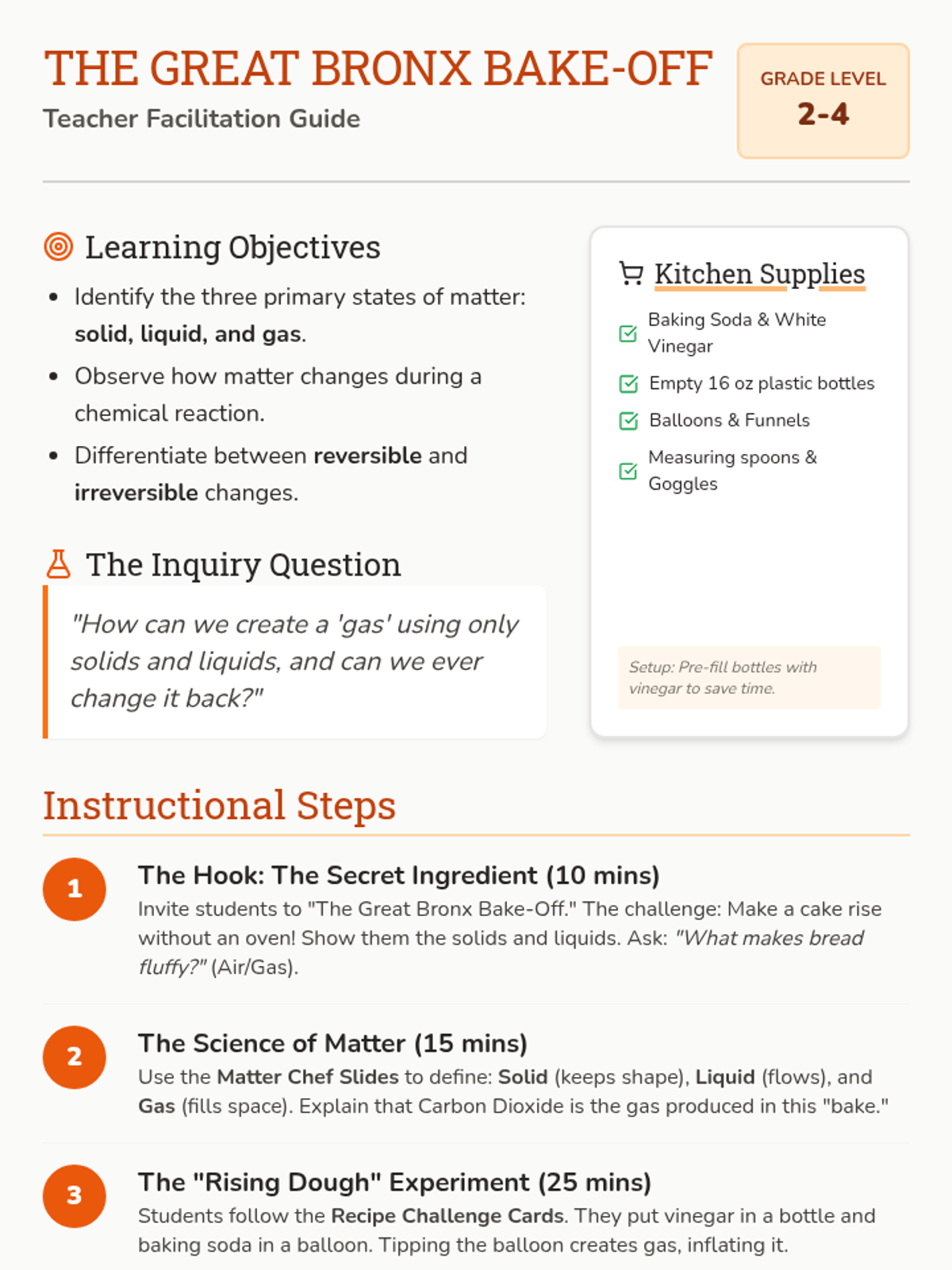
A comprehensive teacher facilitation guide for 'The Great Bronx Bake-Off' lesson, outlining objectives, materials, and a step-by-step instructional sequence for grades 2-4.
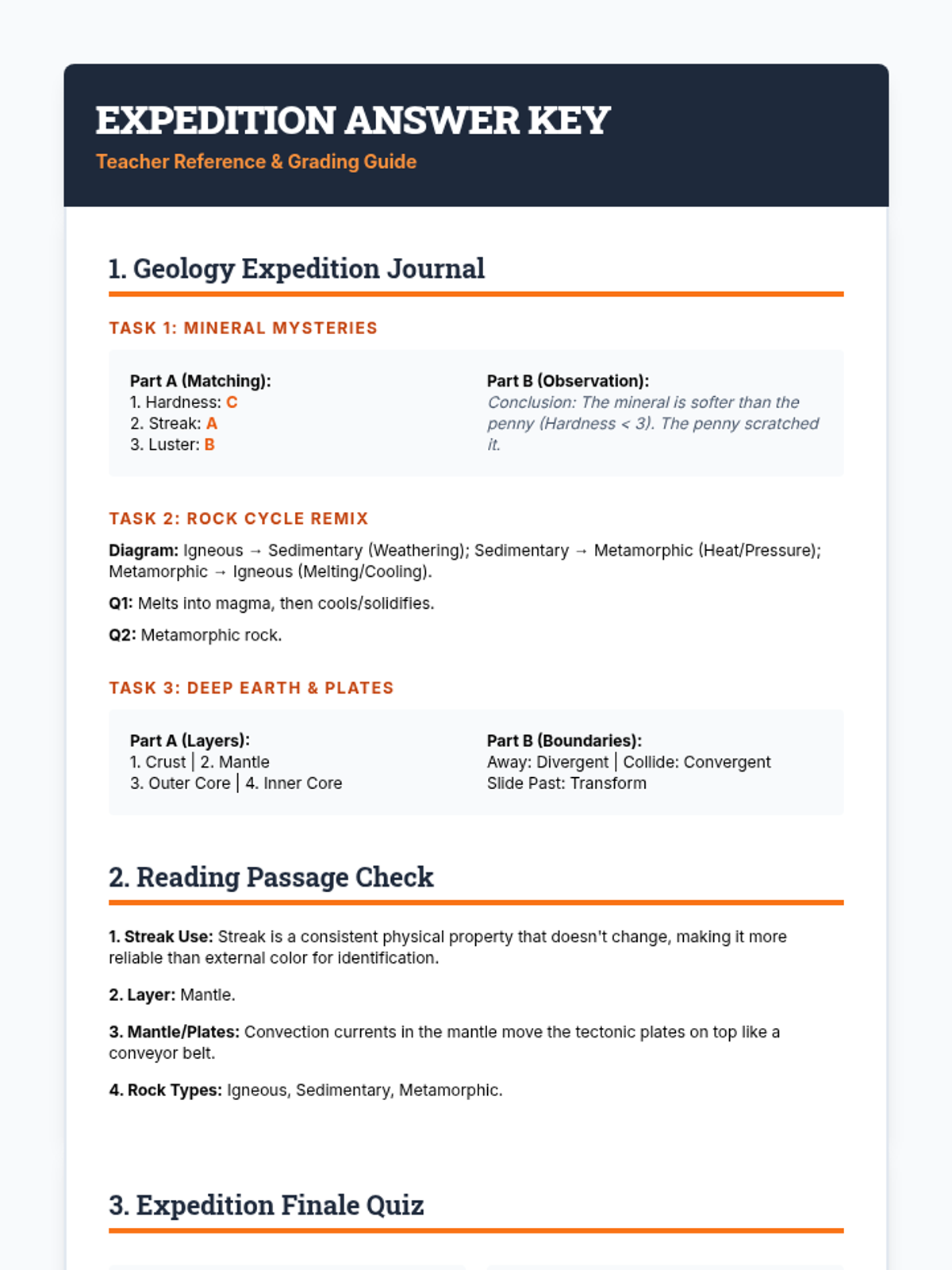
A comprehensive teacher's answer key for the unit's worksheet packet, reading passage, and finale quiz. Includes scoring rubrics and grading guidance for open-response questions.
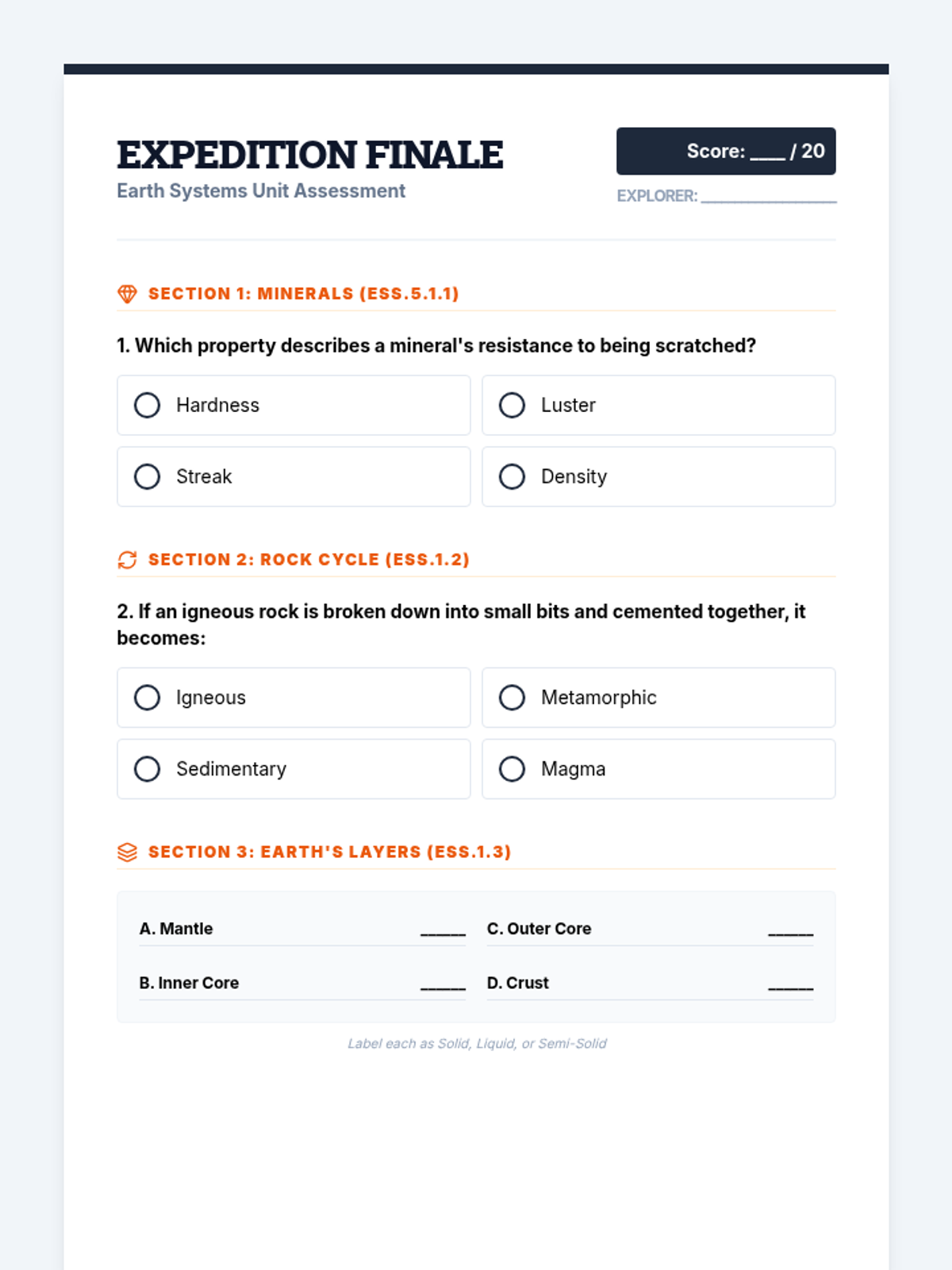
A revised unit quiz with a logical 20-point scoring system, expanded open-response space with writing lines, corrected section orphaning, and improved visual balance for multiple-choice options.
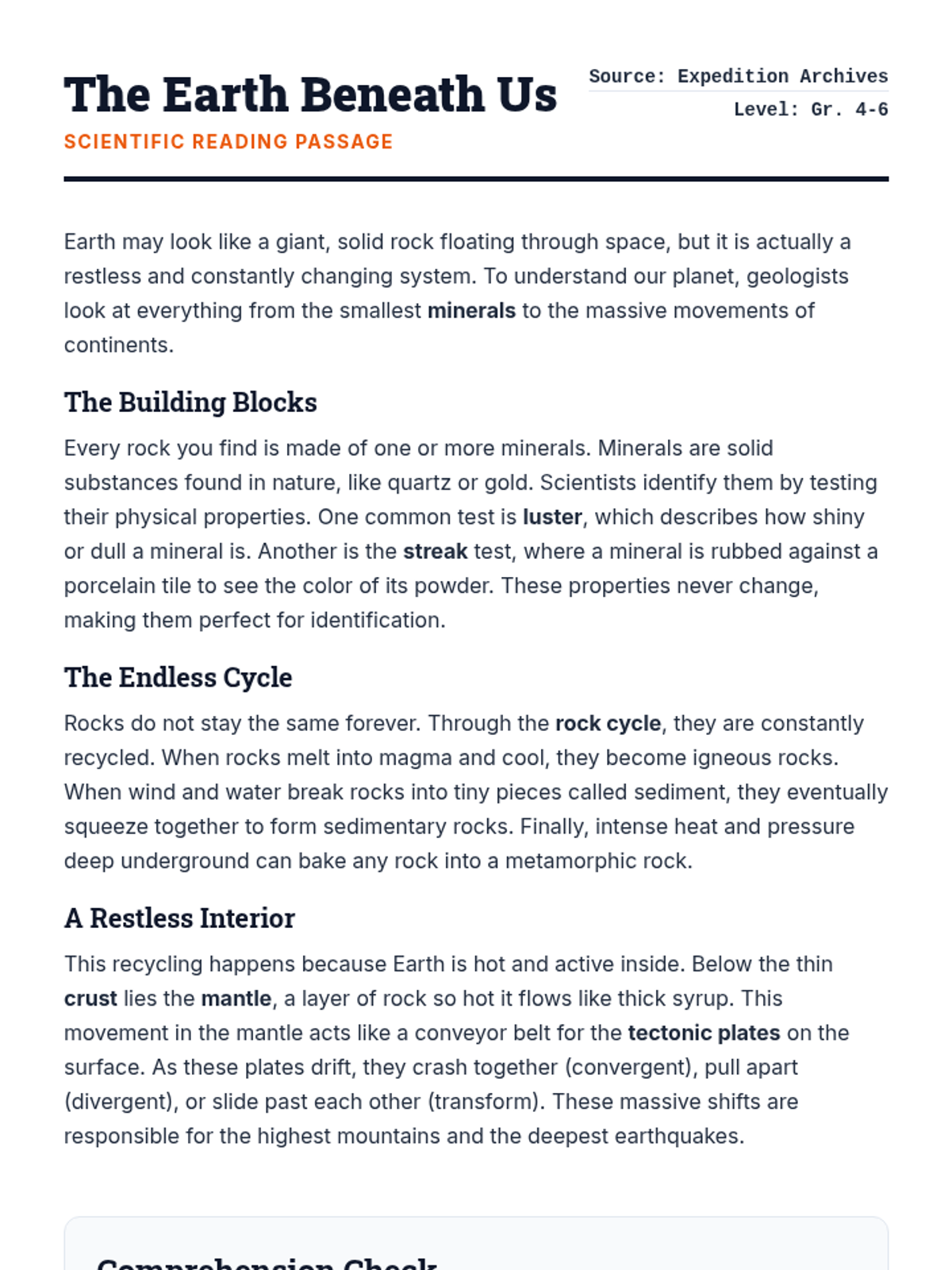
A revised reading passage and comprehension check with standardized response areas, high-contrast header metadata, and refined questions for evidence-based responses.
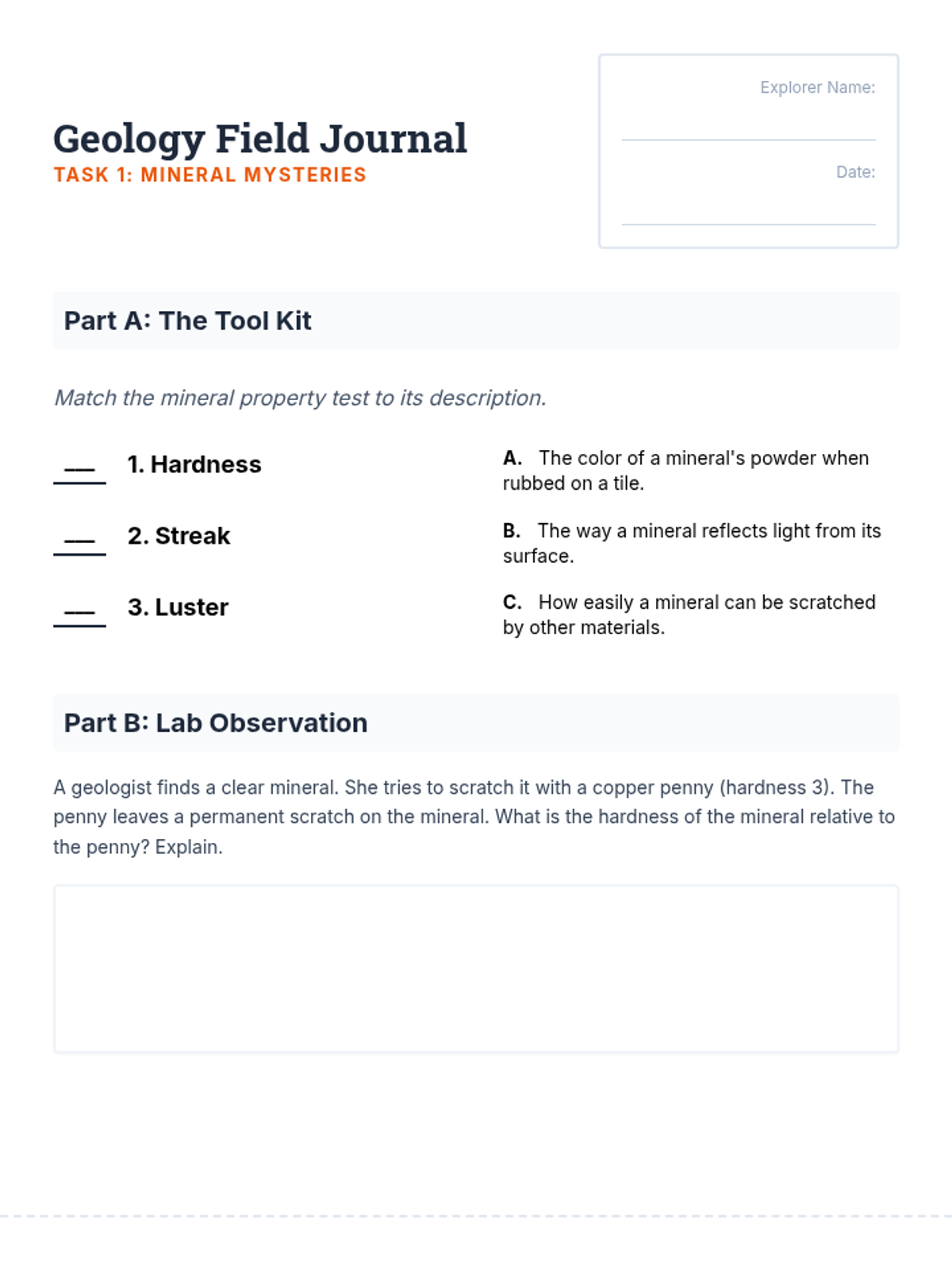
A revised 3-page student worksheet packet featuring a corrected Earth layers diagram, improved page breaks, standardized writing spaces, and a clearer matching section for mineral properties.
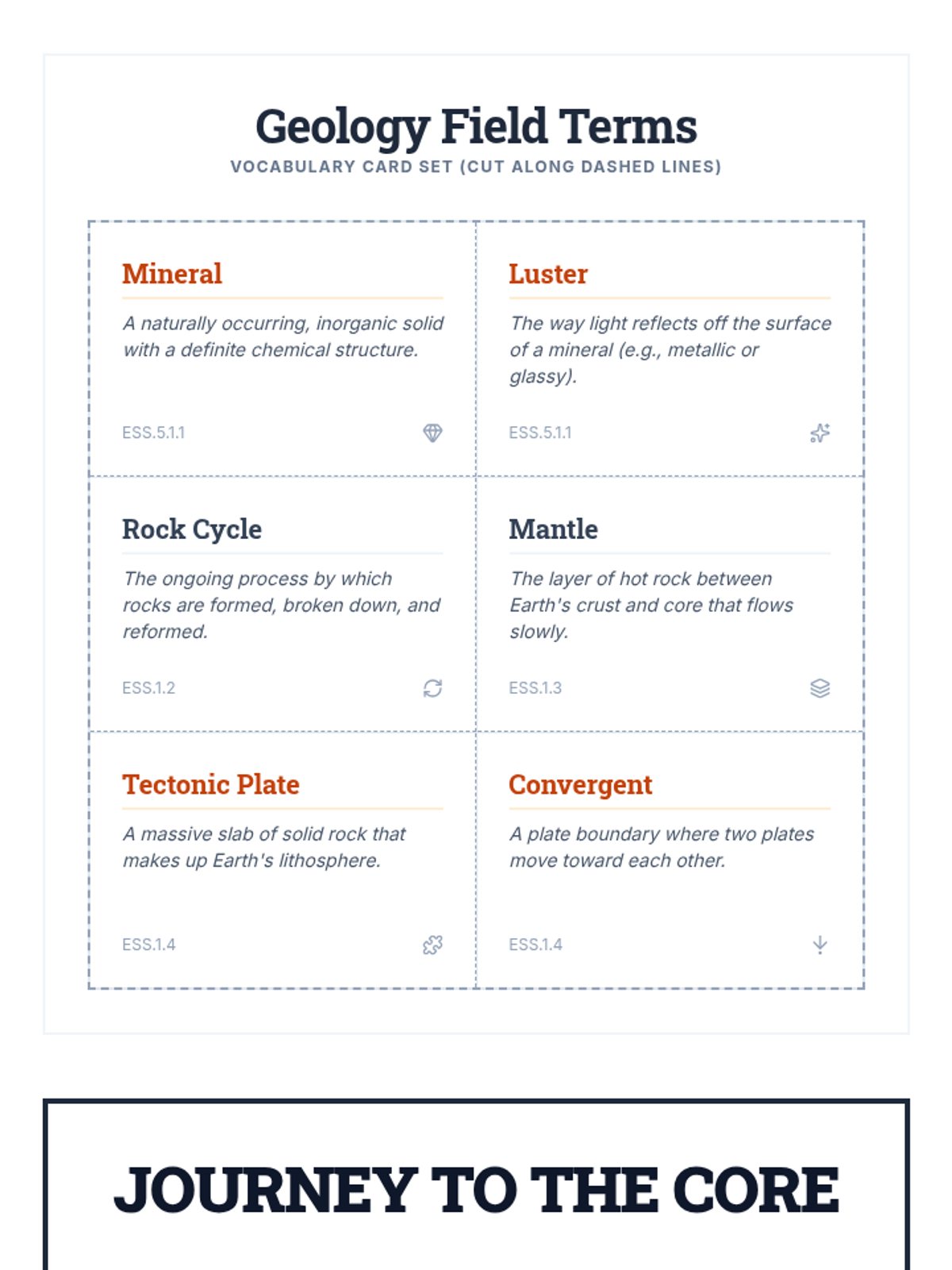
A revised set of visual vocabulary cards with cut lines and a condensed anchor chart for Earth's layers, ensuring all content fits on individual pages without awkward breaks.
A high-impact classroom slide presentation covering mineral properties, the rock cycle, Earth's layers, and plate tectonics. Designed with a 'Geology Expedition' theme for 4th-6th grade students.
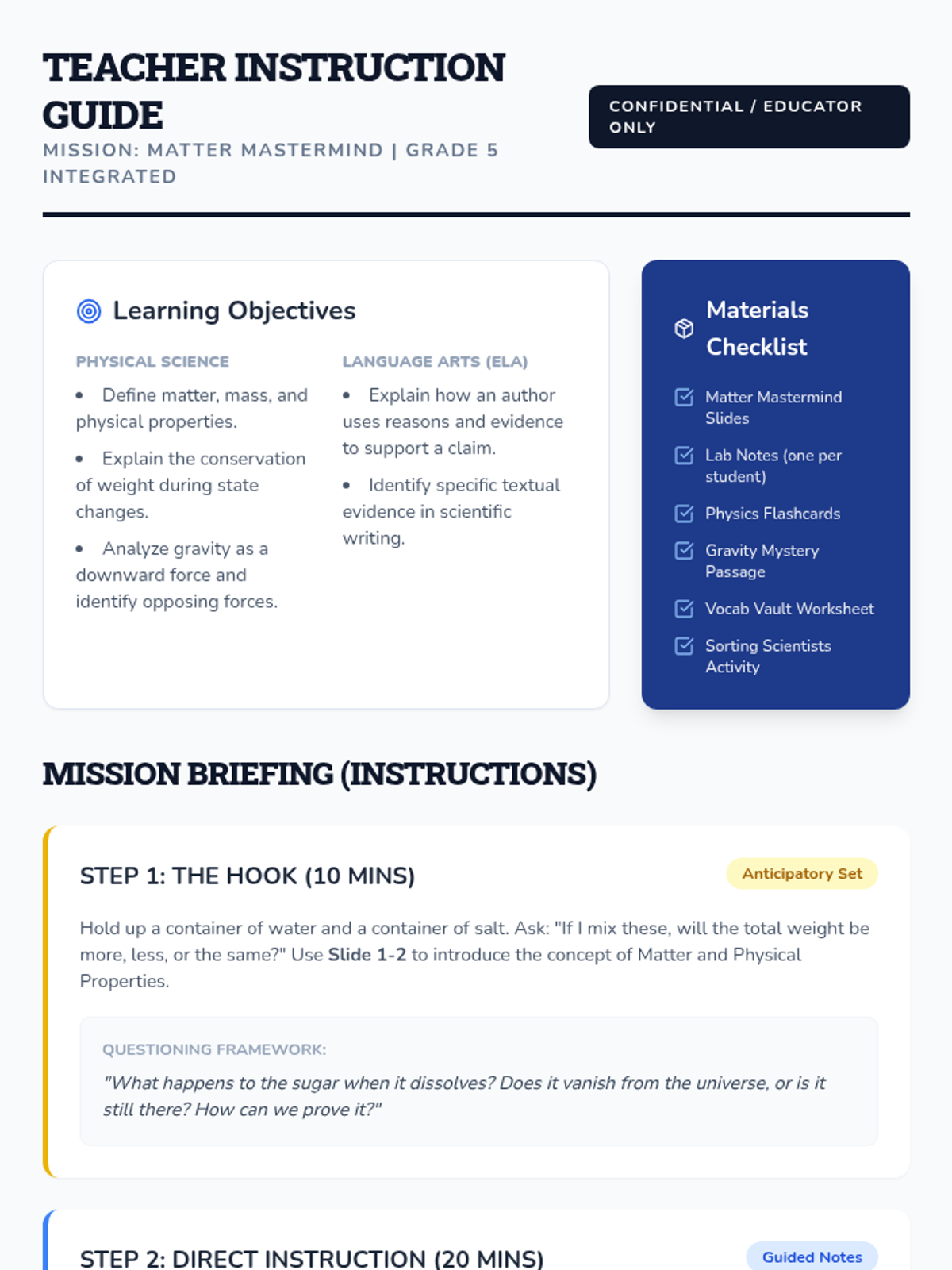
A comprehensive teacher instruction guide for the Matter Mastermind lesson. Includes learning objectives, an instructional sequence, questioning frameworks, and differentiation strategies.
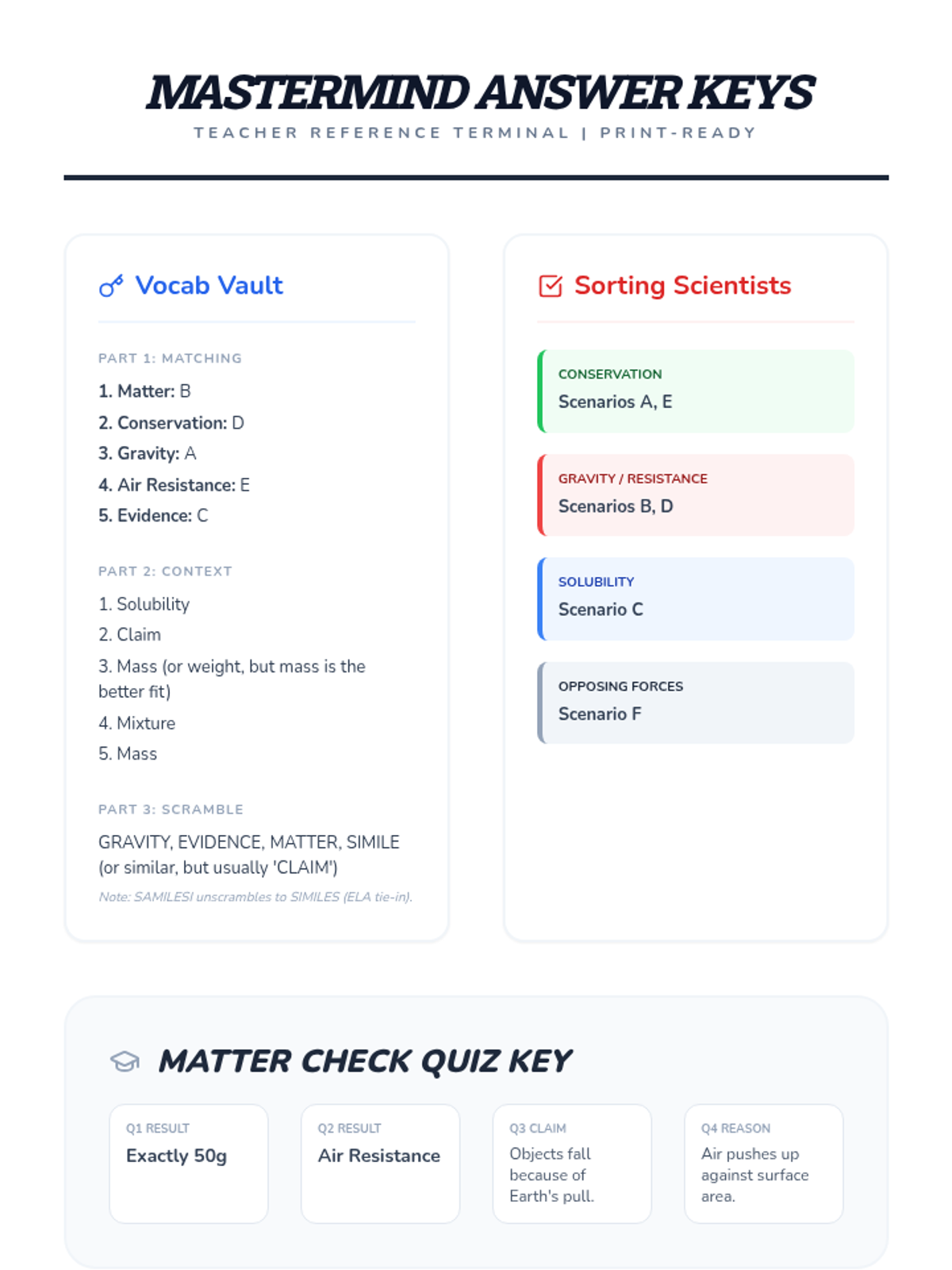
A comprehensive answer key for teachers, covering the Vocab Vault Worksheet, Sorting Scientists Activity, and the Matter Check Quiz. Optimized for one-page printing with high-contrast sections.
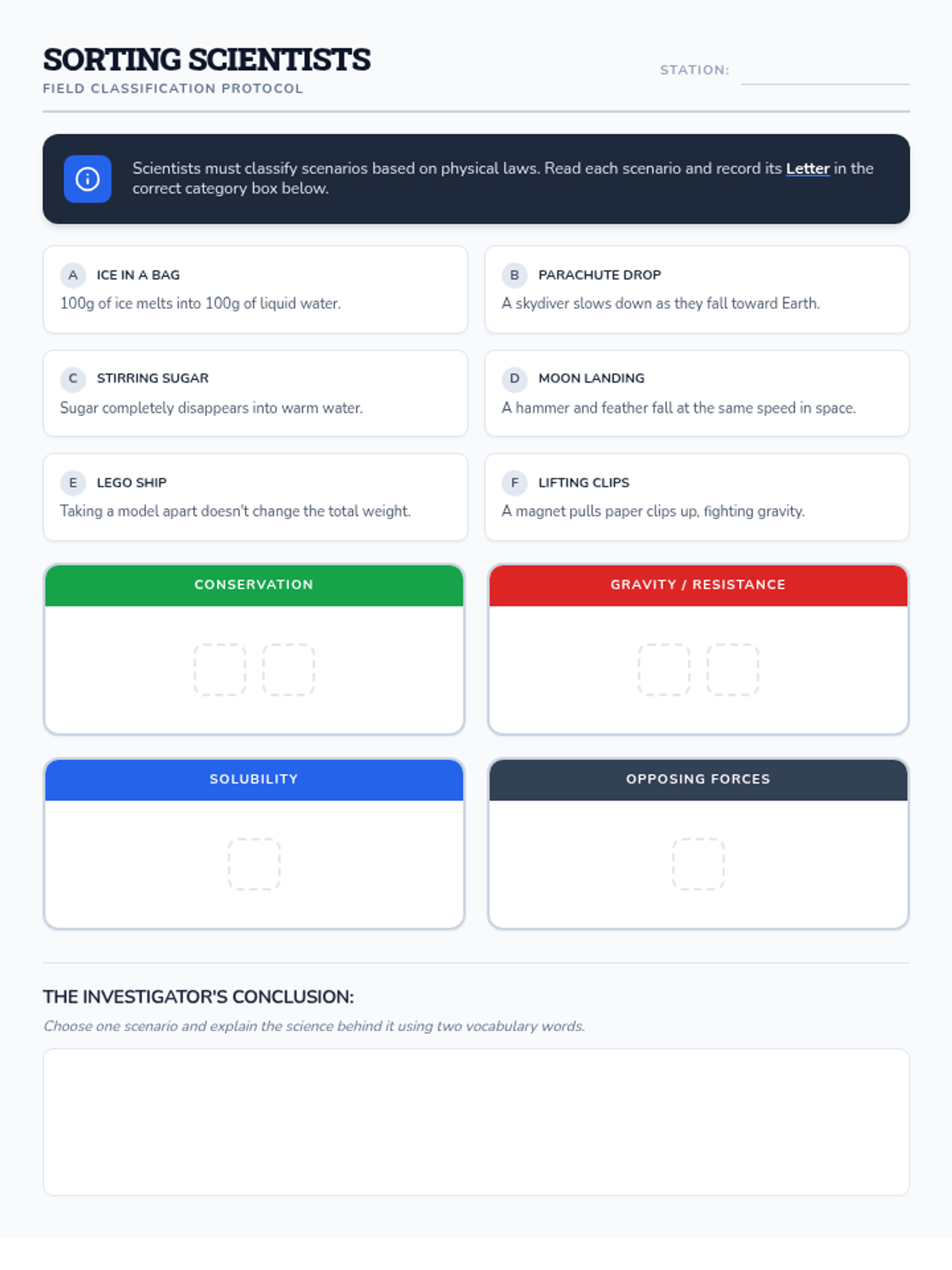
A scenario-based sorting activity where students classify different real-world examples into scientific categories such as Conservation of Weight, Gravity, Solubility, and Opposing Forces. Enhanced with scenario icons and a core concept briefing.
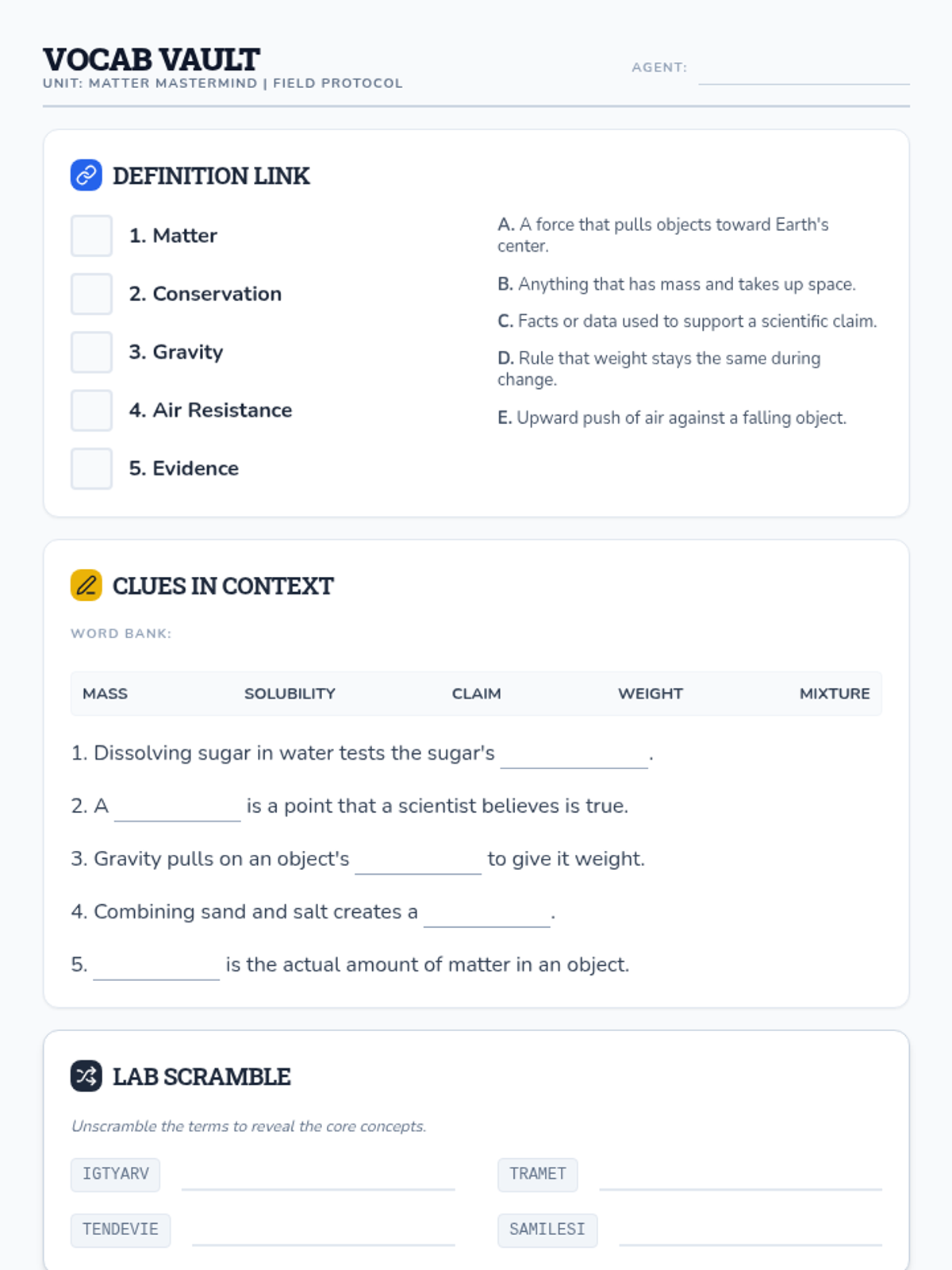
A vocabulary reinforcement worksheet for the Matter Mastermind lesson. Features a term-definition matching section, a contextual sentence completion activity, and a scientific word scramble. Optimized for alignment and handwriting space.
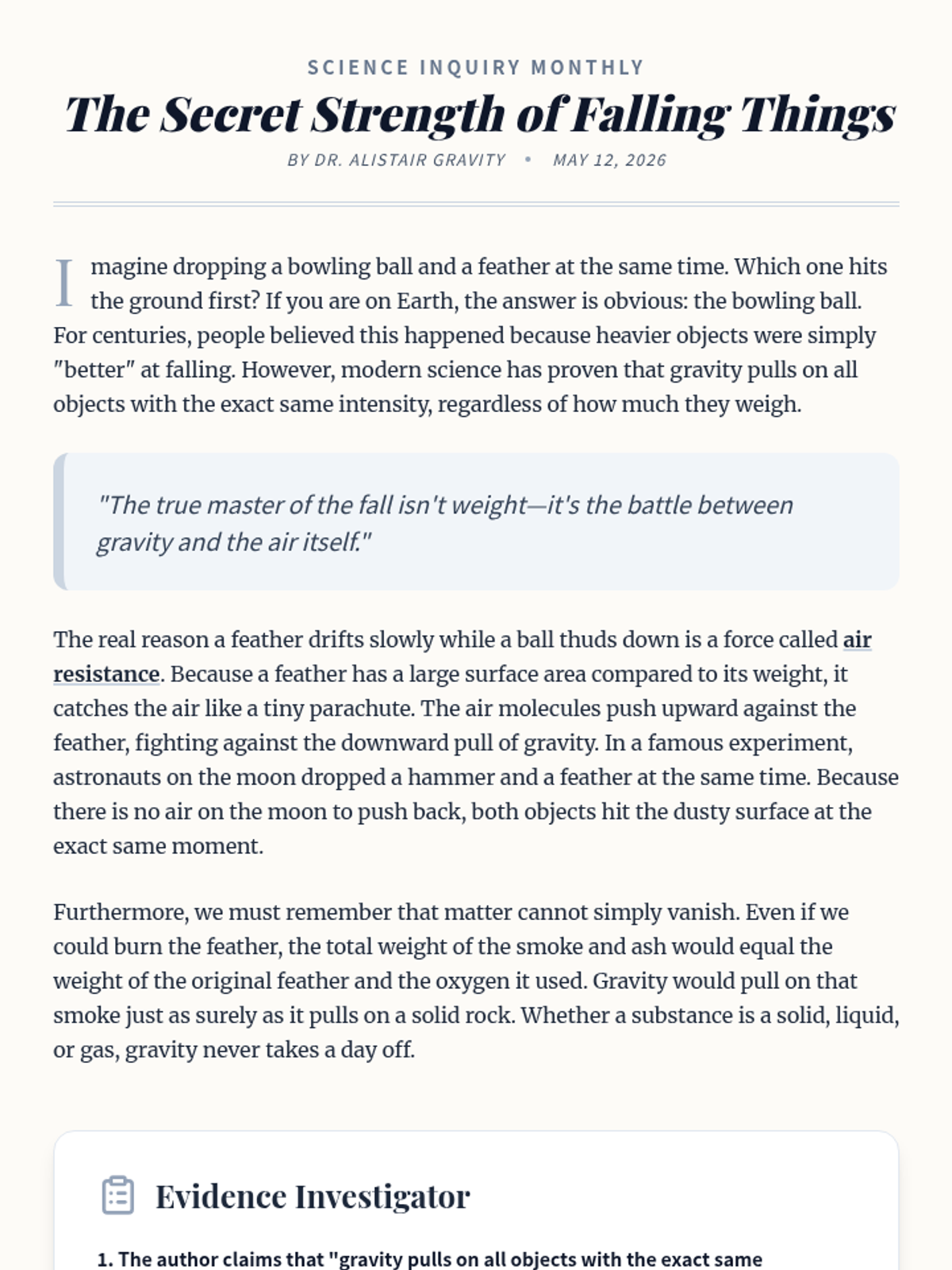
An expanded scientific reading passage about gravity, air resistance, and the conservation of weight. Includes historical context on Galileo and modern evidence from moon missions, with illustrative graphics and ELA questions focusing on claims and evidence (RL.5.8).
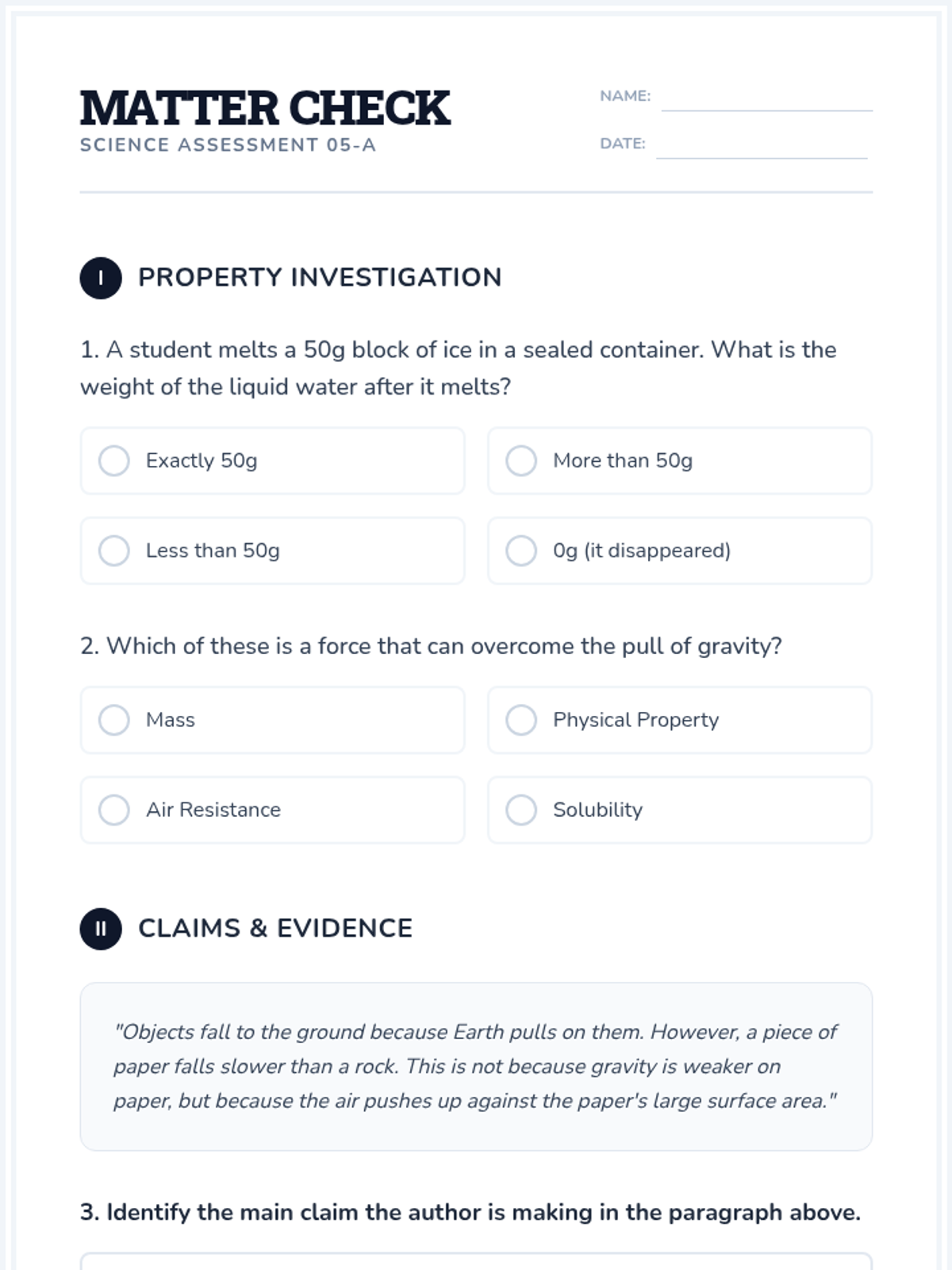
A summative assessment for the Matter Mastermind lesson. Includes multiple-choice questions on conservation of mass and gravity, and short-answer questions focusing on claims and evidence.
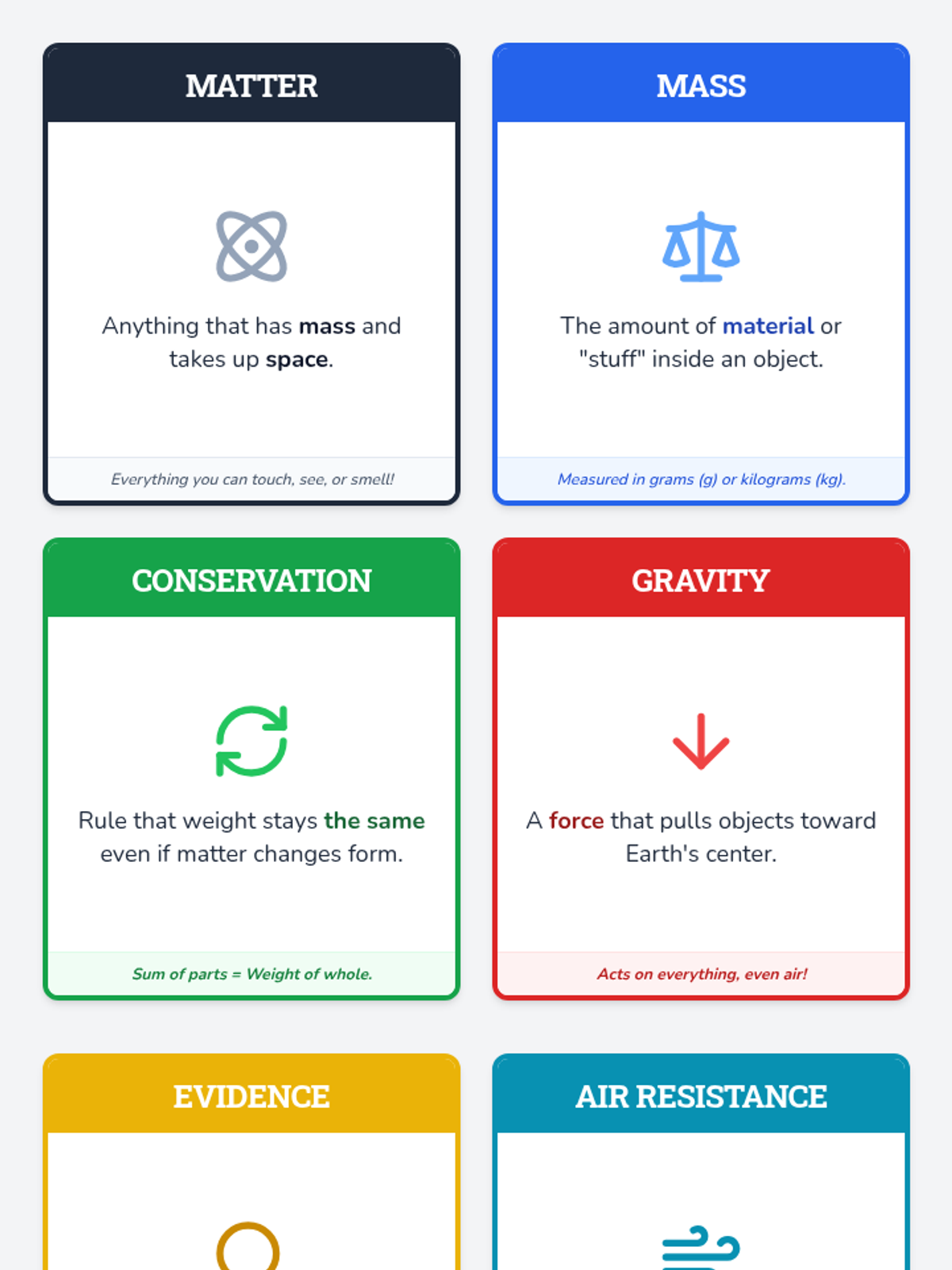
Visual vocabulary cards for the Matter Mastermind lesson, featuring key terms like Matter, Mass, Conservation, Gravity, Evidence, and Air Resistance. Optimized for contrast and clear layout.
An instructional slideshow for the Matter Mastermind lesson. Covers physical properties of matter, conservation of weight, gravity, and how to identify scientific claims and evidence with enhanced visual models.
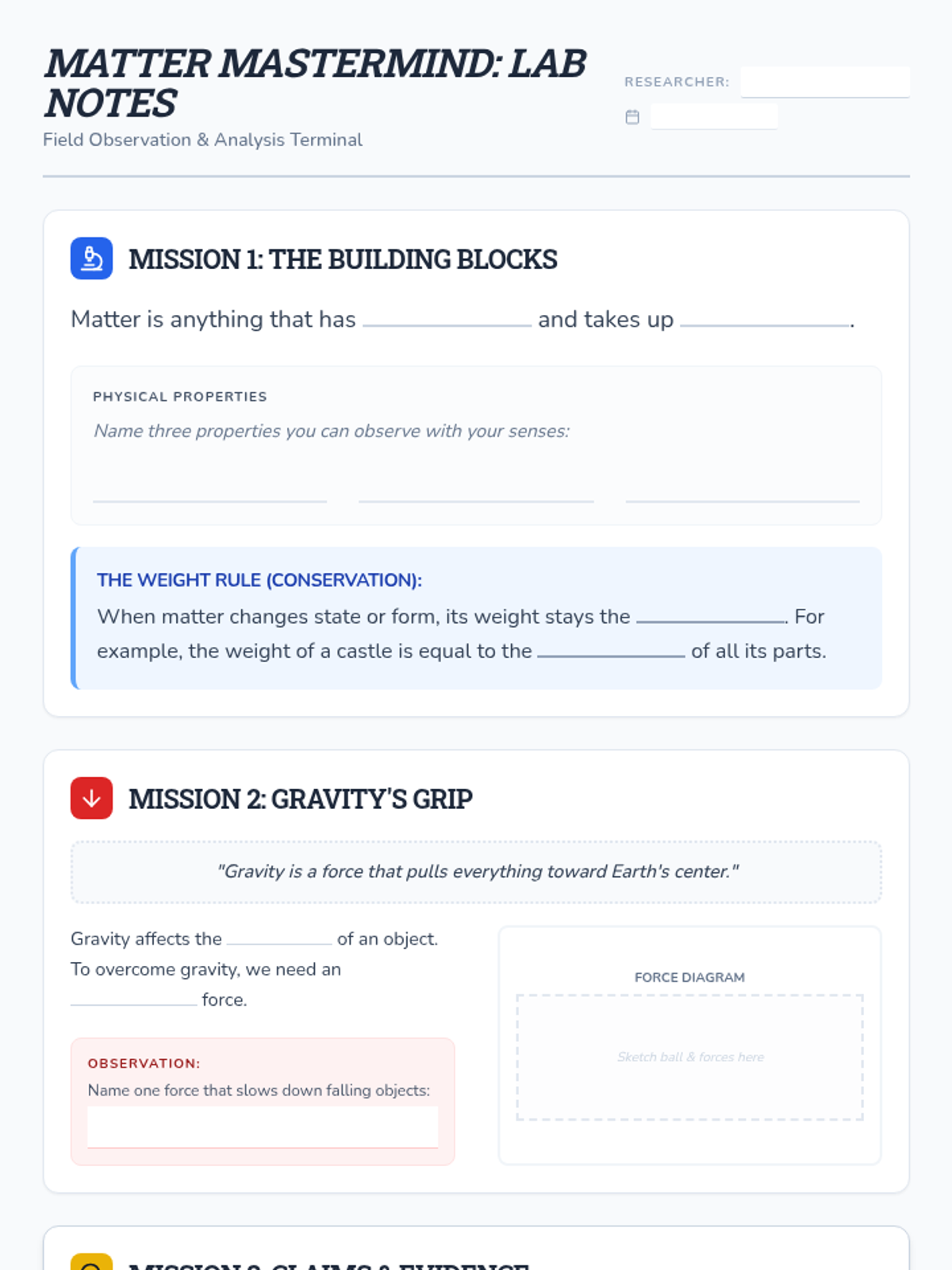
A set of guided notes designed for students to complete while following the Matter Mastermind lesson. The notes cover properties of matter, gravity, and the identification of scientific evidence.
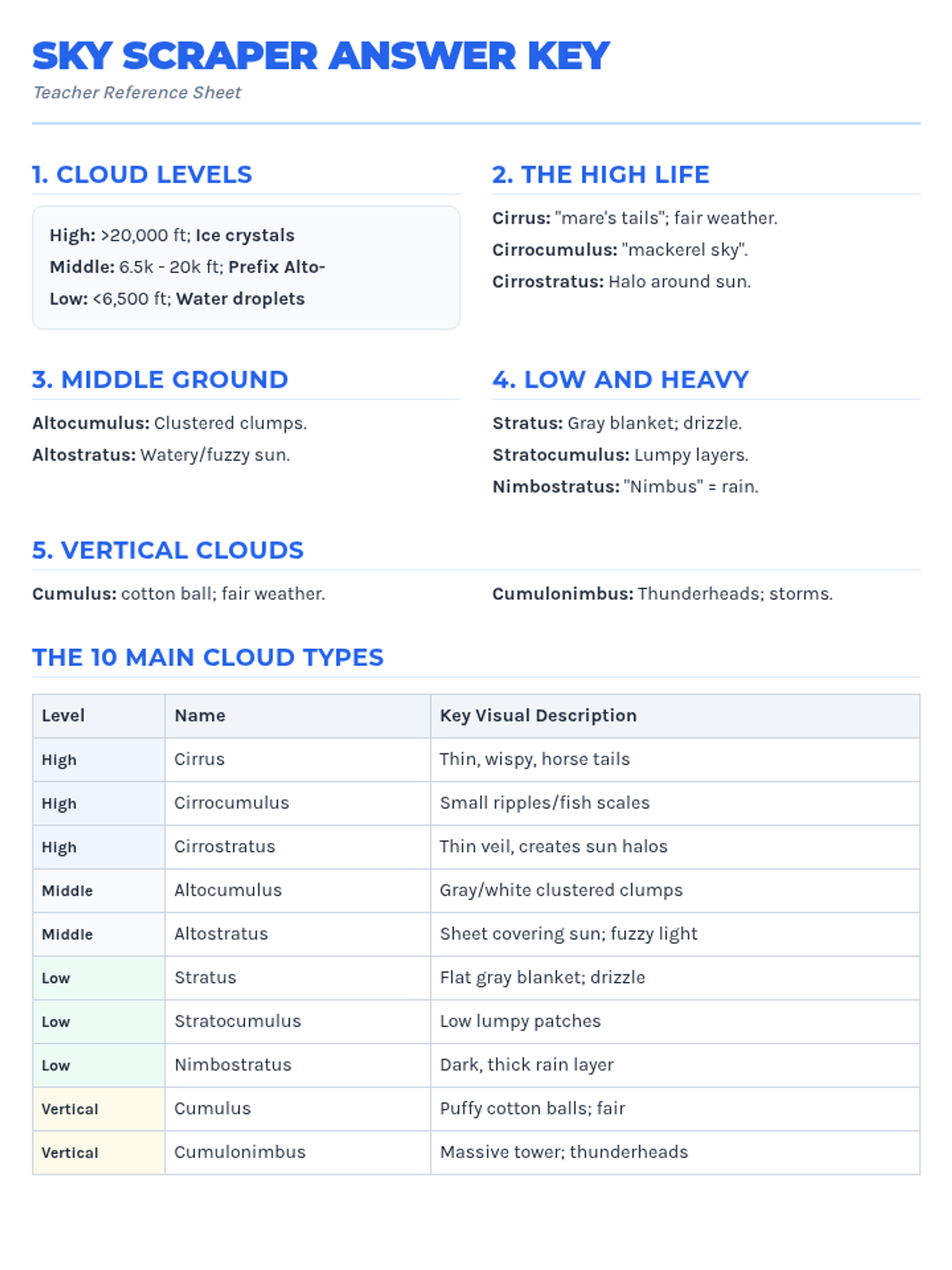
Completed version of the Sky Scraper Notes to serve as a reference for teachers. Revised to include all 10 standard cloud types and optimized layout for a single-page reference.
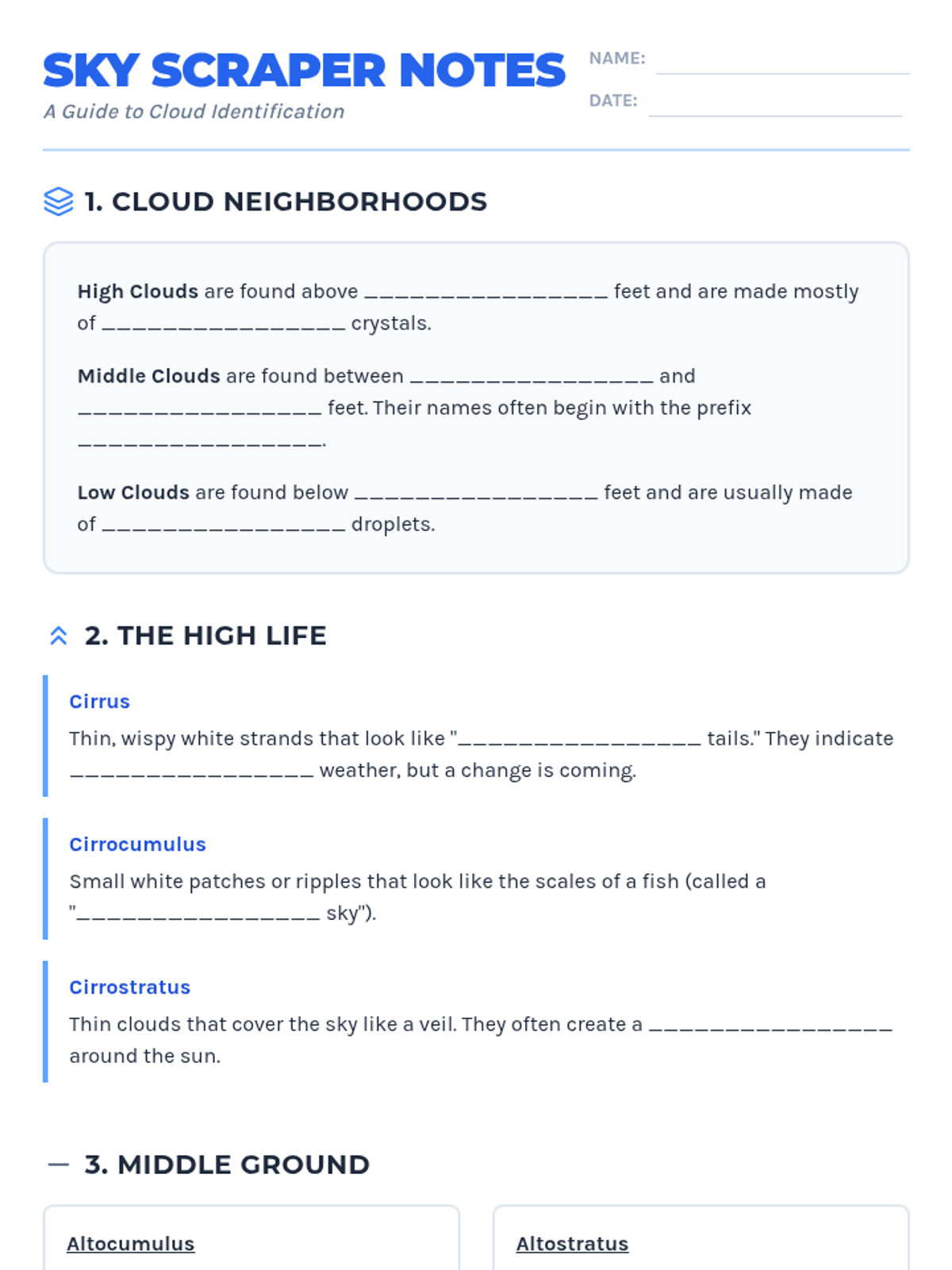
A fill-in-the-blank guided notes document designed to be completed alongside the Sky Scraper presentation. Revised for improved page breaks, student work area legibility, and layout consistency.
A visual presentation covering the 10 main cloud types, their altitudes, and characteristics, with special focus slides for Cirrus, Stratus, and Cumulus clouds. Revised for improved padding and alignment on Slide 6.
A visual slide presentation guiding students through the setup of a forensic evidence board to solve the mystery of the missing fossils. Includes suspect introductions, layout templates, and success criteria.
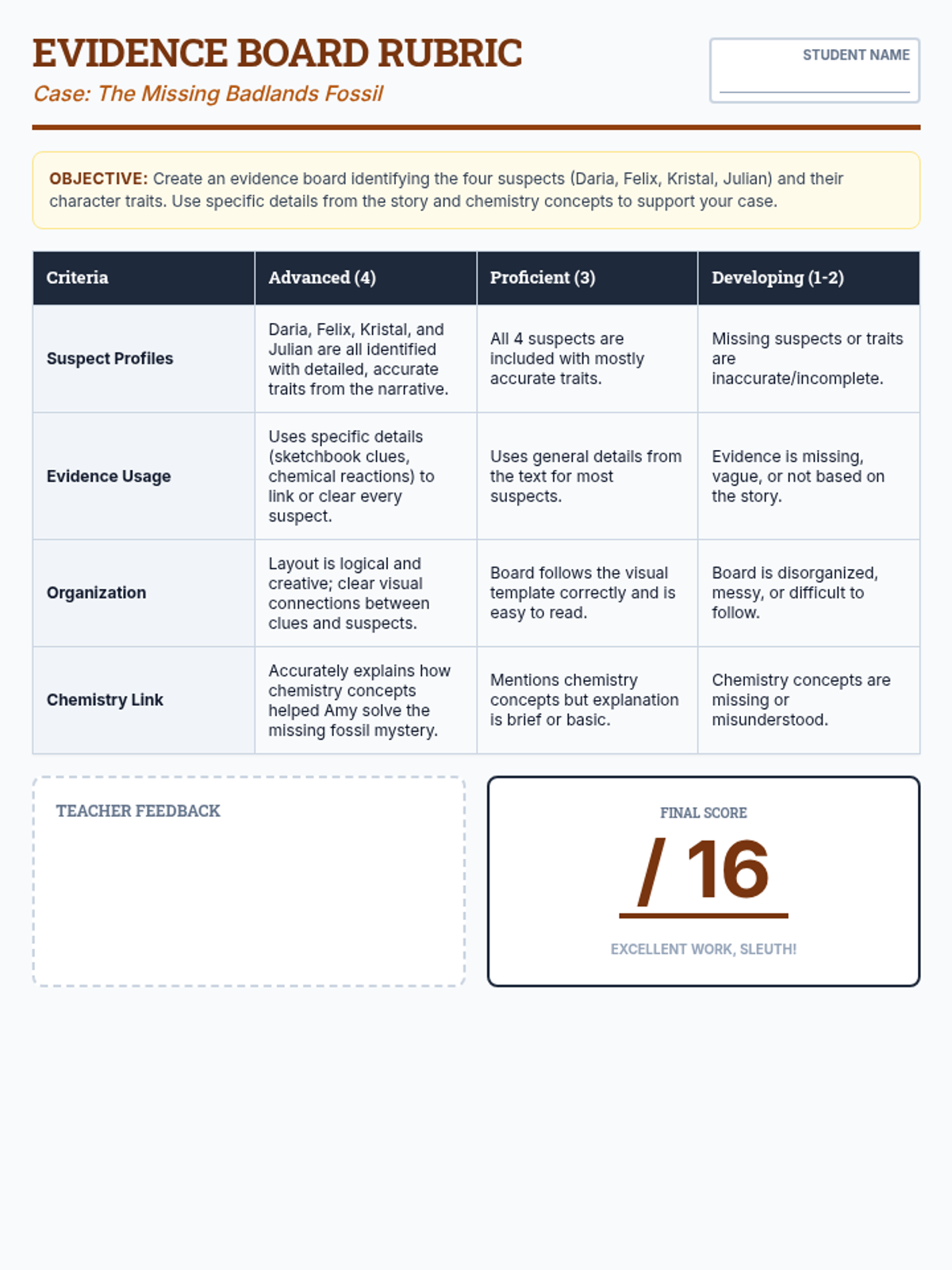
A comprehensive grading rubric for the Badlands Sleuth evidence board project, focusing on suspect profiling, evidence accuracy, chemistry integration, and organization.
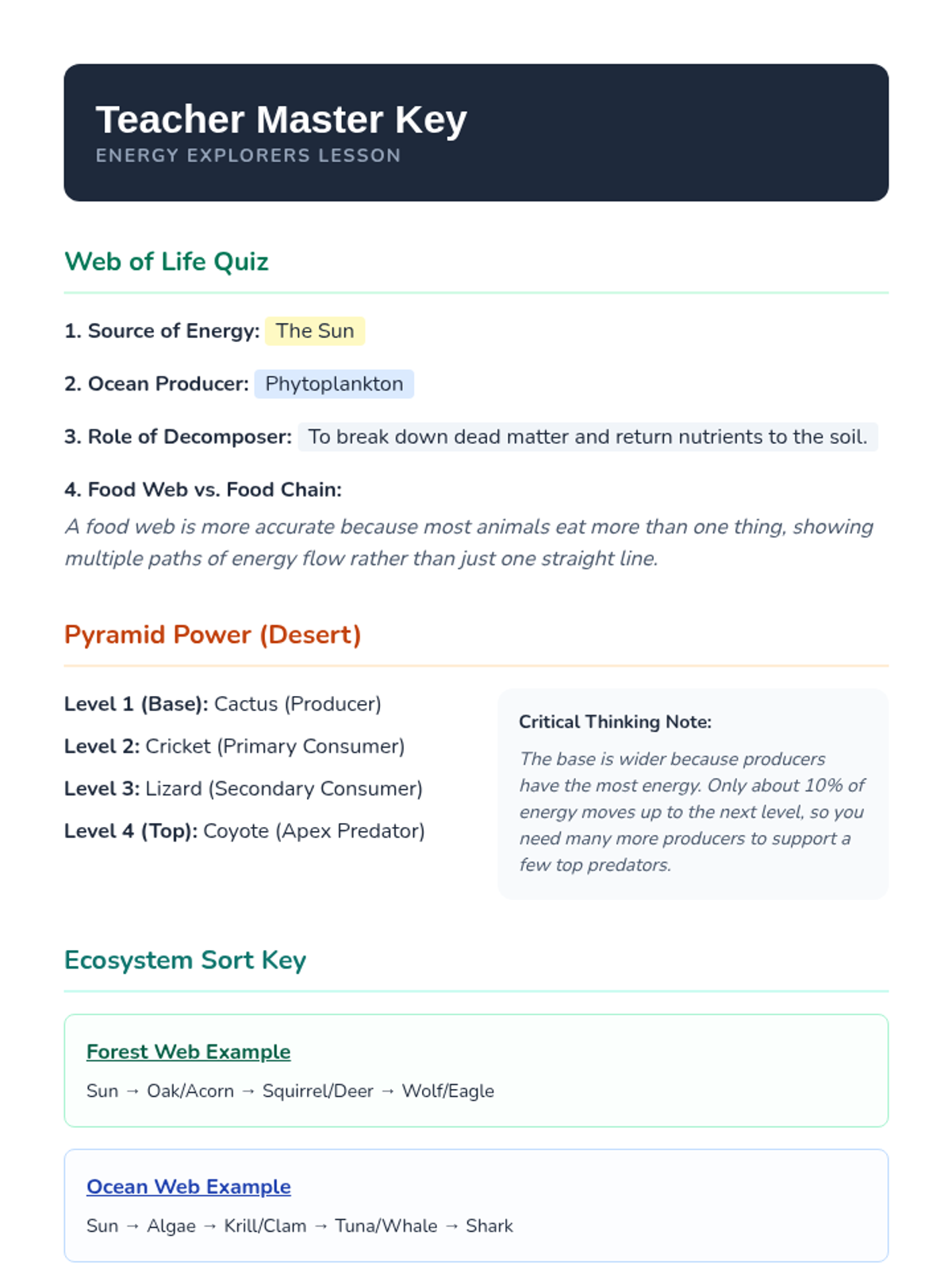
A comprehensive answer key and teacher facilitation guide for the Energy Explorers lesson. Includes quiz answers, pyramid placement solutions, and sorting activity results.
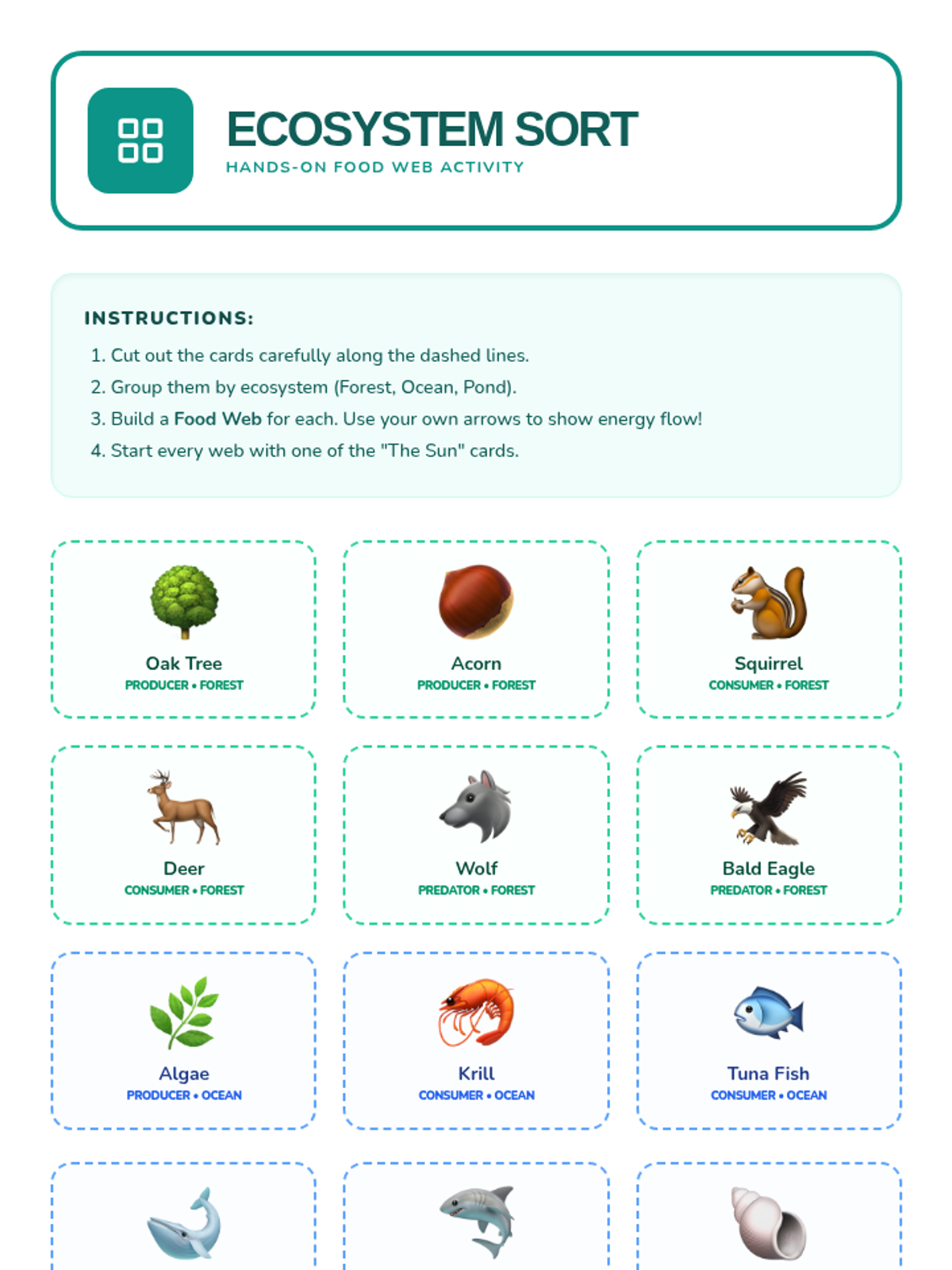
A collection of 23 printable organism cards from Forest, Ocean, and Pond ecosystems for building complex food webs. Each card includes a role (Producer, Consumer, Predator, Decomposer) and ecosystem label. Includes 3 Sun cards for multi-web creation.
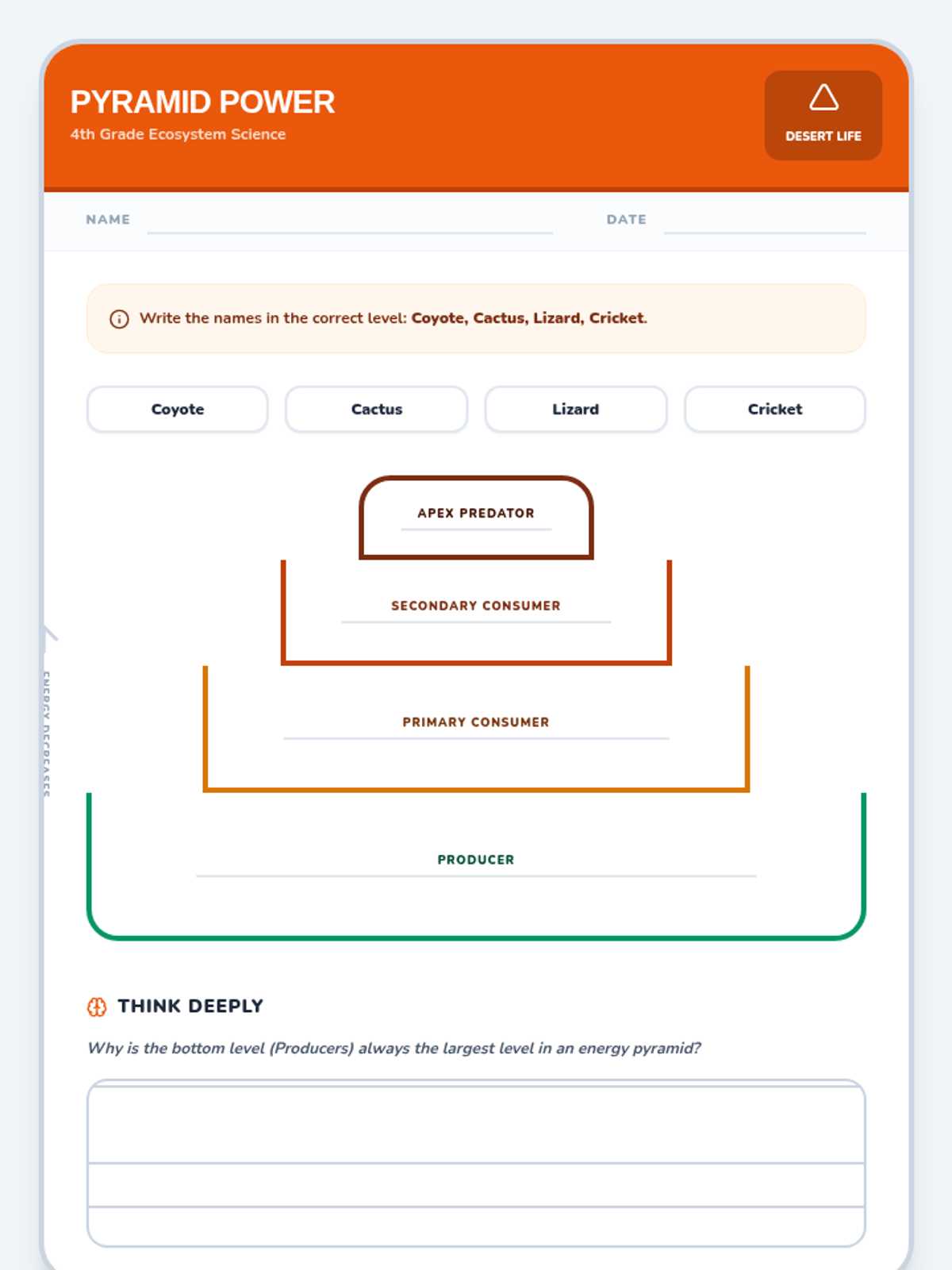
An energy pyramid worksheet focused on a desert ecosystem. Students must categorize organisms (coyote, cactus, lizard, cricket) into the correct trophic levels and explain the energy loss between levels.
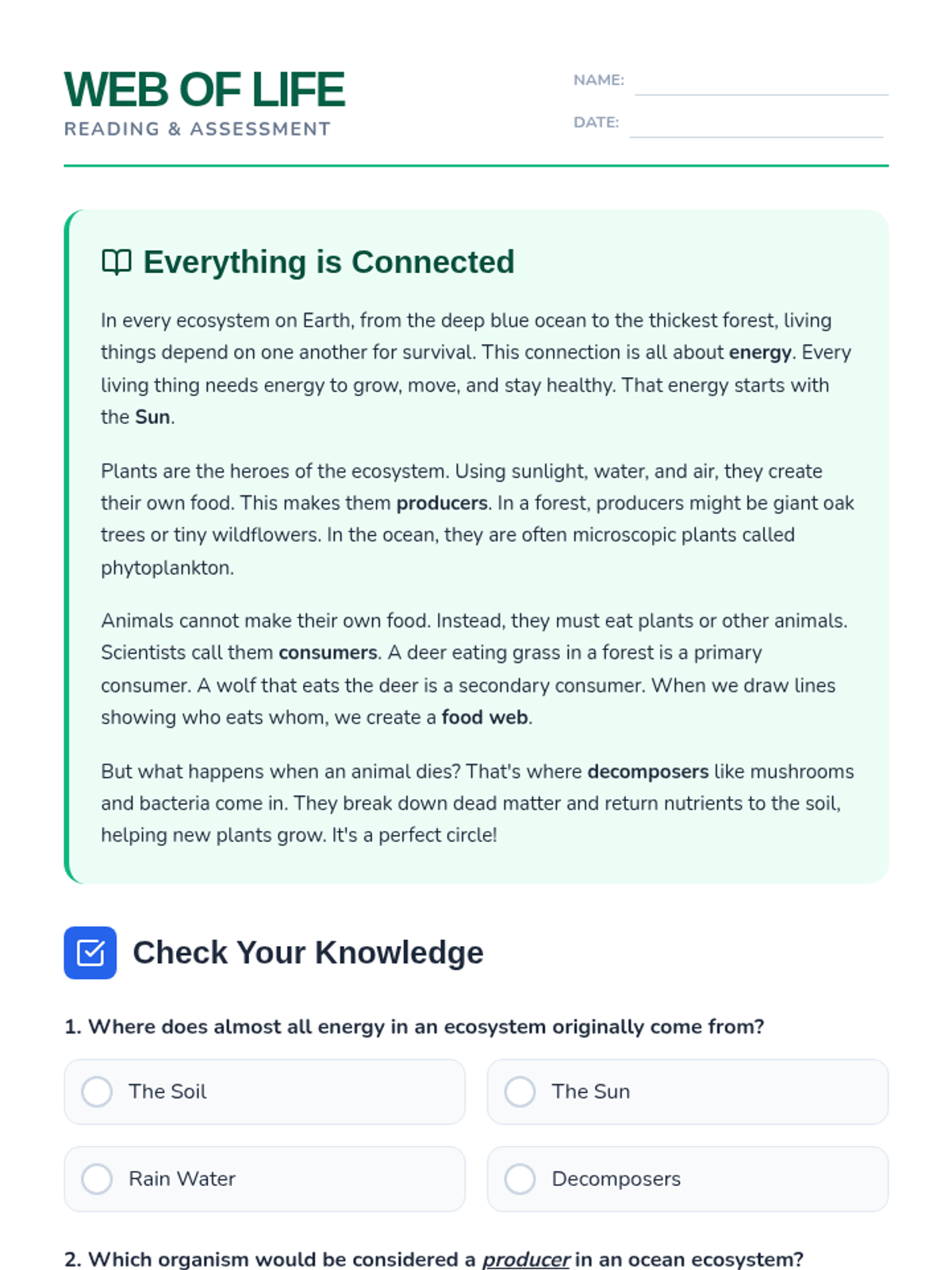
A non-fiction reading passage about the flow of energy in ecosystems, accompanied by a 4-question comprehension quiz featuring multiple-choice and open-response questions. focused on 4th-grade standards.
An engaging slide deck introducing food webs, energy pyramids, and the roles of producers and consumers across four distinct ecosystems (Forest, Ocean, Desert, and Pond). Includes visual diagrams and clear definitions for 4th-grade students.
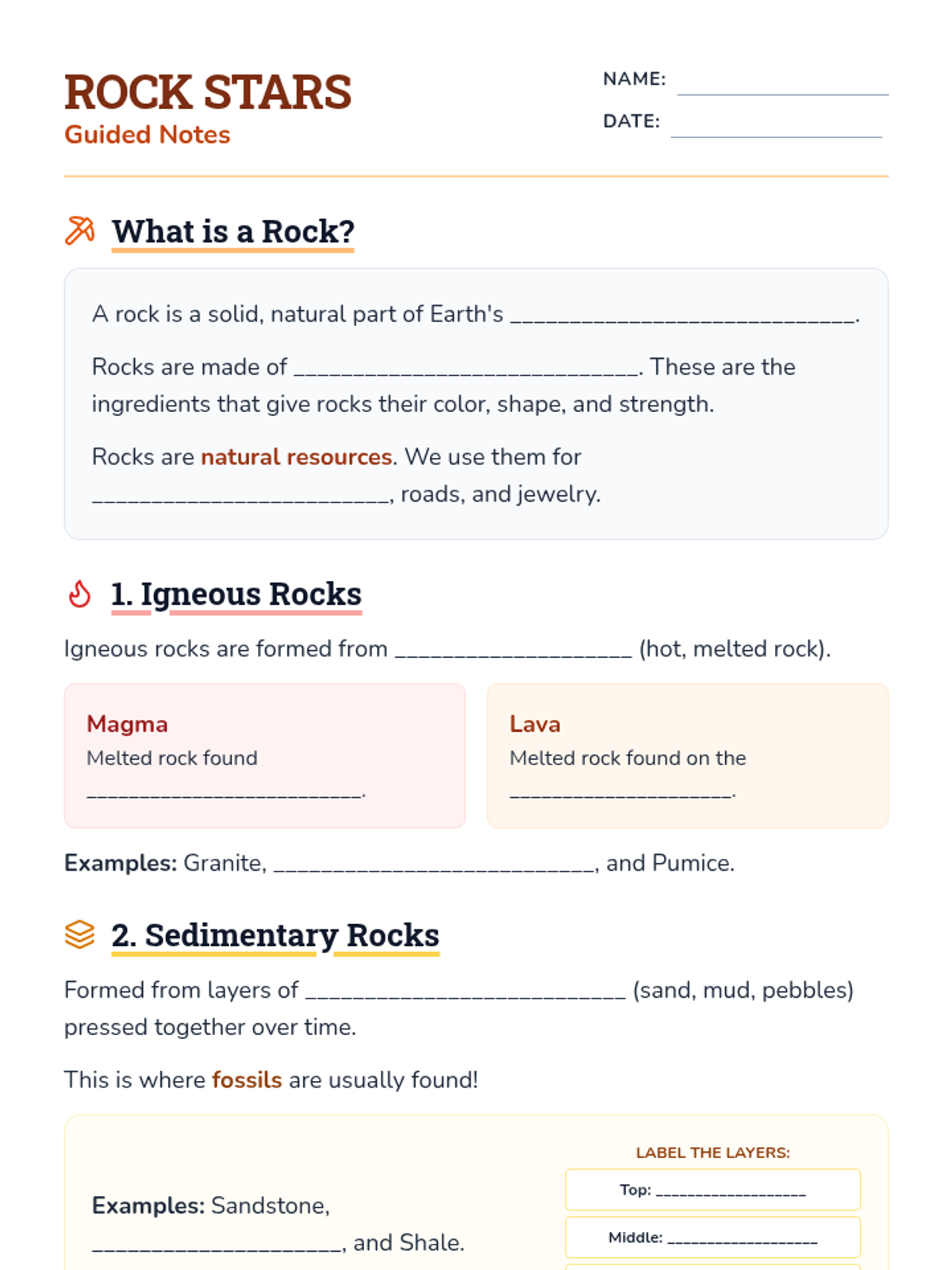
A fill-in-the-blank guided notes document designed to accompany the Rock Stars Slides, helping students track key vocabulary and concepts during instruction.
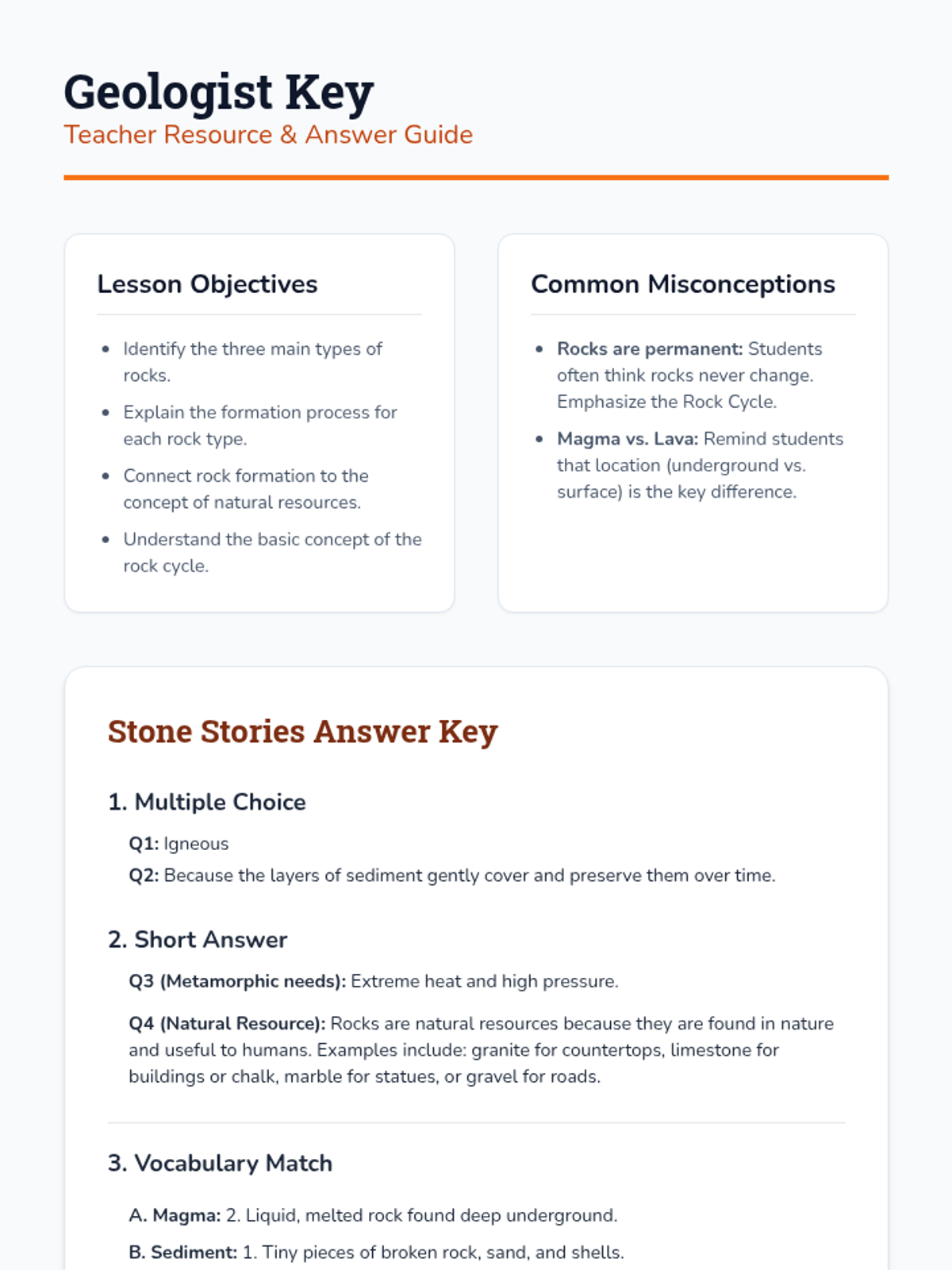
A comprehensive teacher guide including lesson objectives, answer keys for the student packet and guided notes, and a hands-on activity suggestion to reinforce the rock cycle.
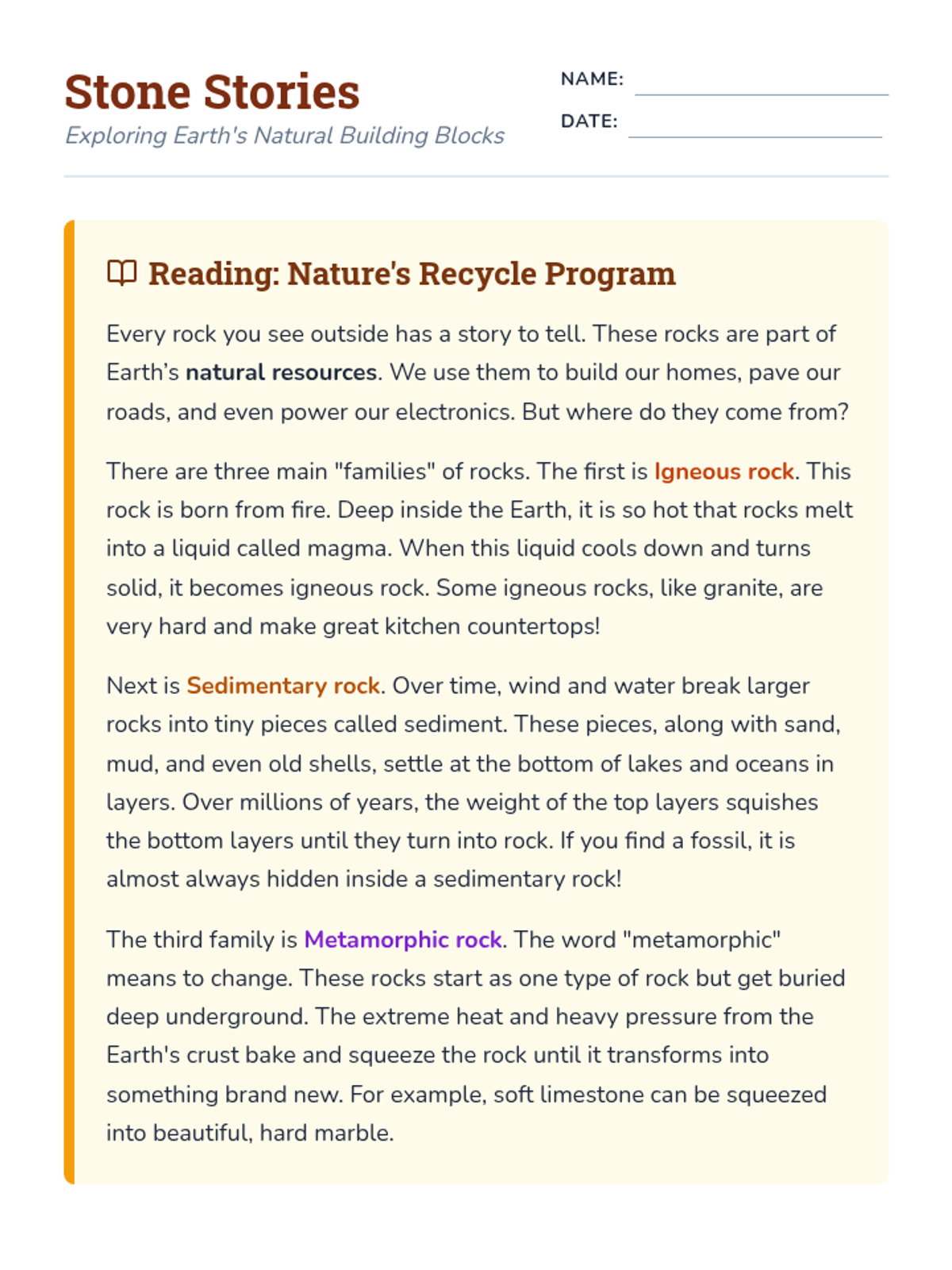
A 4th-grade level reading packet that explains the formation of igneous, sedimentary, and metamorphic rocks, complete with comprehension questions and a vocabulary matching activity.
A visual introduction to the three main rock types and the rock cycle, featuring clear diagrams and key vocabulary for 4th-grade students.