A clean, 1-page parent-facing communication letter sent home in early spring of Grade 7 to families of students under consideration for the Grade 8 Algebra 1 accelerated path, explaining the multi-tiered review process and managing expectations.
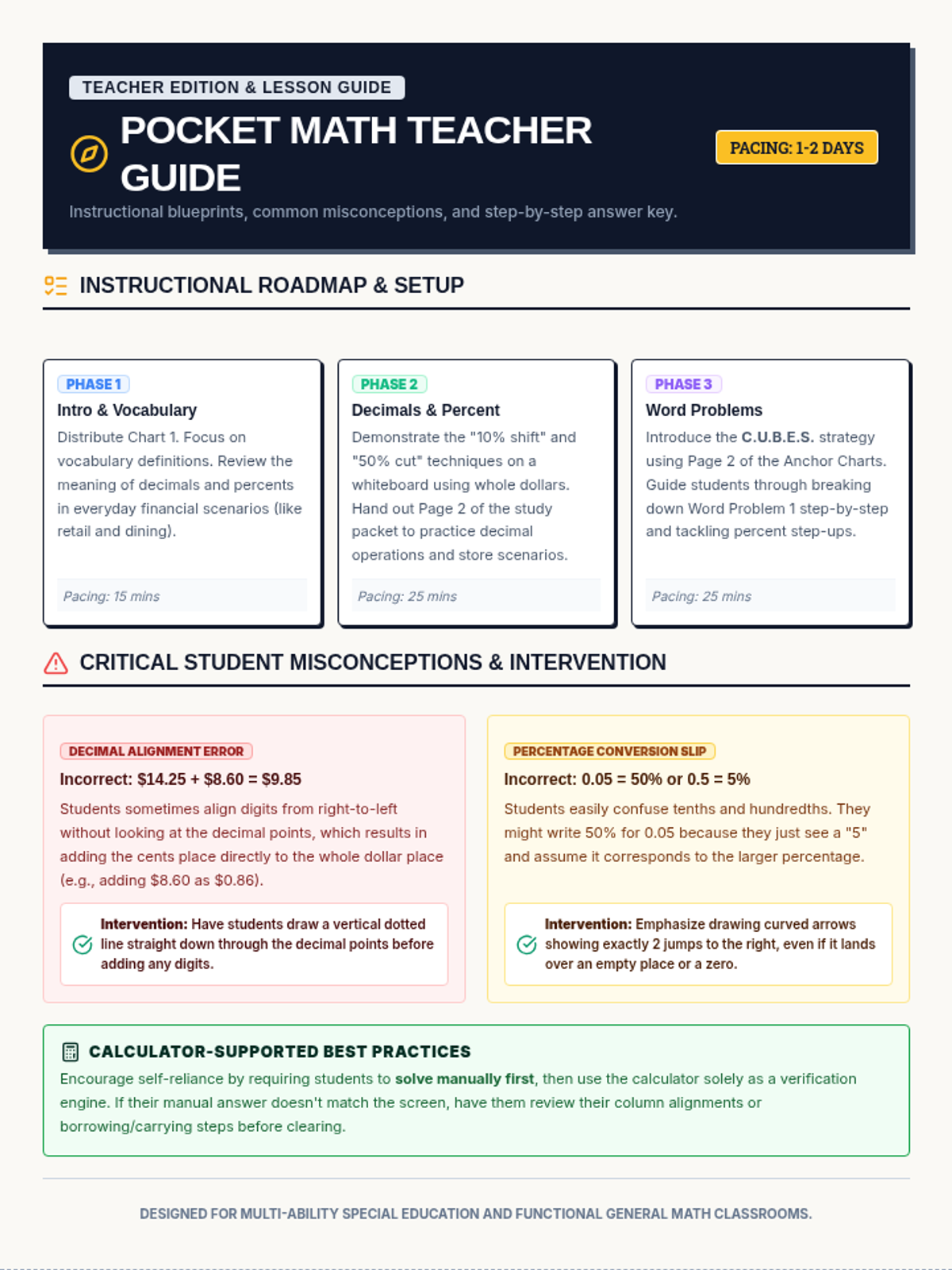
A complete 3-page teacher guide and answer key for the Pocket Math lesson. Page 1 outlines lesson plans, pacing recommendations, critical student misconceptions, and calculator best practices. Pages 2 and 3 provide visual step-by-step solutions for the vocabulary, decimal math, percentages, and word problems from the student packet.
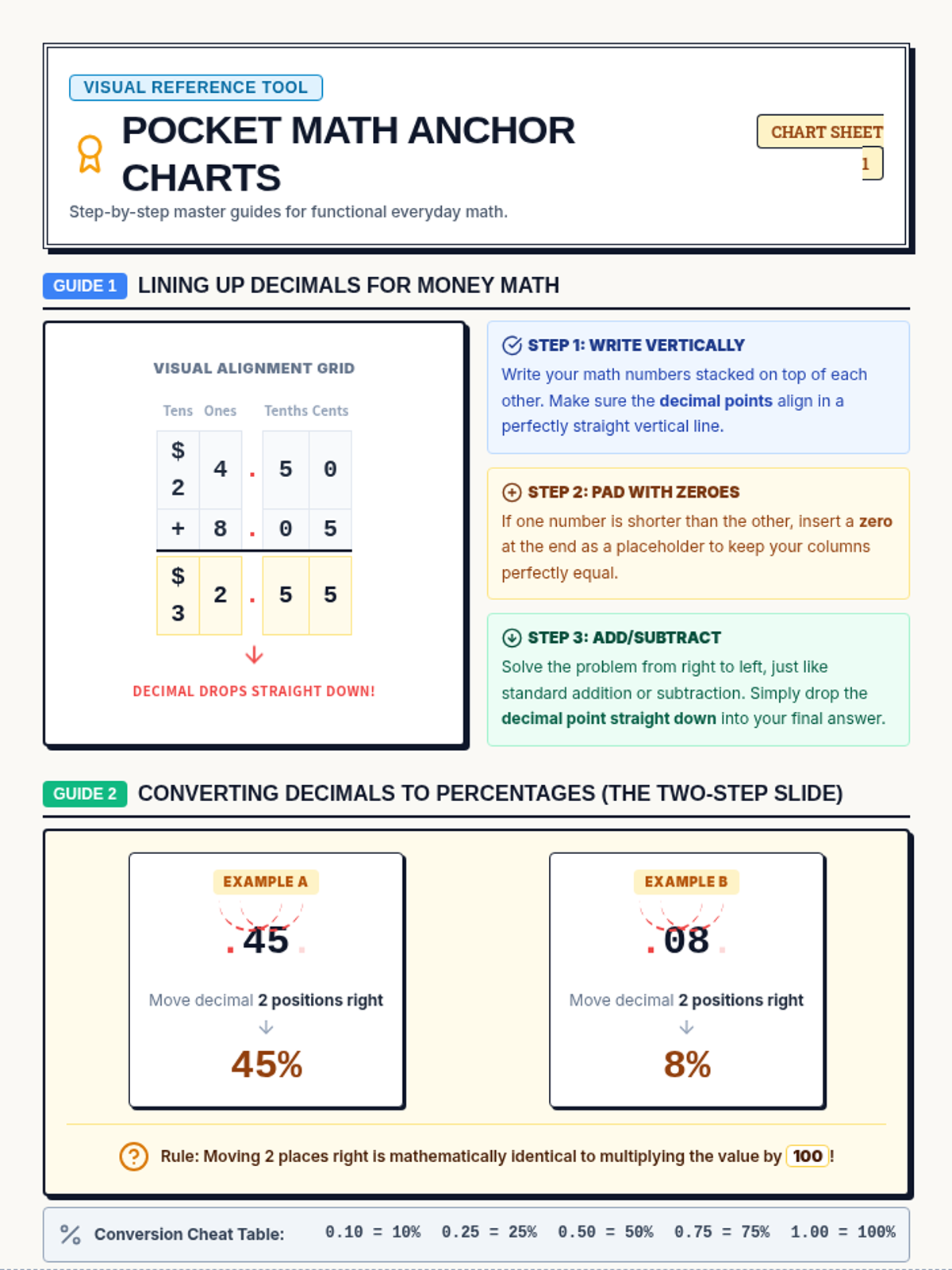
A highly visual 2-page math anchor chart reference sheet. Page 1 displays visual alignment methods for lining up decimals, adding/subtracting money, and step-by-step decimal-to-percentage conversions. Page 2 outlines the simplified C.U.B.E.S. word problem decoding strategy and displays step-by-step mental math methods for finding 10% and 50% of values with a real-world exemplar.
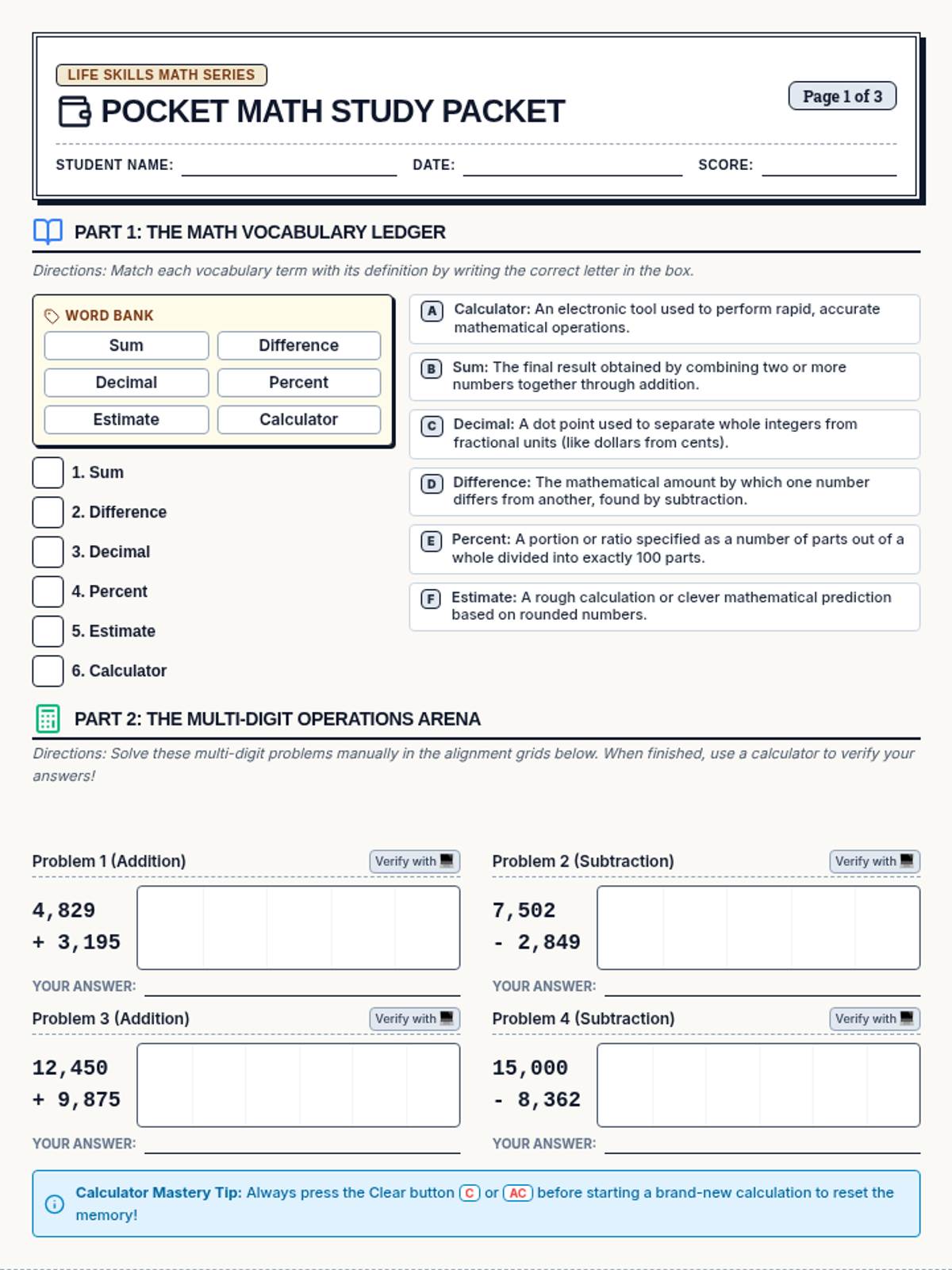
A structured 3-page student study packet for functional math. Page 1 covers vocabulary matching and multi-digit operations. Page 2 covers decimal money math and visual tricks for finding 10% and 50% in realistic store & cafe contexts. Page 3 provides keyword guides and realistic word problems with integrated pre-algebra percent extensions.
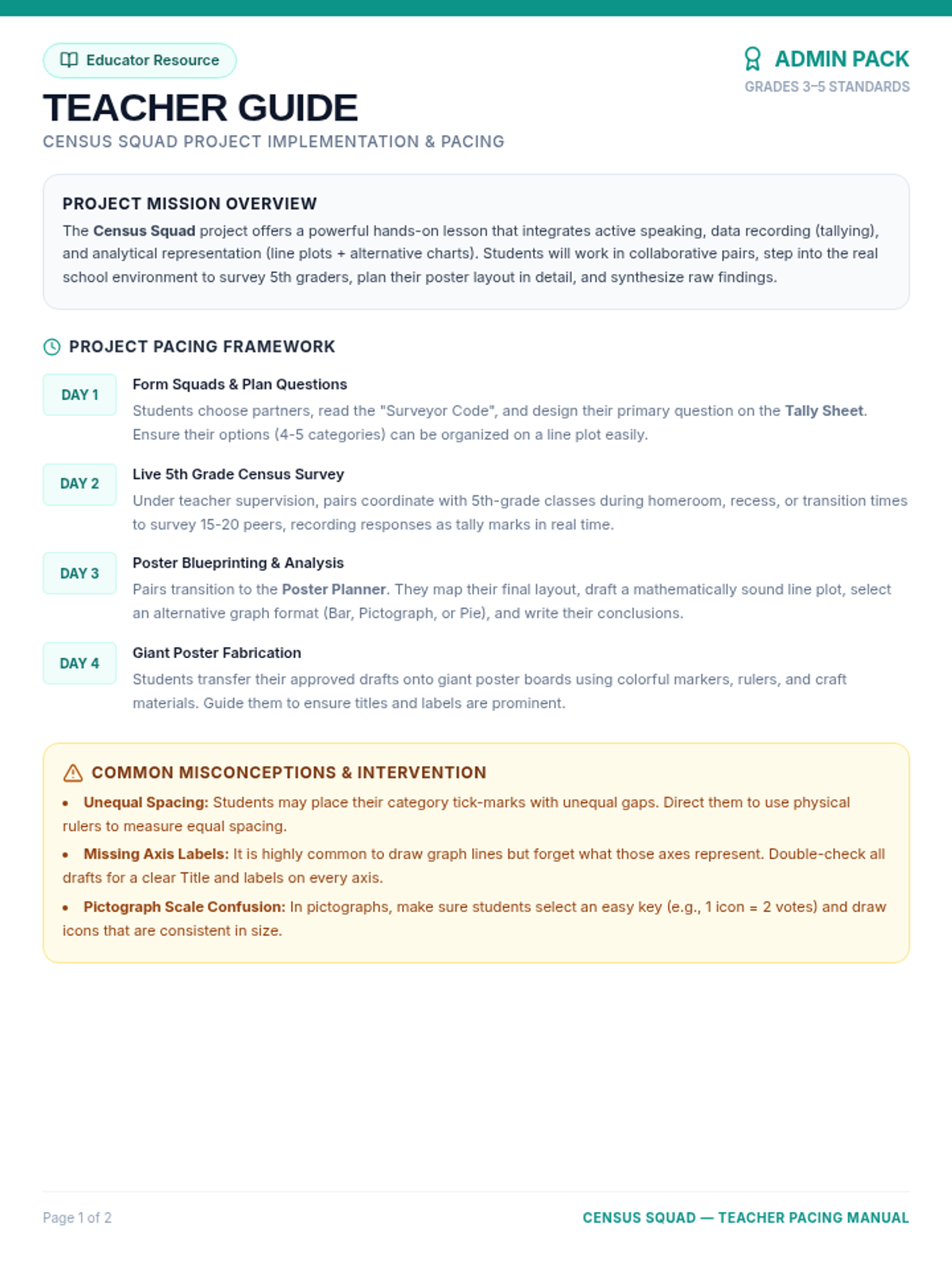
A comprehensive teacher resource containing lesson pacing, student prompt ideas, common misconceptions, and a complete assessment rubric for the poster project.
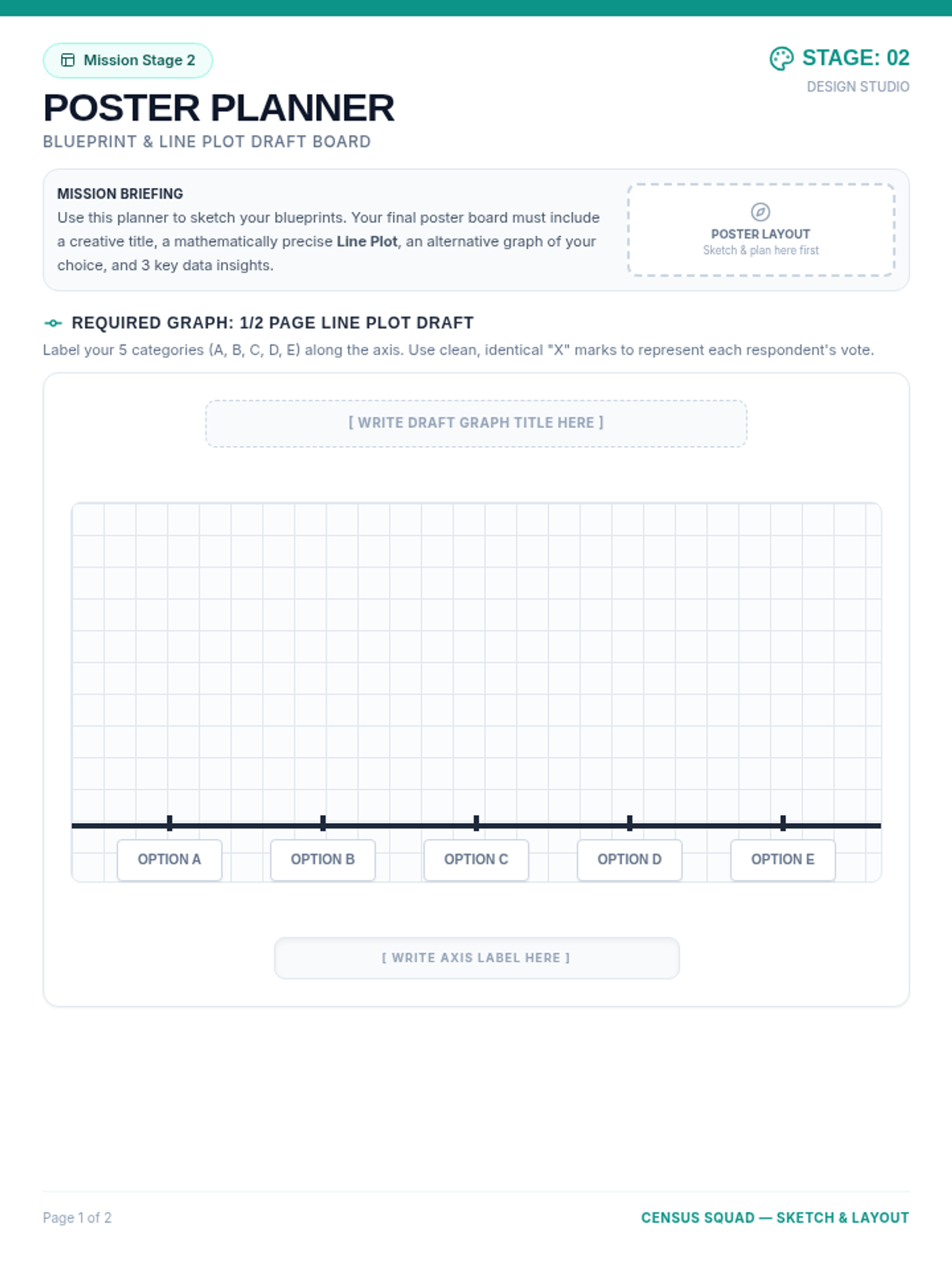
A 2-page graphic organizer and scaffolding guide for students to draft their poster layout, construct their line plot, draw their alternative graph, and write their data insights.
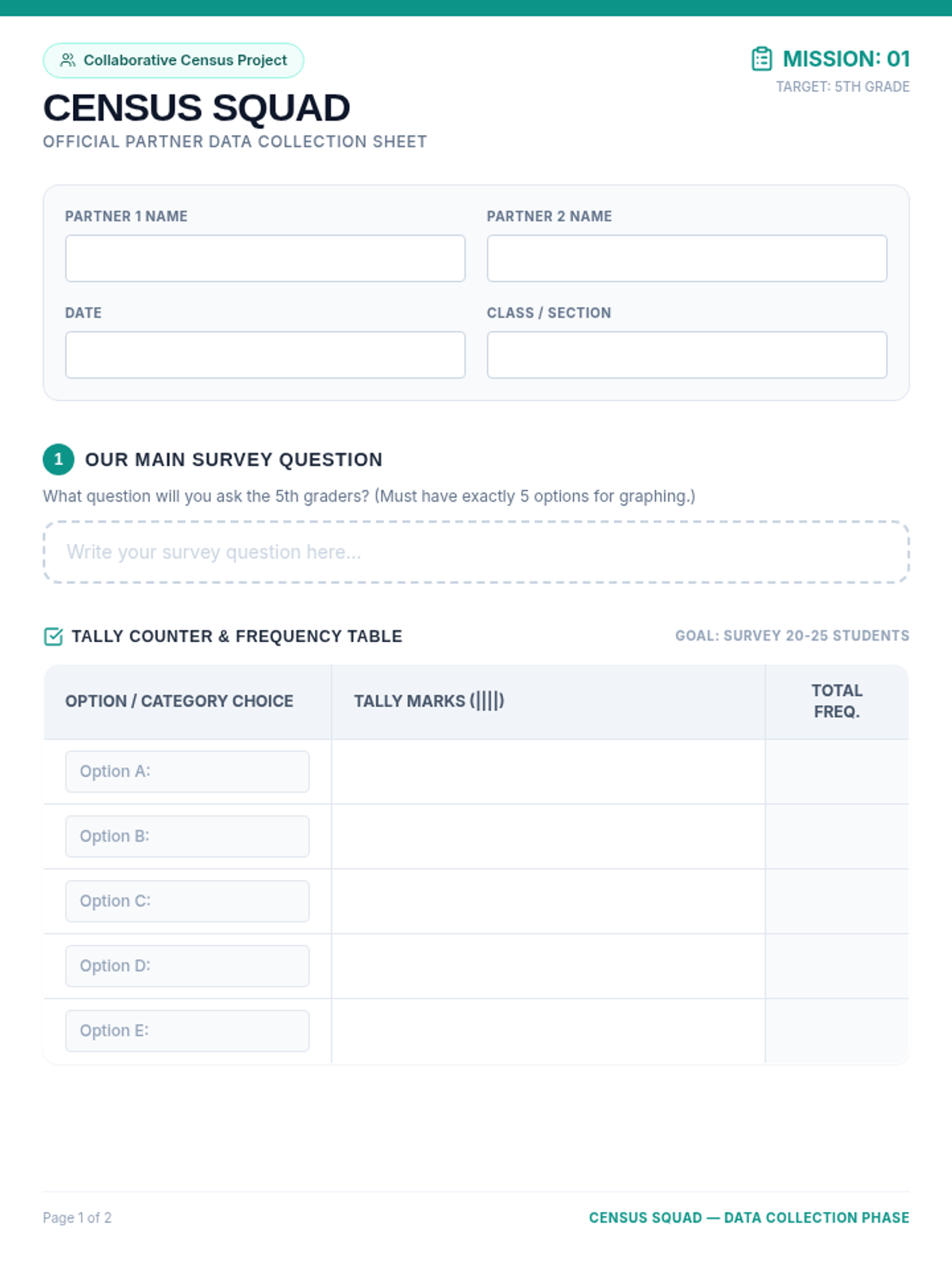
A student-facing partner worksheet for designing survey questions, collecting live data from 5th graders using tally marks, and calculating frequencies.
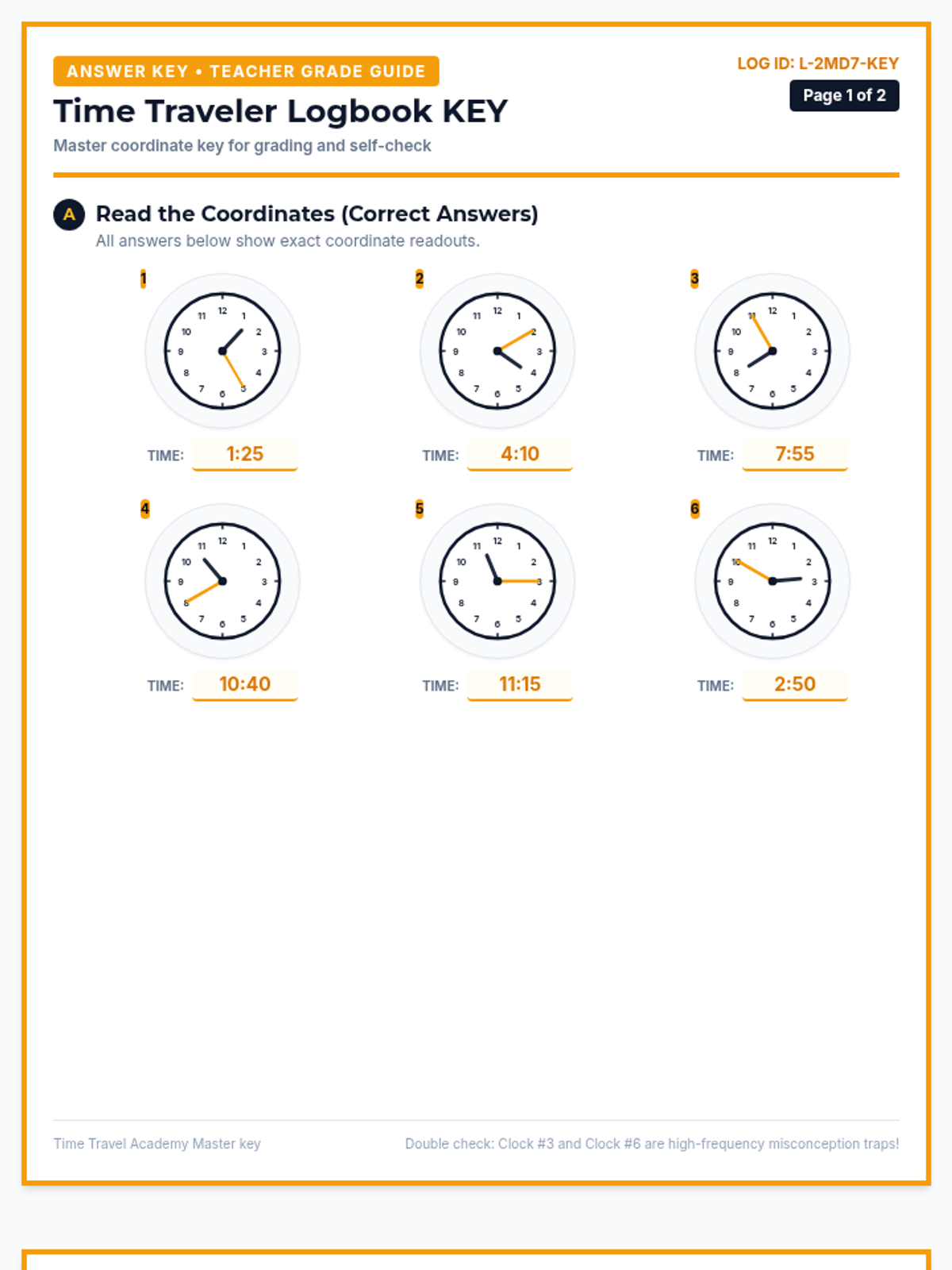
An identical 2-page master key for grading or student self-check, featuring high-contrast annotations and mathematically precise visual clock drawings for checking.
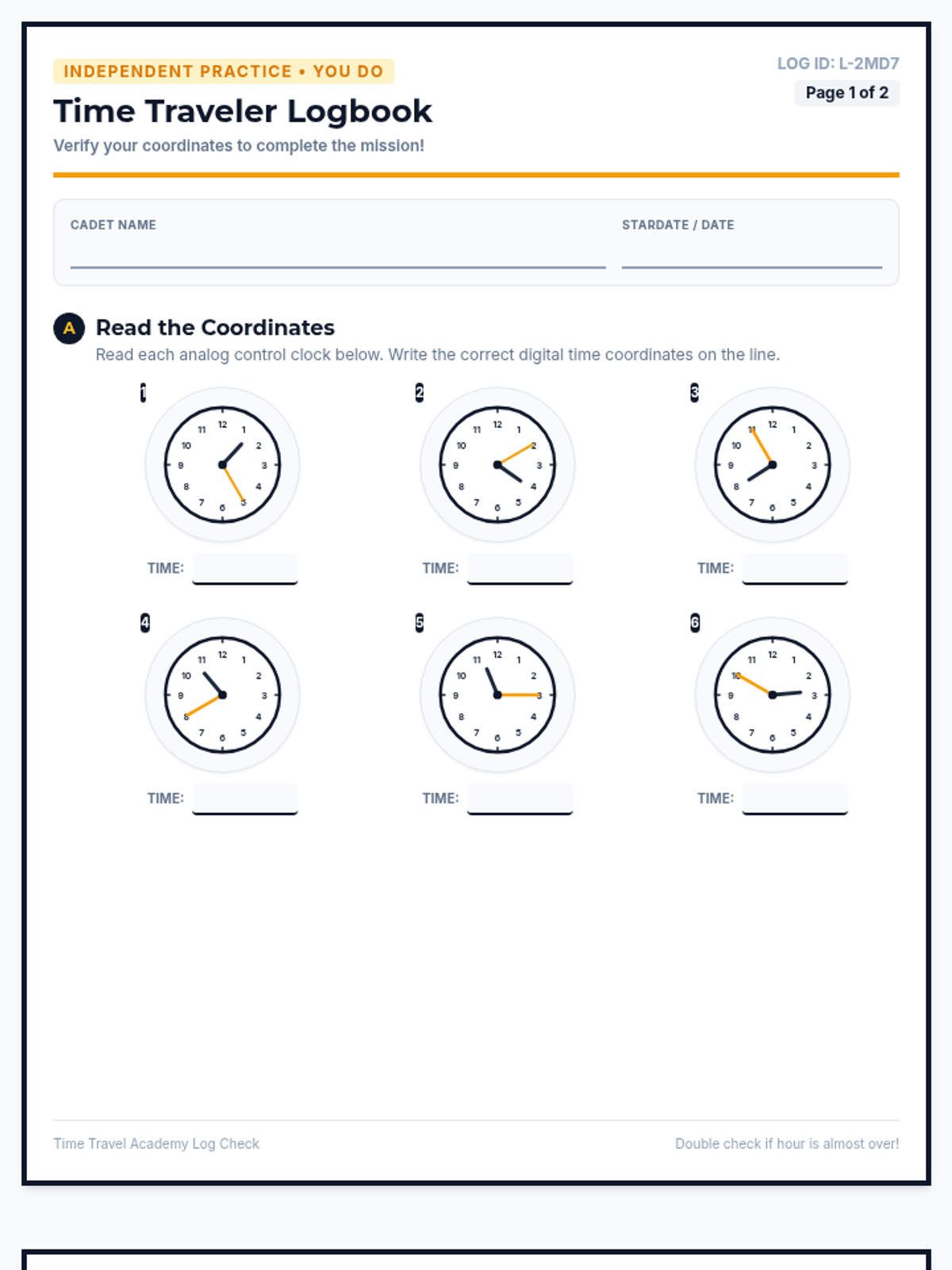
A highly detailed, 2-page student independent logbook worksheet designed with clean analog clocks. Part A requires students to read coordinates (5-minute intervals), Part B requires drawing hands, and Part C is an engaging word problem challenge.
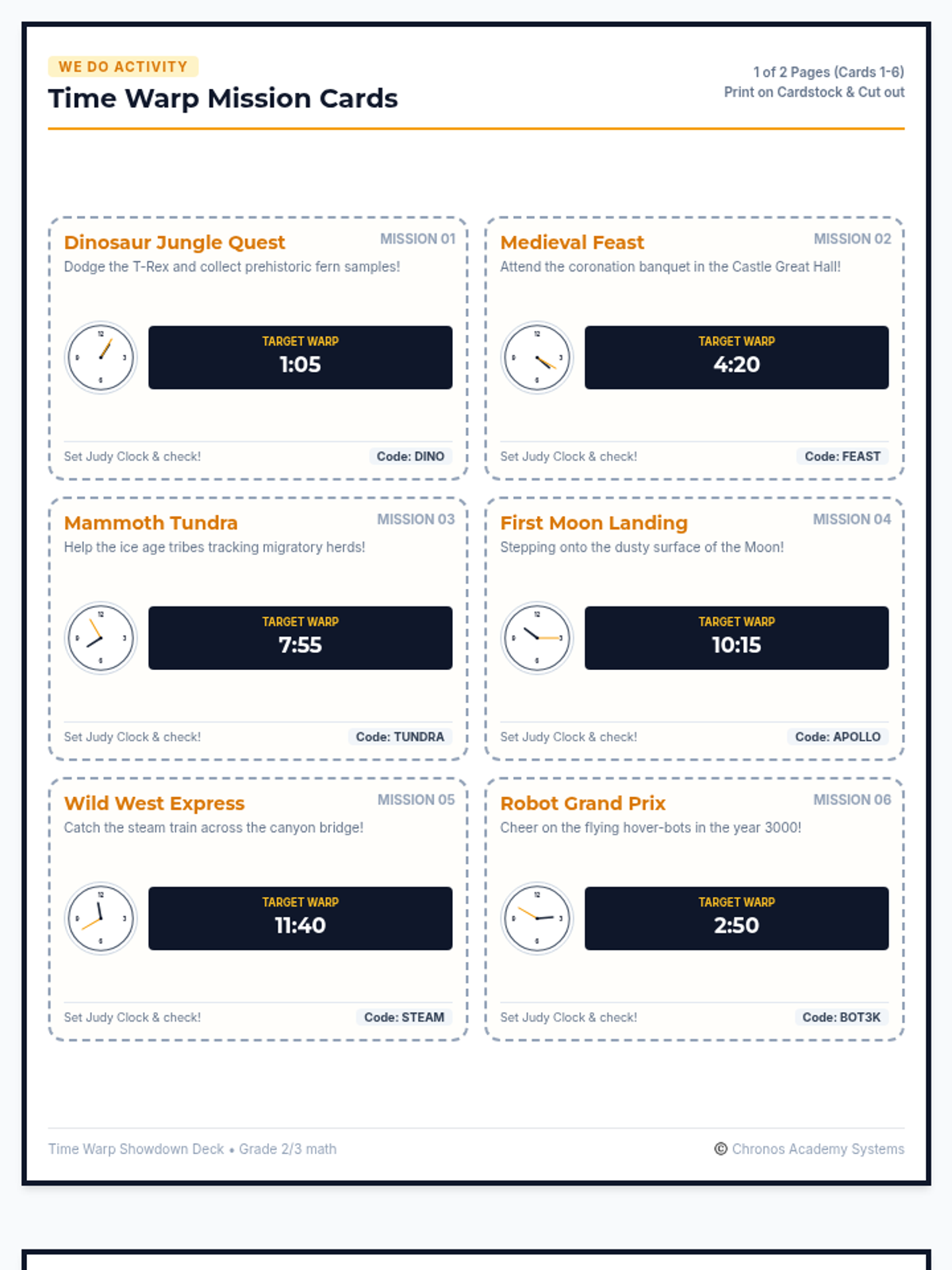
A set of 12 beautifully illustrated mission cards for the geared Judy clock active game, with unique thematic time travels spanning prehistoric dinosaurs to orbital future star stations.
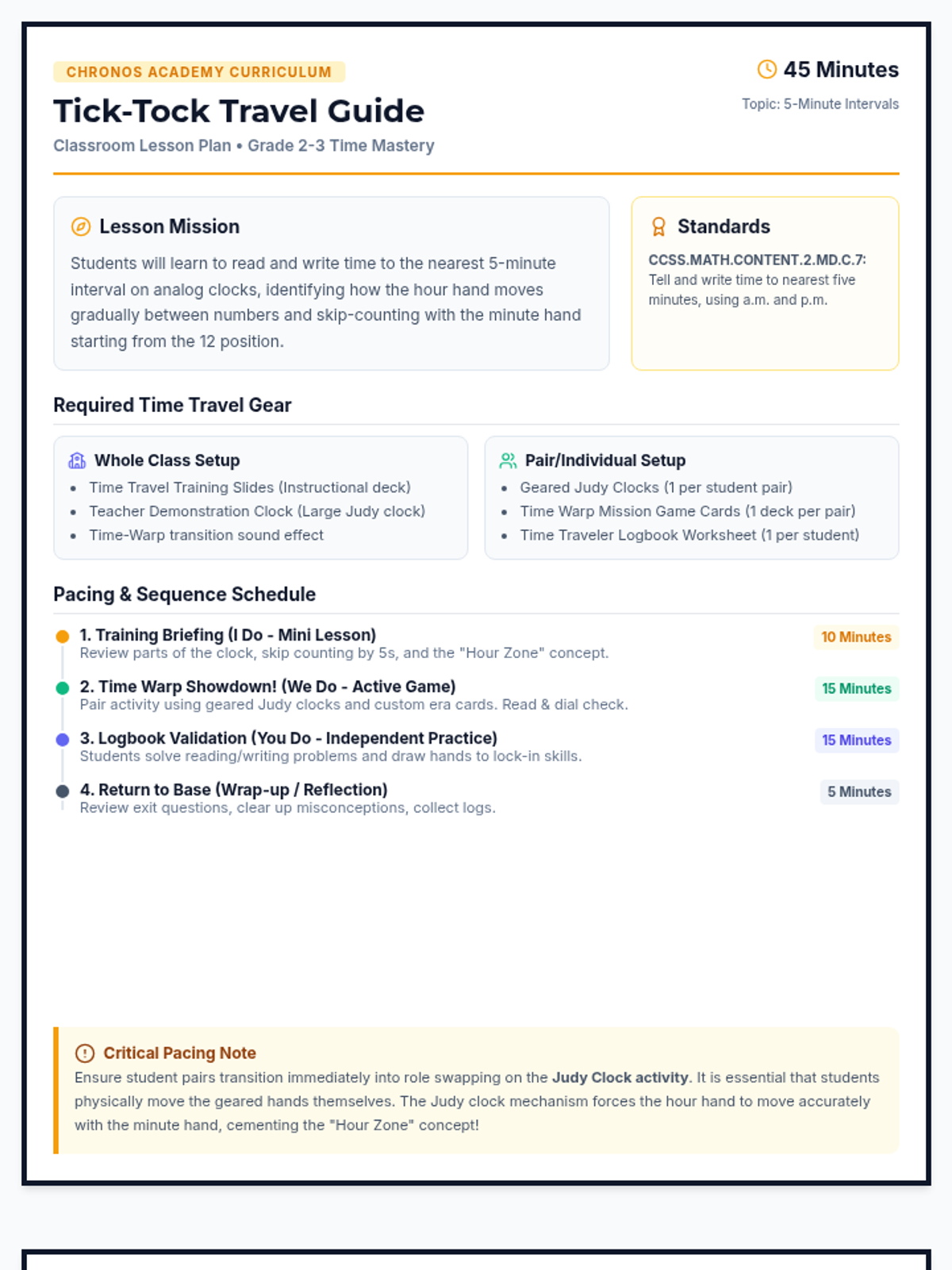
An incredibly detailed 2-page teacher's guide and pacing plan for the 45-minute lesson, offering a facilitation script, differentiation, and misconception traps.
An elegant, retro-futuristic dark-themed 8-slide presentation designed for a 10-minute mini-lesson on reading analog clocks at 5-minute intervals. Perfect for 2nd or 3rd-grade instruction.
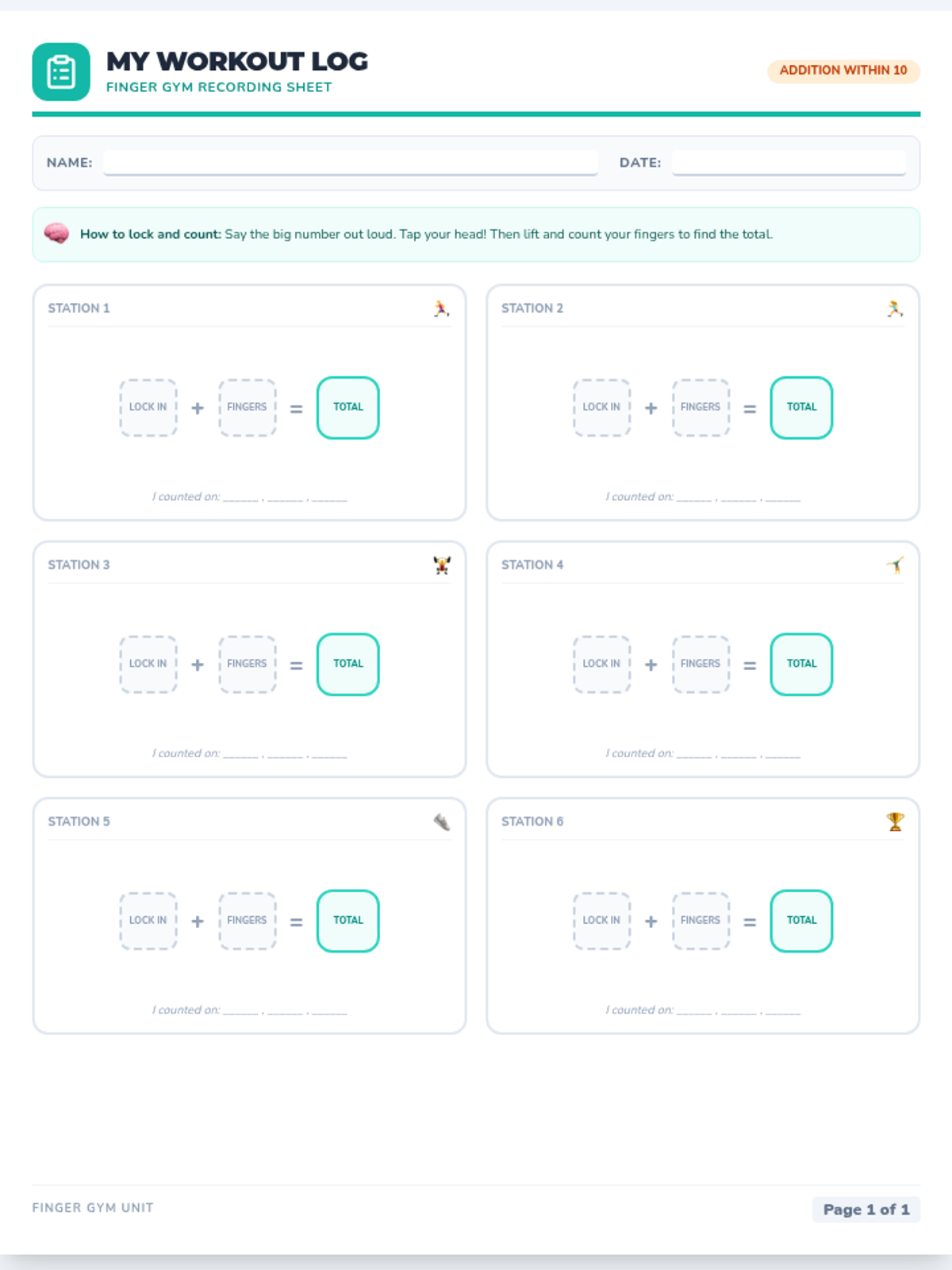
An individual student recording sheet where children write down their equations, draw or write their finger-counts, and record their addition totals within 10.
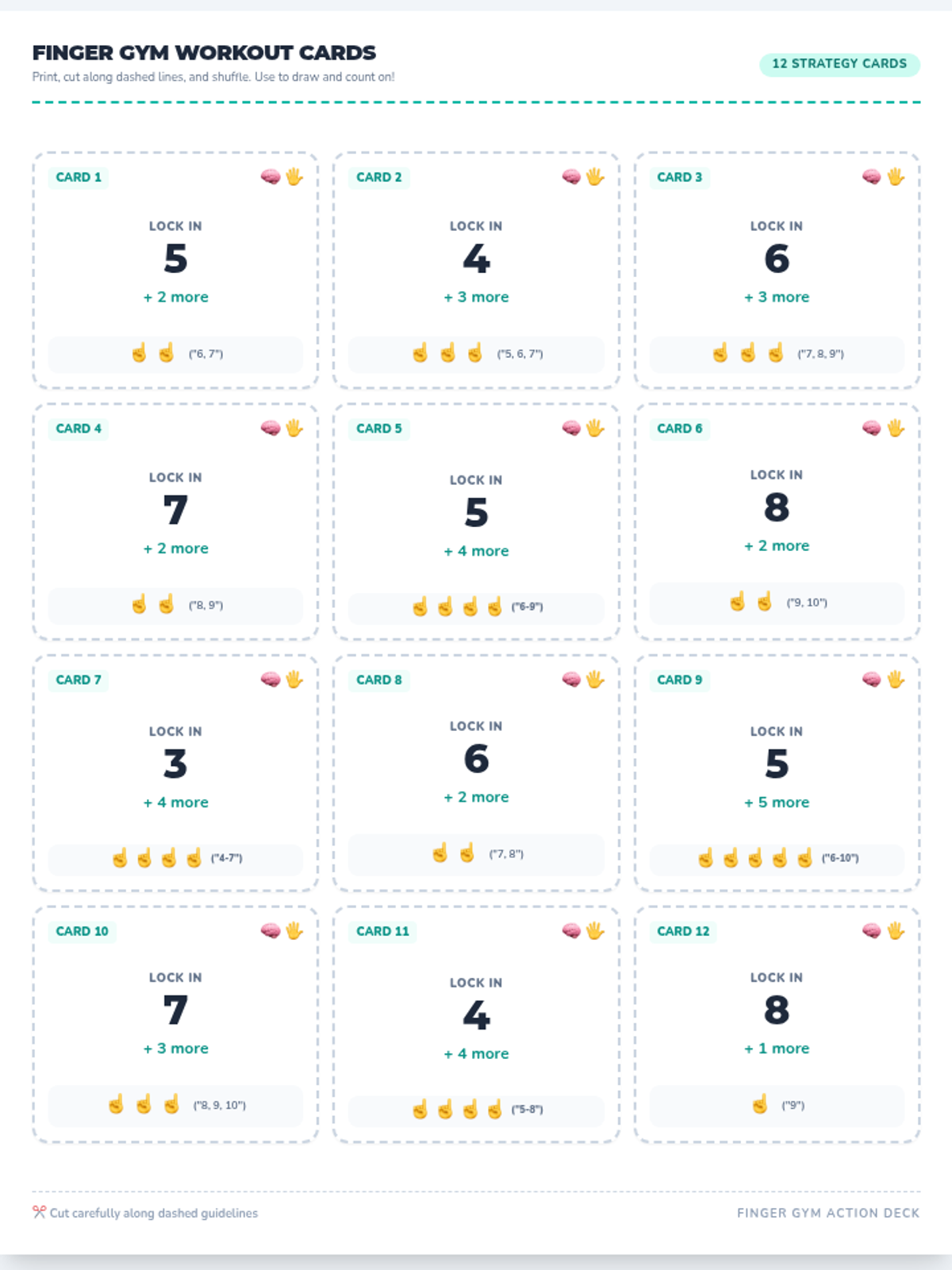
Printable task cards displaying addition equations (e.g., 5 + 2) with a start number and finger icon prompts to guide students in applying the counting-on strategy.
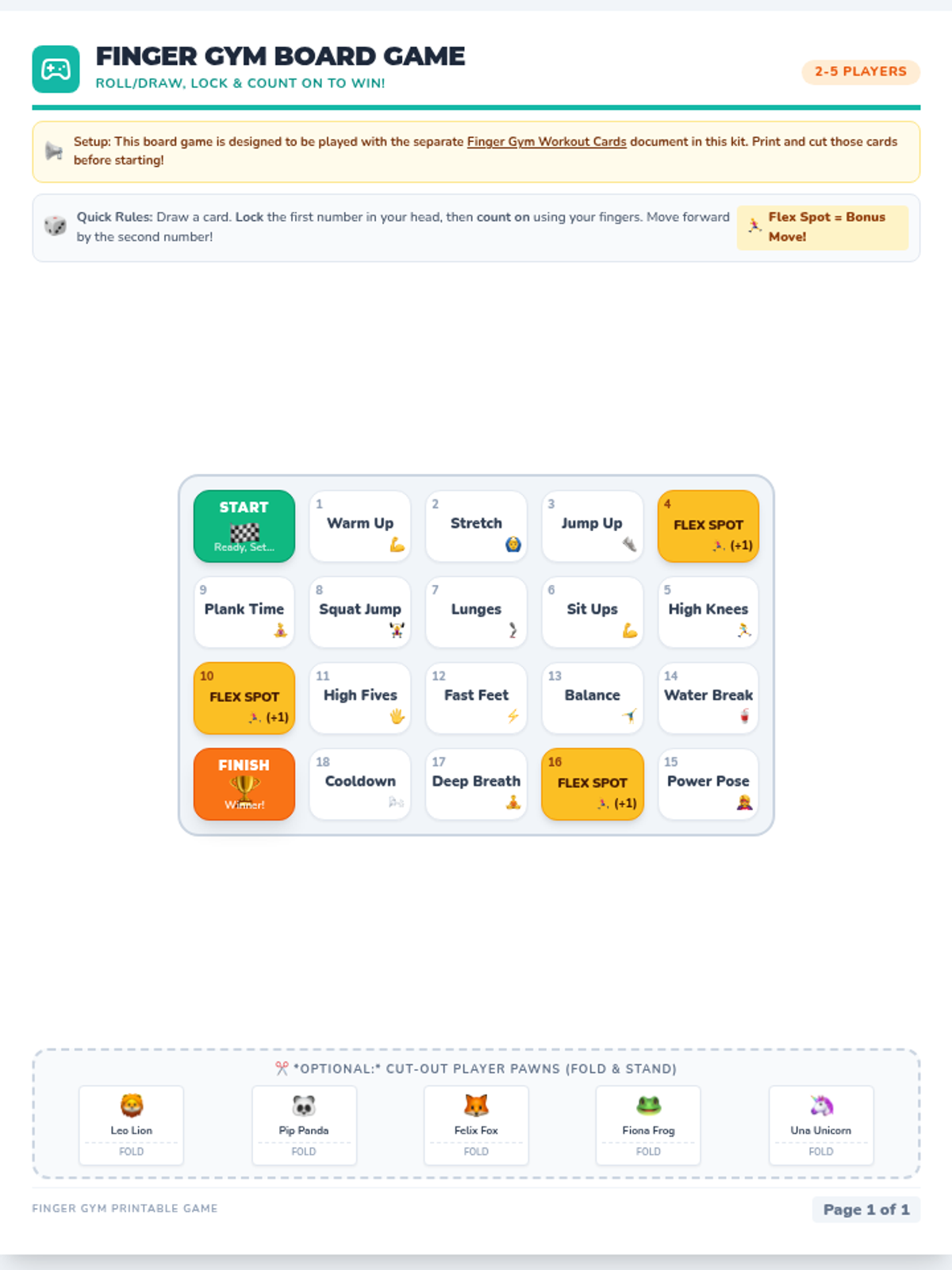
A printable gym-themed board game for up to 5 players. Students navigate a colorful workout track by drawing cards, starting with a number, and 'flexing' their fingers to count on to the total.
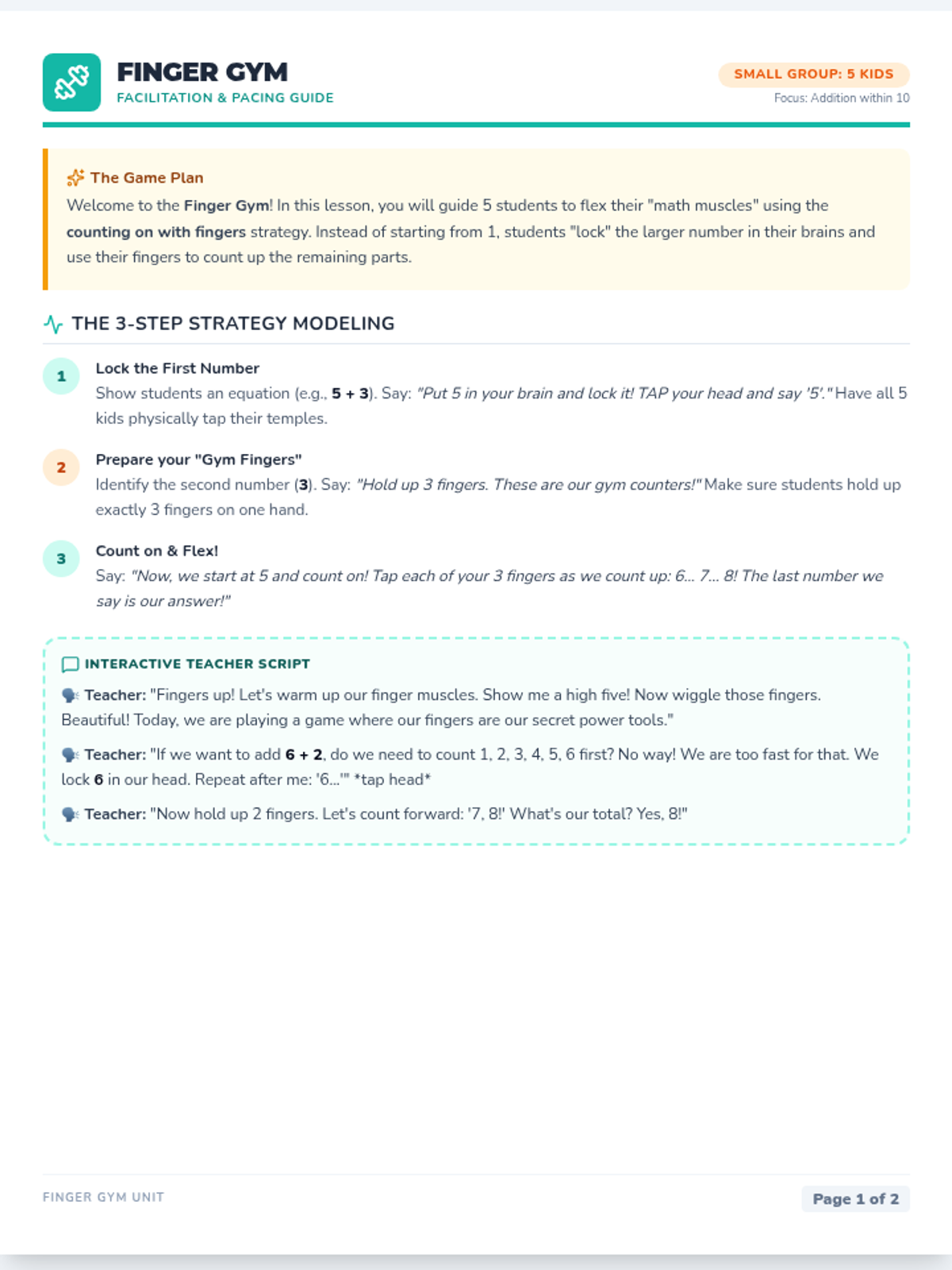
A structured, visual lesson plan and facilitation guide for teaching the "counting on with fingers" addition strategy. Includes modeling scripts, game play instructions, targeted checklist questions, and differentiation strategies.
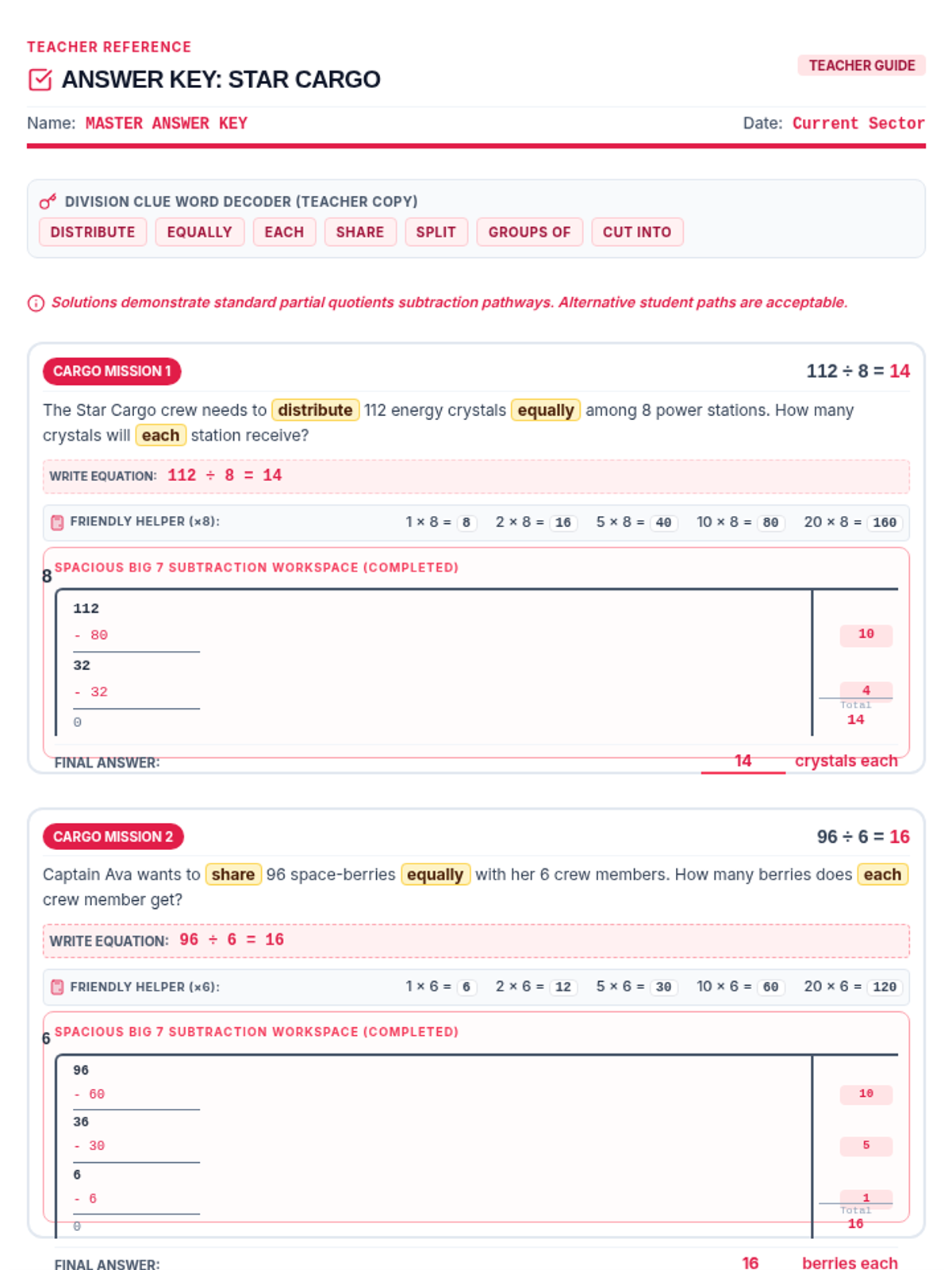
A teacher answer key showing step-by-step partial quotients (Big 7) subtraction pathways and final quotients for all problems in the Star Cargo Division Worksheet.
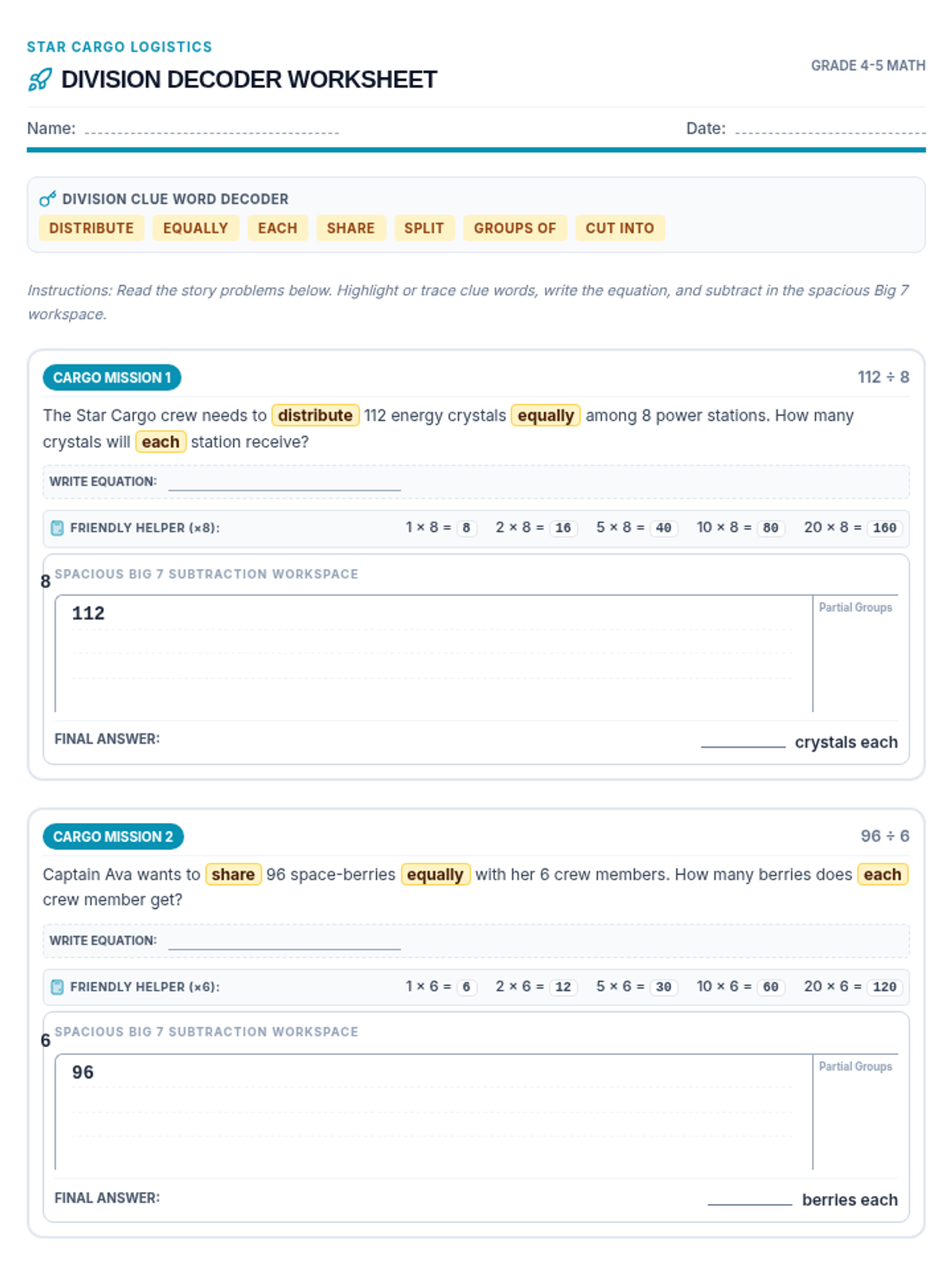
A printable division worksheet in a sci-fi space theme featuring two core division story problems with supportive 'friendly numbers' organizer tables and Big 7 division brackets, followed by six additional independent division practice problems.
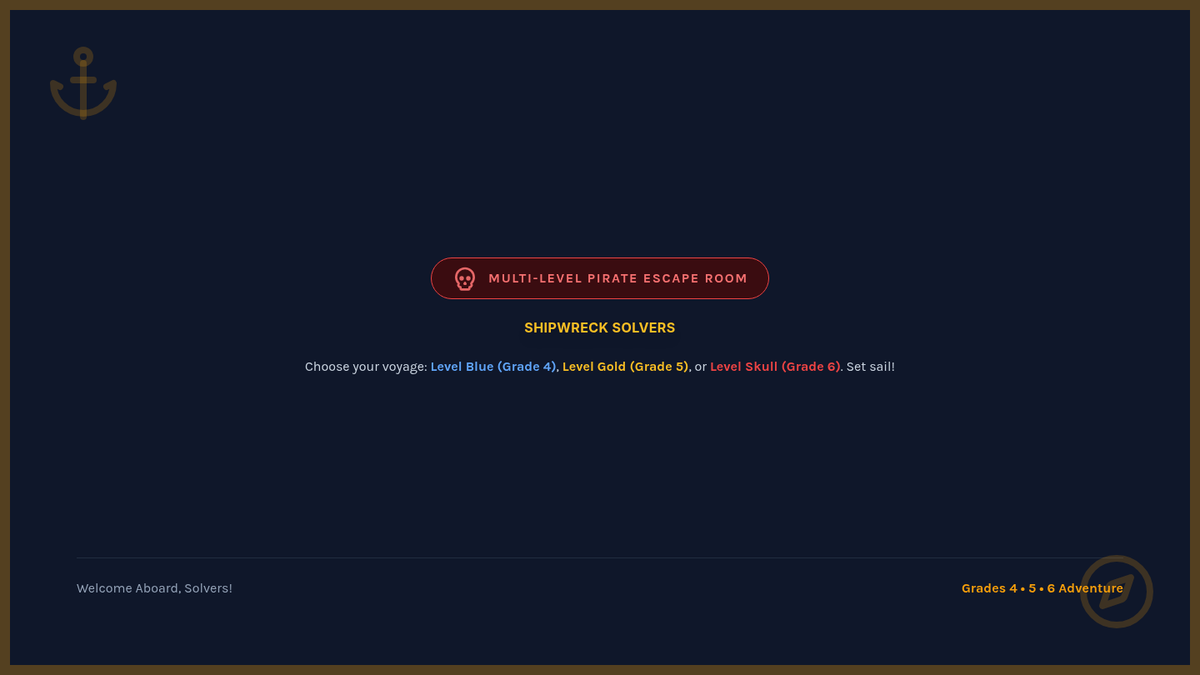
An immersive, pirate-themed presentation slide deck for grades 4-6 to guide teams through the math challenges, explain core skills, and reveal clues. Expanded with a 5th Cannon, 4th Loot Batch, 4th Brass Steering Gear, and 3rd Decimal capacity problem to increase math rigor, leading to the 7-letter master code 'PIRATES'.
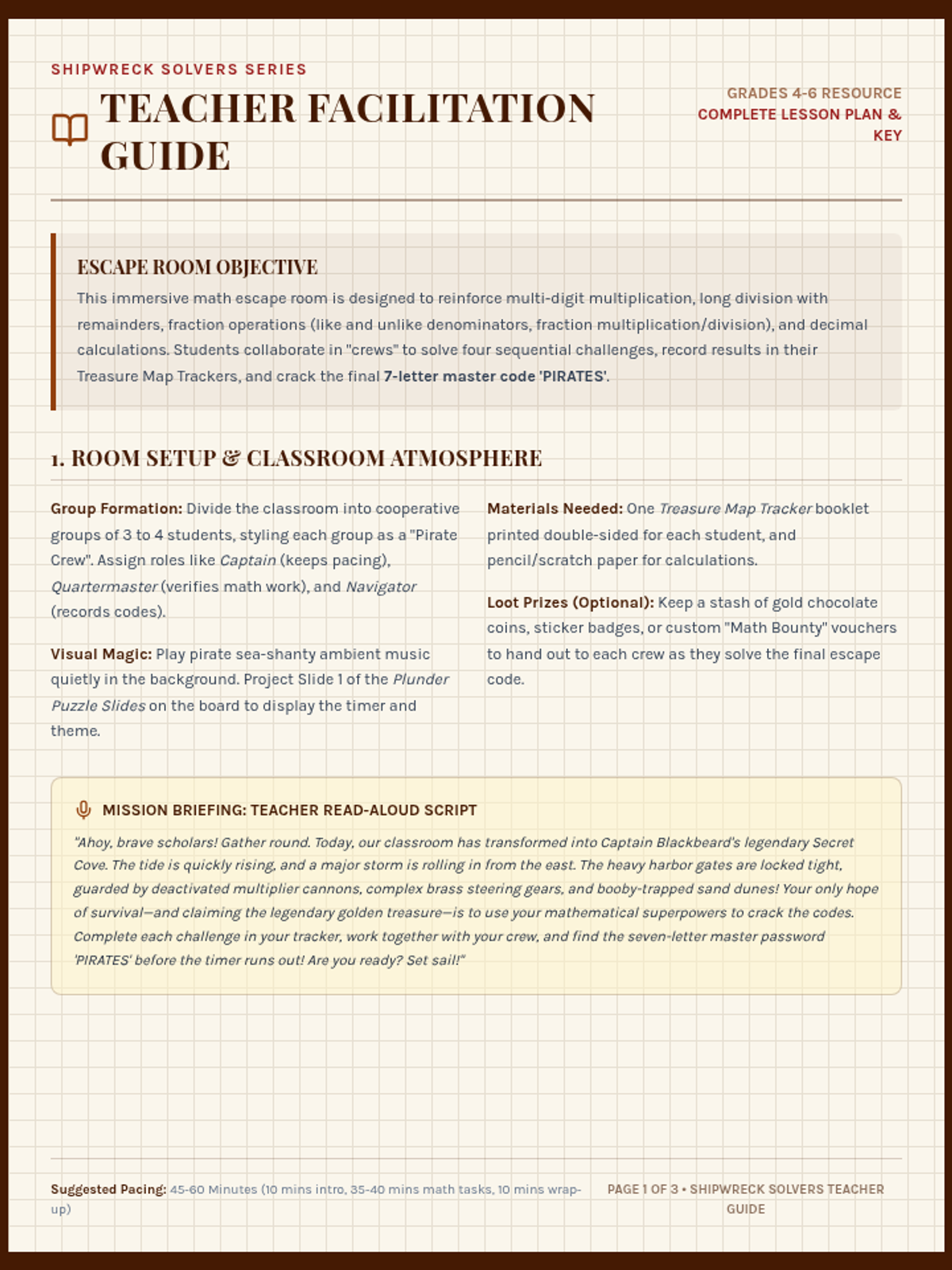
A comprehensive, printable teacher guide for the Shipwreck Solvers Math Escape Room. Includes classroom setup guidelines, a scripted student briefing, and step-by-step mathematical solutions for all puzzles. Expanded with a 5th Cannon, 4th Loot Batch, 4th Brass Steering Gear, and 3rd Decimal water problem to increase math rigor, leading to the 7-letter master code 'PIRATES'.
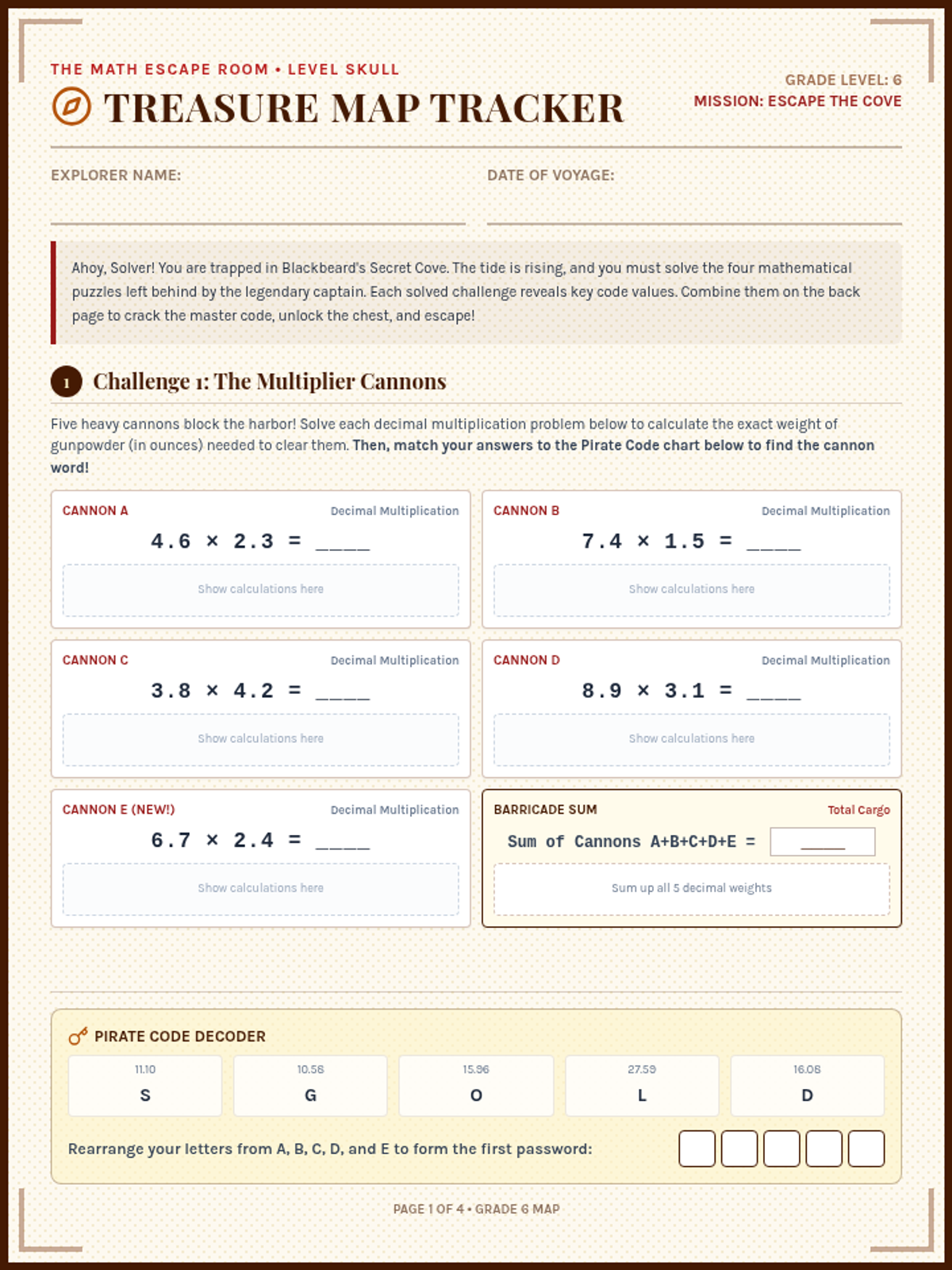
A pirate-themed printable math escape room student workbook for grade 6 (Level Skull). Covers advanced decimal multiplication (3-digit and 4-digit by 2-digit, testing standard algorithm with different decimal places), multi-digit division with remainders, multiplying/dividing fractions, and dividing decimals. Expanded with a 5th Cannon, 4th Division Loot Batch, 4th Brass Steering Gear, and 3rd Decimal water division problem to increase math rigor, leading to the 7-letter master code 'PIRATES'. Uses robust HTML layouts for clear visual fractions.
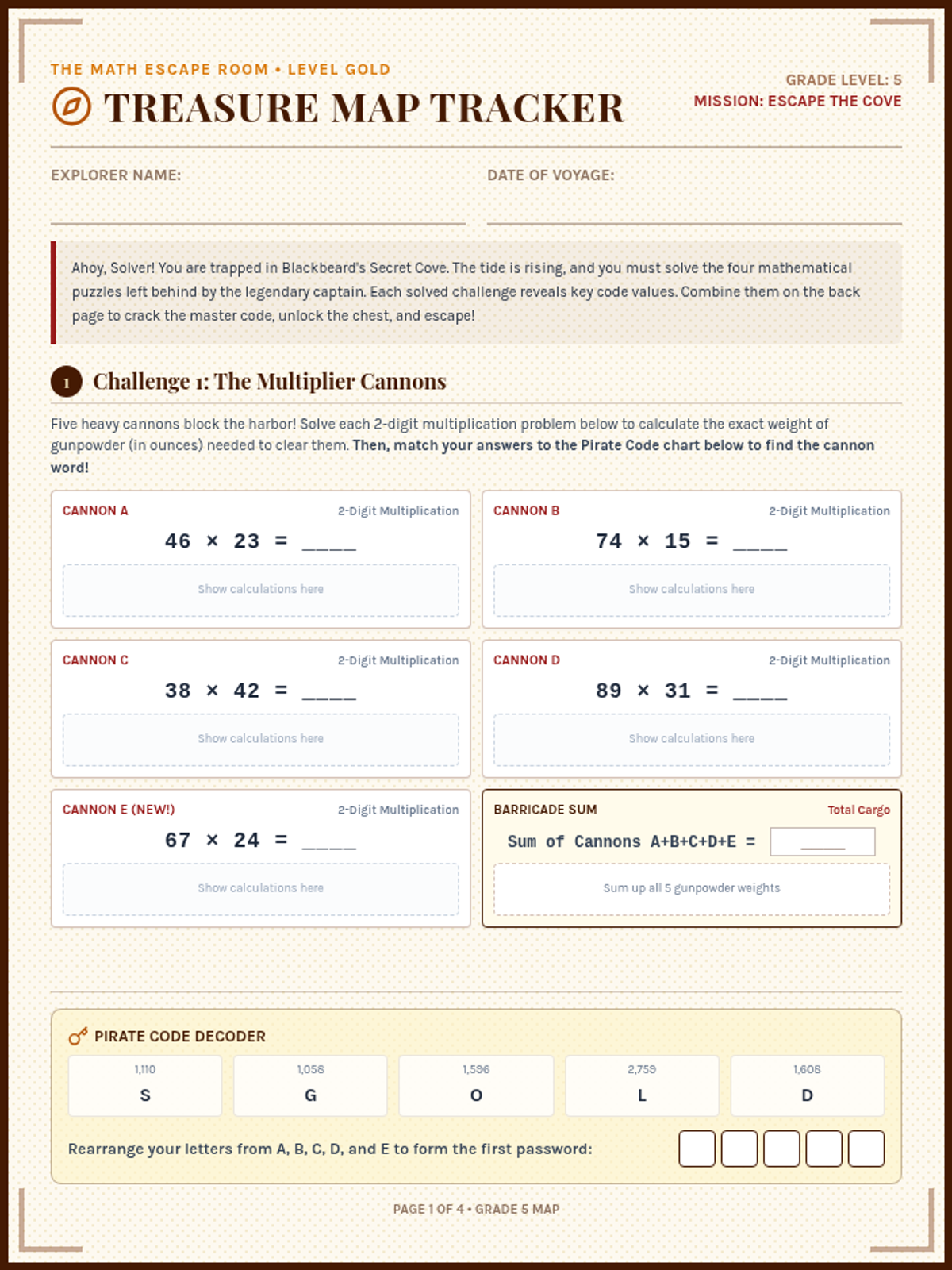
A pirate-themed printable math escape room student workbook for grade 5 (Level Gold). Covers multi-digit multiplication, division with remainders, fraction operations (unlike denominators), and decimal calculations. Expanded with a 5th Cannon, 4th Loot Batch, 4th Brass Steering Gear, and 3rd Decimal water problem to increase math rigor, leading to the 7-letter master code 'PIRATES'. Uses robust HTML layouts for clear visual fractions.
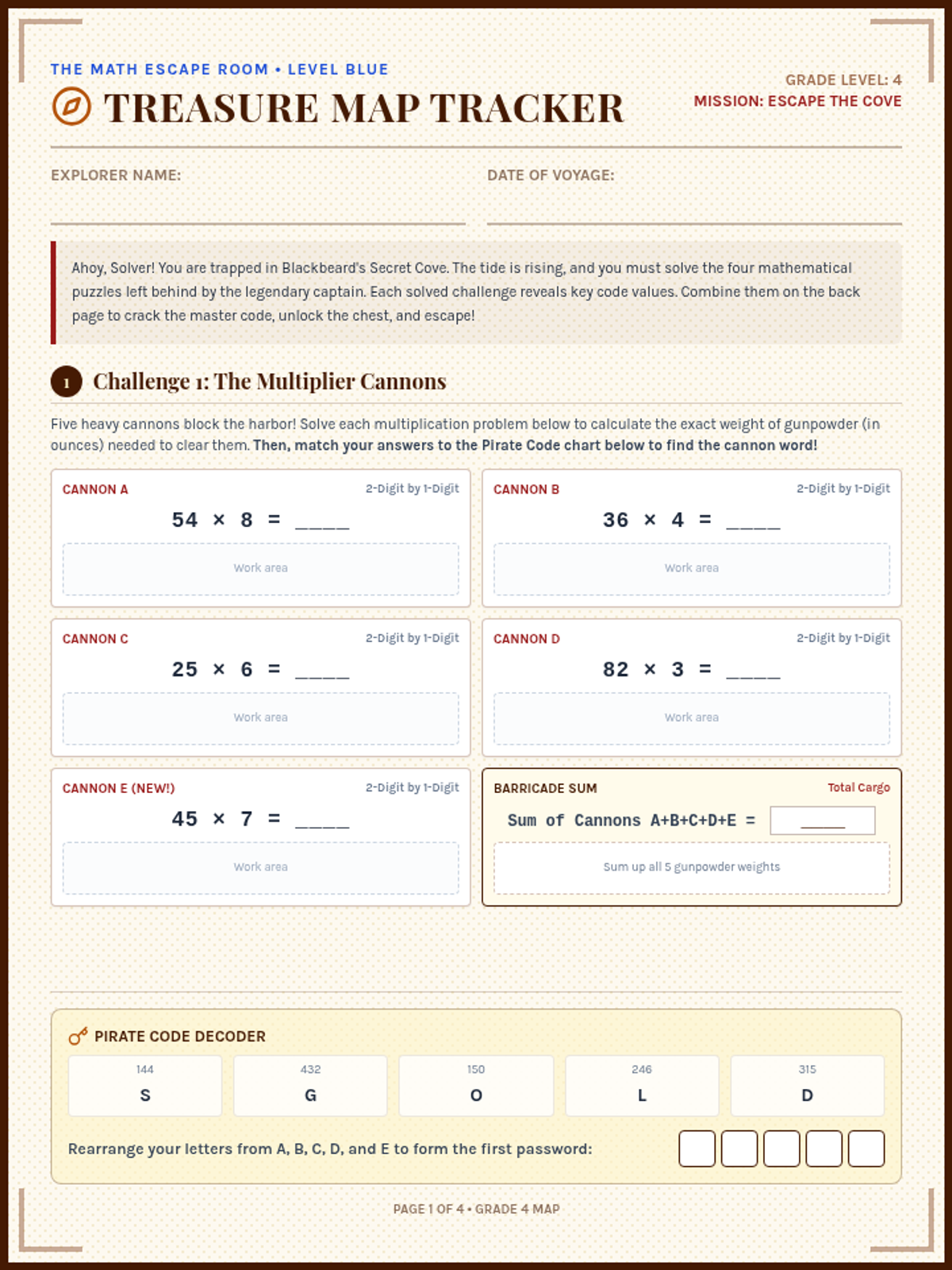
An immersive, pirate-themed Grade 4 math escape room student workbook (Level Blue). Expanded with a 5th Cannon, 4th Division Loot Batch, 4th Brass Steering Gear, and 3rd Decimal capacity problem to increase math rigor, leading to the 7-letter master code 'PIRATES'. Uses robust HTML layouts for clear visual fractions.
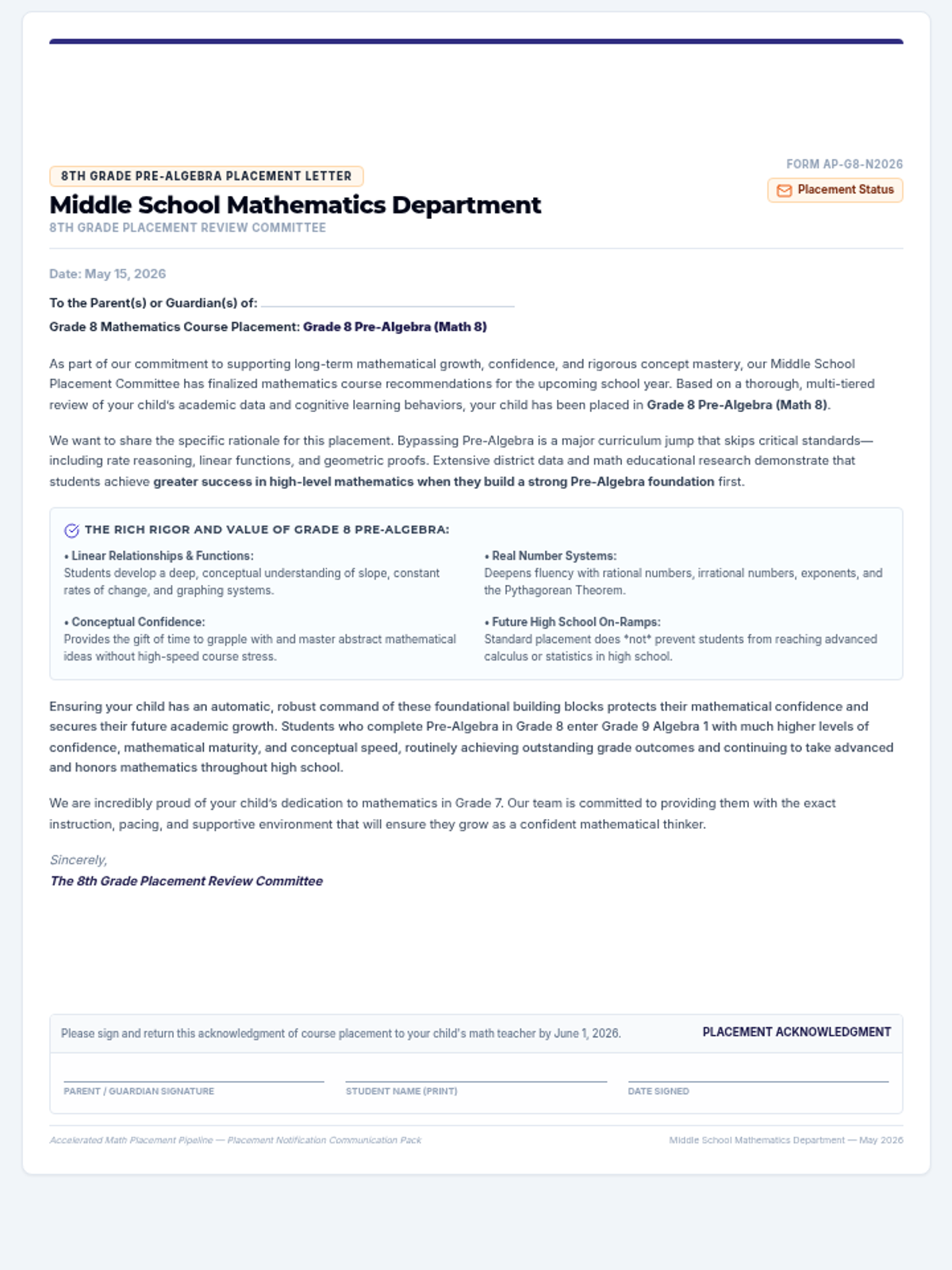
A compassionate and clear 1-page parent-facing communication letter sent home in late spring of Grade 7 to families of students placed in standard Grade 8 Pre-Algebra, explaining the decision objectively, validating their math potential, and highlighting the rigor and value of Pre-Algebra.