A participant handout for Lesson 3 (Pattern Recognition), featuring a single-page layout for the AllWrite Round Robin brainstorm and formative assessment. includes improved writing space and white background for print efficiency.
A comprehensive consolidated participant logbook for the 'CS is the Superpower' sequence. Includes a high-impact cover page, sequence matrix, core content integration map, and all 9 participant logs (Lessons 1-7 plus optional modules). Features a dedicated 'Buggy Cards' page for the Debugging activity and a final notes section for ideation. Optimized for single-page printing per log with improved legibility.
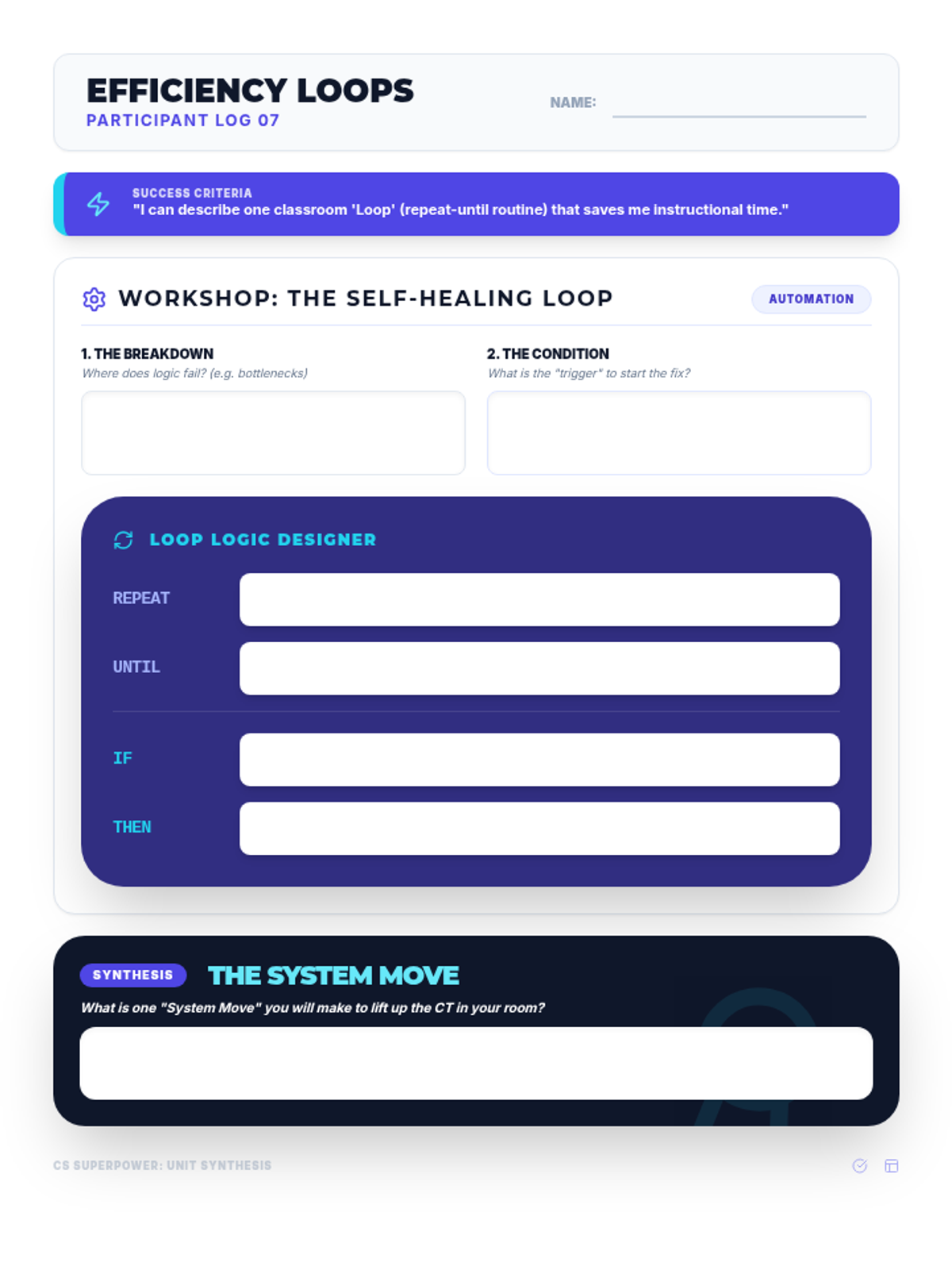
A participant handout for Lesson 7, featuring a visual 'Loop Logic Designer' for Repeat-Until classroom systems and a final synthesis commitment area for the Architect Mindset. Optimized for single-page print layout with white handwriting areas. Includes improved contrast and stacked logic boxes. Includes fix for overlapping layout and footer cutoff.
A 5-slide presentation for Lesson 7, illustrating the concept of Automation and its application in classroom routines through the 'Efficiency Loop' framework. Includes a final synthesis linking all 6 computational thinking pillars.
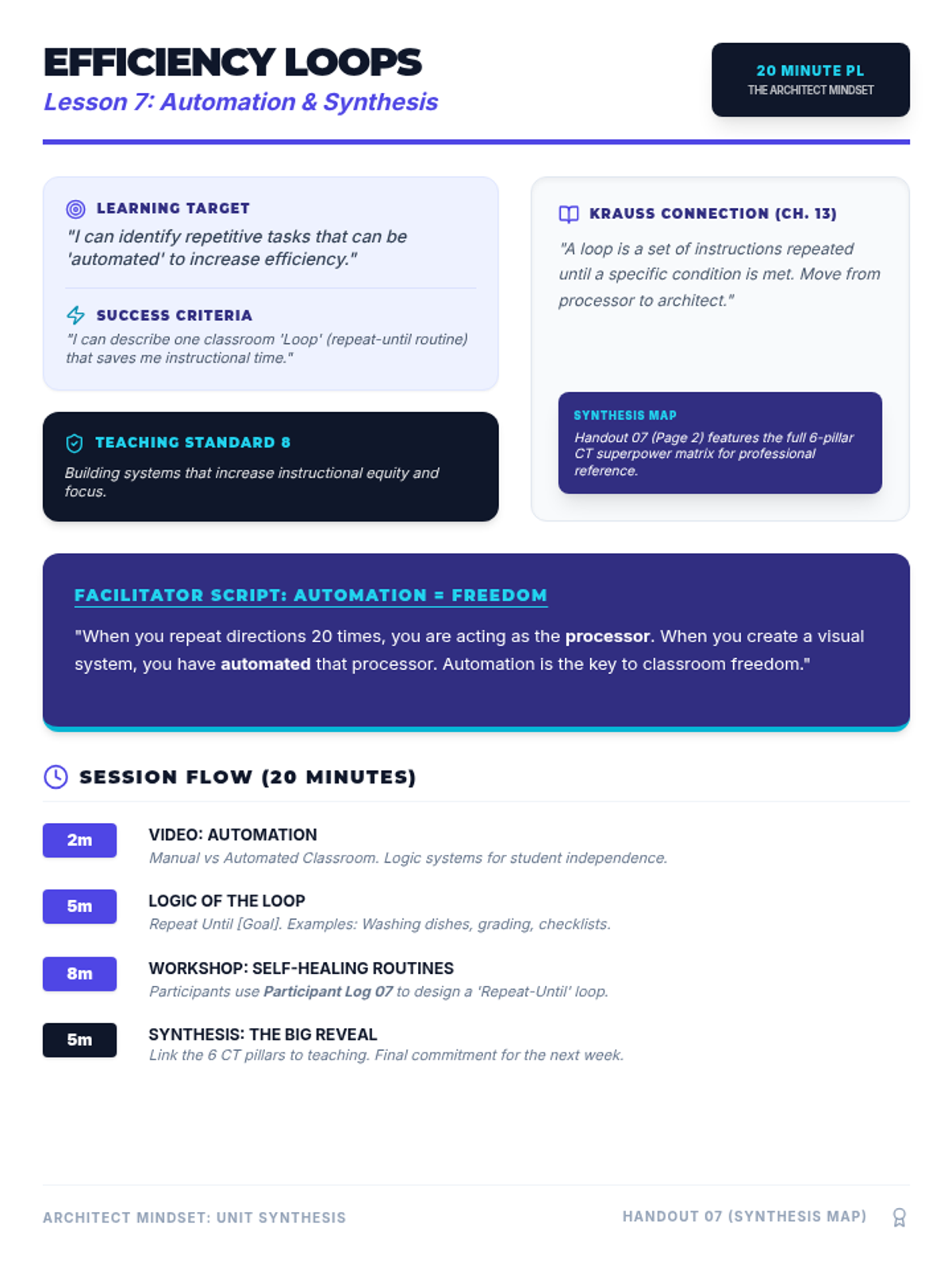
Updated facilitation guide for Lesson 7 (Automation), featuring a detailed 20-minute PL flow, facilitator script, connections to Iowa Teaching Standard 8, and the master handout copy. Includes explicit Success Criteria, Krauss Ch. 13 links, and the final unit synthesis matrix. Includes fix for page 2 header and word spacing.
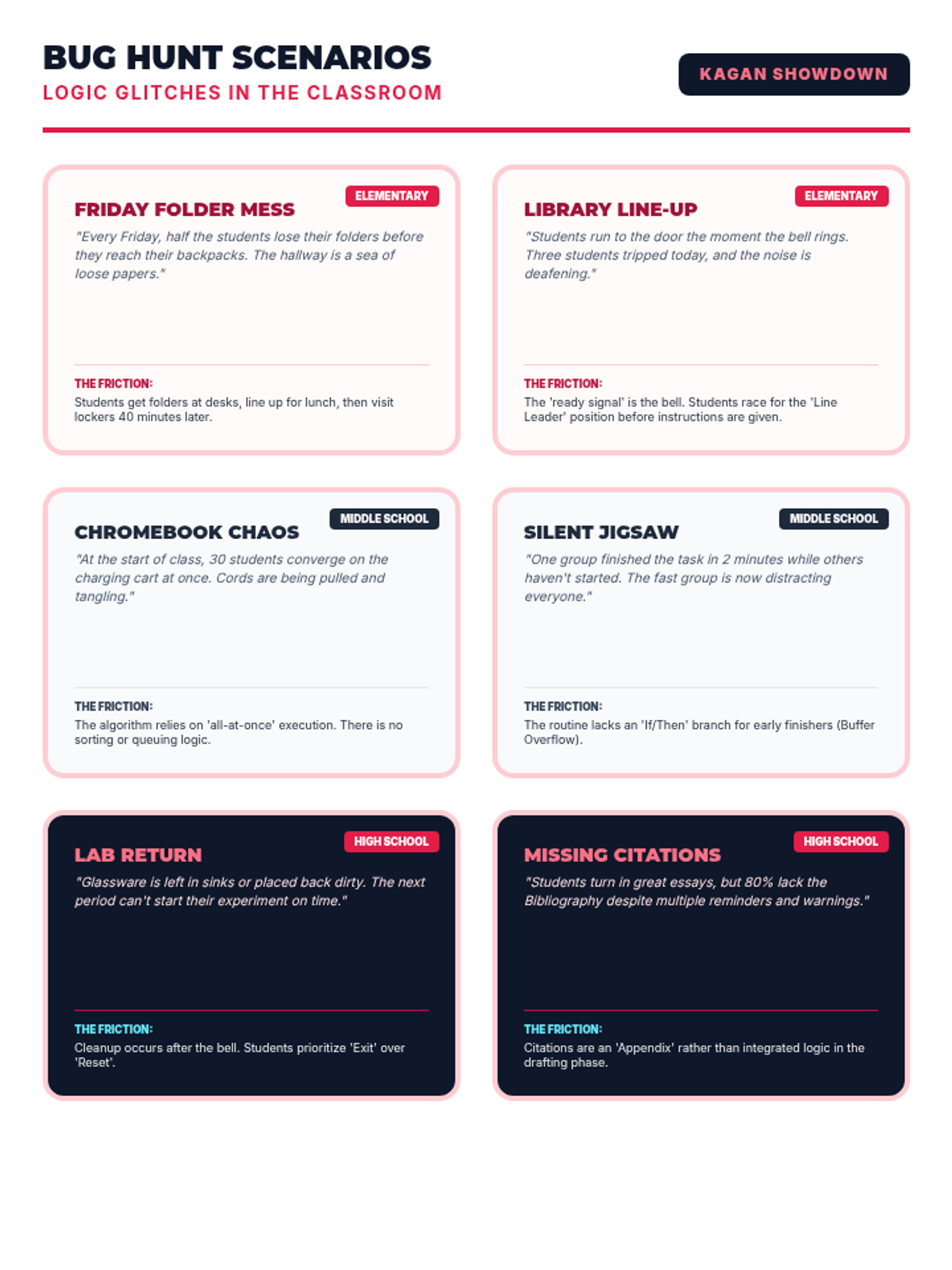
A set of 10 'Buggy Cards' for the Lesson 6 Debugging activity. Scenarios include routine and academic glitches across elementary, middle, and high school levels, designed for use with the Kagan Showdown strategy. Corrected layout and text cutoff issues.
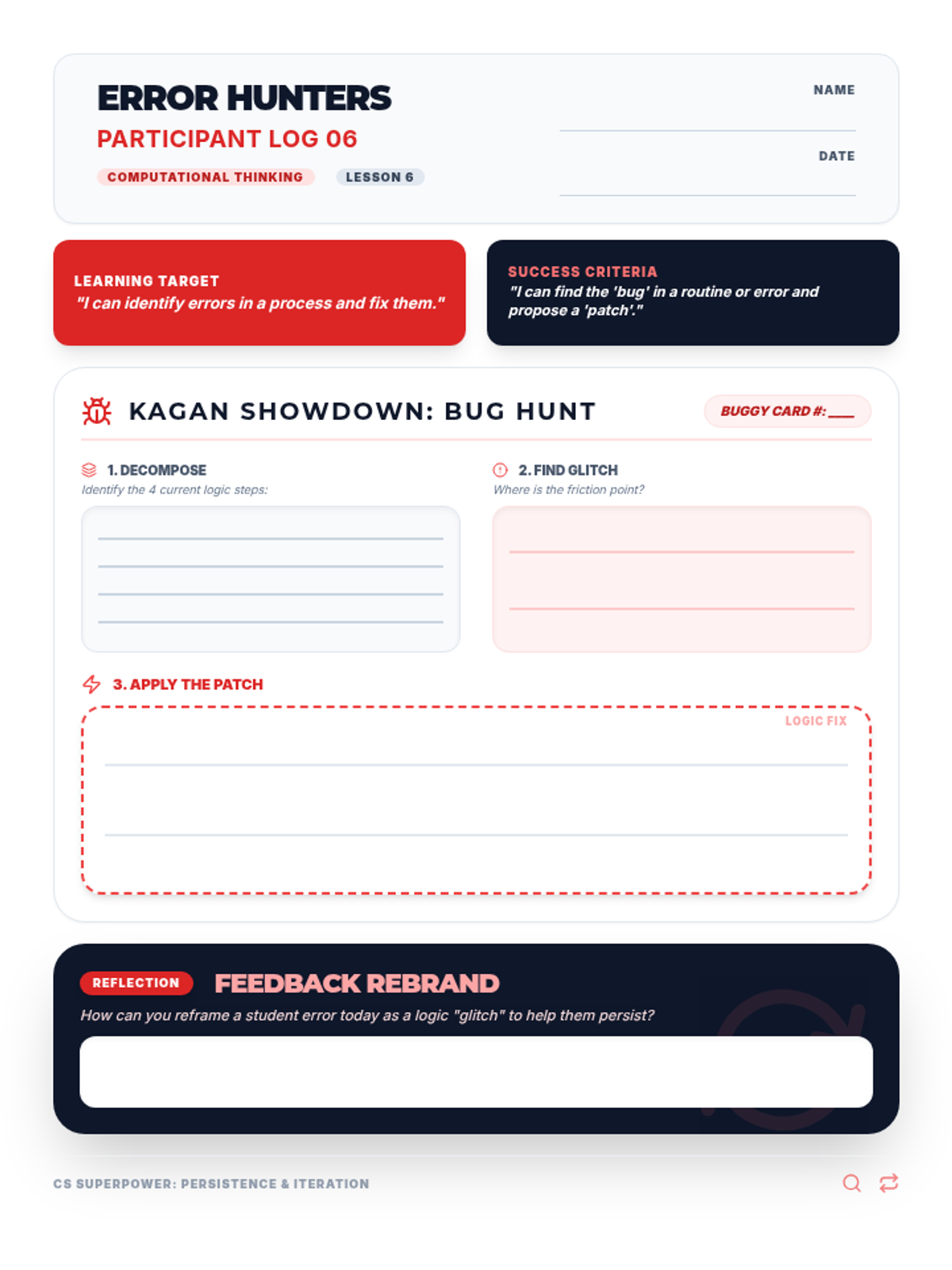
Updated participant handout for Lesson 6 (Debugging), featuring a 'Bug Hunt' sequence editor, a glitch identification area, and space to apply 'patches' to failing routines. Includes a reflective formative assessment for reframing student feedback. Optimized for single-page print layout with improved handwriting space and font tracking. Includes Success Criteria and ruled lines for organized responses.
A 7-slide presentation for Lesson 6 (Debugging), illustrating the 'Red Pen Rebrand' and 'Persistence Loop.' Features elementary and secondary modeling with high-contrast visuals, instructions for the Kagan Showdown 'Bug Hunt,' 10 scenario-based bug cards for various grade levels, and a final reflection on reframing student feedback as 'bug reports.' Includes explicit Learning Targets and Success Criteria with fixed word spacing.
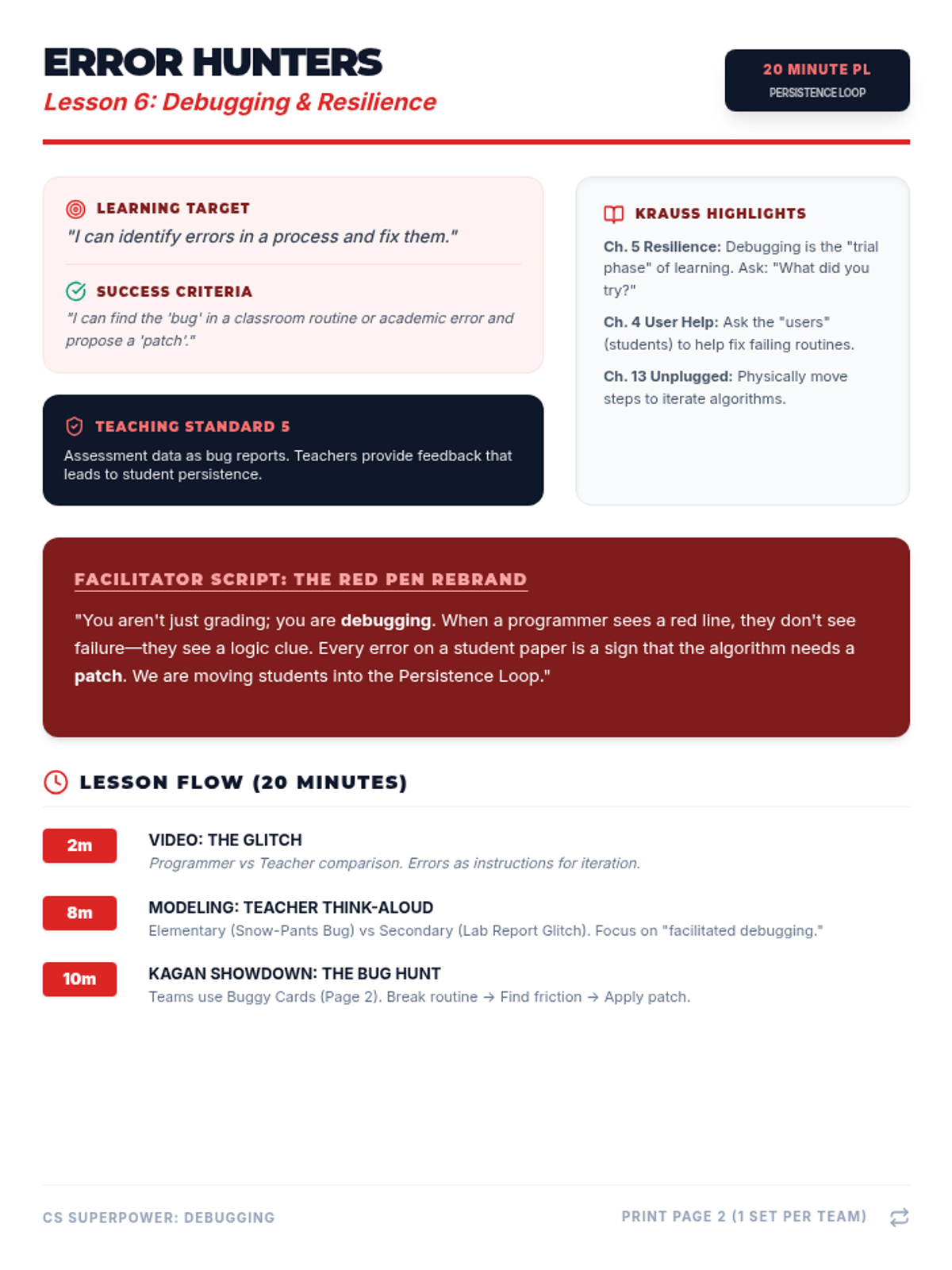
Updated facilitation guide and master handout for Lesson 6 (Debugging). Features the 'Red Pen Rebrand' concept, elementary/secondary debugging models, and a Kagan Showdown 'Bug Hunt' activity aligned to Krauss Ch. 4, 5, and 13. includes 10 unique 'Buggy Cards' with larger 'patch' writing areas for common school friction points. Includes fix for flow spacing and explicit Success Criteria.
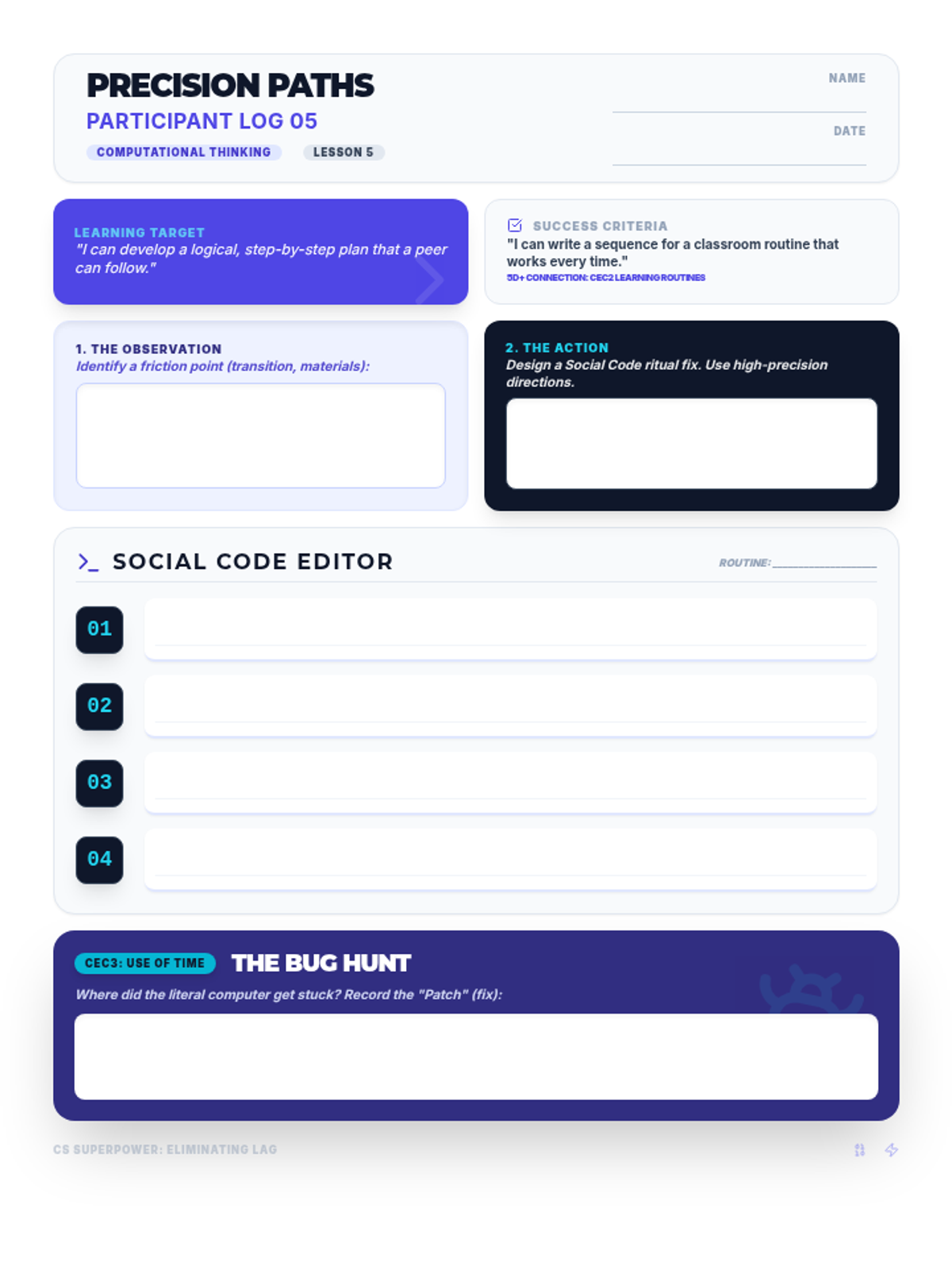
Updated participant handout for Lesson 5 (Algorithmic Thinking), featuring the 'Observation vs Action' framework, a Sequence Editor for high-precision Social Code, and a 'Bug Hunt' section aligned to 5D+ CEC3 (Use of Time). Includes the specific success criteria regarding sequence writing. Includes improved handwriting guidance and single-page layout.
Updated 5-slide presentation for Lesson 5 (Algorithmic Thinking). Features the 'CT Bridge' (Observation vs Action), a side-by-side comparison of vagueness vs precision, and explicit 5D+ CEC3 (Use of Time) connections. includes Kagan Stand-N-Share instructions and references for the 'Exact Instructions' logic challenge.
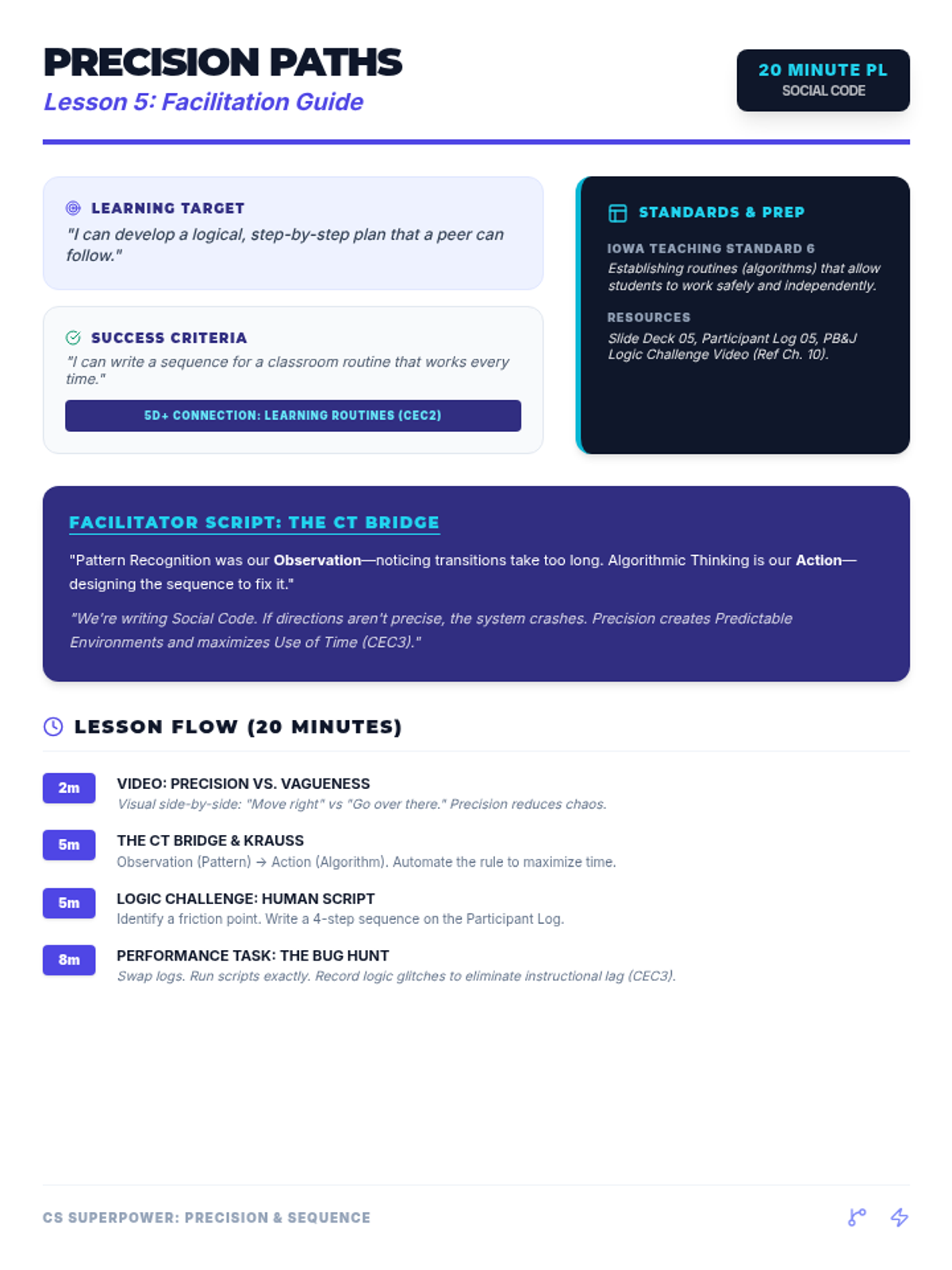
Updated facilitation guide and master handout for Lesson 5 (Algorithmic Thinking). Features the 'CT Bridge' concept (Observation vs Action), Krauss automation links, and explicit 5D+ CEC2/CEC3 alignment. includes the specific success criteria regarding sequence writing. includes minor fixes for script punctuation and master handout layout consistency.
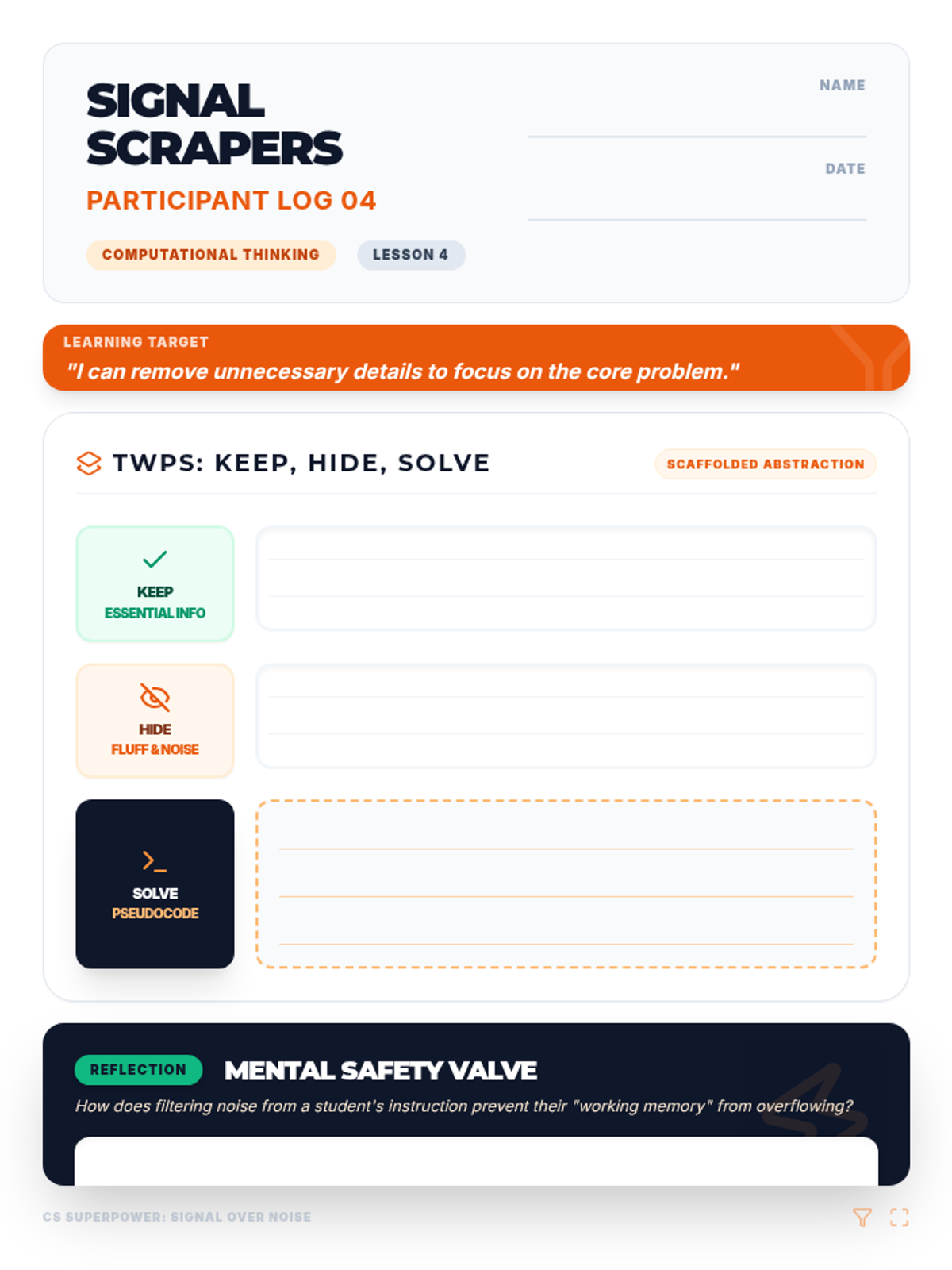
A participant handout for Lesson 4 (Abstraction), featuring the 'Keep, Hide, Solve' activity scaffold and space for reflections on Cognitive Load Theory.
A 5-slide presentation for Lesson 4 (Abstraction), explaining Cognitive Load Theory and the 'Cost' of Detail, with instructions for the 'Keep, Hide, Solve' TWPS activity.