Lenny LearningLenny
Create
Explore
Workspace
LoginSign up
MathEnglish Language ArtsScience & EngineeringSocial StudiesGlobal LanguagesHealth & Physical EducationSpecial EducationCounseling & Life SkillsArts & CreativityESL
Lenny LearningLenny
Lenny Learning
About
Training
Pricing
Support
Contact
© 2026 Lenny Learning Inc.
Science & EngineeringLife ScienceLiving ThingsAnimalsPlantsBody SystemsTraitsAdaptationsCellsEcosystemsHeredityGenes to TraitsCell DivisionPhysicsComparing MaterialsShapes and PropertiesMagnetsMagnetismLightSoundLight and SoundMatterStates of MatterChanges of StateMixturesPhysical and Chemical ChangeHeating and CoolingHeat and Thermal EnergyEnergyForce and MotionElectrical CircuitsAtoms and MoleculesPeriodic TableMotion in One DimensionMotion in Two DimensionsScalars and VectorsForces and Laws of MotionCircular Motion and GravityMomentum and ImpulseWork, Energy, and PowerWavesElectromagnetic WavesGeometric OpticsElectricity and MagnetismSimple Harmonic MotionThermodynamicsNuclear PhysicsEarth Science & AstronomyWeatherWater CycleRocks and MineralsFossilsEarth's FeaturesEarth's ResourcesEarth's StructureWeather and ClimateEarth EventsFossils and Geologic TimePlate TectonicsHuman ImpactsAstronomyChemistryUnits and MeasurementAtomic StructurePeriodic TrendsChemical BondingNomenclatureMolecular StructureIntermolecular ForcesThe MoleStoichiometryProperties of GasesSolutionsChemical ReactionsBalancing EquationsEnergy ChangesRates of ReactionsEquilibriumAcids and BasesQuantum ModelBiologyClassificationCell StructureThe Chemistry of LifeBiomoleculesCellular TransportCell EnergyCell Growth and DivisionDNAProtein SynthesisMeiosis and Sexual ReproductionPatterns of InheritanceMulticellular OrganismsEvolutionEcologyBiodiversityComputer ScienceAlgorithms and Computational ThinkingProgramming LanguagesComputing SystemsNetworks and InternetData AnalysisCybersecurityAI and Machine LearningSoftware Design and DevelopmentBlockchainEngineering & AIDesigning ExperimentsEngineering PracticesDesign ThinkingEngineering Design ProcessMechanical EngineeringElectrical EngineeringMaterials and StructuresCAD and 3D DesignRoboticsArtificial Intelligence BasicsVibe CodingMachine LearningAI Ethics and SocietySystems ThinkingEntrepreneurship & InnovationEntrepreneurial MindsetBusiness Idea DevelopmentBusiness Plan BasicsMarketing & Customer DiscoveryFinancial Management for Startups

Chemistry

SequencesLessonsMaterialsVideos
  1. Science & Engineering

Chemistry

SequencesLessonsMaterialsVideos

Atomic structure, quantum models, and periodic trends establish the fundamental nature of matter. Stoichiometry, gas properties, and equilibrium constants facilitate quantitative analysis of chemical reactions and molecular interactions.

Units and MeasurementStandardized SI and customary units, conversion techniques, and precision in data collection. Equips students with dimensional analysis skills and the ability to use measurement tools accurately.
Properties of GasesKinetic molecular theory and the physical relationships between pressure, volume, and temperature. Applies gas laws to predict molecular behavior and calculate changes in state across varying conditions.
Balancing EquationsFundamental techniques for applying the law of conservation of mass to chemical reactions. Strengthens ability to adjust coefficients while identifying reactants and products in stoichiometric calculations.
Energy ChangesExothermic and endothermic reactions, enthalpy changes, and the law of conservation of energy. Examines bond energies and calorimetry to quantify heat transfer in chemical processes.
Sequence
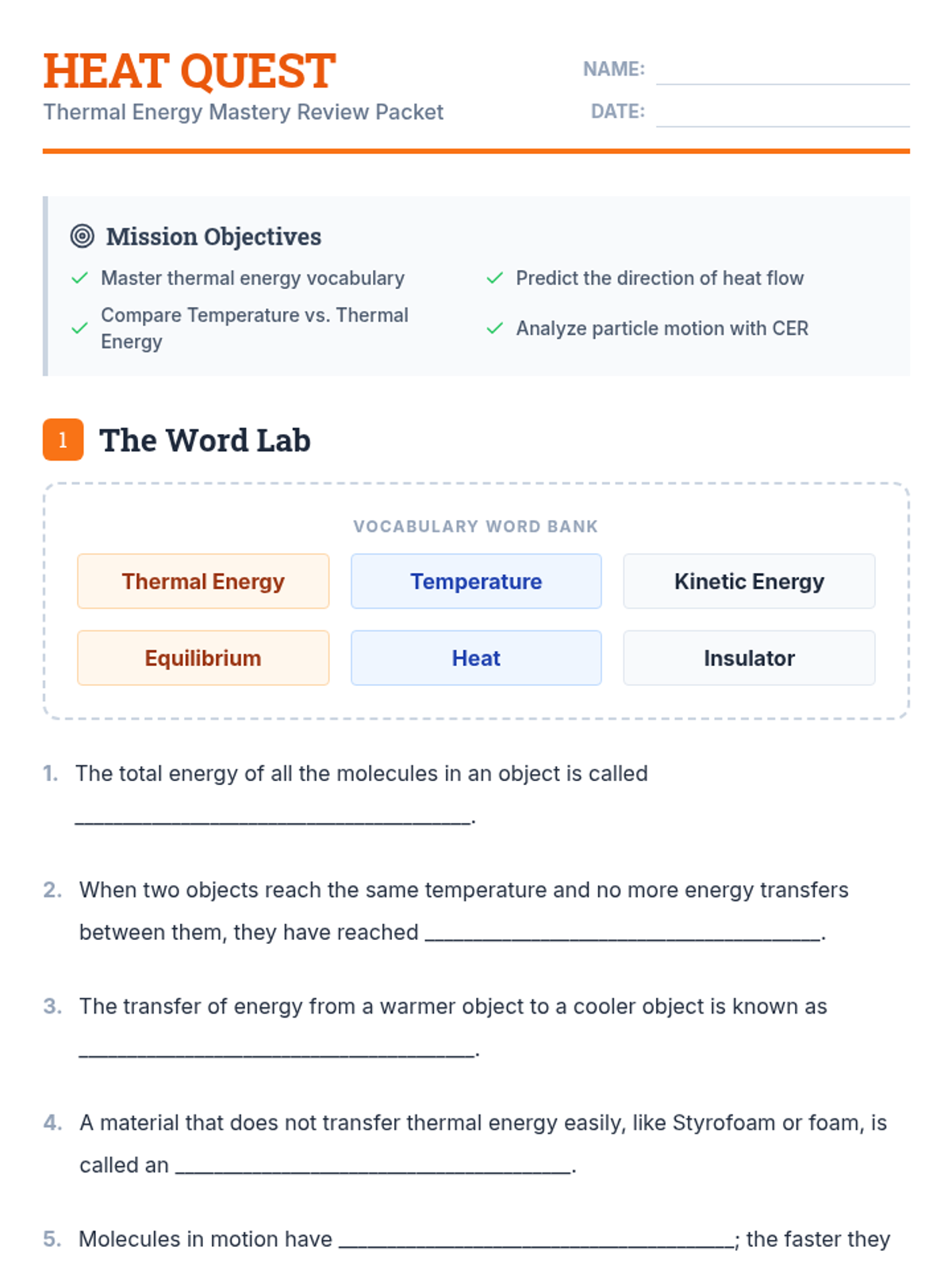
Heat Quest Review Packet
Heat Quest Slides

Thermal Energy Mastery Review

A comprehensive two-day review sequence covering thermal energy, heat transfer, temperature vs. thermal energy, and particle motion, culminating in a CER practice and exit ticket.

RM

Rae Mailly

Science Teacher
2/24
Sequence
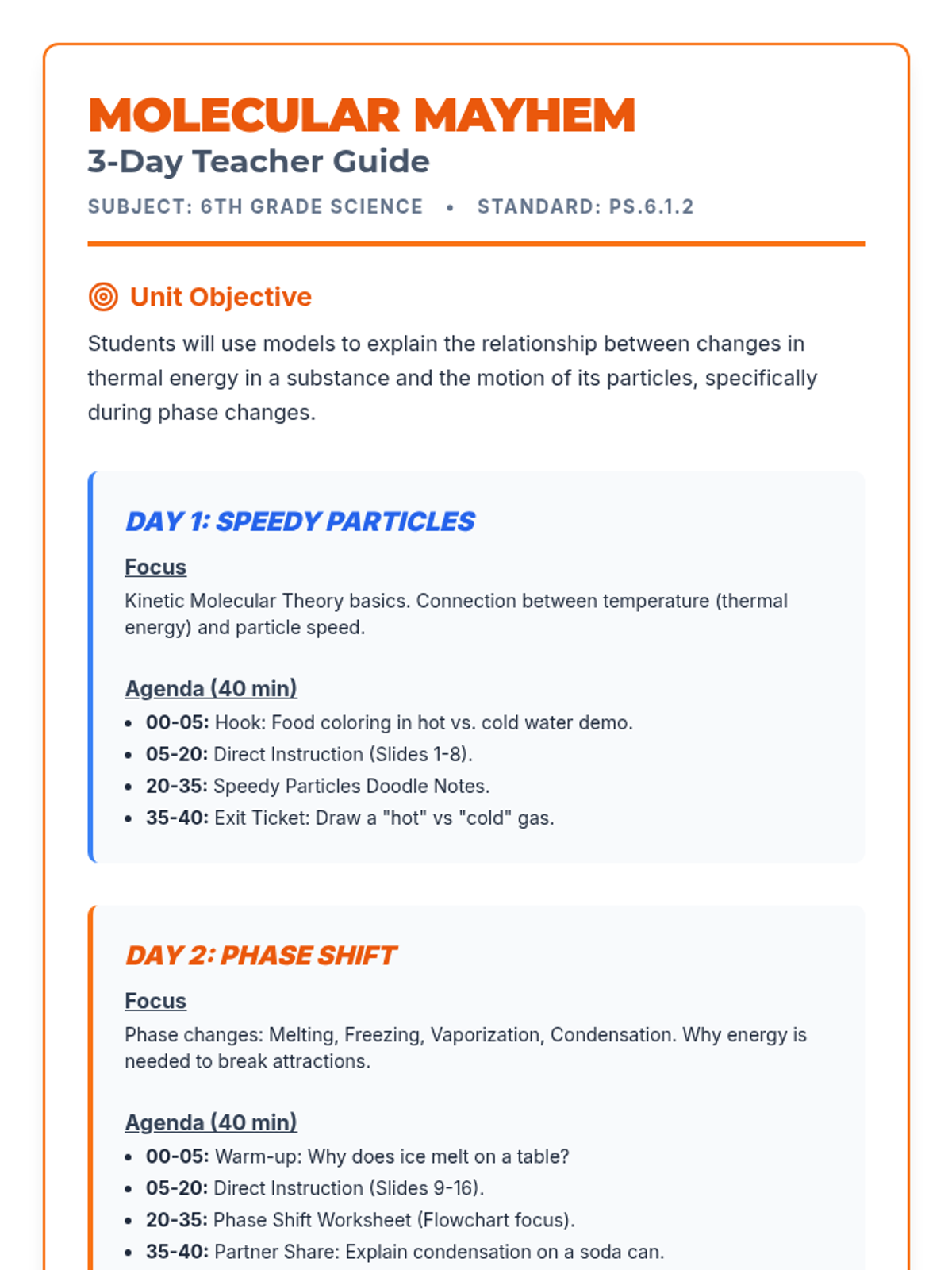
Molecular Mayhem Teacher Guide
Molecular Mayhem Slides Unit
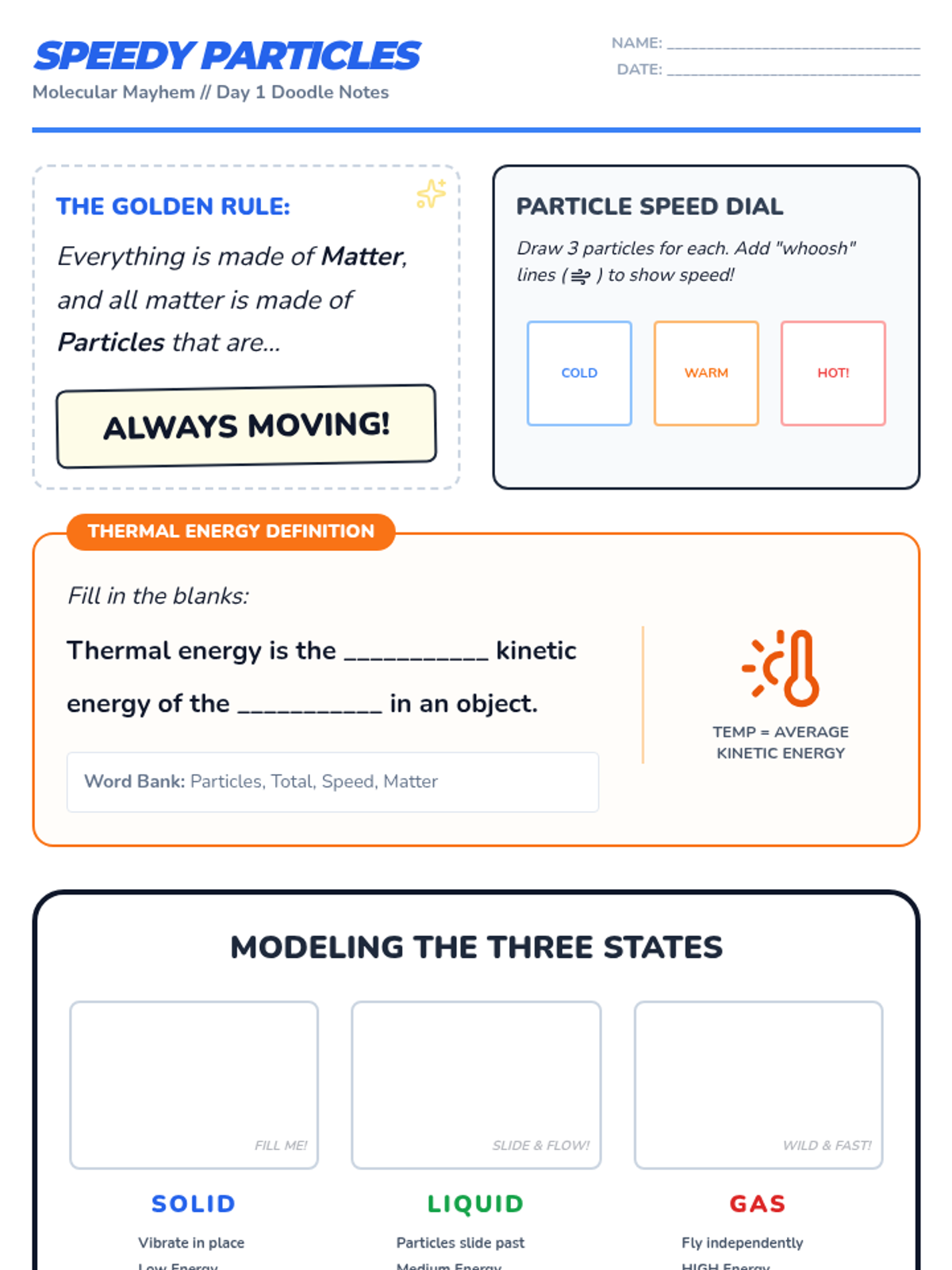
Speedy Particles Doodle Notes

Molecular Mayhem

A 3-day exploration of thermal energy, particle motion, and phase changes. Students use models to understand how adding or removing energy transforms substances from solids to liquids to gases.

KM

Katlyn Makatura

Science Teacher
2/24
Sequence
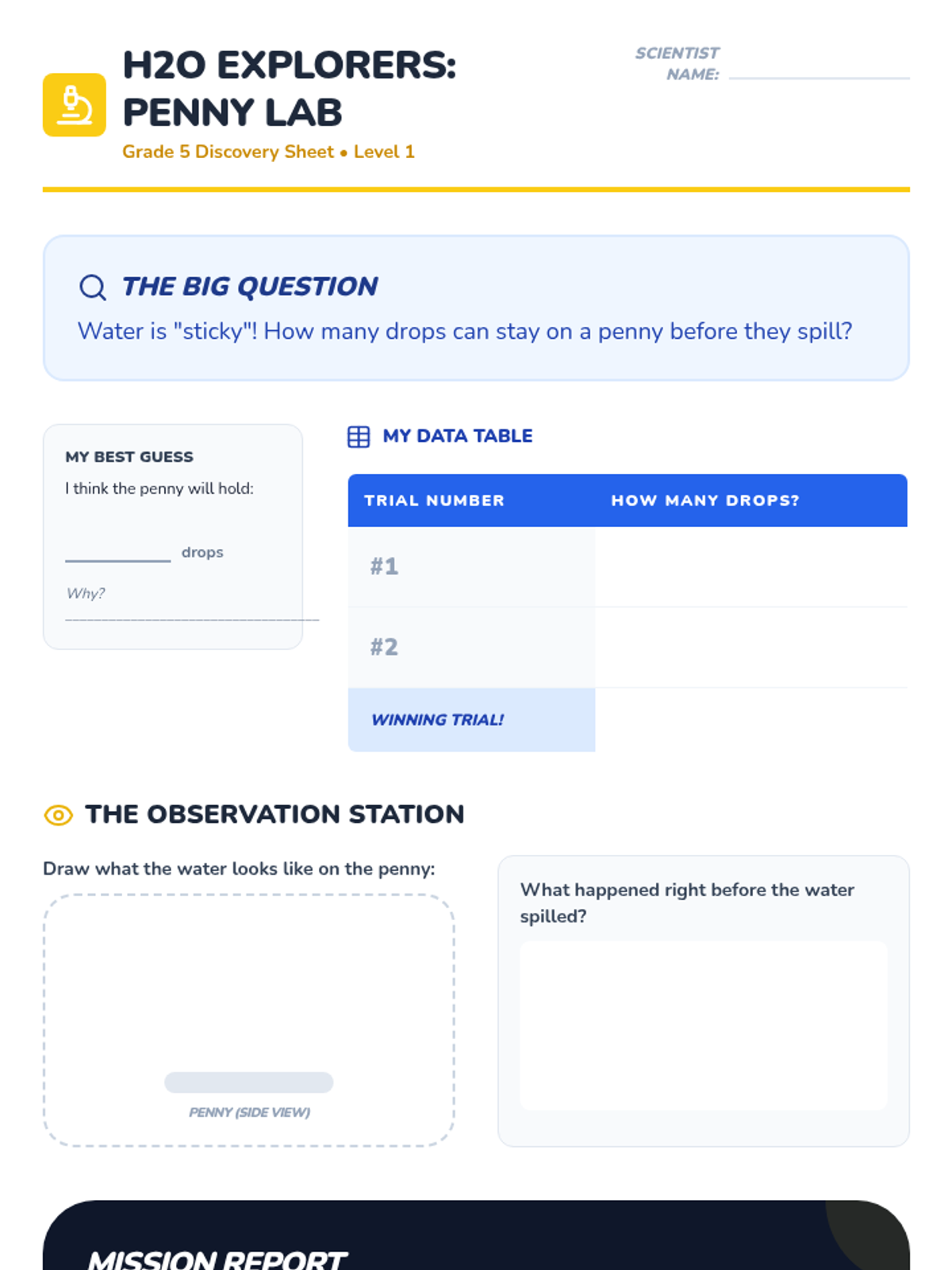
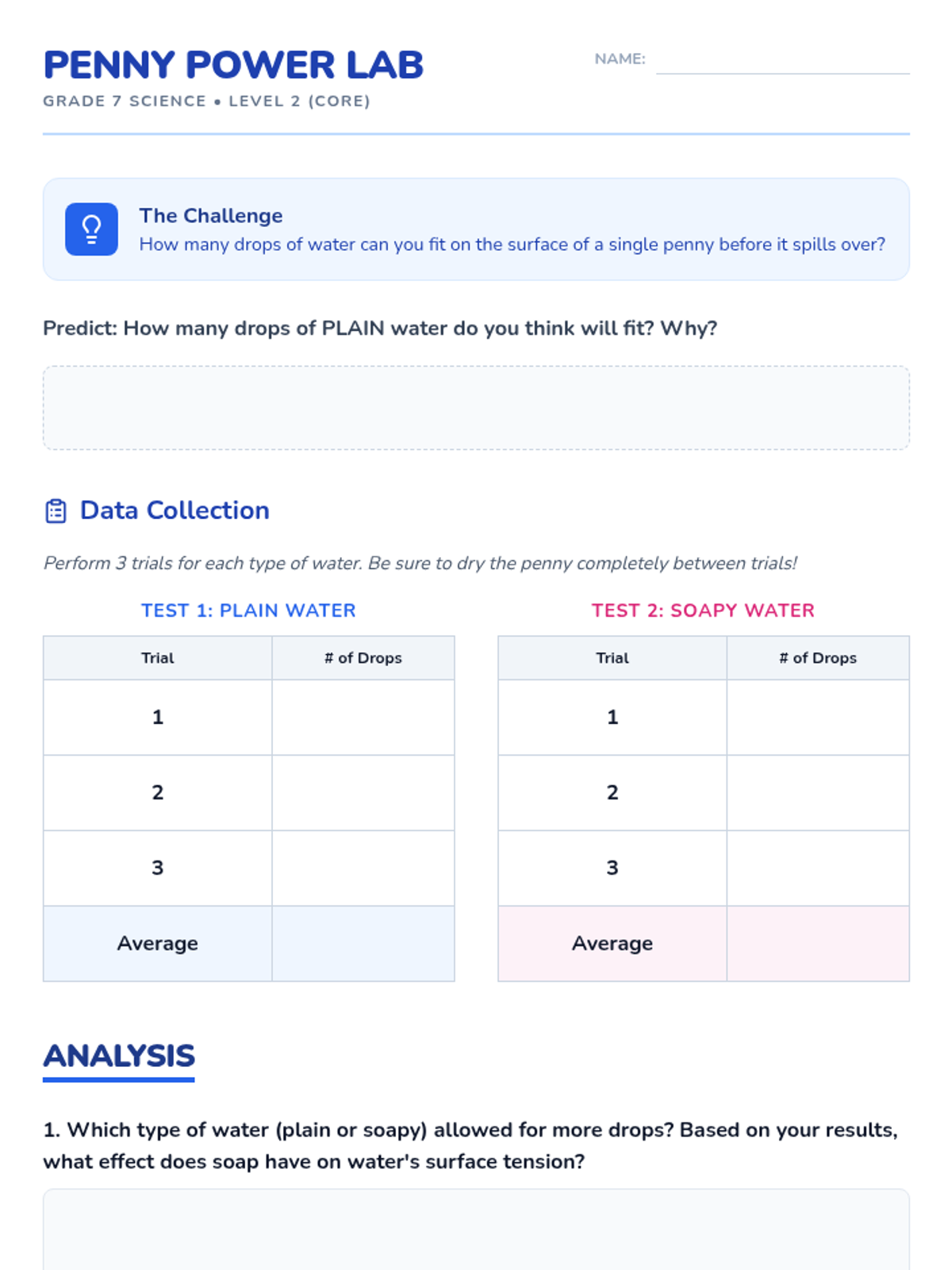
Penny Power Lab 5th Grade
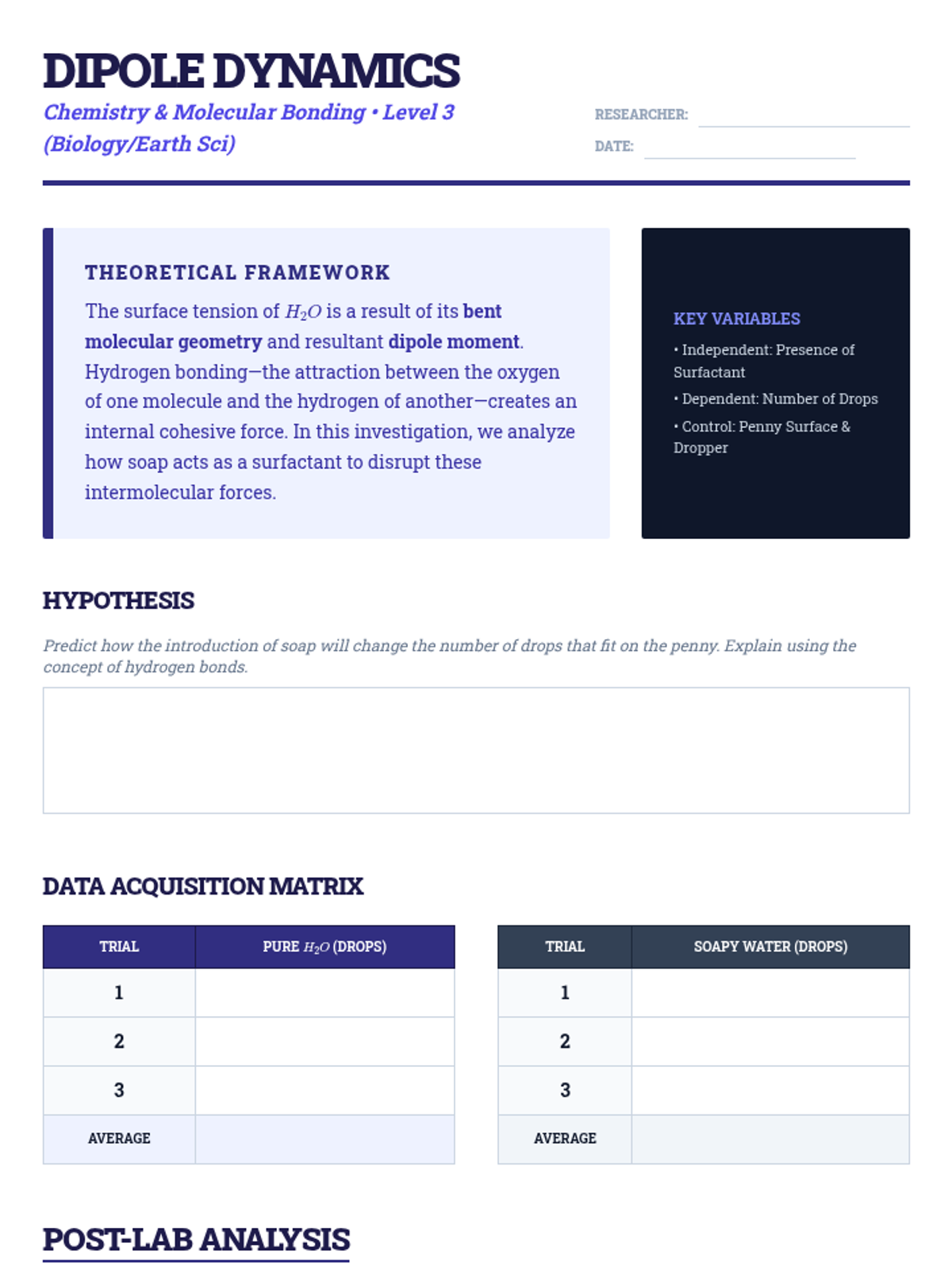
Dipole Dynamics Lab 9th Grade
Property Powerhouse Slides
Penny Power Lab 7th Grade
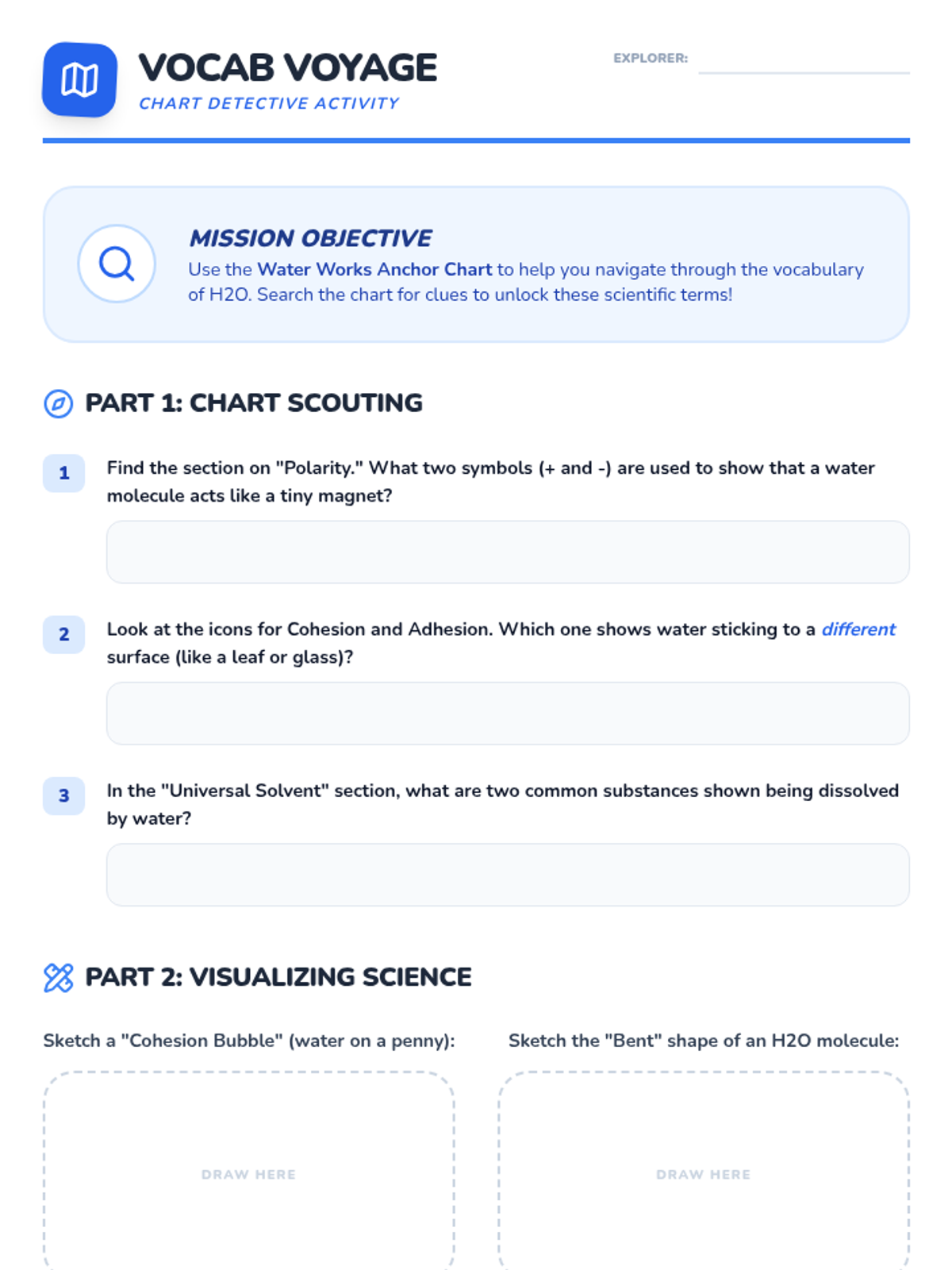
Vocab Voyage Activity

H2O Blueprint Unit

A comprehensive 3-week unit exploring the unique physical properties of water, its role in life and geological processes, and the dynamics of watershed systems. Students investigate polarity, cohesion, and universal solubility through hands-on labs while connecting these traits to climate moderation and the health of the Chesapeake Bay.

TM

Teri Minami

Science Teacher
2/21
Sequence
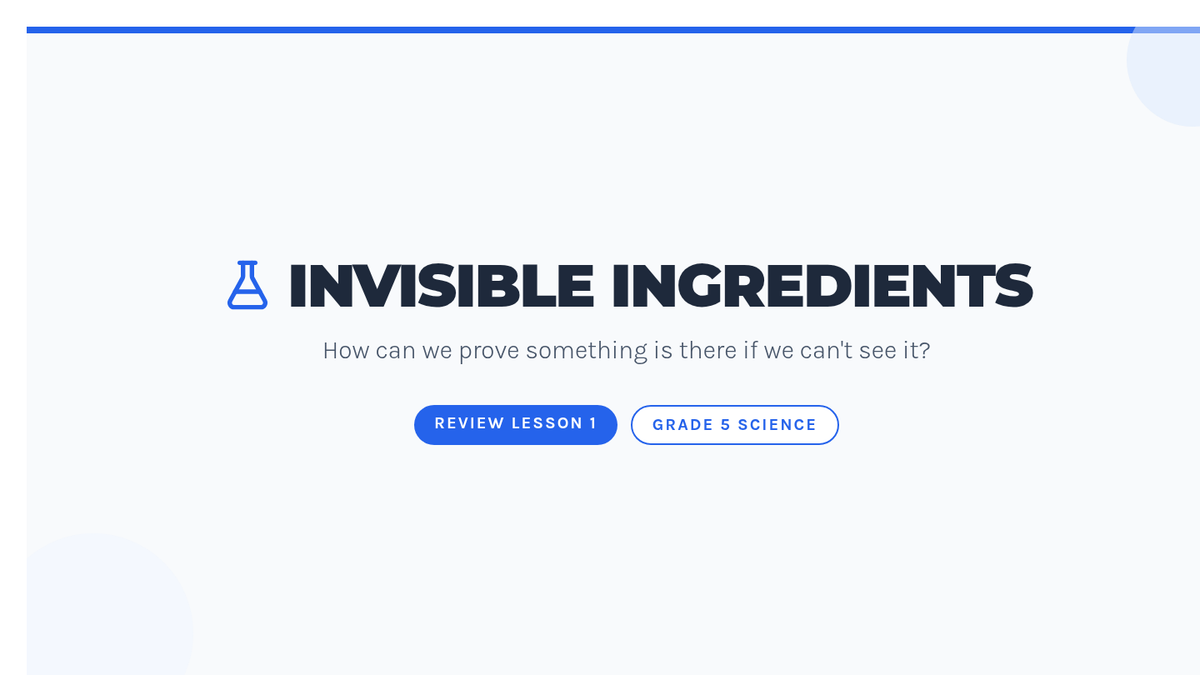
Invisible Ingredients Slides
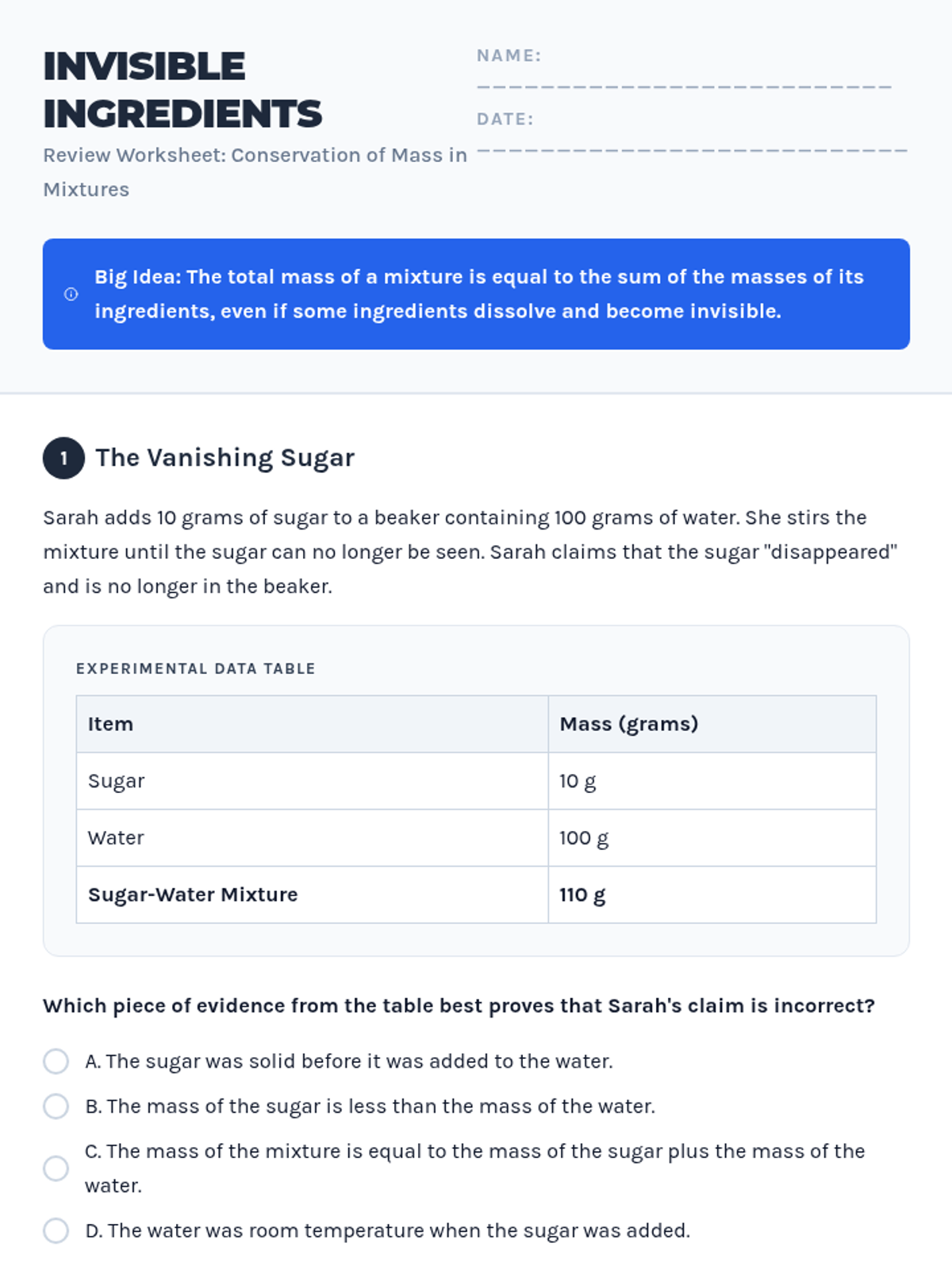
Invisible Ingredients Worksheet
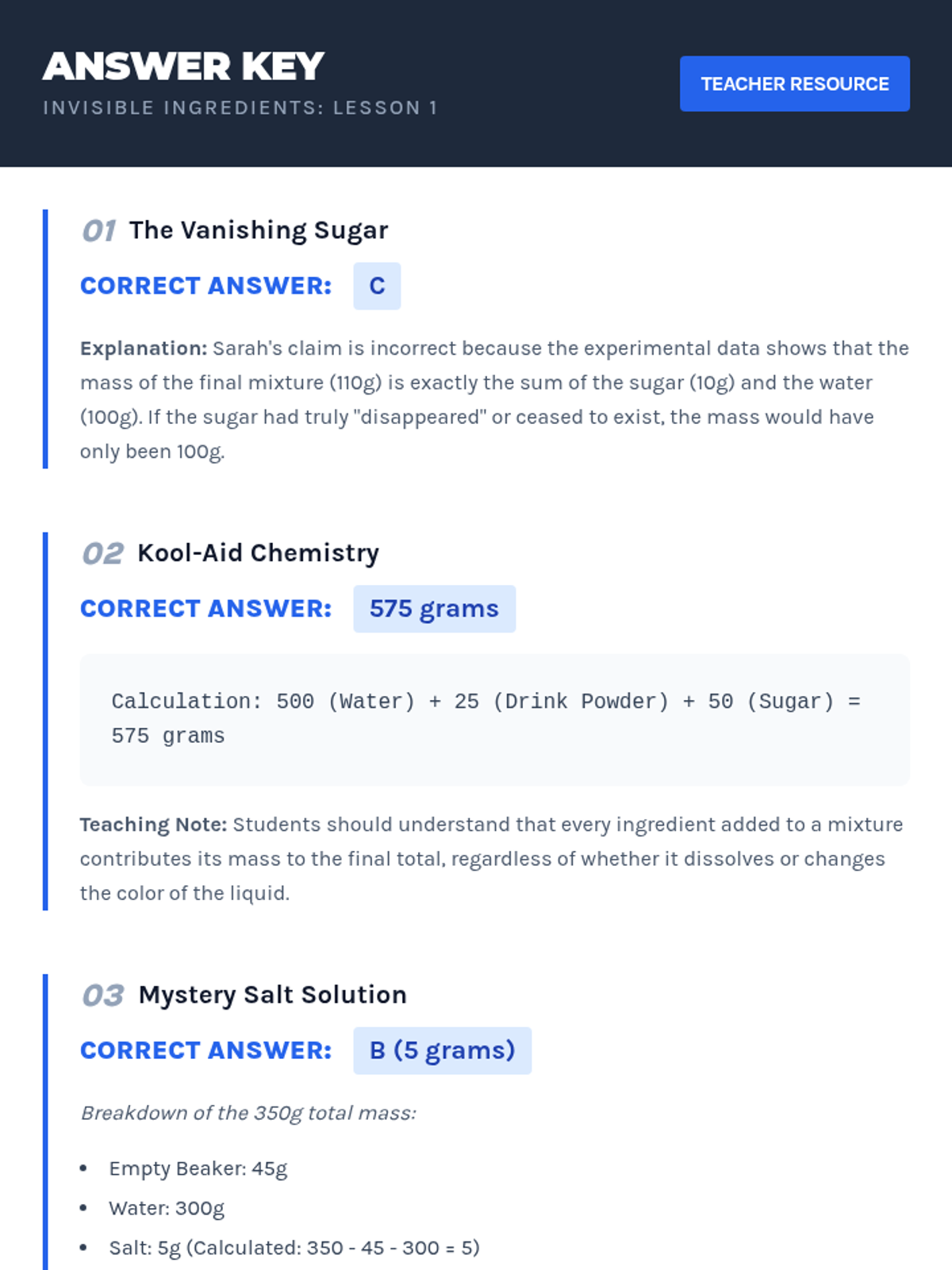
Invisible Ingredients Answer Key

Matter Masterclass

A series of three review lessons focused on interpreting experimental data and graphs related to the conservation of mass and phase changes in matter. Students will analyze scenarios involving dissolving, freezing, boiling, and thermal energy to strengthen their scientific reasoning skills.

AO

Archie Olson

English Language Arts Teacher
2/12
Sequence
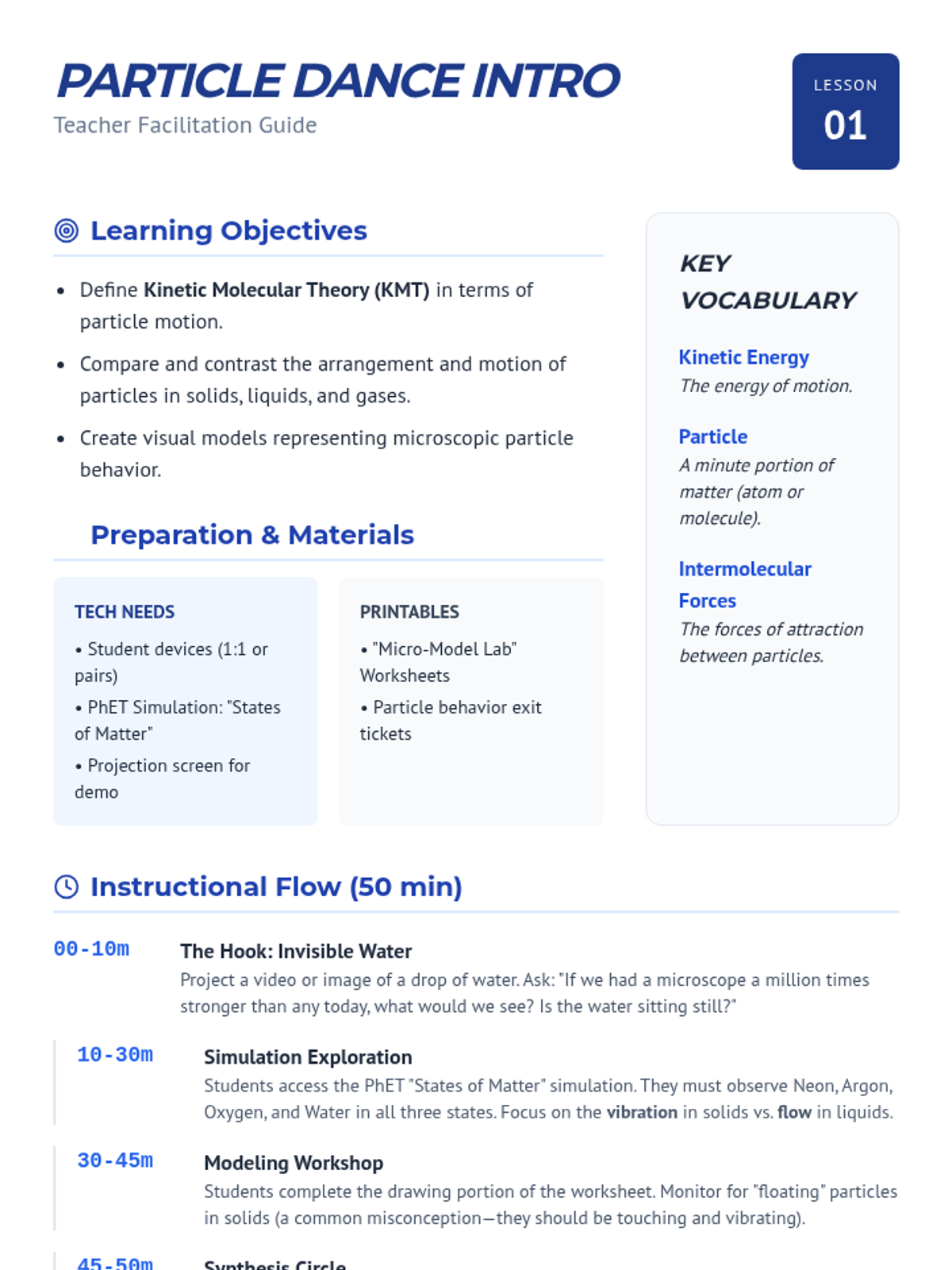
Particle Dance Teacher Guide
Particle Dance Slides
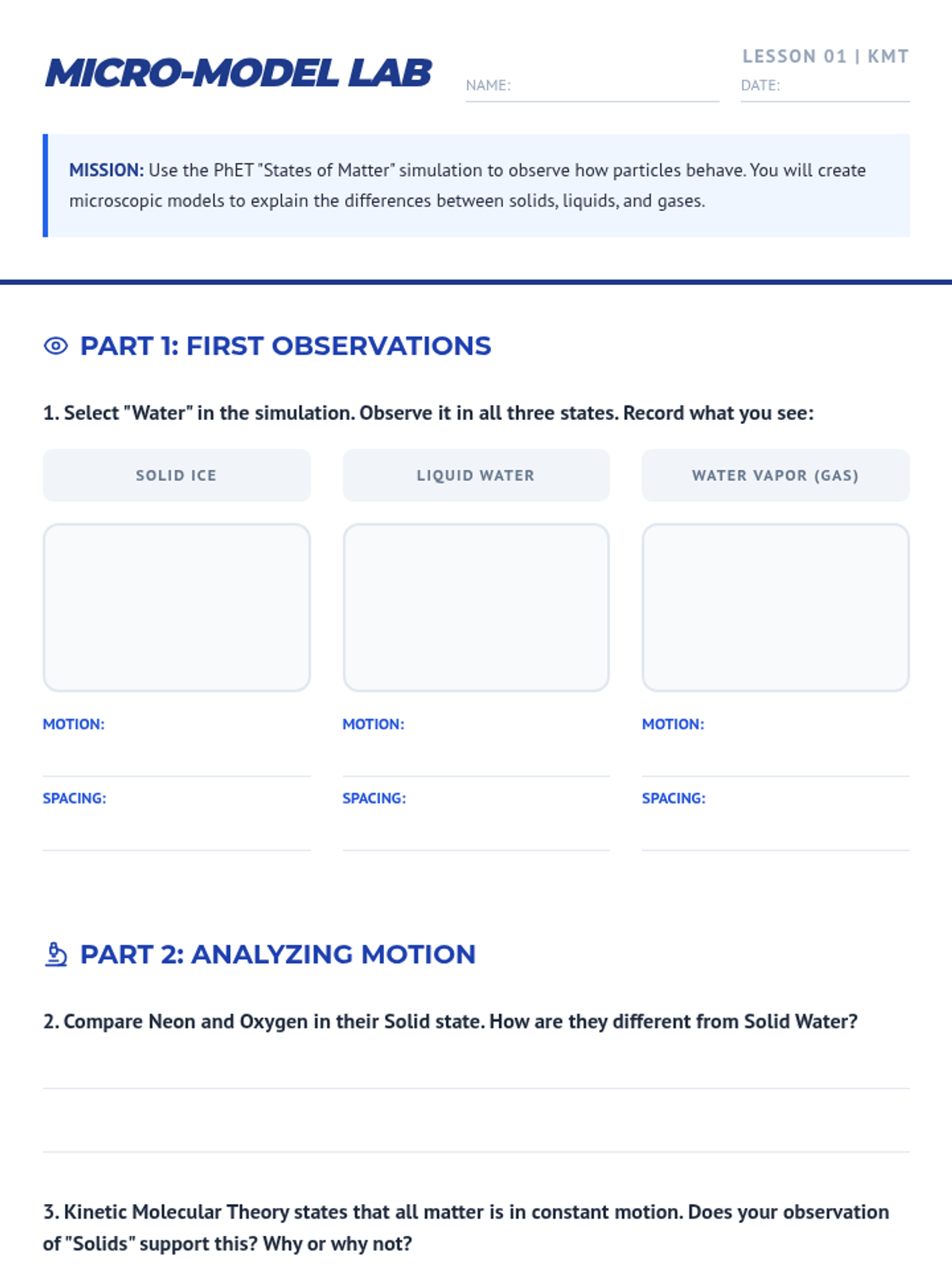
Micro Model Lab Worksheet
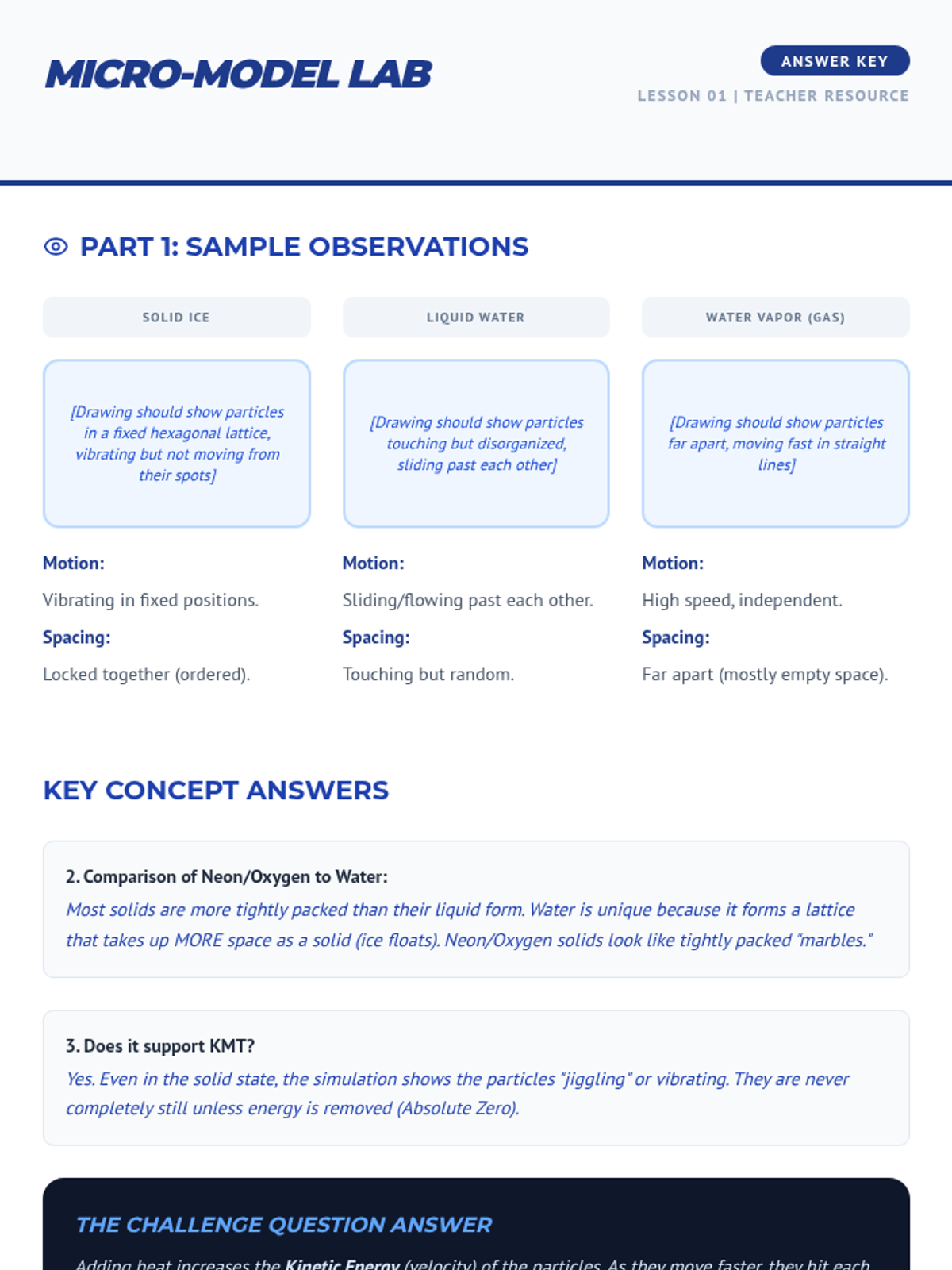
Micro Model Lab Answer Key

Modeling Particle Motion and Thermal Energy

This sequence explores thermodynamics through the lens of particle motion. Students bridge the gap between microscopic atoms and macroscopic phenomena like temperature, pressure, and phase changes using models and simulations.

Lenny Avatar
Lenny
1/17
Sequence
Power in a Tablet Slides
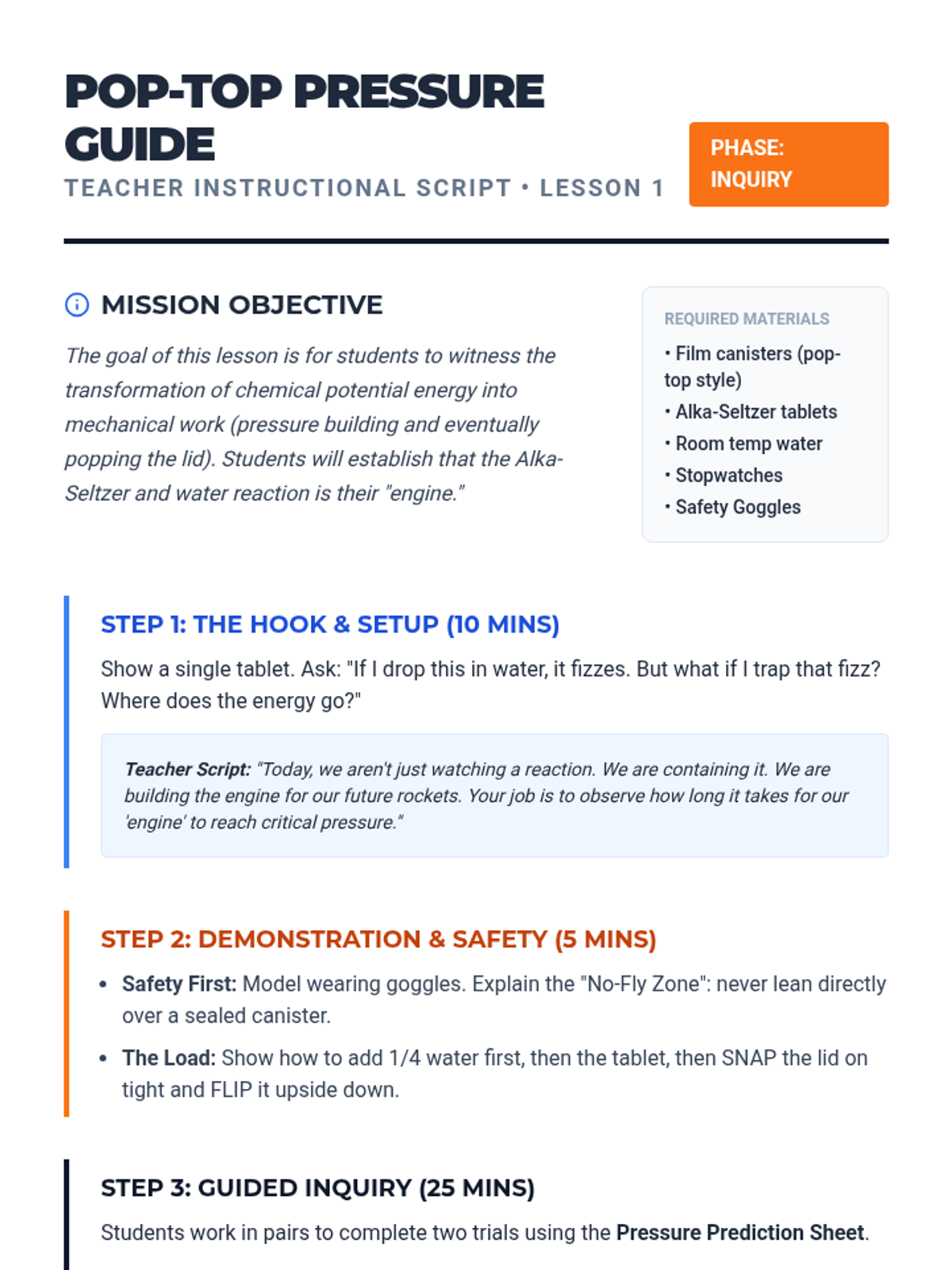
Pop-Top Pressure Guide
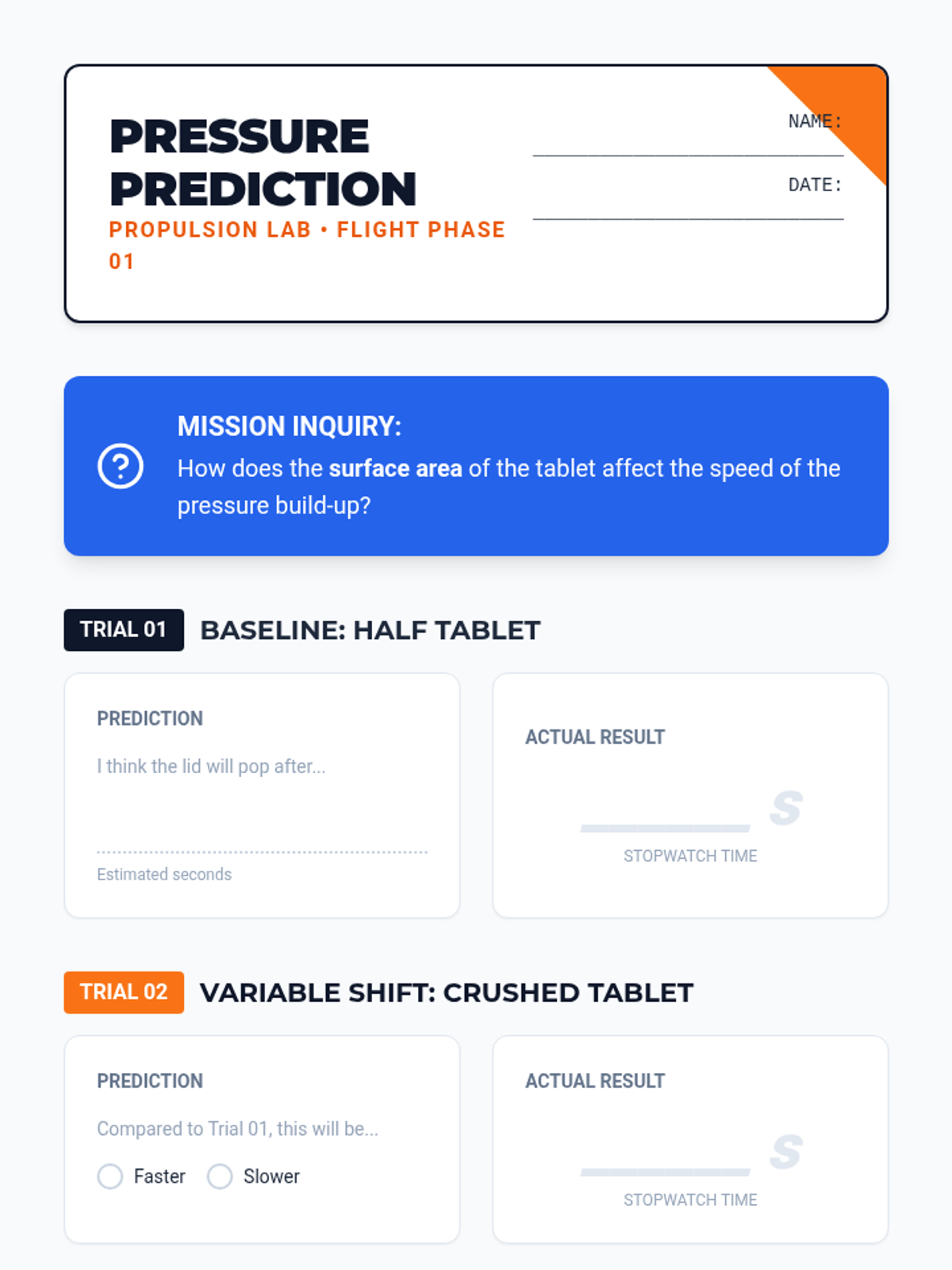
Pressure Prediction Sheet

Rocket Reactors

Students apply acid-base chemistry and the engineering design process to build, test, and optimize chemical rockets, exploring pressure, aerodynamics, and reaction rates.

Lenny Avatar
Lenny
1/17
Sequence
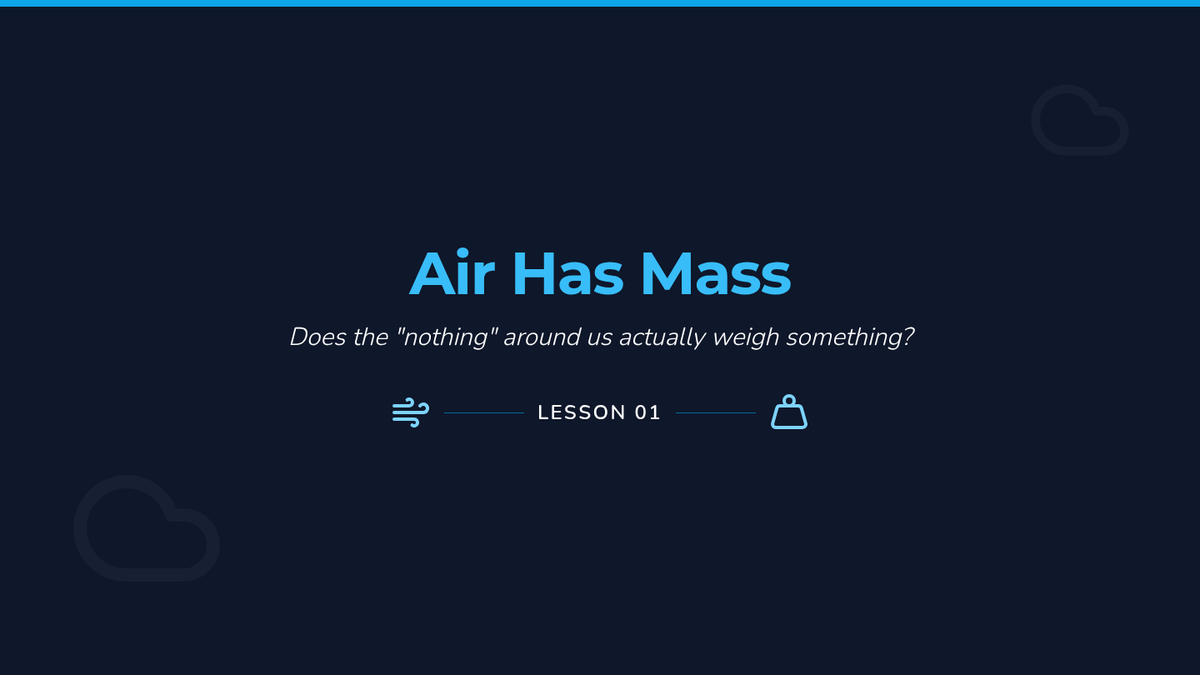
Air Mass Slides
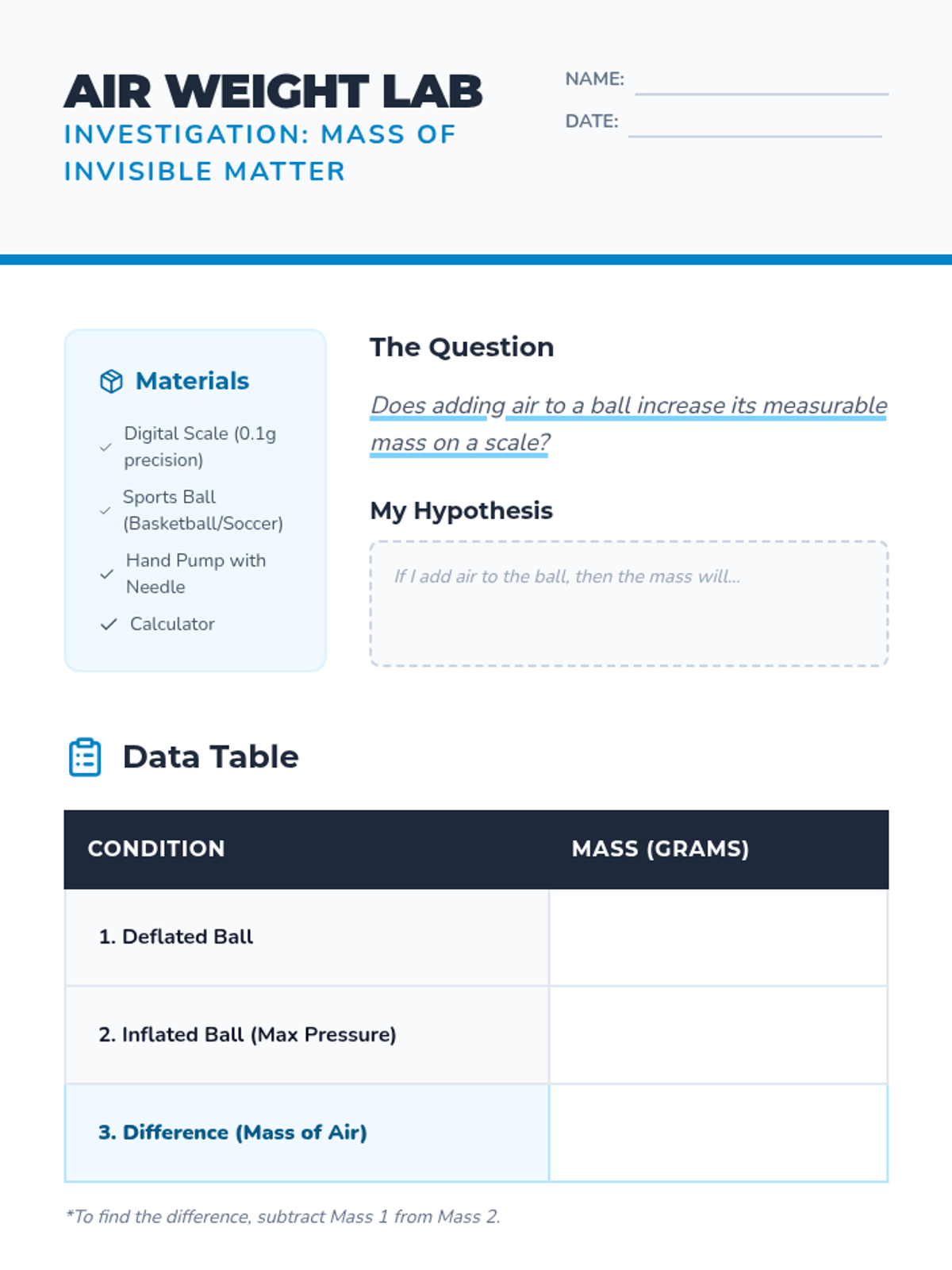
Air Weight Lab
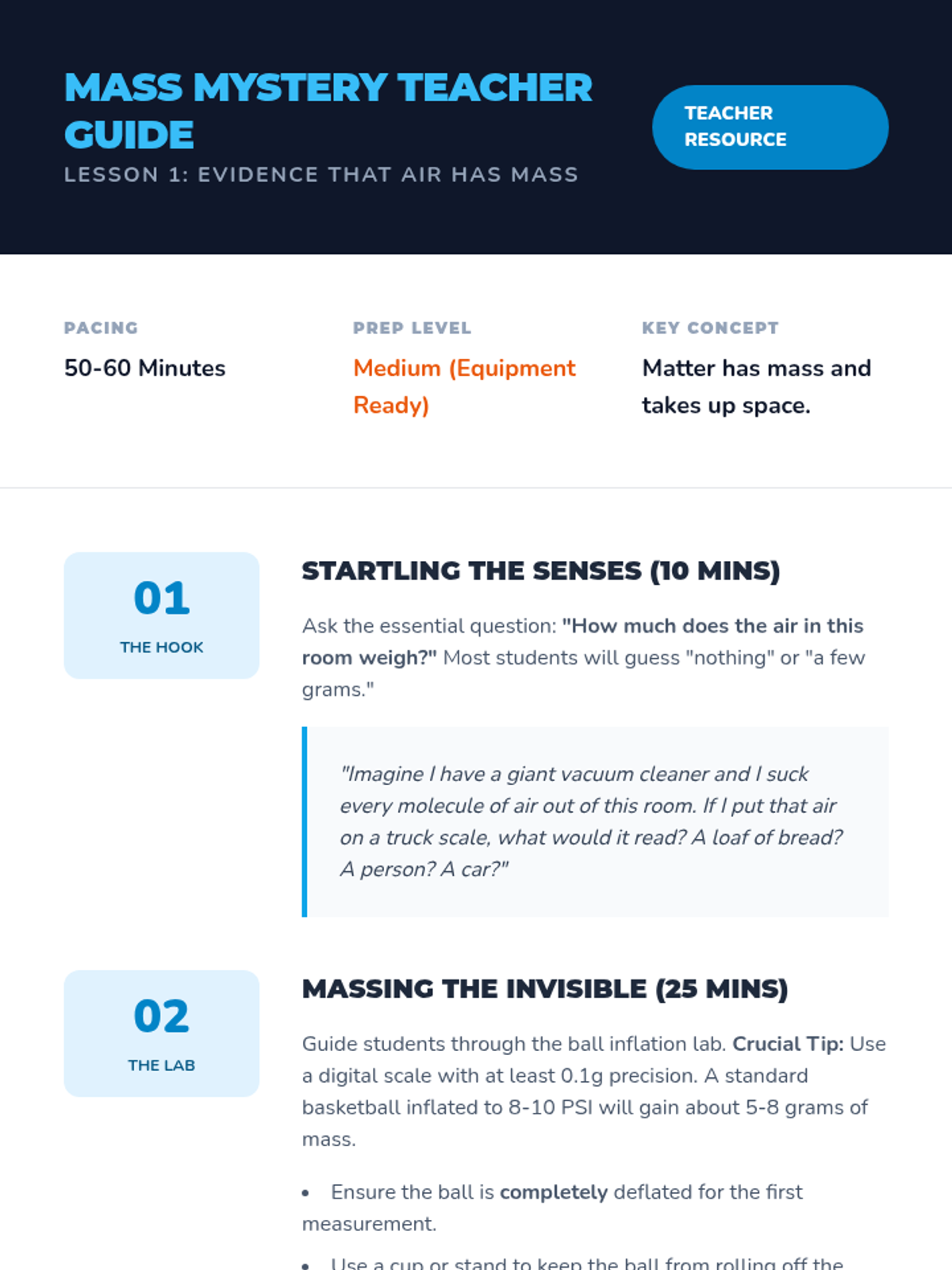
Mass Mystery Teacher Guide

Weight of the Sky

This sequence explores the physical properties of gases through the lens of atmospheric pressure and meteorology. Students move from proving air has mass to understanding how pressure differentials drive global weather patterns and extreme storms.

Lenny Avatar
Lenny
1/17
Sequence
Power of Air Slides
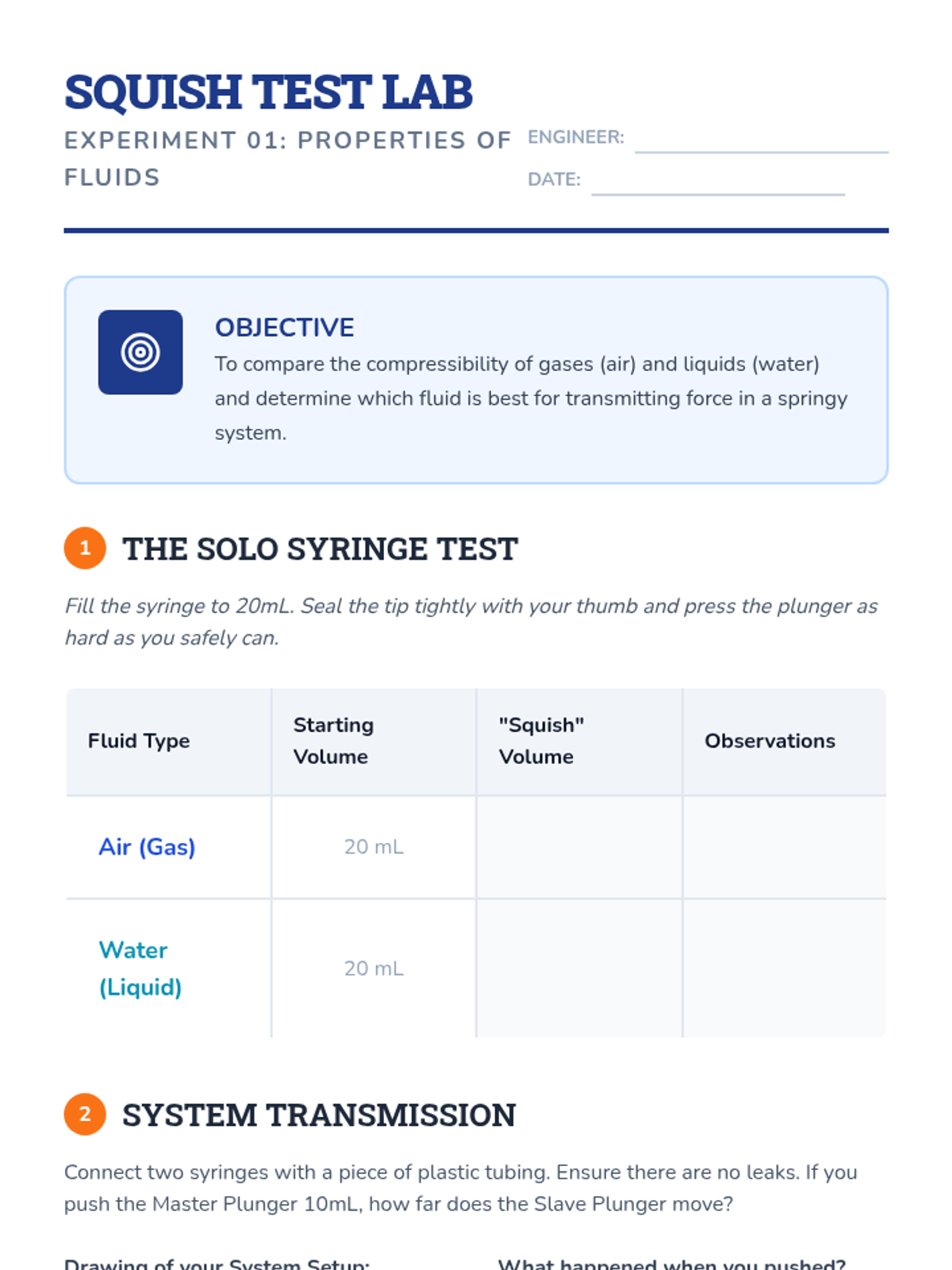
Squish Test Lab Sheet
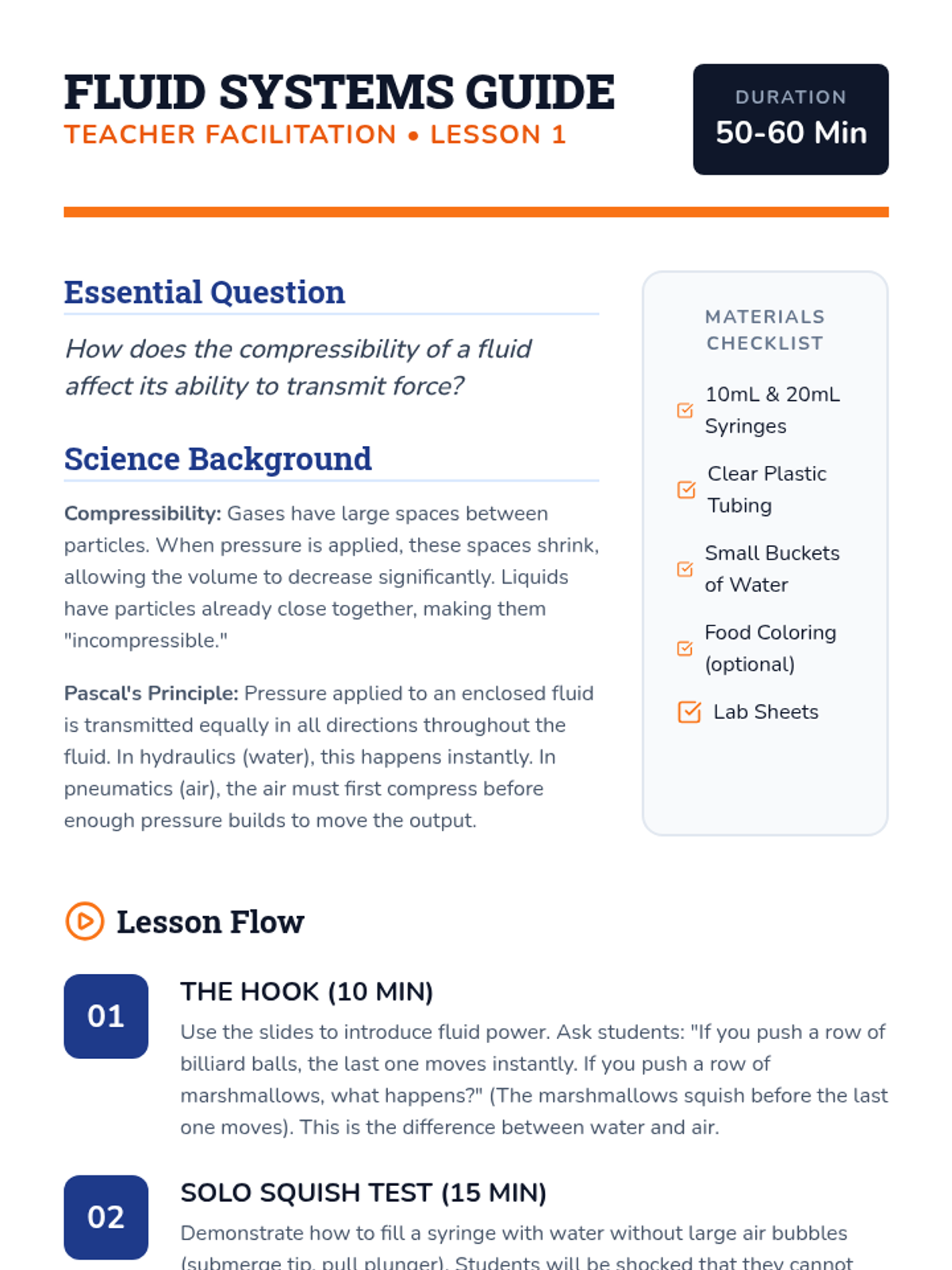
Fluid Systems Guide Teacher Resource

Pneumatic Power Engineering

A project-based unit where 6th-grade students act as engineers to design pneumatic devices. They explore the compressibility of gases, compare pneumatic and hydraulic systems, and apply the engineering design process to build a functional air-powered lifter.

Lenny Avatar
Lenny
1/17
Sequence
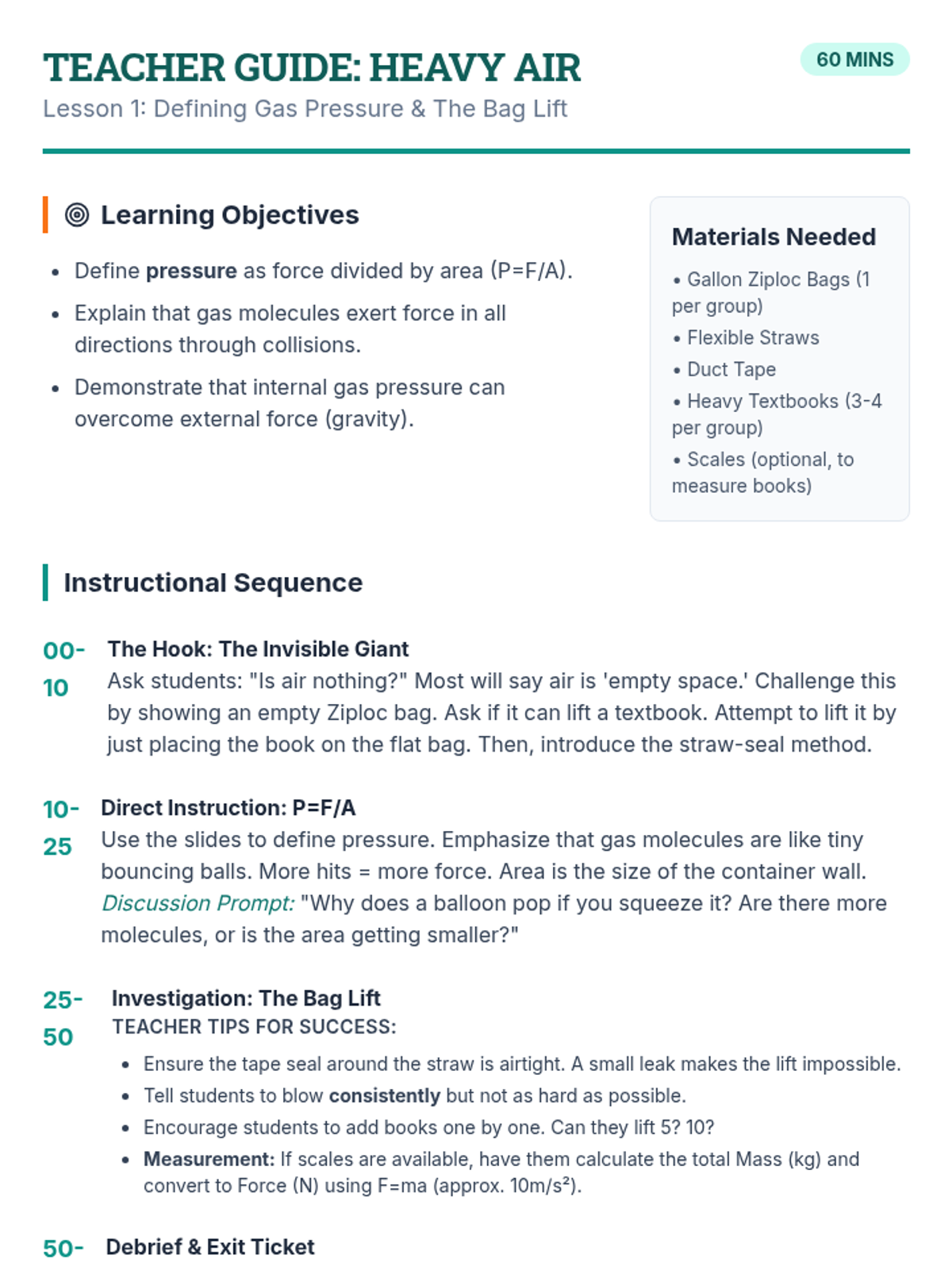
Heavy Air Slides
Heavy Air Teacher Guide
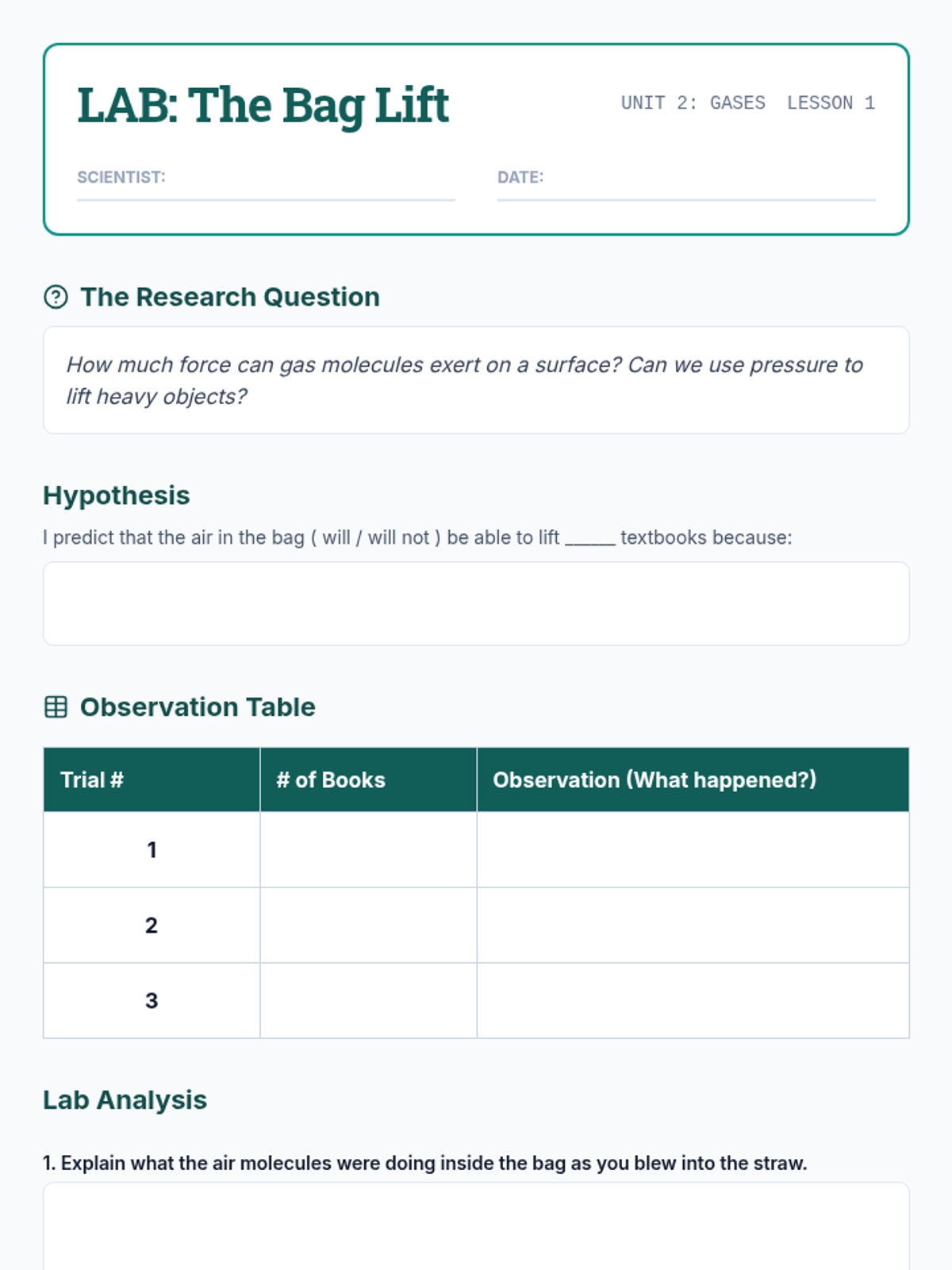
Bag Lift Lab Sheet

Gas Pressure and Volume Exploration

A 5-lesson sequence for 6th-grade science exploring the inverse relationship between gas pressure and volume (Boyle's Law), moving from physical definitions to graphing and biological applications.

Lenny Avatar
Lenny
1/17
Sequence
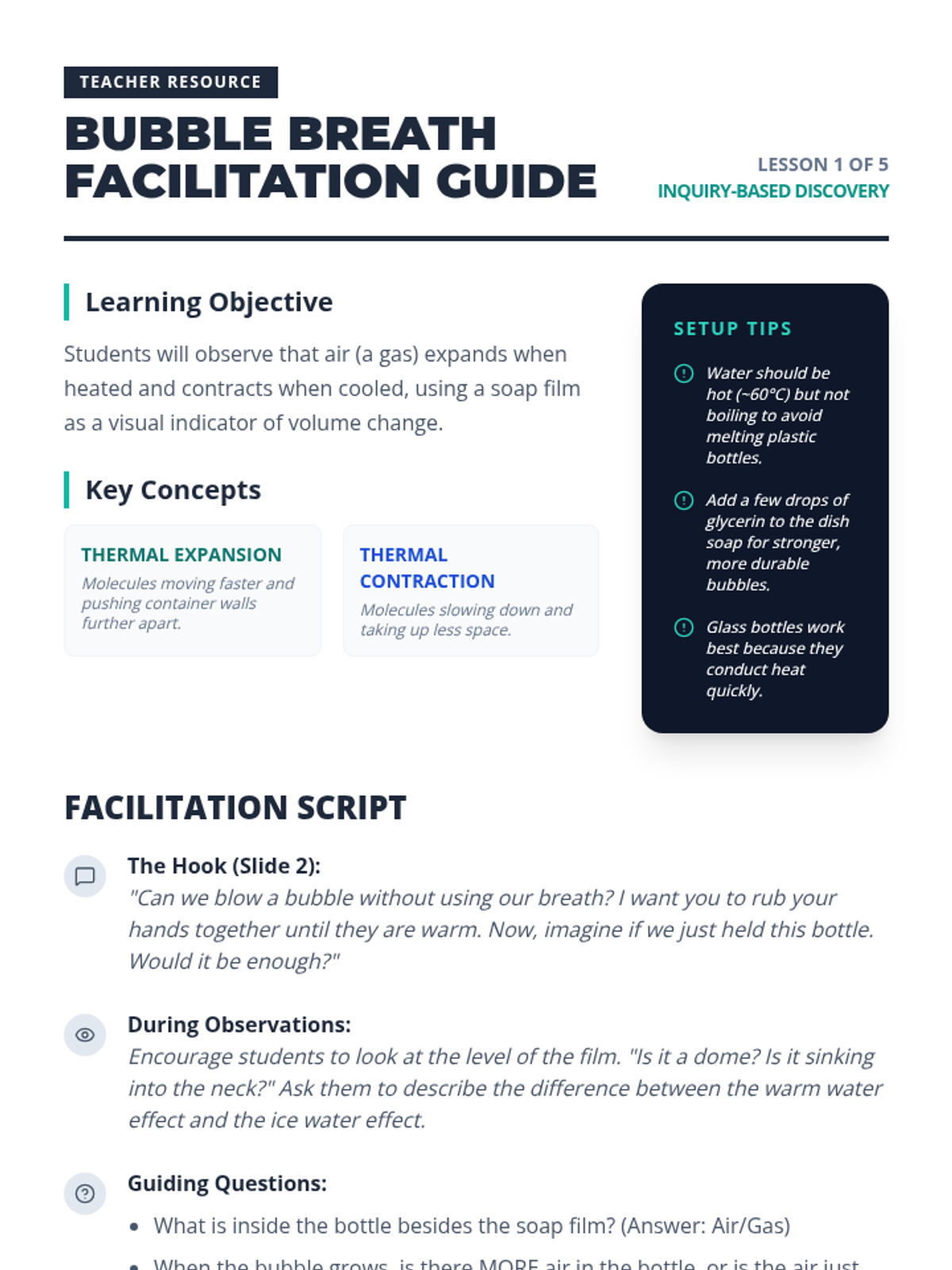
Bubble Breath Slides
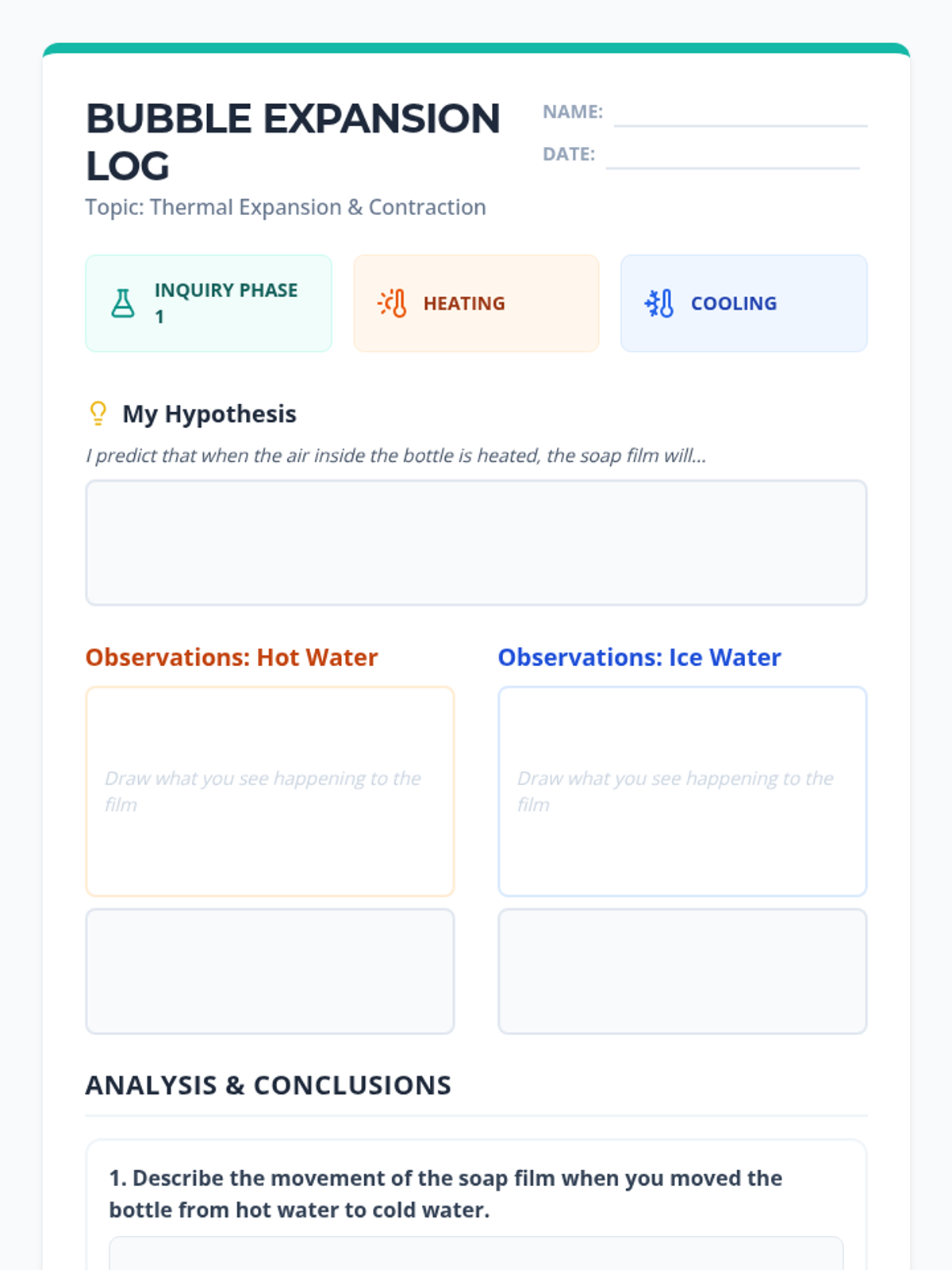
Bubble Expansion Lab Sheet
Bubble Expansion Teacher Guide

Gas Power Temperature and Volume

A 6th-grade inquiry sequence exploring the direct relationship between gas temperature and volume. Students use hands-on experiments, graphing, and molecular models to understand Charles's Law and its real-world applications in hot air balloons and atmospheric science.

Lenny Avatar
Lenny
1/17
Sequence
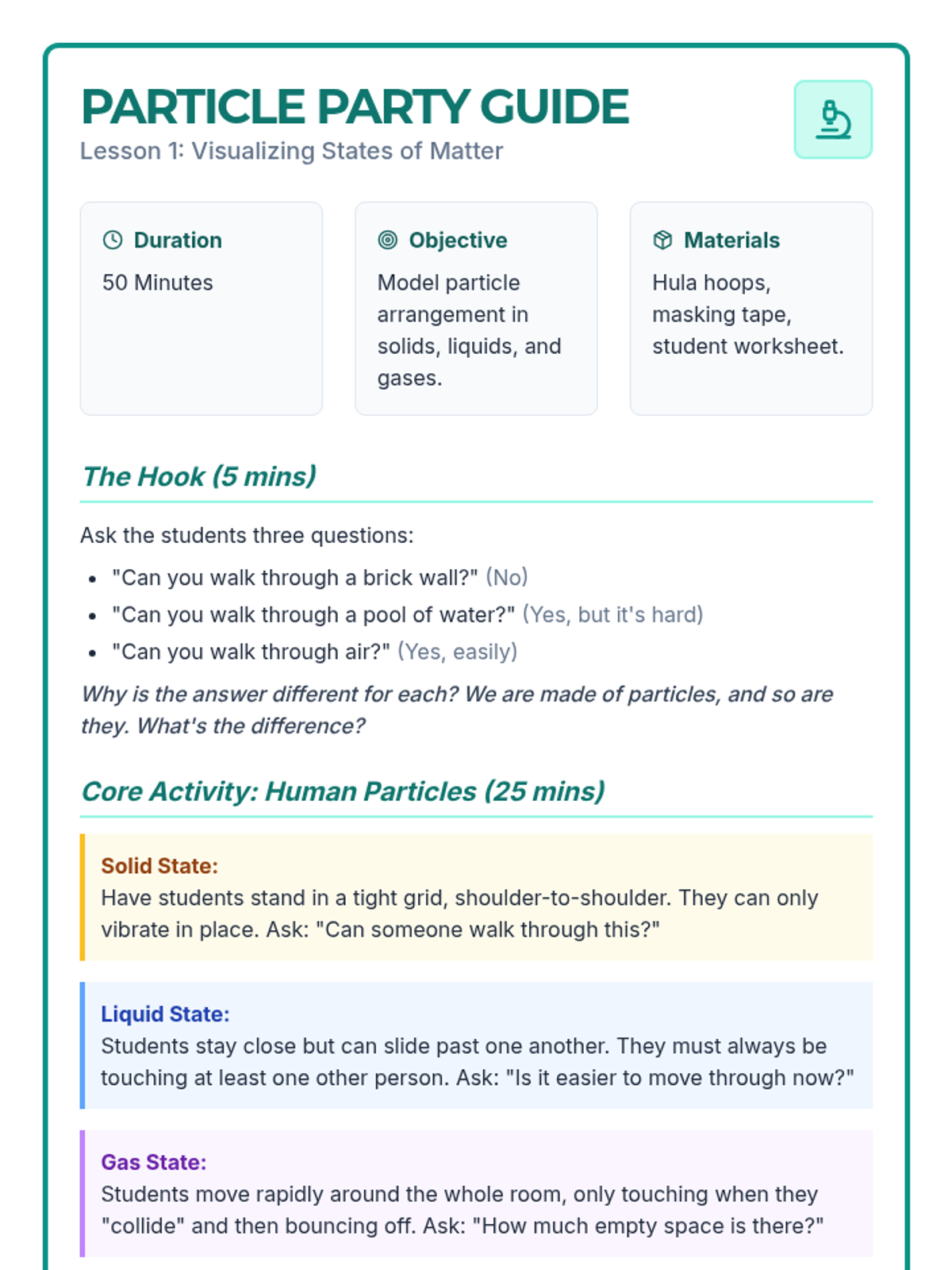
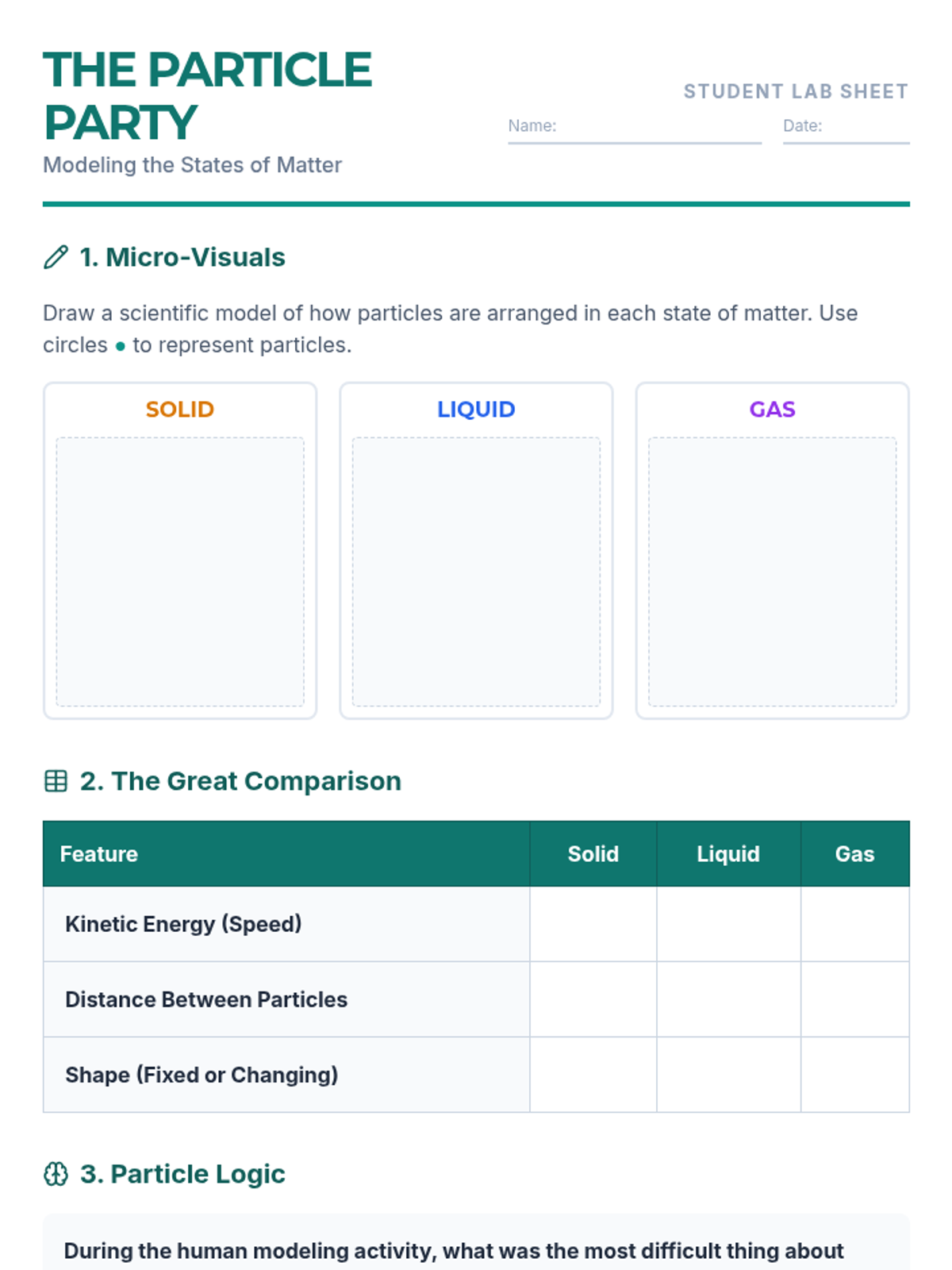
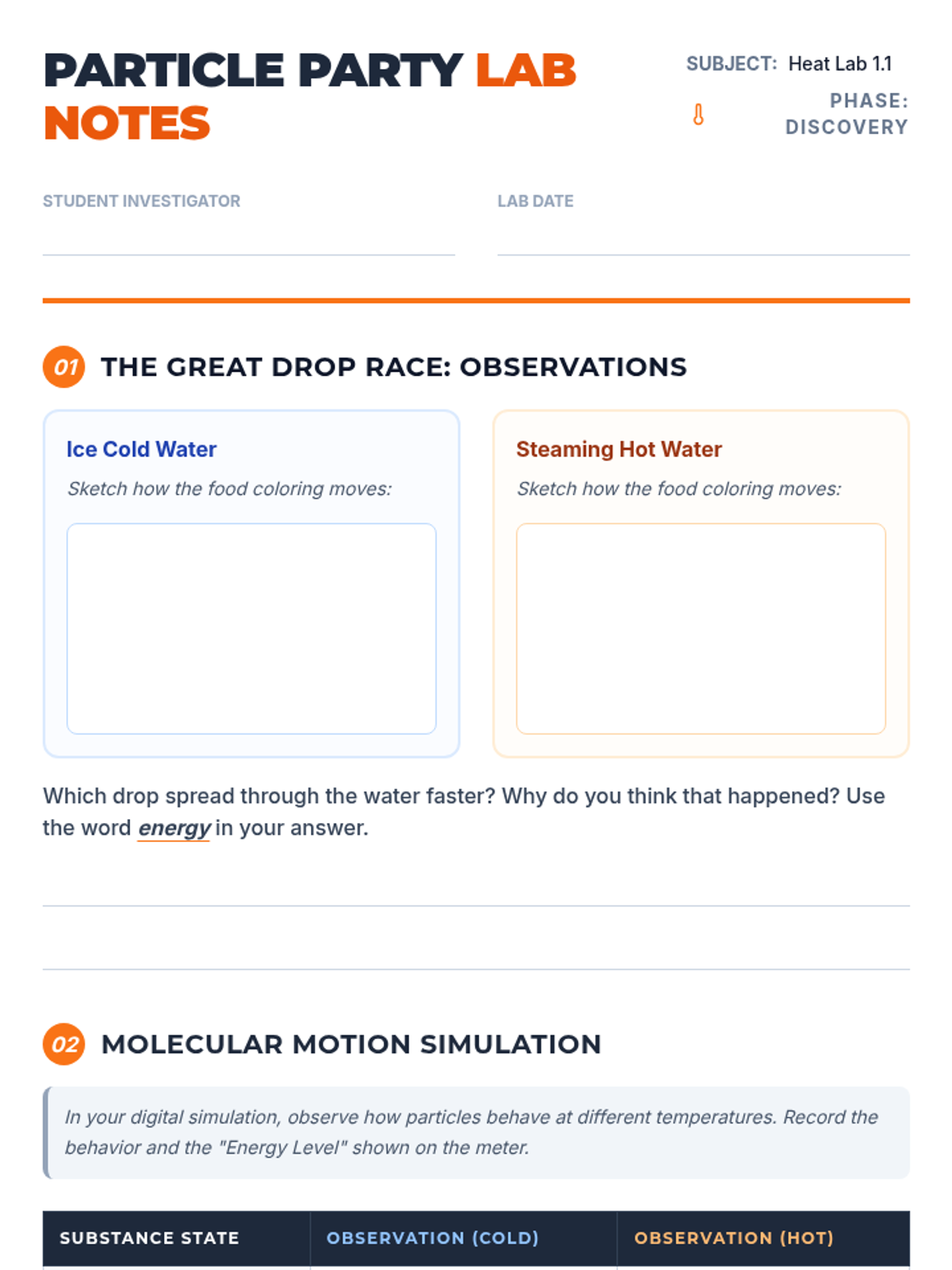
Particle Party Teacher Guide
Particle Party Worksheet
Particle Party Slides

Particle Power

A 6th-grade chemistry sequence exploring the Kinetic Molecular Theory through modeling, simulations, and hands-on investigation of particle behavior in gases.

Lenny Avatar
Lenny
1/17
Sequence
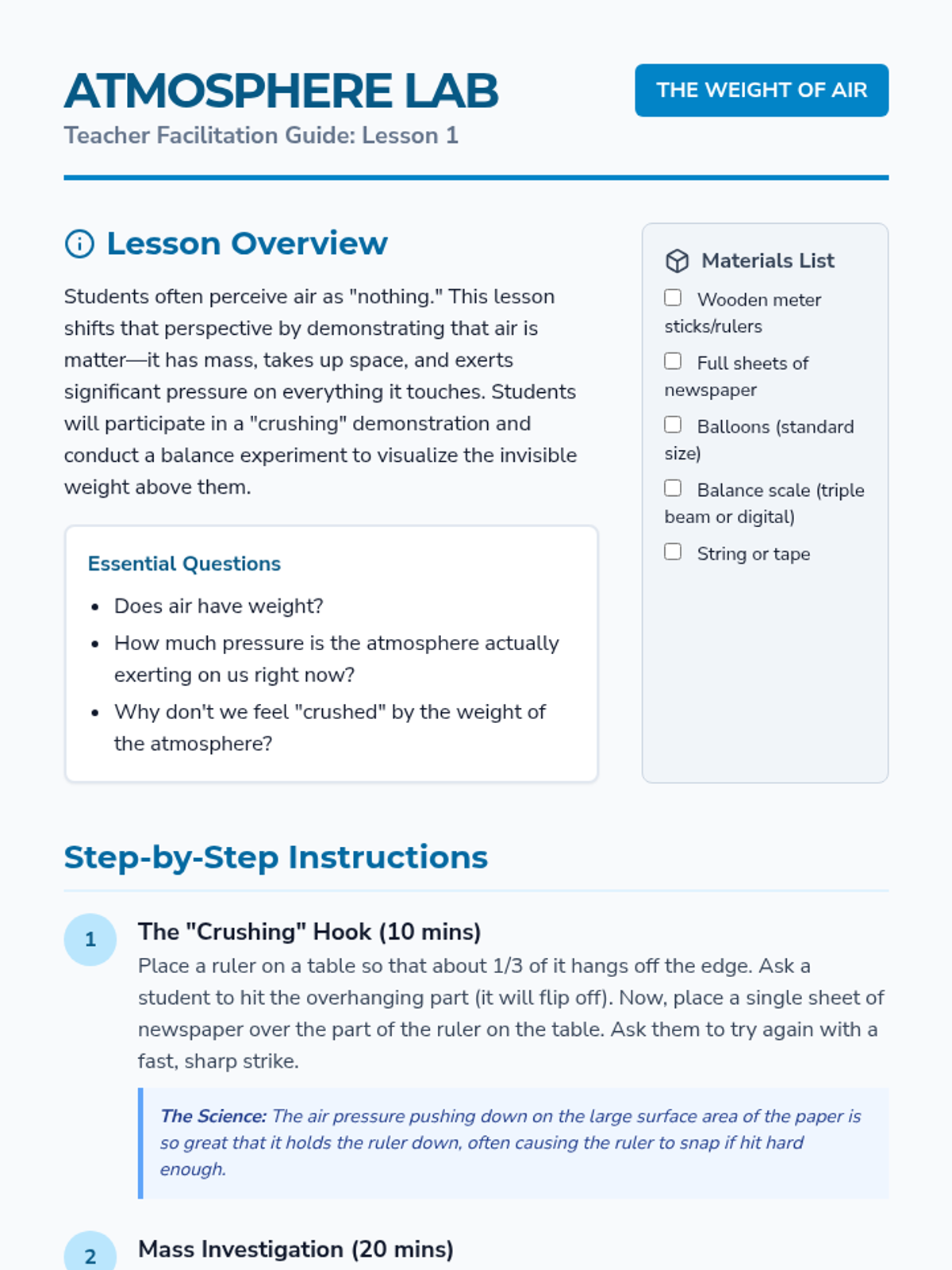
Weight of Air Teacher Guide
Weight of Air Slides
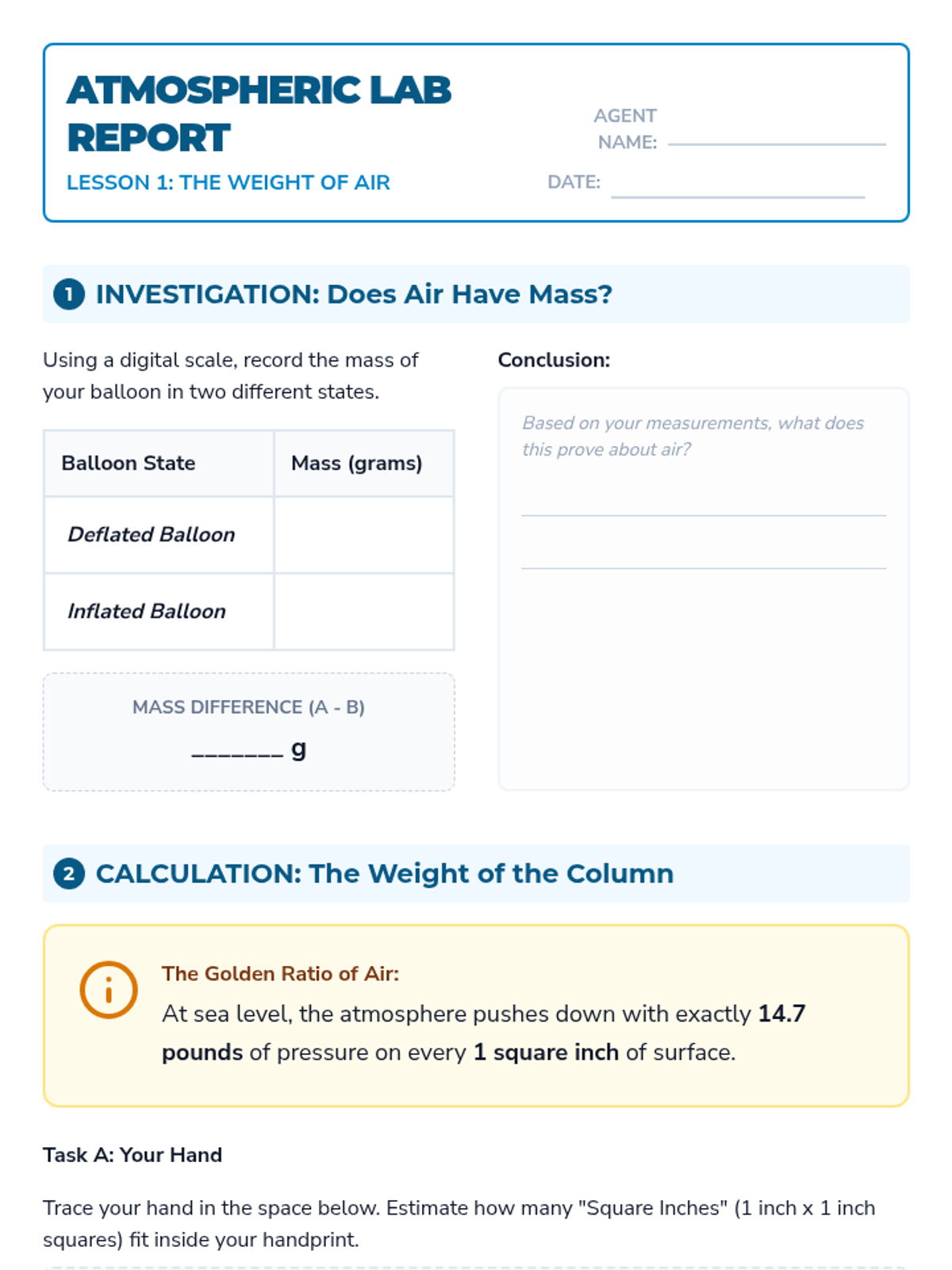
Weight of Air Worksheet

Atmosphere and Weather Pressure

This sequence connects micro-scale gas properties to macro-scale atmospheric science, exploring how air pressure, gas density, and temperature drive global weather patterns.

Lenny Avatar
Lenny
1/17
Sequence
Cosmic Distances Slides
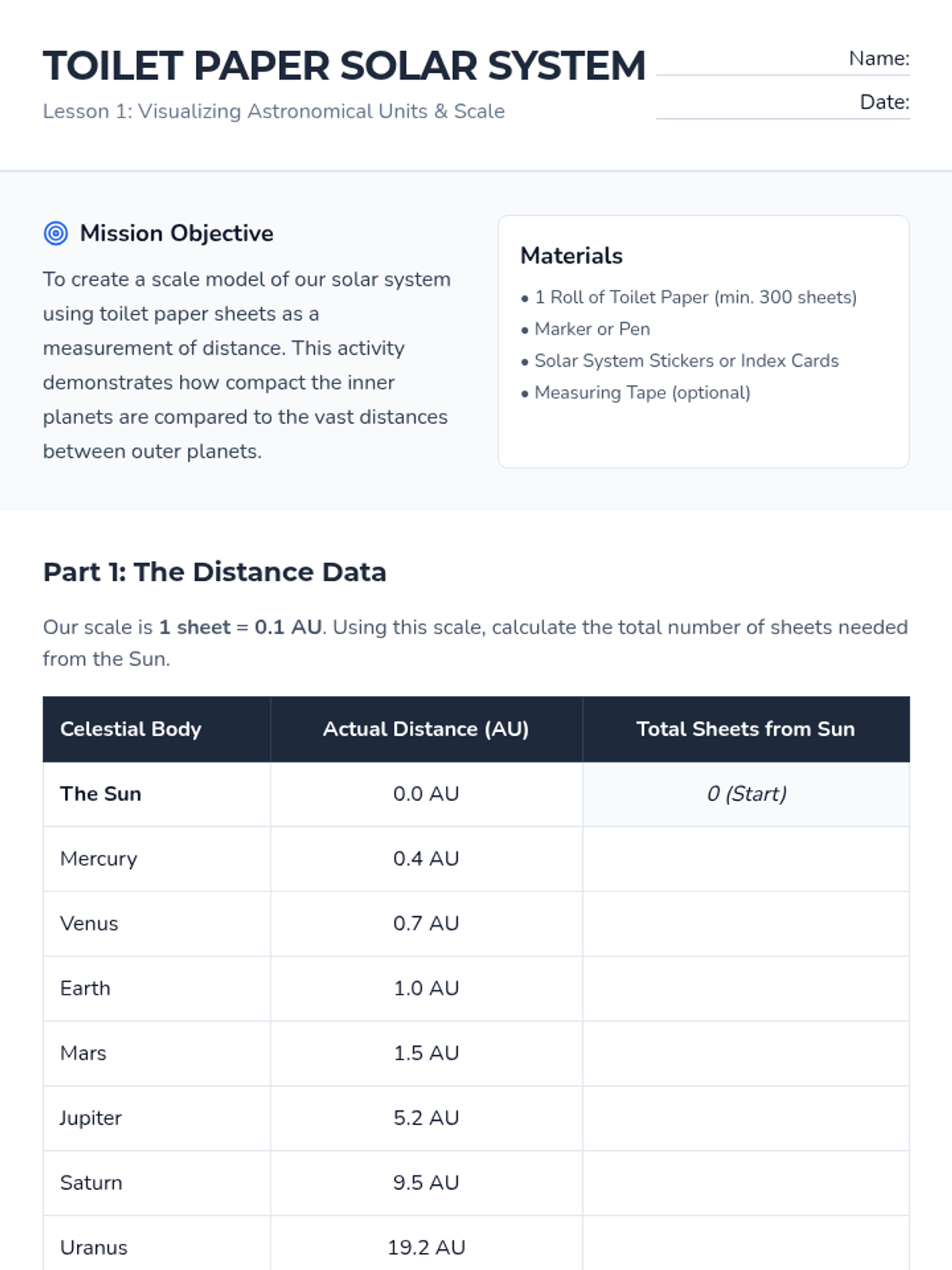
Toilet Paper Solar System Worksheet
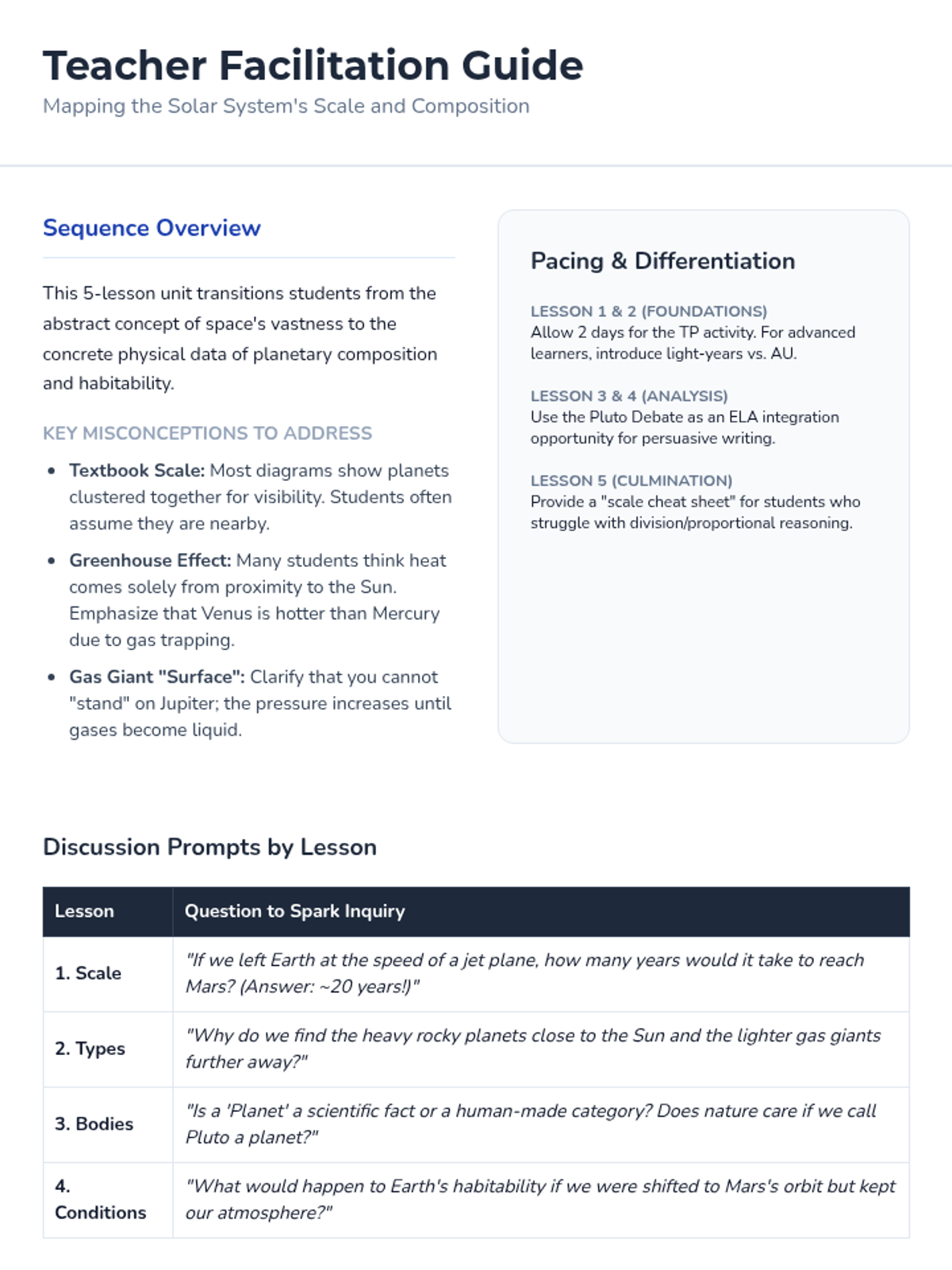
Cosmic Facilitation Guide

Mapping the Solar System's Scale and Composition

This sequence explores the vast scale and diverse composition of our solar system. Students progress from understanding astronomical units and relative distances to analyzing the physical characteristics of planets, small bodies, and atmospheric conditions, concluding with a comprehensive scale model project.

Lenny Avatar
Lenny
1/17
Sequence
Magma Flow Slides
Magma Lab Worksheet
Magma Lab Teacher Guide

Magma Masterminds

Students explore the constructive and destructive nature of volcanic activity through inquiry and case studies. The sequence moves from the chemical properties of magma to the classification of volcanic landforms and the monitoring of volcanic hazards.

Lenny Avatar
Lenny
1/17
Sequence
Magma Mechanics Slides
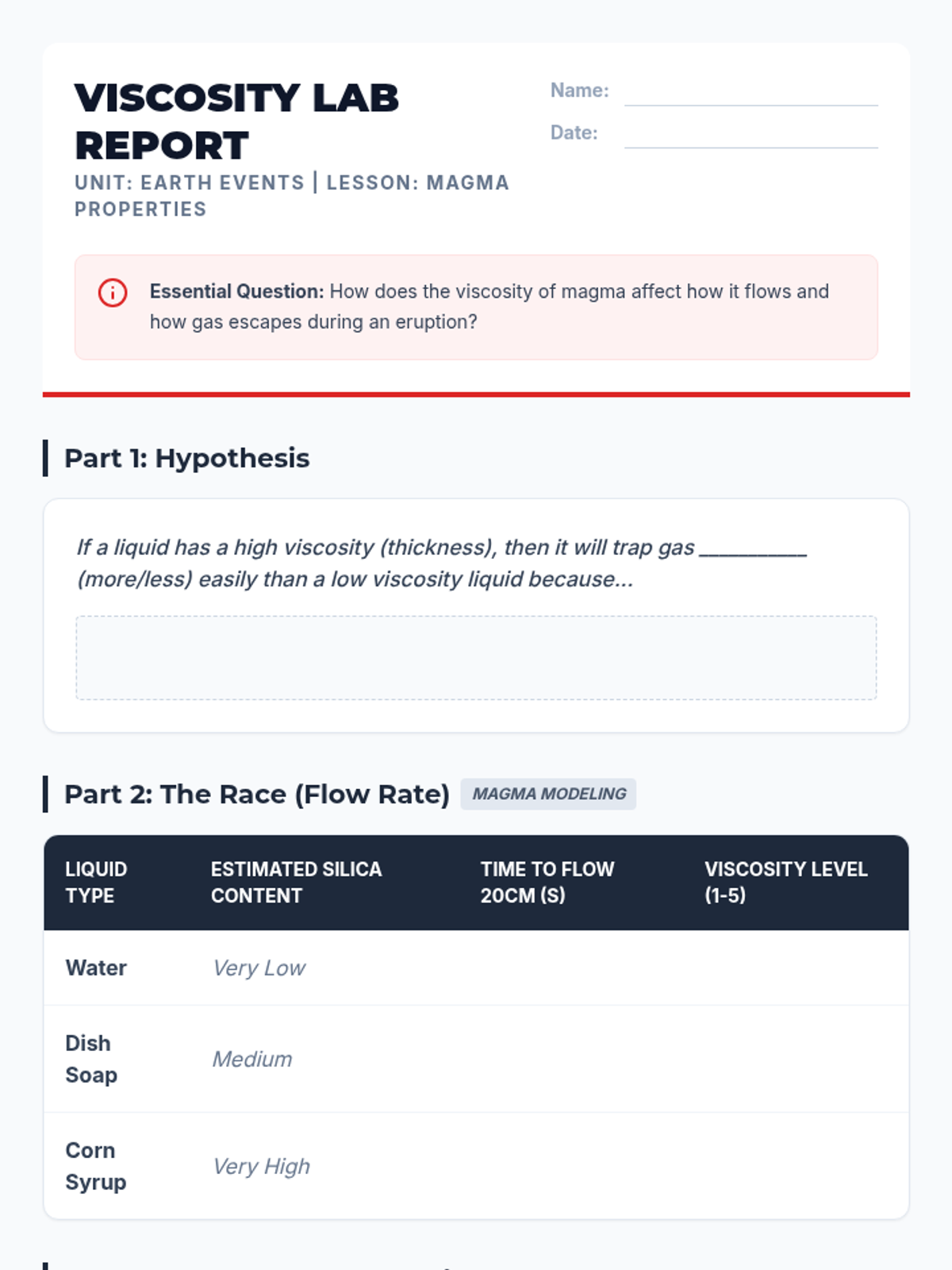
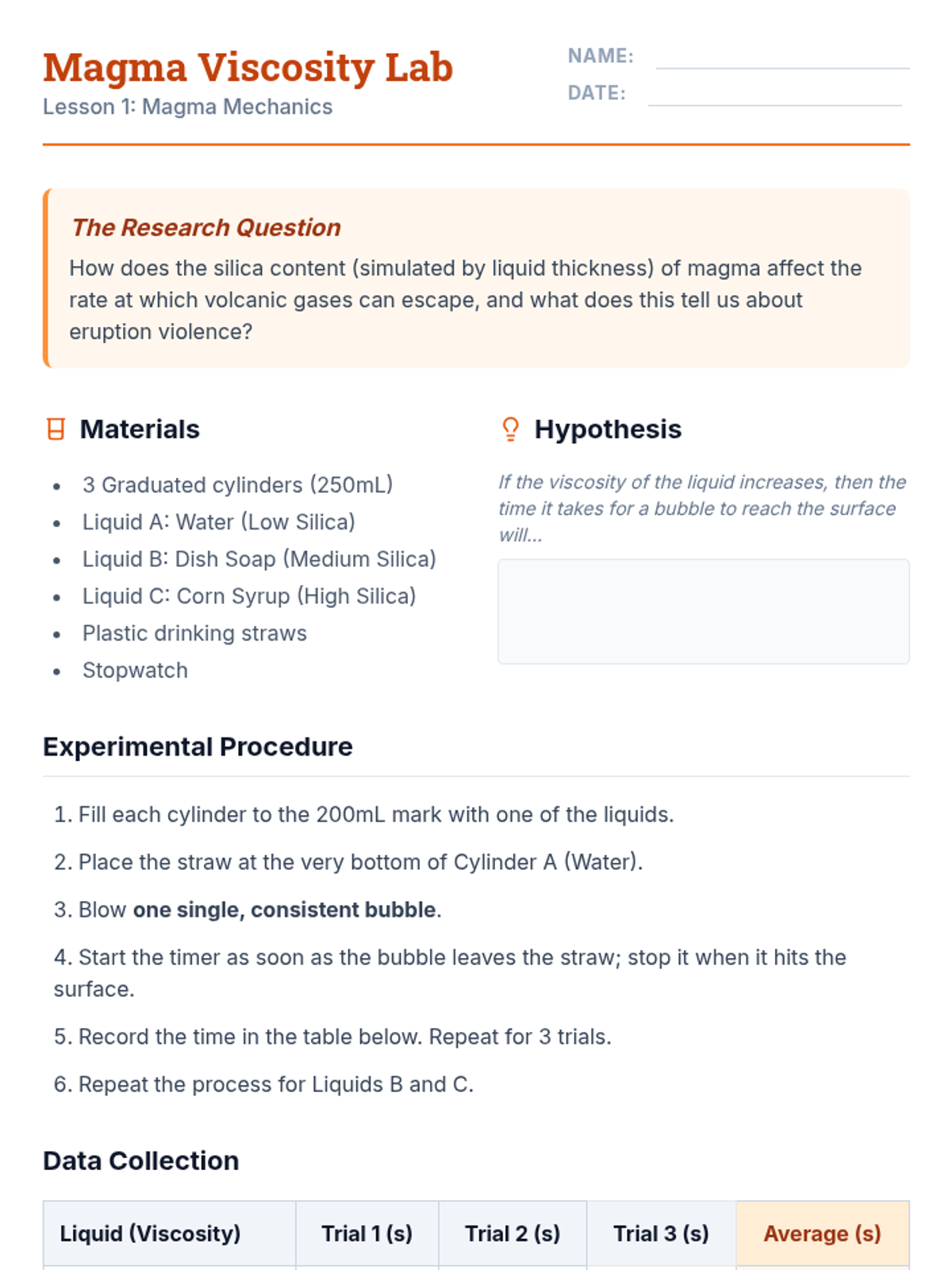
Magma Viscosity Lab Worksheet
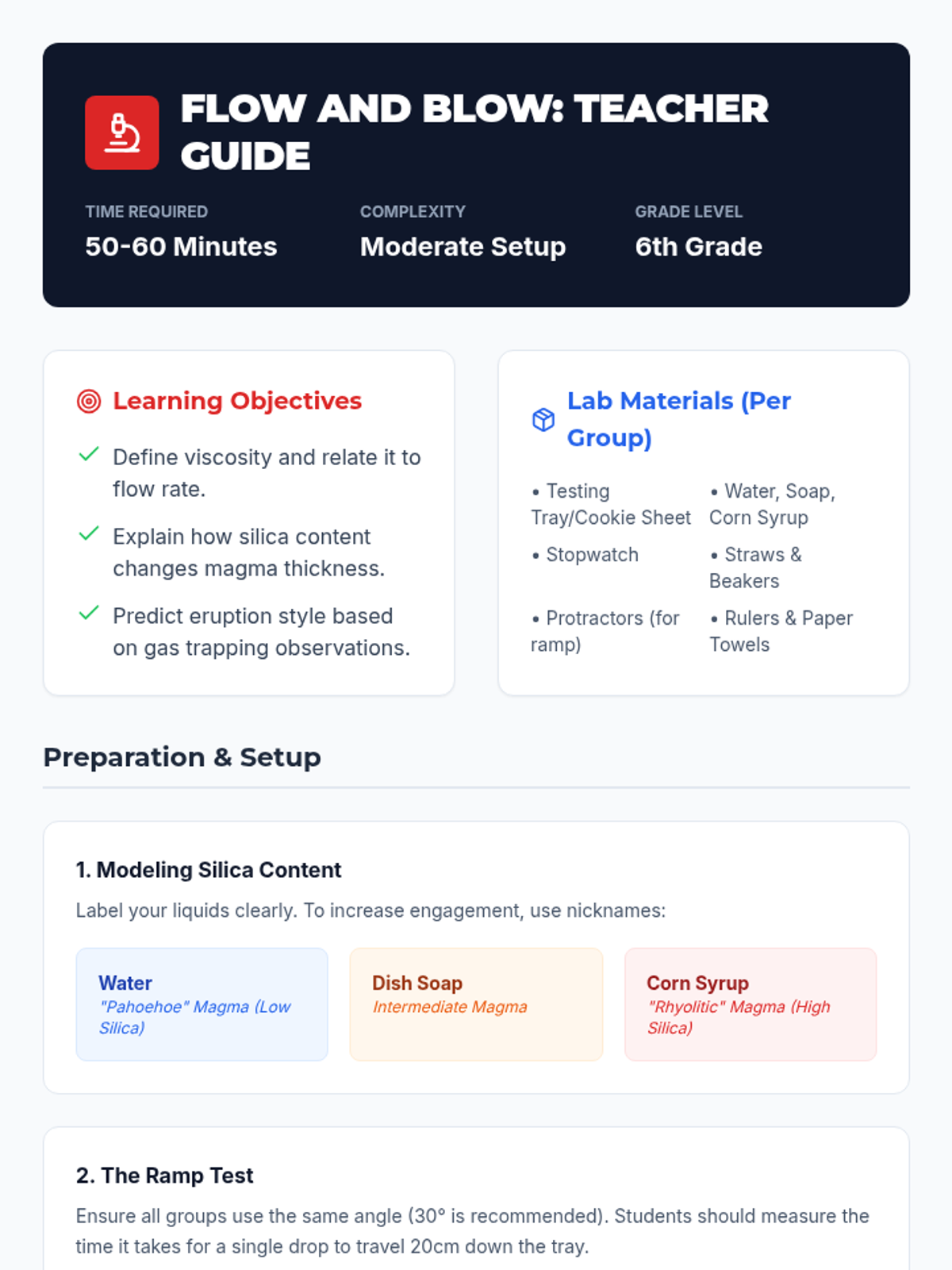
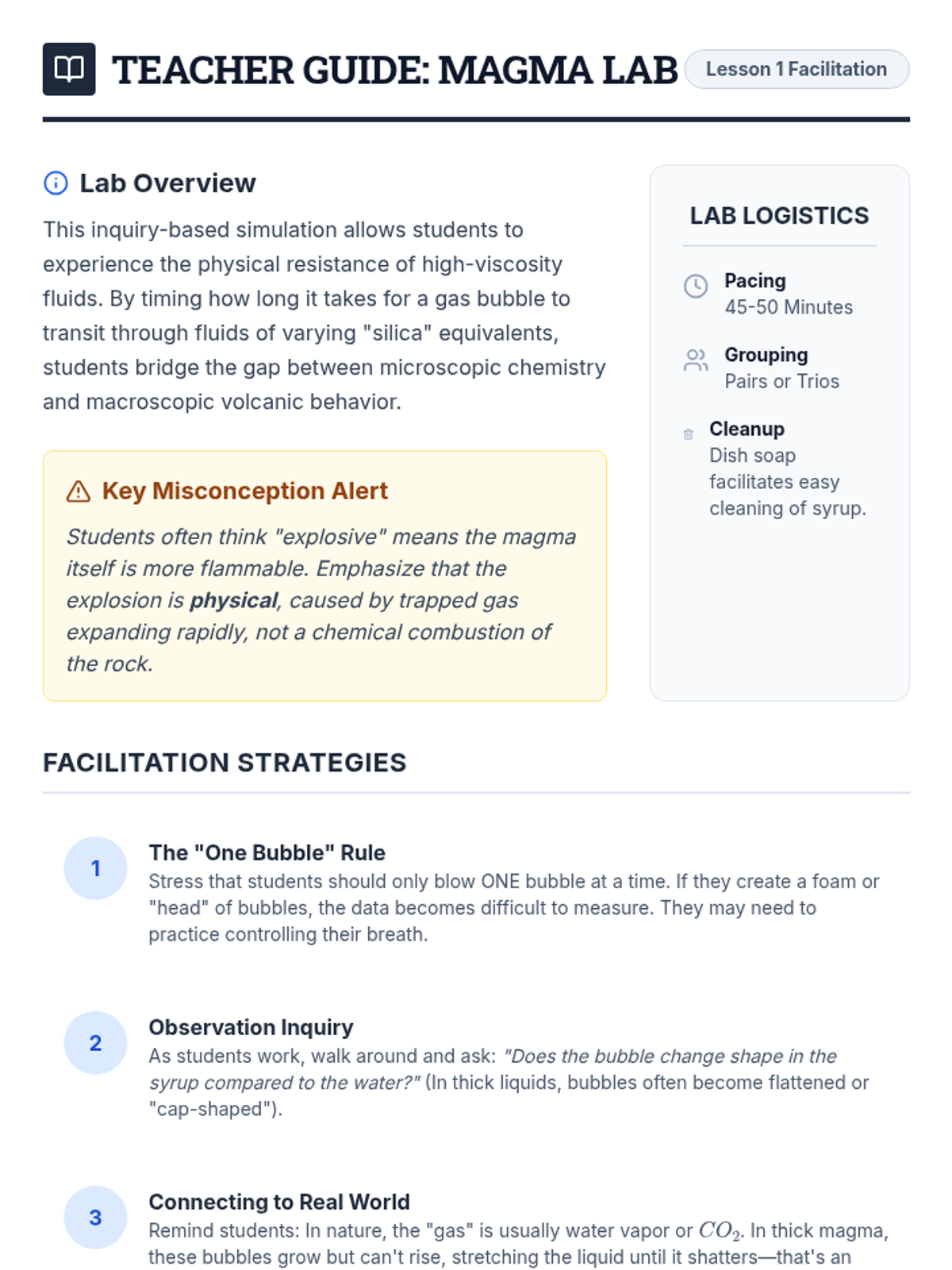
Magma Lab Teacher Guide

Volcano Dynamics

A comprehensive investigation into the geochemistry, morphology, and hazards of volcanic eruptions. Students explore how magma composition influences eruptive styles and shapes the Earth's surface across different tectonic settings.

Lenny Avatar
Lenny
1/17
Sequence
Kinetic Kickoff Slides
Particle Party Worksheet
Molecular Motion Guide

Heat Lab Thermal Systems

A 6th-grade physics unit exploring thermodynamics through particle motion, heat transfer mechanisms, and an engineering design challenge to control thermal energy flow.

Lenny Avatar
Lenny
1/17
Sequence
Matter Identity Slides
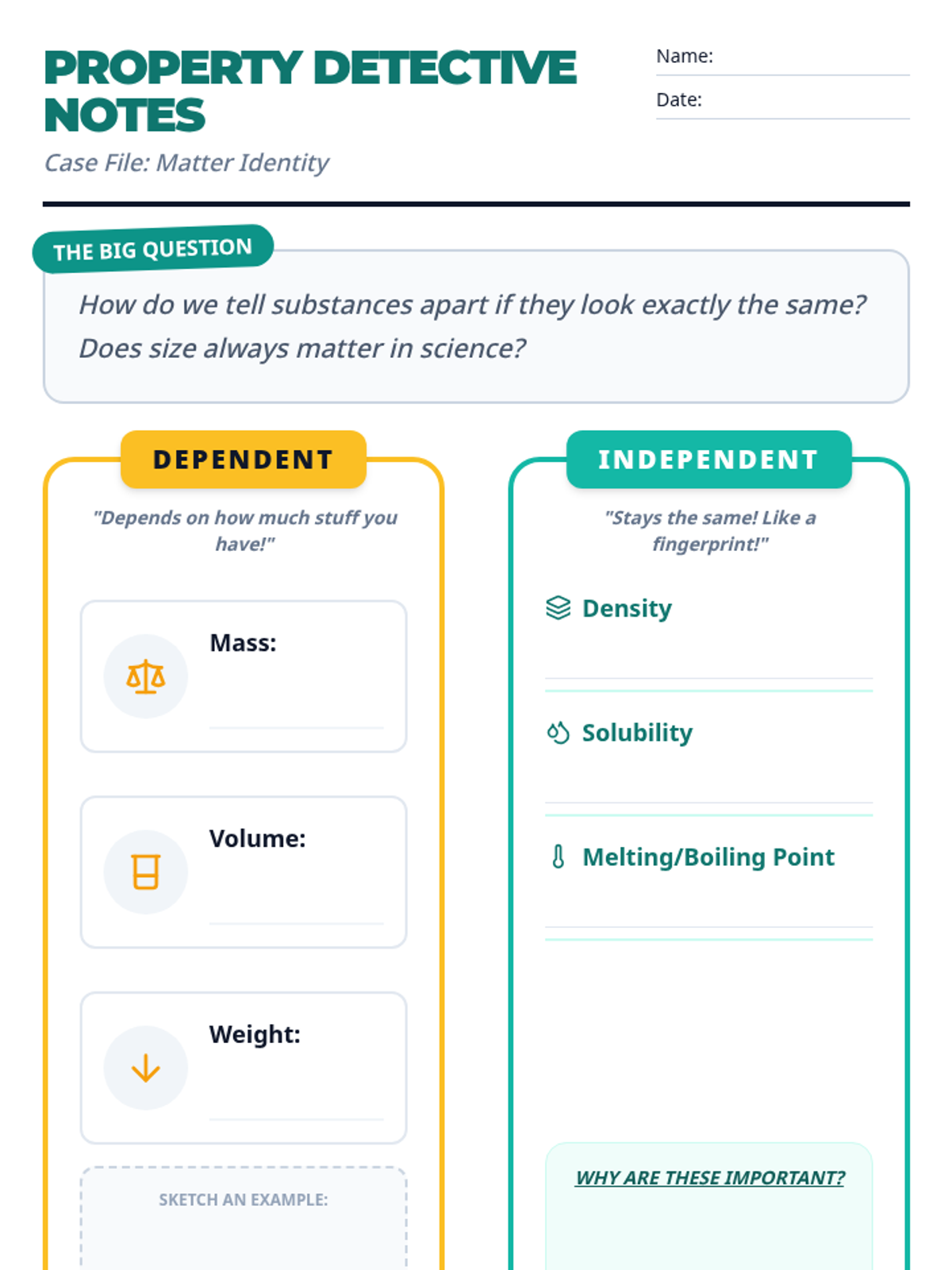
Property Detective Notes
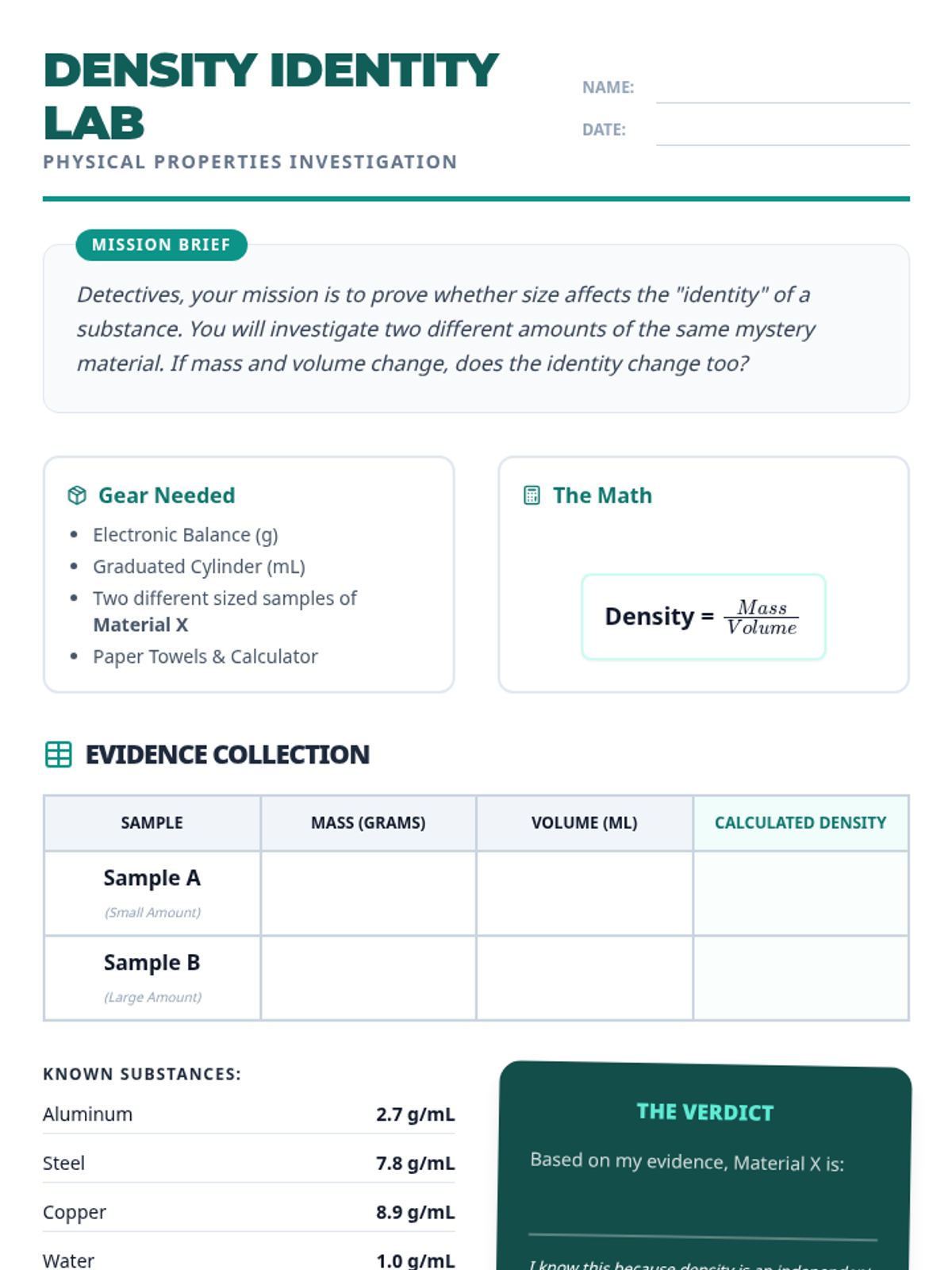
Density Identity Lab
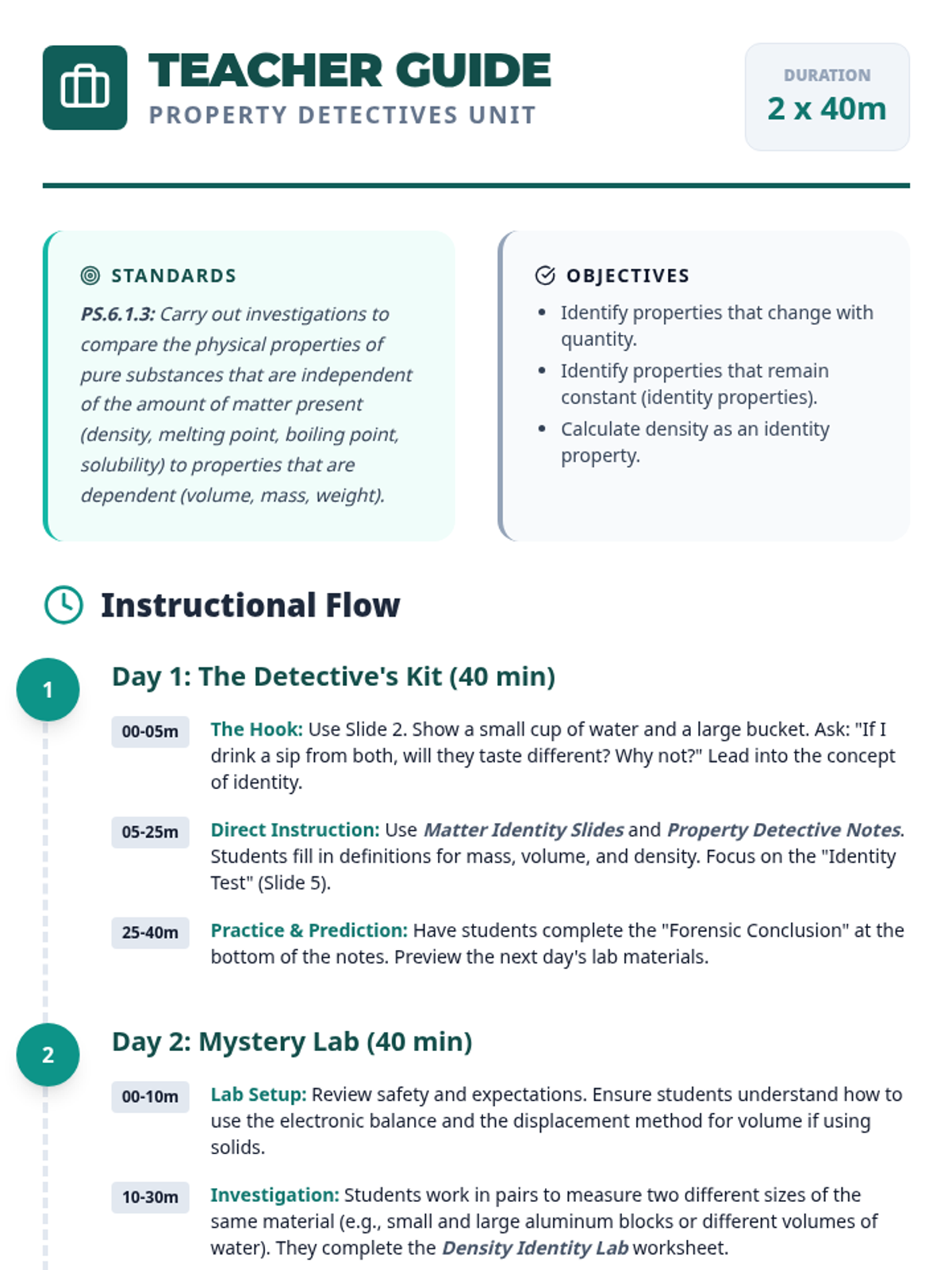
Property Detective Teacher Guide

Property Detectives

A two-day exploration of physical properties, distinguishing between those that depend on the amount of matter (mass, volume, weight) and those that are intrinsic to the substance (density, melting point, boiling point, solubility).

KM

Katlyn Makatura

Science Teacher
3/5
Sequence
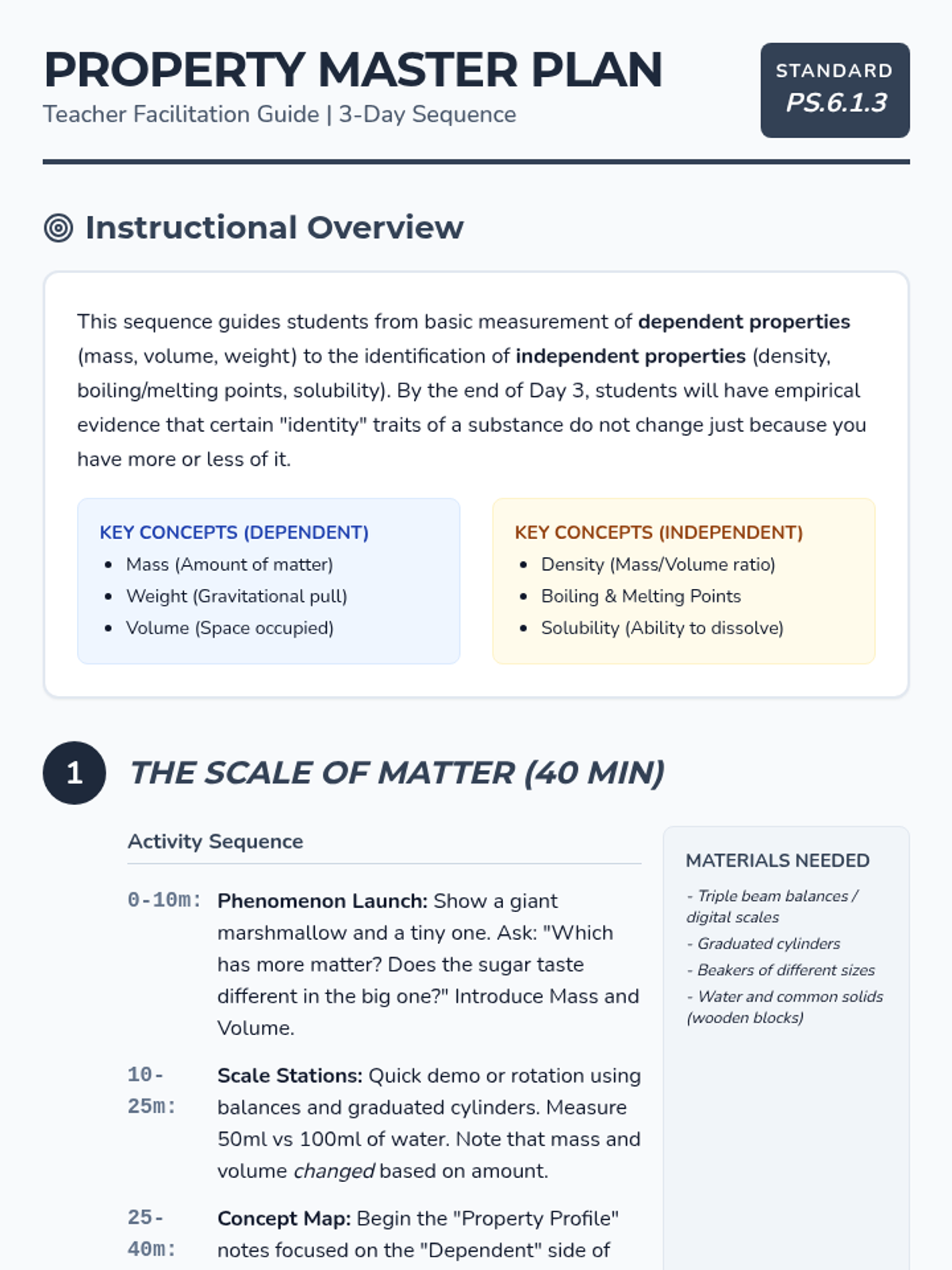
Property Master Plan Teacher Guide
Matter Files Slides

Matter Property Detectives

A comprehensive 3-day sequence focused on distinguishing between physical properties of matter that are independent of amount (density, solubility, melting/boiling points) and those that are dependent (mass, volume, weight). Students act as 'Substance Sleuths' to investigate these properties through hands-on labs and visual note-taking.

KM

Katlyn Makatura

Science Teacher
3/3
Sequence
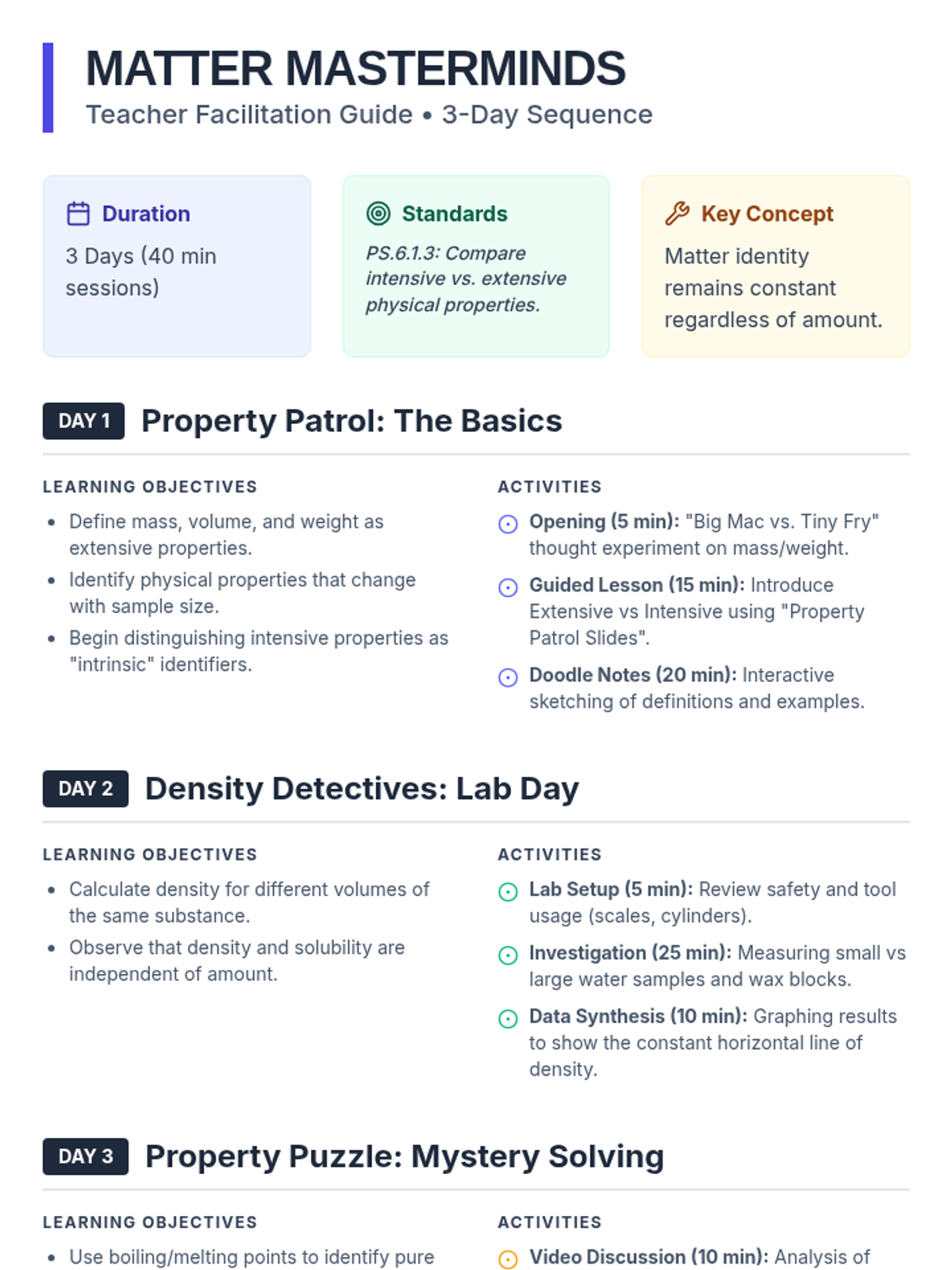
Matter Masterminds Teacher Guide
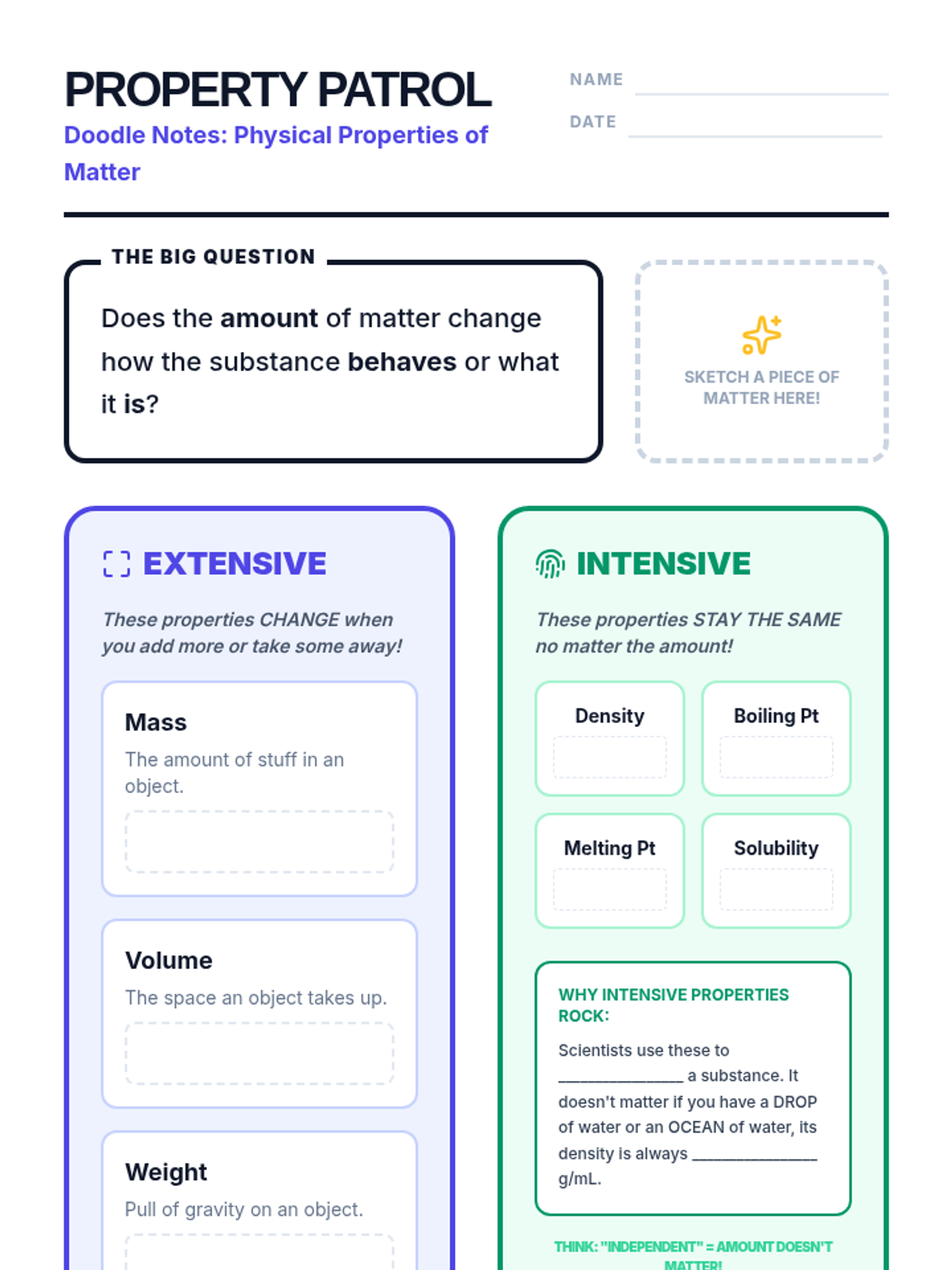
Property Patrol Doodle Notes
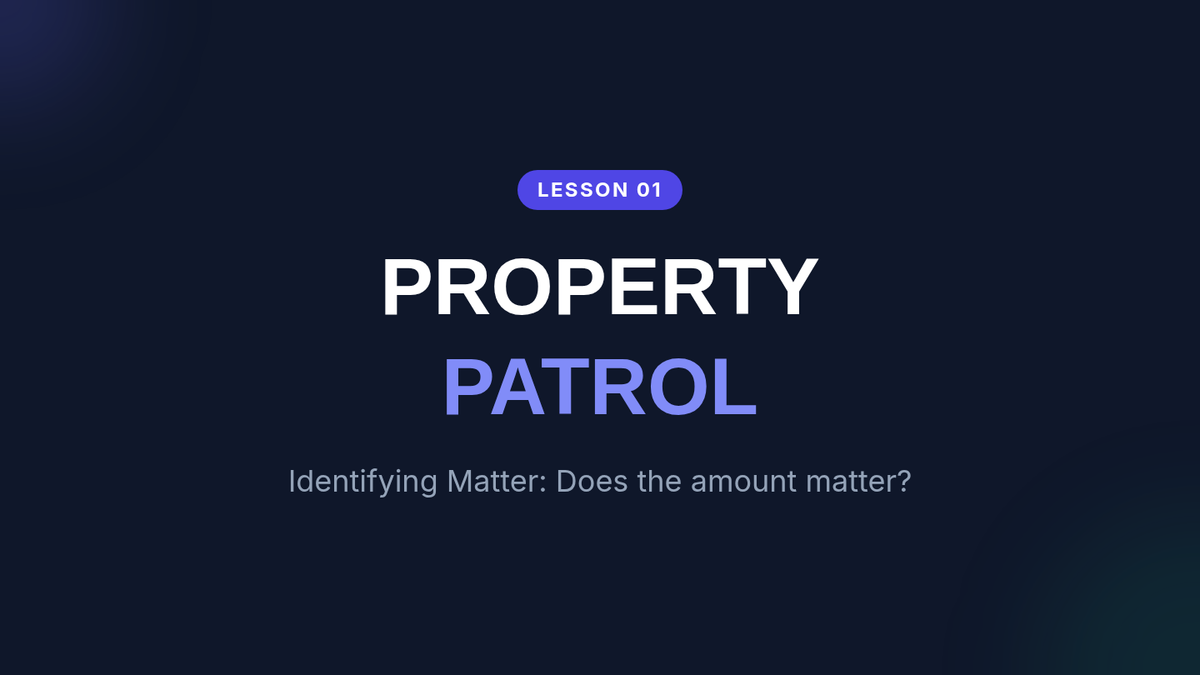
Property Patrol Slides

Matter Masterminds

A 3-day investigation into the physical properties of matter, focusing on the distinction between intensive (independent) and extensive (dependent) properties through hands-on labs and doodle notes.

KM

Katlyn Makatura

Science Teacher
3/2
Sequence
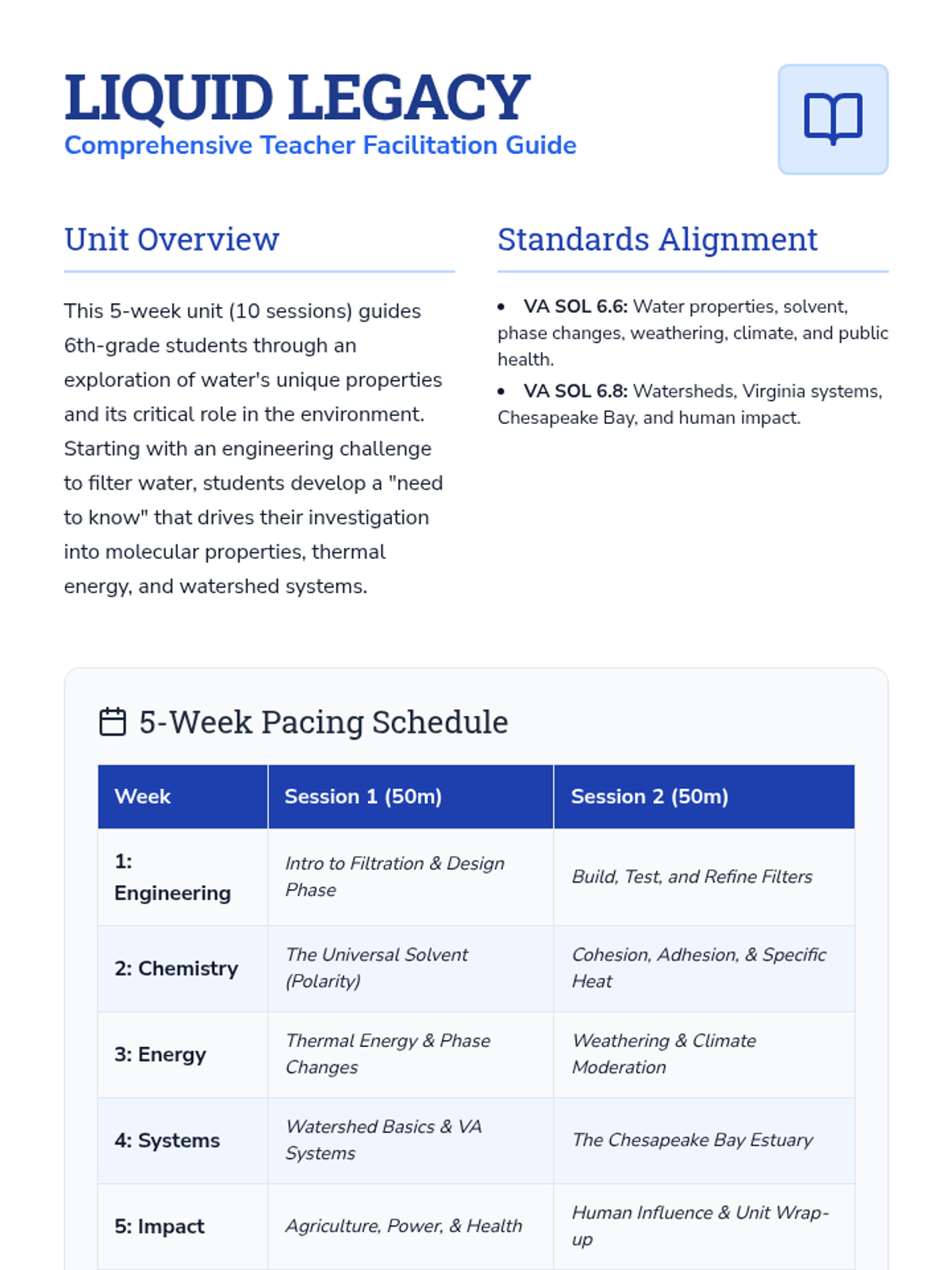
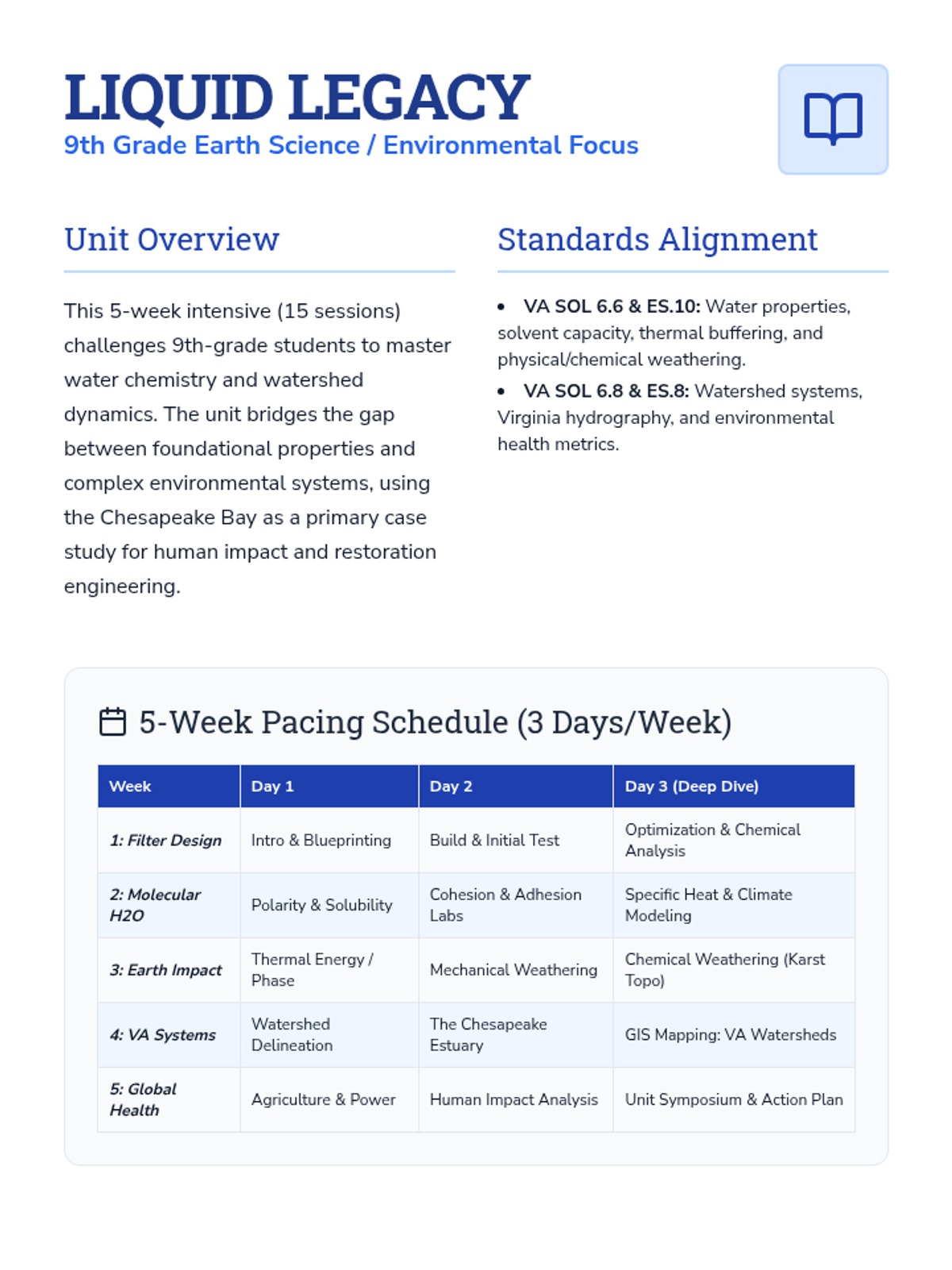
Liquid Legacy Teacher Guide
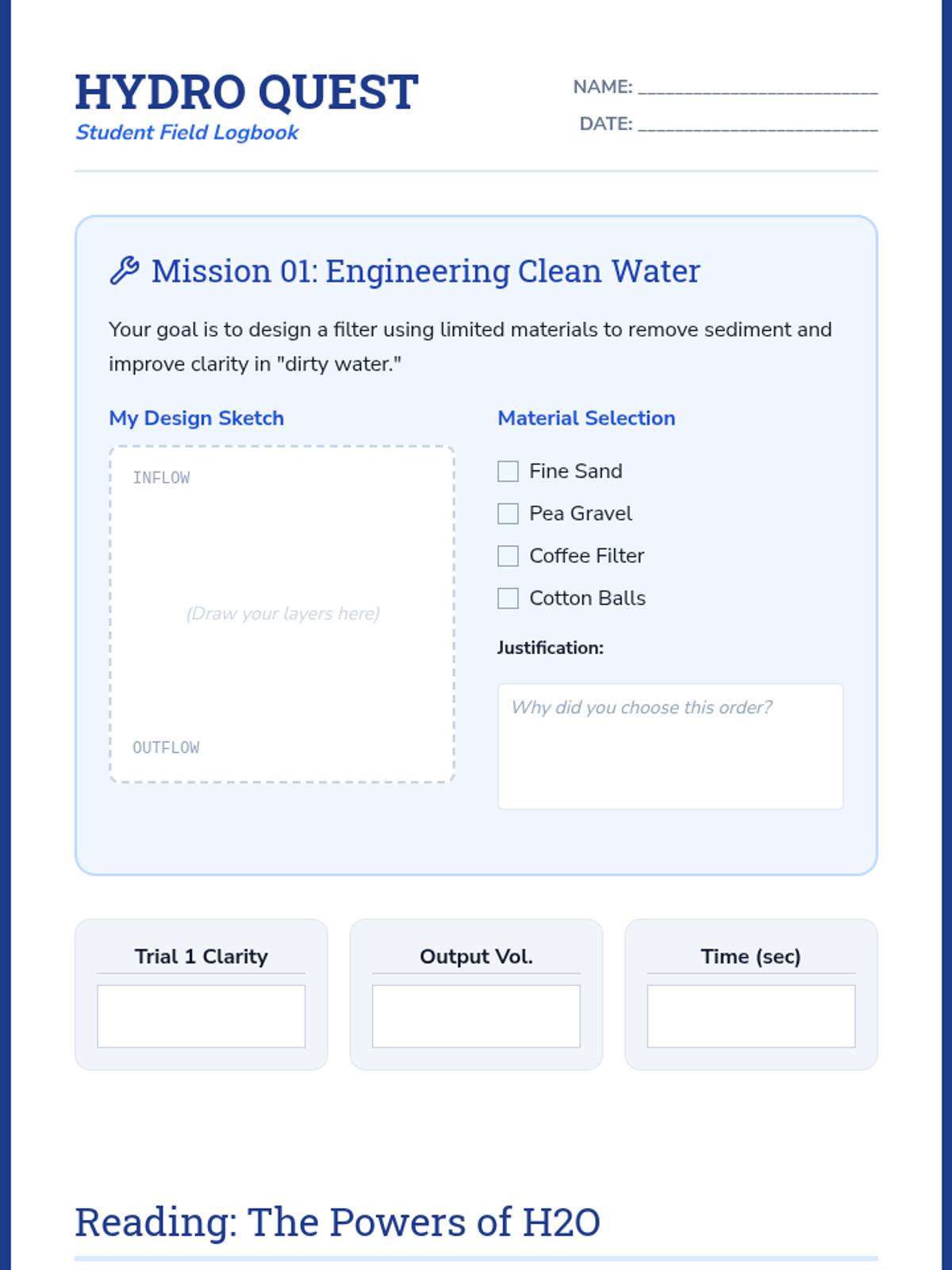
Flow Force Lab Sheets
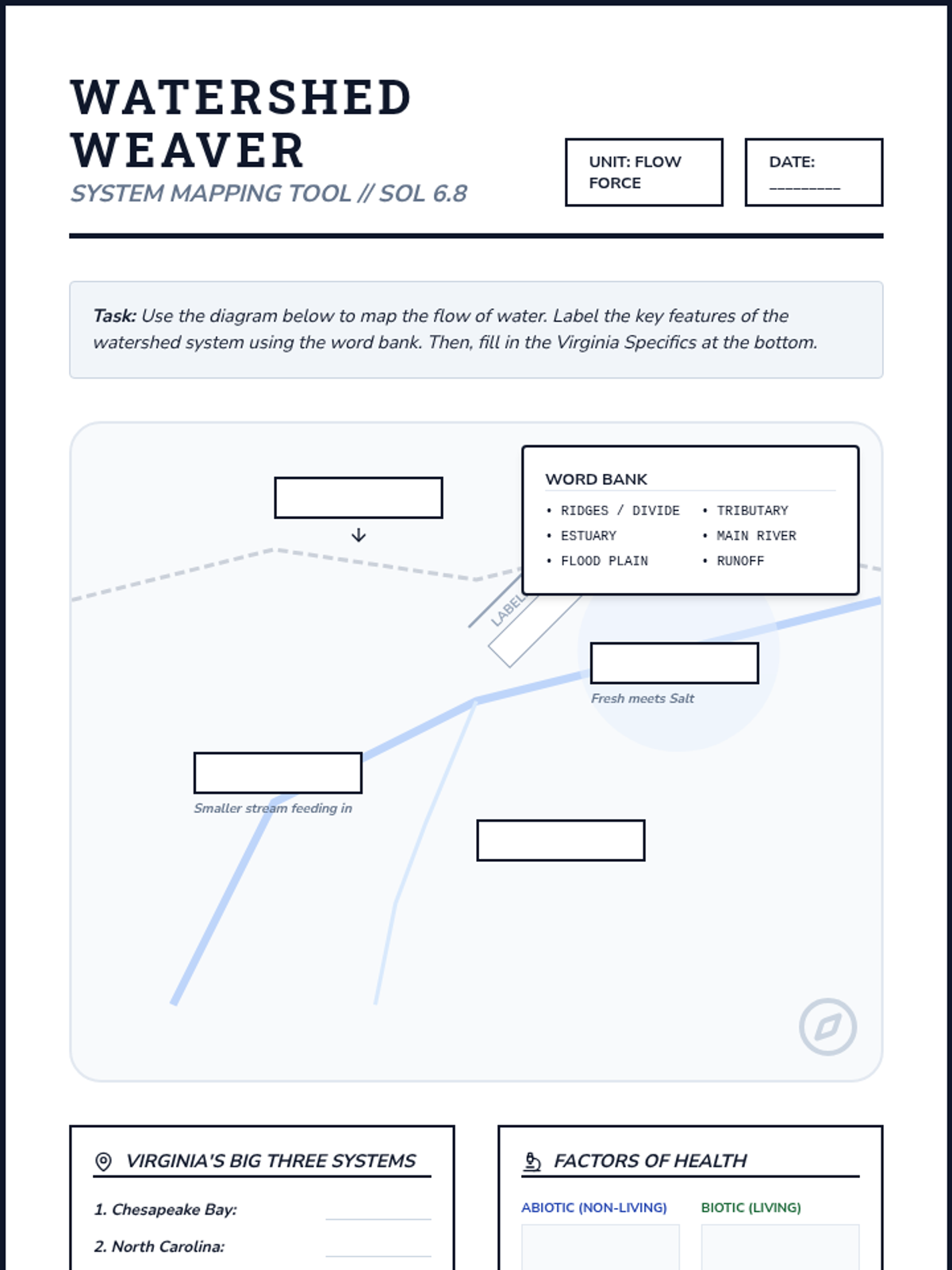
Watershed Weaver Graphic Organizer
Flow Force Slides

Flow Force

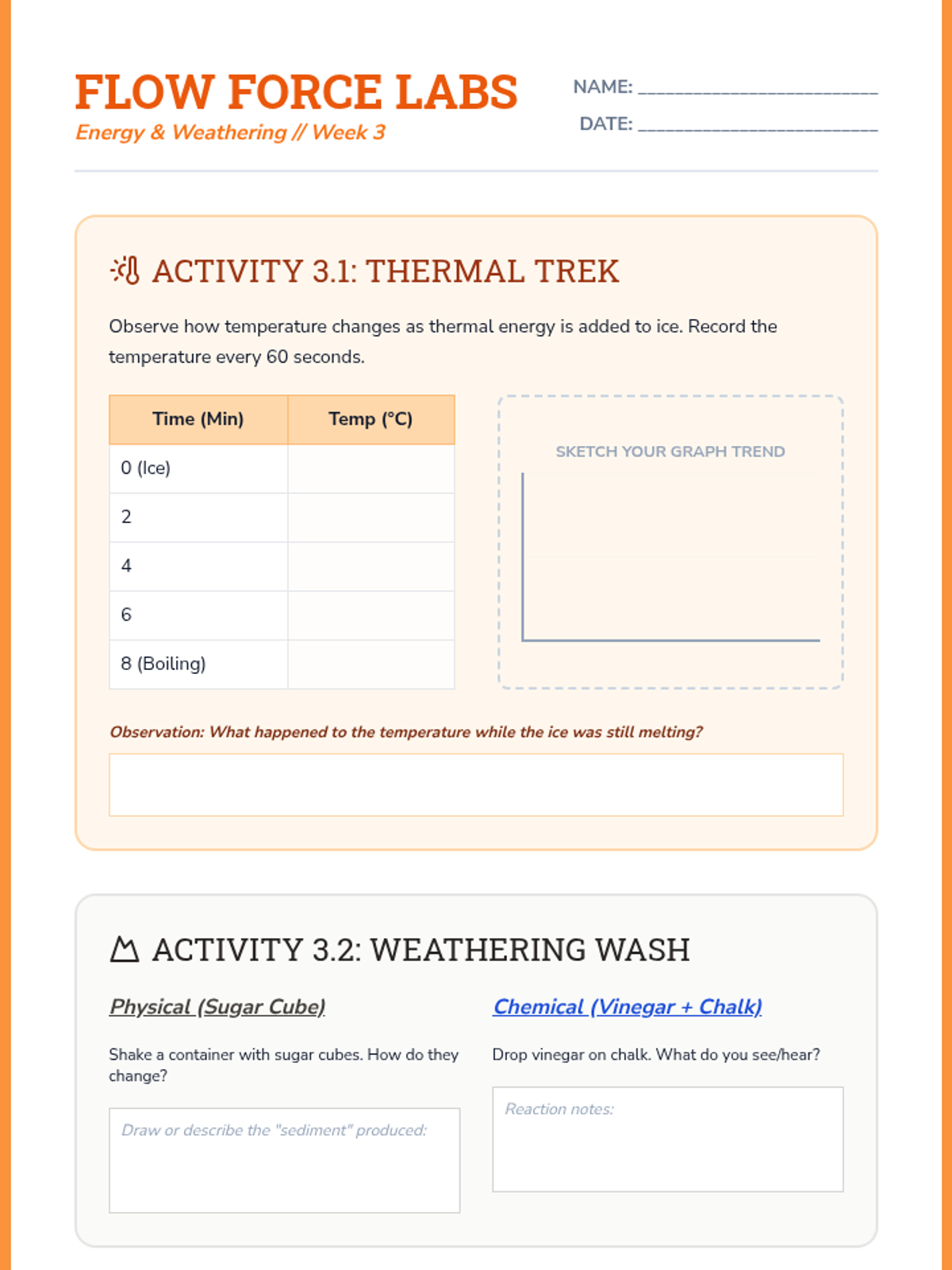
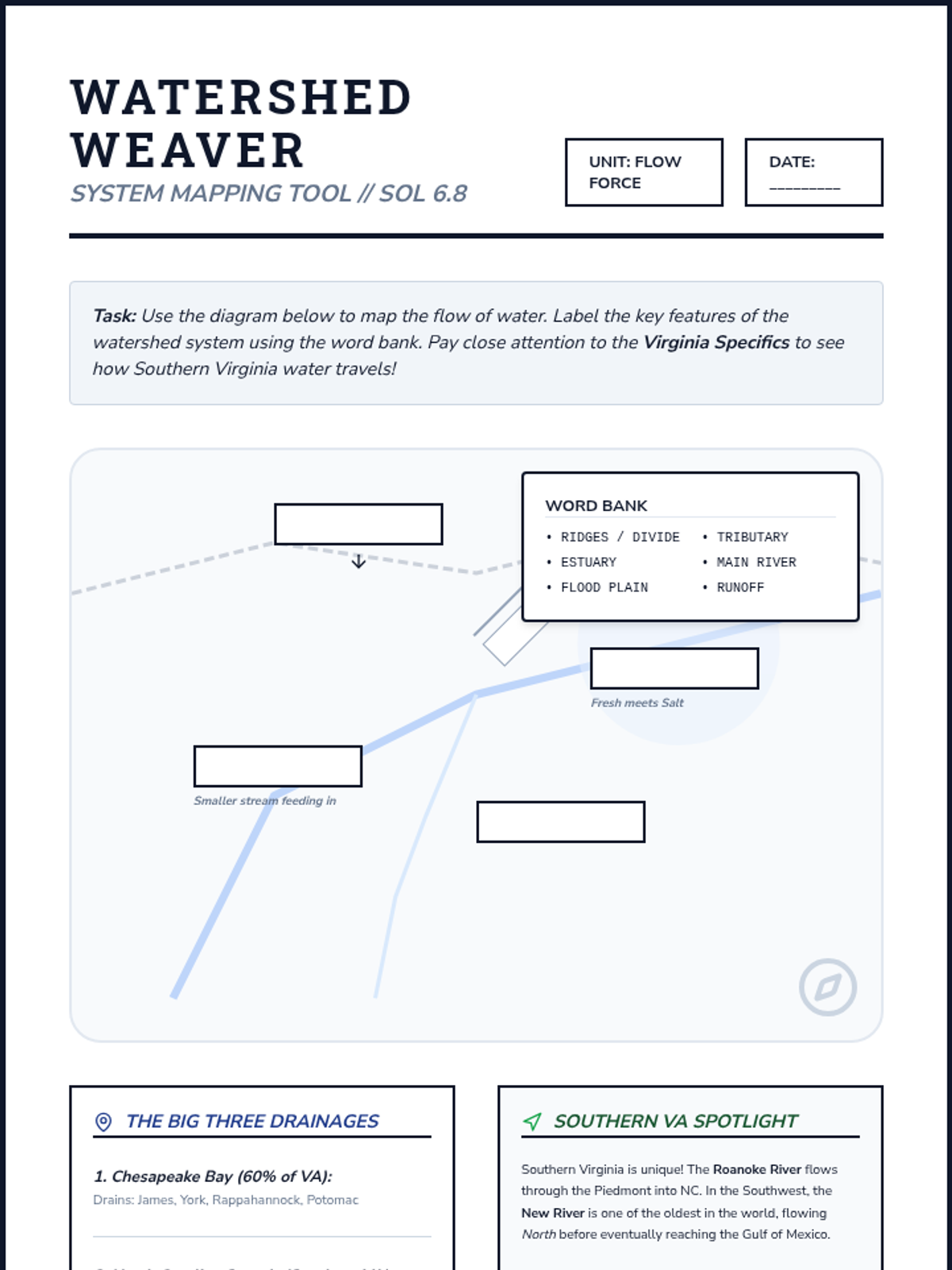
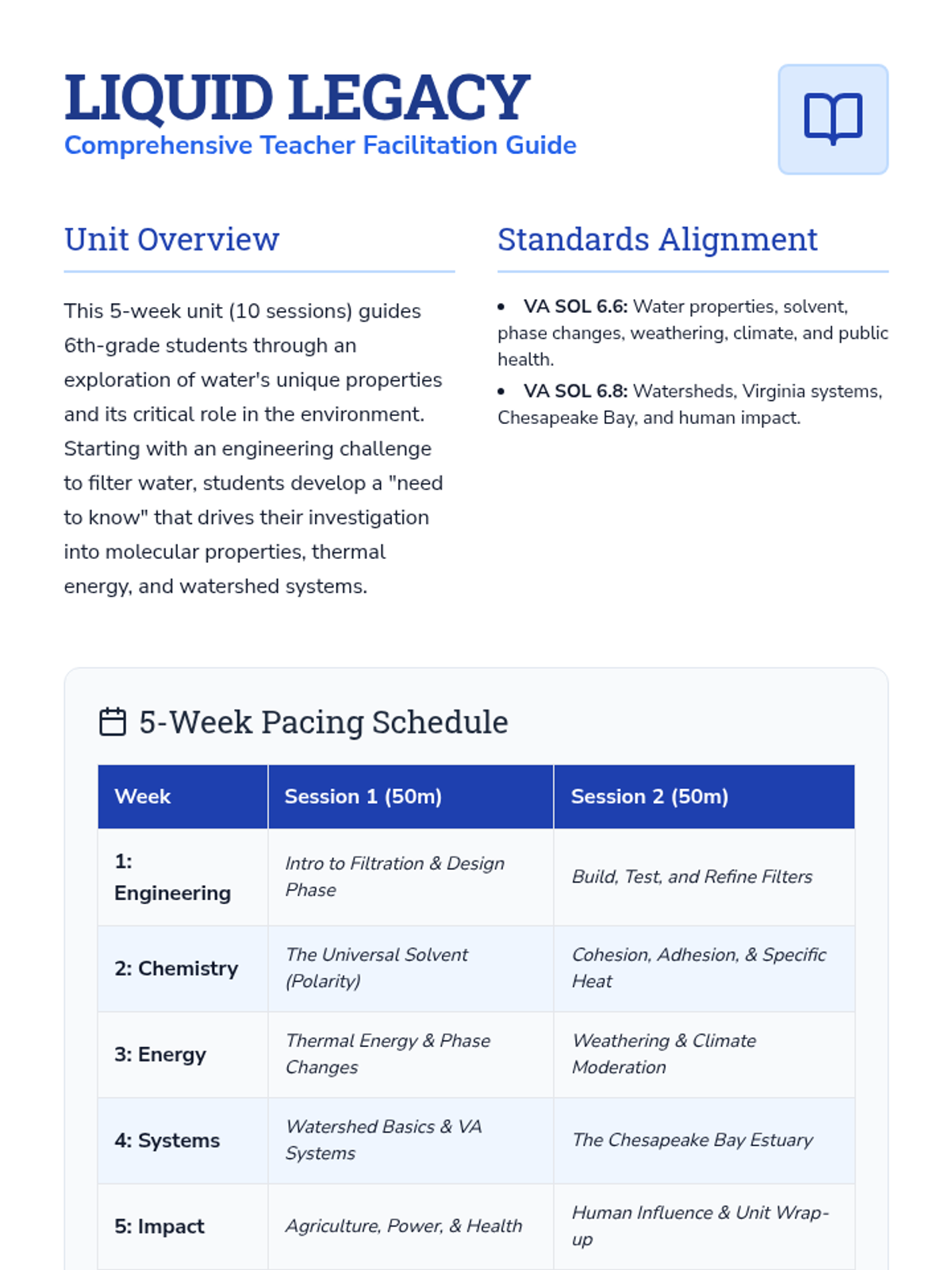
A comprehensive 5-week sequence exploring the physical properties of water, the engineering of water filtration, and the complex systems of Virginia's watersheds. Students move from hands-on engineering to chemical properties and finally to large-scale environmental systems.

TM

Teri Minami

Science Teacher
2/3
Sequence
Liquid Legacy Teacher Guide
Flow Force Slides
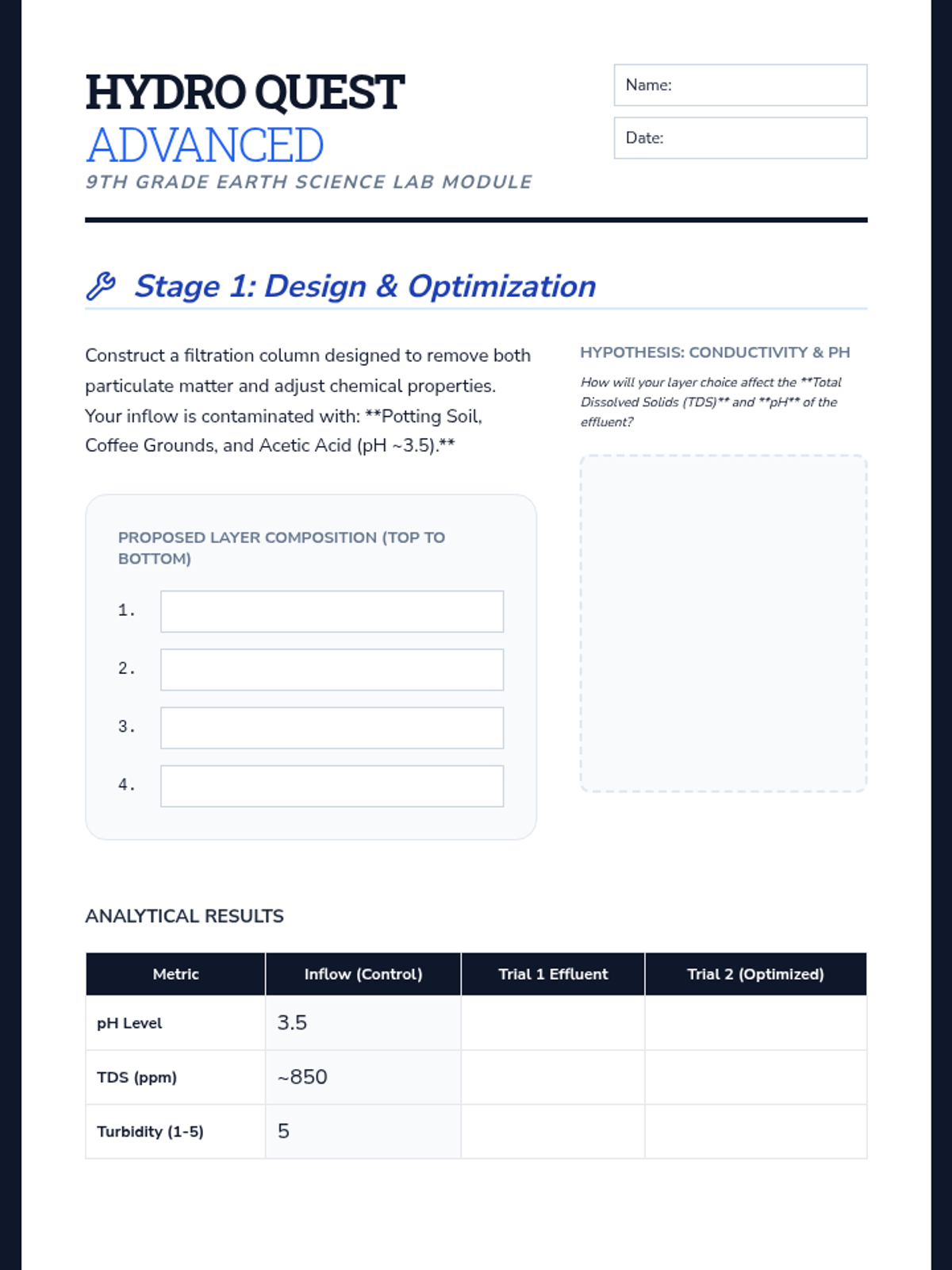
Hydro Quest Student Workbook
Watershed Weaver Graphic Organizer
Liquid Legacy Teacher Guide 9th Grade Extension
Flow Force 9th Grade Extension Slides
Hydro Quest 9th Grade Lab Manual
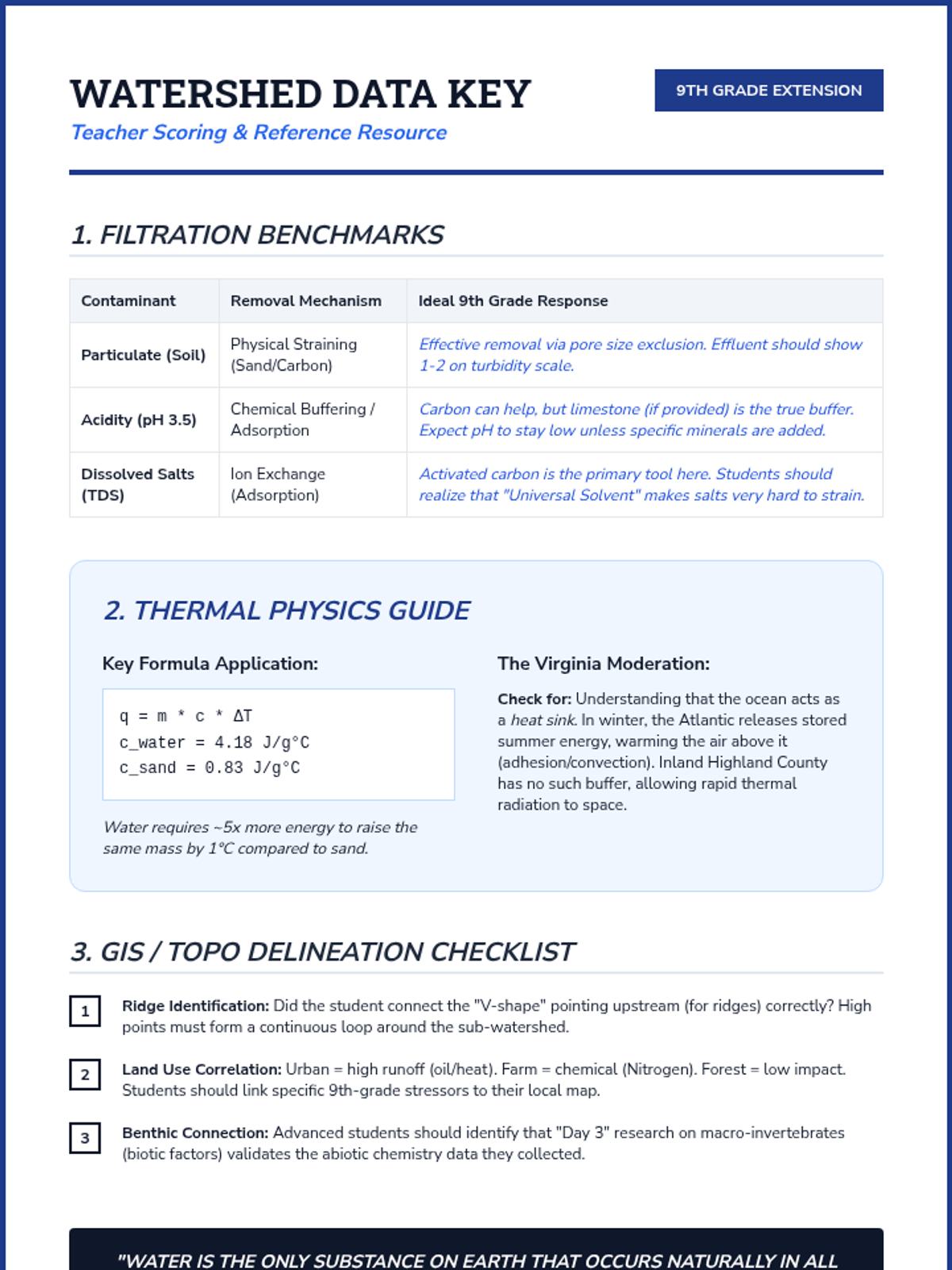
Watershed Data Analysis Answer Key

Flow Force

A comprehensive 5-week sequence exploring the physical properties of water, the engineering of water filtration, and the complex systems of Virginia's watersheds. Students move from hands-on engineering to chemical properties and finally to large-scale environmental systems.

TM

Teri Minami

Science Teacher
2/2
Sequence
Sum of Parts Slides
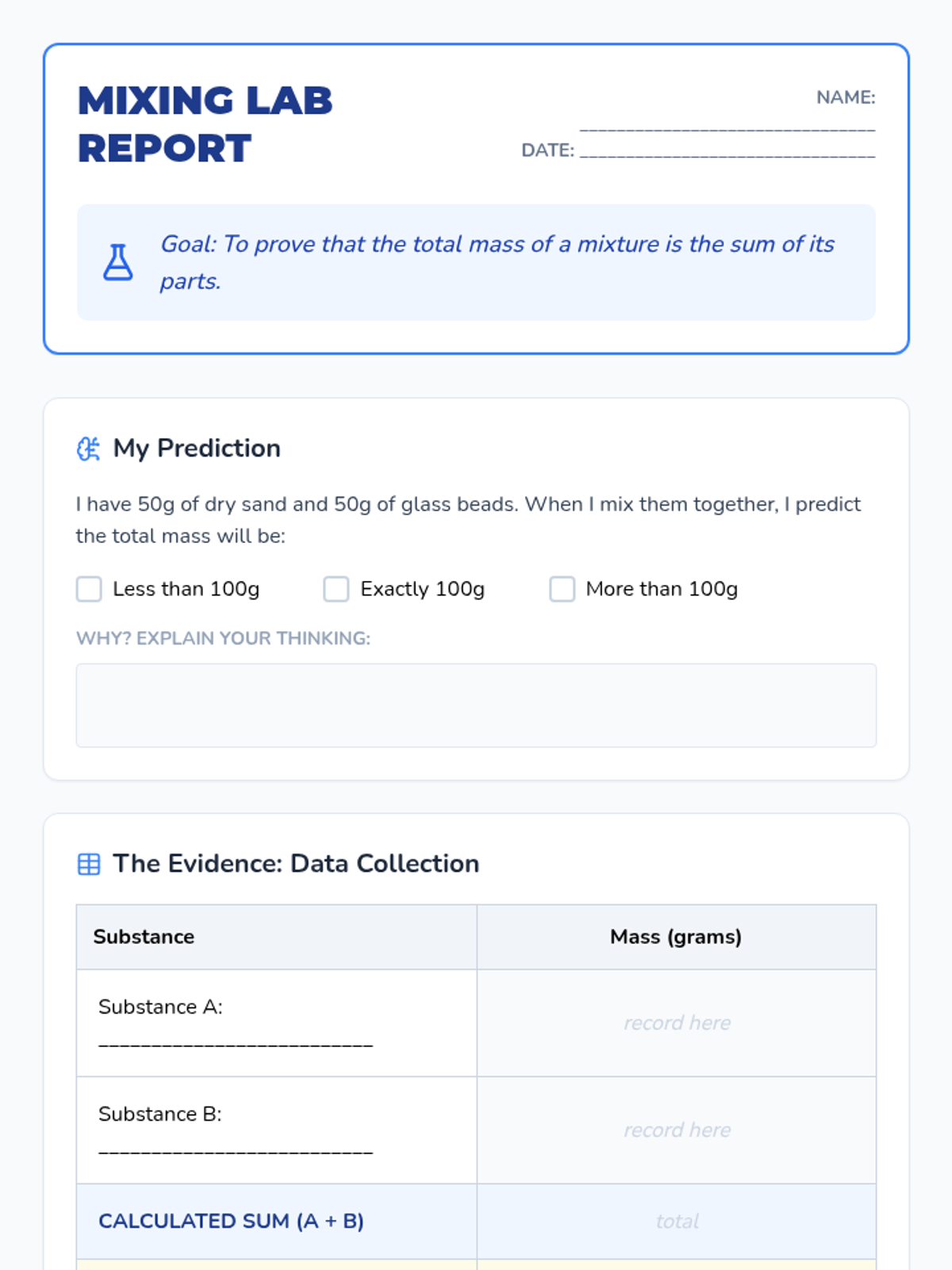
Mixing Lab Report
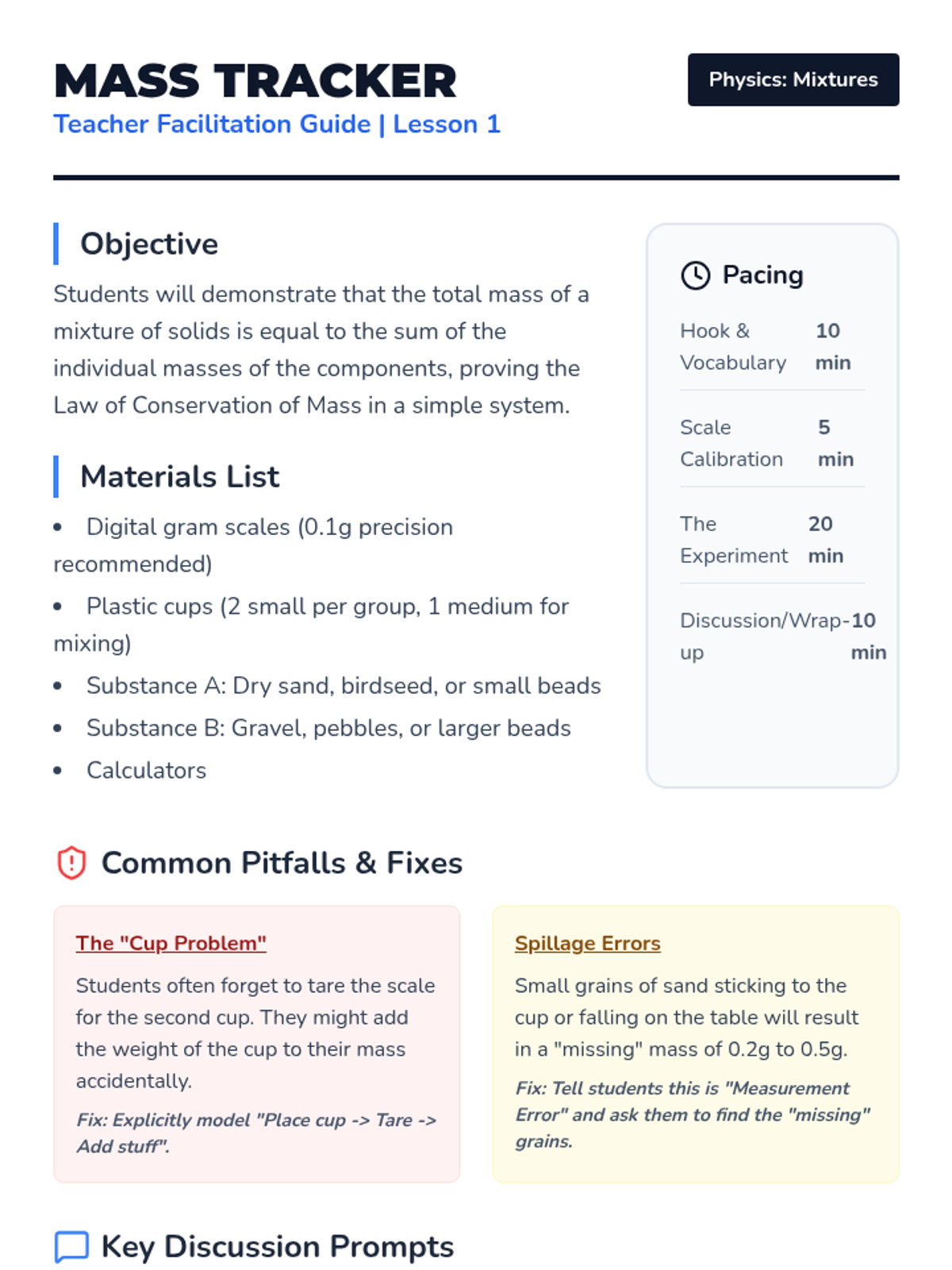
Mass Tracker Teacher Guide

Mass Mystery Solvers

A quantitative exploration of mixtures and solutions where students use measurement to prove that mass is conserved even when substances dissolve or change state. Students progress from simple mixtures of solids to complex solutions and recovery through evaporation.

Lenny Avatar
Lenny
1/18
Sequence
Pollutant Primer Slides
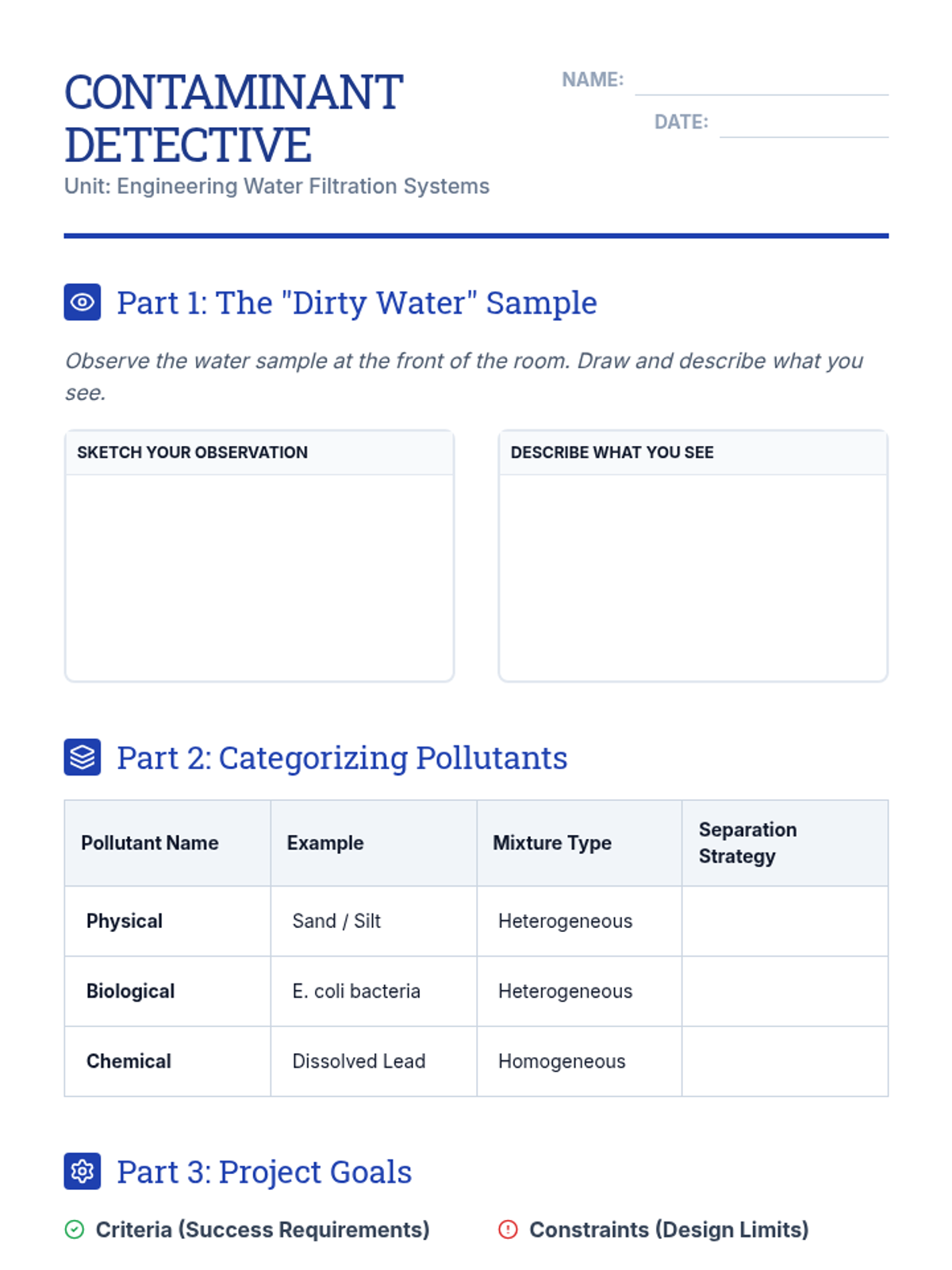
Contaminant Detective Worksheet
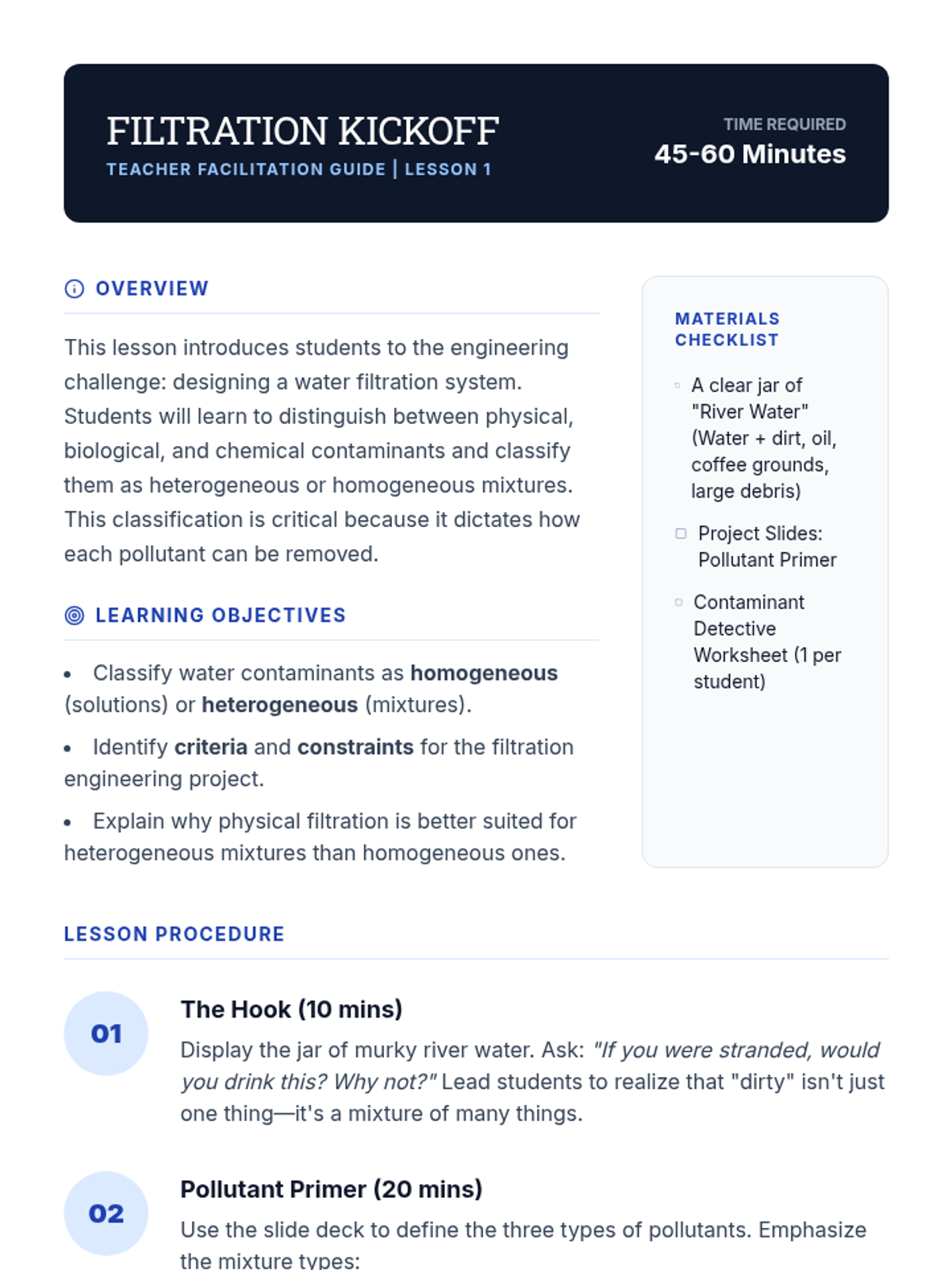
Filtration Kickoff Teacher Guide

Engineering Water Filtration Systems

A project-based unit where 6th-grade students design, test, and evaluate water filtration systems, applying concepts of mixtures and separation techniques.

Lenny Avatar
Lenny
1/18
Sequence
Solubility Secrets Slides
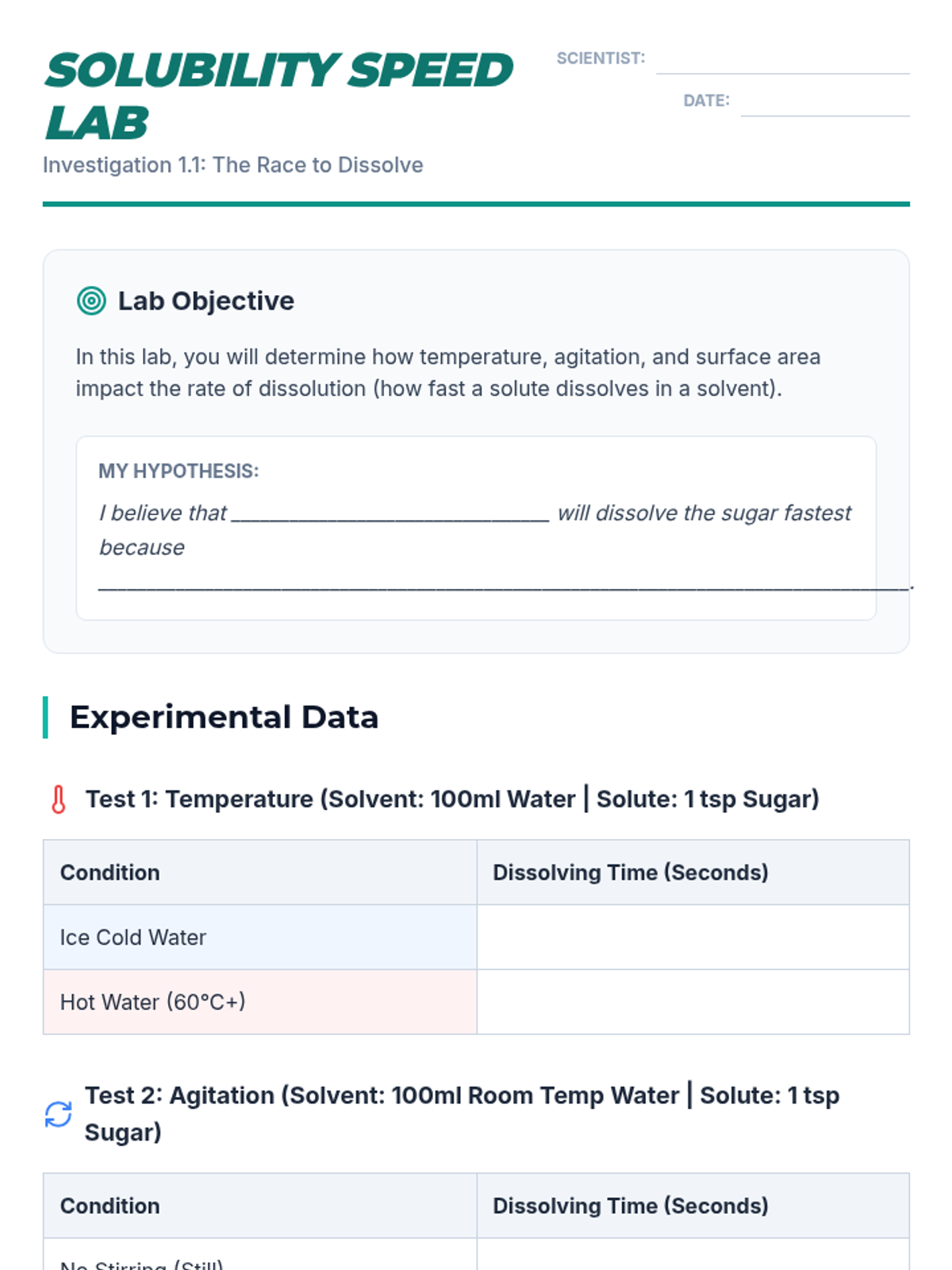
Solubility Speed Lab Worksheet
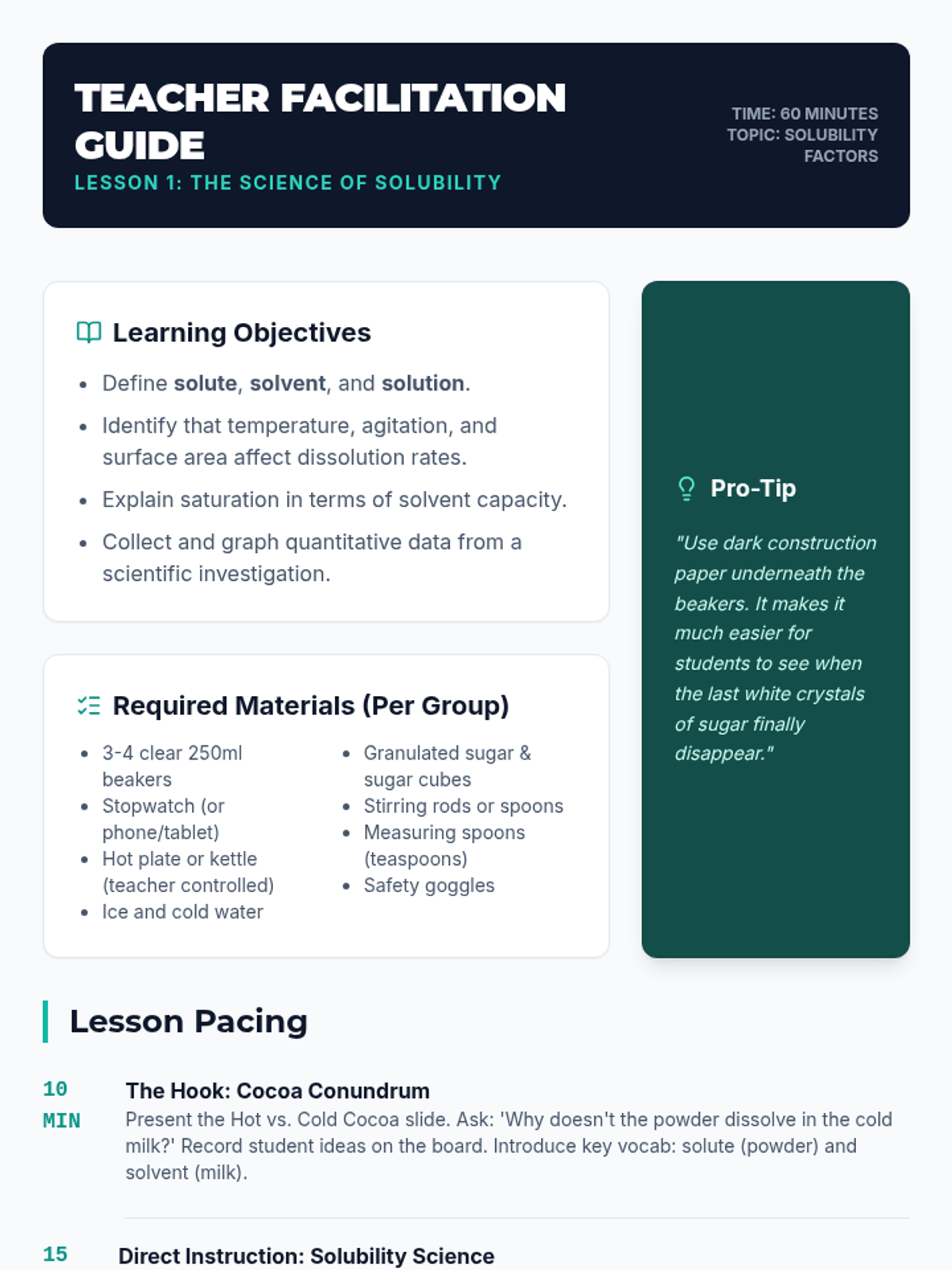
Solubility Teacher Guide

Investigating Solutions and Chromatography

A 5-lesson unit exploring homogeneous mixtures, solubility, and separation techniques like evaporation and chromatography, culminating in a forensic ink analysis case study.

Lenny Avatar
Lenny
1/18
Sequence
Mechanical Sort Slides
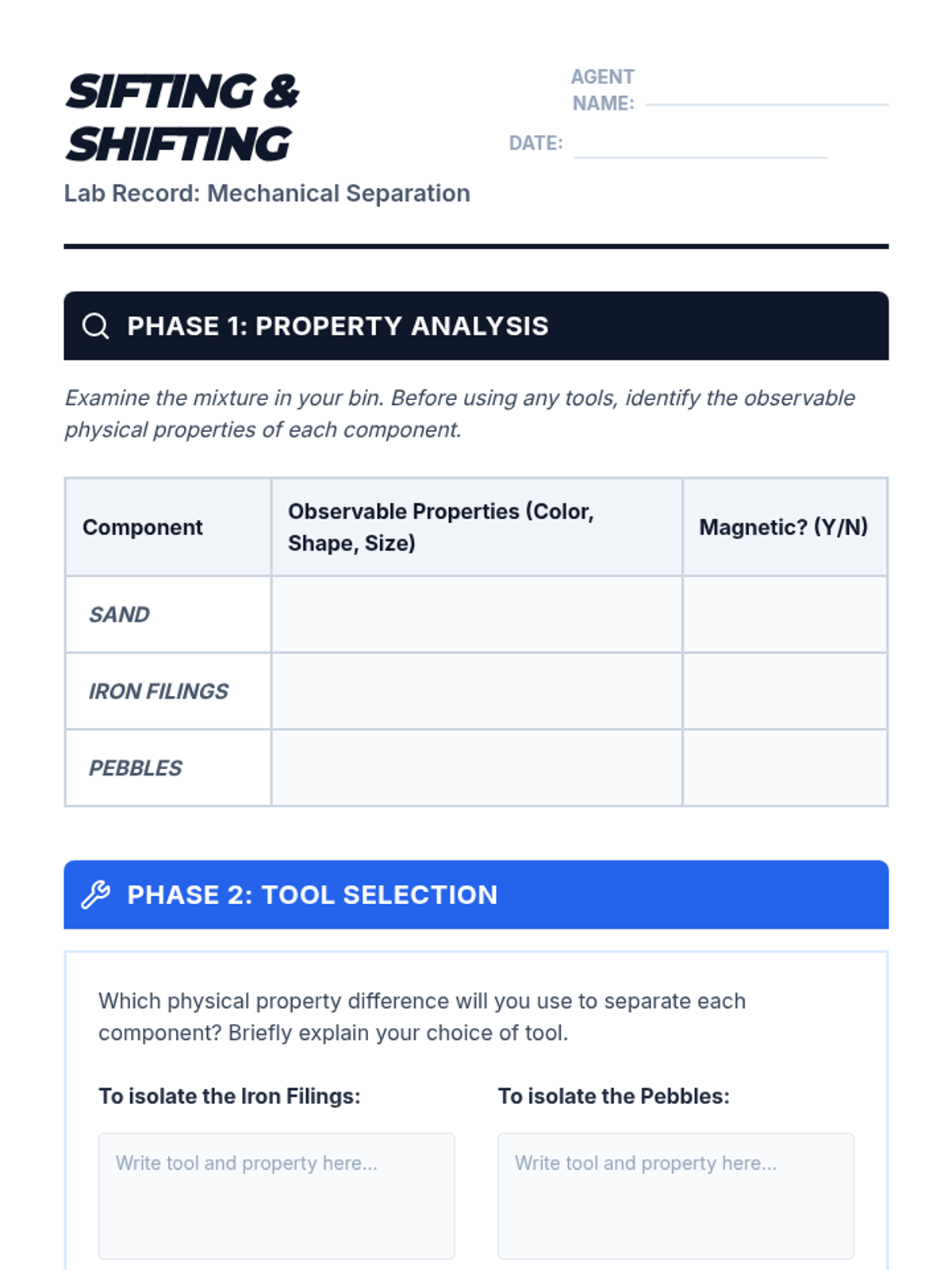
Sifting and Shifting Worksheet
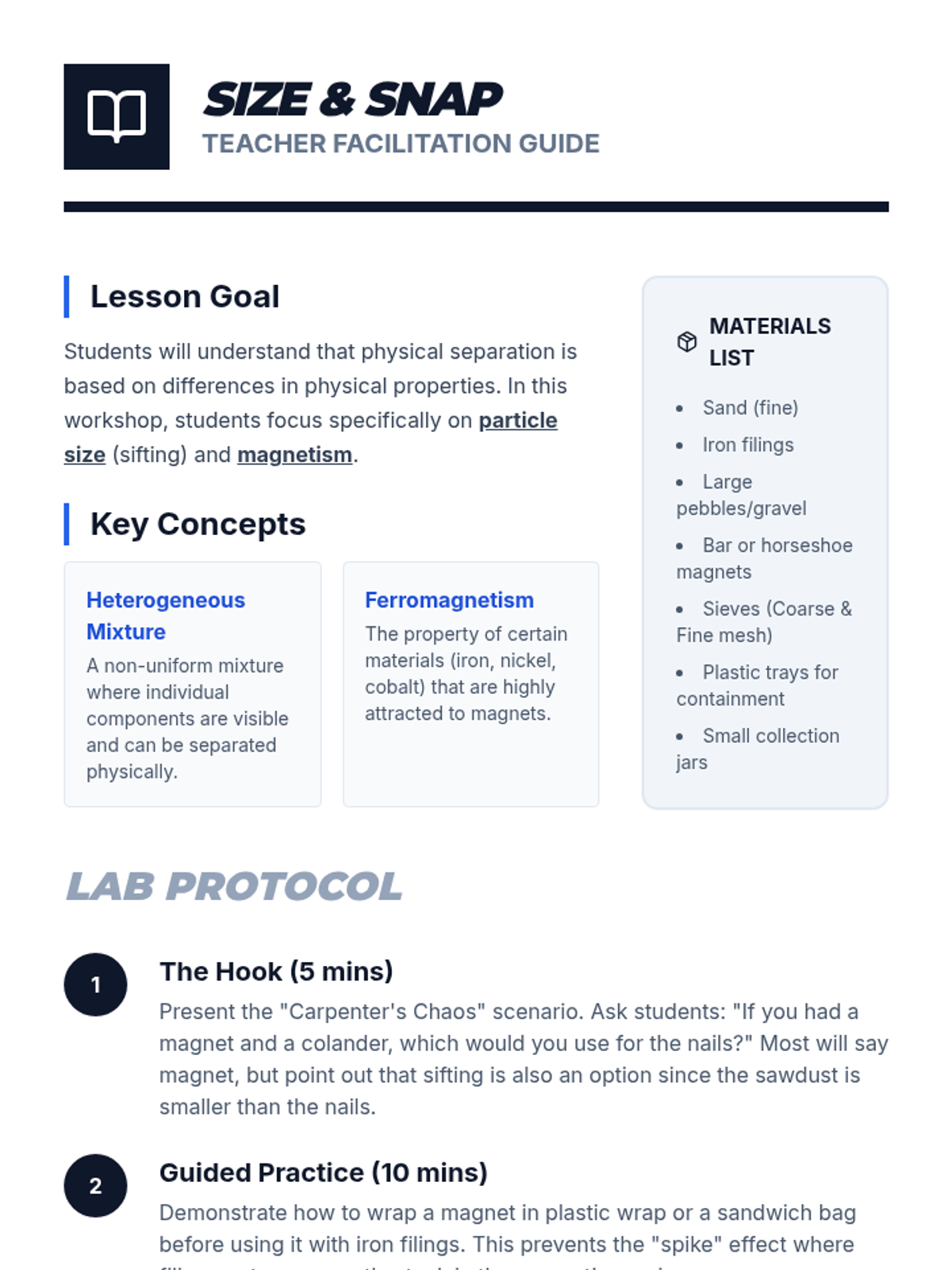
Size and Snap Teacher Guide

Separation Masters

A comprehensive workshop-style sequence for 6th-grade students to master the physical separation of heterogeneous mixtures. Students progress through sifting, magnetism, filtration, and decantation, culminating in a complex multi-step separation challenge.

Lenny Avatar
Lenny
1/18
Sequence
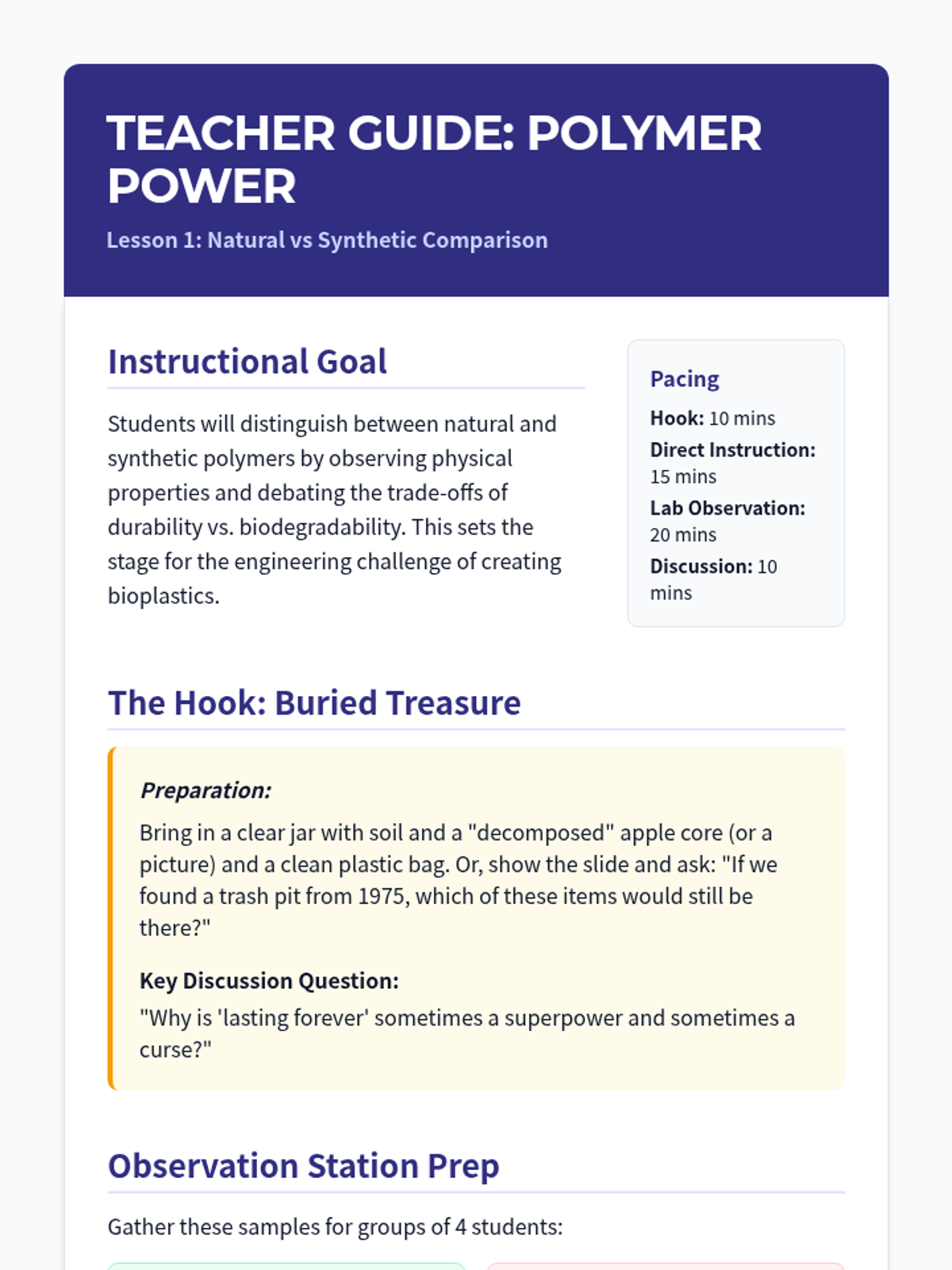
Polymer Power Slides
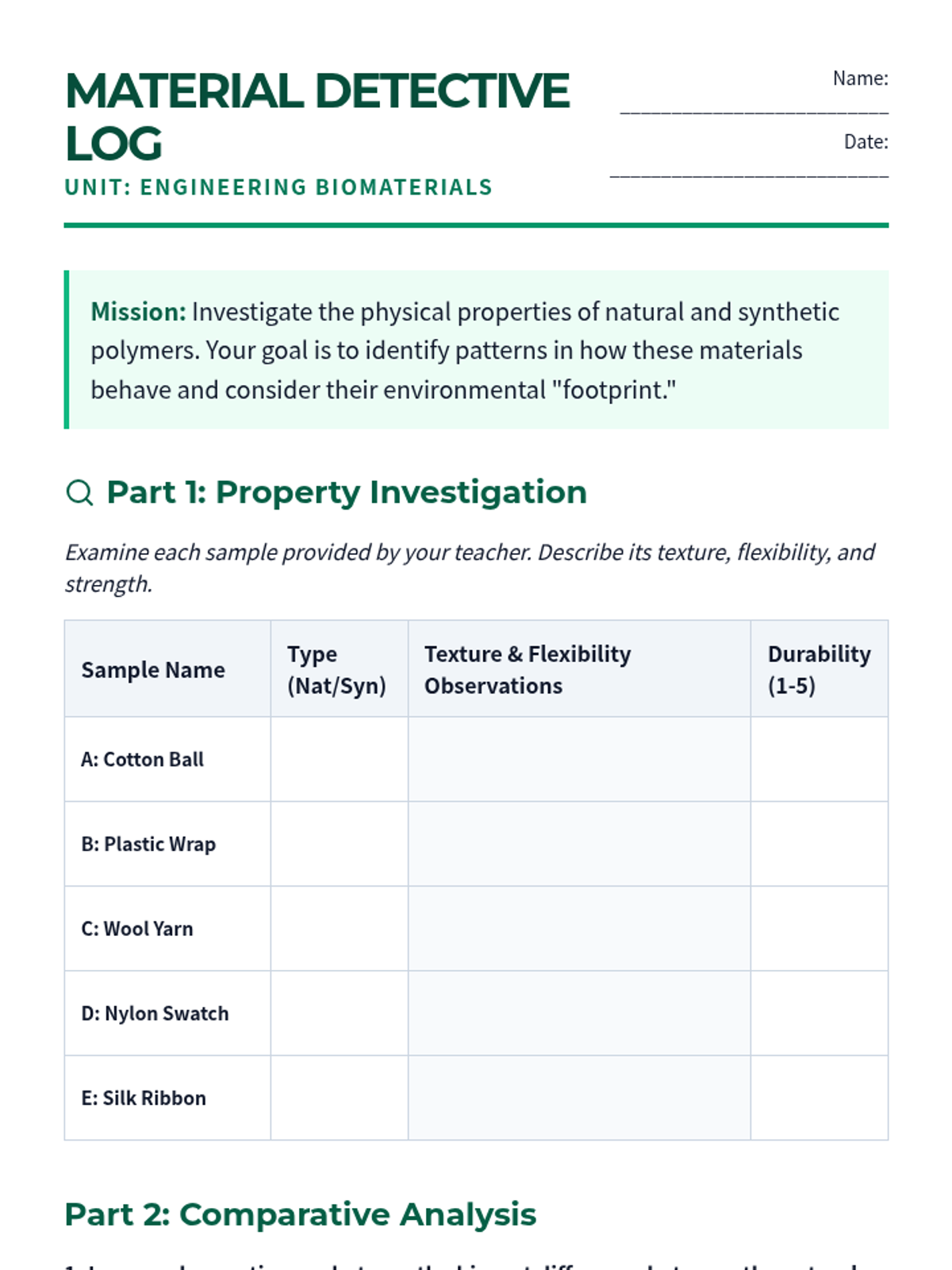
Material Detective Log Worksheet
Polymer Power Teacher Guide

Engineering Biomaterials and Sustainable Polymers

An engineering-focused biology sequence where students explore biomolecules as raw materials. They synthesize bioplastics from milk and starch, test their properties against synthetic plastics, and research future sustainable materials.

Lenny Avatar
Lenny
1/17
Sequence
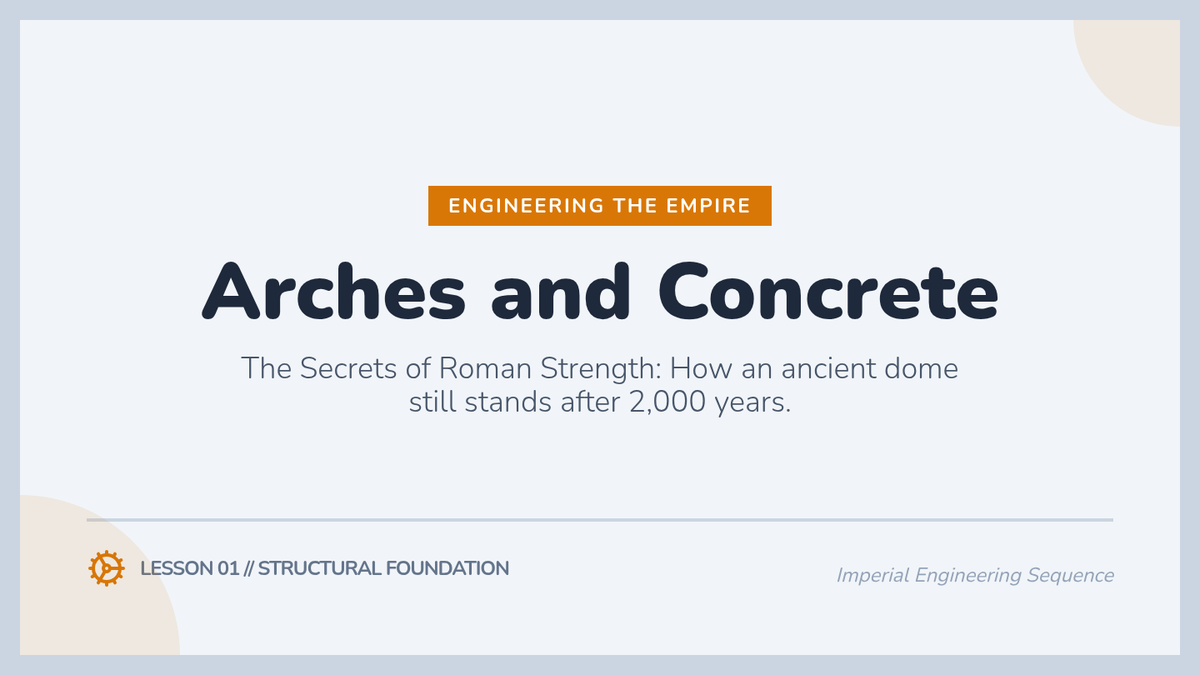
Arches and Concrete Slides
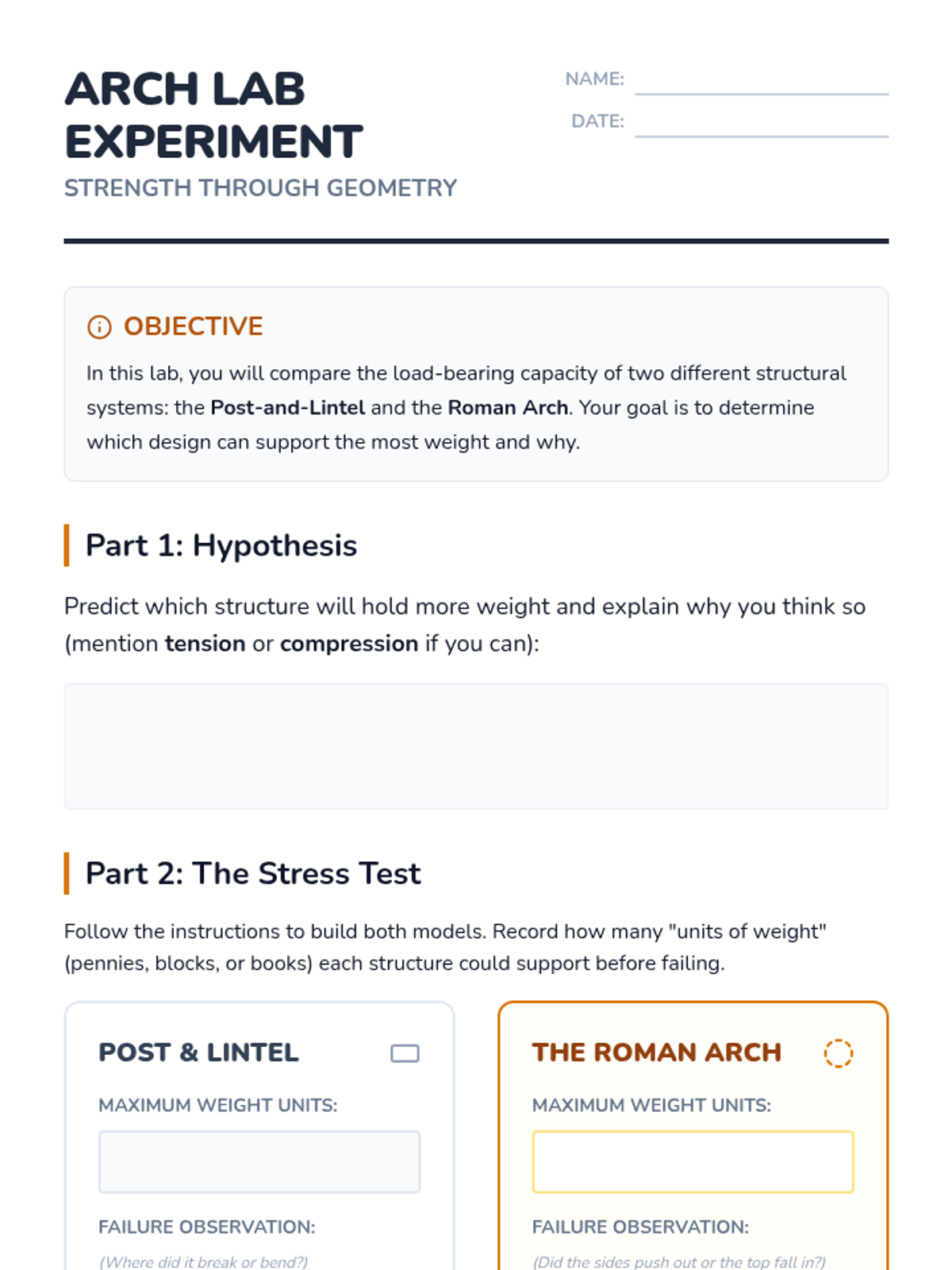
Arch Lab Worksheet
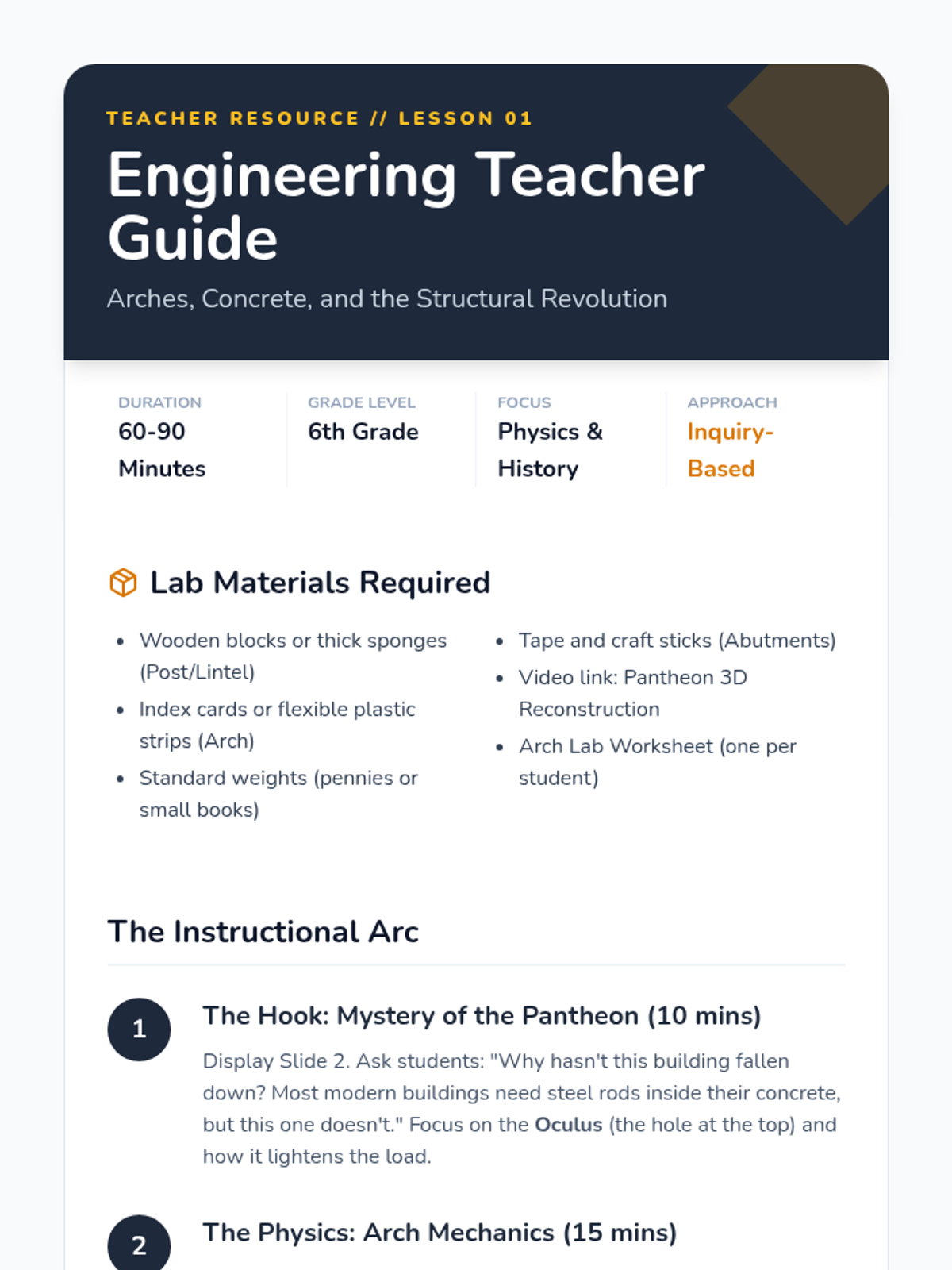
Engineering Teacher Guide

Imperial Engineering

A STEM-focused investigation into Roman engineering, focusing on arches, concrete, aqueducts, roads, and city planning to understand how infrastructure sustained the Roman Empire.

Lenny Avatar
Lenny
1/17
Sequence
Air Mass Slides
Air Weight Lab
Mass Mystery Teacher Guide

Weight of the Sky

This sequence explores the physical properties of gases through the lens of atmospheric pressure and meteorology. Students move from proving air has mass to understanding how pressure differentials drive global weather patterns and extreme storms.

Lenny Avatar
Lenny
1/17
Sequence
Heavy Air Slides
Heavy Air Teacher Guide
Bag Lift Lab Sheet

Gas Pressure and Volume Exploration

A 5-lesson sequence for 6th-grade science exploring the inverse relationship between gas pressure and volume (Boyle's Law), moving from physical definitions to graphing and biological applications.

Lenny Avatar
Lenny
1/17
Sequence
Weight of Air Teacher Guide
Weight of Air Slides
Weight of Air Worksheet

Atmosphere and Weather Pressure

This sequence connects micro-scale gas properties to macro-scale atmospheric science, exploring how air pressure, gas density, and temperature drive global weather patterns.

Lenny Avatar
Lenny
1/17
Sequence
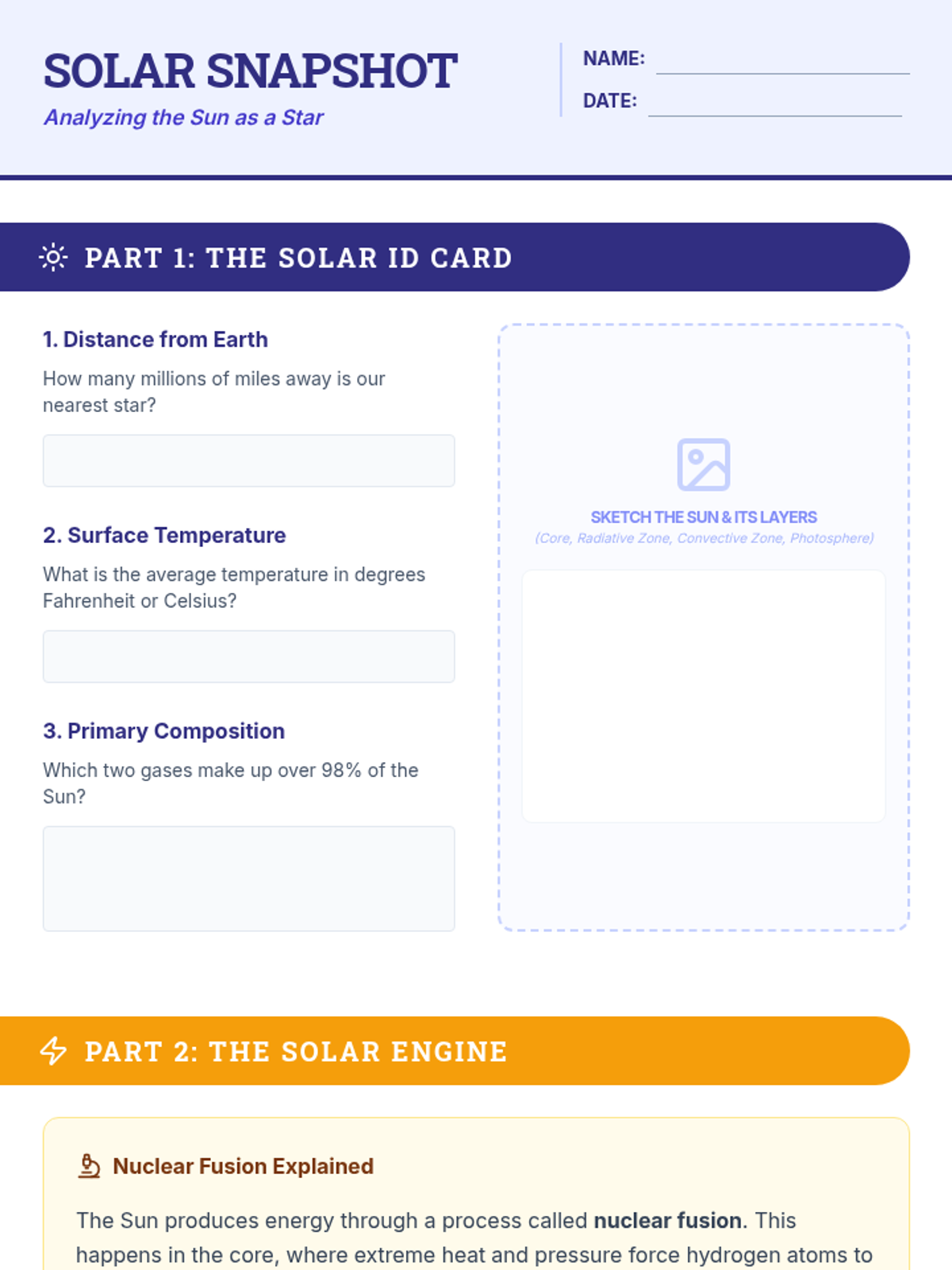
Solar Snapshot Worksheet
Sun Secrets Slides

Stellar Chronicles

This sequence explores the life cycles of stars, the classification of stars based on temperature and color, and the hierarchy of the universe from our solar system to distant galaxies. Students will develop skills in pattern recognition, graphing, and hierarchical organization.

Lenny Avatar
Lenny
1/17
Sequence
Cosmic Distances Slides
Toilet Paper Solar System Worksheet
Cosmic Facilitation Guide

Mapping the Solar System's Scale and Composition

This sequence explores the vast scale and diverse composition of our solar system. Students progress from understanding astronomical units and relative distances to analyzing the physical characteristics of planets, small bodies, and atmospheric conditions, concluding with a comprehensive scale model project.

Lenny Avatar
Lenny
1/17
Sequence
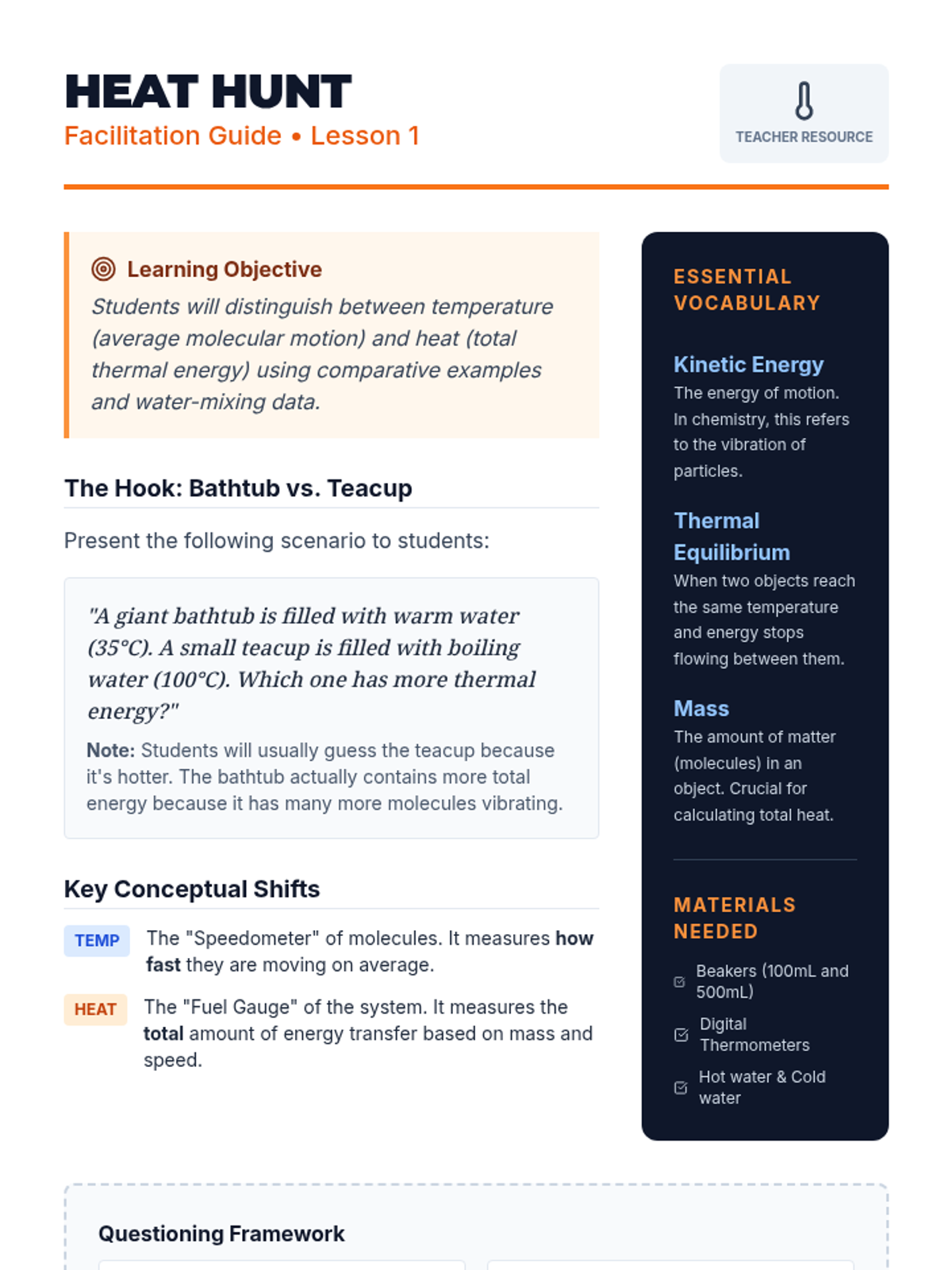
Heat Hunt Teacher Guide
Hot Stuff Slides Presentation
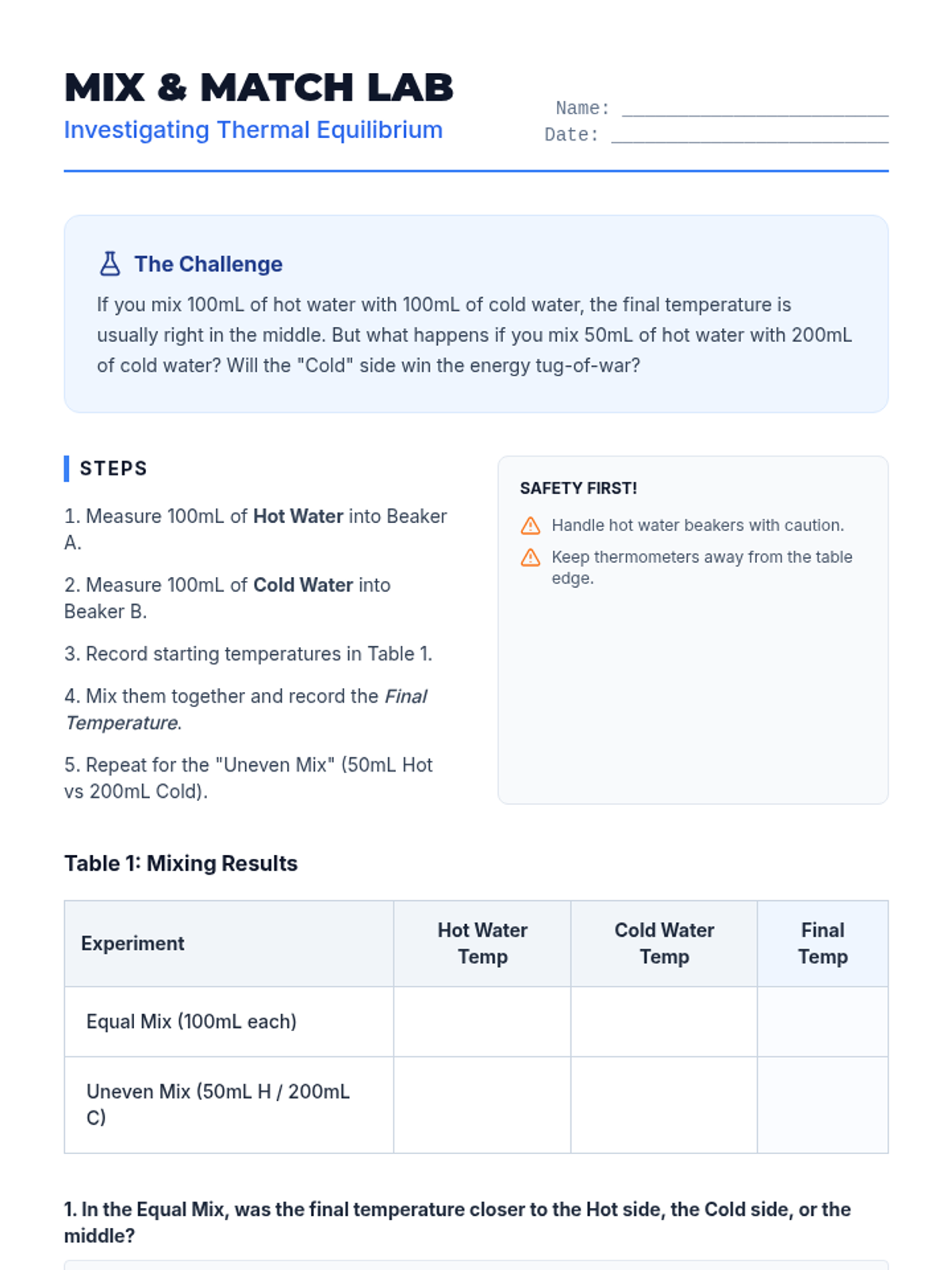
Mix and Match Lab Worksheet

Heat Hunters

A 6th-grade chemistry sequence exploring the measurement of thermal energy through calorimetry. Students differentiate between heat and temperature, build lab equipment, and calculate the energy density of various foods and fuels.

Lenny Avatar
Lenny
1/17
Sequence
Thermal Design Challenge Slides
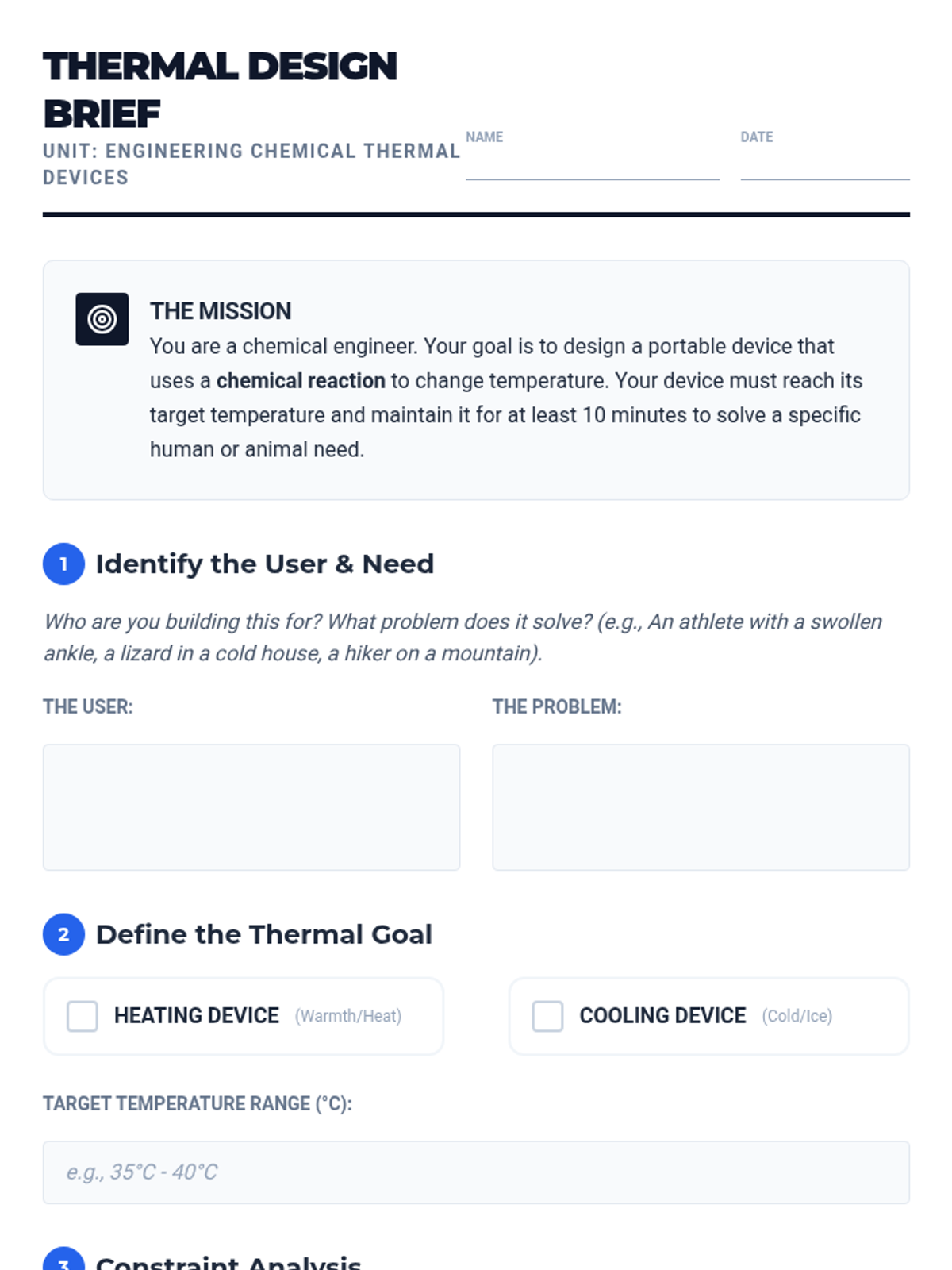
Thermal Design Brief Worksheet
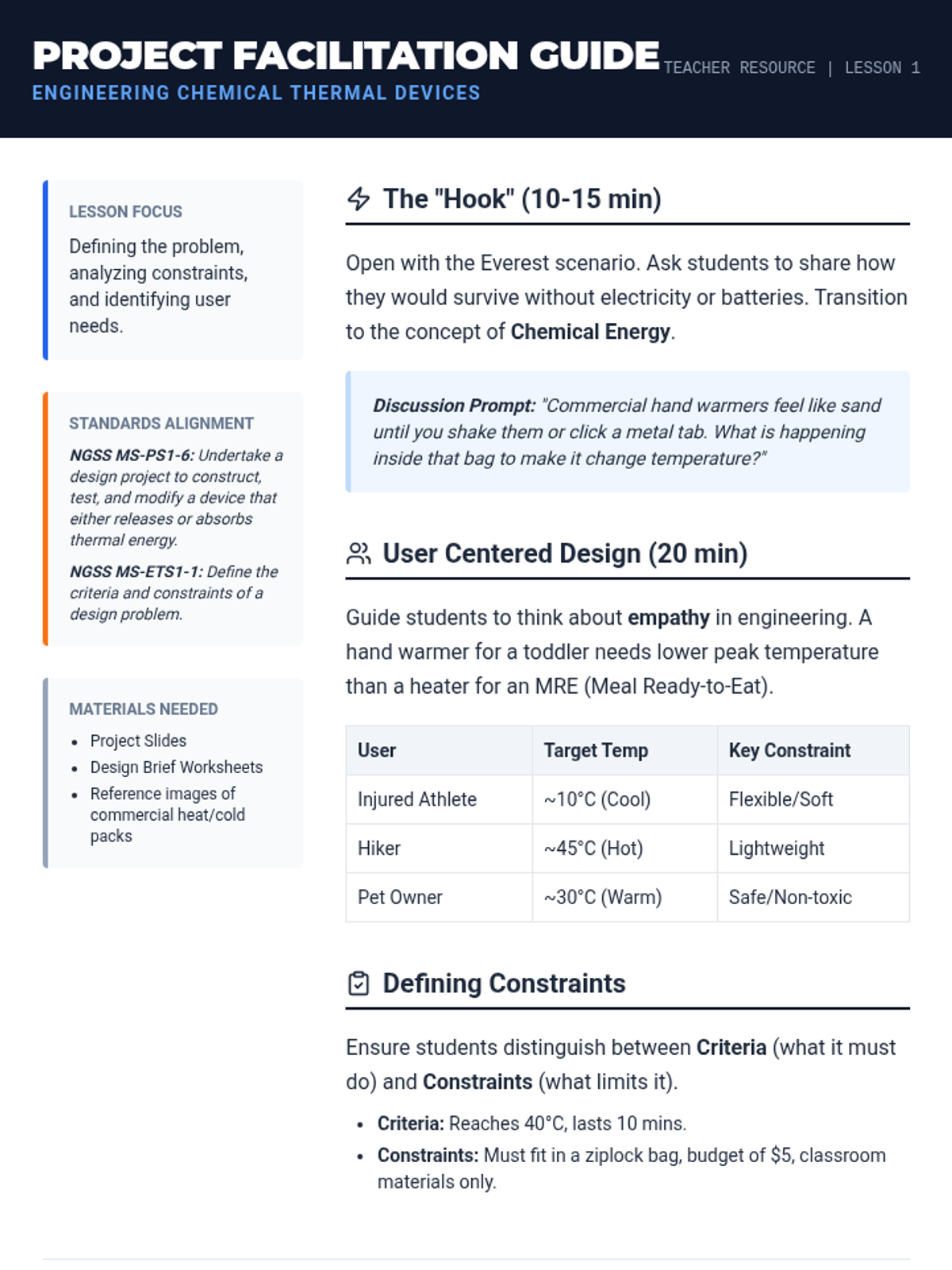
Project Facilitation Guide 1

Thermal Engineering Lab

A project-based learning sequence where 6th-grade students act as chemical engineers to design a thermal management device, exploring the Law of Conservation of Energy and chemical energy changes.

Lenny Avatar
Lenny
1/17
Sequence
Plant Power Slides
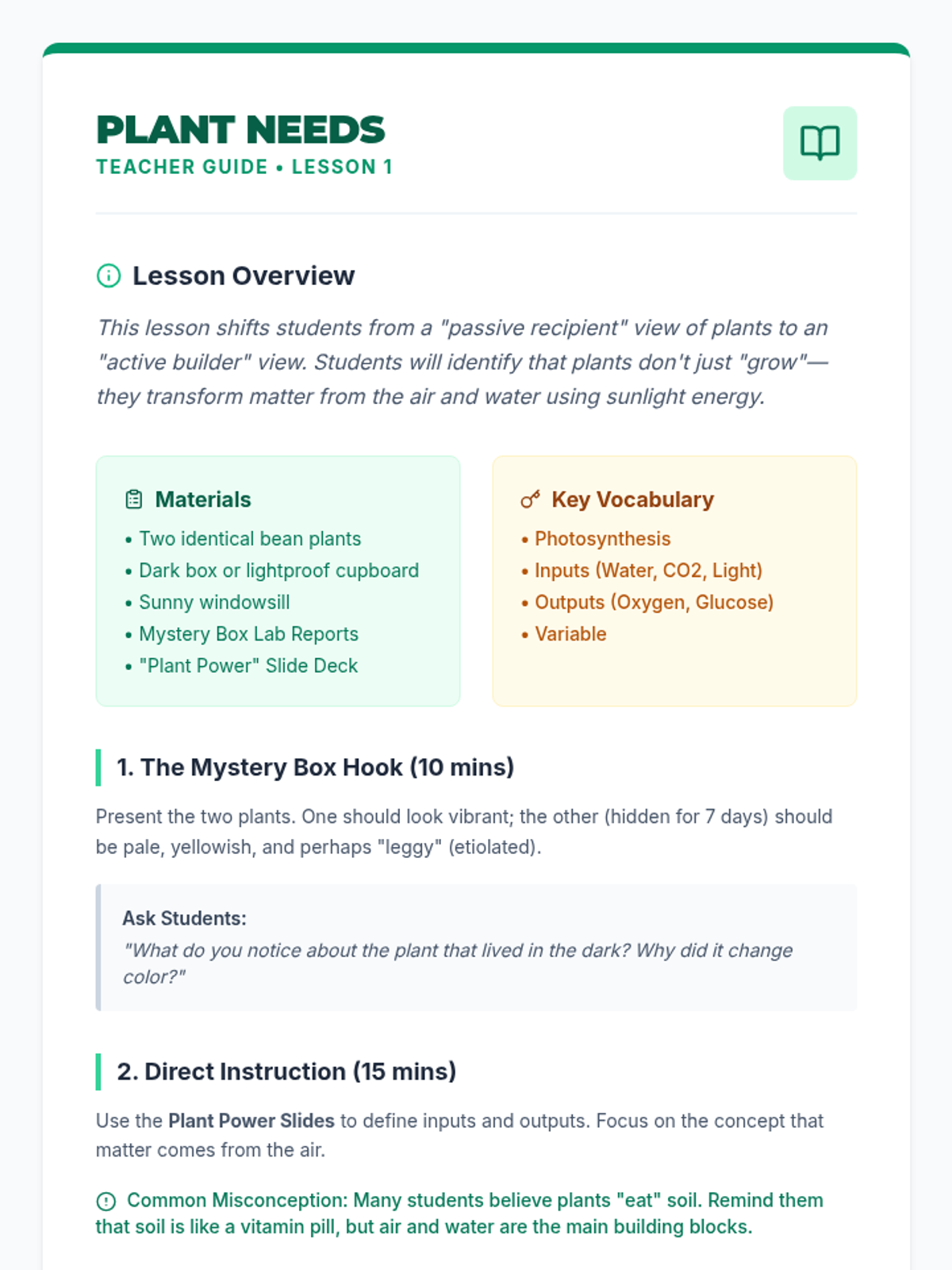
Plant Needs Teacher Guide
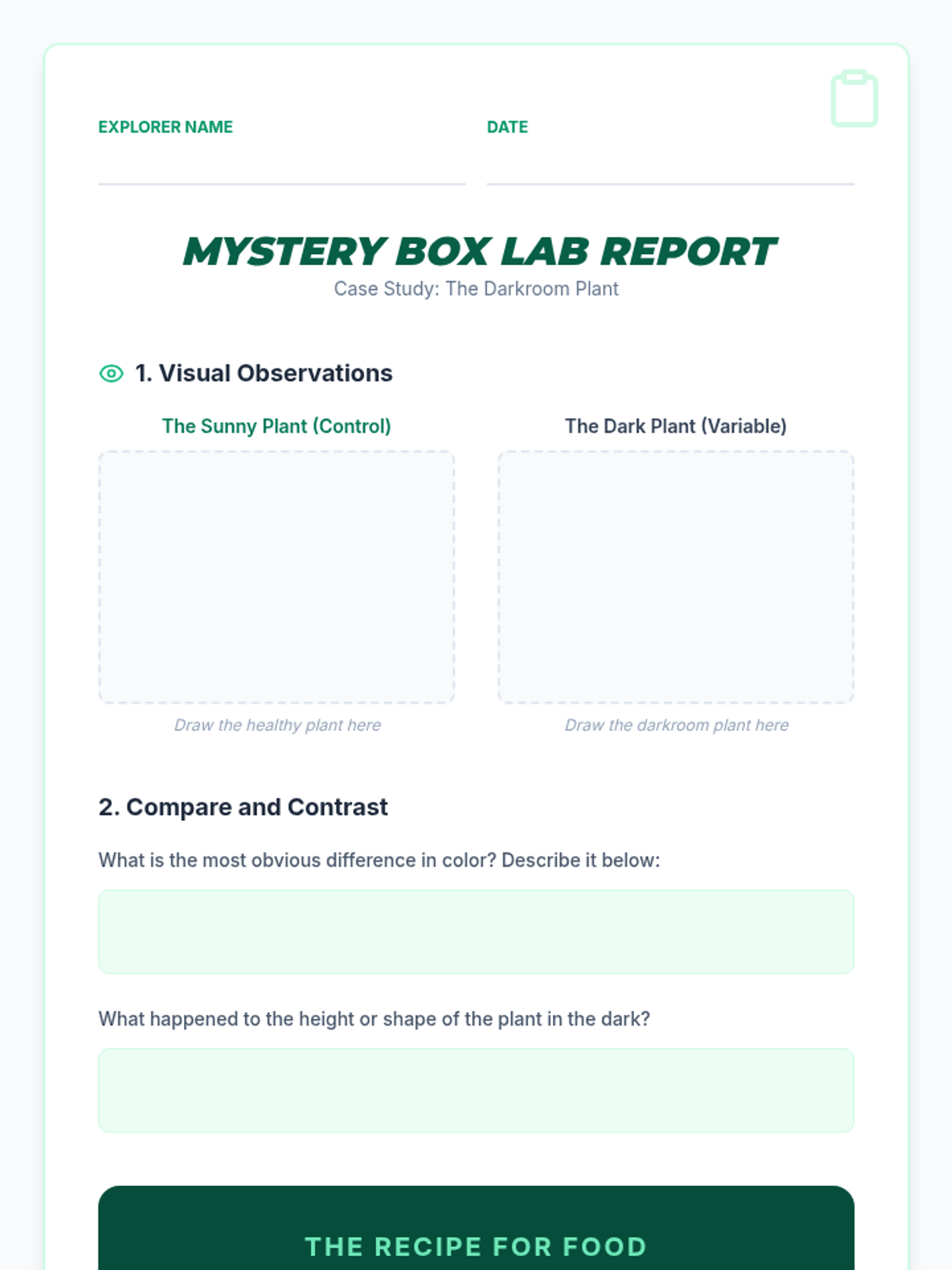
Mystery Box Lab Report

Solar Power Plants

This inquiry-based sequence demystifies photosynthesis, transforming it from a vocabulary list into a tangible understanding of energy transfer. Students explore plant inputs/outputs, microscopic leaf structures, molecular modeling, and the broader flow of energy in ecosystems.

Lenny Avatar
Lenny
1/17
Sequence
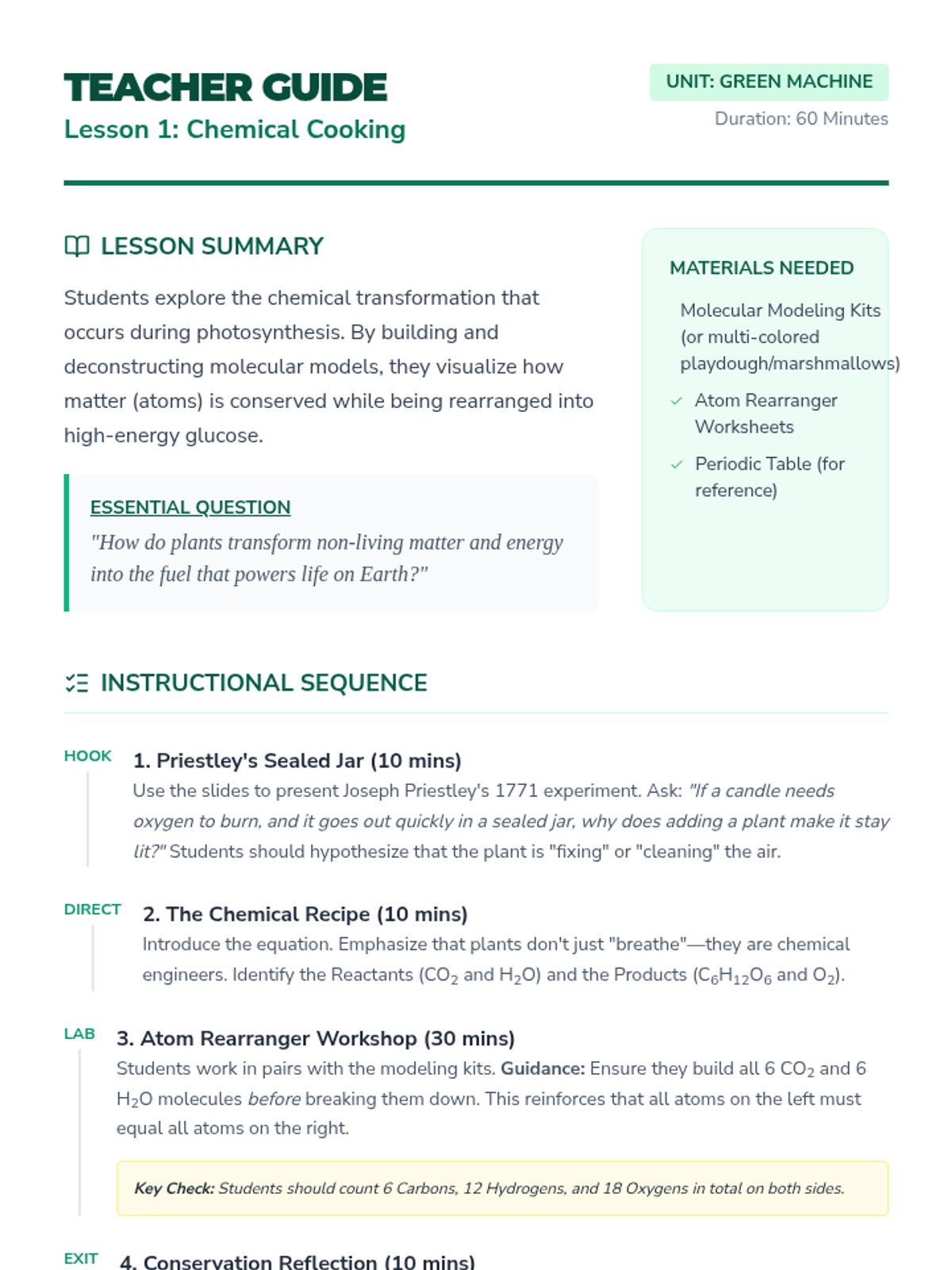
Chemical Cooking Slides
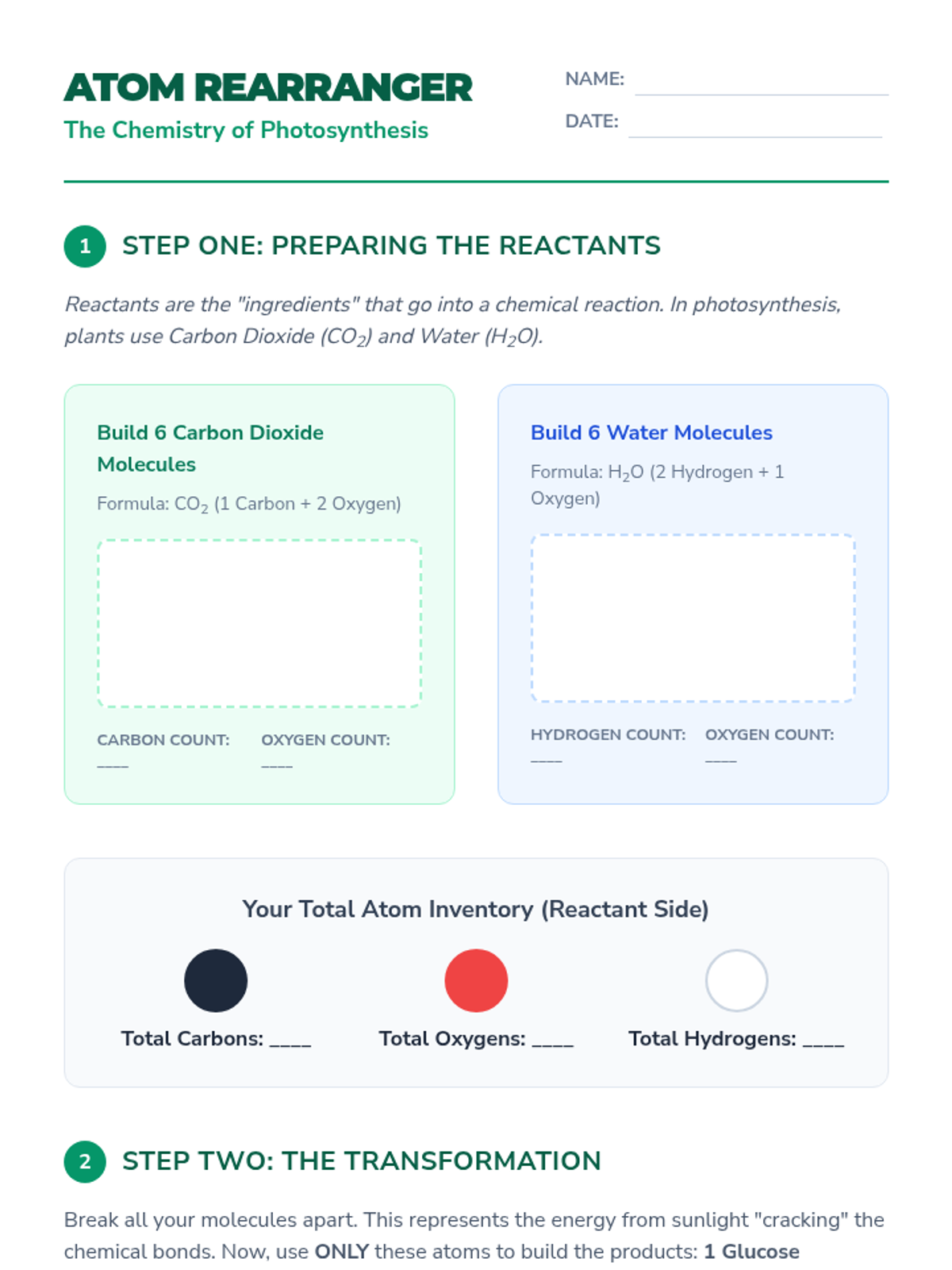
Atom Rearranger Worksheet
Chemical Cooking Teacher Guide

Green Machine Energy Transfer

This inquiry-driven sequence demystifies the chemical process of photosynthesis and cellular respiration. Students move beyond the basic 'sunlight into food' concept to understand the transformation of matter and energy through controlled experiments, molecular modeling, and global data analysis.

Lenny Avatar
Lenny
1/17
Sequence
Invisible Ingredients Slides
Invisible Ingredients Worksheet
Invisible Ingredients Answer Key

Matter Masterclass

A series of three review lessons focused on interpreting experimental data and graphs related to the conservation of mass and phase changes in matter. Students will analyze scenarios involving dissolving, freezing, boiling, and thermal energy to strengthen their scientific reasoning skills.

AO

Archie Olson

English Language Arts Teacher
2/12
Sequence
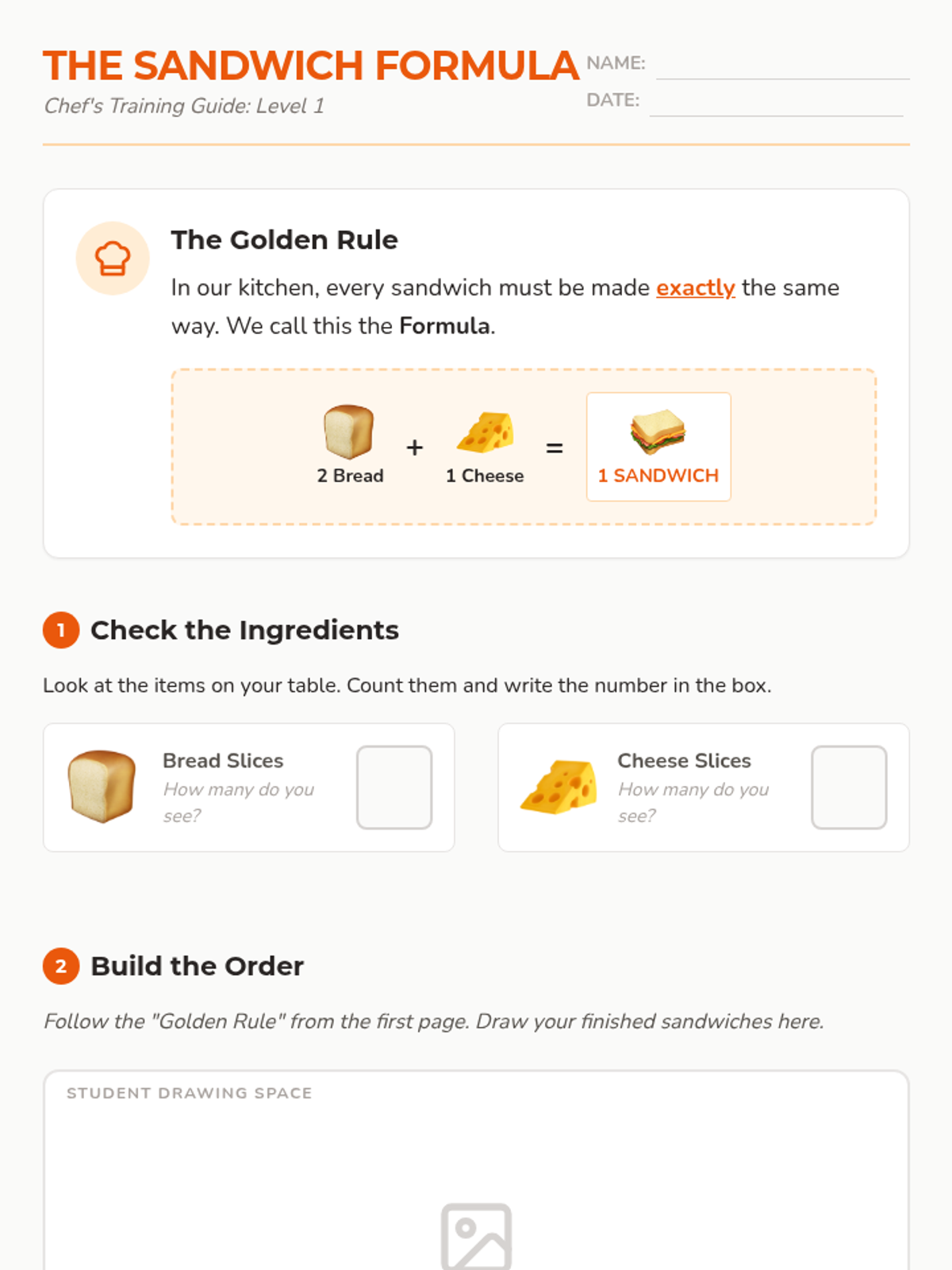
Sandwich Rule Worksheet
Sandwich Formula Slides
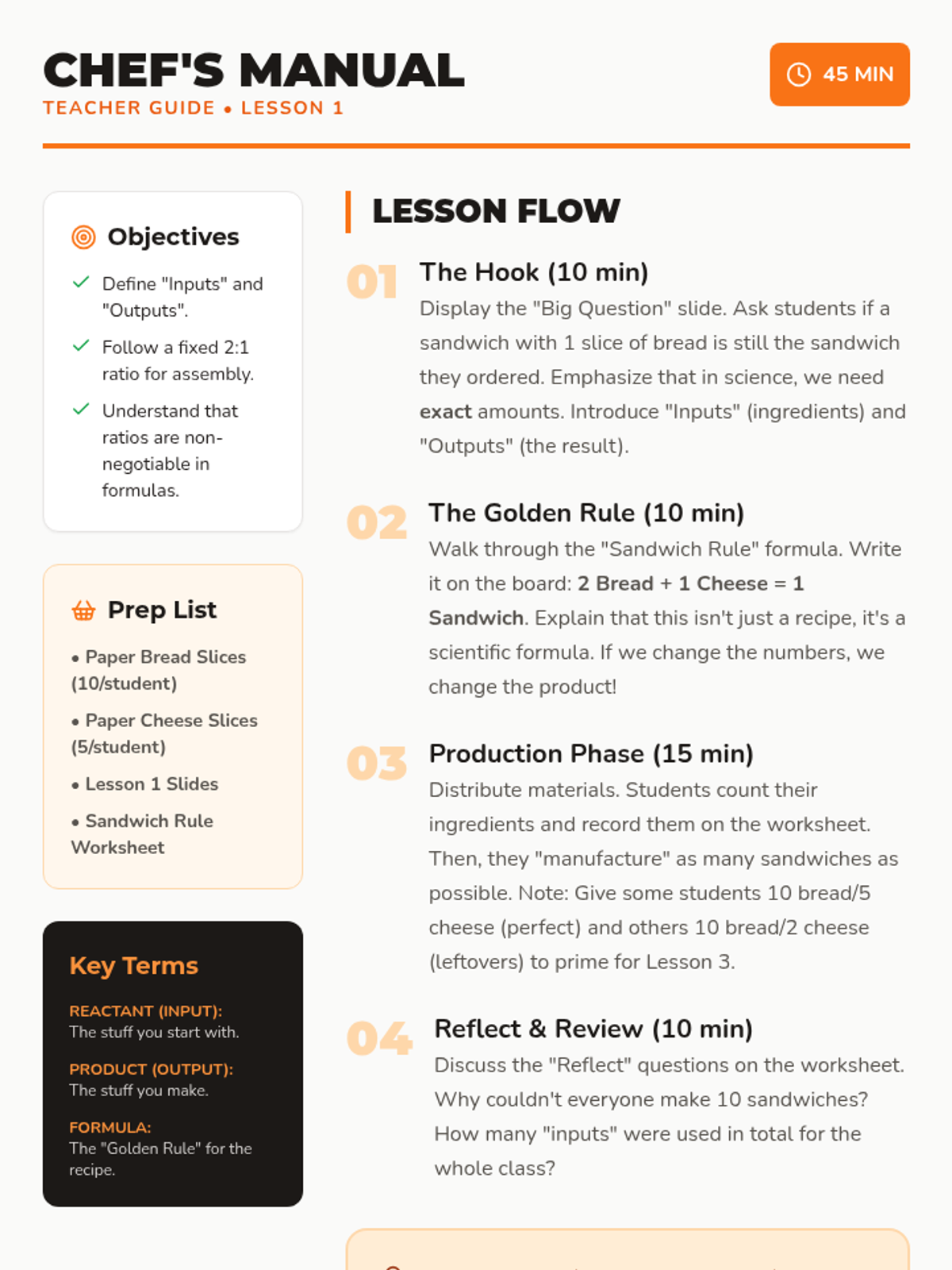
Sandwich Formula Teacher Guide

Recipe Reactions

This sequence introduces chemical equations through the analogy of sandwiches and snacks. Students learn about reactants, products, coefficients, and limiting reagents by following and writing 'recipe codes' to fill customer orders.

Lenny Avatar
Lenny
1/18
Sequence
Vanishing Act Slides
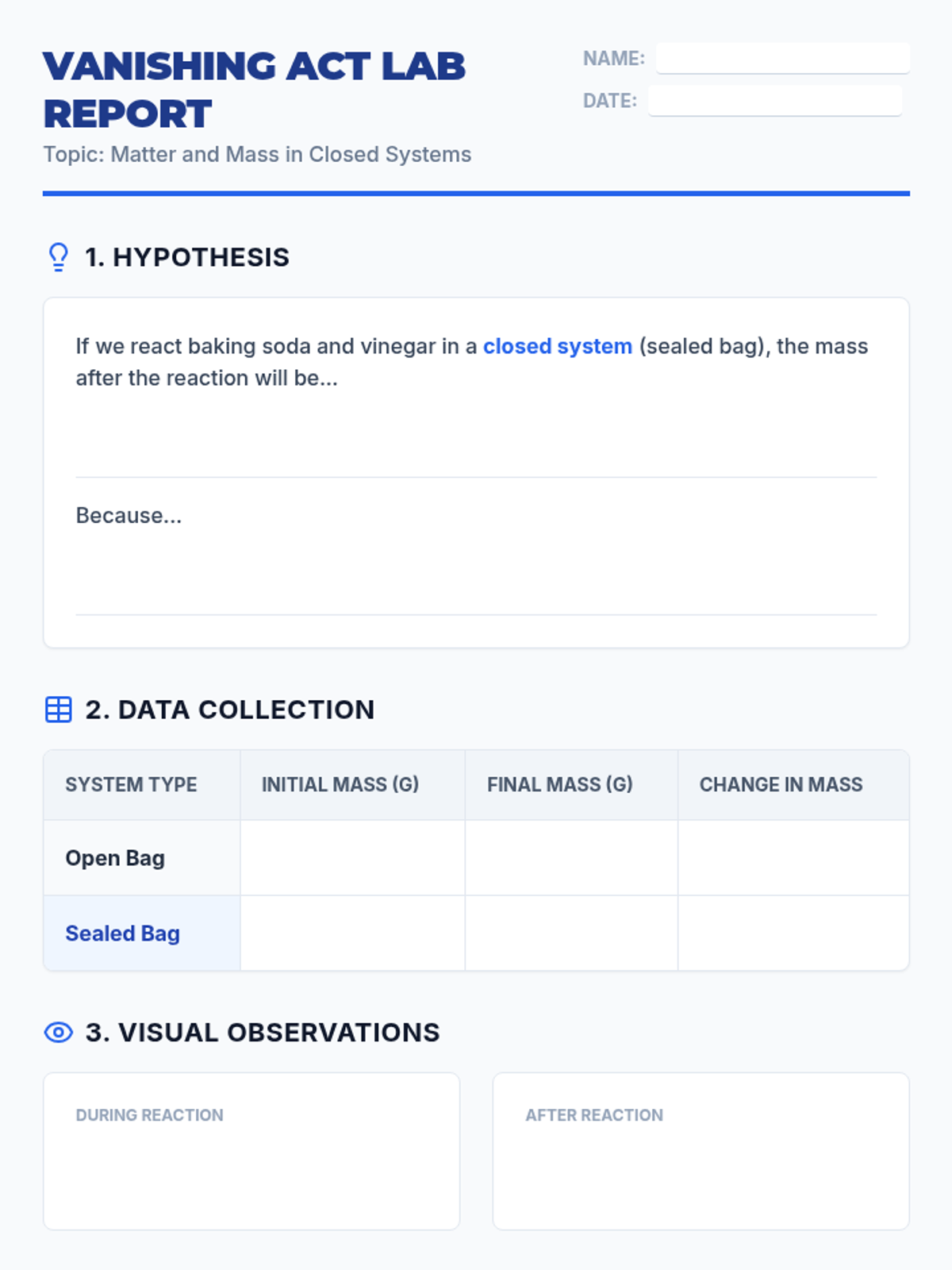
Baggie Reaction Lab Worksheet
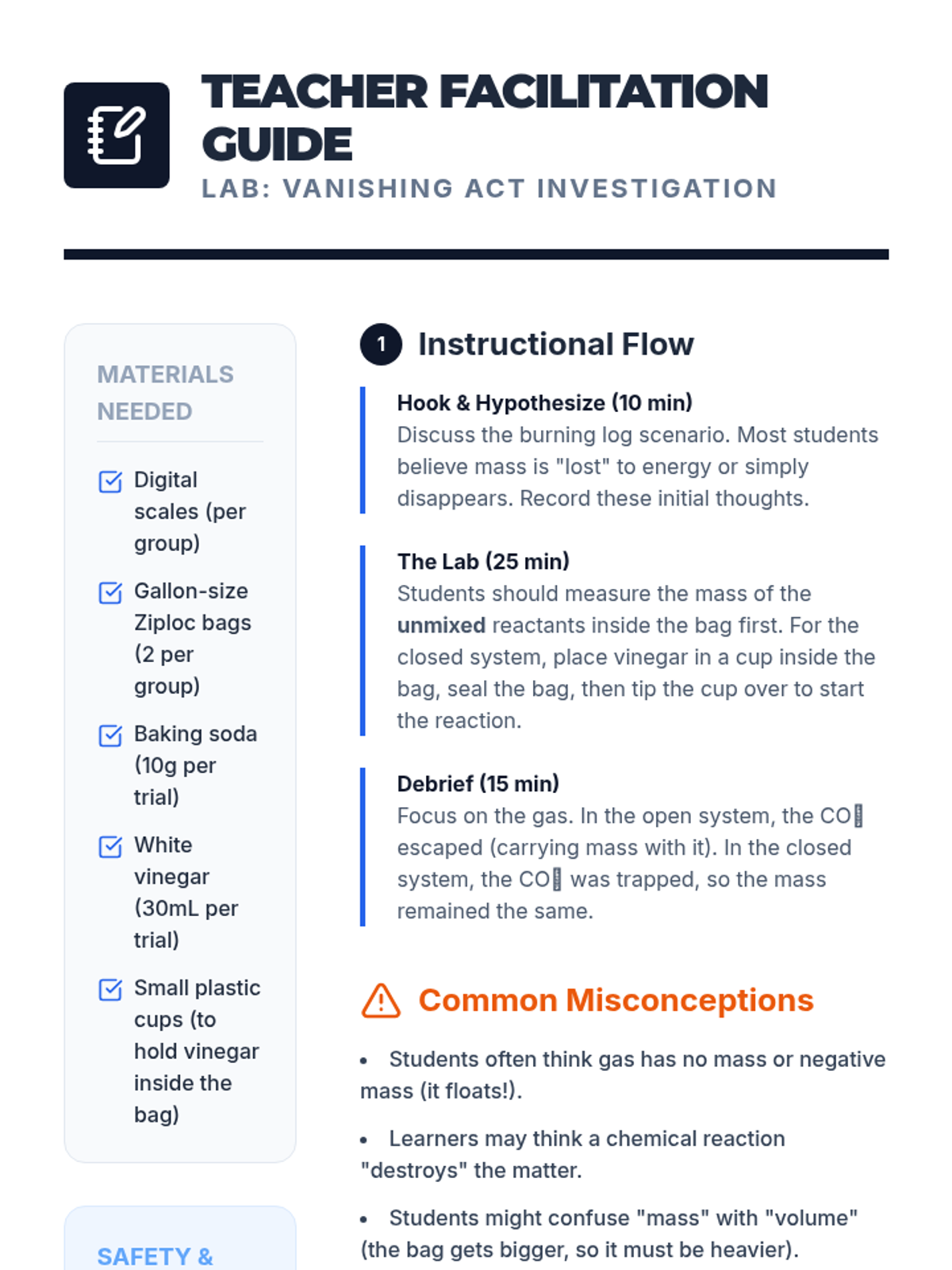
Conservation Lab Teacher Guide

Matter Makers

A hands-on chemistry unit for 6th grade focused on the Law of Conservation of Mass. Students use physical manipulatives to model molecules and simulate chemical reactions to understand why equations must be balanced.

Lenny Avatar
Lenny
1/18
Sequence
Identity Rule Slides
Identity Rule Teacher Guide
Identity Rule Worksheet

Chemical Balance Masters

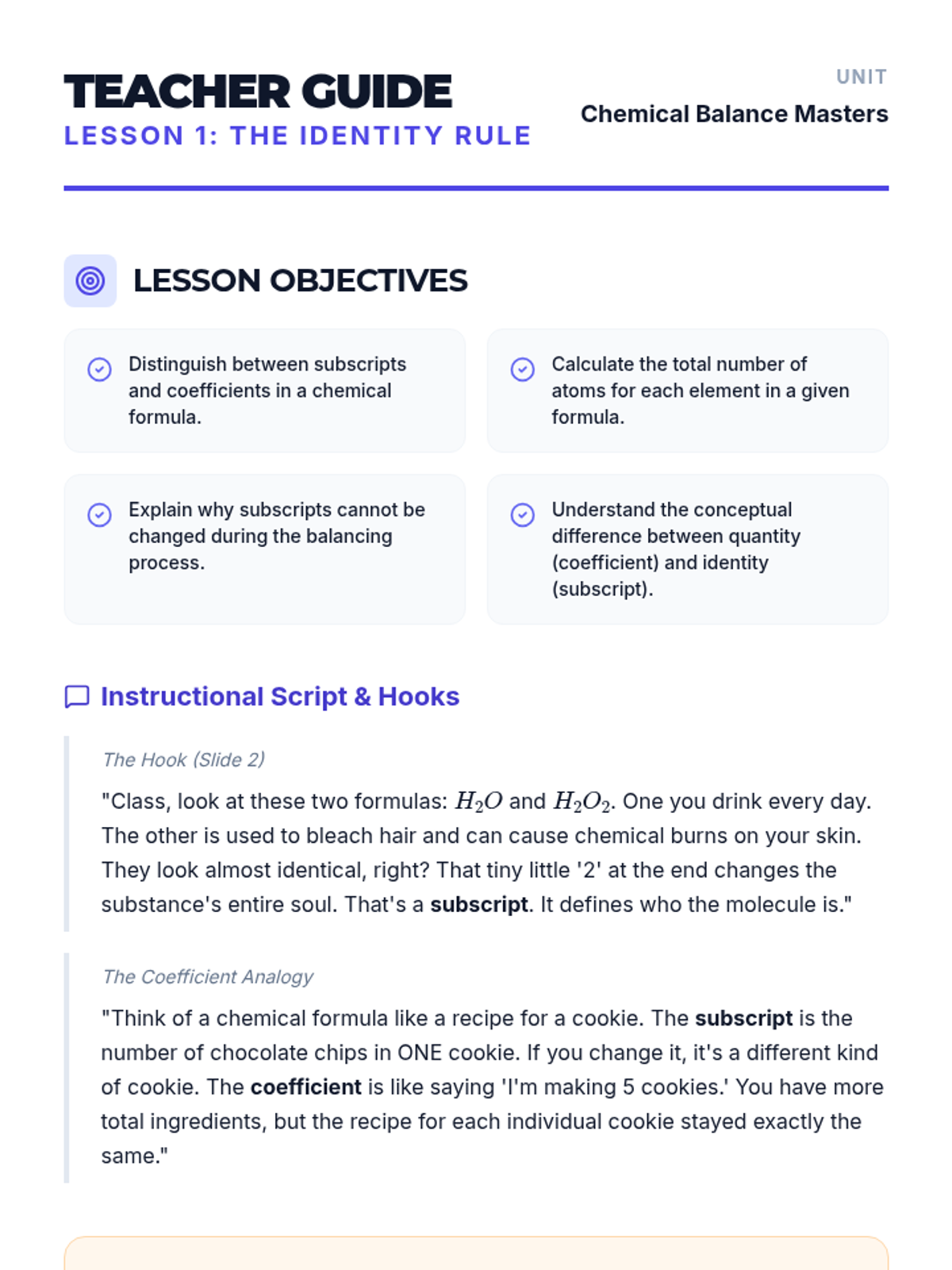
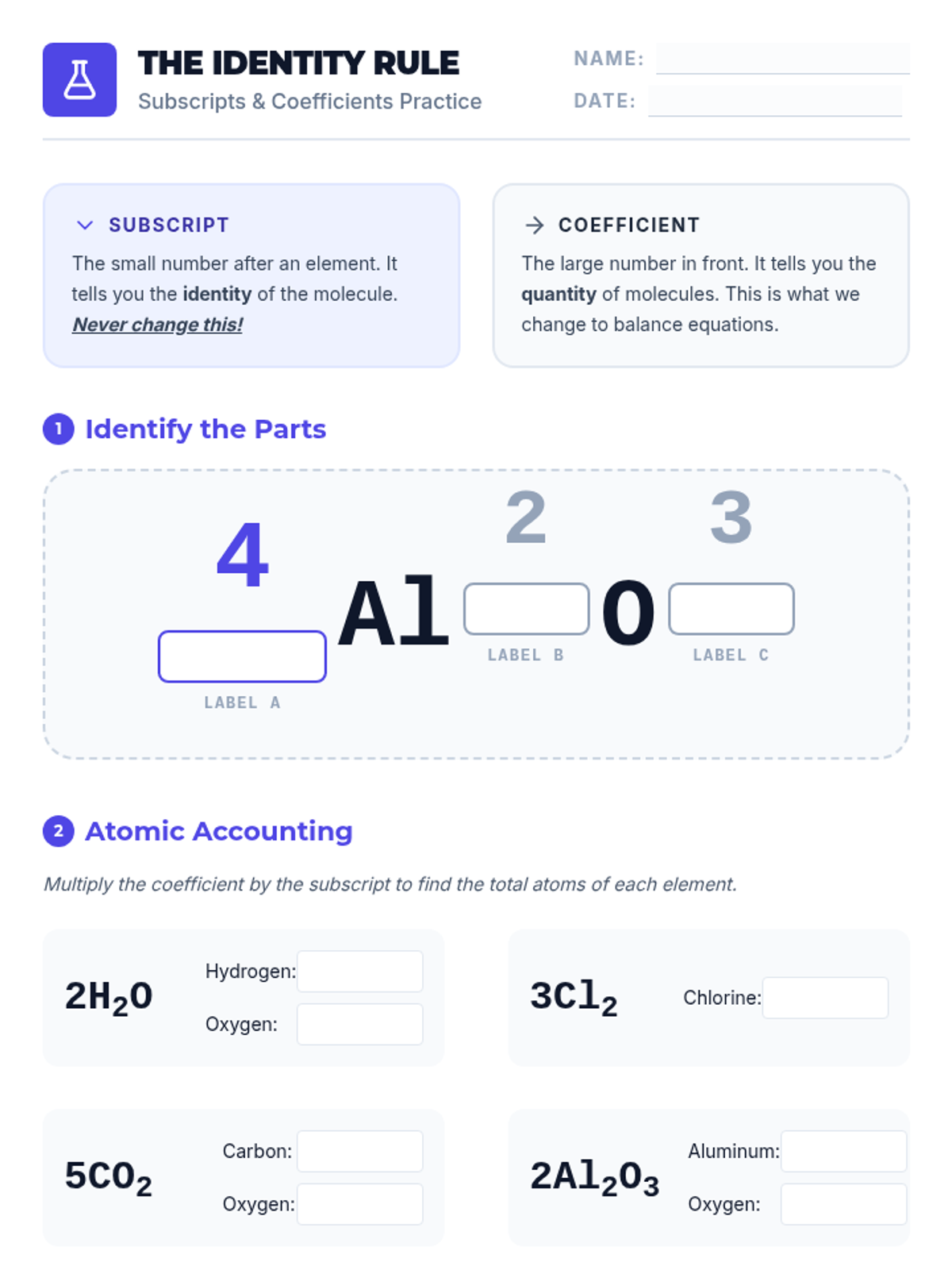
A comprehensive unit for 6th-grade students on balancing chemical equations, moving from basic notation to advanced strategies using the T-chart method. Students develop a strong mathematical foundation in the Law of Conservation of Mass through structured practice and gamified challenges.

Lenny Avatar
Lenny
1/18
Sequence
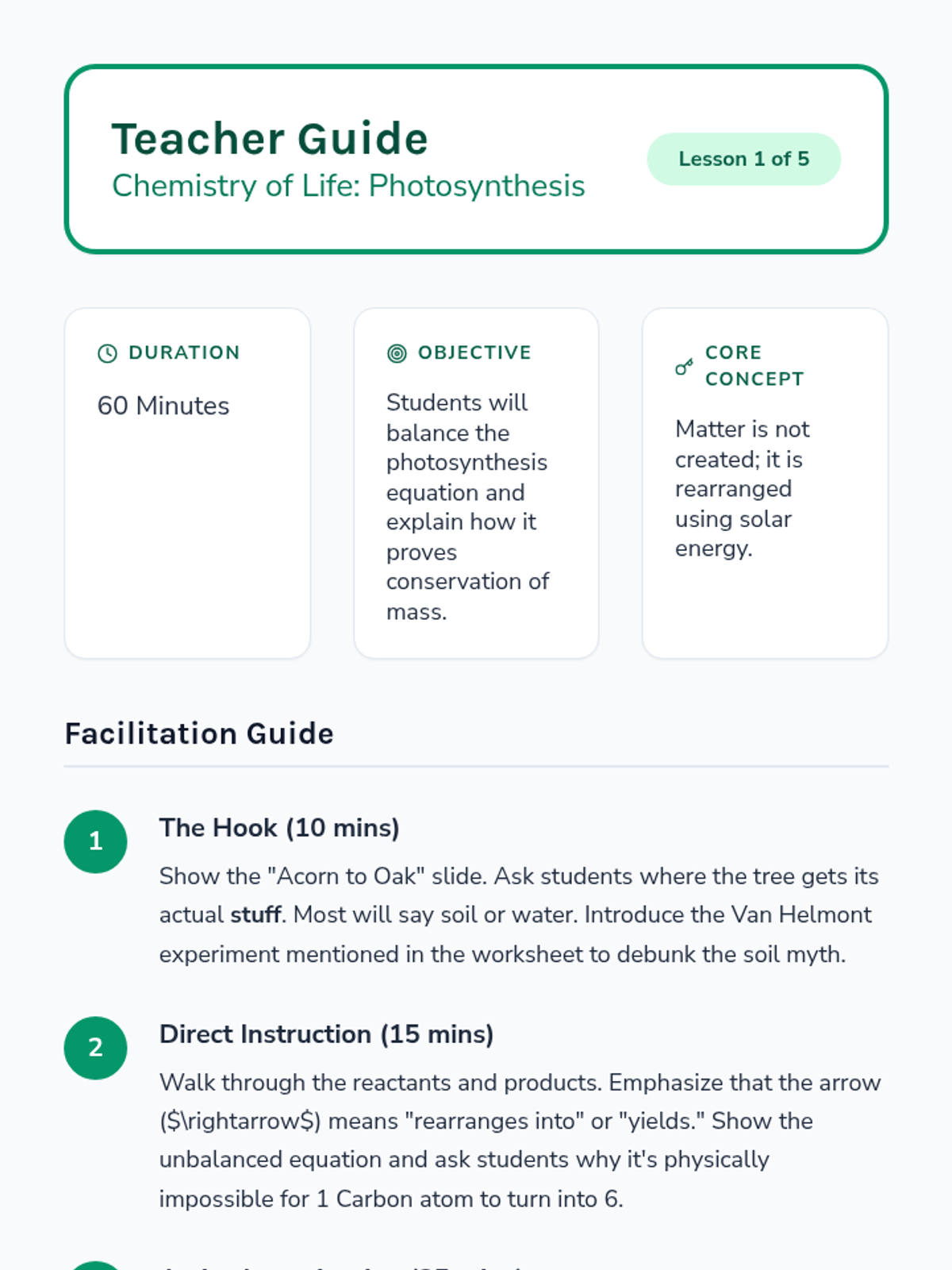
Photosynthesis Equation Slides
Molecule Mapper Worksheet
Photosynthesis Teacher Guide

Real World Reactions

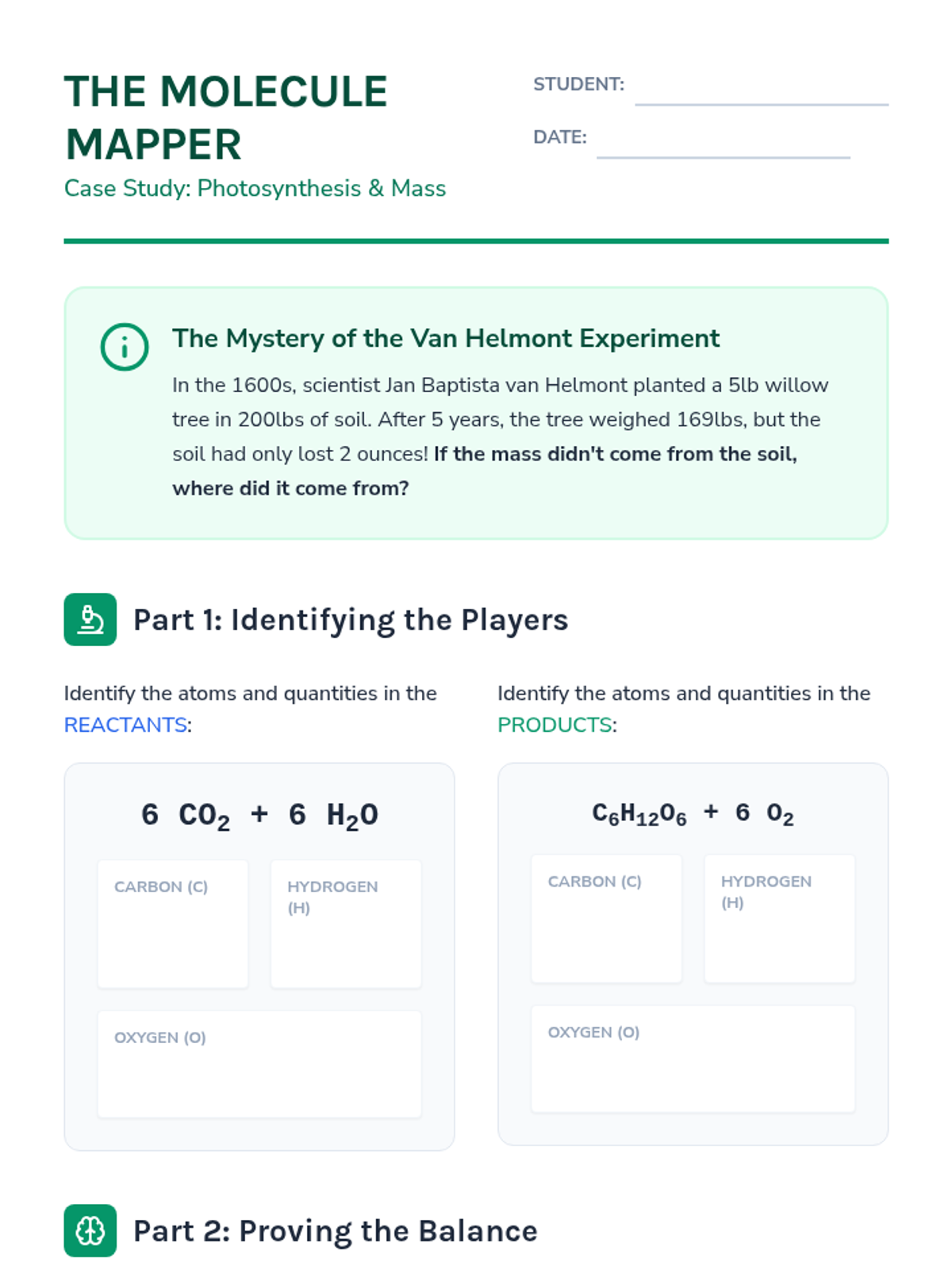
This 6th-grade chemistry sequence explores the law of conservation of mass through the lens of real-world biological and environmental reactions, including photosynthesis, respiration, and corrosion. Students learn to balance chemical equations by treating them as case studies of how matter cycles through the world.

Lenny Avatar
Lenny
1/18
Sequence
Rock Breakers Slides
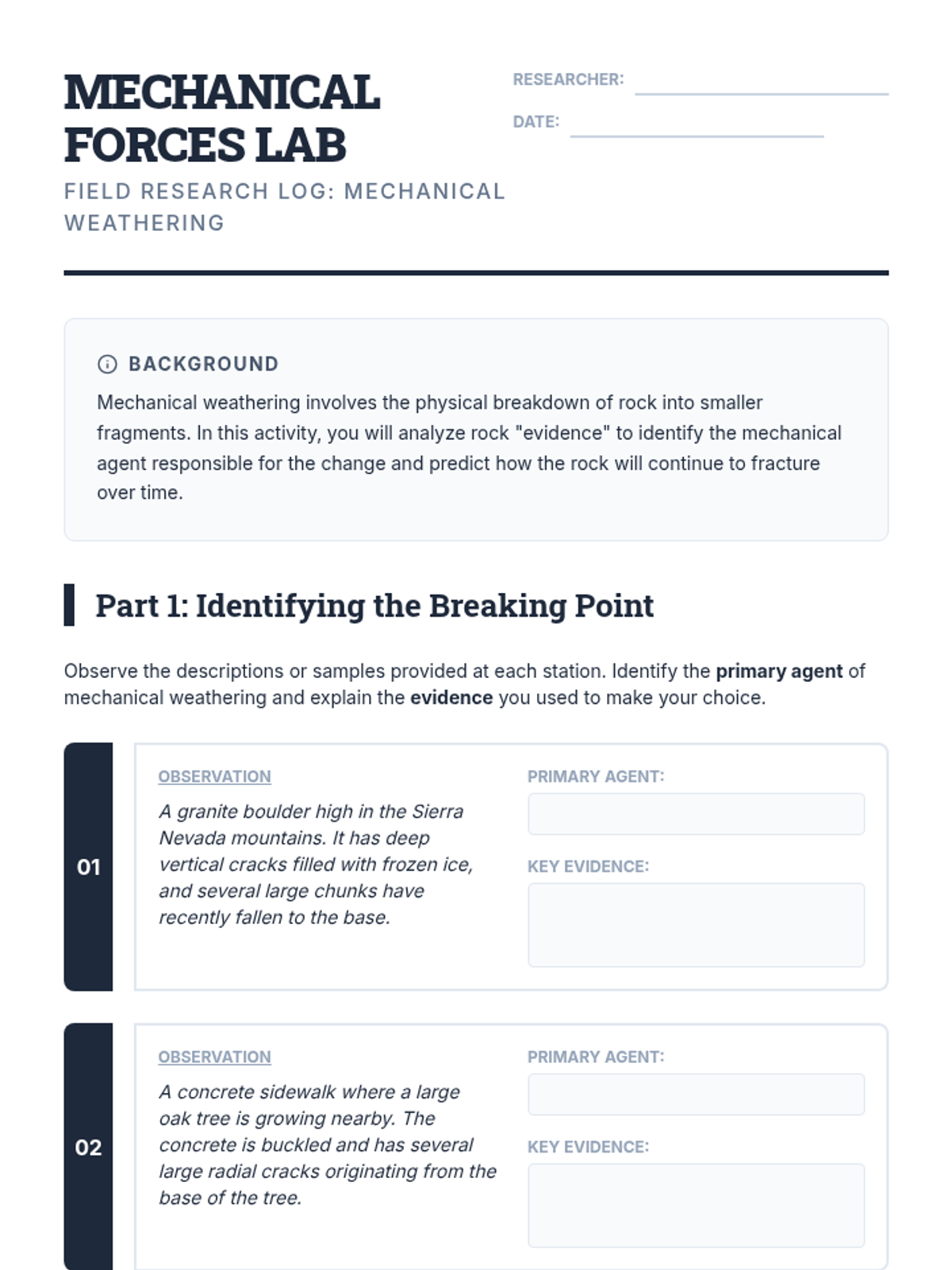
Mechanical Forces Lab Sheet
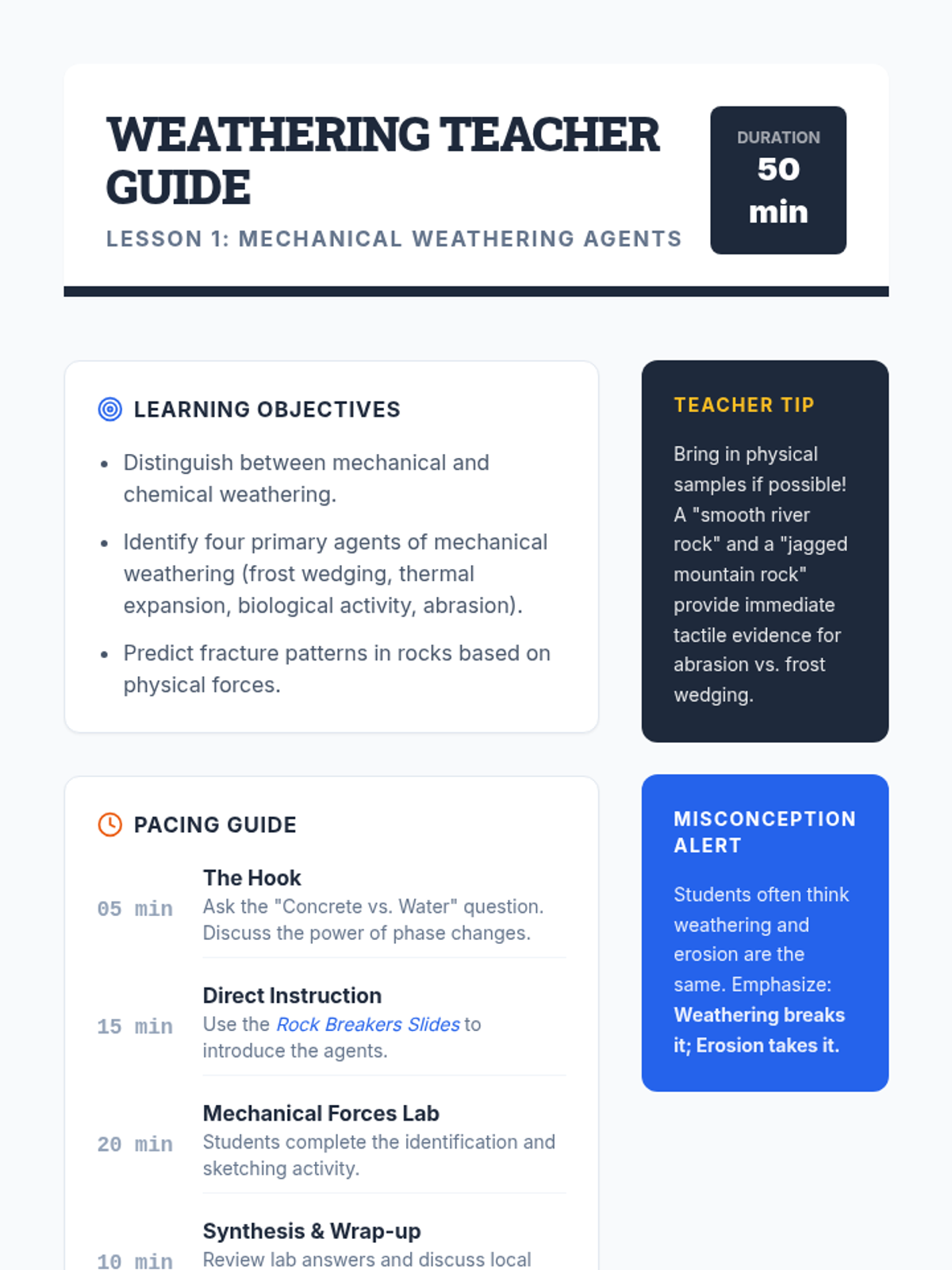
Weathering Identification Teacher Guide

Sculpting the Earth

This sequence explores the slow but powerful processes of weathering and erosion that sculpt Earth's surface over geologic time. Students distinguish between mechanical breakdown and chemical alteration, conducting experiments on reaction rates and surface area, and exploring the formation of soil and transport of sediment.

Lenny Avatar
Lenny
1/17
Sequence
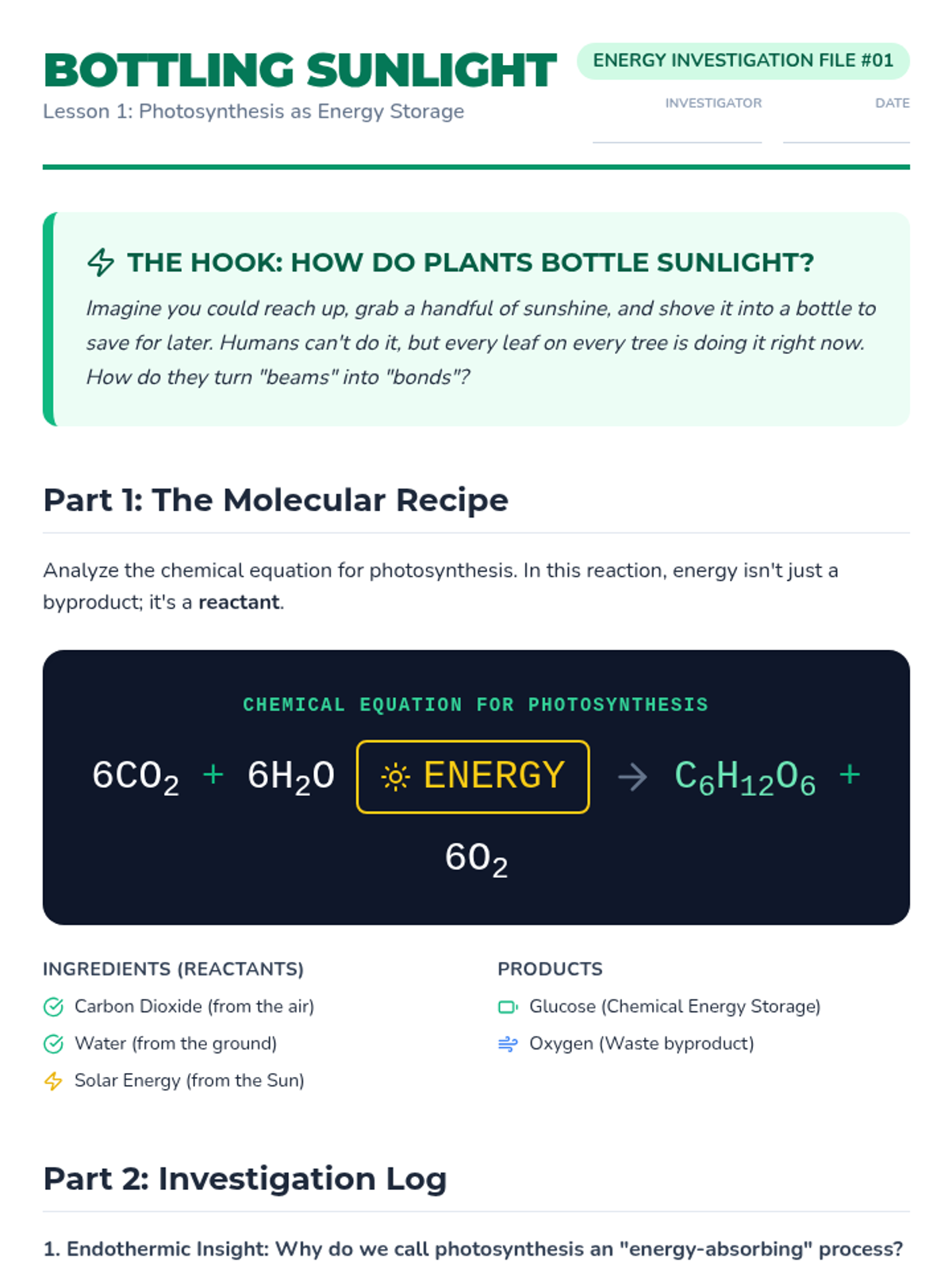
Green Battery Worksheet
Bottling Sunlight Slides
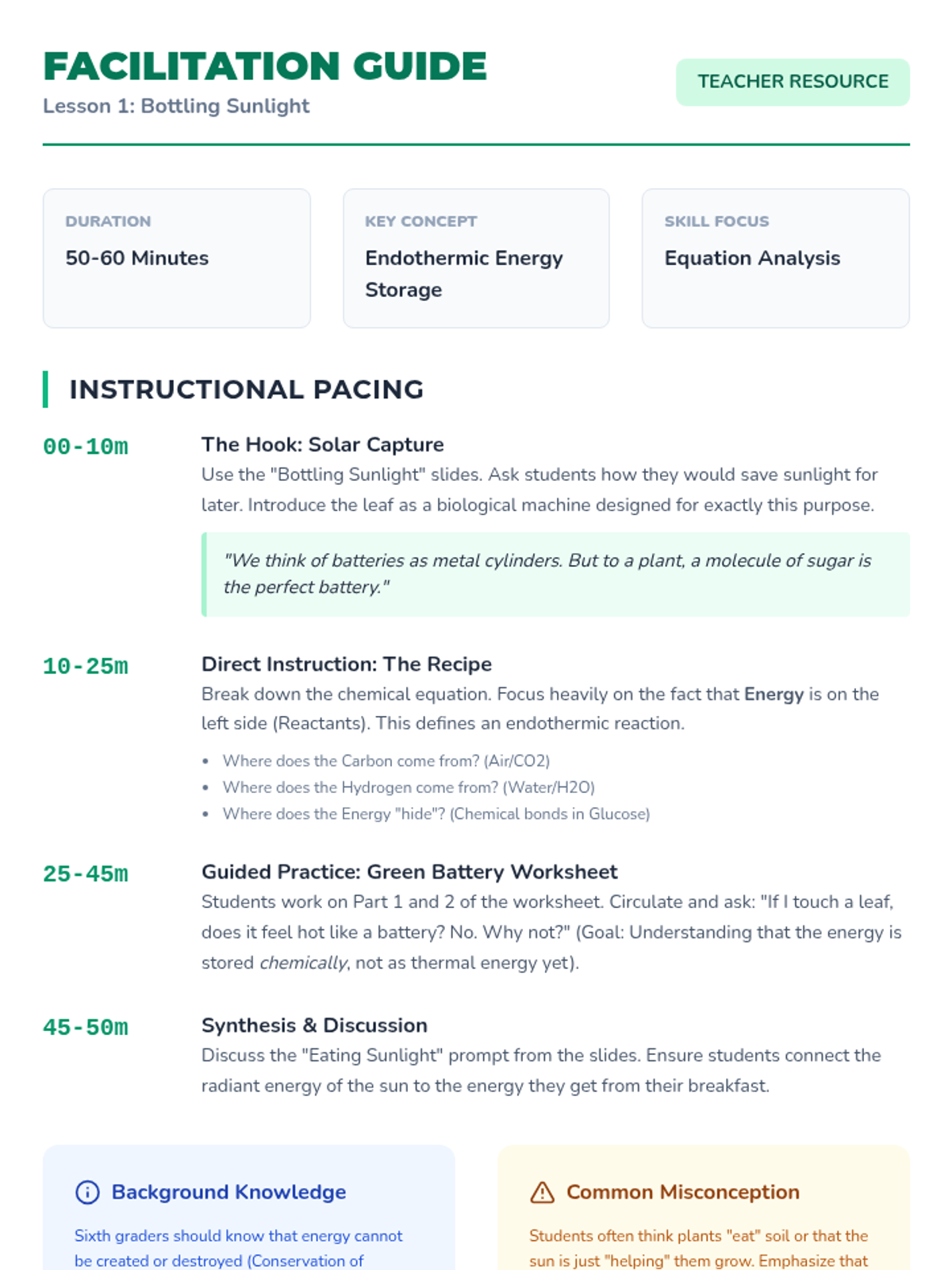
Photosynthesis Facilitation Guide

Energy Investigation Files

A comprehensive 6th-grade chemistry sequence investigating how energy transformations drive biological processes and societal energy use. Students explore photosynthesis as energy storage, respiration as energy release, and the environmental implications of various chemical energy sources.

Lenny Avatar
Lenny
1/17
Sequence
Plant Power Slides
Plant Needs Teacher Guide
Mystery Box Lab Report

Solar Power Plants

This inquiry-based sequence demystifies photosynthesis, transforming it from a vocabulary list into a tangible understanding of energy transfer. Students explore plant inputs/outputs, microscopic leaf structures, molecular modeling, and the broader flow of energy in ecosystems.

Lenny Avatar
Lenny
1/17
Sequence
Chemical Cooking Slides
Atom Rearranger Worksheet
Chemical Cooking Teacher Guide

Green Machine Energy Transfer

This inquiry-driven sequence demystifies the chemical process of photosynthesis and cellular respiration. Students move beyond the basic 'sunlight into food' concept to understand the transformation of matter and energy through controlled experiments, molecular modeling, and global data analysis.

Lenny Avatar
Lenny
1/17
Sequence
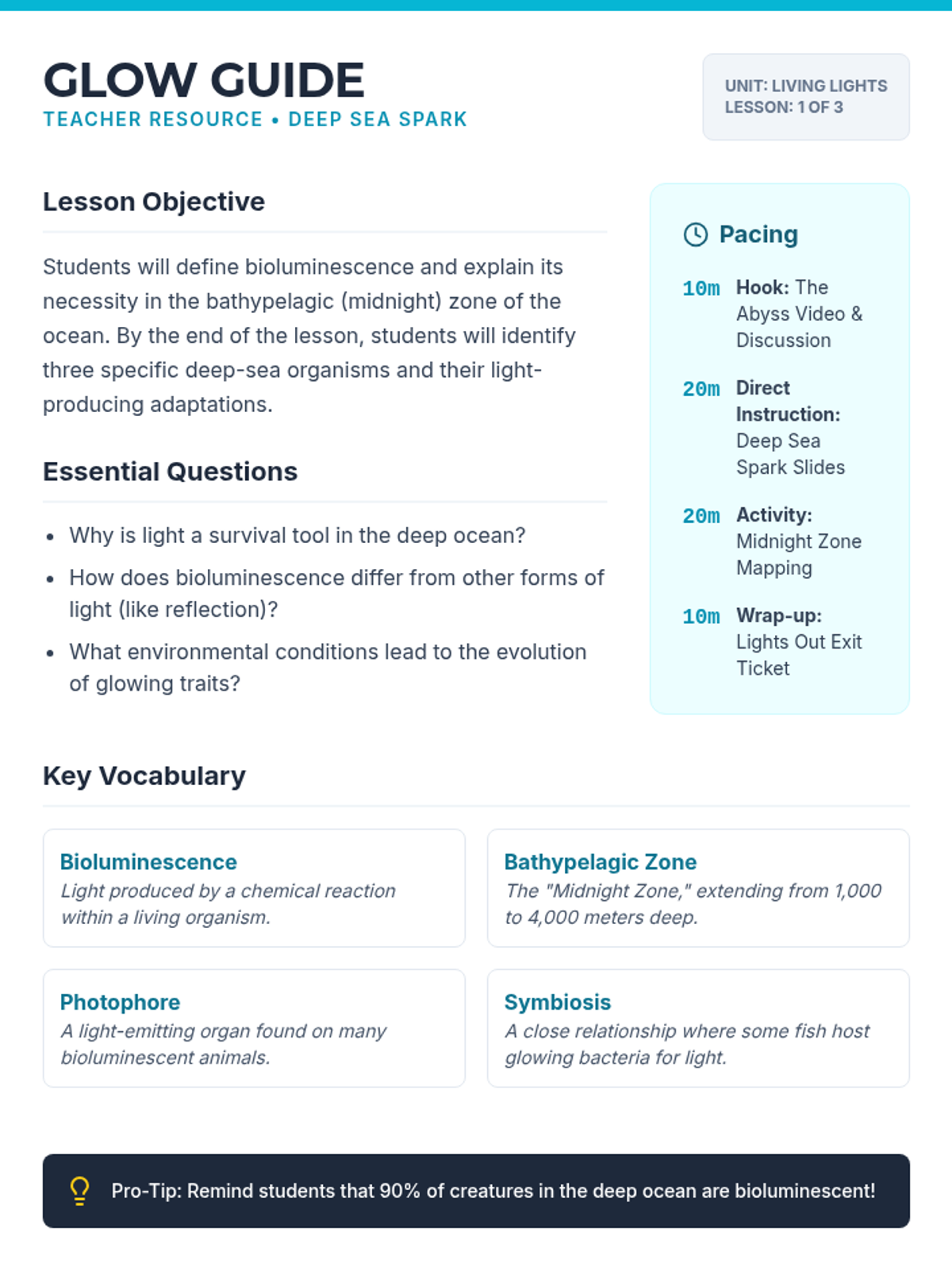
Glow Guide Teacher Resource
Deep Sea Spark Slides
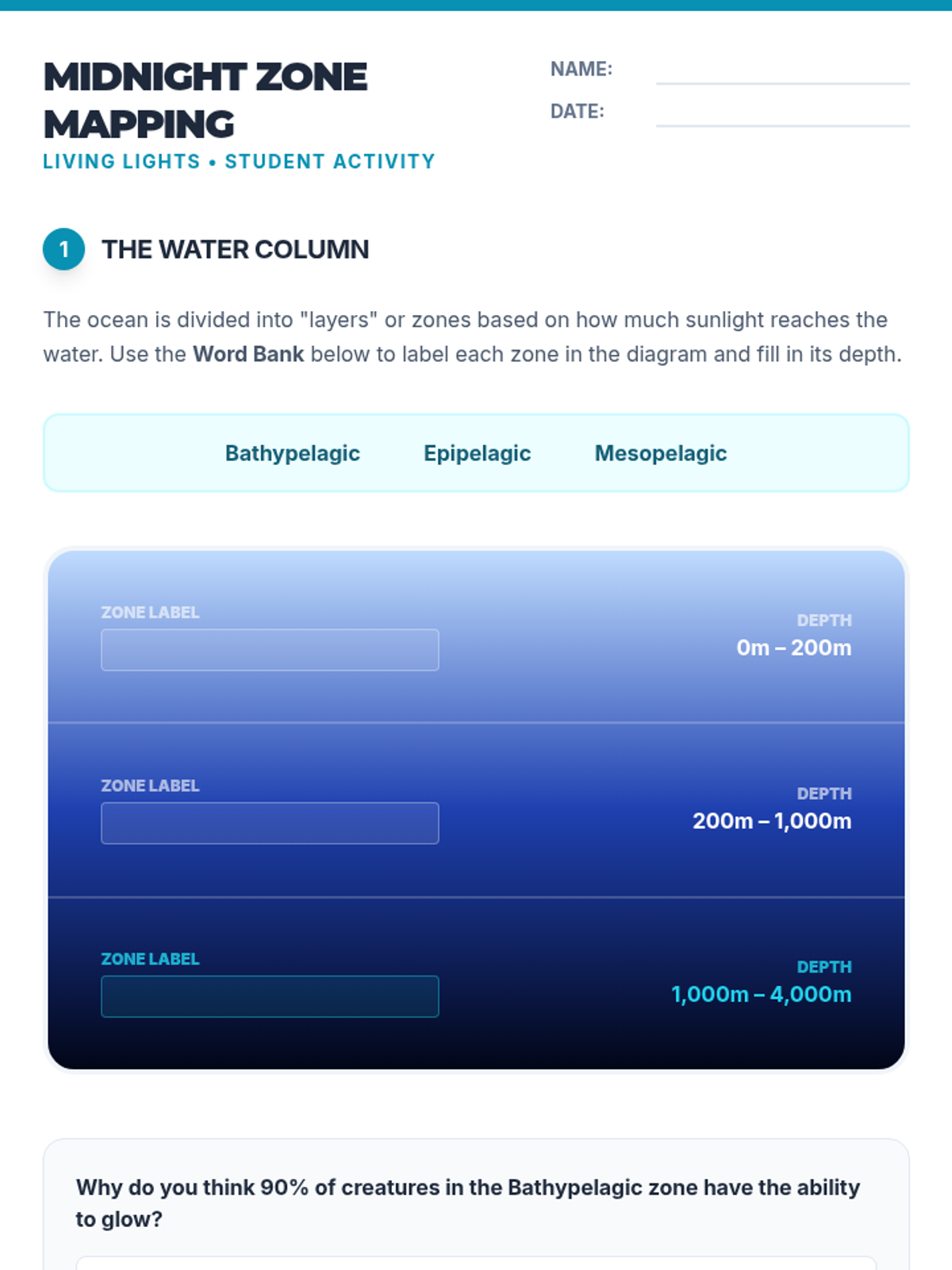
Midnight Zone Worksheet
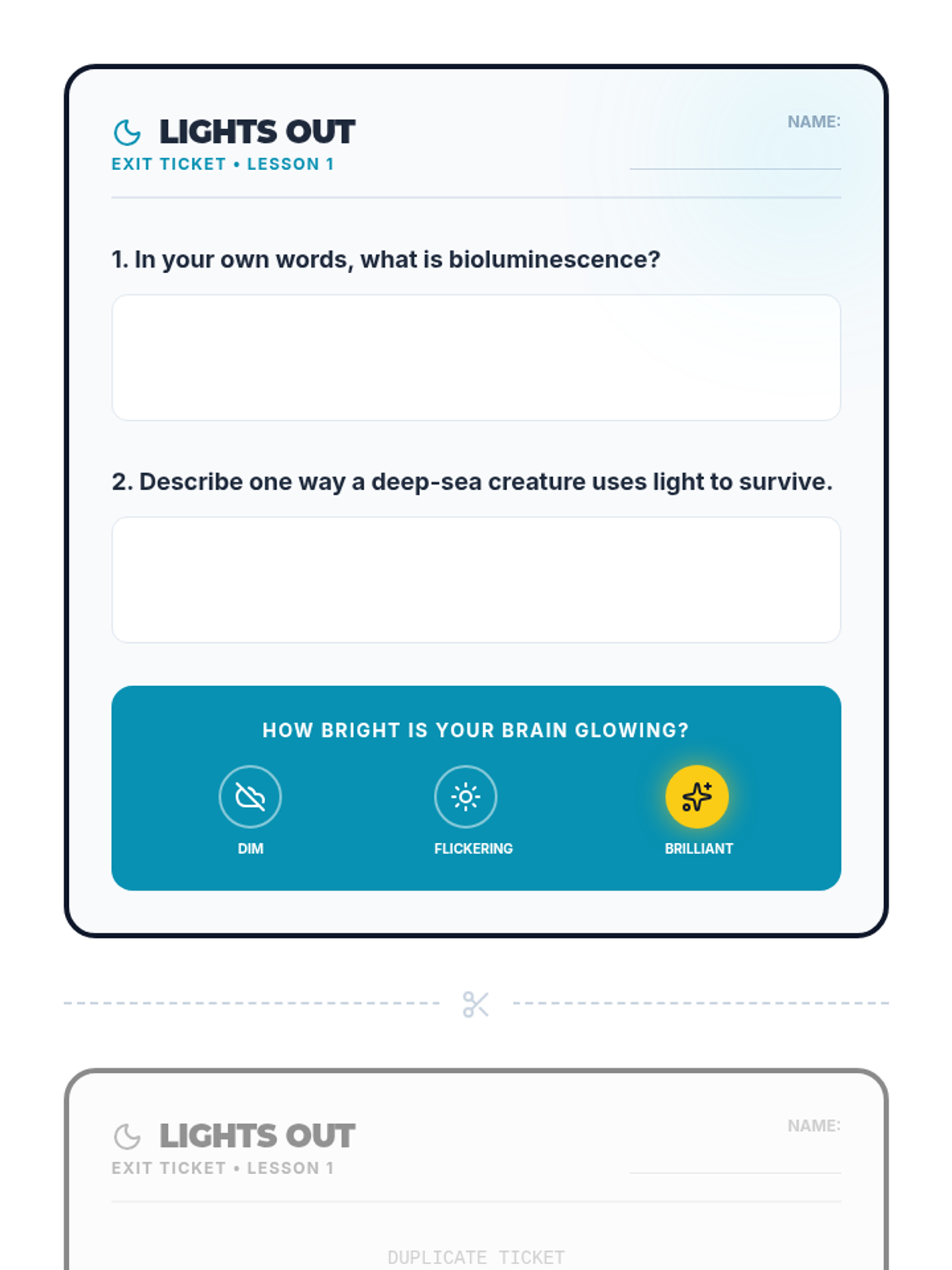
Lights Out Exit Ticket

Living Lights

A comprehensive 3-lesson unit exploring the science, chemistry, and purpose of bioluminescence in nature. Students dive into the deep sea, experiment with chemical reactions, and analyze how light is used for survival.

Lenny Avatar
Lenny
4/3
Sequence
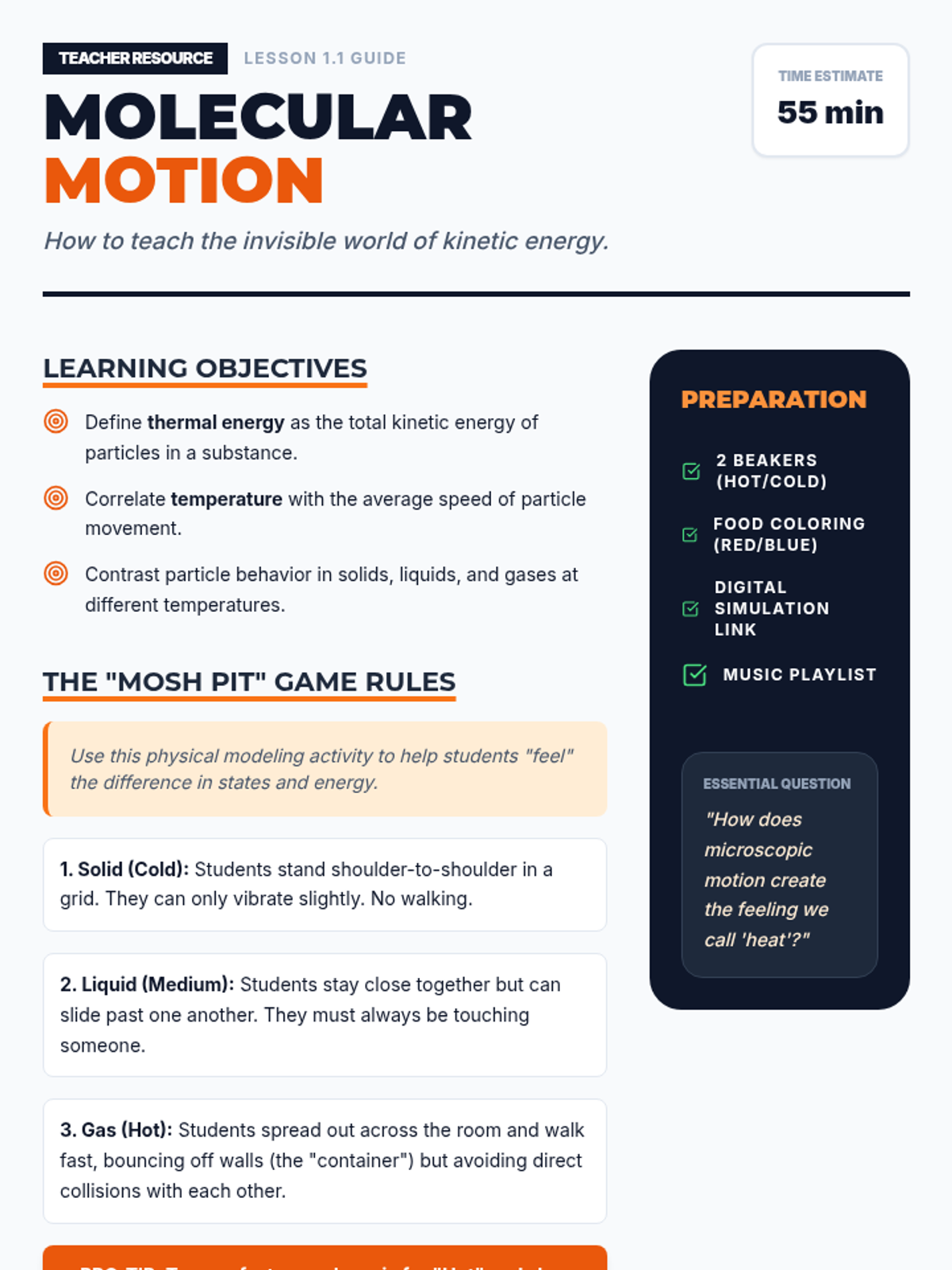
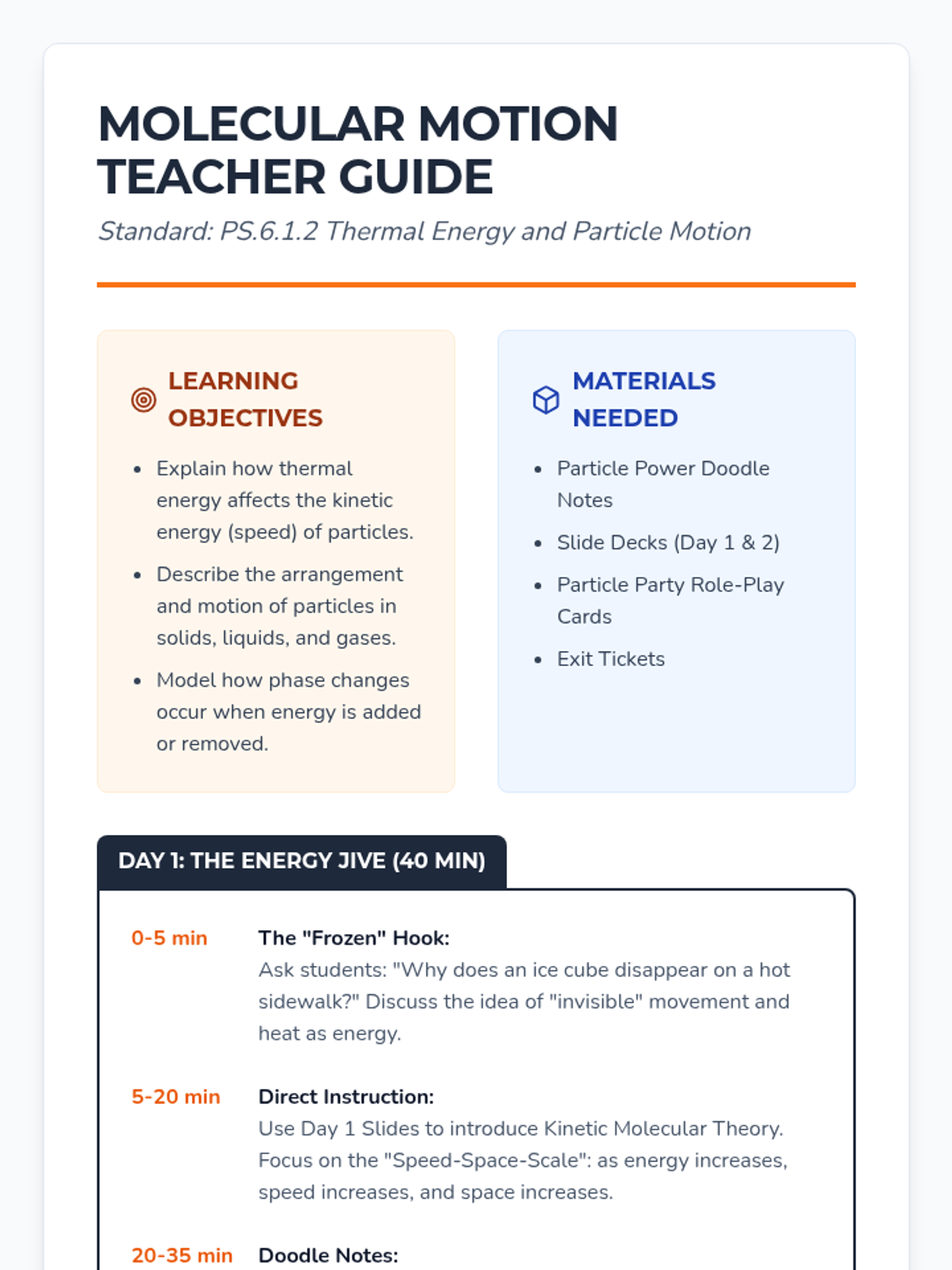
Molecular Motion Teacher Guide
Energy Jive Slides
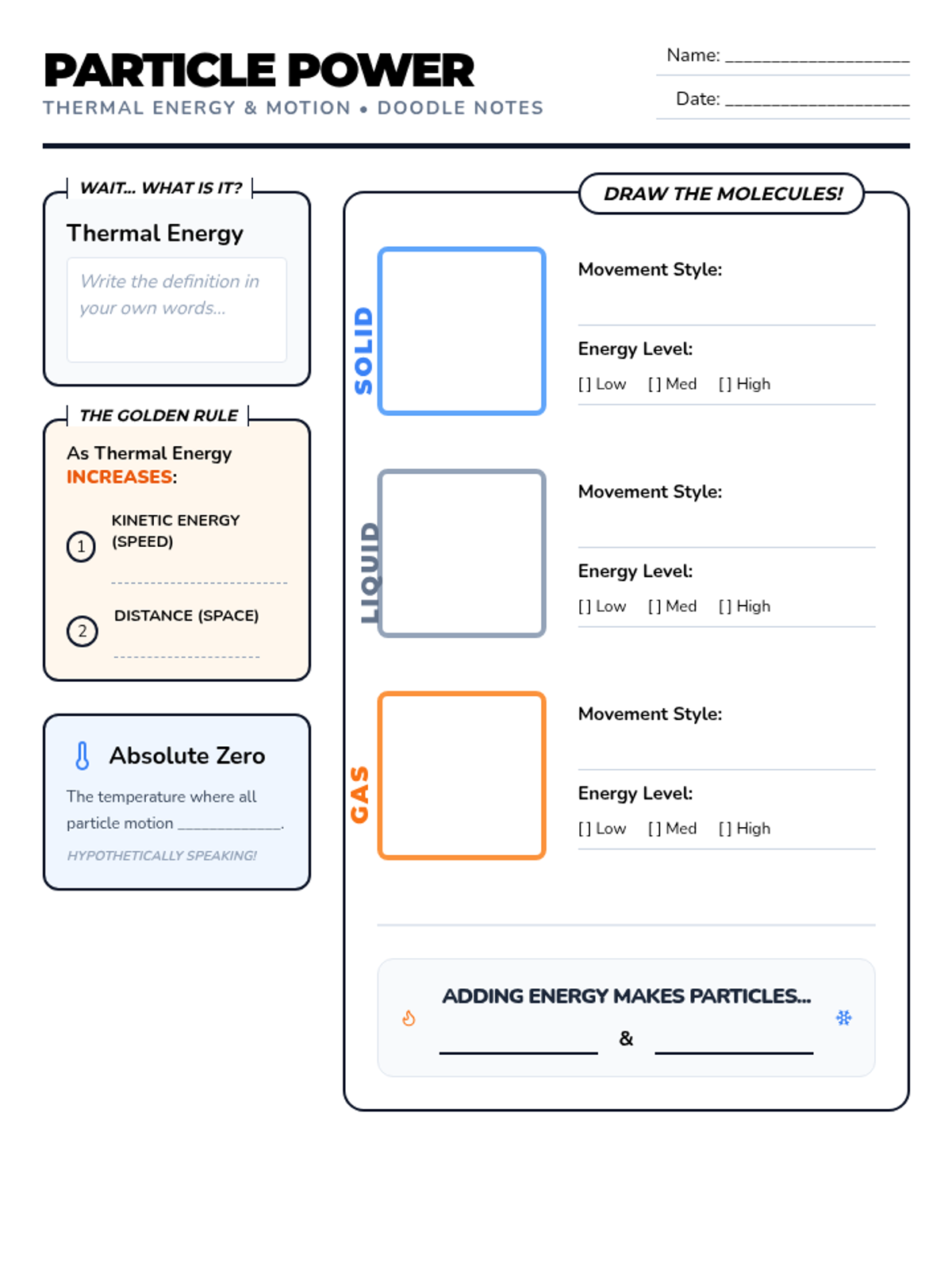
Particle Power Doodle Notes
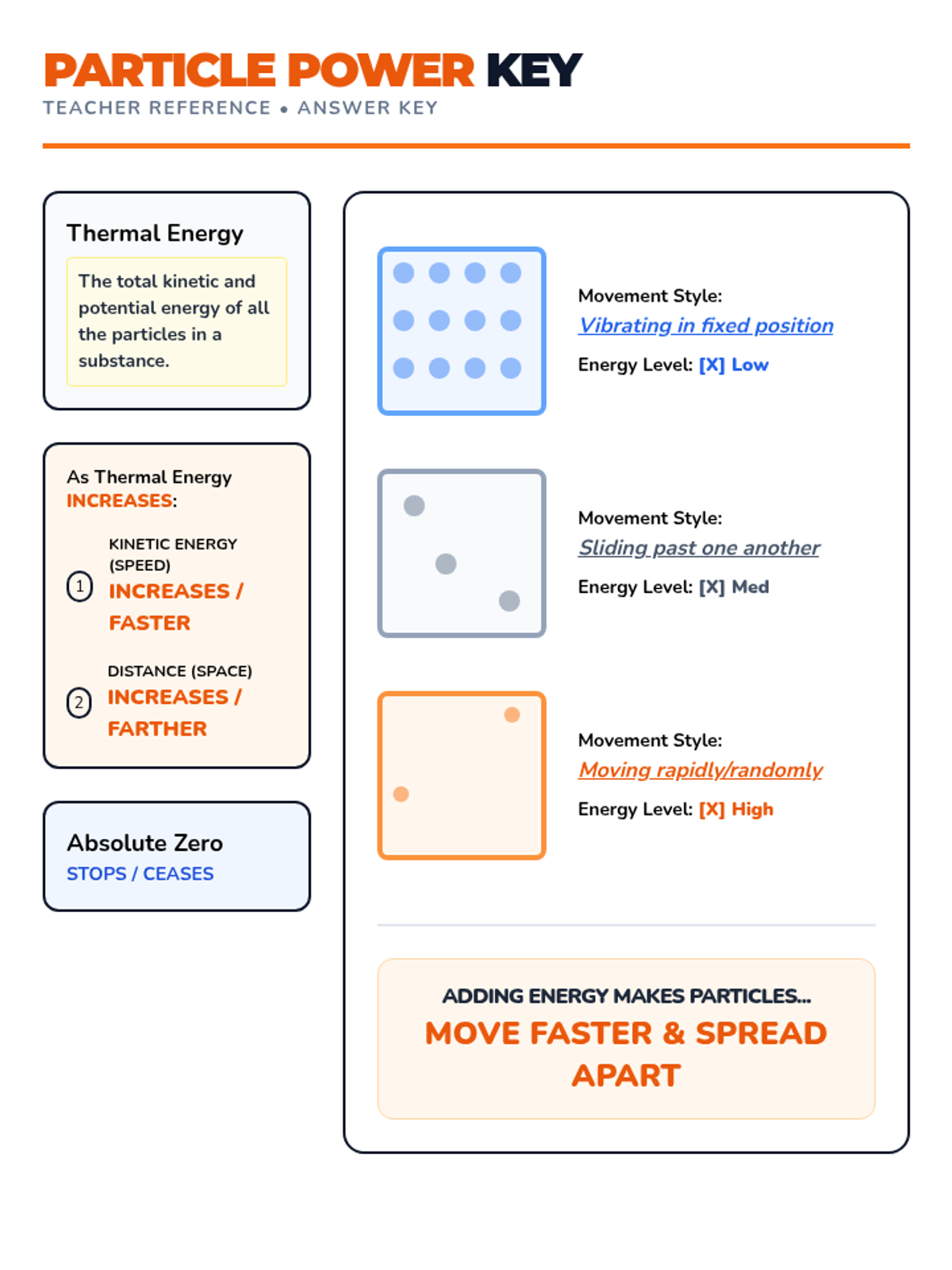
Particle Power Answer Key

Molecular Motion

A two-day science unit for 6th graders exploring the relationship between thermal energy, particle motion, and phase changes through visual notes and kinesthetic modeling.

KM

Katlyn Makatura

Science Teacher
3/2
Sequence
Physical Patterns Slides
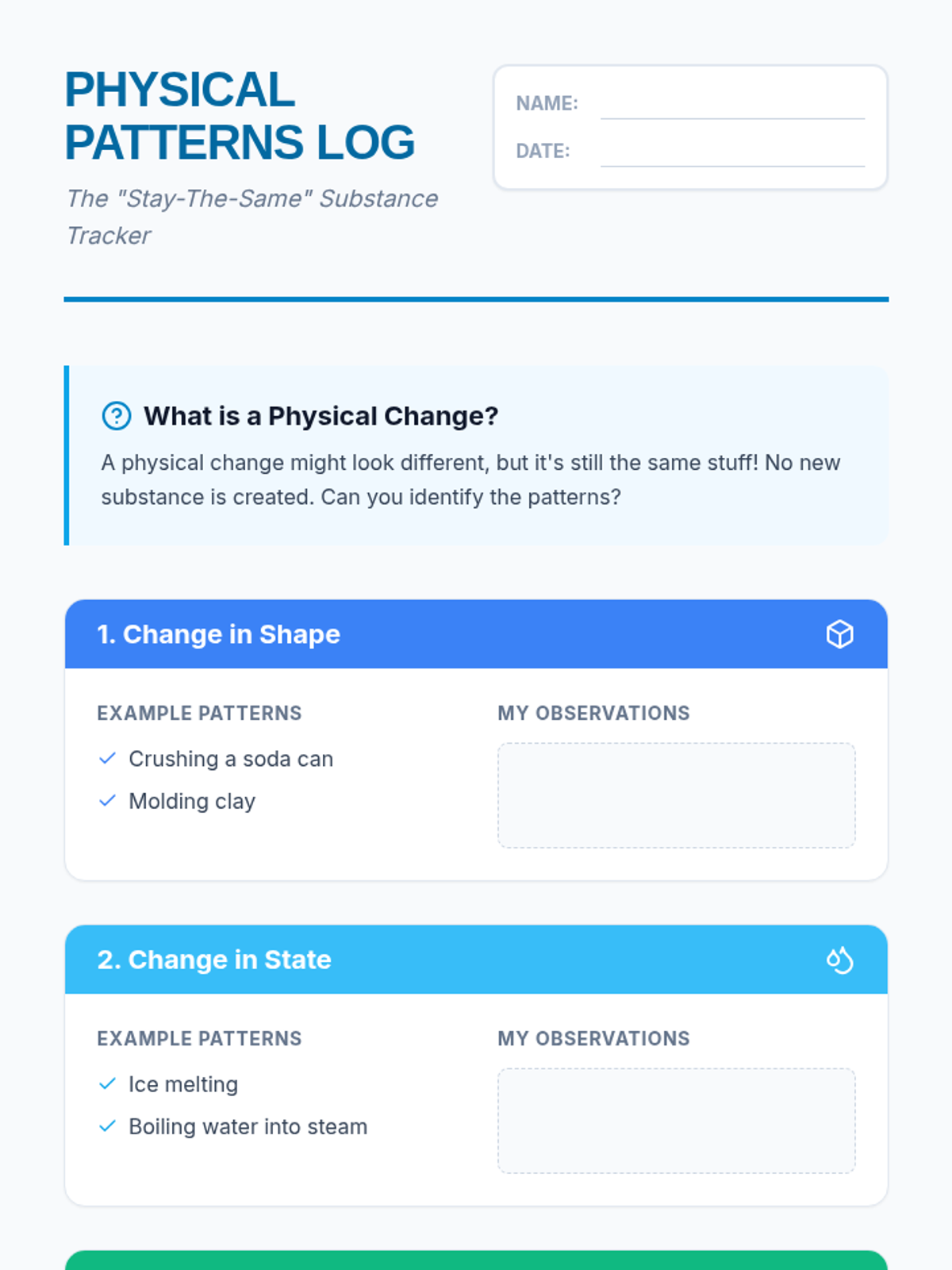
Physical Patterns Log Worksheet
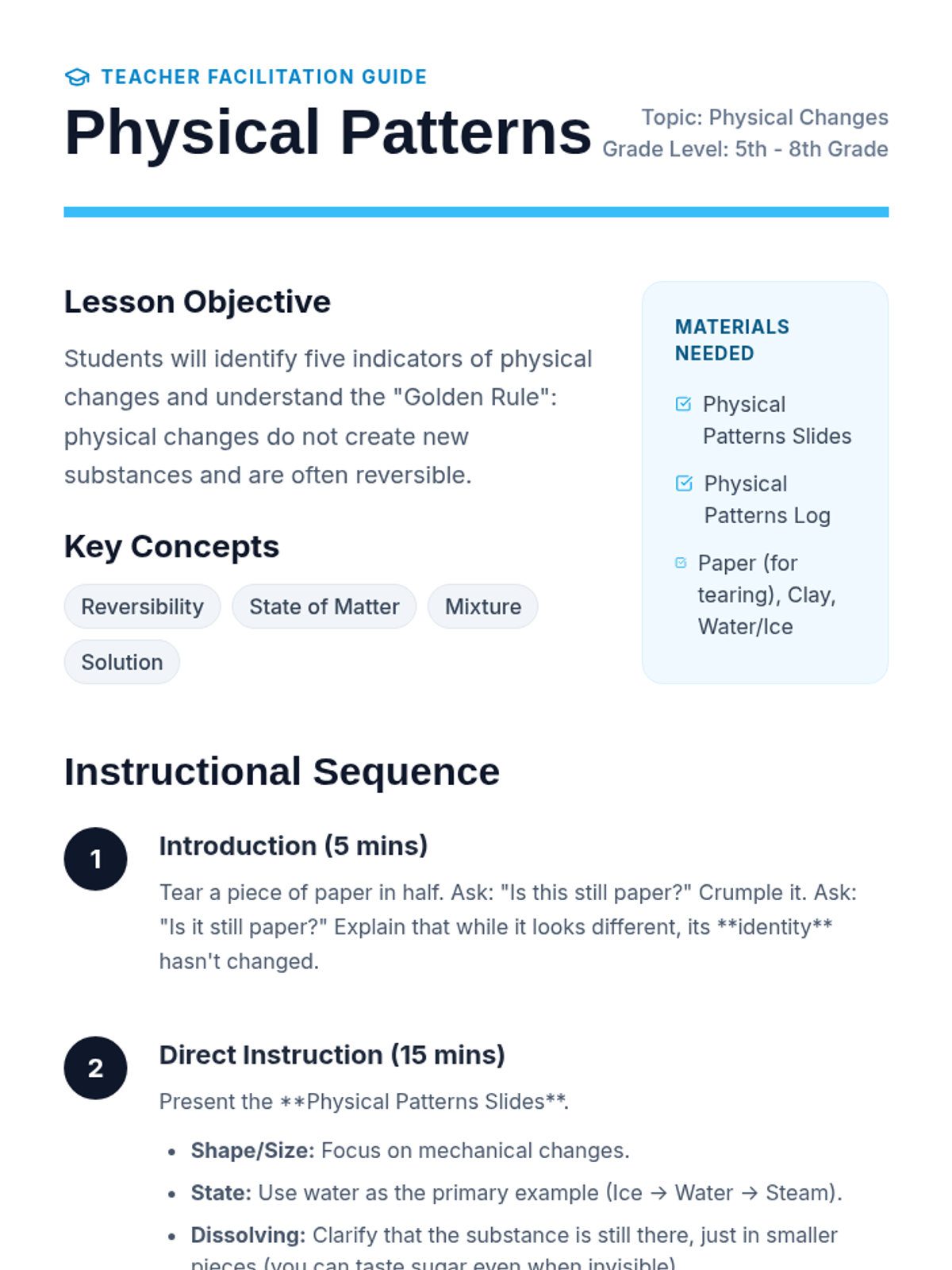
Physical Patterns Teacher Guide

Mastering Matter

A comprehensive unit on matter, focusing on the differences between physical and chemical changes, identifying indicators of each, and applying this knowledge to real-world scenarios.

AD

Amanda Daniels

Math Teacher
2/25
Sequence
Heat Quest Review Packet
Heat Quest Slides

Thermal Energy Mastery Review

A comprehensive two-day review sequence covering thermal energy, heat transfer, temperature vs. thermal energy, and particle motion, culminating in a CER practice and exit ticket.

RM

Rae Mailly

Science Teacher
2/24
Sequence
Molecular Mayhem Teacher Guide
Molecular Mayhem Slides Unit
Speedy Particles Doodle Notes

Molecular Mayhem

A 3-day exploration of thermal energy, particle motion, and phase changes. Students use models to understand how adding or removing energy transforms substances from solids to liquids to gases.

KM

Katlyn Makatura

Science Teacher
2/24
Sequence
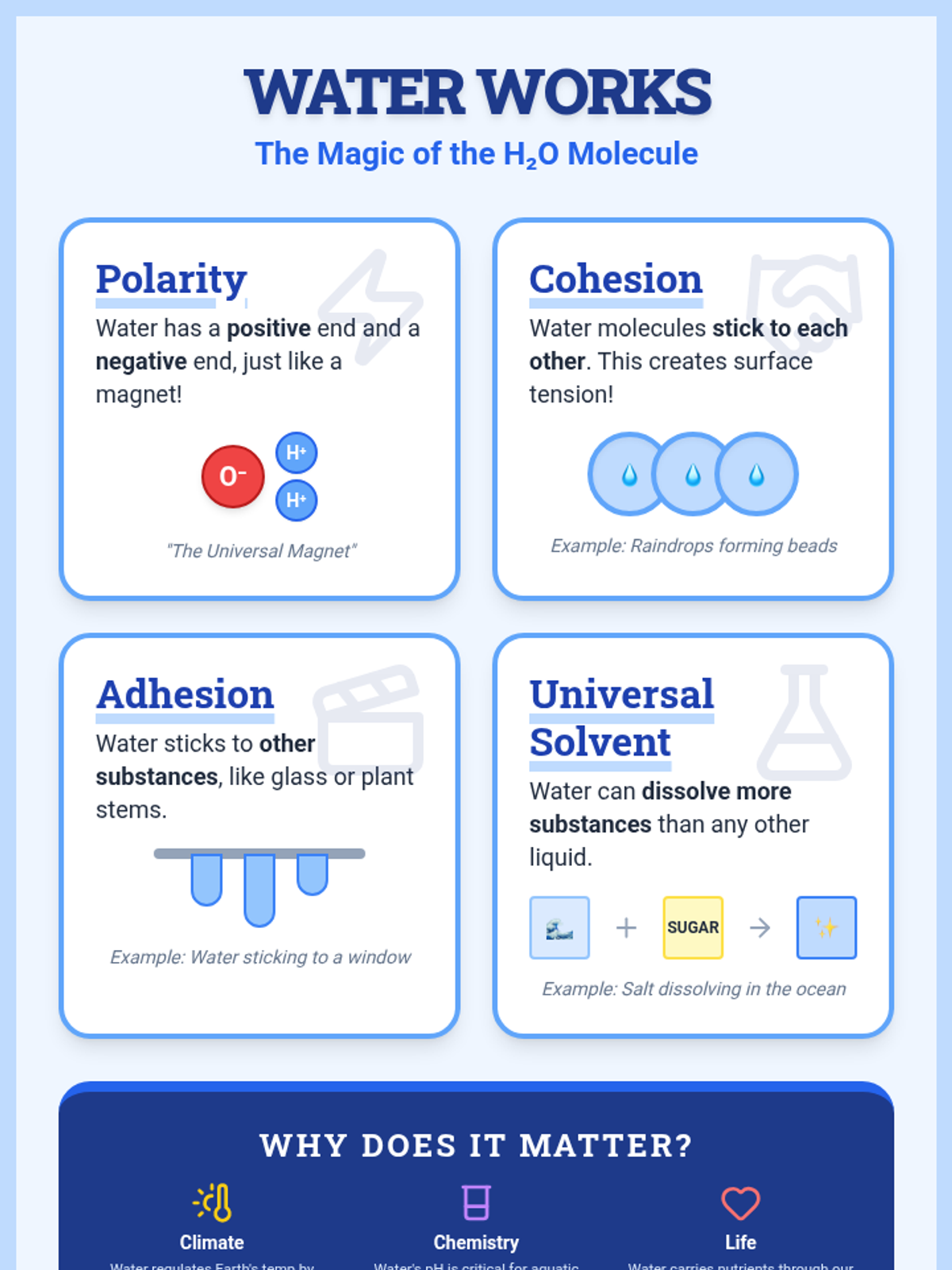
Water Works Anchor Chart
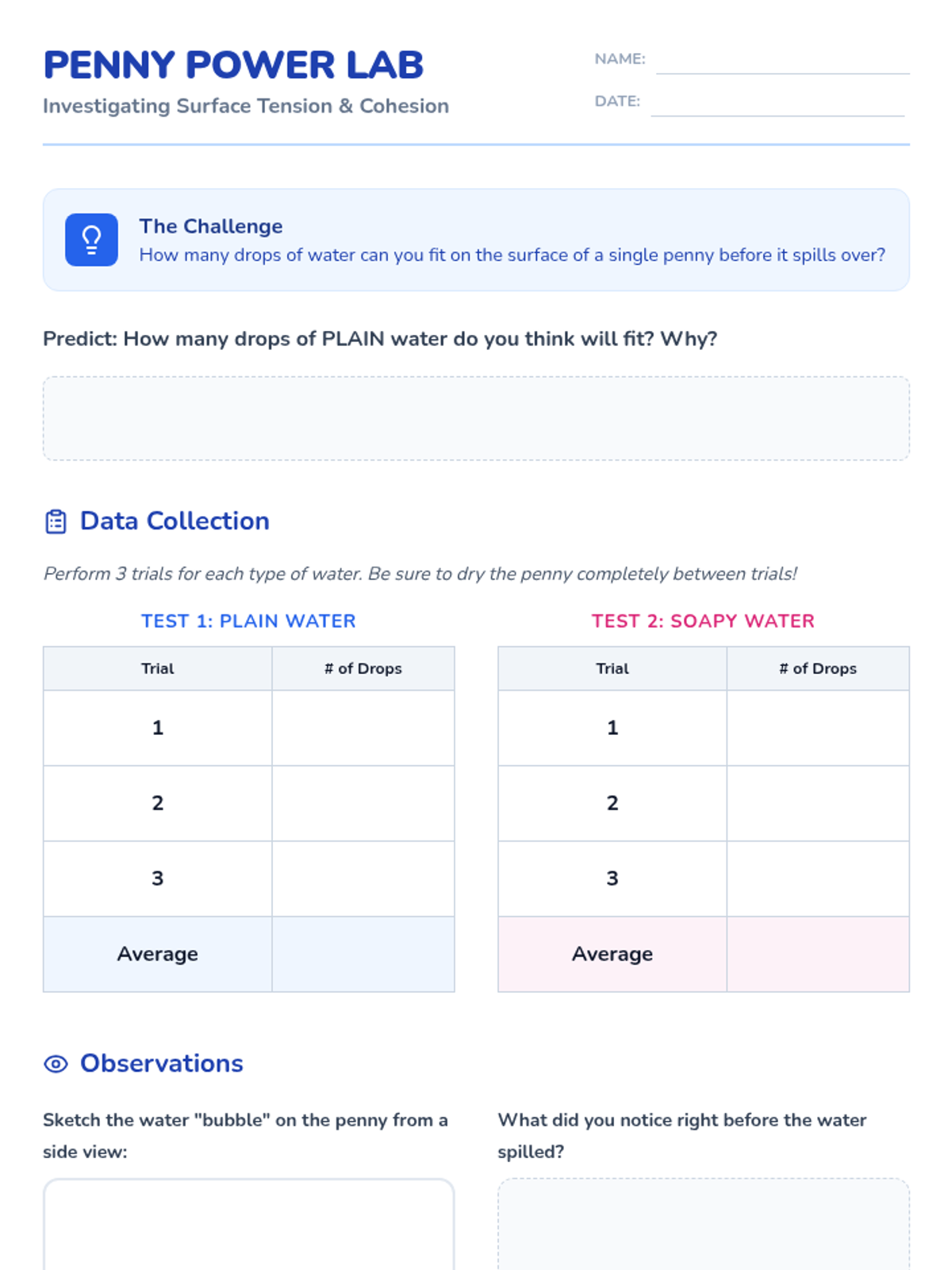
Penny Power Lab Worksheet

H2O Blueprint Unit

A comprehensive 3-week unit exploring the unique physical properties of water, its role in life and geological processes, and the dynamics of watershed systems. Students investigate polarity, cohesion, and universal solubility through hands-on labs while connecting these traits to climate moderation and the health of the Chesapeake Bay.

TM

Teri Minami

Science Teacher
2/19
Sequence
Invisible Ingredients Slides
Invisible Ingredients Worksheet
Invisible Ingredients Answer Key

Matter Masterclass

A series of three review lessons focused on interpreting experimental data and graphs related to the conservation of mass and phase changes in matter. Students will analyze scenarios involving dissolving, freezing, boiling, and thermal energy to strengthen their scientific reasoning skills.

AO

Archie Olson

English Language Arts Teacher
2/12
Sequence
Liquid Legacy Teacher Guide
Flow Force Lab Sheets
Watershed Weaver Graphic Organizer
Flow Force Slides

Flow Force

A comprehensive 5-week sequence exploring the physical properties of water, the engineering of water filtration, and the complex systems of Virginia's watersheds. Students move from hands-on engineering to chemical properties and finally to large-scale environmental systems.

TM

Teri Minami

Science Teacher
2/3
Sequence
Liquid Legacy Teacher Guide
Flow Force Slides
Hydro Quest Student Workbook
Watershed Weaver Graphic Organizer
Liquid Legacy Teacher Guide 9th Grade Extension
Flow Force 9th Grade Extension Slides
Hydro Quest 9th Grade Lab Manual
Watershed Data Analysis Answer Key

Flow Force

A comprehensive 5-week sequence exploring the physical properties of water, the engineering of water filtration, and the complex systems of Virginia's watersheds. Students move from hands-on engineering to chemical properties and finally to large-scale environmental systems.

TM

Teri Minami

Science Teacher
2/2
Sequence
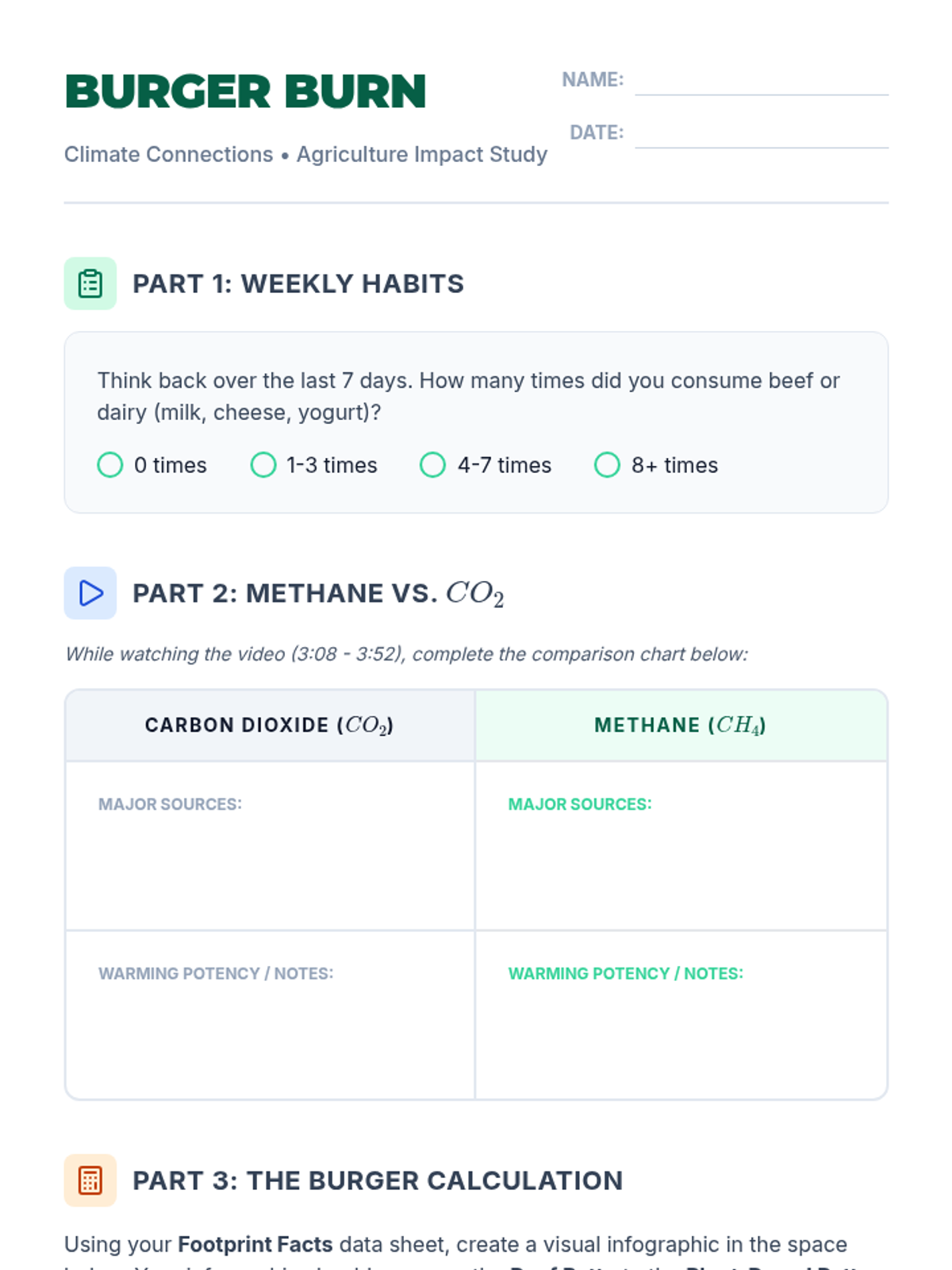
Burger Burn Slides
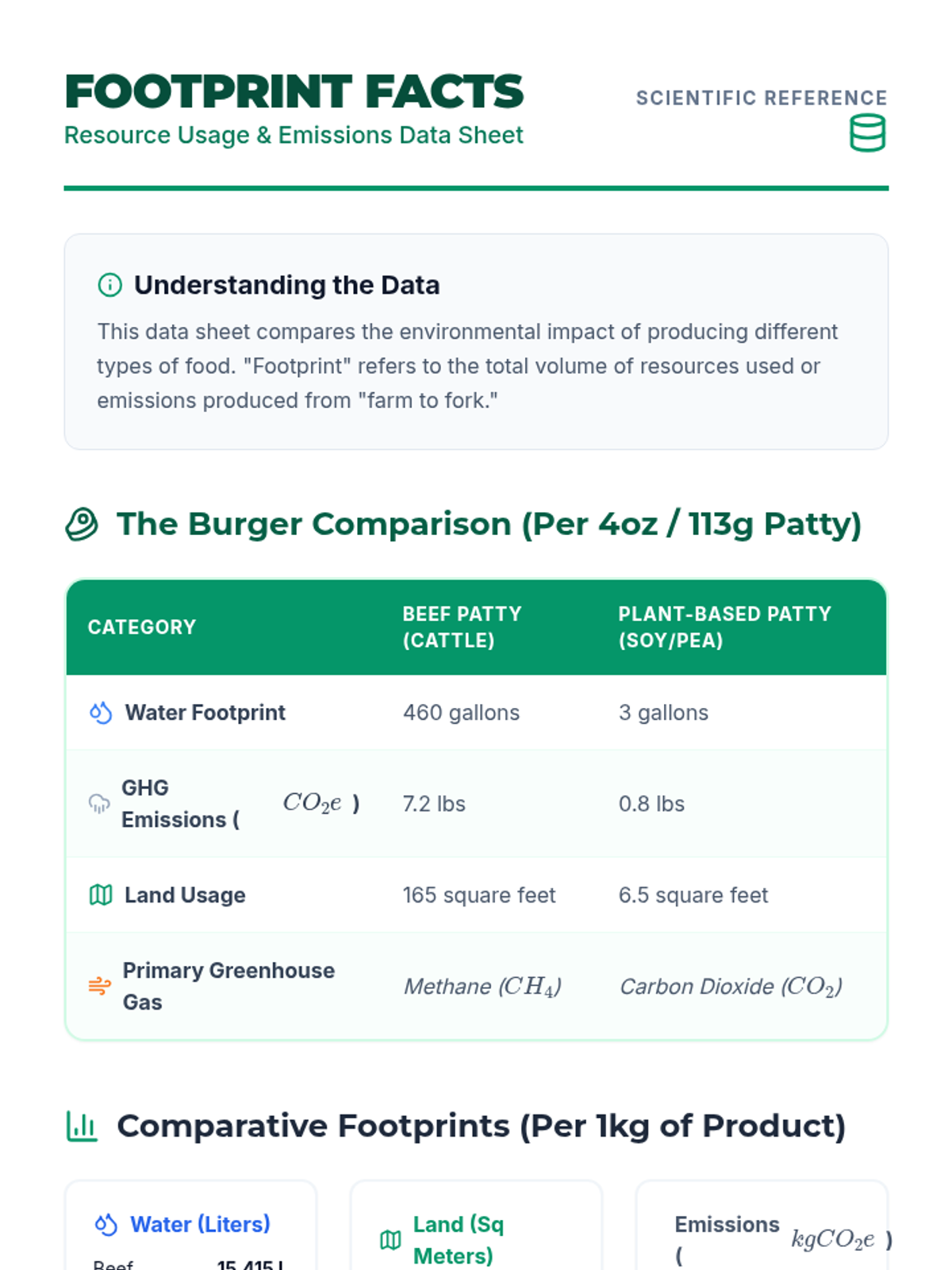
Footprint Facts Data Sheet
Beef Impact Worksheet
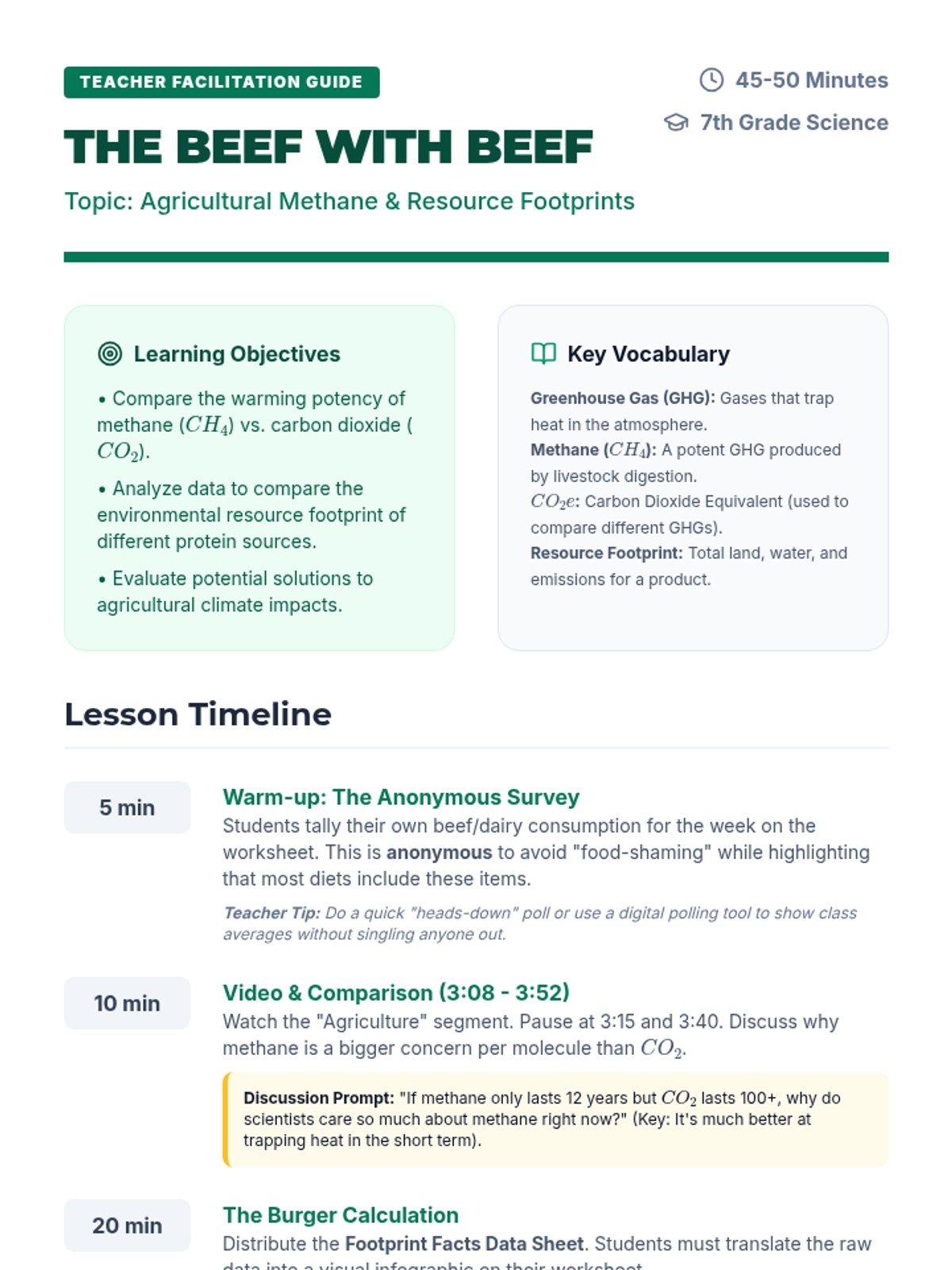
Beef Teacher Guide

Climate Connections

A series of lessons focused on human-induced climate change, exploring the causes, effects, and potential solutions through data analysis and scientific inquiry.

Lenny Avatar
Lenny
1/19
Sequence
Solubility Secrets Slides
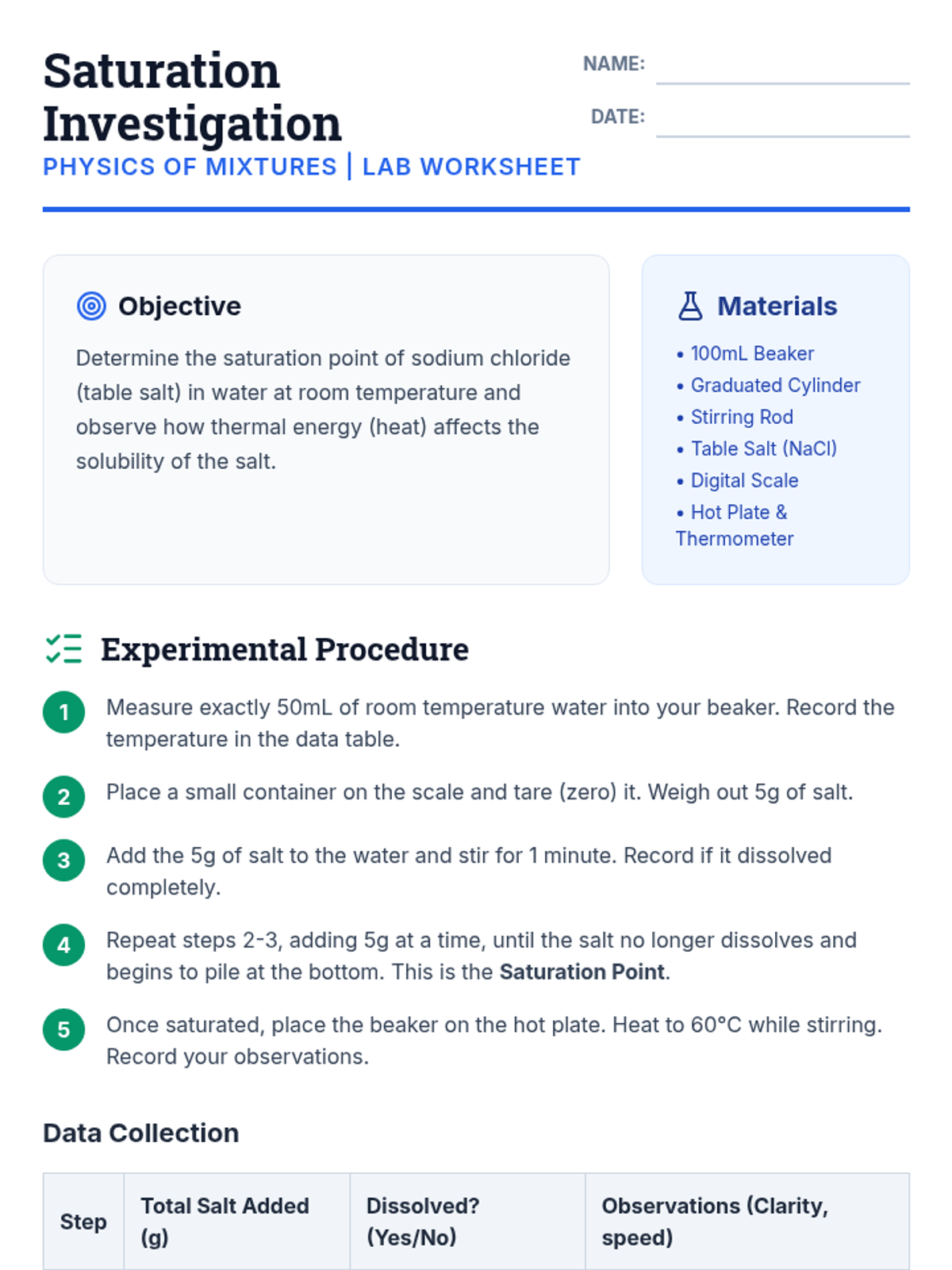
Saturation Investigation Worksheet
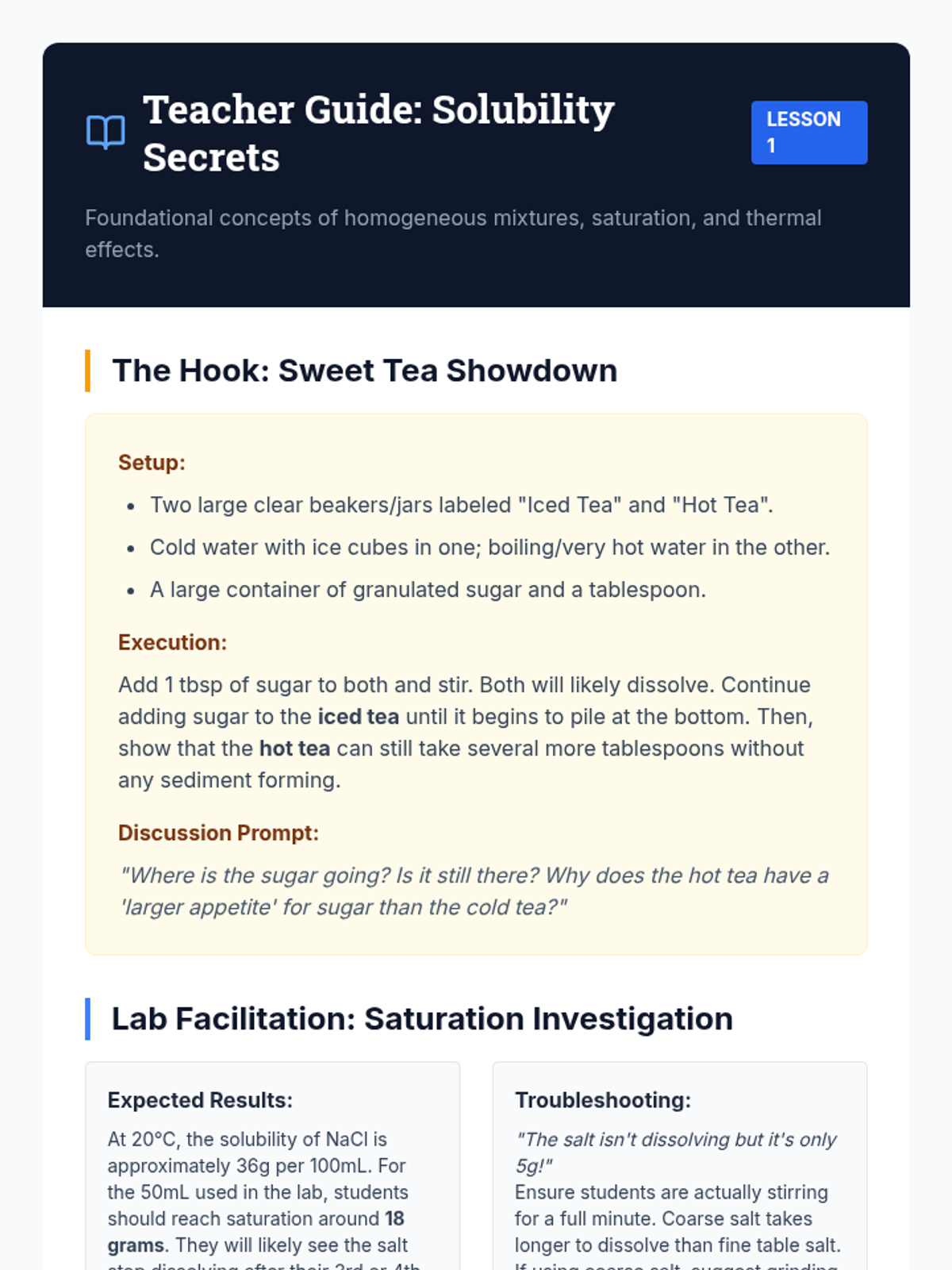
Solubility Secrets Teacher Guide

Thermal Separation Quest

This sequence explores how thermal energy is used to separate homogeneous mixtures. Students progress from understanding solubility and saturation to performing evaporation and distillation labs, ultimately connecting these laboratory skills to industrial applications like oil refining.

Lenny Avatar
Lenny
1/18
Sequence
Sum of Parts Slides
Mixing Lab Report
Mass Tracker Teacher Guide

Mass Mystery Solvers

A quantitative exploration of mixtures and solutions where students use measurement to prove that mass is conserved even when substances dissolve or change state. Students progress from simple mixtures of solids to complex solutions and recovery through evaporation.

Lenny Avatar
Lenny
1/18
Sequence
Matter Morph Slides
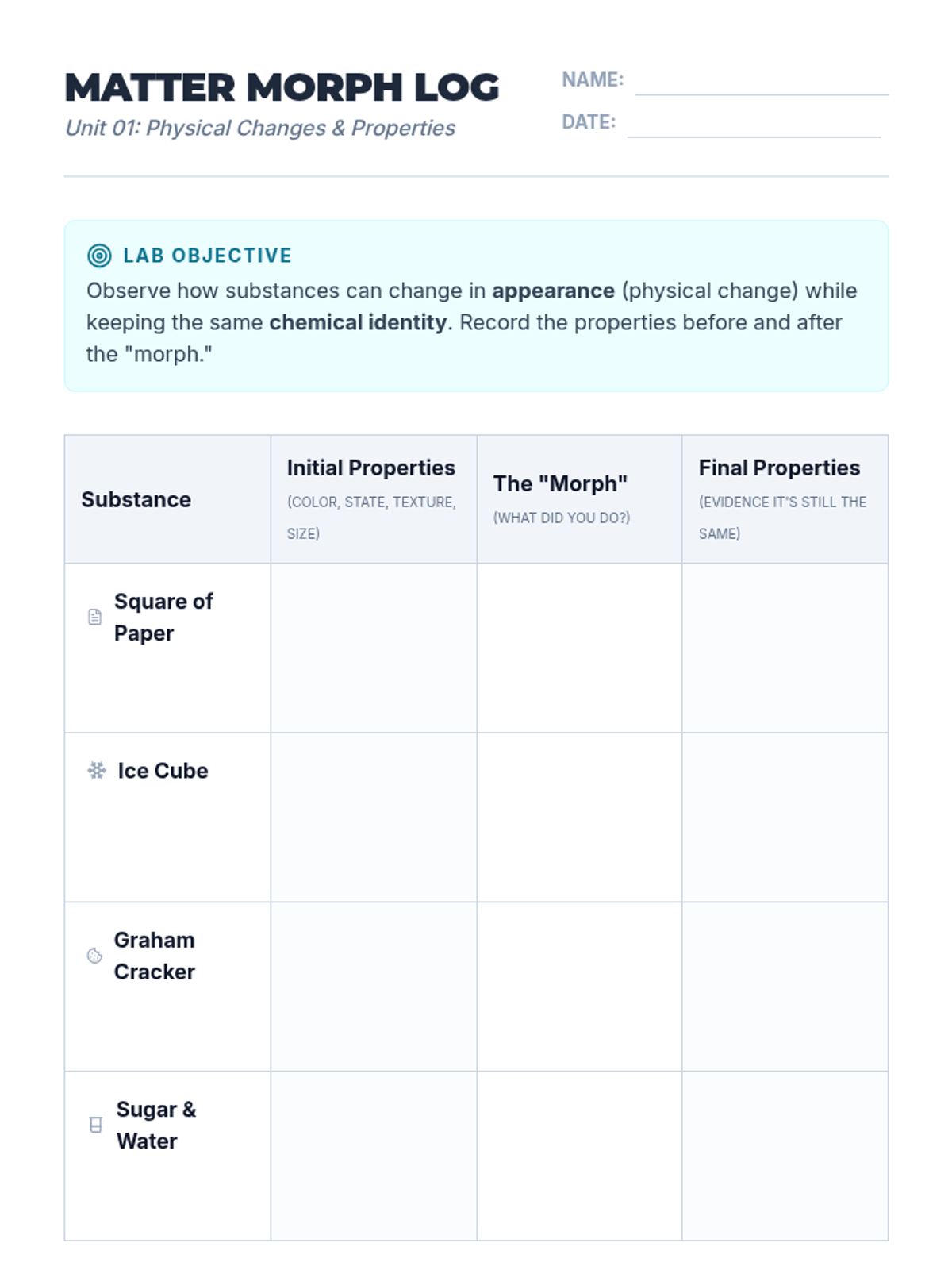
Matter Morph Log Worksheet

Matter Morphers

This sequence guides students through the scientific process of distinguishing between physical changes, where matter changes form but not identity, and chemical changes that create new substances. The unit emphasizes the concept of reversibility versus permanent alteration, culminating in a hands-on lab performance task.

Lenny Avatar
Lenny
1/18
Sequence
Particle Dance Teacher Guide
Particle Dance Slides
Micro Model Lab Worksheet
Micro Model Lab Answer Key

Modeling Particle Motion and Thermal Energy

This sequence explores thermodynamics through the lens of particle motion. Students bridge the gap between microscopic atoms and macroscopic phenomena like temperature, pressure, and phase changes using models and simulations.

Lenny Avatar
Lenny
1/17
Sequence
Friction Spark Slides
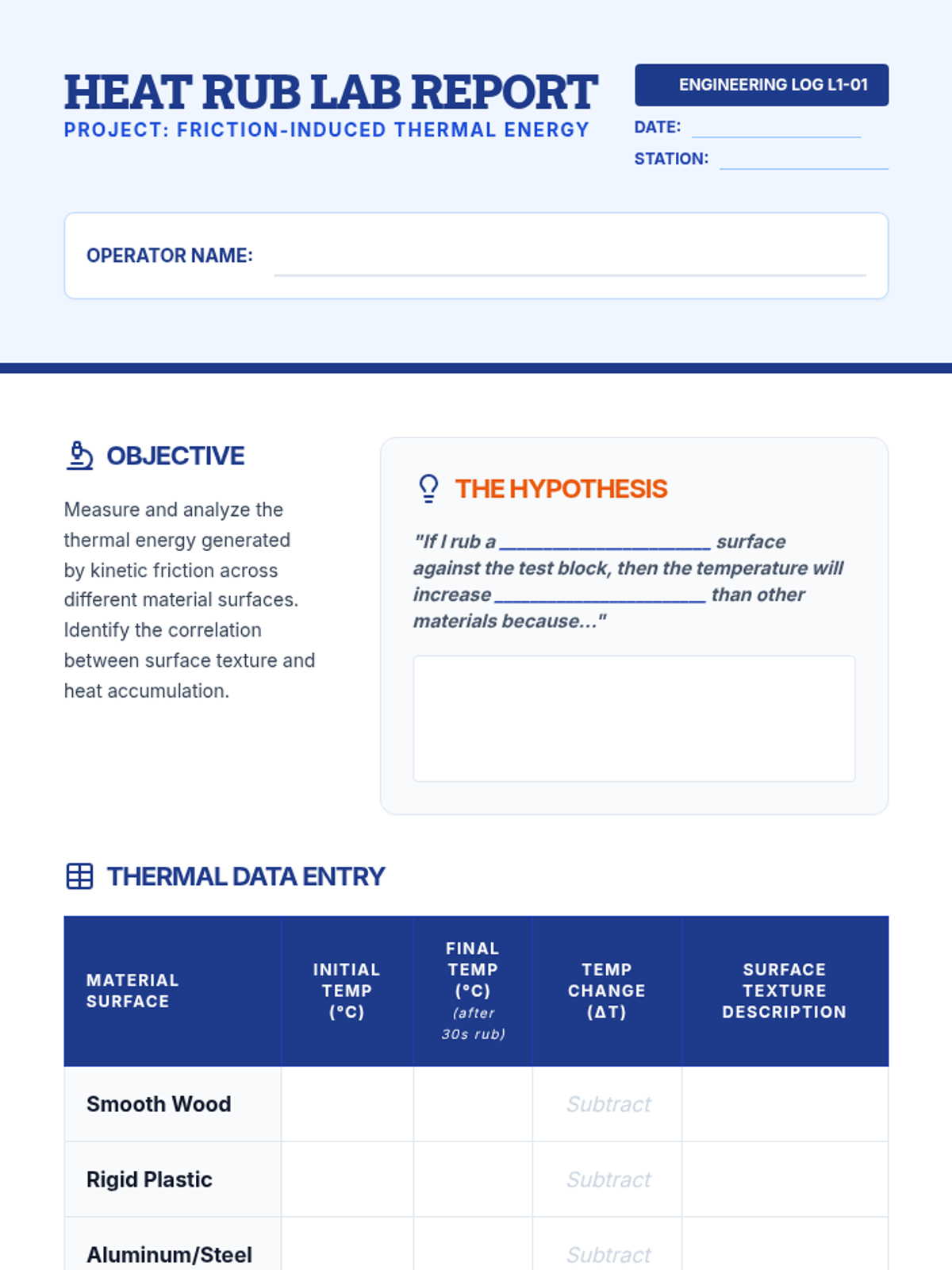
Heat Rub Worksheet
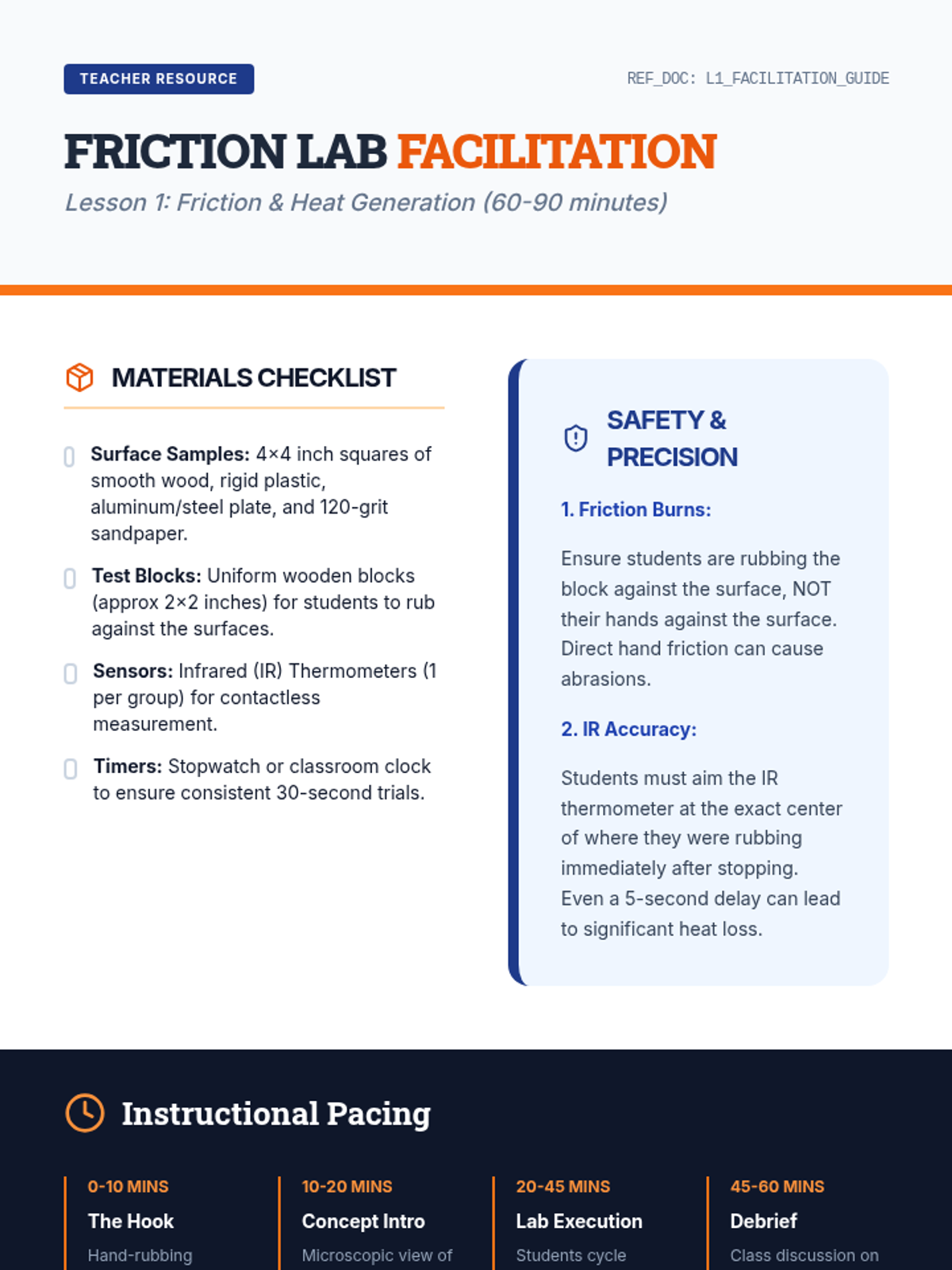
Friction Lab Teacher Guide

Heat and Motion Workshop

A 5-lesson sequence for 6th-grade students exploring the relationship between friction, heat, and mechanical engineering. Students investigate heat generation, lubrication, thermal management systems, and predictive maintenance.

Lenny Avatar
Lenny
1/17
Sequence
Power in a Tablet Slides
Pop-Top Pressure Guide
Pressure Prediction Sheet

Rocket Reactors

Students apply acid-base chemistry and the engineering design process to build, test, and optimize chemical rockets, exploring pressure, aerodynamics, and reaction rates.

Lenny Avatar
Lenny
1/17
Sequence
Particle Party Teacher Guide
Particle Party Worksheet
Particle Party Slides

Particle Power

A 6th-grade chemistry sequence exploring the Kinetic Molecular Theory through modeling, simulations, and hands-on investigation of particle behavior in gases.

Lenny Avatar
Lenny
1/17
Sequence
Solar Snapshot Worksheet
Sun Secrets Slides

Stellar Chronicles

This sequence explores the life cycles of stars, the classification of stars based on temperature and color, and the hierarchy of the universe from our solar system to distant galaxies. Students will develop skills in pattern recognition, graphing, and hierarchical organization.

Lenny Avatar
Lenny
1/17
Sequence
Conservation Quest Slides
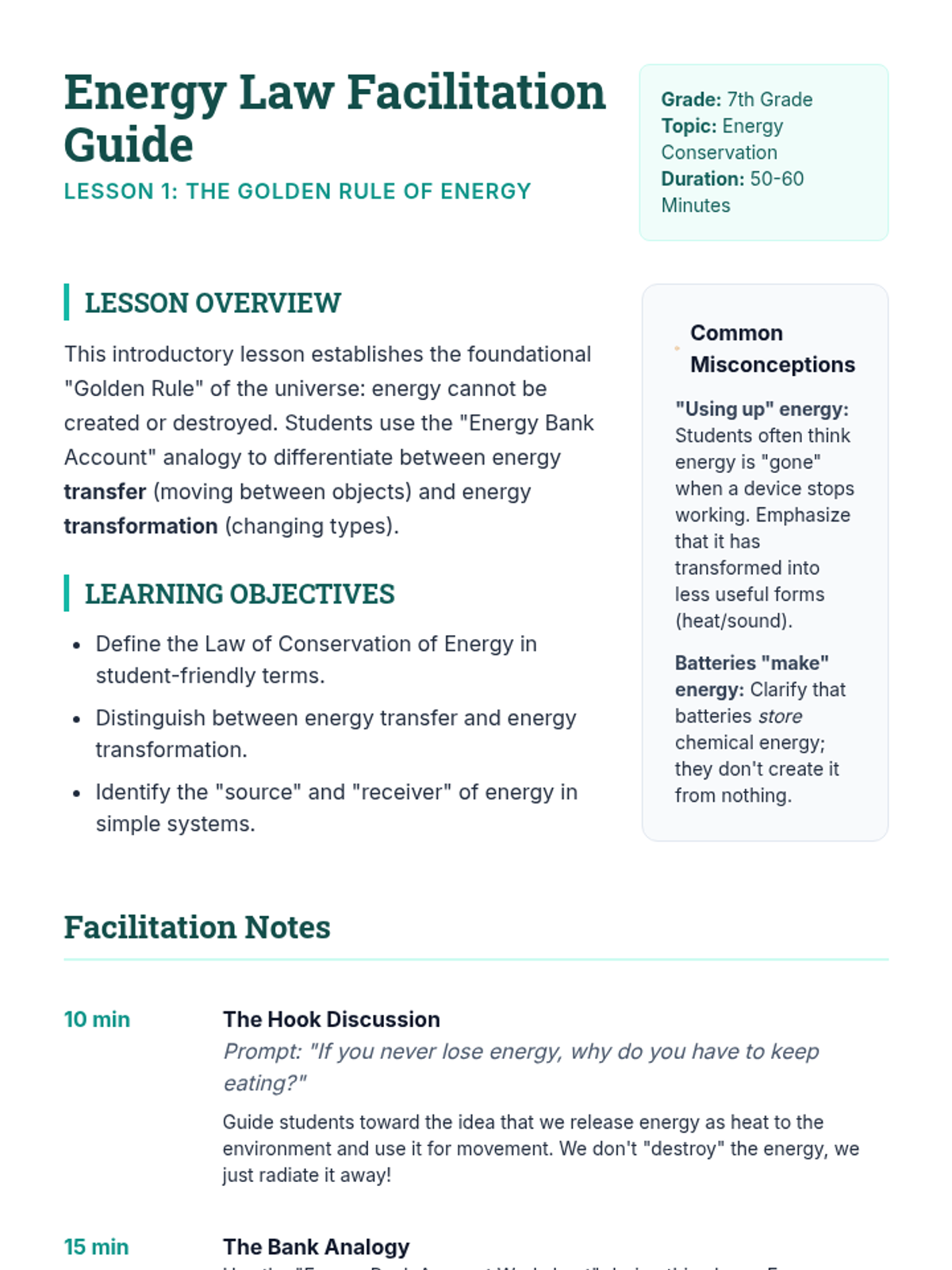
Energy Law Facilitation Guide
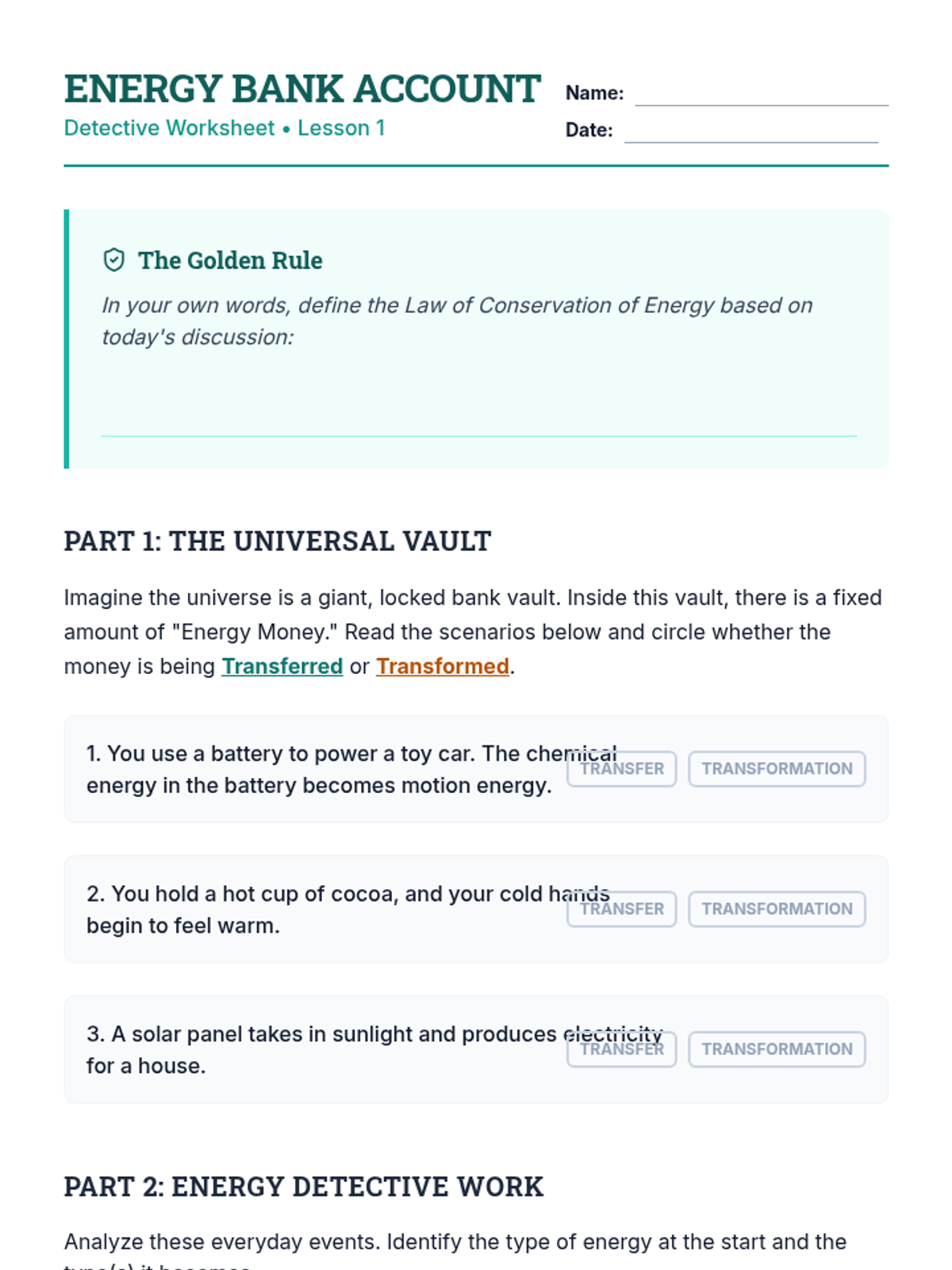
Energy Bank Account Worksheet

Energy Flow Detectives

This sequence explores the Law of Conservation of Energy through the lens of chemistry and particle motion. Students investigate how energy transforms from chemical potential energy to thermal kinetic energy, using simulations and systems mapping to track energy flow and explain heat in chemical reactions.

Lenny Avatar
Lenny
1/17
Sequence
Particles in Motion Slides
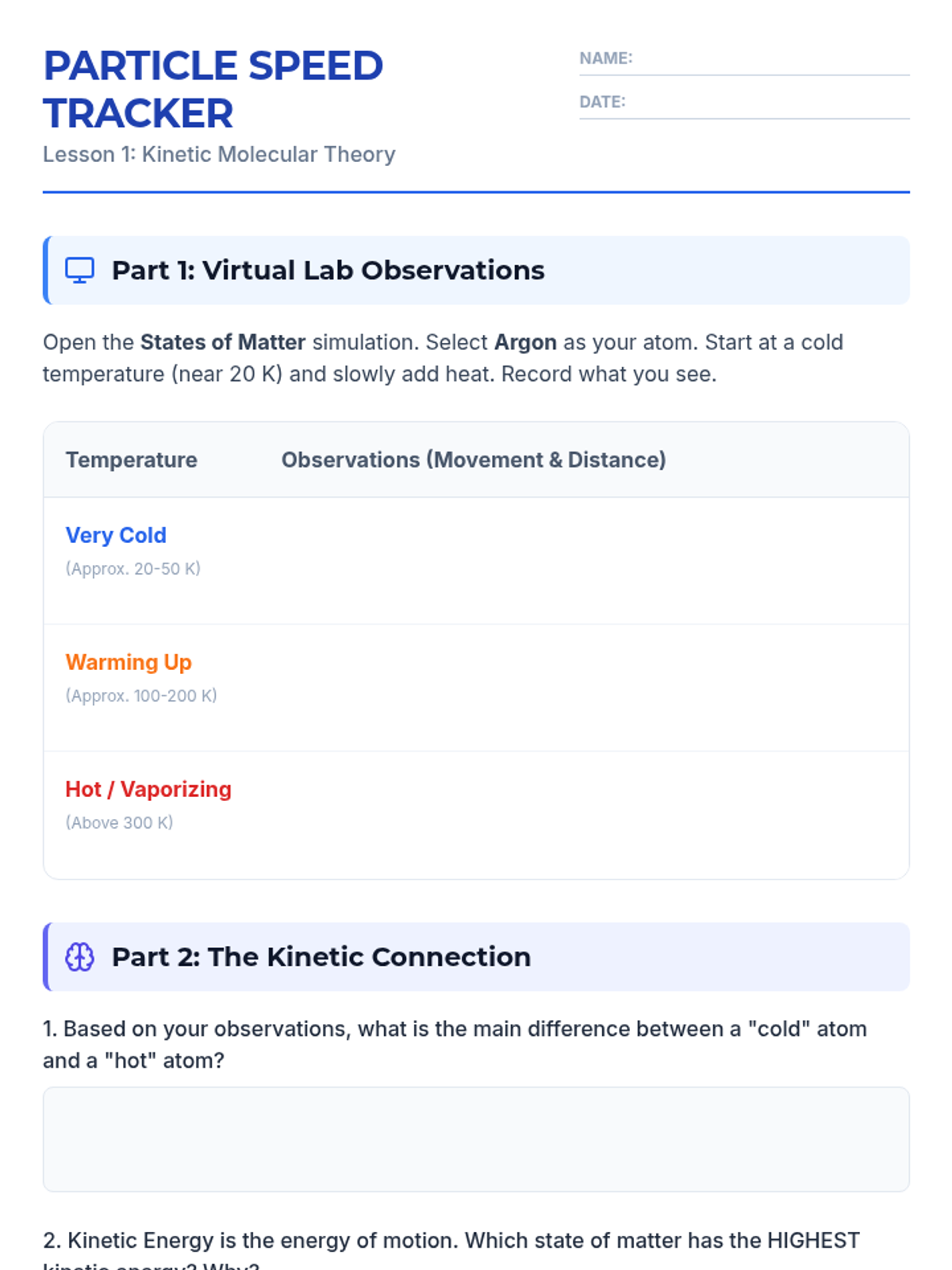
Particle Speed Tracker Worksheet
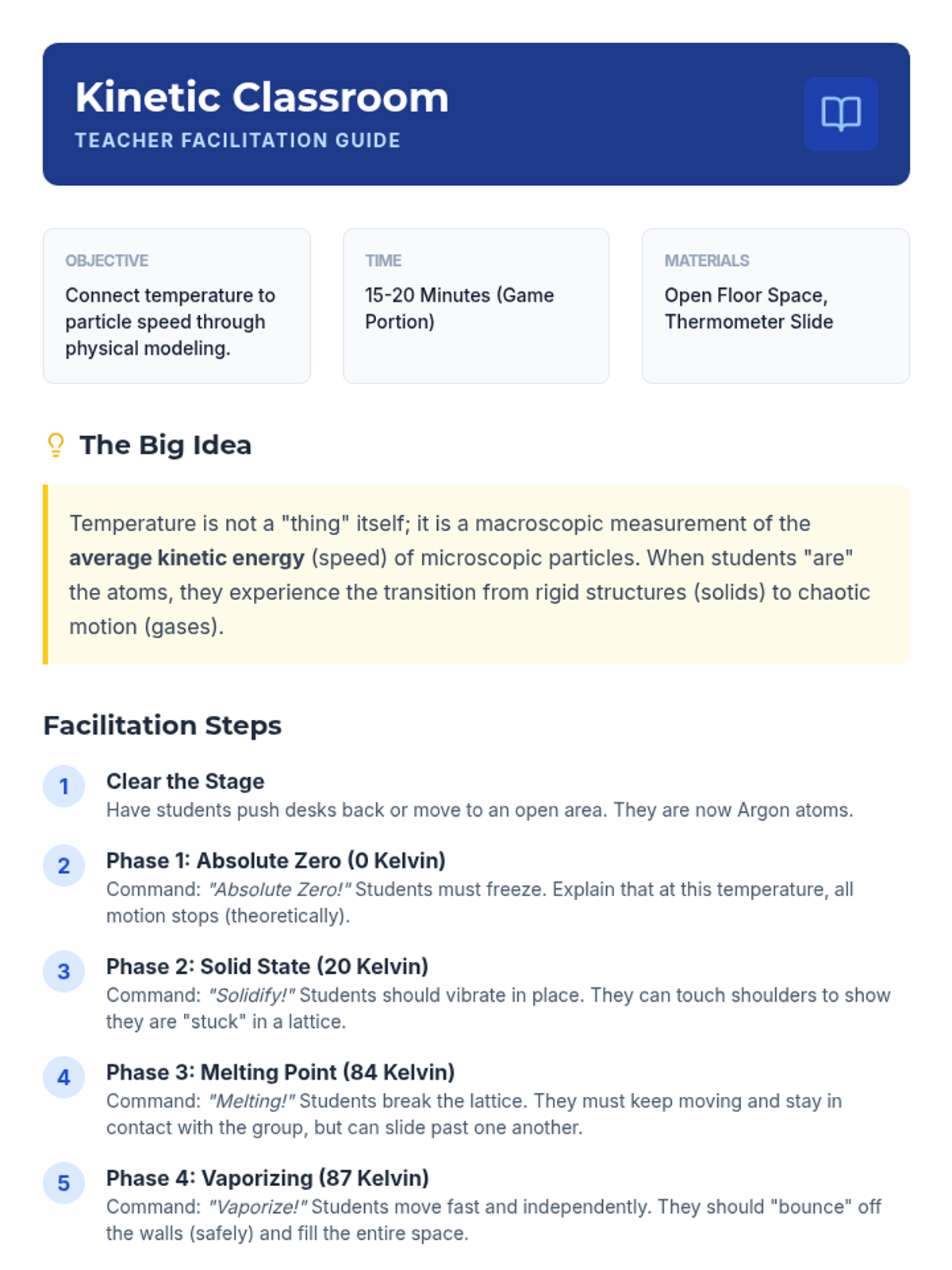
Kinetic Classroom Teacher Guide

Molecular Bond Energy

A conceptual chemistry unit for 6th graders that explores energy changes through the lens of molecular bonds. Students learn that breaking bonds requires energy and forming bonds releases it, using simulations, magnetic models, and kinesthetic role-play.

Lenny Avatar
Lenny
1/17