Atomic structure, quantum models, and periodic trends establish the fundamental nature of matter. Stoichiometry, gas properties, and equilibrium constants facilitate quantitative analysis of chemical reactions and molecular interactions.
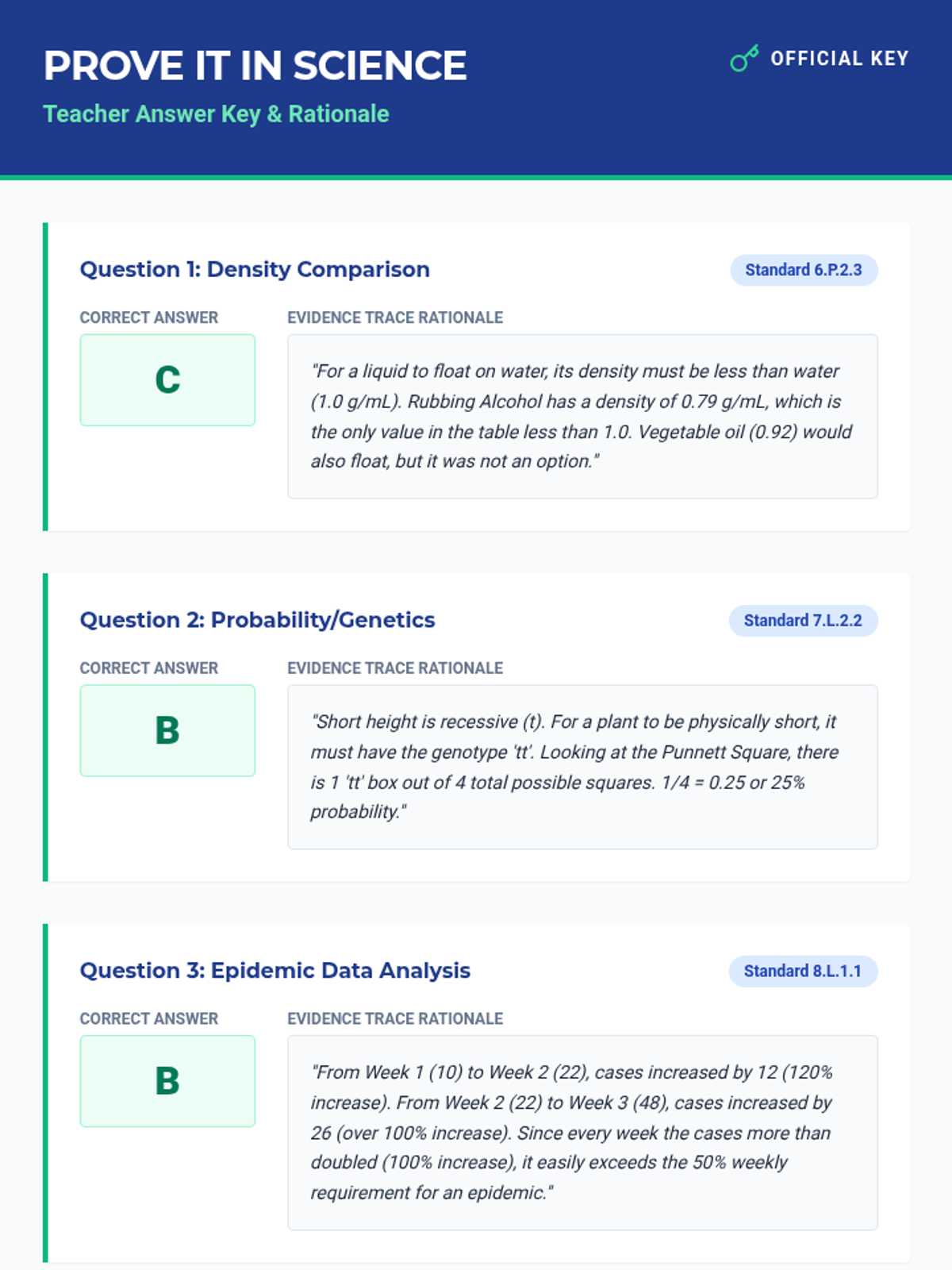
A teacher-facing answer key for the Data Trace Practice Worksheet. It provides correct letter answers for all 6 questions alongside detailed justifications for the 'Evidence Trace' section, including calculations and data comparisons.
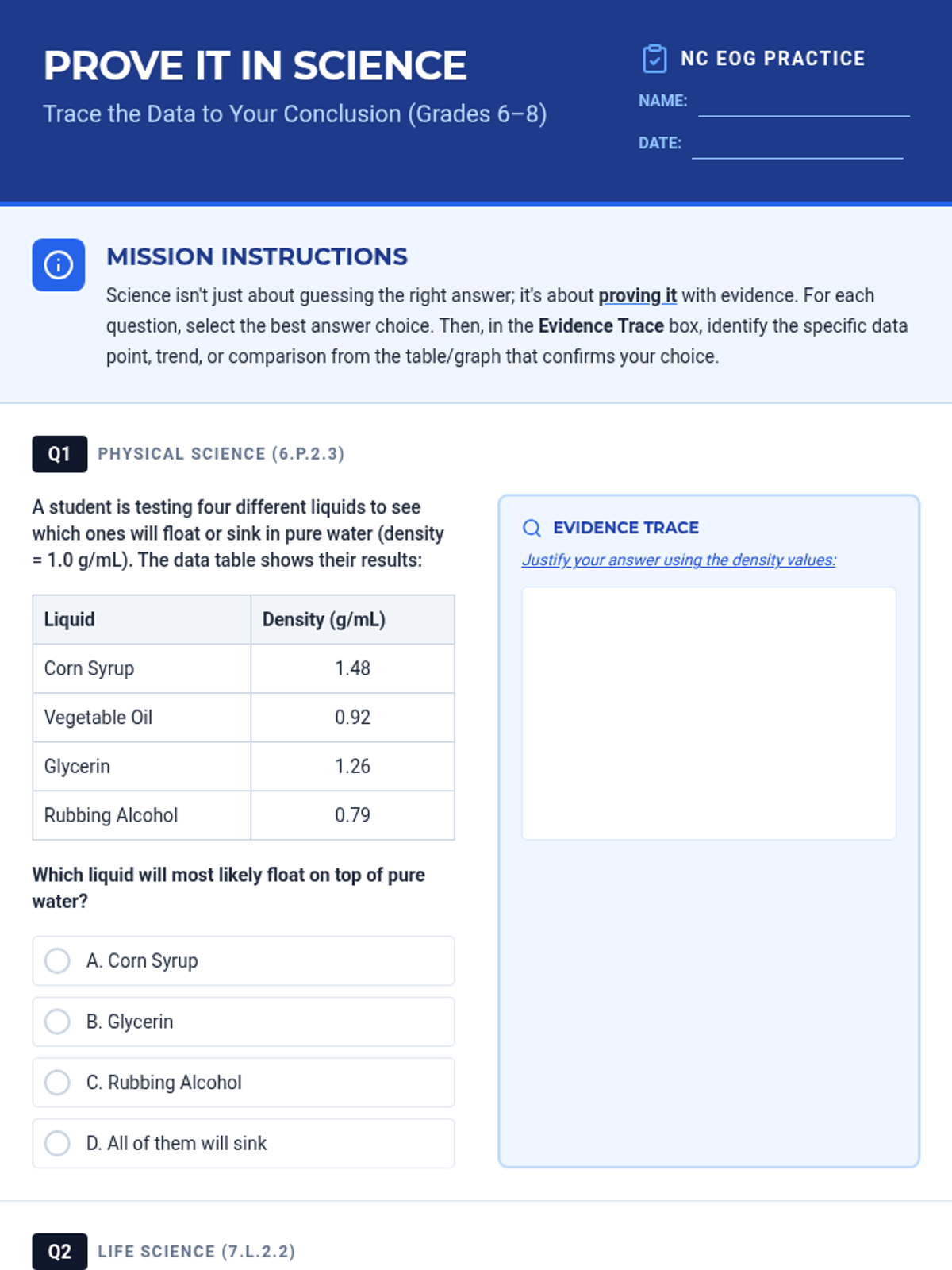
A practice worksheet for grades 6-8 science focusing on evidence justification. It features 6 multiple-choice questions aligned with NC EOG standards, each paired with a dedicated 'Evidence Trace' box for students to provide data-backed justifications.
An engaging guessing game slide deck where a student sits with their back to the screen while classmates describe the mystery objects using physical property vocabulary.
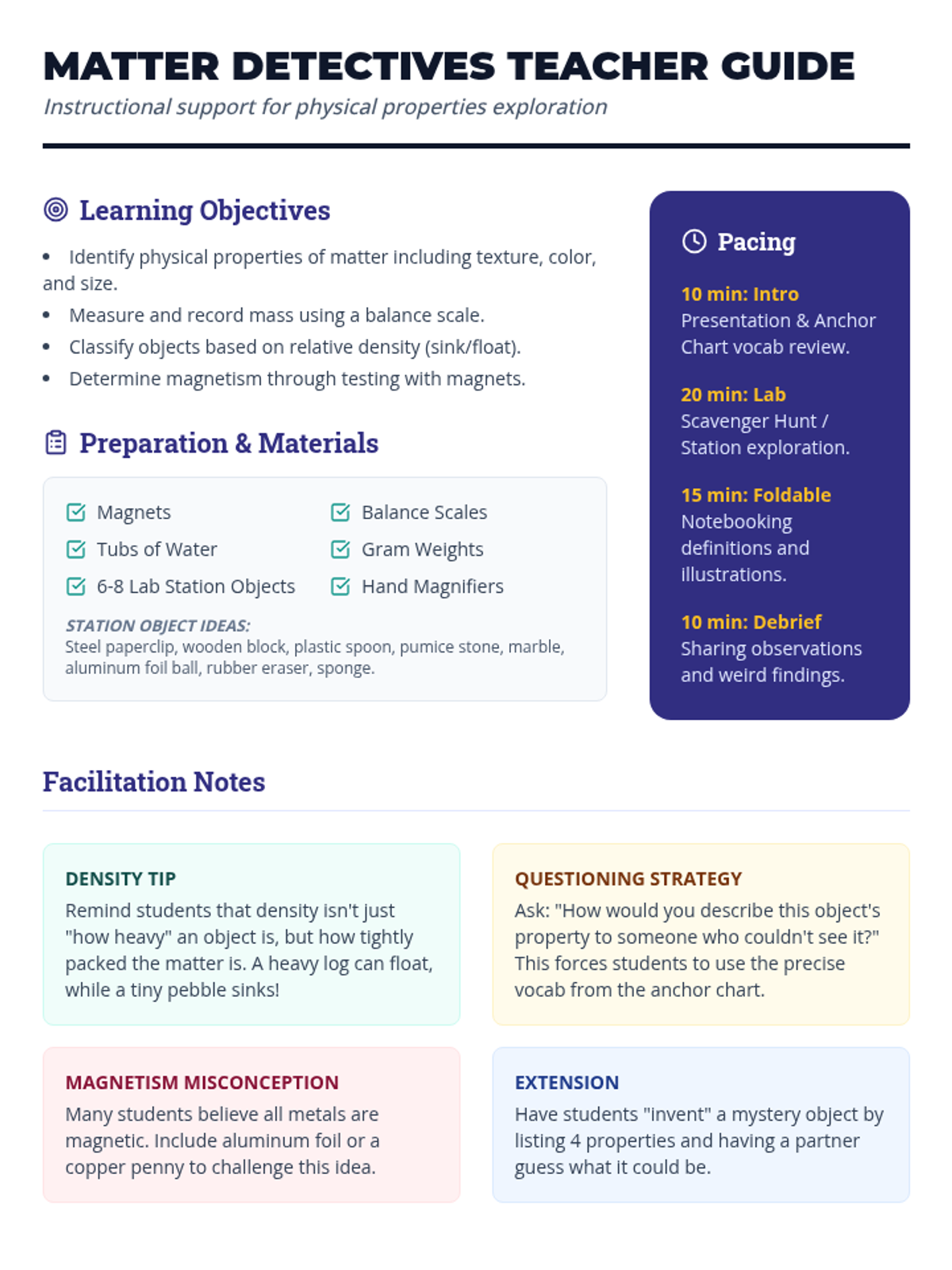
A comprehensive teacher facilitation guide with learning objectives, material lists, pacing suggestions, and strategies for addressing common student misconceptions about physical properties.
A high-impact slide deck for introducing physical properties of matter, including a digital anchor chart, scavenger hunt mission brief, and interactive notebook instructions.
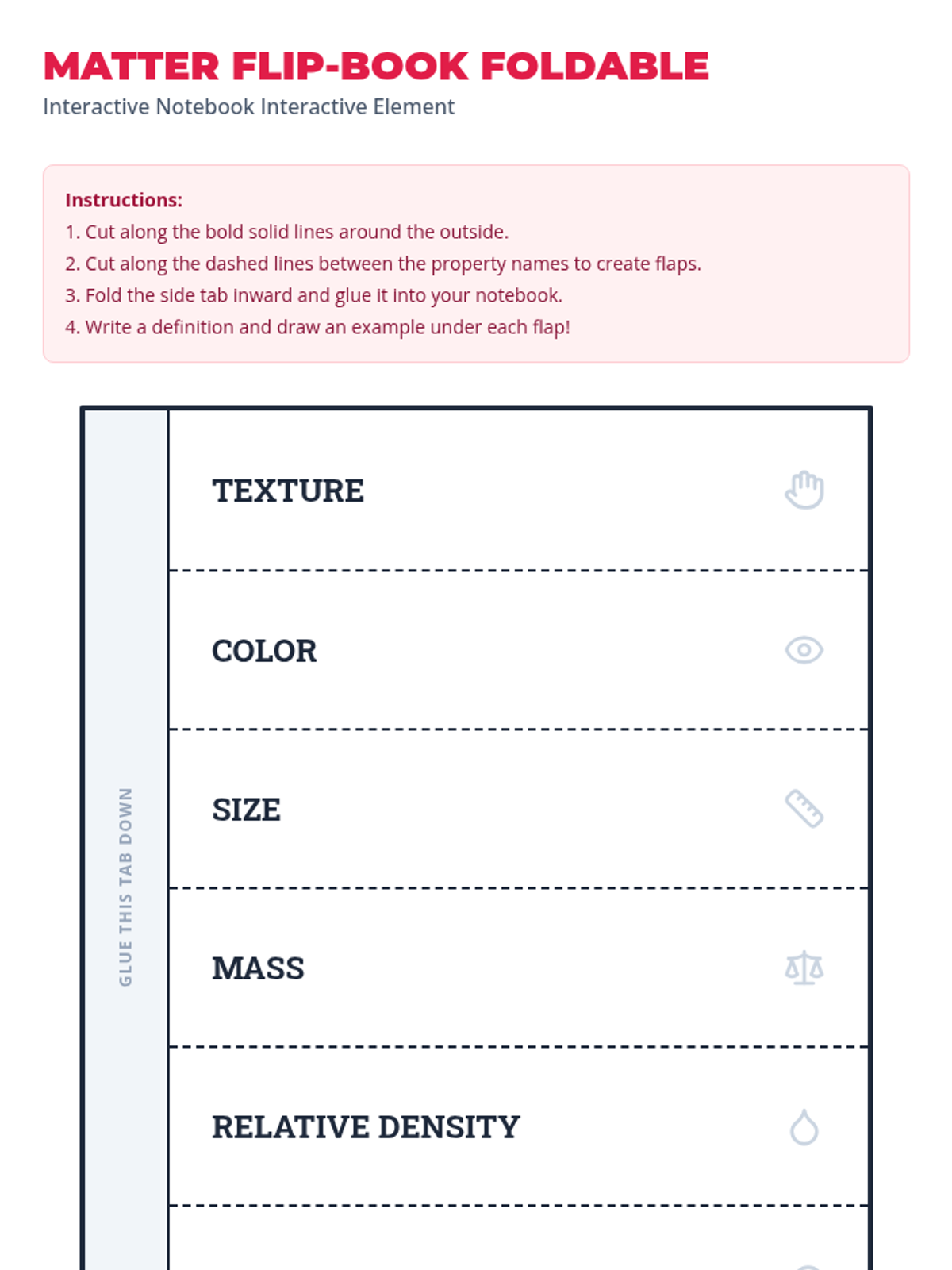
An interactive notebook foldable template with cut-lines and tabs for students to define and illustrate the six physical properties of matter.
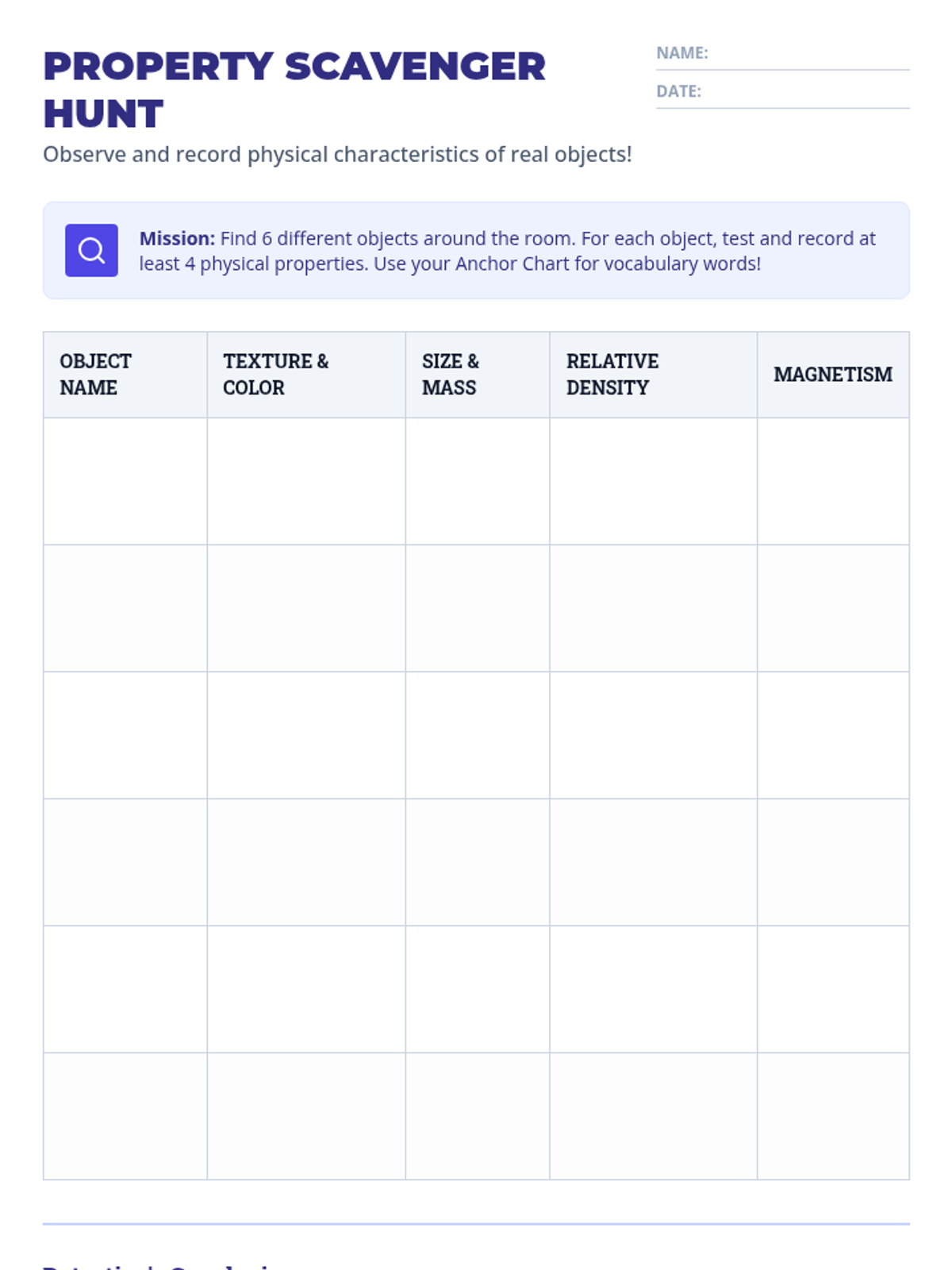
A structured recording sheet for a physical properties scavenger hunt, providing space for students to document observations of six different objects across multiple property categories.
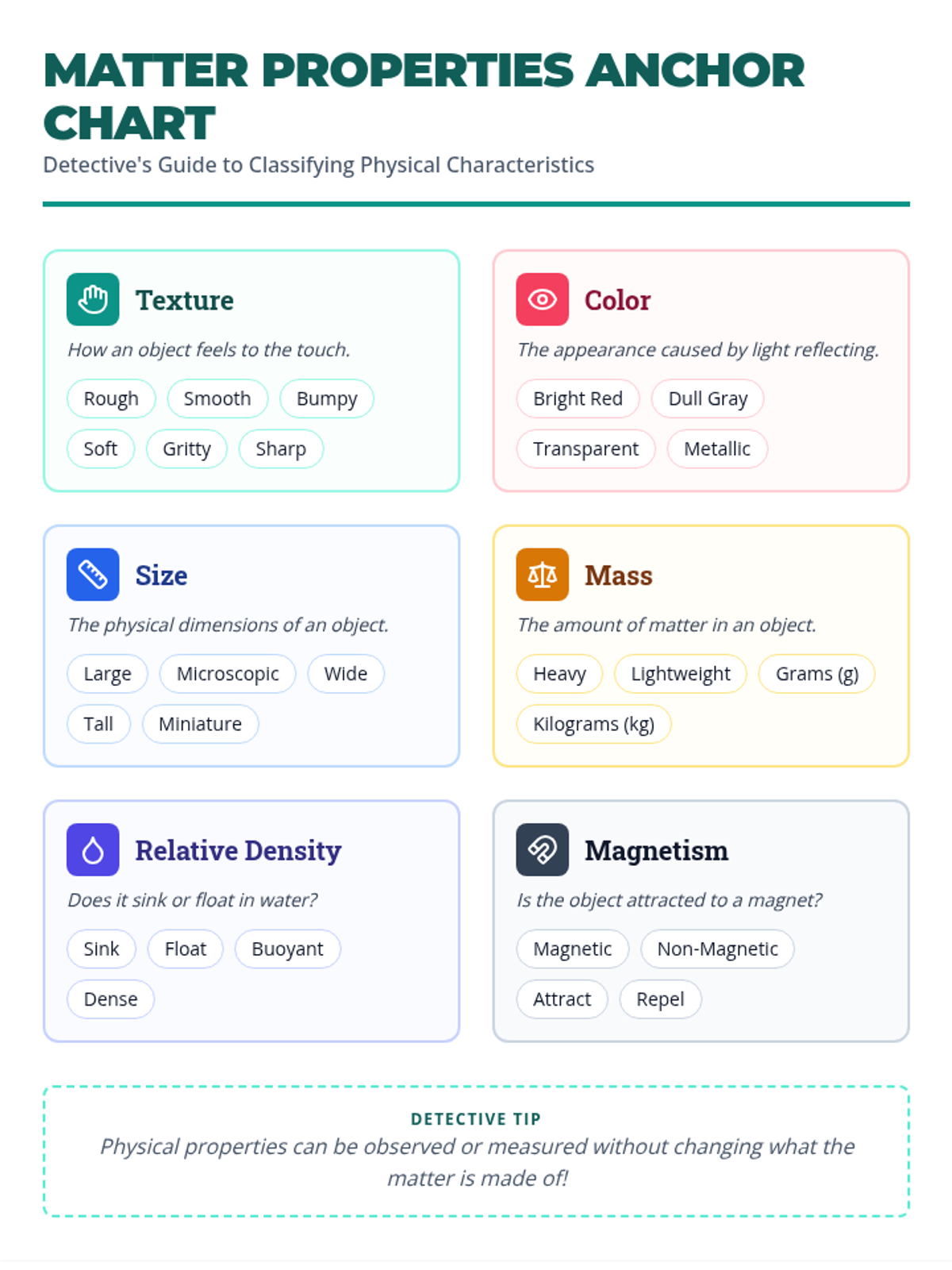
A colorful, structured anchor chart defining six key physical properties of matter with descriptive vocabulary words for each category.
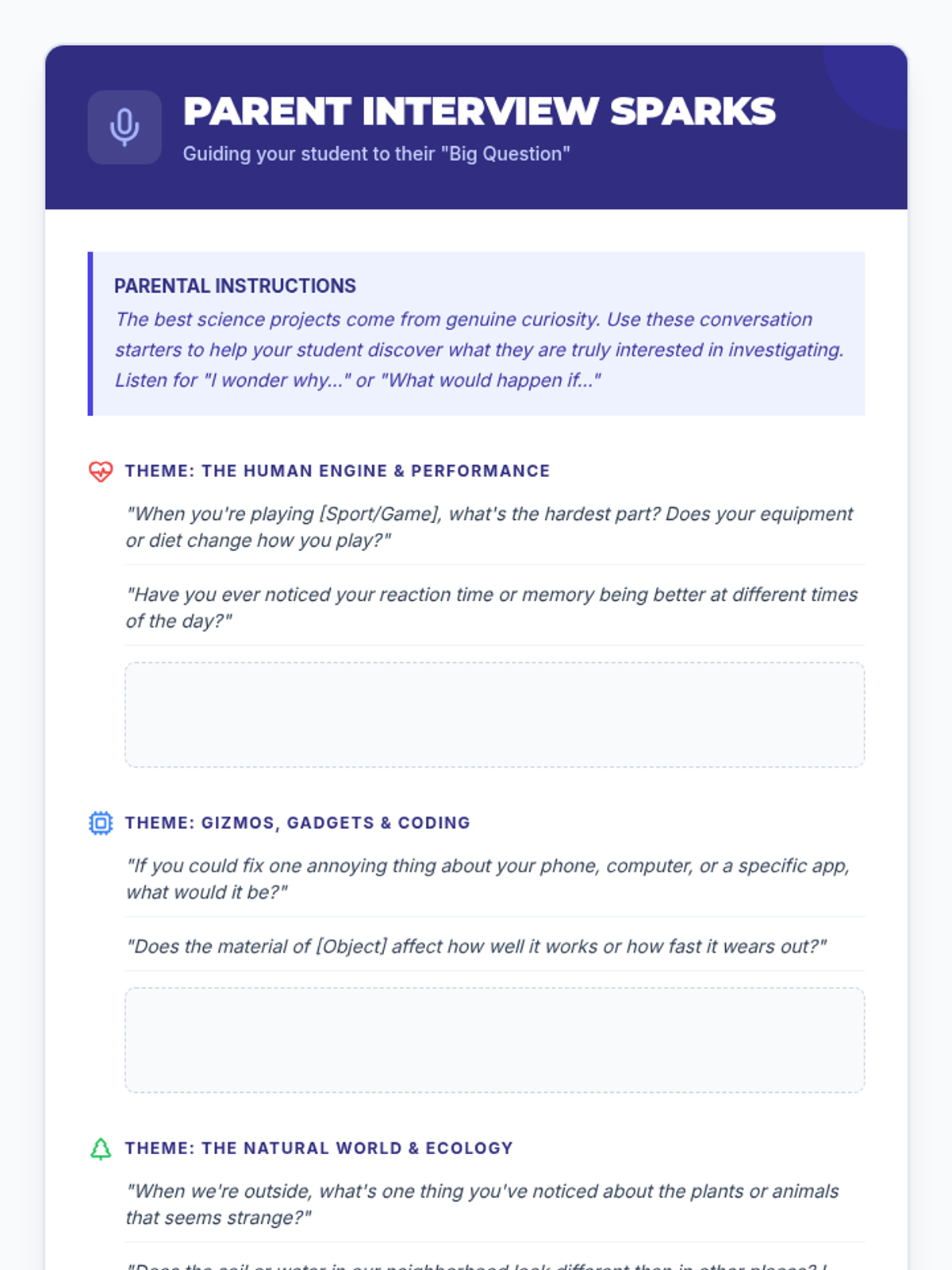
Updated parent conversation guide with a focus on discovering scientific wonders and topic interests rather than experimental problems.
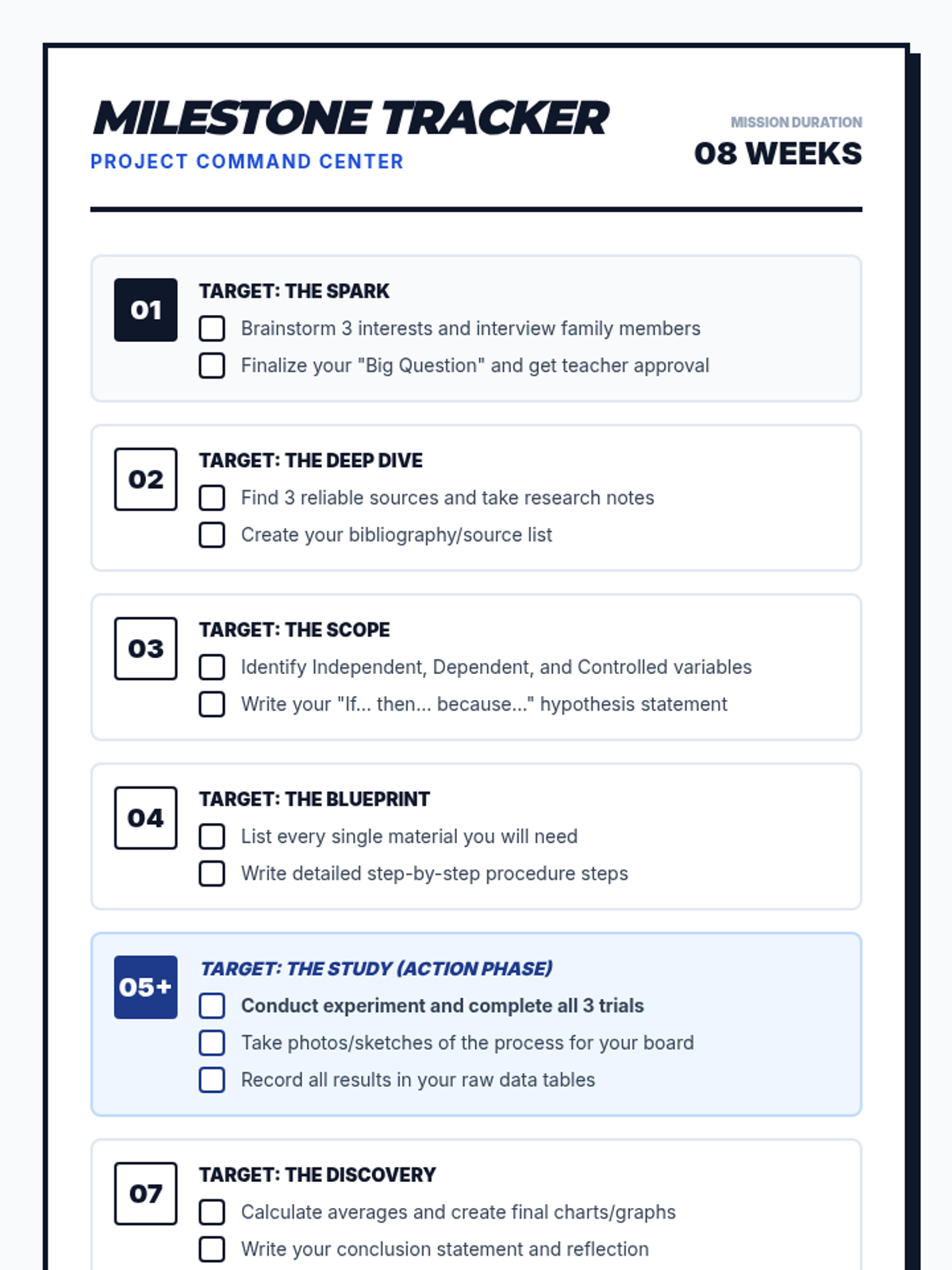
A 7-week milestone checklist focusing on research phases, topic development, and exhibition preparation, replacing experimental tasks with study-focused goals.
A research-focused student workbook for a 7-week topic study, replacing experimental sections with topic mapping, information flow planning, and visualization areas.
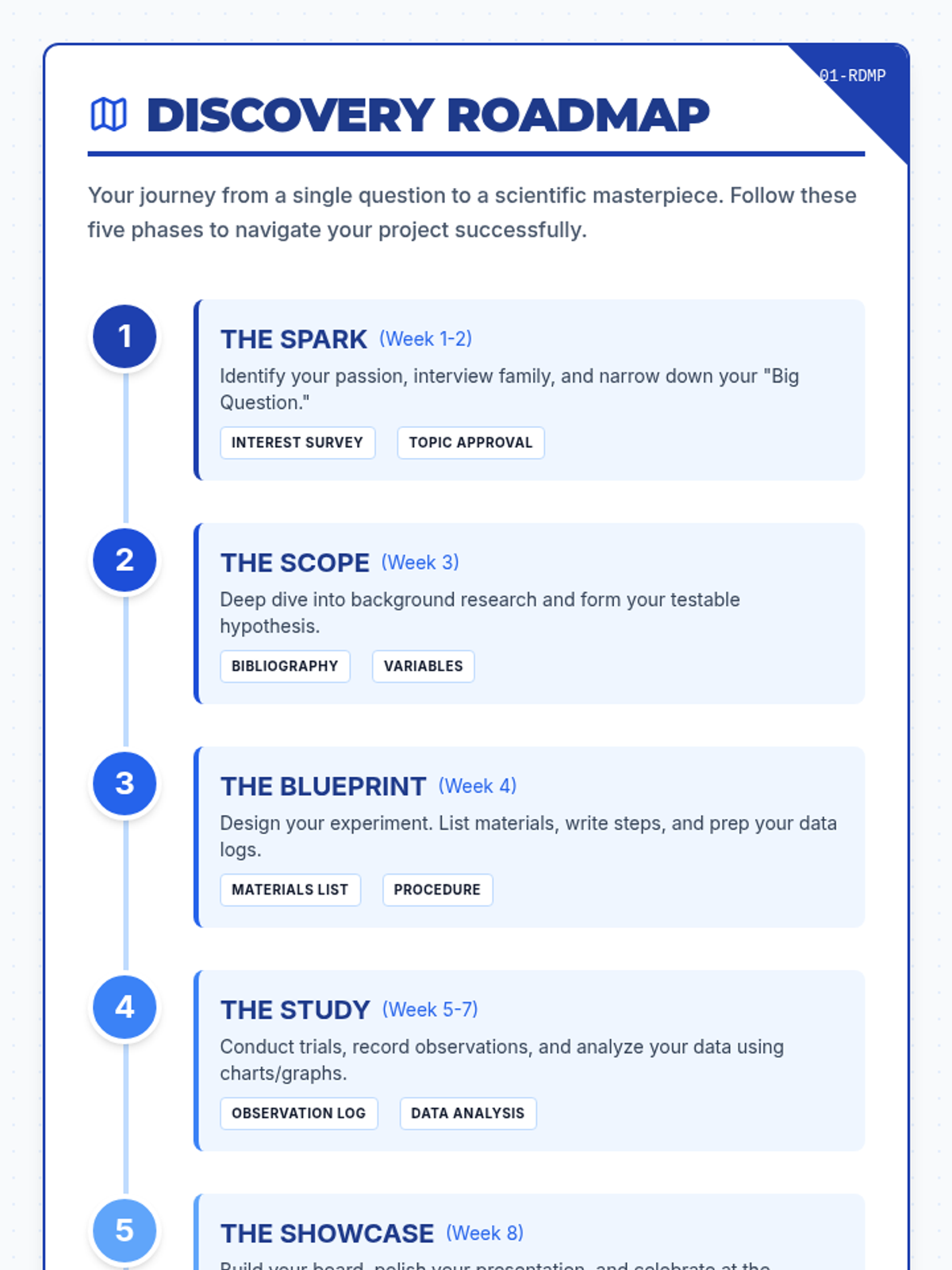
An updated visual roadmap for a 7-week research-based science project, guiding students through topic discovery, information gathering, and final exhibition.
A comprehensive teacher facilitation guide for the "Acidic Oceans" lesson, updated to use pH strips for measurement, including pacing, materials prep, and answer key.
A 9-slide instructional presentation for the "Acidic Oceans" lesson, updated to use pH strips for measurement, covering the carbon cycle, pH scale, lab procedures, and real-world environmental impacts.
A two-page student worksheet for the "Acidic Oceans" lab, updated to use pH strips for measurement, featuring data collection tables and a final assessment.
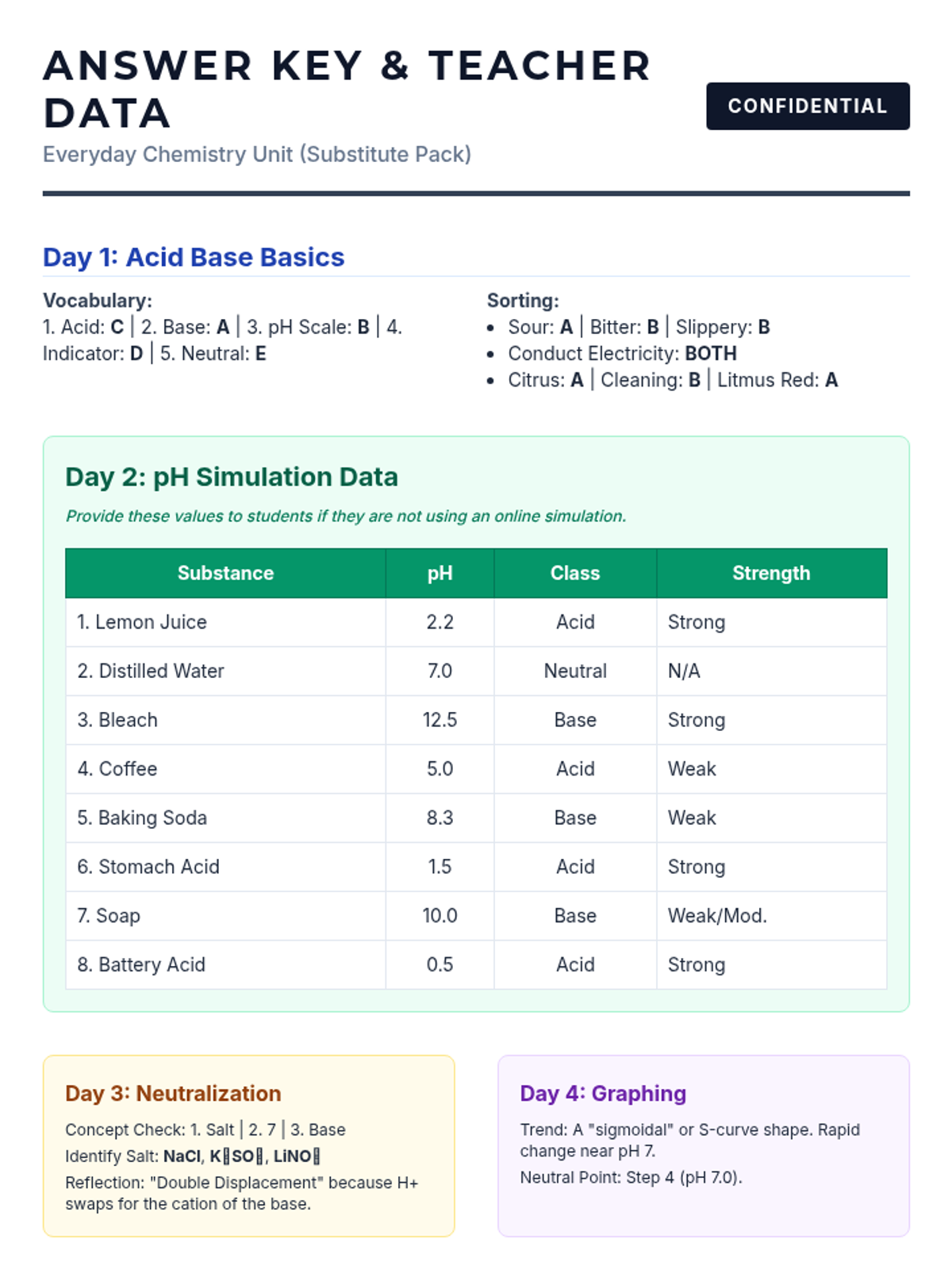
A comprehensive teacher-facing resource providing answer keys for all worksheets and the final quiz, along with simulation data for Day 2.
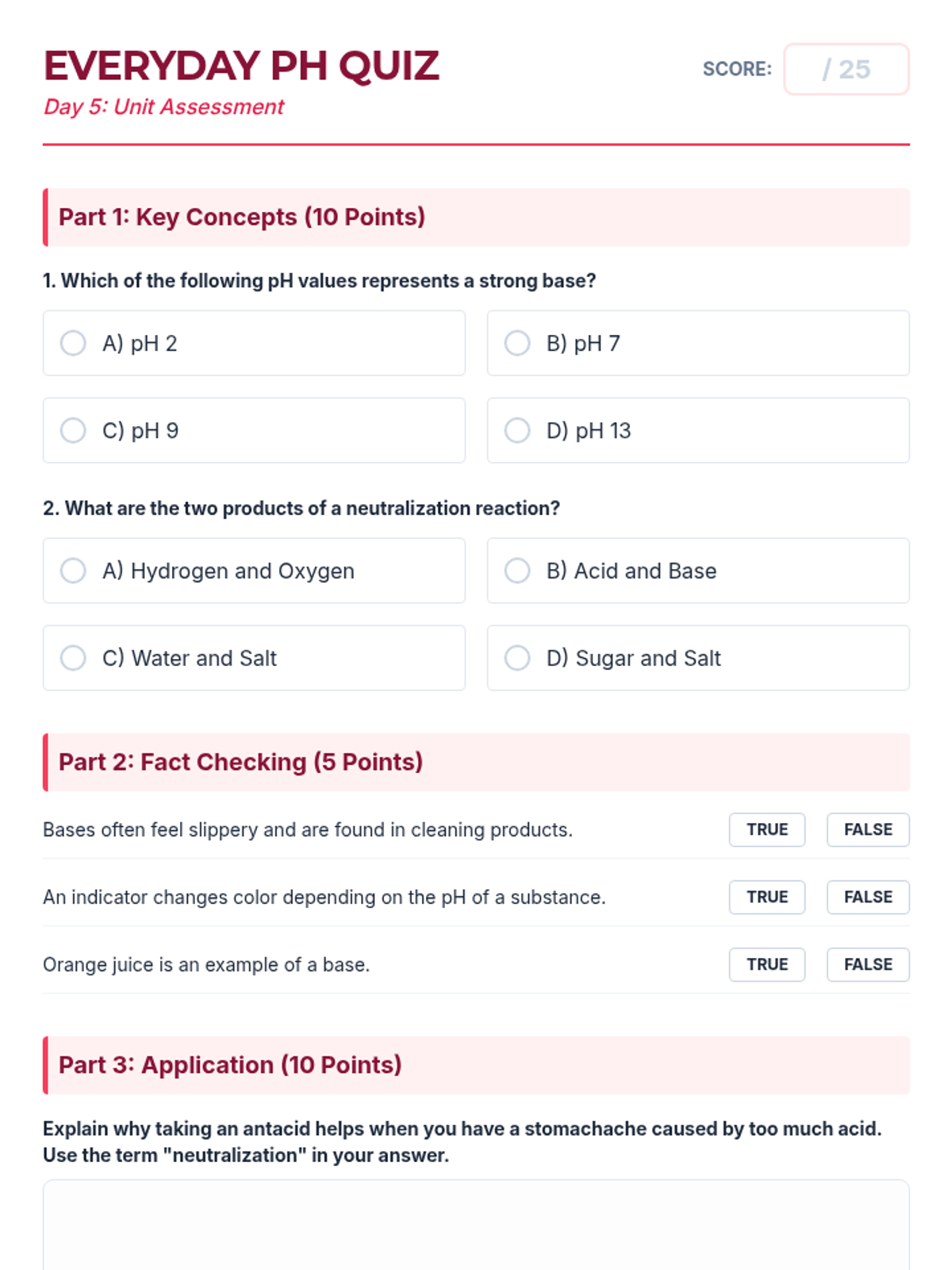
A final assessment for the week-long pH unit, featuring multiple-choice questions, true/false statements, and short-answer applications.
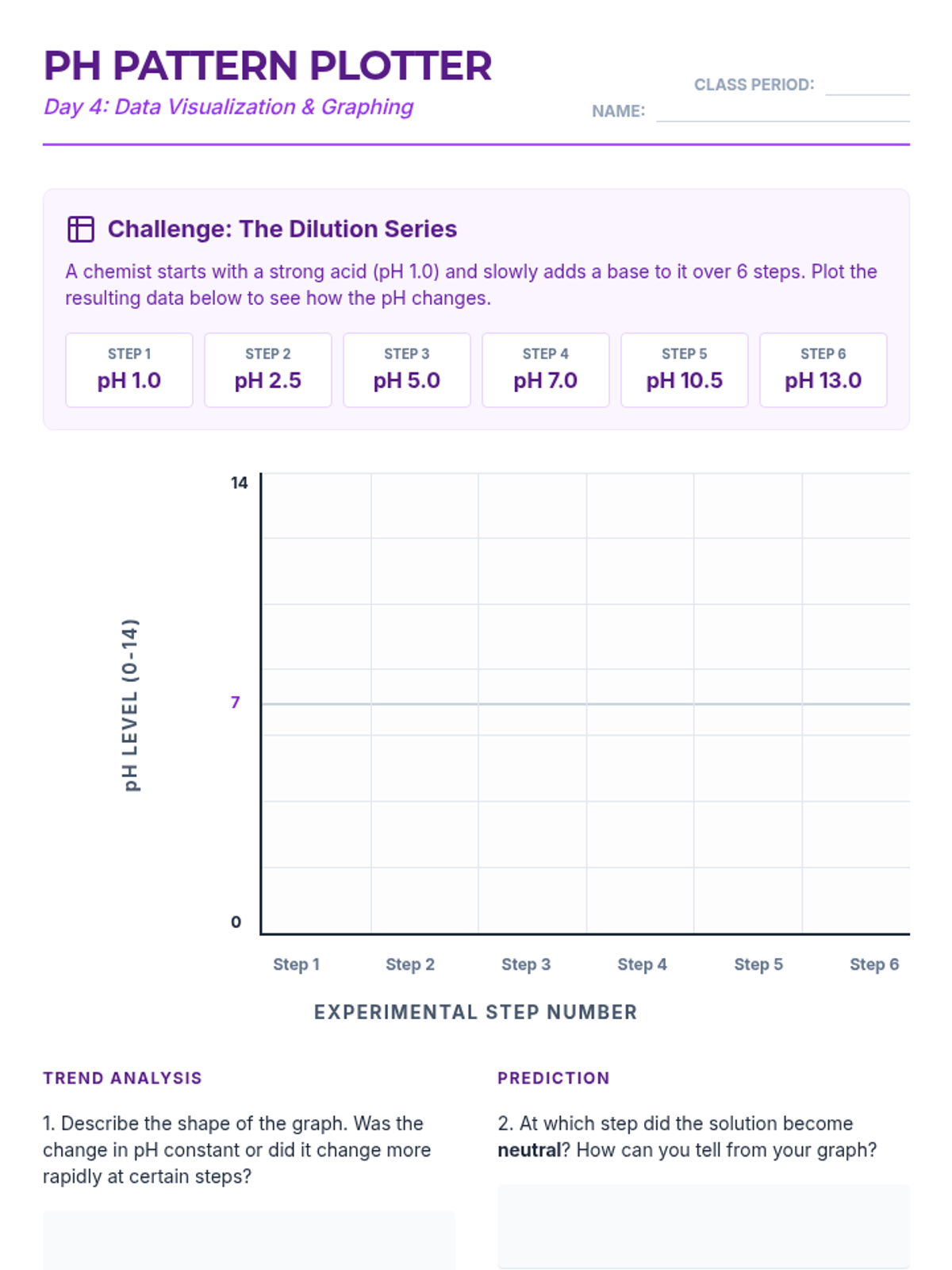
A graphing worksheet for Day 4 where students plot a dilution series of pH values on a grid and analyze the resulting curve.
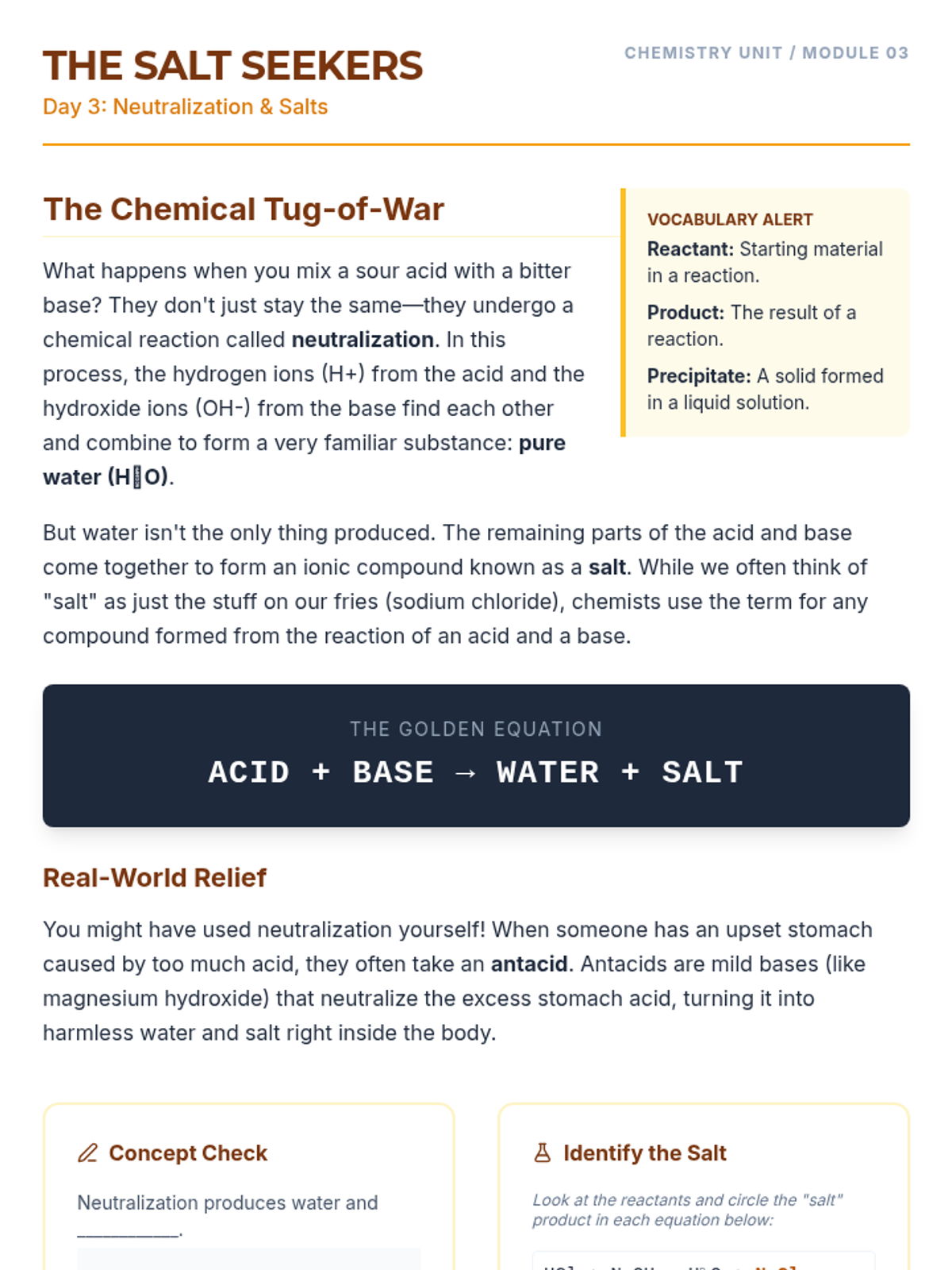
A reading and activity worksheet for Day 3 focusing on neutralization reactions, the formation of salts, and the practical application of antacids.
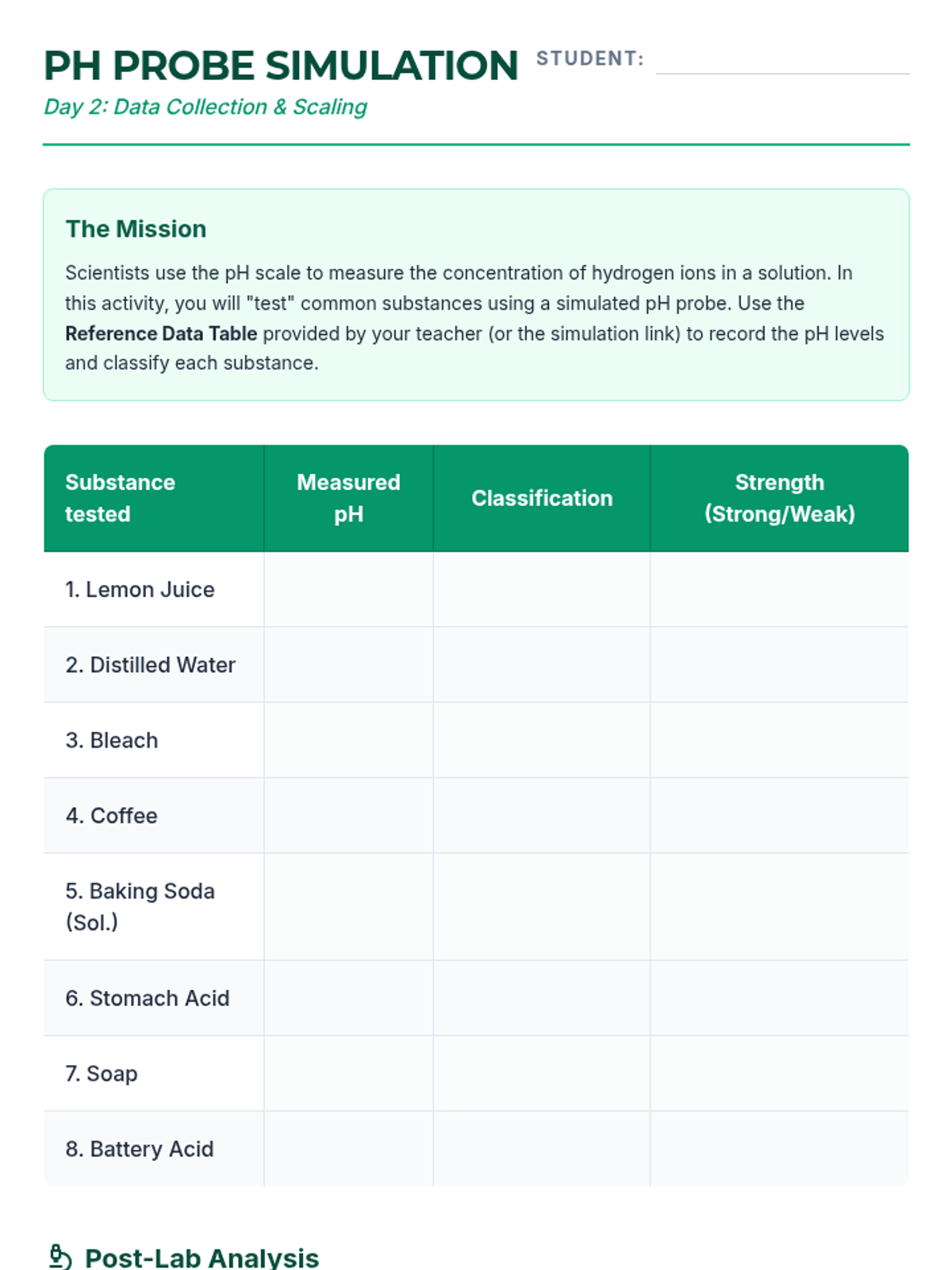
A data collection activity for Day 2 where students record the pH of common substances and analyze their findings to understand the pH scale.
Updated slides for the Celtic Cauldron Science lesson, including a new section on "Fool's Gold" (Iron Pyrite) and its historical application for fire-starting. Corrected LaTeX notation.
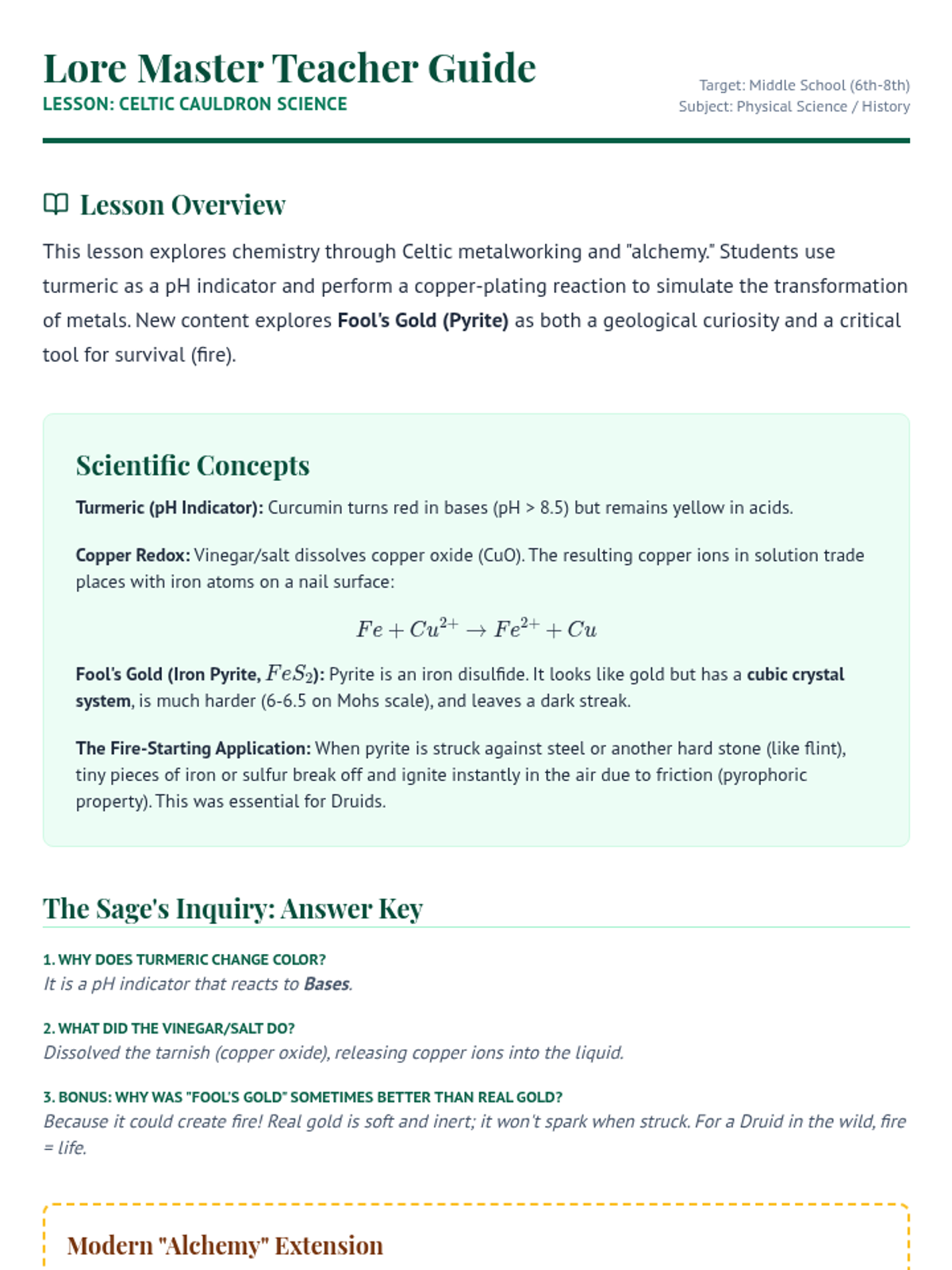
Updated teacher guide for the Celtic Cauldron Science lesson, focusing on turmeric pH and copper redox reactions. Corrected LaTeX notation.
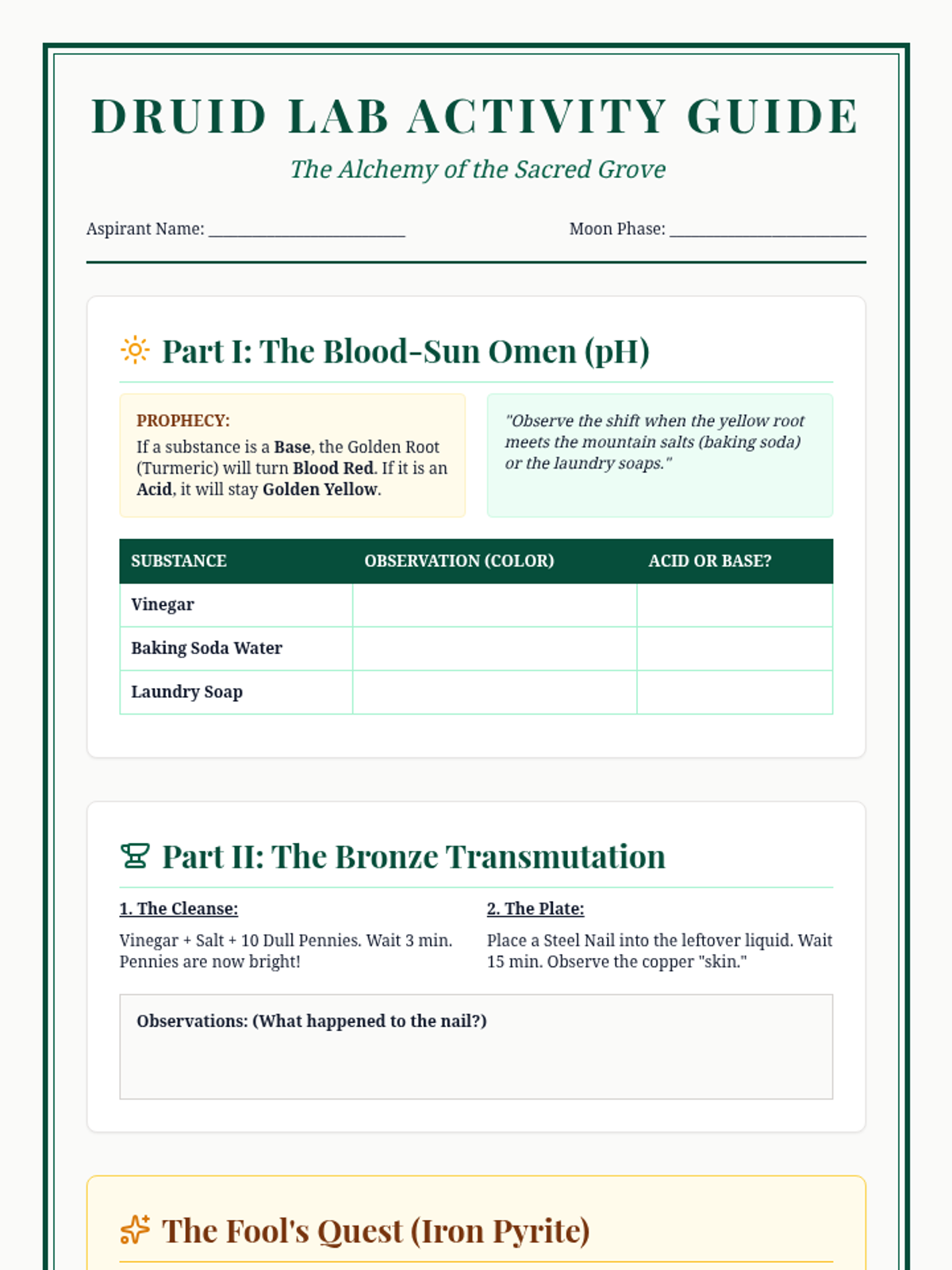
Updated student activity guide using Turmeric and Copper Plating experiments instead of red cabbage. Explores pH and redox reactions through the lens of Celtic metalworking. Corrected LaTeX notation.
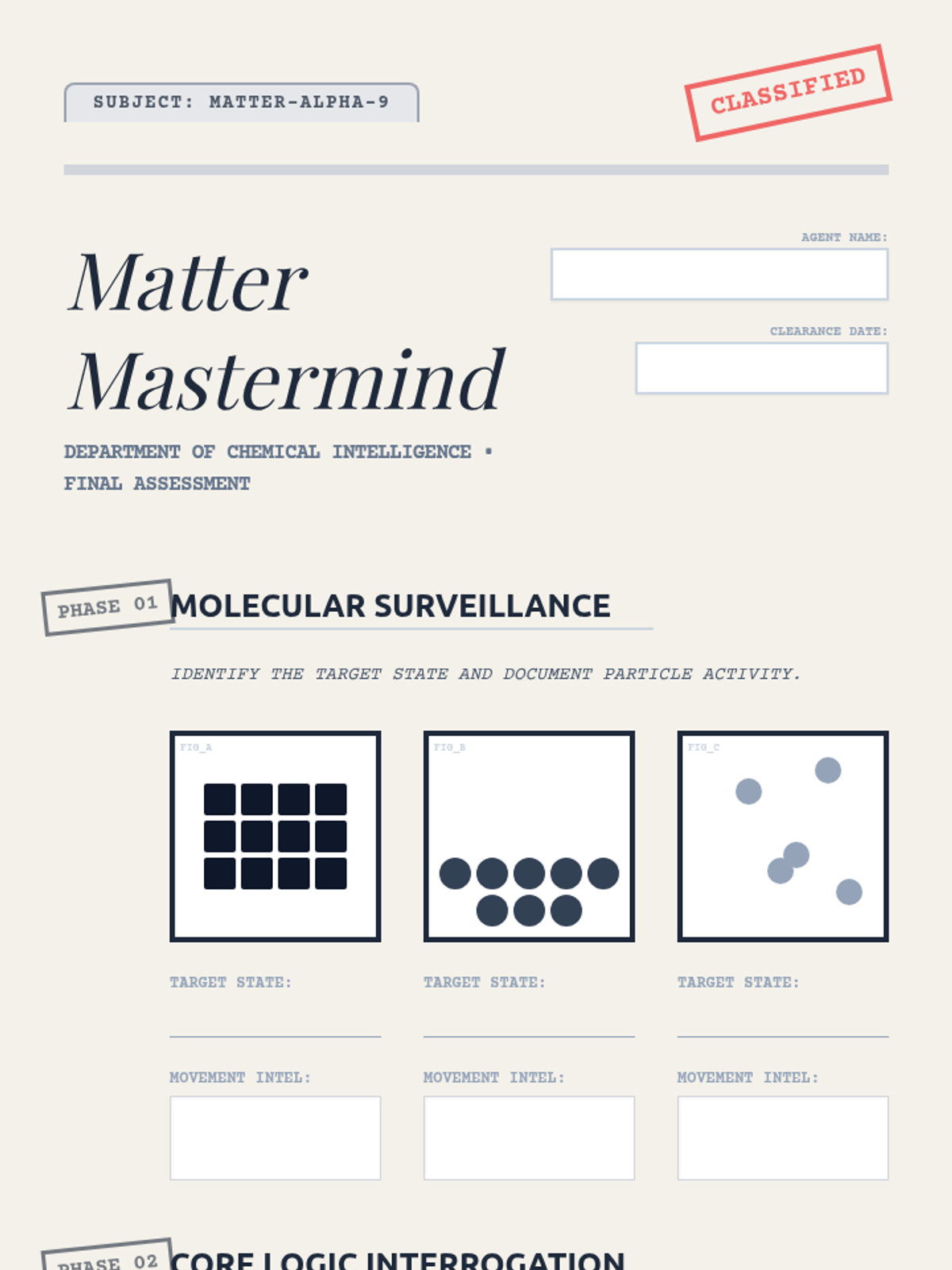
A "Classified Research Dossier" themed assessment on matter, featuring typewriter fonts, folders, secret stamps, and a high-stakes scientific mission aesthetic.
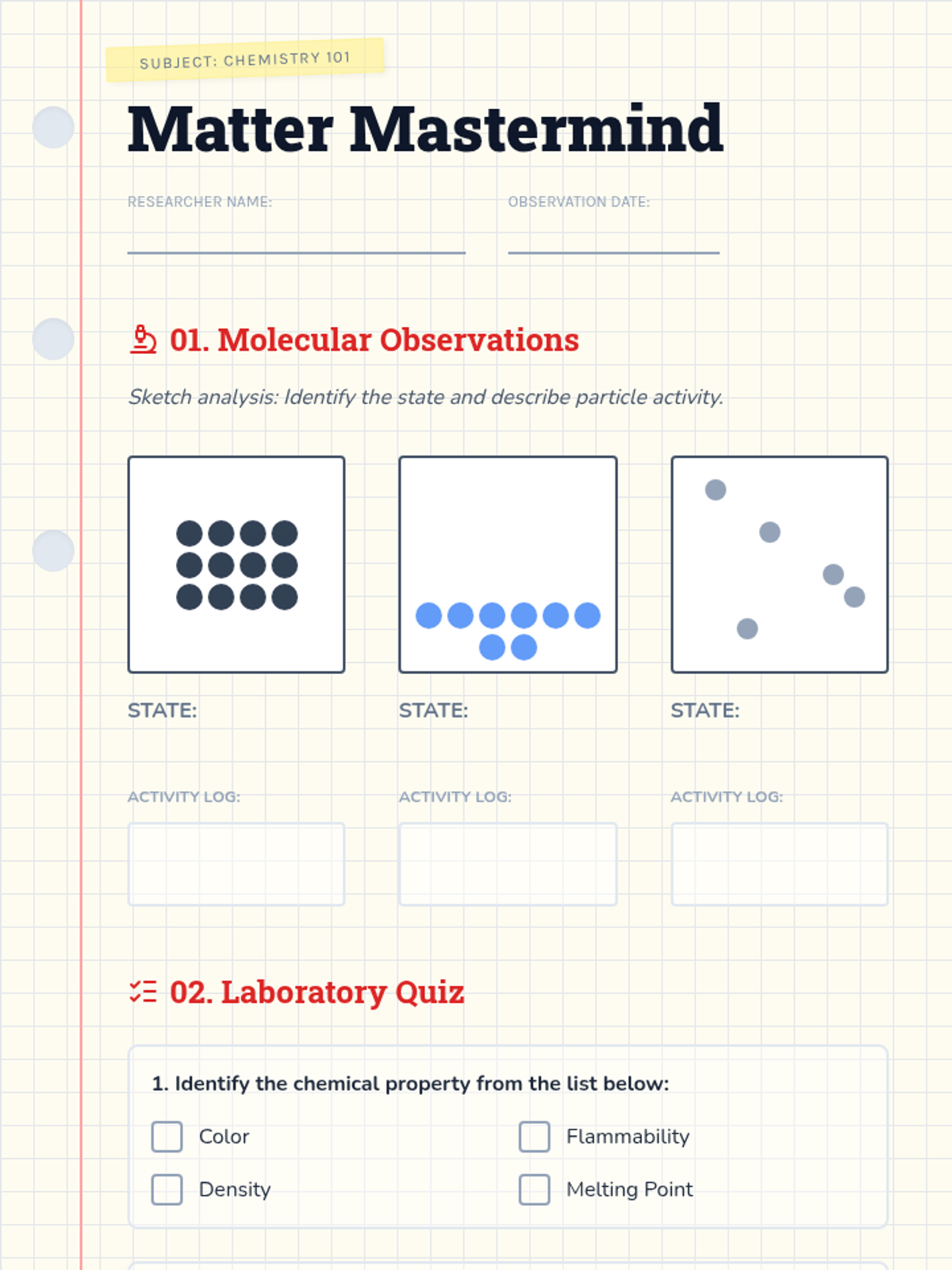
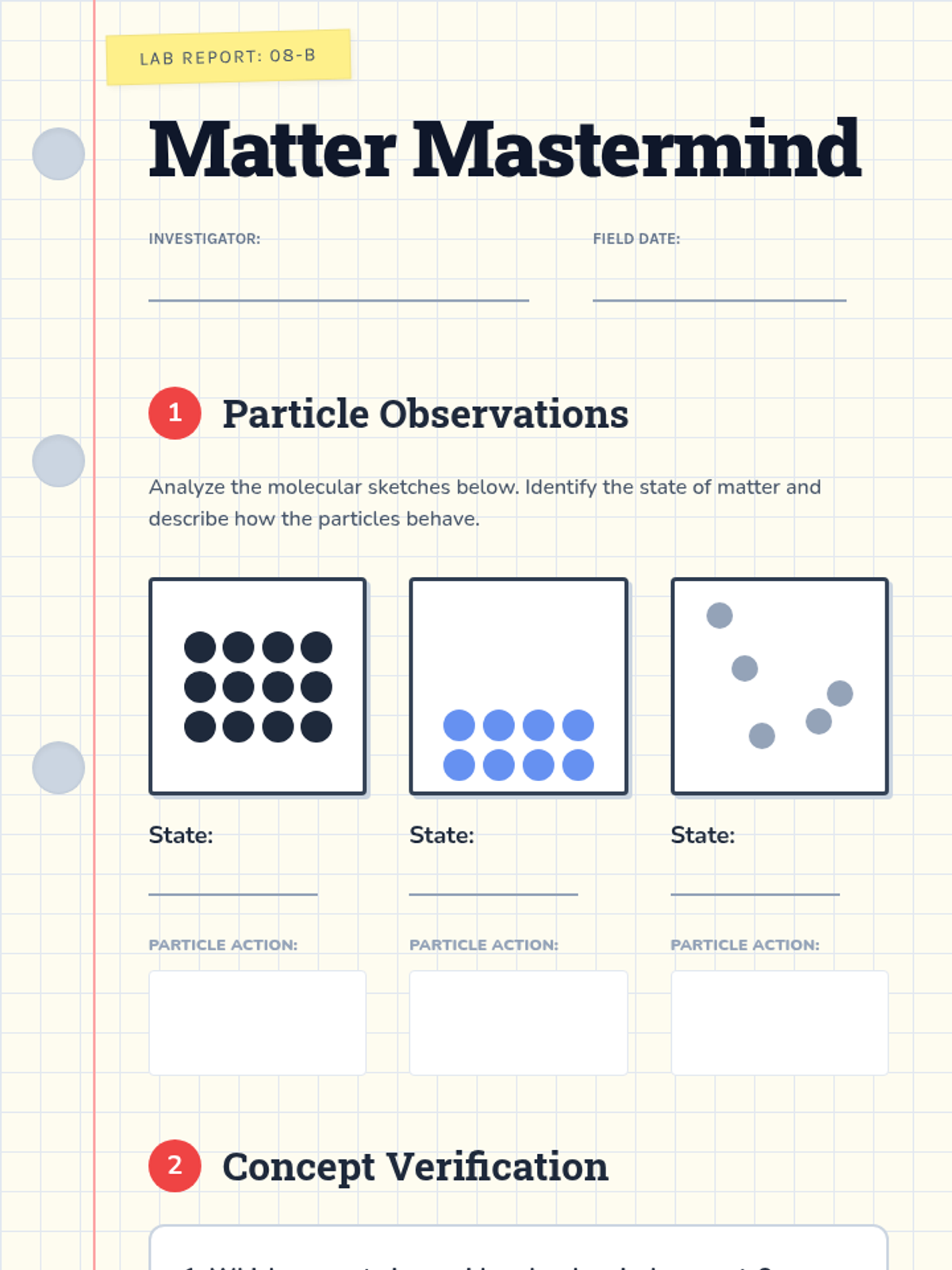
Redesigned assessment on matter with a "Lab Notebook" theme, featuring grid paper backgrounds, hand-drawn molecular sketches, and a systematic experimental layout.
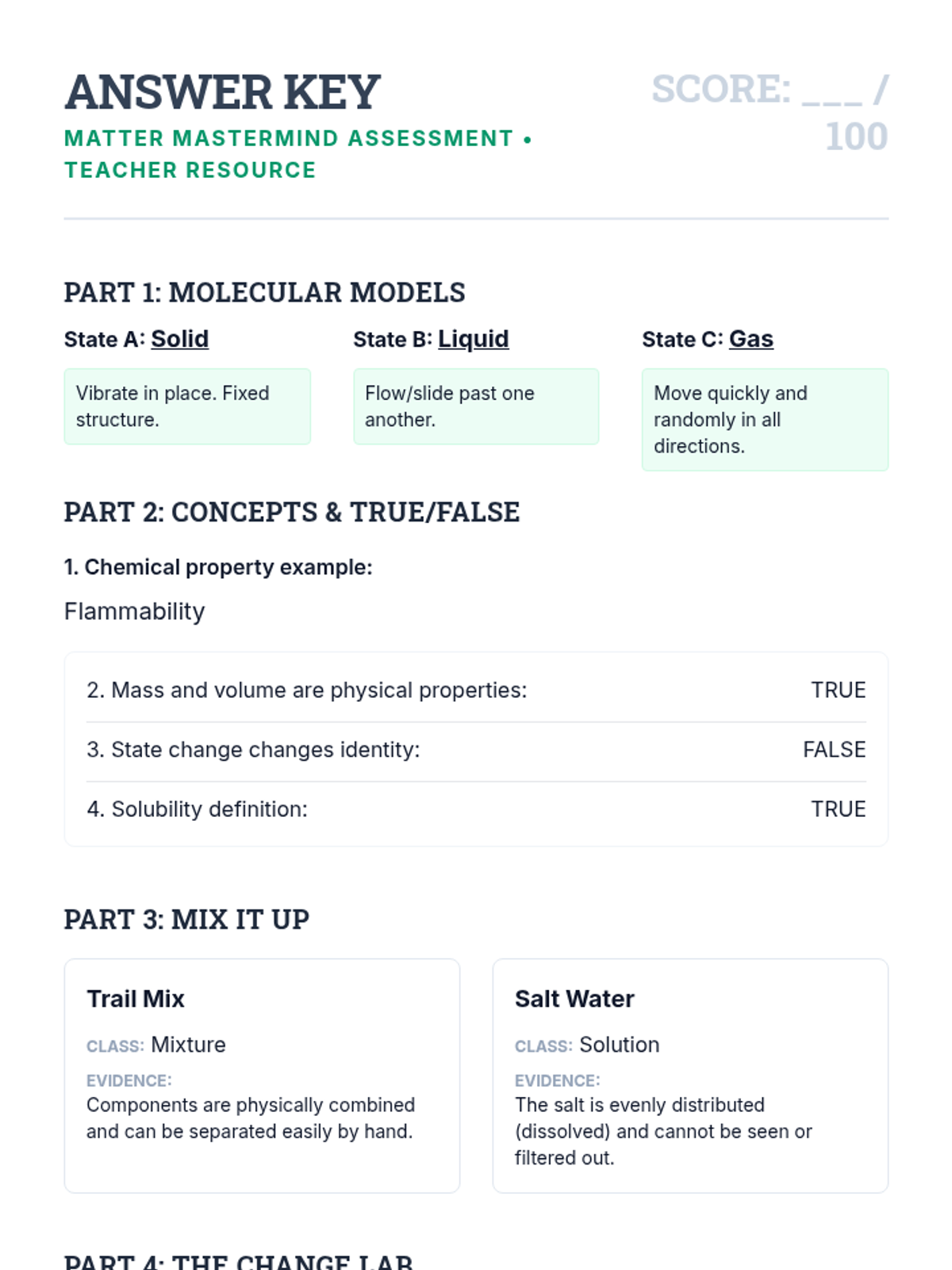
Complete answer key for the Matter Mastermind Assessment, providing clear guidance for grading student responses including molecular movement descriptions and scientific evidence.
Themed assessment on matter using a "Lab Notebook" aesthetic, featuring grid paper, hand-drawn molecular sketches, tape elements, and clear scientific investigative sections.
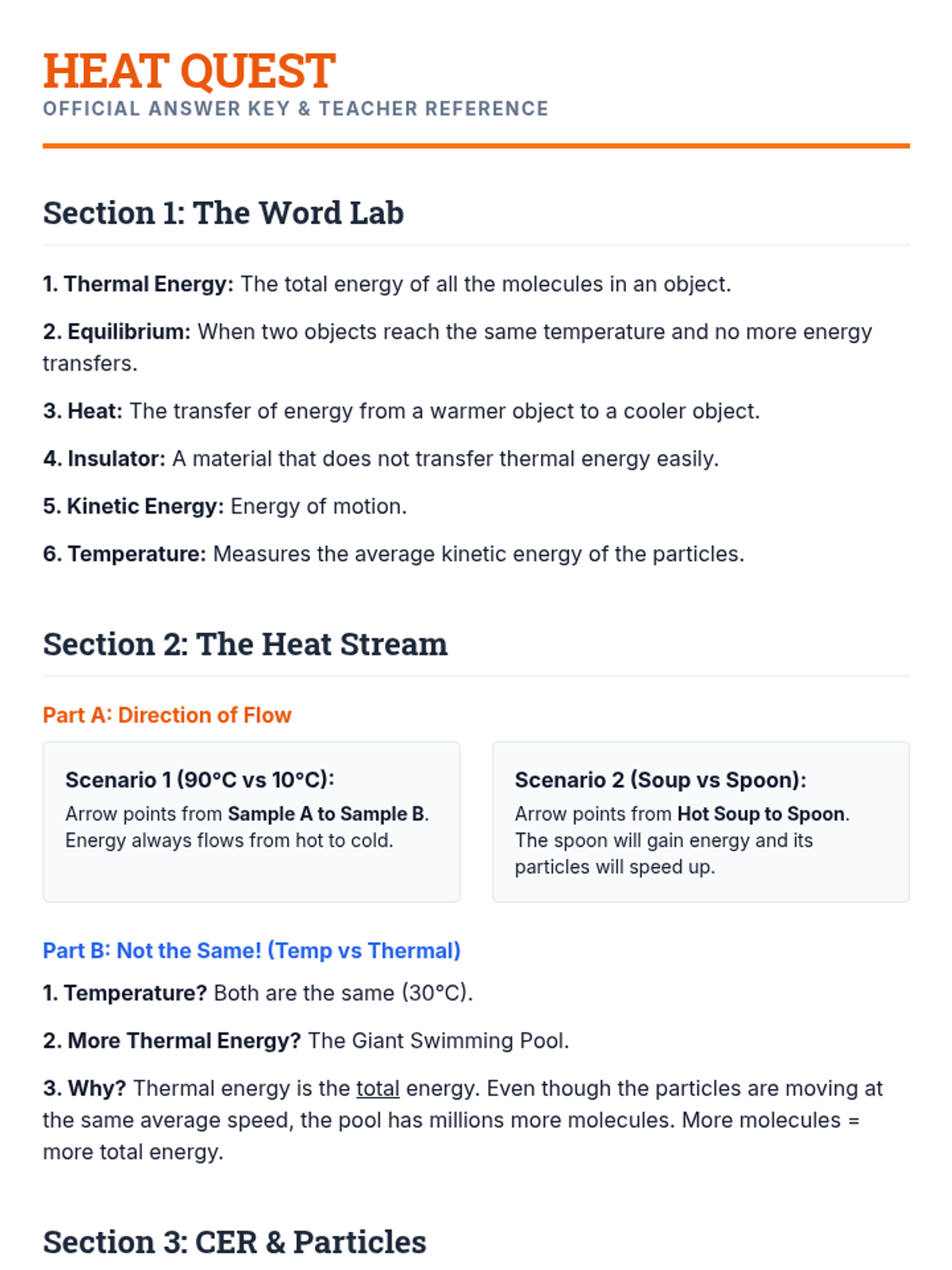
A detailed answer key and reference sheet for teachers to use when grading or facilitating the Heat Quest review packet.
A comprehensive two-day slide presentation for reviewing thermal energy. Day 1 focuses on vocabulary, heat flow, and temperature vs. thermal energy. Day 2 focuses on particle motion, CER writing, and final exit ticket preparation.
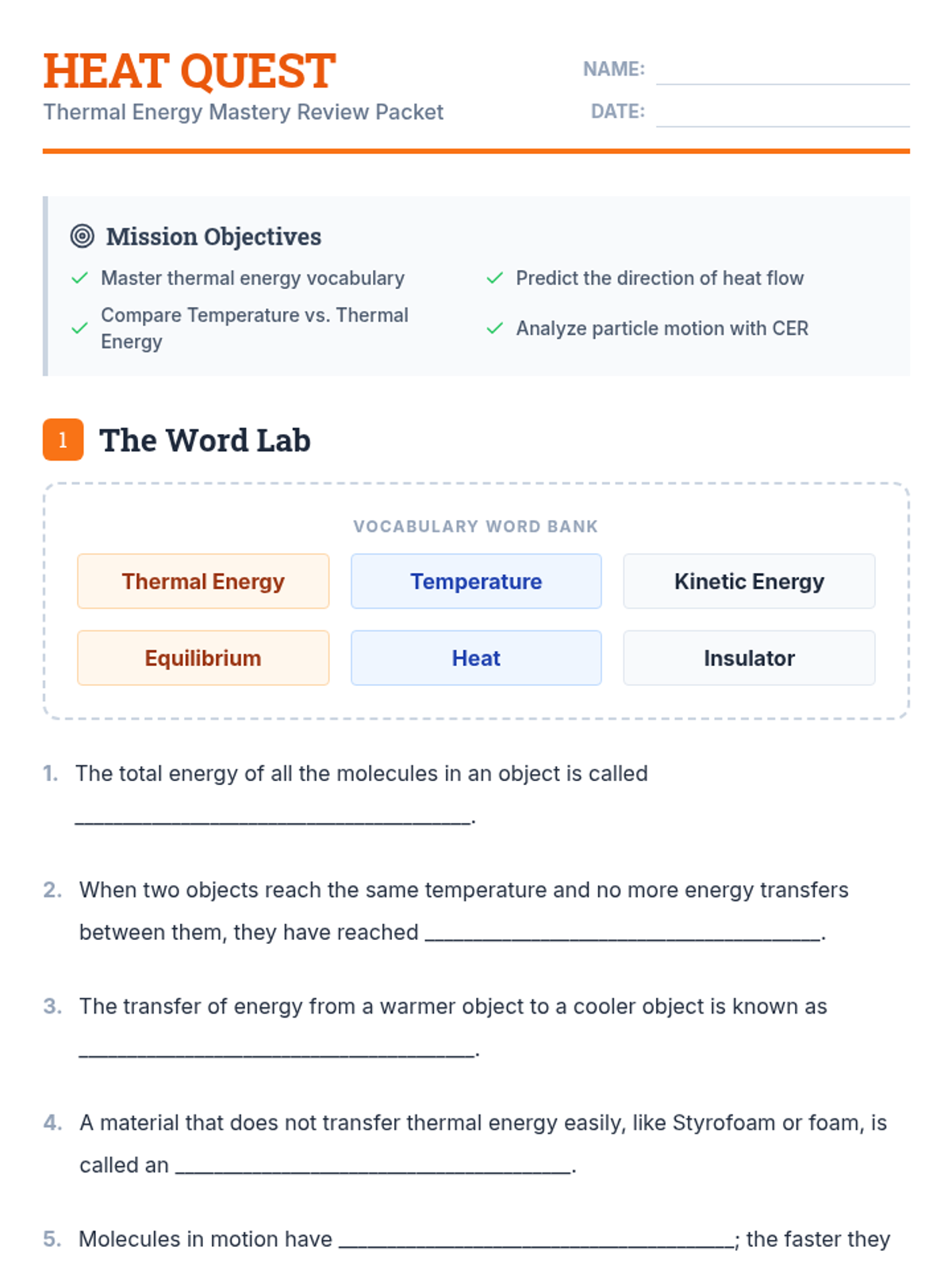
A comprehensive 4-page review packet for thermal energy, featuring vocabulary fill-in-the-blanks, heat transfer scenarios, particle motion diagrams, a CER practice section, and a final exit ticket.
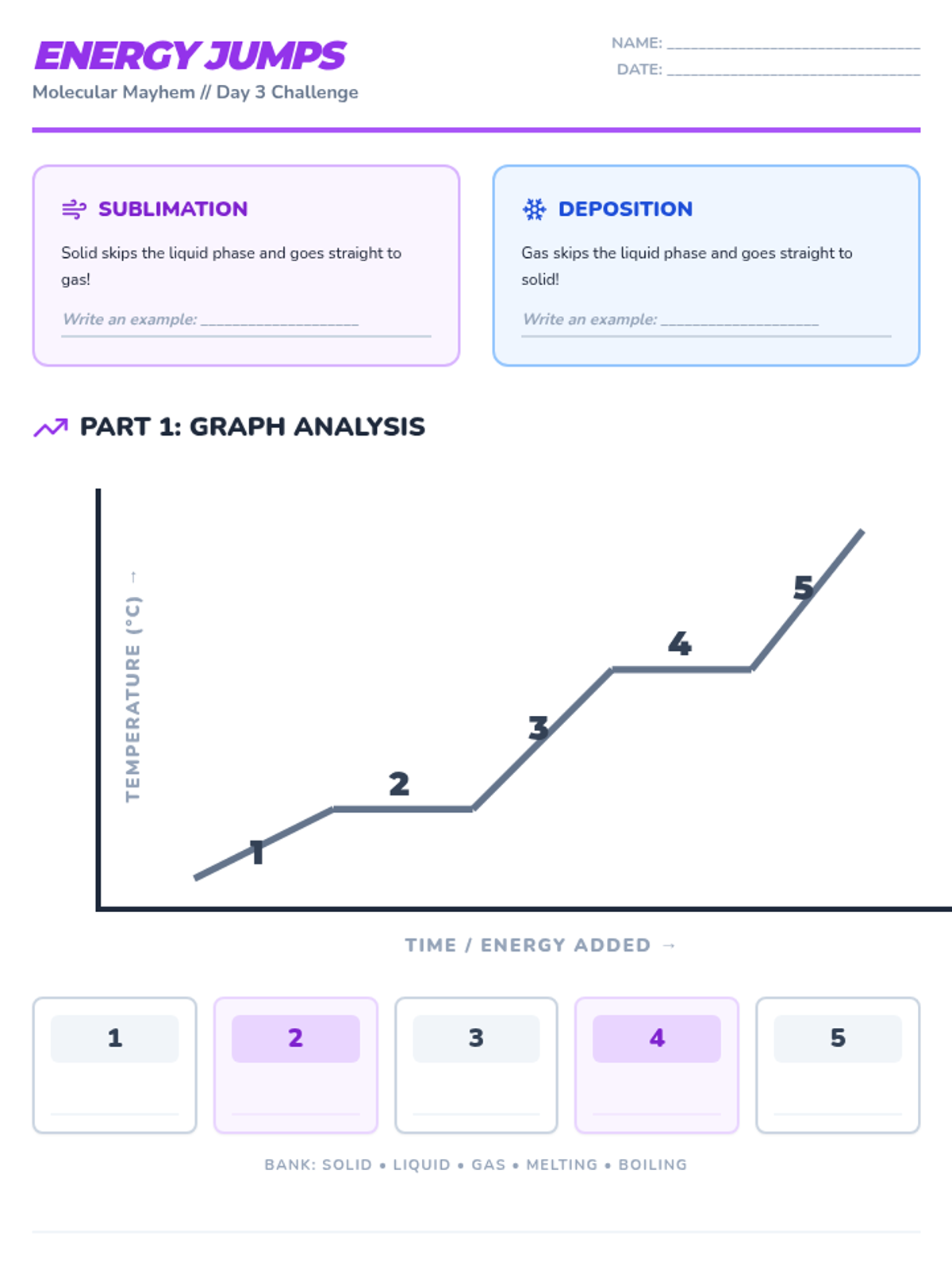
A worksheet for Day 3 focusing on interpreting heating curve graphs and understanding sublimation and deposition. Includes a graph analysis section and critical thinking questions. Revised for better spacing and legibility.
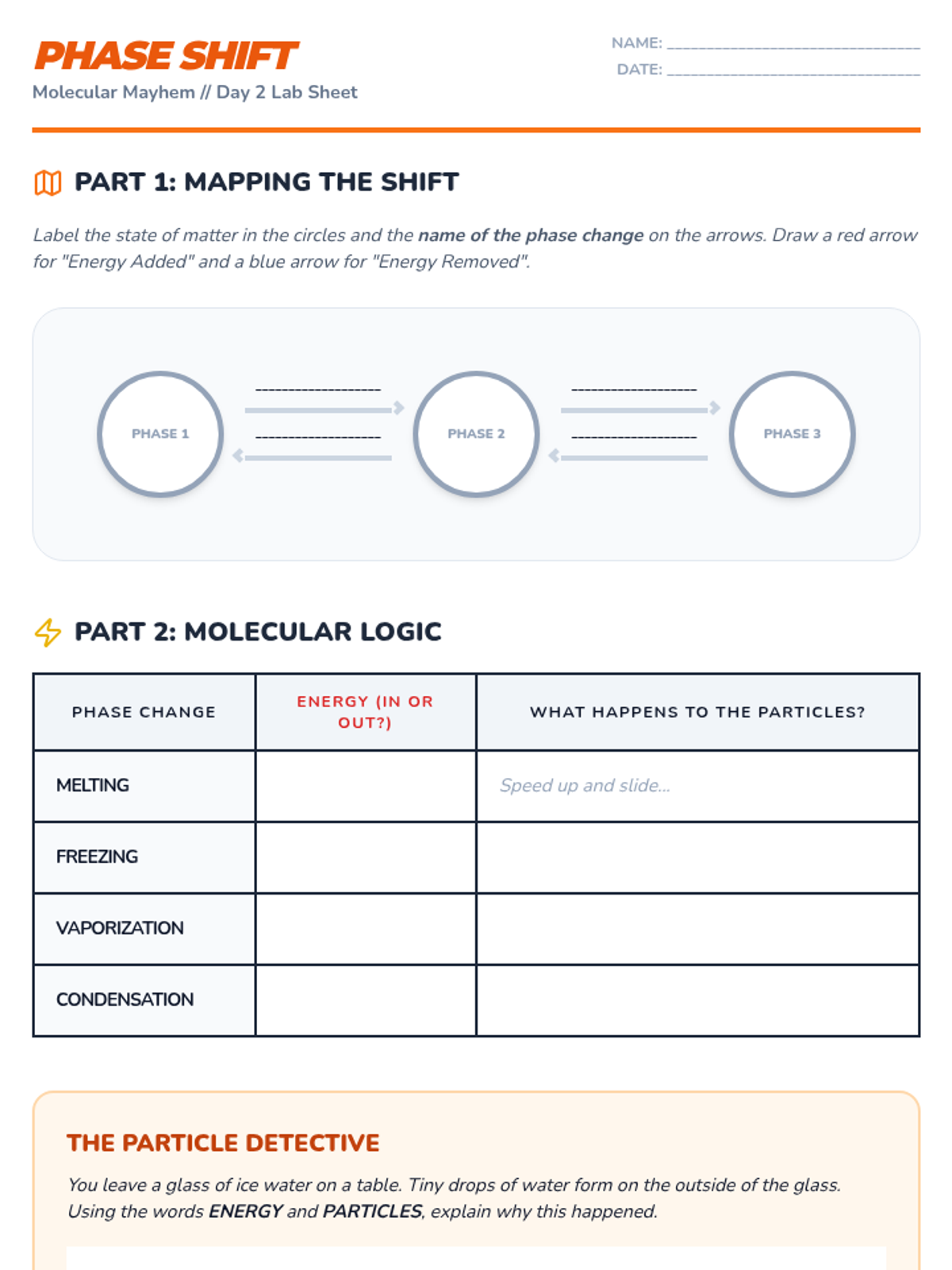
A worksheet for Day 2 focusing on the transitions between states. Includes a phase change map to label, a table for energy flow, and a scenario-based explanation section.
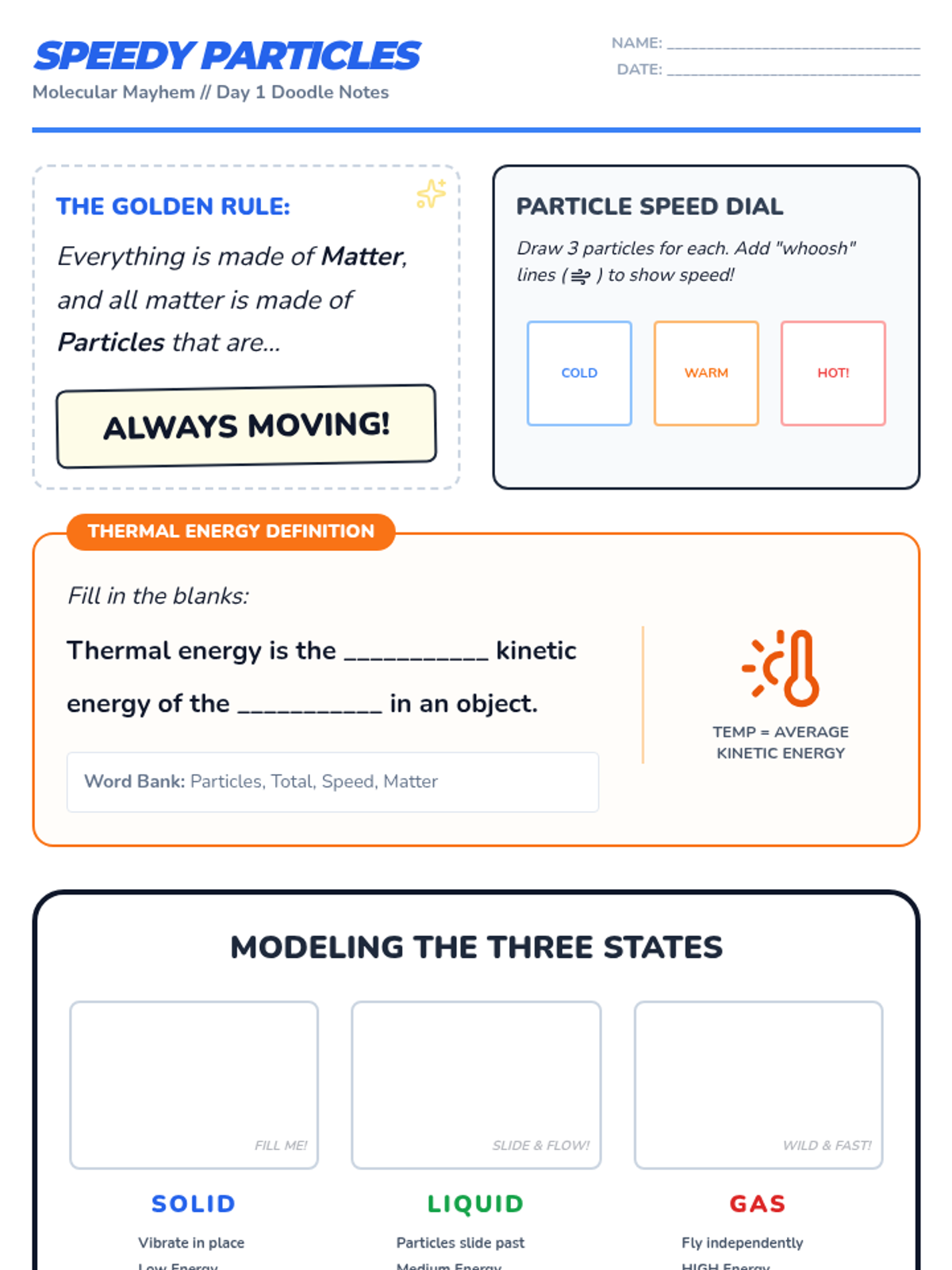
A doodle-style note-taking sheet for Day 1. Includes sections for defining matter, modeling particle speed with "whoosh" marks, and drawing the molecular arrangements of solids, liquids, and gases.
A visual 24-slide presentation covering the relationship between thermal energy and particle motion across three days of instruction. Includes concepts of kinetic molecular theory, phase changes, and heating curves. Revised for accessibility and readability.
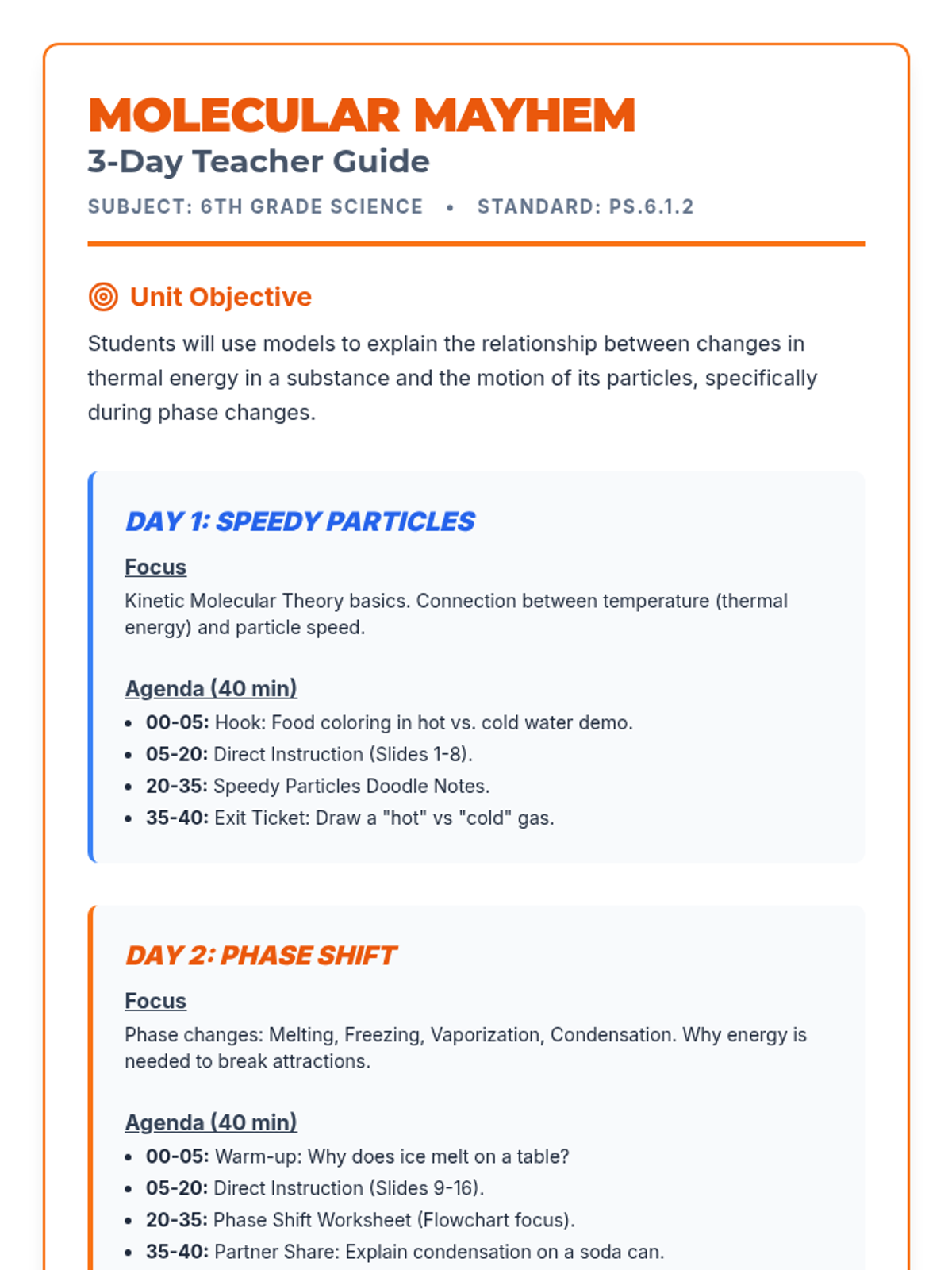
A comprehensive 3-day teacher guide for the Molecular Mayhem unit, including daily agendas, lesson focuses, and teaching tips for 6th-grade science standard PS.6.1.2.
A visual presentation for Lesson 1: Property Powerhouse. It introduces water's molecular geometry, polarity, cohesion, adhesion, and role as a universal solvent with vibrant diagrams and clear, grade-appropriate explanations.
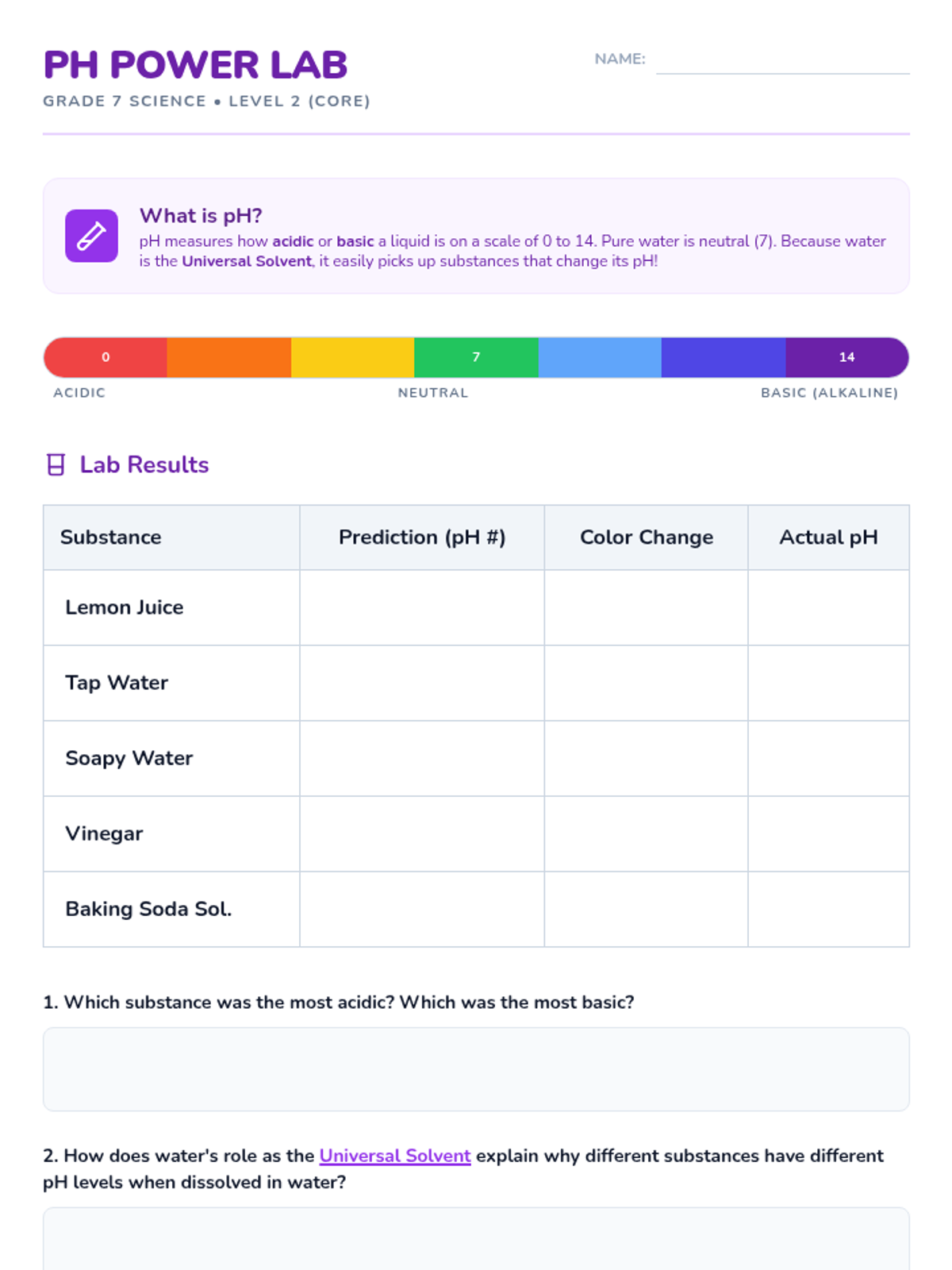
A student lab worksheet for investigating the pH of various common substances. Includes a pH scale reference, data collection table, and analysis questions connecting pH to water's role as a universal solvent and its impact on life.
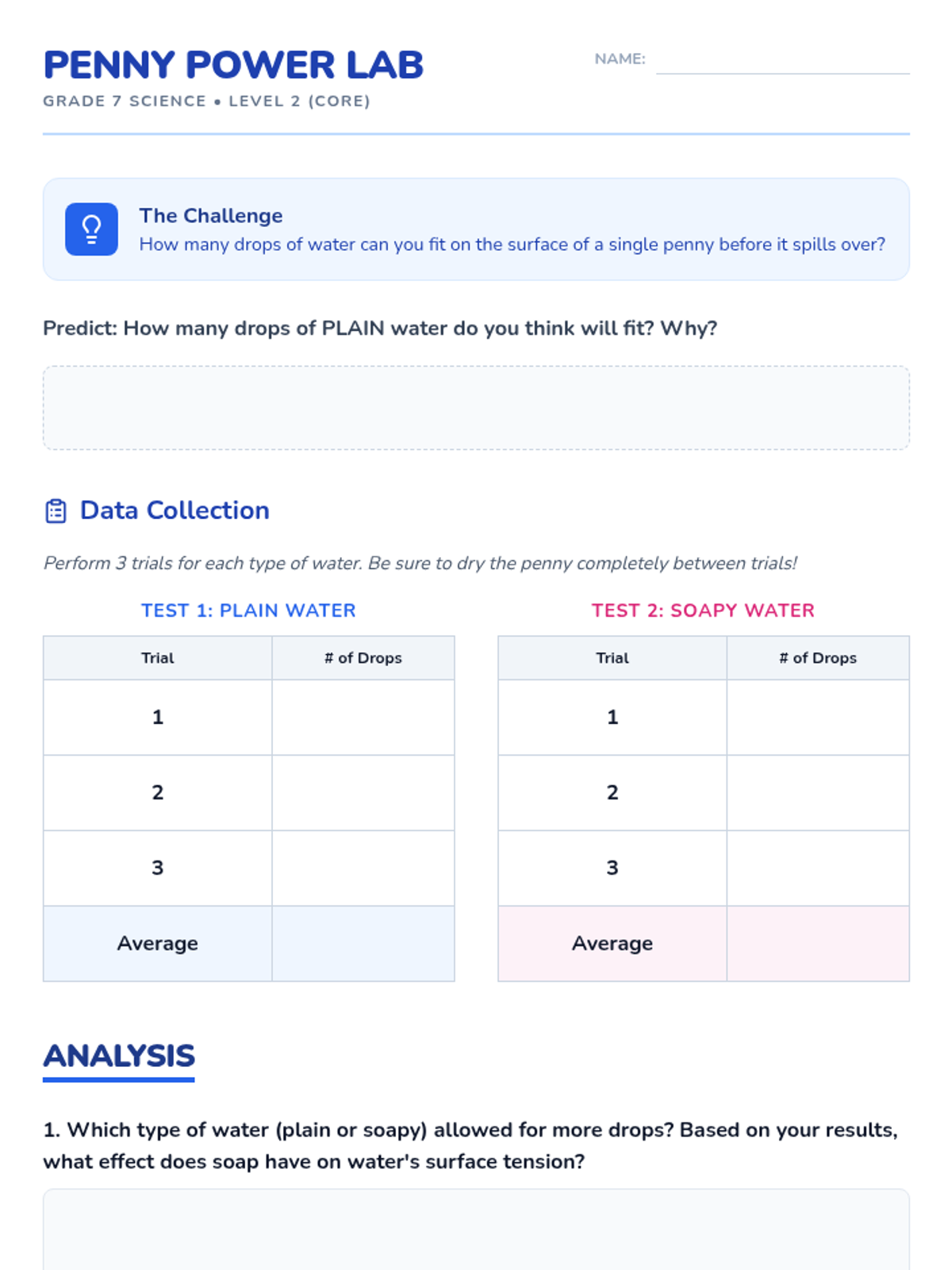
A student lab sheet for the 'Penny Power' investigation. Includes sections for hypothesis, data tables for multiple trials (plain vs. soapy water), sketching observations, and analysis questions focused on cohesion and surface tension.
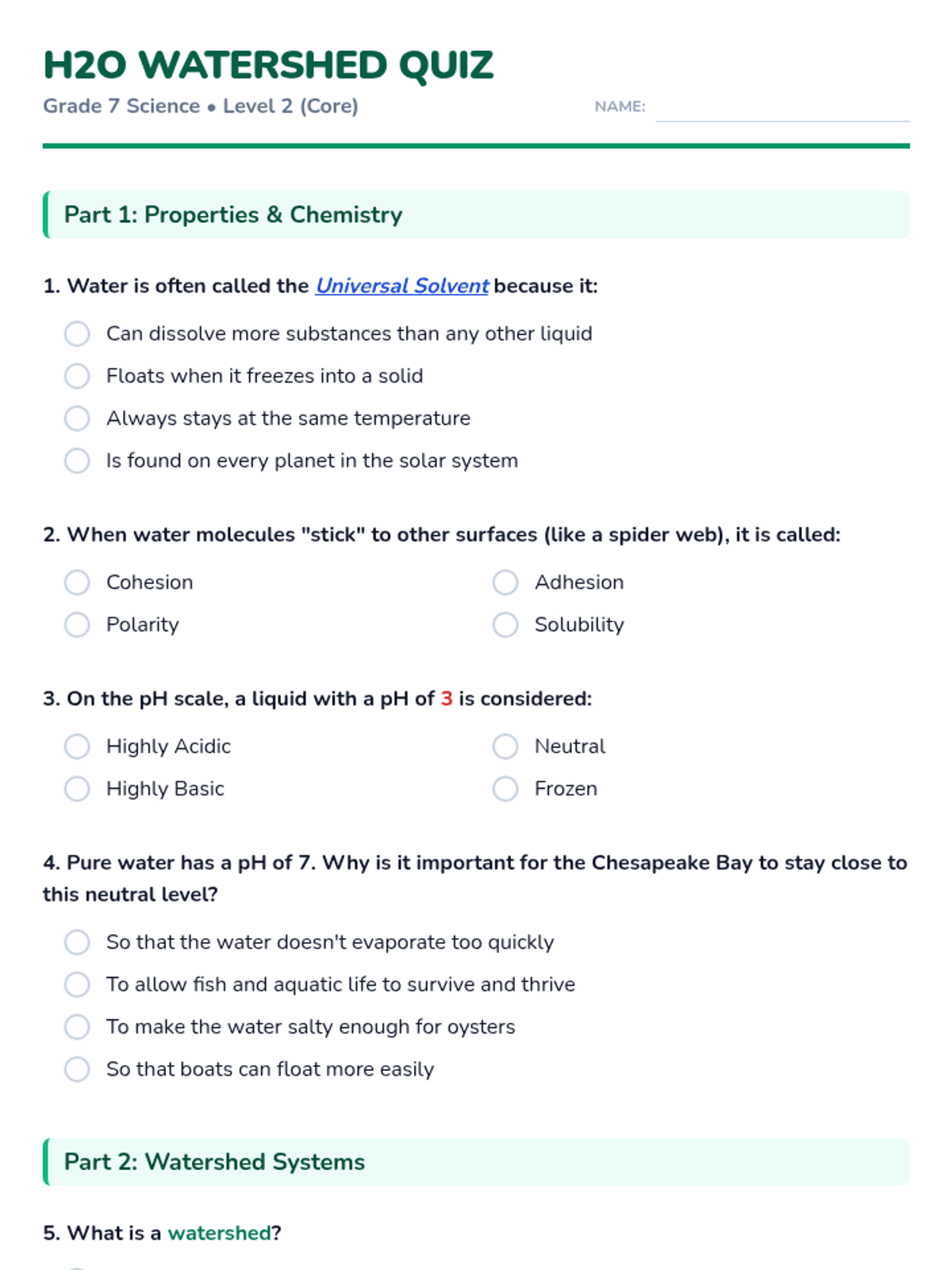
A short unit quiz covering the physical properties of water (solubility, adhesion, cohesion), pH basics, and watershed definitions including estuaries and human impact.
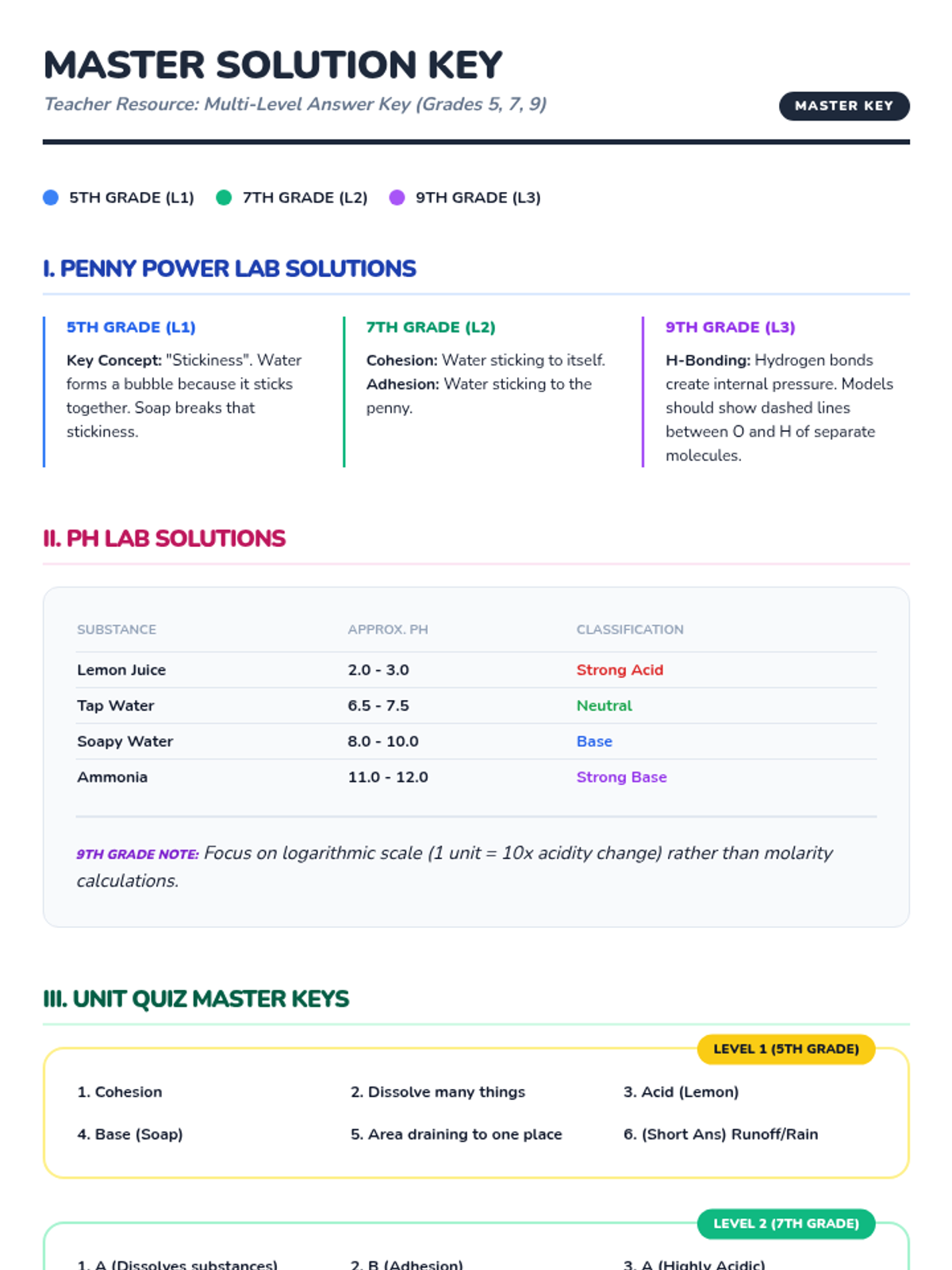
A teacher-facing answer key for the Penny Power Lab, pH Power Lab, and the Unit Quiz. Updated to reflect the removal of weathering content and addition of pH/acidity. Master Key updated for simplified 9th grade rigor.
A visual presentation exploring the pH scale, acids, bases, ions, and logarithmic changes for 5th-9th grade instruction.
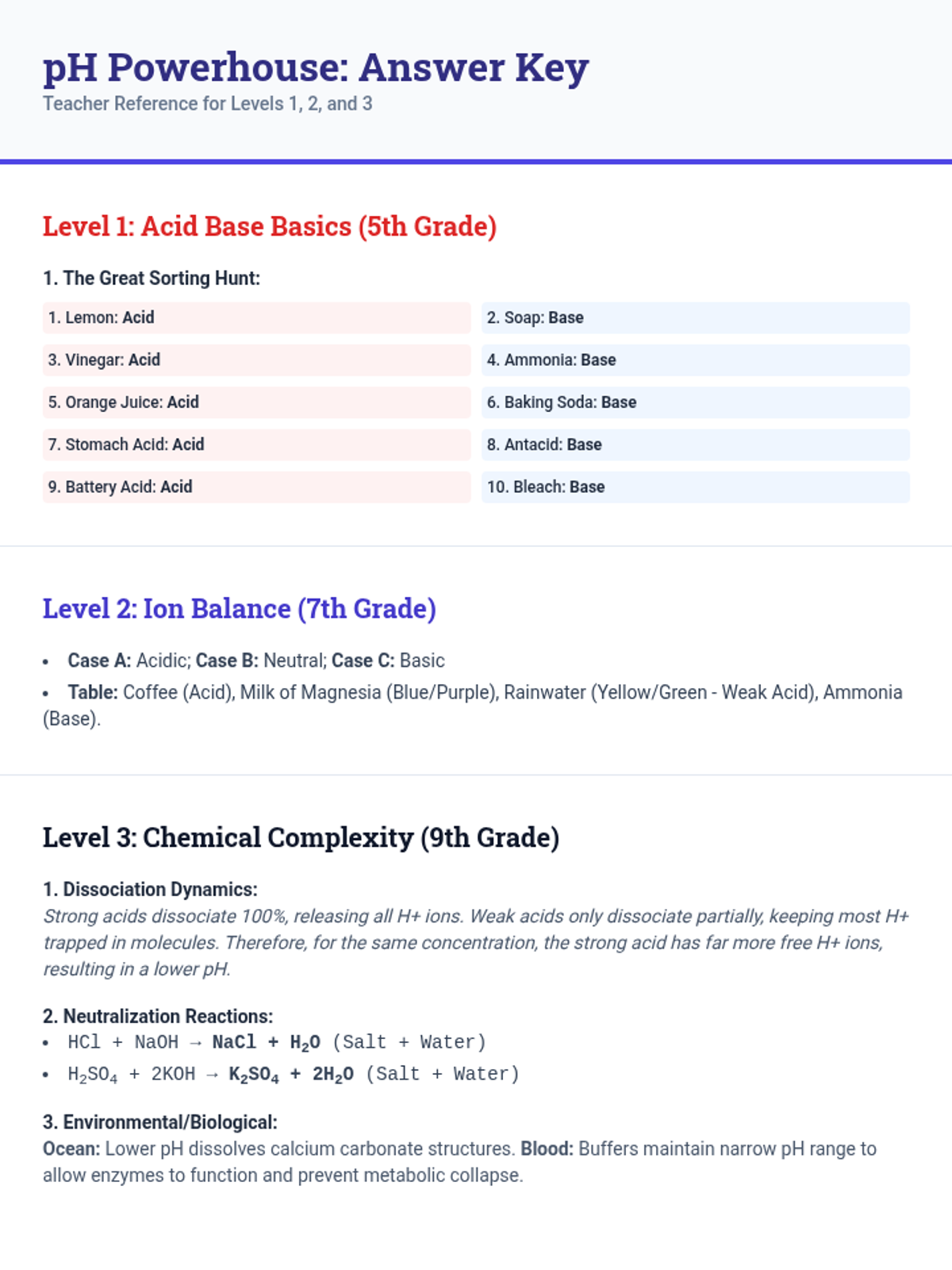
A comprehensive answer key updated to match the revised 5th and 9th grade worksheets.
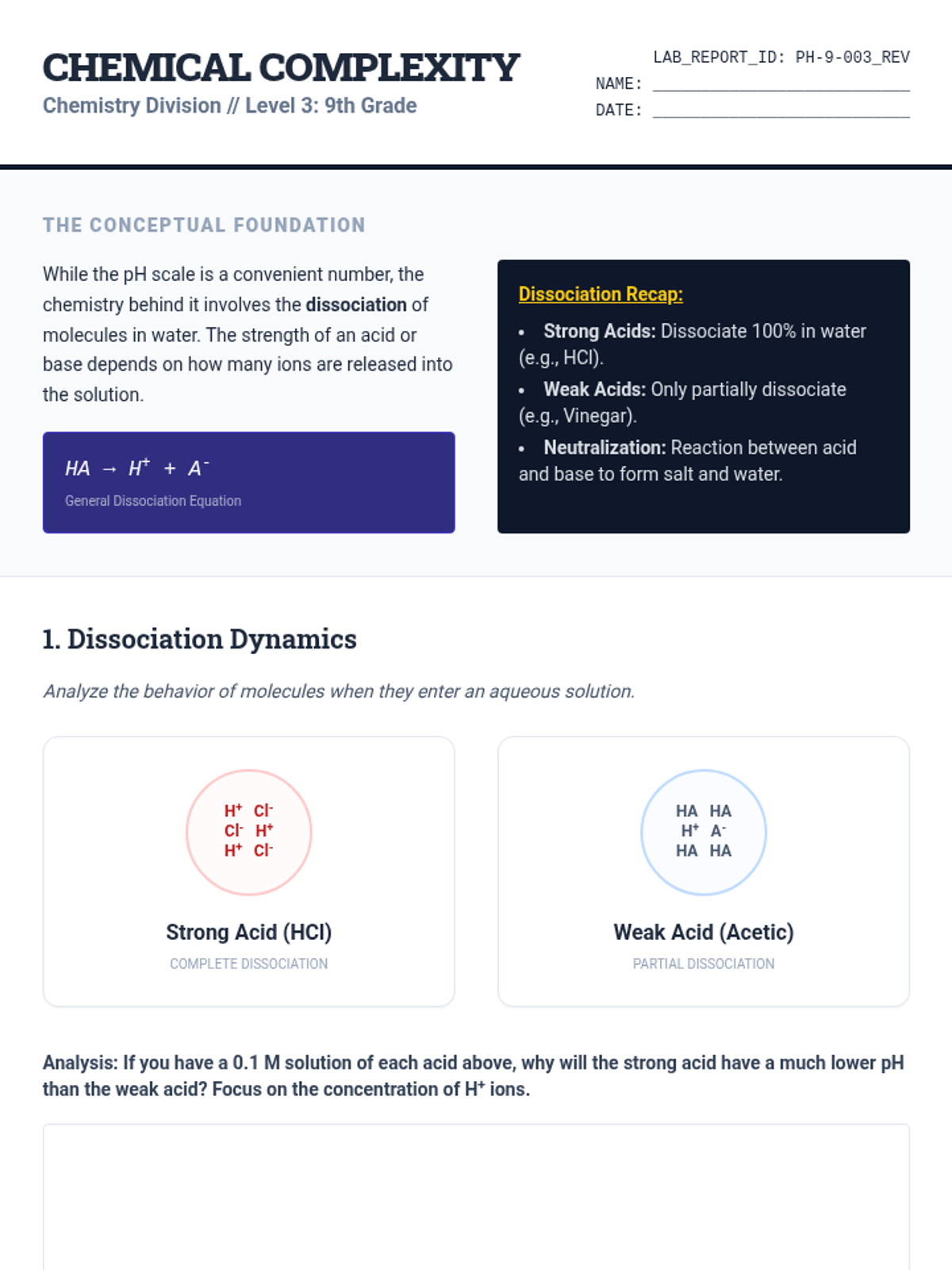
A conceptual 9th-grade worksheet focusing on dissociation, neutralization reactions, and real-world pH systems, with all logarithmic and concentration calculations removed.
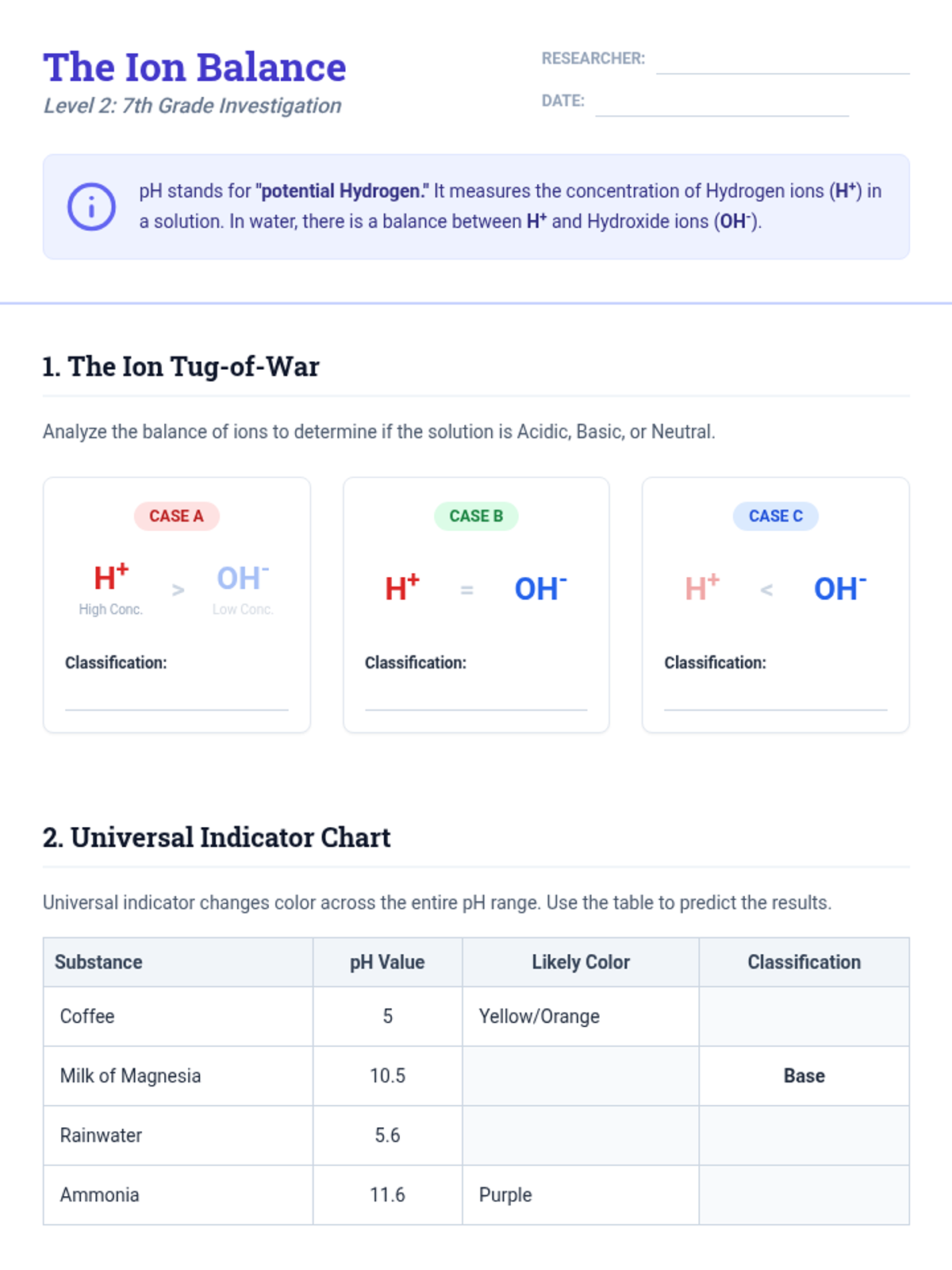
A 7th-grade worksheet exploring the balance between Hydrogen (H+) and Hydroxide (OH-) ions and their relationship to the pH scale.
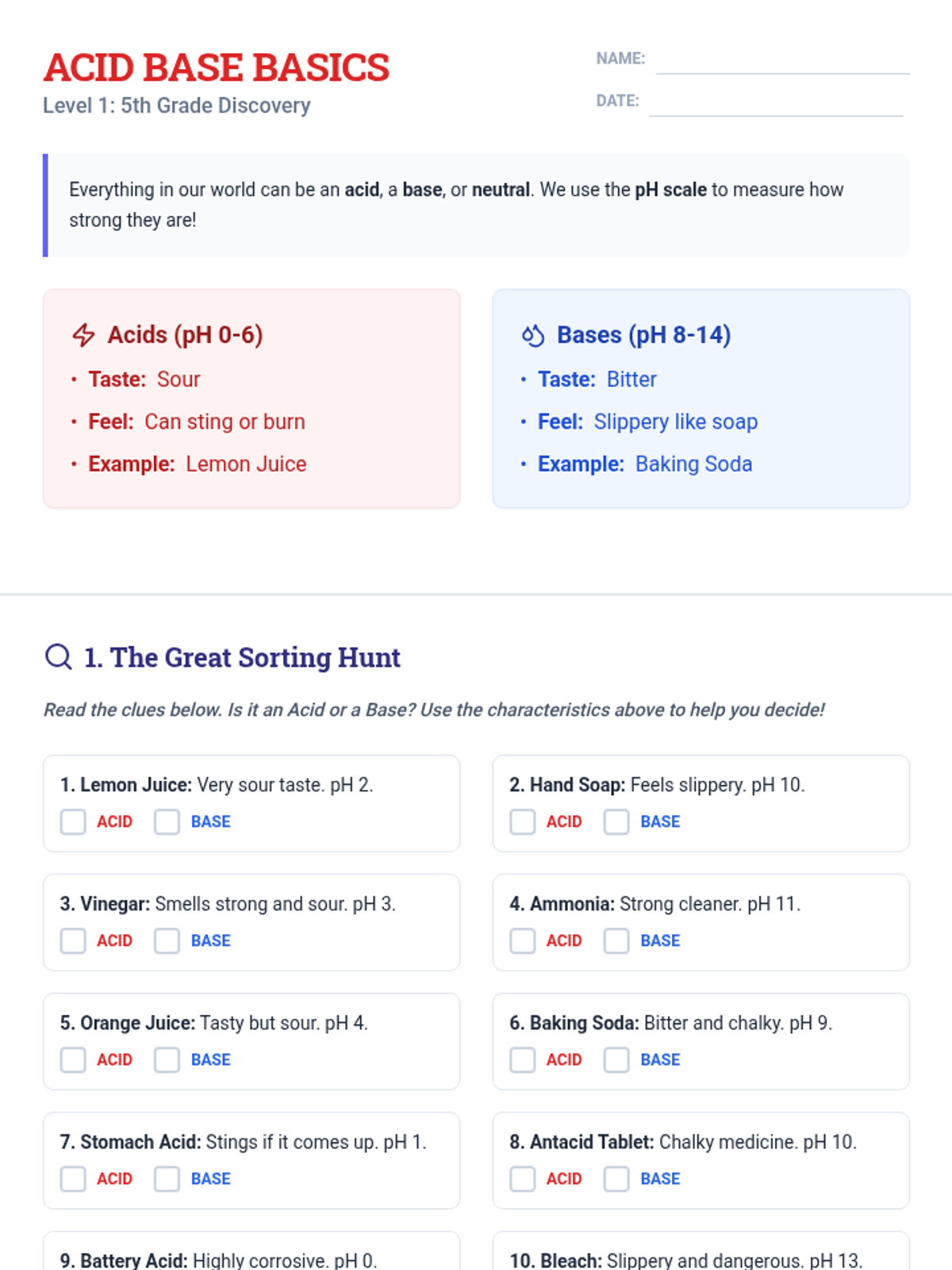
A revised 5th-grade pH worksheet with the color scale removed, an expanded 10-item sorting activity, and characteristic summary boxes.
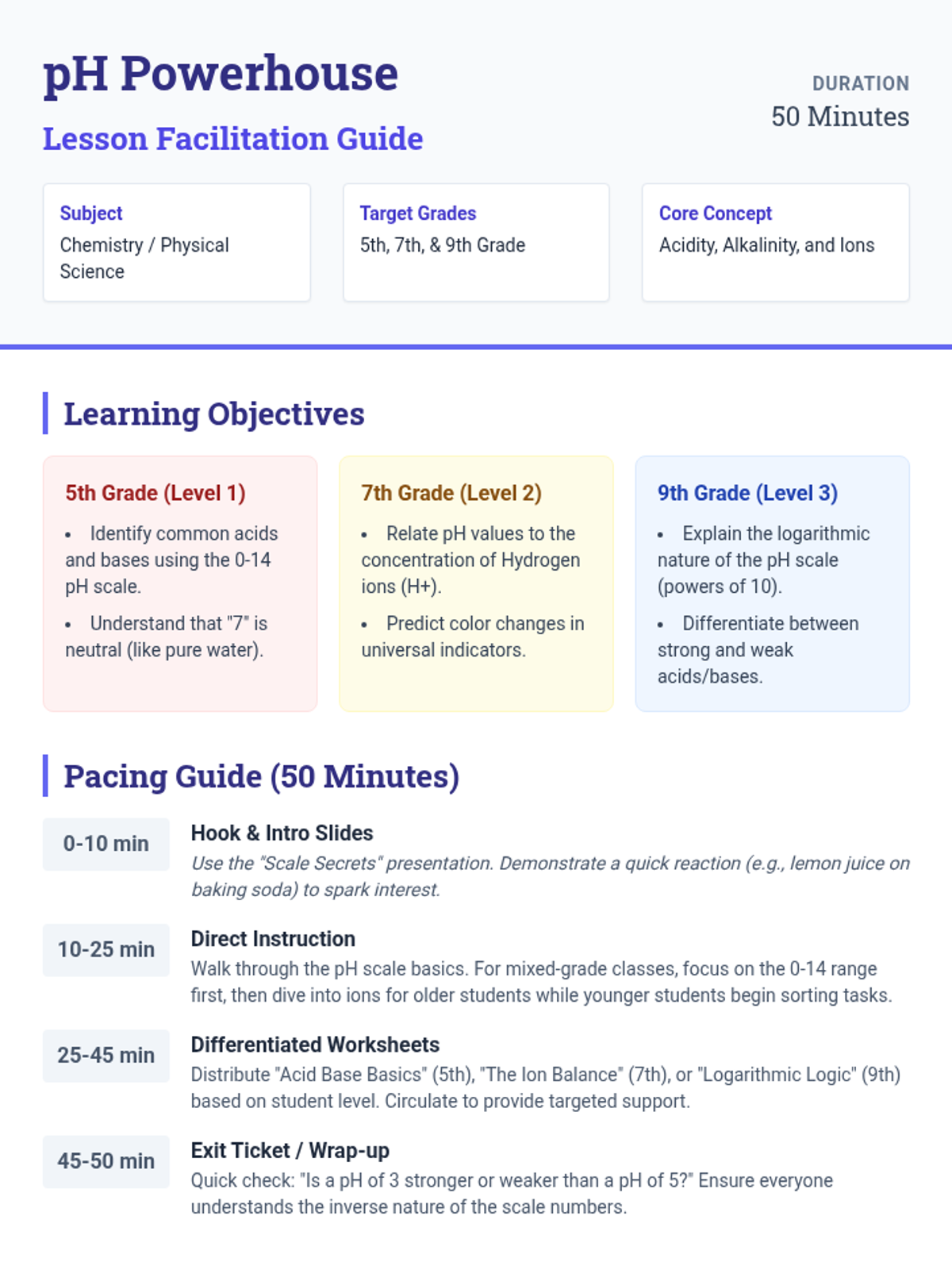
A comprehensive teacher's guide for a 50-minute lesson on pH, featuring learning objectives for three grade levels, a detailed pacing guide, differentiation strategies, and a materials list.
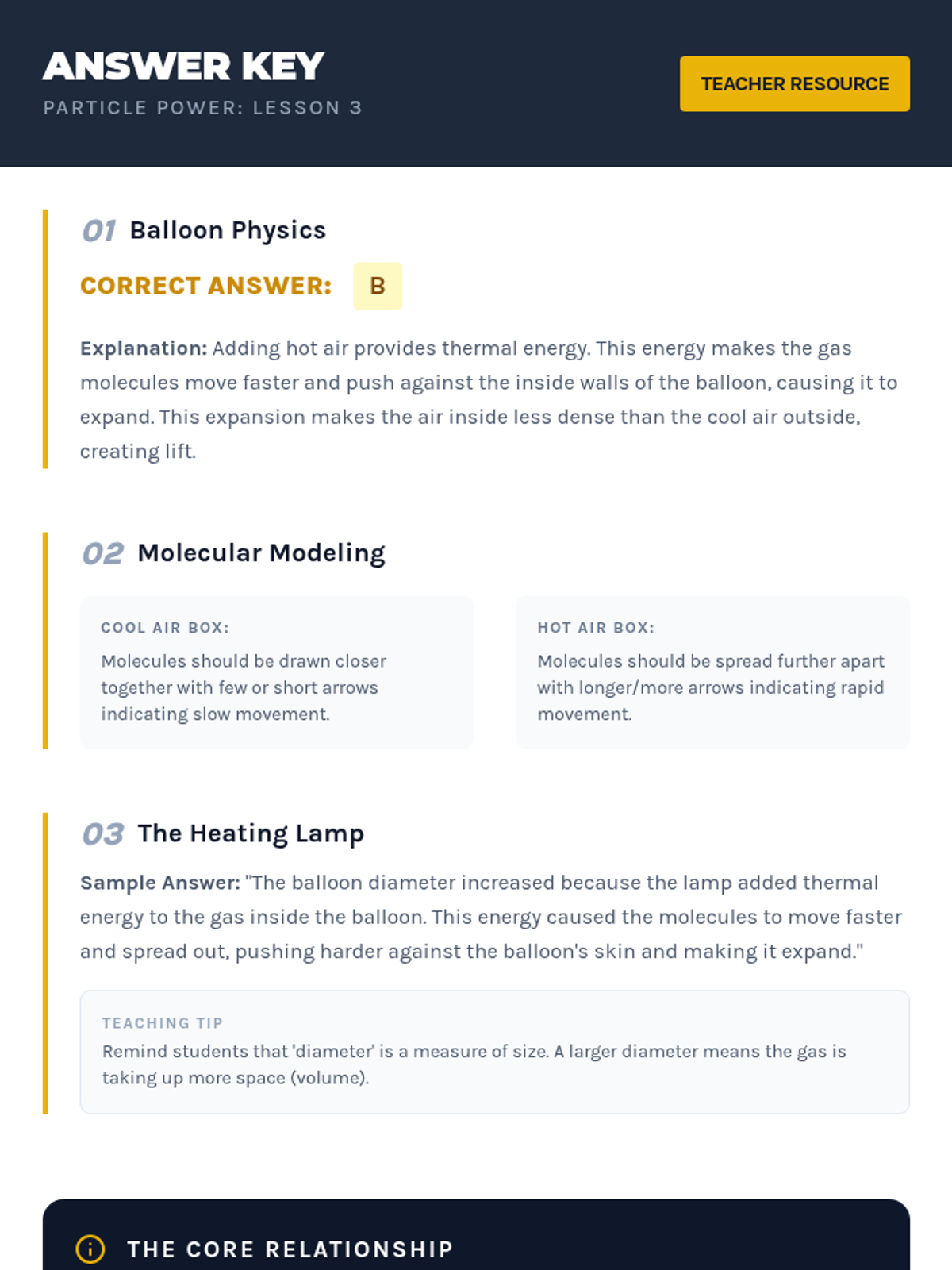
Teacher answer key for Lesson 3, including sample student responses and key concepts for thermal energy and particle motion.
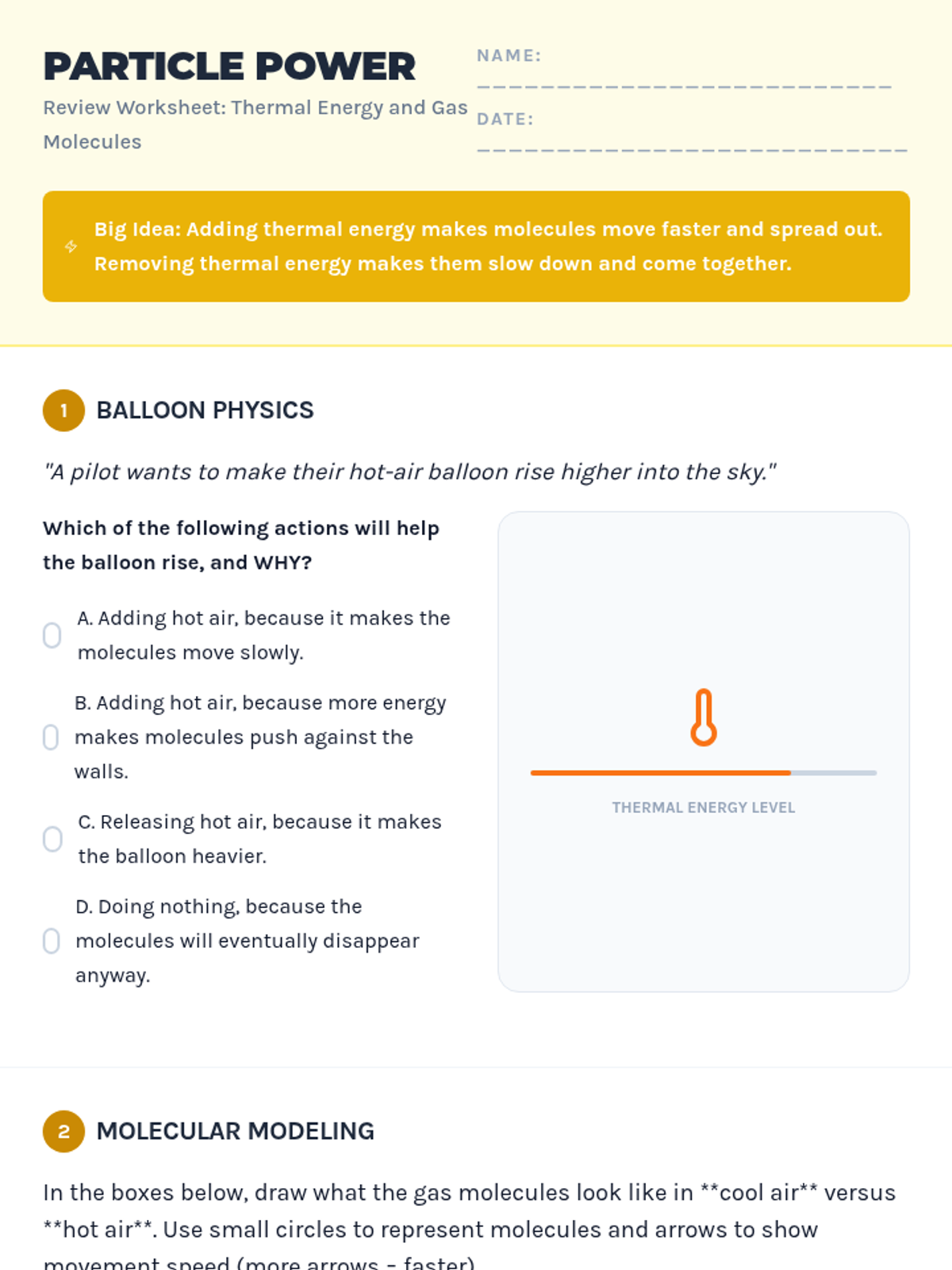
A review worksheet for Lesson 3 focusing on interpreting data about thermal energy and its effect on gas volume and particle motion.
Visual presentation slides for Lesson 3 focusing on particle motion, thermal energy, and the science behind hot-air balloons.
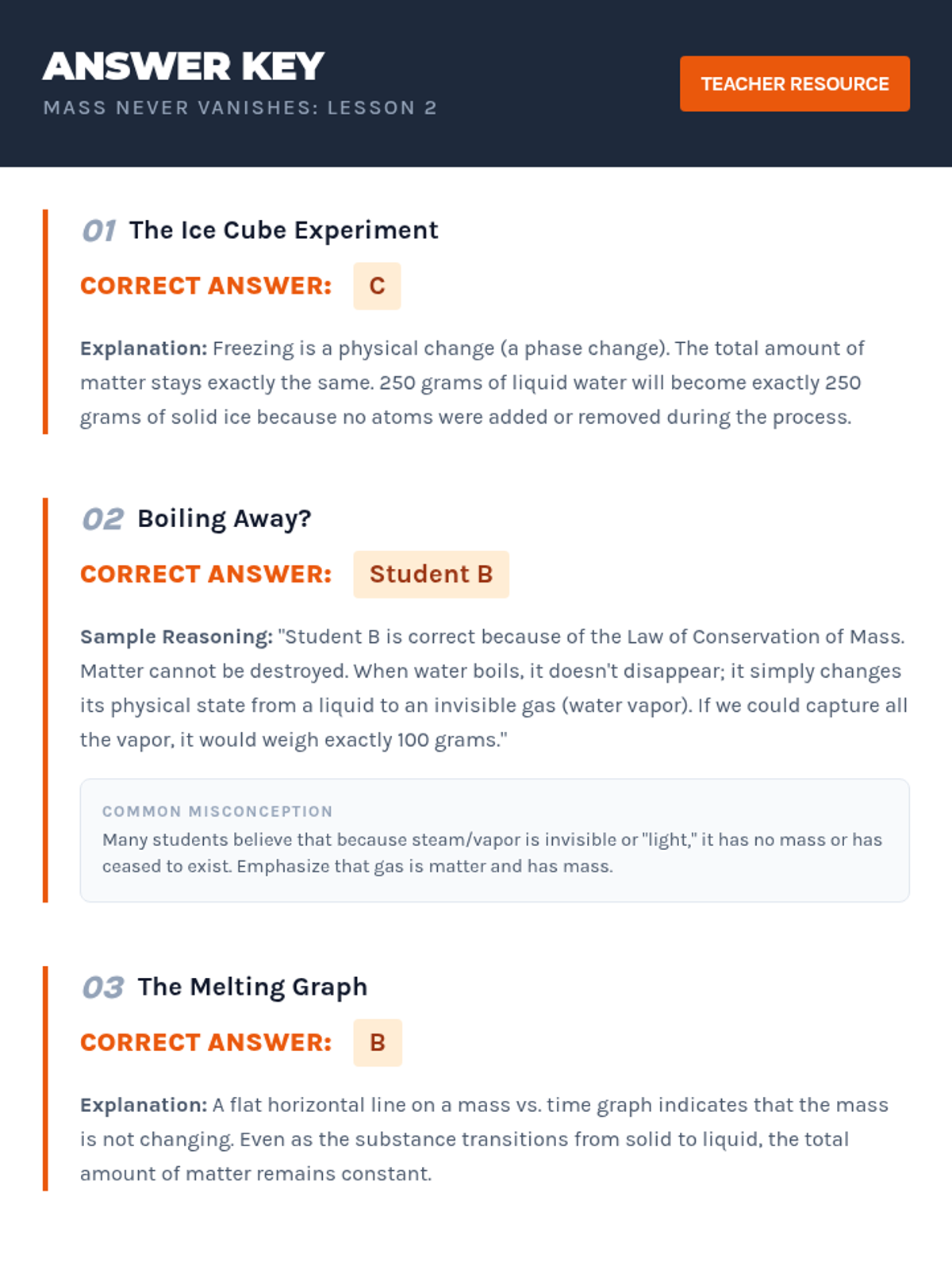
Teacher answer key and instructional guide for Lesson 2, providing explanations for mass conservation during state changes and common student misconceptions.
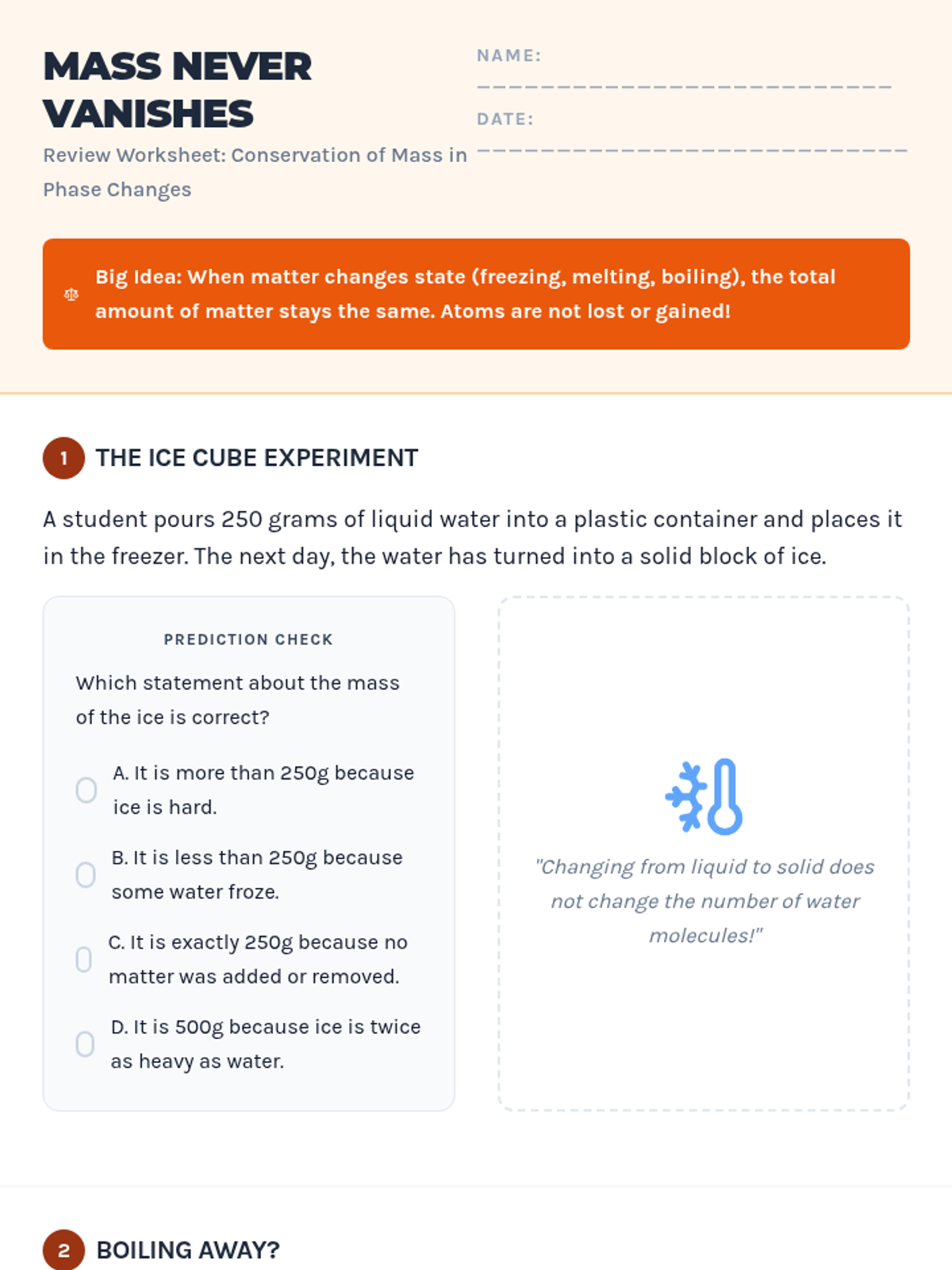
A review worksheet for Lesson 2 focusing on interpreting data and claims about the conservation of mass during freezing, boiling, and melting.
Visual presentation slides for Lesson 2 focusing on the conservation of mass during phase changes like freezing and evaporation, including data tables and claim analysis.
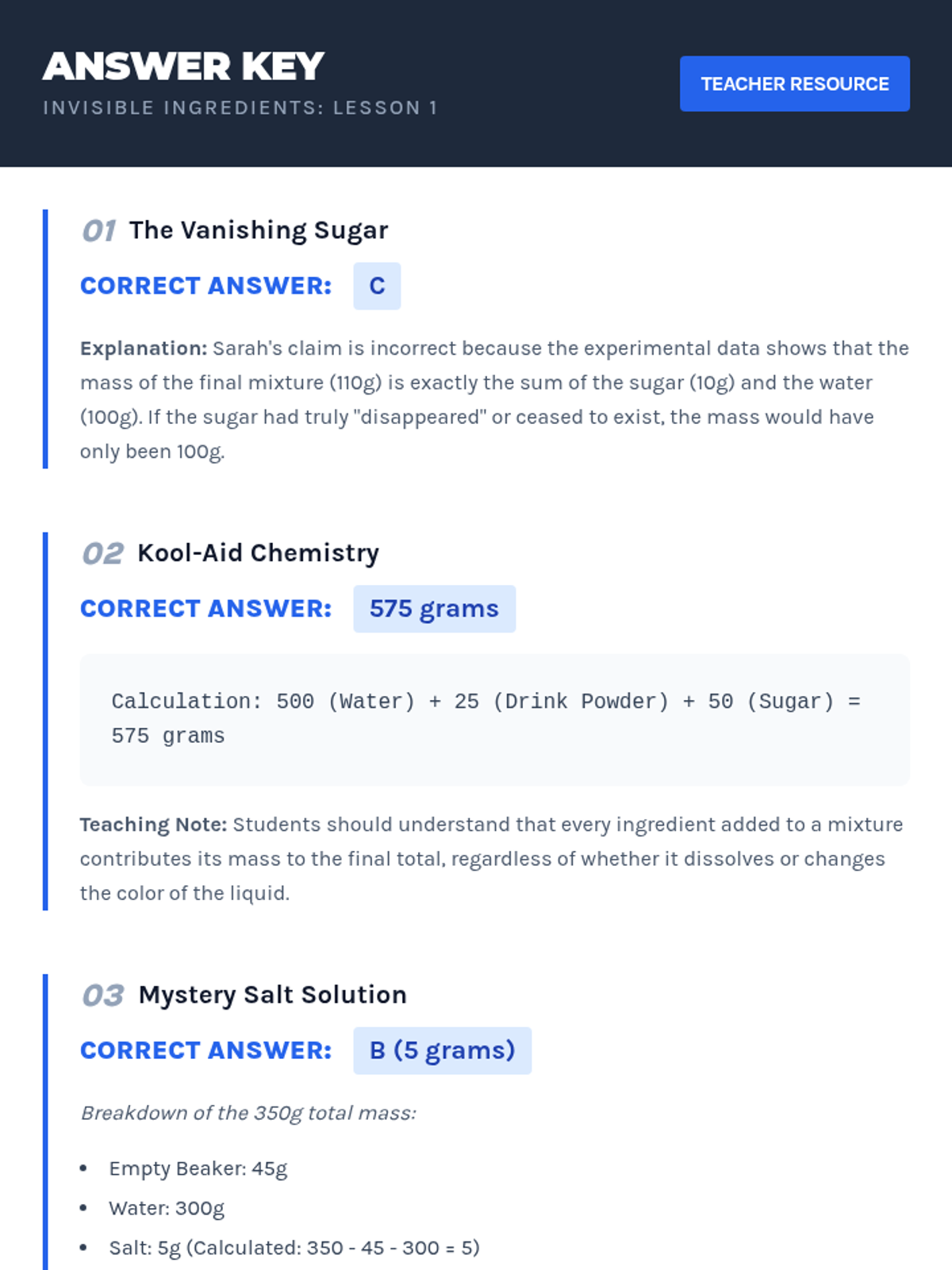
Detailed answer key for the Lesson 1 worksheet, including explanations and teaching notes for each problem.
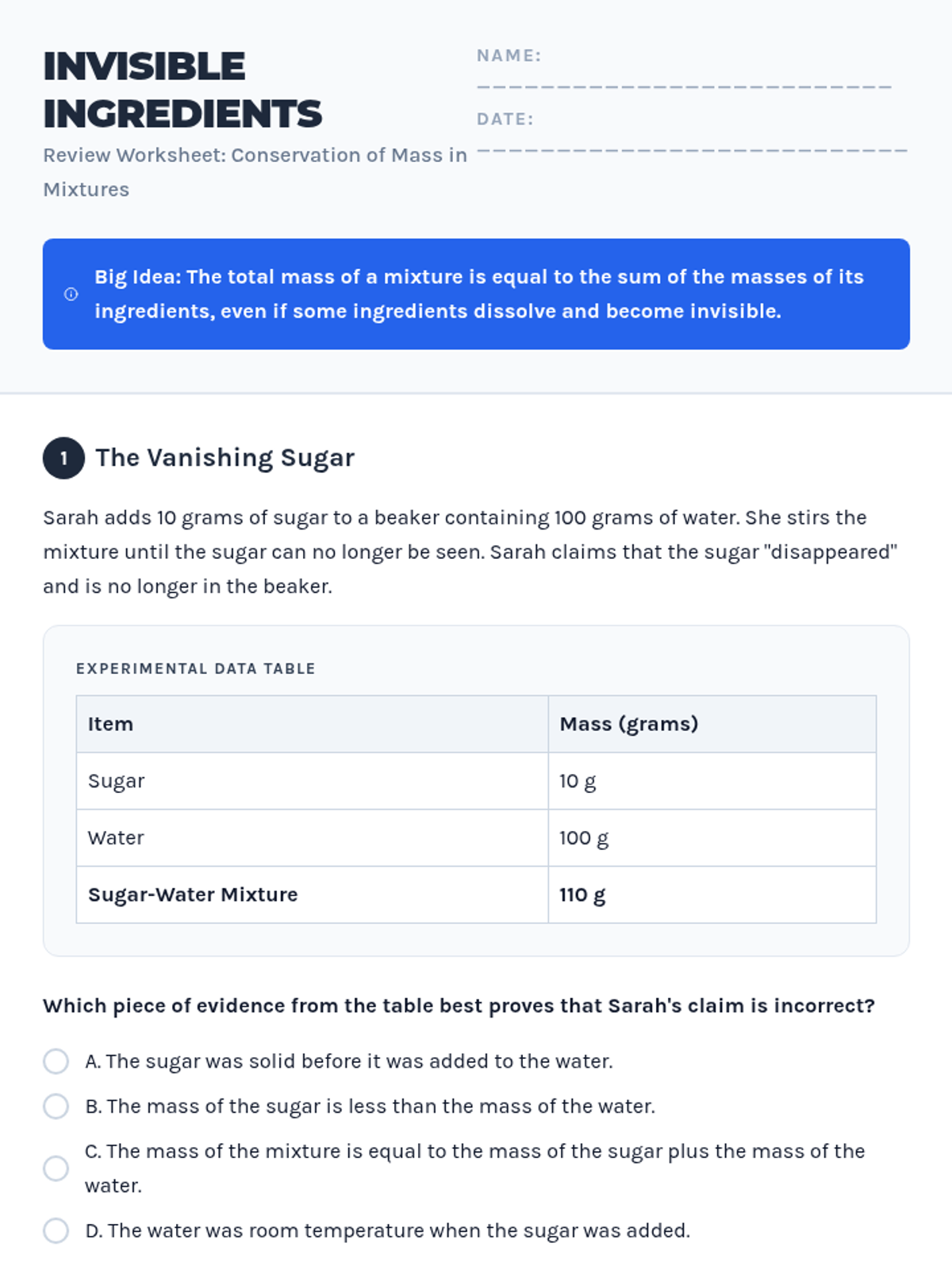
A worksheet for Lesson 1 containing practice problems that require students to interpret data tables to prove the conservation of mass in mixtures and dissolving scenarios.
Introductory slides for Lesson 1 on the conservation of mass in mixtures, featuring clear visual representations of dissolving processes and data tables.
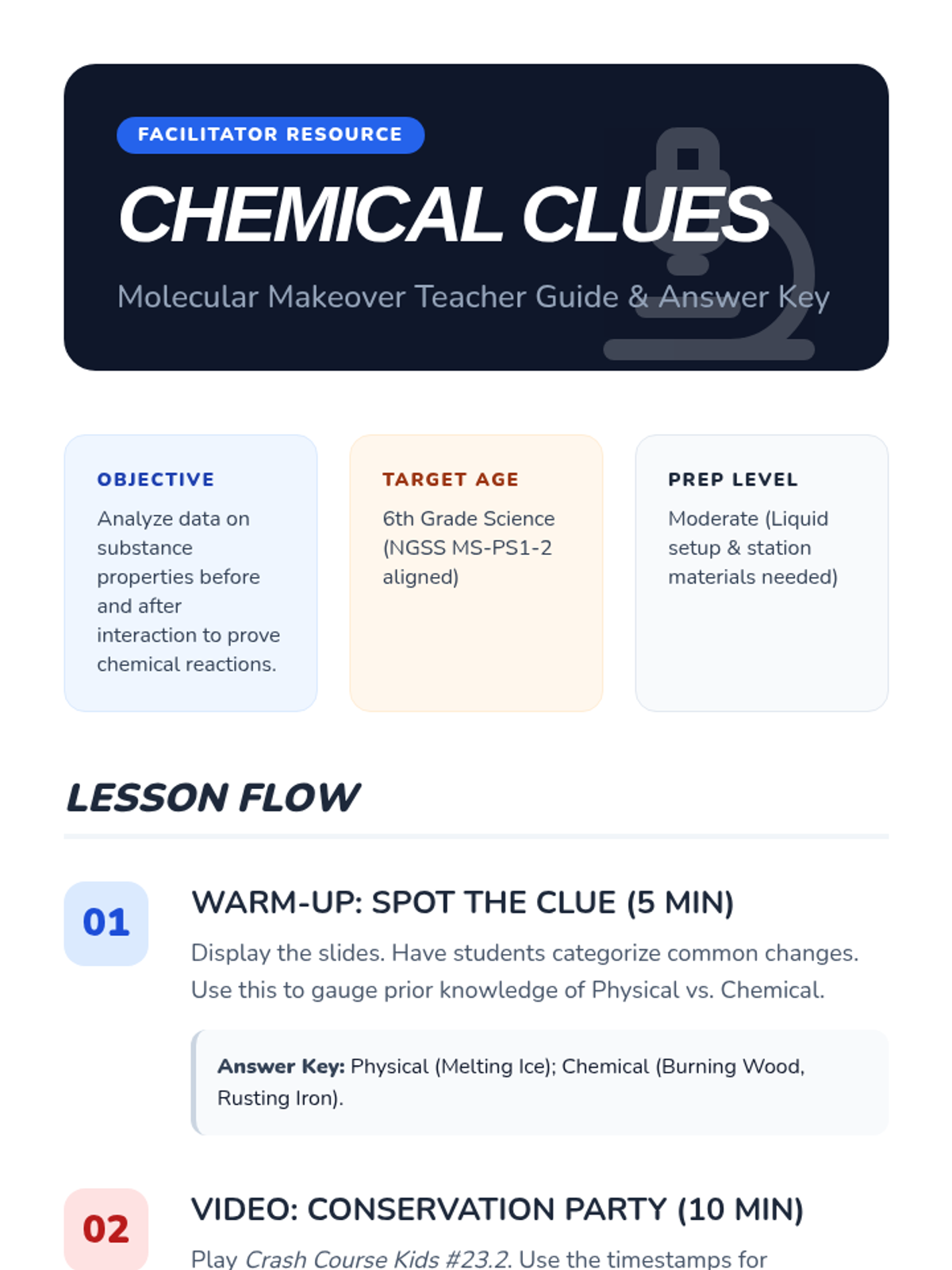
A teacher guide for the Molecular Makeover lesson, including pacing, discussion prompts, station walkthroughs, and an answer key for student work.
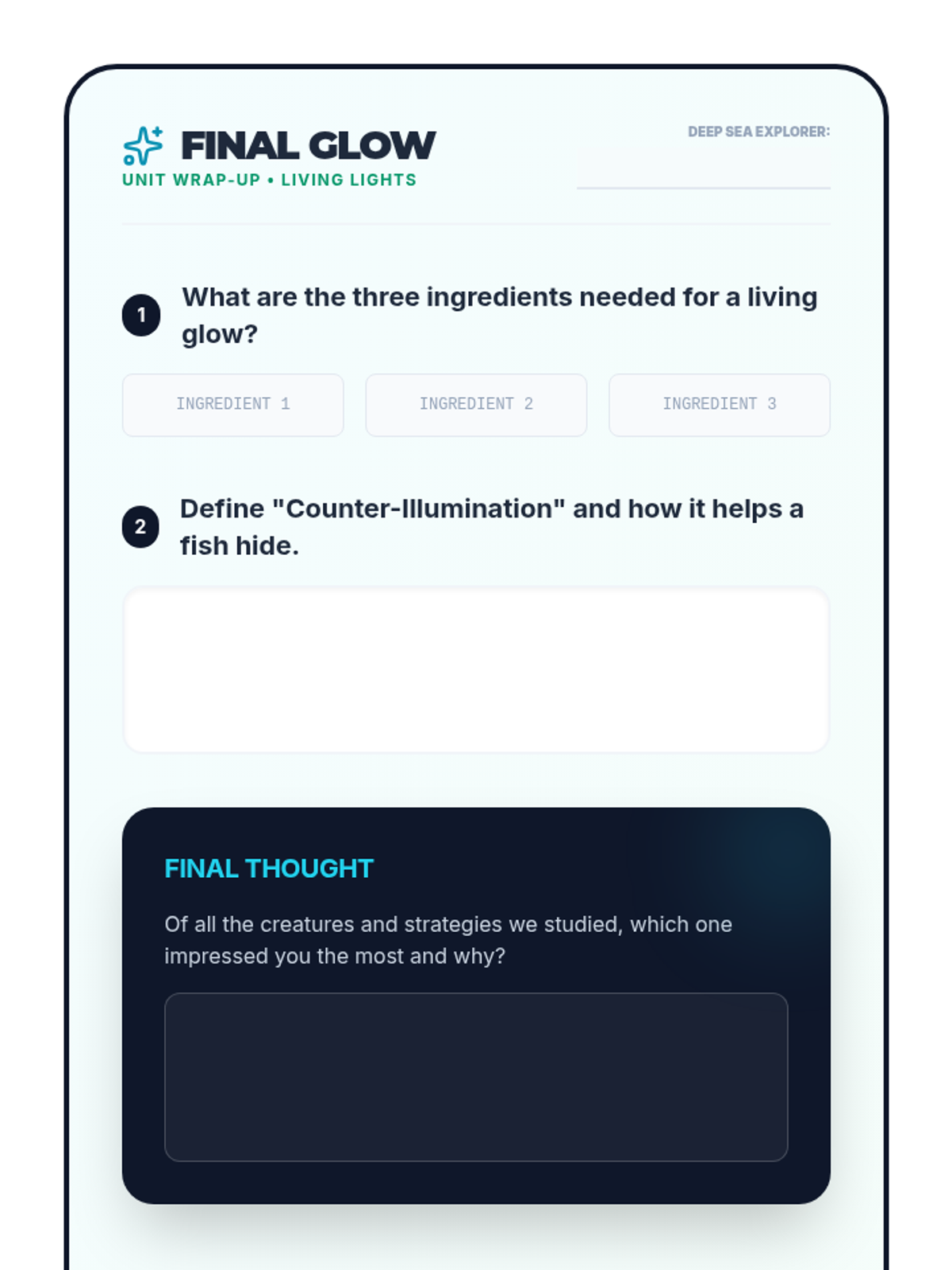
A final unit exit ticket for assessing cumulative student understanding of bioluminescence concepts.
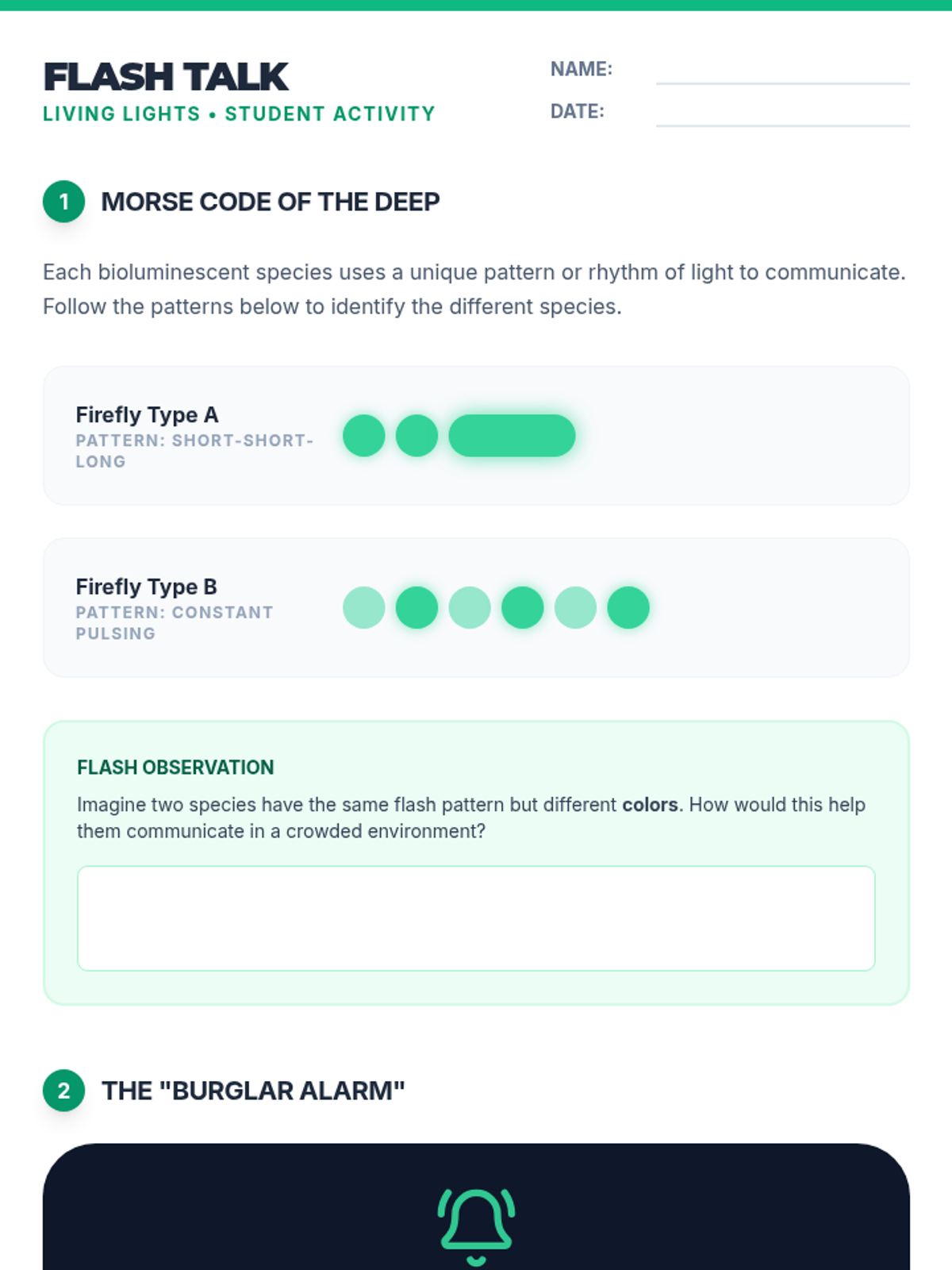
A student worksheet for exploring strategies like counter-illumination (camouflage), burglar alarms (defense), and mating signals.
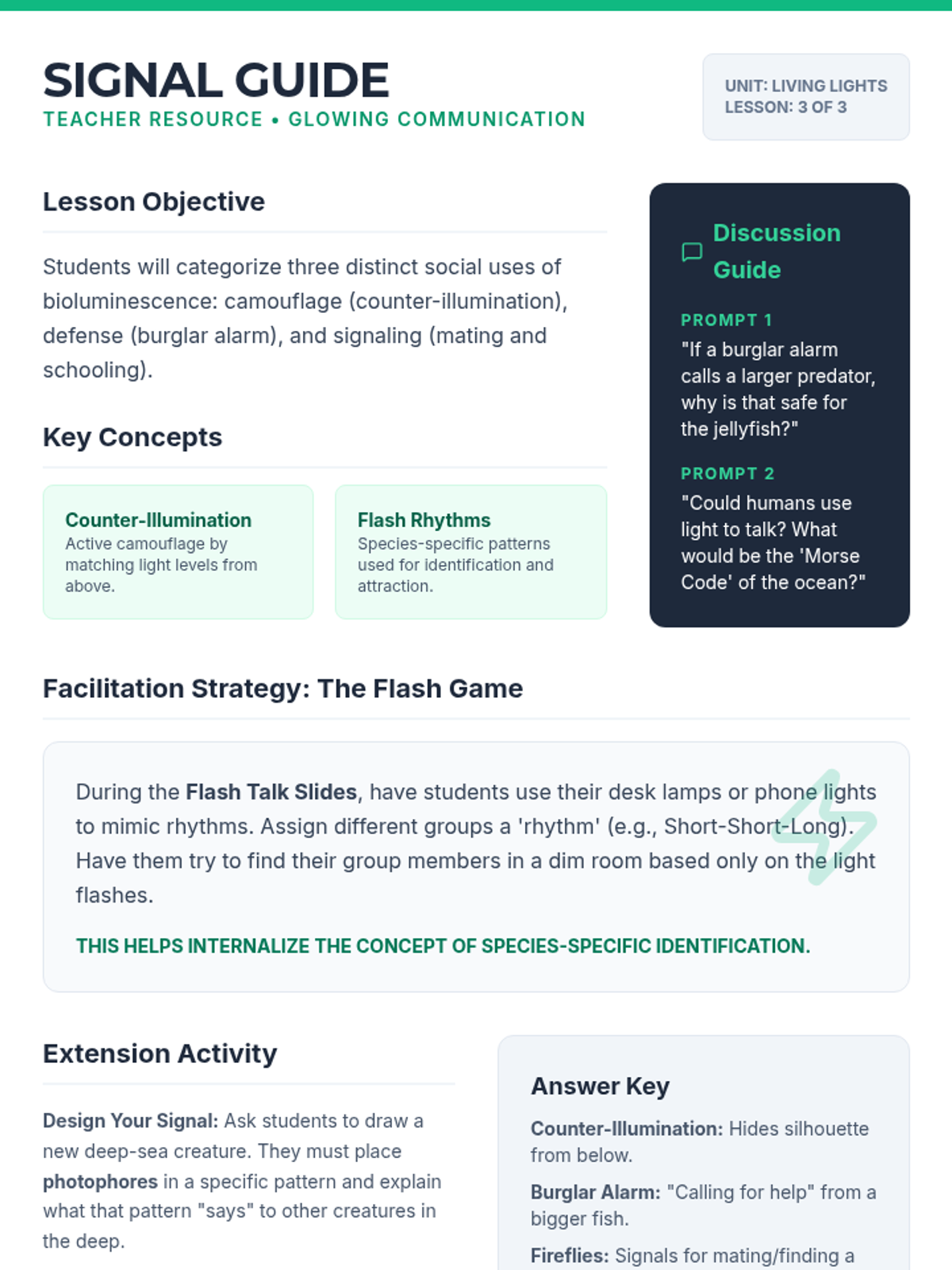
A teacher facilitation guide for Lesson 3, focusing on the social and defensive uses of light in nature, including discussion prompts and a classroom activity guide.
Exploring strategies like counter-illumination (camouflage), burglar alarms (defense), and mating signals.
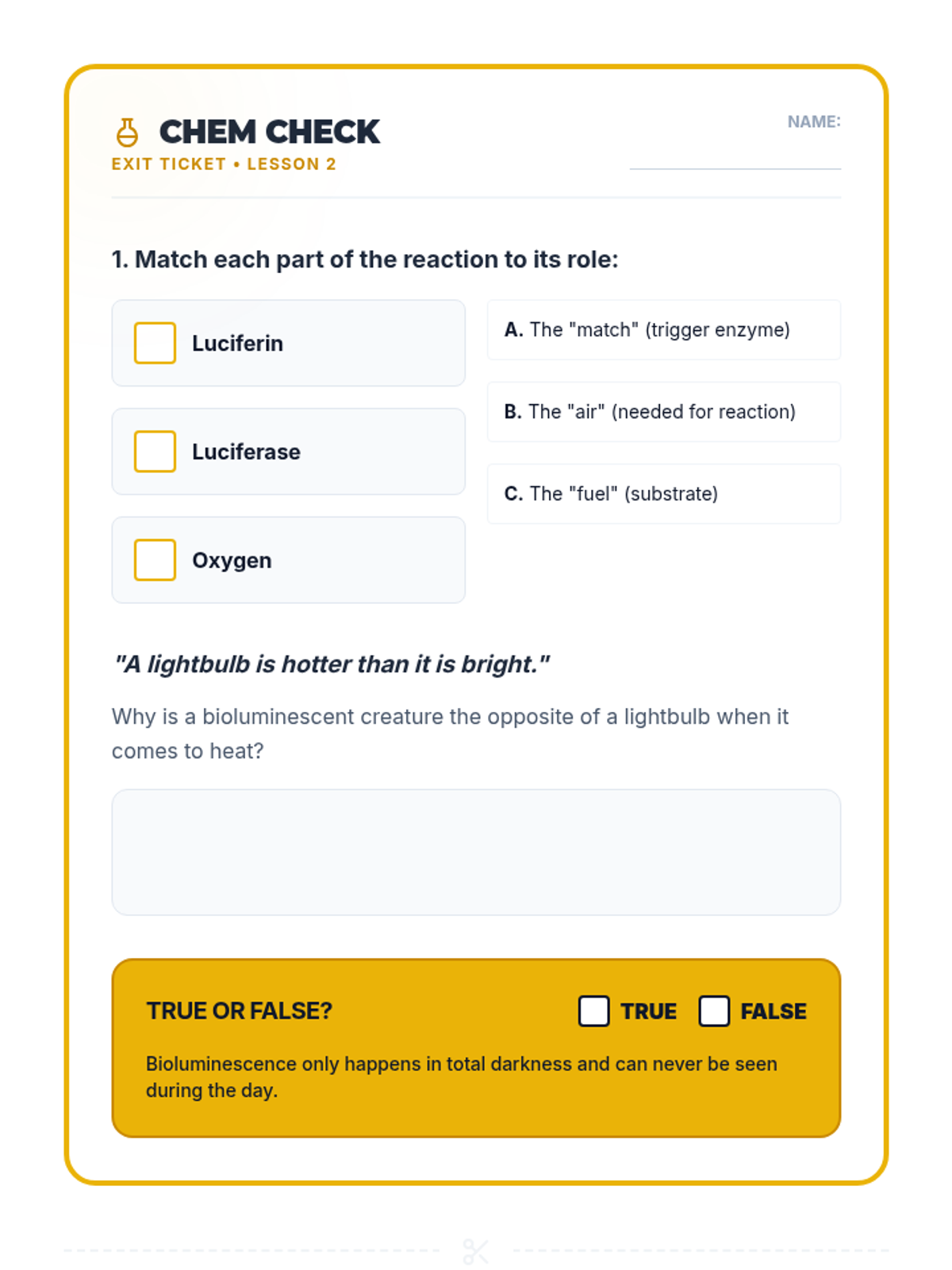
A quick check for Lesson 2 to assess student understanding of the chemical components of bioluminescence.
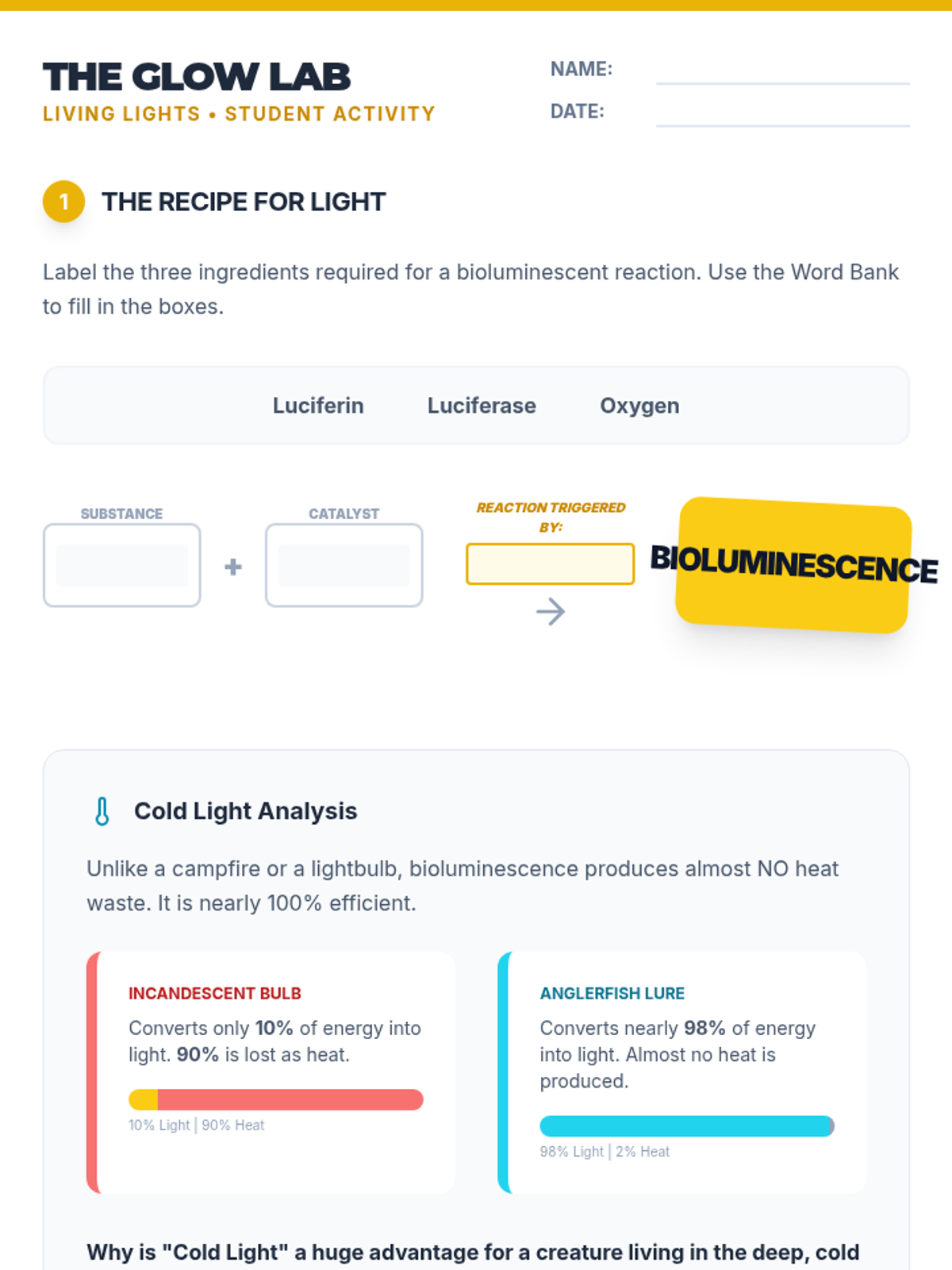
A student activity sheet for labeling the chemical equation and predicting reactions.
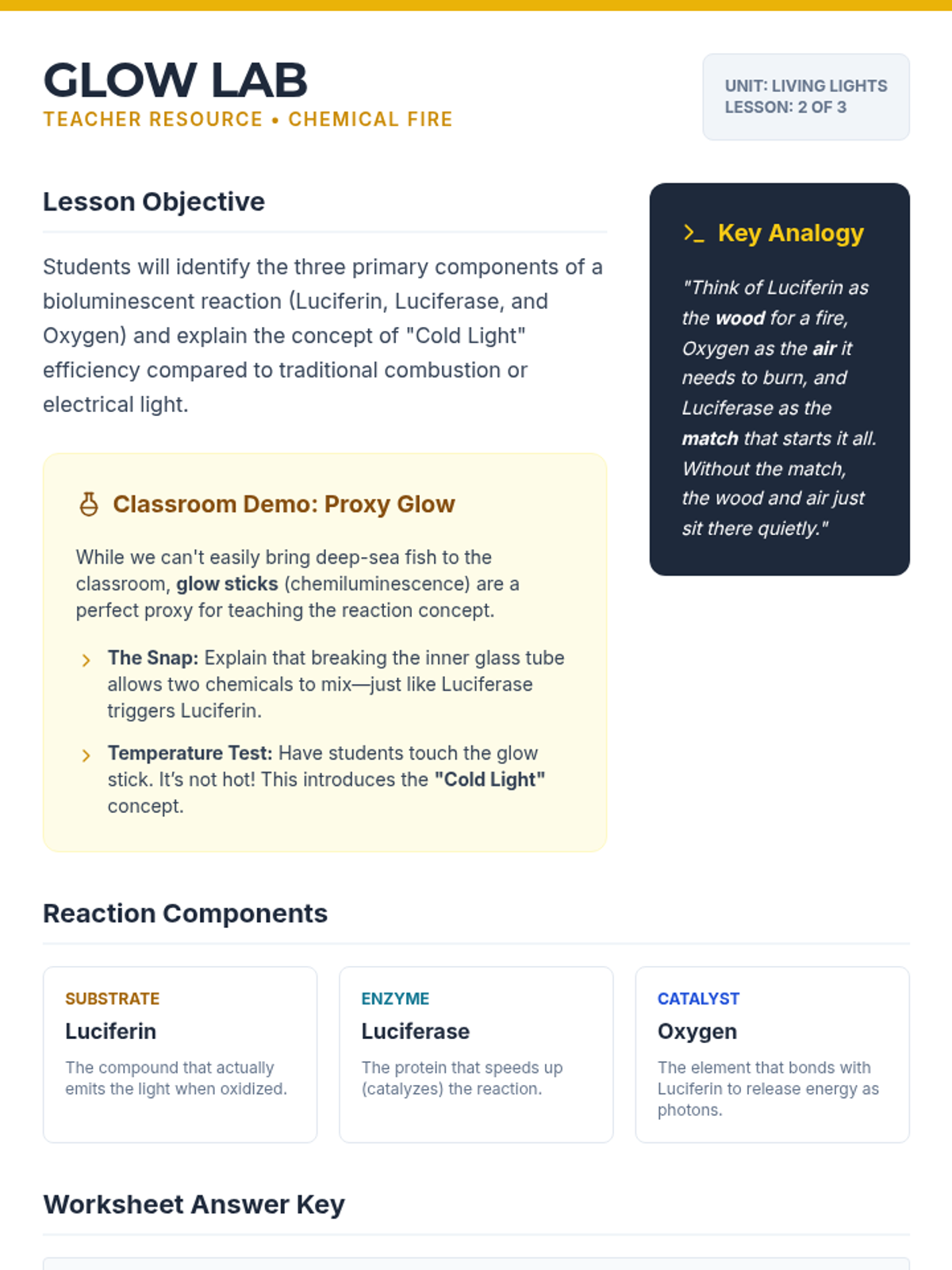
A teacher facilitation guide for Lesson 2, including background chemistry on the bioluminescent reaction and a classroom demonstration guide using glow sticks.
Detailed breakdown of the chemical reaction behind bioluminescence, exploring the roles of luciferin, luciferase, and oxygen in creating "cold light."
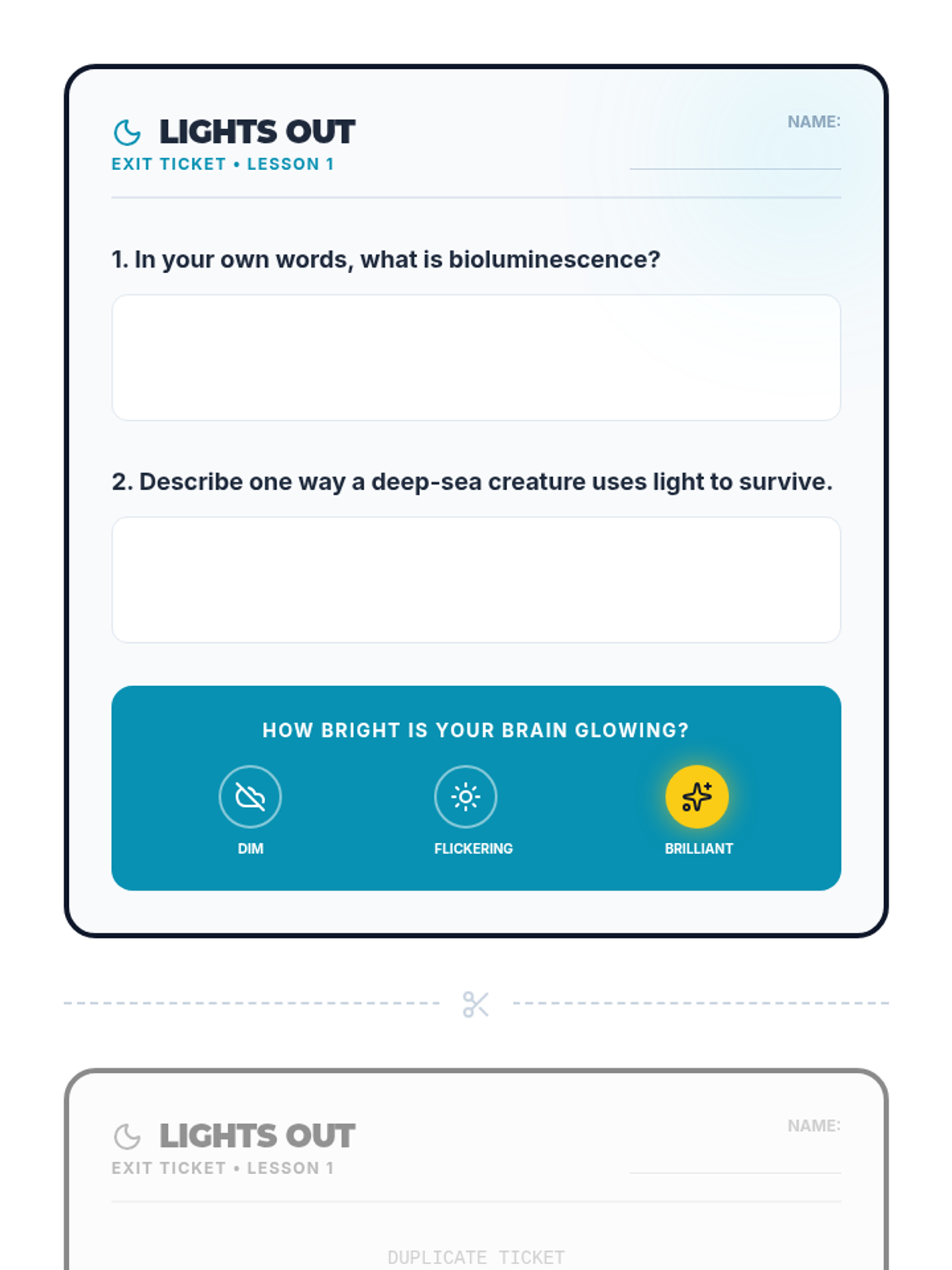
A quick exit ticket for assessing student understanding of bioluminescence and deep-sea survival adaptations.
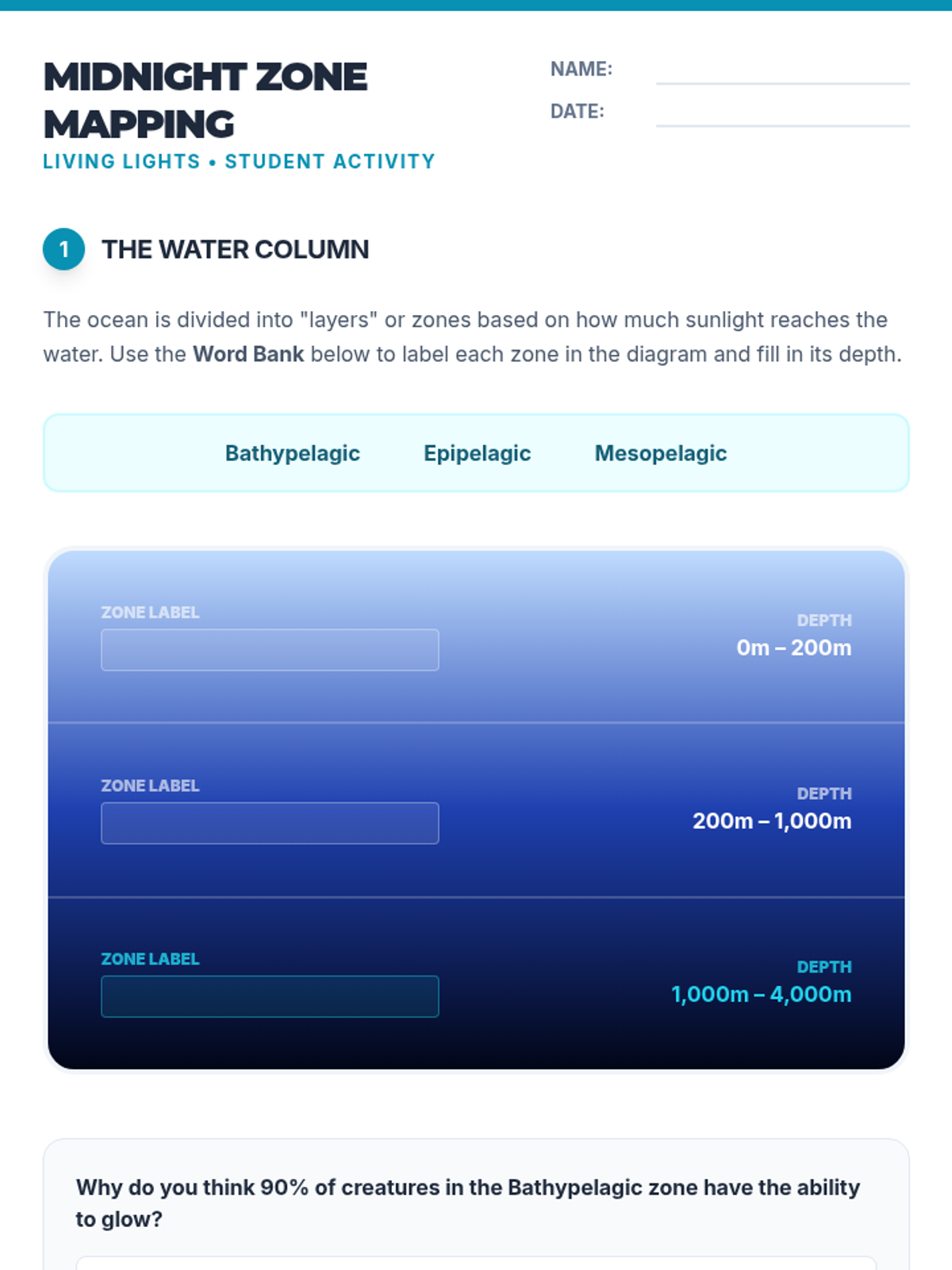
A student worksheet for exploring ocean zones and identifying the unique bioluminescent adaptations of deep-sea creatures.
An engaging visual presentation exploring the midnight zone of the ocean and the fascinating ways deep-sea organisms use bioluminescence for survival.
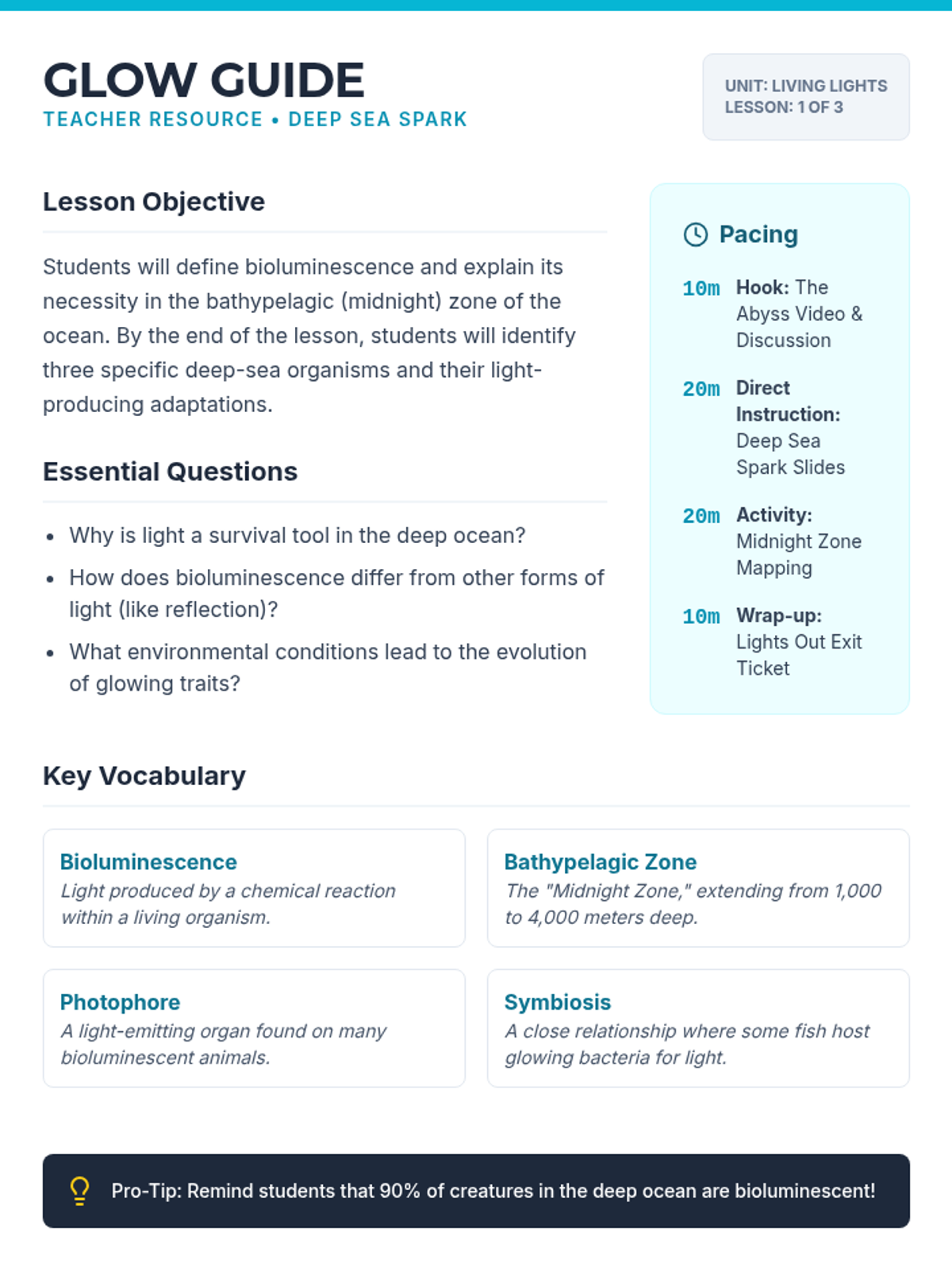
A comprehensive teacher facilitation guide for the "Deep Sea Spark" lesson, including pacing, discussion prompts, key vocabulary, and an answer key for student materials.
A visual slide deck to introduce the hand warmer investigation. It explains the mission, procedure, energy transformation from chemical to thermal energy, and defines exothermic reactions.
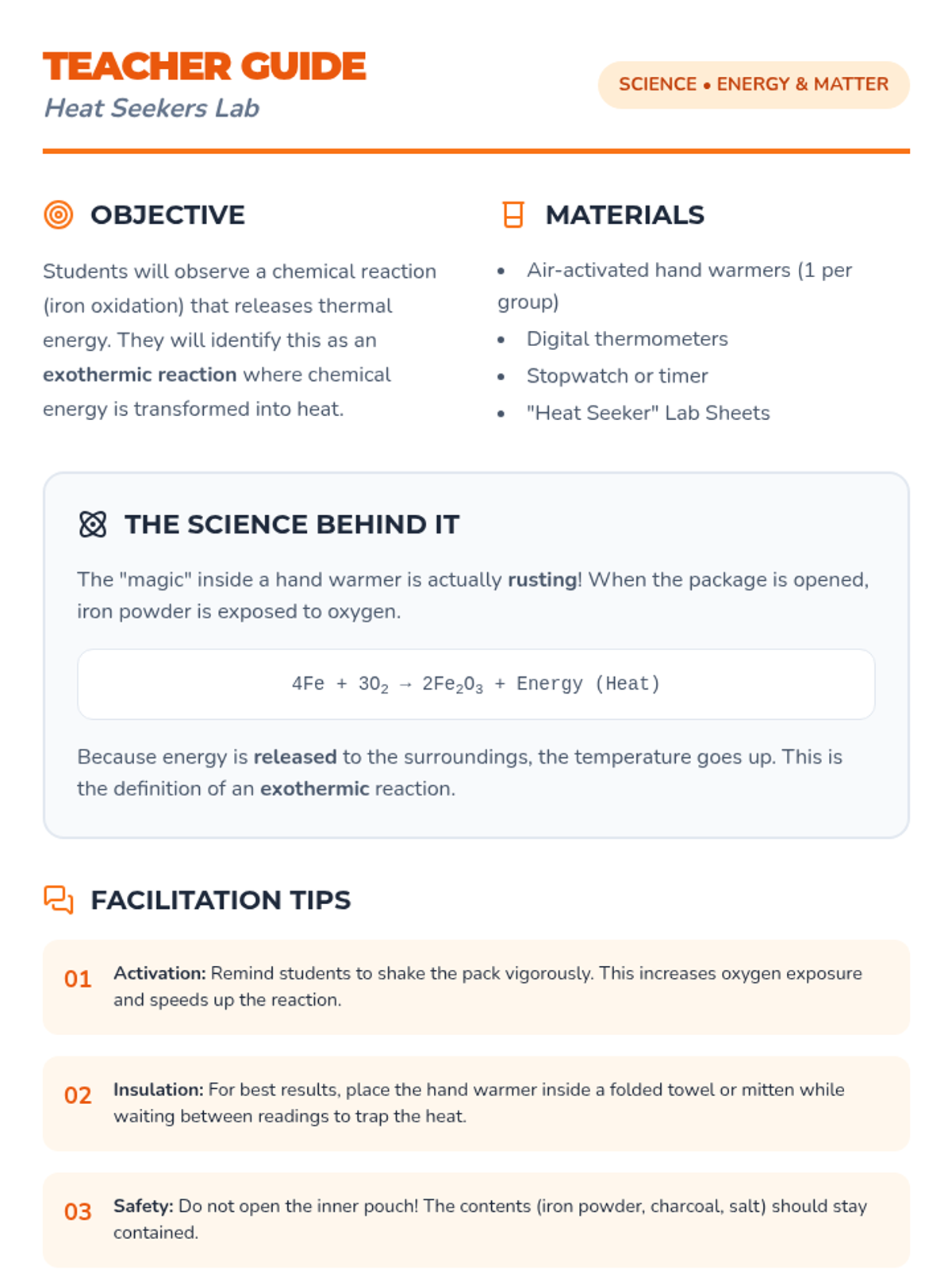
A comprehensive teacher facilitation guide for the Heat Seekers lab. Includes learning objectives, materials lists, a scientific explanation of the exothermic reaction (iron oxidation), facilitation tips, and an answer key.
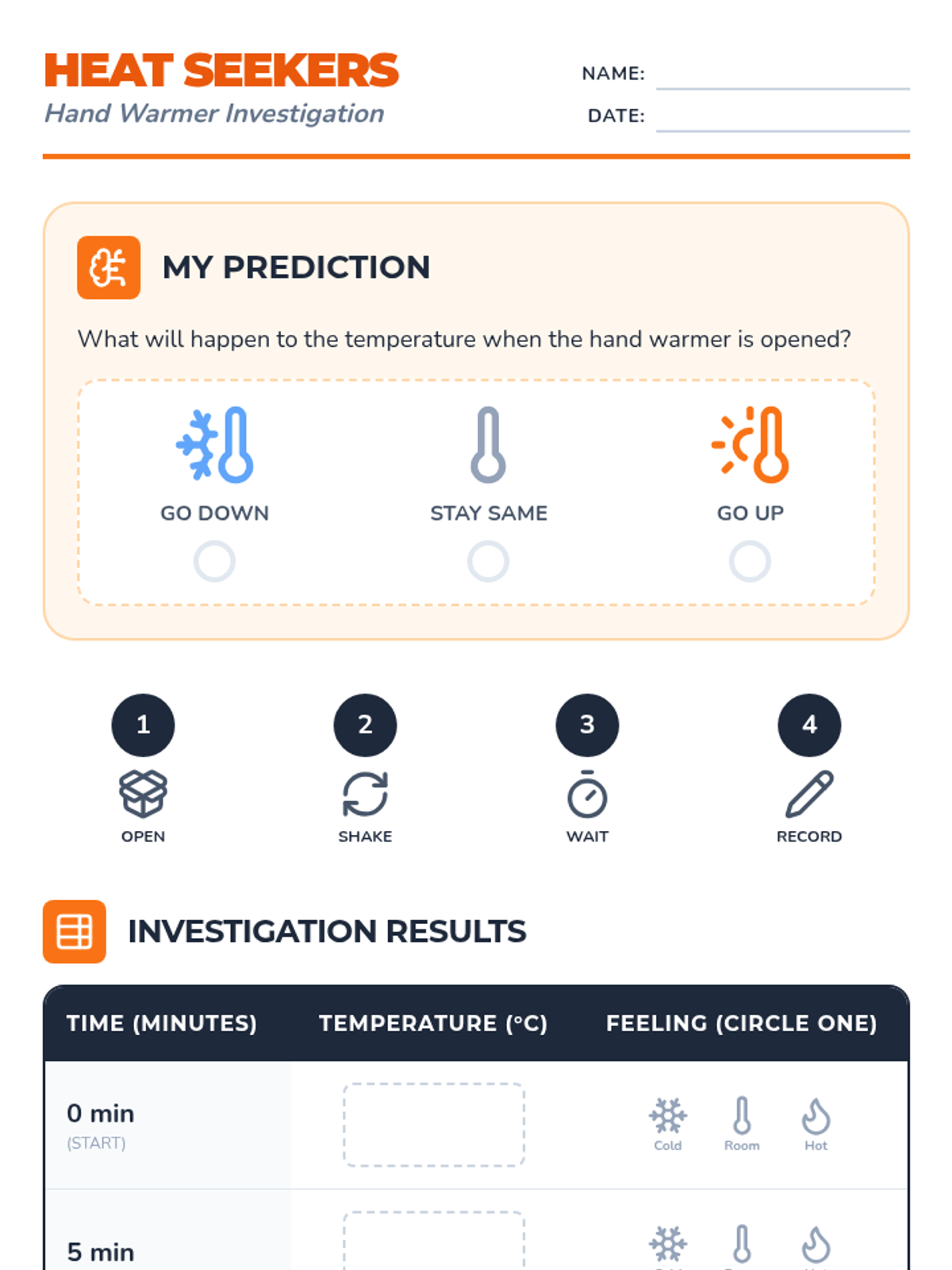
A highly visual lab investigation sheet for students to record results during a hand warmer experiment. It features icon-based instructions, a clear data table for temperature tracking, and simple conclusion prompts focusing on exothermic reactions.
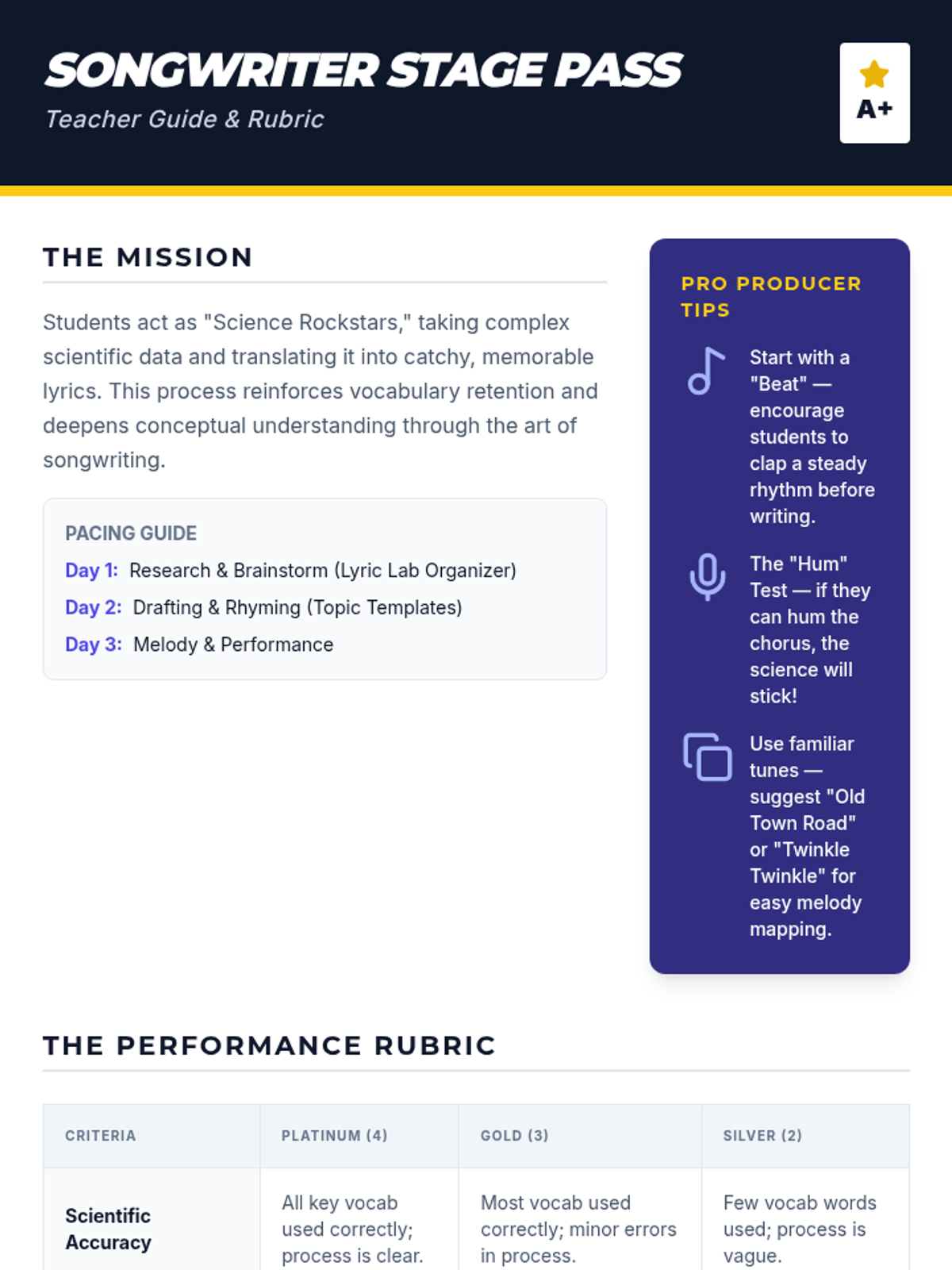
A teacher's guide and rubric for the Science Rockstars lesson, including pacing guides, production tips, and a clear performance rubric for assessment.
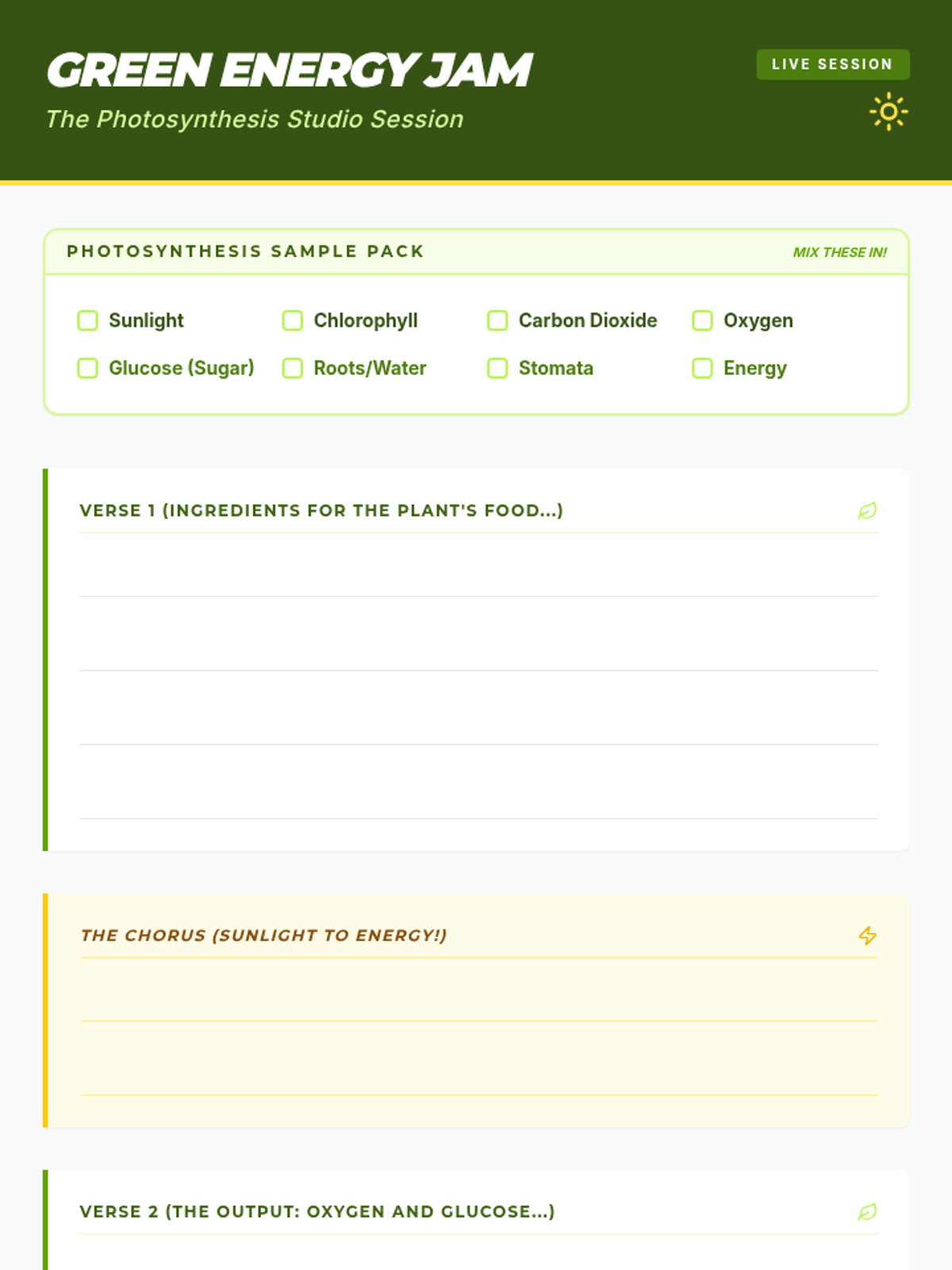
A photosynthesis-themed songwriting template with a vocabulary bank including terms like chlorophyll and glucose, designed to help students explain plant processes through music.
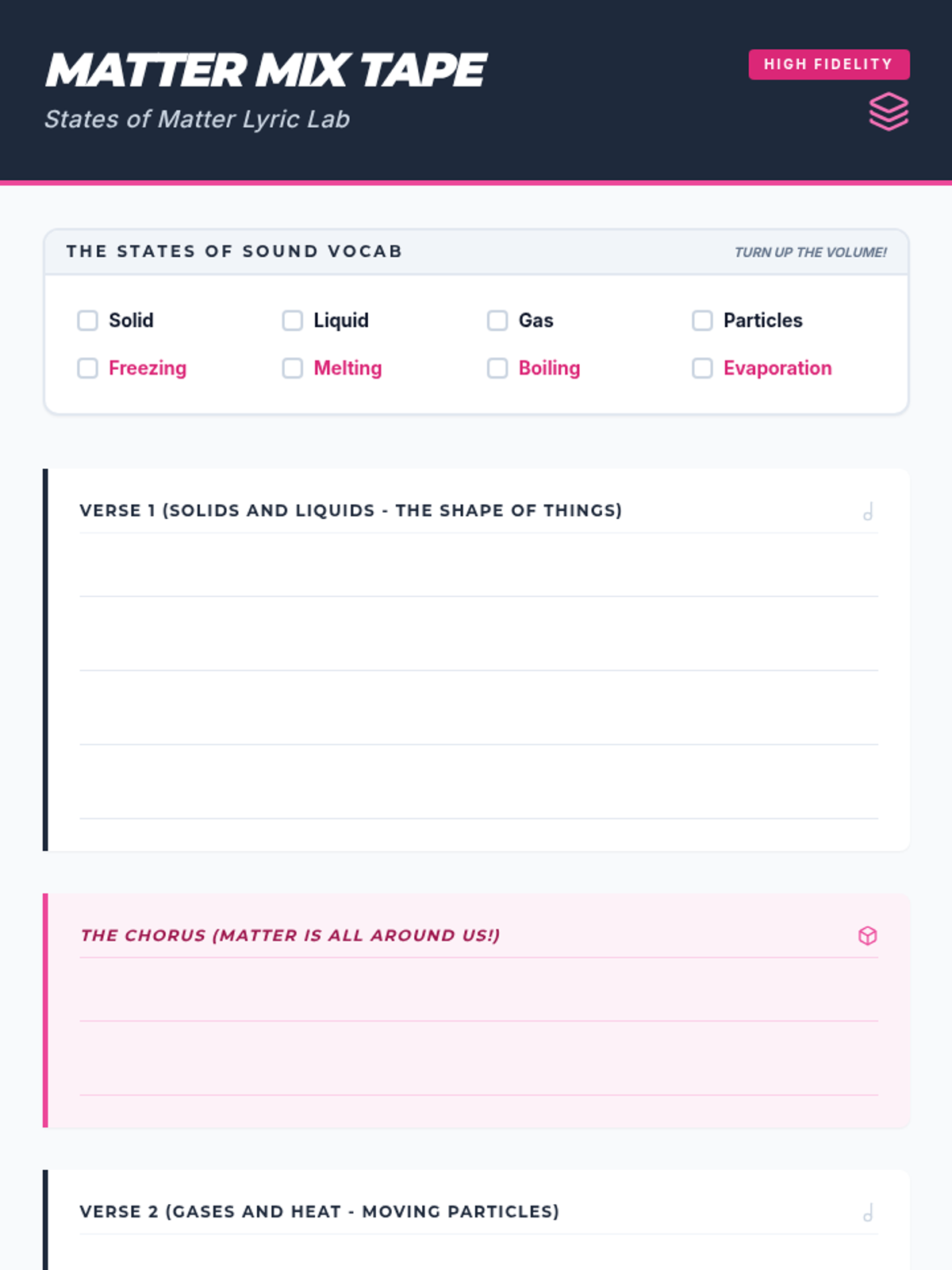
A states of matter songwriting template featuring vocabulary for solids, liquids, and gases, with dedicated sections for lyrics and musical structure.
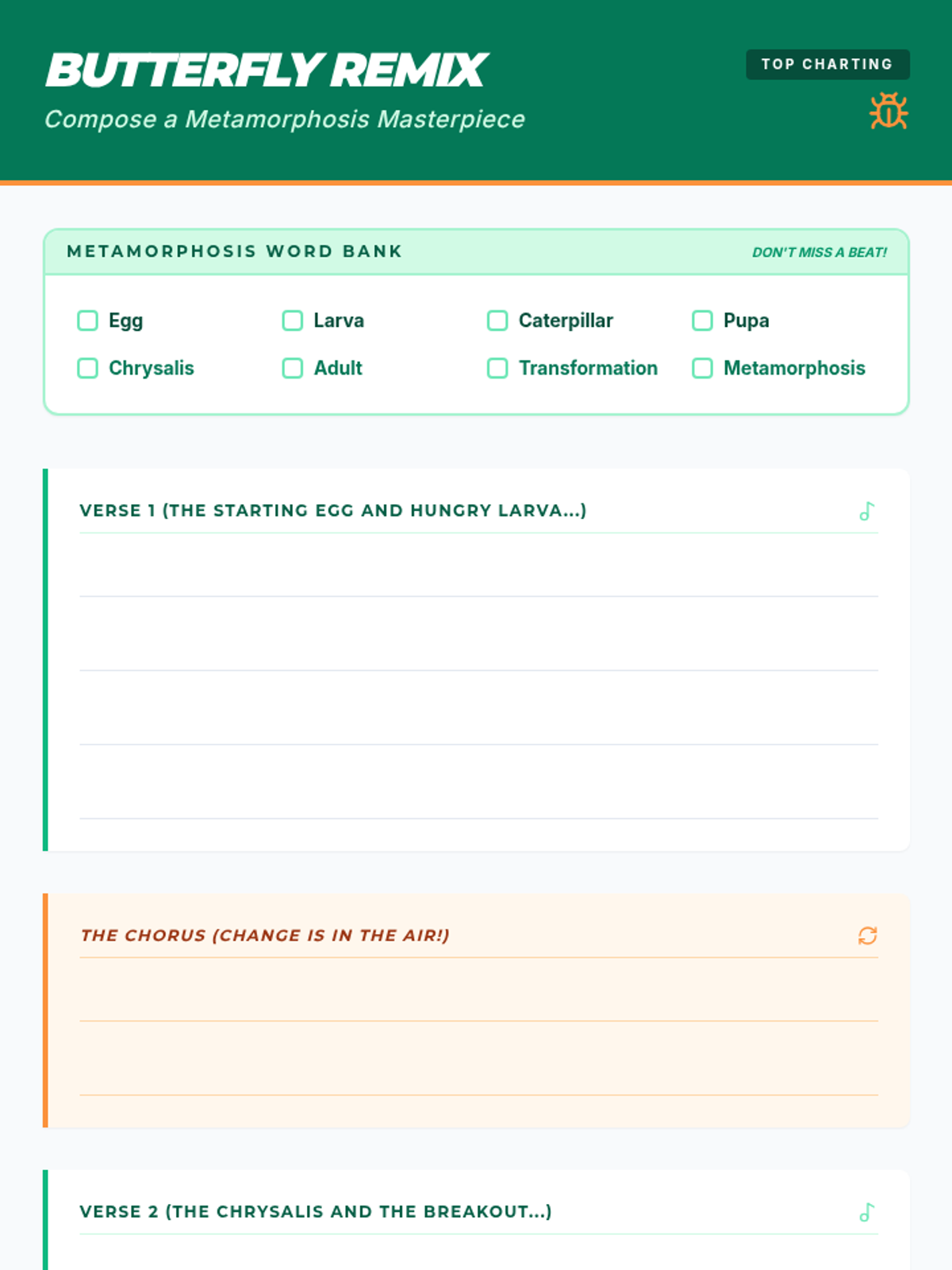
A creative song-writing sheet for the butterfly life cycle, providing vocabulary like chrysalis and metamorphosis, along with placeholders for songwriting.
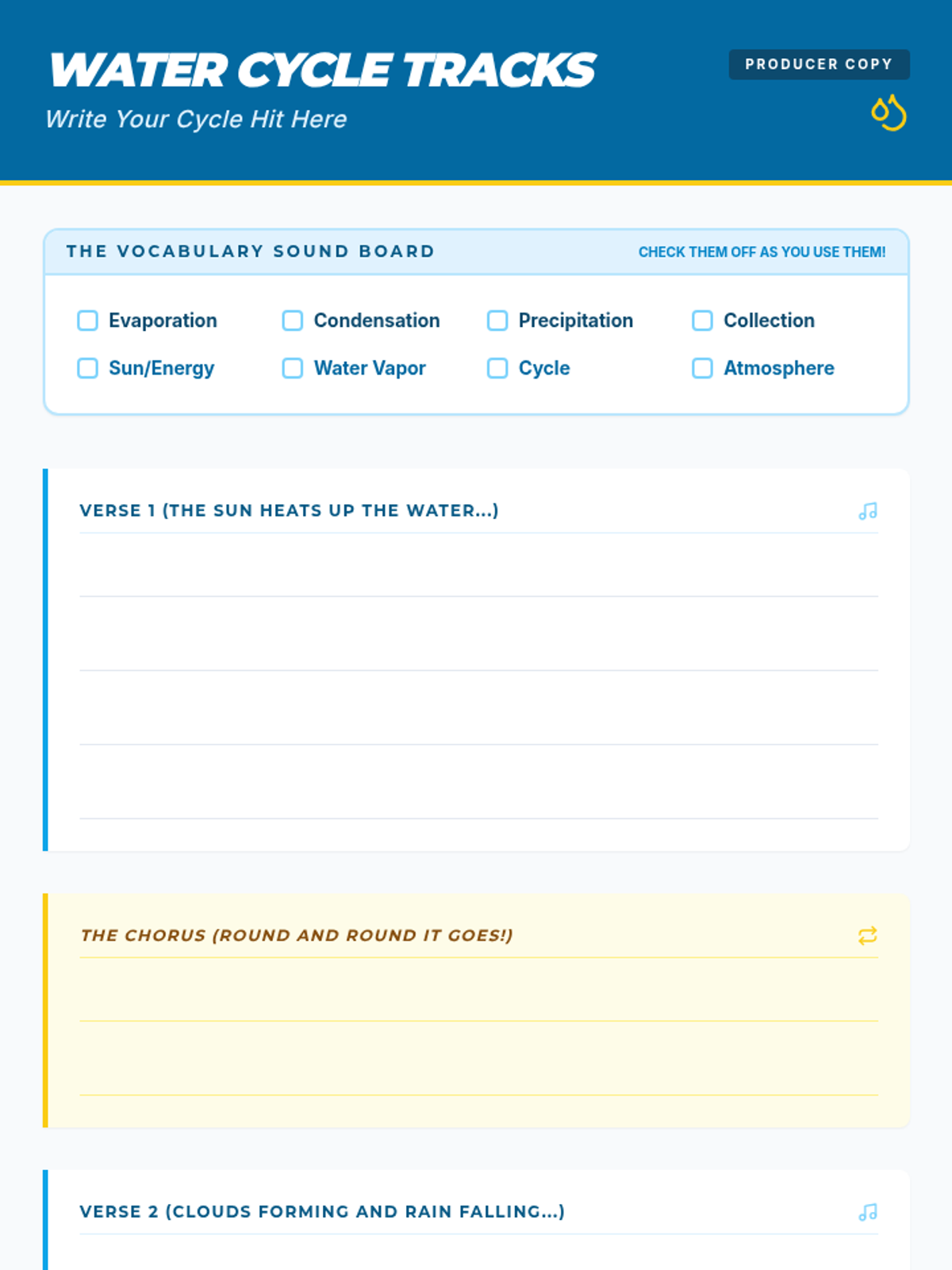
A song-writing template focused on the water cycle, featuring a vocabulary bank with key terms like evaporation and condensation, and structured sections for verses and a chorus.