Fundamental principles of force, motion, and energy across classical and modern contexts. Examines matter properties, wave behavior, thermodynamics, and electromagnetism through mechanics and atomic studies.
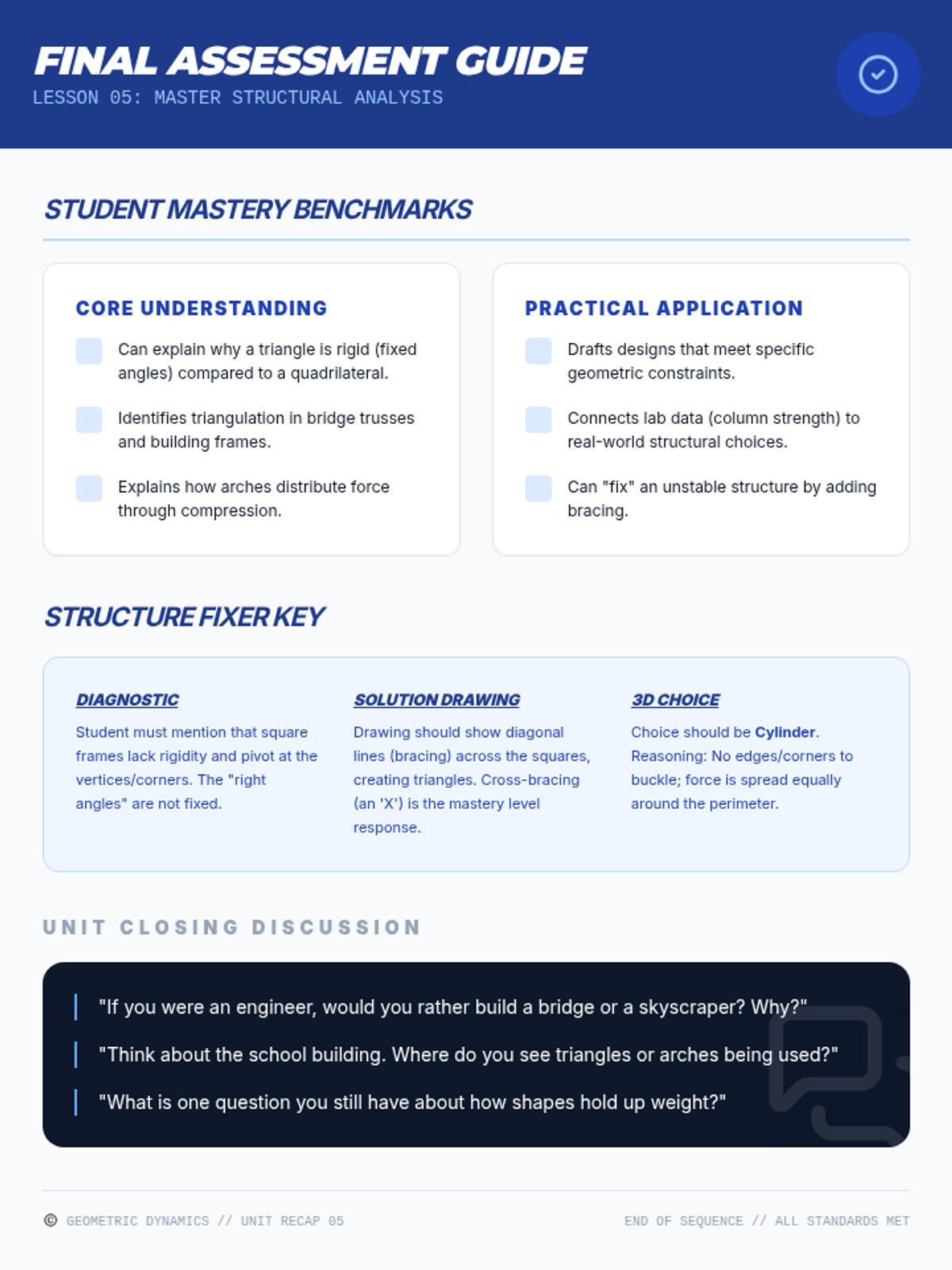
Teacher assessment guide for the final lesson. Provides a mastery checklist, answer key for the Structure Fixer worksheet, and closing discussion prompts.
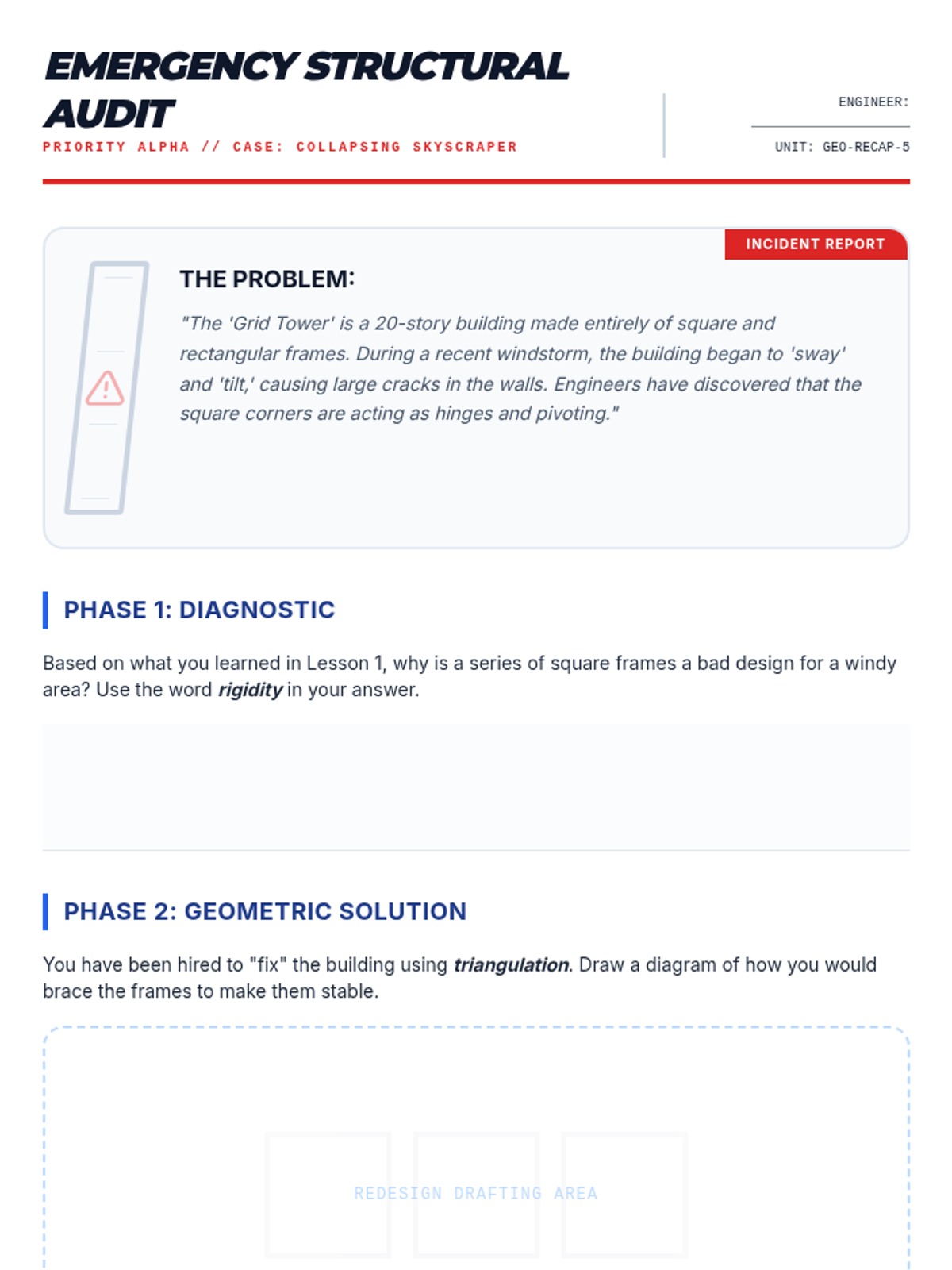
Final assessment and review worksheet. Students apply their knowledge of structural geometry to a "collapsing skyscraper" scenario.
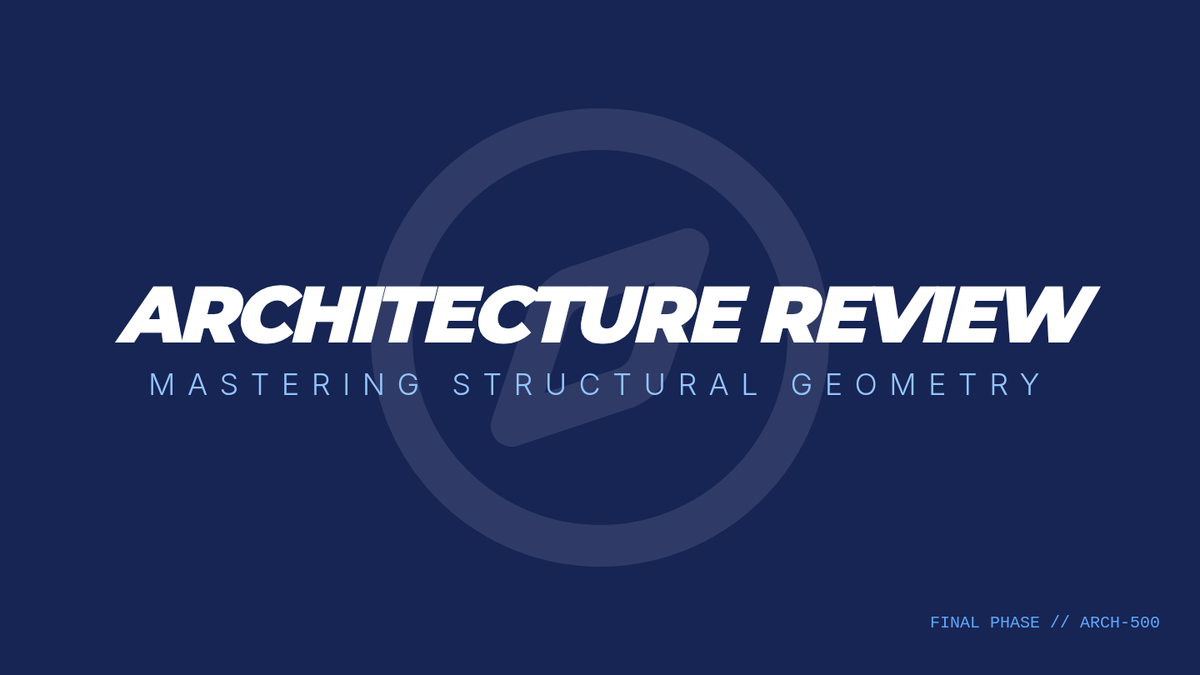
Slide deck for Lesson 5: Architecture Review. Facilitates a review of structural concepts and introduces the final peer critique and "fix-it" challenge.
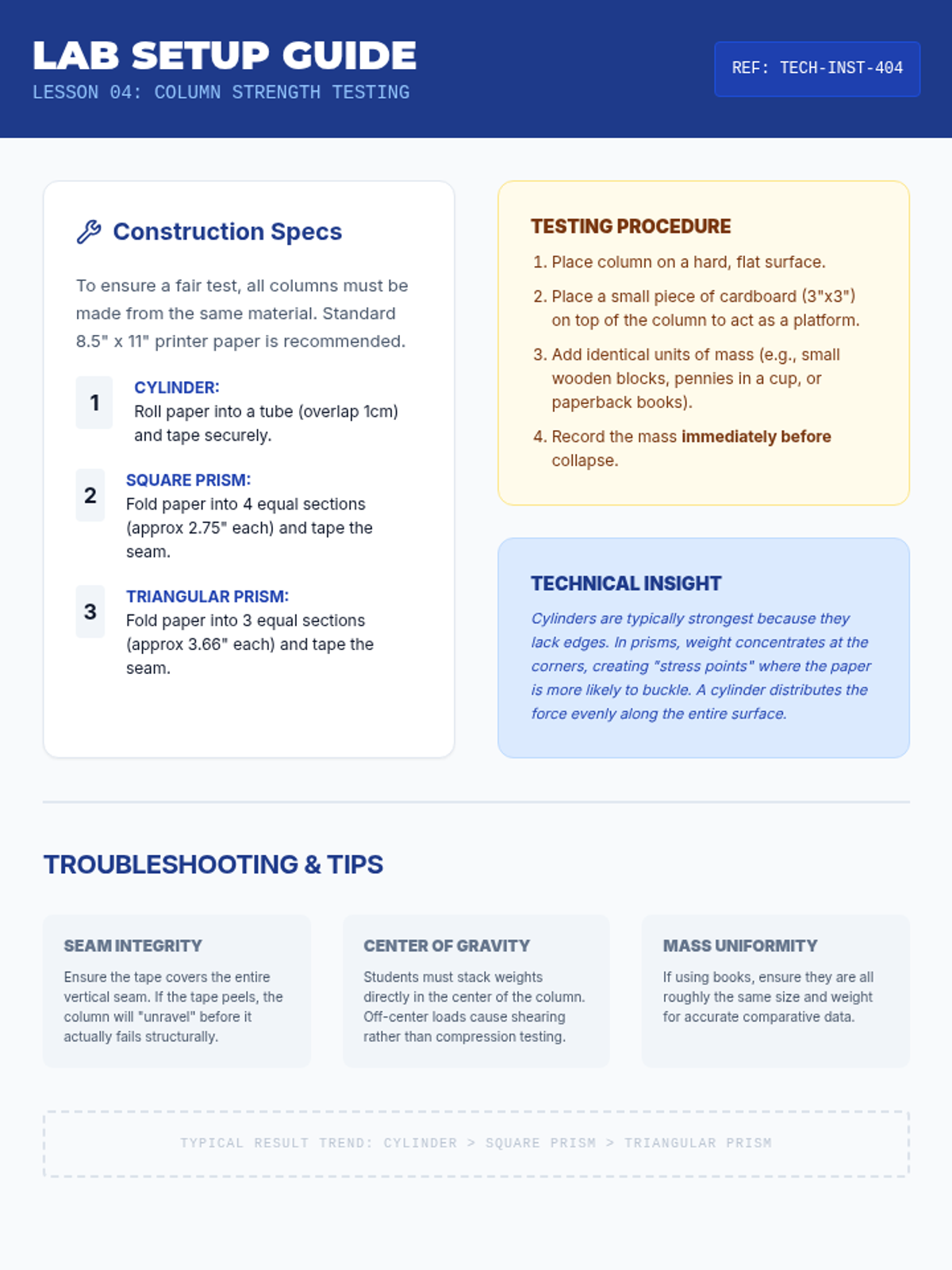
Teacher setup guide for Lesson 4. Provides instructions for folding paper column shapes and tips for a successful load-bearing experiment.
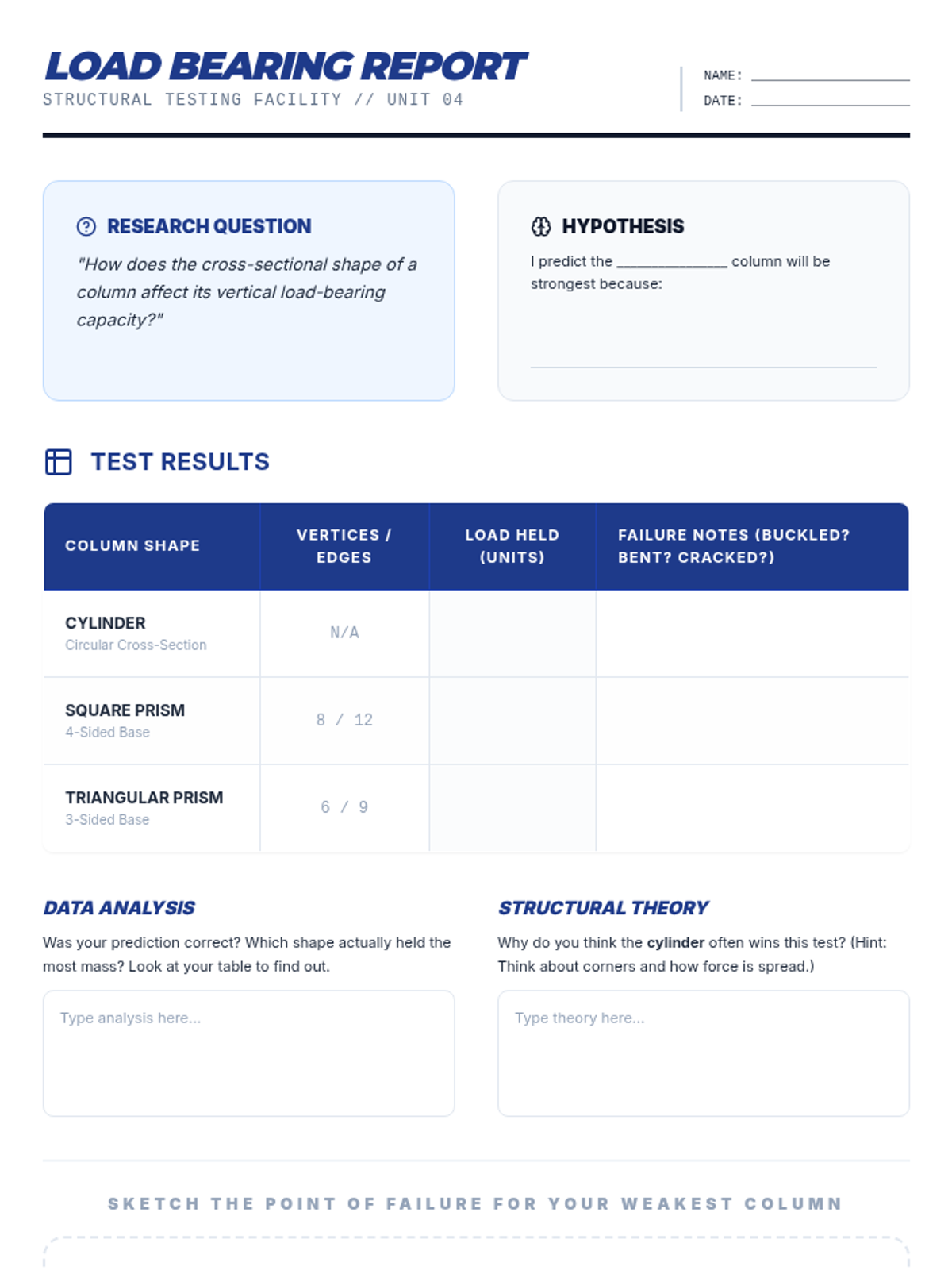
Student data collection lab report for Lesson 4. Students record the load-bearing capacity of different paper column shapes.
Slide deck for Lesson 4: Load Bearing Lab. Introduces vertical forces and sets up the paper column strength experiment.
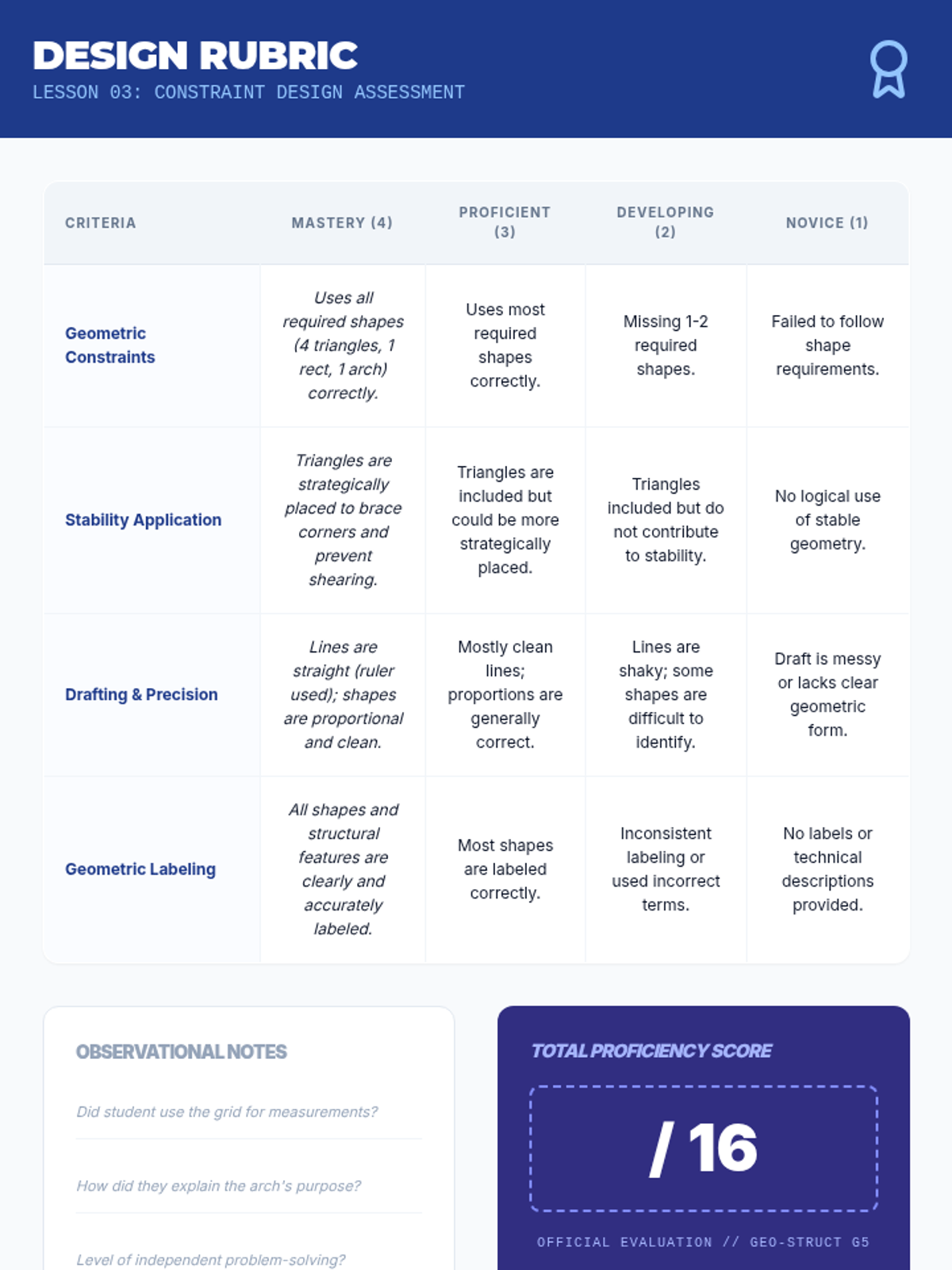
Teacher assessment rubric for the Lesson 3 design project. Evaluates adherence to constraints, stability application, and drafting precision.
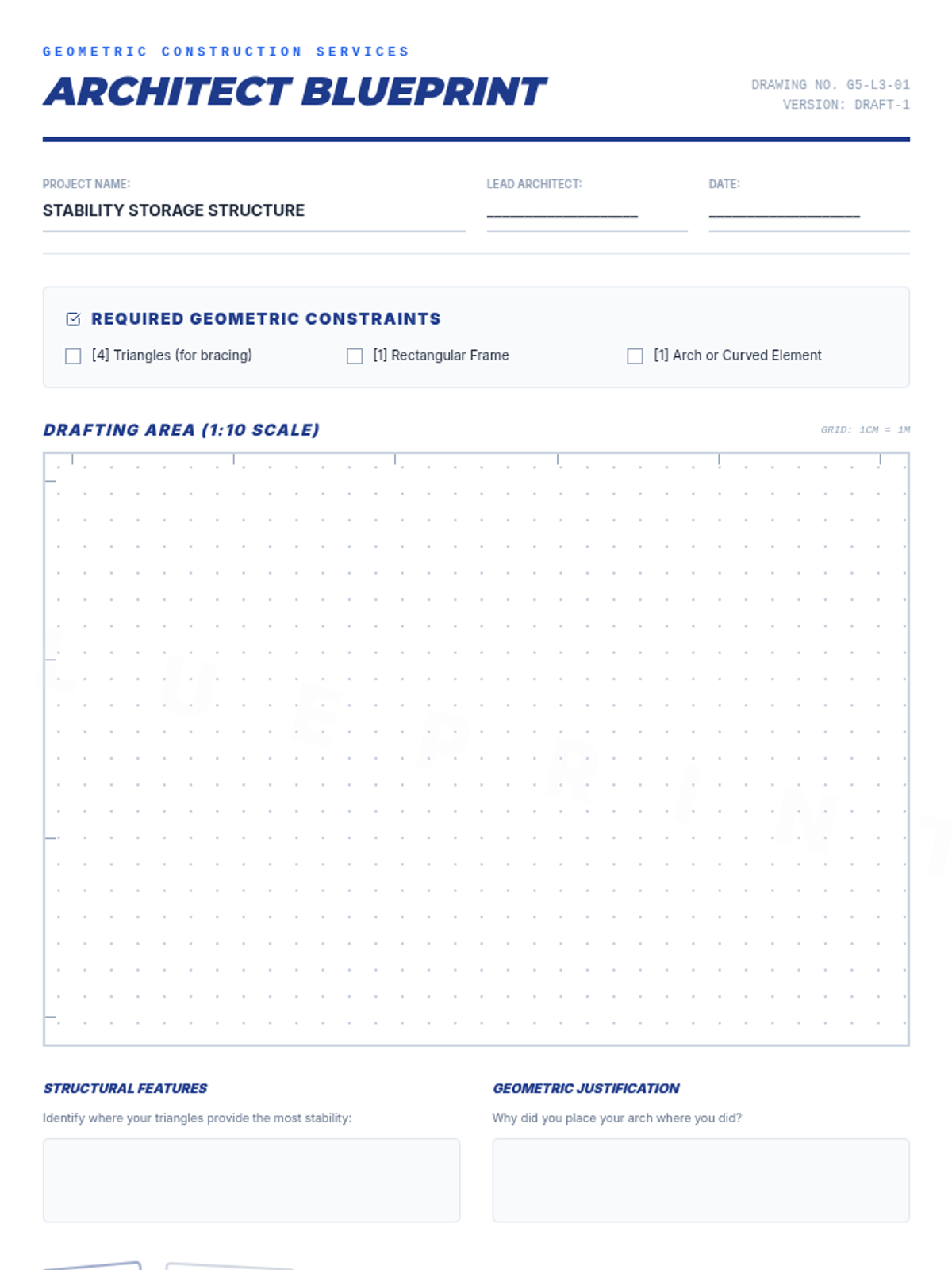
Student drafting sheet for Lesson 3. Students design a structure meeting specific geometric constraints on a grid background.
Slide deck for Lesson 3: Constraint Design. Introduces the concept of engineering constraints and sets up the design challenge.
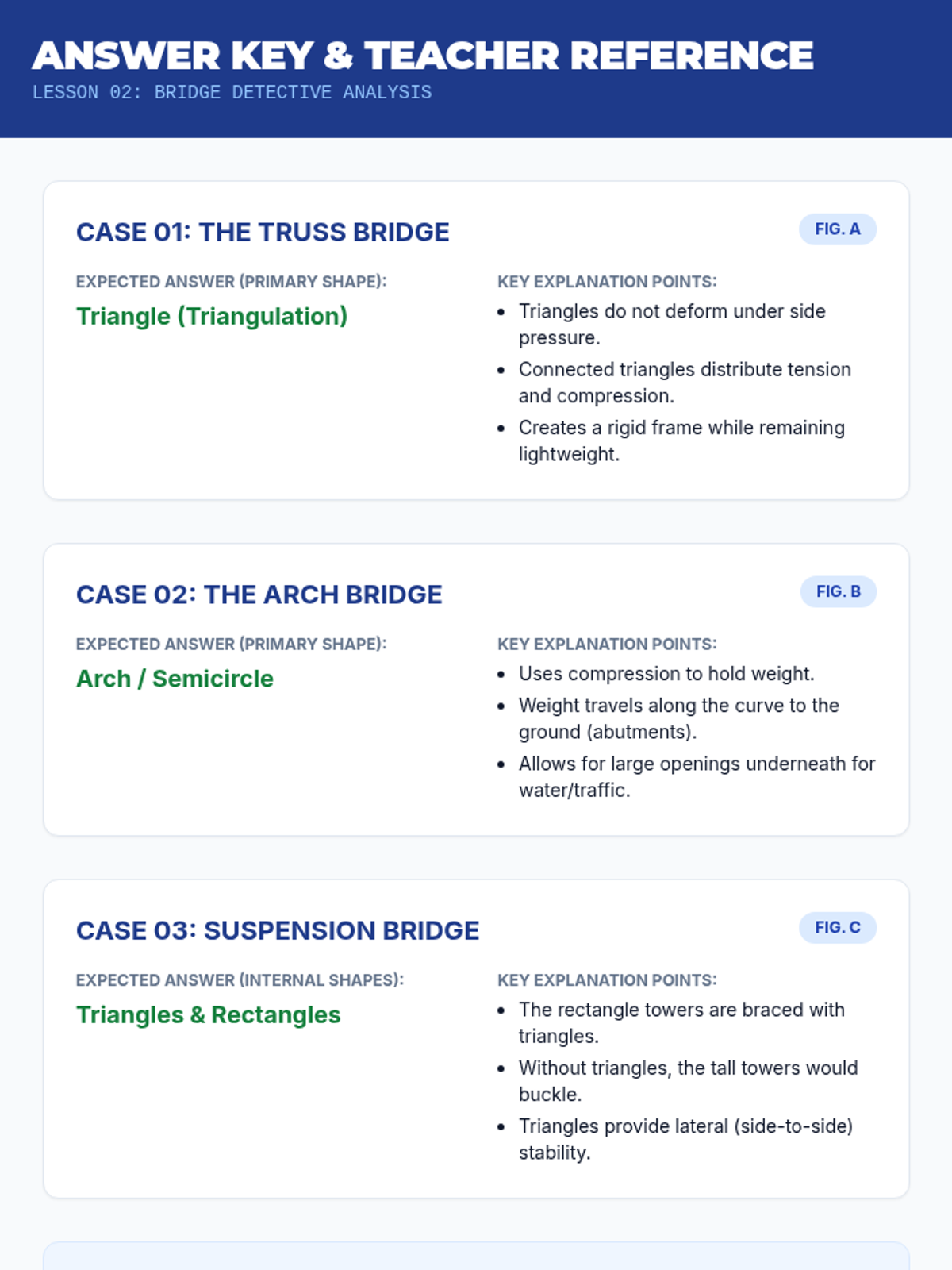
Teacher answer key for the Bridge Detective worksheet. Provides expected student responses and discussion prompts.
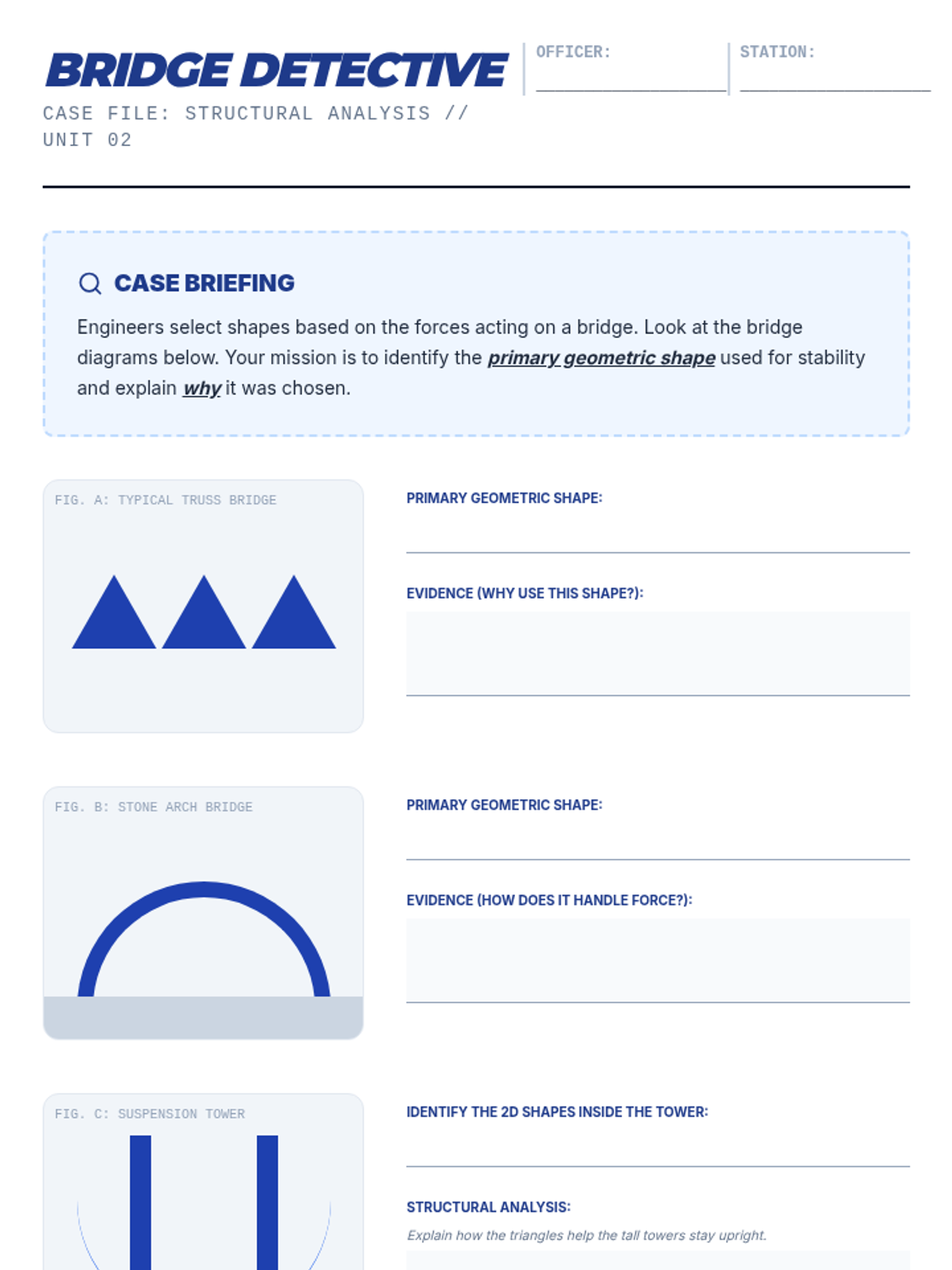
Student activity worksheet for Lesson 2. Students identify and analyze geometric shapes in different types of bridge designs.
Slide deck for Lesson 2: Bridge Components. Explores real-world bridge designs including trusses and arches, focusing on their geometric properties.
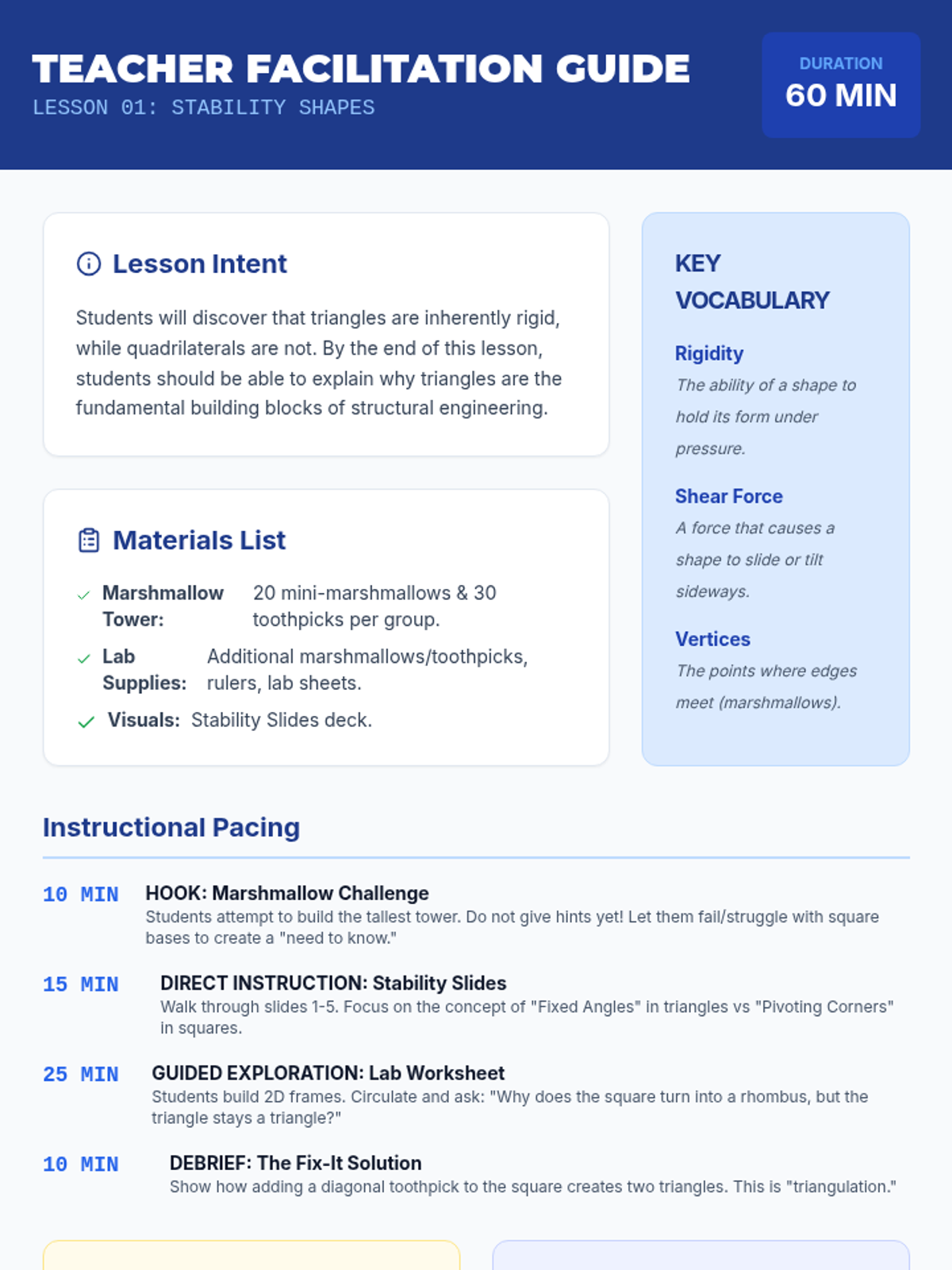
Teacher facilitation guide for Lesson 1. Includes pacing, vocabulary, common misconceptions, and differentiation strategies.
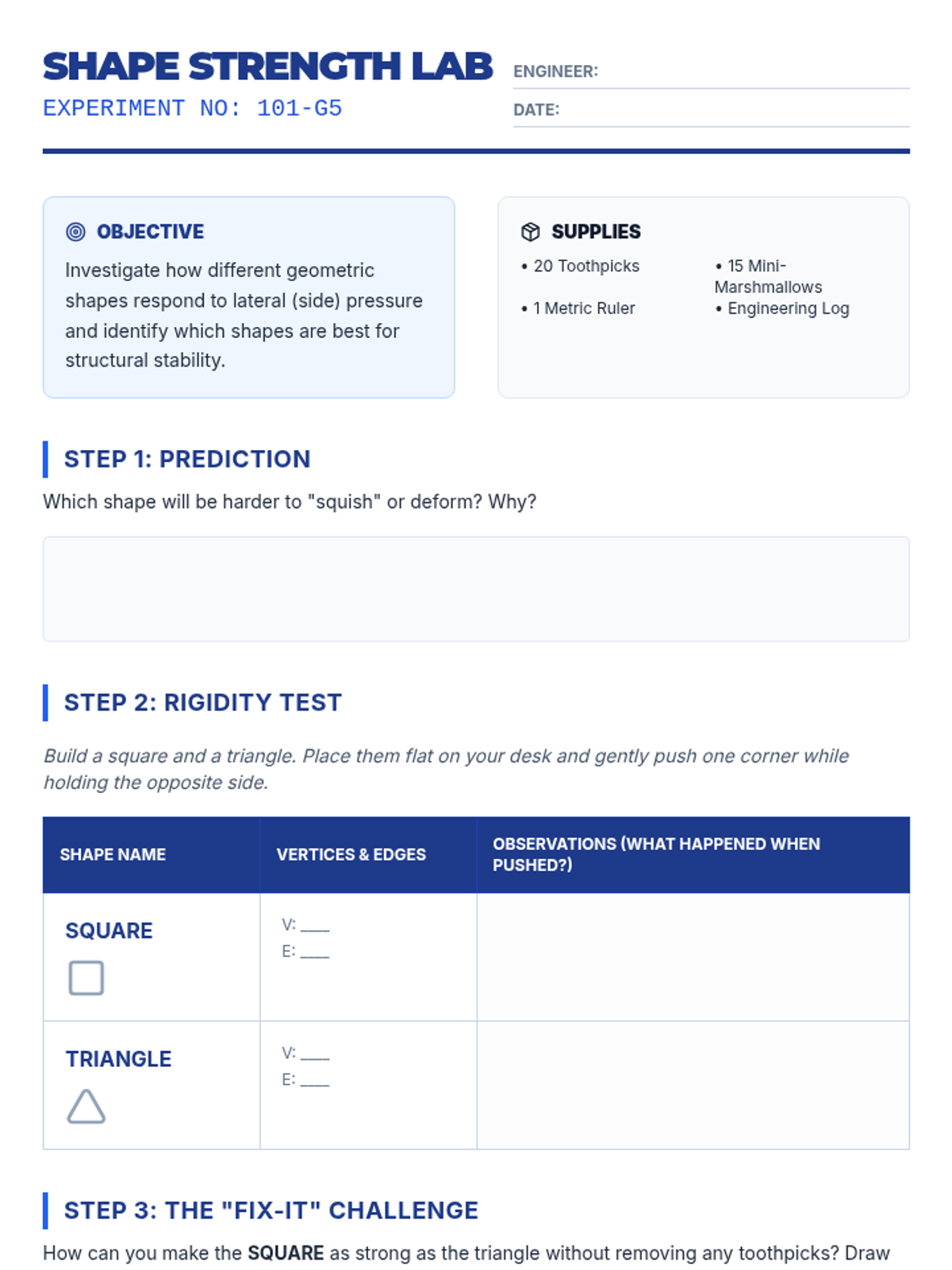
Student lab worksheet for Lesson 1. Guides students through building and testing the rigidity of triangles and squares.
Slide deck for Lesson 1: Stability Shapes. Introduces structural rigidity, compares triangles and squares, and sets up the marshmallow tower hook.
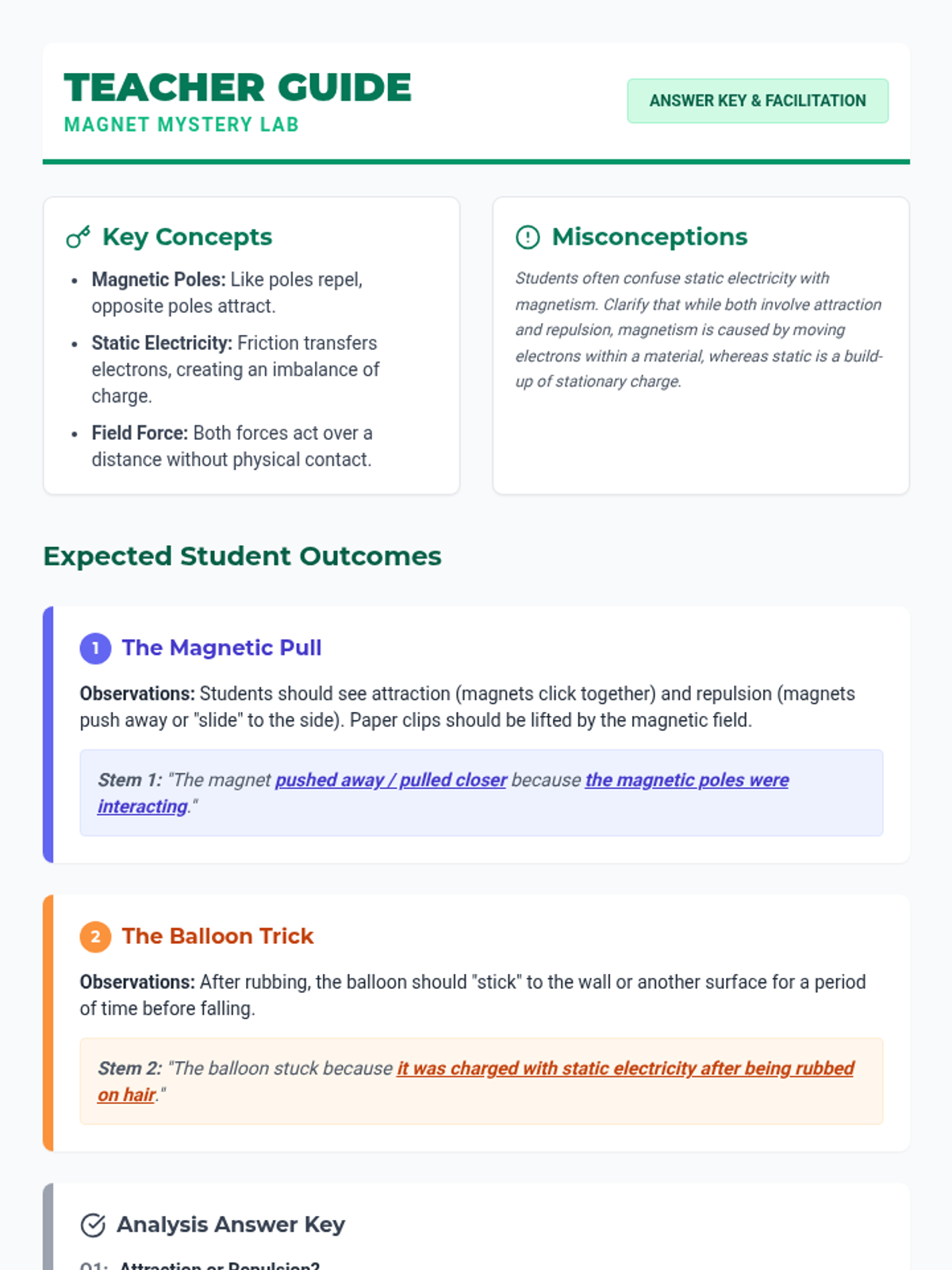
A teacher guide and answer key for the Magnet Mystery Lab, providing expected observations, completed sentence stems, and pedagogical tips for addressing common student misconceptions about magnetism and static electricity.
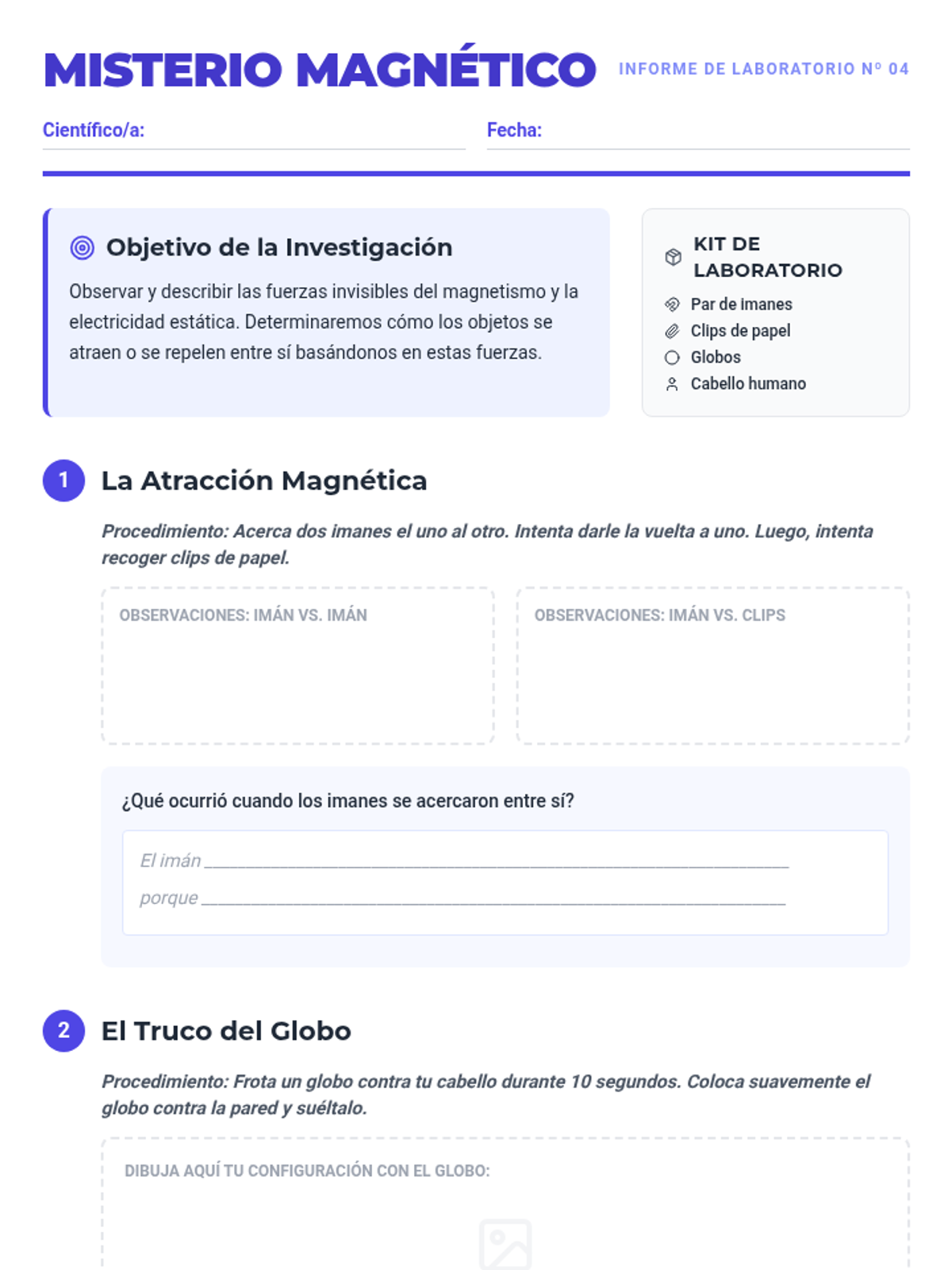
A structured lab report for the Magnet Investigation Lab, featuring specific sections for materials, procedures, observations, and guided analysis with sentence stems. The layout includes sketching areas and checkboxes for easy student recording.
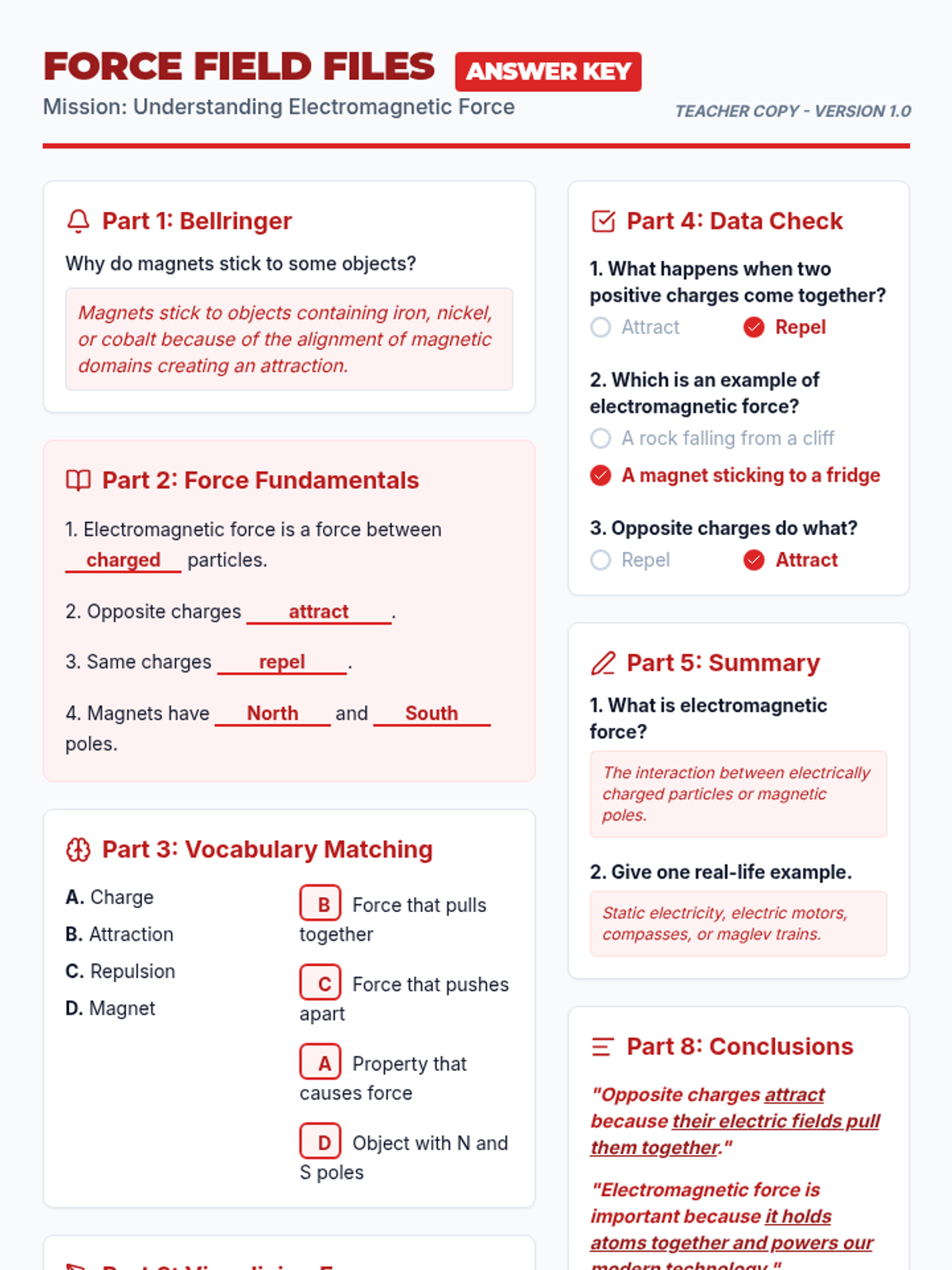
The teacher answer key for the Force Field Handout, providing all correct answers, suggested responses for open-ended questions, and diagram examples.
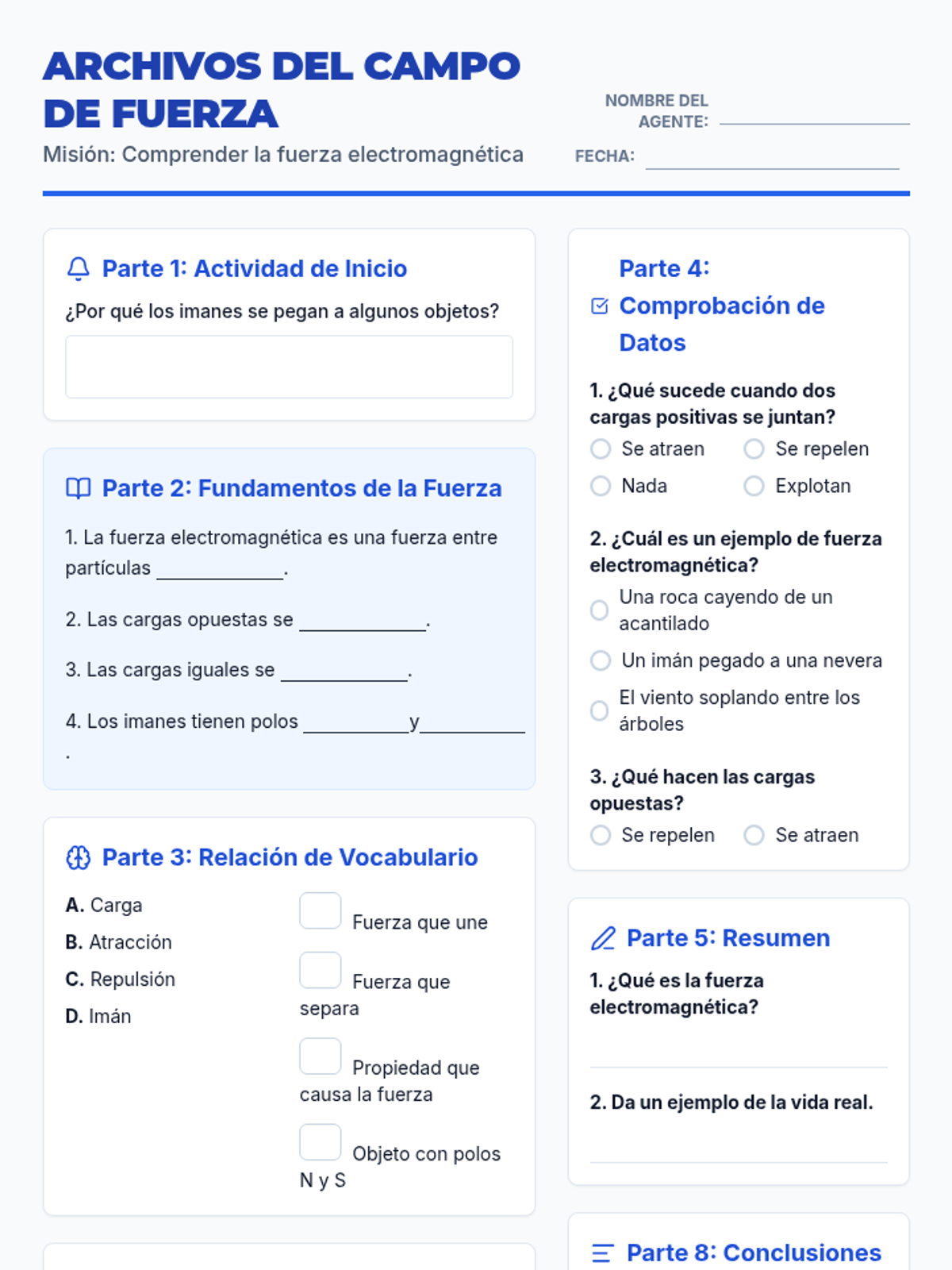
A comprehensive one-page student handout covering the basics of electromagnetic force. It includes guided notes, vocabulary matching, diagrams, and new application scenarios for higher-order thinking.
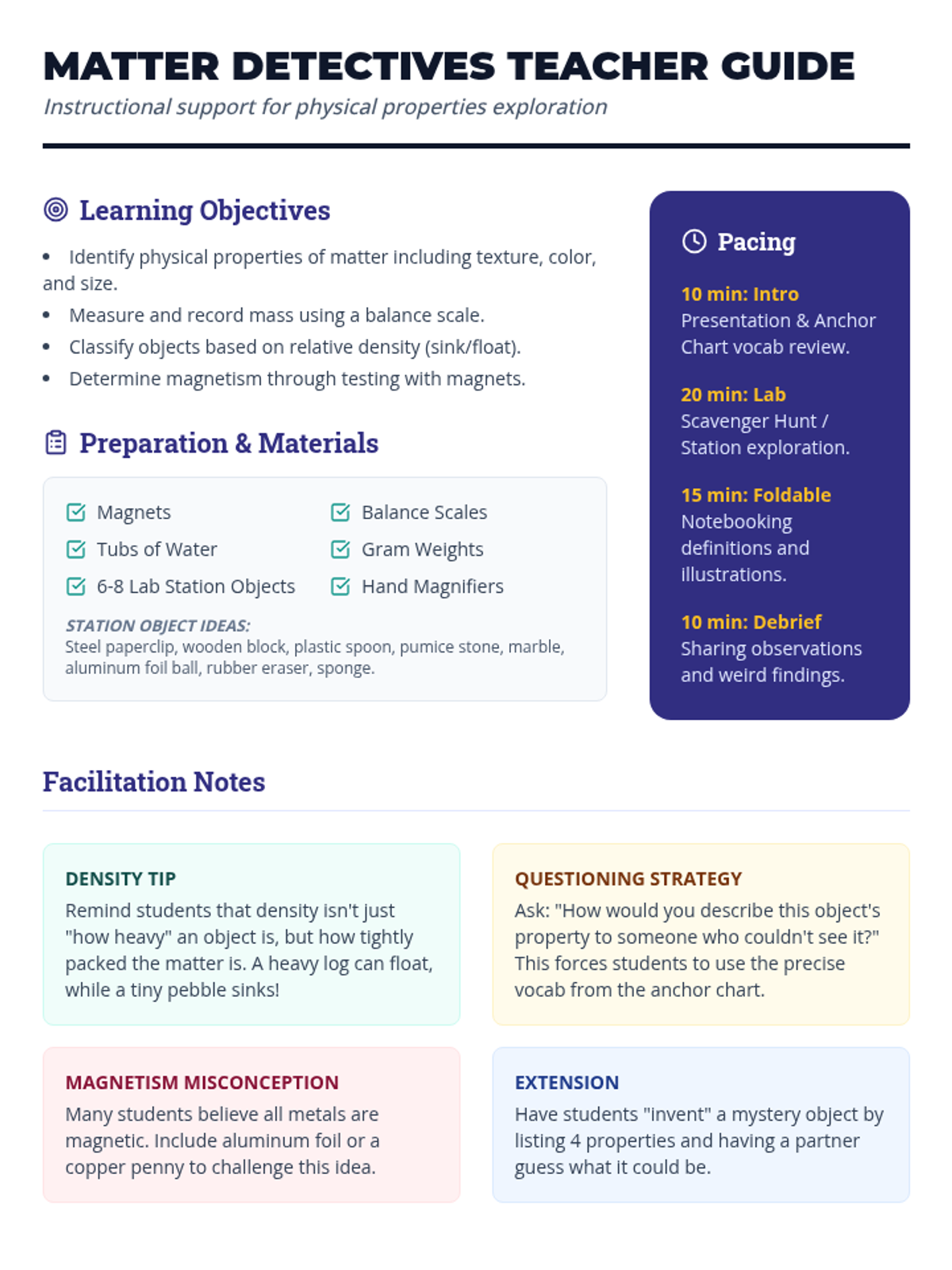
A comprehensive teacher facilitation guide with learning objectives, material lists, pacing suggestions, and strategies for addressing common student misconceptions about physical properties.
A high-impact slide deck for introducing physical properties of matter, including a digital anchor chart, scavenger hunt mission brief, and interactive notebook instructions.
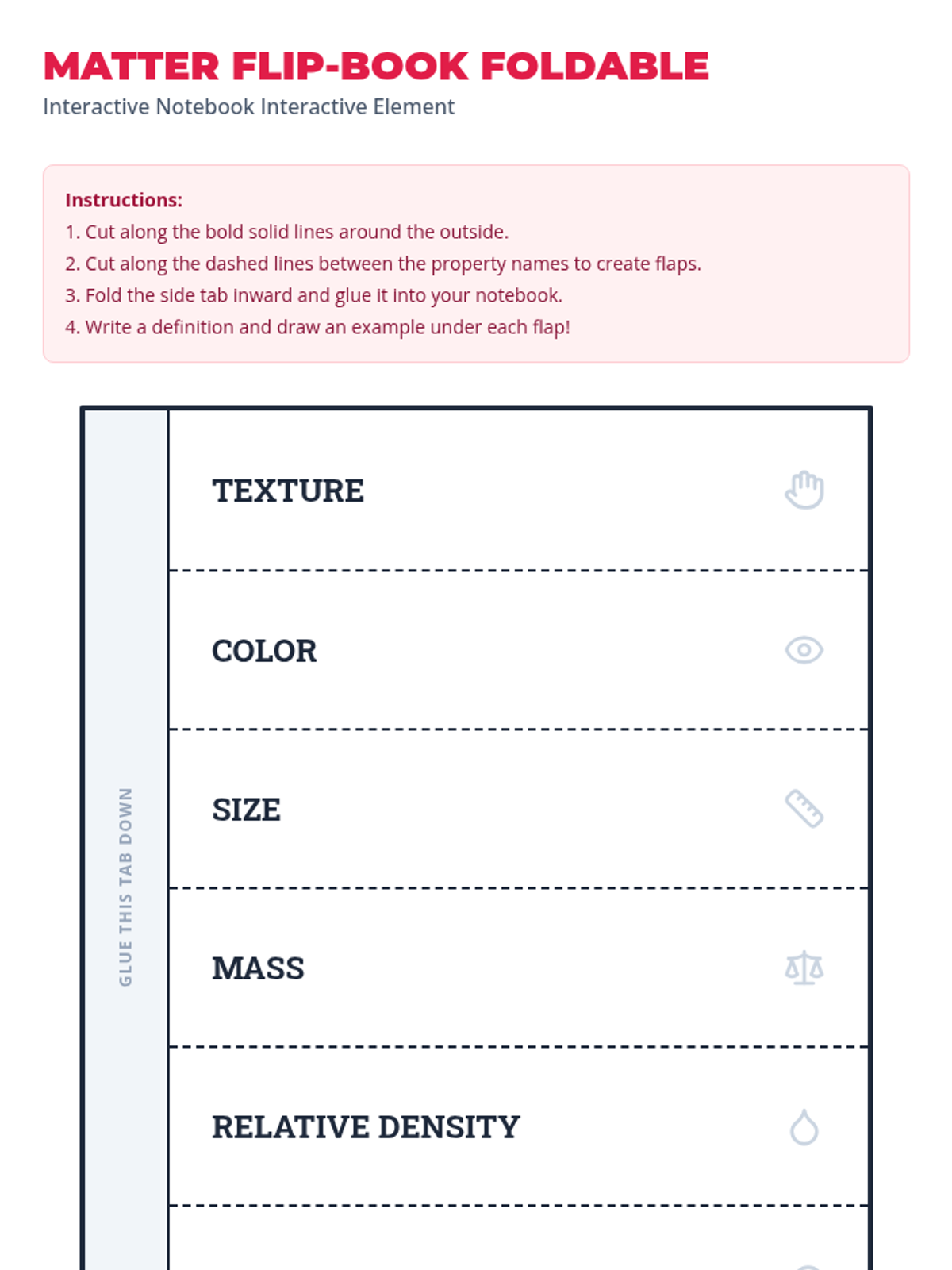
An interactive notebook foldable template with cut-lines and tabs for students to define and illustrate the six physical properties of matter.
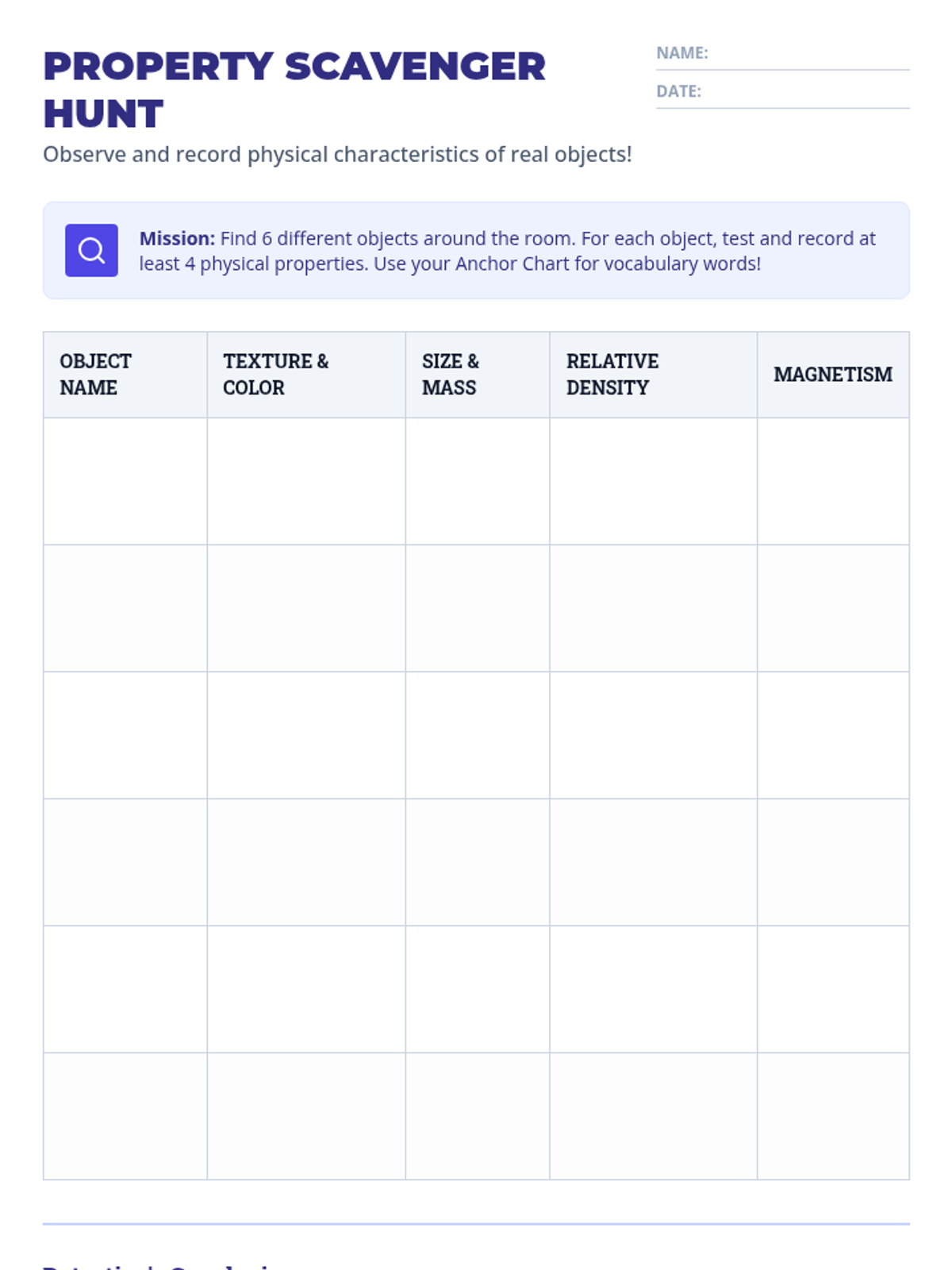
A structured recording sheet for a physical properties scavenger hunt, providing space for students to document observations of six different objects across multiple property categories.
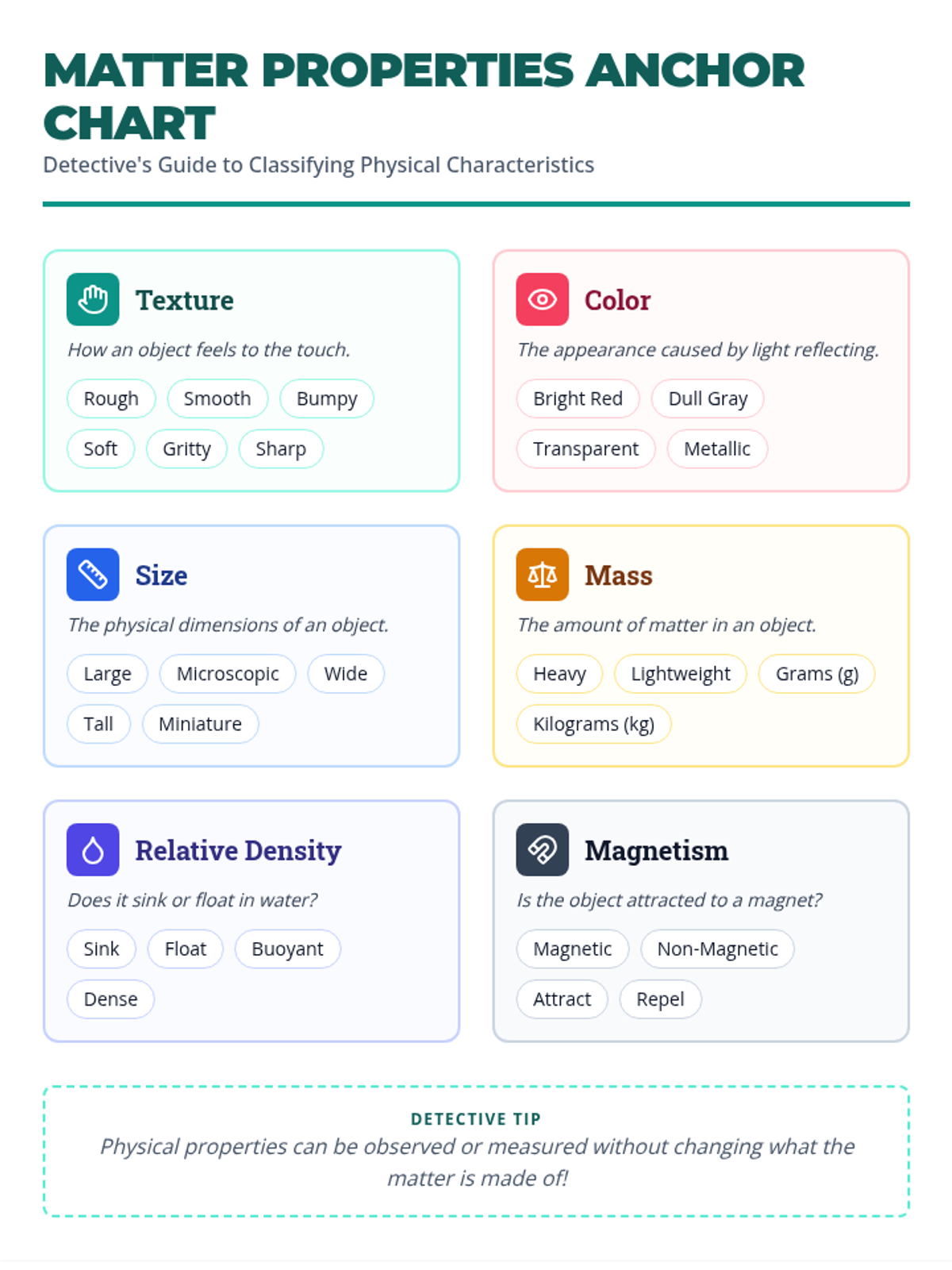
A colorful, structured anchor chart defining six key physical properties of matter with descriptive vocabulary words for each category.
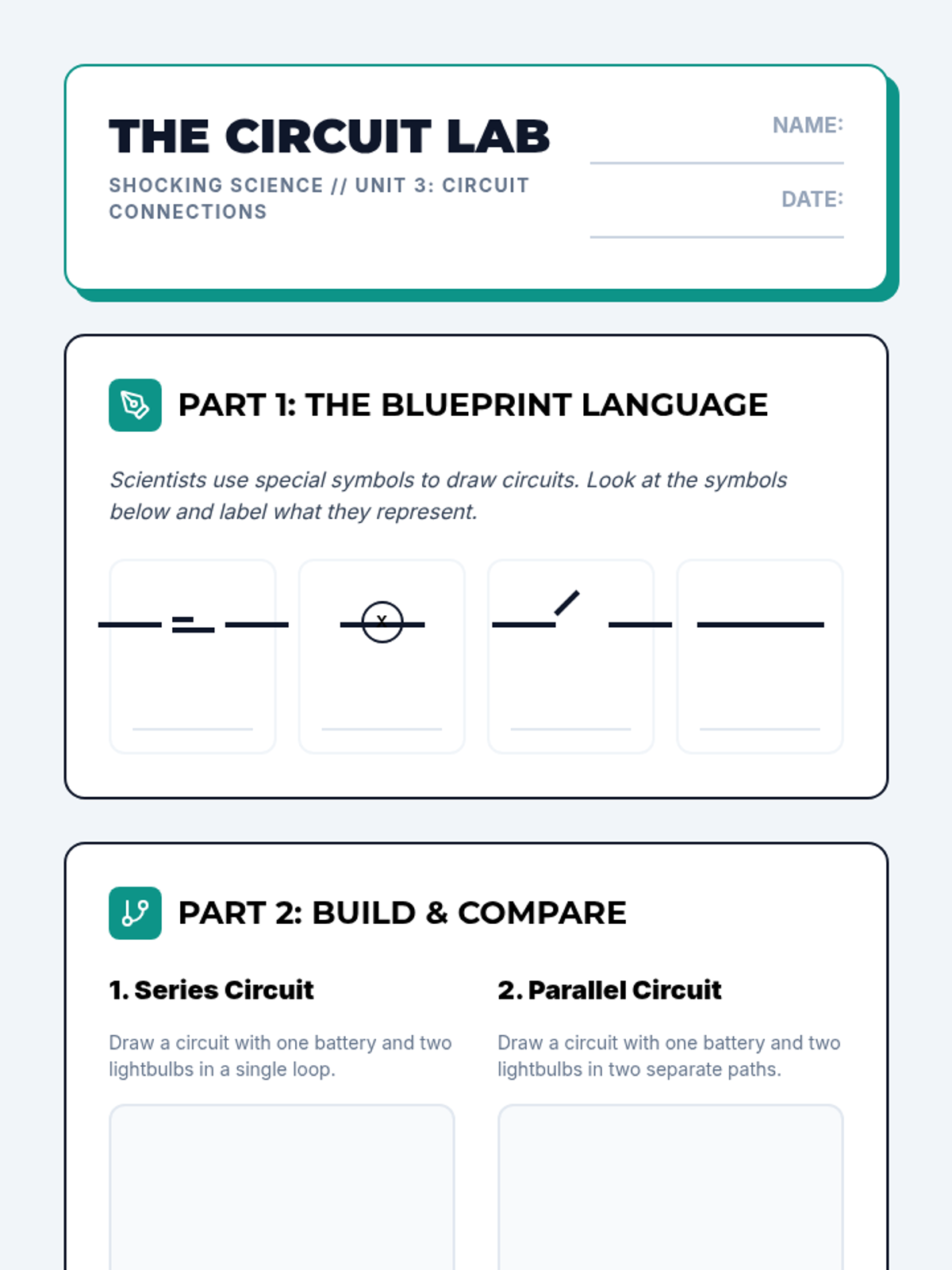
A student lab sheet for drawing circuit diagrams, testing series and parallel circuits, and identifying conductors and insulators.
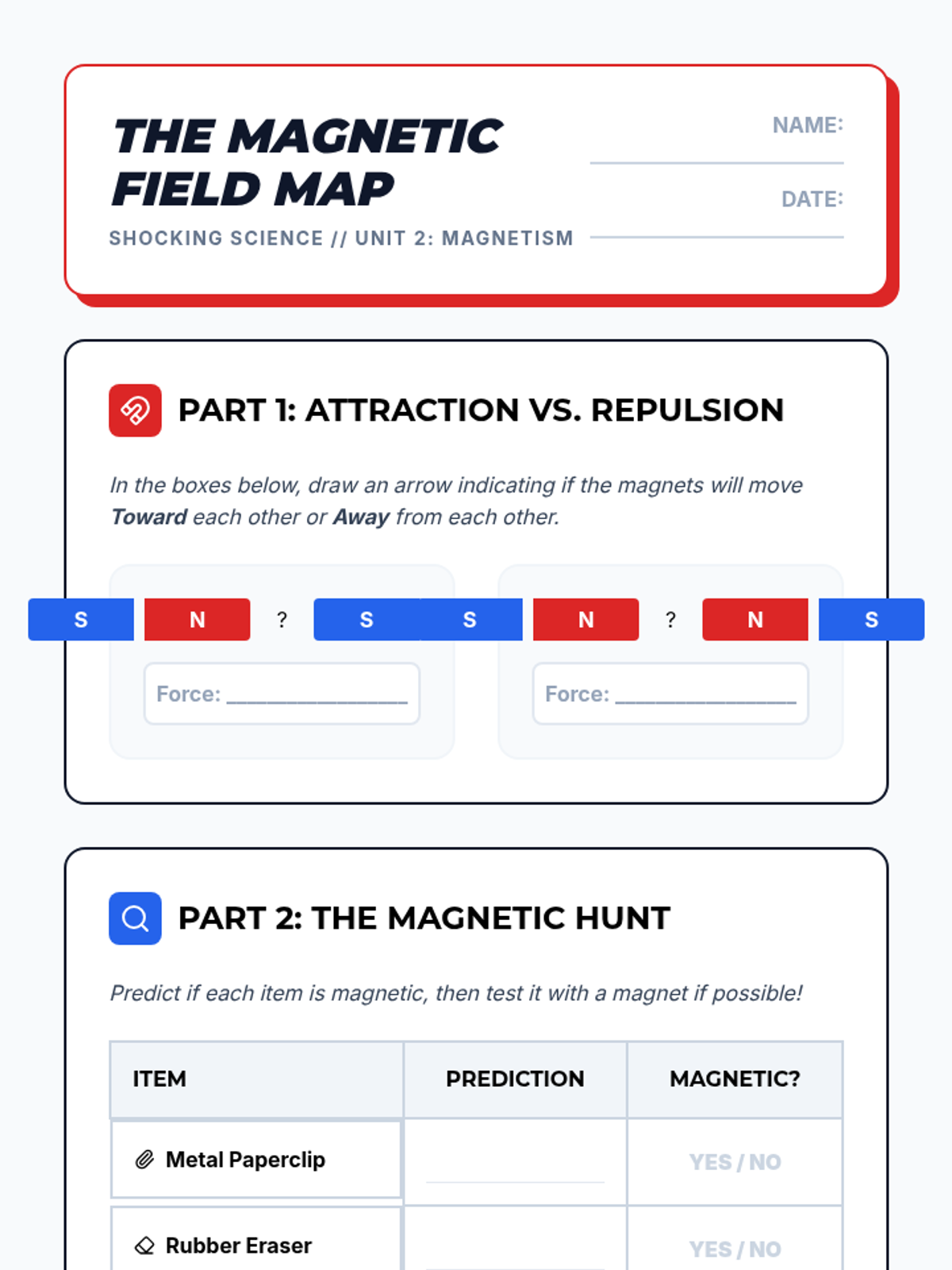
A student activity sheet for predicting magnetic forces, conducting a magnetism hunt, and sketching magnetic field lines.
A visual-heavy slide deck exploring series and parallel circuits, conductors, insulators, and circuit components.
A visual-heavy slide deck exploring magnetic poles, attraction and repulsion, magnetic fields, and real-world applications of magnetism.
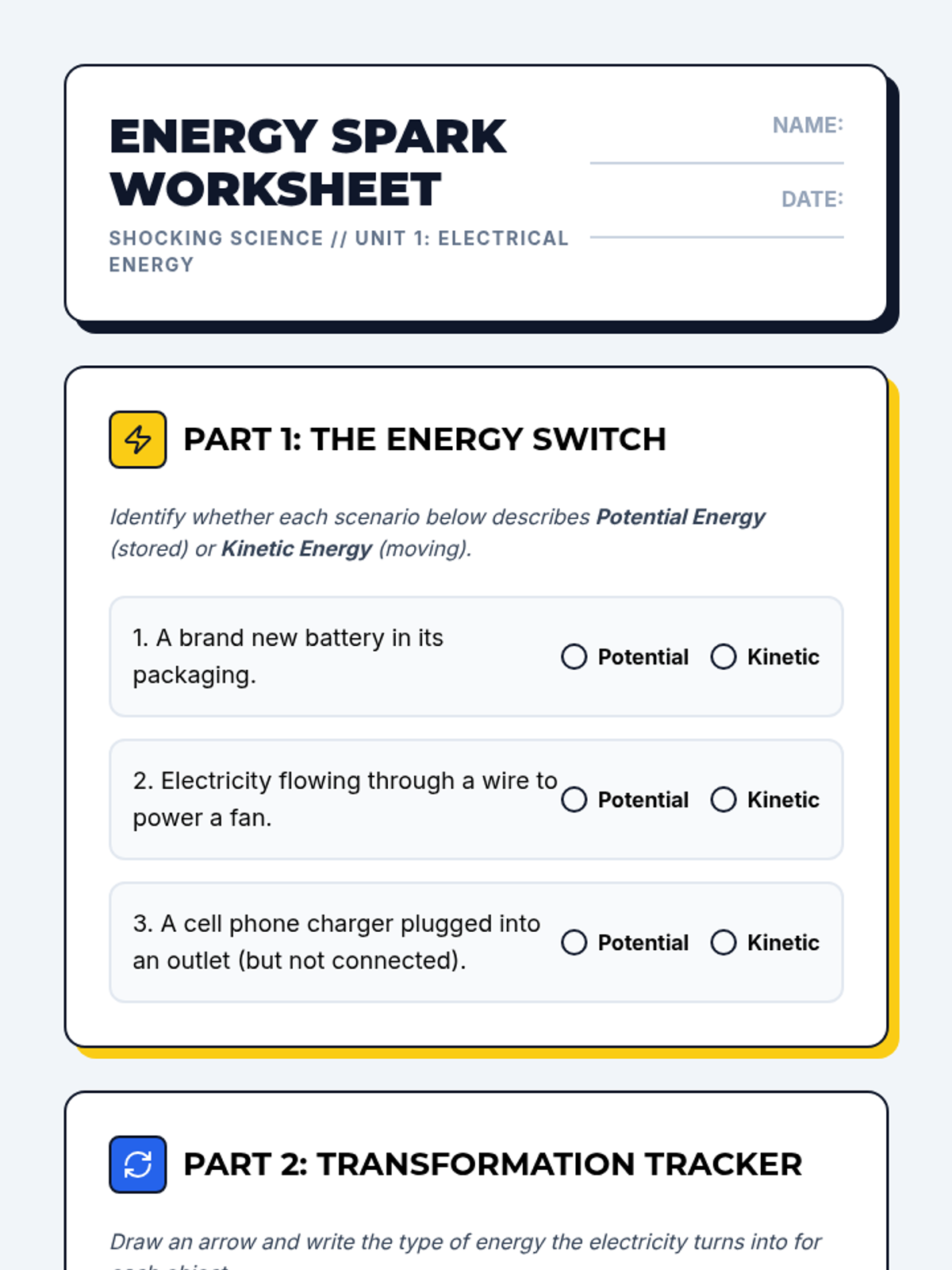
A student worksheet for identifying potential and kinetic electrical energy and tracking energy transformations in everyday objects.
A visual-heavy slide deck introducing the concept of electrical energy, potential vs. kinetic energy, and energy transformations.
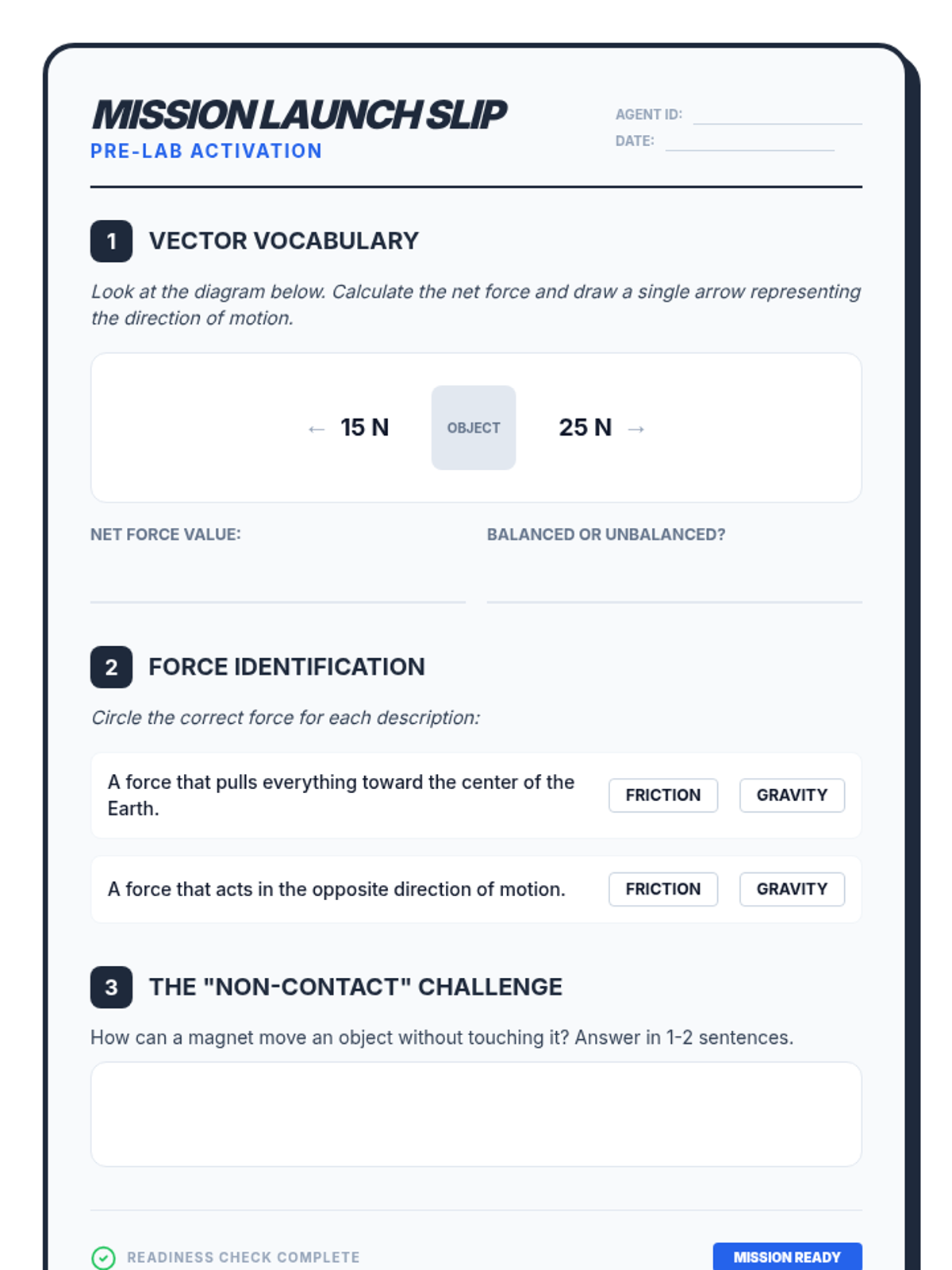
A quick warm-up slip ("Mission Launch Slip") designed to activate student knowledge on net force, gravity, and friction before starting the stations.
A visual presentation for the Force Frenzy stations, including instructional slides, rotation protocols, a station timer, and debrief questions.
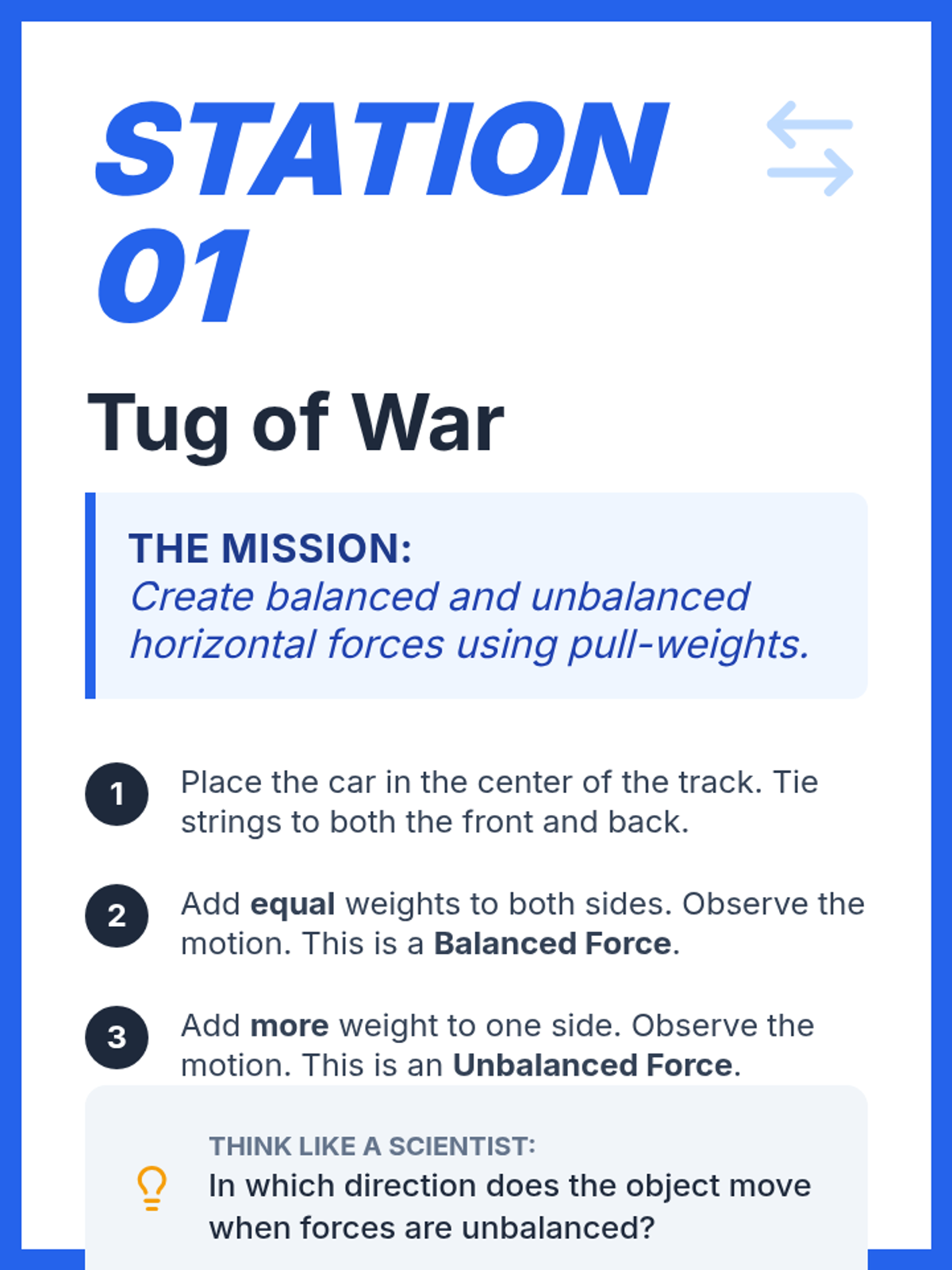
Large-format instructional cards for each of the five stations, featuring clear objectives, procedures, and prompting questions.
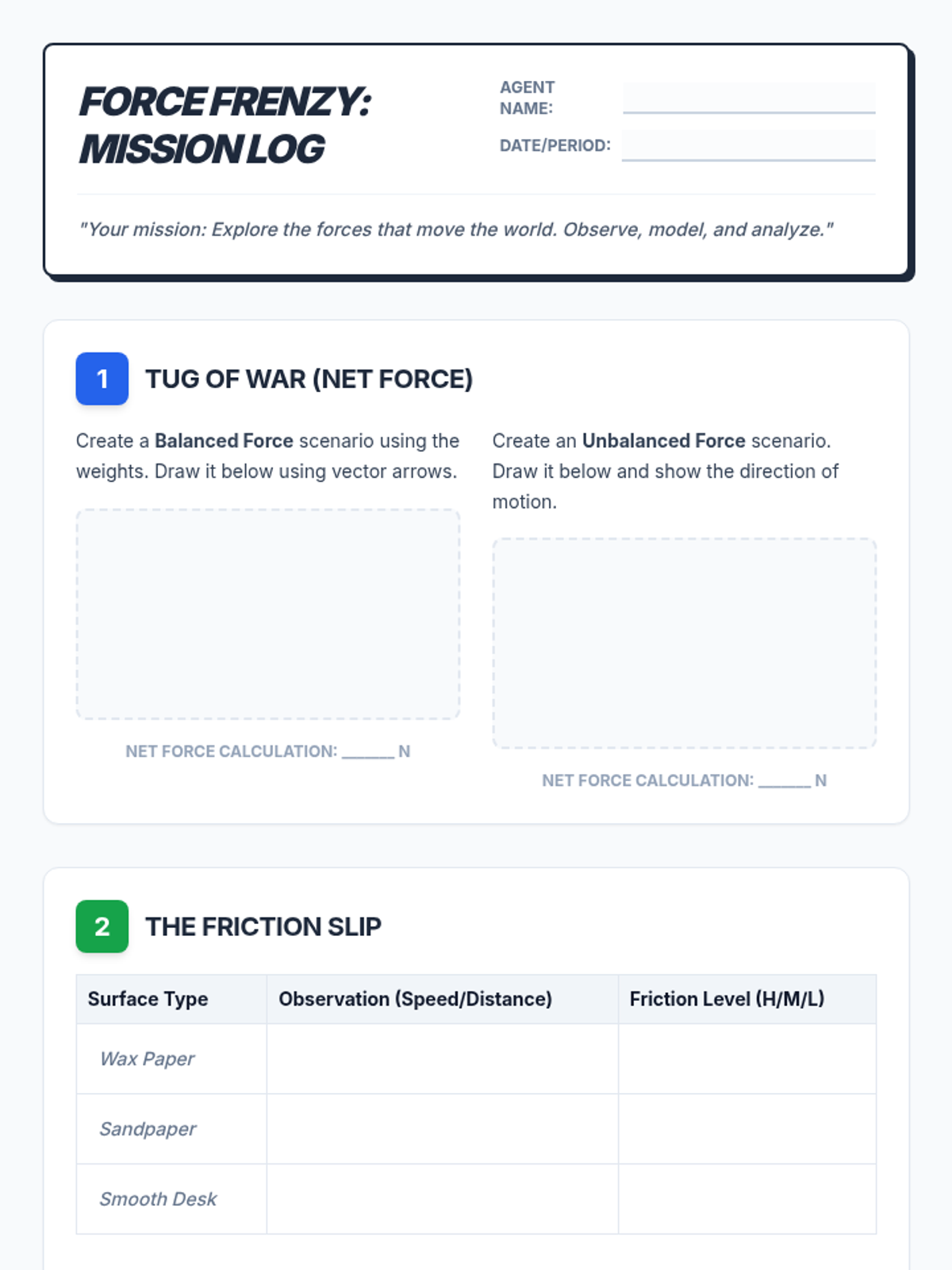
The student recording sheet for the Force Frenzy stations, featuring space for drawings, data tables, and reflection questions.
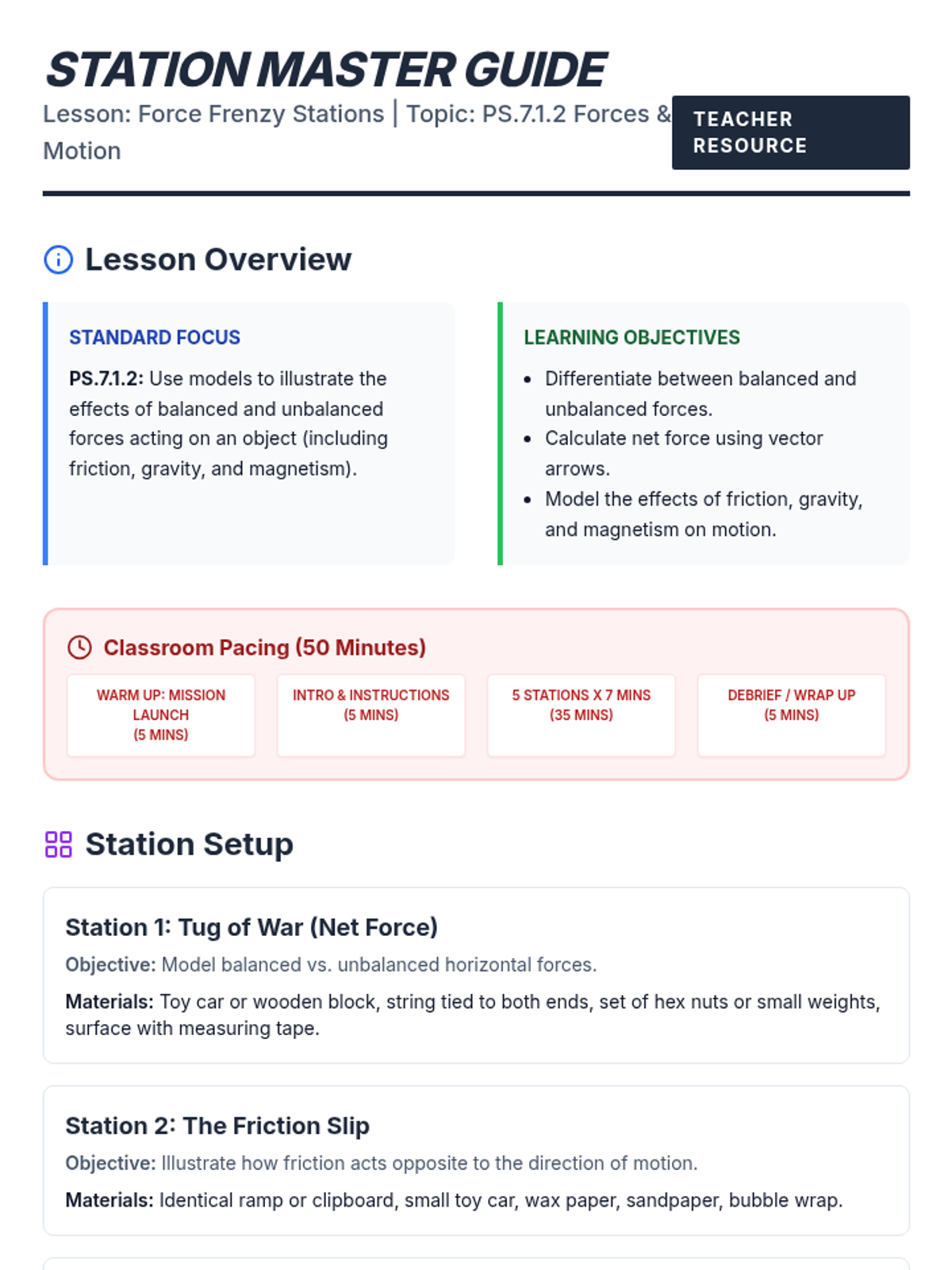
A comprehensive teacher guide for the Force Frenzy stations, including setup instructions, materials lists, pacing advice, and an answer key.
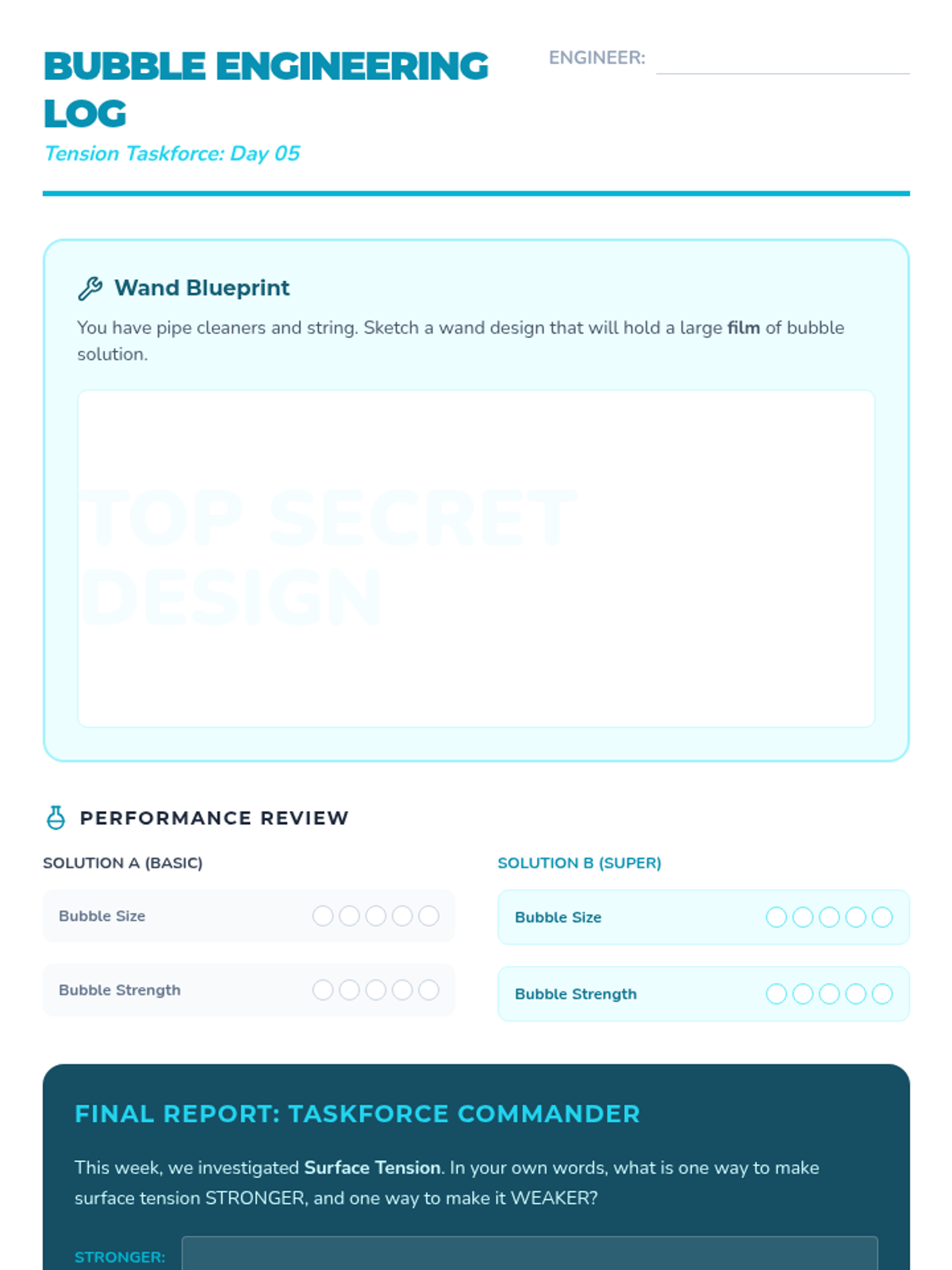
A student design and testing log for the final Day 5 bubble-building challenge, including space for wand blueprints and solution performance ratings.
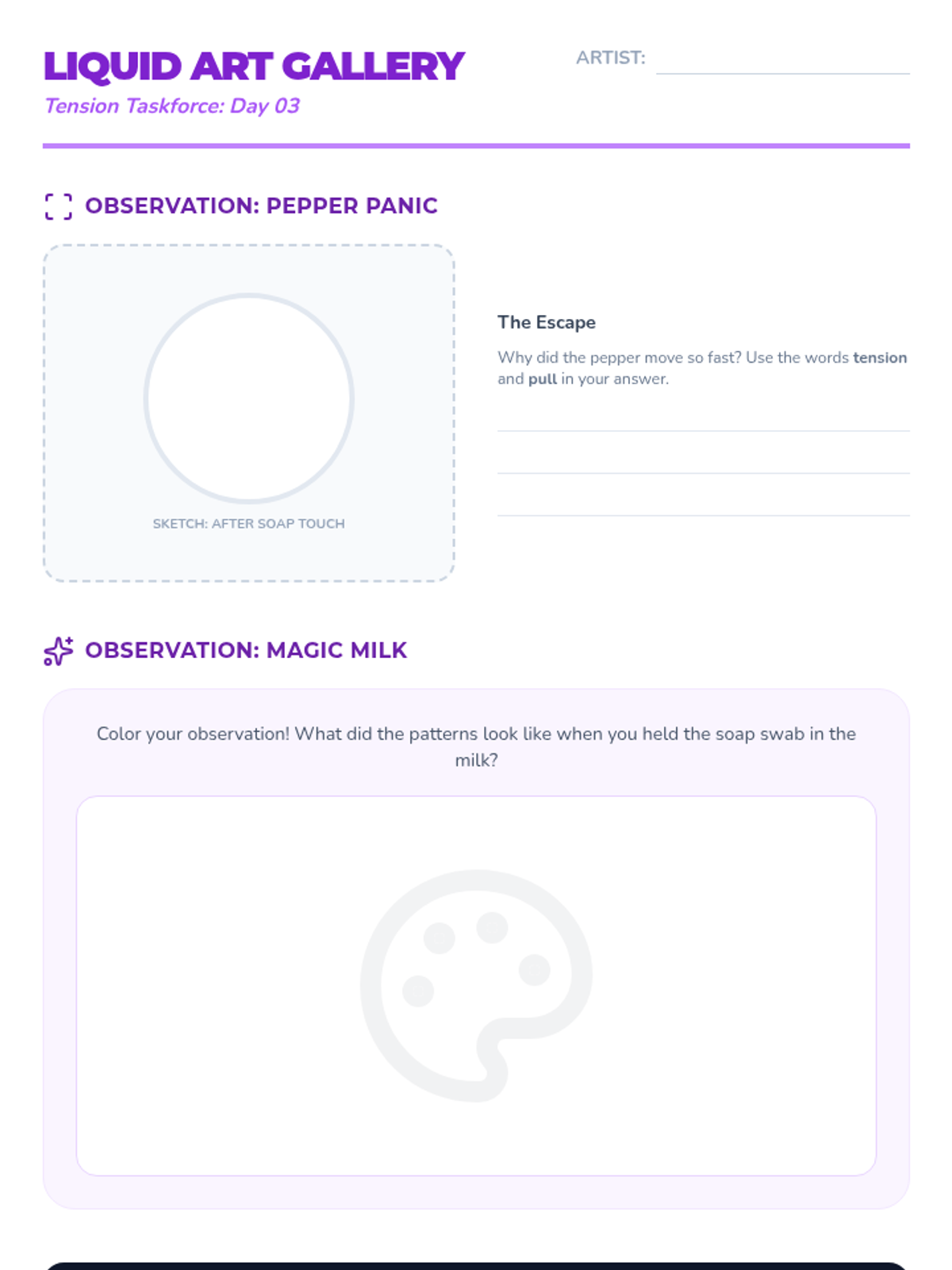
A student observation and reflection journal for the Day 3 Liquid Art experiments, allowing students to sketch their results and explain the science of tension disruption.
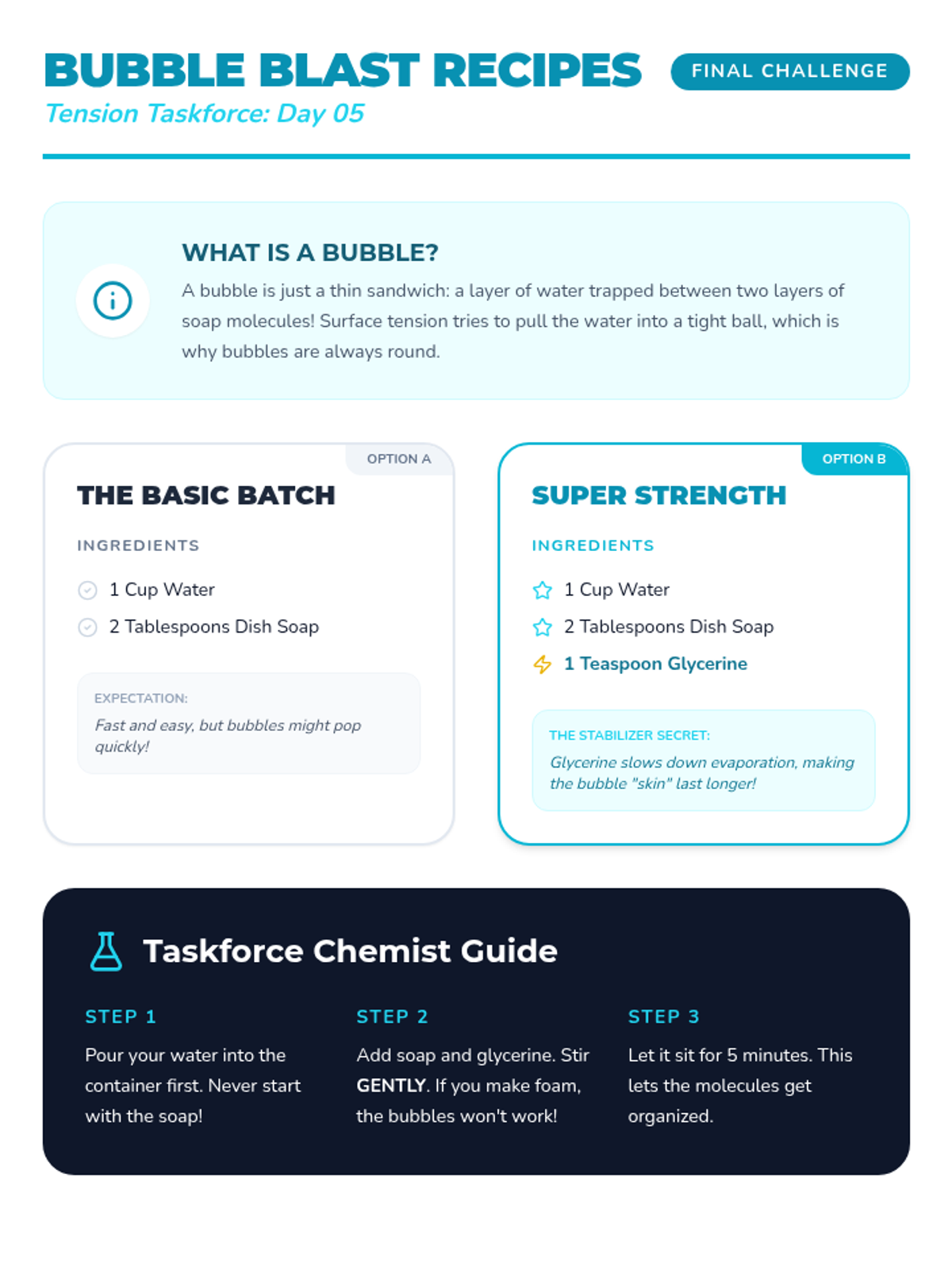
A student-facing guide to mixing two different bubble solutions, highlighting the role of glycerine as a stabilizer for surface tension.
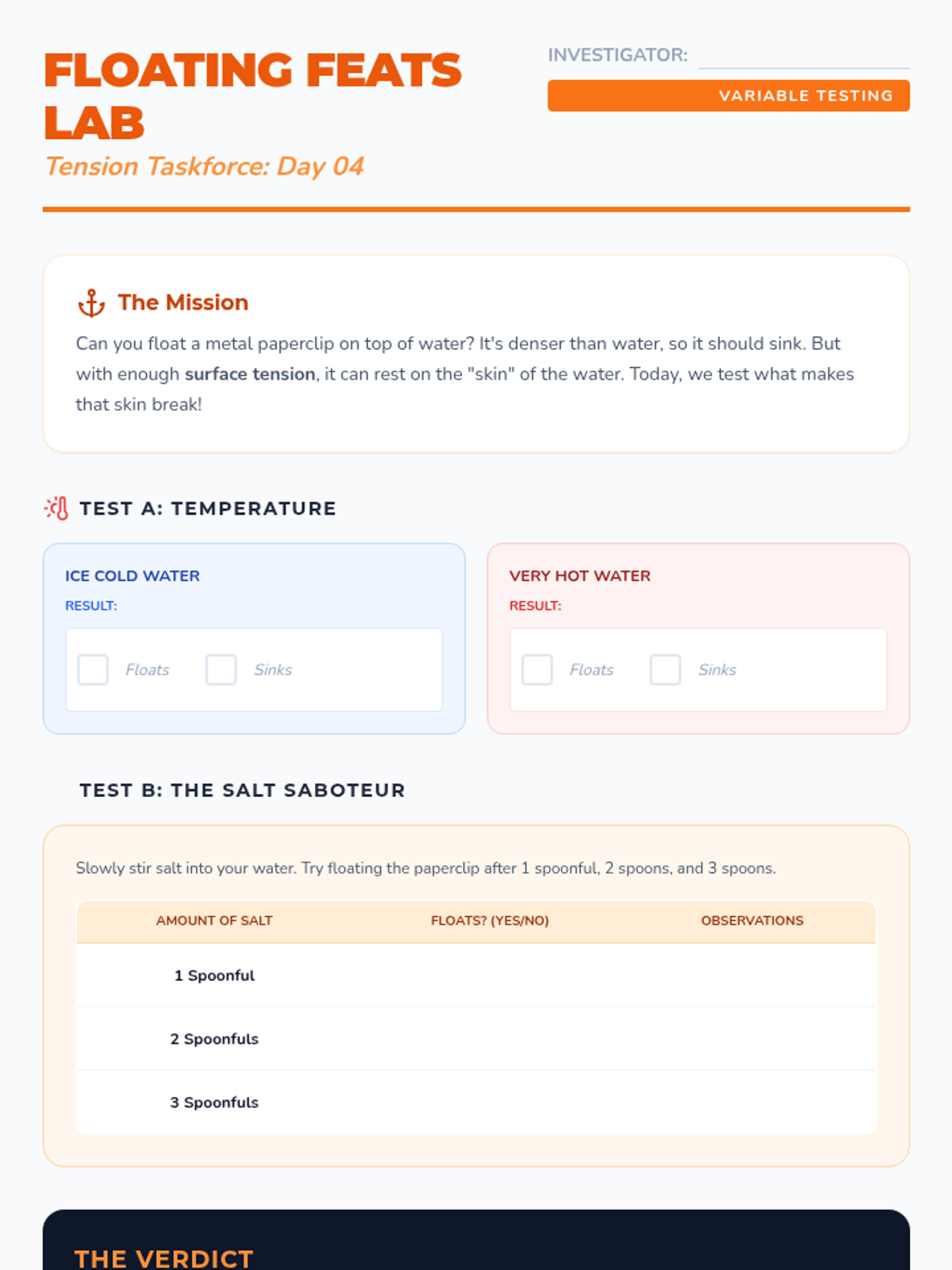
A student lab report for investigating the effects of temperature and salt on water's surface tension, featuring structured data tables and a conclusion section.
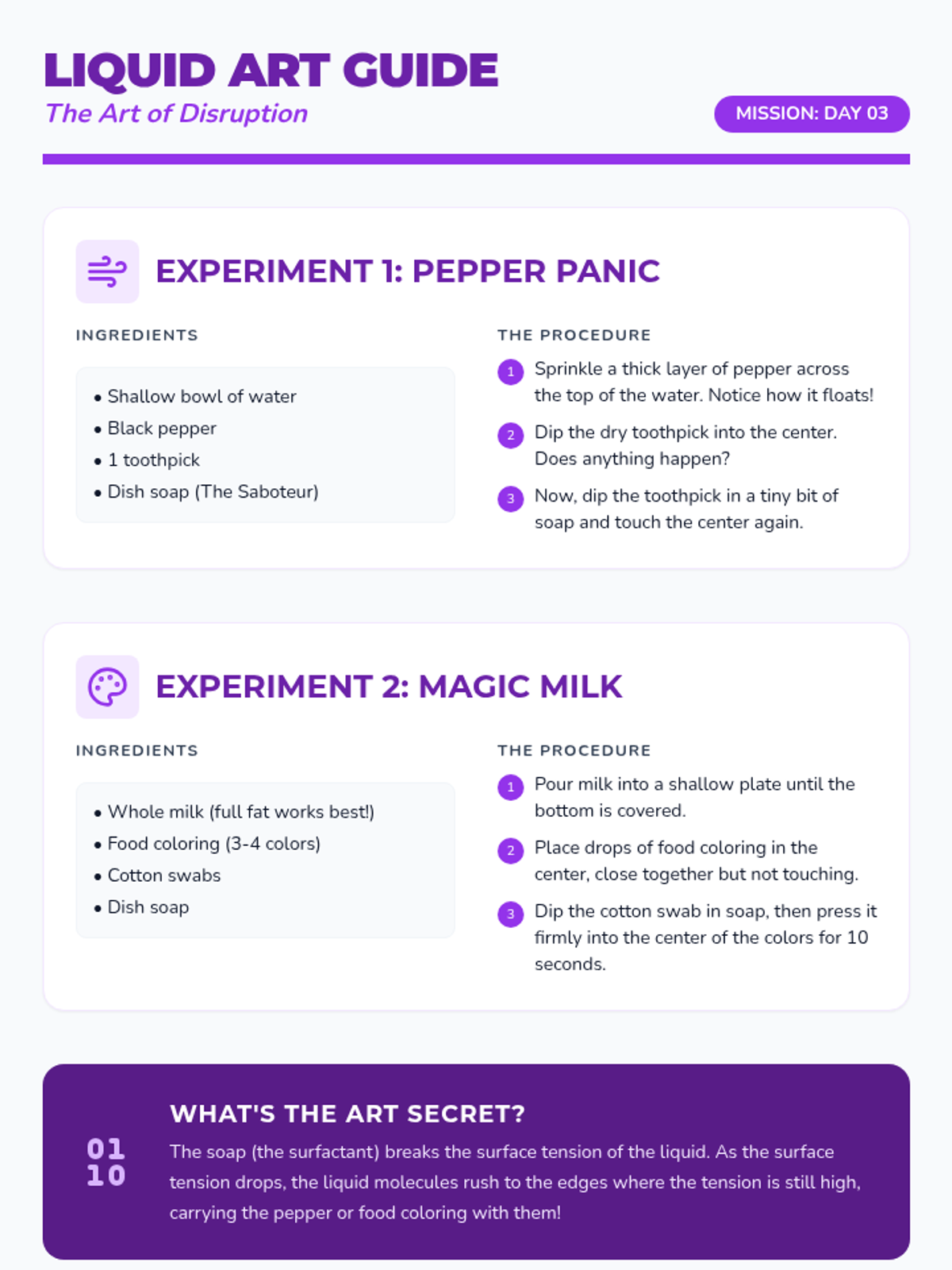
A step-by-step instructional guide for the Pepper Panic and Magic Milk experiments, explaining how to visualize surface tension disruption.
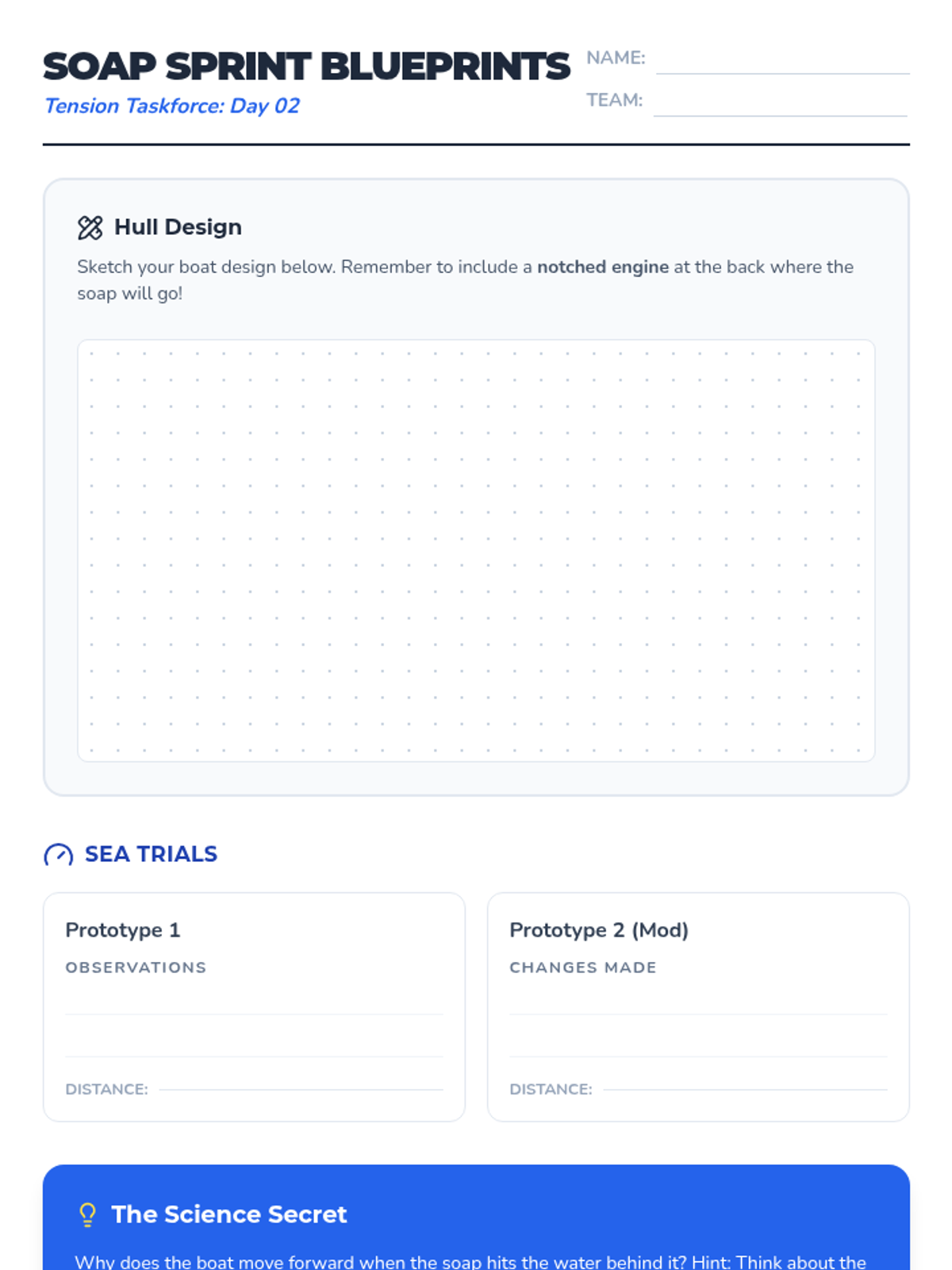
A design and testing worksheet for the Soap Sprint boat-building challenge, including space for hull blueprints, sea trial data, and scientific reflections.
A visual presentation for the Soap Sprint lesson, explaining the role of surfactants and how soap-powered boats work through surface tension disruption.
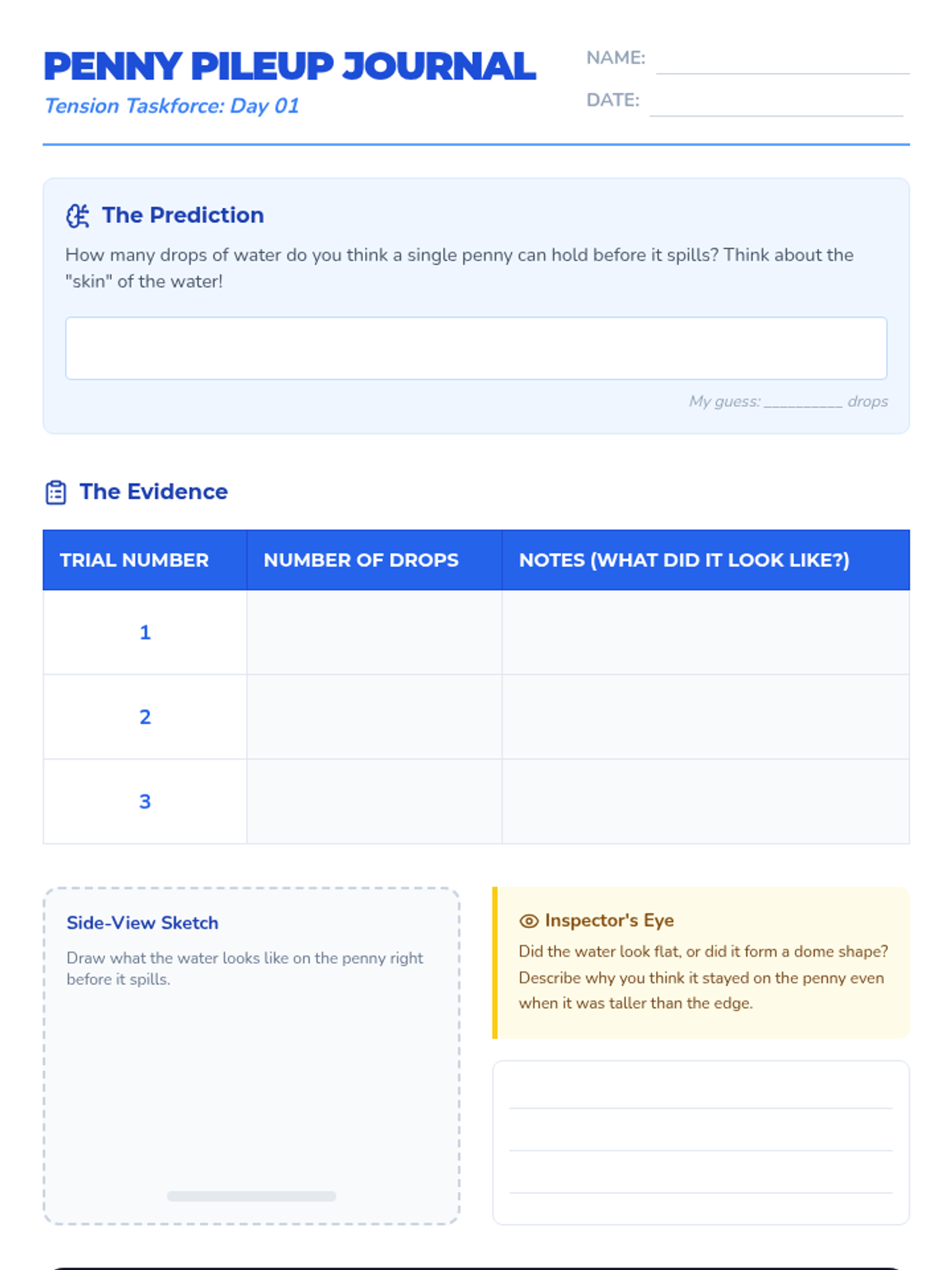
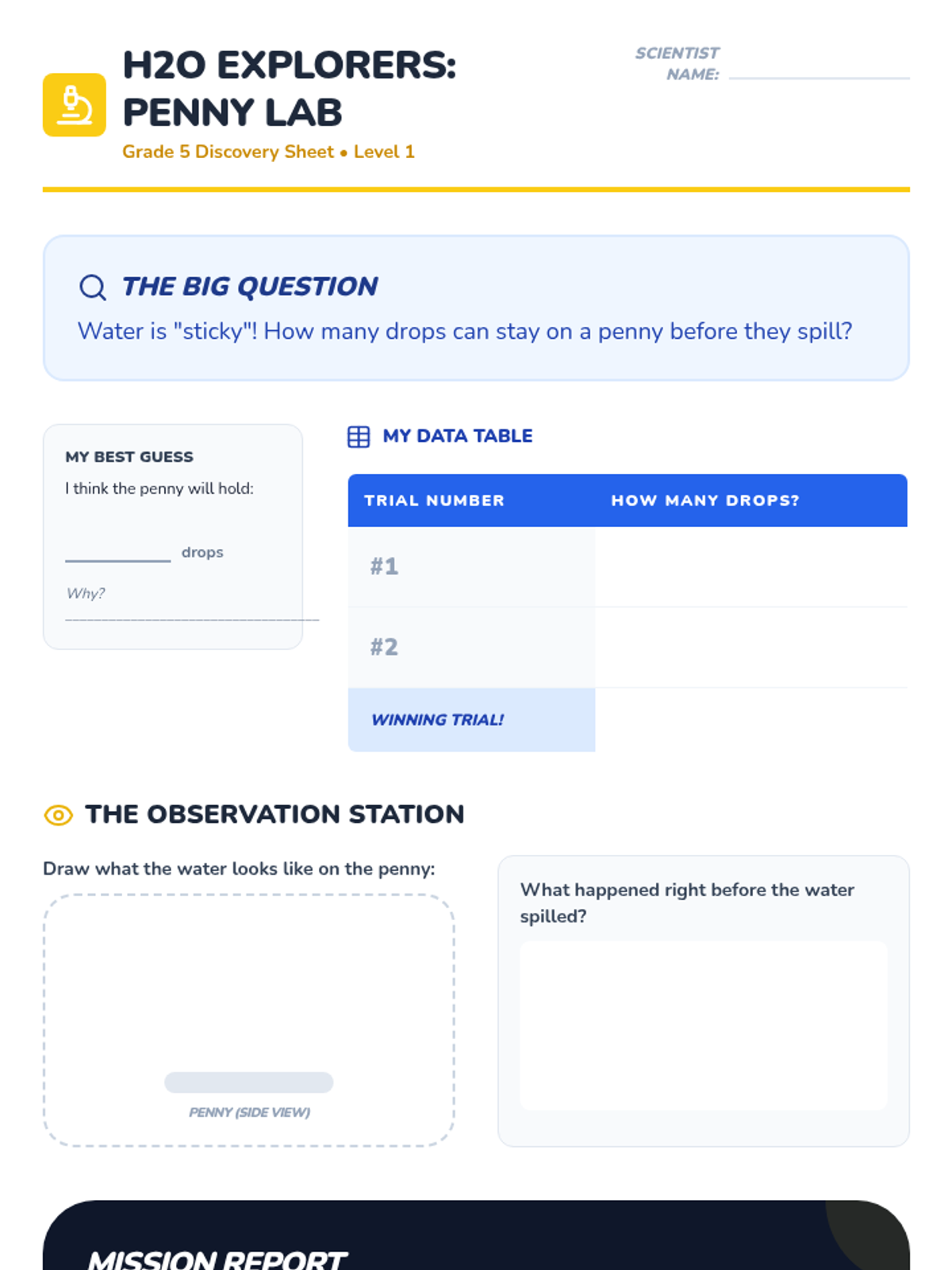
A student observation journal for the Penny Pileup experiment, featuring sections for hypotheses, data collection, and side-view sketches.
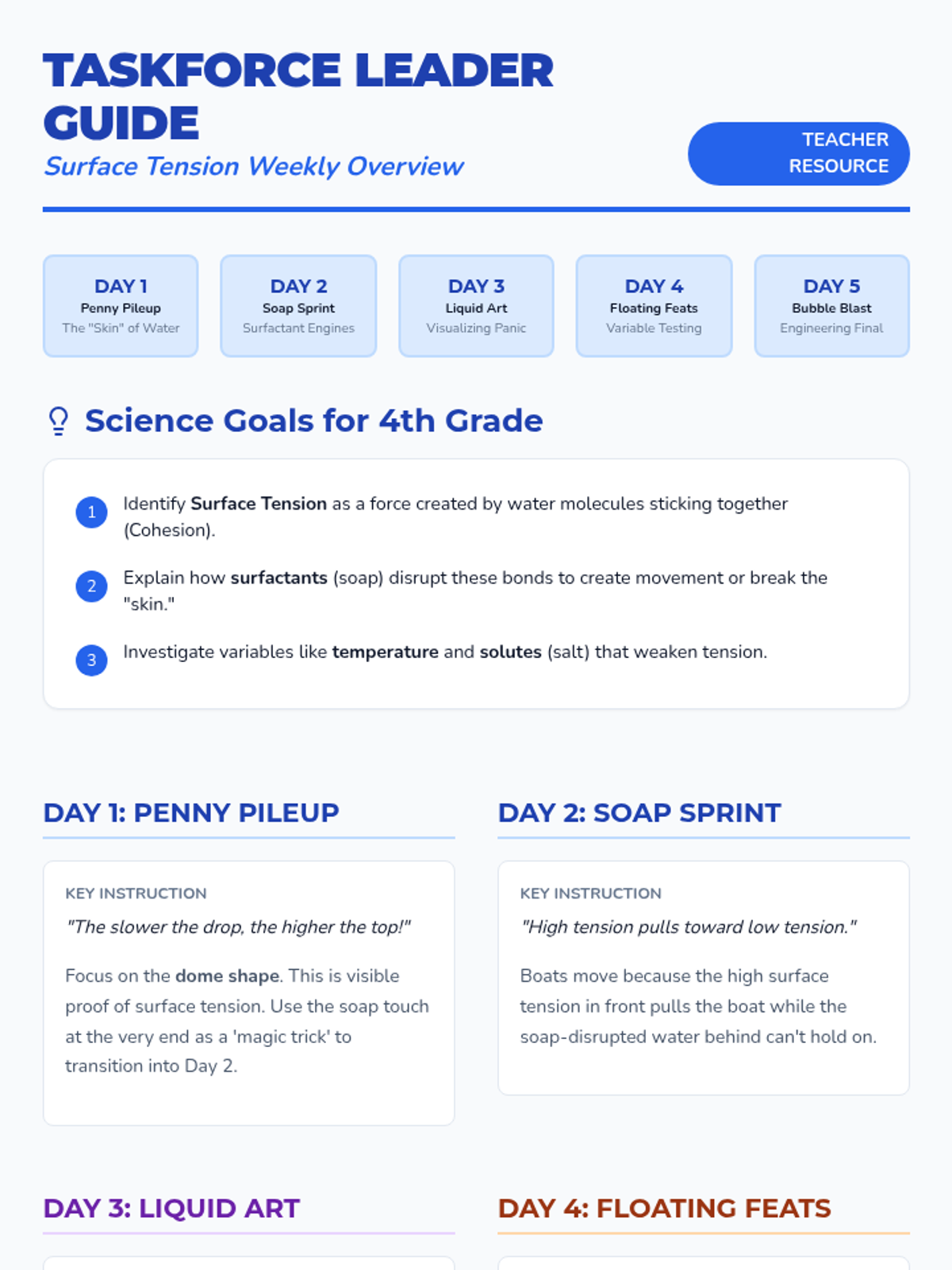
A comprehensive 3-page teacher guide for the 1-week surface tension sequence, including weekly goals, daily instructional briefings for all 5 days, and classroom management tips.
A visual presentation for Lesson 1: Property Powerhouse. It introduces water's molecular geometry, polarity, cohesion, adhesion, and role as a universal solvent with vibrant diagrams and clear, grade-appropriate explanations.
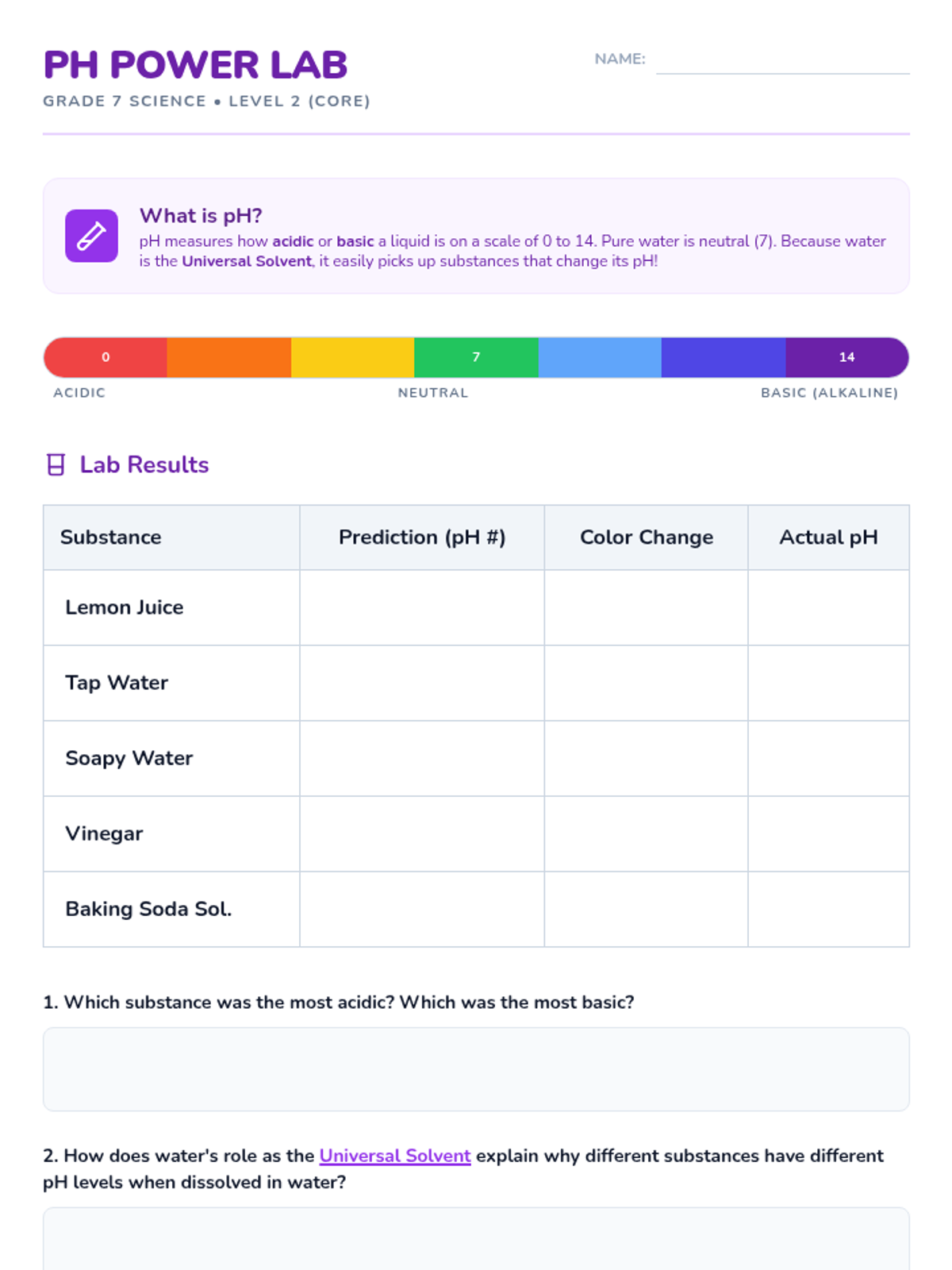
A student lab worksheet for investigating the pH of various common substances. Includes a pH scale reference, data collection table, and analysis questions connecting pH to water's role as a universal solvent and its impact on life.
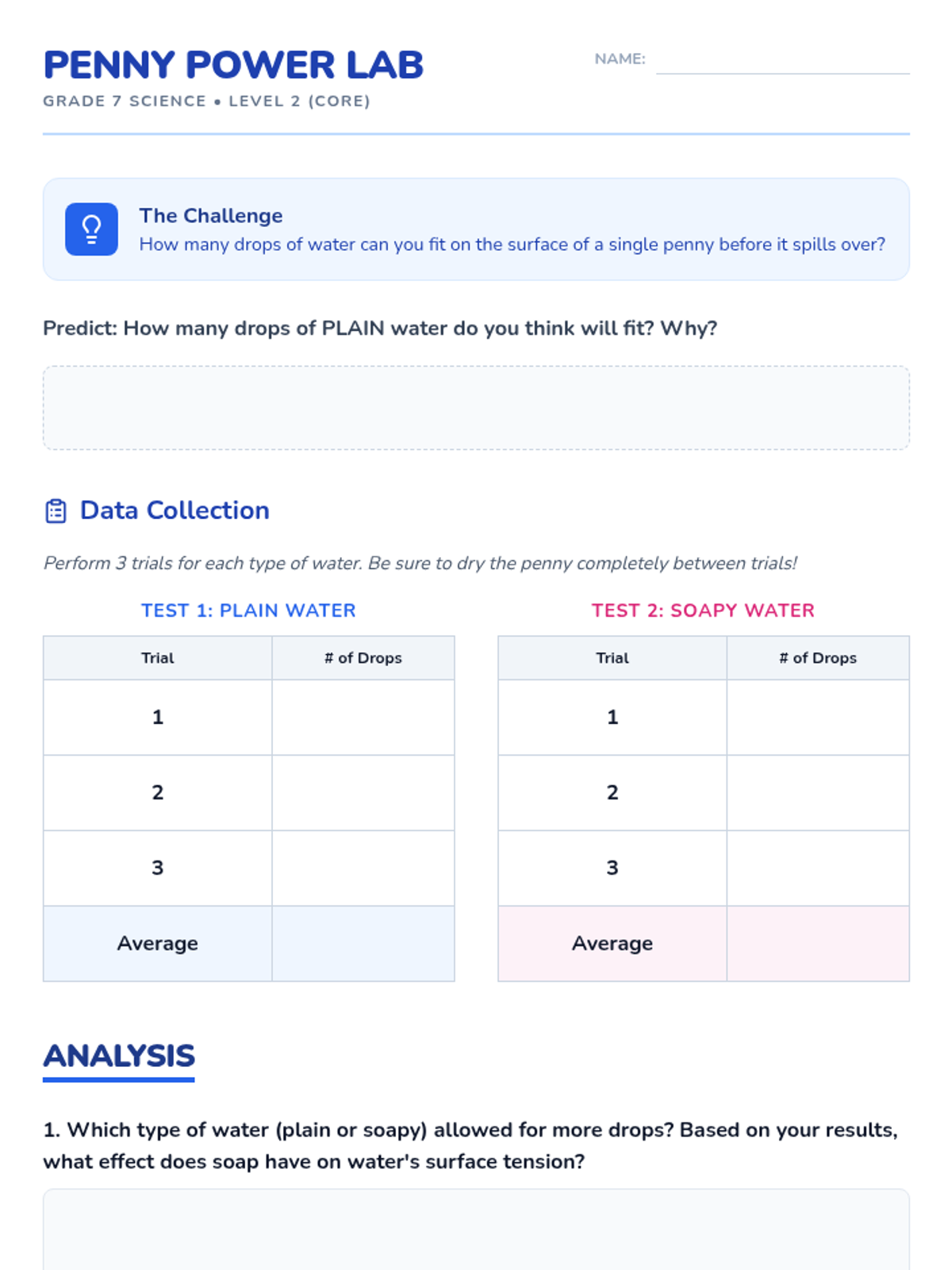
A student lab sheet for the 'Penny Power' investigation. Includes sections for hypothesis, data tables for multiple trials (plain vs. soapy water), sketching observations, and analysis questions focused on cohesion and surface tension.
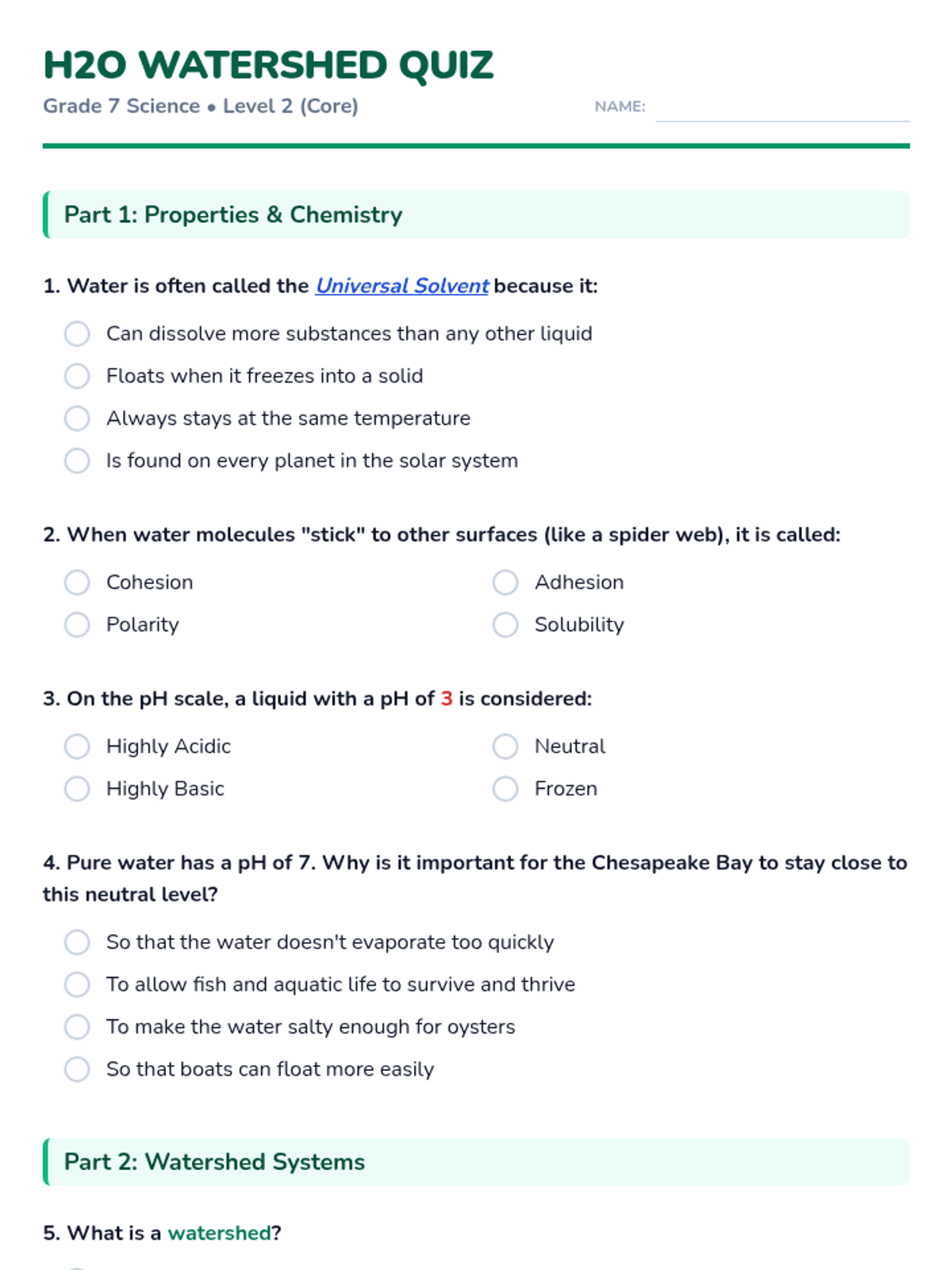
A short unit quiz covering the physical properties of water (solubility, adhesion, cohesion), pH basics, and watershed definitions including estuaries and human impact.
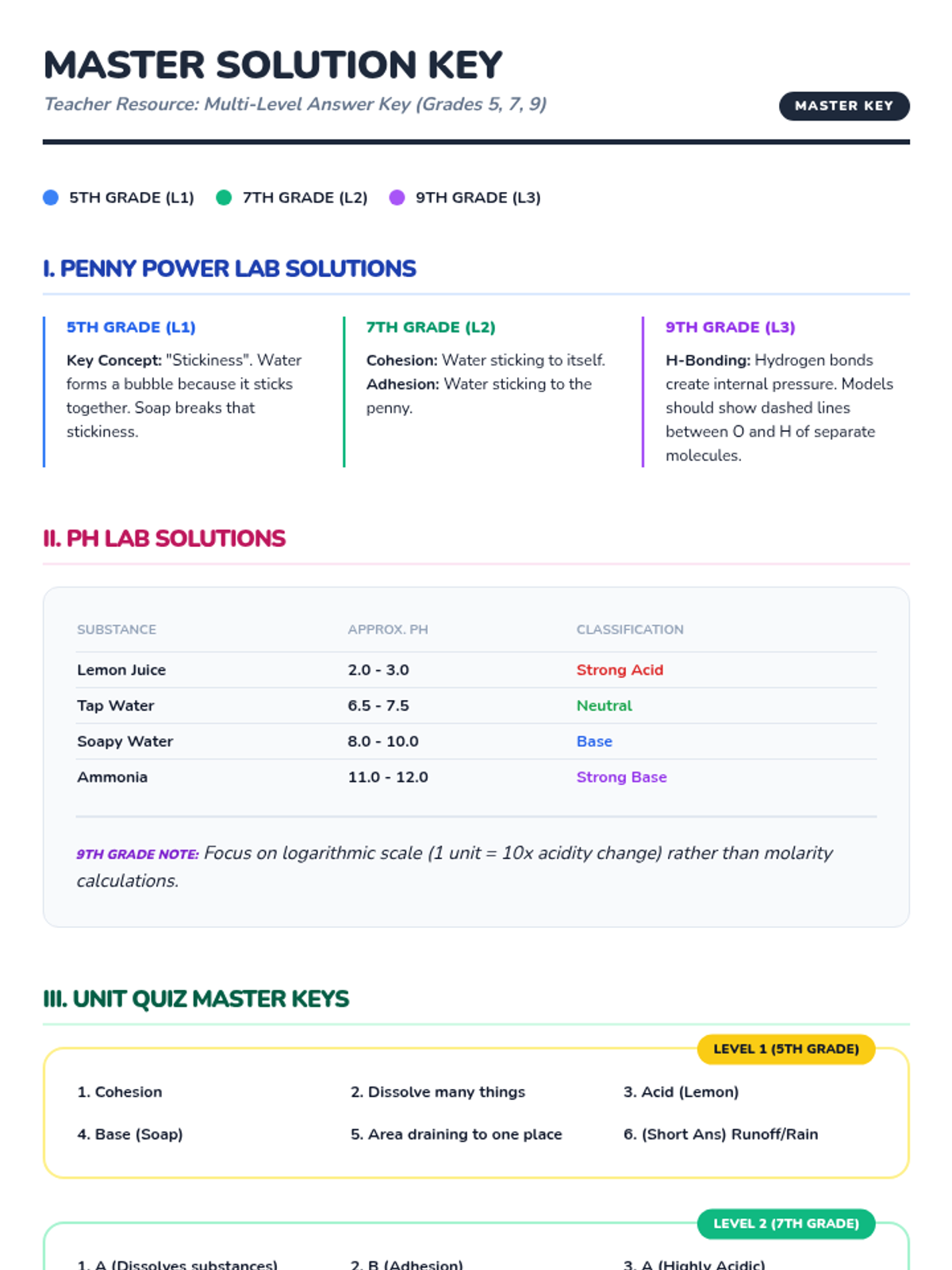
A teacher-facing answer key for the Penny Power Lab, pH Power Lab, and the Unit Quiz. Updated to reflect the removal of weathering content and addition of pH/acidity. Master Key updated for simplified 9th grade rigor.
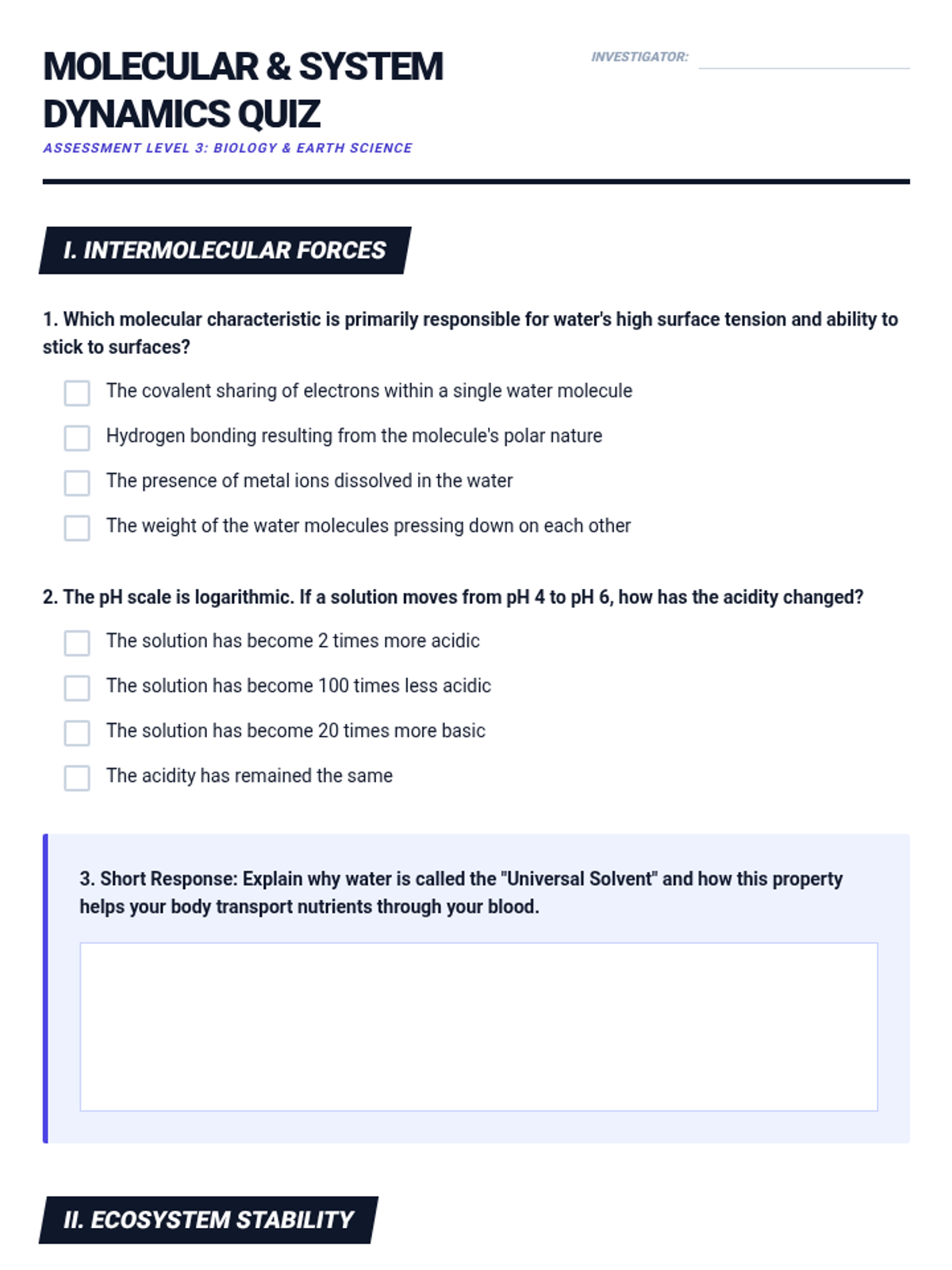
An advanced 9th-grade unit quiz focusing on molecular chemistry, logarithmic pH changes, and complex environmental systems like eutrophication and ocean acidification. Math and terminology have been simplified for better accessibility.
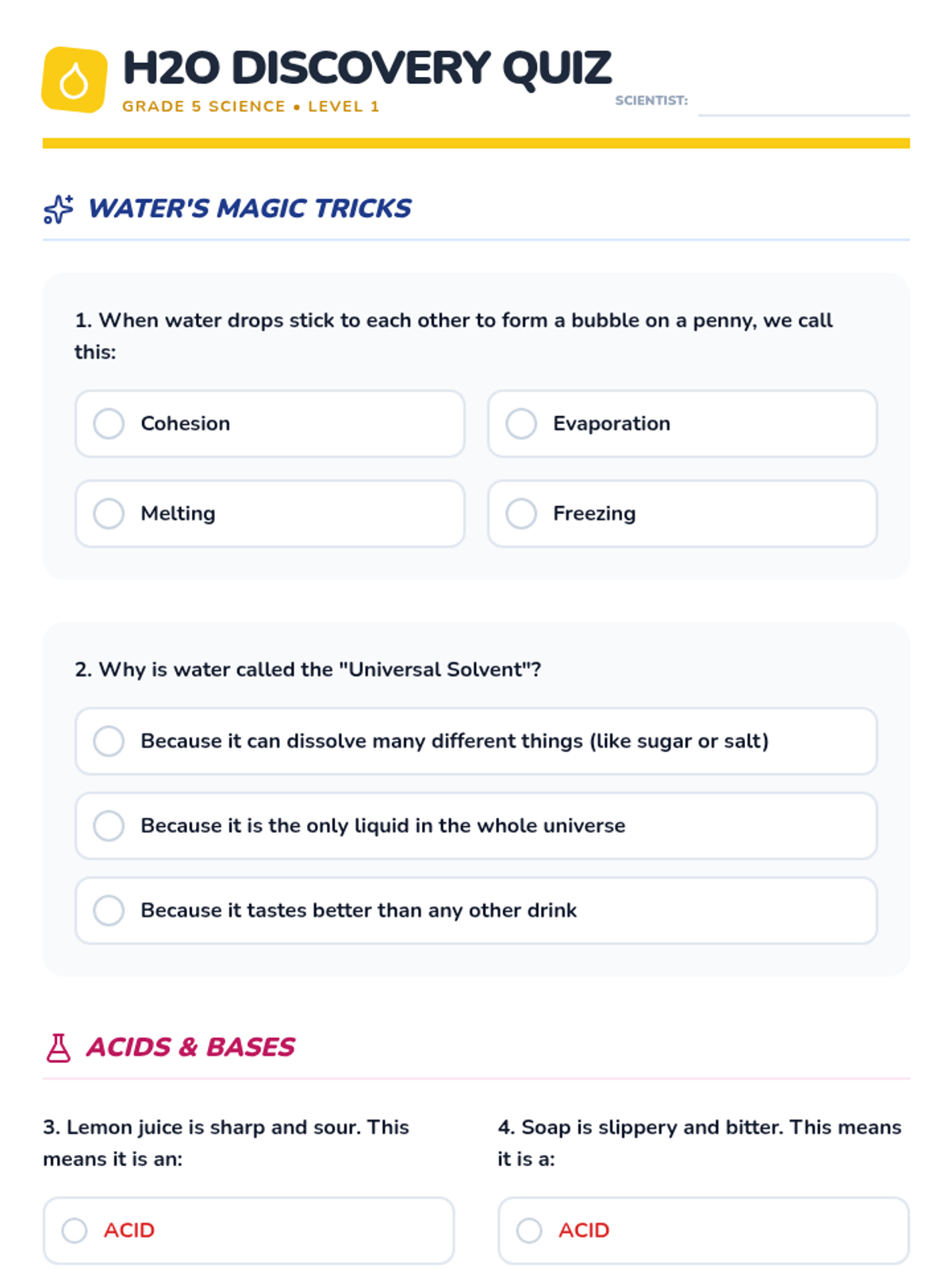
A foundational 5th-grade unit quiz focused on basic water vocabulary (cohesion, acids/bases) and the general concept of watersheds through simplified language and clear visuals.
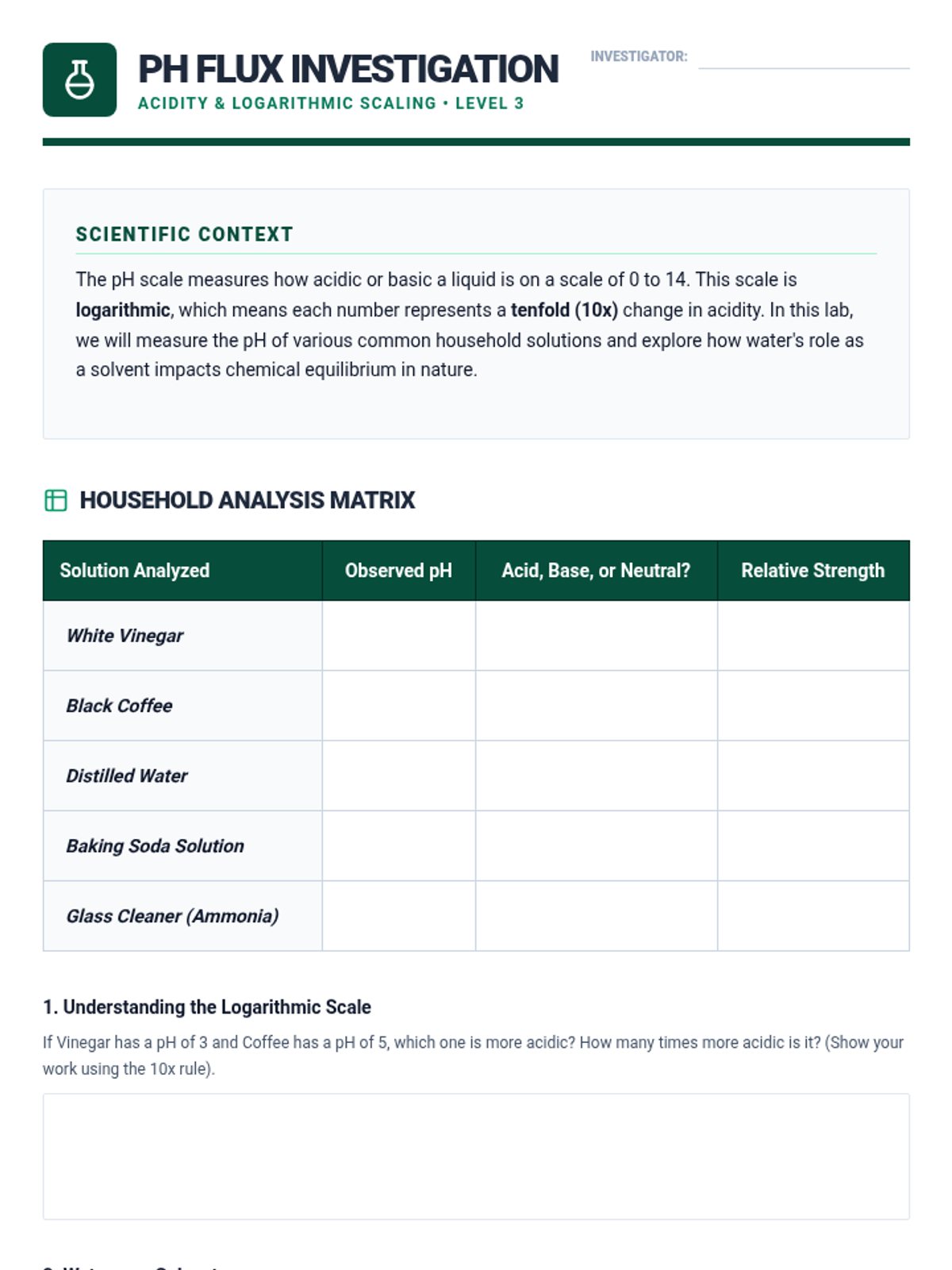
A 9th-grade lab worksheet for investigating pH and ionic equilibrium, focusing on the logarithmic nature of the scale and environmental buffering. Math complexity has been reduced for better accessibility and substances updated to household items.
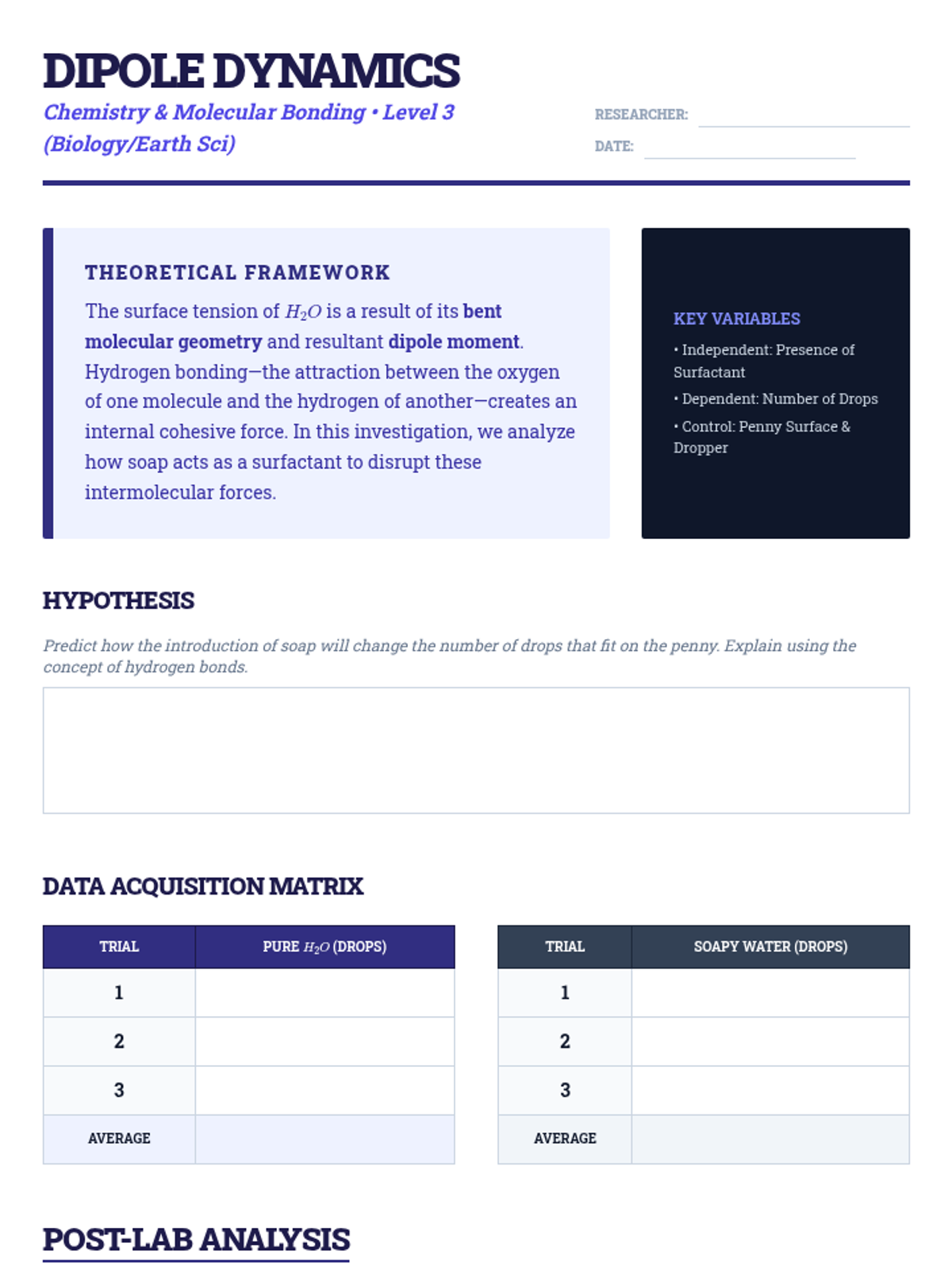
A 9th-grade lab worksheet for the Penny Power investigation, focusing on molecular geometry, hydrogen bonding, and life science connections, with reduced mathematical complexity and simplified notation.
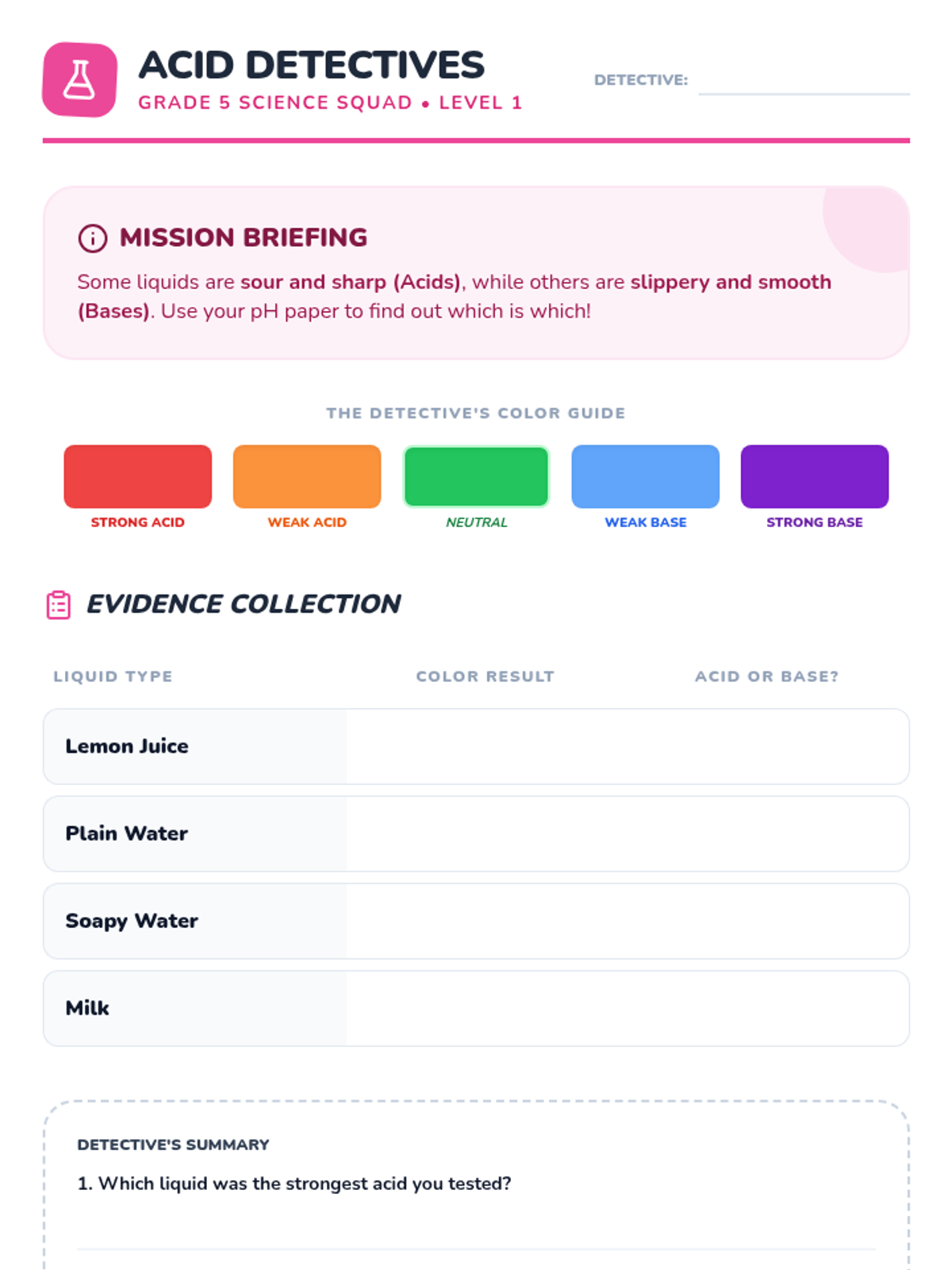
A simplified 5th-grade lab worksheet for investigating the pH of common liquids, focusing on color observation and identifying acids vs. bases.
A simplified 5th-grade lab worksheet for the 'Penny Power' investigation, focusing on observation, basic 'stickiness' vocabulary, and hands-on data collection.
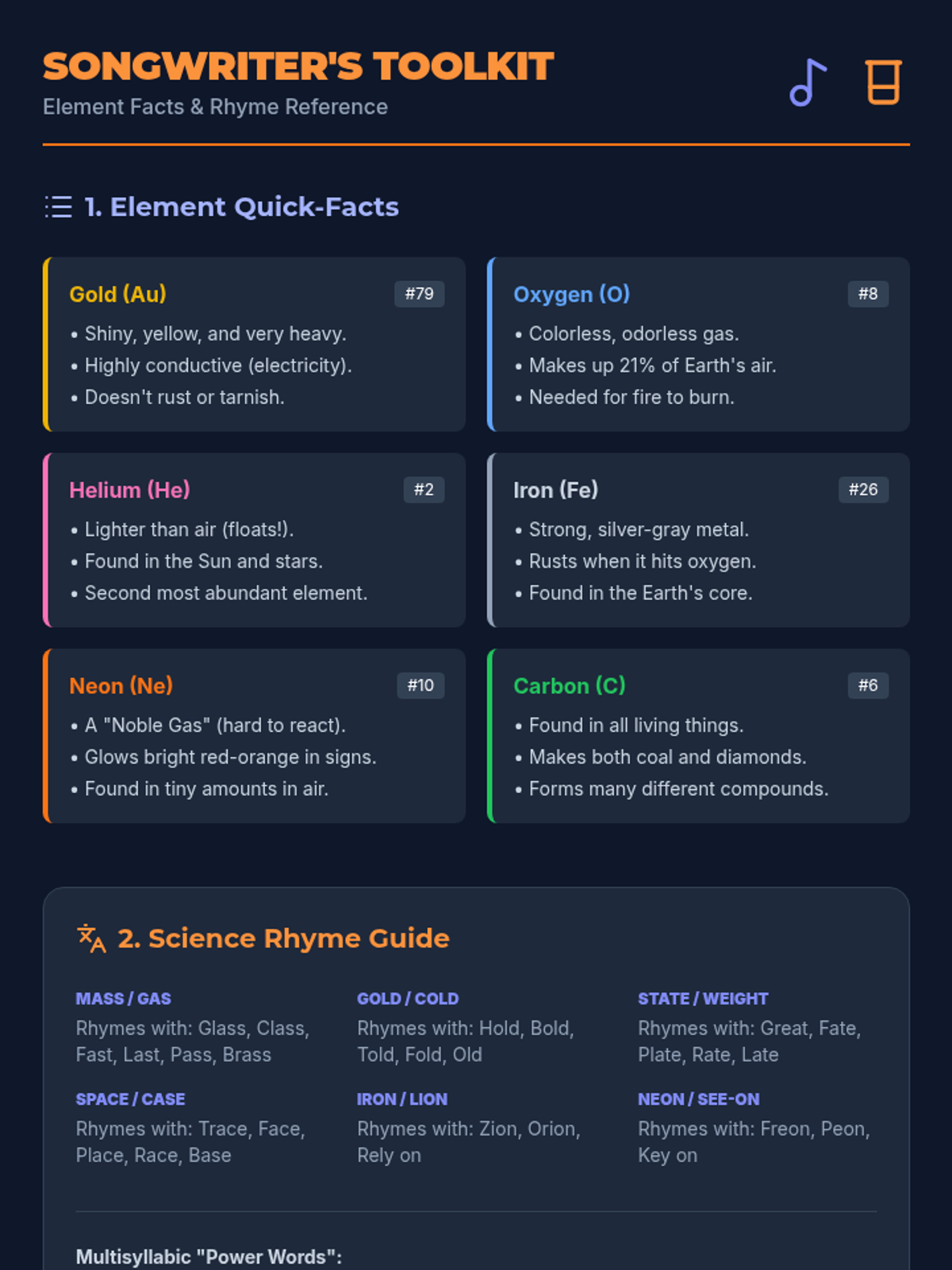
A comprehensive reference sheet for students, featuring facts about common chemical elements and a science-themed rhyming dictionary to support lyric writing.
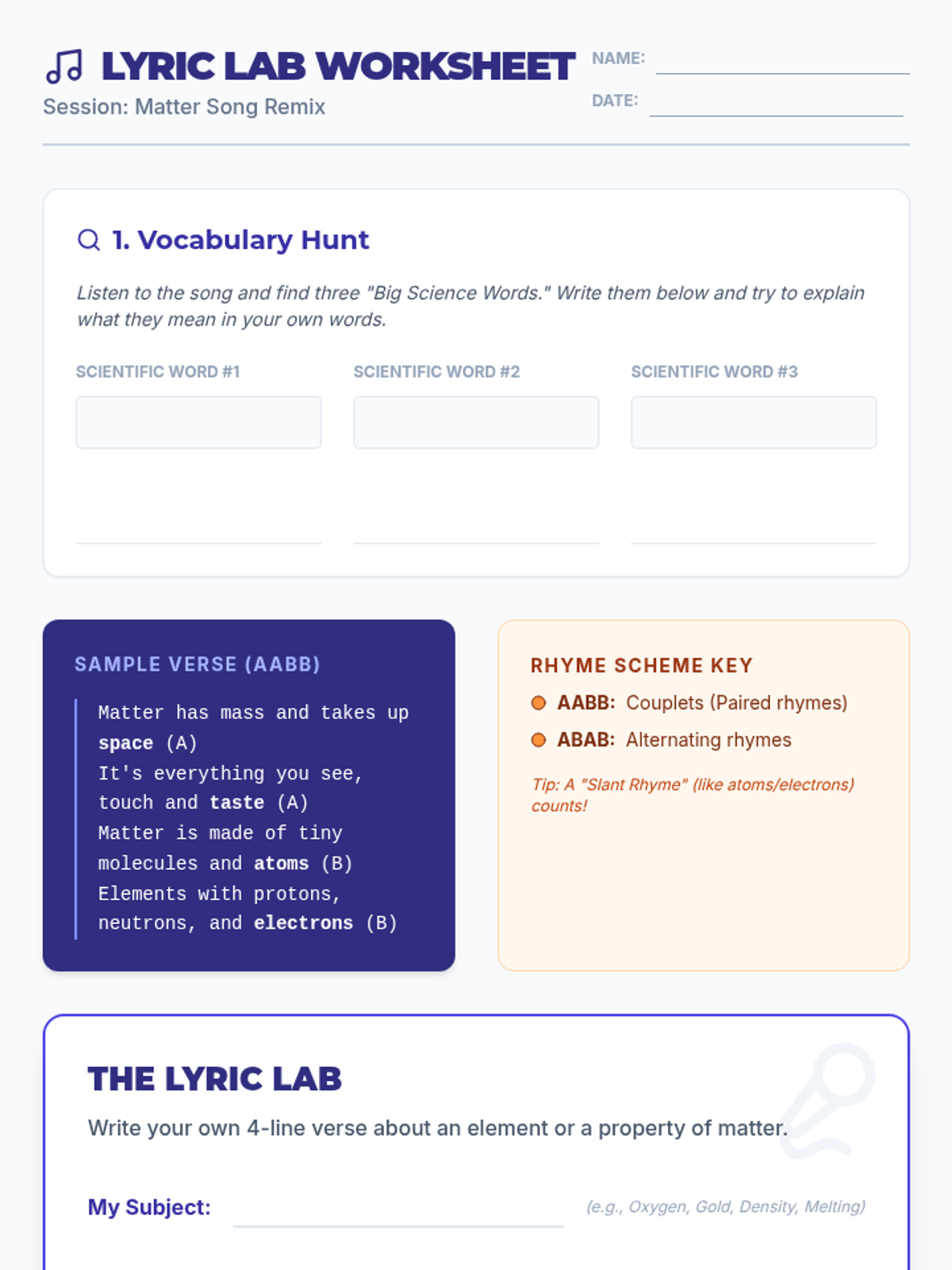
A student worksheet designed as a 'Lyric Lab' journal. Includes space for vocabulary analysis, a sample rhyme scheme reference, and a structured area for students to write their original 4-line science verse with a self-check rubric.
Visual presentation slides to guide students through the 'Matter Song' lesson. Includes an embedded YouTube video, a breakdown of rhyme schemes (AABB vs. ABAB), and clear instructions for the creative writing task.
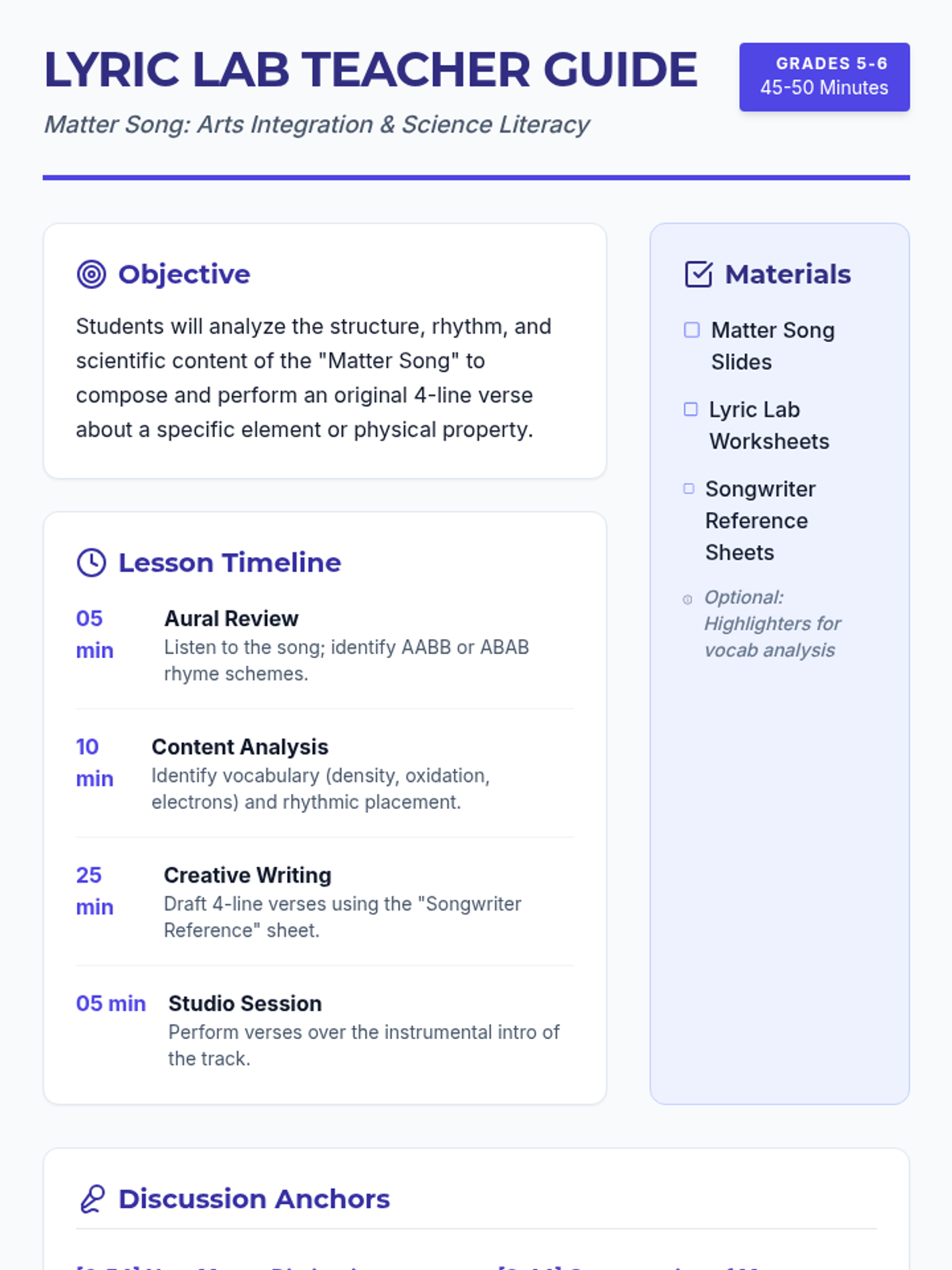
A comprehensive teacher guide for the Matter Song lesson, including learning objectives, a minute-by-minute timeline, discussion anchors with video timestamps, and differentiation strategies.
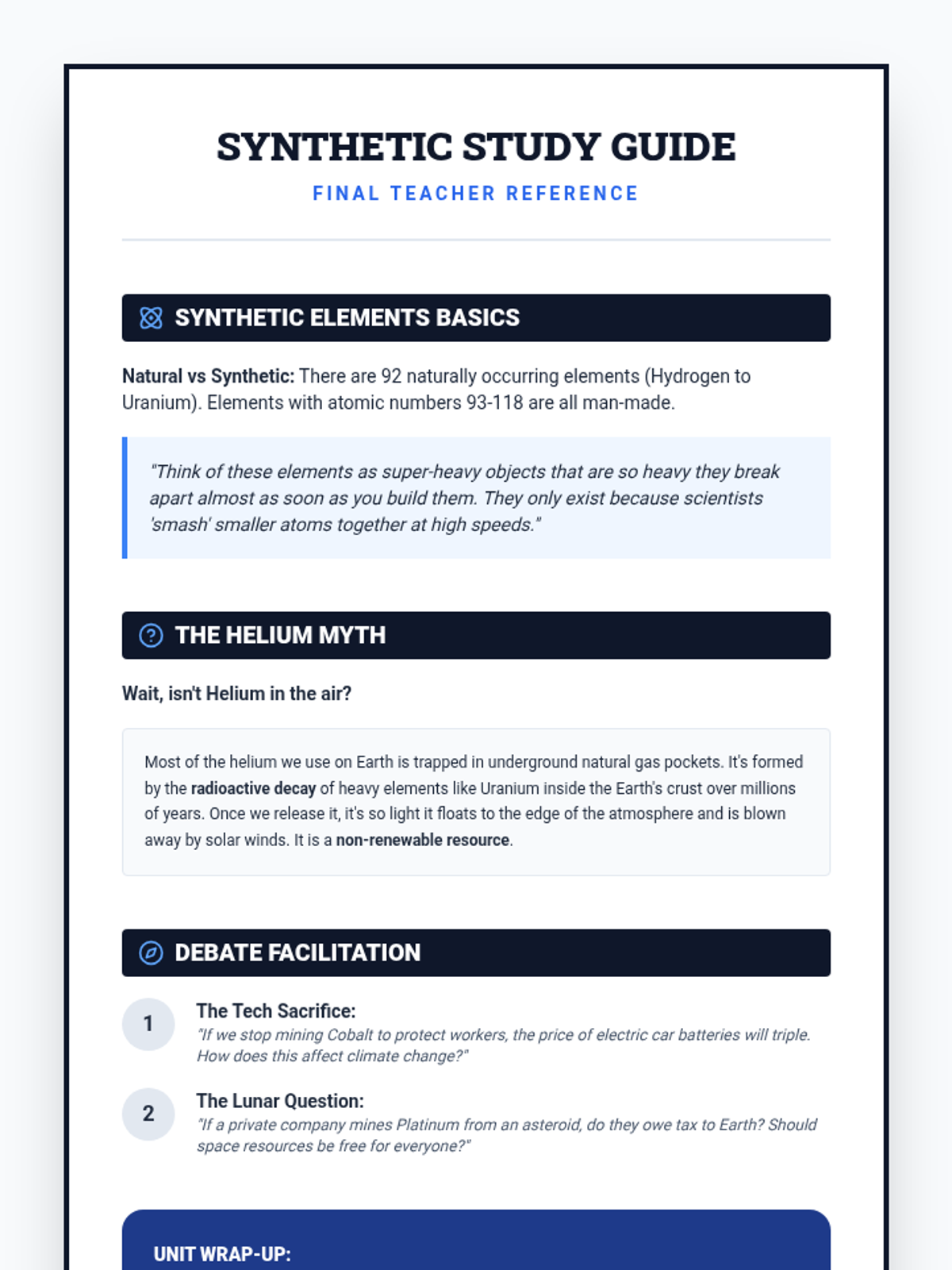
Final teacher guide for Lesson 5, providing background on synthetic elements, helium geology, and guiding questions for the ethical debates.
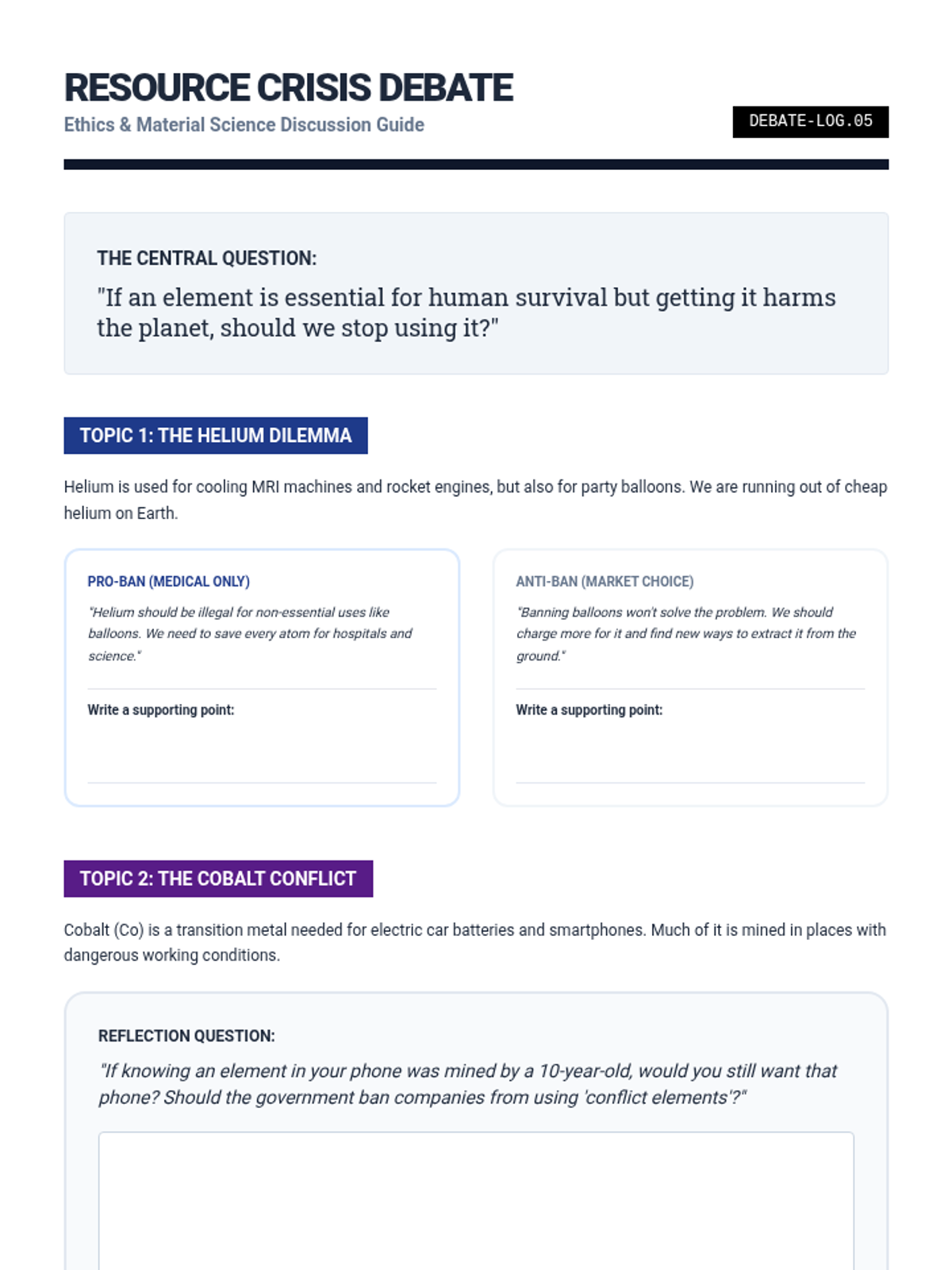
Discussion and reflection worksheet for Lesson 5 focusing on the ethics of resource management, including the helium crisis and conflict minerals.
Final slides for Lesson 5 exploring synthetic elements, the helium scarcity crisis, and the ethical/future considerations of material science.
Slide deck for the final project gallery walk, including peer review instructions and synthesis discussion prompts.
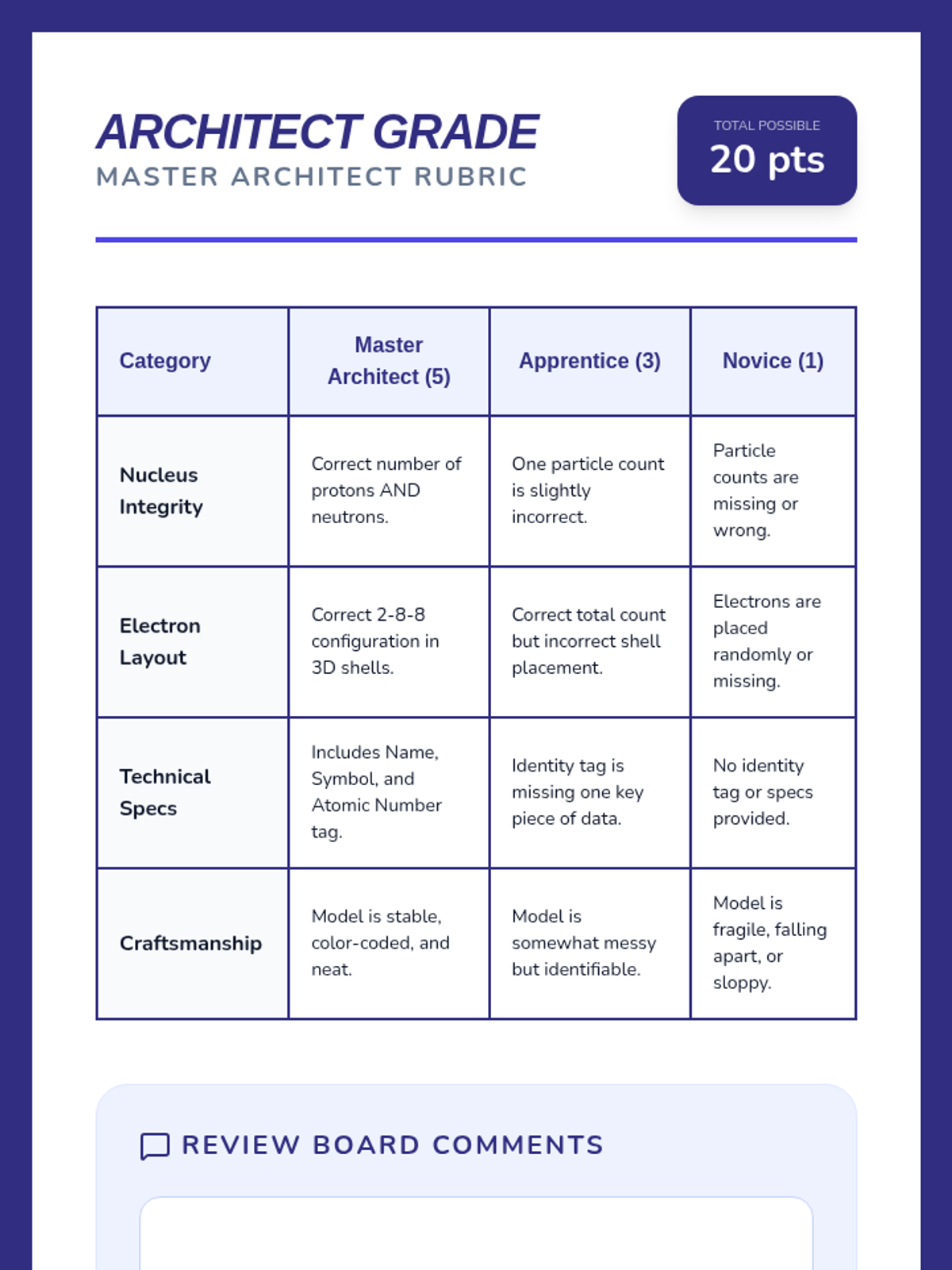
Assessment rubric for the Atomic Zoo project, focusing on nucleus integrity, electron layout, technical specs, and craftsmanship.
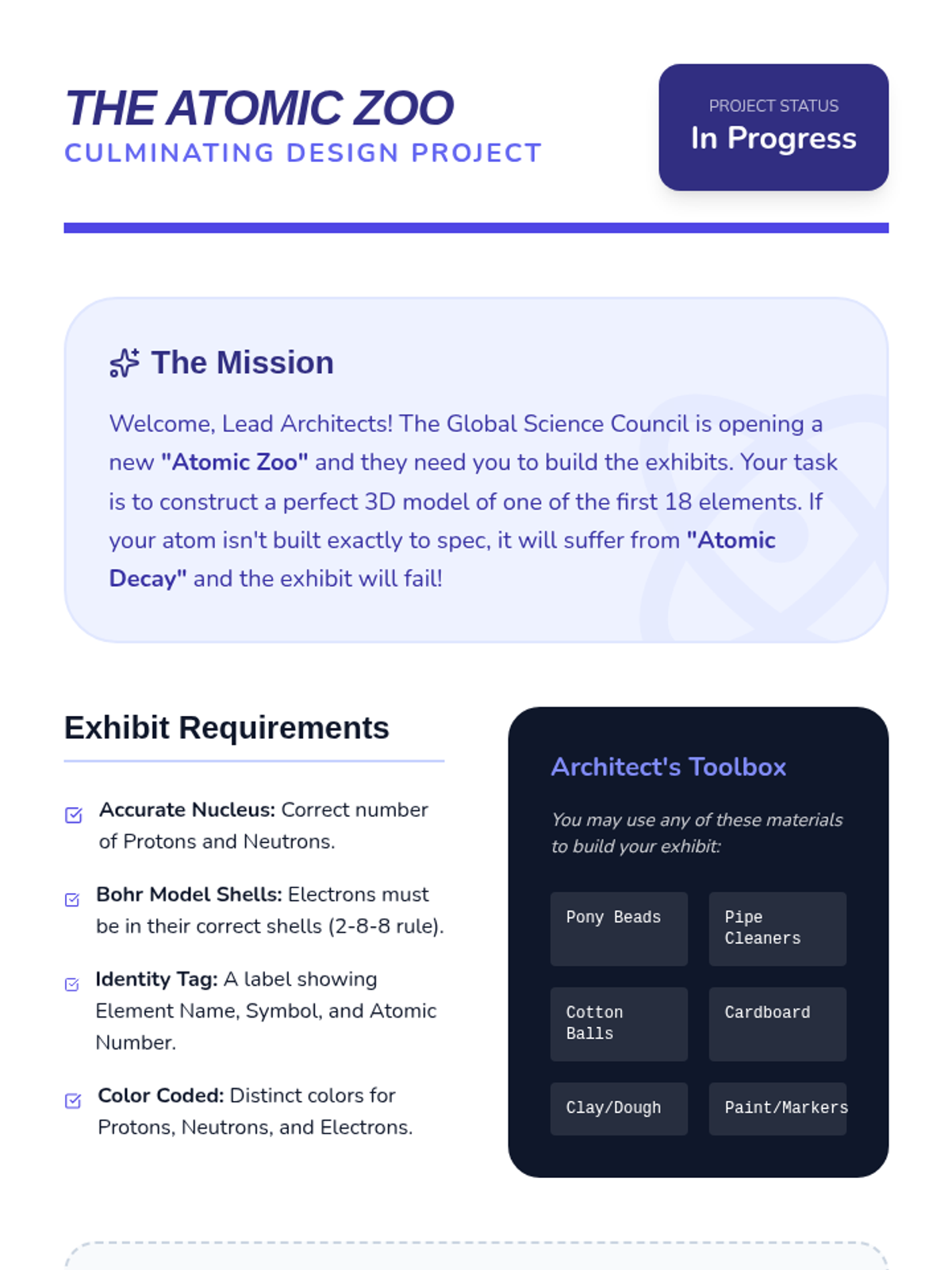
A culminating project-based lesson where students build models of the first eighteen elements and participate in a gallery walk to demonstrate mastery of atomic theory.
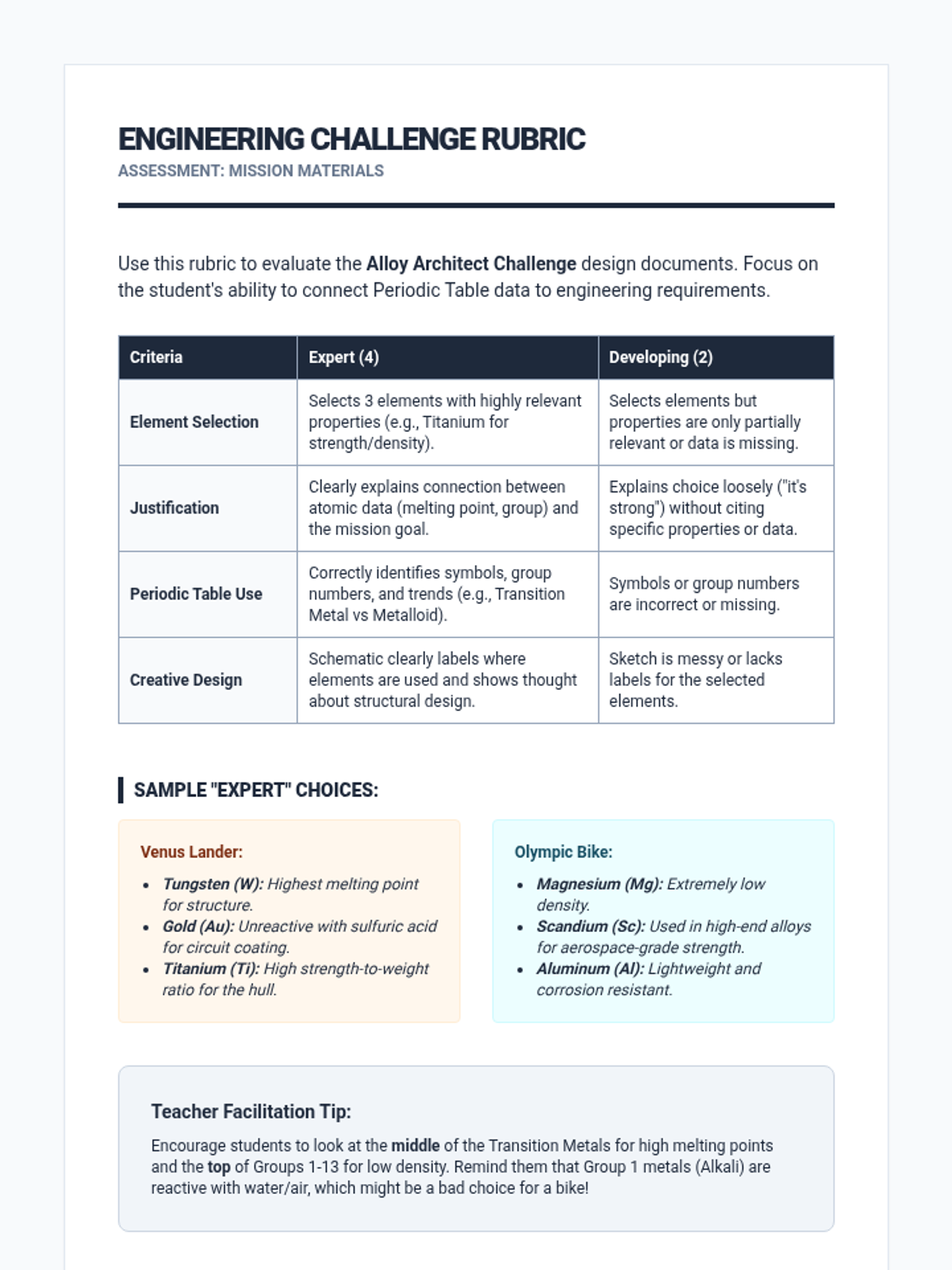
Assessment rubric for Lesson 4, providing clear criteria for evaluating student material selection and justification, along with sample expert element choices for both scenarios.
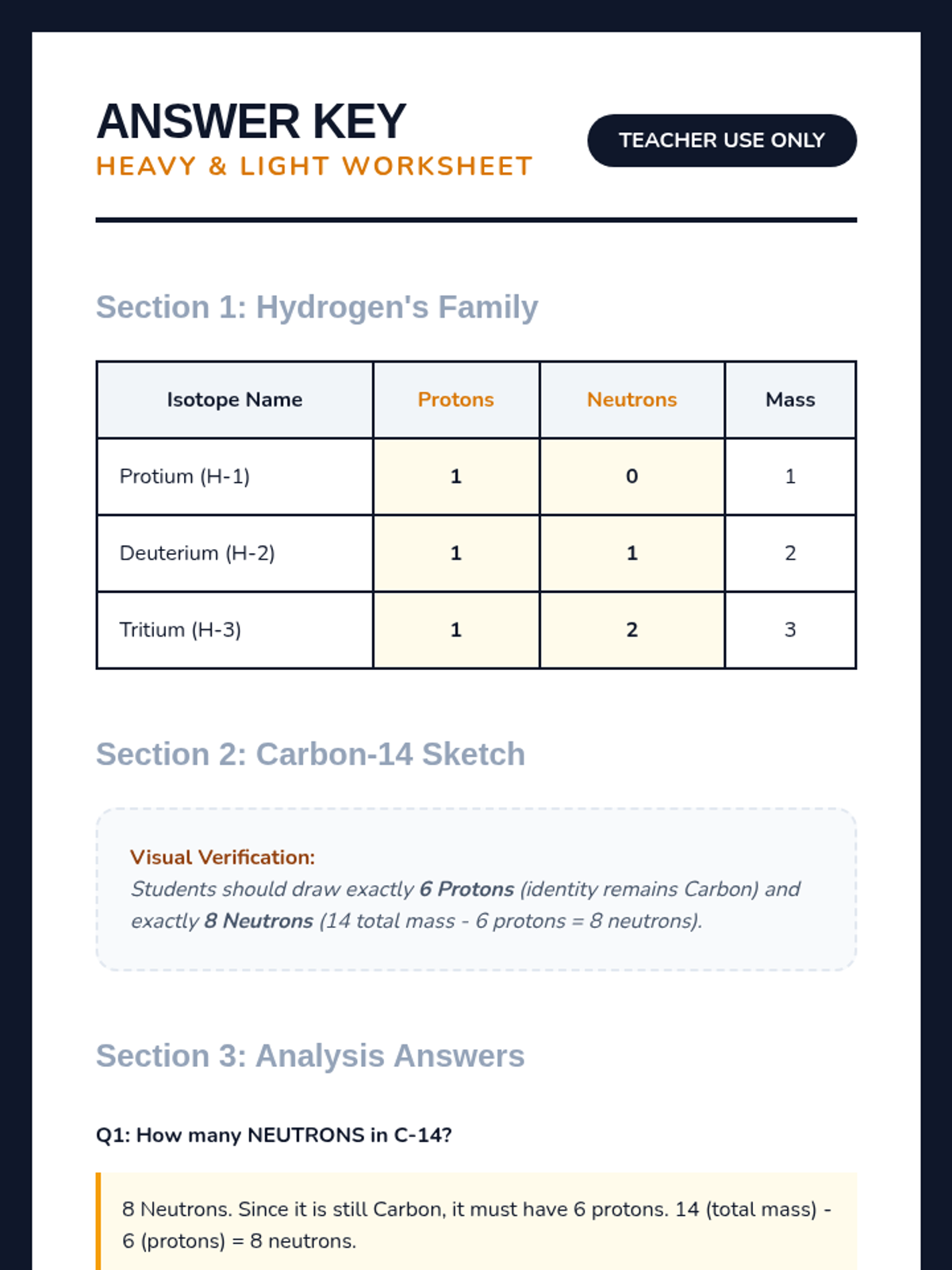
Teacher answer key for the Heavy Atoms Worksheet, including full table data and explanation for the weighted average concept.
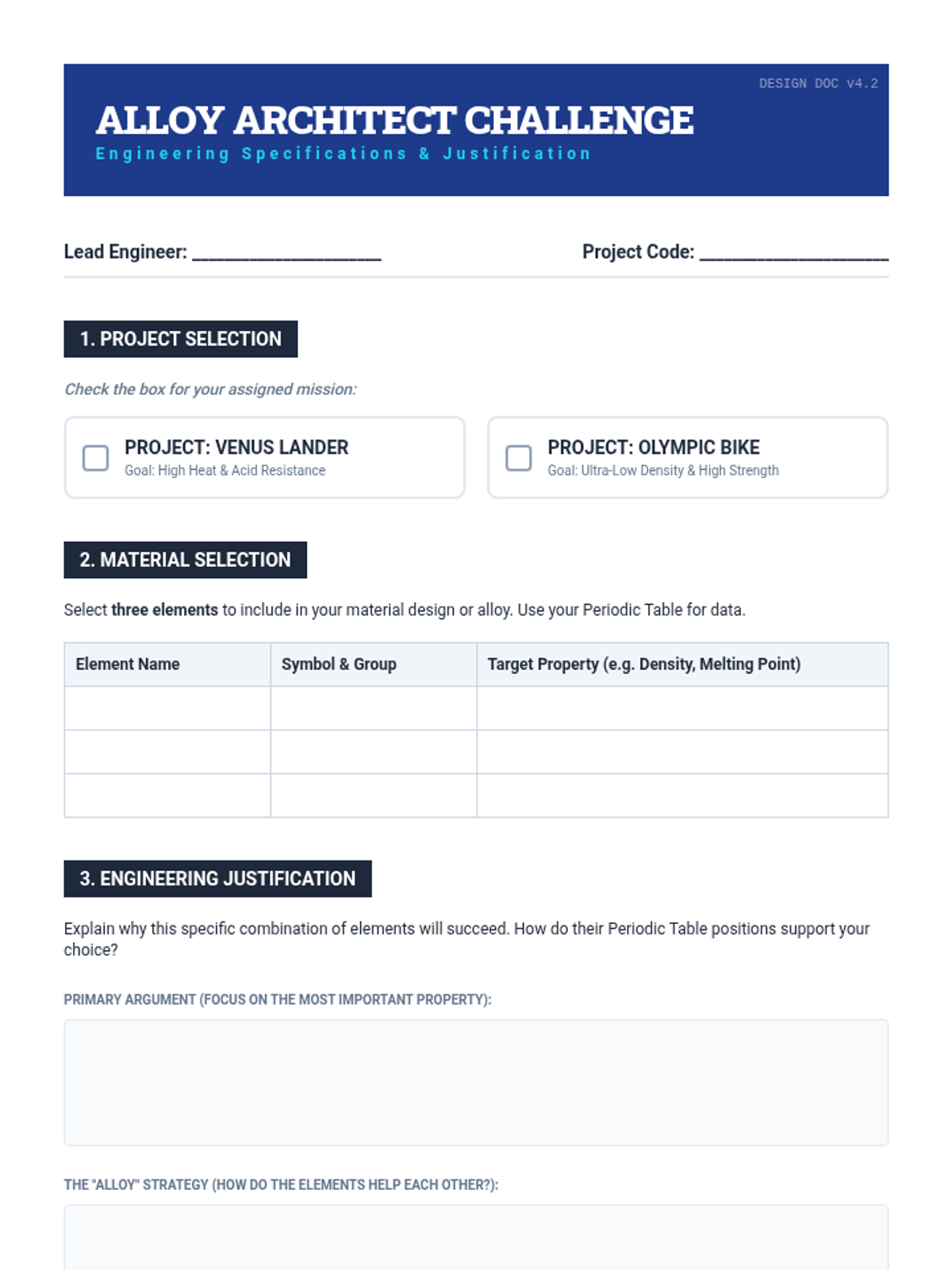
Design document for the Lesson 4 engineering challenge where students select elements and justify their use in a material design project.
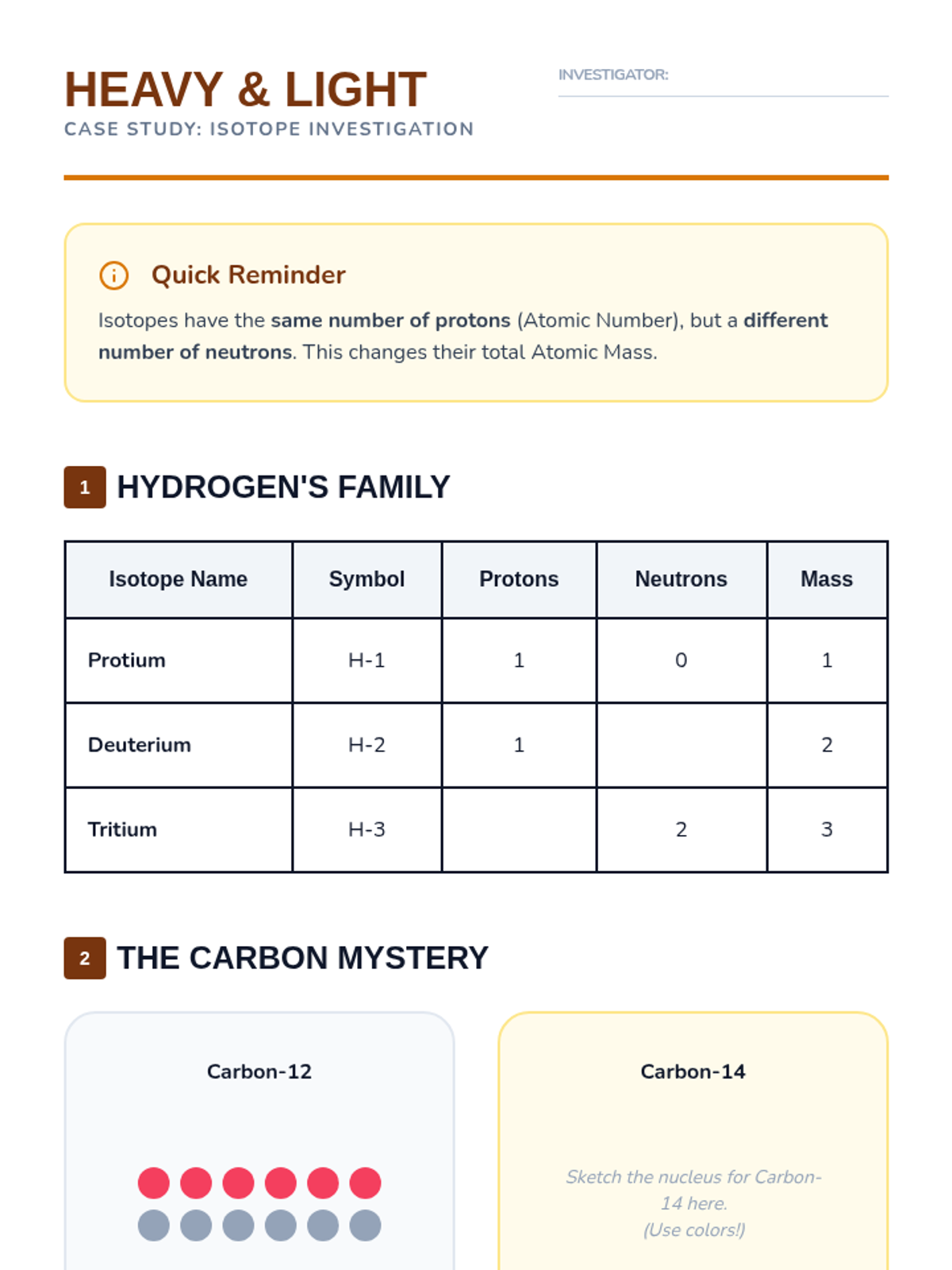
Worksheet for students to compare isotopes of Hydrogen and Carbon, including a sketching area for nucleus models.
Slides for Lesson 4 setting up the Material Selection Challenge with engineering scenarios like a Venus lander and a racing bike.
Slide deck defining isotopes as variations of elements with different neutron counts and explaining average atomic mass.
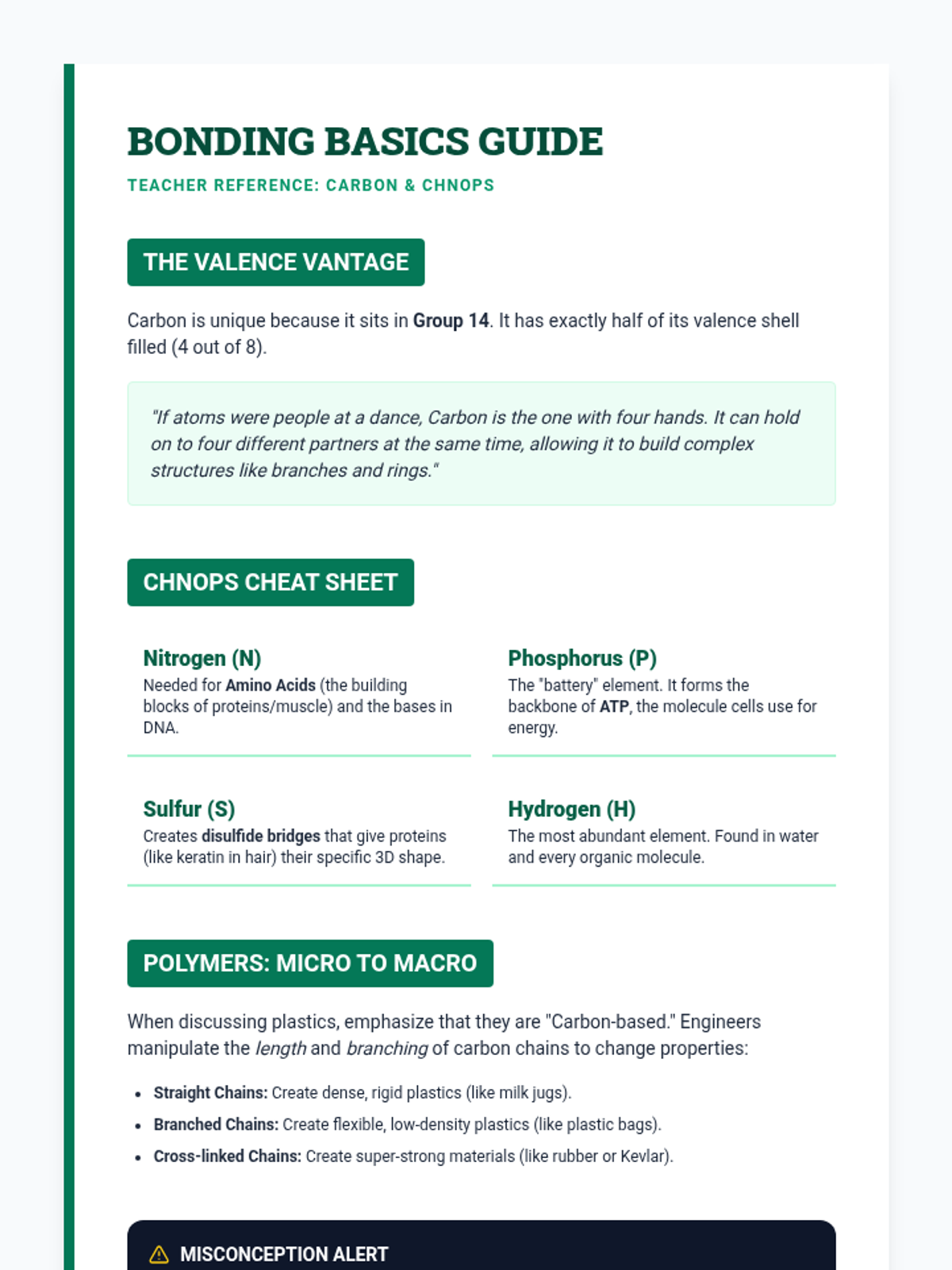
Teacher guide for Lesson 3 explaining the chemistry of carbon bonding, biological roles of CHNOPS, and the engineering of polymers.
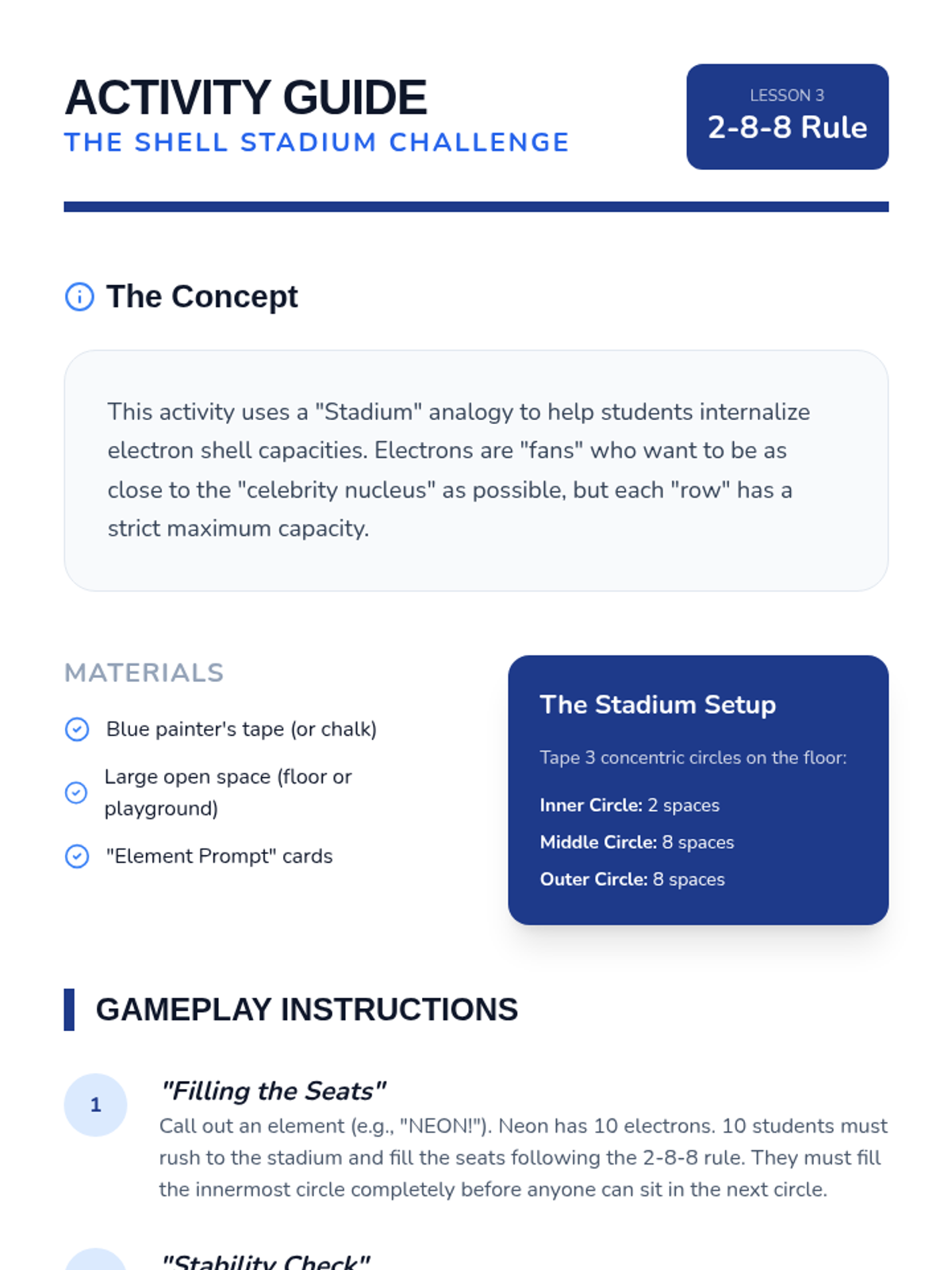
Activity guide for a physical "Stadium" game where students model electron configurations to learn the 2-8-8 rule.
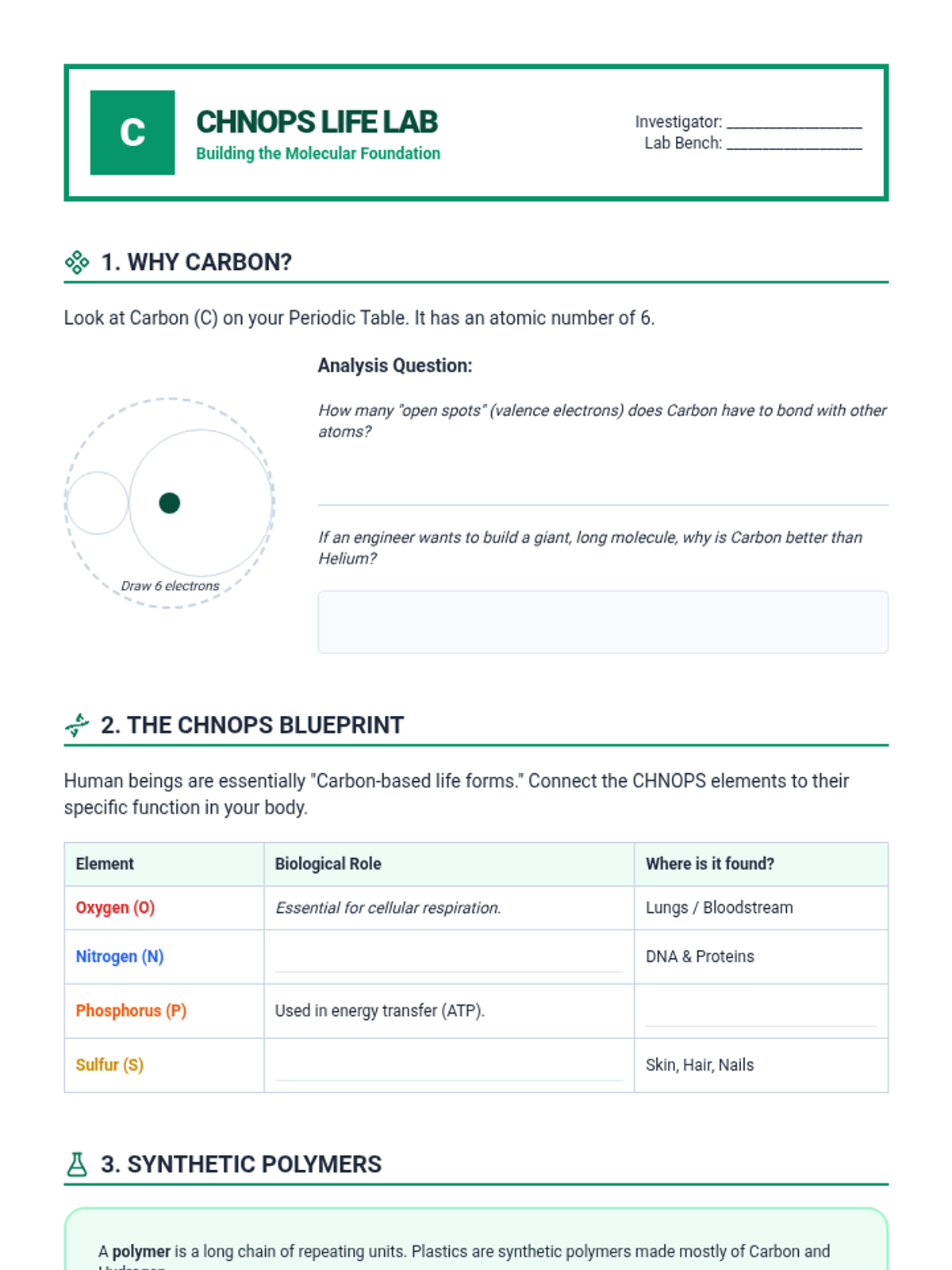
Worksheet for Lesson 3 focusing on Carbon's valence electrons, the biological roles of CHNOPS elements, and the concept of polymers.
Slides for Lesson 3 focusing on the unique bonding capabilities of Carbon, the CHNOPS elements of life, and the creation of polymers and plastics.
A set of 20 large-format vocabulary flashcards for sound and light physics, featuring simplified definitions and icons for SPED accessibility.
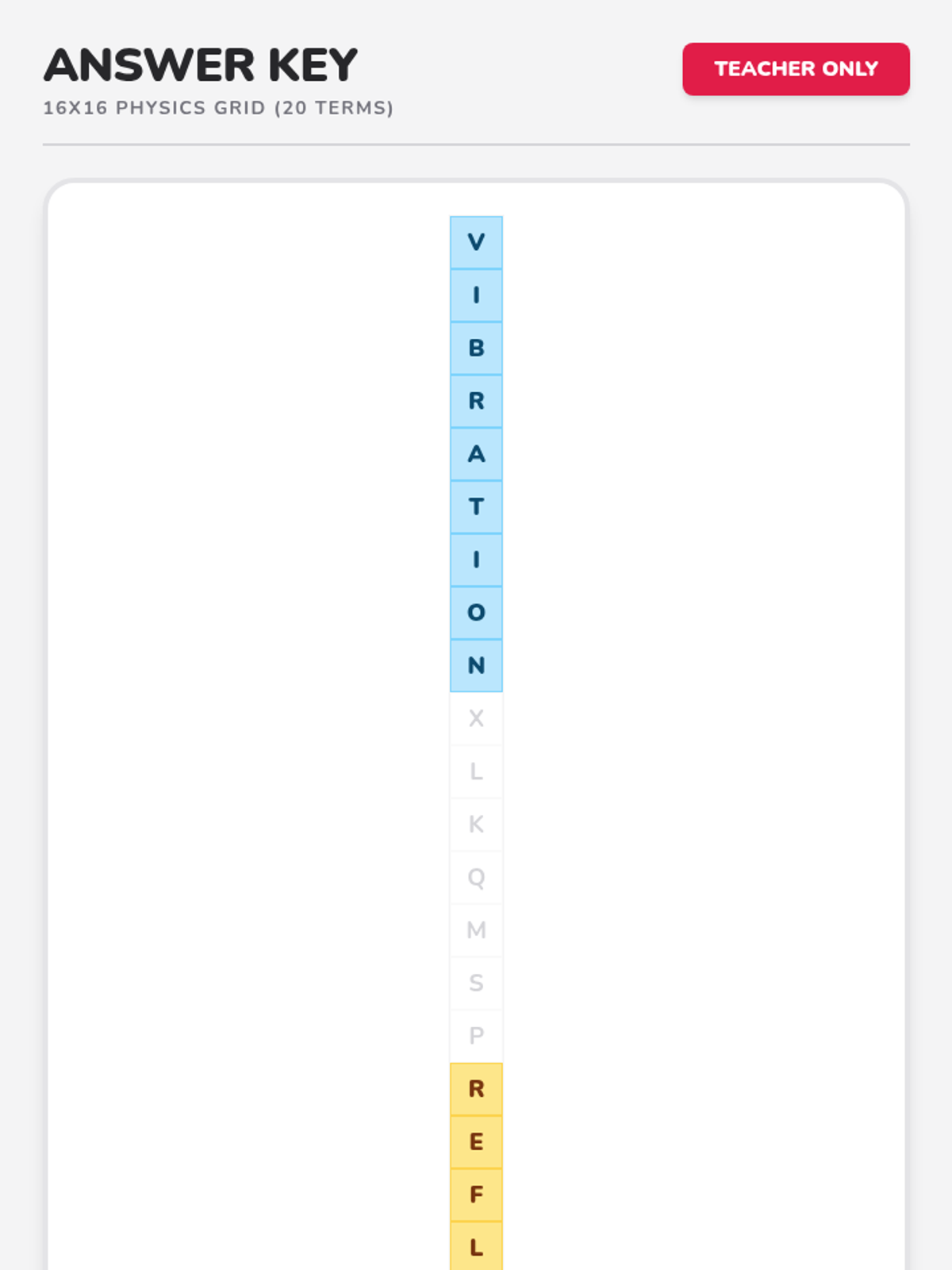
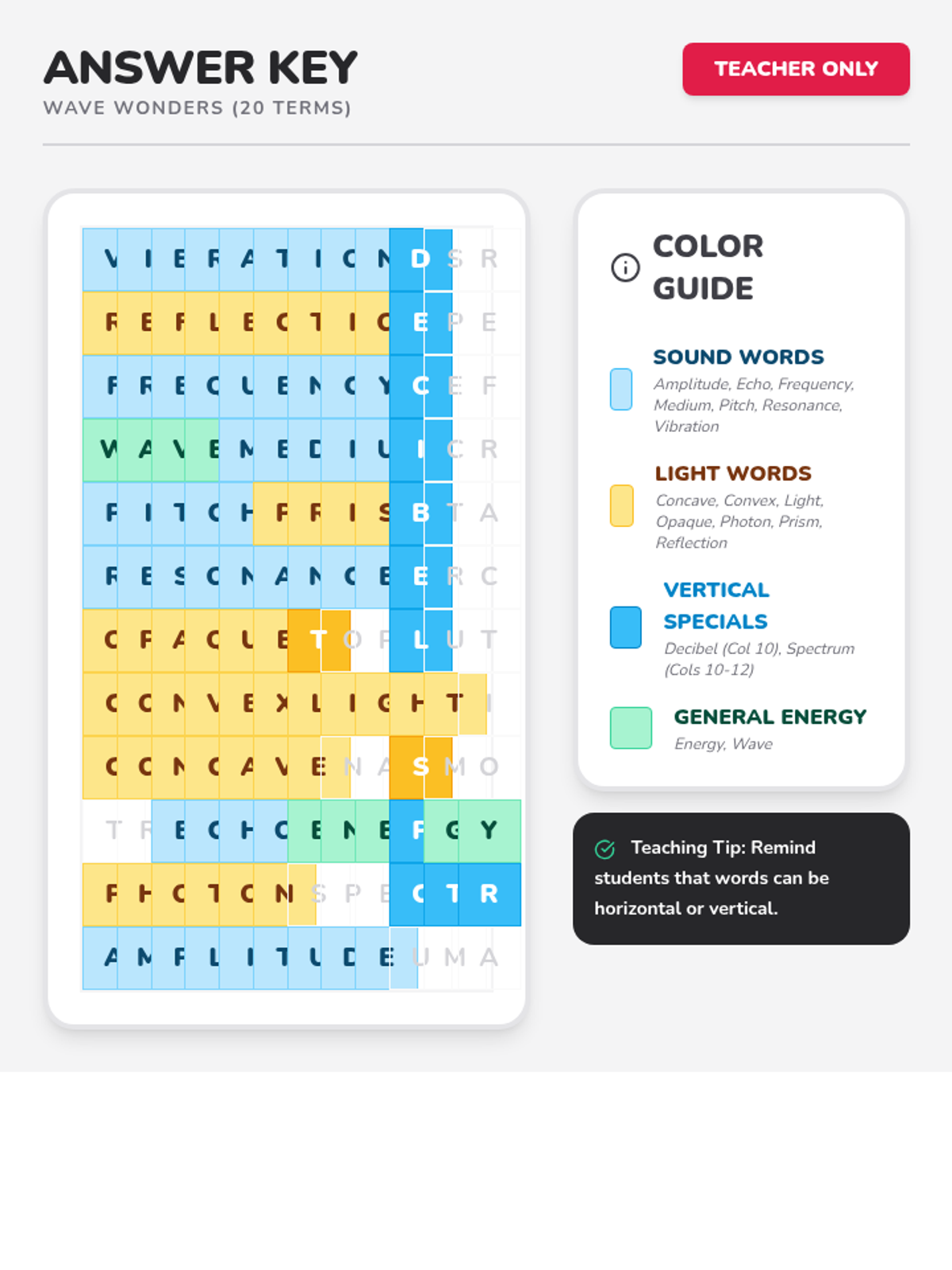
Updated answer key for the 16x16 Wave Wonders word search, identifying all 20 terms with clear category-based color coding.
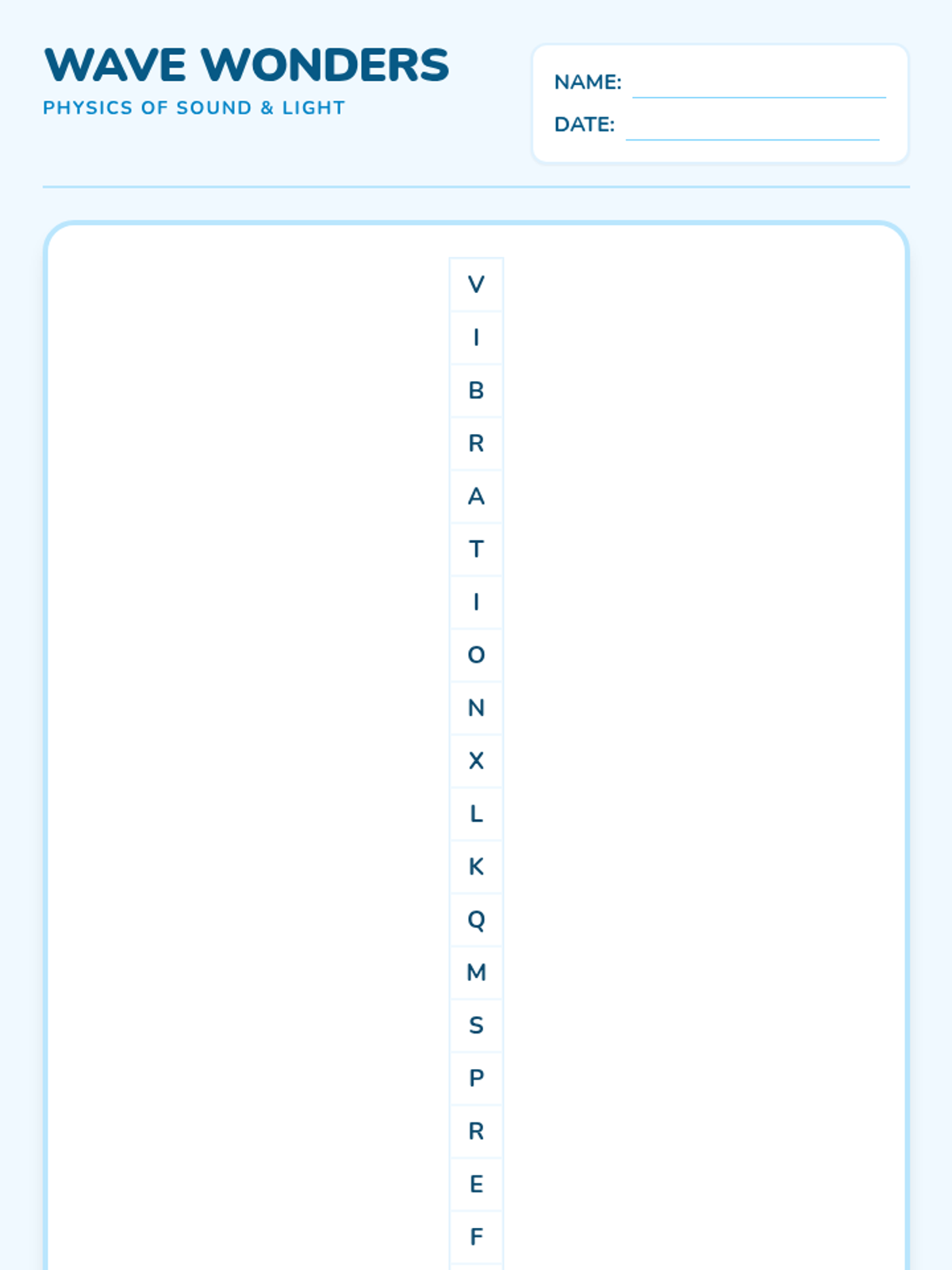
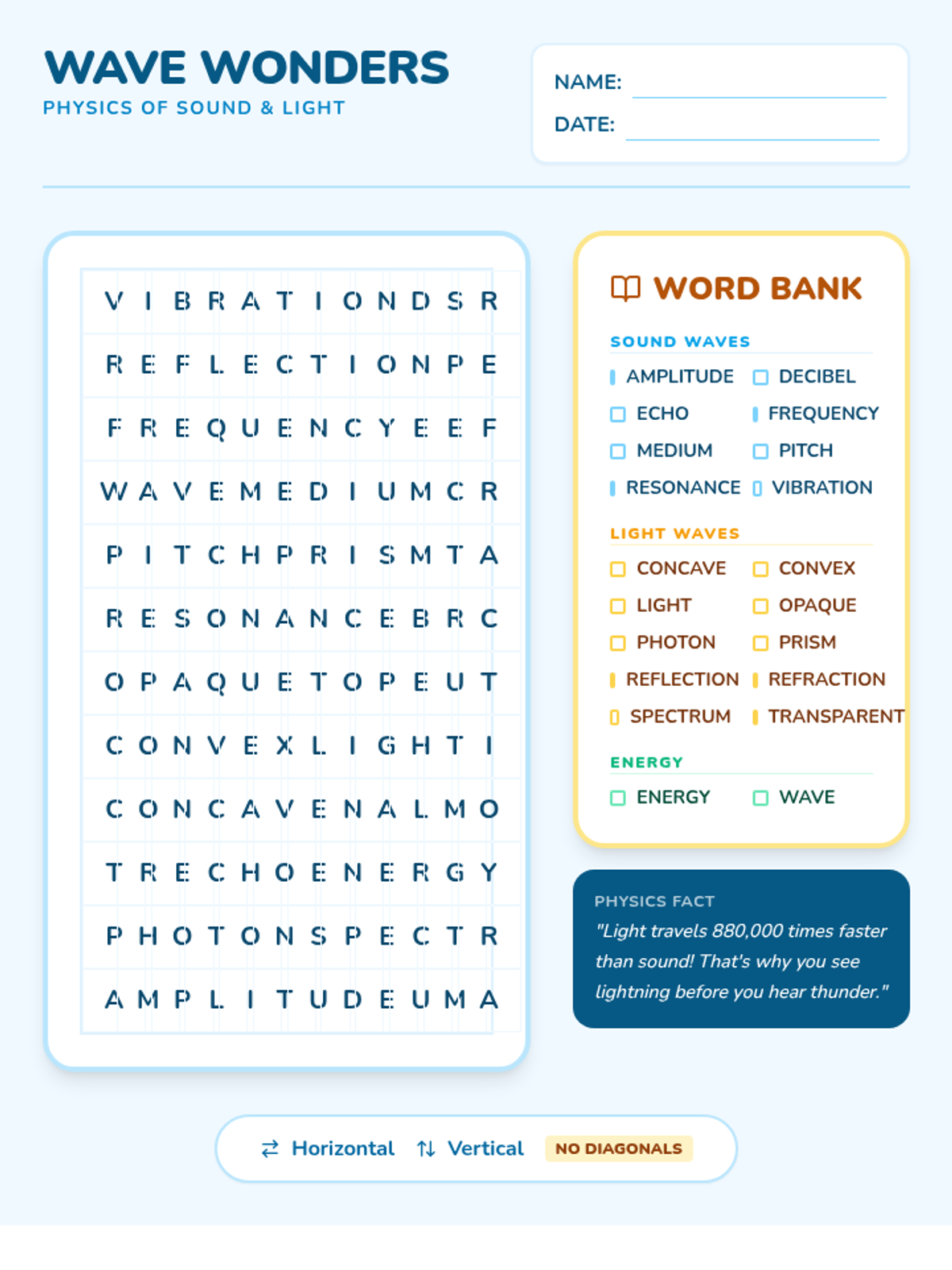
A corrected 16x16 word search grid with clear spacing and borders, featuring 20 sound and light terms for better SPED accessibility.
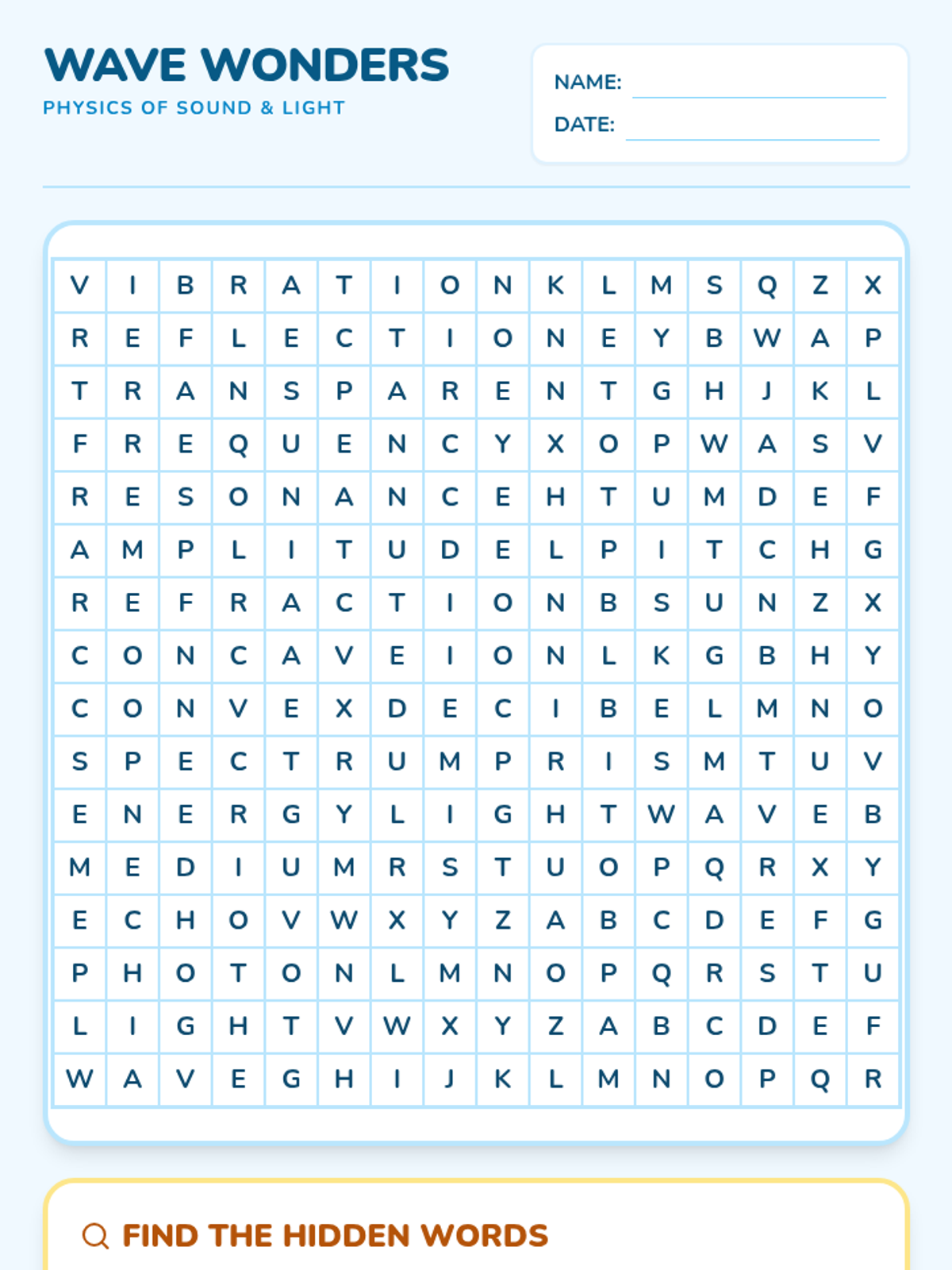
A larger 16x16 word search grid featuring 20 sound and light physics terms, optimized for clarity and student engagement with a category-based word bank.
Teacher answer key for the updated Wave Wonders word search, identifying 20 terms with color-coded categories.
An updated 12x12 word search worksheet with 20 terms including Decibel, Resonance, Opaque, and Transparent, designed for Special Education accessibility with organized word bank.
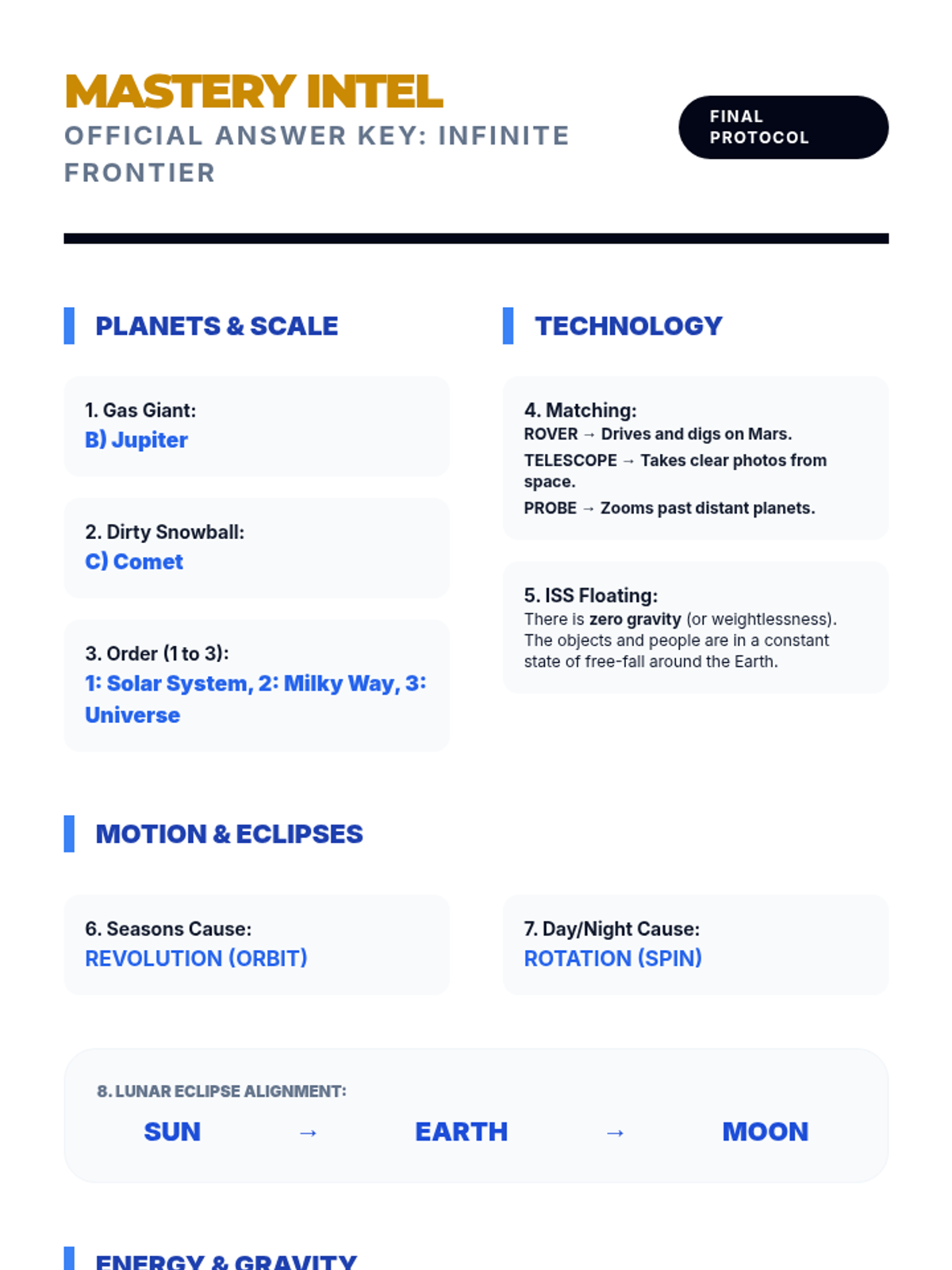
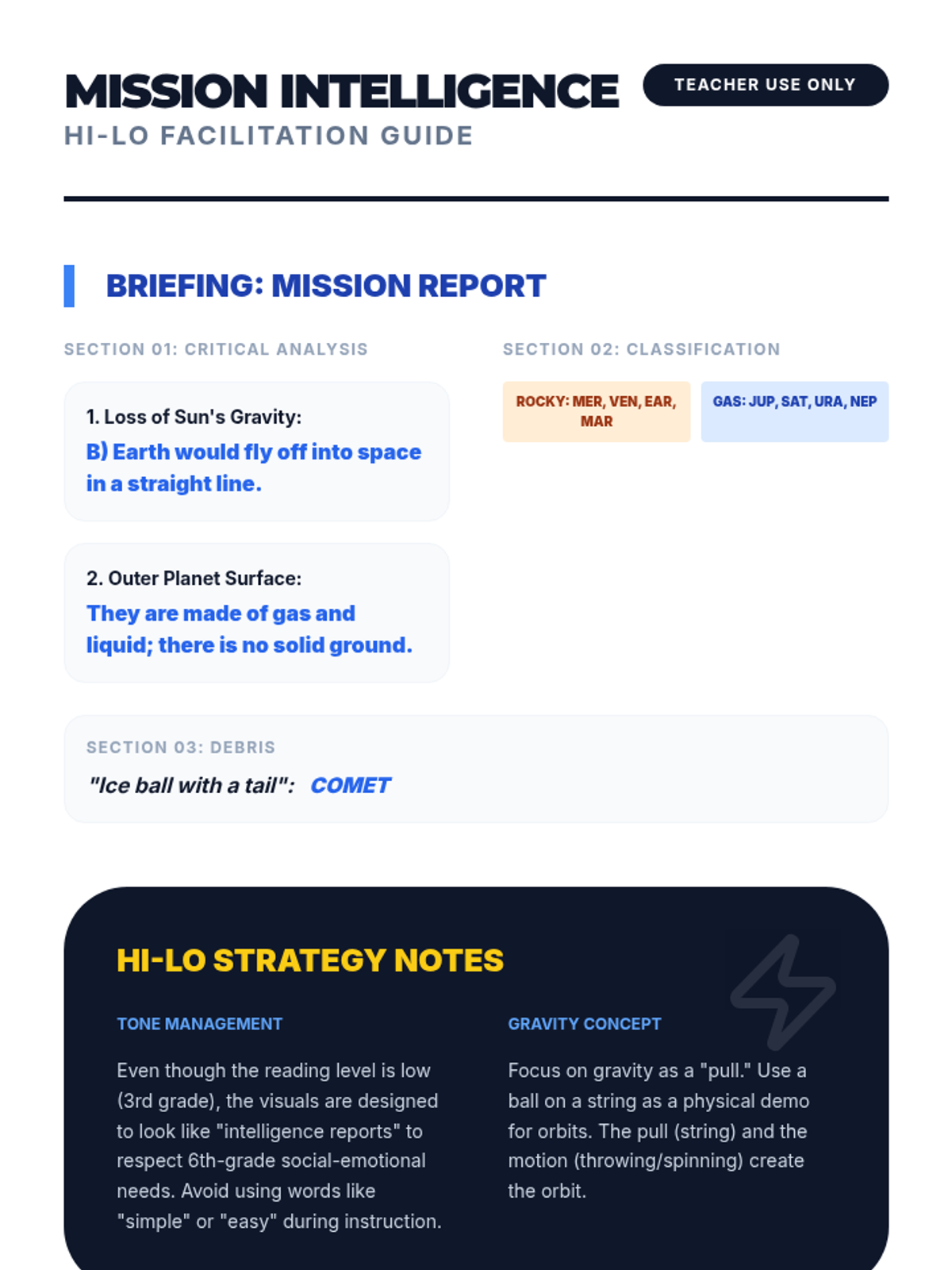
The master answer key for the unit mastery assessment, providing solutions for all 10 questions and the final gravity identification.
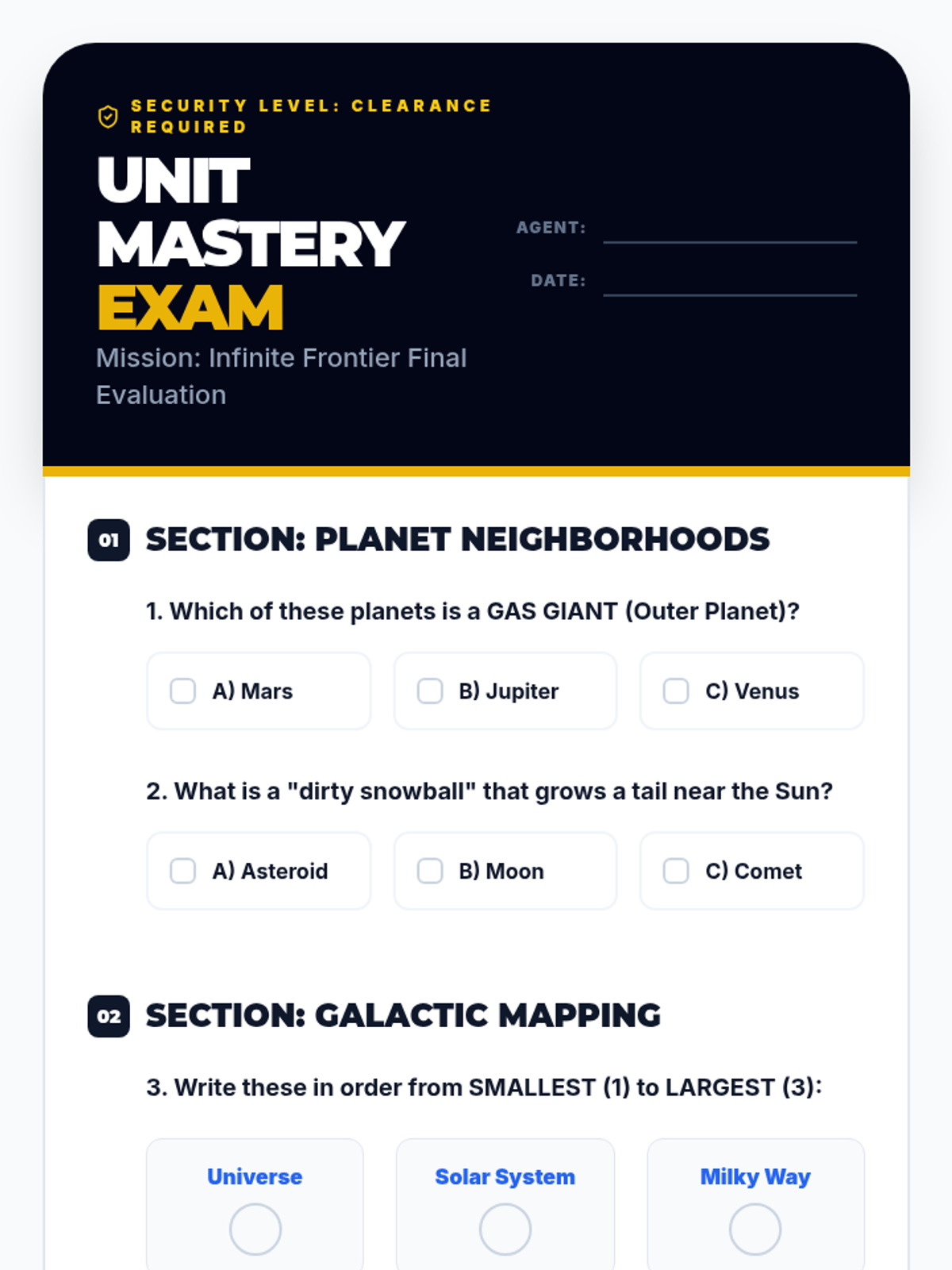
A comprehensive 10-question unit mastery assessment for the Infinite Frontier sequence, covering the solar system, galaxies, space technology, rotation/revolution, moon phases, and star life cycles. Designed with 3rd-grade readability.
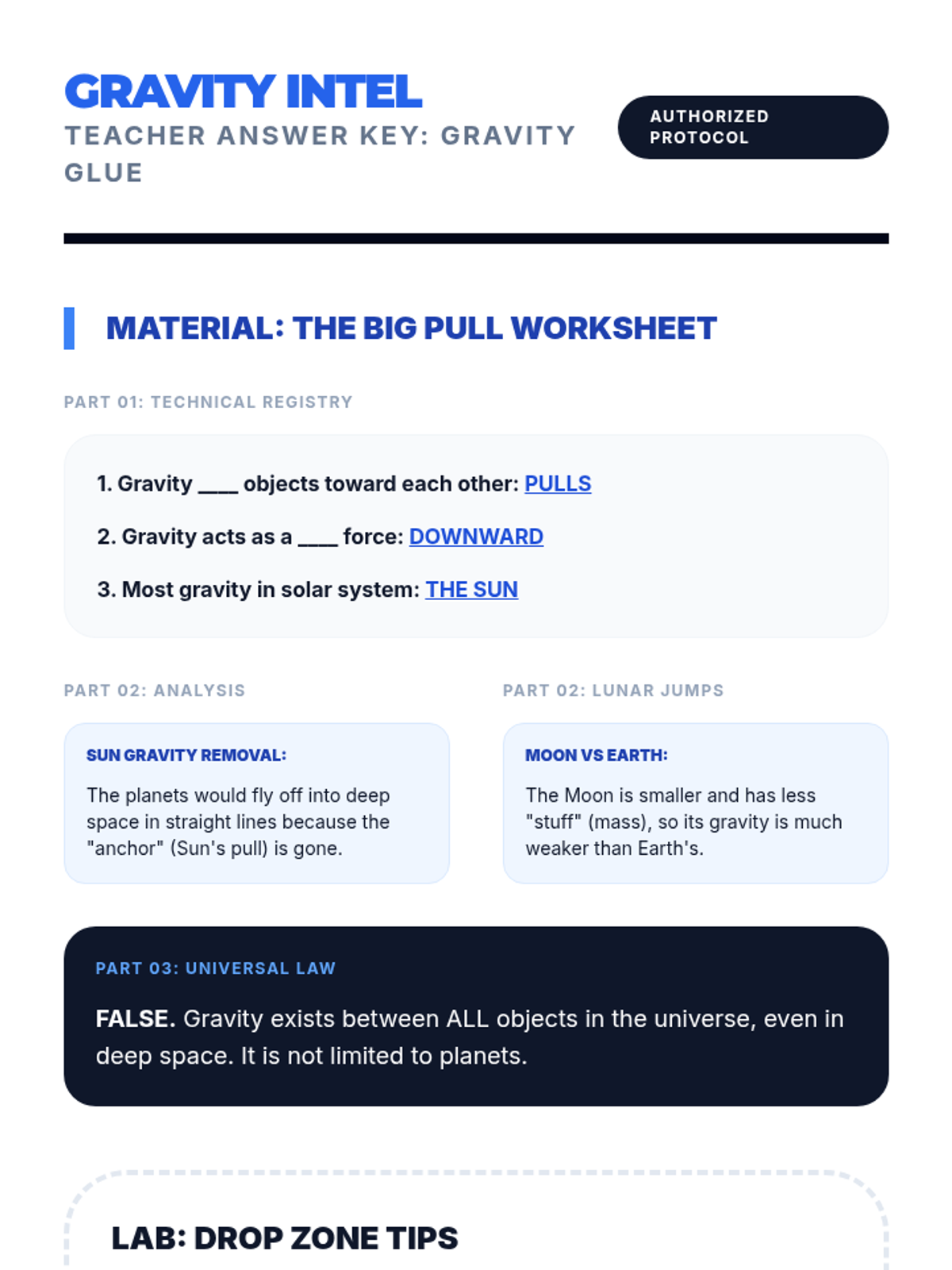
An answer key and teacher facilitation guide for the "Gravity Glue" lesson, providing solutions for the worksheet and tips for the drop zone experiment.
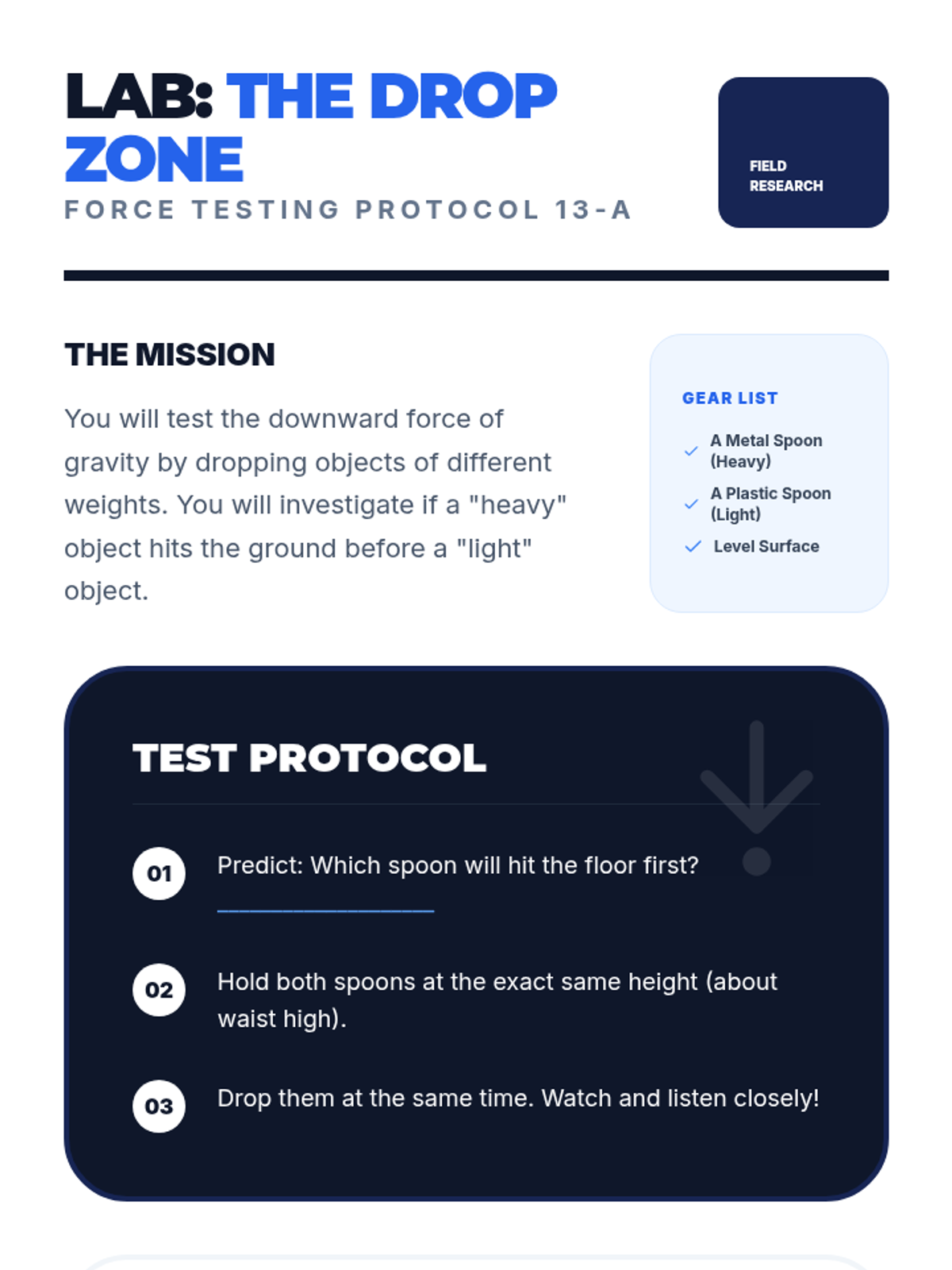
A STEM experiment where students drop objects of different masses to observe Earth's downward pull and learn that gravity affects objects equally.
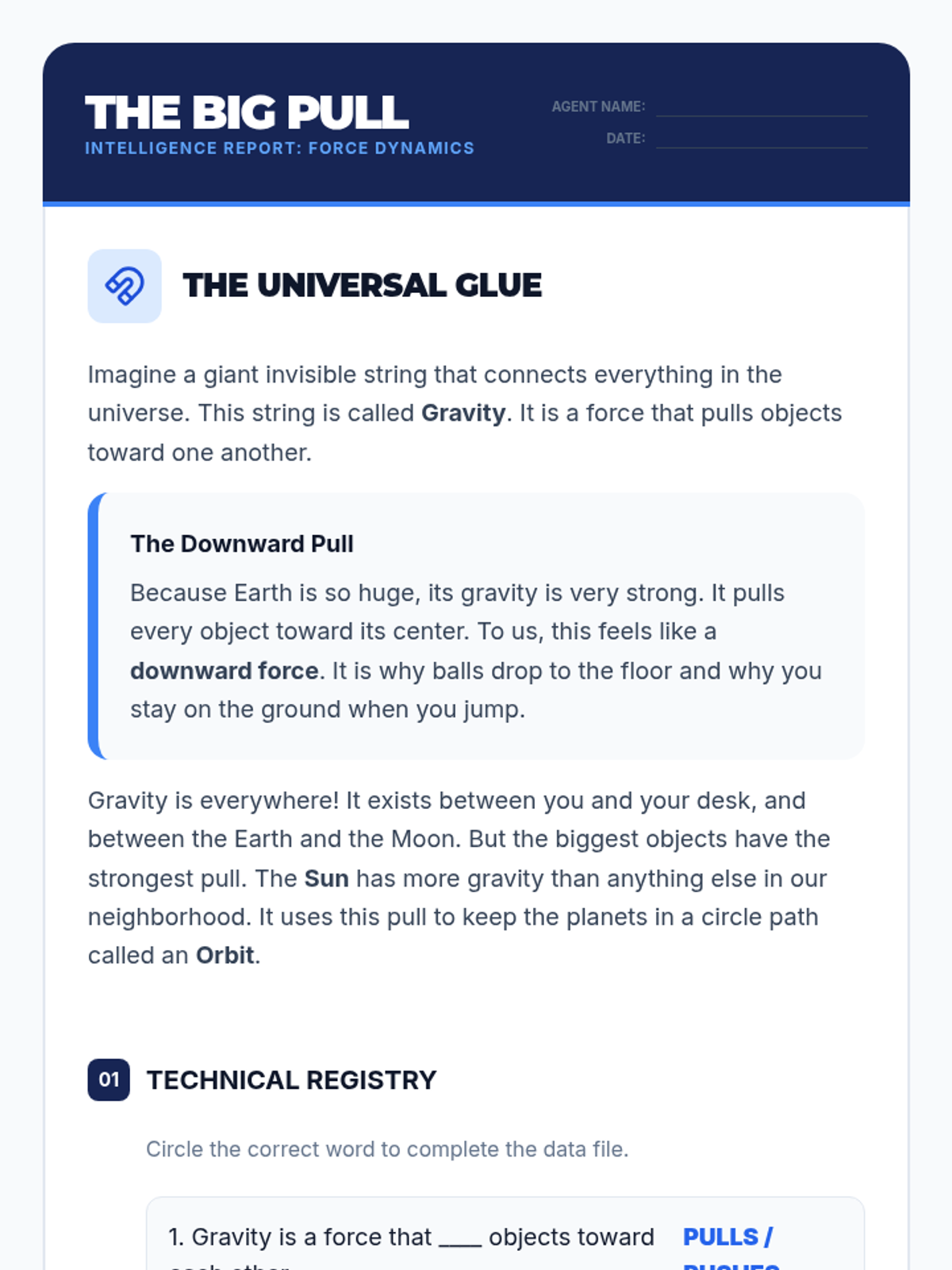
A reading comprehension worksheet for 3rd graders about the force of gravity, its downward direction on Earth, and its role in planetary orbits.
A visually engaging slide deck exploring the fundamental force of gravity, Earth's downward pull, and the relationship between the Sun and planets.
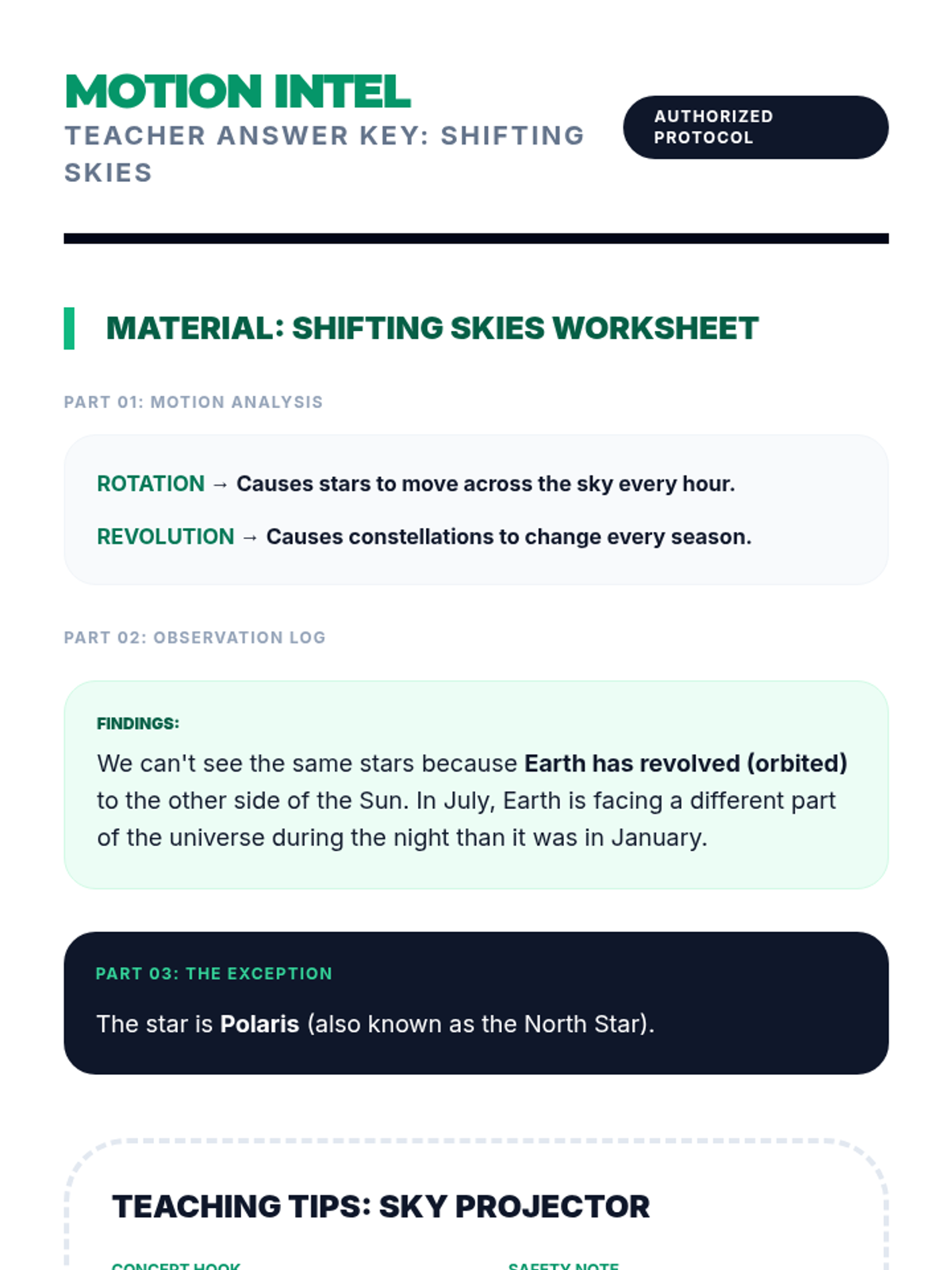
An answer key and teacher facilitation guide for the "Shifting Skies" lesson, providing solutions for the worksheet and tips for the star projector activity.
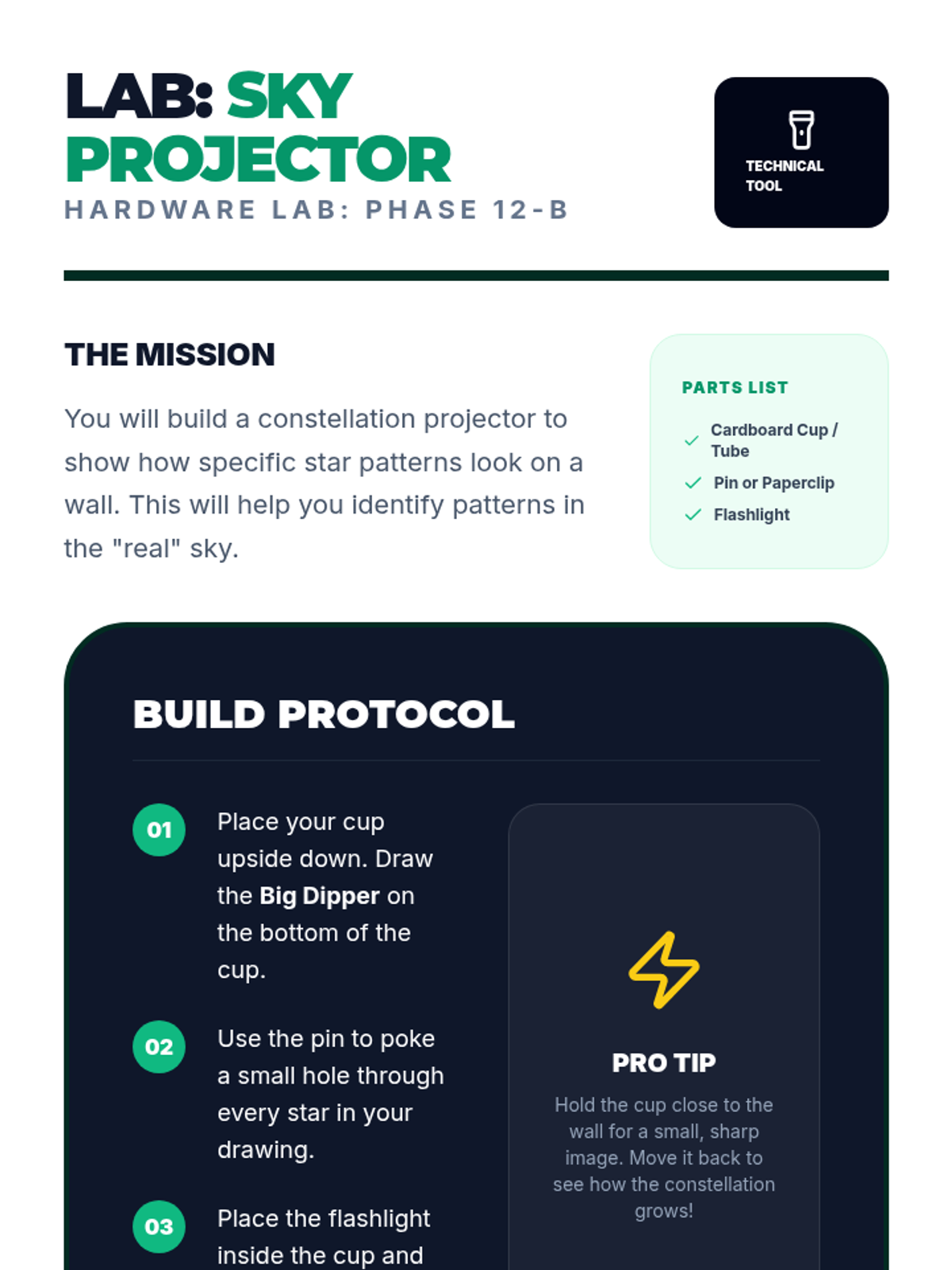
A hands-on activity where students create a star projector using a cup and pin to model constellation patterns and demonstrate how they appear to move.
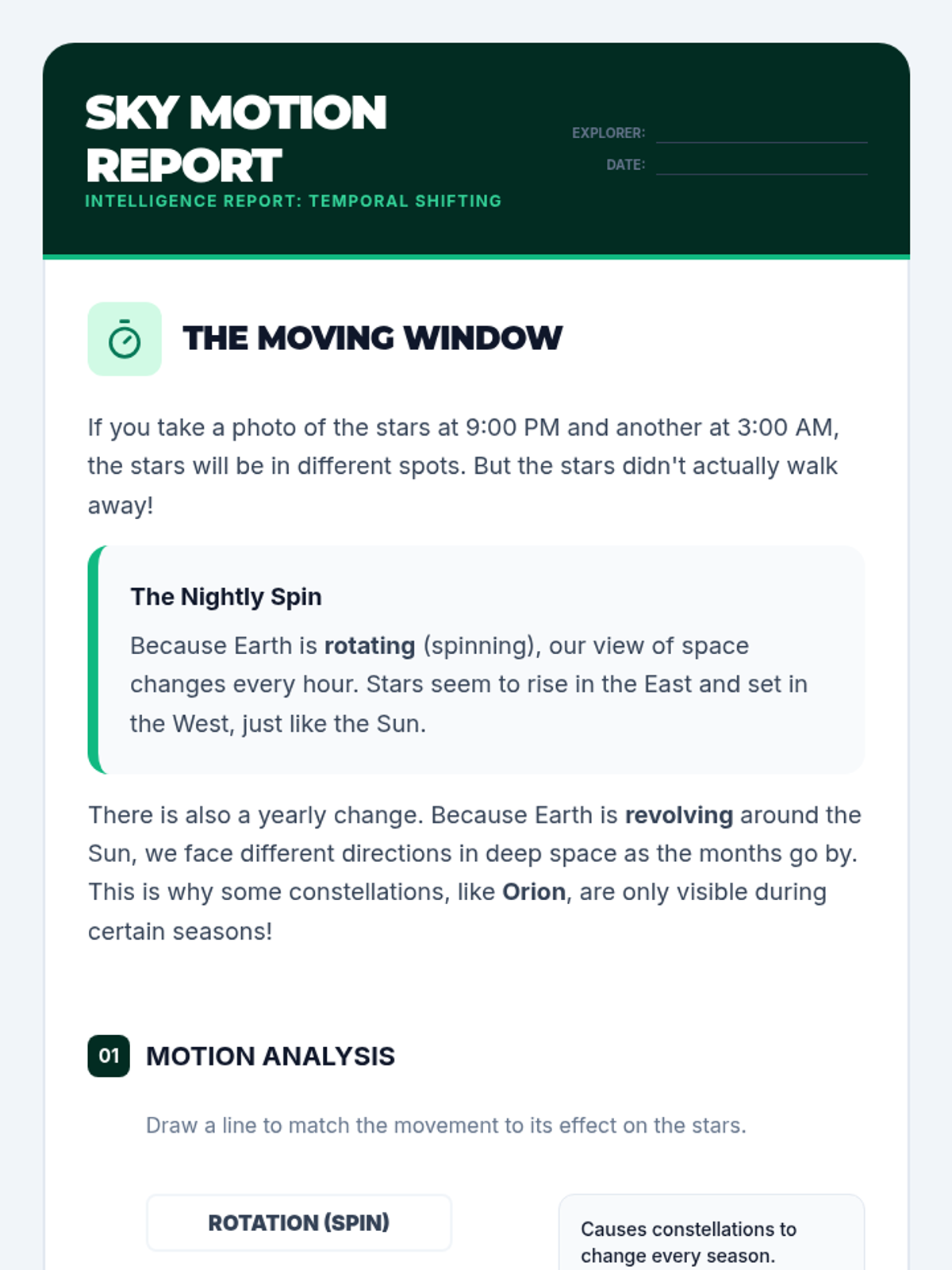
A reading comprehension worksheet for 3rd graders about why constellations appear to move nightly and change seasonally due to rotation and revolution.
A visually engaging slide deck explaining how Earth's rotation causes the nightly apparent motion of stars and how its revolution causes seasonal changes in which constellations are visible.
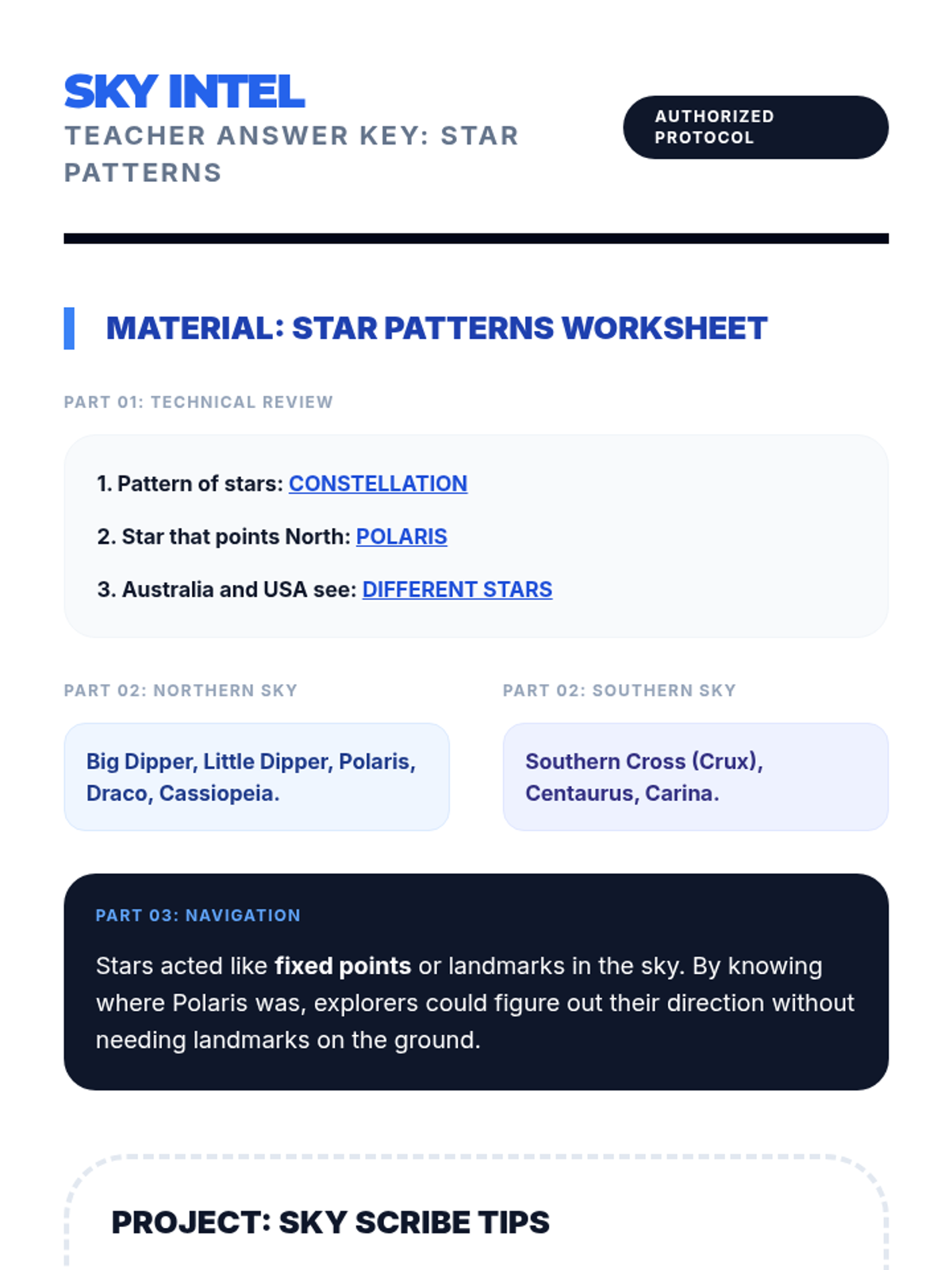
An answer key and teacher facilitation guide for the "Star Patterns" lesson, providing solutions for the worksheet and tips for the constellation creation project.
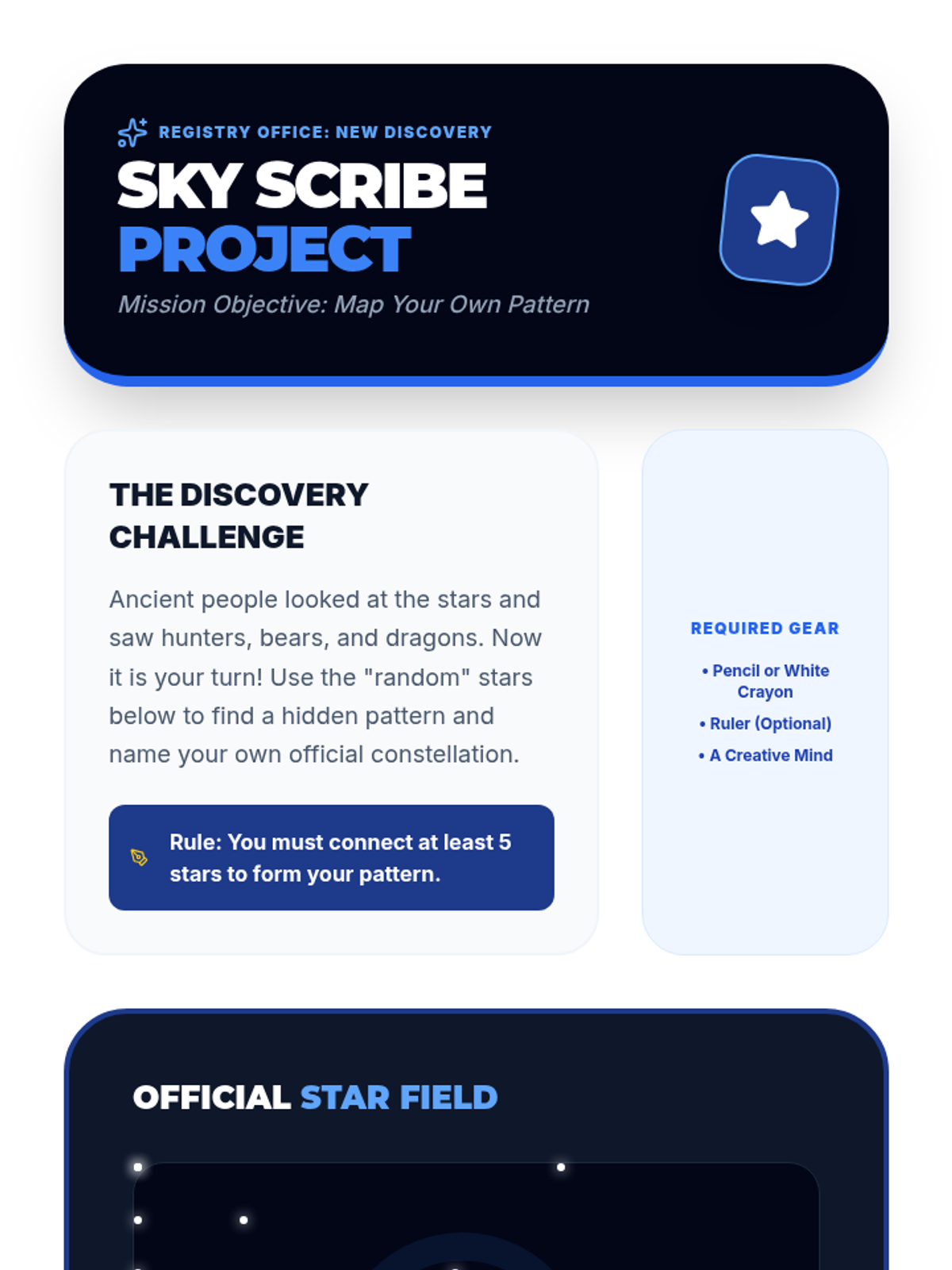
A creative project where students connect a series of "stars" to form their own original constellation and write a short mythical story about its origin.
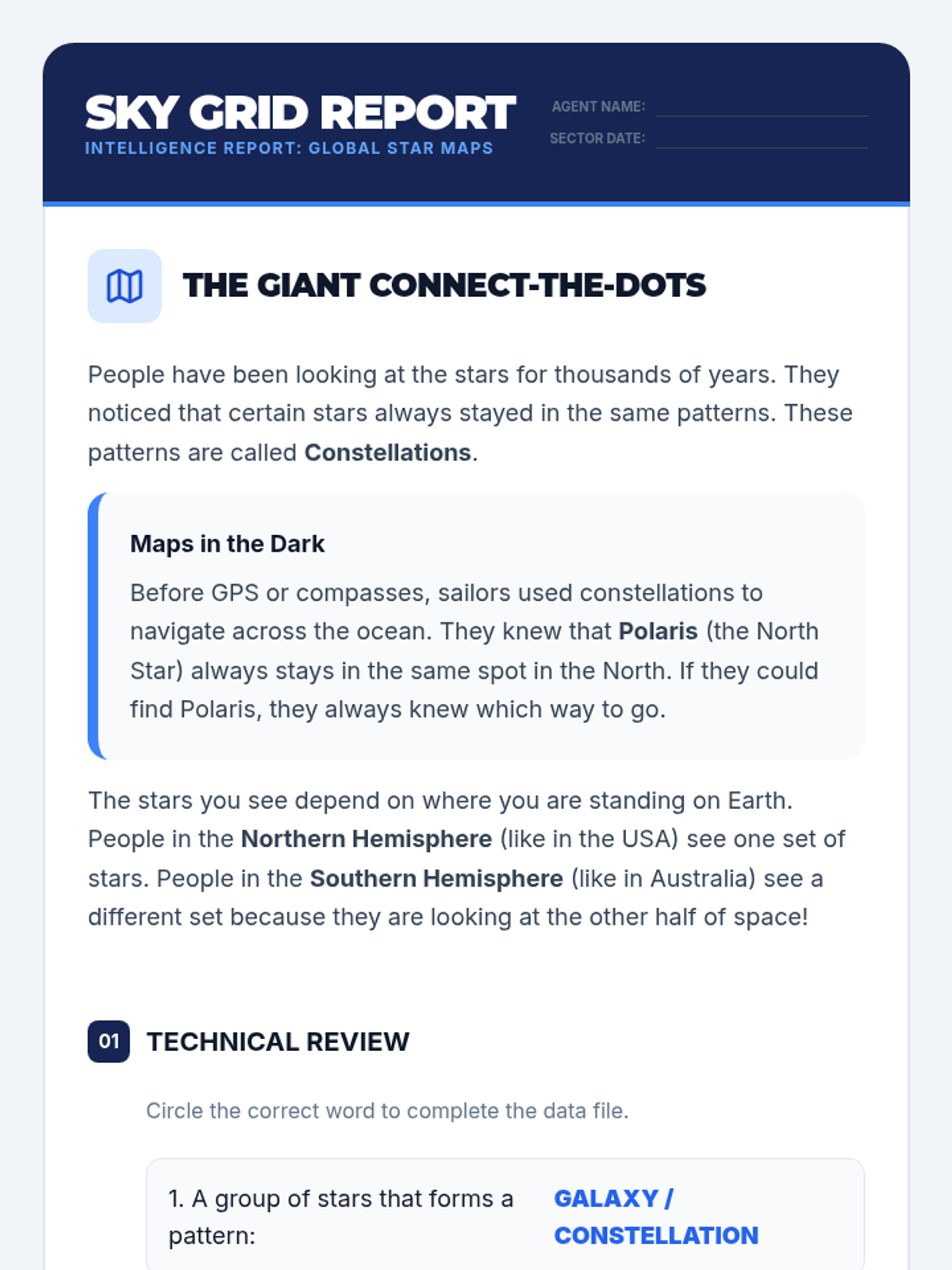
A reading comprehension worksheet for 3rd graders about what constellations are, how they are used for navigation, and why the view differs by hemisphere.
A visual slide deck to introduce the hand warmer investigation. It explains the mission, procedure, energy transformation from chemical to thermal energy, and defines exothermic reactions.
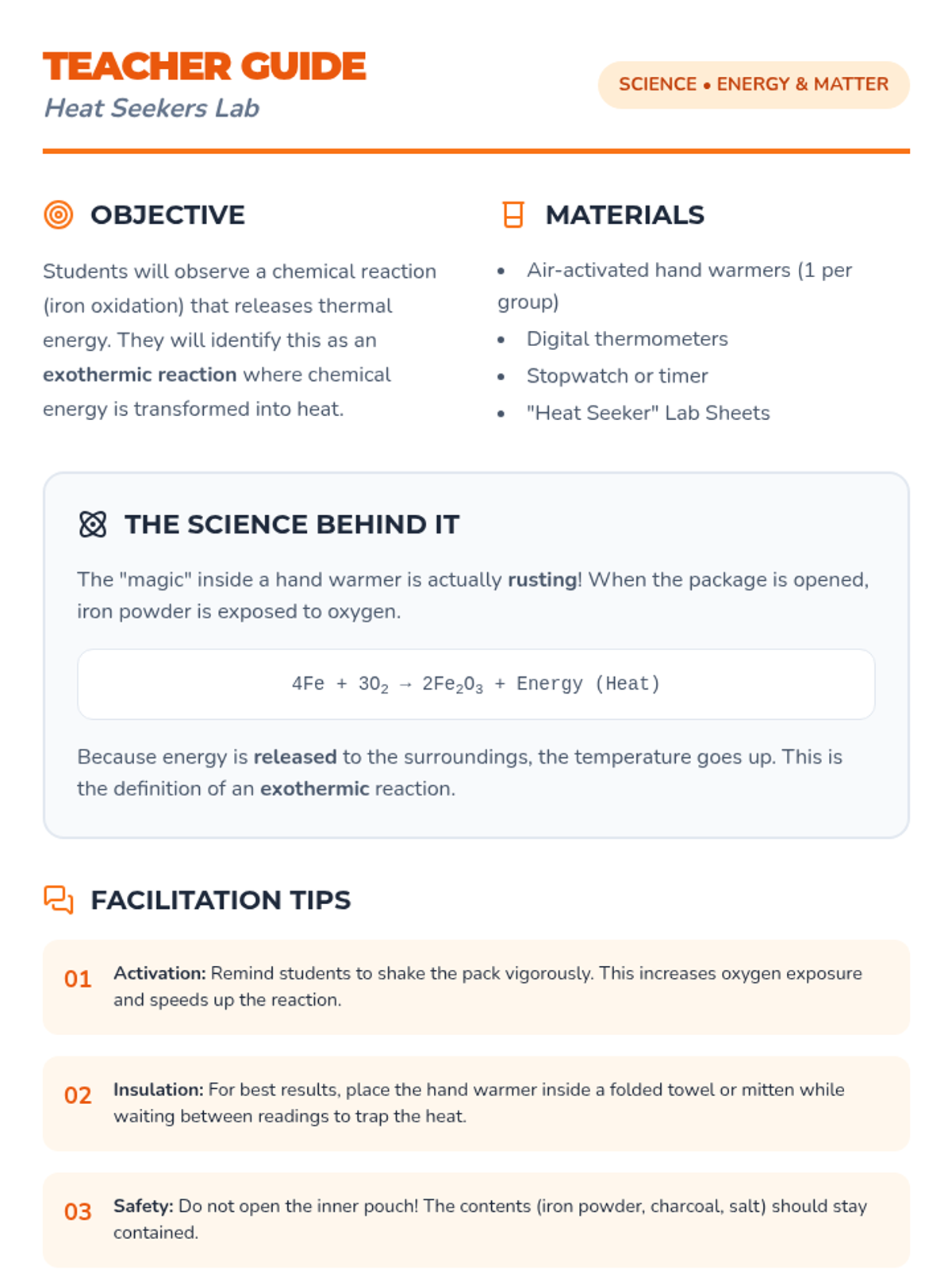
A comprehensive teacher facilitation guide for the Heat Seekers lab. Includes learning objectives, materials lists, a scientific explanation of the exothermic reaction (iron oxidation), facilitation tips, and an answer key.
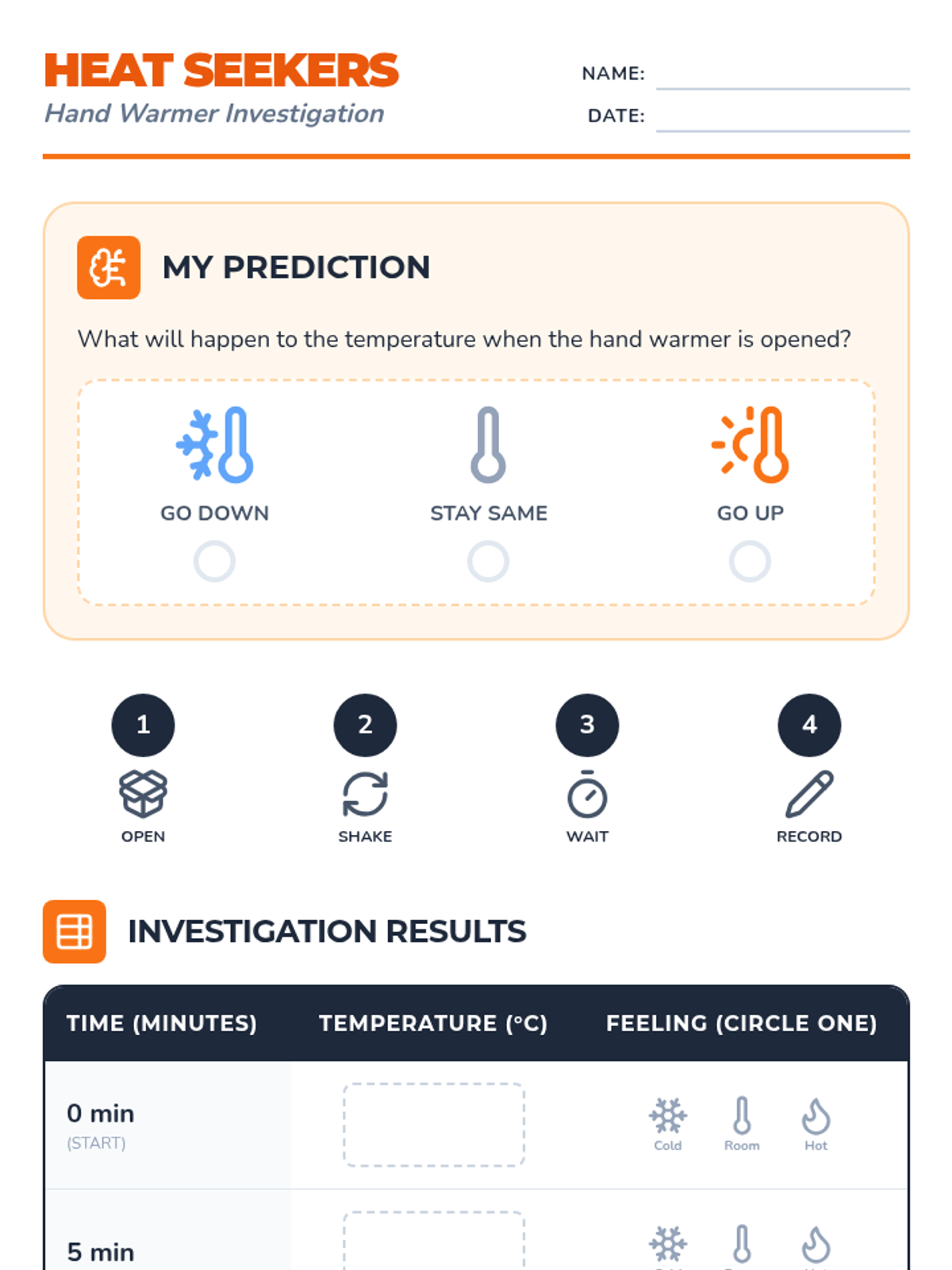
A highly visual lab investigation sheet for students to record results during a hand warmer experiment. It features icon-based instructions, a clear data table for temperature tracking, and simple conclusion prompts focusing on exothermic reactions.
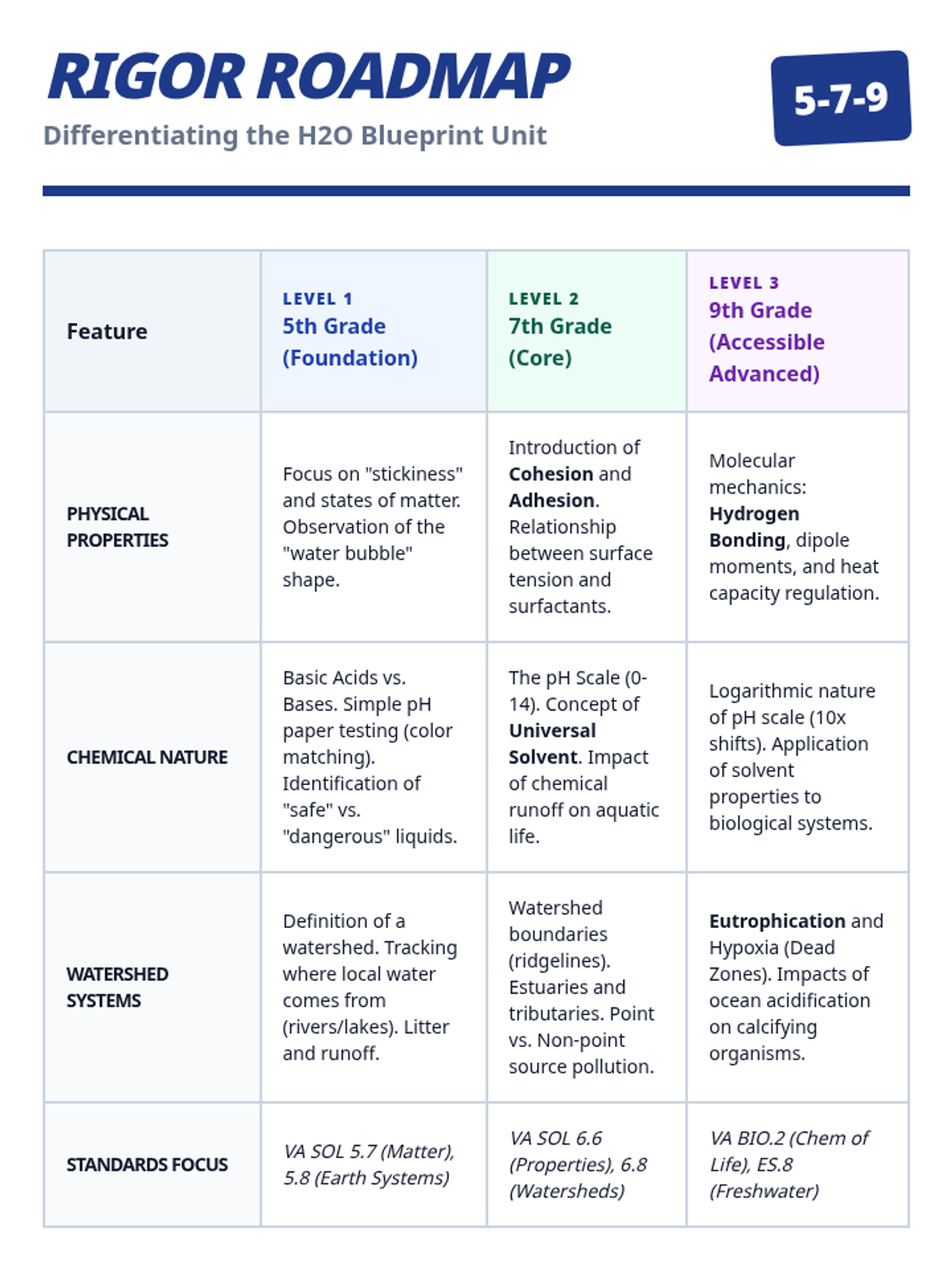
A comprehensive teacher resource comparing the core concepts, standards, and instructional focus for 5th, 7th, and 9th grade learners within the water unit. Simplified 9th-grade focus to improve accessibility.
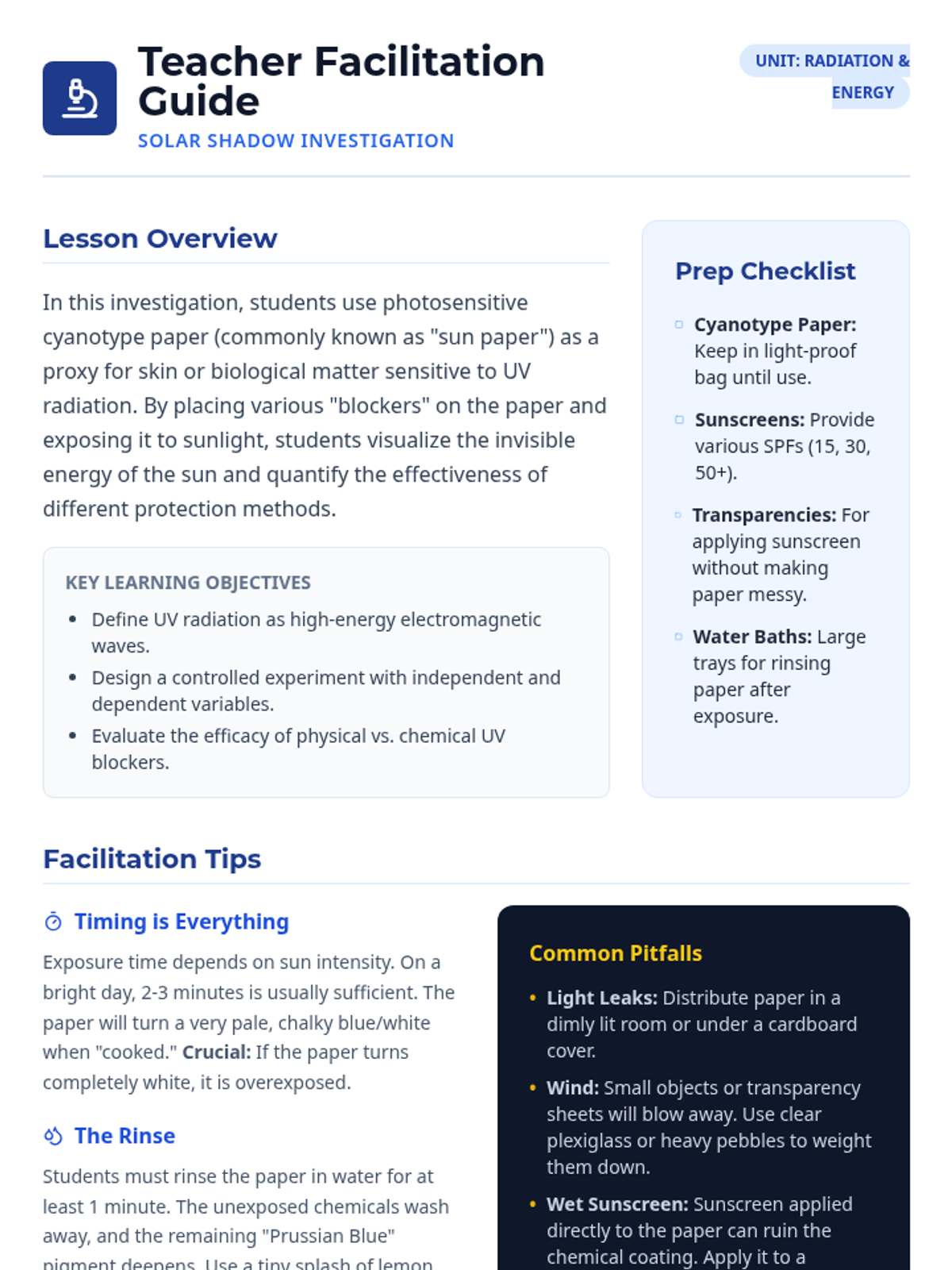
A teacher facilitation guide for the Solar Shadow Lab, featuring setup instructions, common pitfalls, a discussion guide, and a complete answer key for the student worksheet.
An introductory slide deck explaining the properties of UV radiation, the chemistry of cyanotype (sun paper), and the objectives of the solar shadow lab.
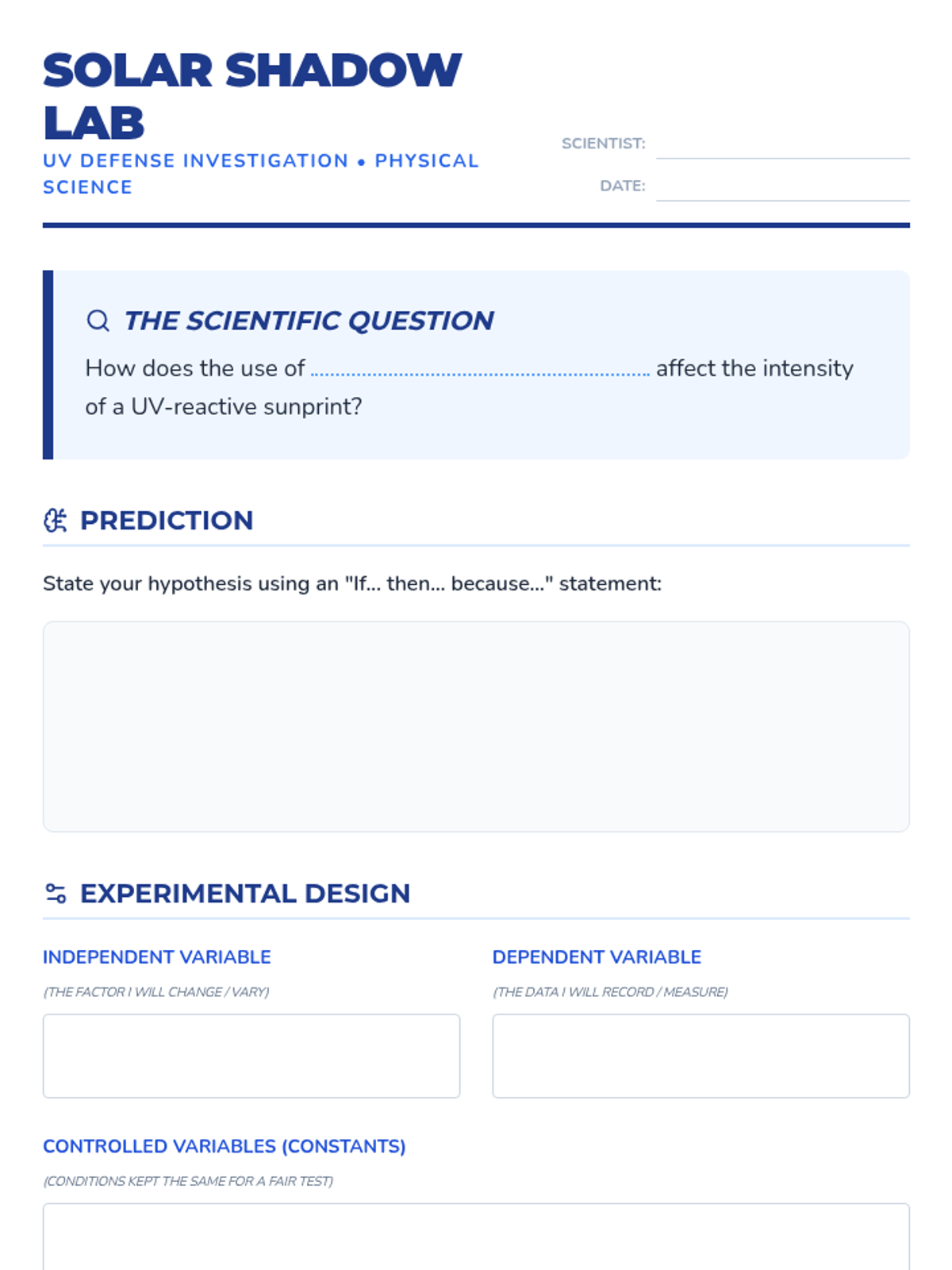
A comprehensive lab write-up template for a sun paper (cyanotype) experiment, featuring sections for hypothesis building, variable identification, data collection via sketching and ranking, and reflective analysis.
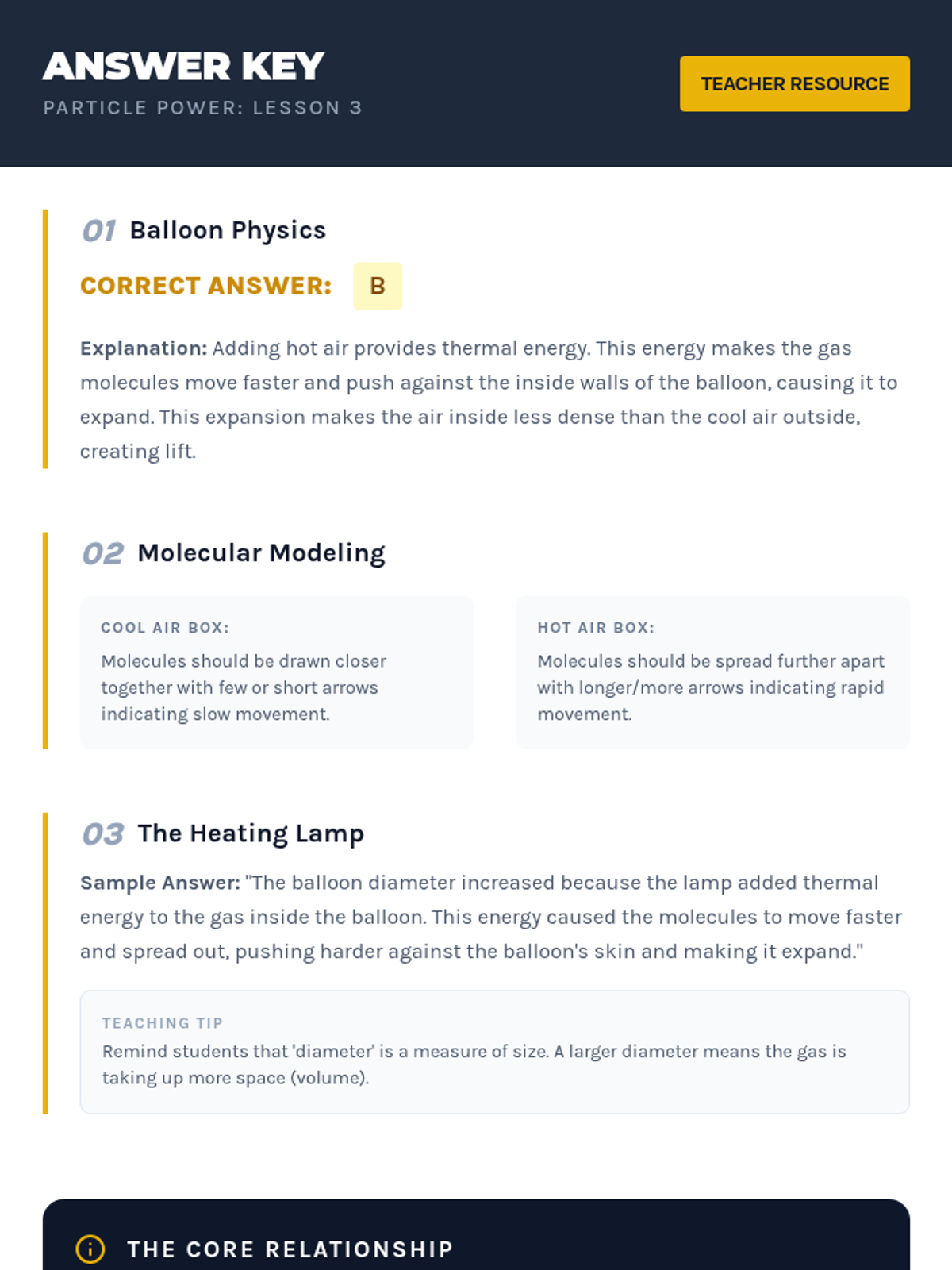
Teacher answer key for Lesson 3, including sample student responses and key concepts for thermal energy and particle motion.
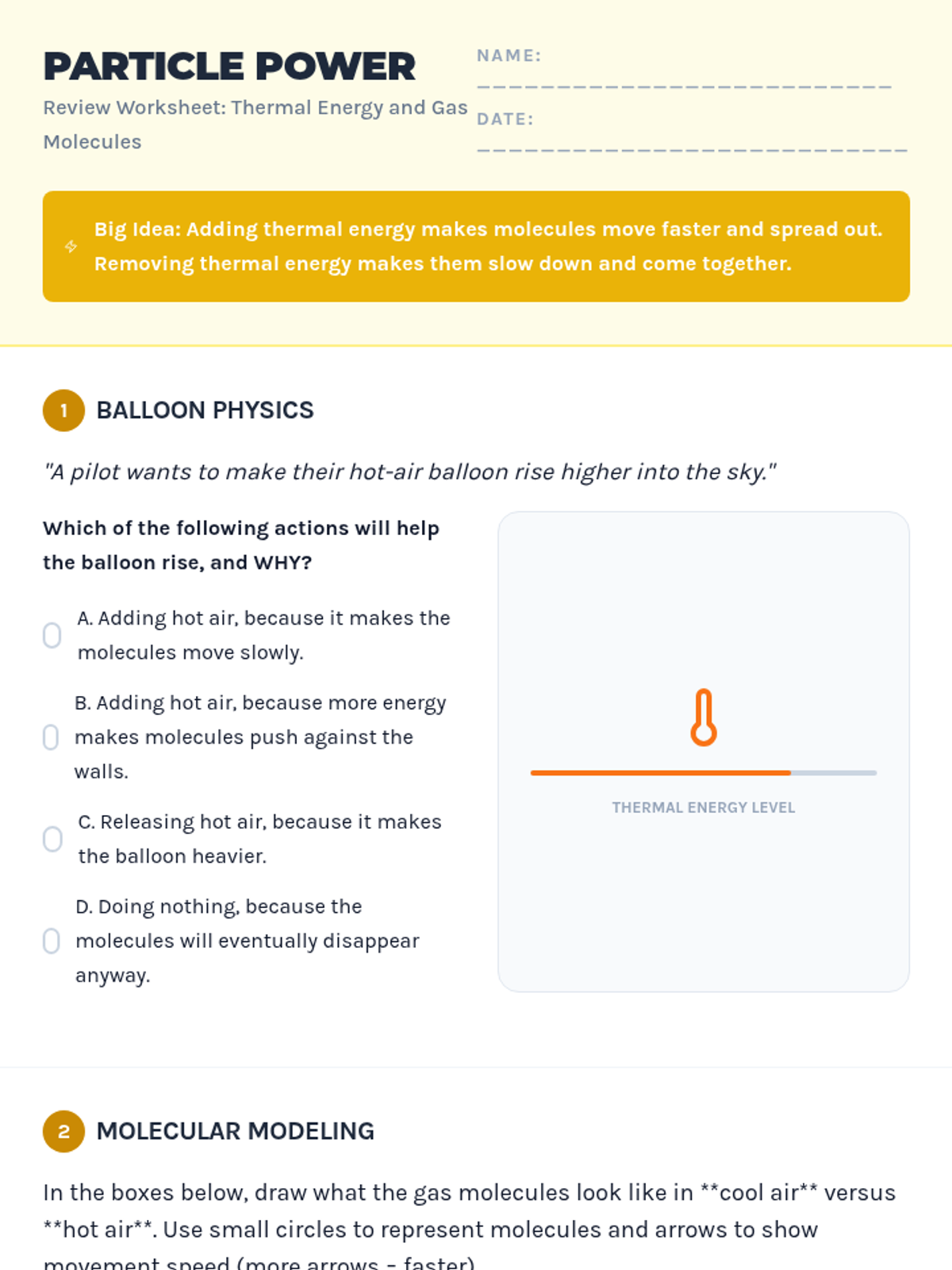
A review worksheet for Lesson 3 focusing on interpreting data about thermal energy and its effect on gas volume and particle motion.
A presentation slide deck featuring the "The Science of Weather" documentary. Includes discussion prompts that encourage students to think critically about the roles of solar energy and condensation in weather systems.
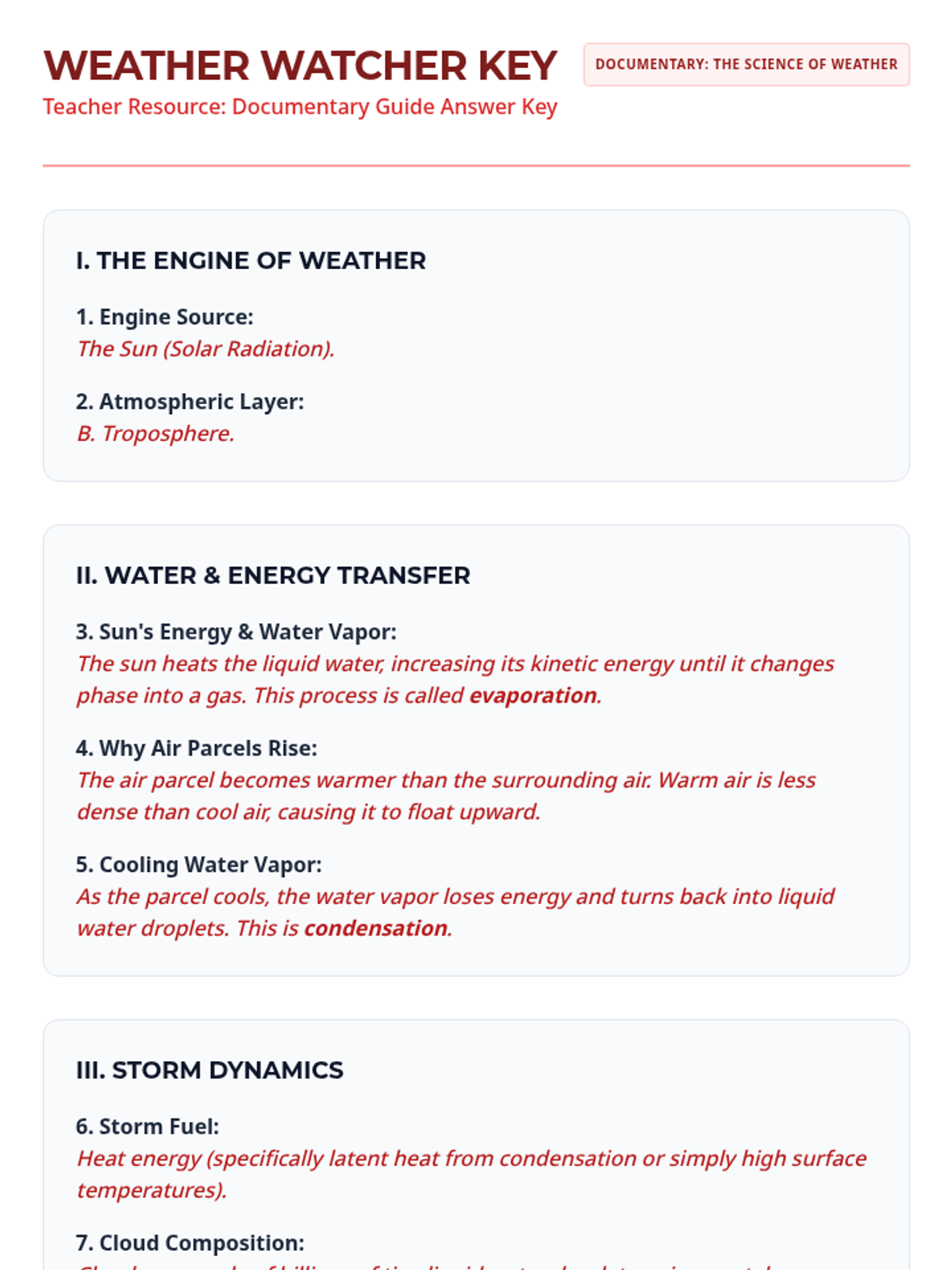
An answer key for the Weather Watcher Guide Worksheet, providing correct answers and sample student responses for teachers.
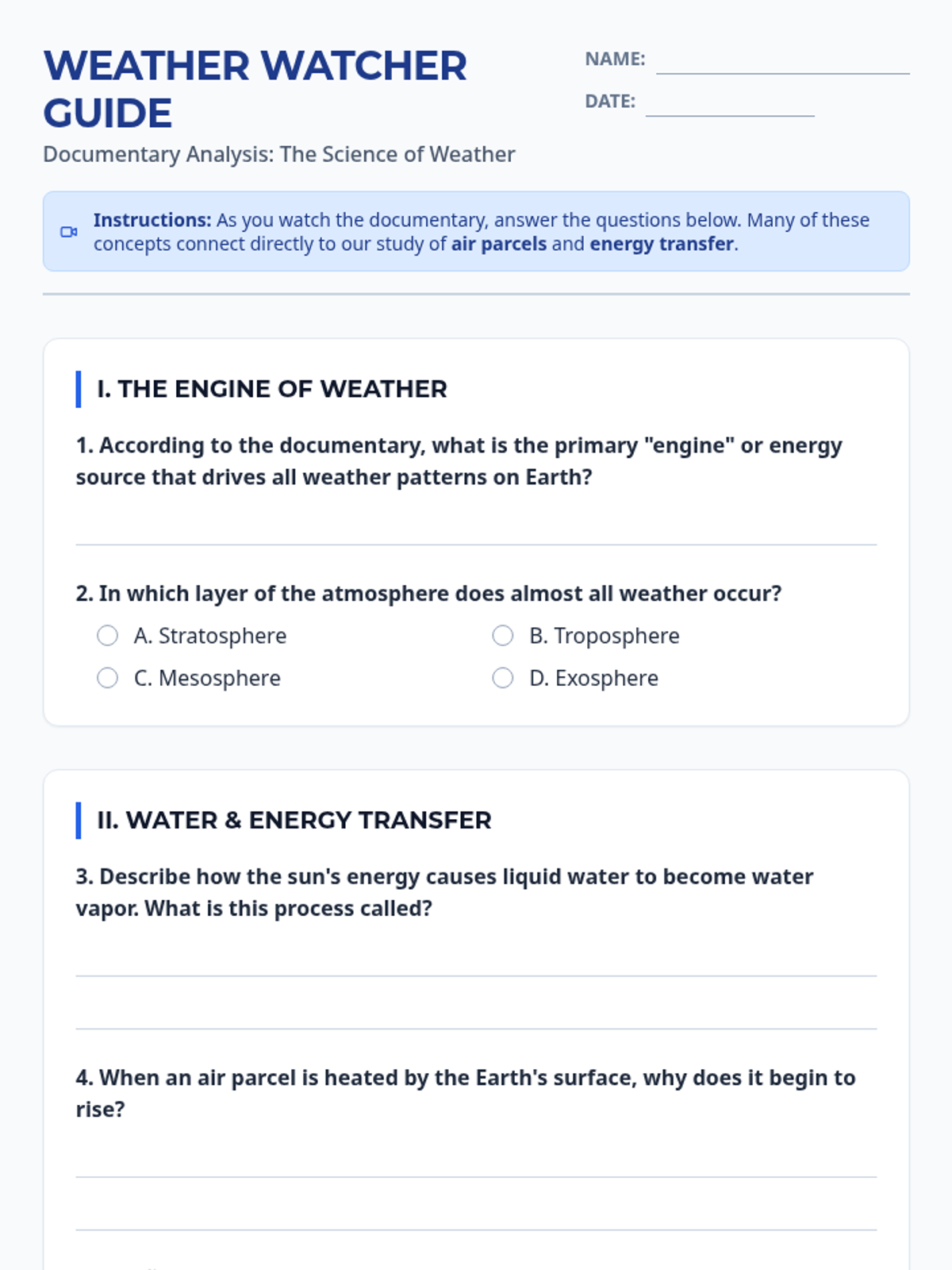
A student guided-viewing worksheet to accompany the documentary "The Science of Weather". It features comprehension questions that link the film's content to core unit concepts like energy transfer, air parcels, and the water cycle.
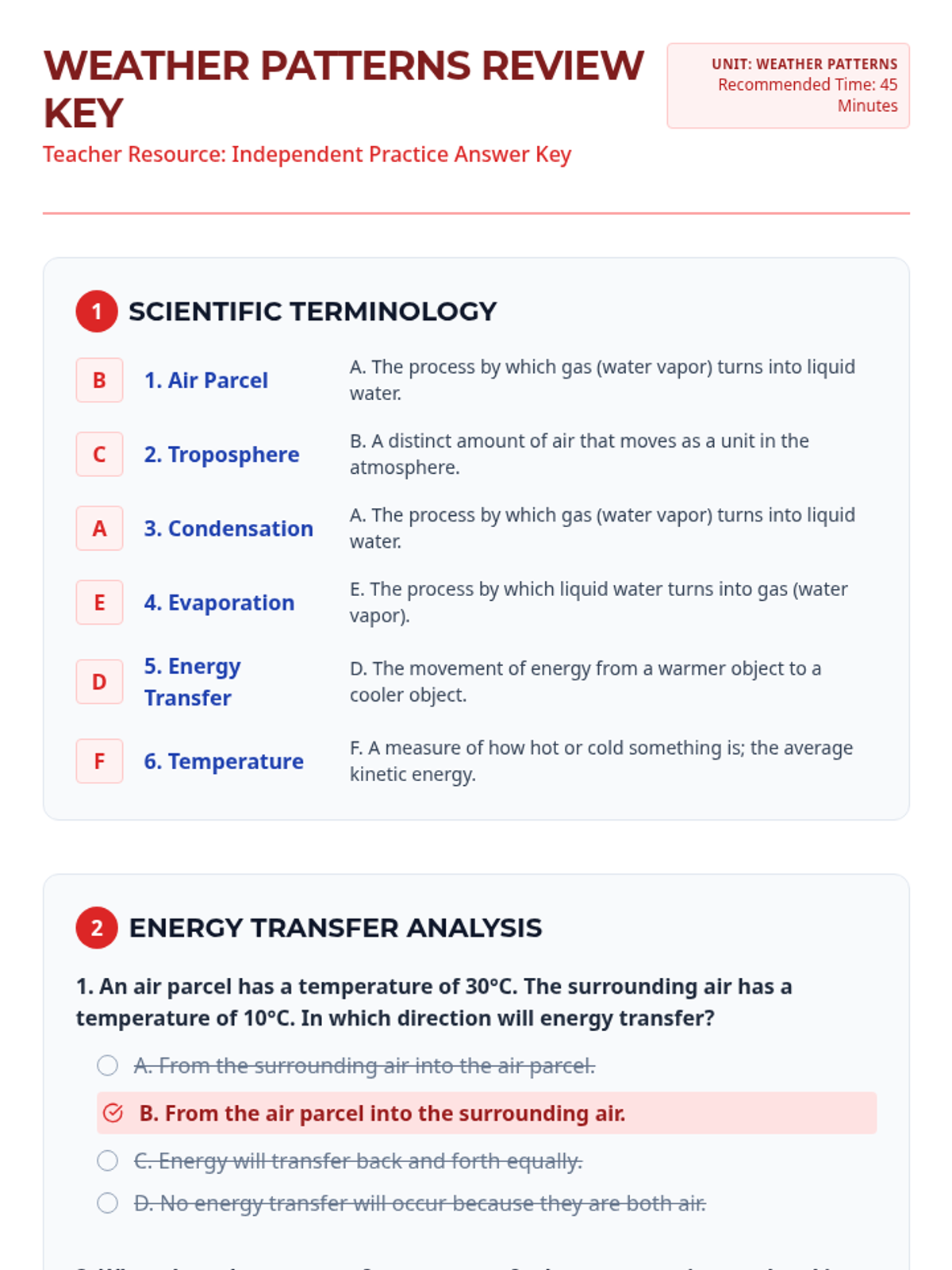
An answer key for the Weather Patterns Review Packet, providing correct answers for vocabulary, multiple choice, and a model CER response for teachers to use in grading and review.
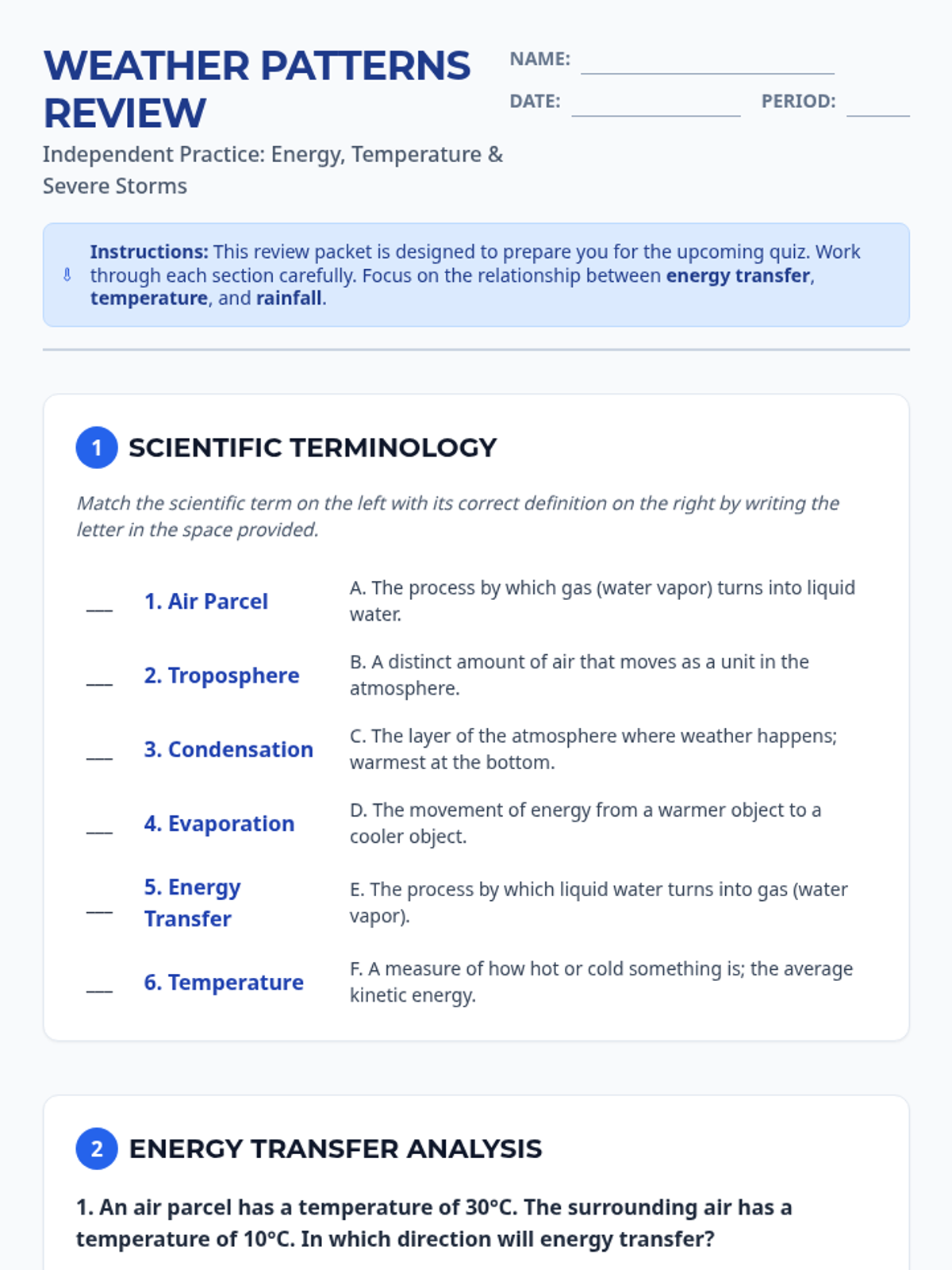
A student review packet for Grade 6 science focusing on weather patterns, energy transfer in air parcels, and the troposphere. It includes vocabulary matching, energy transfer multiple-choice questions, weather mechanic concepts, a diagramming task, and a data-based CER response.
A comprehensive teacher guide for the Thermal Thrills lab. Includes a materials checklist, setup tips for success, expected student results, scientific explanations for phenomena, and an answer key for the worksheet reflection questions.
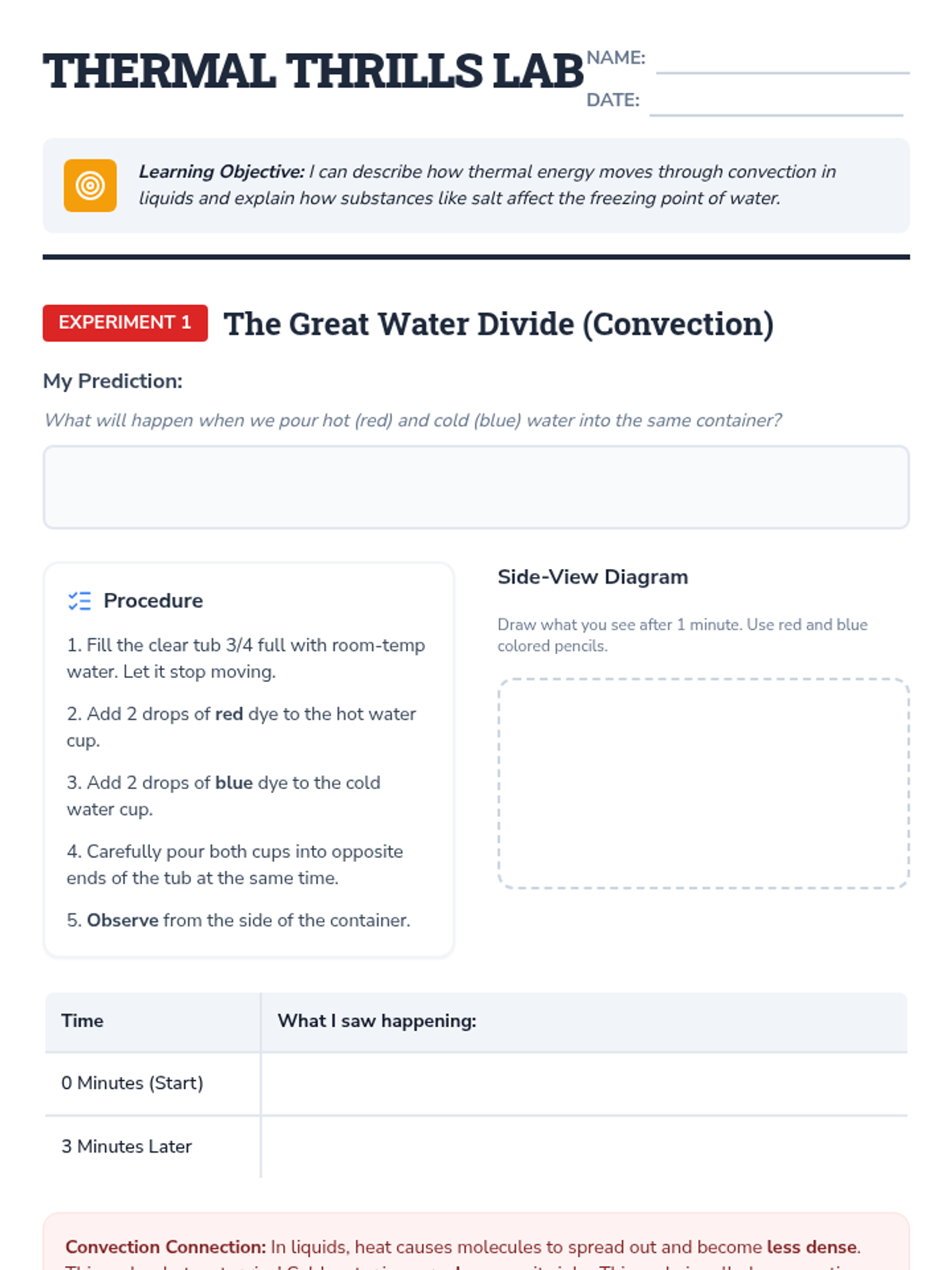
A student-friendly 2-page lab worksheet for 6th-grade science experiments on convection and freezing point depression. It includes prediction sections, observation tables, diagram areas, and reflection questions connecting the experiments to real-world phenomena.
A visually engaging slide deck for a 6th-grade science lesson on thermal energy. It covers safety protocols, experiment procedures for convection and freezing point depression, and real-world applications like weather and road salting.
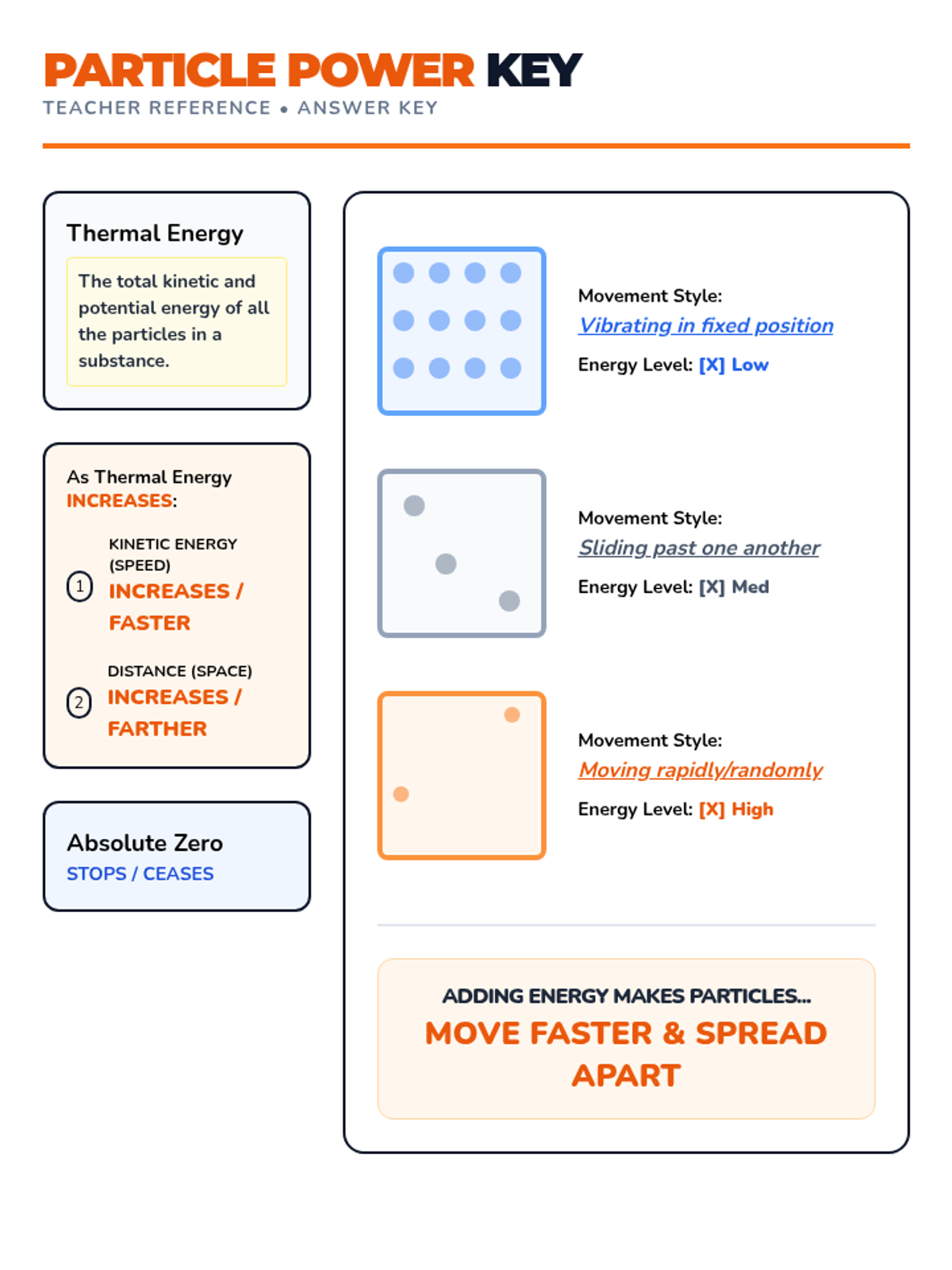
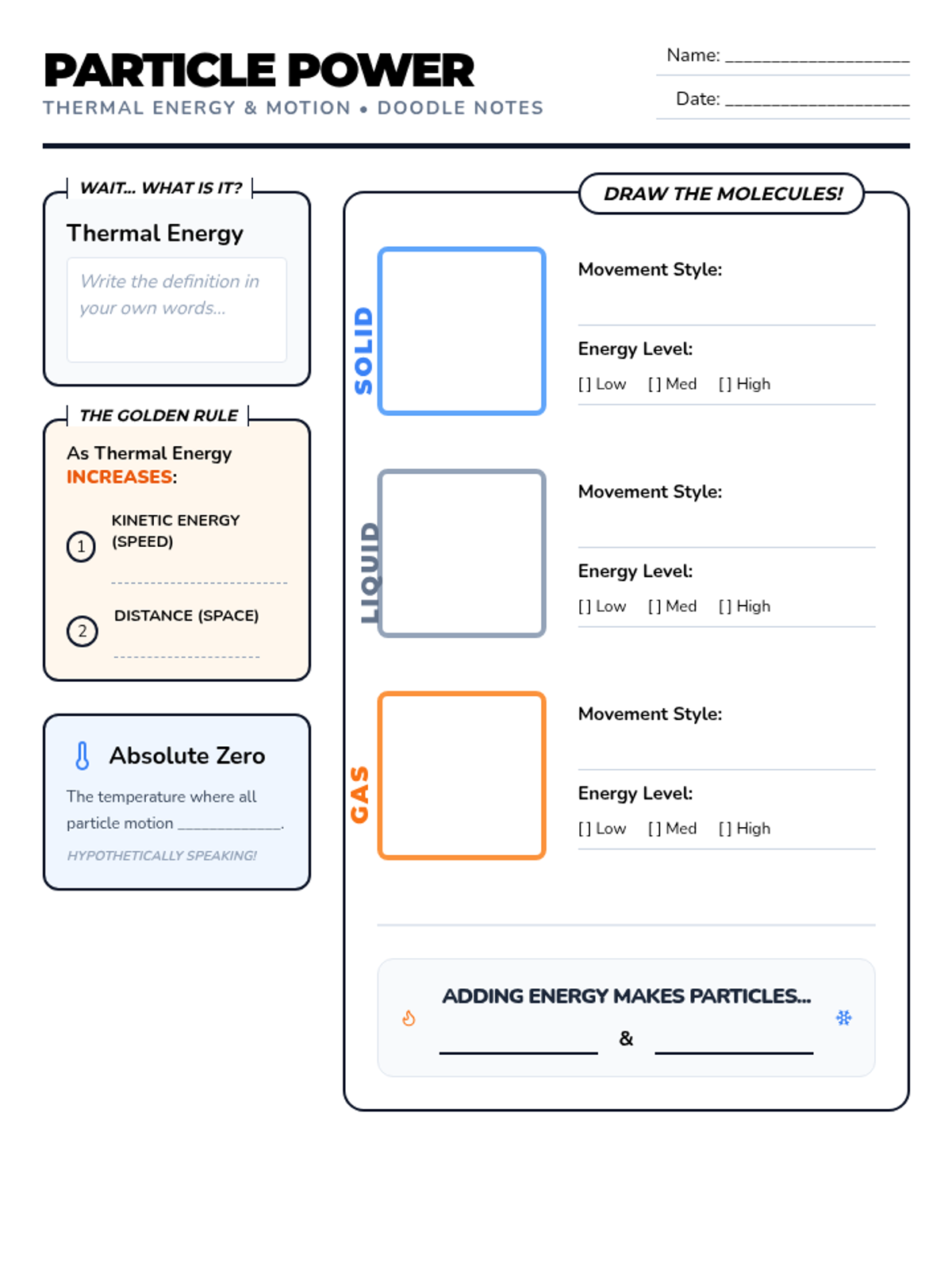
Teacher's answer key for the Particle Power doodle notes, providing clear definitions and visual examples of particle arrangements.
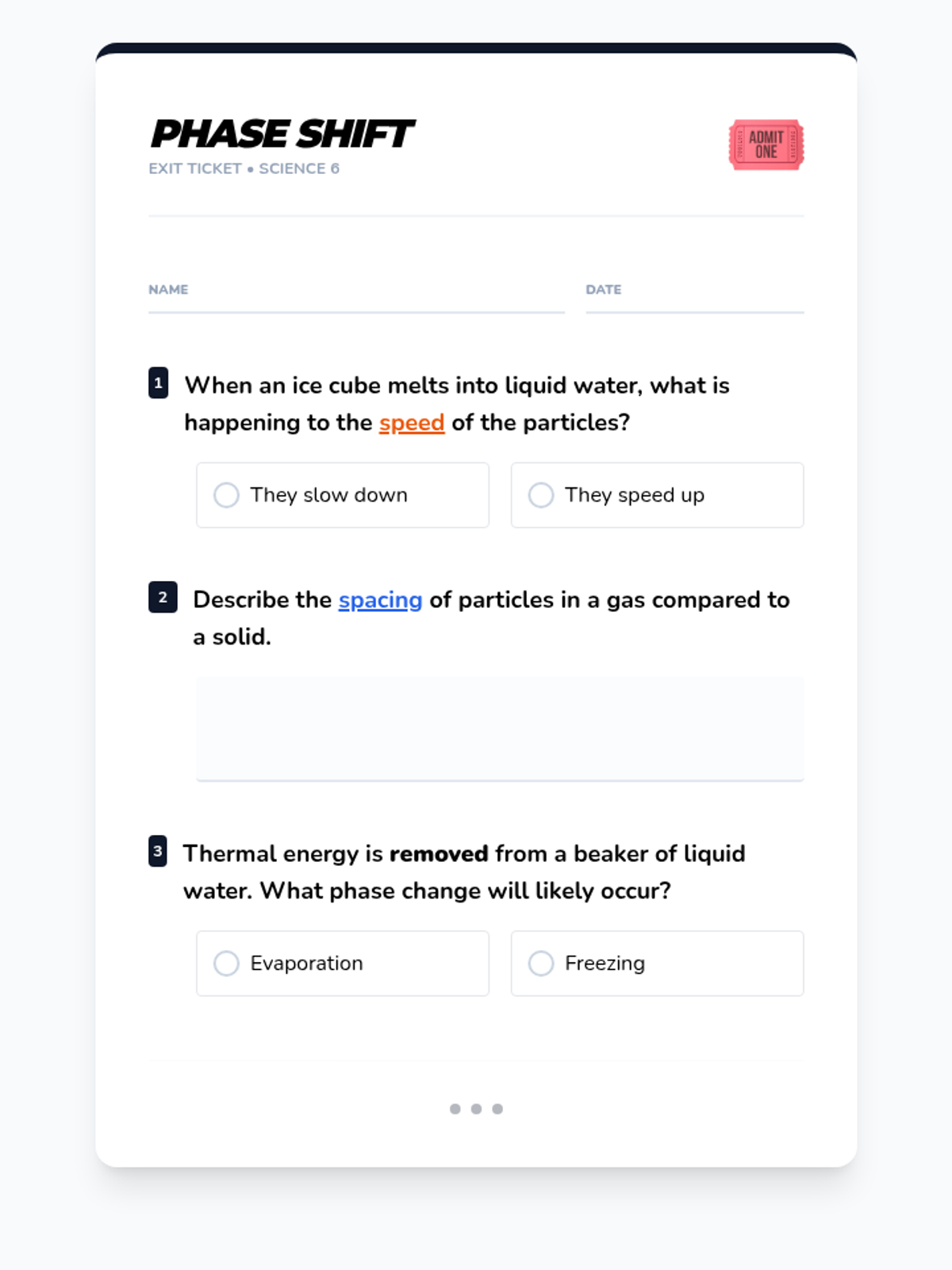
A brief assessment for the end of Day 2 to check student understanding of particle speed, spacing, and energy-driven phase changes.
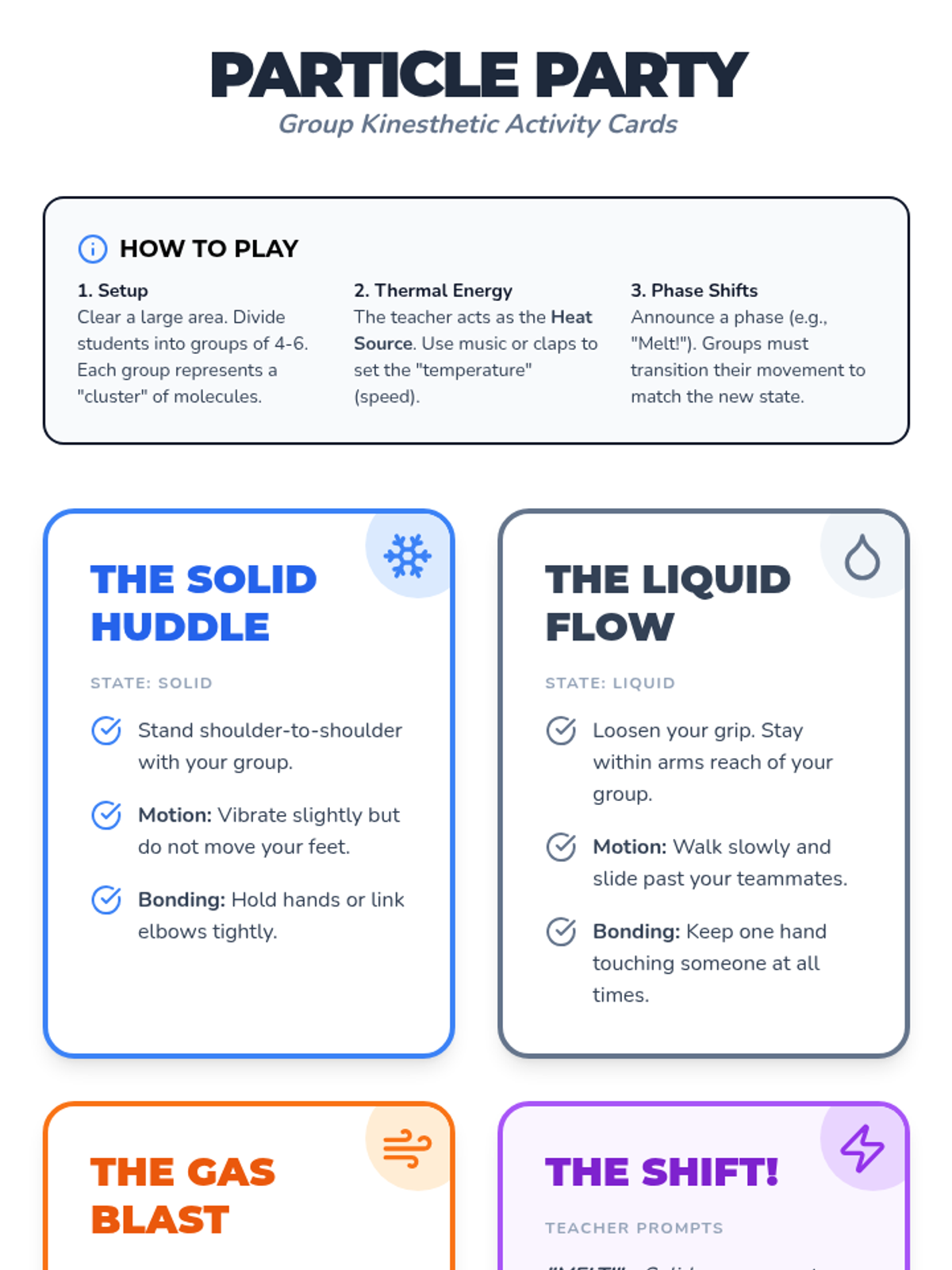
A set of activity cards and instructions for a group kinesthetic modeling activity where students act out particle motion in different states of matter.
A slide deck for Day 2 instruction, focusing on phase transitions (melting, freezing, evaporation, condensation) and the role of thermal energy in these shifts.
A visual 'doodle notes' worksheet for students to record their understanding of thermal energy, particle speed, and state-specific particle arrangements.
An engaging slide deck for Day 1 instruction, introducing the Kinetic Molecular Theory and the relationship between thermal energy, particle speed, and spacing.
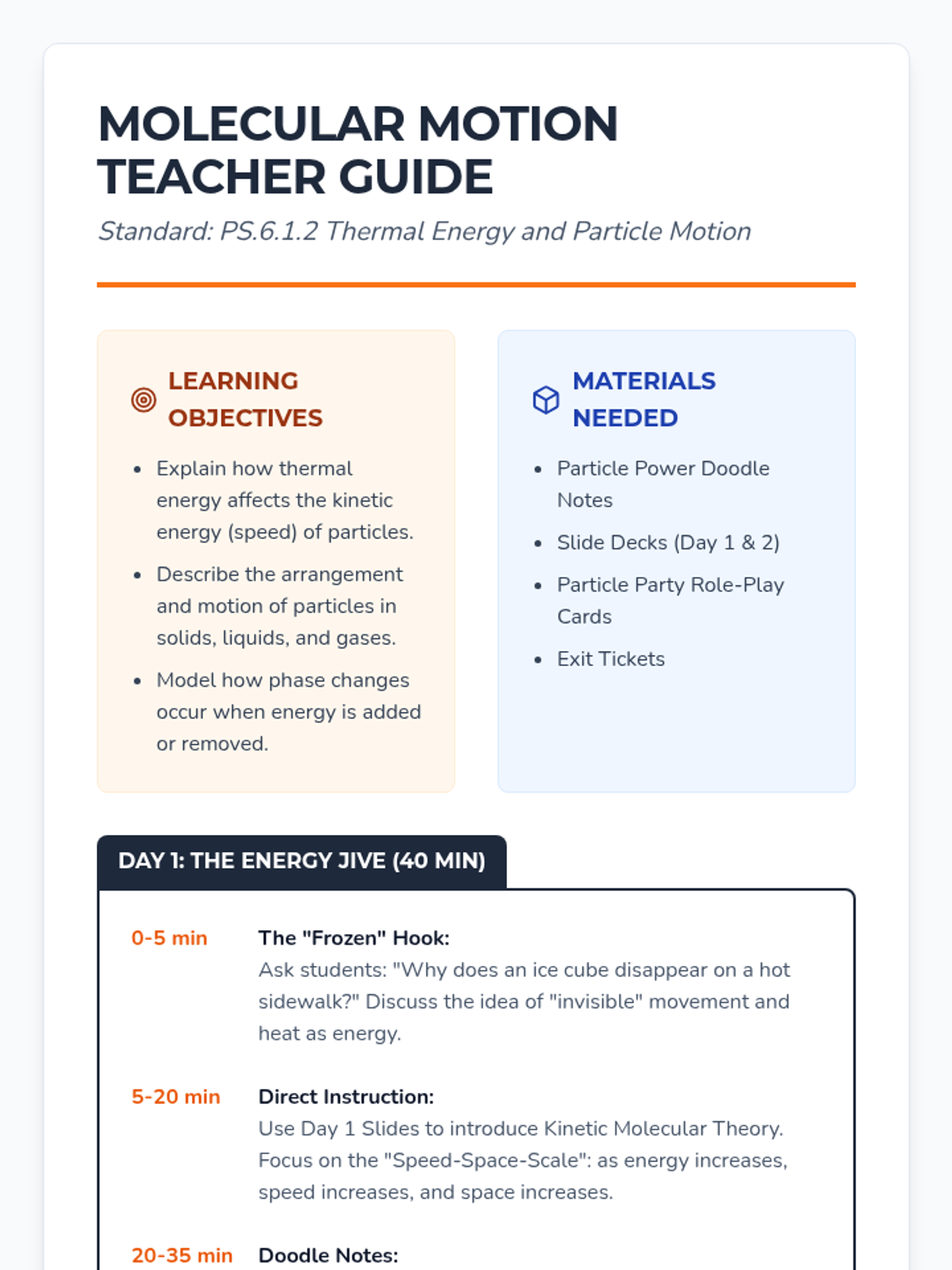
A comprehensive teacher's guide for a 2-day lesson on thermal energy and particle motion, including learning objectives, timed schedules, and instructional tips.
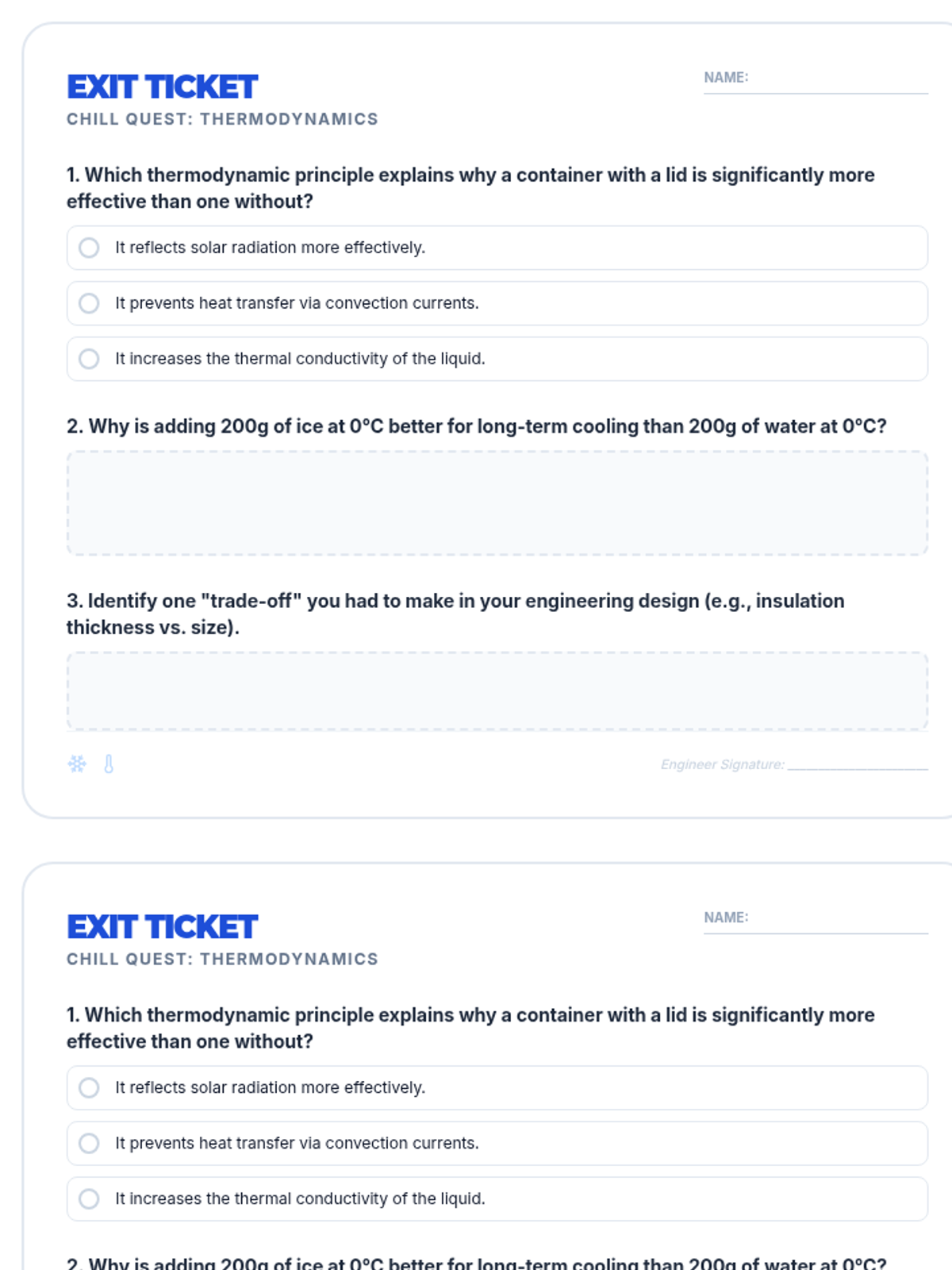
A pair of exit tickets on one page to assess student understanding of convection, latent heat of fusion, and engineering trade-offs.
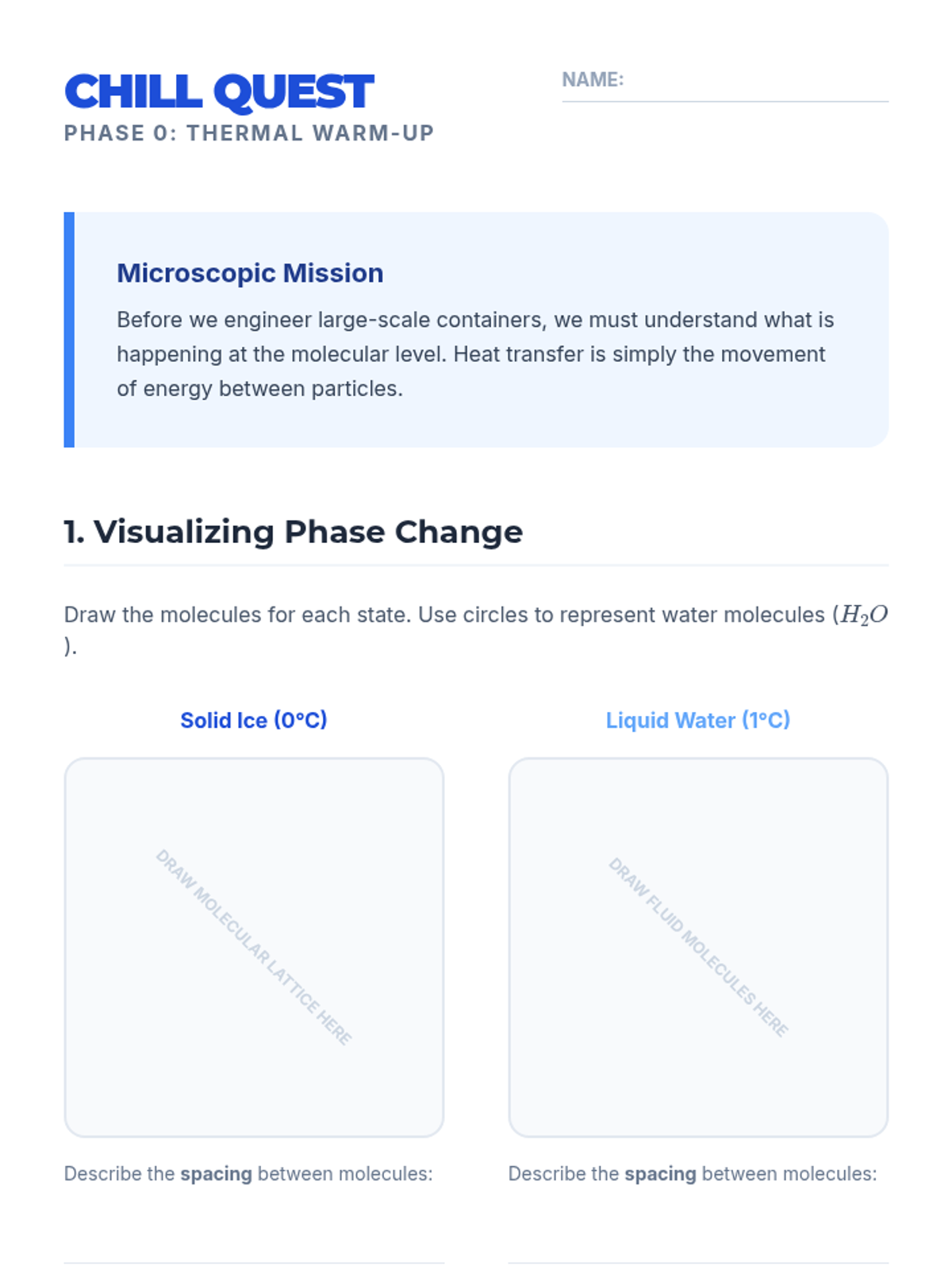
A student warm-up worksheet for the 'Ice Cold Engineering' lesson. It focuses on the molecular changes during phase change, including molecule spacing and speed as ice melts.
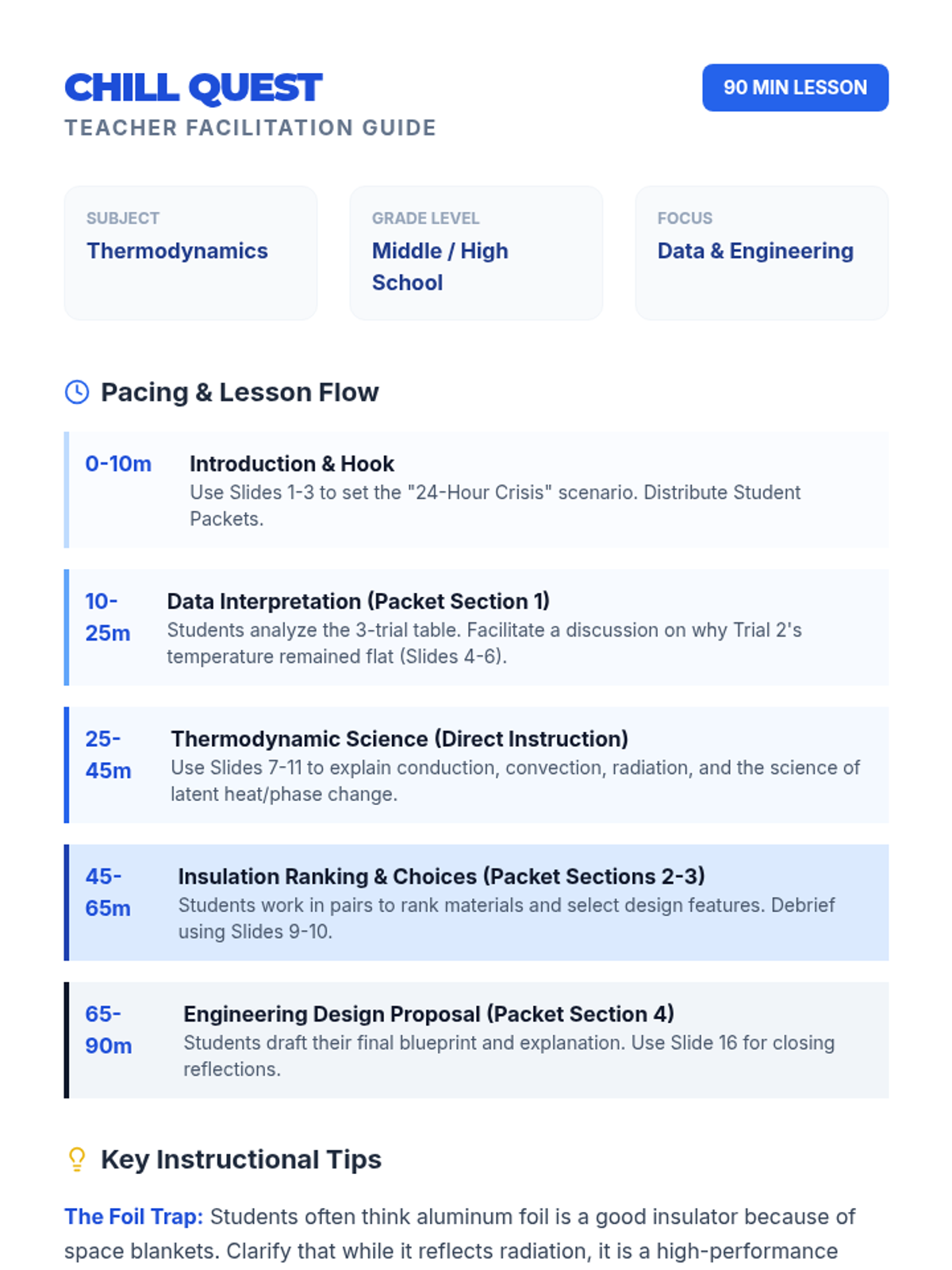
A comprehensive teacher resource containing a 90-minute lesson facilitation guide, pacing breakdown, common student misconceptions, and a full answer key for the student packet.
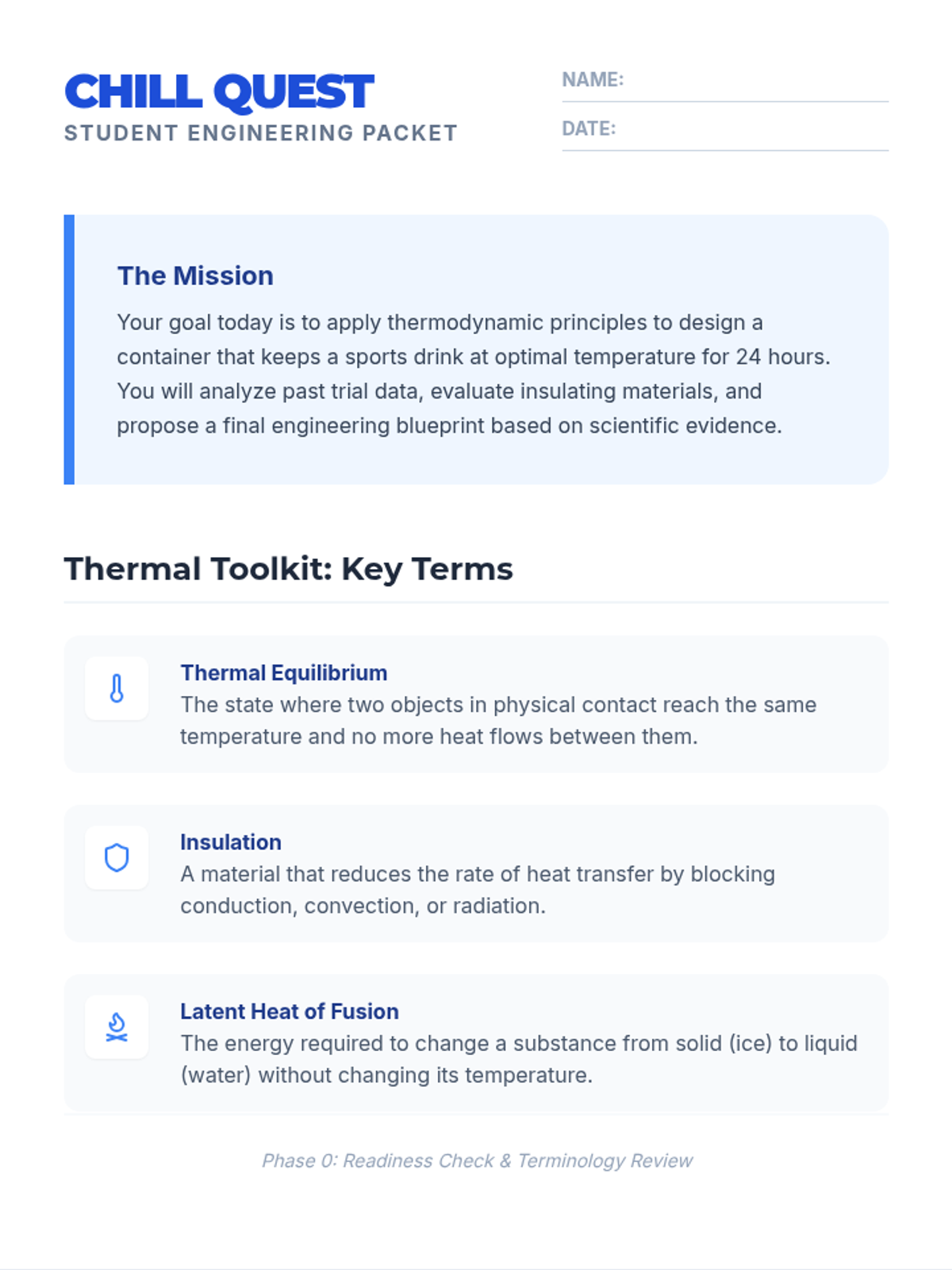
A 5-page student engineering packet for the 'Ice Cold Engineering' lesson. It features sections for data interpretation, insulation ranking, selection logic, and a final mini-design proposal with usability considerations.
A 16-slide presentation for the 'Ice Cold Engineering' lesson. It covers data interpretation of temperature trials, insulation material ranking, heat transfer science, and guidelines for the final design challenge.
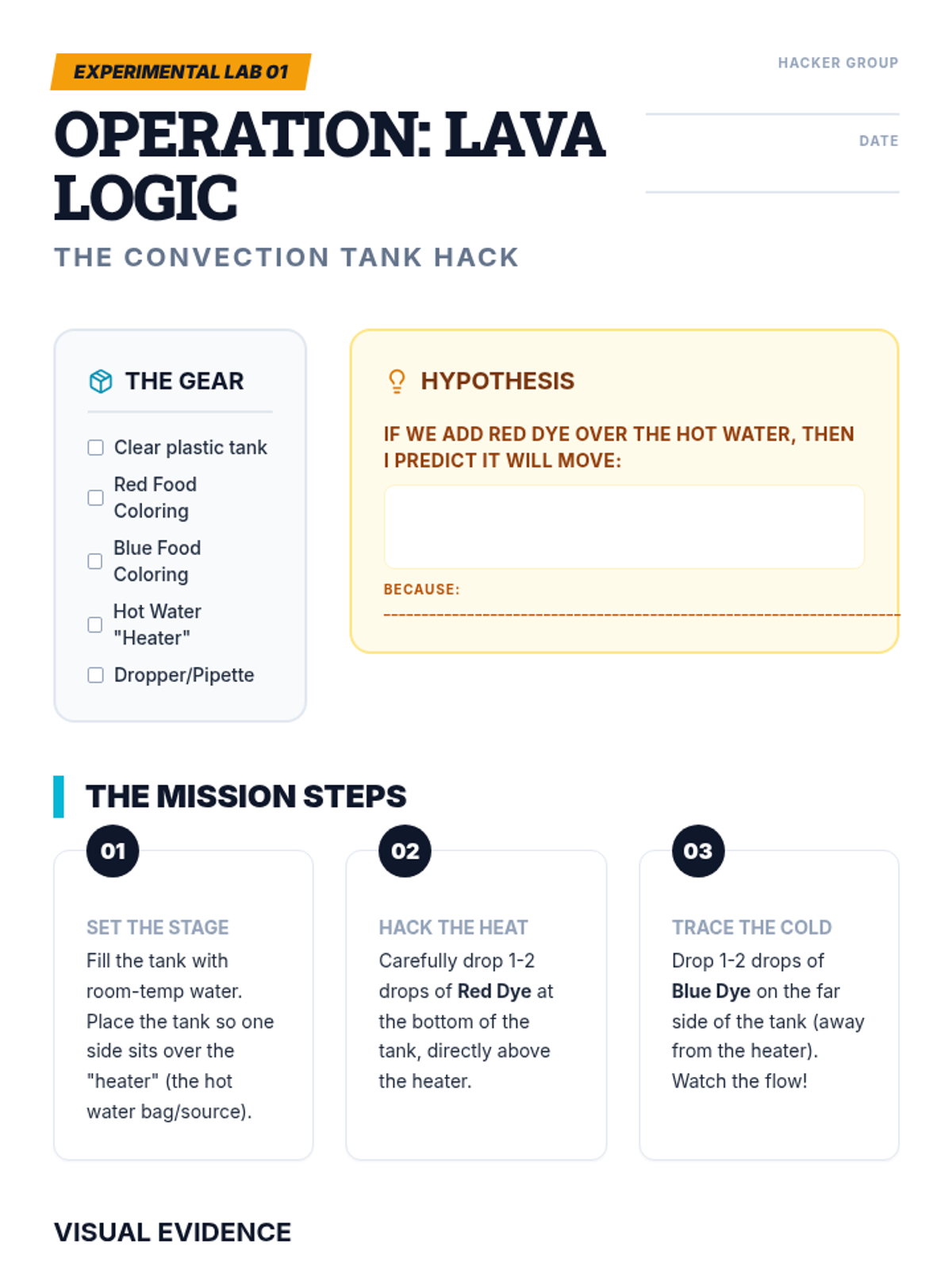
A 2-page hands-on lab guide for students to investigate convection currents using food coloring and temperature differences in a water tank.
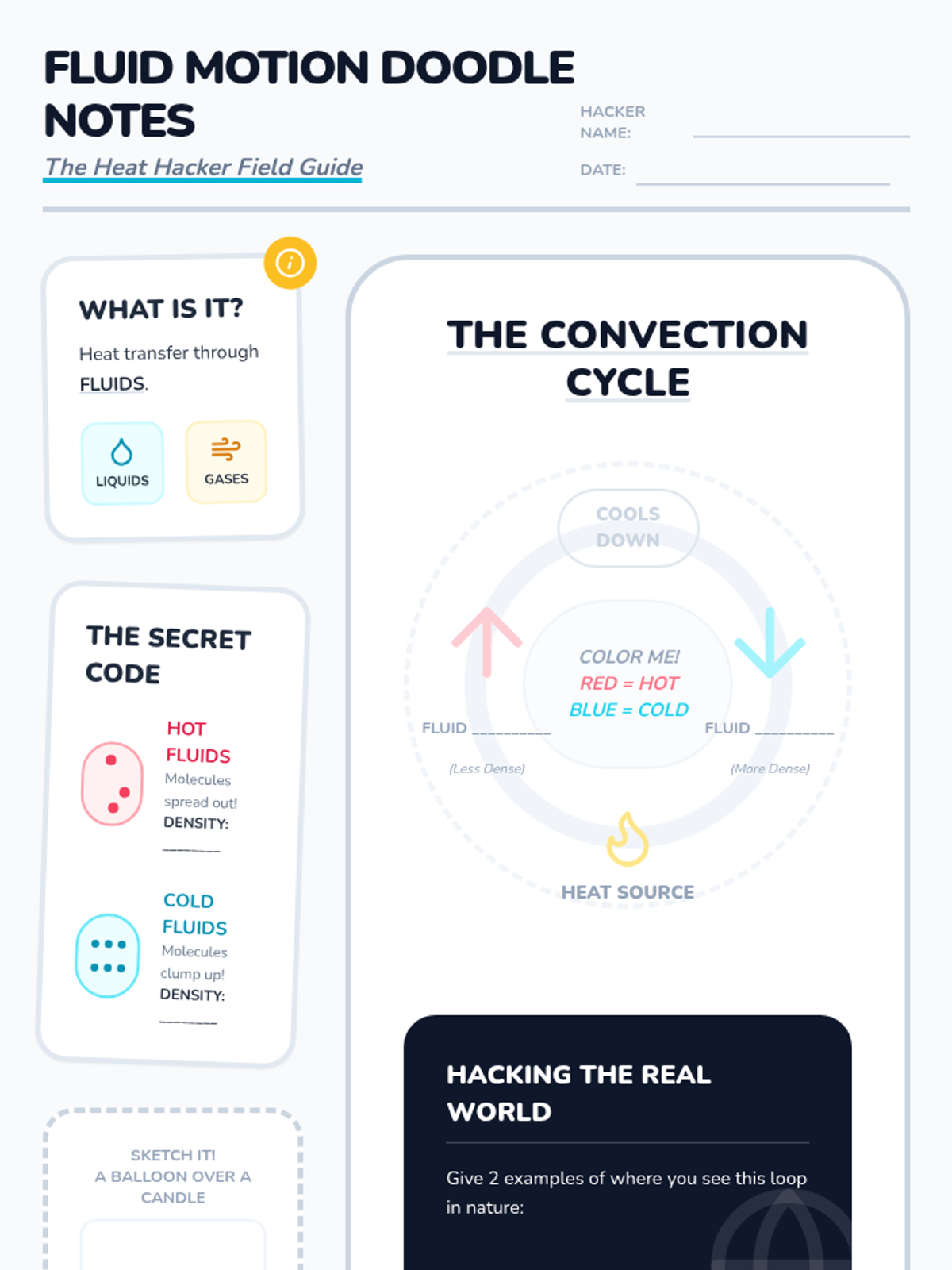
A creative doodle notes page for students to fill in during the Convection lesson, featuring diagrams for density, molecular movement, and a large convection cycle to color and label.
A 6-slide visual presentation for the Convection lesson, featuring high-contrast design, clear diagrams of the convection cycle, and lab instructions.
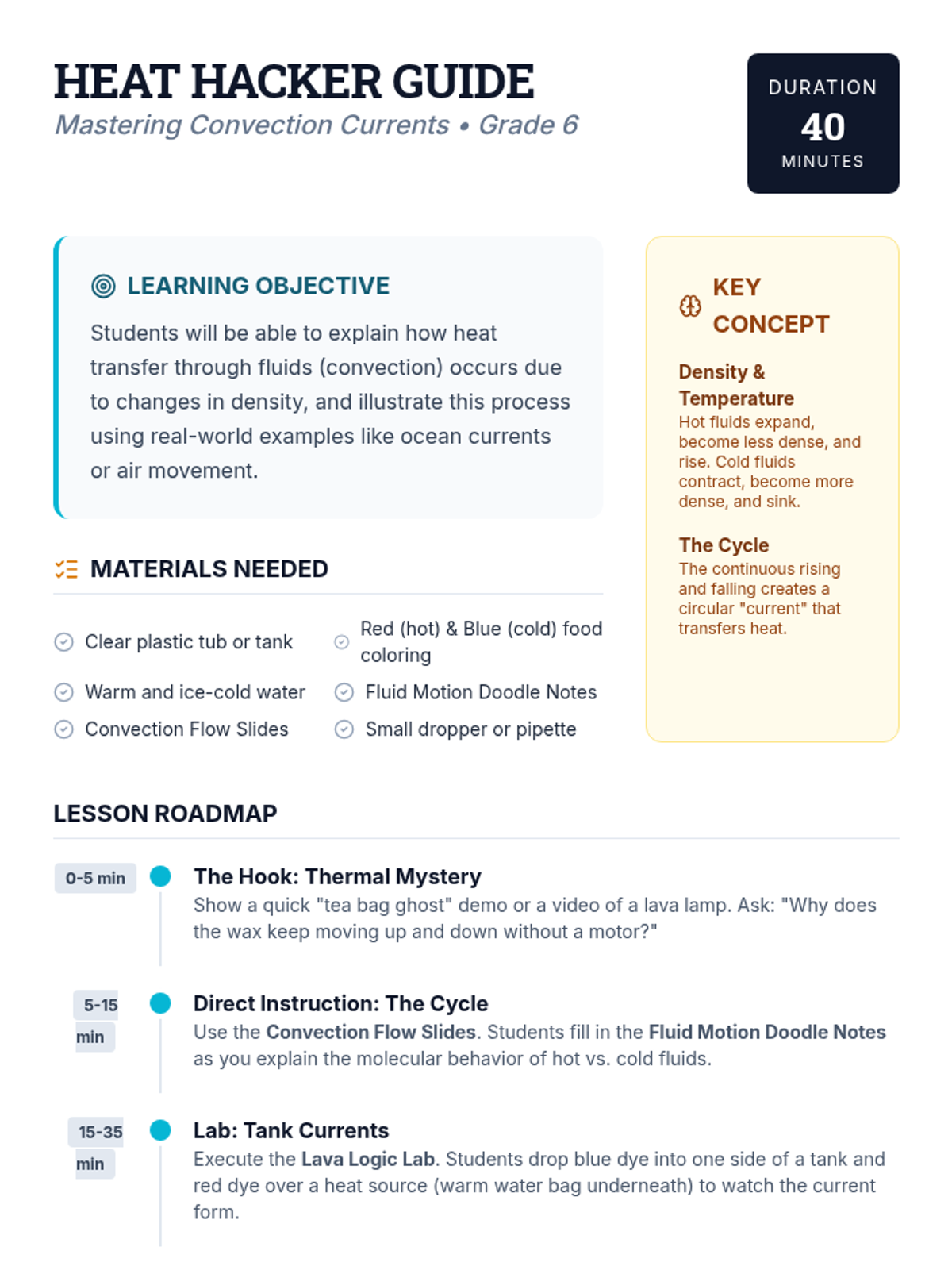
A comprehensive 2-page teacher's guide for the Heat Hacker Convection lesson, including a 40-minute roadmap, materials list, and differentiation strategies.
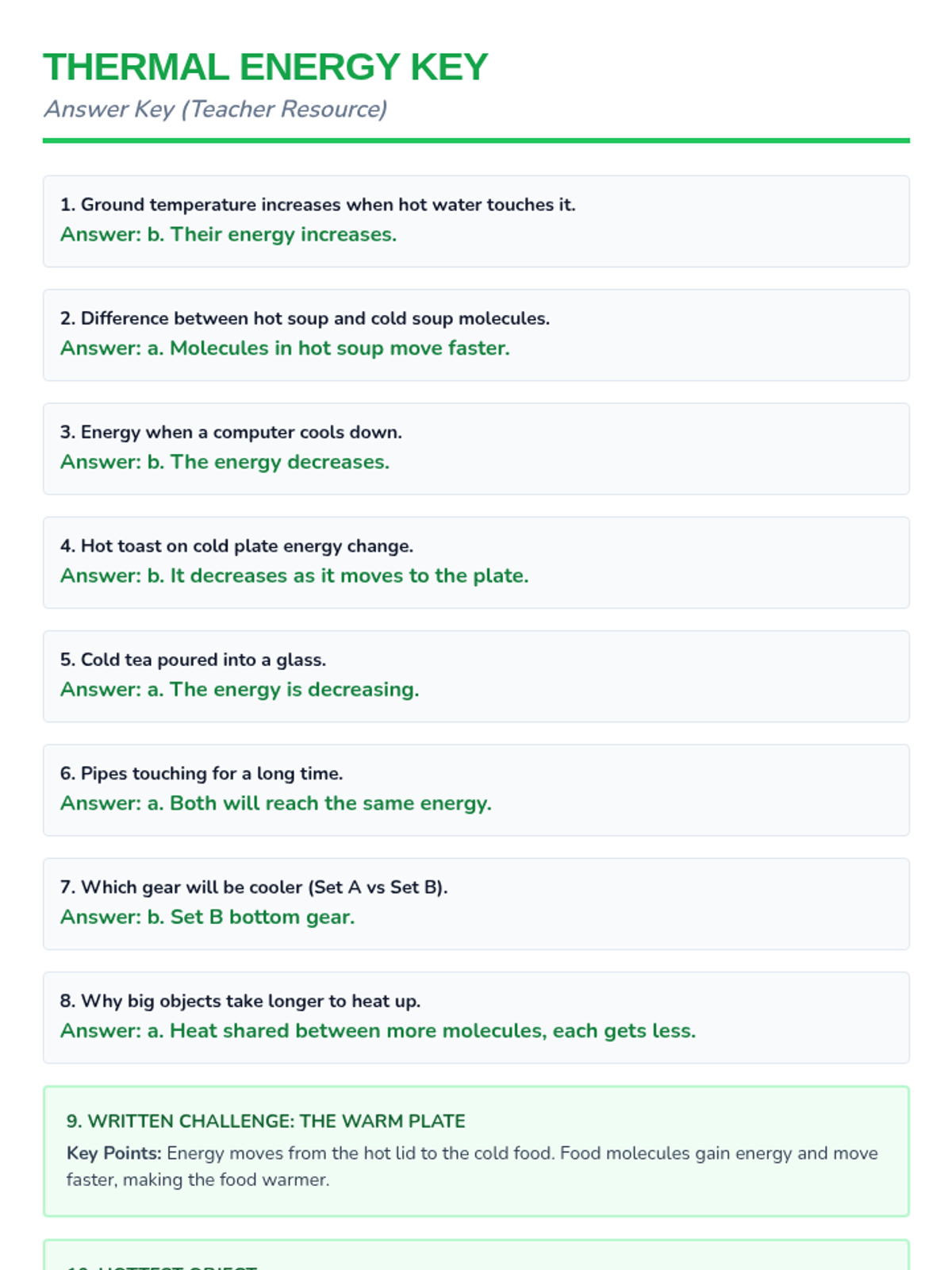
An answer key for the Thermal Energy Worksheet, providing correct answers and explanations for the 10 questions on thermal energy and molecules.
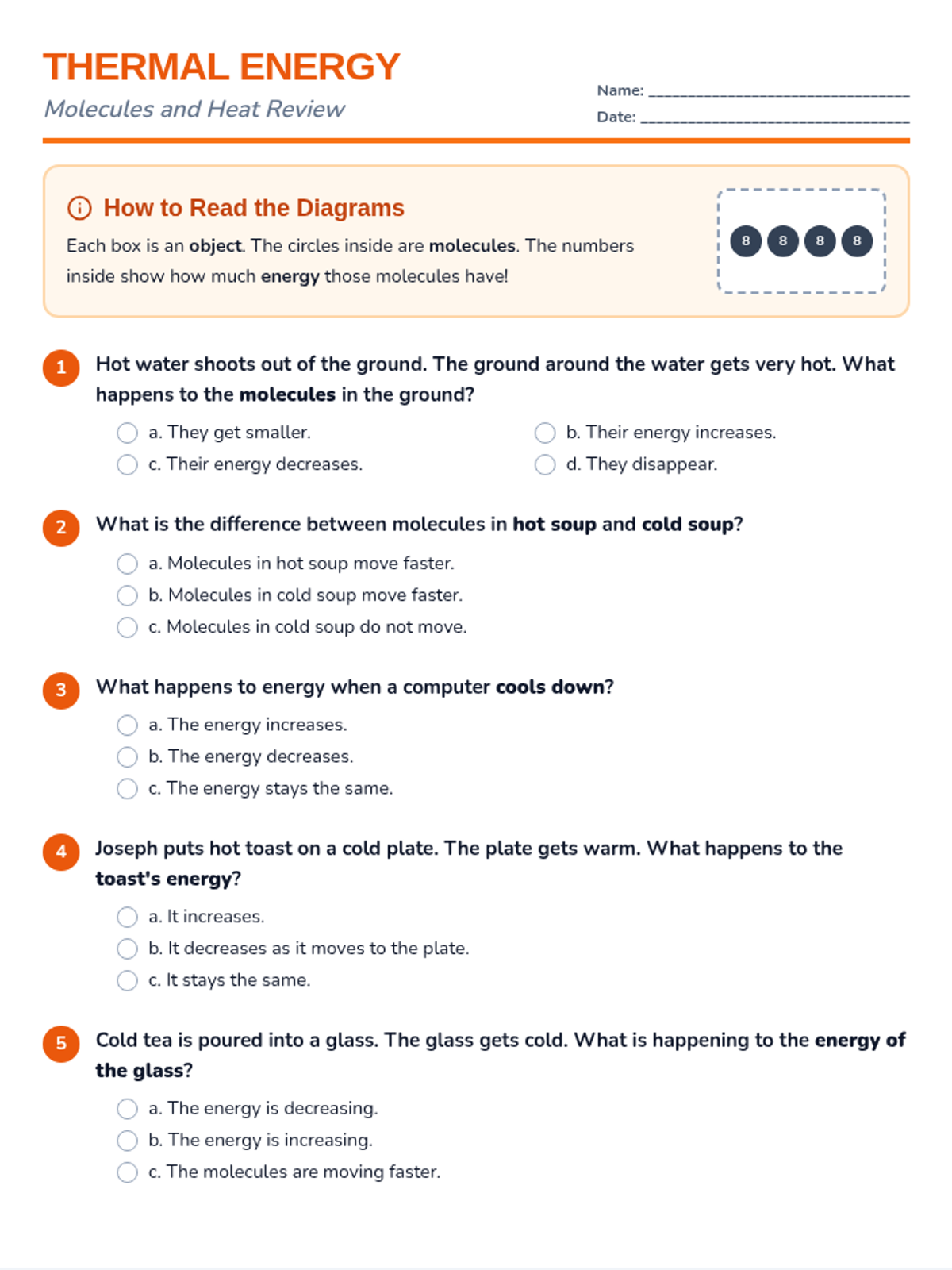
A 2-page review worksheet for 3rd graders on thermal energy, adapted from a 6th-grade assessment. It features simplified language, molecule diagrams, and ample space for written responses.
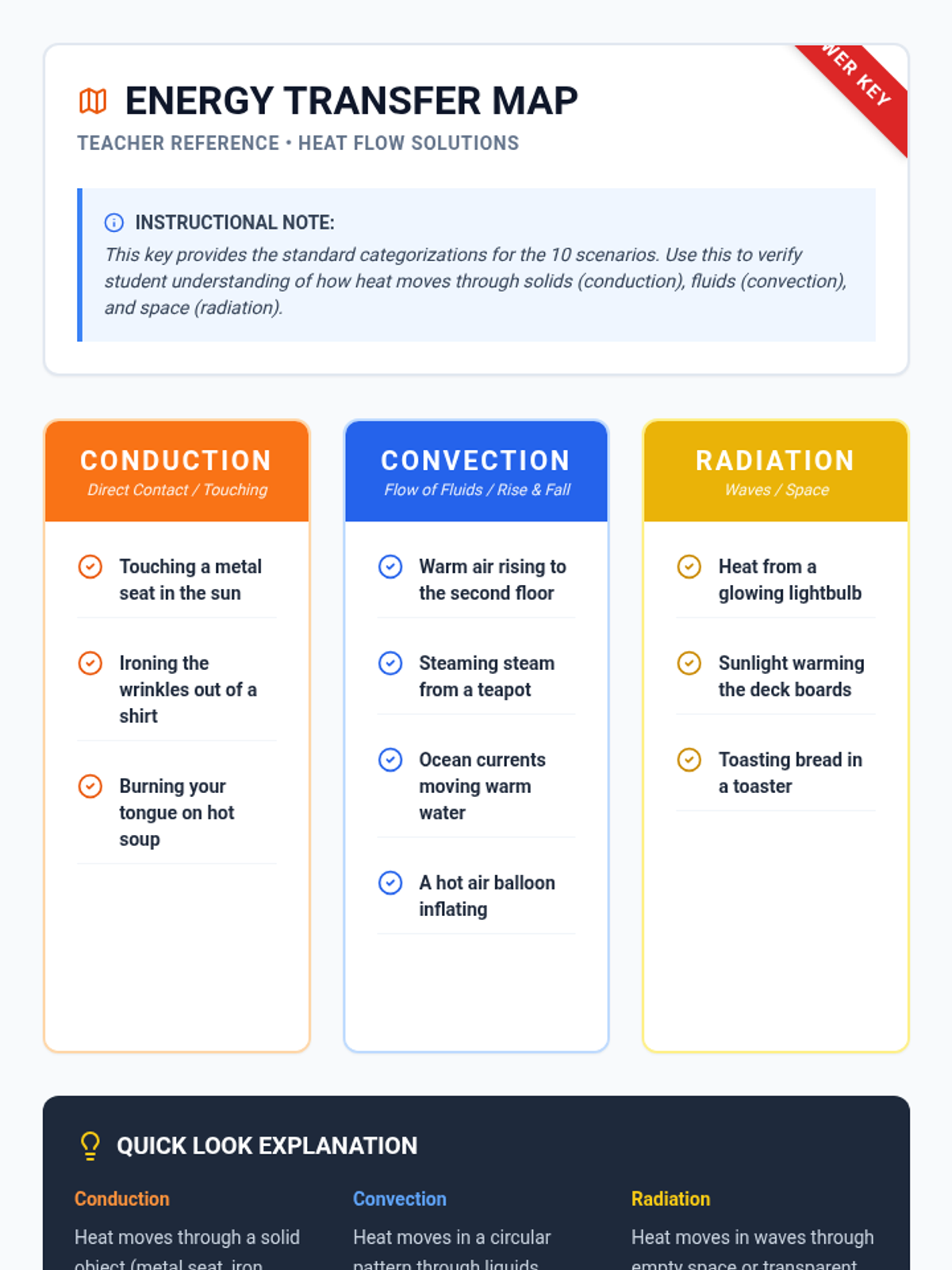
A teacher's answer key for the Energy Transfer Map Graphic Organizer, providing correct categorizations for conduction, convection, and radiation scenarios with brief pedagogical explanations.
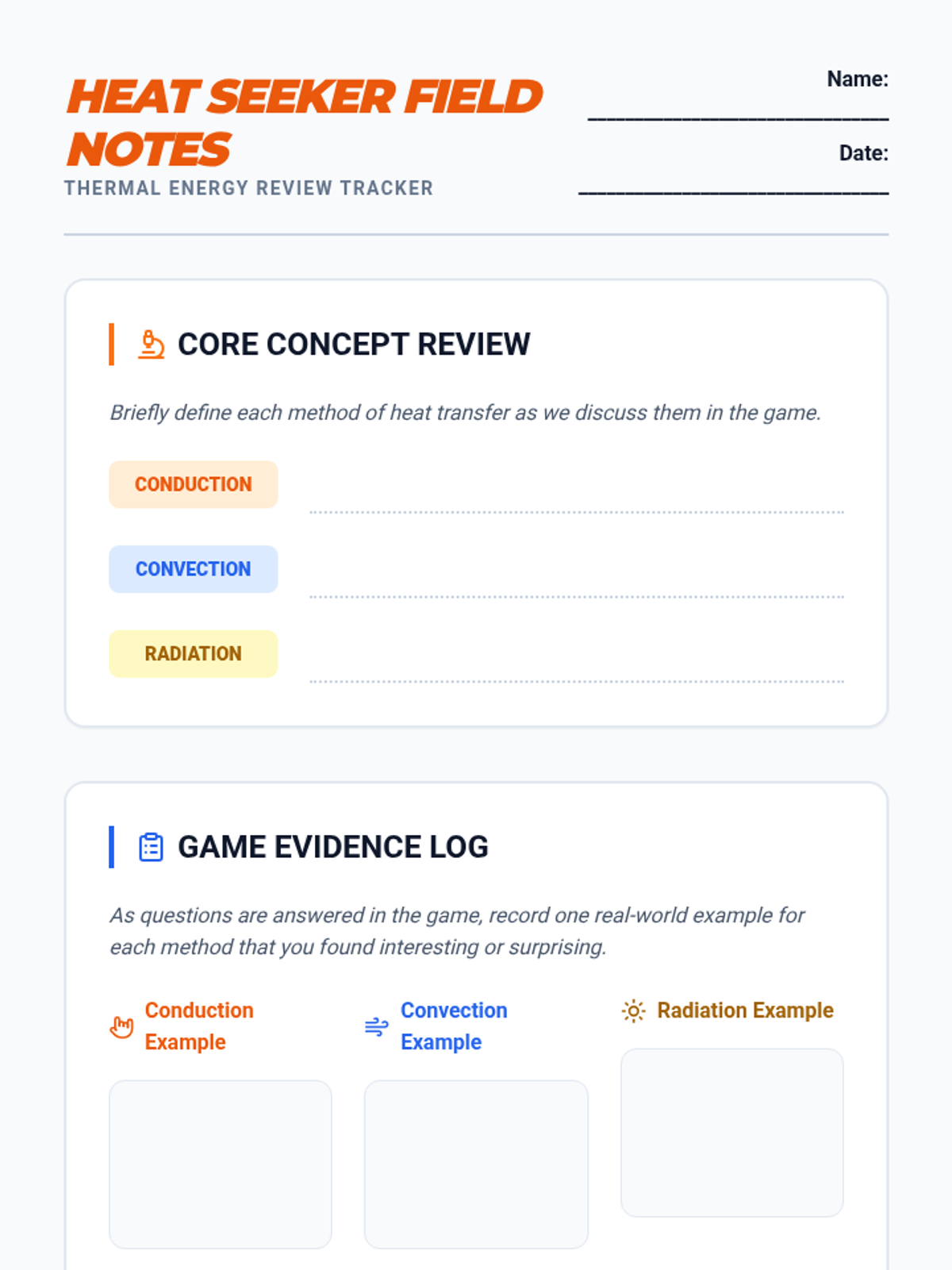
A student companion worksheet to be used during the Heat Seekers game. It includes sections for definitions, real-world examples observed during play, a diagram area for the 'Triple Threat' scenario, and reflection questions.
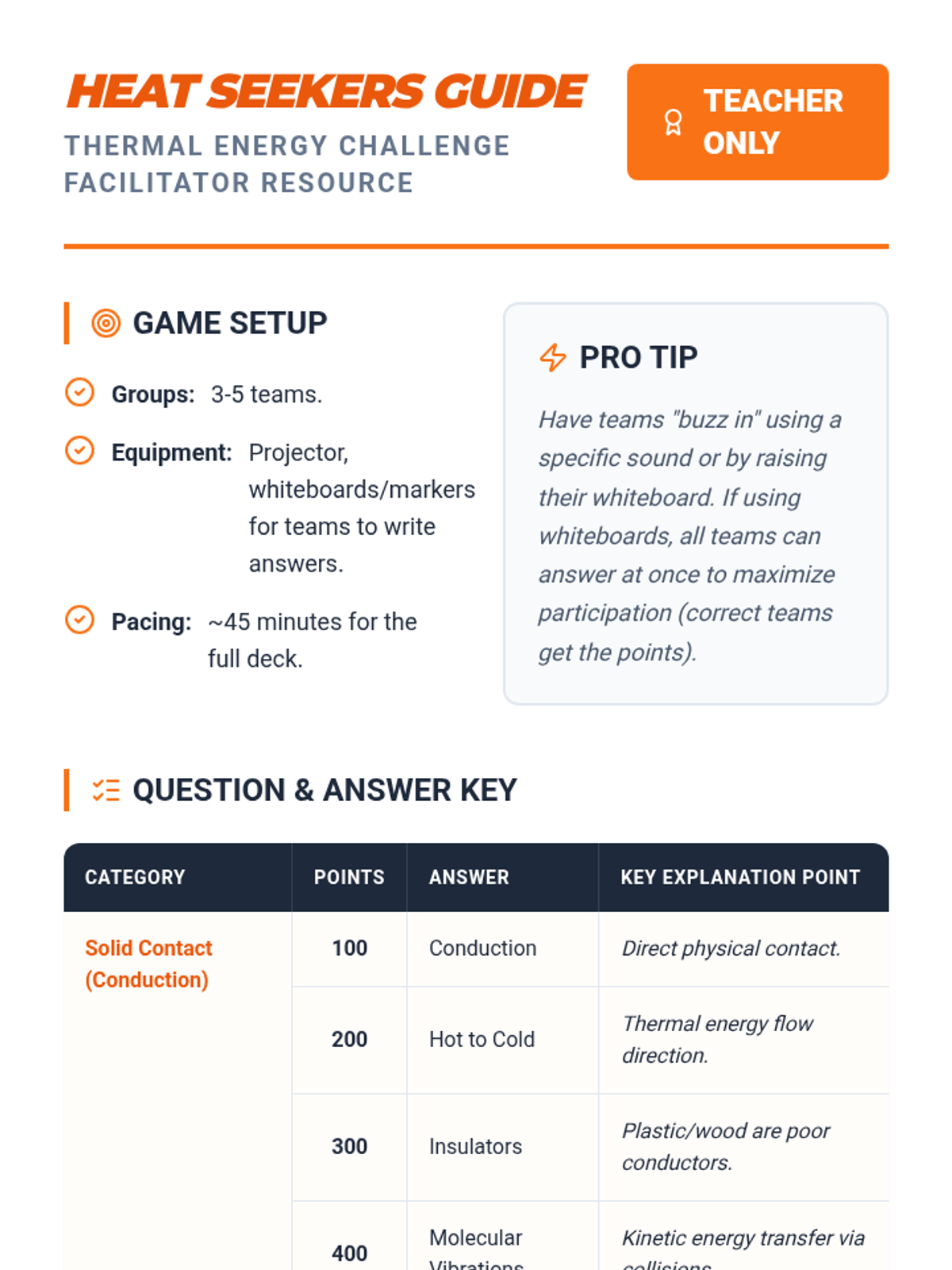
A facilitator guide for the Heat Seekers game, featuring the complete question/answer key, instructional setup tips, and a printable scoreboard for tracking team progress.
A high-energy, Jeopardy-style slide presentation for 6th grade science. It features 16 questions across four categories (Conduction, Convection, Radiation, and Mystery Mix) with a Final Heat challenge, all themed with bold colors and clear diagrams.
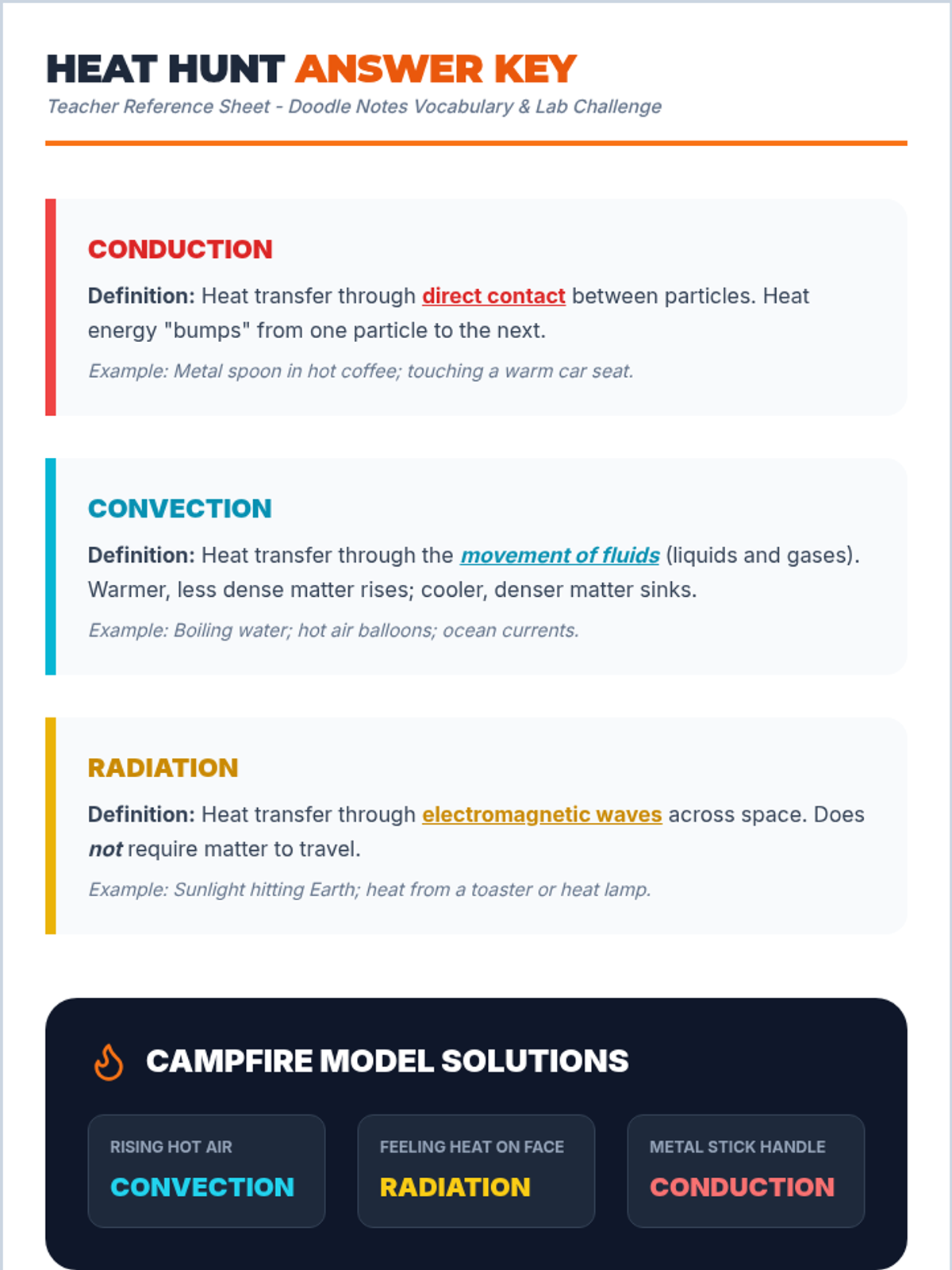
A teacher-facing answer key for the Heat Hunt Doodle Notes, providing definitions, model labels, and suggested reflection responses.
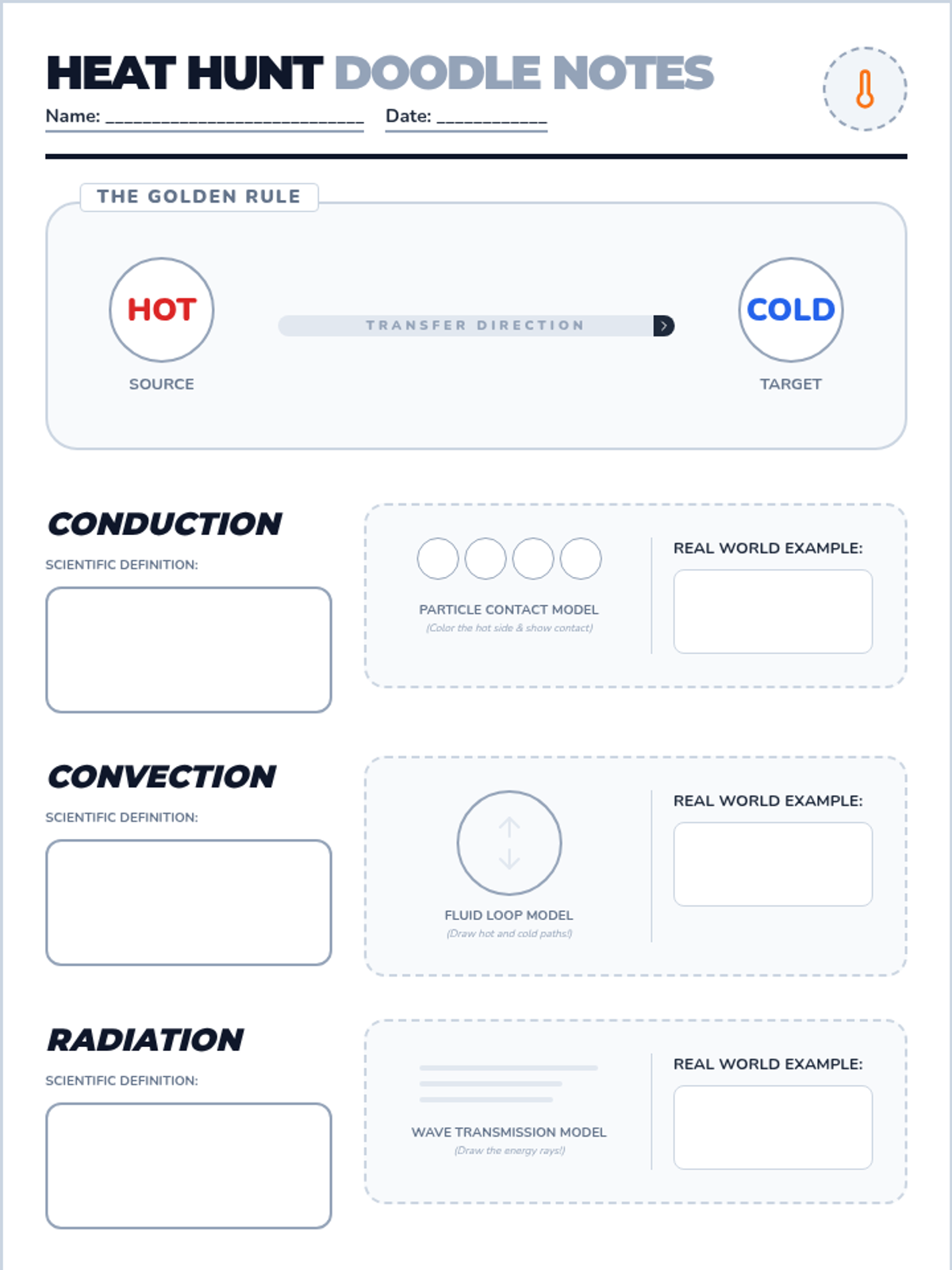
A student-facing doodle notes template focused on vocabulary definitions, visual models, and a real-world application challenge.
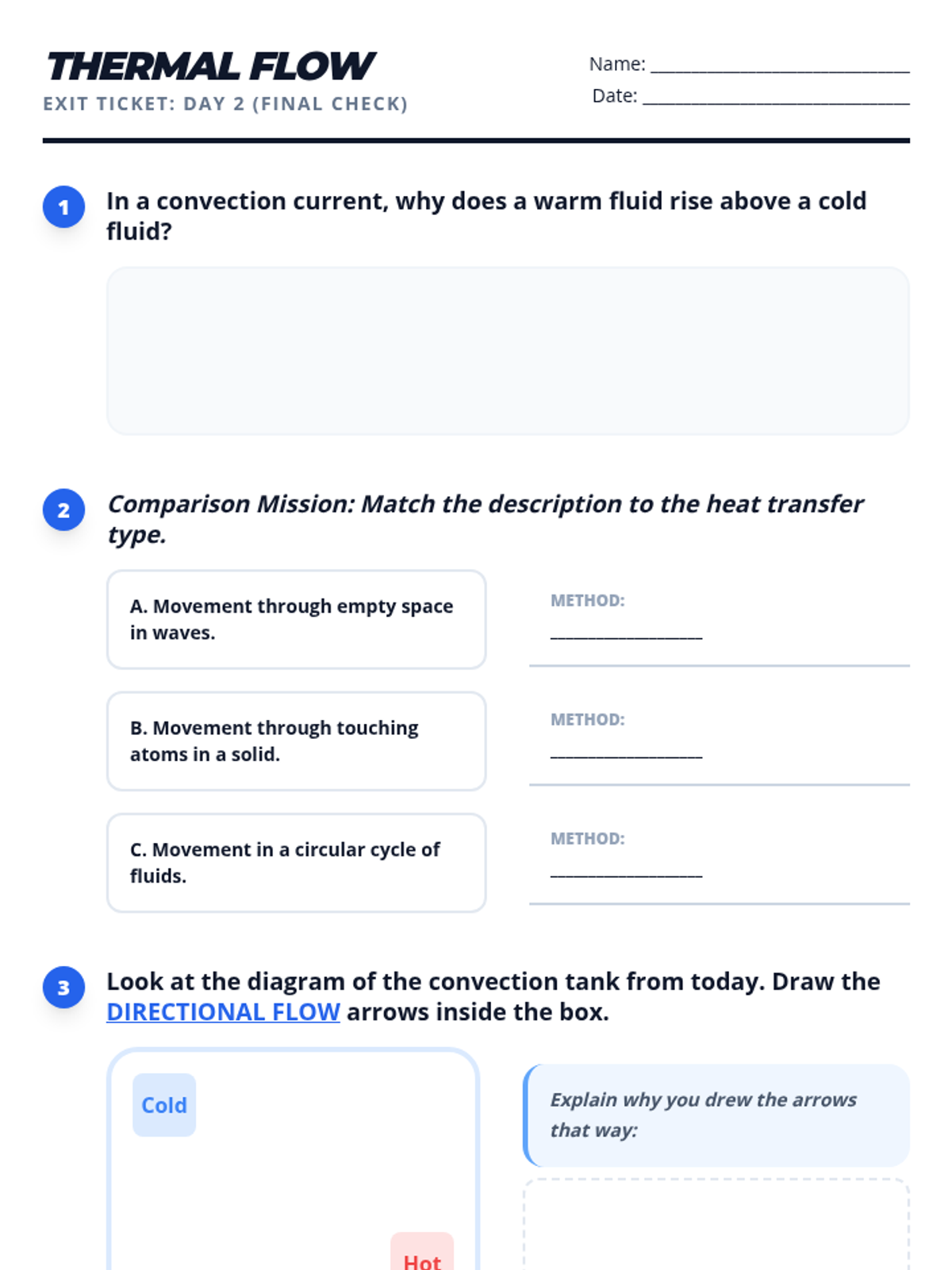
A quick assessment for Day 2 to check student understanding of convection and comparative heat transfer. Includes a diagram-based question and open-ended response areas.
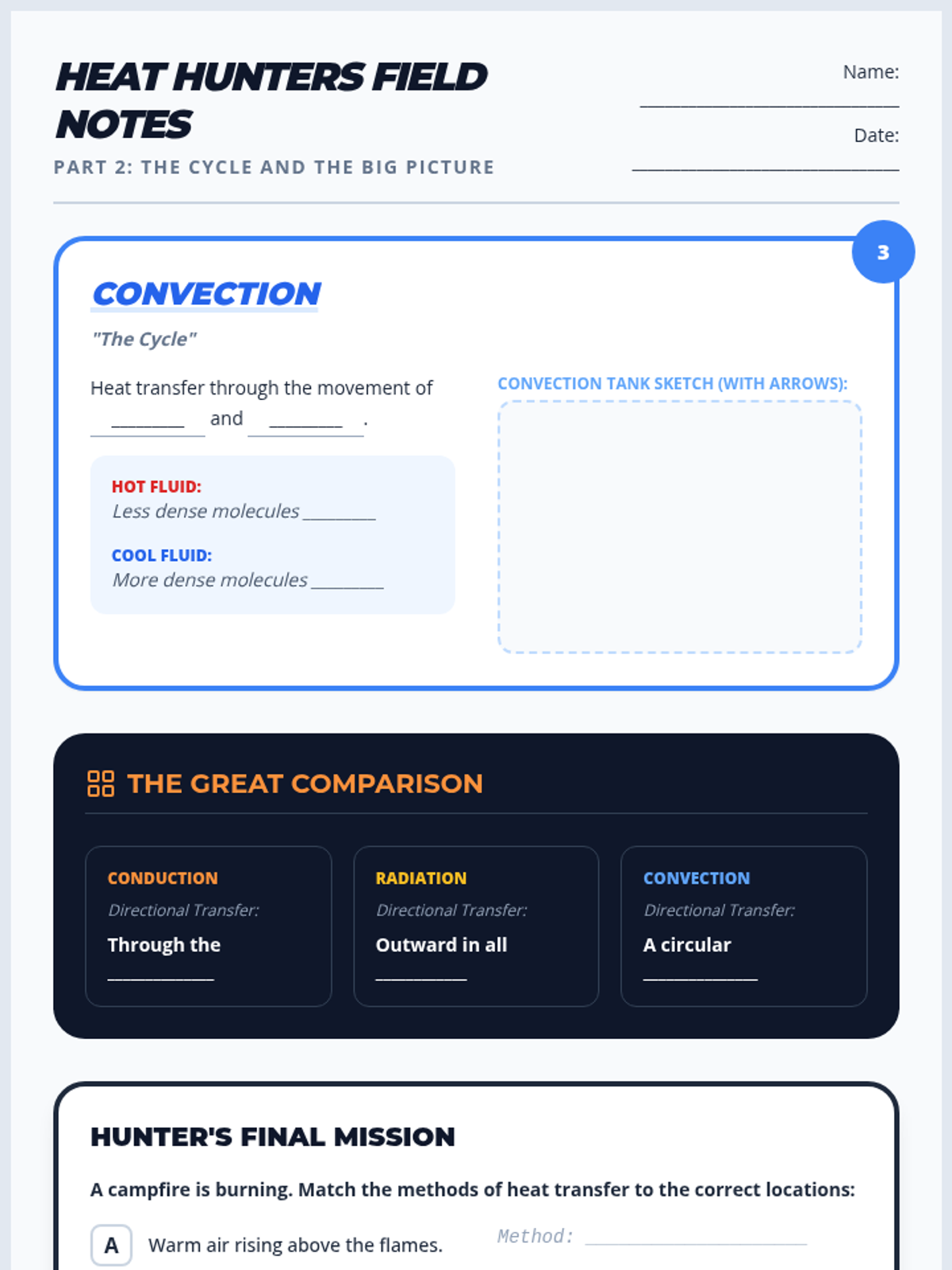
The second part of the doodle notes for the Heat Hunters unit, focusing on convection currents, density, and a comparative final analysis of all three heat transfer methods.
Second day of slides for the Heat Hunters unit, exploring convection currents and providing a comparative analysis of conduction, radiation, and convection. Focuses on directional flow and molecular density.
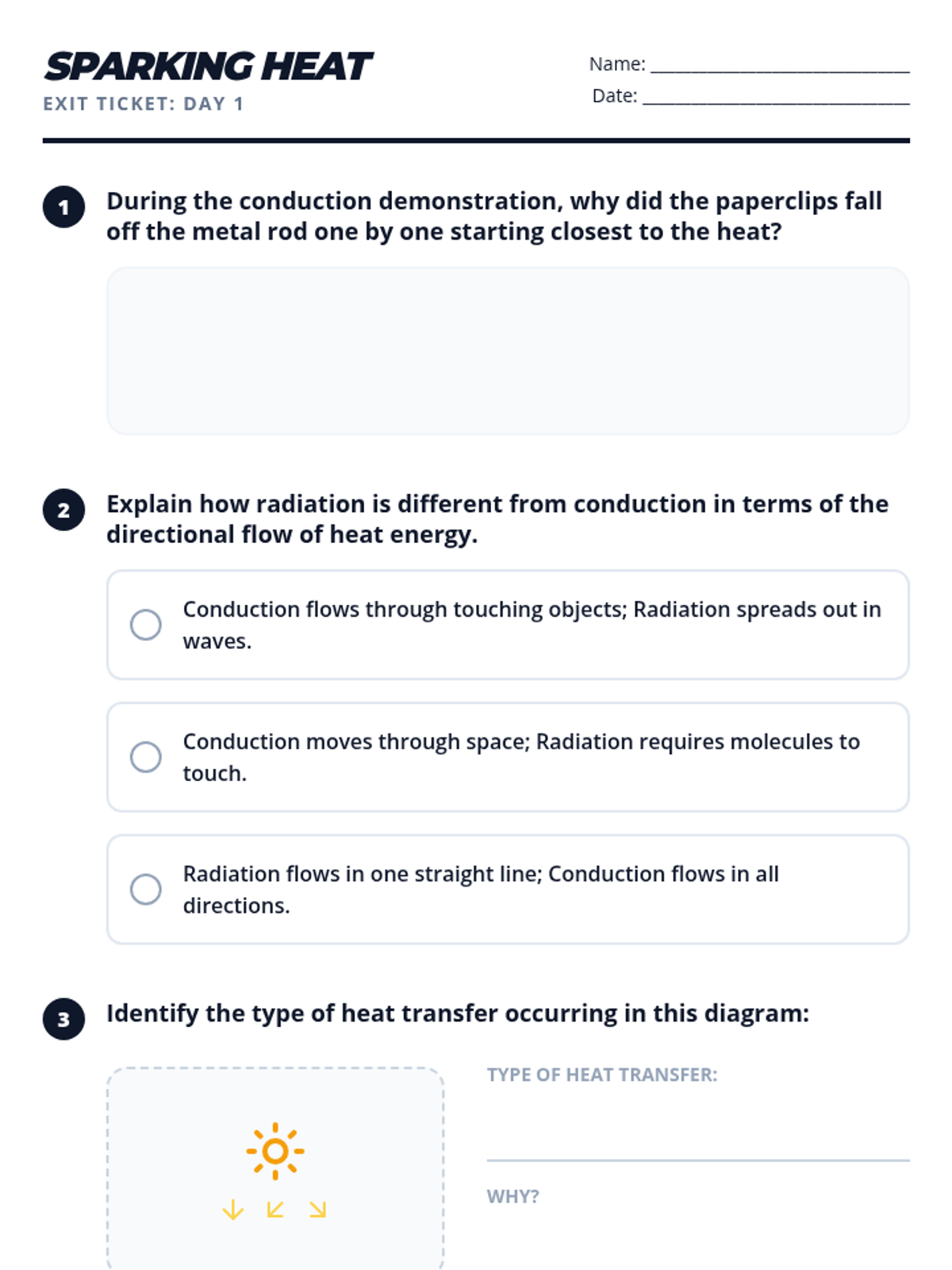
A quick assessment for Day 1 to check student understanding of conduction and radiation. Includes a diagram-based question and open-ended response areas.
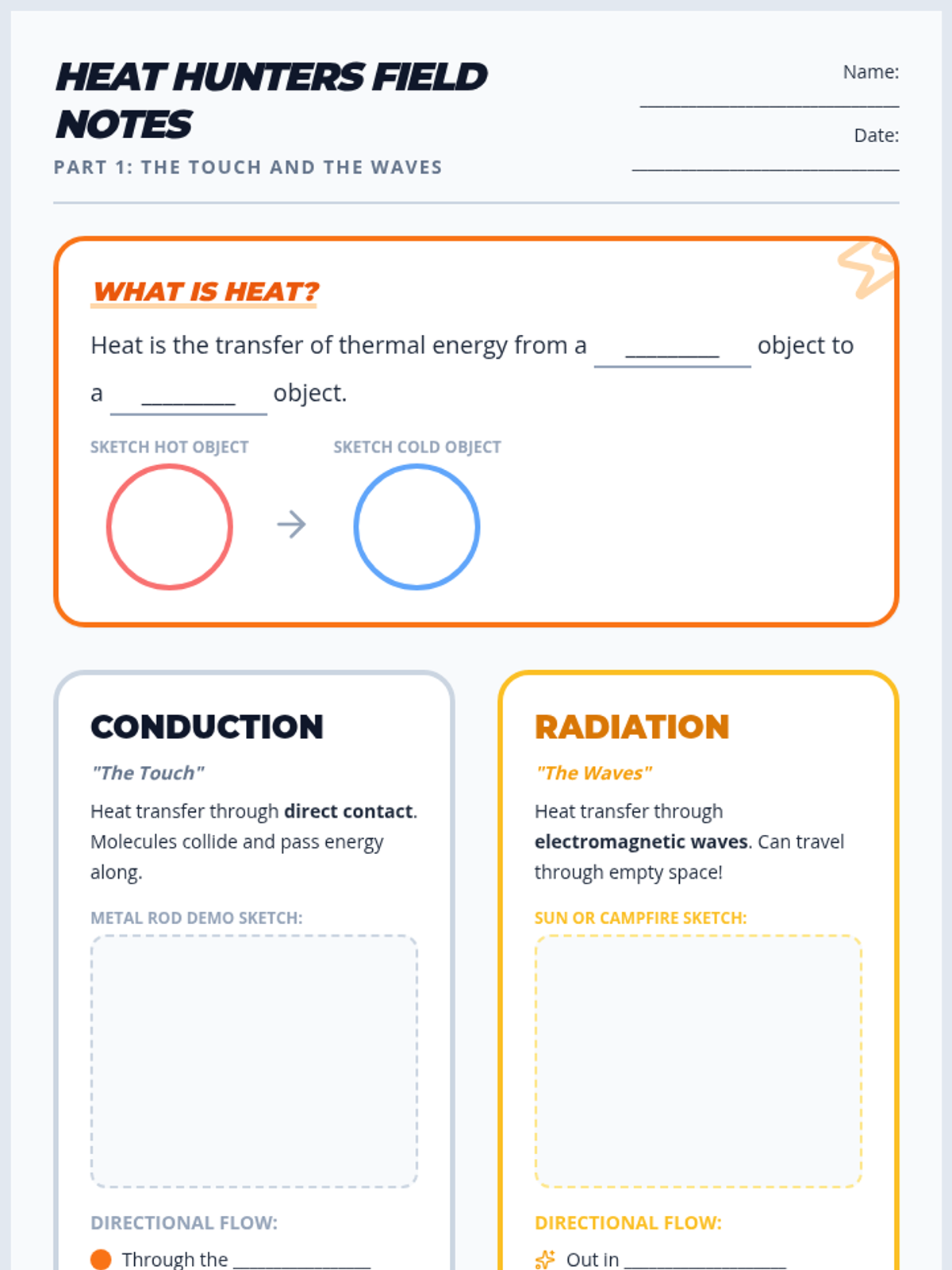
A visually engaging doodle notes worksheet for the first day of the Heat Hunters unit. Students define heat and explore conduction and radiation through sketches and fill-in-the-blank prompts.
Introductory slides for the Heat Hunters unit, focusing on thermal energy concepts, conduction (direct contact), and radiation (electromagnetic waves). Features bold visuals and clear directional flow explanations.
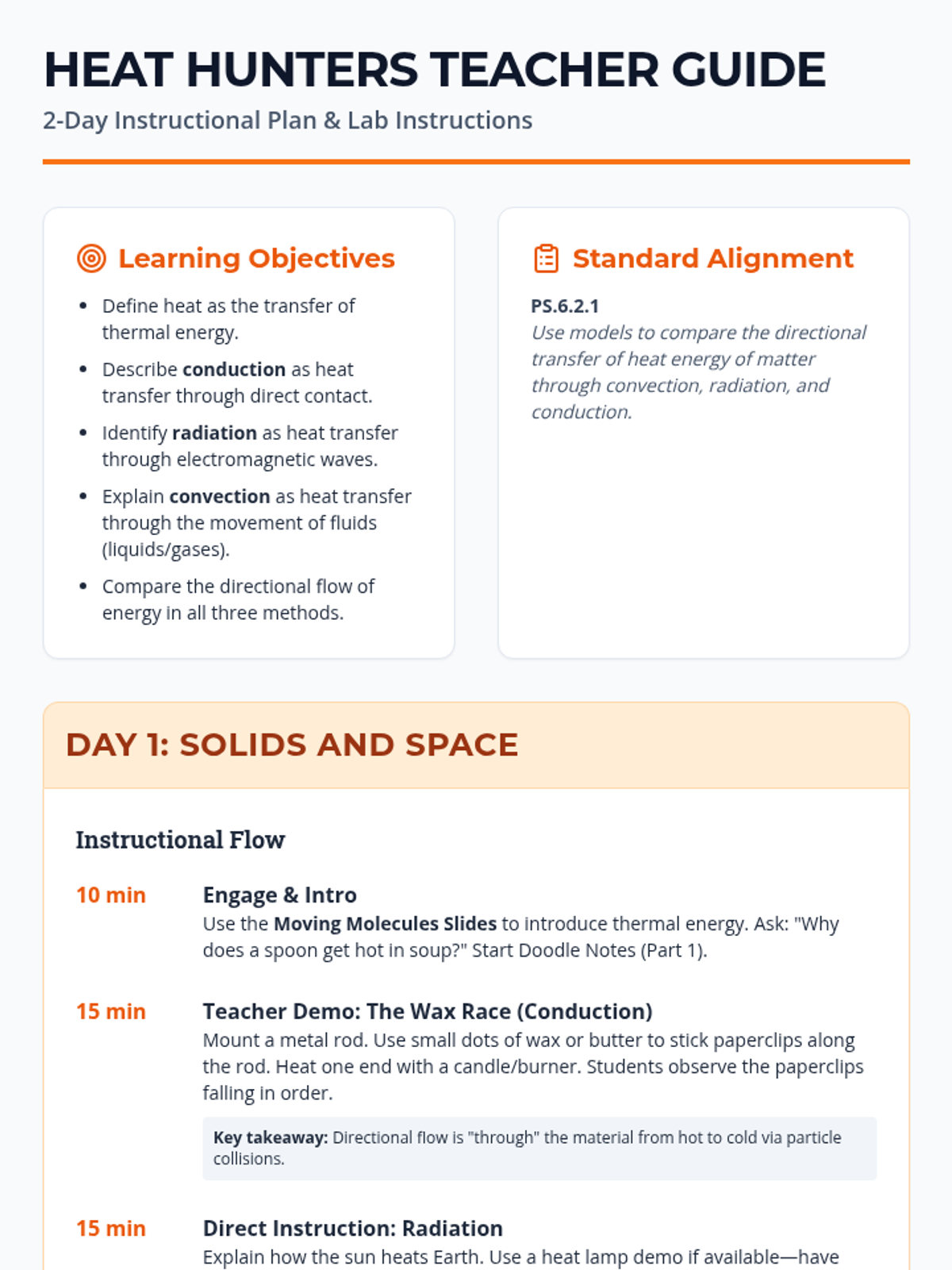
A comprehensive teacher guide for the 2-day Heat Hunters unit, including lesson plans, learning objectives, instructional flow, and detailed setup instructions for teacher-led demonstrations of conduction and convection.
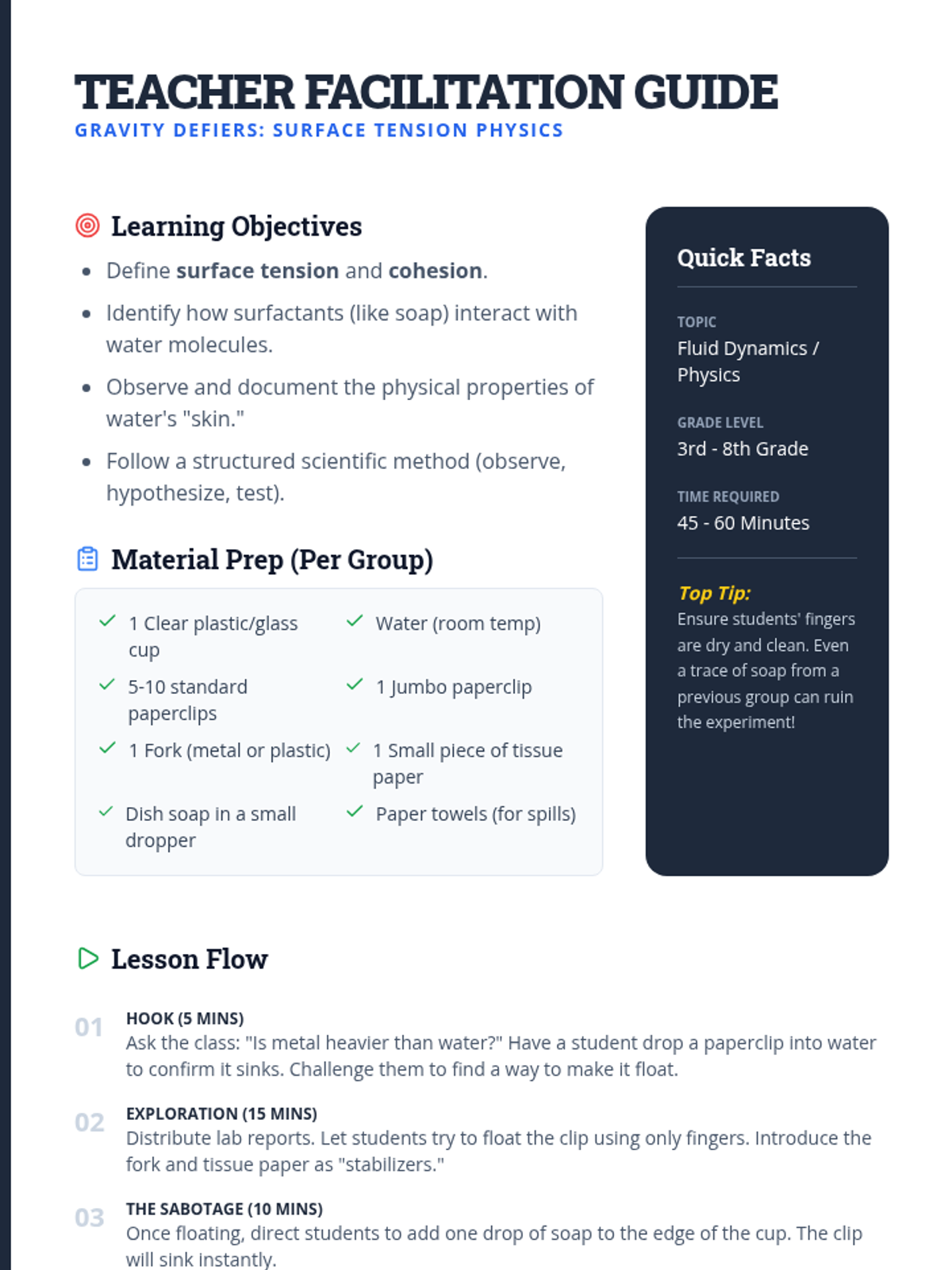
A teacher facilitation guide for the Gravity Defiers lesson. includes learning objectives, material lists, step-by-step facilitation instructions, scientific background on surface tension, and a student lab report answer key.
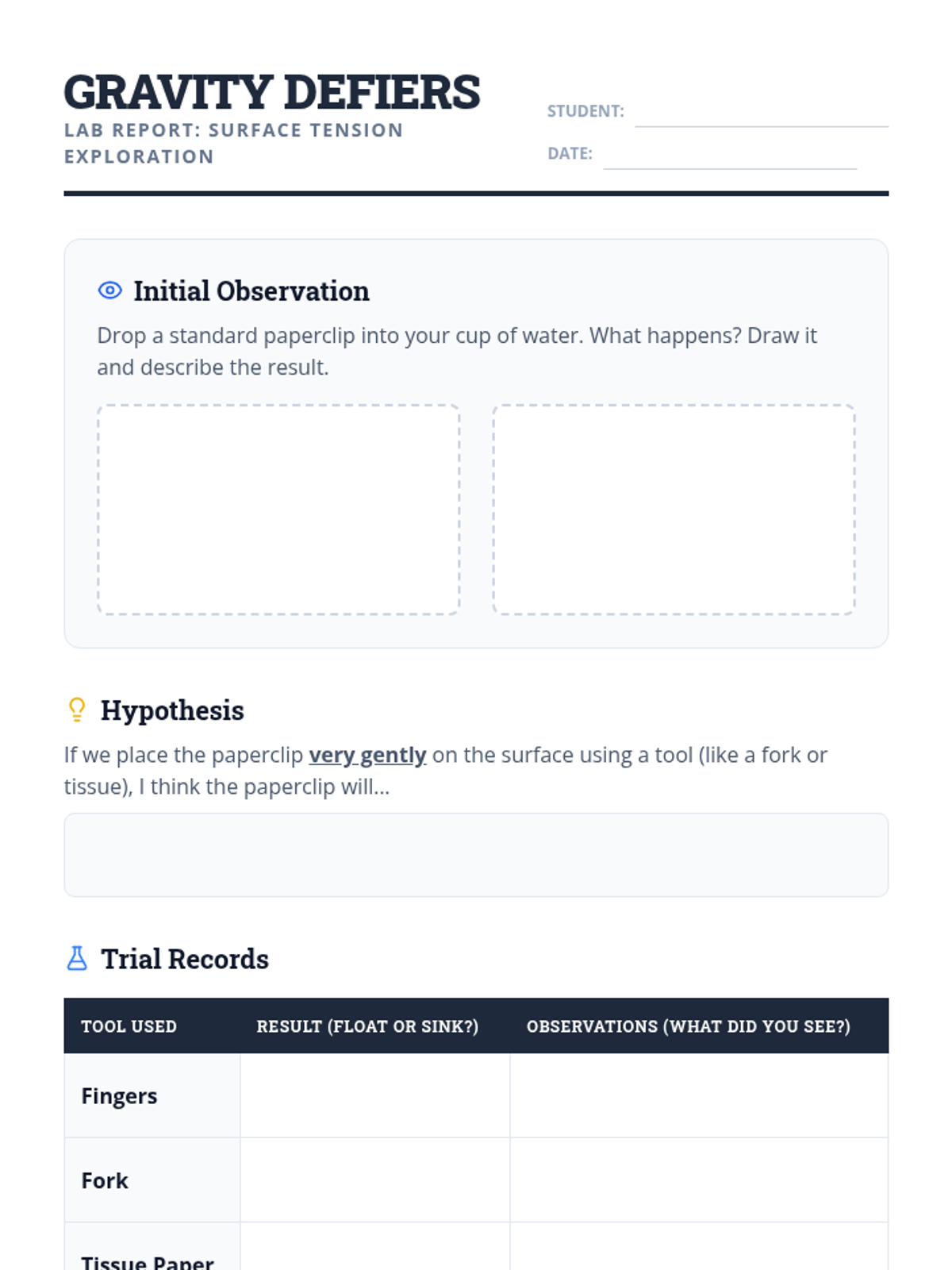
A student-facing lab report for the Gravity Defiers experiment. includes sections for initial observations, hypothesis, trial recording, and final analysis of surface tension concepts.
A visual presentation for the Gravity Defiers lesson, introducing surface tension and cohesion through the floating paperclip experiment. includes material checklists, step-by-step instructions, and key scientific terminology.
An answer key and teacher facilitation guide for the "Cosmic Neighbors" lesson, providing solutions for the worksheet and tips for the scaling activity.
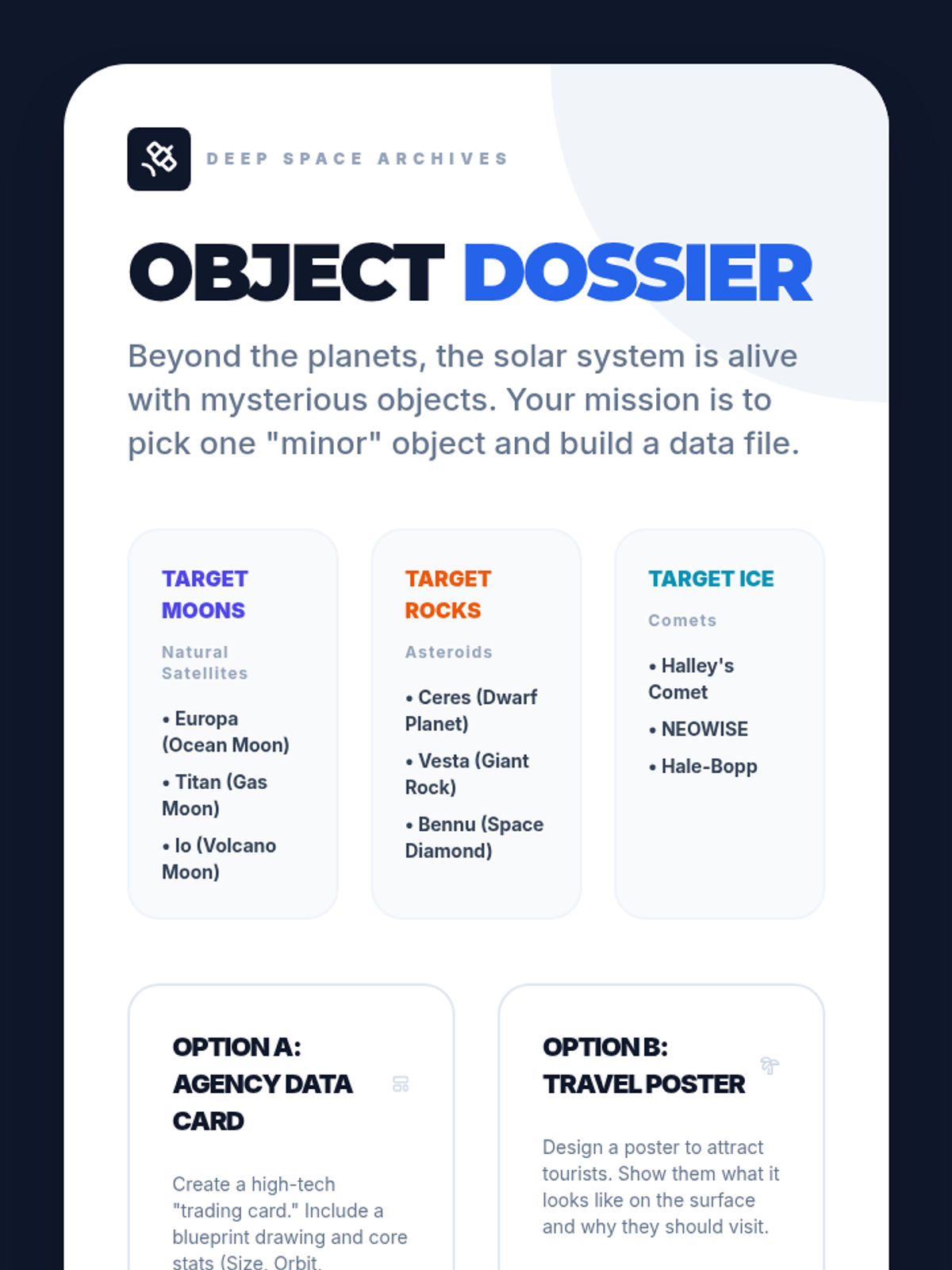
A creative research project where students choose a moon, asteroid, or comet to study and then create either a "Trading Card" or a "Travel Poster" to showcase their findings.
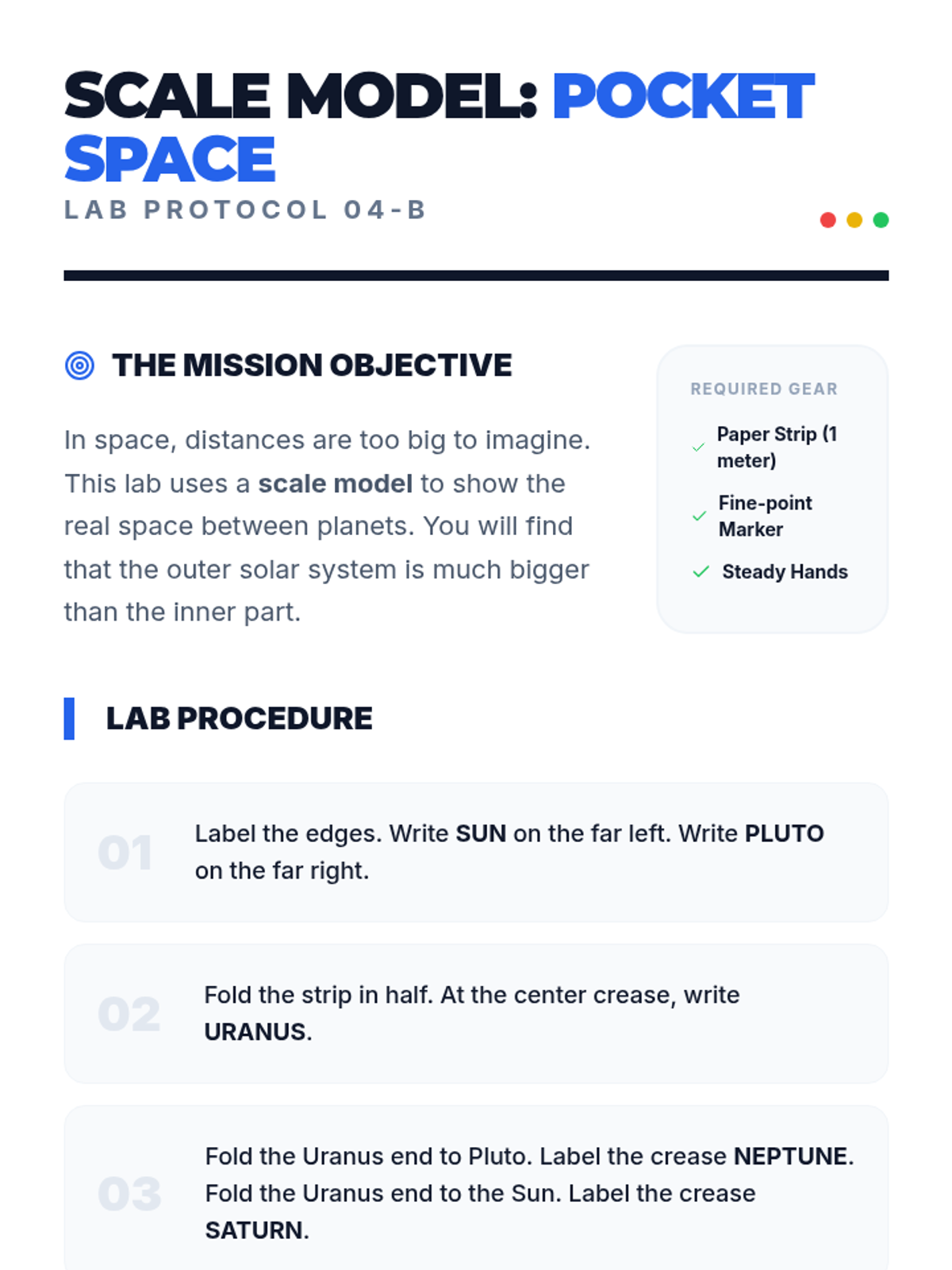
A scale-model experiment using paper folding to demonstrate the relative distances between planets in the solar system, specifically highlighting the vast space between outer planets compared to inner planets.
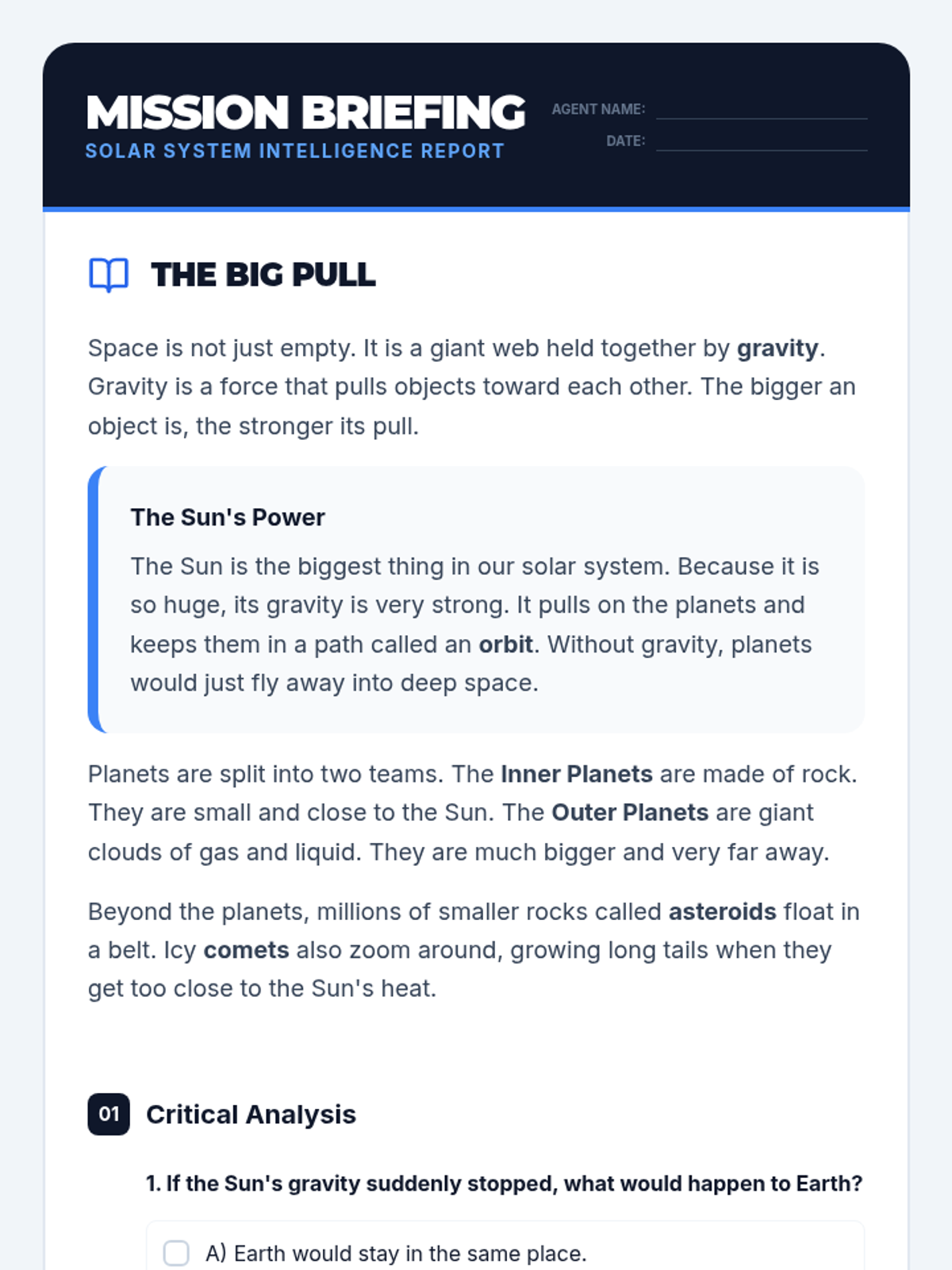
A reading comprehension worksheet for 3rd graders focusing on the classification of inner (rocky) and outer (gaseous) planets, including a sorting activity and questions about other space objects.
A visually engaging slide deck introducing the Solar System, differentiating between rocky (inner) and gaseous (outer) planets, and highlighting moons, asteroids, and comets.
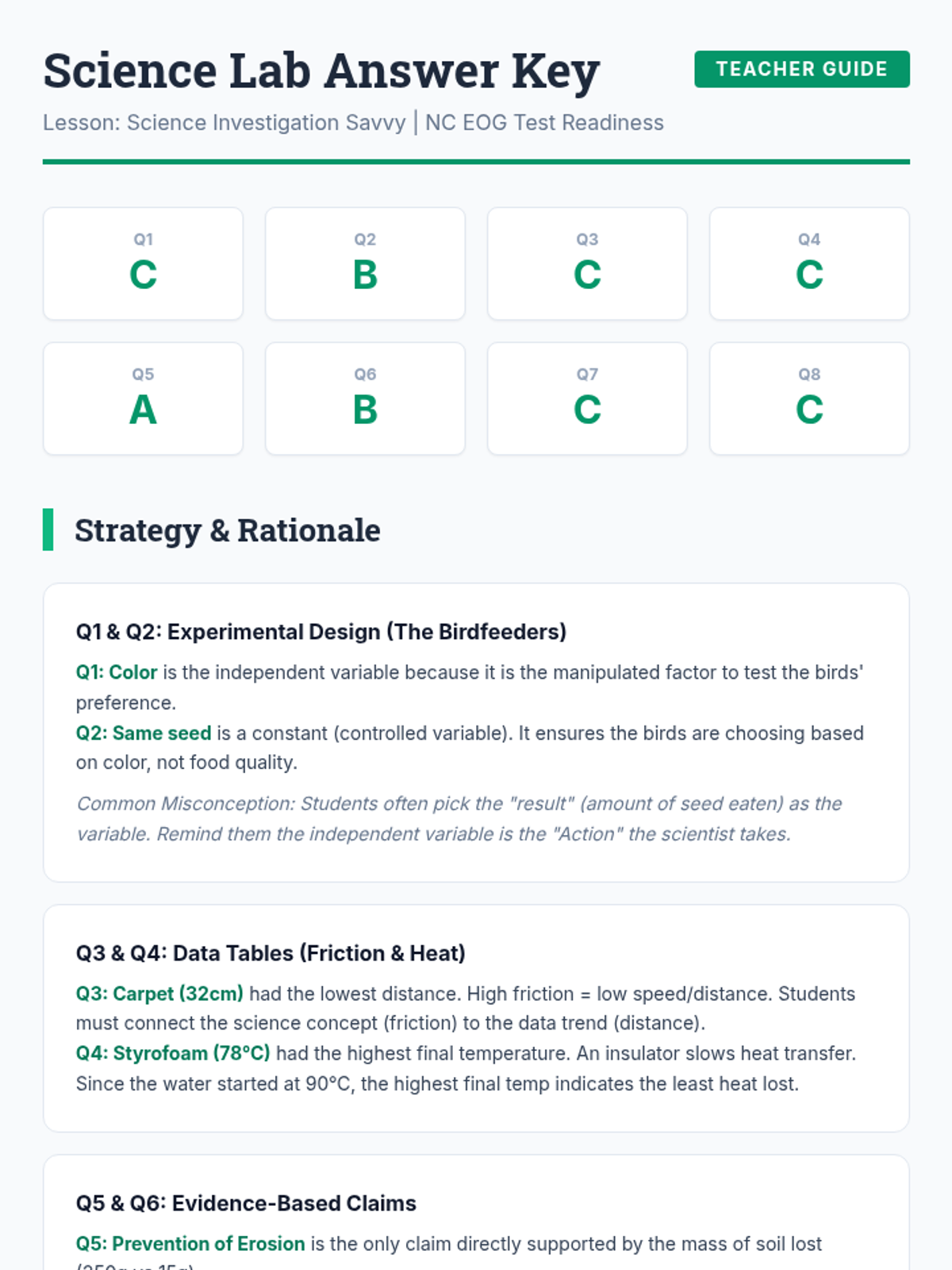
A comprehensive teacher answer key and instructional guide for the Science Investigation Savvy lesson, featuring rationales, misconception alerts, and teaching strategies.
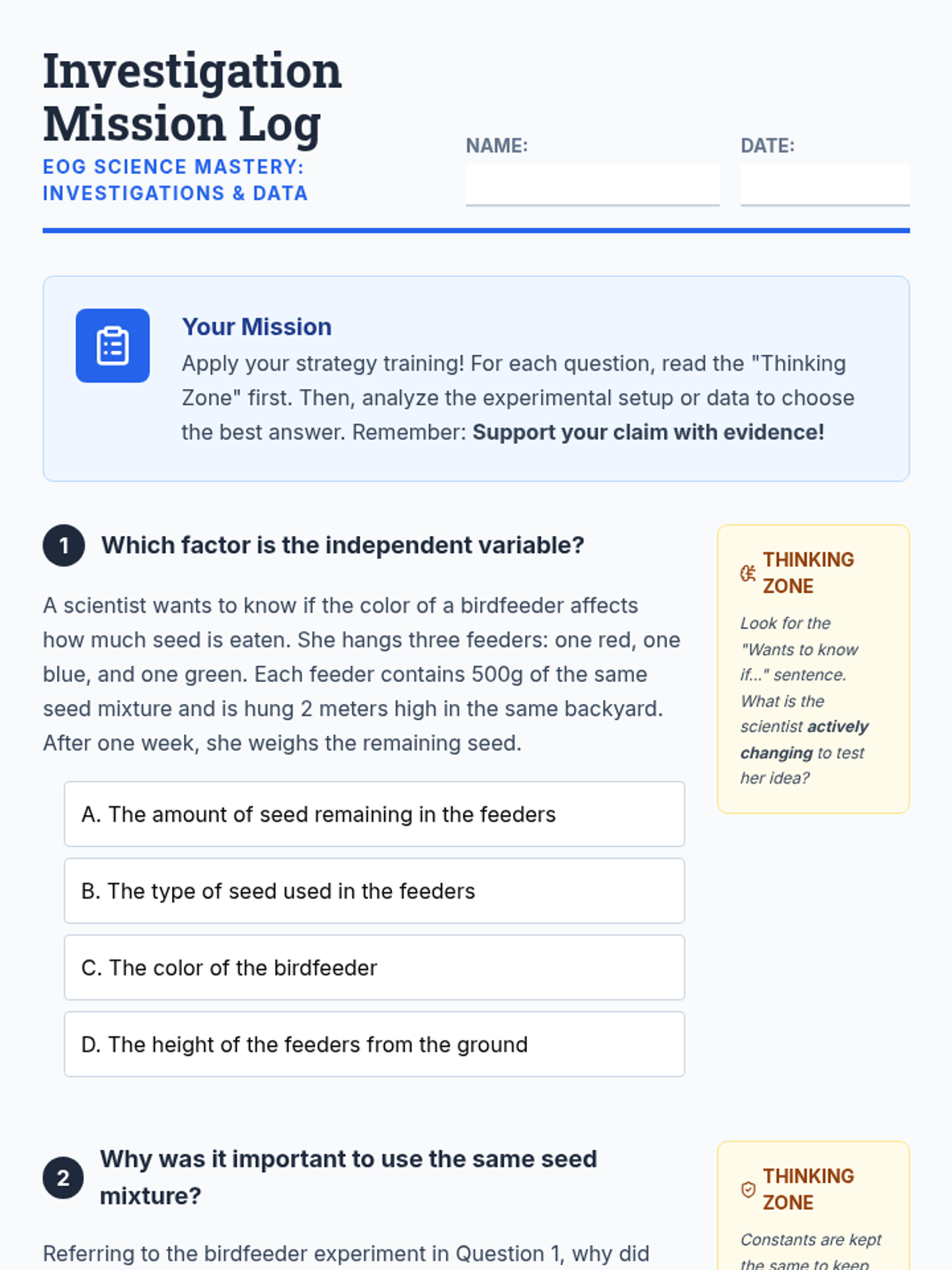
A student practice worksheet featuring 8 EOG-style science investigation questions with integrated 'Thinking Zone' strategy annotations to guide student analysis.
A visual presentation deck for teaching strategies to approach North Carolina EOG science investigation questions, featuring annotated examples and strategy breakdowns.
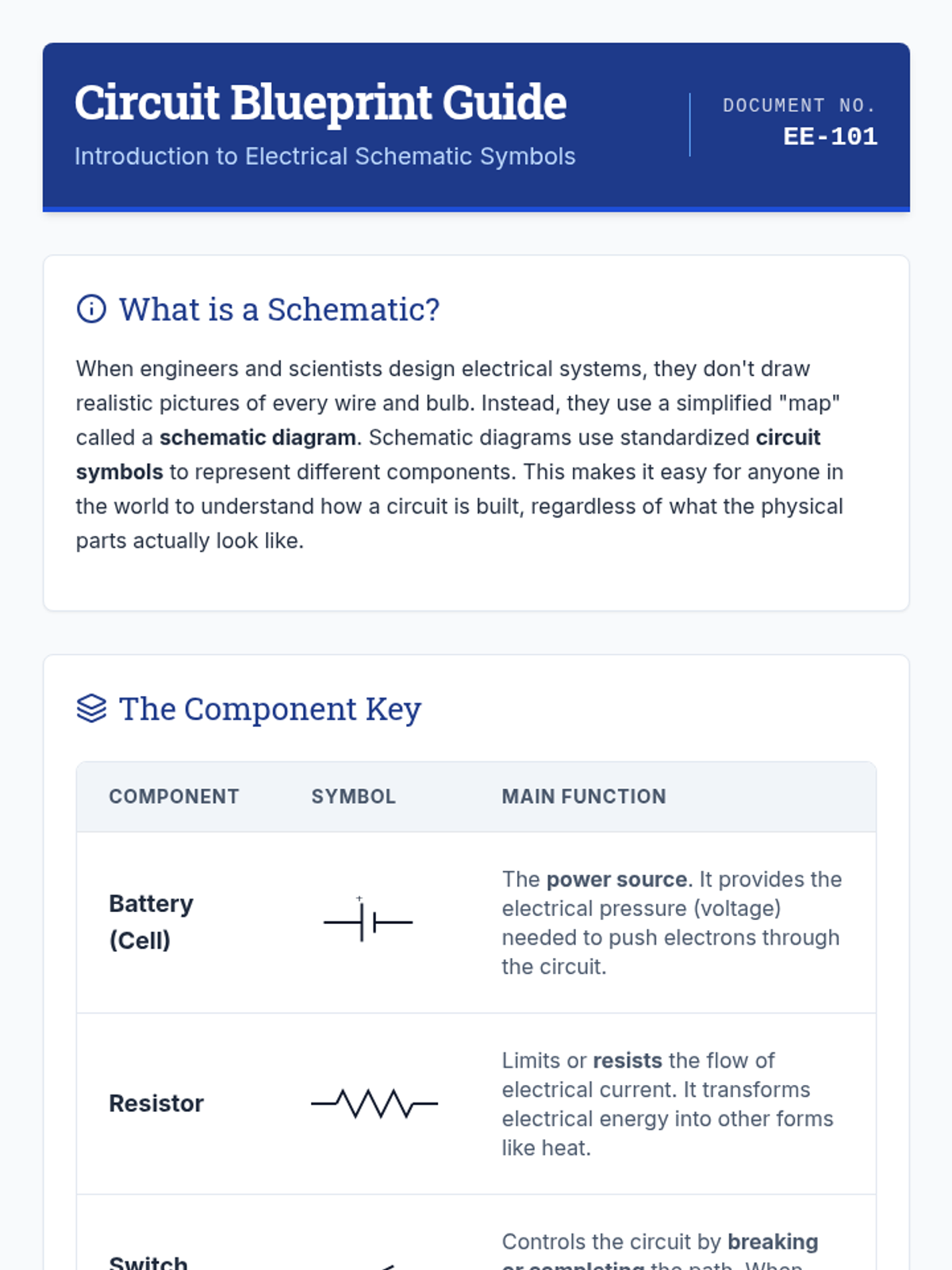
A strictly 2-page reading guide optimized for print. Page 1 contains the detailed symbol key. Page 2 features the integrated circuit with a fixed, closed switch and updated text describing a functional closed circuit.
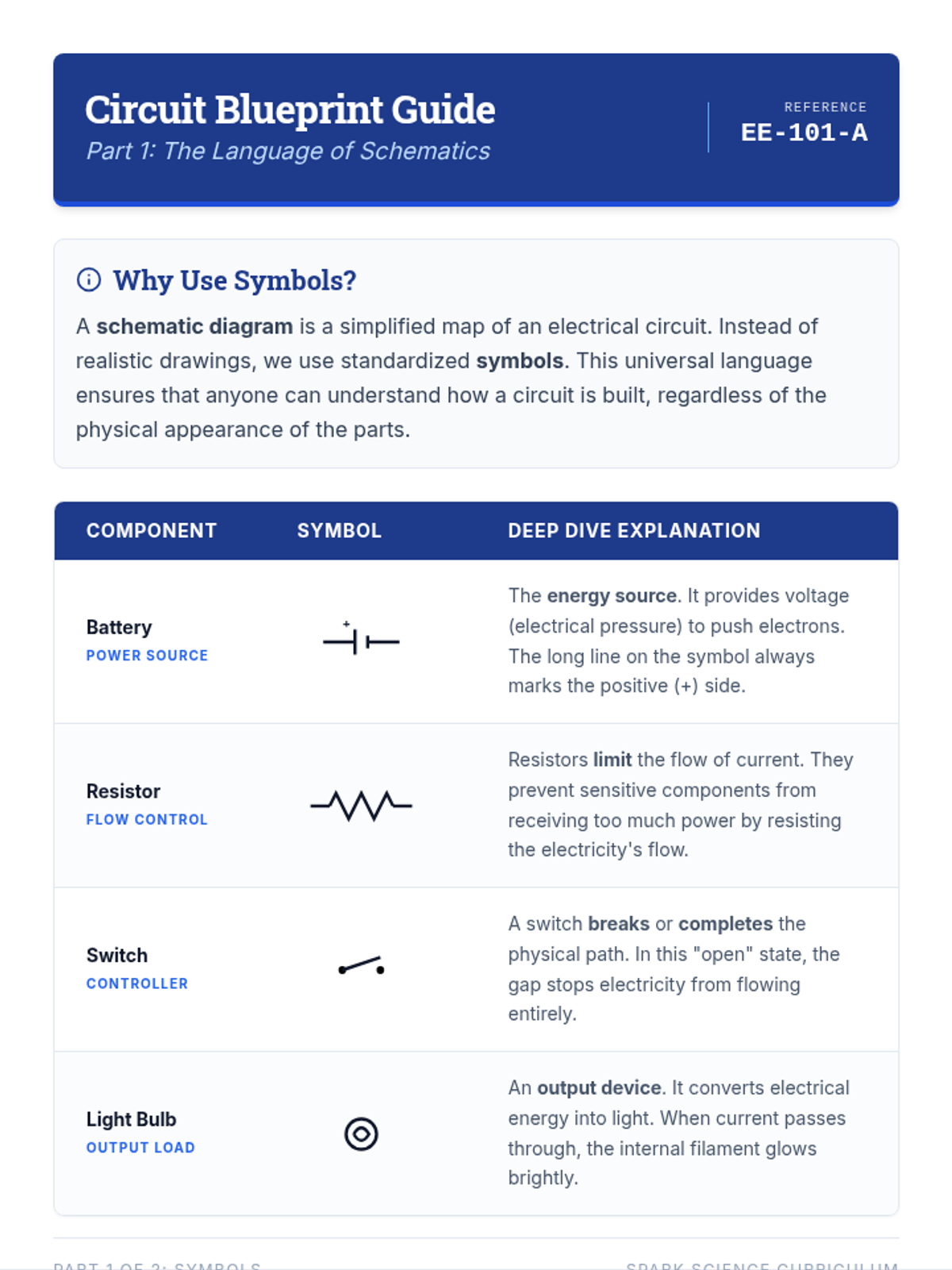
A comprehensive 2-page reading guide. Page 1 features a detailed Master Key with symbols and deep-dive explanations. Page 2 features a large Integrated Circuit schematic with extended reading on current flow and the "Golden Rule" of closed loops.
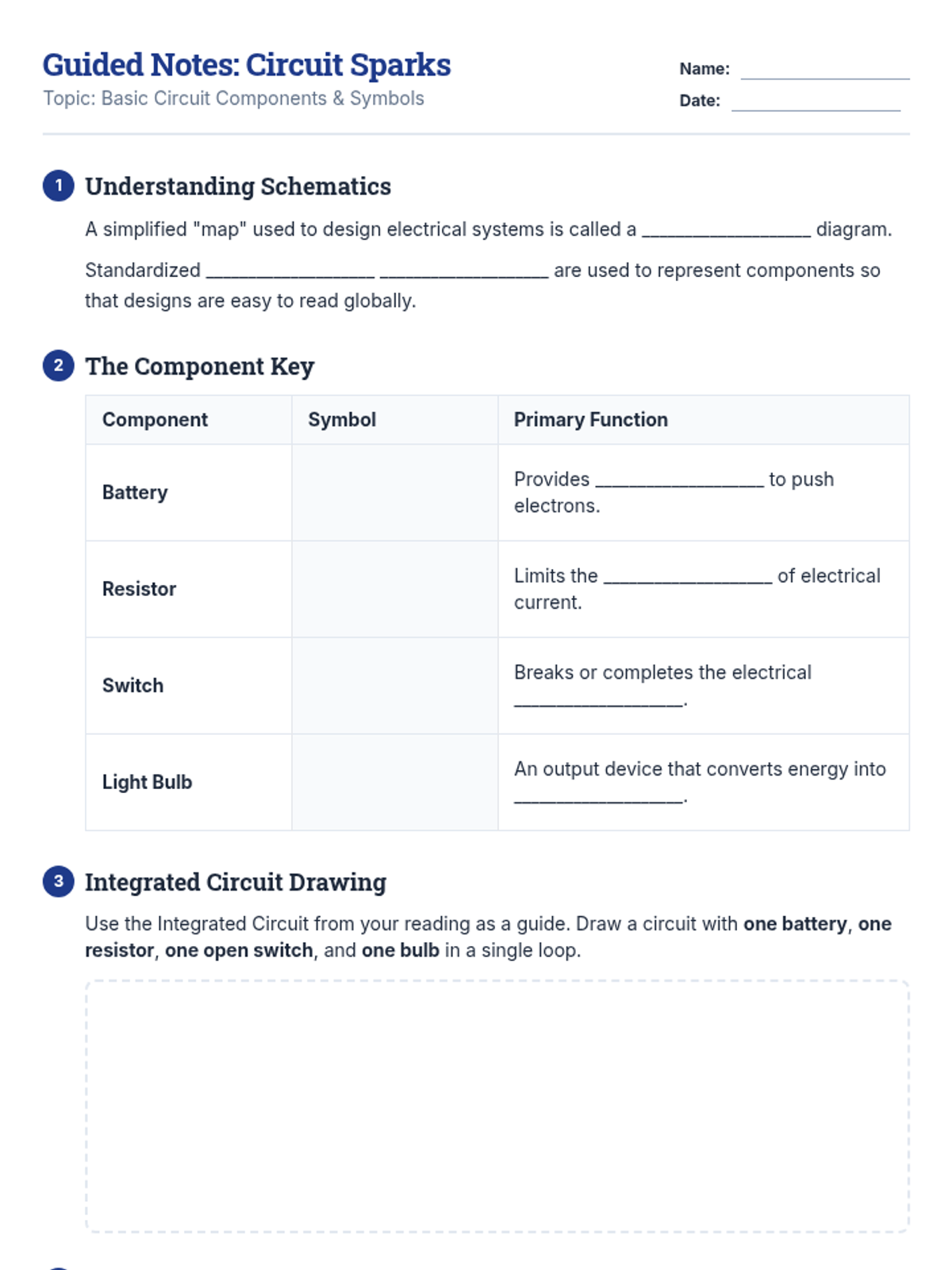
Guided notes for students to complete while reading the Circuit Symbols Guide. Includes fill-in-the-blank definitions, drawing practice for symbols, and an integrated circuit sketching area. Optimized for 1-page fit.
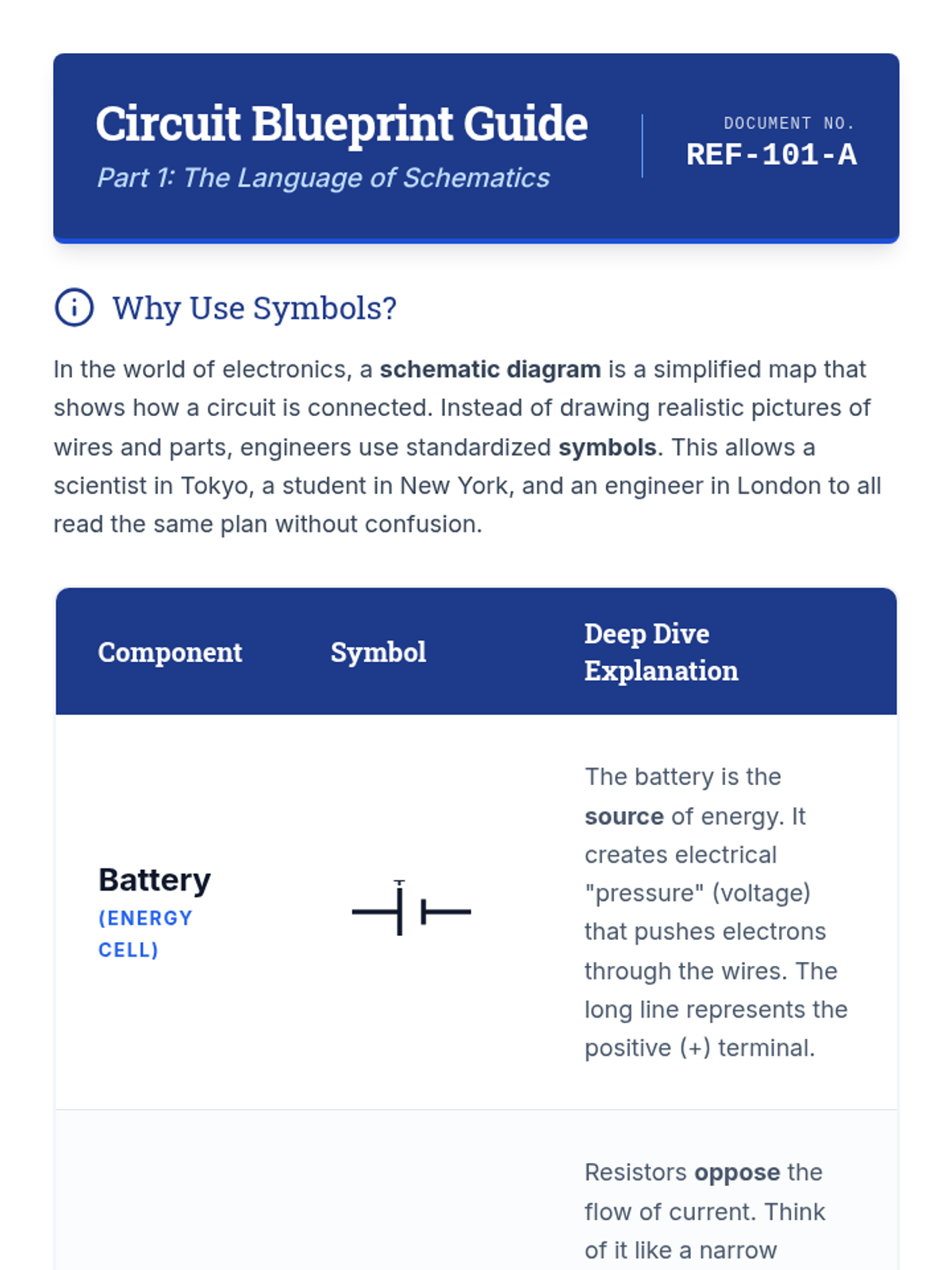
Optimized 1-page introductory reading guide for students that explains schematic diagrams and provides a visual symbol key plus a large labeled integrated circuit example containing all four components. Designed to fit perfectly on a single page.
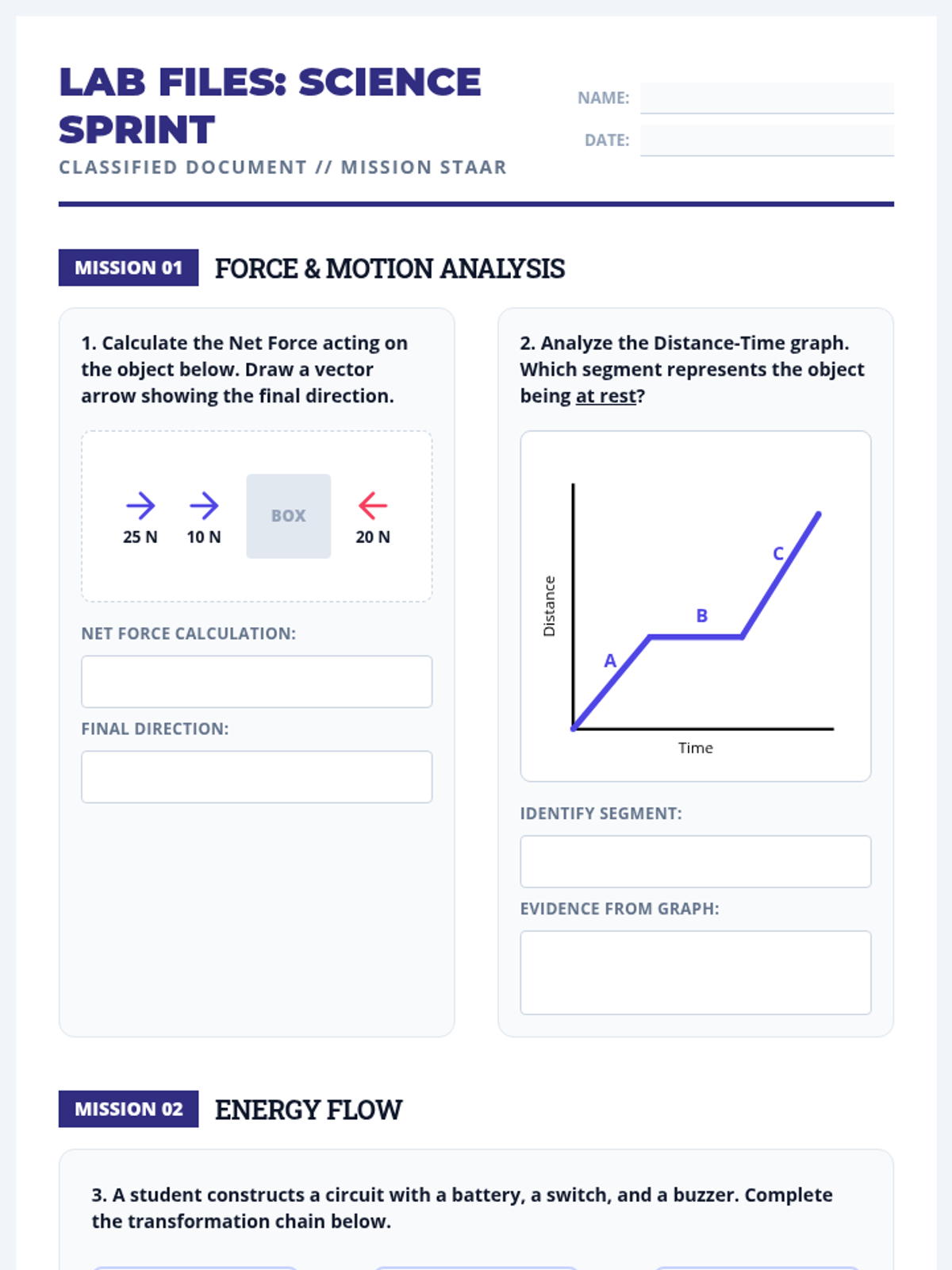
A student practice worksheet featuring force calculation diagrams, distance-time graph interpretation, energy transformation chains, and STAAR-style multiple-choice questions.
A visual presentation deck for the Science STAAR Sprint lesson, featuring clear diagrams of net force, distance-time graphs, energy transformation chains, and food web dynamics.
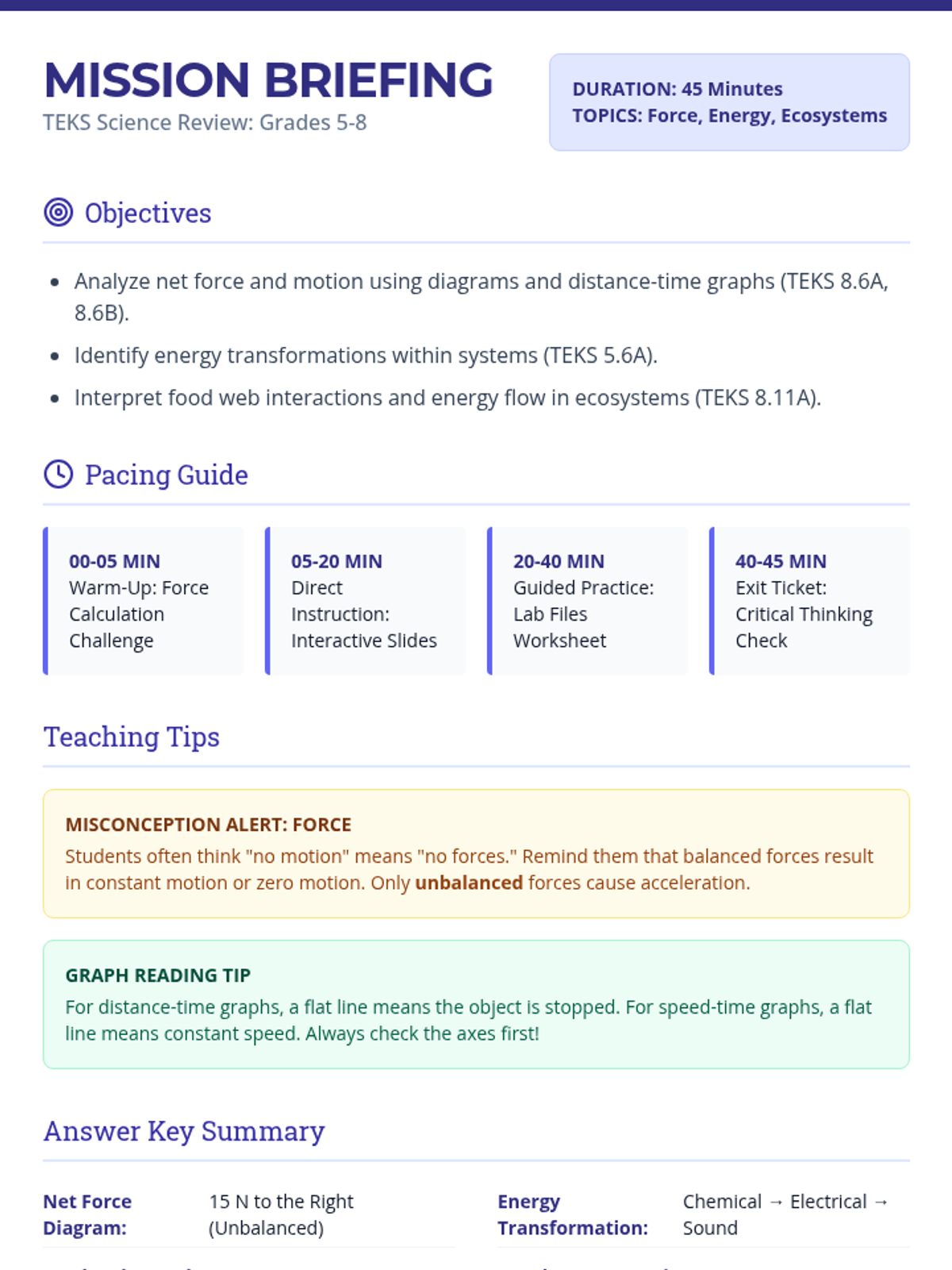
A comprehensive teacher's guide for the Science STAAR Sprint lesson, featuring pacing guides, instructional tips, and a detailed answer key for all student activities.
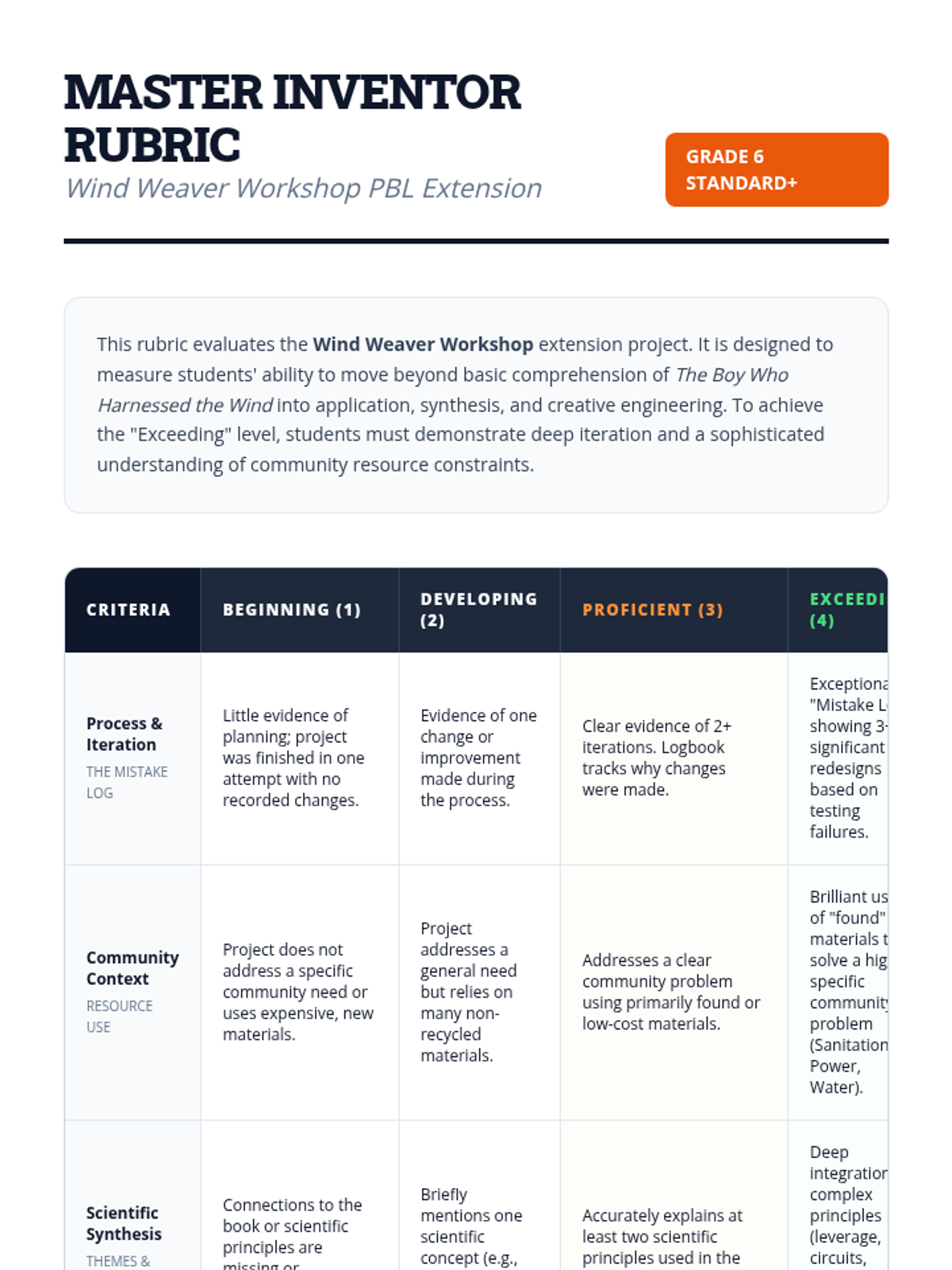
A specialized 4-level rubric for the 'Wind Weaver Workshop' PBL extension, focusing on process iteration, community impact, scientific synthesis, and craftsmanship.
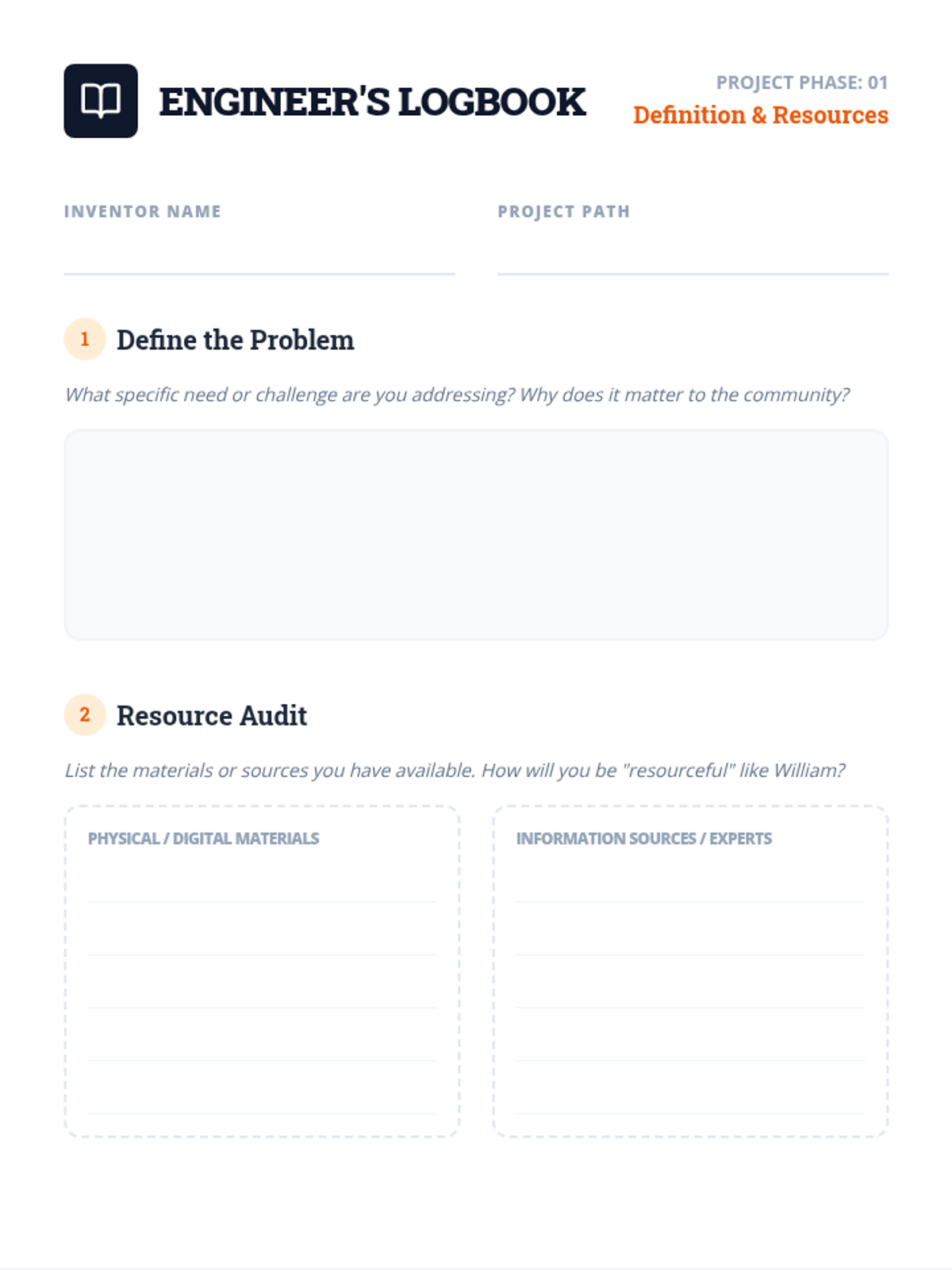
A comprehensive 4-page project logbook for students to document their PBL process, from defining the problem and auditing resources to blueprinting, logging iterations (mistakes), and reflecting on community impact.
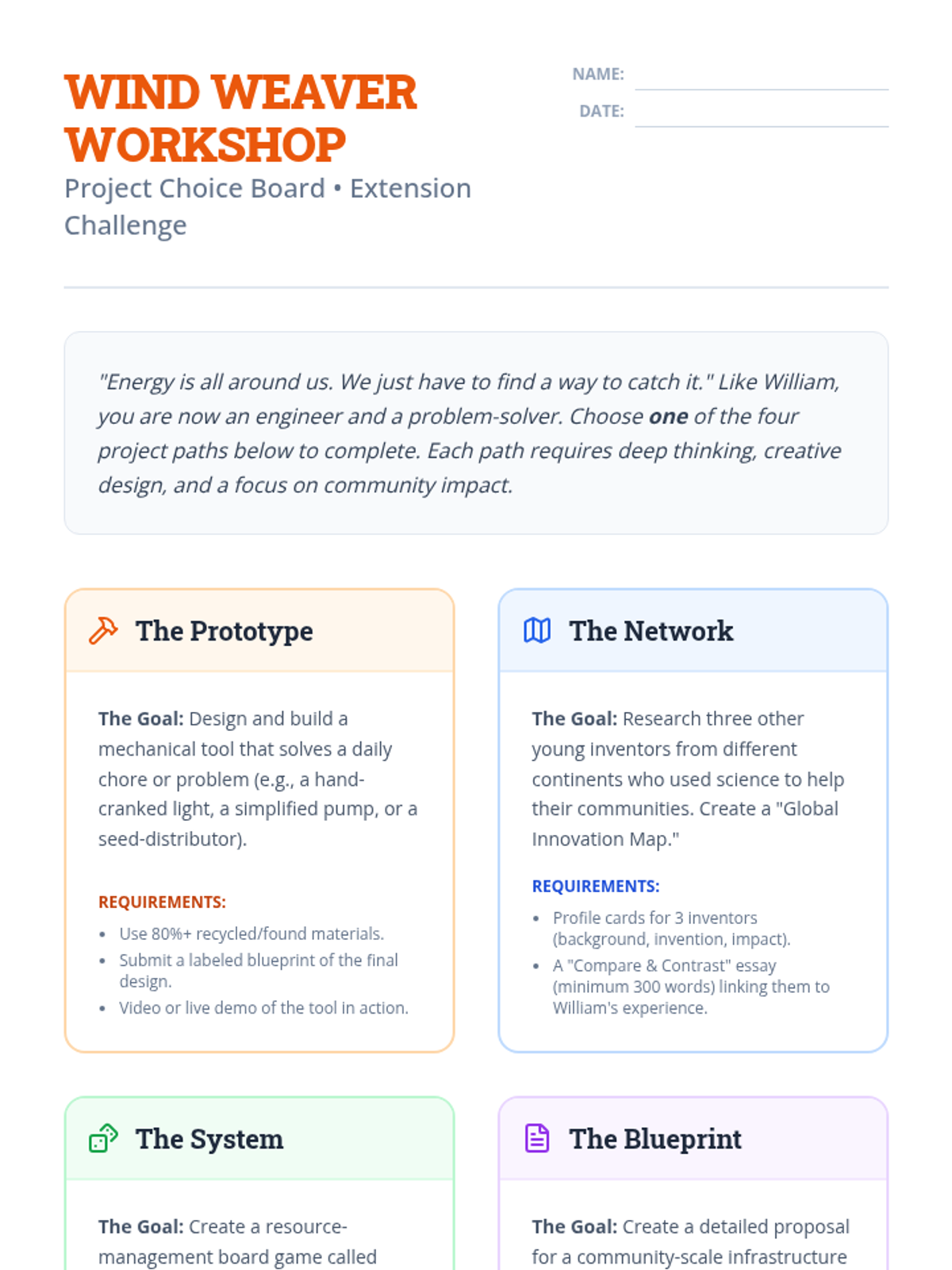
A choice board document for Grade 6 students offering four distinct project paths (Building, Research, Gaming, and Blueprinting) based on themes from 'The Boy Who Harnessed the Wind'.
A high-energy presentation introducing Grade 6 students to the 'Wind Weaver Workshop' extension project, detailing the challenge, the four project paths, and the expectations for above-standard work.
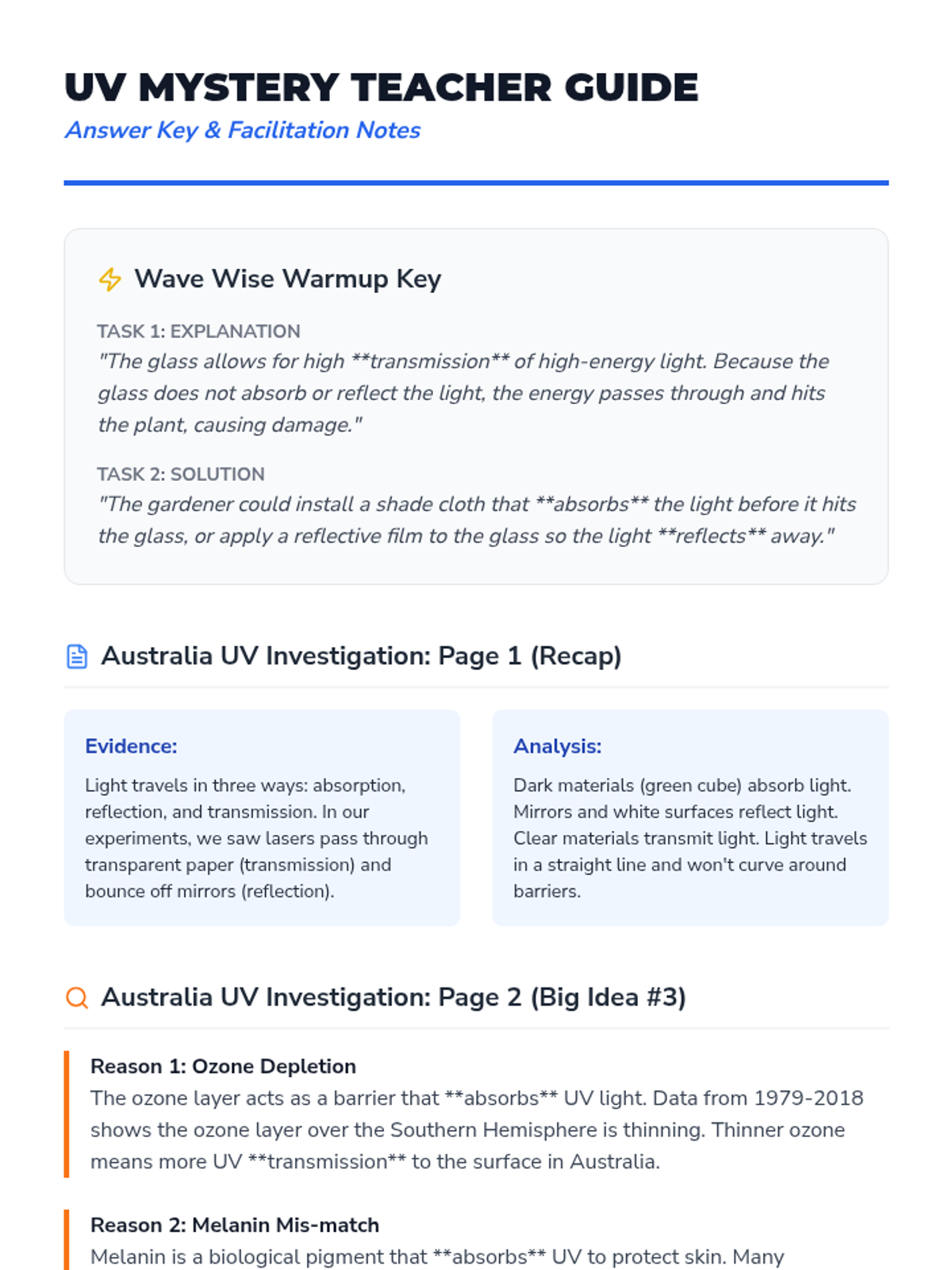
A teacher-facing resource providing the answer key for the warm-up and investigation worksheets, along with common student misconceptions to watch for during the lesson.
An 8-slide presentation guiding students through the UV mystery of Australia, featuring data analysis of ozone depletion and biological susceptibility.
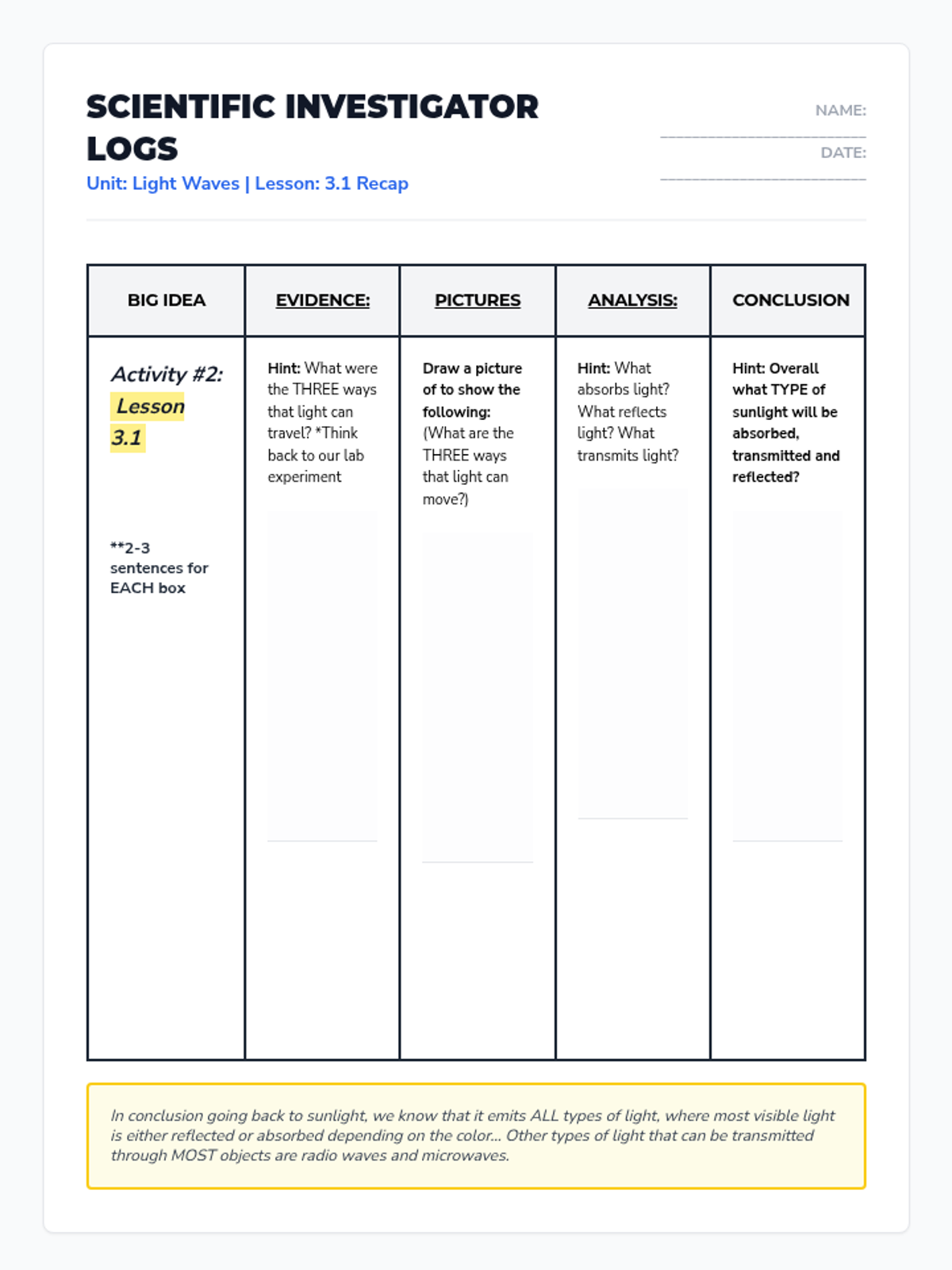
A 2-page investigation worksheet combining a review of light interaction principles (absorbed, reflected, transmitted) with an analysis of ozone depletion and melanin in Australia.
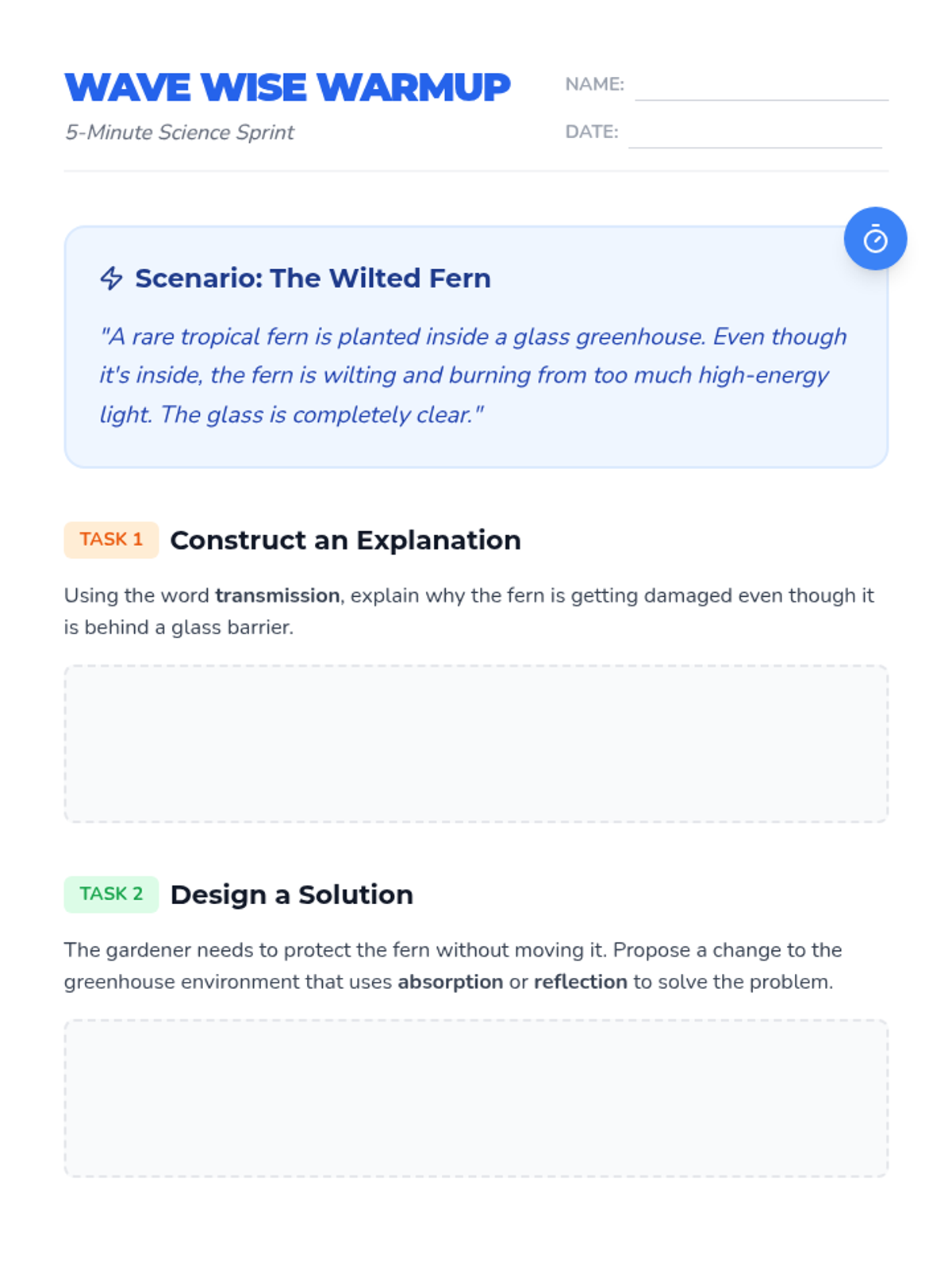
A 5-minute warm-up worksheet focused on constructing scientific explanations and designing solutions regarding light transmission and protection.
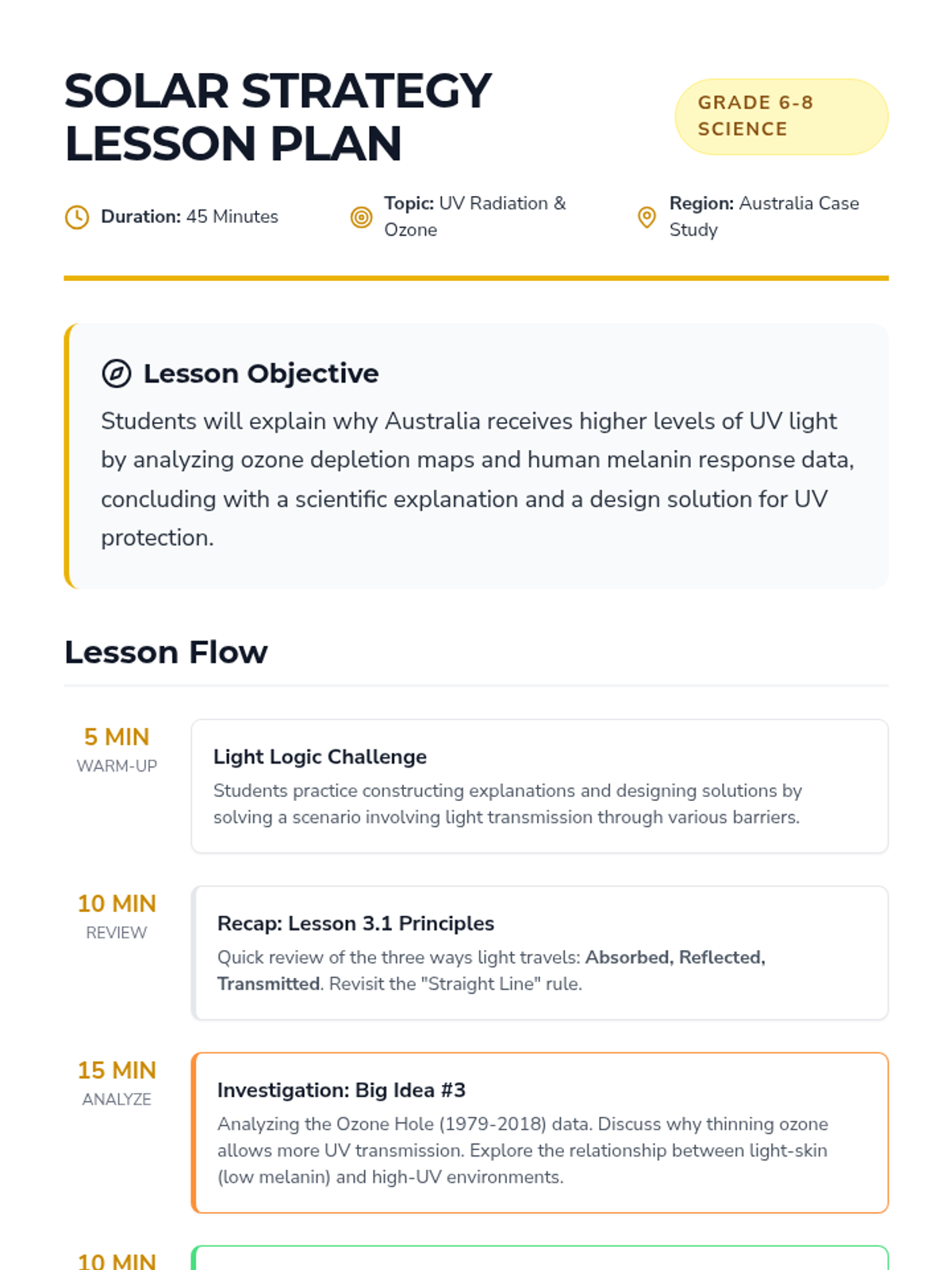
A detailed 45-minute lesson plan for teachers, outlining the flow from warm-up to conclusion, with specific focus on ozone depletion in Australia and light interaction principles.
An answer key and scoring guide for the Practice Power Up document, featuring correct answers, conceptual explanations, and a grading rubric for the open-ended mastery question.
A 2-page practice document featuring high-level scenario-based questions, data analysis of wave graphs, and application questions regarding the electromagnetic spectrum and human health.
An expanded, 2-page vocabulary reference sheet for light waves, including definitions for wavelength, amplitude, melanin, and pigment, plus a "Misconception Buster" section and application questions.
An answer key and pedagogical guide for the Light Waves Practice Challenge, providing detailed scientific explanations for each concept to help students and teachers understand the "why" behind light interactions.
A 2-page practice worksheet for middle school students featuring 5 complex scenario-based questions that mirror the concepts found in the Light Waves Unit 4 test, including wave properties and light-matter interactions.
A comprehensive 2-page study guide for middle school science students on light waves, covering wave anatomy, the golden rule of absorption, the electromagnetic spectrum, and key vocabulary for unit review.
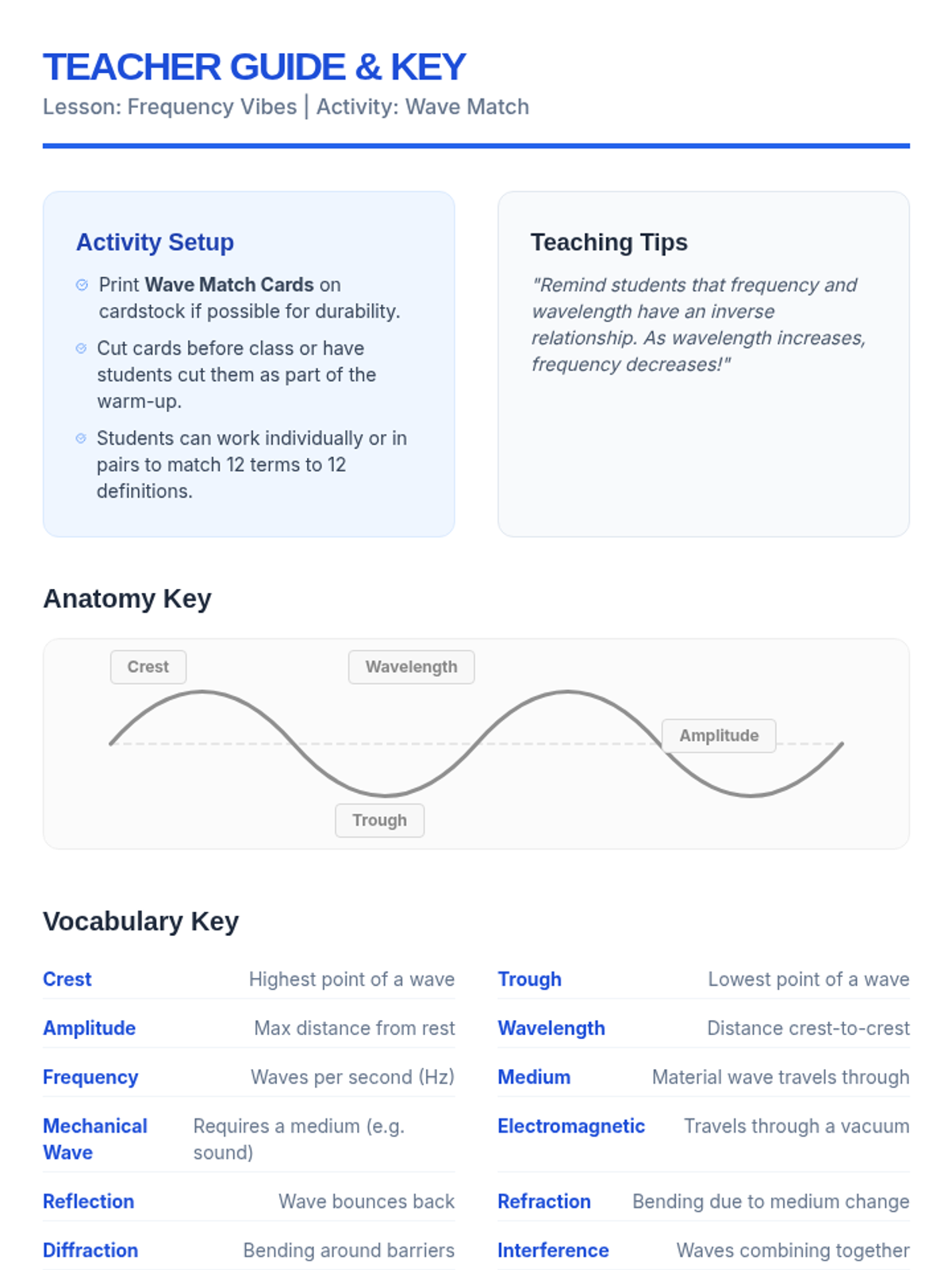
A guide for teachers including the answer key for the wave diagram and vocabulary matching activity.
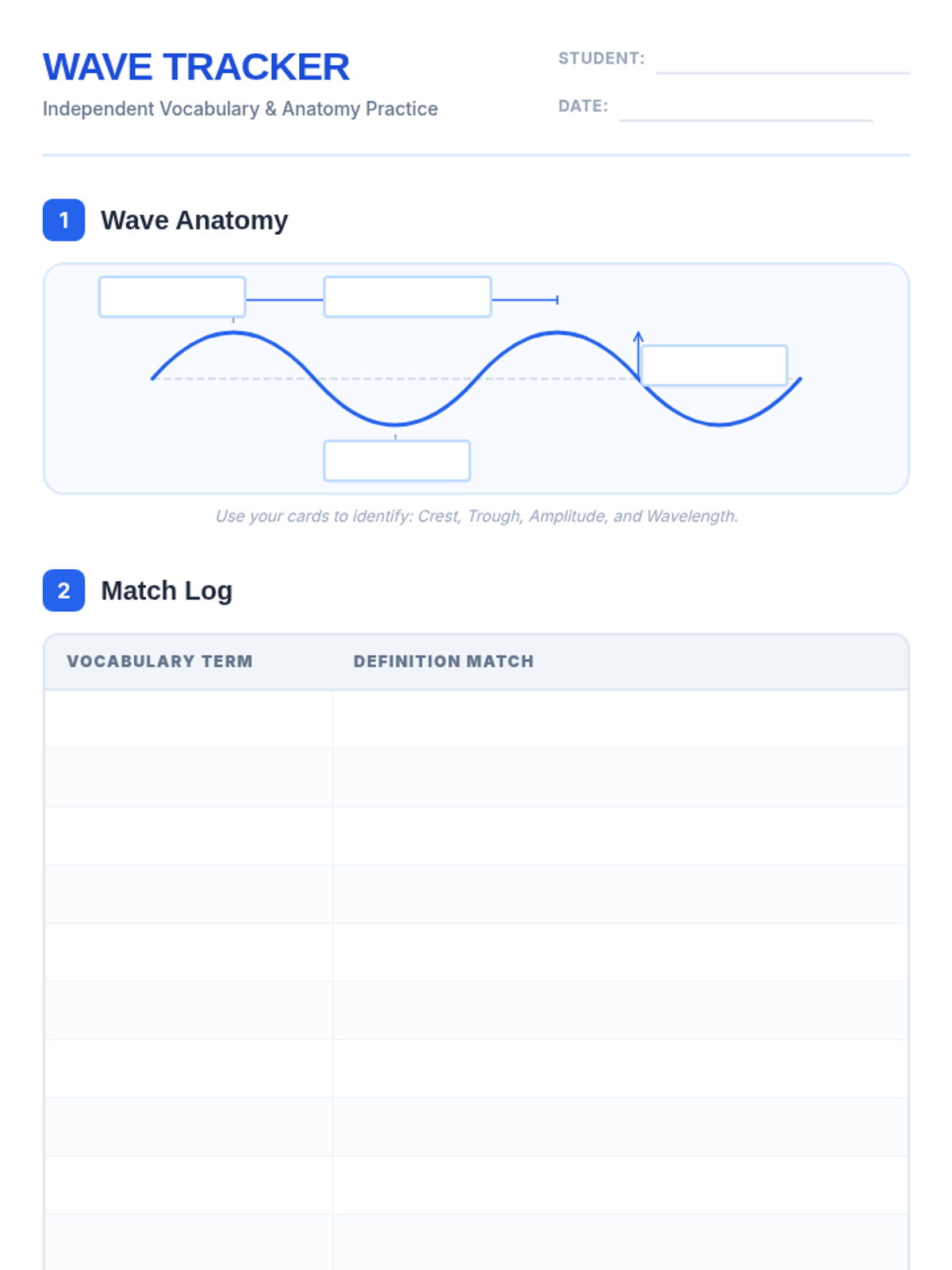
A recording sheet for students to document their vocabulary matches and label the primary features of a wave. Updated for maximum legibility and handwriting space.
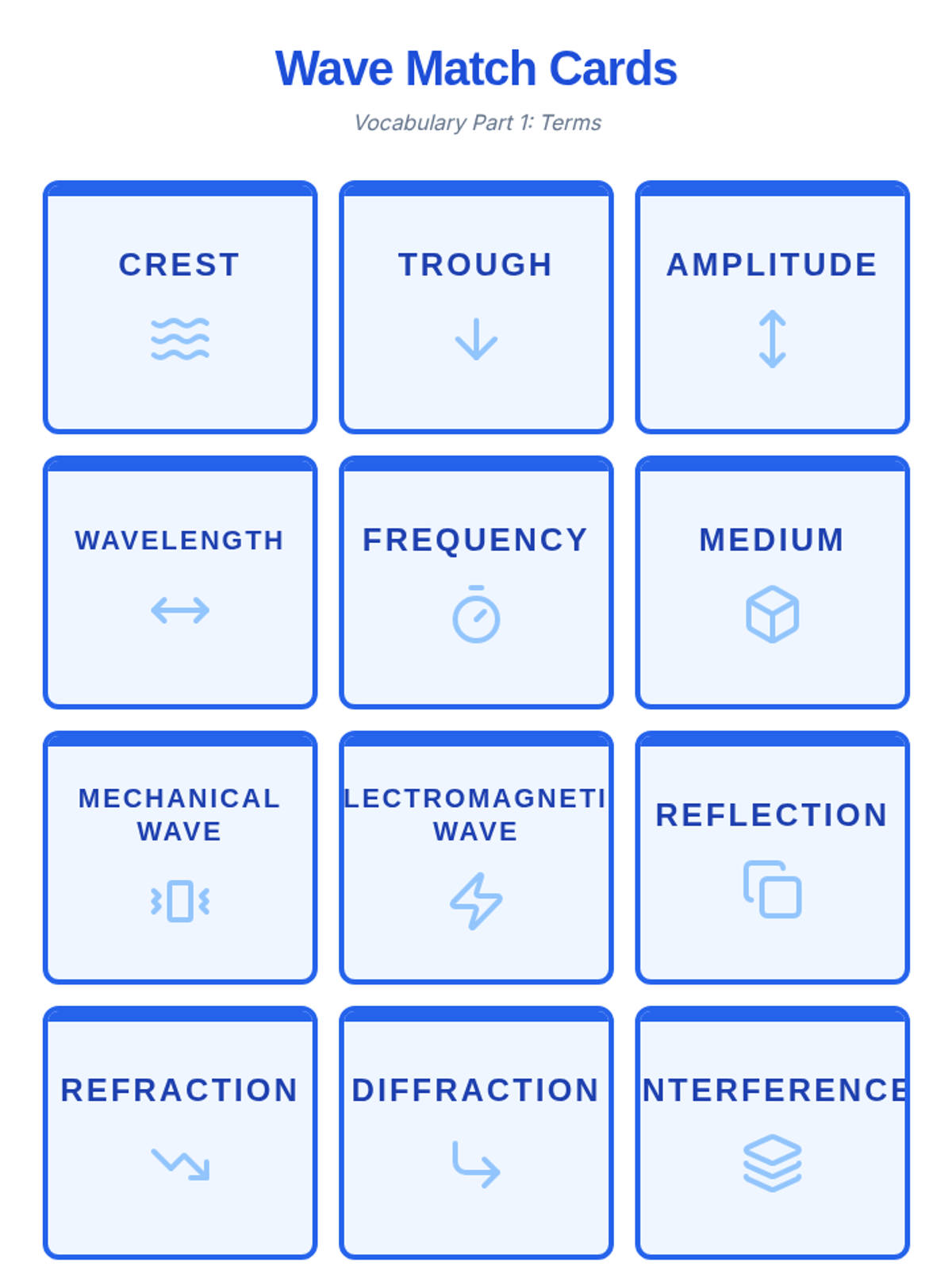
A set of 24 matching cards (12 terms, 12 definitions) featuring key wave physics vocabulary like amplitude, frequency, and wavelength.
A visual presentation exploring the history and science of the Johnson Space Center, featuring concepts like neutral buoyancy and signal delay.
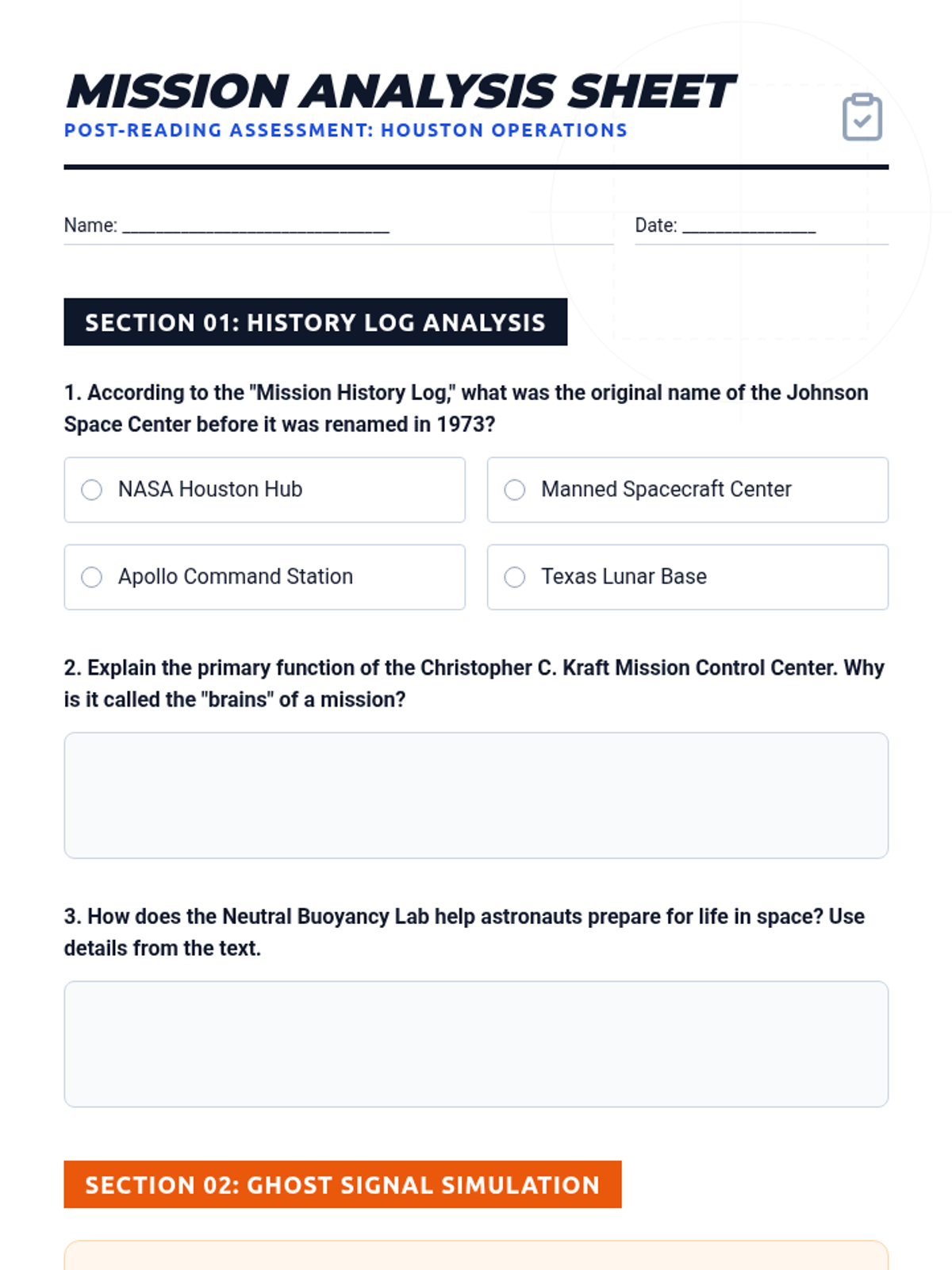
A comprehension worksheet containing historical questions, math problems based on signal delay, and critical thinking prompts related to the Johnson Space Center materials.
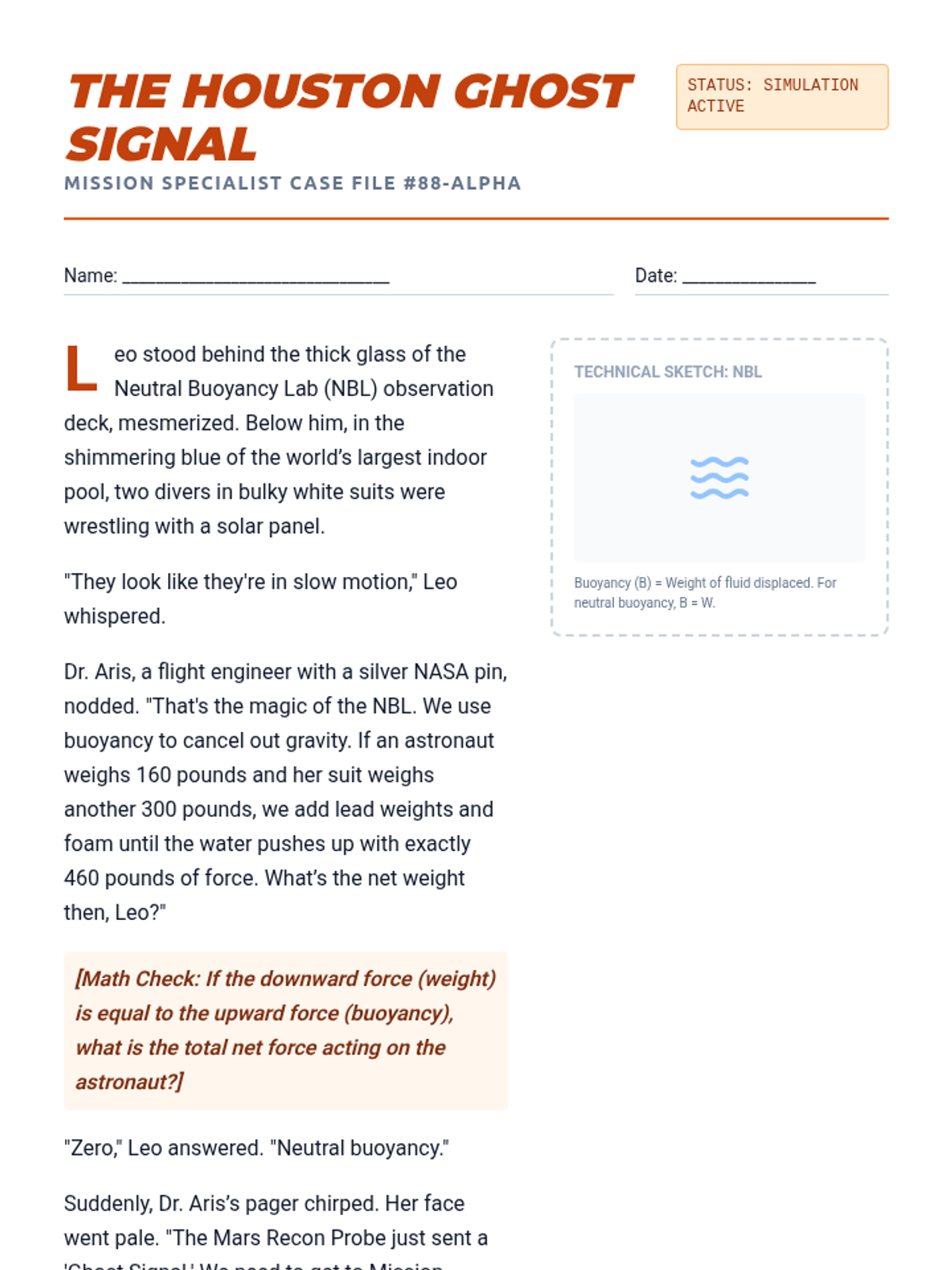
A fictional story about a student visiting the Johnson Space Center, featuring embedded math and physics concepts like neutral buoyancy and signal delay across space.
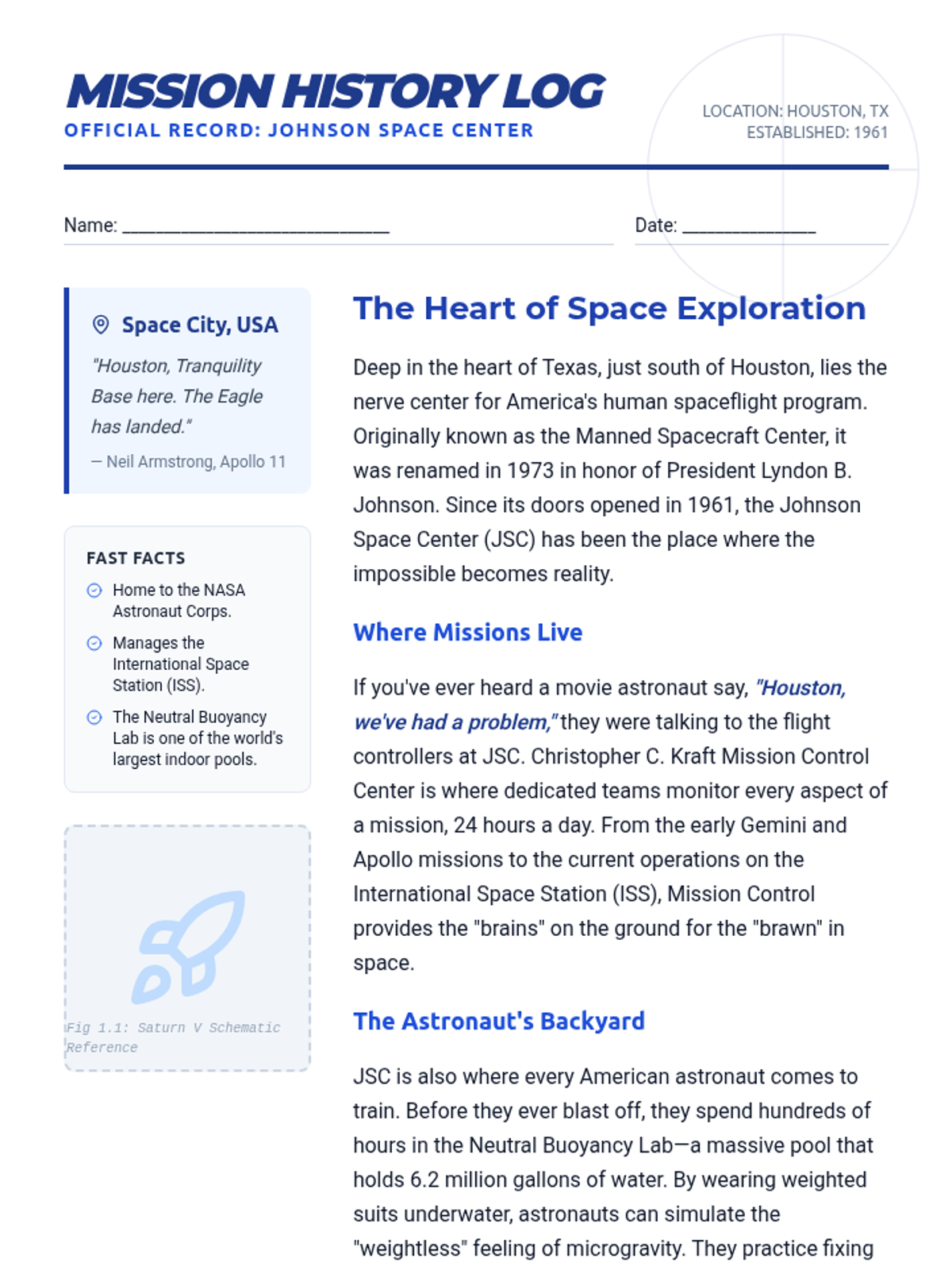
A historical overview of the Lyndon B. Johnson Space Center, detailing its role in mission control, astronaut training, and the future of lunar exploration.
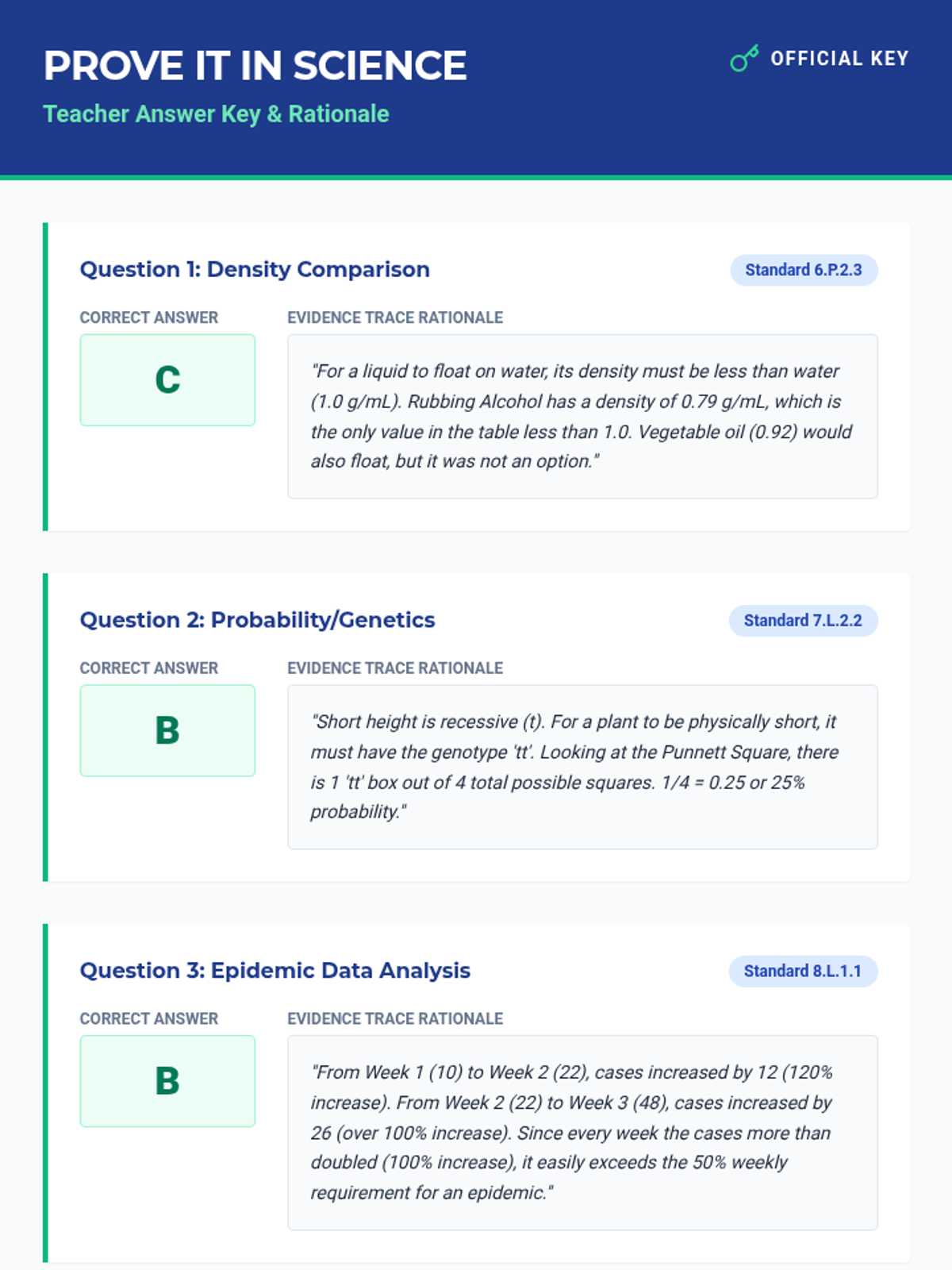
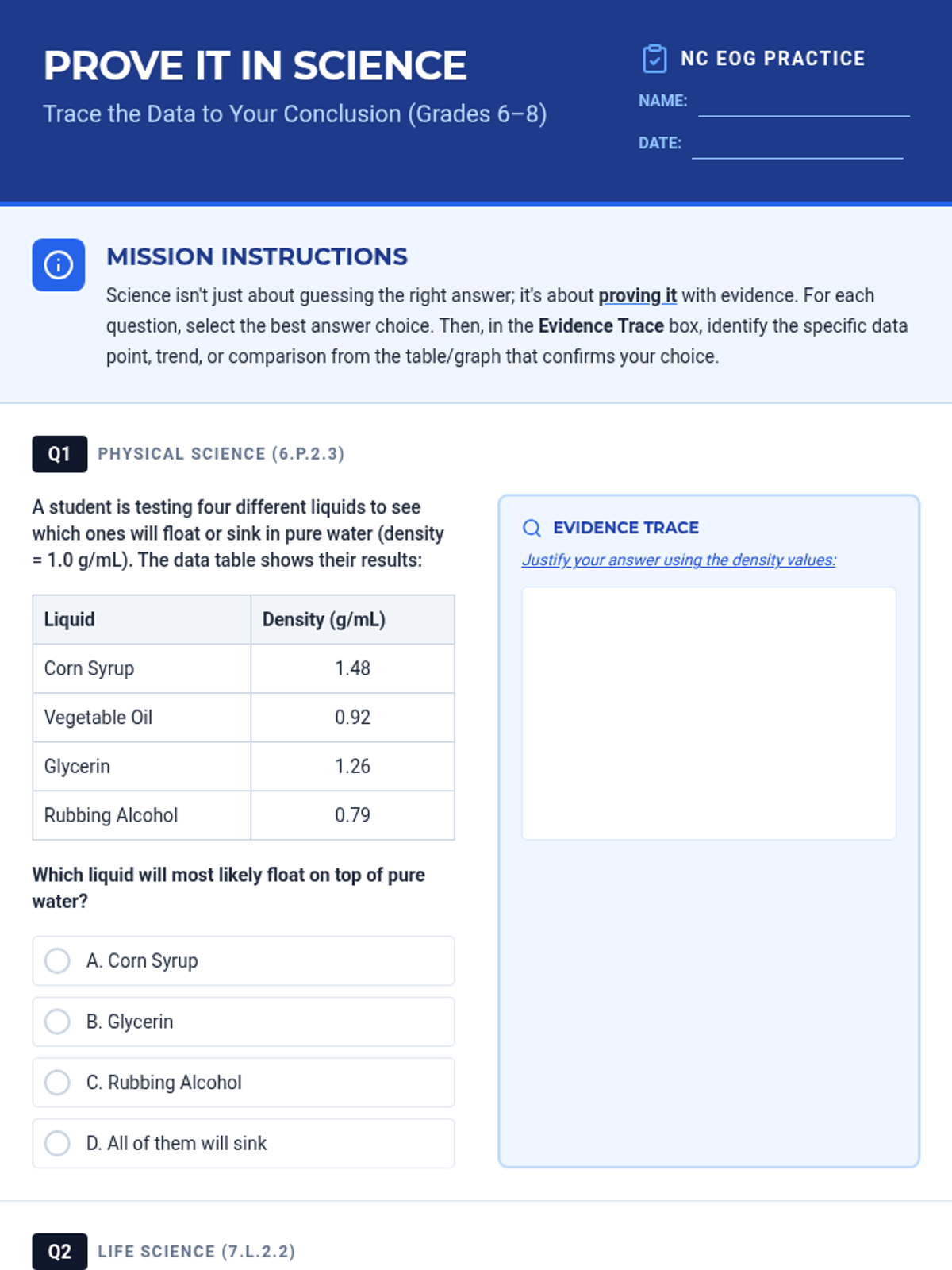
A teacher-facing answer key for the Data Trace Practice Worksheet. It provides correct letter answers for all 6 questions alongside detailed justifications for the 'Evidence Trace' section, including calculations and data comparisons.
A practice worksheet for grades 6-8 science focusing on evidence justification. It features 6 multiple-choice questions aligned with NC EOG standards, each paired with a dedicated 'Evidence Trace' box for students to provide data-backed justifications.
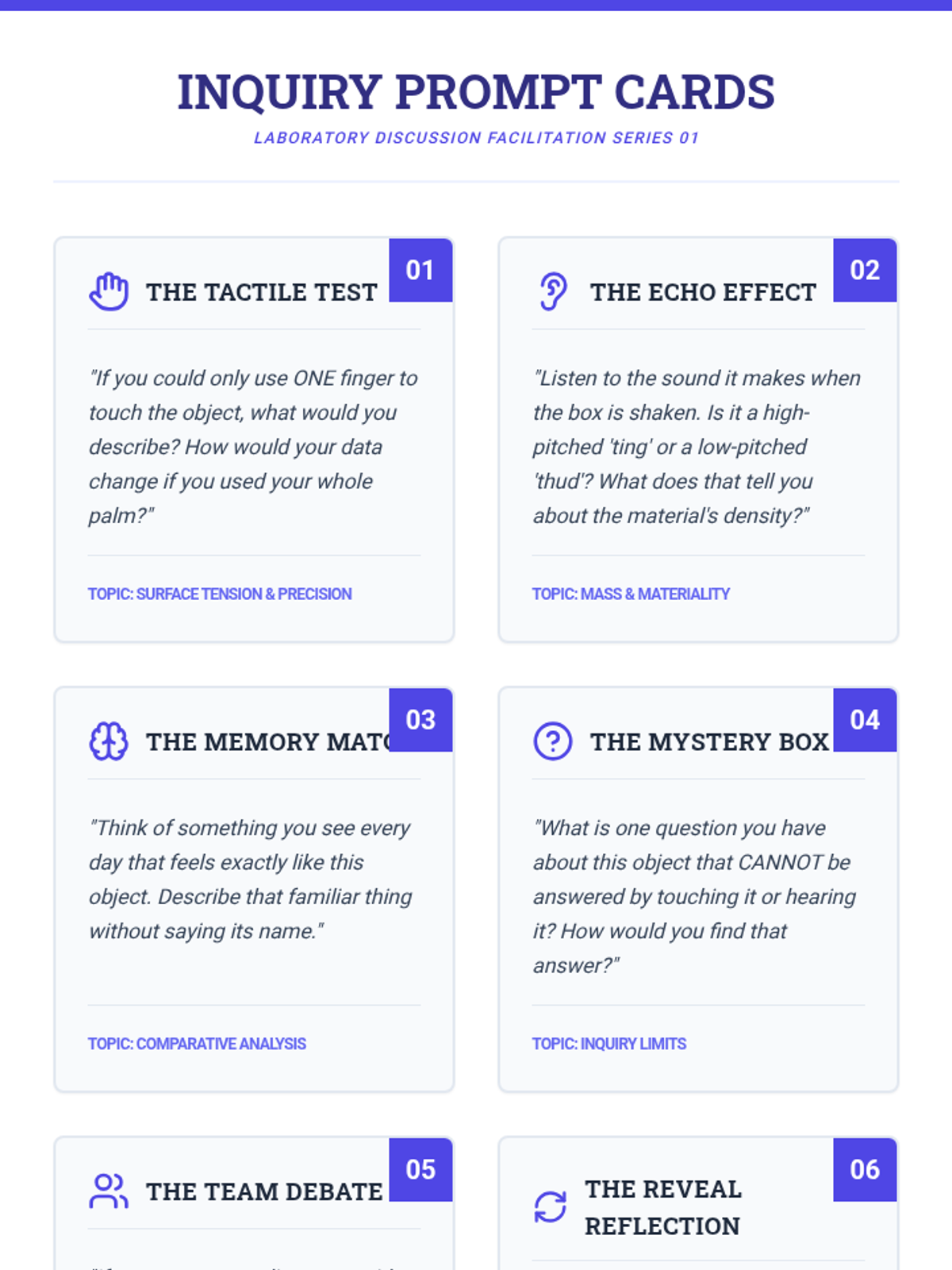
Discussion cards for the Inquiry Lab. Includes prompts for tactile investigation, auditory analysis, and hypothesis reflection. Meant to be cut out and used in small groups.
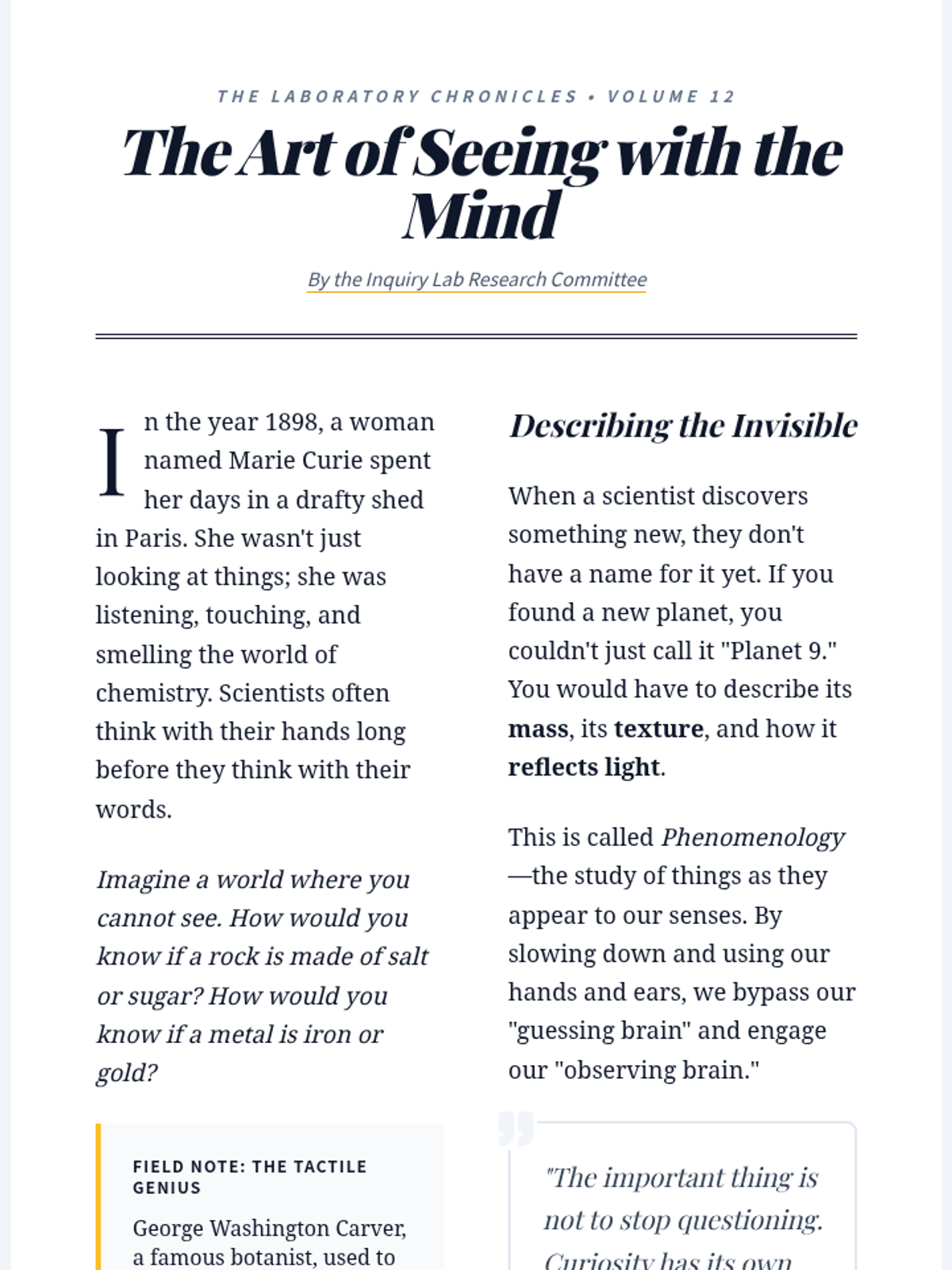
A short reading about how scientists use their senses. Includes historical anecdotes and a discussion prompt.
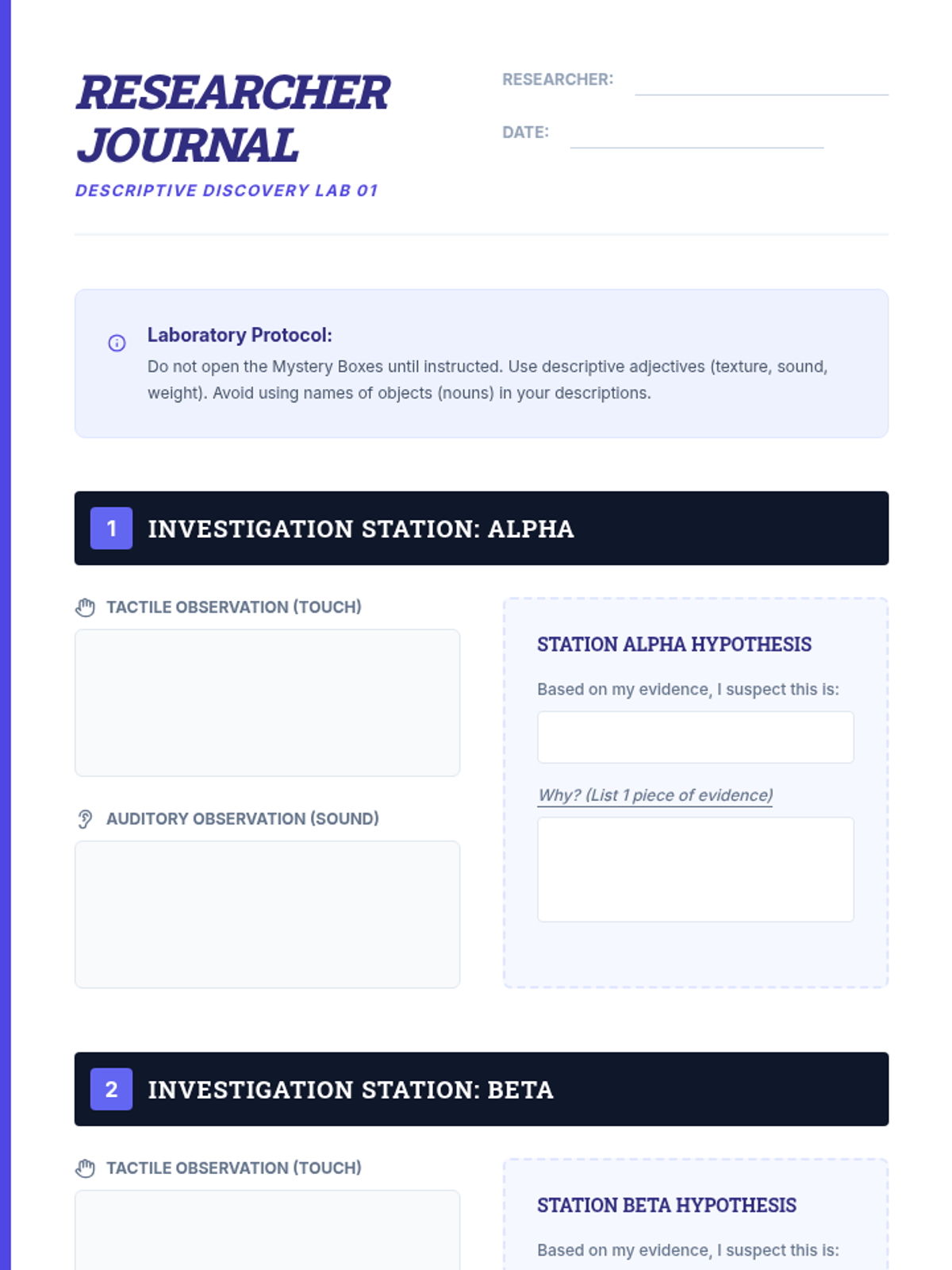
A structured student worksheet for recording sensory observations, forming hypotheses, and sketching objects after reveal. Designed to look like a professional researcher's log.
Instructional slides for the Descriptive Discovery lesson. Covers the hook, sensory checklist, vocabulary building, and the inquiry loop process.
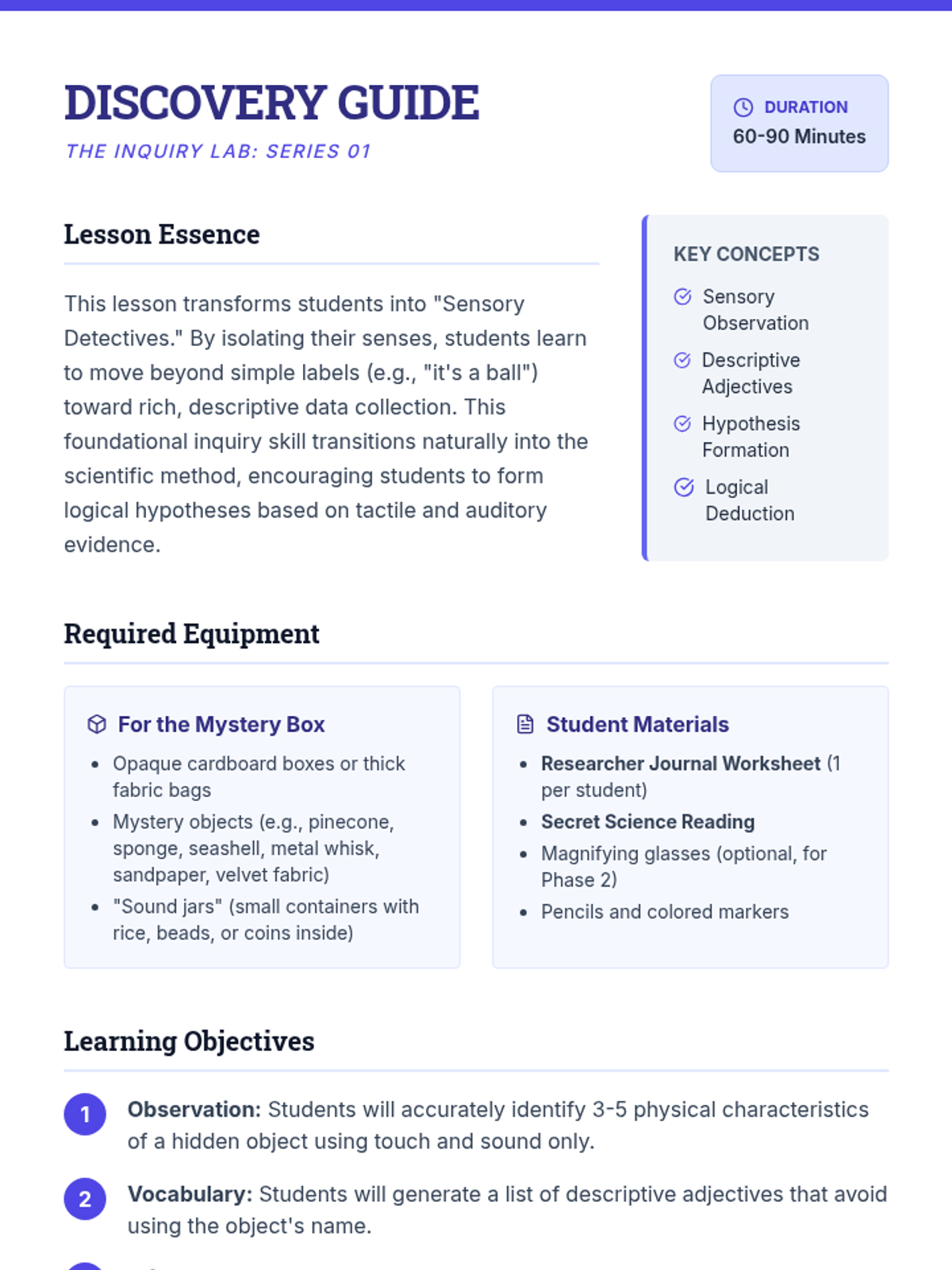
A comprehensive lesson plan for teachers detailing objectives, materials, and step-by-step procedures for conducting the Inquiry Lab. Includes differentiation strategies for elementary through adult learners.
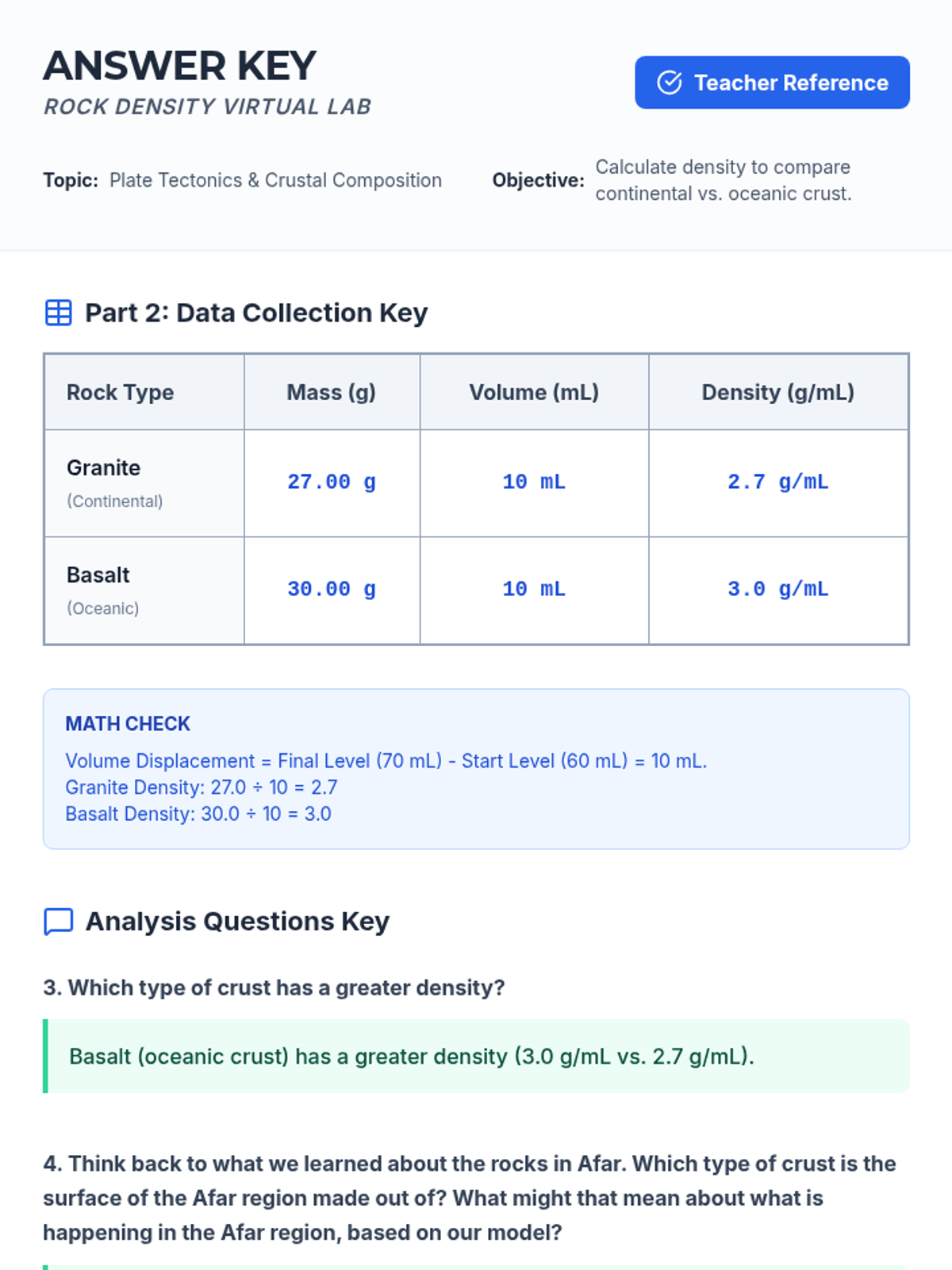
Teacher answer key for the Rock Density Virtual Lab. Provides the expected mass, volume, and density values for Granite and Basalt, along with model answers for the analysis questions regarding crustal composition.
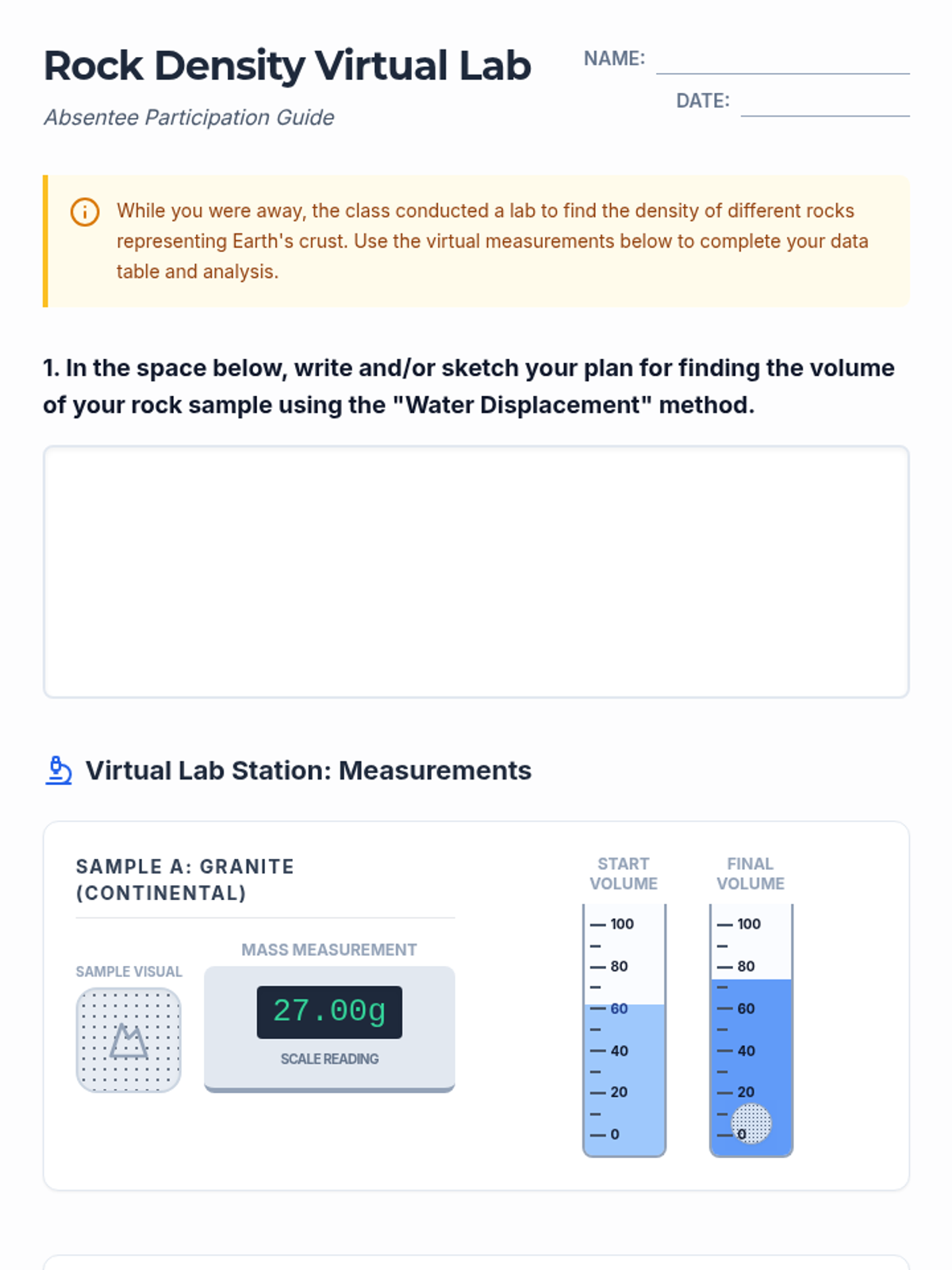
A modified rock density lab worksheet for absent students. It features virtual measurement stations with visual representations of digital scales, graduated cylinders, and the rock samples themselves (Granite and Basalt) to allow students to gather data without physical materials.
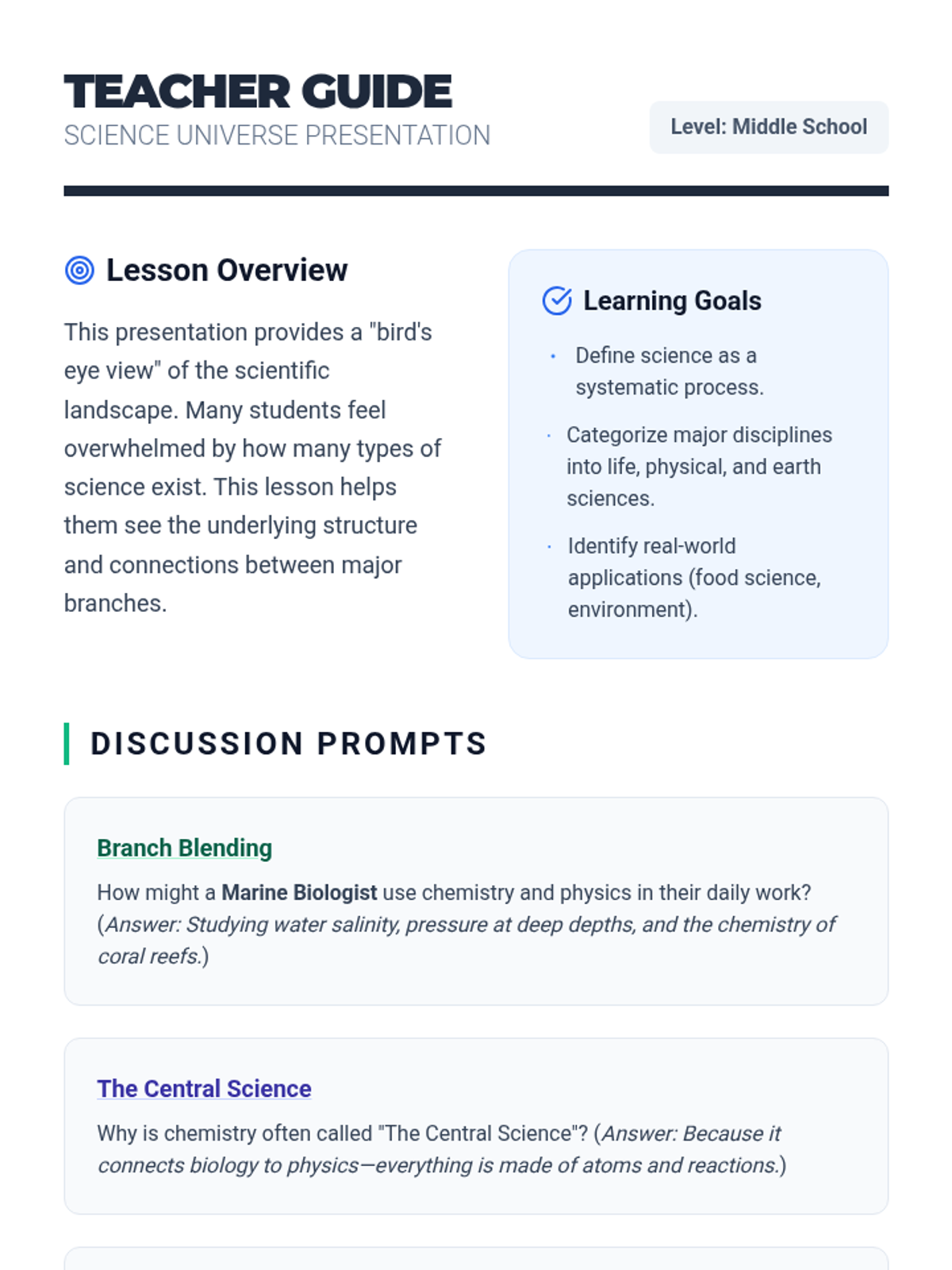
A facilitation guide for teachers including discussion prompts, an answer key for the note-taker, and a suggested pacing guide for the Science Branches presentation.
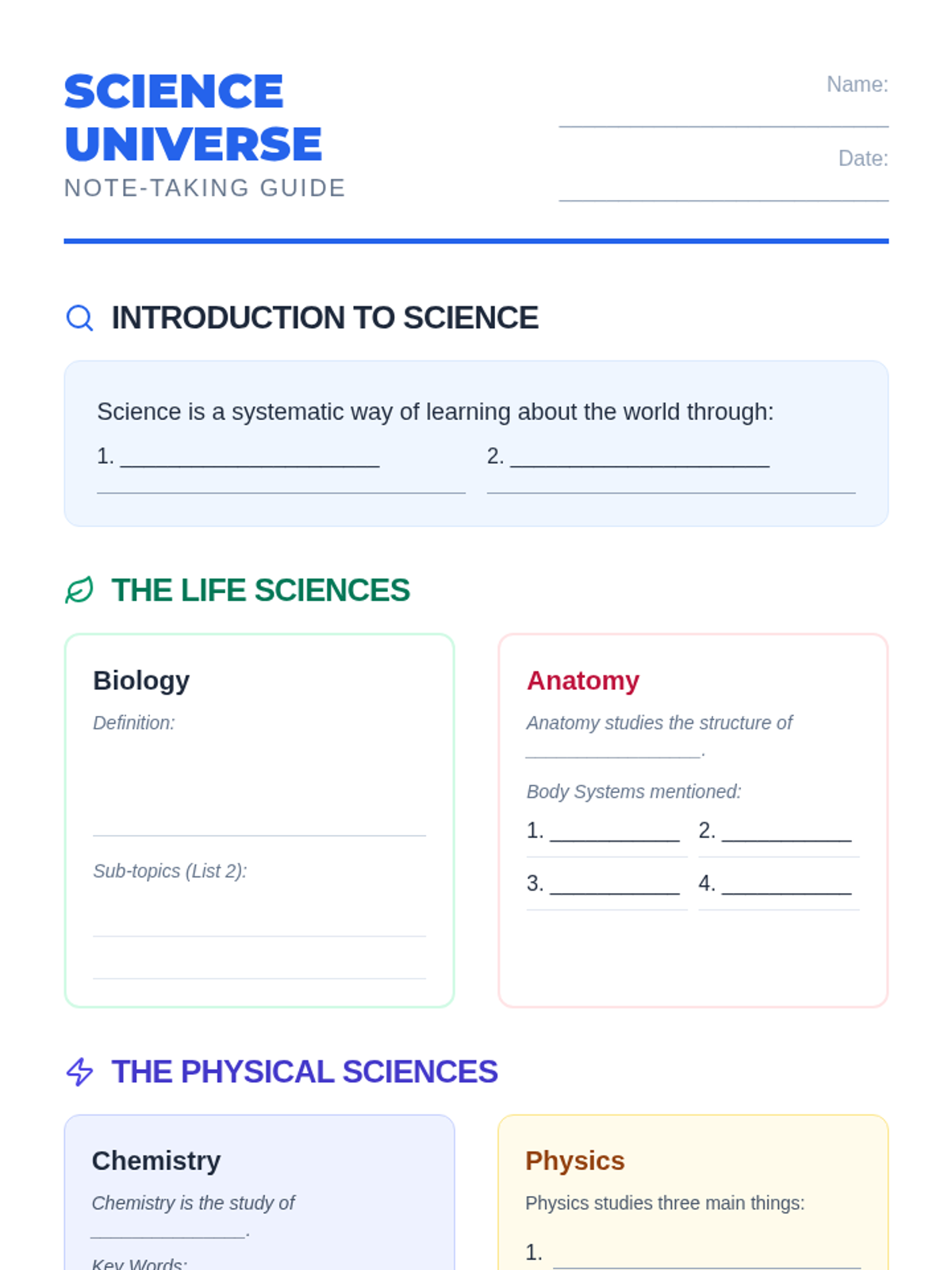
A two-page note-taking template designed for students to fill out while following along with the Science Branches Slides presentation.
A visually engaging 10-slide presentation for middle schoolers that defines and categorizes major scientific disciplines like Biology, Chemistry, Physics, and more.
An engaging guessing game slide deck where a student sits with their back to the screen while classmates describe the mystery objects using physical property vocabulary.
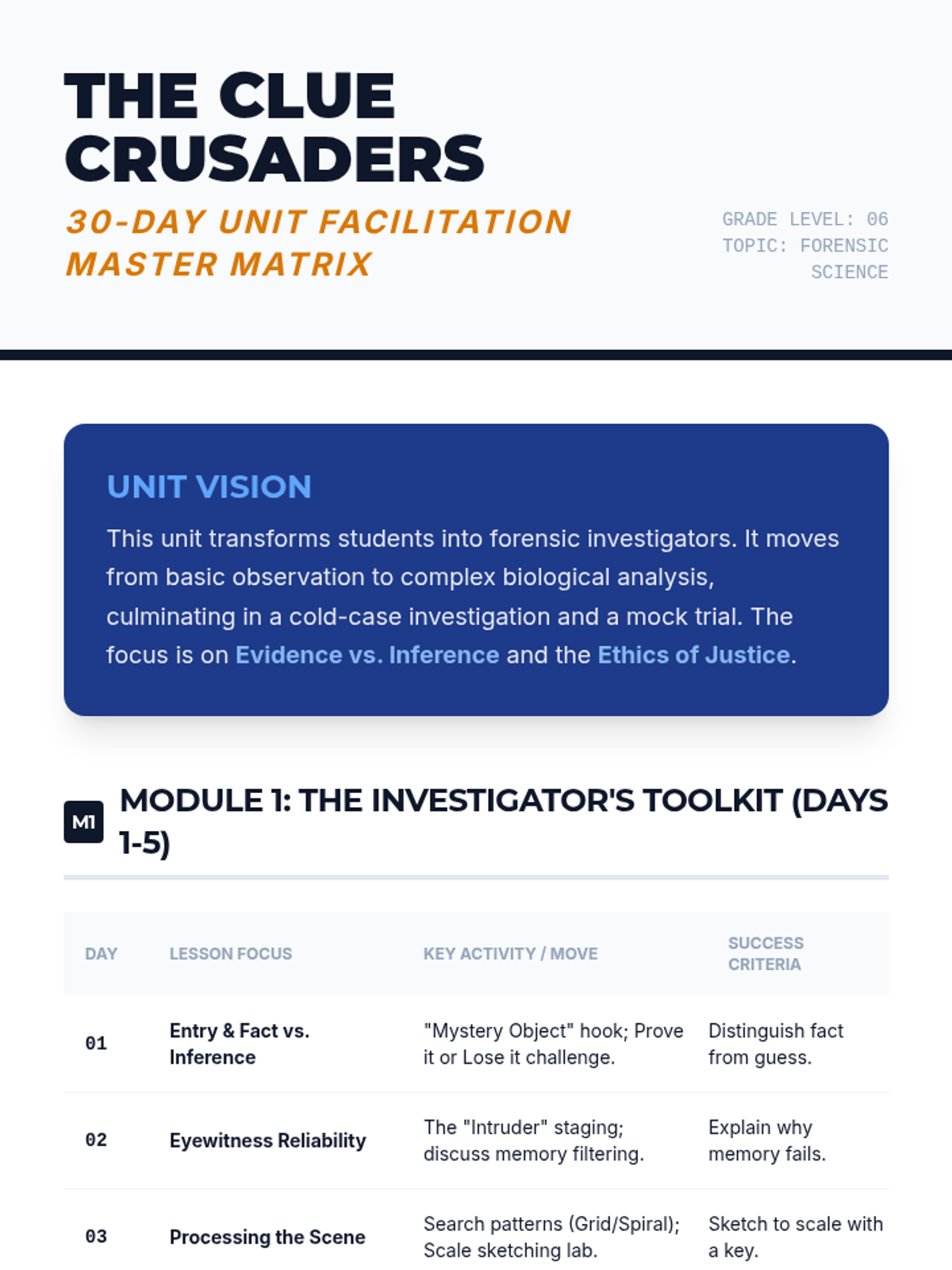
Master facilitation guide for the 30-day forensic science unit, summarizing learning targets, success criteria, and key activities for every day.
Slide deck for Lesson 11, introducing the physics of blood spatter and how drop height affects the resulting stain.
Introductory slide deck for the Cold Case Project, outlining the case file analysis goals and evidence evaluation criteria.
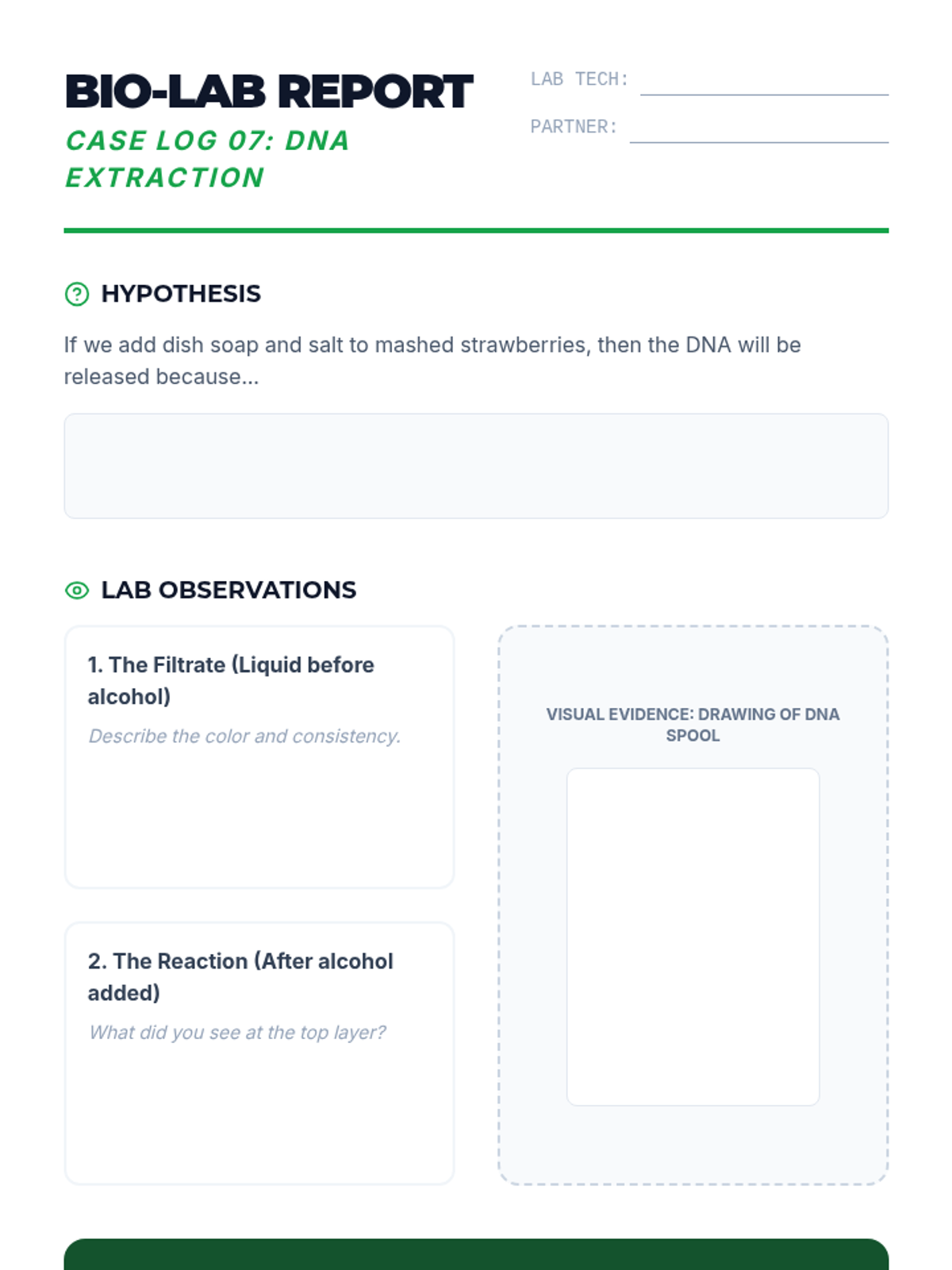
Student lab report for the DNA extraction activity, including sections for hypothesis, observations, and forensic connection.
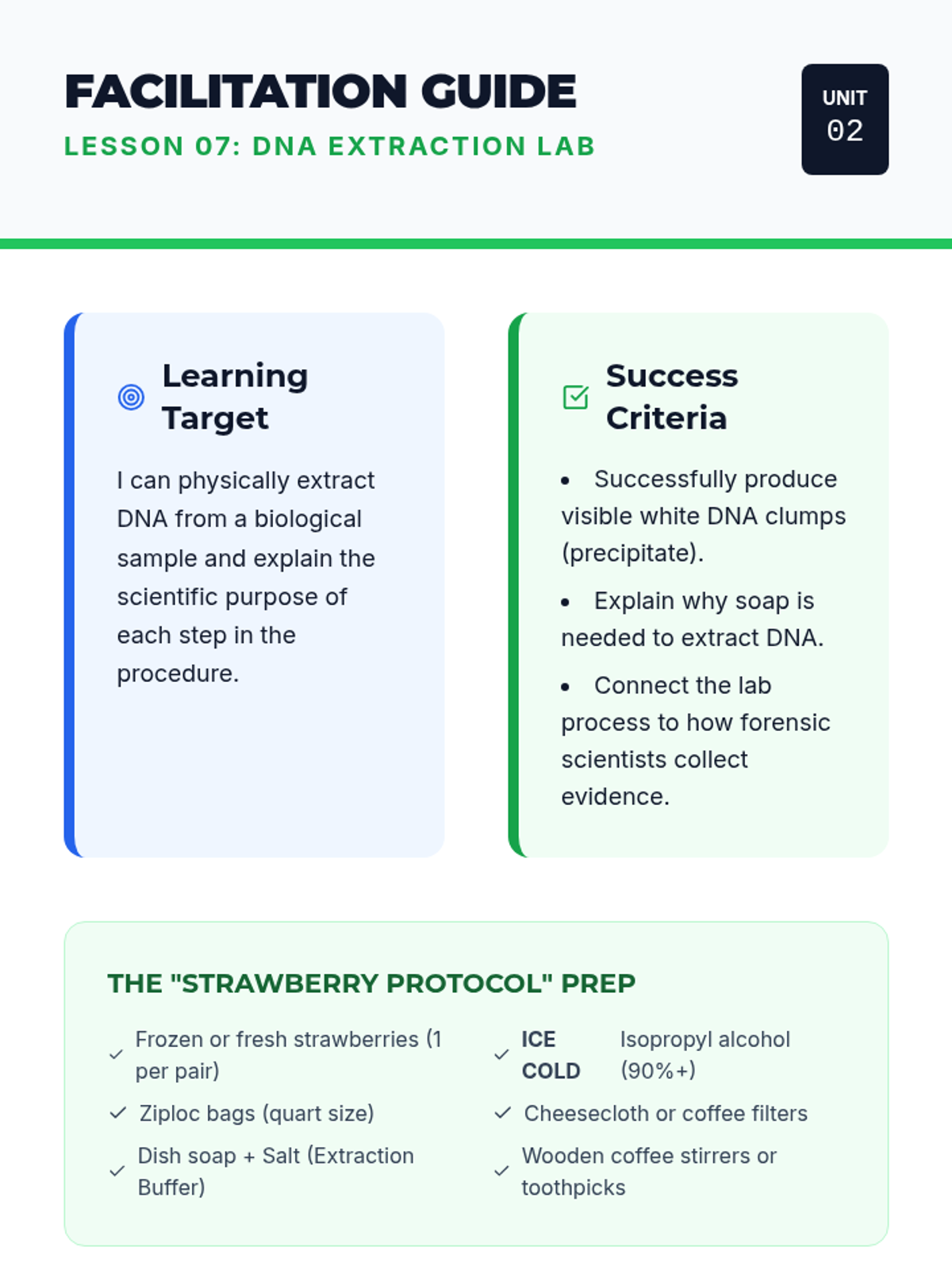
Facilitation guide for Day 7 of the forensic science unit, including detailed instructions for the strawberry DNA extraction lab.
Slide deck for Lesson 7, explaining the science and safety procedures for DNA extraction.
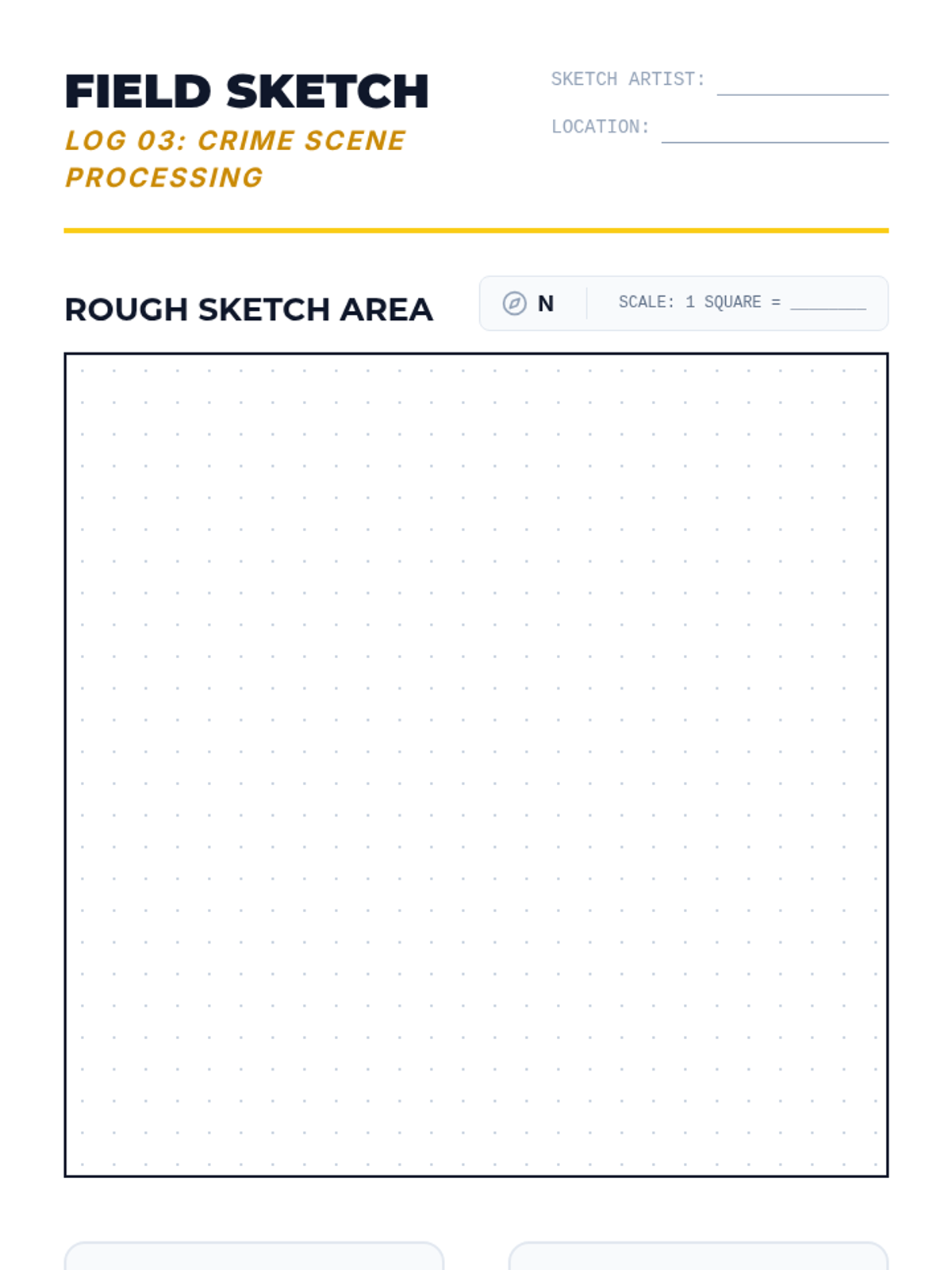
Student worksheet for Lesson 3, providing a grid for sketching a crime scene and a table for recording evidence measurements.
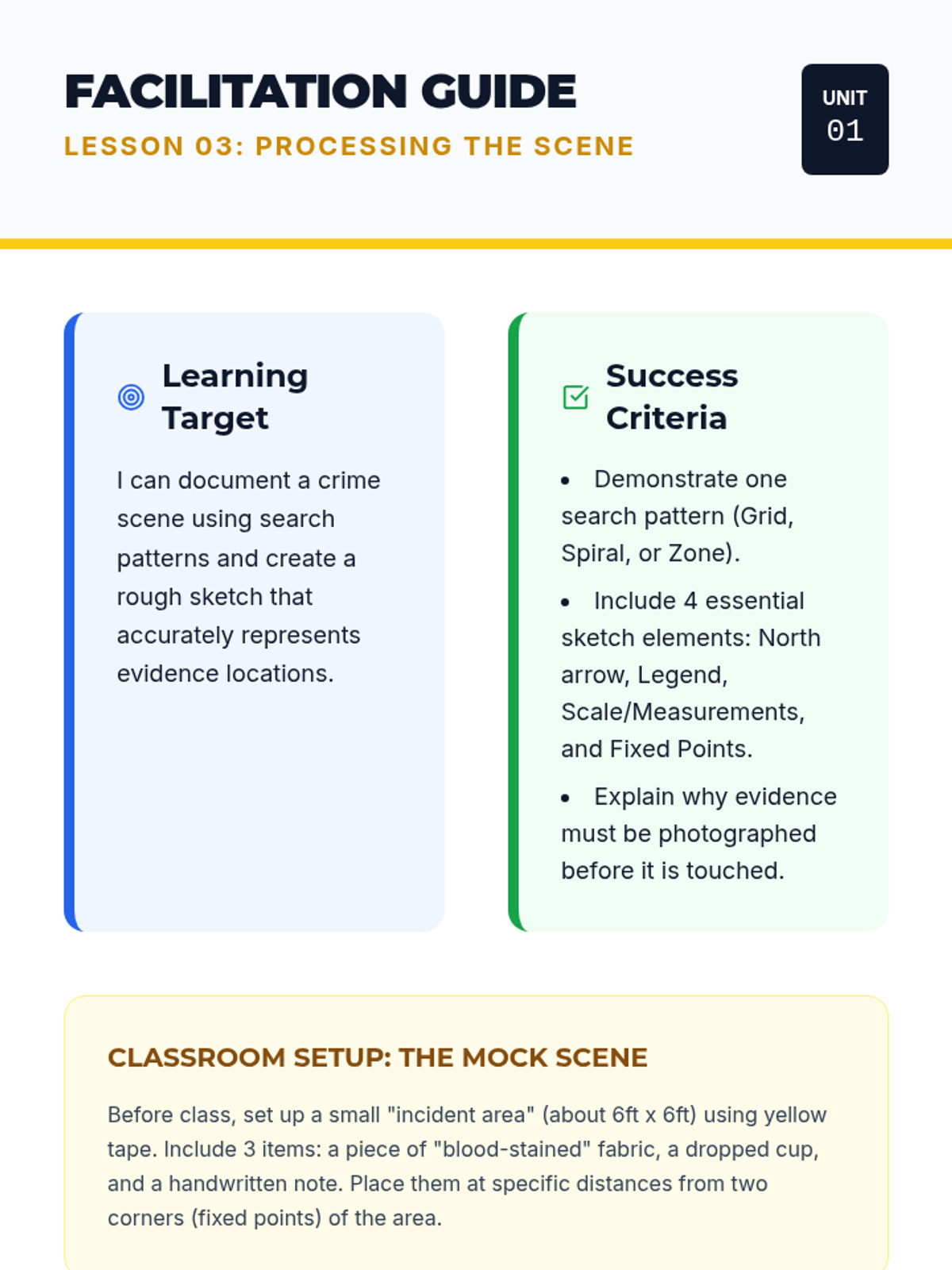
Facilitation guide for Lesson 3 of the forensic science unit, including setup for a mock crime scene and instruction on sketching and measuring.
Slide deck for Lesson 3, covering the steps of crime scene processing, search patterns, and sketching techniques.
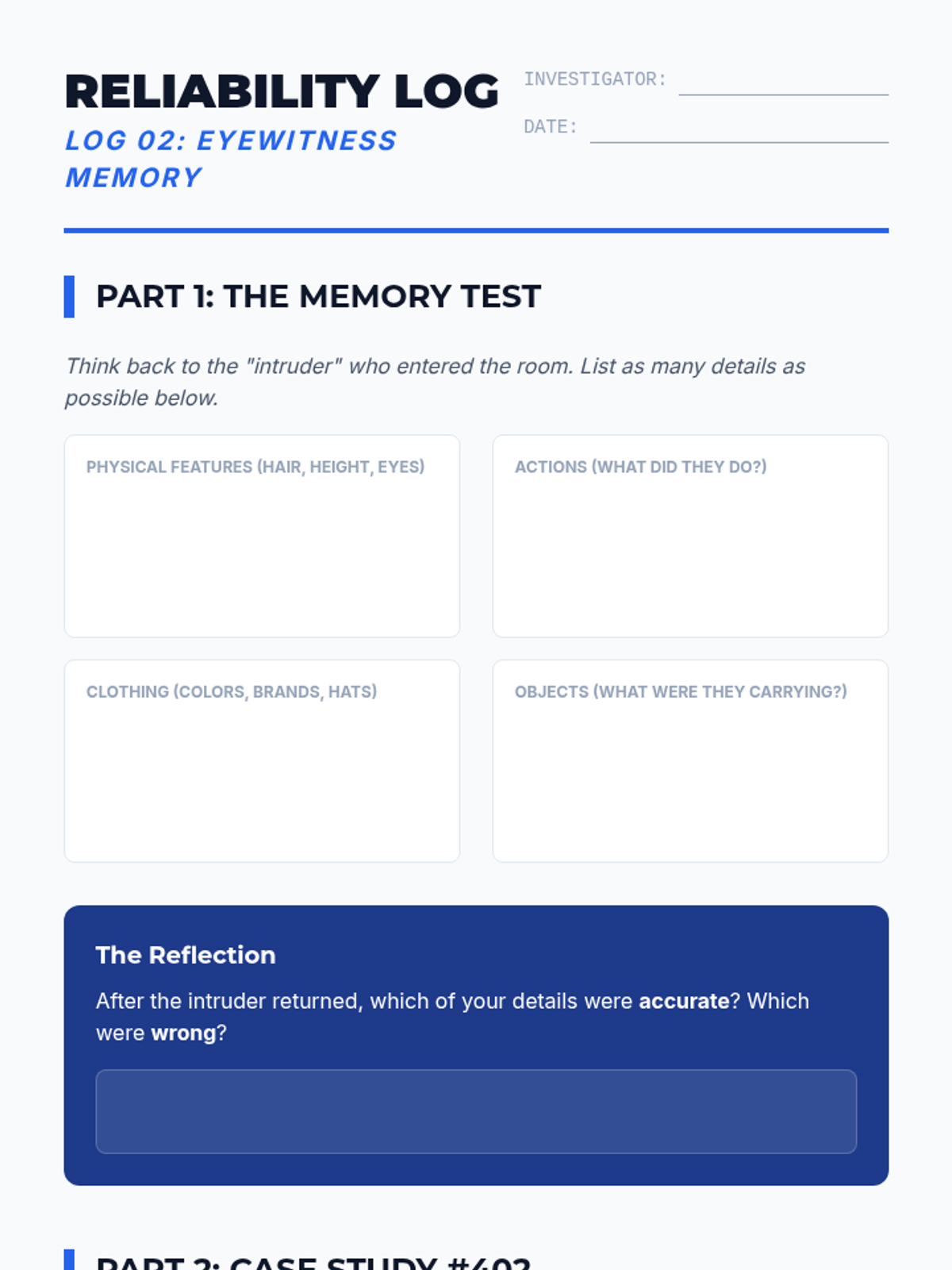
Student worksheet for Lesson 2 of the forensic science unit, evaluating memory reliability and testimony.
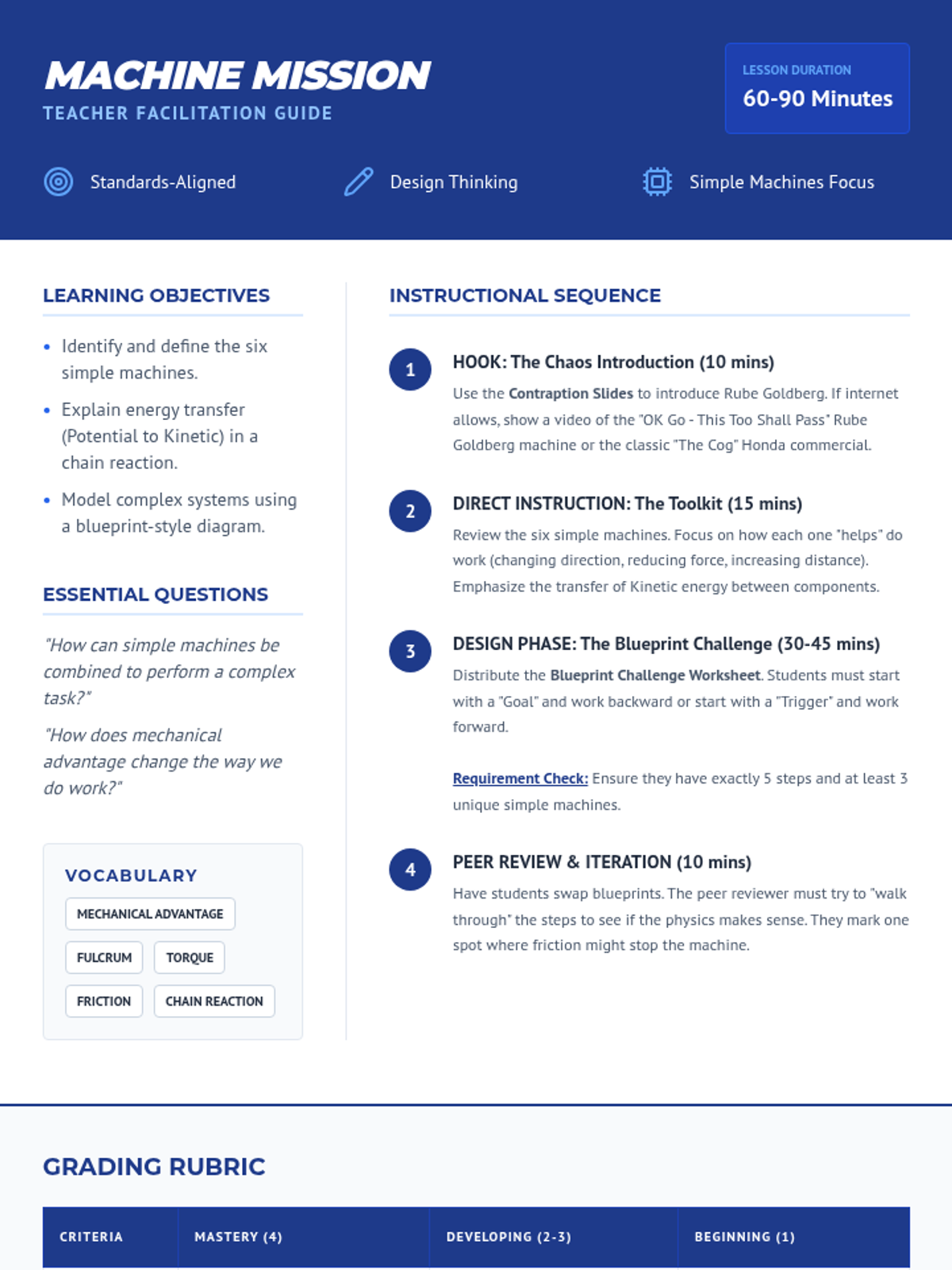
A teacher guide for the Chain Reaction Chaos lesson, including learning objectives, a detailed instructional sequence, a grading rubric, and tips for addressing common student misconceptions about simple machines.
A presentation introducing Rube Goldberg, simple machines, and the concept of chain reactions to prepare students for the Blueprint Challenge.
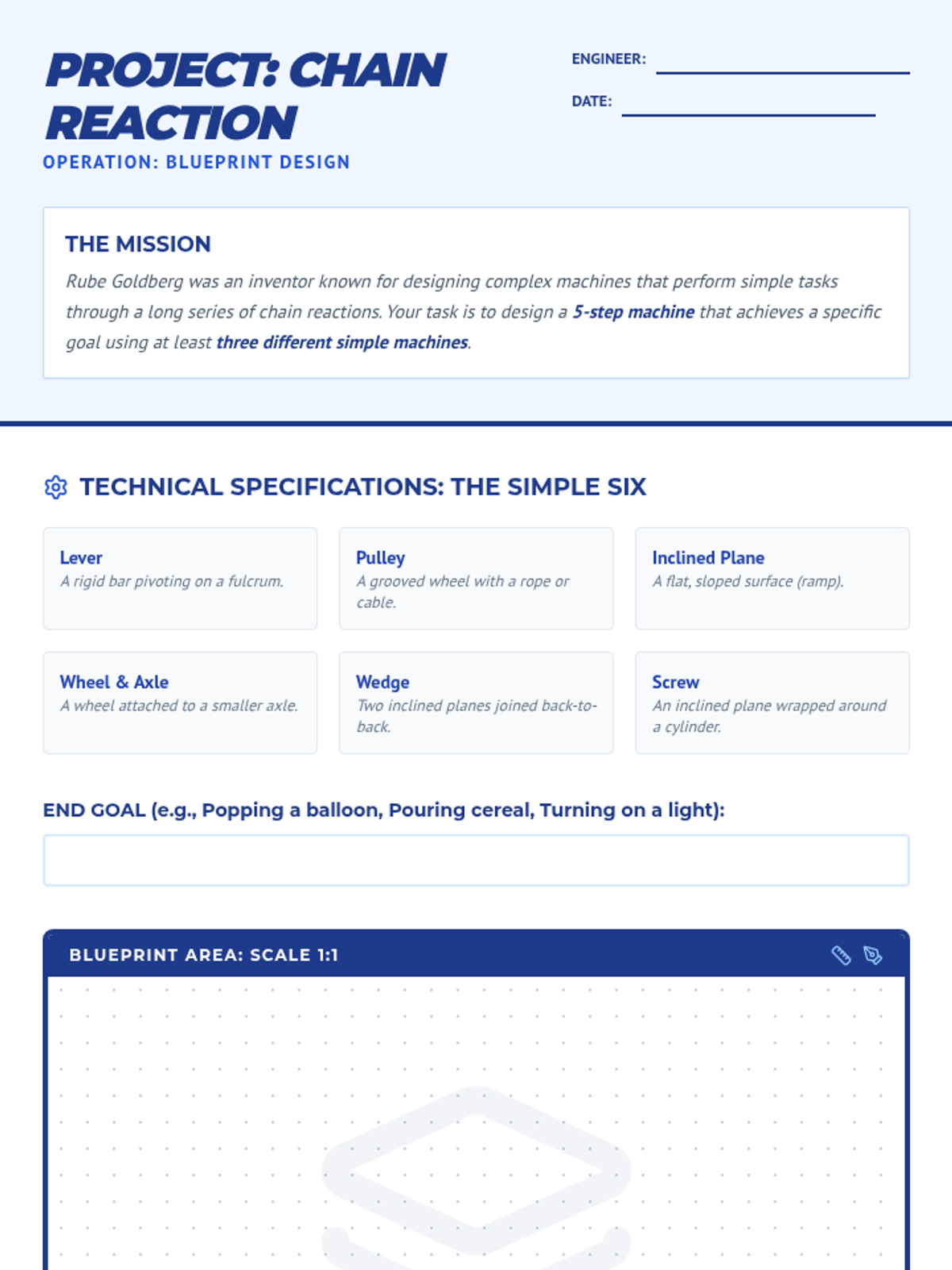
A two-page blueprint-themed design worksheet where students sketch a 5-step Rube Goldberg machine and provide detailed technical explanations for the simple machines and energy transfers involved in each step.
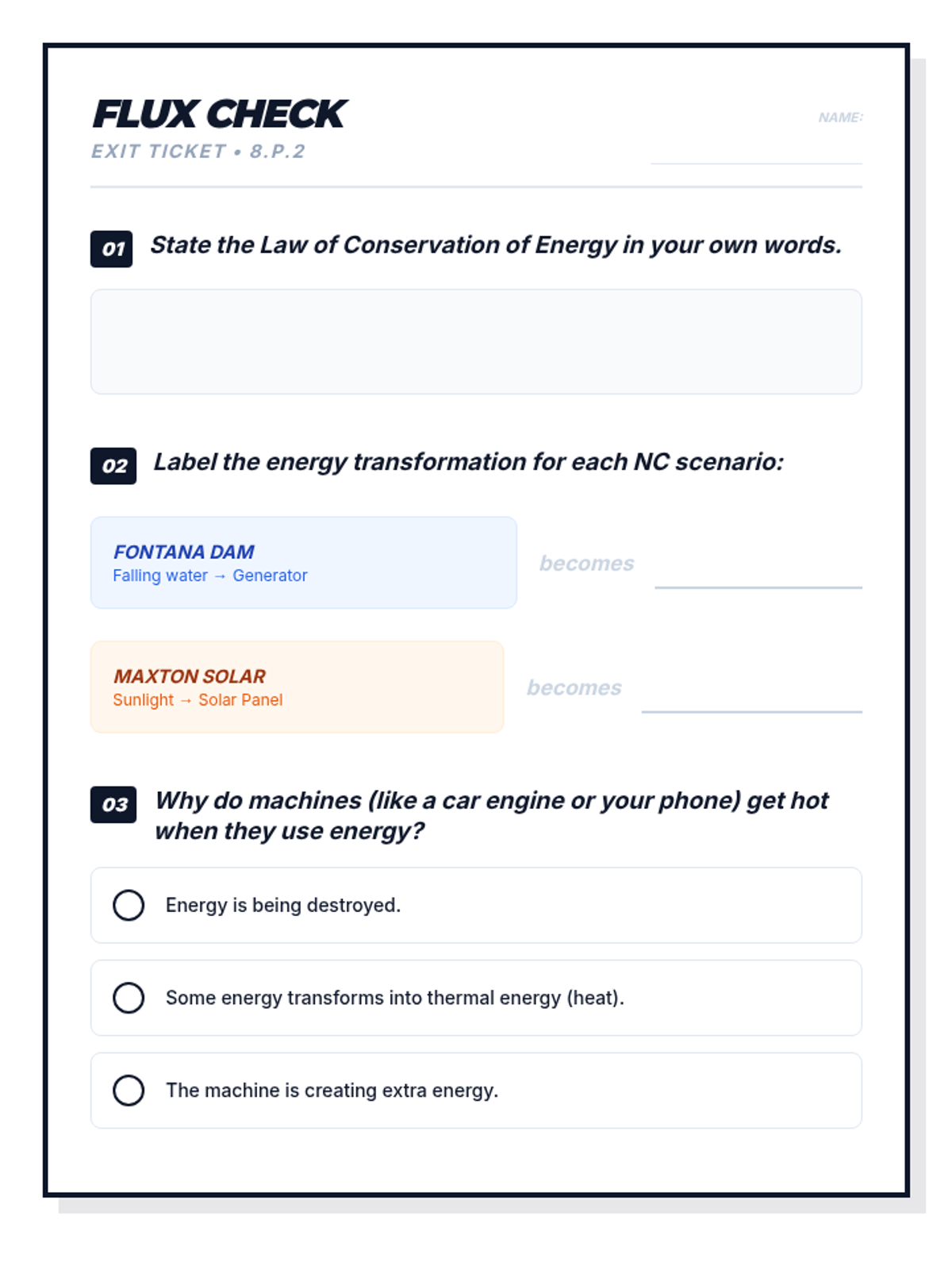
A quick assessment exit ticket for students to demonstrate their understanding of energy conservation and specific NC transformations.
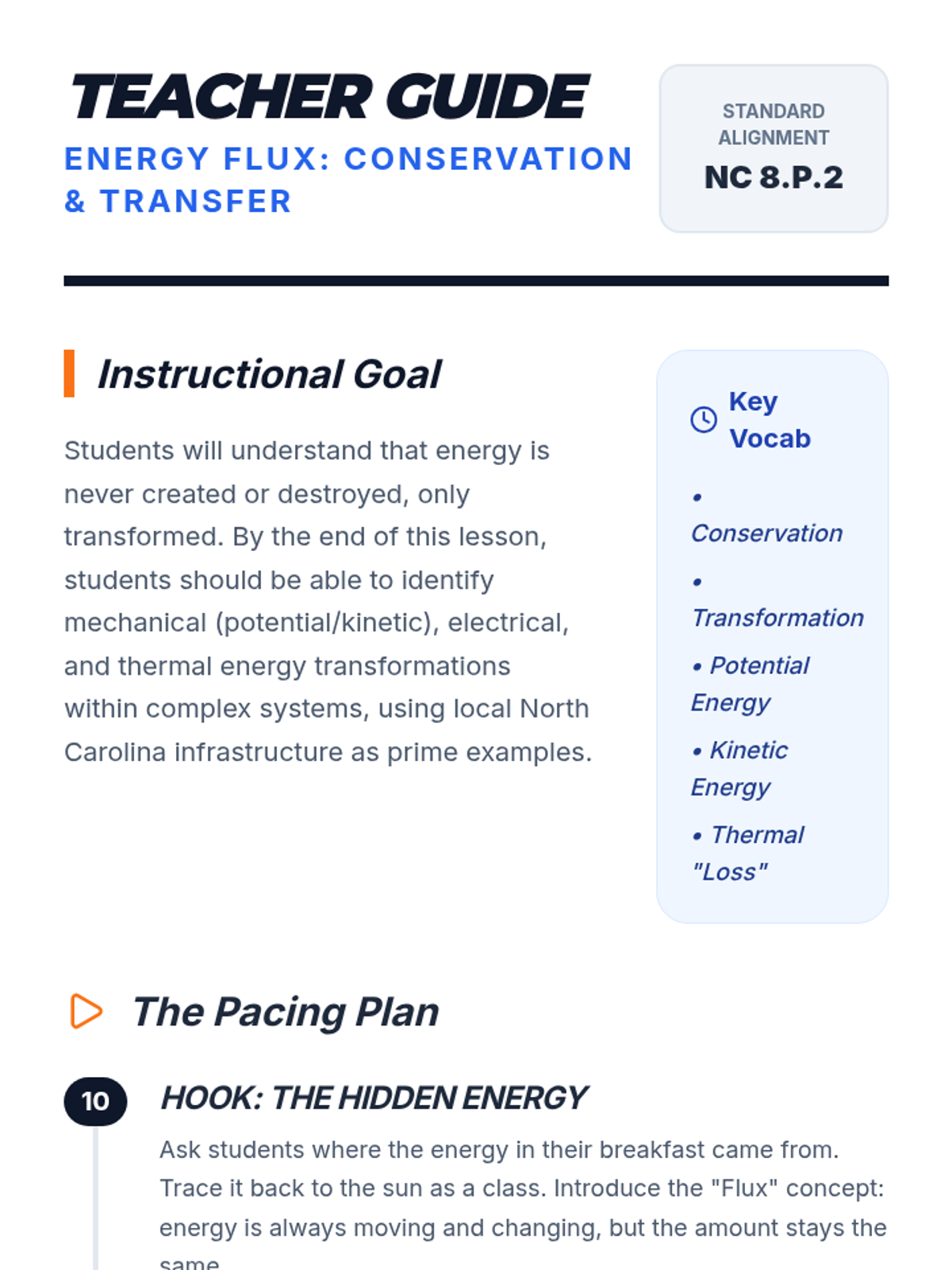
A teacher guide providing a lesson sequence, pacing guide, common misconceptions, and discussion prompts for North Carolina Essential Standard 8.P.2.
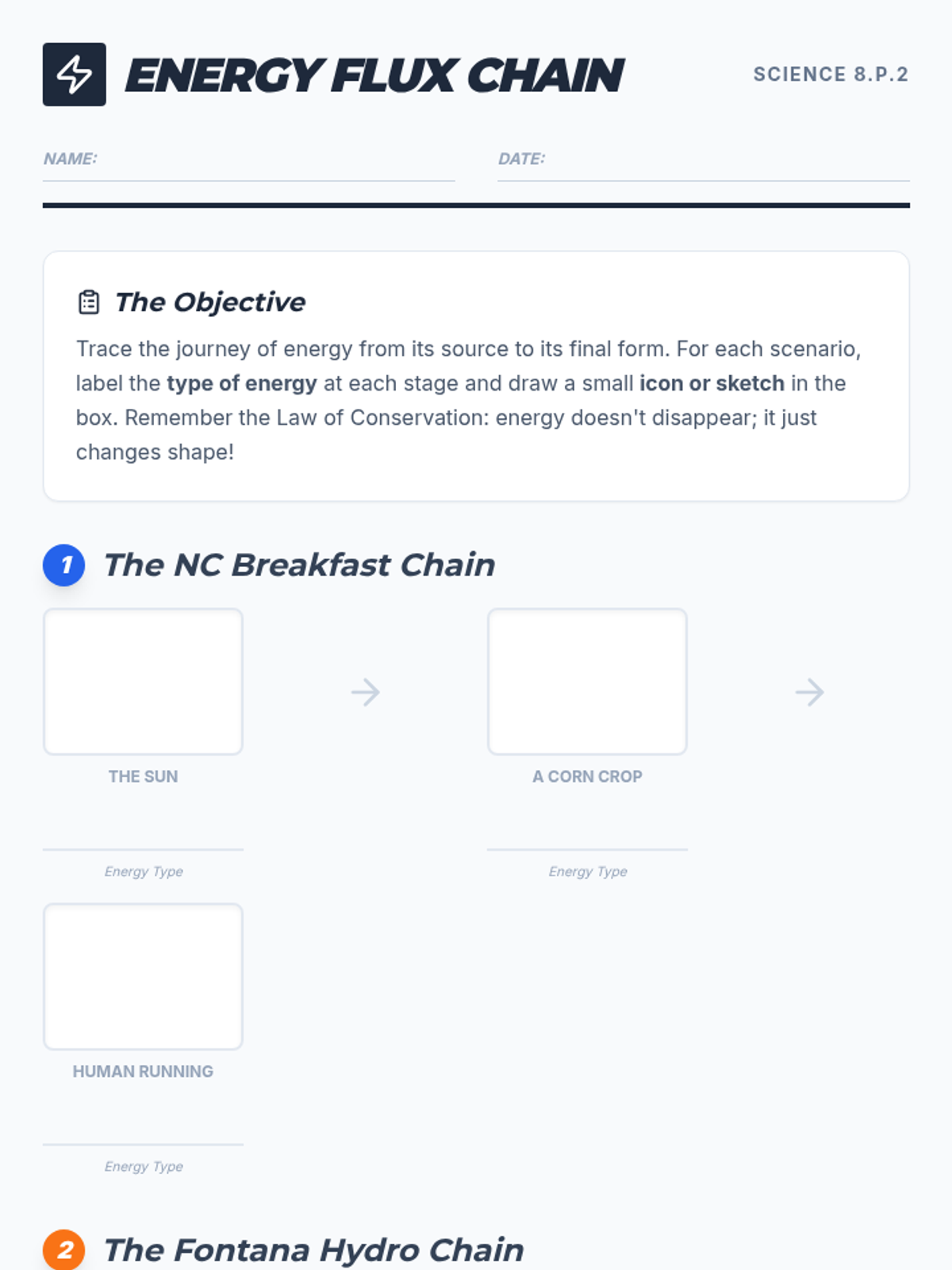
An activity worksheet for students to map energy transformations through various chains, including a breakfast scenario and a hydroelectric dam process.
Visual instructional slides covering the Law of Conservation of Energy, kinetic/potential energy, and North Carolina-specific examples like Fontana Dam and Maxton Solar Farm.
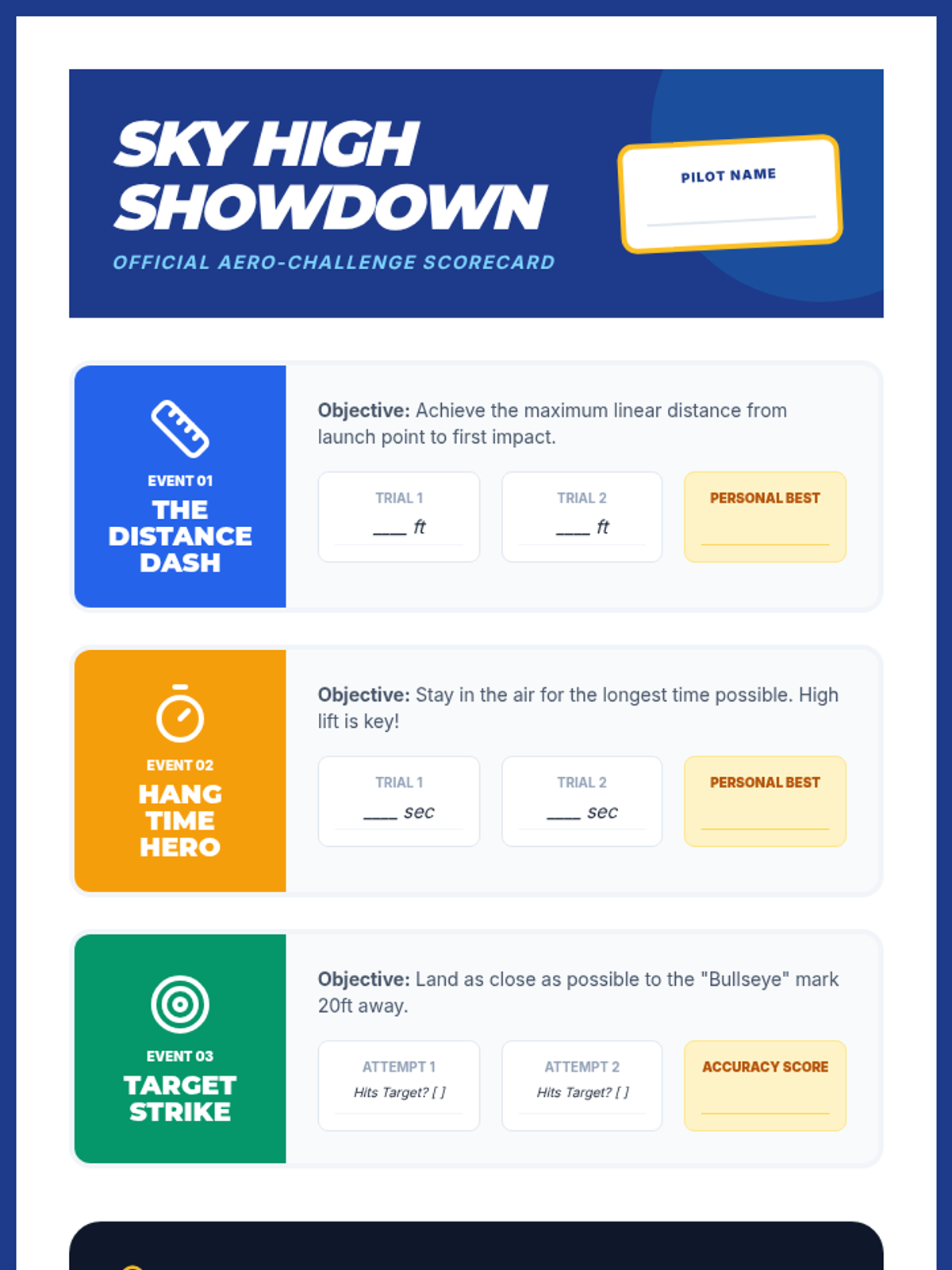
A competitive scorecard for the Sky High Showdown event, featuring three challenge events (Distance, Hang Time, Accuracy) and achievement badges for students to earn.
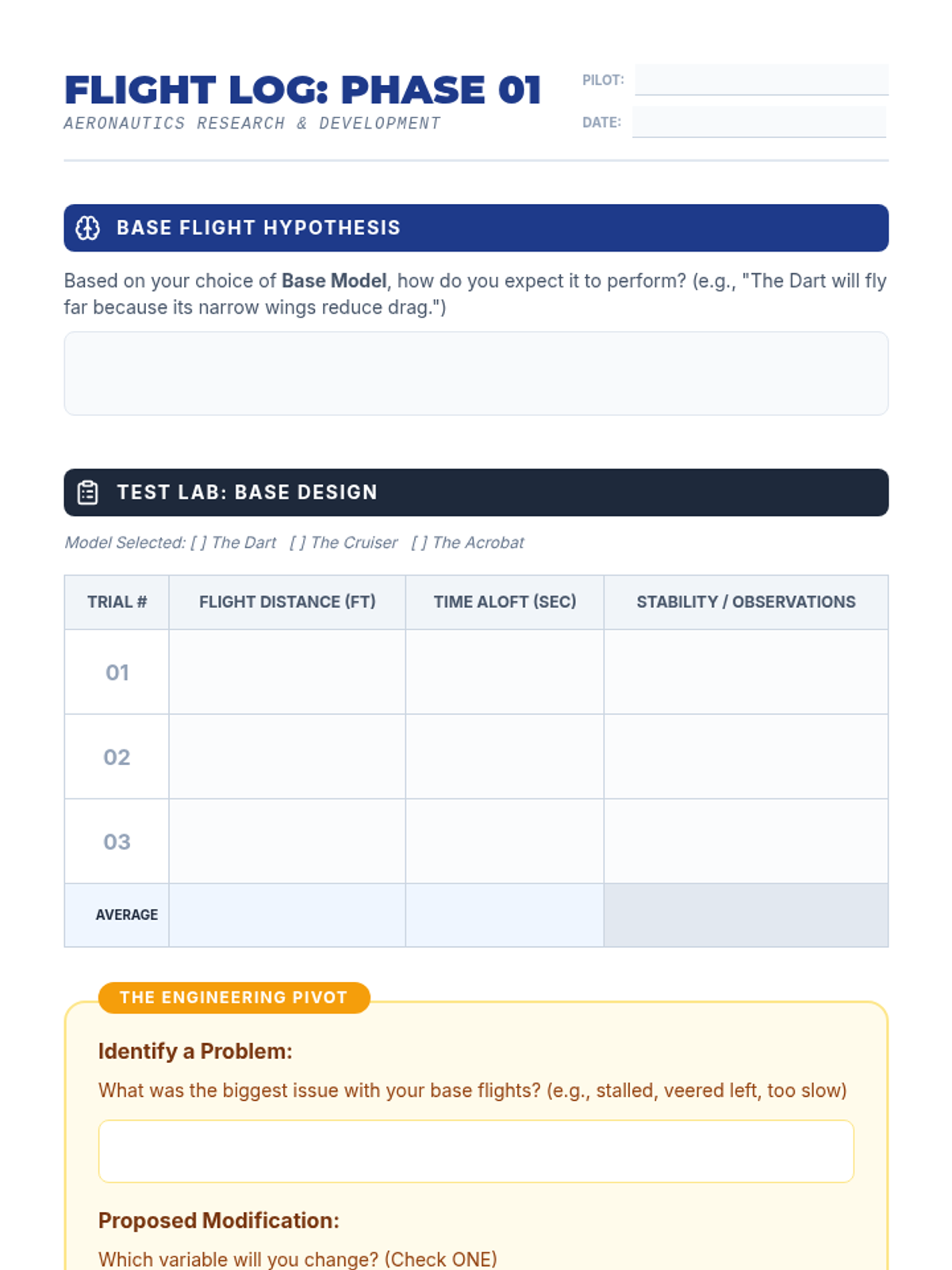
A two-page scientific flight log for students to record hypotheses, trial data for base and modified glider designs, and a final physics-based reflection.
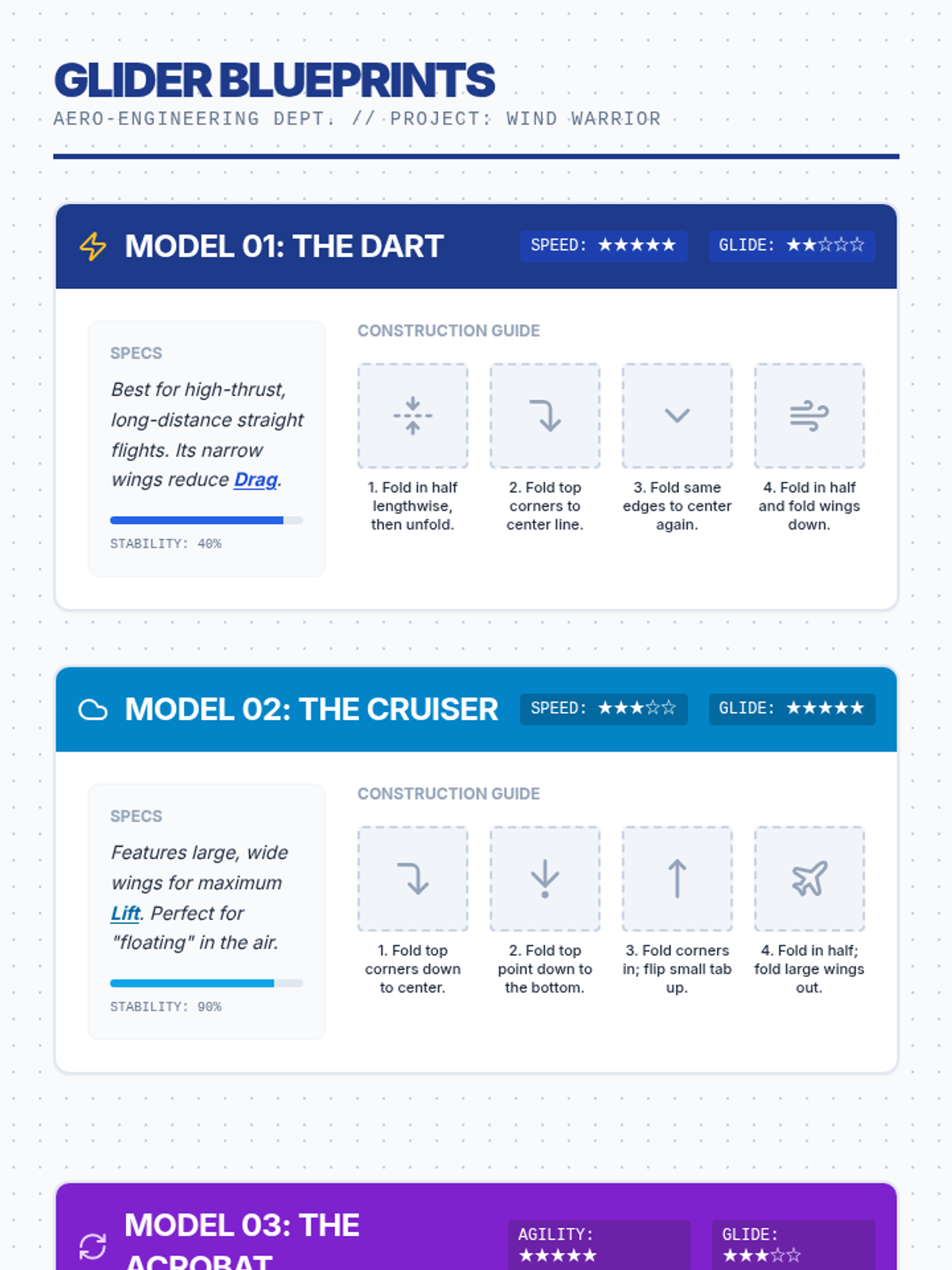
Instructional blueprints for three different paper glider models (The Dart, The Cruiser, The Acrobat) with specs and modification tips for aerodynamics testing.
A visual presentation for instruction on the four forces of flight, Bernoulli's Principle, and the engineering design cycle for paper glider construction.
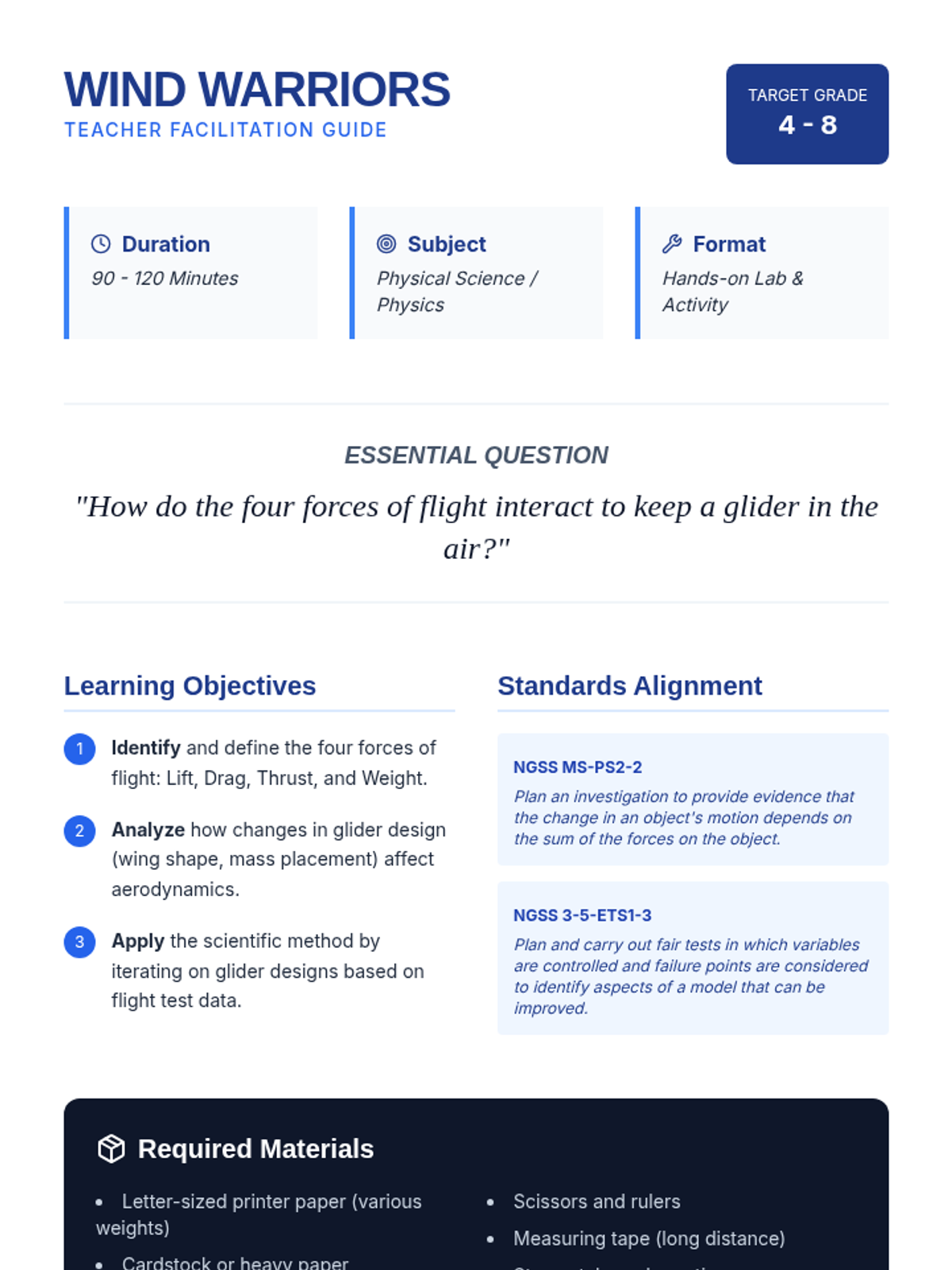
A comprehensive teacher guide for the Wind Warriors lesson, including objectives, NGSS standards, materials, and a step-by-step instructional sequence for a paper glider aerodynamics lab.
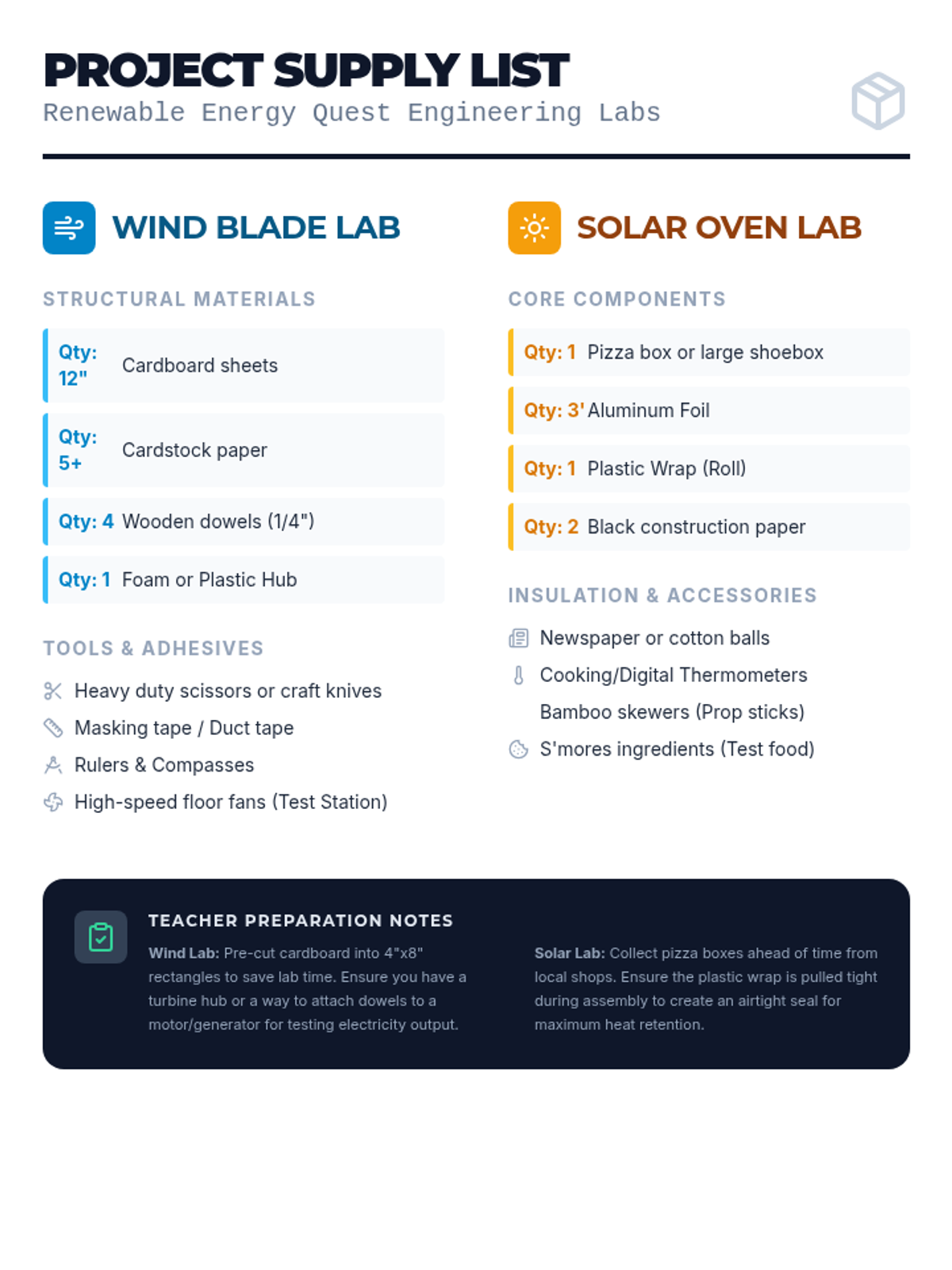
A comprehensive supply list for the wind blade and solar oven engineering projects, organized by lab type with teacher preparation tips.
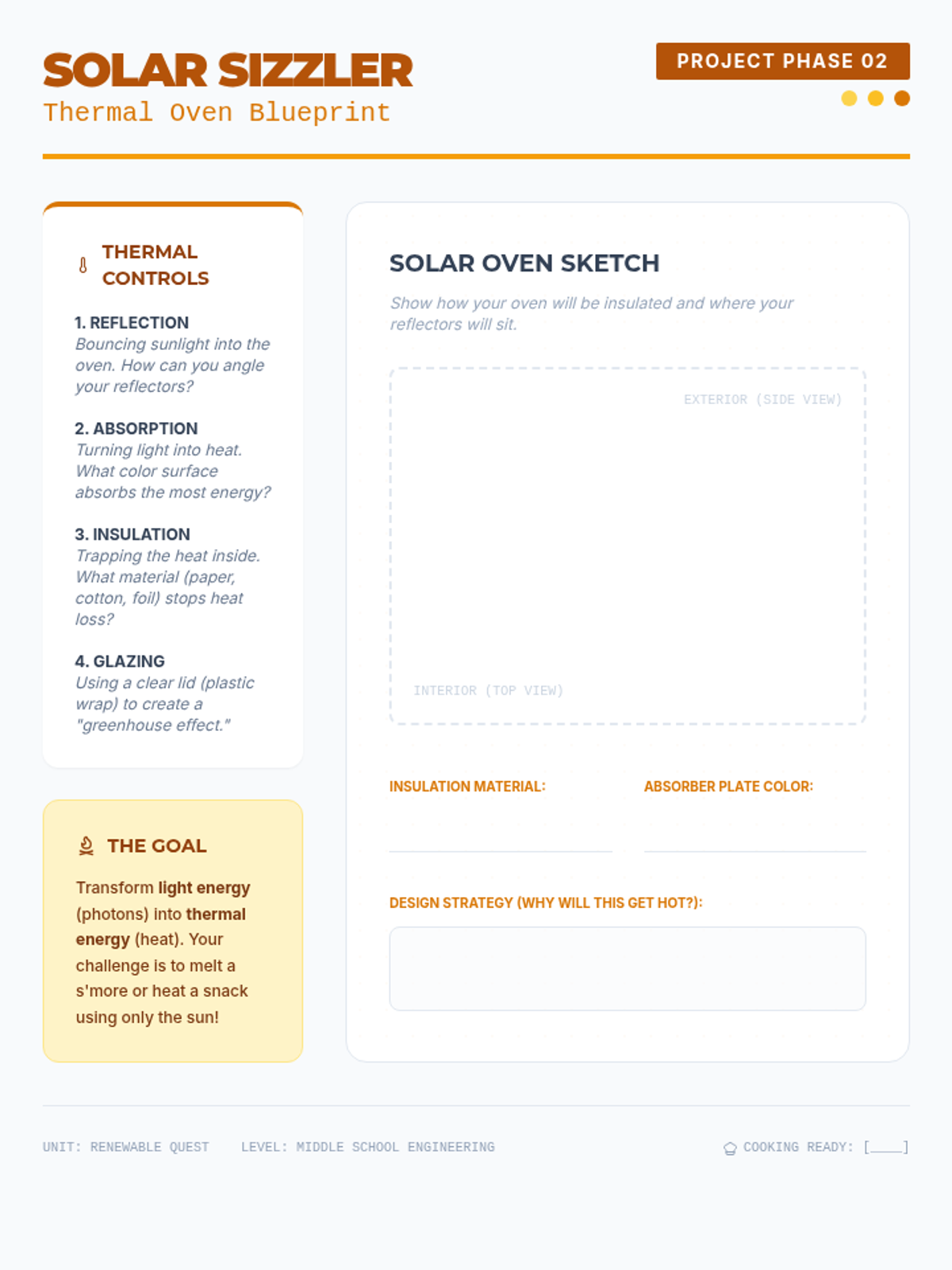
A student design guide for the solar oven engineering project, focusing on heat absorption, reflection, and insulation variables.
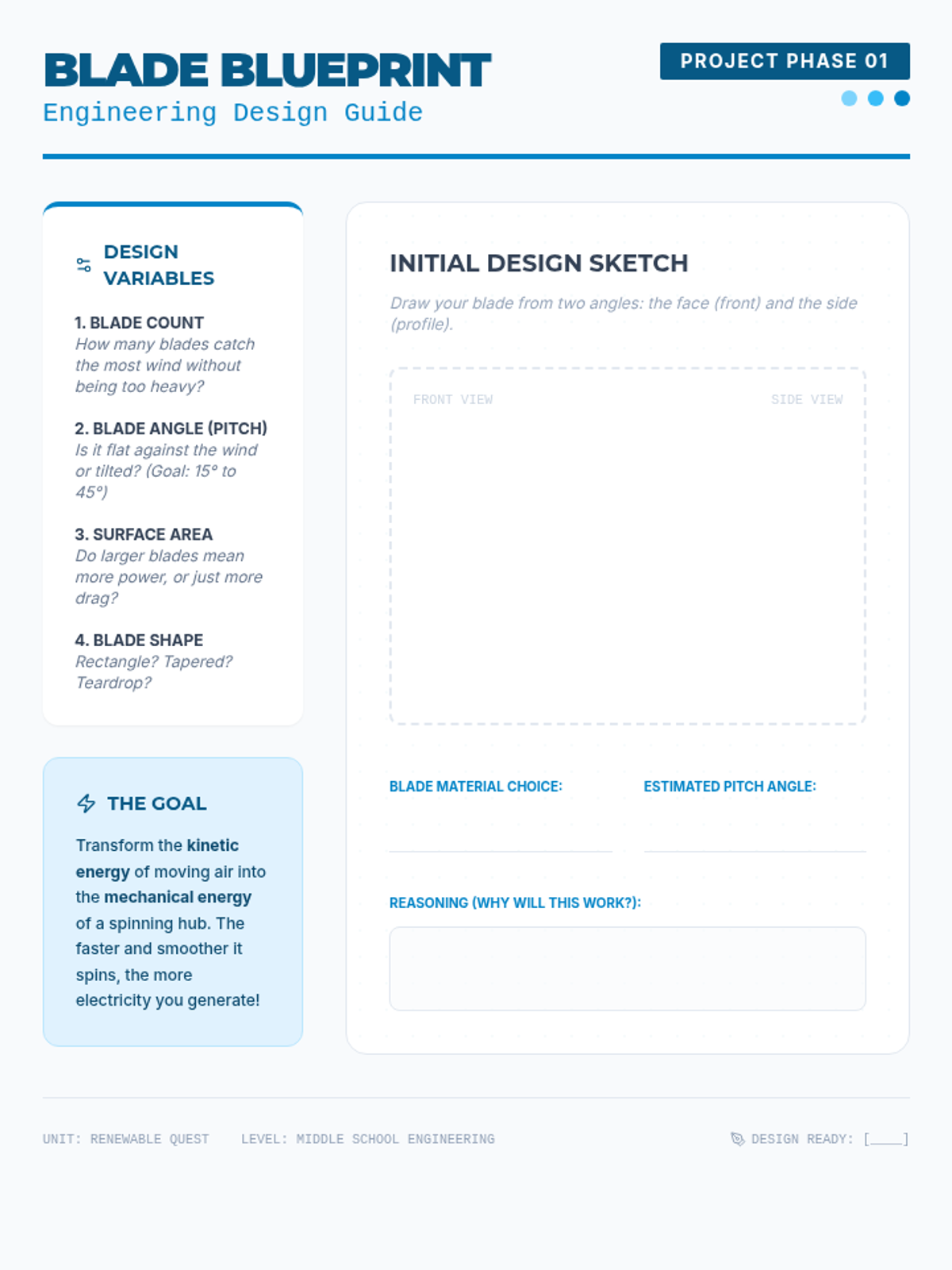
A student design guide for the wind blade engineering project, featuring sketching areas and engineering variable checklists.
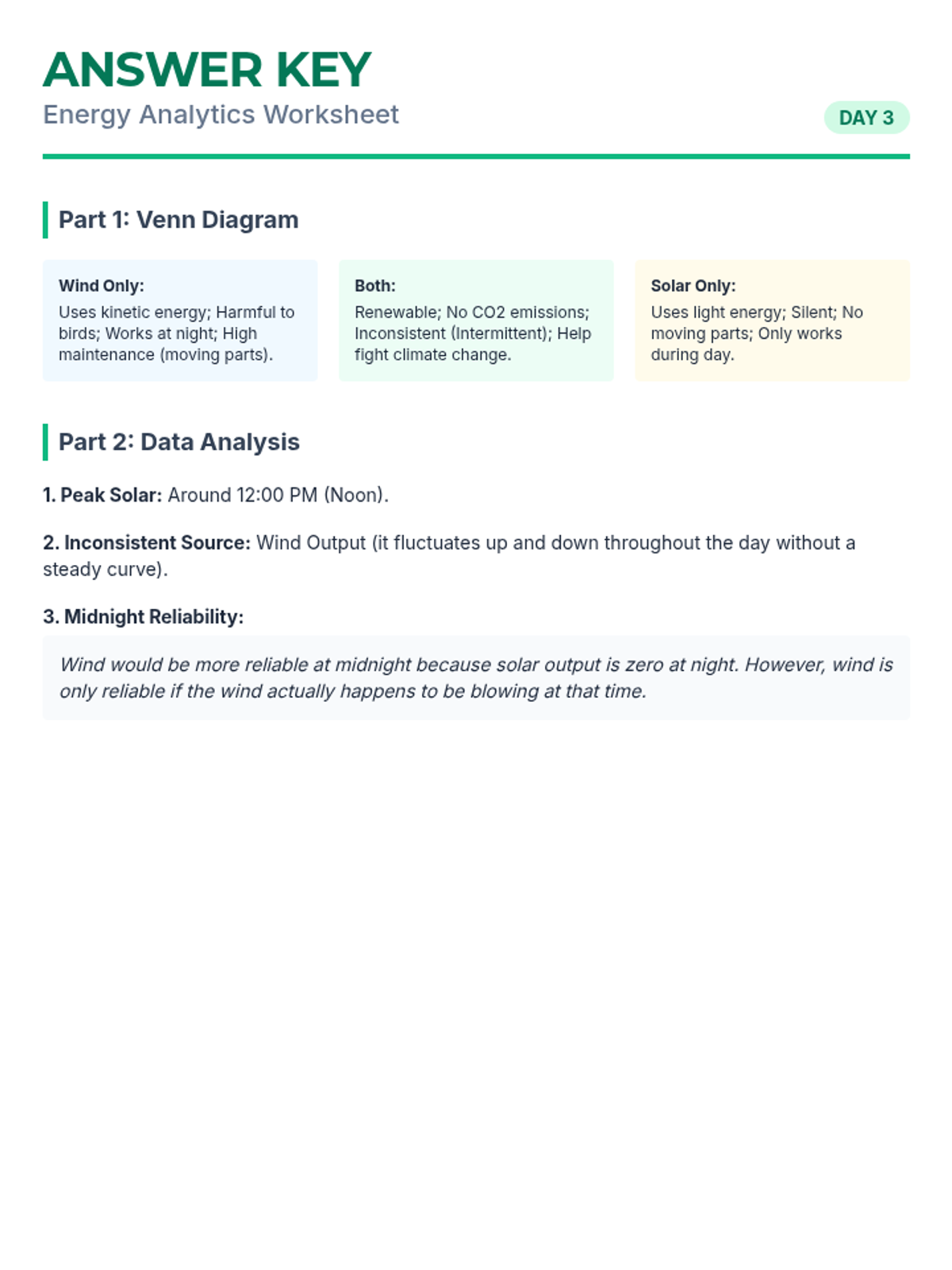
Answer key for the Day 3 Energy Analytics Worksheet.
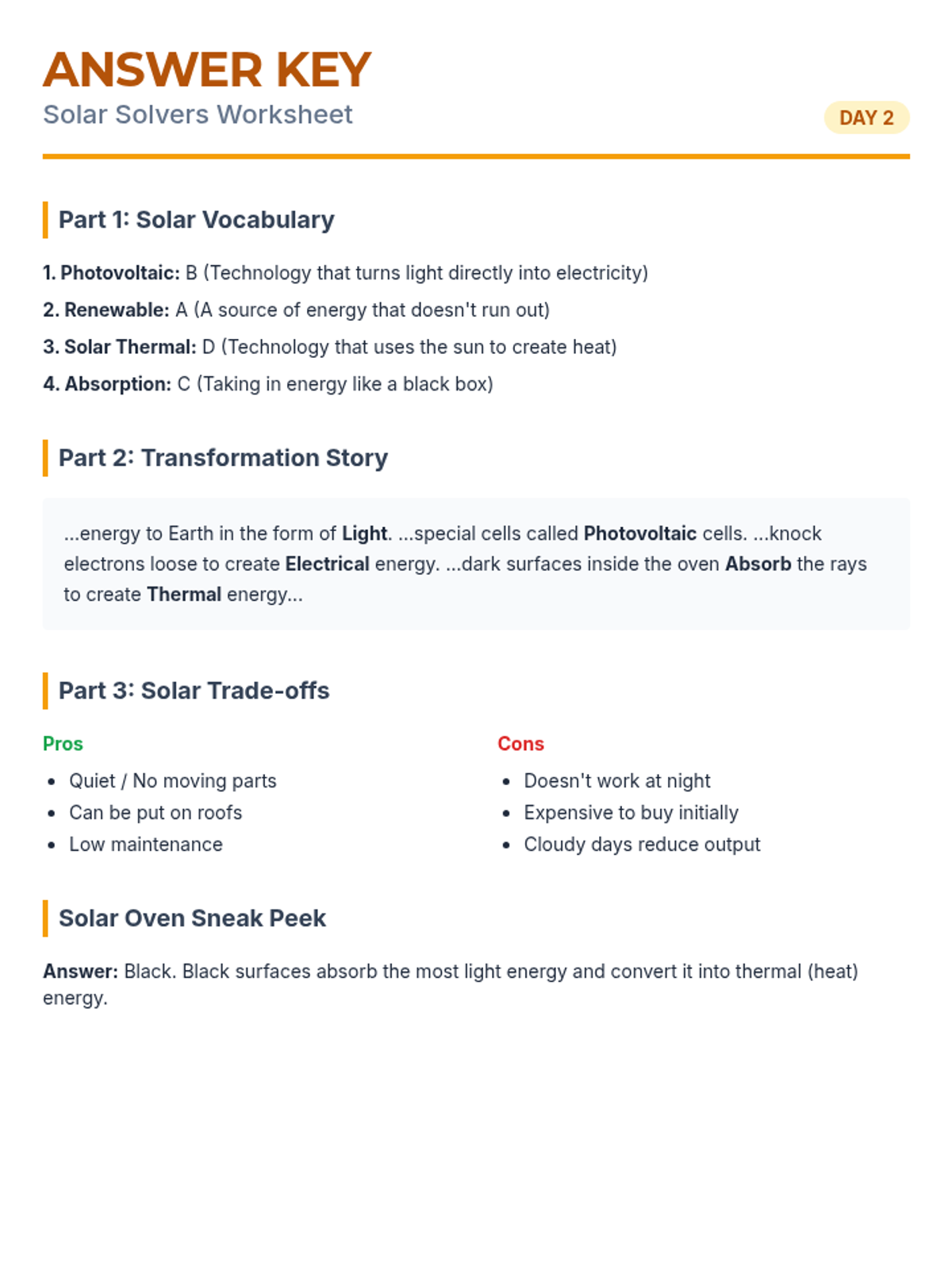
Answer key for the Day 2 Solar Solvers Worksheet.
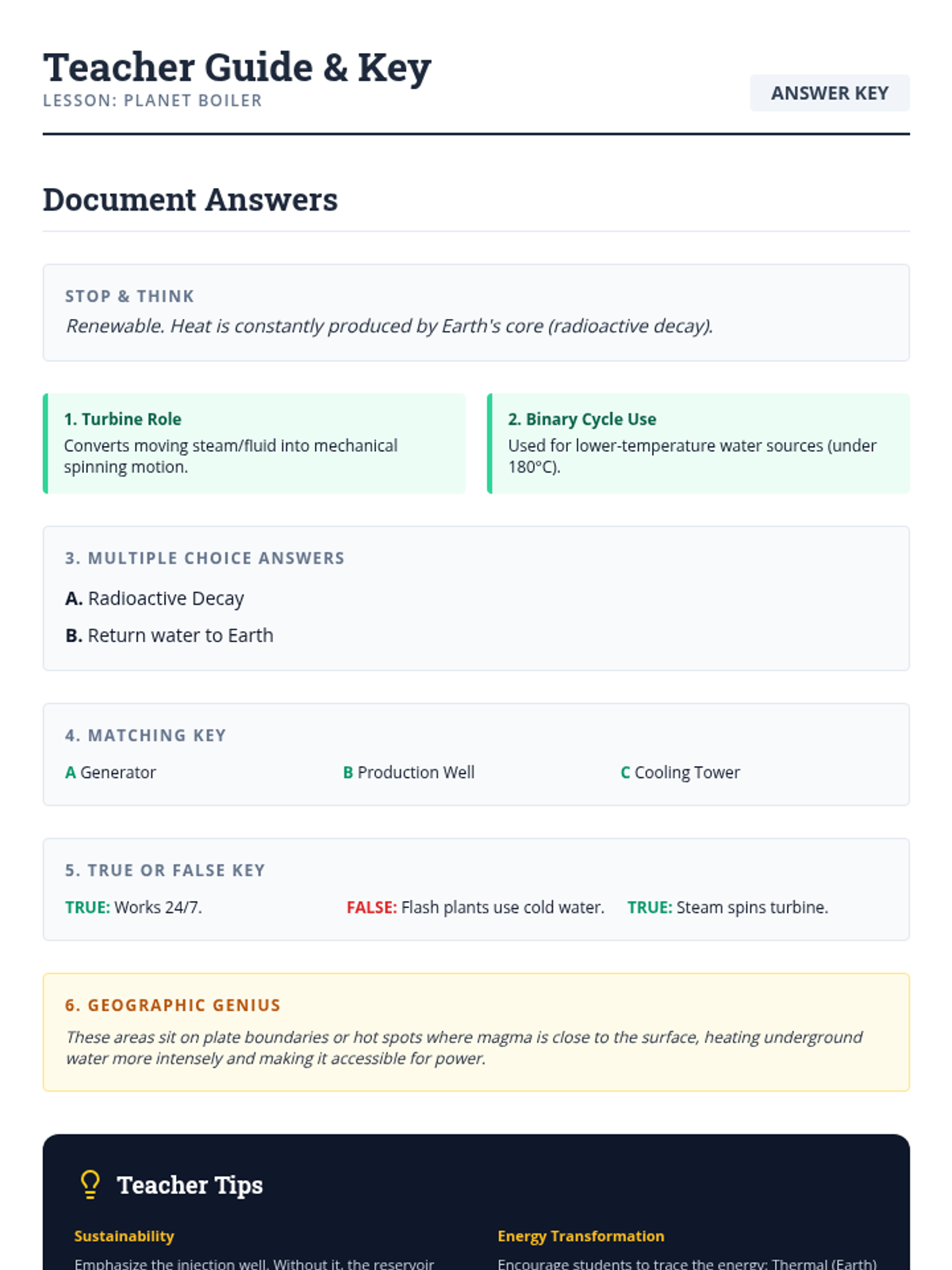
An updated teacher guide for the Planet Boiler lesson, providing an answer key for the expanded informational text document and additional instructional tips.
A visual presentation for students explaining the mechanics of geothermal energy conversion, the three types of power plants, and the concept of a sustainable closed-loop system.
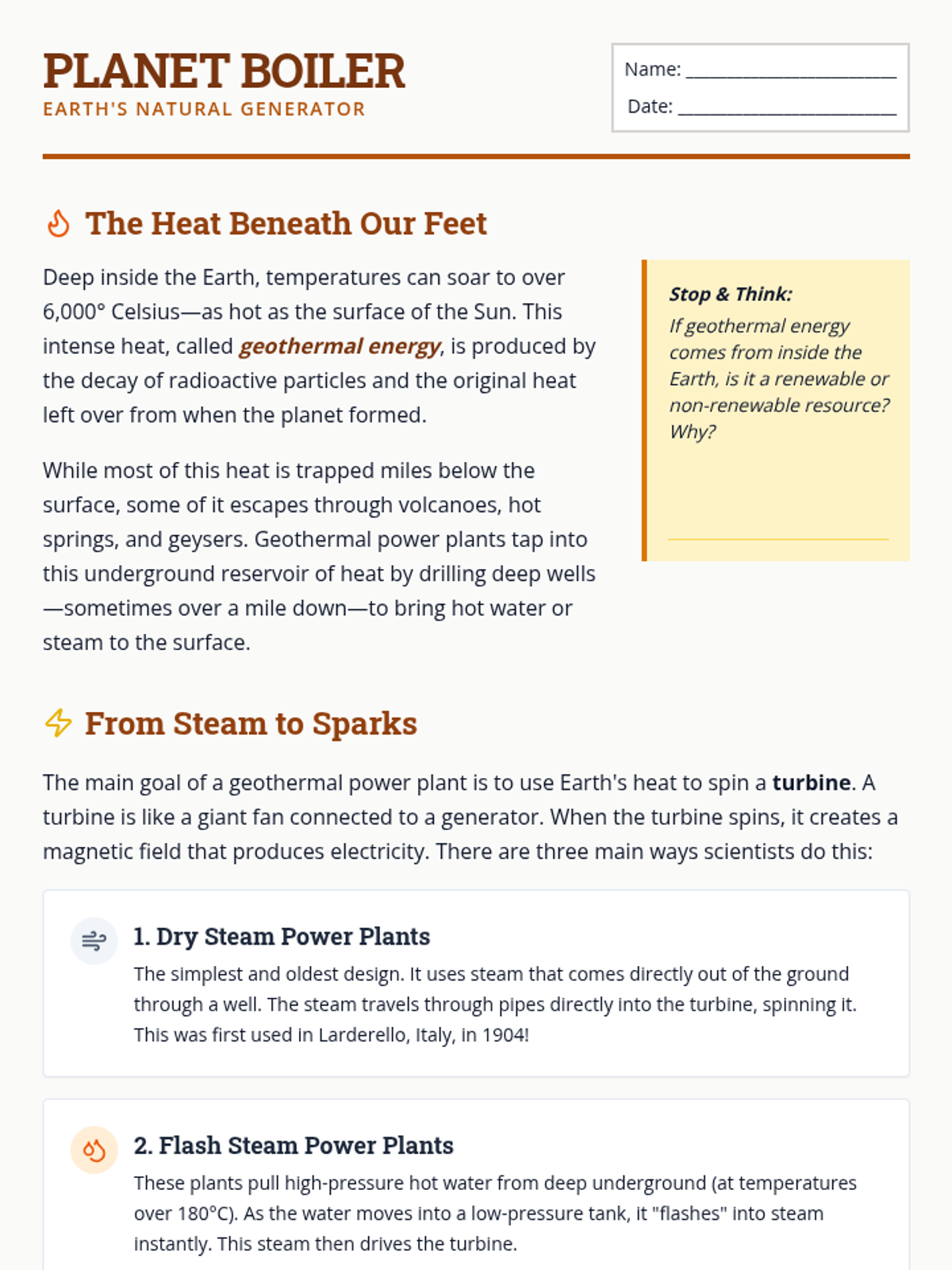
An informational text for students explaining the three types of geothermal power plants (Dry Steam, Flash Steam, and Binary Cycle) with an expanded set of guiding comprehension questions including multiple choice, matching, and true/false.
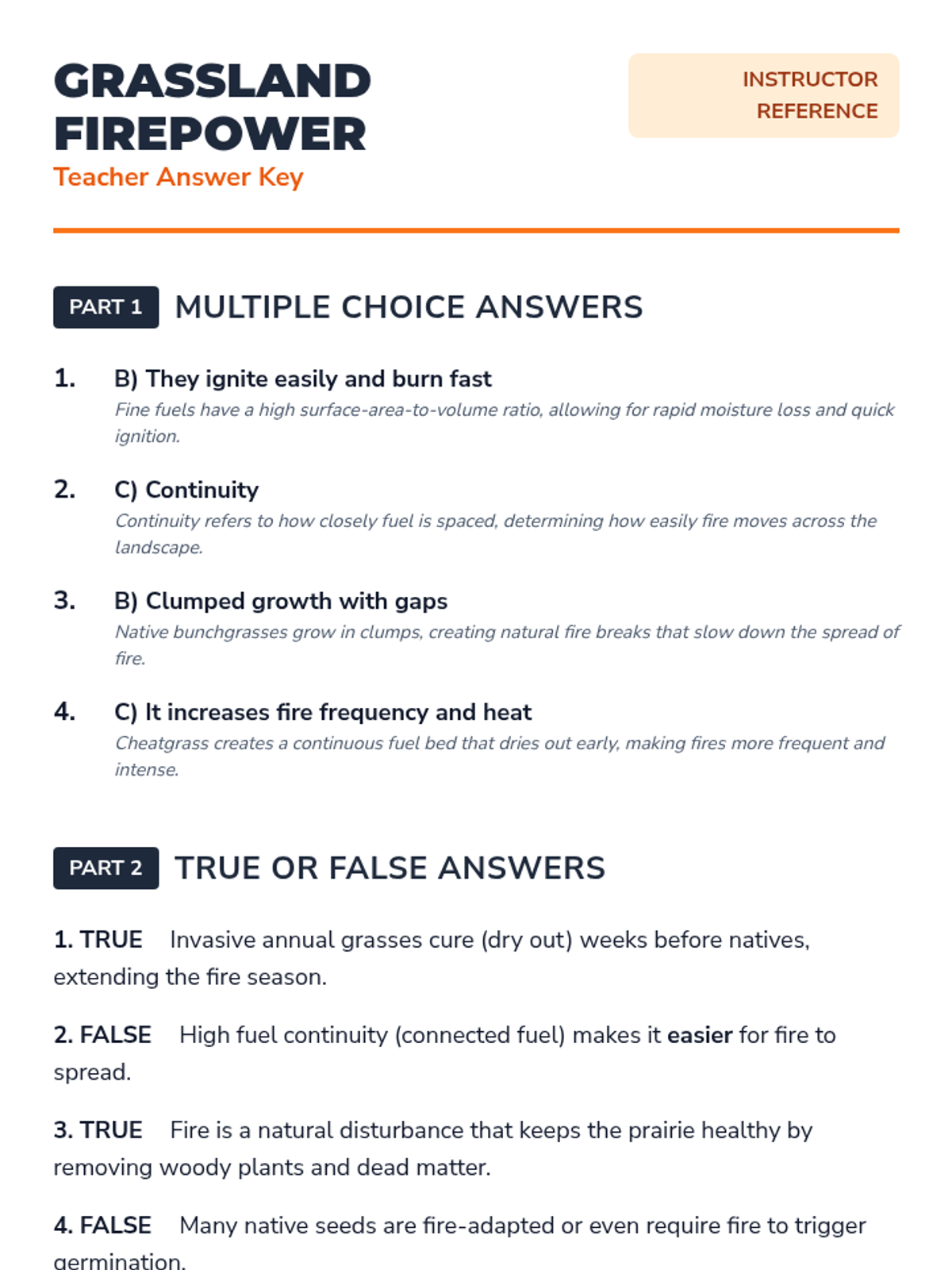
An answer key for the Grassland Firepower Assessment, including detailed explanations for multiple choice and true/false questions, and the completed comparison table.
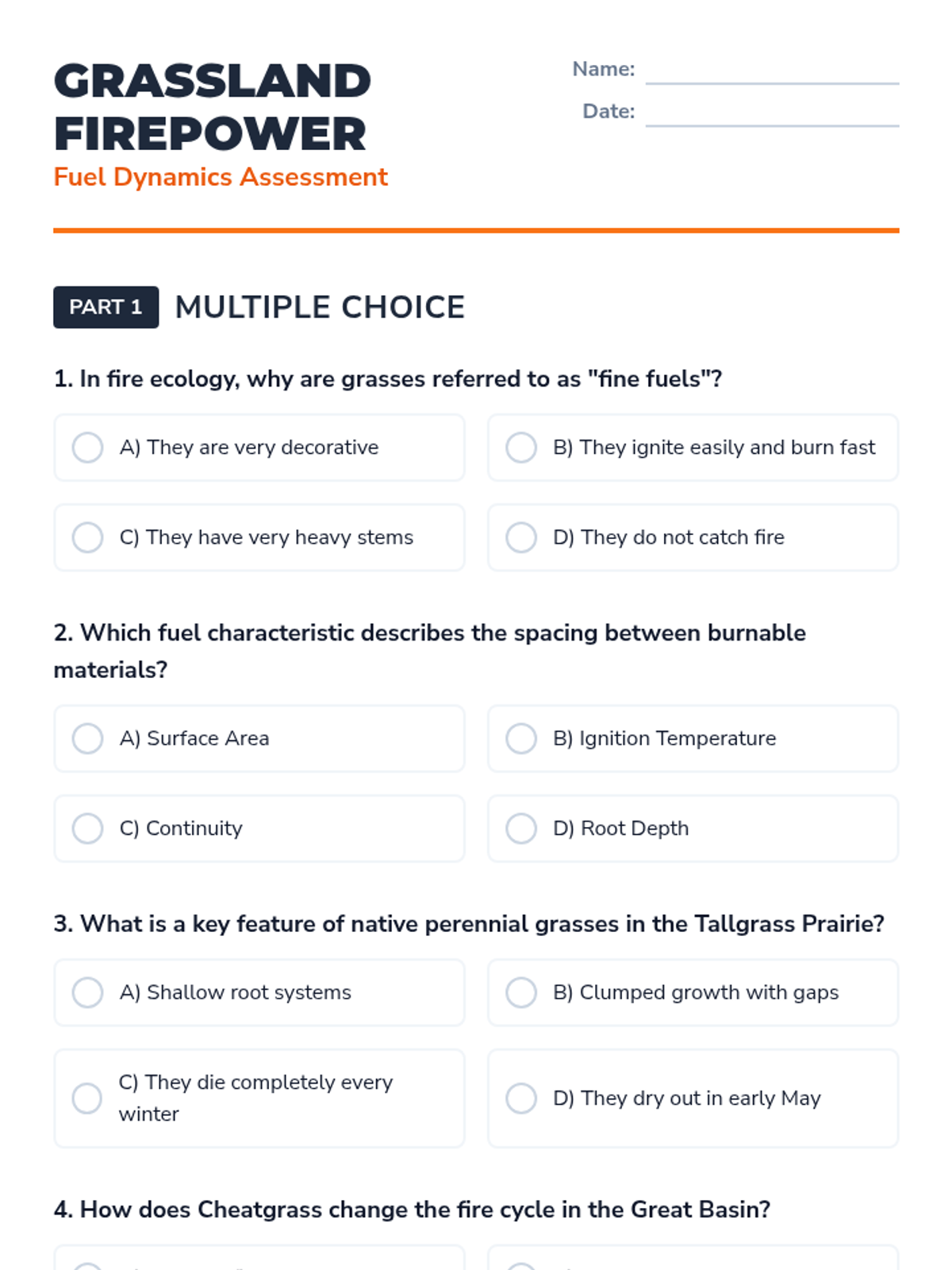
A student assessment covering fuel dynamics, fire behavior, and two case studies. Includes multiple choice, true/false questions, and a comparative table to check understanding of native versus invasive fuel types.
A set of instructional slides exploring the differences in fire behavior between native and invasive grasses, including two case studies: the Tallgrass Prairie and the Great Basin. The slides feature high-contrast visuals, comparative data tables, and key fire ecology terminology.
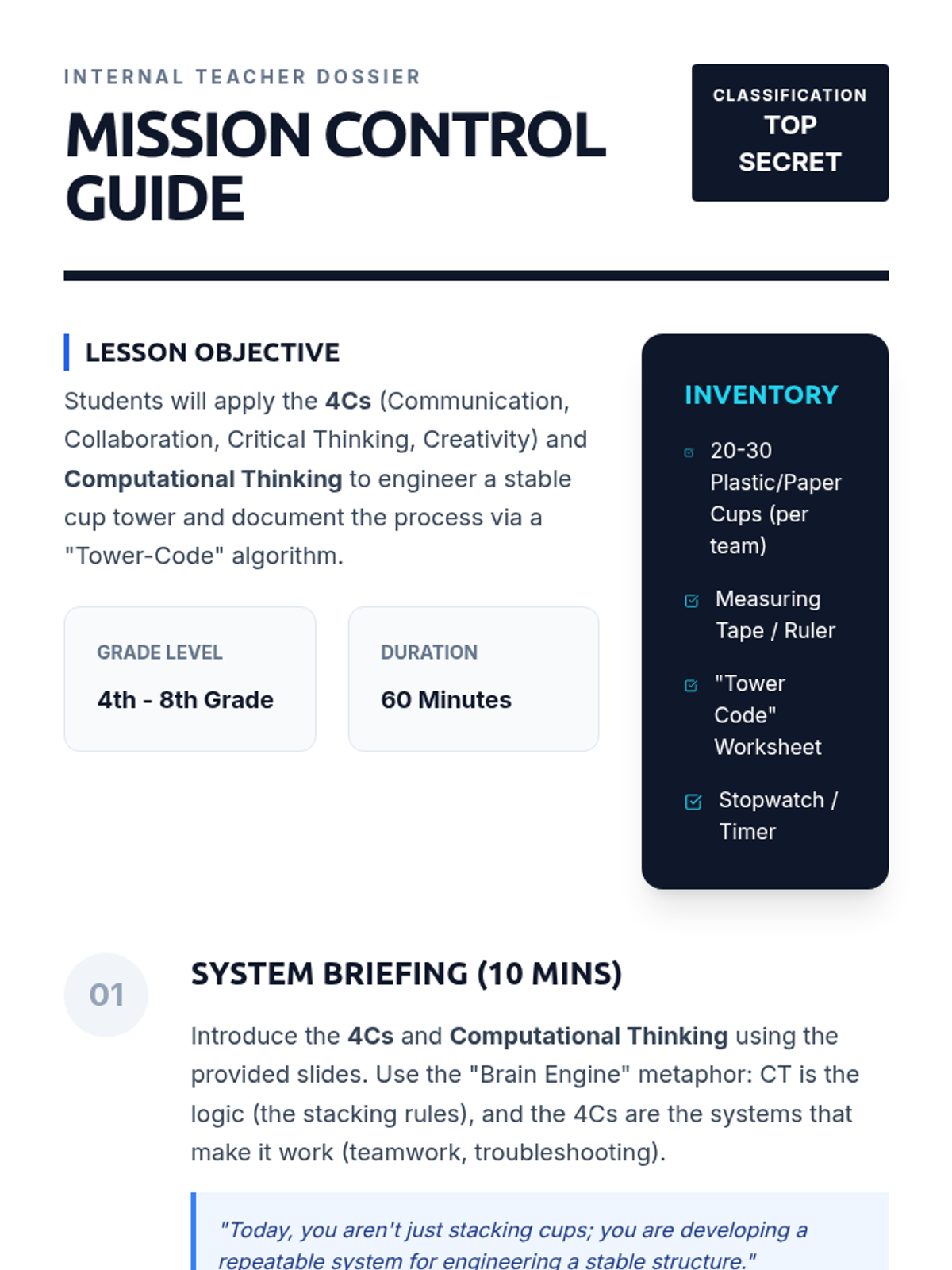
A detailed mission dossier for teachers, including lesson flow, materials list, and instructional strategies for teaching the 4Cs and Computational Thinking with a cup-tower challenge.
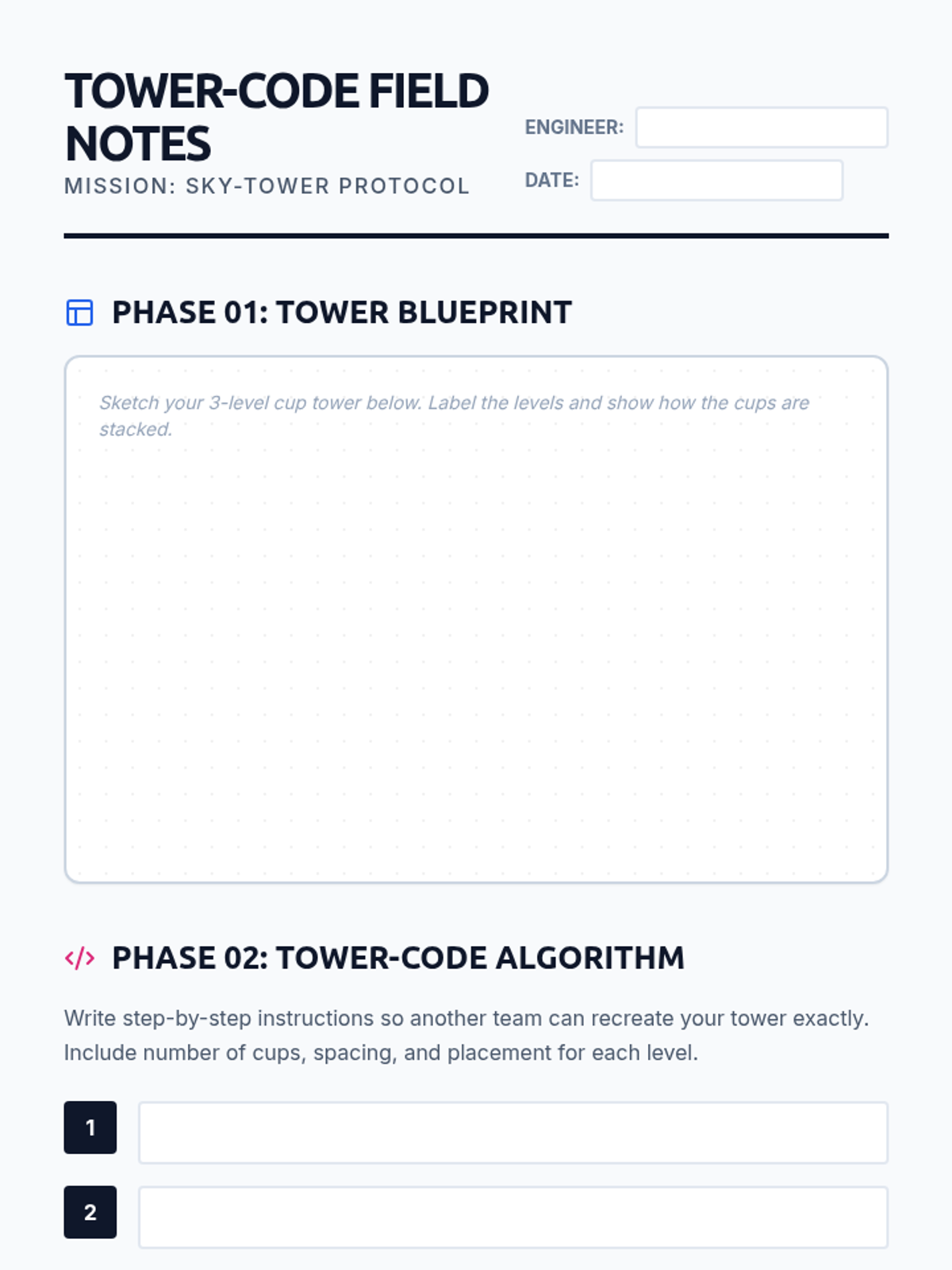
A mission-themed field guide for students to design their tower, write their "Tower-Code" algorithm, and reflect on their use of the 4Cs and Computational Thinking.
A high-energy, mission-themed slide deck that introduces the 4Cs and Computational Thinking with a focus on a cup-tower engineering challenge.
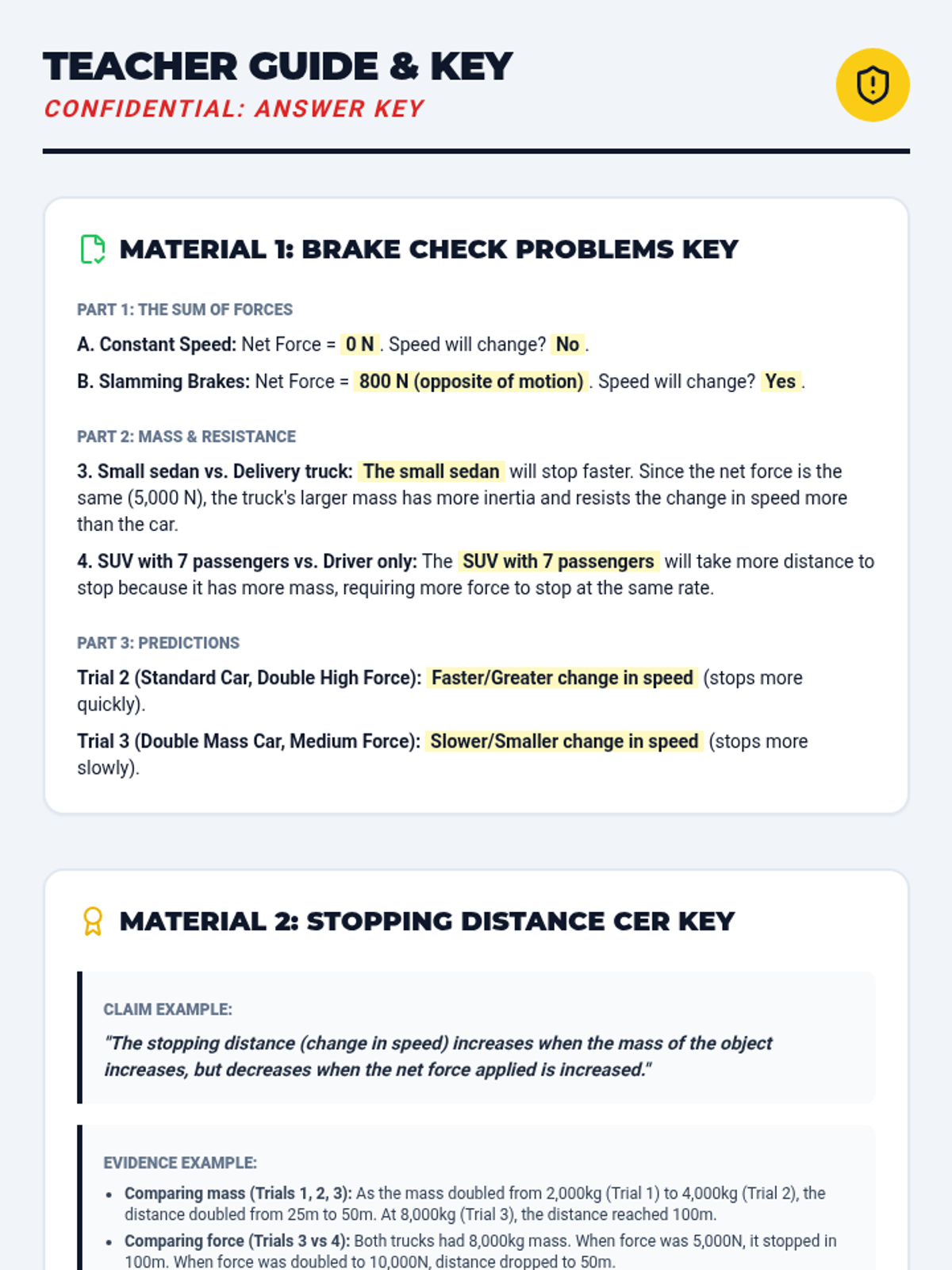
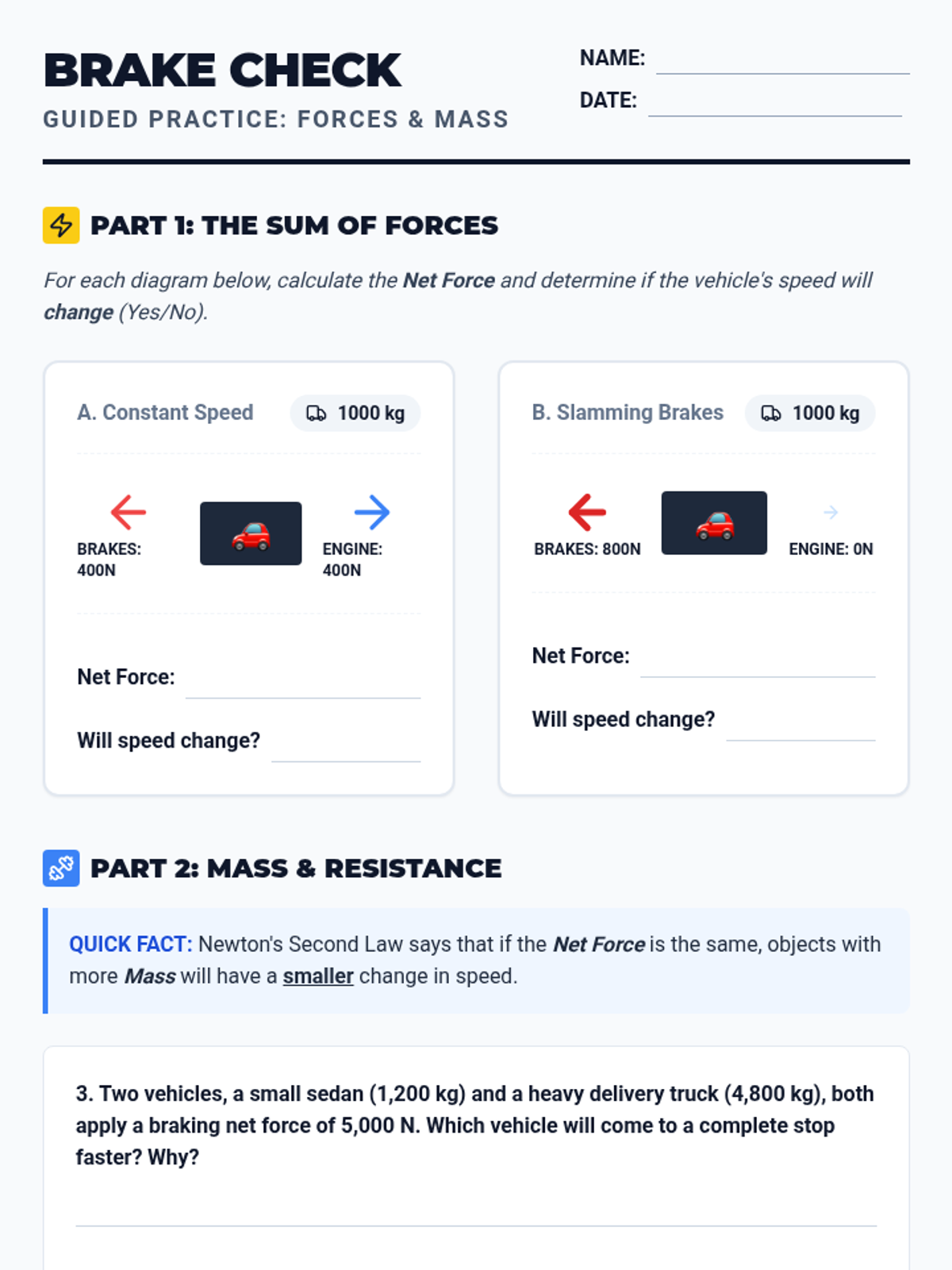
Teacher resource containing answer keys for the Brake Check problems and sample responses for the Stopping Distance CER worksheet, including common misconceptions.
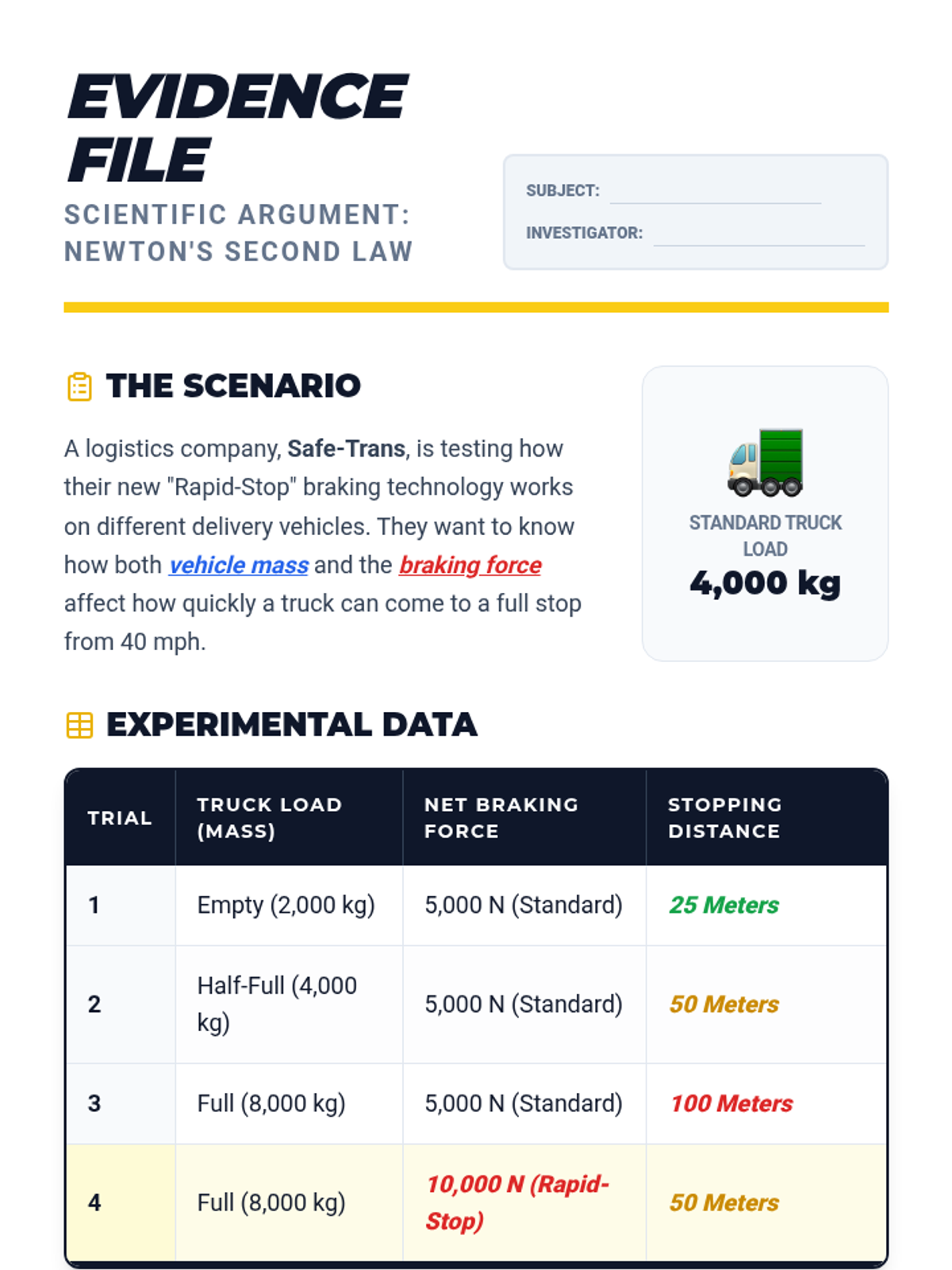
A Claim-Evidence-Reasoning worksheet where students analyze experimental data on truck braking to prove how mass and net force influence change in speed.
Guided practice problems for students to apply concepts of net force and mass in vehicle braking scenarios, including calculating net force and predicting speed changes.
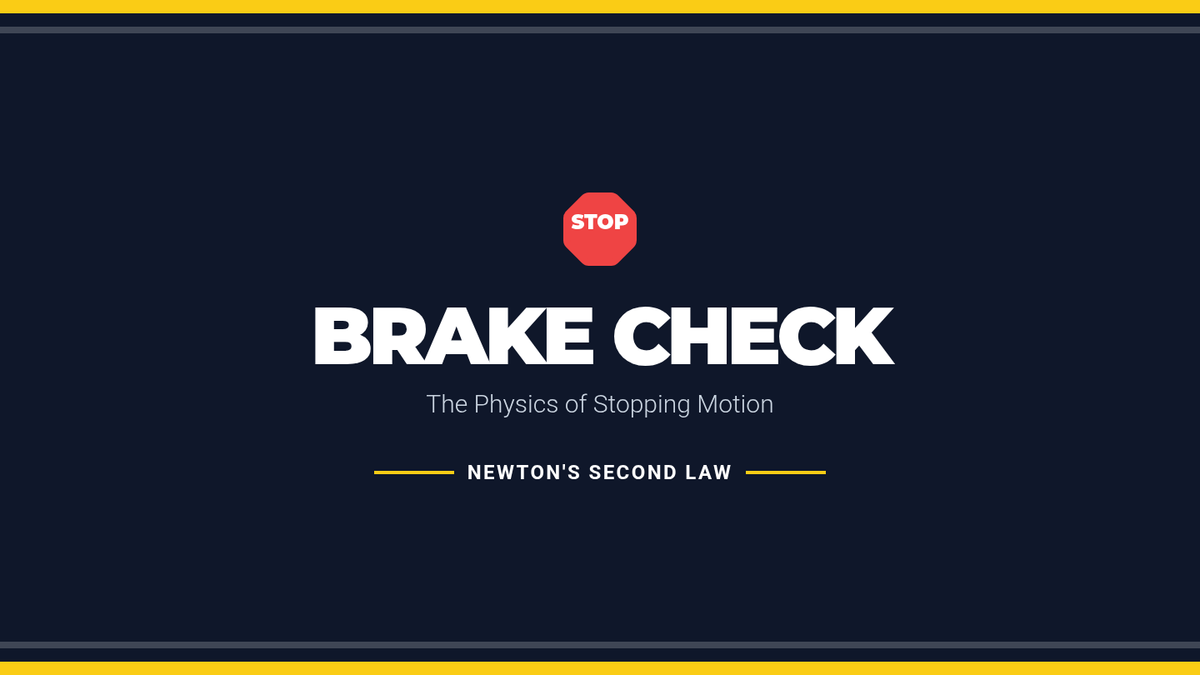
This 8-slide presentation introduces Newton's laws through the lens of vehicle braking, exploring how net force and mass influence changes in speed using visual diagrams and data comparison.
A visually engaging slide deck for 6th-8th graders introducing vocabulary like momentum and cushioning, and explaining Newton's First Law and the life of Sir Isaac Newton.
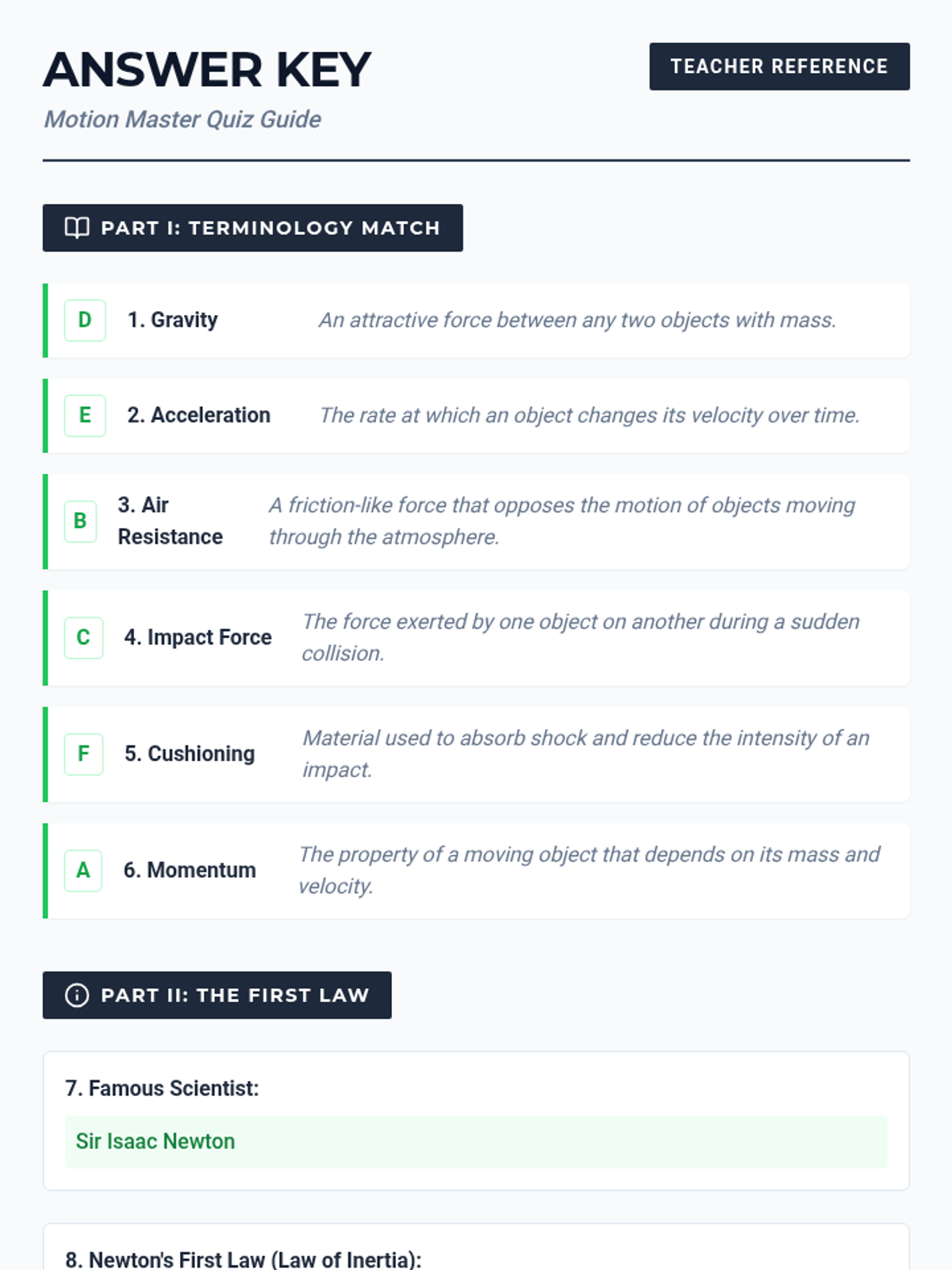
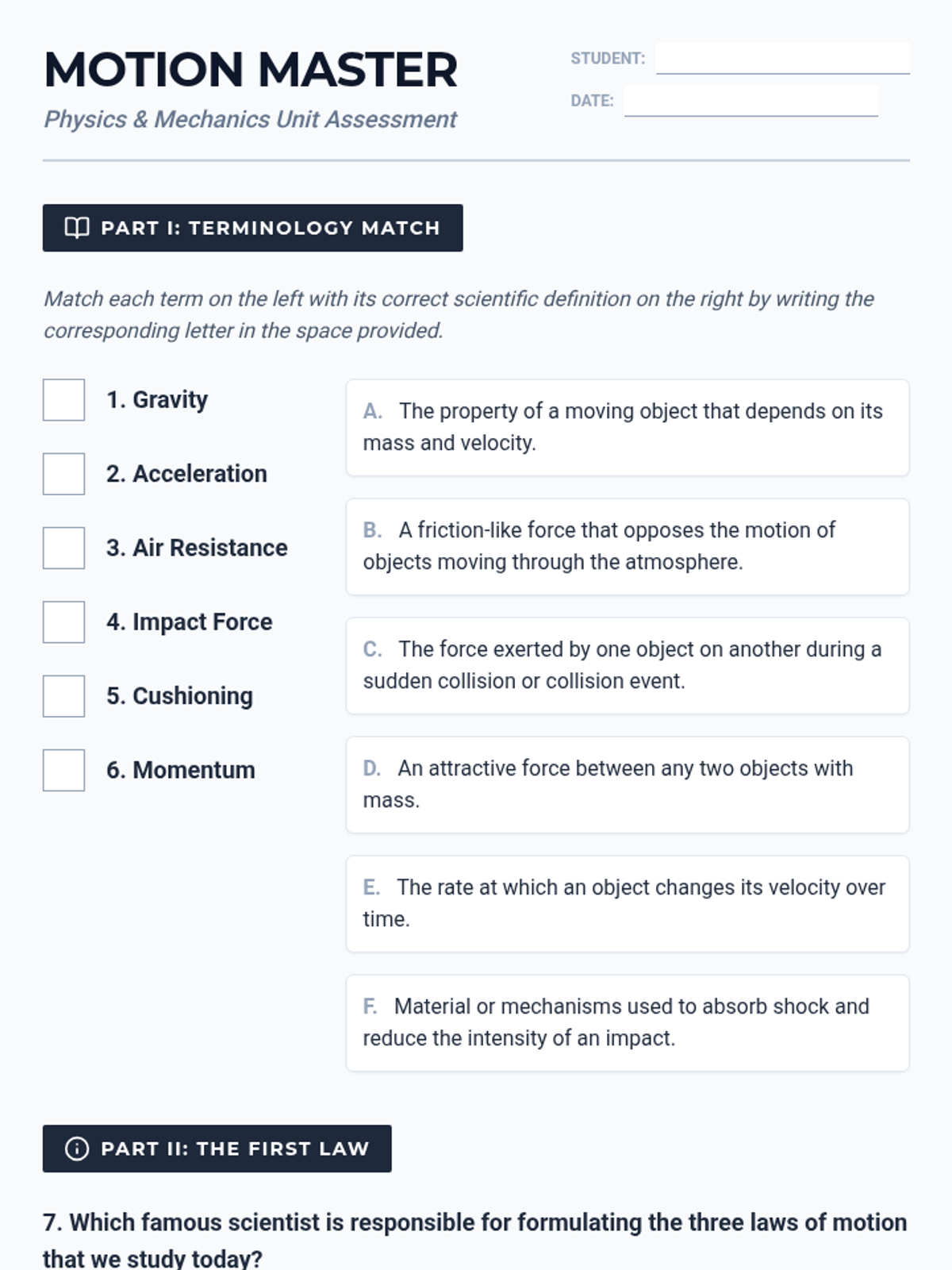
A comprehensive answer key for the Motion Master Quiz, providing correct vocabulary matches and formal scientific explanations for Newton's First Law.
A vocabulary and conceptual quiz for 6th-8th grade students covering key motion terms and Newton's First Law. Features a professional lab-manual style layout.
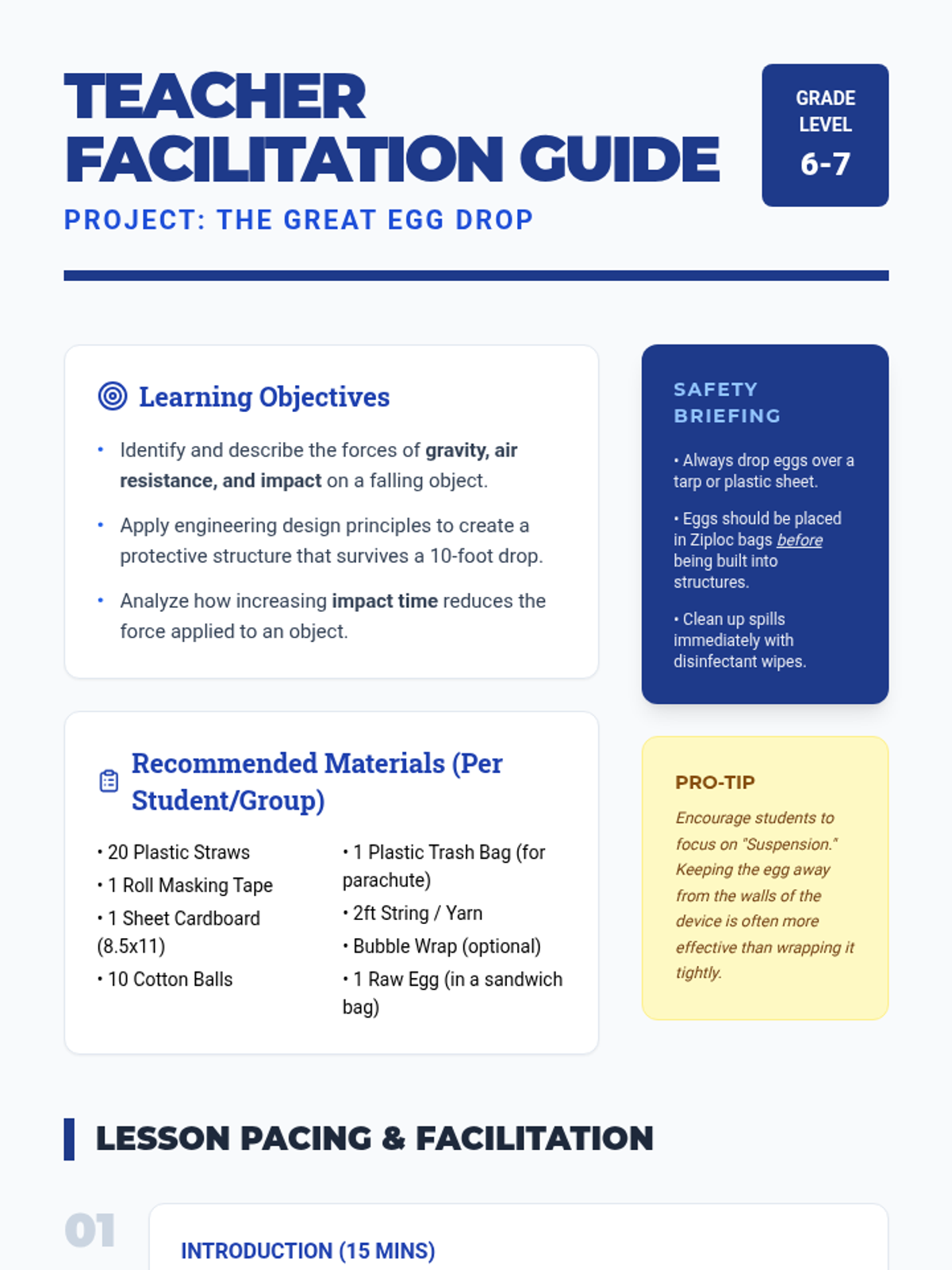
A comprehensive 2-page facilitation guide for teachers leading the Egg Drop Challenge. Includes learning objectives, materials lists, safety tips, pacing guide, and common student misconceptions.
A 8-slide instructional presentation for the Egg Drop Challenge. Covers physics concepts of gravity, acceleration, air resistance, and impact force, plus engineering strategies like cushioning and parachutes.