Participants practice identifying the root causes of technical errors through video analysis, formulating specific and actionable corrections.
Students refine their logo drafts by applying principles of negative space and contrast, creating color and black-and-white versions for professional export.
Students combine their icon and typography choices to build an official brand logo draft, focusing on balance, alignment guides, and the 'Squint Test' for simplicity.
Students master custom shape creation using polyline and curve tools, exploring line weights and the importance of vector scalability for professional branding.
Students move from curating to creating, using Google Drawing to build complex objects with simple geometric shapes while learning the fundamentals of vector design and layering.
Students learn how font choices communicate a brand's tone of voice, distinguishing between serif, sans serif, and display fonts to select a pair that fits their business identity.
Students explore the emotional impact of color in branding, learning to use Hex codes and curated imagery to build a brand mood board that reflects their product's personality.
Students perform quality control on their business proposals through peer review, grammar tools, and text-to-speech auditing before exporting their final work as professional PDFs.
Students learn about intellectual property, source reliability, and technical citation skills like hyperlinking and footnotes to perform ethical competitor research.
Students integrate market research data and customer testimonials into their formal proposals, using evidence to validate their product concepts and finalizing the Solution section.
Students learn to distinguish between product features and customer benefits, drafting the Executive Summary and Problem sections of their business proposal using persuasive formatting.
Students learn the importance of professional document formatting and hierarchy, setting up a formal business proposal template with structured headings and standardized typography.
Students conduct a market research sprint, interviewing classmates to validate their product ideas and learning to 'pivot' based on real user feedback and data synthesis.
Students learn the difference between leading and open-ended questions, developing a research table and interview script to gather unbiased feedback from potential customers.
Students explore the concepts of target markets and customer empathy, moving from personal preferences to identifying specific user needs and mapping out a "Day in the Life" for their ideal customer.
Students explore the fundamental economic concepts of scarcity and opportunity cost, applying them to product development by making difficult trade-offs between competing features within a limited resource budget.
Students learn to identify consumer "pain points" as opportunities for innovation, moving from recognizing everyday frustrations to conceptualizing business solutions.
A summative assessment for the first third of the novel. Evaluates student mastery of vocabulary from Lessons 1-11, character motivation, and the central theme of corporate alienation through a mix of multiple choice, short answer, and a rigorous RACE response.
The family's recovery and the transition to a new source of productivity (Grete). Synthesis of the unit's themes.
Gregor's death and self-sacrifice. Analysis of the relief of the family and the 'cleansing' of the home.
Grete's formal rejection of Gregor's identity. Analysis of the shift from sibling love to the necessity of his removal.
Gregor's reaction to Grete's violin performance. Themes of art, human connection, and the final reach for his human spirit.
Gregor's room becomes a storage area for trash. Analysis of the complete erasure of his human space and history.
The introduction of the three lodgers. Analysis of the home as a commodified space and Gregor's further displacement.
Analysis of the family taking on menial labor. Themes of exhaustion, loss of dignity, and the shared alienation of the working class.
Gregor as a permanent invalid. Analysis of the family's growing resentment and the physical reminder of his non-productive status.
The father's violent attack with apples. Analysis of the apple as a symbol of permanent wounding and the transition from son to 'burden'.
Analysis of the father's return to work and his transformation through the bank uniform. Themes of restored authority and industrial identity.
Gregor's desperate attempt to save his human identity by protecting the picture frame. Focus on the direct confrontation with Grete.
The conflict between Grete and the Mother over removing Gregor's furniture. Themes of preserving human memory vs. accepting animal reality.
Students analyze Gregor's fading perception of the human world through his window view and his growing physical comfort in animalistic behaviors.
Analysis of the father's hidden financial assets and the betrayal of Gregor's role as the sole provider. Themes of economic exploitation.
Students examine the changing power dynamic between Gregor and Grete, focusing on her new ritualistic authority as his sole caretaker.
Part II begins with Gregor's physical transition, focusing on his change in taste and the shift from human food to animal waste as a symbol of dehumanization.
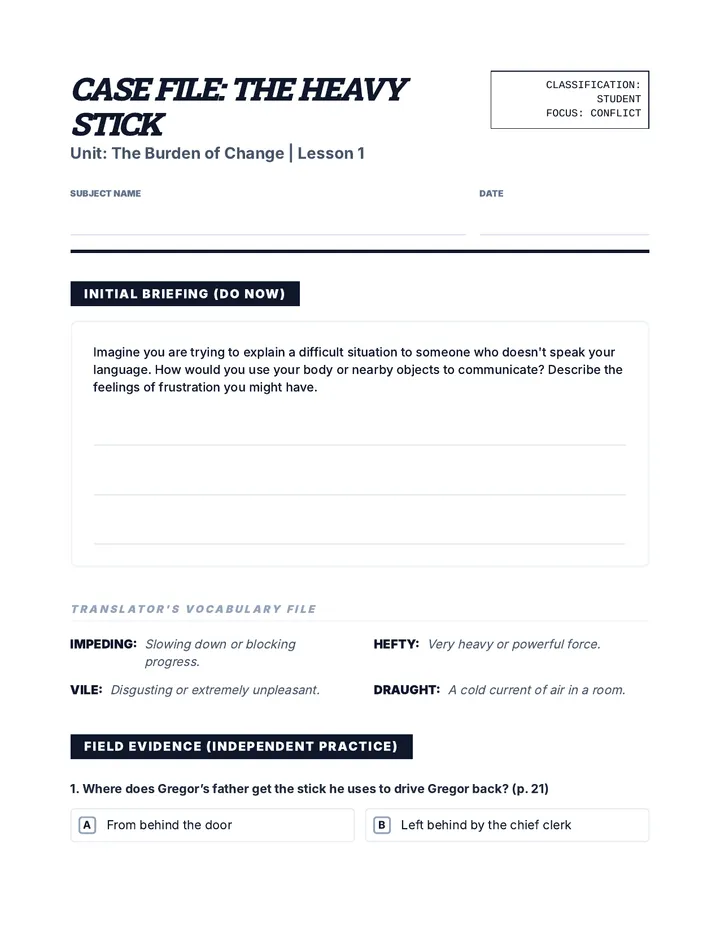
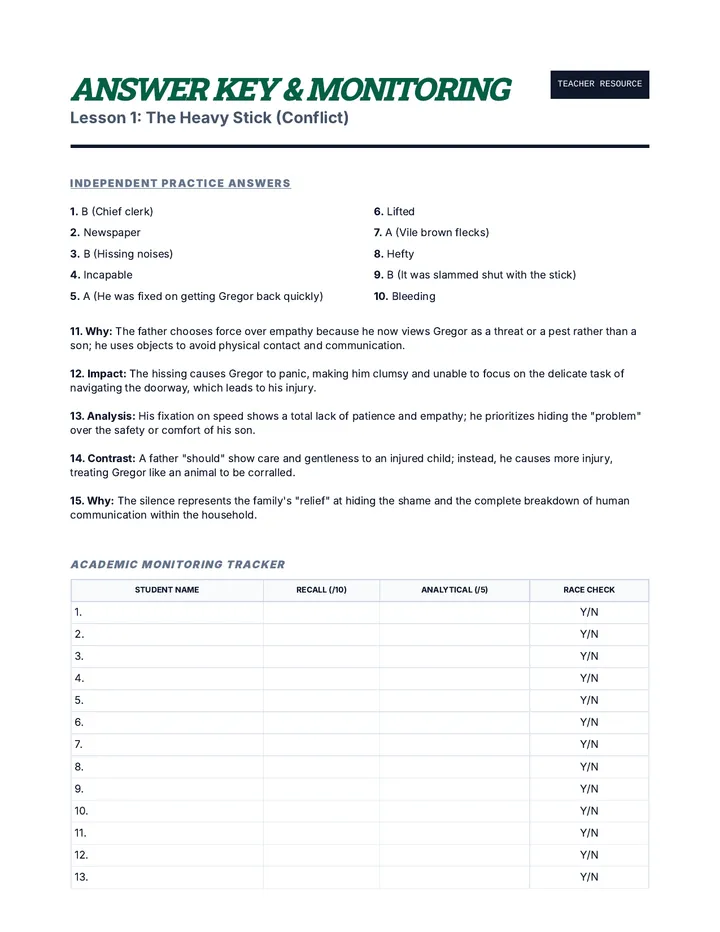
Students analyze the violent conclusion to Part I, focusing on the father's use of force to cage Gregor. Themes of domestic aggression and the loss of familial status.
Students analyze the visual reveal of Gregor's form and the immediate physical and psychological retreat of the Chief Clerk and family. Focus on the 'Invisible Force' of alienation.
Students analyze the Chief Clerk's dialogue and how he uses corporate language to minimize Gregor's humanity and maximize his perceived 'laziness'.
Students analyze the arrival of the Chief Clerk and the immediate shift from familial concern to corporate suspicion. Focus on the theme of 'The Firm' as a dehumanizing force.
A series of design-focused sessions where students build the visual foundation of their clothing brand, including logos, color palettes, and initial garment sketches.
An advanced pedagogical exploration of François Delsarte's applied semiotics for undergraduate performance students. The lesson analyzes the triune nature of expression (Mental, Moral/Emotive, Vital) and its influence on modern somatic practices.
A final unit integrating all skills to create large-scale works inspired by the natural world and global art traditions.
A deep dive into the lives and styles of iconic painters, focusing on impressionism, surrealism, and pop art.
Explores tactile art-making through paper tearing, layering, and found-object assembly.
Focuses on the fundamentals of line, shape, and color through wet and dry media, inspired by landscape and portraiture.
A quick-hit replacement assignment for students who missed a documentary on high-stakes photojournalism. It explores the careers of photographers who work in extreme environments and danger zones.
A comprehensive workshop on chamber music communication, focusing on non-verbal cues, shared breathing, and collective phrasing to achieve a unified ensemble sound without a conductor.
A comprehensive substitute-friendly lesson introducing the 7 Elements of Art to students in grades K-3 through visual exploration and hands-on practice.
A foundational lesson on the precursors to opera, focusing on Renaissance vocal forms like the Chanson, Madrigal, and Lute Song that paved the way for the Baroque invention of opera.
A simple, step-by-step drawing lesson for kindergarteners to learn basic facial features. Students will follow along to draw eyes, a nose, and a mouth on a circle.
A series of hands-on spring-themed craft activities for kindergarteners that focus on fine motor skills, shape recognition, and pre-writing strokes. Students practice cutting, gluing, and drawing through structured, visual step-by-step instructions.
A guided research project where students explore the anatomy, history, and classification of a musical instrument of their choice.