Introduction to the Miller Index notation for identifying planes and directions within a crystal. Students bridge the gap between 3D visual geometry and formal vector notation.
A hands-on laboratory experience where students use microscopes to observe and document biological and physical specimens at varying magnifications.
A focused lesson on the mechanics of the cell cycle and DNA replication, emphasizing timing, key stages like S-phase and mitosis, and the process of cytokinesis.
A high-energy, activity-dense lesson focused on Dalton's Law of Partial Pressures, mole fractions, and collecting gas over water, utilizing the POGIL framework to transition from conceptual modeling to mathematical mastery.
Students explore the shared ancestry of fish and mammals, analyzing homologous bone structures and building cladograms to visualize divergent evolution.
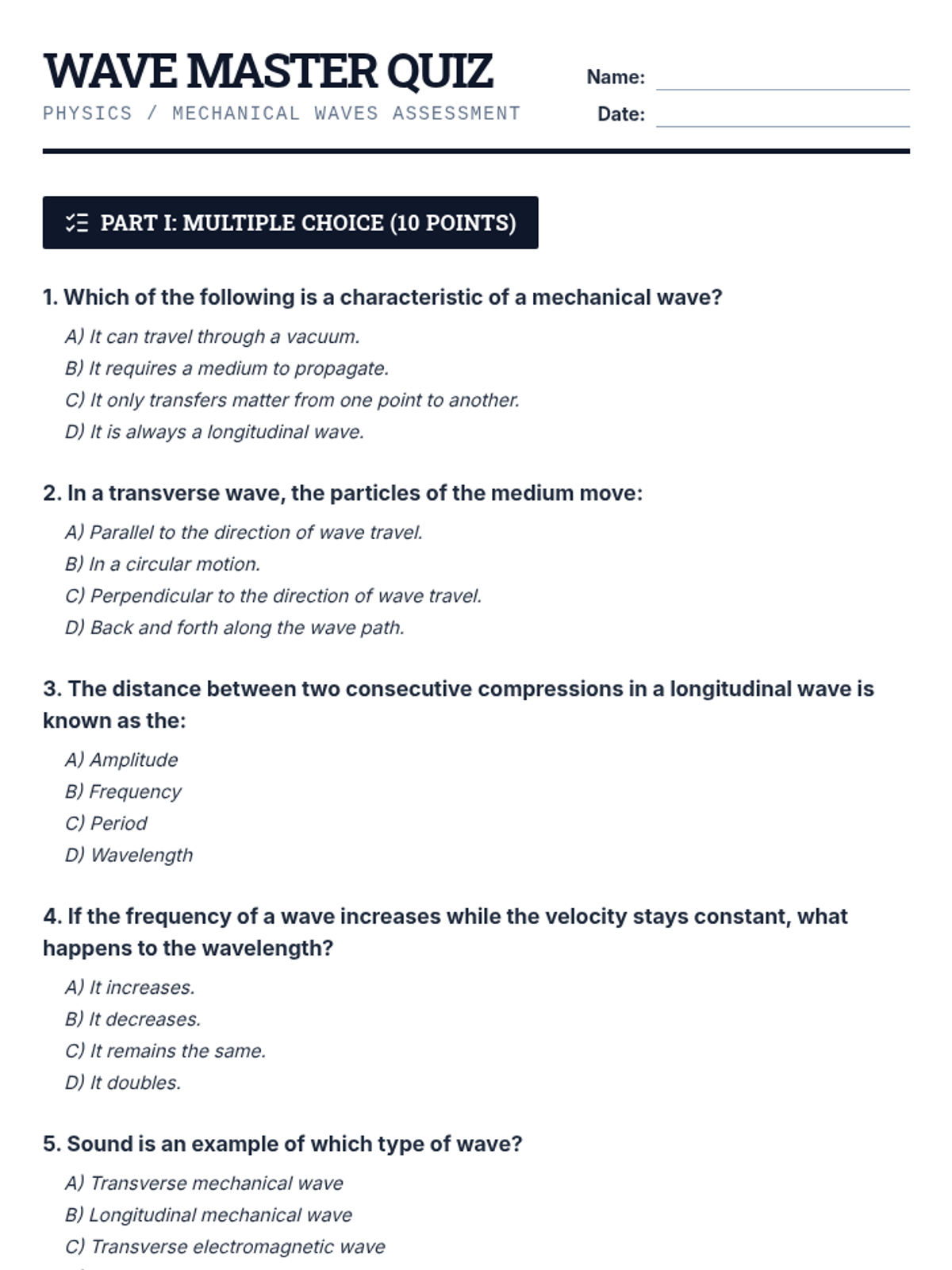
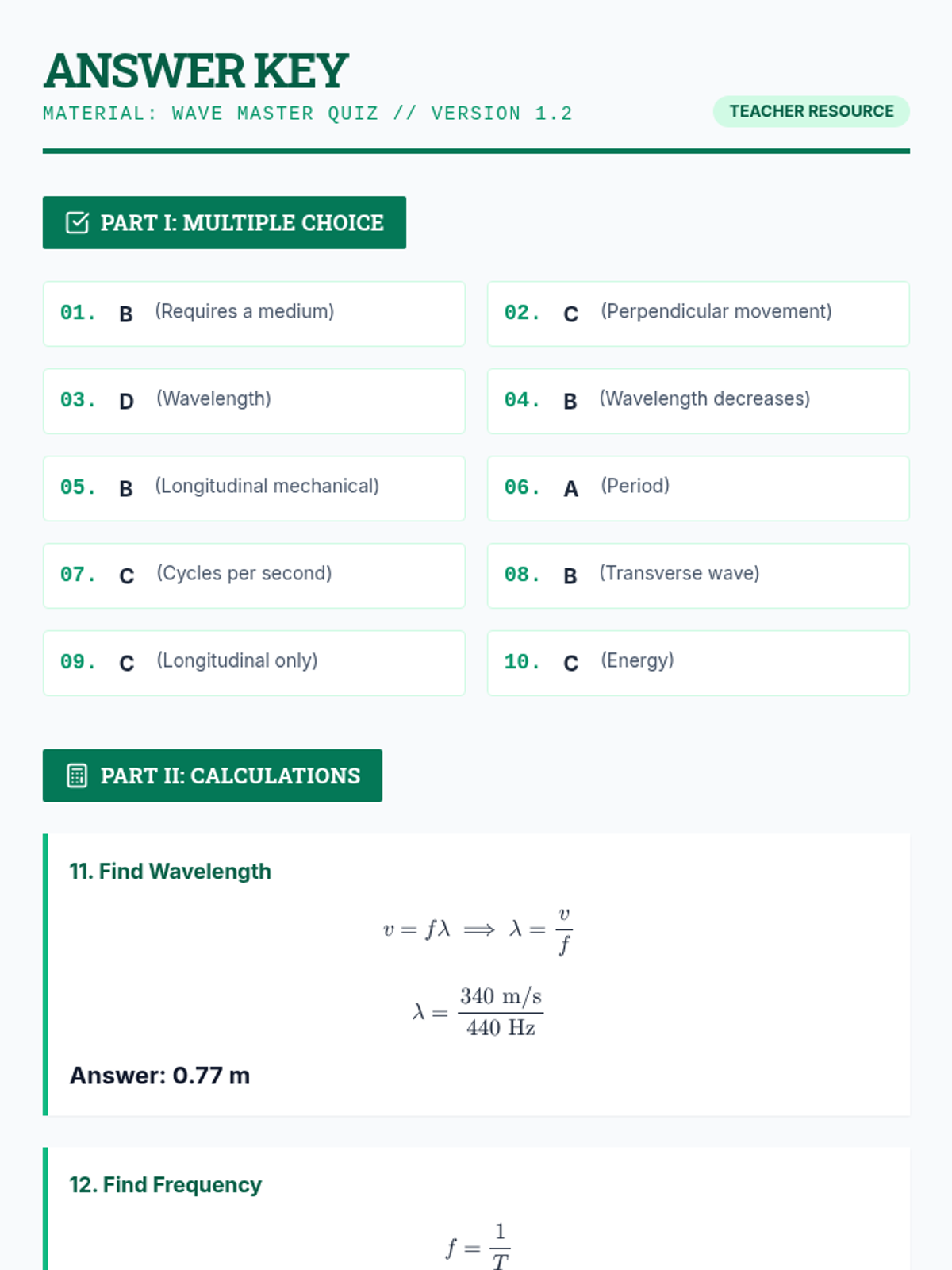
A comprehensive lesson exploring the physics of sound resonance in open and closed pipes, focusing on harmonics, wave patterns, and mathematical relationships.
Une exploration approfondie de la mécanique classique, couvrant les ressorts, les mouvements circulaires, les oscillations et la conservation de l'énergie à travers des exercices de synthèse.
Cette leçon évalue les connaissances de base sur les 7 concepts ICT et fournit les fondations théoriques pour comprendre les marchés à travers le prisme de la liquidité institutionnelle.
A comprehensive introduction to workshop safety and tool identification, focusing on the table saw, drill press, and hand chisels. Students learn critical safety protocols and part names for essential woodworking machinery.
This lesson focuses on the mechanics of the respiratory system, requiring students to synthesize their knowledge into a formal scientific essay. It includes a comprehensive rubric, a student planning guide, and a teacher scoring reference.
A comprehensive introduction to the fundamental processes, safety protocols, and career paths in professional welding. Students will explore SMAW, GMAW, and GTAW techniques while learning to identify quality welds.
A high-energy agile retrospective focused on celebrating team milestones, recognizing individual contributions, and reflecting on successful patterns to carry forward into future sprints.
A comprehensive introduction to the Central Dogma of biology, tracing the flow of genetic information from DNA to RNA to Protein through reading, diagrams, and assessment.
Explore how environmental factors like pH influence enzyme activity through visual models and data analysis.
This lesson introduces graduate social work students to t-test statistics, focusing on practical application in evidence-based practice and program evaluation. Students will learn to select, calculate, and interpret independent, paired, and one-sample t-tests using real-world social work scenarios.
A comprehensive 75-minute college-level lecture exploring the anatomy and physiology of the human digestive system, covering the GI tract wall, organ functions, accessory organs, and the principles of nutrition.
A deep dive into the behavior of charged particles in magnetic fields, focusing on the mechanics of mass spectrometry and the rotational dynamics of current-carrying loops. Students will derive key equations for particle paths and analyze the torque that drives electric motors.
An in-depth exploration of electromagnetism focusing on the relationship between electric currents and magnetic fields, featuring the Biot-Savart Law, Ampere's Law, and the Lorentz Force.
A comprehensive lesson on the nature of magnetic fields, focusing on their vector properties, dipole sources, and the implications of Gauss's Law for magnetism. Students will explore how fields are represented and why magnetic monopoles do not exist.
A comprehensive introduction to magnetic fields, Gauss's Law for magnetism, and the properties of magnetic materials tailored for AP Physics C students. Includes conceptual readings on magnetic dipoles, material classification, and the mathematical foundations of magnetic forces.
A deep dive into the time-dependent behavior of RC circuits, covering the calculus of charging and discharging, the physical meaning of the time constant, and graphical analysis.
This lesson provides the additional framework and assignments required for graduate students participating in the Research Proposal Project. It focuses on technical plausibility, resource management, and strategic academic significance.
This lesson covers Kirchhoff's Junction and Loop Rules, providing students with the conceptual framework and mathematical tools to analyze complex multi-loop circuits. Students will explore conservation of charge and energy through interactive examples and practice problems.