Students focus on 'Listen and Repeat' and 'Listening for Main Ideas' through school-based announcements and peer interactions. The lesson follows an I-Do, We-Do, You-Do structure to build confidence in auditory comprehension and oral mimicry.
This lesson focuses on helping students distinguish between claims, reasons, and evidence within the context of news articles. Students will learn to identify the logical 'why' (reasons) versus the factual 'how we know' (evidence).
A comprehensive introduction to essential Spanish verbs, covering regular -ar and -er conjugations along with key irregular verbs like hacer, ir, and venir. Students will learn to describe daily actions and movement through interactive practice and translation.
A comprehensive review and final assessment where students apply all strategies to solve complex central idea cases across multiple genres.
Deep dive into common 'traps' in central idea questions, such as 'true but not main' and 'off-track' options. Students learn to justify why certain answers are incorrect.
Focus on evaluating multiple-choice options by identifying 'too broad' and 'too narrow' distractors. Students use the 'Goldilocks Rule' to find the answer that is 'just right.'
Introduction to the concept of a central idea using the 'Who + What' strategy. Students practice identifying the main point of short texts before being introduced to multiple-choice formats.
Students focus on precise listening and spatial language. They practice drawing complex scenes based purely on verbal descriptions, using prepositions and adjectives to ensure accuracy—a key skill for oral communication and following directions.
Students practice describing a multi-step process—a common ELPA speaking task. They focus on using imperative verbs and sequence words to give clear directions for school-based tasks, such as logging into a Chromebook or navigating the cafeteria.
Focuses on retelling narratives and using sequence words. Students listen to short, school-themed stories and practice retelling them with a focus on chronological order and key details.
Students practice supporting an opinion with reasons—a key ELPA speaking task. They explore school-based 'this or that' choices and use academic sentence frames to defend their preferences in structured debates.
Students practice participating in academic discussions and providing precise verbal descriptions through a 'Sketch & Speak' partner activity. They use sentence frames to share opinions, solve school challenges, and practice oral clarity.
A focused exploration of three key literary devices: alliteration, onomatopoeia, and imagery. Students will learn to identify these tools in text and understand how they enhance sensory writing.
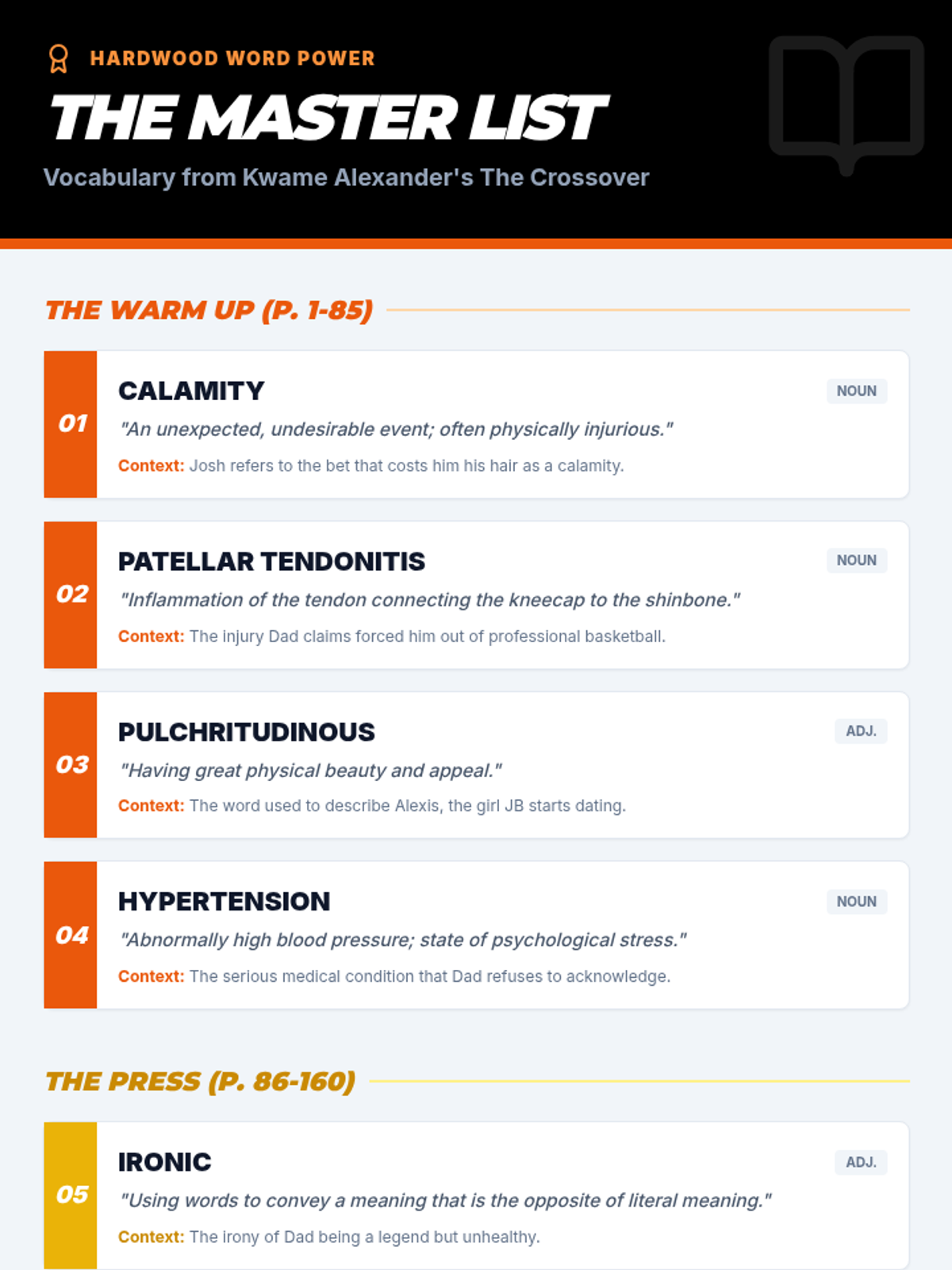
A comprehensive vocabulary unit focusing on twenty sophisticated literary terms, including altruistic, quarantine, conscientious, wizened, meek, reminisce, dissipate, solemn, assess, unison, agitated, defiance, grandeur, ailing, benediction, veritable, notorious, incentive, delude, and precede.