Peer relationship navigation, conversational turn-taking, and stress management strategies within supportive group settings. Develops communal belonging through shared mental health education and collaborative skill practice.
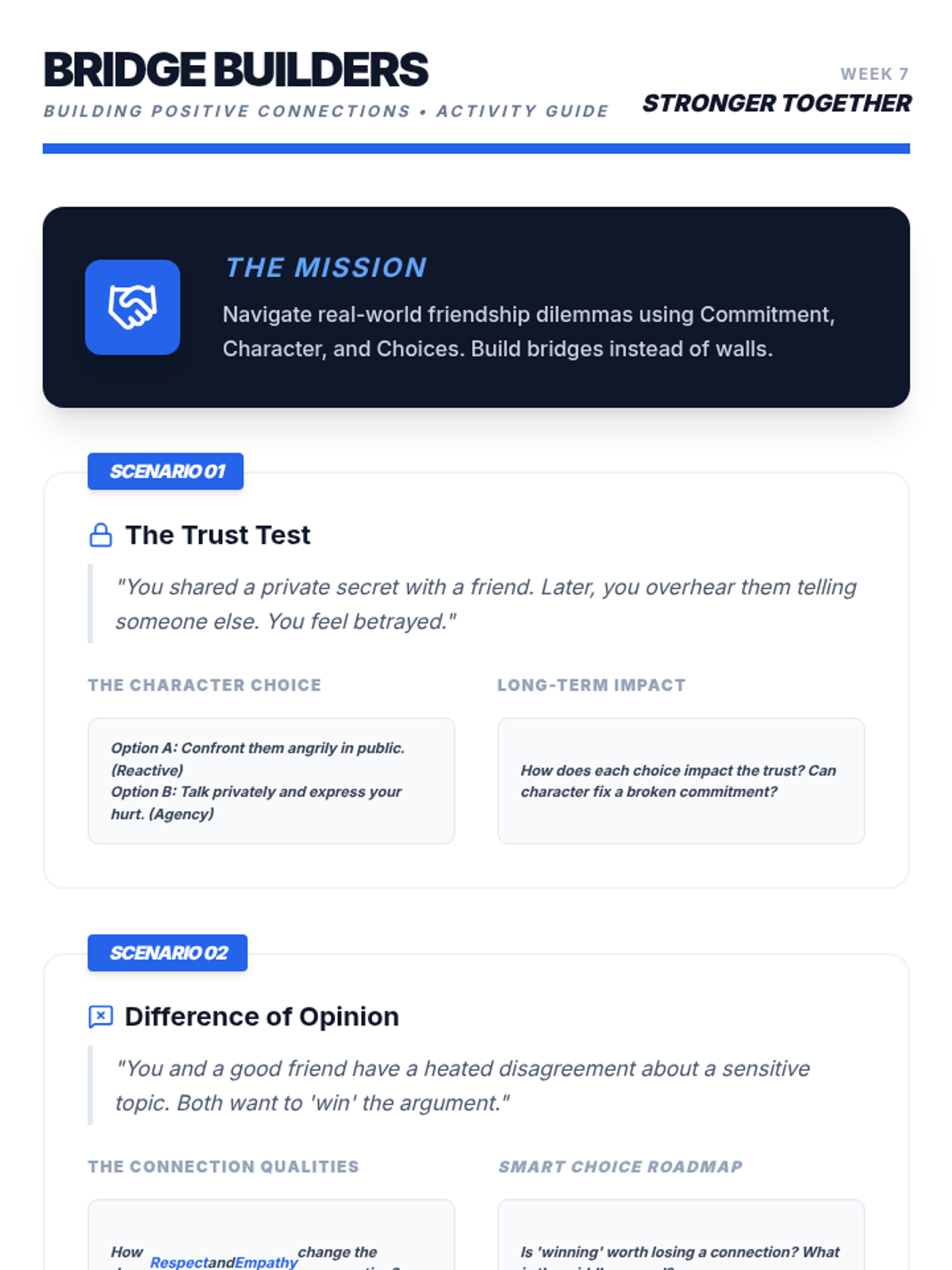
Facilitator guide for the Positive Connections Activity, where students discuss scenarios related to friendship challenges and communication.
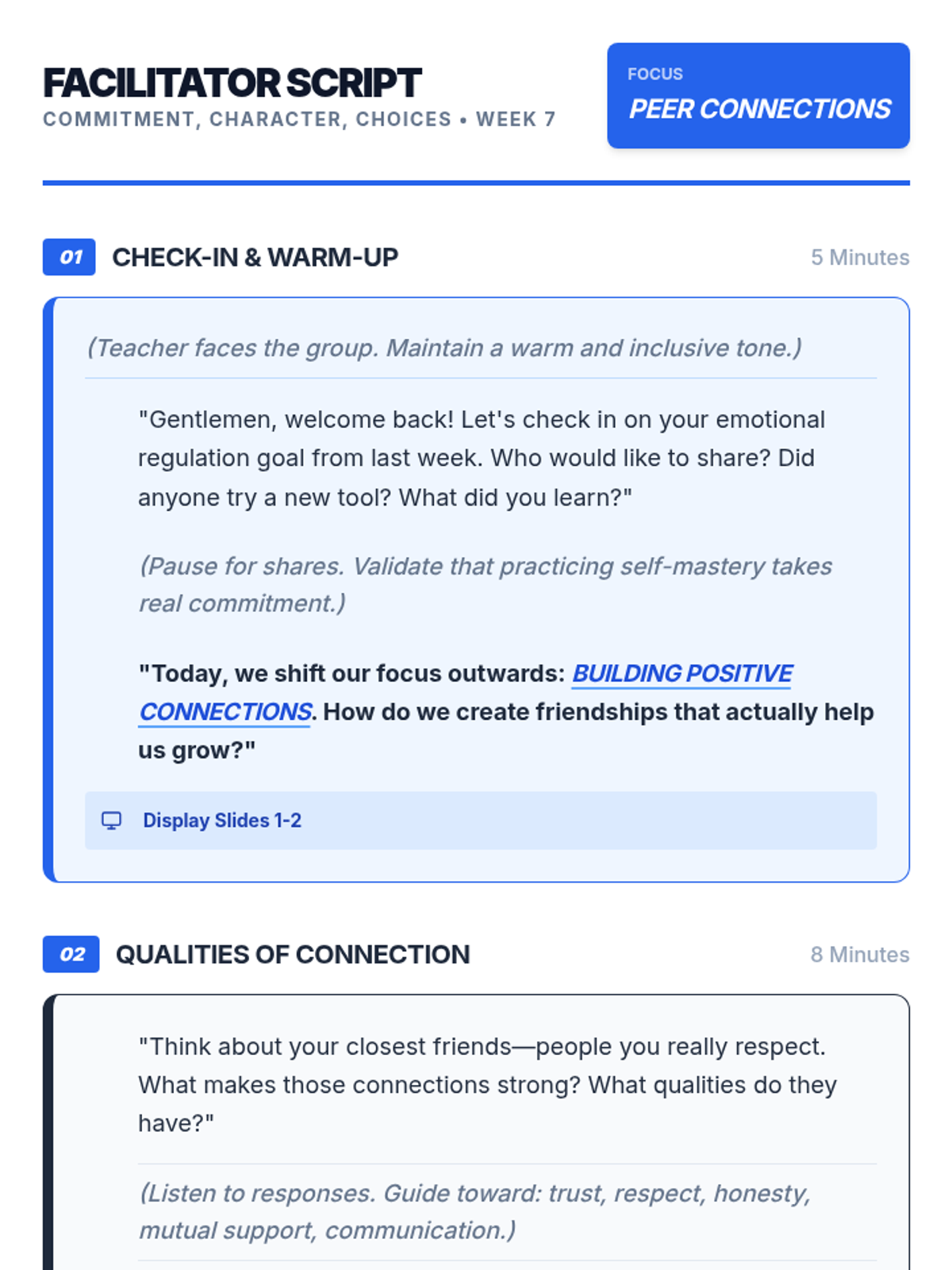
Facilitator script for Week 7 of the Commitment, Character, Choices program, including transition cues and suggested phrasing for all activities.
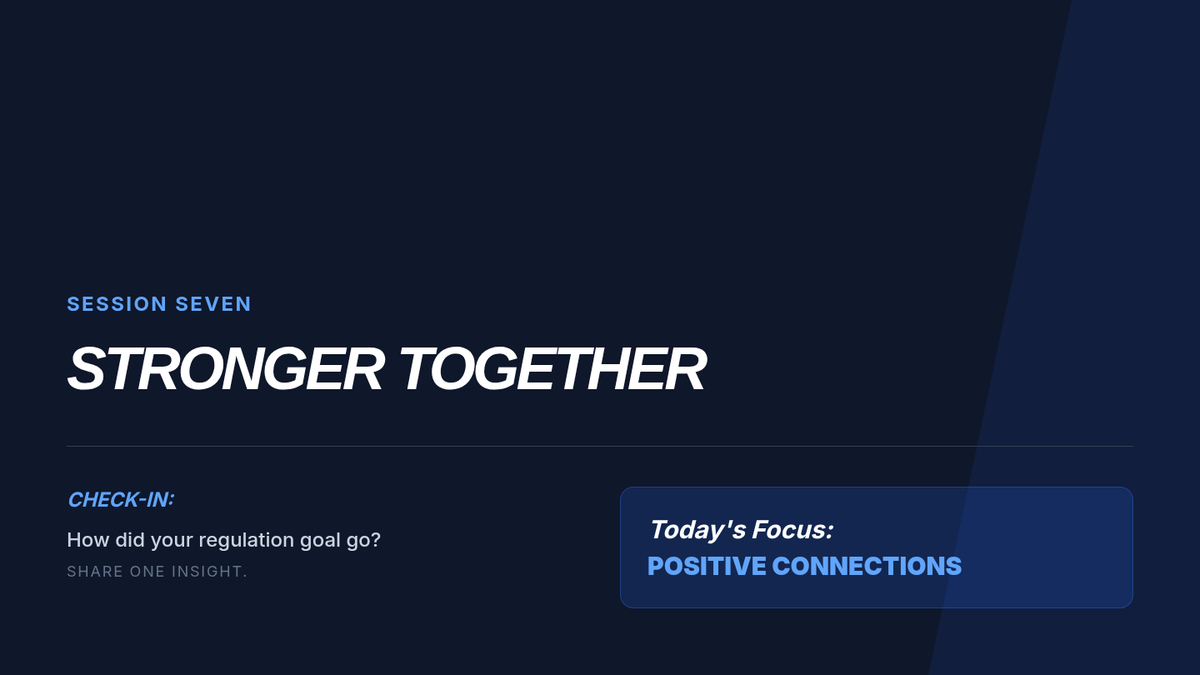
Introductory presentation for Week 7, covering the qualities of positive peer relationships, practice communication skills, and strategies for building supportive connections.
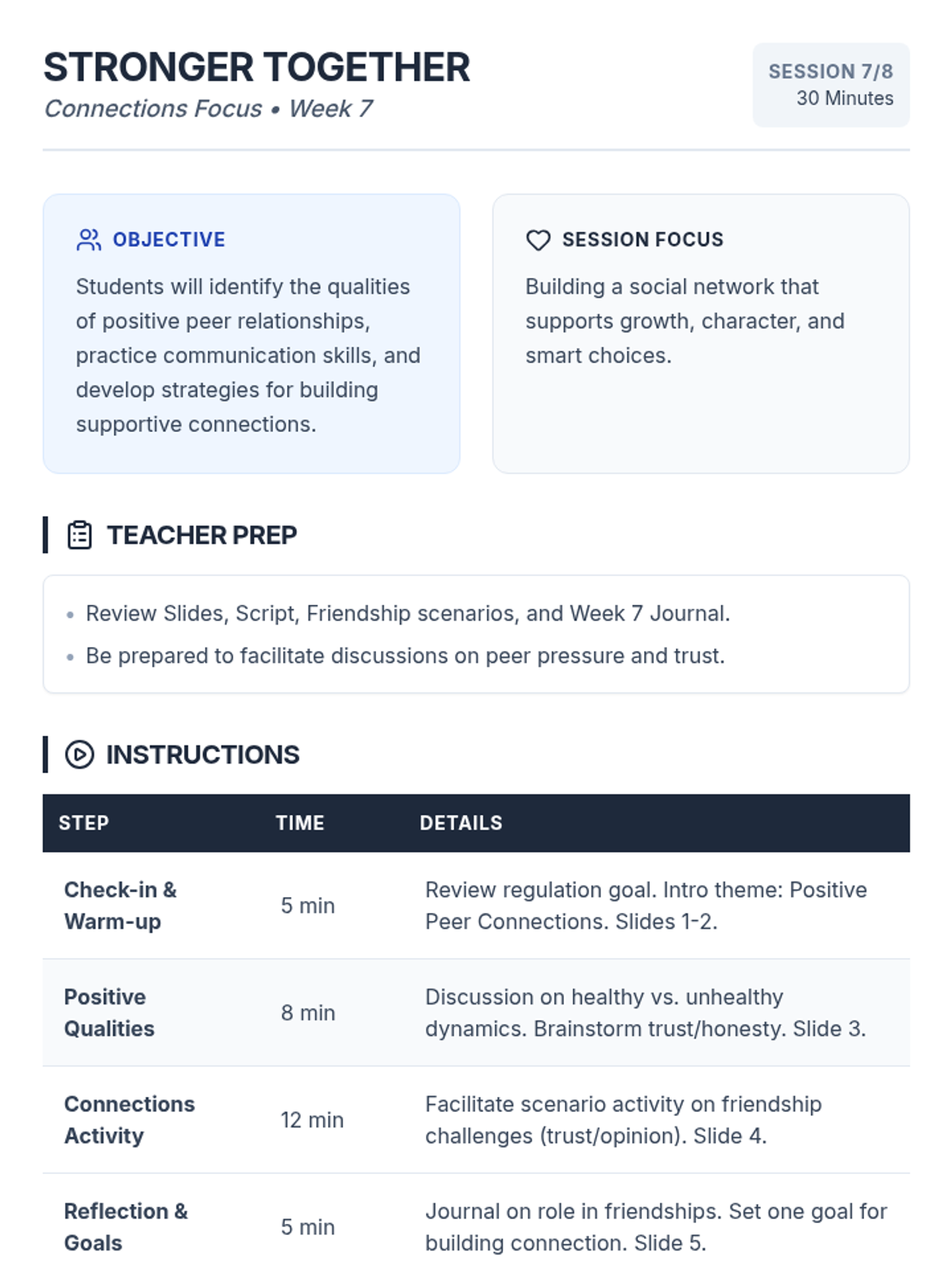
Facilitator guide for Week 7 of the Commitment, Character, Choices program, outlining objectives, materials, and step-by-step instructions.
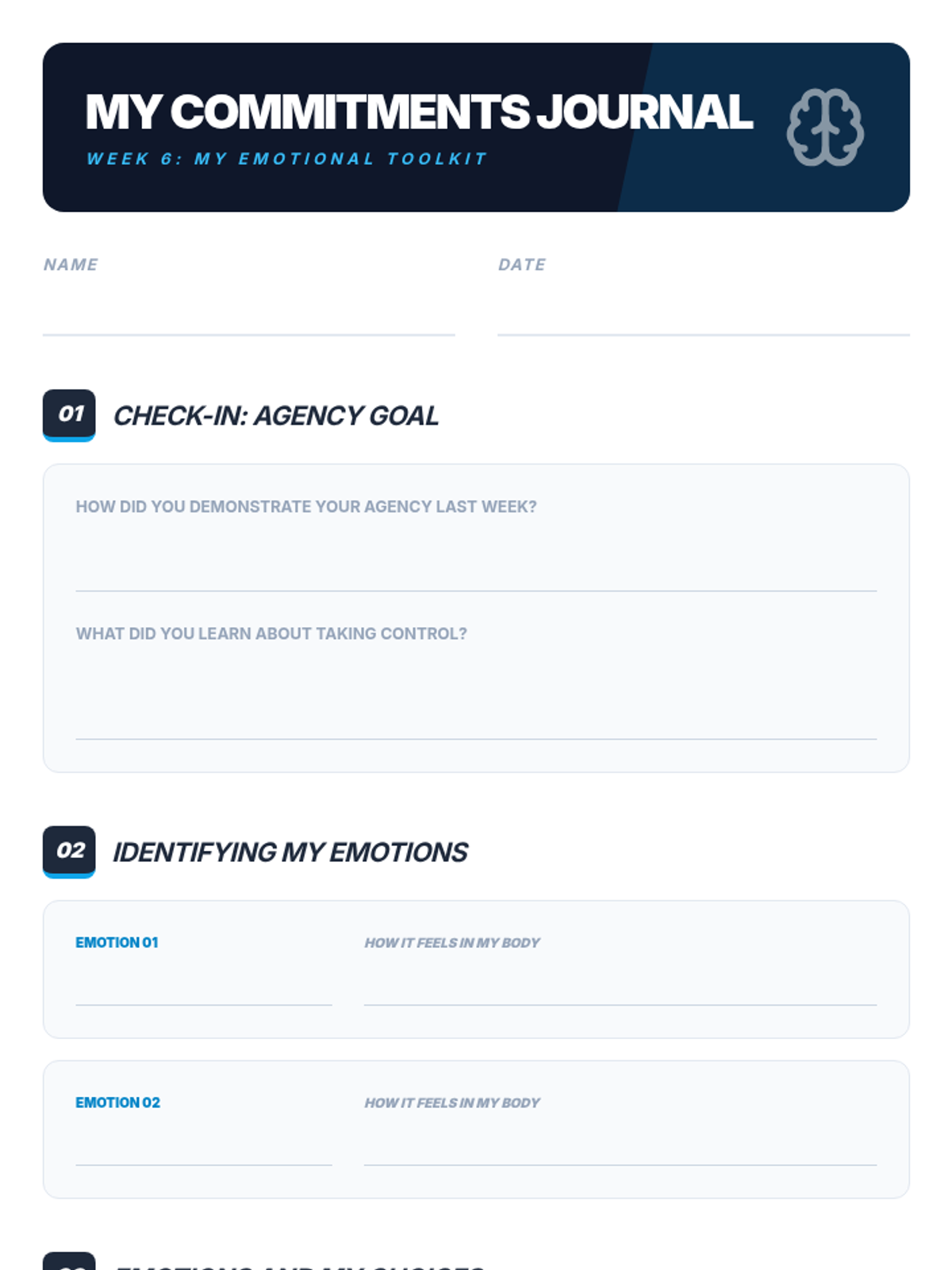
Student journal for Week 6, providing reflection prompts on identifying emotions and developing coping strategies.
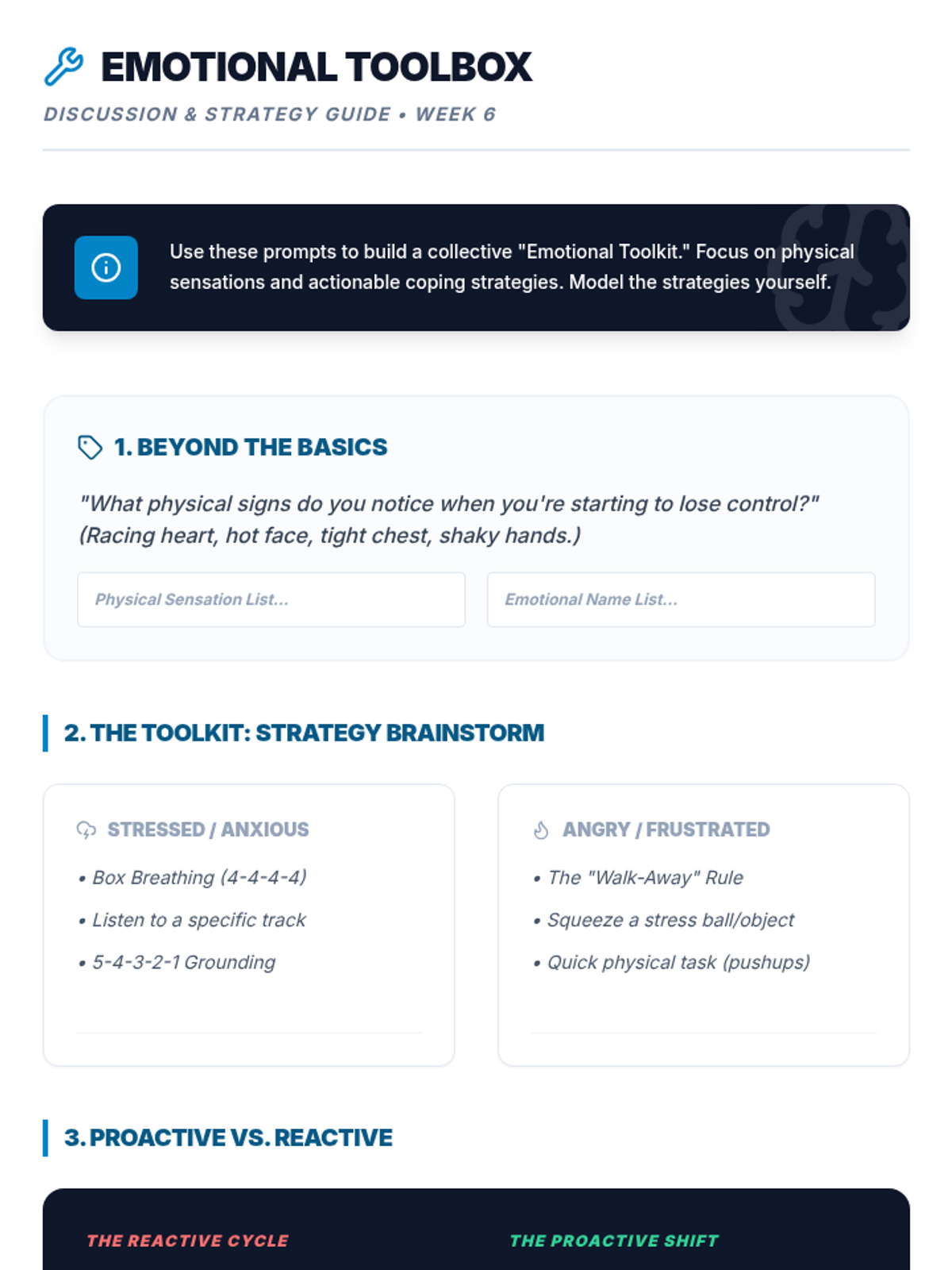
Facilitator guide for identifying emotions and developing coping strategies during the sixth week of the program.
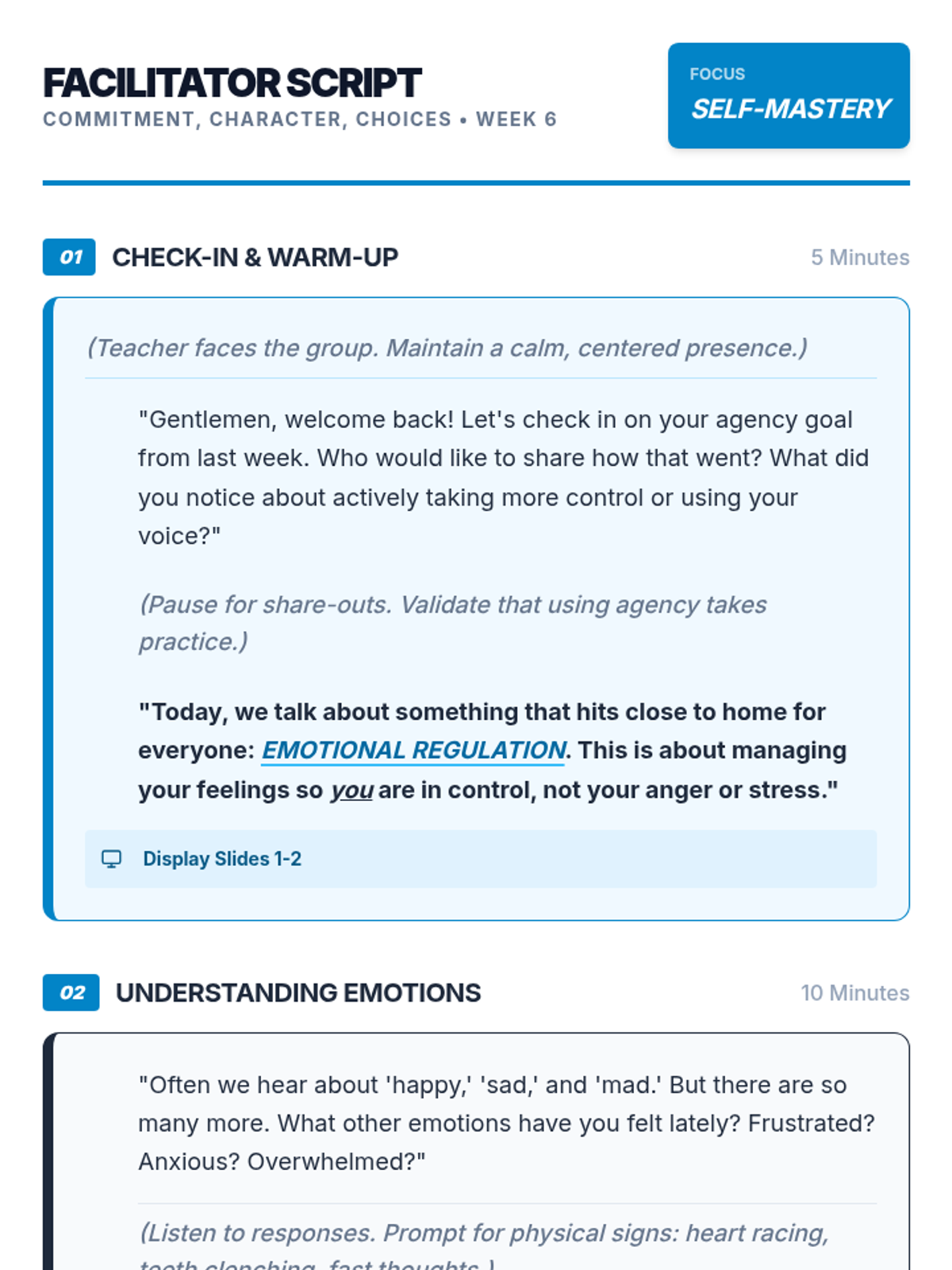
Facilitator script for Week 6 of the Commitment, Character, Choices program, including transition cues and suggested phrasing for all activities.
Introductory presentation for Week 6, covering identifying emotions, the impact on choices, and healthy coping strategies.
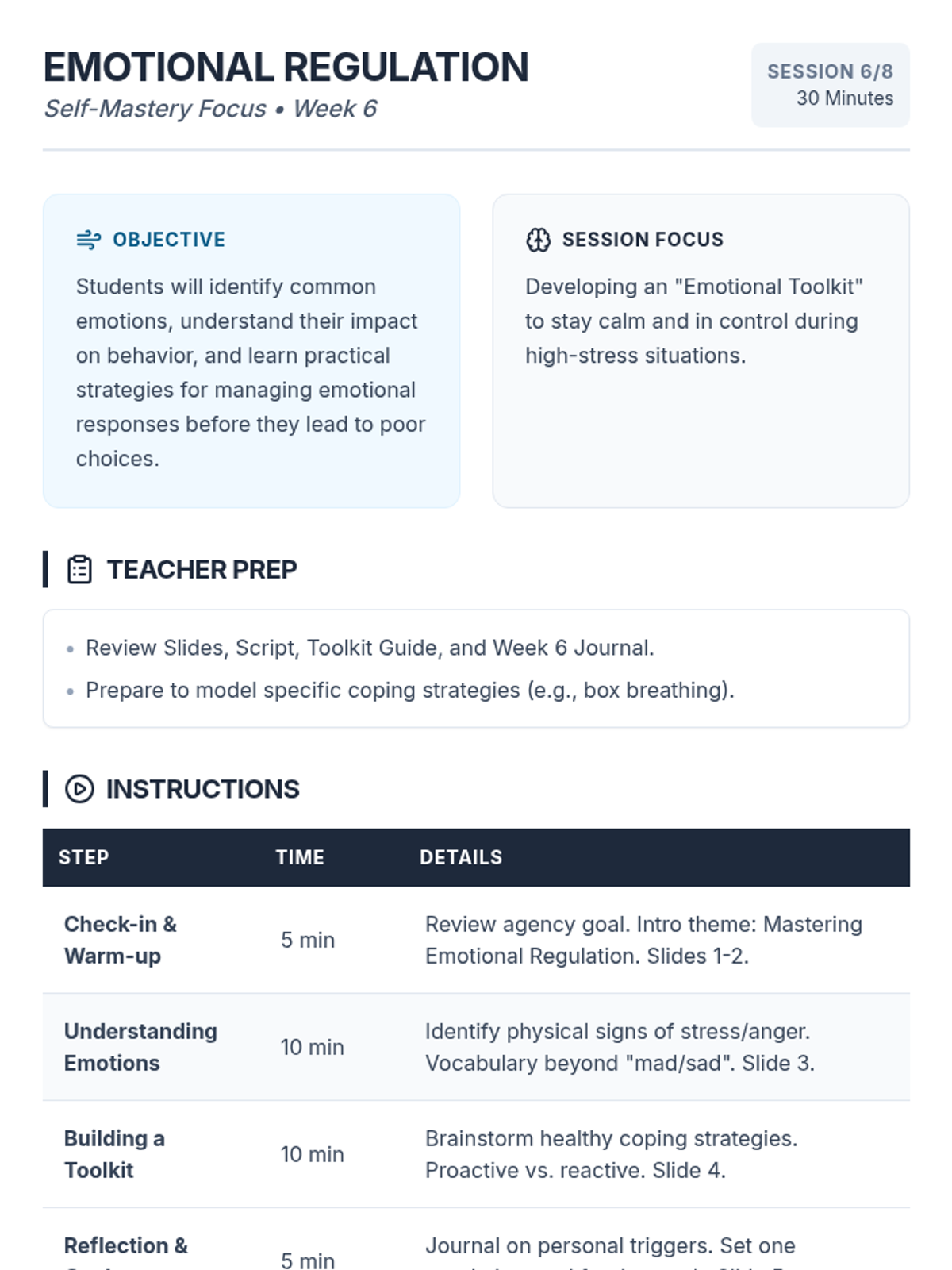
Facilitator guide for Week 6 of the Commitment, Character, Choices program, outlining objectives, materials, and step-by-step instructions.
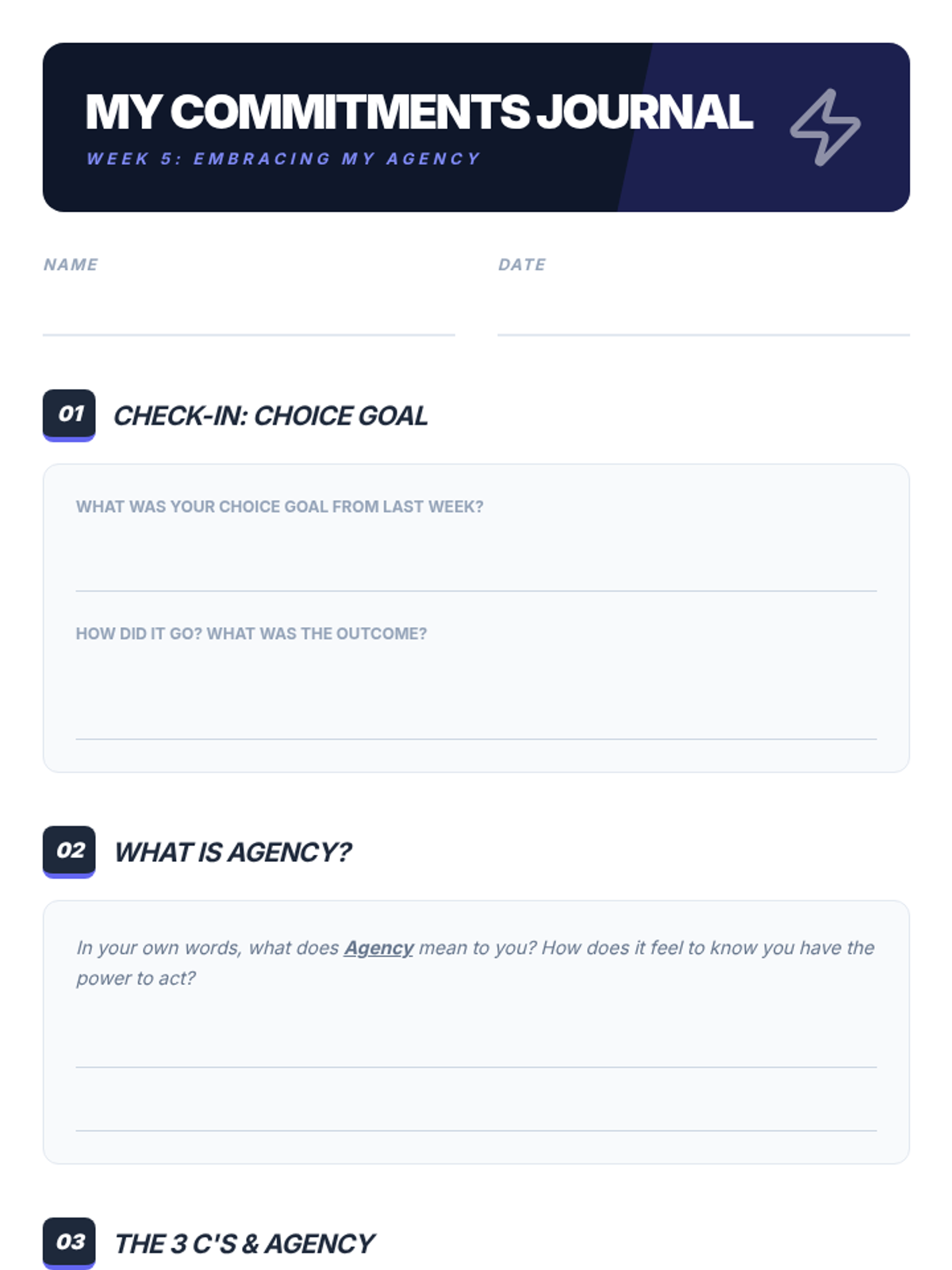
Student journal for Week 5, providing reflection prompts on agency and how it connects to the 3 C's.
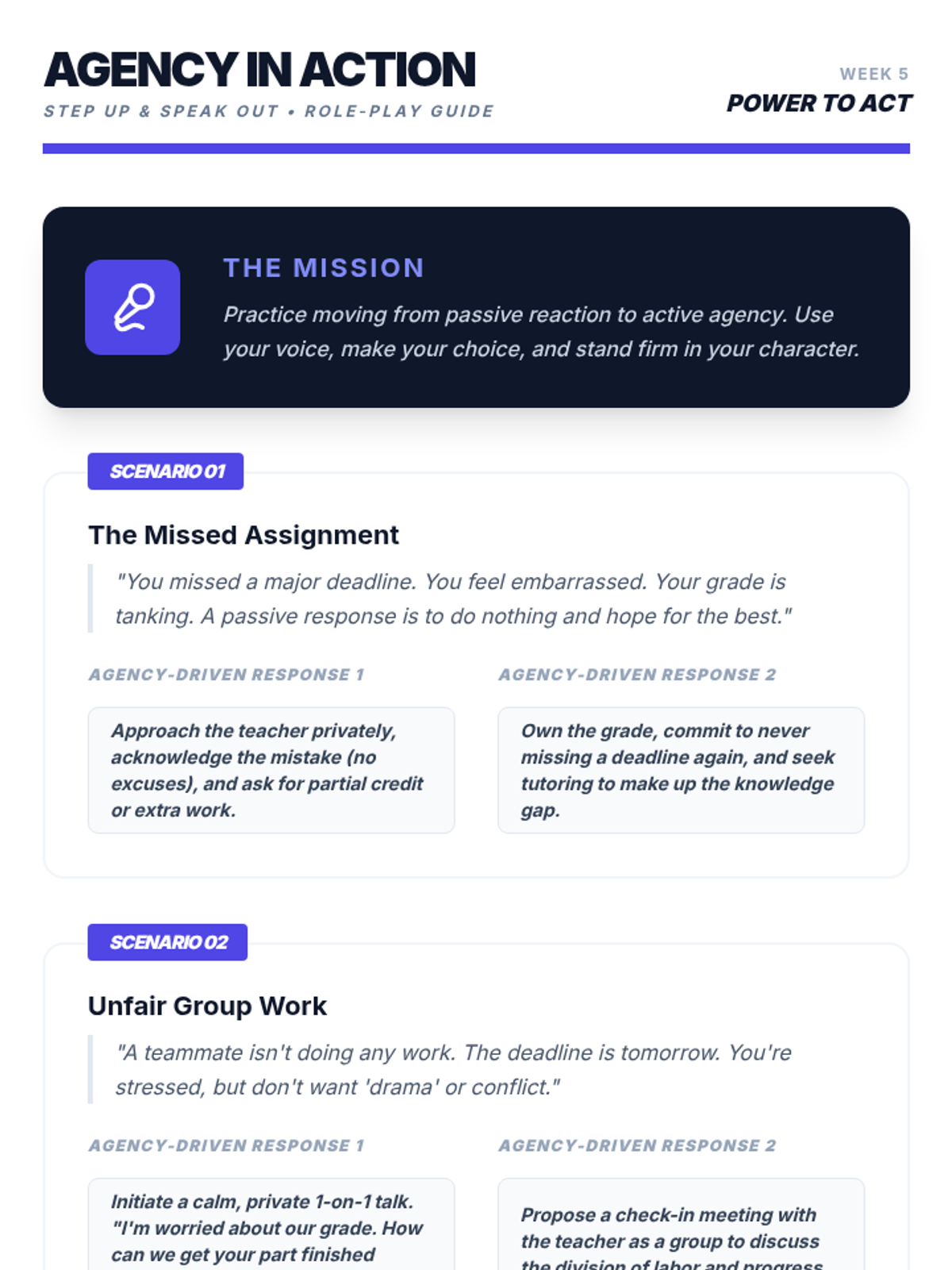
Facilitator guide for the Agency Role-Play Activity, where students practice exercising agency in challenging situations.
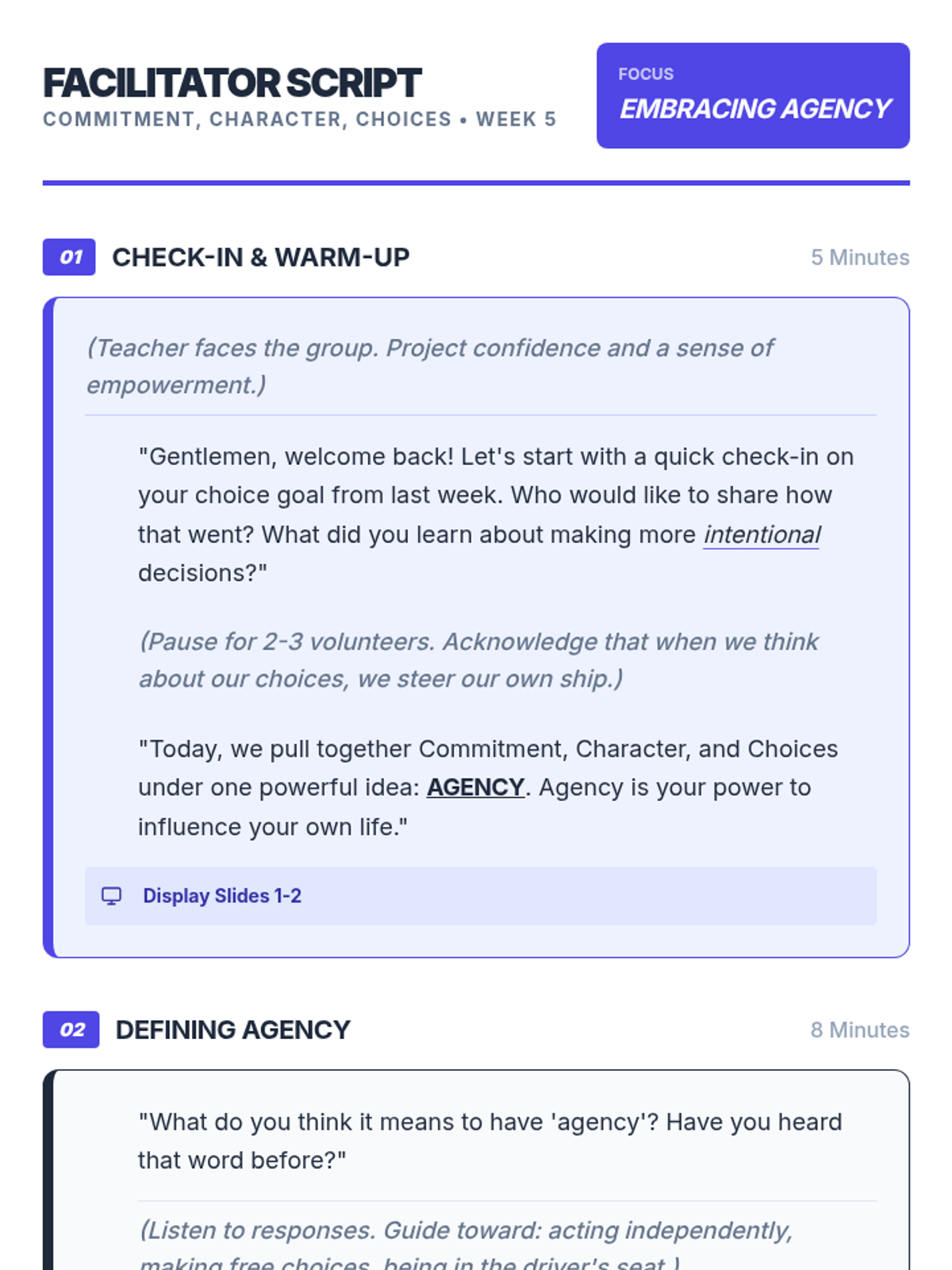
Facilitator script for Week 5 of the Commitment, Character, Choices program, including transition cues and suggested phrasing for all activities.
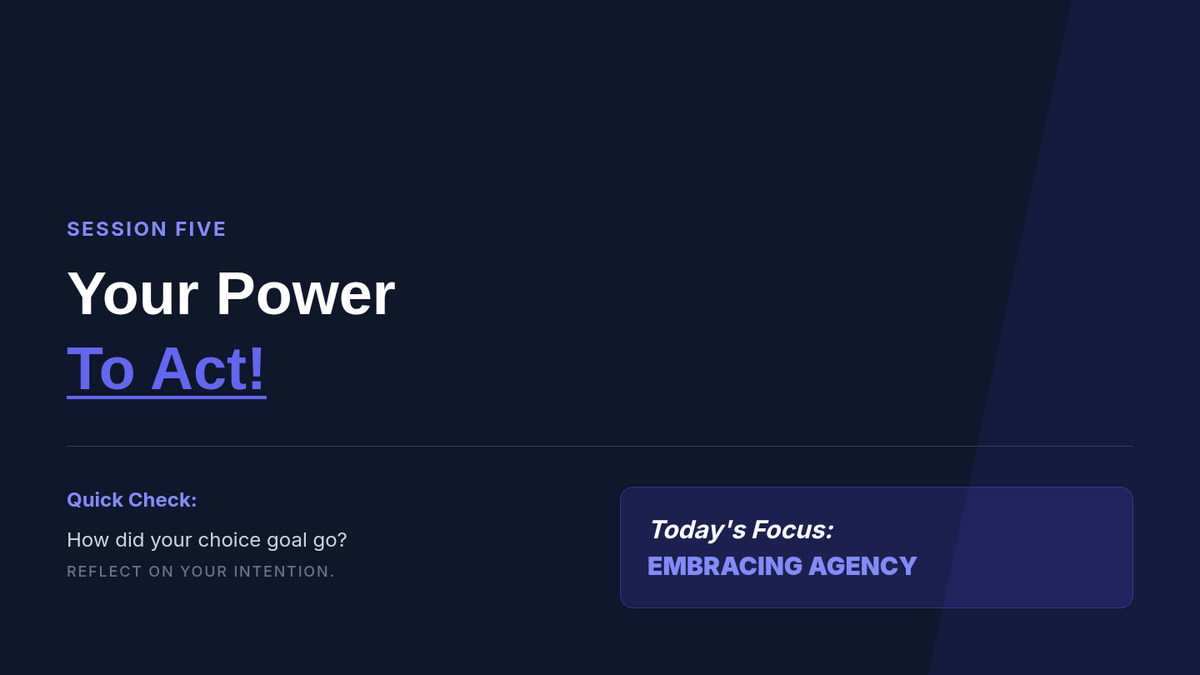
Introductory presentation for Week 5, covering the concept of agency, connecting it to the 3 C's, and practicing ownership.
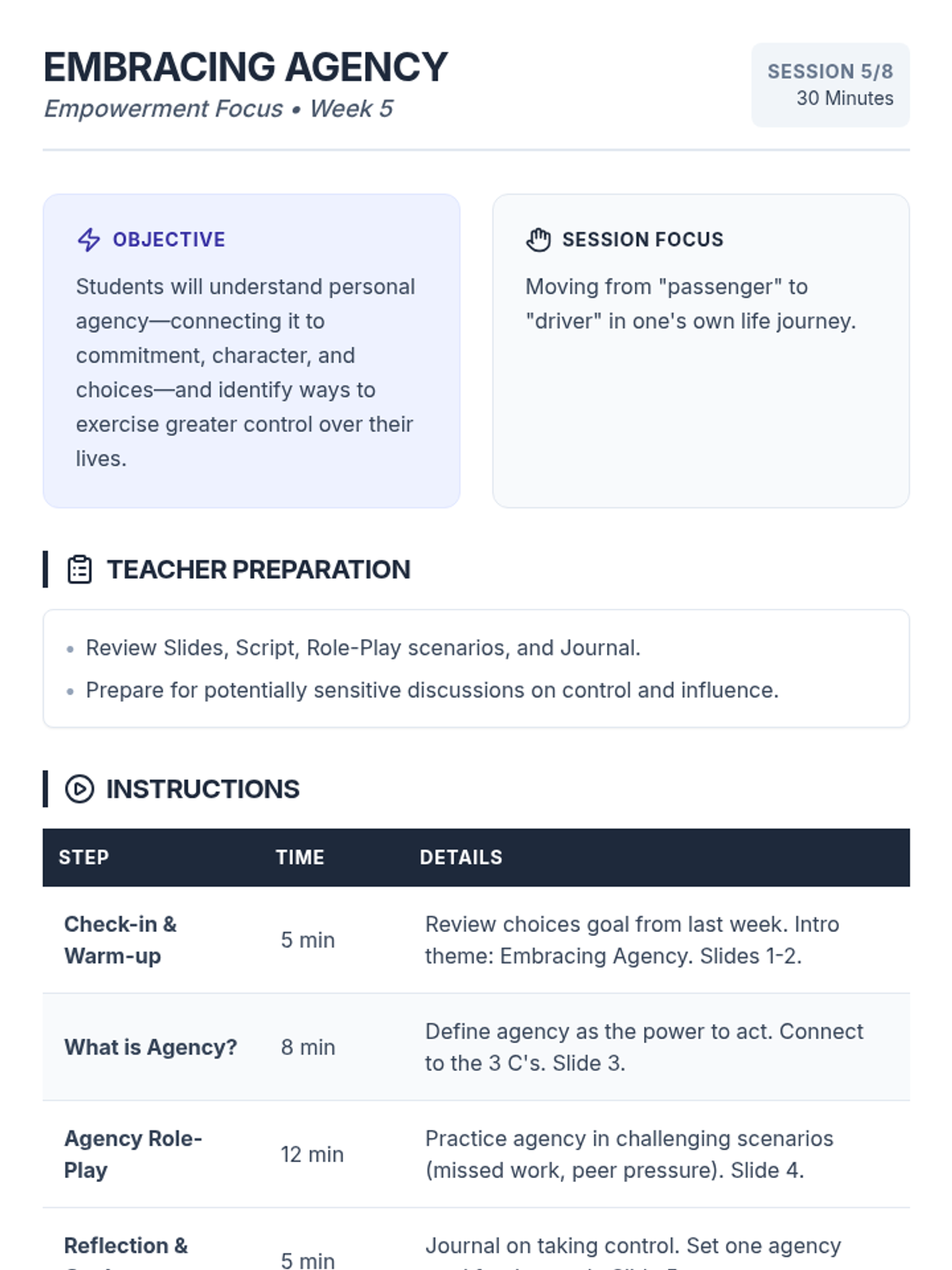
Facilitator guide for Week 5 of the Commitment, Character, Choices program, outlining objectives, materials, and step-by-step instructions.
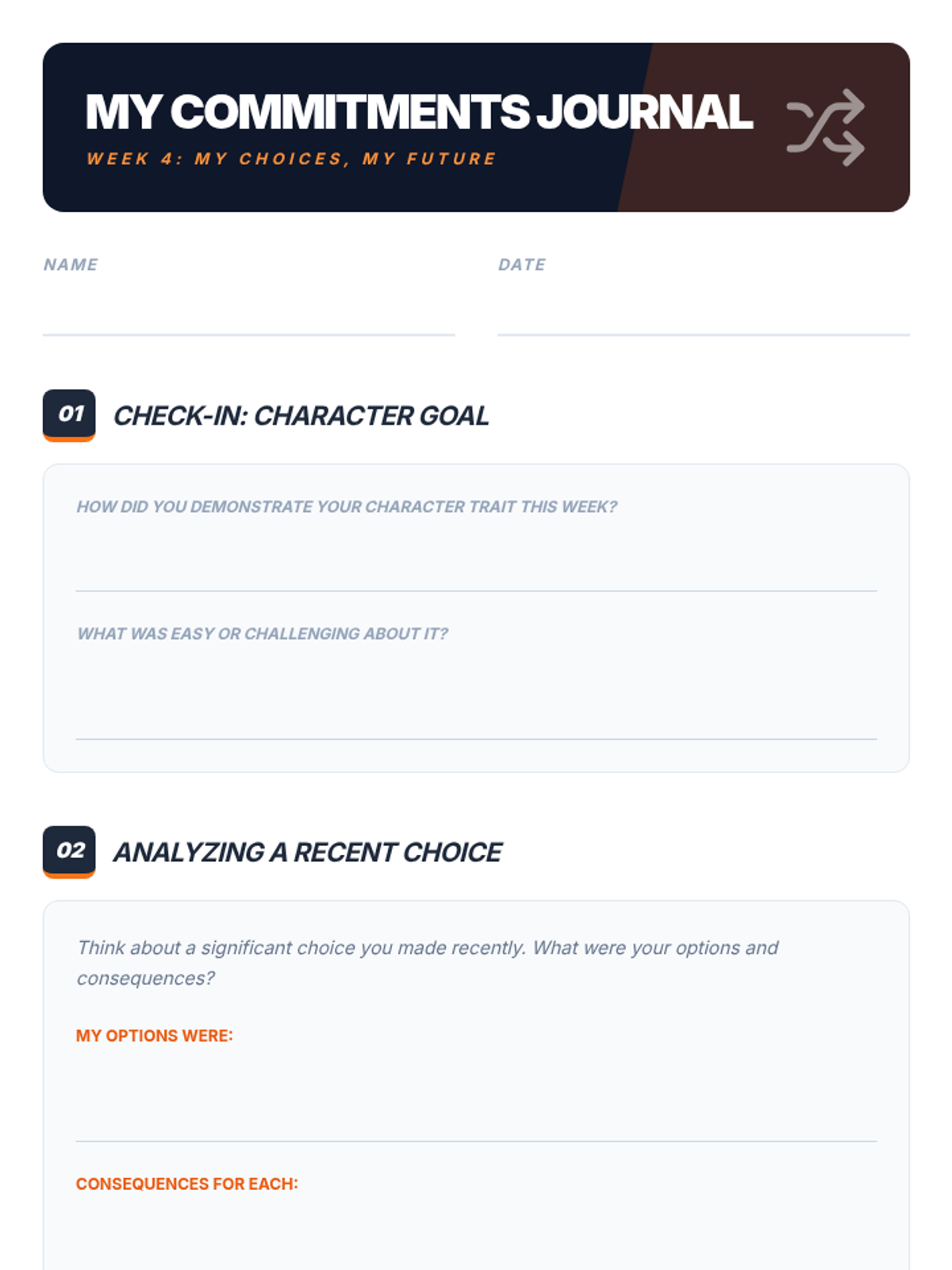
Student journal for Week 4, providing reflection prompts on recent choices and goal setting for intentional decision-making.
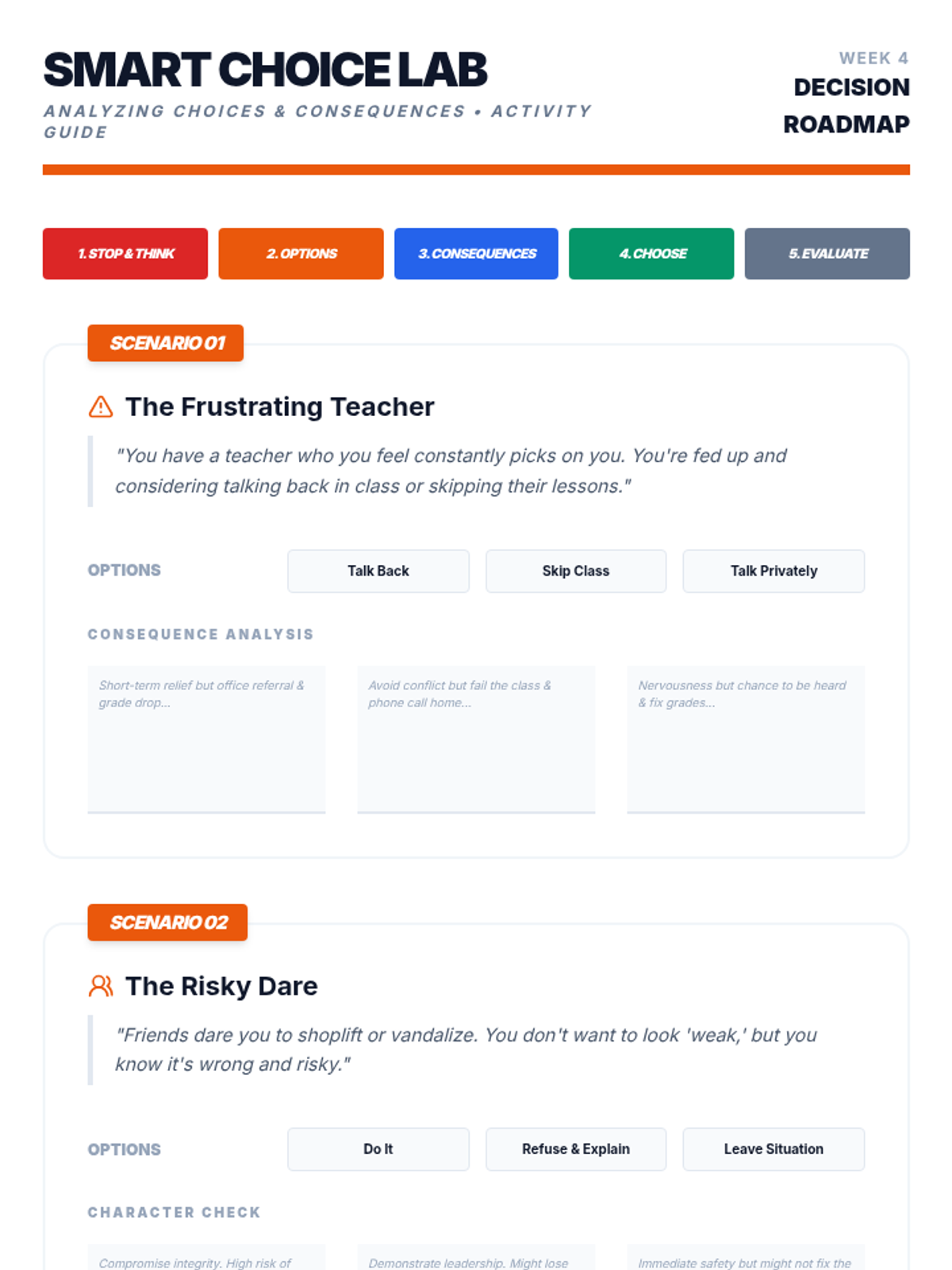
Facilitator guide for the Choice and Consequence Activity, where students analyze scenarios and predict outcomes.
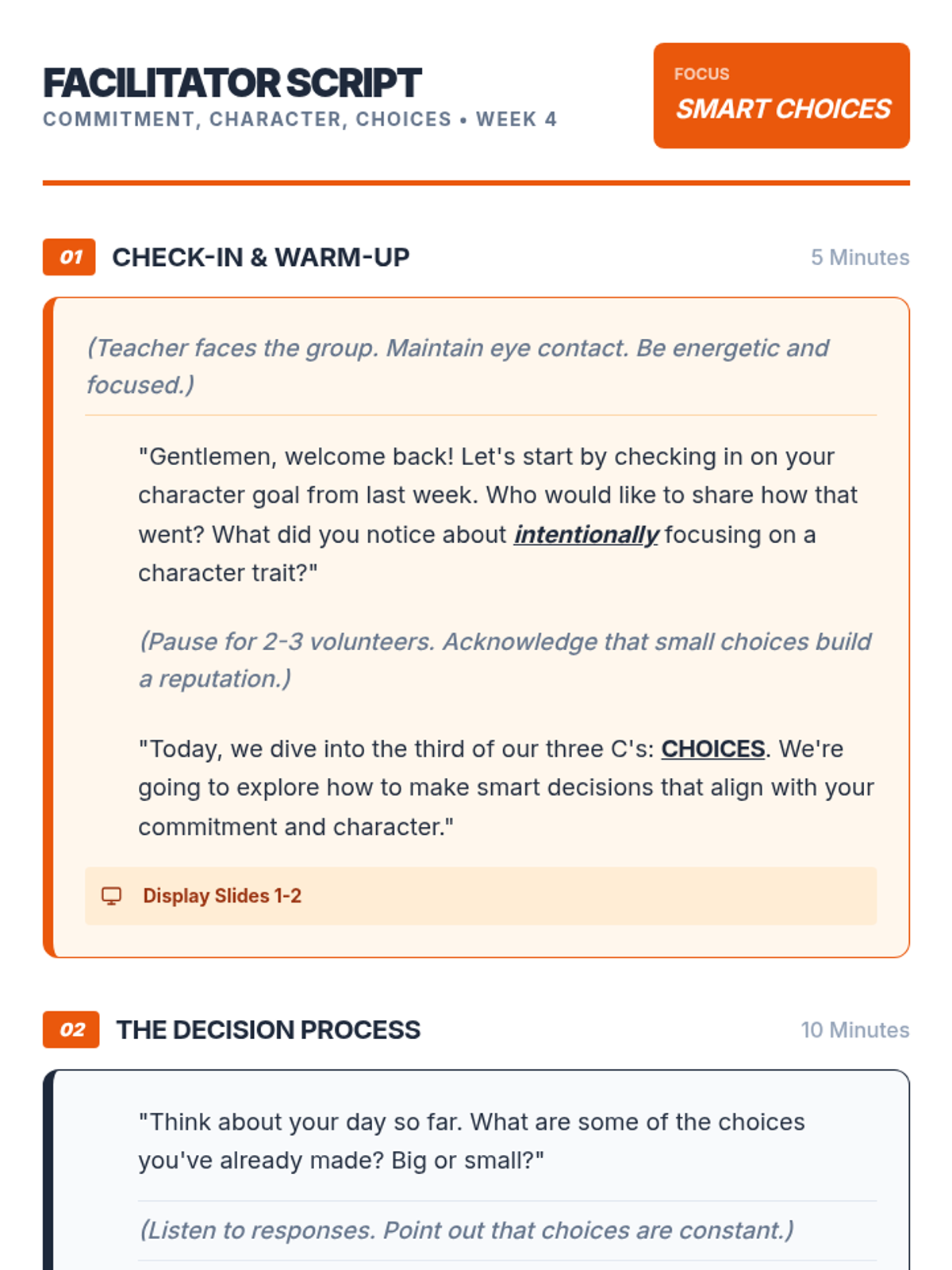
Facilitator script for Week 4 of the Commitment, Character, Choices program, including transition cues and suggested phrasing for all activities.
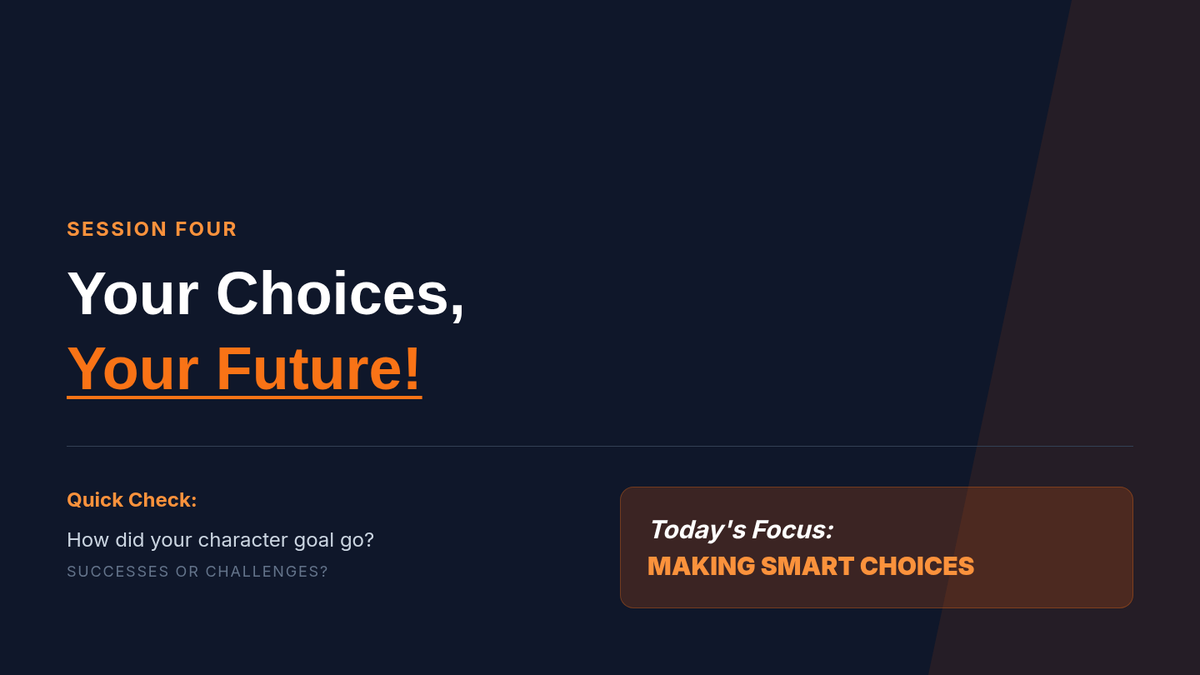
Introductory presentation for Week 4, covering the decision-making process, analyzing consequences, and making smart choices.
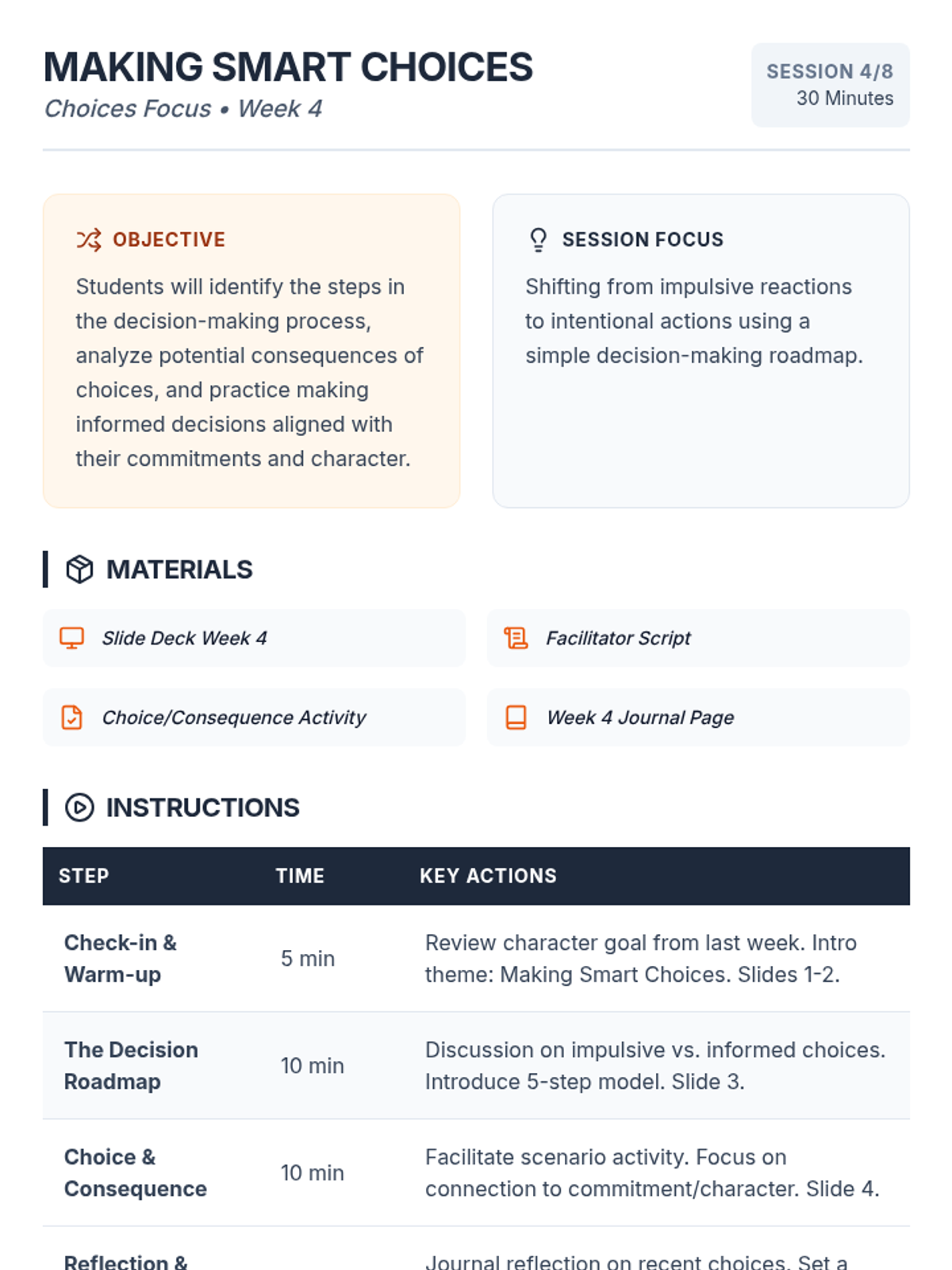
Facilitator guide for Week 4 of the Commitment, Character, Choices program, outlining objectives, materials, and step-by-step instructions.
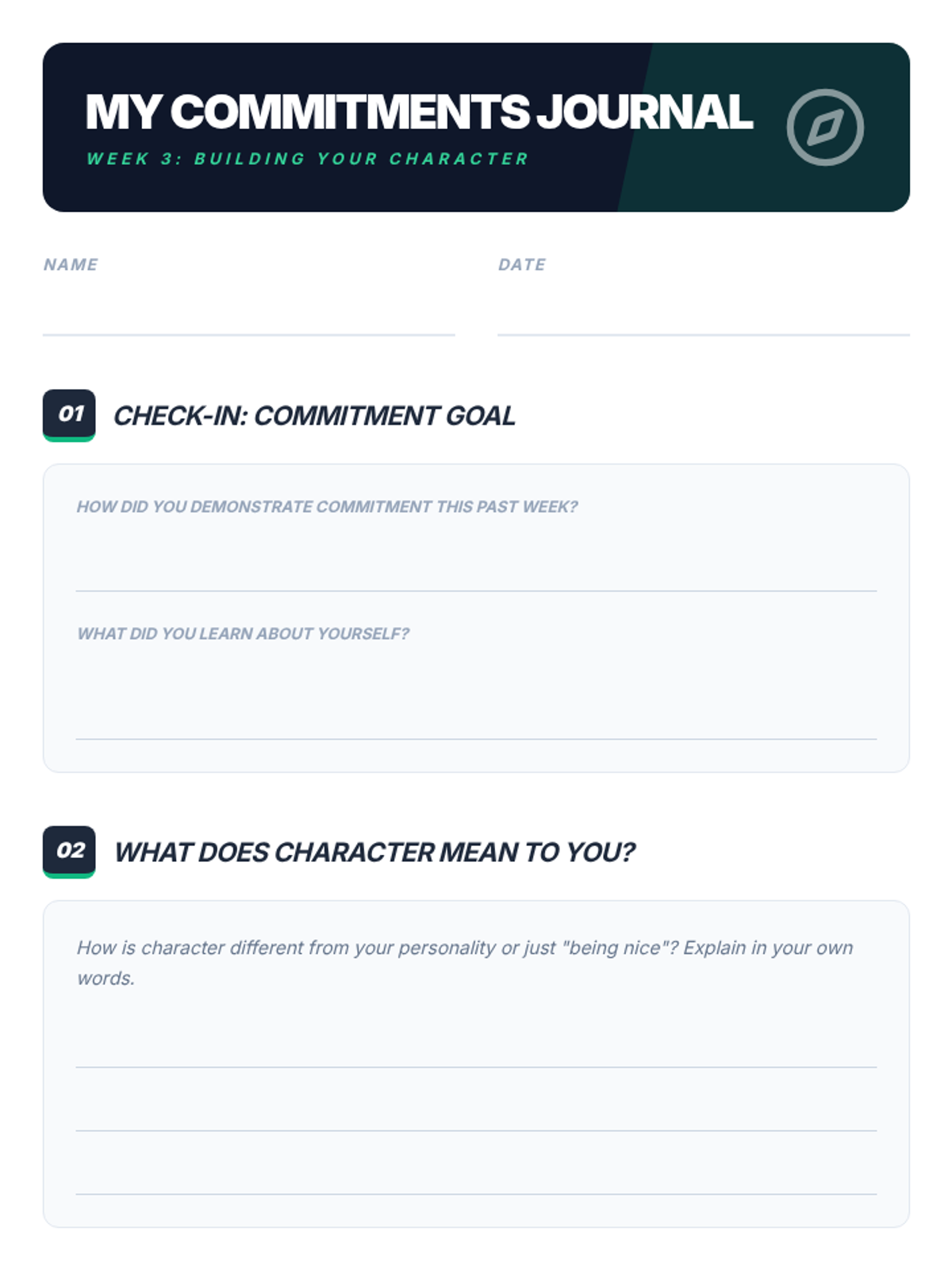
Student journal for Week 3, providing reflection prompts on character traits and personal values.
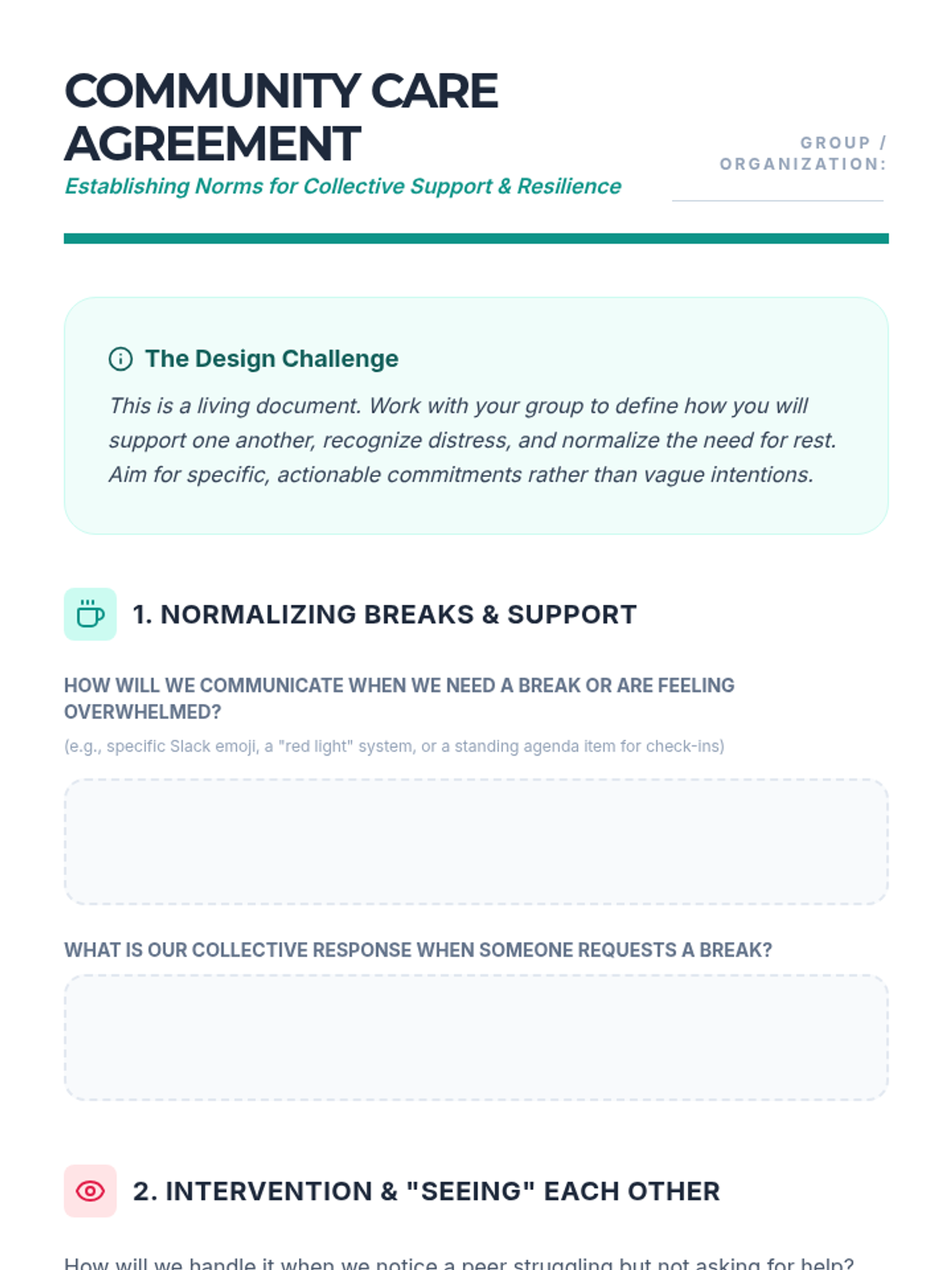
A design template for students to create a 'Community Care Agreement', establishing norms for mutual support, intervention strategies, and collective boundaries.
Slide deck for the 'Building Care Webs' lesson, introducing the concept of collective care vs. self-care and providing a framework for creating Community Care Agreements.
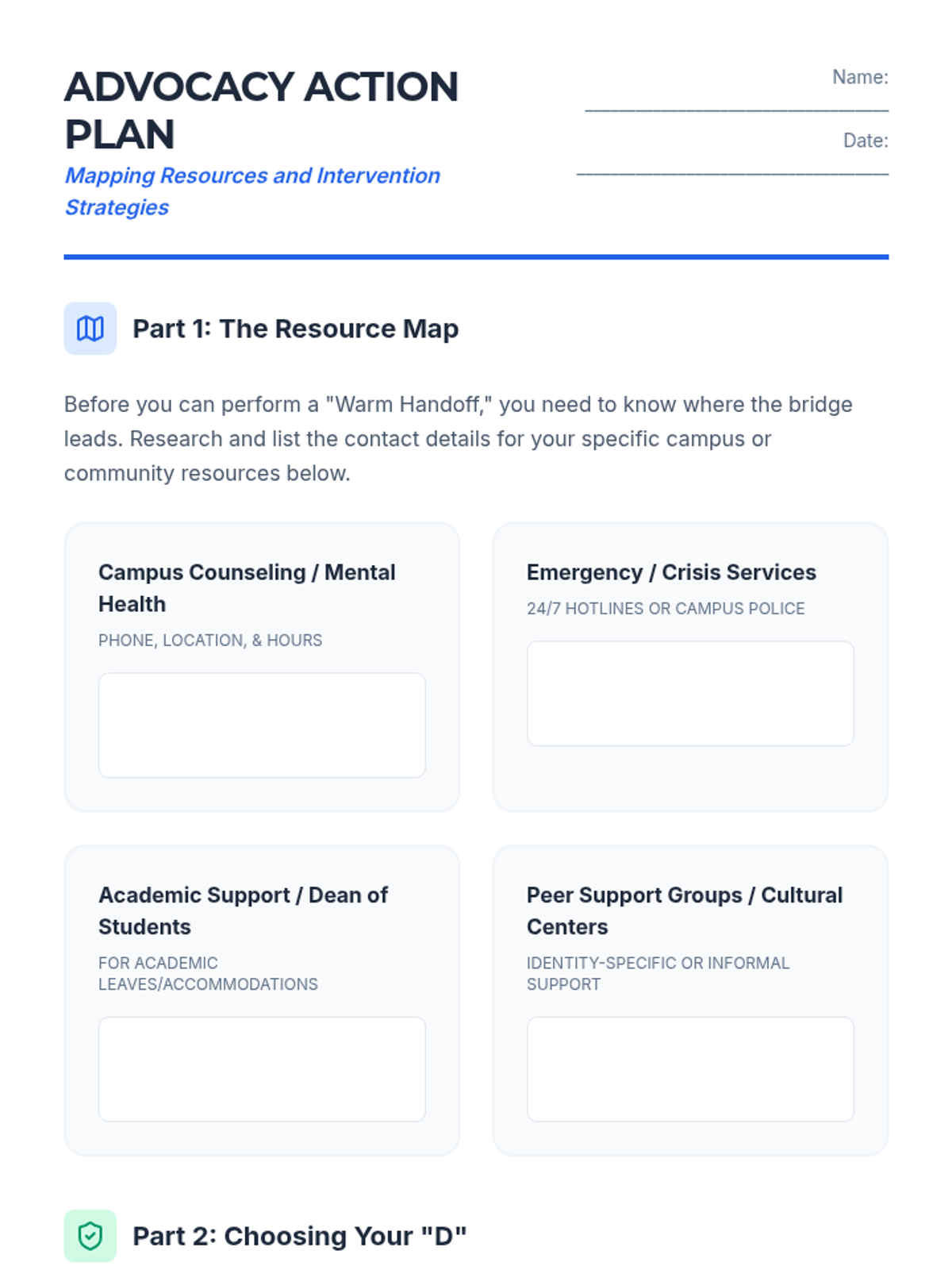
A student worksheet for mapping local mental health resources and practicing the 5Ds of intervention in a specific peer-distress scenario.
Slide deck for 'Mental Health Advocacy', covering the bystander effect, the 5Ds of intervention strategies, and the 'Warm Handoff' technique for connecting peers to professional resources.
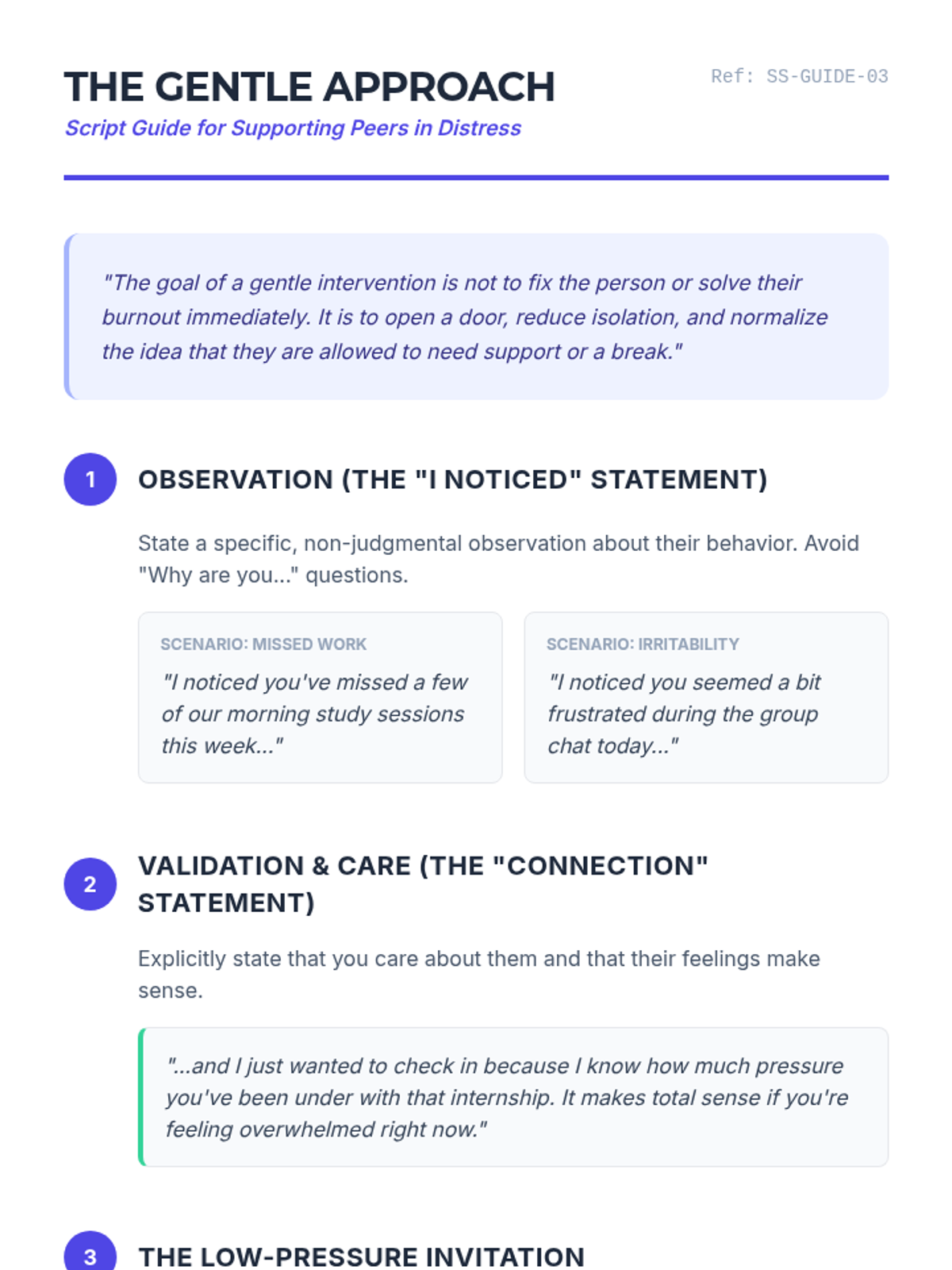
A script-building guide for students to practice the 'Gentle Approach' to intervention, providing specific phrasing for observations, validation, and low-pressure invitations.
Slide deck for 'Spotting the Signs', covering the three dimensions of burnout (Exhaustion, Cynicism, Inefficacy), behavioral red flags, and the three-step 'Gentle Approach' for intervention.
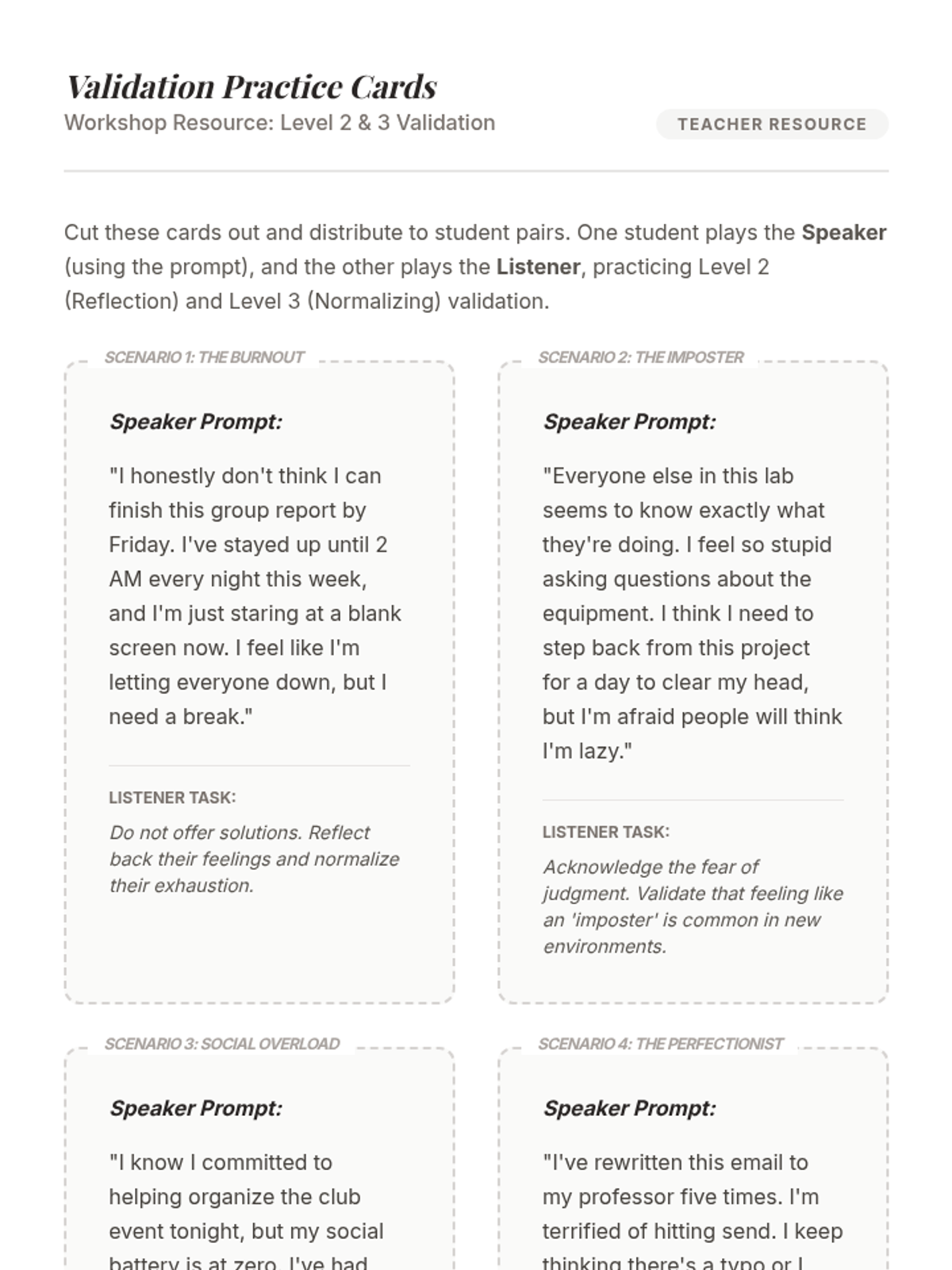
Scenarios and facilitator notes for the active listening workshop, providing students with structured practice in emotional validation and 'holding space' for peers in distress.
Slide deck for the 'Holding Space Workshop' lesson, focusing on the distinction between problem-solving ('fixing') and emotional validation, and introducing the 3 levels of validation.
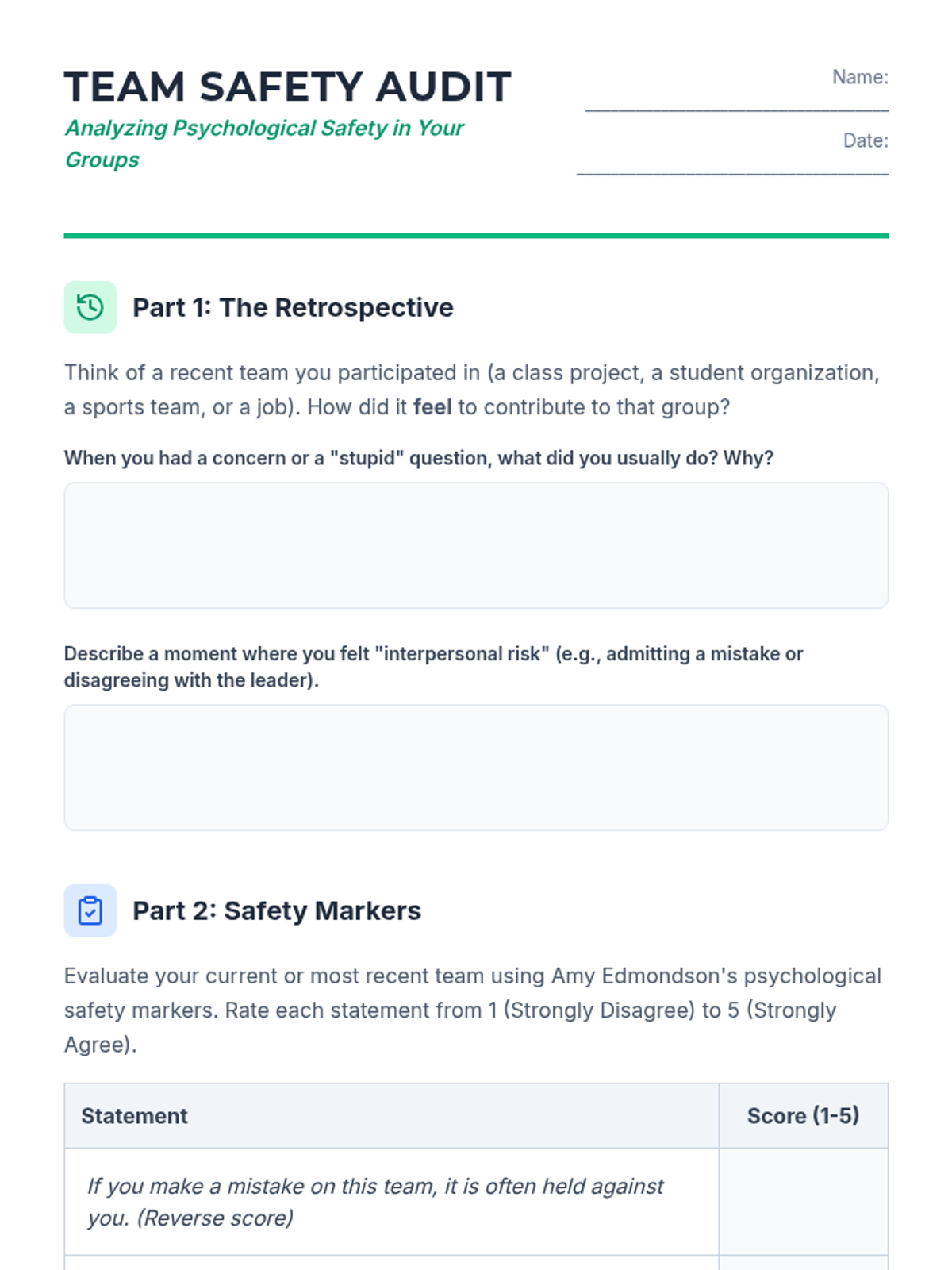
A reflection and audit worksheet for students to analyze the psychological safety of their own teams and identify barriers to requesting support.
Introductory slides for the 'Safe Spaces for Strong Teams' lesson, covering Google's Project Aristotle and the fundamental definition of psychological safety in group settings.
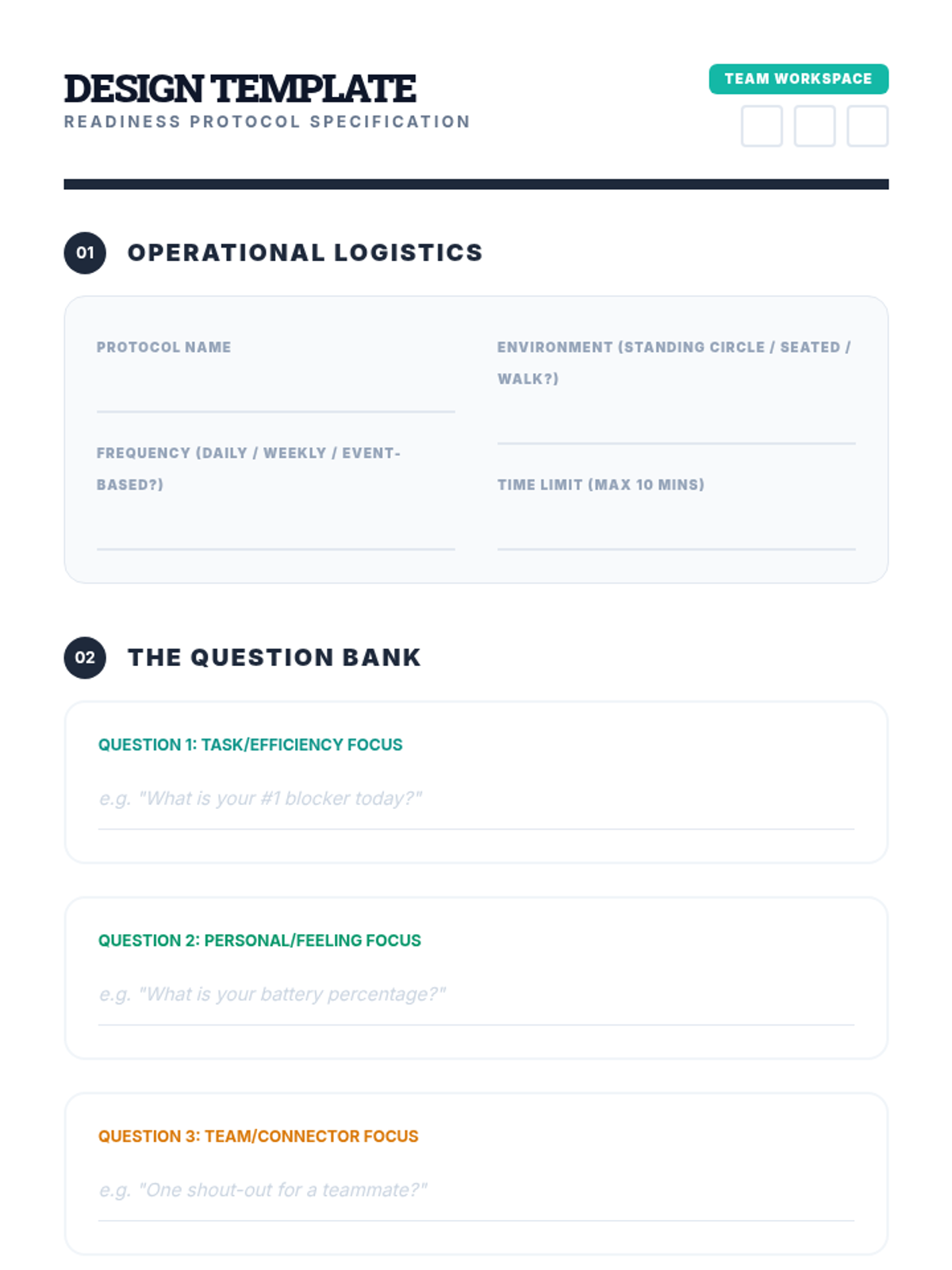
The project planning template for students to design their custom team protocol, including logistics, question banks, and escalation plans.
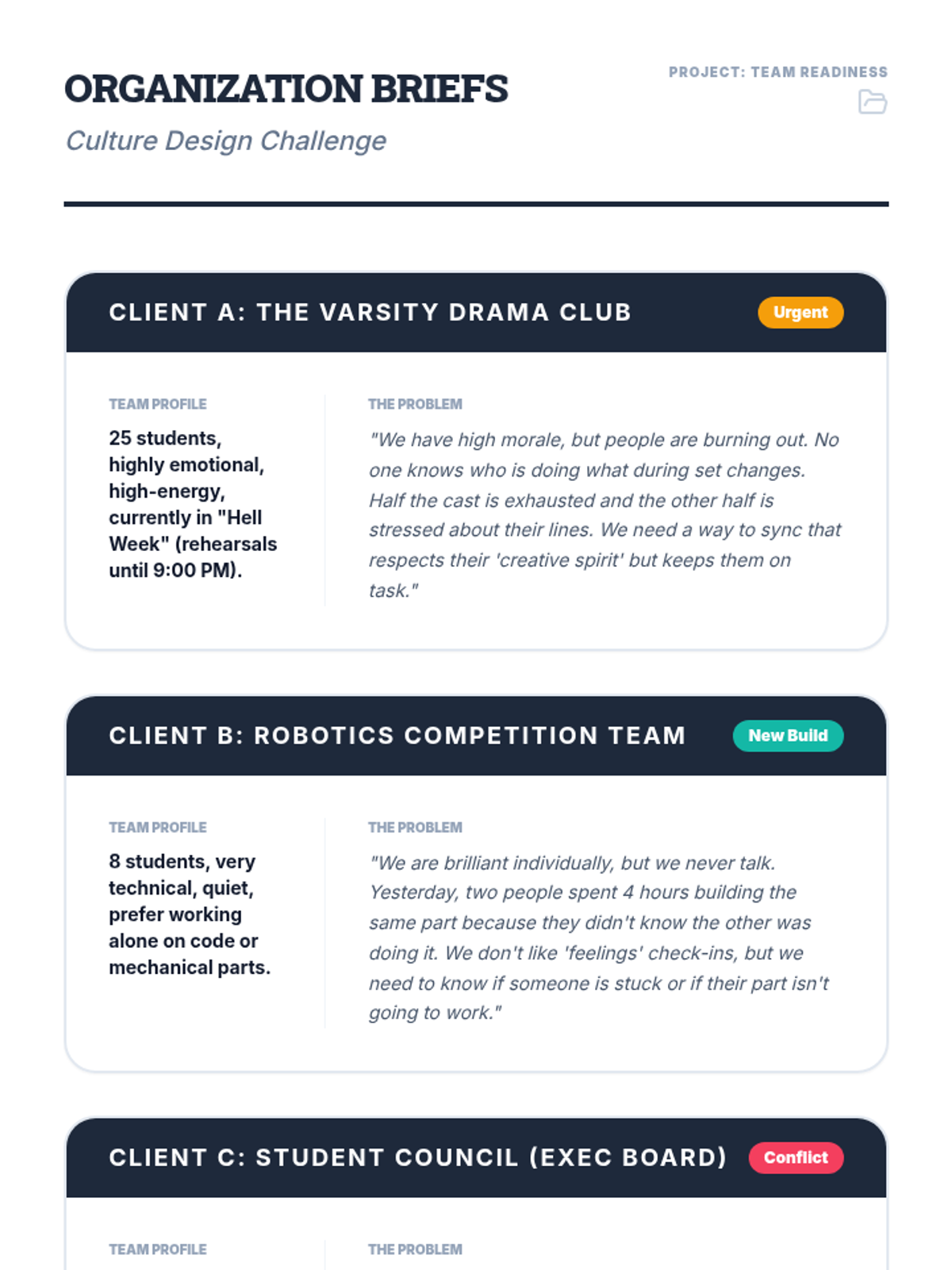
Client case study briefs for the final project, describing three different student organizations with unique team dynamic challenges.
Slide deck for the final project overview, detailing the "Culture Consultant" challenge and pitch requirements.
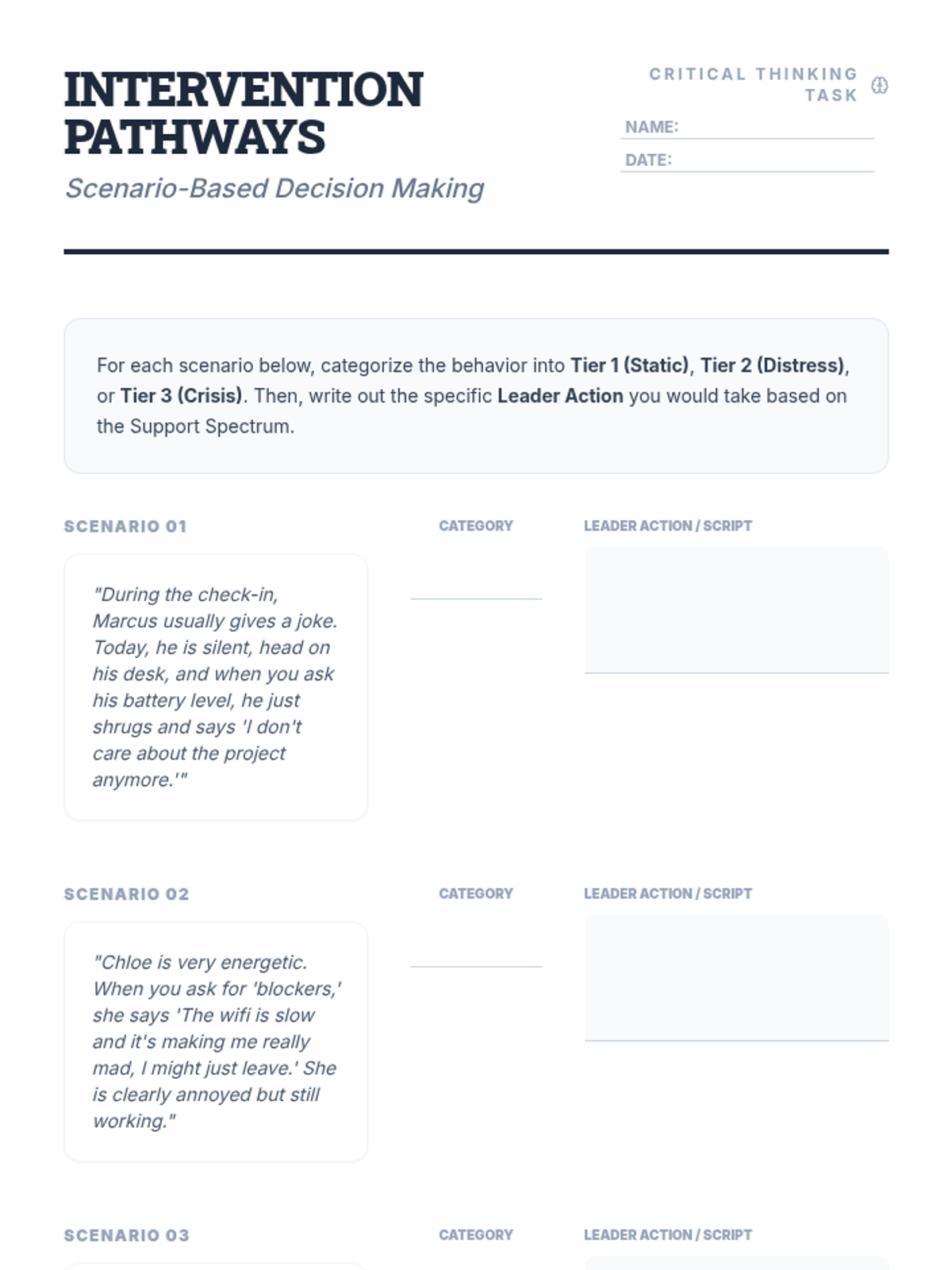
Worksheet for Lesson 4 where students analyze scenarios to determine the appropriate level of intervention and practice writing referral scripts.
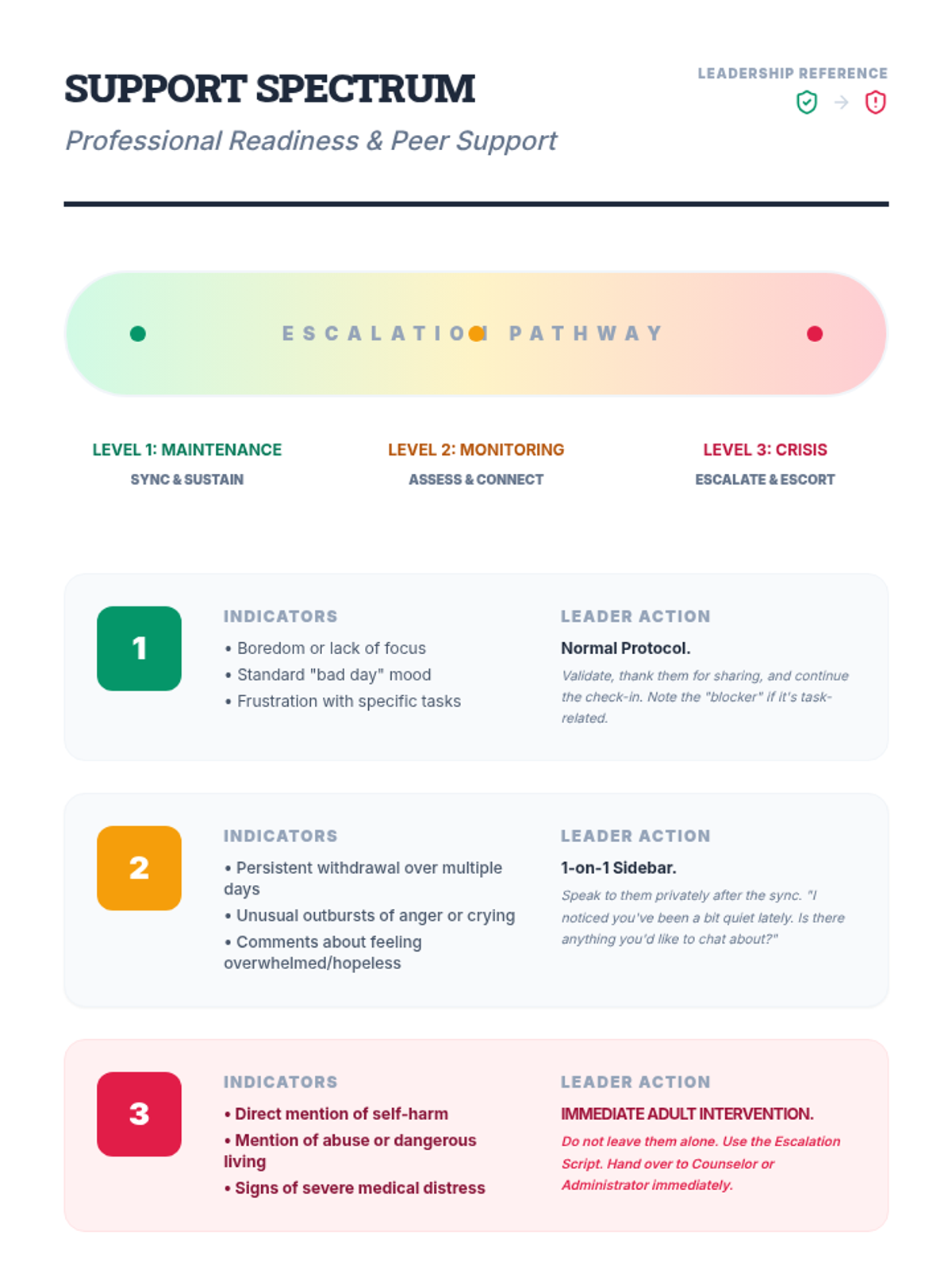
A visual guide and reference sheet for students to understand the different tiers of behavioral indicators and the appropriate leadership responses.
Slide deck for Lesson 4 exploring how to distinguish between a "bad mood" and a "red flag" and when to escalate concerns to professionals.
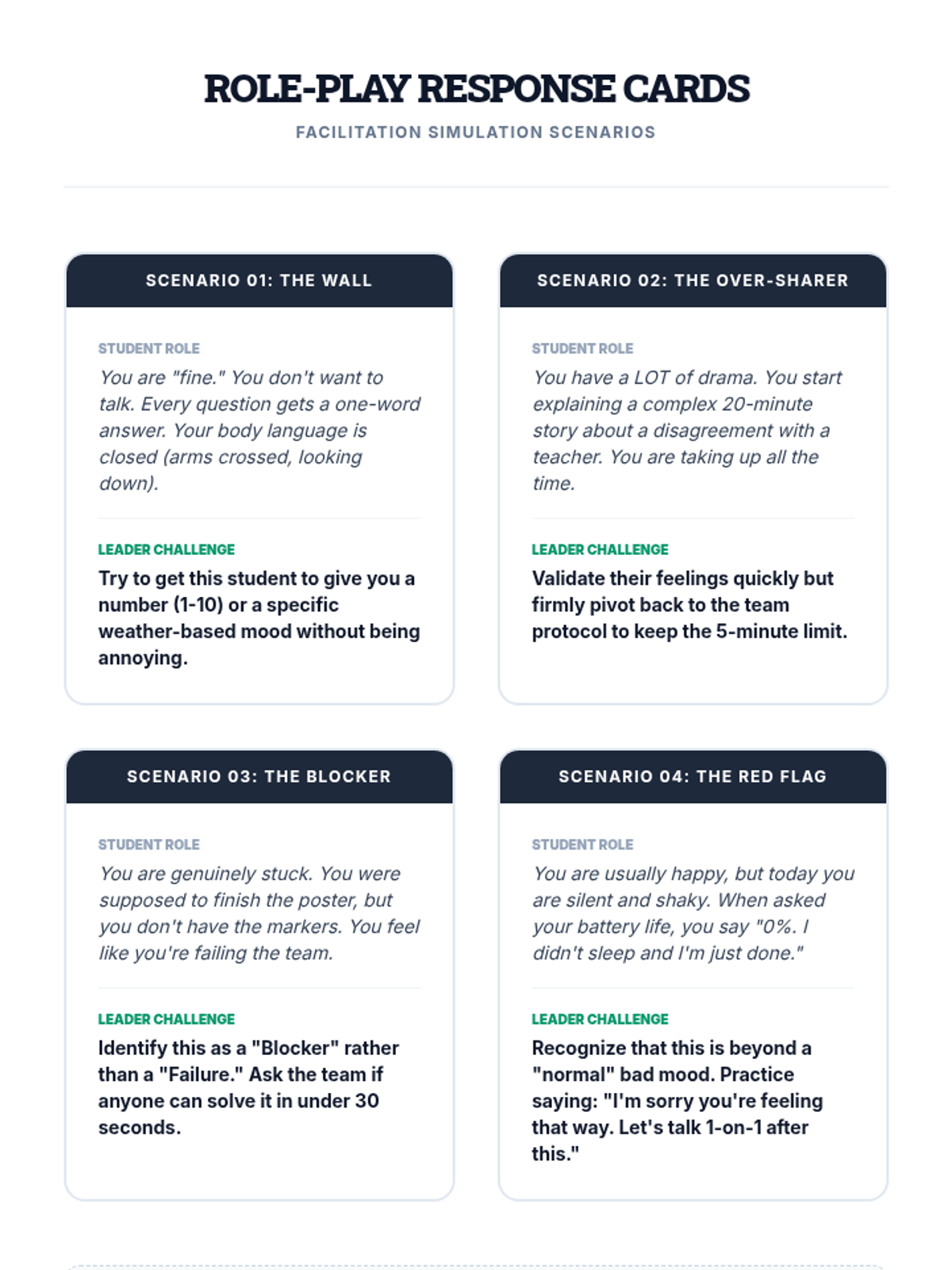
Scenario cards for role-playing common check-in challenges, including a silent student, an over-sharer, a team blocker, and a "red flag" situation.
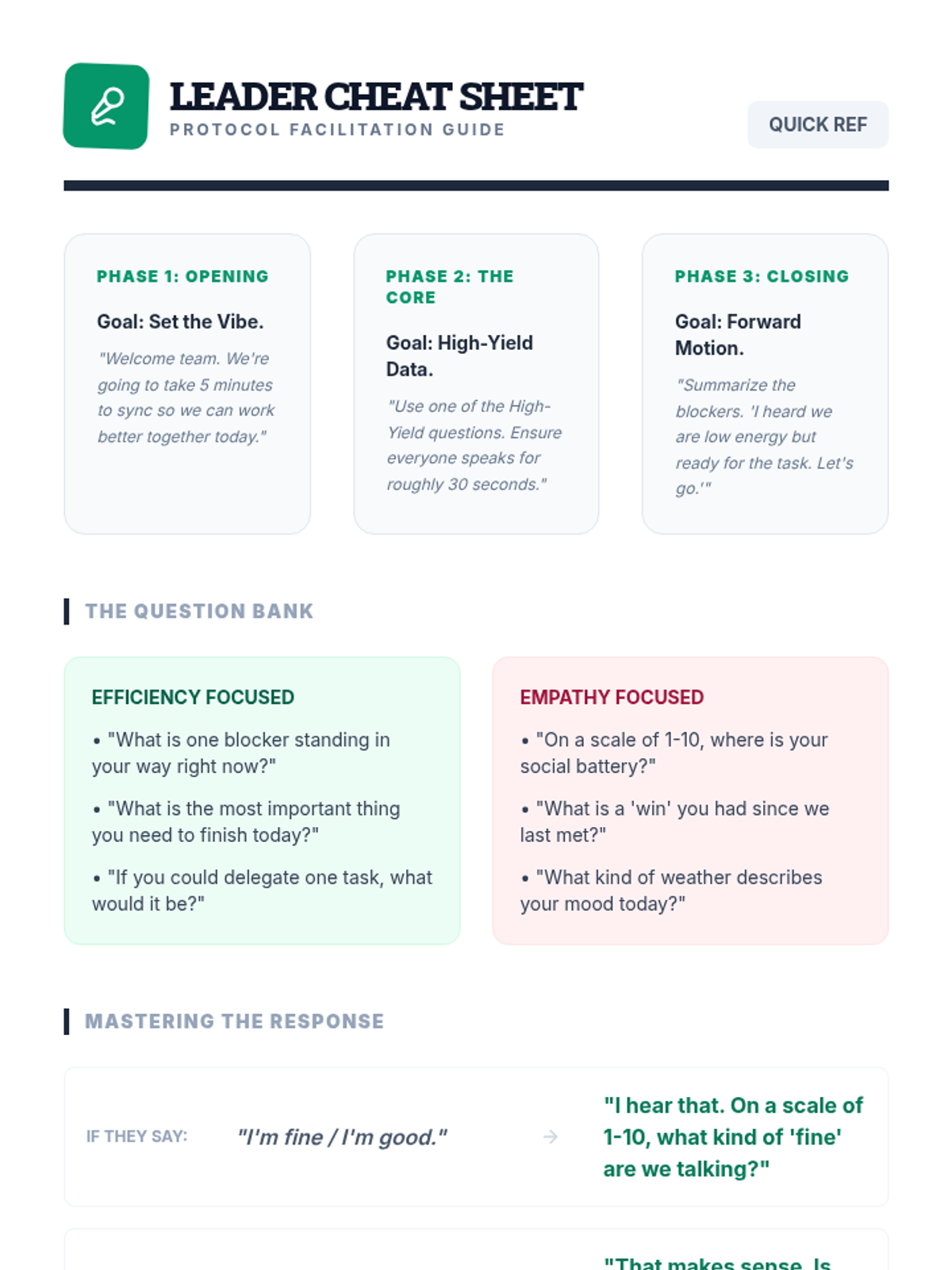
A tactical reference guide for student leaders to use during check-in facilitation practice, featuring question banks and response techniques.
Slide deck for Lesson 3 focusing on facilitation techniques, active listening, and avoid the "fixer" trap during peer check-ins.
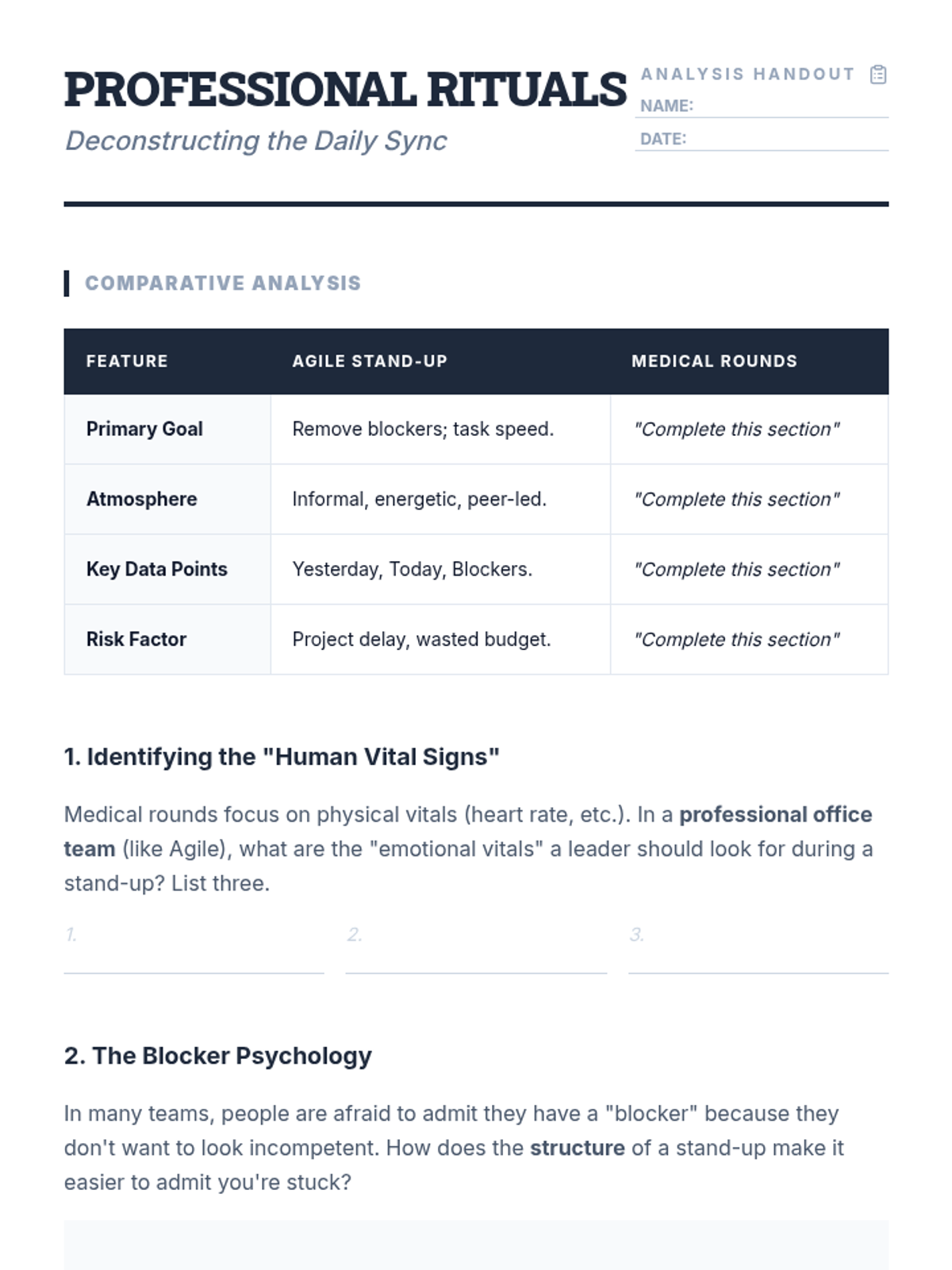
Worksheet for Lesson 2 that helps students compare different professional check-in rituals and analyze their effectiveness for different types of teams.
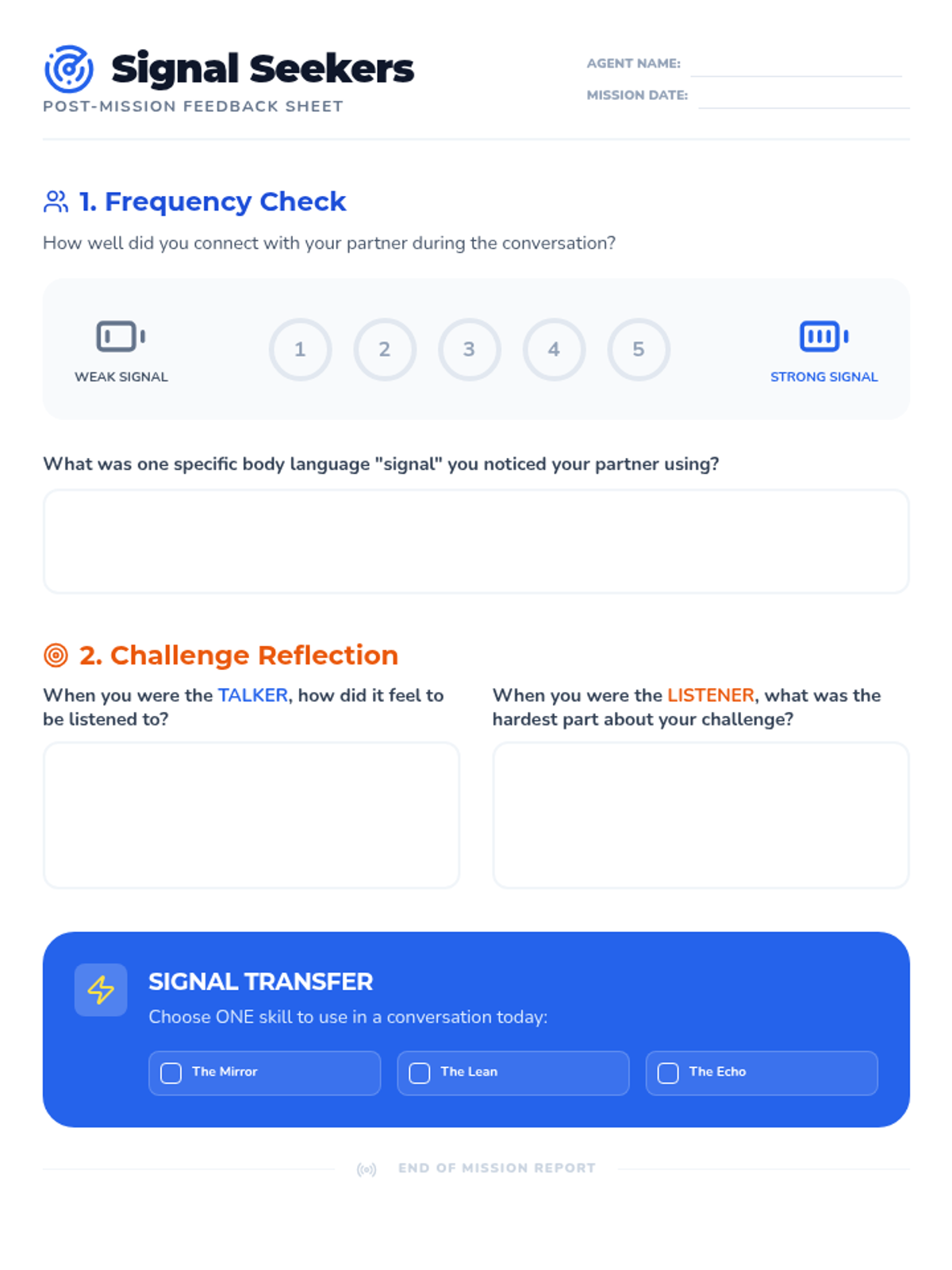
A student reflection worksheet for the Signal Seekers game. Consolidated onto a single page with corrected rating scale styling and improved readability.
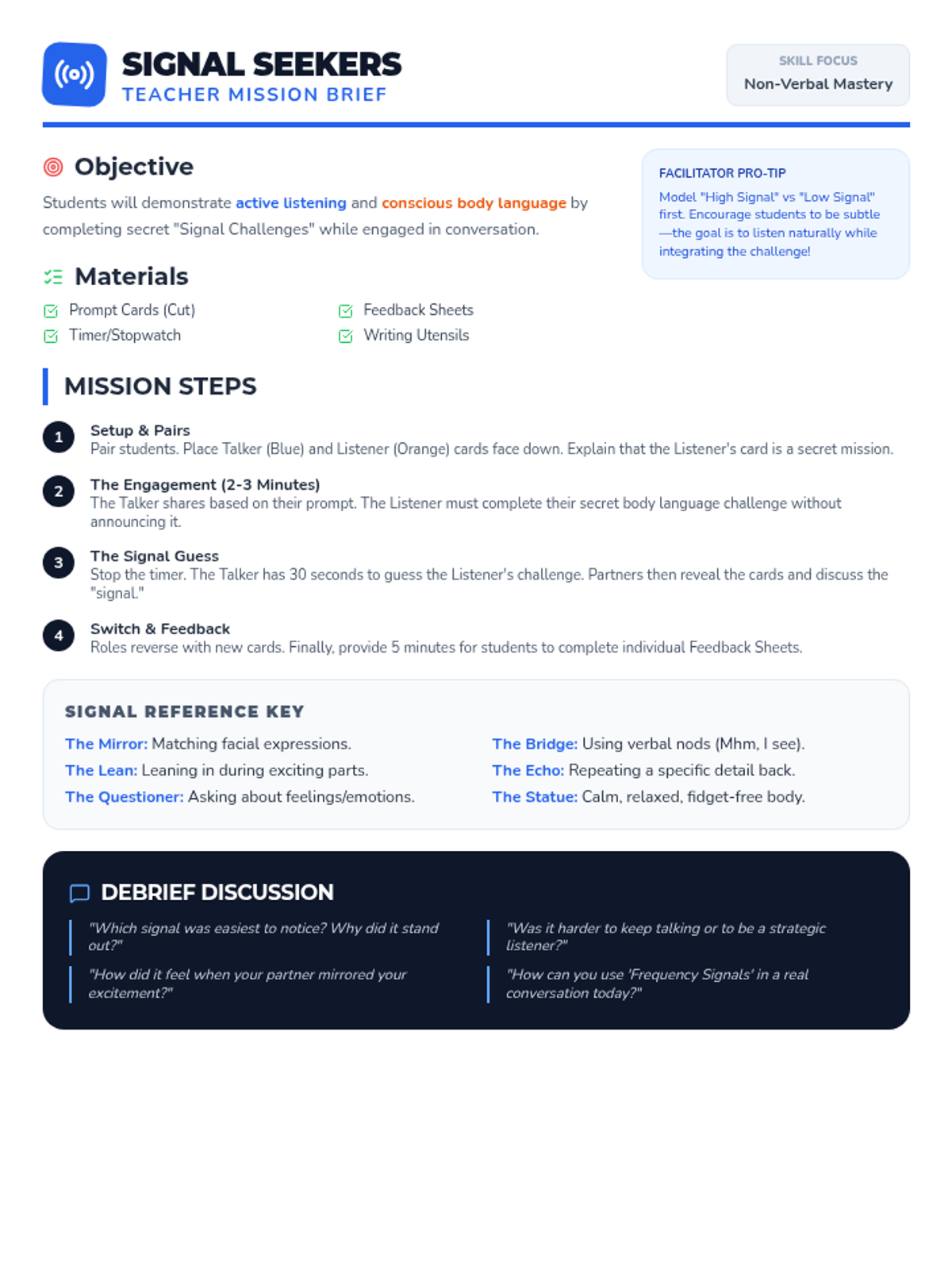
A consolidated one-page facilitator guide for the Signal Seekers game. Includes objectives, procedure, a reference key for the body language signals, and discussion prompts. Updated with improved layout to ensure single-page printing.
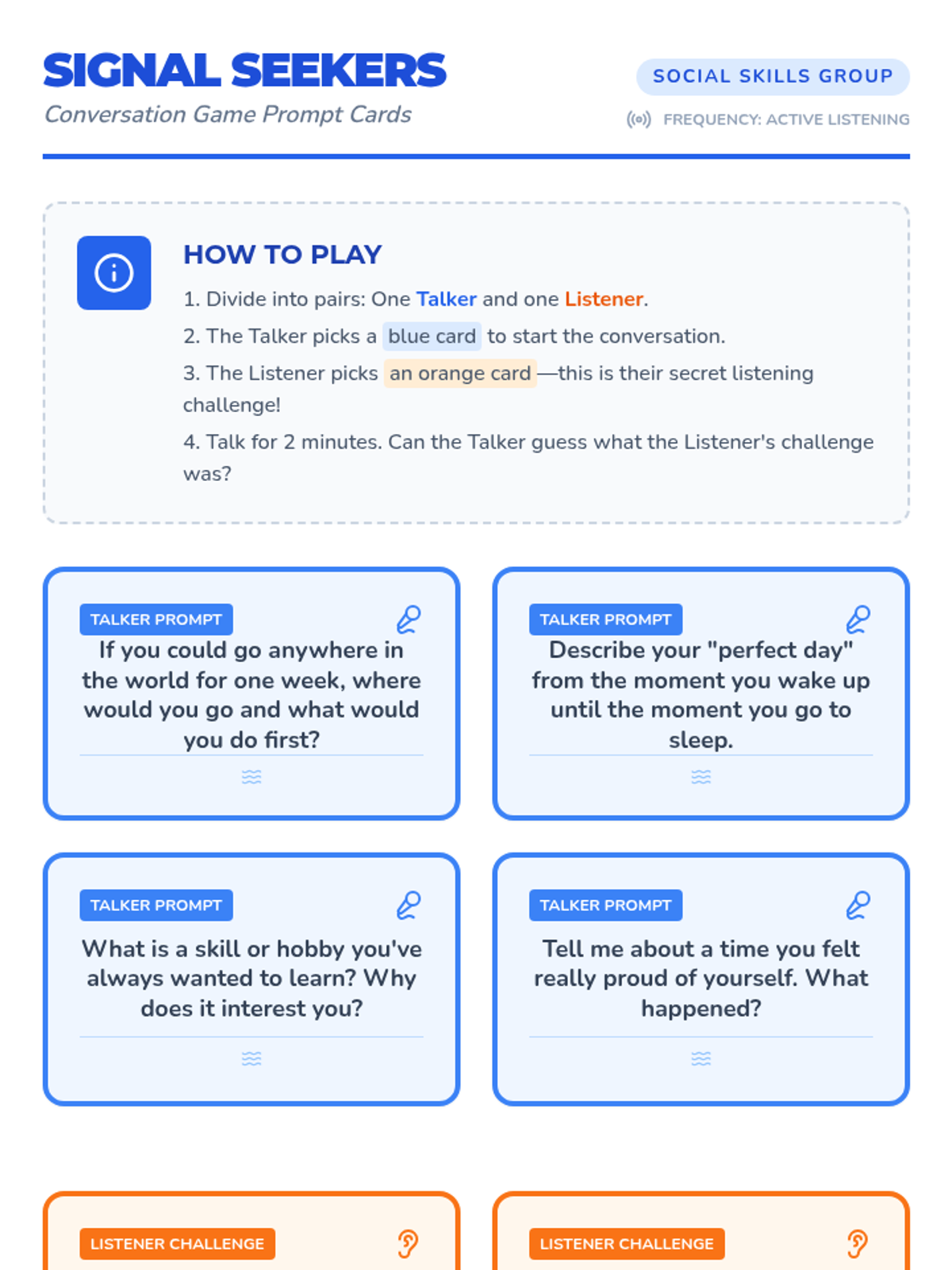
A collection of printable prompt cards for the Signal Seekers game. Includes 4 Talker prompts and 6 Listener challenges that focus on body language and active listening. Updated with corrected grammar and improved print layout.
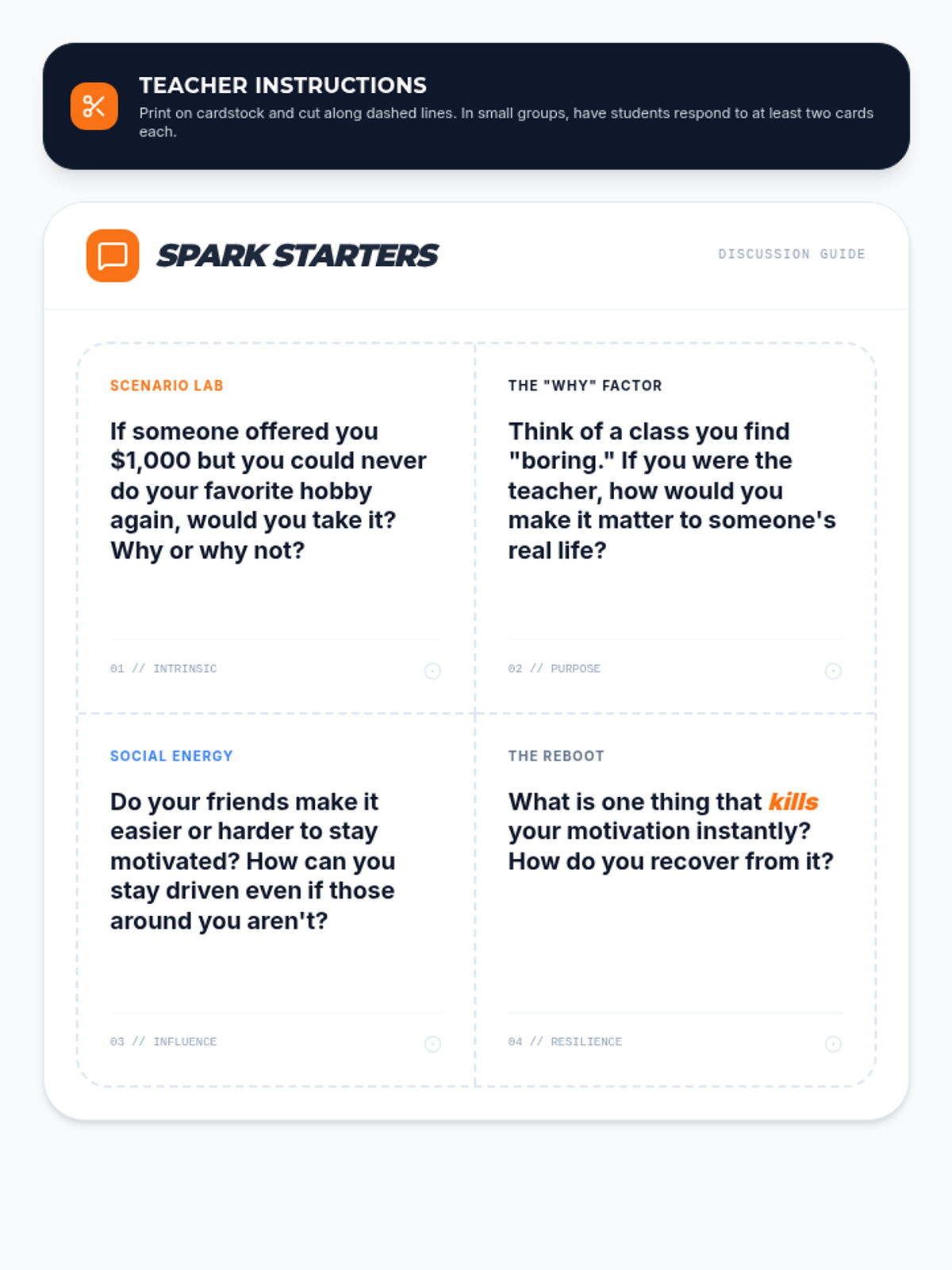
A set of four creative discussion cards for small groups, designed to facilitate conversations about internal values, social influences on motivation, and recovery from academic setbacks.
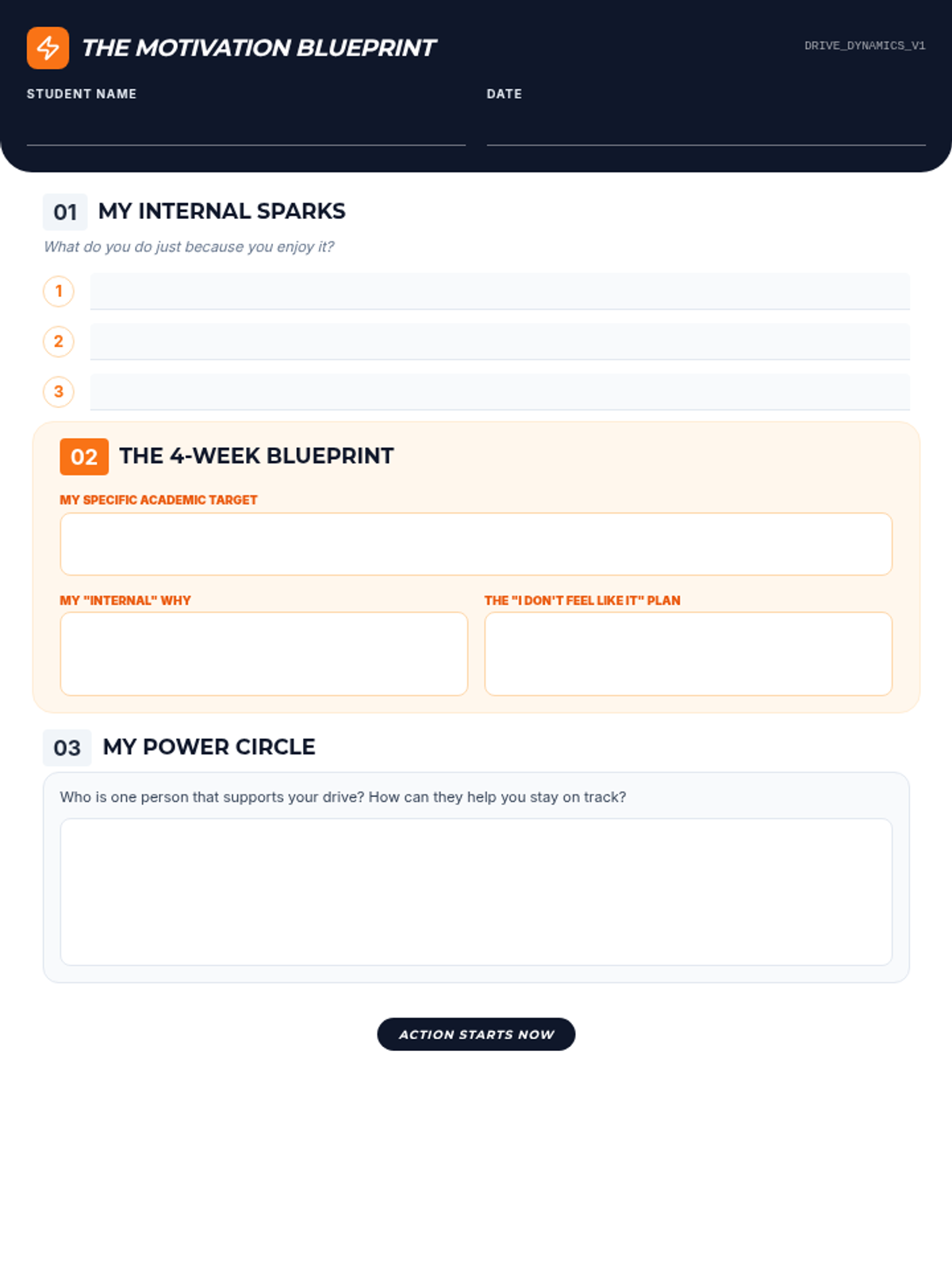
A student worksheet featuring personal motivation identification, a 4-week goal-setting blueprint, and a social support mapping section to help students internalize their academic drive.
A high-impact 5-slide presentation designed to engage students in understanding the difference between intrinsic and extrinsic motivation, while providing a framework for academic goal setting.
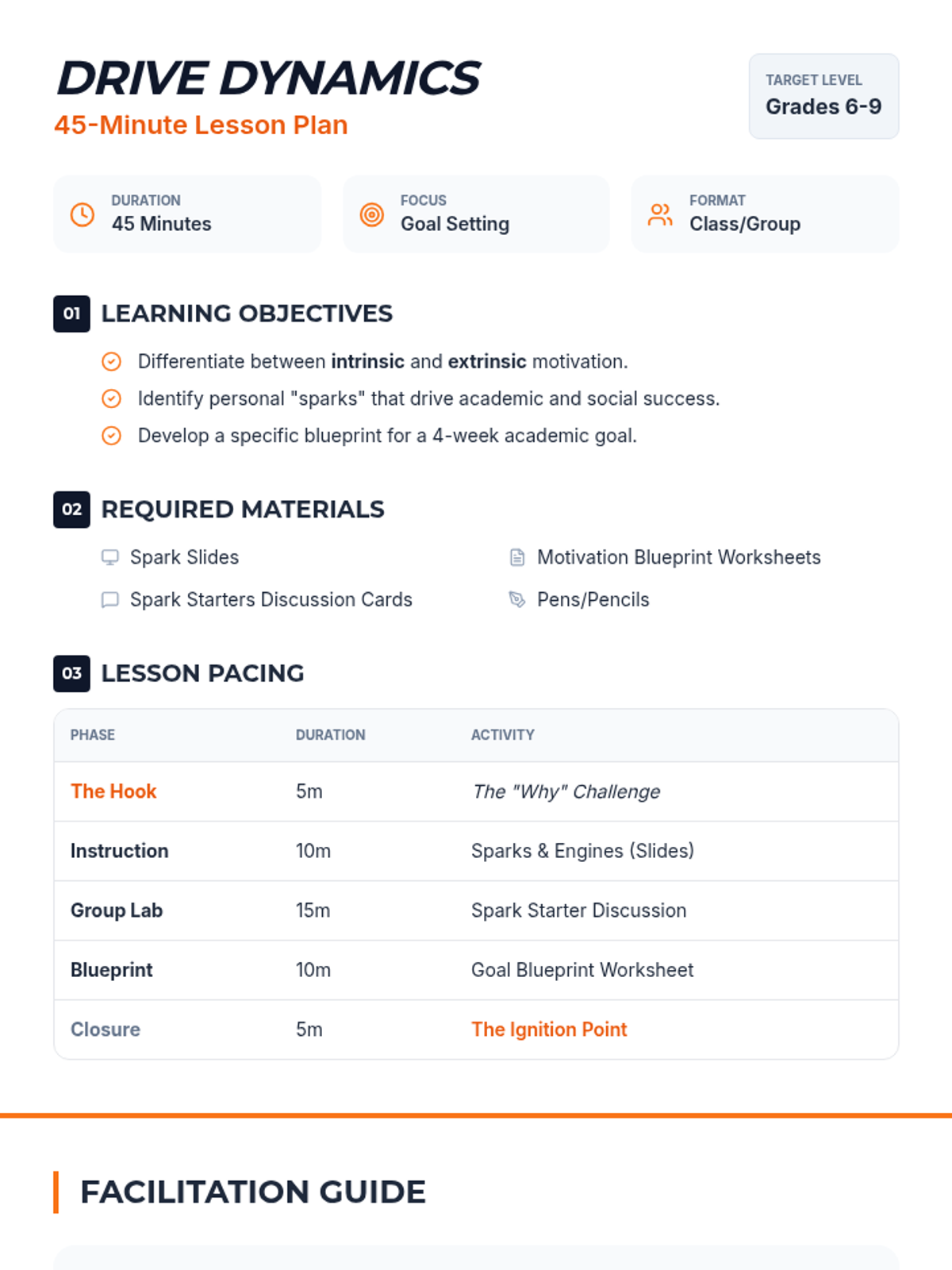
A comprehensive 45-minute lesson plan for educators focusing on social-emotional and academic motivation, including learning objectives, materials, and a step-by-step facilitation guide.
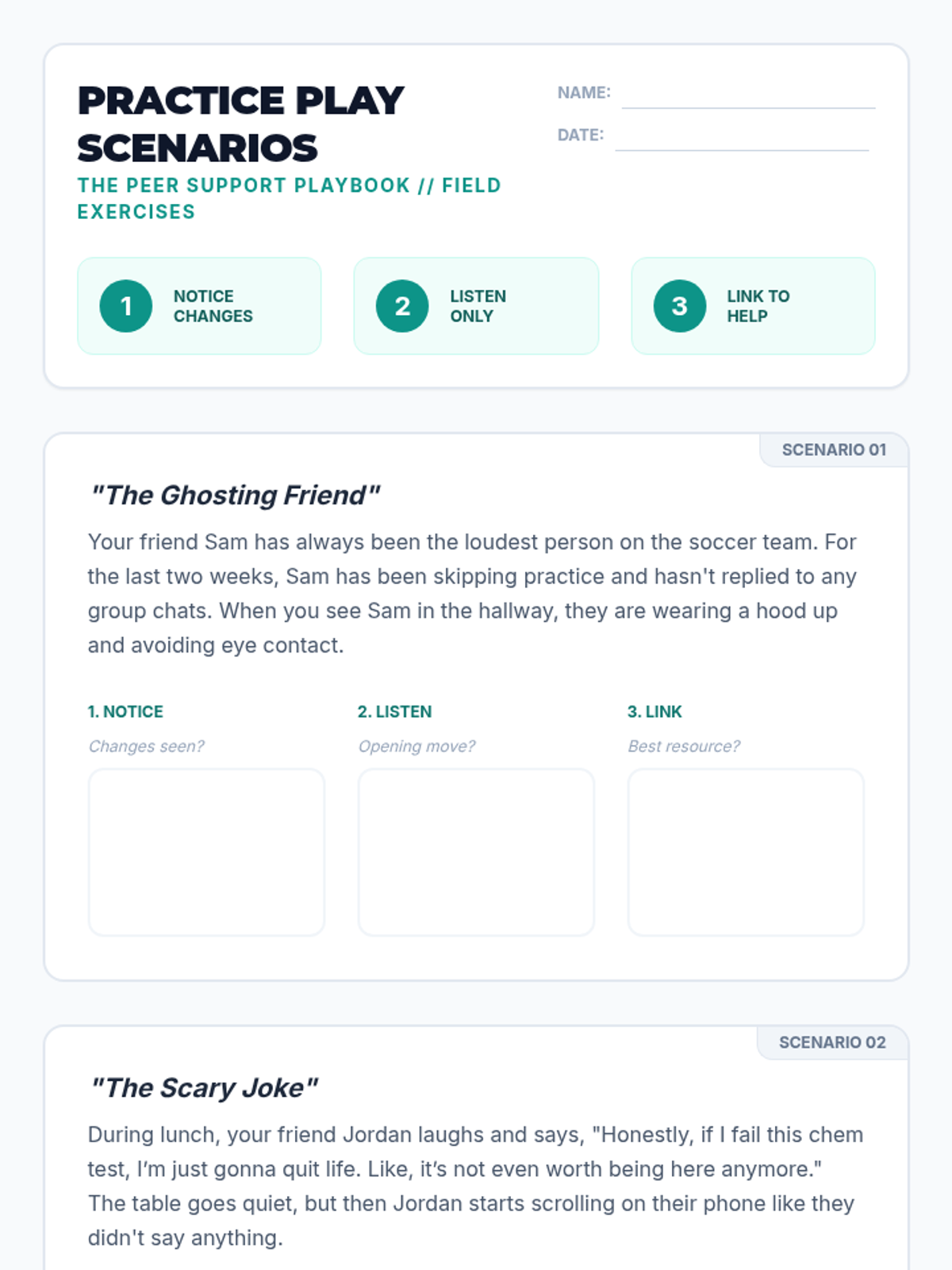
A student worksheet featuring realistic social scenarios for practicing the 'Notice, Listen, Link' support model and boundary-setting.
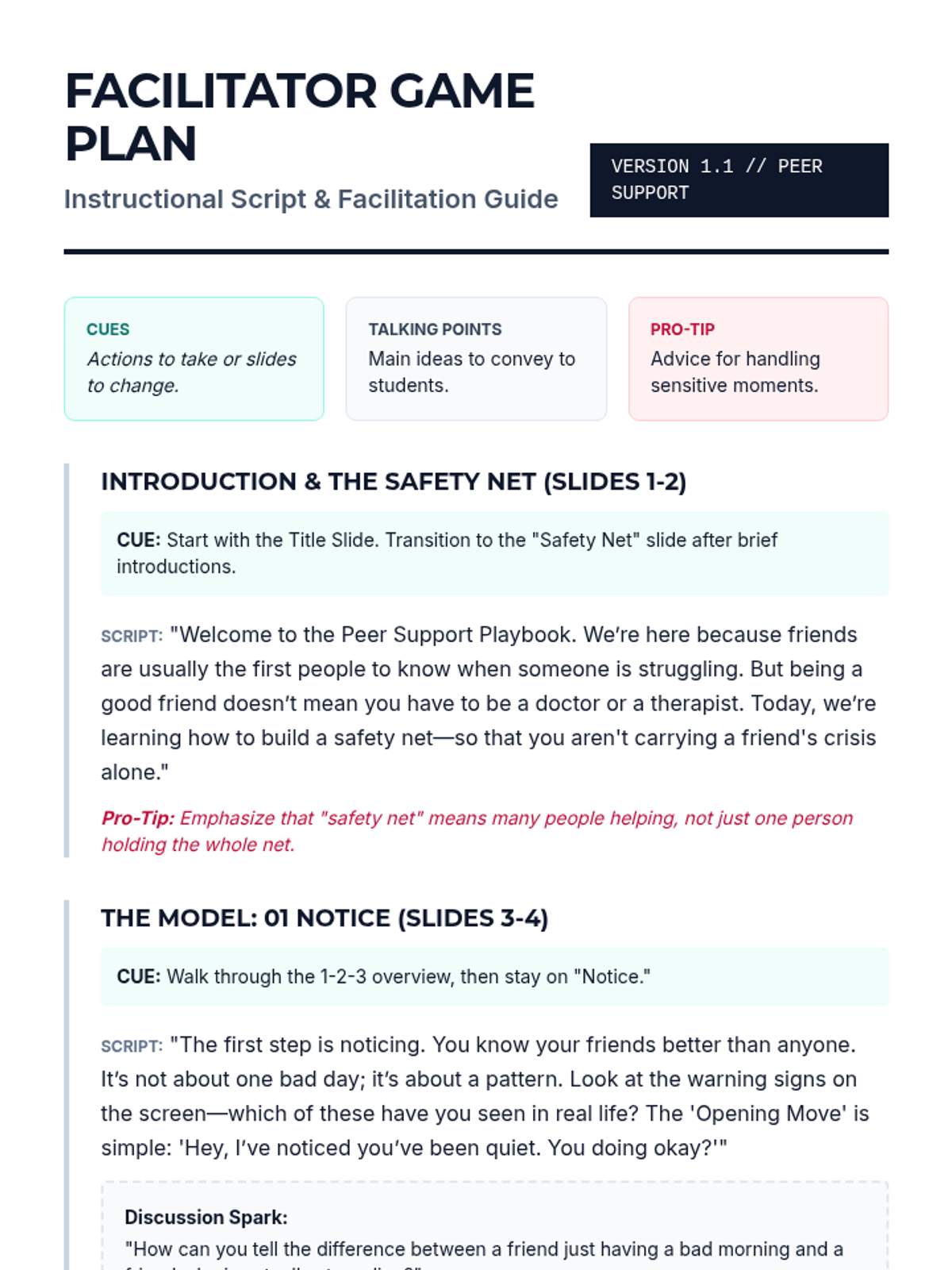
A detailed facilitator script and instructional guide for leading the Peer Support Playbook workshop, including talking points, slide cues, and discussion prompts.
A visual presentation for the Peer Support Playbook workshop, introducing the 'Notice, Listen, Link' model and emphasizing the importance of a safety net.
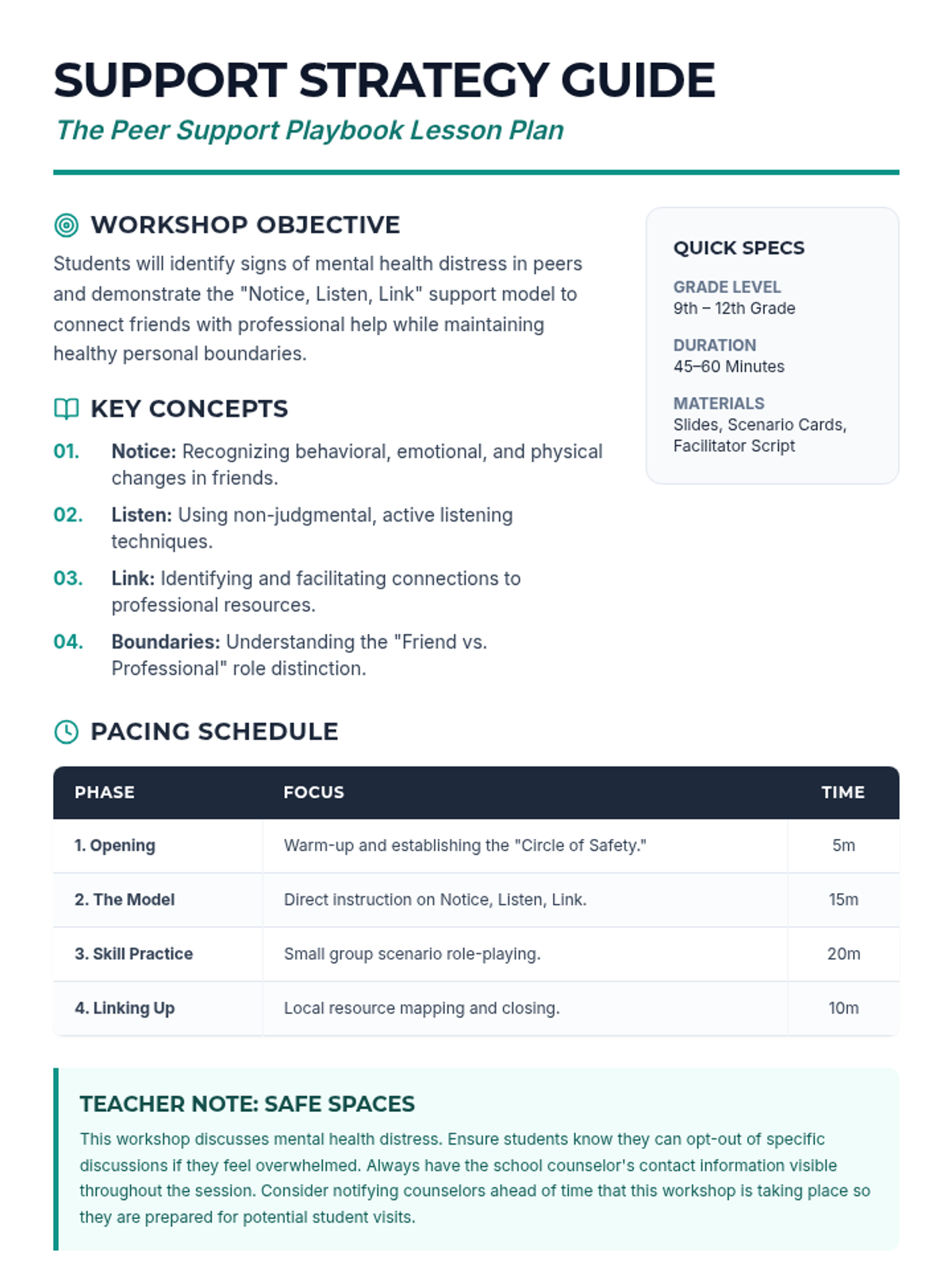
A comprehensive lesson plan for high school educators, outlining the objectives, pacing, and key concepts for the Peer Support Playbook workshop.
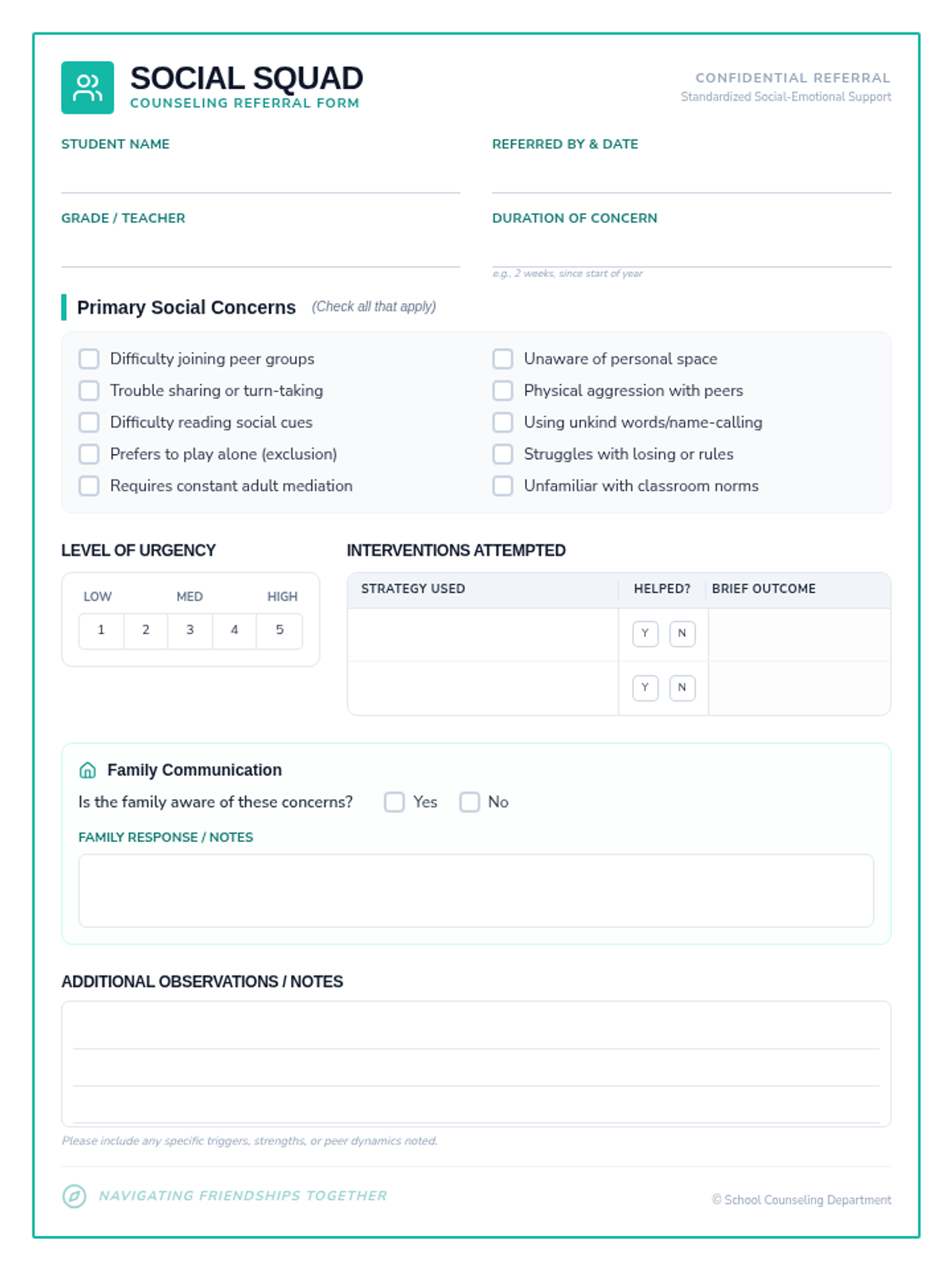
A revised comprehensive school counseling referral form for teachers, optimized to fit on a single page. It features clearer sections for social concerns, a more functional interventions table, and improved spacing for student work areas.
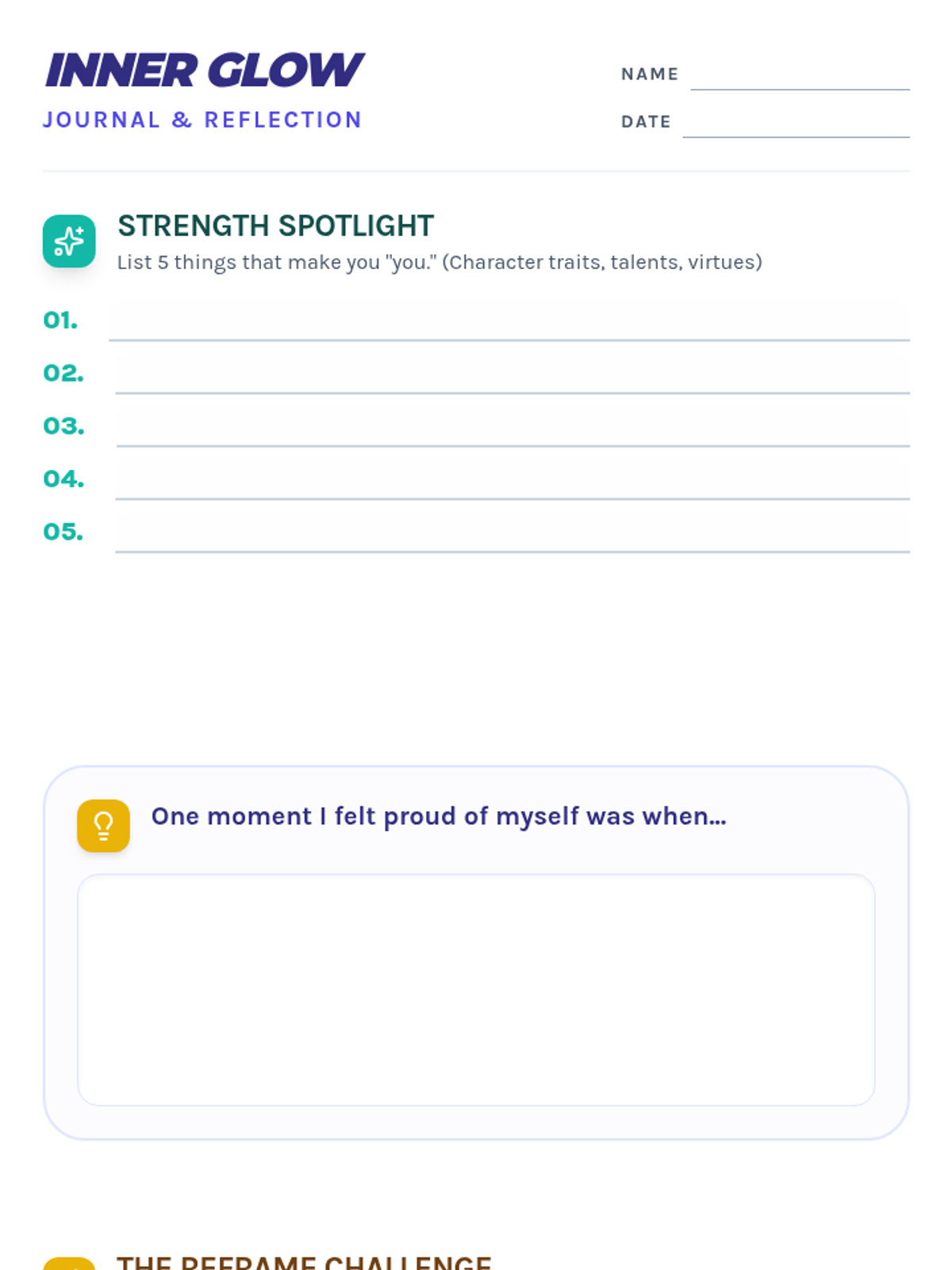
A student journal featuring prompts for identifying personal strengths, exercises for reframing negative self-talk, and space for personal reflection on self-worth.
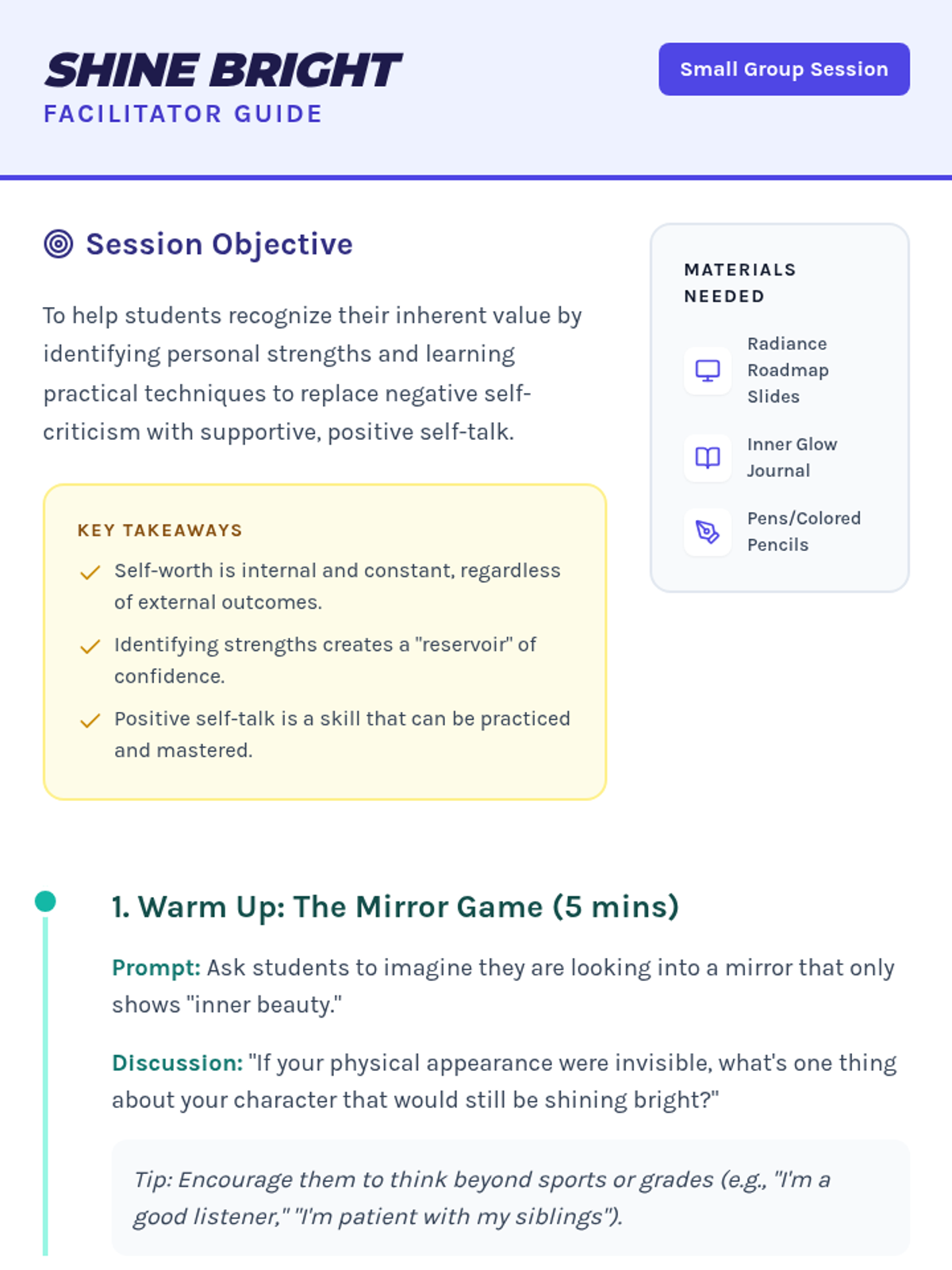
A facilitator guide for small group discussions on self-worth, including a step-by-step session plan, warm-up activities, and a bank of discussion prompts.
Visual slides for a group presentation on self-worth, focusing on identifying personal strengths and shifting from negative to positive self-talk.
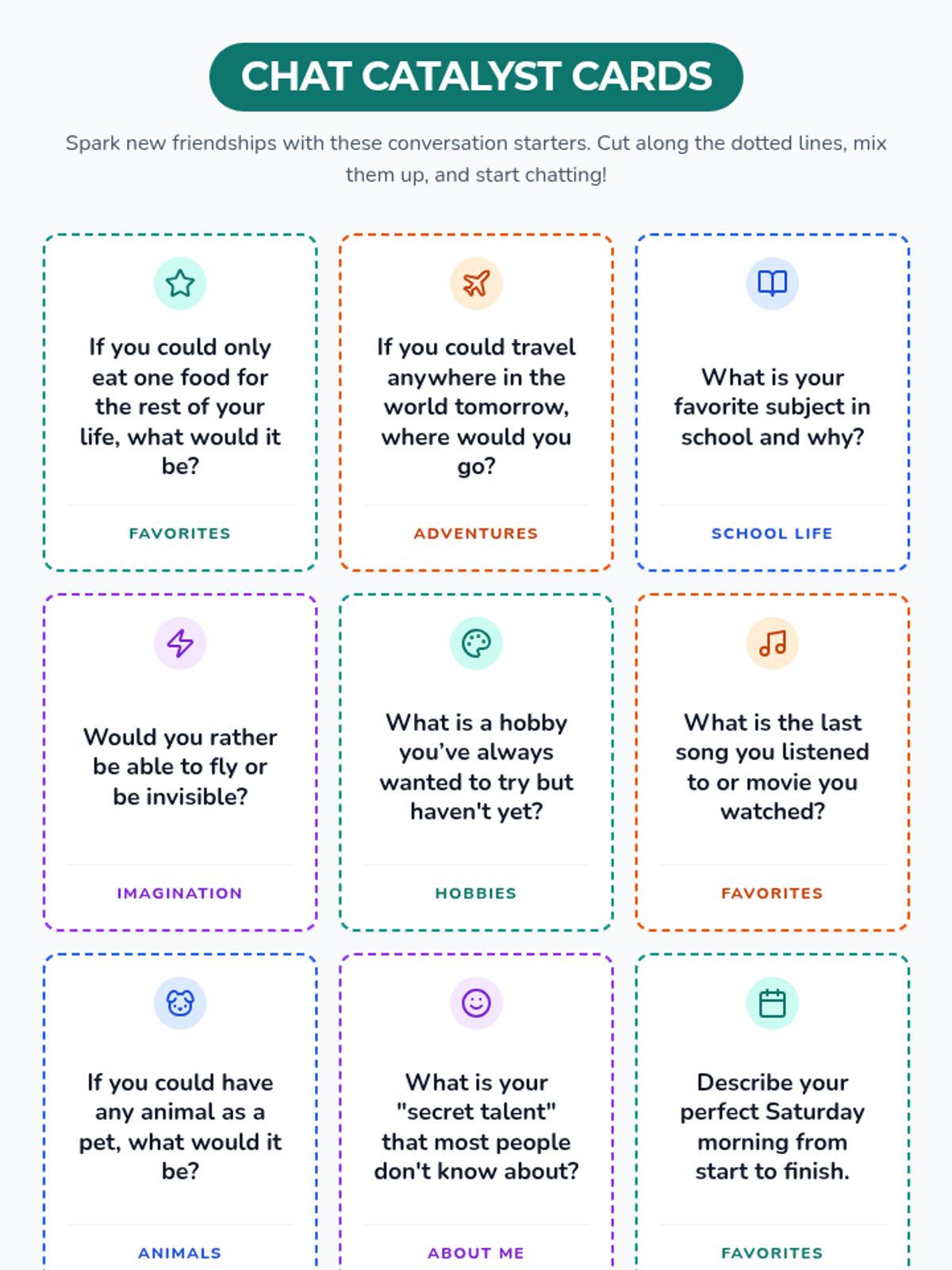
A set of printable conversation starter cards designed for students to break the ice and build new friendships. The cards feature varied prompts across categories like favorites, adventures, school life, and imagination.
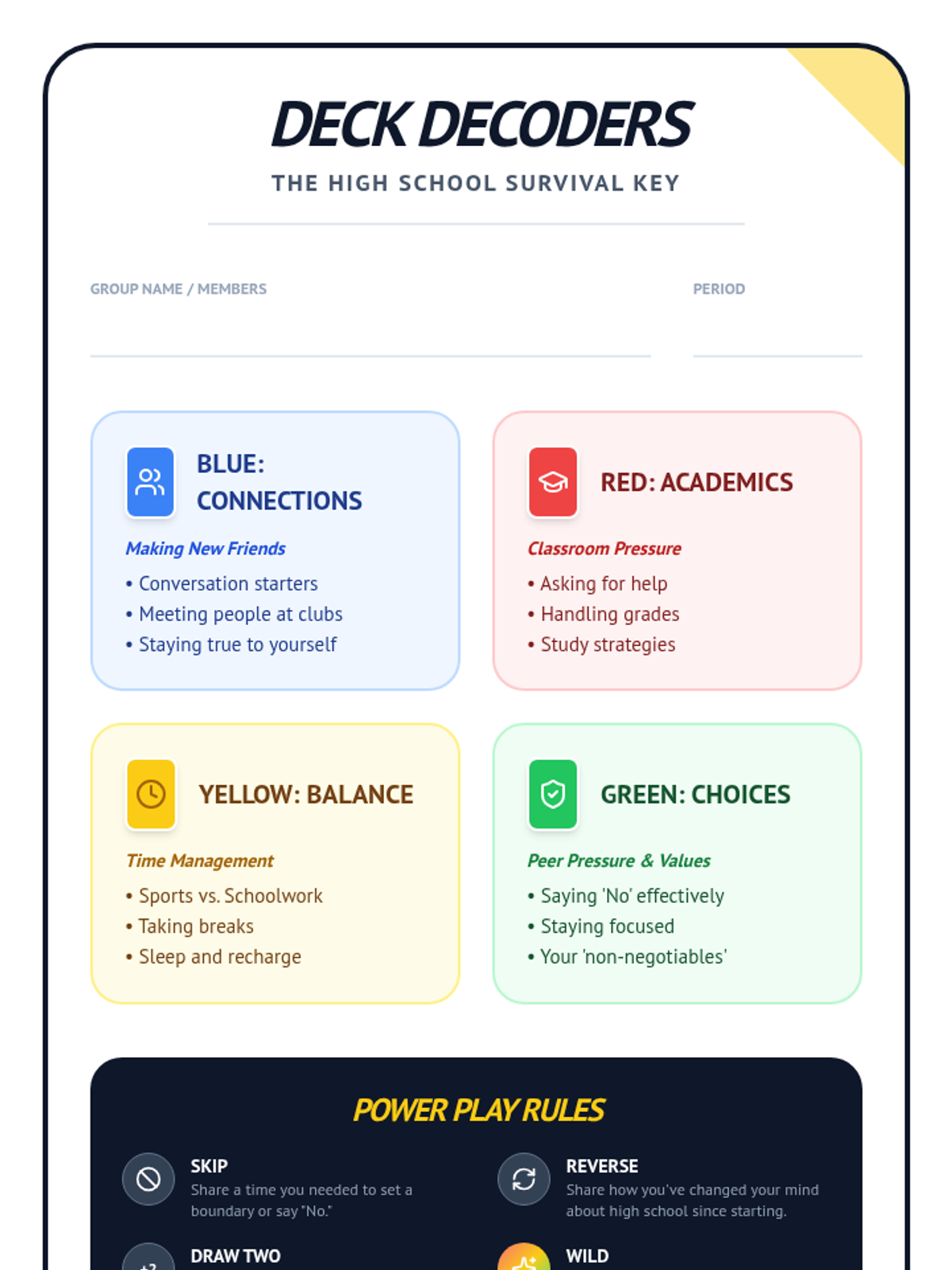
A student reference handout that maps UNO card colors and symbols to high school transition topics and discussion prompts.
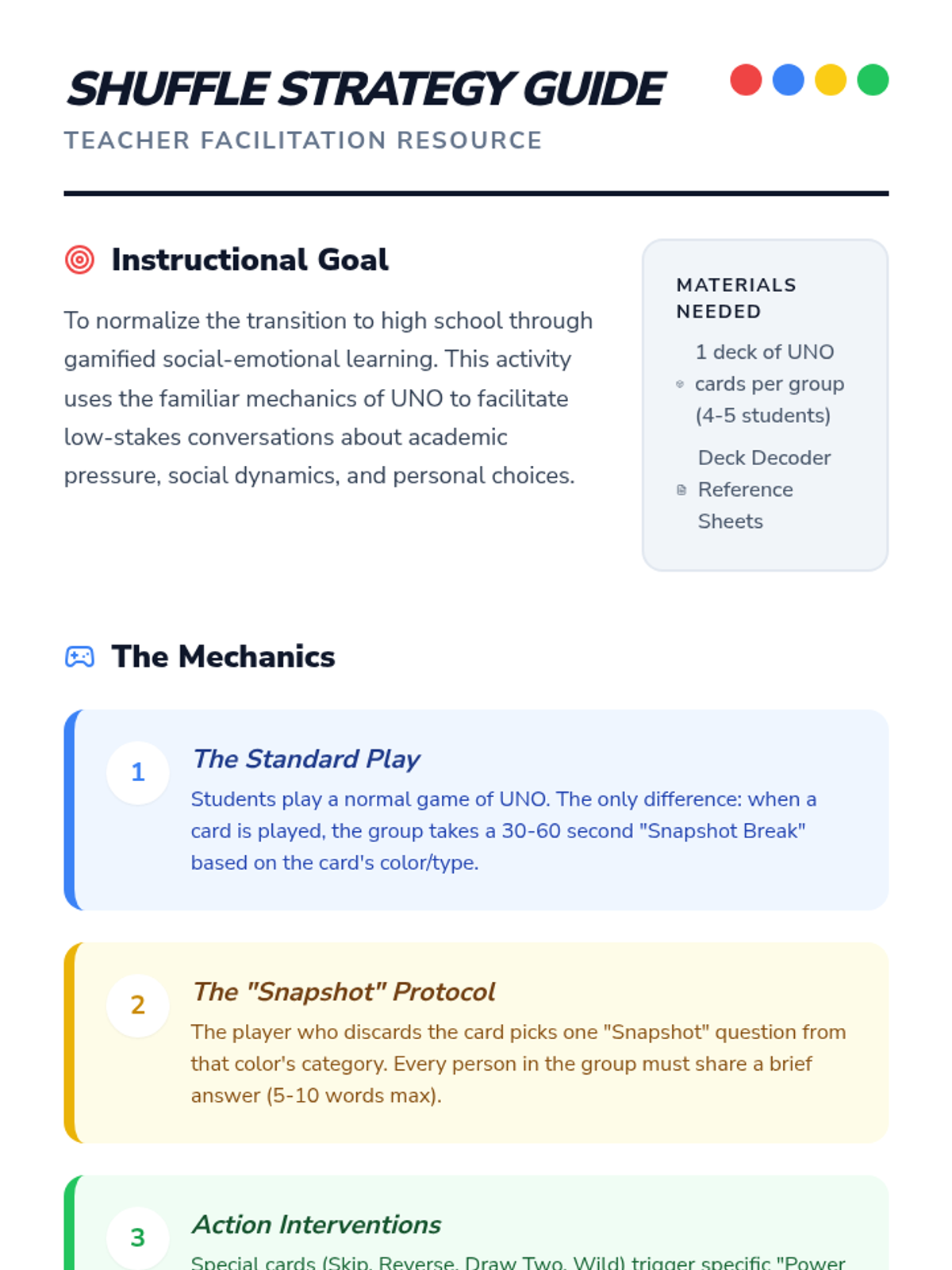
A facilitation guide for teachers to lead the High School Shuffle activity, including game mechanics, discussion prompts, and classroom management tips.
A slide deck for introducing a game-based SEL activity using UNO cards to discuss high school transition topics like academic pressure and social connections.
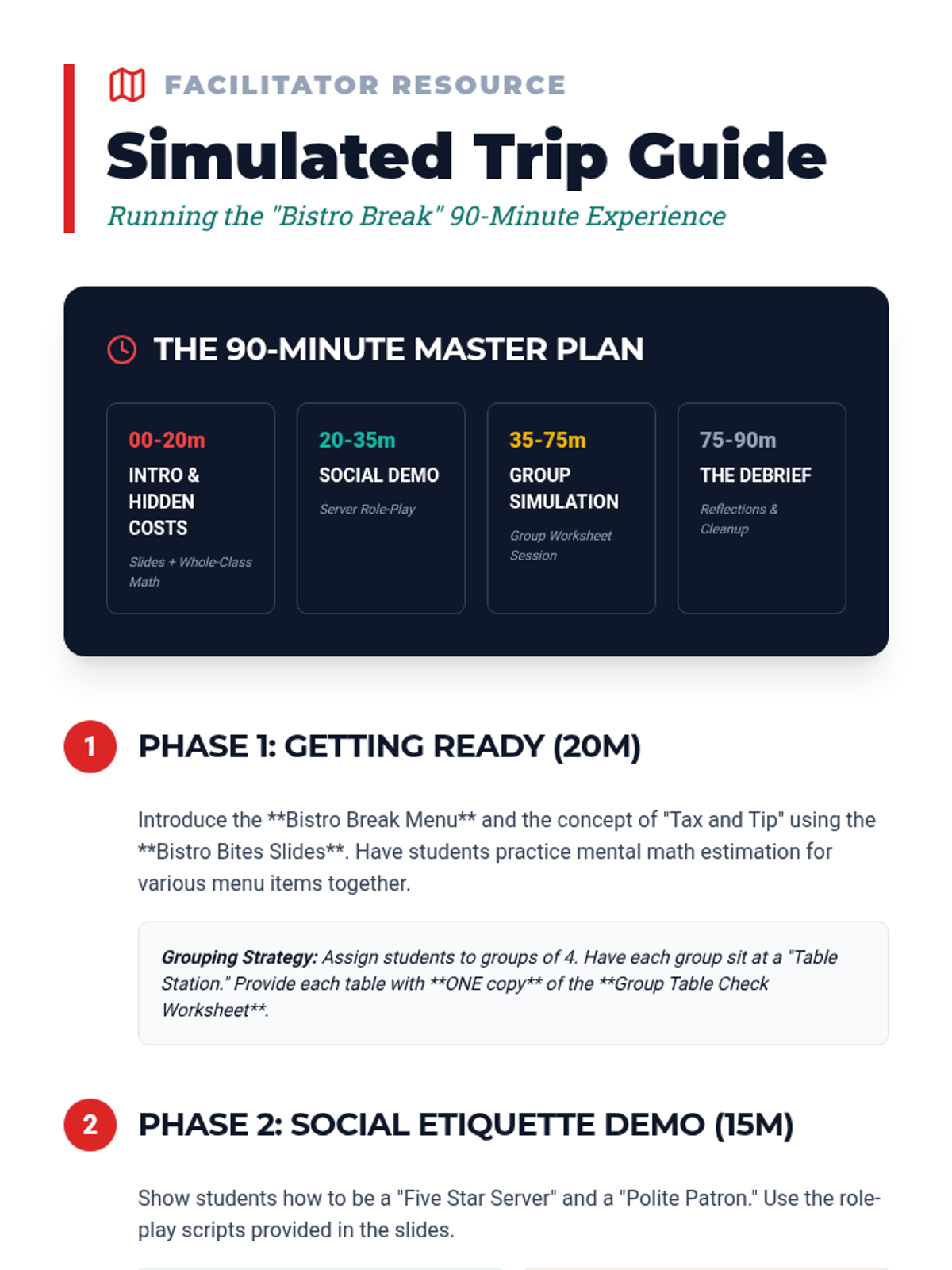
A facilitator's guide for conducting a simulated restaurant field trip in the classroom, including role-play scripts and setup instructions.
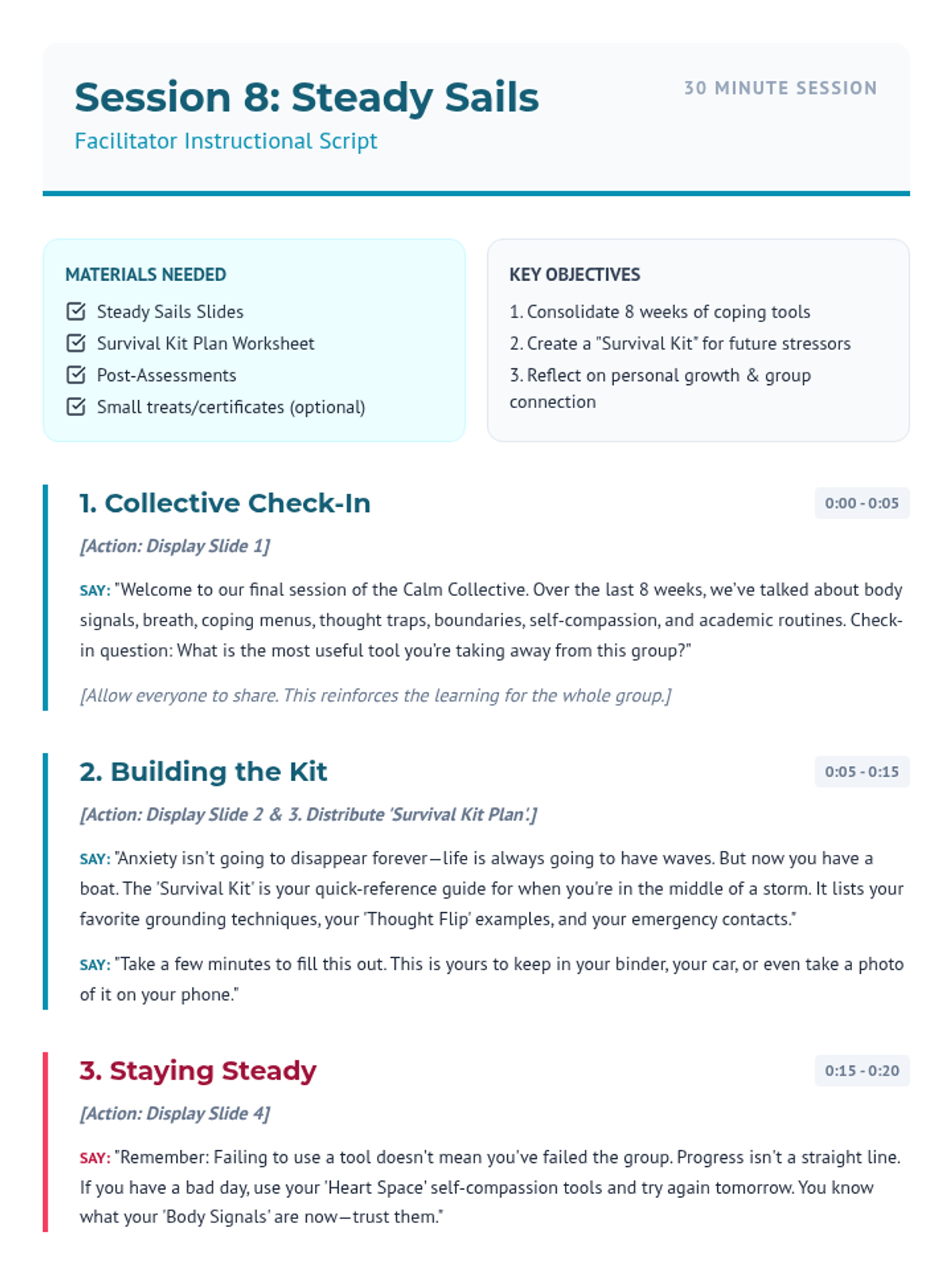
A detailed facilitation script for the final session of the Calm Collective, providing time-stamped sections, "what to say" prompts, and "what to do" instructions for the counselor. Focuses on consolidation and the "Survival Kit."
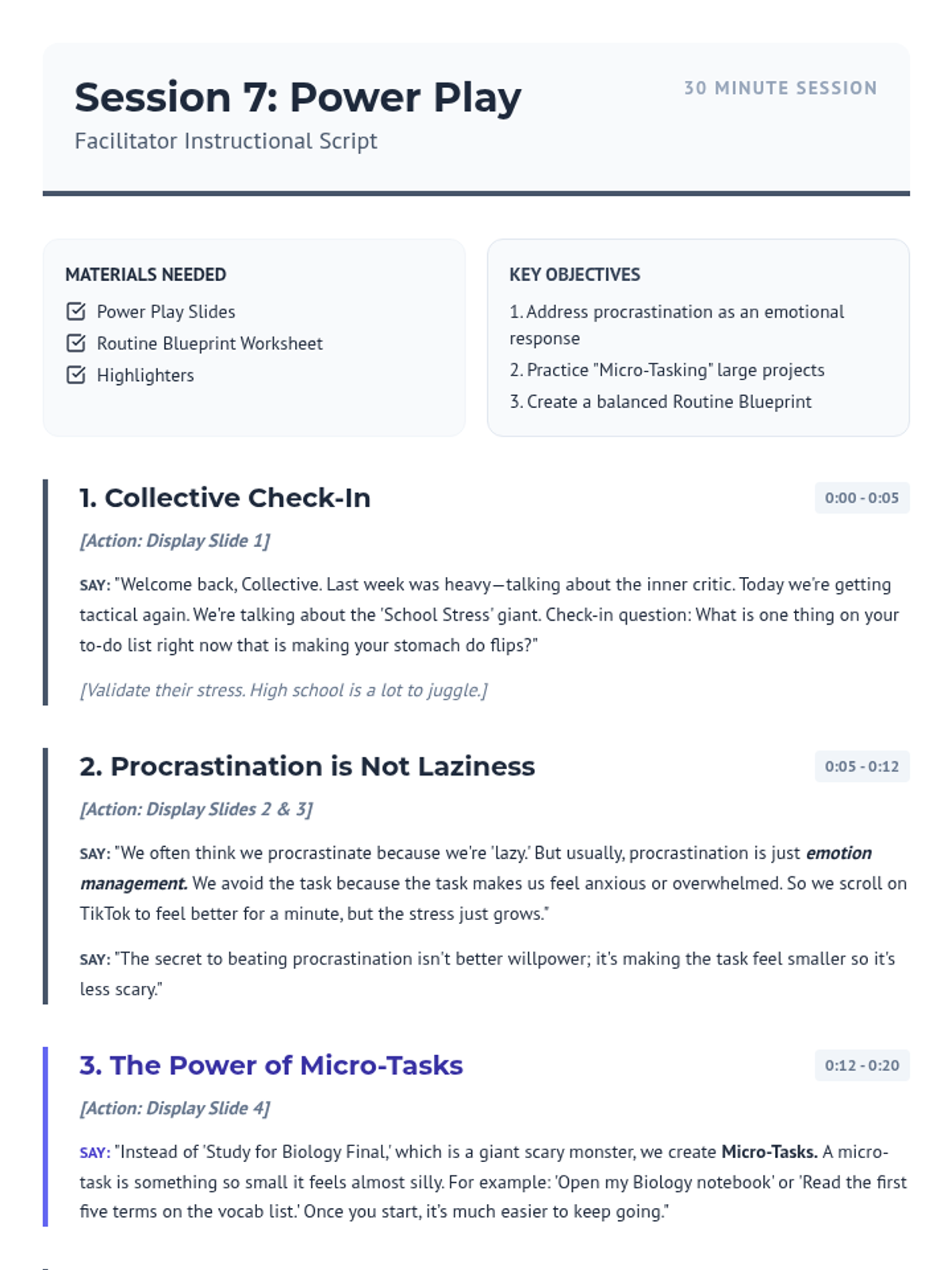
A detailed facilitation script for the seventh session of the Calm Collective, focusing on academic stress management, time-blocking, and overcoming procrastination.
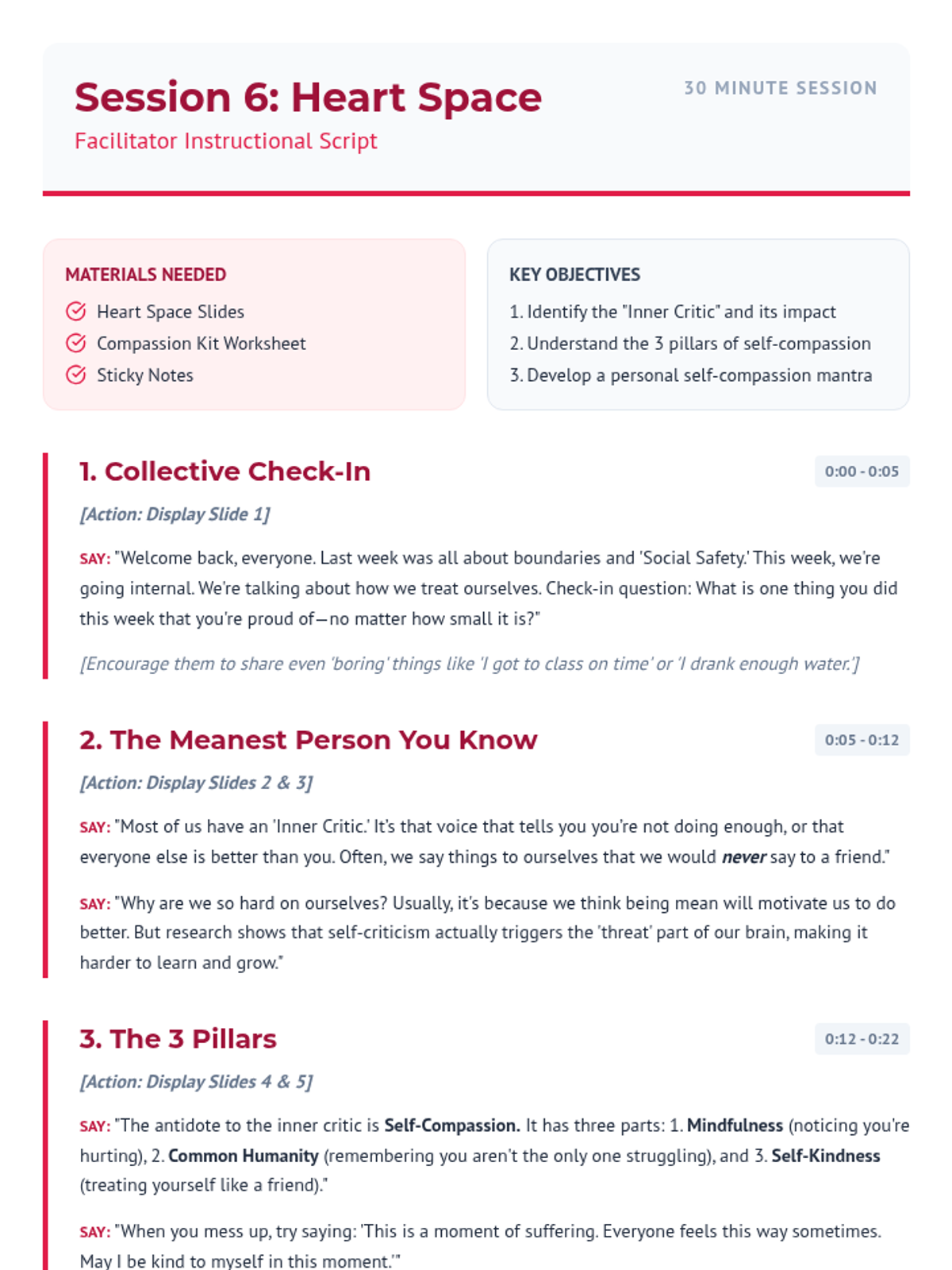
A detailed facilitation script for the sixth session of the Calm Collective, addressing perfectionism, the inner critic, and self-compassion. Fixed icon rendering and page breaks.
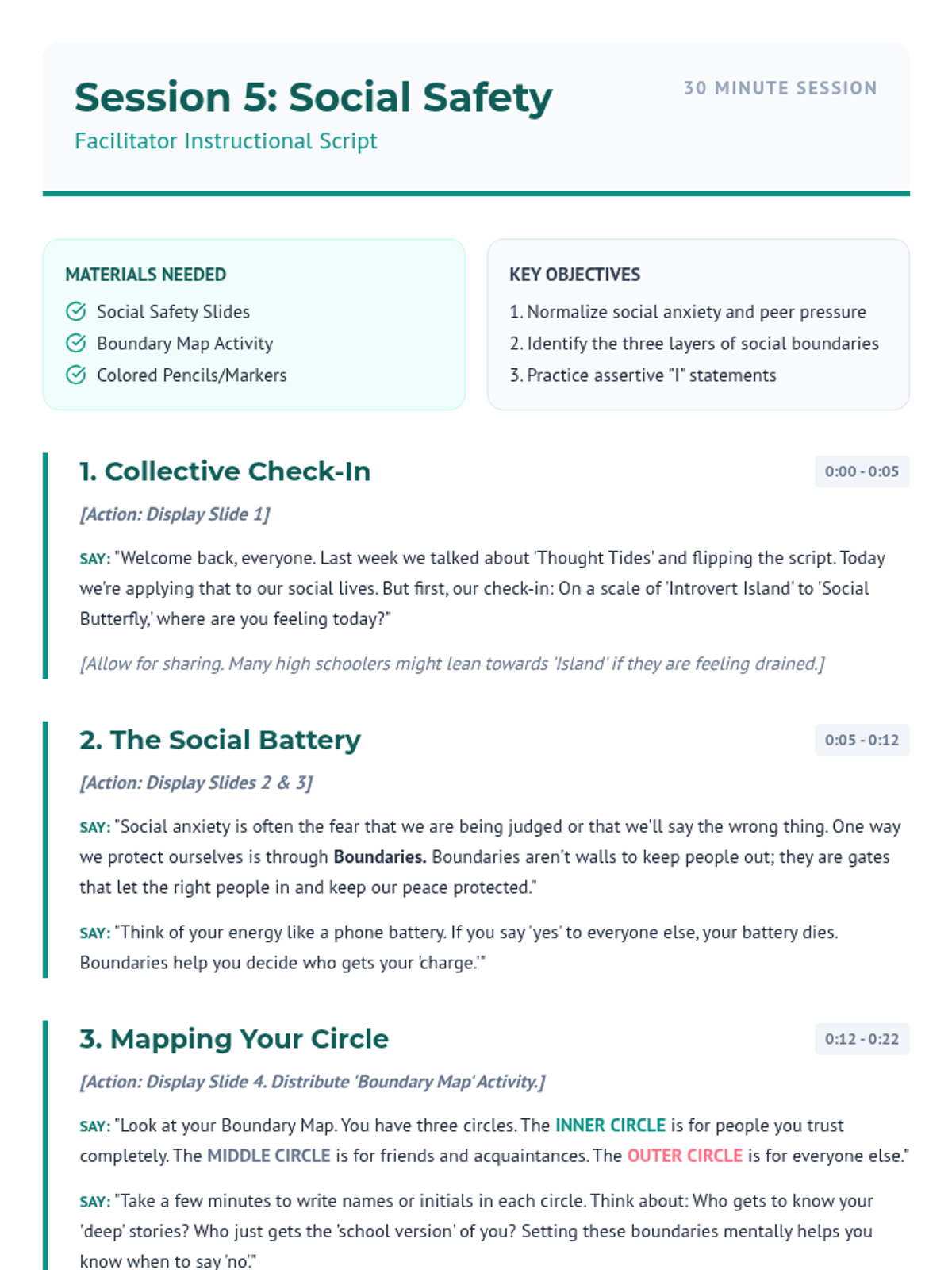
A detailed facilitation script for the fifth session of the Calm Collective, focusing on social anxiety, boundary mapping, and assertive communication skills. Fixed layout overlap and contrast.
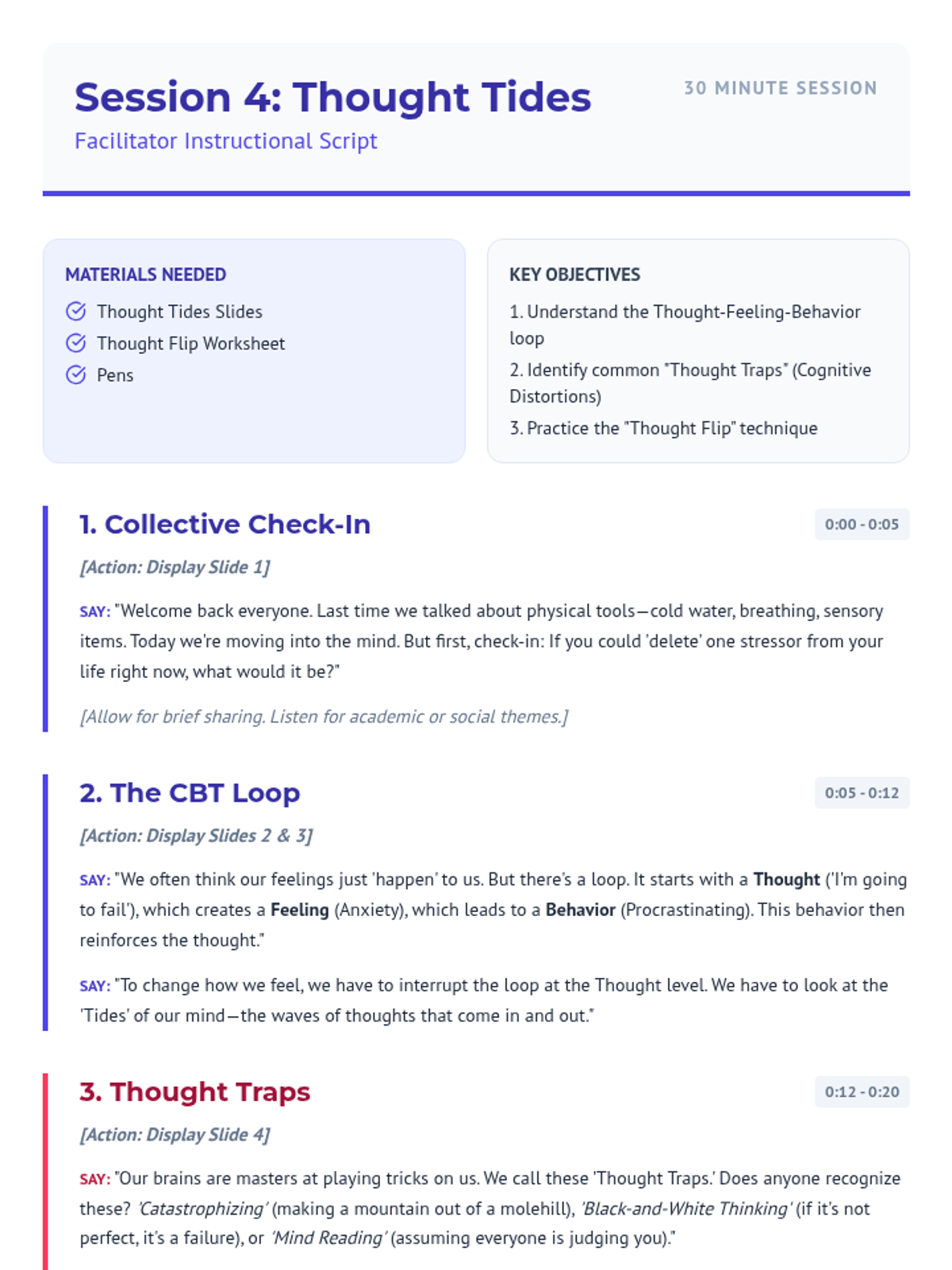
A detailed facilitation script for the fourth session of the Calm Collective, focusing on the CBT loop, identifying thought traps, and practicing cognitive reframing. Fixed icon rendering and page breaks.
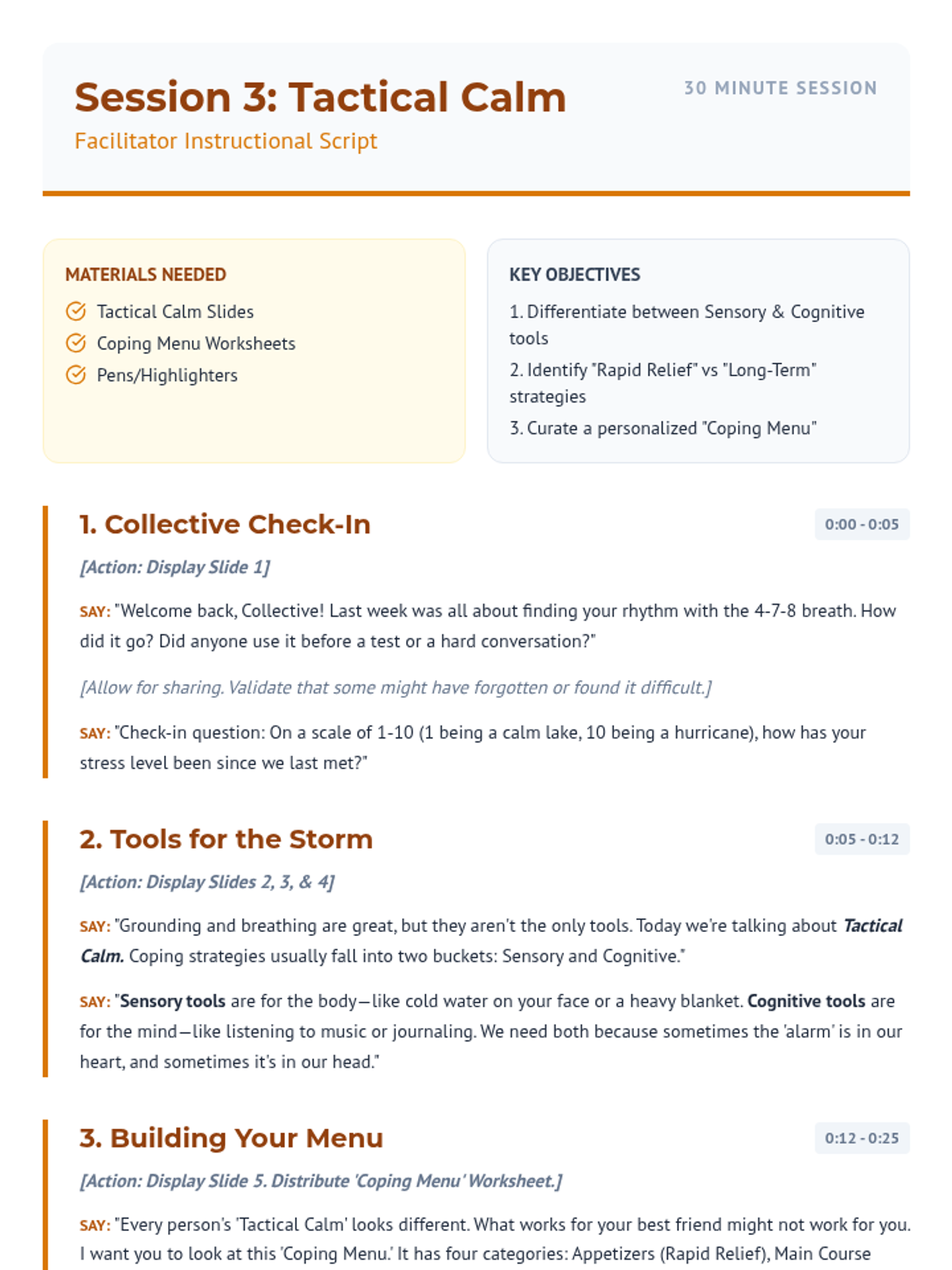
A detailed facilitation script for the third session of the Calm Collective, focusing on sensory vs. cognitive coping strategies and the creation of a personalized Coping Menu. Fixed icon rendering and page breaks.
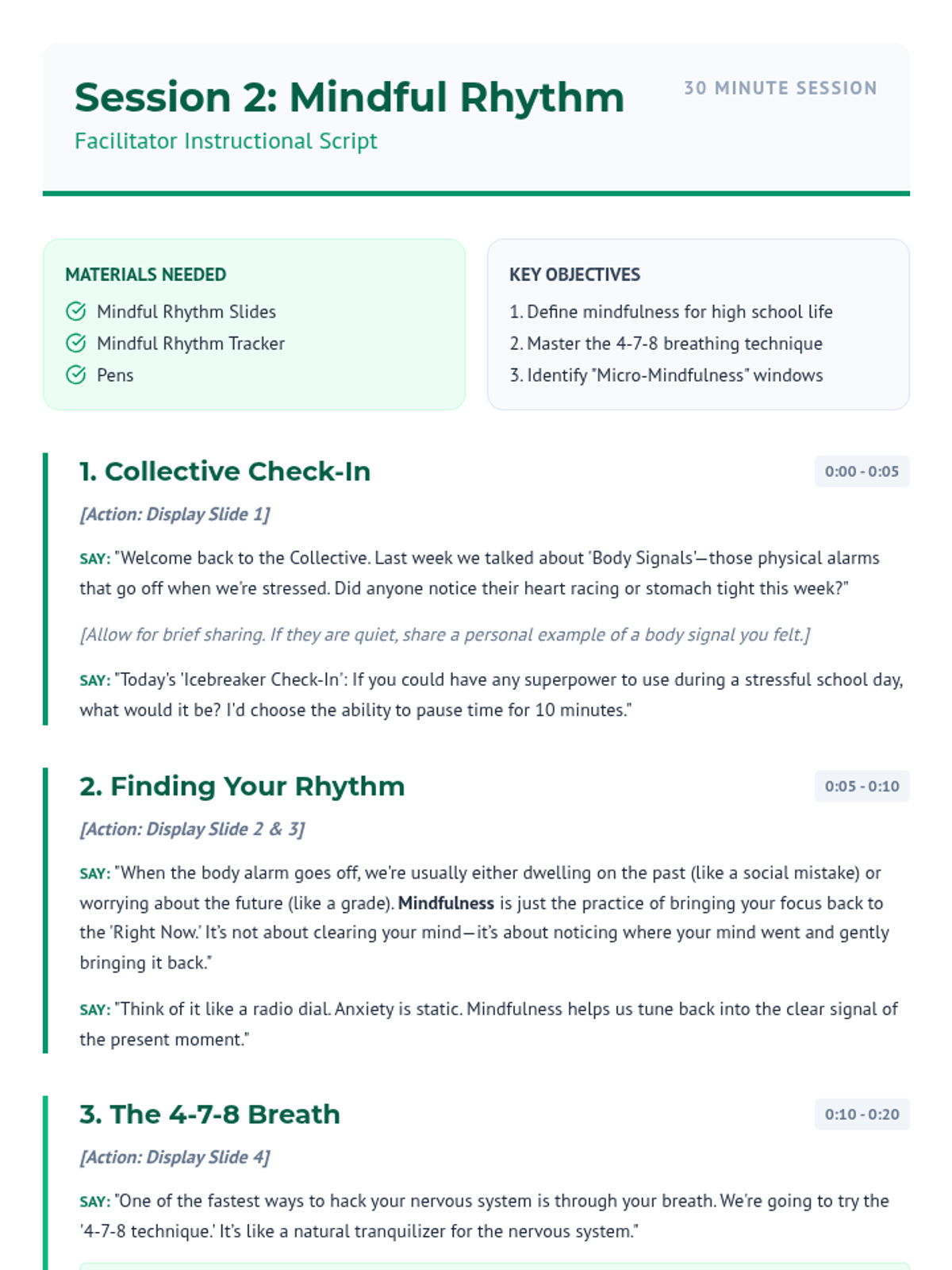
A detailed facilitation script for the second session of the Calm Collective, providing time-stamped sections, "what to say" prompts, and "what to do" instructions for the counselor. Focuses on mindfulness and the 4-7-8 breathing technique. Adjusted colors and fixed page breaks.
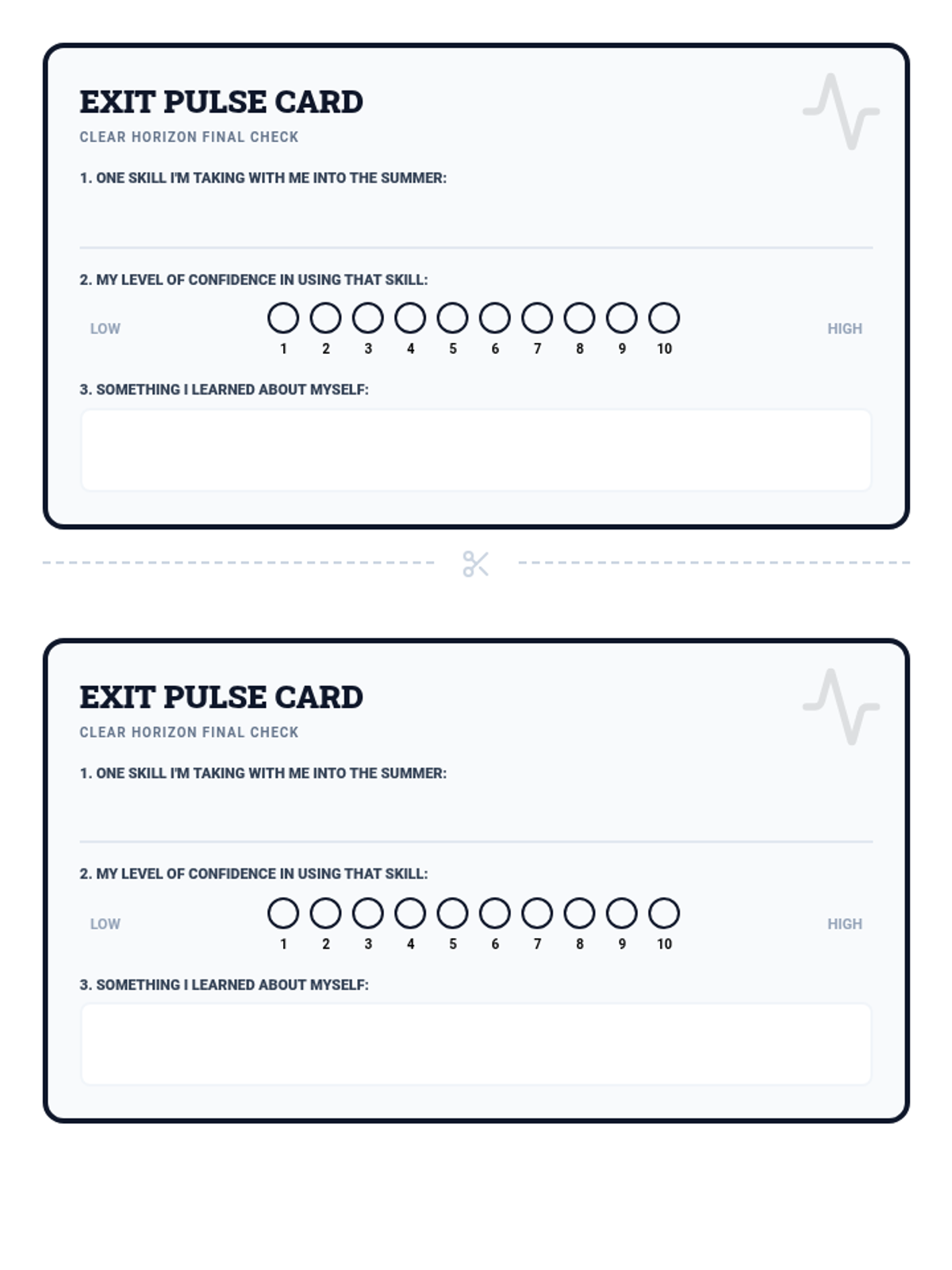
A final exit ticket for the sequence with two usable cards per page for efficient printing, featuring numbered confidence scales.
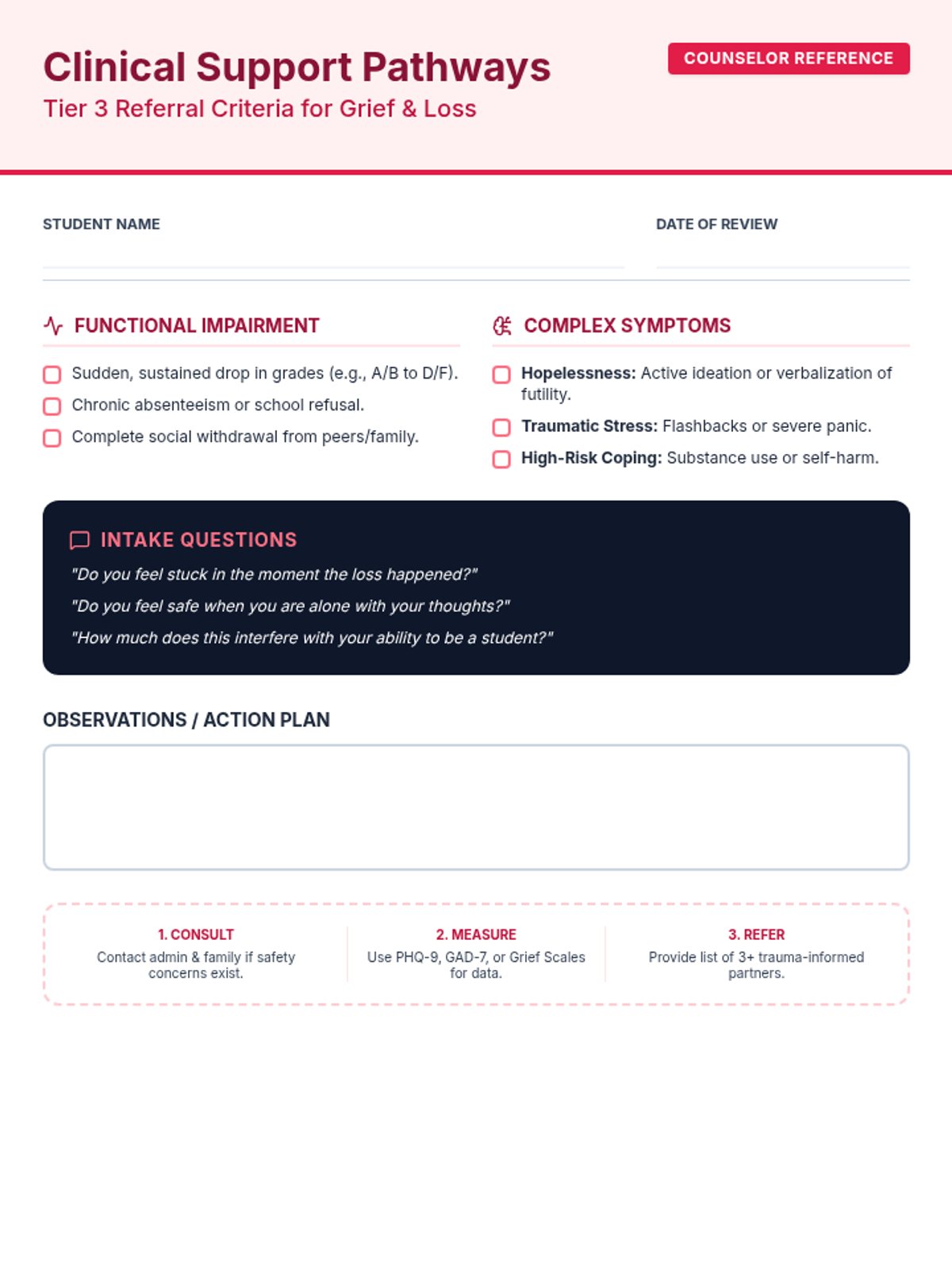
A clinical reference guide for counselors to identify Tier 3 needs. Revised for single-page layout, includes header fields, and improved contrast.
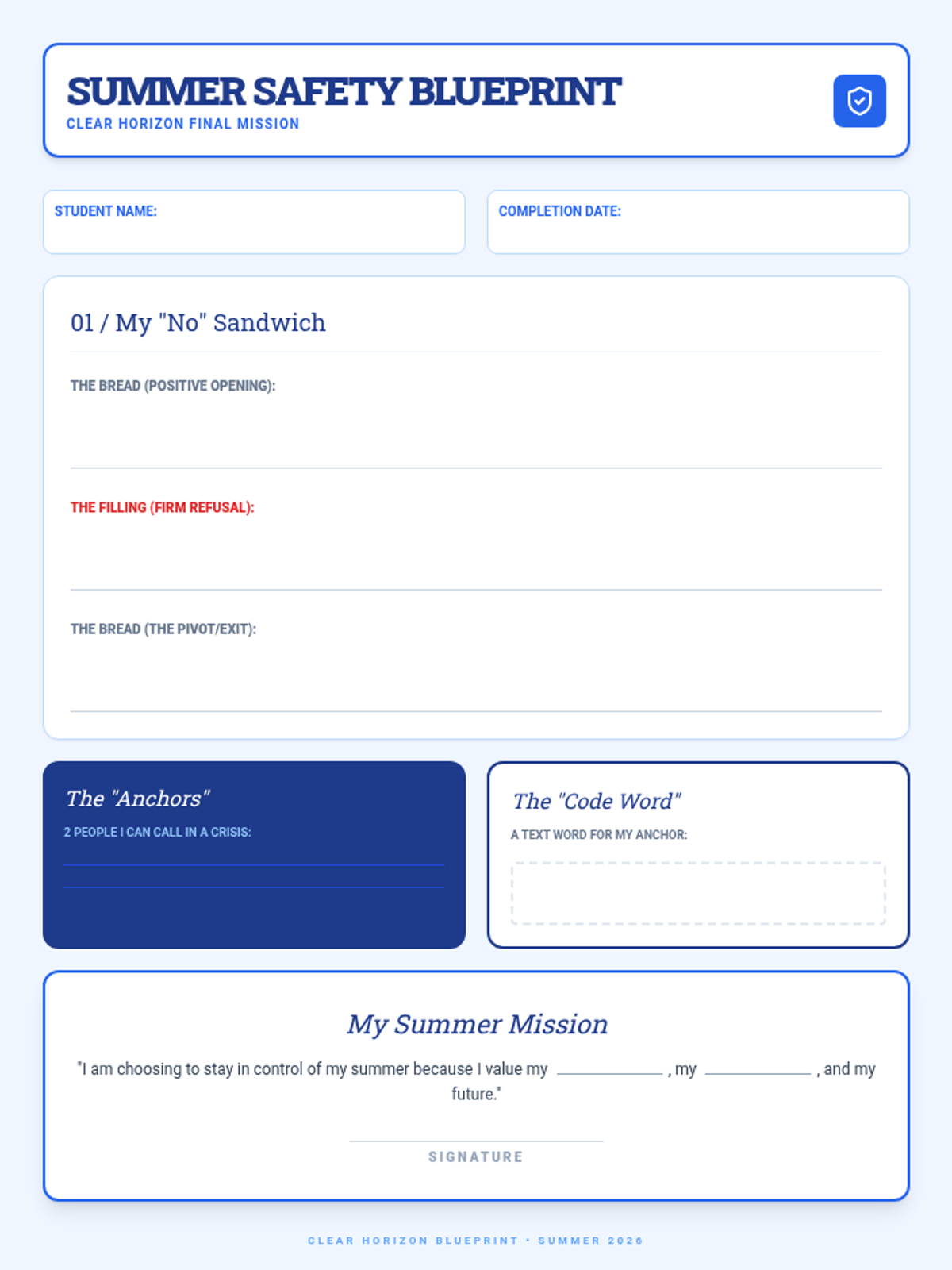
A culminating safety plan for students to document refusal scripts and emergency strategies, with improved spacing and layout for physical completion.
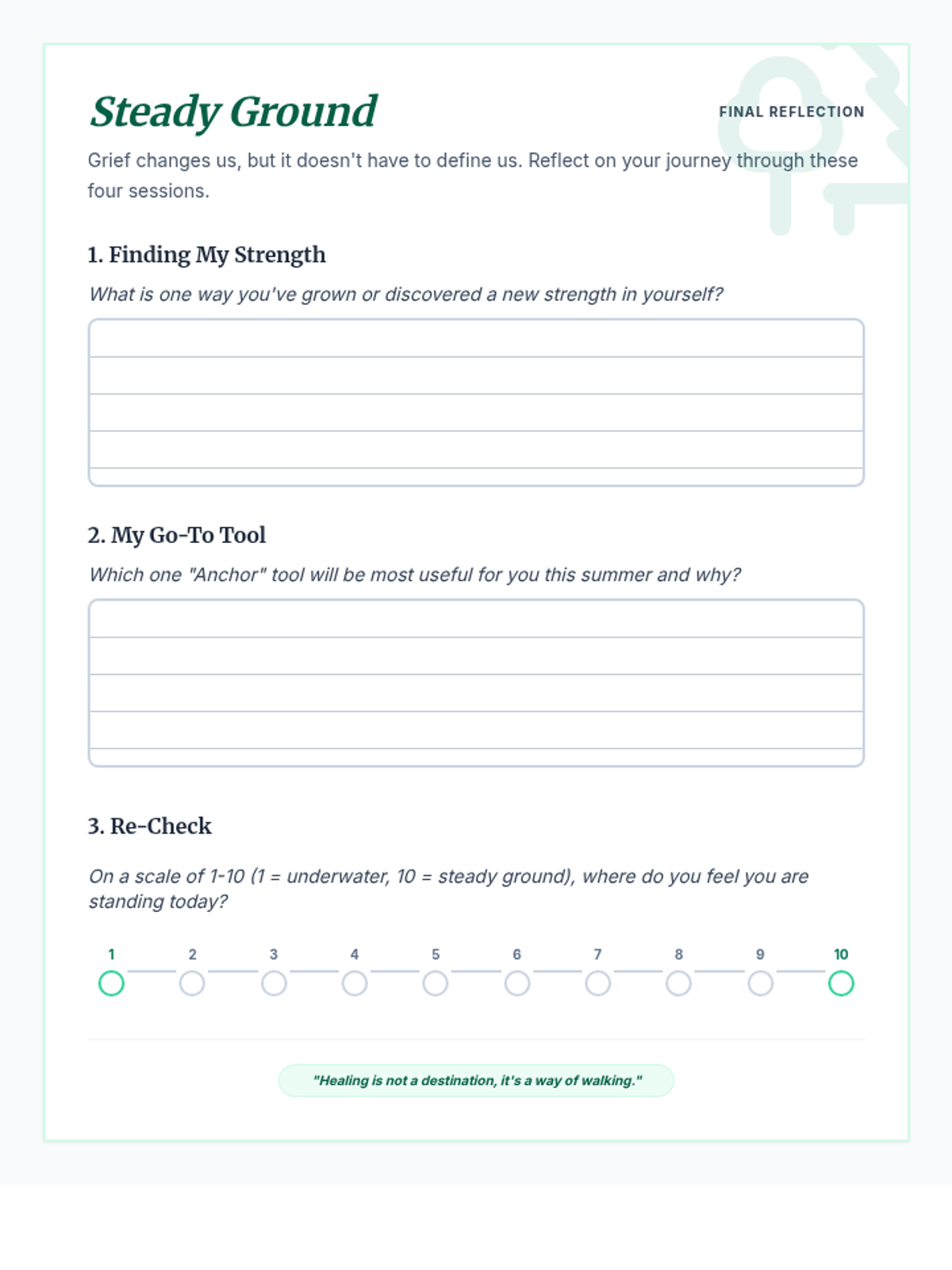
A final student reflection handout for identifying growth and self-assessing. Revised with numeric scale labels, improved contrast, and writing guide lines.
A final session presentation focusing on concrete refusal skills and practical exit strategies, with improved visual contrast and layout.
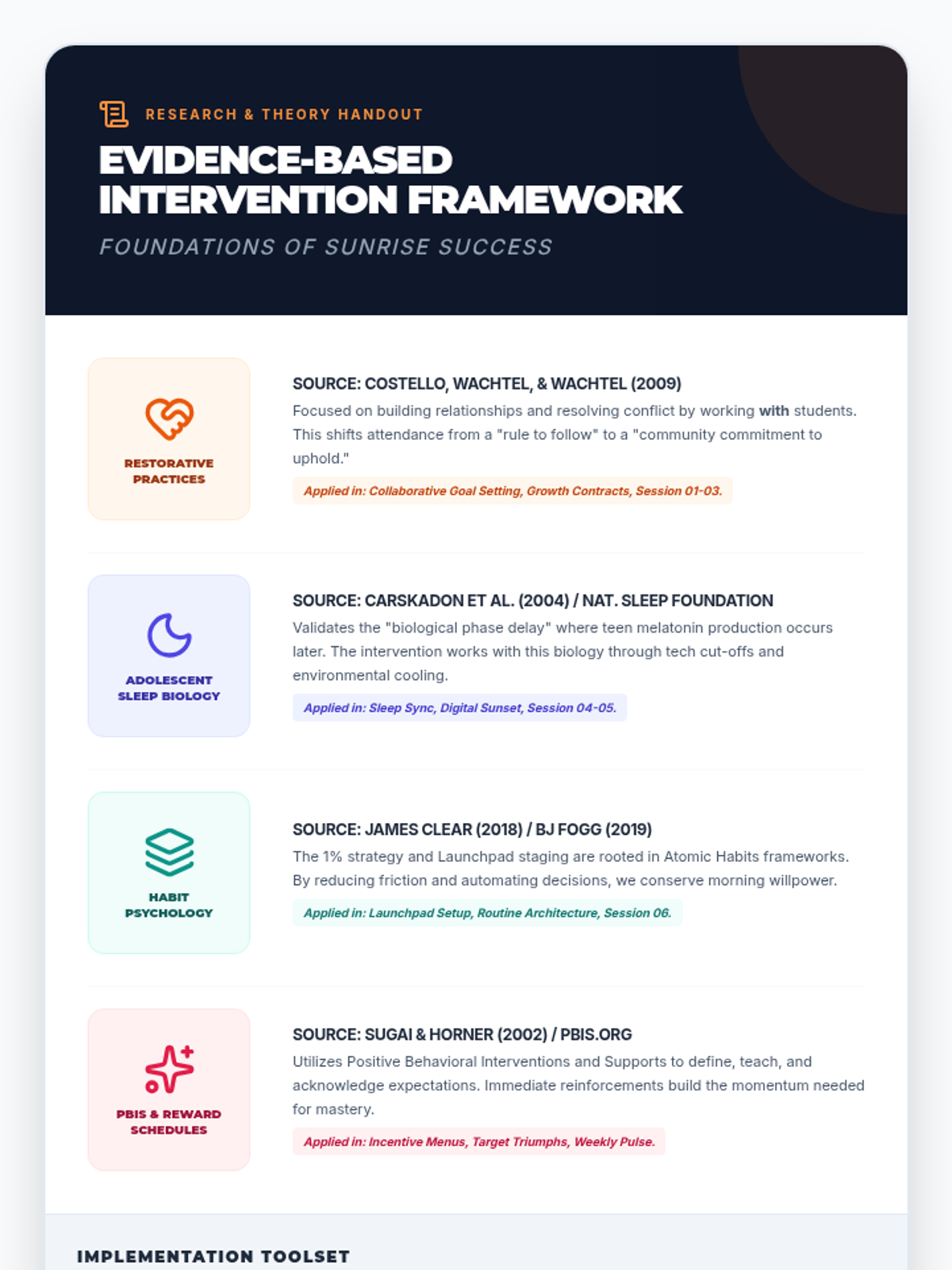
A comprehensive list of research sources and theoretical frameworks that underpin the Sunrise Success intervention, including Restorative Practices, Sleep Science, Habit Psychology, and PBIS.
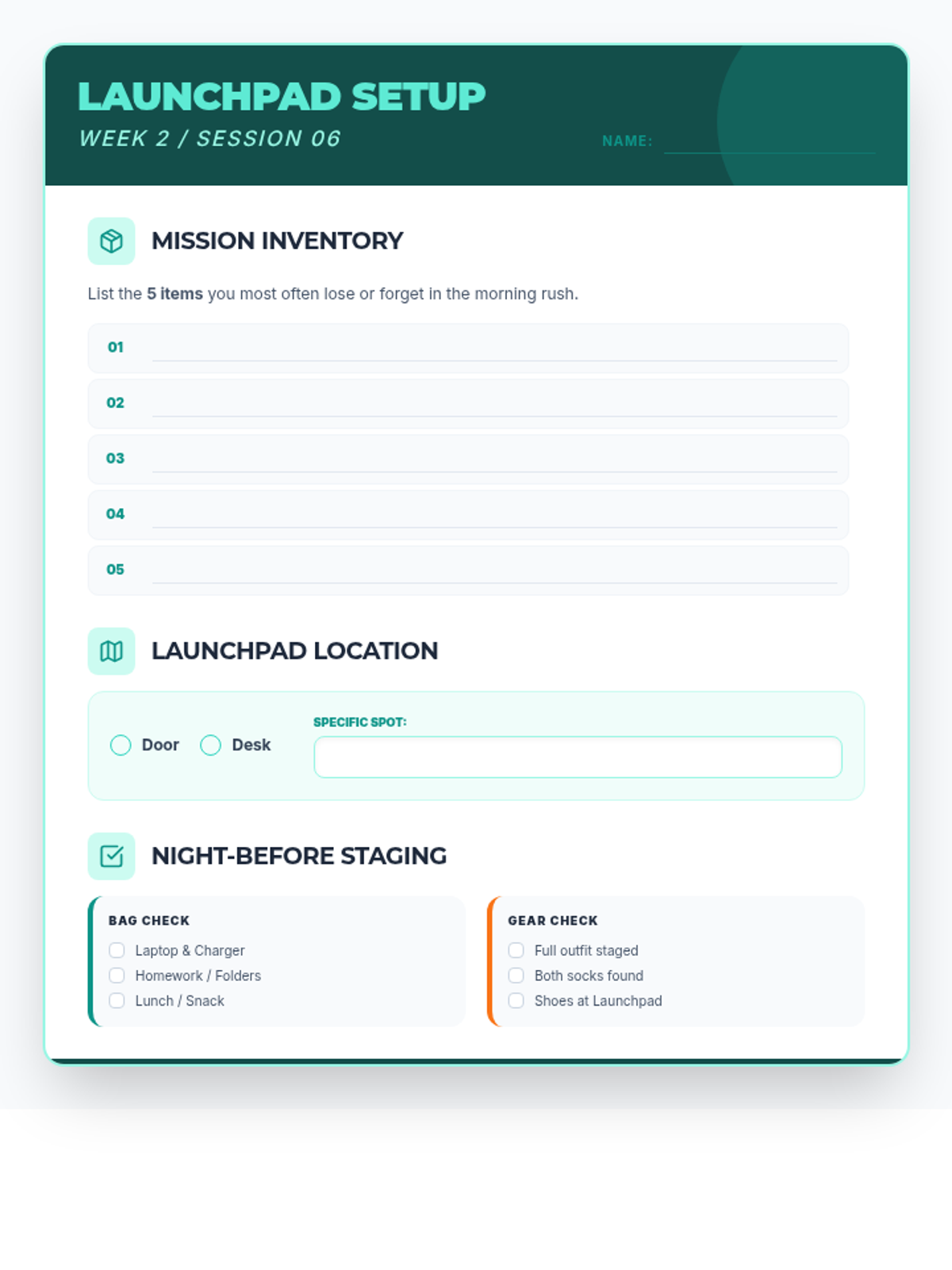
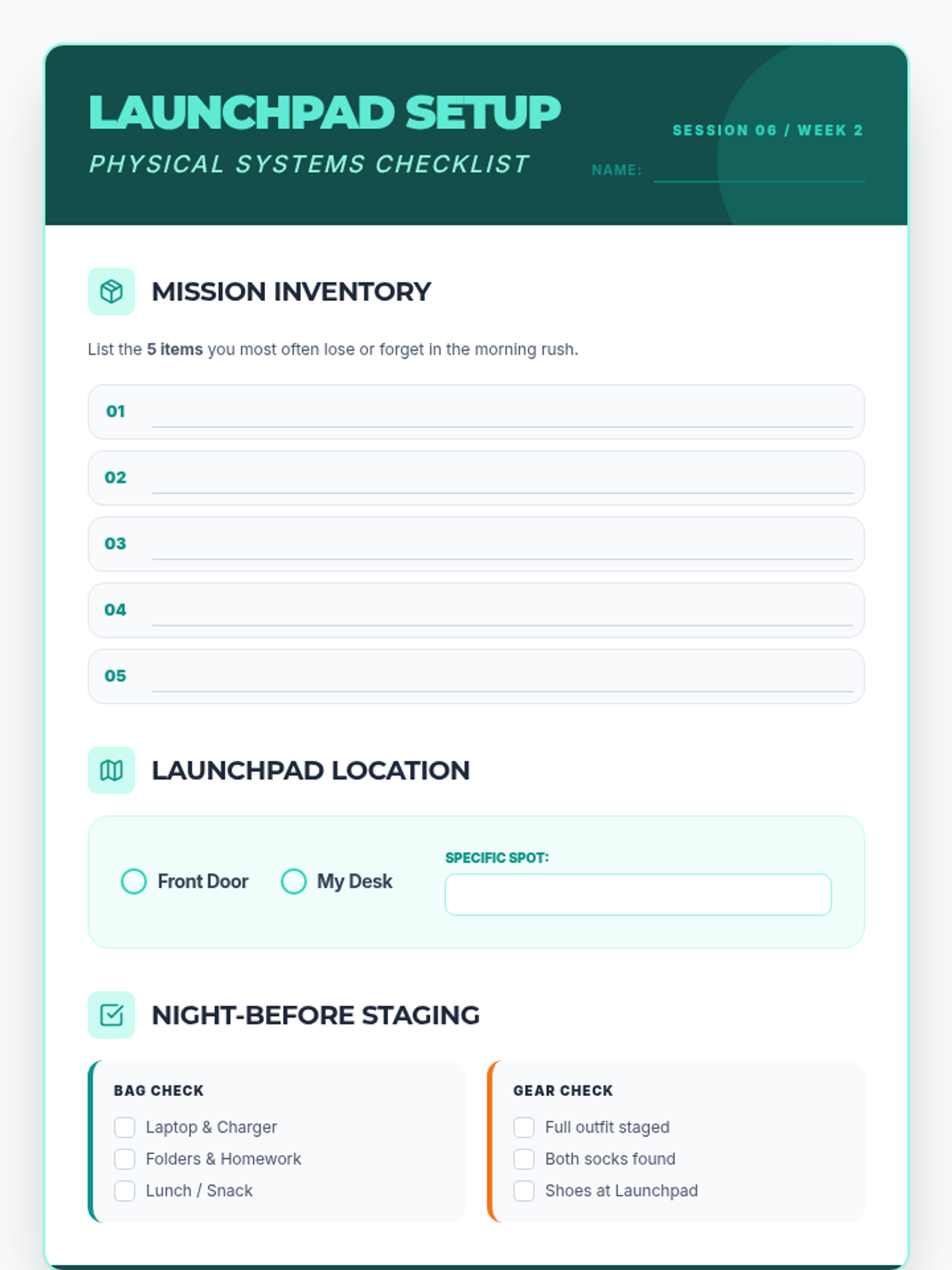
A physical organization checklist revised to fit on a single page, featuring vertical inventory lines for easier handwriting and improved print layout.
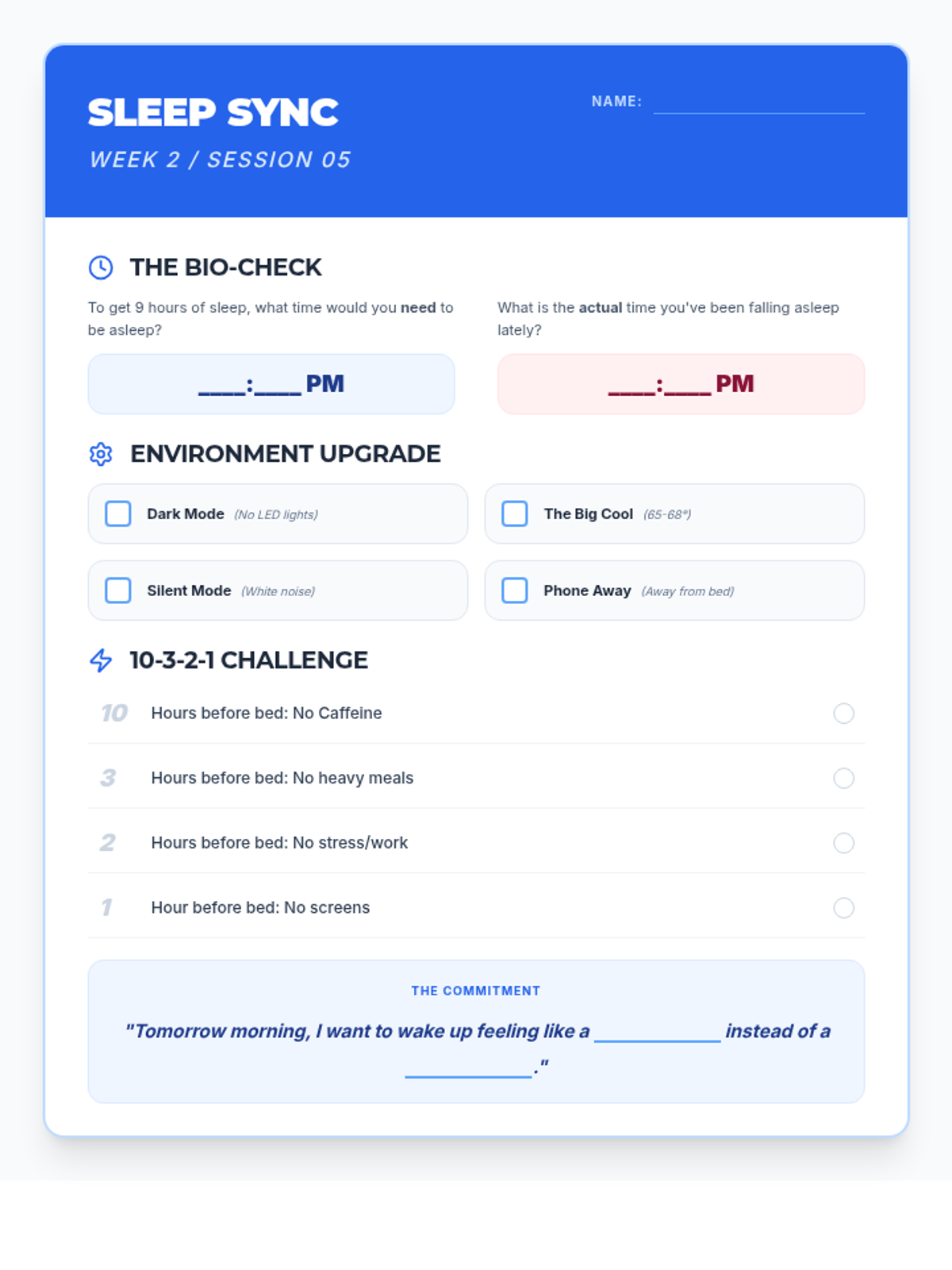
A sleep hygiene guide revised to fit on a single page, featuring improved contrast for student handwriting and functional input spaces for commitments.
Instructional slides for the Sleep Sync lesson, revised with better text contrast for projection and simplified layouts for guaranteed PDF rendering.
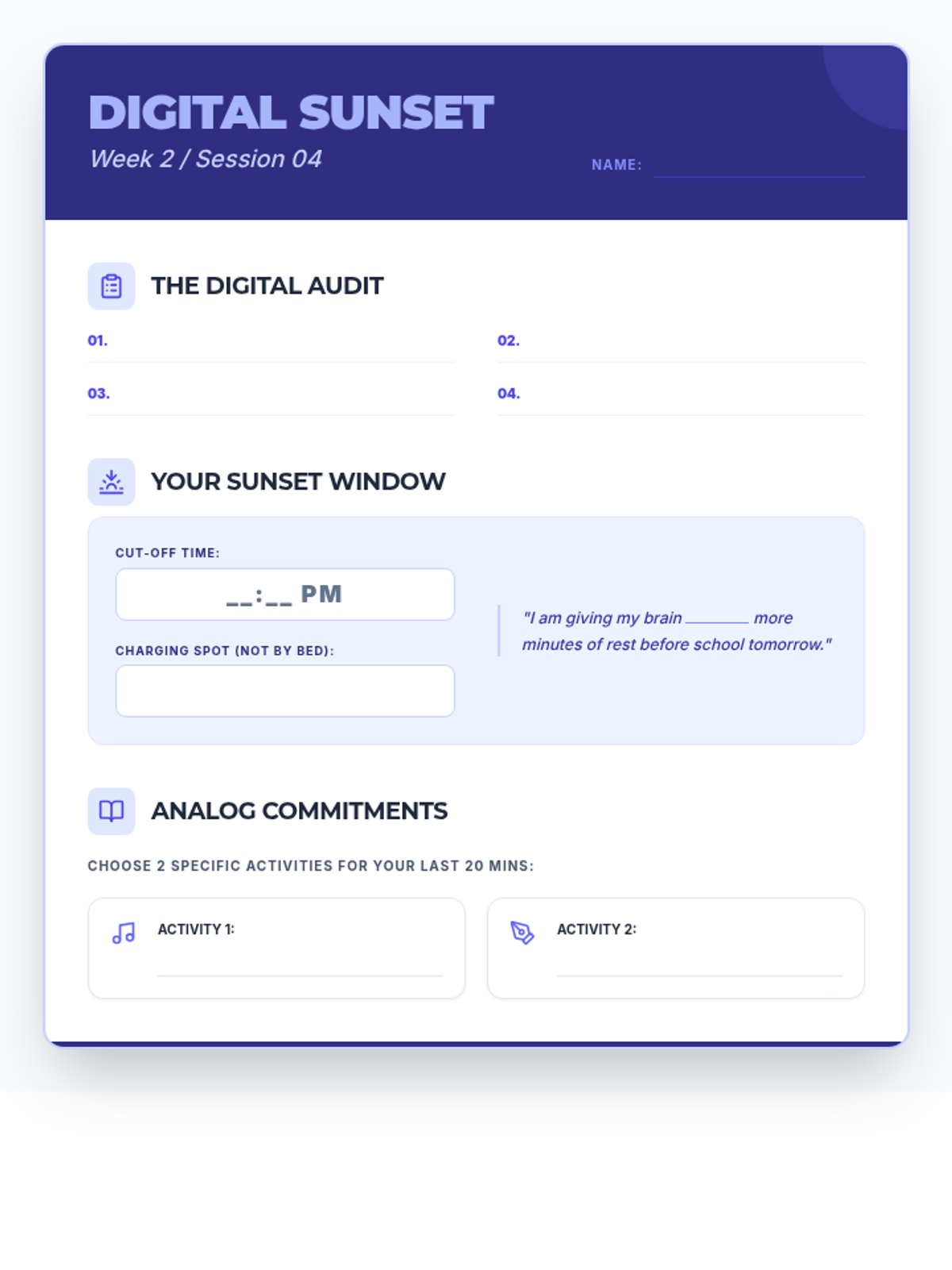
A worksheet for designing a 'Digital Sunset' window, revised to fit on a single page with larger handwriting areas and functional input spaces for analog commitments.
Instructional slides for the Digital Sunset lesson, revised with higher contrast for projection, improved word spacing, and a clearer roadmap for the 5-week cycle.
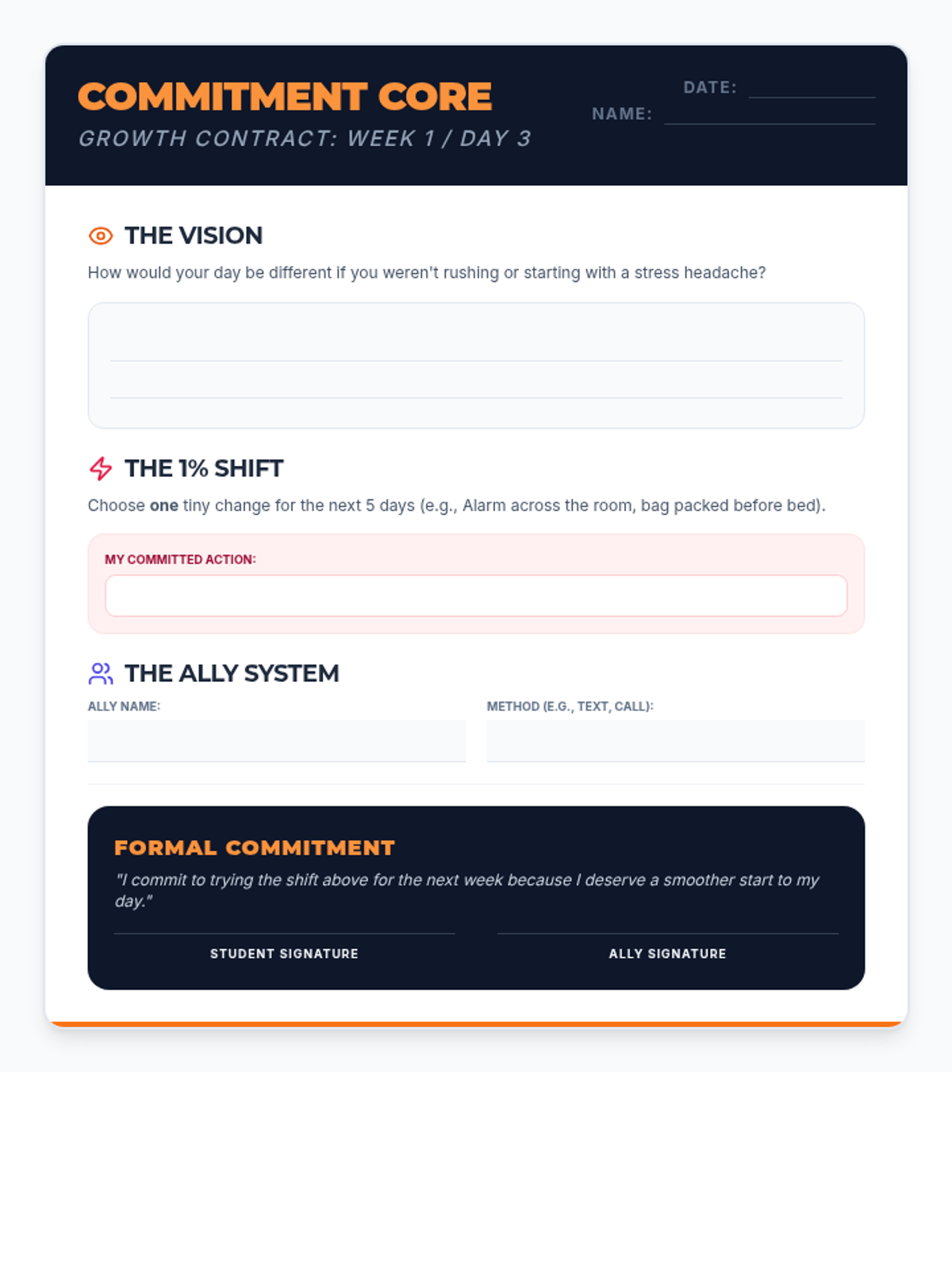
A formal growth contract revised to fit on a single page, featuring guided lines for student writing and explicit layout adjustments for print utility.
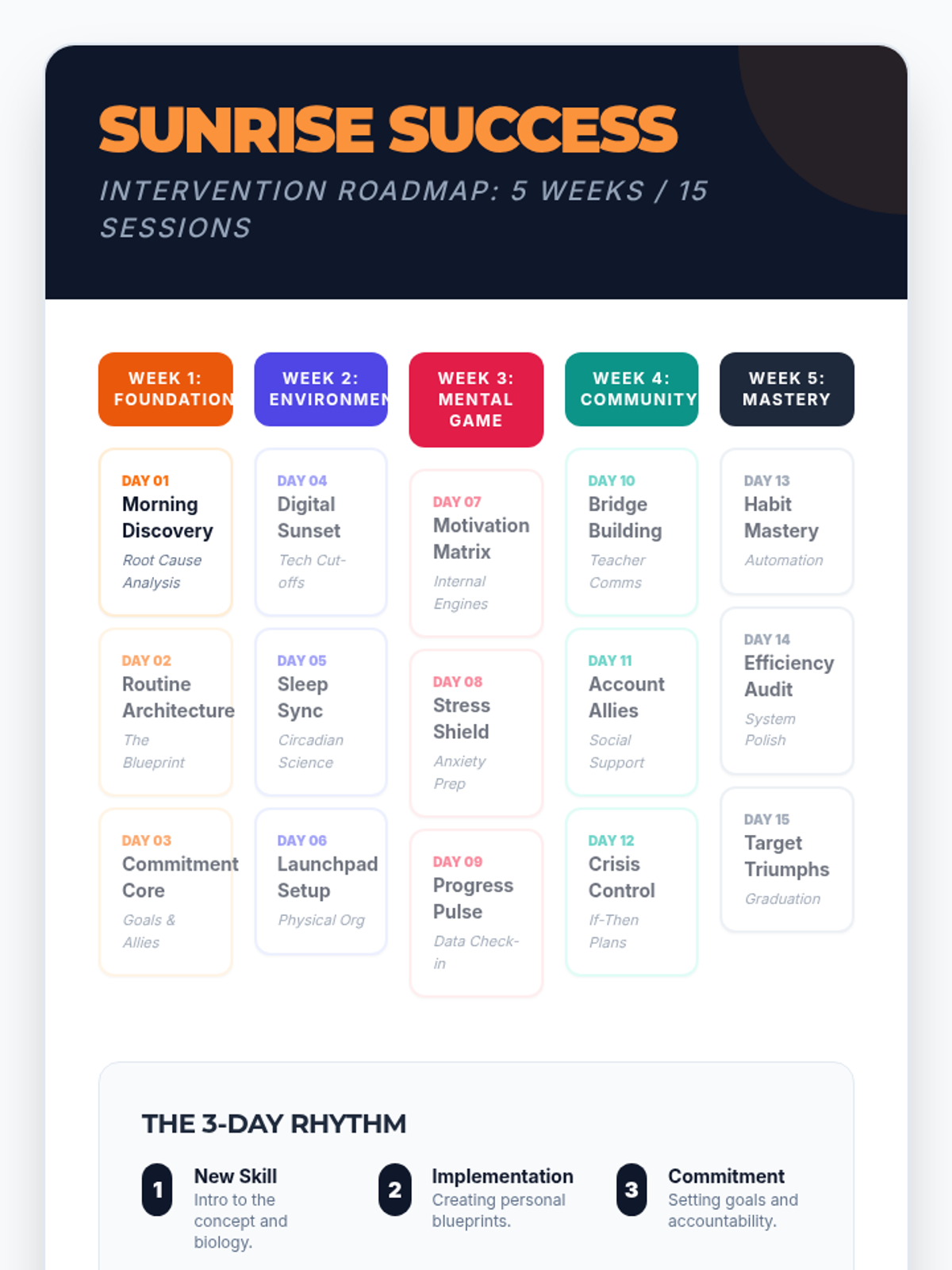
A comprehensive visual roadmap of the 15-session restorative attendance intervention, outlining the themes and daily topics across the 5-week cycle.
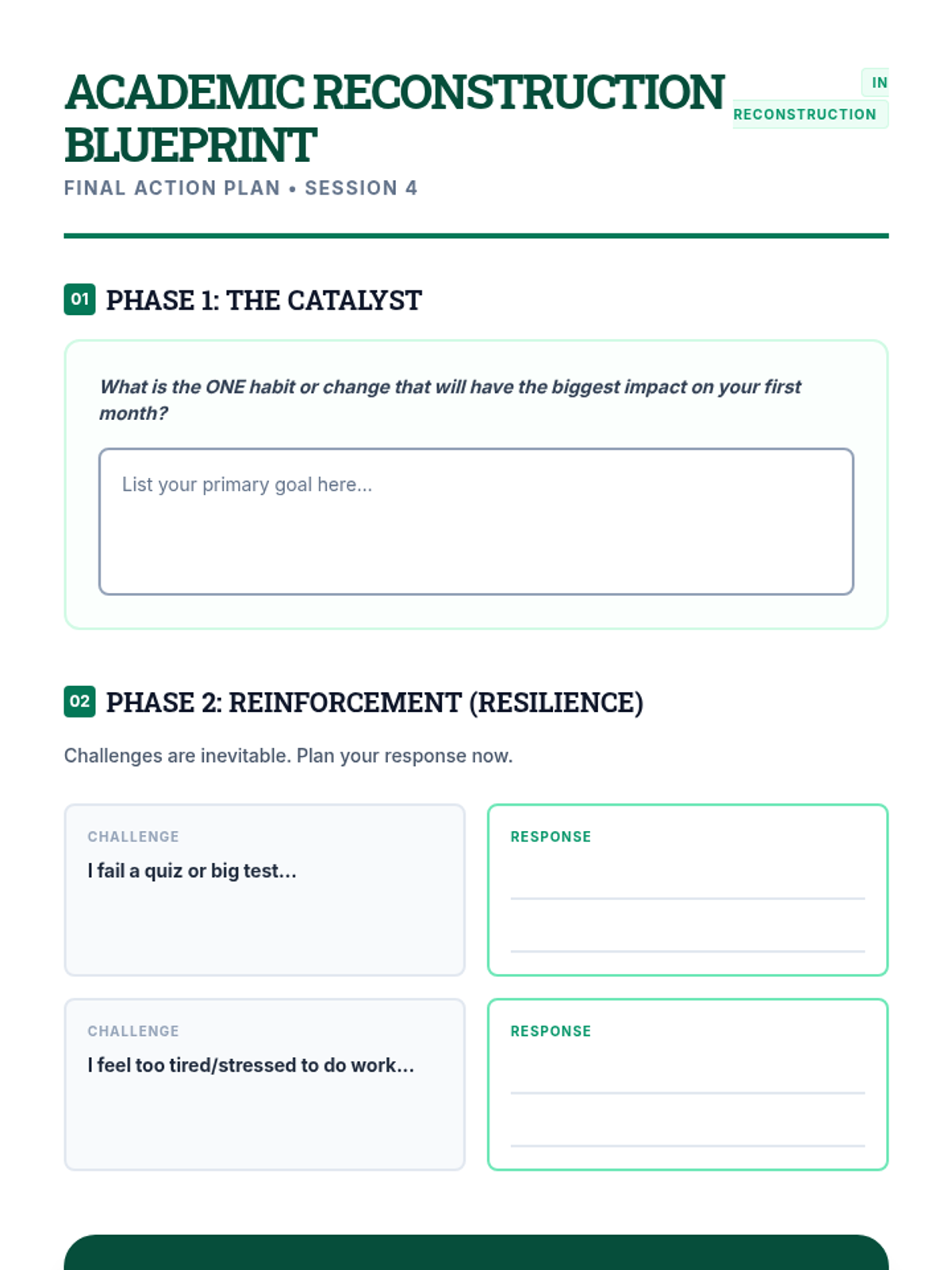
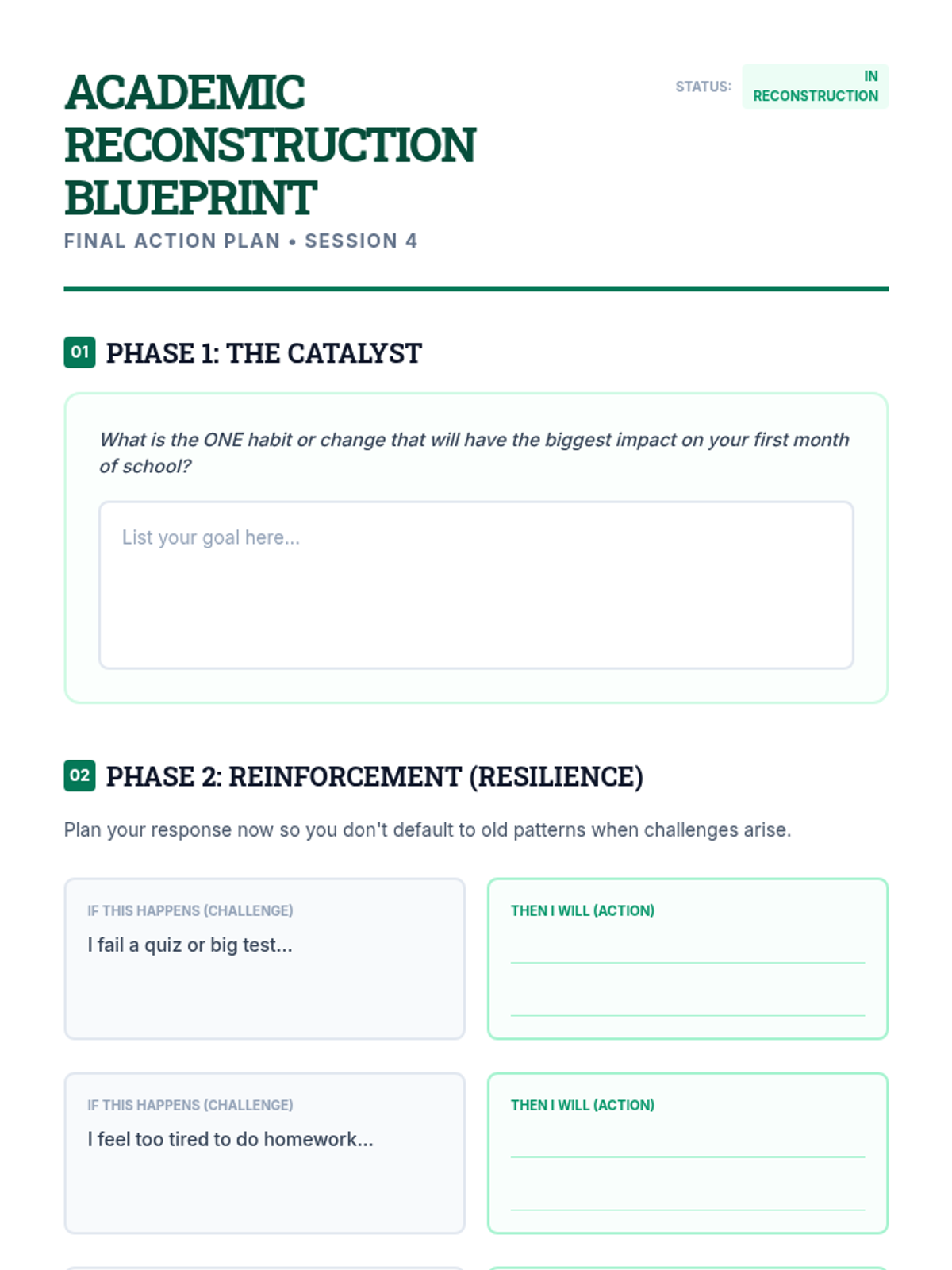
A final comprehensive academic blueprint worksheet for Session 4. Revised to fit one page, add multi-line action areas for 'If/Then' strategies, and unify signature block labeling.
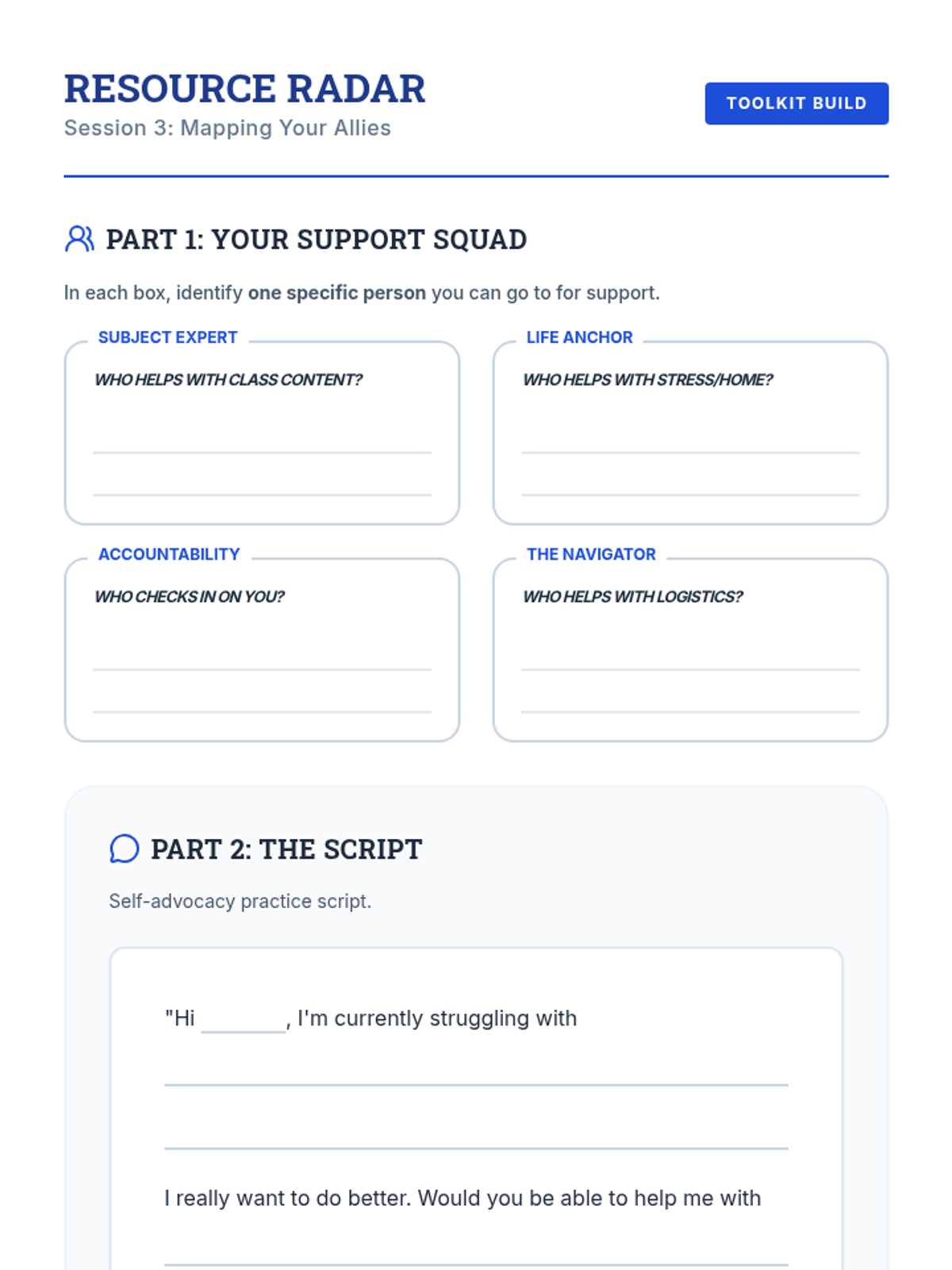
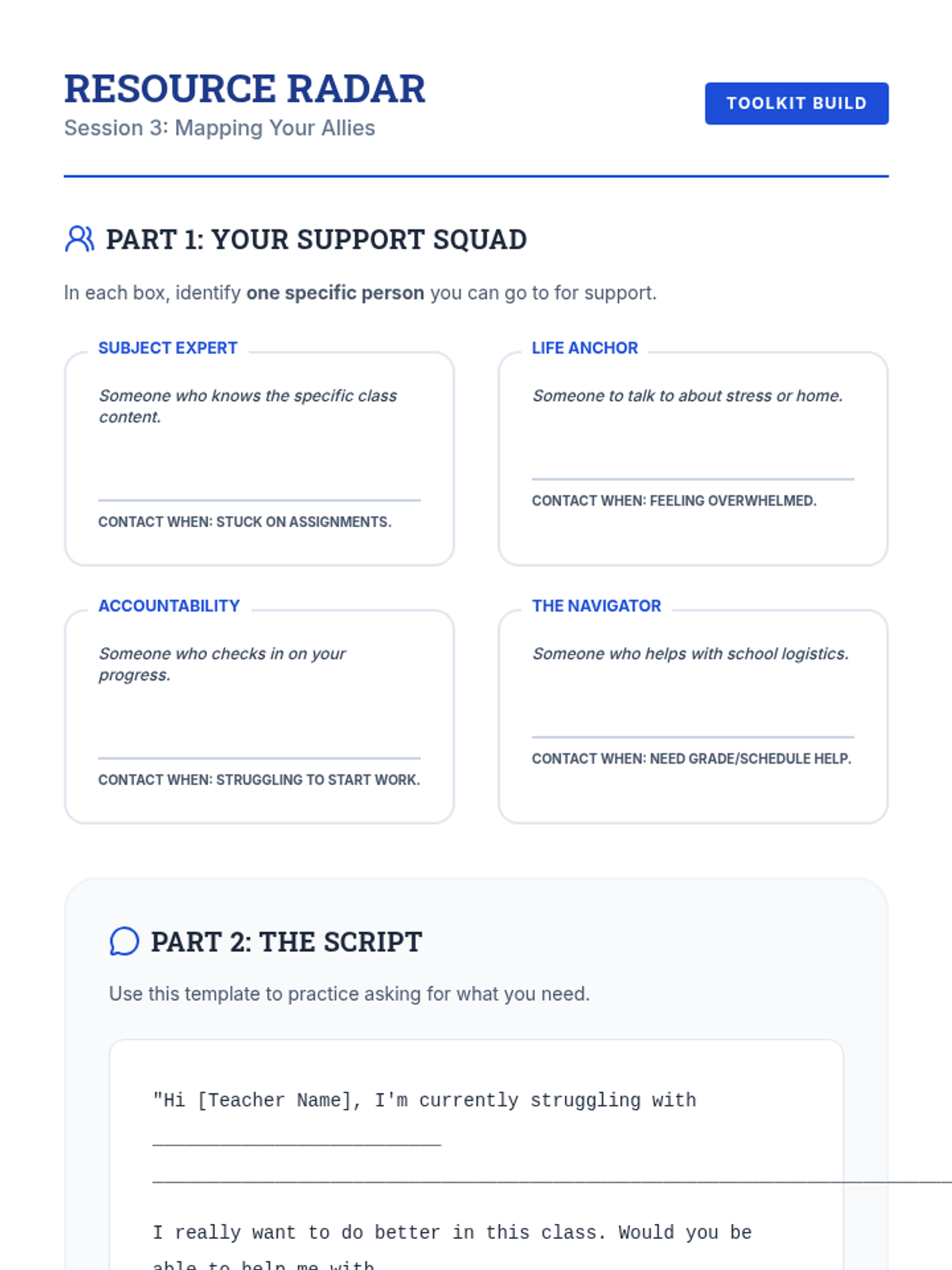
A worksheet for Session 3. Revised for a single-page layout, expanded handwriting areas for Part 1, and a cleaner, more usable advocacy script template in Part 2.
Slide deck for Session 3. Revised to fix quote wrapping on Slide 5 and further maximize student writing space in the Resource Radar activity on Slide 4.
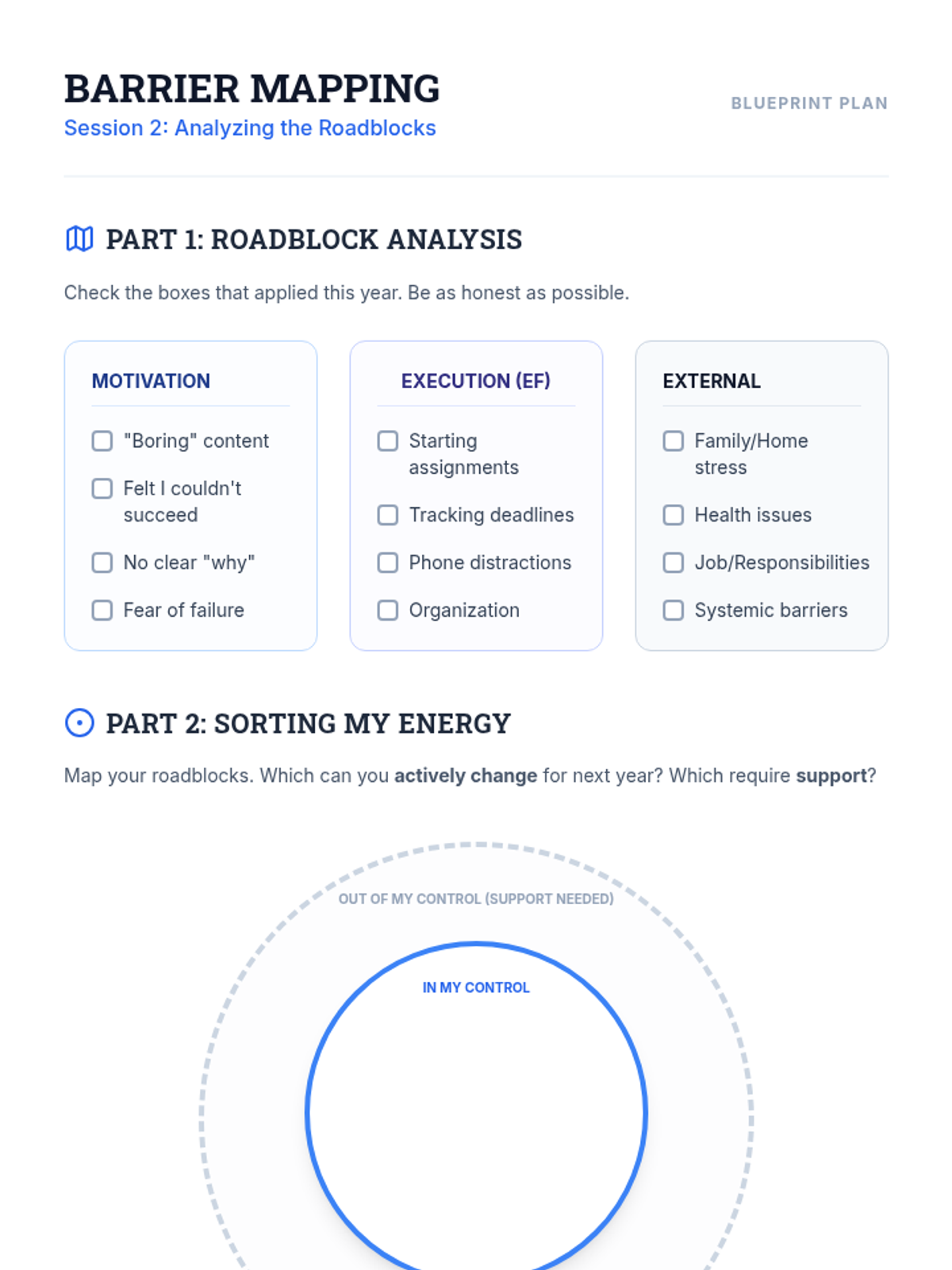
A barrier mapping worksheet for Session 2. Revised for single-page layout, improved vertical alignment of checkboxes, and removal of placeholder text in work areas.
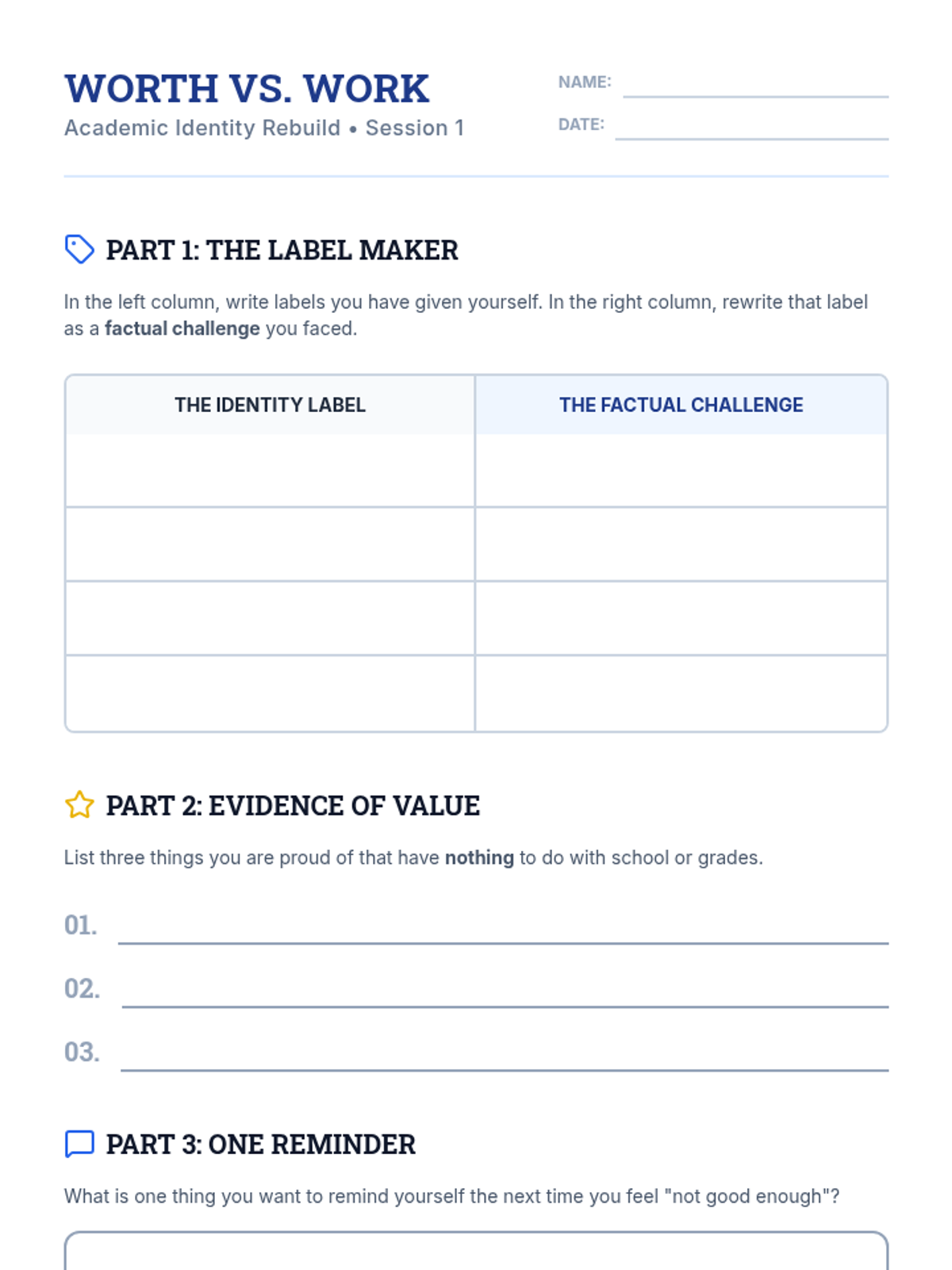
A reflective worksheet for Session 1. Revised for single-page layout, improved writing line contrast, and clearer header sizing.
Introductory slide deck for Session 1. Revised for improved vertical balancing, fixed text kerning on Slide 3, and enhanced color contrast.
A final comprehensive academic blueprint worksheet for Session 4. Revised to fit one page, increase writing space for 'If/Then' scenarios, and improve text contrast.
A worksheet for Session 3 that helps students identify their support network. Revised for better layout (one page), improved text contrast, and cleaner script formatting.
Slide deck for Session 3, focusing on building a personalized toolkit of academic strategies. Revised to improve vertical utilization and student work area sizing on Slide 4.