College selection, application workflows, and financial aid navigation including FAFSA and scholarship acquisition. Builds skills in personal statement writing and career exploration to align post-secondary choices with long-term professional goals.
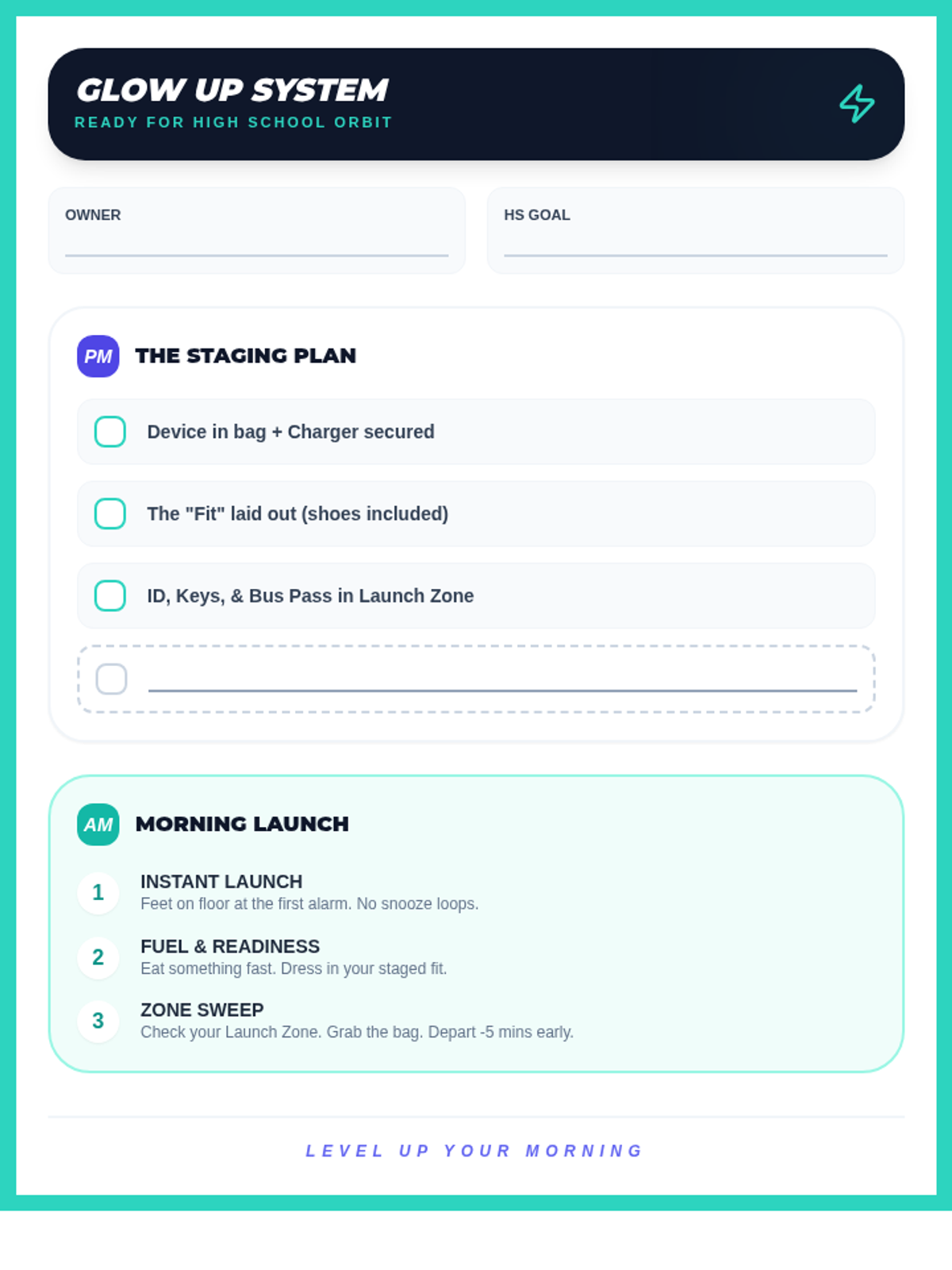
A sleek, one-page morning routine checklist for students to use both at night (for prep) and in the morning (for departure), designed with a modern high-school readiness focus.
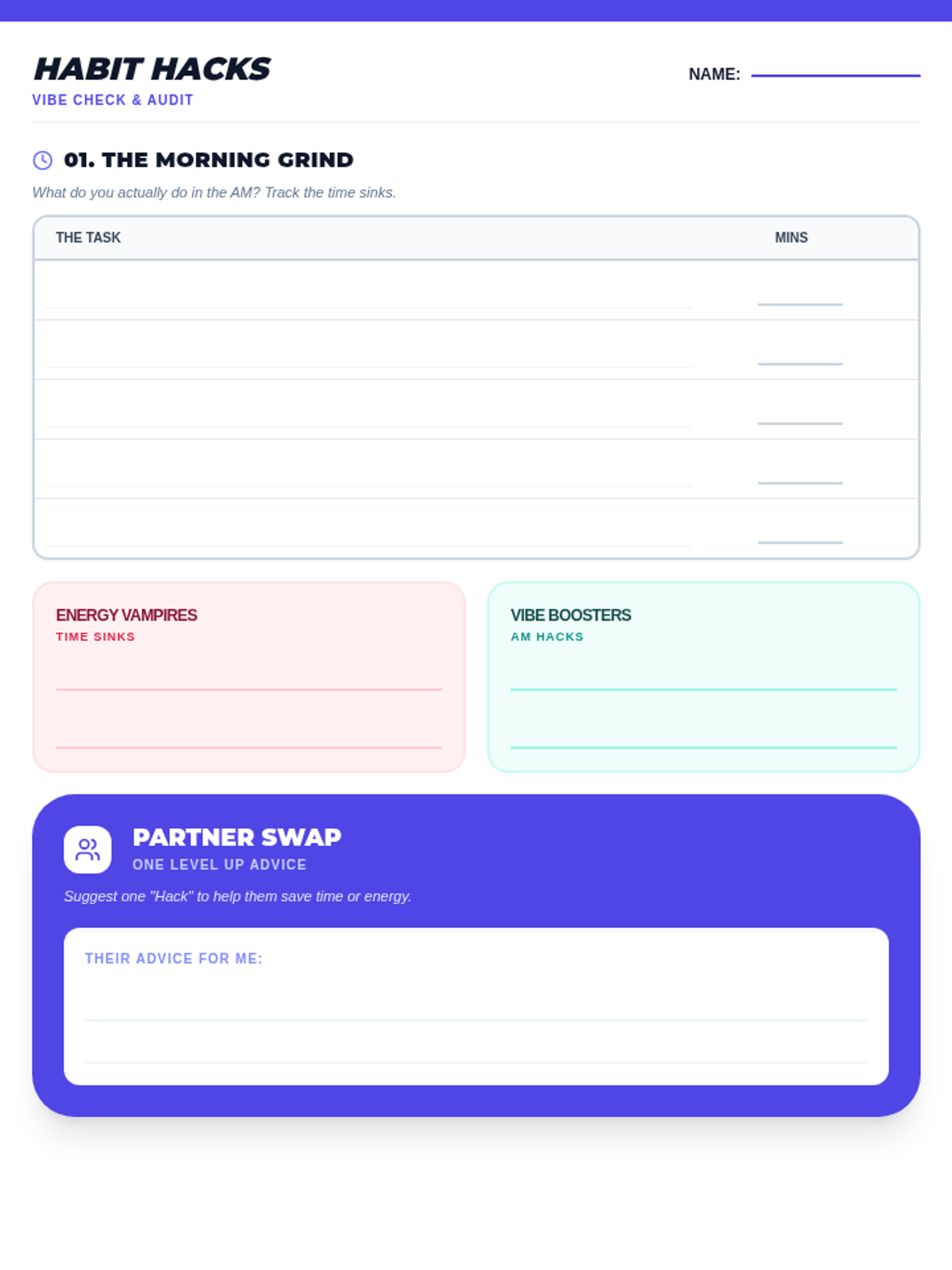
A one-page activity sheet for students to audit their morning habits, identify 'Energy Vampires', and exchange peer advice on improving their morning routines.
An expanded, high-energy slide deck for ADL mentors to lead discussions on high school preparedness, identifying 'Energy Vampires', and morning habit stacking.
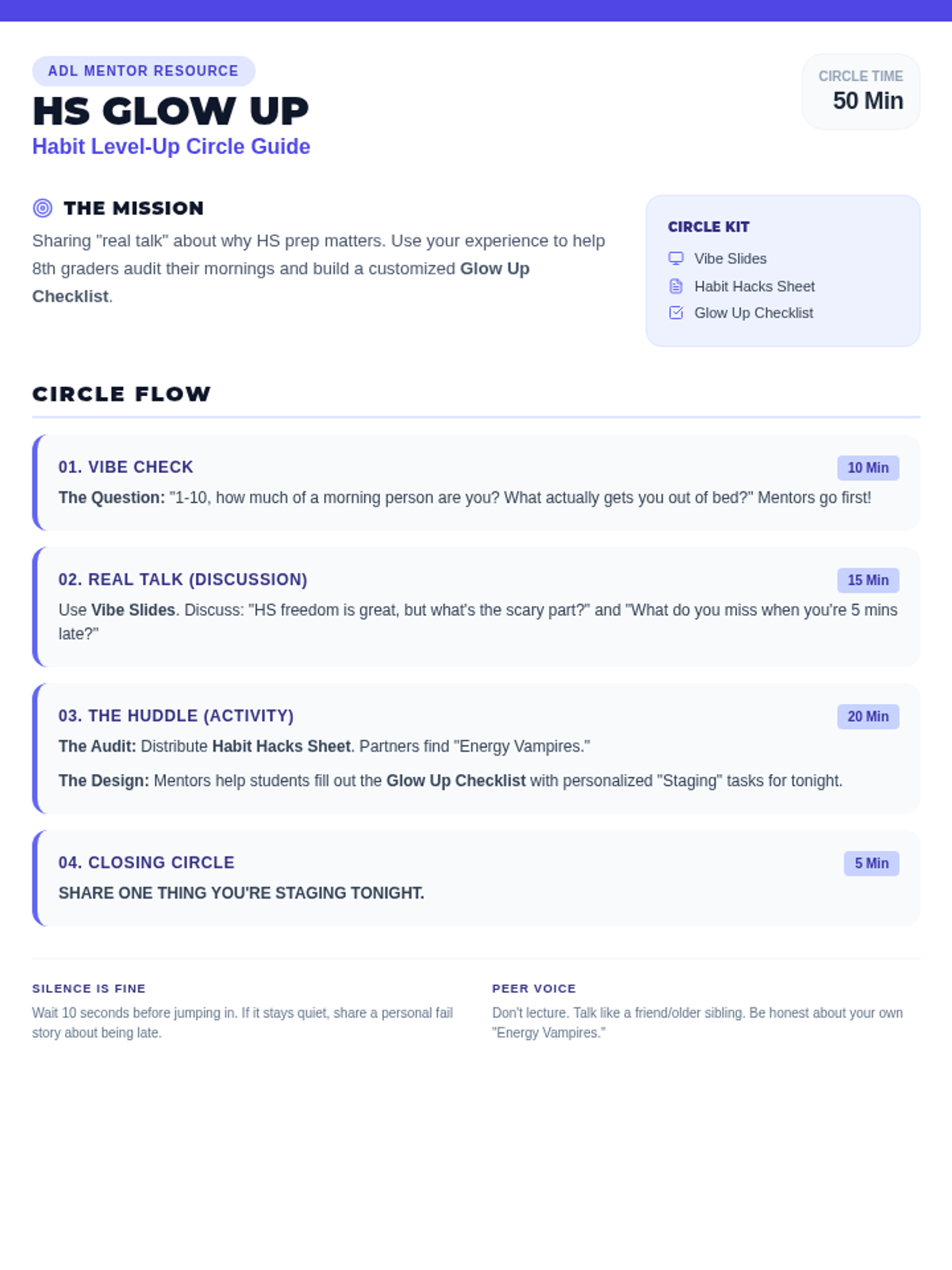
A condensed, one-page peer-to-peer facilitation guide for ADL mentors to lead a community circle on high school readiness, focusing on punctuality and morning habits.
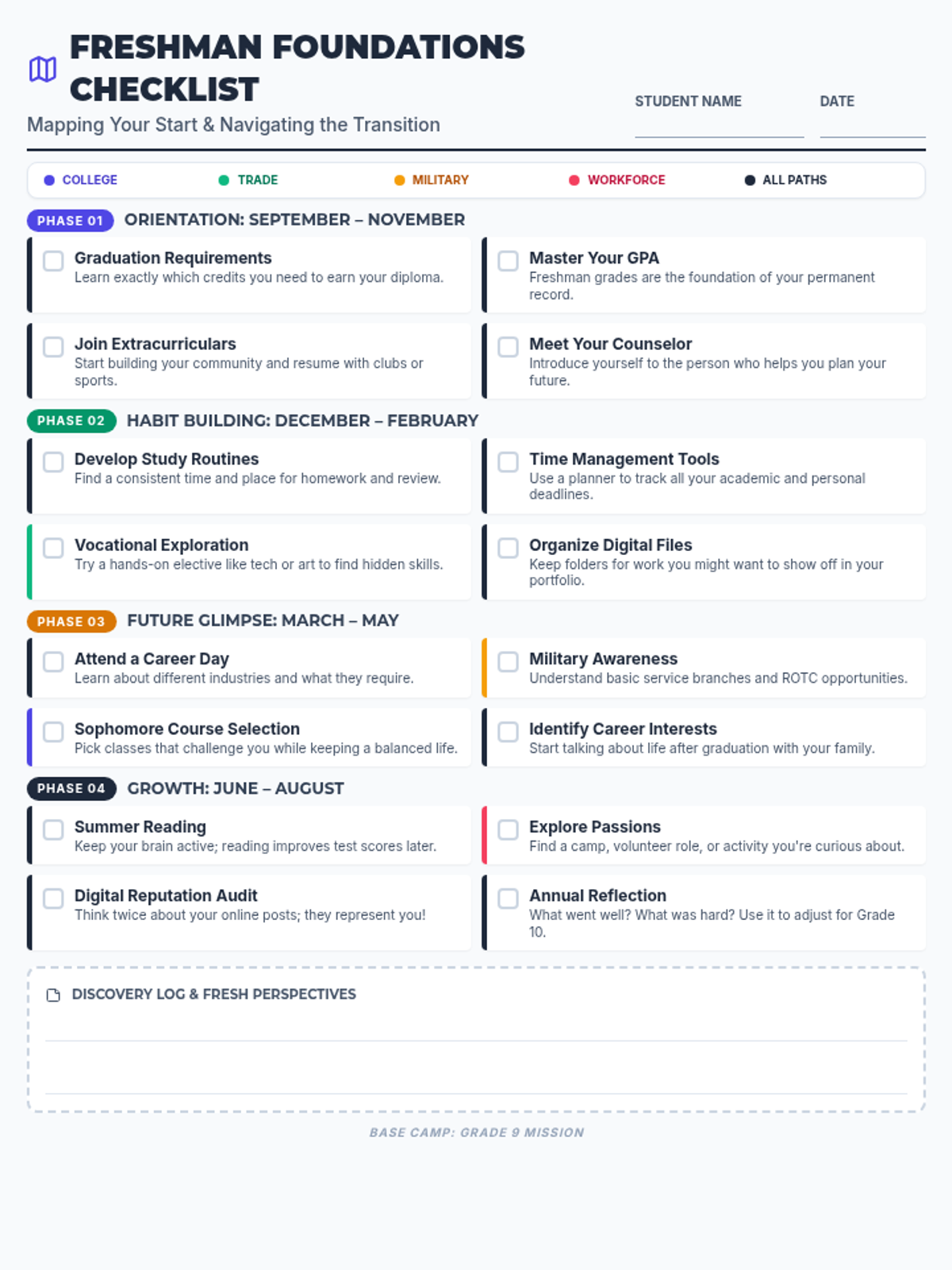
A comprehensive one-page checklist for high school freshmen, organized by seasonal phases and color-coded by post-secondary path (College, Trade, Military, Workforce). Focuses on building academic foundations, exploring interests, and developing essential study habits.
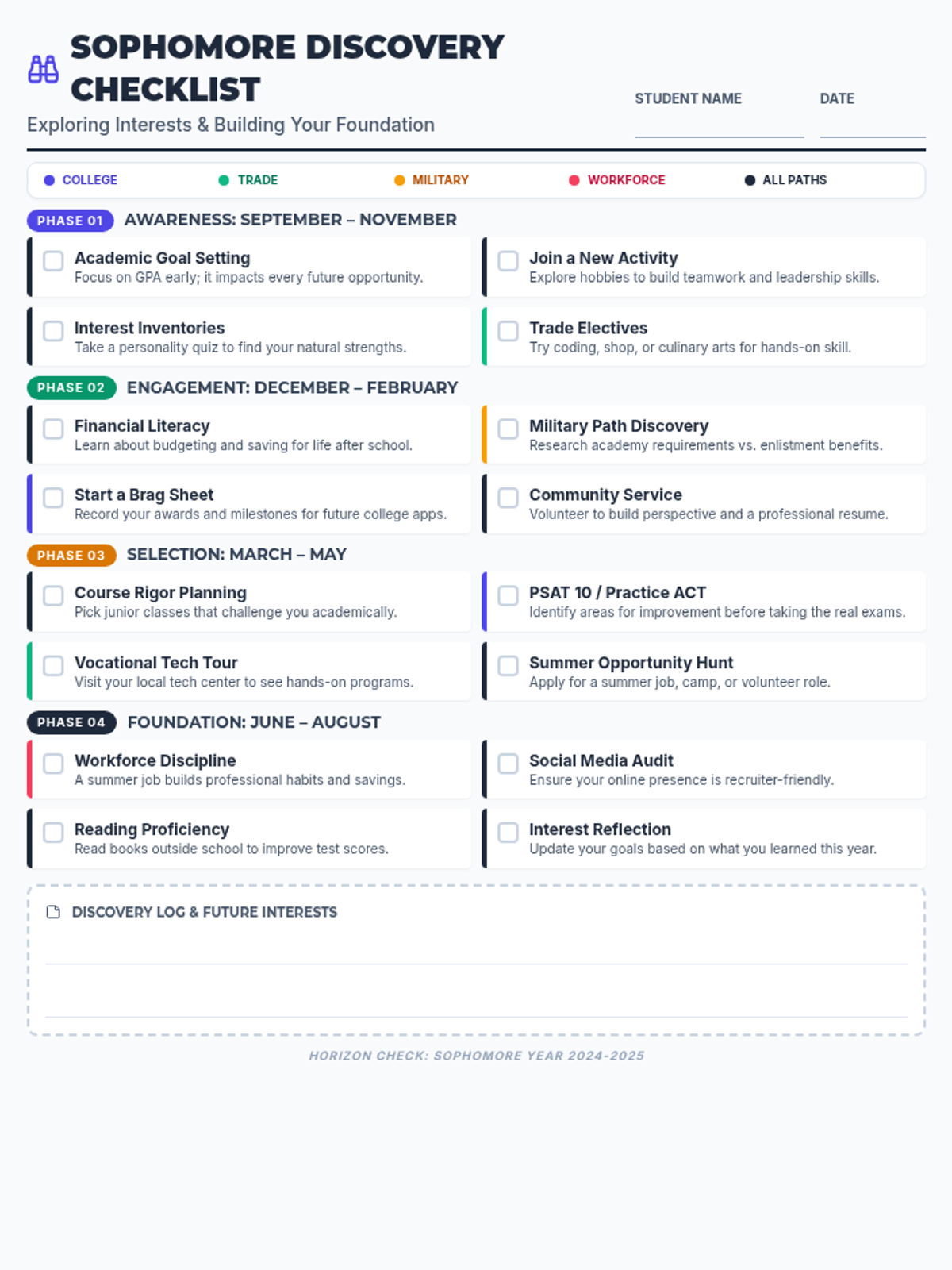
A comprehensive one-page checklist for high school sophomores, organized by seasonal phases and color-coded by post-secondary path (College, Trade, Military, Workforce). Focuses on interest exploration and building an academic and extracurricular foundation.
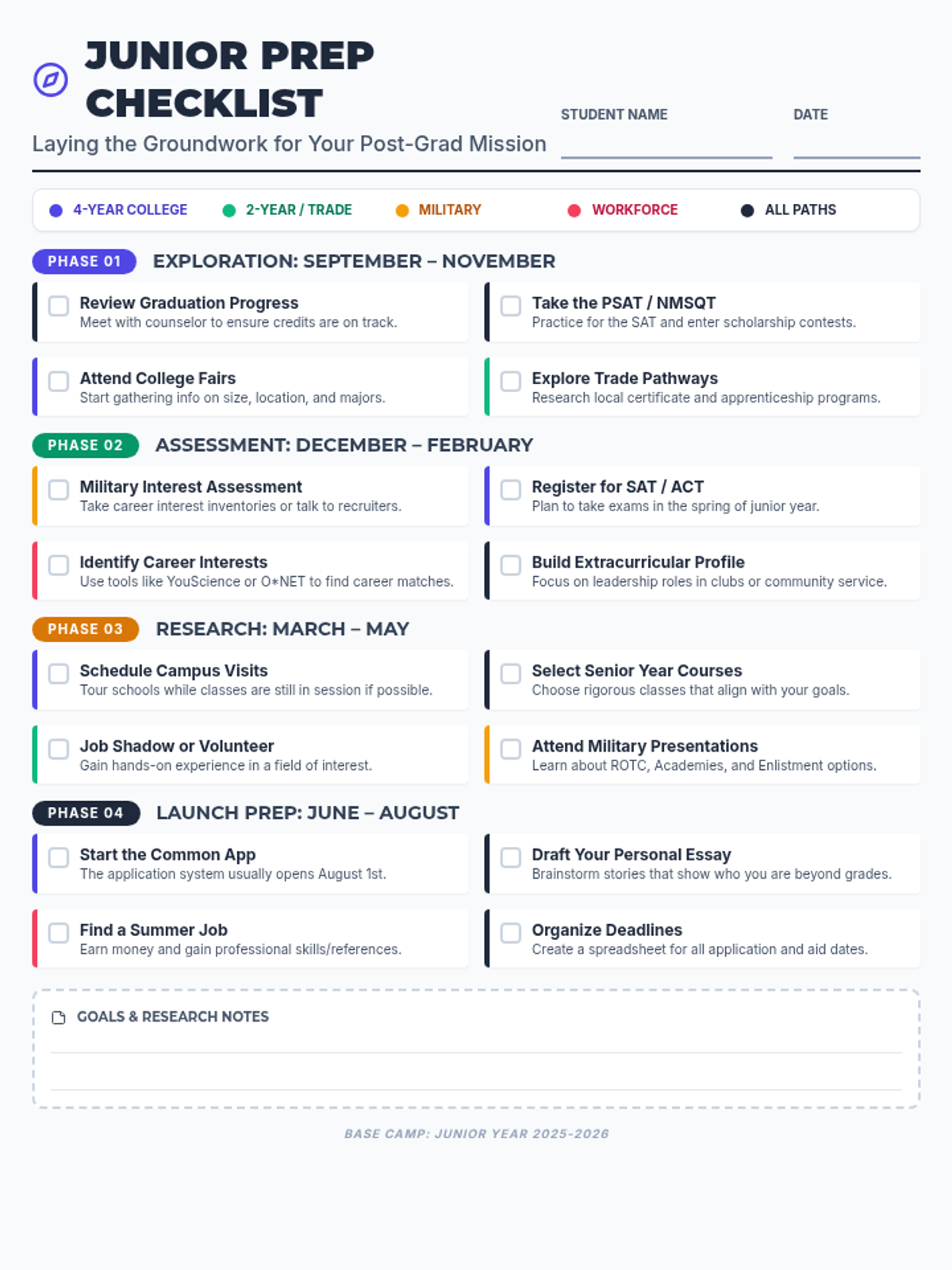
A comprehensive one-page checklist for high school juniors, organized by seasonal phases and color-coded by post-secondary path (College, Trade, Military, Workforce). Helps students lay the groundwork for their senior year mission.
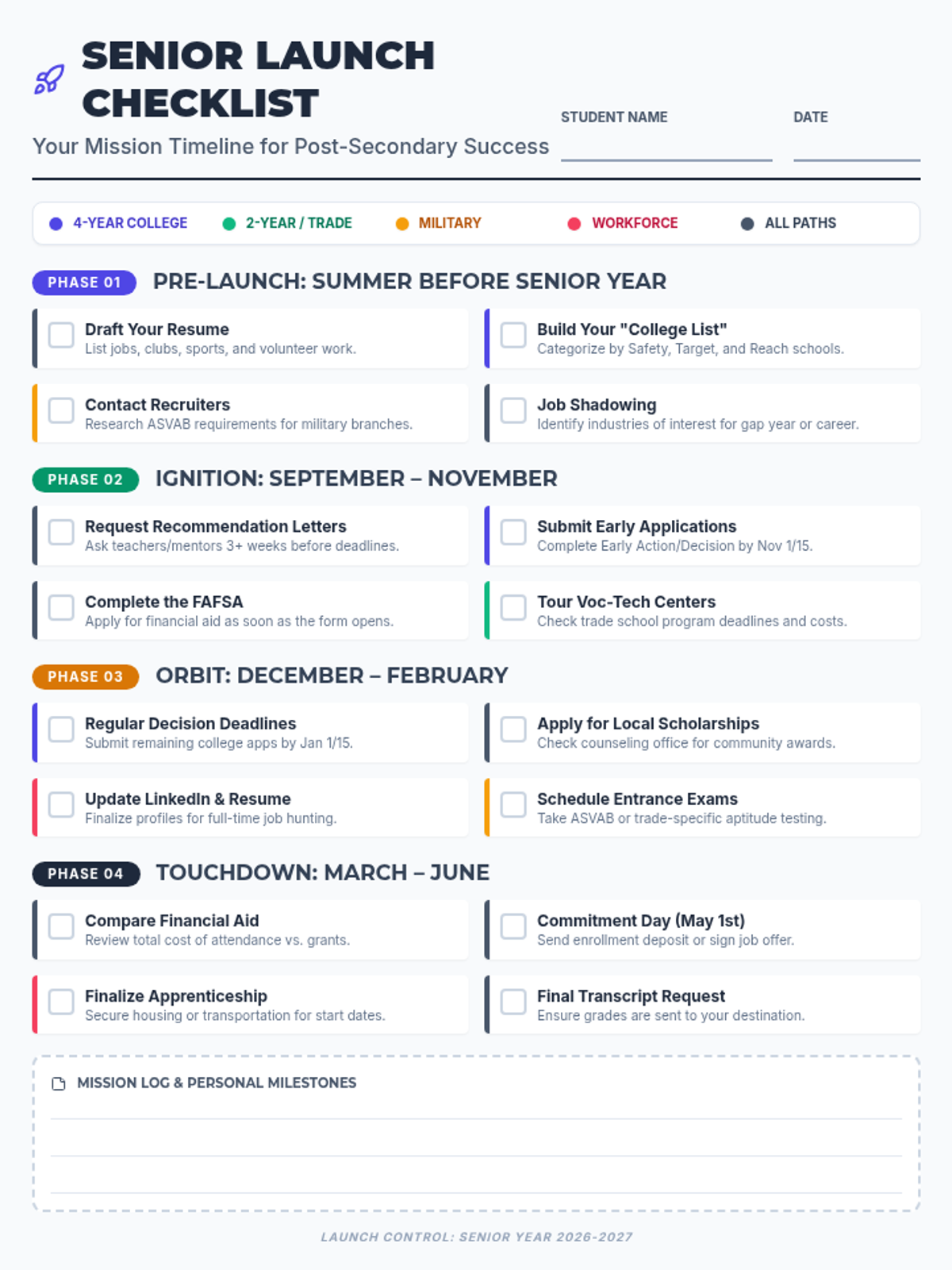
A comprehensive one-page checklist for high school seniors, organized by seasonal phases and color-coded by post-secondary path (College, Trade, Military, Workforce). Includes space for notes and tracking major milestones from summer through graduation.
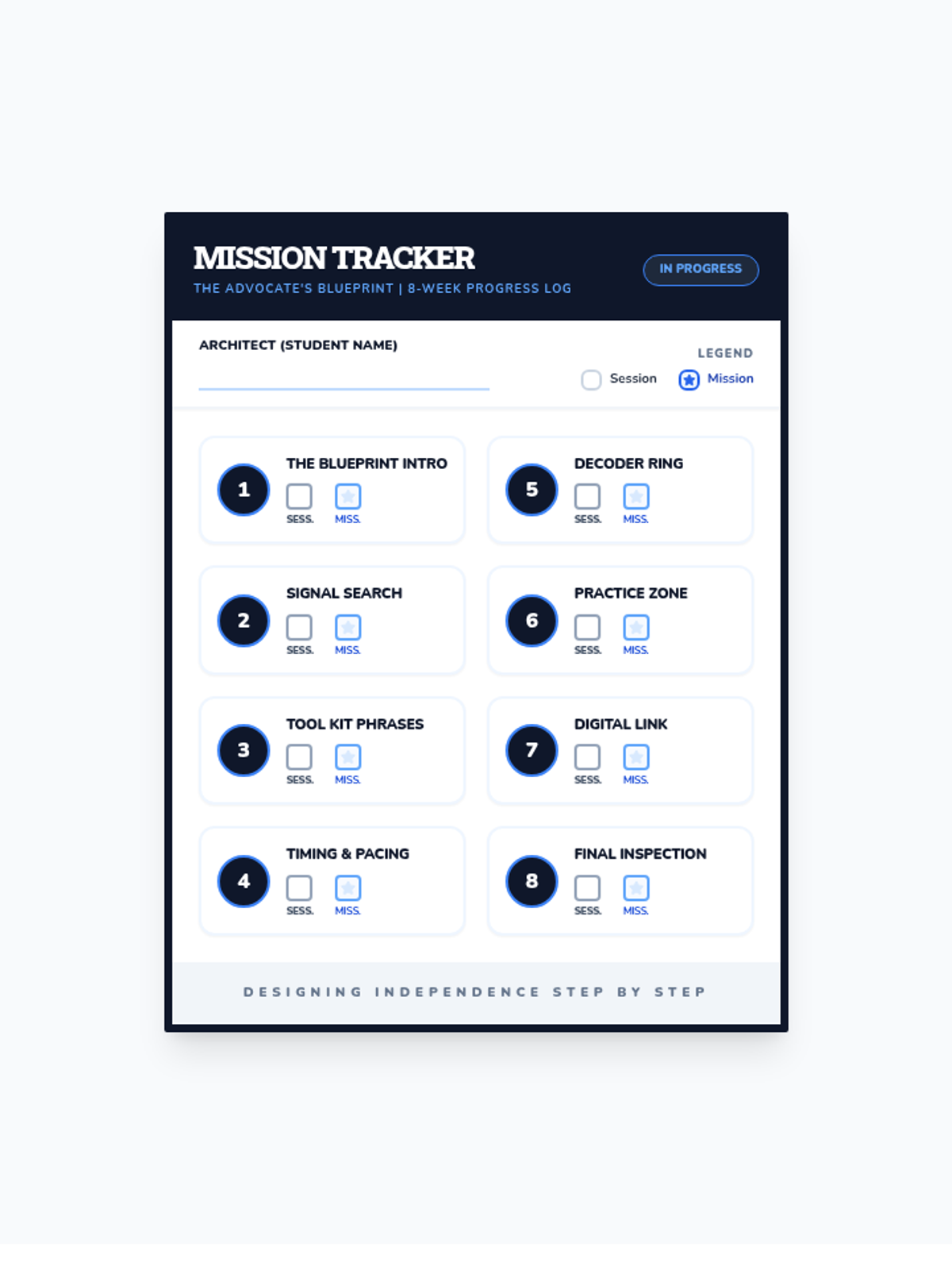
Progress tracker revised with direct checkbox labeling, increased font legibility, and fixed single-page layout. Reverted to the original blue blueprint theme. Fixed label contrast and alignment. Fixed page break.
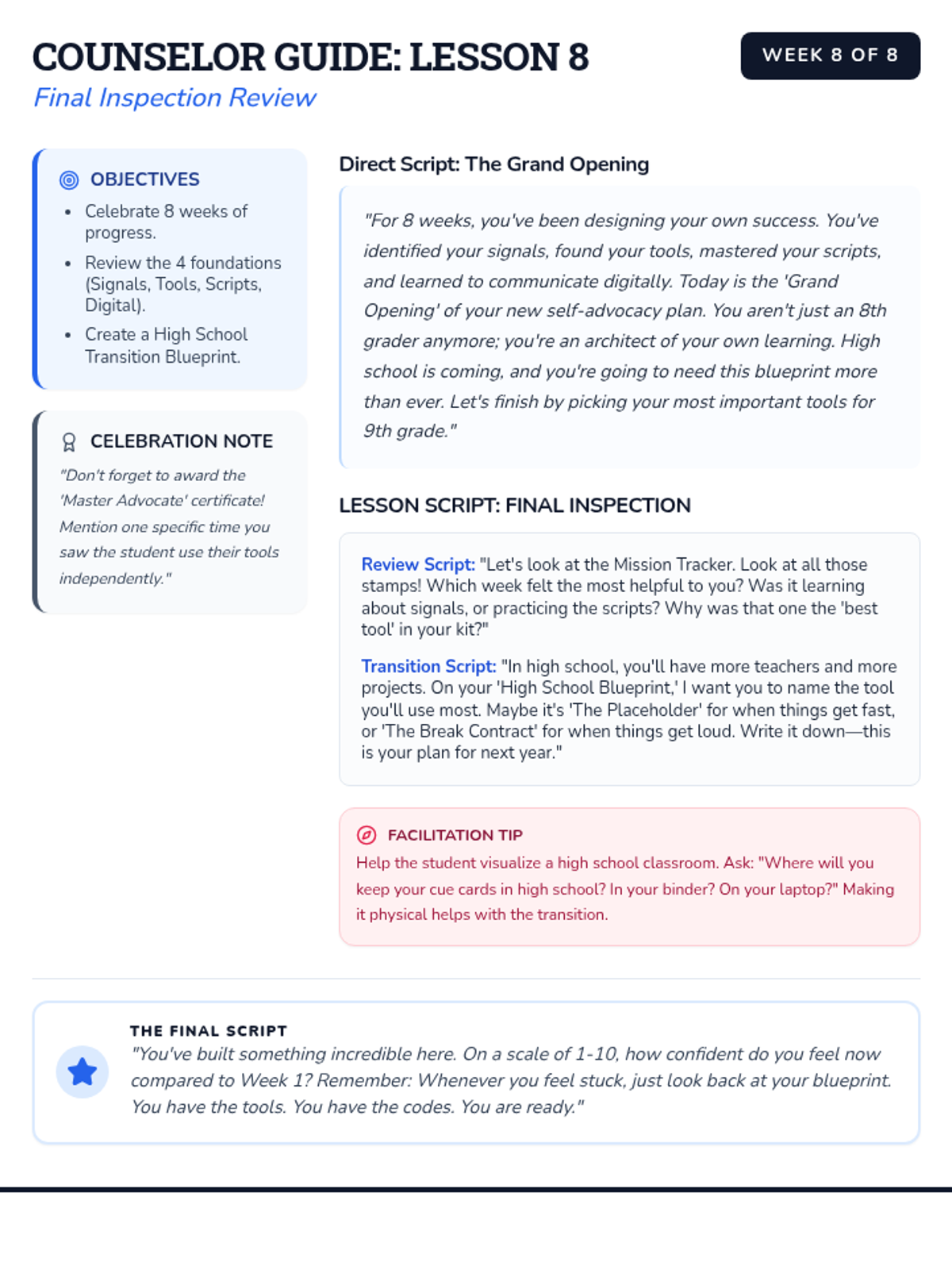
Expanded counselor guide for Week 8 with more detailed word-for-word scripts and instructional notes. Reverted to the original blue blueprint theme. Removed all IEP/Goal terminology.
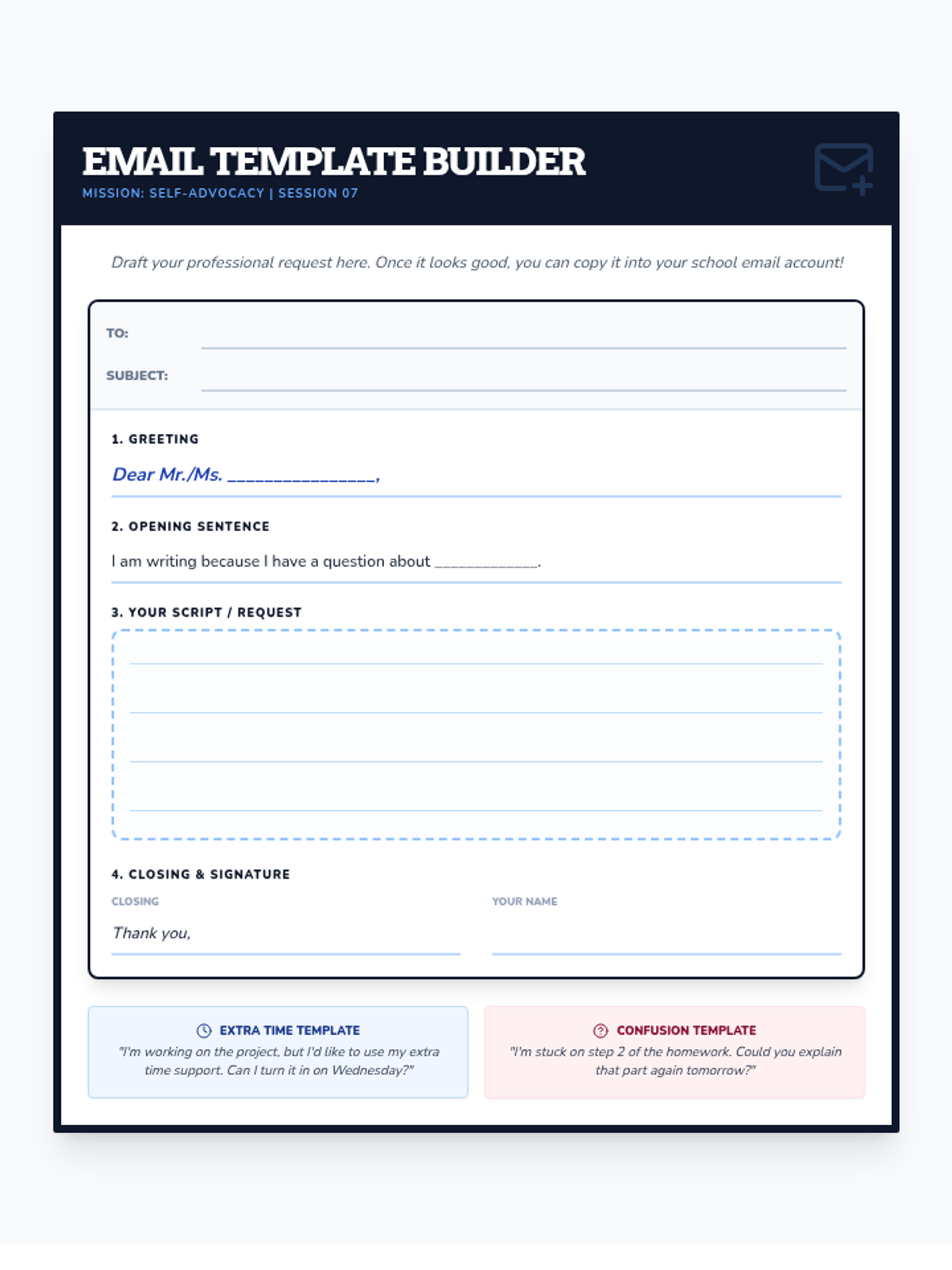
A structured worksheet to help students draft professional advocacy emails to their teachers. Reverted to the original blue blueprint theme. Fixed handwriting space and overlap issues. Removed all IEP/Goal terminology. Fixed page break.
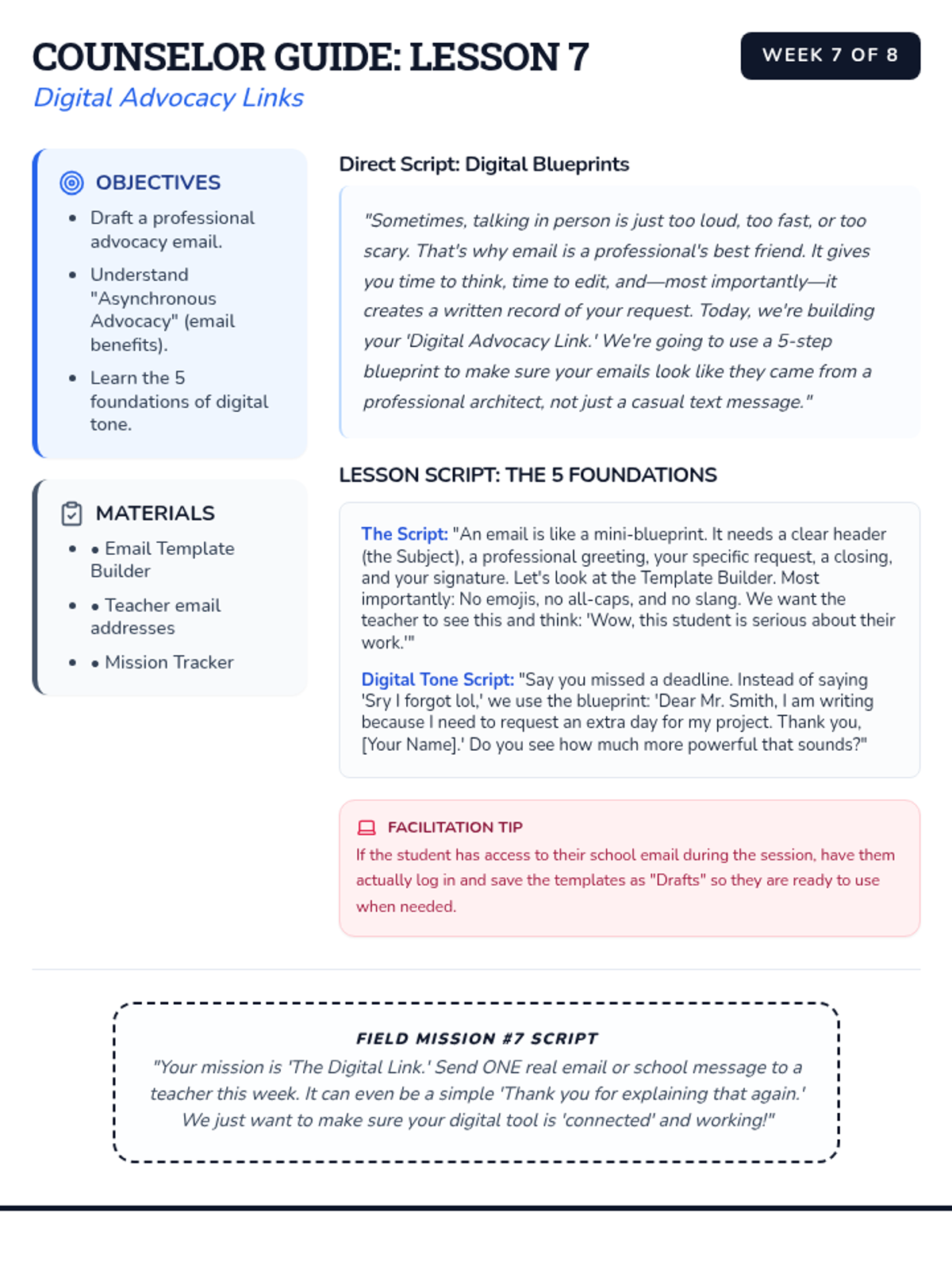
Expanded counselor guide for Week 7 with more detailed word-for-word scripts and instructional notes. Reverted to the original blue blueprint theme. Removed all IEP/Goal terminology.
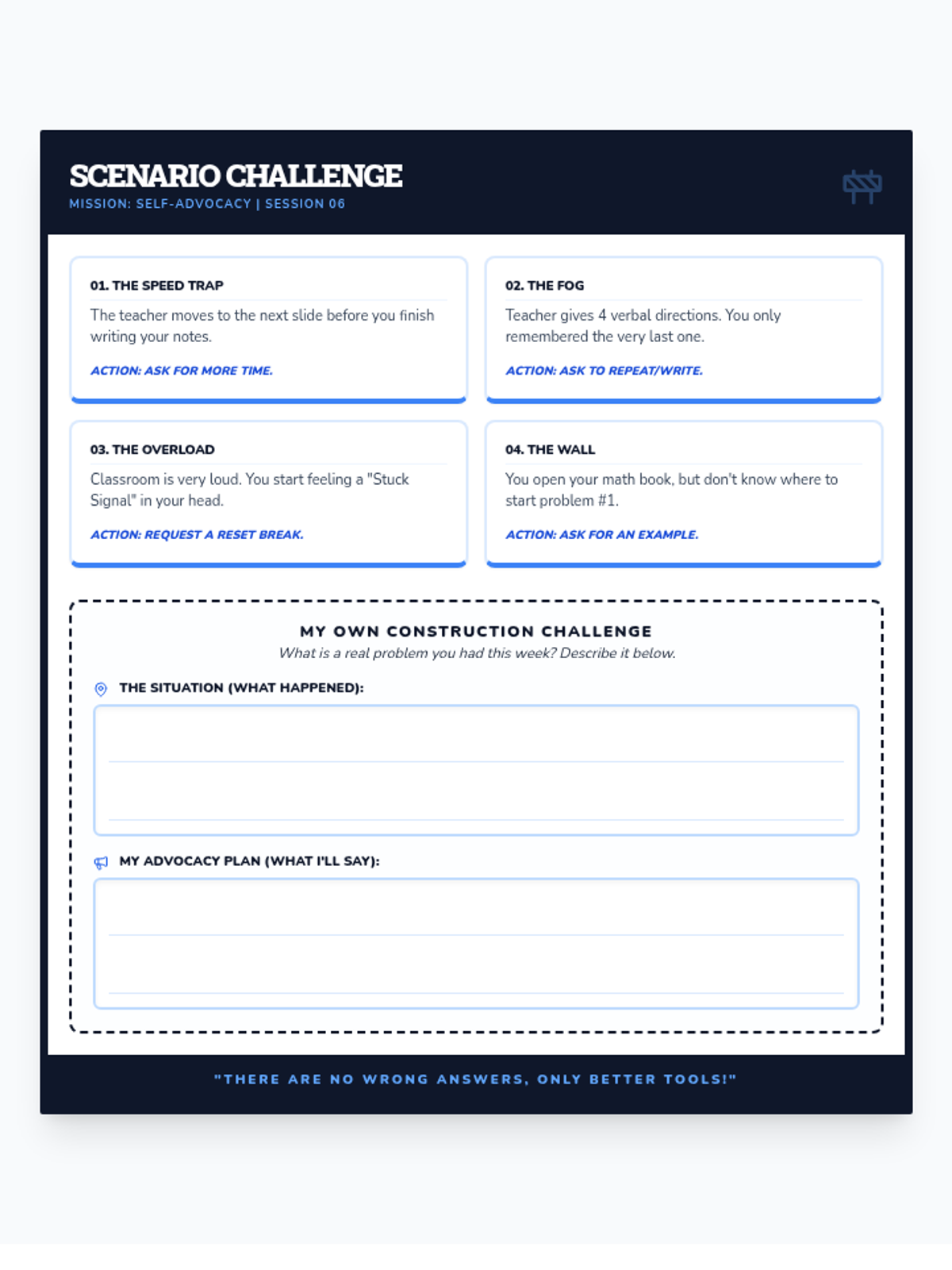
Scenario challenge cards revised with larger font sizes, better writing space in the "Create Your Own" section, and fixed single-page layout. Reverted to the original blue blueprint theme. Fixed contrast and page break.
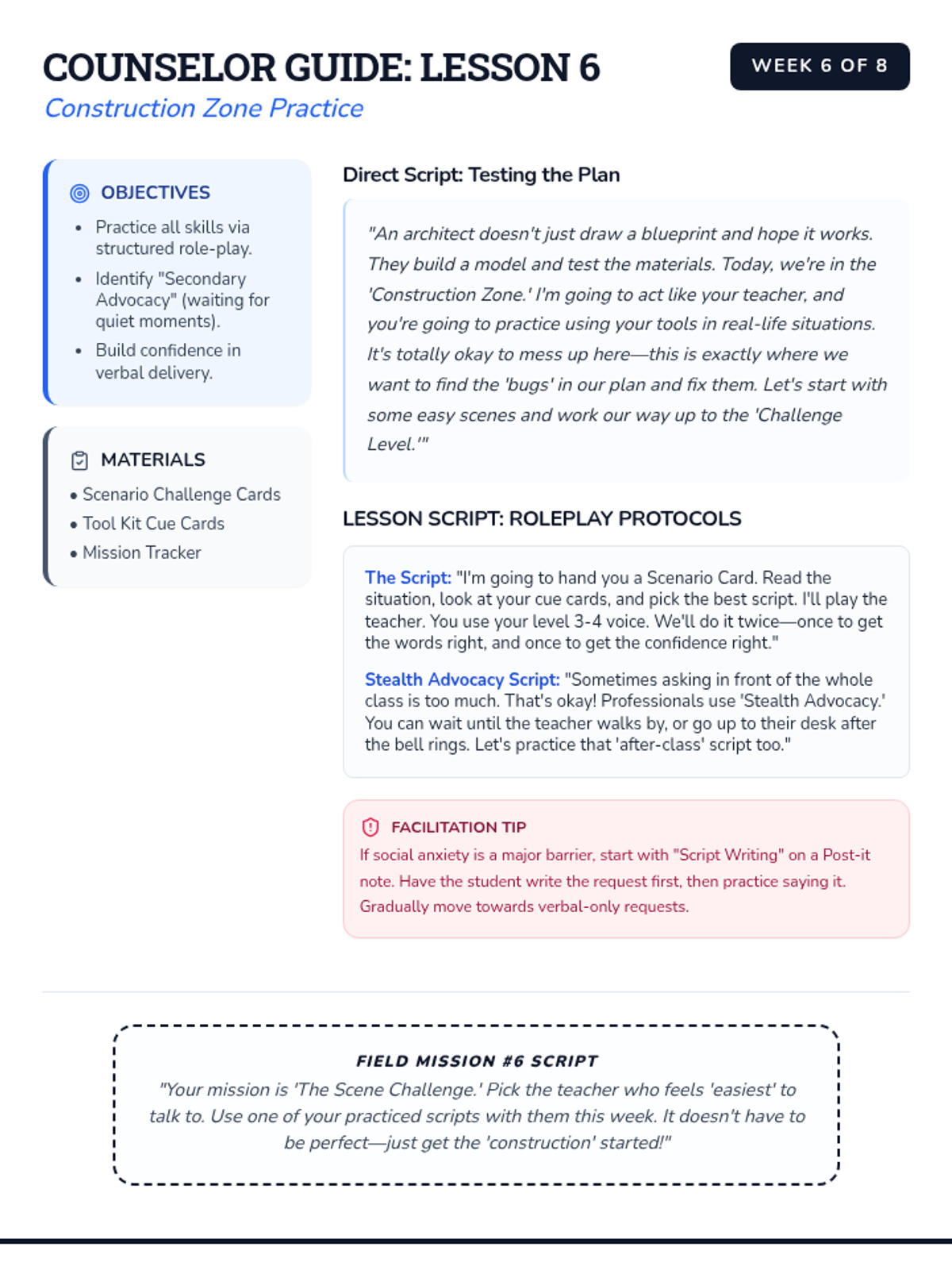
Expanded counselor guide for Week 6 with more detailed word-for-word scripts and instructional notes. Reverted to the original blue blueprint theme. Removed all IEP/Goal terminology.
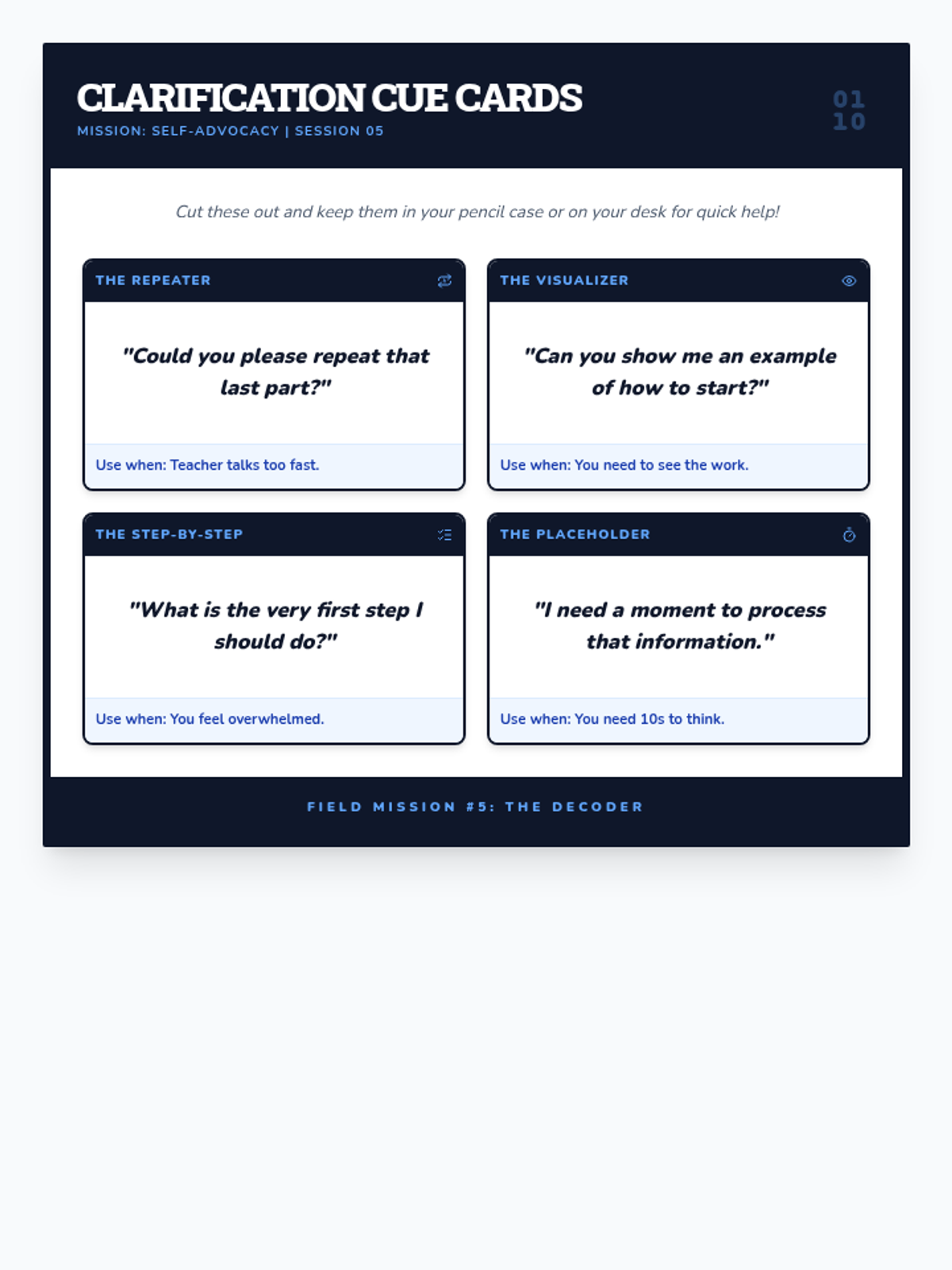
Cue cards revised with uniform card sizes, increased font legibility, and fixed single-page layout. Reverted to the original blue blueprint theme.
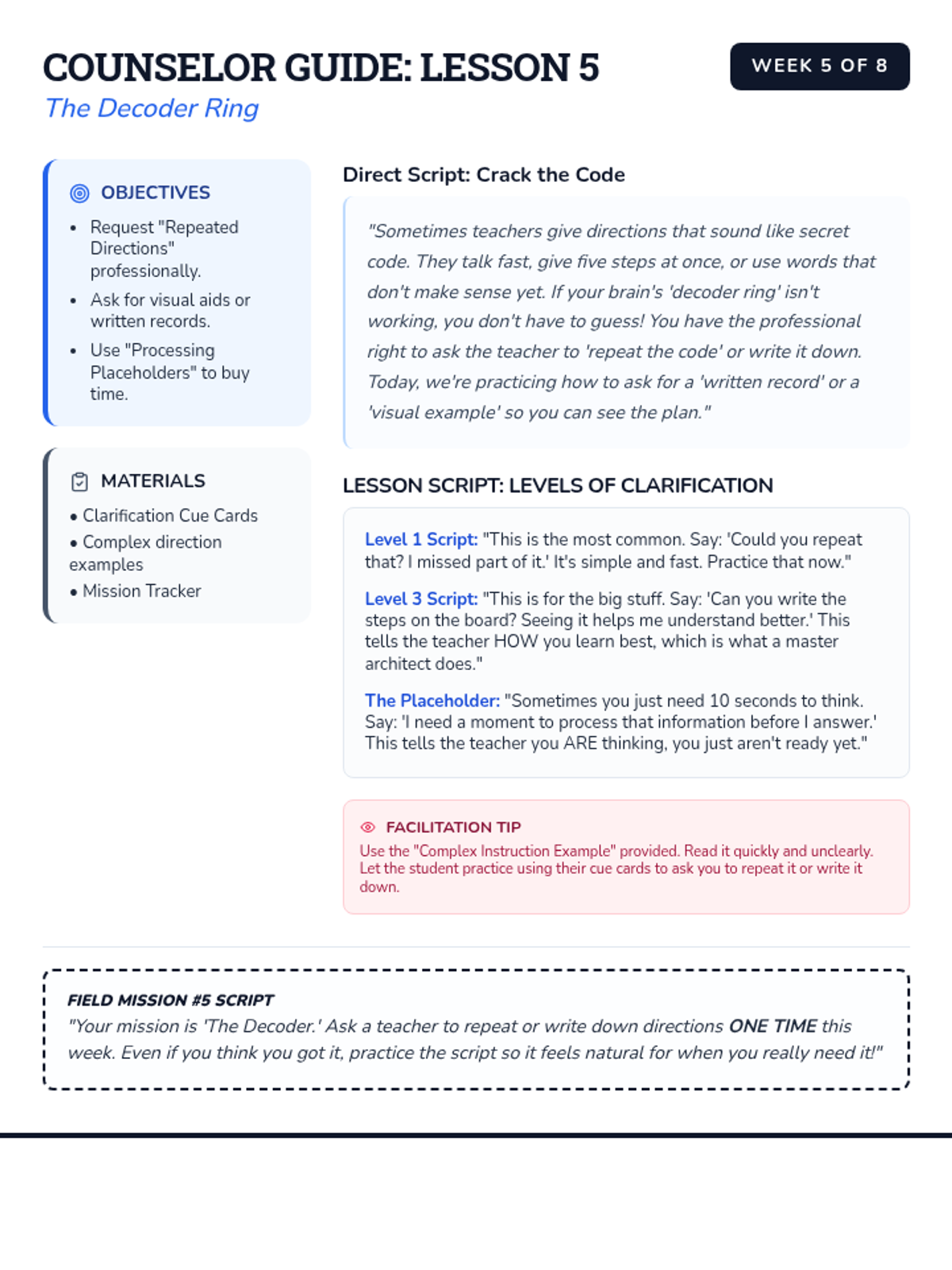
Expanded counselor guide for Week 5 with more detailed word-for-word scripts and instructional notes. Reverted to the original blue blueprint theme. Removed all IEP/Goal terminology.
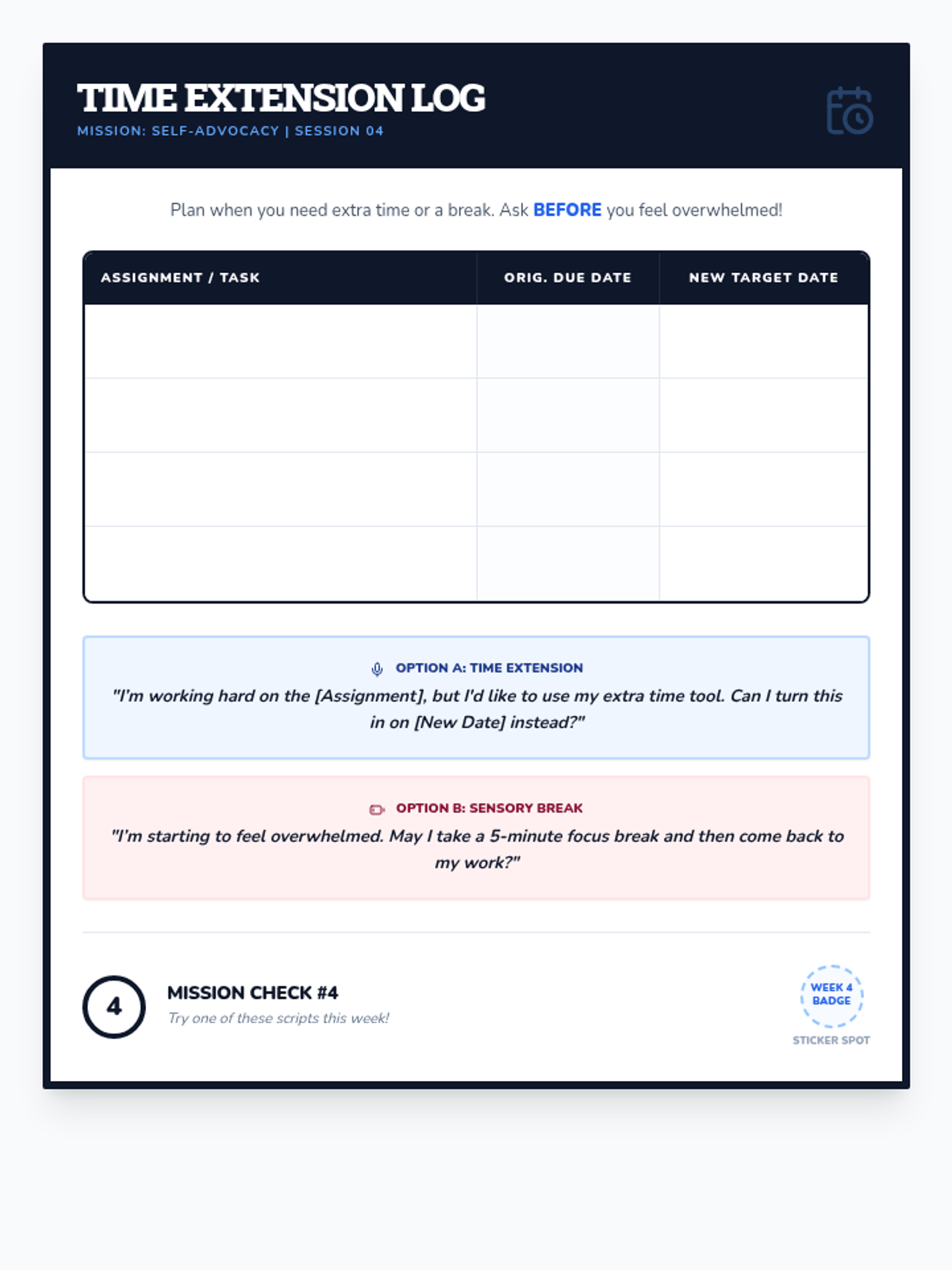
Time request log revised to replace 'Goal Date' with 'Target Date'. Reverted to the original blue blueprint theme. Removed all IEP/Goal terminology.
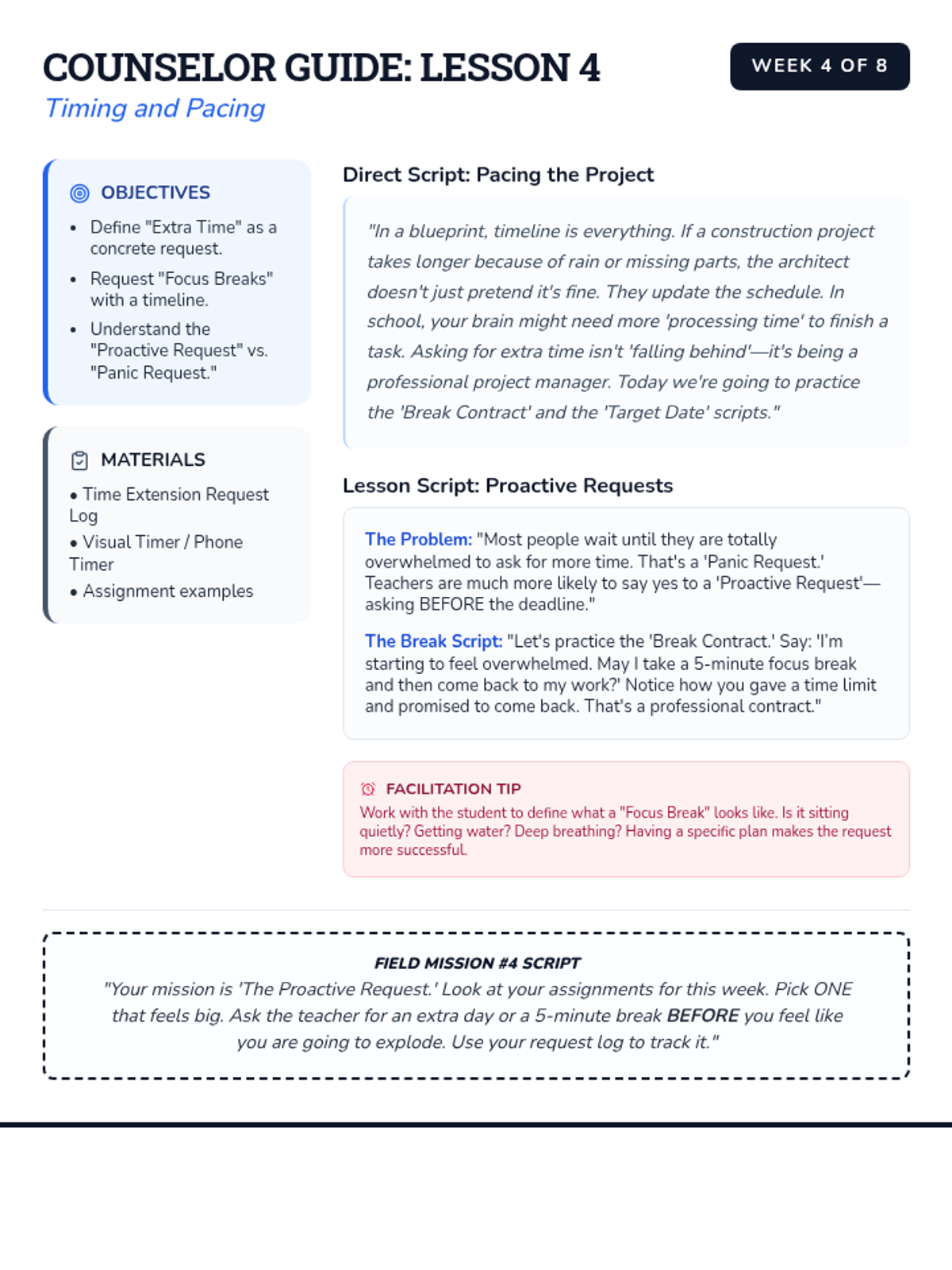
Expanded counselor guide for Week 4 with more detailed word-for-word scripts and instructional notes. Reverted to the original blue blueprint theme. Removed all IEP/Goal terminology.
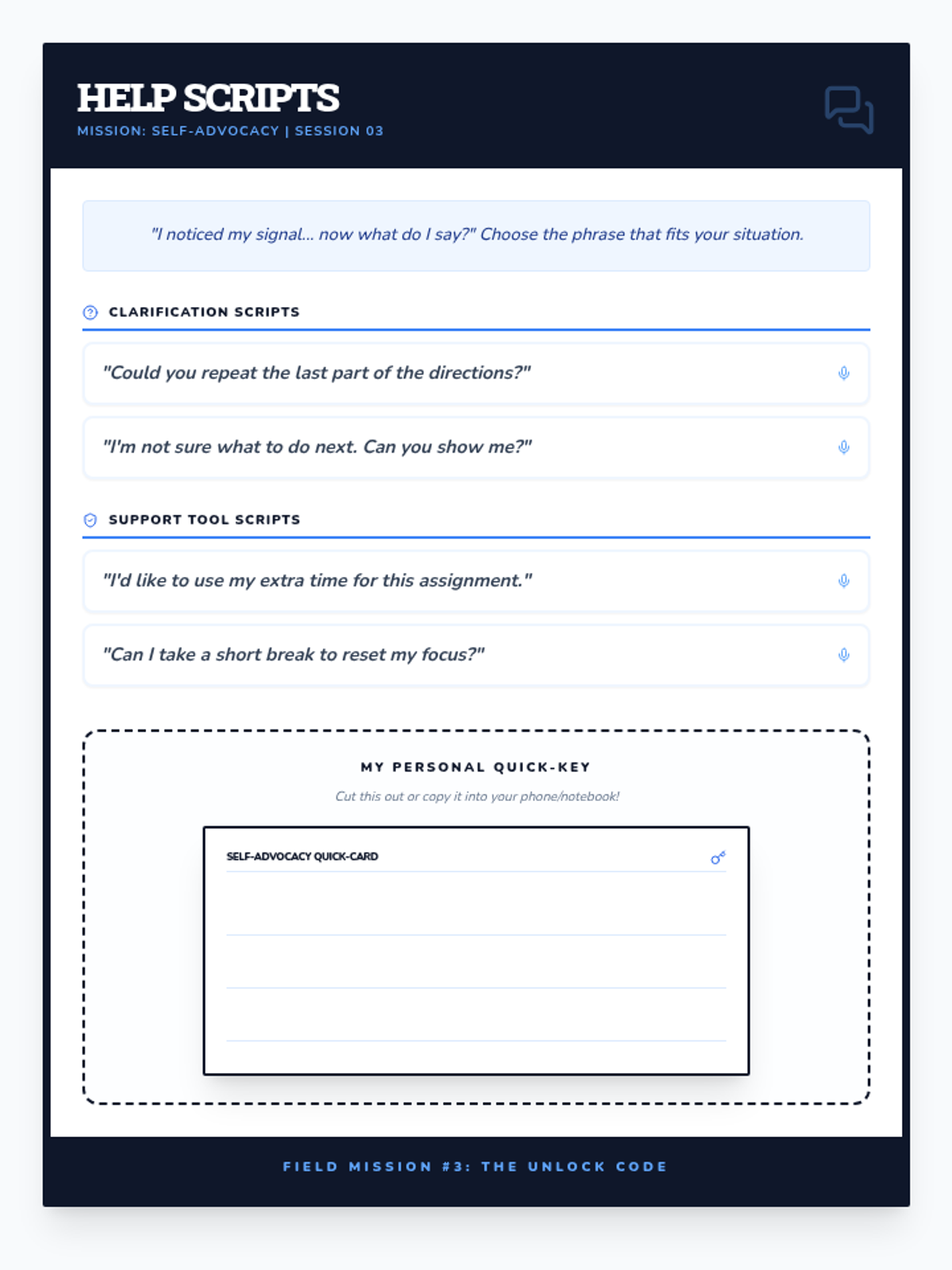
Cheat sheet with revised single-page layout and increased line visibility for the cut-out card activity. Reverted to the original blue blueprint theme. Removed all IEP/Goal terminology.
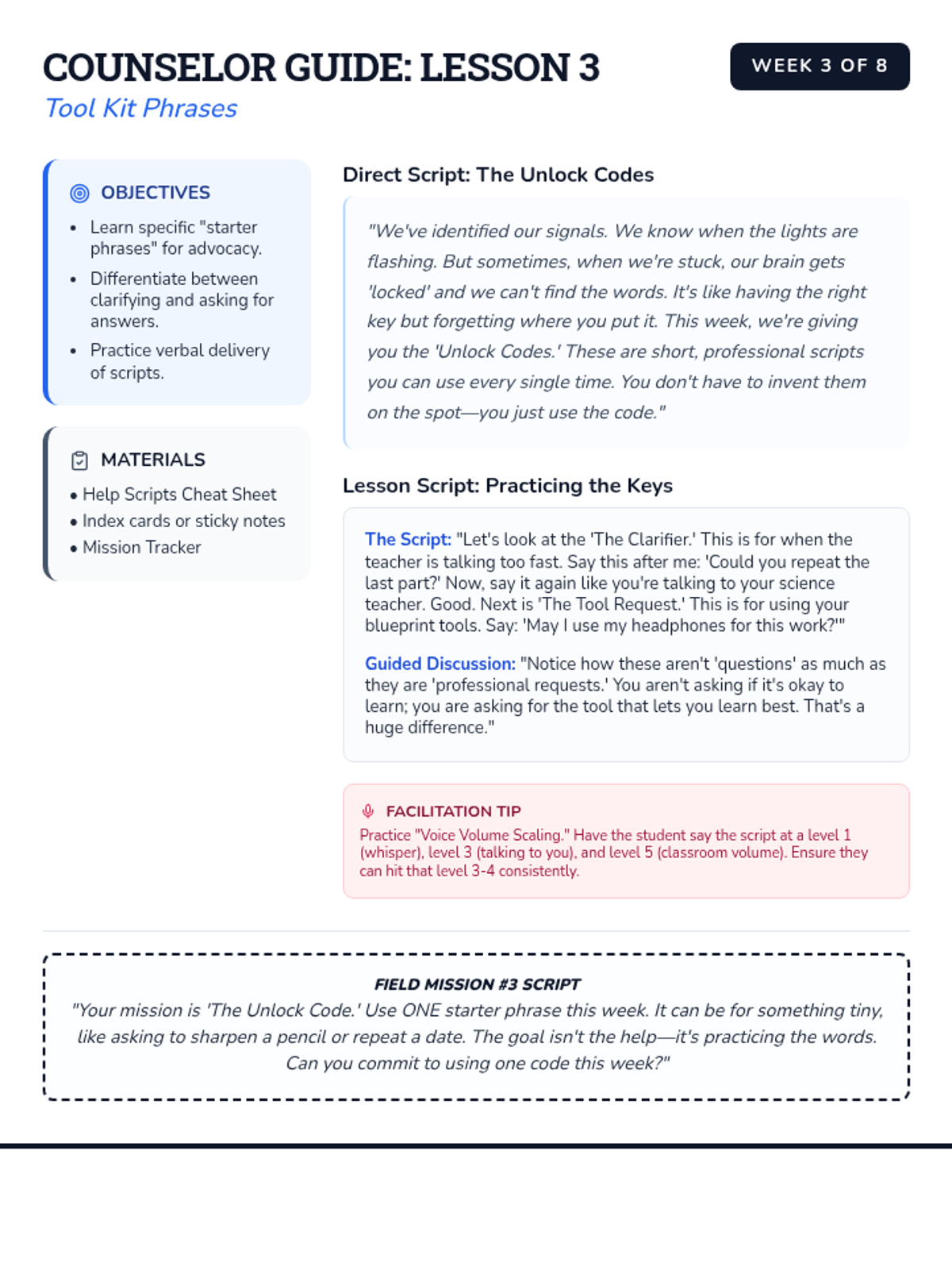
Expanded counselor guide for Week 3 with more detailed word-for-word scripts and instructional notes. Reverted to the original blue blueprint theme. Removed all IEP/Goal terminology.
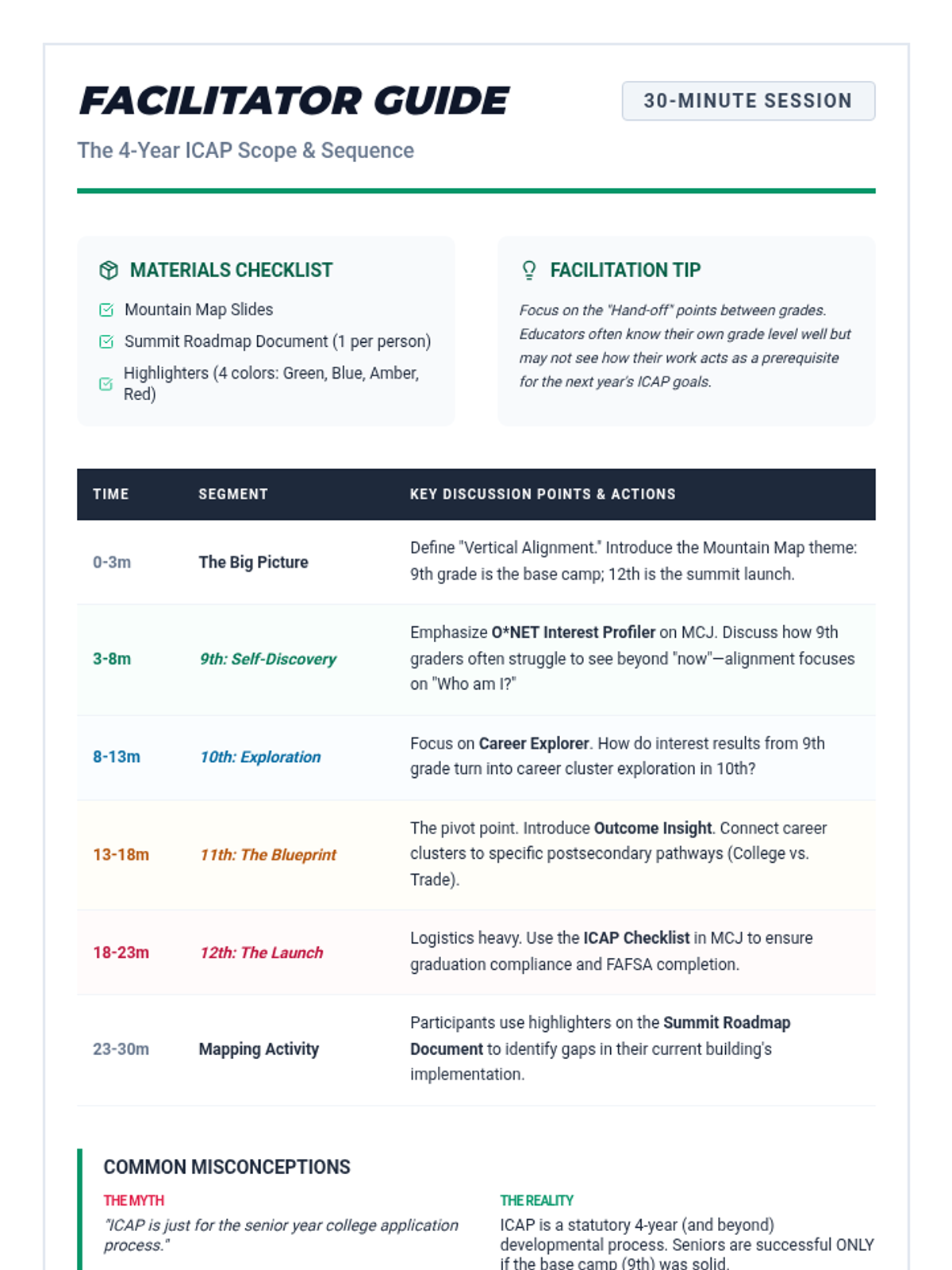
A detailed facilitator guide for leading the 30-minute ICAP vertical alignment professional development session, including a timeline and discussion prompts.
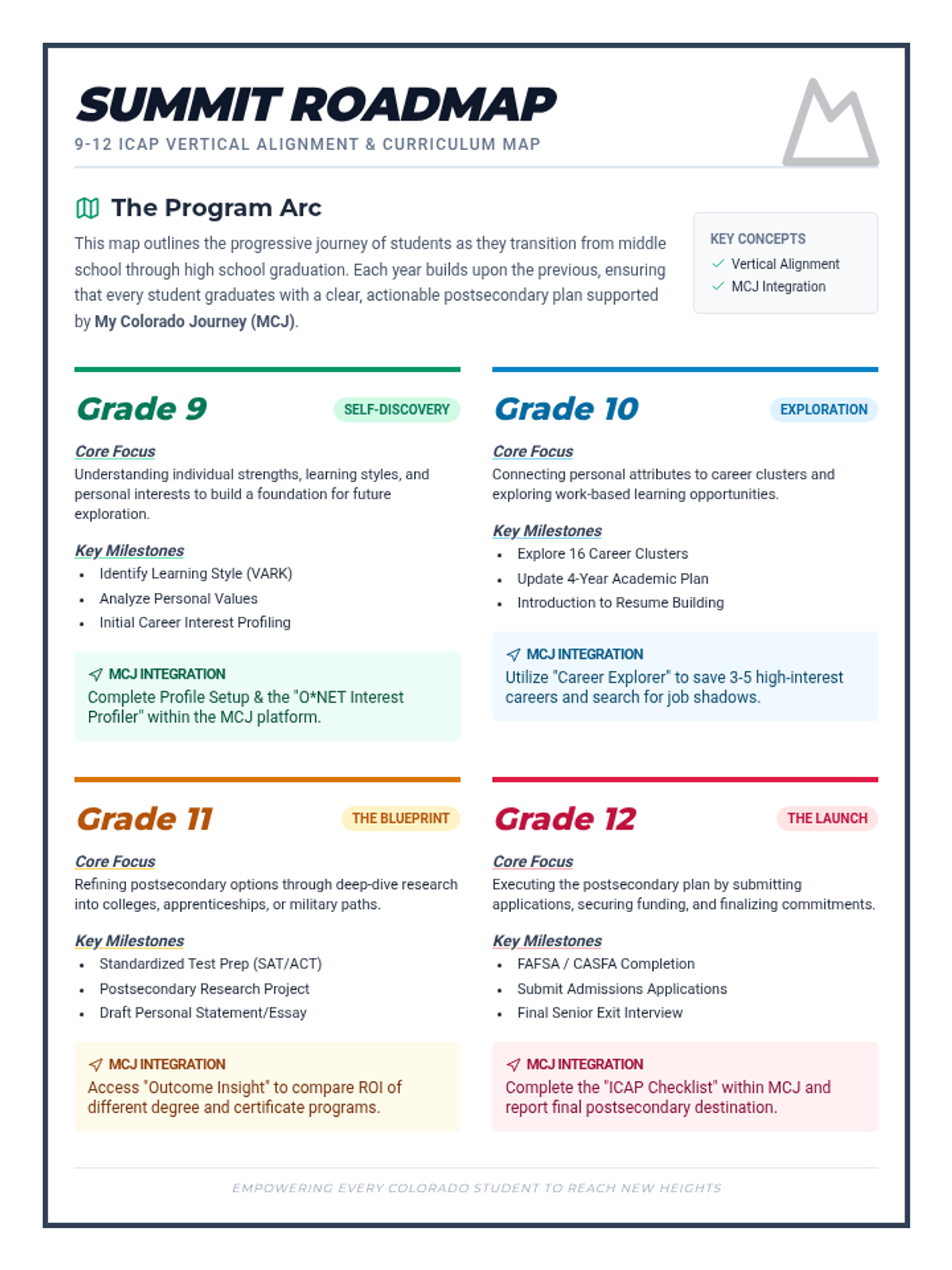
A visual presentation for educators detailing the ICAP 9-12 program arc, grade-level themes, and specific My Colorado Journey tool integration.
A comprehensive 9-12 curriculum map outlining the vertical progression of ICAP milestones and My Colorado Journey integration.
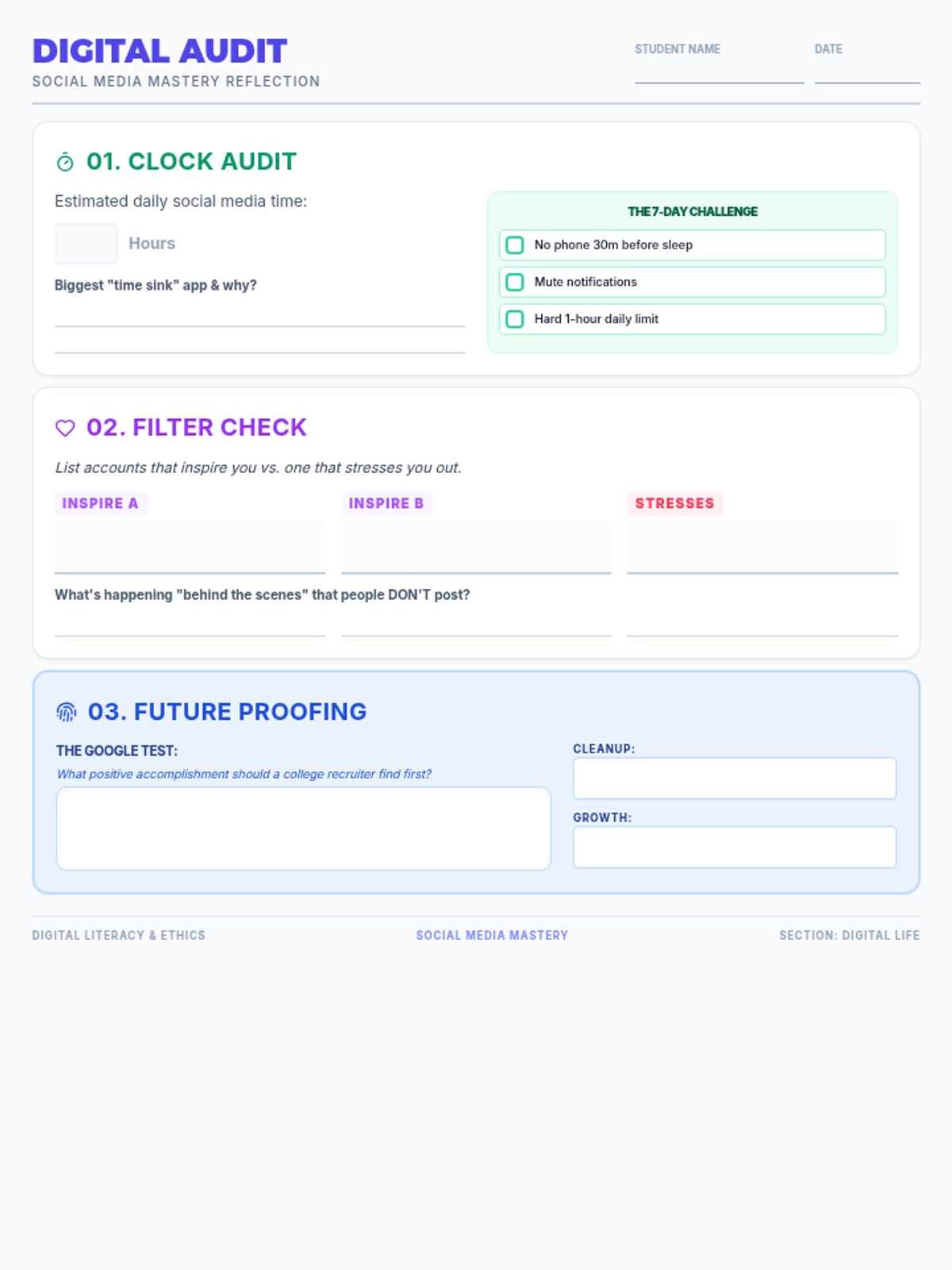
A reflection worksheet for students to audit their own social media habits. Includes a screen time self-assessment, a "filter check" to identify healthy vs. toxic accounts, and a strategic "Google Test" exercise for digital footprint management.
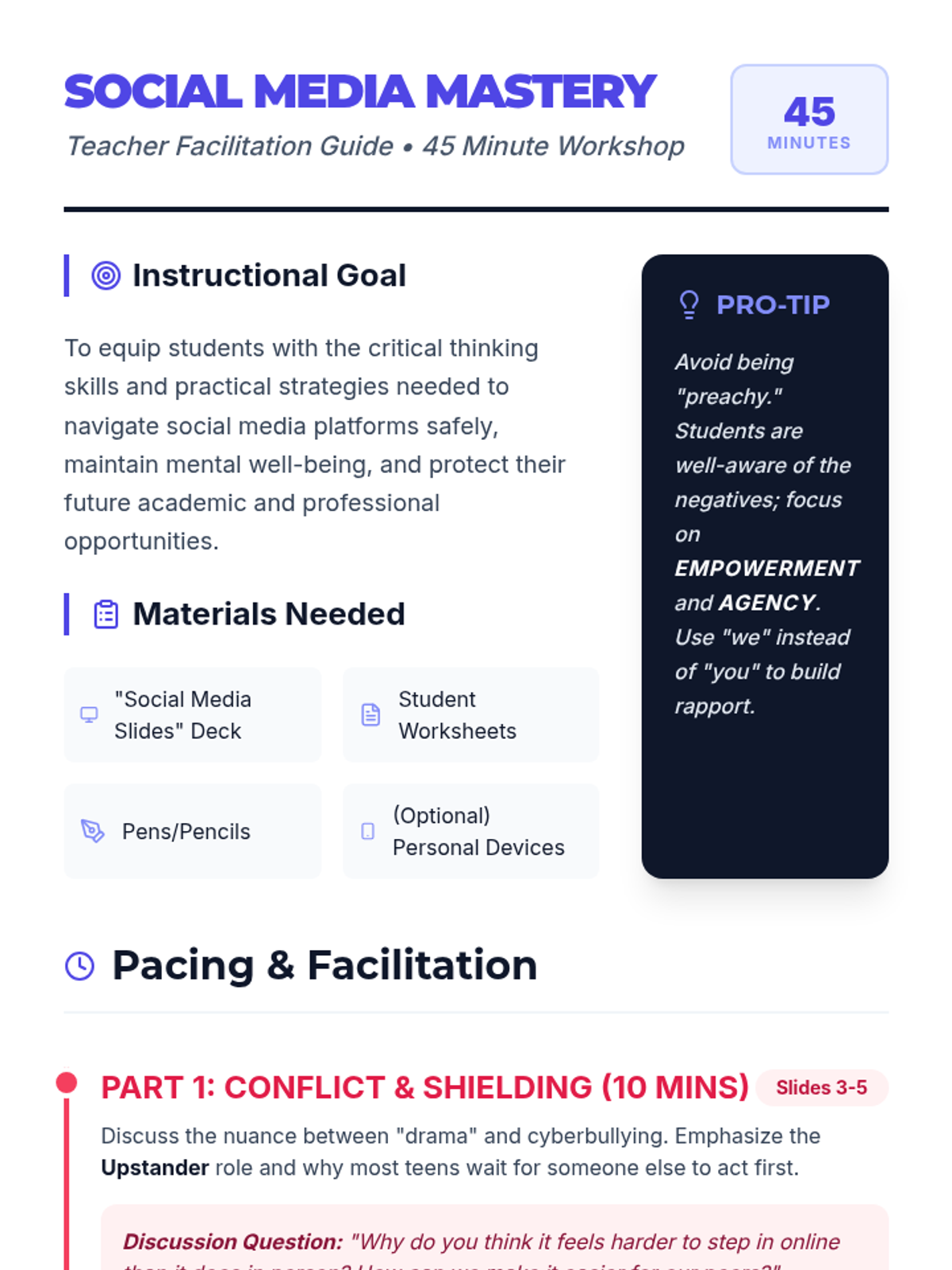
A detailed facilitation guide for teachers to deliver the Social Media Mastery workshop. Includes time-stamped pacing, specific discussion prompts for each slide section, and strategies for handling common student pushback.
A high-impact 14-slide presentation designed to engage students in critical conversations about social media. It features modern aesthetics, bold typography, and clear sections on cyberbullying, mental health, screen time boundaries, and digital footprint for college.
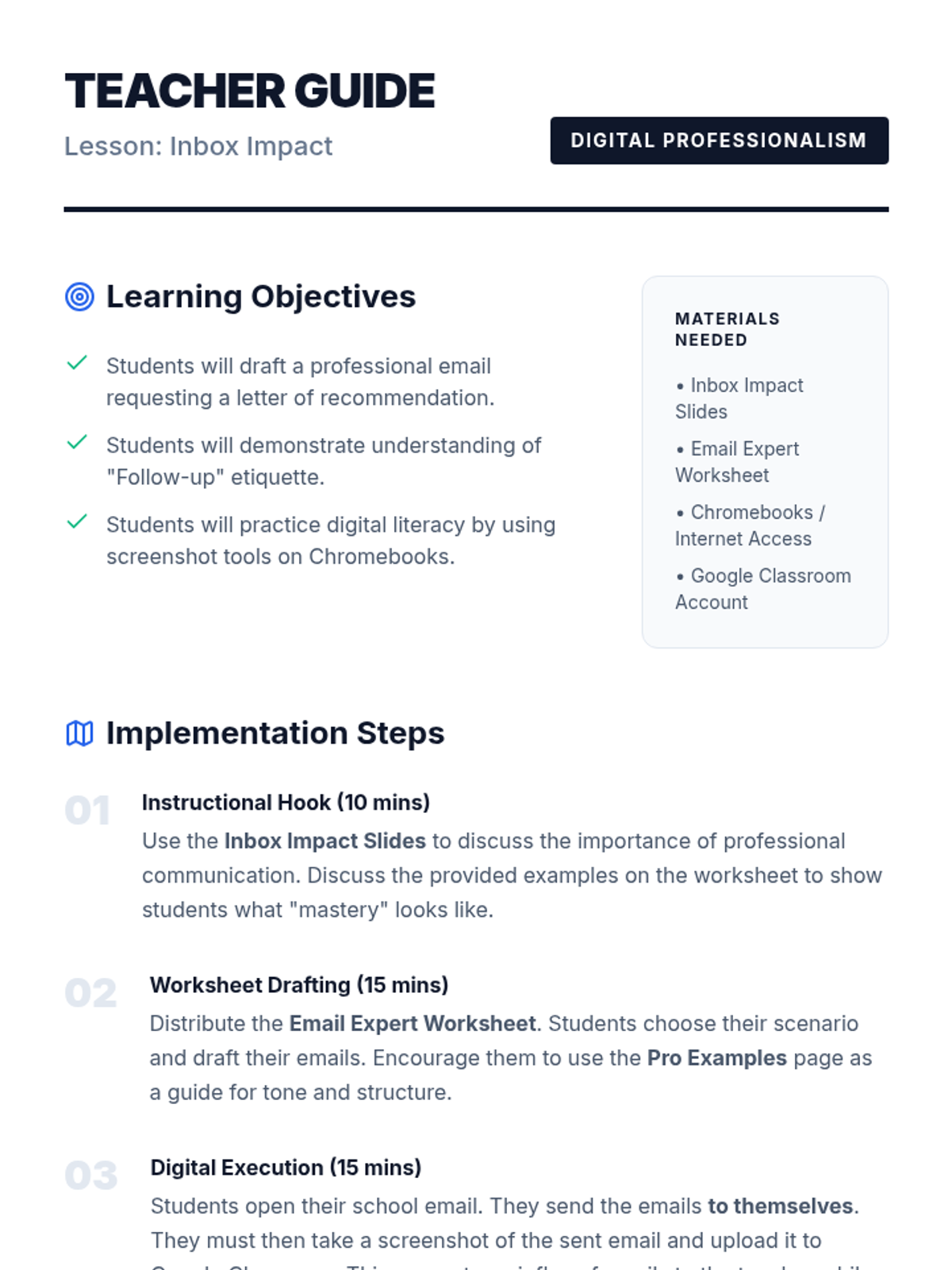
A comprehensive teacher guide for the Inbox Impact lesson. Includes learning objectives, step-by-step implementation, technical troubleshooting for Chromebooks, and a clear grading rubric. Updated to reflect student-to-self email submission process.
A high-impact slide deck for teaching professional email etiquette. It covers the importance of first impressions, the anatomy of a request email, drafting body paragraphs, and the technical steps for the digital assignment. Updated to reflect student-to-self email submission.
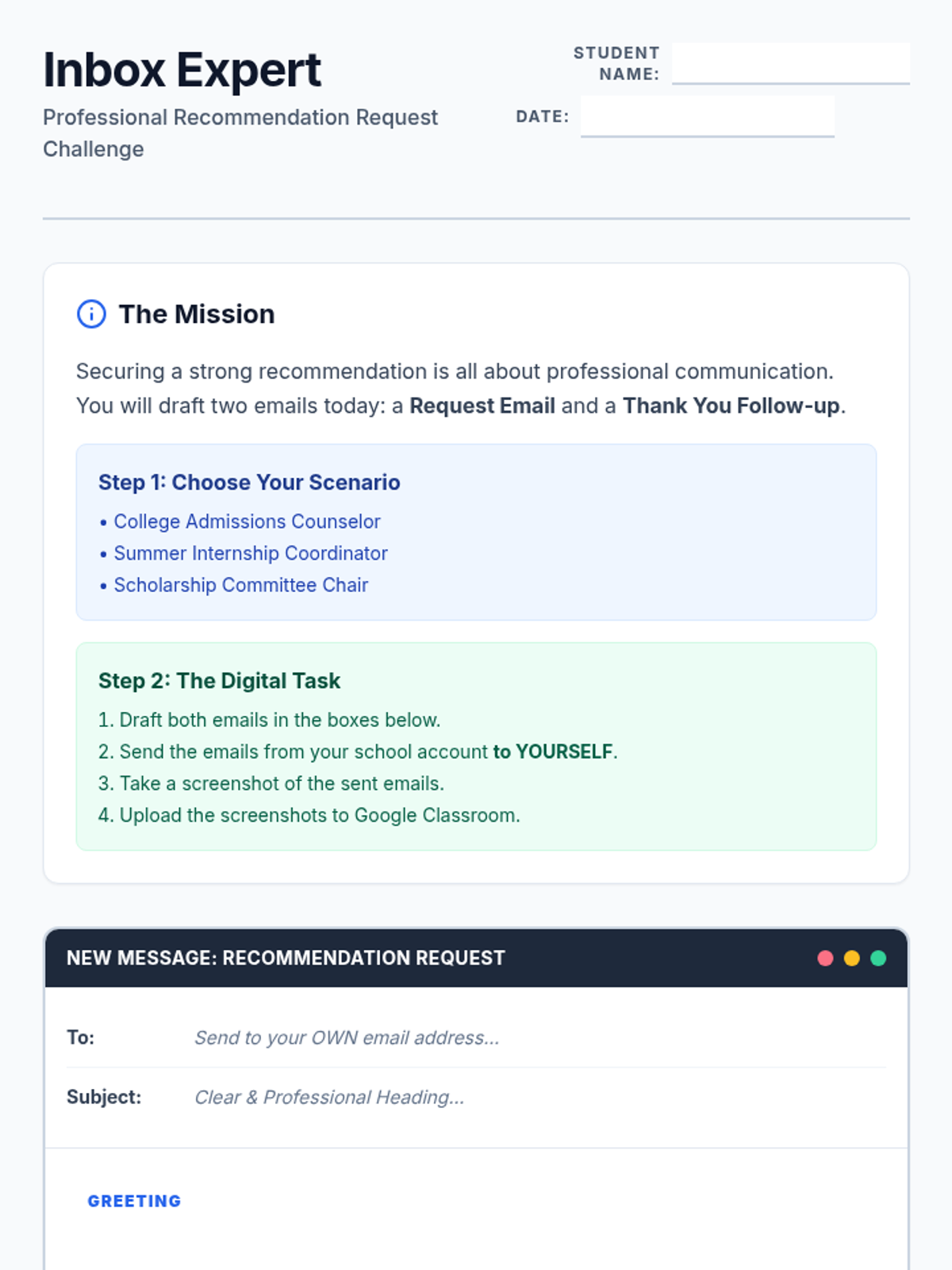
A professional email drafting worksheet designed to look like an inbox compose window. Students draft a recommendation request and a thank-you follow-up, with fields for recipient, subject, and body content, followed by a digital submission checklist. Includes full professional examples for both emails.
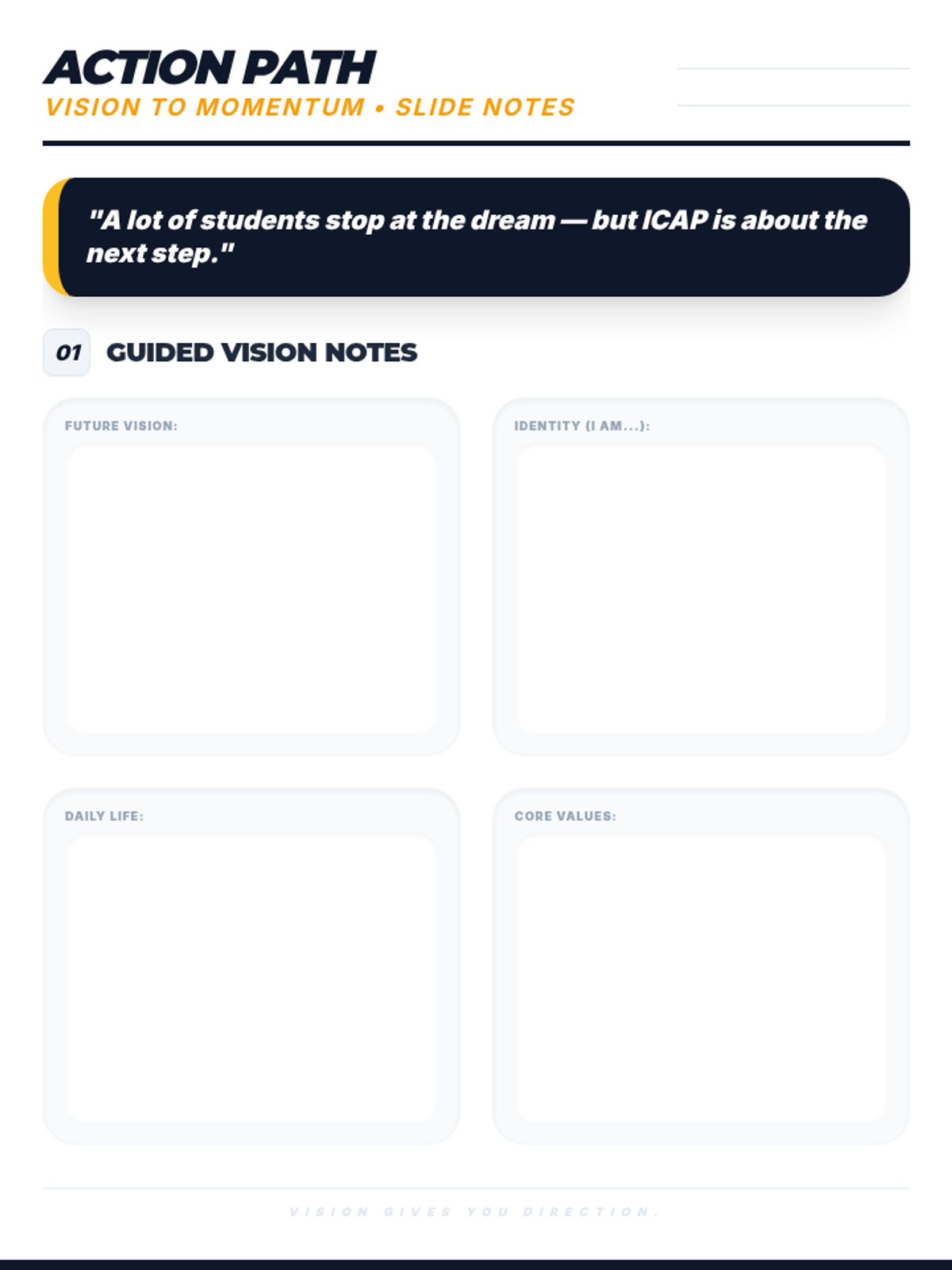
A comprehensive 2-page printable companion for the Action Path slide deck. Includes detailed sections for Vision, Next Steps, and Support/Barriers, designed for front-to-back printing. Strictly formatted to fit on two 720x960 pages without overflow. Guaranteed no page splitting. High-end professional aesthetic.
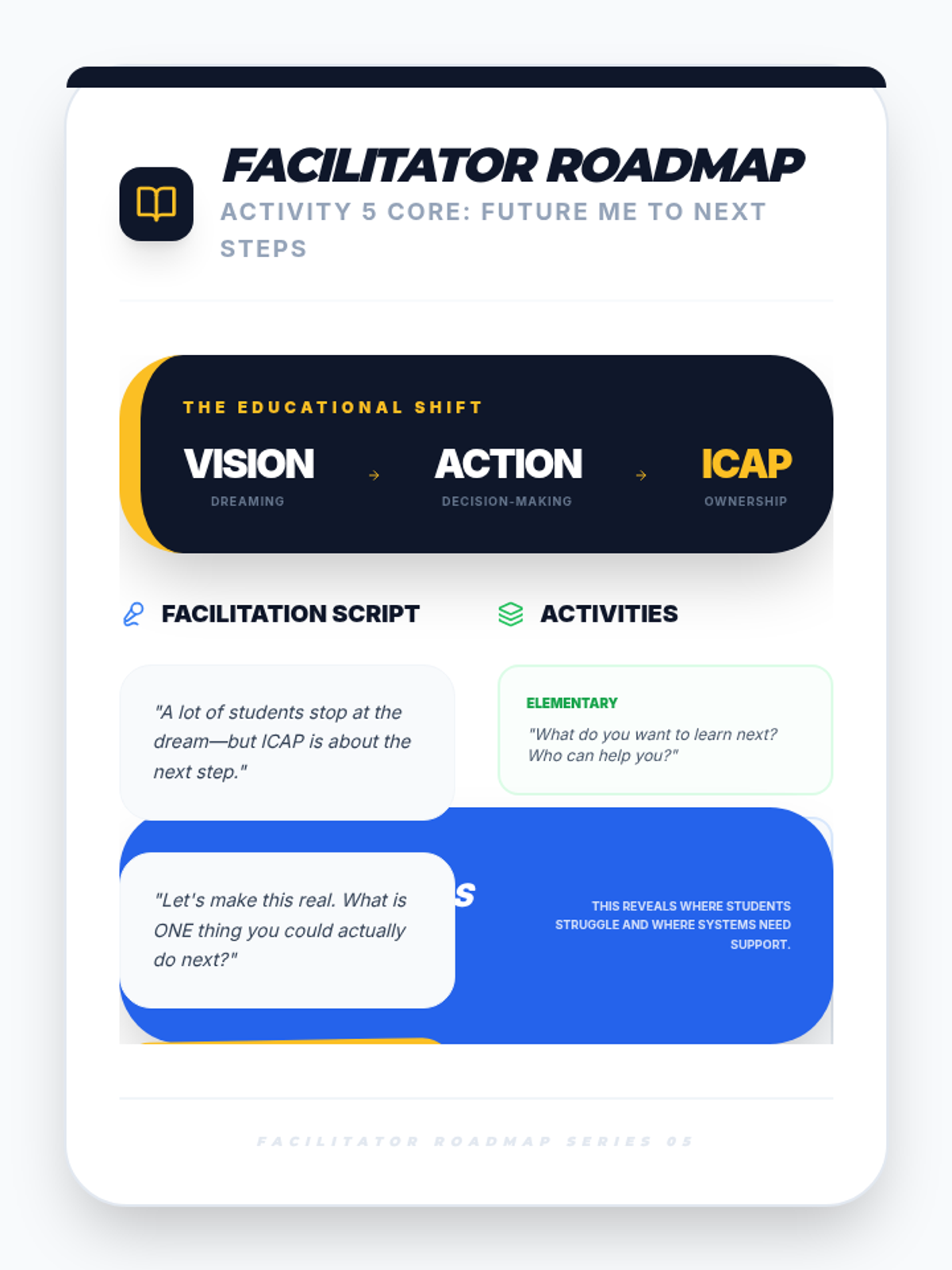
A high-impact facilitator guide for teachers. Includes scripts, grade-level strategies, and the core pedagogical shift from vision to action. Strictly formatted to fit on a single page.
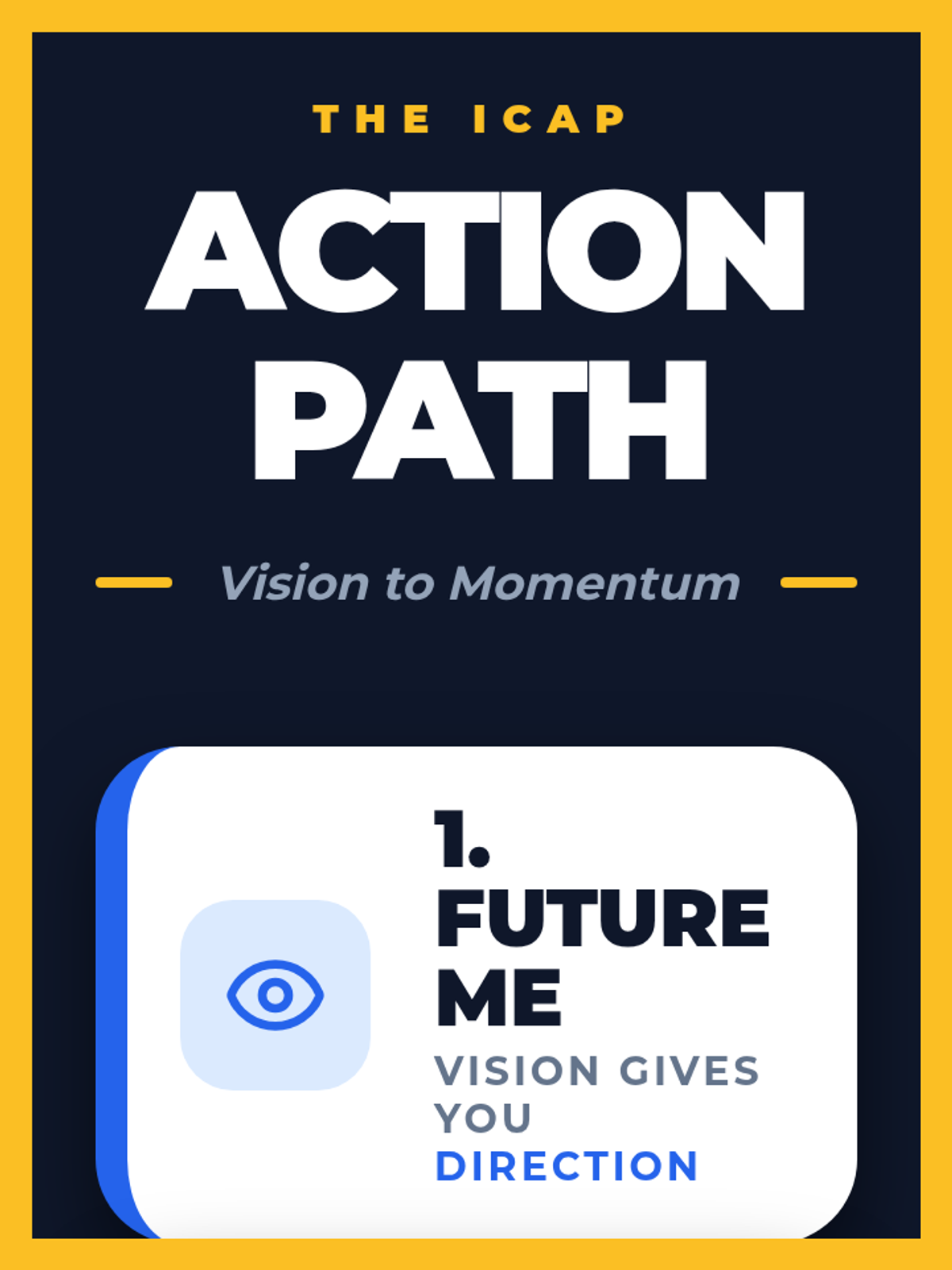
A bold, visually striking classroom anchor chart that defines the Action Path stages: Future Me, Next Steps, and Support/Barriers. High-impact design for classroom walls.
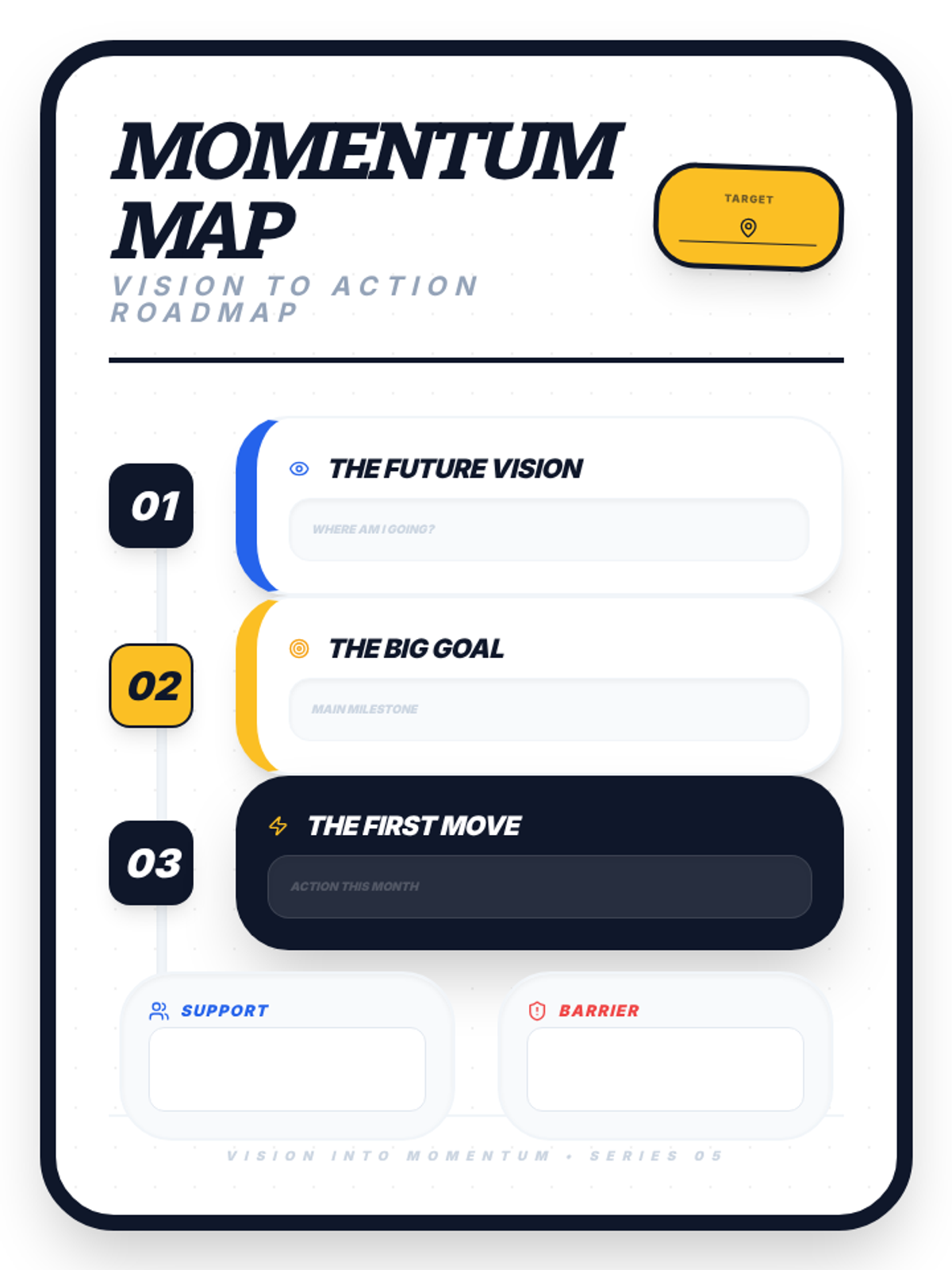
A professional, vertical roadmap Momentum Map. Designed with a high-contrast theme and strictly formatted to fit on a single 720x960 page using a safe height buffer. Guaranteed no overflow.
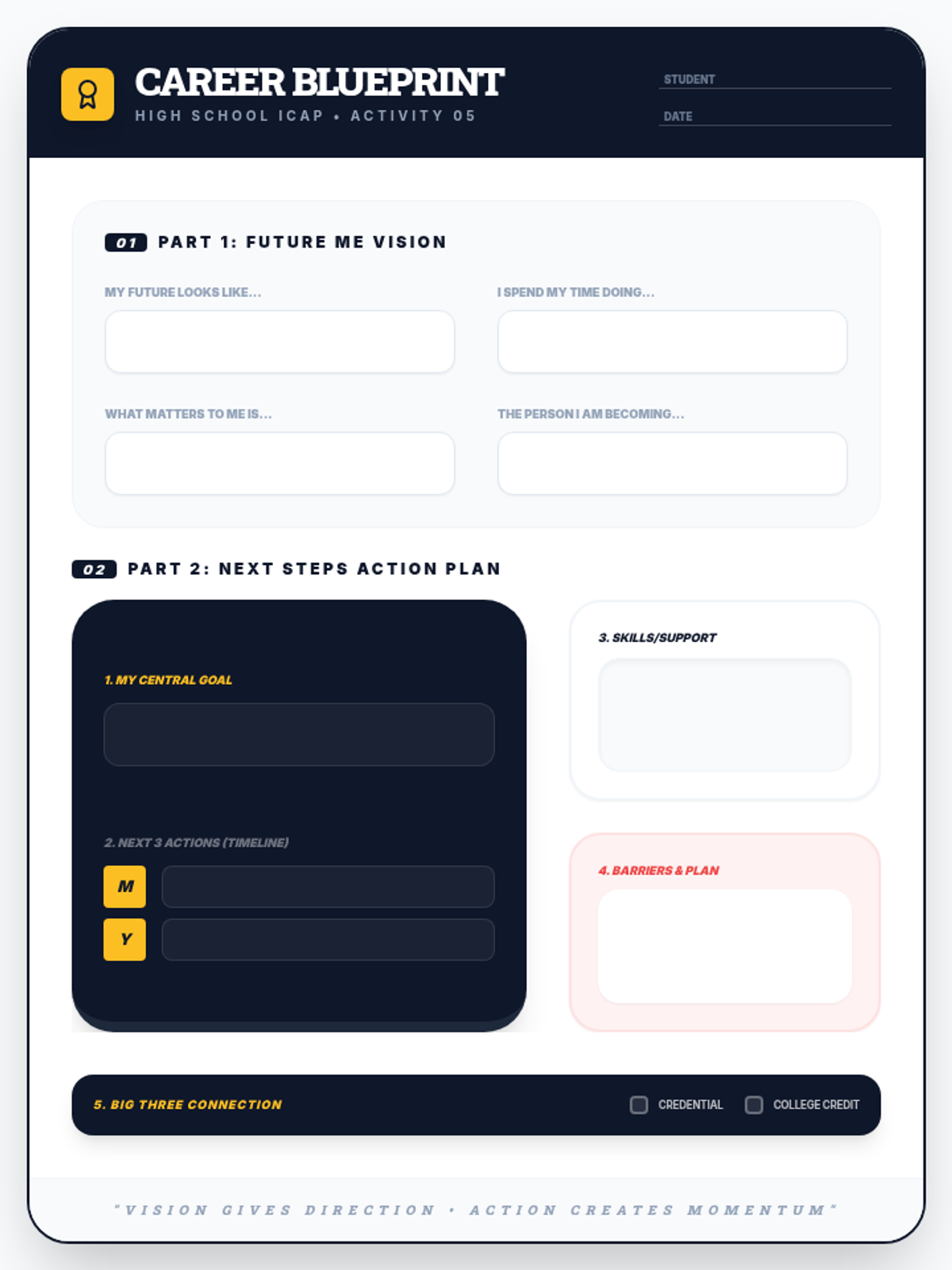
A high-density, professional Career Blueprint for high school students. Designed with a clean minimalist aesthetic and strictly formatted to fit 100% on a single 720x960 page using a safe height buffer. Guaranteed no page splitting.
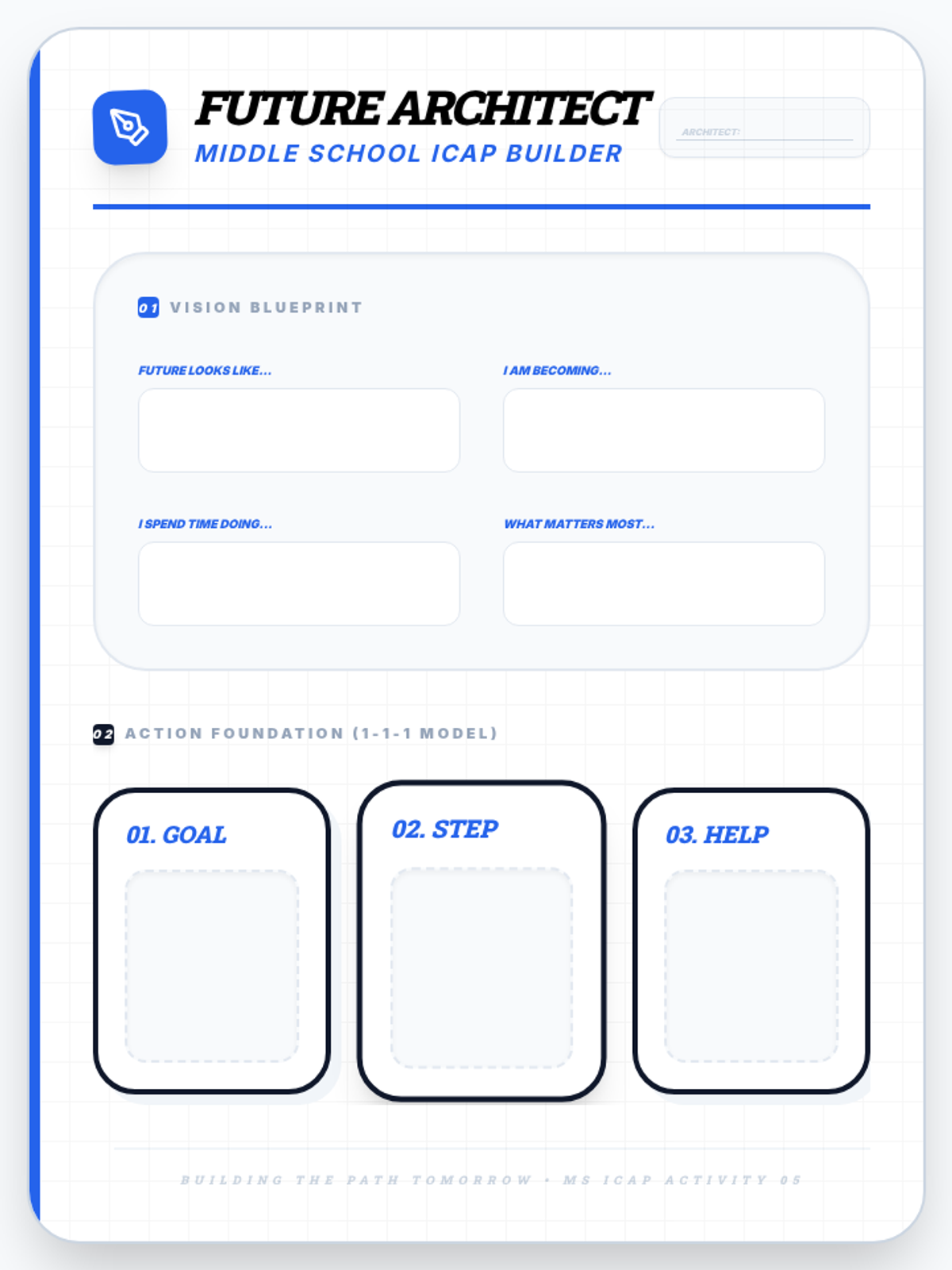
A high-impact planning worksheet for middle school students. Designed with a clean minimalist aesthetic and strictly formatted to fit on a single 720x960 page. Guaranteed no overflow.
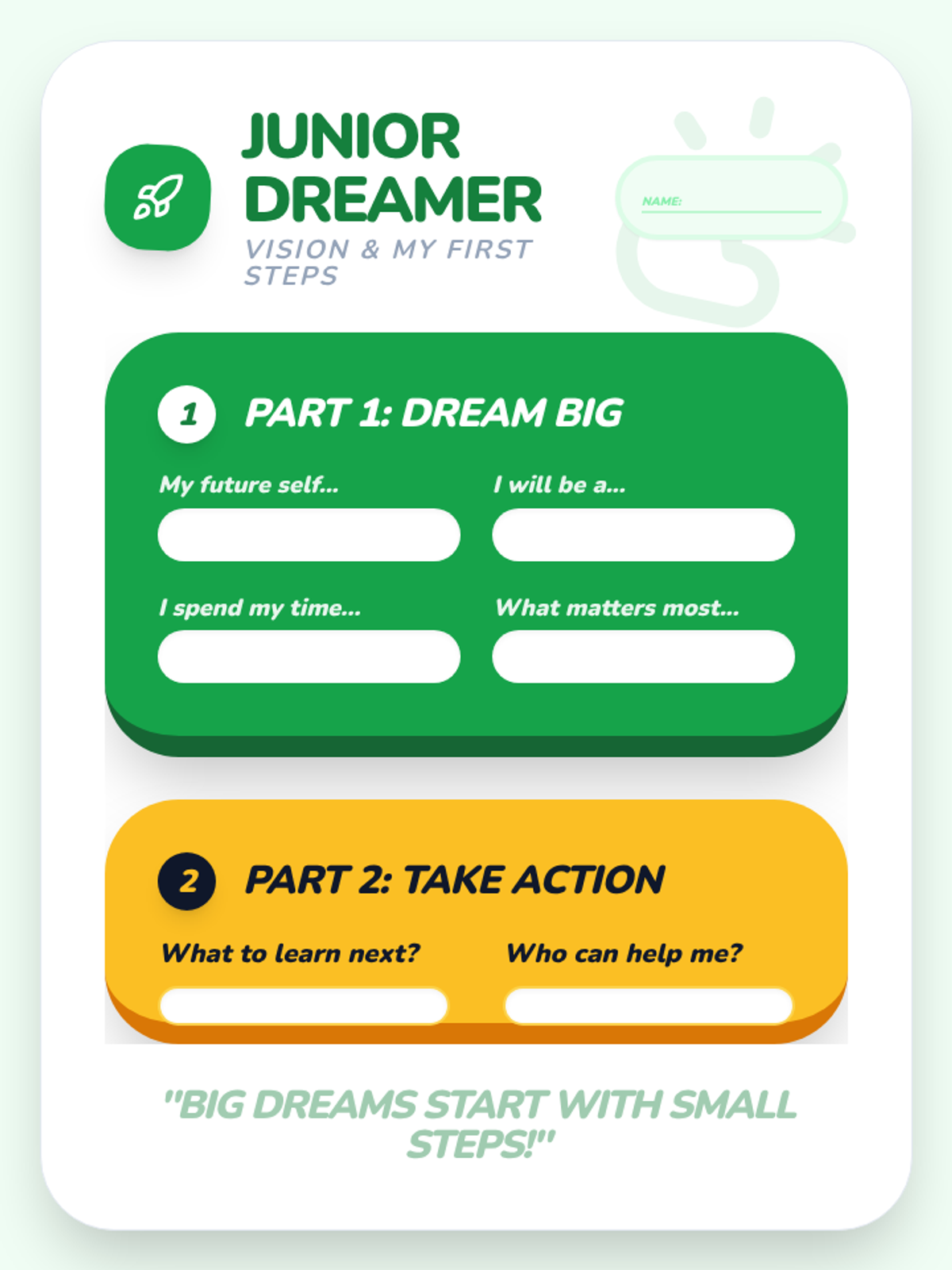
An engaging, professional-quality workshop sheet for elementary students. Designed with a clean minimalist aesthetic and strictly formatted for a single 720x960 page using a safe height buffer. Guaranteed no overflow.
Day 5 Slides: Consolidating resources and finalizing the personal safety plan.
Day 4 Slides: Setting up the workshop environment for individual reflection and goal mapping.
Day 3 Slides: Focusing on the specific anxiety surrounding graduation and the loss of the high school support system.
Day 2 Slides: Differentiating depression from sadness and teaching specific conversational skills for peer support.
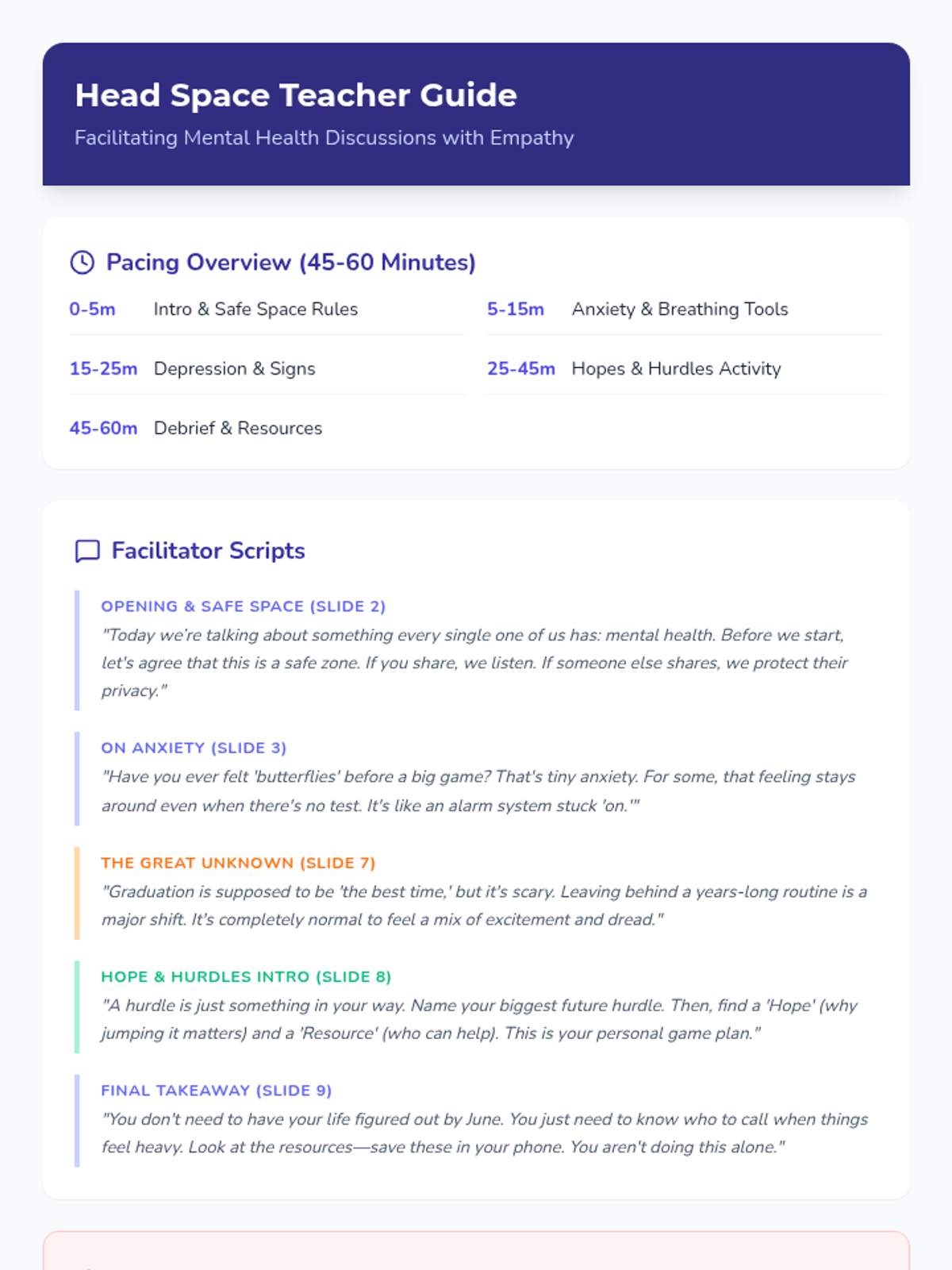
A comprehensive guide for teachers to facilitate sensitive mental health discussions, now featuring detailed scripts for key lesson transitions and safety protocols.
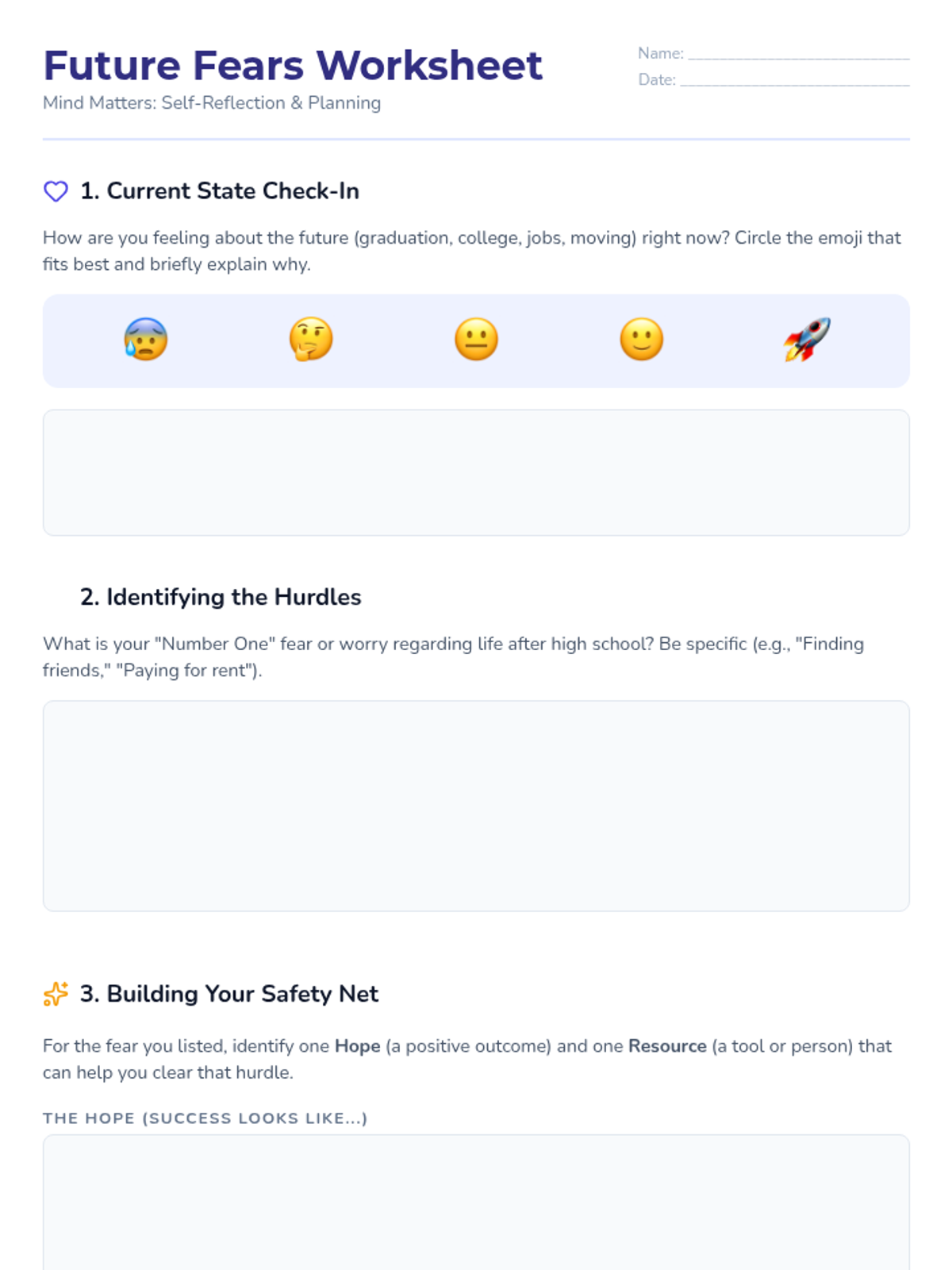
A student self-reflection document designed to accompany the mental health presentation, focusing on identifying personal fears (hurdles) and planning resources and coping strategies (hopes).
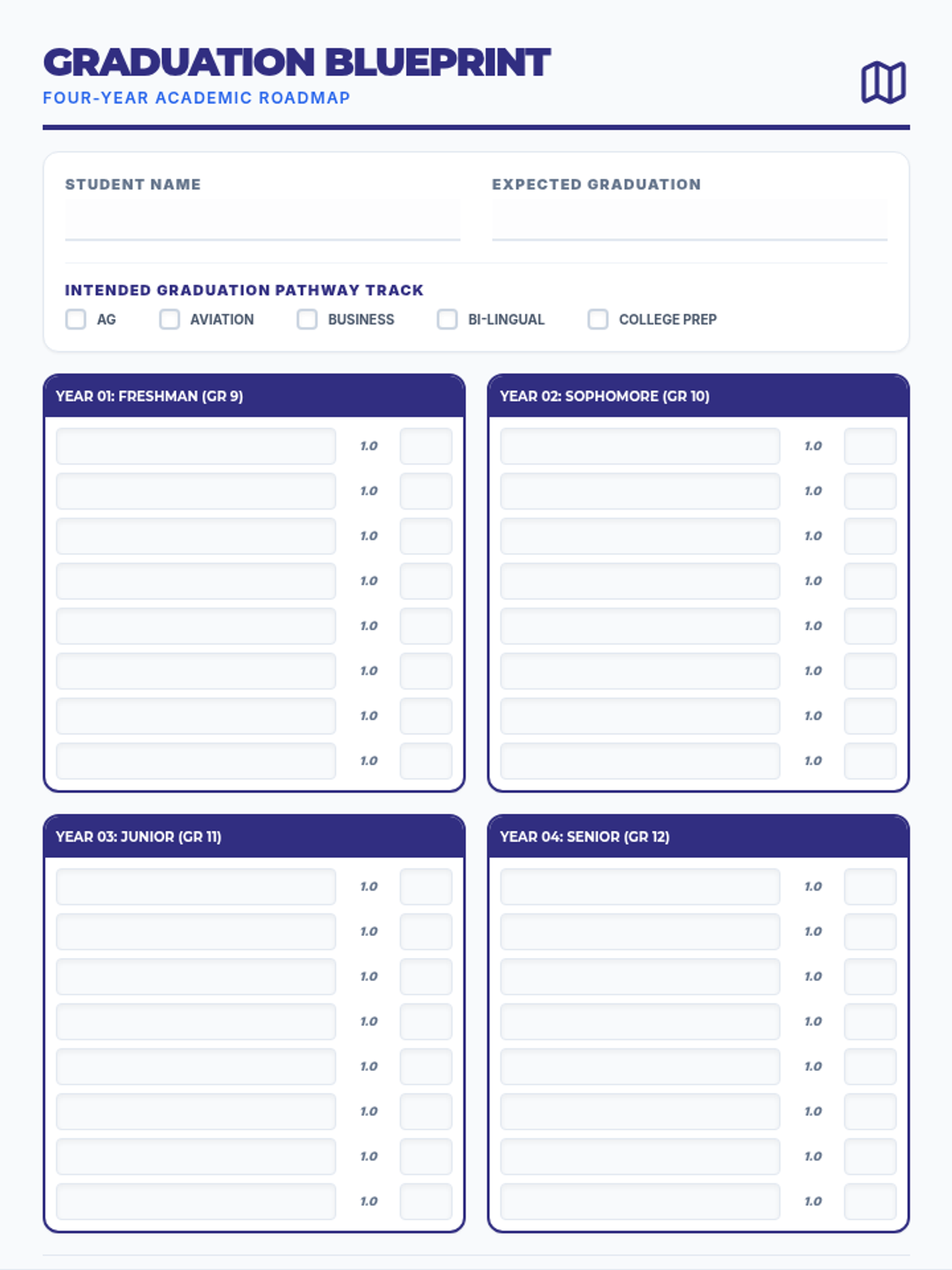
A consolidated 2-page academic planning and tracking tool that combines the 4-year roadmap with the graduation milestone checklist. Features a 4-year course planning grid on page 1 and a comprehensive credit tracker, annual audit verification, and meeting notes section on page 2. Added dedicated space for students to write specific class names for each credit requirement. Corrected font sizes for better readability.
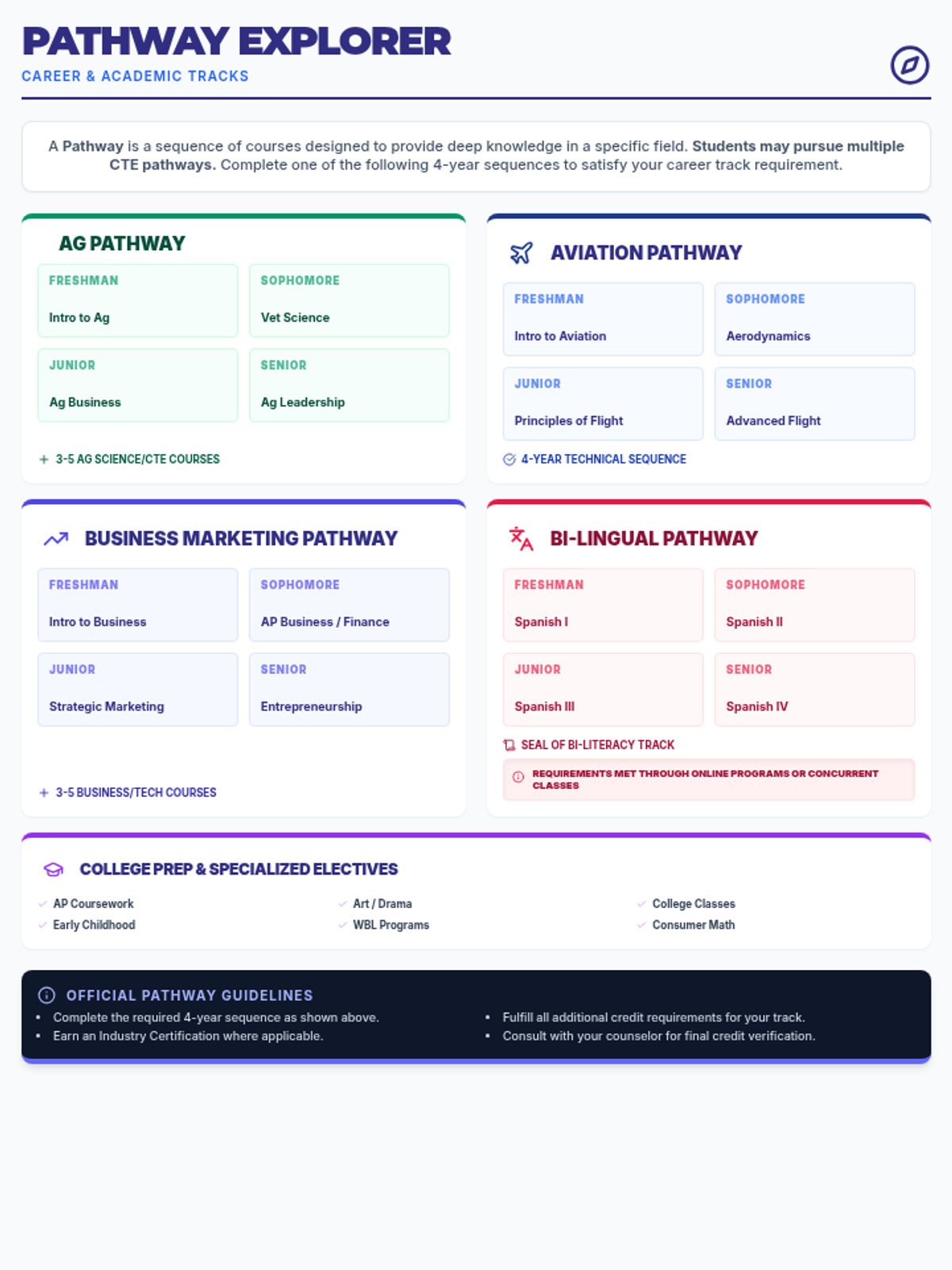
Updated the Pathway Explorer Handout to remove 'Drama' and 'Consumer Math' from the College Prep and Specialized Electives section. The layout remains optimized for a single-page reference with updated pathway annotations.
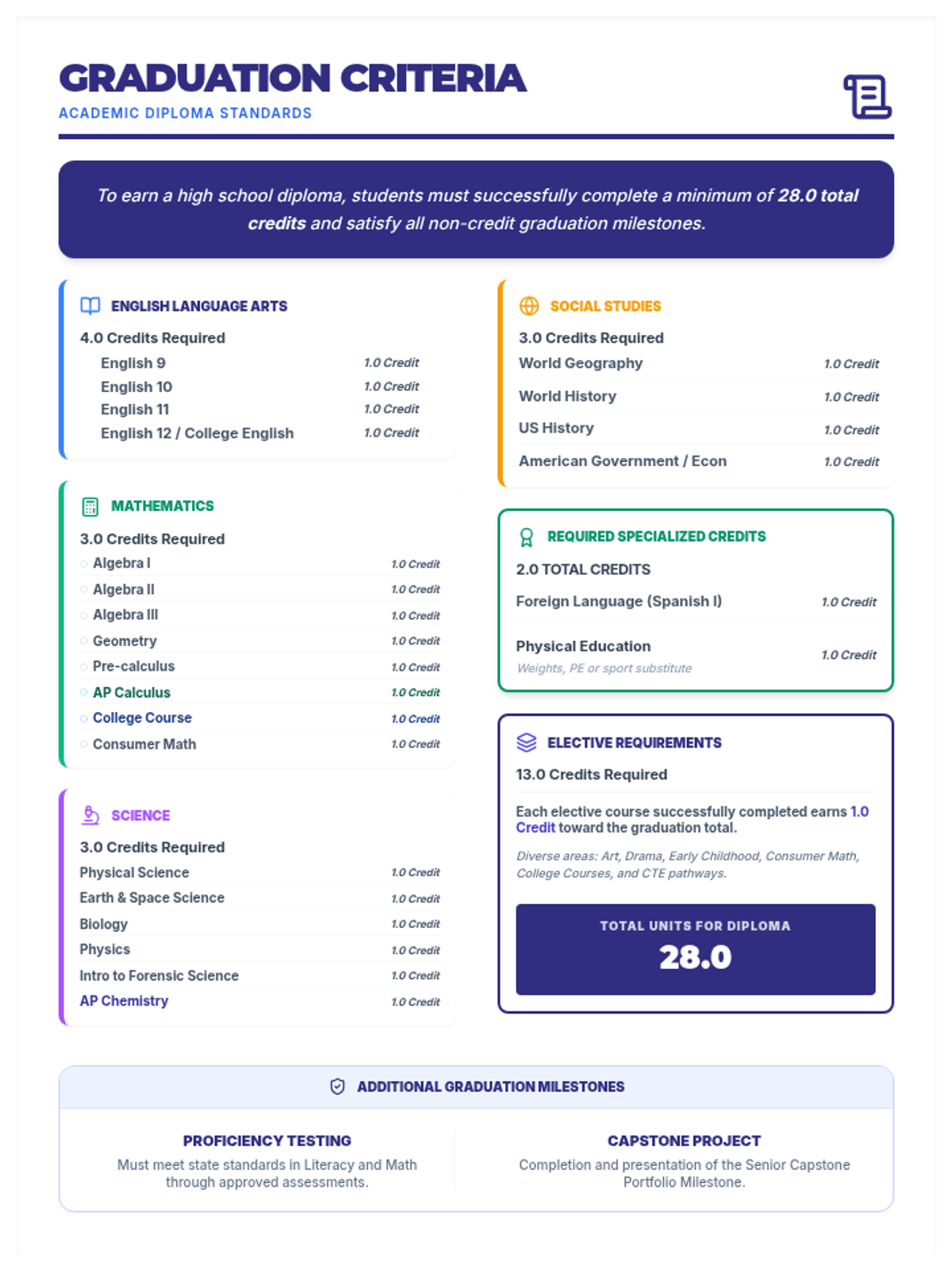
Updated graduation criteria reference sheet with '1.0 Credit' annotations for each listed course, ensuring clarity on the value of individual classes toward the 28.0 total credit requirement. Maintenance of clean, universal layout.
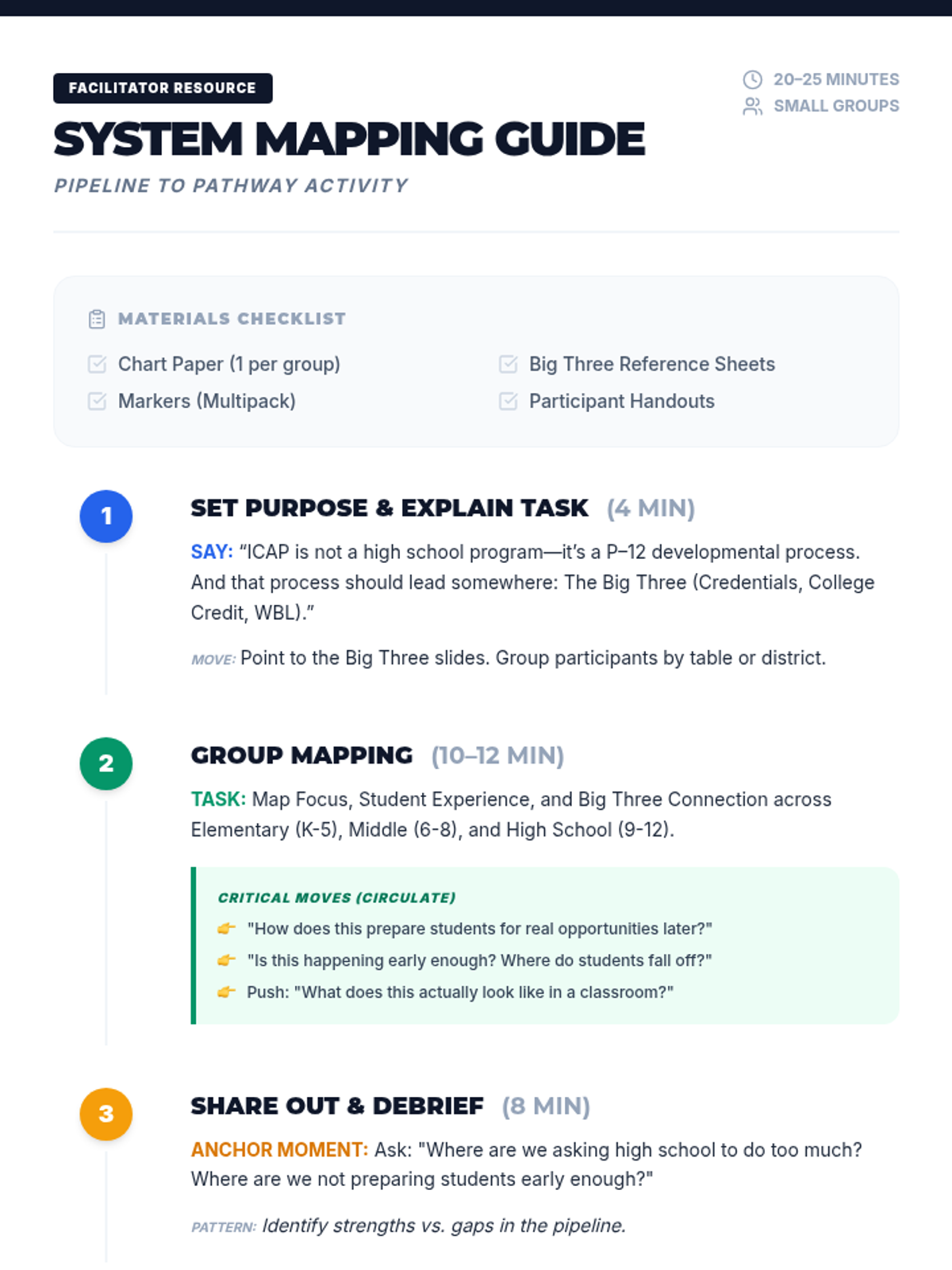
A facilitator cheat sheet for the Pipeline to Pathway activity, providing a step-by-step guide with scripts, moves, and critical prompts to ensure a high-impact session.
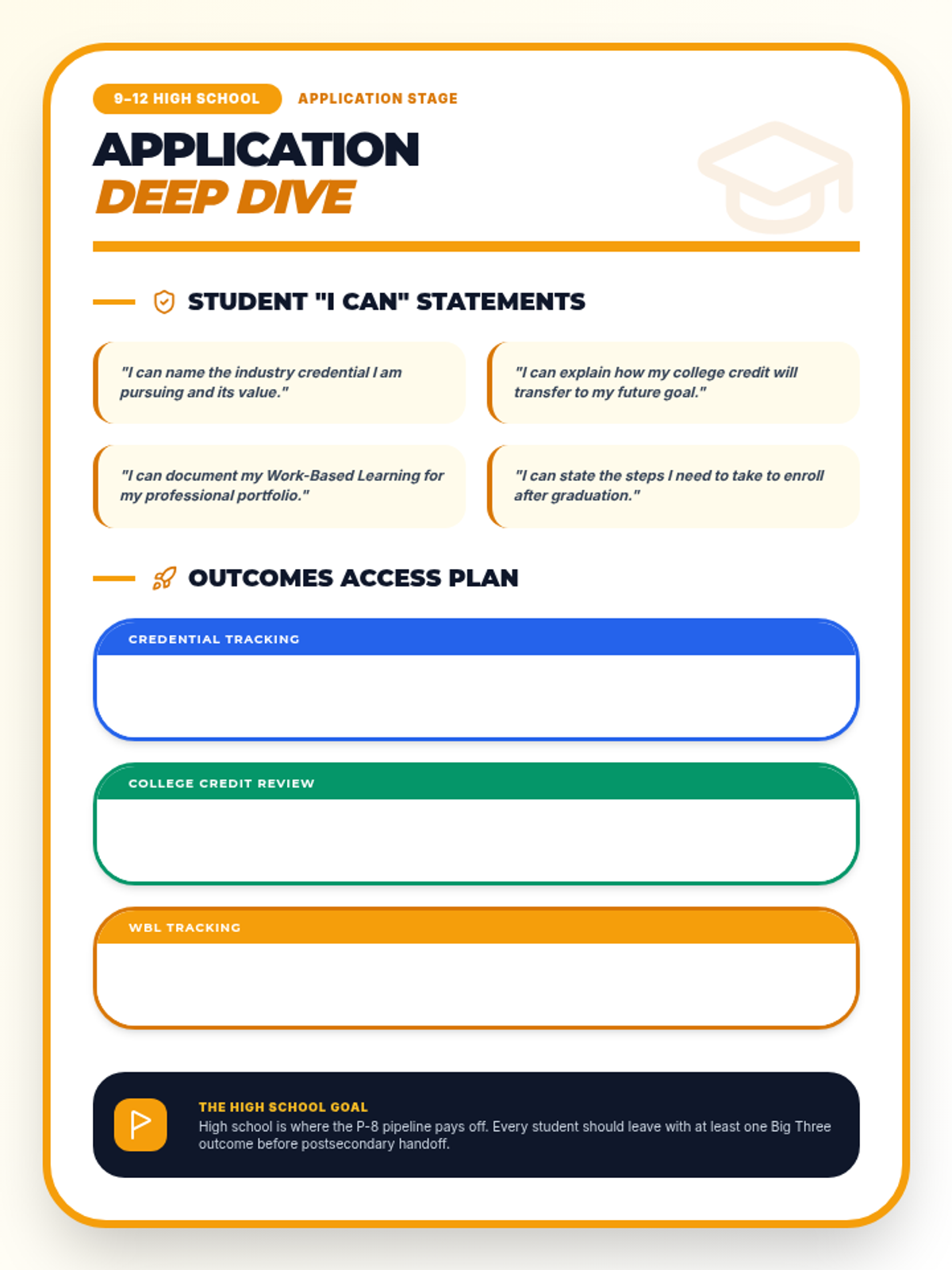
A deep dive implementation guide for the High School (9-12) level. Redesigned with a full-page layout that maximizes space for outcome tracking (Credentials, College Credit, WBL) and high-impact "I Can" statements.
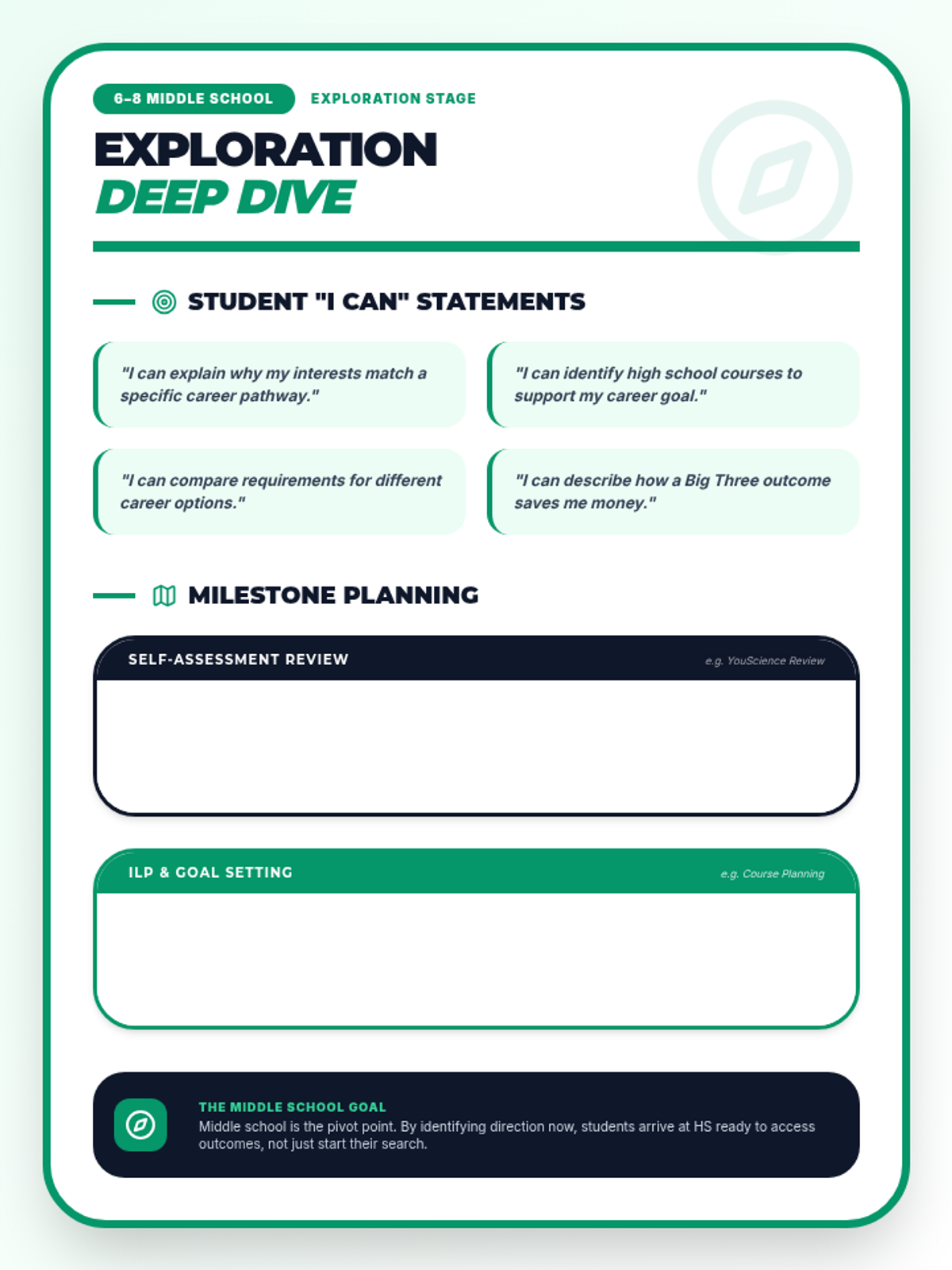
A deep dive implementation guide for the Middle School (6-8) level. Redesigned with a full-page layout that maximizes space for milestone planning and "I Can" statement exploration.
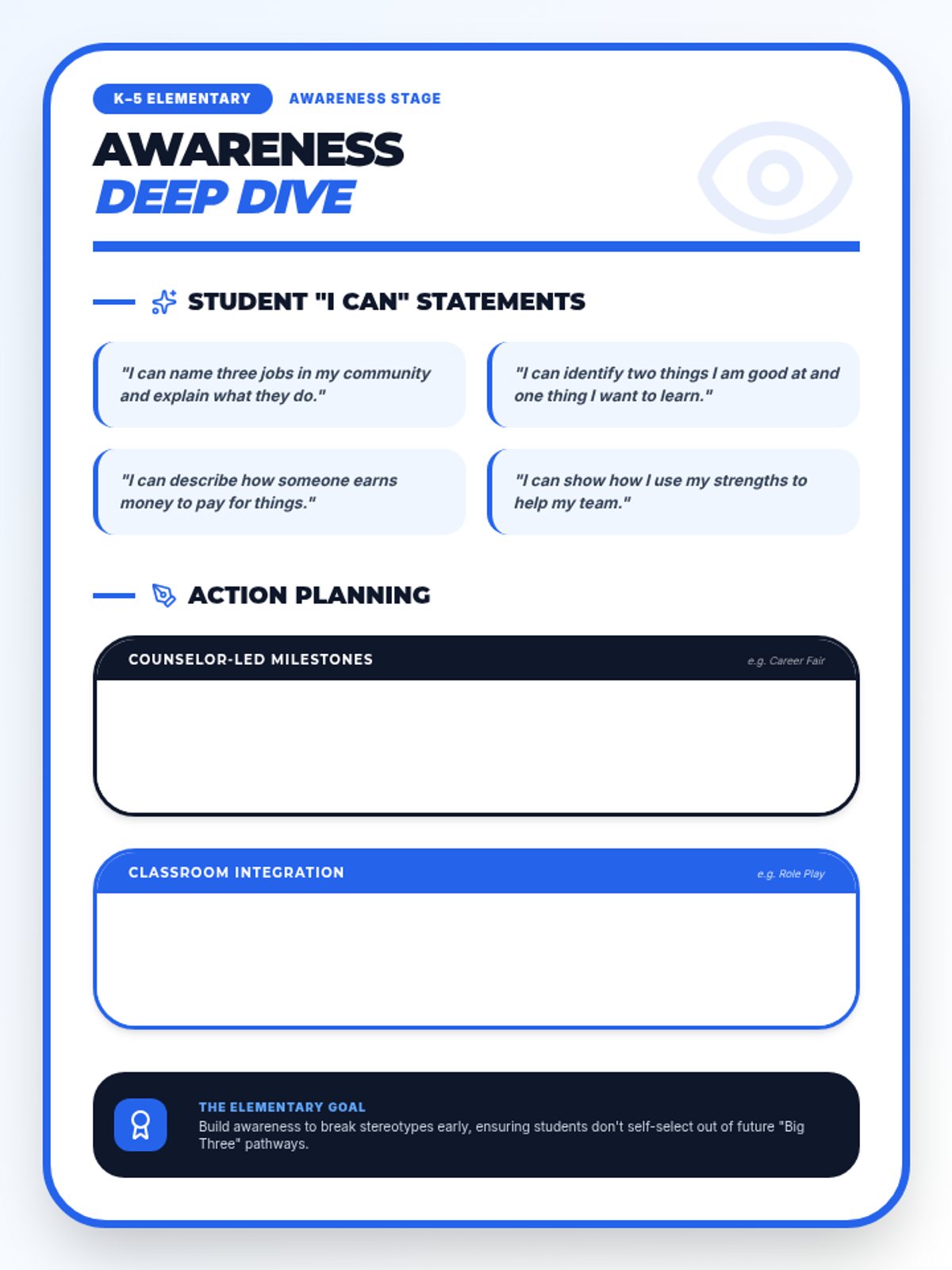
A deep dive implementation guide for the Elementary (K-5) level. Redesigned with a full-page layout that maximizes space for action planning while maintaining high-impact visuals.
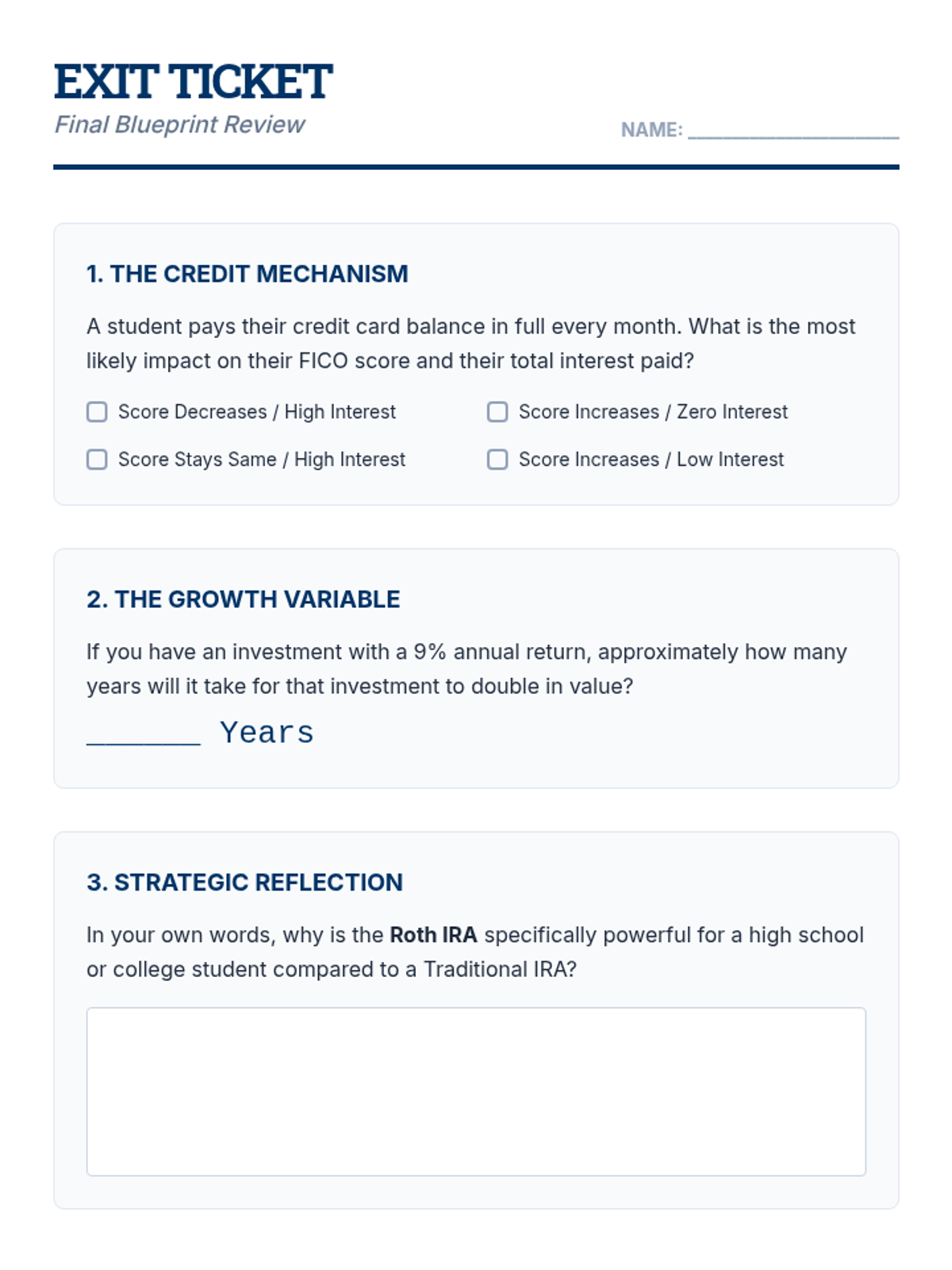
A quick check-for-understanding for the end of the lesson. Covers credit mechanics, the Rule of 72, and the strategic benefits of a Roth IRA for young investors.
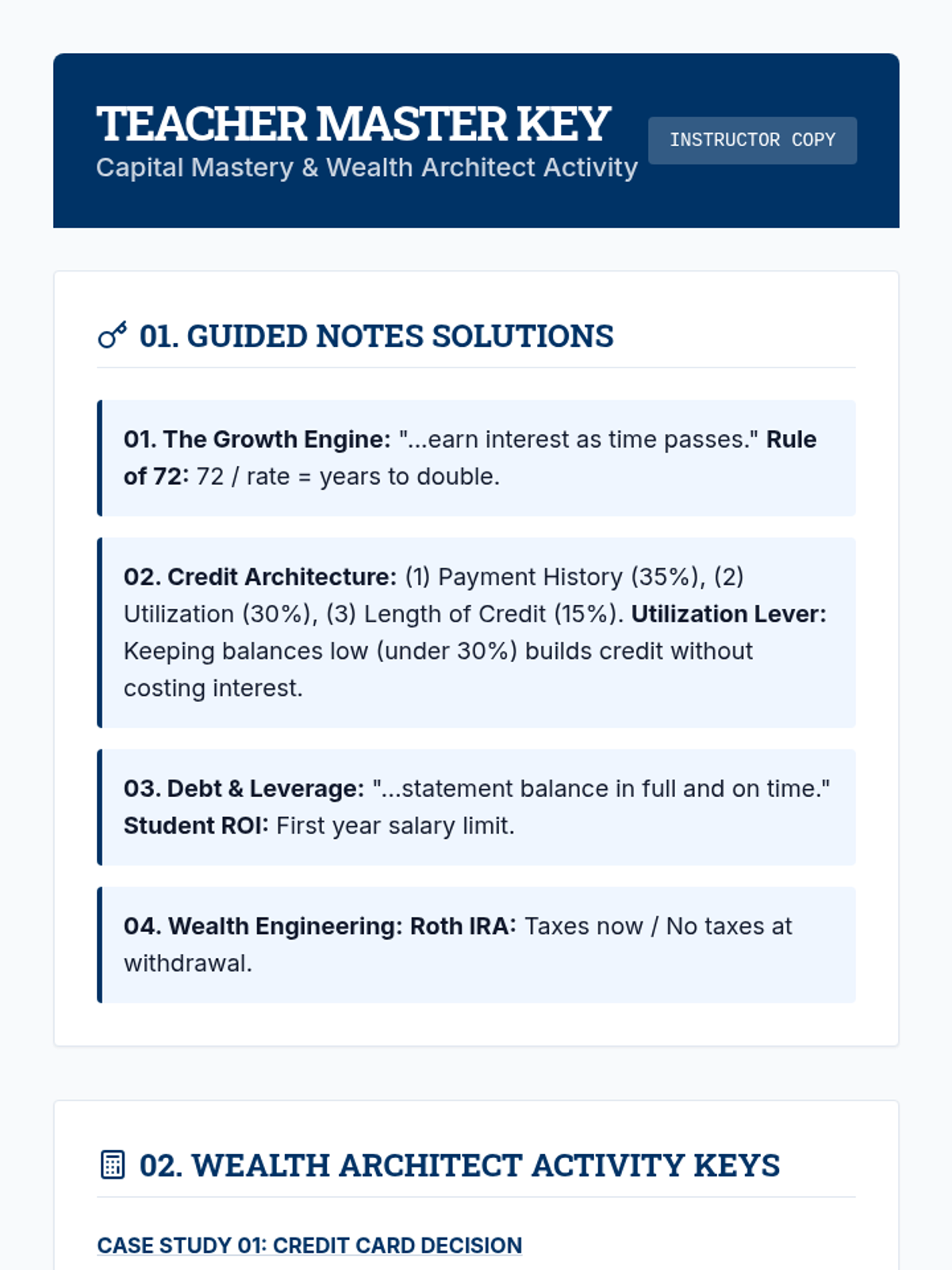
A teacher-facing answer key and instructional guide for the Capital Mastery lesson. Includes specific mathematical breakdowns for the credit card, student loan, and investment case studies, as well as pedagogical discussion prompts.
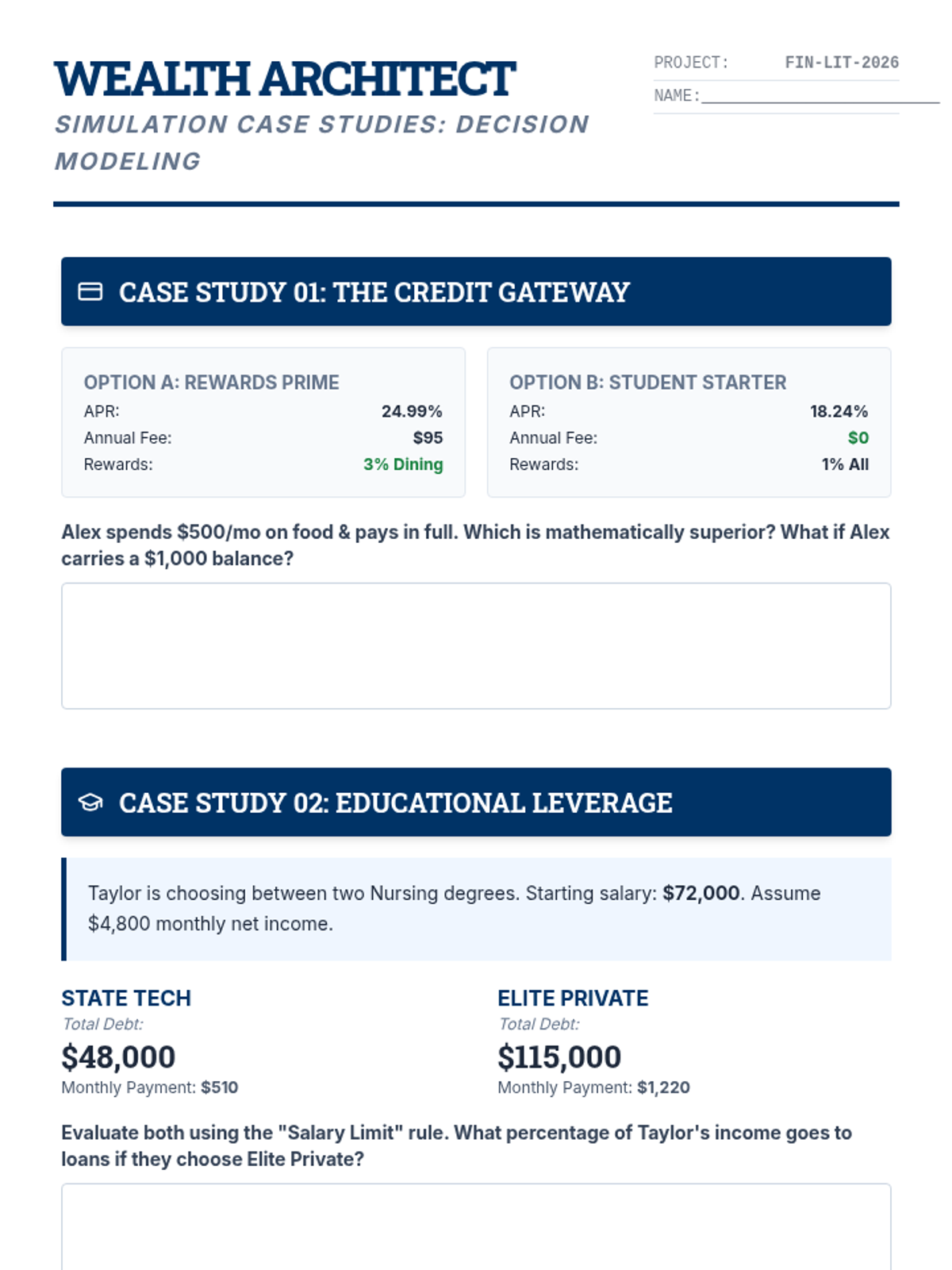
A student activity worksheet featuring three complex financial case studies: credit card evaluation, student loan ROI modeling, and index fund vs. active fund analysis. Designed for advanced high school students to apply mathematical and strategic reasoning to real-world financial decisions.
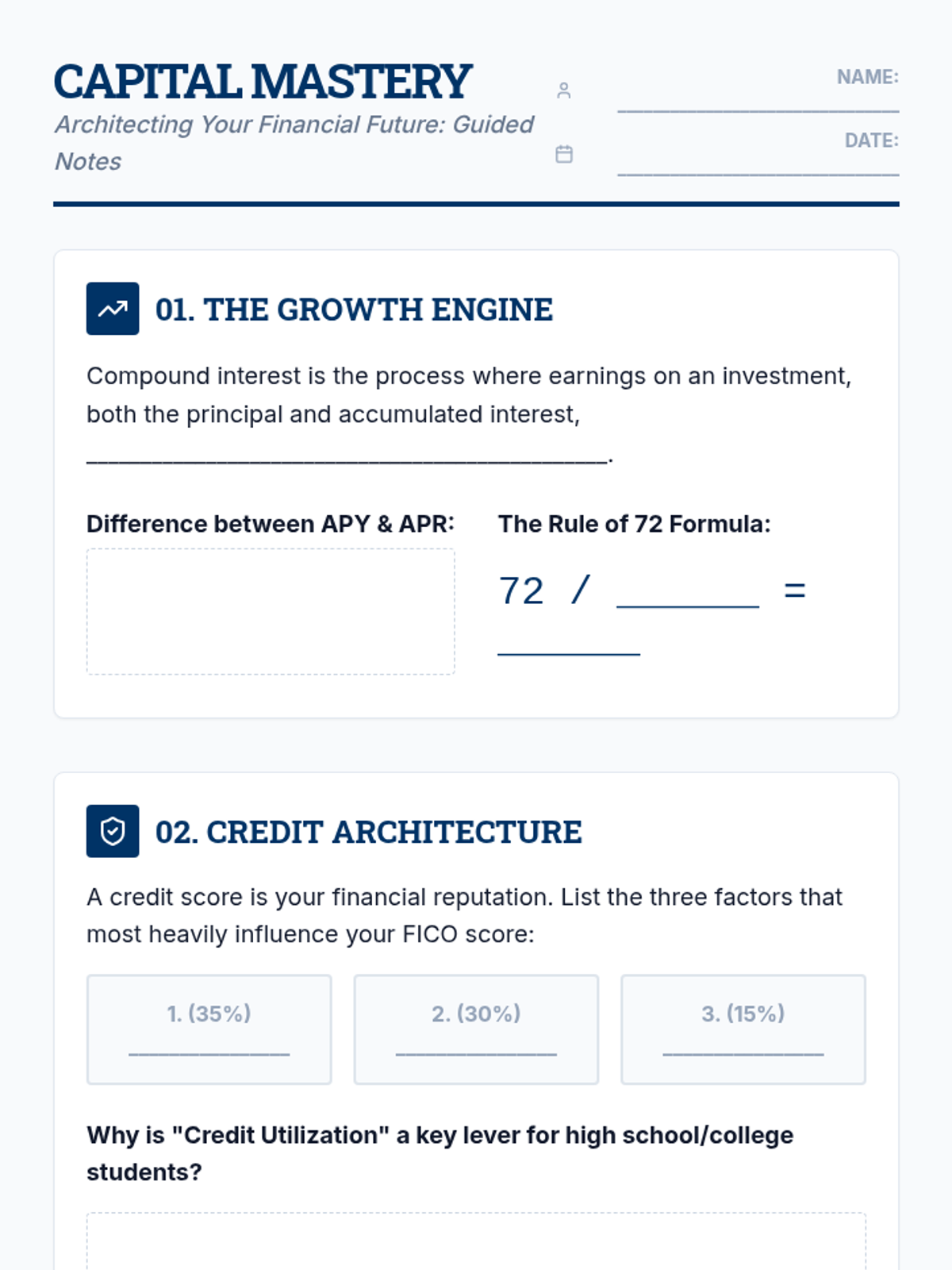
A student-facing guided notes document to be used during the Capital Blueprint Slides presentation. Includes fill-in-the-blanks, summary boxes, and reflective spaces designed with a blueprint-themed aesthetic to maintain lesson cohesion.
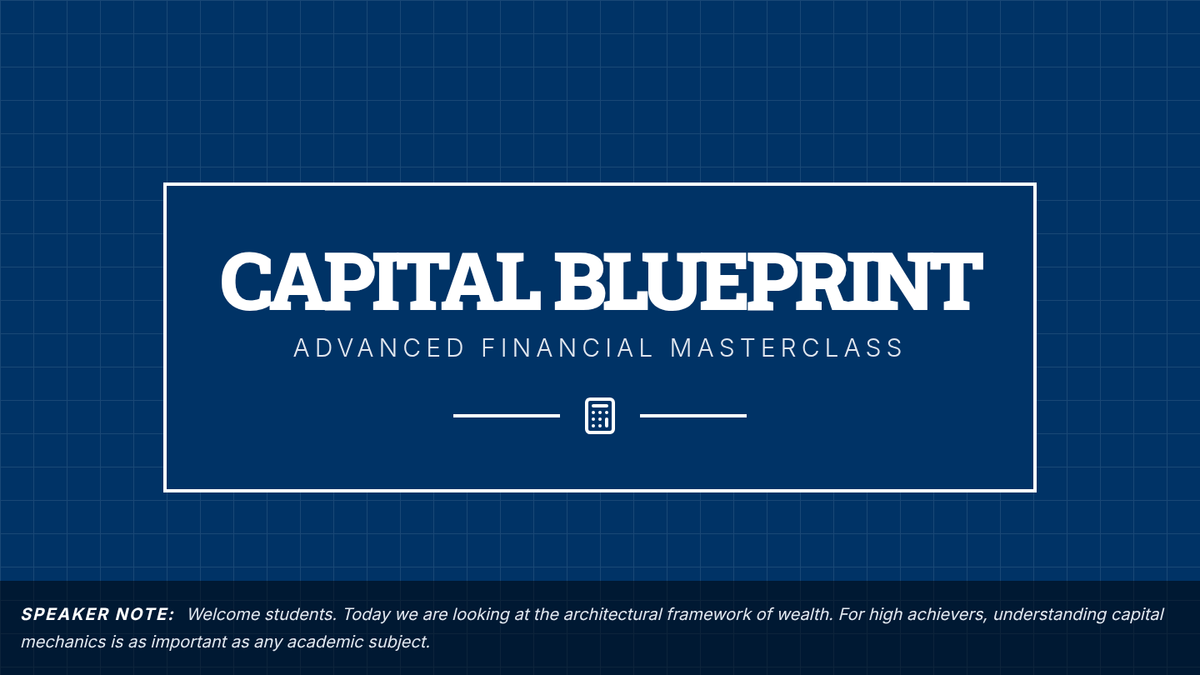
A comprehensive 10-slide presentation designed for advanced high school students, exploring the architectural principles of personal finance. It covers compound interest, credit scoring mechanics, the dangers of minimum payments, strategic student debt, index fund investing, and tax-advantaged accounts with a professional blueprint-inspired aesthetic.
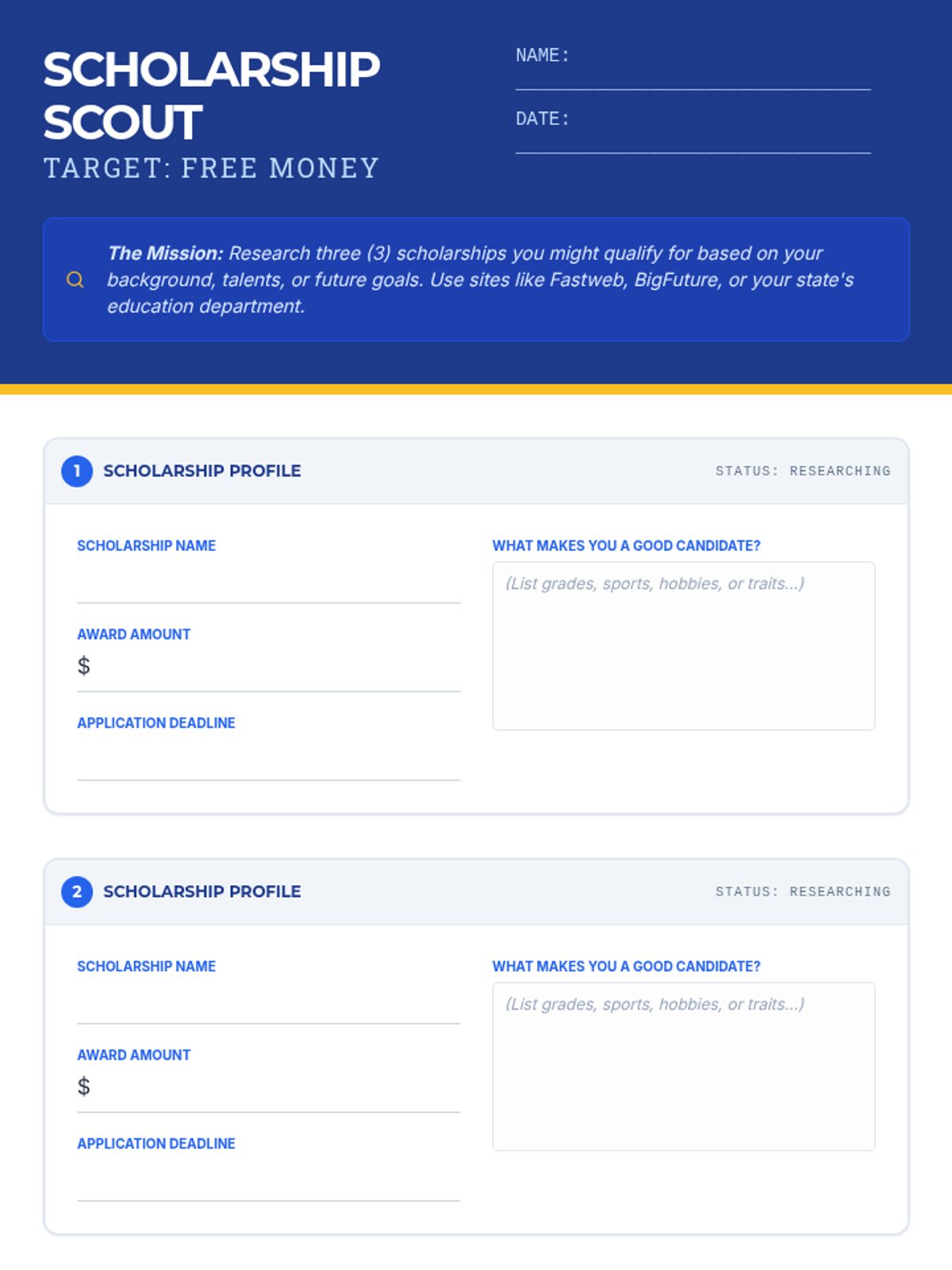
A research template for students to identify and analyze three specific college scholarships based on their background and interests.
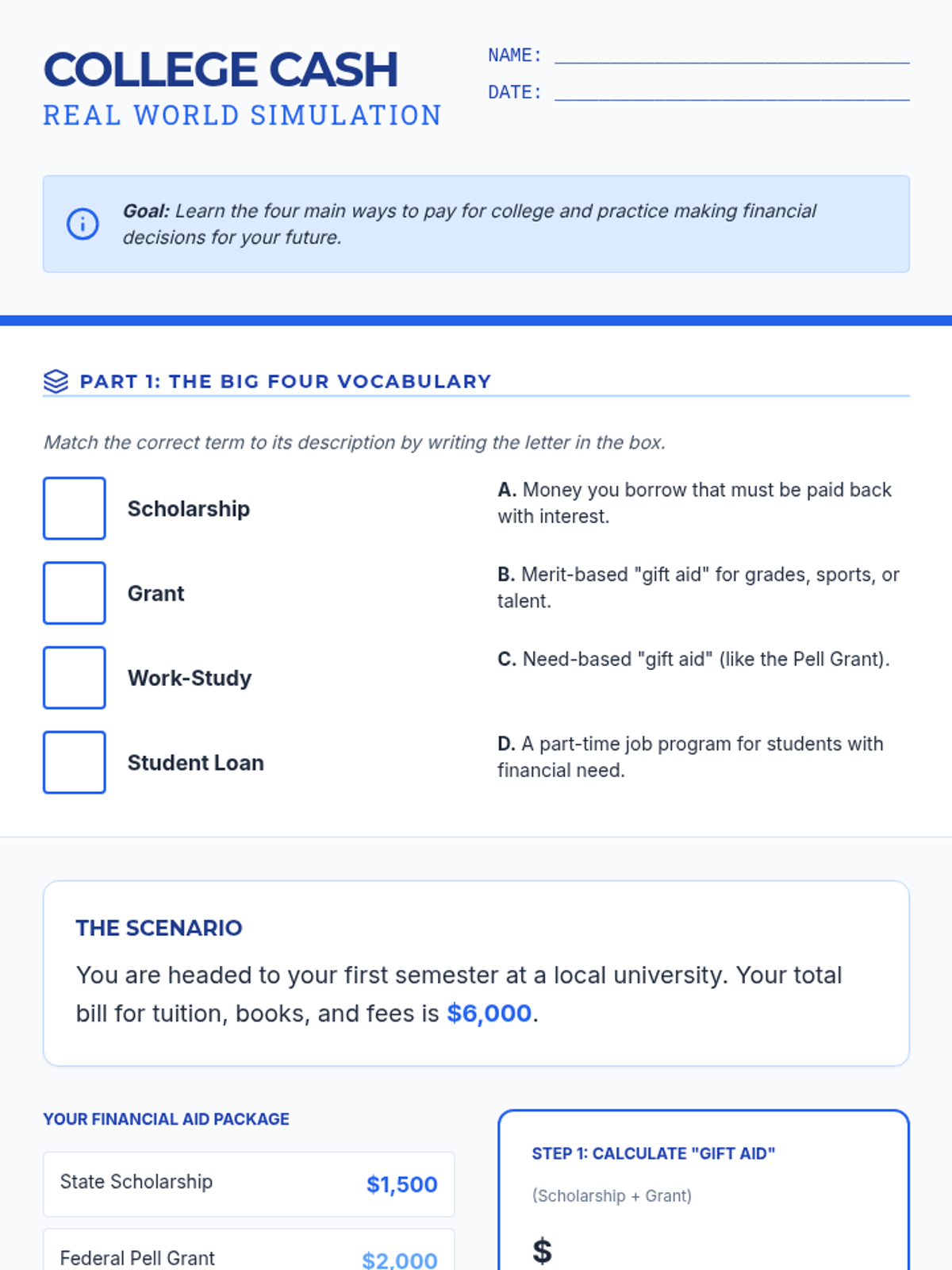
A student worksheet for calculating a college financial aid package and making budget-based decisions.
A visually engaging slide deck covering the four main types of college funding and the "Real World Budget" simulation scenario.
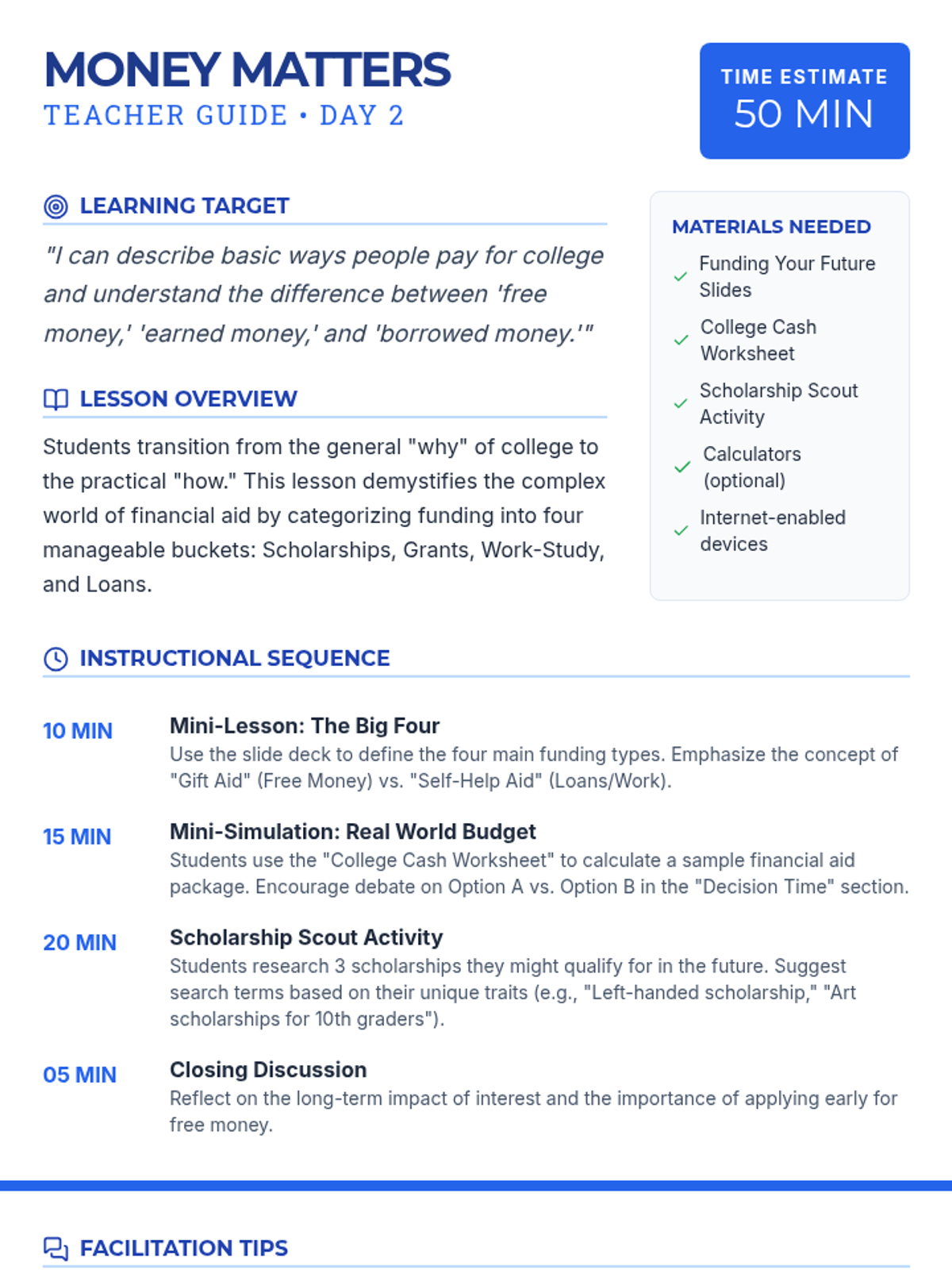
A comprehensive teacher's guide for the "Paying for College Basics" lesson, featuring a pacing guide, facilitation tips, common misconceptions, and an answer key for the student activities.
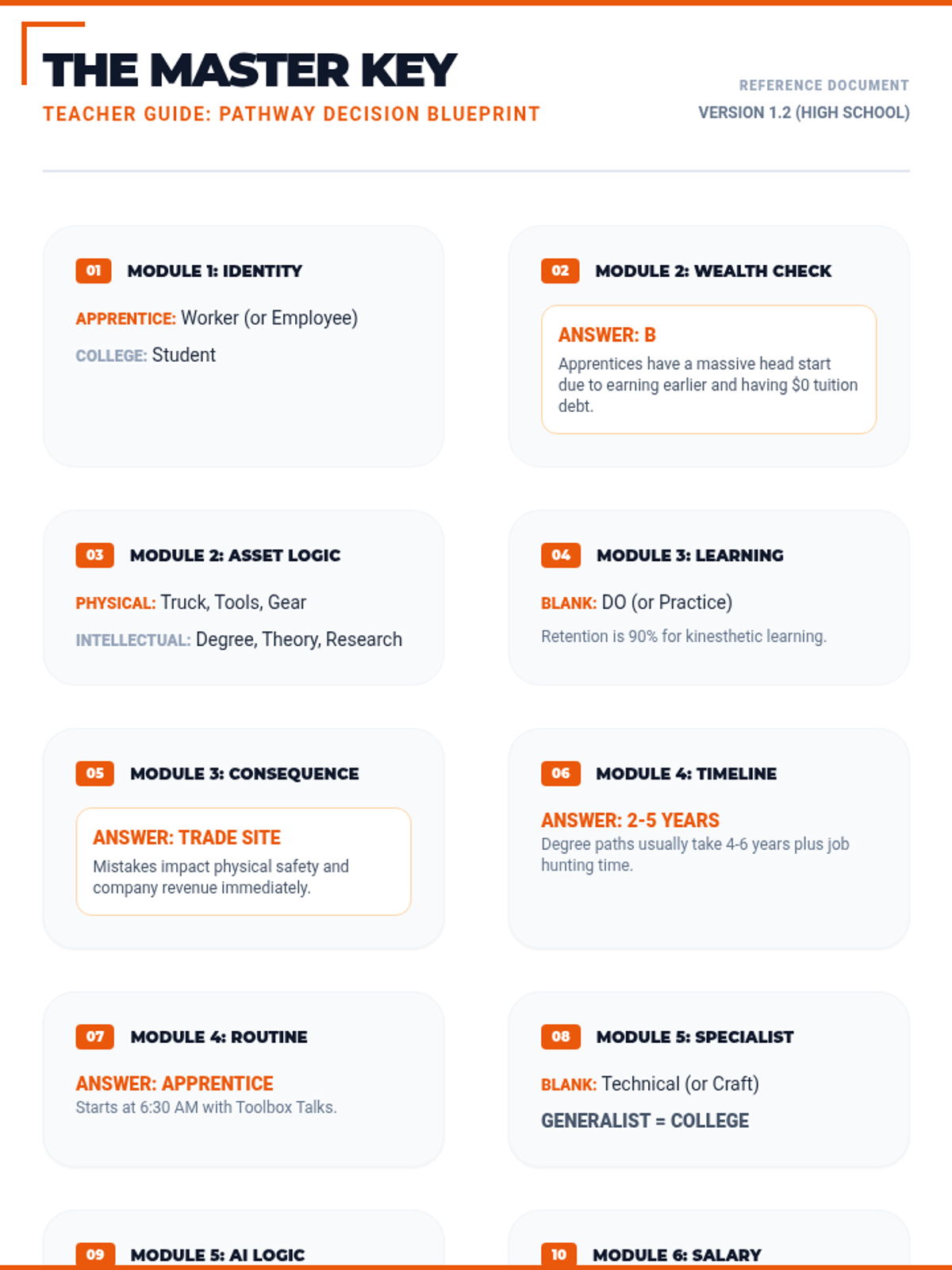
A teacher's master answer key for the Pathway Decision Blueprint Worksheet (15-section version), provided in a clean print layout with a Safety Orange and Slate theme.
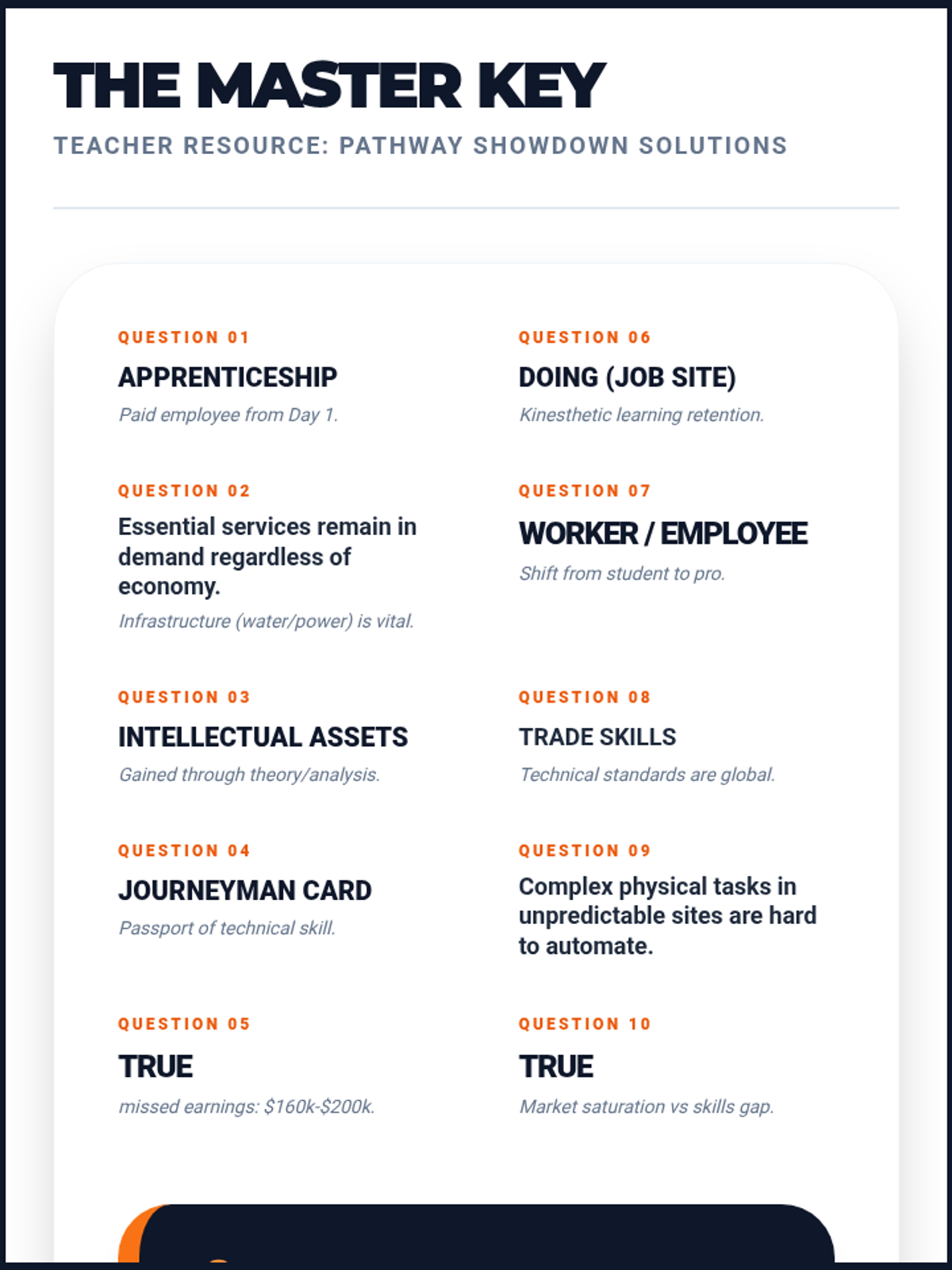
A standalone print-ready teacher answer key for the Pathway Showdown Info Sheet, featuring solutions for all 10 knowledge-check questions with detailed explanations.
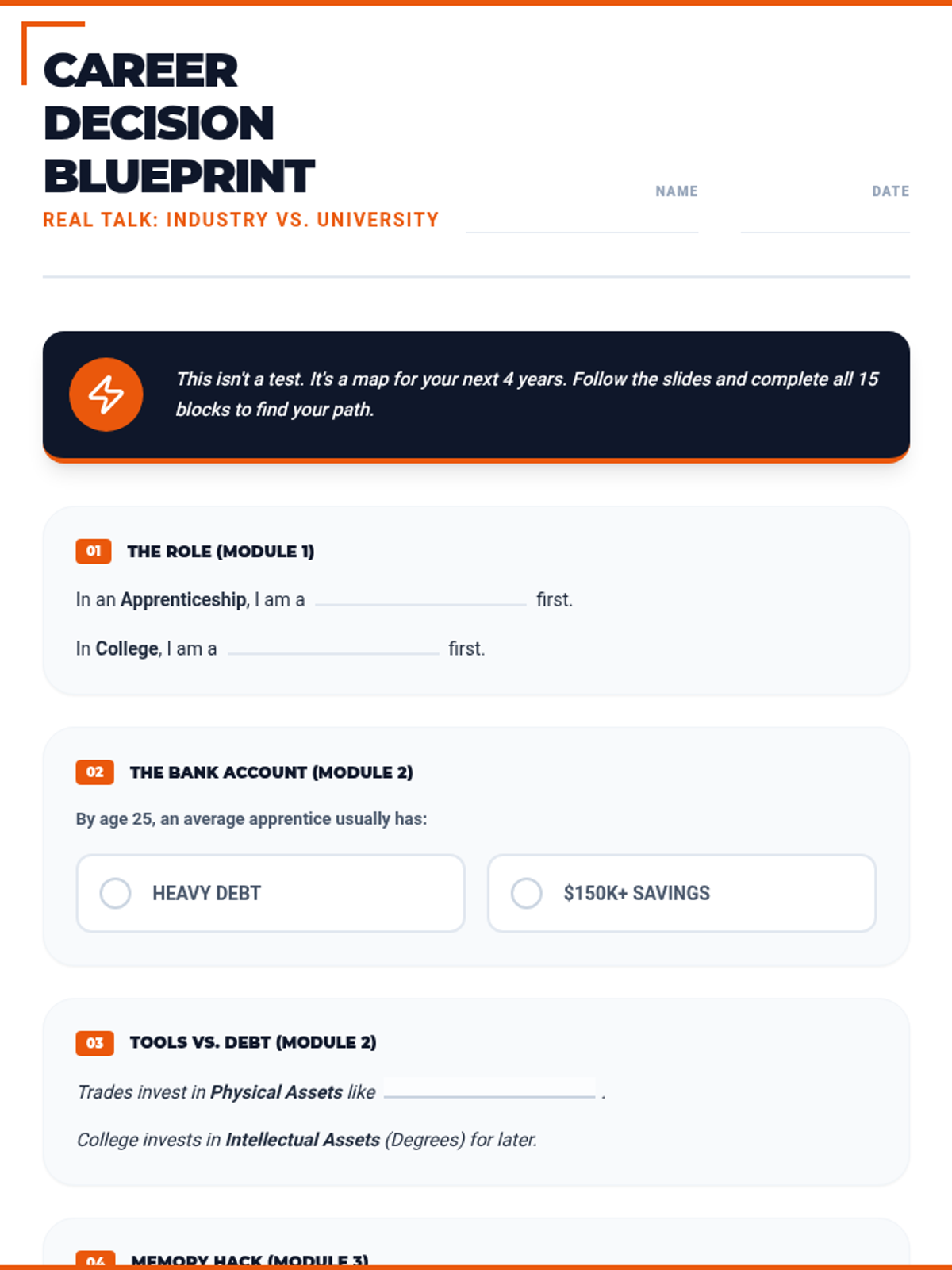
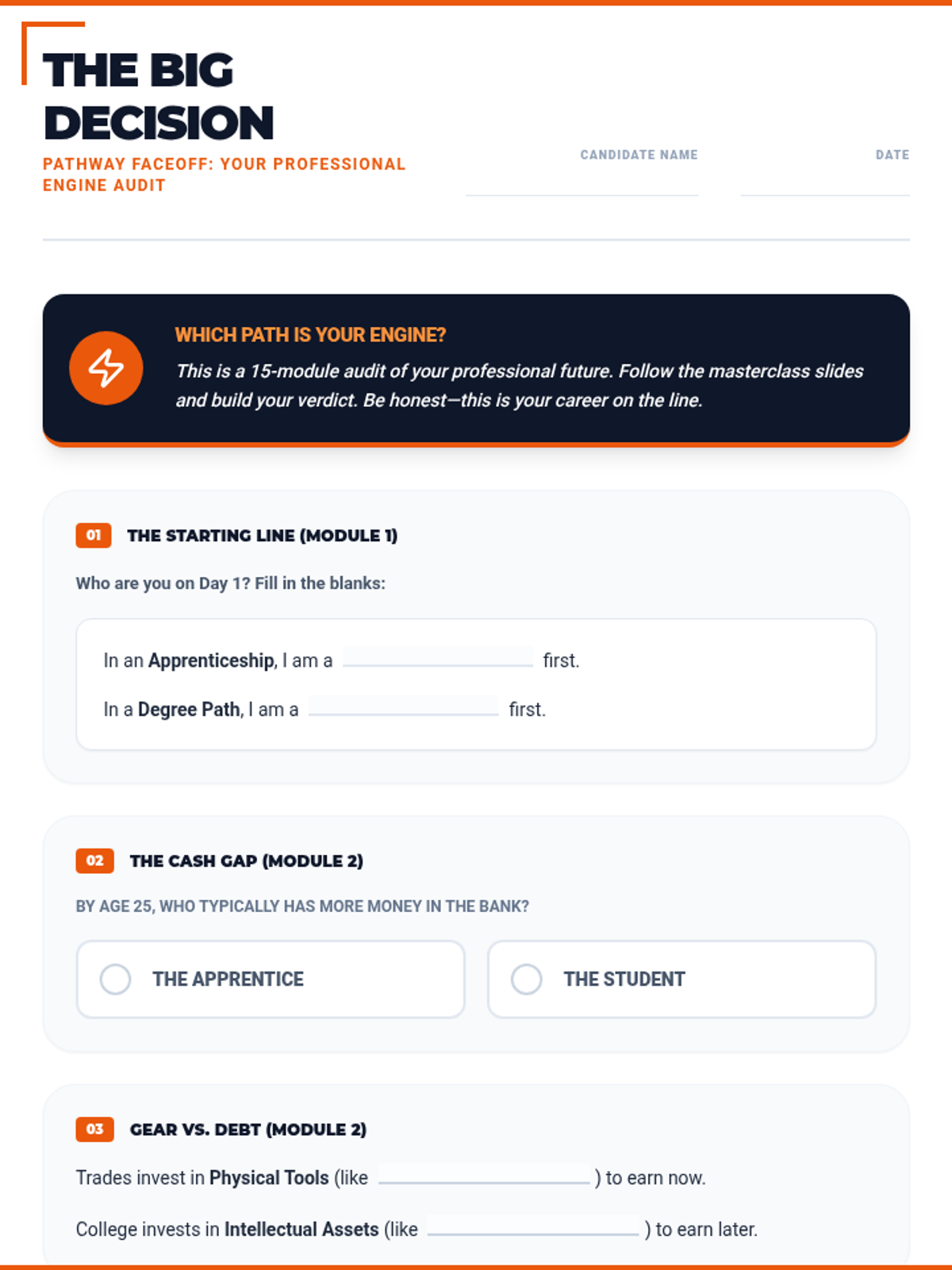
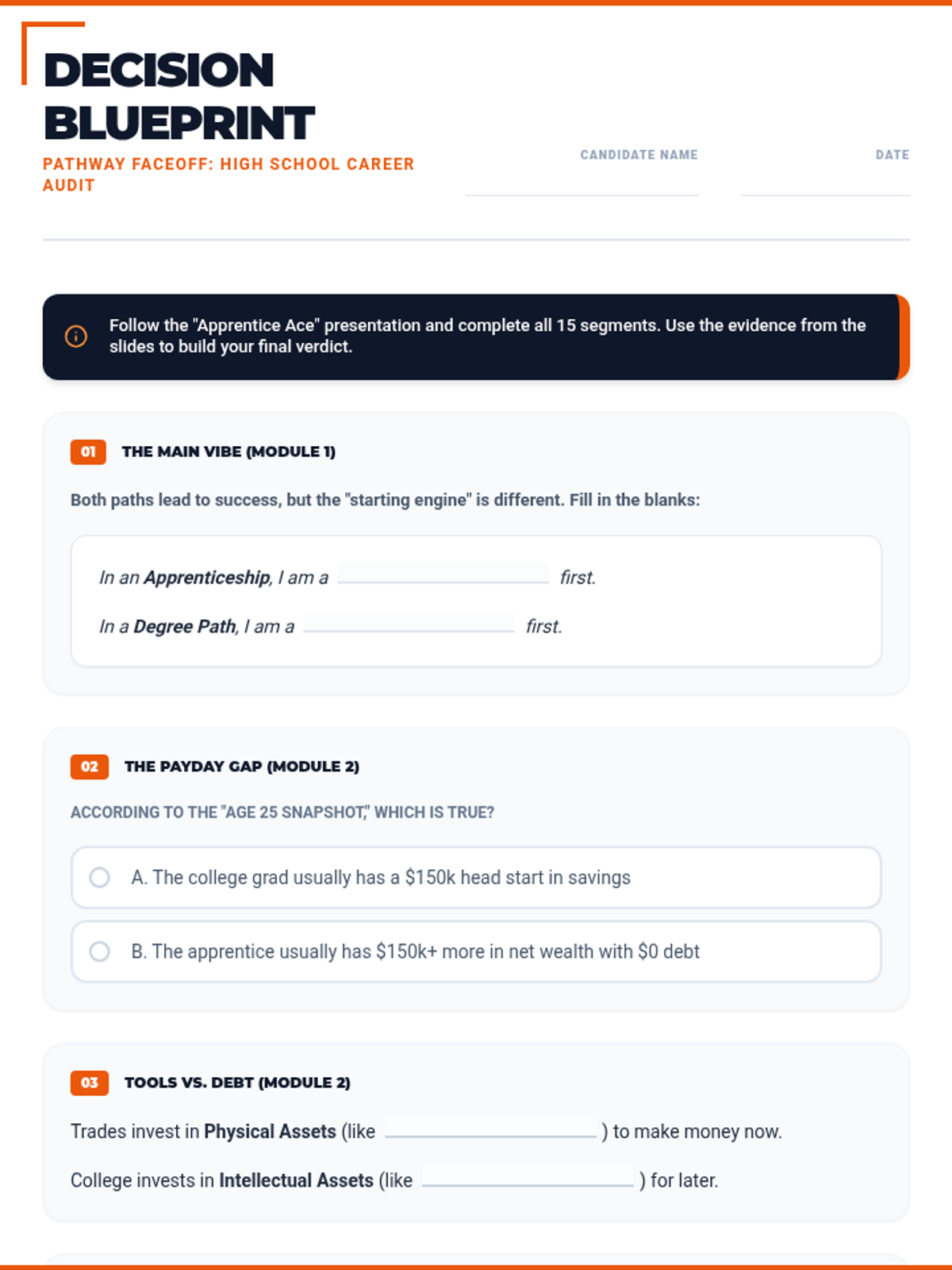
A simplified 15-section career exploration worksheet designed for 16-year-old high school students, featuring punchy, relatable titles and a "Safety Orange & Slate" theme. Meticulously aligned with the 45-slide masterclass. All correct answer highlights have been removed for student use.
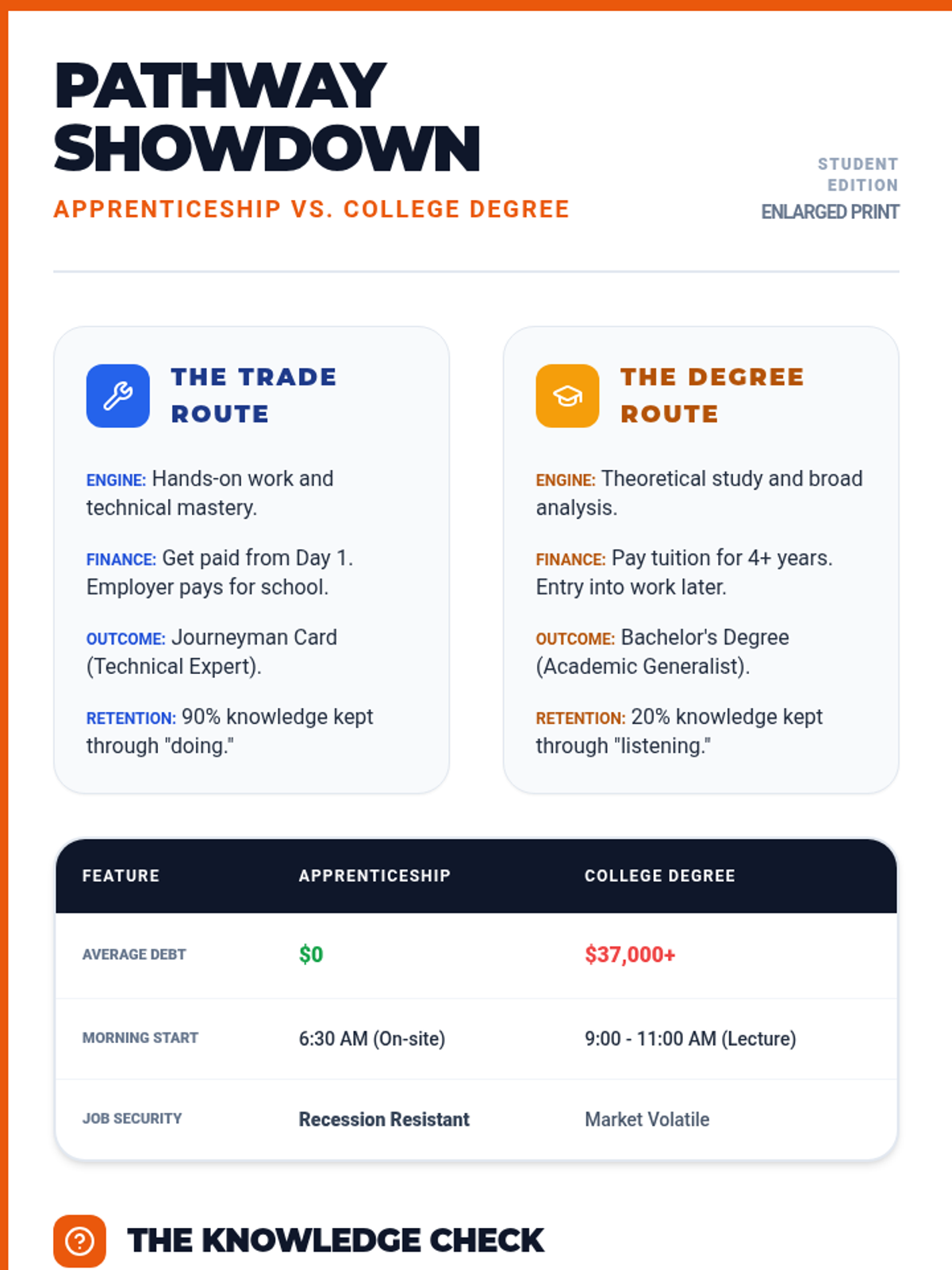
A 1-page enlarged informational summary comparing Apprenticeships and College Degrees, designed for maximum readability. Includes a facts breakdown, comparison table, and 6 key knowledge-check questions.
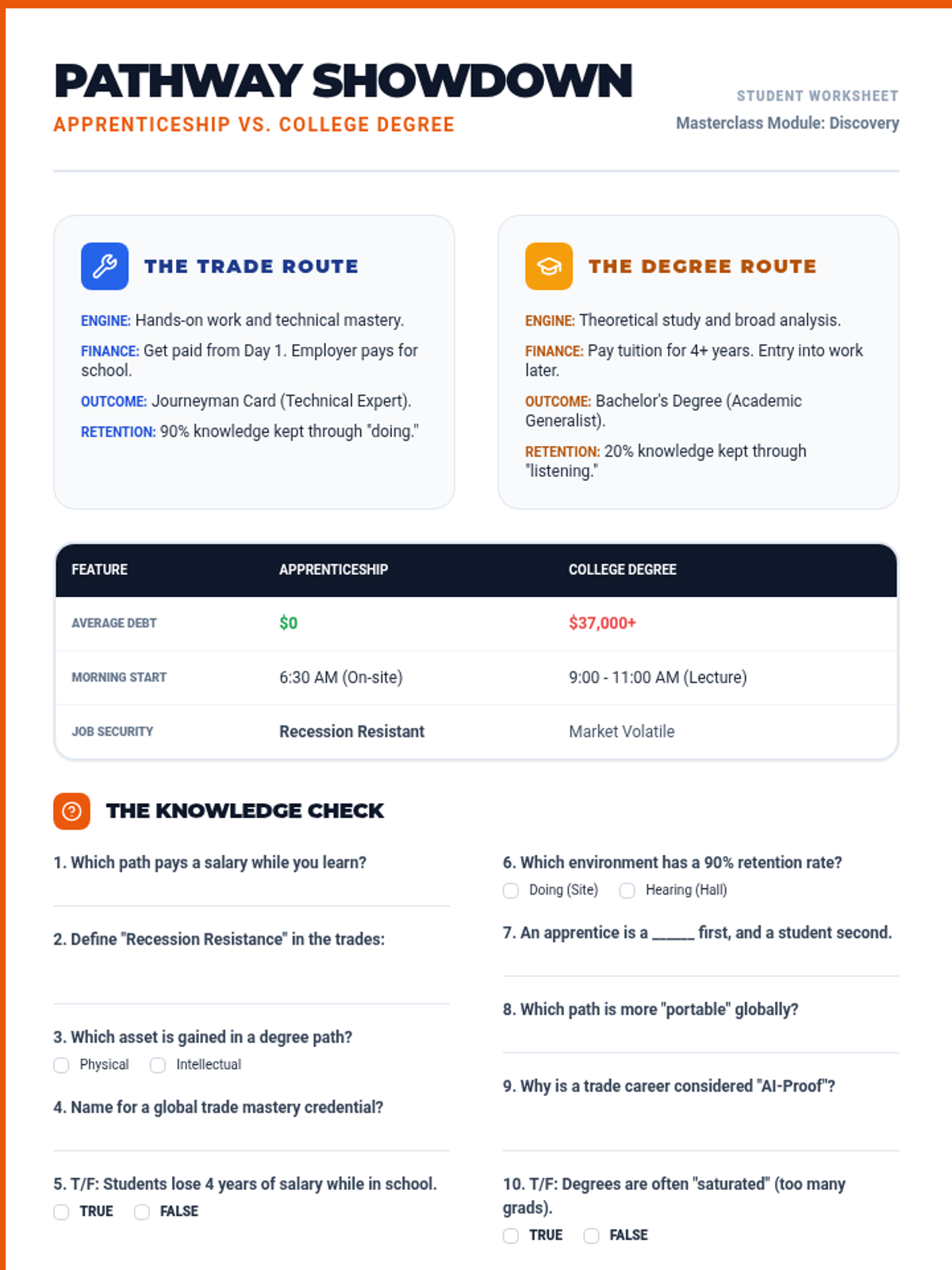
A 1-page informational summary comparing Apprenticeships and College Degrees, featuring a facts breakdown, comparison table, and 10 knowledge-check questions.
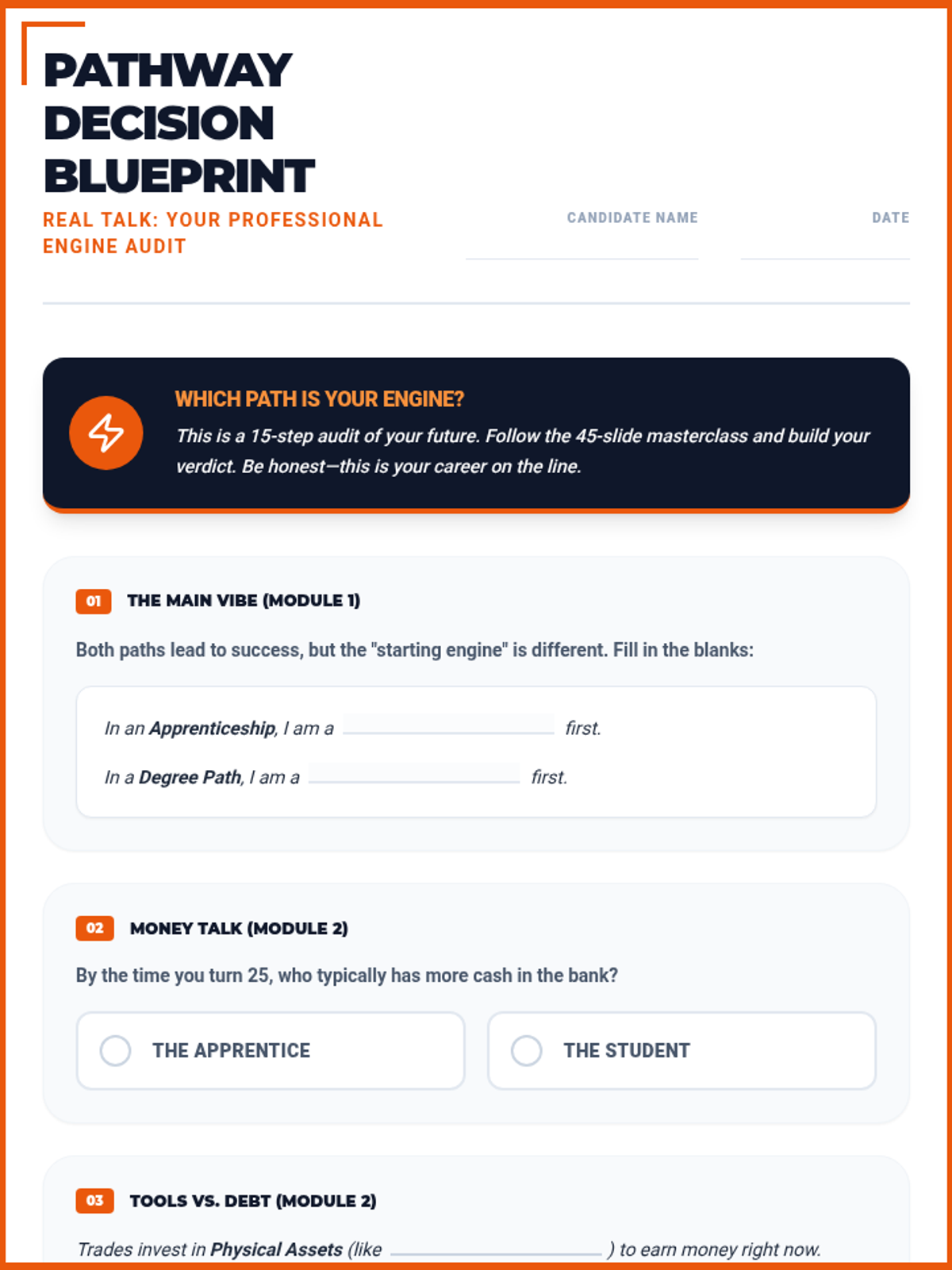
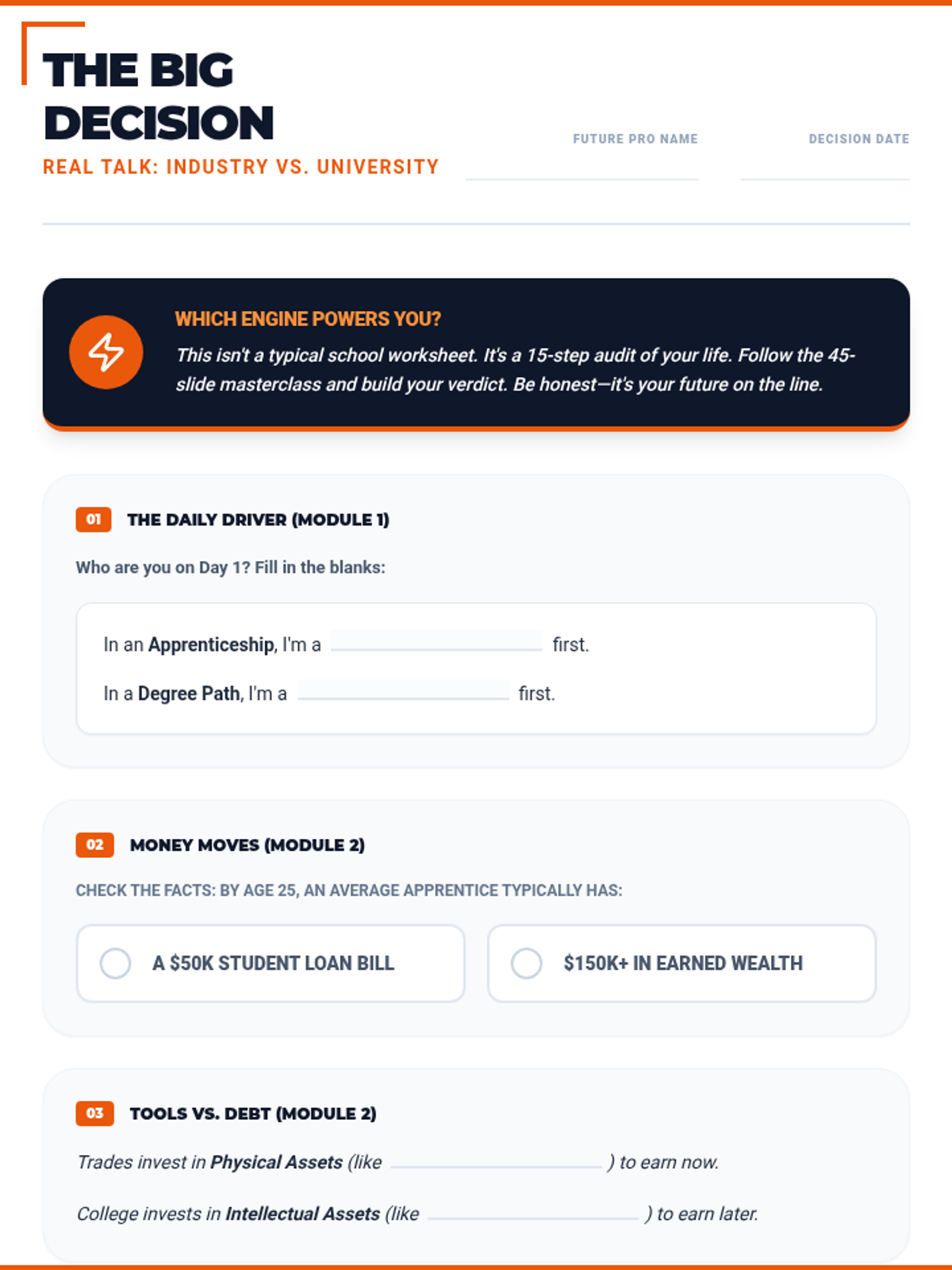
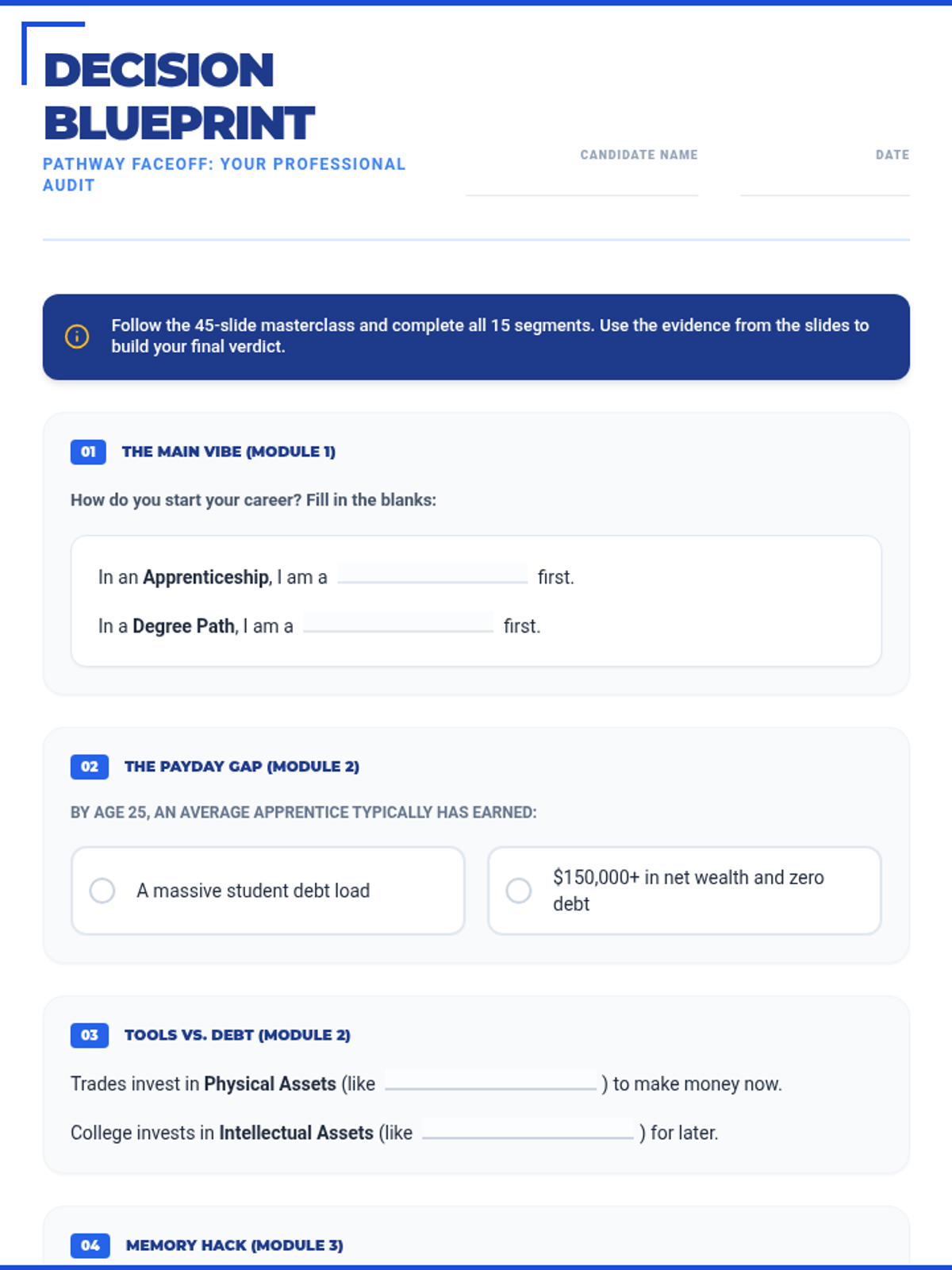
A 15-section career exploration worksheet designed for 16-year-old high school students, featuring punchy, relatable titles and refined "Real Talk" language like "The Main Vibe" and "Why I'll crush it." Meticulously aligned with the 45-slide masterclass. All correct answer highlights have been removed for student use.
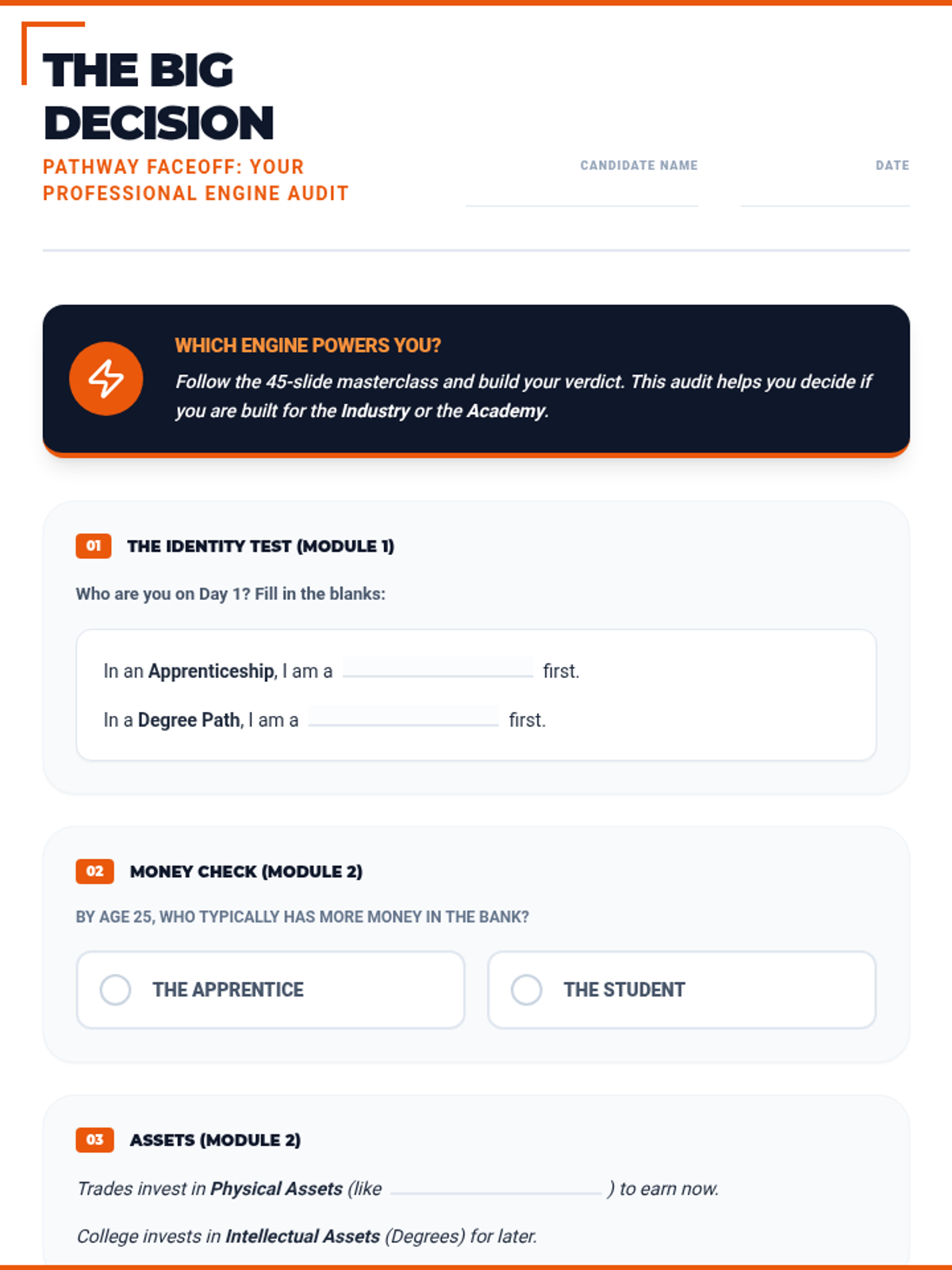
A 15-section career exploration worksheet designed for 16-year-old high school students, featuring punchy, relatable titles and a "Safety Orange & Slate" theme. Meticulously aligned with the 45-slide masterclass. All correct answer highlights have been removed for student use.
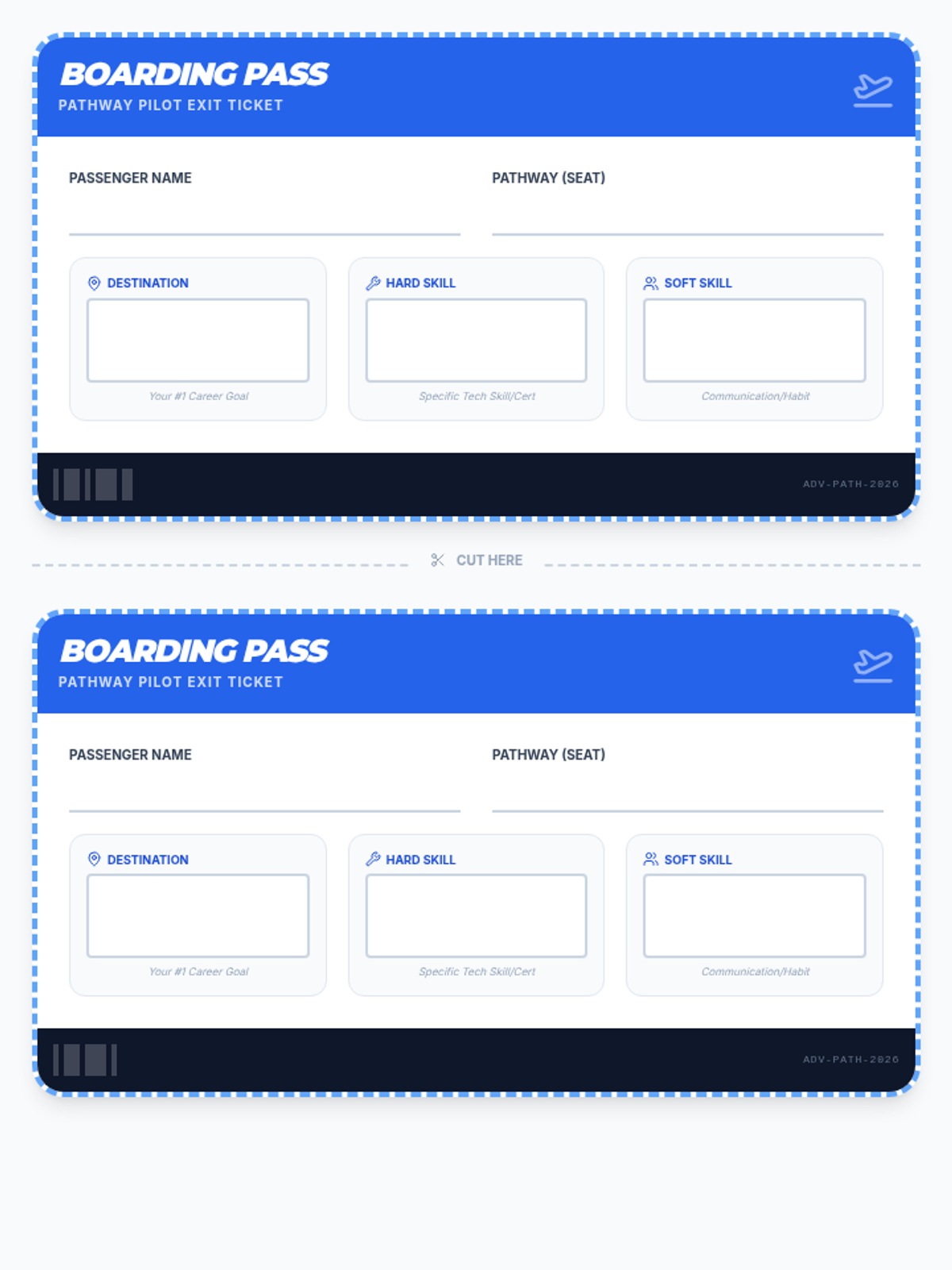
A creative "Boarding Pass" themed exit ticket for students to summarize their career destination, essential skills, and high school course connections. This document is tiled for efficient printing. Revised to fit 2 per page and include soft skills.
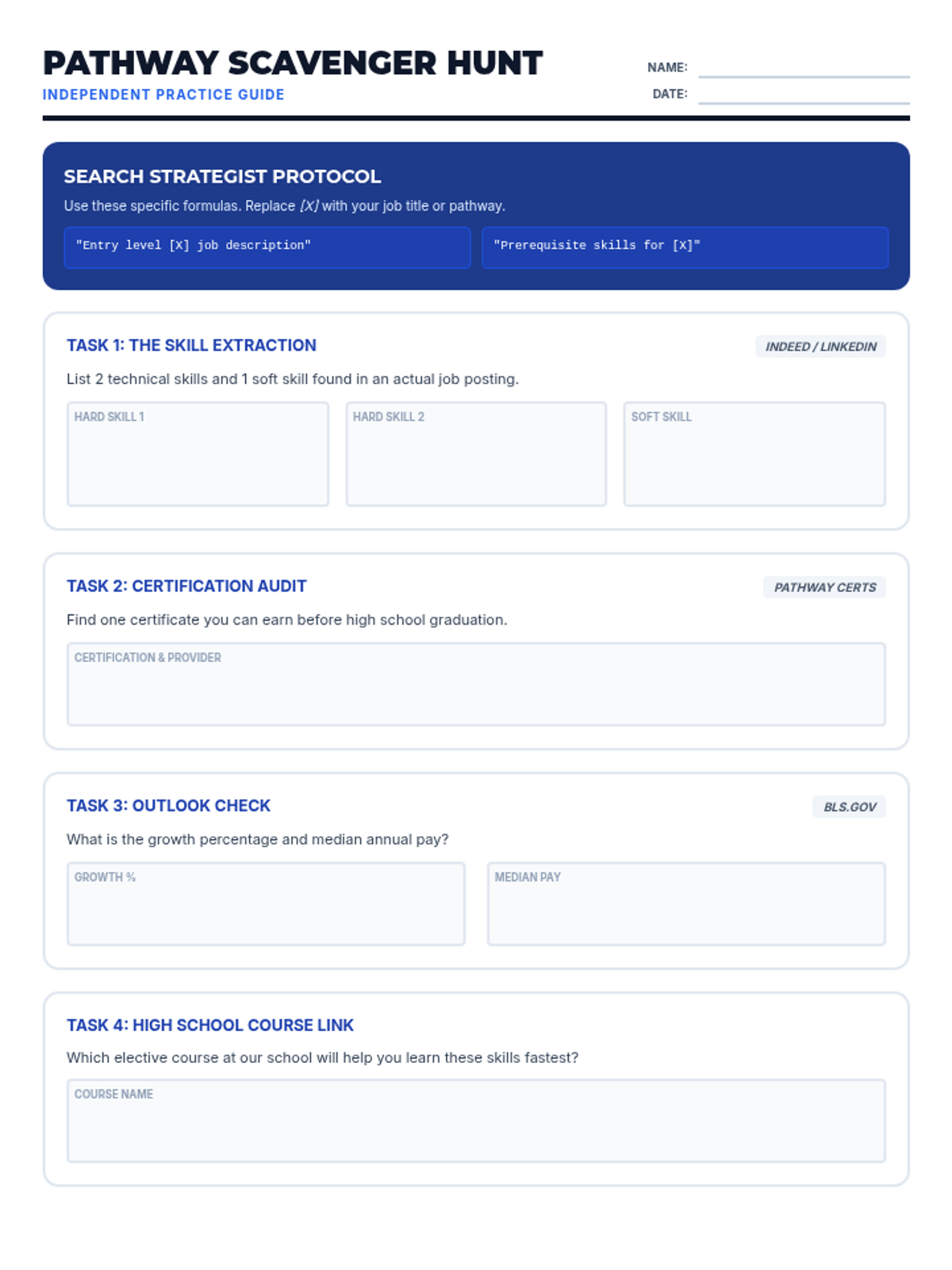
A guided independent practice worksheet featuring a "Scavenger Hunt" that teaches students how to use search formulas to extract real-world career data. Revised to fit on a single page for teacher efficiency.
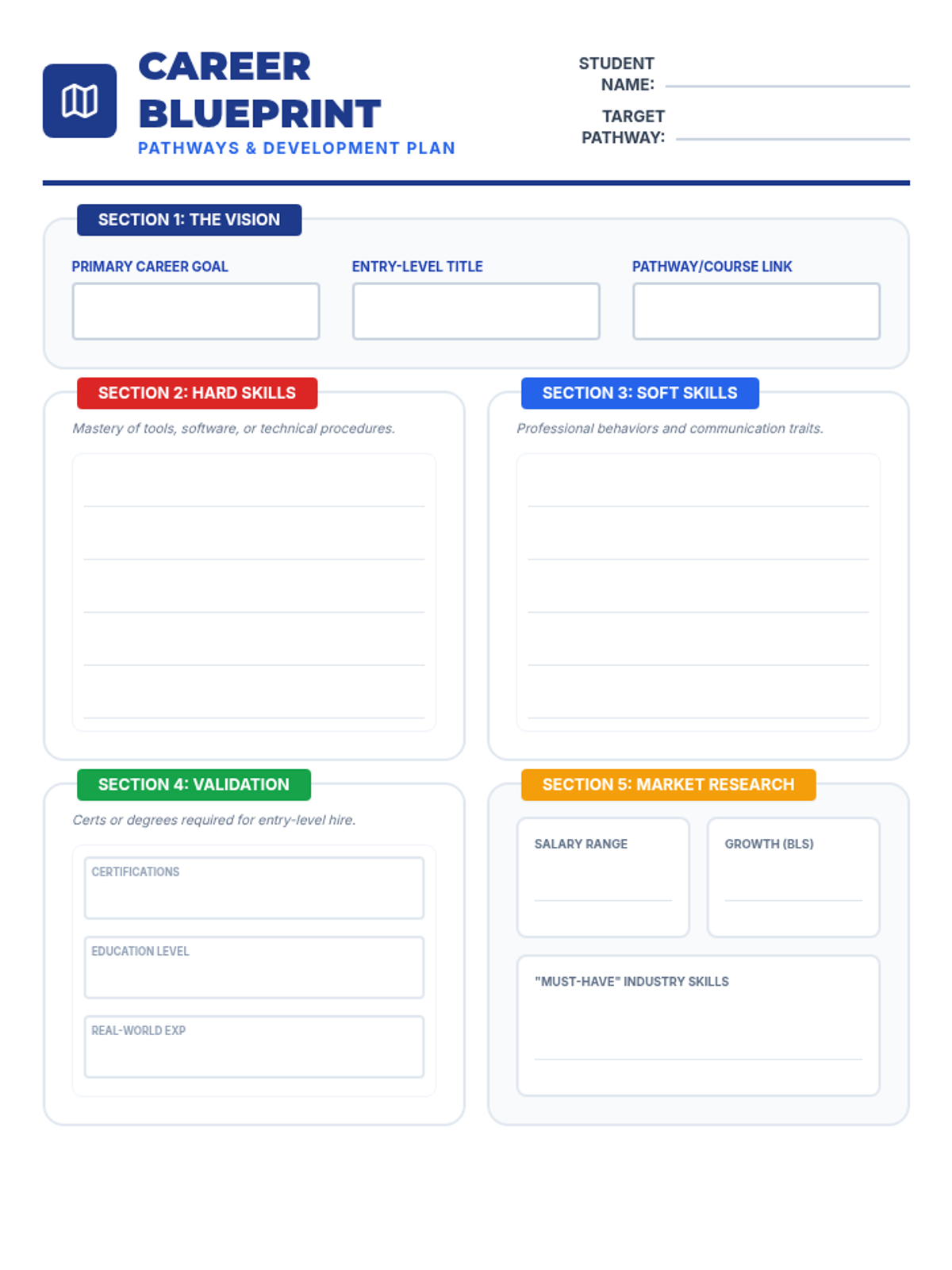
A professional-grade career research graphic organizer for students to map out their future "Career Blueprint," including sections for vision, hard/soft skills, education/validation, and market research. Revised to fit on one page and remove placeholder text.
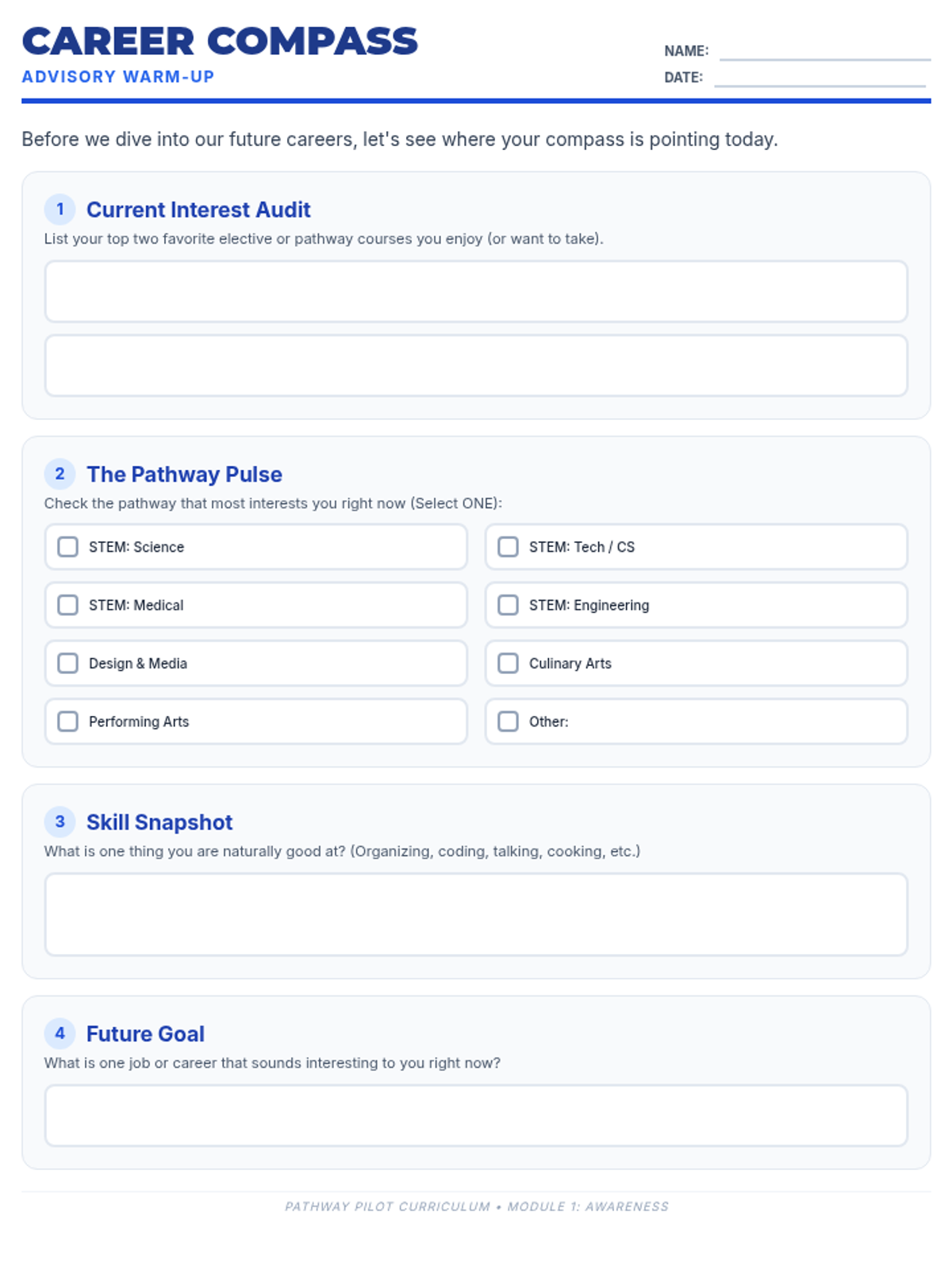
A self-reflection warm-up worksheet for students to audit their current interests, identify their preferred elective pathway, and pinpoint natural strengths. Updated to include specific STEM sub-pathways and polished student work areas.
Interactive slide presentation for the Pathway Pilot lesson, now featuring detailed slides for the four STEM sub-pathways (Science, Tech/CS, Medical, and Engineering) alongside Design, Culinary, and Arts. Includes expanded skills instruction on hard, soft, and transferrable skills.
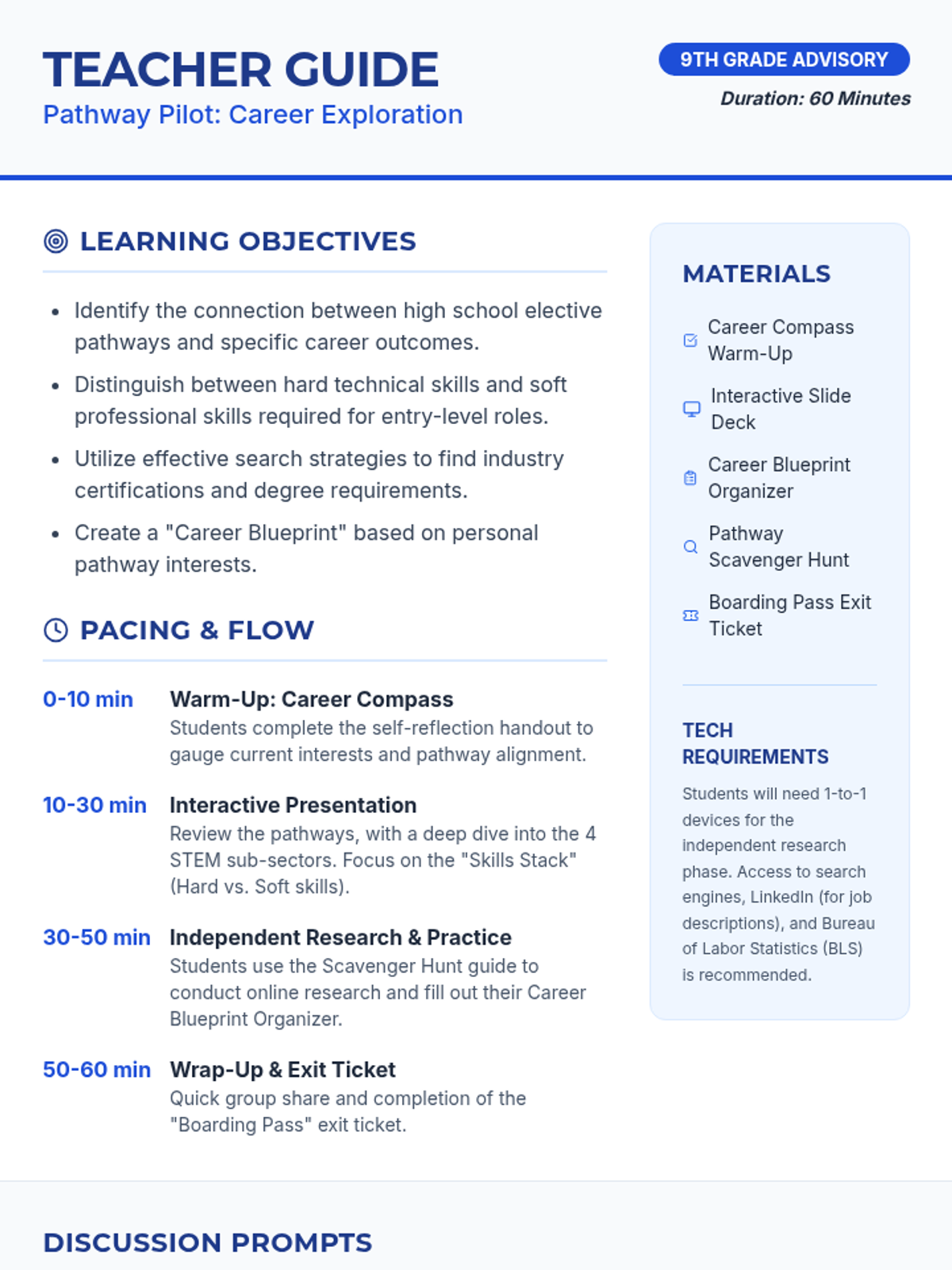
A detailed teacher guide for the Pathway Pilot lesson, including learning objectives, a minute-by-minute pacing guide, materials checklist, and targeted discussion prompts for each pathway, now featuring detailed STEM sub-pathways.
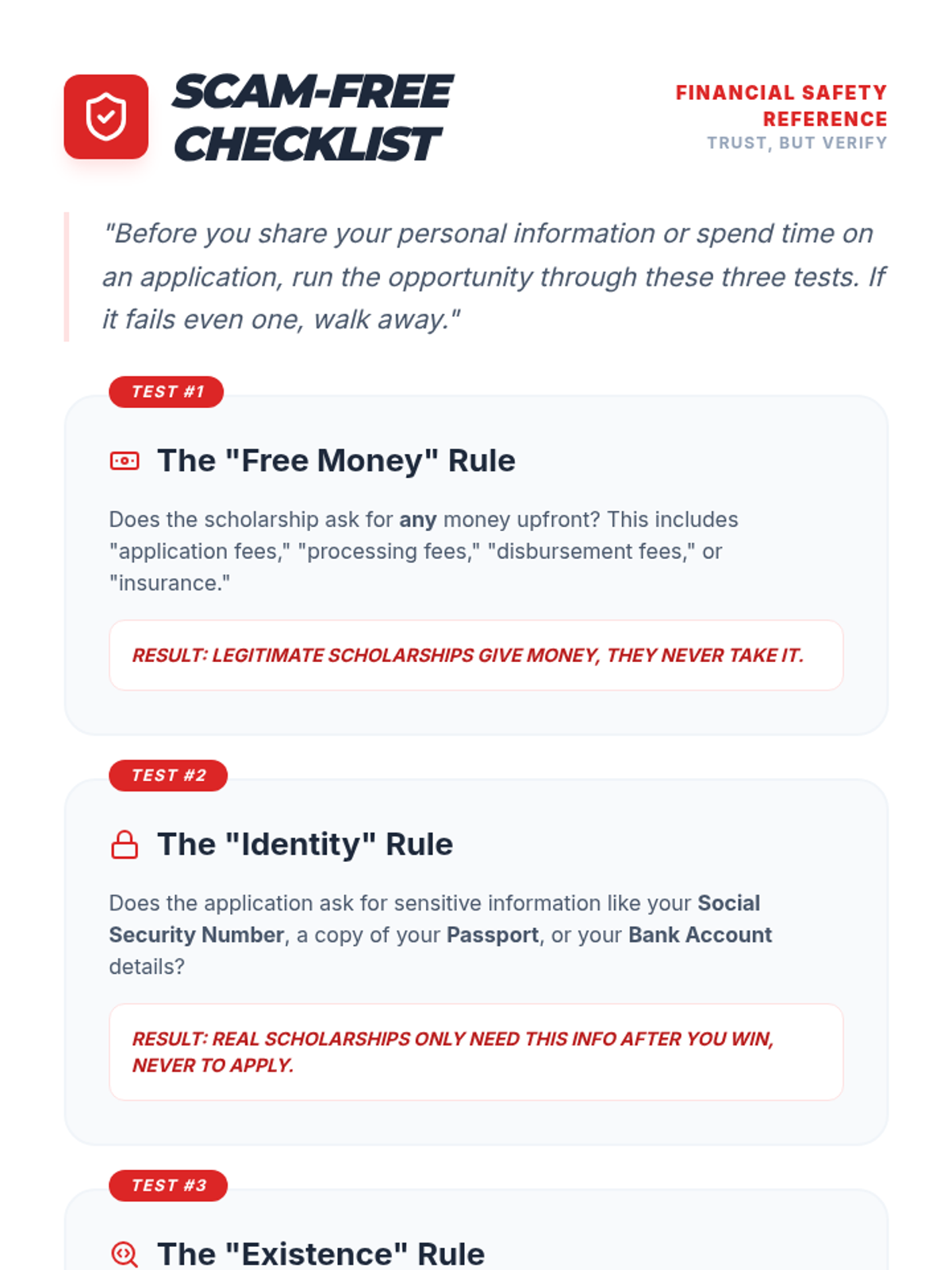
A quick-reference checklist for students to use when evaluating the legitimacy of scholarship opportunities, featuring red flag phrases and safety rules.
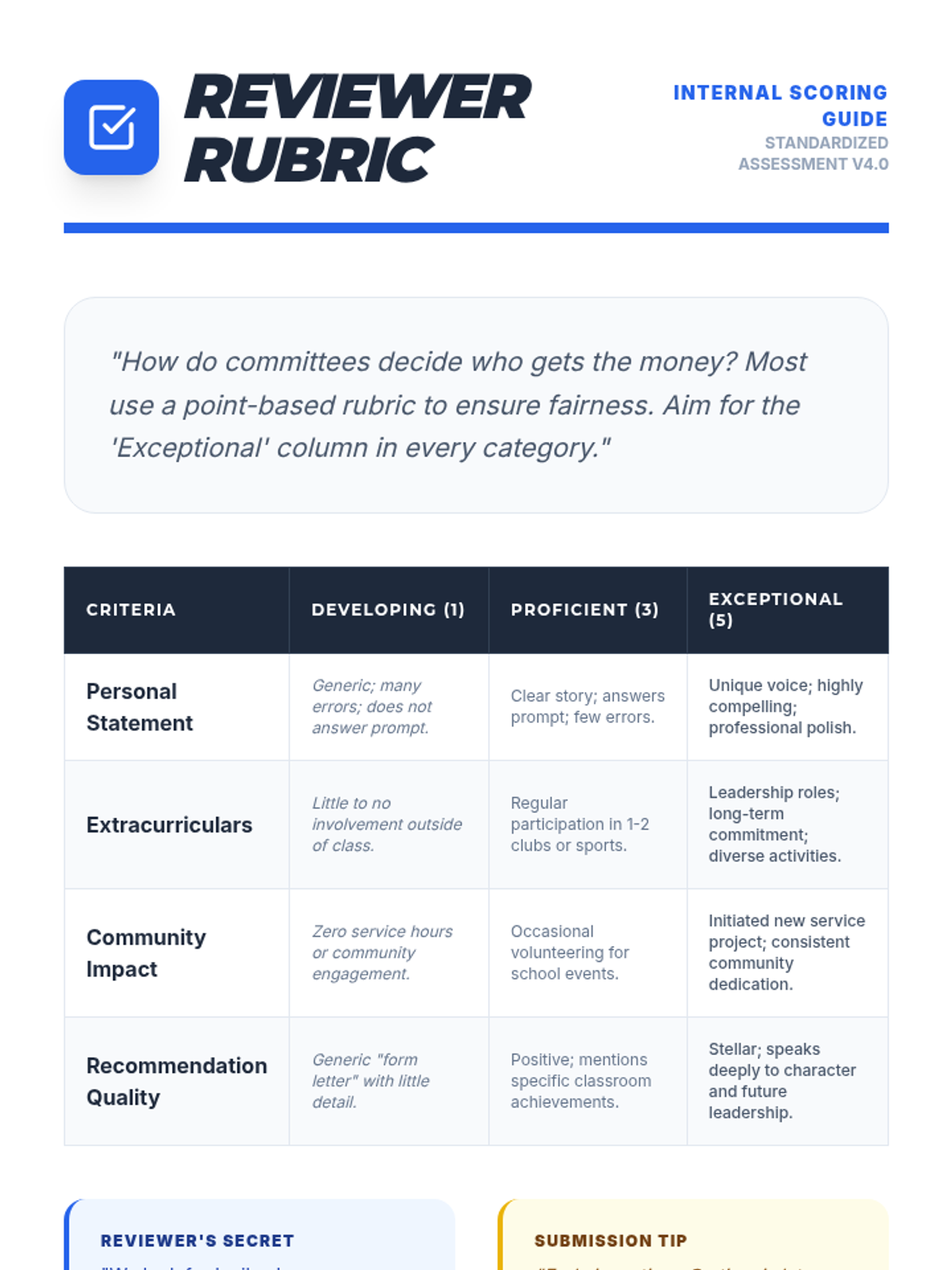
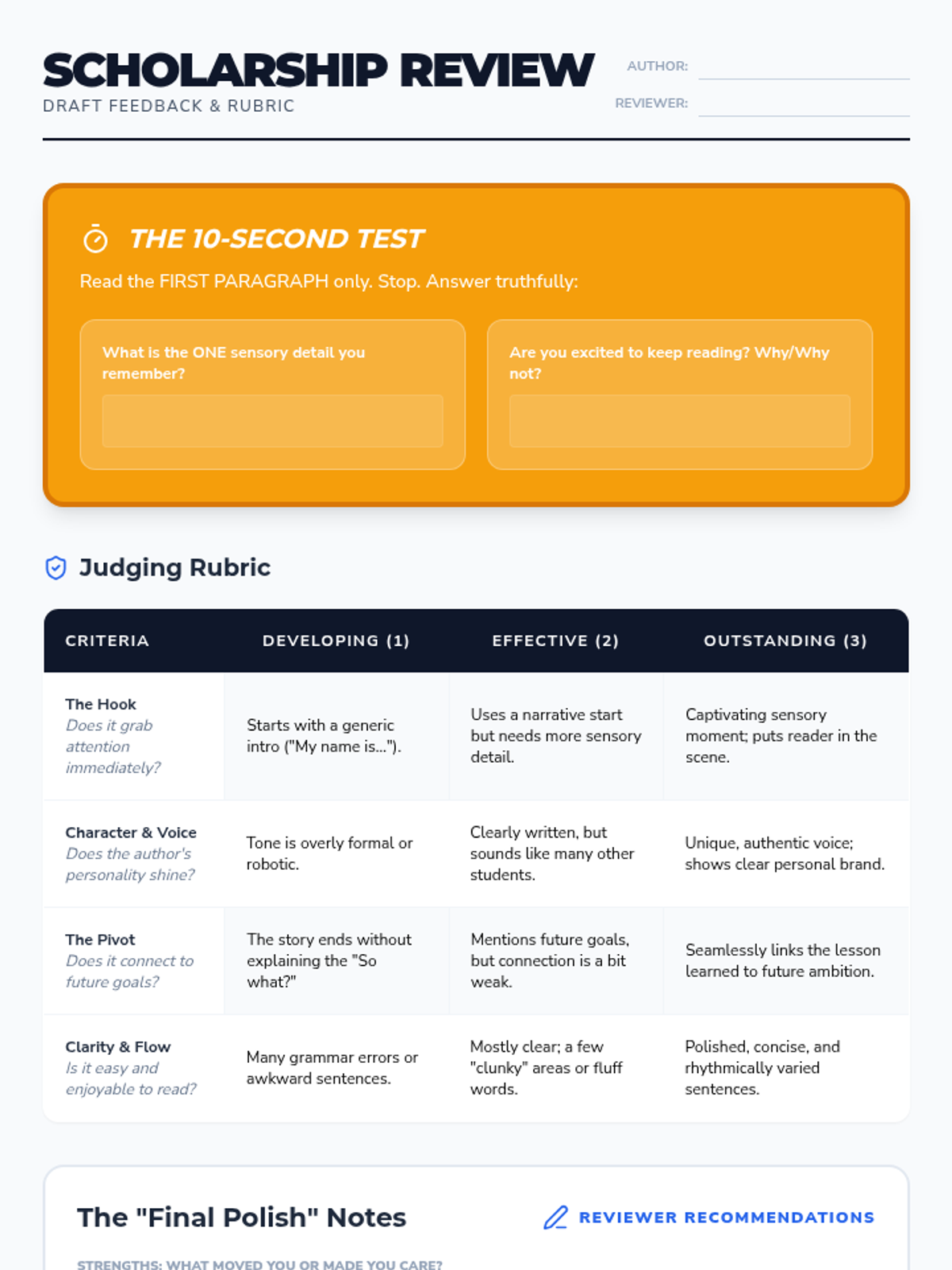
A reference guide showing the rubric and criteria that scholarship committees use to evaluate and score applications.
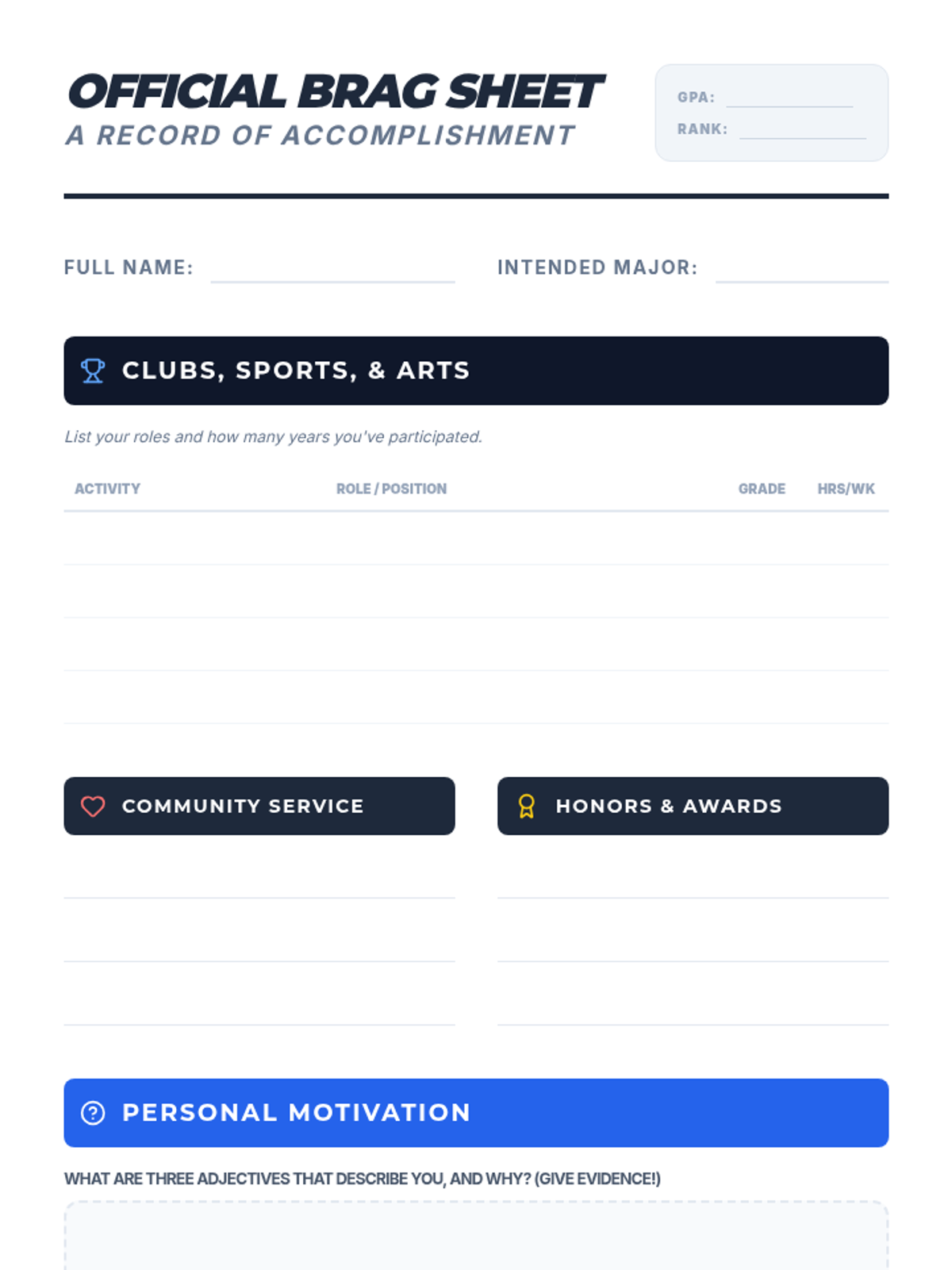
A comprehensive brag sheet template for 9th-grade students to document their extracurricular activities, awards, and personal traits in preparation for scholarship applications.
Instructional slides for Lesson 5, guiding students through the structured peer review process and the '10-Second Test' for essay hooks.
Slides for Lesson 5, exploring common scholarship application components and the strategic importance of building a 'brag sheet' early in high school.
A structured peer review rubric and feedback form that uses scholarship-level criteria to help students evaluate and improve their essay drafts.
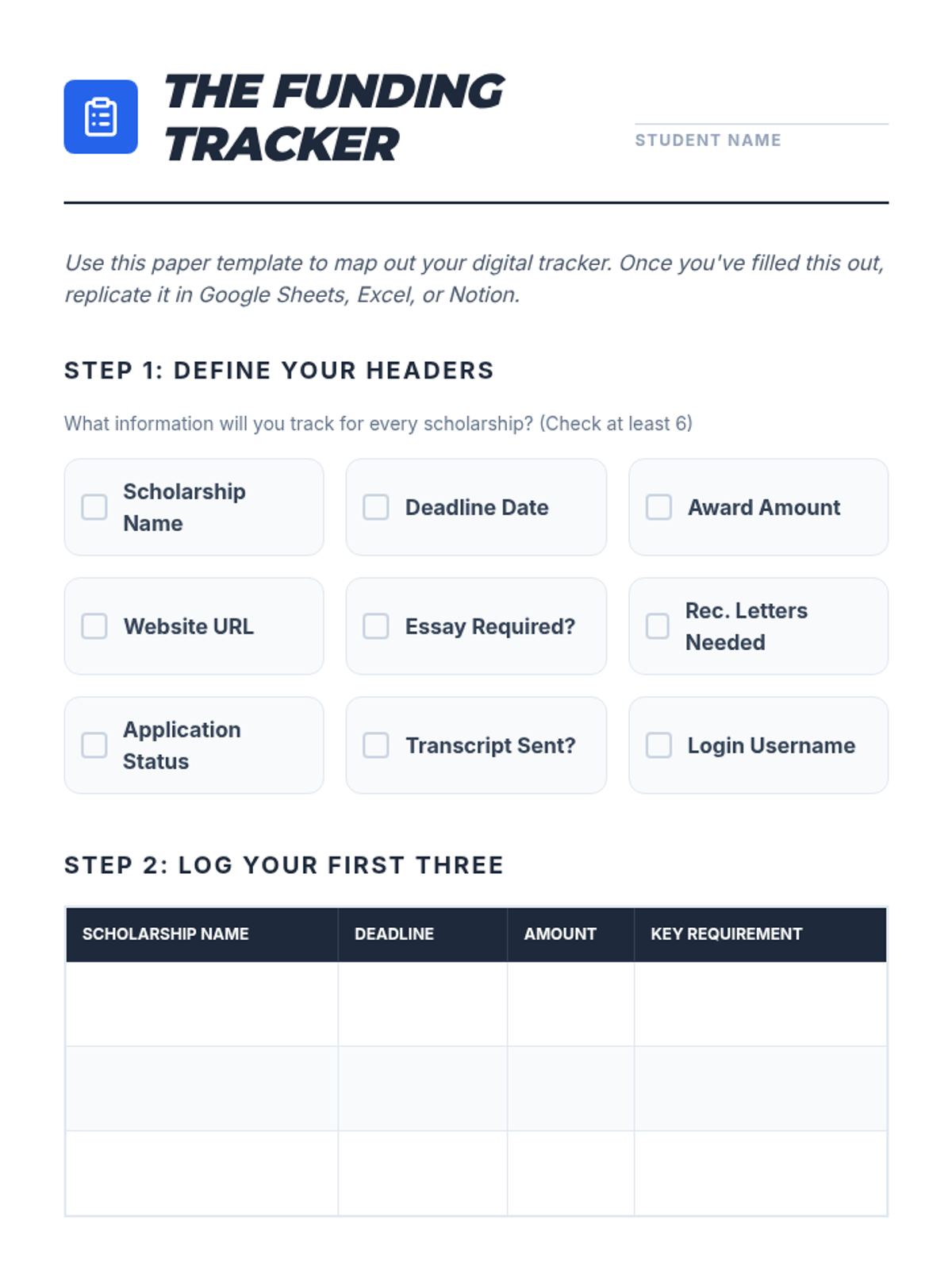
A planning worksheet for students to design their digital scholarship tracking system and log their first three opportunities.
Slides for Lesson 4, focusing on the importance of organization in the scholarship search process and how to build a digital tracking system.
Instructional slides for Lesson 4, teaching students how to adapt a core personal story to multiple essay prompts through the 'pivot' technique.
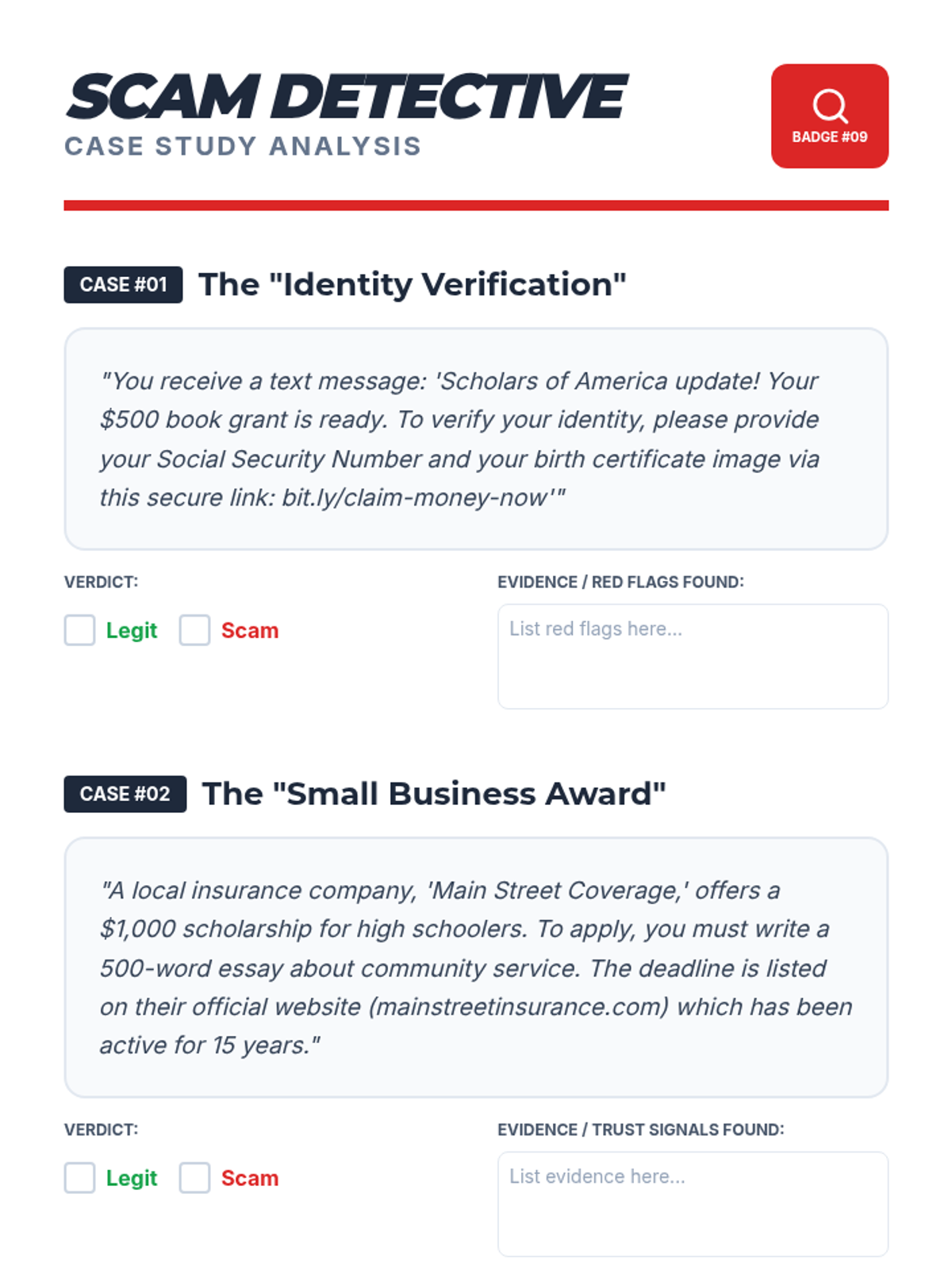
A case study worksheet where students analyze two scholarship scenarios to determine if they are legitimate or scams based on red flags and trust signals.
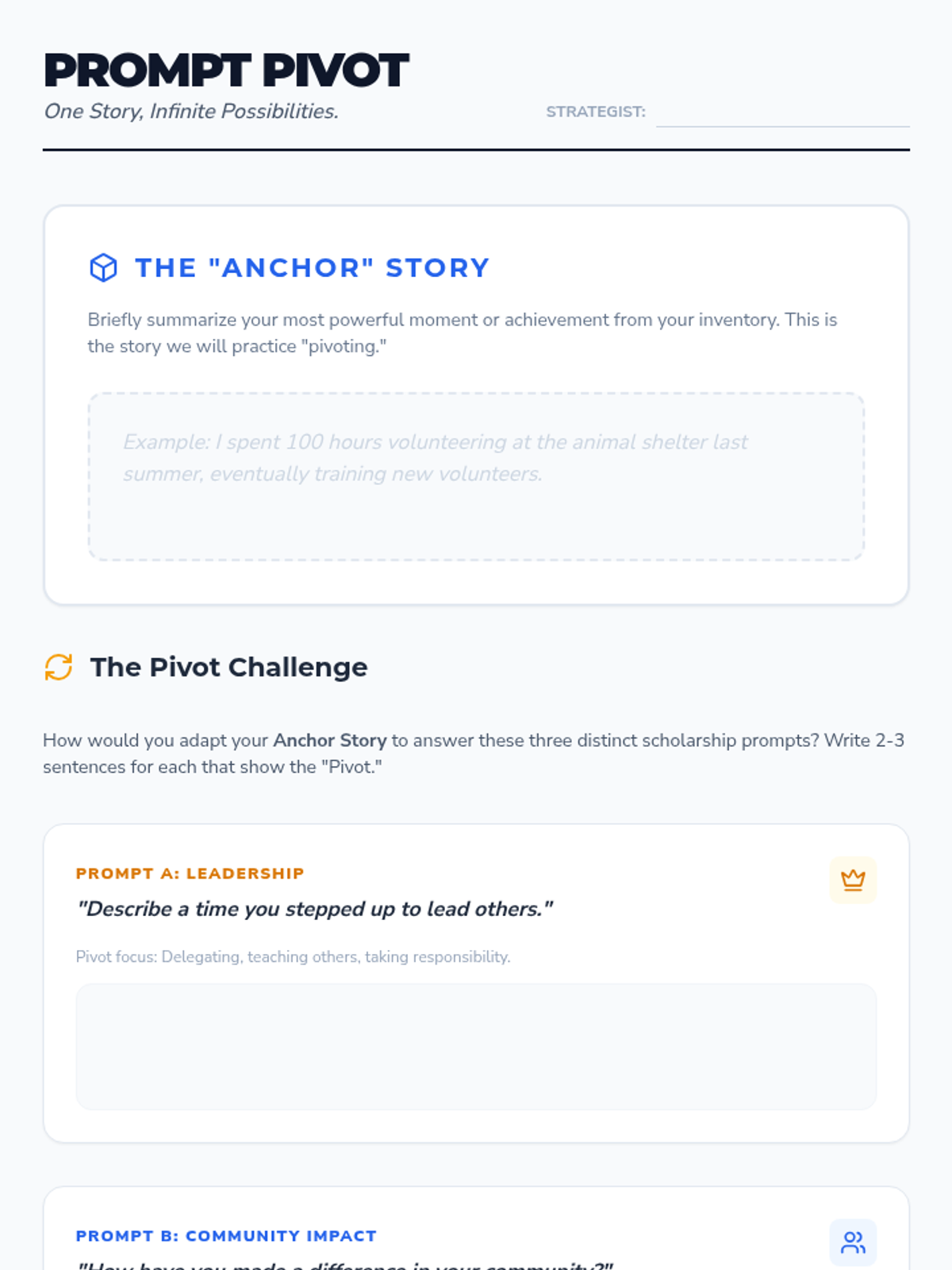
Students learn how to adapt a core personal story to fit different common essay prompts, practicing the 'pivot' technique to maintain relevance while using their strongest narrative assets.
Slides for Lesson 3, identifying red flags and warning signs of scholarship scams and fraudulent financial aid offers.
Instructional slides for Lesson 3, teaching the 'Show, Don't Tell' technique and how to capture a reviewer's attention in the first 10 seconds.
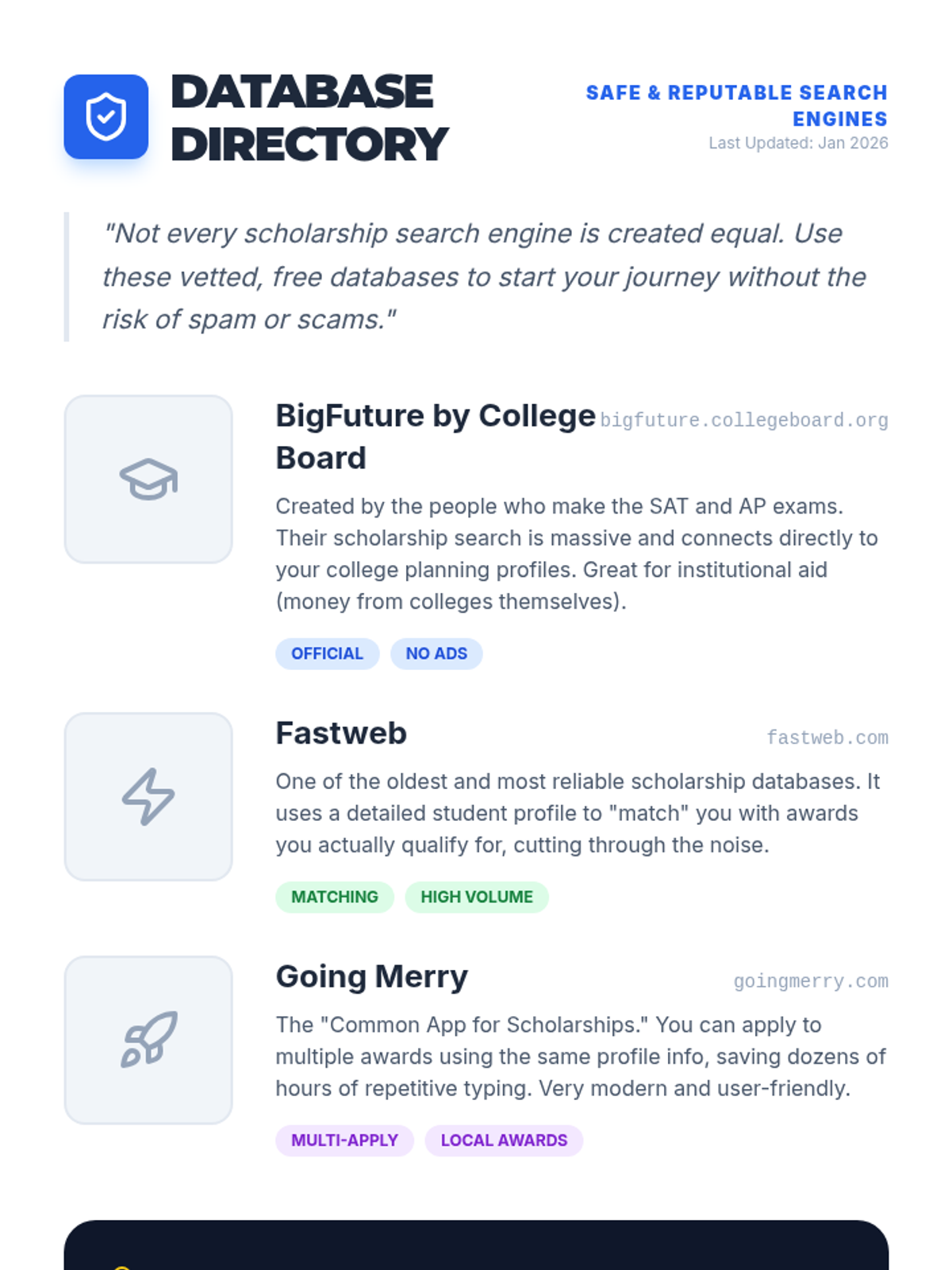
A curated directory of reputable scholarship search engines with descriptions and usage tips for students.
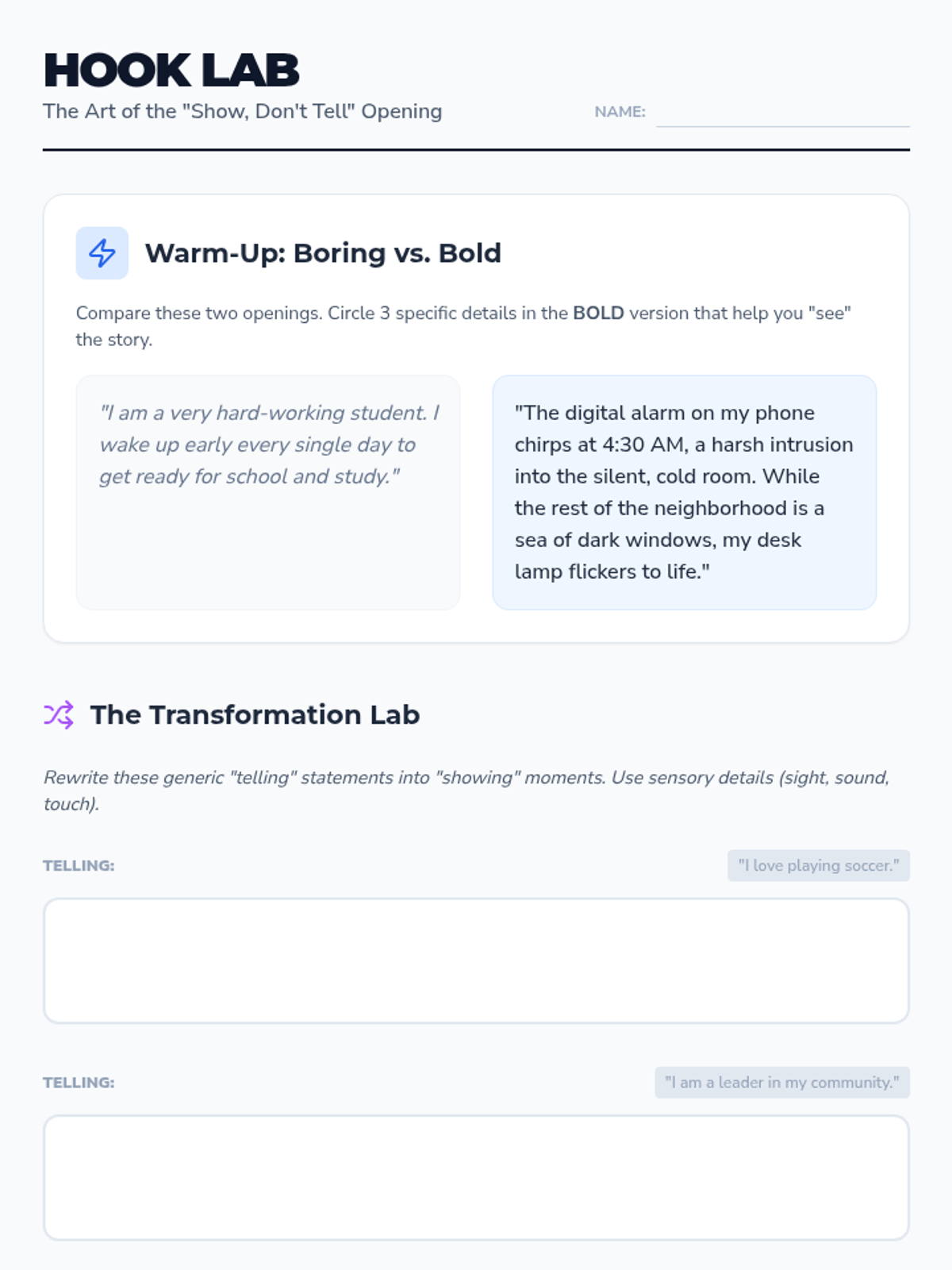
Focused on the introduction, students learn the 'Show, Don't Tell' technique to write engaging opening lines and sensory-rich narratives.
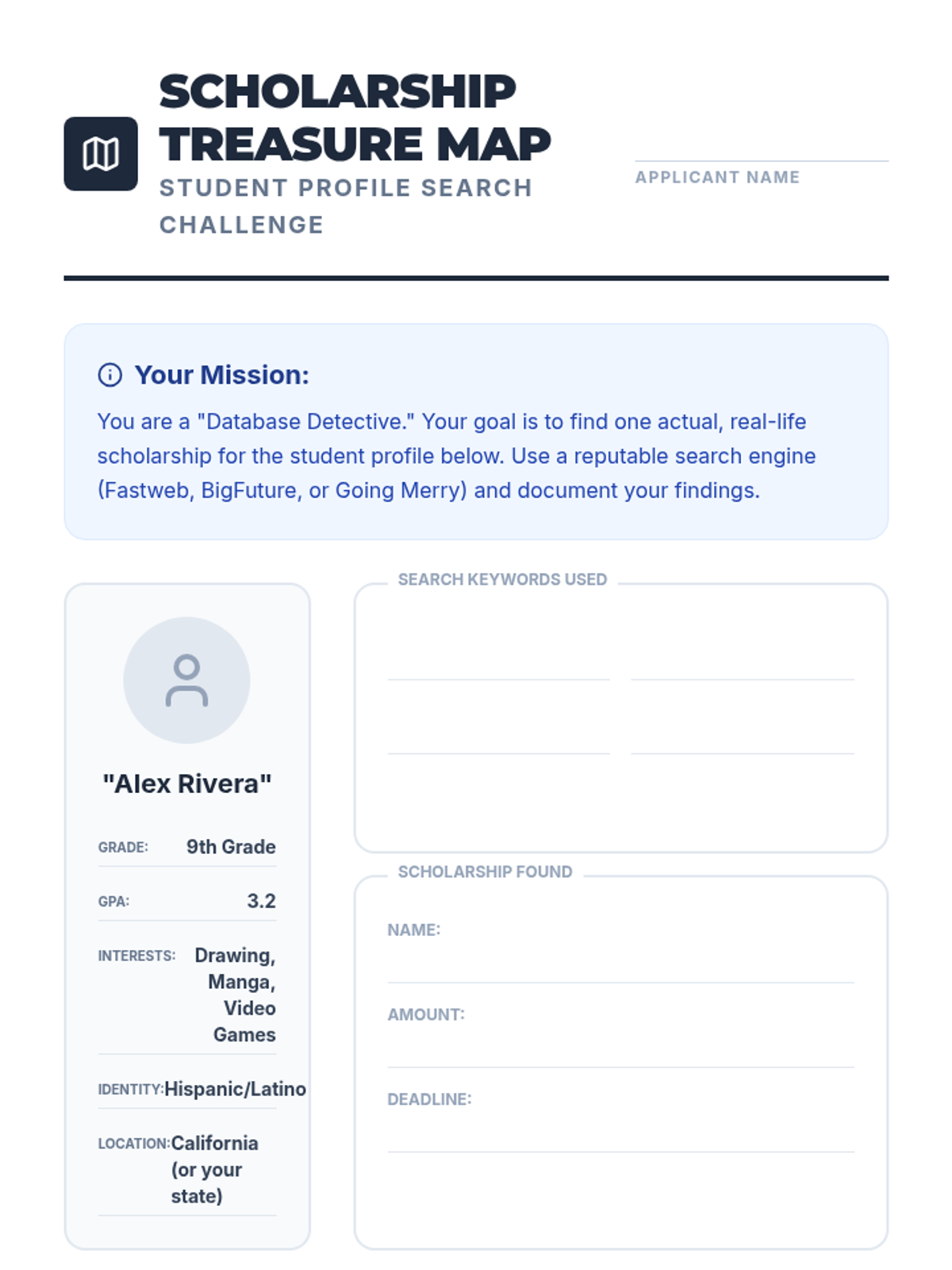
A search activity where students use scholarship databases to find actual funding opportunities for a fictional 9th-grade student profile.
Slides for Lesson 2, deconstructing the structural elements of a scholarship essay and introducing the 'Clarity, Concision, Character' framework.
Slides for Lesson 2, teaching students how to effectively use scholarship search engines, use filters, and search for local opportunities.
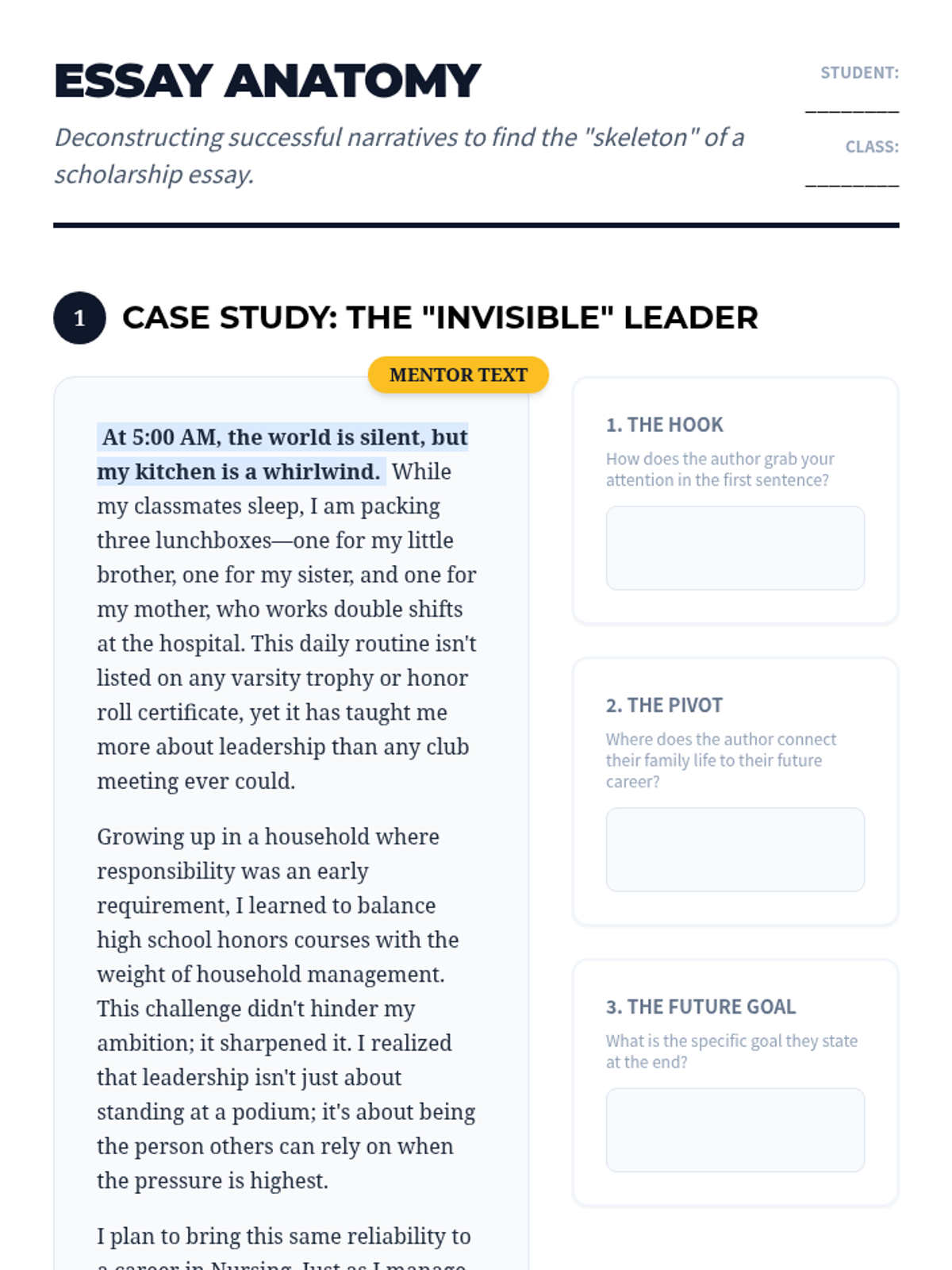
Students analyze a mentor text to identify the hook, the narrative arc, and the statement of future goals, concluding with a character sketch of the author.
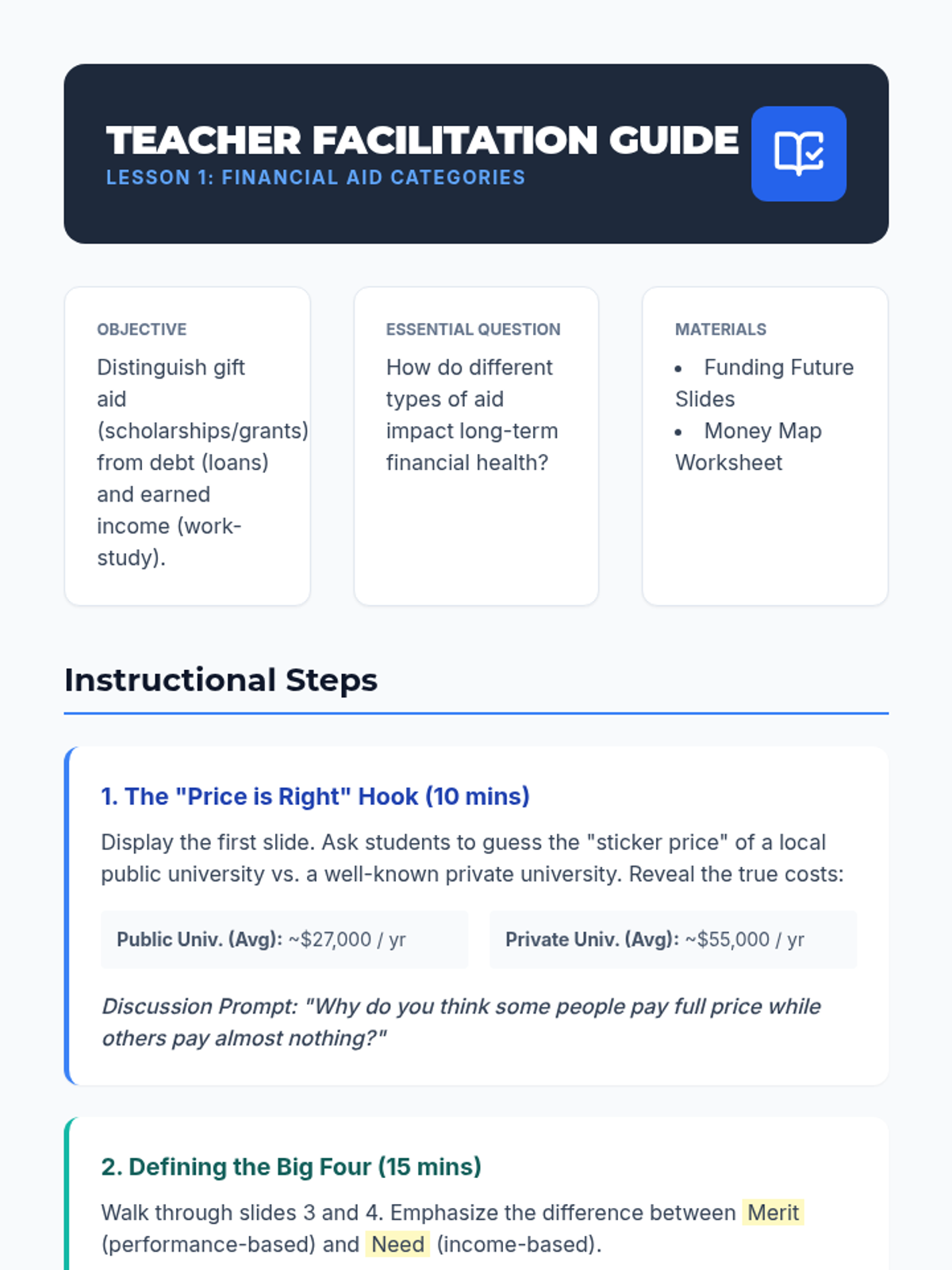
A comprehensive teacher guide for Lesson 1, including pacing, discussion prompts, and an answer key for the student worksheet.
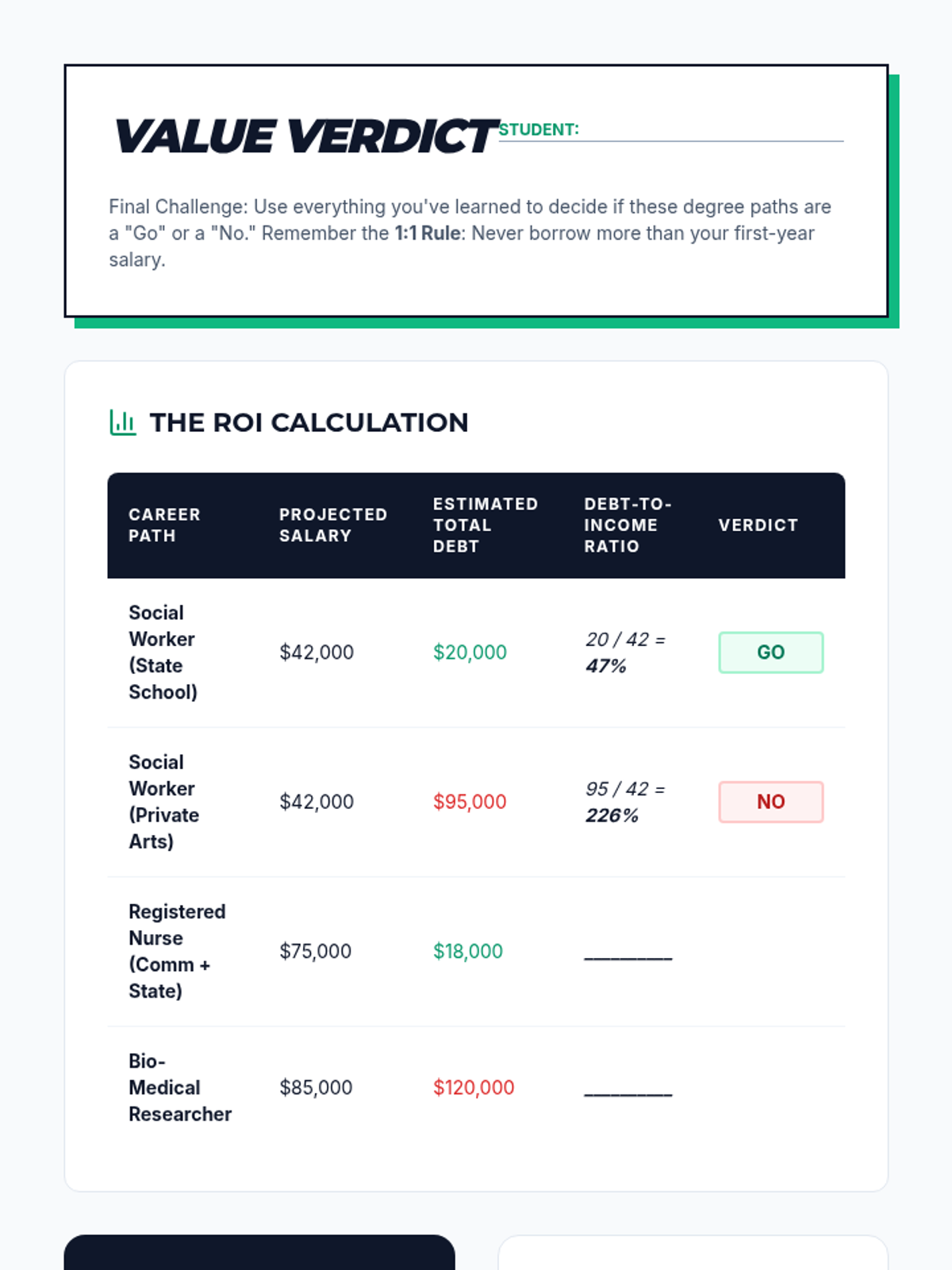
Case study activity comparing two education paths and calculating the ROI for each based on the 1:1 borrowing rule.
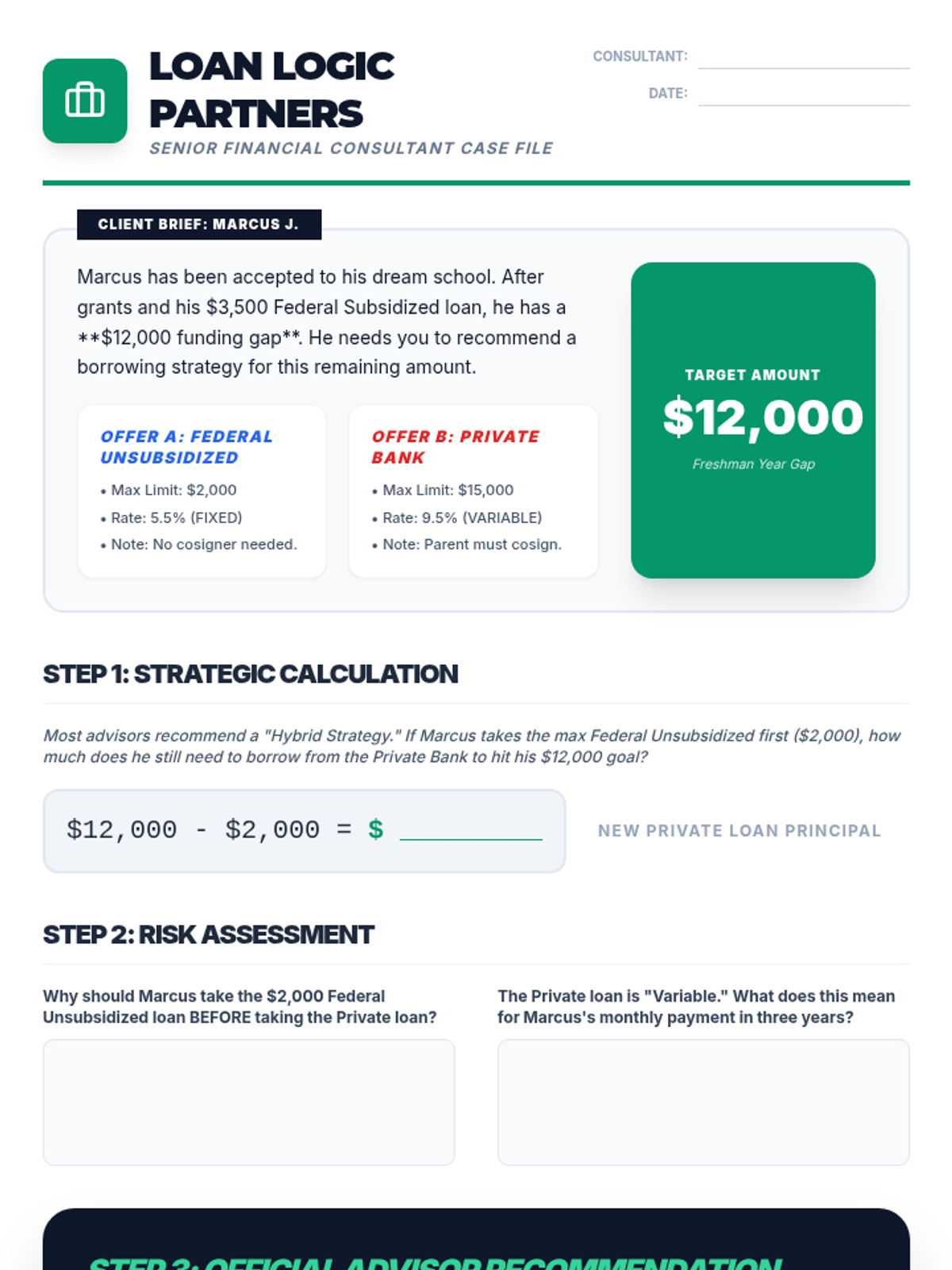
A student project for Lesson 5 where students synthesize their knowledge to create a borrowing recommendation for a fictional client.
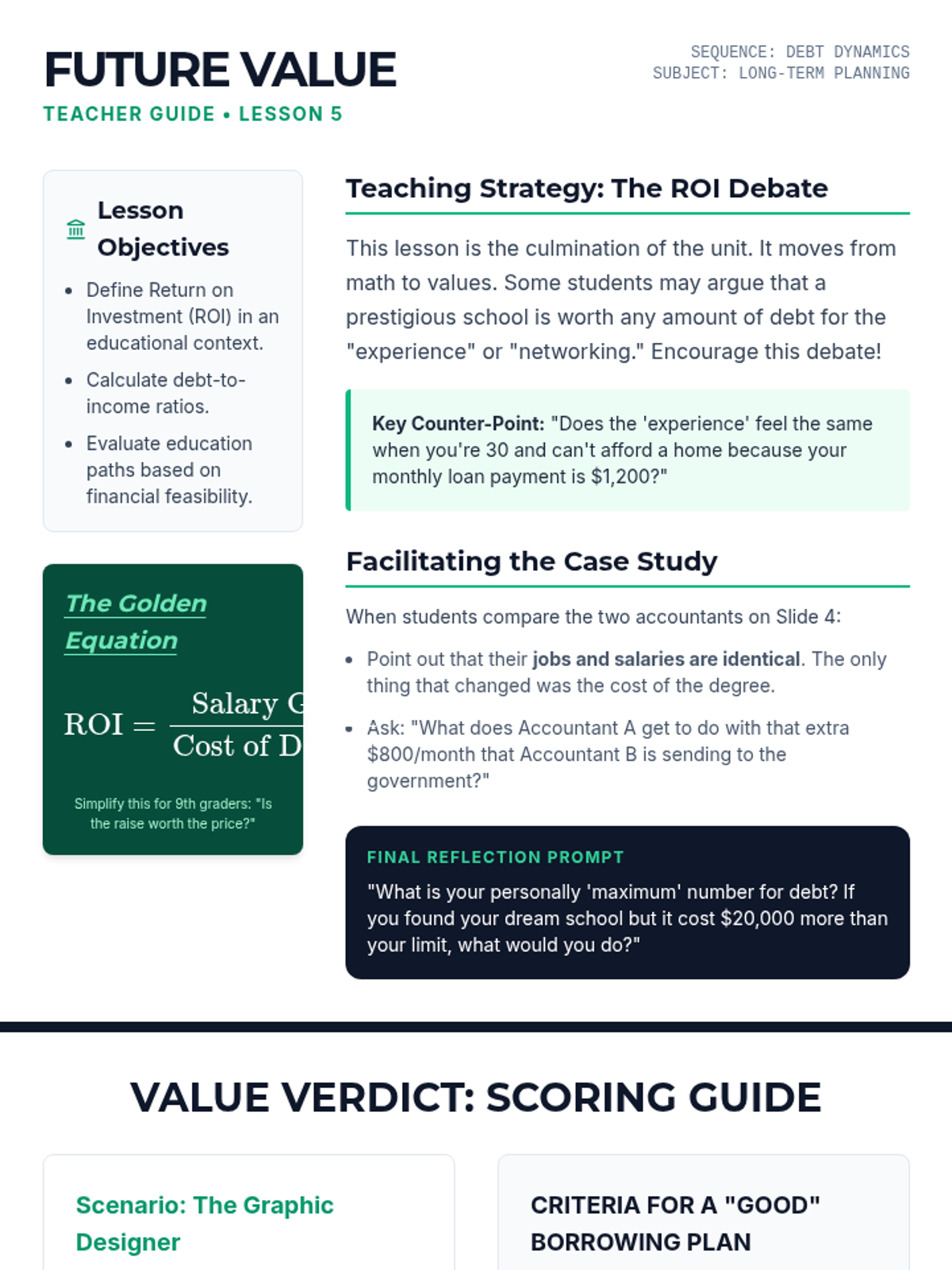
Teacher guide for Lesson 5, including discussion prompts for the "Is it worth it?" debate and guidelines for responsible borrowing.
Visual presentation for Lesson 5, focusing on a final case study project where students act as financial advisors to evaluate loan offers.
Introductory slides for Lesson 5, defining ROI, debt-to-income ratio, and comparing expensive private schools vs state schools with career outcomes.
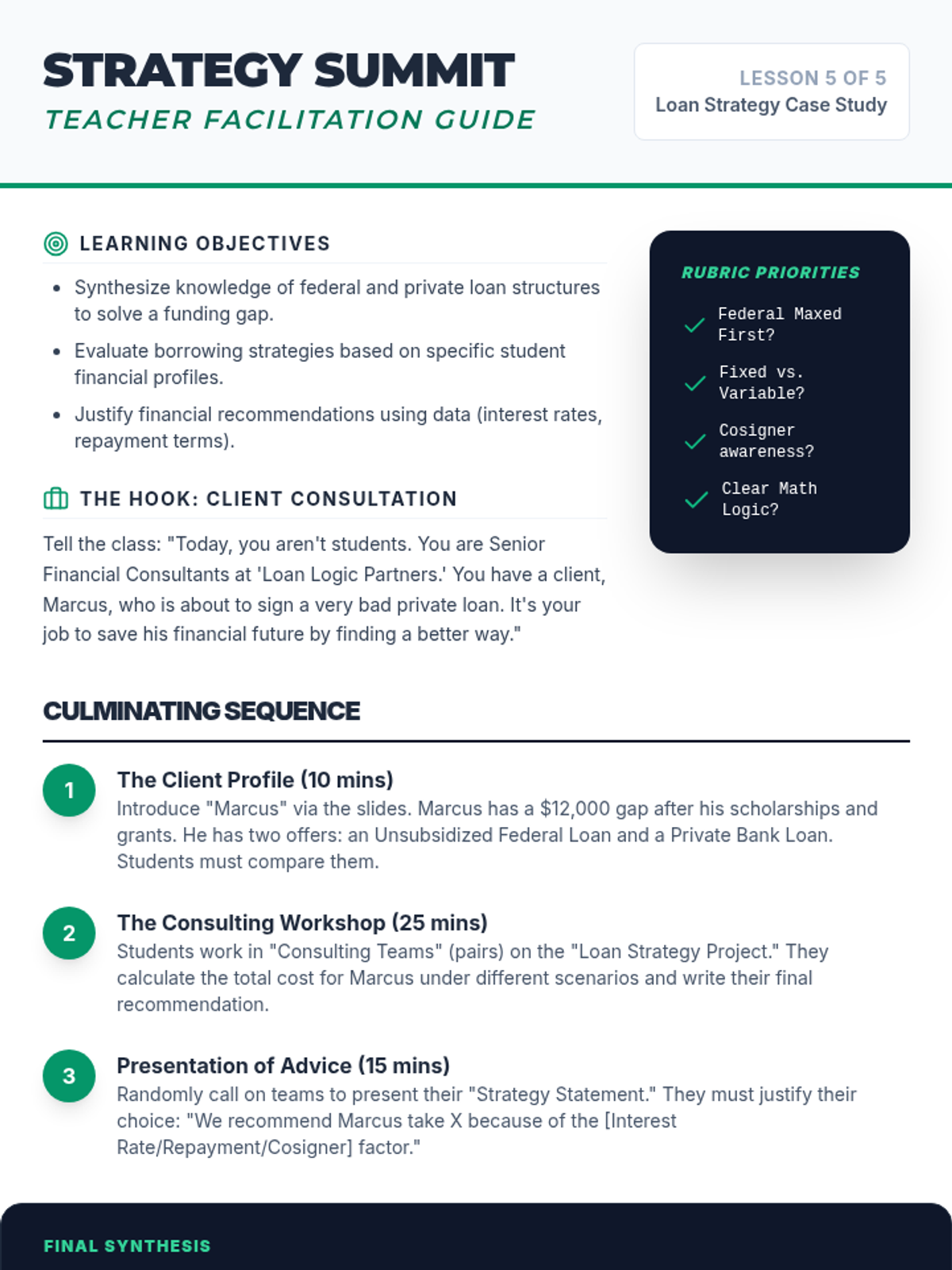
A teacher facilitation guide for Lesson 5, focusing on a final case study project where students act as financial advisors to evaluate loan offers.
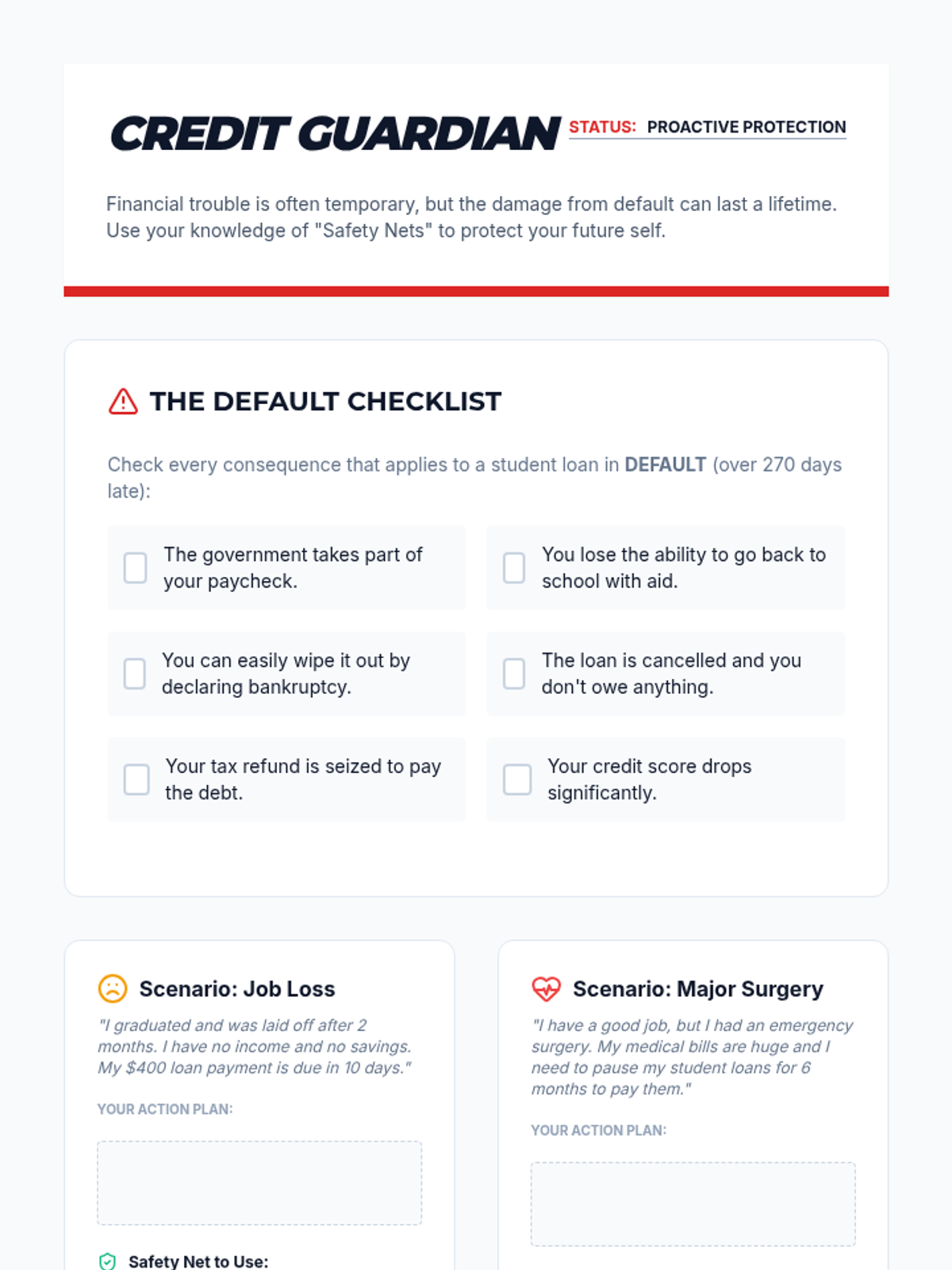
Scenario-based decision-making worksheet for students to identify the consequences of default and select appropriate safety nets like deferment or forbearance.
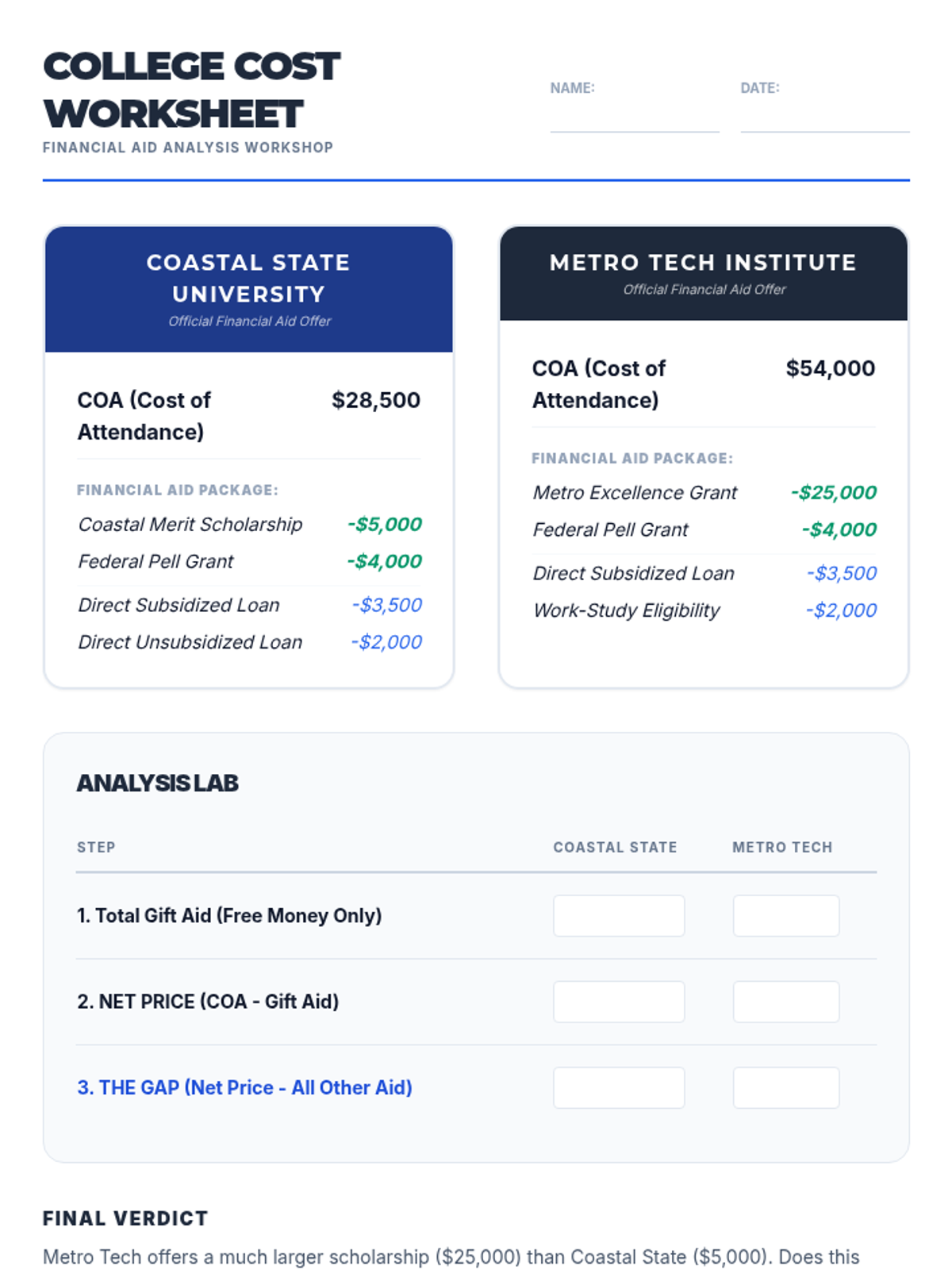
A student worksheet for Lesson 4 where students compare two financial aid award letters and calculate net price and funding gaps.
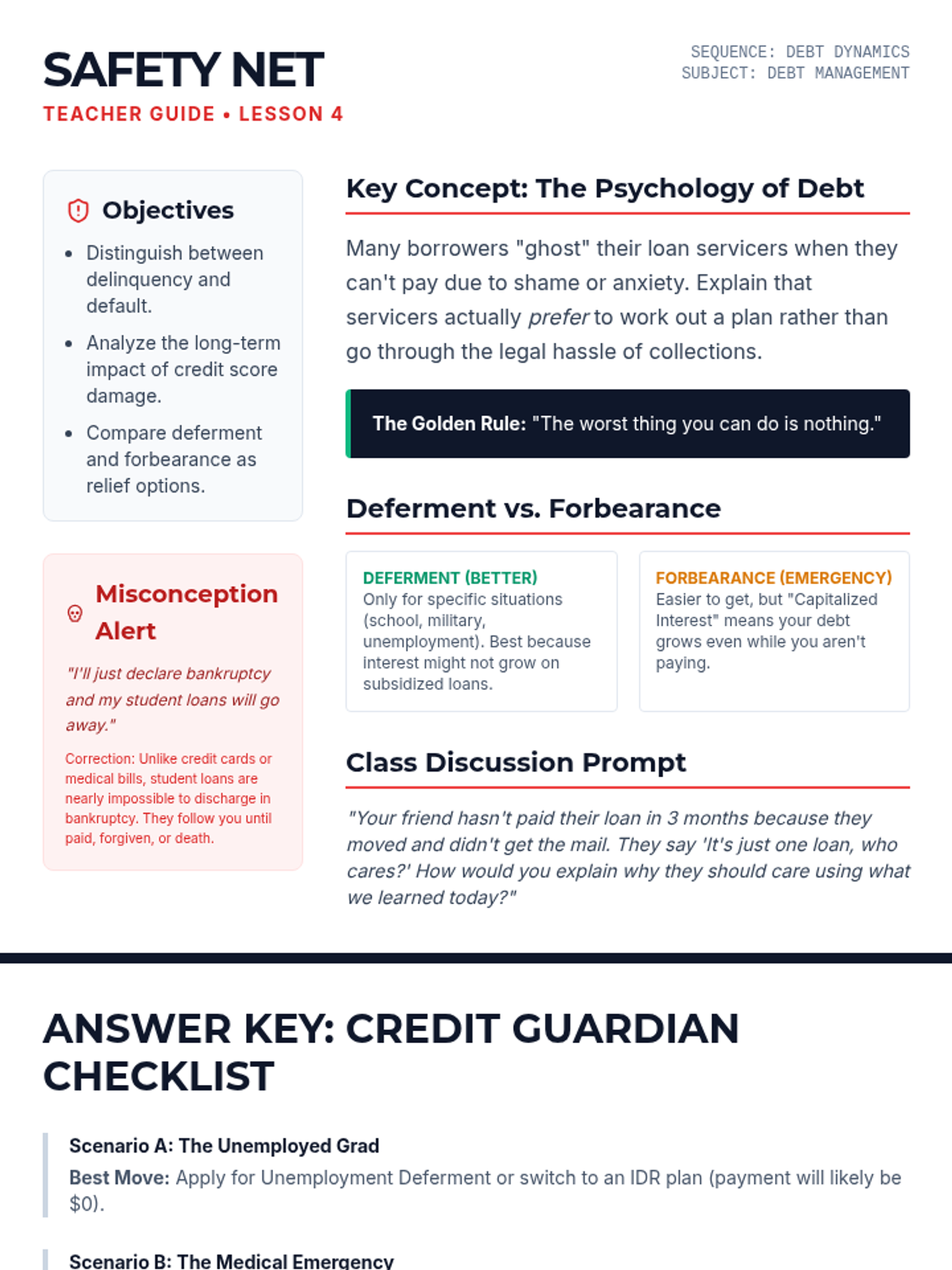
Teacher guide for Lesson 4, covering instructional strategies for discussing the consequences of default and distinguishing between deferment and forbearance.
Visual presentation for Lesson 4, focusing on interpreting financial aid award letters and calculating the true net price of college.
Introductory slides for Lesson 4, explaining the consequences of delinquency and default, the impact on credit scores, and the difference between deferment and forbearance.
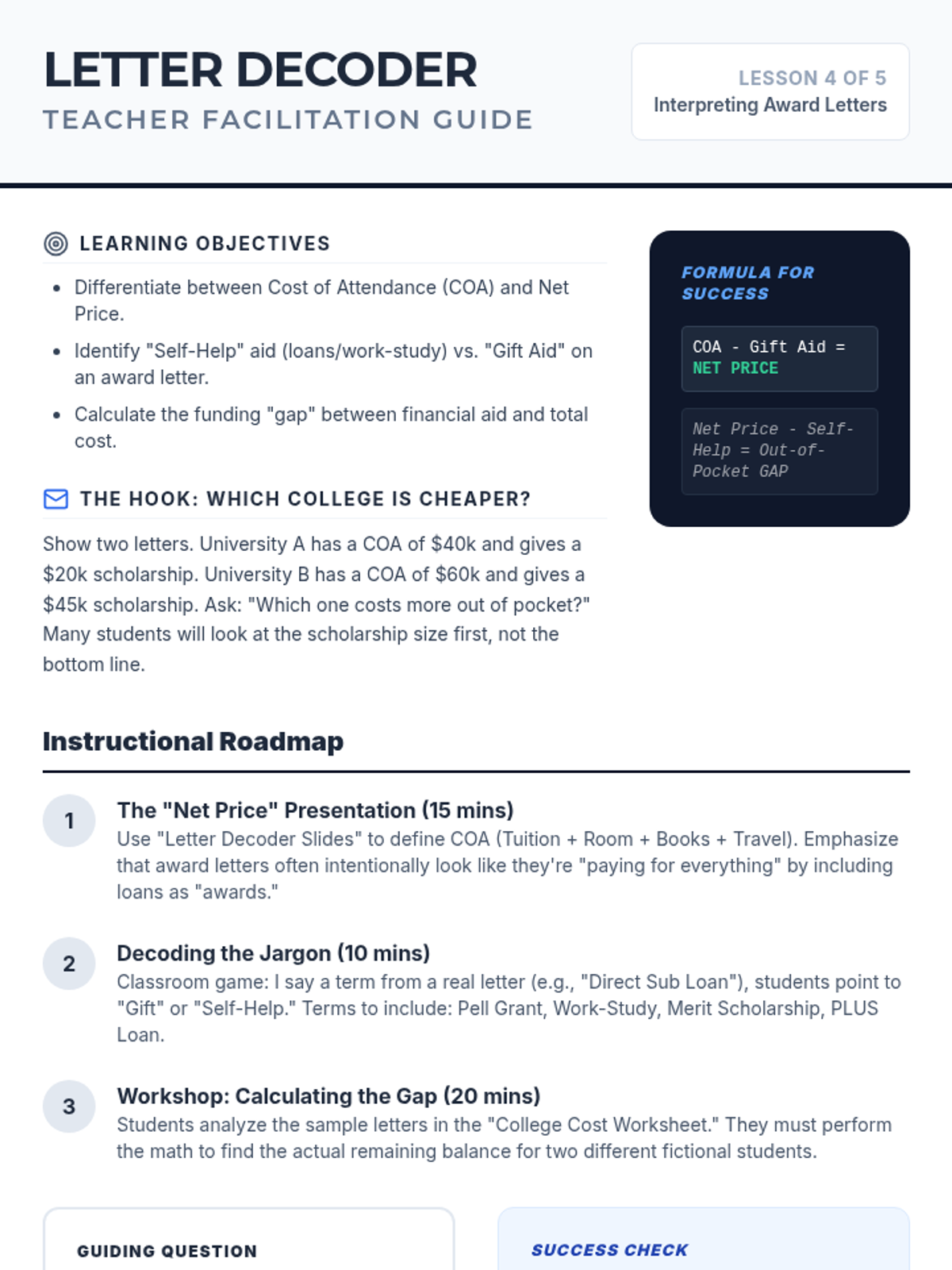
A teacher facilitation guide for Lesson 4, focusing on interpreting financial aid award letters and calculating the true net price of college.
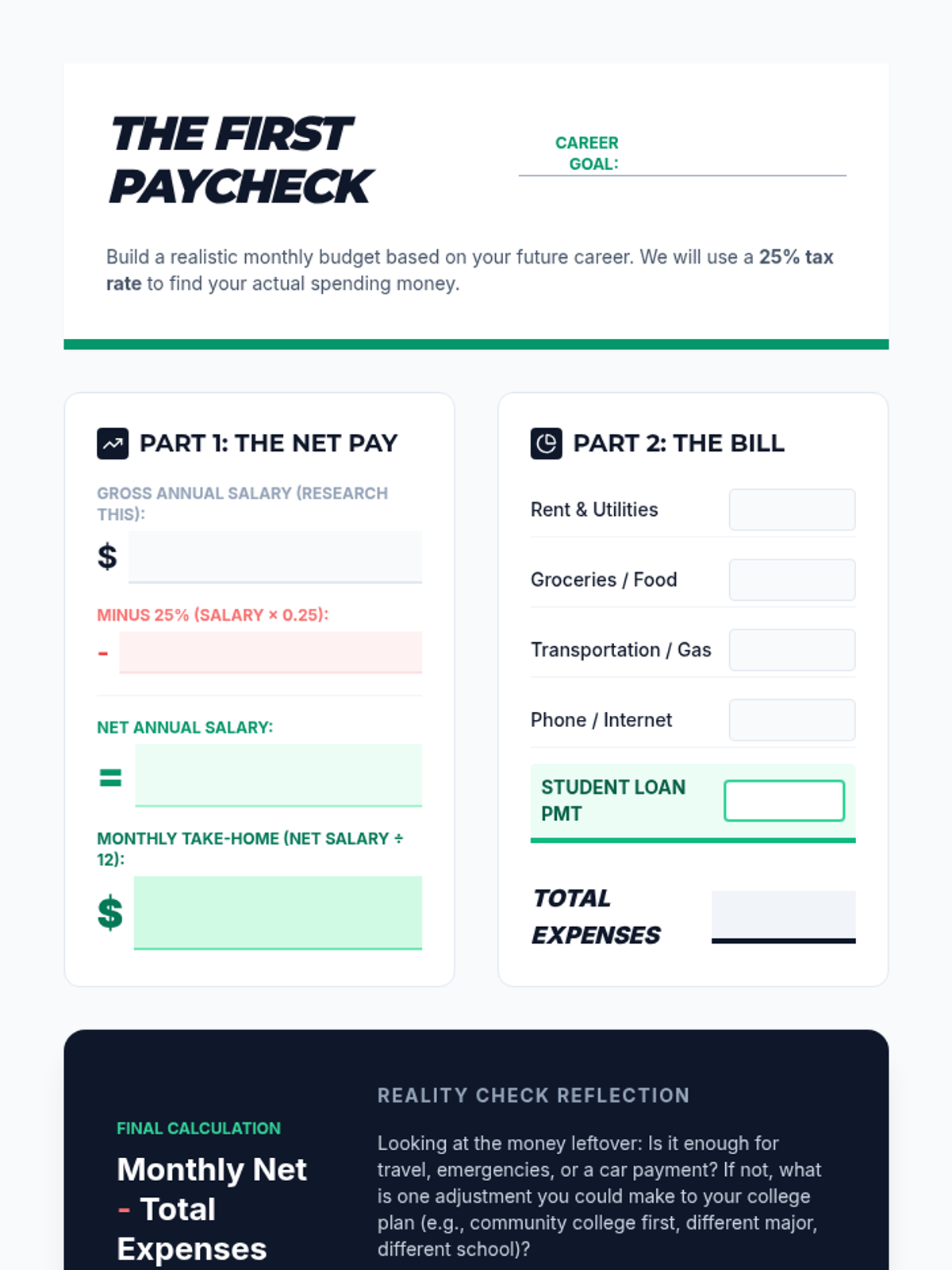
A simulation worksheet for students to research a career salary and build a realistic monthly budget that includes student loan payments.
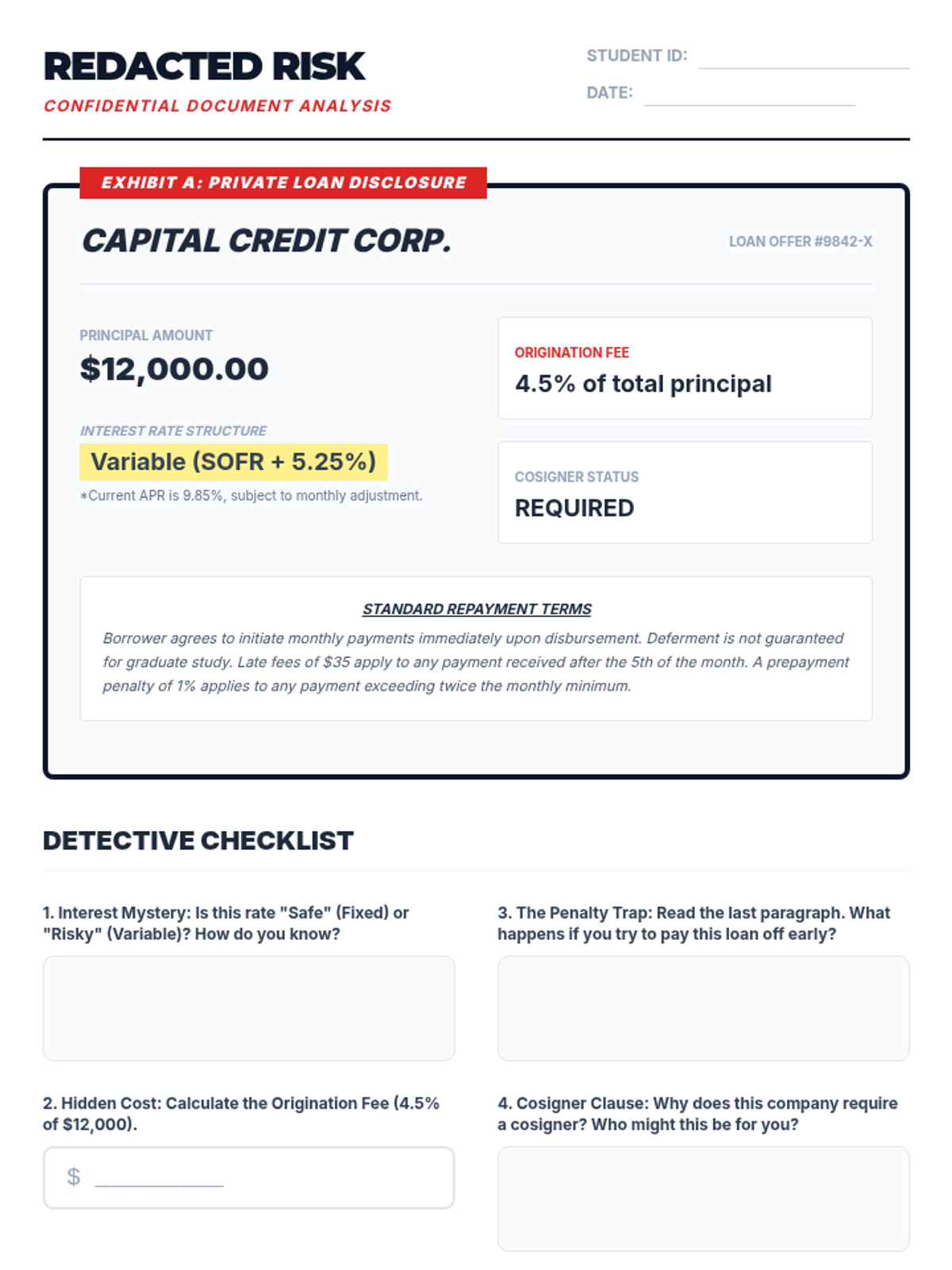
A student risk assessment worksheet where students analyze a redacted private loan offer to identify predatory terms and hidden fees.
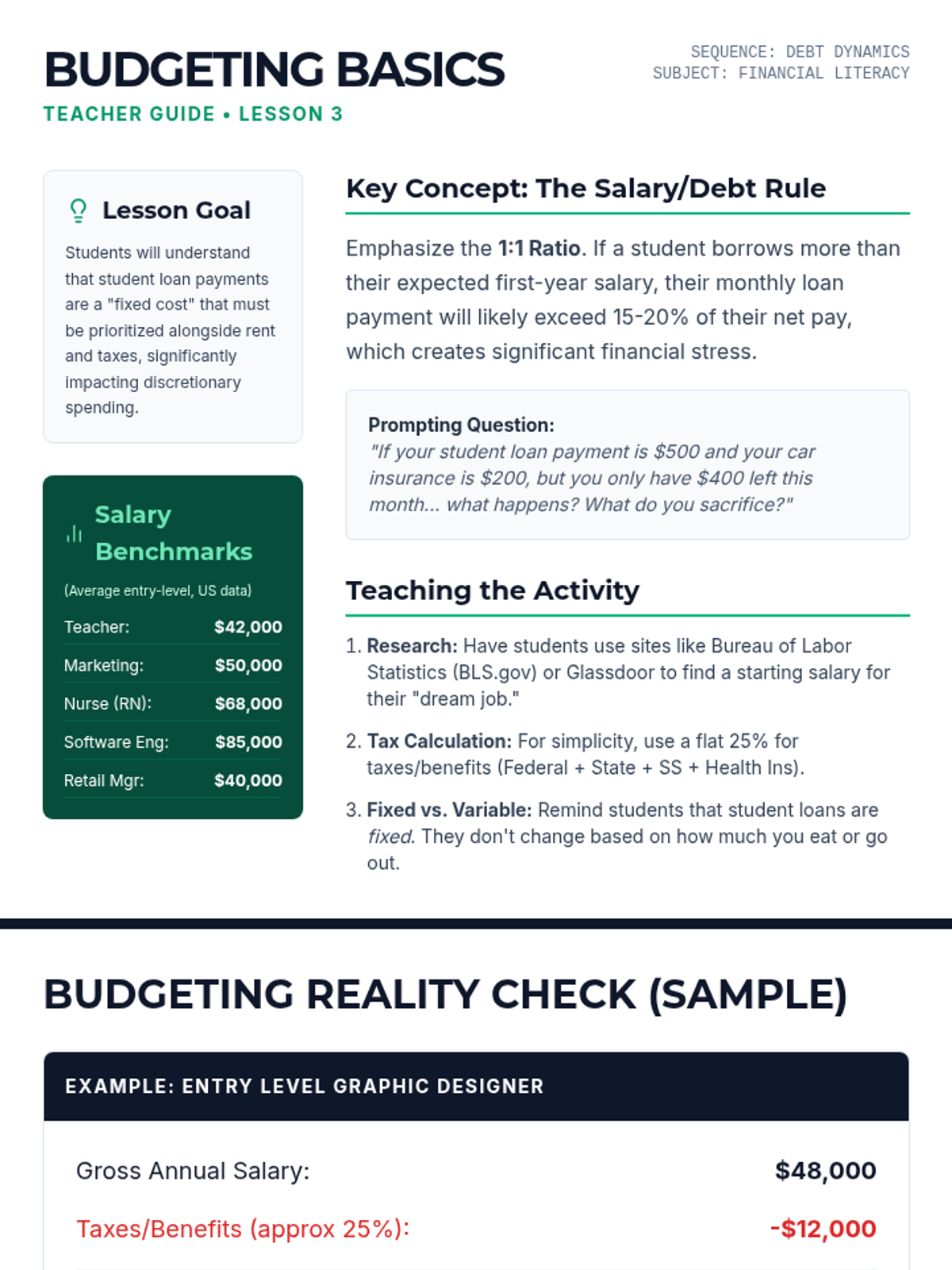
Teacher guide for Lesson 3, providing salary benchmarks, instructional strategies for budgeting, and a sample completed budget.
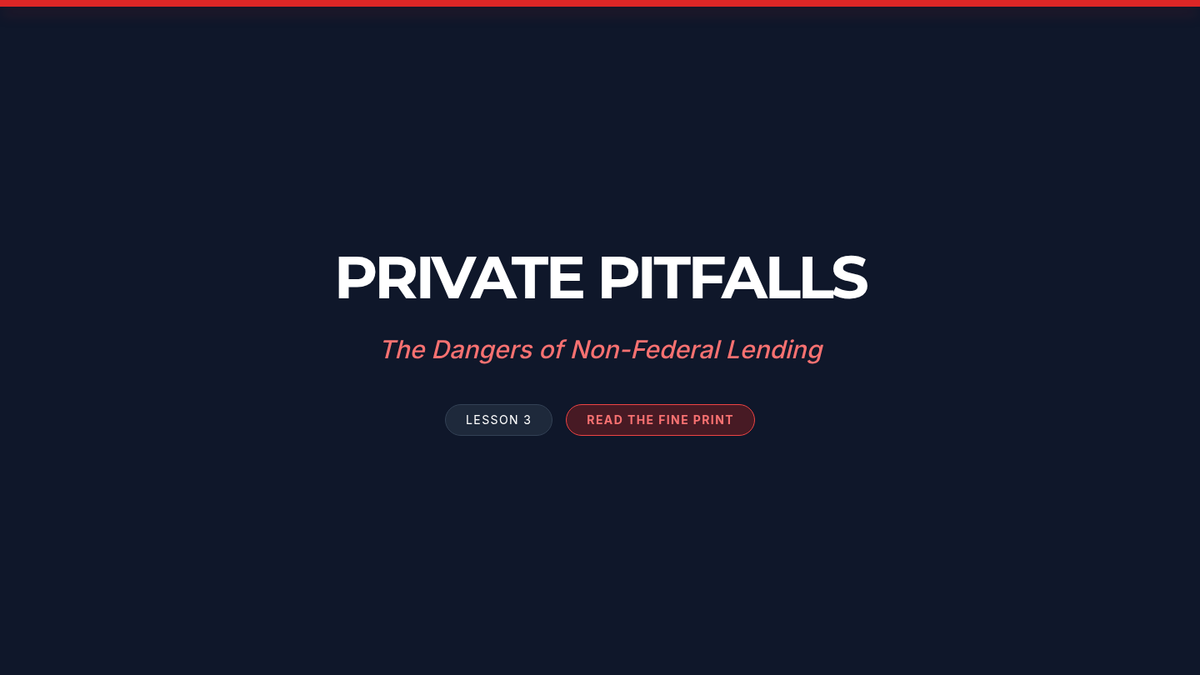
Visual presentation for Lesson 3, introducing the risks of private student loans, variable interest rates, and cosigner requirements.
Introductory slides for Lesson 3, explaining gross vs net pay and visualizing the impact of a monthly loan payment on a budget.
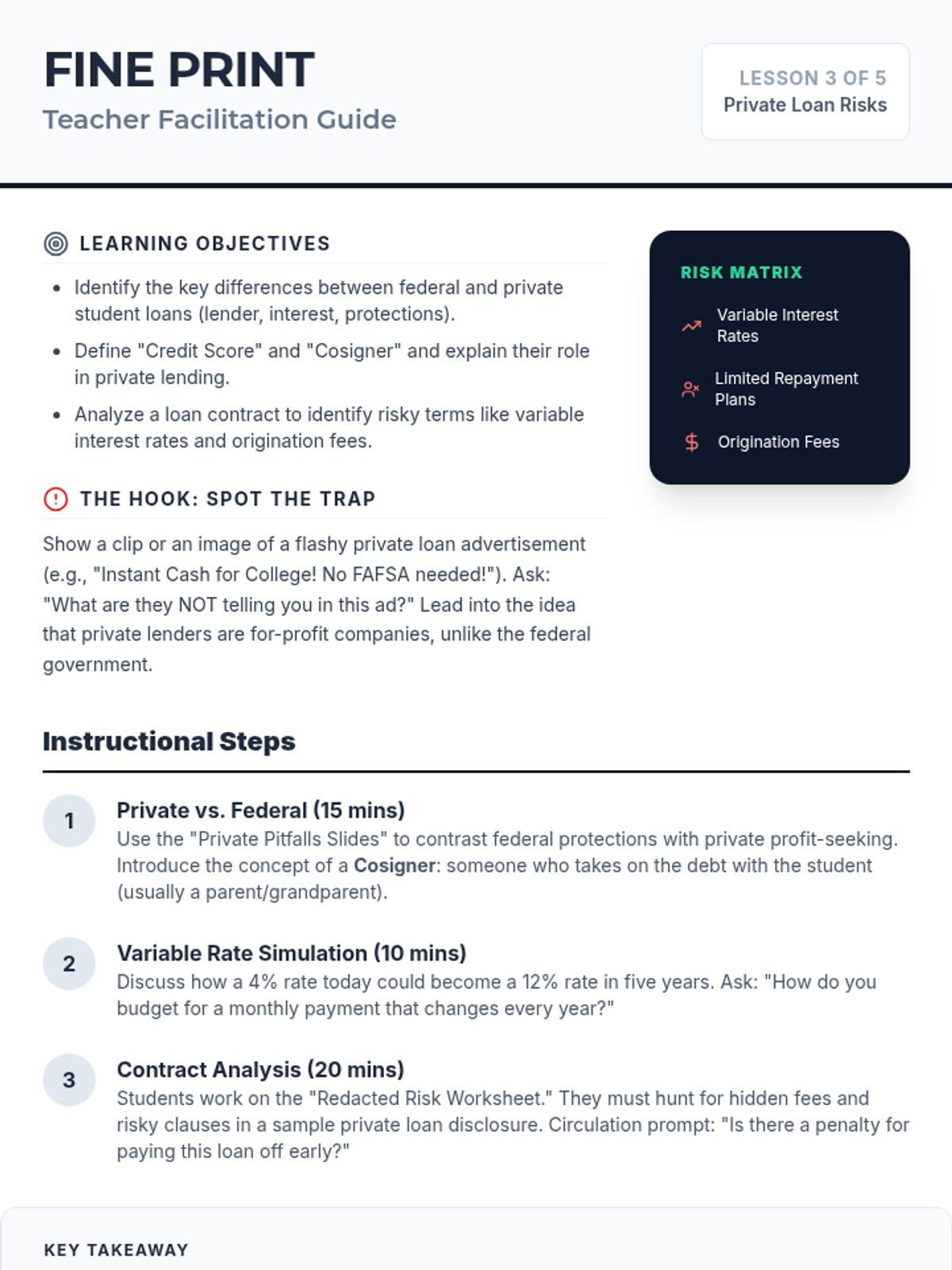
A teacher facilitation guide for Lesson 3, focusing on the risks of private student loans and how to teach document analysis of loan terms.
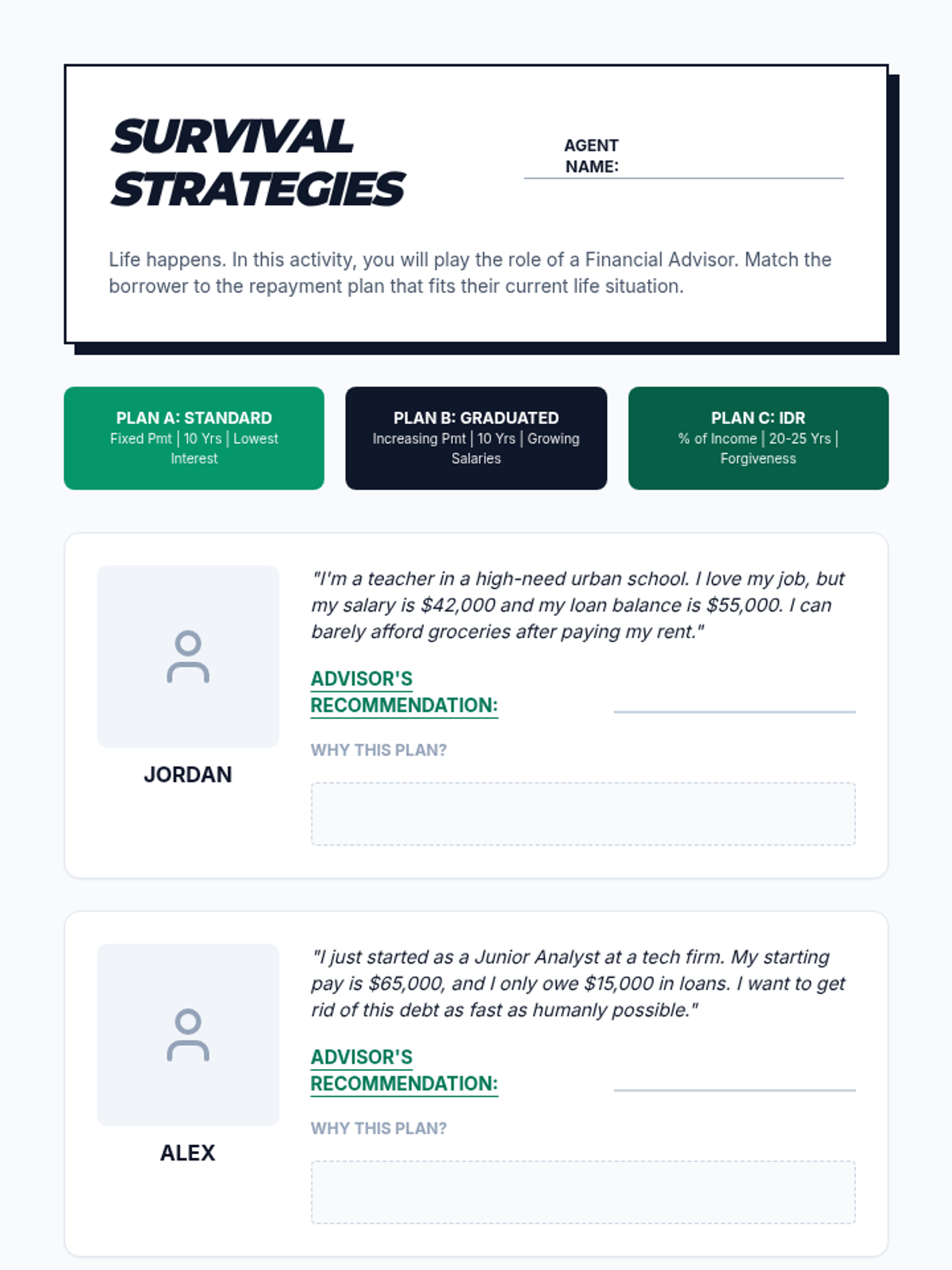
Case study activity for students to match real-world life scenarios (teaching, tech, medical) with the appropriate federal repayment plans.
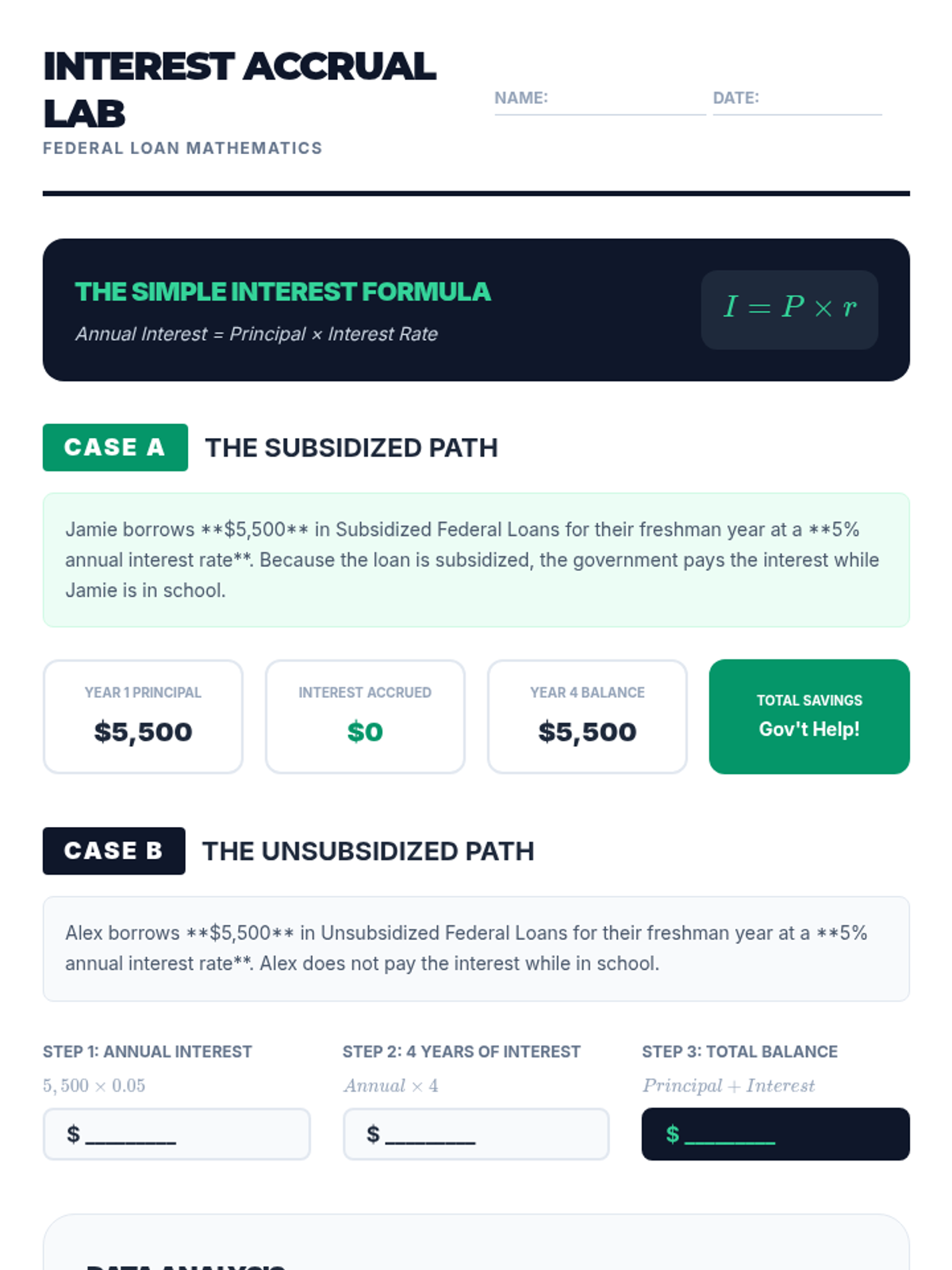
A student worksheet for Lesson 2 that guides students through calculating interest accrual for Subsidized vs. Unsubsidized federal loans.