Mindful breathing and body scan meditation techniques integrated with daily self-care routines. Develops strategies for balancing life demands and advocating for personal wellness needs.
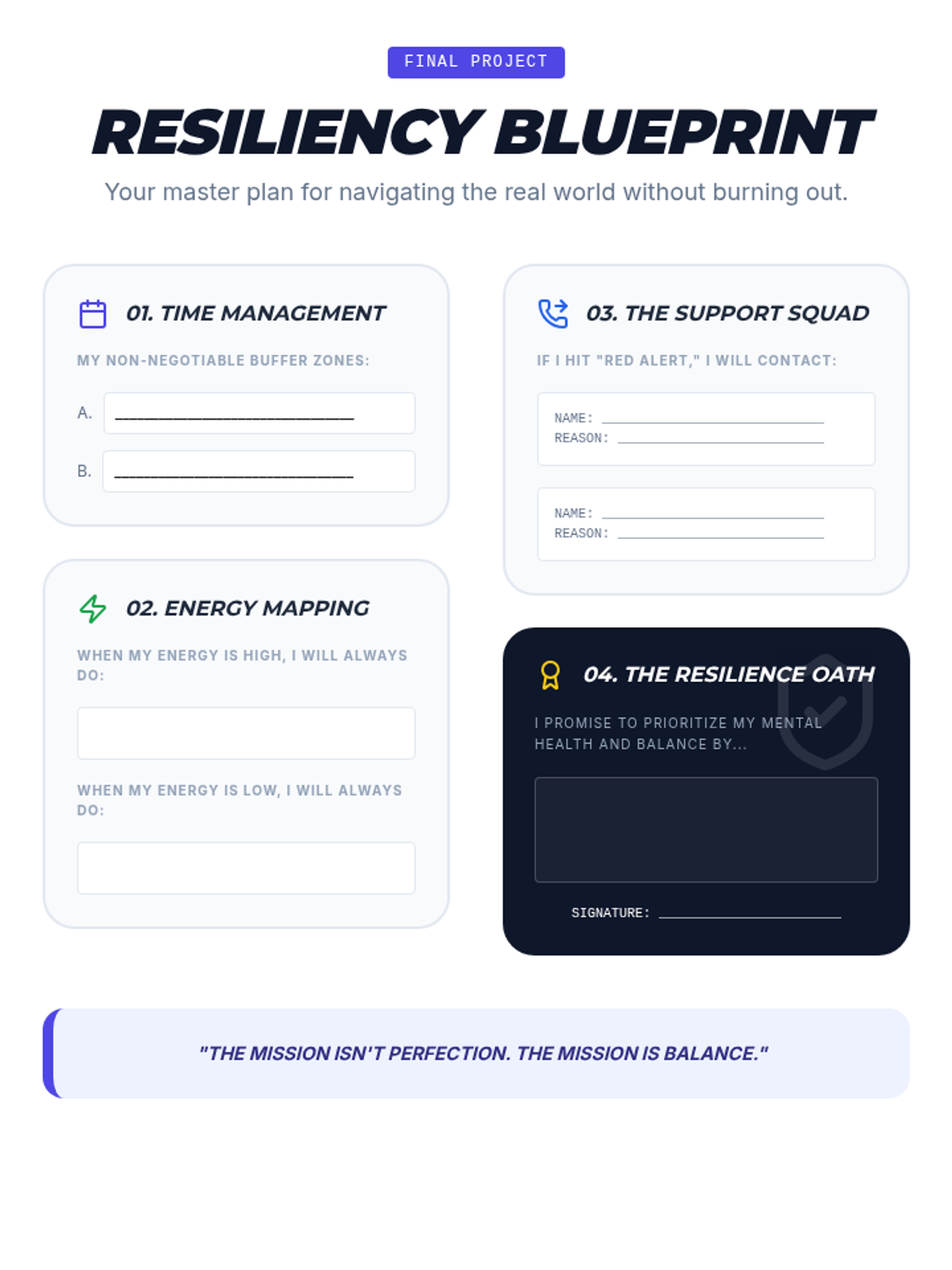
A summative project document where students synthesize everything they have learned into a personal 'Resiliency Blueprint' for real-world application.
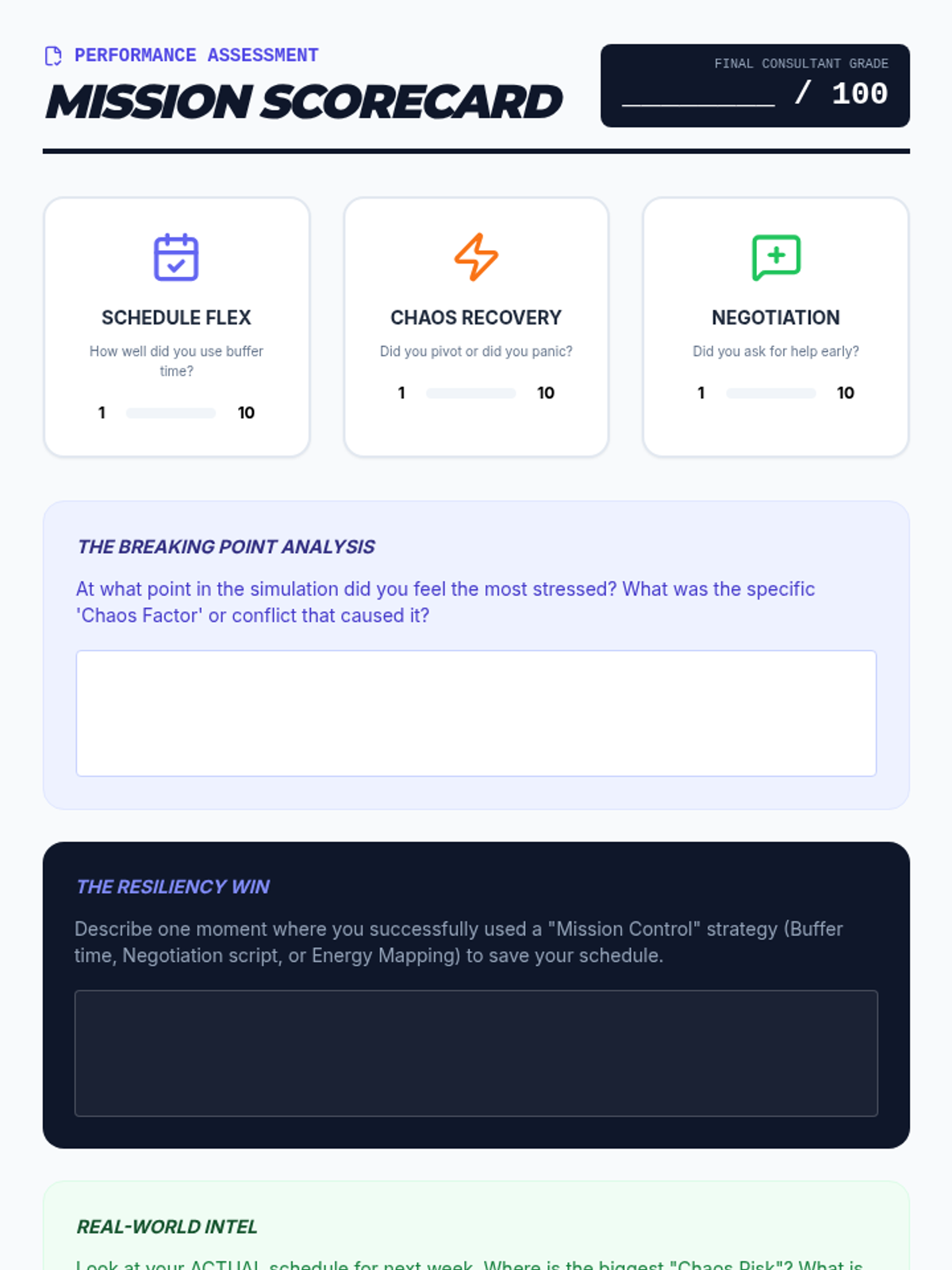
A final self-assessment 'Scorecard' for the Mission Balance sequence, allowing students to rate their performance and reflect on their growth in schedule management and resiliency.
Final presentation for the Mission Balance sequence, reviewing core concepts of chaos management, negotiation, and energy management, and introducing the final scorecard activity.
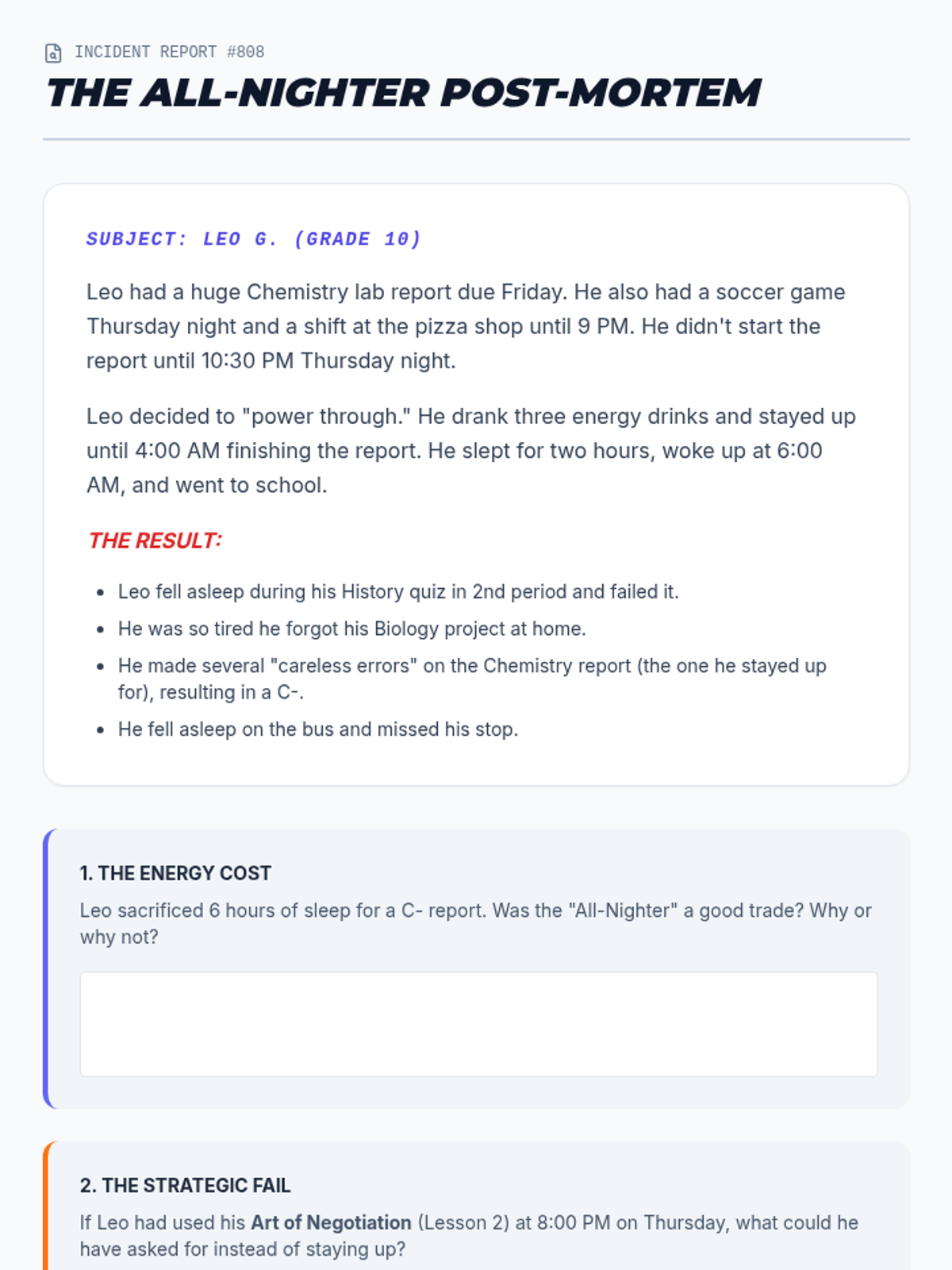
A case study analysis of a student's 'all-nighter' experience, prompting students to evaluate the consequences and identify alternative strategies from the sequence.
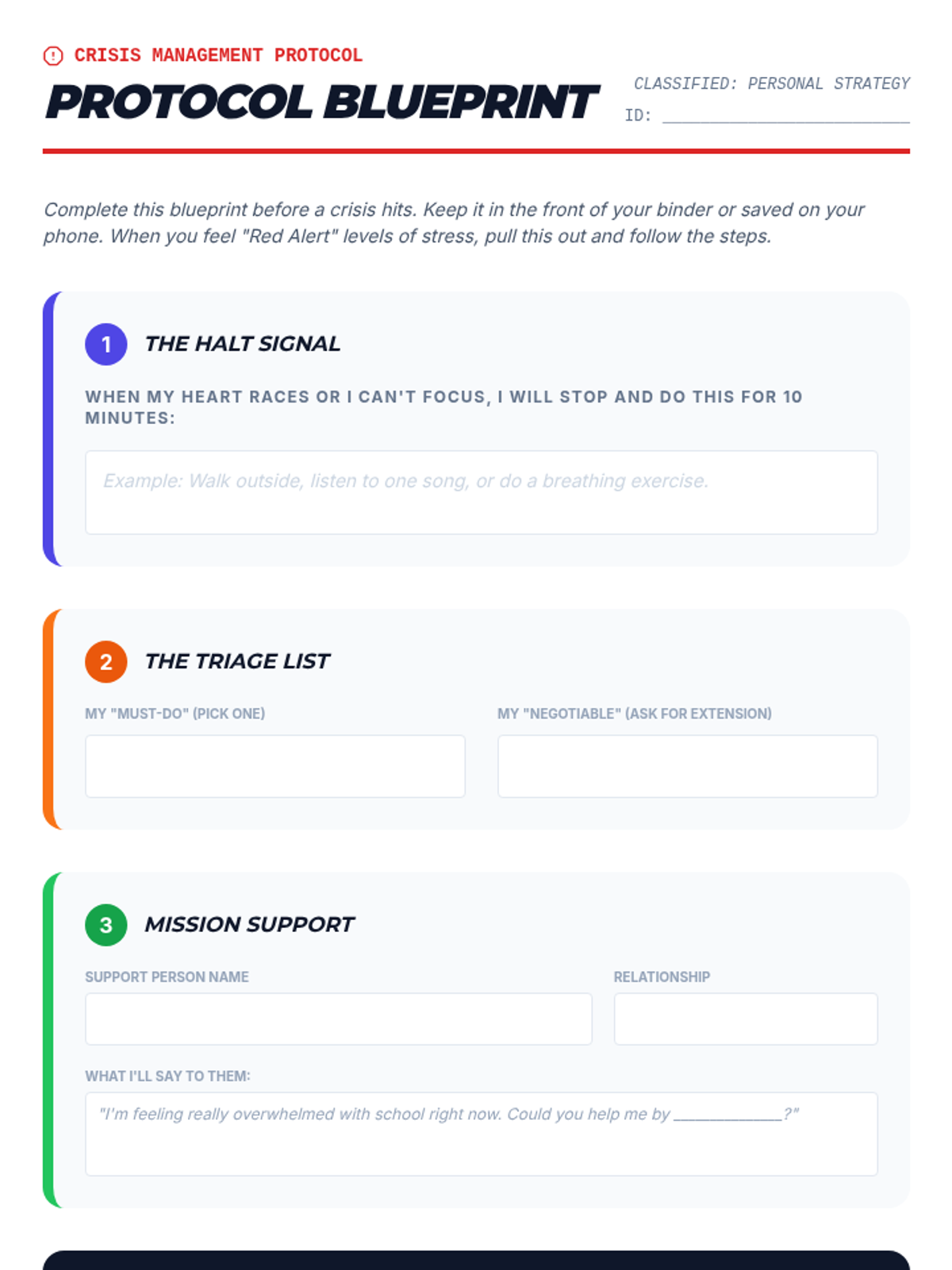
A personal crisis management worksheet where students document their specific 'Red Alert' protocols, including triage strategies, support contacts, and recovery plans.
Lesson 4 slides on crisis management protocols, teaching students how to identify burnout, prioritize tasks during 'Red Alert' scenarios, and activate support systems.
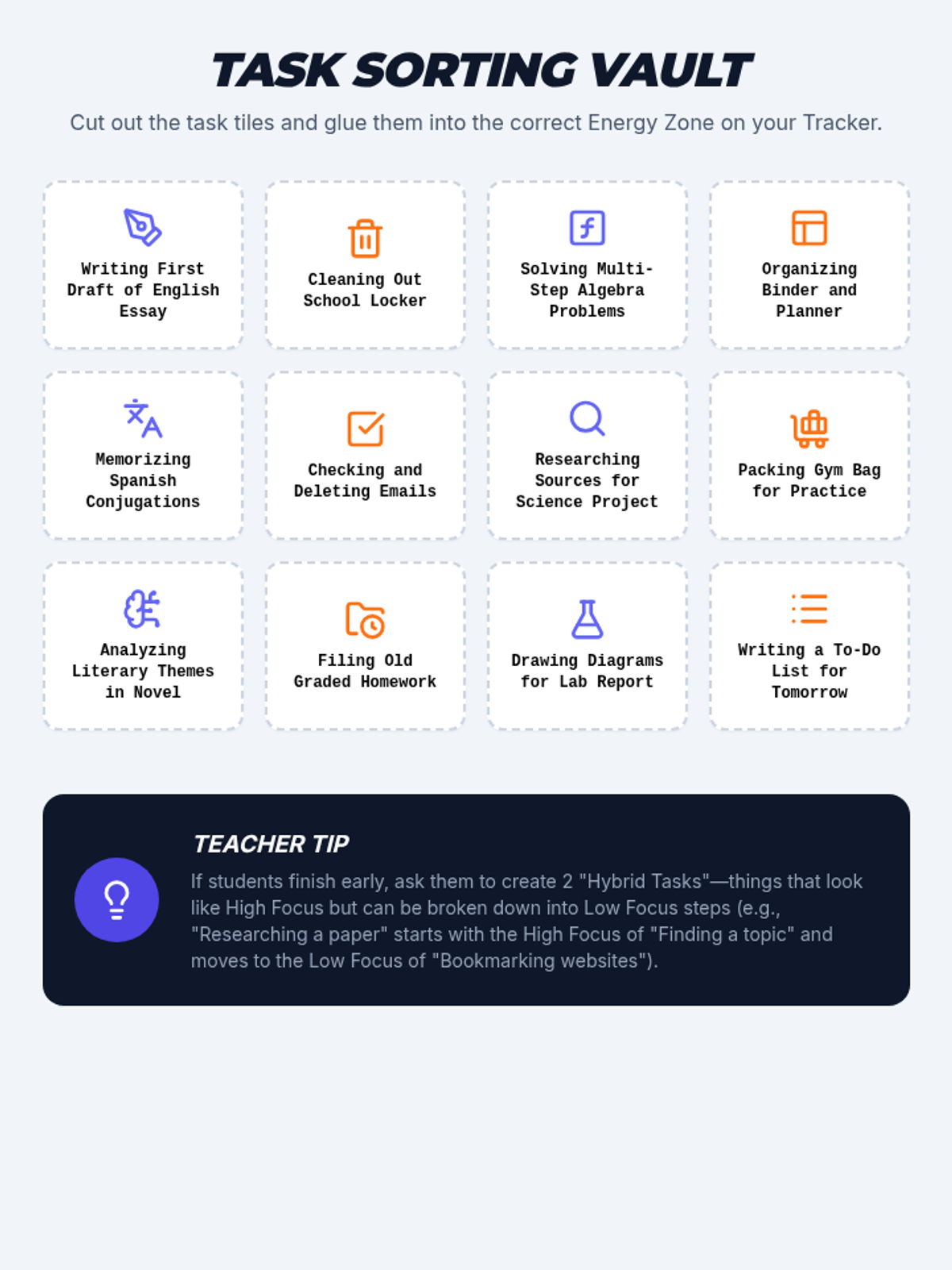
A cut-and-paste sorting activity for students to categorize common school and life tasks as either 'High Focus' or 'Low Focus' energy requirements.
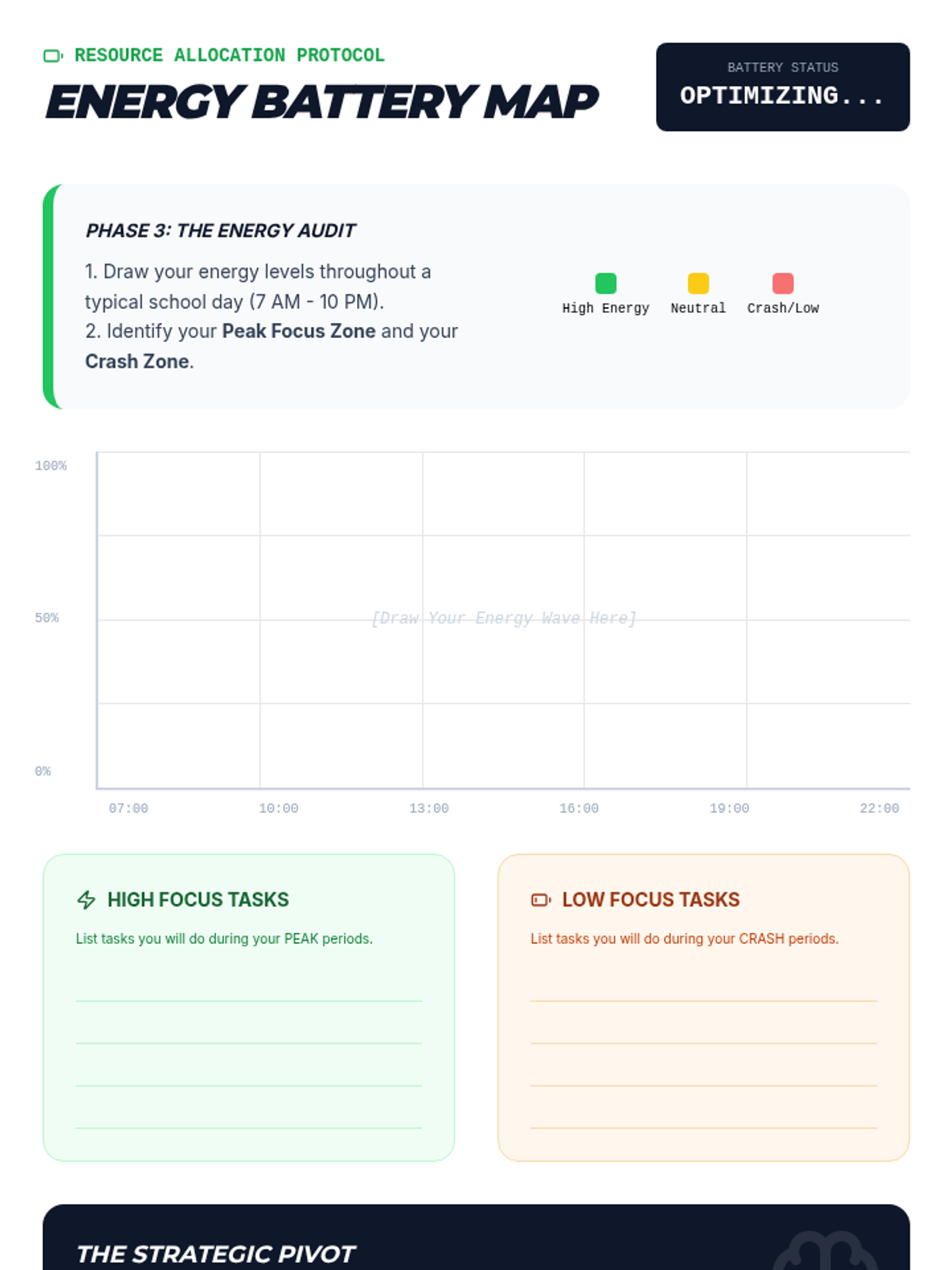
A worksheet for students to map their daily energy levels and strategically assign tasks based on their peak focus periods.
Lesson 3 presentation on energy management, teaching students to differentiate between High Focus and Low Focus tasks and to identify their personal peak energy periods.
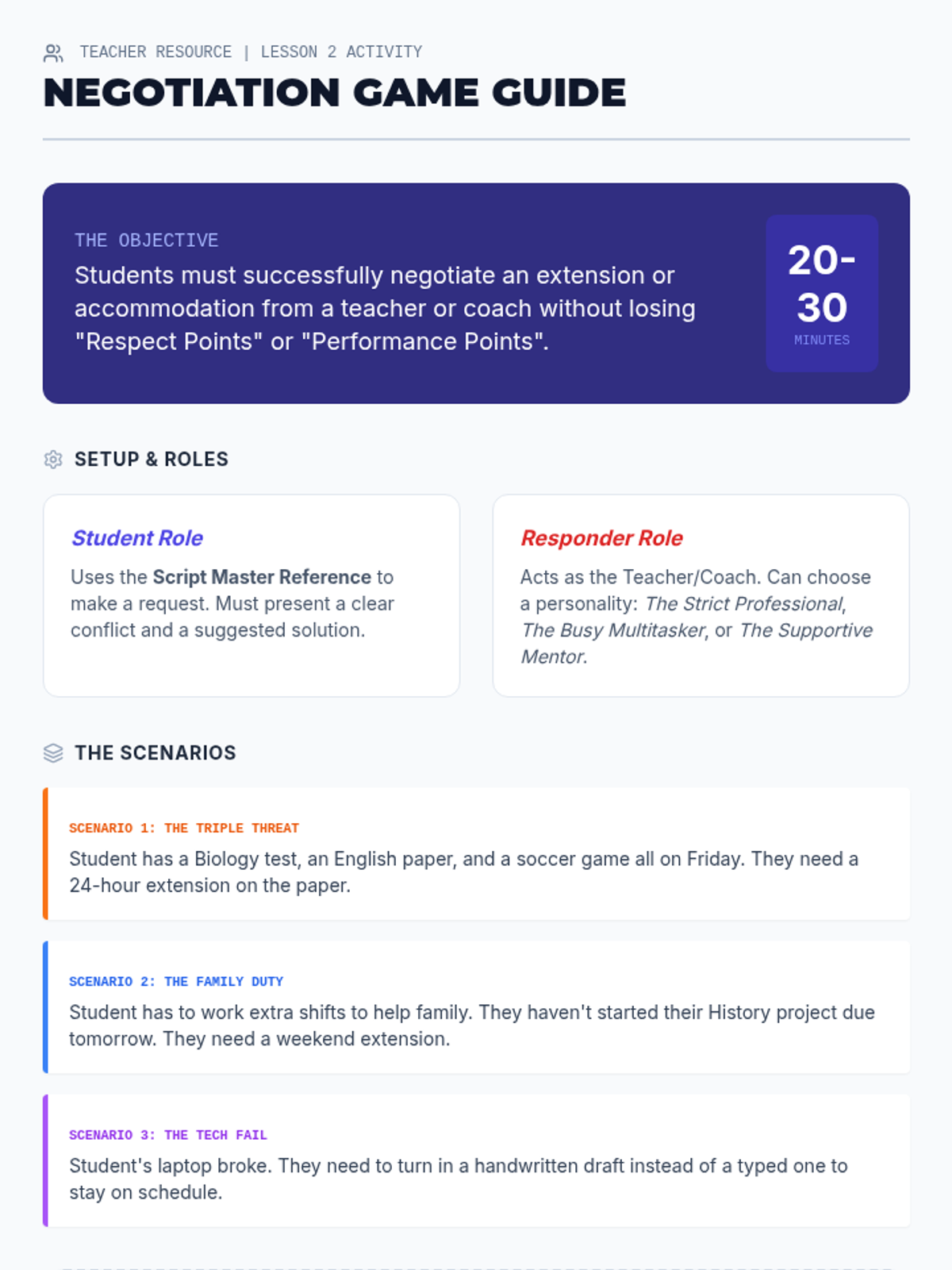
Teacher facilitation guide for the Lesson 2 role-play simulation, providing scenarios, roles, and assessment criteria for student negotiations.
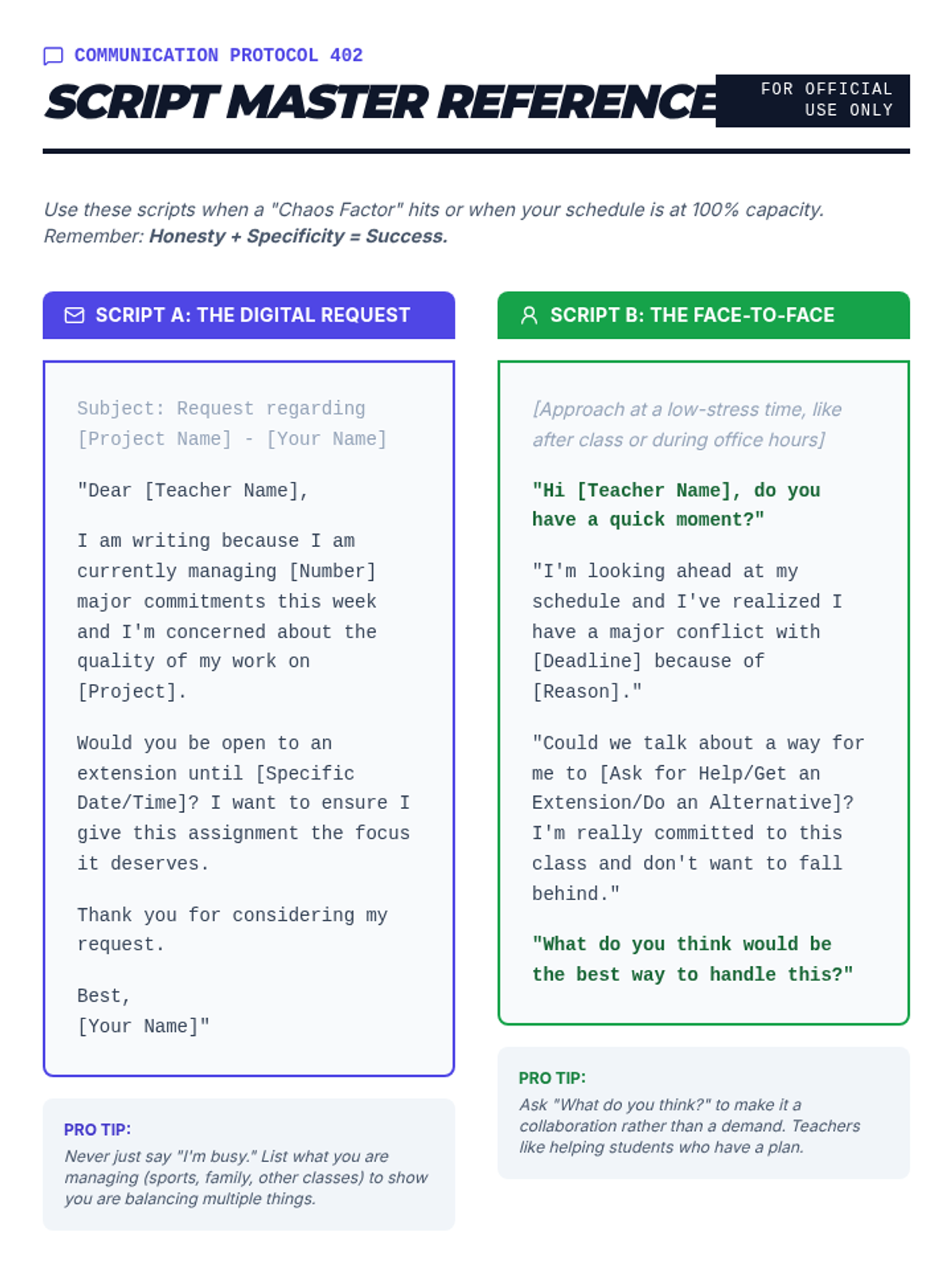
A professional communication guide for students, featuring scripted templates for digital and in-person deadline negotiations, including a practice exercise.
Slide deck for Lesson 2, teaching students the difference between hard and soft deadlines and providing a professional framework for negotiating extensions.
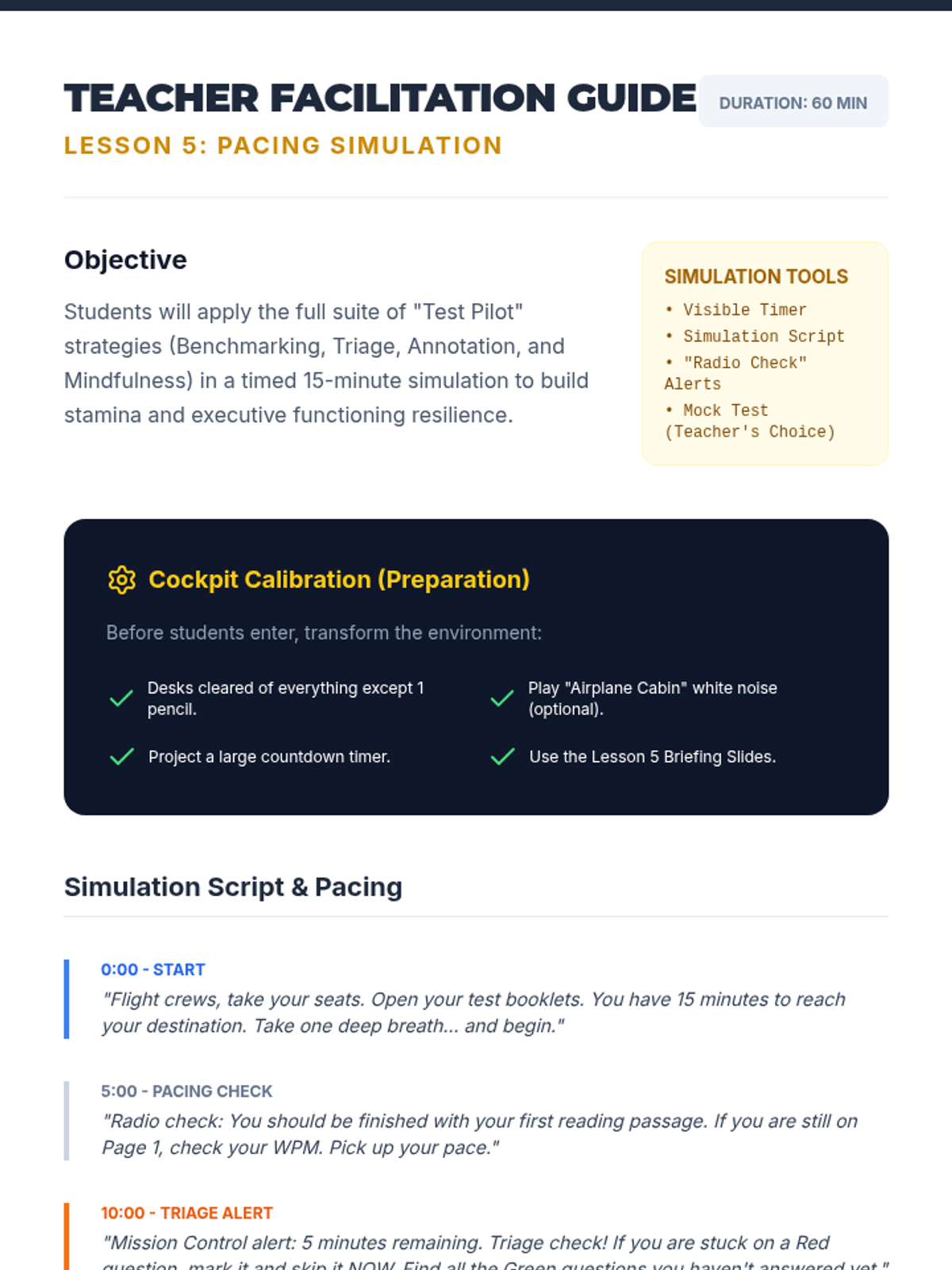
A teacher guide for Lesson 5 including the simulation script, timing intervals, and a guide for the post-simulation debrief and student certification.
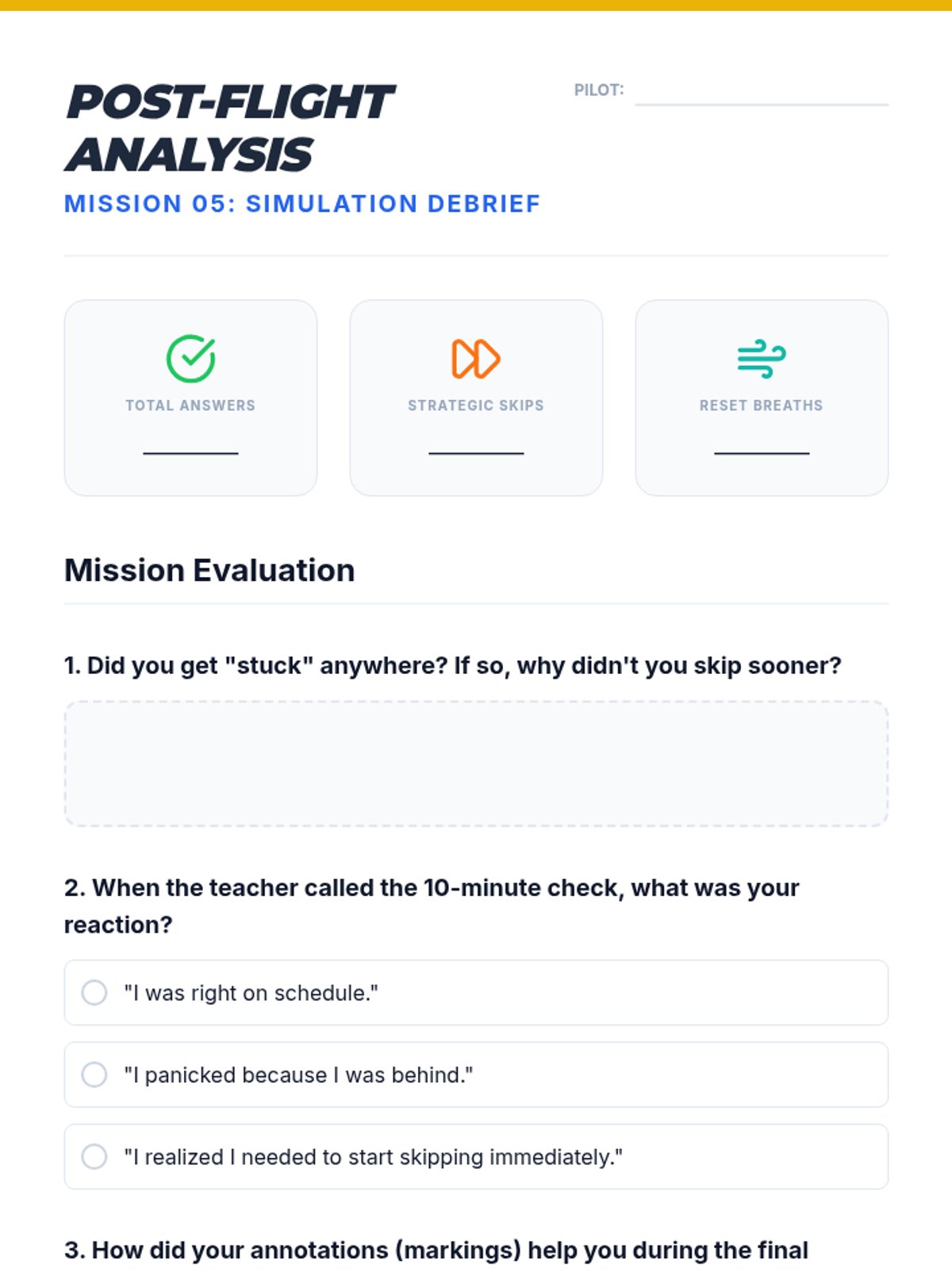
A student reflection sheet and goal-setting document for the final pacing simulation, helping students create a personalized 'Test Protocol' for future exams.
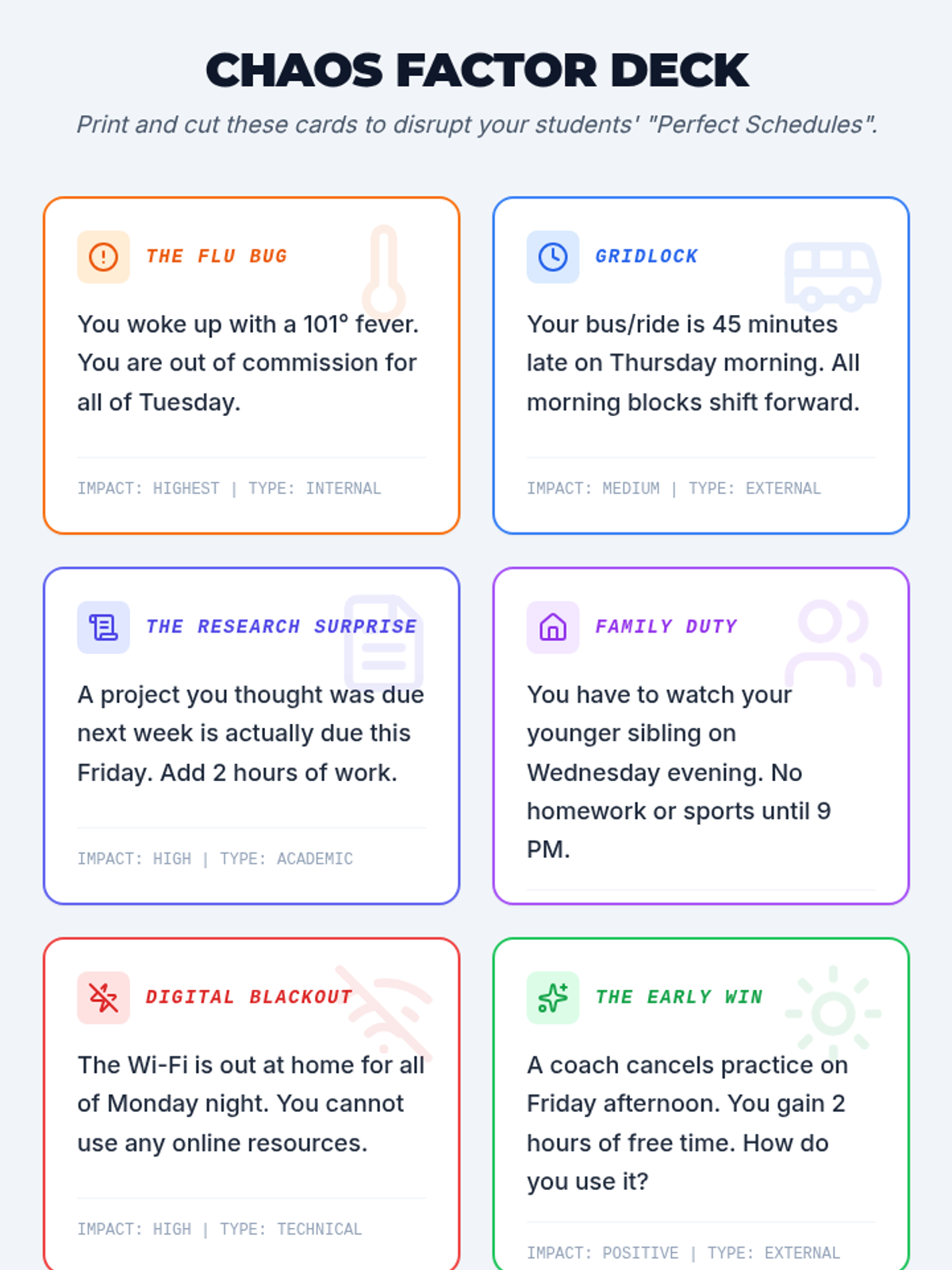
A set of printable 'Chaos Factor' cards for teachers to use in the Mission Balance simulation, featuring various disruptions to a student's schedule.
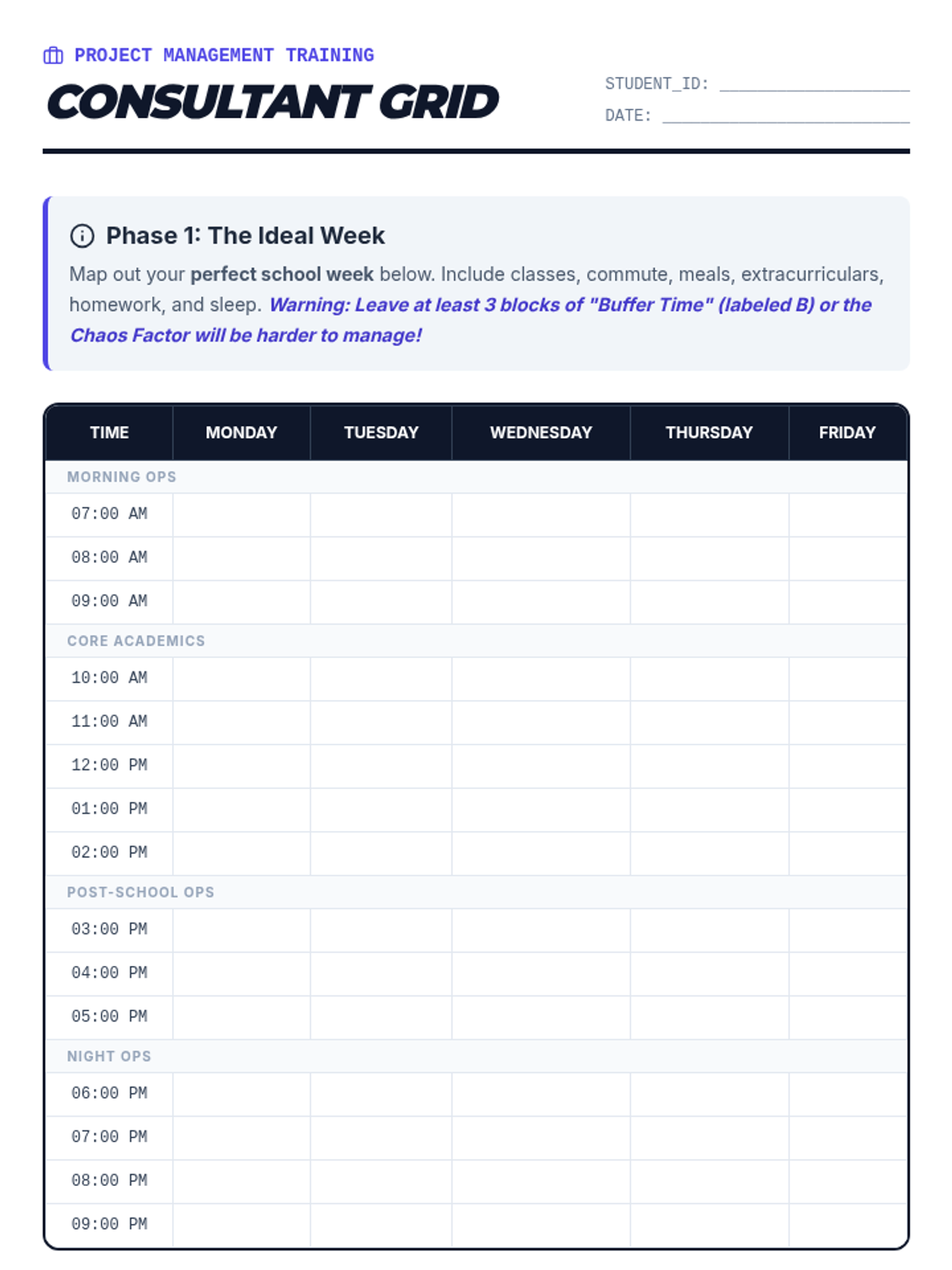
A student-facing weekly scheduling grid designed for the Mission Balance simulation, including a section for analyzing and responding to 'Chaos Factor' disruptions.
Slides for Lesson 5, the final simulation briefing, reviewing all Test Pilot Academy strategies and providing time-check benchmarks for the mock exam.
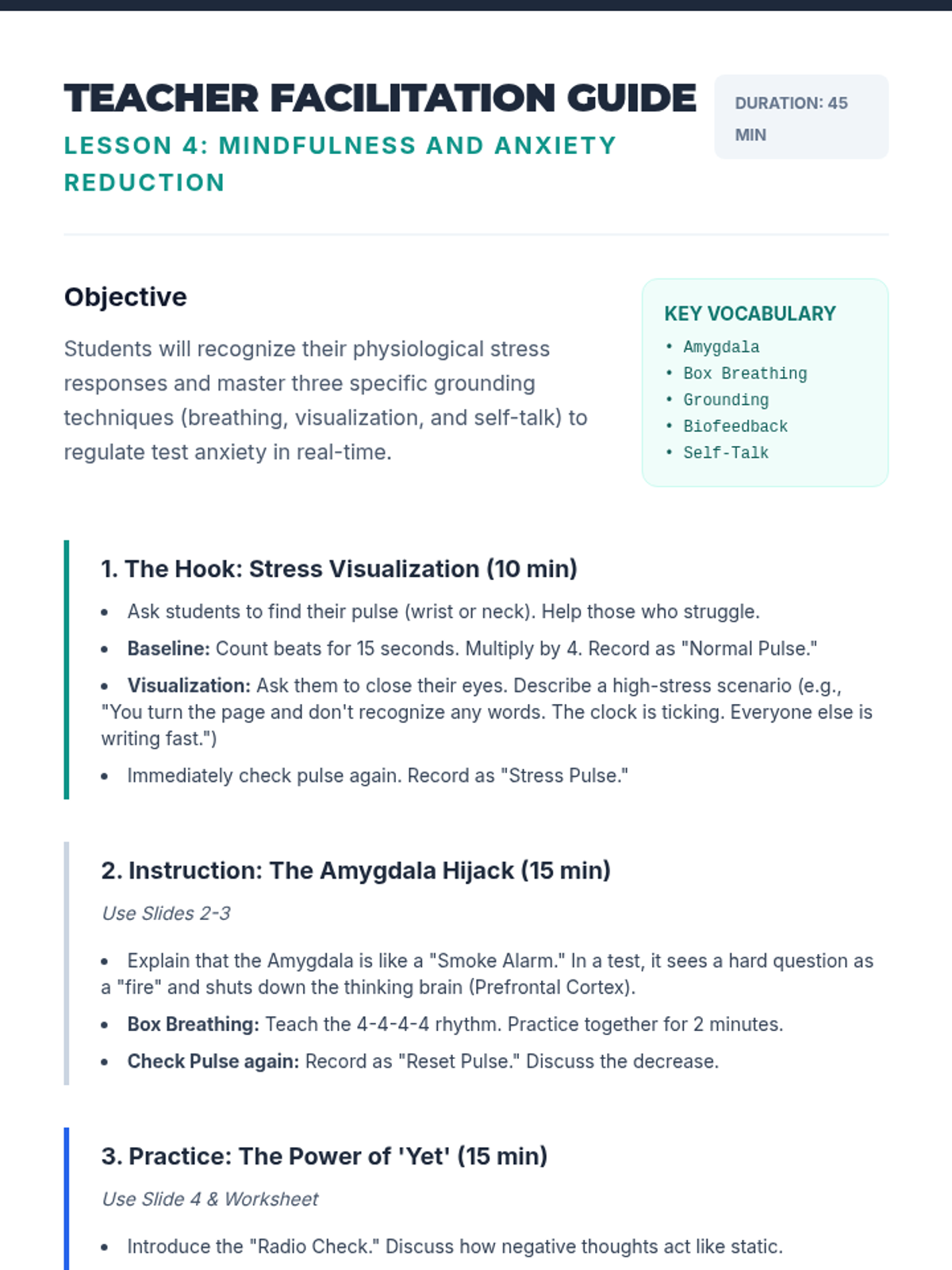
A teacher guide for Lesson 4 including instructions for the biofeedback pulse check, grounding exercise facilitation, and strategies for student buy-in using the Test Pilot theme.
Introductory presentation for the Mission Balance sequence, teaching students about the 'Chaos Factor' and the importance of 'Buffer Time' in scheduling.
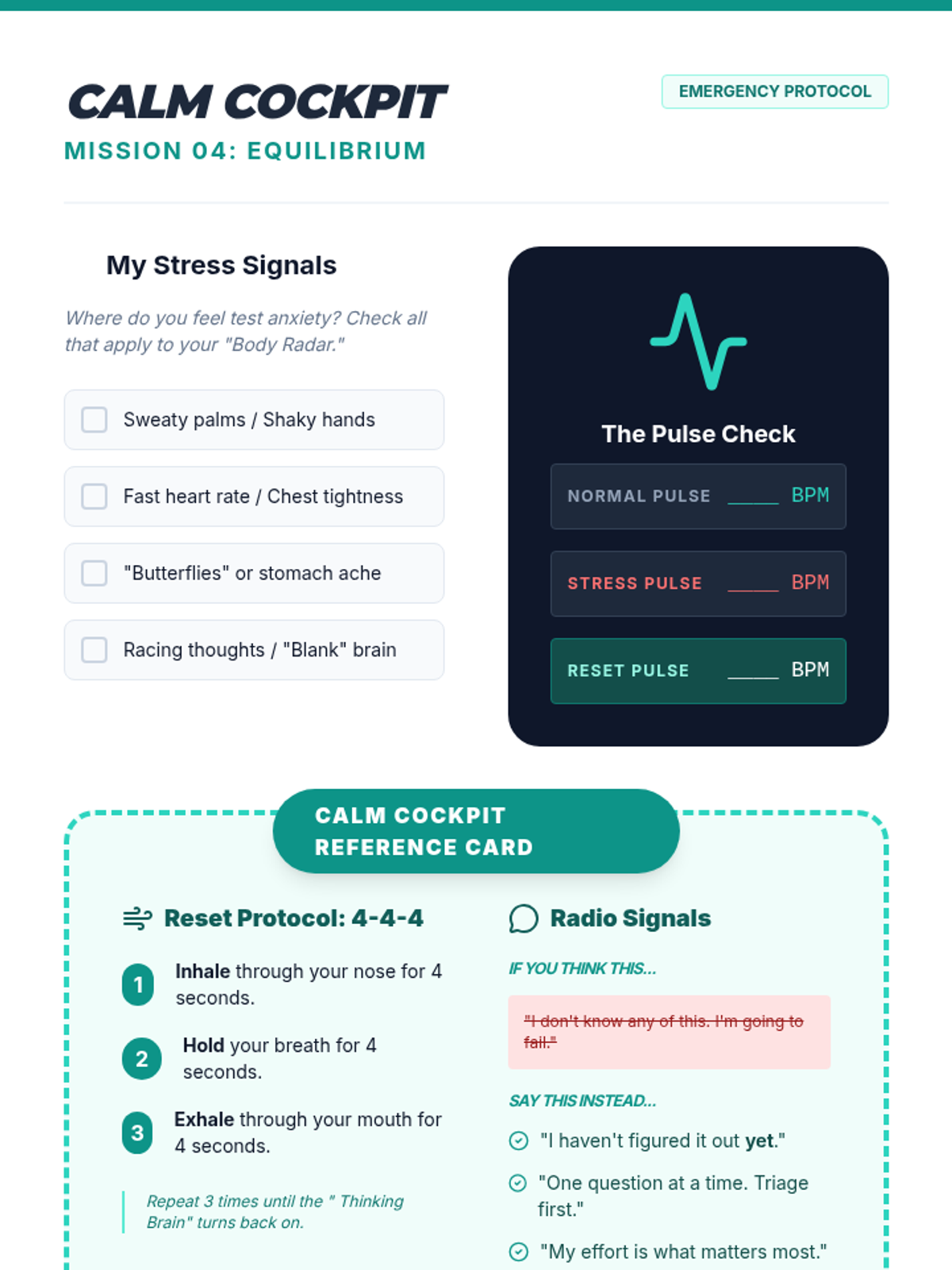
A student resource featuring an anxiety-mapping activity and a cutout 'Calm Cockpit' reference card with grounding techniques and positive self-talk prompts.
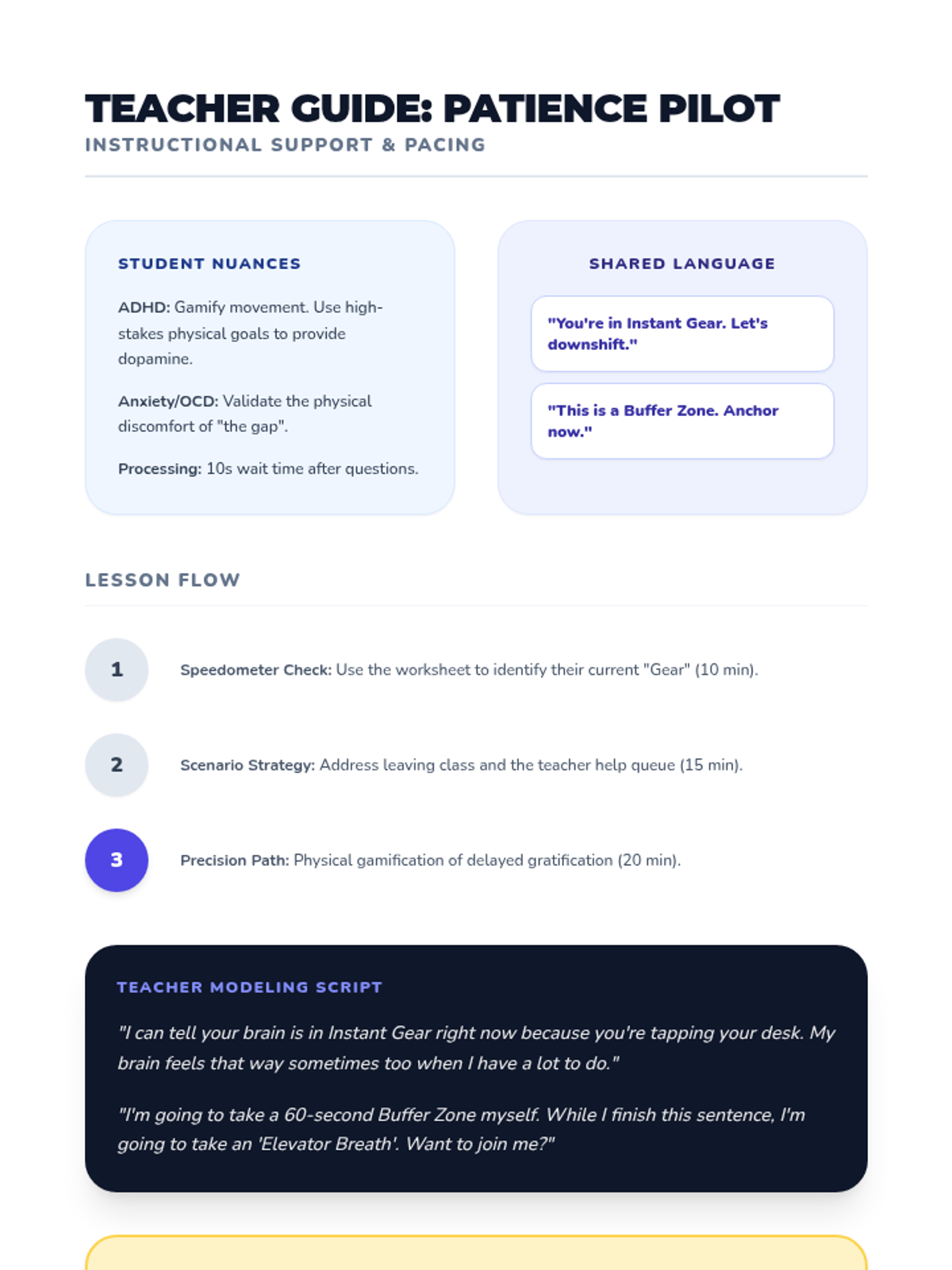
A teacher-facing guide that provides context on how to implement the Patience Pilot materials. It includes pedagogical tips for working with ADHD/OCD/Anxiety, a recommended lesson flow, and scripts for modeling patience.
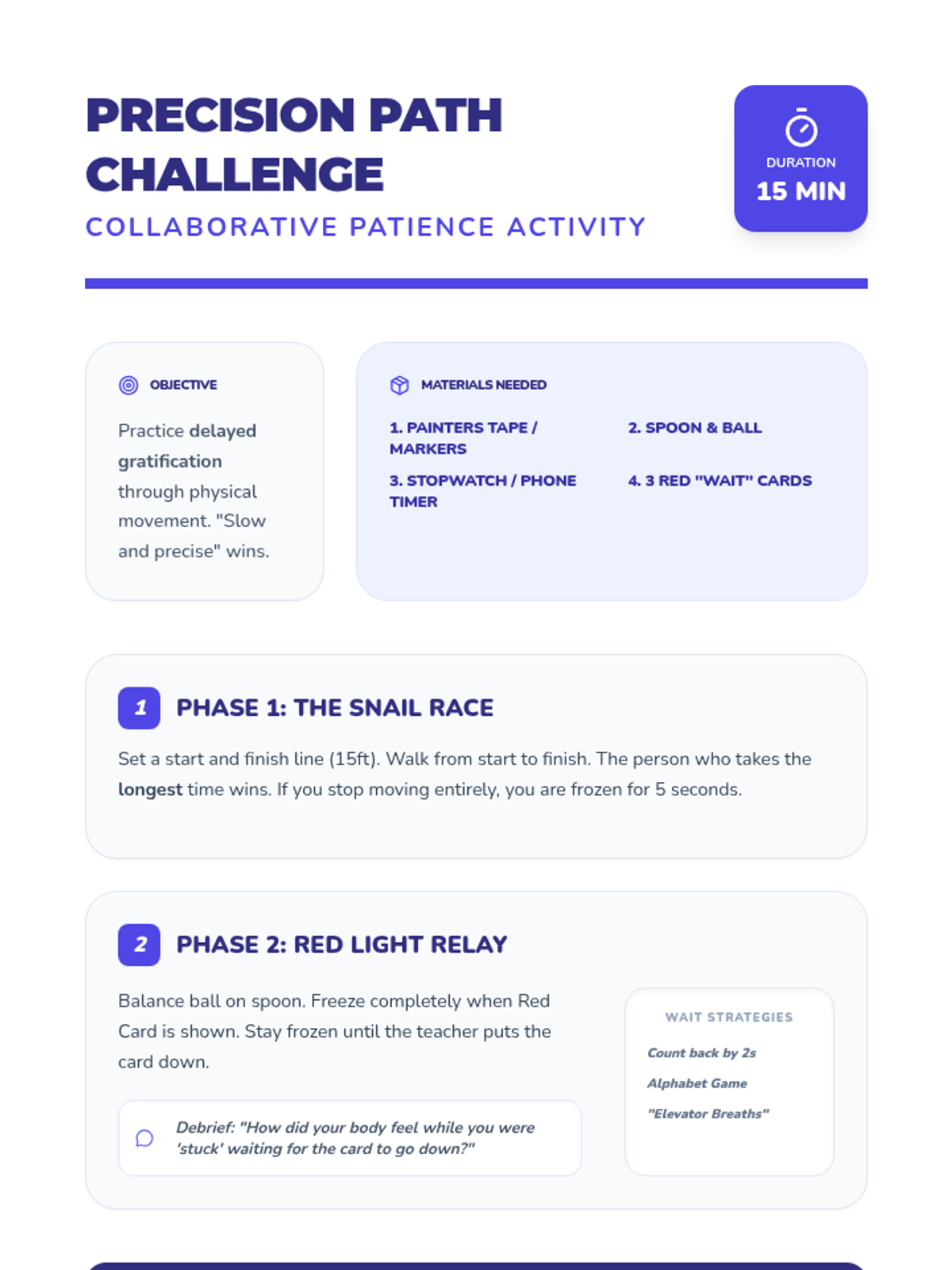
A collaborative, movement-based activity for a teacher and student. It gamifies patience through 'snail racing' and interrupted balancing tasks, specifically designed to simulate the physical tension of waiting.
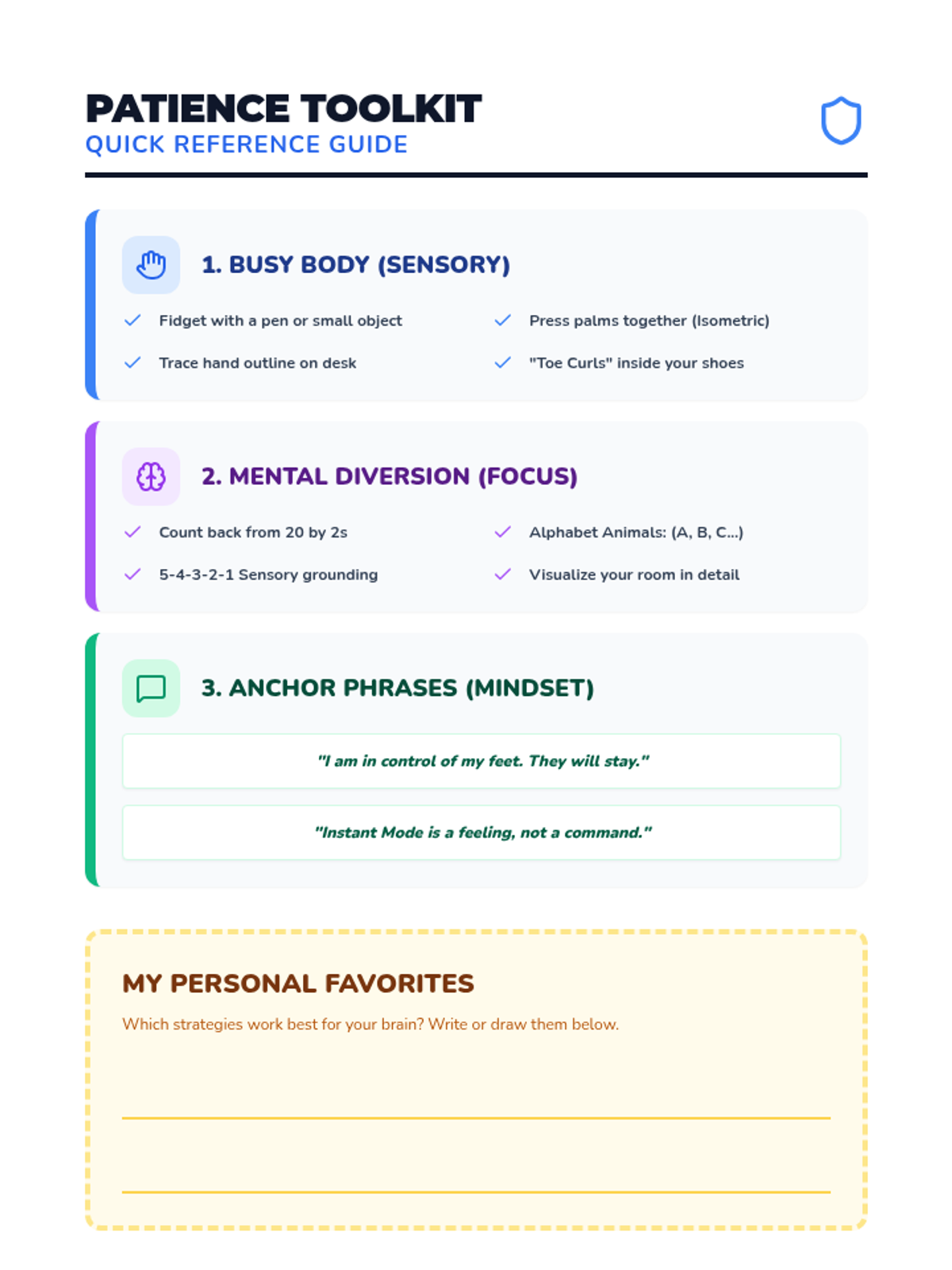
A reference sheet for the student to keep in their binder. It provides a menu of physical, mental, and verbal coping strategies to use during 'waiting gaps' to manage ADHD and anxiety-driven impulsivity.
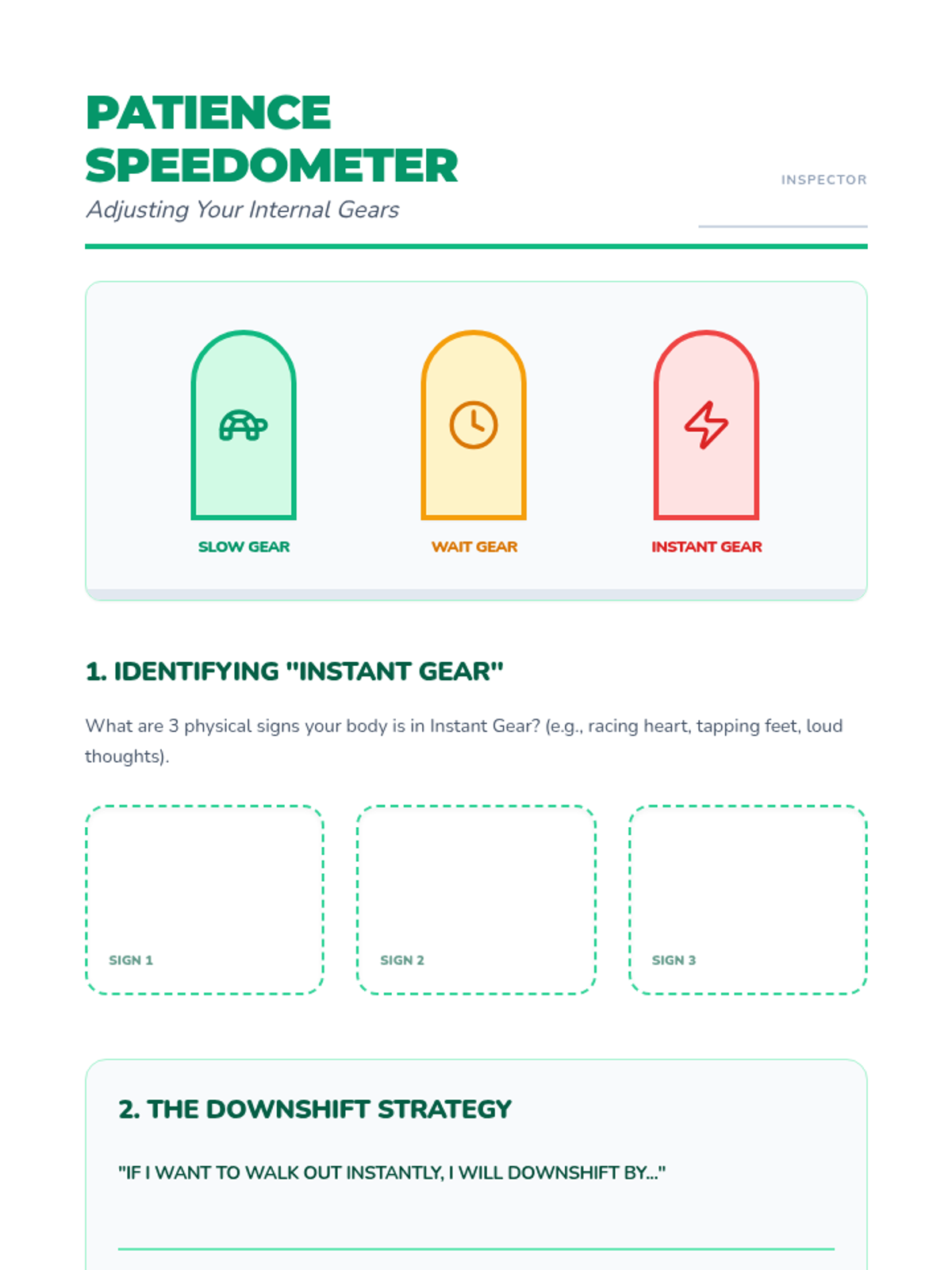
A visual self-regulation worksheet that helps the student identify their 'internal gears' (Slow, Wait, Instant). It focuses on identifying physical triggers of impulsivity and practicing 'downshifting' to a more patient state.
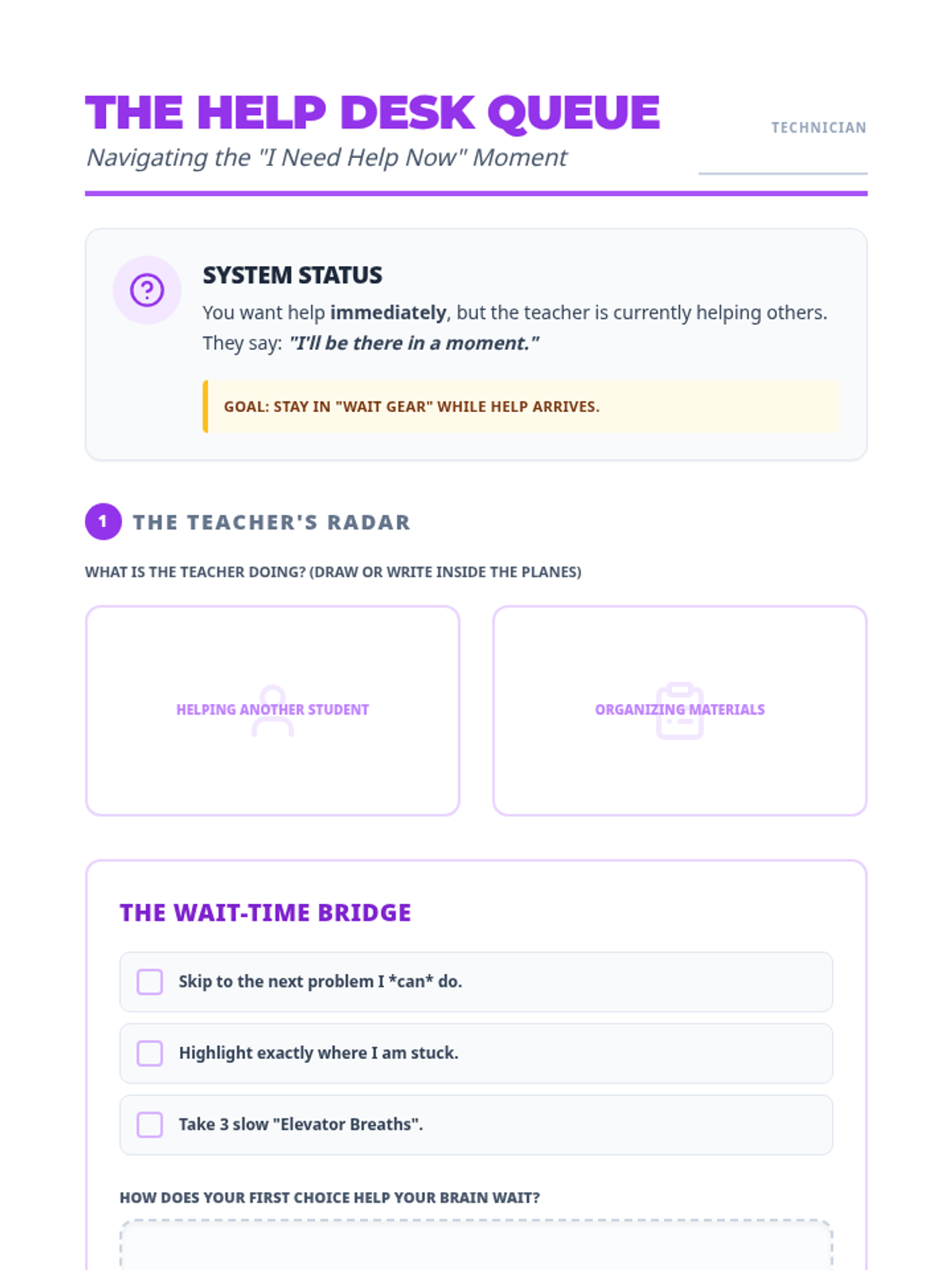
A worksheet designed to address the specific scenario of needing immediate help after previously refusing it. It uses an air traffic controller metaphor to help the student understand the teacher's perspective and provides actionable waiting strategies.
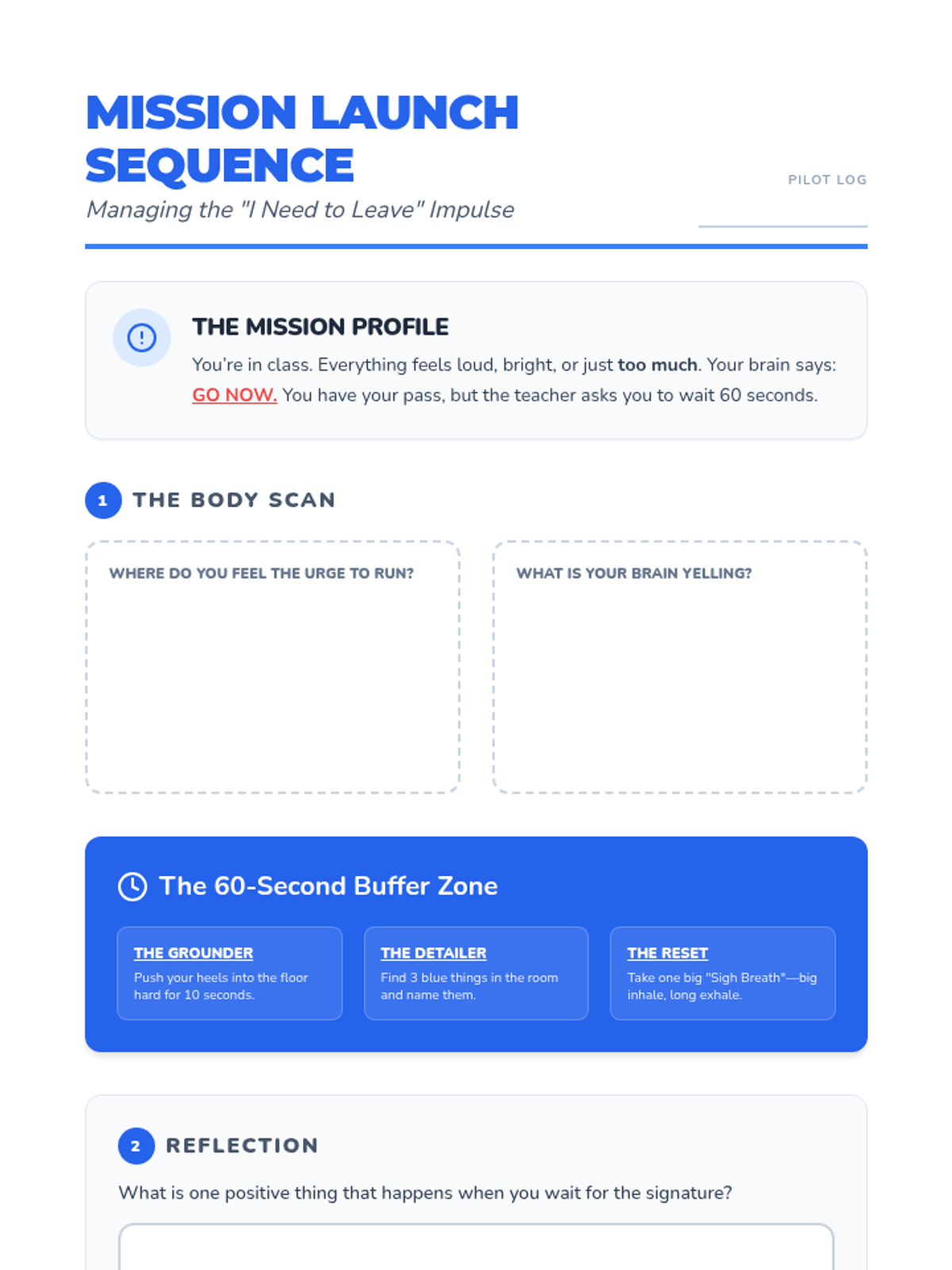
A worksheet focused on the impulsivity of leaving the classroom when overstimulated. It teaches a '60-second buffer' strategy and helps the student identify physical symptoms of anxiety.
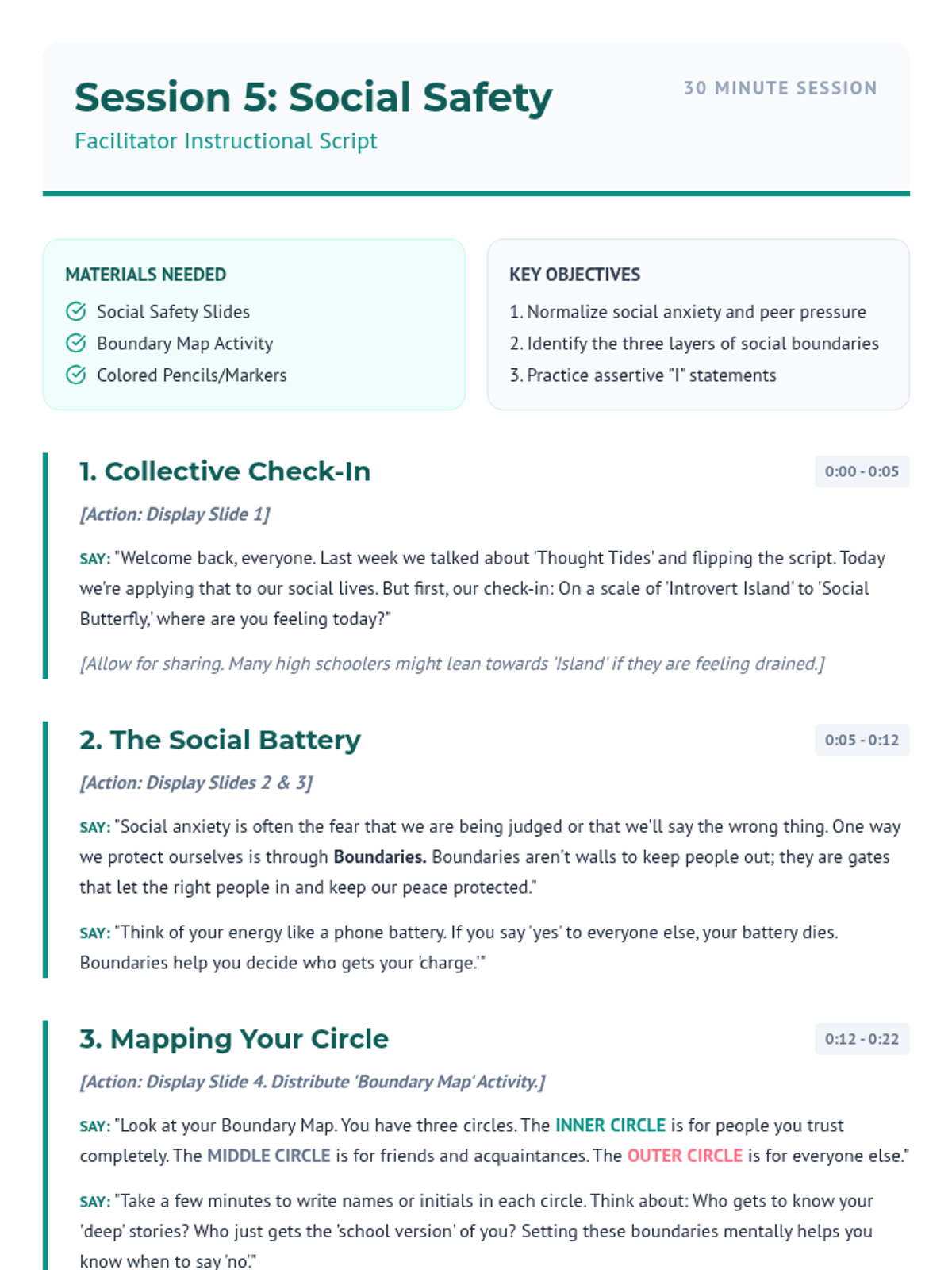
A detailed facilitation script for the fifth session of the Calm Collective, focusing on social anxiety, boundary mapping, and assertive communication skills. Fixed layout overlap and contrast.
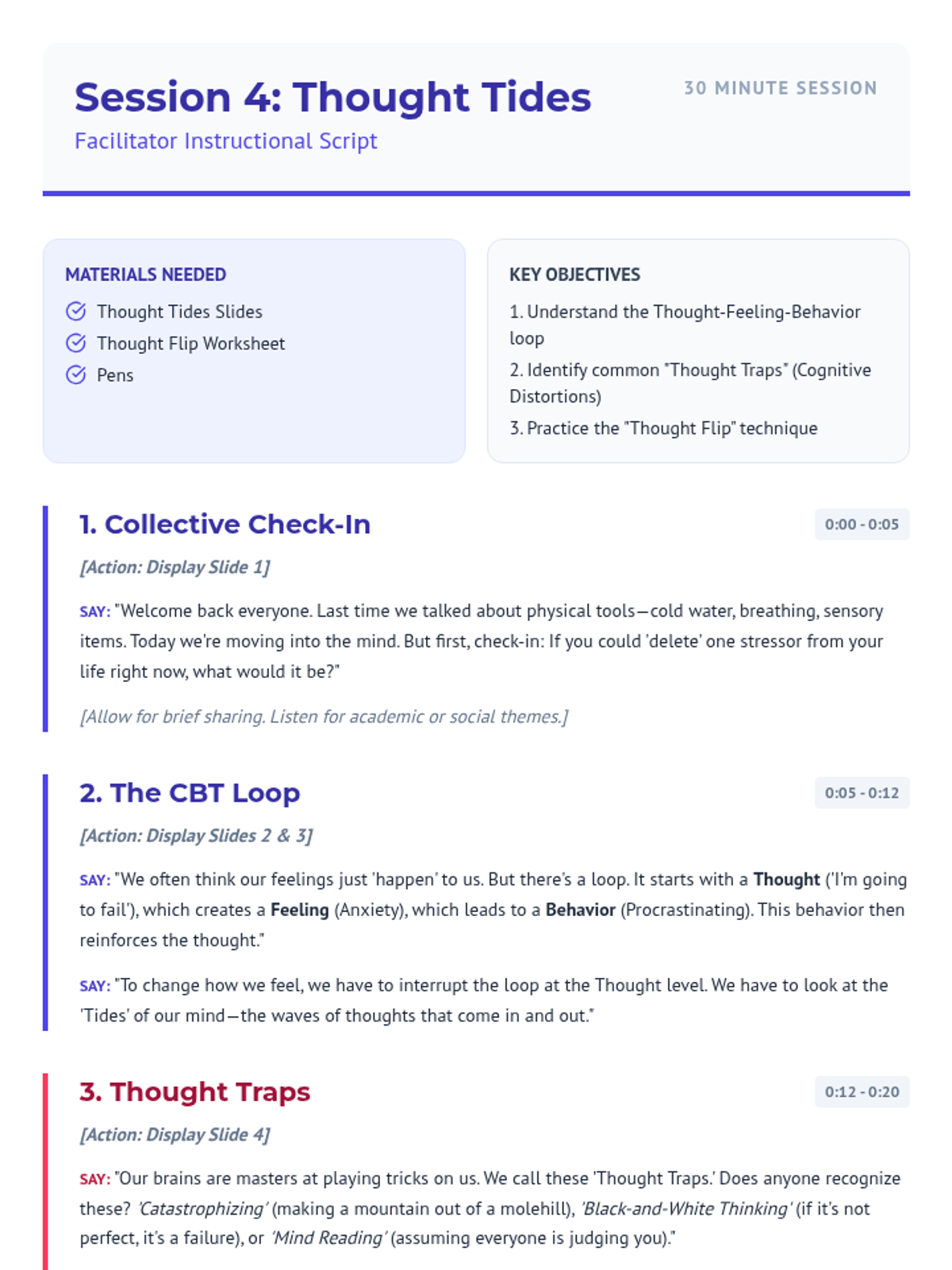
A detailed facilitation script for the fourth session of the Calm Collective, focusing on the CBT loop, identifying thought traps, and practicing cognitive reframing. Fixed icon rendering and page breaks.
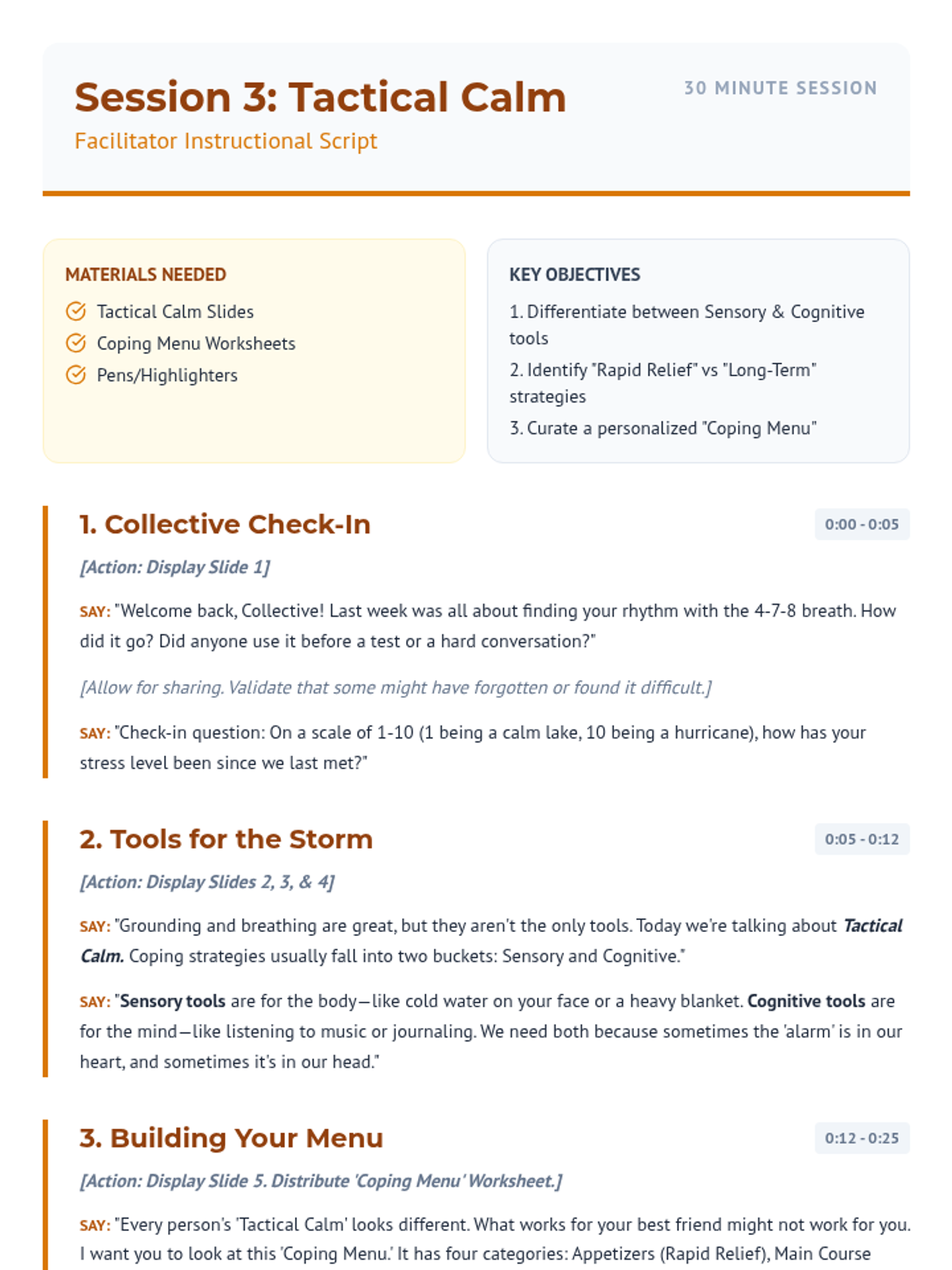
A detailed facilitation script for the third session of the Calm Collective, focusing on sensory vs. cognitive coping strategies and the creation of a personalized Coping Menu. Fixed icon rendering and page breaks.
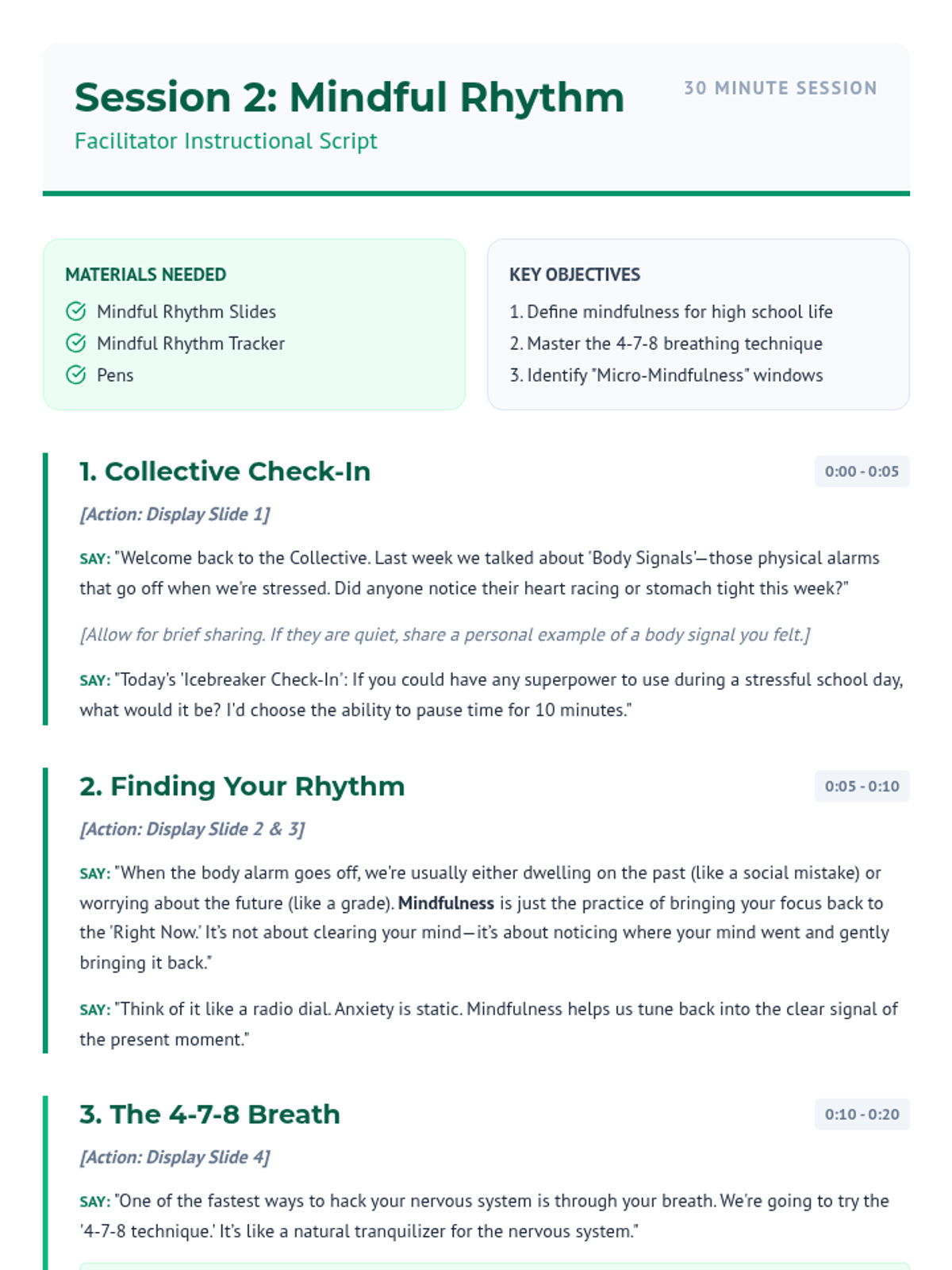
A detailed facilitation script for the second session of the Calm Collective, providing time-stamped sections, "what to say" prompts, and "what to do" instructions for the counselor. Focuses on mindfulness and the 4-7-8 breathing technique. Adjusted colors and fixed page breaks.
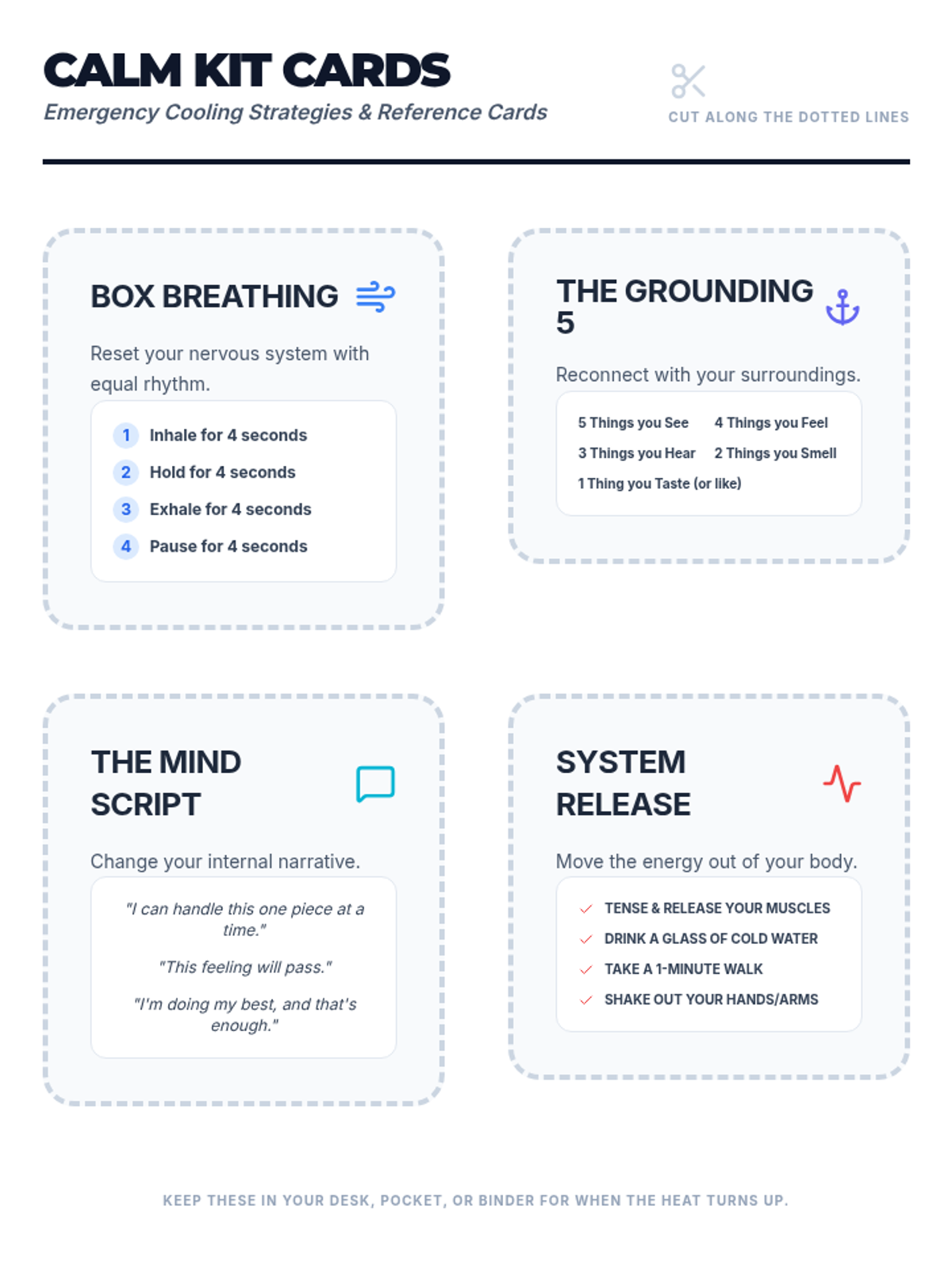
A set of four printable reference cards featuring quick coping techniques: Box Breathing, Grounding 5-4-3-2-1, Mind Scripts, and Physical System Releases.
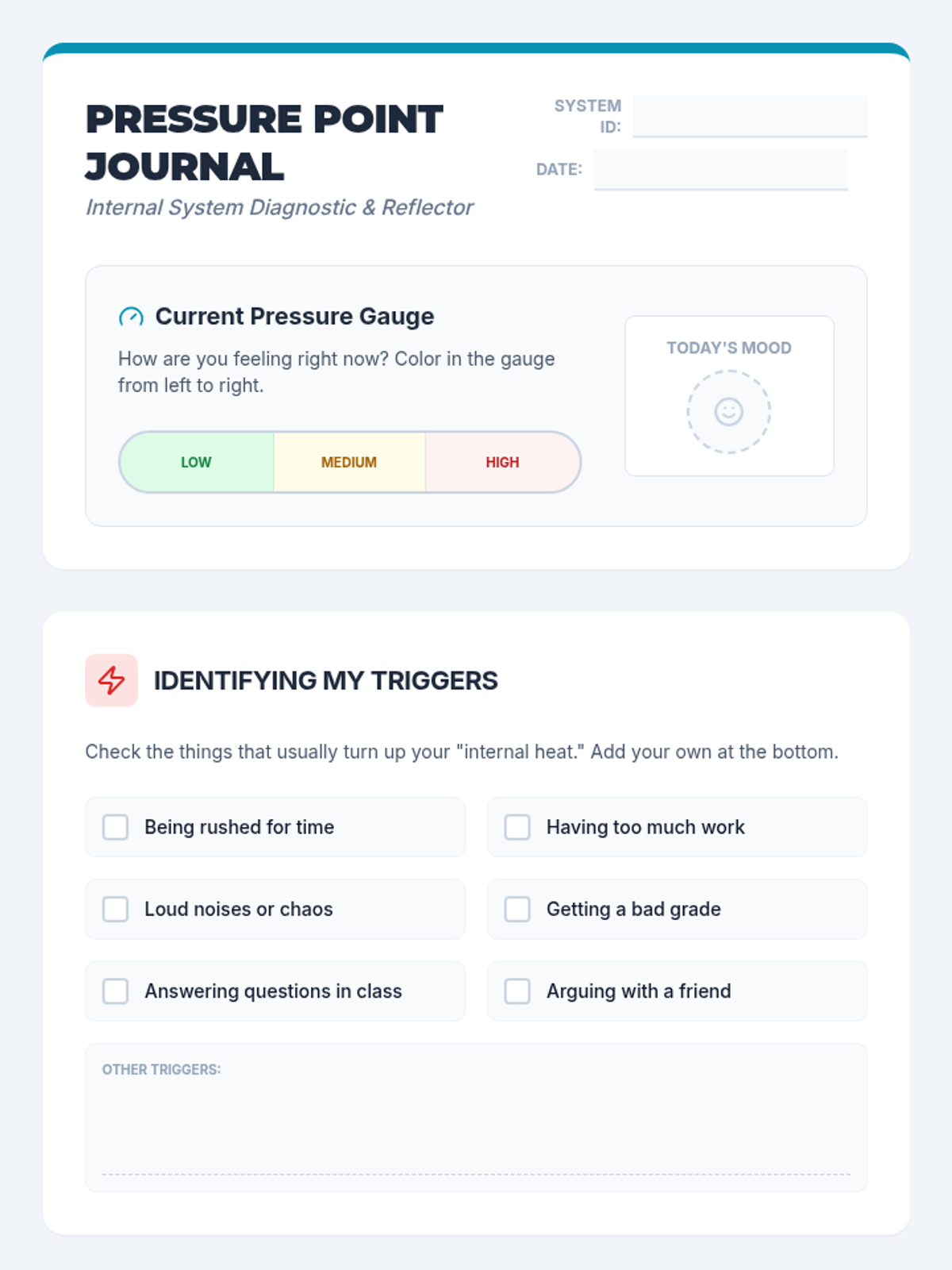
A self-reflection worksheet for students to identify their personal stress triggers, assess their current emotional state using a pressure gauge, and document their preferred coping strategies.
A slide presentation for a check-in session that guides students through identifying current stress levels, recognizing triggers, and reviewing coping techniques.
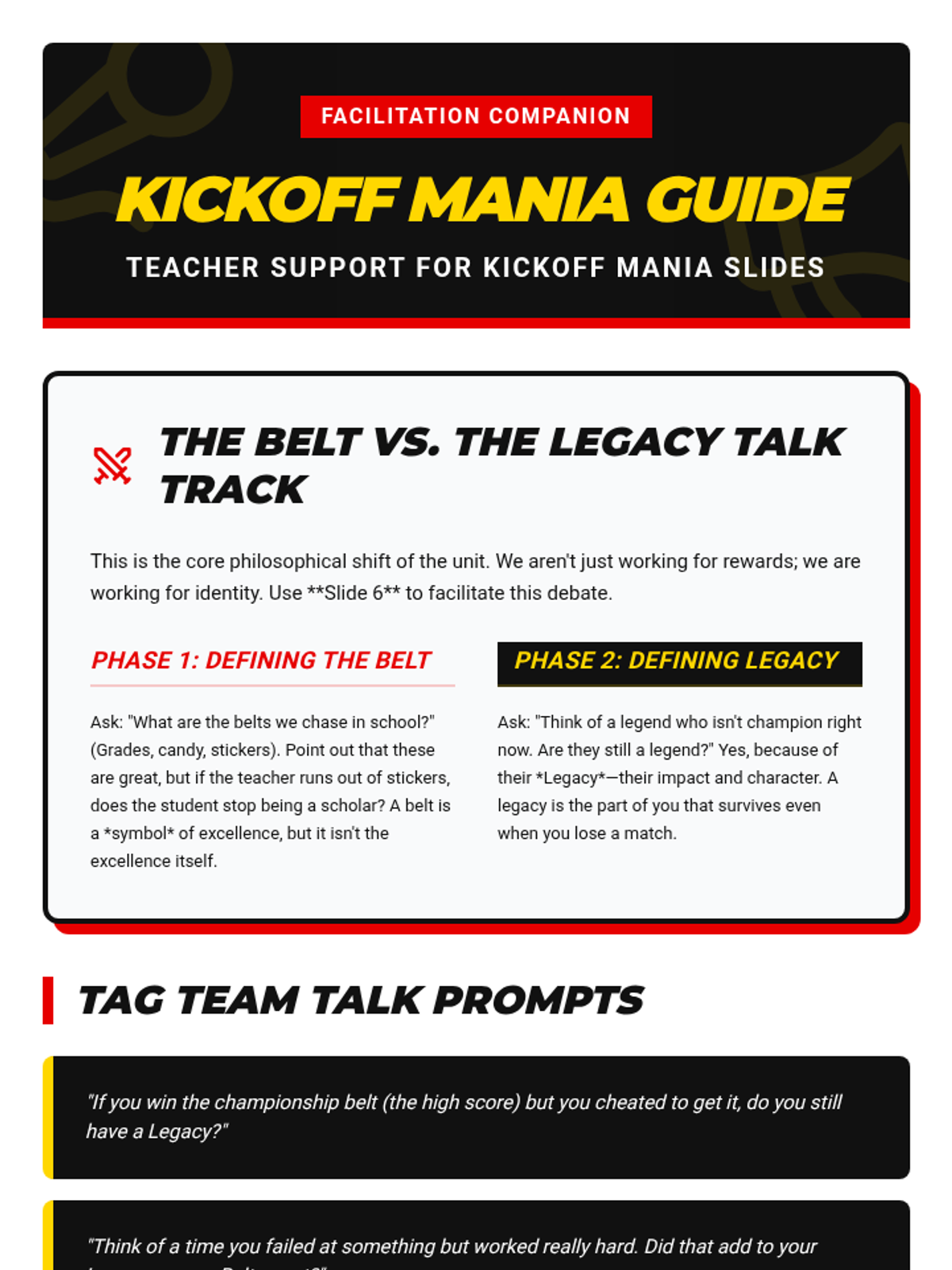
A detailed teacher facilitation companion for the Kickoff Mania slides, providing talk tracks for the 'Belt vs. Legacy' discussion, discussion prompts, and implementation steps for the Ubuntu mission.
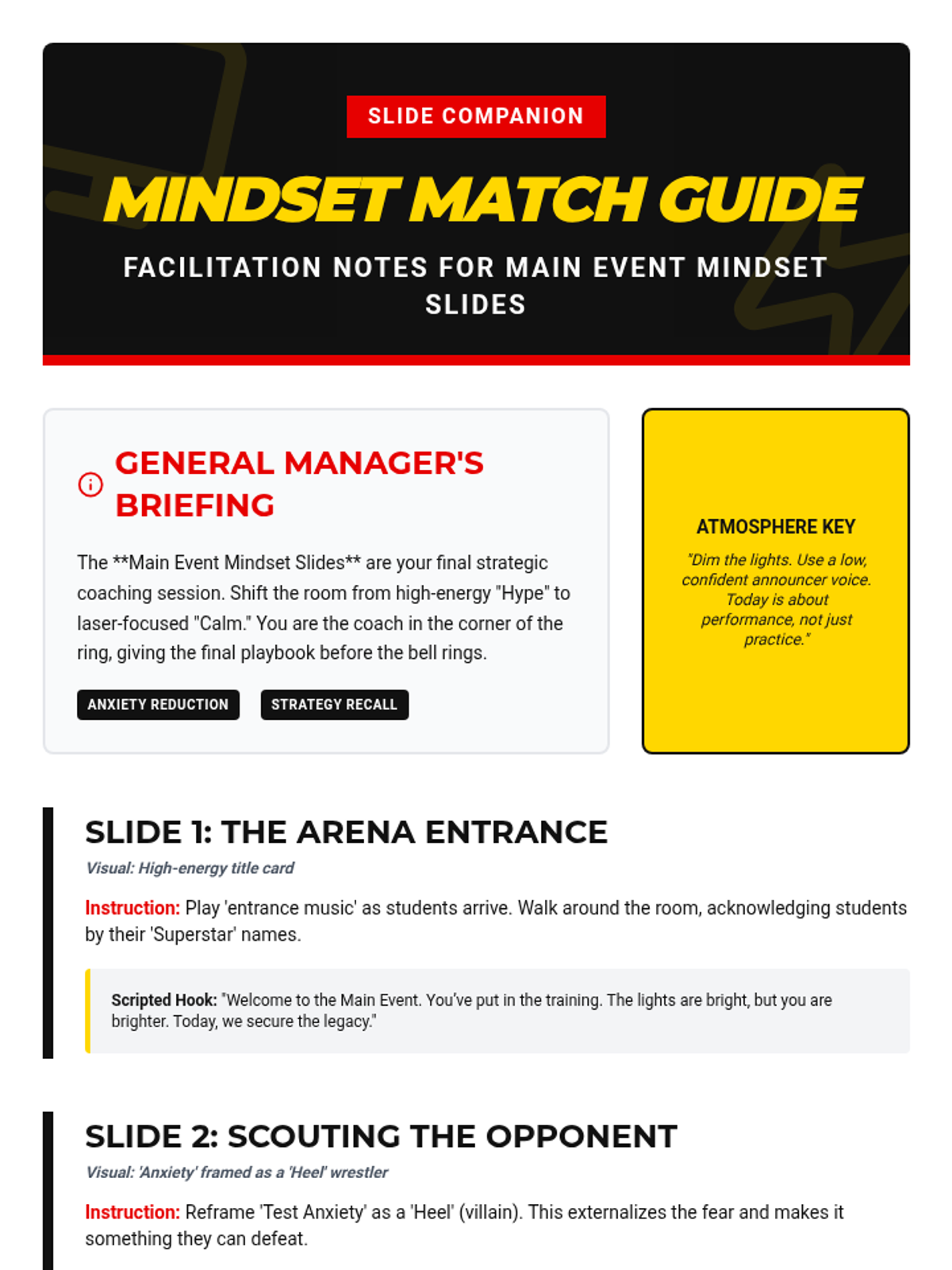
A teacher-facing companion guide for the 'Main Event Mindset' slides, providing slide-by-slide scripts, instructional instructions for managing test anxiety, and post-test decompression strategies.
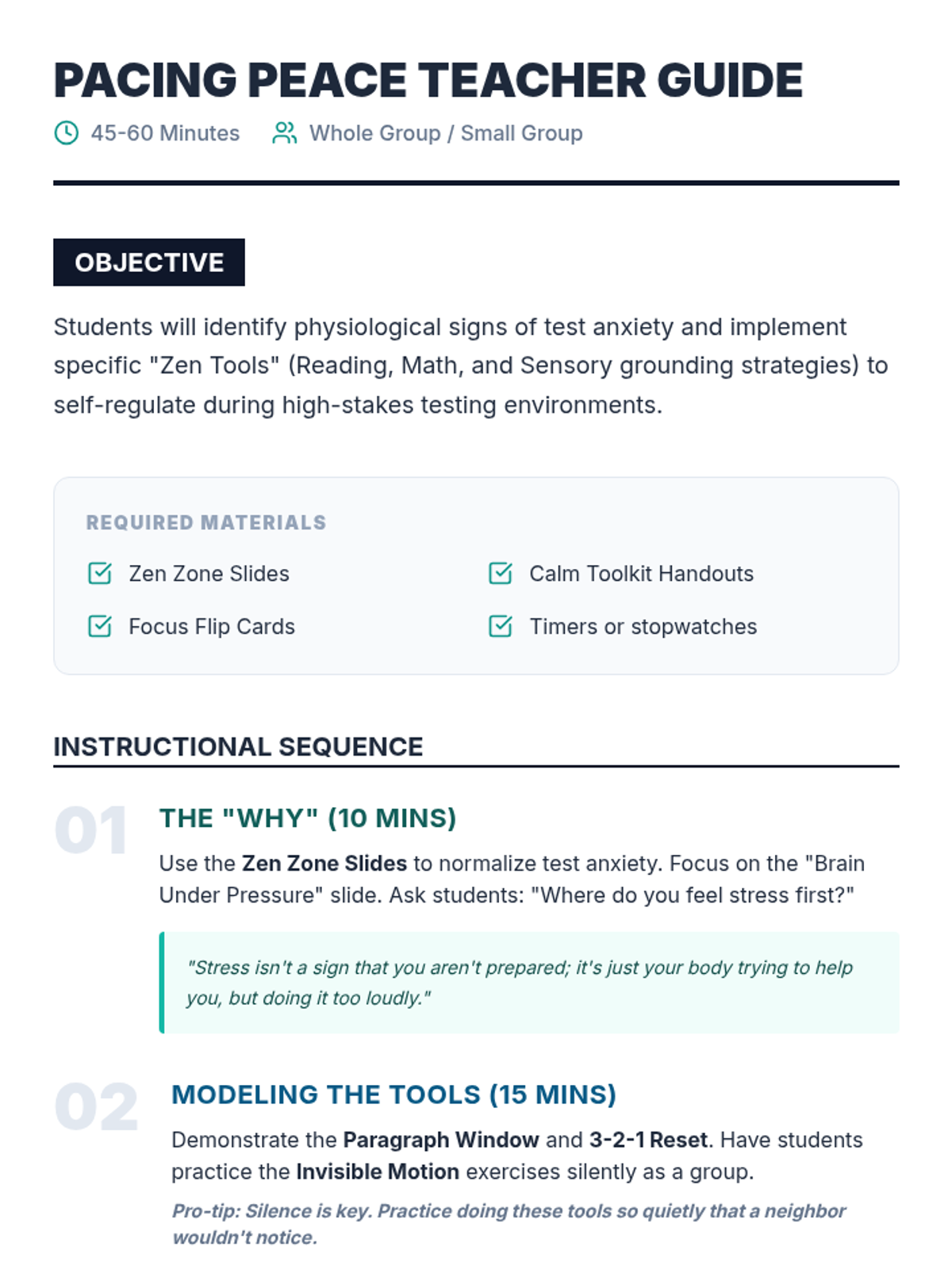
A comprehensive guide for teachers to facilitate the Test Zen lesson, including timing, instructional phases, modeling tips, and differentiation strategies for students with various needs.
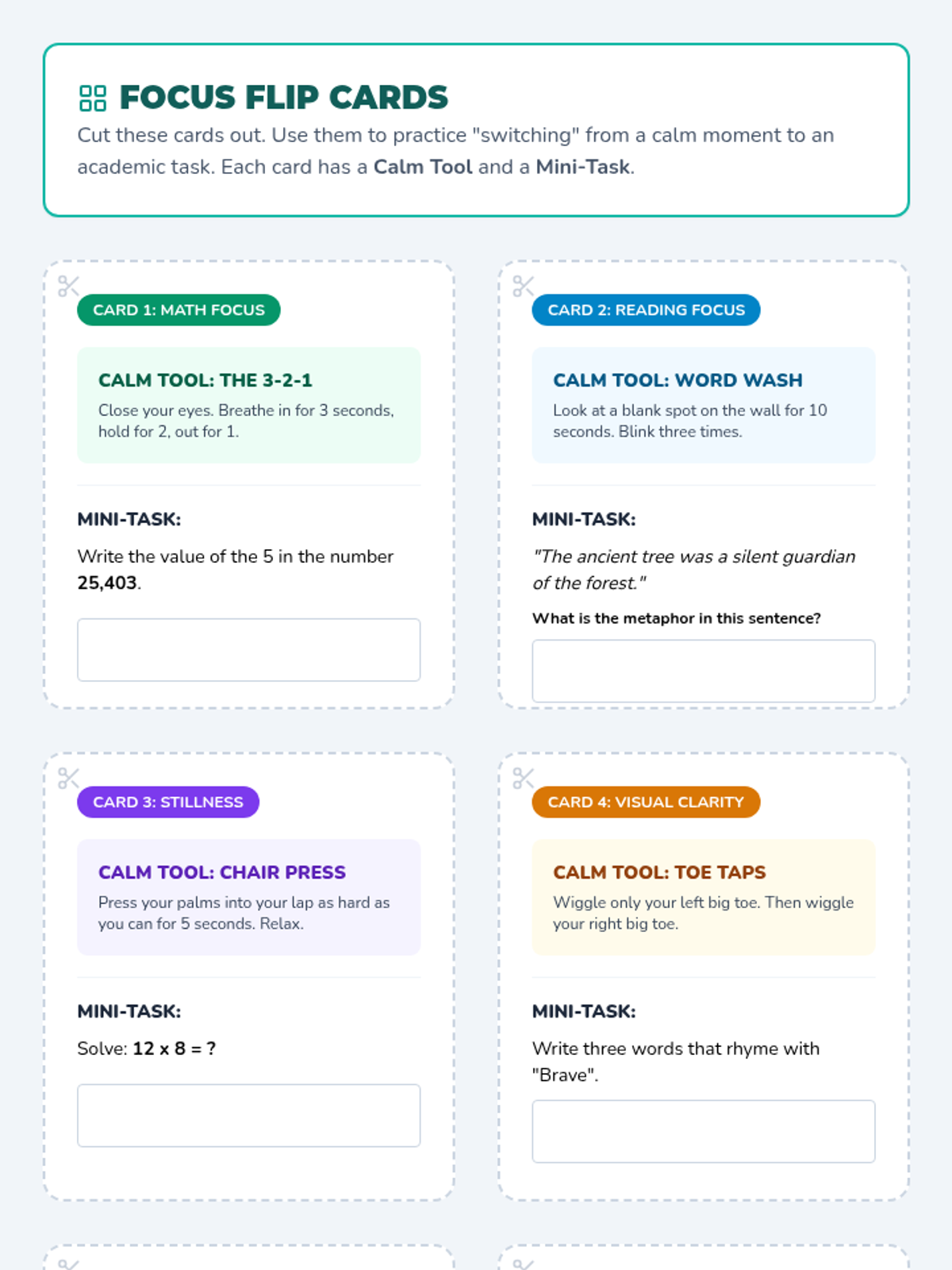
A set of printable task cards that guide students through a mindfulness exercise followed by a brief academic challenge, helping them practice the transition from anxiety to focused work.
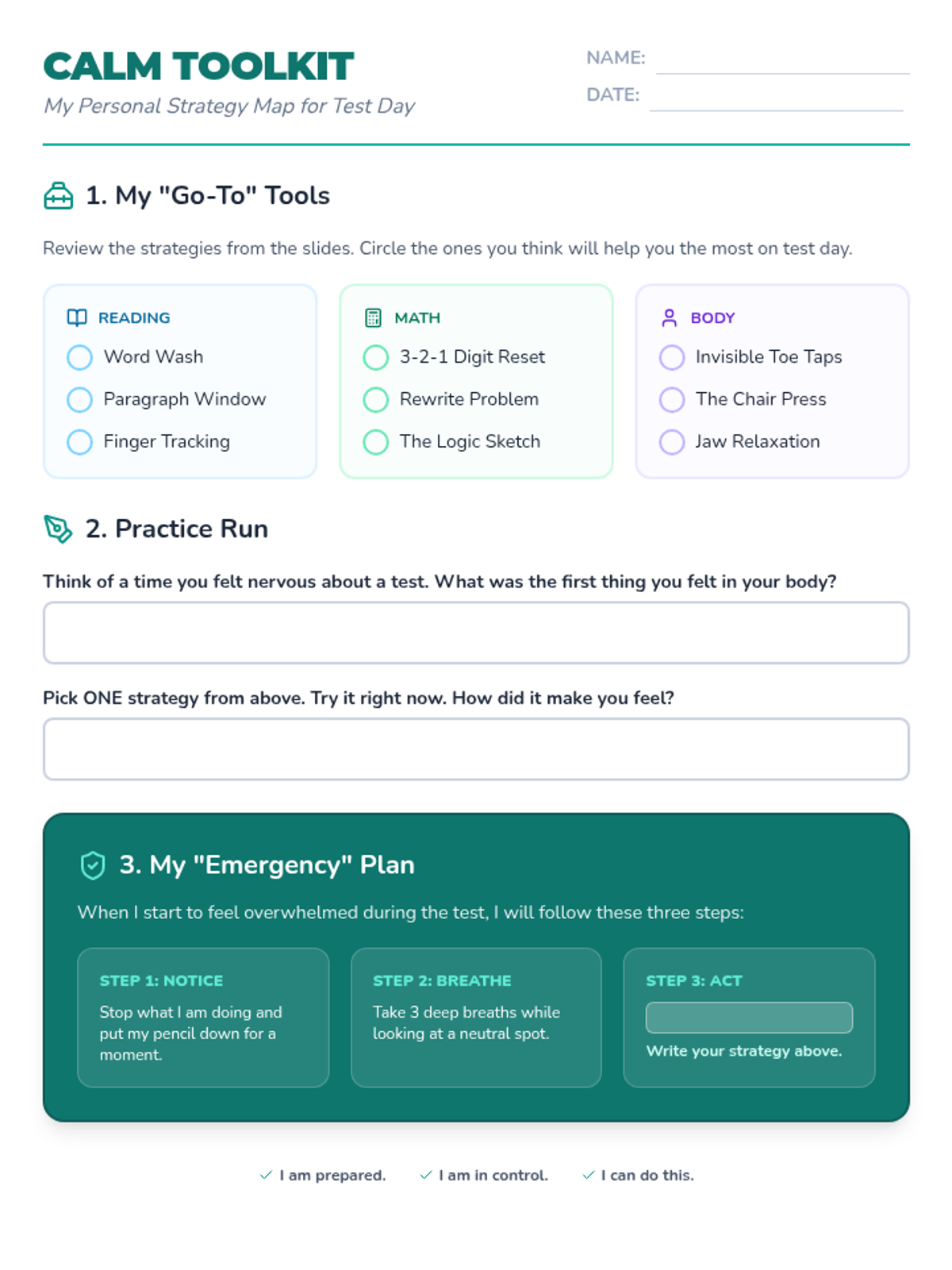
A student worksheet designed to help learners identify and commit to specific anxiety-reduction strategies for testing, including space for reflection and a personalized emergency action plan.
A visually calming slide deck introducing students to specific mindfulness and grounding techniques for testing situations, including strategies for Reading, Math, and physical restlessness.
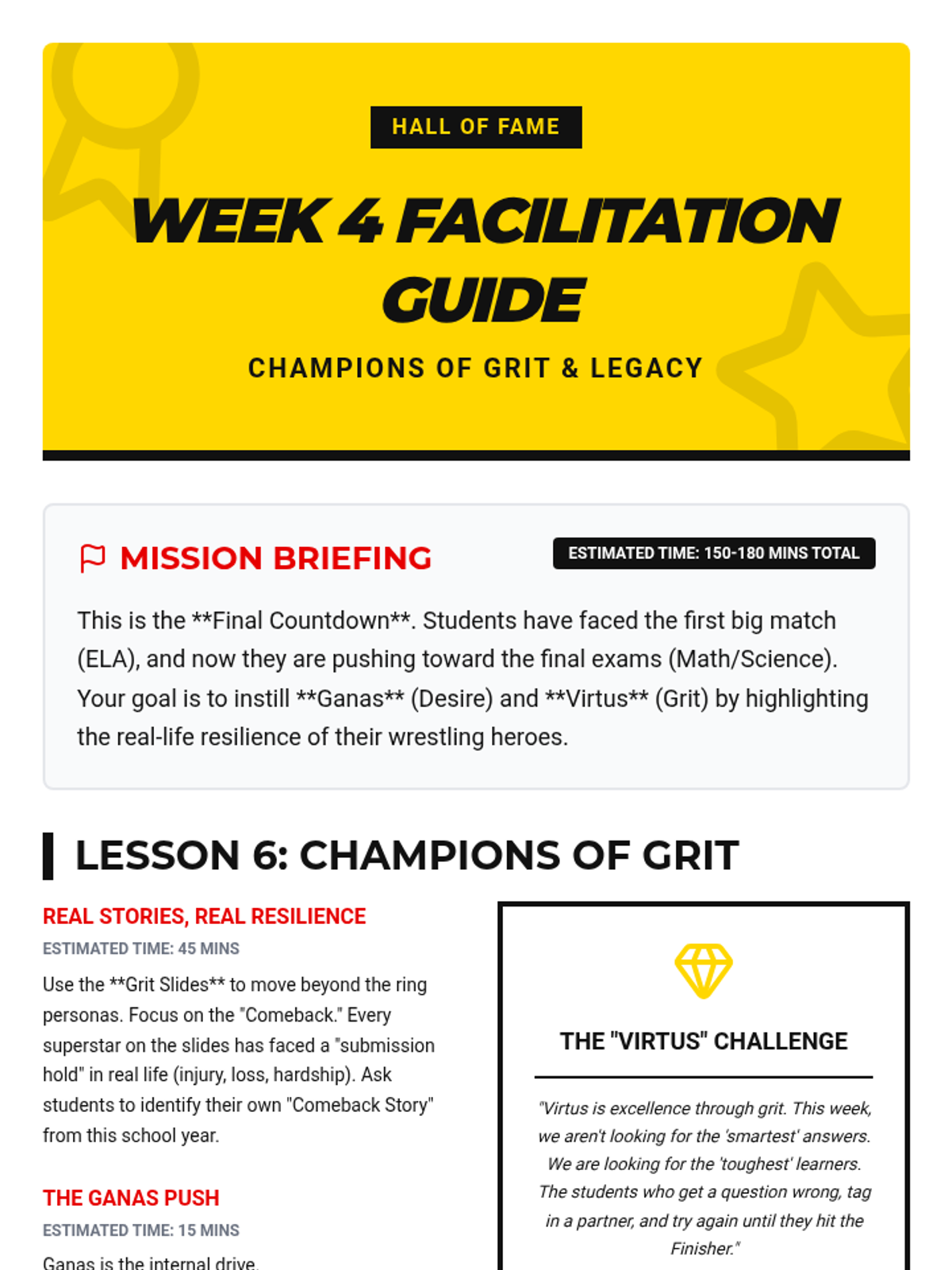
A detailed teacher facilitation guide for Week 4 of the 'Road to State Exam Mania' sequence, focusing on Ganas (drive) and Virtus (grit) for the final exam push and the 'Mania Gala' unit wrap-up.
A final consolidated student worksheet that fits perfectly on one page, featuring balanced reframing boxes and darkened grounding lines.
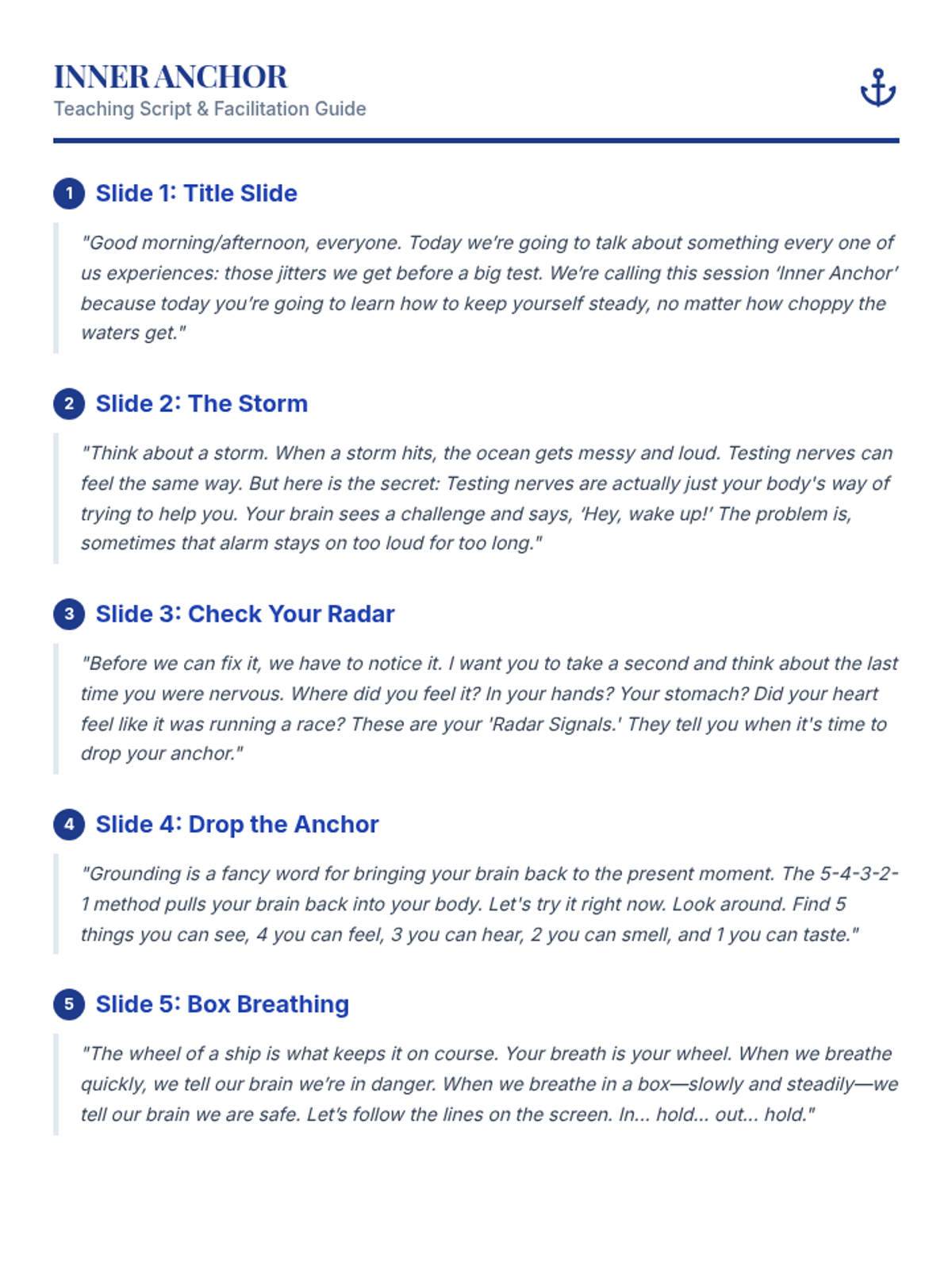
A revised teaching script consolidated into two pages with headers repeated on each page for professional consistency and no awkward splits.
A finalized slide deck with polished text rotation for breathing exercises and improved quote layout.
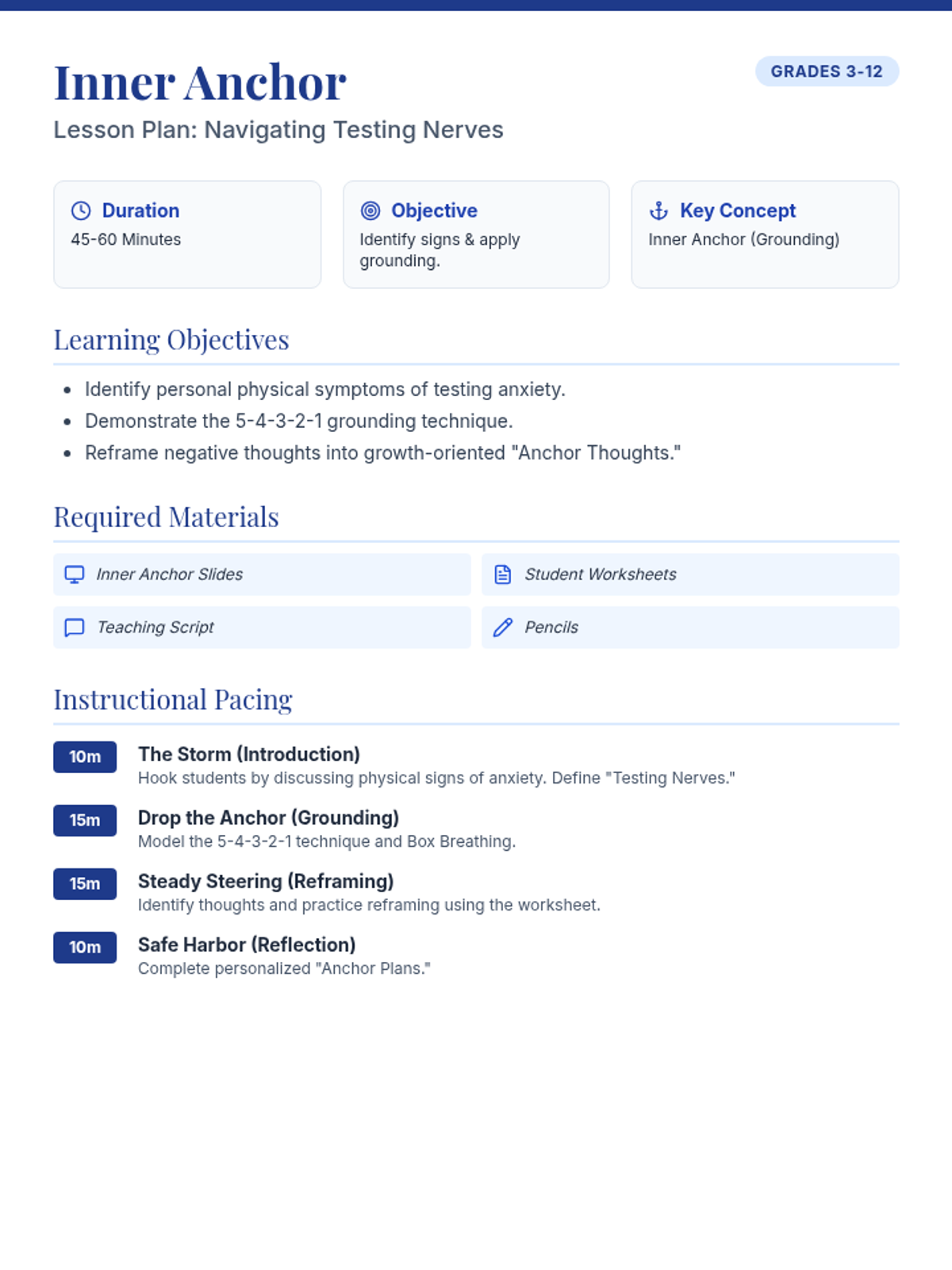
A revised lesson plan for teachers, consolidated into two pages to avoid awkward breaks and improve readability.
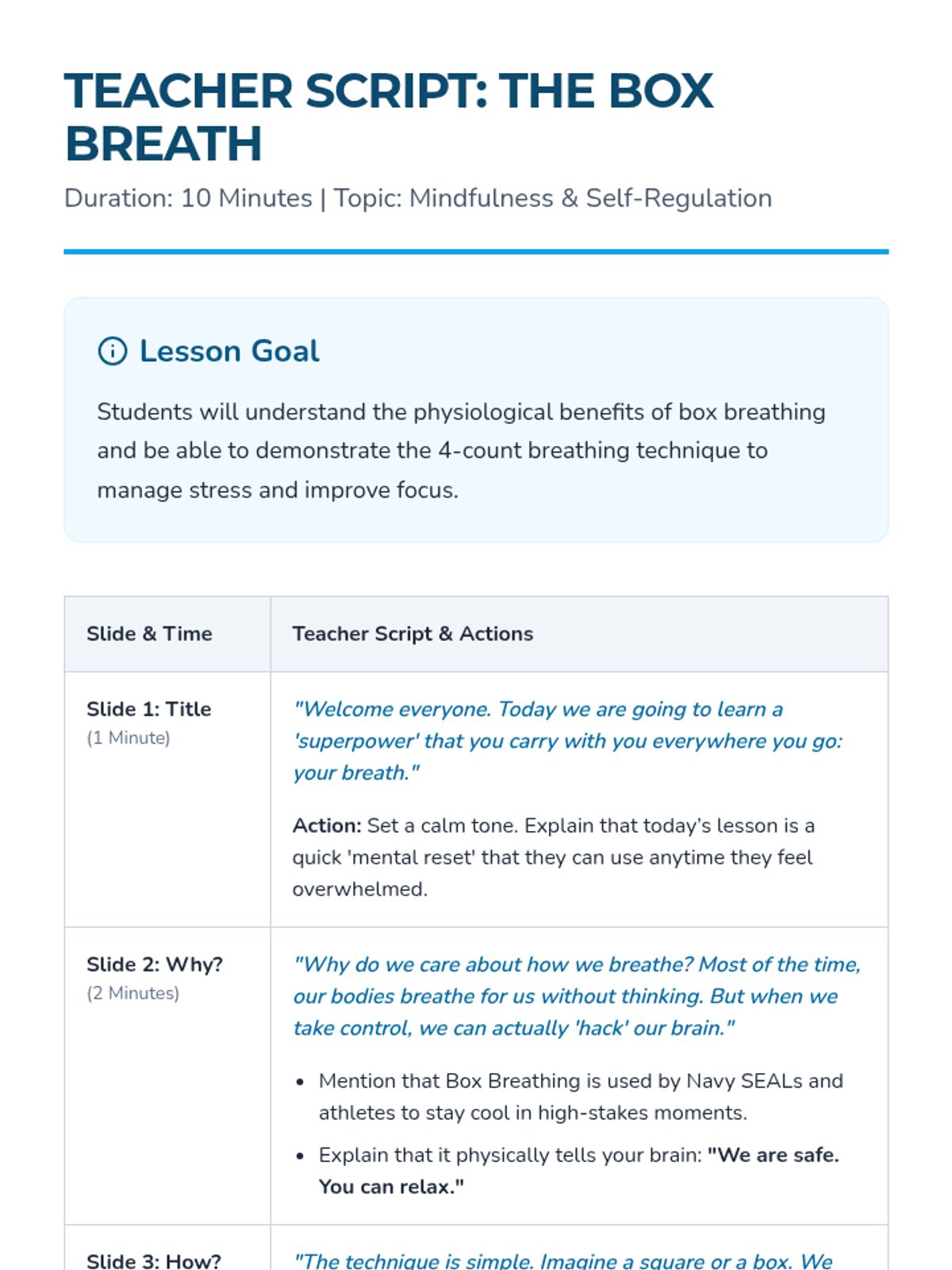
A comprehensive teacher script and facilitation guide for a 10-minute box breathing lesson, including pacing, slide-by-slide scripts, and discussion prompts. Revised for better page breaks and includes the video reference.
A 6-slide presentation covering the benefits, technique, and practice of box breathing, including a guided YouTube video. Revised for better contrast and label positioning.
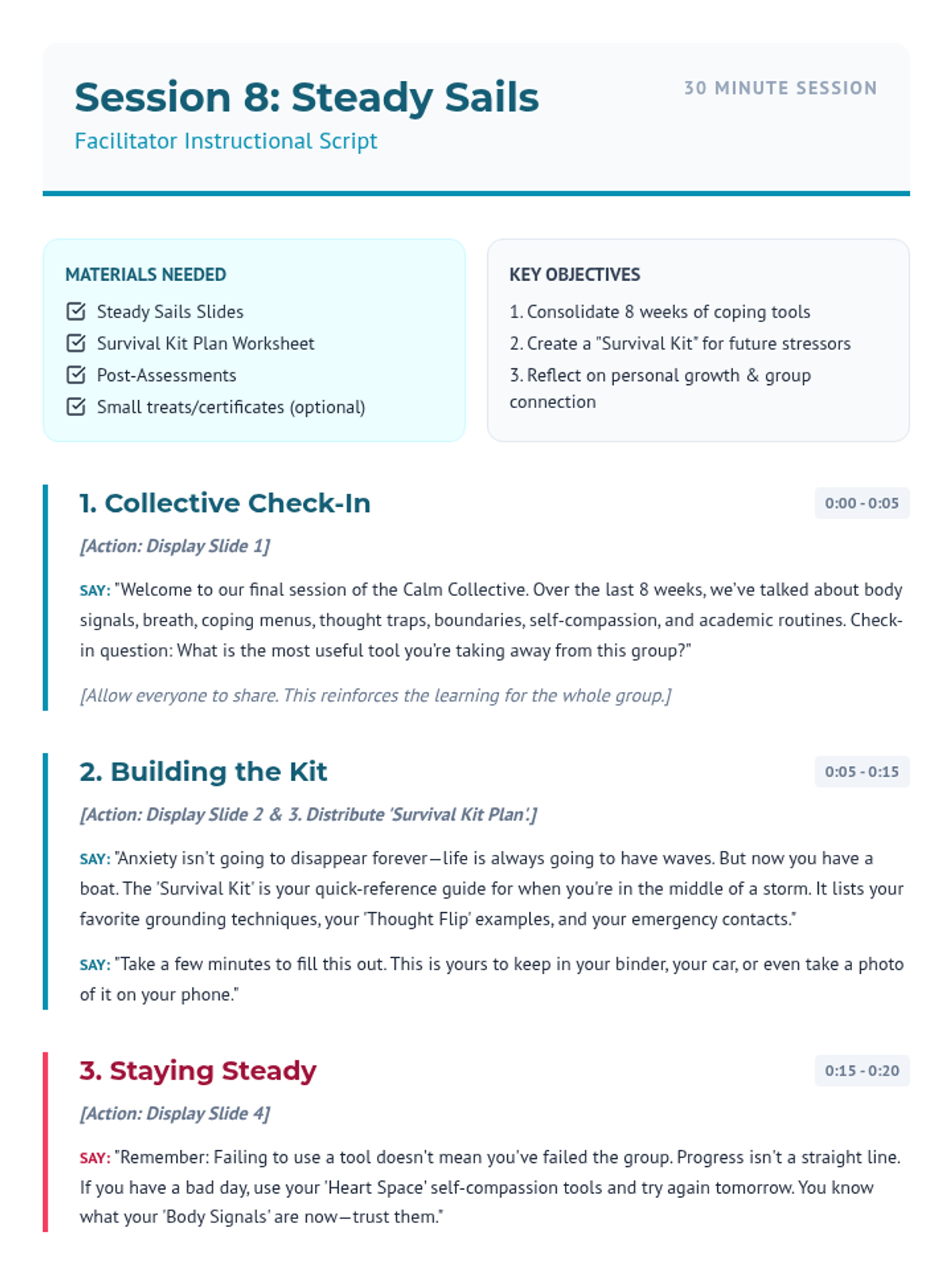
A detailed facilitation script for the final session of the Calm Collective, providing time-stamped sections, "what to say" prompts, and "what to do" instructions for the counselor. Focuses on consolidation and the "Survival Kit."
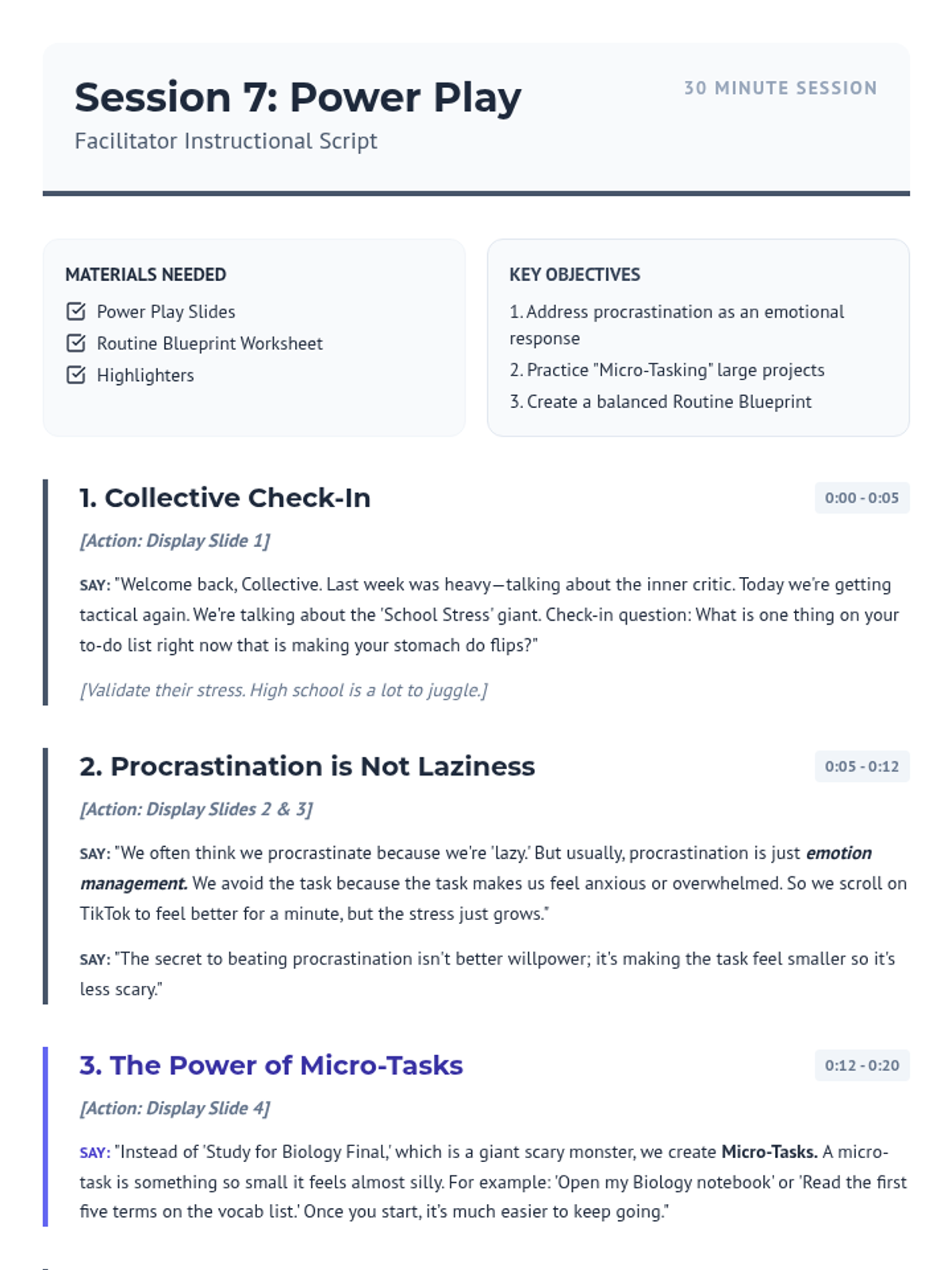
A detailed facilitation script for the seventh session of the Calm Collective, focusing on academic stress management, time-blocking, and overcoming procrastination.
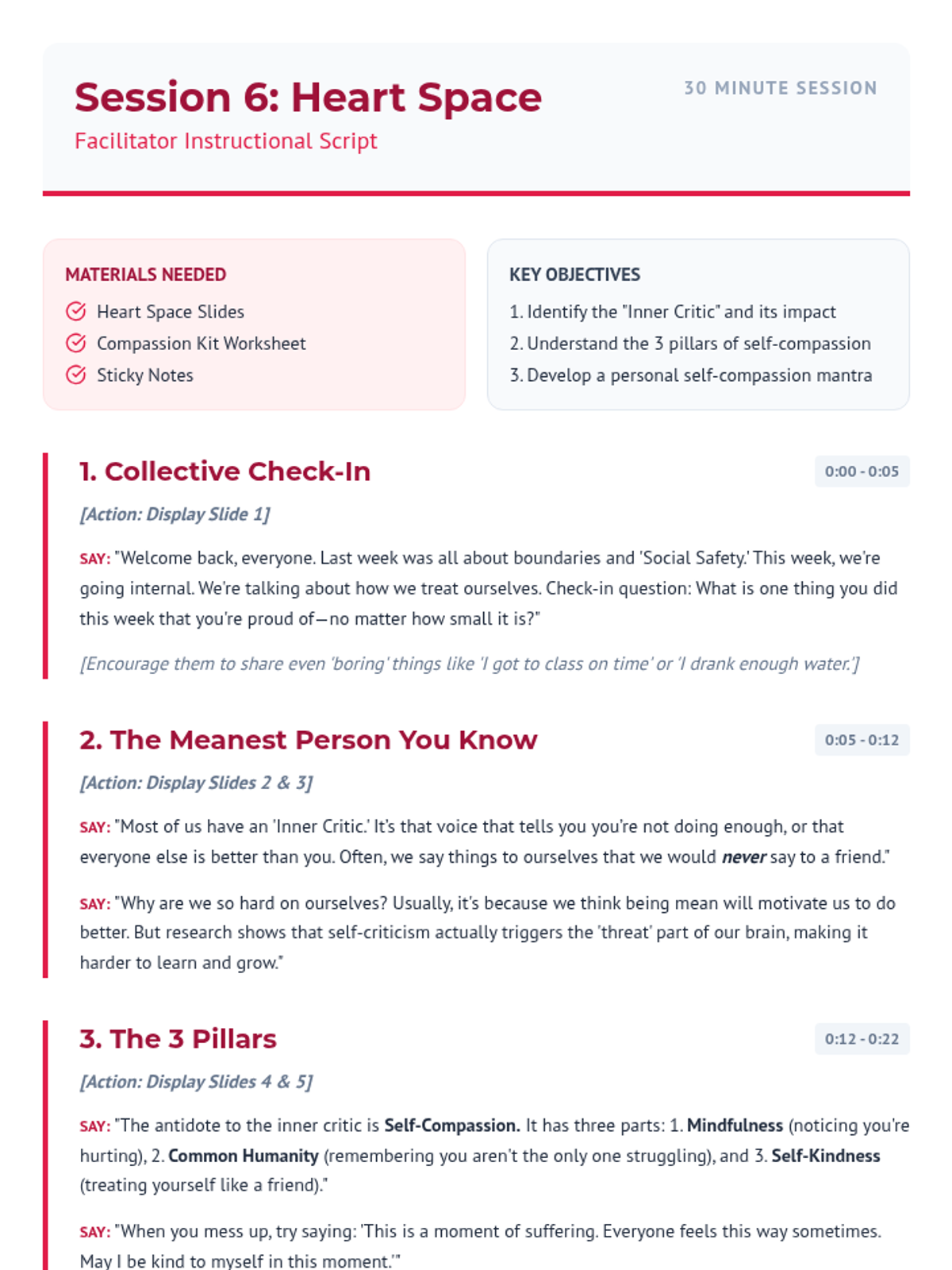
A detailed facilitation script for the sixth session of the Calm Collective, addressing perfectionism, the inner critic, and self-compassion. Fixed icon rendering and page breaks.
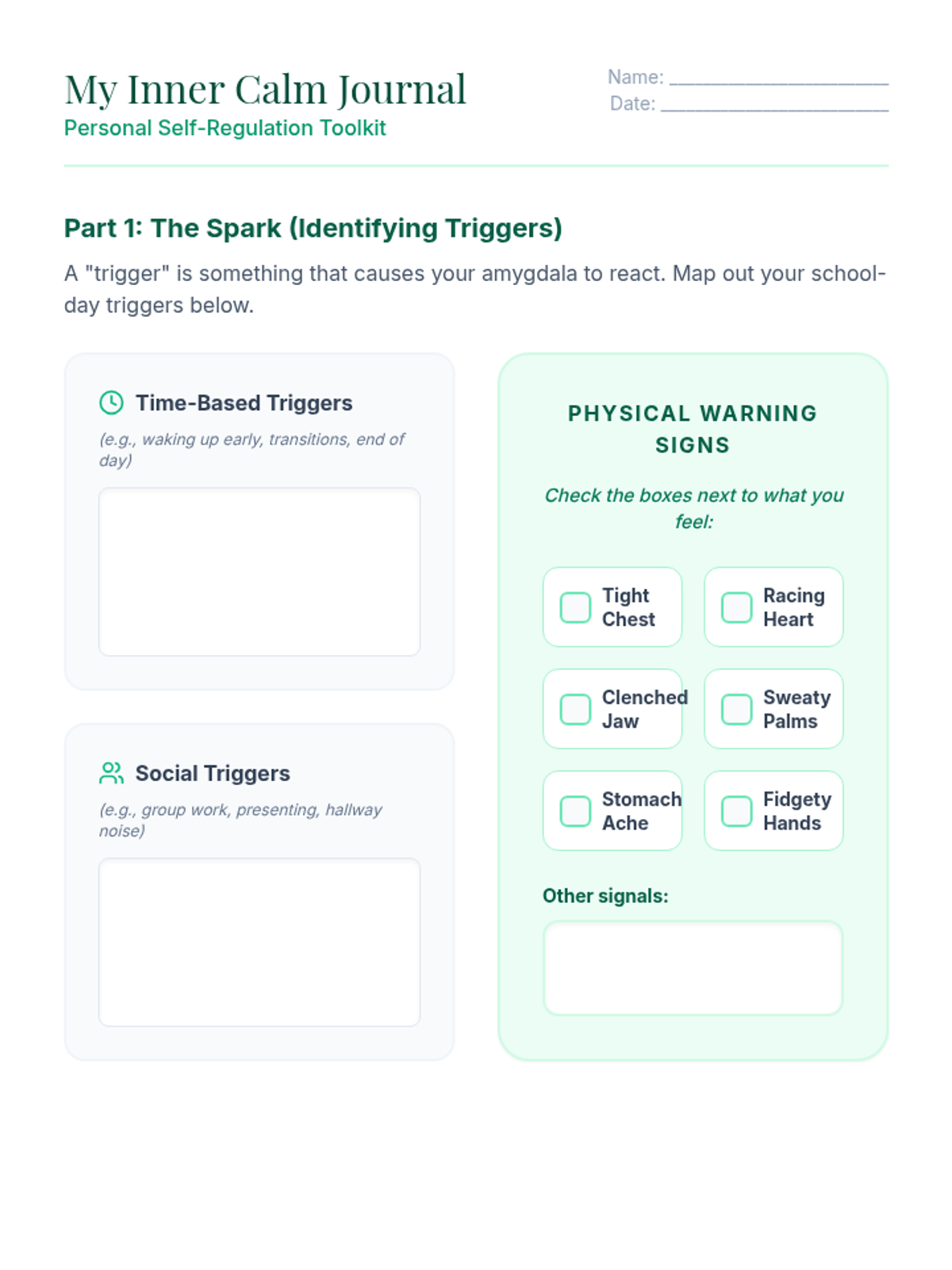
A student journal for identifying personal triggers, reflecting on mindfulness station activities, and documenting a personalized self-regulation toolkit.
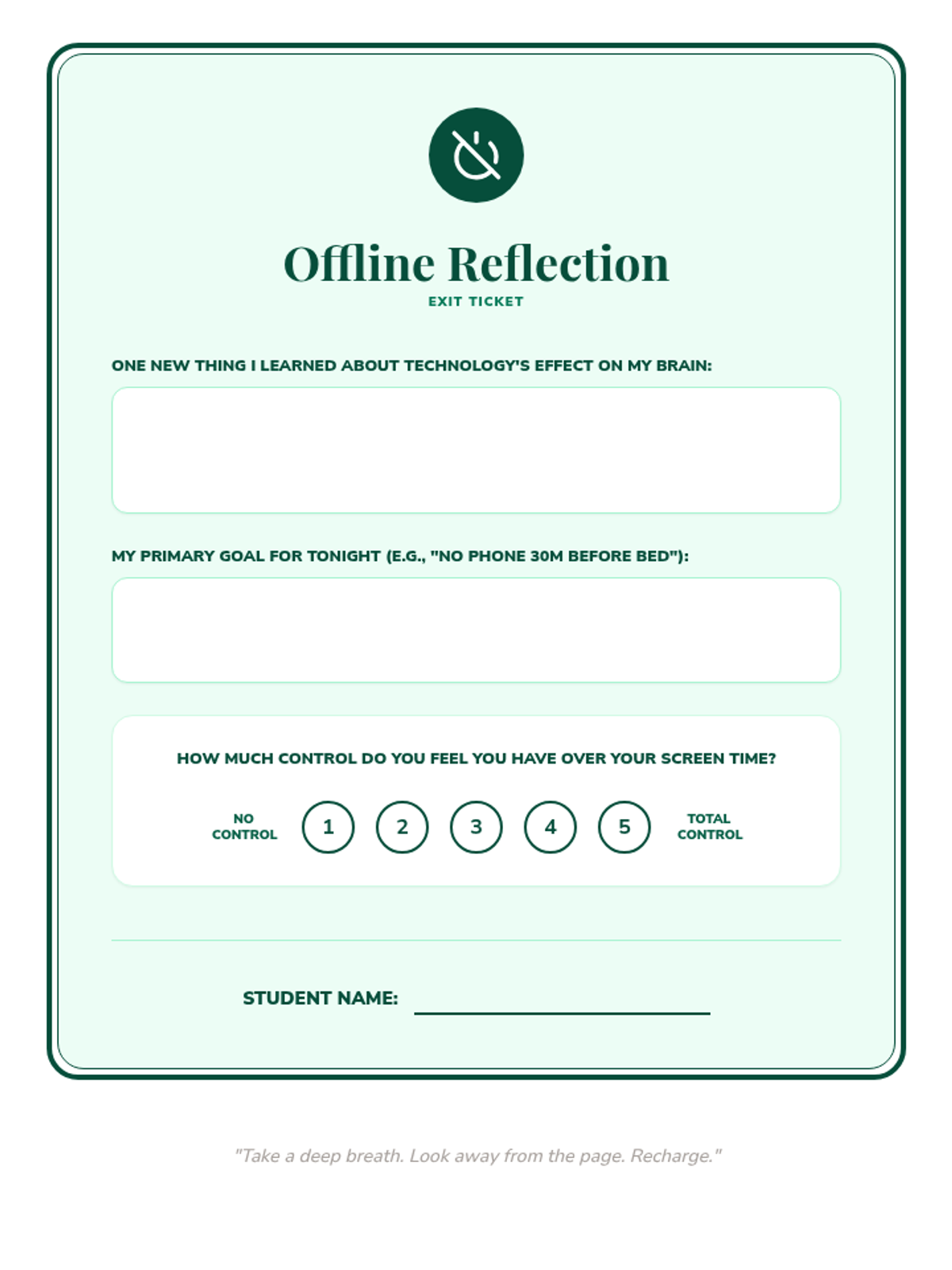
A post-lesson reflection tool for students to articulate their learning and state an immediate goal for their digital habits.
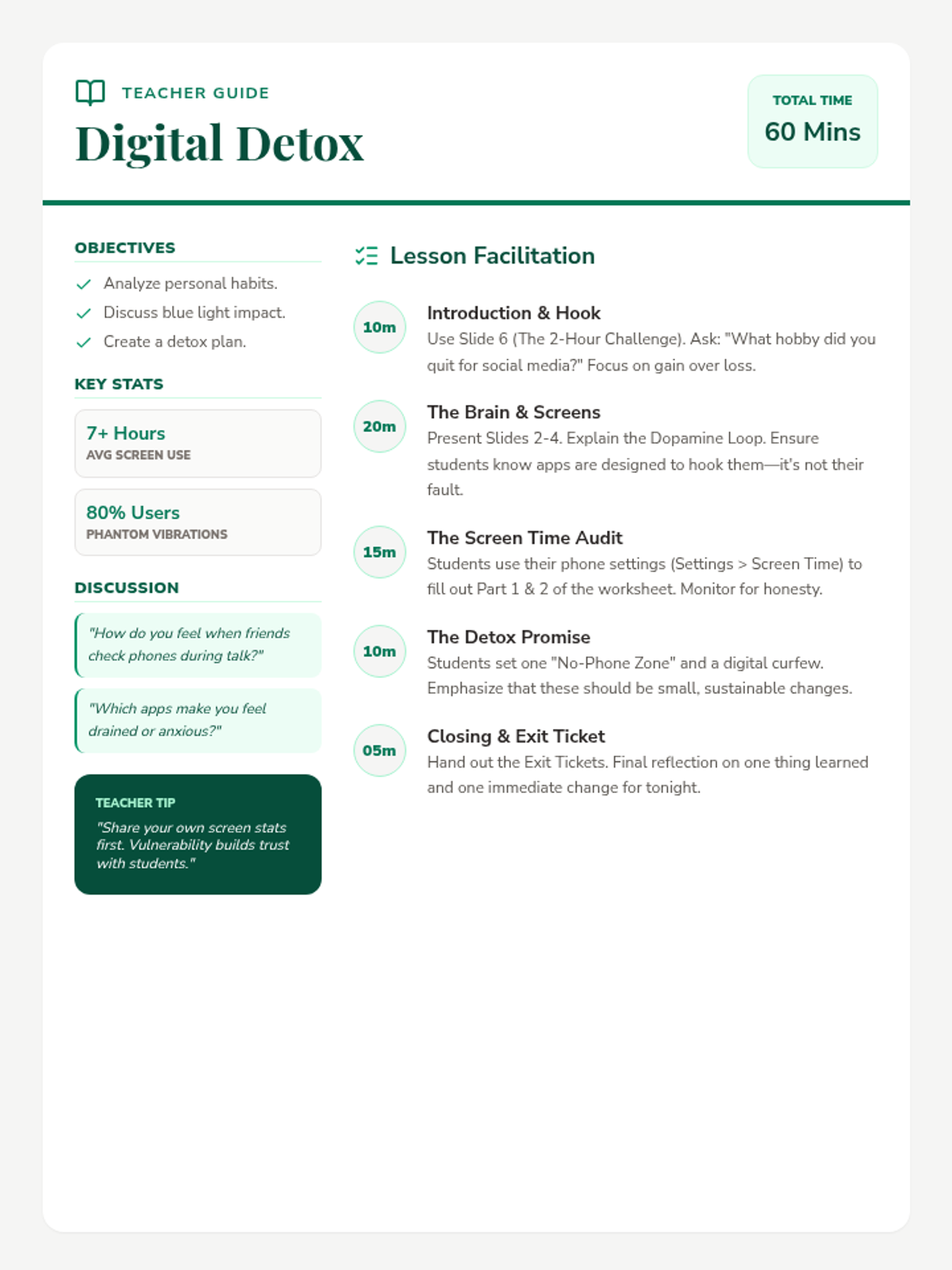
A comprehensive guide for teachers to facilitate the Digital Detox lesson, including pacing, background statistics, and discussion prompts.
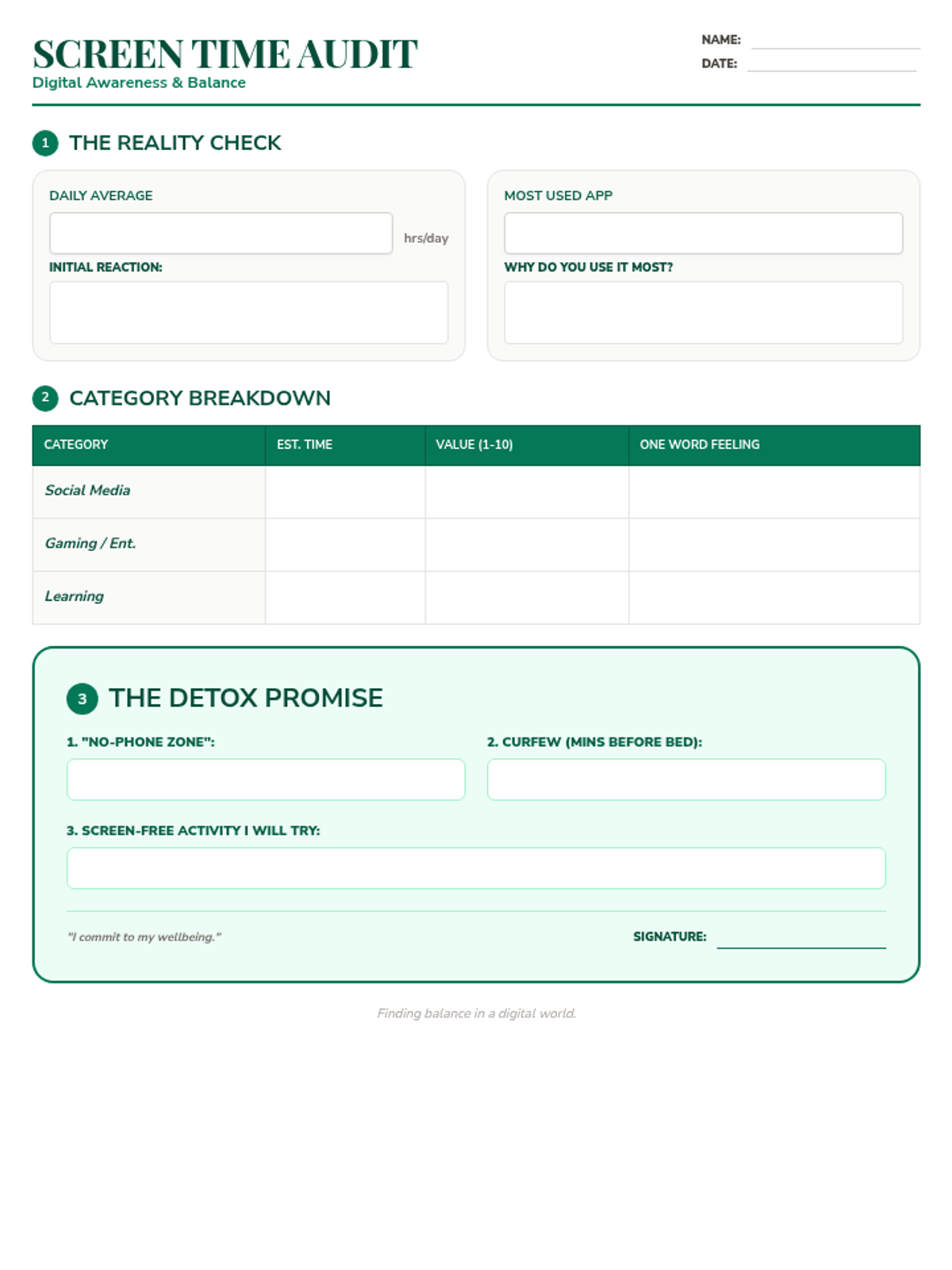
A structured worksheet for students to audit their current screen time habits and commit to specific, manageable goals for a digital detox.
A visually engaging presentation about the impact of screen time on the brain, the benefits of unplugging, and practical strategies for a digital detox.
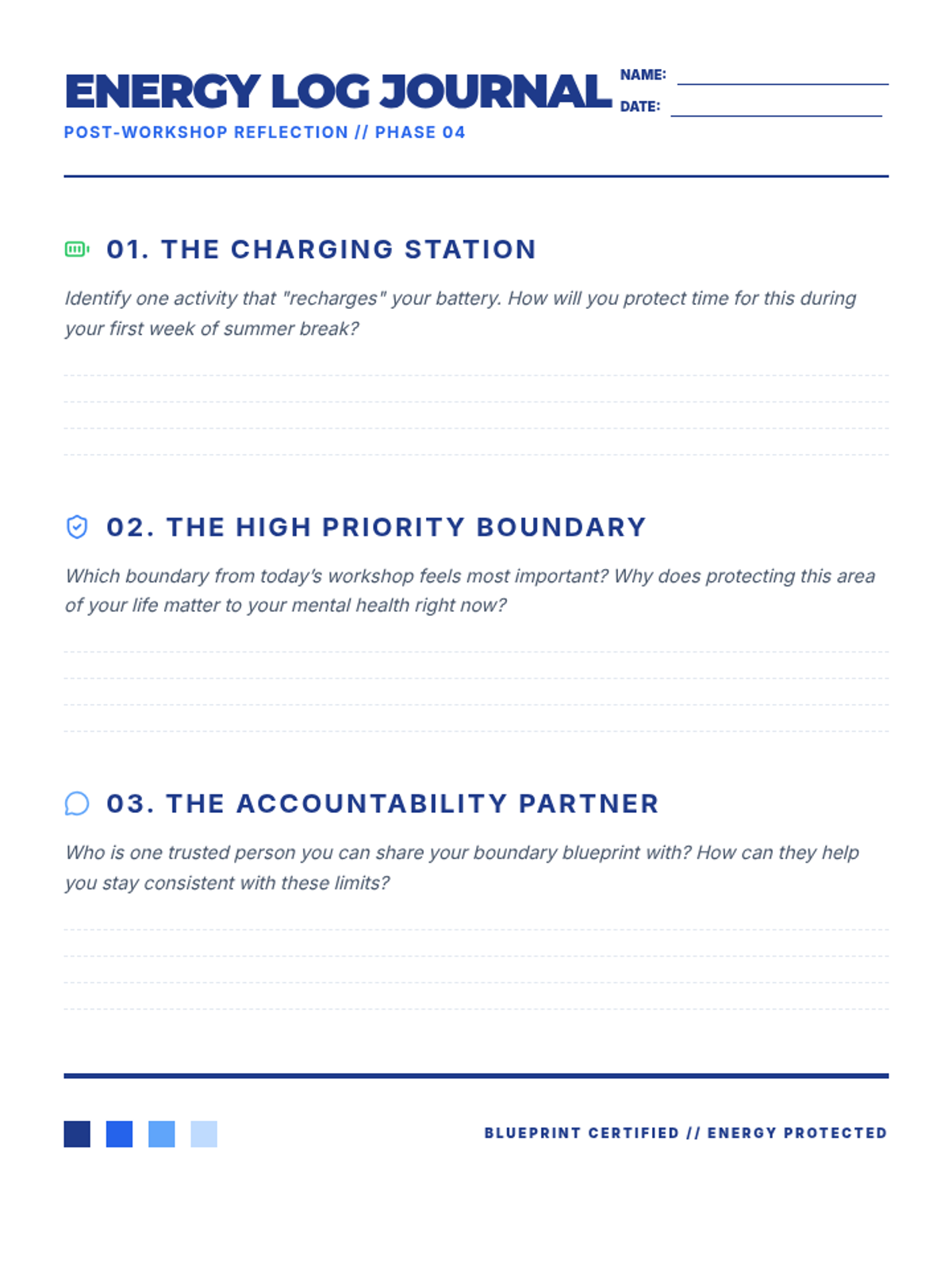
A reflection journal for students to solidify their boundary plans and identify personal recharge strategies after the workshop.
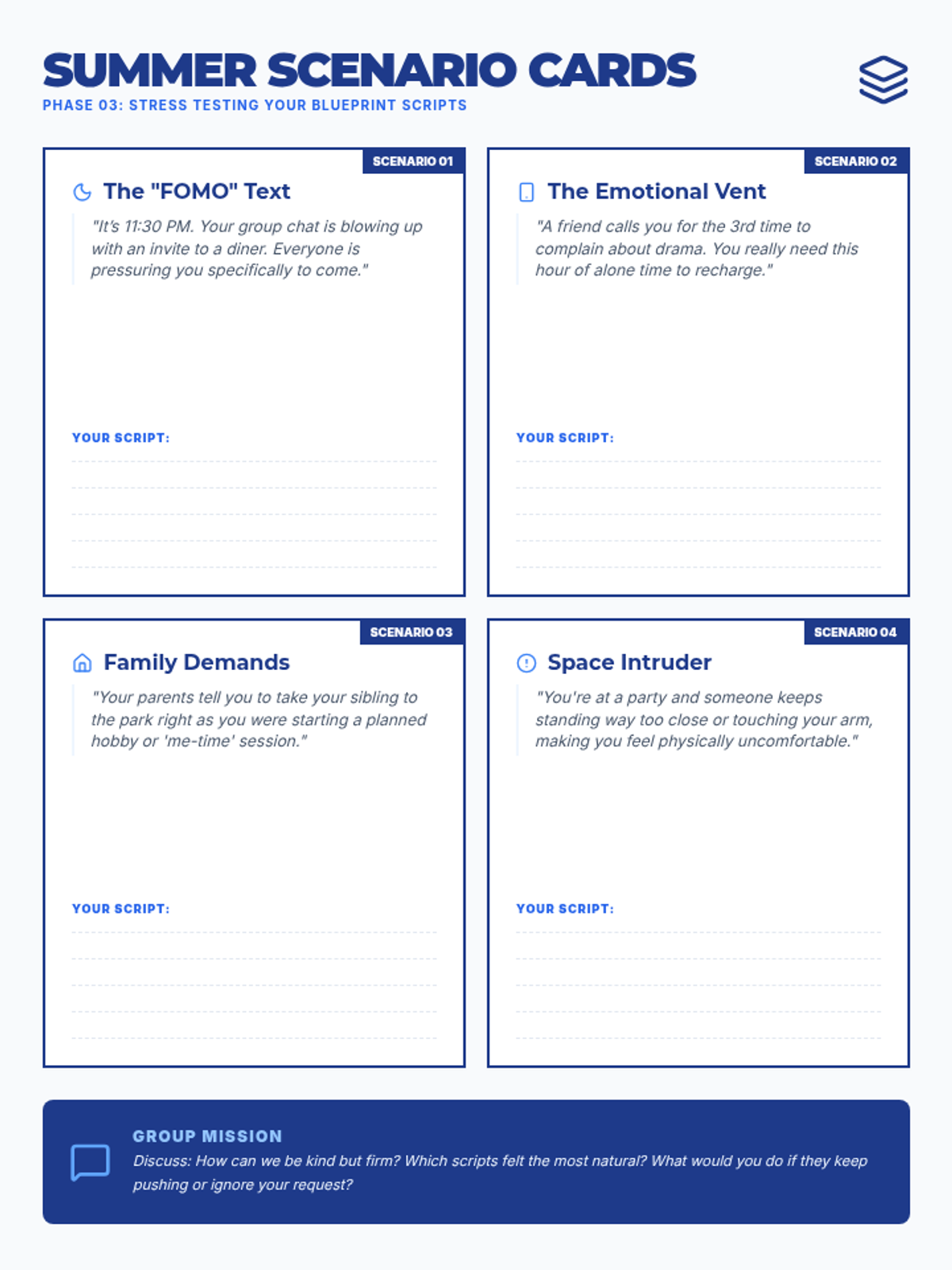
A set of task cards featuring realistic summer scenarios for students to practice applying boundary-setting scripts in small groups.
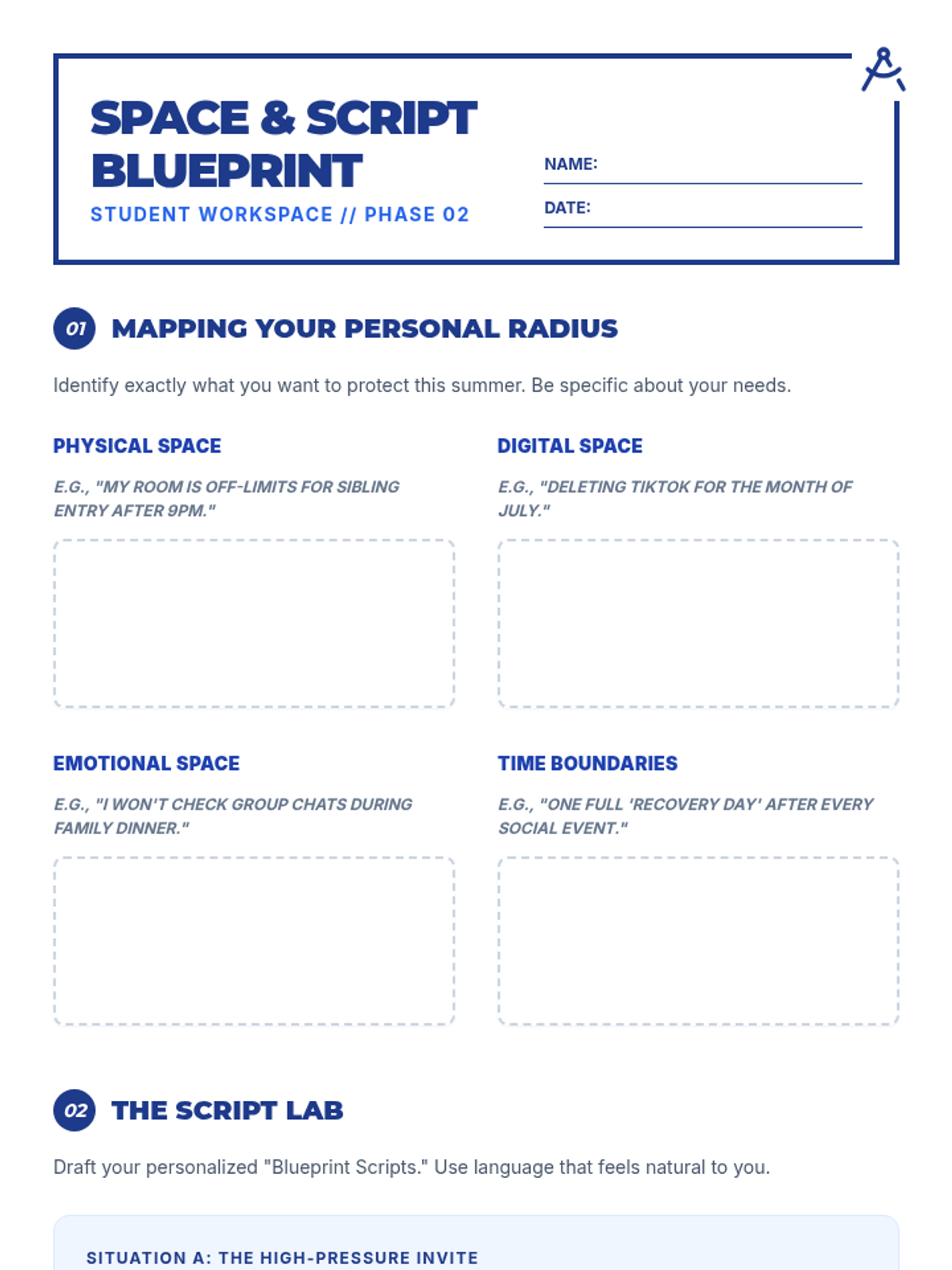
A worksheet for students to map out their physical, digital, and emotional boundaries and draft personalized scripts for challenging summer scenarios.
A dynamic slide deck for the Boundary Blueprint workshop, featuring visuals on mental energy, types of boundaries, and communication scripts.
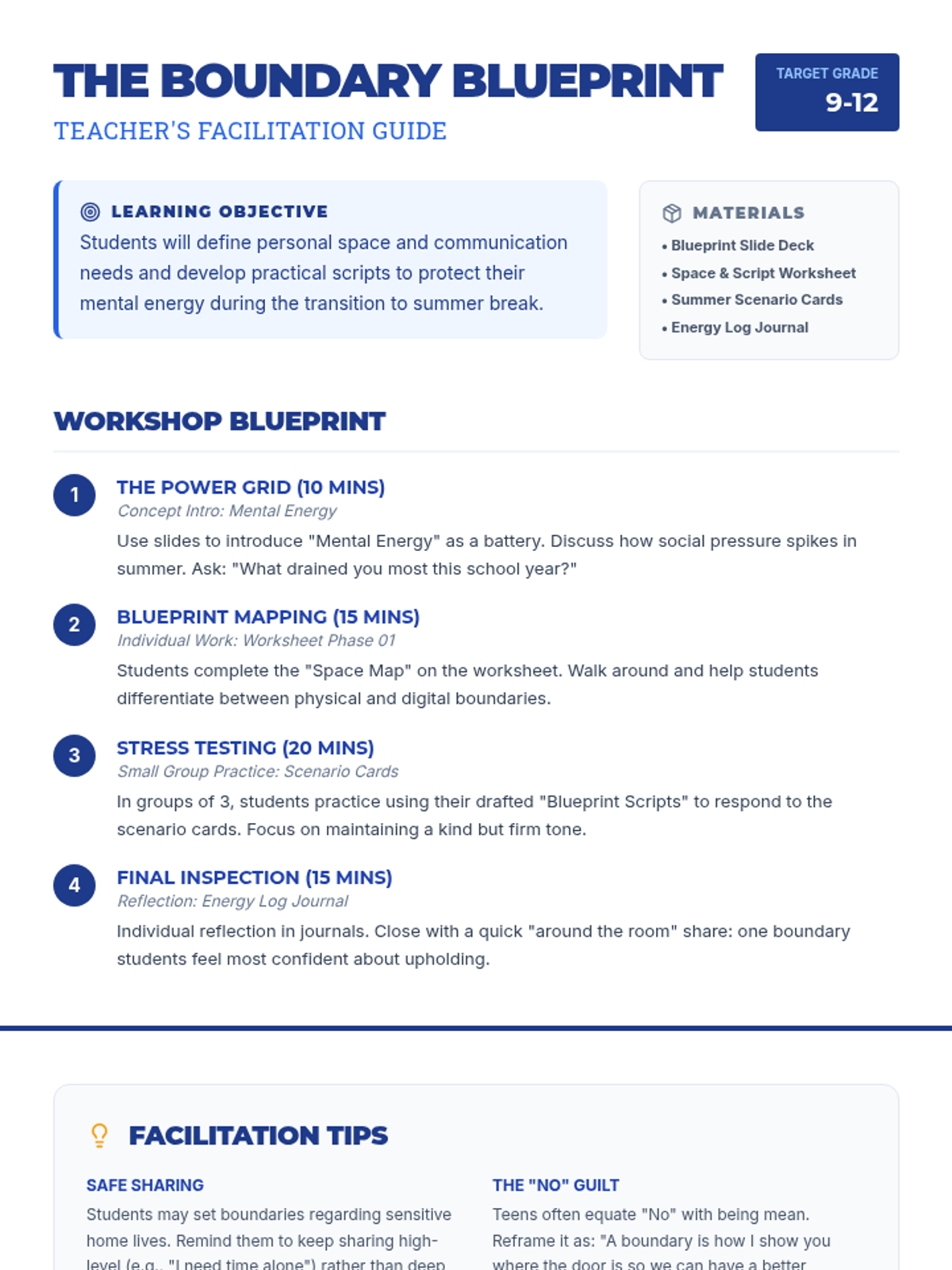
A detailed teacher's guide for facilitating the Boundary Blueprint workshop, including timeline, facilitation tips, and discussion prompts.
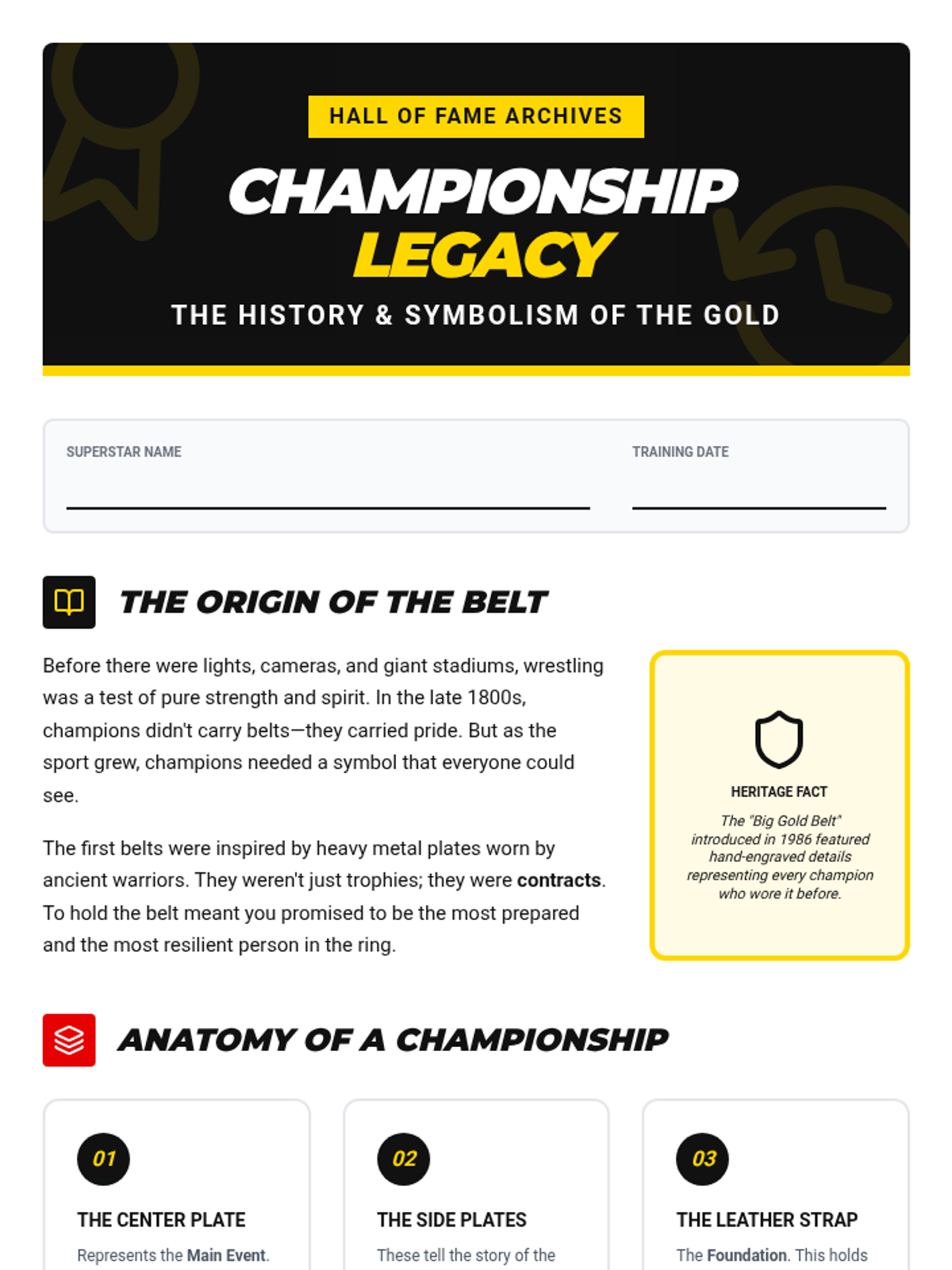
A student-facing reading and activity sheet exploring the history of wrestling championship belts, their symbolism, and how students can build their own academic legacy.
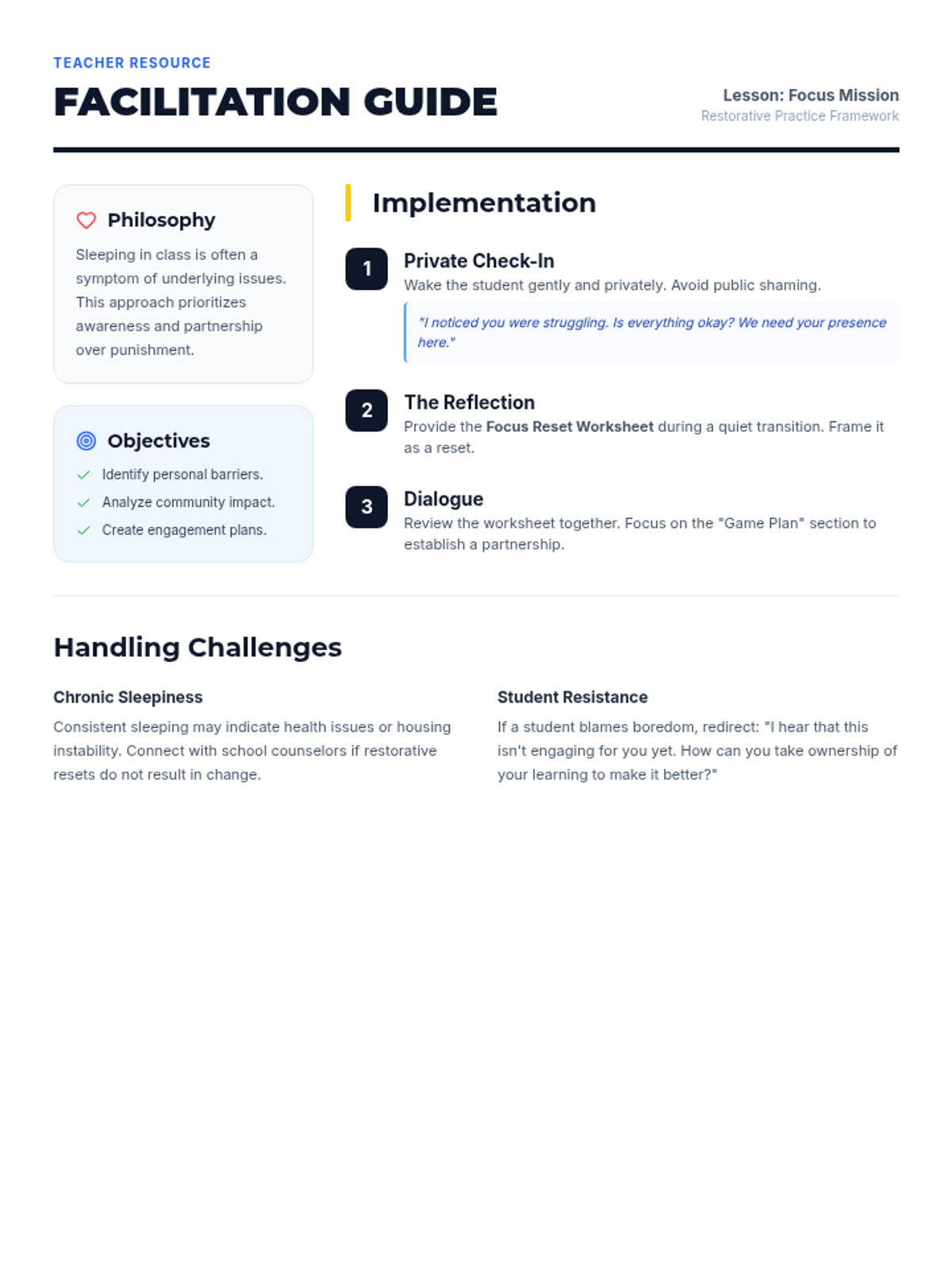
A teacher facilitation guide providing restorative strategies and instructional prompts for addressing classroom sleepiness and using the Focus Mission materials effectively.
A slide deck for the 'Opportunity Cost Simulation' lesson, explaining the core economic concept of opportunity cost using relatable 8th-grade scenarios and RPG-style choice mechanics.
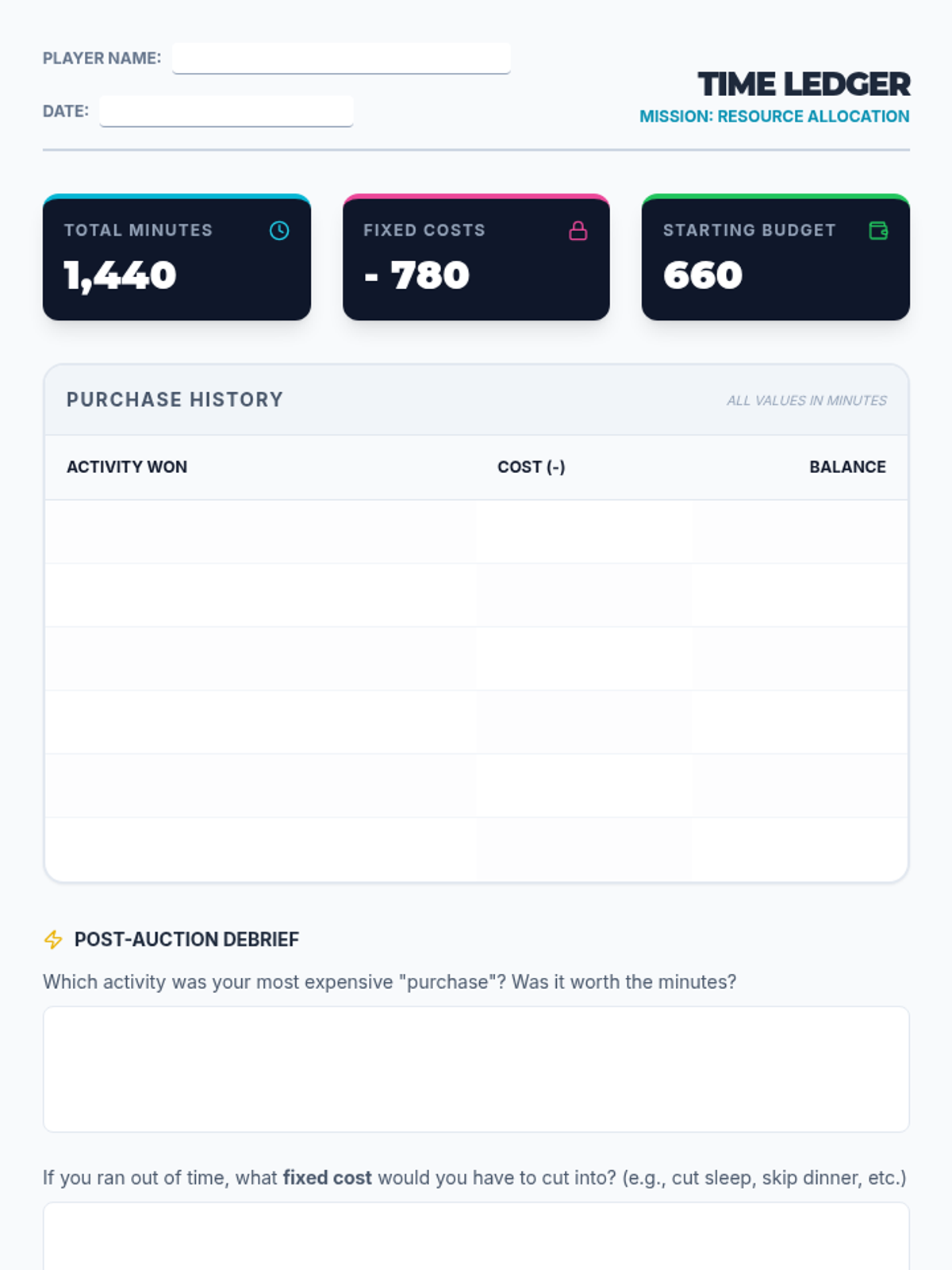
A student worksheet for the 'Currency of Time' lesson. It includes a ledger for tracking 'minutes' spent during the time auction and reflection questions about trade-offs and priorities.
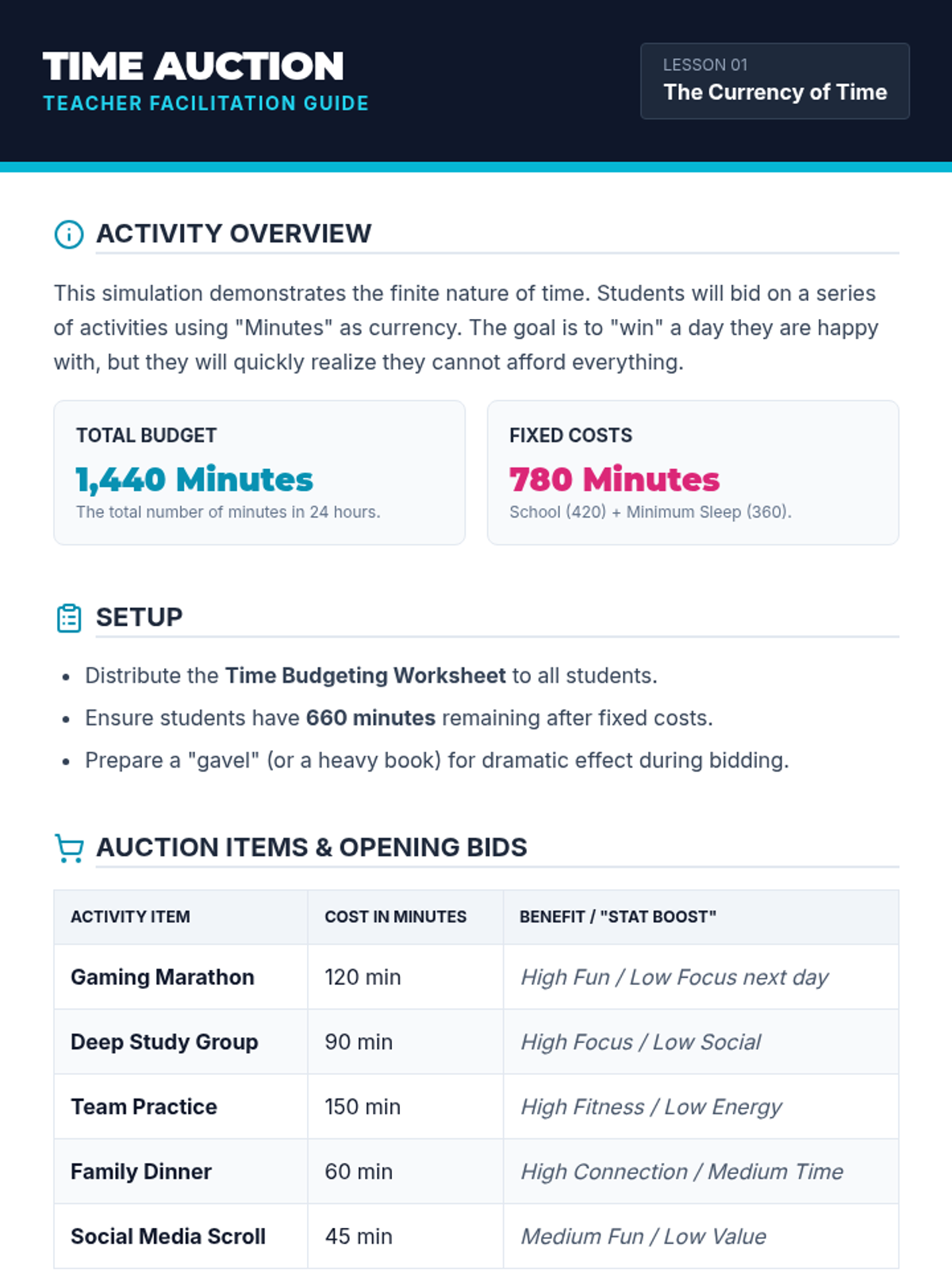
A facilitation guide for teachers to run the 'Time Auction' activity. Includes activity setup, a list of auction items with their 'costs' in minutes, and discussion hooks to debrief the simulation.
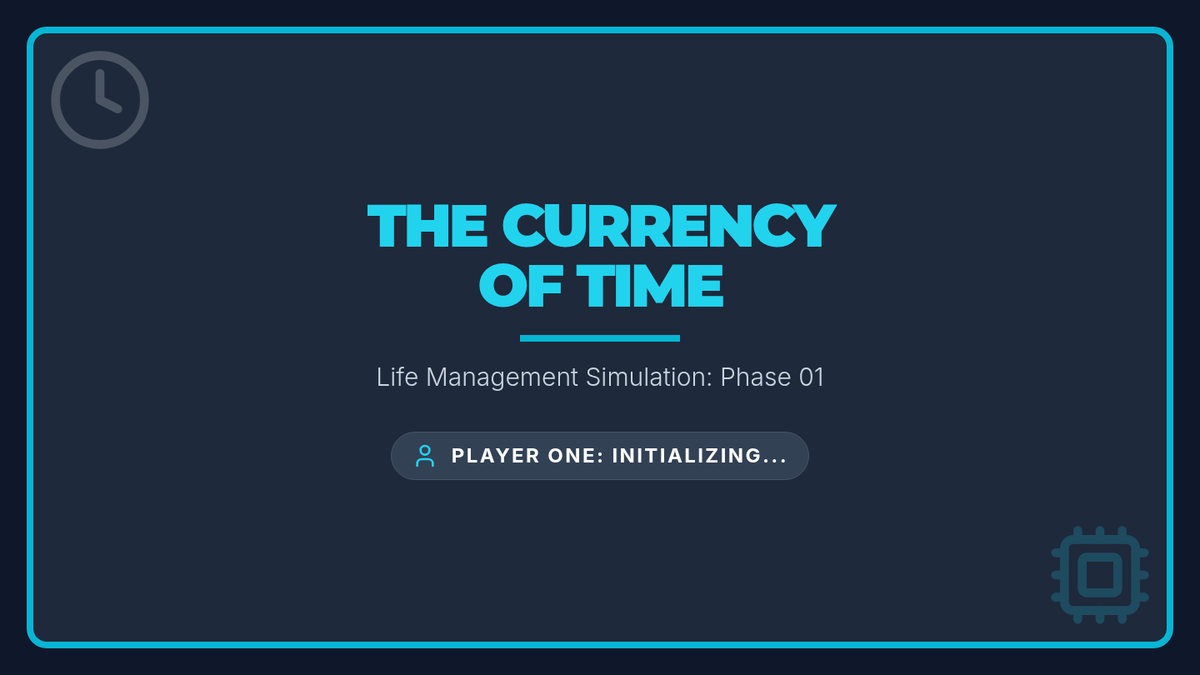
An introductory slide deck for the 'Currency of Time' lesson, framing time management as a game-based resource allocation simulation. It uses RPG-style visuals to explain fixed costs, finite resources, and the concept of time as currency.
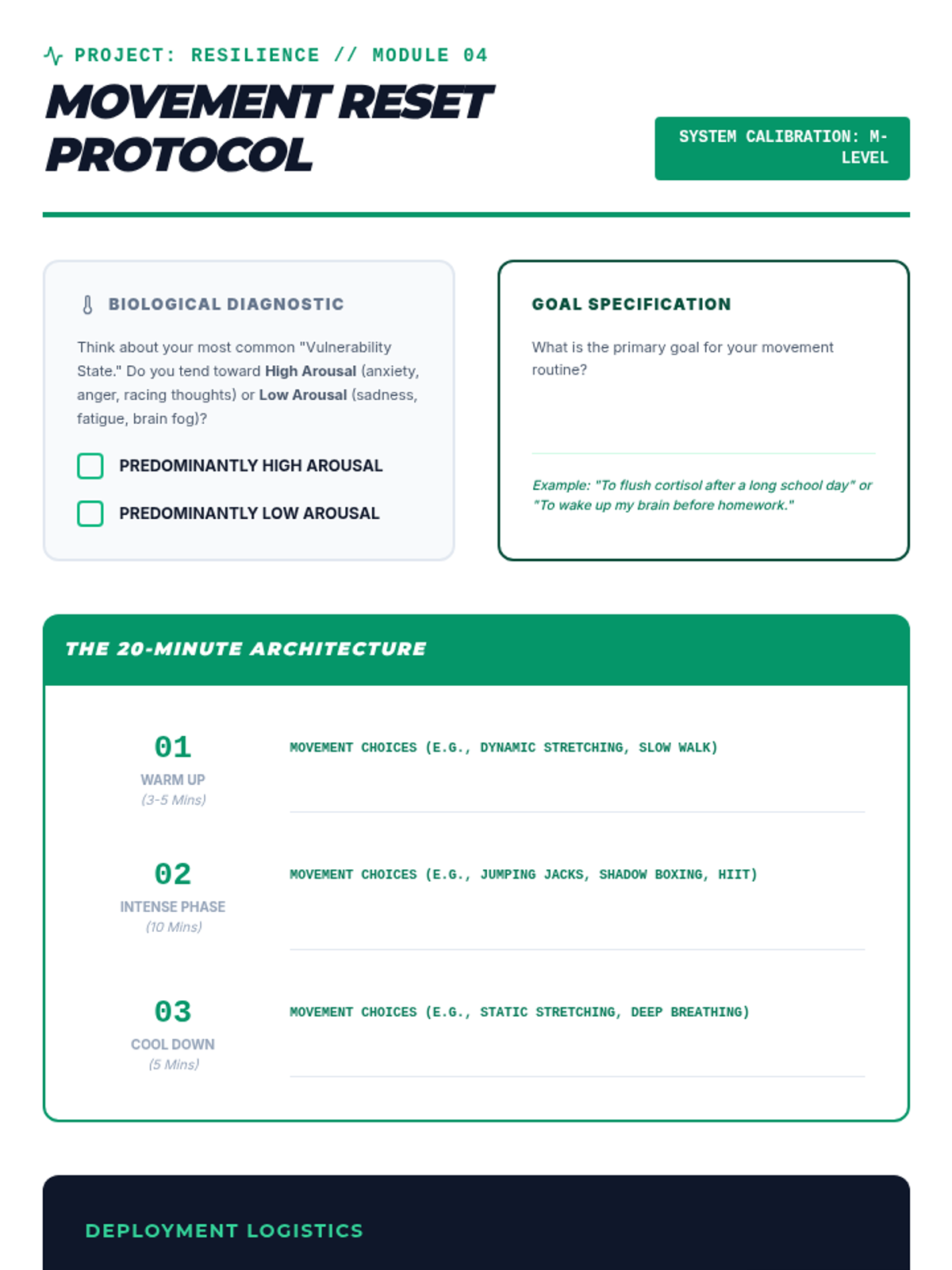
A movement-focused worksheet where students design a personalized '20-minute reset' routine, identifying movements that match their emotional state and identifying barriers to exercise.
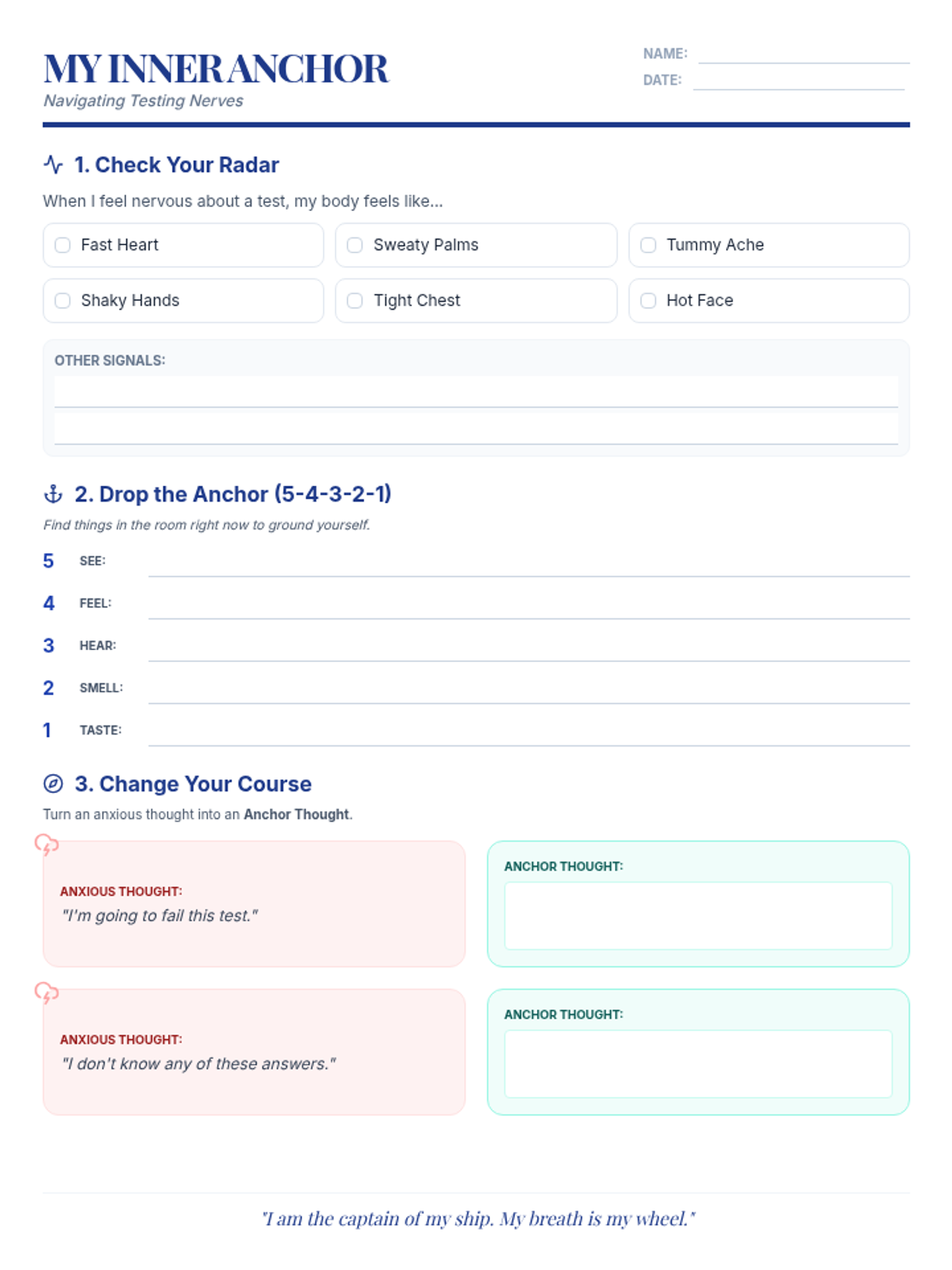
Slides for Lesson 4 teaching mindfulness and anxiety reduction techniques for testing, focusing on the physiology of stress and grounding exercises.
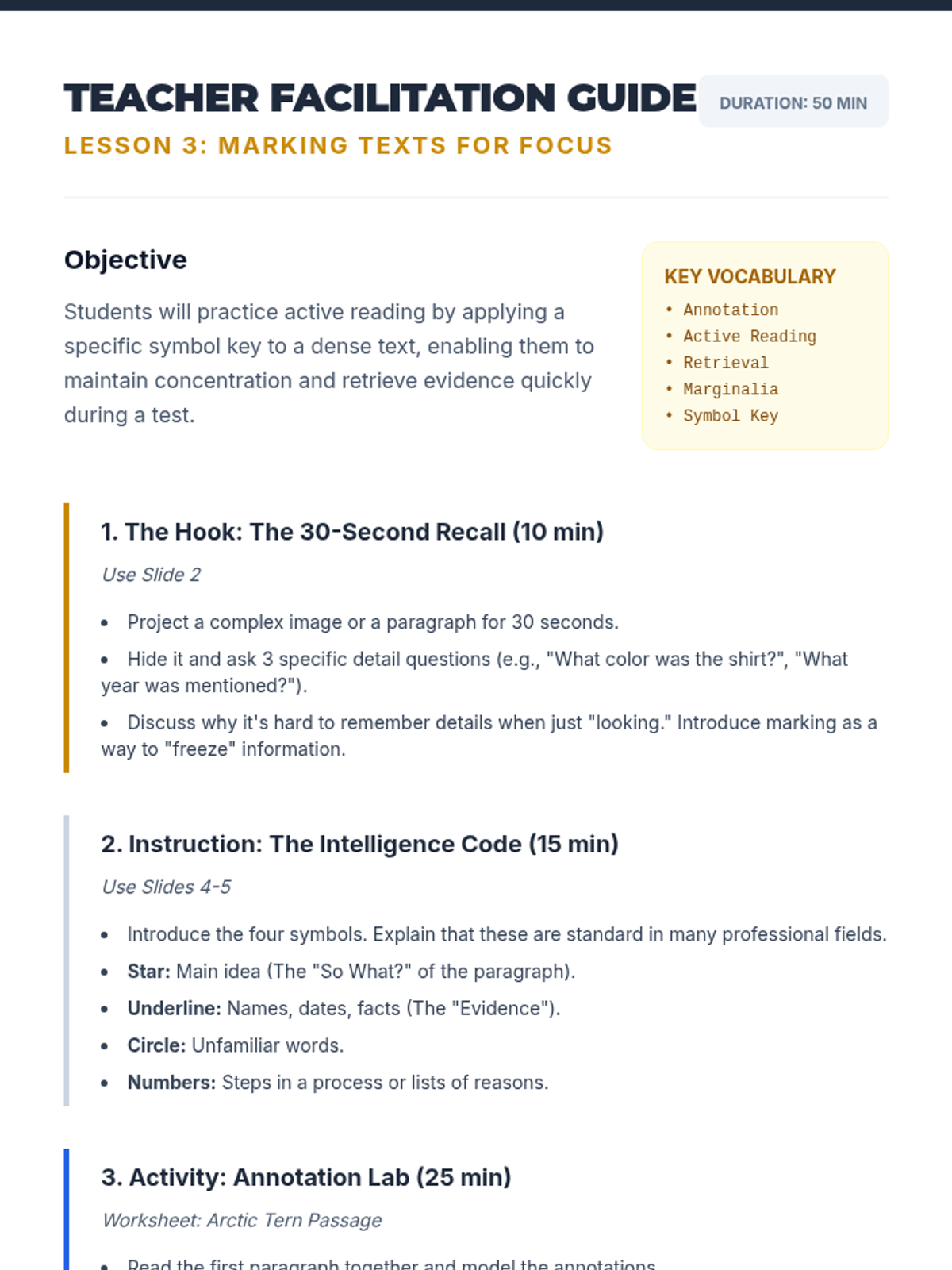
A teacher guide for Lesson 3 including instructions for the recall challenge, a model of the annotated passage, and an answer key for retrieval questions.
A student worksheet for practicing text annotation using a specific symbol key, featuring a dense passage about Arctic Tern migration and retrieval questions.
Slides for Lesson 3 teaching active reading strategies through the 'Intelligence Gathering' theme, focusing on a specific annotation symbol key for testing.
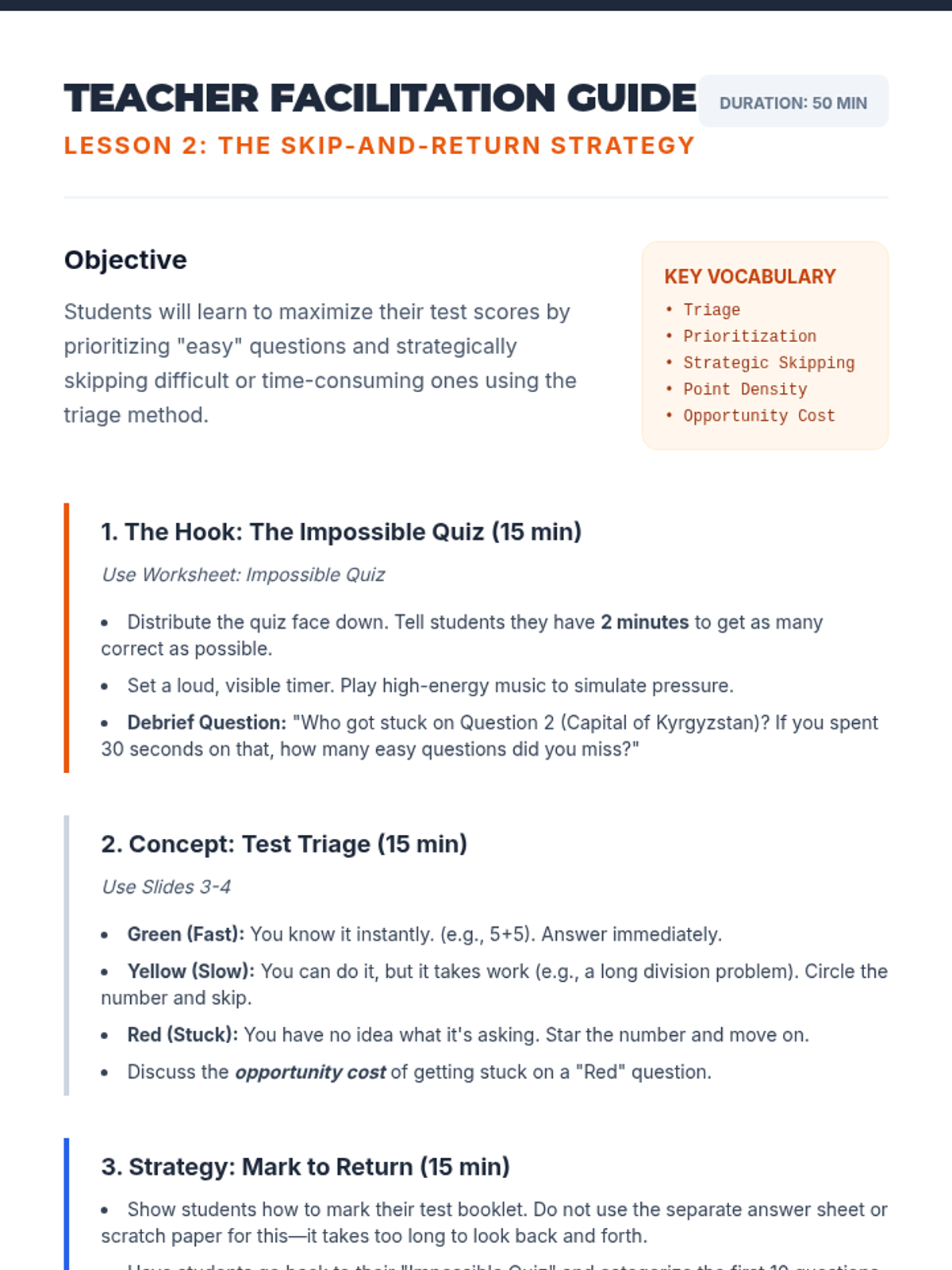
A teacher guide for Lesson 2 focusing on the triage method, managing the 'Impossible Quiz' activity, and addressing common student psychological barriers to skipping questions.
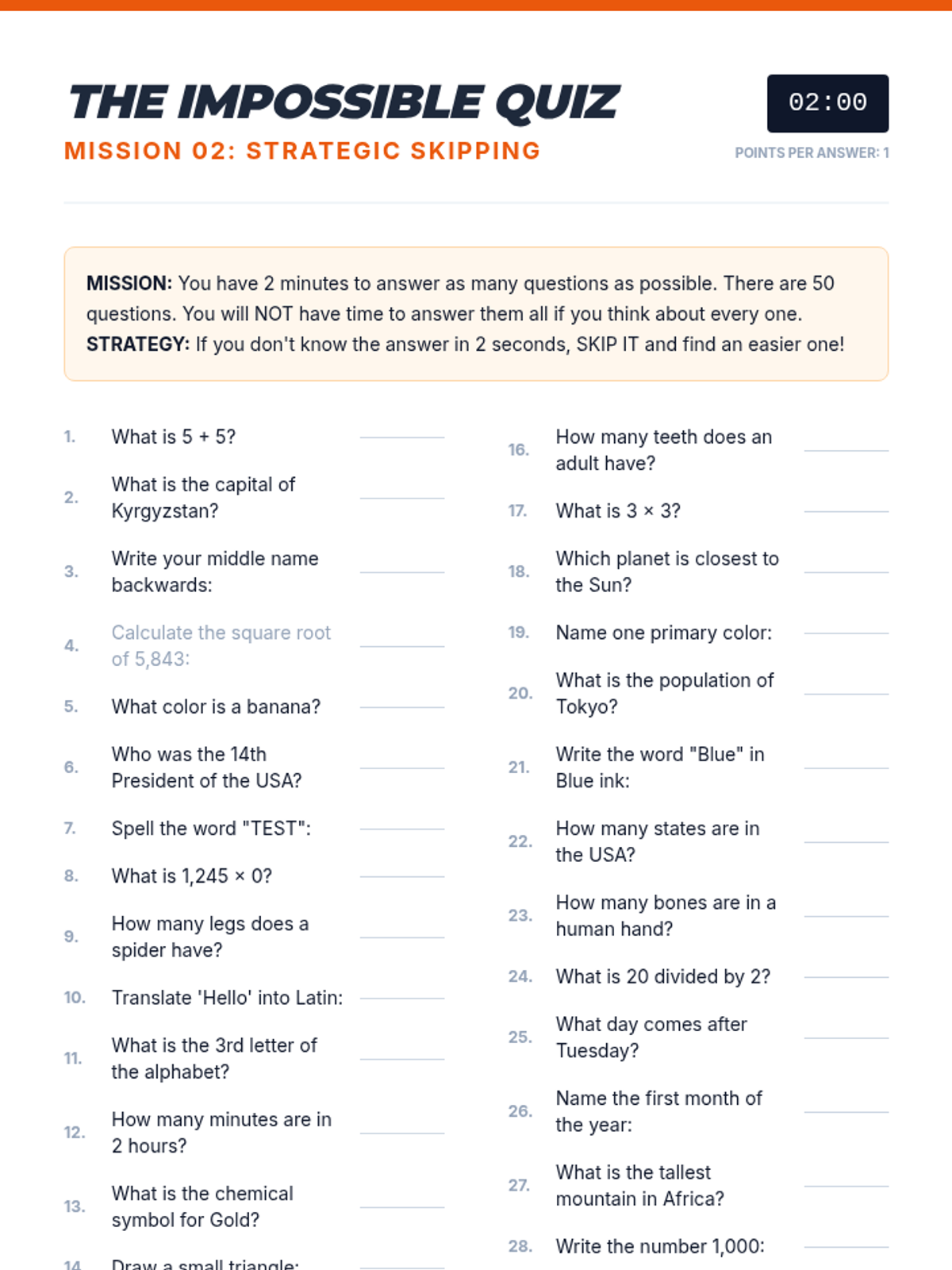
An activity sheet featuring the 'Impossible Quiz' challenge, designed to force students to use skipping and prioritization strategies under a tight time limit.
Slides for Lesson 2 teaching the 'triage' method of test-taking, categorizing questions into Fast, Slow, and Stuck to maximize points within time limits.
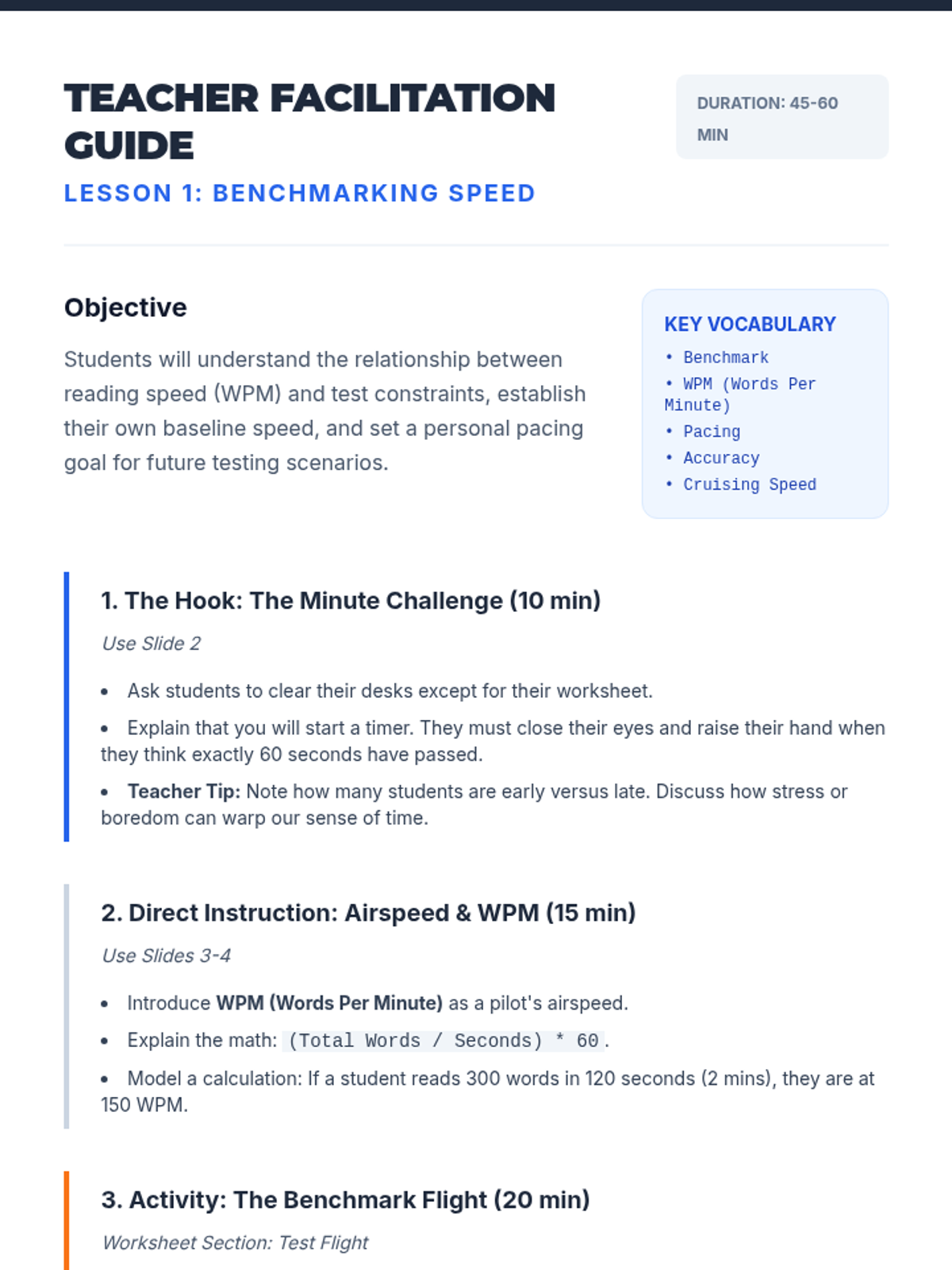
A comprehensive teacher guide for Lesson 1, including objective, procedural steps for the stopwatch challenge, WPM calculation modeling, answer key, and differentiation strategies.
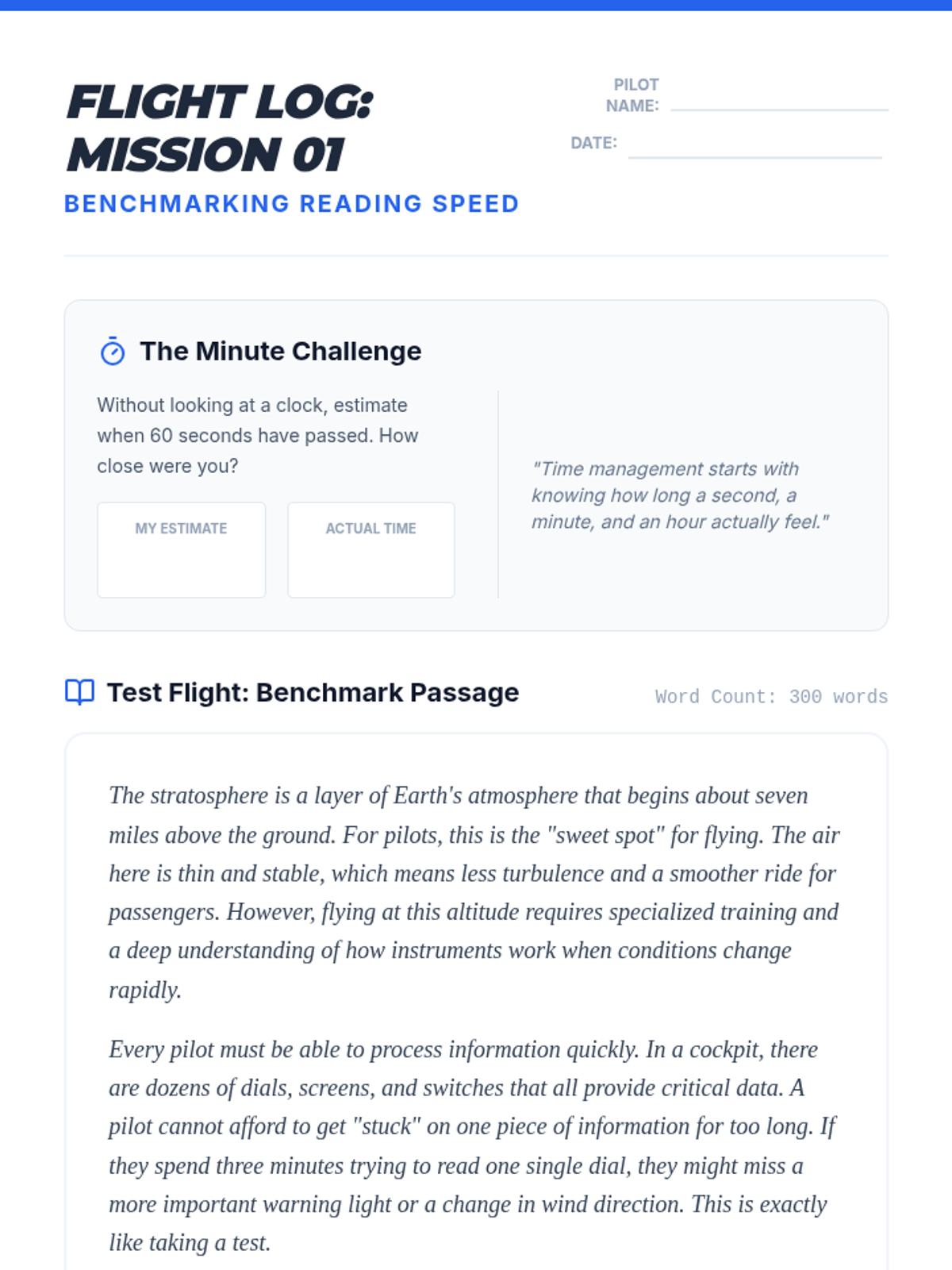
A student worksheet for establishing a reading speed baseline, featuring a themed 'Flight Log' layout, a reading passage, WPM calculation tools, and comprehension questions.
Introductory slides for the Test Pilot Academy sequence, establishing the theme and teaching students how to calculate and analyze their reading speed (WPM) for standardized tests.
The final project deliverable for the sequence where students synthesize their audit data, sleep blueprints, nutrition plans, and movement routines into a comprehensive personal protocol.
Final slide deck for the Launching the Protocol lesson, guiding students through the synthesis of their PLEASE research and the peer review process.
Introductory slides for the Movement for Mental Clarity lesson, focusing on the biological link between movement and emotional regulation. Introduces the '20-minute reset' concept.
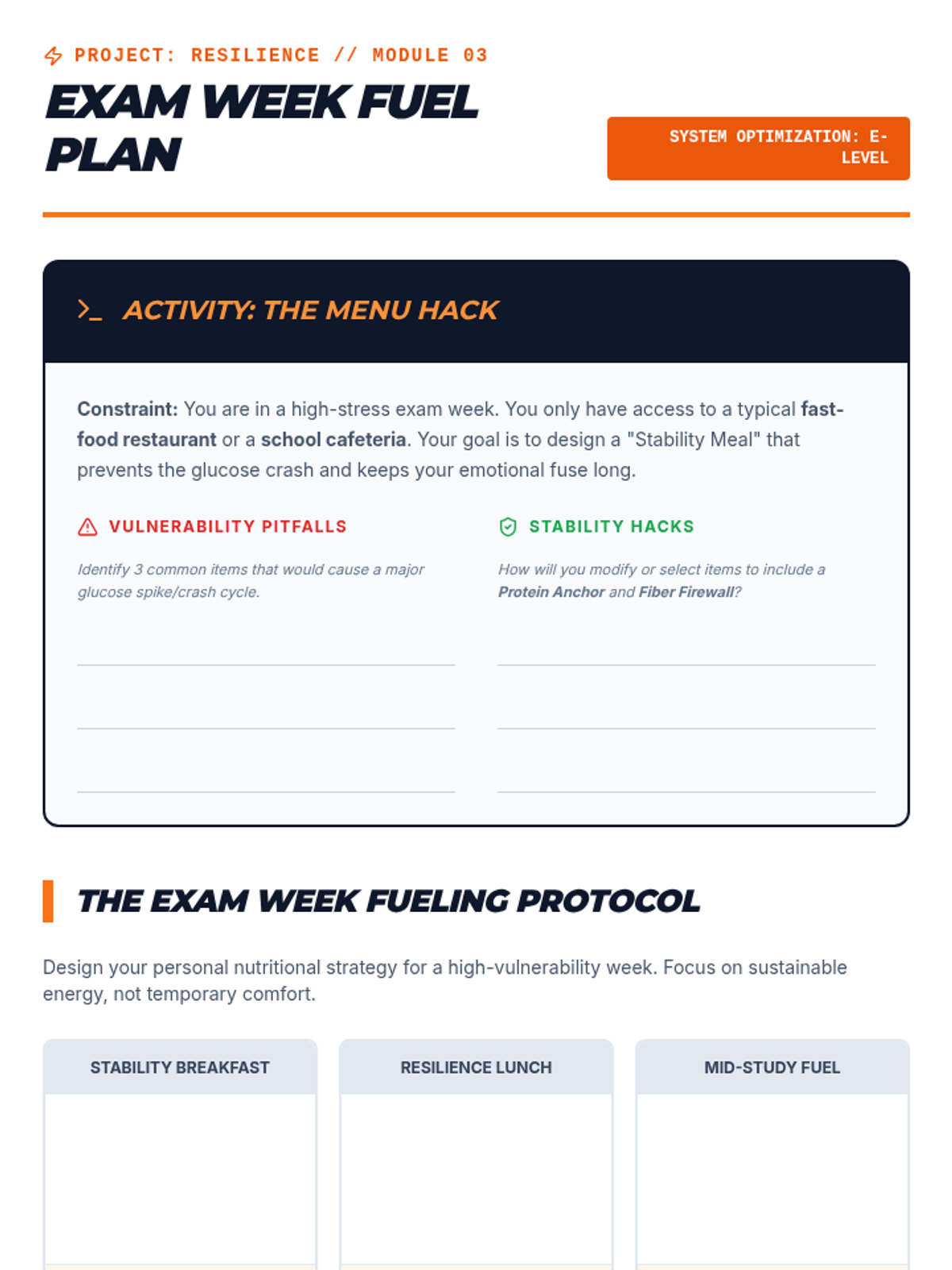
A nutrition-focused worksheet where students analyze cafeteria menus for 'vulnerability pitfalls' and design an 'Exam Week Fuel Plan' to stabilize blood sugar and emotional resilience.