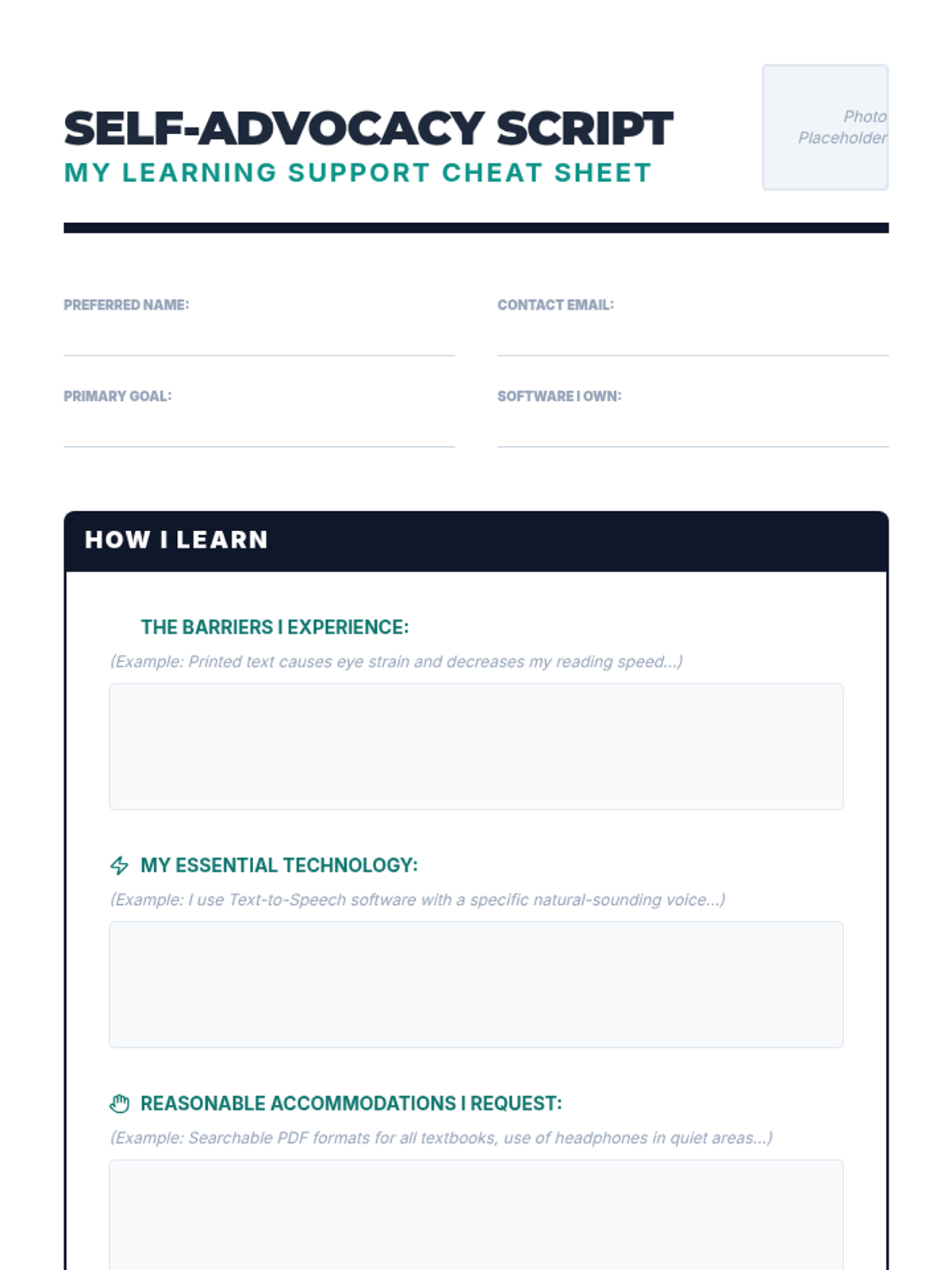
Strategies for identifying specific learning needs and articulating accommodation requests to educators. Equips students with communication skills to advocate for necessary environmental, academic, and social supports.
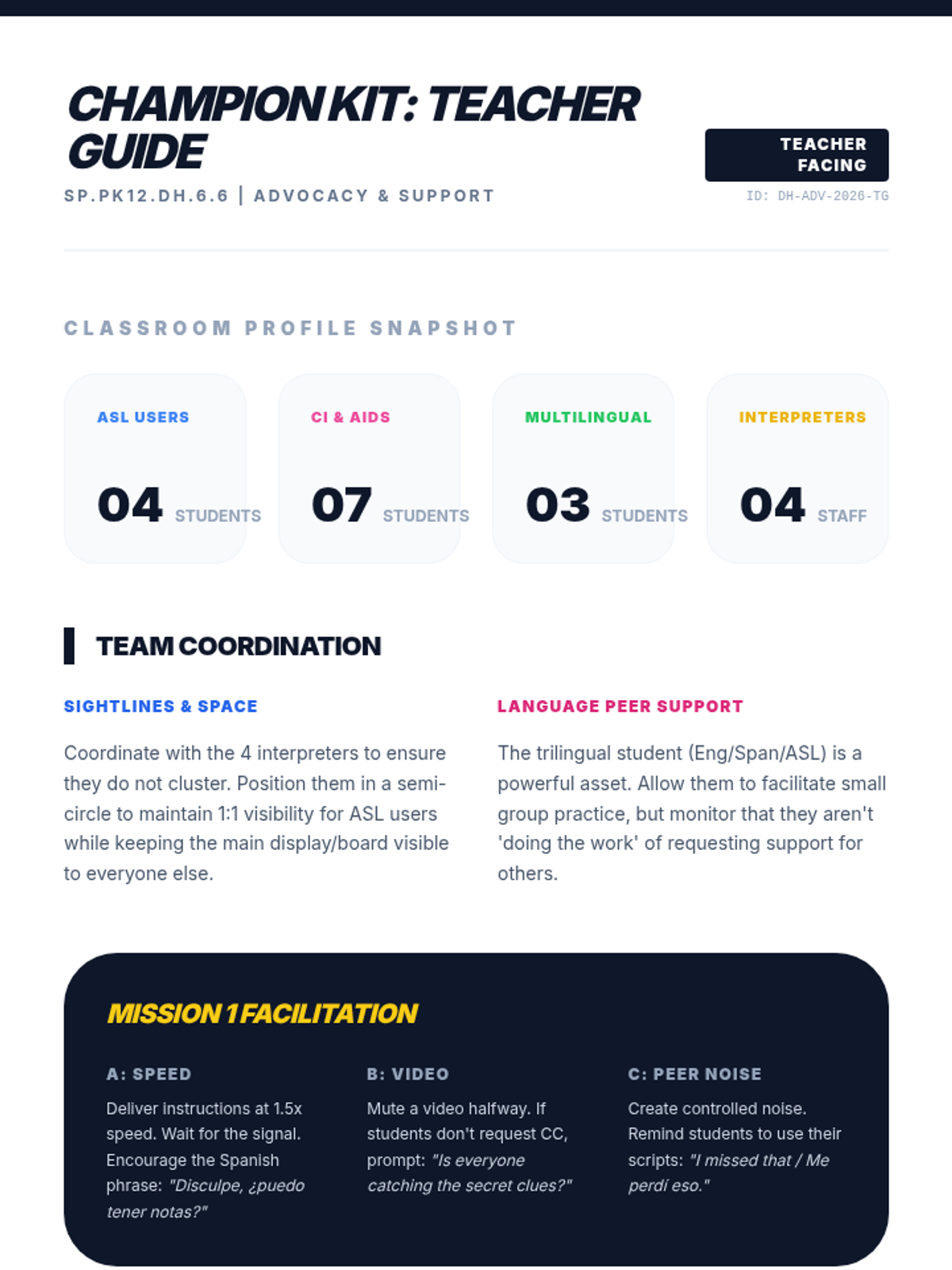
A teacher-facing facilitation guide for managing a diverse DHH classroom with multiple interpreters and multilingual learners. It includes placement strategies, role-play facilitation tips, and discussion prompts for teaching self-advocacy.
A bold, comic-book themed slide presentation designed to teach students with hearing loss about self-advocacy. It explains different types of written reinforcement (CC, transcripts, notes) and provides bilingual English/Spanish power phrases for making requests.
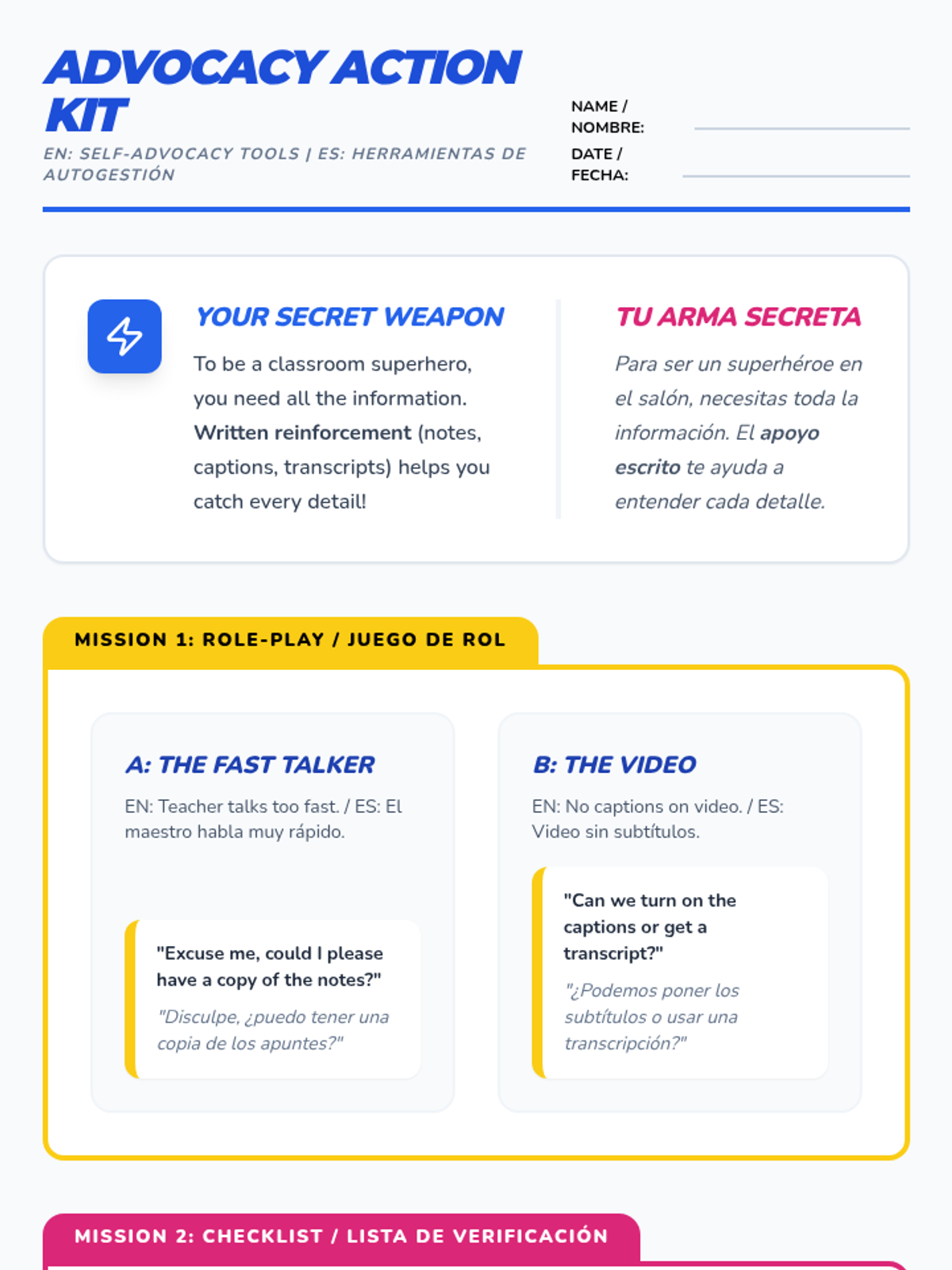
A student-facing role-play guide and self-advocacy checklist designed for students with hearing loss. It includes scripts in English and Spanish, mission-based scenarios, and a reflection area to practice requesting written reinforcements.
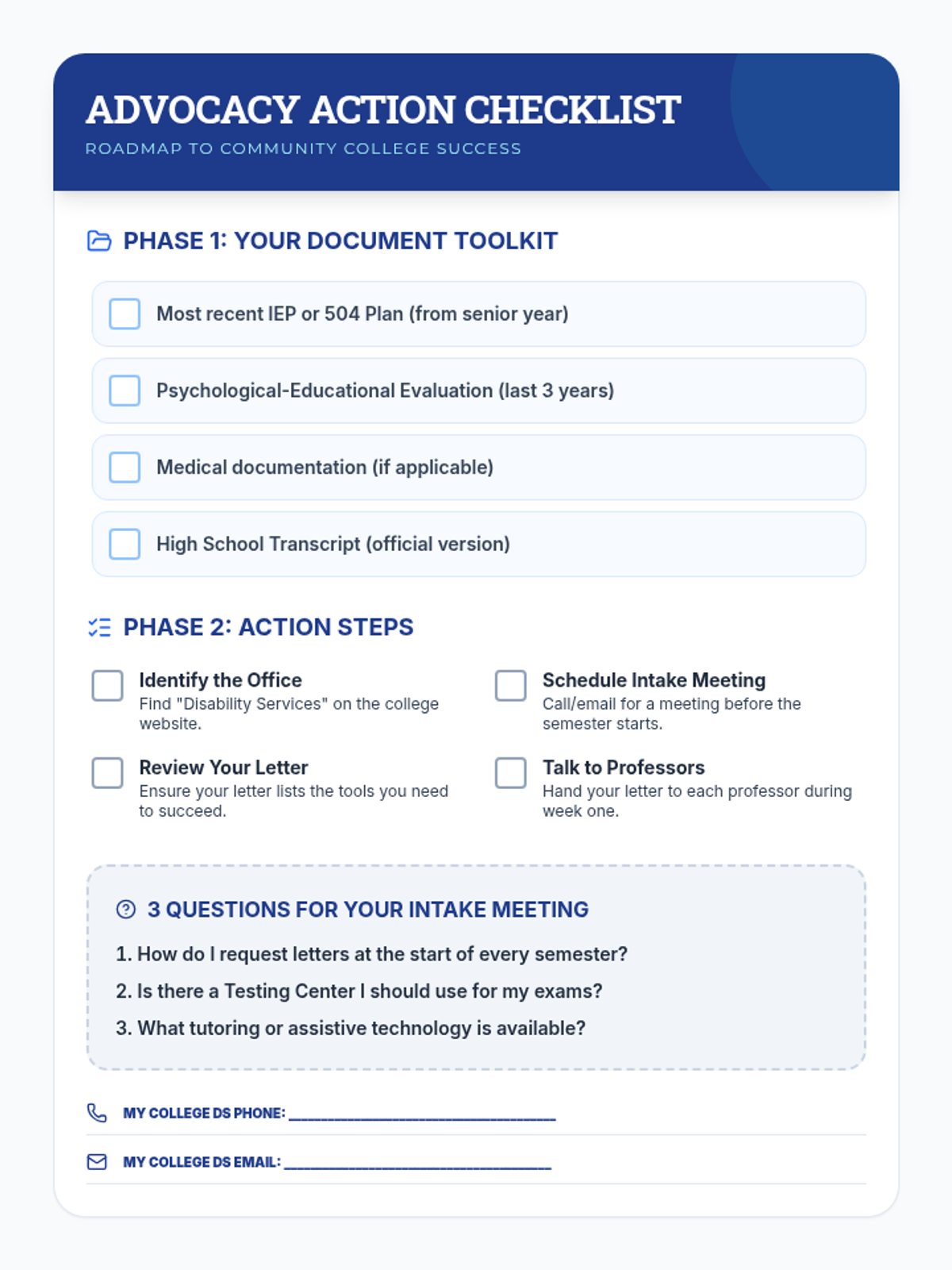
A practical checklist for students to use during their transition to community college, covering document gathering, key action steps, and interview questions for the Disability Services office.
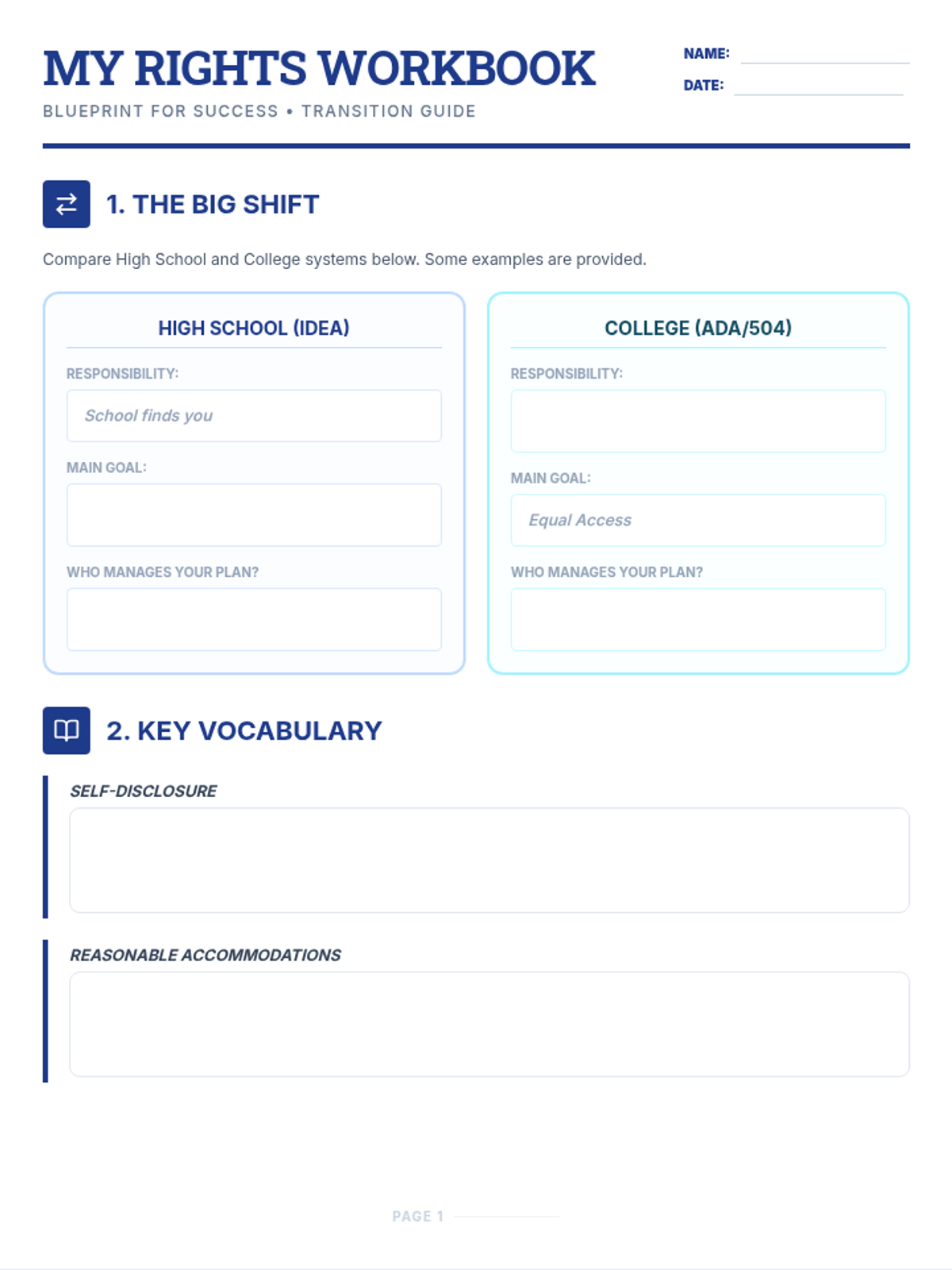
A guided workbook for students to use during the Blueprint for Success lesson. It includes reflection areas, guided notes on the legal shifts, and advocacy script practice.
An interactive slide deck introducing high school seniors to the legal shift from IDEA to ADA/Section 504, the college accommodation process, and self-advocacy skills.
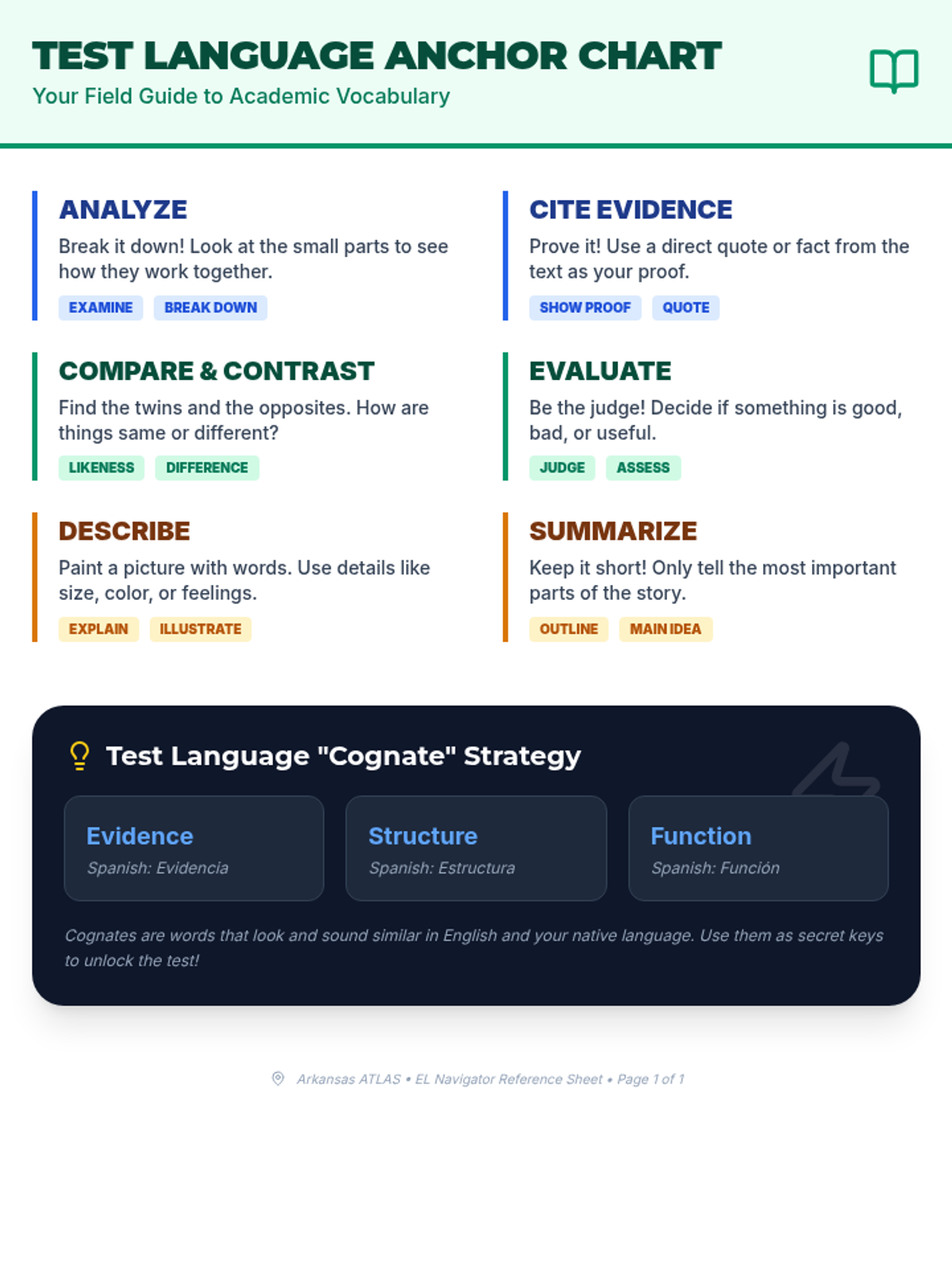
A vocabulary-building anchor chart and reference sheet for students. It defines key academic "power verbs" found in ATLAS assessments and provides synonyms and a "cognate" strategy for English Learners.
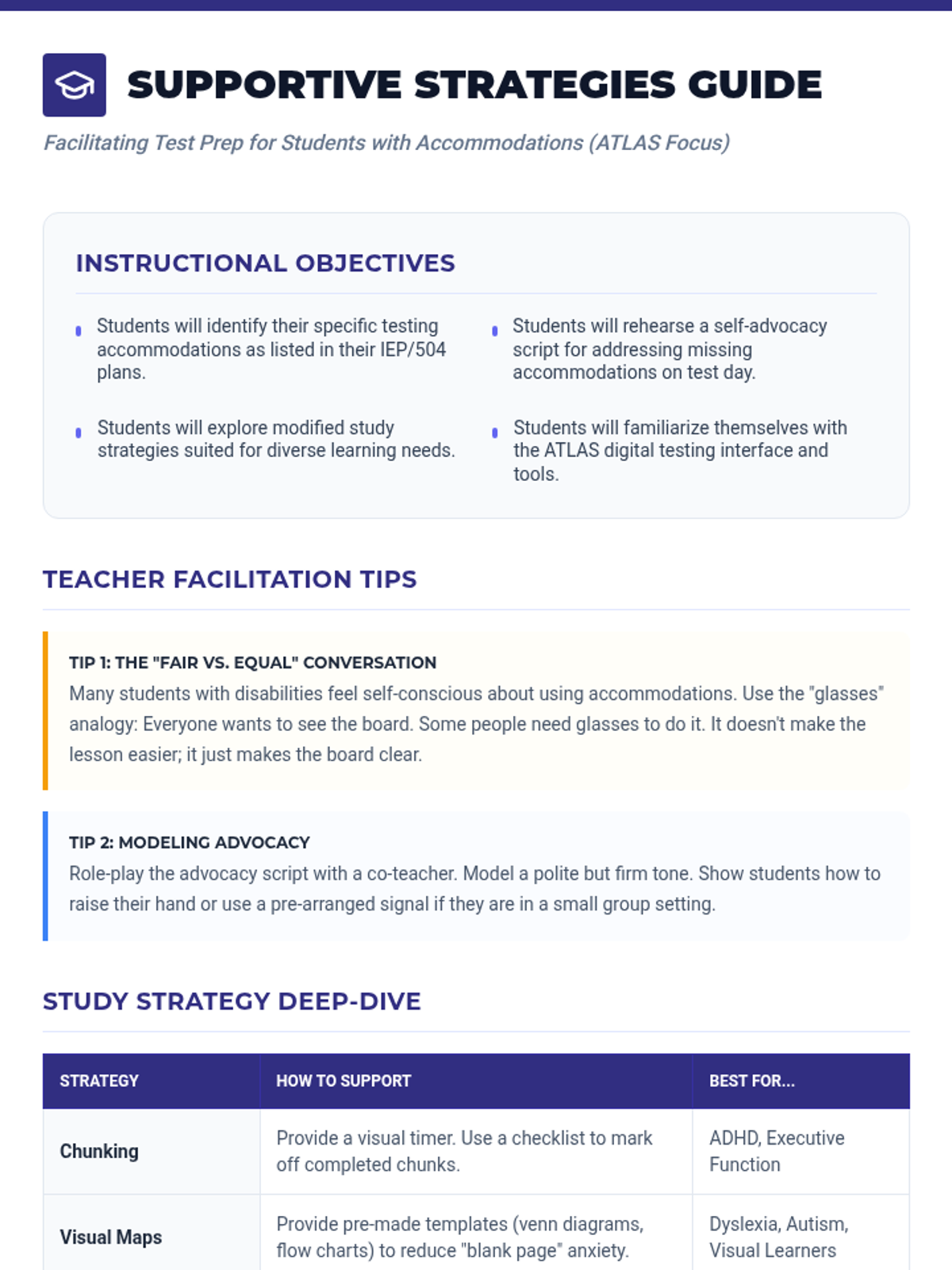
A facilitation guide for teachers to deliver the ATLAS prep lesson, including modeling tips, instructional goals, and a strategy deep-dive.
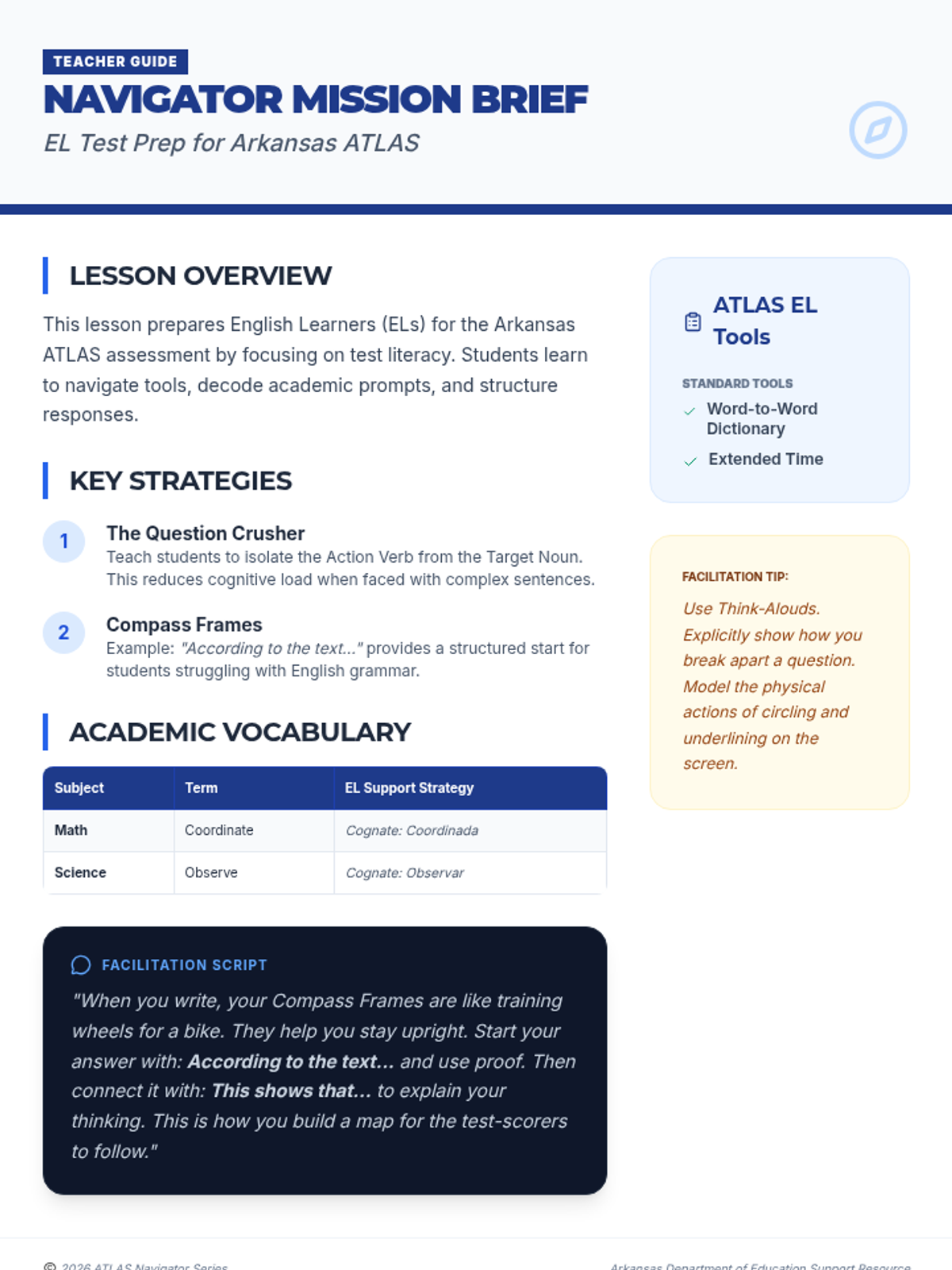
A comprehensive teacher guide providing instructional scripts, facilitation tips, and specific Arkansas ATLAS accommodation guidelines for supporting English Learners during test preparation.
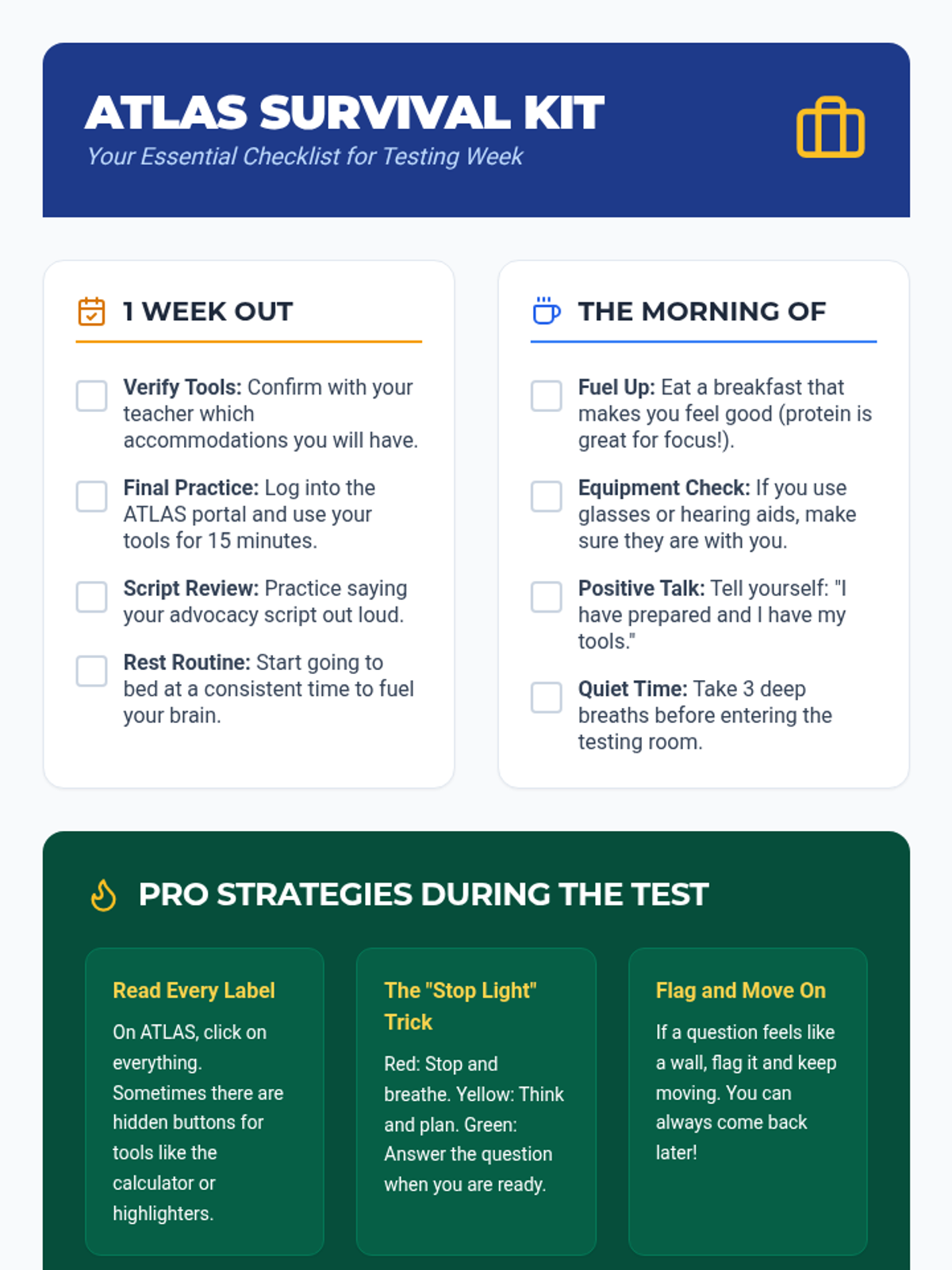
A practical checklist and reference handout for students to use during the week leading up to the ATLAS assessments.
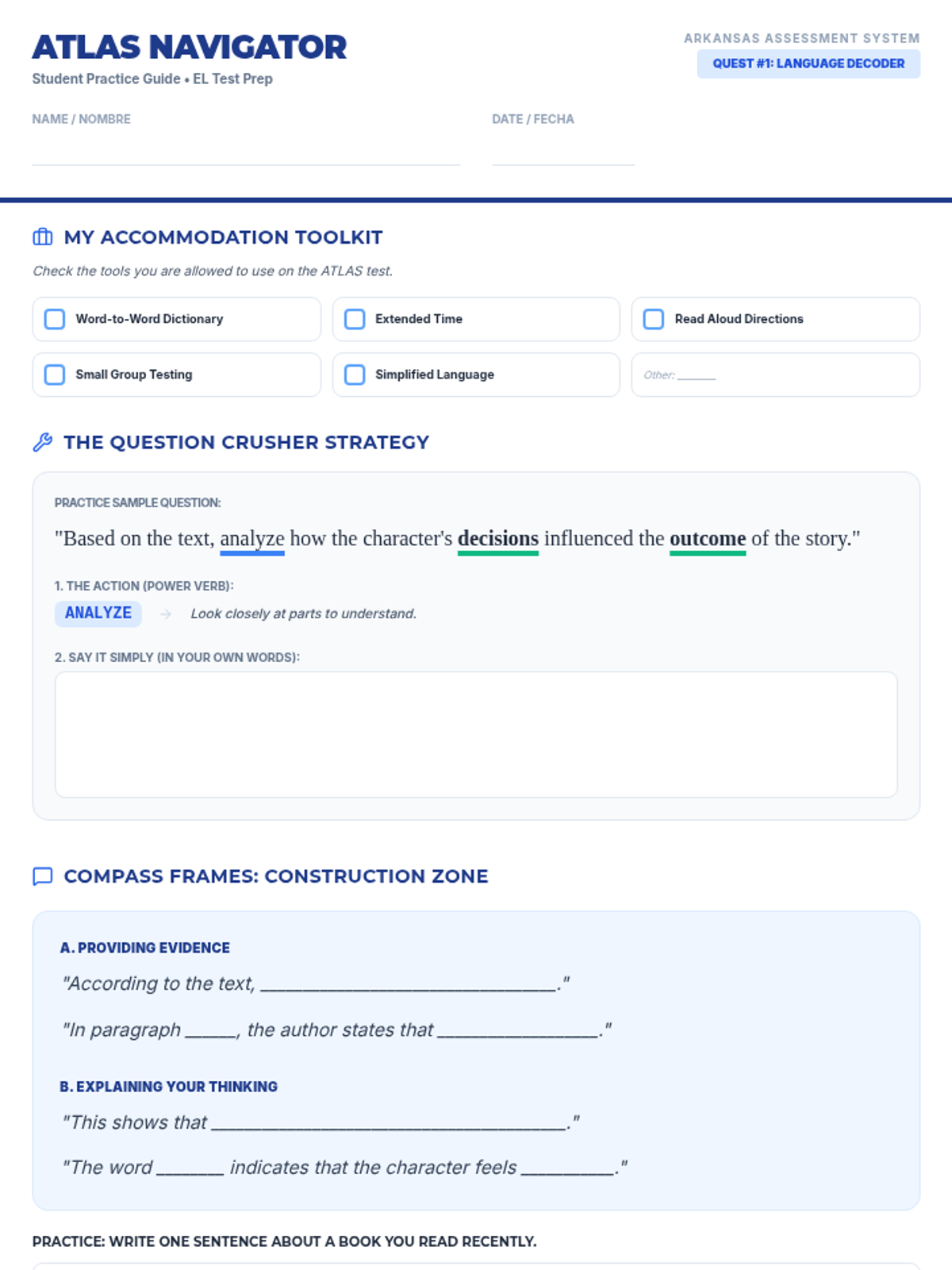
A two-page student worksheet that guides English Learners through identifying their test accommodations, practicing the "Question Crusher" decoding strategy, and using sentence frames for constructed responses. Includes a vocabulary mapping activity.
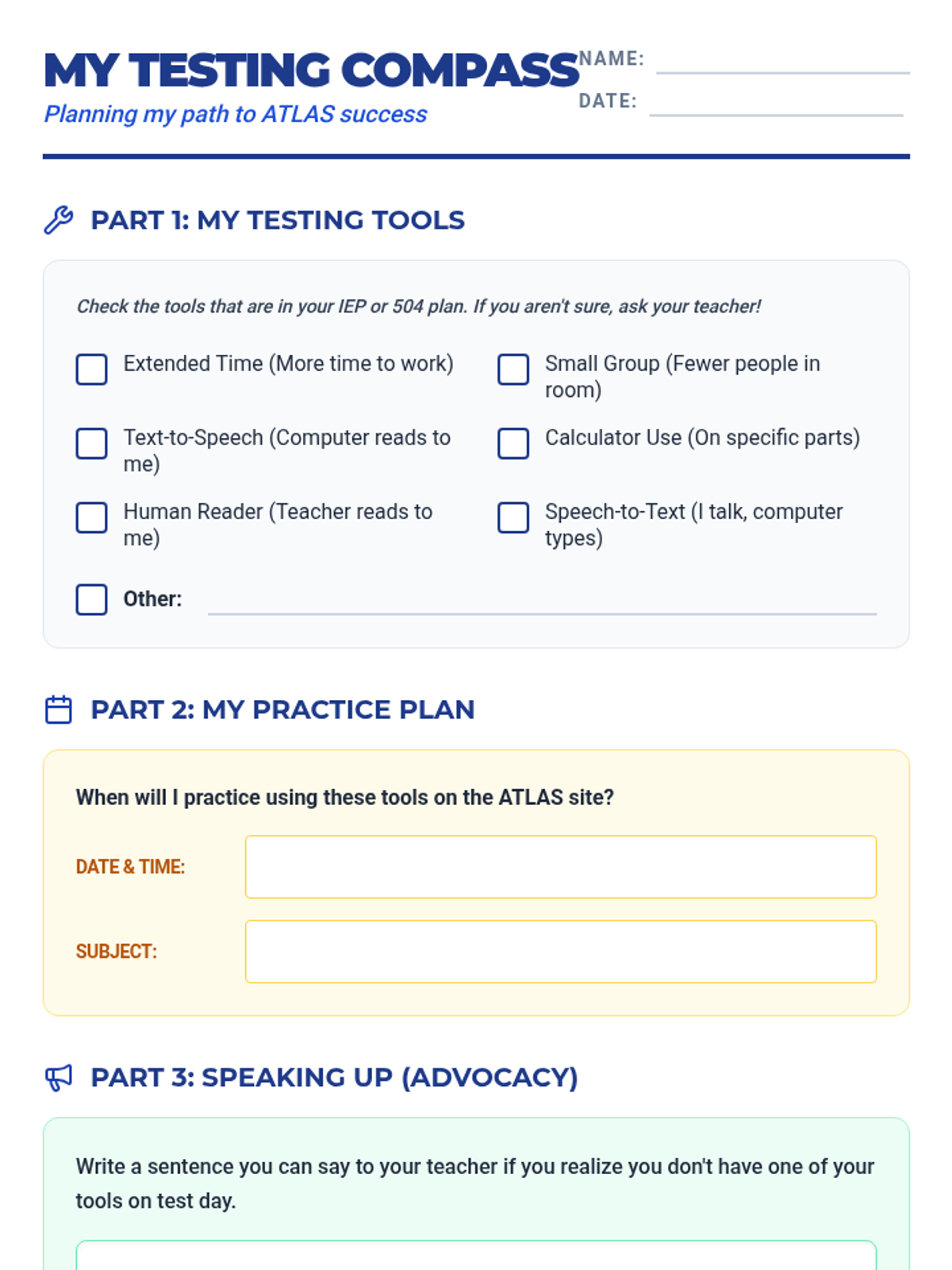
A student worksheet for identifying accommodations, planning practice sessions, and drafting self-advocacy scripts for the ATLAS assessments.
A visually engaging slide deck designed for English Learners (ELs) preparing for the Arkansas ATLAS assessment. It covers test accommodations, academic language decoding strategies, and provides sentence frames for constructed responses.
A slide deck designed to support students with IEPs and 504 plans in navigating the Arkansas ATLAS assessments, focusing on accommodations, practice, and self-advocacy.
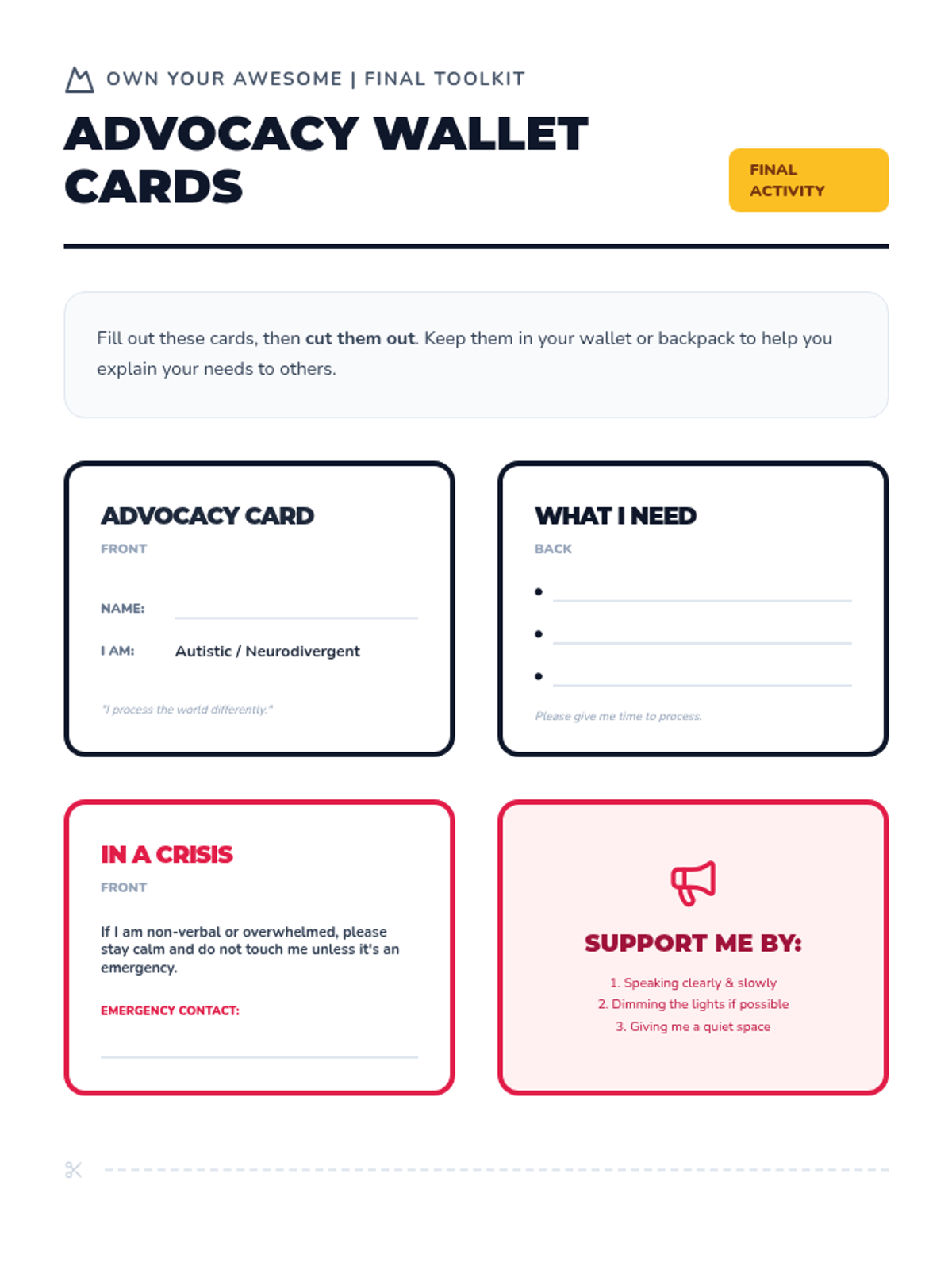
Personalized self-advocacy wallet cards for Lesson 10. Fixed card page breaks, changed dark background to light for easier writing, and expanded input lines.
Final slides for Lesson 10: Advocacy Summit. Recaps the unit, reviews the contents of the self-advocacy toolkit, and provides a motivational wrap-up.
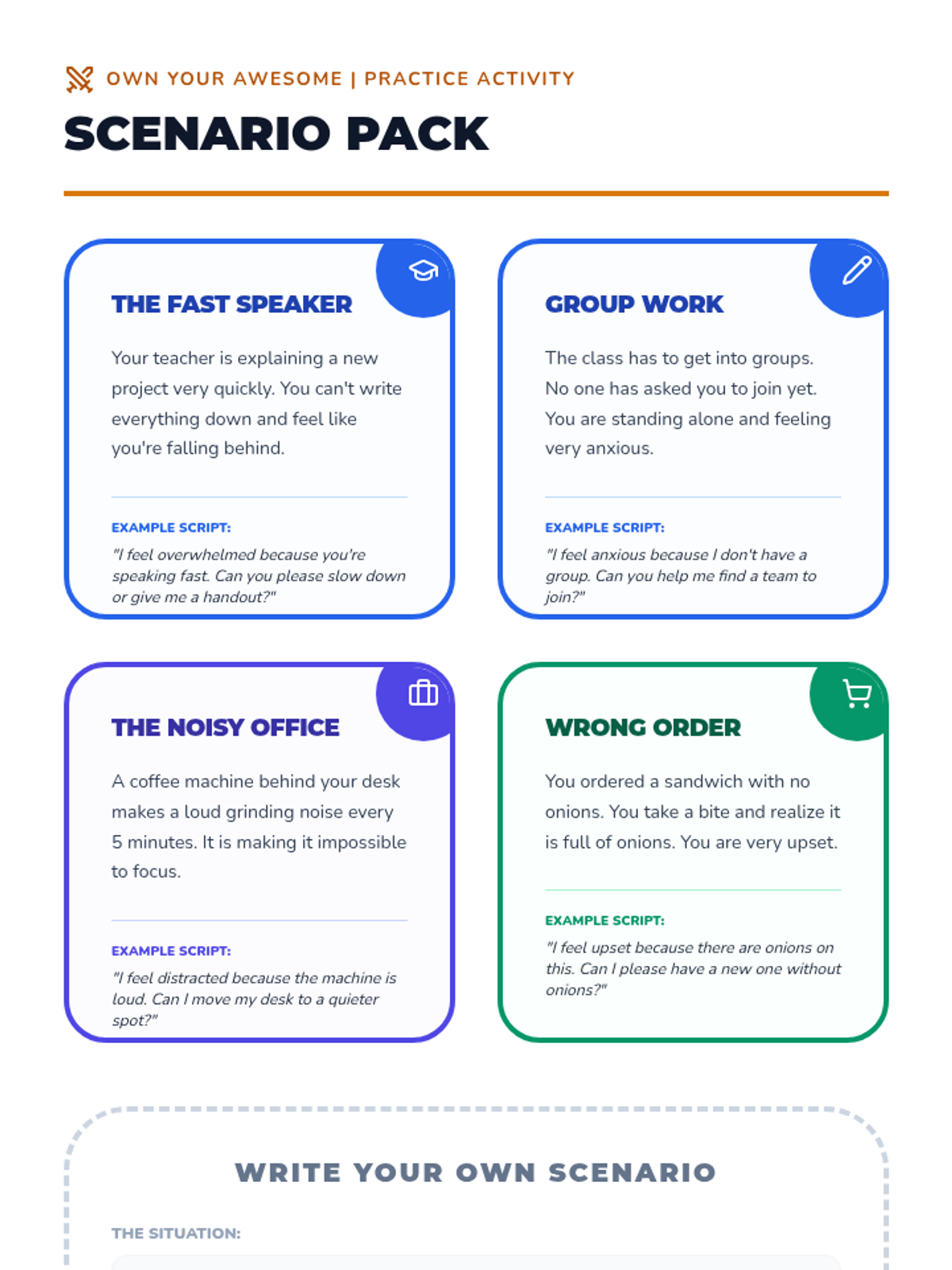
Role-play scenario pack for Lesson 9: Advocacy Arena. Fixed page breaks, expanded practice area, and improved label contrast for easier reading.
Instructional slides for Lesson 9: Advocacy Arena. Improved text contrast on the script formula and added a slide with specific practice scenarios.
Instructional slides for Lesson 8: Community Connections. Teaches advocacy strategies for public spaces like stores, libraries, and transit.
Instructional slides for Lesson 7: Career Catalyst. Covers disclosure decisions and common workplace accommodations for autistic professionals.
A social story booklet focusing on museum manners, including quiet voices, walking feet, looking with eyes, and staying with the group.
A social story booklet explaining safety rules, noise levels, and behavior expectations for the bus ride from Grafton to Washington, D.C.
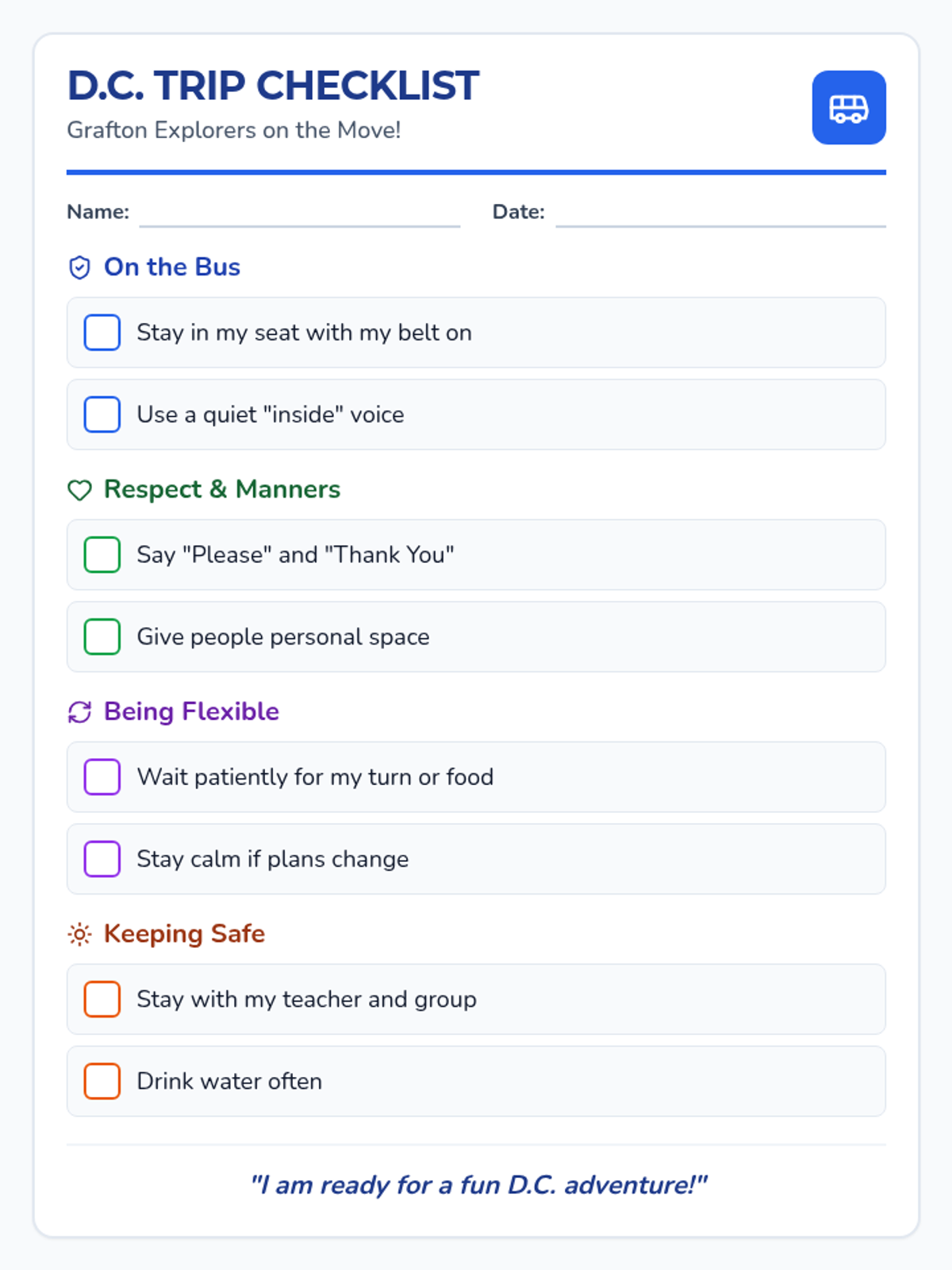
A single-page visual checklist for students to track appropriate behaviors including bus rules, manners, flexibility, and sun safety during their Washington, D.C. trip.
A social story booklet addressing walking endurance, staying hydrated, wearing sun protection, and staying with the group during the hot D.C. field trip.
A social story booklet focusing on restaurant manners, patience while waiting for tables and food, and flexibility during the D.C. field trip.
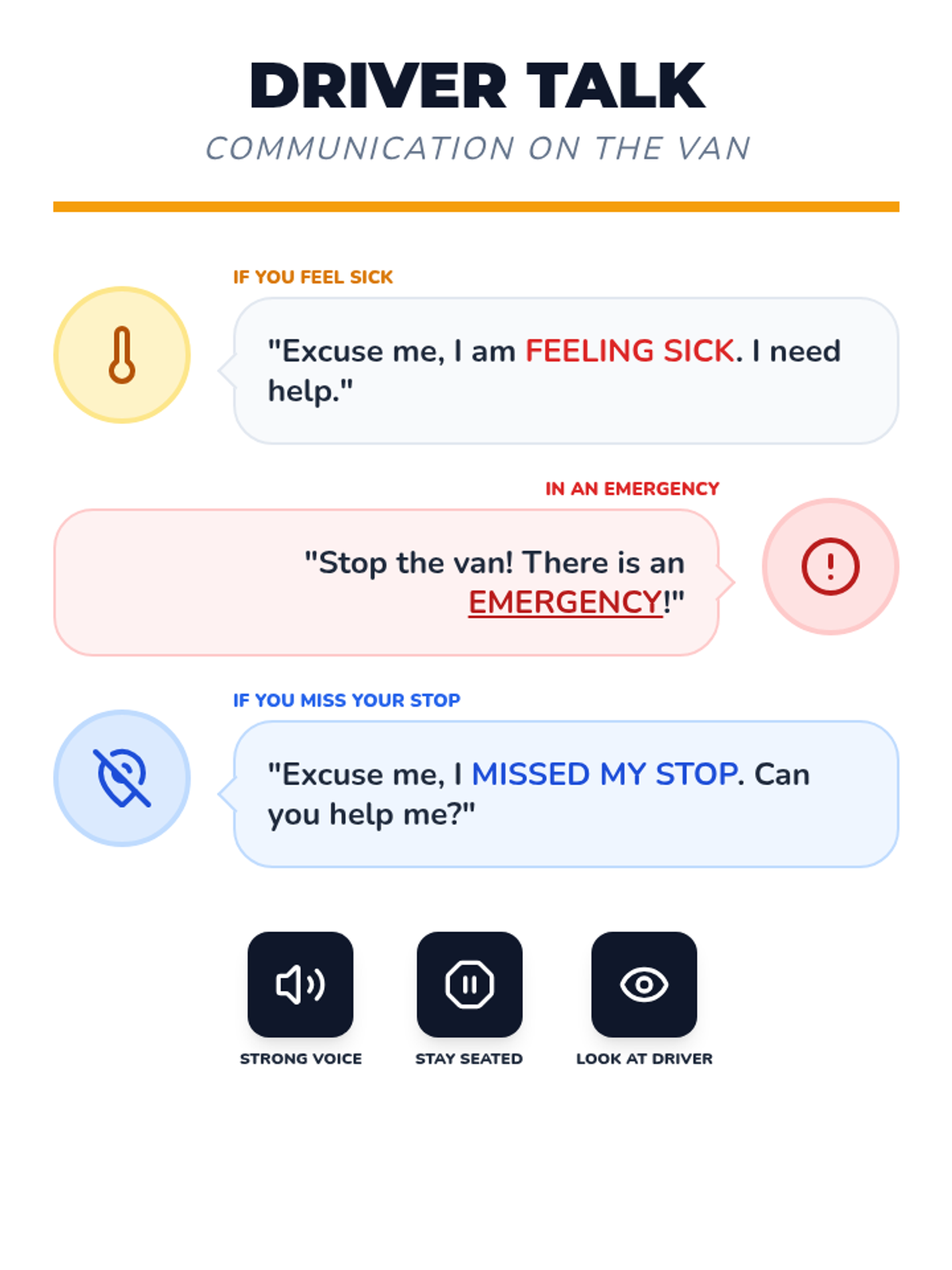
A visual communication script for interacting with van drivers in various situations. Revised to prevent page breaks and improve icon/label alignment.
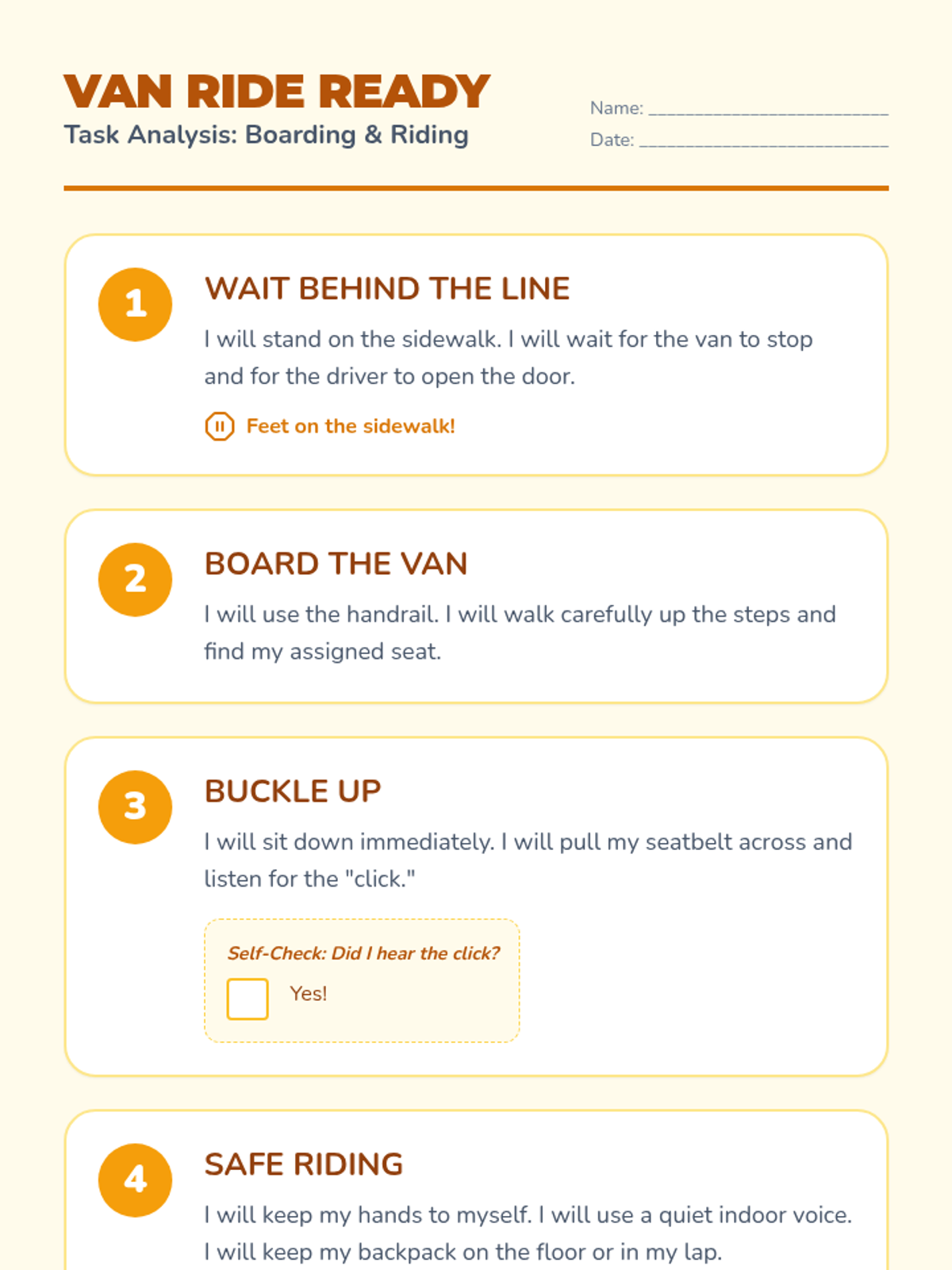
A comprehensive task analysis for van and transportation safety, covering the sequence of actions from waiting for the vehicle to exiting at the destination.
Safety presentation for riding in school vans or public transportation. Revised to fix Slide 3 rendering issues, improve contrast, and add interactive scenarios.
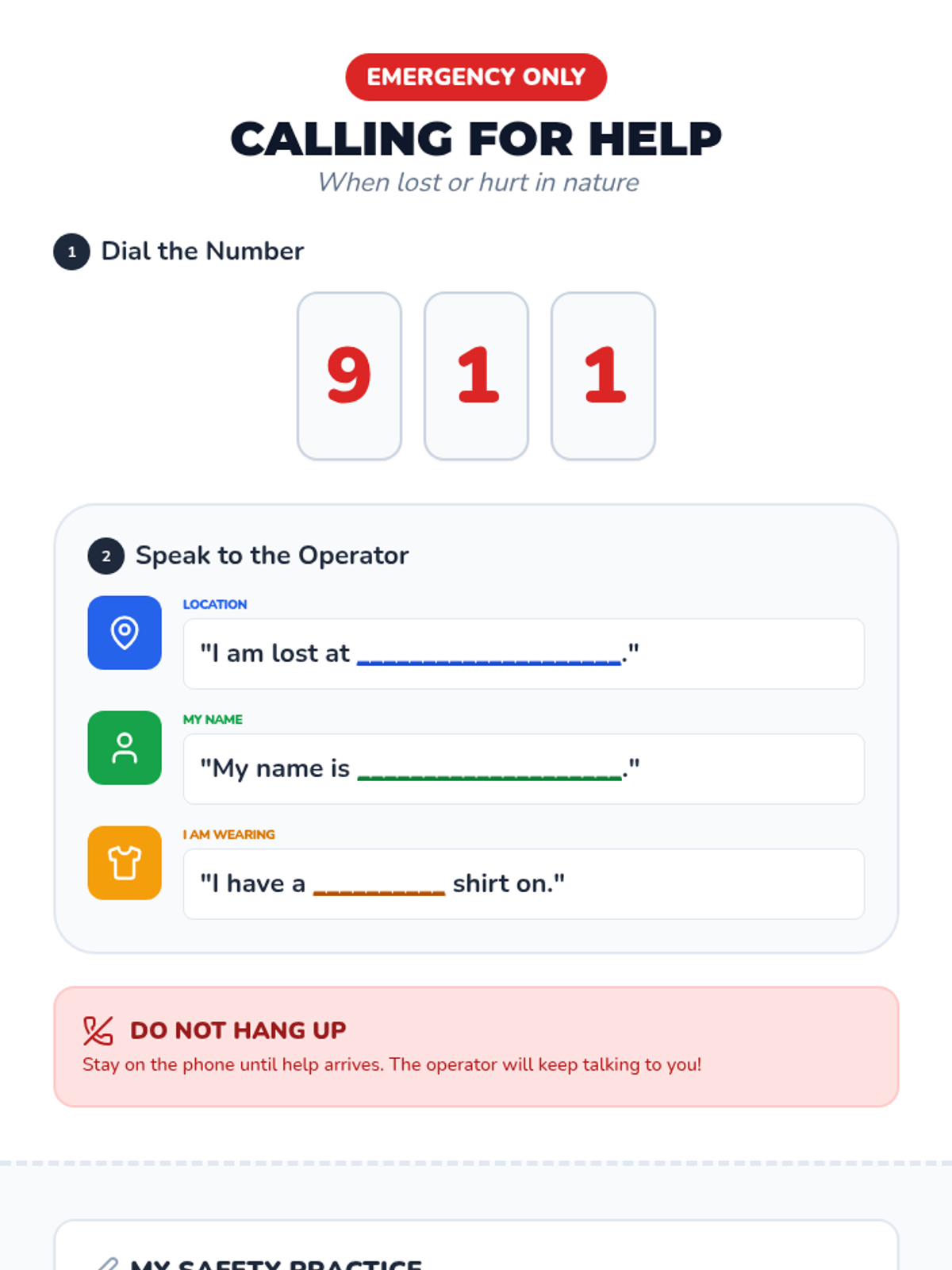
A visual emergency script for calling 911 when lost in a nature setting. Revised to fix page breaks, consolidate content onto two pages, and improve student work areas.
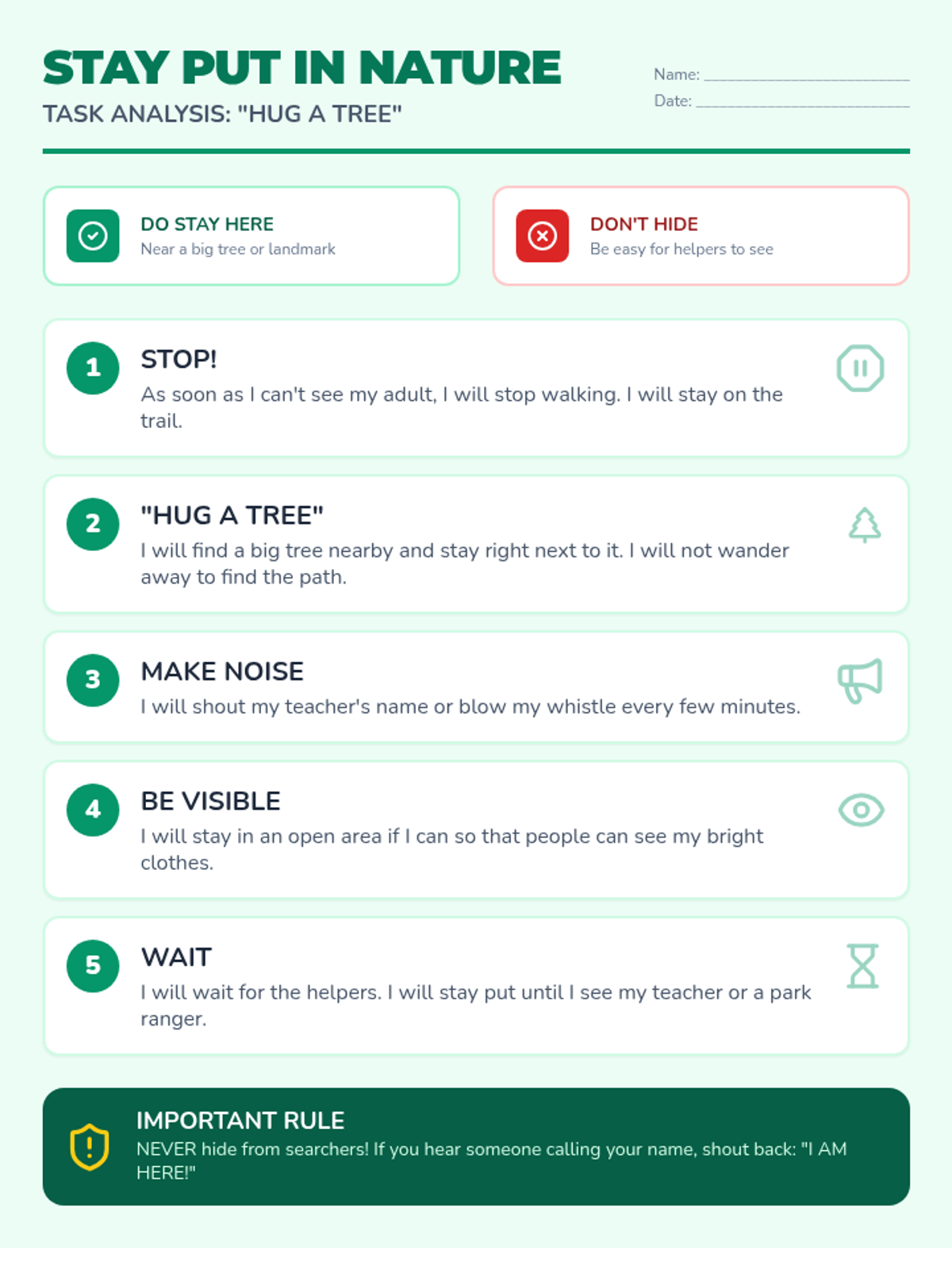
A task analysis for outdoor safety focusing on the 'Hug a Tree' strategy. Revised to fit all steps and the rule box onto a single page with improved icon visibility.
Educational slides for nature walk safety, highlighting the "Hug a Tree" rule. Revised to improve text contrast and clarify placeholder names.
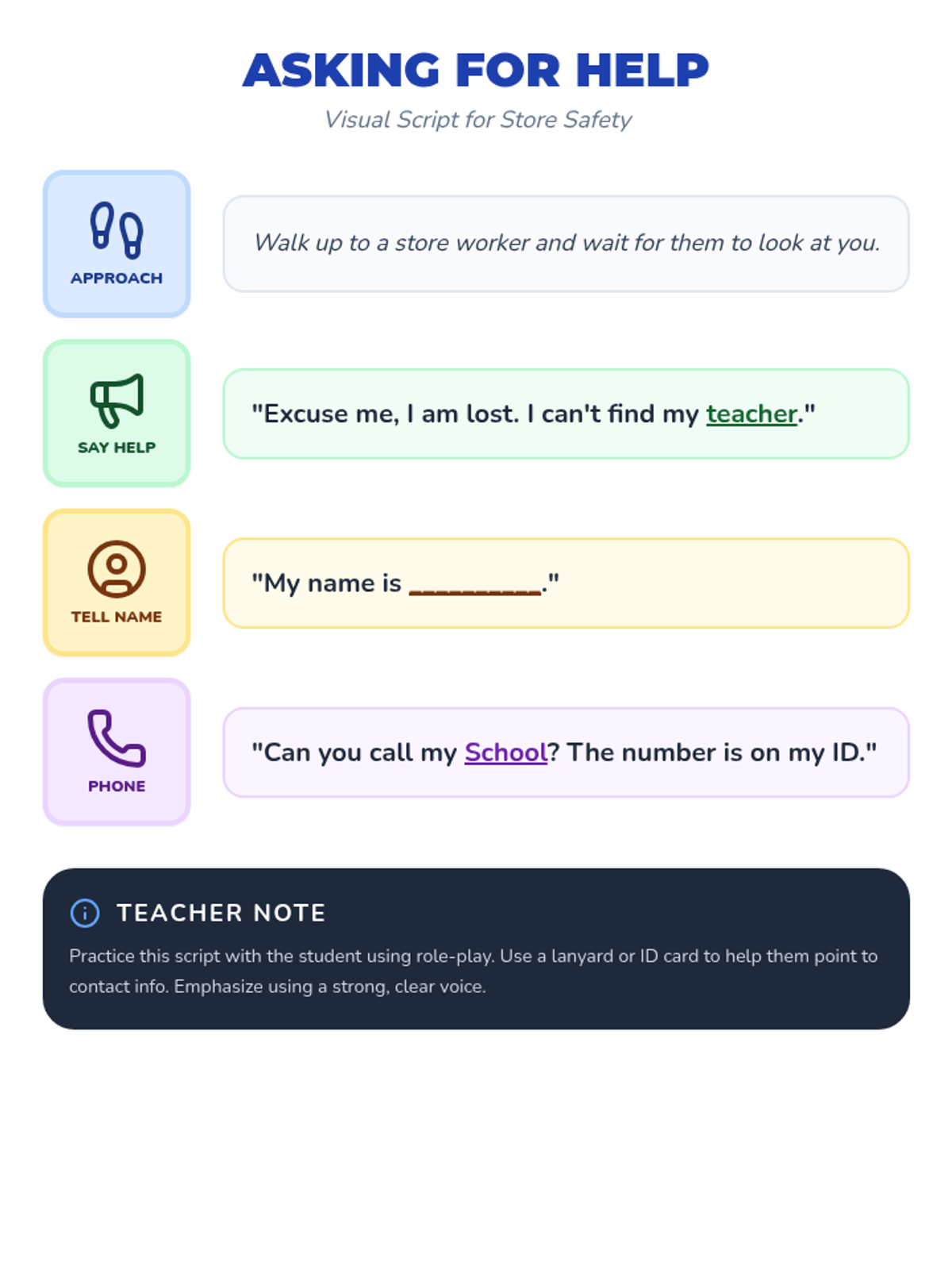
A visual social script for students to use when asking a store worker for help. Revised to fix contrast, alignment, and ensure it fits on a single page.
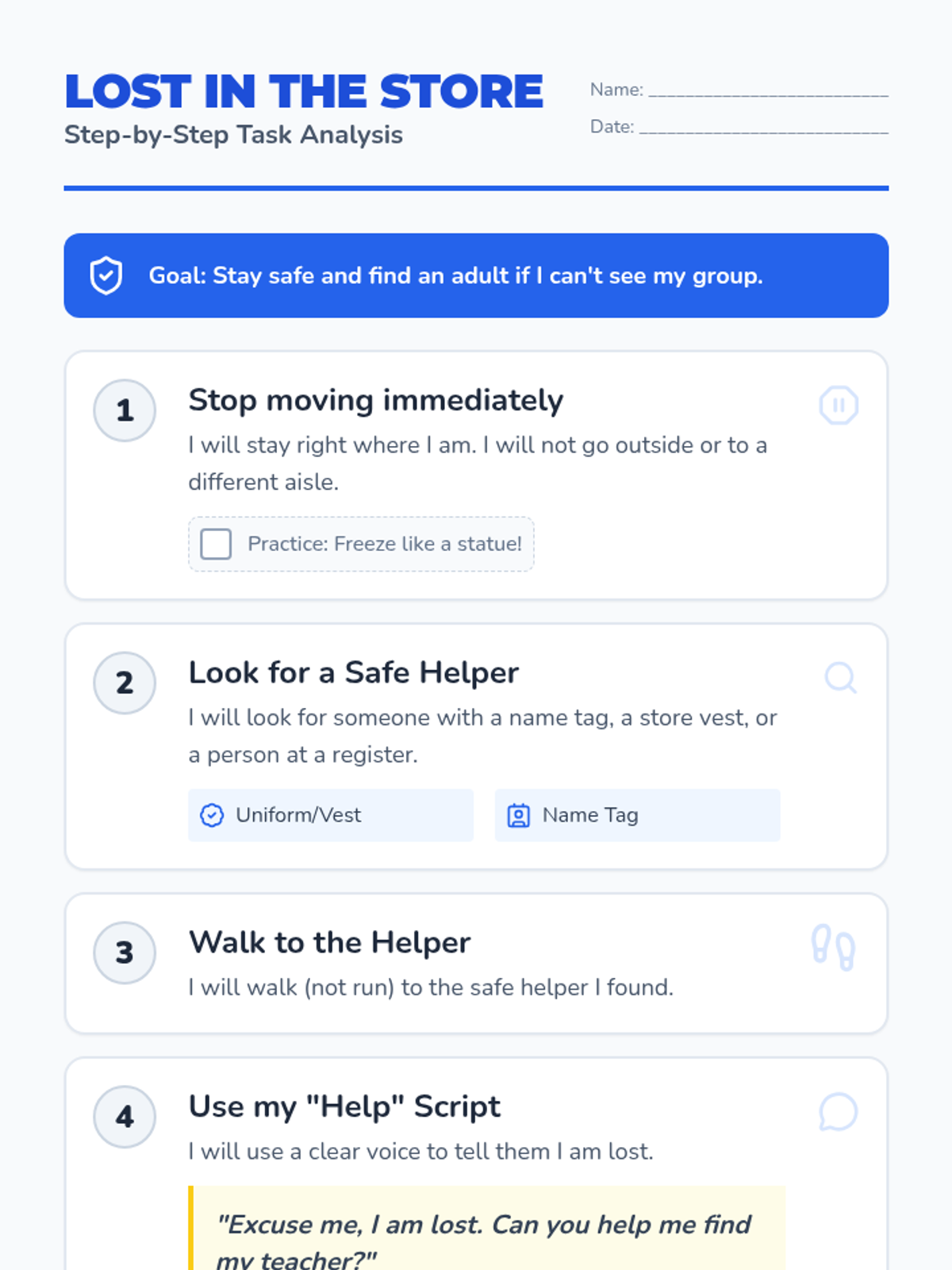
A step-by-step task analysis handout for students to follow if they become separated from their group in a store. Includes visual cues and practice prompts. Revised for better page layout.
An interactive slide deck introducing store safety concepts, specifically focused on what to do if a student gets lost in a retail environment.
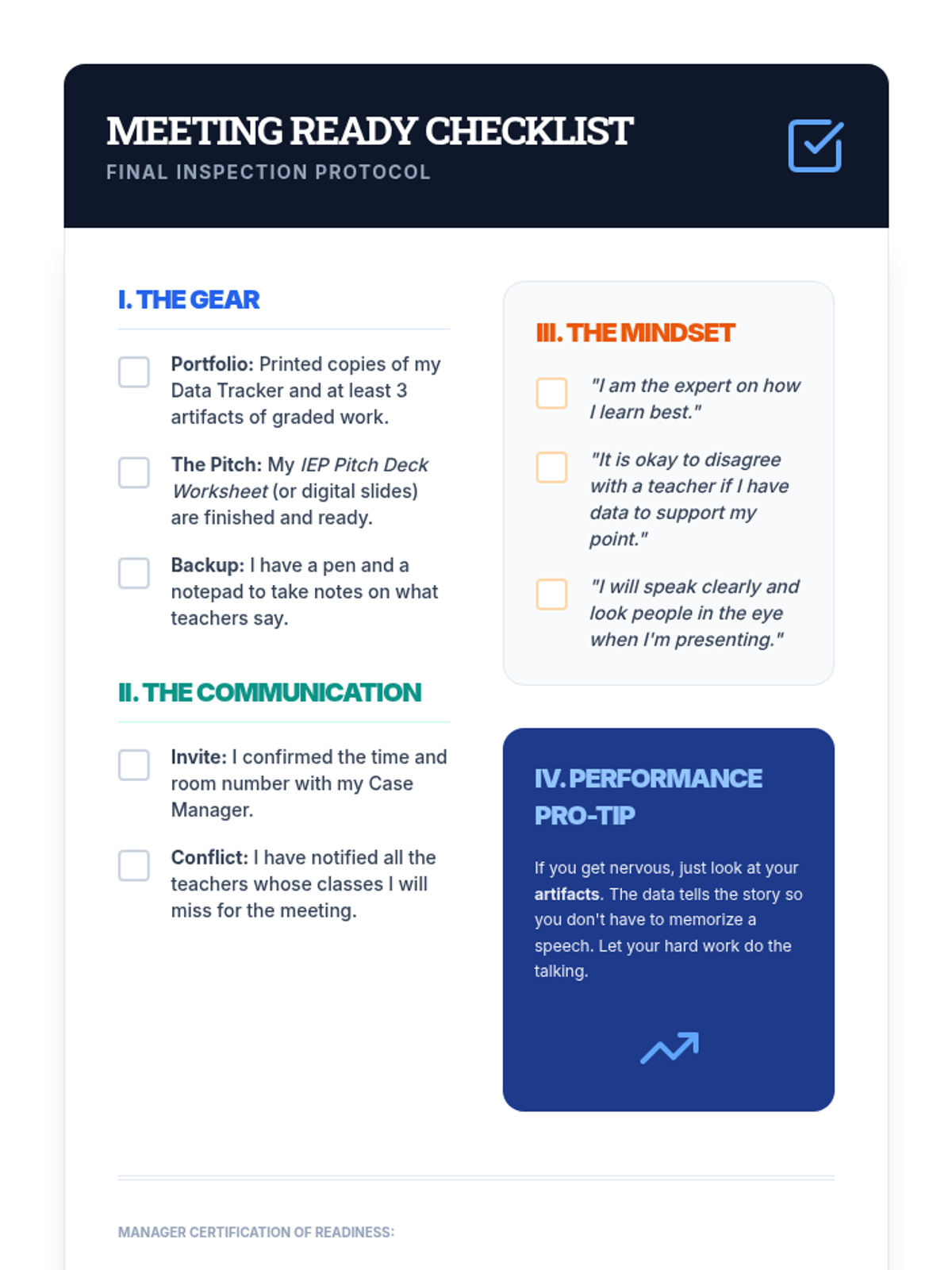
Final checklist for students to ensure they are prepared for their IEP meeting. Covers physical materials (gear), communication logistics, and mental preparation (mindset).
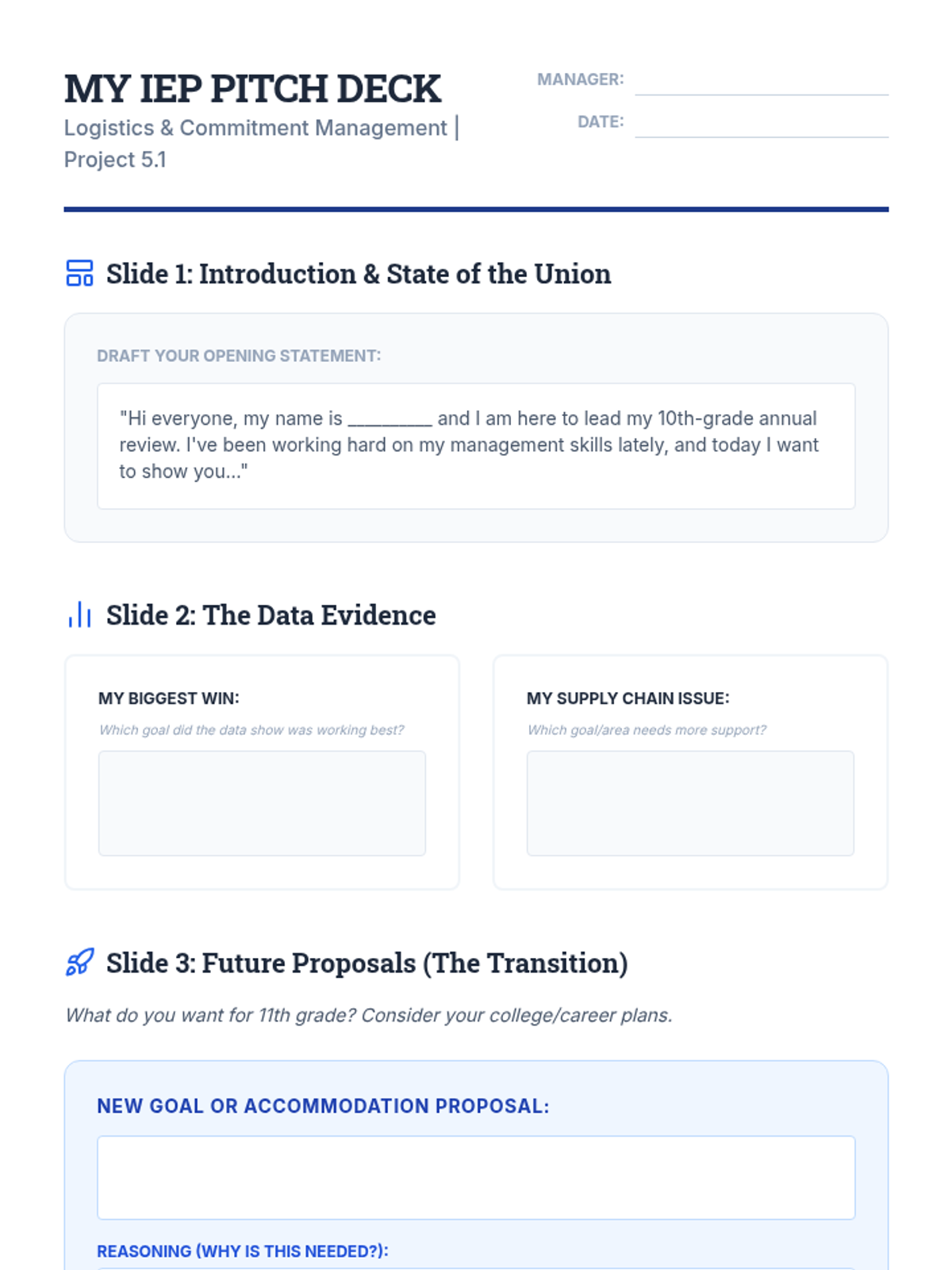
Planning worksheet for a student-led IEP presentation. Guides students through drafting their opening statement, data wins/challenges, and proposals for future accommodations/goals.
Capstone slides for Lesson 5. Focuses on student-led IEP meeting leadership, including analyzing a student-led meeting, a presentation script formula (Opening, Data, Ask), and the power of artifact evidence.
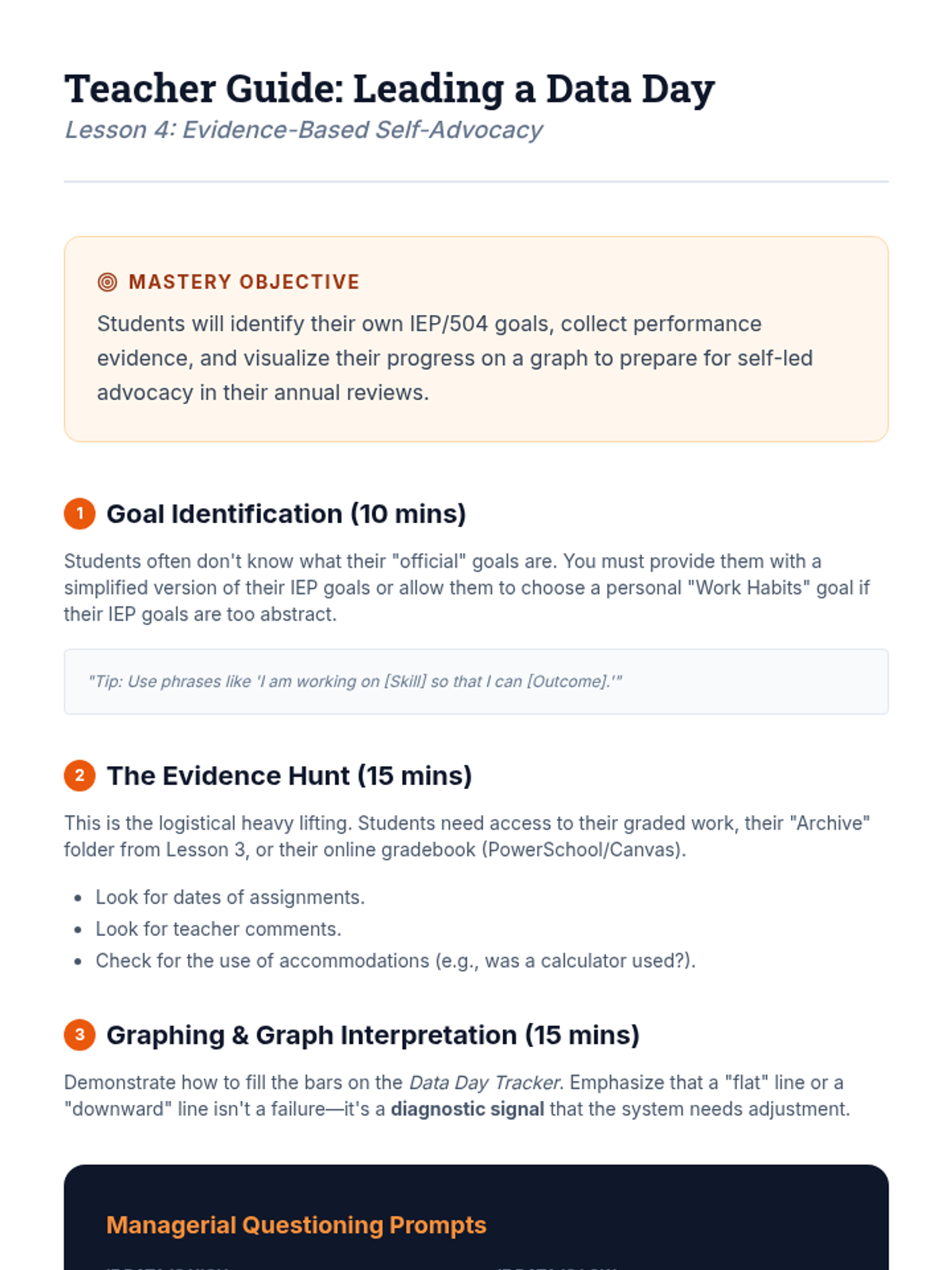
Facilitation guide for Lesson 4, including tips on helping students identify goals, leading an "Evidence Hunt," and using data as a diagnostic signal for adjusting educational supports.
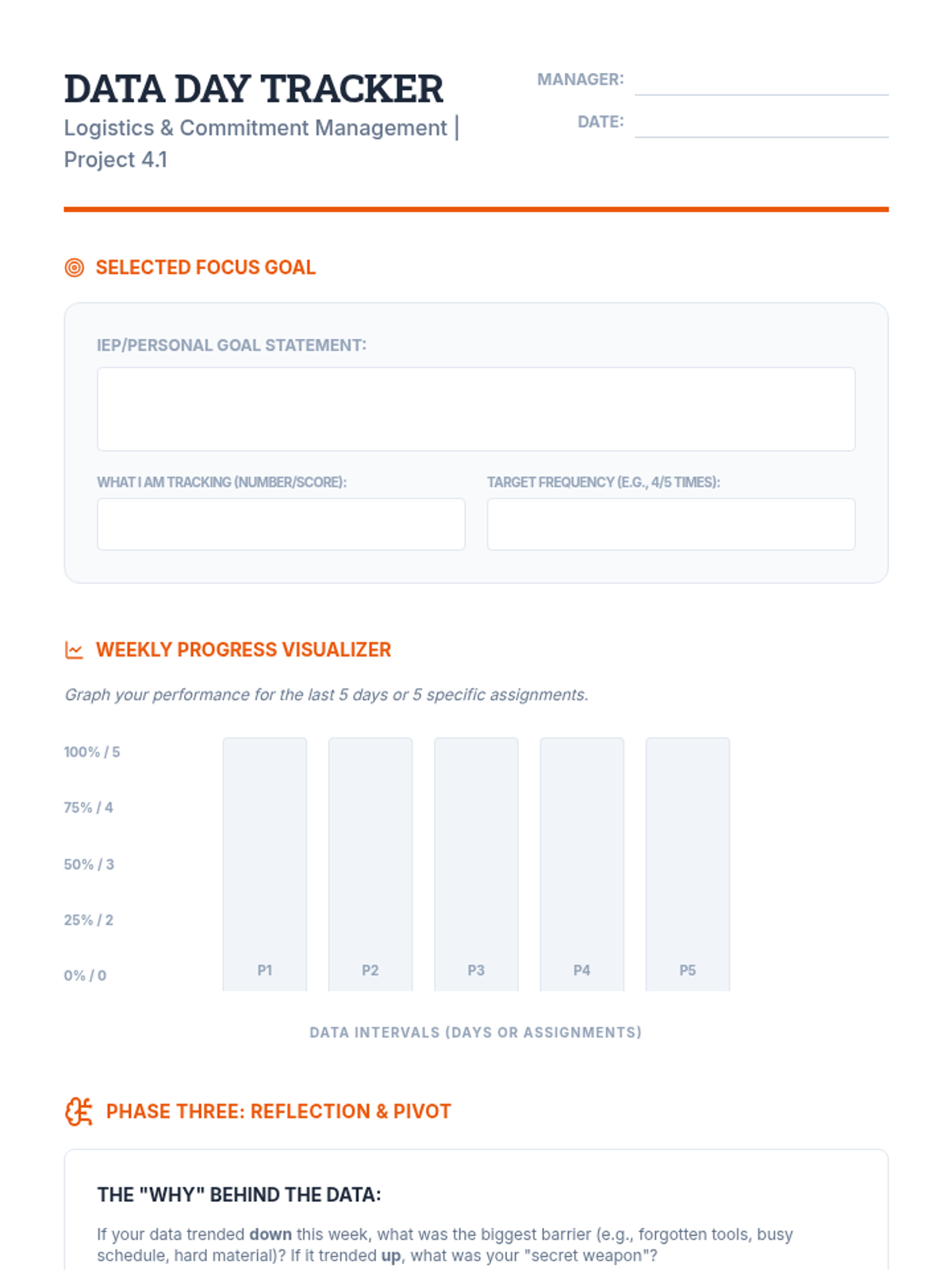
Worksheet for student self-monitoring. Includes a goal selection section, a 5-point bar graph for tracking progress, and reflective questions for "pivoting" based on data results.
Slides for Lesson 4 on goal monitoring. Teaches students how to distinguish between quantitative and qualitative data, establishes a "Data Day" routine, and shows how to turn IEP goals into trackable data points.
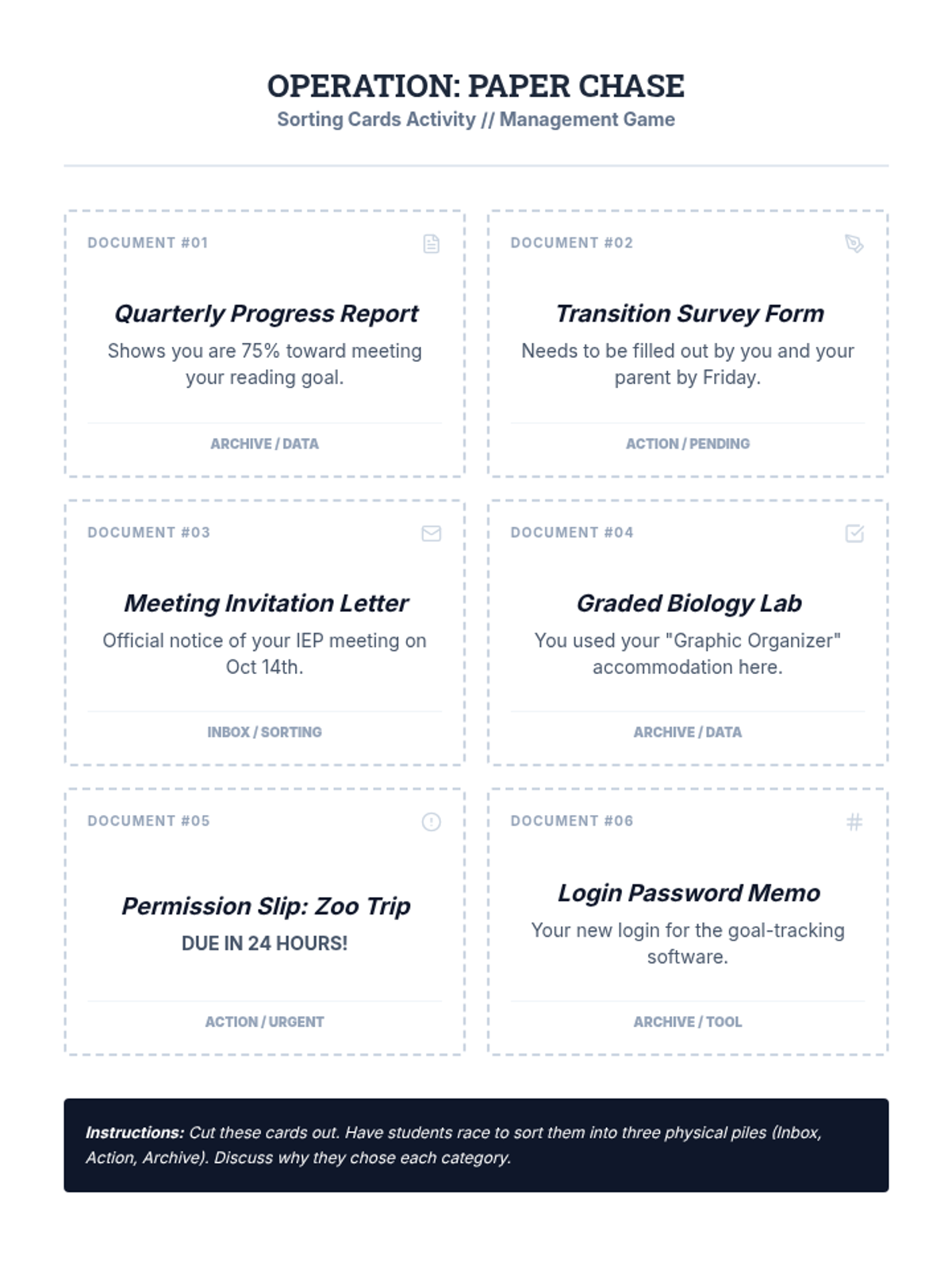
A set of printable sorting cards for the "Paper Chase" activity. Includes various document scenarios (progress reports, invitations, permission slips) for students to categorize.
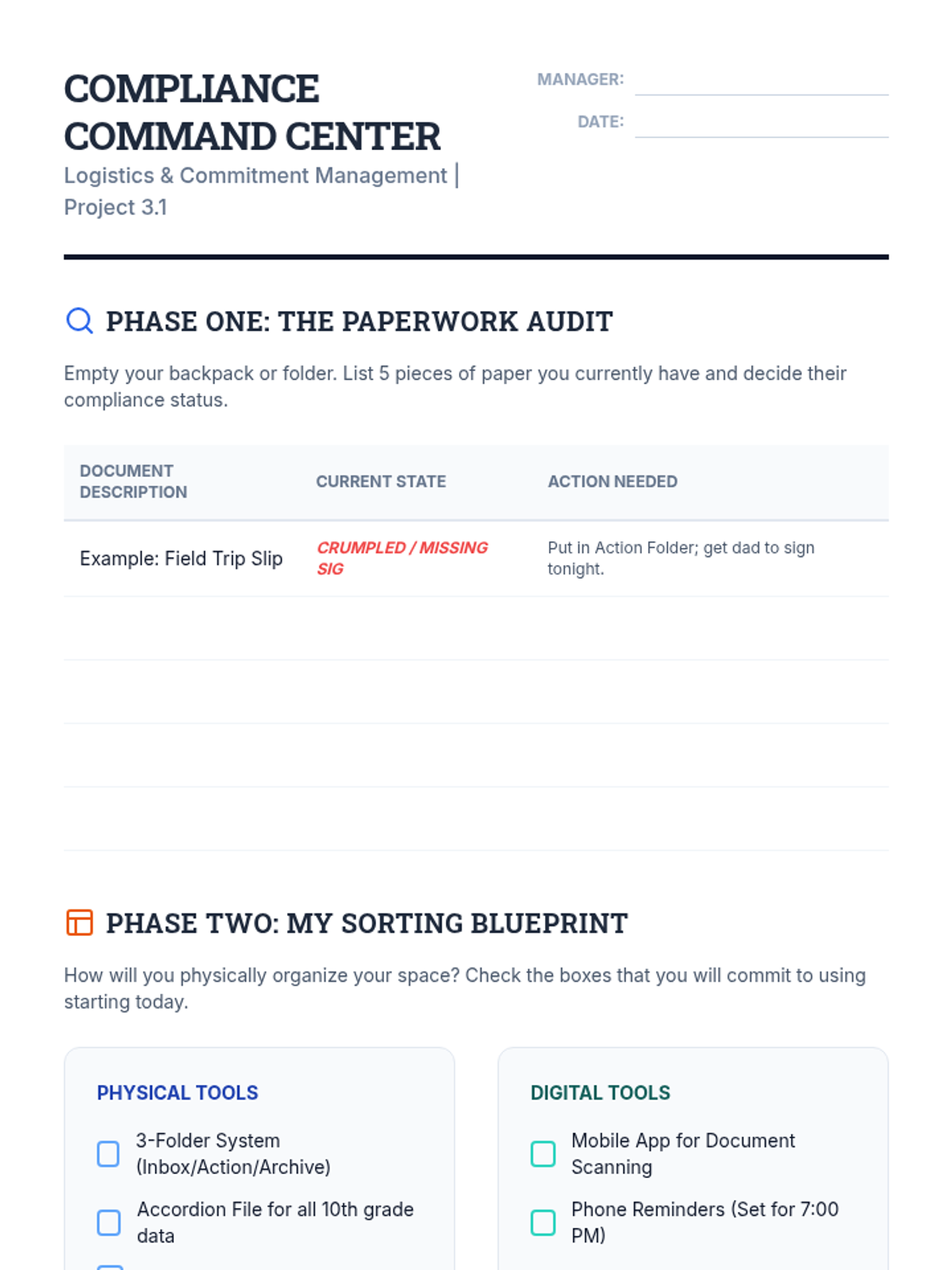
Worksheet for students to audit their current paperwork and design a personal compliance system. Includes sections for a physical/digital tool blueprint and a "Daily Reset" protocol.
Slides for Lesson 3 focusing on administrative organization. Introduces the "Backpack Abyss," a 3-folder compliance system (Inbox, Action, Archive), and hybrid digital/analog management strategies.
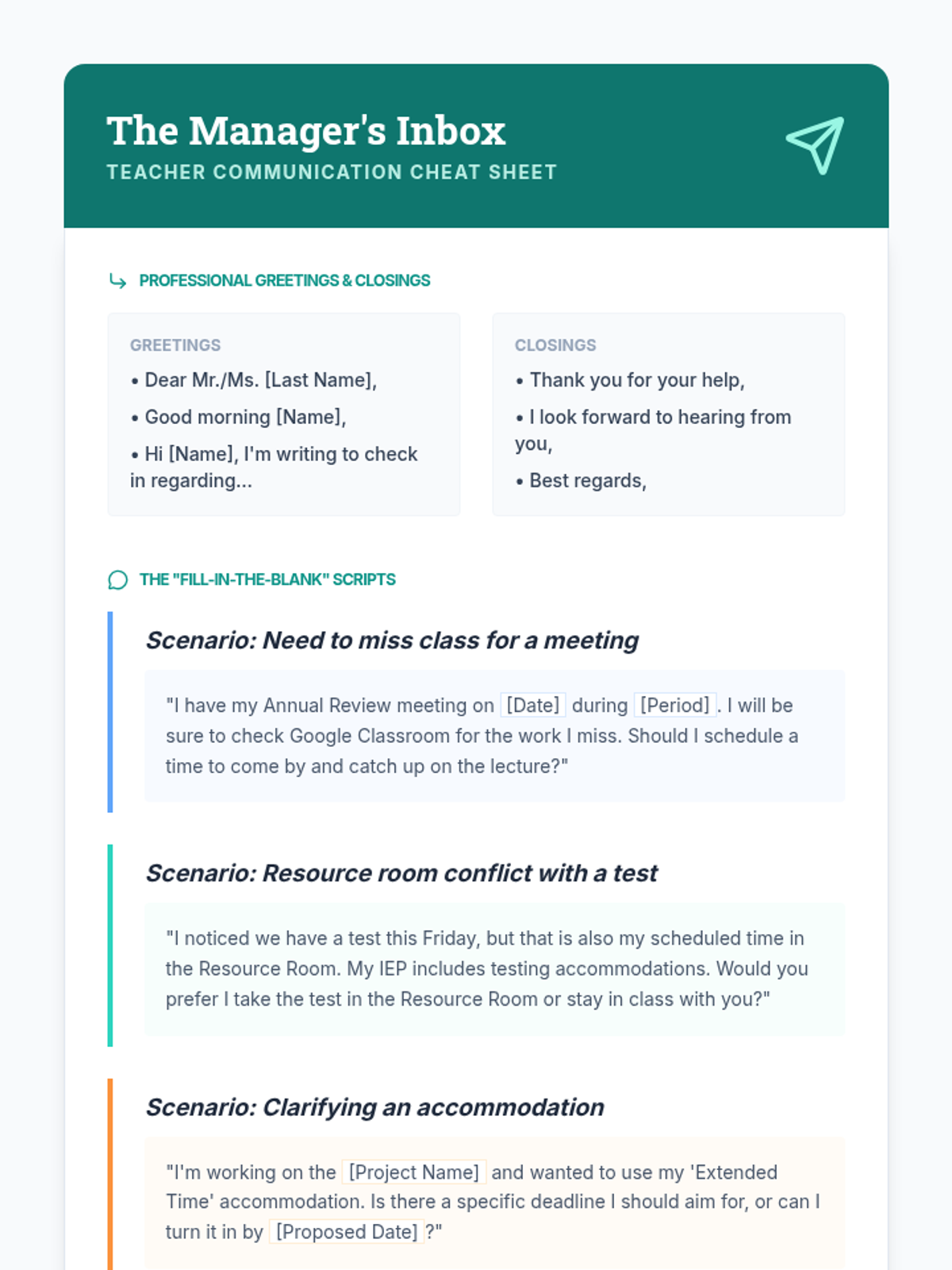
A handy reference sheet for students providing professional greetings/closings, fill-in-the-blank scripts for common IEP-related communication scenarios, and "Golden Rules" for student-teacher interactions.
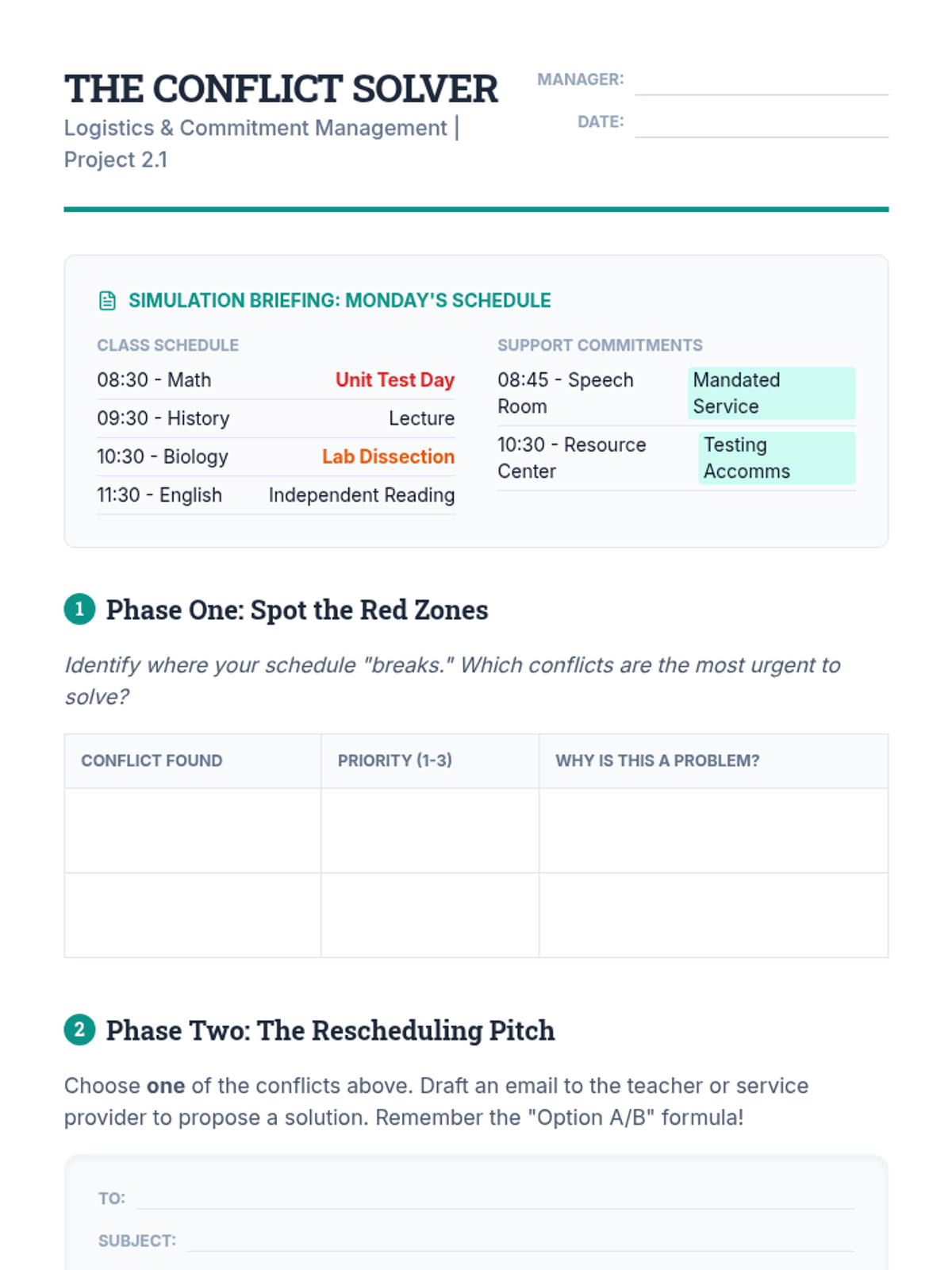
Simulation worksheet where students identify schedule conflicts in a hypothetical Monday schedule and draft professional emails to resolve them using the "Option A/B" formula.
Slide deck for Lesson 2 focusing on schedule coordination. Introduces pull-out services, communication strategies for conflicts, and a professional email template for student-teacher coordination.
A "Self-Advocacy Cheat Sheet" that summarizes their needs and tools.
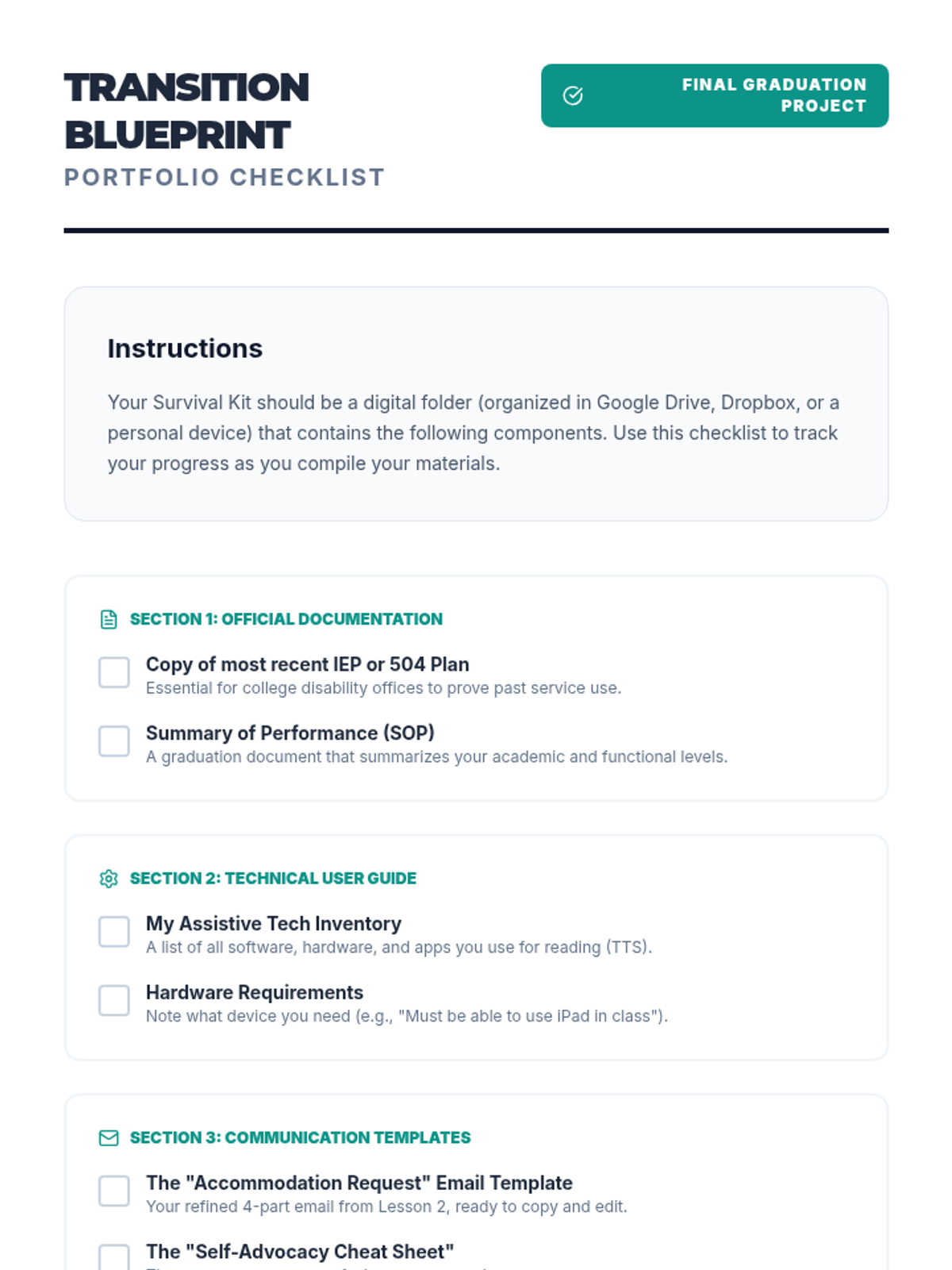
A checklist for what to include in the digital/physical portfolio.
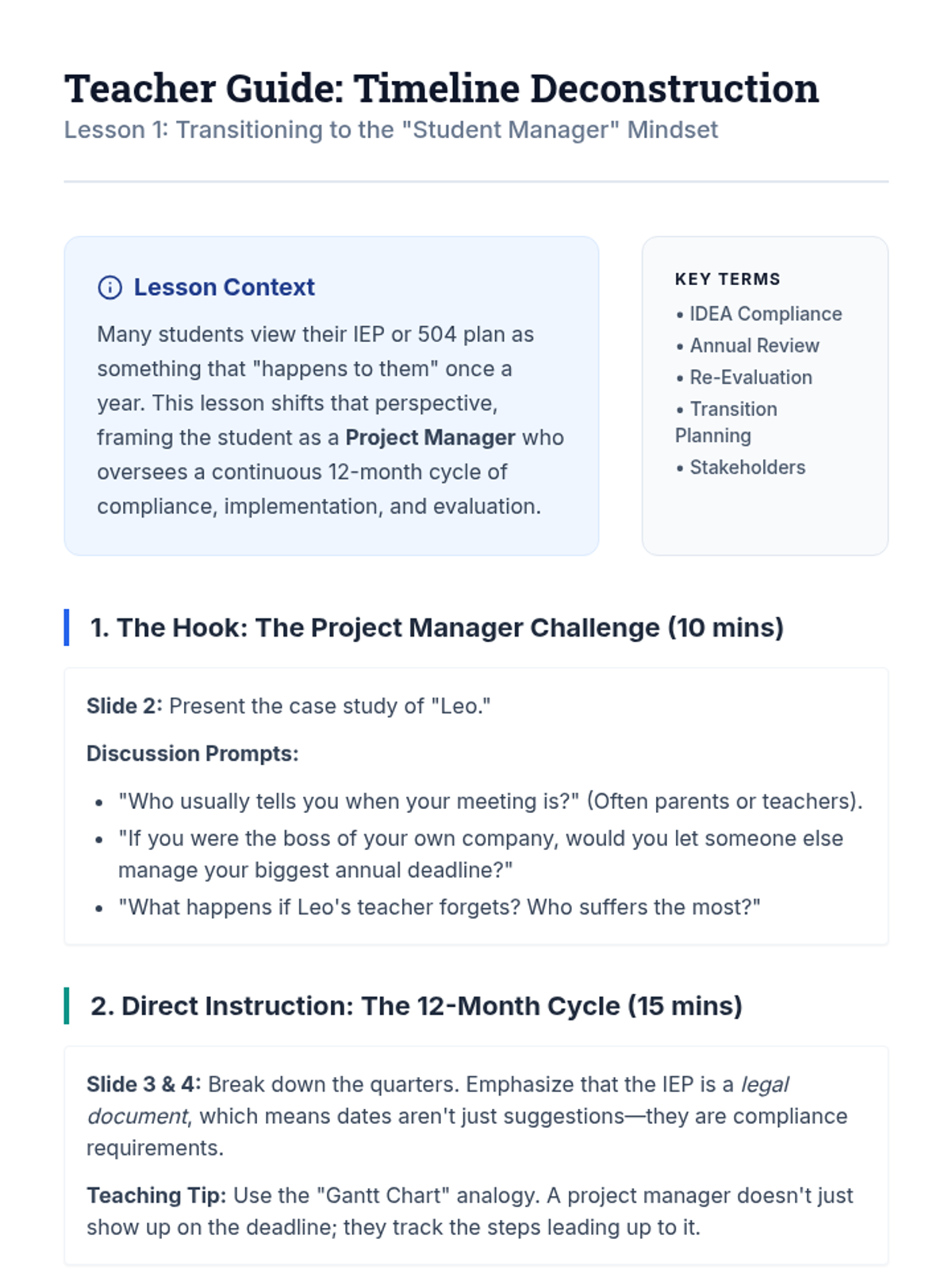
Facilitation guide for Lesson 1, including discussion prompts for the case study, teaching tips for the 12-month cycle, and differentiation strategies for mapping the educational timeline.
Slides for Lesson 5 focusing on organizing and finalizing the digital transition portfolio.
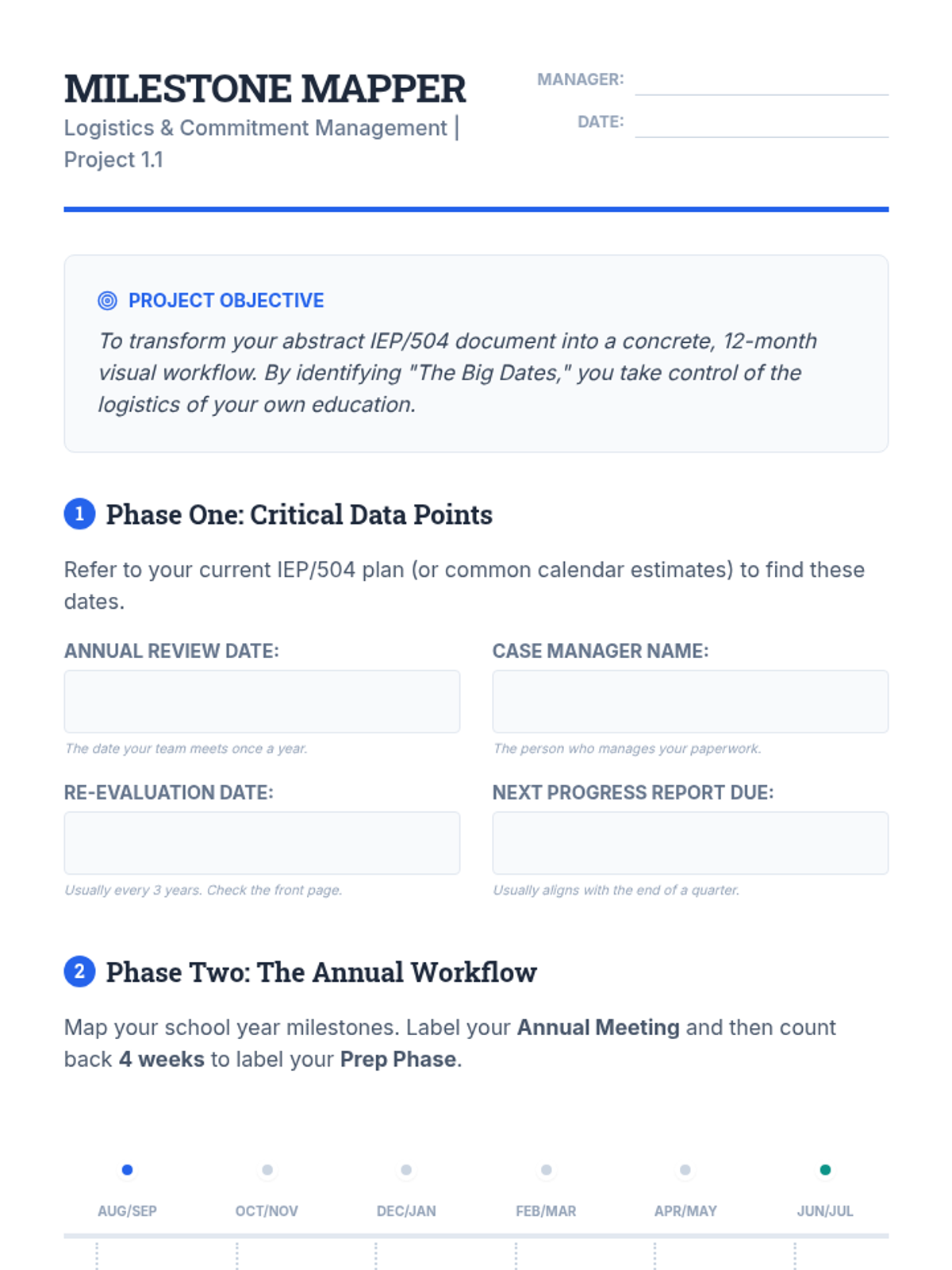
Worksheet for students to map their own IEP/504 timelines. Includes sections for data gathering (dates/contacts), a 12-month visual workflow builder, and reflection questions on meeting preparation.
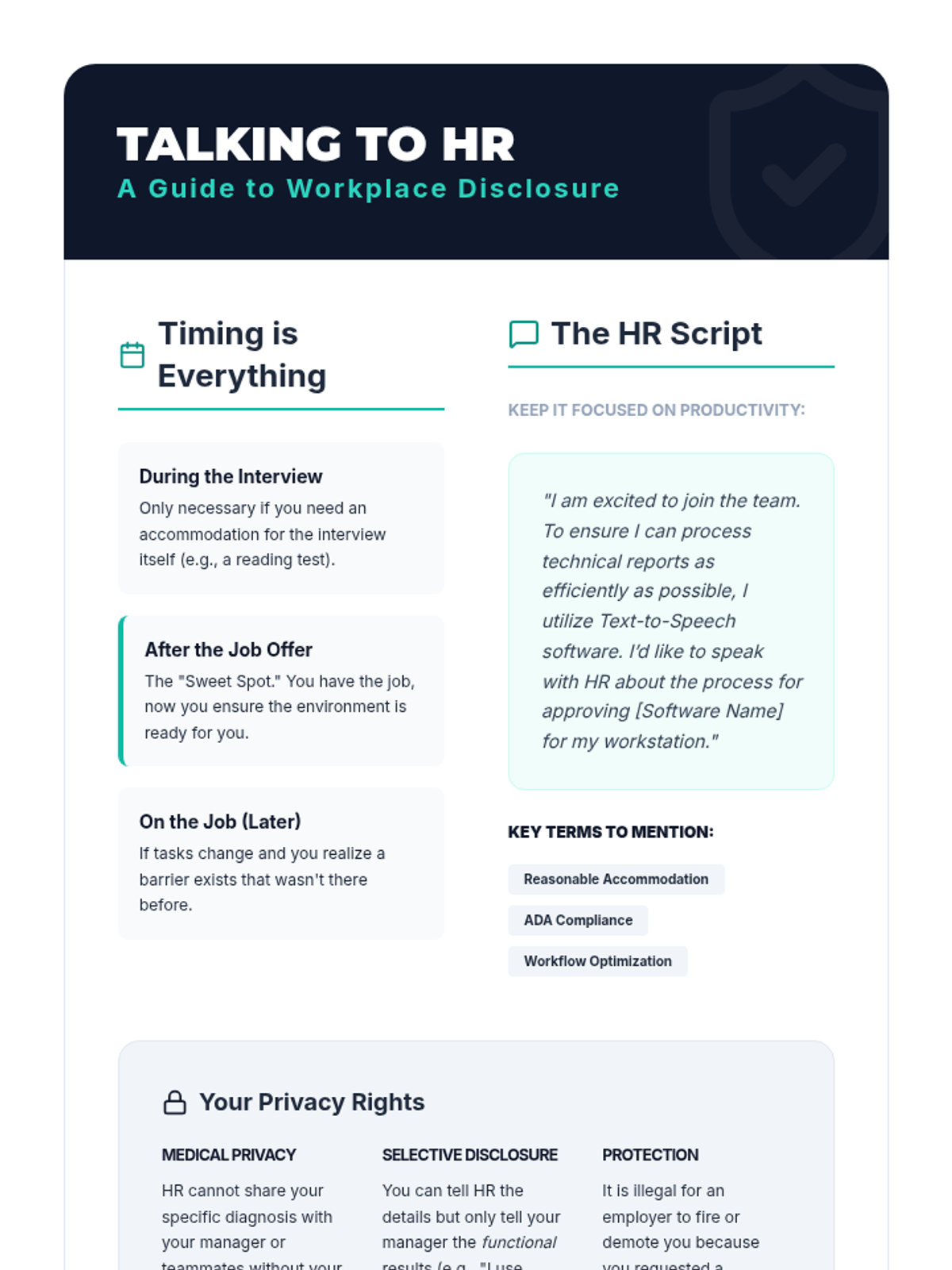
A professional reference sheet for students on when and how to disclose their technology needs to Human Resources in a workplace setting.
Visual presentation introducing students to the concept of managing their own IEP/504 timelines using a project management framework. Includes a case study and quarterly workflow breakdown.
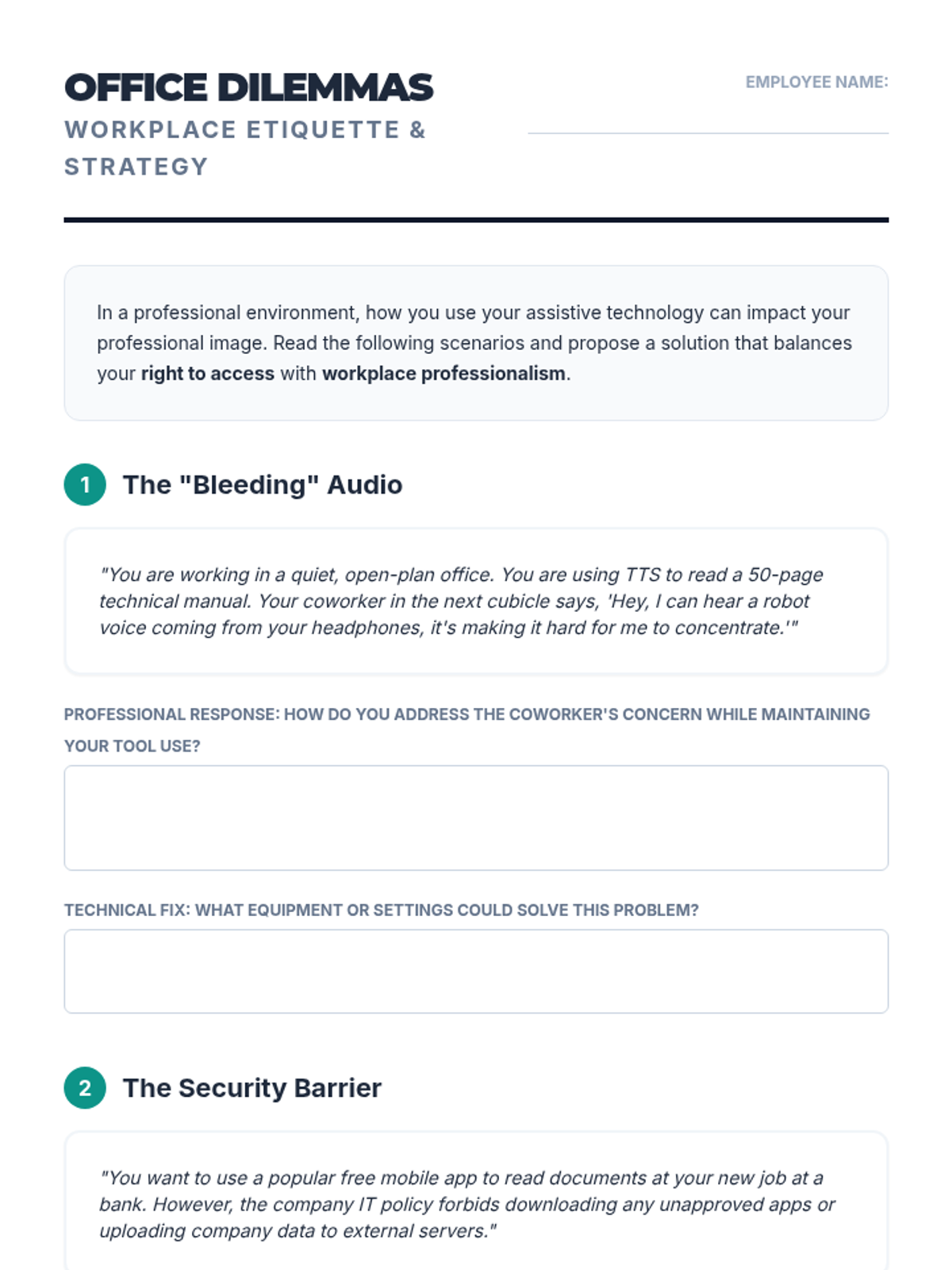
A worksheet containing workplace scenarios for students to analyze, focusing on balancing professional etiquette with assistive technology needs.