Student worksheet for Lesson 1, featuring pattern completion exercises, a creative pattern-making section, and a classroom observation 'detective report'.
A set of high-impact "Art Plates" for a Big Book, featuring layered CSS designs, atmospheric lighting, and thematic icons to illustrate forest animal survival traits.
A set of stylized "Art Plates" designed to be the front illustrations for a Big Book. Each plate uses bold colors, icons, and emojis to represent a key part of the forest animal survival story.
A narrative story designed for a "Big Book" format. Each page provides 1st-grade level text focused on animal survival traits, habitats, and family behaviors, intended to be attached to the back of large illustrations.
A updated "Big Book" slide deck based on Margaret Wise Brown's "The Important Book" format. It highlights how various forest animals use their unique traits to survive in their habitats.
A teacher resource containing answer keys for the Imagineer Lab reading questions, the correct pairings for the Mechanical Match Cards, and a simplified grading rubric for the ride design challenge. Revised for a compact 1-page layout.
A vocabulary matching game featuring the six simple machines. Includes three sets of cards for students to match: the machine name, its scientific definition, and a specific real-world example from a theme park attraction. All cards have identical styling with small corner labels identifying them as Machine, Definition, or Example. Darkened labels for better print contrast.
A simplified "Rapid Prototyping" engineering challenge where students build and test a single mechanical feature (lift, spinner, or launcher) using common classroom supplies. Includes a blueprint drawing area and reflection questions.
An informational text reading activity that explains the six types of simple machines through examples found in famous Disney theme park attractions, including comprehension questions and a sketching area. Revised to move the Lab Analysis to its own page (Page 3) and balance the machines across Pages 1 and 2.
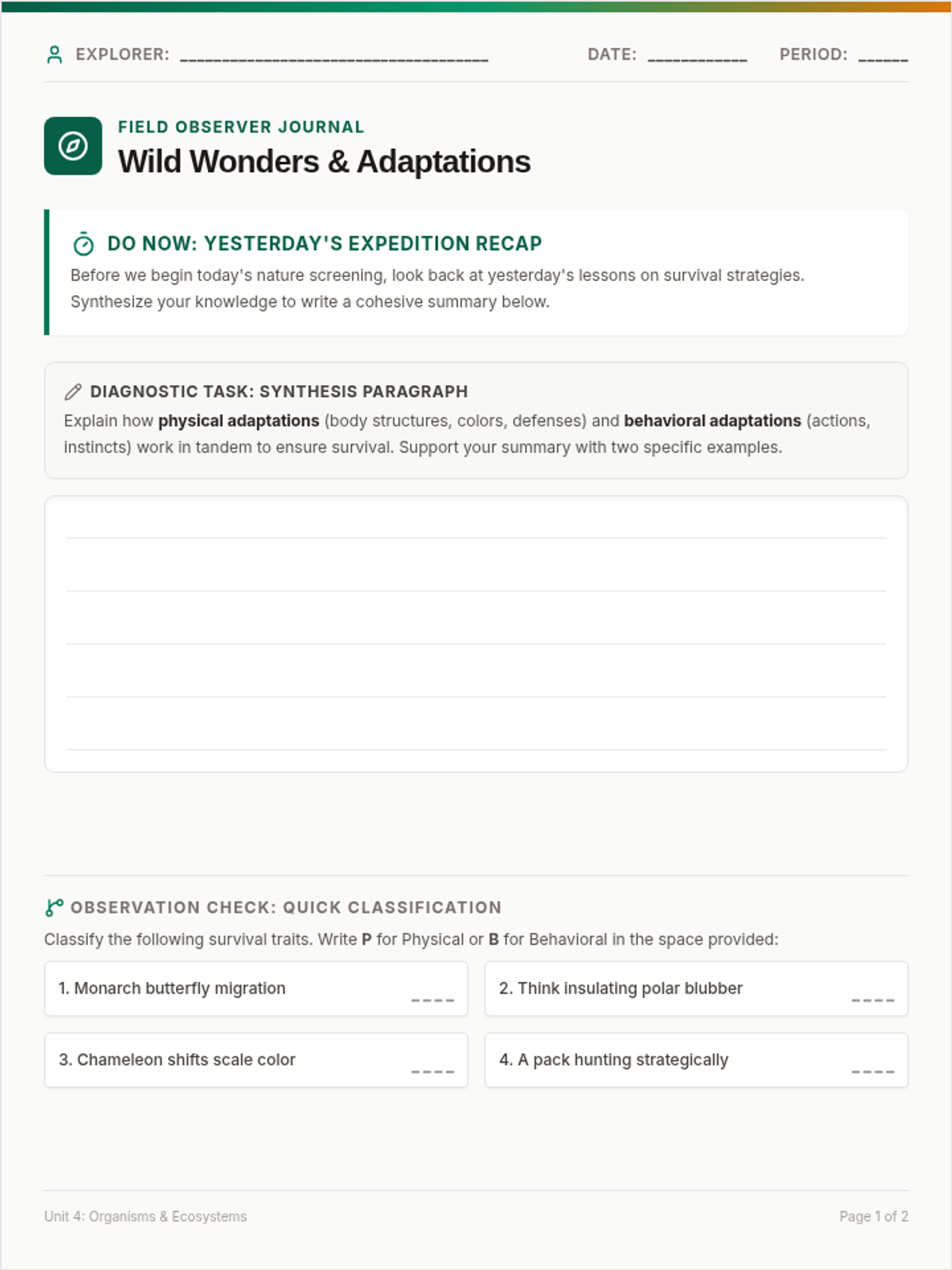
A student-facing activity sheet that reinforces the forest animal traits and diets introduced in the chant, with space for drawing and observation writing.
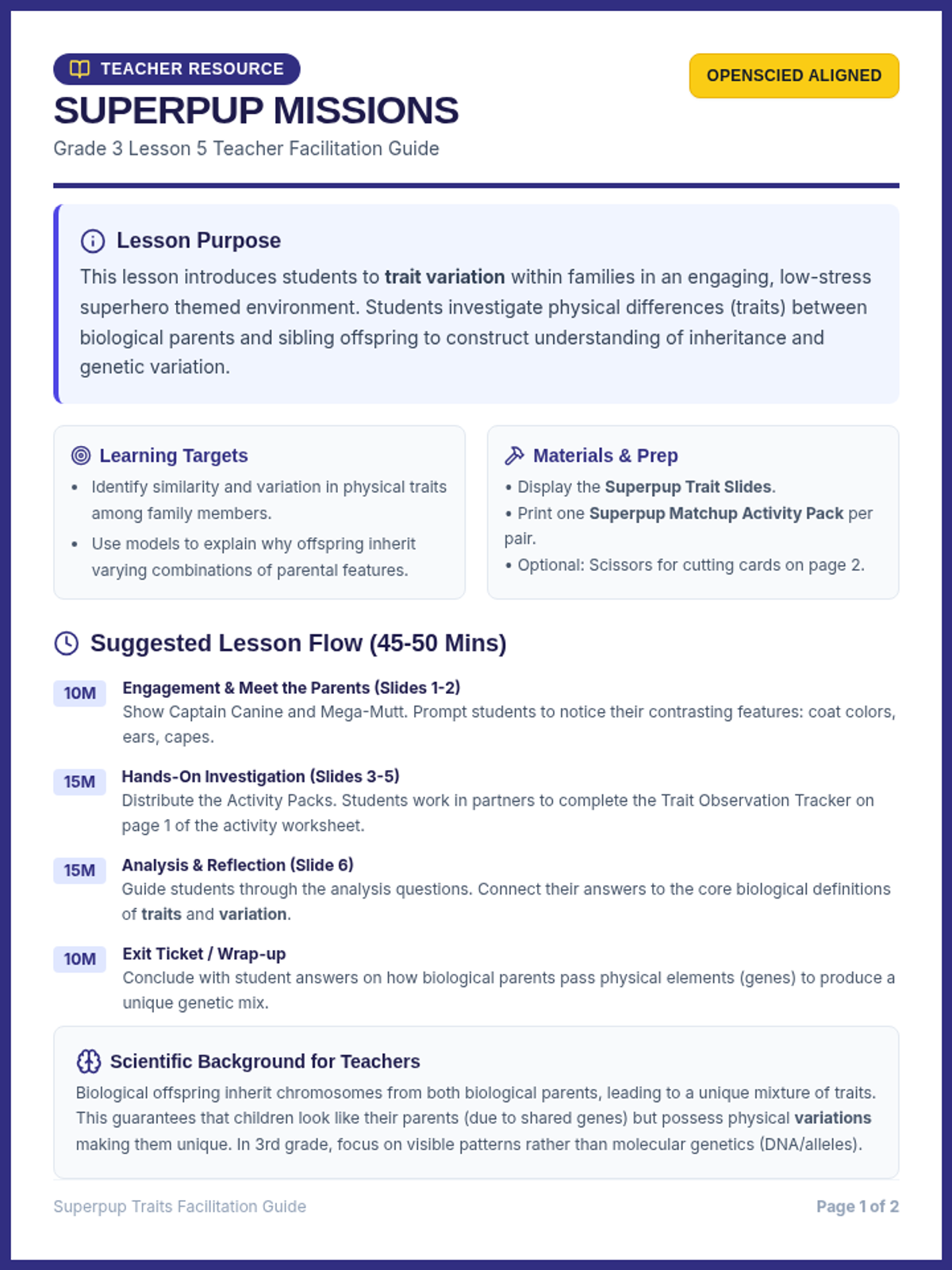
A teacher resource guide for implementing the Forest Friends GLAD chant, including NGSS standards mapping, instructional steps, and vocabulary definitions.
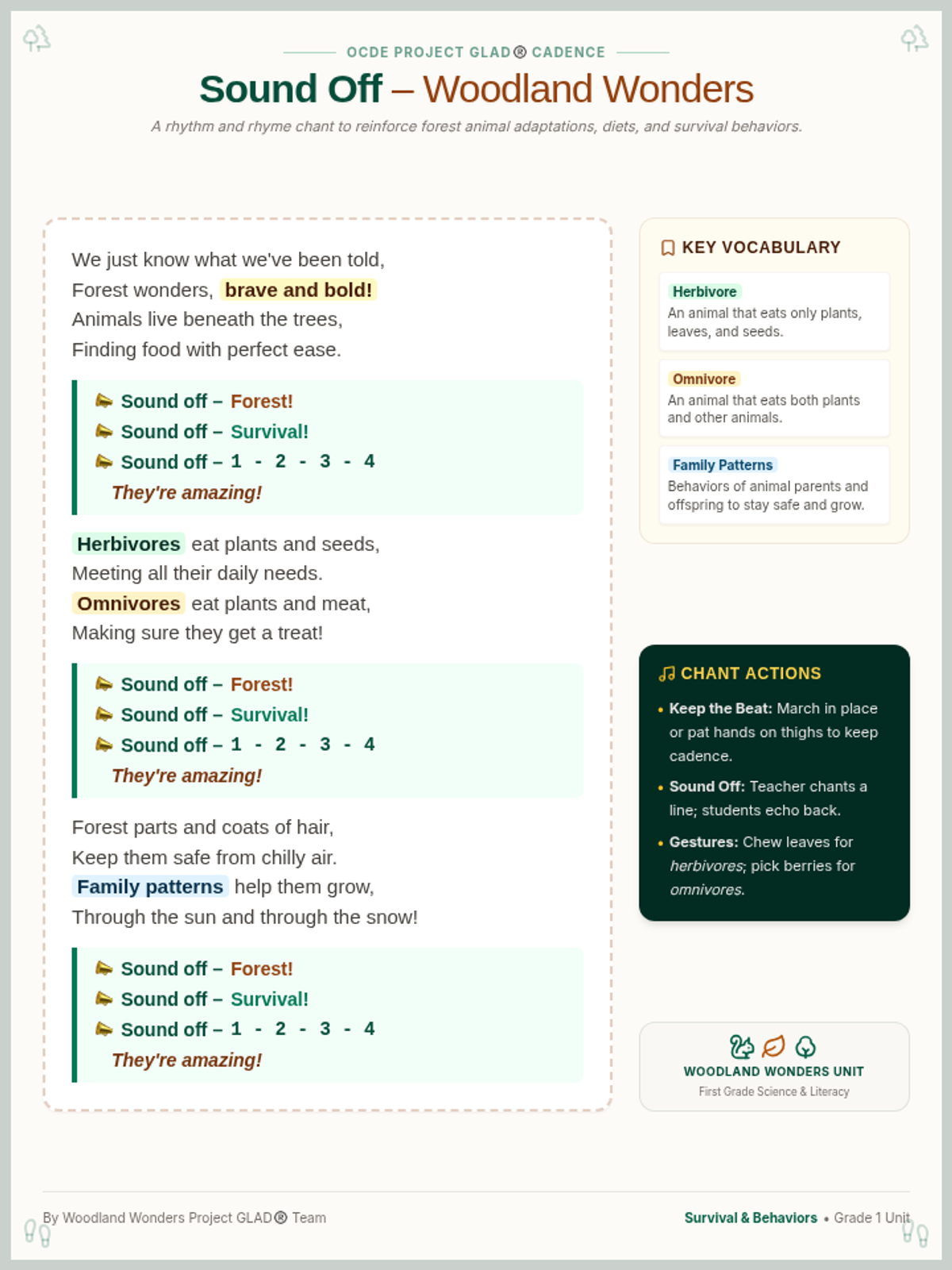
A GLAD-style "Here-There" chant for first-grade students, focusing on forest animal vocabulary, survival traits, and habitats. Designed as a classroom anchor chart.
A teacher reference guide explaining the concept of middle (medial) sounds in phonemic awareness, including teaching strategies and common student challenges.
A student activity set featuring 9 word cards (3 CVC, 3 digraphs, 3 blends) and two large sorting mats for hands-on phoneme counting and categorization. drop zones are sized for cards. Updated with 'Operation: Sound Secrets'.
A half-sheet exit ticket focusing on sound counting and isolating middle sounds, provided with two identical copies on one page for efficient printing. Question 3 has been removed as requested. Updated with 'Operation: Sound Secrets'.
A half-sheet recording tool for the Sound Sort activity, provided with two identical copies on one page for efficient printing. Features separate sections for 3-sound and 4-sound words. Layout optimized for kindergarten handwriting.
Instructional slides for the Sound Secrets lesson, teaching students how to isolate phonemes in 3-4 phoneme words, including digraphs and blends. Practice focuses on identifying a single middle sound.
A detailed teacher's guide for a Kindergarten phonics lesson, featuring 'Operation: Sound Sort' with 9 cards. BRUSH has been replaced with FLAG to ensure clear 4-sound identification.
An assessment worksheet for students to record their observations during the lesson. It includes a classification table for states of matter, a matching exercise for reversible vs. irreversible changes, and a prompt for reflection.
A student-facing hands-on guide for the 'Fizzy Cupcake' activity. It provides a structured 'recipe' for exploring chemical reactions and states of matter without heat, including space for sketching observations.
Engaging instructional slides for the Bronx Bake-Off lesson, defining states of matter, chemical reactions, and the difference between reversible and irreversible changes with vibrant, large-text visuals.
A comprehensive instructional guide for teachers to lead a hands-on kitchen science lesson. It includes learning objectives, a timed pacing guide, key questioning prompts, and safety protocols for grades 2-4.
A 'Matter Menu' themed worksheet that assesses student understanding of states of matter and reversible/irreversible changes through sorting, matching, and short response questions.
A student activity sheet for recording observations during the 'Fizzing Batter' experiment. It includes sections for ingredient properties, reaction sketching, and analysis of changes in states of matter.
Step-by-step 'Recipe Challenge Cards' that guide students through the experiment process, formatted as a set of activity instruction cards.
A vibrant 5-slide presentation designed for elementary students, introducing the states of matter through the metaphor of baking and explaining chemical versus physical changes with engaging visuals.
A lab report worksheet for students to document their observations of solids, liquids, and gases during 'The Great Bronx Bake-Off' experiment, including space for drawings and reflection.
A visually engaging 16:9 slide deck for 'The Great Bronx Bake-Off', introducing states of matter, the baking challenge, and safety procedures using a kitchen science theme.
A comprehensive teacher's lesson plan for the Bronx Bake-Off unit, featuring learning objectives, material lists, a detailed pacing guide, and pedagogical notes on differentiation and misconceptions.
A comprehensive teacher facilitation guide for 'The Great Bronx Bake-Off' lesson, outlining objectives, materials, and a step-by-step instructional sequence for grades 2-4.
A teacher-facing facilitation guide providing instructional scripts, scientific background, and strategies for discussing complex physics topics with advanced kindergarteners.
A student-facing journal for recording observations about different types of explosions, featuring drawing areas for comparative energy and a matching activity for blast locations.
A high-energy, visually engaging slide deck exploring Earth's most powerful explosions, asteroids, supernovae, and the Big Bang, tailored for advanced kindergarteners.
The complete answer key for the 'Decoding Mission Worksheet' and the 'Lost Watch Passage'. Provided as a separate teacher resource with clear, verified answers for all activities. Updated for spacing and formatting.
A set of 8 printable flashcards (Evidence Cards) featuring key words from the lesson. These are designed for sorting activities and games to reinforce phonics patterns including sh, th, ck, wh, ph, and the ch vs tch distinction. Card 6 has been updated to 'graph' for short vowel consistency. Updated grid for easier cutting. Contrast and spacing have been improved.
A comprehensive teacher's guide for the 'Secret Agent Sound Lab' lesson. It includes learning objectives, a detailed explanation of the -tch rule (The Soldier Rule), an instructional pacing guide, and tips for addressing common student misconceptions.
A 2nd-grade decodable reading passage titled 'The Case of the Lost Watch', focused on short vowels, digraphs, and the -tch trigraph. Includes a comprehension check section with updated handwriting lines and corrected word formatting. Highlighting is now consistent across all target words.
A student worksheet designed for 2nd graders to practice identifying digraphs, filling in short vowels, and choosing between ch and tch trigraphs. Features a clean, secret-agent themed layout with clear work areas for handwriting. Spacing and clues have been updated for clarity.
A vibrant and engaging 7-slide presentation that introduces 2nd graders to short vowels, digraphs (sh, ch, th, wh, ph, ck), and the -tch trigraph through a Secret Agent Sound Lab theme. Includes visual examples and a clear rule explanation for ch vs tch.
A detailed answer key and scoring guide for the Bee Buzz Assessment, providing expected responses and DOK level classifications for teachers. Includes the full text of the addressed standard.
A student-facing formative assessment worksheet for 2nd-grade science, featuring DOK 1-3 questions based on an oral presentation about honeybees. Optimized to fit on a single page with appropriate primary writing lines.
A teacher's script for a science-themed oral assessment about honeybees, designed for a 2nd-grade listening comprehension activity. Includes a reading passage and instructional tips.
Completed version of the Sky Scraper Notes to serve as a reference for teachers. Revised to include all 10 standard cloud types and optimized layout for a single-page reference.
A fill-in-the-blank guided notes document designed to be completed alongside the Sky Scraper presentation. Revised for improved page breaks, student work area legibility, and layout consistency.
A visual presentation covering the 10 main cloud types, their altitudes, and characteristics, with special focus slides for Cirrus, Stratus, and Cumulus clouds. Revised for improved padding and alignment on Slide 6.
A visual slide presentation guiding students through the setup of a forensic evidence board to solve the mystery of the missing fossils. Includes suspect introductions, layout templates, and success criteria.
A comprehensive grading rubric for the Badlands Sleuth evidence board project, focusing on suspect profiling, evidence accuracy, chemistry integration, and organization.
Teacher's answer key for the Wild Relations Sort with explanations for each ecological relationship.
A hands-on cut-and-paste sorting activity where students categorize 12 nature scenarios into mutualism, parasitism, or consumption.
Visual introduction to mutualism, parasitism, and consumption with simple icons and definitions.
A worksheet focusing on the cyclical nature of 'The Lion King' and its scientific parallels in ecosystem restoration, resilience, and succession. Students analyze how the restoration of the apex predator role leads back to a balanced state.