A visual slide deck introducing three major contenders for the title of 'first computer' (Babbage's Analytical Engine, Zuse's Z3, and the ENIAC), highlighting the different technical criteria used to argue for each one.
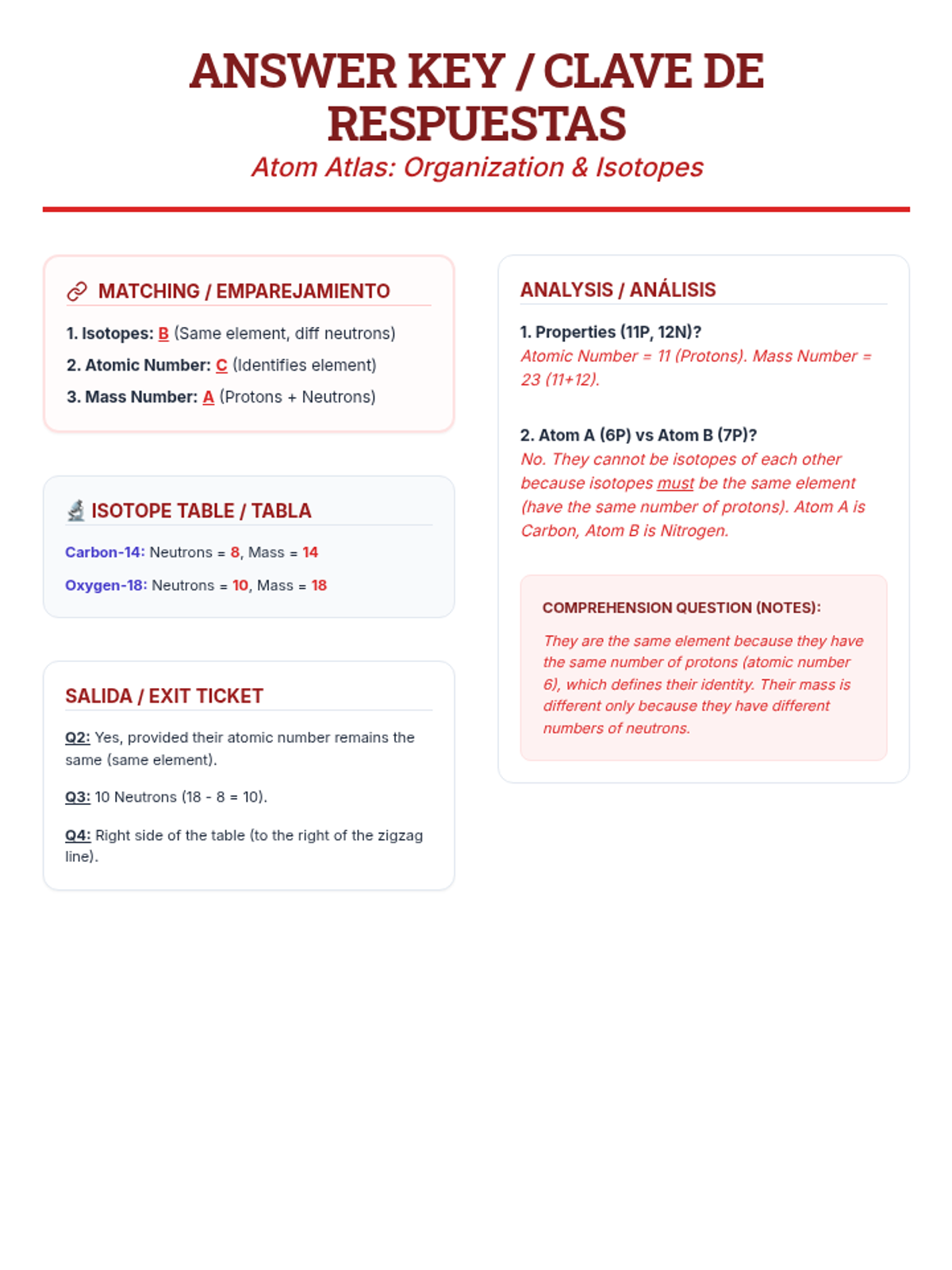
A teacher-facing answer key for the Atom Atlas lesson materials, providing correct responses for the matching, comprehension, and short answer sections.
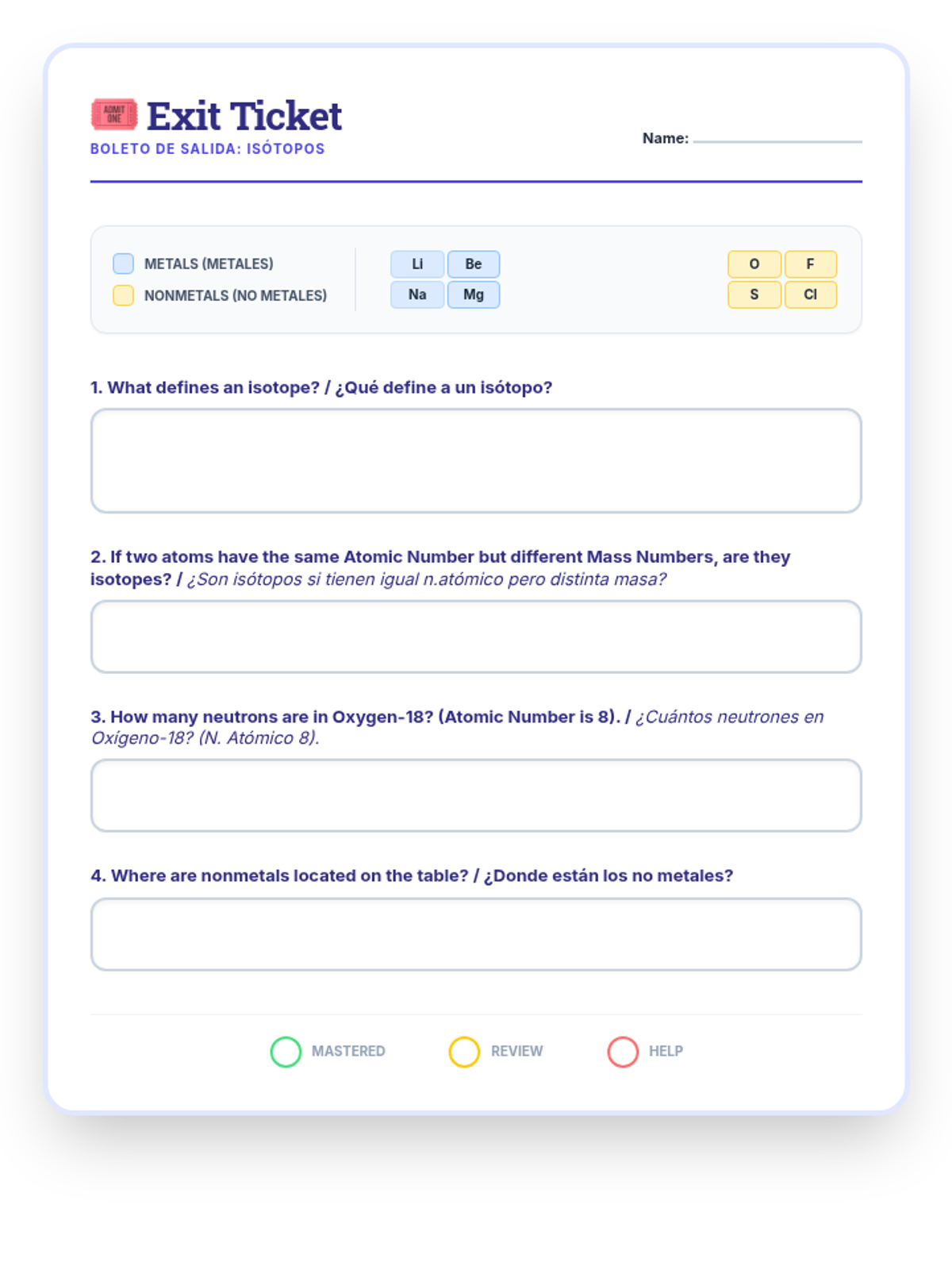
A concise exit ticket assessment featuring four key questions and a self-check section, provided in both English and Spanish for bilingual science classrooms.
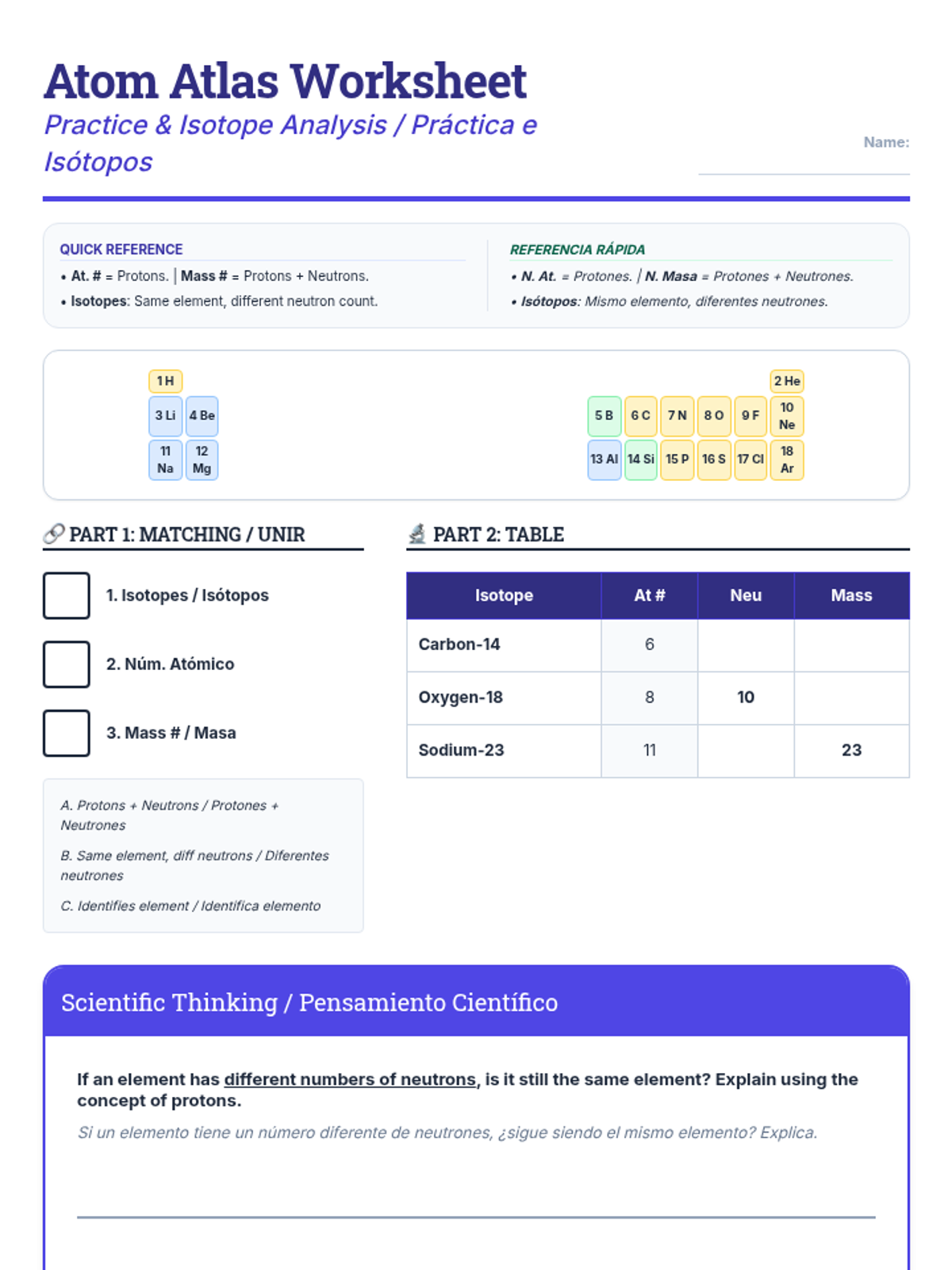
A comprehensive practice worksheet featuring matching, comprehension questions with sentence stems, and a short answer section focused on the organization of the periodic table.
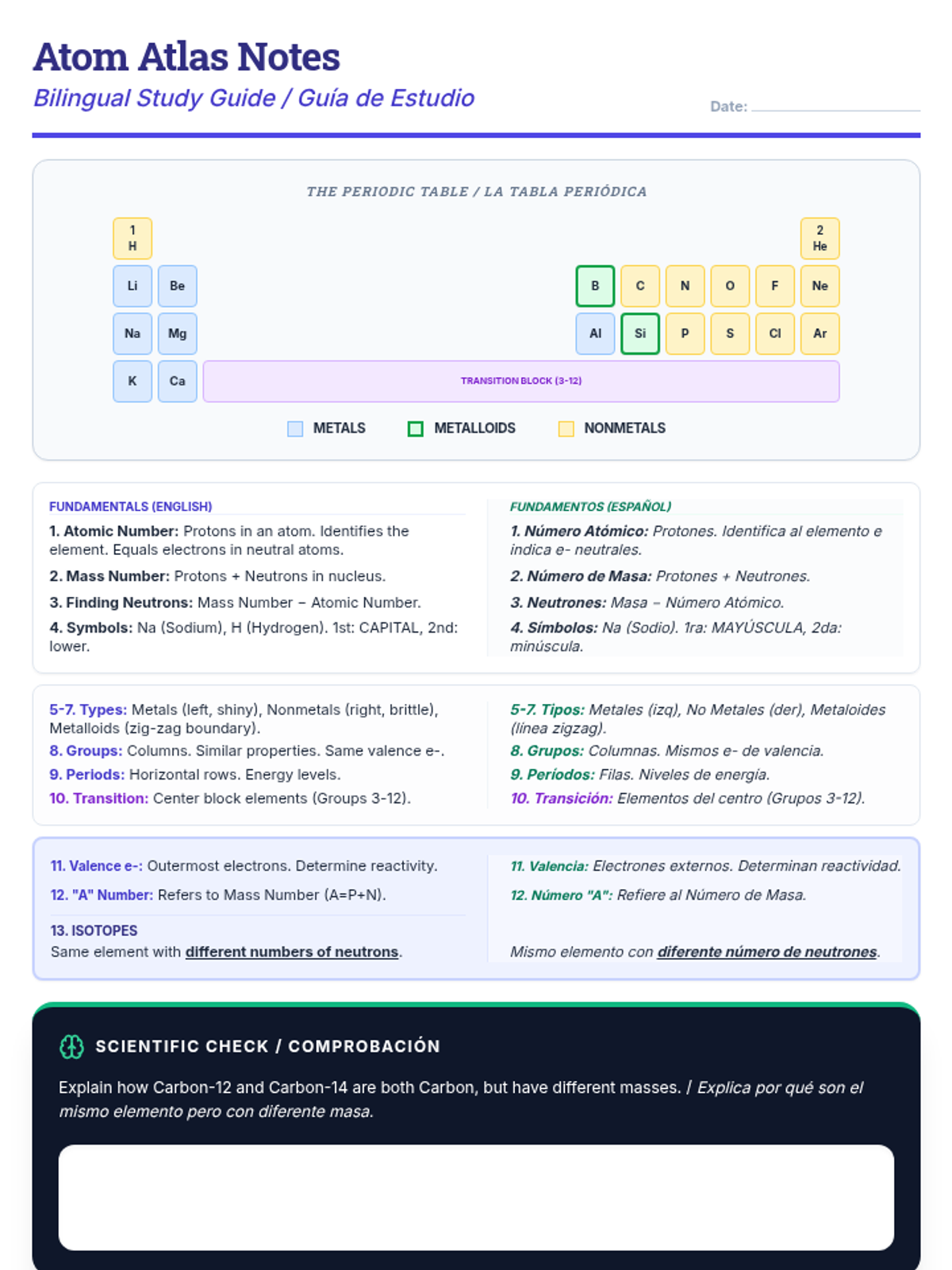
Bilingual notes document covering the organization of the periodic table, including a color-coded reference map and dual-language explanations of key atomic properties.
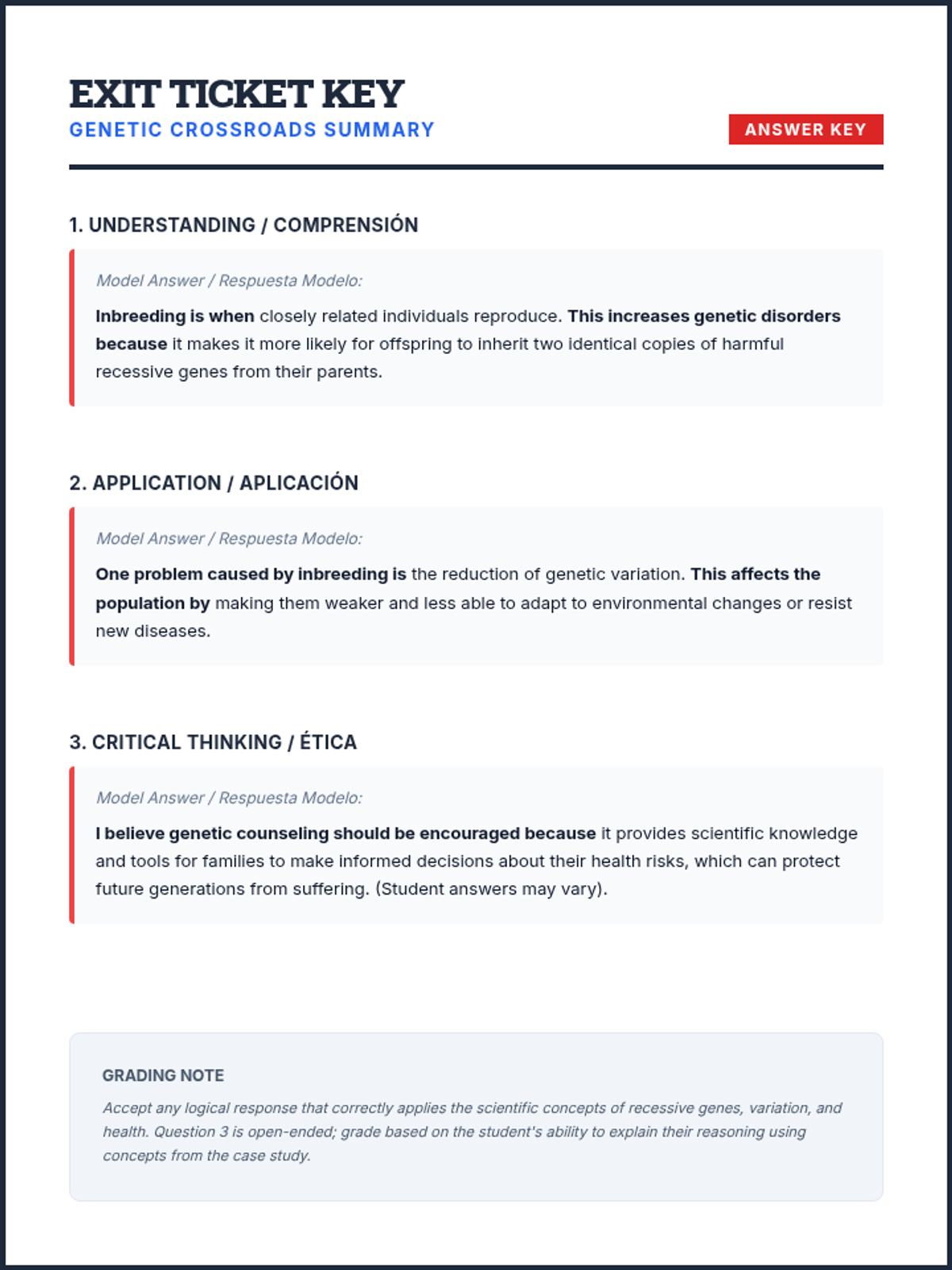
Teacher answer key for the Genetic Crossroads exit ticket, providing model responses for understanding inbreeding, its biological impact, and ethical reasoning regarding genetic counseling.
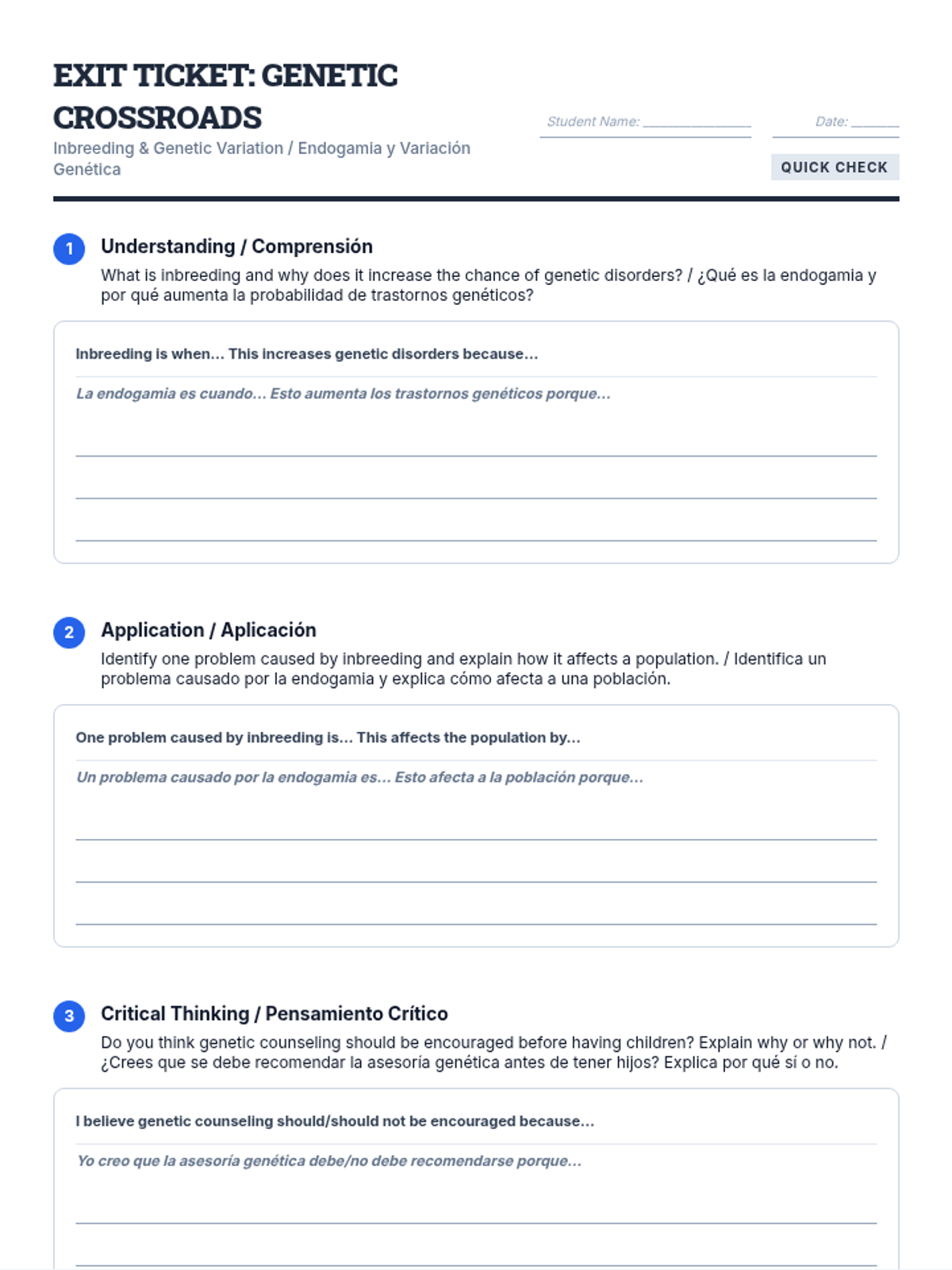
A bilingual exit ticket (English/Spanish) for the Genetic Crossroads lesson. Includes three questions focused on understanding inbreeding, its biological impact, and the ethics of genetic counseling, with provided sentence stems for each. Revised for improved writing line visibility and white background response areas.
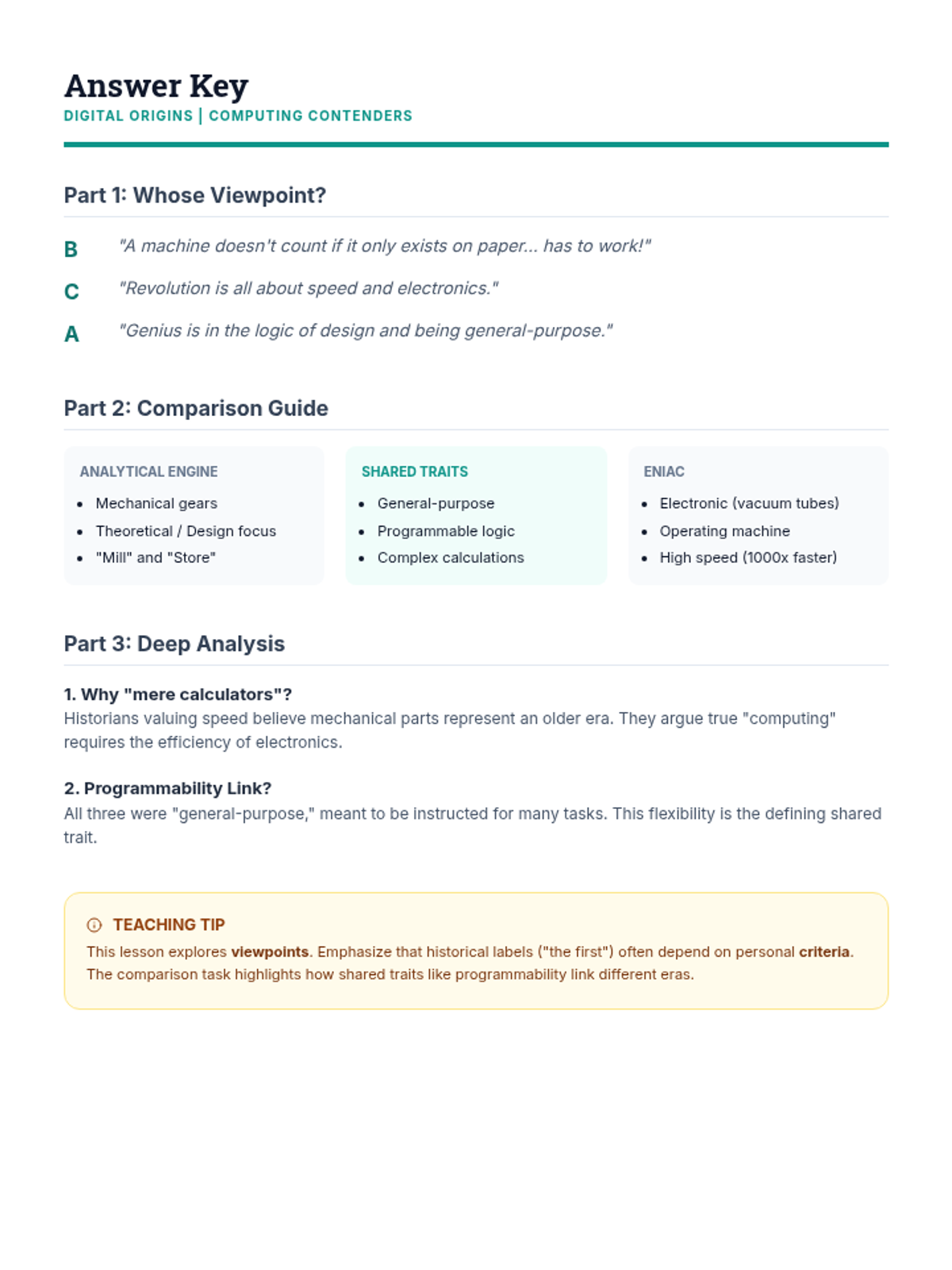
An answer key and teaching guide for the 'First Debate' worksheet, including sample answers for short-answer questions and instructional tips for classroom discussion.
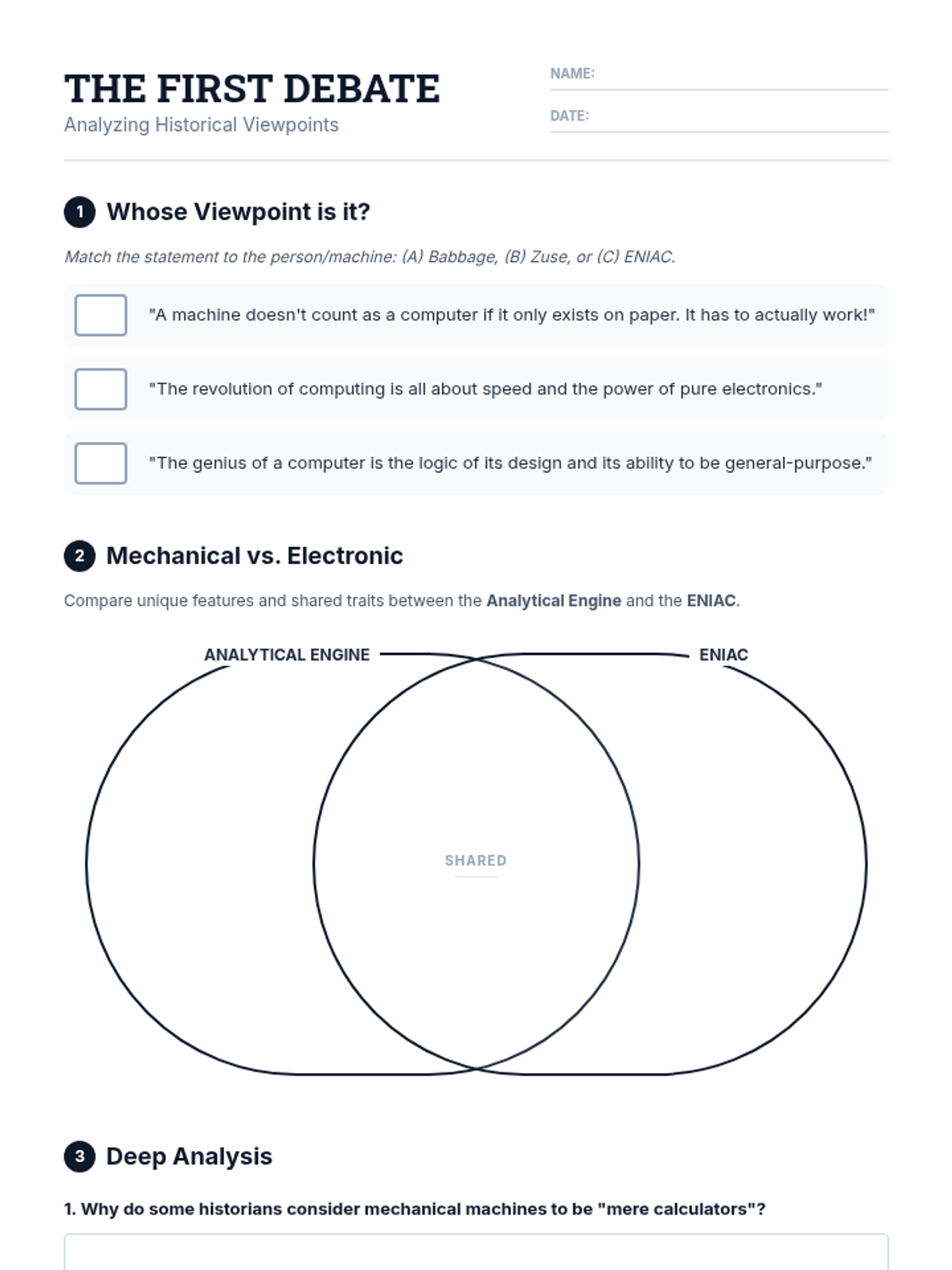
A worksheet designed to test students' ability to compare and contrast the different historical viewpoints presented in the reading passage. Includes matching, a Venn diagram task, and analytical short-answer questions.
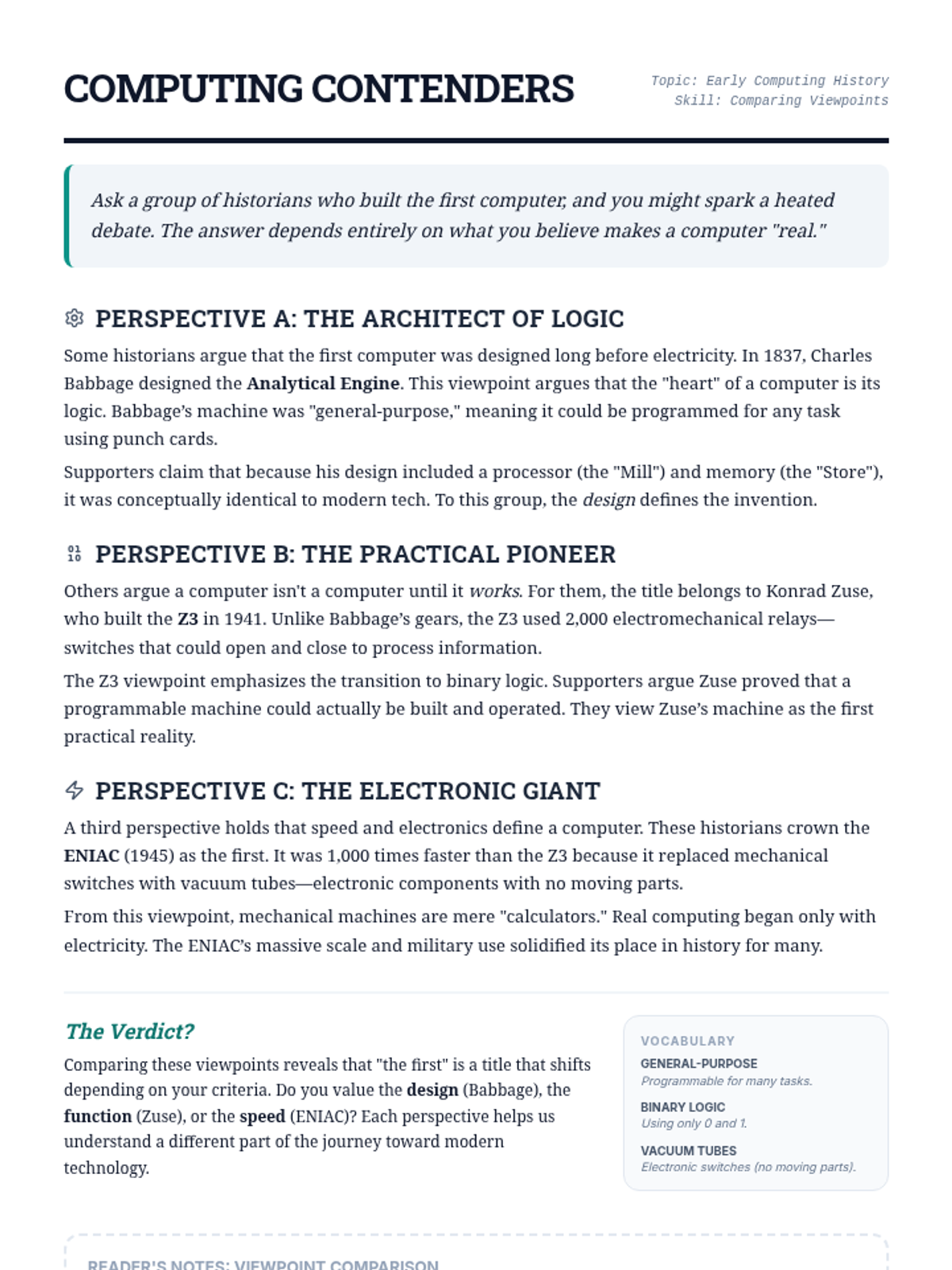
A detailed reading passage presenting three distinct historical viewpoints on the invention of the first computer, focusing on the Analytical Engine, the Z3, and the ENIAC. Includes a vocabulary reference and sets the stage for comparing and contrasting viewpoints.
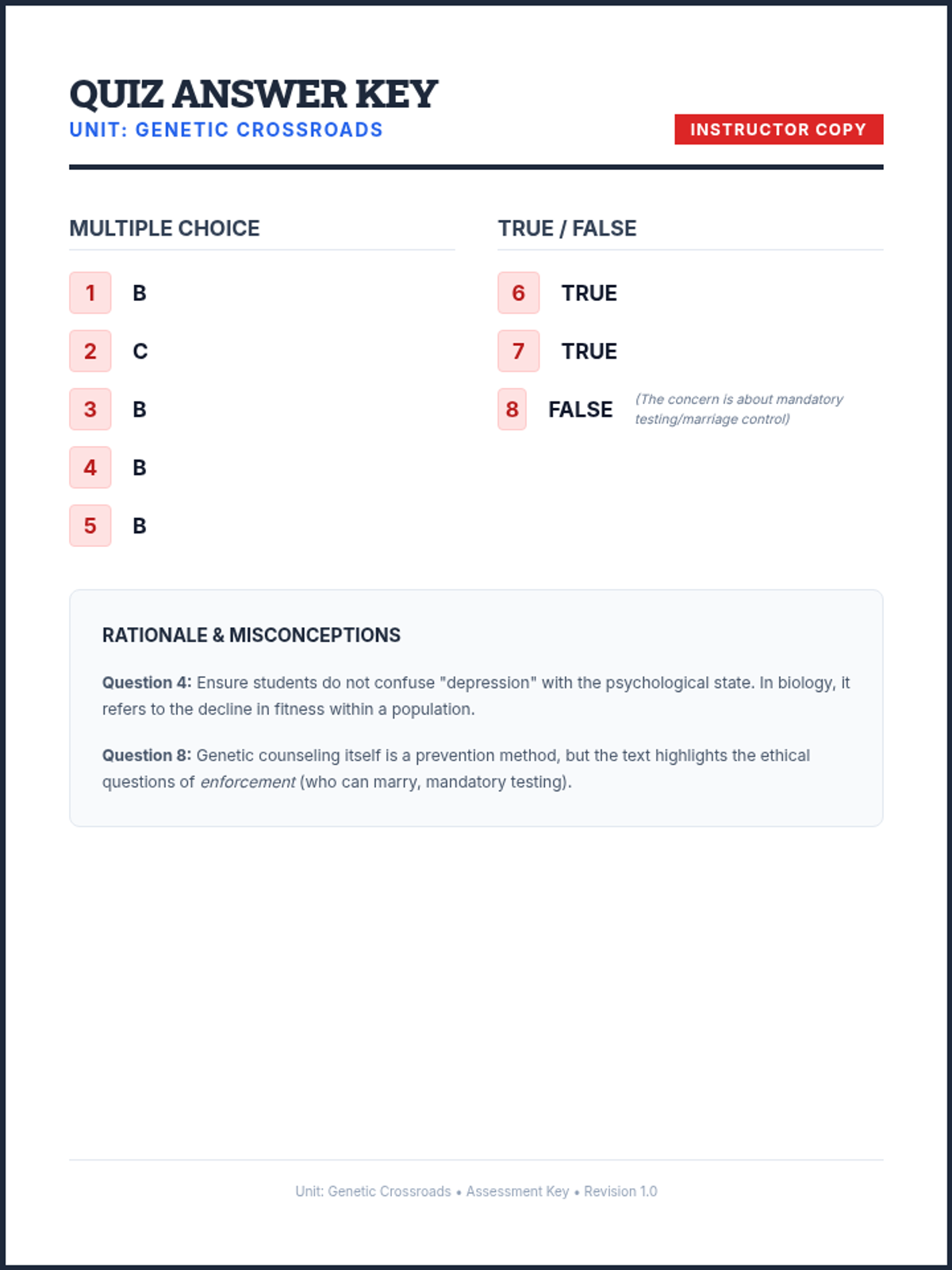
Teacher answer key for the Genetic Crossroads quiz, featuring correct answers for multiple-choice and true/false sections, along with rationales for key concepts.
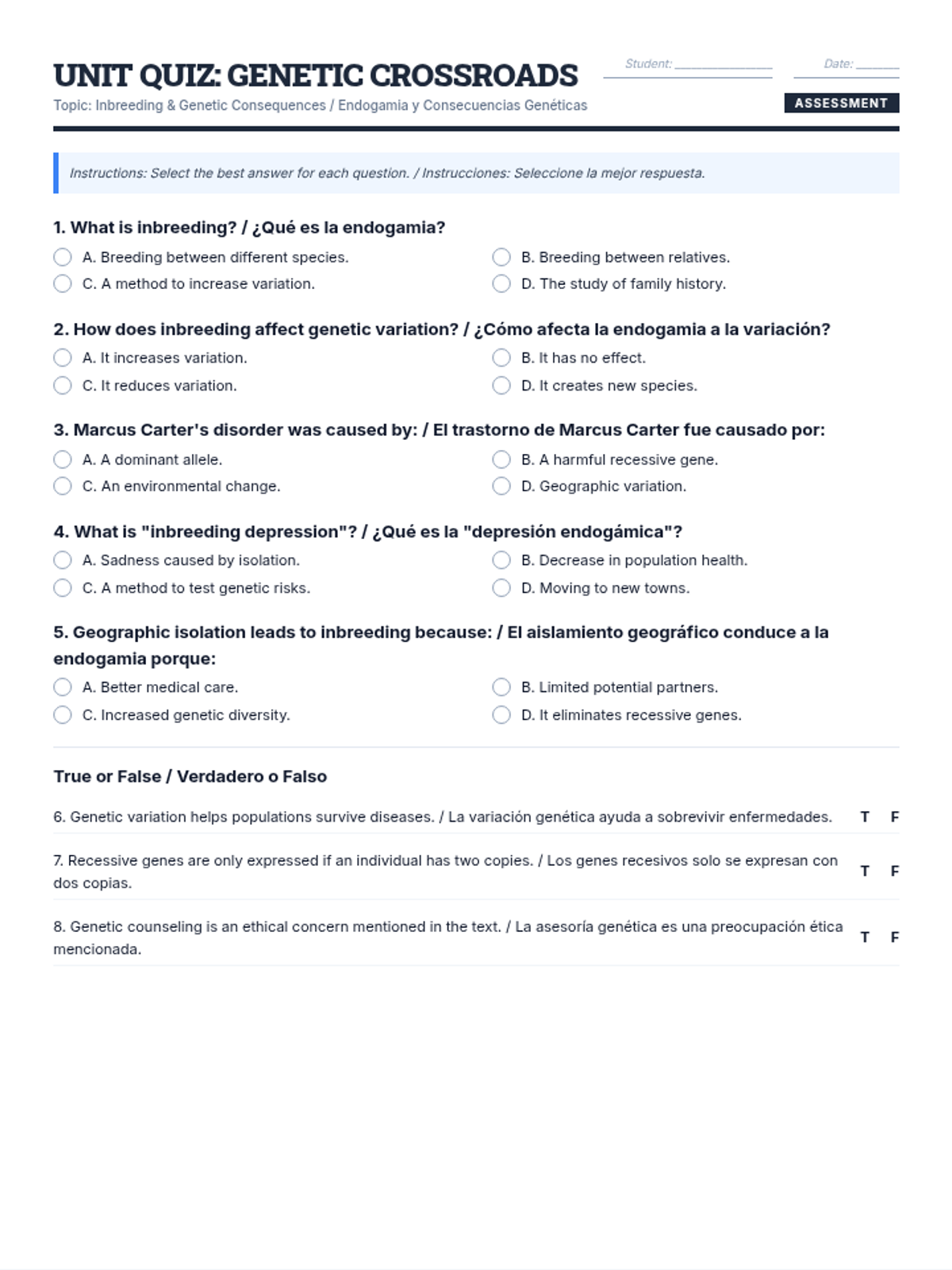
A bilingual unit quiz (English/Spanish) for the Genetic Crossroads lesson. Covers key vocabulary like inbreeding, genetic variation, and recessive genes, using multiple-choice and true/false questions. Revised for better page layout.
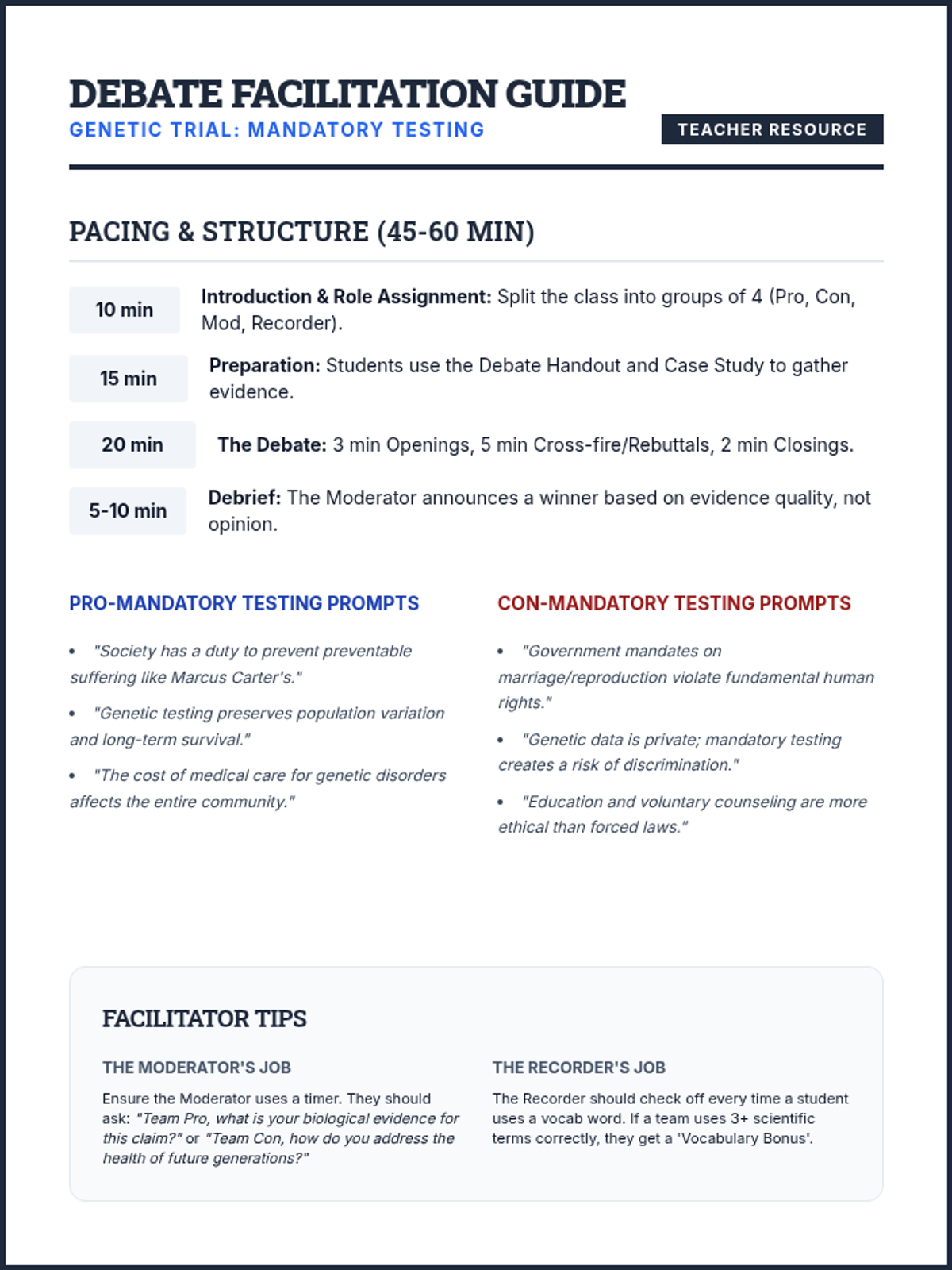
A teacher's facilitation guide for the Genetic Trial debate extension. Includes suggested pacing, argument prompts for both Pro and Con sides, and guidance for managing the Moderator and Evidence Recorder roles.
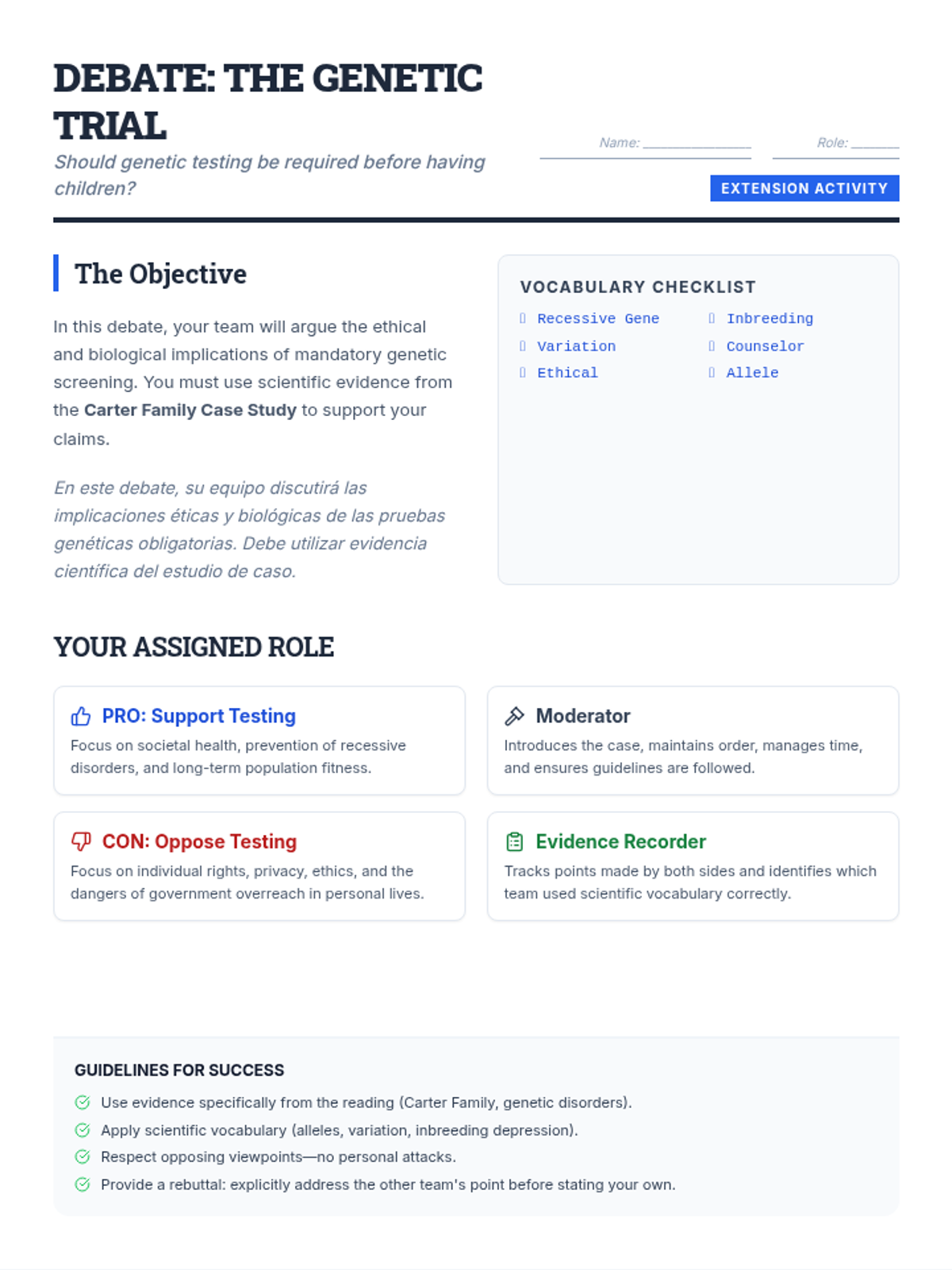
A student handout for a debate extension activity regarding mandatory genetic testing. Includes role descriptions (Pro, Con, Moderator, Evidence Recorder), debate guidelines, and a structured preparation sheet for evidence gathering and rebuttal planning.
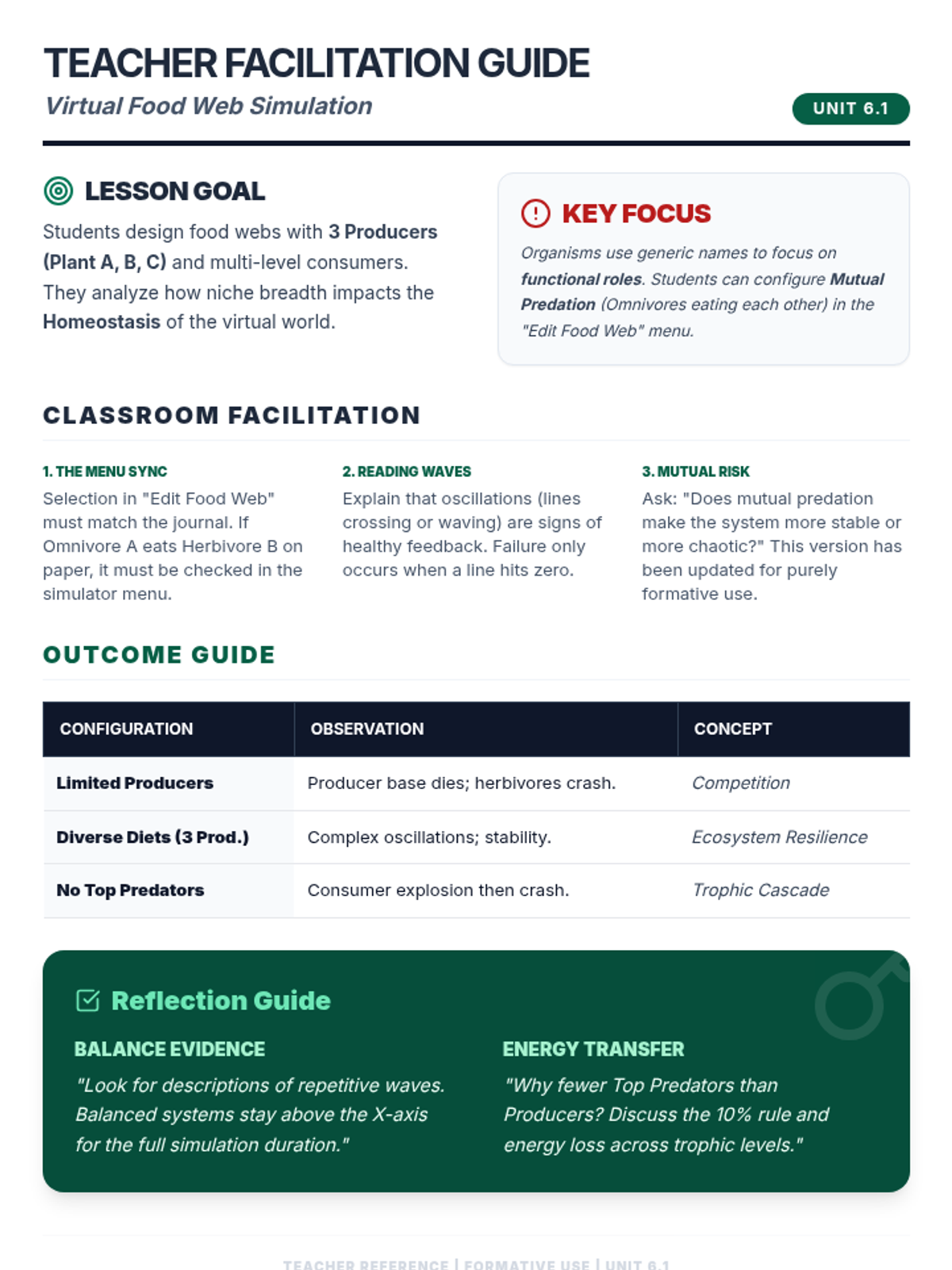
A comprehensive guide for teachers to facilitate the Virtual Food Web lab. Updated to remove scoring references and support the new Omnivore mutual predation options and 3-producer structure. Includes instructional goals and classroom facilitation tips. Simplified to fit a single page.
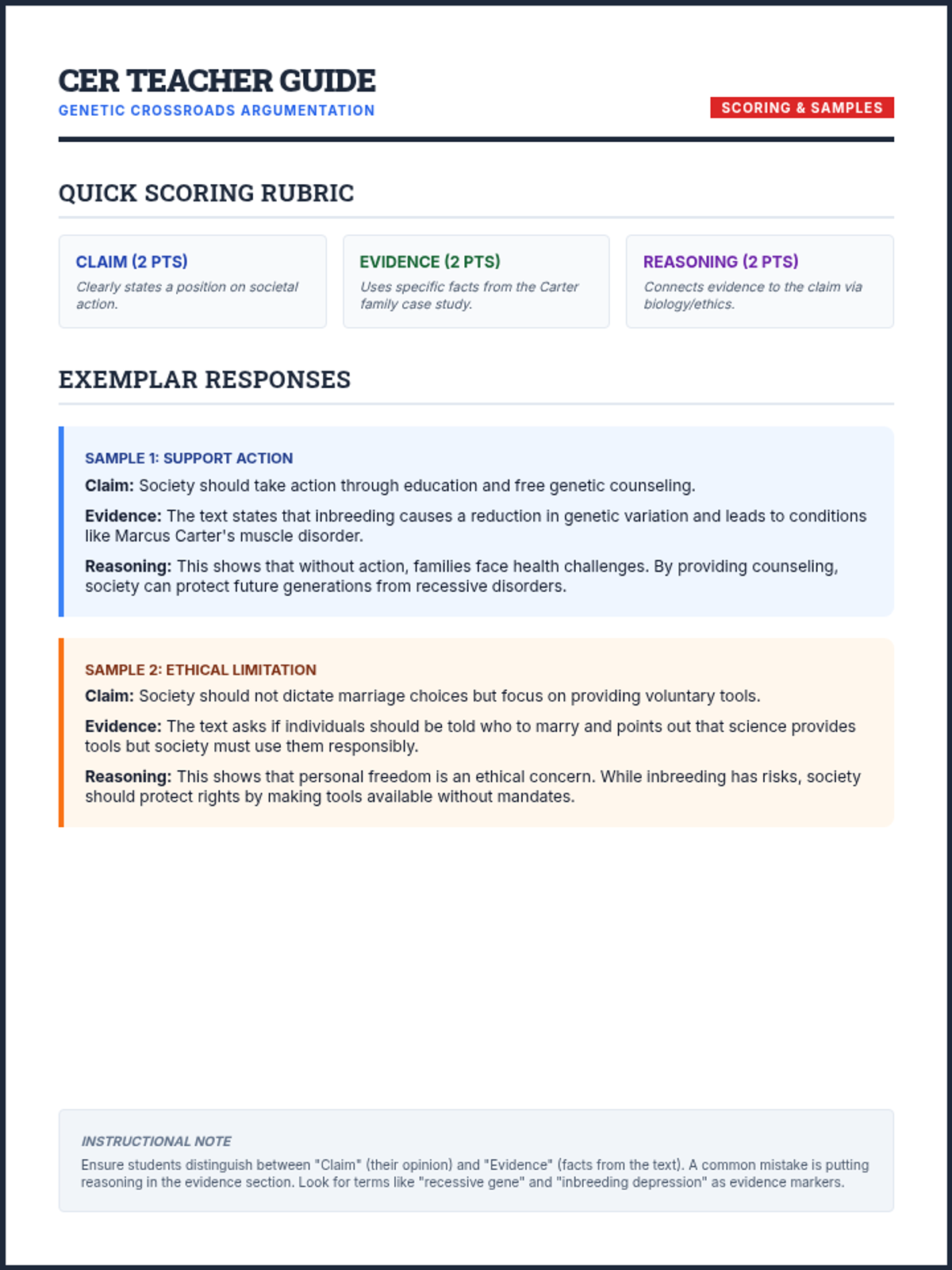
Teacher answer key and grading rubric for the Genetic Crossroads CER activity. Revised to fit on a single page with optimized sample responses and layout.
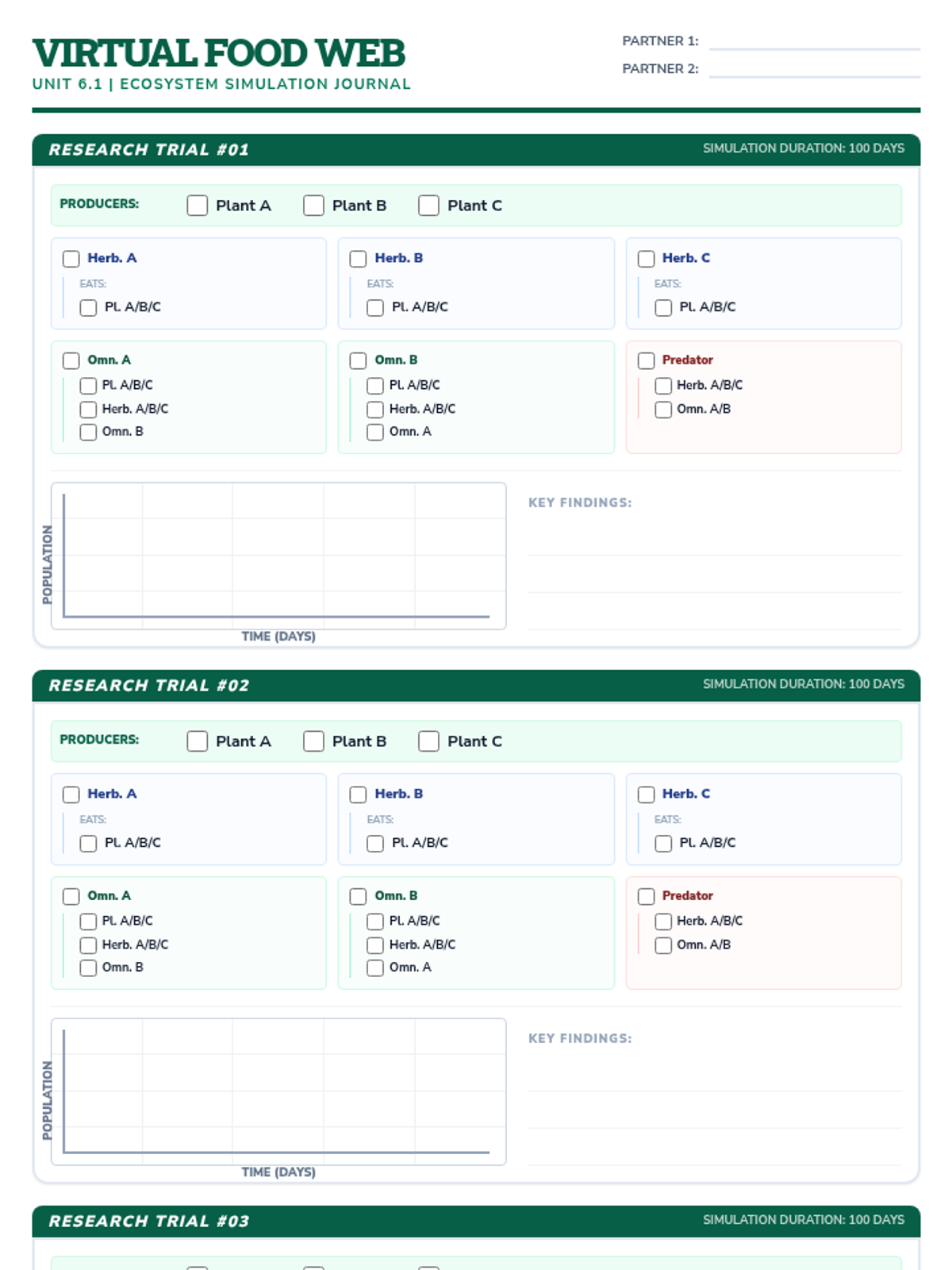
A two-page printable field journal for students to record multiple trials of the ecology simulator. Features selection checklists for 3 Producers, 3 Herbivores, 2 Omnivores, and a Top Predator with nested diet options including mutual predation. Grading elements have been removed for formative use. Updated for better legibility and student work areas.
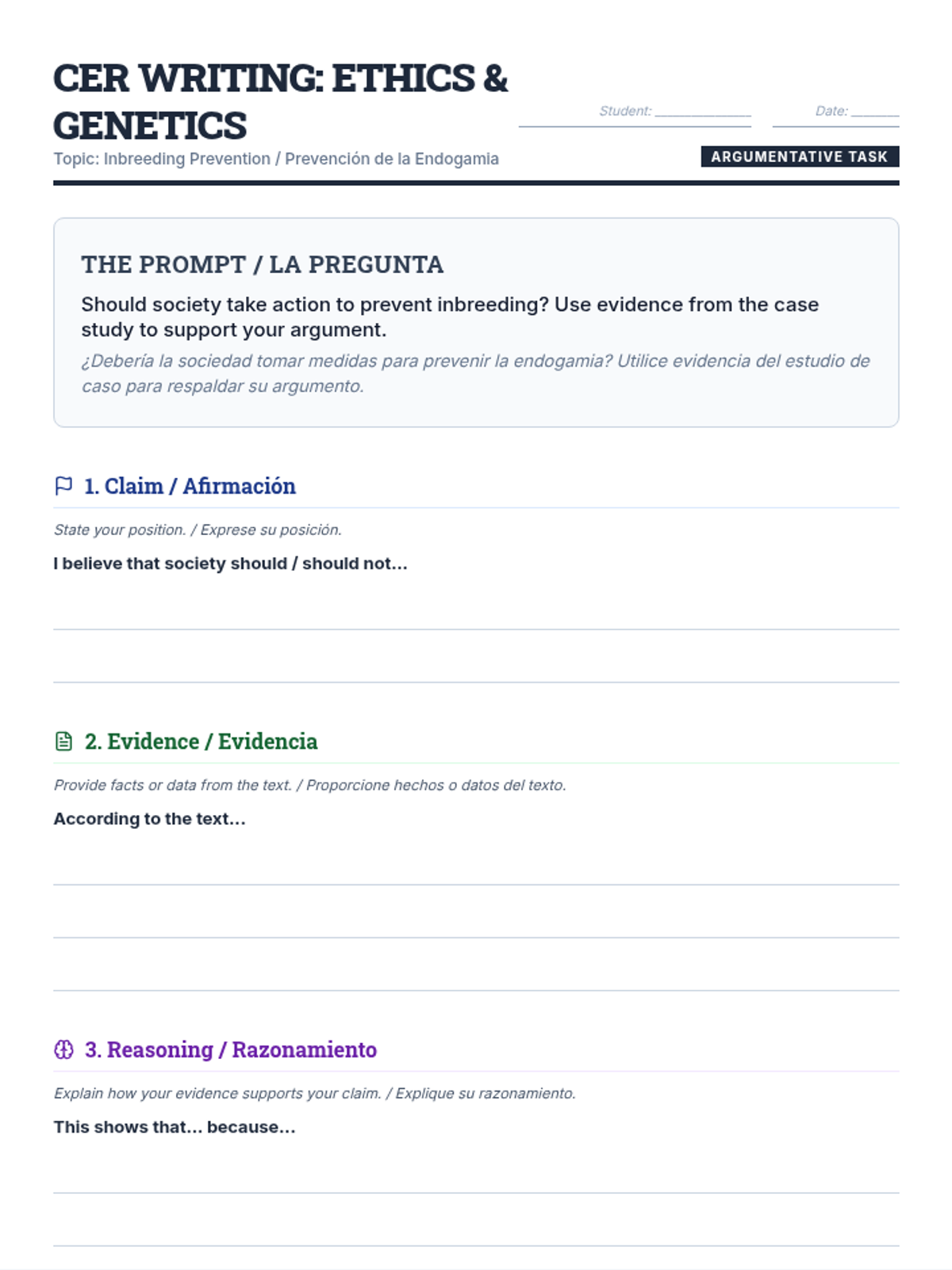
A Claim-Evidence-Reasoning (CER) writing activity focusing on the ethical and genetic implications of society's role in preventing inbreeding. Revised to fit on a single page with improved spacing and header layout.
A visual presentation introducing students to the Virtual Food Web lab. Updated to include information about 3-producer setups and advanced Omnivore mutual predation options. Includes a new slide previewing the journal's recording format.
A comprehensive guide for teachers to facilitate the Virtual Food Web lab. Updated to support the new Omnivore mutual predation options and 3-producer structure. Includes instructional goals and classroom facilitation tips. Simplified to fit a single page.
A two-page printable field journal for students to record multiple trials of the ecology simulator. Features selection checklists for 3 Producers, 3 Herbivores, 2 Omnivores, and a Top Predator with nested diet options. Updated to allow Omnivores to eat each other, matching the user's request for mutual predation. Trials and reflections condensed to fit two pages perfectly. Updated for better legibility and student work areas.
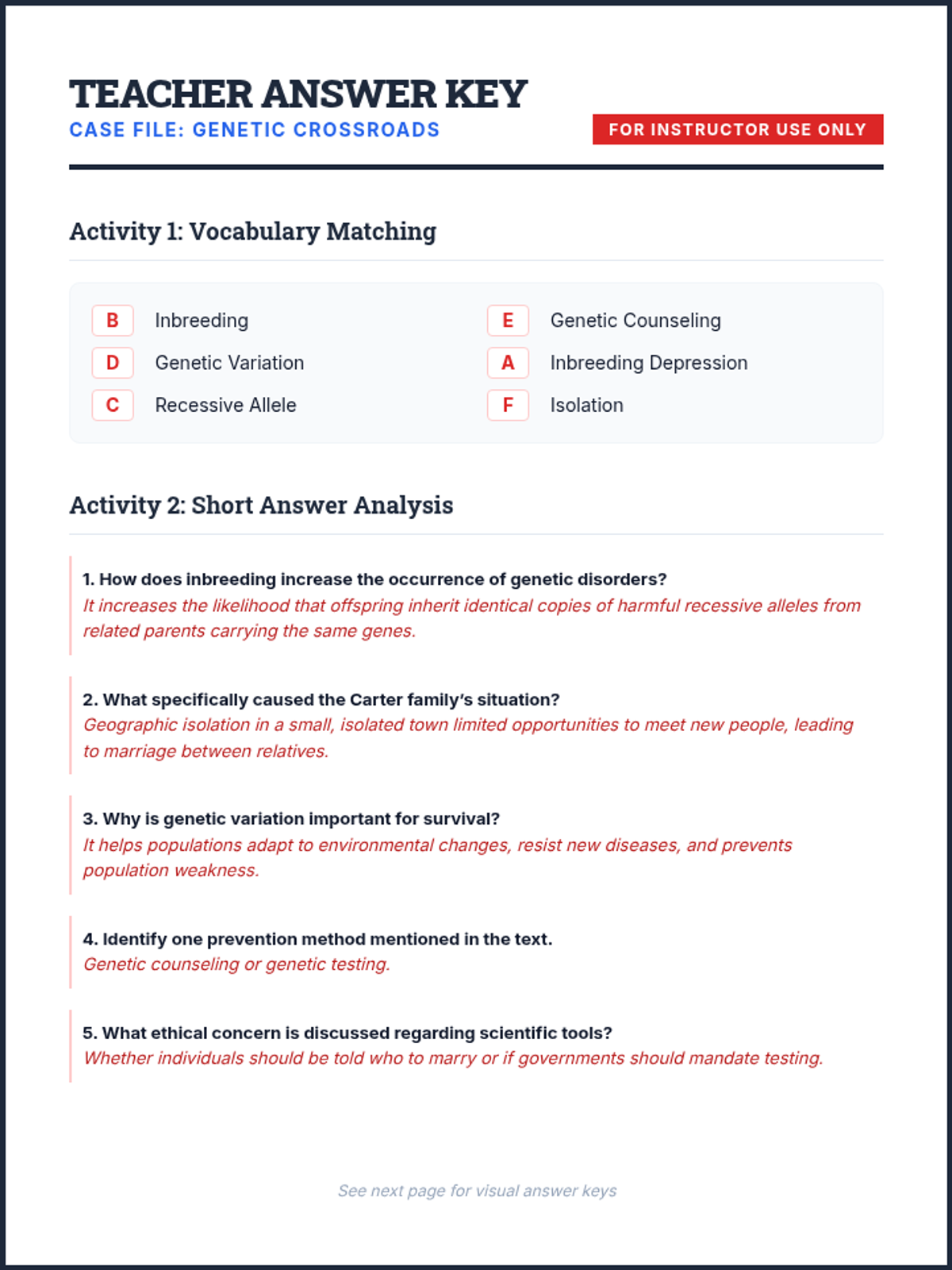
Teacher answer key for the Genetic Crossroads worksheet, containing correct matching pairs, detailed model answers for short-answer questions, and a visual solution for the word search and diagram. Revised to ensure all answers stay grouped with their questions and diagrams are legible.
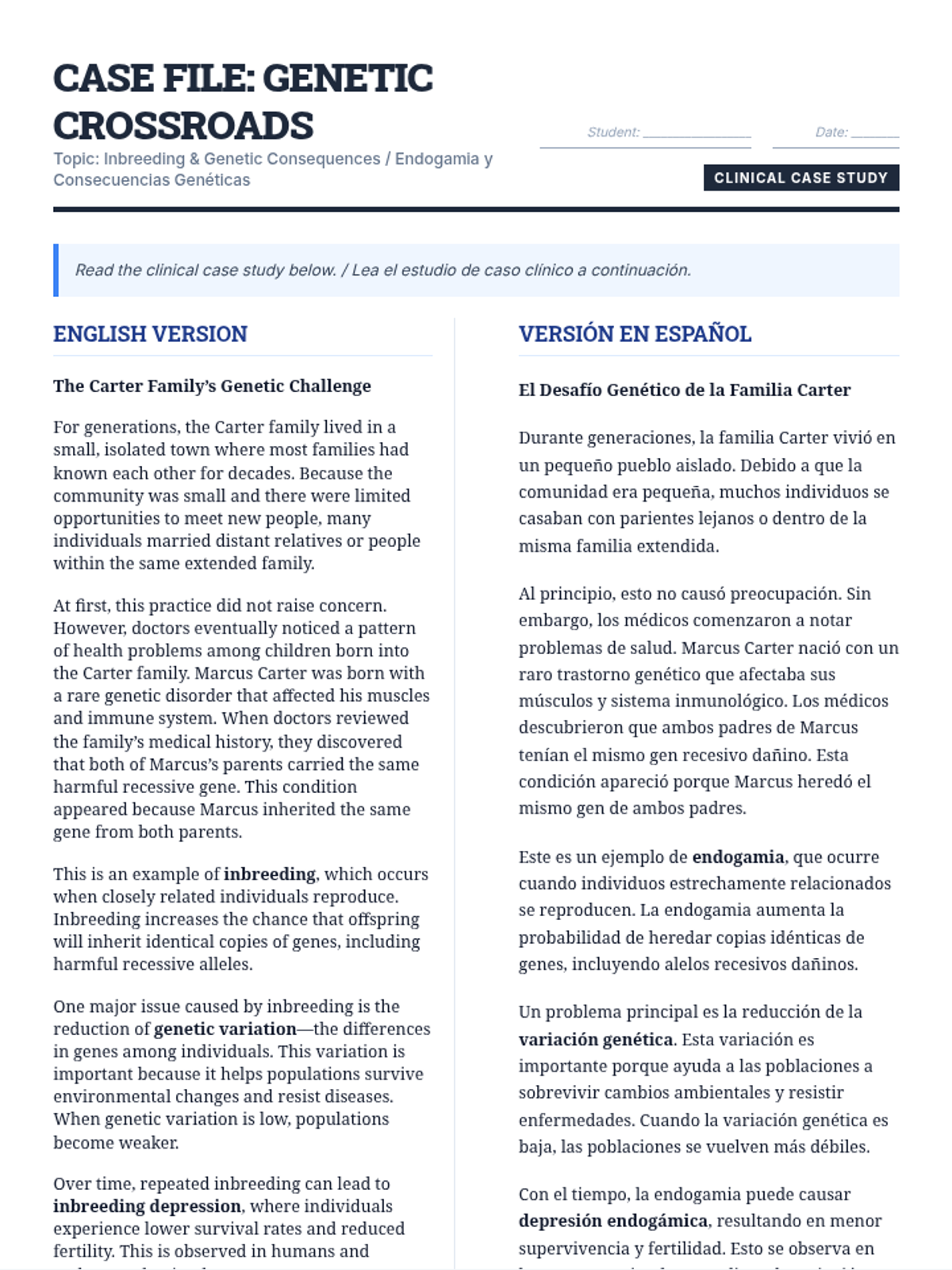
A comprehensive bilingual worksheet packet (English/Spanish) about the genetic consequences of inbreeding. Includes a side-by-side case study, matching activity, short-answer analysis, a geographic isolation diagramming space, and a vocabulary word search. Revised for improved page breaks, content alignment, and word search accuracy.
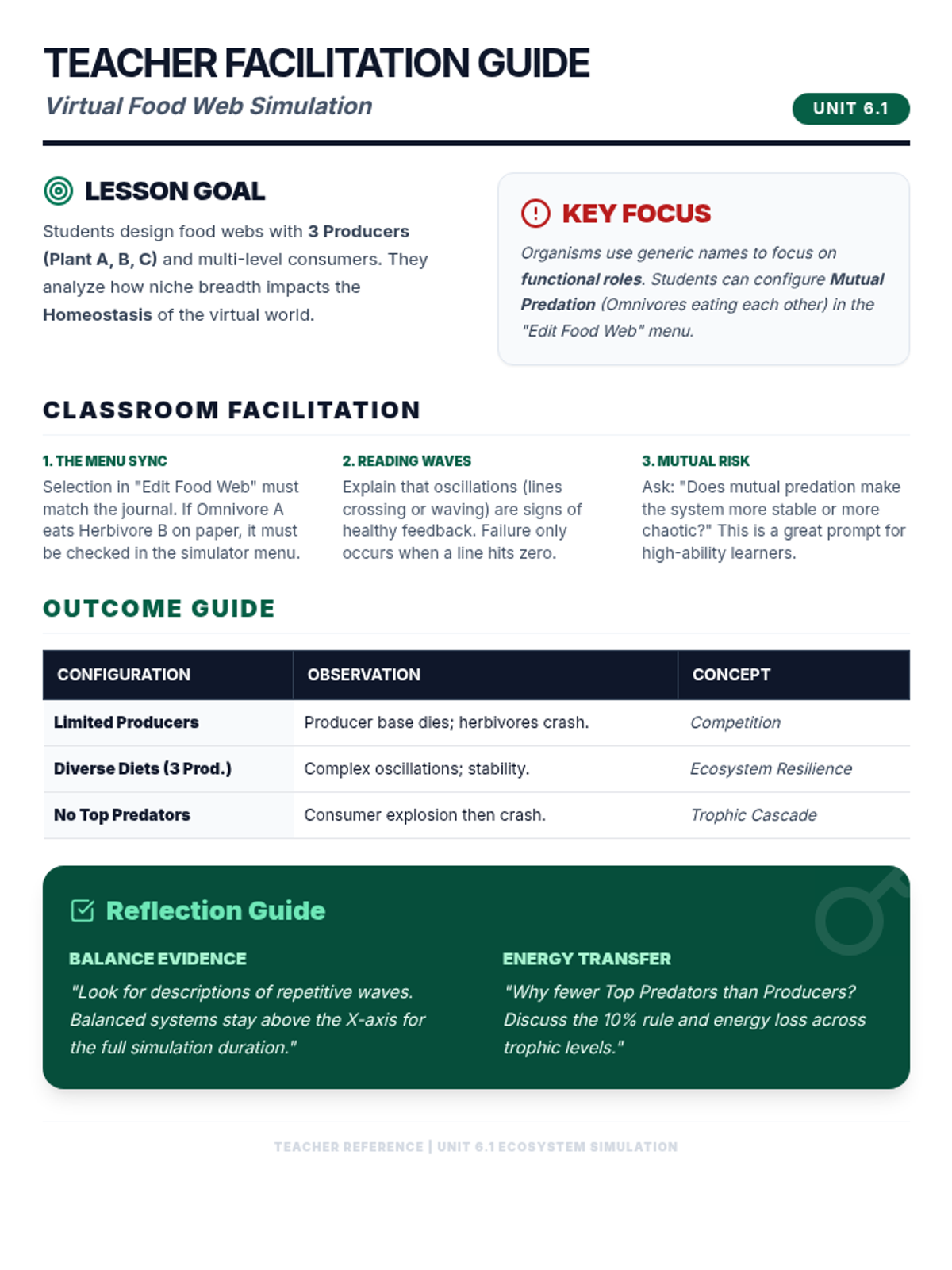
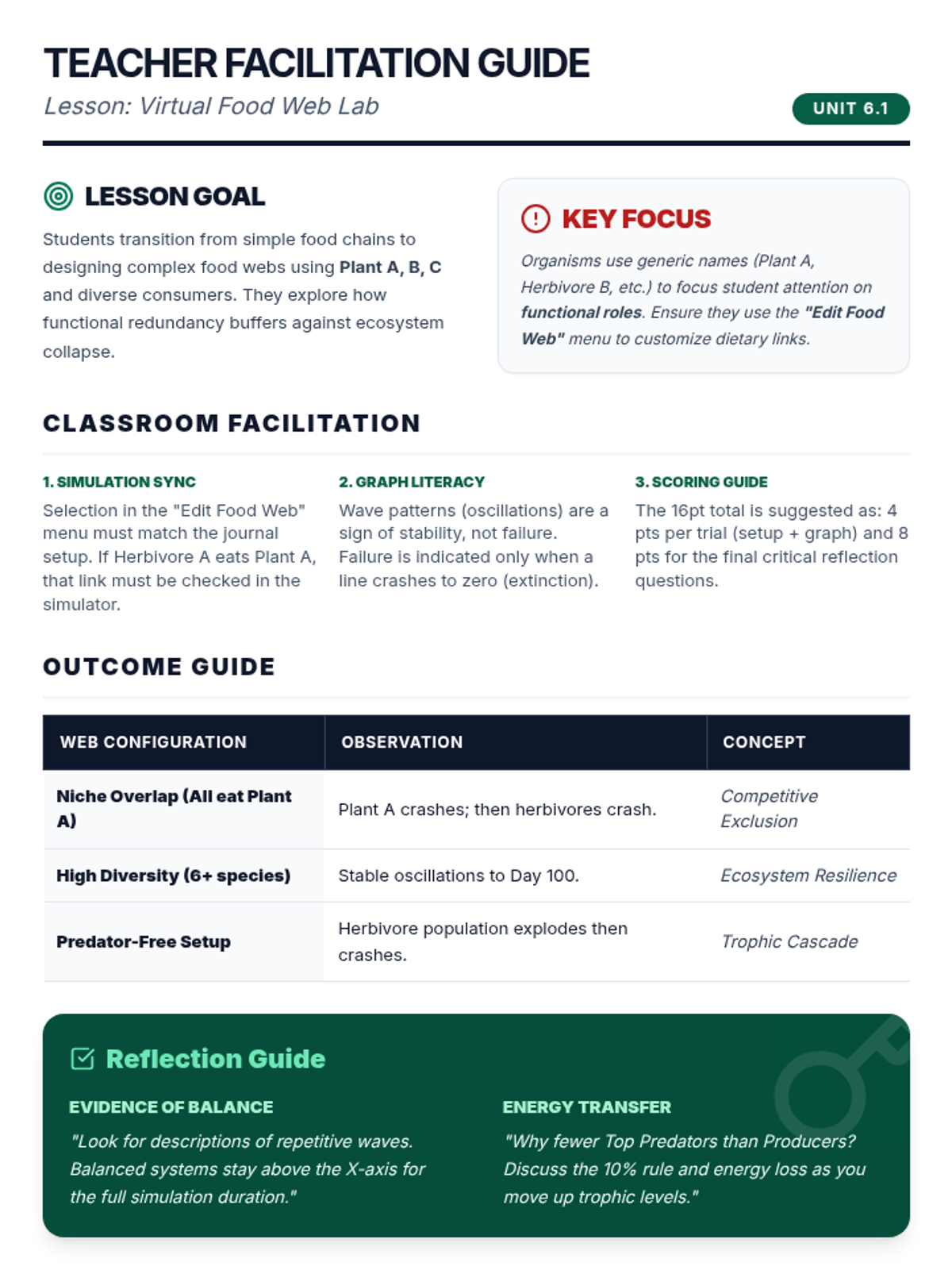
A comprehensive guide for teachers to facilitate the Virtual Food Web lab. Updated to match the naming conventions and structure of the updated field journal and slides. Includes instructional goals, classroom facilitation tips, and an outcome guide for simulation configurations. Simplified to a single-page reference.
A visual presentation introducing students to the Virtual Food Web lab, using updated terminology and organism counts (Plant A/B/C, Herbivore A/B/C) to match the provided worksheet document. Slides cover goals, roles, diet customization, and graphing.
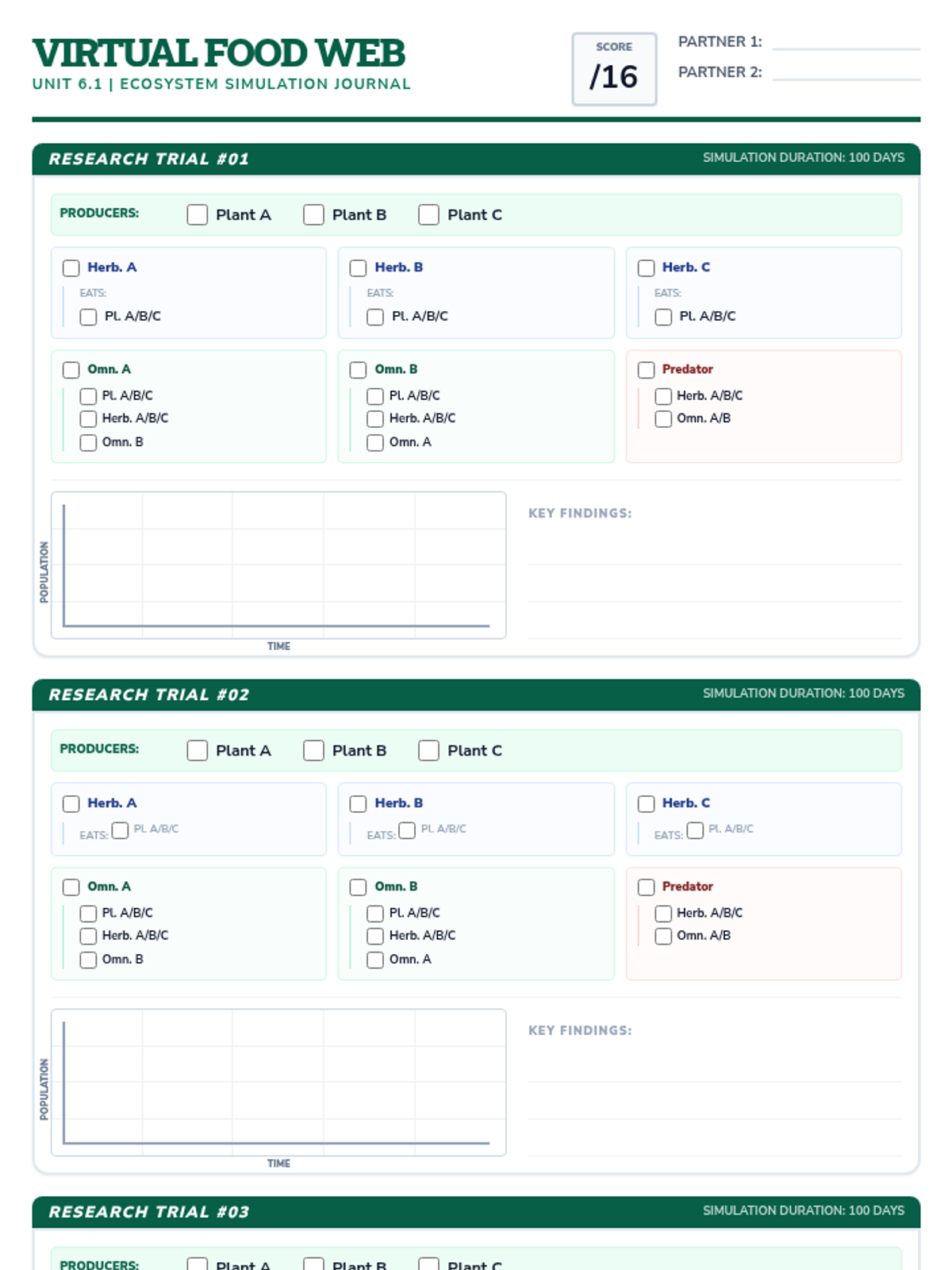
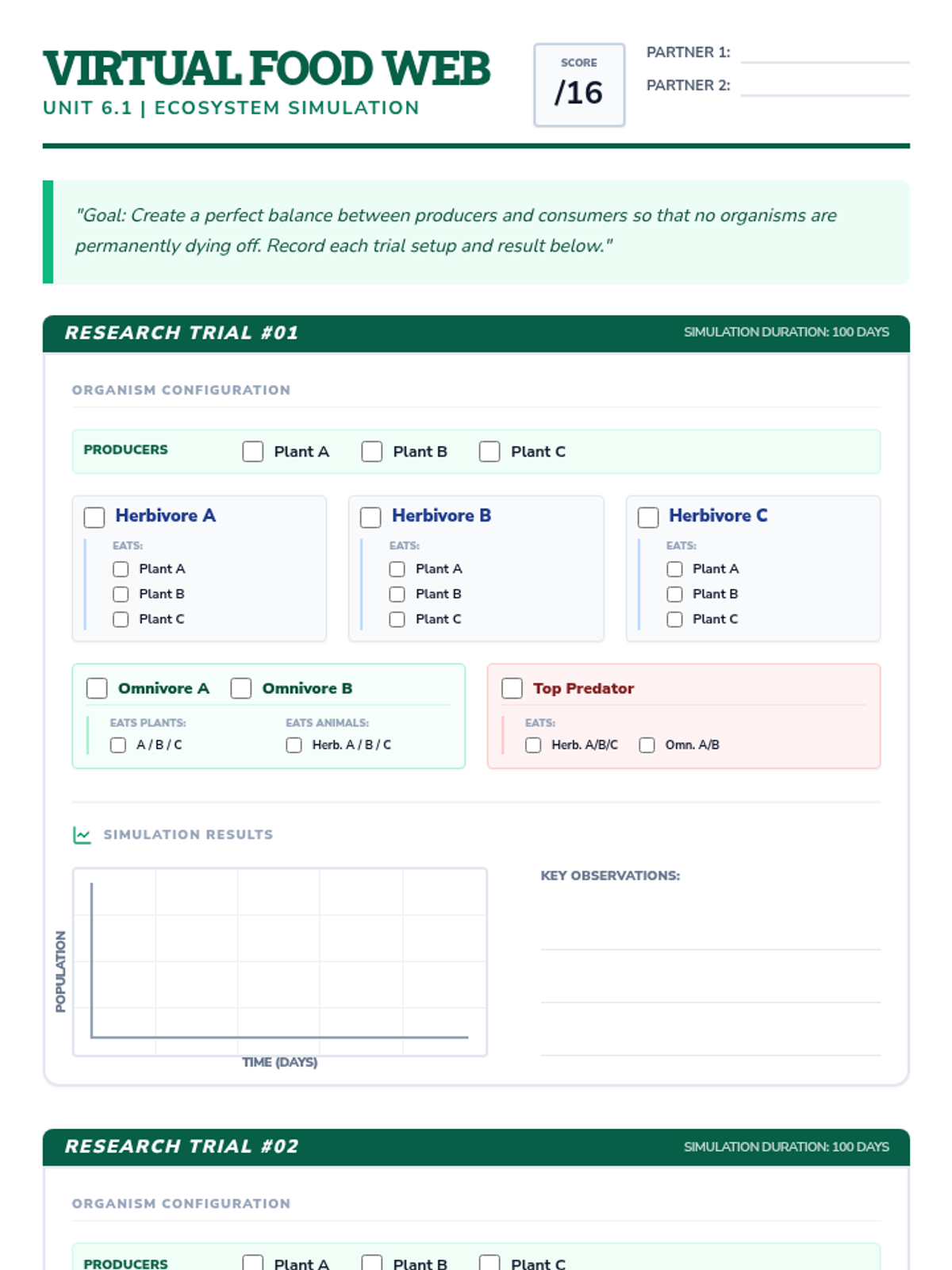
A two-page printable field journal for students to record multiple trials of the ecology simulator. Features selection checklists for 3 Producers, 3 Herbivores, 2 Omnivores, and a Top Predator with nested diet options, matching the provided PDF's structure and nomenclature. Results are positioned below the selection area for better spacing. Updated for better consistency across trials and improved axis legibility.
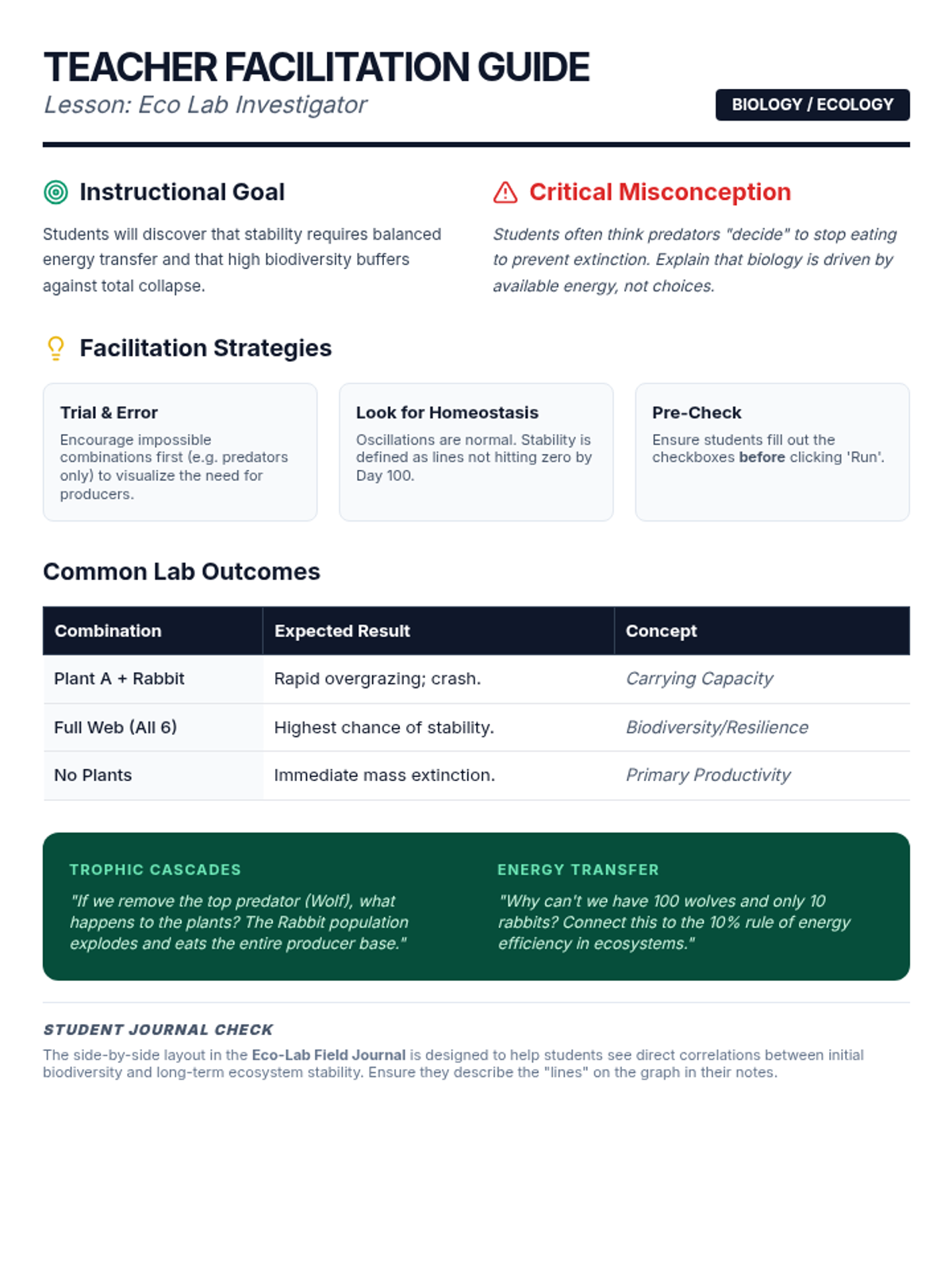
A comprehensive guide for teachers to facilitate the Eco Lab lesson, updated to support the revised food web design and scoring system inspired by the provided worksheet. Simplified to a single-page reference for better classroom usability.
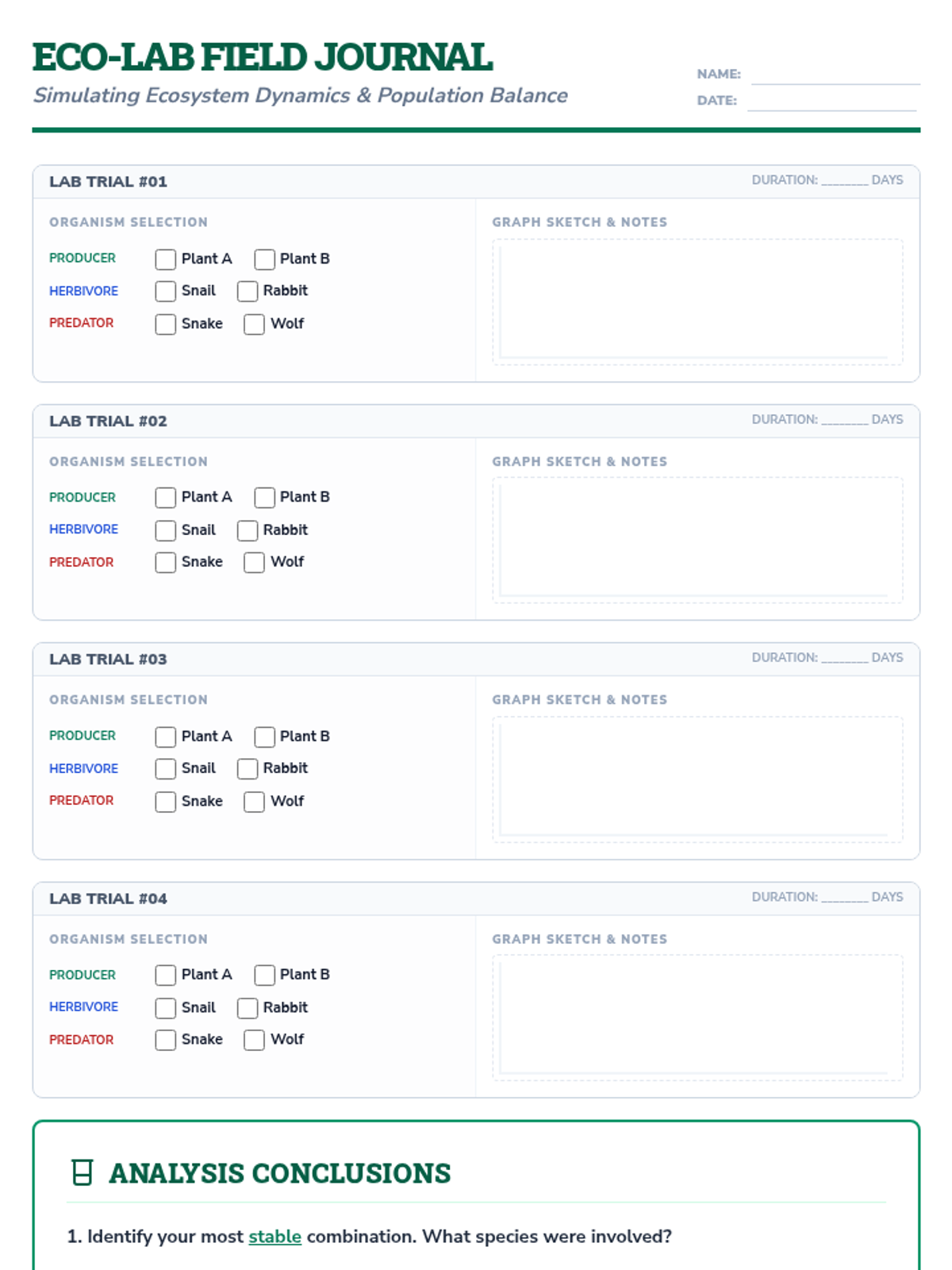
A two-page printable field journal for students to record multiple trials of the ecology simulator. Features side-by-side selection checkboxes with nested diet options and observation areas for recording population dynamics, inspired by the provided worksheet PDF. Updated for better legibility and work area clarity.
A visual presentation introducing students to the Learner.org Ecology Lab simulator, now updated to explain the detailed food web configuration and diet recording inspired by the provided worksheet.
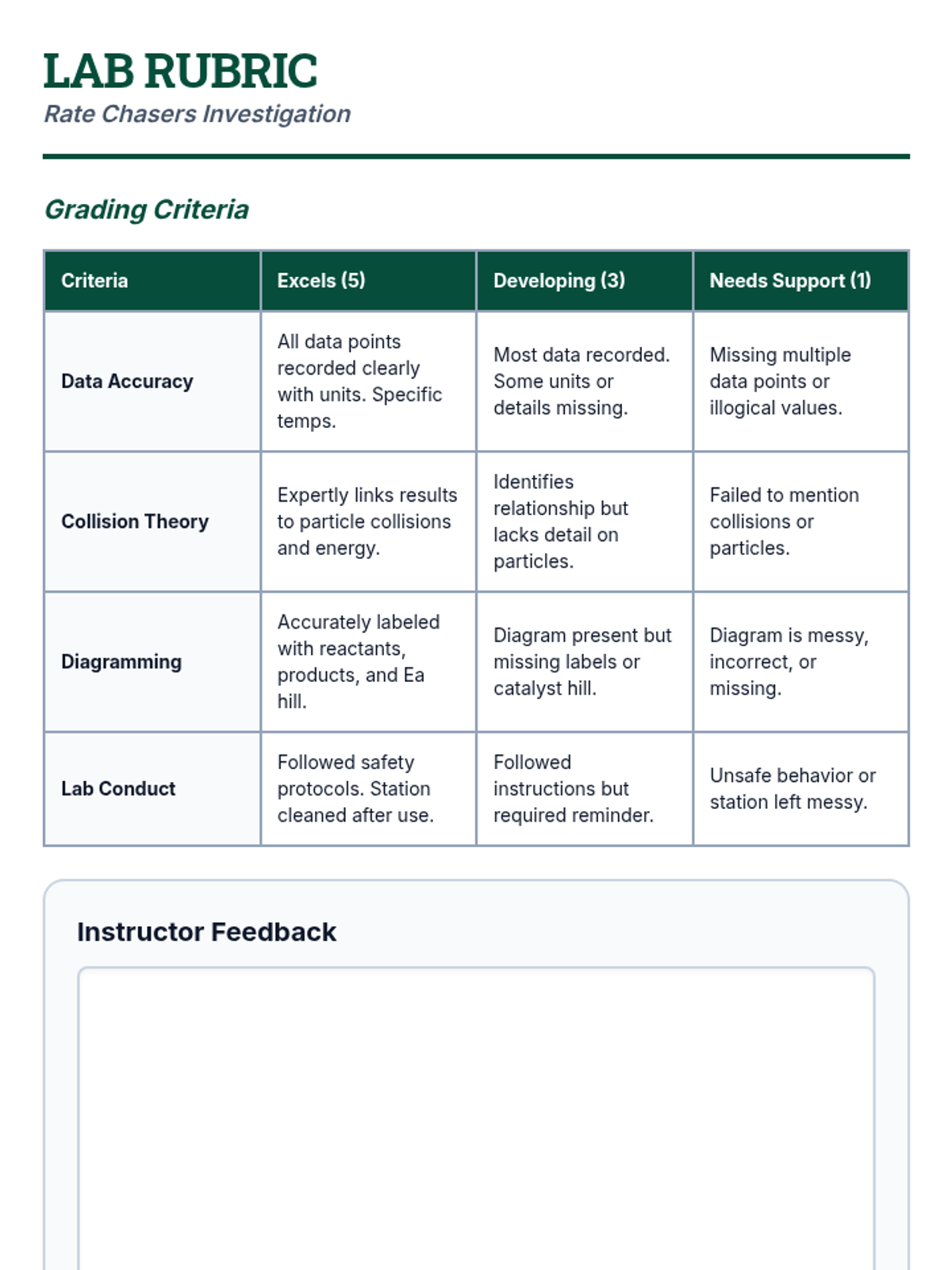
A comprehensive rubric for grading the "Rate Chasers Lab". Evaluates data accuracy, collision theory application, diagramming skills, and lab conduct.
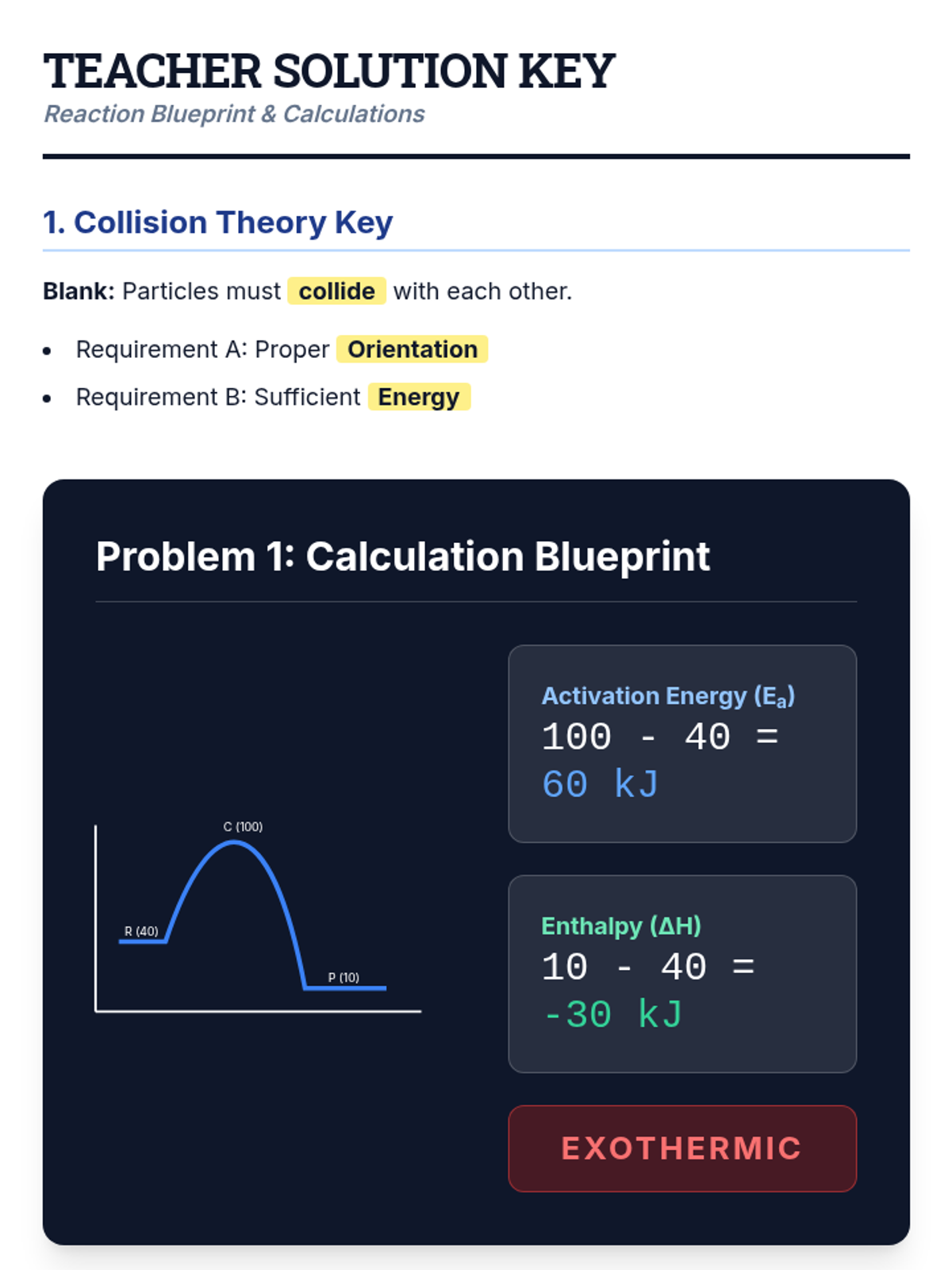
A detailed answer key for the "Reaction Blueprint Notes" and practice problems. Provides step-by-step calculations for enthalpy and activation energy.
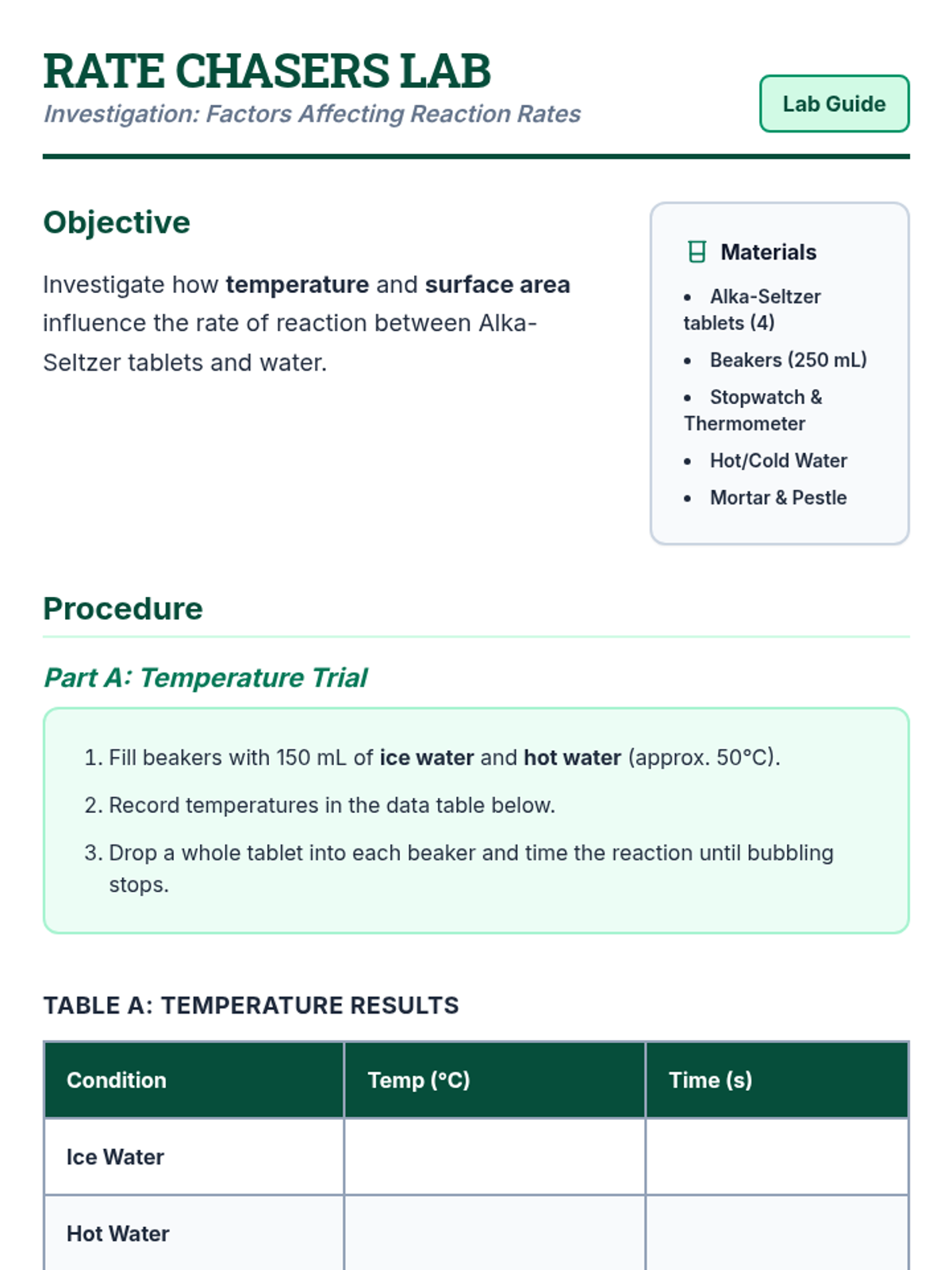
A hands-on lab activity investigating the effects of temperature and surface area on reaction rates using Alka-Seltzer. Includes clear procedures, data tables, and analysis questions.
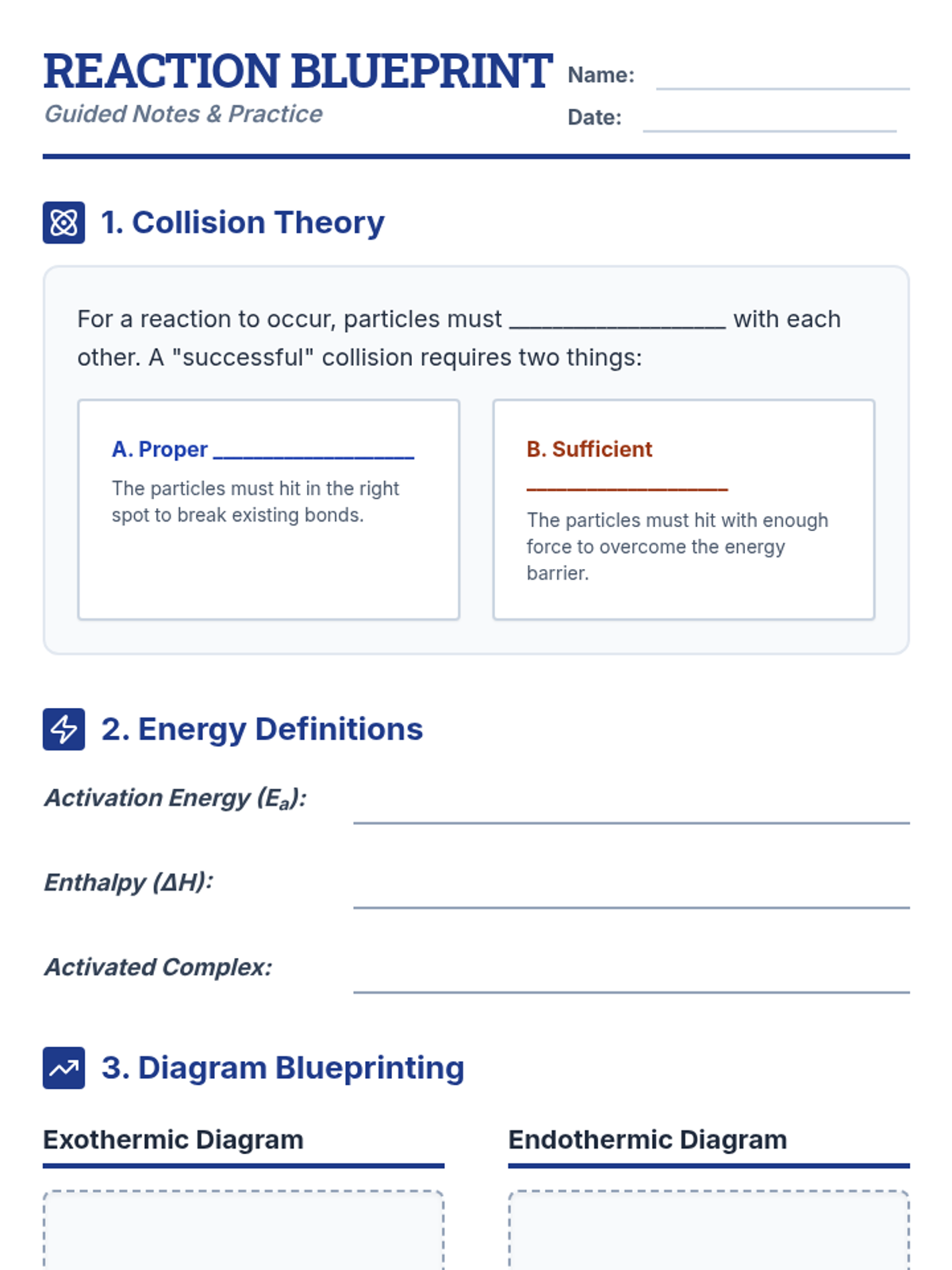
Guided notes accompanying the "Reaction Pathways" lesson. Includes fill-in-the-blanks for collision theory, sketching areas for energy diagrams, and practice problems for calculating Ea and ΔH.
A visual presentation covering collision theory, activation energy, enthalpy, and reaction rates. Includes detailed energy diagrams and conceptual checks.
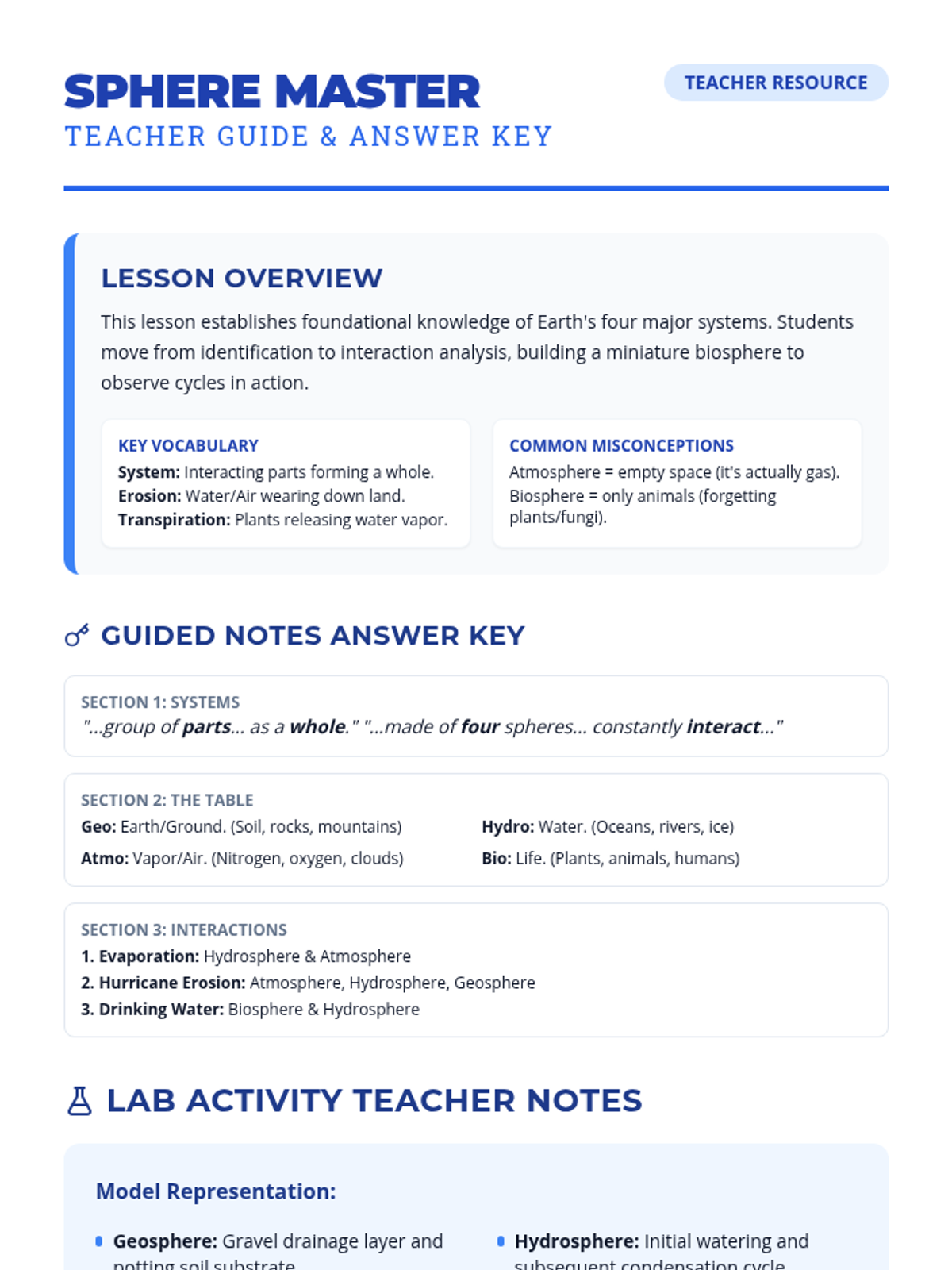
A comprehensive teacher resource containing background information, common misconceptions, and complete answer keys for the Sphere Scouts Guided Notes and the Mini Sphere Lab Activity. Includes facilitation tips for the hands-on lab to ensure successful student outcomes.
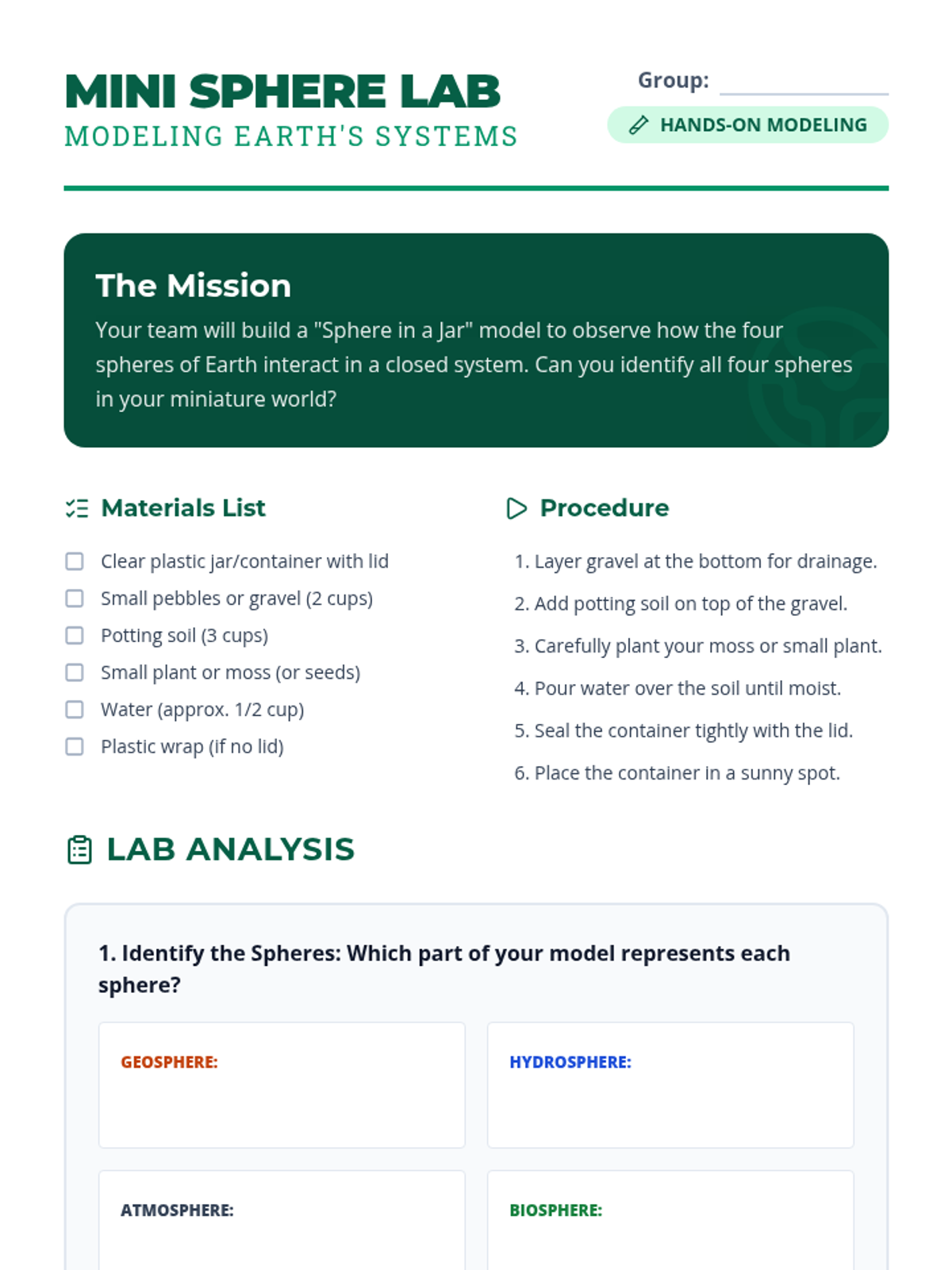
A hands-on laboratory guide where students build a closed-system "Mini Sphere" in a jar. The material includes a clear materials list, step-by-step assembly instructions, and an observation section for identifying modeled spheres and predicting their interactions.
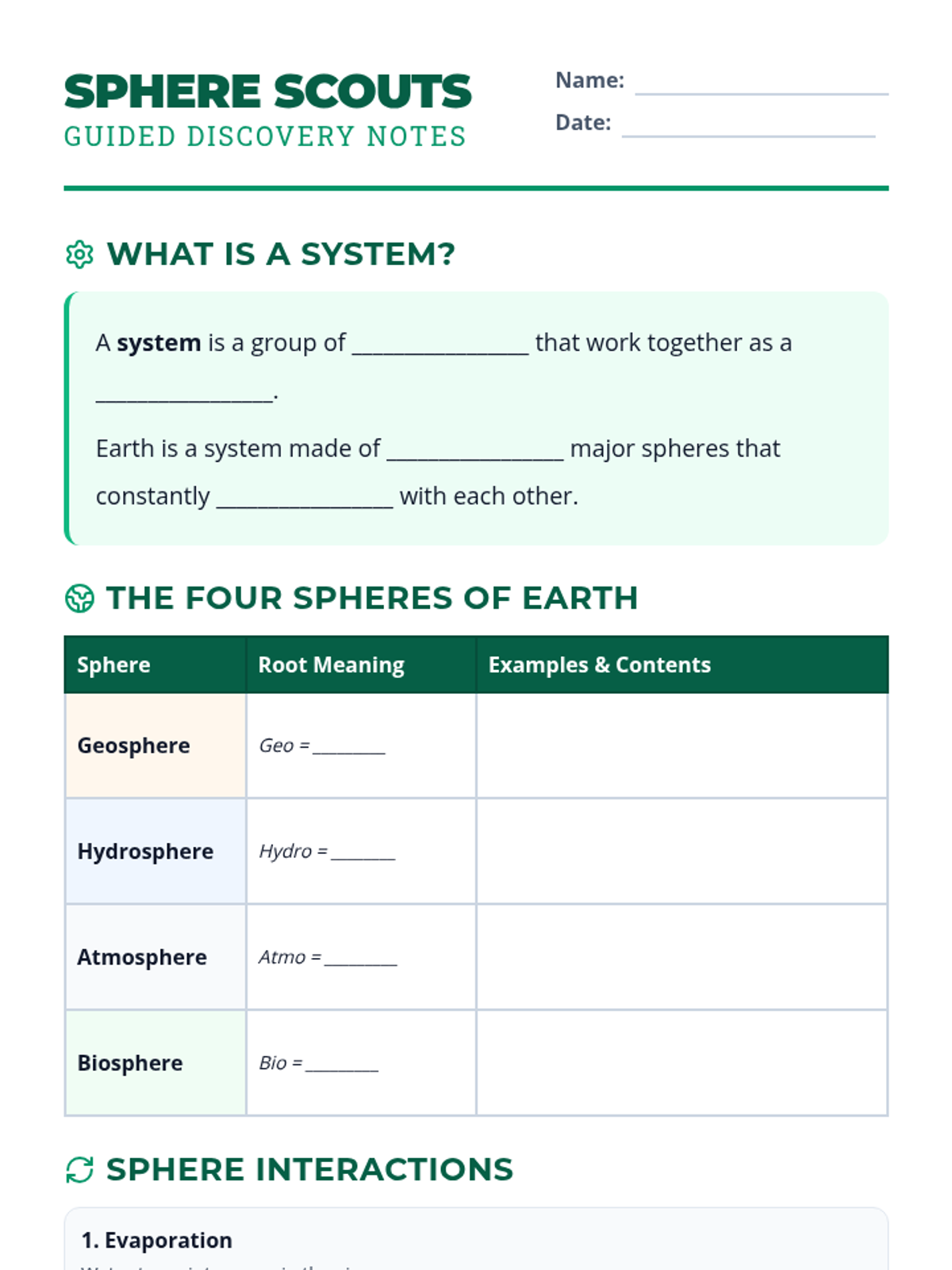
A scaffolded note-taking document designed to accompany the Sphere Systems presentation. It features fill-in-the-blank definitions, a root-word analysis table for the four spheres, interaction analysis prompts, and a creative field sketch area for personal observation.
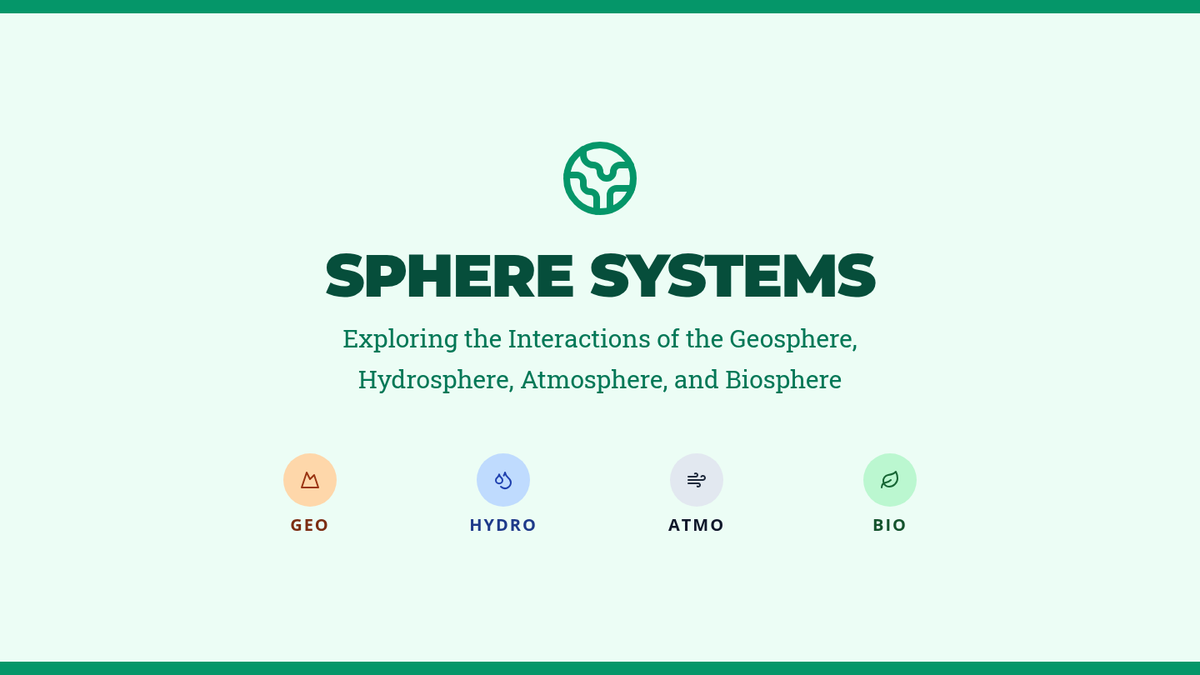
A visual presentation introducing Earth's four spheres (geosphere, hydrosphere, atmosphere, and biosphere) with clear definitions, etymology, and specific examples of complex interactions. Includes interactive discussion prompts and high-contrast layouts for classroom instruction.
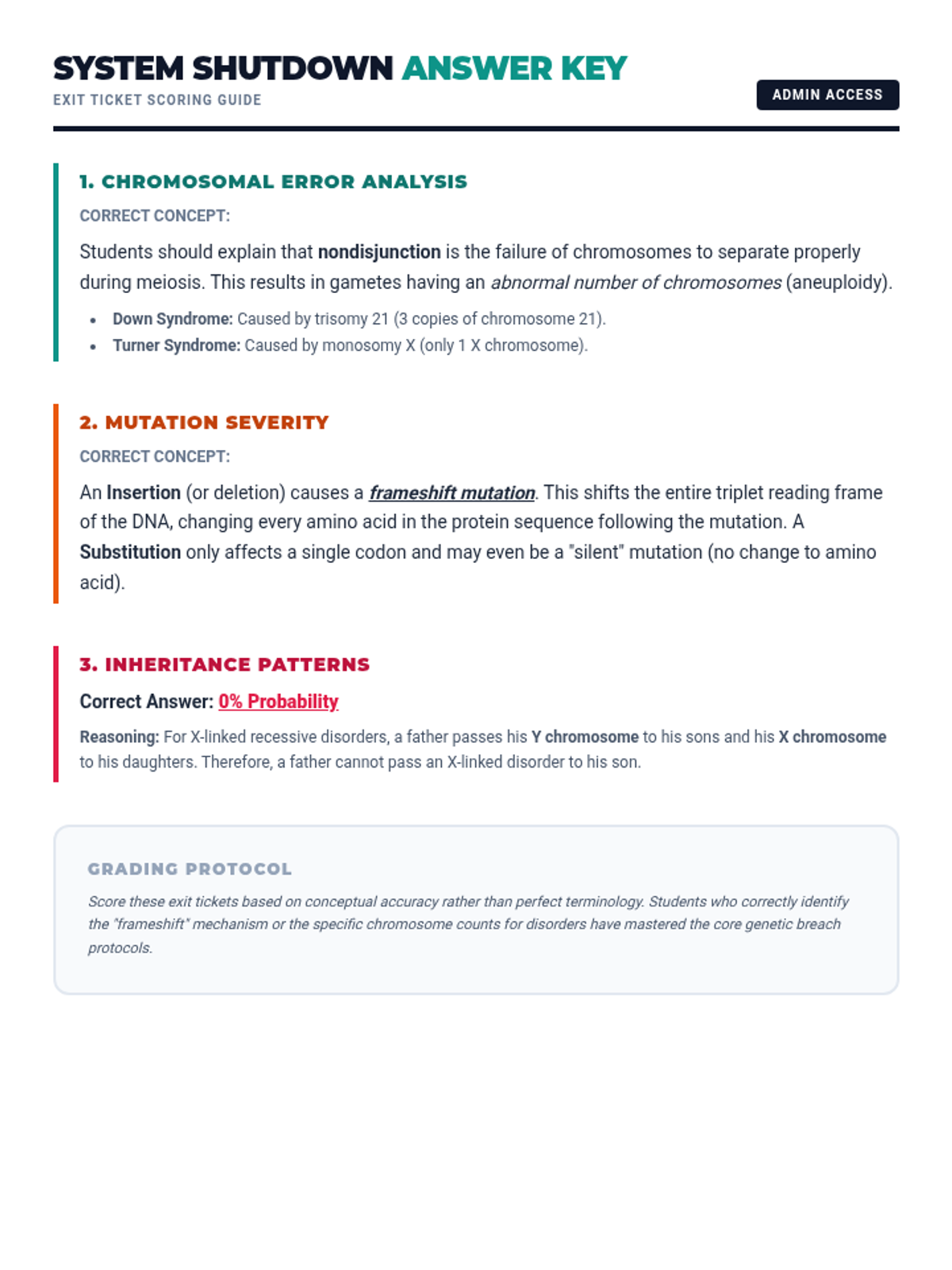
A teacher-facing answer key for the System Shutdown Exit Ticket, providing detailed explanations for chromosomal errors, mutation impacts, and X-linked inheritance.
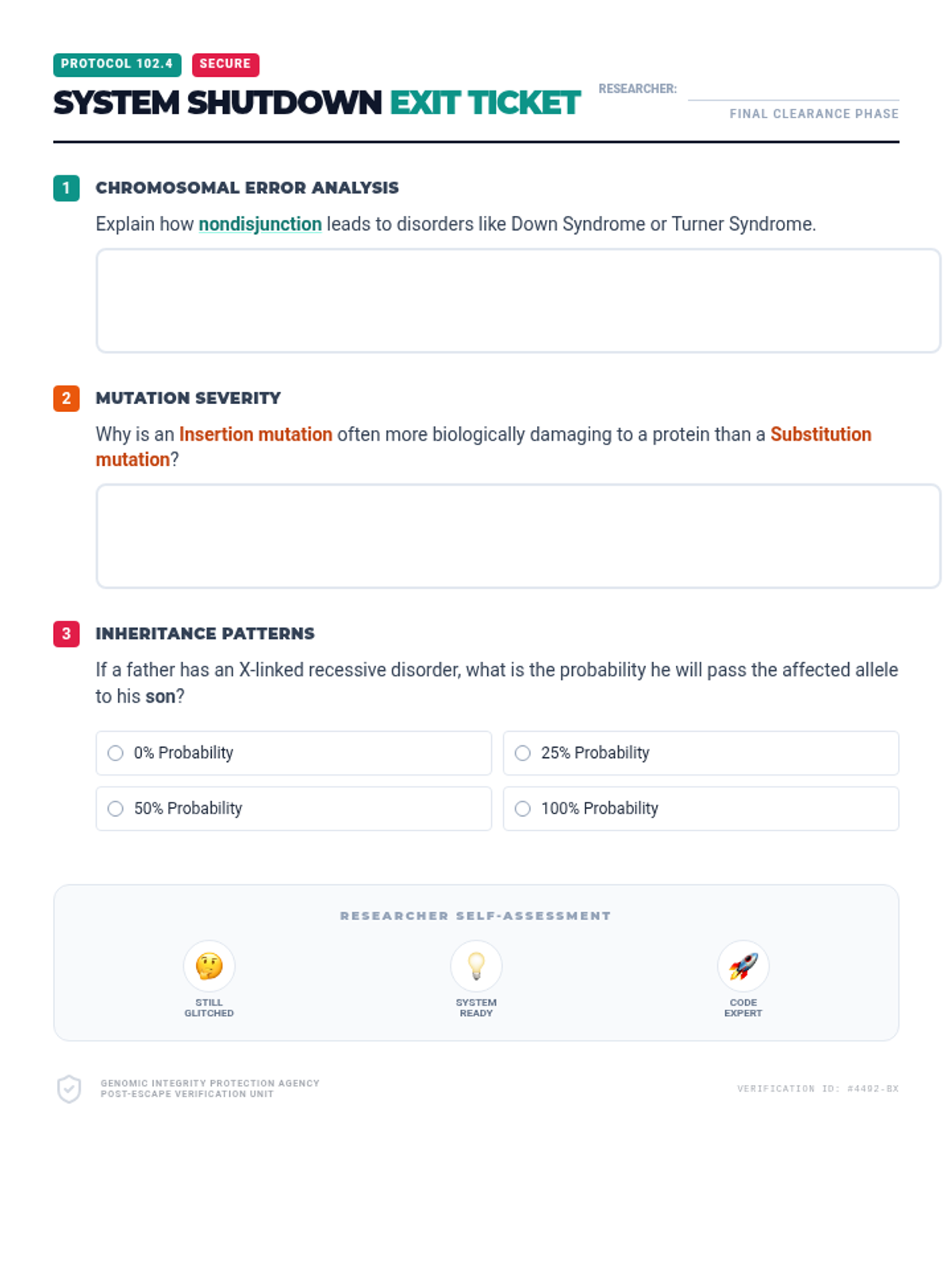
A conceptual exit ticket to assess student understanding of nondisjunction, mutation severity, and X-linked inheritance patterns following the escape room activity. Now optimized for a single-page layout.
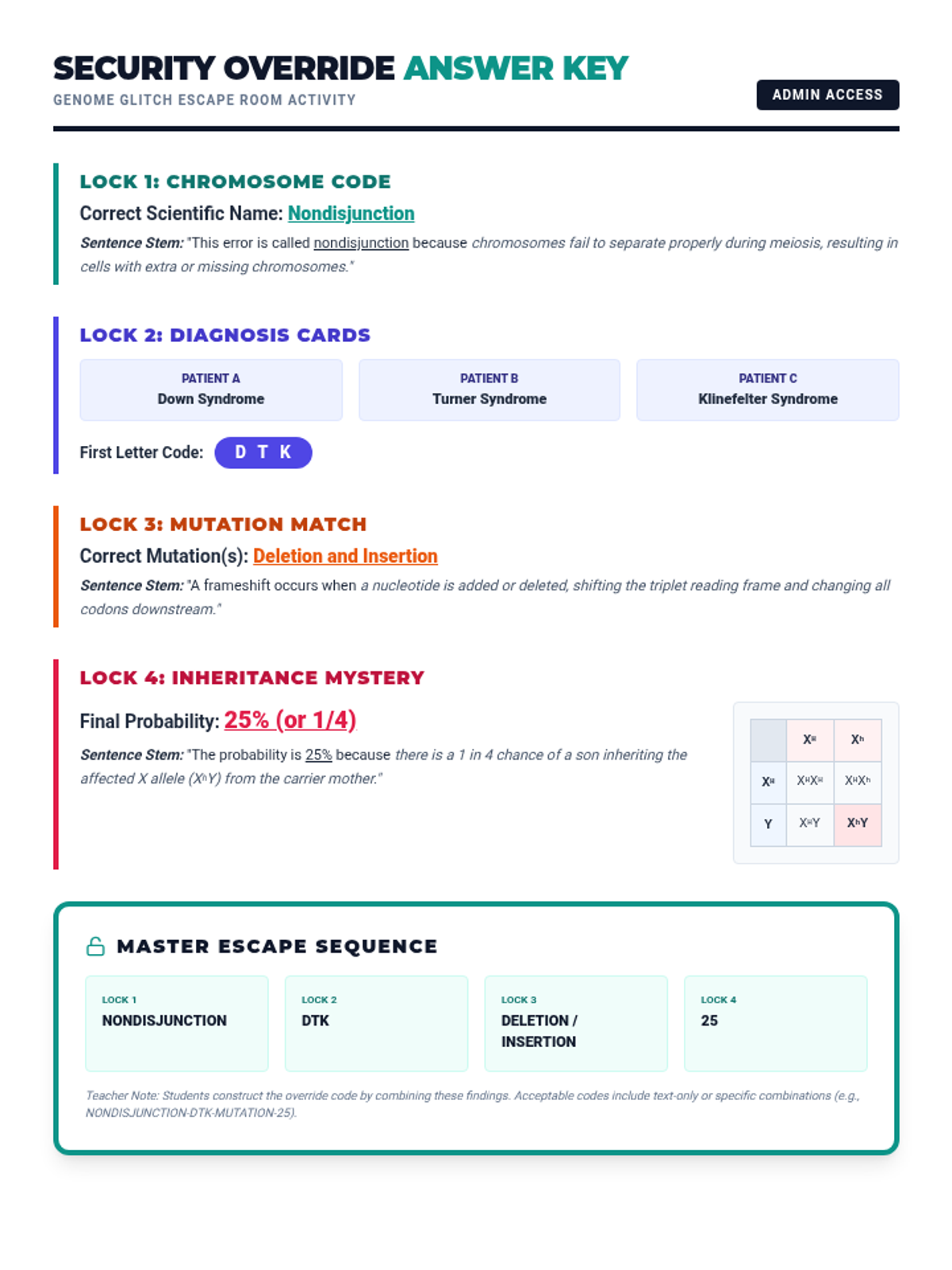
A comprehensive teacher answer key for the Genome Glitch Escape Room, providing full answers, sentence stem completions, and the final override code in a clean, legible format.
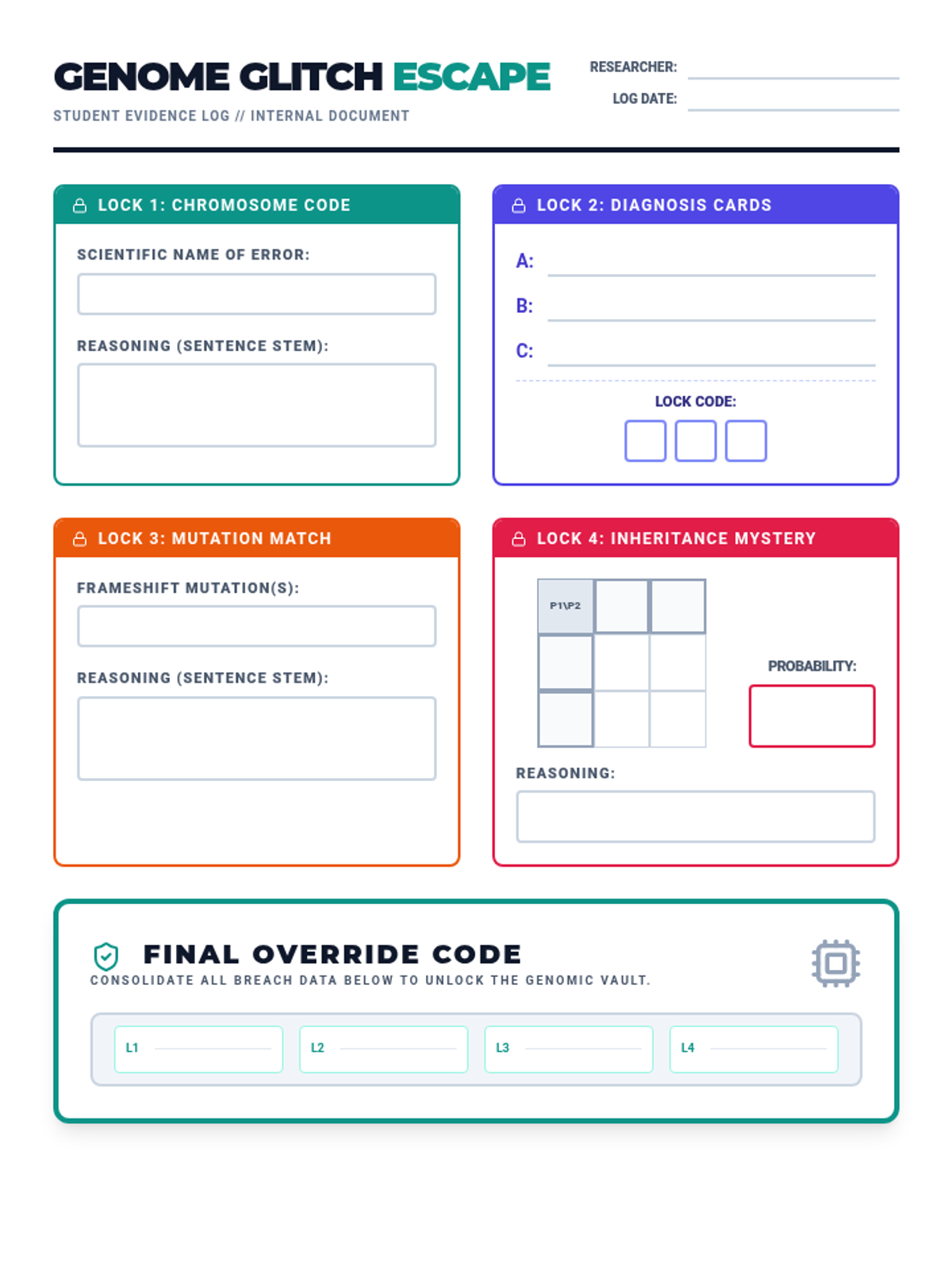
A structured recording sheet for students to document their findings from the Genetics Escape Room, featuring clear white workspaces for each lock and the final code entry section.