Lenny LearningLenny
Create
Explore
Workspace
LoginSign up
MathEnglish Language ArtsScience & EngineeringSocial StudiesGlobal LanguagesHealth & Physical EducationSpecial EducationCounseling & Life SkillsArts & CreativityESL
Lenny LearningLenny
Lenny Learning
About
Training
Pricing
Support
Contact
© 2026 Lenny Learning Inc.
MathNumbers & CountingCounting ObjectsNumber NamesComparing NumbersNumber OperationsCounting SequenceNumbers 0-10Place Value Understanding and SystemAdd and Subtract Within 20Addition and Subtraction ConceptsAddition and Subtraction EquationsAddition and Subtraction ProblemsFoundations for MultiplicationMultiplication and Division PropertiesMultiply and Divide Within 100Multiplication and Division ProblemsFactors and MultiplesProperties of OperationsPatterns and RelationshipsGenerate and Analyze PatternsMulti-Digit ArithmeticPlace Value OperationsMulti-Digit and Decimal OperationsNumerical ExpressionsFour Operations and PatternsFour Operations Problem SolvingMeasurement & DataMeasurable AttributesMeasuring LengthsMeasure and Estimate Lengths in Standard UnitsRelate Addition and Subtraction to LengthClassifying and Counting ObjectsTime and MoneyArea Concepts and MeasurementPerimeter and Area MeasuresAngle Concepts and MeasurementTime, Volume, and MassMeasurement Unit ConversionsGeometryIdentifying ShapesShapes and AttributesShape Attributes and ReasoningShapes and CompositionClassifying 2D FiguresGeometric Figures and RelationshipsLines, Angles, and ShapesAngle, Area, and VolumeGeometric MeasurementVolume of 3D ShapesCoordinate Plane ApplicationsTransformations in the PlaneCongruence and SimilarityUnderstand congruence in terms of rigid motionsSimilarity and TransformationsProve Theorems Involving SimilarityPythagorean TheoremTrigonometry for General TrianglesMake Geometric ConstructionsProve Geometric TheoremsTheorems About CirclesFind Arc Lengths And Areas of Sectors of CirclesVolume FormulasRelationships Between Two-Dimensional and Three-Dimensional ObjectsProve Simple Geometric Theorems AlgebraicallyTranslate Between Geometric Description and Equation for Conic SectionApply Geometric Concepts in Modeling SituationsFractions & DecimalsFractions as NumbersBuilding FractionsFraction Equivalence and OrderingAdding and Subtracting FractionsMultiplying and Dividing FractionsDividing FractionsDecimal FractionsMulti-Digit Computation and FactorsAdd, Subtract, Multiply, and Divide Rational NumbersRational Number SystemIrrational Numbers and ApproximationsRatiosRatios and ProportionsProportional RelationshipsUnit RateAlgebraAlgebraic ExpressionsGenerate Equivalent ExpressionsQuantitative RelationshipsProportional Relationships and Linear EquationsEquations and InequalitiesEquation Solving and ReasoningLinear Equations and SystemsGraph Equations and InequalitiesSystems of EquationsReal-World Algebraic ProblemsQuantitative Reasoning with UnitsExpression StructureEquivalent Expression FormsRadicals and Integer ExponentsRational ExponentsRational and Irrational NumbersPolynomial OperationsPolynomial IdentitiesPolynomial Zeros and FactorsRational ExpressionsComplex Number OperationsComplex Numbers in PolynomialsComplex Numbers on PlaneStatistics & ProbabilityRepresent and Interpret DataData DistributionsStatistical VariabilityProbability ModelsCompound Event ProbabilitiesStatistical SamplingInterpret Categorical and Quantitative DataBivariate Data PatternsInterpret Linear ModelsComparing Two PopulationsRandom Processes in StatisticsIndependence and Conditional ProbabilityExpected ValuesProbability-Based Decision MakingStatistical Inference and ConclusionsFunctionsFunction Concepts and NotationDefine and Compare FunctionsInterpret Functions in ContextAnalyze Function RepresentationsModel Relationships with FunctionsIdentify Linear vs Exponential GrowthDistinguish Between Function TypesCompare Growth RatesInterpret Function ExpressionsBuild Functions from RelationshipsConstruct and Model FunctionsTransform and Combine FunctionsModel Comparison and SelectionSolve Exponential EquationsTrigonometryTrigonometric Ratios Involving Right TrianglesTrigonometric Functions and Unit CircleModel with Trigonometric FunctionsTrigonometric IdentitiesVectors & MatricesIntroduction to Vectors and MatricesVector QuantitiesVector OperationsMatrix OperationsCalculusLimits and ContinuityDerivative Concepts and NotationDerivative Rules and TechniquesApplications of DerivativesOptimization ProblemsRelated RatesCurve Sketching and AnalysisIntegration Concepts and NotationAntiderivatives and Indefinite IntegralsDefinite Integrals and AreaFundamental Theorem of CalculusIntegration TechniquesApplications of IntegrationDifferential EquationsSequences and SeriesParametric and Polar FunctionsVector-Valued Functions

Statistics & Probability

SequencesLessonsMaterialsVideos
  1. Math

Statistics & Probability

SequencesLessonsMaterialsVideos

Data representation, distributions, and statistical variability using sampling and inference techniques. Integrates probability models, compound events, bivariate patterns, and linear models to guide data-driven decision making.

Data DistributionsAnalyzes the shape, center, and spread of numerical datasets using histograms, box plots, and dot plots. Examines measures of central tendency and variability to interpret data consistency and skewness.
Statistical VariabilityAnalysis of data spread using range, interquartile range, and mean absolute deviation. Examines how individual data points differ from the center and from each other within a distribution.
Probability ModelsStatistical analysis using sample spaces, tree diagrams, and area models to predict outcomes. Calculates probabilities of simple and compound events while comparing theoretical results to experimental data.
Compound Event ProbabilitiesCalculation methods for independent and dependent event outcomes using the multiplication rule. Addresses sample space mapping through tree diagrams and tables to determine multi-stage probabilities.
Statistical SamplingRandom, stratified, and cluster sampling methods for data collection and analysis. Addresses sample size determination, bias reduction, and the principles of making valid inferences about larger populations.
Interpret Categorical and Quantitative DataStatistical analysis techniques for summarizing and visualizing numerical and non-numerical data sets. Emphasizes shape, center, spread, and the impact of outliers on data interpretation through dot plots, histograms, and box plots.
Bivariate Data PatternsAnalysis of relationships between two variables using scatter plots and lines of best fit. Identifies patterns of association, correlation coefficients, and potential outliers in quantitative datasets.
Interpret Linear ModelsAnalyzes slope and y-intercept in real-world contexts using bivariate data. Evaluates line-of-best-fit reliability and makes predictions based on scatter plot trends.
Independence and Conditional ProbabilityCalculation of event likelihood based on prior conditions and methods for identifying statistical independence. Utilizes the multiplication rule, tree diagrams, and Bayes' Theorem to solve complex probability problems.
Probability-Based Decision MakingExpected value calculations and risk assessment techniques for making informed choices under uncertainty. Equips students with decision trees and Bayesian reasoning to evaluate potential outcomes in real-world scenarios.
Statistical Inference and ConclusionsHypothesis testing, confidence intervals, and p-values used to draw population conclusions. Evaluates statistical significance and error types within experimental and observational data.
Sequence
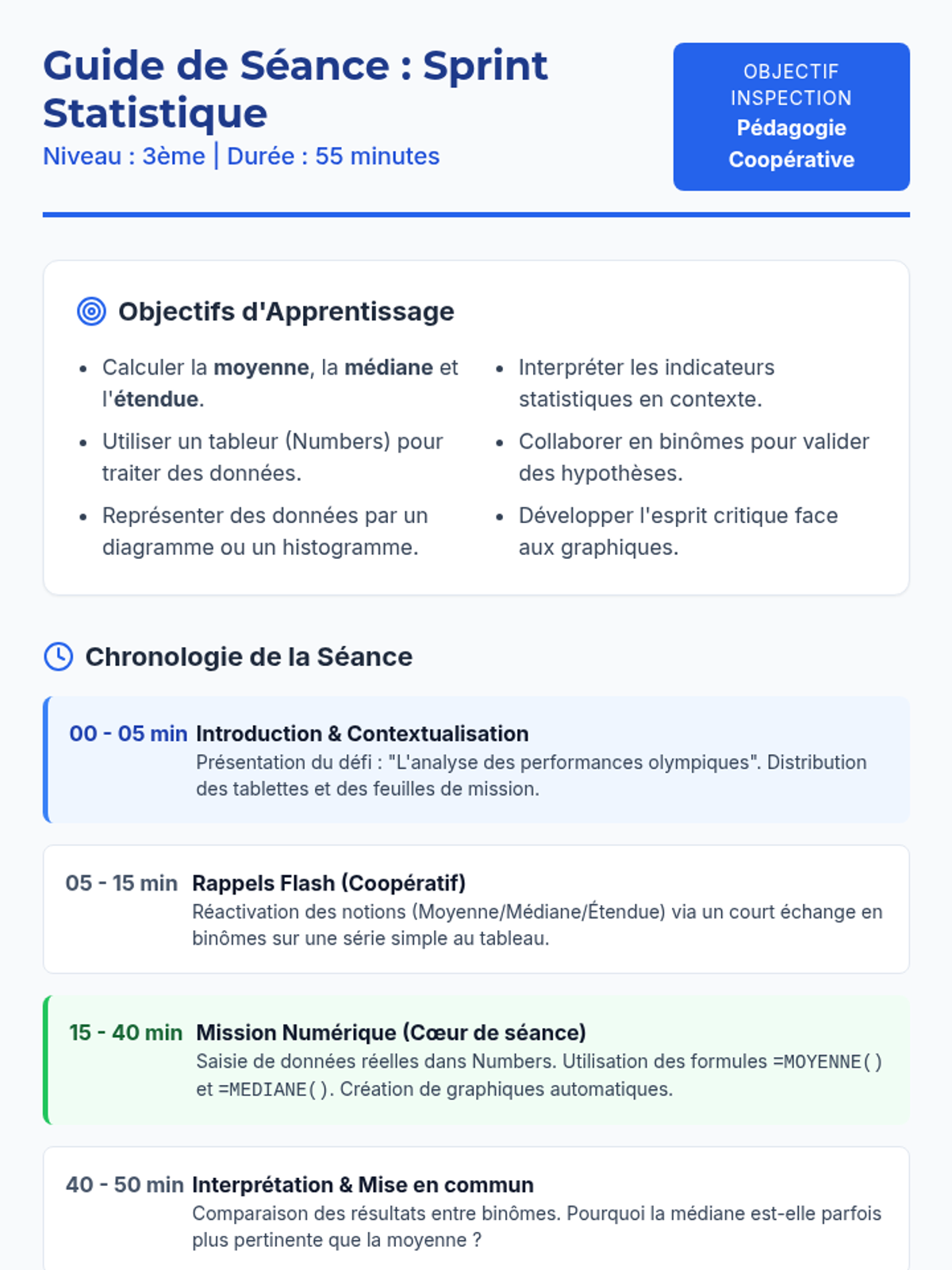
Guide Enseignant Sprint Statistique
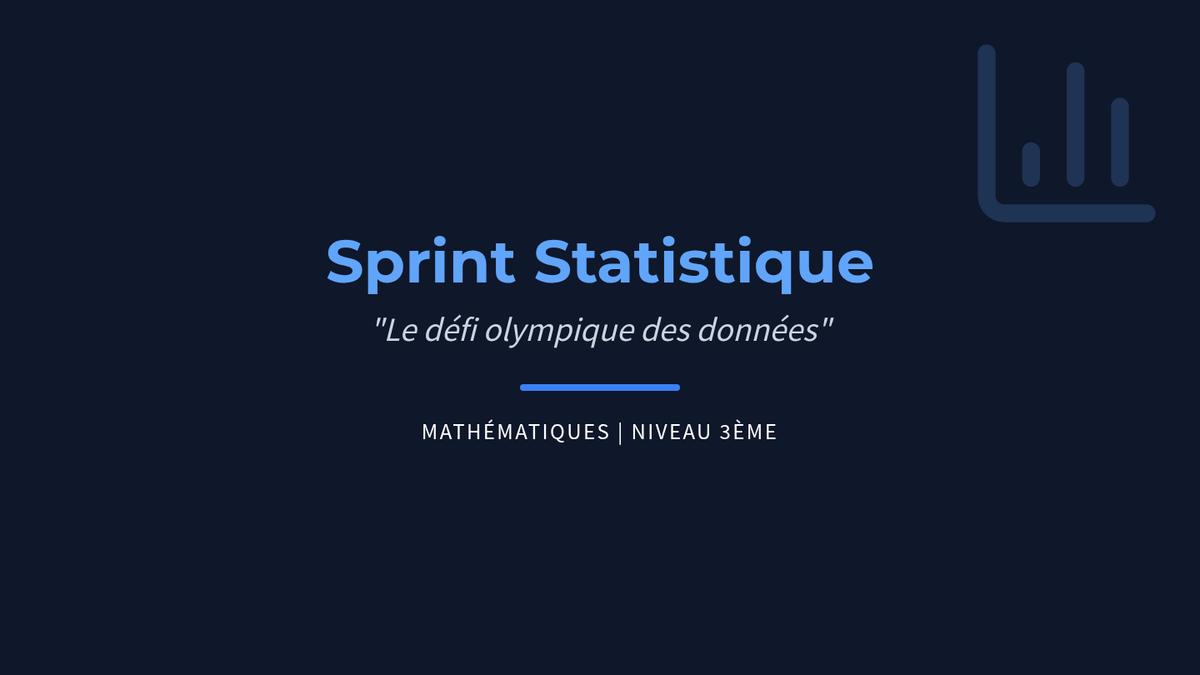
Slides Sprint Statistique
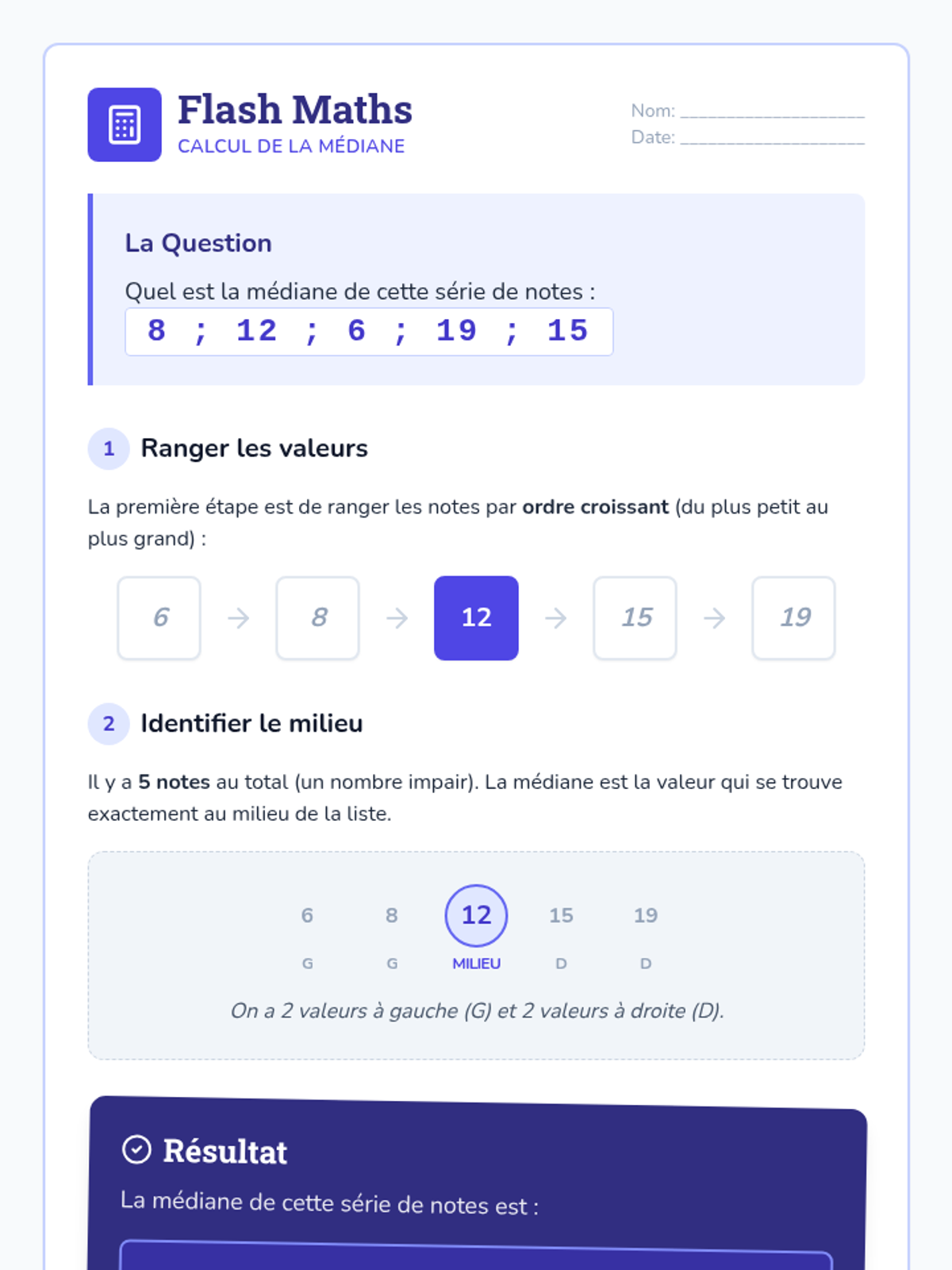
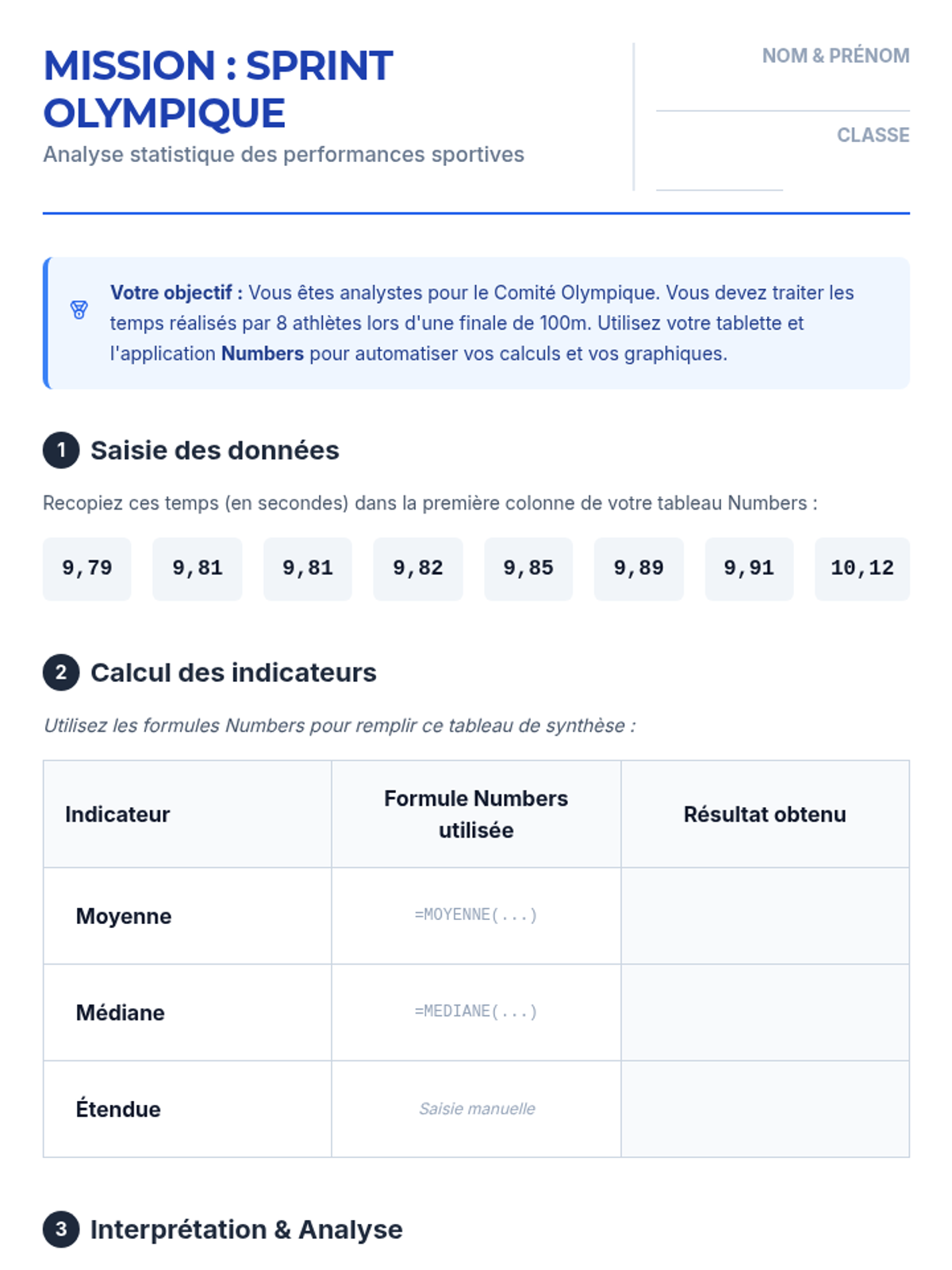
Mission Sprint Olympique Activité
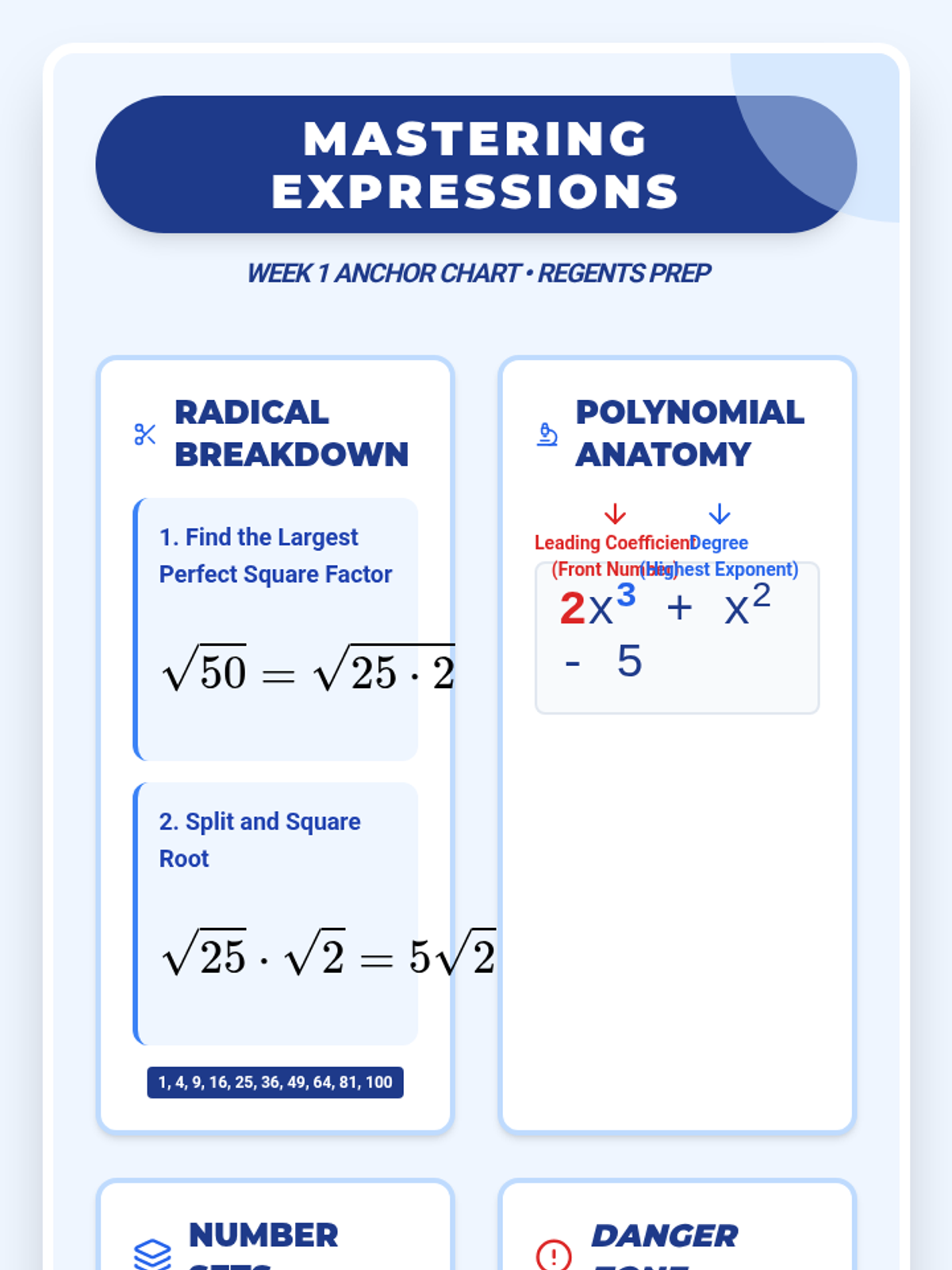
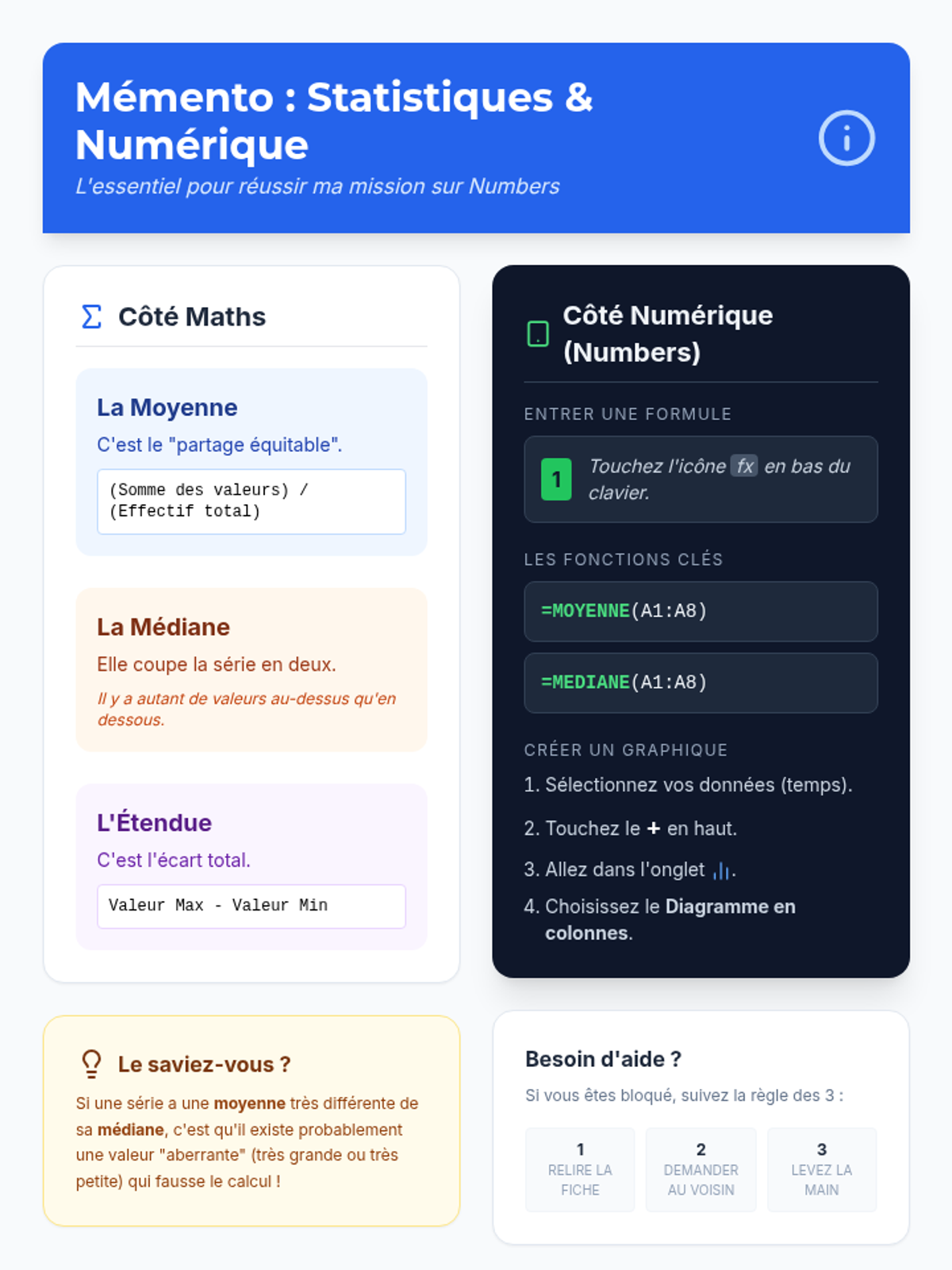
Mémento Stats et Numérique Reference Sheet
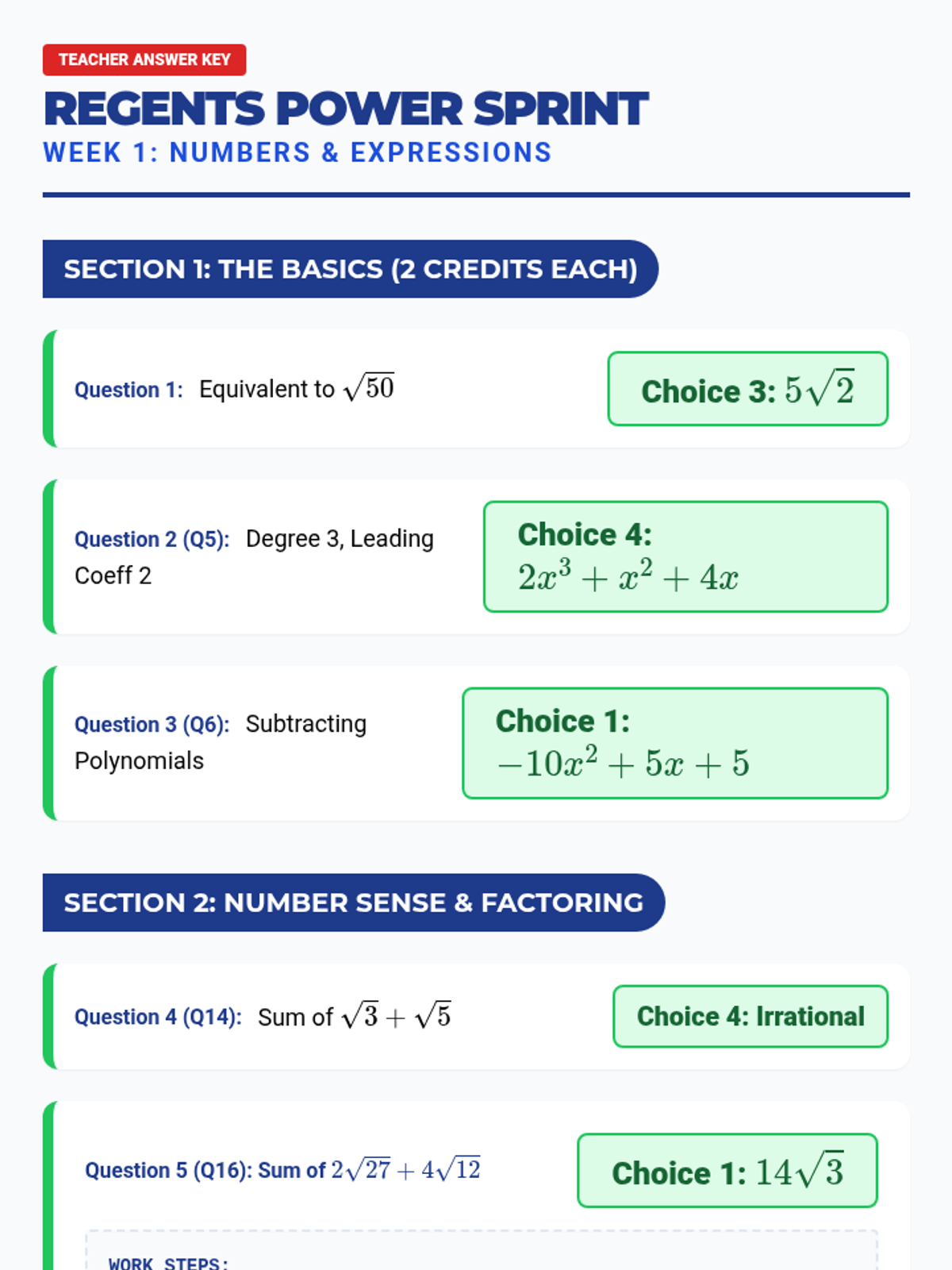
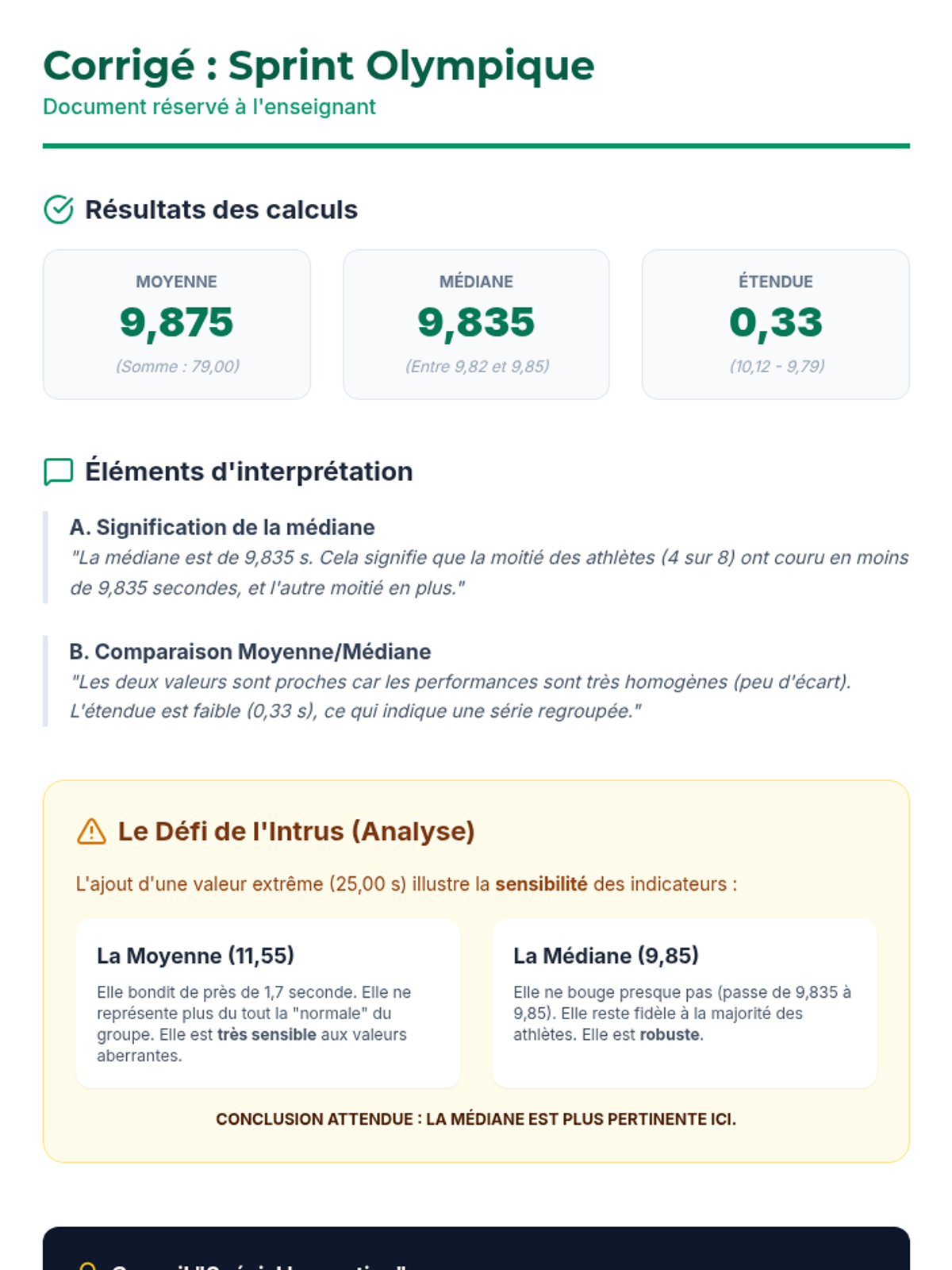
Correction Mission Sprint Olympique Answer Key

Statistiques et Numérique

Une séquence complète sur les statistiques en 3ème, abordant la collecte, le traitement et l'interprétation de données avec des outils numériques.

E

Enseignante

Math Teacher
2/27
Sequence
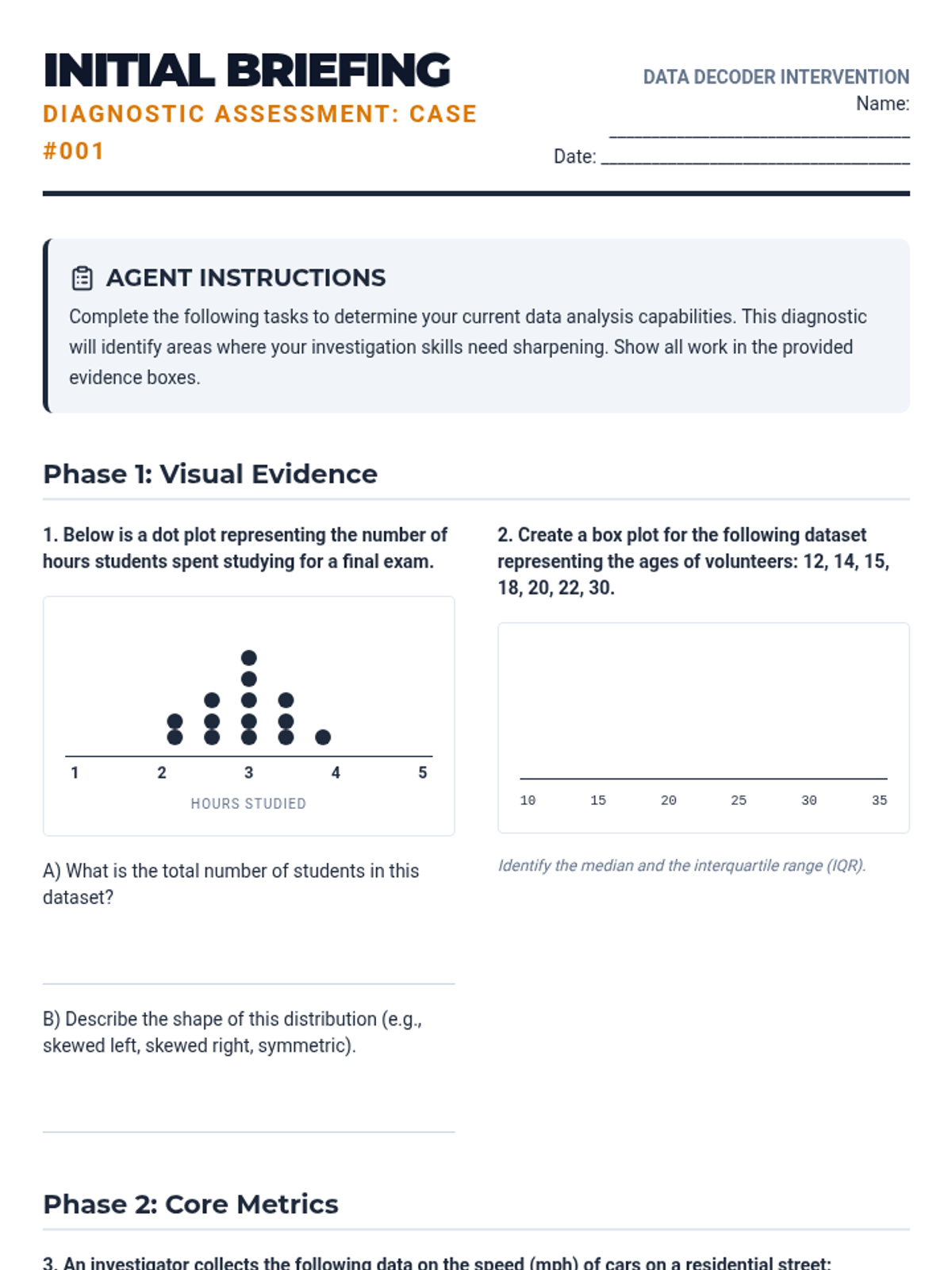
Initial Briefing Assessment
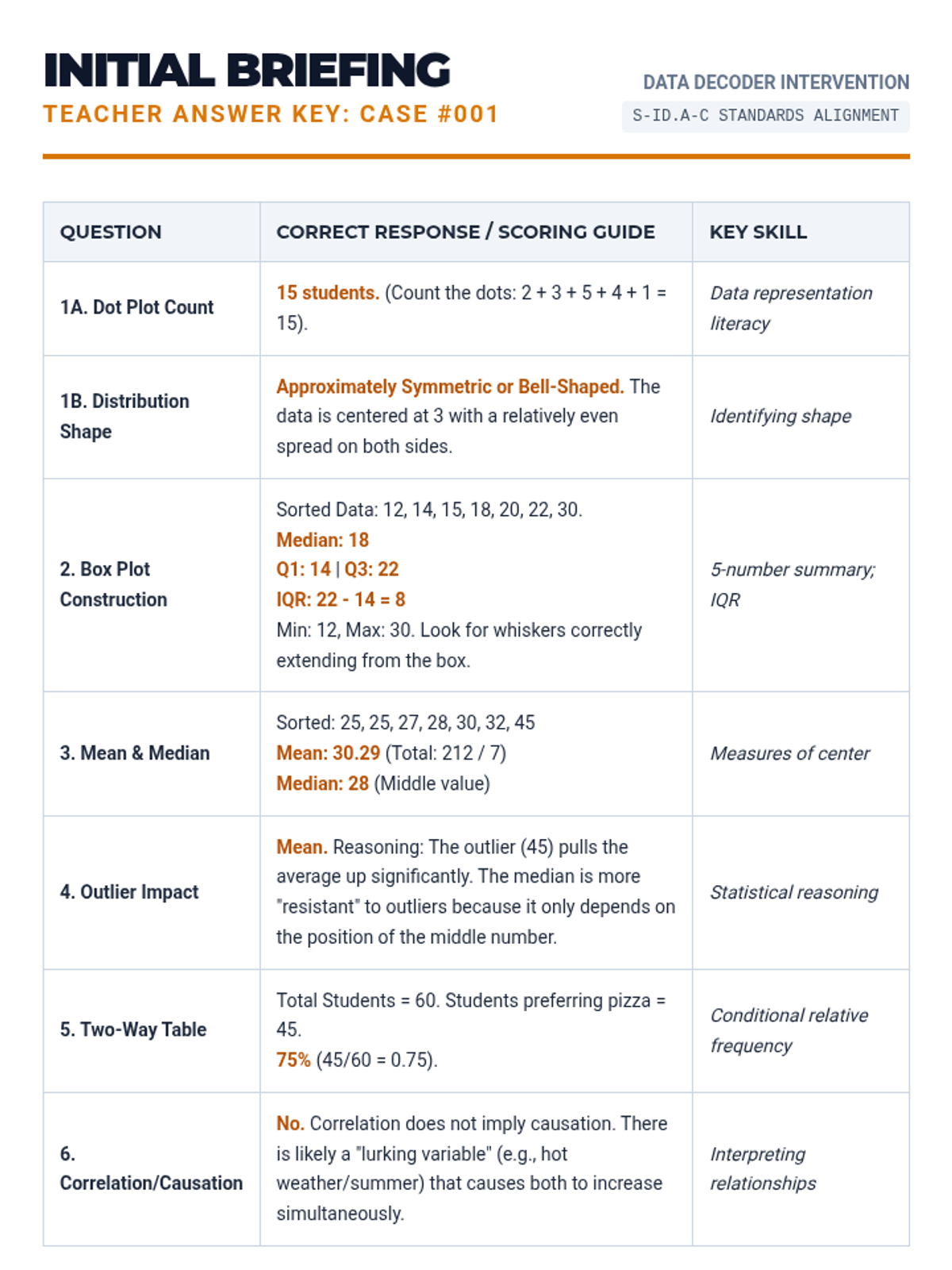
Initial Briefing Answer Key

Data Decoder

A comprehensive Tier 2 intervention sequence for high school students focused on summarizing, representing, and interpreting data, aligned with Colorado Standard 3. The program uses a 'Data Forensics' theme to engage students in uncovering insights from real-world datasets through scaffolded analysis and visual interpretation.

Lenny Avatar
Lenny
2/13
Sequence
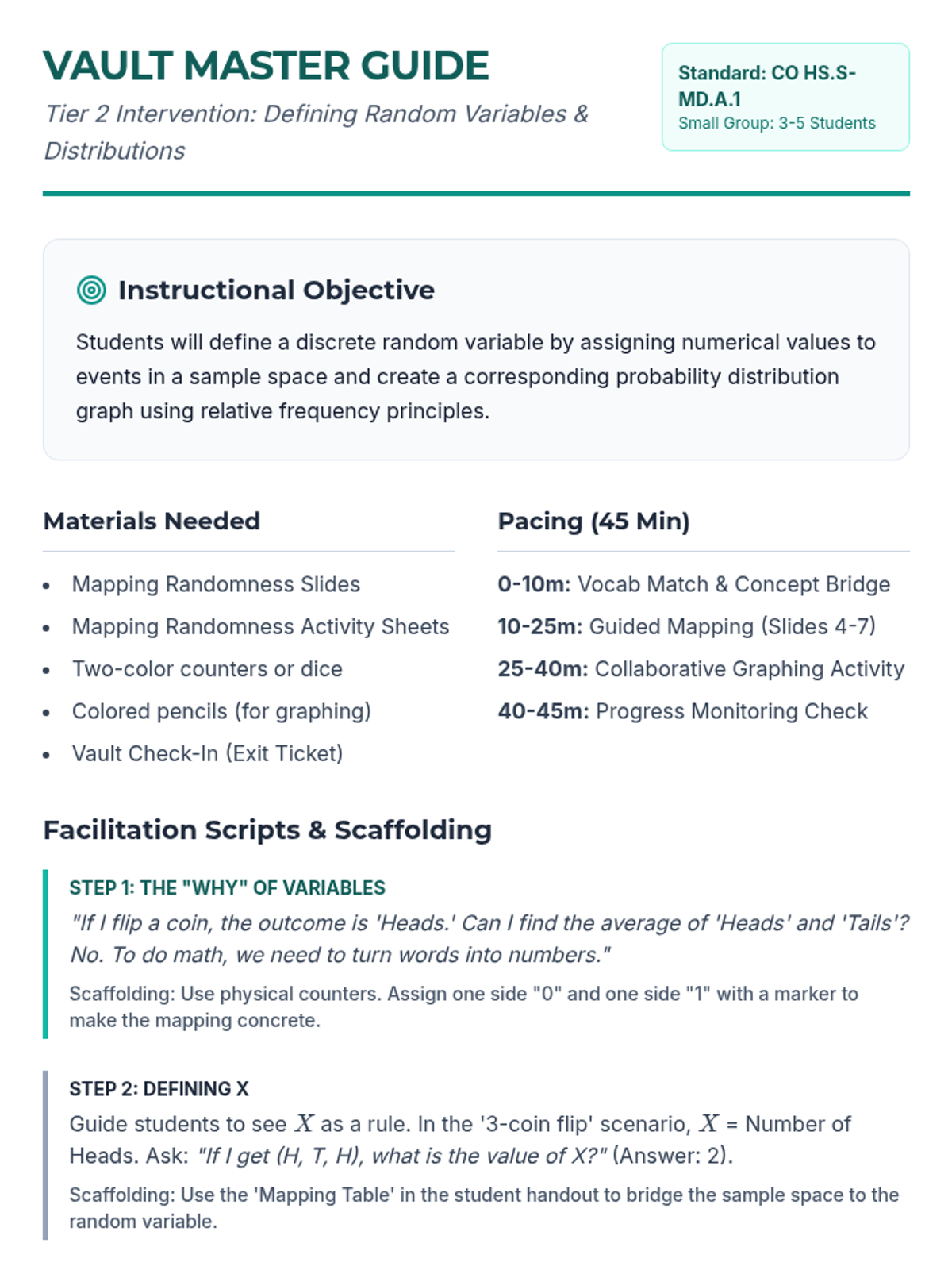
Vault Master Guide
Variable Vault Slides
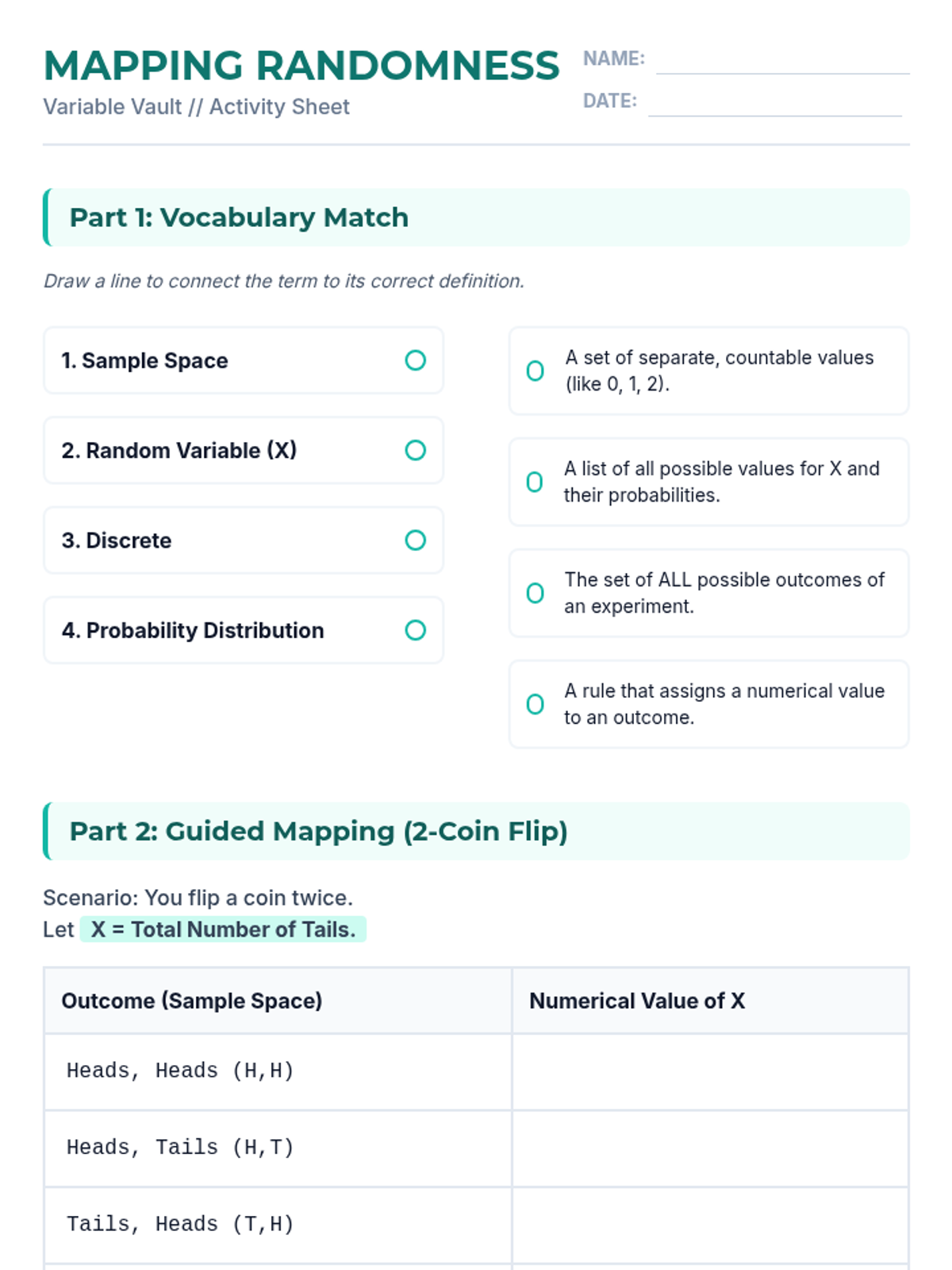
Mapping Randomness Activity
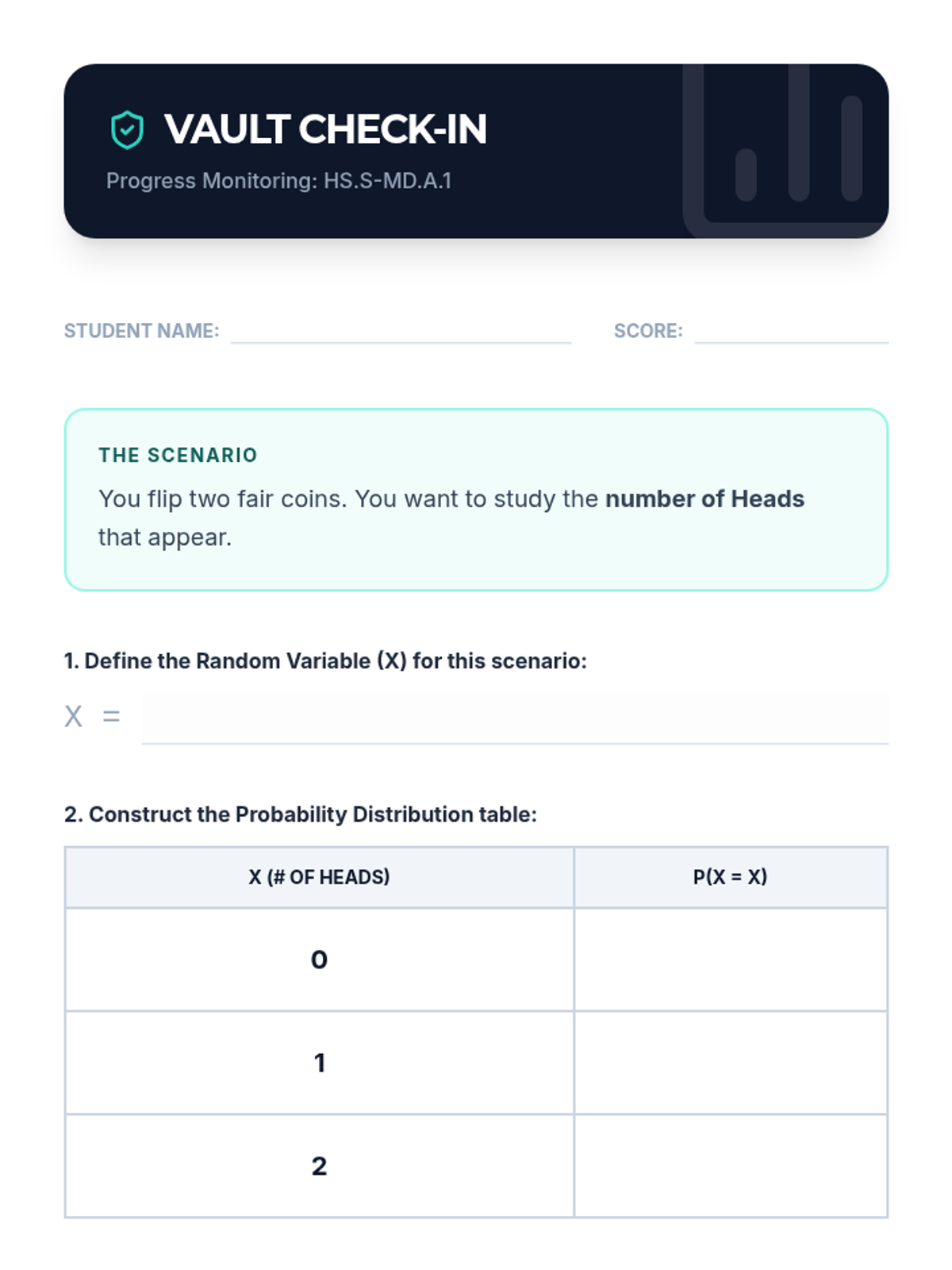
Vault Check-In

Variable Vault

A targeted intervention sequence focused on foundational probability concepts, specifically defining random variables and constructing probability distributions for high school statistics students.

Lenny Avatar
Lenny
2/12
Sequence
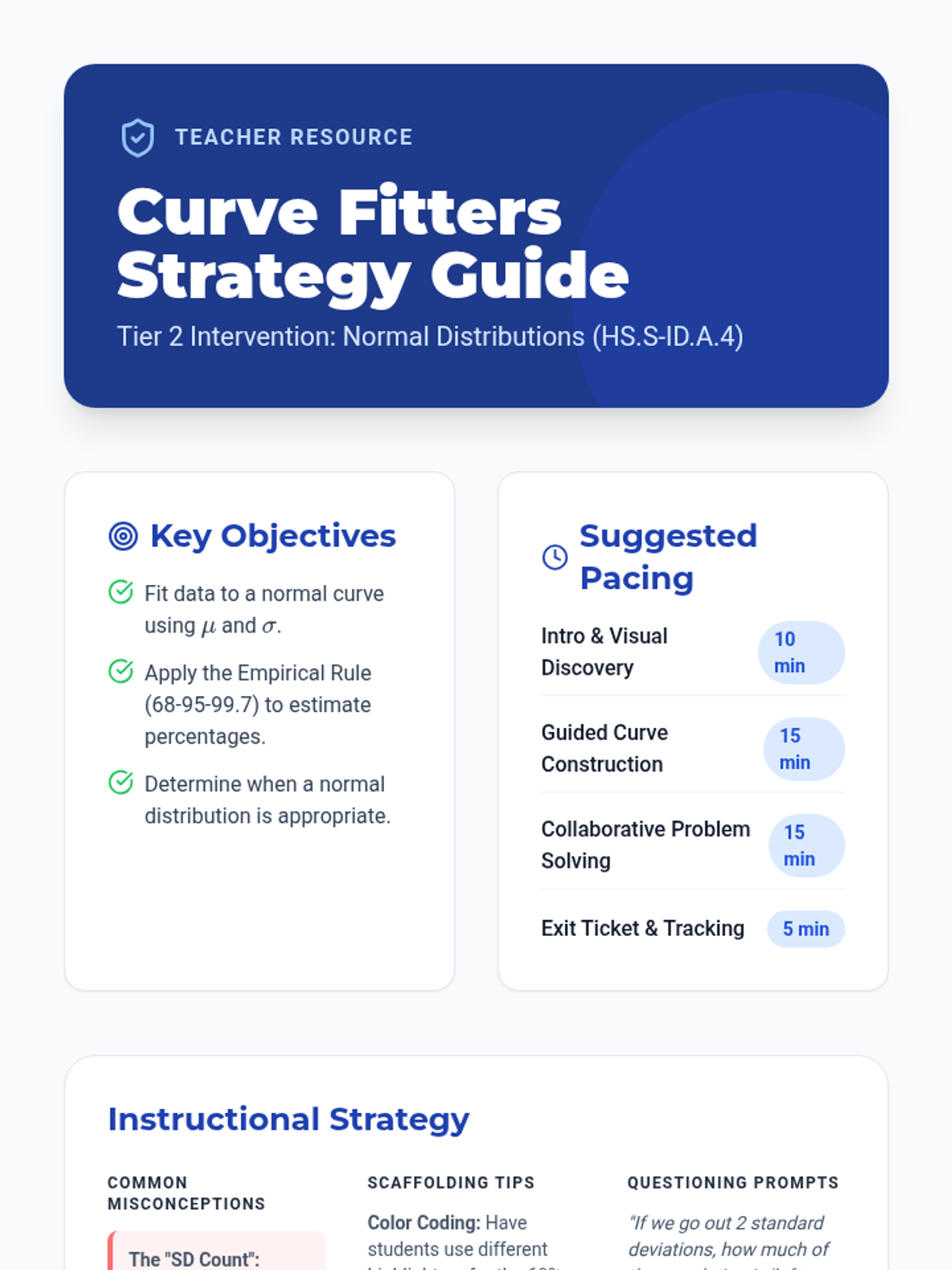
Curve Fitters Slides
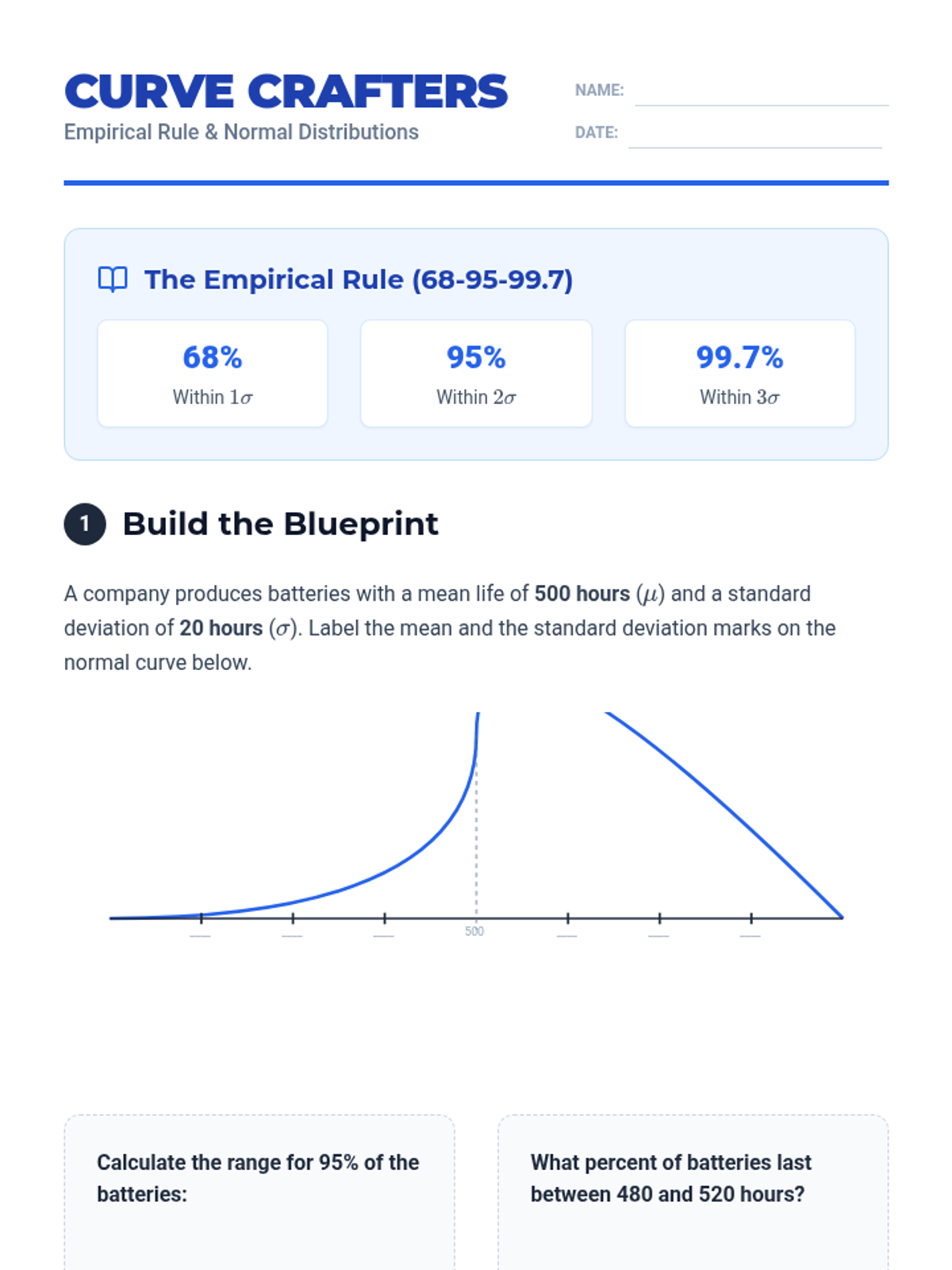
Curve Crafters Workbook
Curve Fitters Teacher Guide
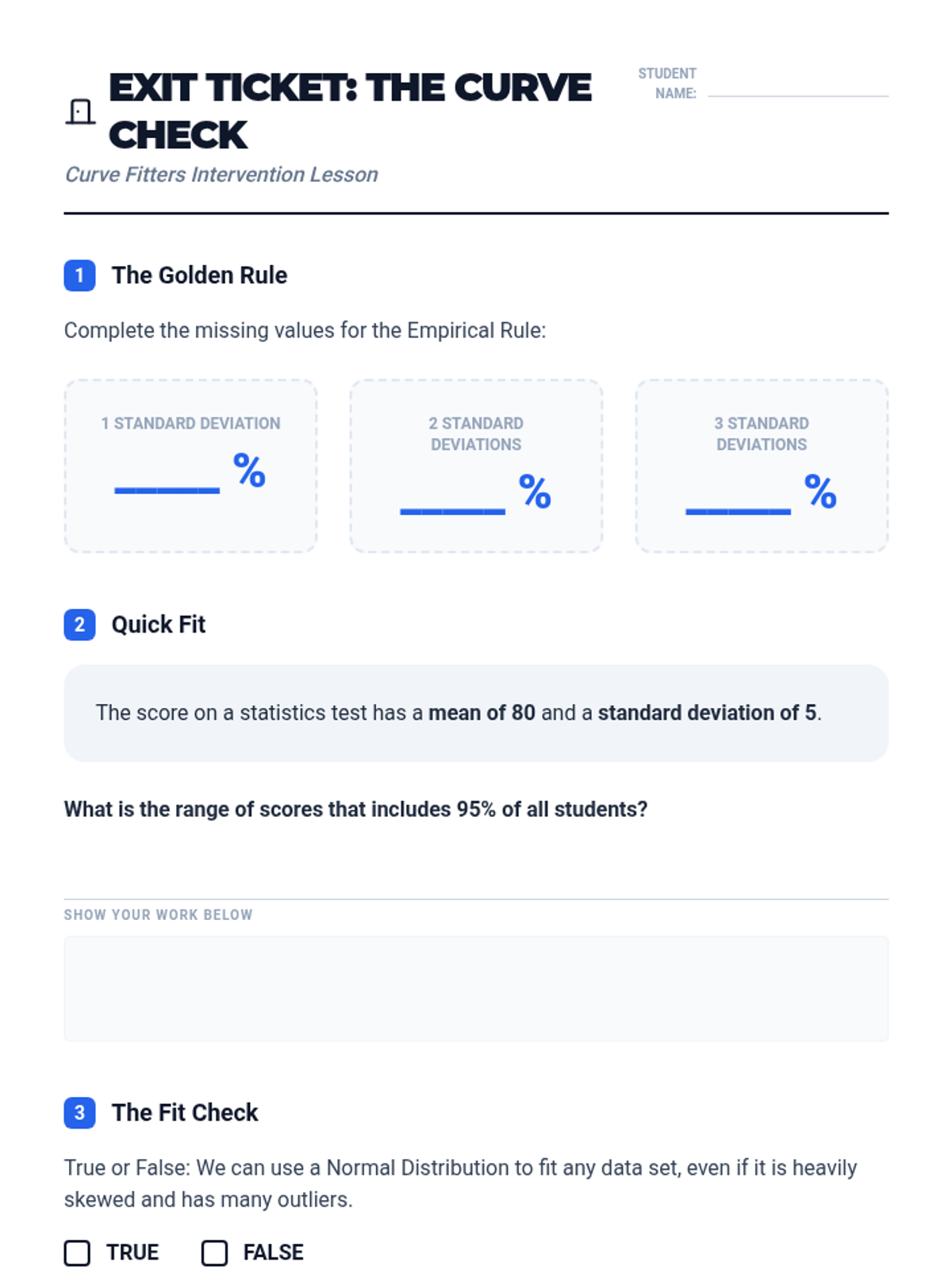
Curve Check Exit Ticket

Distribution Detectives

A Tier 2 intervention sequence focused on helping students master the Normal Distribution and the Empirical Rule through real-world applications and scaffolded practice.

Lenny Avatar
Lenny
2/12
Sequence
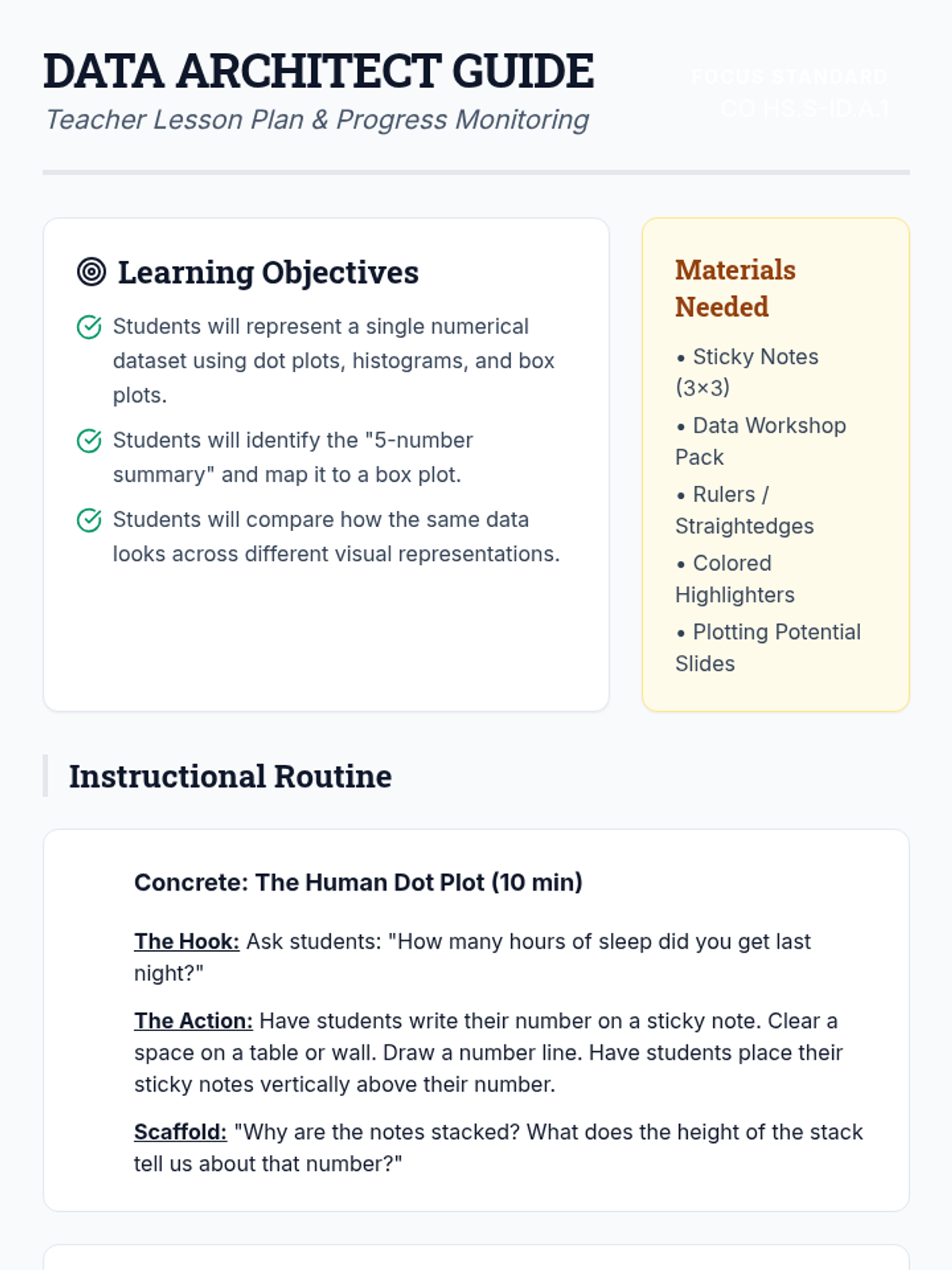
Data Architect Teacher Guide
Plotting Potential Slides
Data Workshop Packet
Plot Check Exit Ticket

Metric Workshop

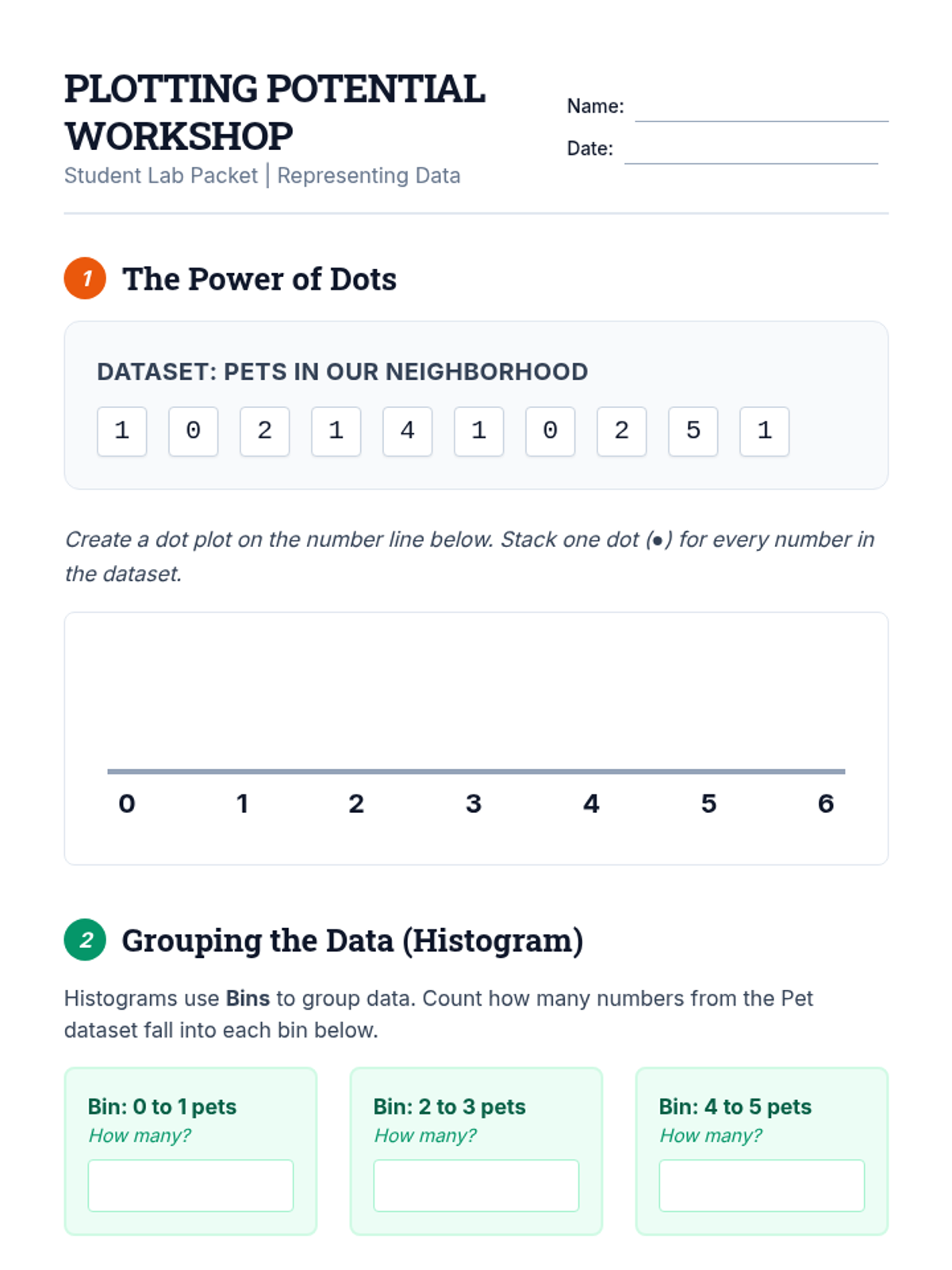
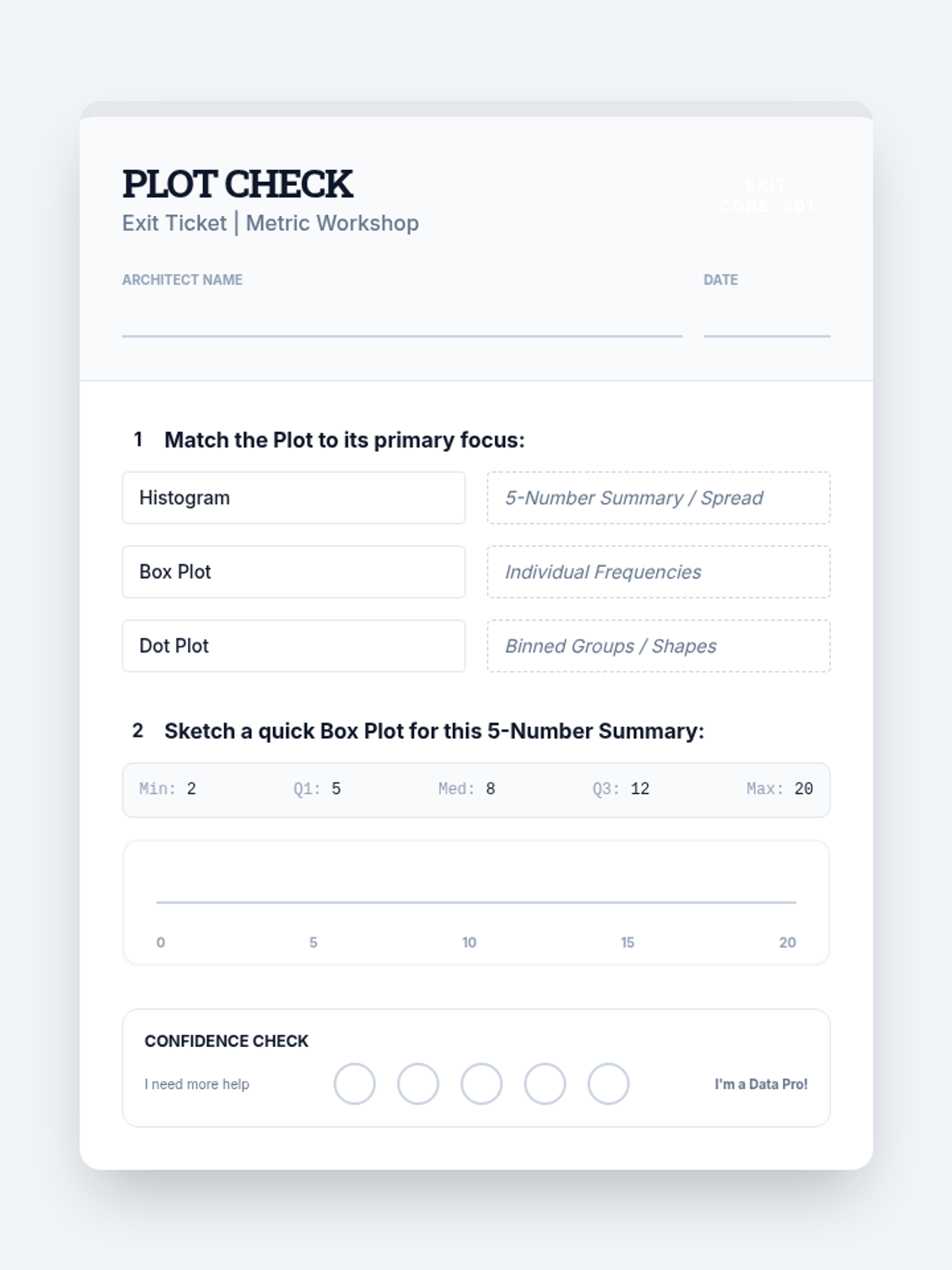
A Tier 2 intervention sequence focused on building concrete understanding of data representations including dot plots, histograms, and box plots for high school statistics students.

Lenny Avatar
Lenny
2/12
Sequence
Relationship Radar Slides
Pattern Tracker Worksheet
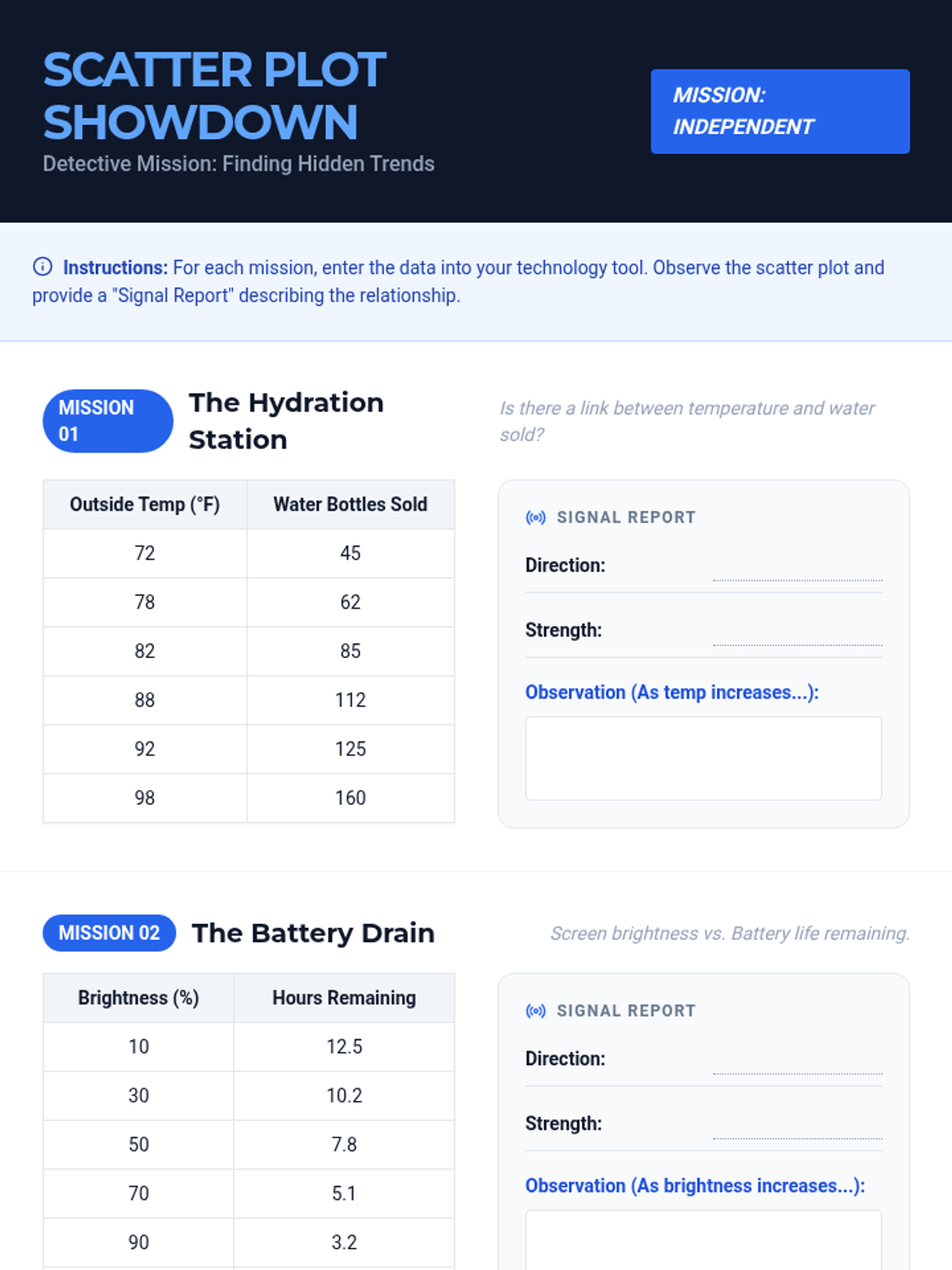
Scatter Plot Showdown Activity
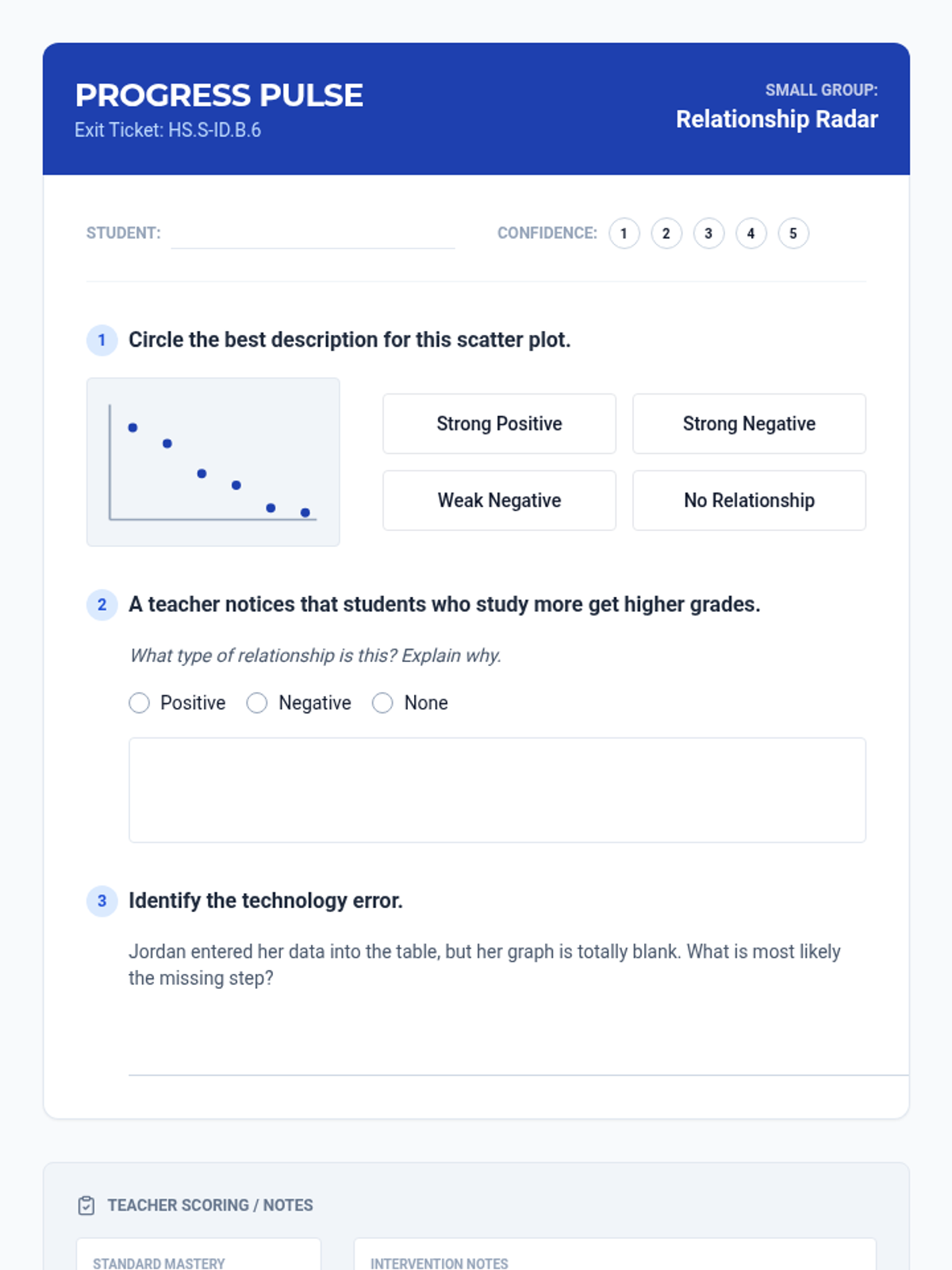
Progress Pulse Exit Ticket

Relationship Radar Sequence

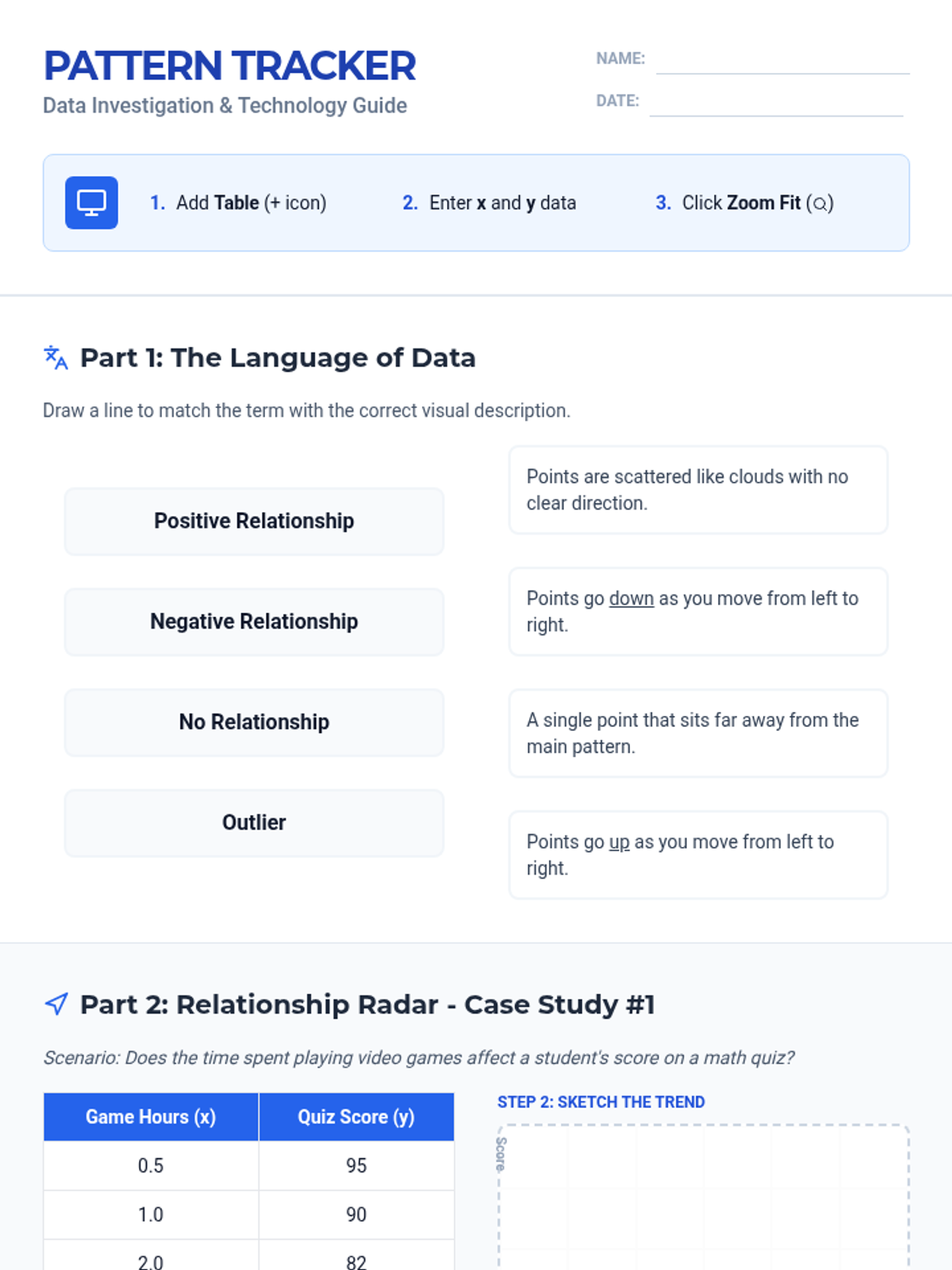
A Tier 2 intervention sequence focused on analyzing bivariate data. Students learn to use technology to create scatter plots and develop a precise vocabulary for describing relationships between quantitative variables.

Lenny Avatar
Lenny
2/12
Sequence
Distribution Duel Slides
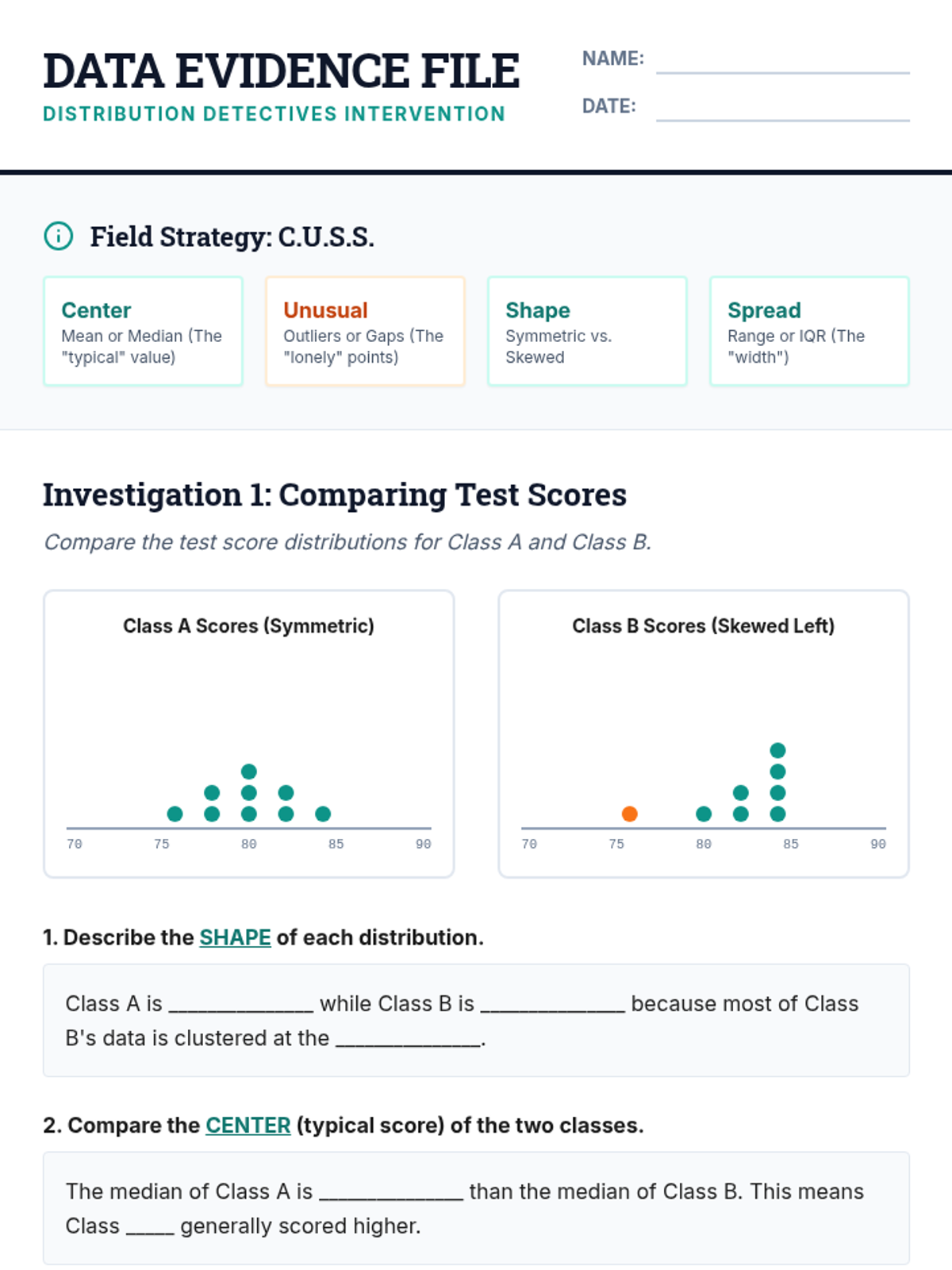
Evidence File Worksheet
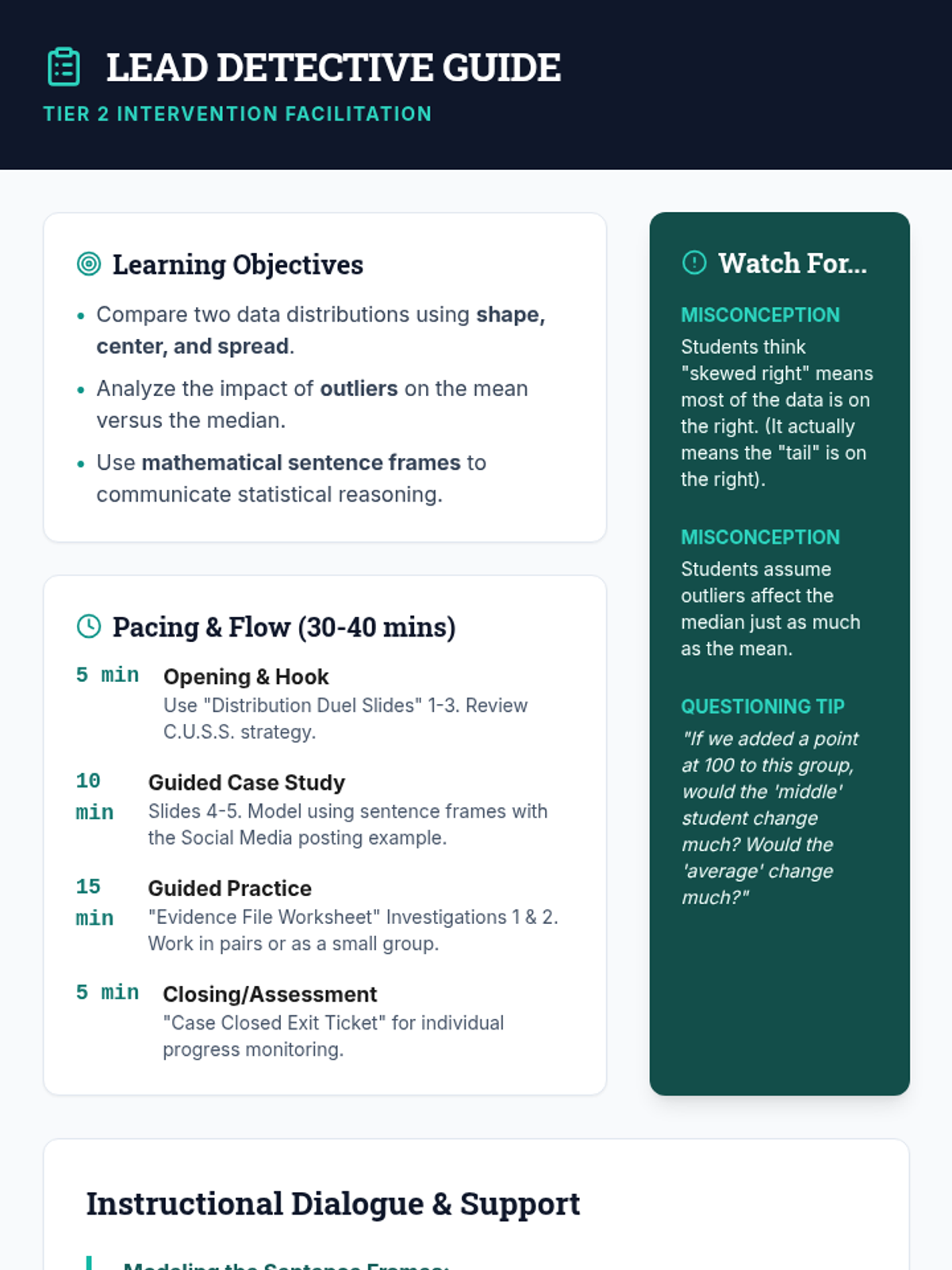
Lead Detective Guide
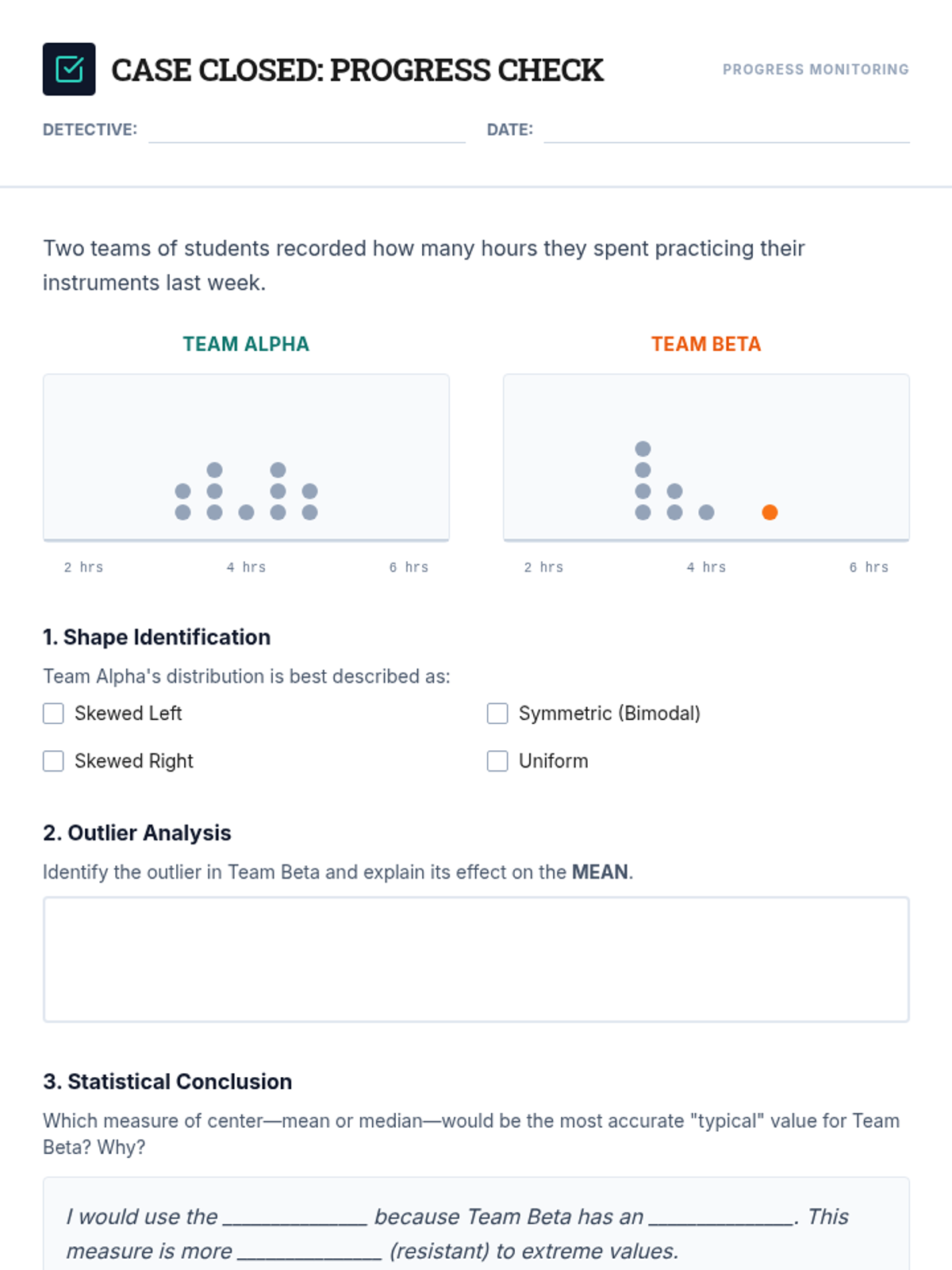
Case Closed Exit Ticket
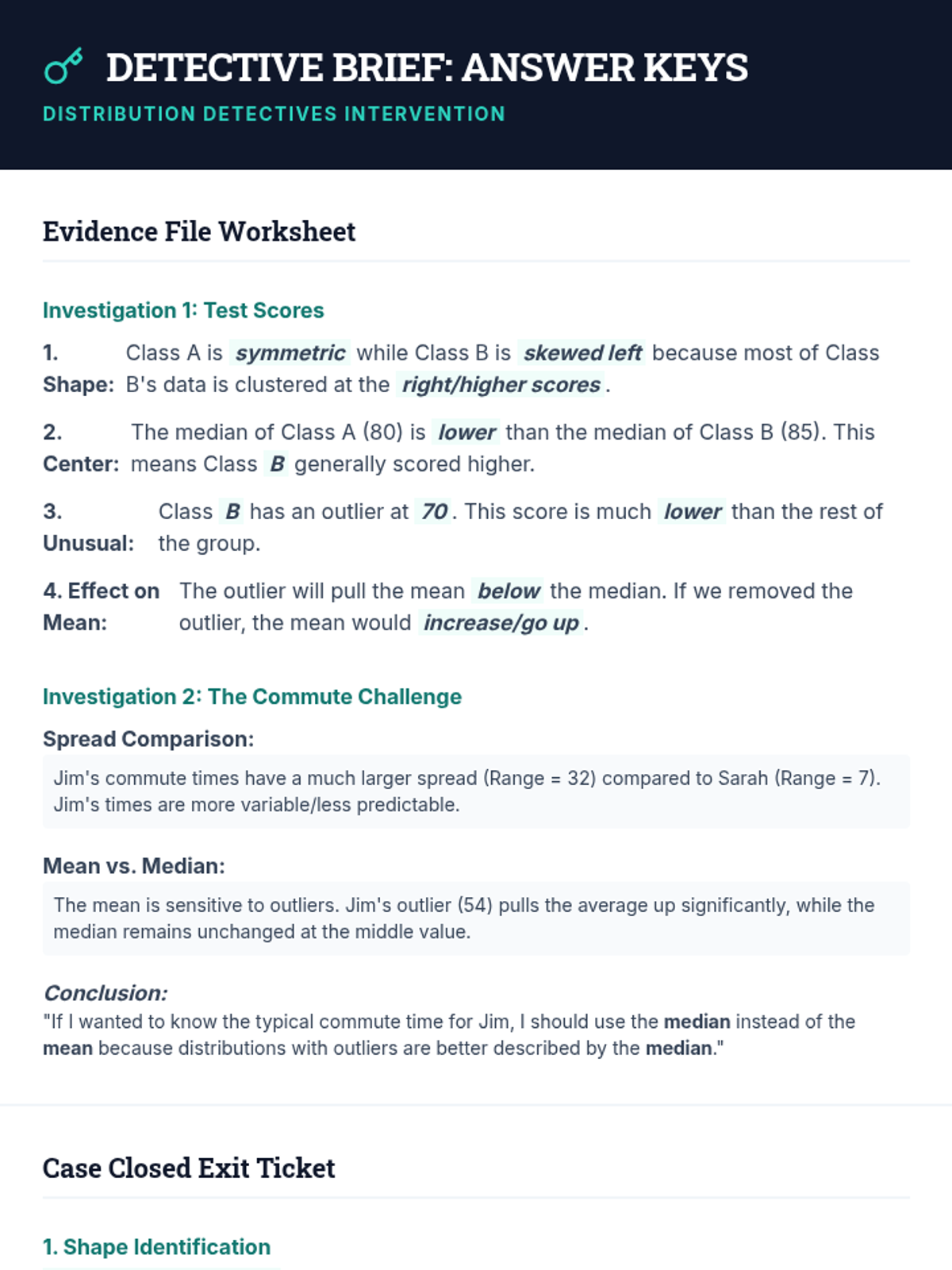
Detective Brief Answer Keys

Distribution Detectives

A targeted Tier 2 intervention for High School Statistics focusing on comparing data distributions (shape, center, spread) and understanding the impact of outliers. Includes scaffolded instruction, guided practice with sentence frames, and progress monitoring tools.

Lenny Avatar
Lenny
2/12
Sequence
Probability Lab Slides
Probability Lab Packet
Probability Teacher Guide
Probability Exit Ticket

Probability Predictors

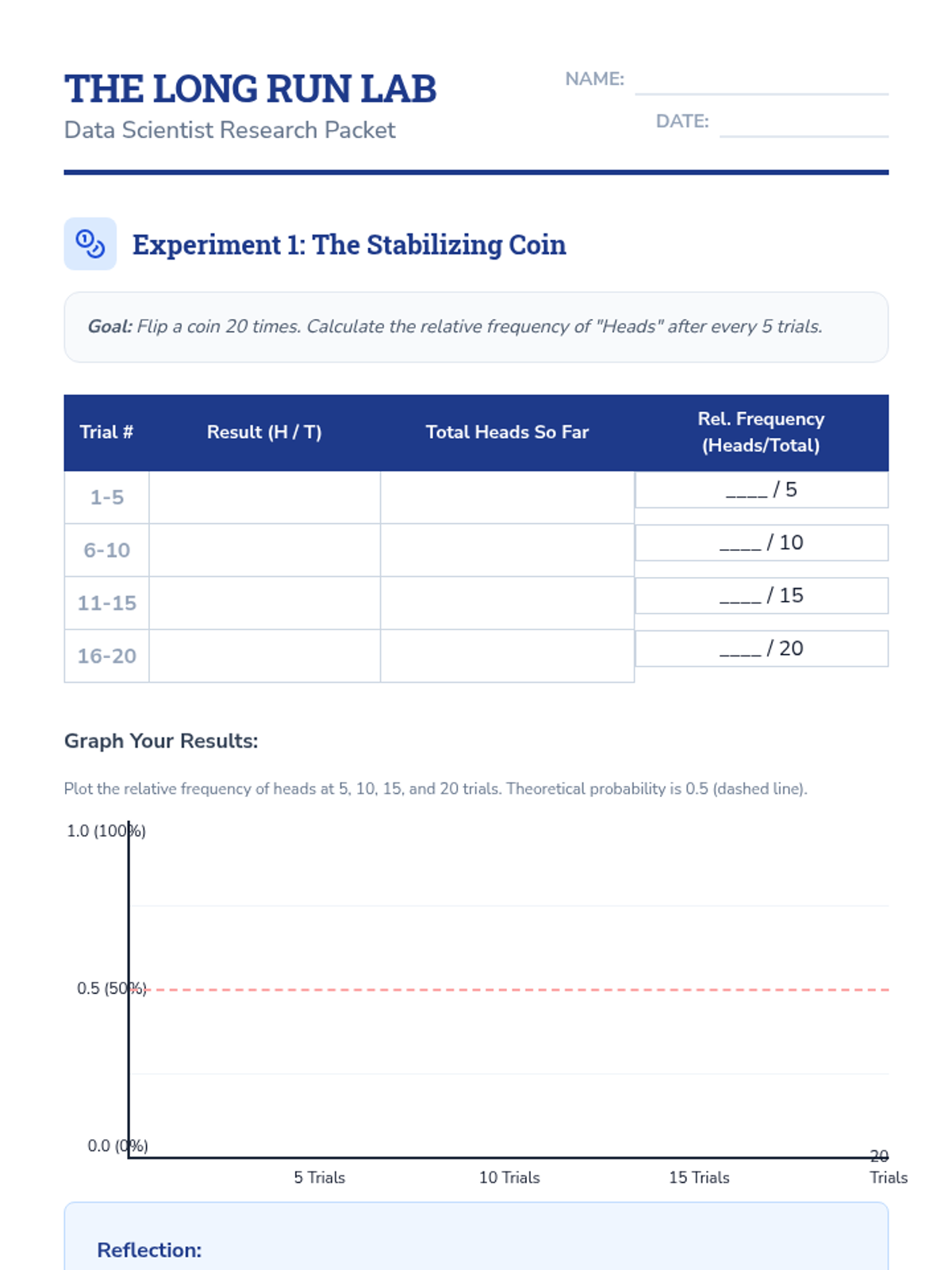
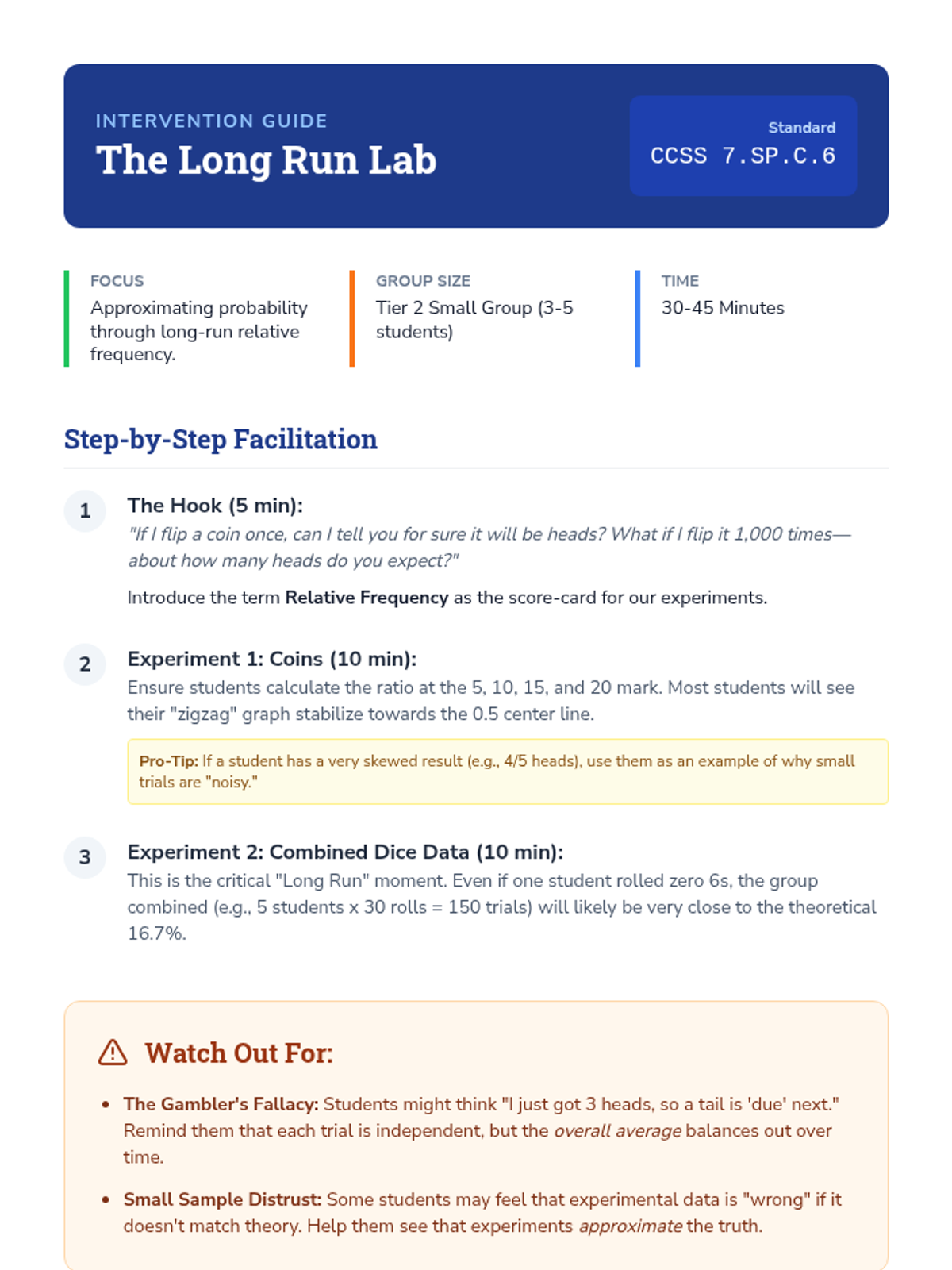
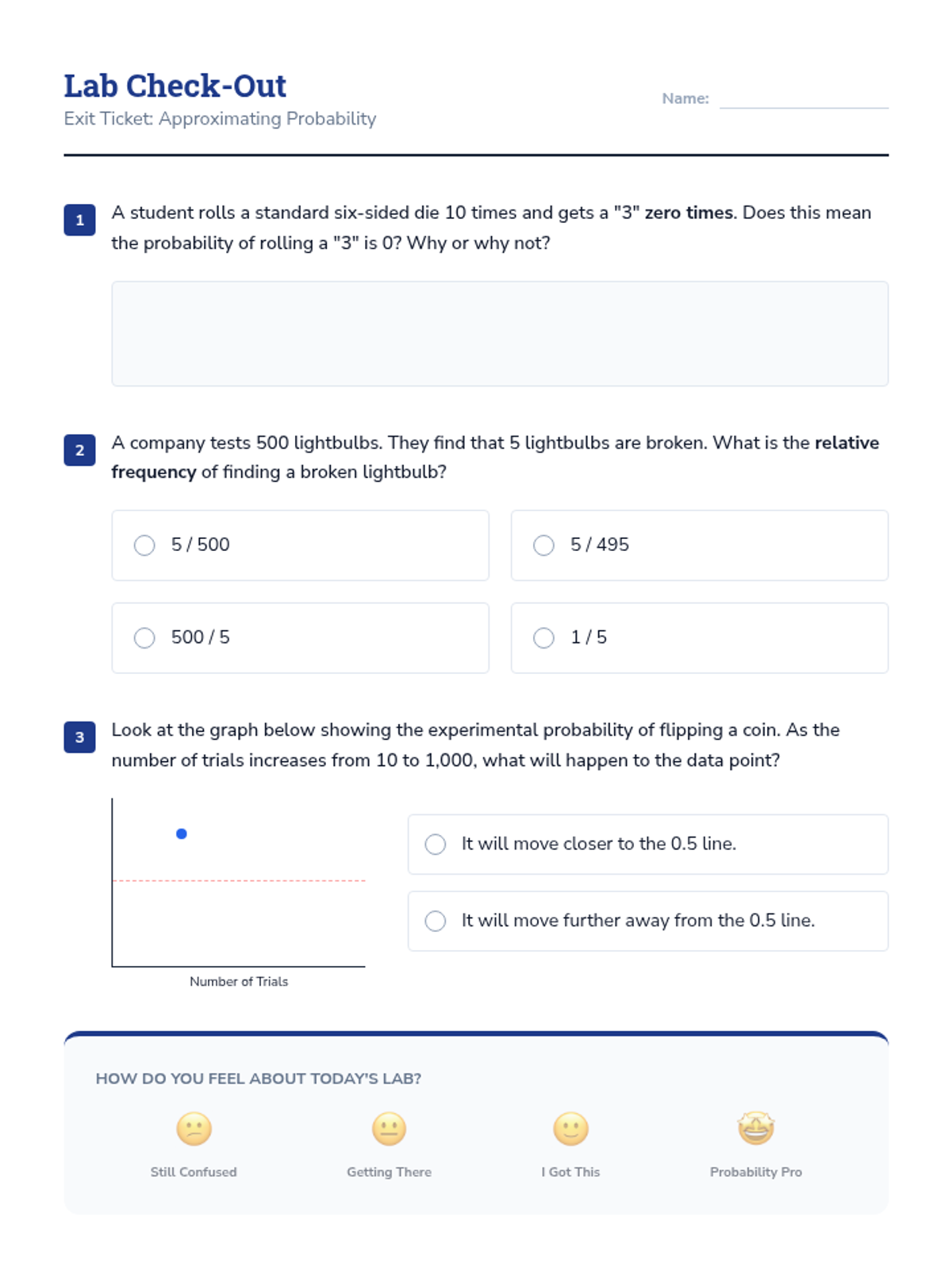
A targeted intervention sequence focused on understanding probability through experimental data, recording frequencies, and observing how relative frequency stabilizes over many trials.

Lenny Avatar
Lenny
2/12
Sequence
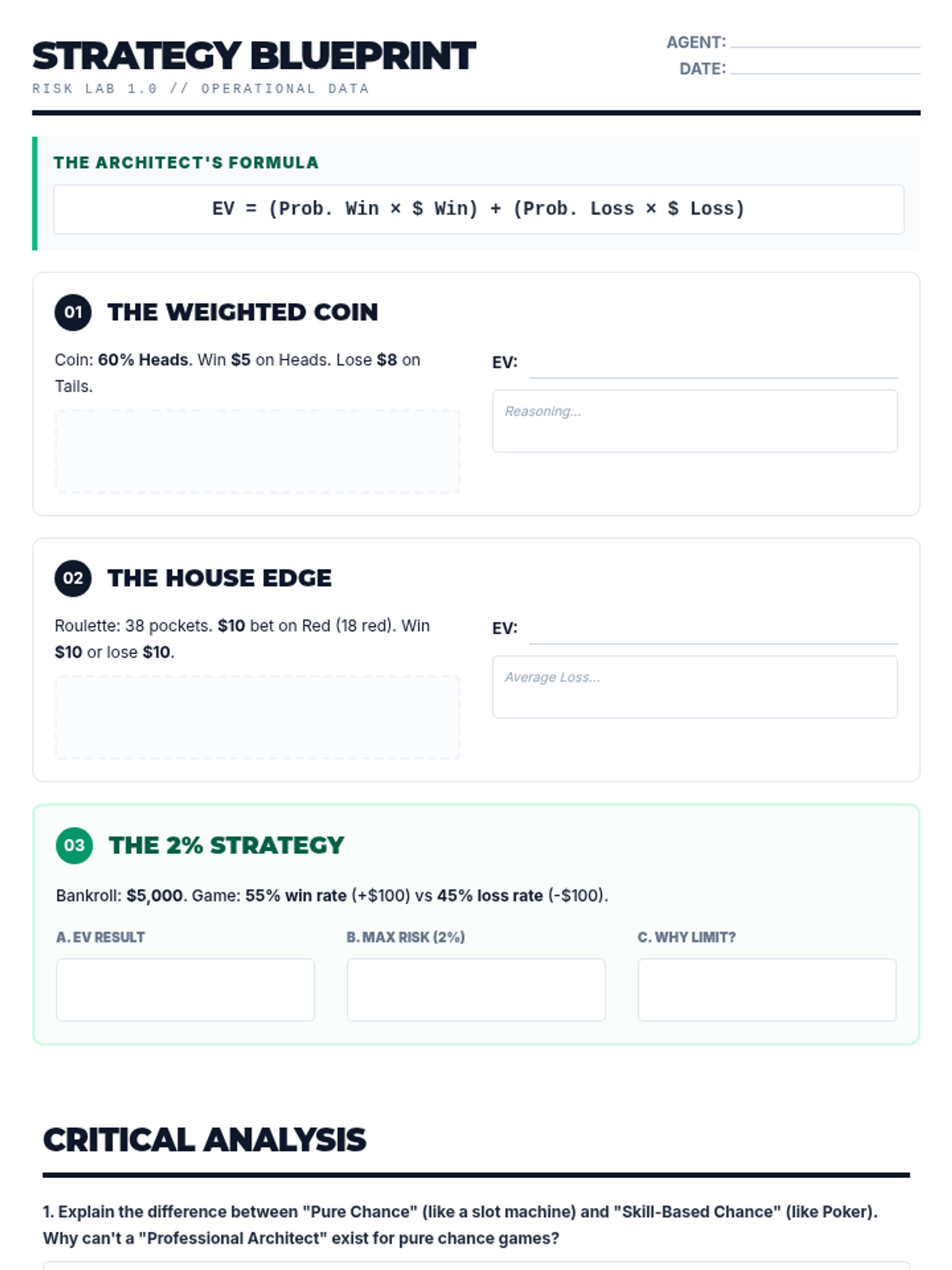
Strategy Blueprint Slides
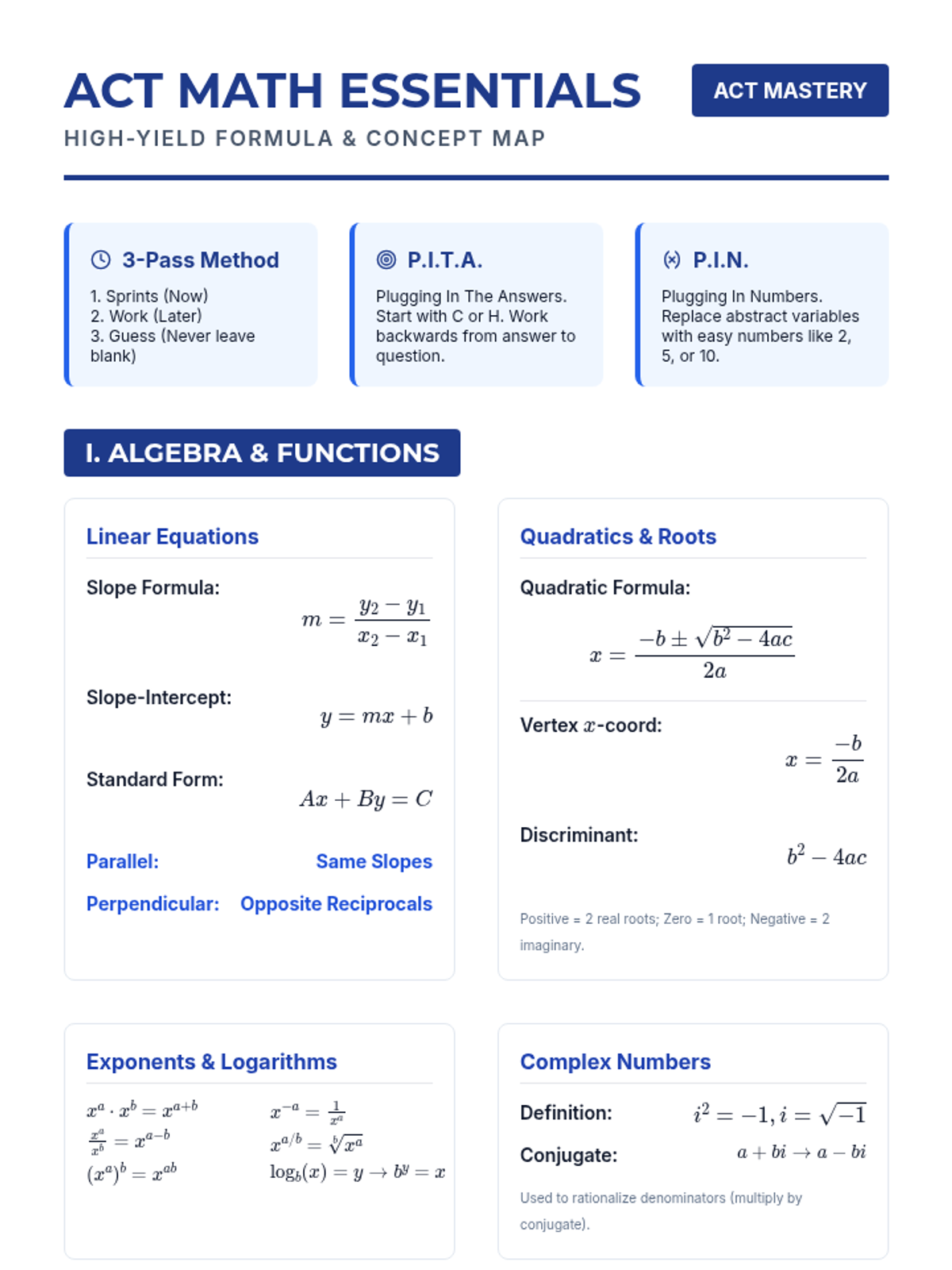
Math Essentials Reference
Math Essentials Reference Updated
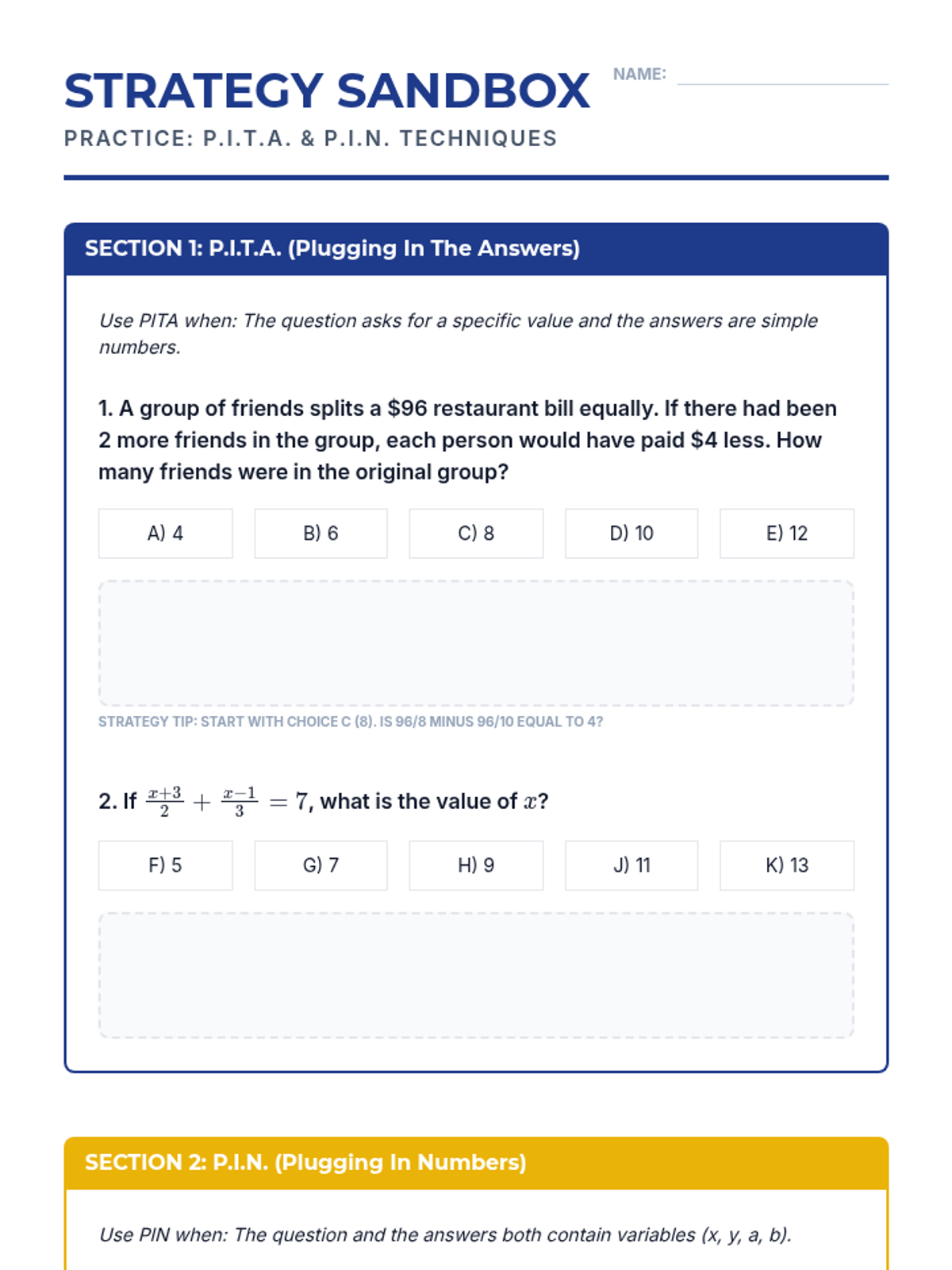
Strategy Sandbox Worksheet
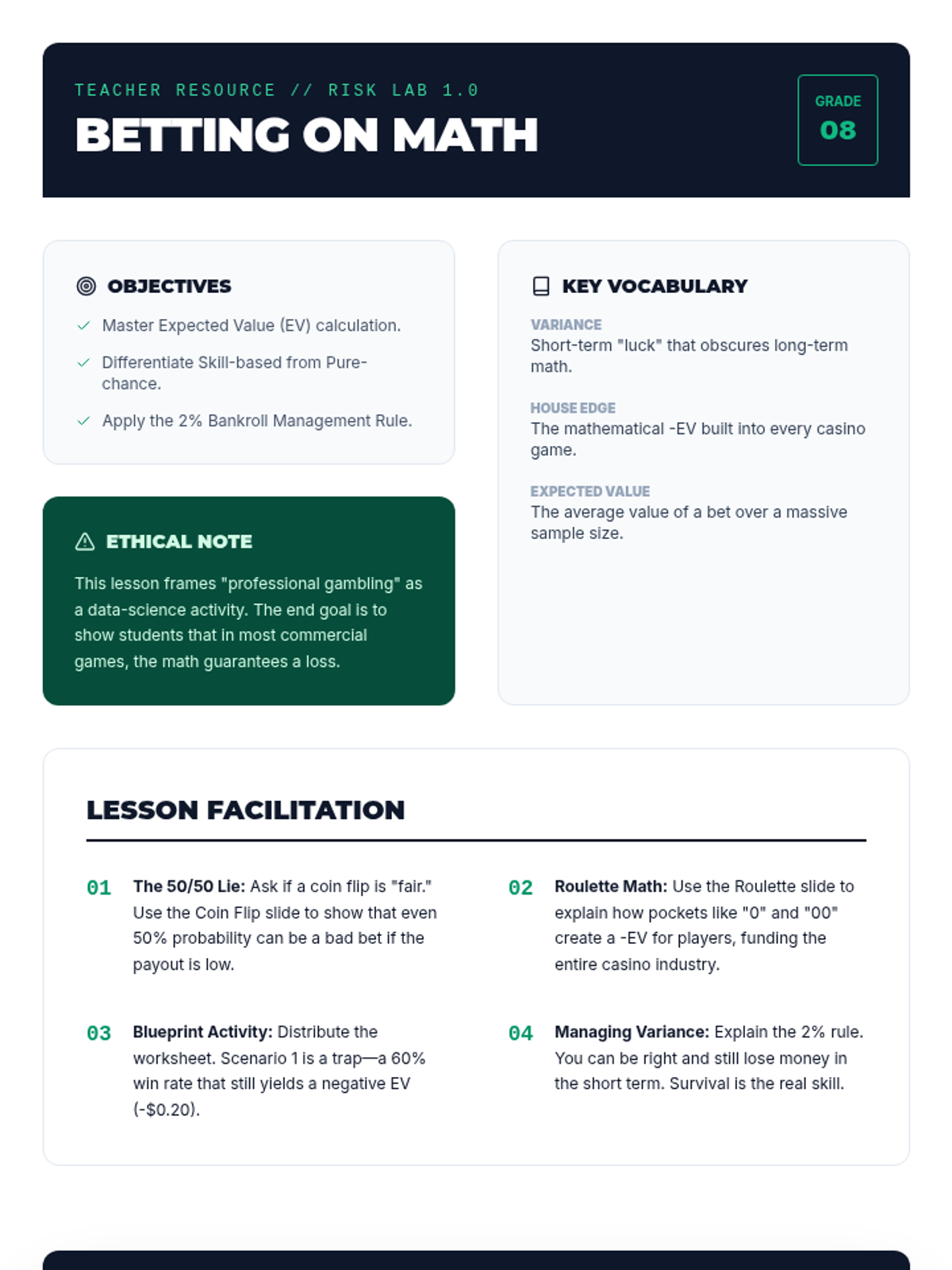
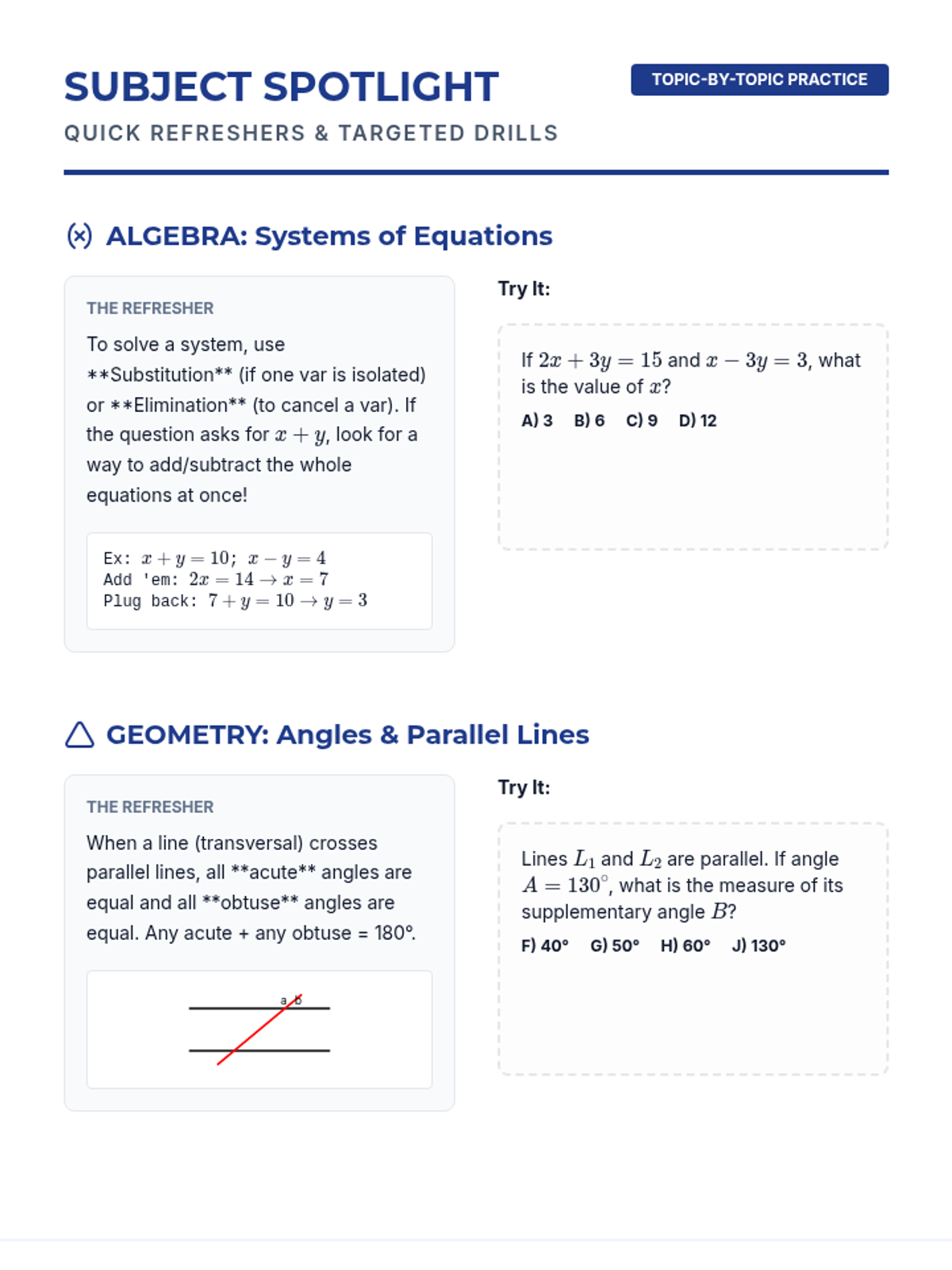
Subject Spotlight Activity
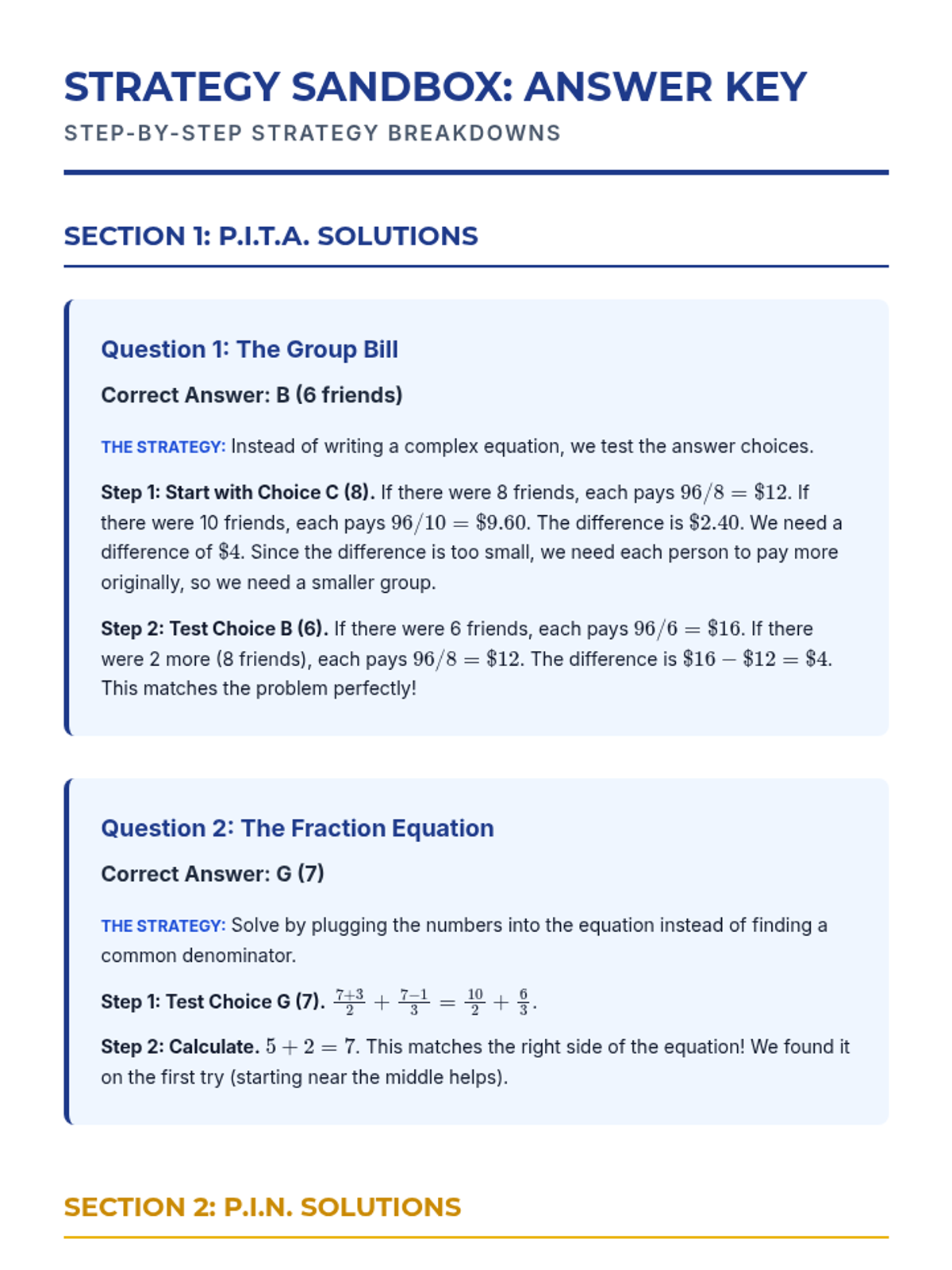
Strategy Sandbox Answer Key
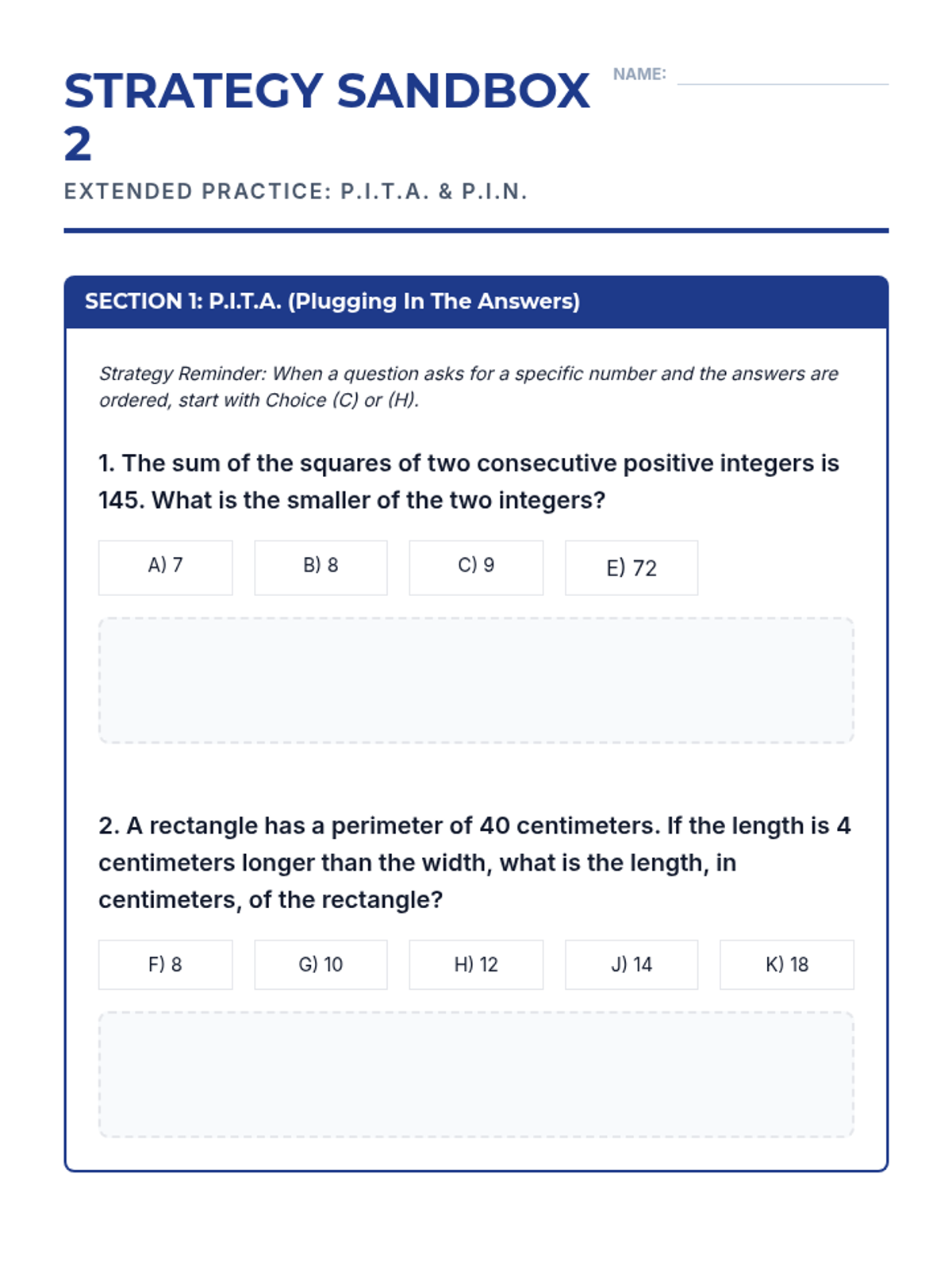
Strategy Sandbox 2 Worksheet
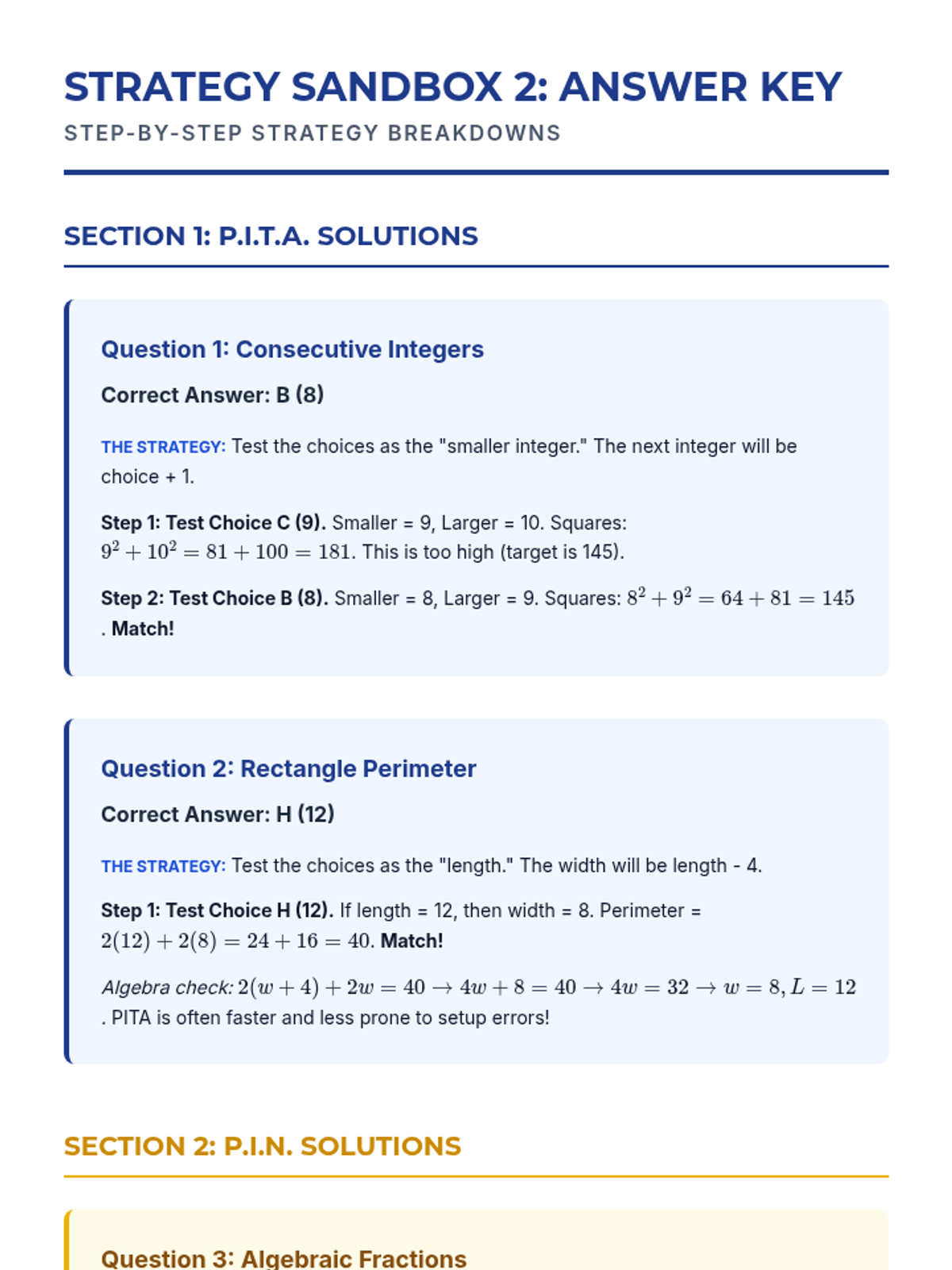
Strategy Sandbox 2 Answer Key
Desmos Mastery Slides
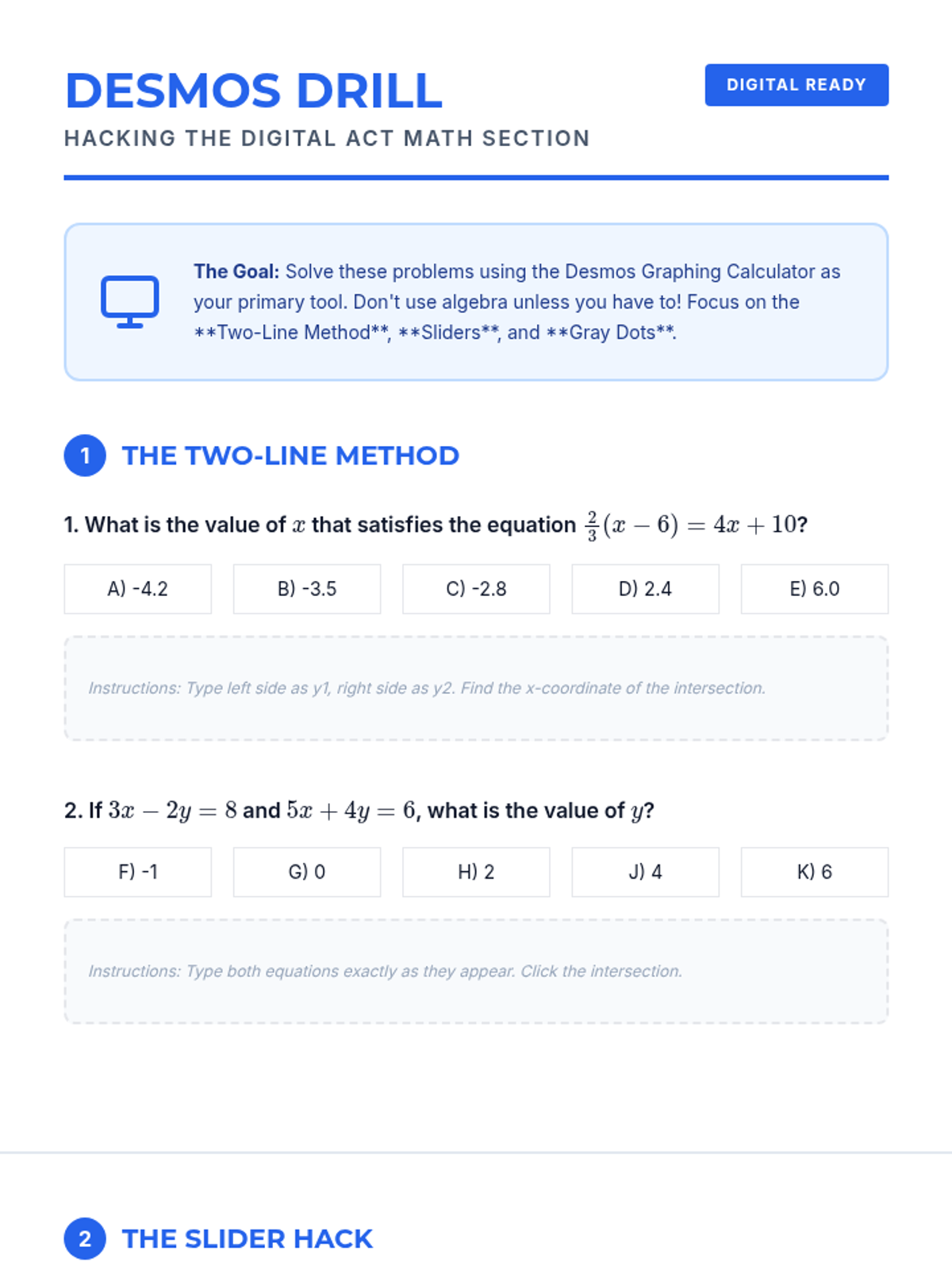
Desmos Drill Worksheet
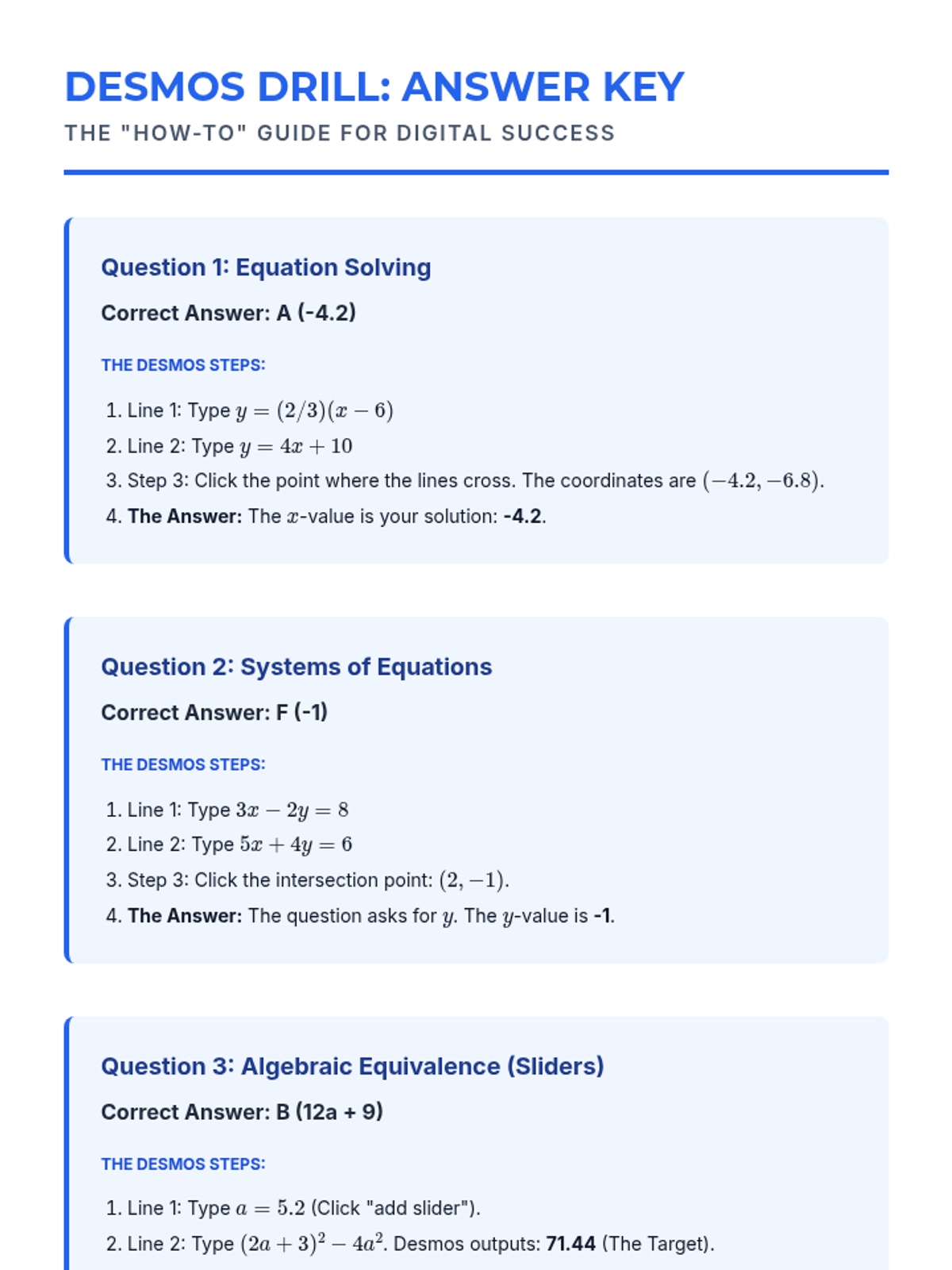
Desmos Drill Answer Key

ACT Math Mastery

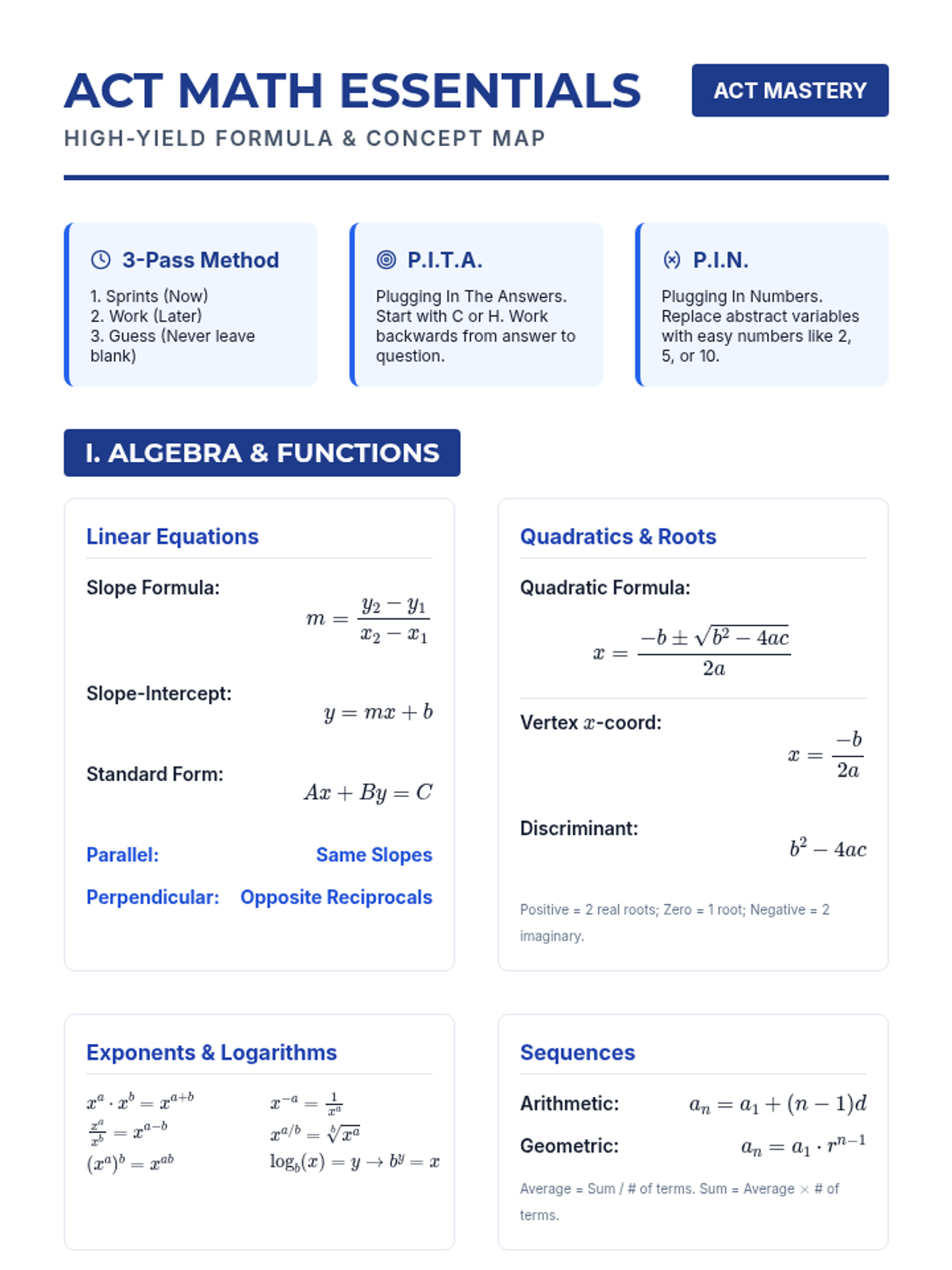
A comprehensive ACT Math preparation program focusing on essential strategies, high-yield Algebra and Geometry concepts, and realistic practice to boost scores.

AL

ava larumbe

Other
2/8
Sequence
Plotting the Patterns Slides
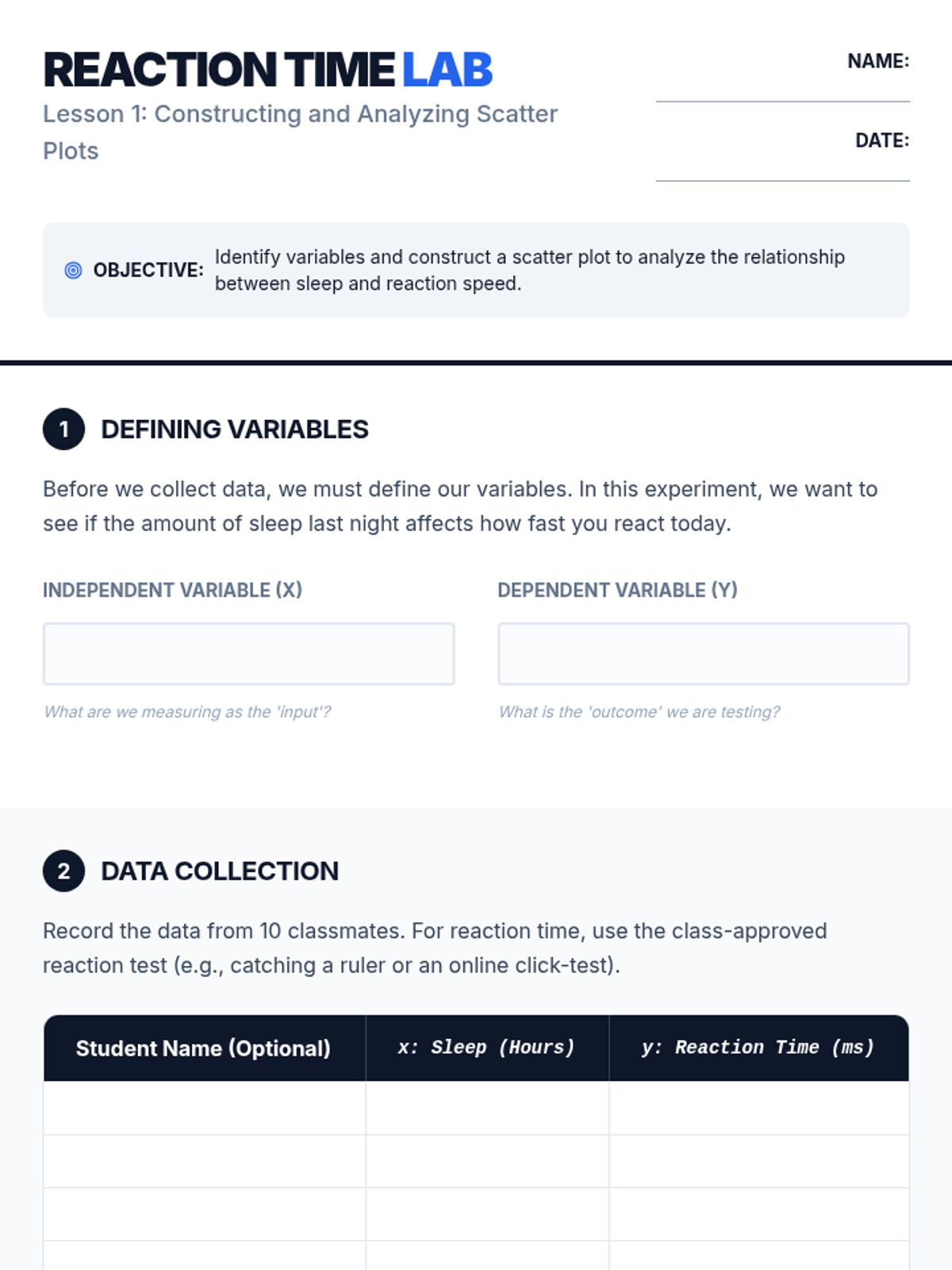
Reaction Time Lab Worksheet
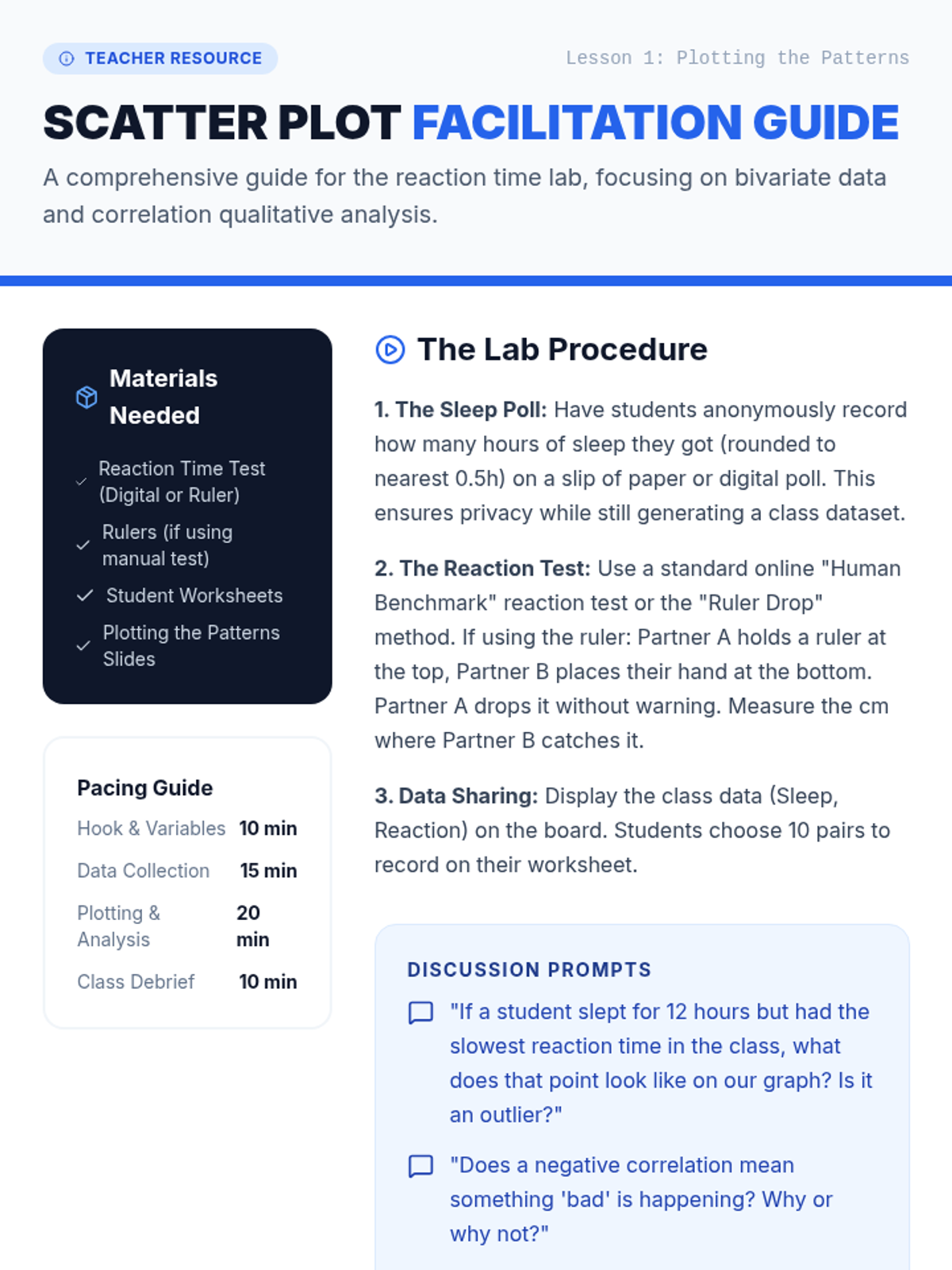
Scatter Plot Teacher Guide

Real World Linear Models

Students act as data analysts to investigate relationships between variables in fields like sports, economics, and environmental science. The learning arc progresses from constructing scatter plots and generating lines of best fit to deeply interpreting the specific meaning of slope and y-intercept in context, concluding with a capstone project on predictive modeling.

Lenny Avatar
Lenny
1/17
Sequence
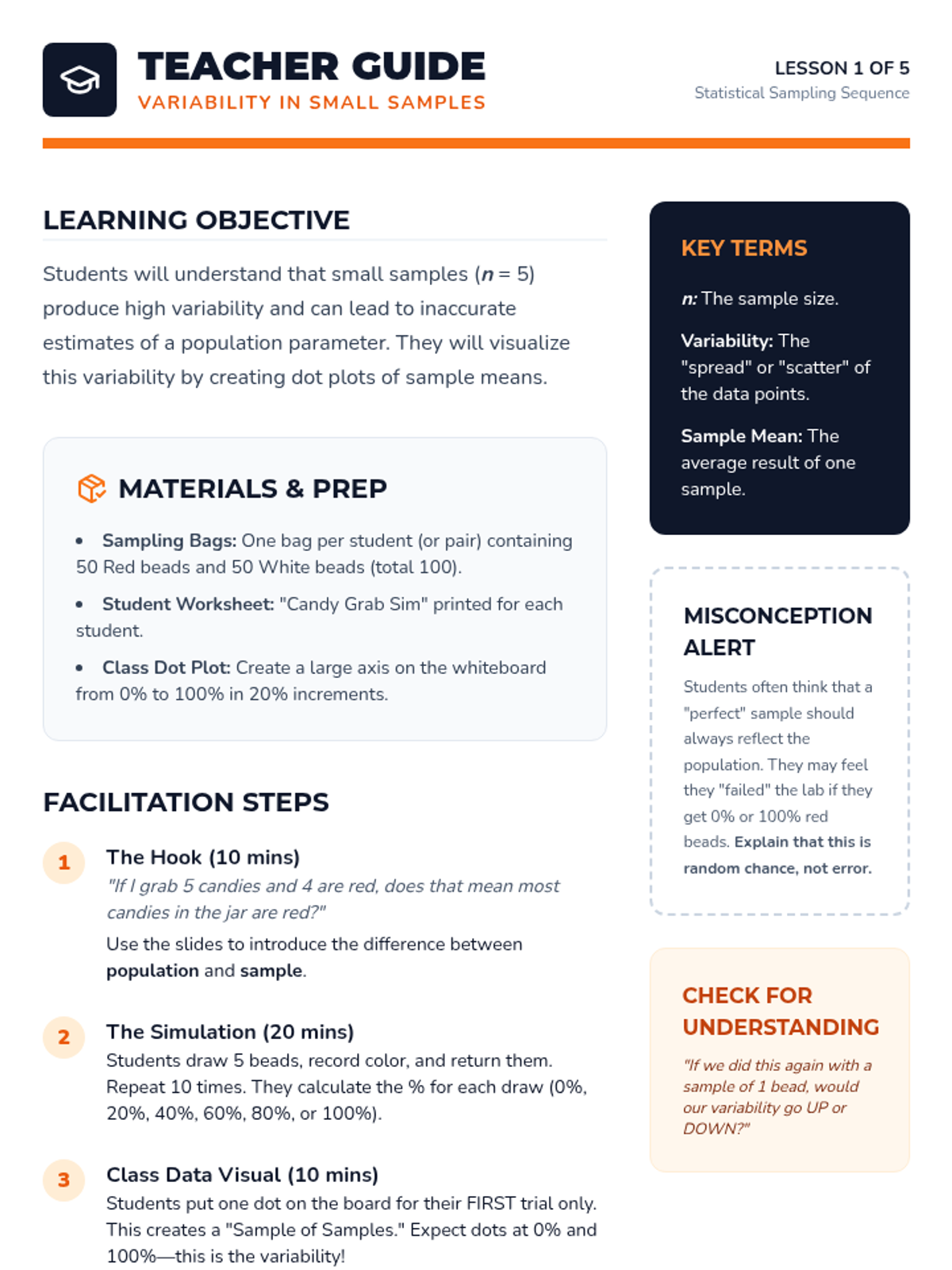
Small Sample Sim Slides
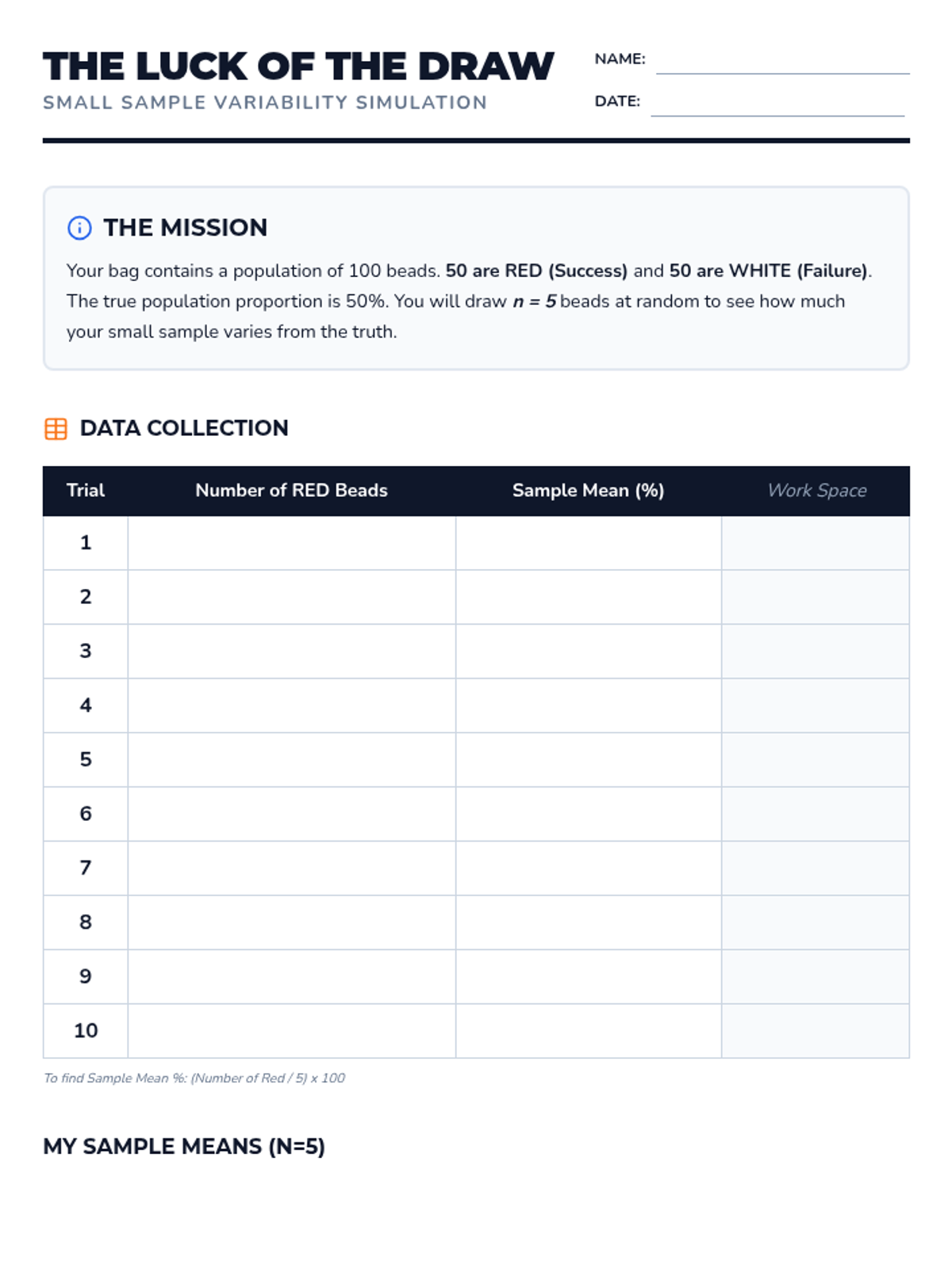
Candy Grab Sim Worksheet
Small Sample Teacher Guide

Sample Size and Sampling Variability

This 5-lesson sequence explores how sample size influences variability and the reliability of statistical inferences. Students participate in simulations to discover the law of large numbers, use Mean Absolute Deviation to quantify spread, and evaluate the validity of real-world sampling methods.

Lenny Avatar
Lenny
1/17
Sequence
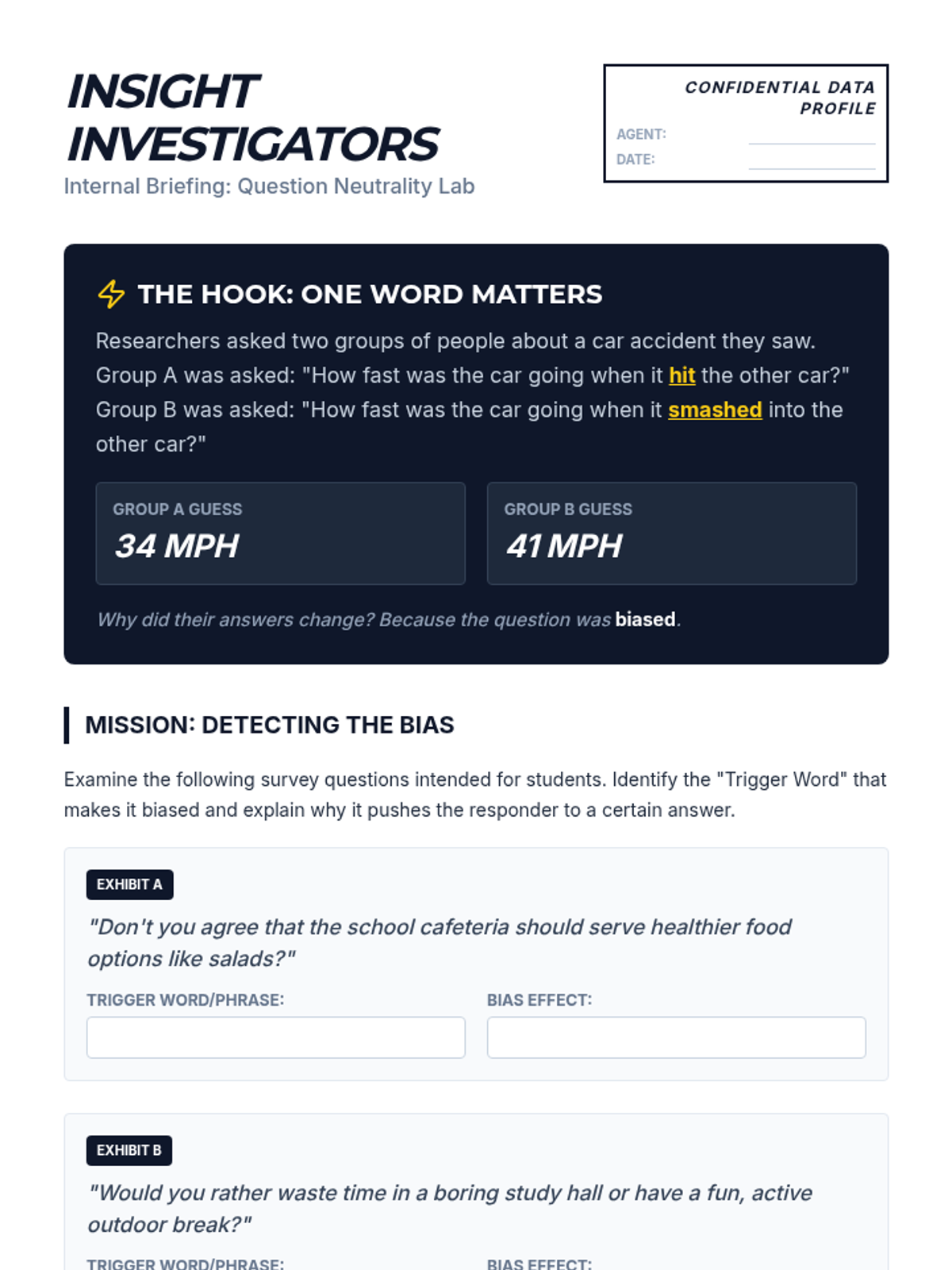
Question Clinic Worksheet
Bias Detection Slides
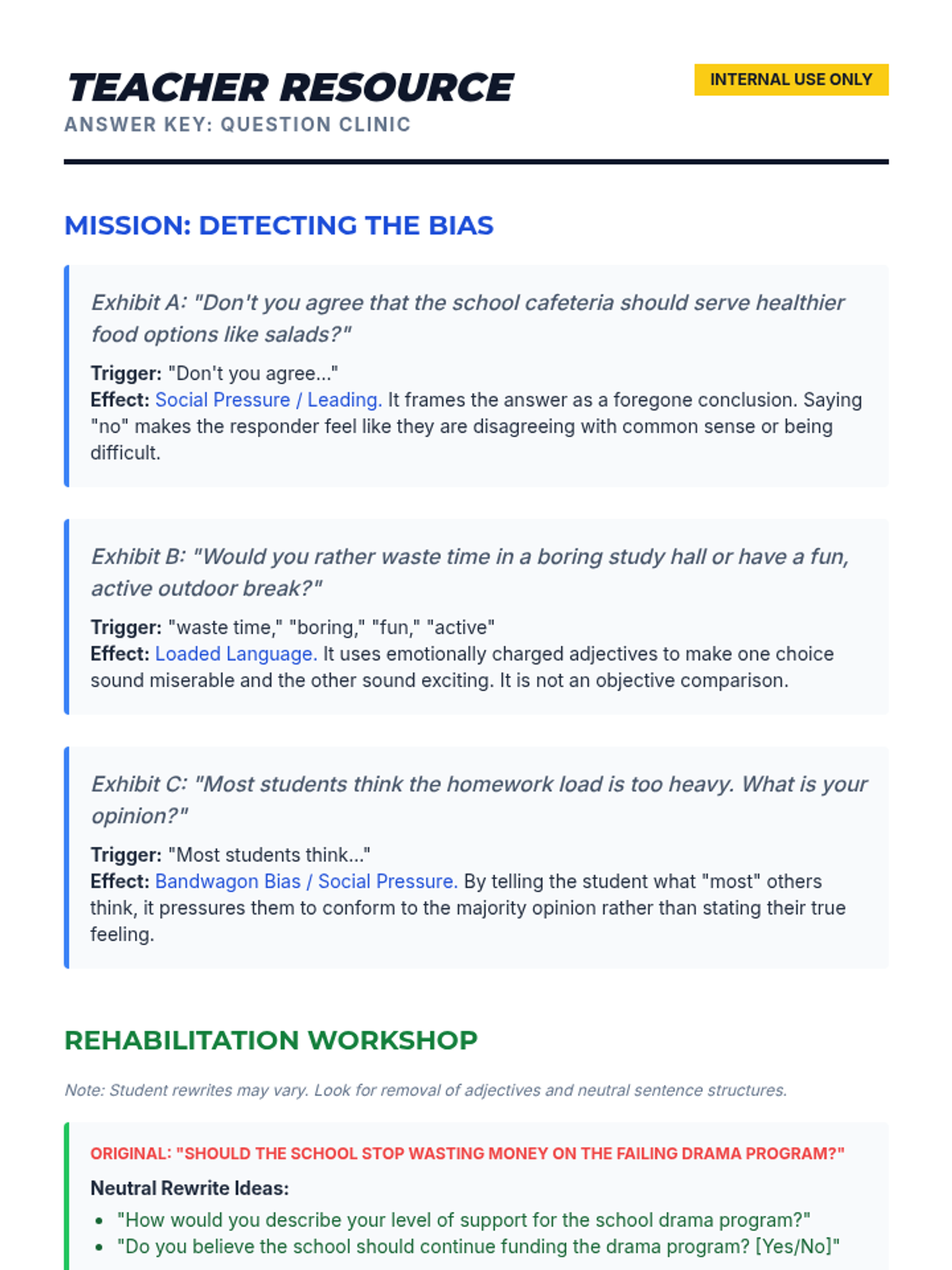
Question Clinic Answer Key

Data Consultant Agency

A project-based unit where 7th-grade students act as data consultants to solve school-wide problems. They learn to identify bias, design sampling plans, collect data, and present data-backed recommendations to administration.

Lenny Avatar
Lenny
1/17
Sequence
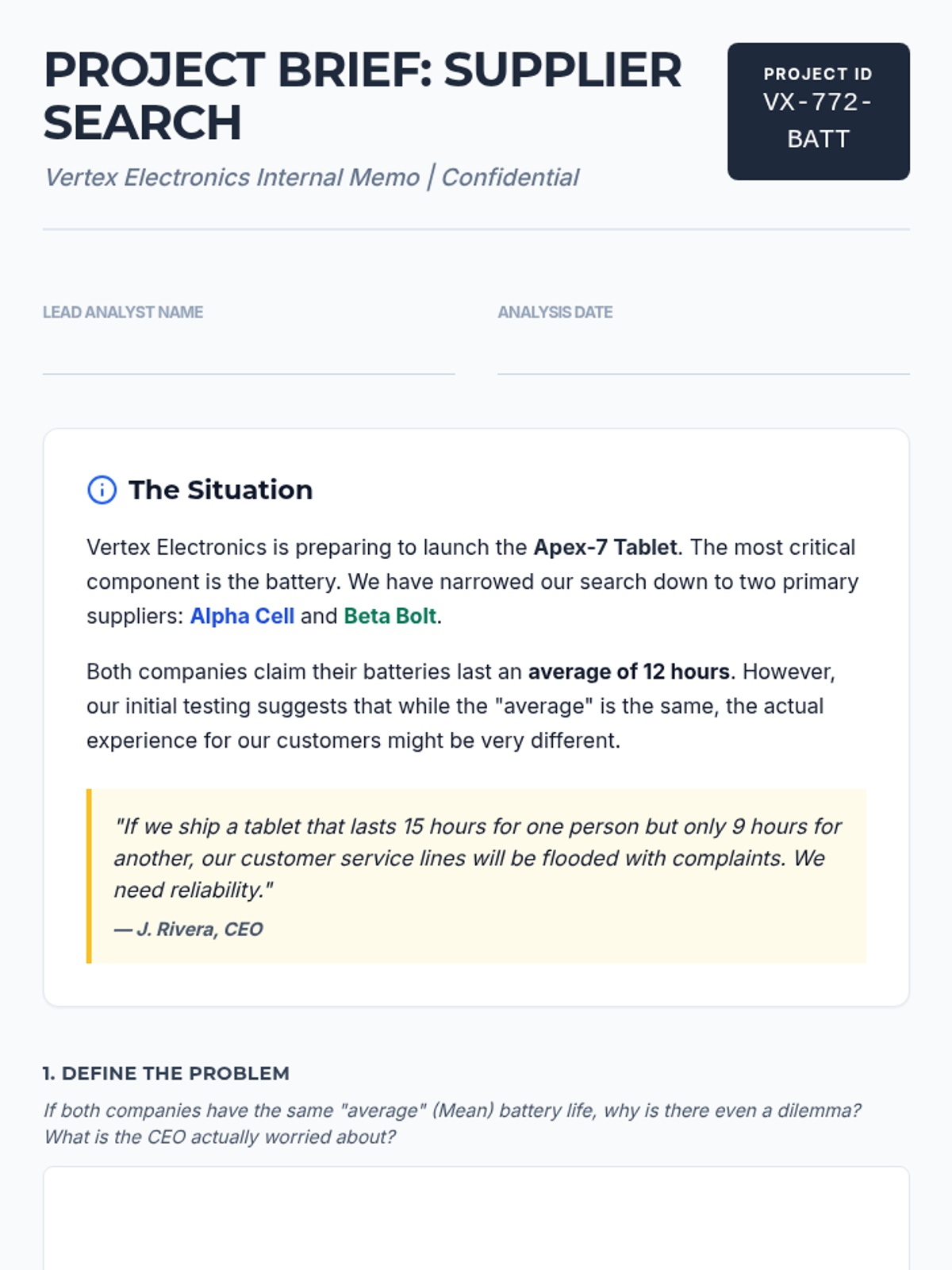
Supplier Search Brief
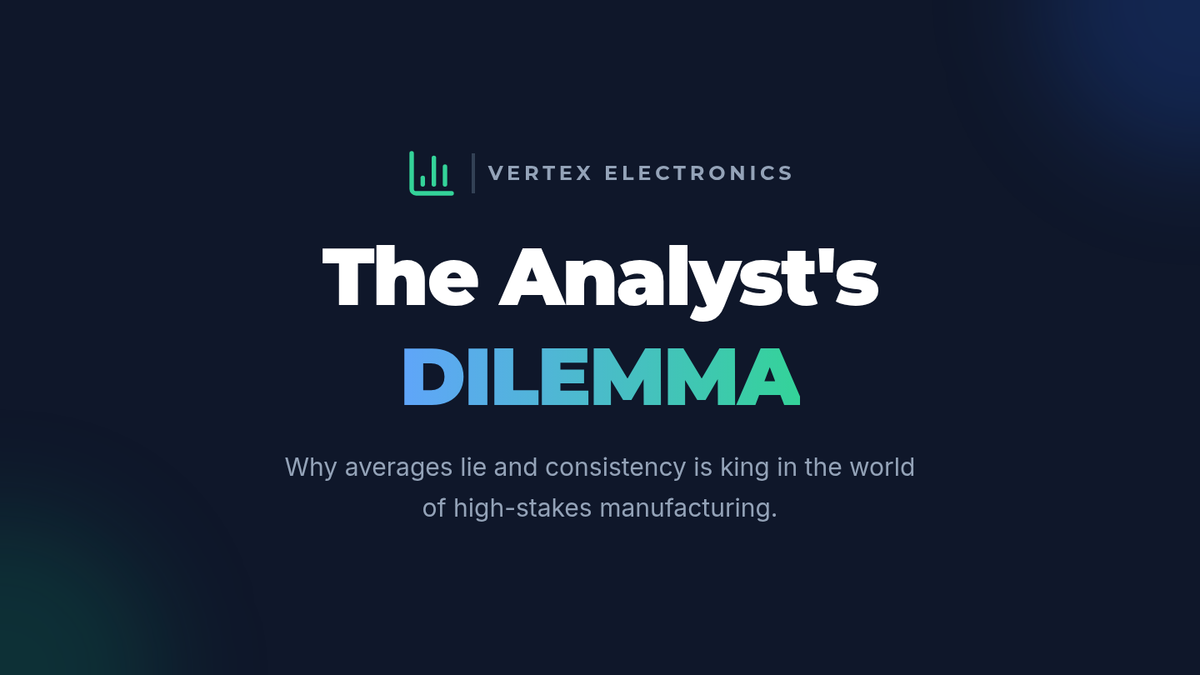
Analyst Intro Slides

Consistency Kings

Students act as data analysts for a tech company to decide between two suppliers. They learn that averages don't tell the whole story, using Mean Absolute Deviation (MAD) and Interquartile Range (IQR) to assess risk and consistency in real-world decision making.

Lenny Avatar
Lenny
1/17
Sequence
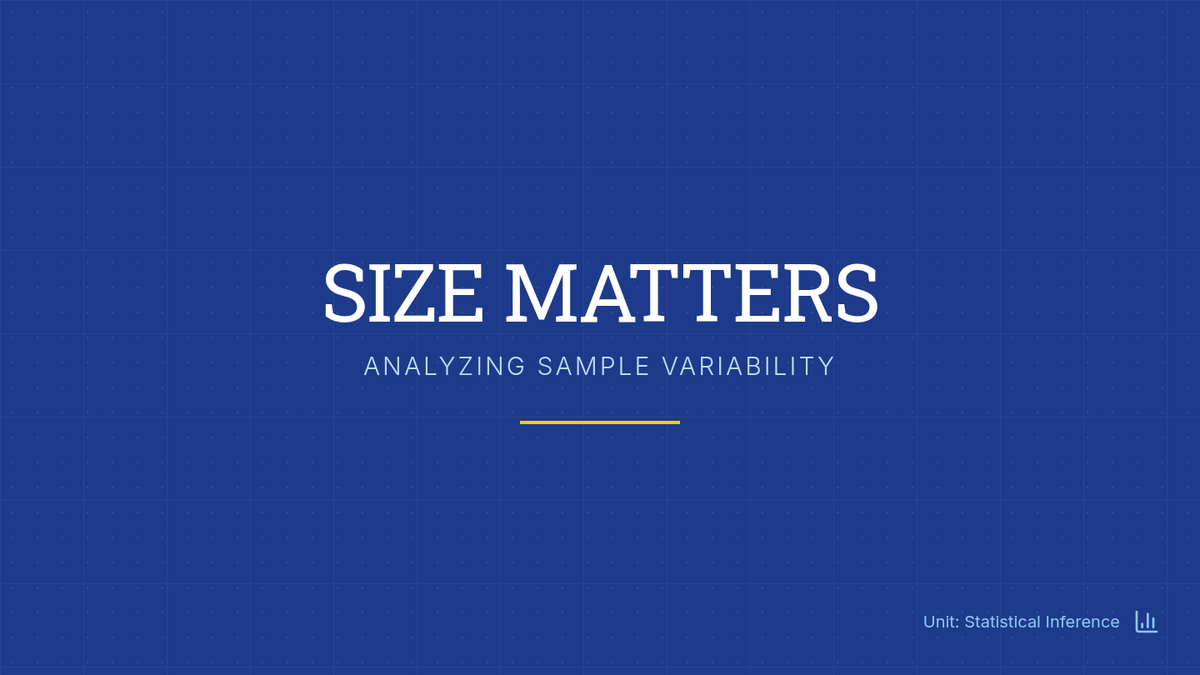
Size Matters Slides
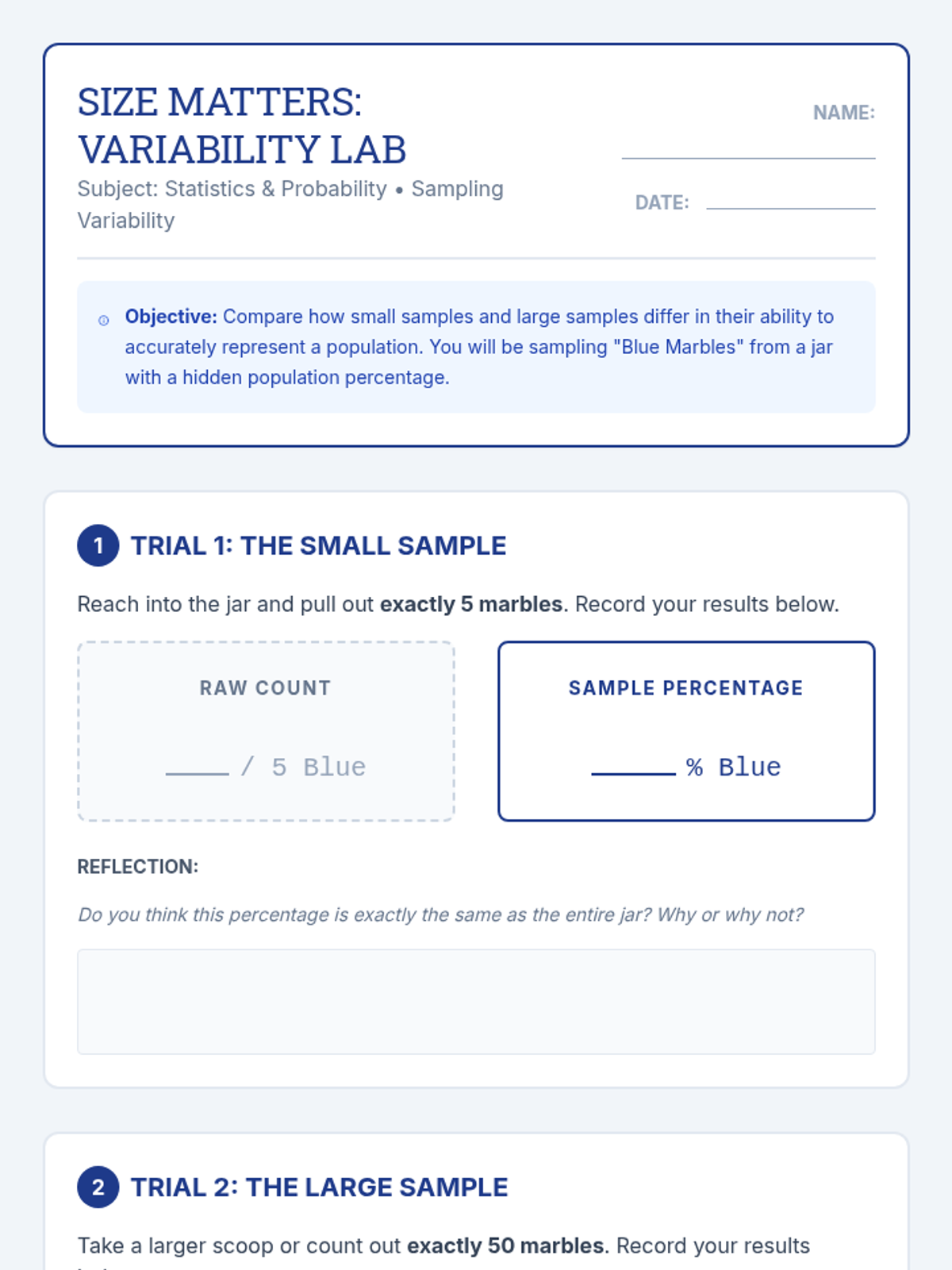
Variability Lab Worksheet
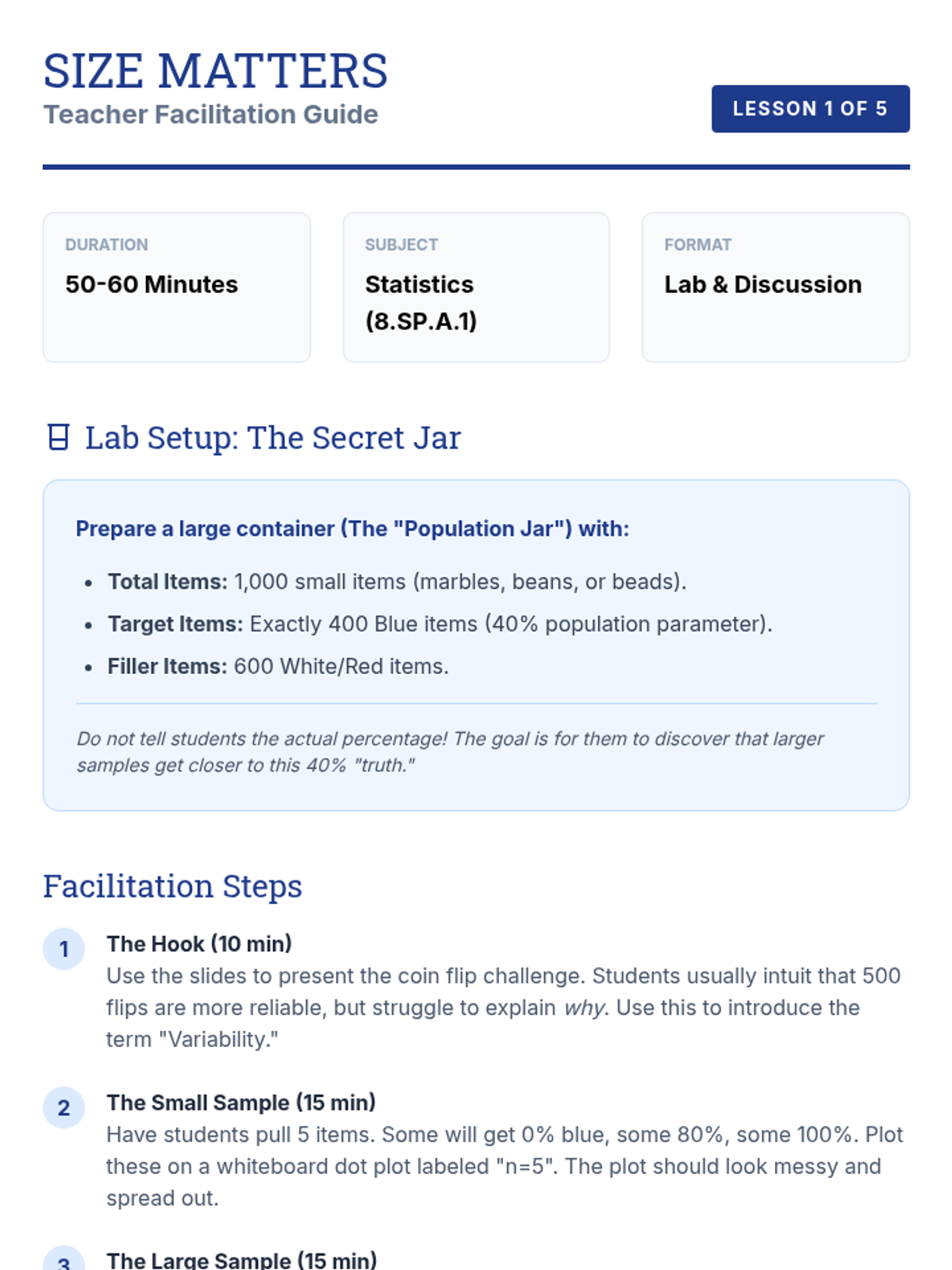
Size Matters Teacher Guide

Analyzing Sample Size and Statistical Inference

This inquiry-based sequence focuses on the relationship between sample size and the reliability of inferences. Students use technology and simulations to visualize how large samples stabilize around population parameters, introducing the Law of Large Numbers and Margin of Error concepts.

Lenny Avatar
Lenny
1/17
Sequence
Shape Shifters Presentation
Shape Hunter Worksheet

Spread Stories

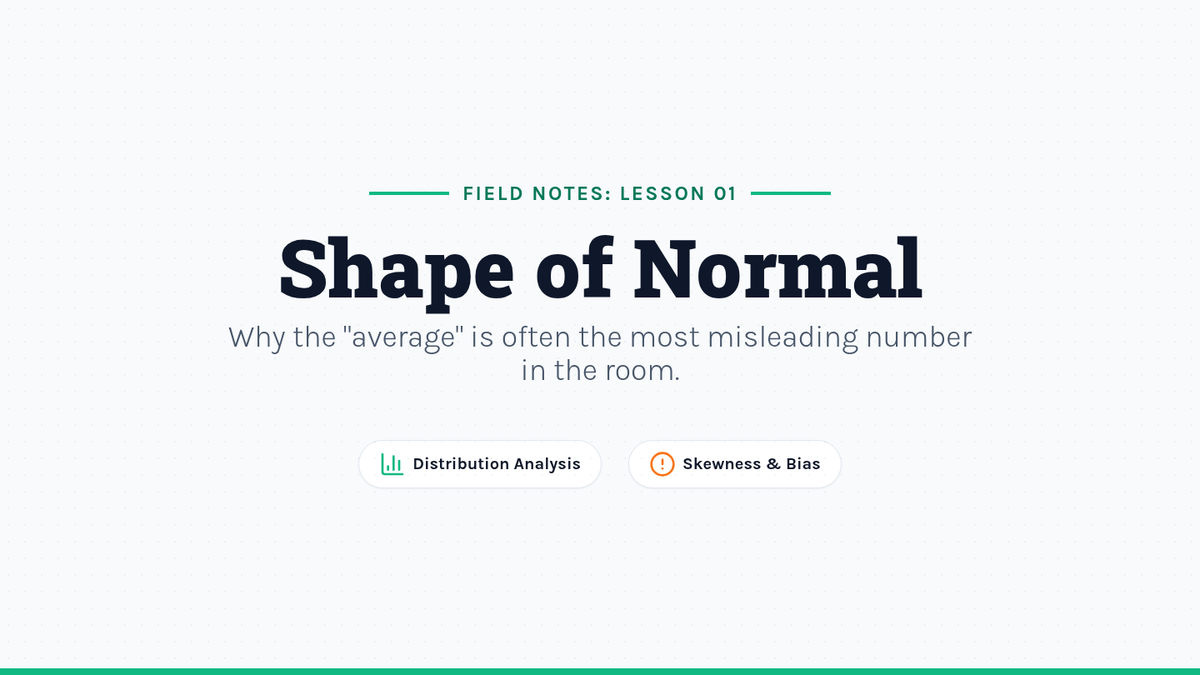
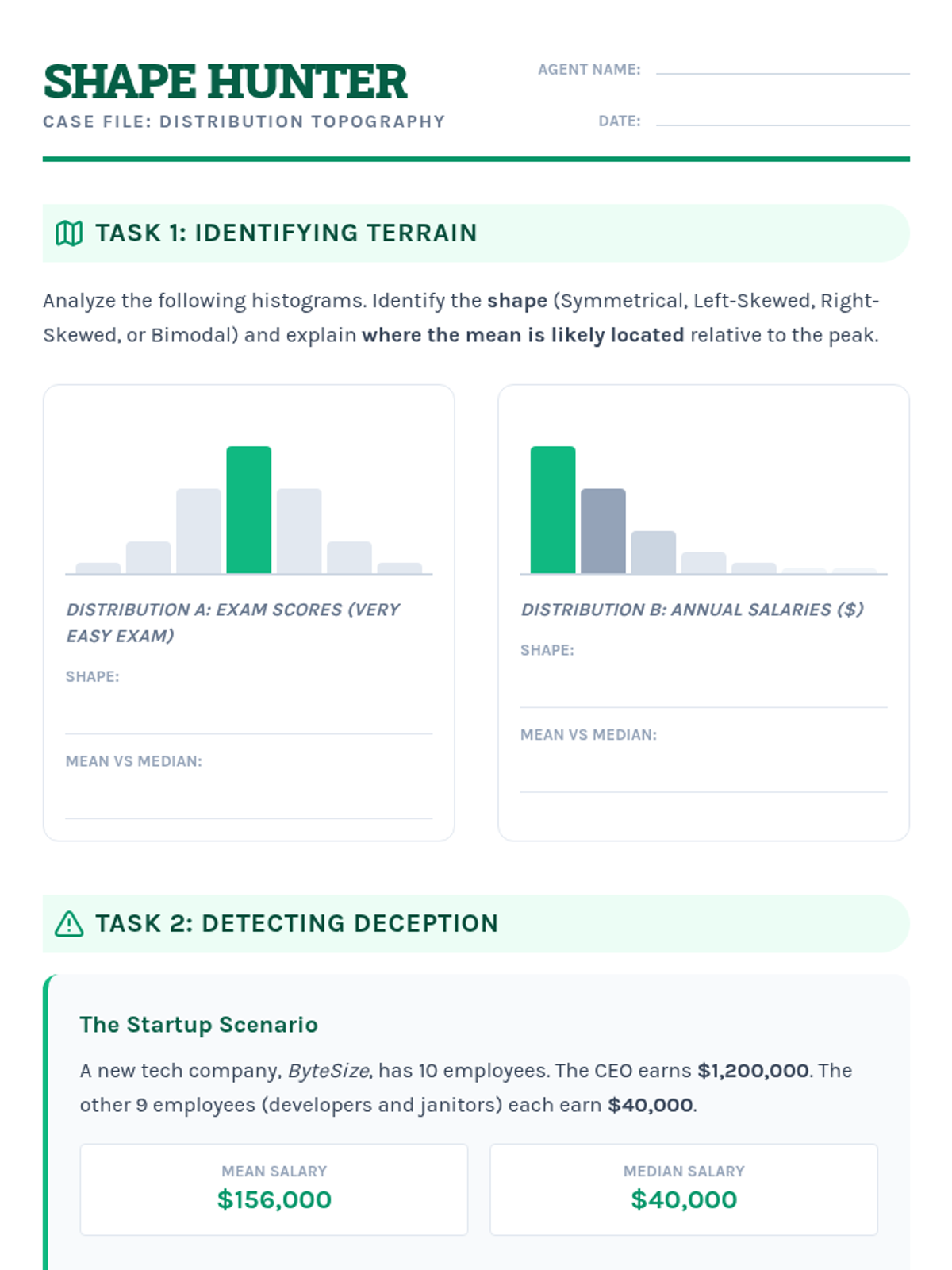
An inquiry-based exploration of statistical variability, focusing on how data spread reveals truths about inequality, climate instability, and diversity that averages often hide. Students transition from visual distribution analysis to quantifying disparity using IQR and MAD, culminating in an independent investigation.

Lenny Avatar
Lenny
1/17
Sequence
Heartbeat Case Slides
Vital Signs Worksheet
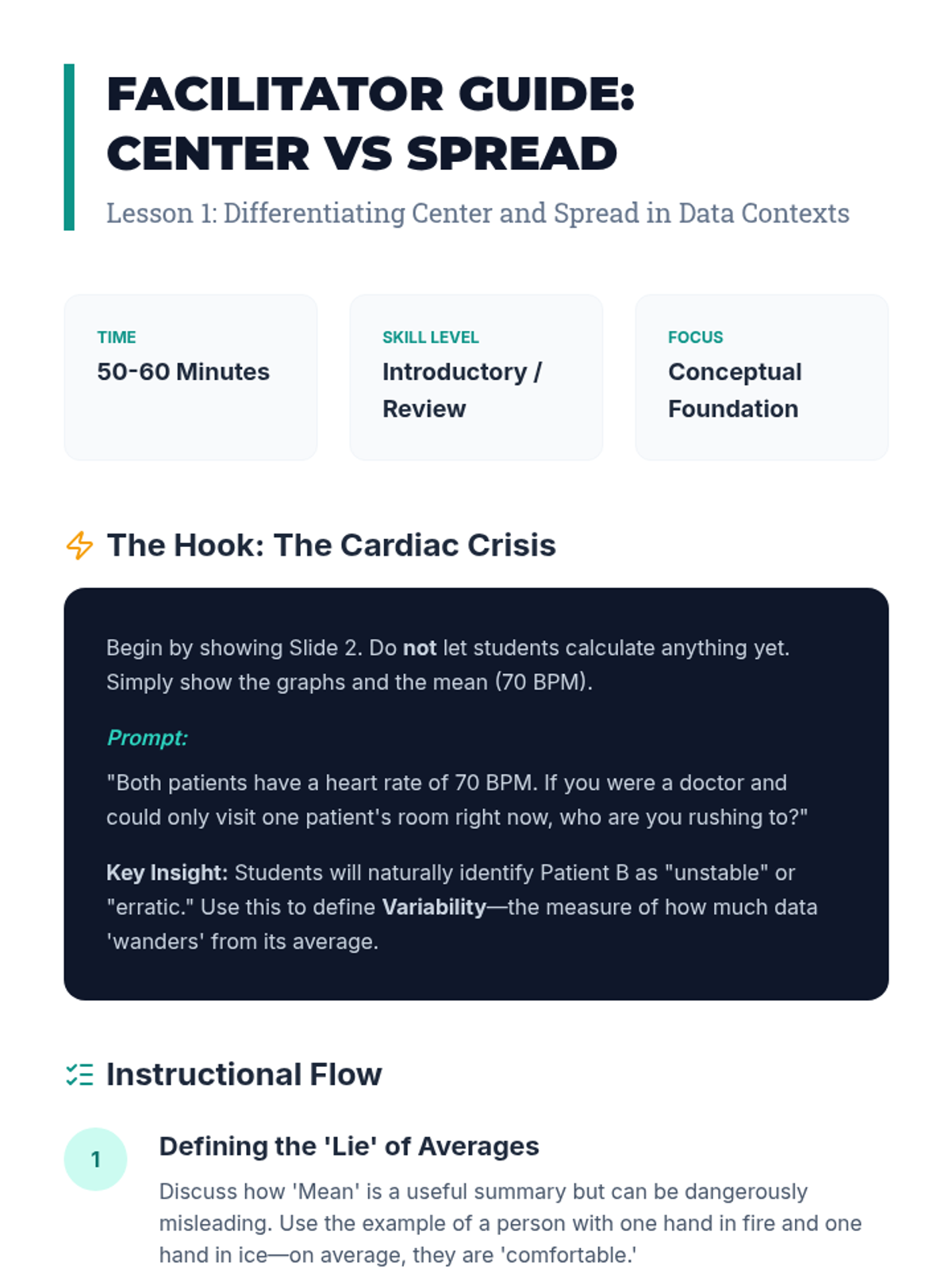
Center vs Spread Facilitator Guide

Risk and Reliability Lab

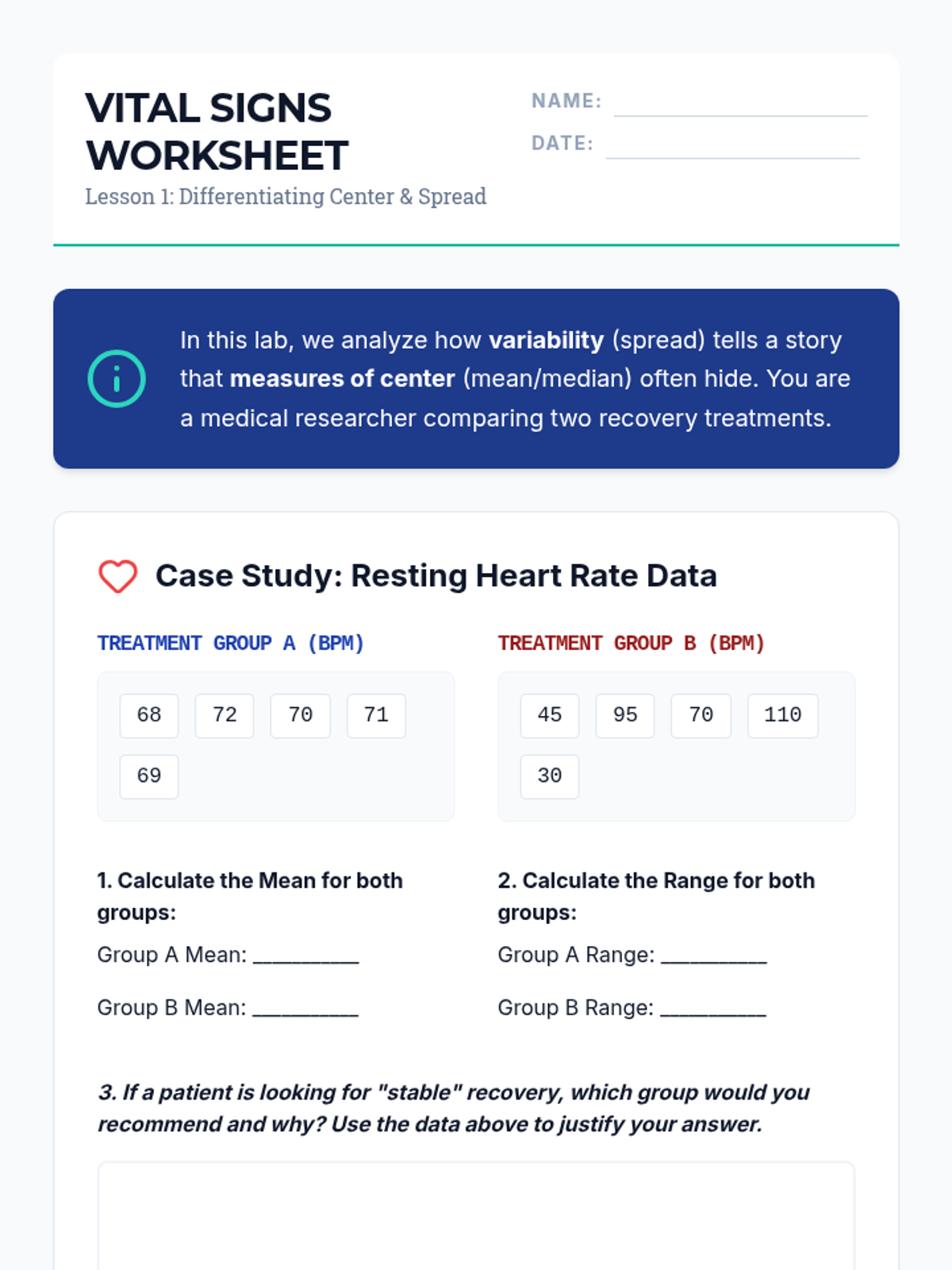
A high school statistics sequence focused on quantifying risk and consistency through measures of variability. Students move from basic spread concepts to complex financial and industrial case studies, culminating in a data-driven risk assessment report.

Lenny Avatar
Lenny
1/17
Sequence
The Overlap Test Slides
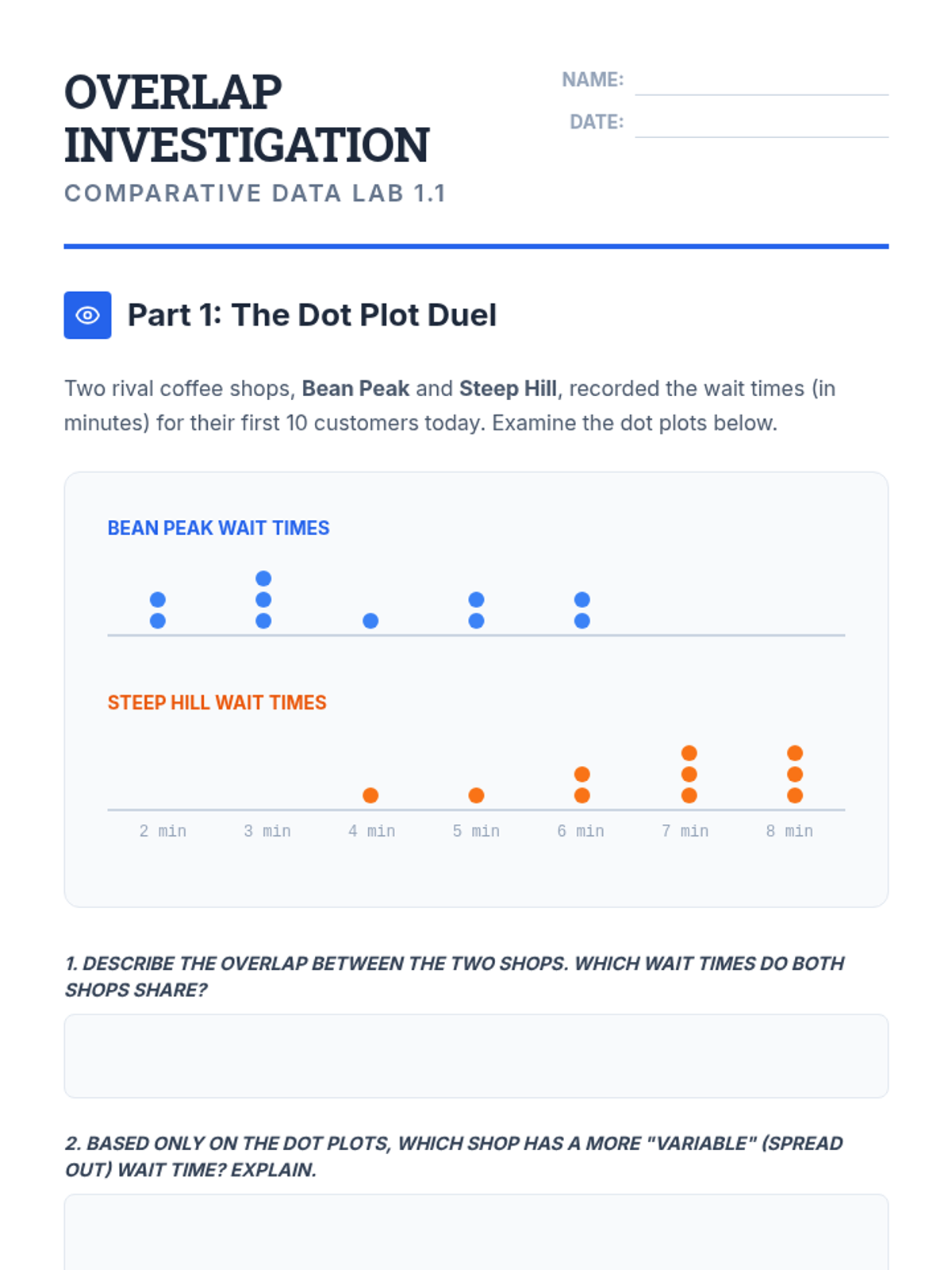
Overlap Investigation Worksheet

Comparative Data Analysis

A 9th-grade statistics sequence focused on comparing populations through measures of center and variability. Students learn to interpret overlap, select appropriate metrics, and express differences in terms of spread to make informal inferences.

Lenny Avatar
Lenny
1/17
Sequence
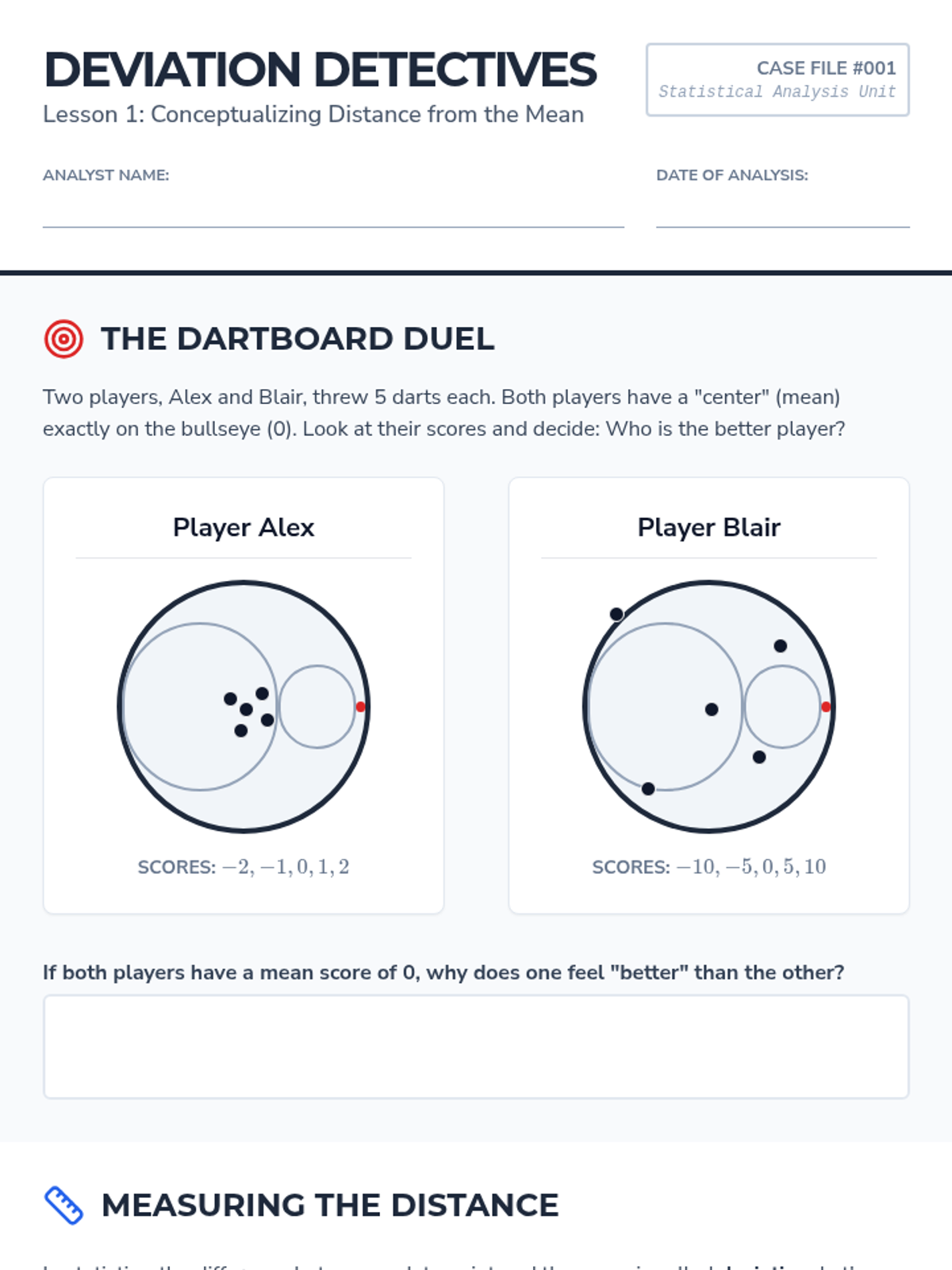
Deviation Detectives Worksheet
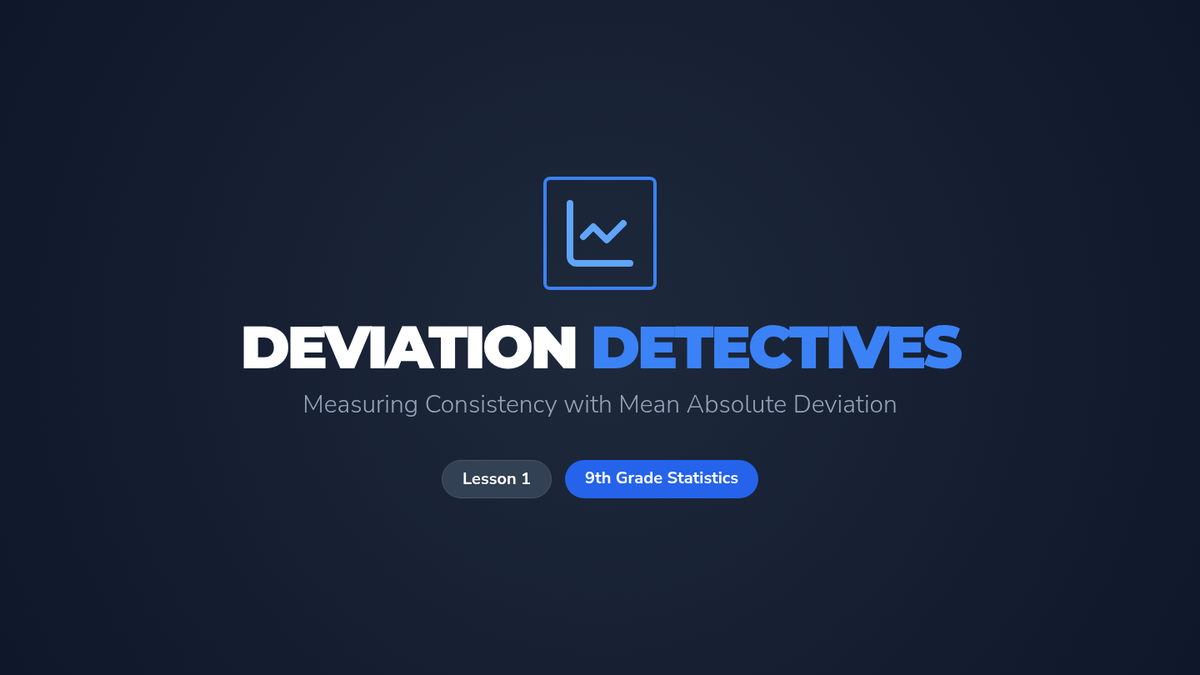
Distance from Mean Slides
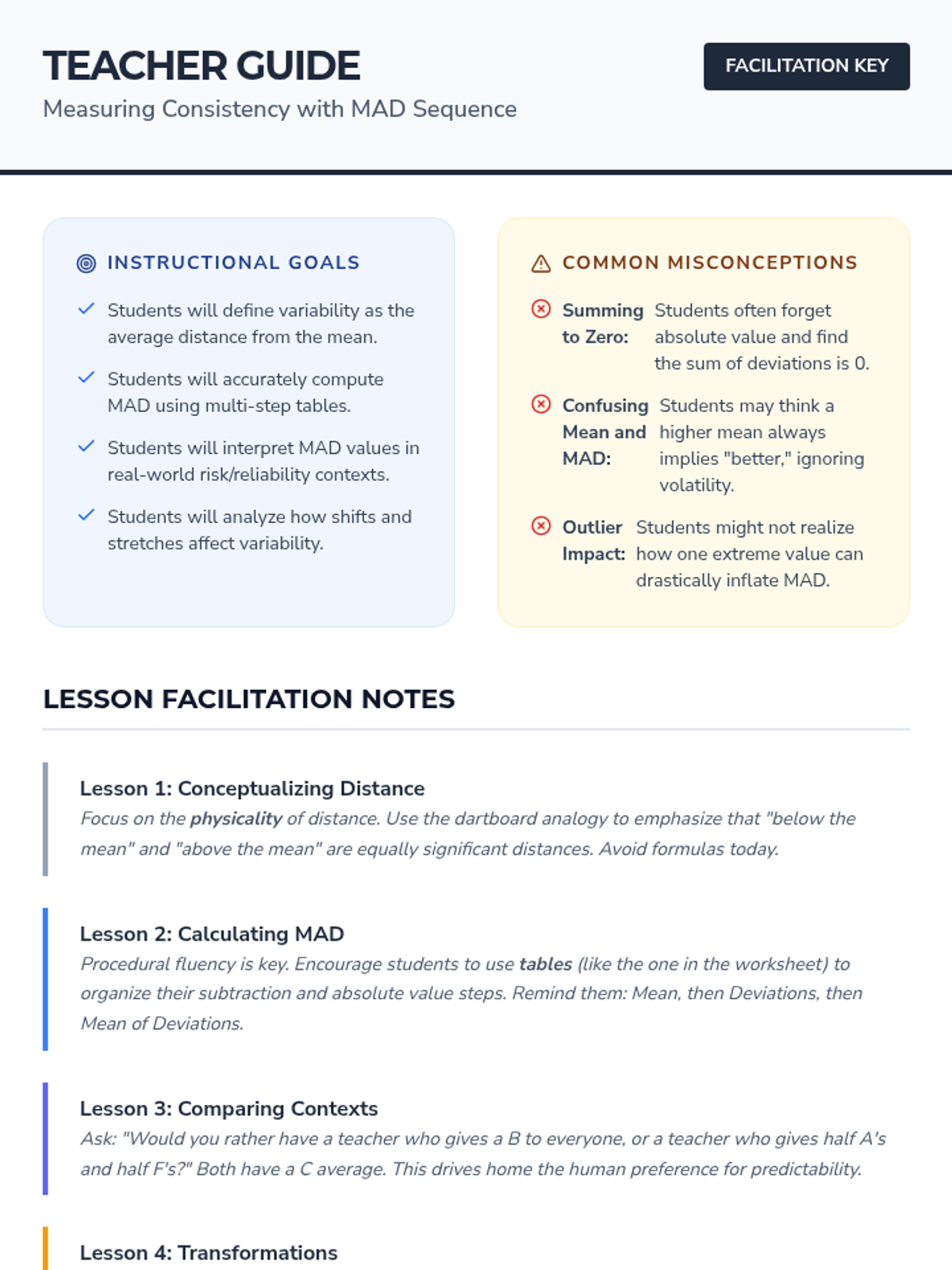
MAD Sequence Teacher Guide

Measuring Consistency with MAD

This project-based sequence explores consistency and volatility through the lens of Mean Absolute Deviation (MAD). Students analyze real-world datasets to understand how variability quantifies 'reliability' beyond simple averages.

Lenny Avatar
Lenny
1/17
Sequence
Quartile Quest Slides
Partition Practice Worksheet
Quartile Captain Teacher Guide

Data Blueprint Box Plots and IQR

A comprehensive sequence on statistical variability focusing on quartiles, IQR, and box plots. Students move from raw data partitioning to visual representation and advanced outlier detection, culminating in the interpretation of distribution shapes and skewness.

Lenny Avatar
Lenny
1/17
Sequence
Data Disparity Slides
Spread Matchup Worksheet

Data Disparity and Distribution

This sequence explores statistical variability through the lens of robust measures like IQR and box plots. Students move from basic understanding of spread to complex comparative analysis, focusing on how variability impacts the reliability of data-driven conclusions.

Lenny Avatar
Lenny
1/17
Sequence
Signal Hunter Slides
Signal Hunter Lab Report Worksheet
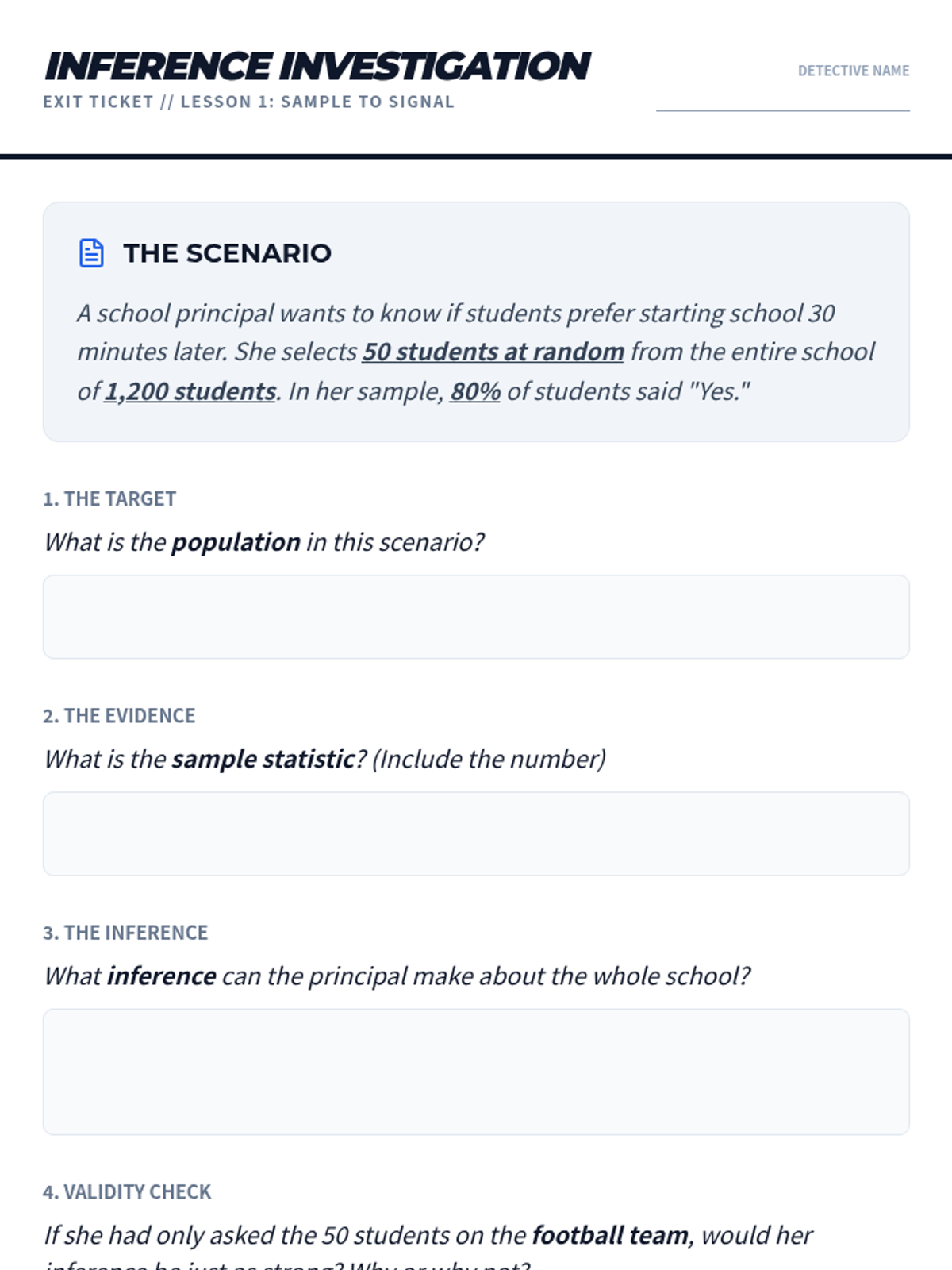
Inference Investigation Exit Ticket
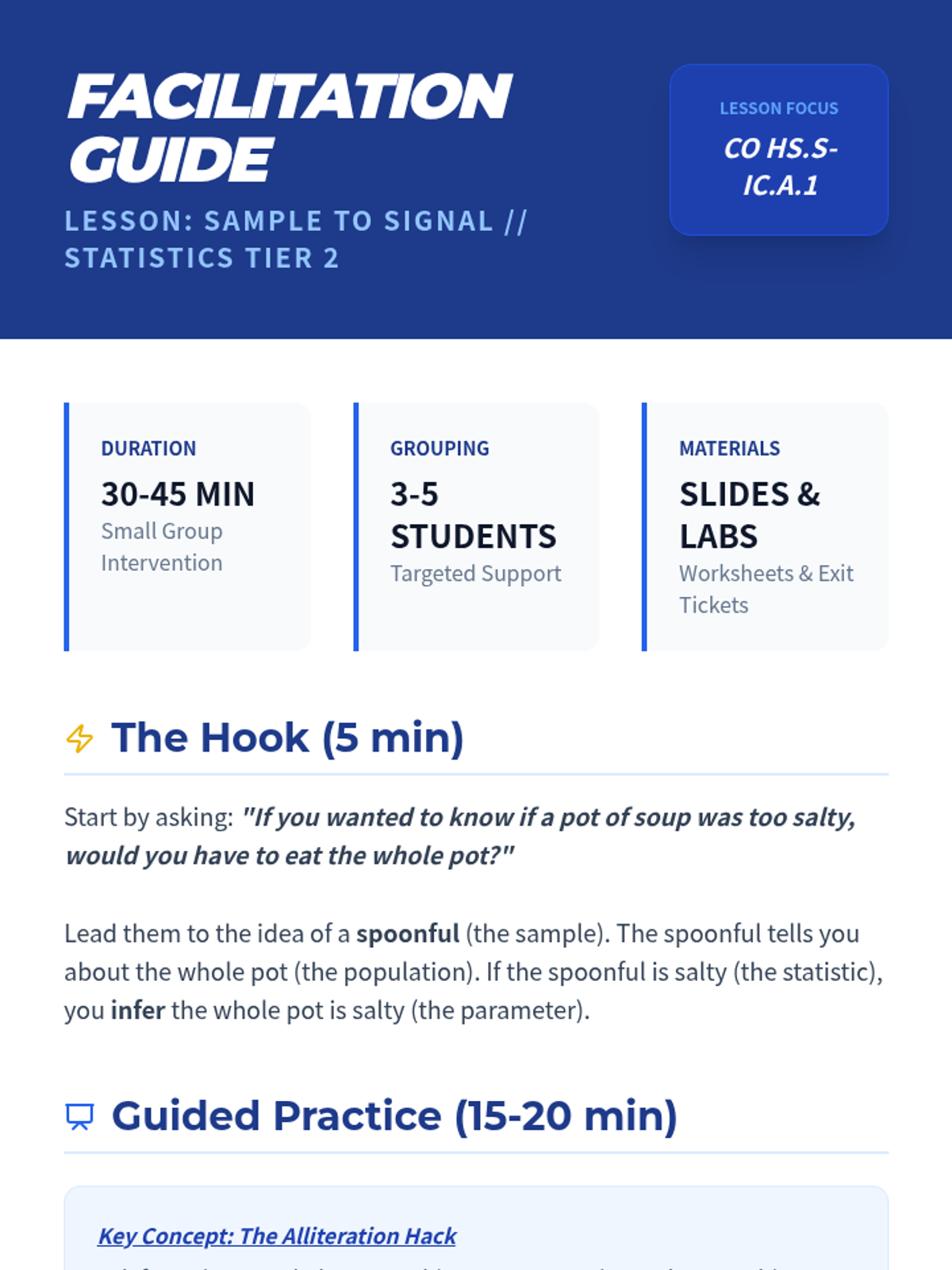
Data Detective Facilitation Guide Teacher Resource

Data Detectives

A targeted Tier 2 intervention sequence designed to help high school students master the fundamental concepts of statistical inference, moving from population parameters to sample statistics and back again through real-world applications.

Lenny Avatar
Lenny
2/12
Sequence
Correlation Detective Slides
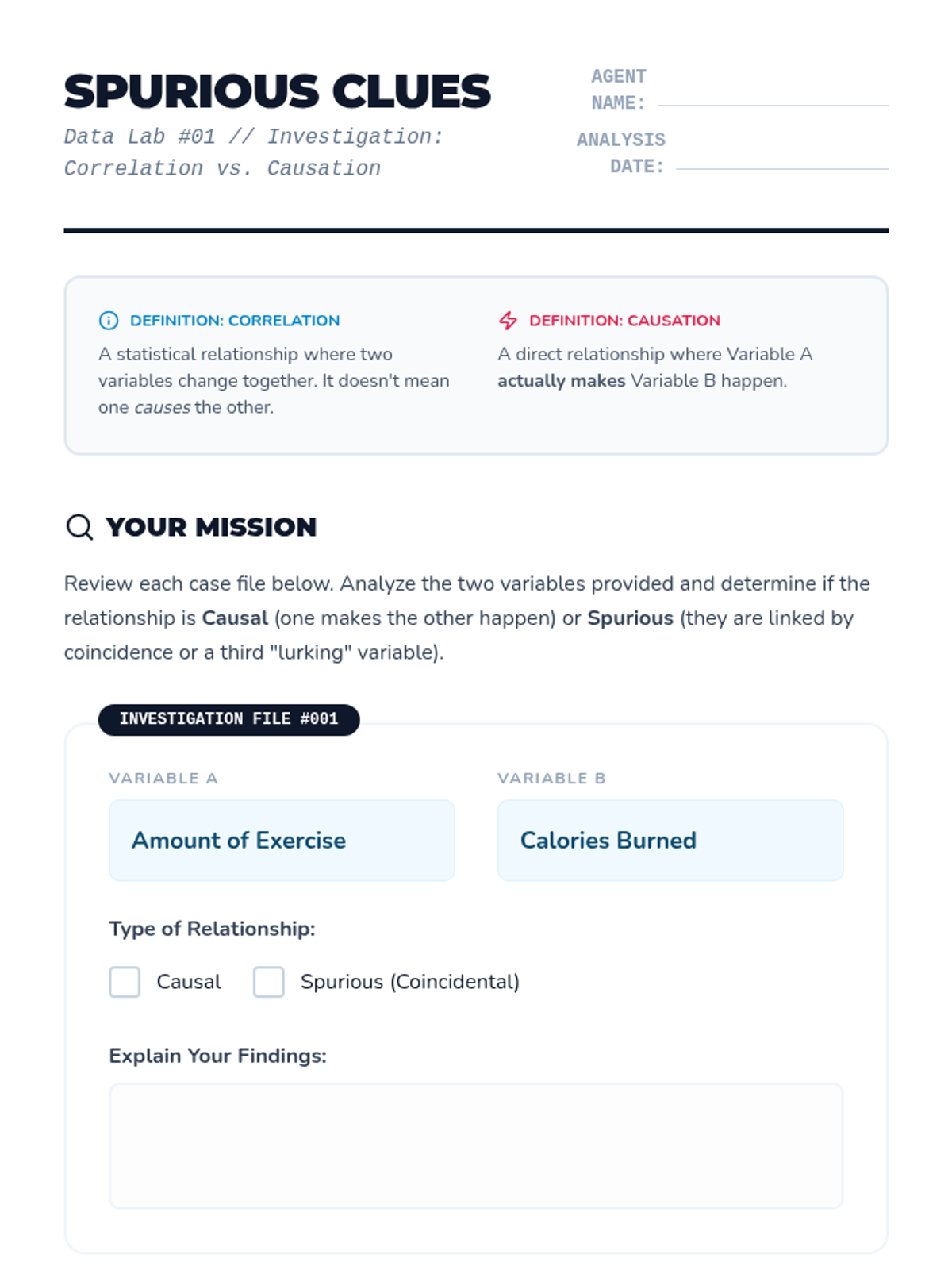
Spurious Clues Worksheet

Analyzing Trends and Insights

Students move from describing data to interpreting and modeling it. They explore correlation vs. causation, trend lines, predictive modeling, and the ethics of data bias using real-world datasets and case studies.

Lenny Avatar
Lenny
1/17
Sequence
Population Paradox Slides
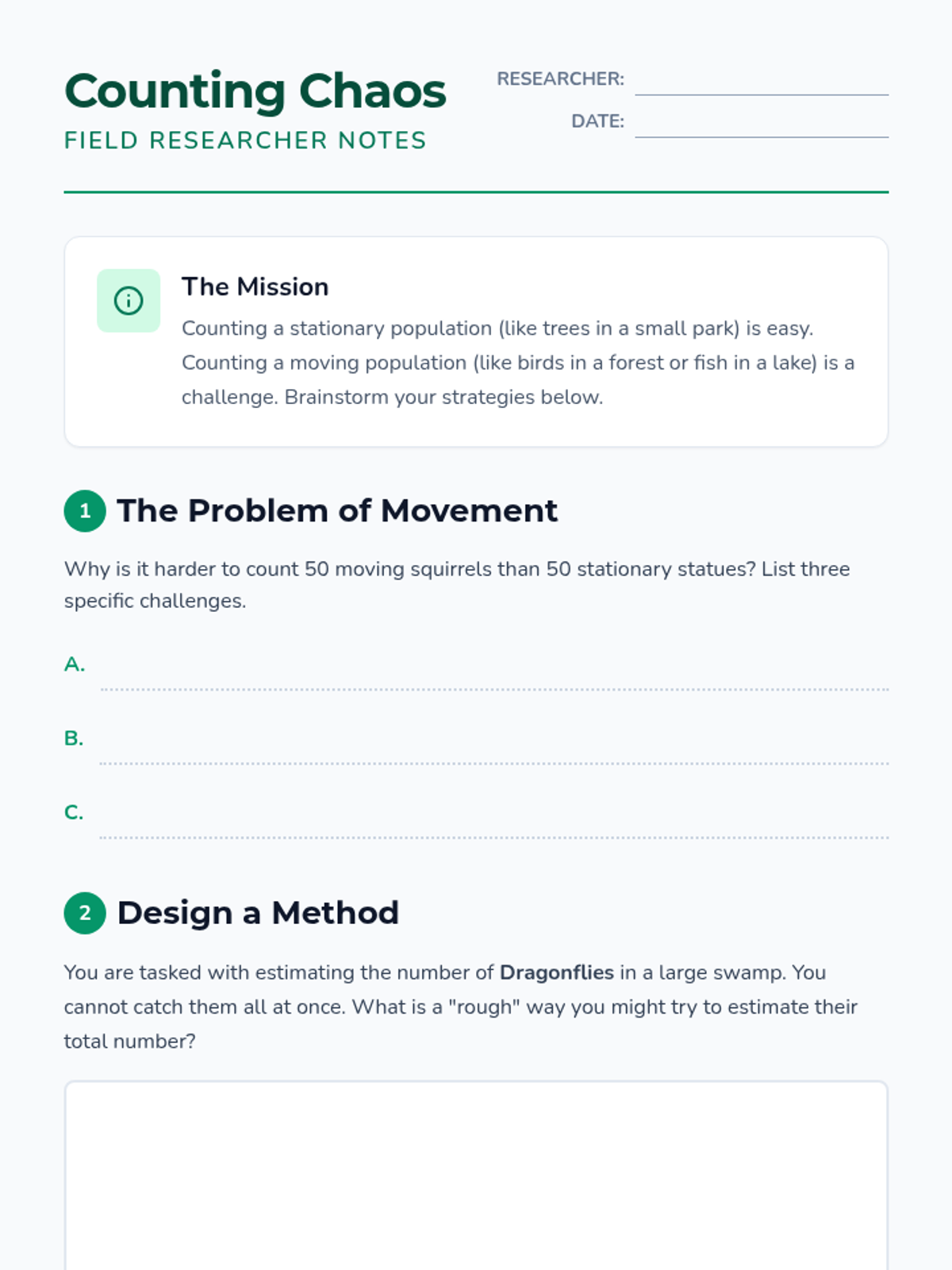
Counting Chaos Worksheet

Estimating Populations Capture Recapture

A game-based sequence where students use the Capture-Recapture method to estimate population sizes, progressing from physical simulations to proportional reasoning and real-world ecological analysis.

Lenny Avatar
Lenny
1/17
Sequence
Small Sample Sim Slides
Candy Grab Sim Worksheet
Small Sample Teacher Guide

Sample Size and Sampling Variability

This 5-lesson sequence explores how sample size influences variability and the reliability of statistical inferences. Students participate in simulations to discover the law of large numbers, use Mean Absolute Deviation to quantify spread, and evaluate the validity of real-world sampling methods.

Lenny Avatar
Lenny
1/17
Sequence
Question Clinic Worksheet
Bias Detection Slides
Question Clinic Answer Key

Data Consultant Agency

A project-based unit where 7th-grade students act as data consultants to solve school-wide problems. They learn to identify bias, design sampling plans, collect data, and present data-backed recommendations to administration.

Lenny Avatar
Lenny
1/17
Sequence
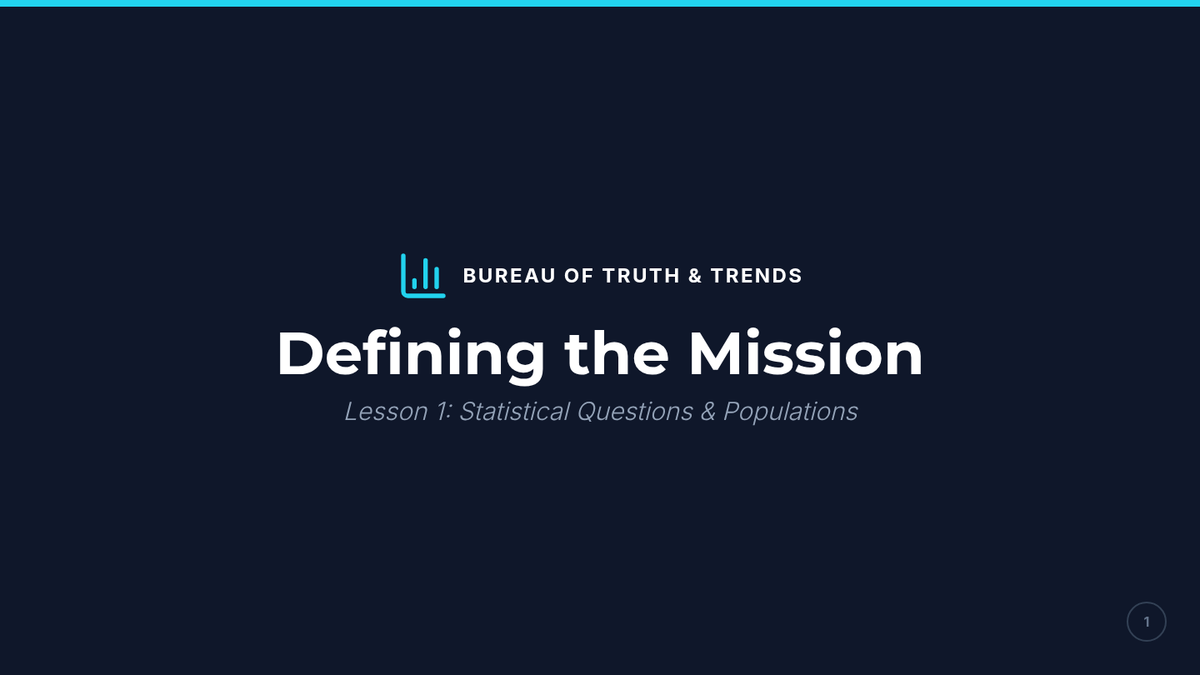
Defining the Mission Slides
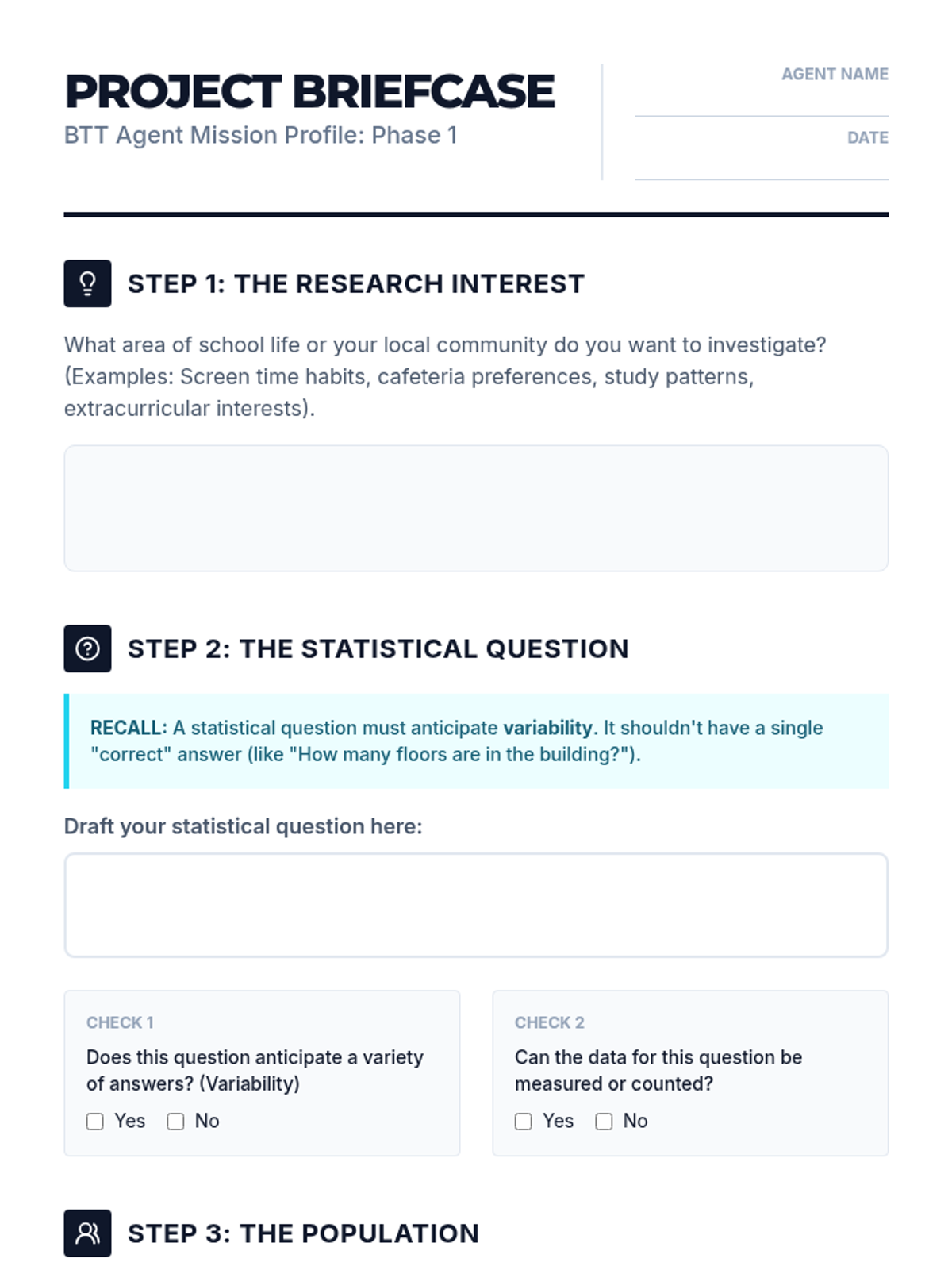
Project Briefcase Worksheet
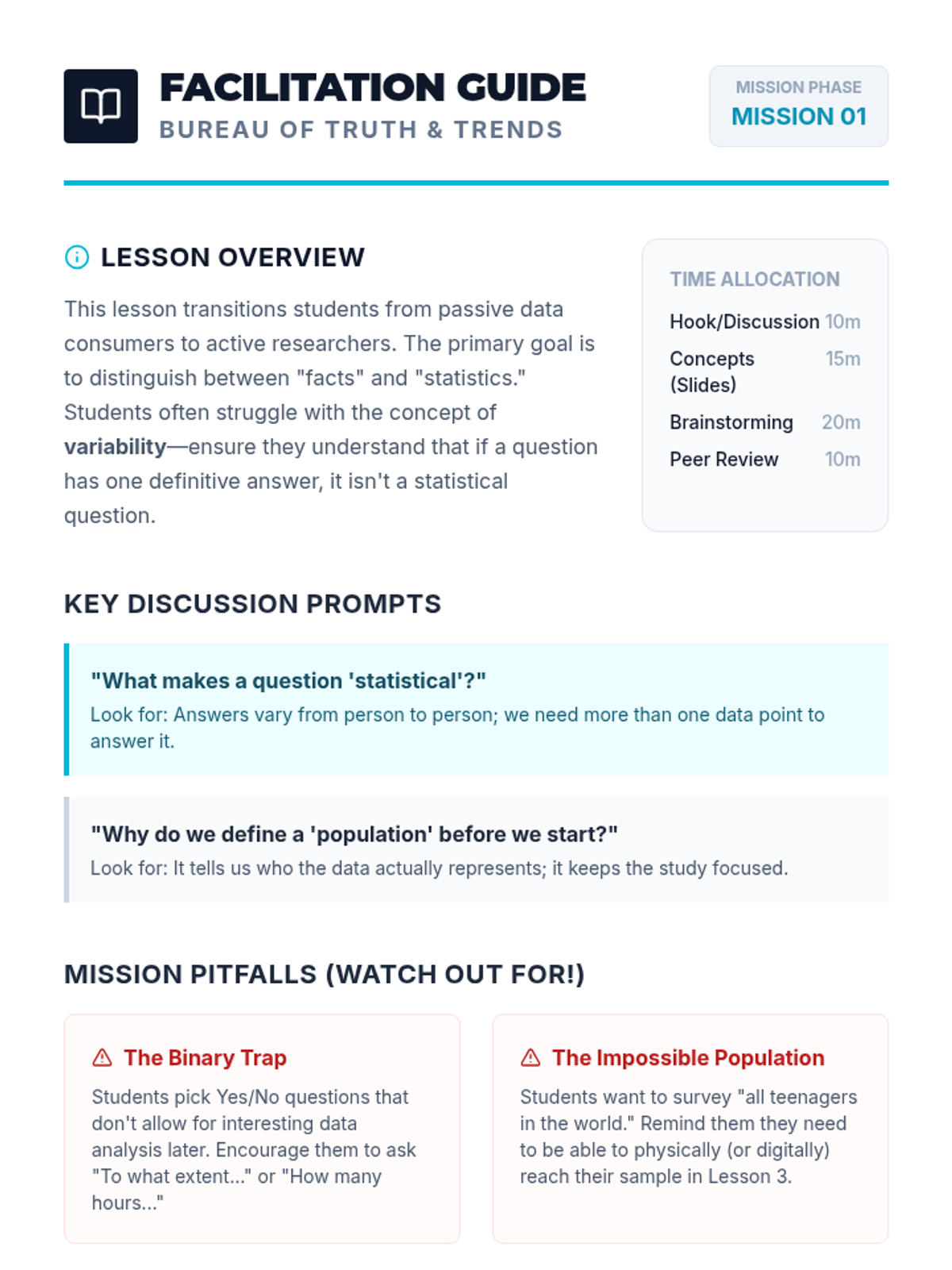
Project Facilitation Guide

Bureau of Truth and Trends

A project-based unit where students act as lead researchers, designing and executing a statistical study from question formulation to final validity reporting. Students learn to navigate population definitions, sampling methods, and question bias to ensure their data accurately reflects reality.

Lenny Avatar
Lenny
1/17
Sequence
Size Matters Slides
Variability Lab Worksheet
Size Matters Teacher Guide

Analyzing Sample Size and Statistical Inference

This inquiry-based sequence focuses on the relationship between sample size and the reliability of inferences. Students use technology and simulations to visualize how large samples stabilize around population parameters, introducing the Law of Large Numbers and Margin of Error concepts.

Lenny Avatar
Lenny
1/17
Sequence
Sample Scavenger Hunt Worksheet
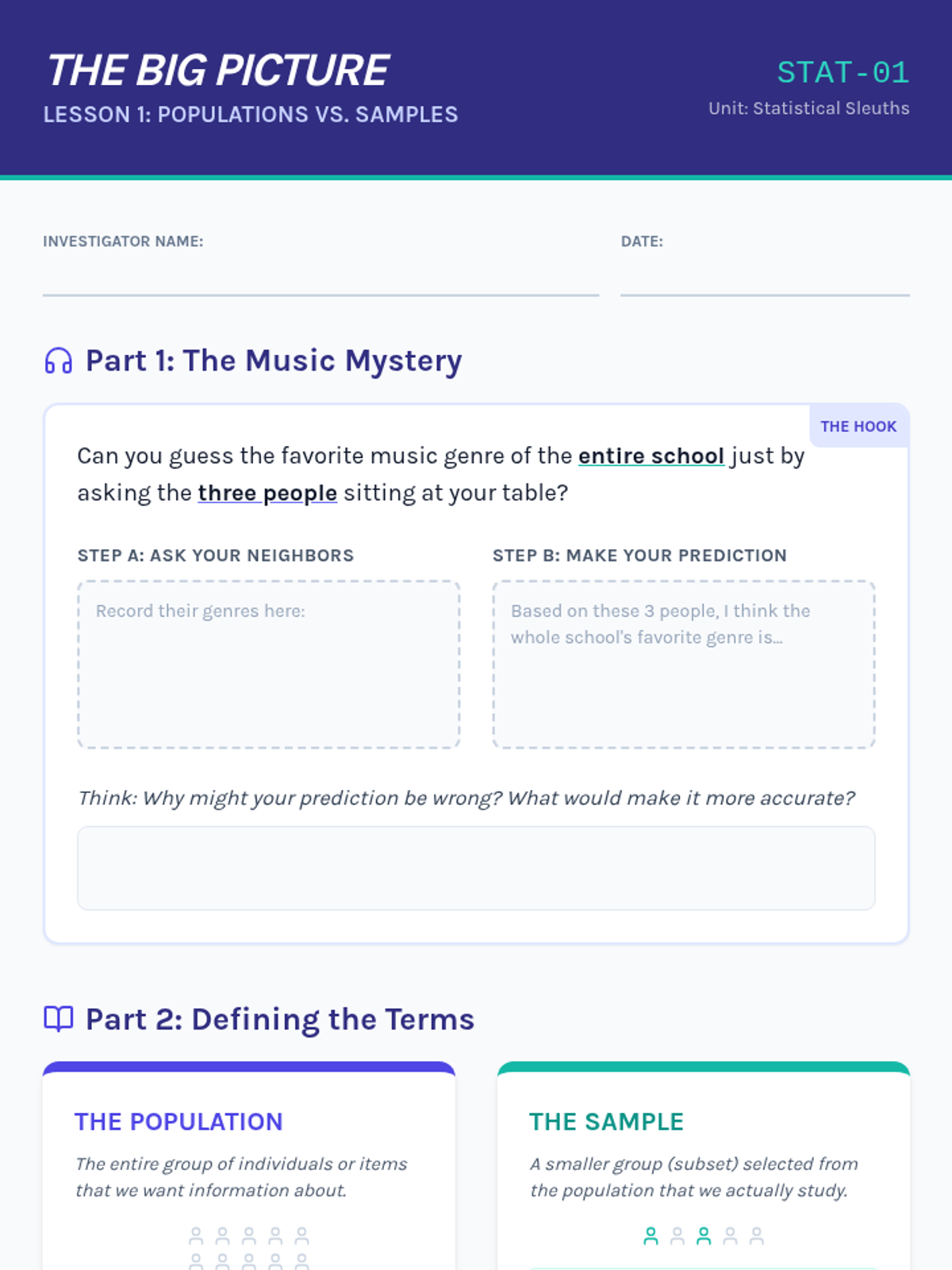
Big Picture Slides

Statistical Sleuths

This sequence explores the critical world of statistical sampling, teaching students to identify bias, understand the importance of randomness, and evaluate the validity of data-driven claims in media and history.

Lenny Avatar
Lenny
1/17
Sequence
The Overlap Test Slides
Overlap Investigation Worksheet

Comparative Data Analysis

A 9th-grade statistics sequence focused on comparing populations through measures of center and variability. Students learn to interpret overlap, select appropriate metrics, and express differences in terms of spread to make informal inferences.

Lenny Avatar
Lenny
1/17
Sequence
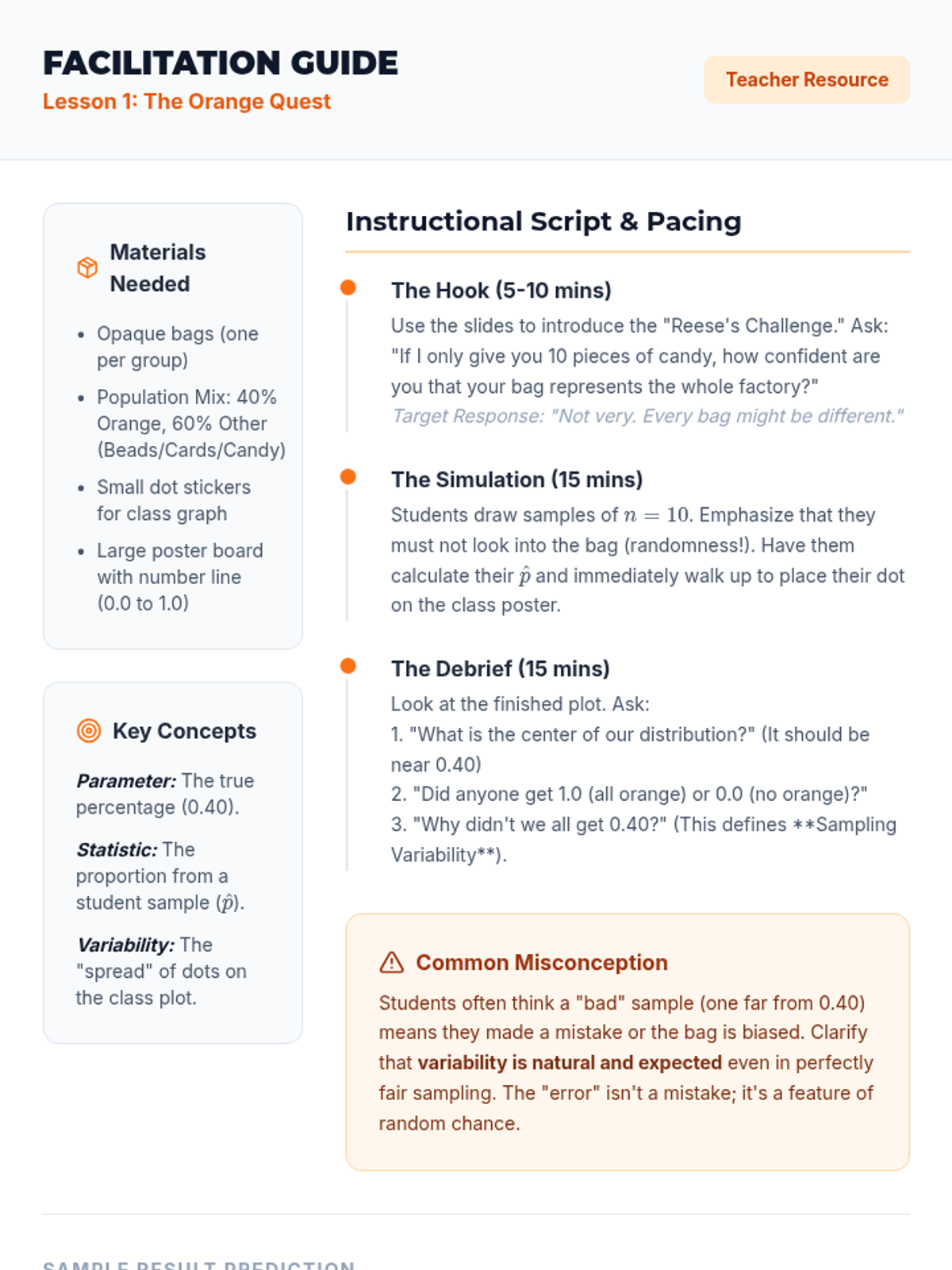
Orange Quest Slides
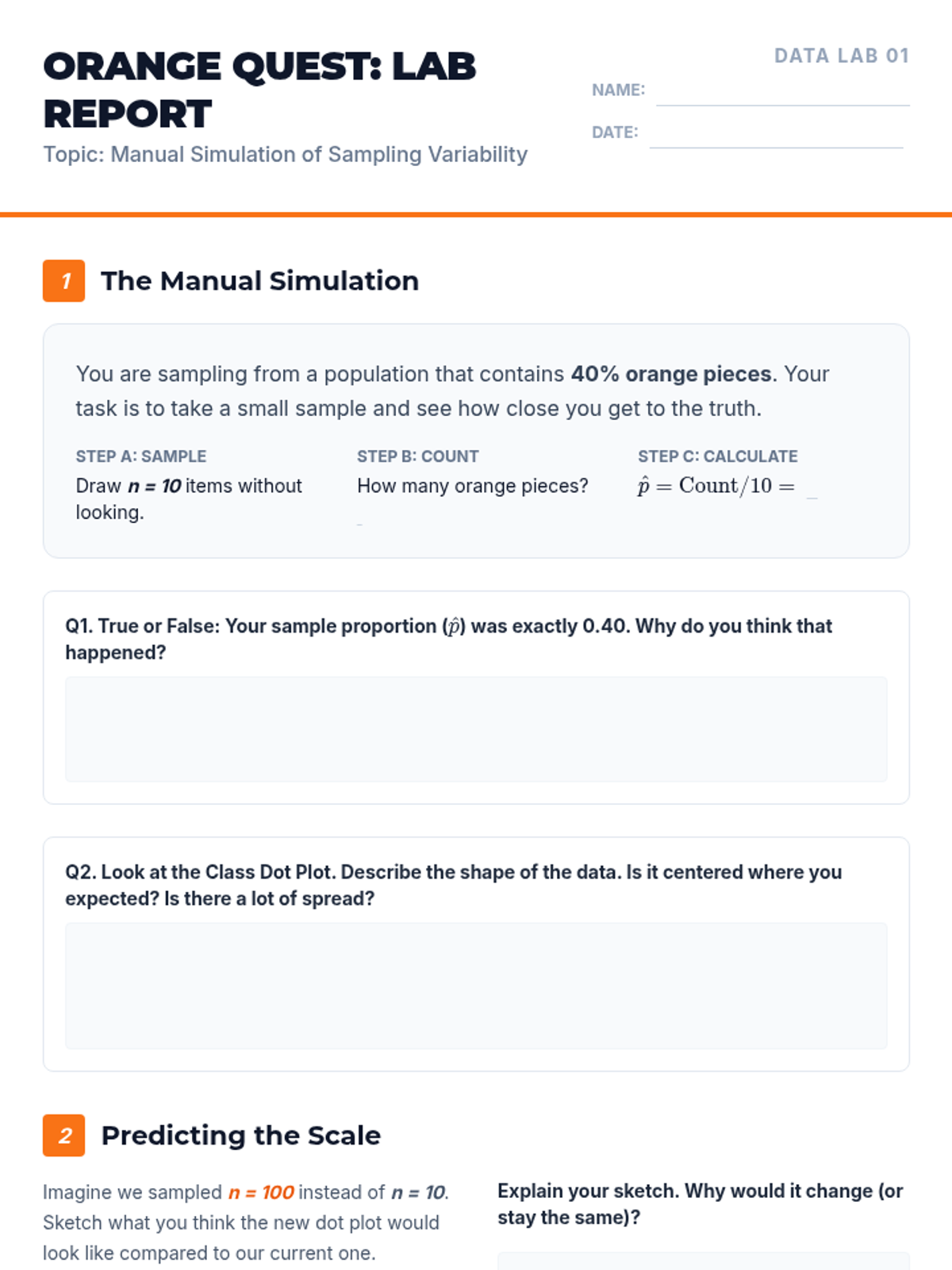
Orange Quest Worksheet
Orange Quest Teacher Guide

Data Lab Sampling and Variability

A simulation-based journey through statistical sampling, focusing on the Law of Large Numbers, variability, and the distinction between bias and precision. Students move from manual experiments to digital simulations to build intuition for statistical inference.

Lenny Avatar
Lenny
1/17
Sequence
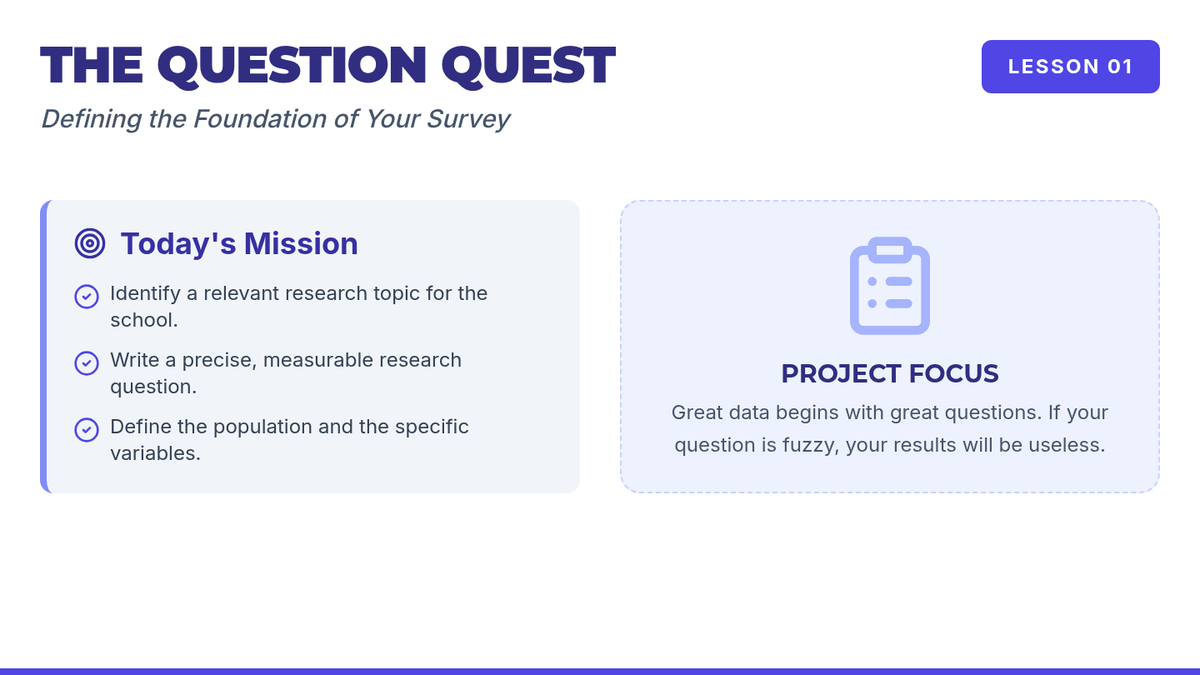
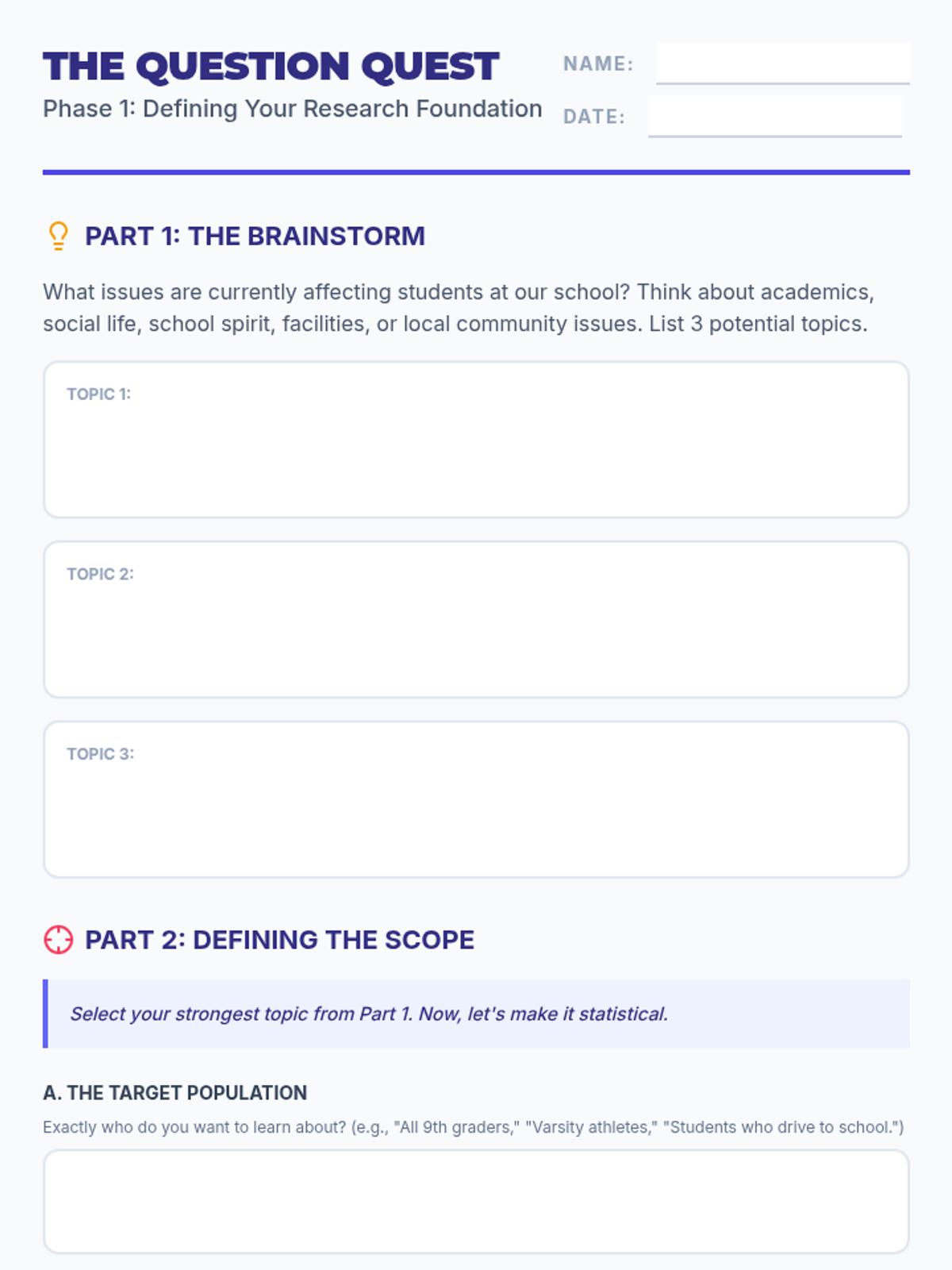
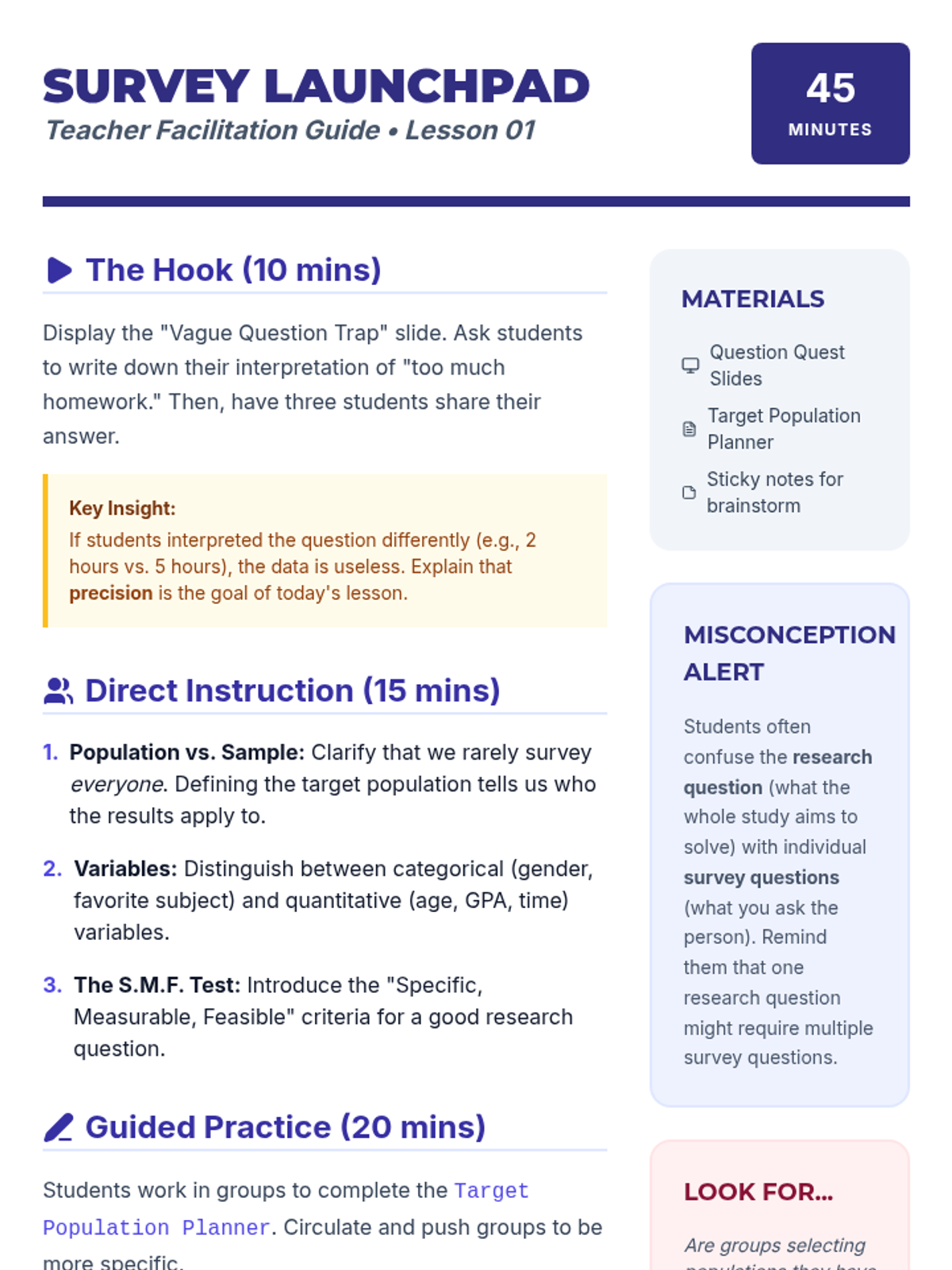
Question Quest Slides
Target Population Planner
Survey Launchpad Guide

Survey Scientists

A project-based unit where 9th-grade students design a statistical study for their school community, focusing on sampling methods, survey design, and ethical data collection. Students progress from defining a research question to presenting a formal study proposal that minimizes bias.

Lenny Avatar
Lenny
1/17
Sequence
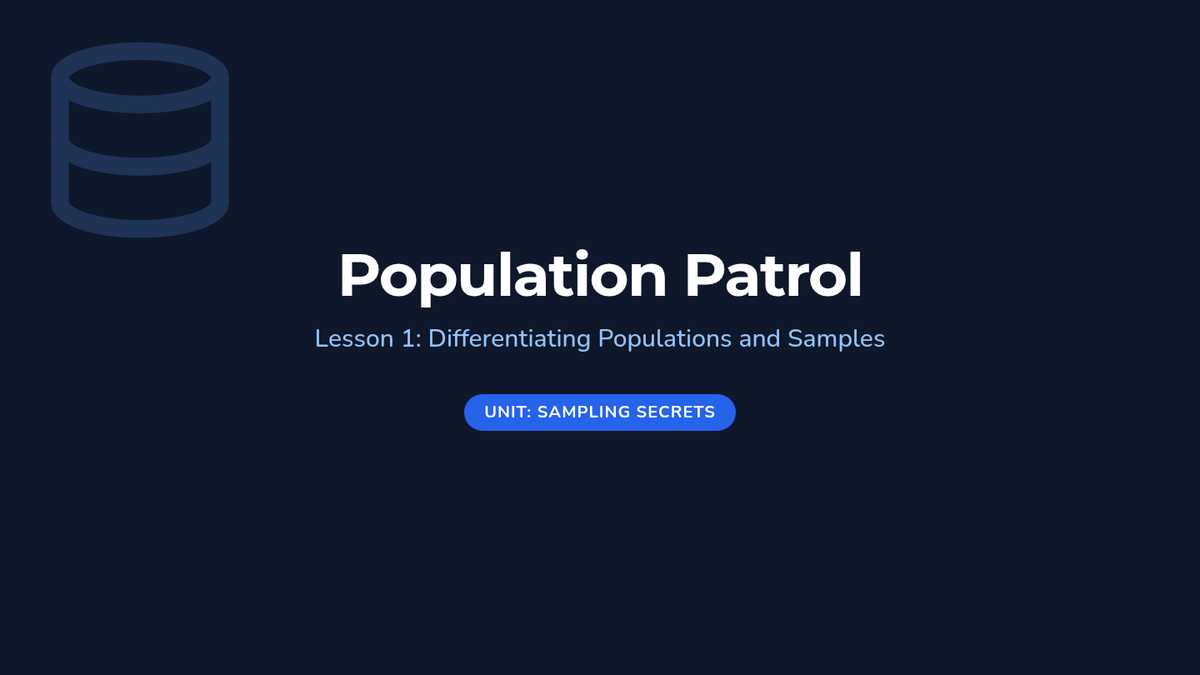
Population Patrol Slides
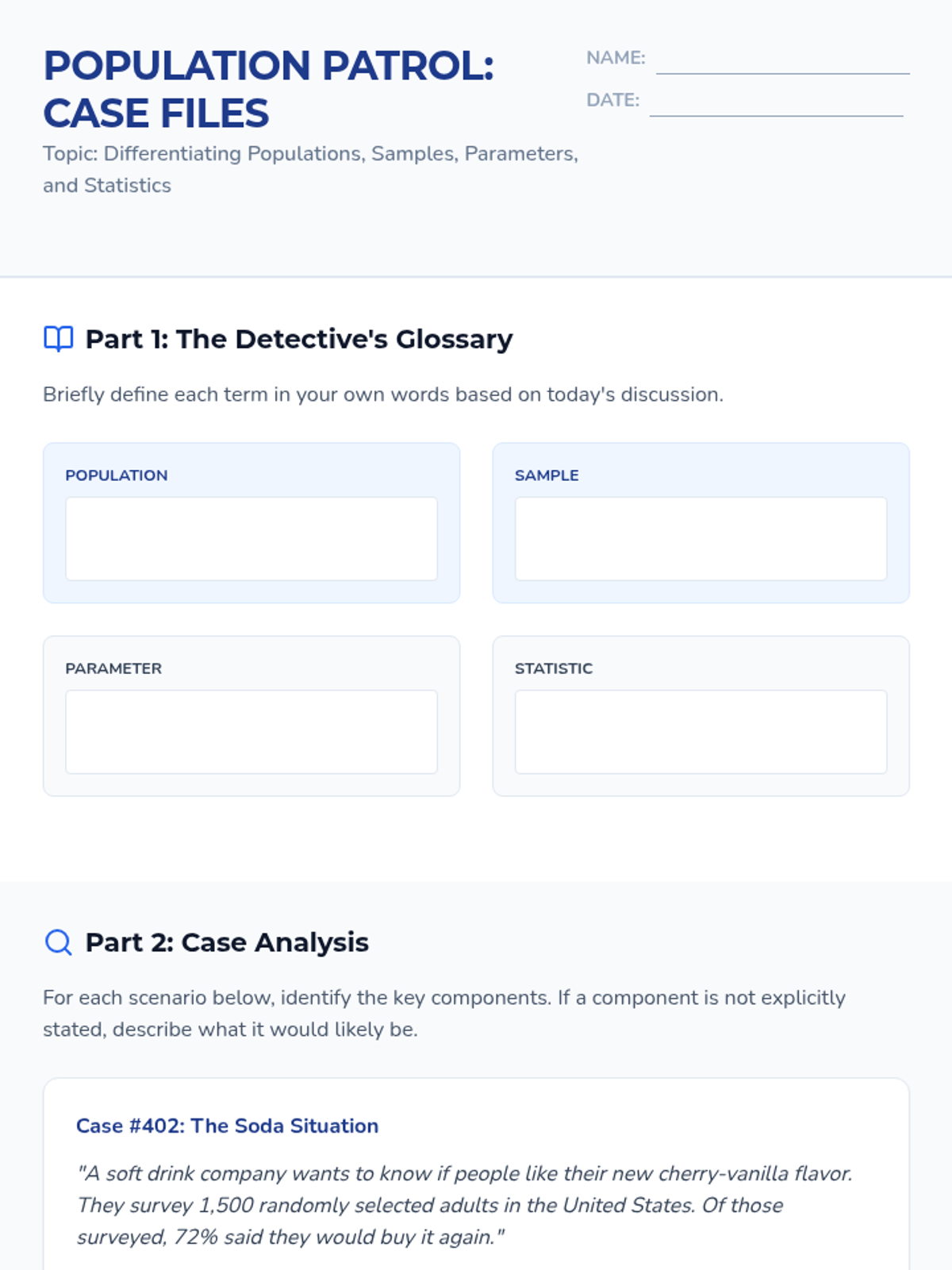
Population Patrol Worksheet
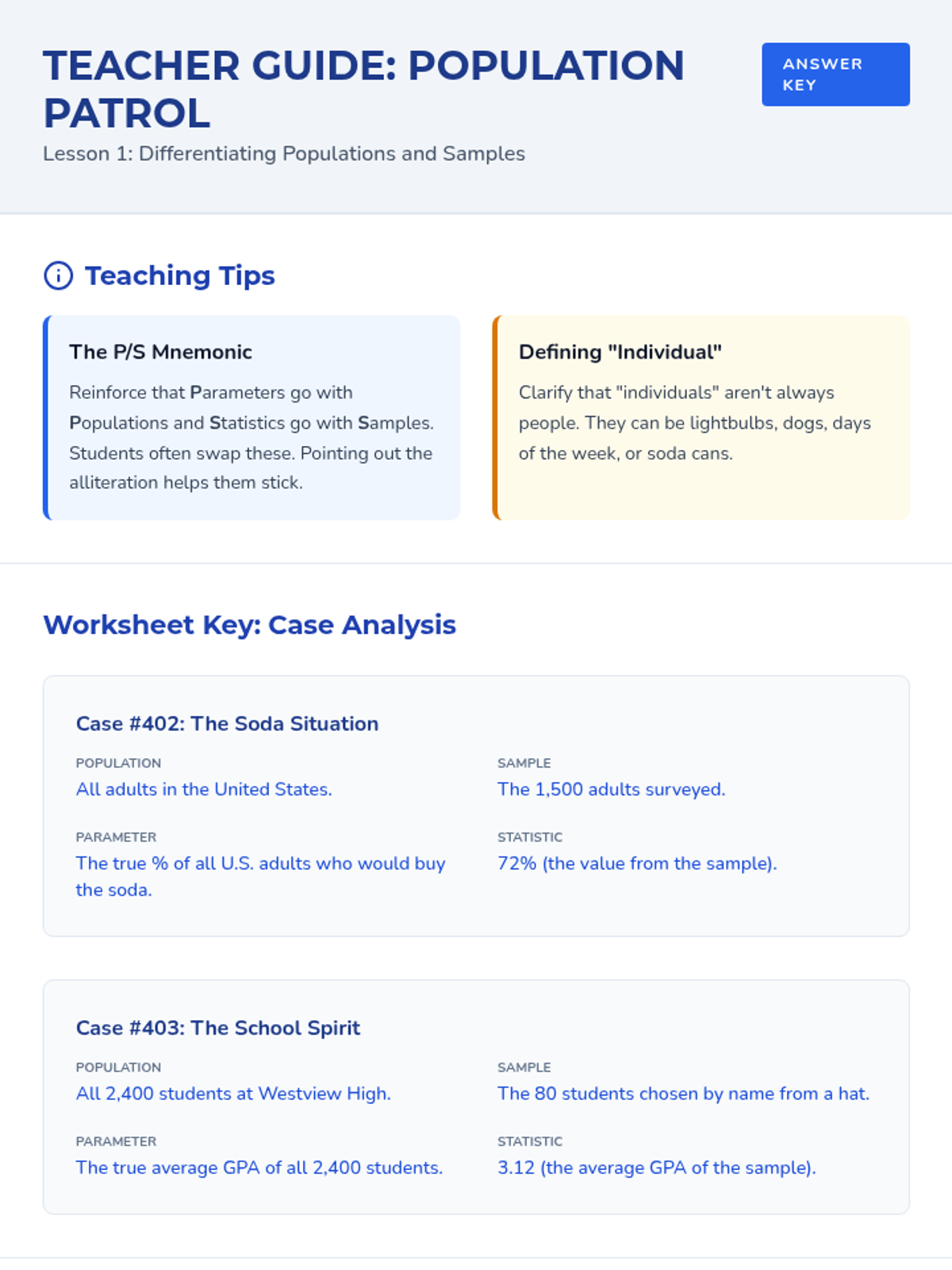
Population Patrol Teacher Guide

Sampling Secrets and Bias Detectives

A comprehensive 9th-grade statistics sequence exploring populations, sampling methods (SRS, stratified, cluster, systematic), and the identification of bias in data collection. Students progress from foundational definitions to critiquing the validity of real-world statistical claims.

Lenny Avatar
Lenny
1/17
Sequence
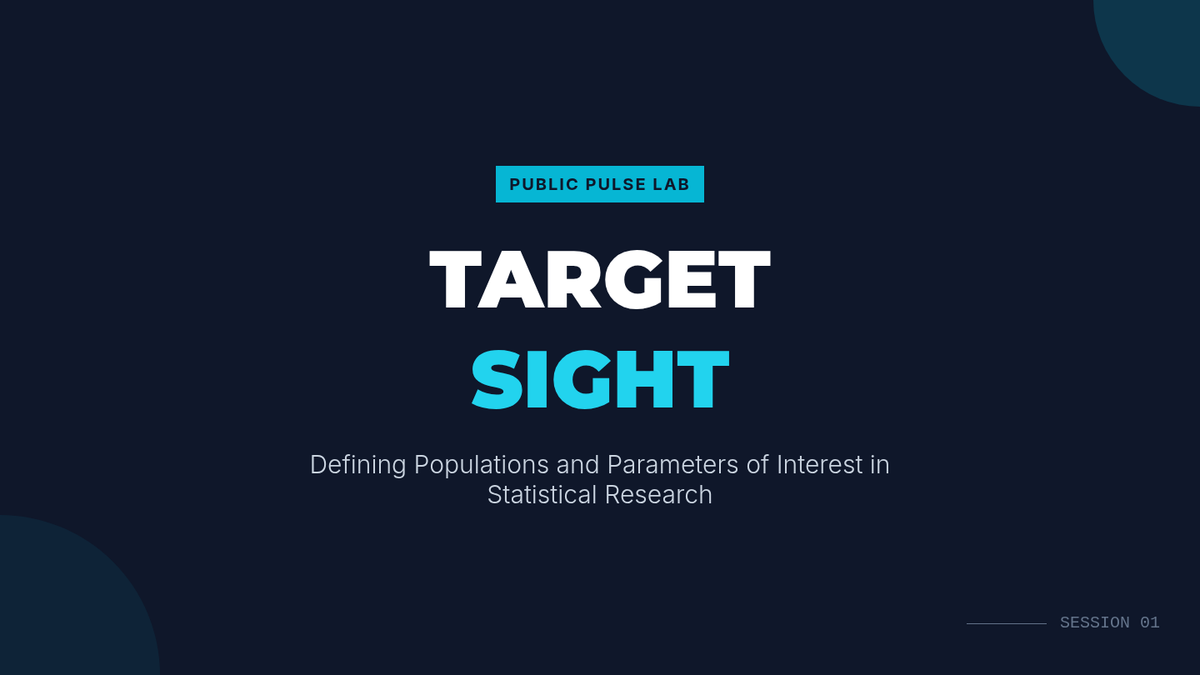
Target Sight Slides
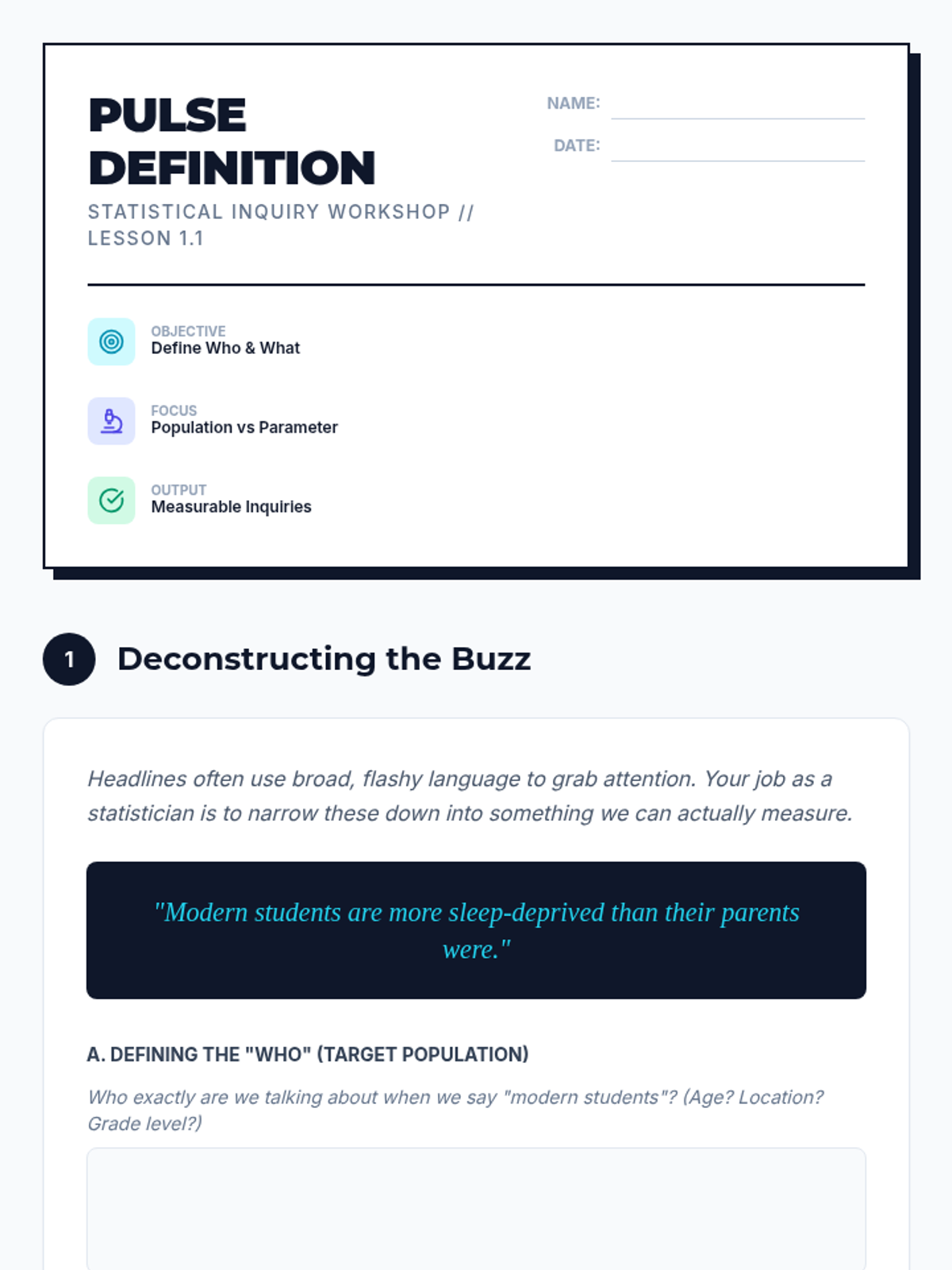
Pulse Definition Worksheet
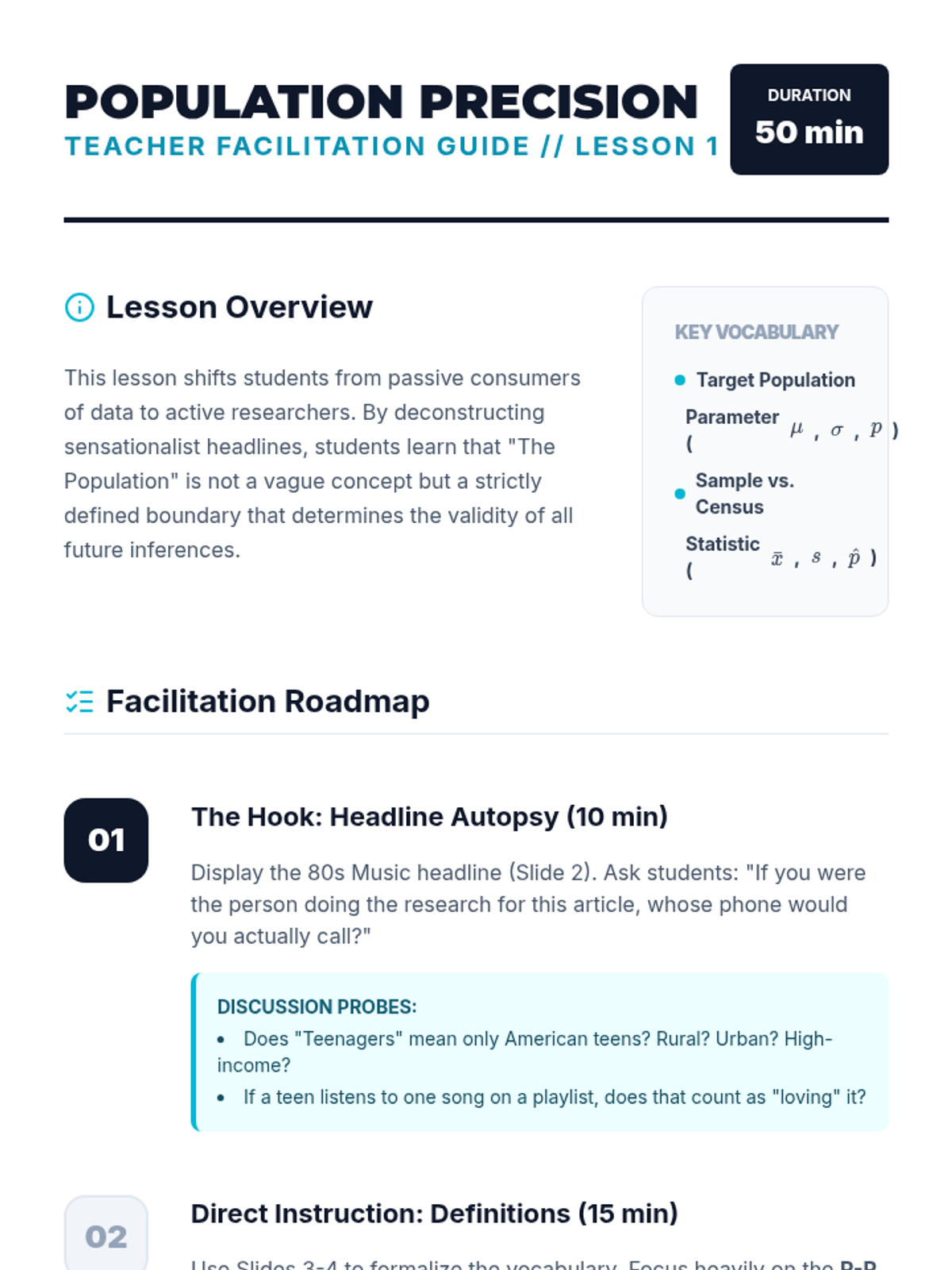
Population Precision Guide

Public Pulse Sequence

A project-based exploration of statistical sampling where students learn to define populations, determine sample sizes, design protocols, and make valid inferences. Students act as data consultants, moving from theoretical understanding to simulated data collection and analysis.

Lenny Avatar
Lenny
1/17
Sequence
Guide Enseignant Sprint Statistique
Slides Sprint Statistique
Mission Sprint Olympique Activité
Mémento Stats et Numérique Reference Sheet
Correction Mission Sprint Olympique Answer Key

Statistiques et Numérique

Une séquence complète sur les statistiques en 3ème, abordant la collecte, le traitement et l'interprétation de données avec des outils numériques.

E

Enseignante

Math Teacher
2/27
Sequence
Initial Briefing Assessment
Initial Briefing Answer Key

Data Decoder

A comprehensive Tier 2 intervention sequence for high school students focused on summarizing, representing, and interpreting data, aligned with Colorado Standard 3. The program uses a 'Data Forensics' theme to engage students in uncovering insights from real-world datasets through scaffolded analysis and visual interpretation.

Lenny Avatar
Lenny
2/13
Sequence
Curve Fitters Slides
Curve Crafters Workbook
Curve Fitters Teacher Guide
Curve Check Exit Ticket

Distribution Detectives

A Tier 2 intervention sequence focused on helping students master the Normal Distribution and the Empirical Rule through real-world applications and scaffolded practice.

Lenny Avatar
Lenny
2/12
Sequence
Distribution Duel Slides
Evidence File Worksheet
Lead Detective Guide
Case Closed Exit Ticket
Detective Brief Answer Keys

Distribution Detectives

A targeted Tier 2 intervention for High School Statistics focusing on comparing data distributions (shape, center, spread) and understanding the impact of outliers. Includes scaffolded instruction, guided practice with sentence frames, and progress monitoring tools.

Lenny Avatar
Lenny
2/12
Sequence
Strategy Blueprint Slides
Math Essentials Reference
Math Essentials Reference Updated
Strategy Sandbox Worksheet
Subject Spotlight Activity
Strategy Sandbox Answer Key
Strategy Sandbox 2 Worksheet
Strategy Sandbox 2 Answer Key
Desmos Mastery Slides
Desmos Drill Worksheet
Desmos Drill Answer Key

ACT Math Mastery

A comprehensive ACT Math preparation program focusing on essential strategies, high-yield Algebra and Geometry concepts, and realistic practice to boost scores.

AL

ava larumbe

Other
2/8
Sequence
Small Sample Sim Slides
Candy Grab Sim Worksheet
Small Sample Teacher Guide

Sample Size and Sampling Variability

This 5-lesson sequence explores how sample size influences variability and the reliability of statistical inferences. Students participate in simulations to discover the law of large numbers, use Mean Absolute Deviation to quantify spread, and evaluate the validity of real-world sampling methods.

Lenny Avatar
Lenny
1/17
Sequence
Question Clinic Worksheet
Bias Detection Slides
Question Clinic Answer Key

Data Consultant Agency

A project-based unit where 7th-grade students act as data consultants to solve school-wide problems. They learn to identify bias, design sampling plans, collect data, and present data-backed recommendations to administration.

Lenny Avatar
Lenny
1/17
Sequence
Supplier Search Brief
Analyst Intro Slides

Consistency Kings

Students act as data analysts for a tech company to decide between two suppliers. They learn that averages don't tell the whole story, using Mean Absolute Deviation (MAD) and Interquartile Range (IQR) to assess risk and consistency in real-world decision making.

Lenny Avatar
Lenny
1/17
Sequence
Defining the Mission Slides
Project Briefcase Worksheet
Project Facilitation Guide

Bureau of Truth and Trends

A project-based unit where students act as lead researchers, designing and executing a statistical study from question formulation to final validity reporting. Students learn to navigate population definitions, sampling methods, and question bias to ensure their data accurately reflects reality.

Lenny Avatar
Lenny
1/17
Sequence
Size Matters Slides
Variability Lab Worksheet
Size Matters Teacher Guide

Analyzing Sample Size and Statistical Inference

This inquiry-based sequence focuses on the relationship between sample size and the reliability of inferences. Students use technology and simulations to visualize how large samples stabilize around population parameters, introducing the Law of Large Numbers and Margin of Error concepts.

Lenny Avatar
Lenny
1/17
Sequence
Shape Shifters Presentation
Shape Hunter Worksheet

Spread Stories

An inquiry-based exploration of statistical variability, focusing on how data spread reveals truths about inequality, climate instability, and diversity that averages often hide. Students transition from visual distribution analysis to quantifying disparity using IQR and MAD, culminating in an independent investigation.

Lenny Avatar
Lenny
1/17
Sequence
Heartbeat Case Slides
Vital Signs Worksheet
Center vs Spread Facilitator Guide

Risk and Reliability Lab

A high school statistics sequence focused on quantifying risk and consistency through measures of variability. Students move from basic spread concepts to complex financial and industrial case studies, culminating in a data-driven risk assessment report.

Lenny Avatar
Lenny
1/17
Sequence
The Overlap Test Slides
Overlap Investigation Worksheet

Comparative Data Analysis

A 9th-grade statistics sequence focused on comparing populations through measures of center and variability. Students learn to interpret overlap, select appropriate metrics, and express differences in terms of spread to make informal inferences.

Lenny Avatar
Lenny
1/17
Sequence
Deviation Detectives Worksheet
Distance from Mean Slides
MAD Sequence Teacher Guide

Measuring Consistency with MAD

This project-based sequence explores consistency and volatility through the lens of Mean Absolute Deviation (MAD). Students analyze real-world datasets to understand how variability quantifies 'reliability' beyond simple averages.

Lenny Avatar
Lenny
1/17
Sequence
Quartile Quest Slides
Partition Practice Worksheet
Quartile Captain Teacher Guide

Data Blueprint Box Plots and IQR

A comprehensive sequence on statistical variability focusing on quartiles, IQR, and box plots. Students move from raw data partitioning to visual representation and advanced outlier detection, culminating in the interpretation of distribution shapes and skewness.

Lenny Avatar
Lenny
1/17
Sequence
Orange Quest Slides
Orange Quest Worksheet
Orange Quest Teacher Guide

Data Lab Sampling and Variability

A simulation-based journey through statistical sampling, focusing on the Law of Large Numbers, variability, and the distinction between bias and precision. Students move from manual experiments to digital simulations to build intuition for statistical inference.

Lenny Avatar
Lenny
1/17
Sequence
Data Disparity Slides
Spread Matchup Worksheet

Data Disparity and Distribution

This sequence explores statistical variability through the lens of robust measures like IQR and box plots. Students move from basic understanding of spread to complex comparative analysis, focusing on how variability impacts the reliability of data-driven conclusions.

Lenny Avatar
Lenny
1/17
Sequence
Target Sight Slides
Pulse Definition Worksheet
Population Precision Guide

Public Pulse Sequence

A project-based exploration of statistical sampling where students learn to define populations, determine sample sizes, design protocols, and make valid inferences. Students act as data consultants, moving from theoretical understanding to simulated data collection and analysis.

Lenny Avatar
Lenny
1/17
Sequence
Flaw of Averages Slides
Spread Seekers Worksheet
Spread Seekers Answer Key

Economic Disparity and Spread

A high school statistics sequence investigating economic disparity through measures of spread (Range, IQR, MAD), emphasizing how variability reveals truths hidden by averages.

Lenny Avatar
Lenny
1/17
Sequence
Decision Coach Guide
Decision Lab Slides
Decision Map Worksheet
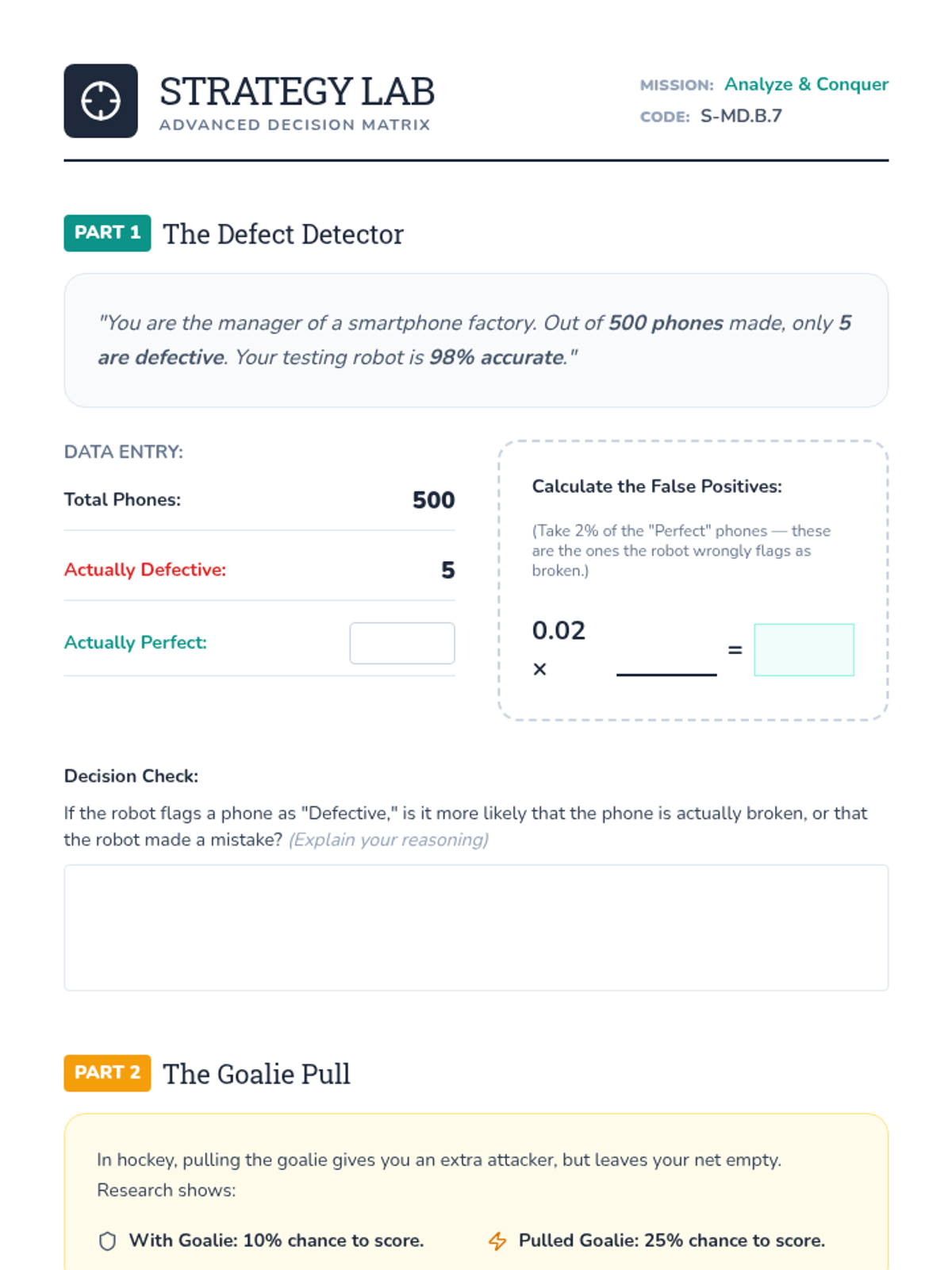
Strategy Lab Worksheet
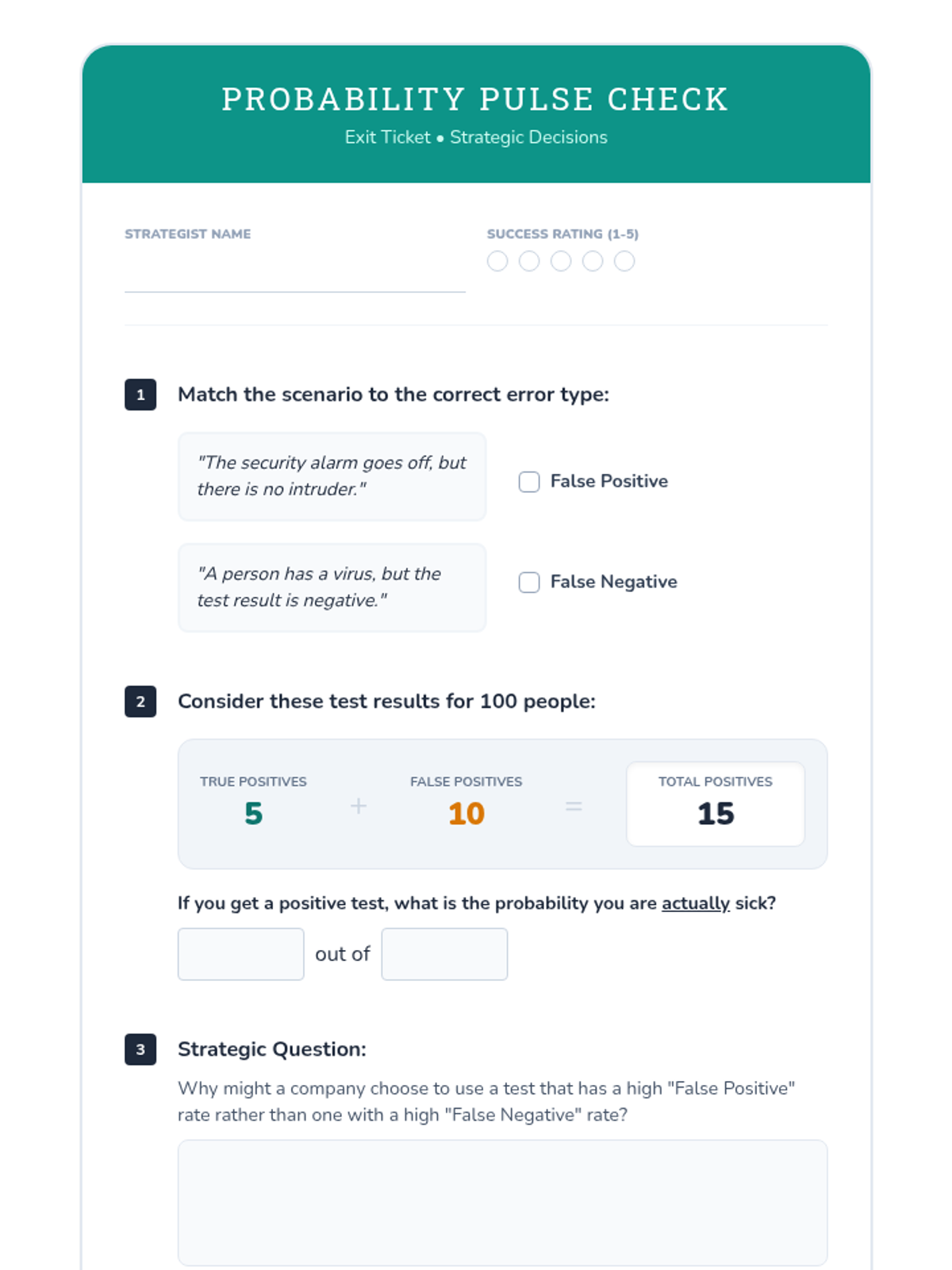
Probability Pulse Check

Decision Lab Probability

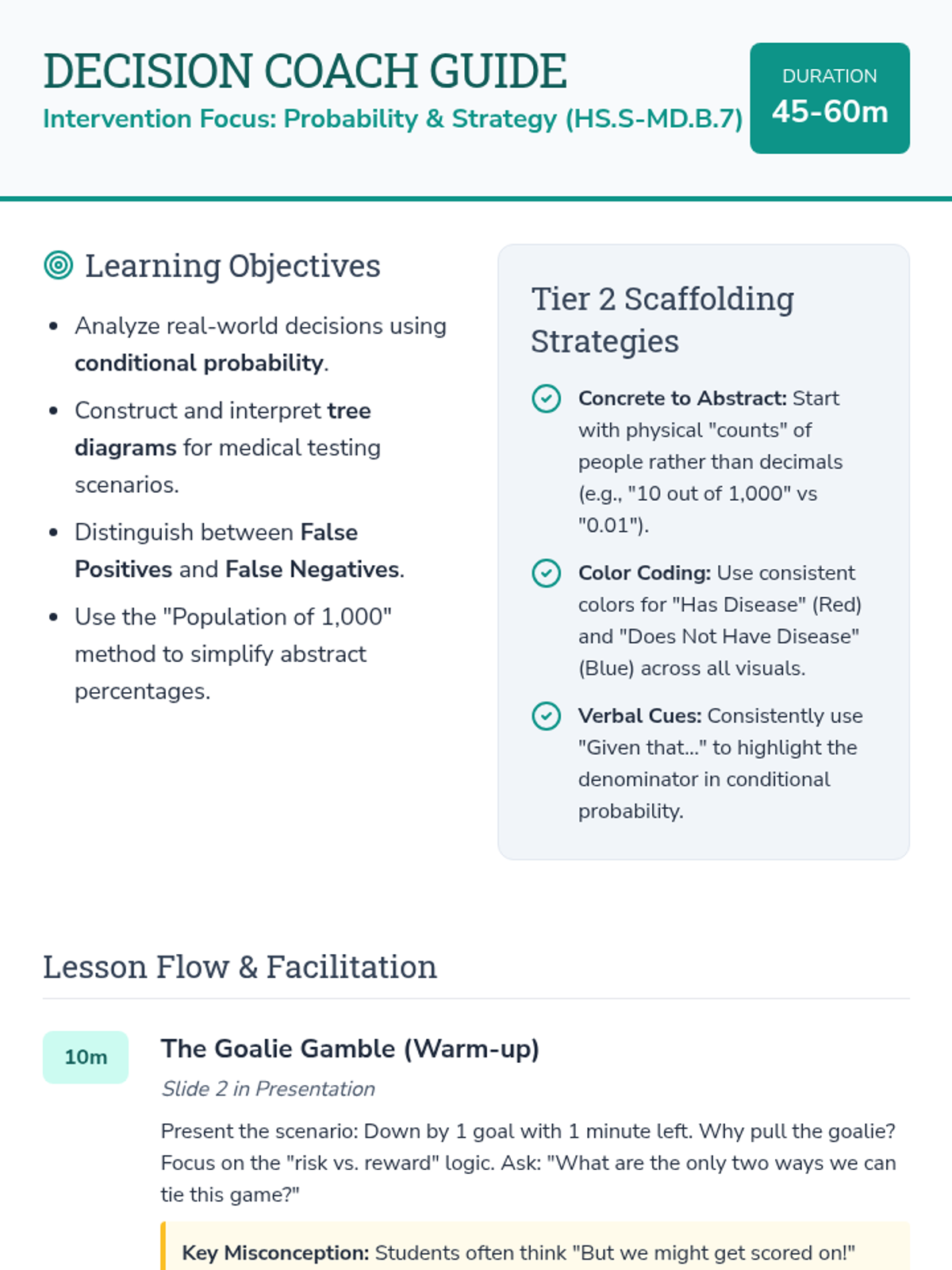
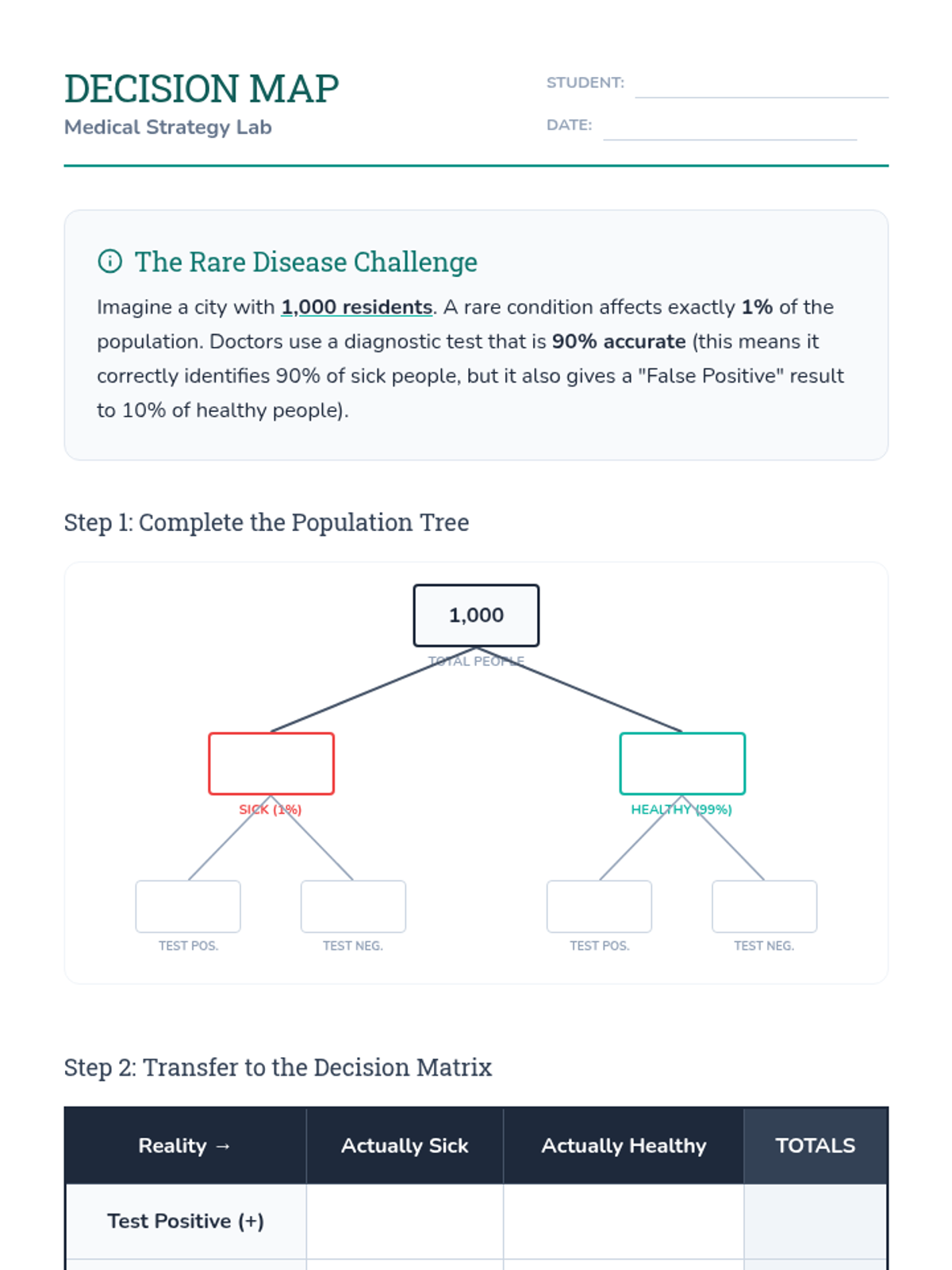
A Tier 2 intervention sequence focused on using probability to analyze decisions, specifically targeting medical testing (false positives/negatives) and game-time strategies. Students learn to use tree diagrams and contingency tables to navigate complex conditional probability scenarios.

Lenny Avatar
Lenny
2/12
Sequence
Fair Play Lab Slides
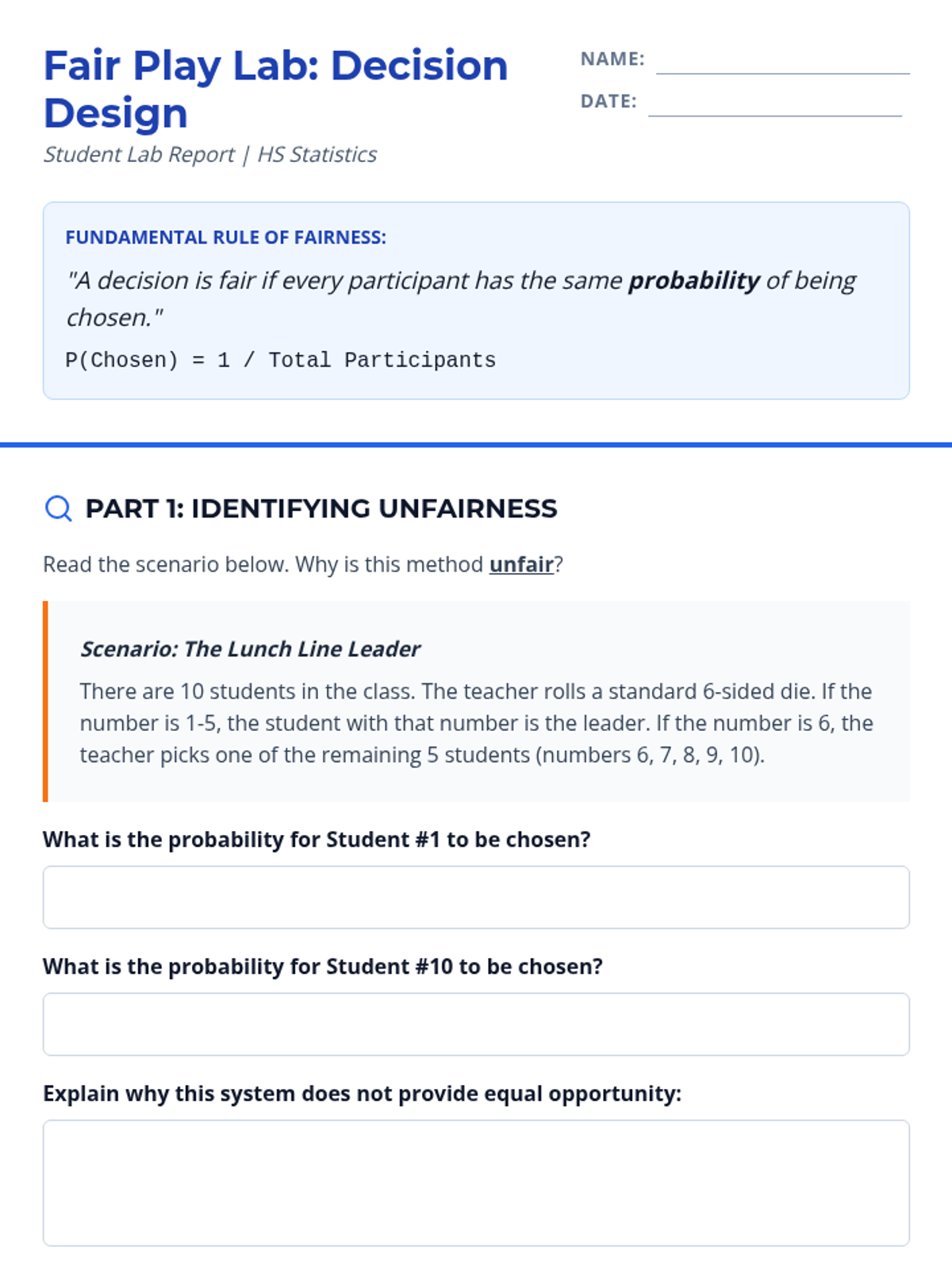
Decision Design Lab Worksheet
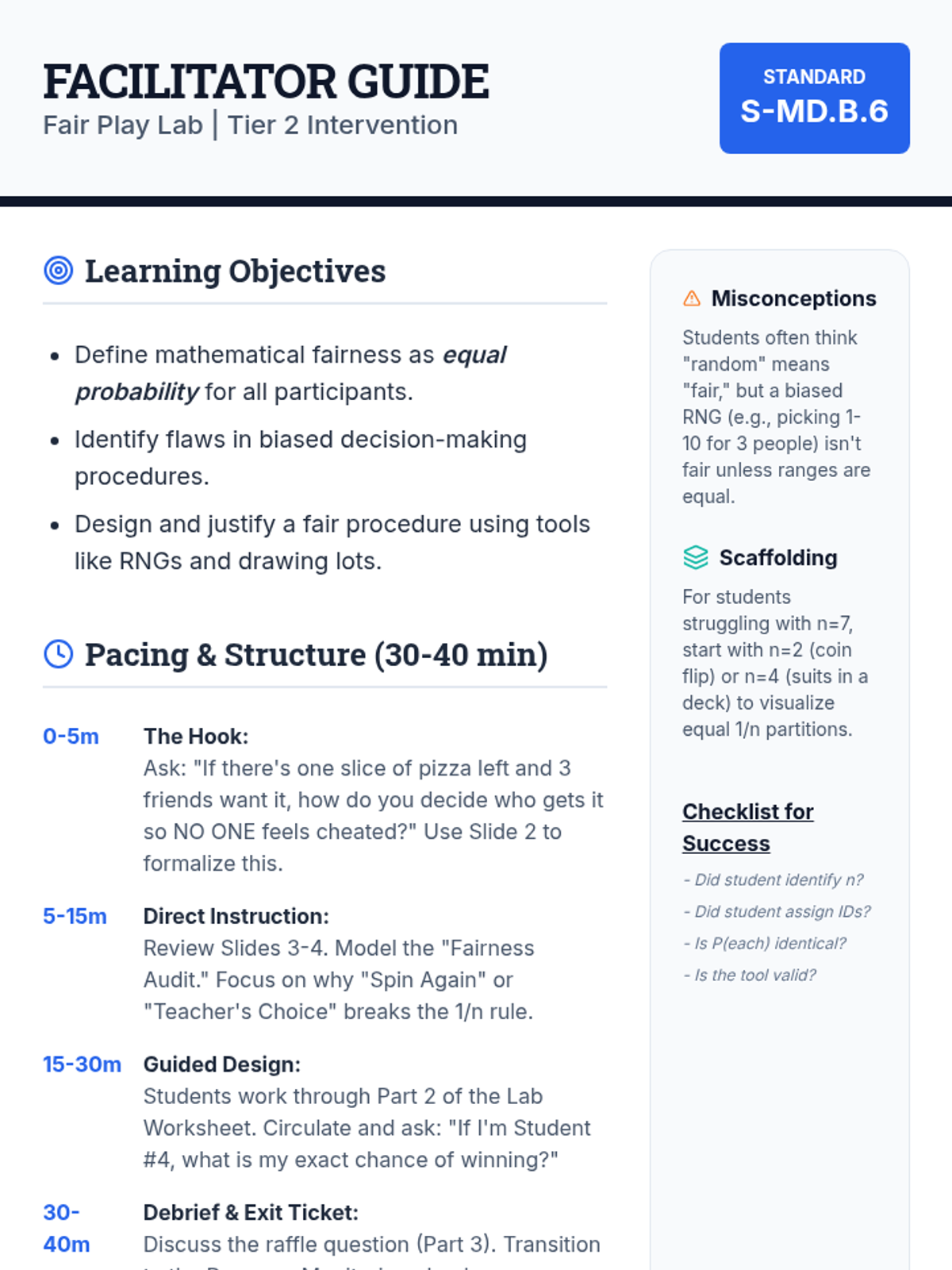
Fair Play Facilitator Guide
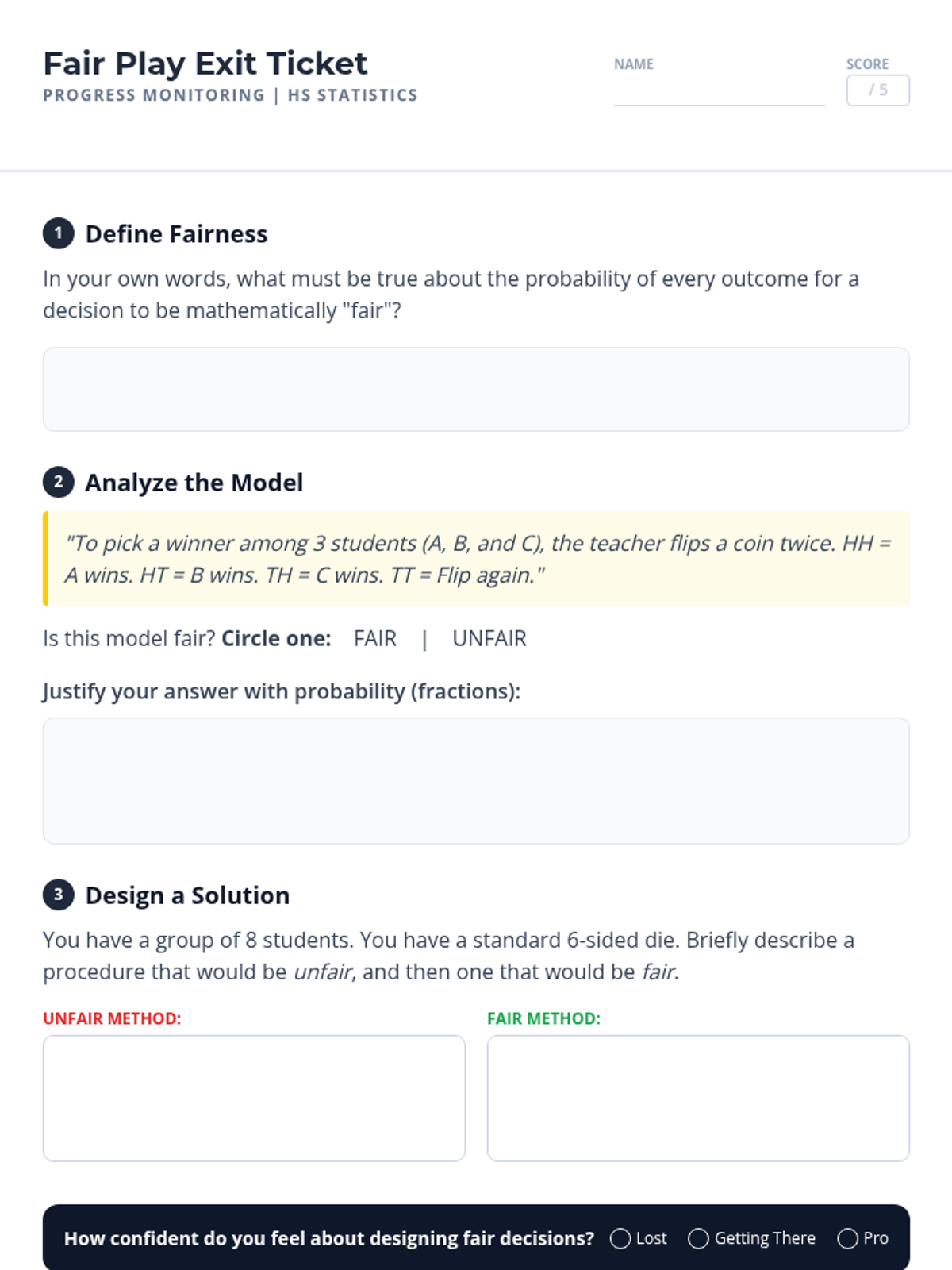
Fair Play Exit Ticket
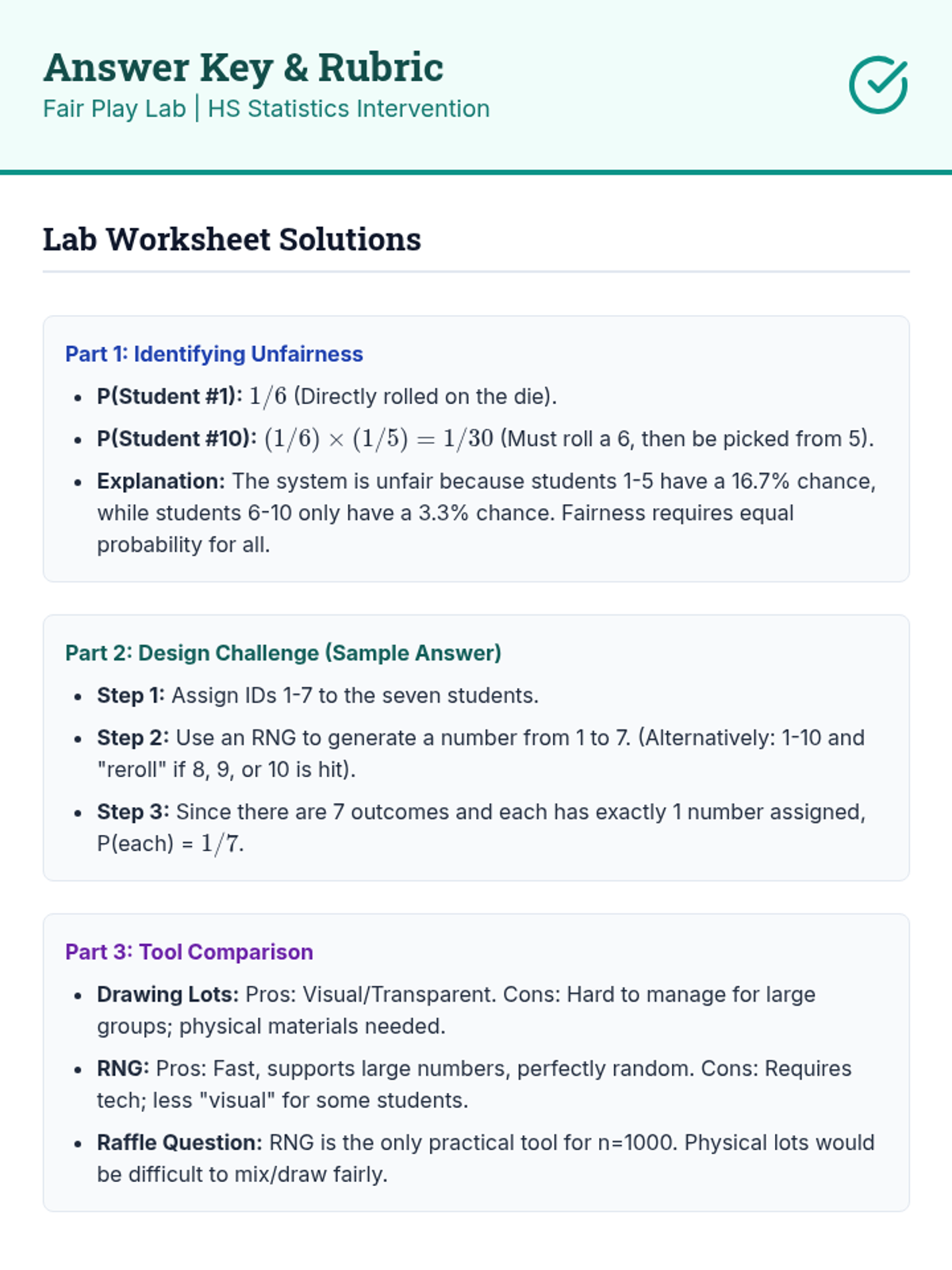
Fair Play Answer Key

Probability Power

A comprehensive unit focused on practical applications of probability for high school students, emphasizing decision-making, fairness, and risk assessment.

Lenny Avatar
Lenny
2/12
Sequence
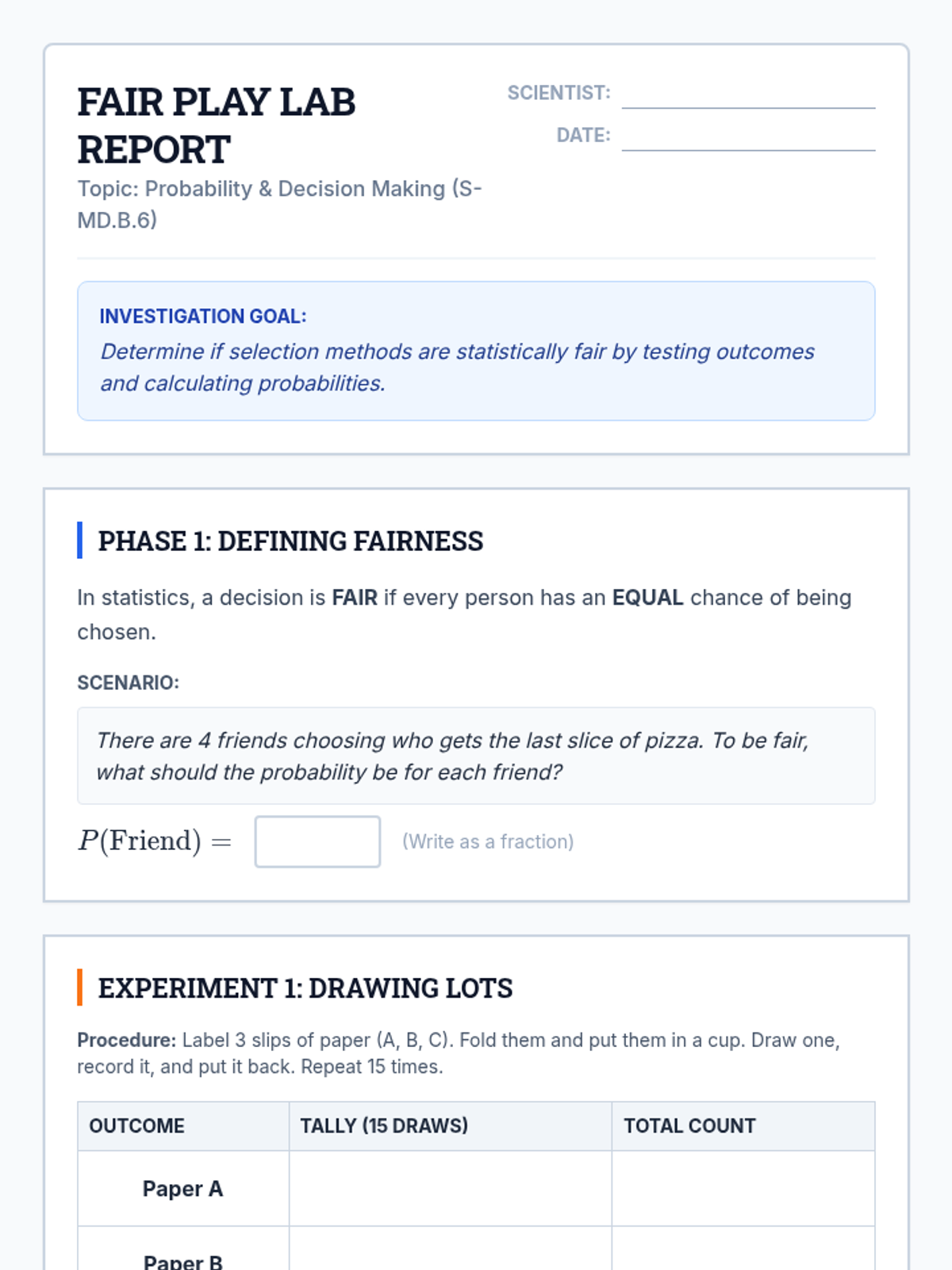
Fair Play Slides
Fair Play Lab Sheet
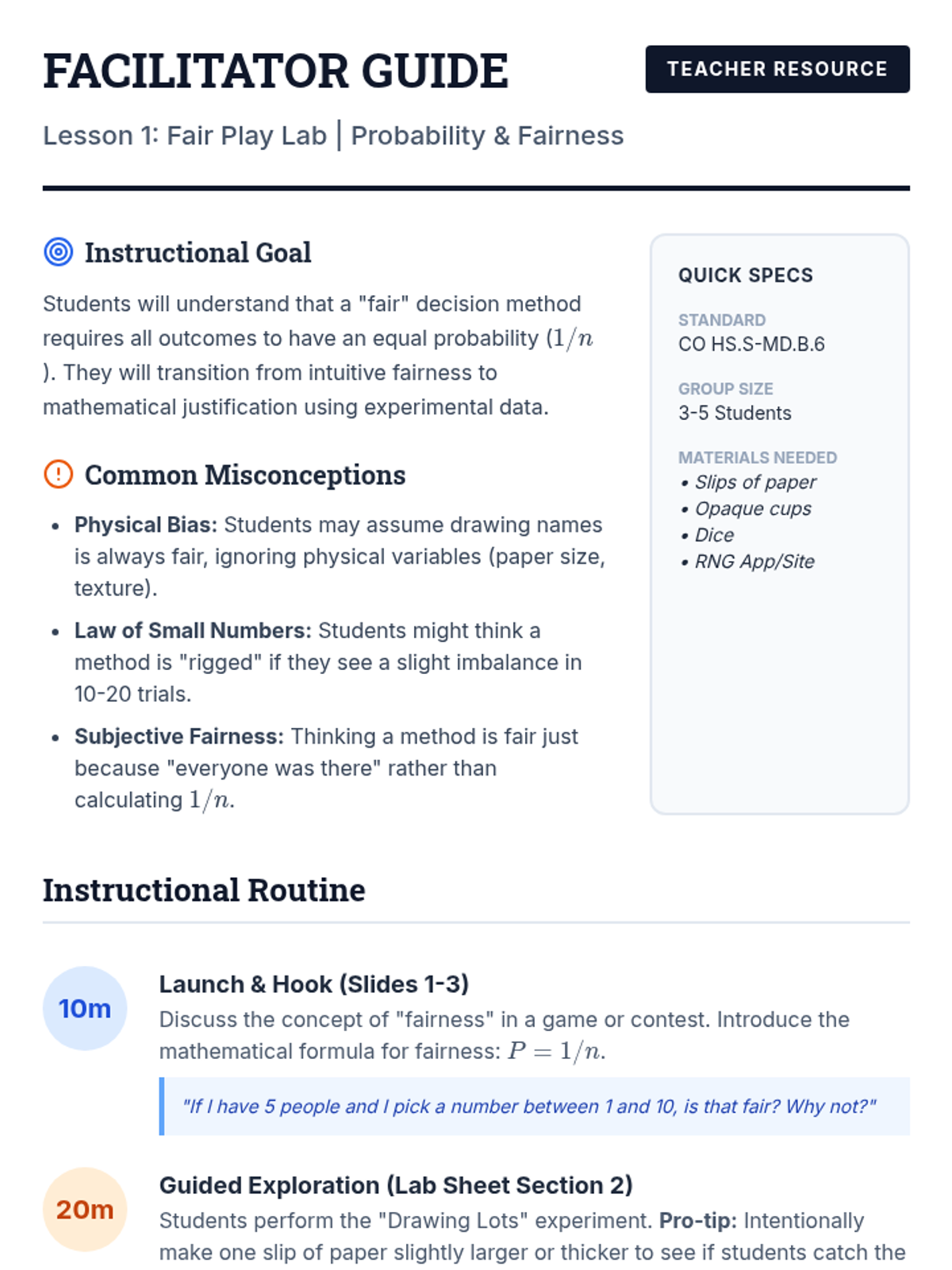
Fair Play Facilitator Guide
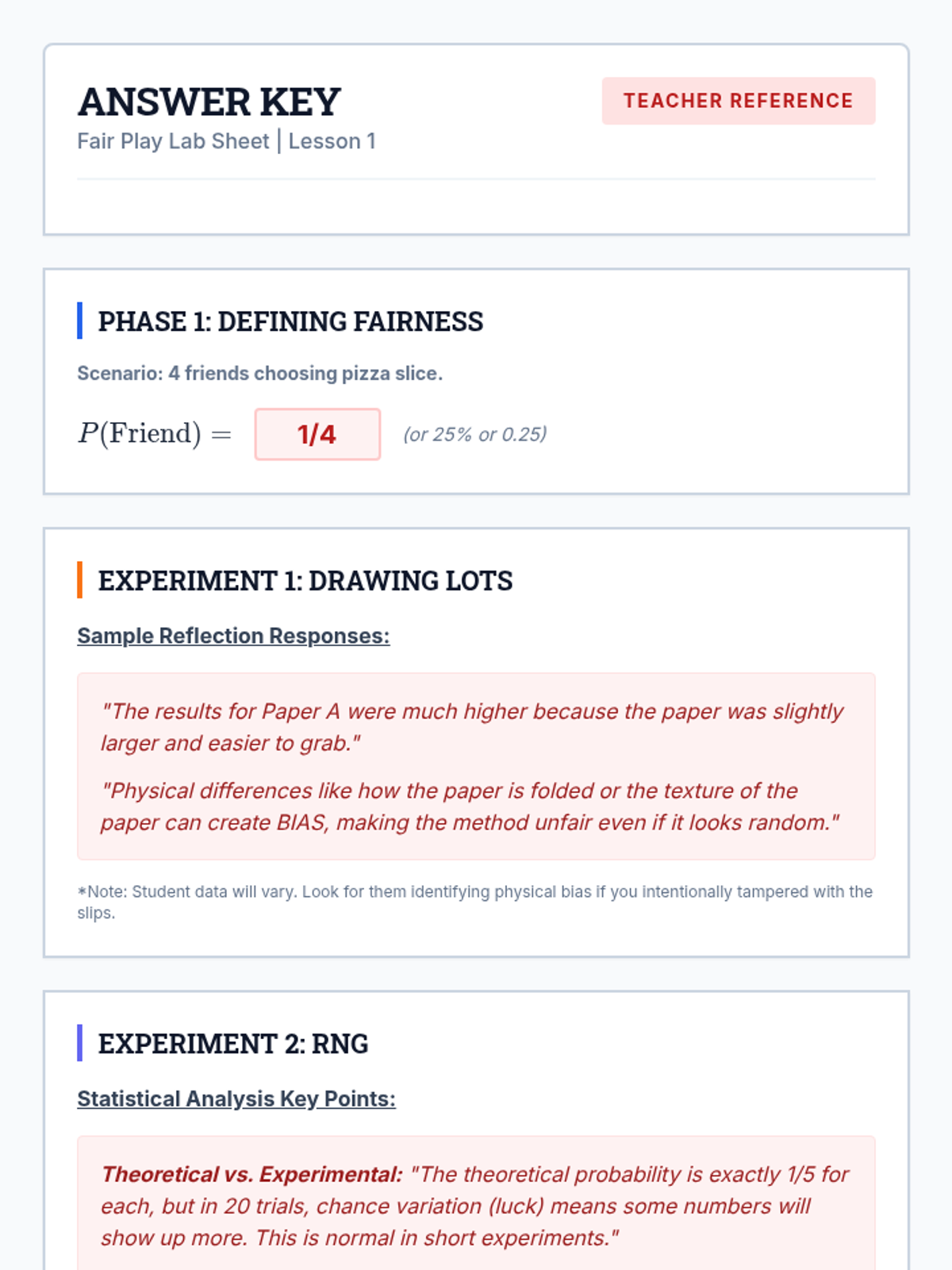
Fair Play Lab Key

Fair Play Logic

A small group intervention sequence focused on understanding and applying probability to ensure fair decision-making, specifically designed for students needing extra support in High School Statistics.

Lenny Avatar
Lenny
2/12
Sequence
Jackpot Journey Slides
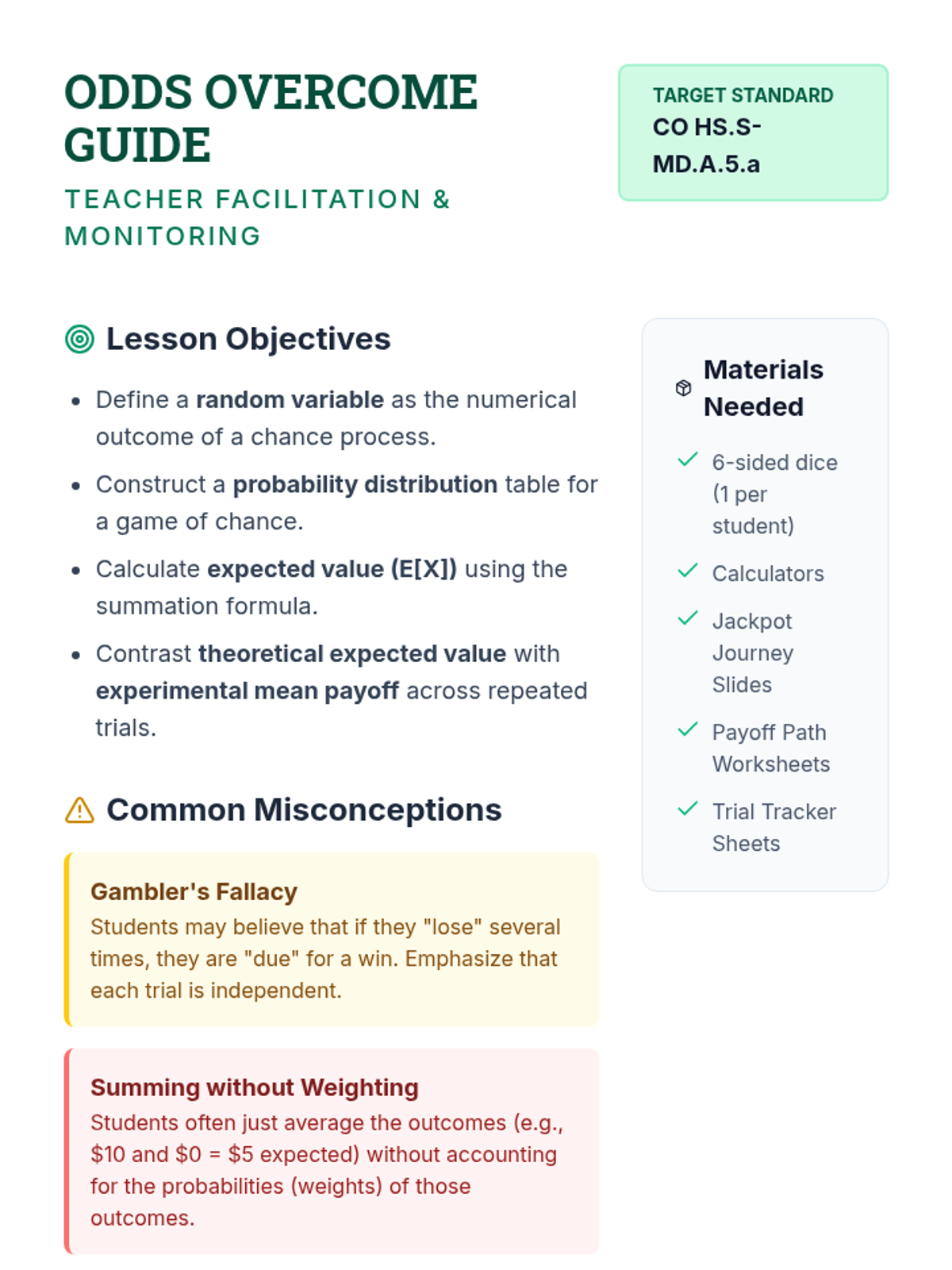
Odds Overcome Guide
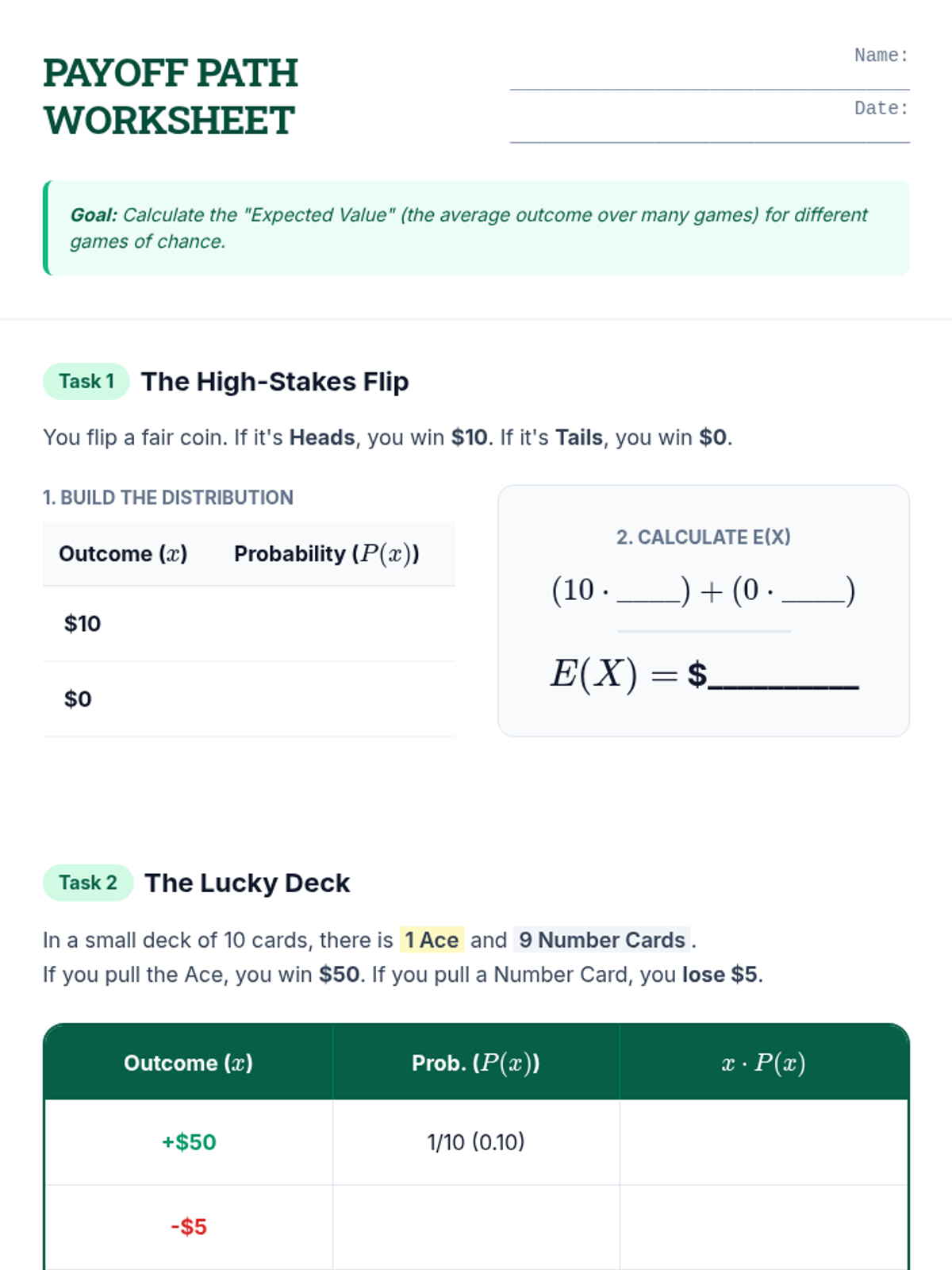
Payoff Path Worksheet
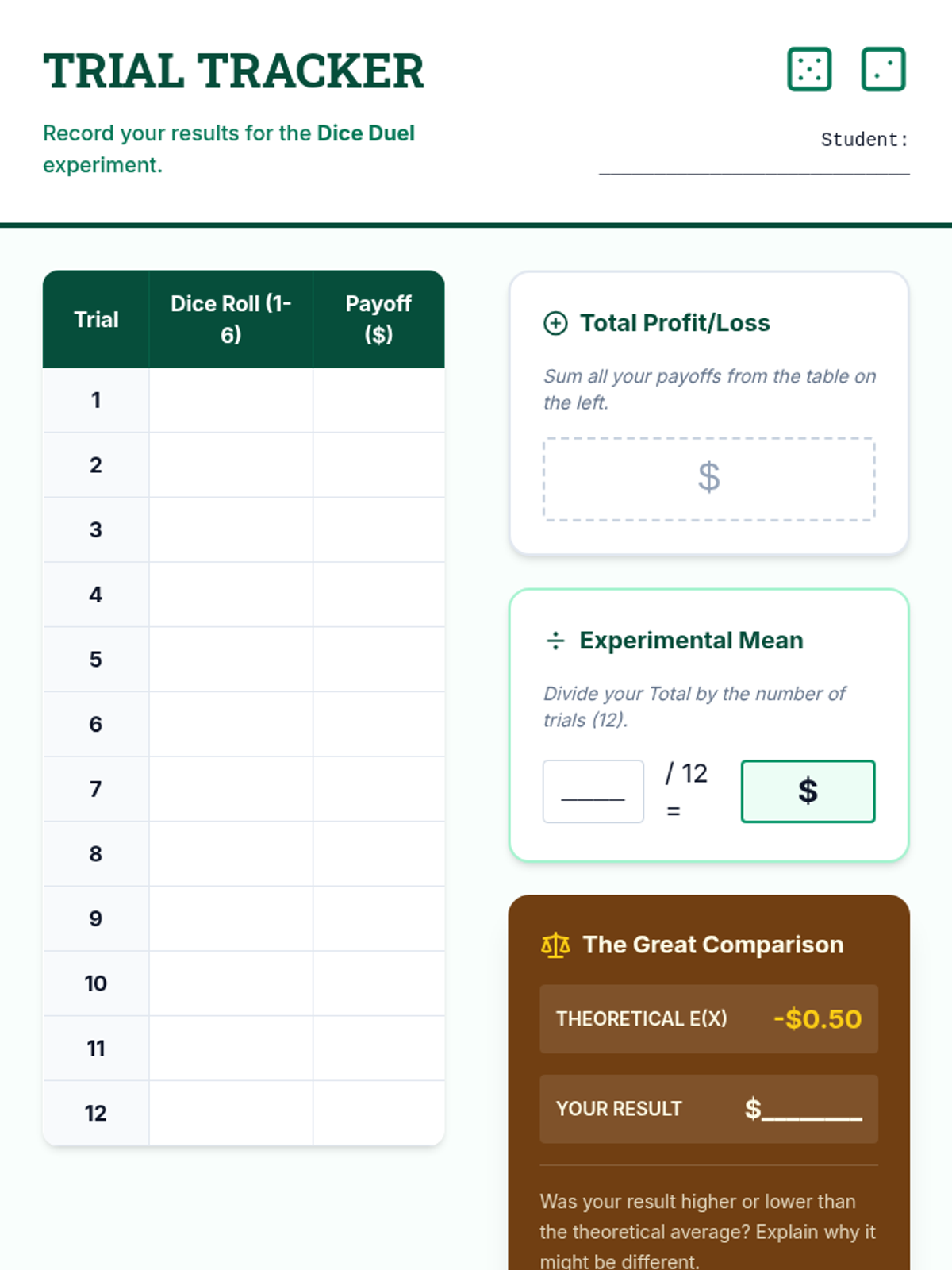
Trial Tracker Sheet
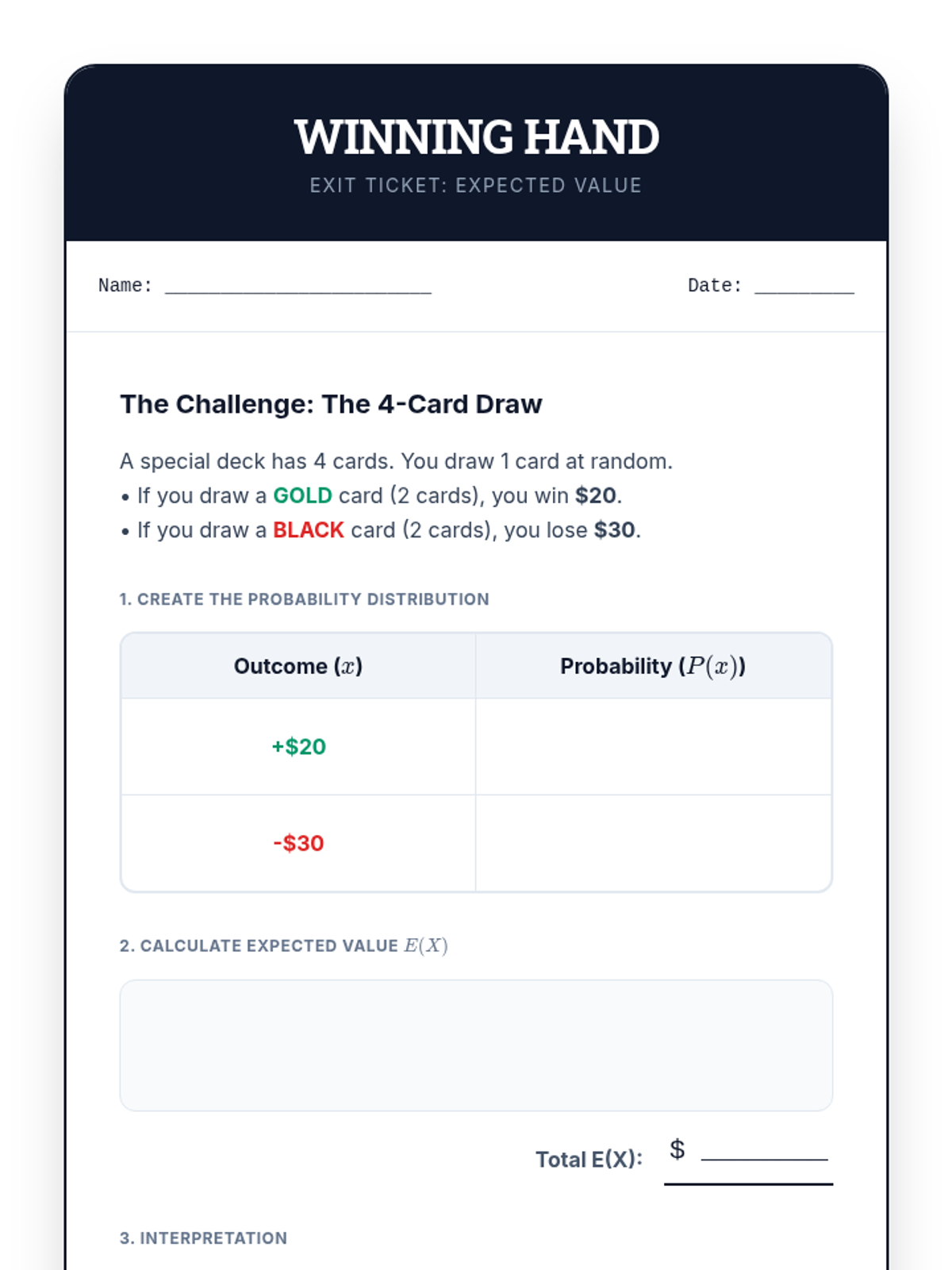
Winning Hand Exit Ticket

Luck by Numbers

A Tier 2 statistics intervention focusing on calculating and interpreting expected values in games of chance. Students transition from intuitive guesses to formal probability distributions and compare experimental data to theoretical outcomes.

Lenny Avatar
Lenny
2/12
Sequence
Probability Blueprint Slides
Student Blueprint Activity Sheet
Blueprint Facilitator Guide
Blueprint Exit Ticket
Blueprint Exit Ticket Answer Key

Probability Blueprint Intervention

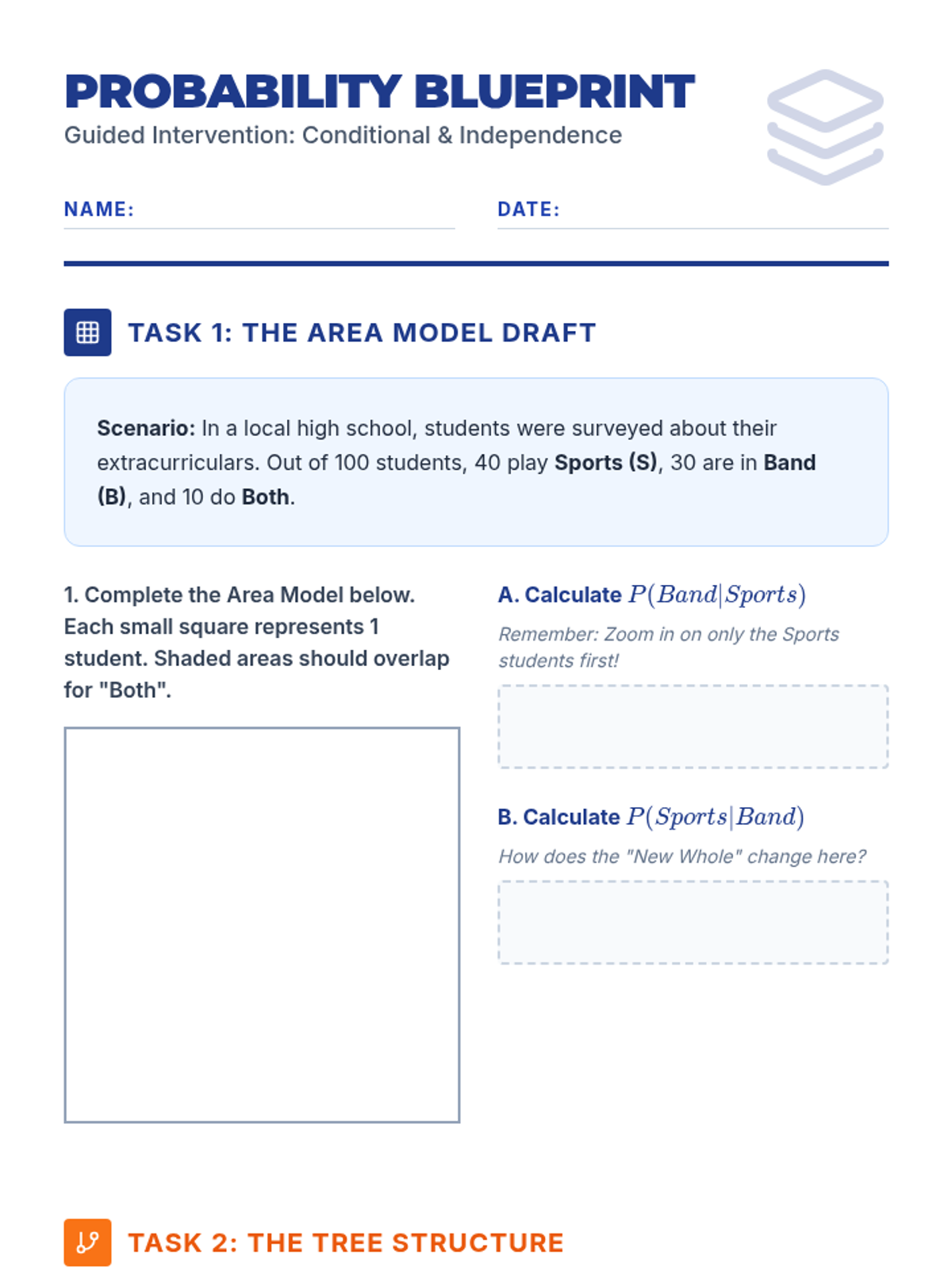
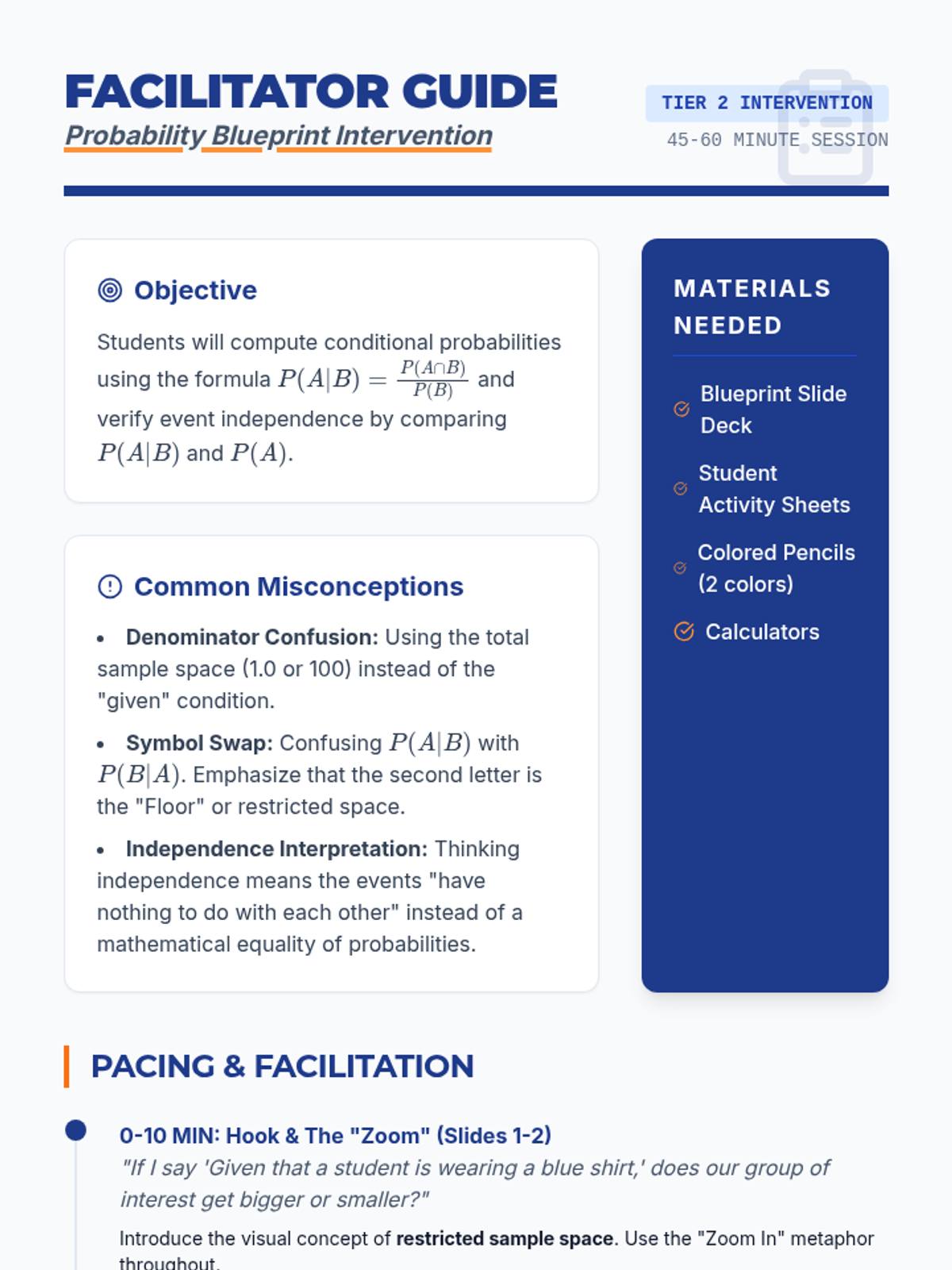
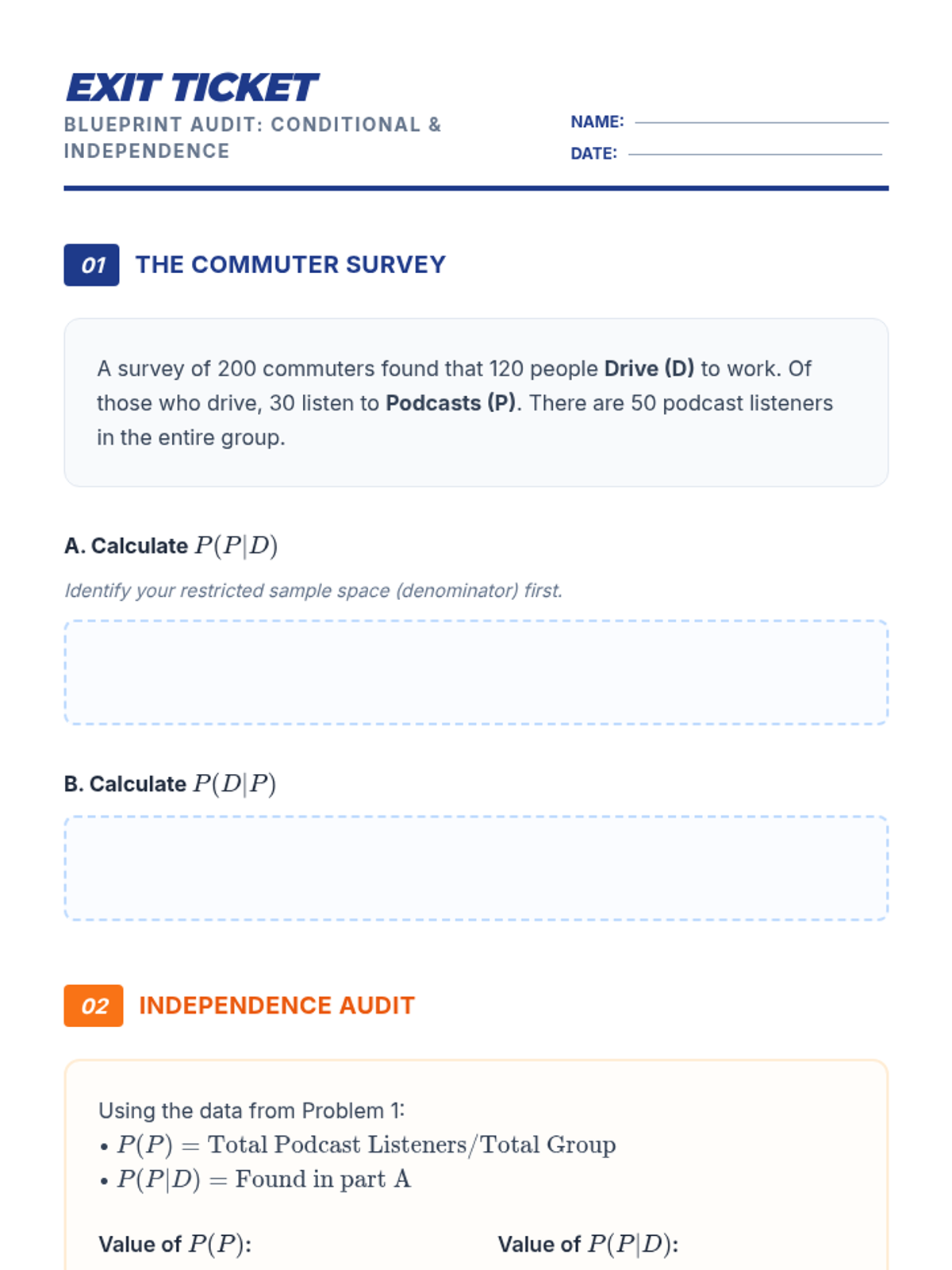
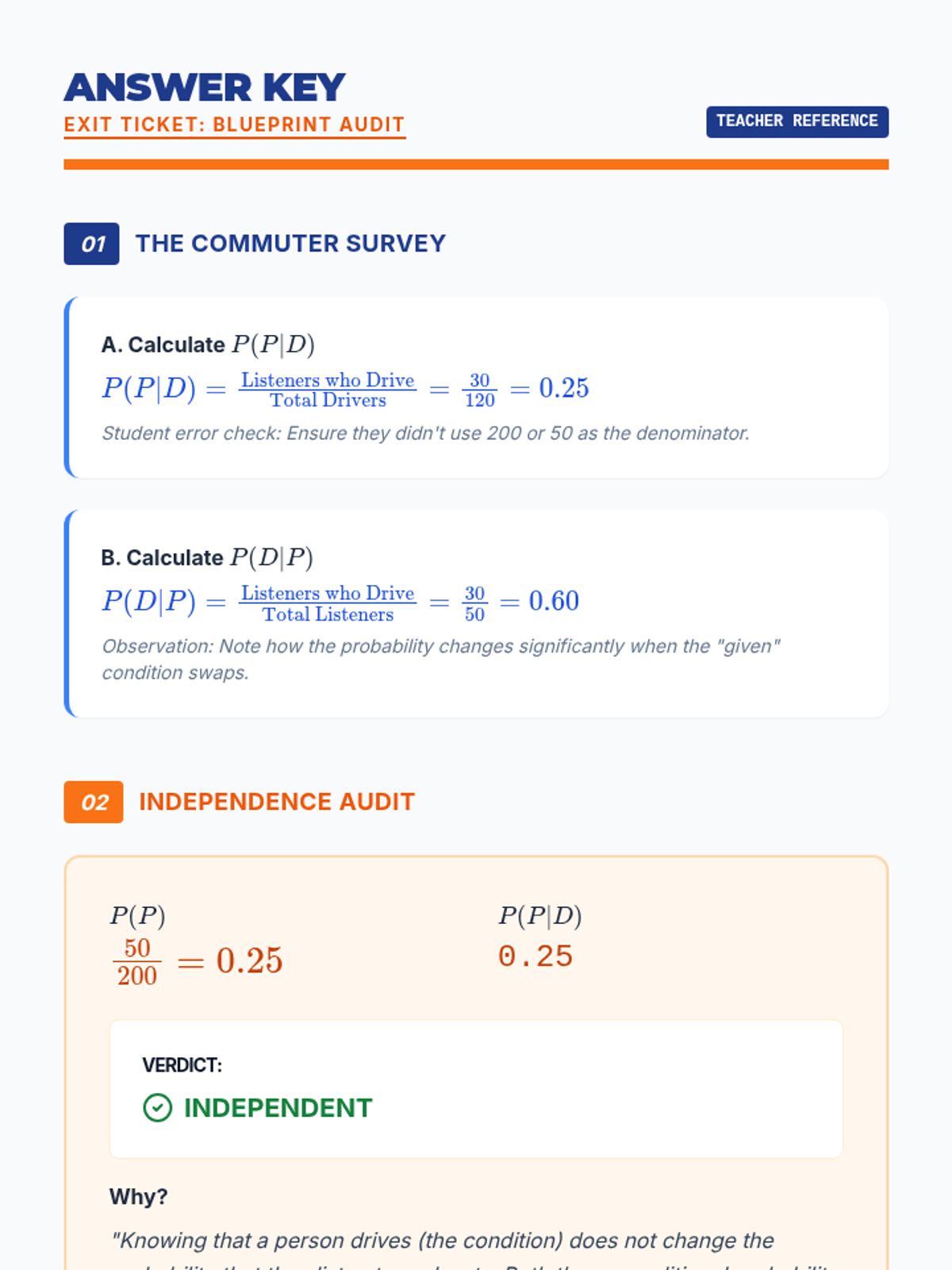
A targeted Tier 2 intervention sequence focused on conditional probability and independence for high school students. This sequence emphasizes visual models like tree diagrams and area models to bridge conceptual understanding to formal notation.

Lenny Avatar
Lenny
2/12
Sequence
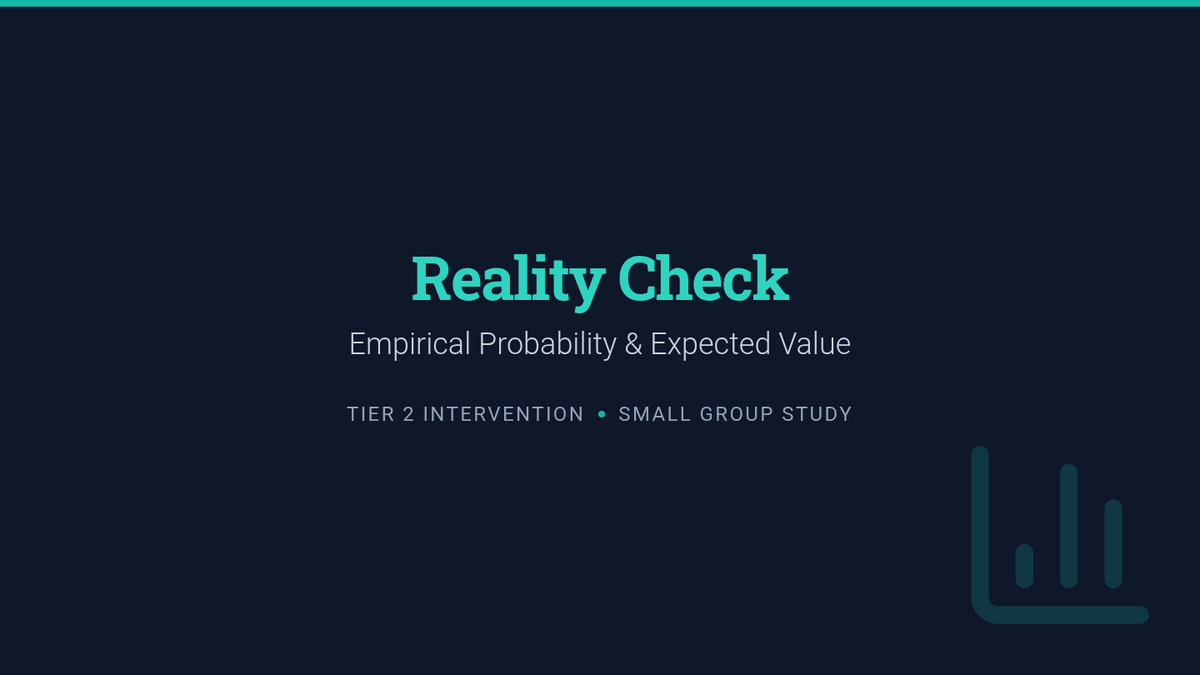
Reality Check Slides
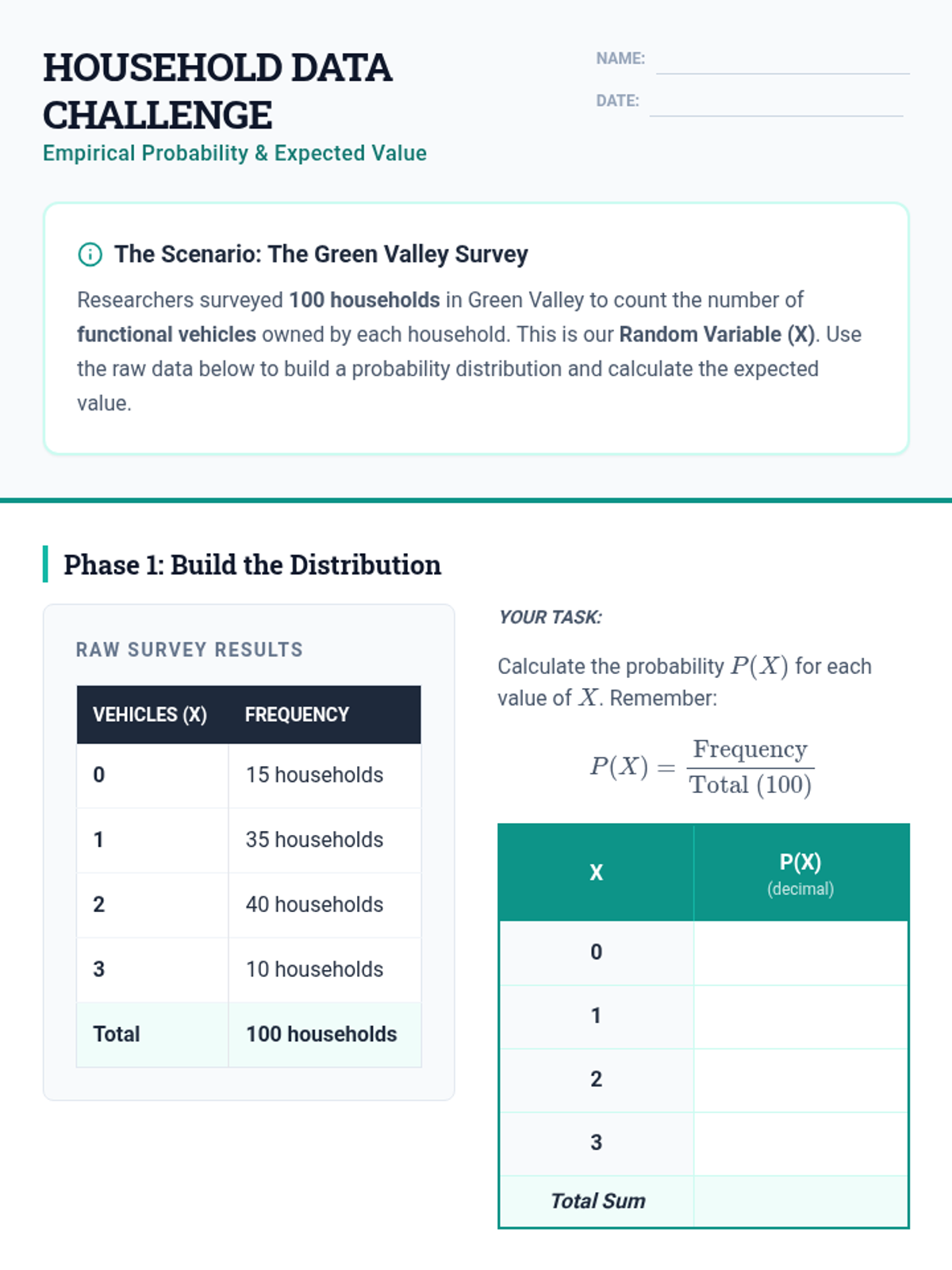
Household Data Challenge Worksheet
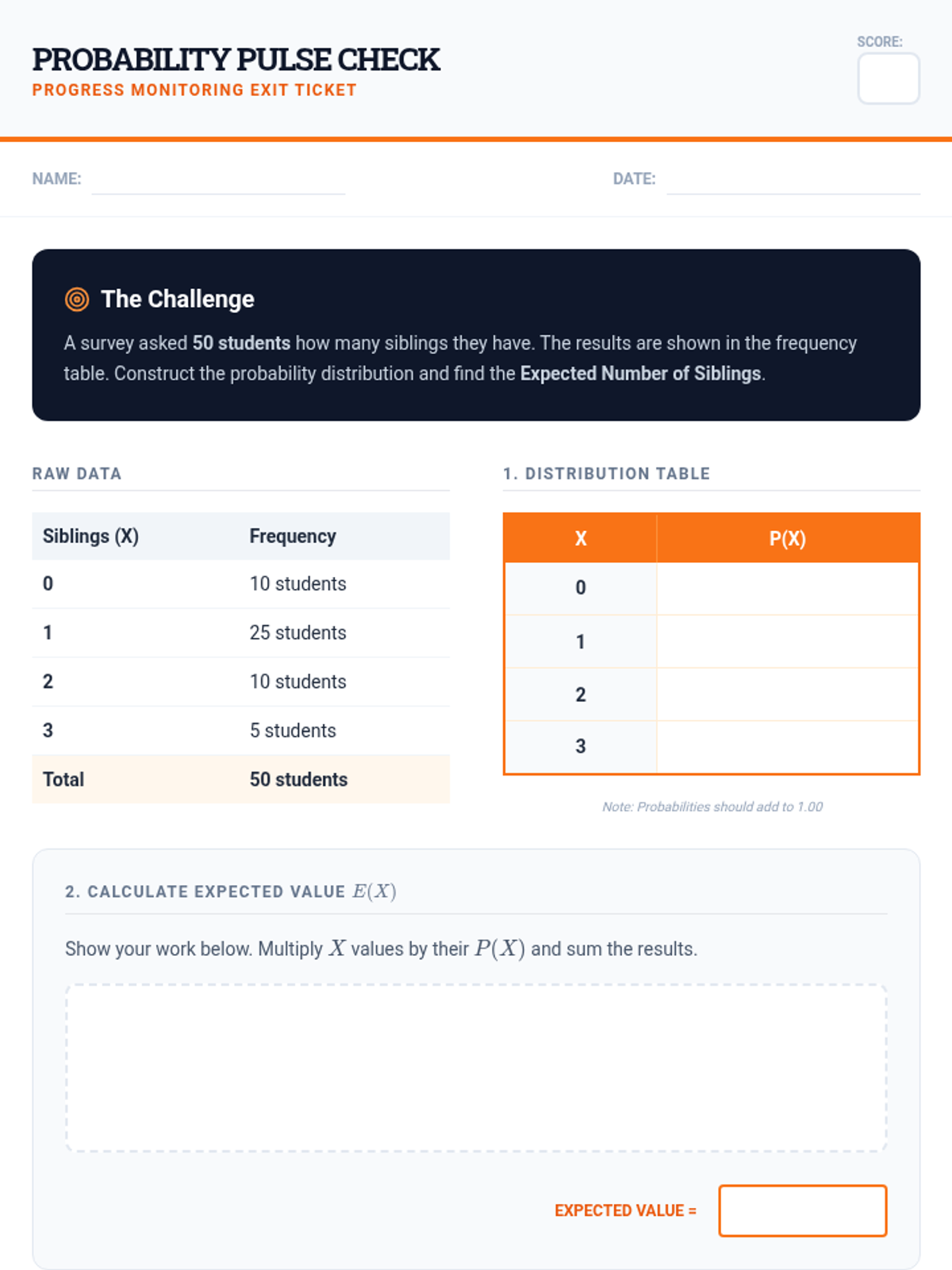
Probability Pulse Check Assessment
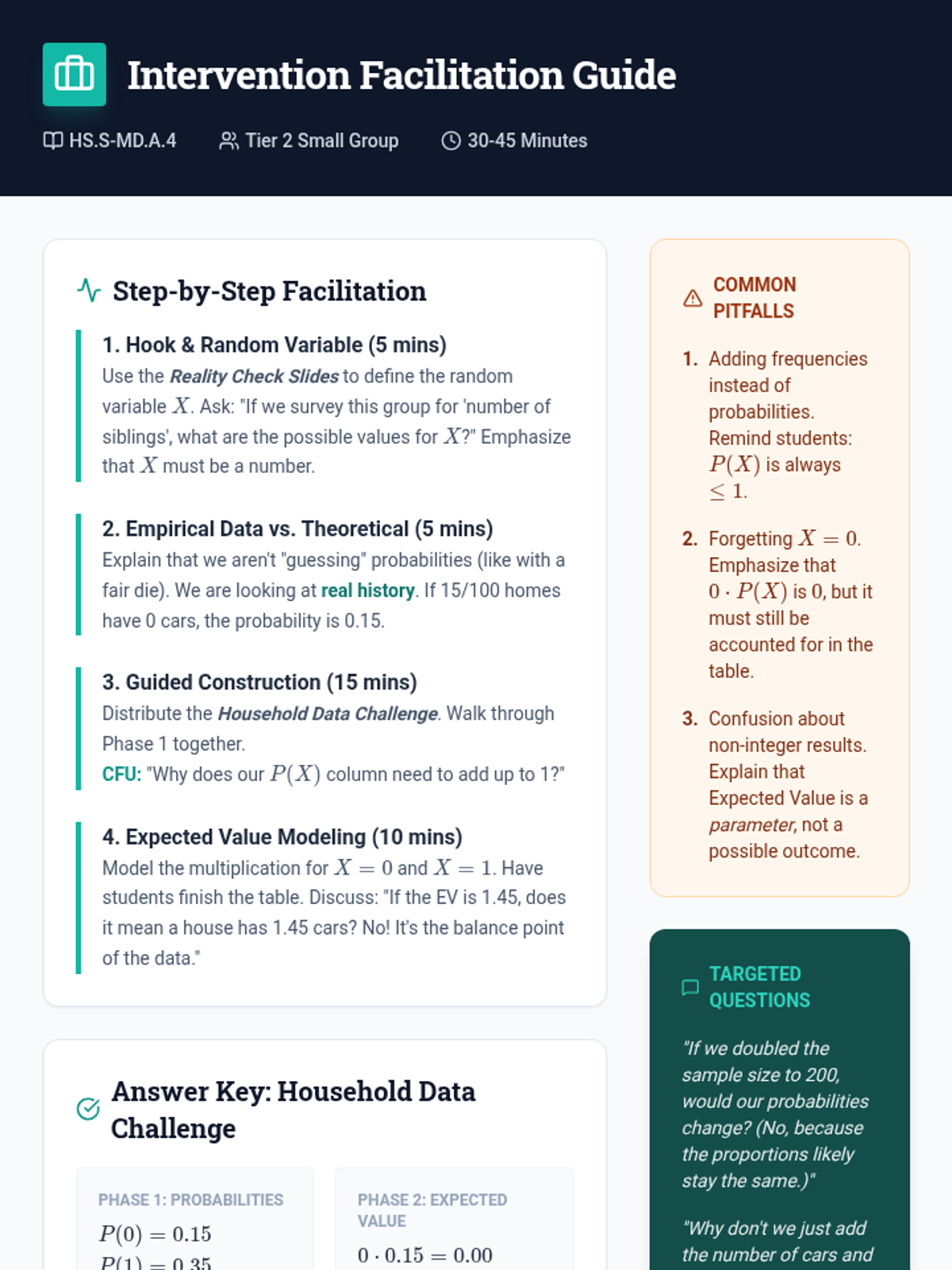
Intervention Facilitation Guide

Reality Check Probability

A Tier 2 intervention sequence focused on helping students develop empirical probability distributions and calculate expected values using real-world household data. This sequence provides high-scaffolding and structured practice for small group instruction.

Lenny Avatar
Lenny
2/12
Sequence
Vault Master Guide
Variable Vault Slides
Mapping Randomness Activity
Vault Check-In

Variable Vault

A targeted intervention sequence focused on foundational probability concepts, specifically defining random variables and constructing probability distributions for high school statistics students.

Lenny Avatar
Lenny
2/12
Sequence
Intervention Roadmap Teacher Guide
Value Venture Slides
Expected Value Blueprint Worksheet
Progress Probe Exit Ticket

Expected Value Intervention

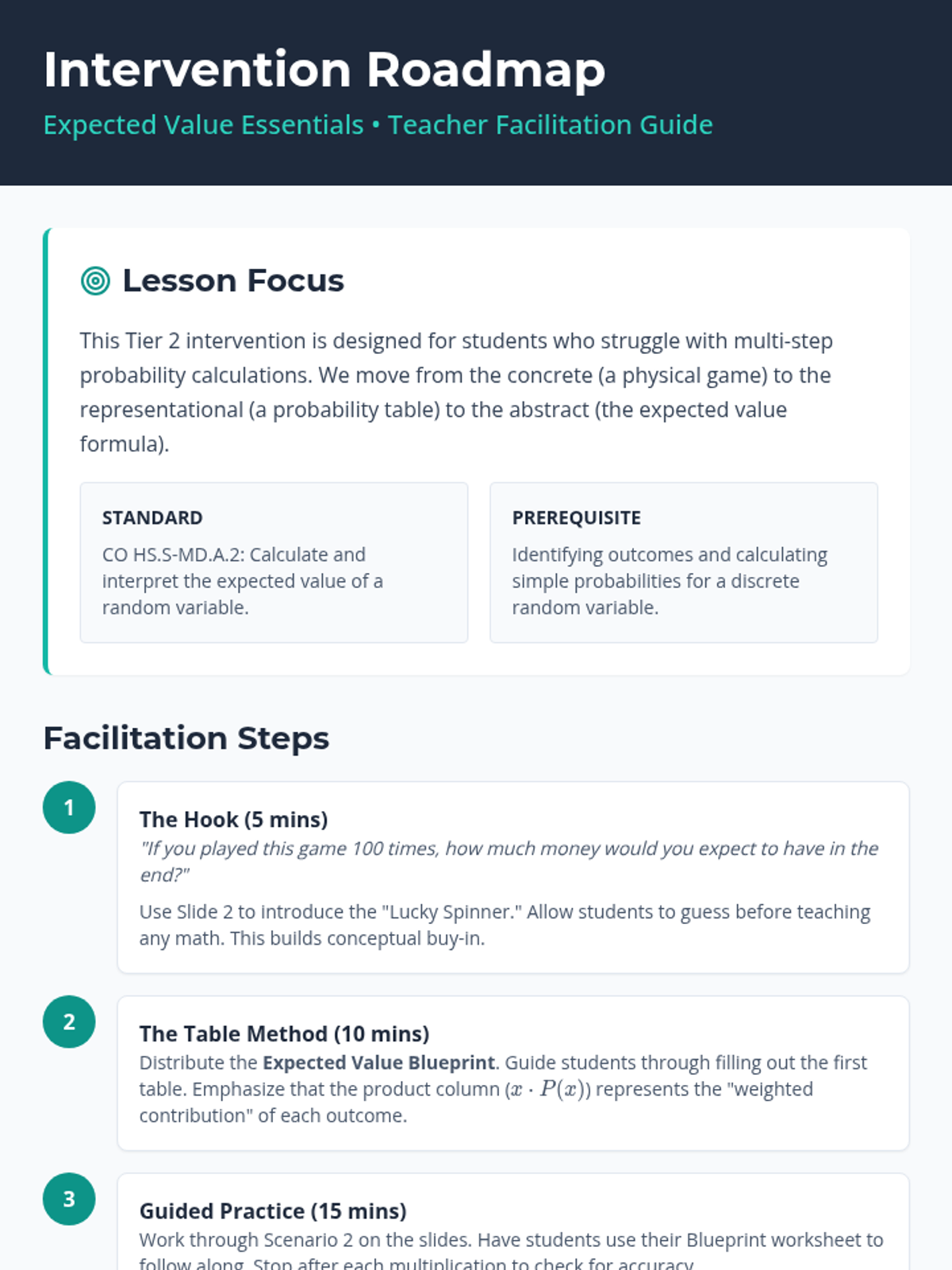
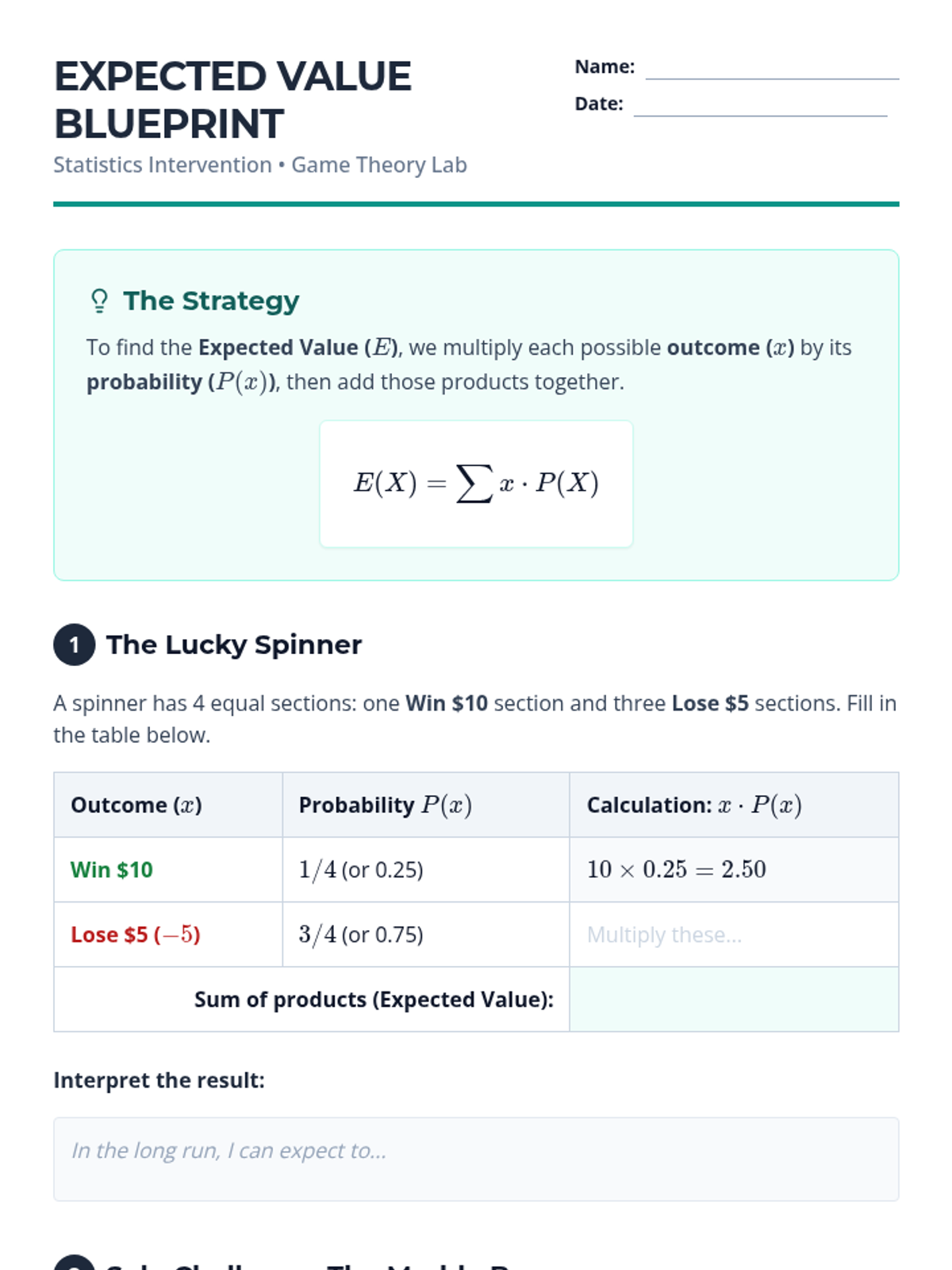
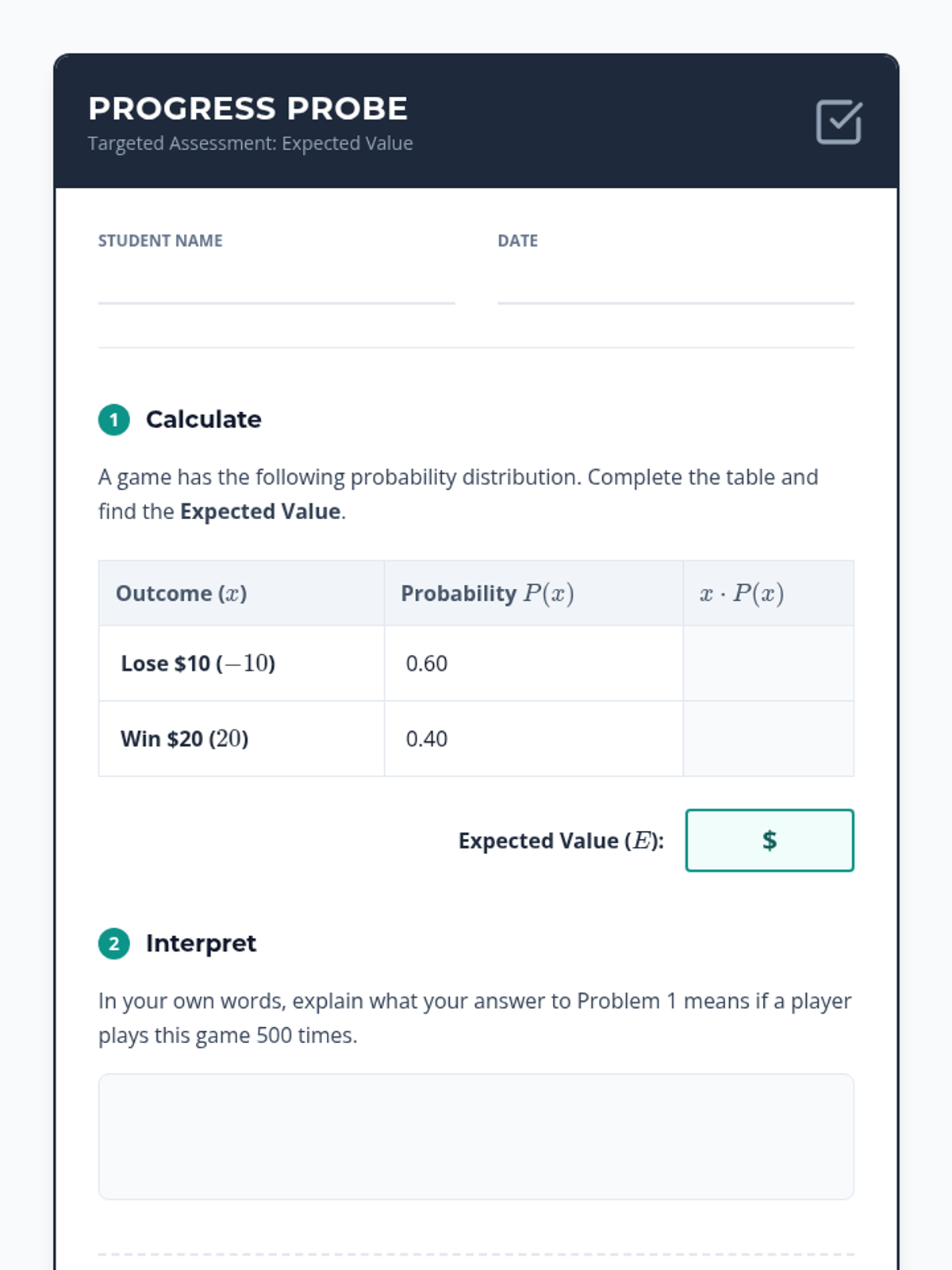
A targeted intervention sequence focused on helping High School students master the calculation and interpretation of expected value using concrete game scenarios and scaffolded table methods.

Lenny Avatar
Lenny
2/12
Sequence
Probability Roadmap Teacher Guide
Distribution Discovery Slides
Value Venture Activity
Distribution Check Exit Ticket
Probability Intervention Answer Key

Probability Pros

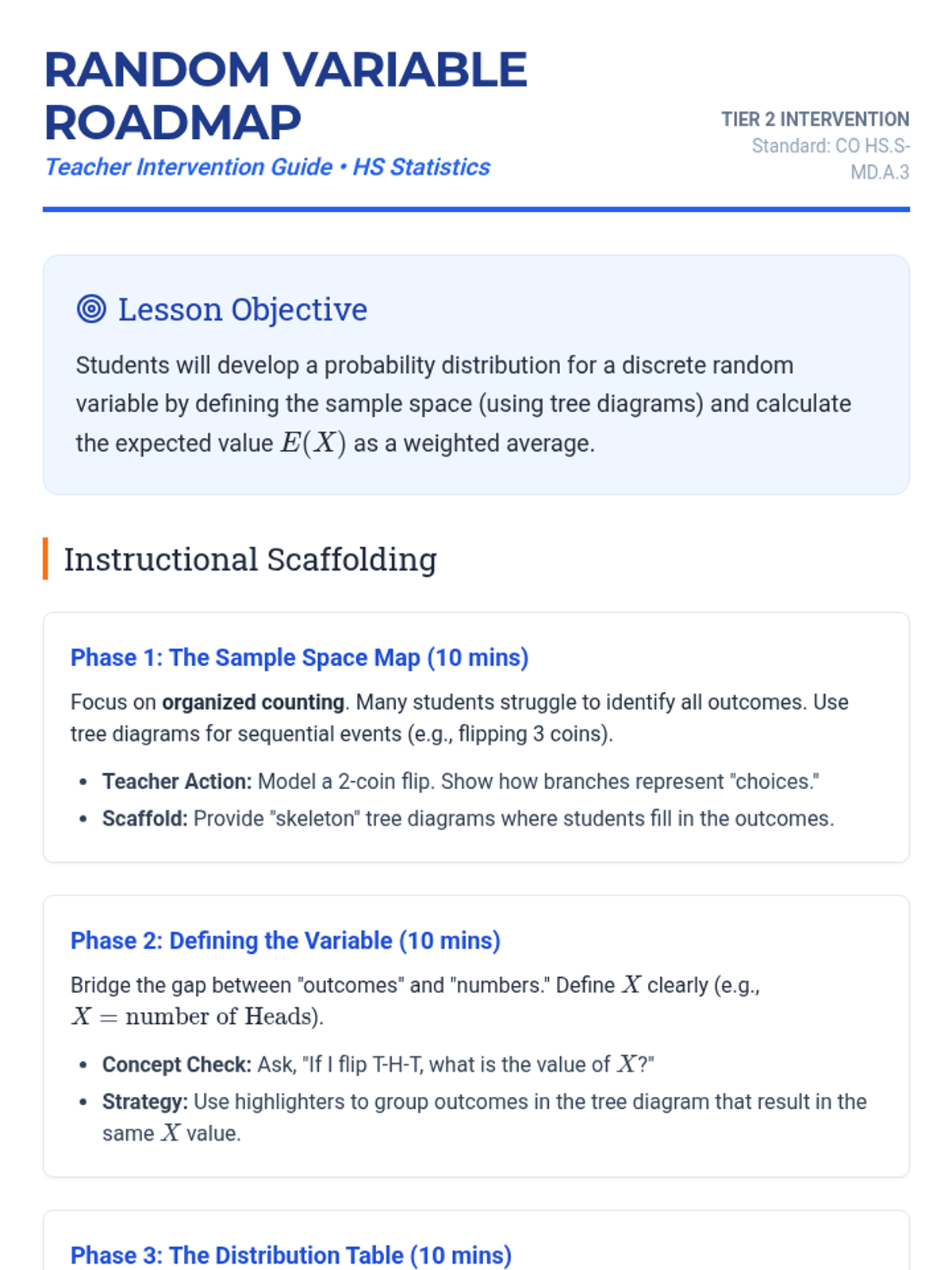
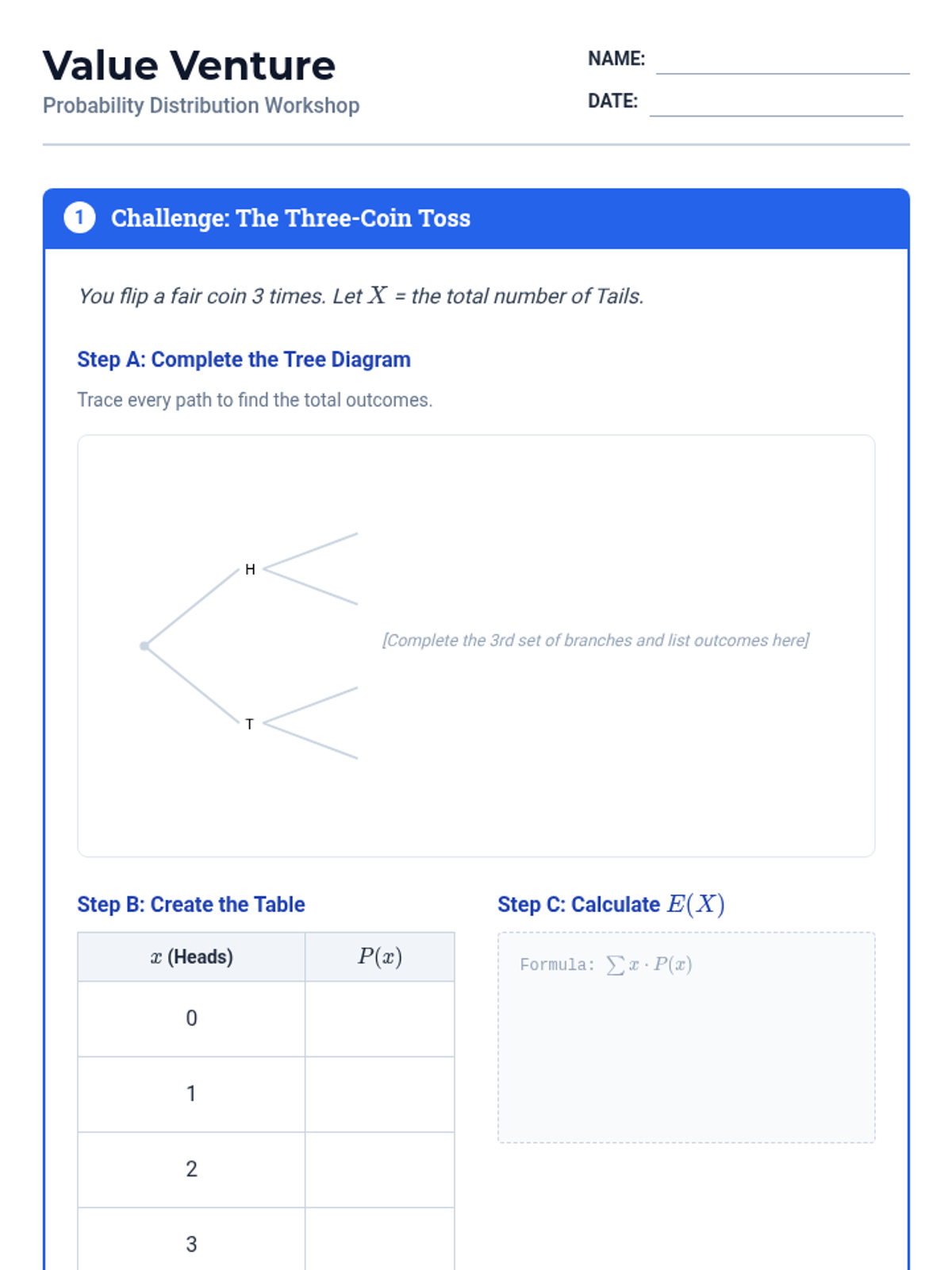
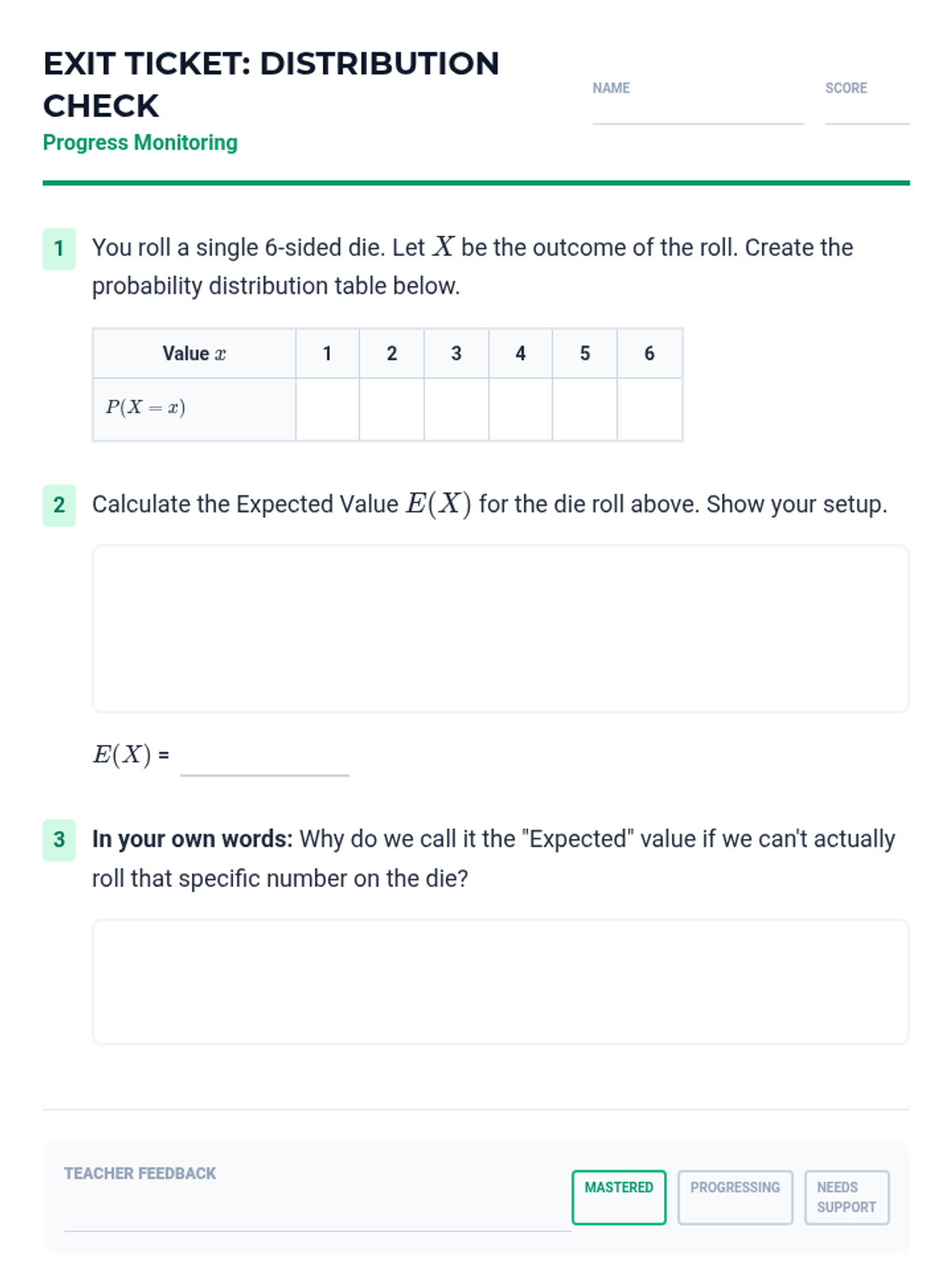
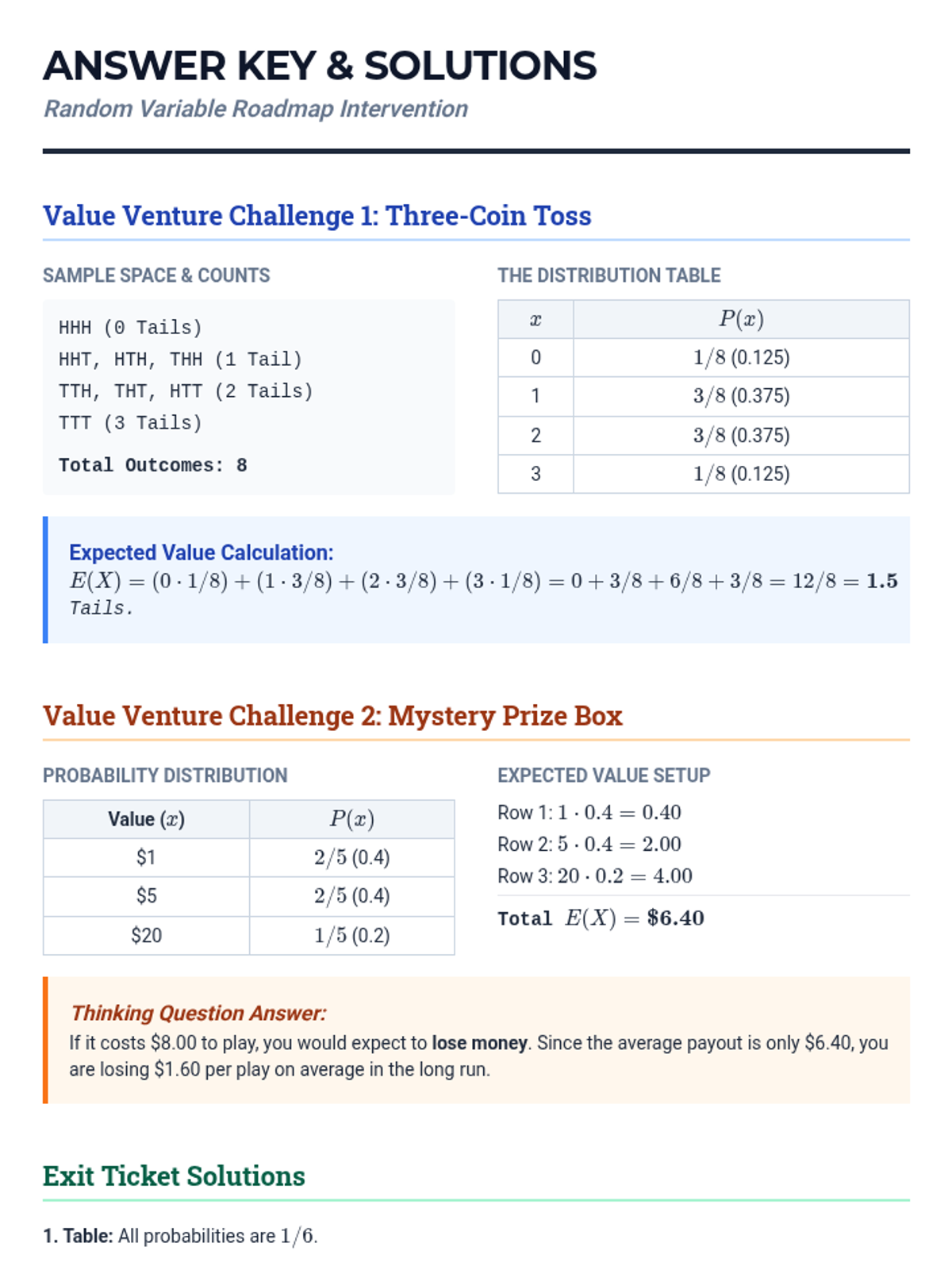
A targeted intervention sequence focused on foundational probability concepts, specifically developing discrete probability distributions and calculating expected values through visual scaffolds like tree diagrams and organized counting.

Lenny Avatar
Lenny
2/12
Sequence
Filter Focus Slides
Outcome Tracker Worksheet
Probability Probe Exit Ticket
Intervention Intel Teacher Guide

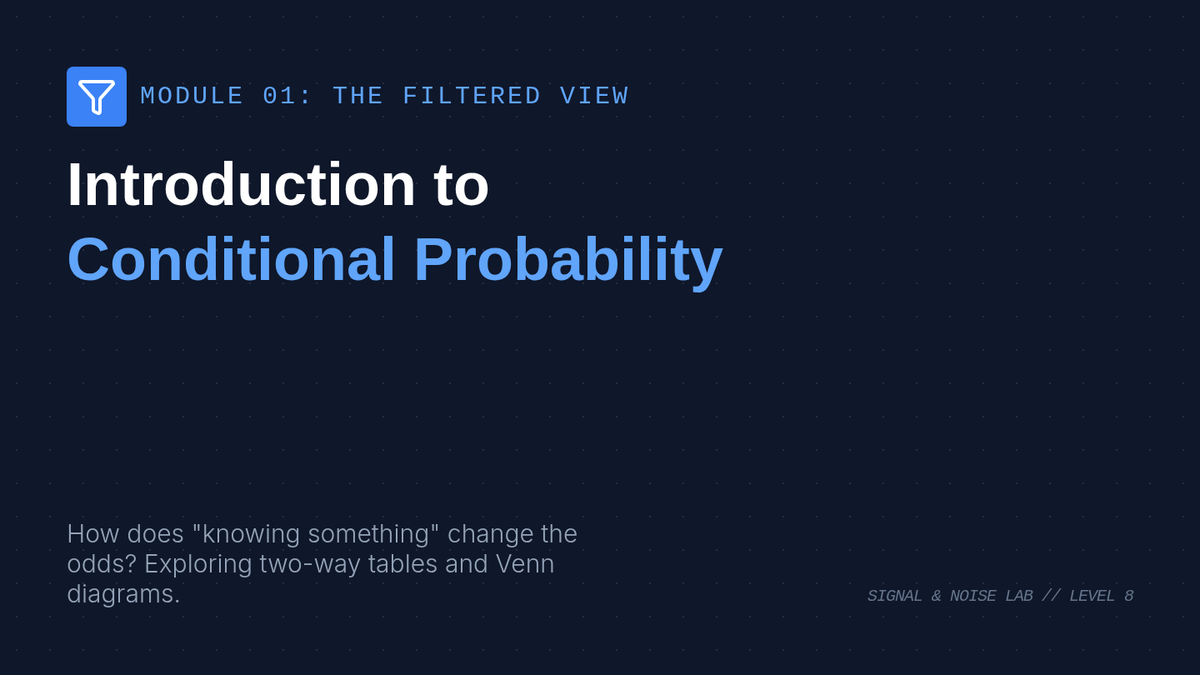
Conditional Probability Focus

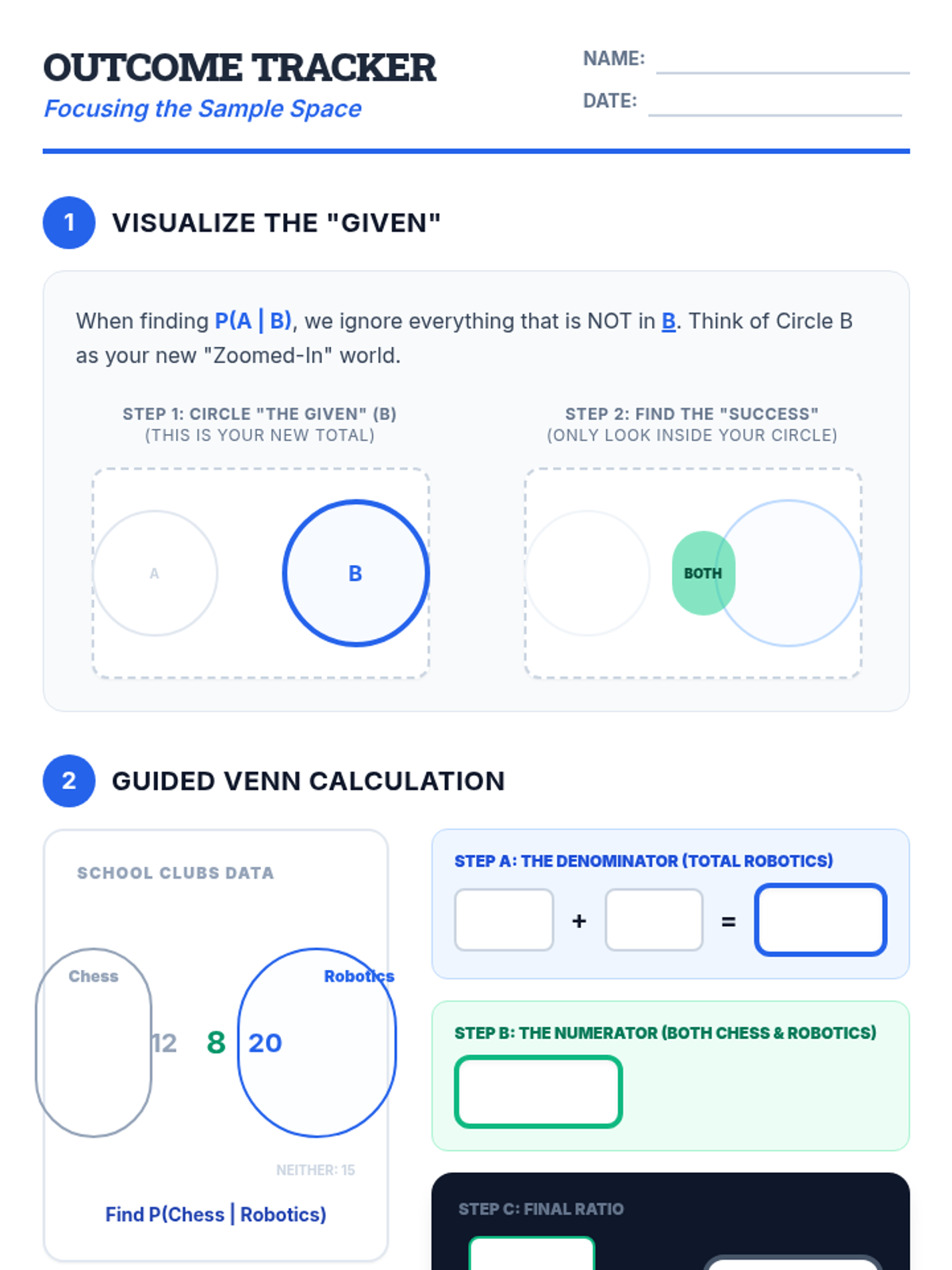
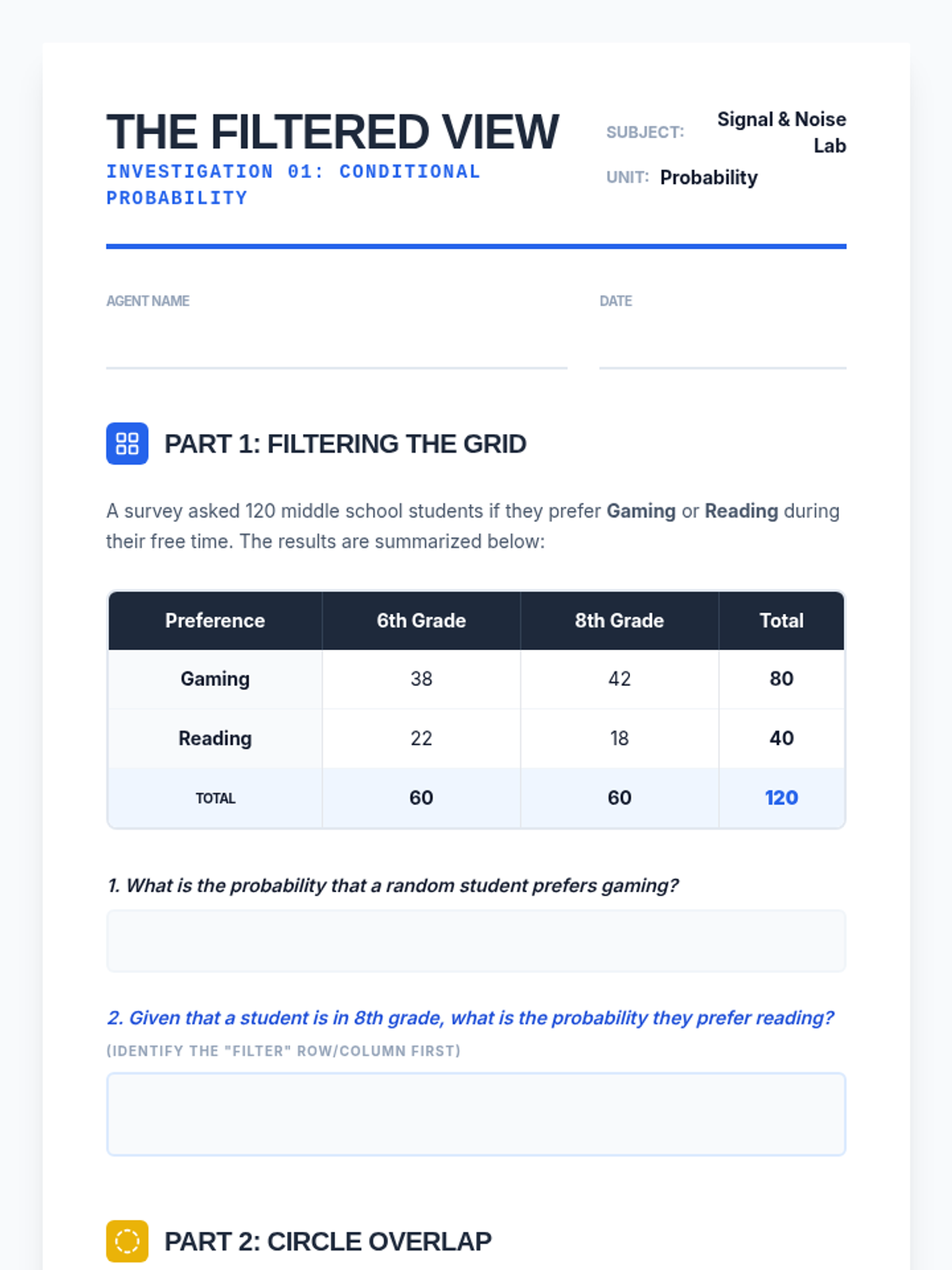
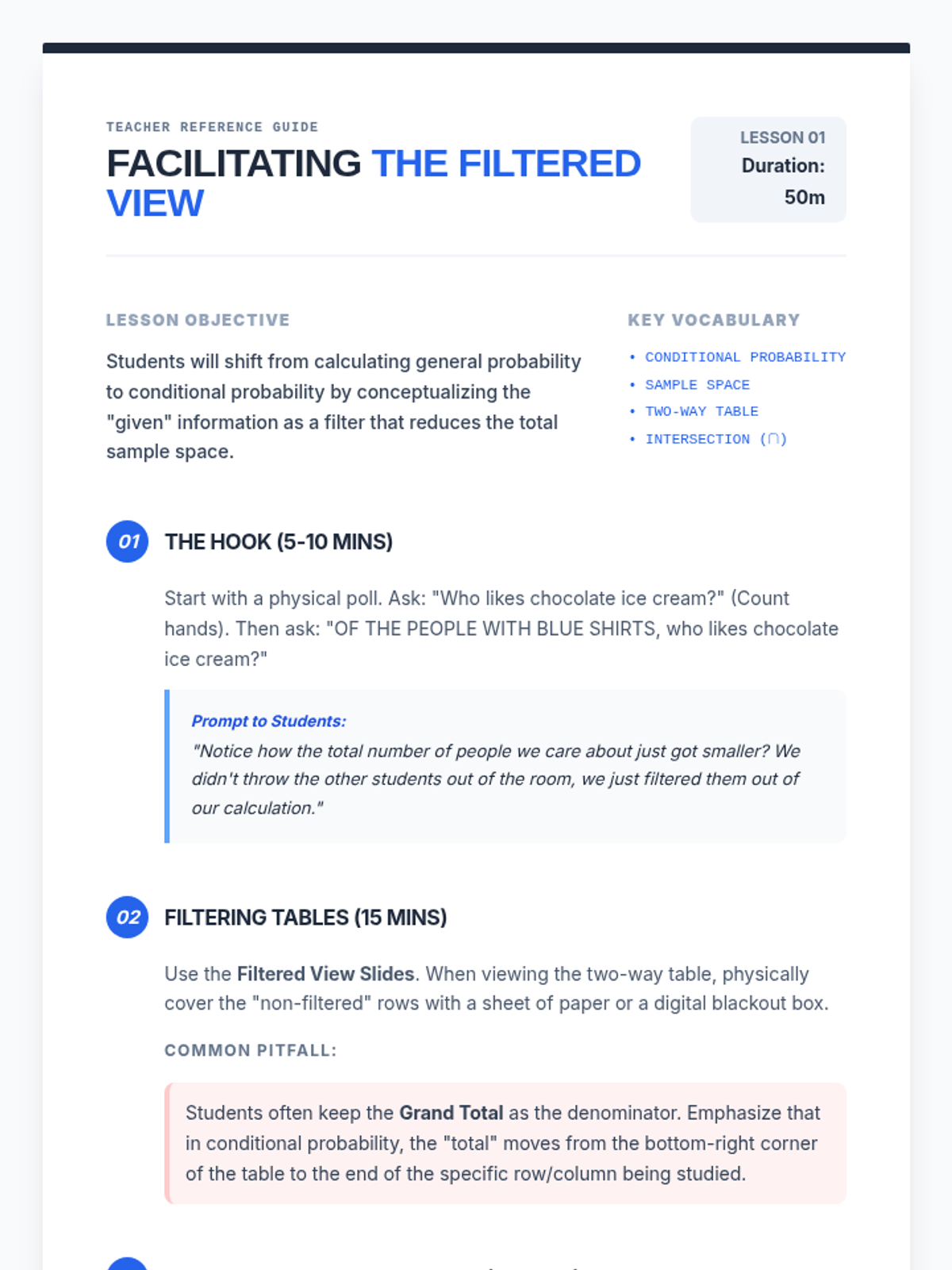
A Tier 2 intervention sequence focused on mastering conditional probability through visual filters and fractional reasoning. Students learn to restrict their sample space to the 'given' condition using Venn diagrams and tables.

Lenny Avatar
Lenny
2/12
Sequence
Independence Insight Slides
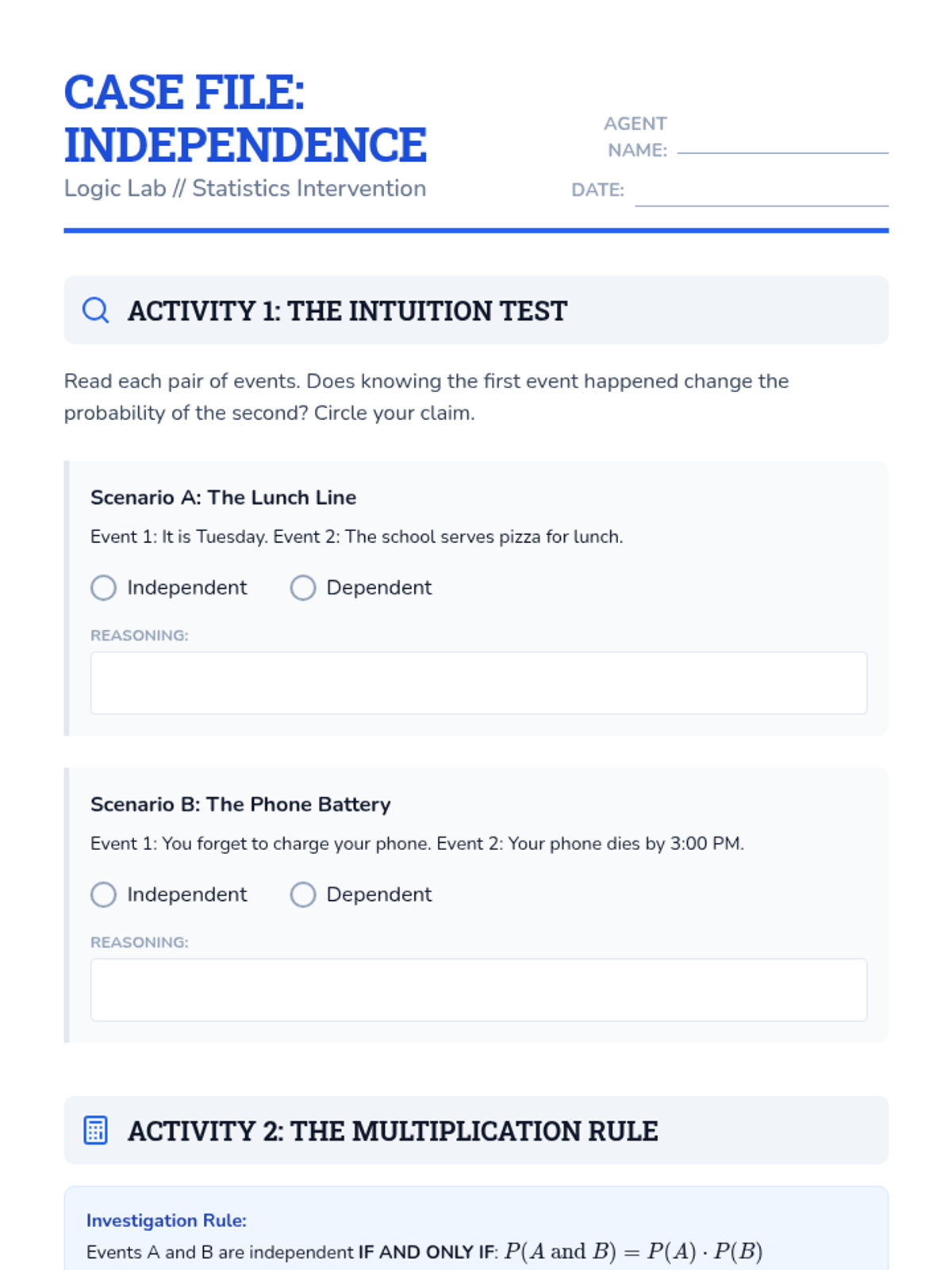
Case File Worksheet
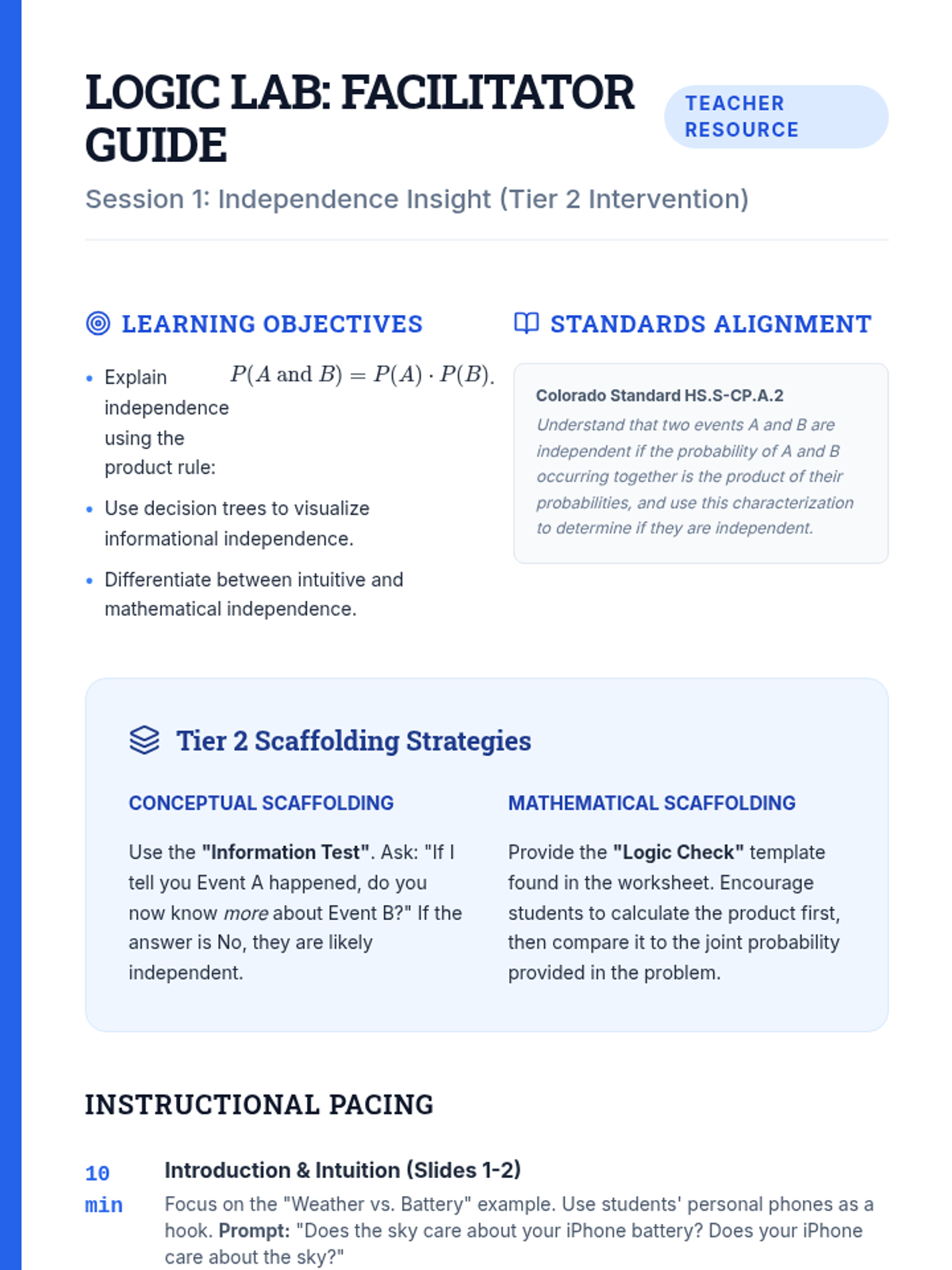
Logic Lab Teacher Guide
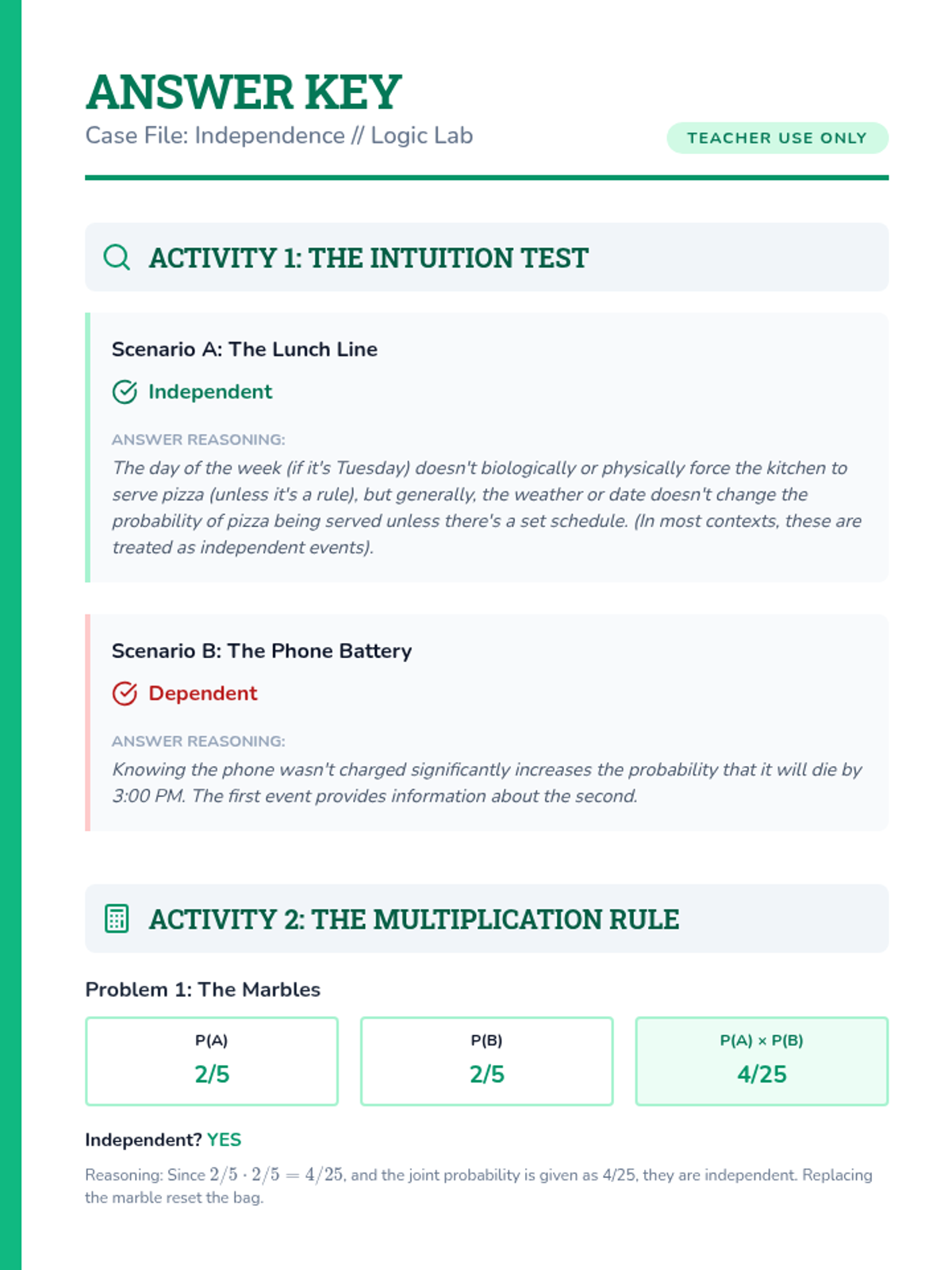
Logic Lab Answer Key

Probability Detectives

A targeted intervention sequence focused on understanding and calculating the independence of events through structured reasoning and decision trees.

Lenny Avatar
Lenny
2/12
Sequence
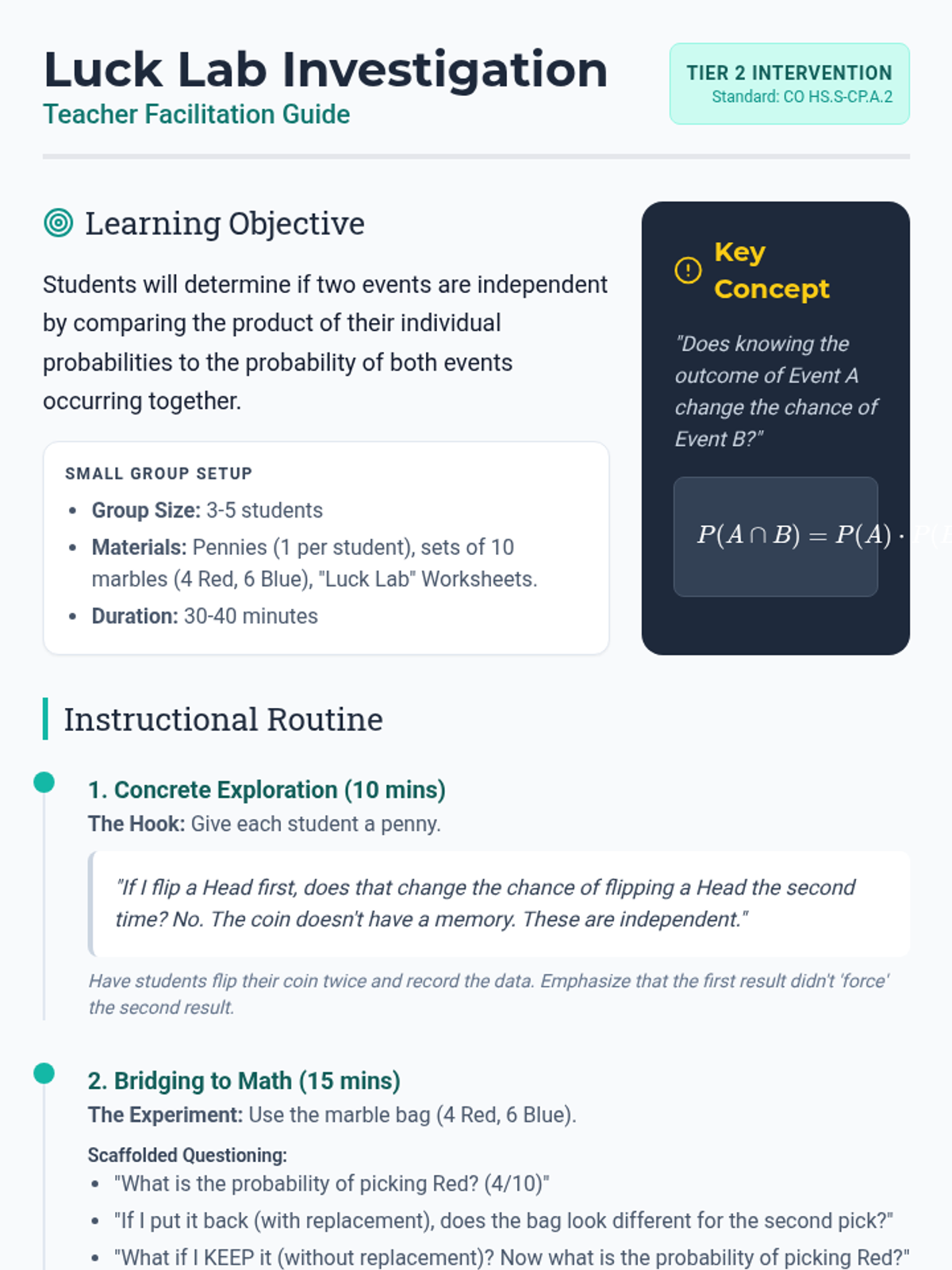
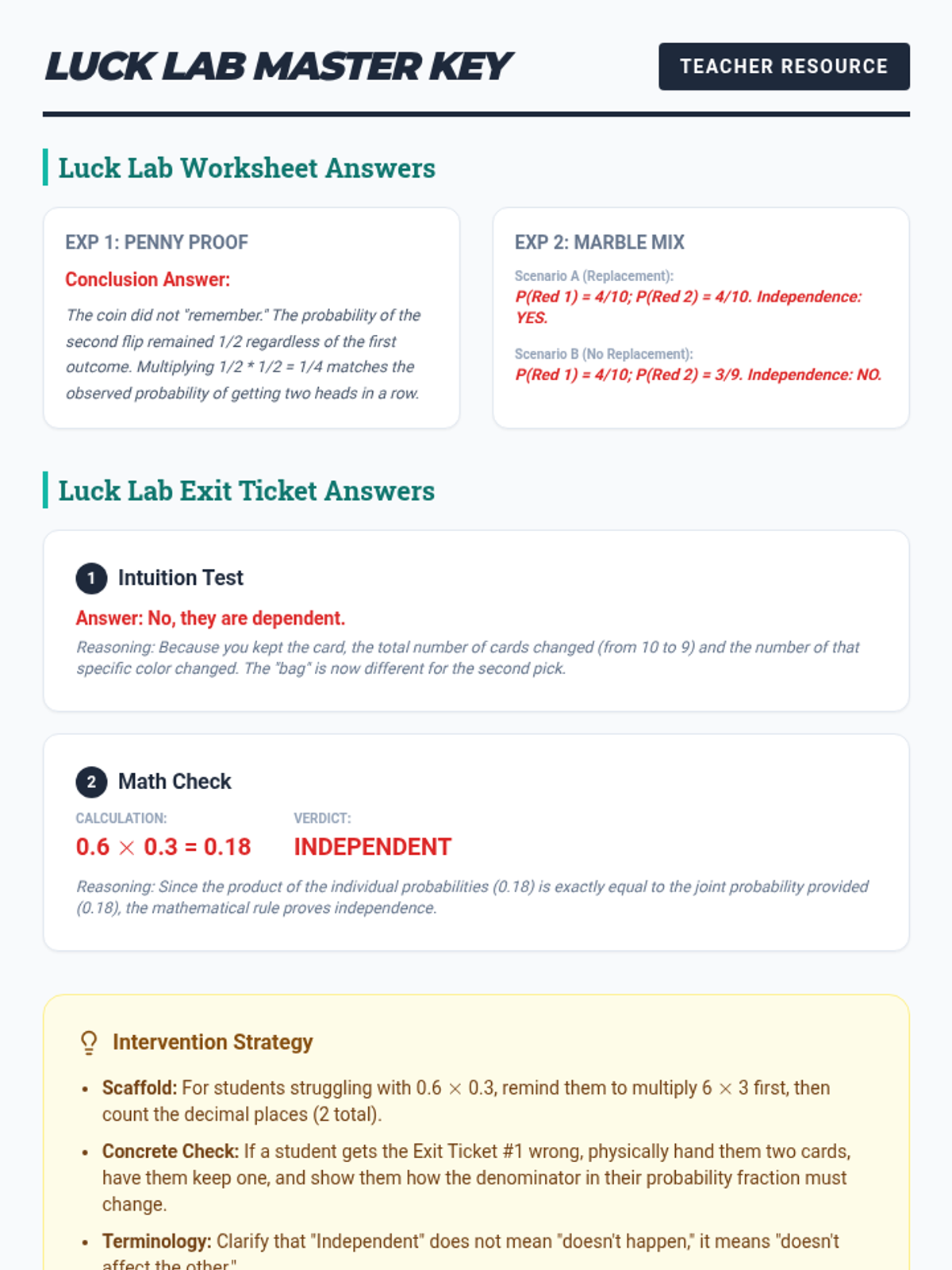
Investigation Guide Teacher Guide
Luck Lab Slides
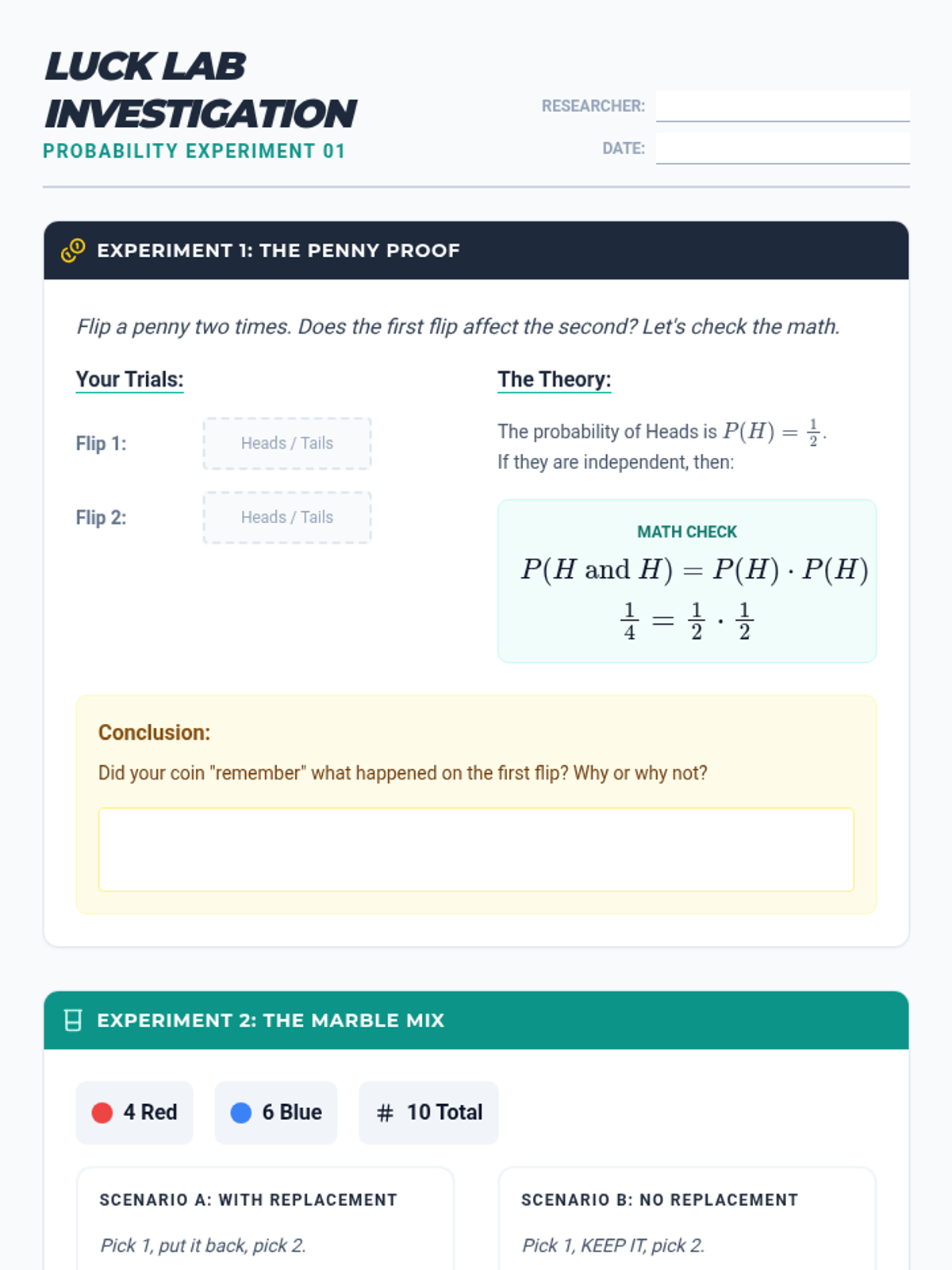
Luck Lab Worksheet
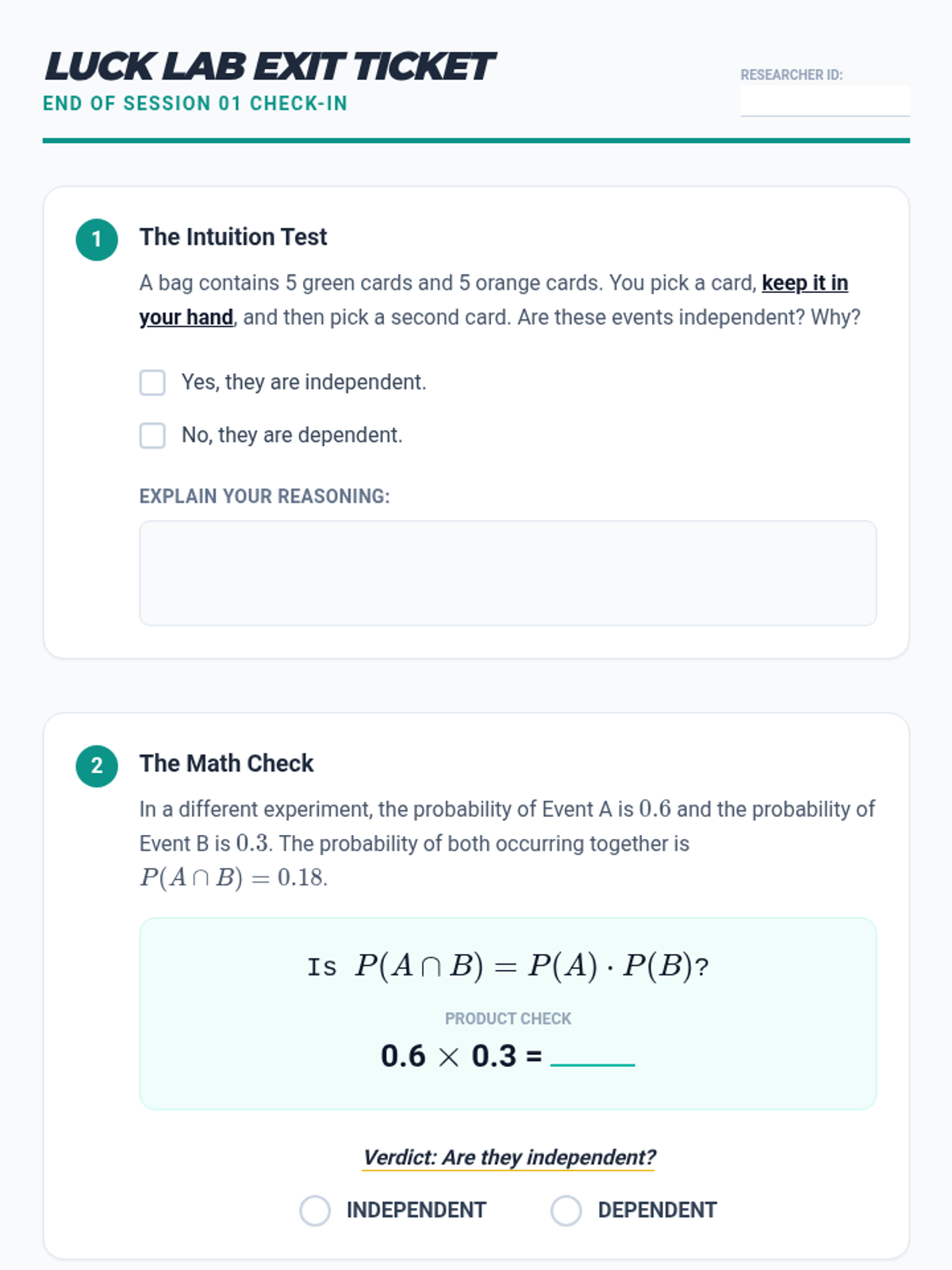
Luck Lab Exit Ticket
Luck Lab Answer Key

Independence Investigation

A targeted Tier 2 intervention unit focused on understanding and calculating the independence of two events using the multiplication rule. This sequence uses concrete manipulative-based experiments to bridge the gap between intuition and formal probability notation.

Lenny Avatar
Lenny
2/12
Sequence
Probability Lab Guide
Probability Lab Slides

Probability Lab

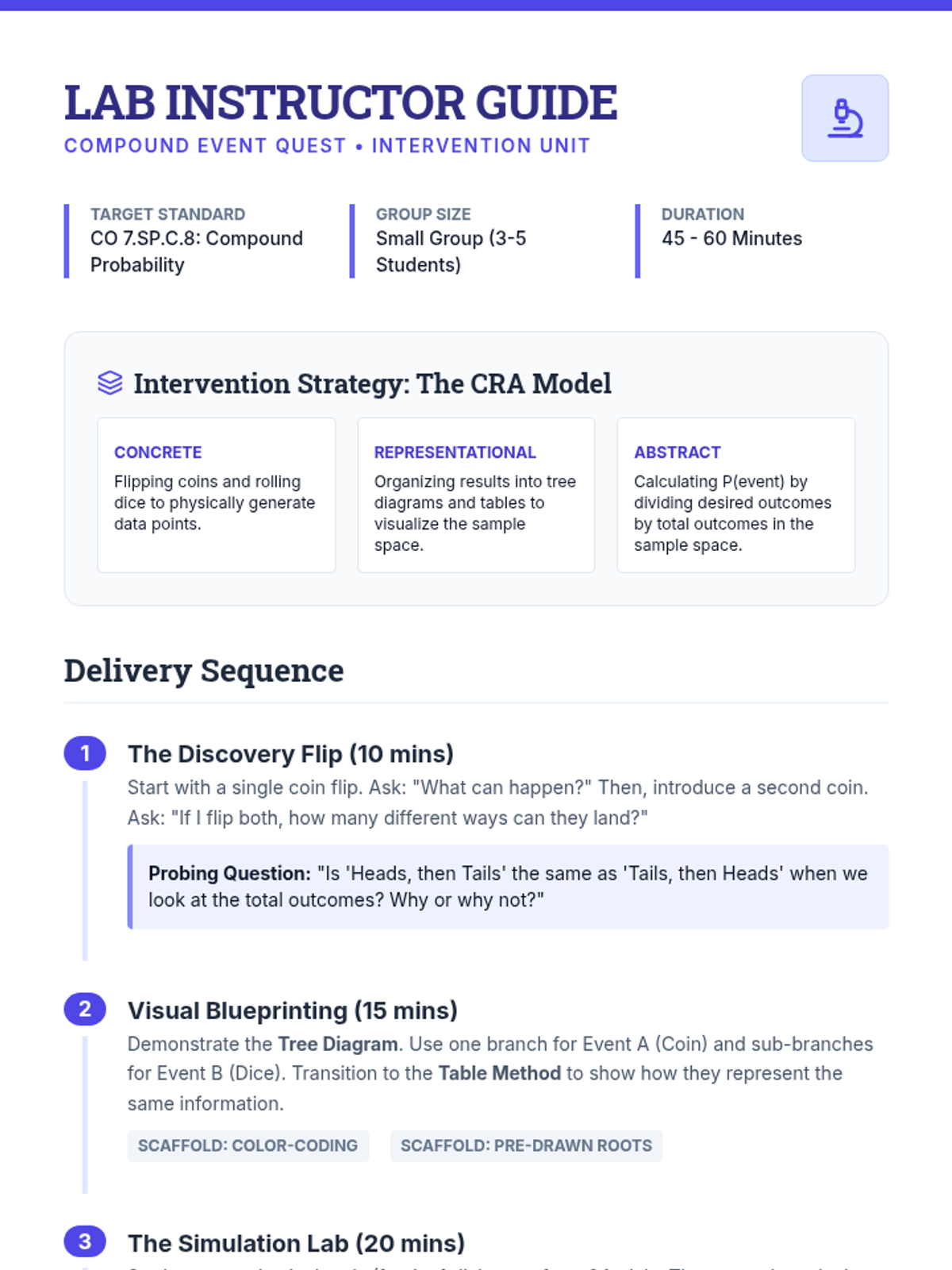
A targeted intervention sequence focused on compound probability, designed for small groups to master sample space construction and simulations.

Lenny Avatar
Lenny
2/12
Sequence
Probability Lab Slides
Probability Lab Packet
Probability Teacher Guide
Probability Exit Ticket

Probability Predictors

A targeted intervention sequence focused on understanding probability through experimental data, recording frequencies, and observing how relative frequency stabilizes over many trials.

Lenny Avatar
Lenny
2/12
Sequence
Strategy Blueprint Slides
Math Essentials Reference
Math Essentials Reference Updated
Strategy Sandbox Worksheet
Subject Spotlight Activity
Strategy Sandbox Answer Key
Strategy Sandbox 2 Worksheet
Strategy Sandbox 2 Answer Key
Desmos Mastery Slides
Desmos Drill Worksheet
Desmos Drill Answer Key

ACT Math Mastery

A comprehensive ACT Math preparation program focusing on essential strategies, high-yield Algebra and Geometry concepts, and realistic practice to boost scores.

AL

ava larumbe

Other
2/8
Sequence
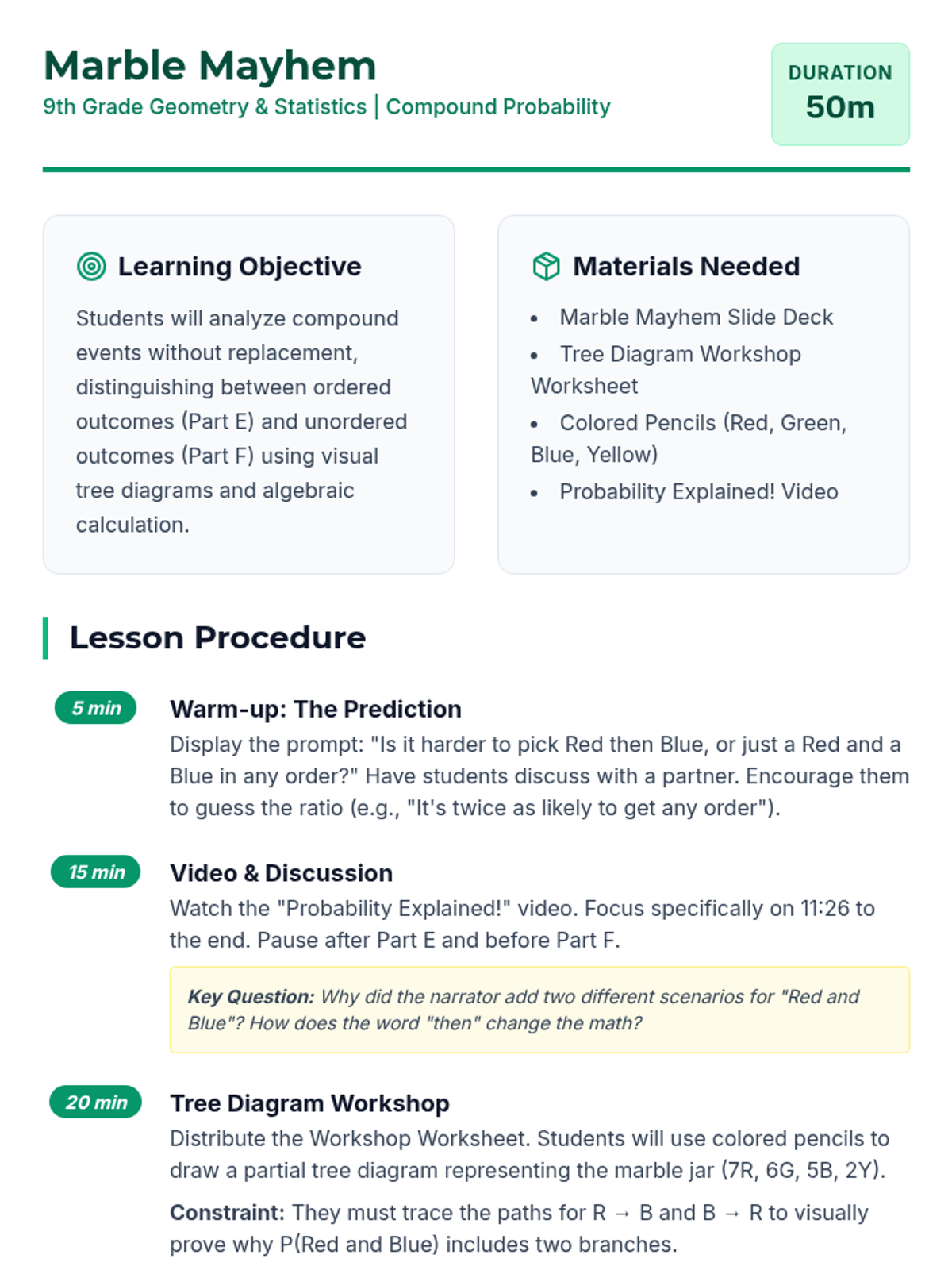
Marble Mayhem Lesson Plan
Marble Mayhem Presentation
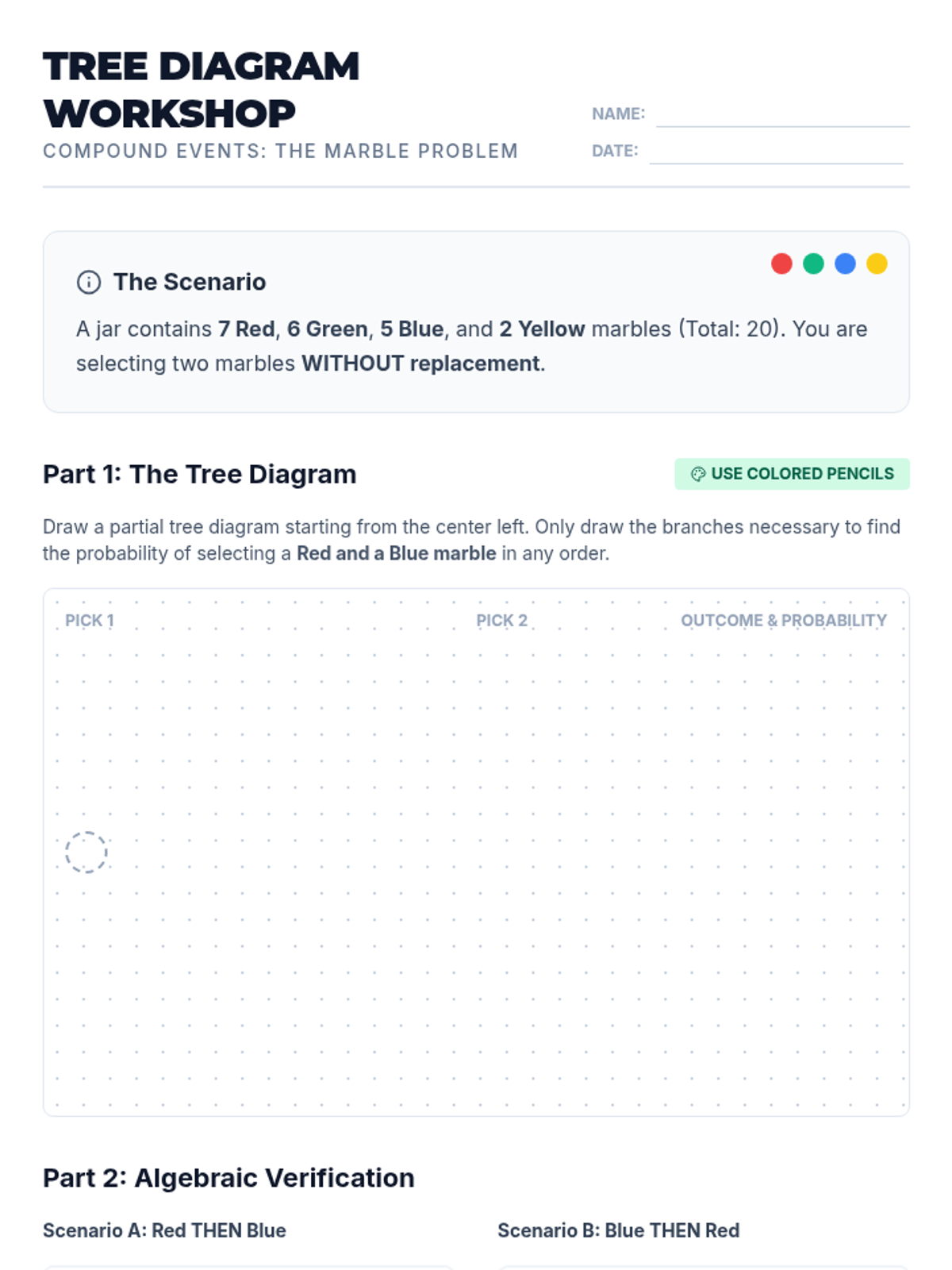
Tree Diagram Workshop Worksheet
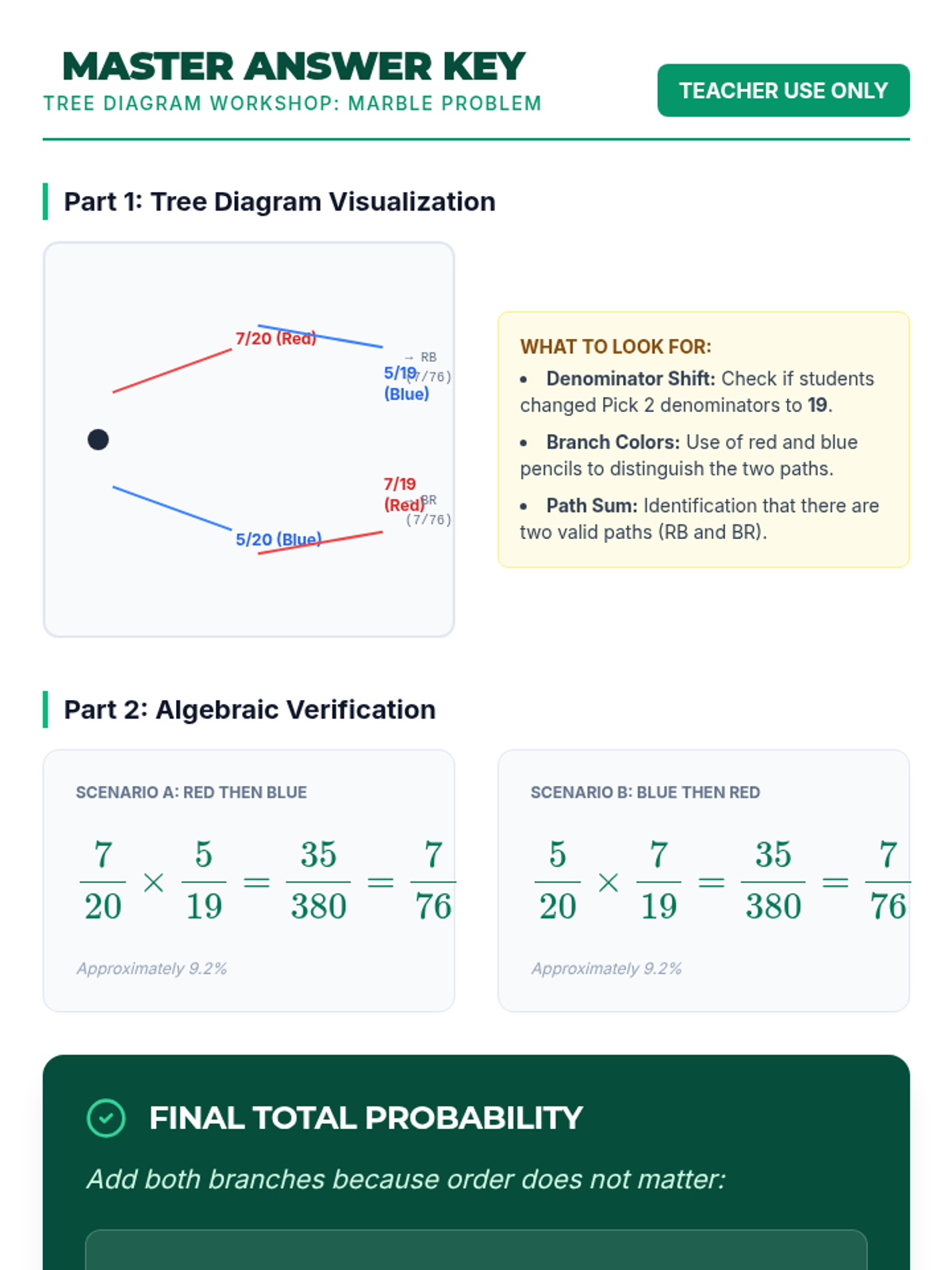
Workshop Master Key

Probability Patterns

A lesson sequence focusing on compound probability, specifically analyzing events where order matters versus where it doesn't, using marble jar scenarios and tree diagrams.

Lenny Avatar
Lenny
1/19
Sequence
Filtered View Slides
Filtered Logic Worksheet
Filtered View Teacher Guide

Signal and Noise Lab

This sequence explores conditional probability and the reliability of tests using frequency trees and area models. Students investigate 'false positives' and 'false negatives' in real-world contexts like medical testing and spam filters, ultimately debating the ethical implications of screening policies.

Lenny Avatar
Lenny
1/18
Sequence
Tree Map Basics Slides
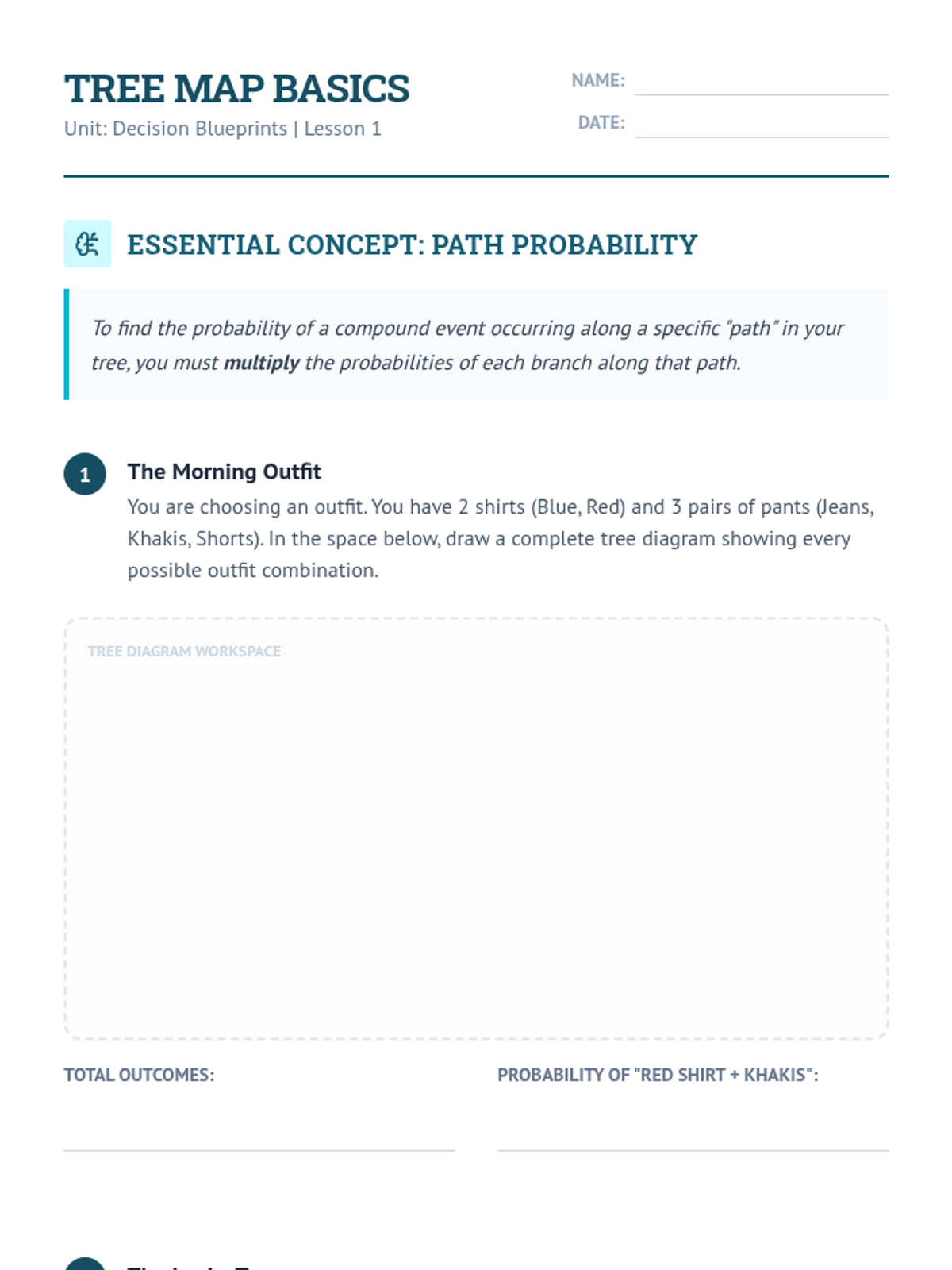
Tree Map Basics Worksheet
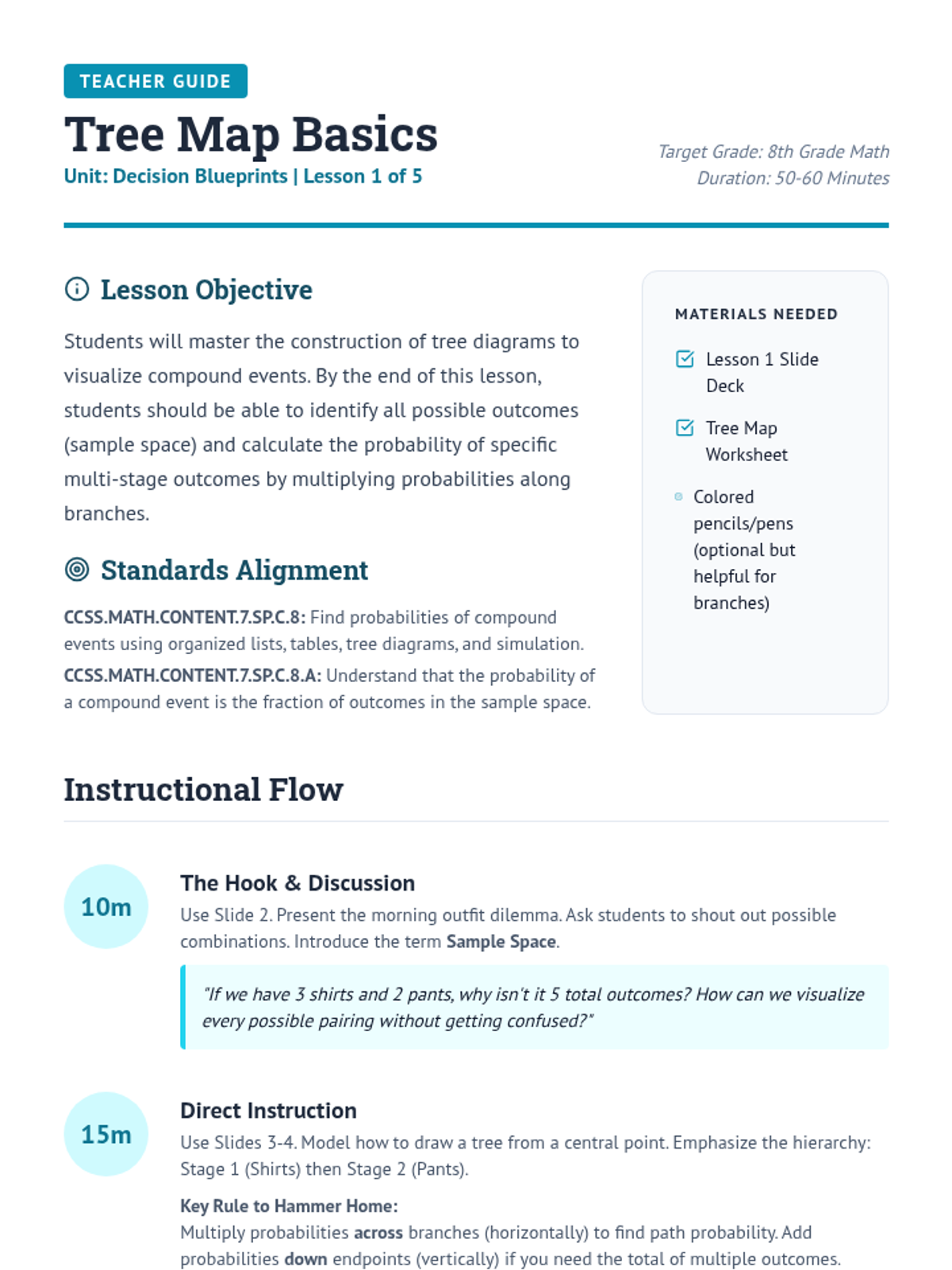
Tree Map Basics Teacher Guide

Decision Blueprints

An 8th-grade mathematics unit focused on using probability trees to model and solve complex decision-making problems. Students progress from simple compound events to weighted averages and backward induction in real-world business and logistics scenarios.

Lenny Avatar
Lenny
1/18
Sequence
Carnival Chaos Slides
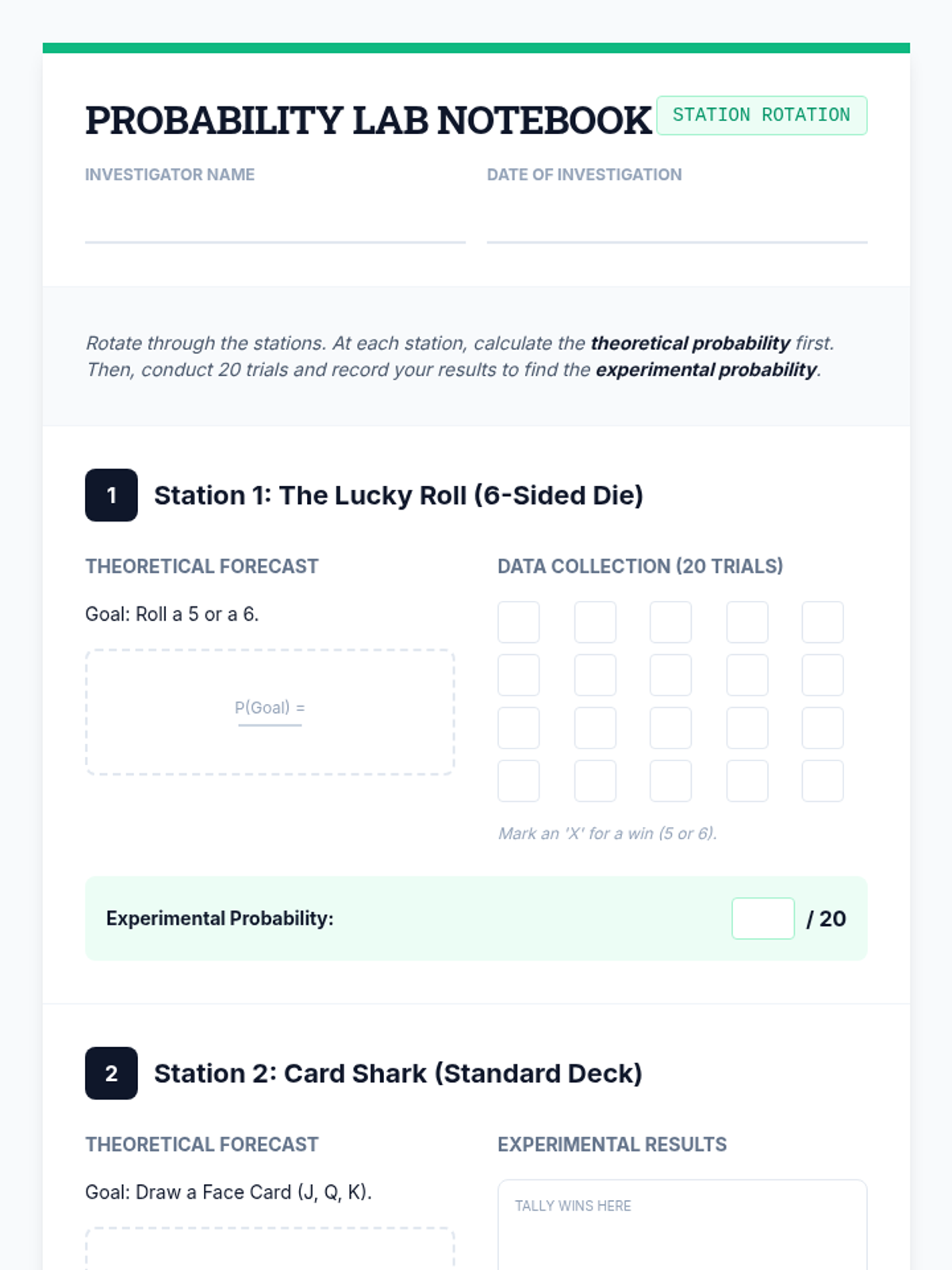
Probability Lab Notebook
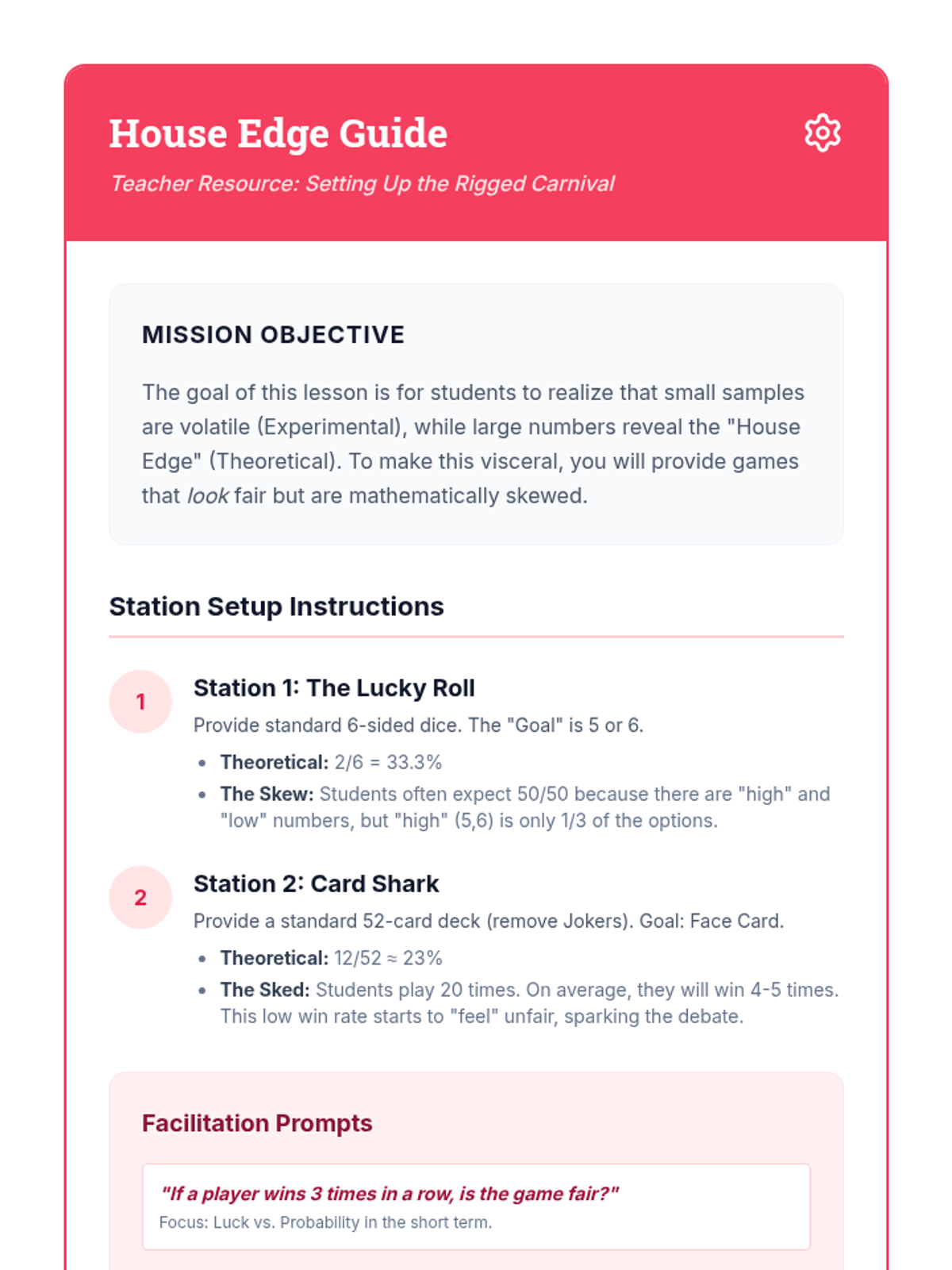
House Edge Teacher Guide

Game Theorist Academy

A game-based sequence where 8th-grade students explore probability, weighted averages, and expected value to analyze fairness and long-term trends in games of chance.

Lenny Avatar
Lenny
1/18
Sequence
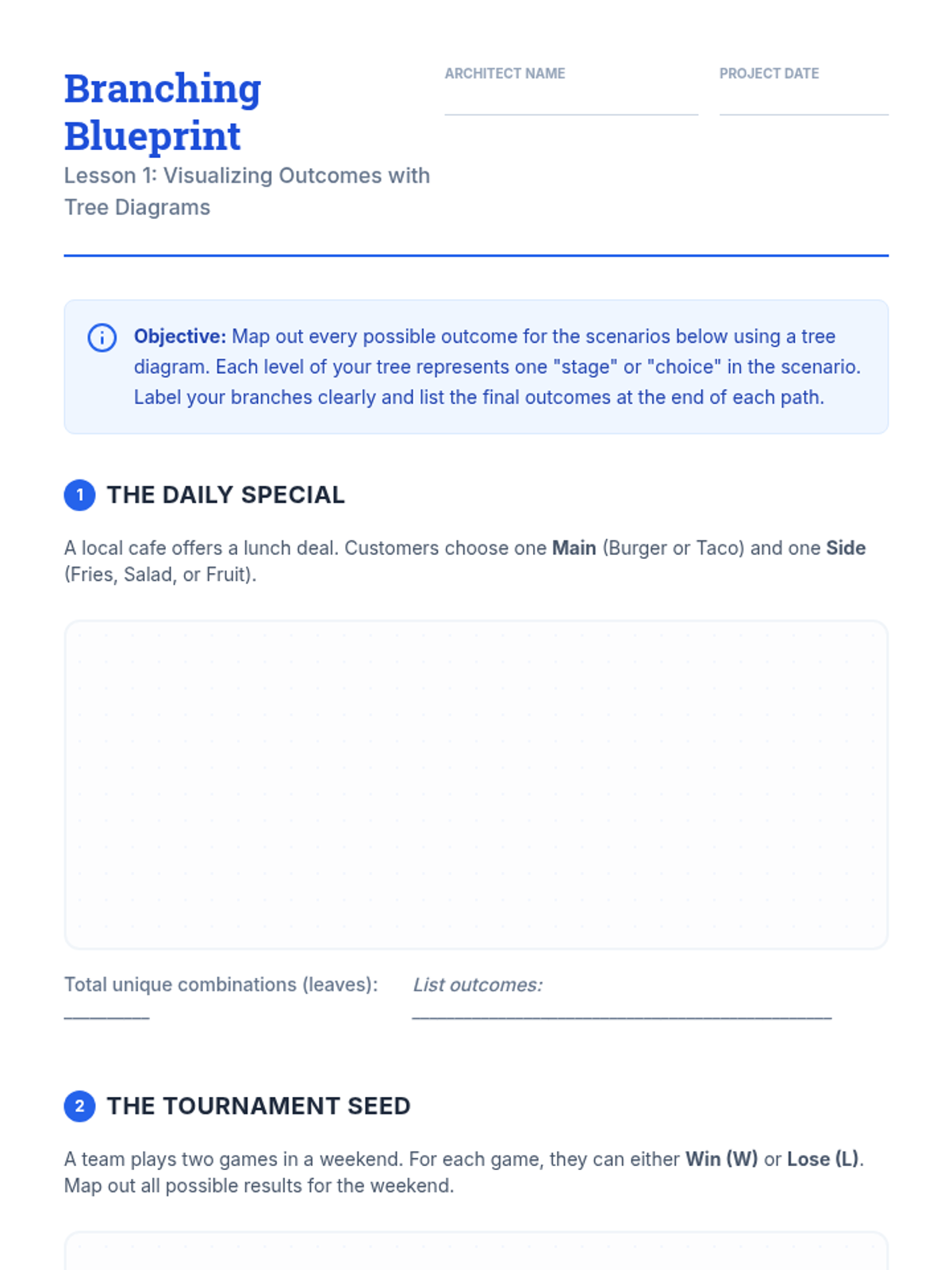
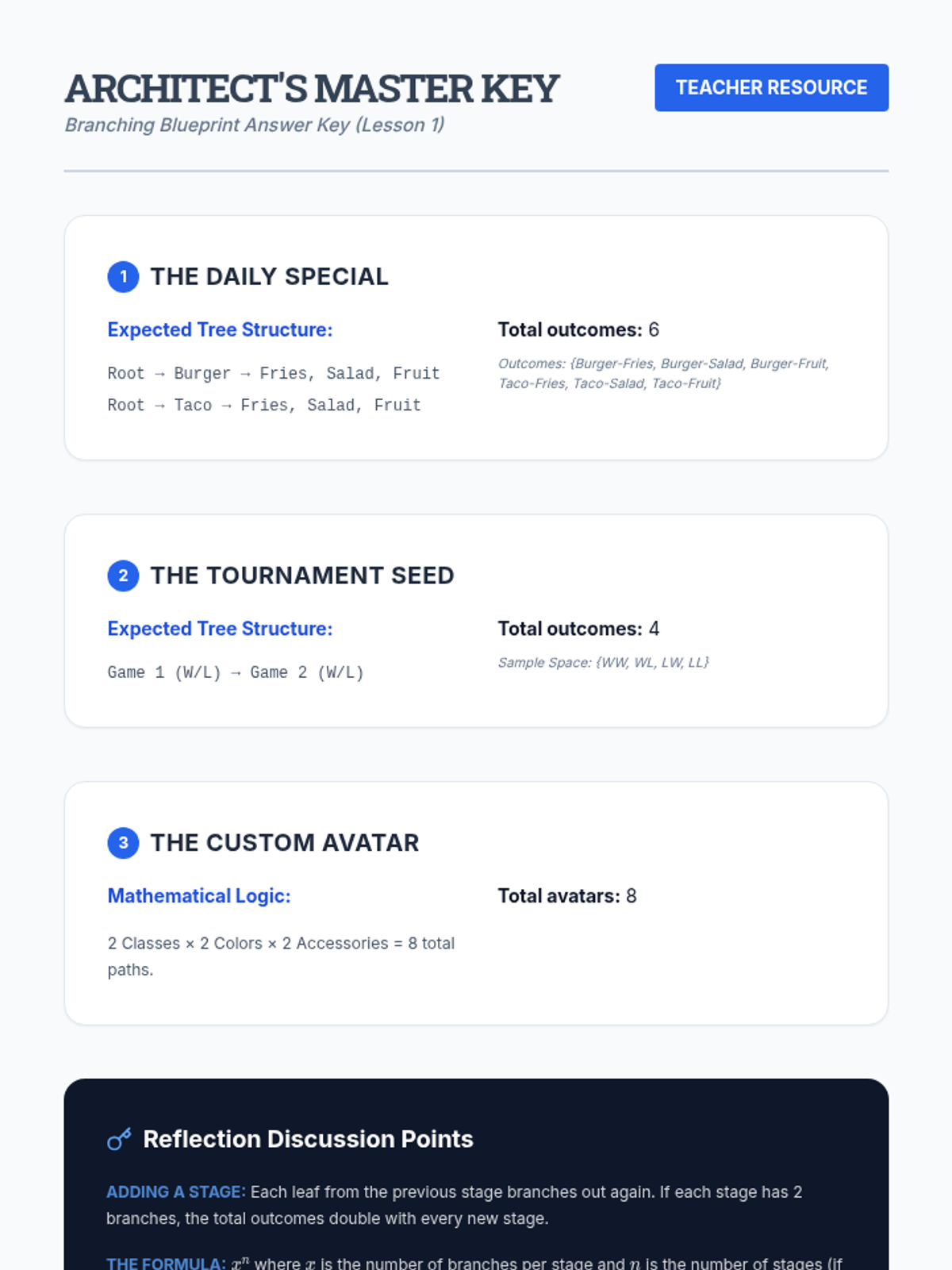
Branching Basics Slides
Branching Blueprint Worksheet
Branching Blueprint Answer Key

Decision Architects Probability

This sequence guides students through the visualization and calculation of compound probabilities using tree diagrams. Students progress from basic branching to analyzing complex real-world decisions involving dependent and independent events.

Lenny Avatar
Lenny
1/18
Sequence
Probability Roadmap Teacher Guide
Distribution Discovery Slides
Value Venture Activity
Distribution Check Exit Ticket
Probability Intervention Answer Key

Probability Pros

A targeted intervention sequence focused on foundational probability concepts, specifically developing discrete probability distributions and calculating expected values through visual scaffolds like tree diagrams and organized counting.

Lenny Avatar
Lenny
2/12
Sequence
Independence Insight Slides
Case File Worksheet
Logic Lab Teacher Guide
Logic Lab Answer Key

Probability Detectives

A targeted intervention sequence focused on understanding and calculating the independence of events through structured reasoning and decision trees.

Lenny Avatar
Lenny
2/12
Sequence
Probability Lab Guide
Probability Lab Slides

Probability Lab

A targeted intervention sequence focused on compound probability, designed for small groups to master sample space construction and simulations.

Lenny Avatar
Lenny
2/12
Sequence
Strategy Blueprint Slides
Math Essentials Reference
Math Essentials Reference Updated
Strategy Sandbox Worksheet
Subject Spotlight Activity
Strategy Sandbox Answer Key
Strategy Sandbox 2 Worksheet
Strategy Sandbox 2 Answer Key
Desmos Mastery Slides
Desmos Drill Worksheet
Desmos Drill Answer Key

ACT Math Mastery

A comprehensive ACT Math preparation program focusing on essential strategies, high-yield Algebra and Geometry concepts, and realistic practice to boost scores.

AL

ava larumbe

Other
2/8
Sequence
Marble Mayhem Lesson Plan
Marble Mayhem Presentation
Tree Diagram Workshop Worksheet
Workshop Master Key

Probability Patterns

A lesson sequence focusing on compound probability, specifically analyzing events where order matters versus where it doesn't, using marble jar scenarios and tree diagrams.

Lenny Avatar
Lenny
1/19
Sequence
Filtered View Slides
Filtered Logic Worksheet
Filtered View Teacher Guide

Signal and Noise Lab

This sequence explores conditional probability and the reliability of tests using frequency trees and area models. Students investigate 'false positives' and 'false negatives' in real-world contexts like medical testing and spam filters, ultimately debating the ethical implications of screening policies.

Lenny Avatar
Lenny
1/18
Sequence
Tree Map Basics Slides
Tree Map Basics Worksheet
Tree Map Basics Teacher Guide

Decision Blueprints

An 8th-grade mathematics unit focused on using probability trees to model and solve complex decision-making problems. Students progress from simple compound events to weighted averages and backward induction in real-world business and logistics scenarios.

Lenny Avatar
Lenny
1/18
Sequence
Branching Basics Slides
Branching Blueprint Worksheet
Branching Blueprint Answer Key

Decision Architects Probability

This sequence guides students through the visualization and calculation of compound probabilities using tree diagrams. Students progress from basic branching to analyzing complex real-world decisions involving dependent and independent events.

Lenny Avatar
Lenny
1/18
Sequence
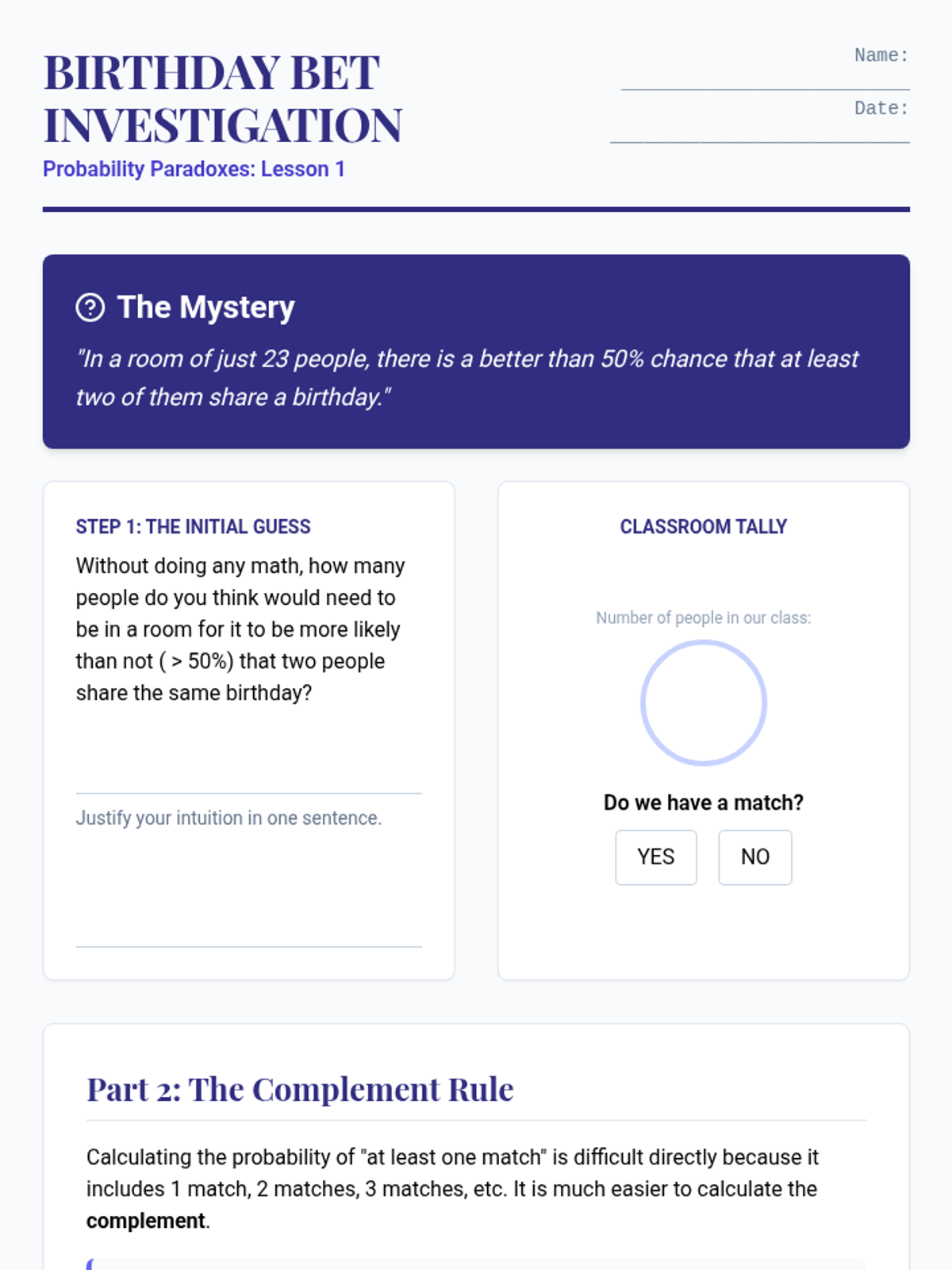
Birthday Bet Worksheet
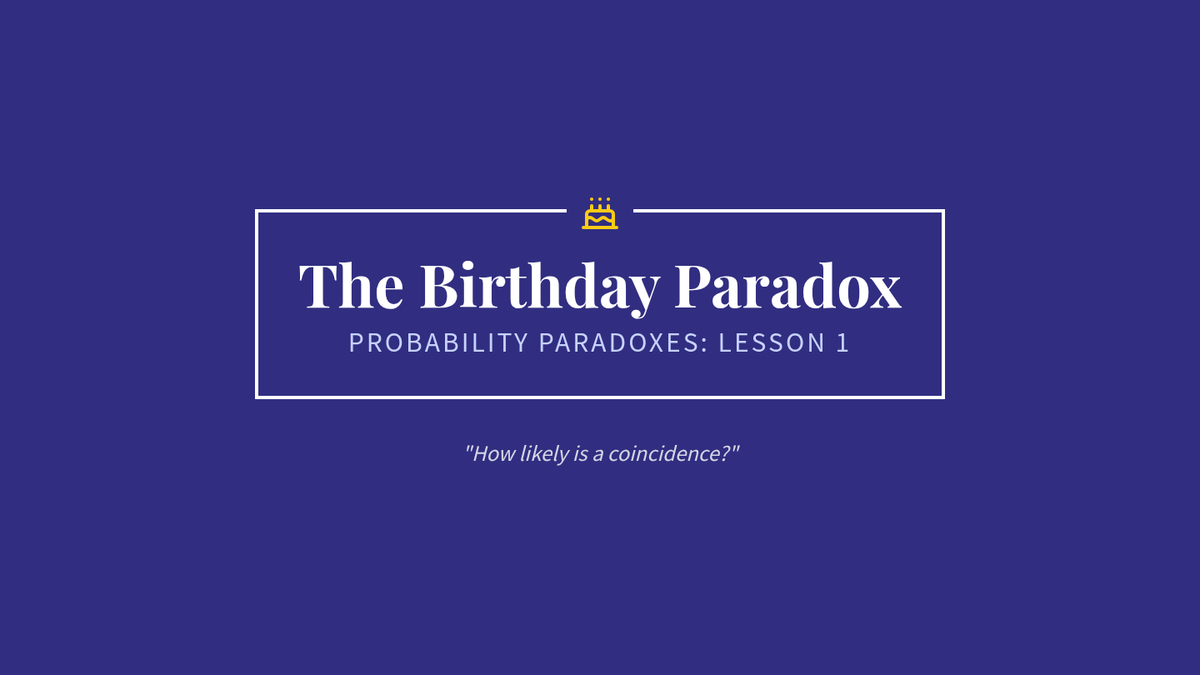
Birthday Paradox Slides
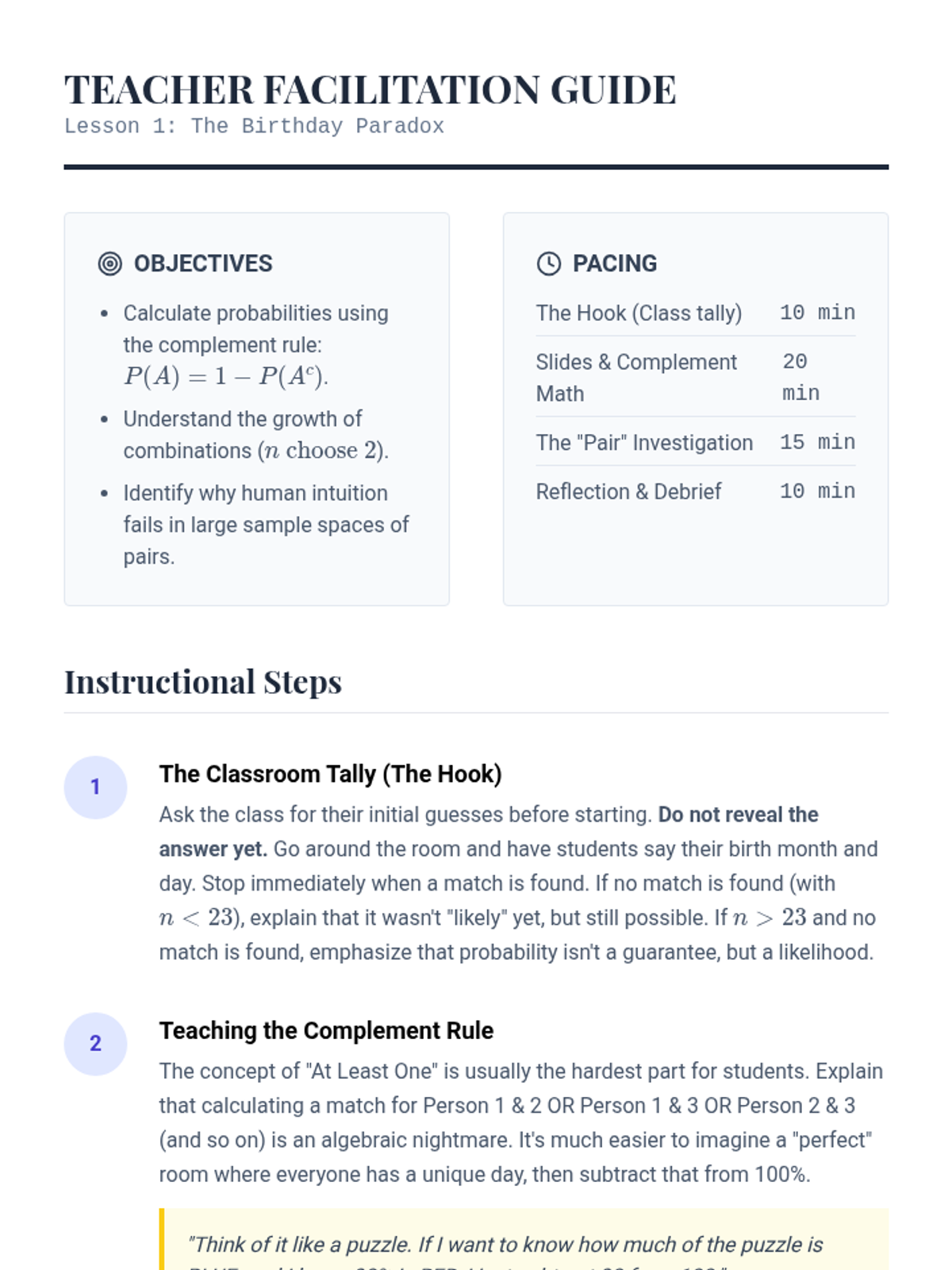
Birthday Paradox Teacher Guide
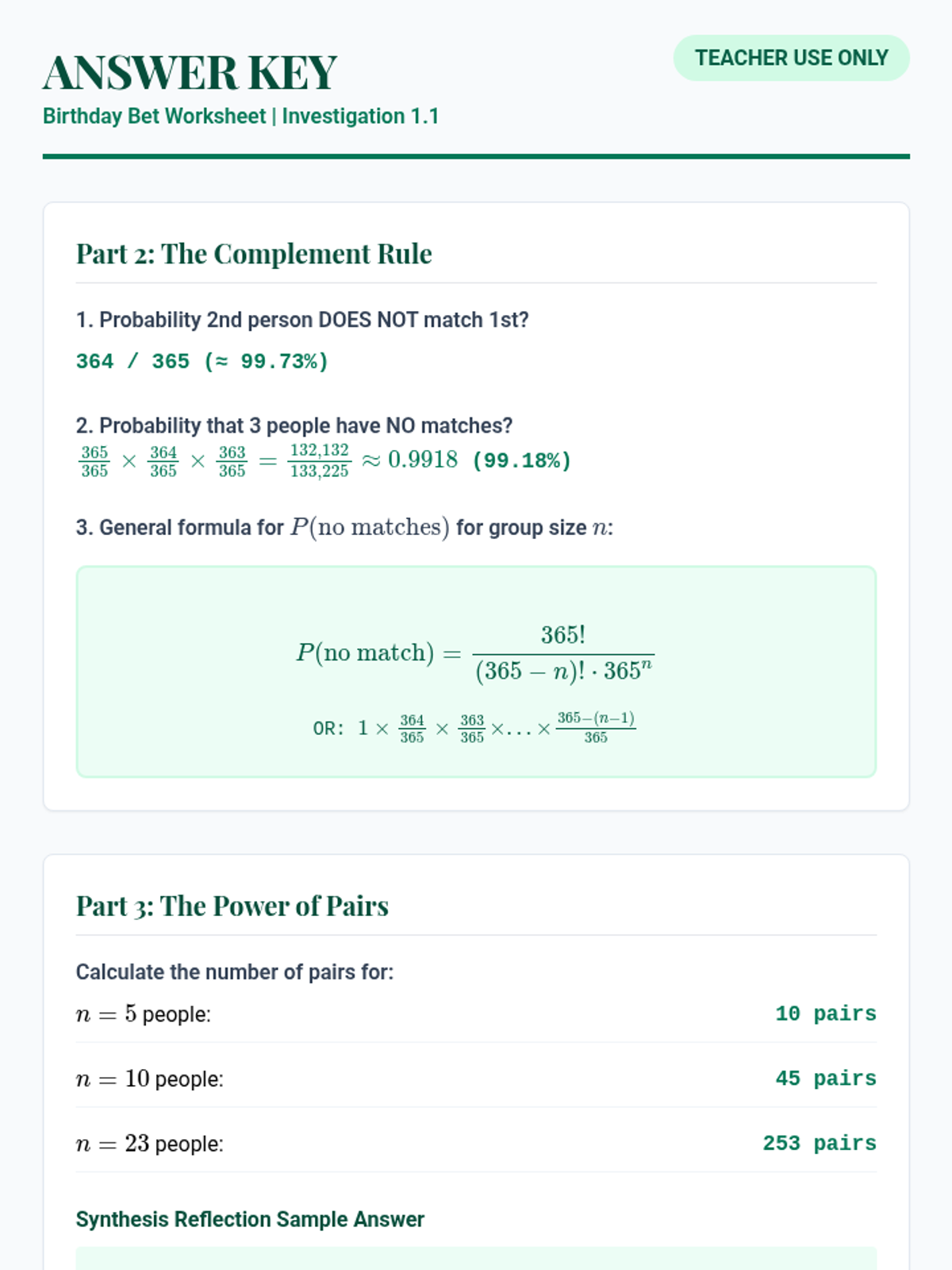
Birthday Bet Answer Key

Probability Paradoxes

An inquiry-driven investigation into counter-intuitive probability. Students explore the Birthday Problem, Gambler's Fallacy, Monty Hall Problem, and Simpson's Paradox to understand why human intuition often fails in the face of compound event logic.

Lenny Avatar
Lenny
1/17
Sequence
Grid Logic Slides
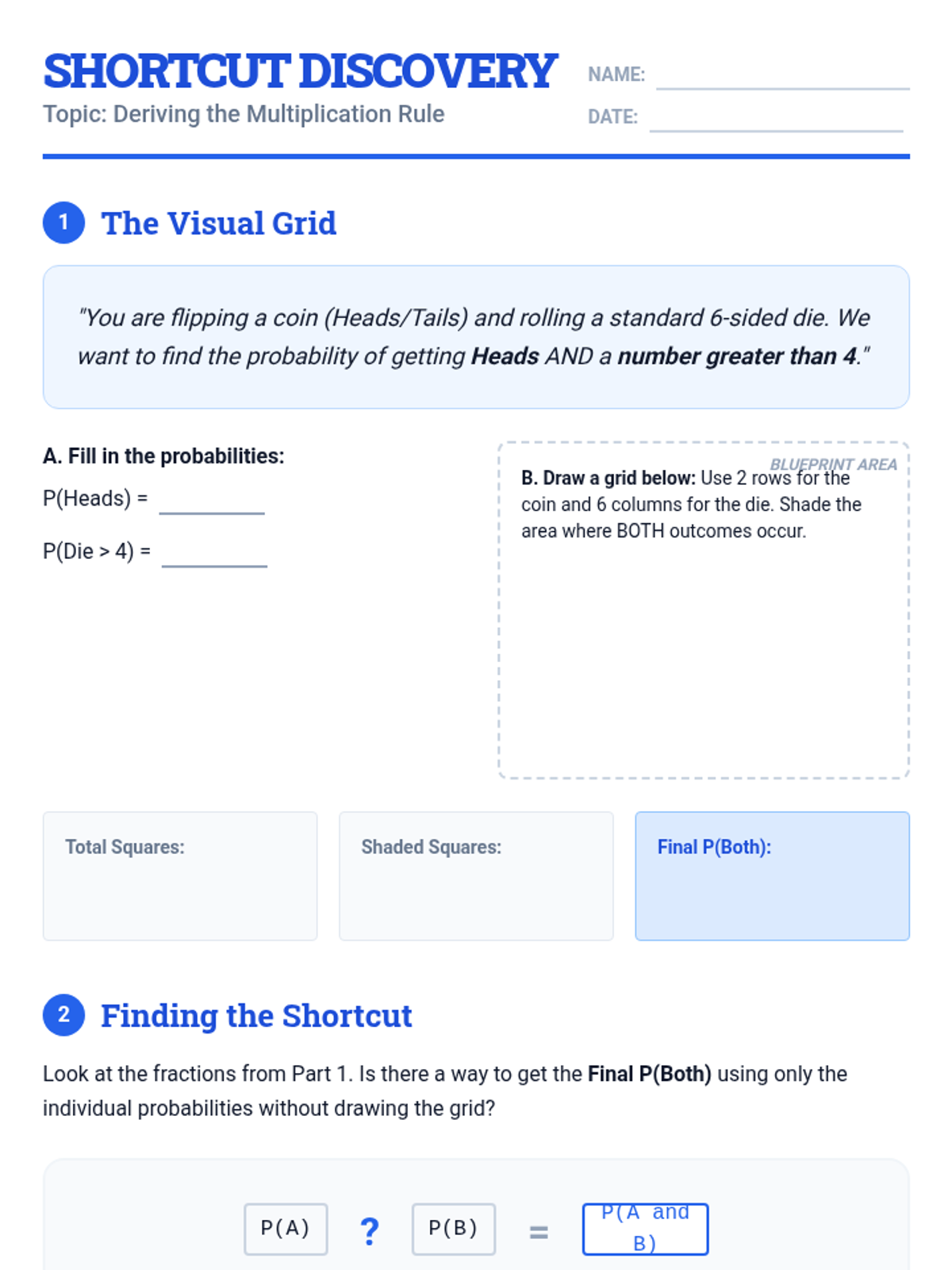
Shortcut Discovery Worksheet
Table Transition Teacher Guide

Probability Power Play

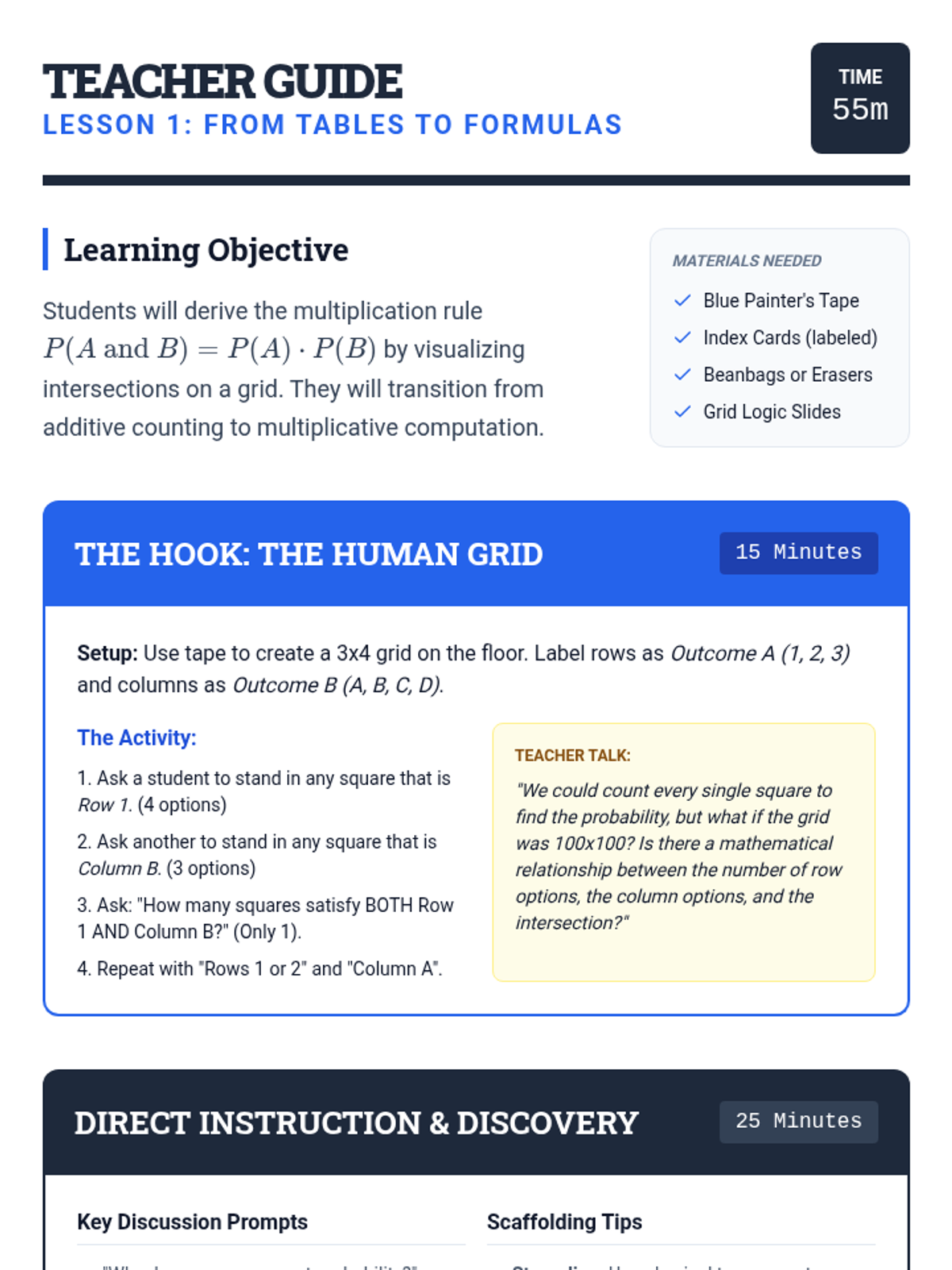
This mastery-based sequence focuses on the algebraic side of probability, specifically utilizing the multiplication rule for complex problems. Students progress from visual models to abstract formulas, covering independent and dependent events, 'at least one' scenarios using complements, and mixed strategy application.

Lenny Avatar
Lenny
1/17
Sequence
Launch Slides
Scenario Proposal Worksheet

Probability Architects

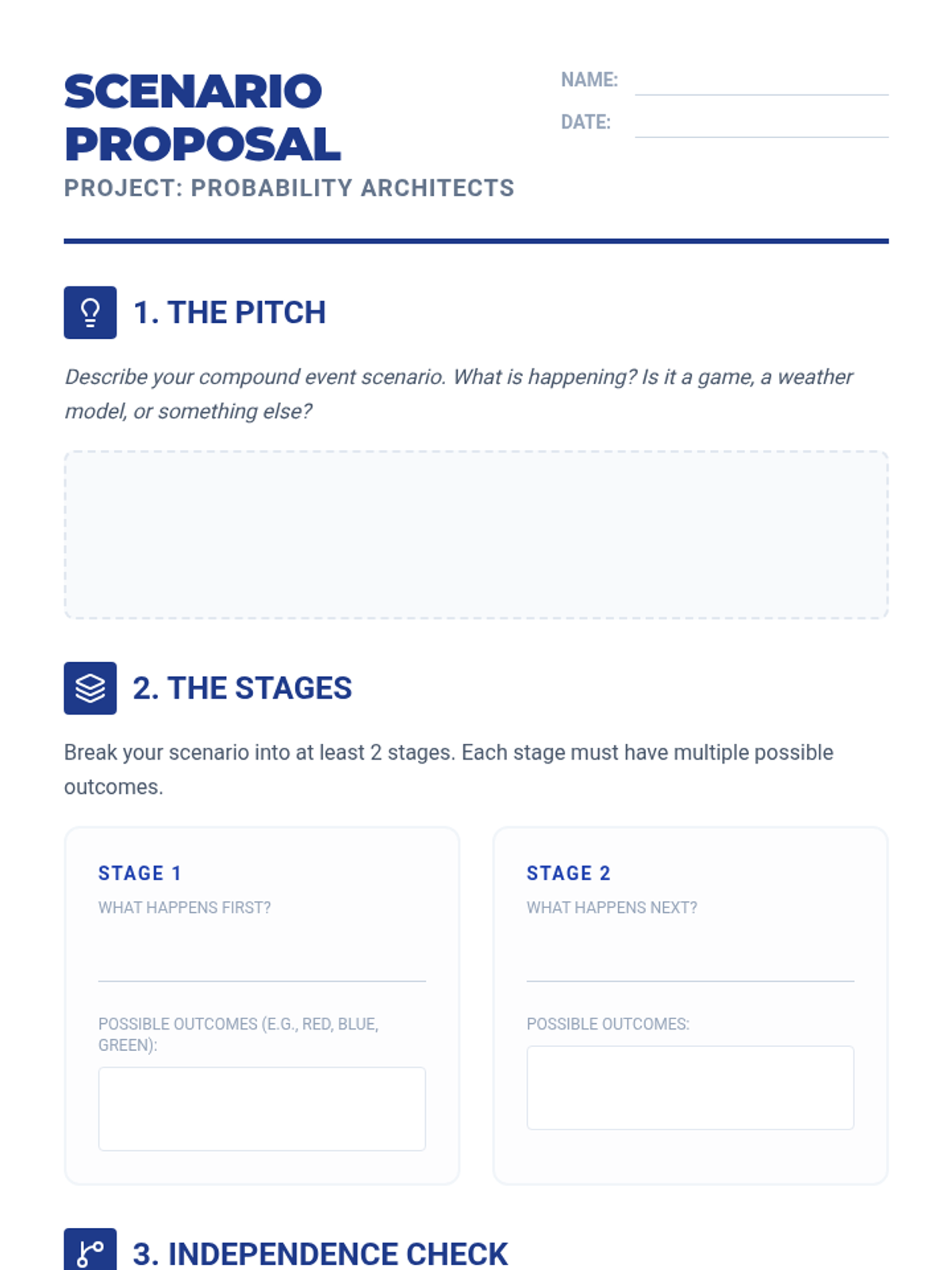
Students act as game designers to create, calculate, and simulate compound probability models. They move from brainstorming scenarios to analyzing experimental data, culminating in a gallery walk showcase.

Lenny Avatar
Lenny
1/17
Sequence
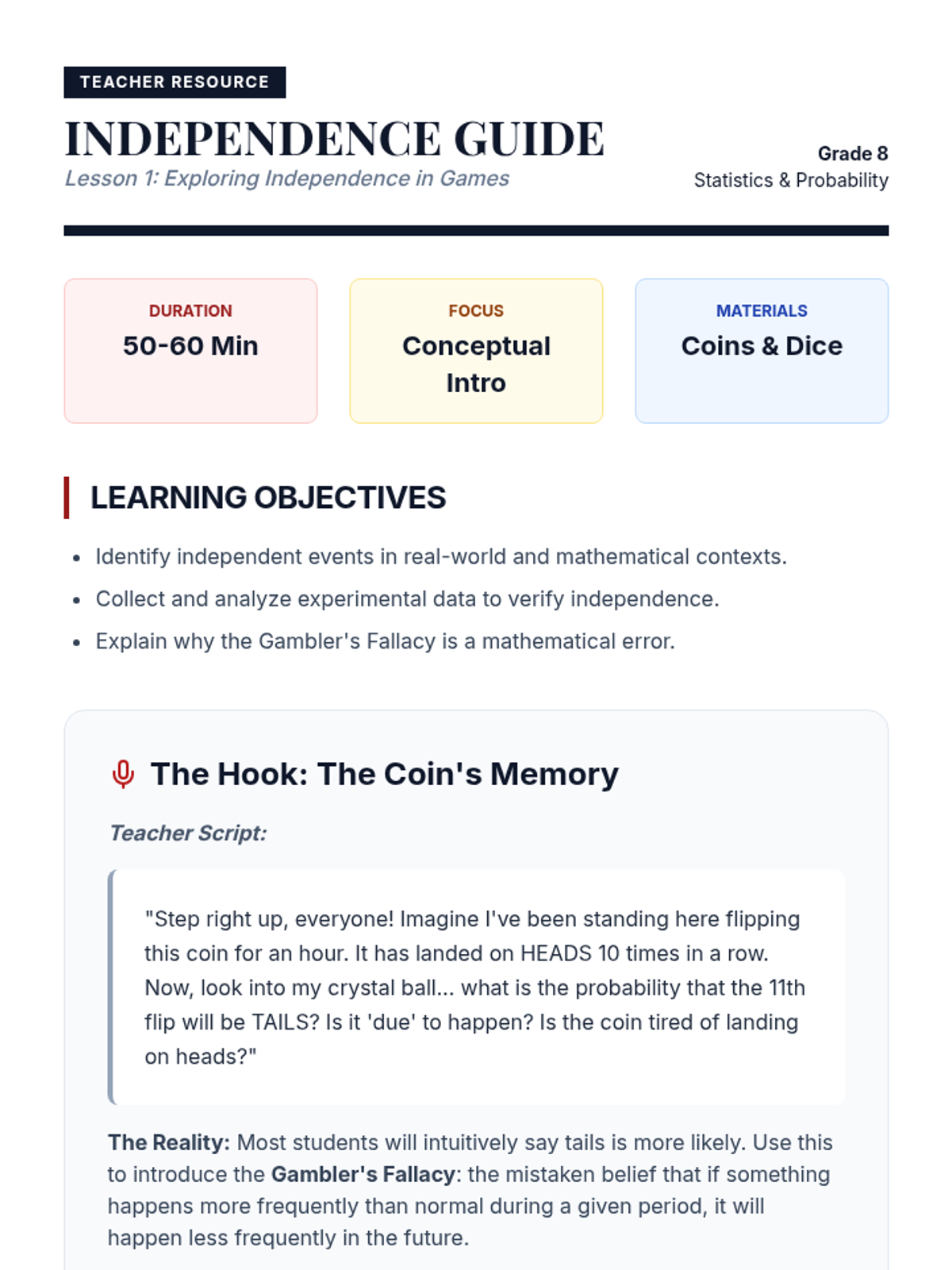
Independence Intro Slides
Fairness Trial Worksheet
Independence Discussion Guide

Analyzing Independent Events

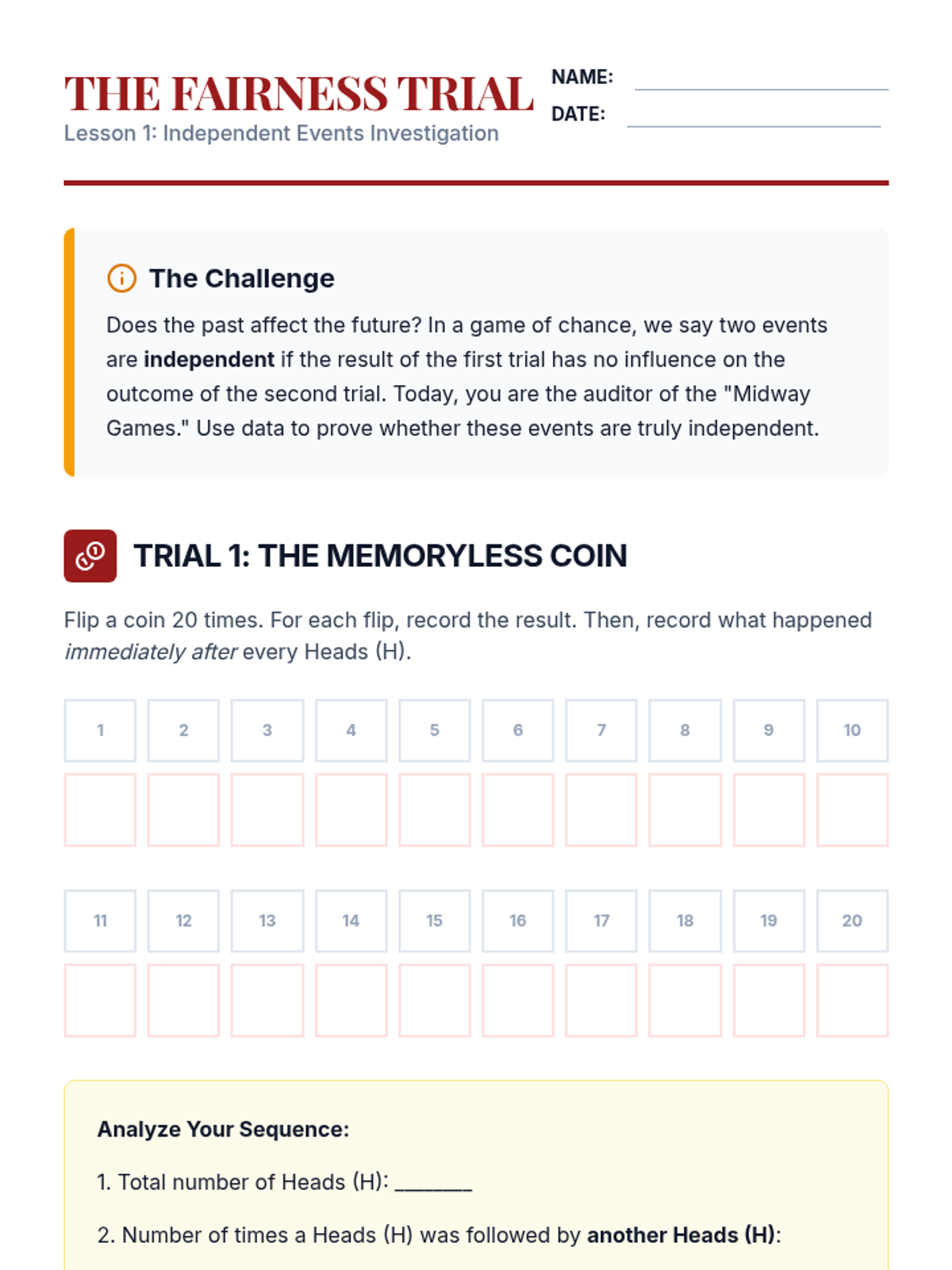
A game-based unit for 8th graders to explore compound independent events. Students move from experimental observation to theoretical calculation using the multiplication rule through the lens of carnival games and chance.

Lenny Avatar
Lenny
1/17
Sequence
Breaking the Chain Slides
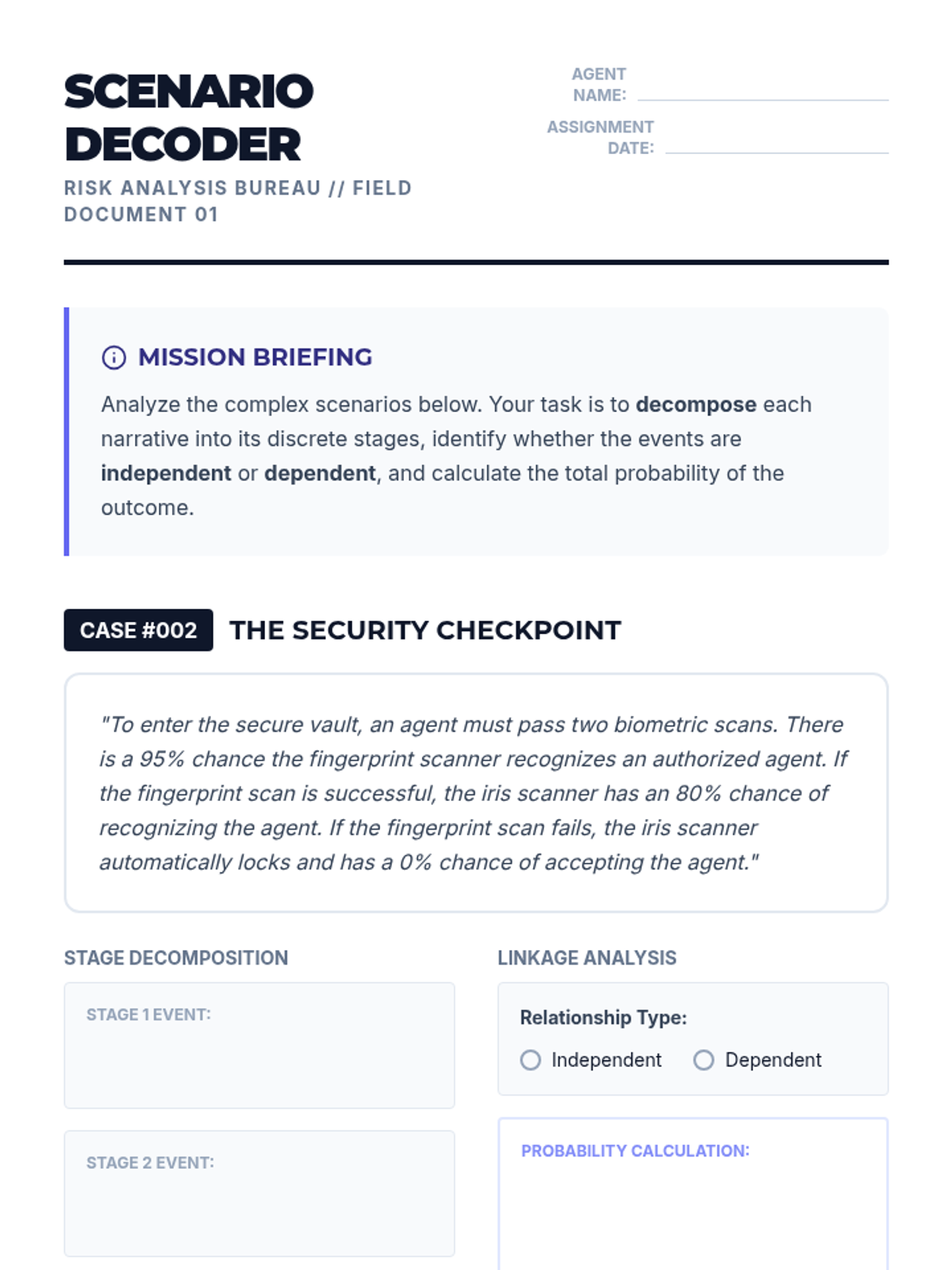
Scenario Decoder Worksheet

Risk Logic Probability Models

An advanced project-based sequence where 9th-grade students act as risk analysts, modeling complex multi-stage scenarios and calculating compound probabilities for independent and dependent events.

Lenny Avatar
Lenny
1/17
Sequence
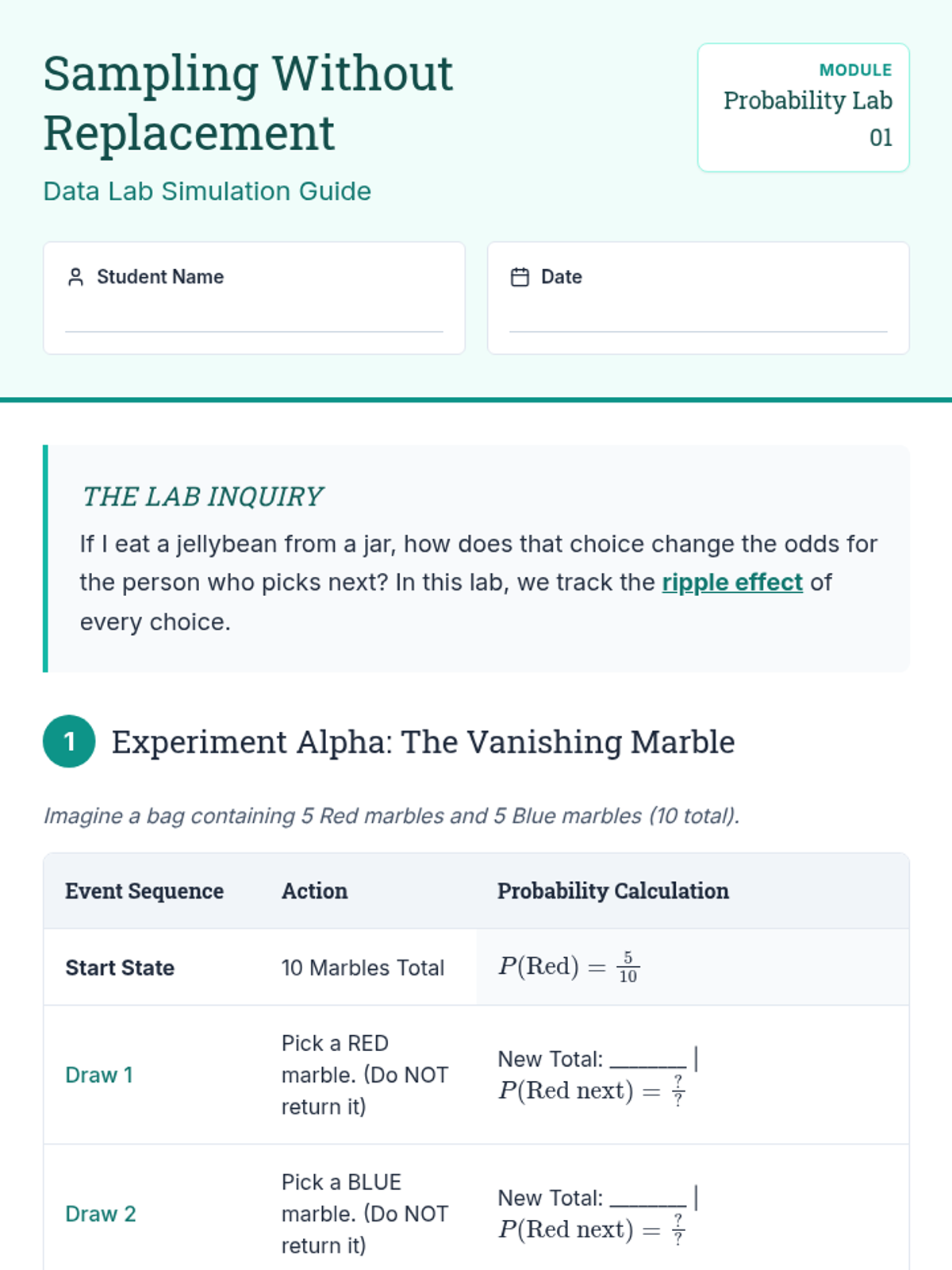
Sampling Simulation Lab Worksheet
Shifting Odds Intro Slides
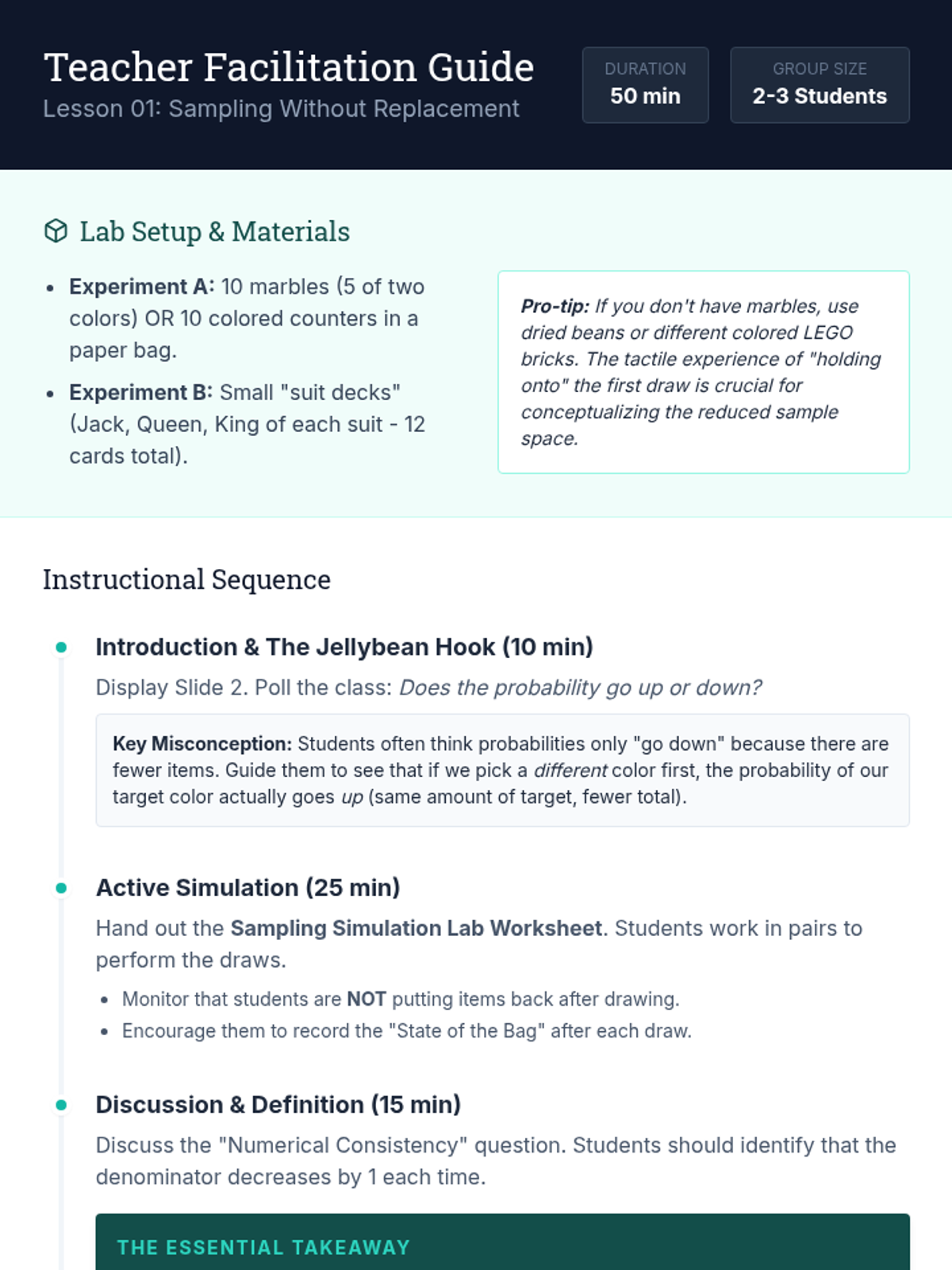
Sampling Simulation Teacher Guide

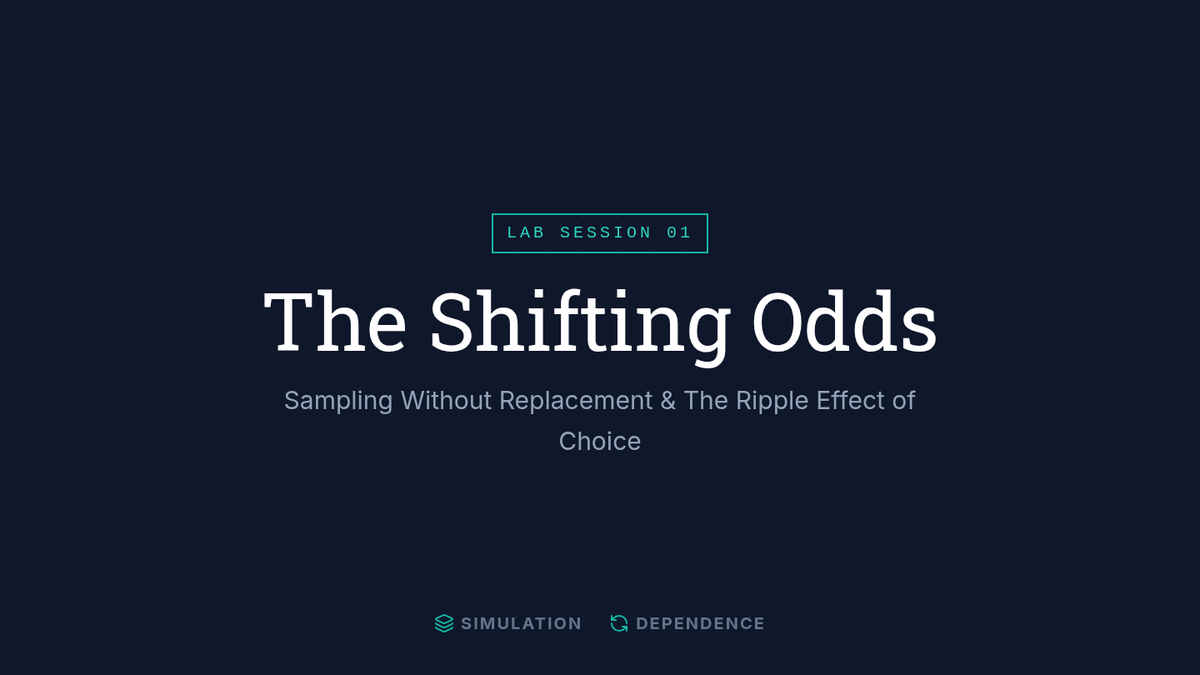
The Shifting Odds

A comprehensive unit on dependent events and conditional probability, exploring how sequential choices change outcomes through simulations, formal notation, and real-world case studies.

Lenny Avatar
Lenny
1/17
Sequence
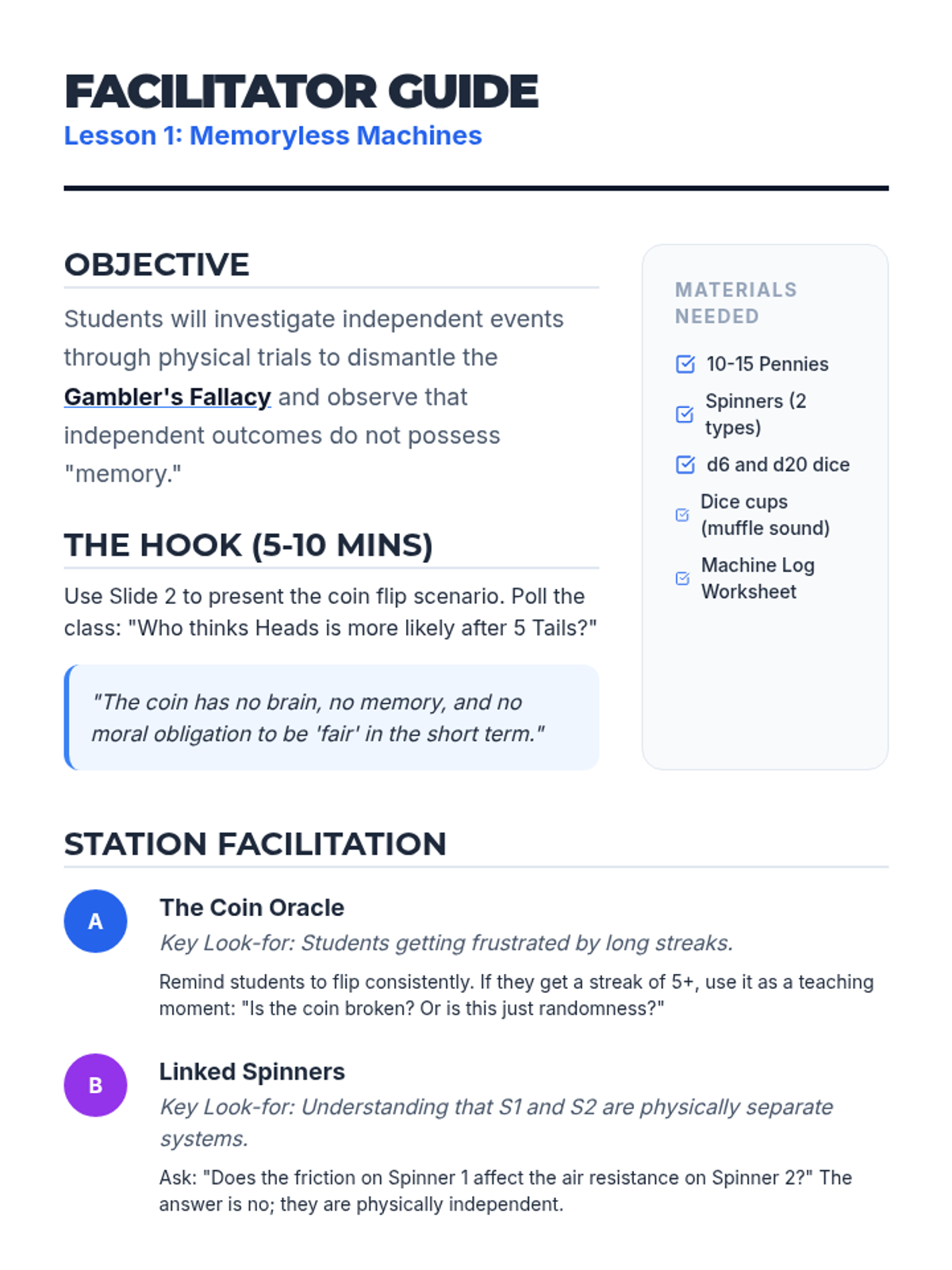
Memoryless Machines Slides
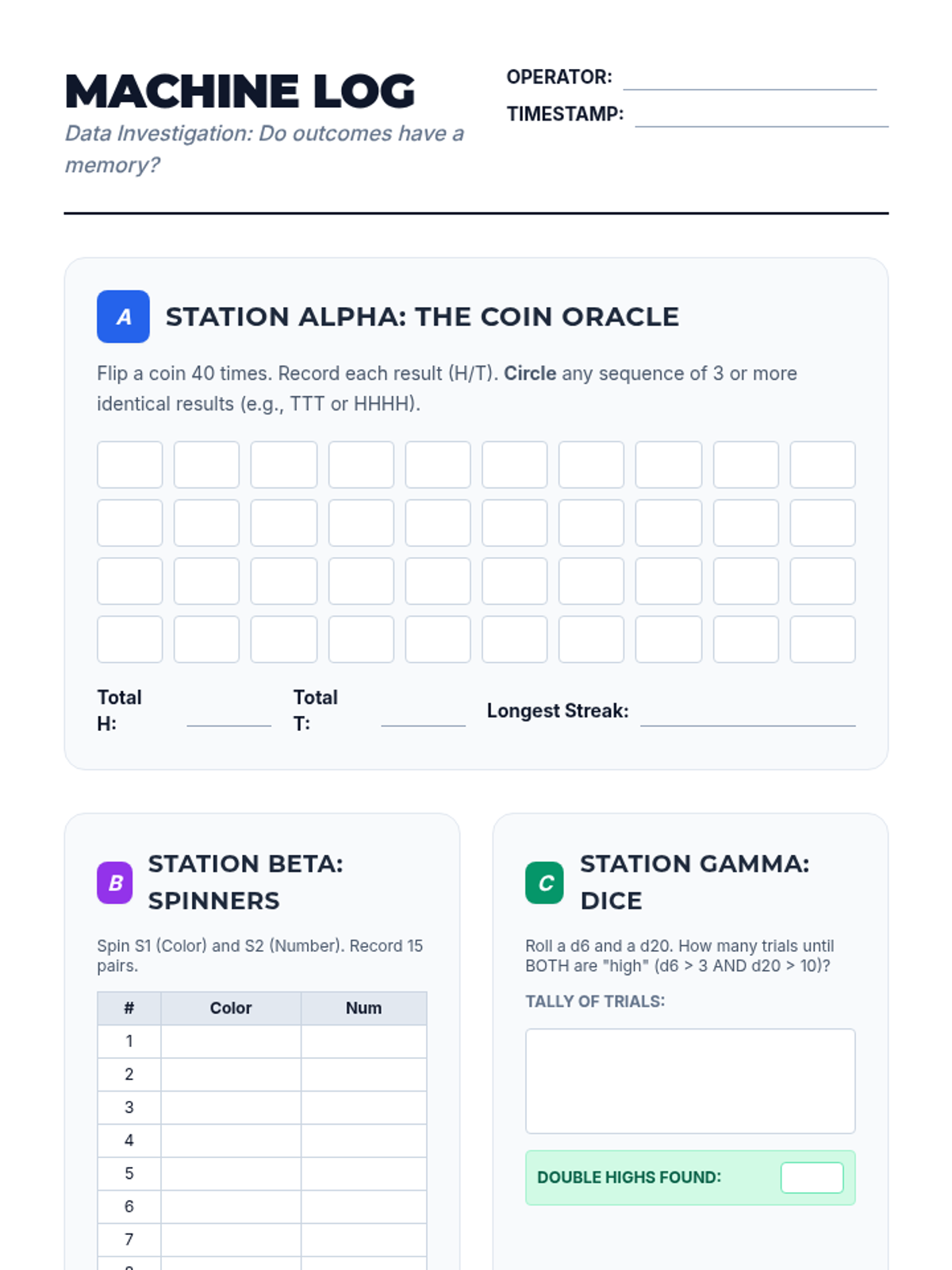
Machine Log Worksheet
Station Facilitator Guide

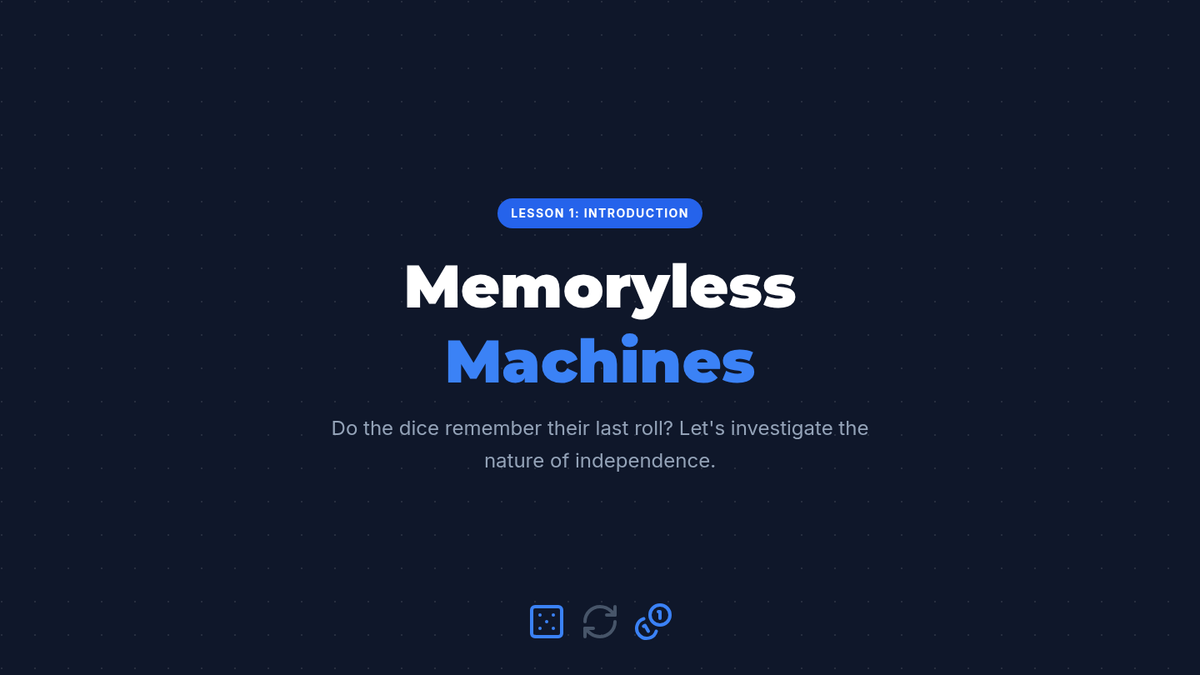
Probability Paradoxes

A 9th-grade exploration into the world of independent events, where students use game-based inquiry to discover the multiplication rule of probability and apply it to design fair (and unfair) games.

Lenny Avatar
Lenny
1/17
Sequence
Array Blueprints Slides
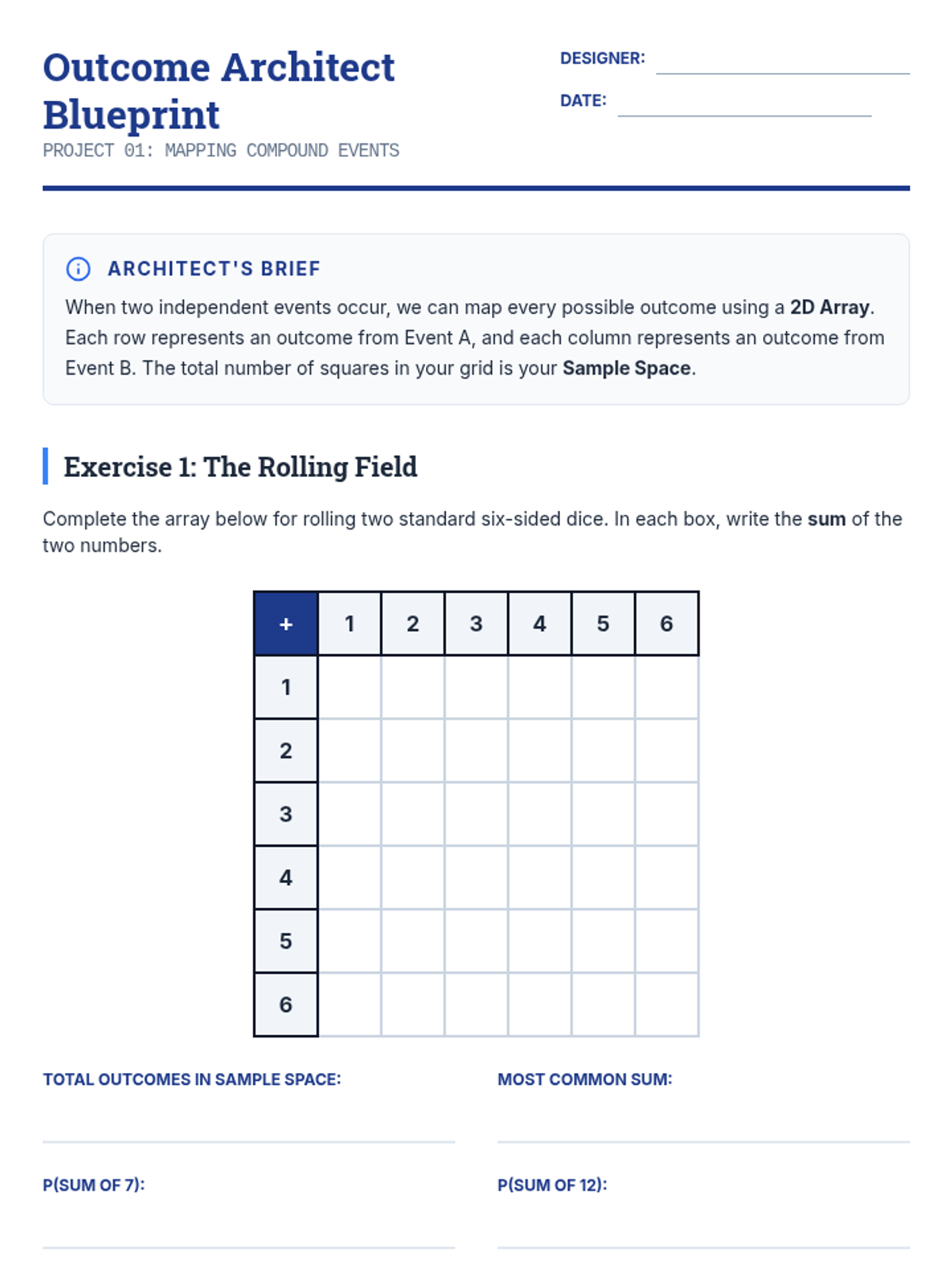
Rolling Arrays Worksheet
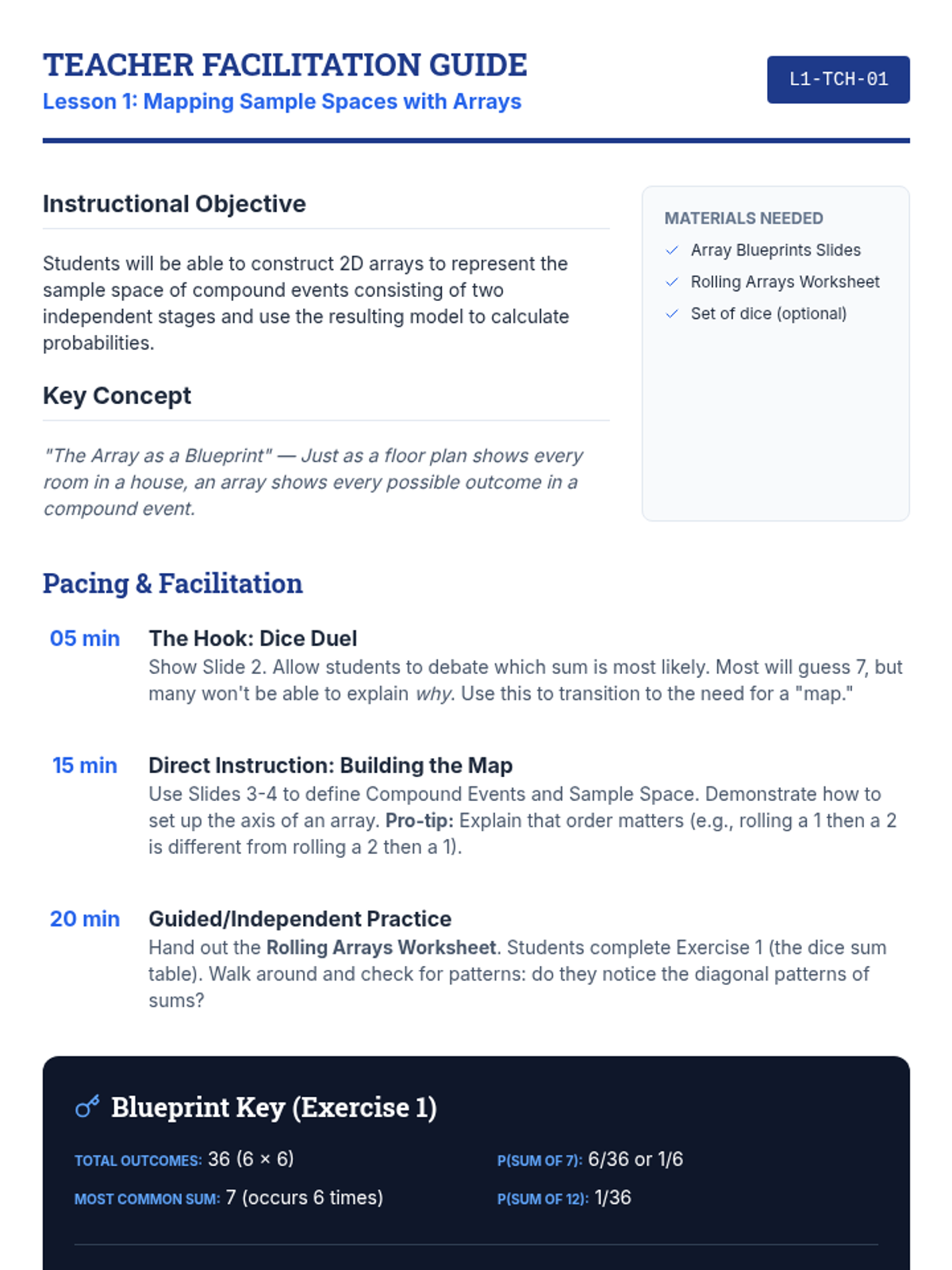
Array Architect Guide

Outcome Architects

A foundational sequence for 9th-grade students focused on systematically representing sample spaces through arrays, tree diagrams, and the Fundamental Counting Principle to calculate compound event probabilities.

Lenny Avatar
Lenny
1/17
Sequence
Independence Insight Slides
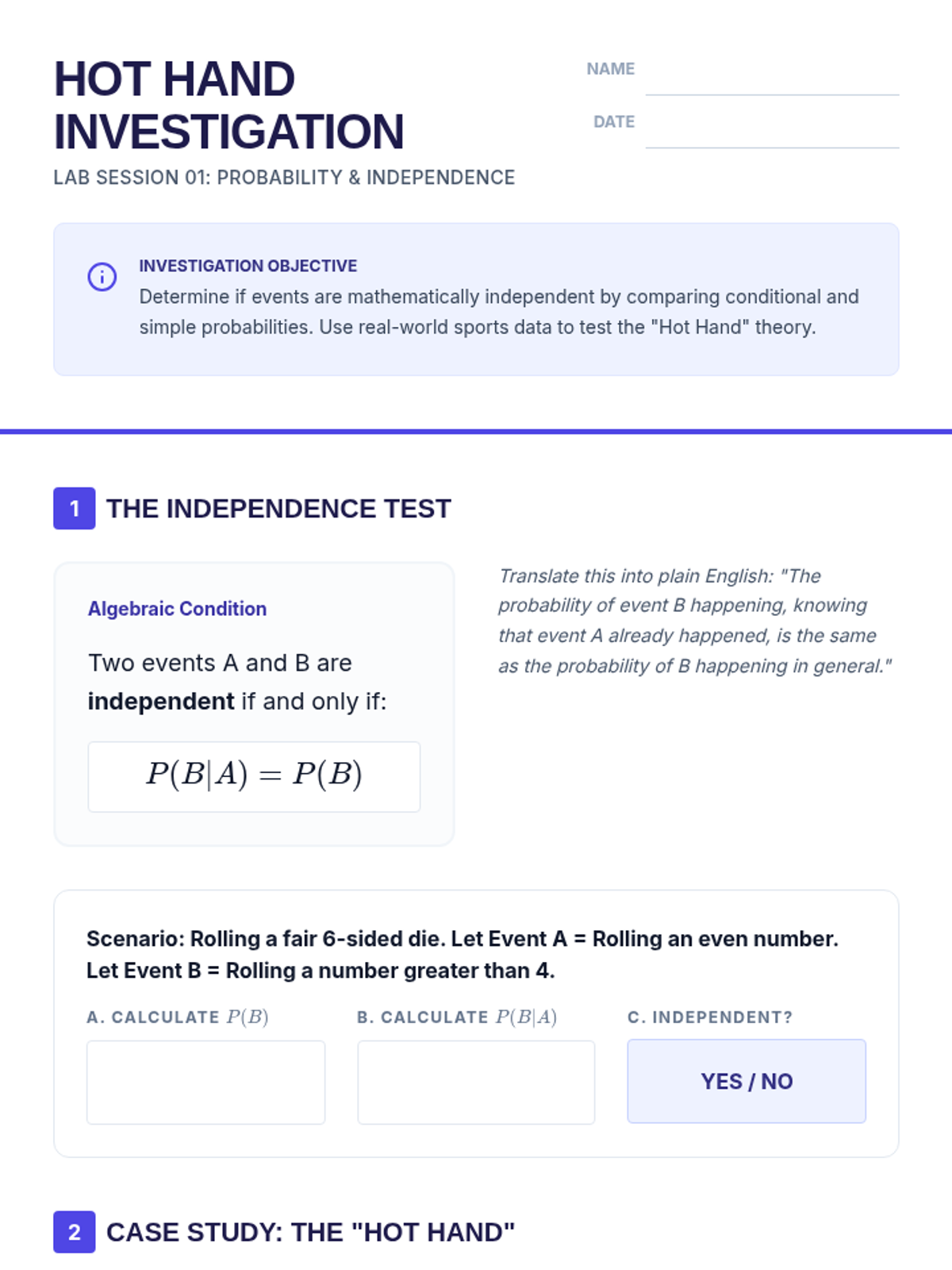
Hot Hand Investigation Worksheet
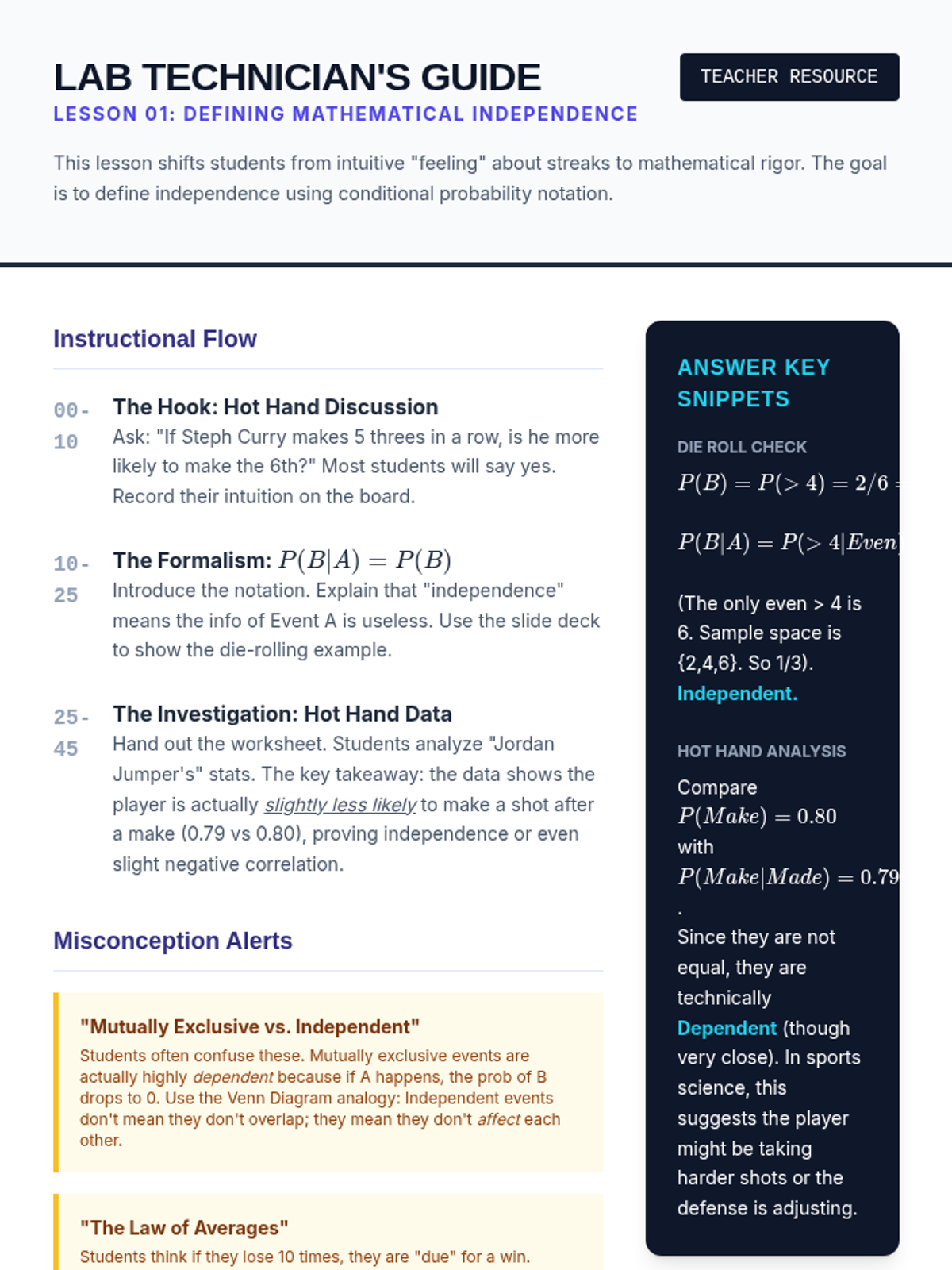
Lab Technicians Guide

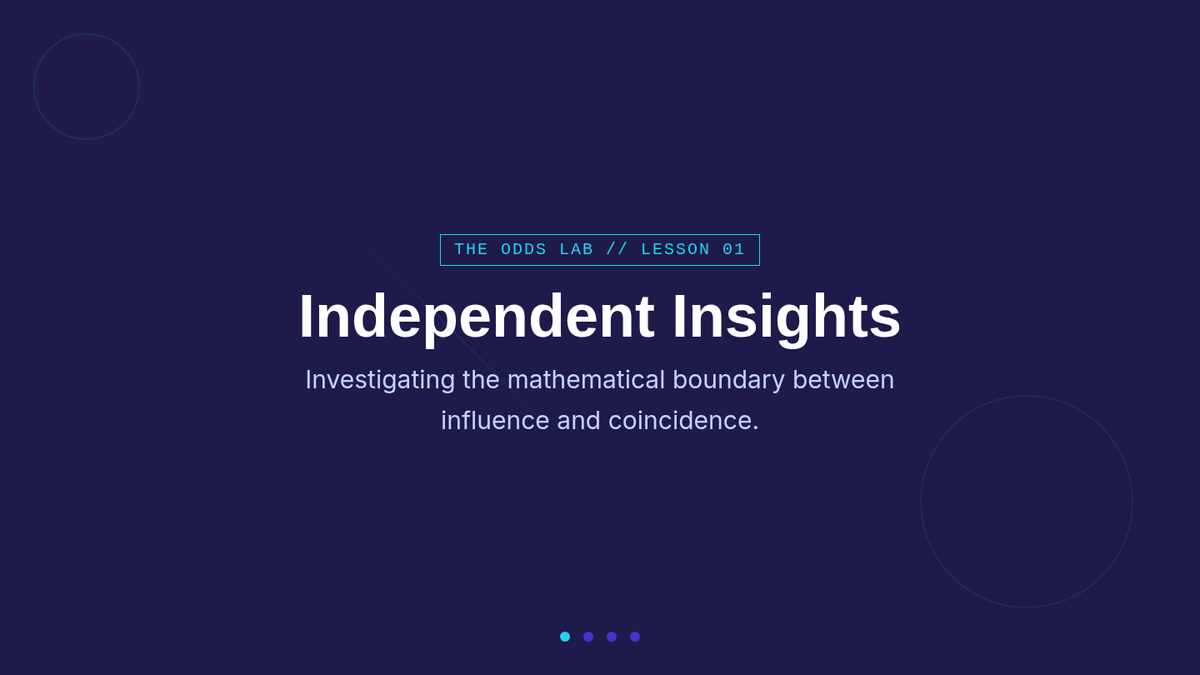
The Odds Lab

A deep dive into compound event probability, moving from conceptual independence to the algebraic rigor of the Multiplication Rule and conditional logic. Students analyze sports streaks, card games, and forensic evidence to master independent and dependent probabilities.

Lenny Avatar
Lenny
1/17
Sequence
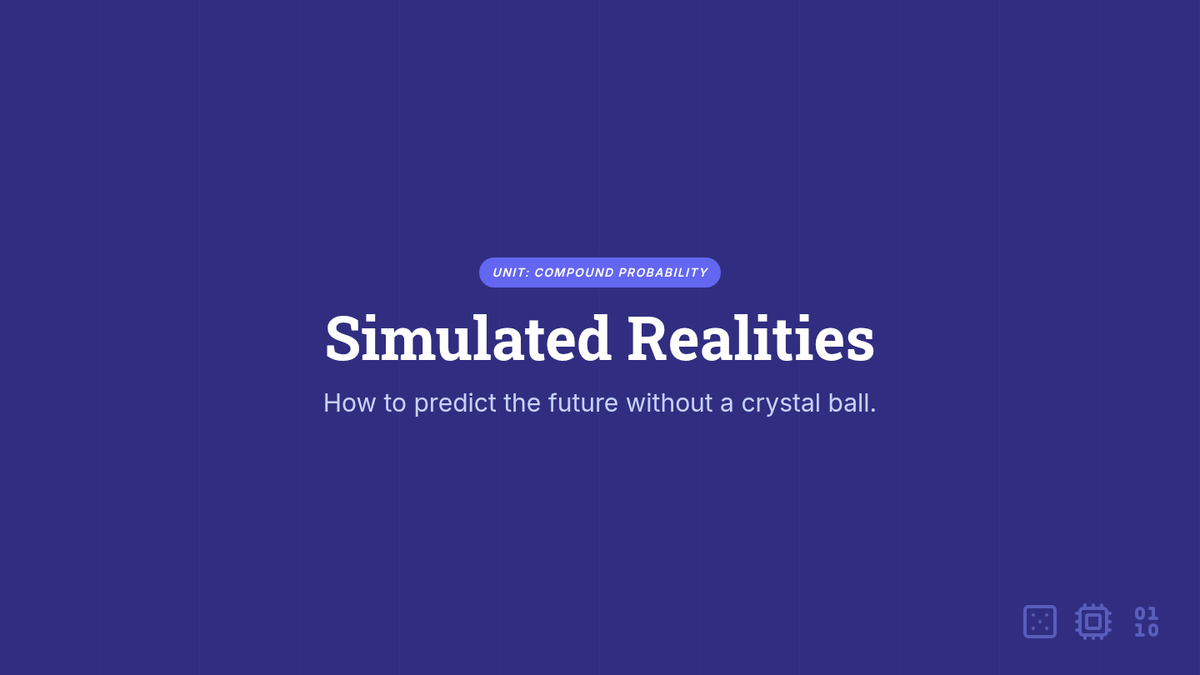
Simulated Realities Presentation
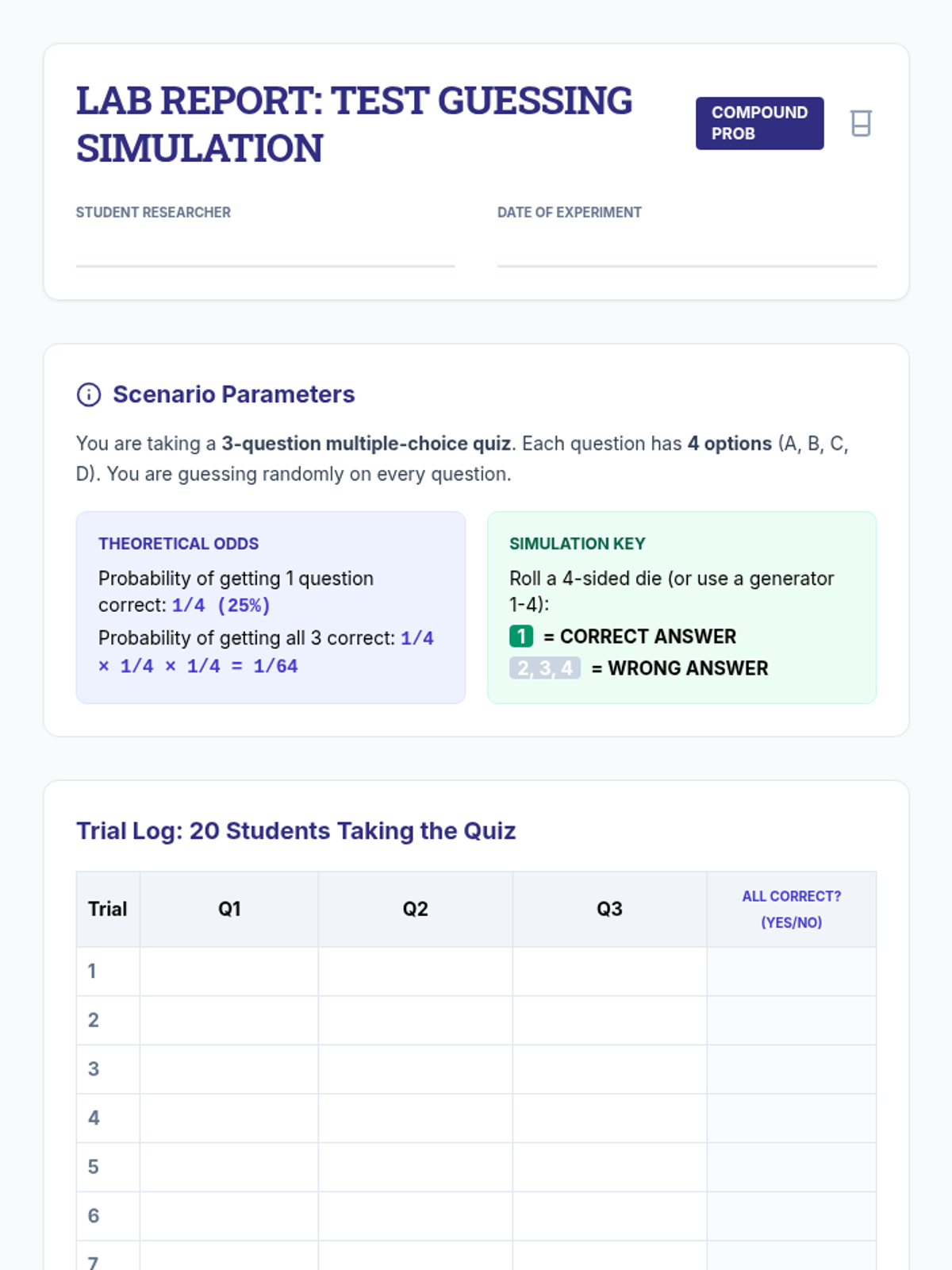
Test Guessing Simulator Worksheet
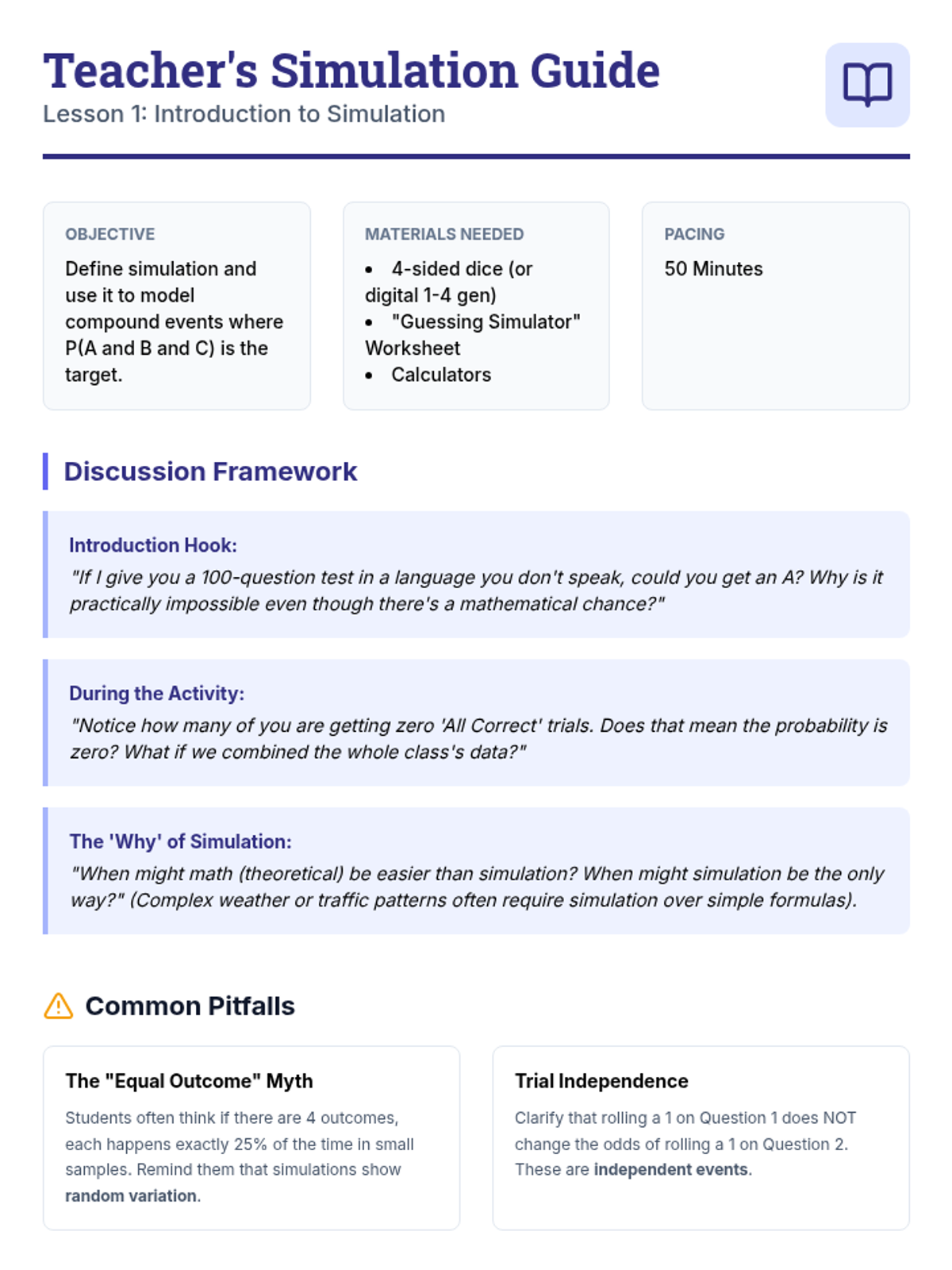
Simulated Realities Teacher Guide

Predicting the Future Simulation Lab

This 7th-grade sequence explores compound probability and simulations, connecting mathematical models to genetics, sports, and weather forecasting. Students move from basic simulations to designing their own complex models for real-world scenarios.

Lenny Avatar
Lenny
1/17
Sequence
Pattern Discovery Slides
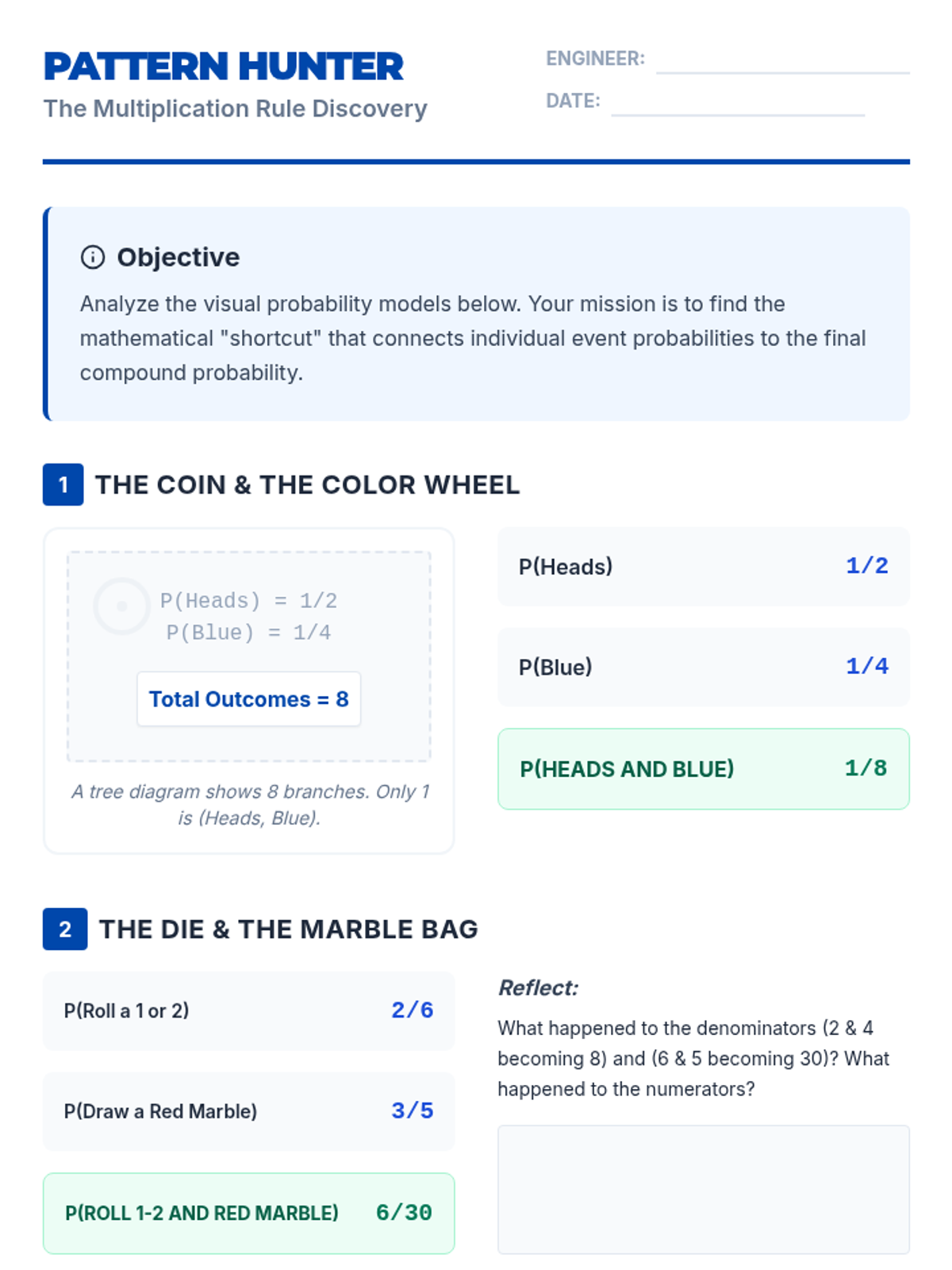
Pattern Hunter Worksheet
Discovery Facilitation Guide

Outcome Architects Multiplication Rule

This sequence guides 7th-grade students from visual probability models (tree diagrams, area models) to the abstract Multiplication Rule for independent and dependent events. Students will discover the rule through inquiry, apply it to increasingly complex multi-stage scenarios, and master the distinction between replacement and non-replacement contexts.

Lenny Avatar
Lenny
1/17
Sequence
Independent Events Slides
Independent Events Worksheet
Independent Events Answer Key

Probability Investigators

This sequence explores the differences between independent and dependent events through hands-on simulations, comparative analysis, and multi-step calculations. Students learn to adjust sample spaces and numerators based on whether items are replaced, building a strong foundation for compound probability.

Lenny Avatar
Lenny
1/17
Sequence
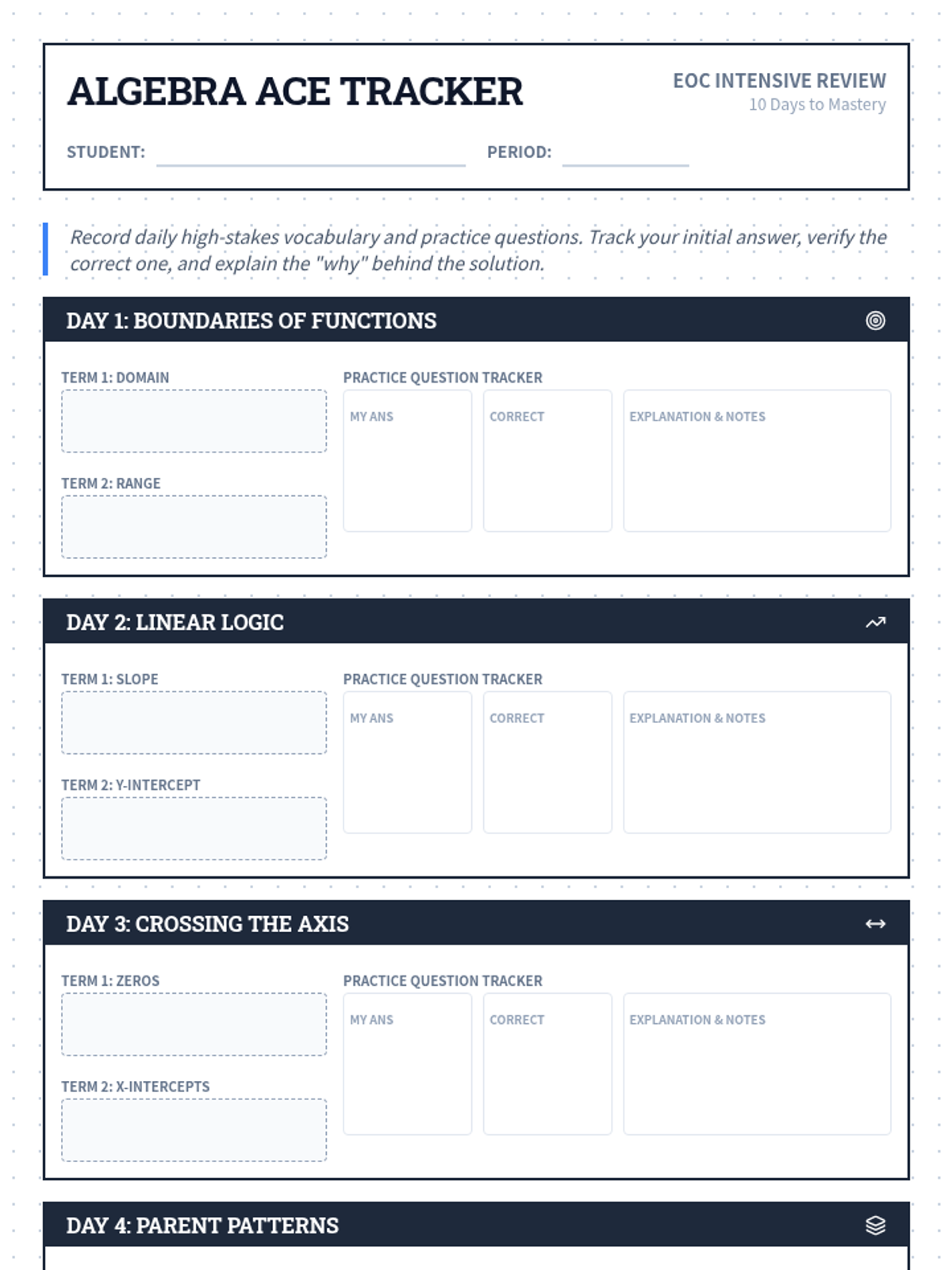
Domain and Range Review Slides

Algebra Ace Countdown

A 10-day intensive review sequence for the Texas Algebra I EOC exam, focusing on two high-stakes vocabulary terms each day with definitions, visual samples, and practice problems.

PR

Penne Reed

School Administrator
3/3
Sequence
Initial Briefing Assessment
Initial Briefing Answer Key

Data Decoder

A comprehensive Tier 2 intervention sequence for high school students focused on summarizing, representing, and interpreting data, aligned with Colorado Standard 3. The program uses a 'Data Forensics' theme to engage students in uncovering insights from real-world datasets through scaffolded analysis and visual interpretation.

Lenny Avatar
Lenny
2/13
Sequence
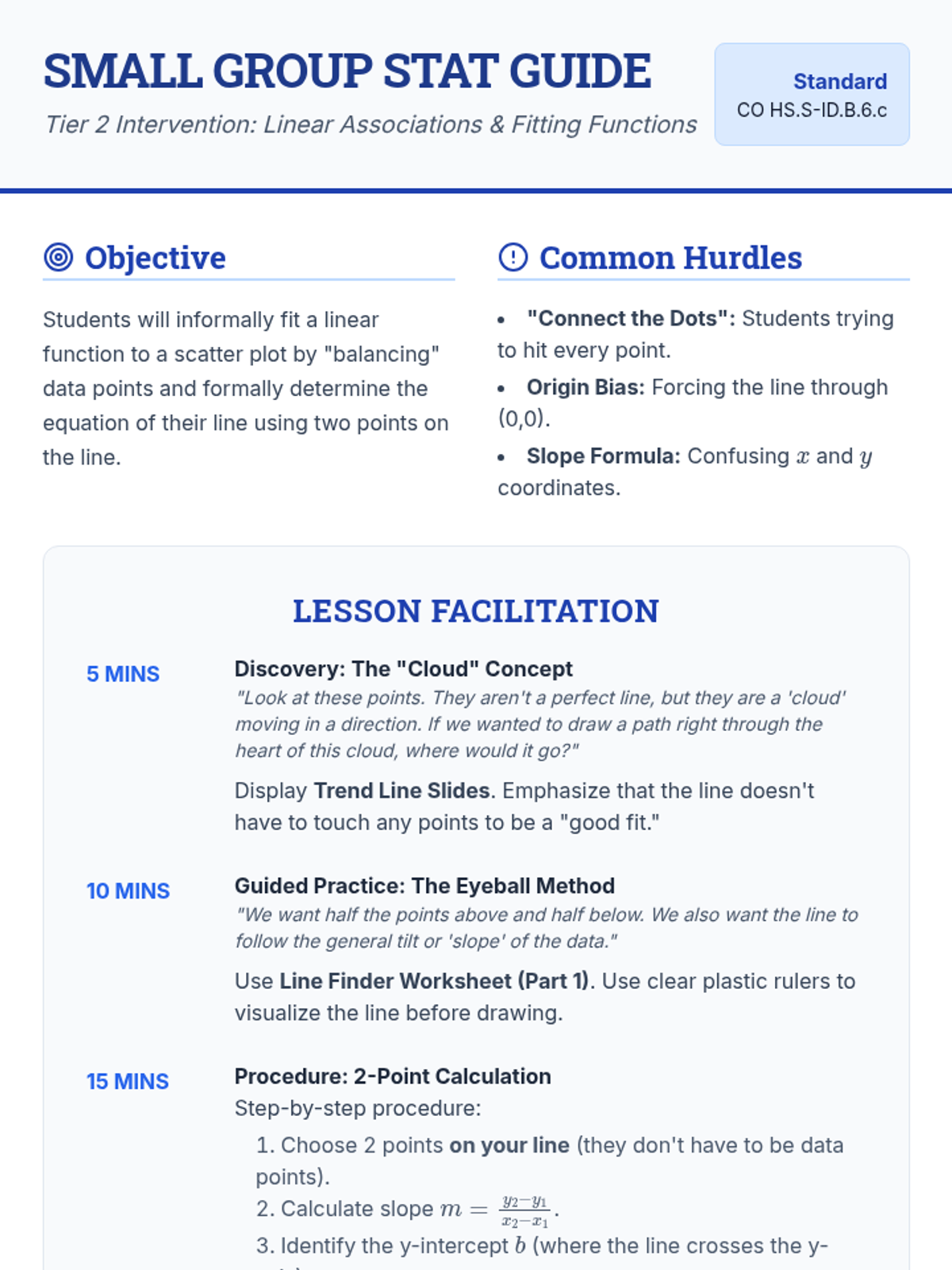
Small Group Stat Guide
Trend Line Slides
Line Finder Worksheet
Plot Check Exit Ticket

Linear Logic

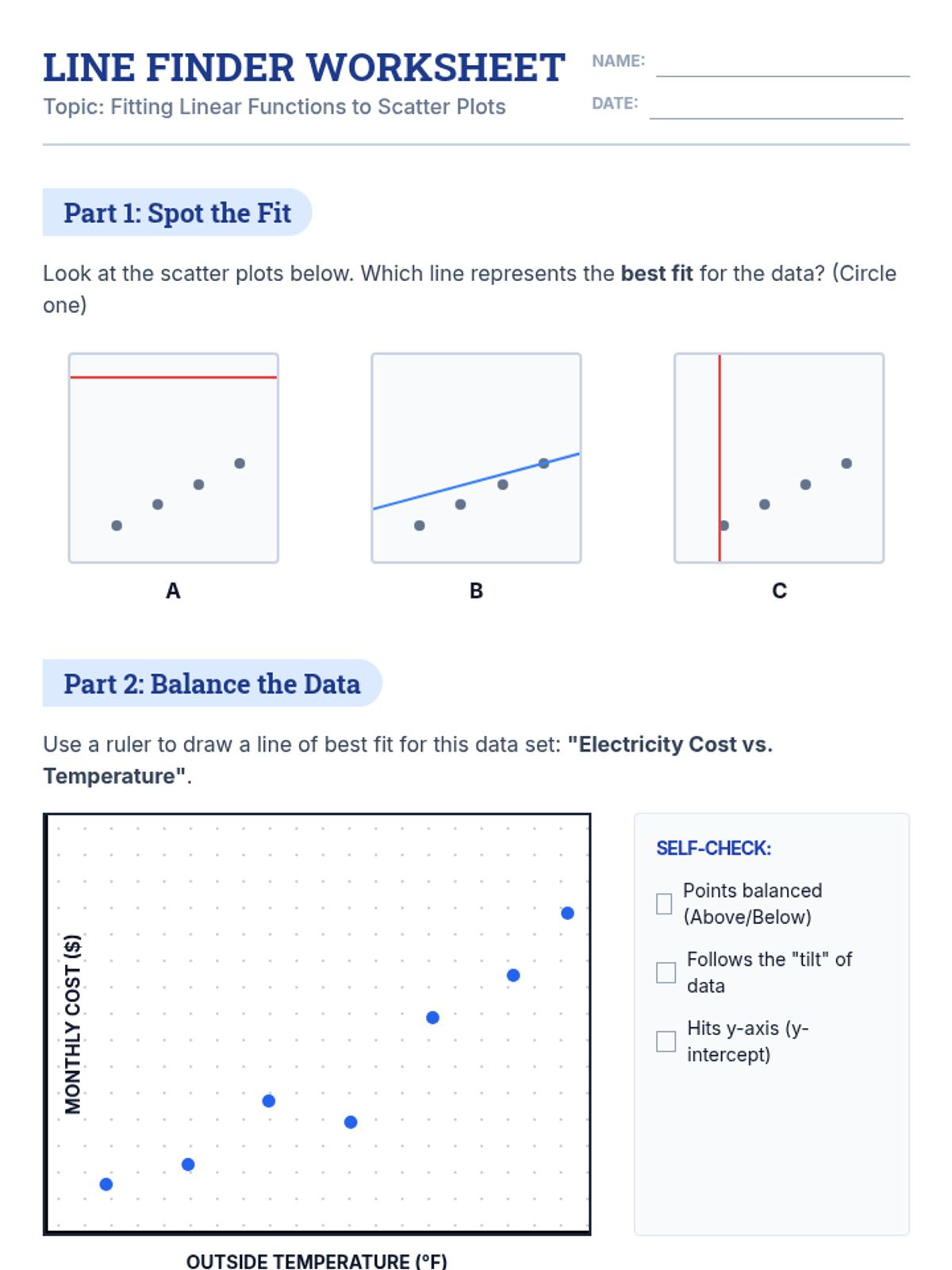
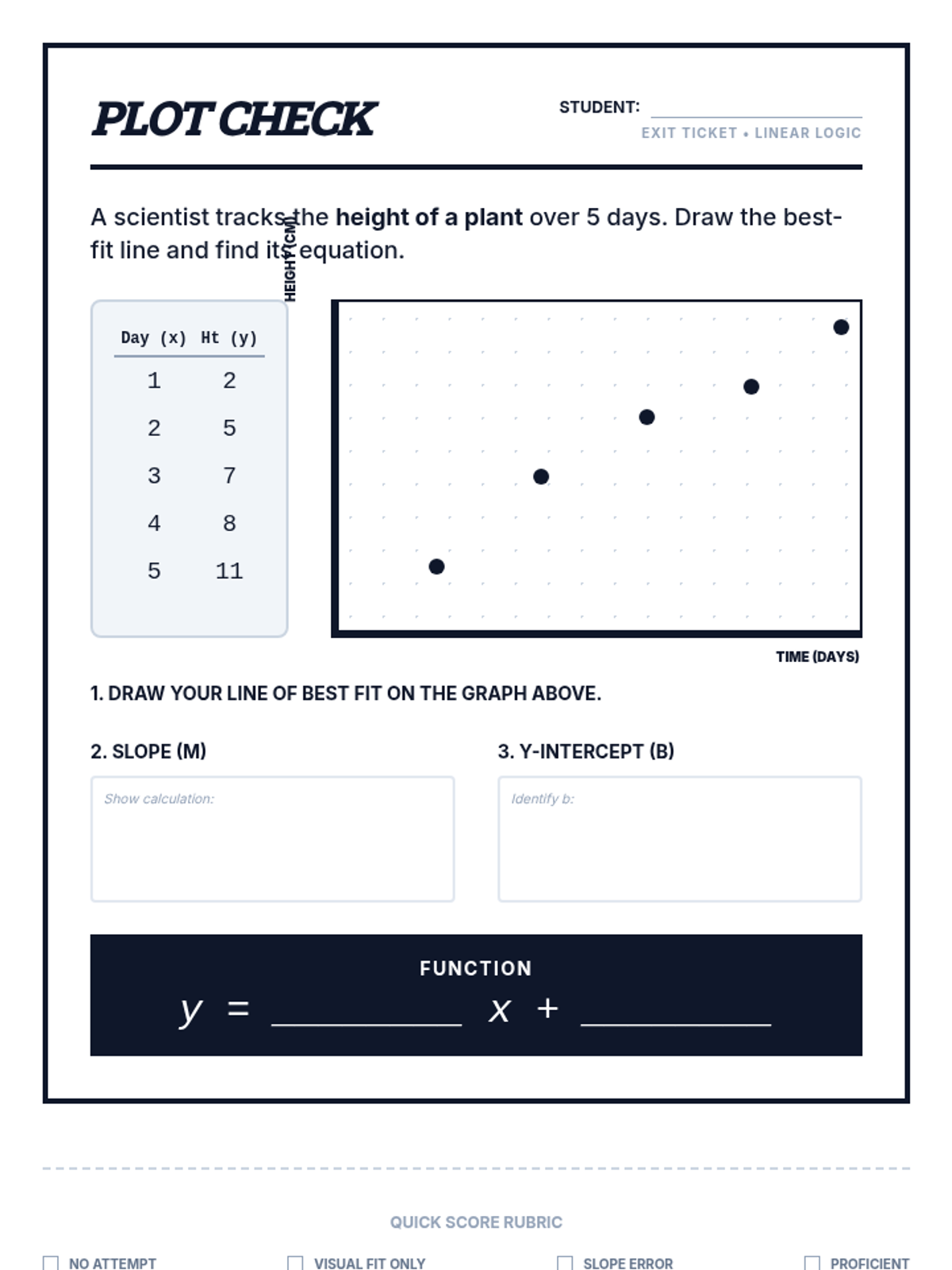
A targeted intervention sequence for high school statistics students focusing on fitting linear functions to scatter plots. It moves from conceptual understanding of 'balance' in data to the procedural steps of calculating lines of best fit.

Lenny Avatar
Lenny
2/12
Sequence
Correlation Lab Slides
Correlation Lab Teacher Guide
Correlation Lab Student Packet
Correlation Lab Exit Ticket

Correlation Lab Sequence

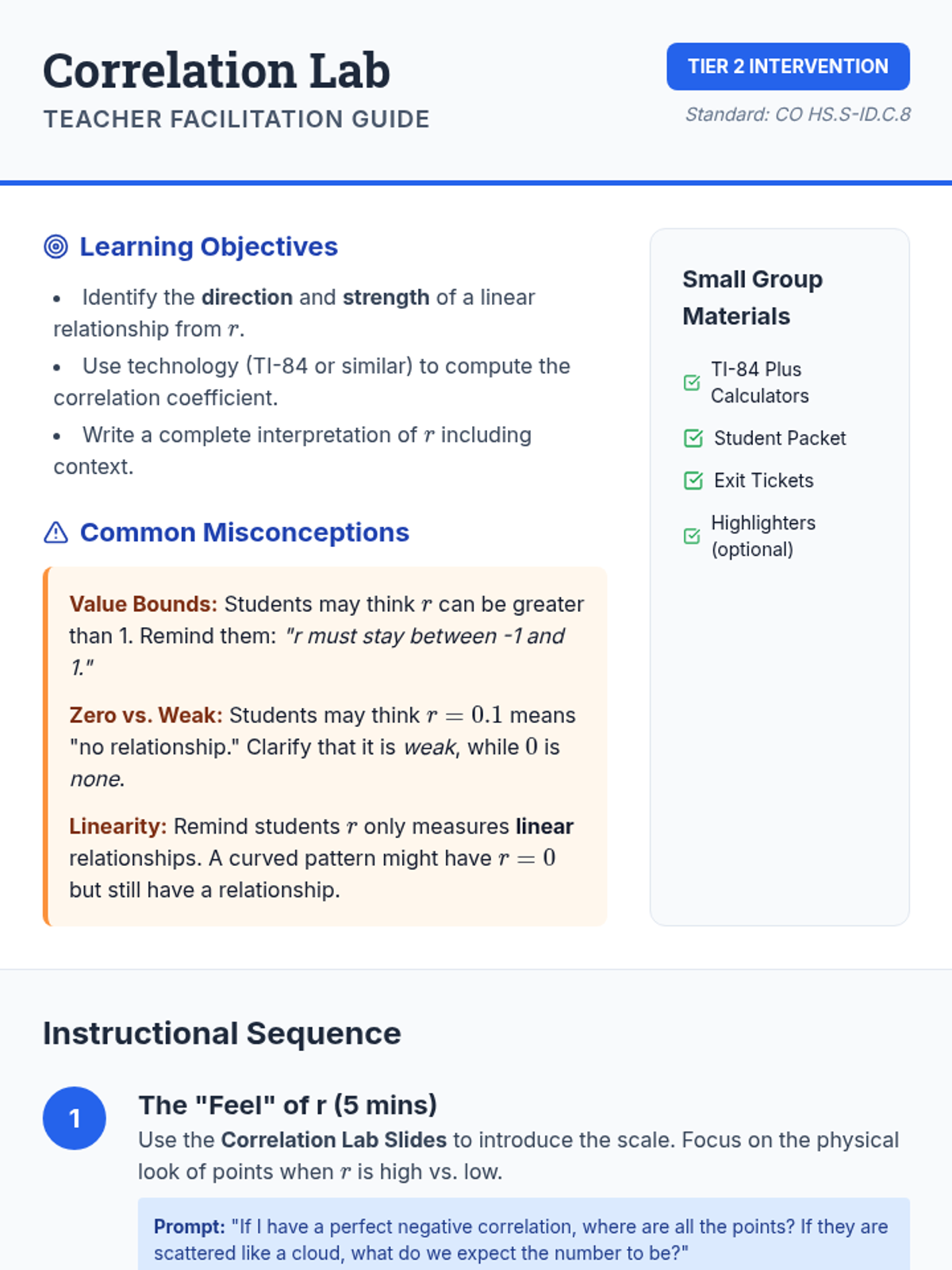
A Tier 2 intervention sequence focused on computing and interpreting the correlation coefficient (r) using technology, designed for high school statistics students needing targeted support.

Lenny Avatar
Lenny
2/12
Sequence
Relationship Radar Slides
Pattern Tracker Worksheet
Scatter Plot Showdown Activity
Progress Pulse Exit Ticket

Relationship Radar Sequence

A Tier 2 intervention sequence focused on analyzing bivariate data. Students learn to use technology to create scatter plots and develop a precise vocabulary for describing relationships between quantitative variables.

Lenny Avatar
Lenny
2/12
Sequence
Strategy Blueprint Slides
Math Essentials Reference
Math Essentials Reference Updated
Strategy Sandbox Worksheet
Subject Spotlight Activity
Strategy Sandbox Answer Key
Strategy Sandbox 2 Worksheet
Strategy Sandbox 2 Answer Key
Desmos Mastery Slides
Desmos Drill Worksheet
Desmos Drill Answer Key

ACT Math Mastery

A comprehensive ACT Math preparation program focusing on essential strategies, high-yield Algebra and Geometry concepts, and realistic practice to boost scores.

AL

ava larumbe

Other
2/8
Sequence
Trends and Tides Slides
Trends and Tides Worksheet
Trends and Tides Teacher Guide

Eco-Data Lab: Modeling the World

A comprehensive unit where students act as data scientists to model real-world environmental phenomena using trigonometric functions. They progress from visual estimation to precise algebraic modeling and technological regression to predict future environmental conditions.

Lenny Avatar
Lenny
1/18
Sequence
Spark Intro Slides
Inquiry Proposal Worksheet

Data Detectives

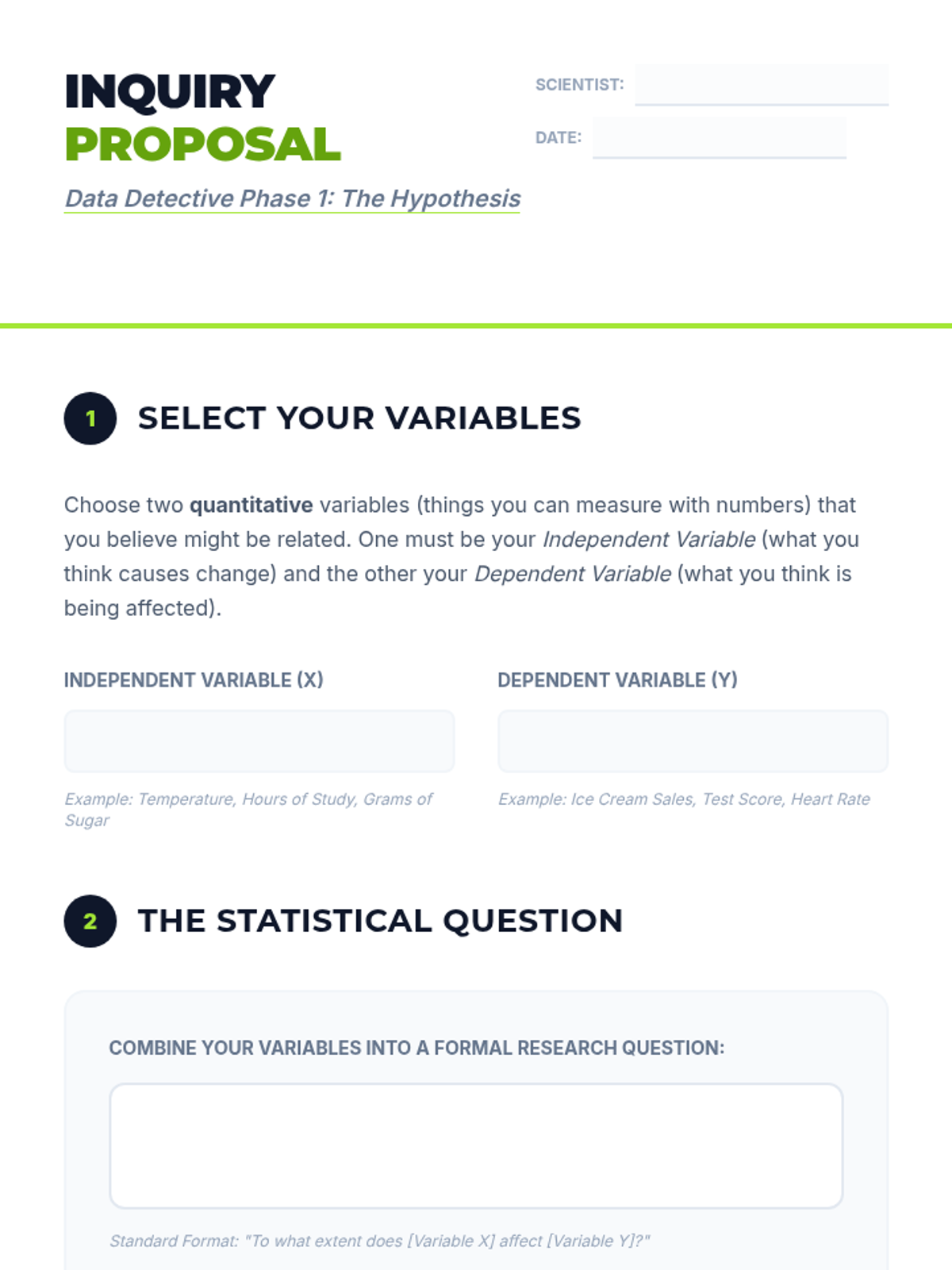
A project-based unit where 8th-grade students act as data scientists to investigate real-world relationships, generate digital linear models, and defend their predictions based on data reliability.

Lenny Avatar
Lenny
1/17
Sequence
Residual Lab Slides
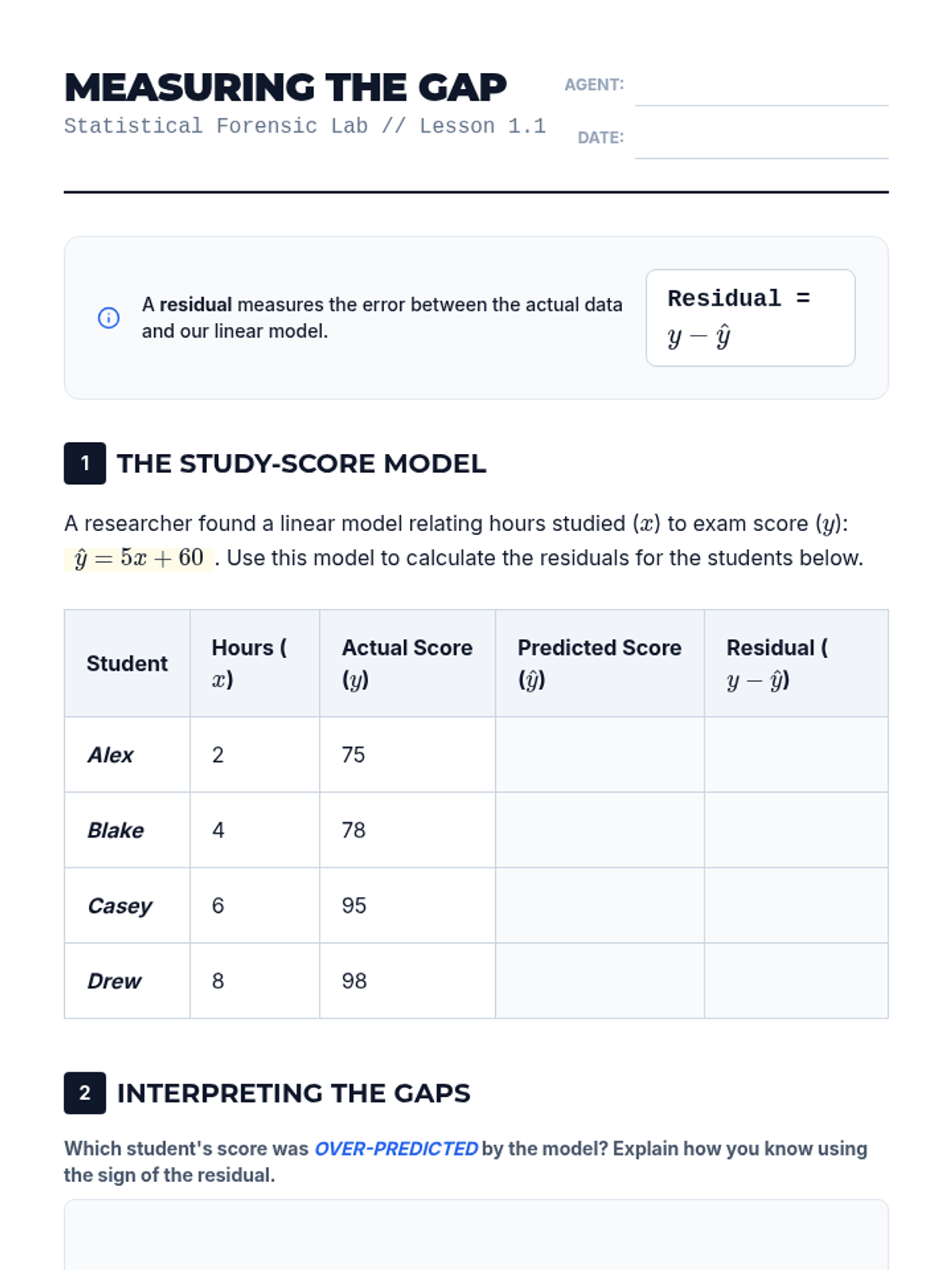
Measuring the Gap Worksheet

Model Reliability and Correlation

This sequence explores the statistical evaluation of linear models, covering residuals, linear regression technology, correlation coefficients, residual plots, and the distinction between correlation and causation. Students will learn to assess the reliability of models and use statistical tools to interpret data accurately.

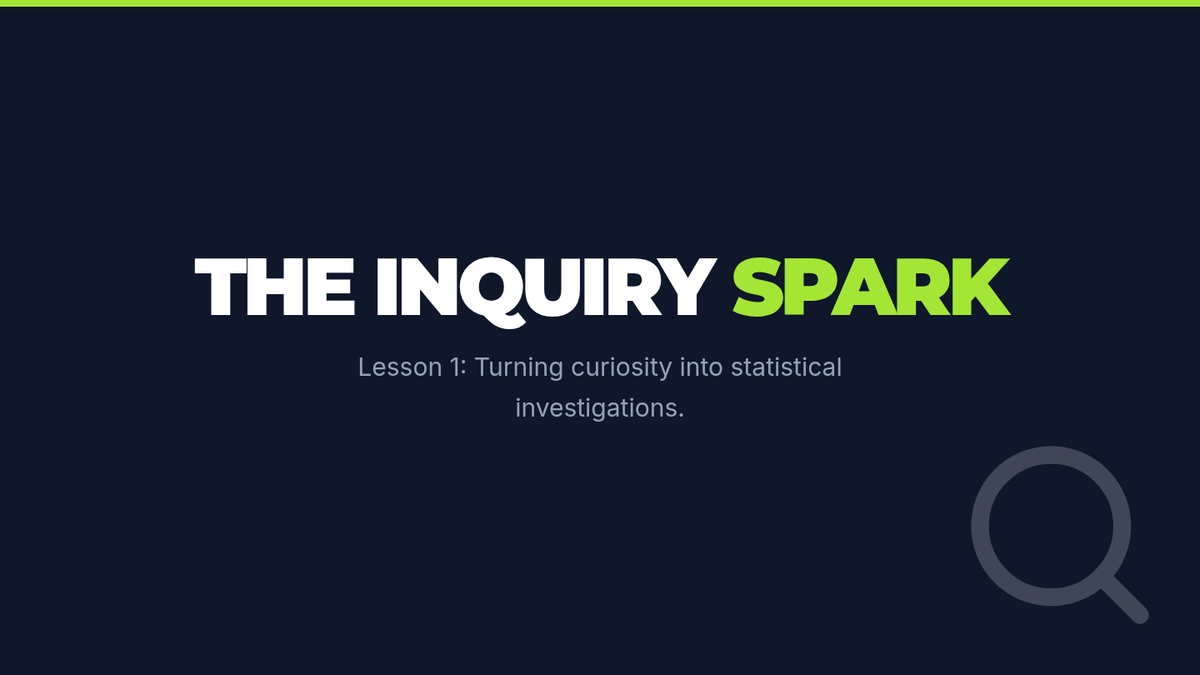
Lenny Avatar
Lenny
1/17
Sequence
Plotting the Patterns Slides
Reaction Time Lab Worksheet
Scatter Plot Teacher Guide

Real World Linear Models

Students act as data analysts to investigate relationships between variables in fields like sports, economics, and environmental science. The learning arc progresses from constructing scatter plots and generating lines of best fit to deeply interpreting the specific meaning of slope and y-intercept in context, concluding with a capstone project on predictive modeling.

Lenny Avatar
Lenny
1/17
Sequence
Data Detectives Slides
Plotting Patterns Worksheet
Scatter Plot Teacher Guide

Analyzing Linear Relationships in Context

A 5-lesson sequence where students act as data analysts to explore, construct, and interpret linear models. Students progress from basic scatter plots to making predictions and critiquing the validity of linear models in real-world contexts.

Lenny Avatar
Lenny
1/17
Sequence
Anomaly Investigation Slides
Cluster Clues Worksheet
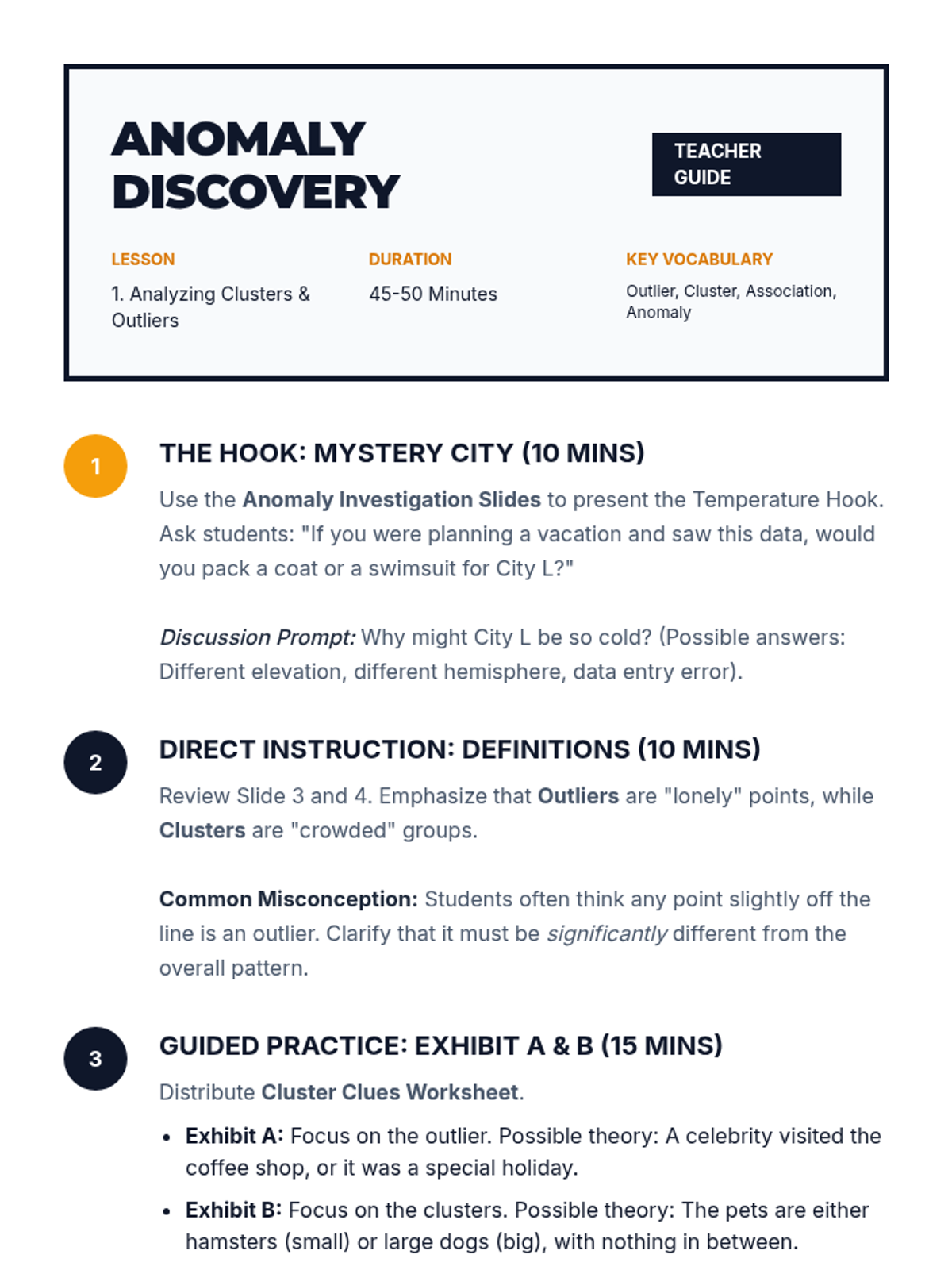
Anomaly Discovery Teacher Guide

Data Truth Detectives

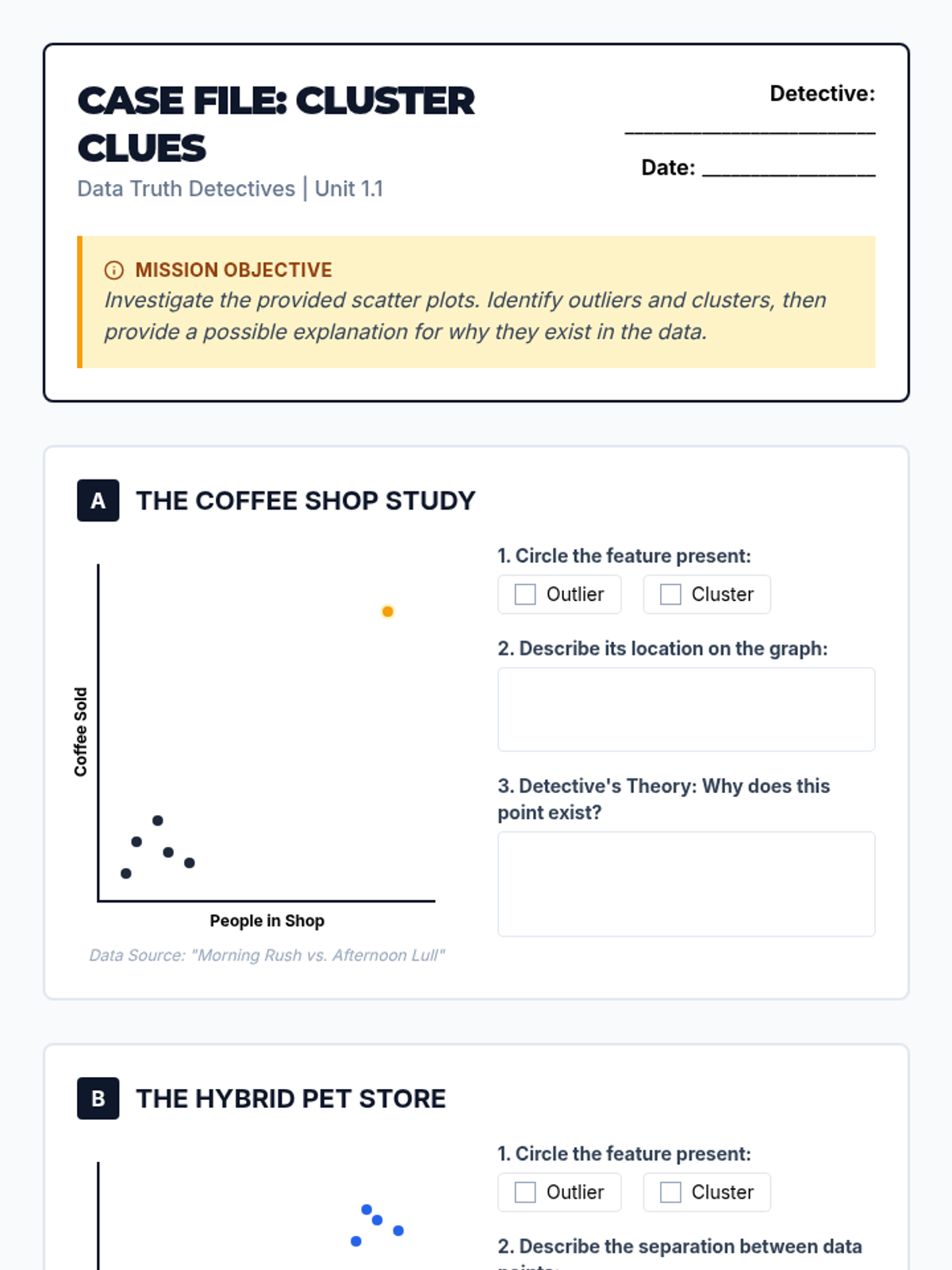
This sequence focuses on the critical analysis of data reliability, outliers, and the validity of linear associations. Students explore messy data, identify clusters and outliers, and evaluate when a linear model is appropriate versus when it might be misleading.

Lenny Avatar
Lenny
1/17
Sequence
Trend Detectives Teacher Guide
Trend Detectives Slides
Scatter Plot Sketchpad Worksheet

Analyzing Slope and Y-Intercept

This sequence guides 9th-grade students through the process of interpreting linear models, moving from qualitative observations of scatter plots to quantitative interpretations of slope and y-intercept in real-world contexts. Students will learn to construct trend lines, write equations, and use those models to make informed predictions.

Lenny Avatar
Lenny
1/17
Sequence
Precision Regression Slides
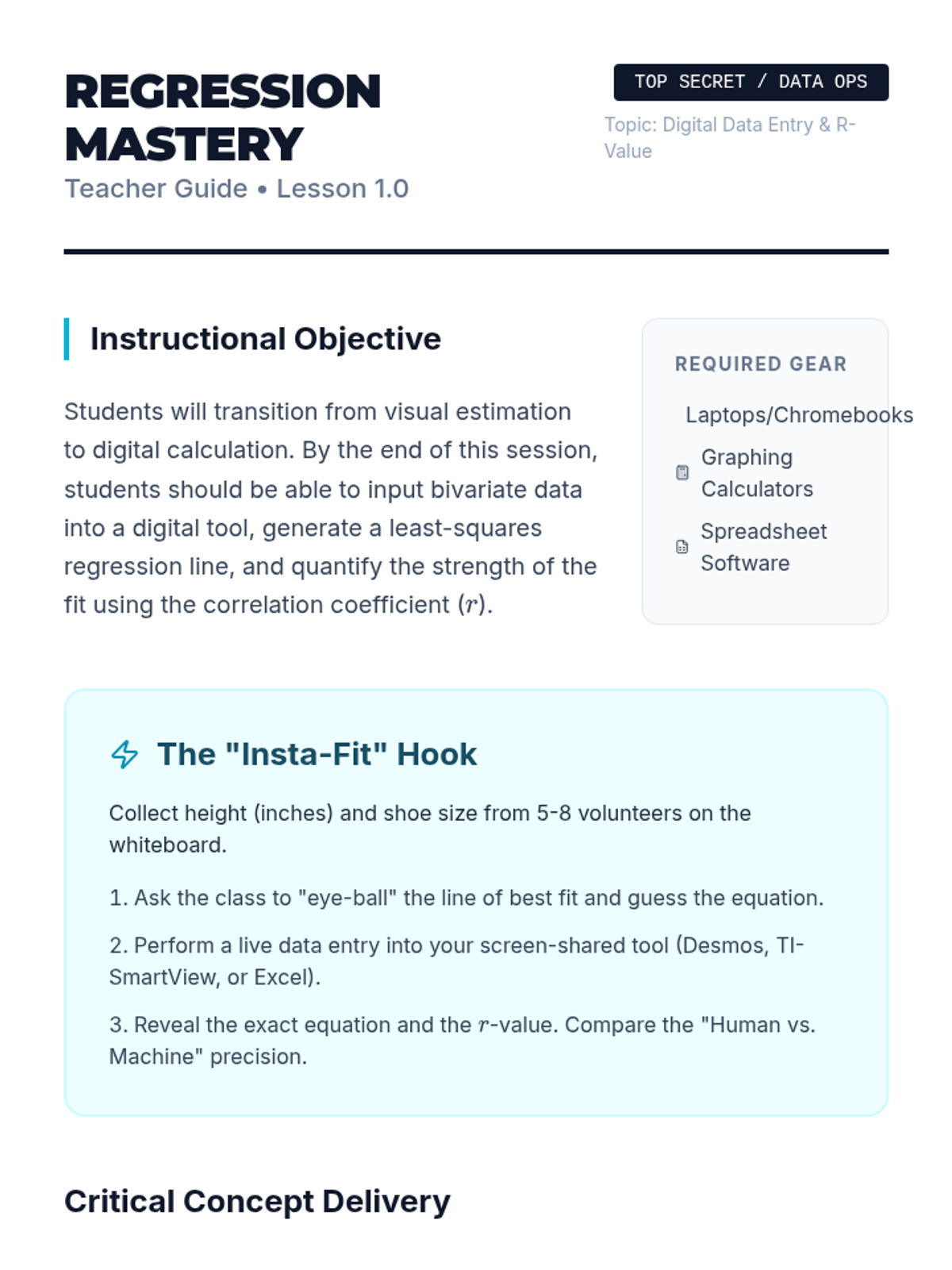
Regression Mastery Teacher Guide
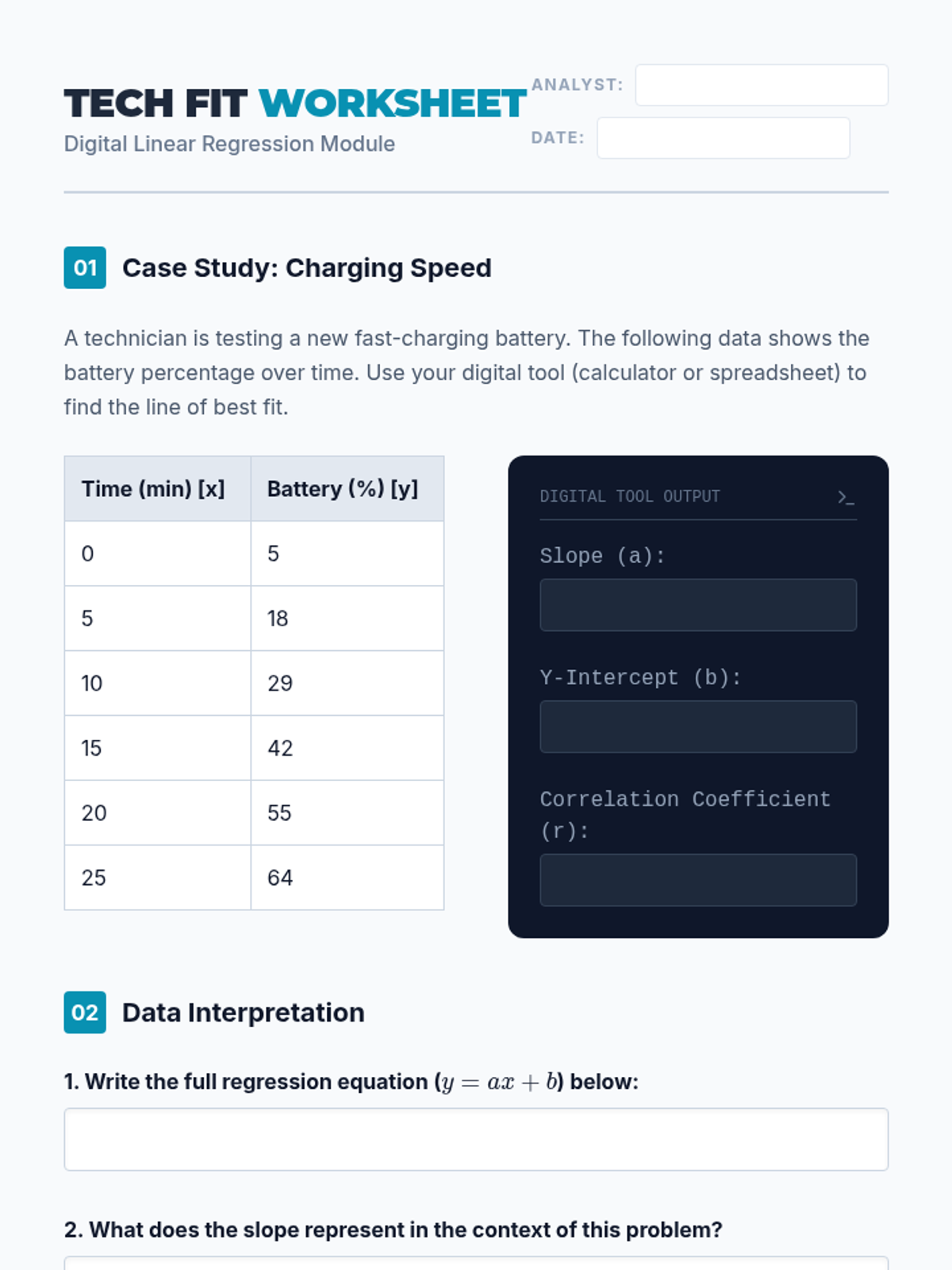
Tech Fit Worksheet

Evaluating Model Reliability and Making Predictions

A project-based unit for 9th-grade students focusing on the reliability of linear models, technology-based regression, residual analysis, and the critical distinction between correlation and causation. Students transition from manual calculations to digital tools to defend data-driven predictions.

Lenny Avatar
Lenny
1/17
Sequence
Correlation Detective Slides
Spurious Clues Worksheet

Analyzing Trends and Insights

Students move from describing data to interpreting and modeling it. They explore correlation vs. causation, trend lines, predictive modeling, and the ethics of data bias using real-world datasets and case studies.

Lenny Avatar
Lenny
1/17
Sequence
Regression Roadmap Slides
Regression Analysis Worksheet

PolyLab Modeling Mastery

A project-based unit where students apply polynomial calculus concepts to real-world scenarios like business profits, projectile motion, and engineering design. Students transition from abstract solving to modeling data and optimizing outcomes using regression, intercepts, and extrema.

Lenny Avatar
Lenny
1/17
Sequence
Shape of Data Slides
Function Detectives Worksheet
Shape of Data Teacher Guide

Data Detectives Functional Modeling

Students assume the role of data analysts to interpret complex real-world datasets related to economics, population dynamics, and environmental science. They identify function families, construct algebraic models using regression, evaluate 'goodness of fit' via residuals, and apply their models for predictions while critically analyzing domain limitations.

Lenny Avatar
Lenny
1/17
Sequence
Guide Enseignant Sprint Statistique
Slides Sprint Statistique
Mission Sprint Olympique Activité
Mémento Stats et Numérique Reference Sheet
Correction Mission Sprint Olympique Answer Key

Statistiques et Numérique

Une séquence complète sur les statistiques en 3ème, abordant la collecte, le traitement et l'interprétation de données avec des outils numériques.

E

Enseignante

Math Teacher
2/27
Sequence
Initial Briefing Assessment
Initial Briefing Answer Key

Data Decoder

A comprehensive Tier 2 intervention sequence for high school students focused on summarizing, representing, and interpreting data, aligned with Colorado Standard 3. The program uses a 'Data Forensics' theme to engage students in uncovering insights from real-world datasets through scaffolded analysis and visual interpretation.

Lenny Avatar
Lenny
2/13
Sequence
Reality Check Slides
Household Data Challenge Worksheet
Probability Pulse Check Assessment
Intervention Facilitation Guide

Reality Check Probability

A Tier 2 intervention sequence focused on helping students develop empirical probability distributions and calculate expected values using real-world household data. This sequence provides high-scaffolding and structured practice for small group instruction.

Lenny Avatar
Lenny
2/12
Sequence
Curve Fitters Slides
Curve Crafters Workbook
Curve Fitters Teacher Guide
Curve Check Exit Ticket

Distribution Detectives

A Tier 2 intervention sequence focused on helping students master the Normal Distribution and the Empirical Rule through real-world applications and scaffolded practice.

Lenny Avatar
Lenny
2/12
Sequence
Data Architect Teacher Guide
Plotting Potential Slides
Data Workshop Packet
Plot Check Exit Ticket

Metric Workshop

A Tier 2 intervention sequence focused on building concrete understanding of data representations including dot plots, histograms, and box plots for high school statistics students.

Lenny Avatar
Lenny
2/12
Sequence
Relationship Radar Slides
Pattern Tracker Worksheet
Scatter Plot Showdown Activity
Progress Pulse Exit Ticket

Relationship Radar Sequence

A Tier 2 intervention sequence focused on analyzing bivariate data. Students learn to use technology to create scatter plots and develop a precise vocabulary for describing relationships between quantitative variables.

Lenny Avatar
Lenny
2/12
Sequence
Distribution Duel Slides
Evidence File Worksheet
Lead Detective Guide
Case Closed Exit Ticket
Detective Brief Answer Keys

Distribution Detectives

A targeted Tier 2 intervention for High School Statistics focusing on comparing data distributions (shape, center, spread) and understanding the impact of outliers. Includes scaffolded instruction, guided practice with sentence frames, and progress monitoring tools.

Lenny Avatar
Lenny
2/12
Sequence
Strategy Blueprint Slides
Math Essentials Reference
Math Essentials Reference Updated
Strategy Sandbox Worksheet
Subject Spotlight Activity
Strategy Sandbox Answer Key
Strategy Sandbox 2 Worksheet
Strategy Sandbox 2 Answer Key
Desmos Mastery Slides
Desmos Drill Worksheet
Desmos Drill Answer Key

ACT Math Mastery

A comprehensive ACT Math preparation program focusing on essential strategies, high-yield Algebra and Geometry concepts, and realistic practice to boost scores.

AL

ava larumbe

Other
2/8
Sequence
Trends and Tides Slides
Trends and Tides Worksheet
Trends and Tides Teacher Guide

Eco-Data Lab: Modeling the World

A comprehensive unit where students act as data scientists to model real-world environmental phenomena using trigonometric functions. They progress from visual estimation to precise algebraic modeling and technological regression to predict future environmental conditions.

Lenny Avatar
Lenny
1/18
Sequence
Spark Intro Slides
Inquiry Proposal Worksheet

Data Detectives

A project-based unit where 8th-grade students act as data scientists to investigate real-world relationships, generate digital linear models, and defend their predictions based on data reliability.

Lenny Avatar
Lenny
1/17
Sequence
Plotting the Patterns Slides
Reaction Time Lab Worksheet
Scatter Plot Teacher Guide

Real World Linear Models

Students act as data analysts to investigate relationships between variables in fields like sports, economics, and environmental science. The learning arc progresses from constructing scatter plots and generating lines of best fit to deeply interpreting the specific meaning of slope and y-intercept in context, concluding with a capstone project on predictive modeling.

Lenny Avatar
Lenny
1/17
Sequence
Anomaly Investigation Slides
Cluster Clues Worksheet
Anomaly Discovery Teacher Guide

Data Truth Detectives

This sequence focuses on the critical analysis of data reliability, outliers, and the validity of linear associations. Students explore messy data, identify clusters and outliers, and evaluate when a linear model is appropriate versus when it might be misleading.

Lenny Avatar
Lenny
1/17
Sequence
Question Clinic Worksheet
Bias Detection Slides
Question Clinic Answer Key

Data Consultant Agency

A project-based unit where 7th-grade students act as data consultants to solve school-wide problems. They learn to identify bias, design sampling plans, collect data, and present data-backed recommendations to administration.

Lenny Avatar
Lenny
1/17
Sequence
Supplier Search Brief
Analyst Intro Slides

Consistency Kings

Students act as data analysts for a tech company to decide between two suppliers. They learn that averages don't tell the whole story, using Mean Absolute Deviation (MAD) and Interquartile Range (IQR) to assess risk and consistency in real-world decision making.

Lenny Avatar
Lenny
1/17
Sequence
Defining the Mission Slides
Project Briefcase Worksheet
Project Facilitation Guide

Bureau of Truth and Trends

A project-based unit where students act as lead researchers, designing and executing a statistical study from question formulation to final validity reporting. Students learn to navigate population definitions, sampling methods, and question bias to ensure their data accurately reflects reality.

Lenny Avatar
Lenny
1/17
Sequence
Shape Shifters Presentation
Shape Hunter Worksheet

Spread Stories

An inquiry-based exploration of statistical variability, focusing on how data spread reveals truths about inequality, climate instability, and diversity that averages often hide. Students transition from visual distribution analysis to quantifying disparity using IQR and MAD, culminating in an independent investigation.

Lenny Avatar
Lenny
1/17
Sequence
Heartbeat Case Slides
Vital Signs Worksheet
Center vs Spread Facilitator Guide

Risk and Reliability Lab

A high school statistics sequence focused on quantifying risk and consistency through measures of variability. Students move from basic spread concepts to complex financial and industrial case studies, culminating in a data-driven risk assessment report.

Lenny Avatar
Lenny
1/17
Sequence
Quartile Quest Slides
Partition Practice Worksheet
Quartile Captain Teacher Guide

Data Blueprint Box Plots and IQR

A comprehensive sequence on statistical variability focusing on quartiles, IQR, and box plots. Students move from raw data partitioning to visual representation and advanced outlier detection, culminating in the interpretation of distribution shapes and skewness.

Lenny Avatar
Lenny
1/17
Sequence
Data Disparity Slides
Spread Matchup Worksheet

Data Disparity and Distribution

This sequence explores statistical variability through the lens of robust measures like IQR and box plots. Students move from basic understanding of spread to complex comparative analysis, focusing on how variability impacts the reliability of data-driven conclusions.

Lenny Avatar
Lenny
1/17
Sequence
Regression Roadmap Slides
Regression Analysis Worksheet

PolyLab Modeling Mastery

A project-based unit where students apply polynomial calculus concepts to real-world scenarios like business profits, projectile motion, and engineering design. Students transition from abstract solving to modeling data and optimizing outcomes using regression, intercepts, and extrema.

Lenny Avatar
Lenny
1/17
Sequence
Decision Coach Guide
Decision Lab Slides
Decision Map Worksheet
Strategy Lab Worksheet
Probability Pulse Check

Decision Lab Probability

A Tier 2 intervention sequence focused on using probability to analyze decisions, specifically targeting medical testing (false positives/negatives) and game-time strategies. Students learn to use tree diagrams and contingency tables to navigate complex conditional probability scenarios.

Lenny Avatar
Lenny
2/12
Sequence
Fair Play Lab Slides
Decision Design Lab Worksheet
Fair Play Facilitator Guide
Fair Play Exit Ticket
Fair Play Answer Key

Probability Power

A comprehensive unit focused on practical applications of probability for high school students, emphasizing decision-making, fairness, and risk assessment.

Lenny Avatar
Lenny
2/12
Sequence
Fair Play Slides
Fair Play Lab Sheet
Fair Play Facilitator Guide
Fair Play Lab Key

Fair Play Logic

A small group intervention sequence focused on understanding and applying probability to ensure fair decision-making, specifically designed for students needing extra support in High School Statistics.

Lenny Avatar
Lenny
2/12
Sequence
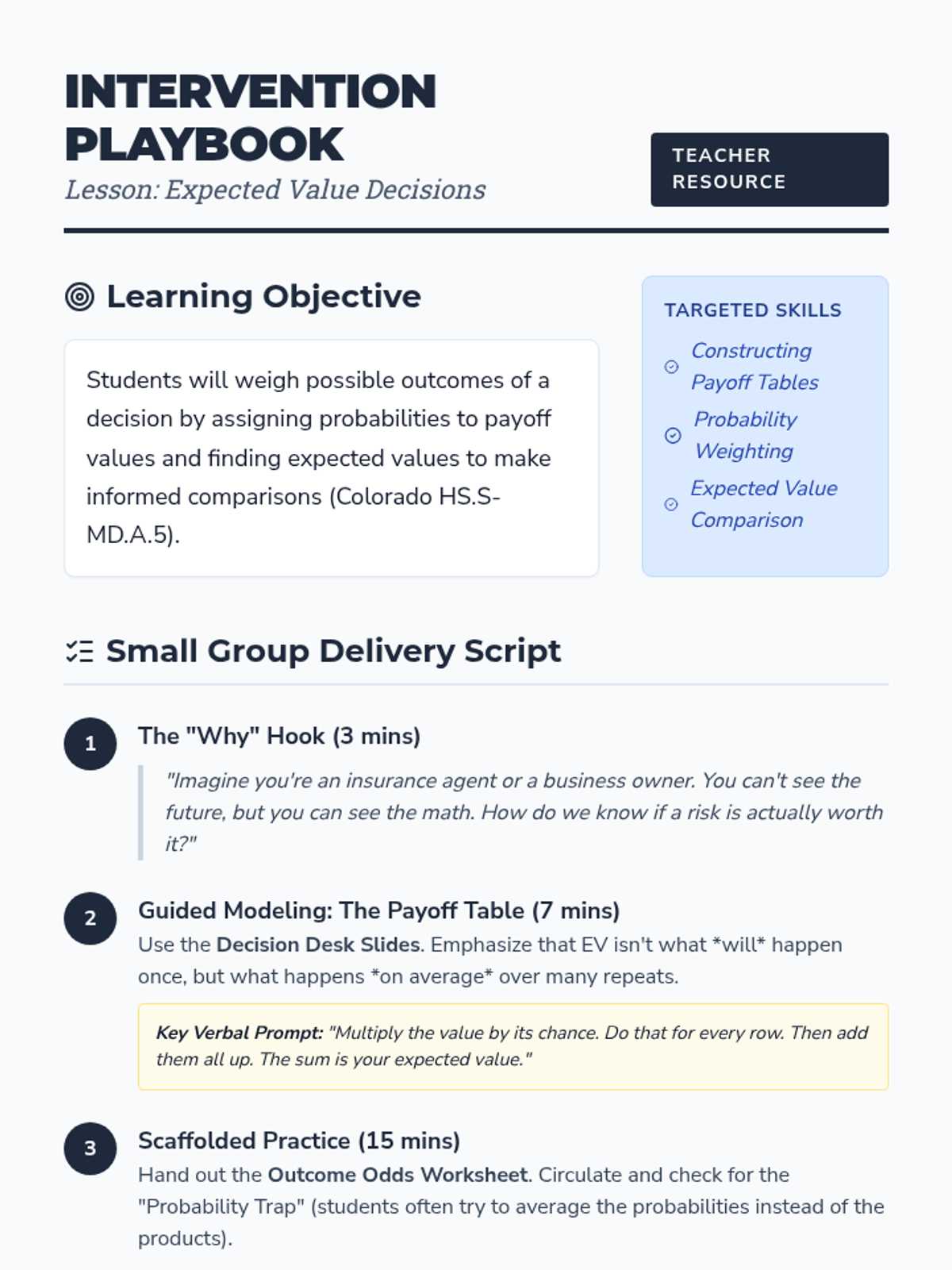
Intervention Playbook Teacher Guide
Decision Desk Slides
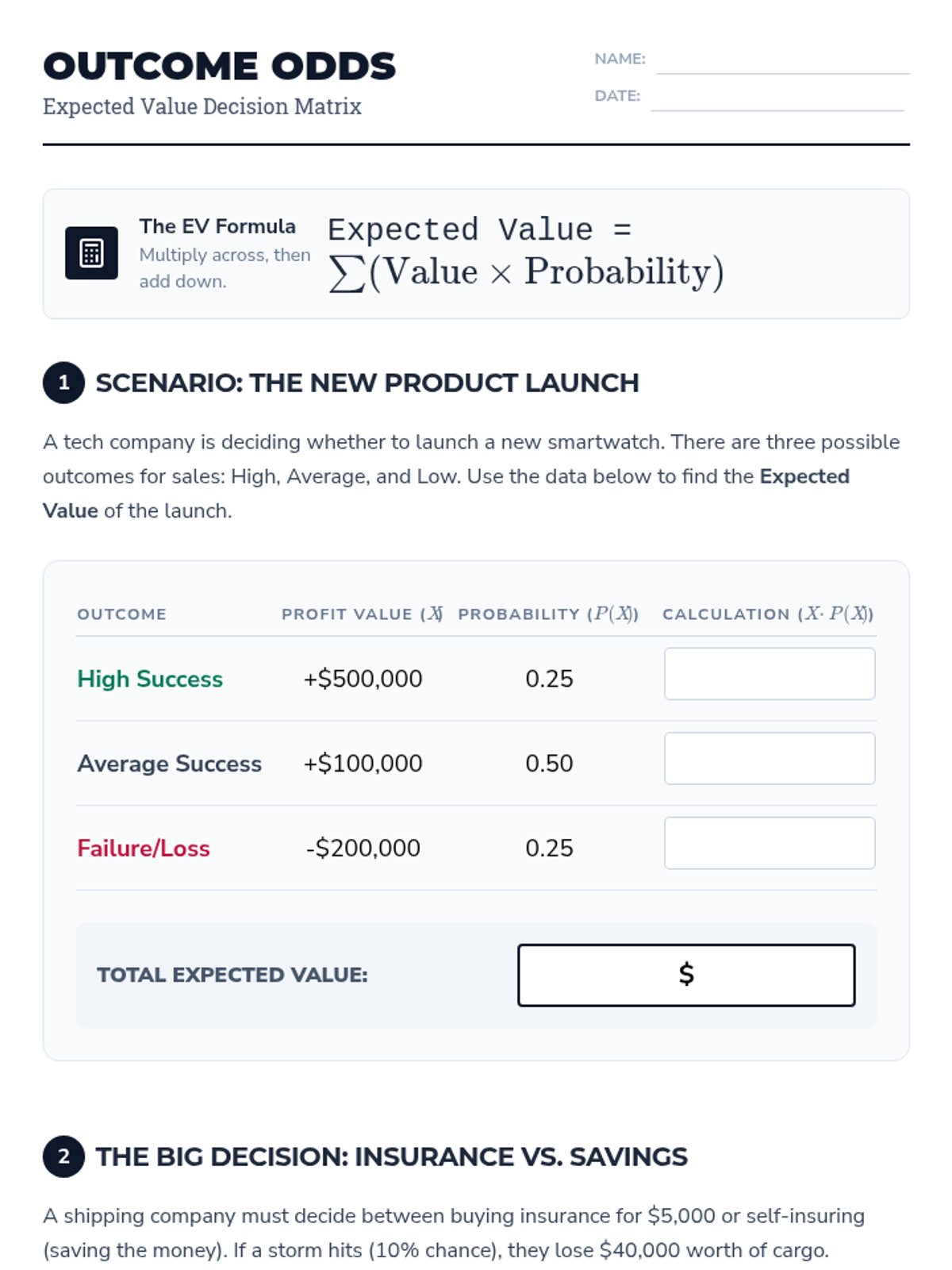
Outcome Odds Worksheet
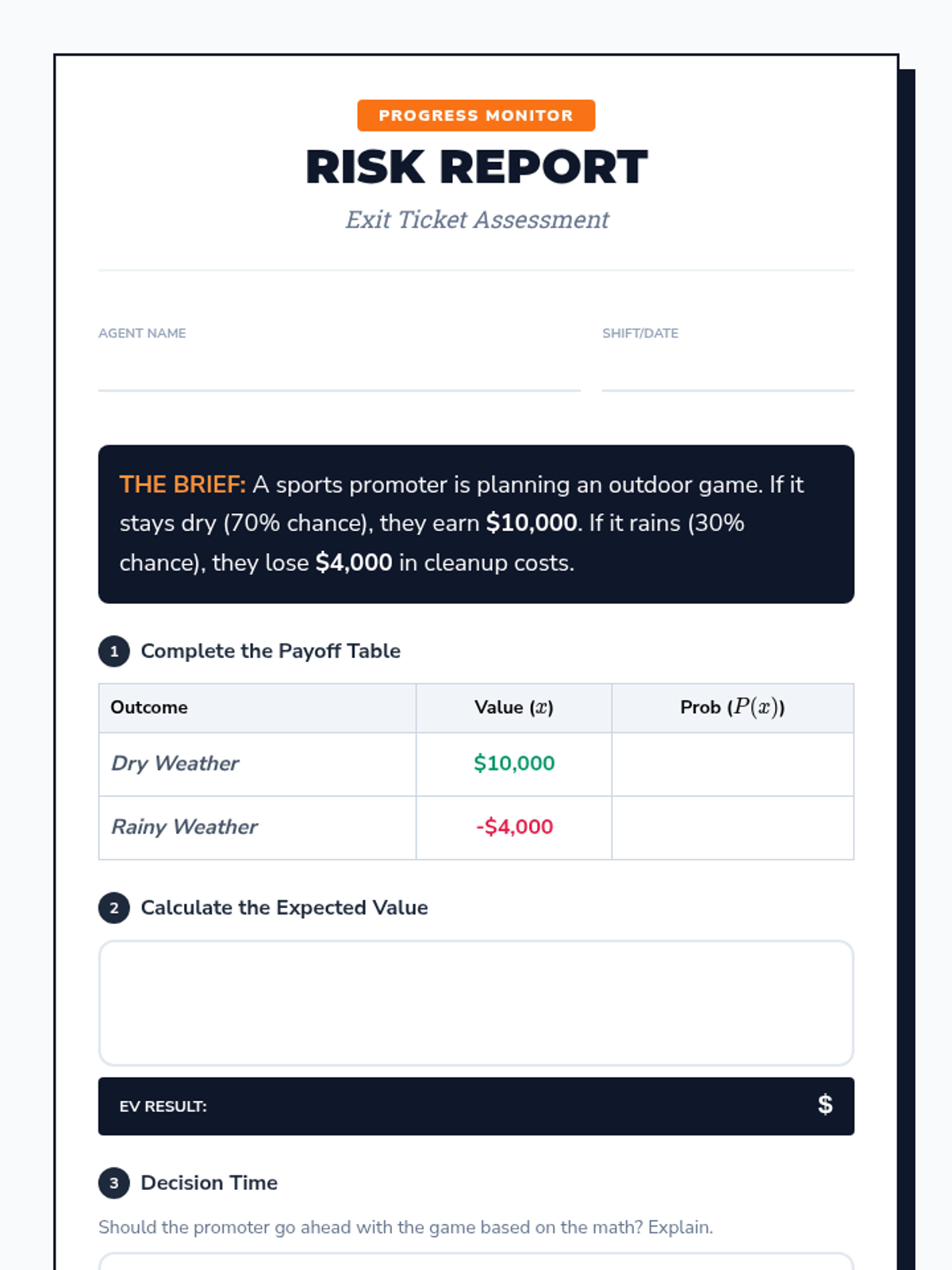
Risk Report Assessment

Decision Desk

A high school statistics intervention sequence focused on decision-making through expected value calculations. Students learn to construct payoff tables, assign probabilities, and compare outcomes in real-world scenarios.

Lenny Avatar
Lenny
2/12
Sequence
Intervention Roadmap Teacher Guide
Value Venture Slides
Expected Value Blueprint Worksheet
Progress Probe Exit Ticket

Expected Value Intervention

A targeted intervention sequence focused on helping High School students master the calculation and interpretation of expected value using concrete game scenarios and scaffolded table methods.

Lenny Avatar
Lenny
2/12
Sequence
Probability Roadmap Teacher Guide
Distribution Discovery Slides
Value Venture Activity
Distribution Check Exit Ticket
Probability Intervention Answer Key

Probability Pros

A targeted intervention sequence focused on foundational probability concepts, specifically developing discrete probability distributions and calculating expected values through visual scaffolds like tree diagrams and organized counting.

Lenny Avatar
Lenny
2/12
Sequence
Filtered View Slides
Filtered Logic Worksheet
Filtered View Teacher Guide

Signal and Noise Lab

This sequence explores conditional probability and the reliability of tests using frequency trees and area models. Students investigate 'false positives' and 'false negatives' in real-world contexts like medical testing and spam filters, ultimately debating the ethical implications of screening policies.

Lenny Avatar
Lenny
1/18
Sequence
Risk Matrix Slides
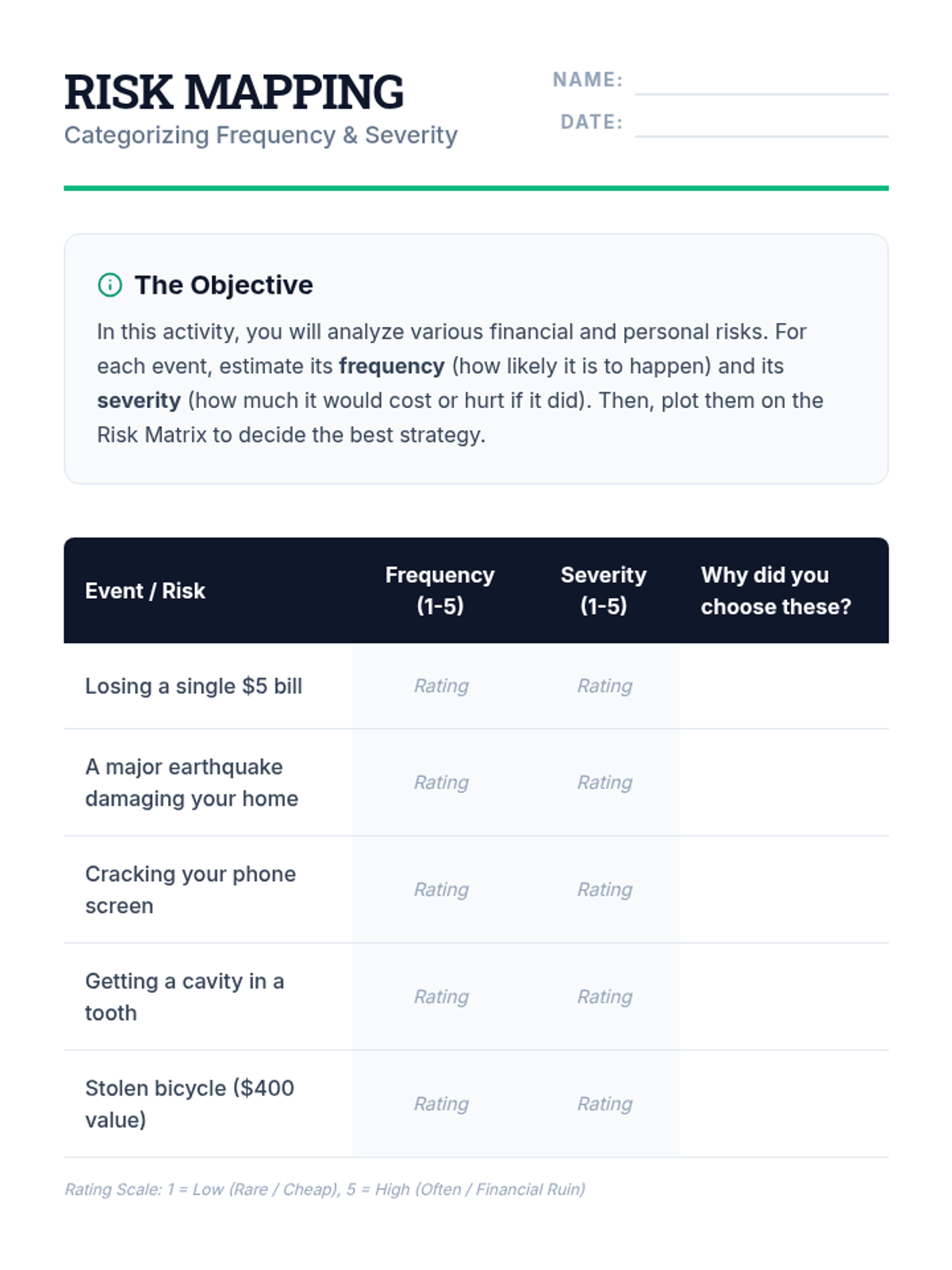
Risk Mapping Worksheet

Risk and Reward

This sequence explores probability-based decision making through the lens of financial literacy. Students apply expected value and risk assessment to evaluate insurance, extended warranties, and the mathematical trade-off between known costs and unknown risks.

Lenny Avatar
Lenny
1/18
Sequence
Tree Map Basics Slides
Tree Map Basics Worksheet
Tree Map Basics Teacher Guide

Decision Blueprints

An 8th-grade mathematics unit focused on using probability trees to model and solve complex decision-making problems. Students progress from simple compound events to weighted averages and backward induction in real-world business and logistics scenarios.

Lenny Avatar
Lenny
1/18
Sequence
Carnival Chaos Slides
Probability Lab Notebook
House Edge Teacher Guide

Game Theorist Academy

A game-based sequence where 8th-grade students explore probability, weighted averages, and expected value to analyze fairness and long-term trends in games of chance.

Lenny Avatar
Lenny
1/18
Sequence
Branching Basics Slides
Branching Blueprint Worksheet
Branching Blueprint Answer Key

Decision Architects Probability

This sequence guides students through the visualization and calculation of compound probabilities using tree diagrams. Students progress from basic branching to analyzing complex real-world decisions involving dependent and independent events.

Lenny Avatar
Lenny
1/18
Sequence
Birthday Bet Worksheet
Birthday Paradox Slides
Birthday Paradox Teacher Guide
Birthday Bet Answer Key

Probability Paradoxes

An inquiry-driven investigation into counter-intuitive probability. Students explore the Birthday Problem, Gambler's Fallacy, Monty Hall Problem, and Simpson's Paradox to understand why human intuition often fails in the face of compound event logic.

Lenny Avatar
Lenny
1/17
Sequence
Independence Intro Slides
Fairness Trial Worksheet
Independence Discussion Guide

Analyzing Independent Events

A game-based unit for 8th graders to explore compound independent events. Students move from experimental observation to theoretical calculation using the multiplication rule through the lens of carnival games and chance.

Lenny Avatar
Lenny
1/17
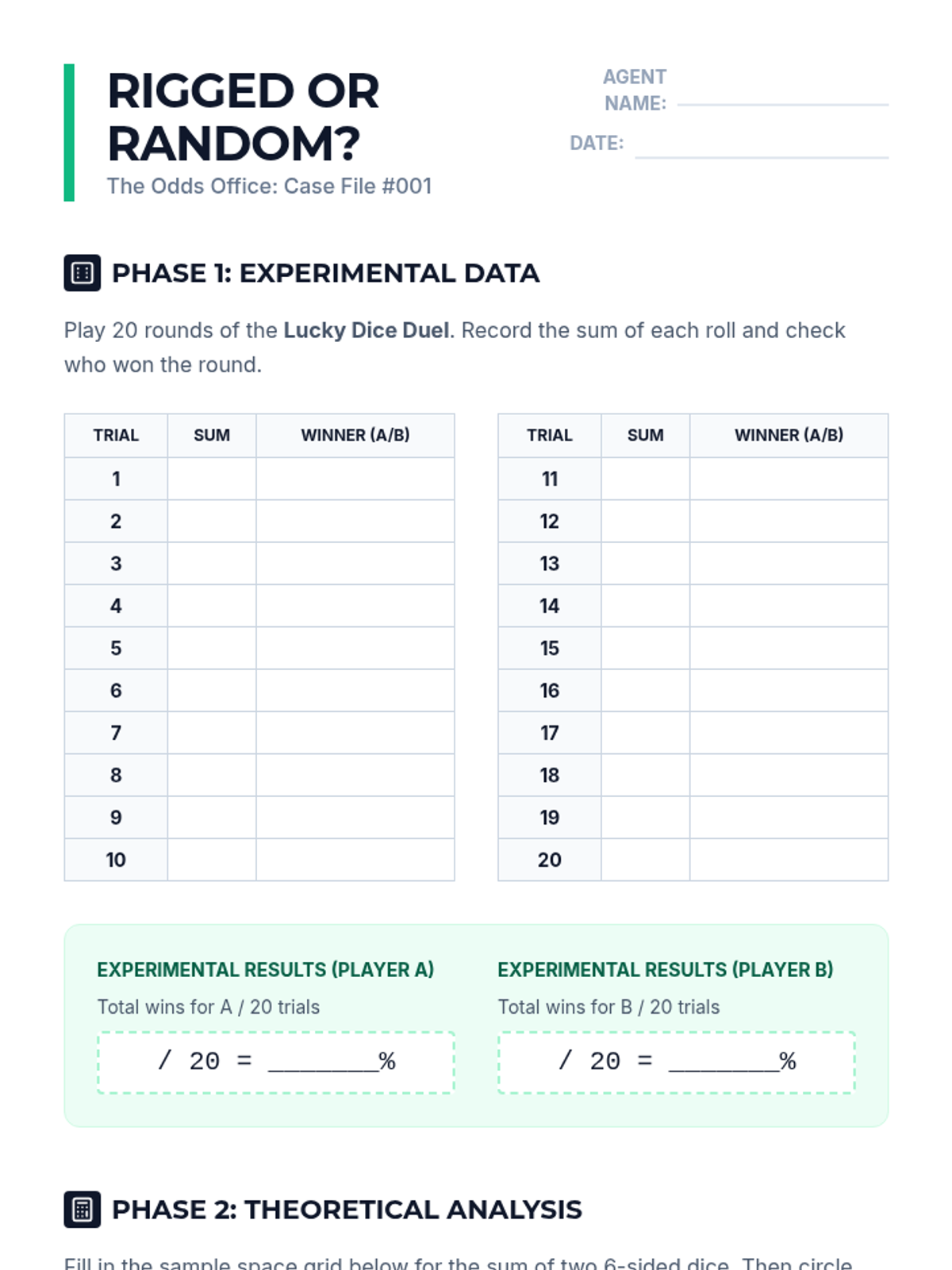
Sequence
Rigged or Random Presentation
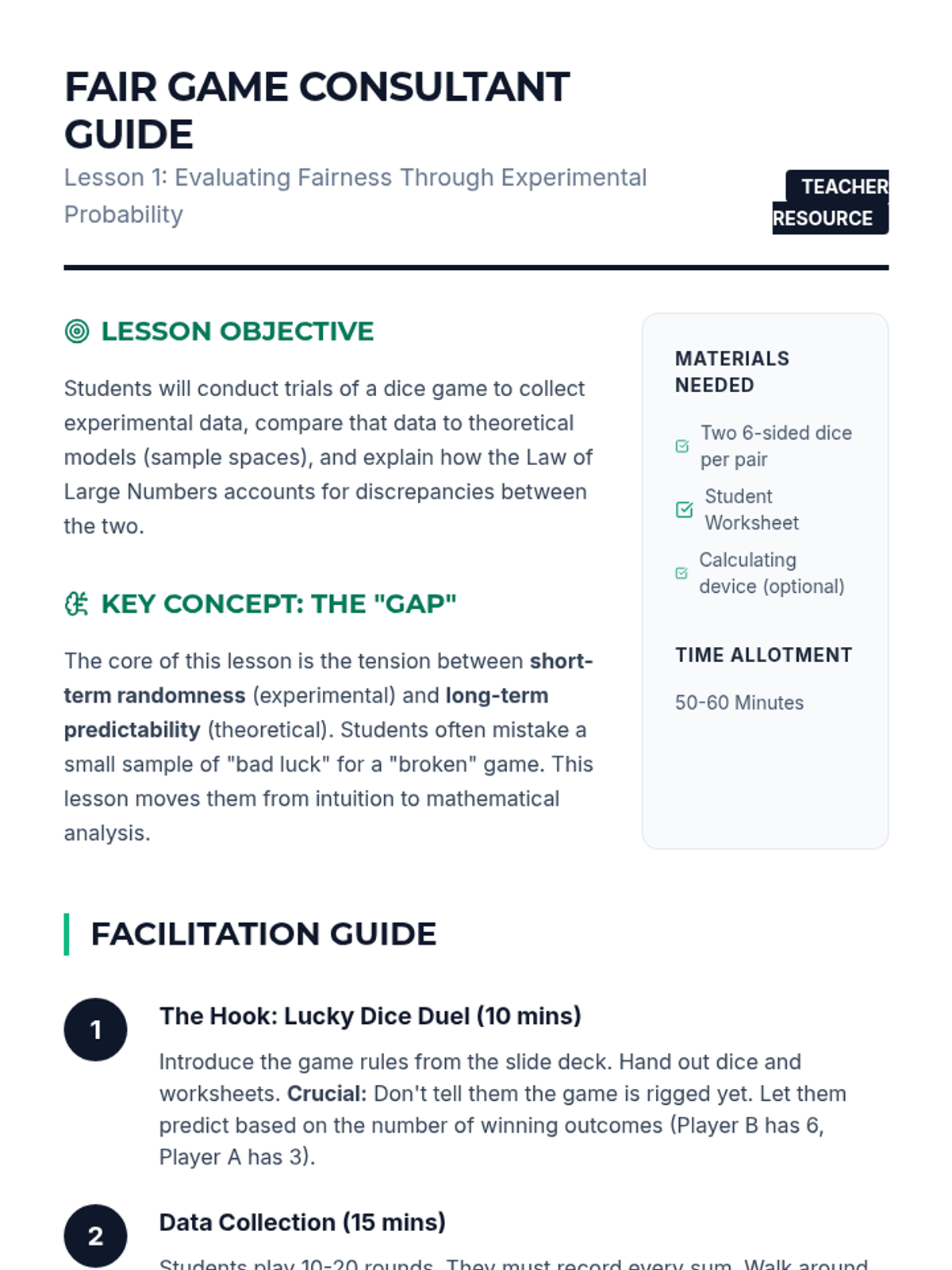
Fair Game Teacher Guide
Rigged or Random Worksheet

Analyzing Risk and Probability Models for Decision Making

In this sequence, students explore how mathematical probability guides rational decision-making in uncertain situations. Learners progress from simple compound events to constructing decision trees and calculating expected values to evaluate the fairness and potential payoff of various choices.

Lenny Avatar
Lenny
1/17
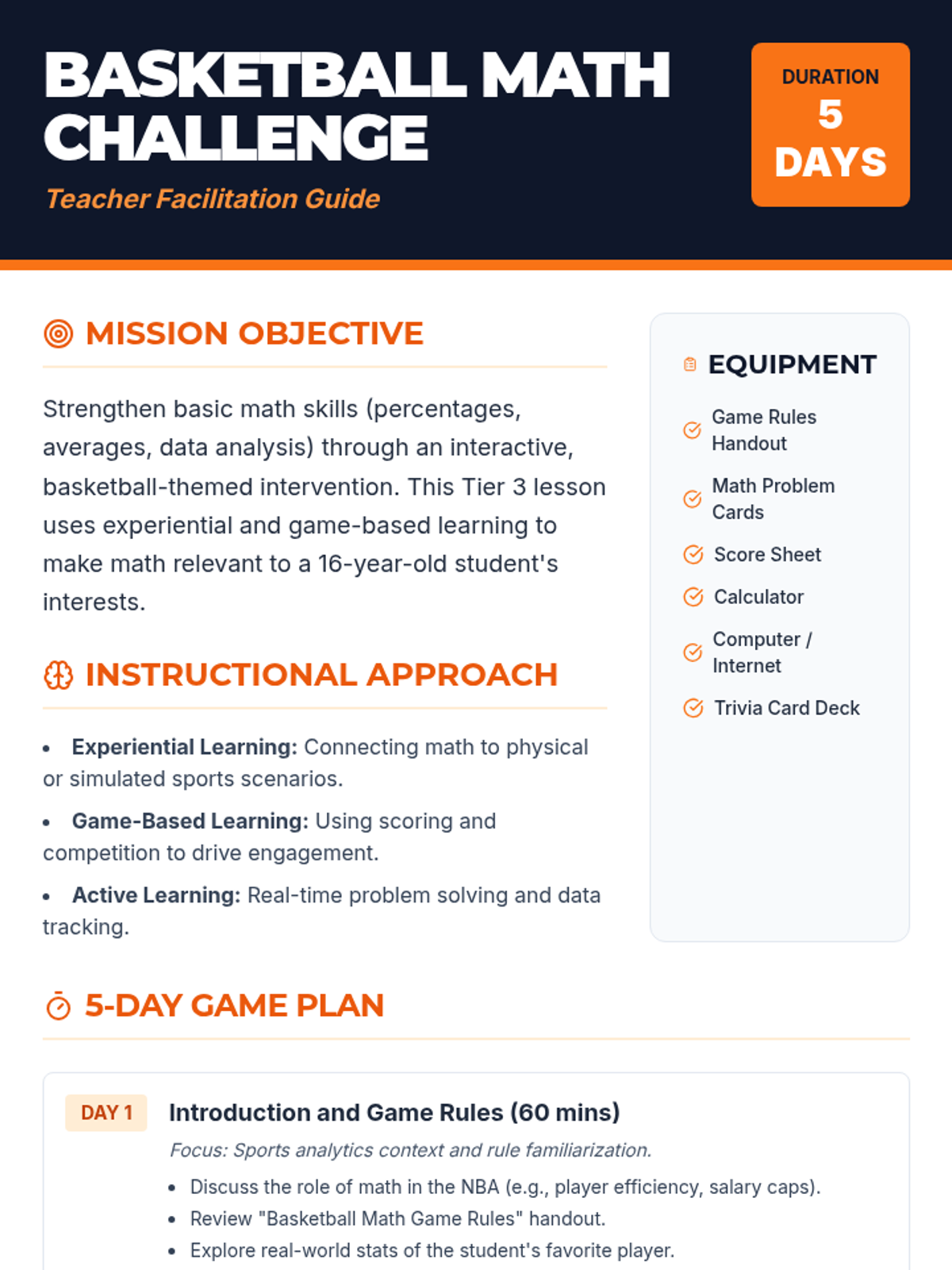
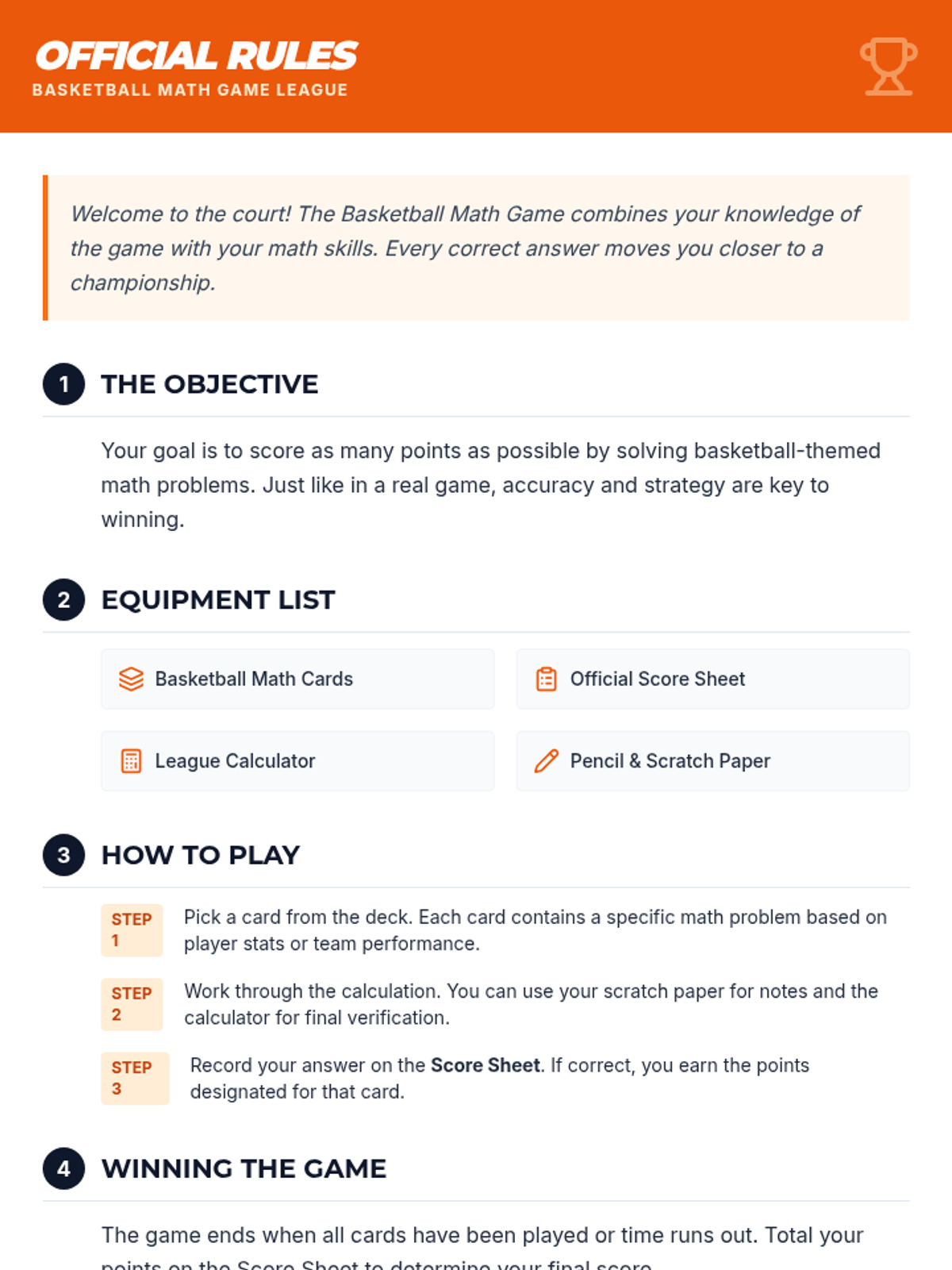
Sequence
Basketball Math Teacher Guide
Basketball Math Game Rules Handout

Basketball Math Challenge

A 5-day math intervention for a high school student that uses basketball statistics and simulation to teach percentages, averages, and data analysis.

SA

Shari Attebery

Counselor
11/6/24
Sequence
Initial Briefing Assessment
Initial Briefing Answer Key

Data Decoder

A comprehensive Tier 2 intervention sequence for high school students focused on summarizing, representing, and interpreting data, aligned with Colorado Standard 3. The program uses a 'Data Forensics' theme to engage students in uncovering insights from real-world datasets through scaffolded analysis and visual interpretation.

Lenny Avatar
Lenny
2/13
Sequence
Small Group Stat Guide
Trend Line Slides
Line Finder Worksheet
Plot Check Exit Ticket

Linear Logic

A targeted intervention sequence for high school statistics students focusing on fitting linear functions to scatter plots. It moves from conceptual understanding of 'balance' in data to the procedural steps of calculating lines of best fit.

Lenny Avatar
Lenny
2/12
Sequence
Correlation Lab Slides
Correlation Lab Teacher Guide
Correlation Lab Student Packet
Correlation Lab Exit Ticket

Correlation Lab Sequence

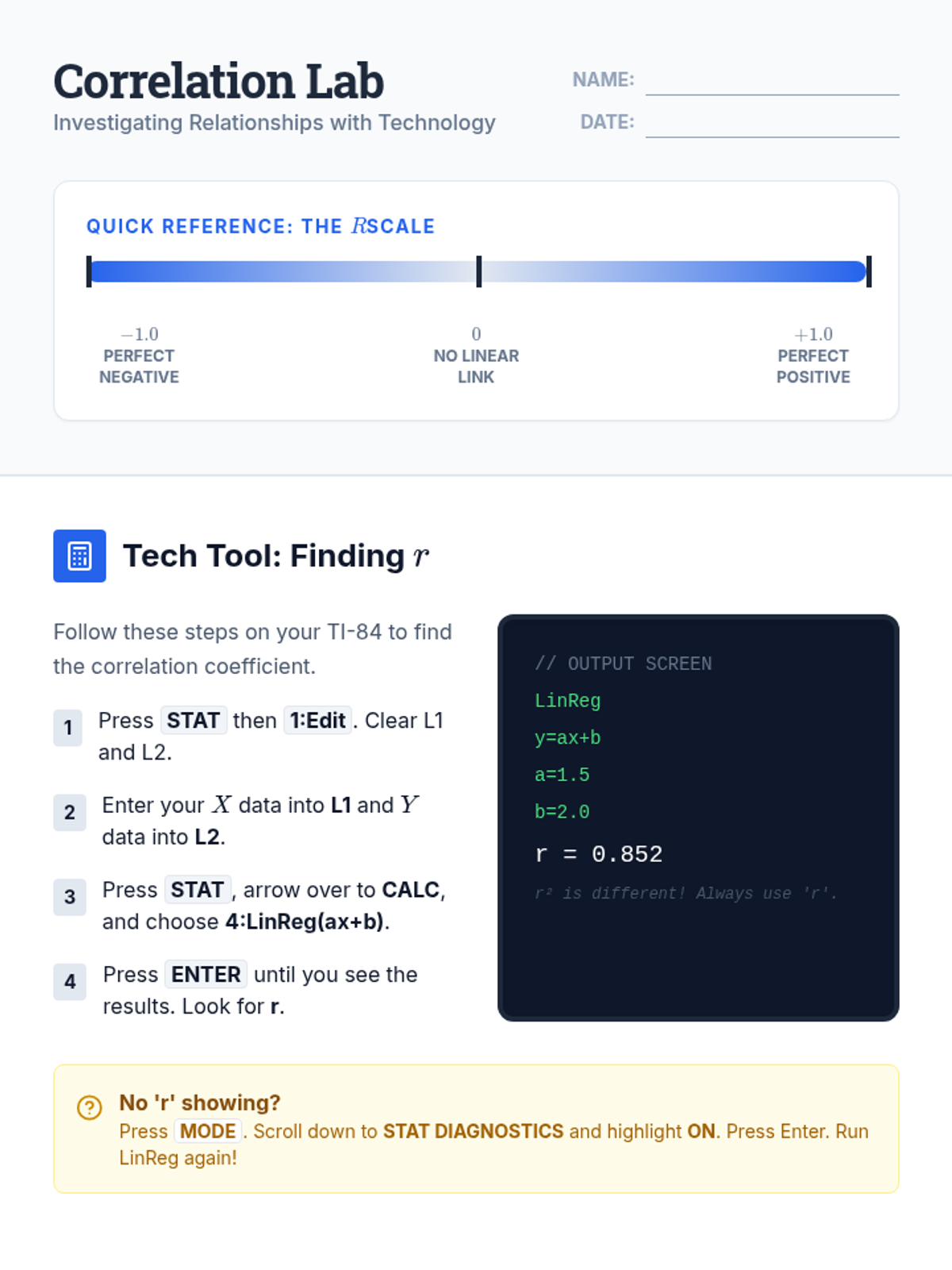
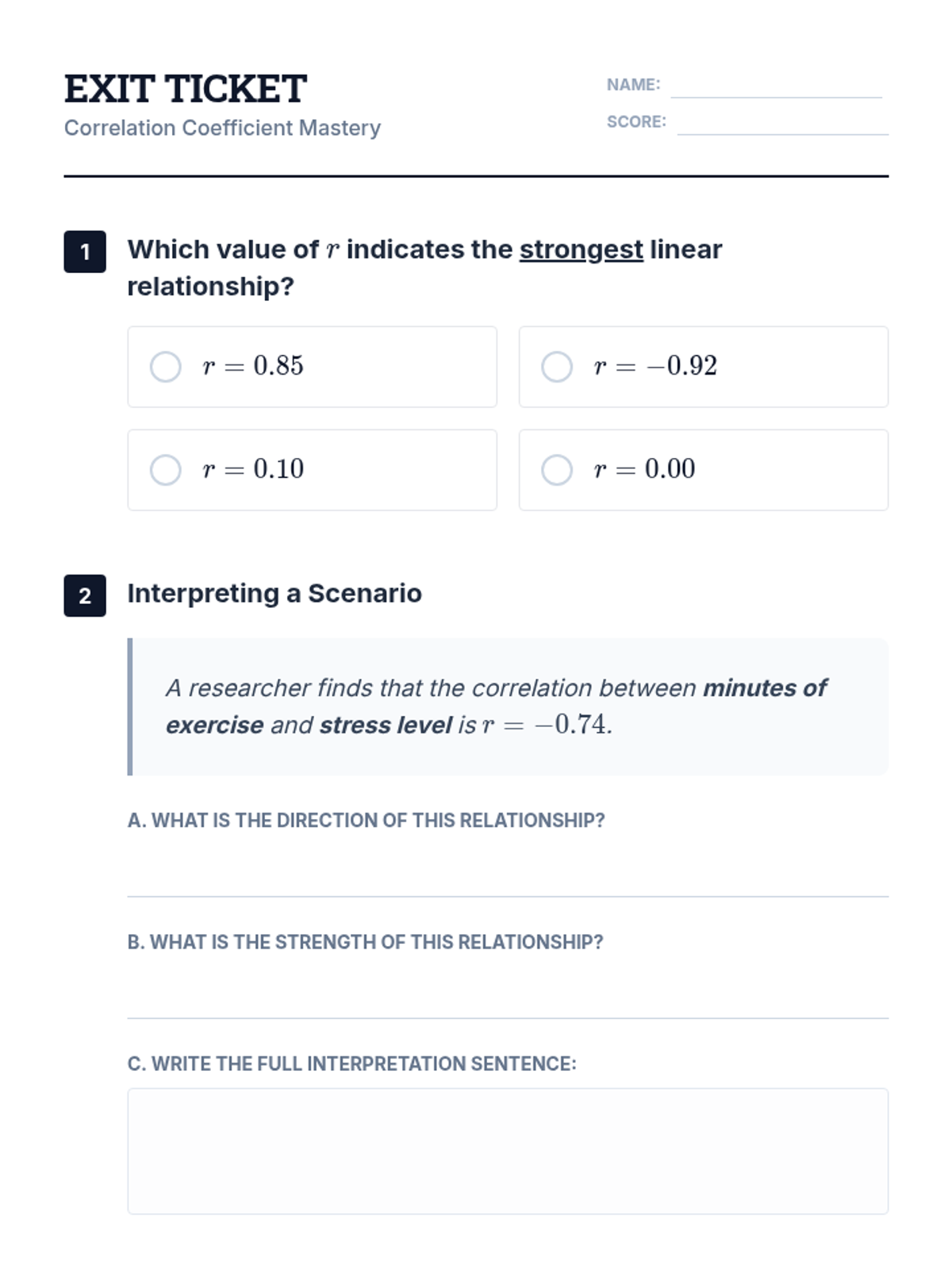
A Tier 2 intervention sequence focused on computing and interpreting the correlation coefficient (r) using technology, designed for high school statistics students needing targeted support.

Lenny Avatar
Lenny
2/12
Sequence
Decoder Card Reference Sheet
Slope Secrets Slides
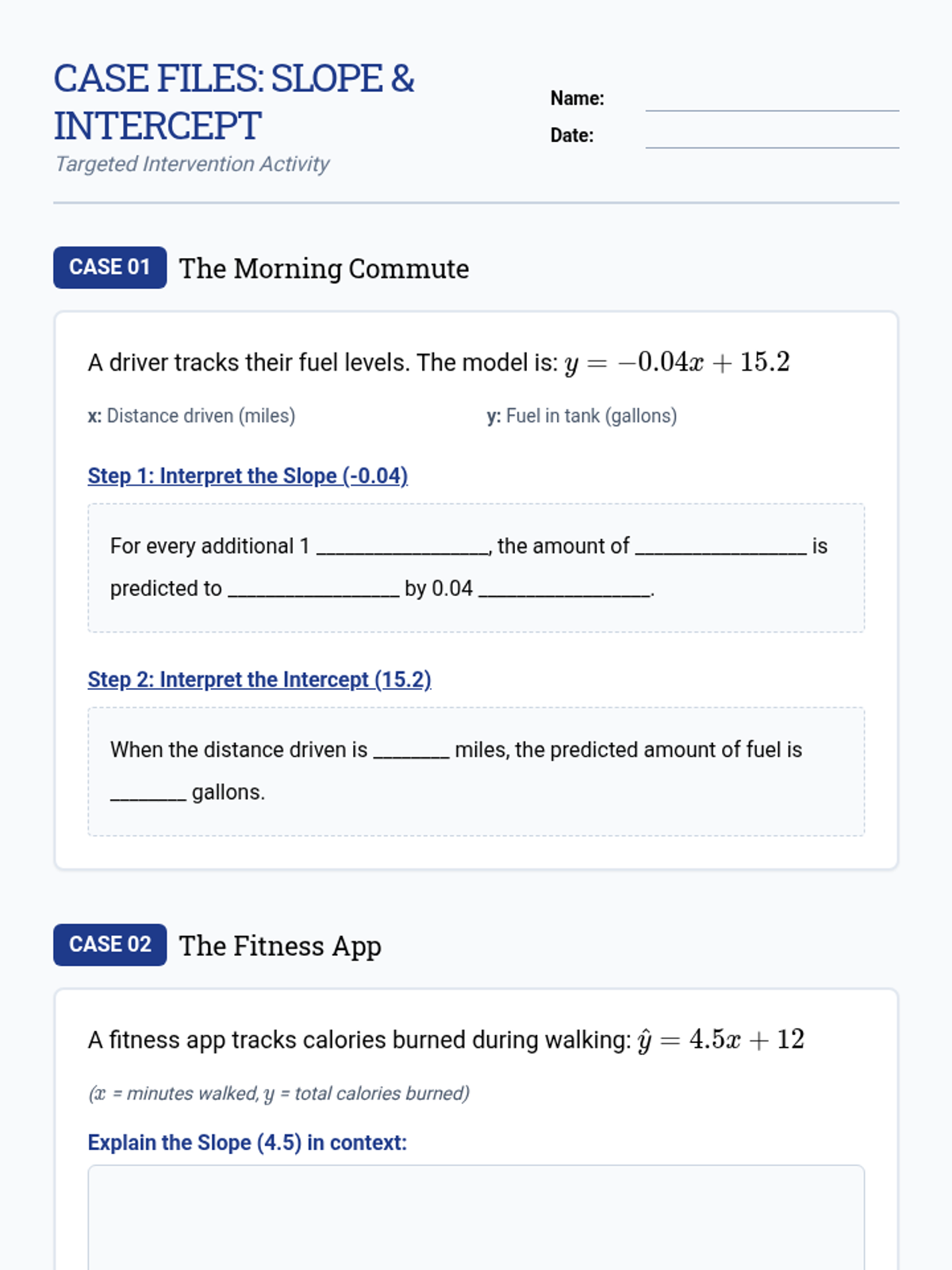
Case Files Worksheet
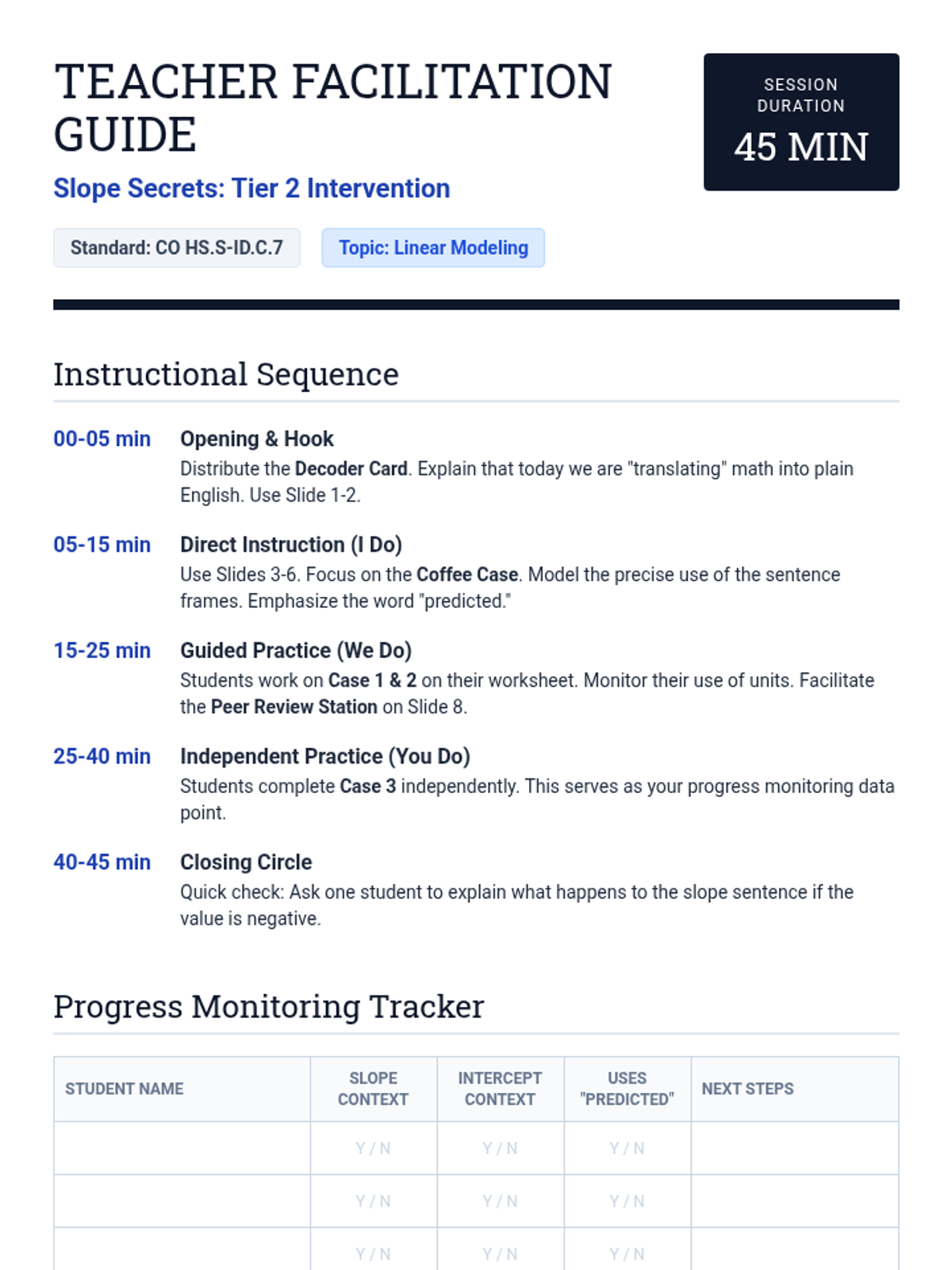
Slope Secrets Teacher Guide

Linear Logic

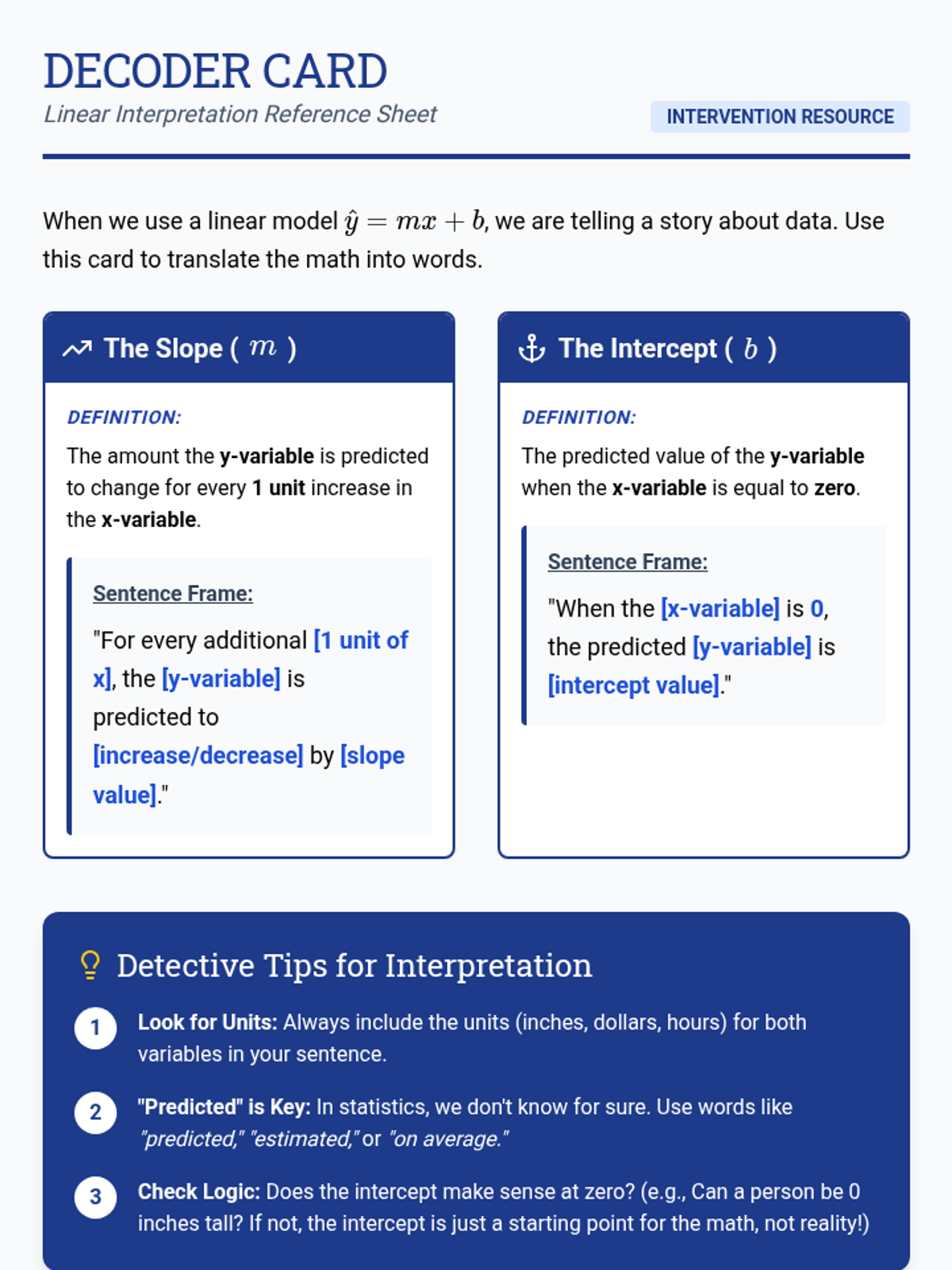
A specialized intervention sequence focusing on the foundational skills of linear modeling in statistics, specifically interpreting slope and intercept in real-world contexts. Designed for small groups requiring Tier 2 support.

Lenny Avatar
Lenny
2/12
Sequence
Strategy Blueprint Slides
Math Essentials Reference
Math Essentials Reference Updated
Strategy Sandbox Worksheet
Subject Spotlight Activity
Strategy Sandbox Answer Key
Strategy Sandbox 2 Worksheet
Strategy Sandbox 2 Answer Key
Desmos Mastery Slides
Desmos Drill Worksheet
Desmos Drill Answer Key

ACT Math Mastery

A comprehensive ACT Math preparation program focusing on essential strategies, high-yield Algebra and Geometry concepts, and realistic practice to boost scores.

AL

ava larumbe

Other
2/8
Sequence
Trends and Tides Slides
Trends and Tides Worksheet
Trends and Tides Teacher Guide

Eco-Data Lab: Modeling the World

A comprehensive unit where students act as data scientists to model real-world environmental phenomena using trigonometric functions. They progress from visual estimation to precise algebraic modeling and technological regression to predict future environmental conditions.

Lenny Avatar
Lenny
1/18
Sequence
Spark Intro Slides
Inquiry Proposal Worksheet

Data Detectives

A project-based unit where 8th-grade students act as data scientists to investigate real-world relationships, generate digital linear models, and defend their predictions based on data reliability.

Lenny Avatar
Lenny
1/17
Sequence
Residual Lab Slides
Measuring the Gap Worksheet

Model Reliability and Correlation

This sequence explores the statistical evaluation of linear models, covering residuals, linear regression technology, correlation coefficients, residual plots, and the distinction between correlation and causation. Students will learn to assess the reliability of models and use statistical tools to interpret data accurately.

Lenny Avatar
Lenny
1/17
Sequence
Plotting the Patterns Slides
Reaction Time Lab Worksheet
Scatter Plot Teacher Guide

Real World Linear Models

Students act as data analysts to investigate relationships between variables in fields like sports, economics, and environmental science. The learning arc progresses from constructing scatter plots and generating lines of best fit to deeply interpreting the specific meaning of slope and y-intercept in context, concluding with a capstone project on predictive modeling.

Lenny Avatar
Lenny
1/17
Sequence
Data Detectives Slides
Plotting Patterns Worksheet
Scatter Plot Teacher Guide

Analyzing Linear Relationships in Context

A 5-lesson sequence where students act as data analysts to explore, construct, and interpret linear models. Students progress from basic scatter plots to making predictions and critiquing the validity of linear models in real-world contexts.

Lenny Avatar
Lenny
1/17
Sequence
Anomaly Investigation Slides
Cluster Clues Worksheet
Anomaly Discovery Teacher Guide

Data Truth Detectives

This sequence focuses on the critical analysis of data reliability, outliers, and the validity of linear associations. Students explore messy data, identify clusters and outliers, and evaluate when a linear model is appropriate versus when it might be misleading.

Lenny Avatar
Lenny
1/17
Sequence
Trend Detectives Teacher Guide
Trend Detectives Slides
Scatter Plot Sketchpad Worksheet

Analyzing Slope and Y-Intercept

This sequence guides 9th-grade students through the process of interpreting linear models, moving from qualitative observations of scatter plots to quantitative interpretations of slope and y-intercept in real-world contexts. Students will learn to construct trend lines, write equations, and use those models to make informed predictions.

Lenny Avatar
Lenny
1/17
Sequence
Precision Regression Slides
Regression Mastery Teacher Guide
Tech Fit Worksheet

Evaluating Model Reliability and Making Predictions

A project-based unit for 9th-grade students focusing on the reliability of linear models, technology-based regression, residual analysis, and the critical distinction between correlation and causation. Students transition from manual calculations to digital tools to defend data-driven predictions.

Lenny Avatar
Lenny
1/17
Sequence
Correlation Detective Slides
Spurious Clues Worksheet

Analyzing Trends and Insights

Students move from describing data to interpreting and modeling it. They explore correlation vs. causation, trend lines, predictive modeling, and the ethics of data bias using real-world datasets and case studies.

Lenny Avatar
Lenny
1/17
Sequence
Regression Roadmap Slides
Regression Analysis Worksheet

PolyLab Modeling Mastery

A project-based unit where students apply polynomial calculus concepts to real-world scenarios like business profits, projectile motion, and engineering design. Students transition from abstract solving to modeling data and optimizing outcomes using regression, intercepts, and extrema.

Lenny Avatar
Lenny
1/17
Sequence
Shape of Data Slides
Function Detectives Worksheet
Shape of Data Teacher Guide

Data Detectives Functional Modeling

Students assume the role of data analysts to interpret complex real-world datasets related to economics, population dynamics, and environmental science. They identify function families, construct algebraic models using regression, evaluate 'goodness of fit' via residuals, and apply their models for predictions while critically analyzing domain limitations.

Lenny Avatar
Lenny
1/17
Sequence
Decision Coach Guide
Decision Lab Slides
Decision Map Worksheet
Strategy Lab Worksheet
Probability Pulse Check

Decision Lab Probability

A Tier 2 intervention sequence focused on using probability to analyze decisions, specifically targeting medical testing (false positives/negatives) and game-time strategies. Students learn to use tree diagrams and contingency tables to navigate complex conditional probability scenarios.

Lenny Avatar
Lenny
2/12
Sequence
Probability Blueprint Slides
Student Blueprint Activity Sheet
Blueprint Facilitator Guide
Blueprint Exit Ticket
Blueprint Exit Ticket Answer Key

Probability Blueprint Intervention

A targeted Tier 2 intervention sequence focused on conditional probability and independence for high school students. This sequence emphasizes visual models like tree diagrams and area models to bridge conceptual understanding to formal notation.

Lenny Avatar
Lenny
2/12
Sequence
Filter Focus Slides
Outcome Tracker Worksheet
Probability Probe Exit Ticket
Intervention Intel Teacher Guide

Conditional Probability Focus

A Tier 2 intervention sequence focused on mastering conditional probability through visual filters and fractional reasoning. Students learn to restrict their sample space to the 'given' condition using Venn diagrams and tables.

Lenny Avatar
Lenny
2/12
Sequence
Independence Insight Slides
Case File Worksheet
Logic Lab Teacher Guide
Logic Lab Answer Key

Probability Detectives

A targeted intervention sequence focused on understanding and calculating the independence of events through structured reasoning and decision trees.

Lenny Avatar
Lenny
2/12
Sequence
Investigation Guide Teacher Guide
Luck Lab Slides
Luck Lab Worksheet
Luck Lab Exit Ticket
Luck Lab Answer Key

Independence Investigation

A targeted Tier 2 intervention unit focused on understanding and calculating the independence of two events using the multiplication rule. This sequence uses concrete manipulative-based experiments to bridge the gap between intuition and formal probability notation.

Lenny Avatar
Lenny
2/12
Sequence
Strategy Blueprint Slides
Math Essentials Reference
Math Essentials Reference Updated
Strategy Sandbox Worksheet
Subject Spotlight Activity
Strategy Sandbox Answer Key
Strategy Sandbox 2 Worksheet
Strategy Sandbox 2 Answer Key
Desmos Mastery Slides
Desmos Drill Worksheet
Desmos Drill Answer Key

ACT Math Mastery

A comprehensive ACT Math preparation program focusing on essential strategies, high-yield Algebra and Geometry concepts, and realistic practice to boost scores.

AL

ava larumbe

Other
2/8
Sequence
Marble Mayhem Lesson Plan
Marble Mayhem Presentation
Tree Diagram Workshop Worksheet
Workshop Master Key

Probability Patterns

A lesson sequence focusing on compound probability, specifically analyzing events where order matters versus where it doesn't, using marble jar scenarios and tree diagrams.

Lenny Avatar
Lenny
1/19
Sequence
Filtered View Slides
Filtered Logic Worksheet
Filtered View Teacher Guide

Signal and Noise Lab

This sequence explores conditional probability and the reliability of tests using frequency trees and area models. Students investigate 'false positives' and 'false negatives' in real-world contexts like medical testing and spam filters, ultimately debating the ethical implications of screening policies.

Lenny Avatar
Lenny
1/18
Sequence
Risk Matrix Slides
Risk Mapping Worksheet

Risk and Reward

This sequence explores probability-based decision making through the lens of financial literacy. Students apply expected value and risk assessment to evaluate insurance, extended warranties, and the mathematical trade-off between known costs and unknown risks.

Lenny Avatar
Lenny
1/18
Sequence
Branching Basics Slides
Branching Blueprint Worksheet
Branching Blueprint Answer Key

Decision Architects Probability

This sequence guides students through the visualization and calculation of compound probabilities using tree diagrams. Students progress from basic branching to analyzing complex real-world decisions involving dependent and independent events.

Lenny Avatar
Lenny
1/18
Sequence
Birthday Bet Worksheet
Birthday Paradox Slides
Birthday Paradox Teacher Guide
Birthday Bet Answer Key

Probability Paradoxes

An inquiry-driven investigation into counter-intuitive probability. Students explore the Birthday Problem, Gambler's Fallacy, Monty Hall Problem, and Simpson's Paradox to understand why human intuition often fails in the face of compound event logic.

Lenny Avatar
Lenny
1/17
Sequence
Grid Logic Slides
Shortcut Discovery Worksheet
Table Transition Teacher Guide

Probability Power Play

This mastery-based sequence focuses on the algebraic side of probability, specifically utilizing the multiplication rule for complex problems. Students progress from visual models to abstract formulas, covering independent and dependent events, 'at least one' scenarios using complements, and mixed strategy application.

Lenny Avatar
Lenny
1/17
Sequence
Launch Slides
Scenario Proposal Worksheet

Probability Architects

Students act as game designers to create, calculate, and simulate compound probability models. They move from brainstorming scenarios to analyzing experimental data, culminating in a gallery walk showcase.

Lenny Avatar
Lenny
1/17
Sequence
Independence Intro Slides
Fairness Trial Worksheet
Independence Discussion Guide

Analyzing Independent Events

A game-based unit for 8th graders to explore compound independent events. Students move from experimental observation to theoretical calculation using the multiplication rule through the lens of carnival games and chance.

Lenny Avatar
Lenny
1/17
Sequence
Breaking the Chain Slides
Scenario Decoder Worksheet

Risk Logic Probability Models

An advanced project-based sequence where 9th-grade students act as risk analysts, modeling complex multi-stage scenarios and calculating compound probabilities for independent and dependent events.

Lenny Avatar
Lenny
1/17
Sequence
Sampling Simulation Lab Worksheet
Shifting Odds Intro Slides
Sampling Simulation Teacher Guide

The Shifting Odds

A comprehensive unit on dependent events and conditional probability, exploring how sequential choices change outcomes through simulations, formal notation, and real-world case studies.

Lenny Avatar
Lenny
1/17
Sequence
Data Organization Slides
Table Builder Worksheet
Table Builder Key

Data Lab Two Way Tables

A comprehensive unit on two-way frequency tables, moving from data organization to complex probability analysis and independence testing. Students will bridge the gap between categorical counts and real-world statistical claims.
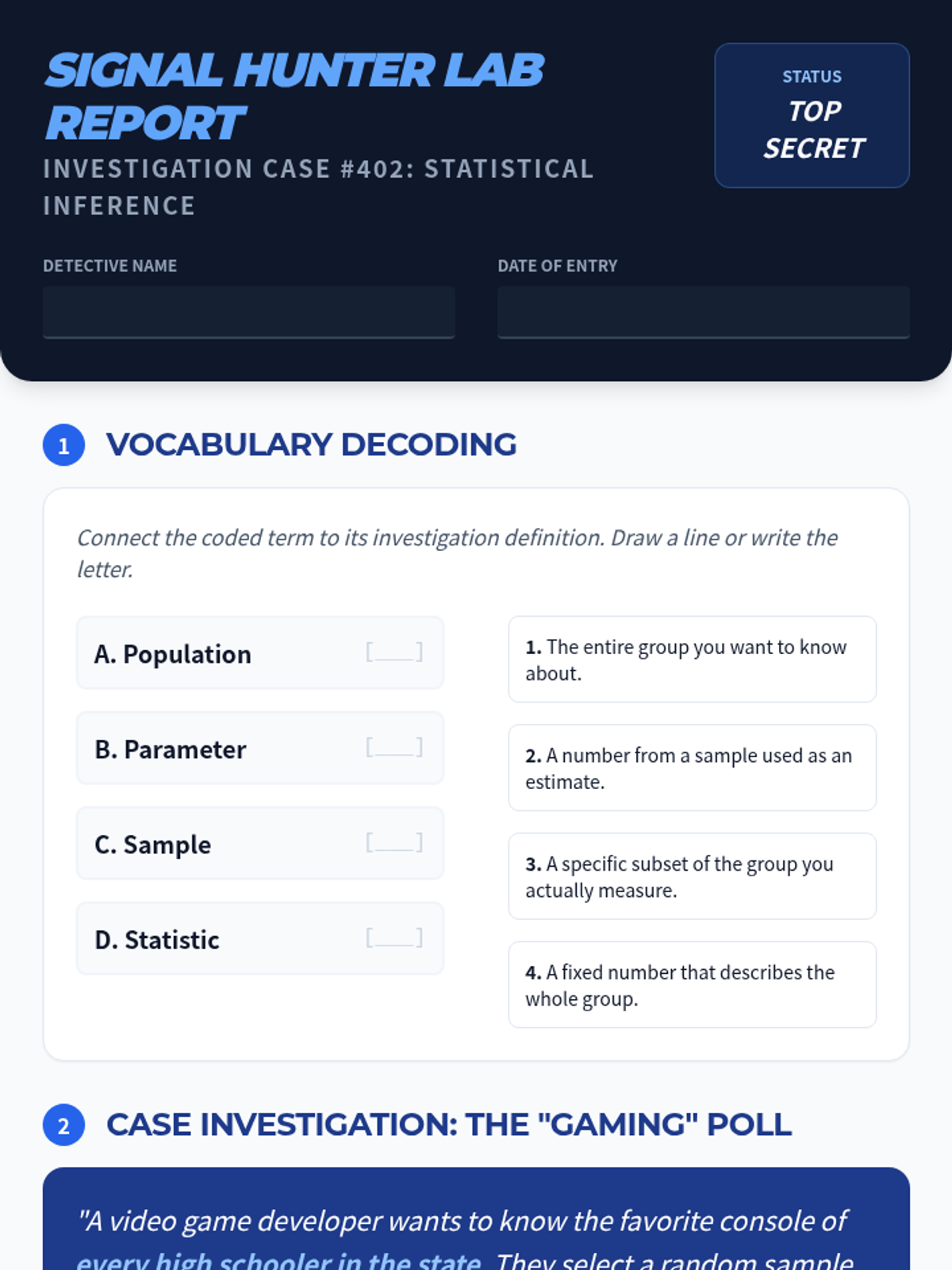
Lenny Avatar
Lenny
1/17
Sequence
Memoryless Machines Slides
Machine Log Worksheet
Station Facilitator Guide

Probability Paradoxes

A 9th-grade exploration into the world of independent events, where students use game-based inquiry to discover the multiplication rule of probability and apply it to design fair (and unfair) games.

Lenny Avatar
Lenny
1/17
Sequence
Independence Insight Slides
Hot Hand Investigation Worksheet
Lab Technicians Guide

The Odds Lab

A deep dive into compound event probability, moving from conceptual independence to the algebraic rigor of the Multiplication Rule and conditional logic. Students analyze sports streaks, card games, and forensic evidence to master independent and dependent probabilities.

Lenny Avatar
Lenny
1/17
Sequence
Simulated Realities Presentation
Test Guessing Simulator Worksheet
Simulated Realities Teacher Guide

Predicting the Future Simulation Lab

This 7th-grade sequence explores compound probability and simulations, connecting mathematical models to genetics, sports, and weather forecasting. Students move from basic simulations to designing their own complex models for real-world scenarios.

Lenny Avatar
Lenny
1/17
Sequence
Signal Hunter Slides
Signal Hunter Lab Report Worksheet
Inference Investigation Exit Ticket
Data Detective Facilitation Guide Teacher Resource

Data Detectives

A targeted Tier 2 intervention sequence designed to help high school students master the fundamental concepts of statistical inference, moving from population parameters to sample statistics and back again through real-world applications.

Lenny Avatar
Lenny
2/12
Sequence
Residual Lab Slides
Measuring the Gap Worksheet

Model Reliability and Correlation

This sequence explores the statistical evaluation of linear models, covering residuals, linear regression technology, correlation coefficients, residual plots, and the distinction between correlation and causation. Students will learn to assess the reliability of models and use statistical tools to interpret data accurately.

Lenny Avatar
Lenny
1/17
Sequence
Breaking the Chain Slides
Scenario Decoder Worksheet

Risk Logic Probability Models

An advanced project-based sequence where 9th-grade students act as risk analysts, modeling complex multi-stage scenarios and calculating compound probabilities for independent and dependent events.

Lenny Avatar
Lenny
1/17
Sequence
Simulated Realities Presentation
Test Guessing Simulator Worksheet
Simulated Realities Teacher Guide

Predicting the Future Simulation Lab

This 7th-grade sequence explores compound probability and simulations, connecting mathematical models to genetics, sports, and weather forecasting. Students move from basic simulations to designing their own complex models for real-world scenarios.

Lenny Avatar
Lenny
1/17
Sequence
Correlation Detective Slides
Spurious Clues Worksheet

Analyzing Trends and Insights

Students move from describing data to interpreting and modeling it. They explore correlation vs. causation, trend lines, predictive modeling, and the ethics of data bias using real-world datasets and case studies.

Lenny Avatar
Lenny
1/17
Sequence
Population Paradox Slides
Counting Chaos Worksheet

Estimating Populations Capture Recapture

A game-based sequence where students use the Capture-Recapture method to estimate population sizes, progressing from physical simulations to proportional reasoning and real-world ecological analysis.

Lenny Avatar
Lenny
1/17
Sequence
Small Sample Sim Slides
Candy Grab Sim Worksheet
Small Sample Teacher Guide

Sample Size and Sampling Variability

This 5-lesson sequence explores how sample size influences variability and the reliability of statistical inferences. Students participate in simulations to discover the law of large numbers, use Mean Absolute Deviation to quantify spread, and evaluate the validity of real-world sampling methods.

Lenny Avatar
Lenny
1/17
Sequence
Question Clinic Worksheet
Bias Detection Slides
Question Clinic Answer Key

Data Consultant Agency

A project-based unit where 7th-grade students act as data consultants to solve school-wide problems. They learn to identify bias, design sampling plans, collect data, and present data-backed recommendations to administration.
Lenny Avatar
Lenny
1/17
Sequence
Defining the Mission Slides
Project Briefcase Worksheet
Project Facilitation Guide

Bureau of Truth and Trends

A project-based unit where students act as lead researchers, designing and executing a statistical study from question formulation to final validity reporting. Students learn to navigate population definitions, sampling methods, and question bias to ensure their data accurately reflects reality.

Lenny Avatar
Lenny
1/17
Sequence
Size Matters Slides
Variability Lab Worksheet
Size Matters Teacher Guide

Analyzing Sample Size and Statistical Inference

This inquiry-based sequence focuses on the relationship between sample size and the reliability of inferences. Students use technology and simulations to visualize how large samples stabilize around population parameters, introducing the Law of Large Numbers and Margin of Error concepts.
Lenny Avatar
Lenny
1/17
Sequence
Sample Scavenger Hunt Worksheet
Big Picture Slides

Statistical Sleuths

This sequence explores the critical world of statistical sampling, teaching students to identify bias, understand the importance of randomness, and evaluate the validity of data-driven claims in media and history.

Lenny Avatar
Lenny
1/17
Sequence
The Overlap Test Slides
Overlap Investigation Worksheet

Comparative Data Analysis

A 9th-grade statistics sequence focused on comparing populations through measures of center and variability. Students learn to interpret overlap, select appropriate metrics, and express differences in terms of spread to make informal inferences.
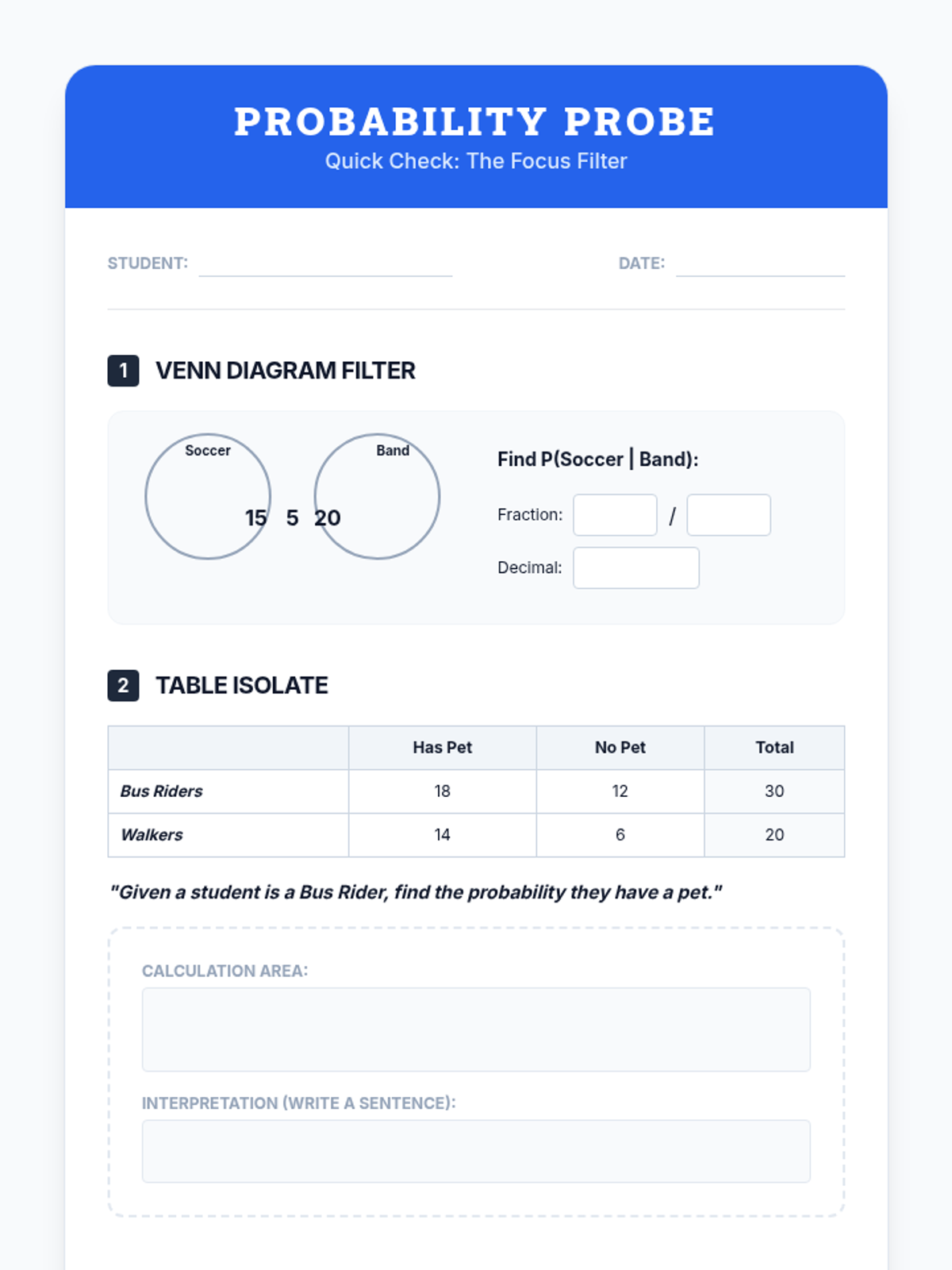
Lenny Avatar
Lenny
1/17
Sequence
Orange Quest Slides
Orange Quest Worksheet
Orange Quest Teacher Guide

Data Lab Sampling and Variability

A simulation-based journey through statistical sampling, focusing on the Law of Large Numbers, variability, and the distinction between bias and precision. Students move from manual experiments to digital simulations to build intuition for statistical inference.
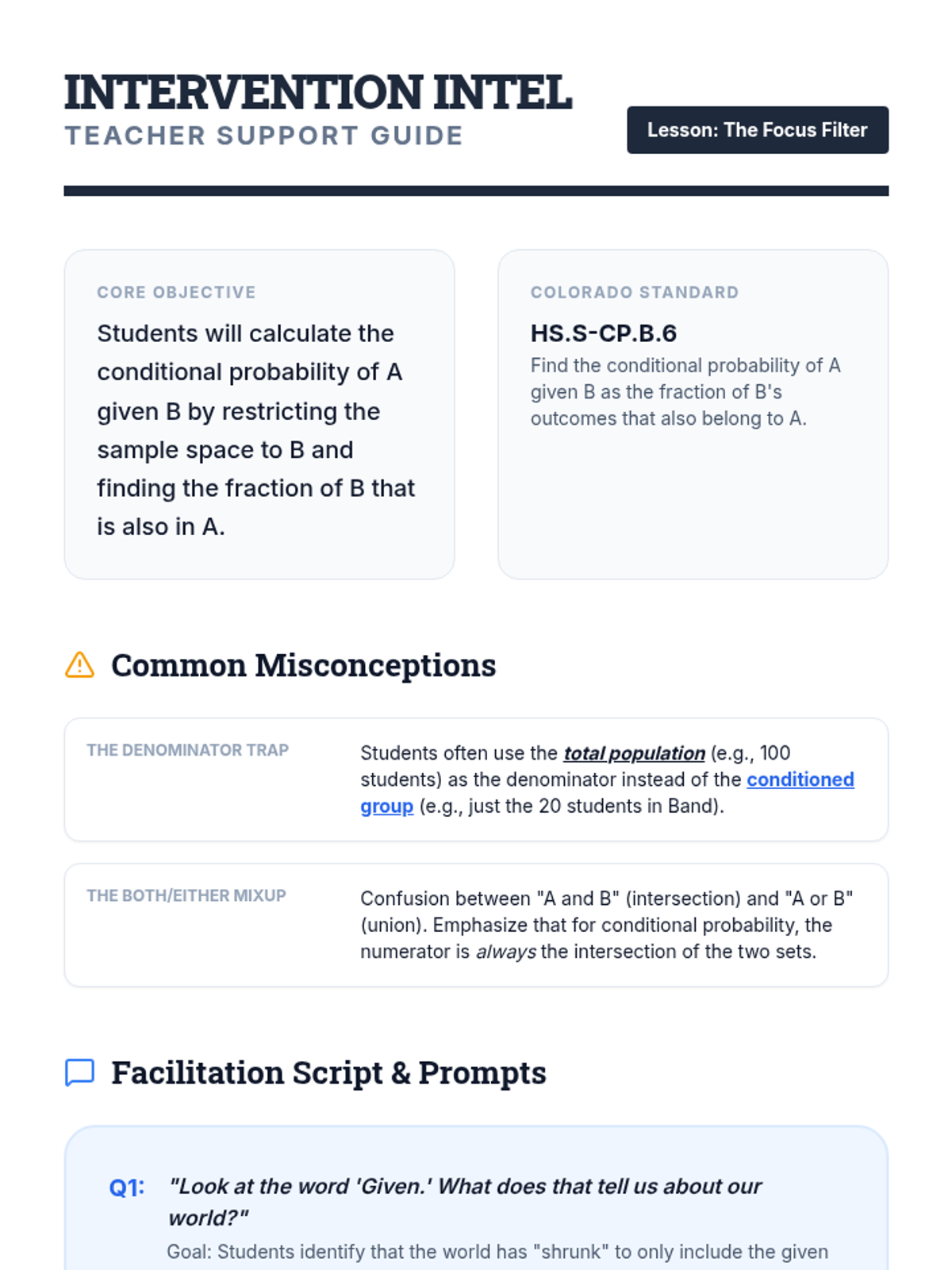
Lenny Avatar
Lenny
1/17
Sequence
Question Quest Slides
Target Population Planner
Survey Launchpad Guide

Survey Scientists

A project-based unit where 9th-grade students design a statistical study for their school community, focusing on sampling methods, survey design, and ethical data collection. Students progress from defining a research question to presenting a formal study proposal that minimizes bias.

Lenny Avatar
Lenny
1/17
Sequence
Target Sight Slides
Pulse Definition Worksheet
Population Precision Guide

Public Pulse Sequence

A project-based exploration of statistical sampling where students learn to define populations, determine sample sizes, design protocols, and make valid inferences. Students act as data consultants, moving from theoretical understanding to simulated data collection and analysis.

Lenny Avatar
Lenny
1/17