20 items
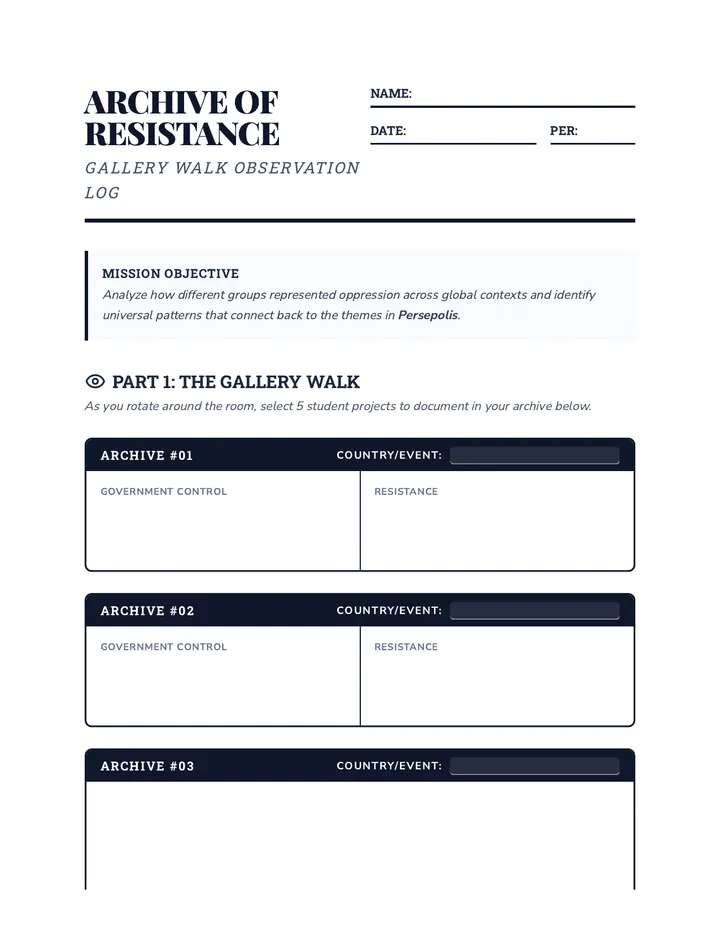
Students explore global contexts of oppression and resistance through a gallery walk of peer-created comic strips, drawing parallels to the themes in Marjane Satrapi's Persepolis.
A 5-day project where students research historical oppression and create an 8-panel graphic story inspired by the themes and visual style of Persepolis. Students connect their chosen historical event to Marjane Satrapi's memoir through written reflection and visual storytelling.
A focused exploration of literary adaptations, specifically looking at how graphic novels are translated into cinema, focusing on Persepolis.
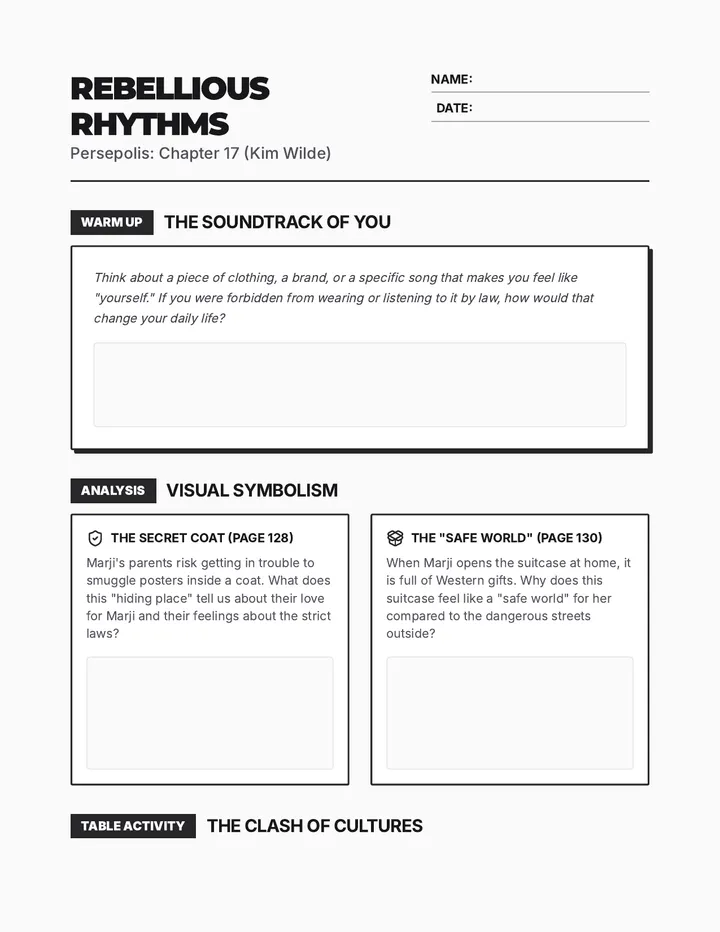
A 40-minute lesson exploring Western influence, visual symbolism, and the conflict between personal identity and state control in Chapter 17 of Persepolis. Students analyze Marji's rebellious fashion choices and the risks taken to express individuality in 1980s Iran.
An exploration of Chapters 14 and 15 of Persepolis, focusing on the themes of escape, survival, and the transition from childhood innocence to teenage rebellion during the Iranian Revolution. Students analyze character decisions and the impact of differing perspectives in a graphic novel format.
An 8th-grade ELA lesson focused on Chapter 15 ('The Cigarette') of Persepolis, exploring themes of coming-of-age, rebellion, and oppression through analytical writing and collaborative discussion.
A deep dive into Chapter 14 of Persepolis, focusing on visual storytelling, risk, and rebellion. Students analyze panel sequencing to understand how suspense is built and how characters navigate oppressive environments through the lens of graphic narrative techniques.
A 40-minute lesson focused on Chapter 13 ('The Keys') of Persepolis, exploring themes of manipulation and oppression through Socratic Seminar preparation. Students will analyze character perspectives and the use of religious imagery to control the youth during the Iran-Iraq War.
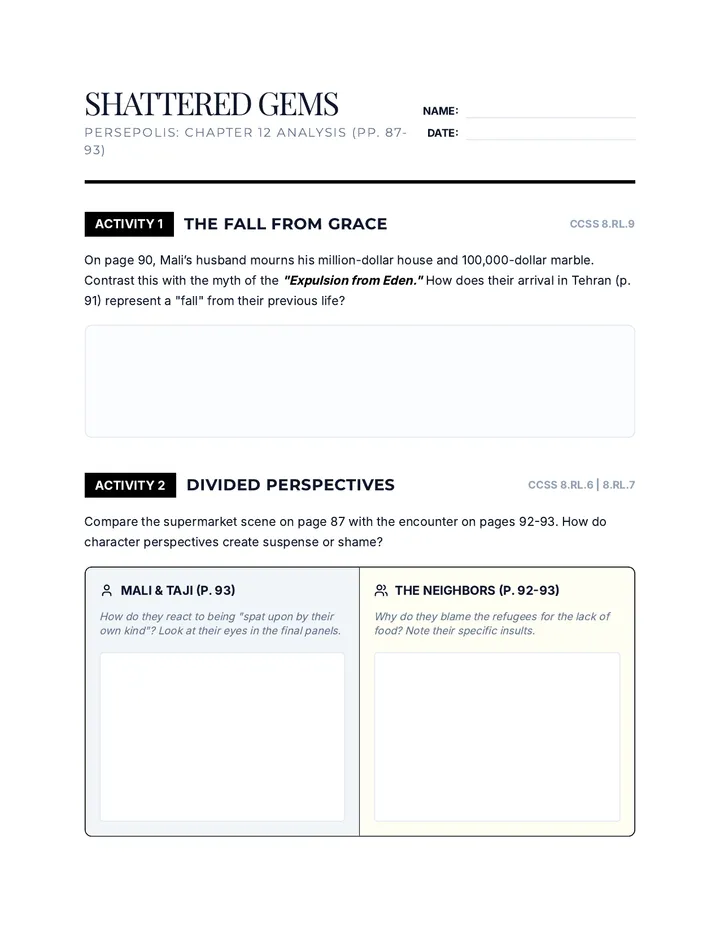
An 8th-grade lesson focusing on Chapter 12 of *Persepolis*, exploring themes of sacrifice and loss through visual analysis and explanatory writing. students will analyze character perspectives and the impact of war on identity.
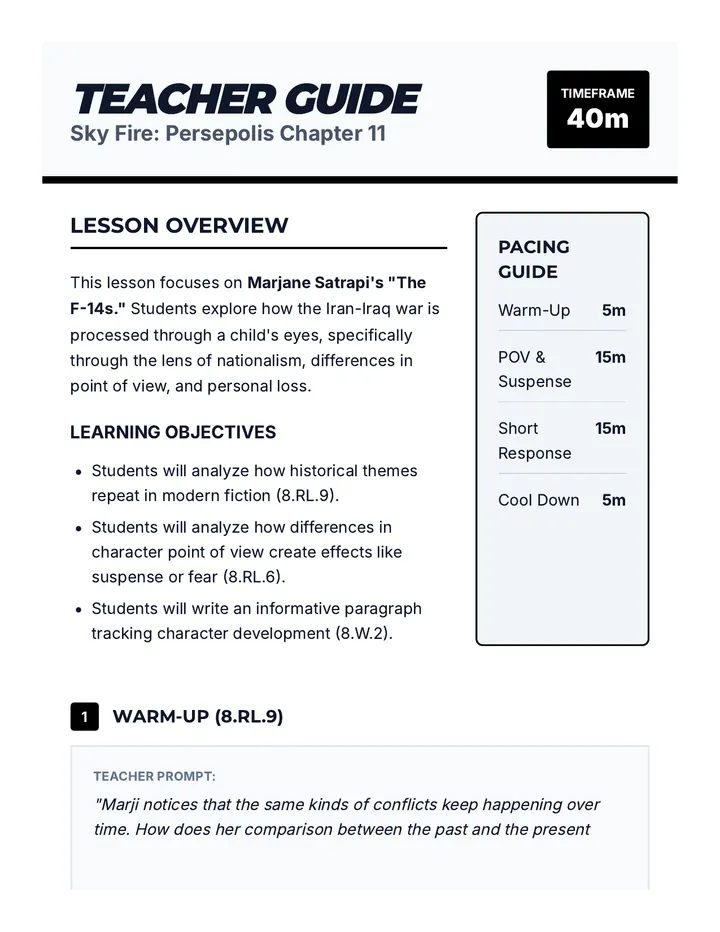
A 40-minute lesson on Chapter 11 of Persepolis (The F-14s), focusing on war from a child's perspective, analyzing visual storytelling, and connecting historical themes.
A lesson focusing on Chapter 10 of Persepolis ('The Trip'), examining themes of freedom and restriction through comparative analysis of text and film, informative writing, and mythological patterns.
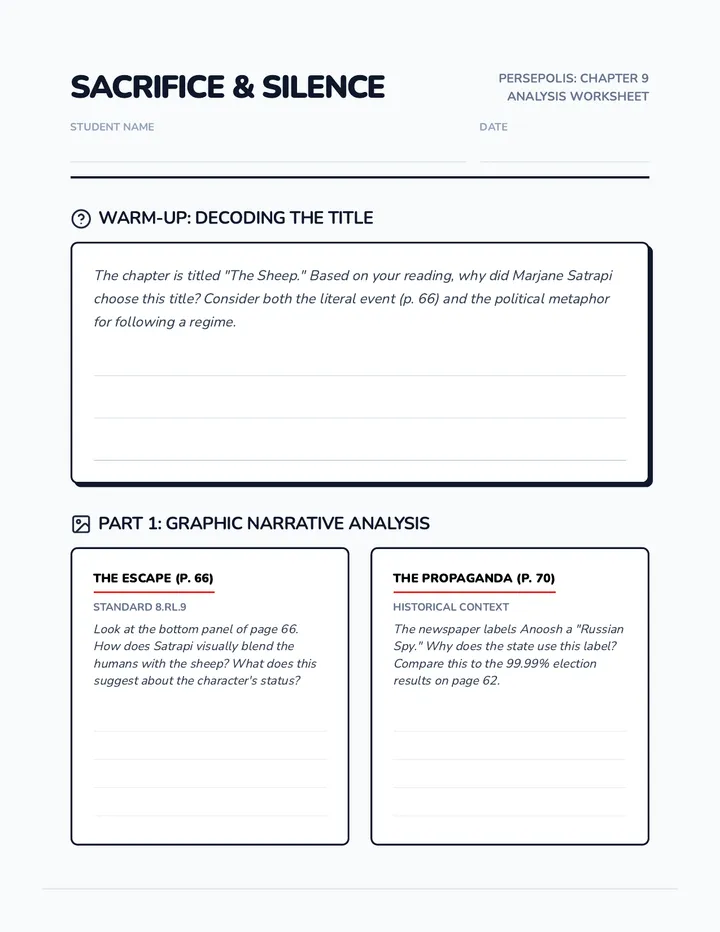
A deep dive into Chapter 9 of Persepolis, focusing on the themes of martyrdom, the visual rhetoric of propaganda, and the transition from personal loss to national conflict. Students analyze graphic panels and compare the text to its cinematic adaptation.
A unit exploring Marjane Satrapi's Persepolis, focusing on the intersection of personal narrative, political ideology, and the visual language of graphic novels.
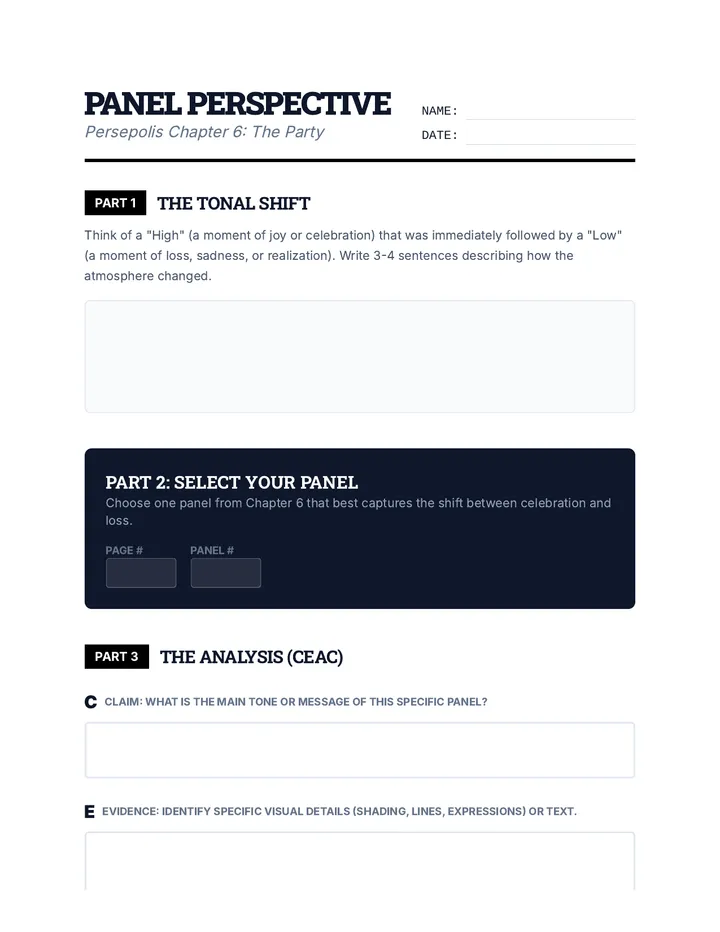
A 40-minute lesson exploring the tonal shifts in Chapter 6 of Persepolis, focusing on the juxtaposition of national celebration and personal moral complexity. Students analyze a single panel using a Claim-Evidence-Analysis-Conclusion framework to evaluate how Satrapi conveys themes of loss and forgiveness.
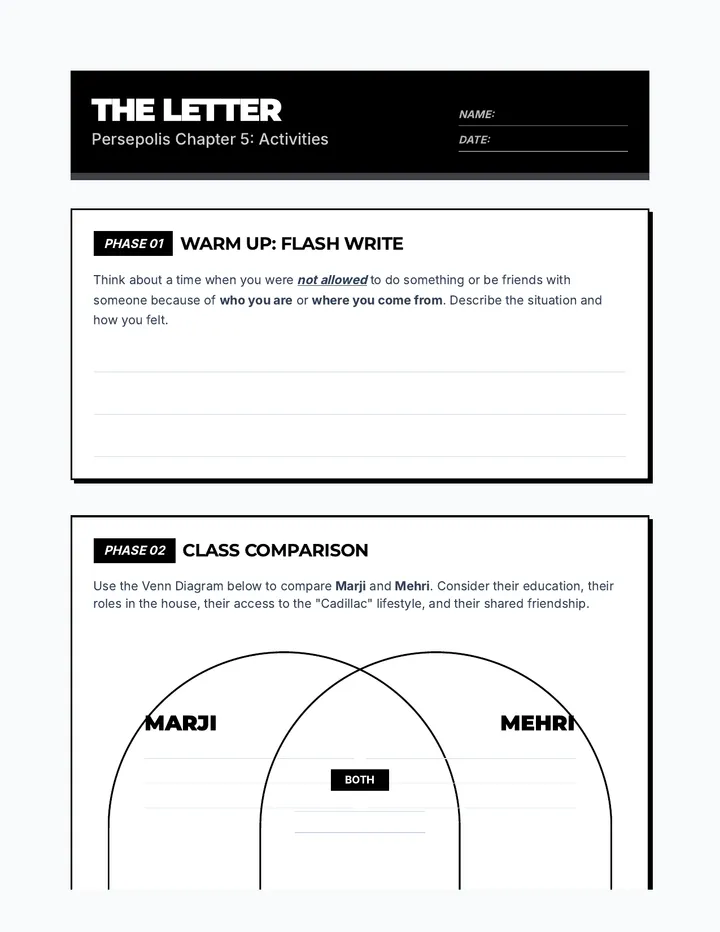
A 35-minute lesson exploring class differences, social injustice, and character motivations in Chapter 5 of Persepolis, 'The Letter'. Students analyze the contrast between Marji and Mehri through a Venn diagram and an evidence-based writing response.
A 35-minute lesson exploring the theme of public vs. private identity in Chapter 4 of Persepolis. Students analyze how characters navigate the contradictions between their personal lives and the political atmosphere of 1970s Iran.
This lesson covers the conclusion of 'The Bicycle' and the full chapter 'The Water Cell' from Persepolis. Students explore the themes of fear, family history, and political indoctrination through the lens of Marjane Satrapi's graphic storytelling, comparing the impact of text versus visual elements.
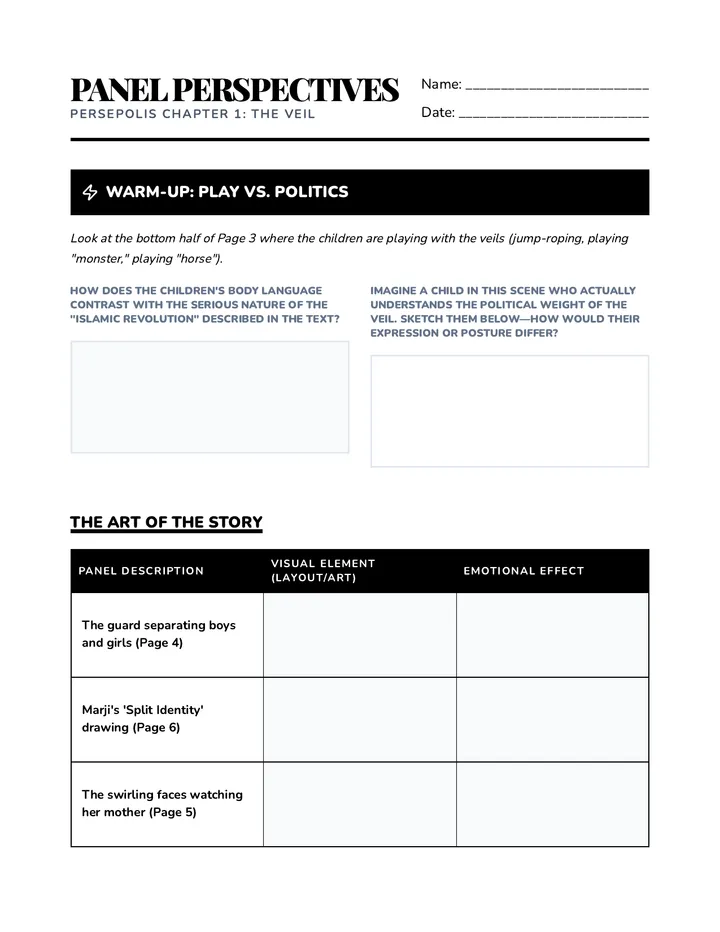
This lesson guides students through the first chapter of Marjane Satrapi's Persepolis, 'The Veil.' Students explore the intersection of personal identity and political revolution by analyzing how visual elements and text work together to convey complex emotions.
An introductory lesson to Marjane Satrapi's Persepolis, focusing on the historical context of the Iranian Revolution and the unique storytelling mechanics of the graphic novel format.
A lesson analyzing Marjane Satrapi's use of symbolism and visual motifs in the second chapter of Persepolis, 'The Bicycle', focusing on the metaphor of revolution and the depiction of crowds.