16 items
A comprehensive assessment focusing on the themes of oppression, identity, and faith in the first seven sections of Elie Wiesel's 'Night'.
This lesson introduces advanced 8th-grade students to Elie Wiesel's 'Night' by examining the Preface. Students will analyze Wiesel's motivation for writing and the importance of bearing witness, classifying his purposes as moral, historical, emotional, or universal.
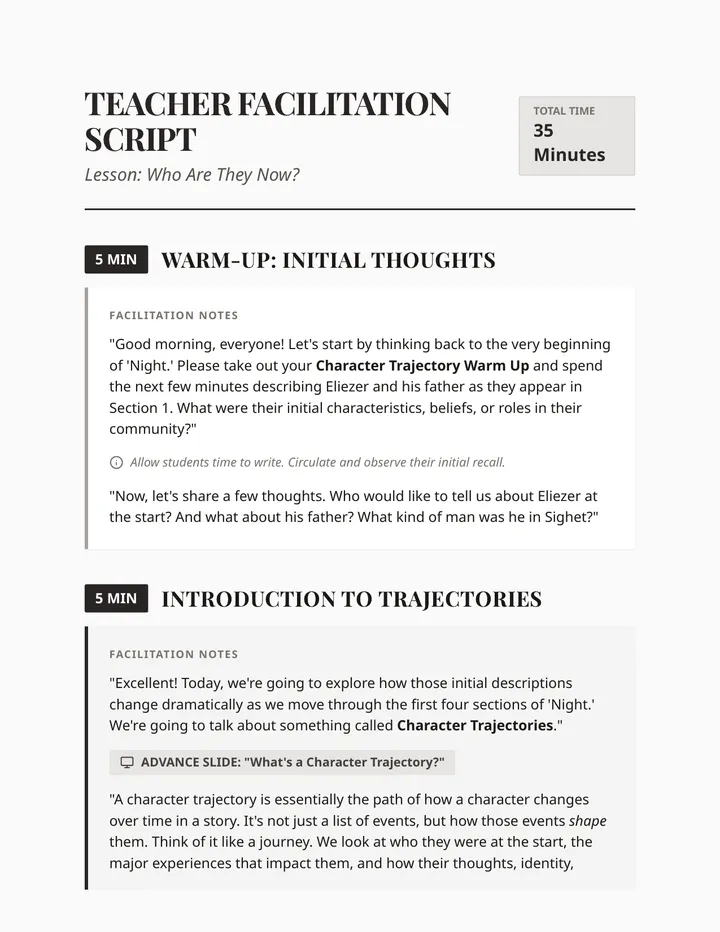
In this 35-minute lesson, 8th-grade students analyze the character trajectories of Eliezer and his father in Sections 1-4 of Elie Wiesel's 'Night,' tracking their shifts in beliefs, values, and relationships amidst extreme adversity.
This checkpoint quiz assesses 8th-grade students' comprehension of sections 1-4 of Elie Wiesel's 'Night,' focusing on how the horrors of the Holocaust begin to impact Eliezer's identity and beliefs. This lesson is designed for a single 30-minute session for a whole classroom.
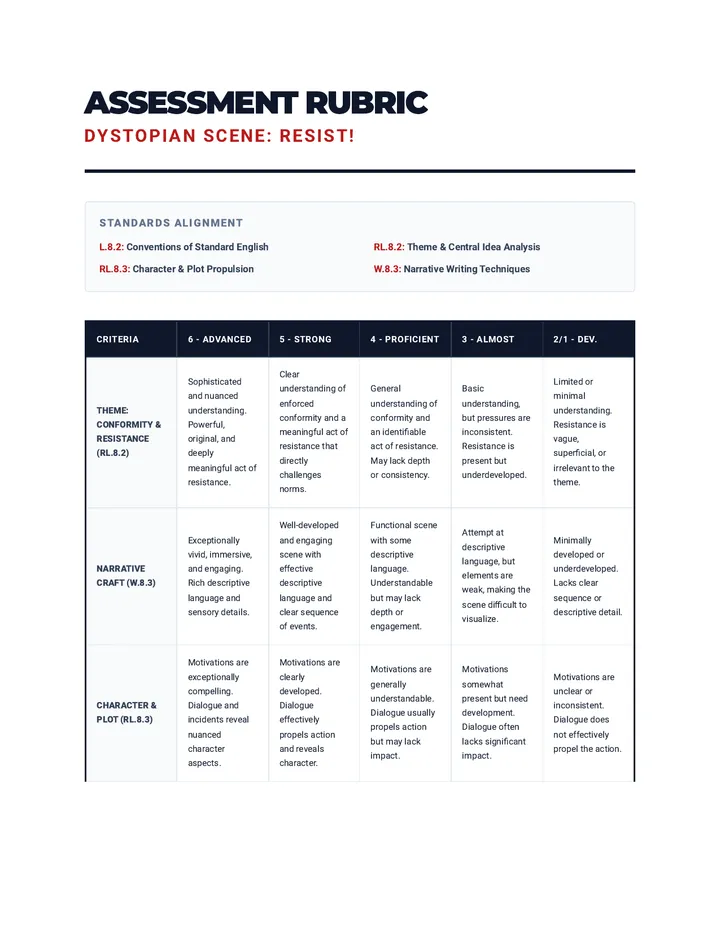
In this 45-minute lesson for Advanced ELA 8 students, students will explore the concept of conformity in dystopian literature and write a short narrative scene where a character resists societal pressure. This lesson helps students deepen their understanding of literary themes and develop creative writing skills.
An 8th-grade lesson exploring Elie Wiesel's *Night* to understand the profound impact of systemic oppression on Jewish identity and spiritual belief during the Holocaust.
This 35-minute lesson for Advanced ELA 8 students explores the erosion and transformation of identity in Section 6 of Elie Wiesel's *Night*. Through guided reading and a 'Compass' mapping activity, students analyze Eliezer's moral and psychological shifts during the death march and at Gleiwitz.
A 30-minute lesson for advanced 8th-grade ELA students focused on transforming textual evidence from Section 3 of Elie Wiesel's 'Night' into insightful, multi-sentence analytical commentary.
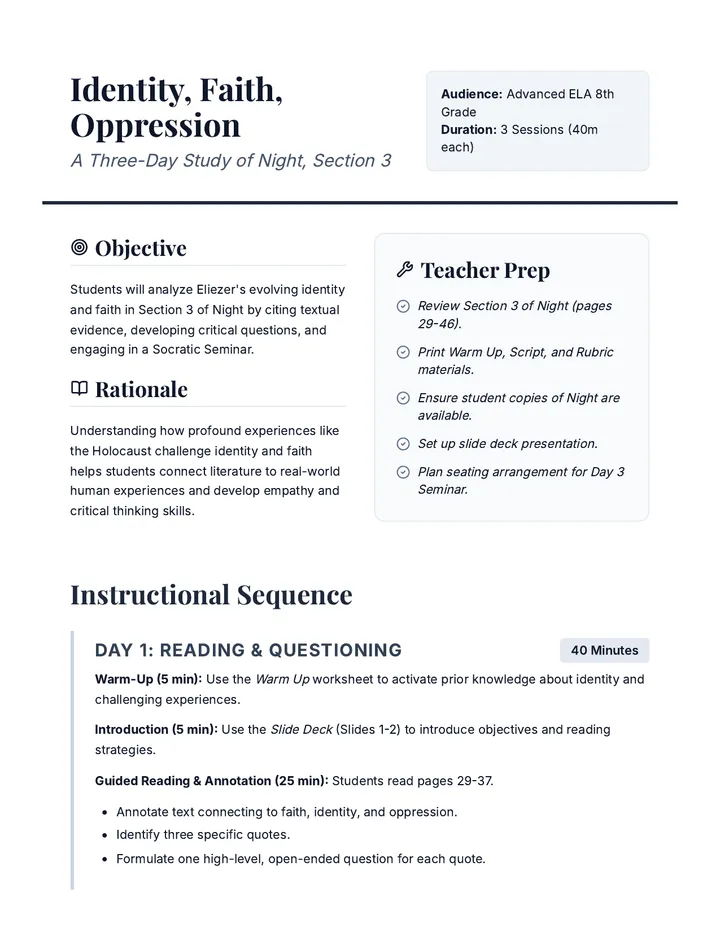
A three-day intensive study of Section 3 of Elie Wiesel's Night, focusing on the erosion of identity and faith under the weight of oppression. Students engage in close reading, high-level question development, and a culminating Socratic Seminar.
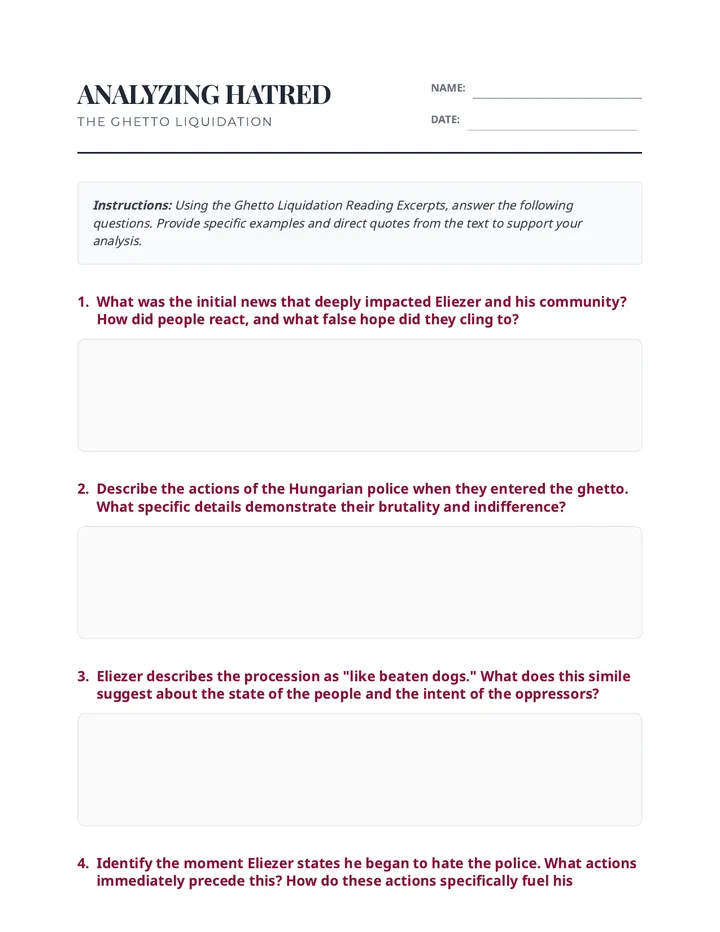
This lesson for advanced 8th-grade students explores excerpts from Elie Wiesel's 'Night,' focusing on the immediate aftermath of being told to leave the ghetto. Students will analyze the author's burgeoning hatred for the oppressors and connect it to broader themes of oppression and dehumanization.
A literary analysis lesson for 8th-grade students focusing on the use of sensory imagery in the first two chapters of Elie Wiesel's *Night* to evoke emotion and convey deeper meaning.
An intensive 35-minute exploration of Section 7 of Elie Wiesel's *Night*, focusing on the erosion of identity and faith during the brutal transport to Buchenwald. Students engage with the text through a reflective activity that challenges them to empathize with the extreme moral dilemmas faced by the prisoners.
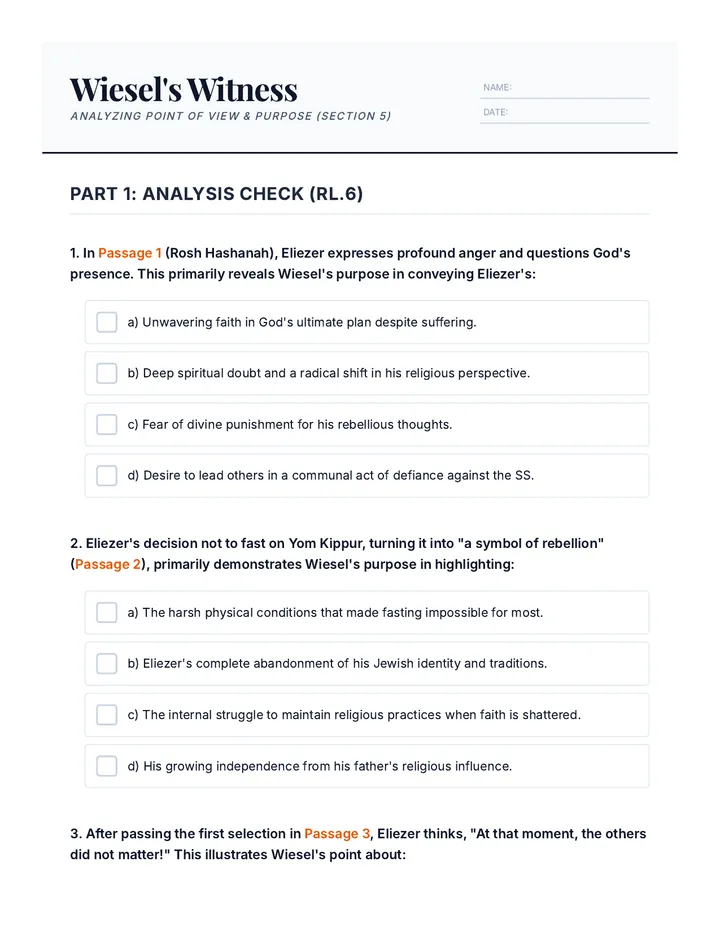
This lesson explores how extreme oppression challenges and transforms an individual's core beliefs and identity, using excerpts from Elie Wiesel's 'Night' Section 5. Students analyze Wiesel's evolving point of view and his role as a witness through evidence-based analysis and argumentative writing.
A reflective writing lesson for 8th-grade students focused on analyzing Elie Wiesel's shifting identity and tone in 'Night' following a Socratic Seminar. Students will craft a formal reflective paragraph using textual evidence and seamless integration.
A 3-day research unit focused on the historical context of Night by Elie Wiesel, specifically covering liberation, concentration camps, and death marches, concluding with student presentations.
A two-part lesson sequence for advanced 8th-grade students focused on analyzing Elie Wiesel's tone in 'Night' and developing high-level questions for a Socratic Seminar on identity and oppression.