Empathetic skill development through emotion recognition, cultural diversity appreciation, and bias confrontation. Targets multi-perspective analysis to support respectful interactions and complex social responses.
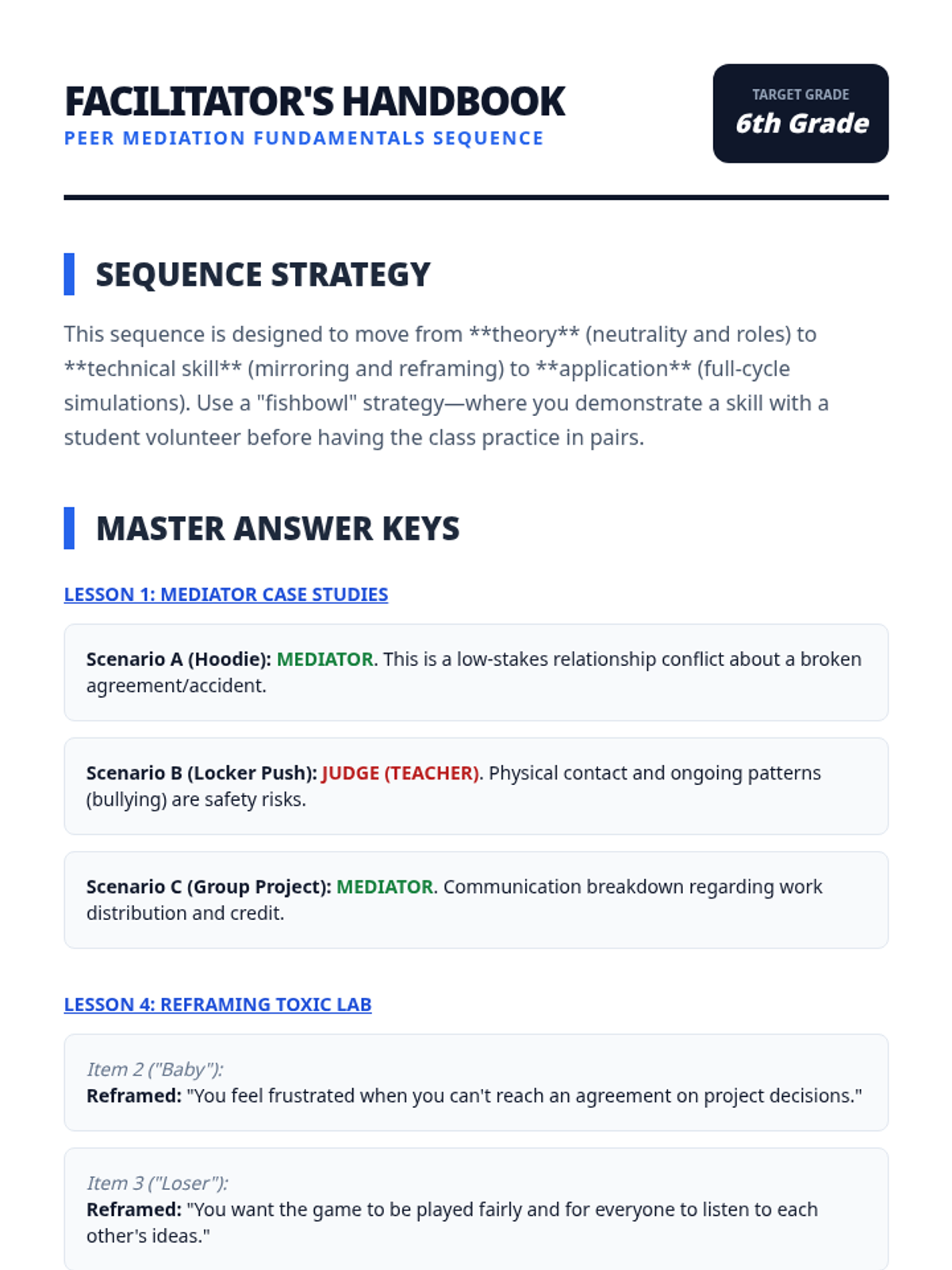
Teacher-facing facilitation guide and answer keys for the entire Peer Mediation sequence, including coaching tips for mock mediations.
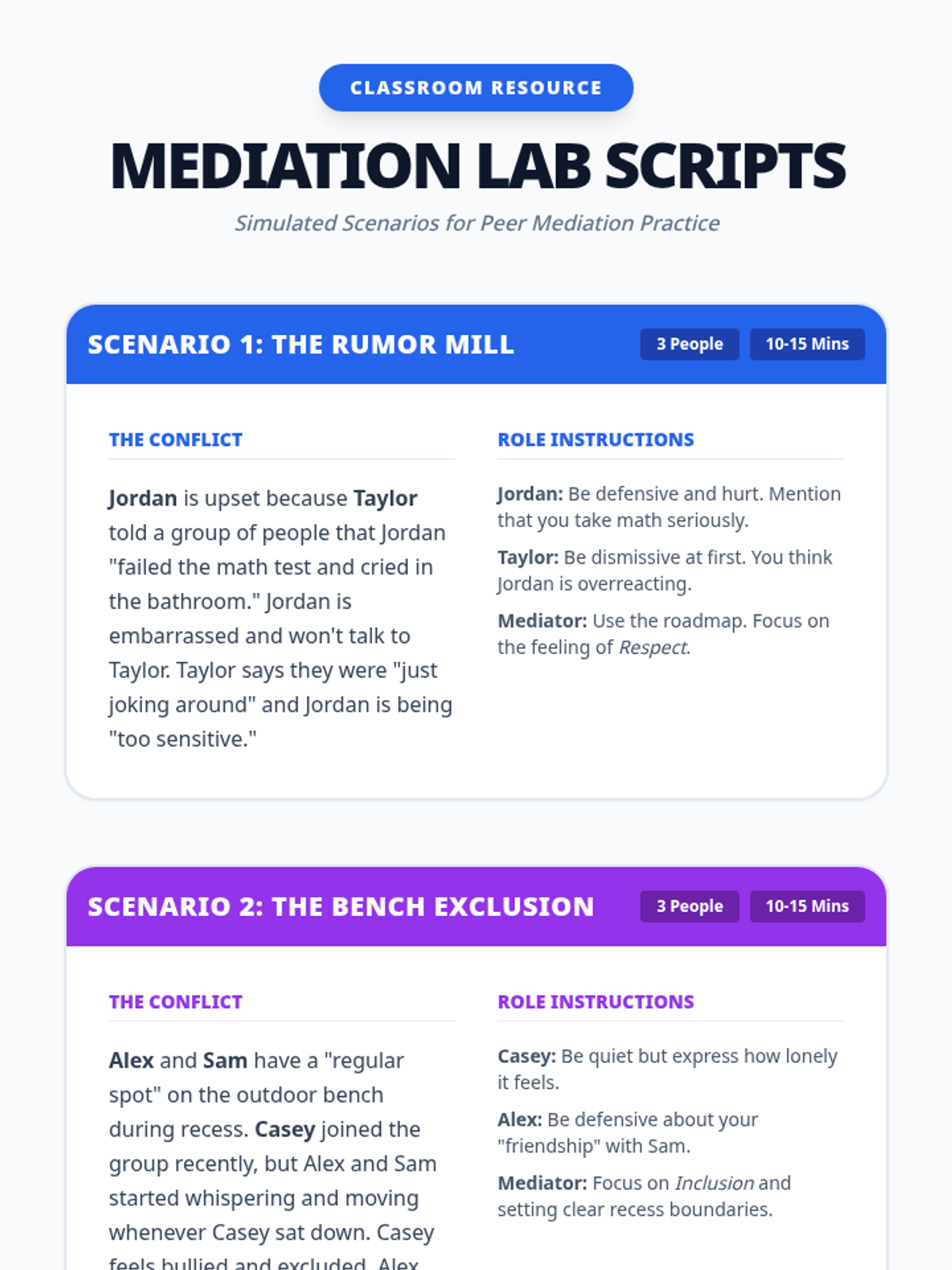
Role-play scenarios based on common middle school conflicts to be used during the Mediation Lab simulation.
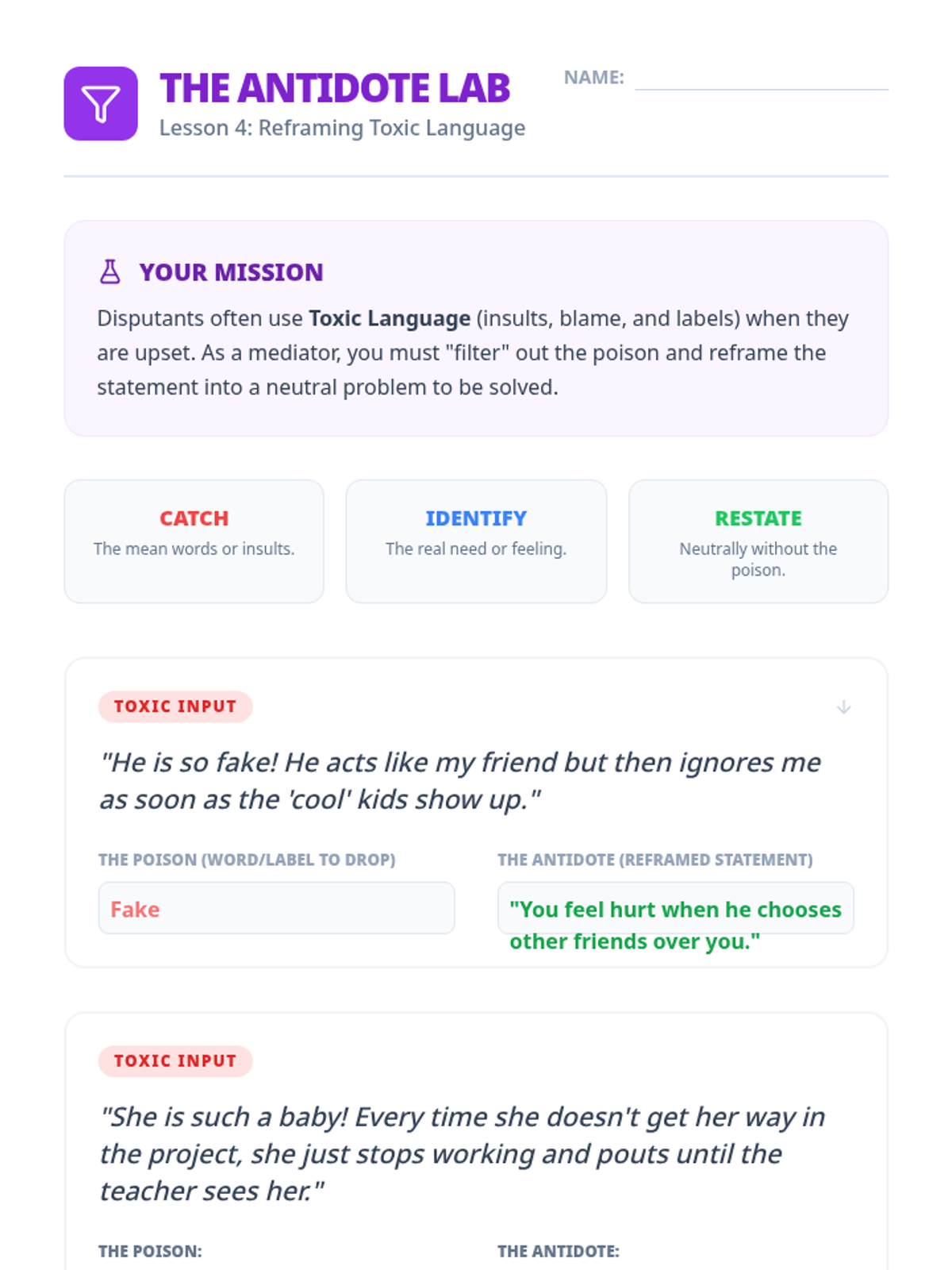
Advanced practice worksheet where students identify toxic labels and absolutes in conflict statements and reframe them into neutral needs or feelings.
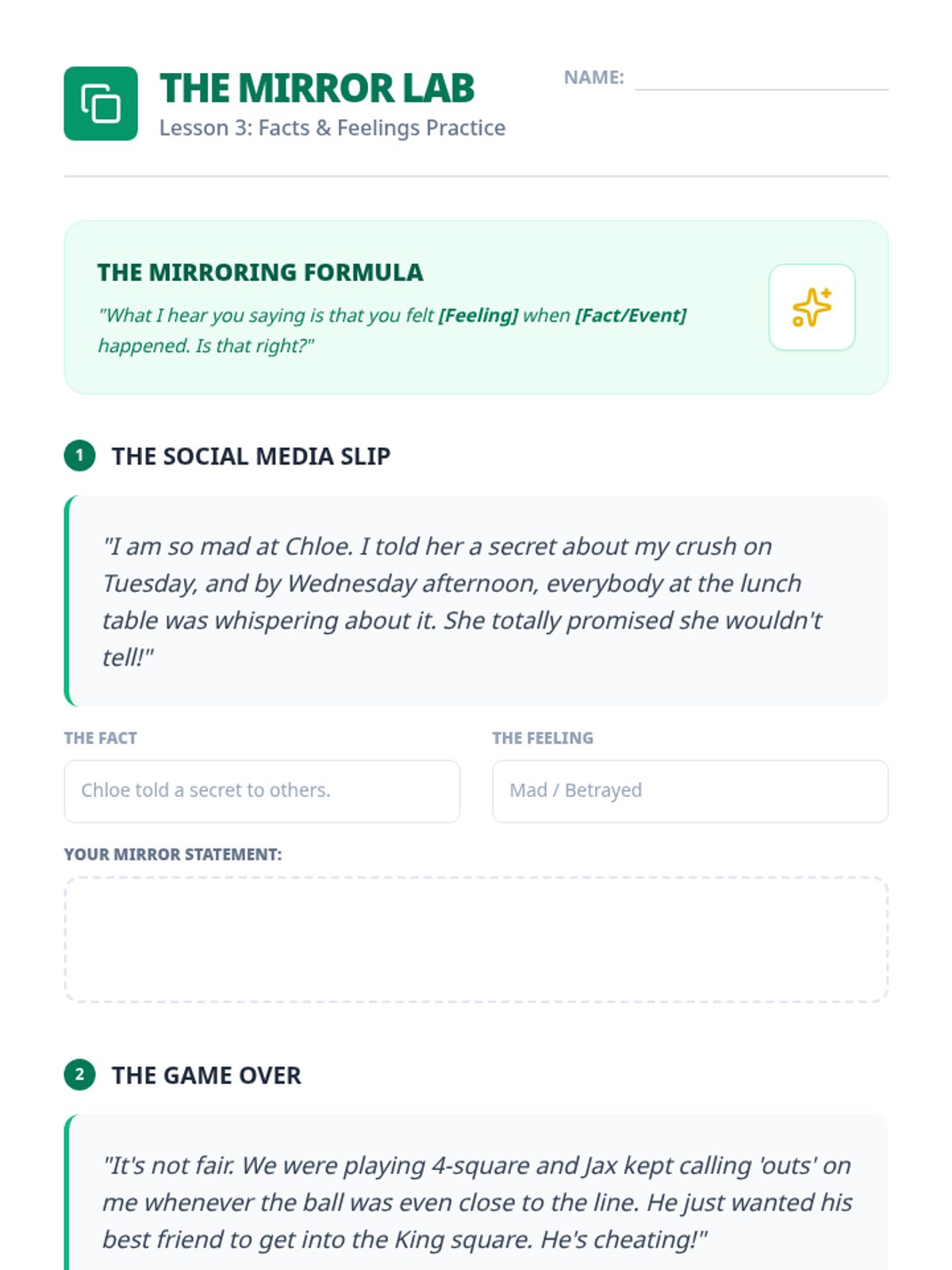
Worksheet for students to practice identifying facts and feelings in conflict statements and crafting neutral mirroring responses.
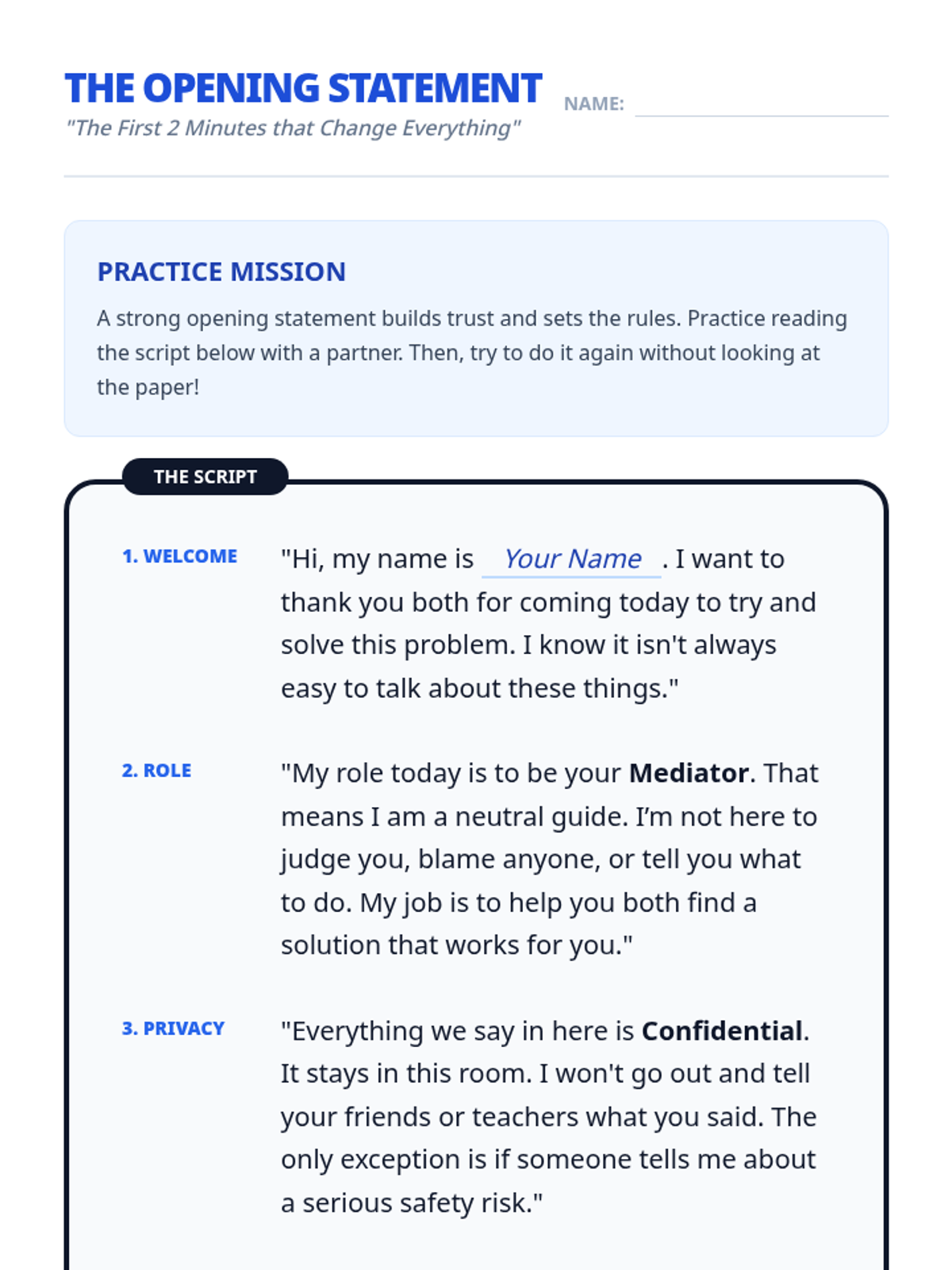
Student-facing script and practice guide for delivering a mediation opening statement, including ground rules and neutrality reminders.
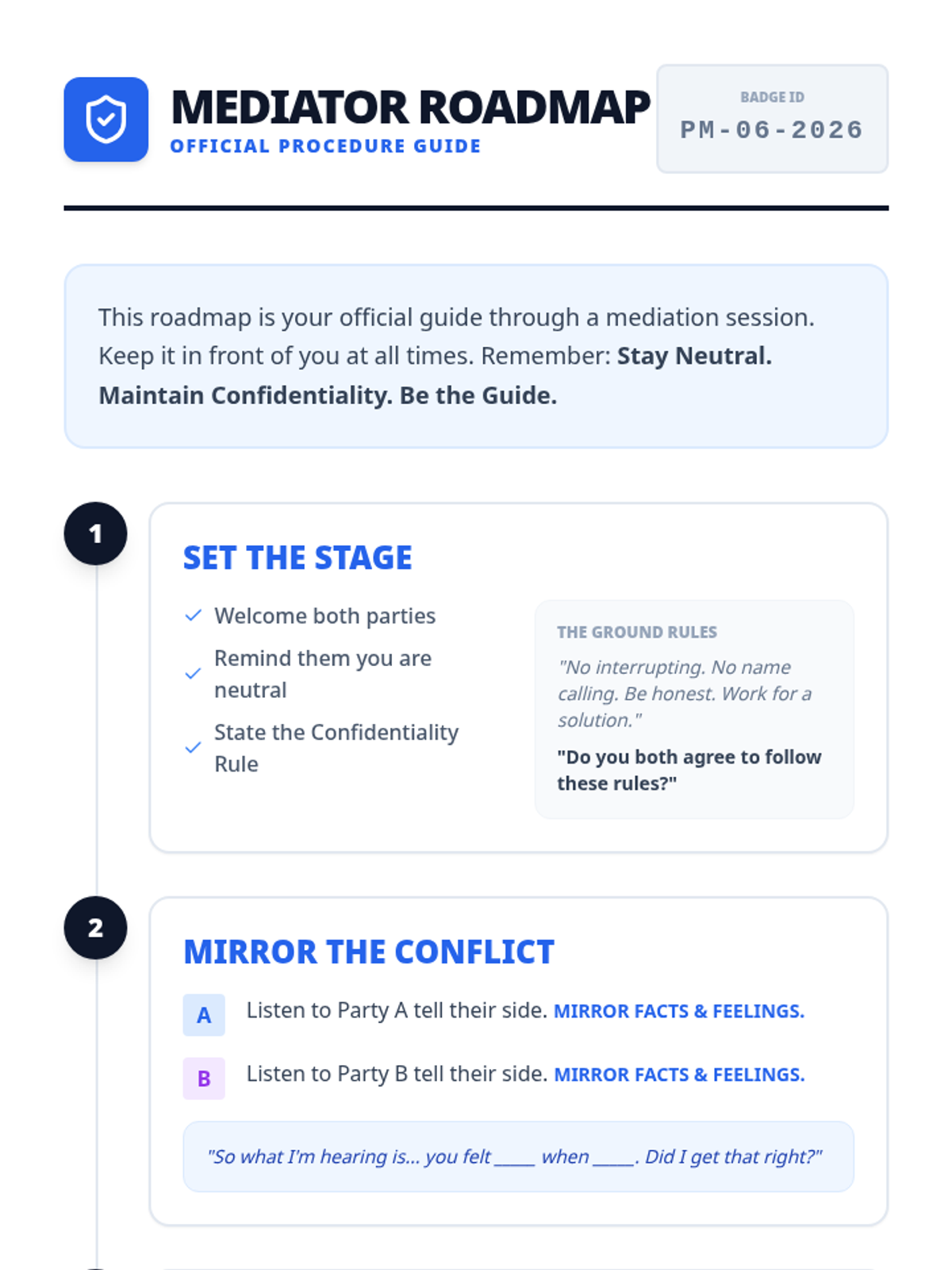
Student-facing reference sheet to guide them through the 4-step peer mediation process during simulations.
Slide deck explaining the concept of reframing toxic language into neutral problem statements to help de-escalate conflicts and focus on solutions.
Slide deck focusing on the mediator's primary tool: mirroring. It explains the concept, provides "magic phrases" for starting reflections, and includes a practice scenario.
Slide deck explaining the structure of a mediation opening statement and the importance of establishing ground rules before beginning the conflict resolution process.
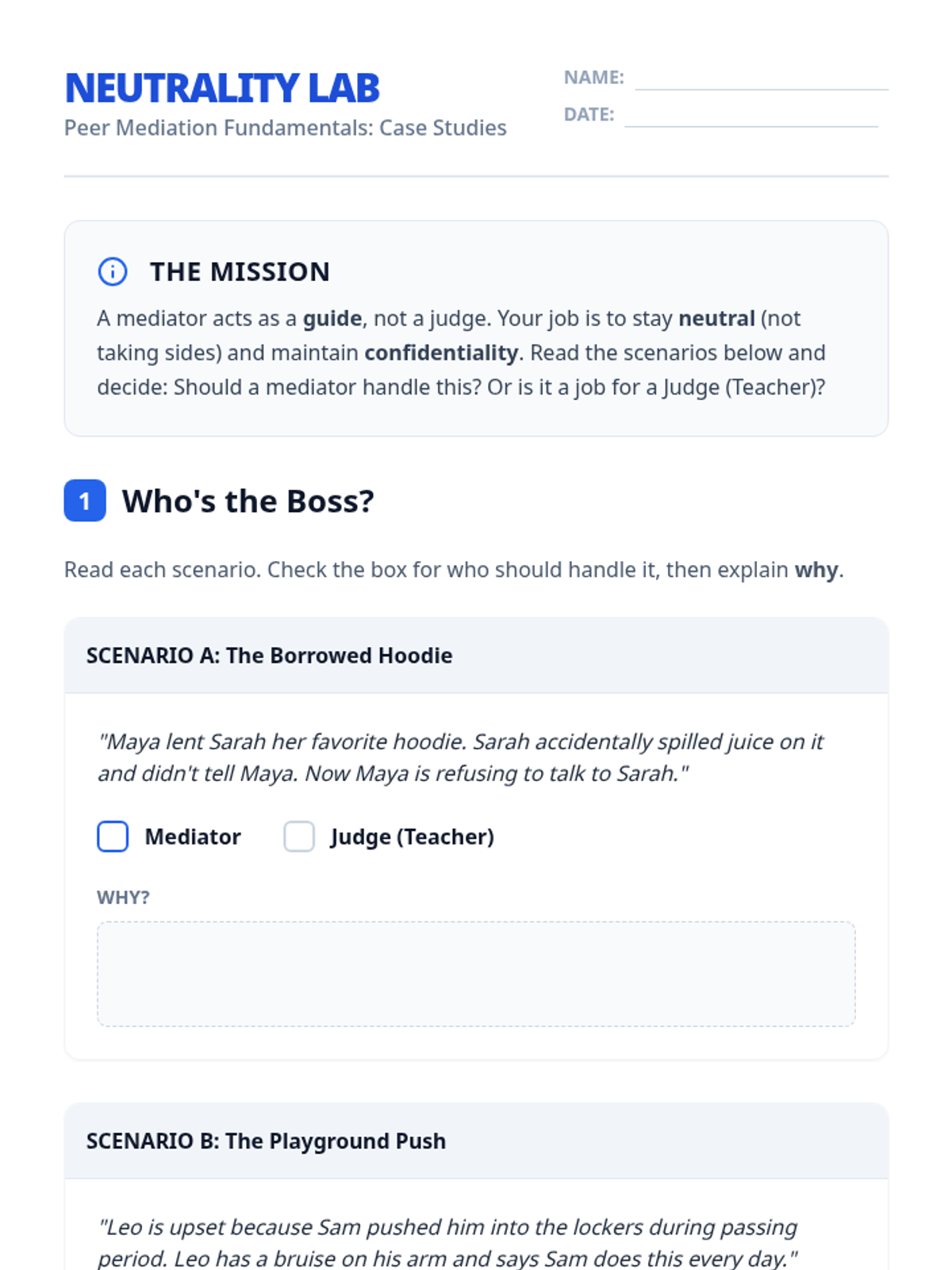
Worksheet with case studies helping students distinguish between situations suitable for mediation and those requiring adult intervention, along with neutrality exercises.
Introductory slide deck defining the mediator's role, the principle of neutrality, the difference between a mediator and a judge, and safety boundaries for peer mediation.
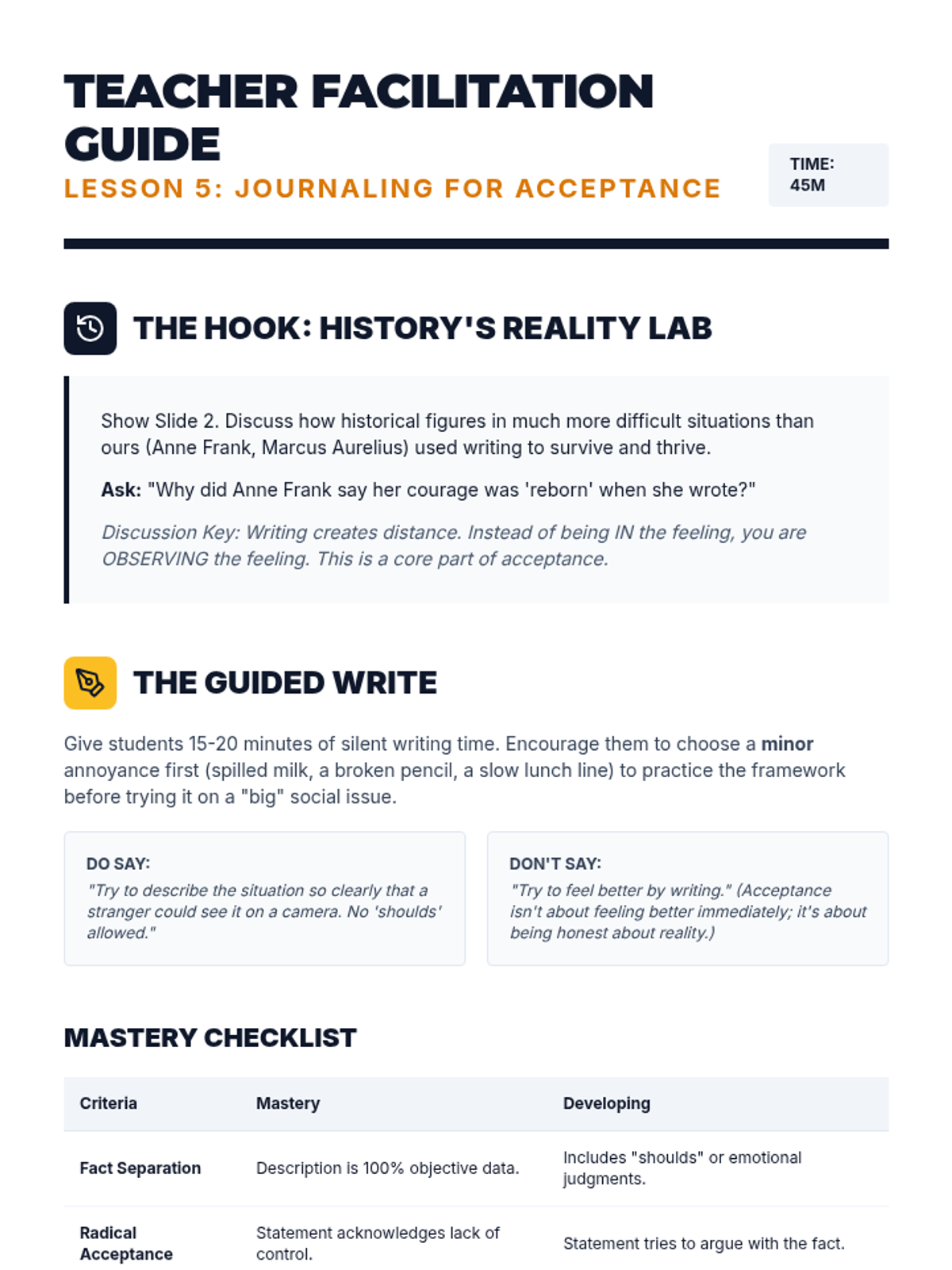
Teacher guide for Lesson 5, including journaling instructions, mastery checklist, and a closing reflection.
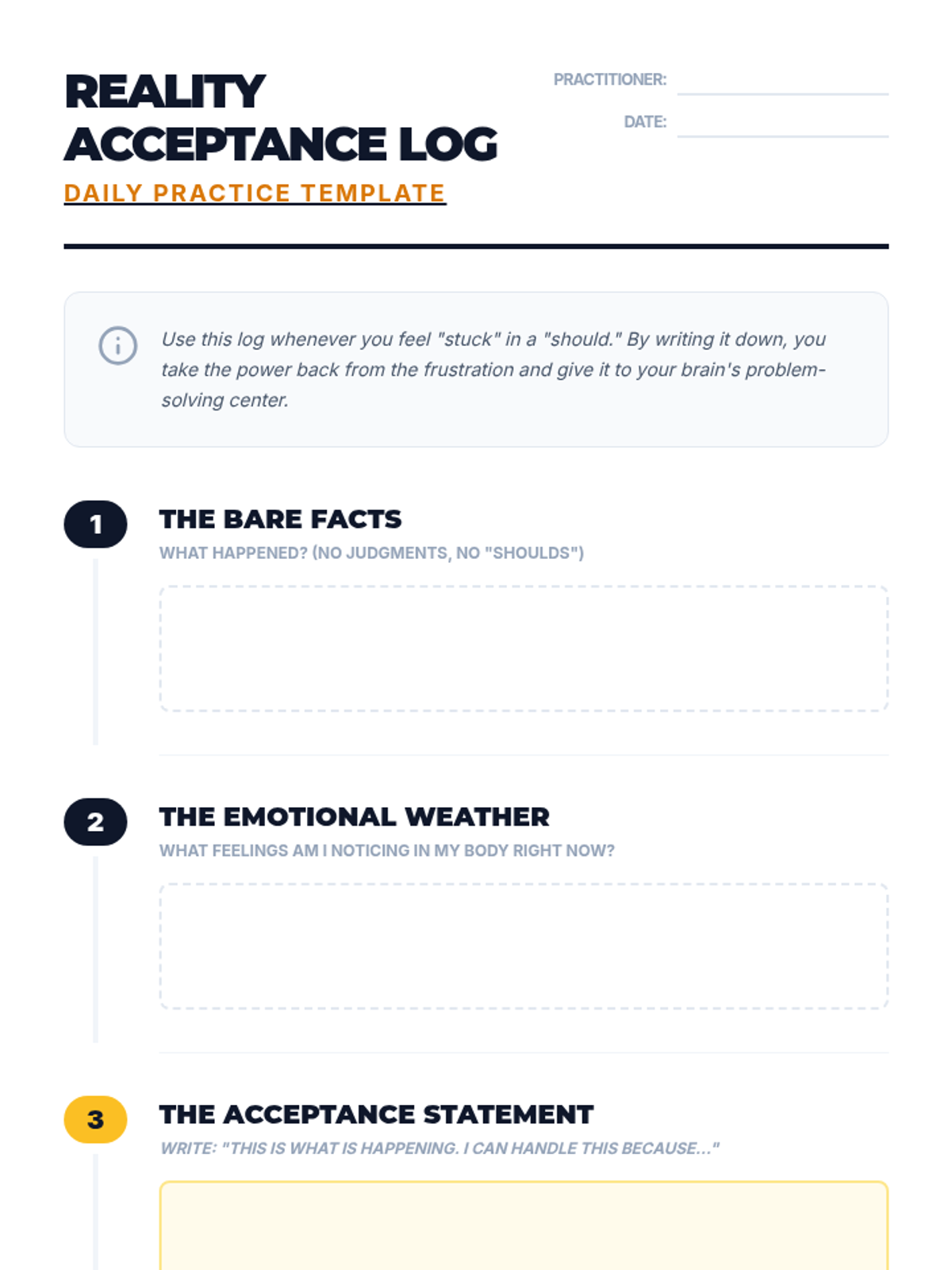
A structured journaling template for students to process frustrations using the 4-step radical acceptance framework.
Slide deck for Lesson 5 focusing on establishing a structured journaling practice for radical acceptance.
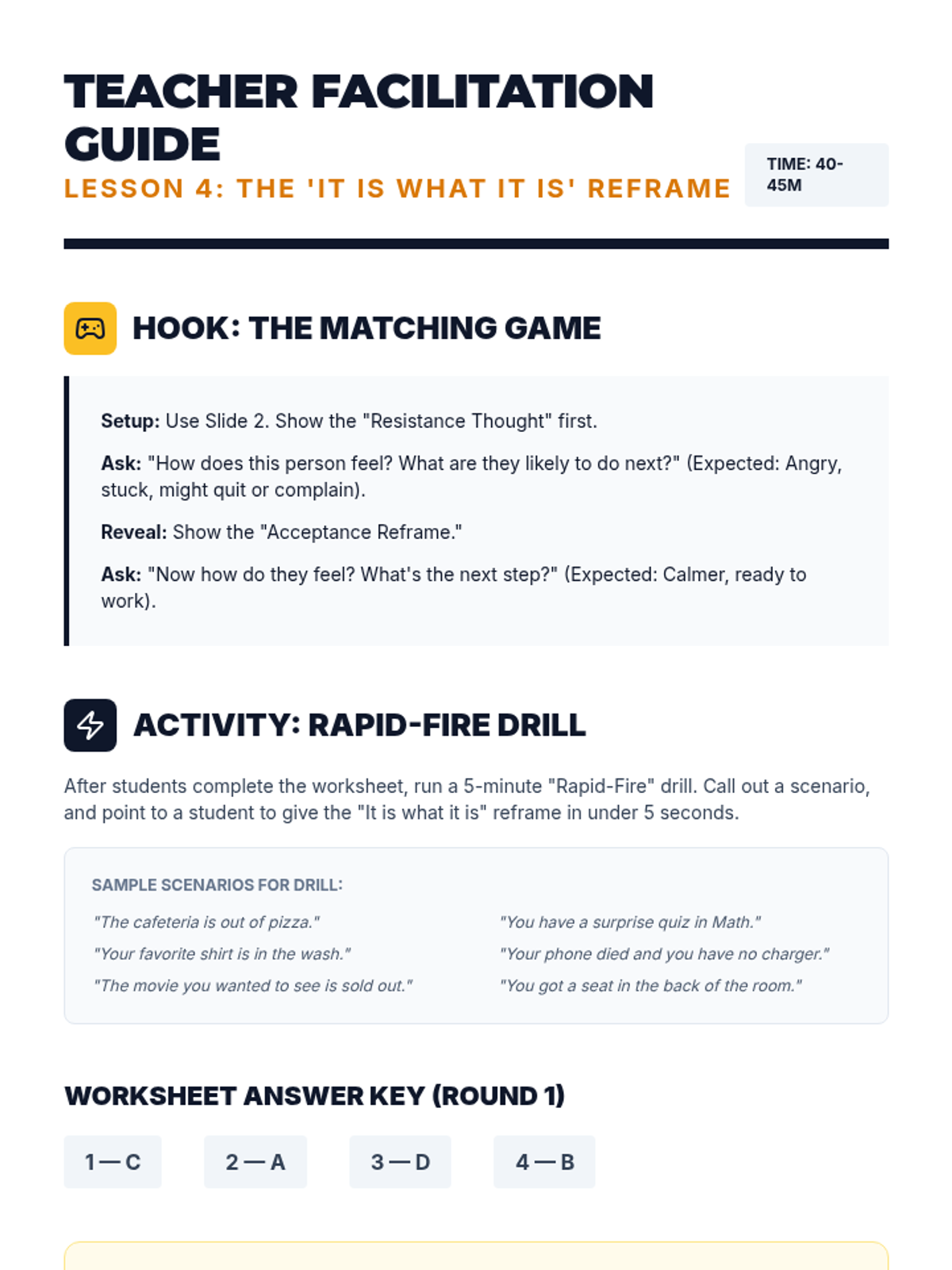
Teacher guide for Lesson 4, including matching game instructions, rapid-fire drill scenarios, and key discussion points.
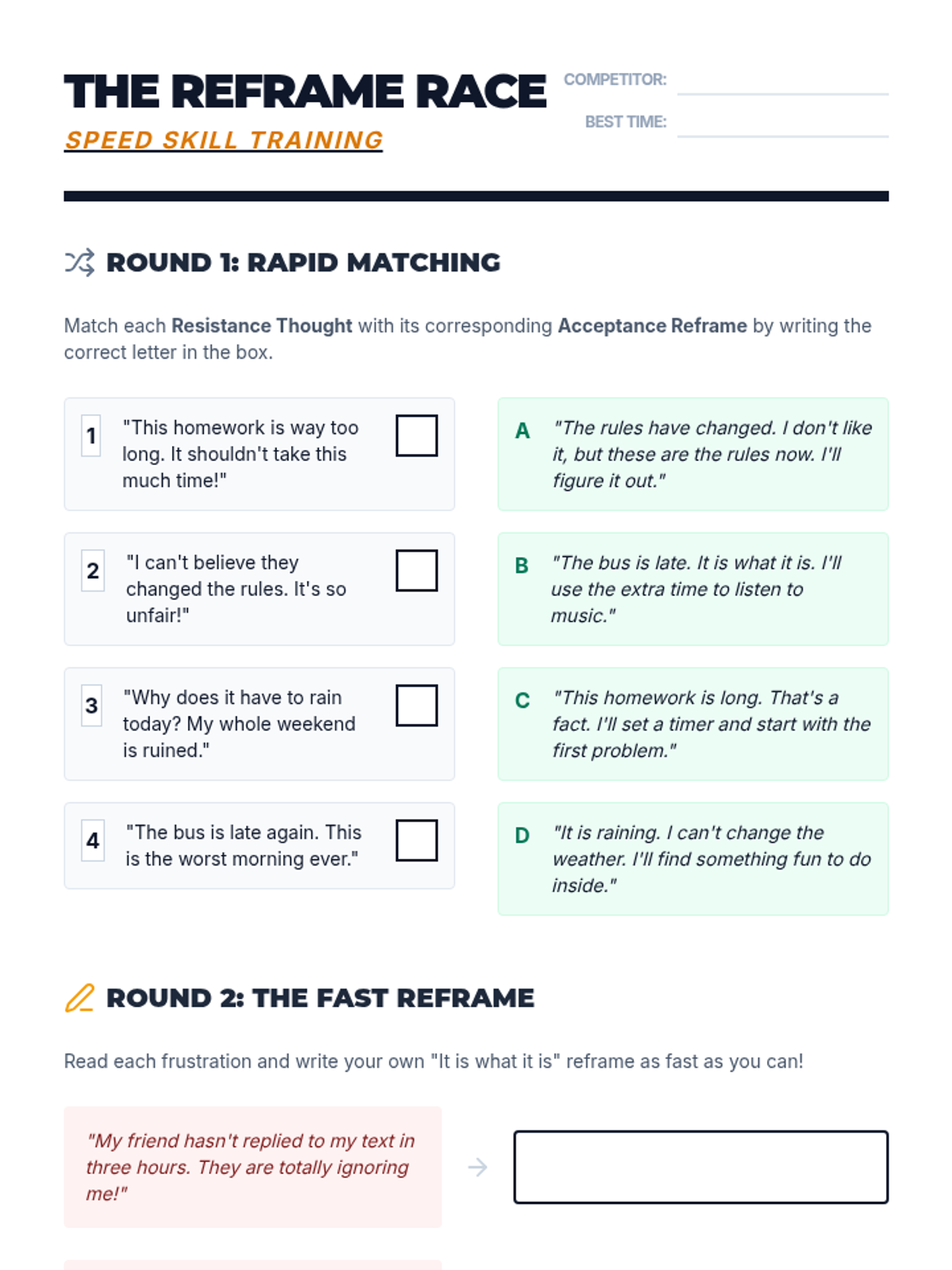
A matching game and speed practice worksheet where students pair resistance thoughts with acceptance reframes and practice creating their own.
Slide deck for Lesson 4 focusing on practical reframing techniques and the 'It is what it is' mindset.
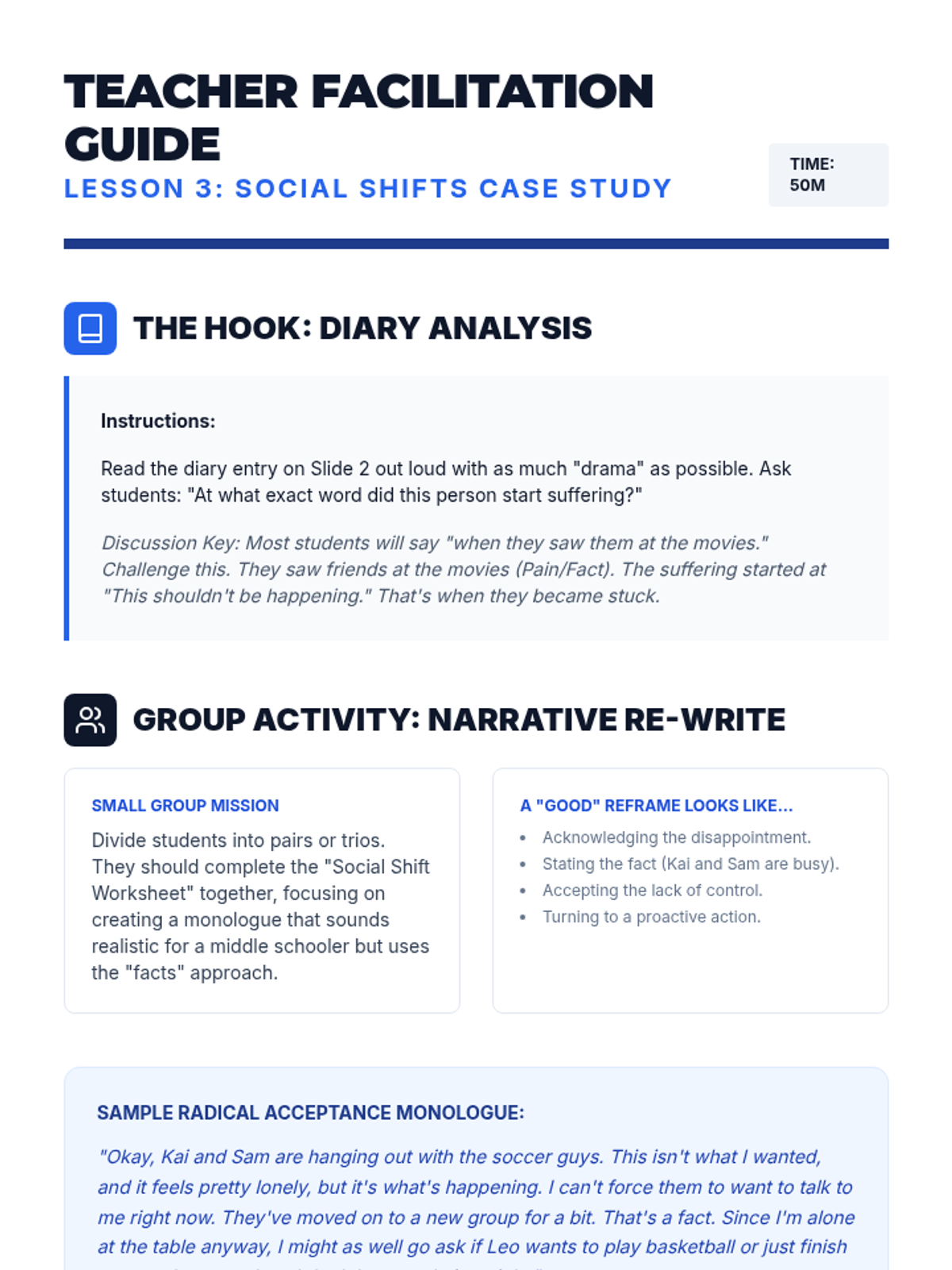
Teacher guide for Lesson 3, including diary analysis hook instructions, group activity guidance, and a sample reframe monologue for the case study.
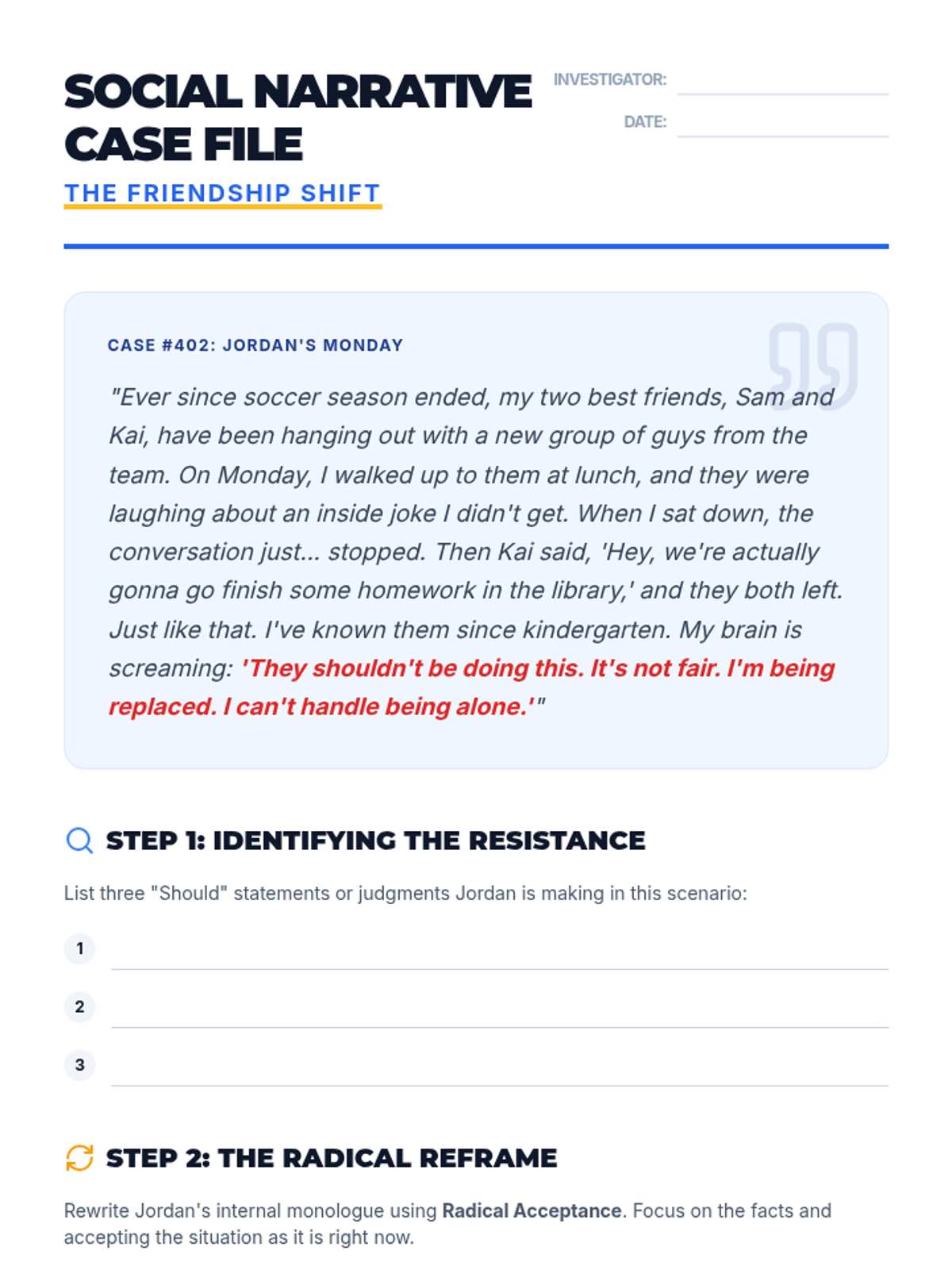
Student worksheet featuring a narrative case study about shifting friend groups. Students analyze resistance thoughts and rewrite the protagonist's internal monologue using radical acceptance.
Slide deck for Lesson 3 focusing on applying radical acceptance to social shifts and friend group changes.
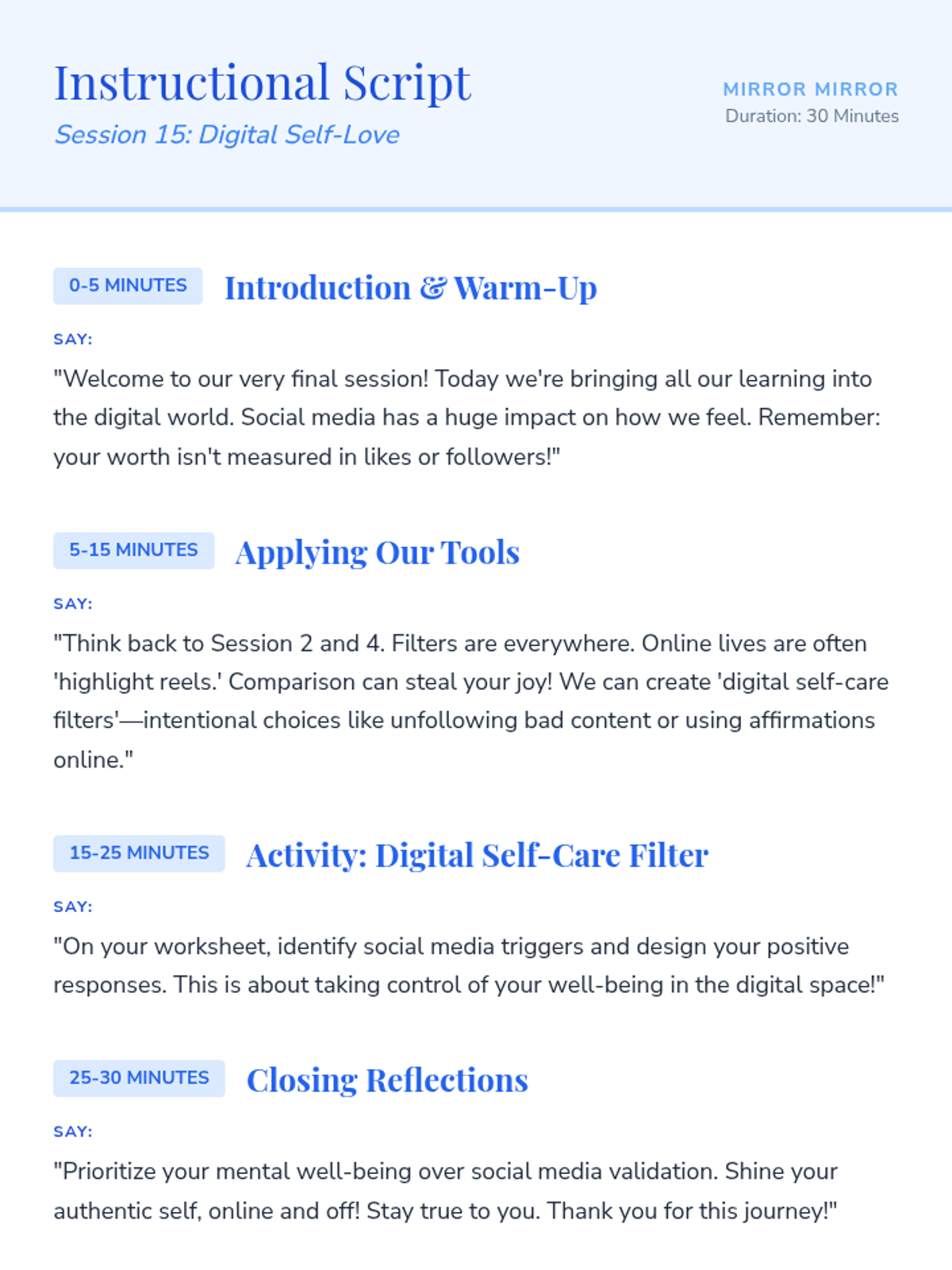
Instructional script, activity worksheet, and reflection journal for Session 15, focusing on integrating social media literacy and positive self-talk into students' digital lives.
Visual presentation for Session 15, focusing on digital self-love, managing social media's impact, and building a positive digital footprint.
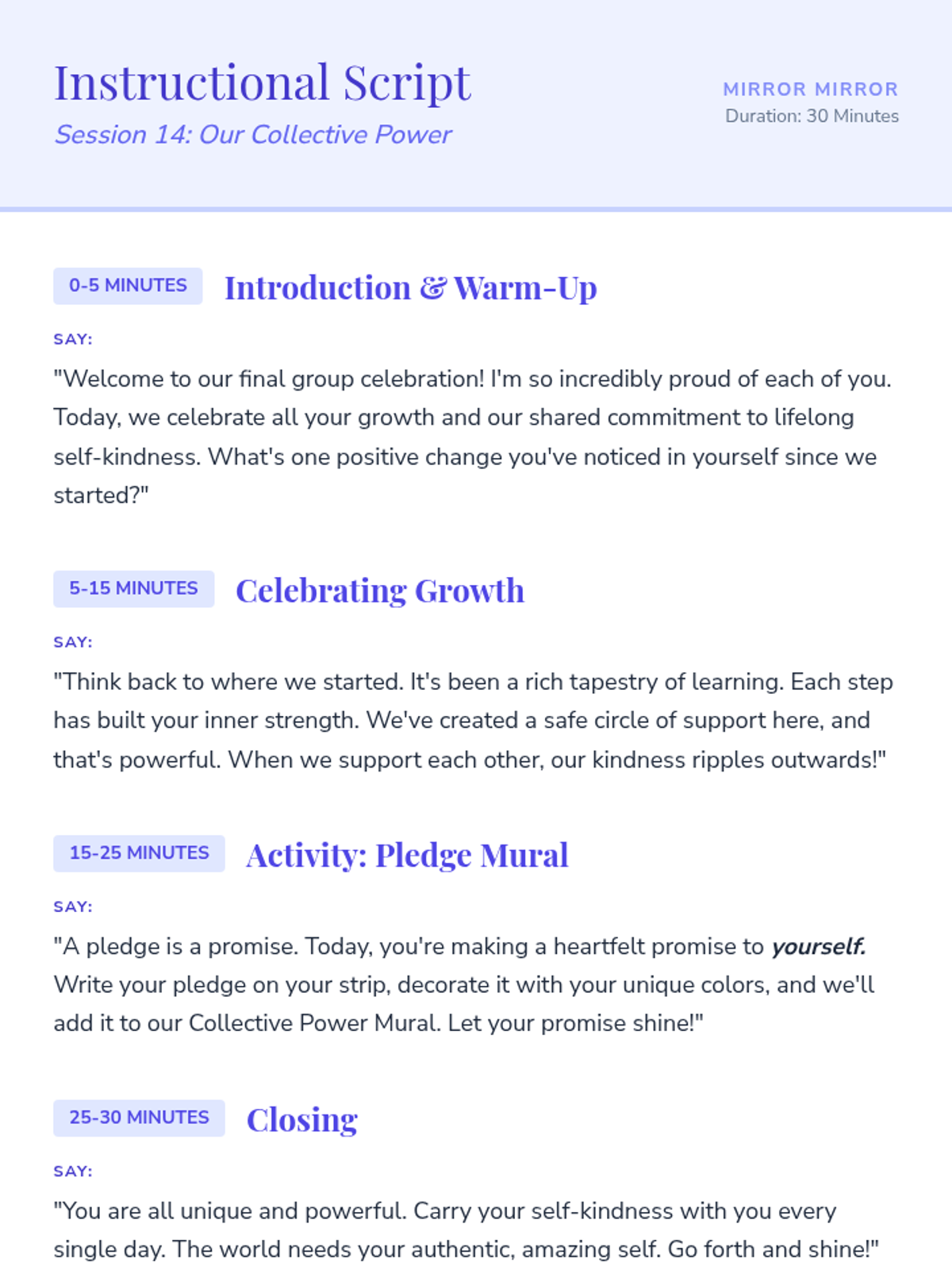
Instructional script, activity worksheet, and reflection journal for Session 14, reinforcing community support, celebrating individual journeys, and creating a shared future pledge for lifelong self-kindness.
Visual presentation for Session 14, reinforcing community support, celebrating individual journeys, and creating a shared future pledge for lifelong self-kindness.
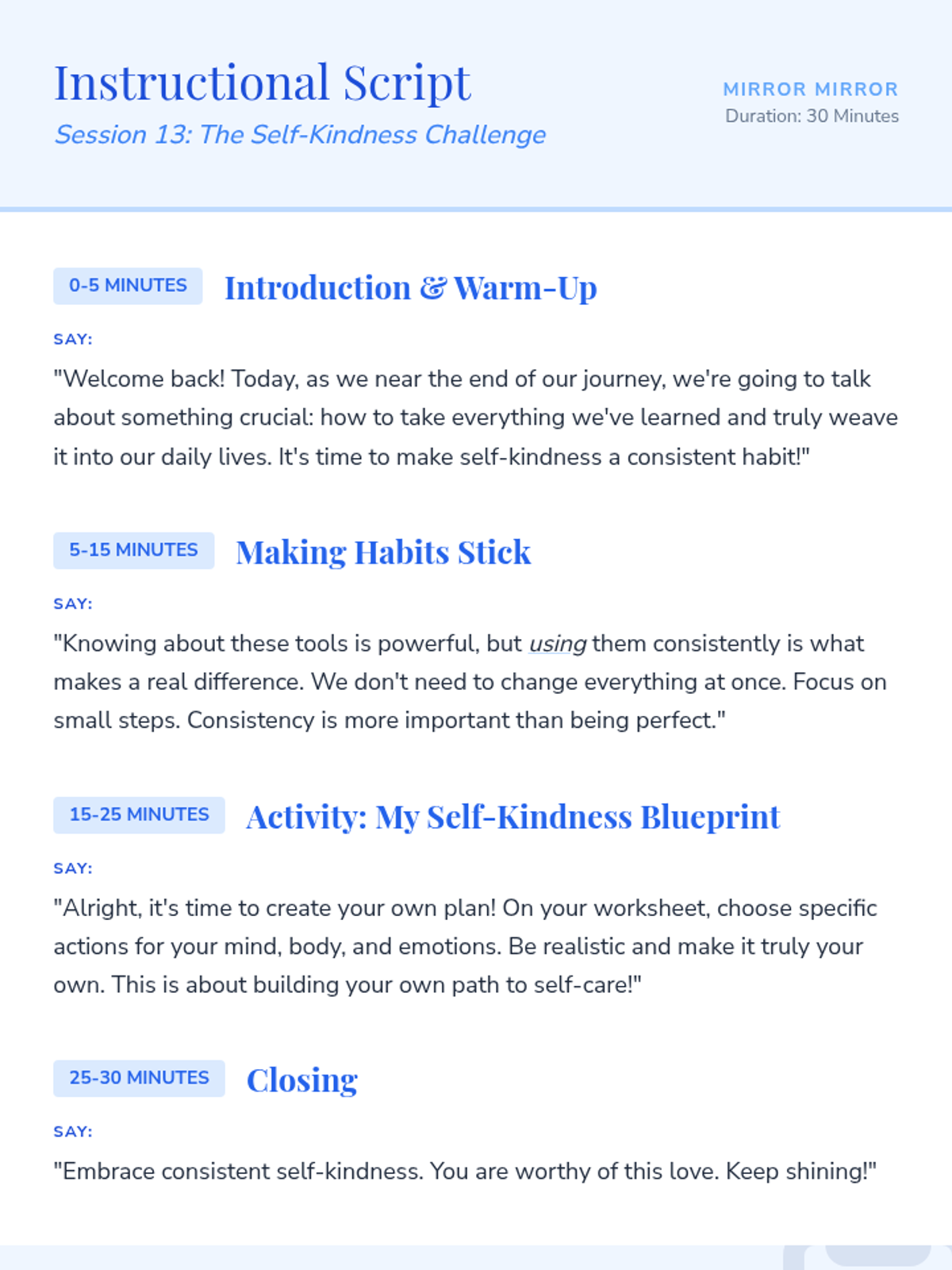
Instructional script, activity worksheet, and reflection journal for Session 13, focusing on practical application of self-kindness, positive self-talk, and body appreciation into daily habits.
Visual presentation for Session 13, focusing on practical application of self-kindness, positive self-talk, and body appreciation into daily habits.
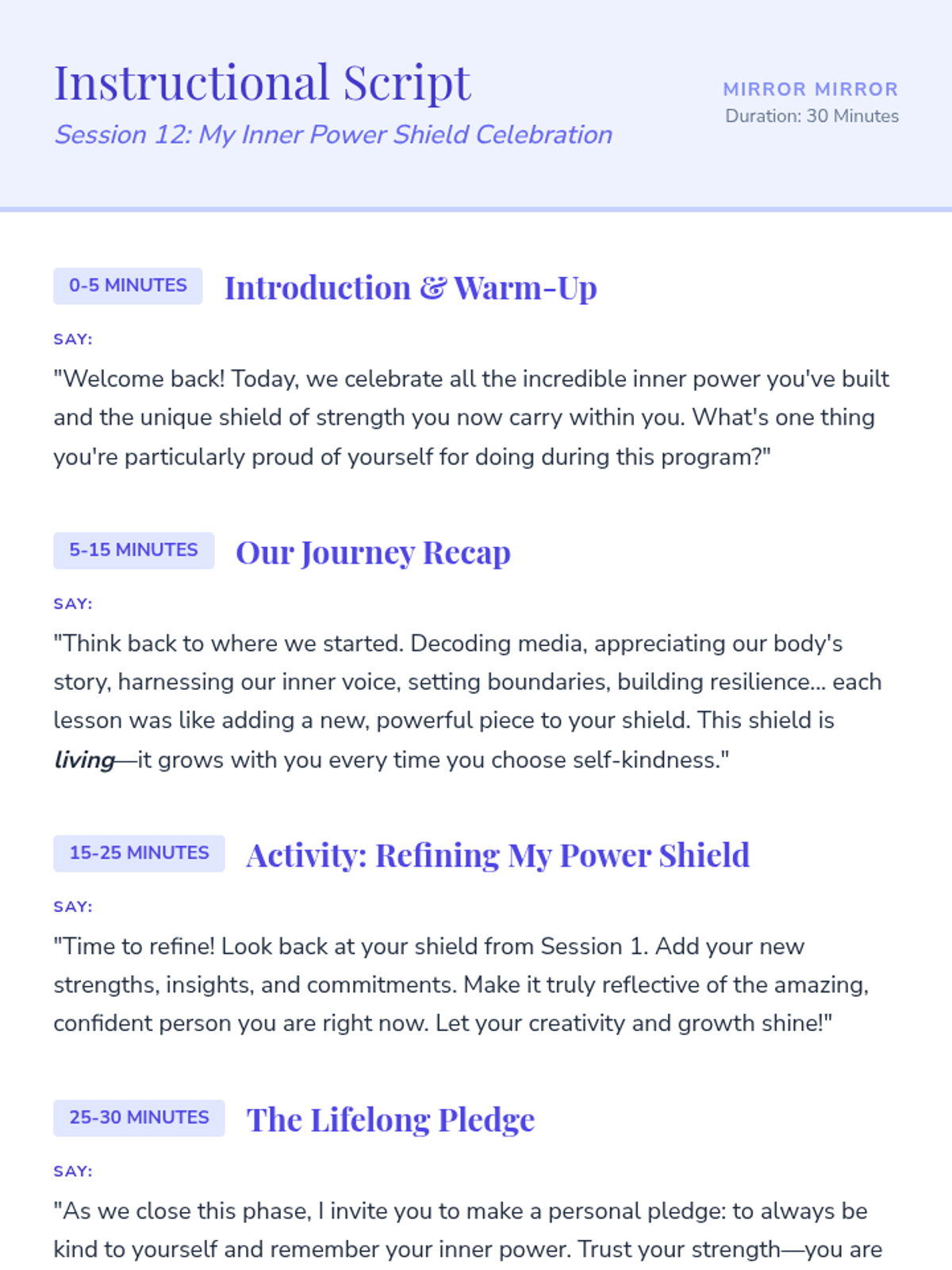
Instructional script, activity worksheet, and reflection journal for Session 12, reviewing all concepts learned, refining the power shield, and making a lifelong pledge to self-kindness.
Visual presentation for Session 12, reviewing all concepts learned, creating or refining a personal 'power shield' artifact, and final reflections and commitments to self-kindness.
Instructional script, activity worksheet, and reflection journal for Session 11, developing strategies for coping with setbacks, negative comments, and understanding self-compassion.
Visual presentation for Session 11, focusing on developing strategies for coping with setbacks, negative comments, and understanding self-compassion.
Instructional script, game cards, and reflection journal for Session 10, visualizing a confident future and setting actionable goals for personal growth.
Visual presentation for Session 10, visualizing a confident future and setting small, achievable goals for personal growth.
Instructional script, activity worksheet, and reflection journal for Session 9, learning to genuinely give and receive positive feedback, focusing on non-physical compliments.
Visual presentation for Session 9, learning to genuinely give and receive positive feedback, focusing on non-physical qualities.
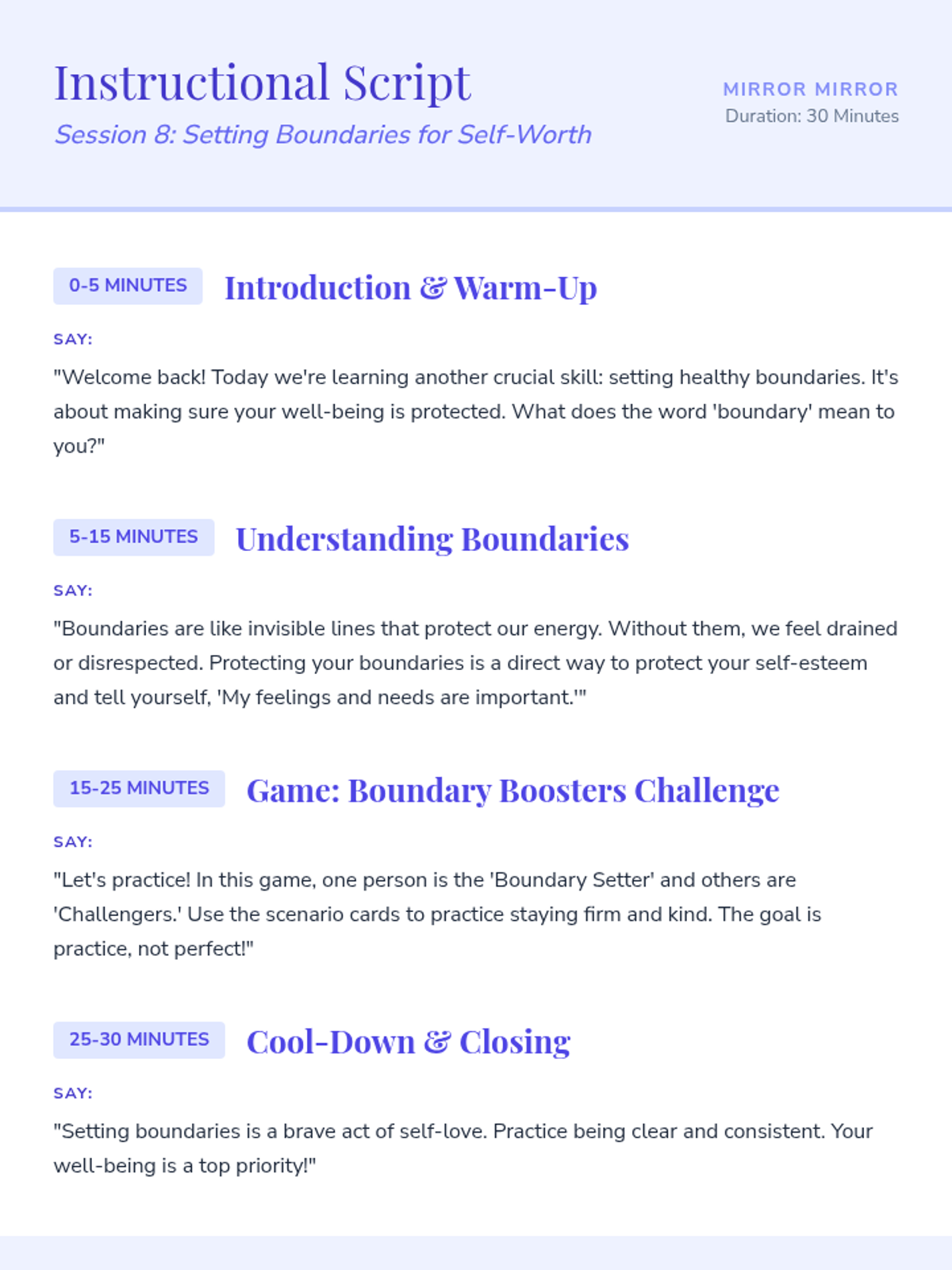
Instructional script, game cards, and reflection journal for Session 8, learning to say 'no' to things that diminish self-esteem and protecting well-being.
Visual presentation for Session 8, learning how to protect our inner peace and self-esteem by setting healthy boundaries.
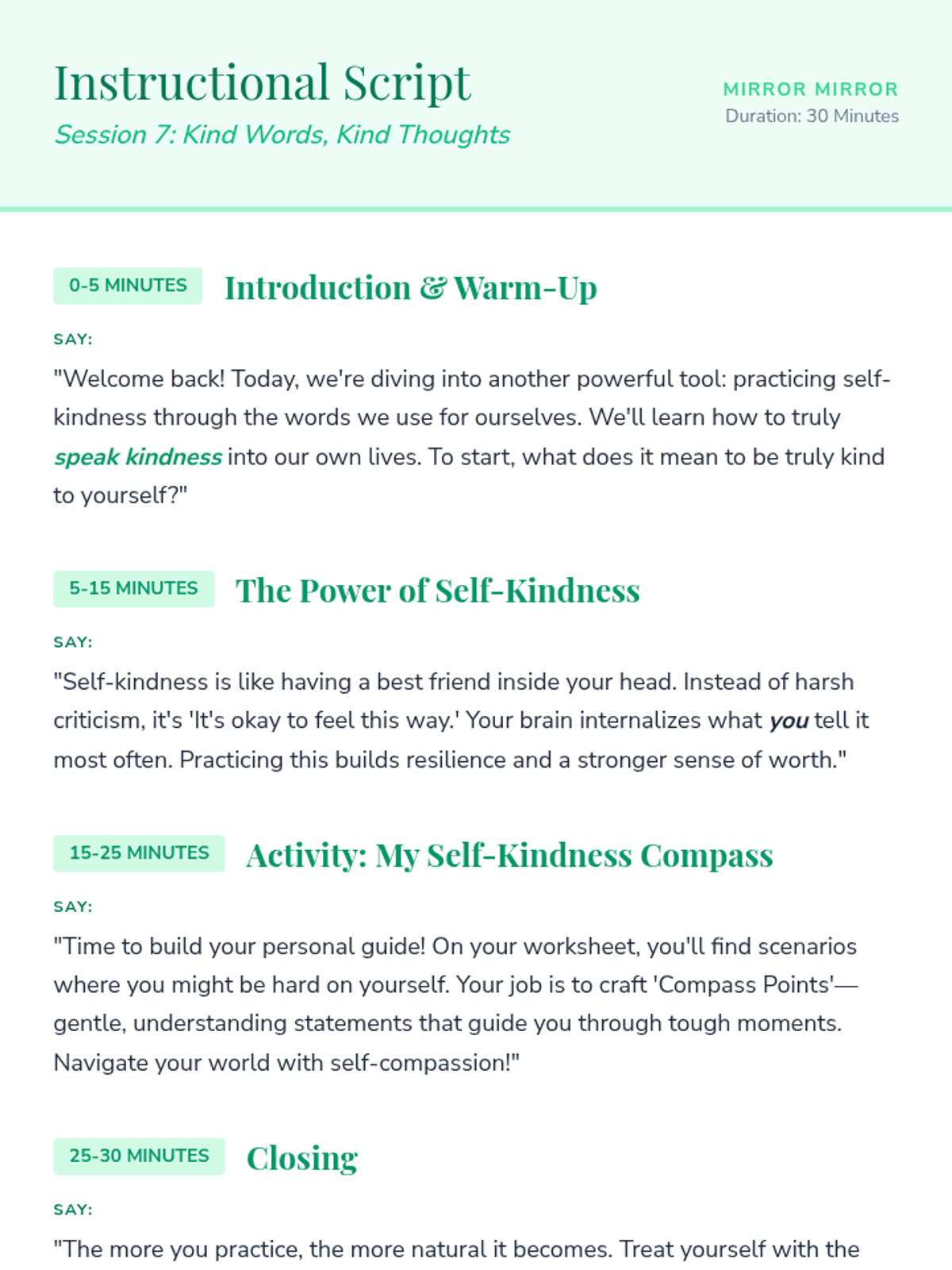
Instructional script, activity worksheet, and reflection journal for Session 7, helping students identify situations where they need self-kindness and practice crafting compassionate responses.
Visual presentation for Session 7, learning to use kind and compassionate self-talk as a source of comfort and strength.
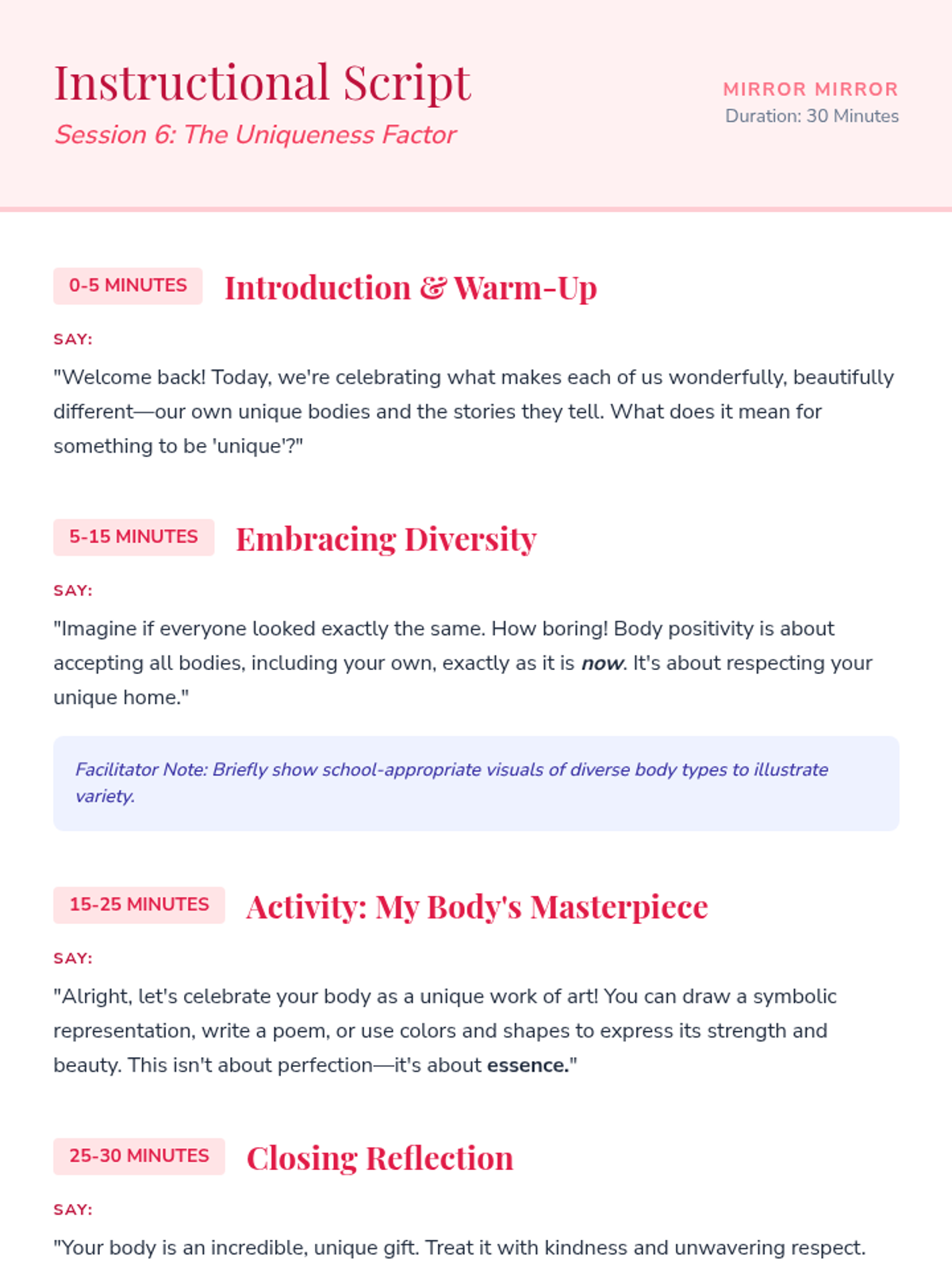
Facilitator script, activity worksheet, discussion guide, and reflection journal for Session 6, focusing on celebrating diversity and body acceptance.
Visual presentation for Session 6, celebrating diversity in appearance, personality, and abilities, and introducing the 'My Body's Masterpiece' activity.
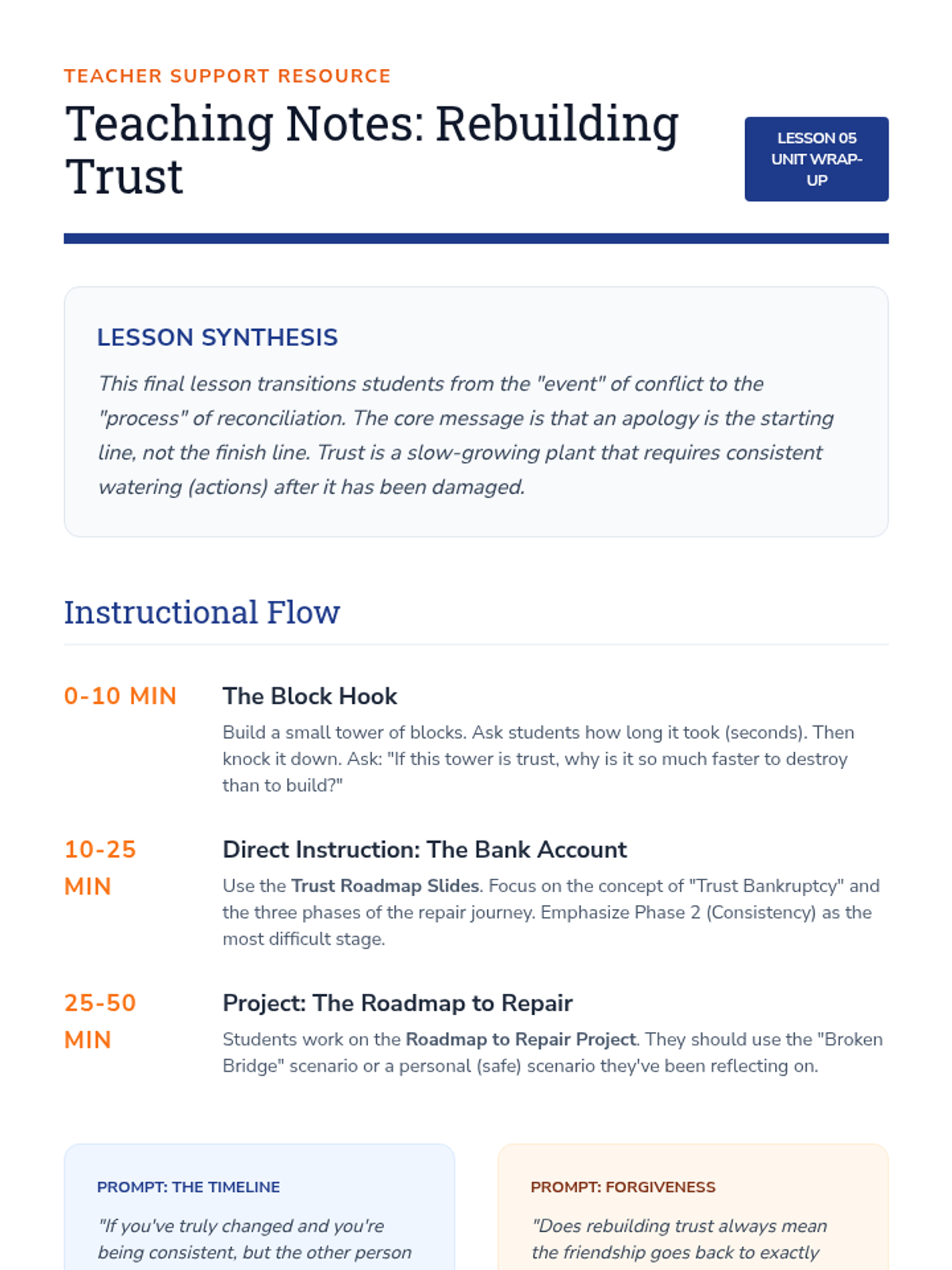
Teaching notes for Lesson 5, including summary of the 'Trust Bank Account' analogy, pacing for the final project, and unit wrap-up discussion prompts.
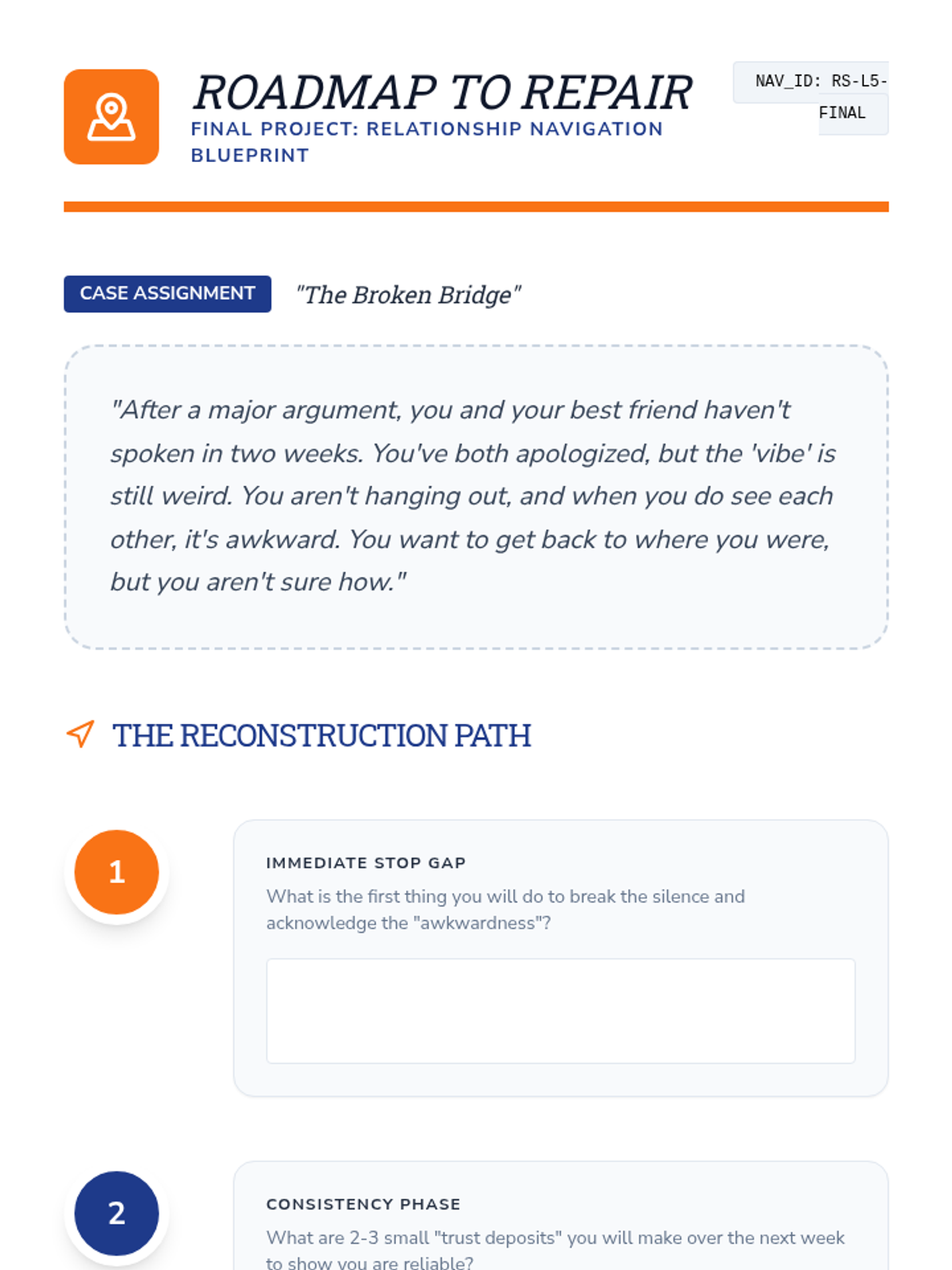
Final project worksheet for Lesson 5, guiding students to create a step-by-step visual 'Roadmap to Repair' for a fictional relationship scenario.
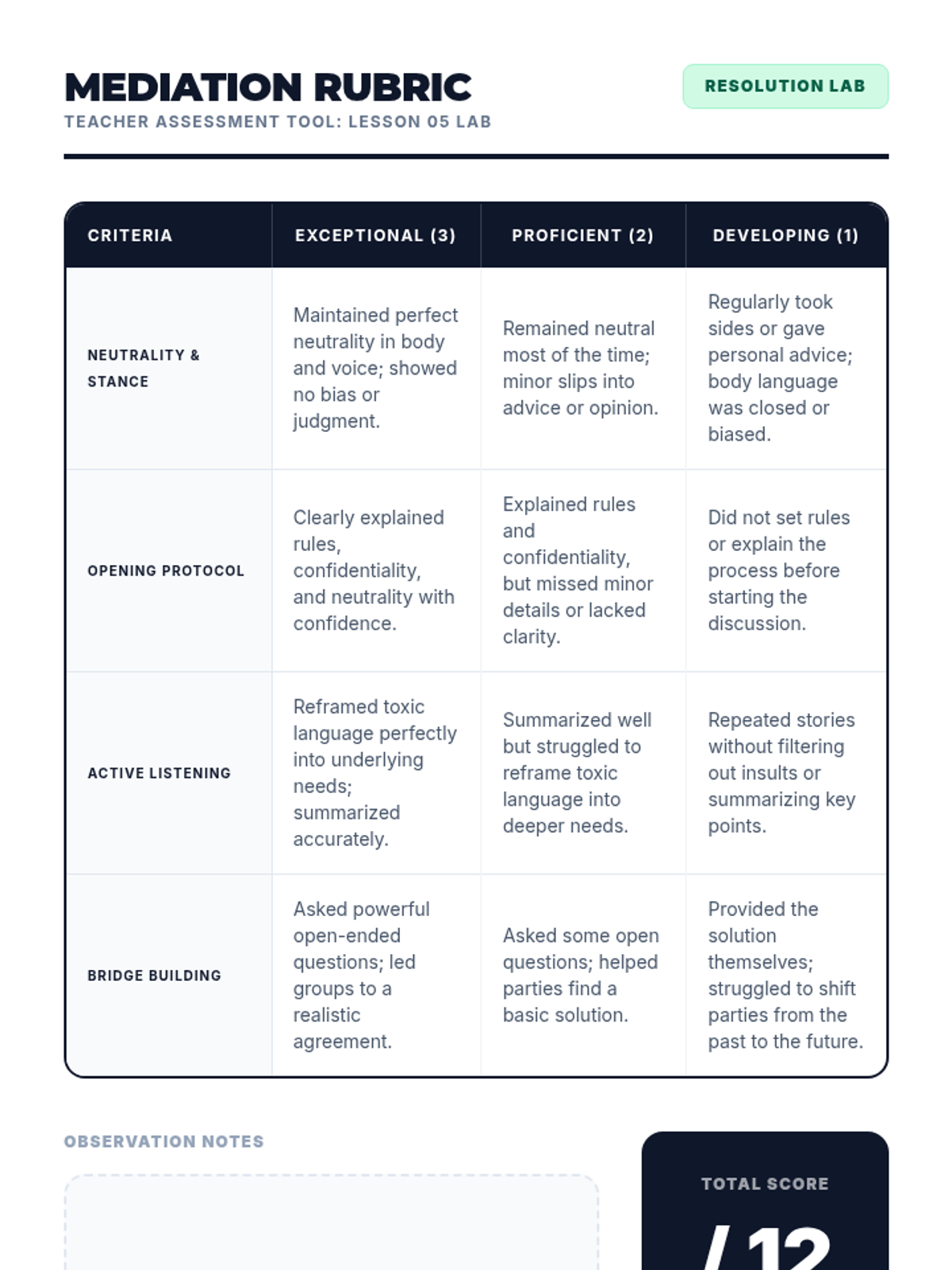
A comprehensive rubric for teachers to assess student facilitators during the final mock mediation Resolution Lab.
Visual slide deck for Lesson 5: Rebuilding Trust Over Time, introducing the concept of trust as a bank account and the long-term phases of relationship repair.
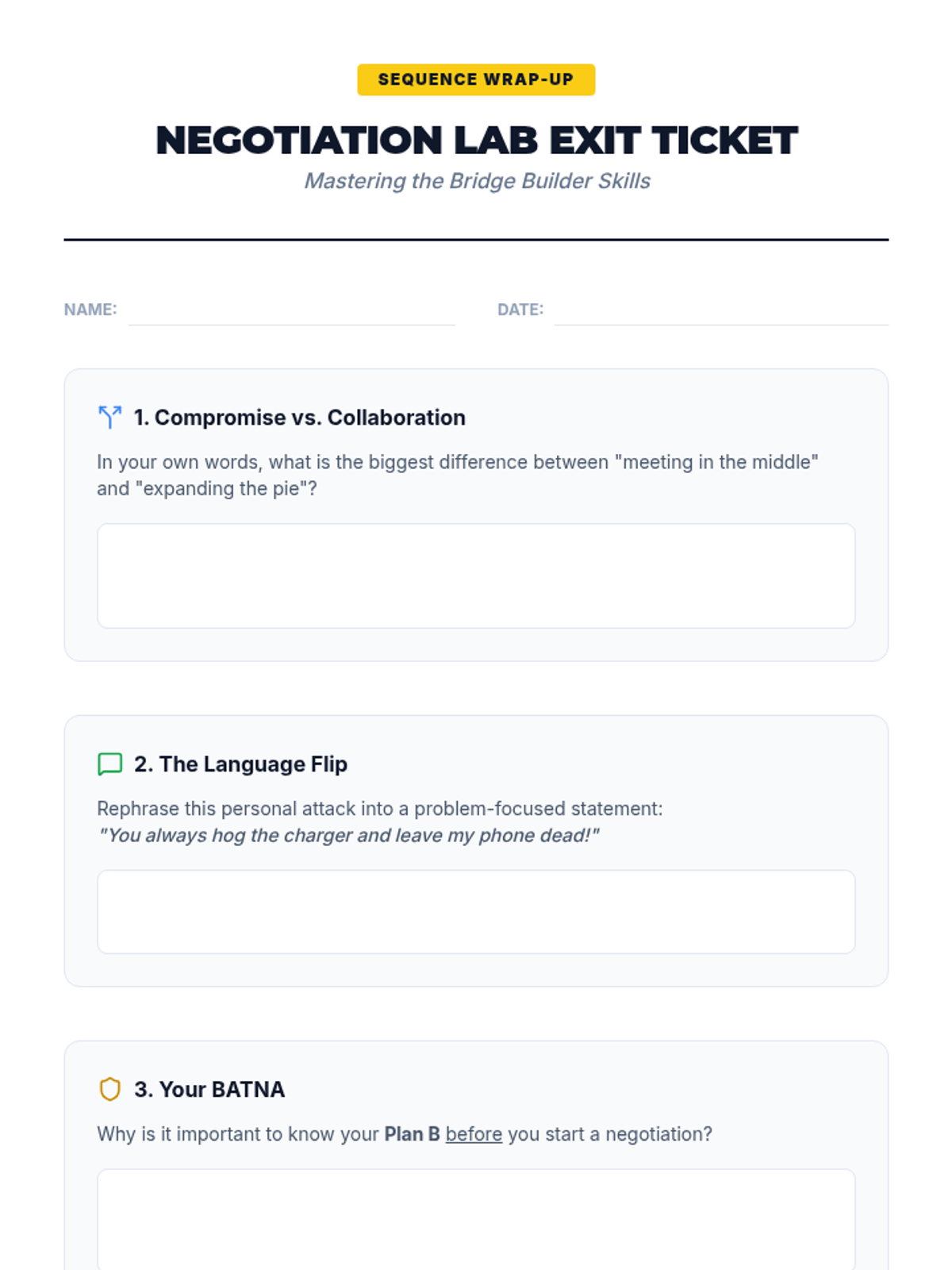
Final exit ticket for the negotiation sequence, assessing students' understanding of compromise, externalizing language, and BATNA.
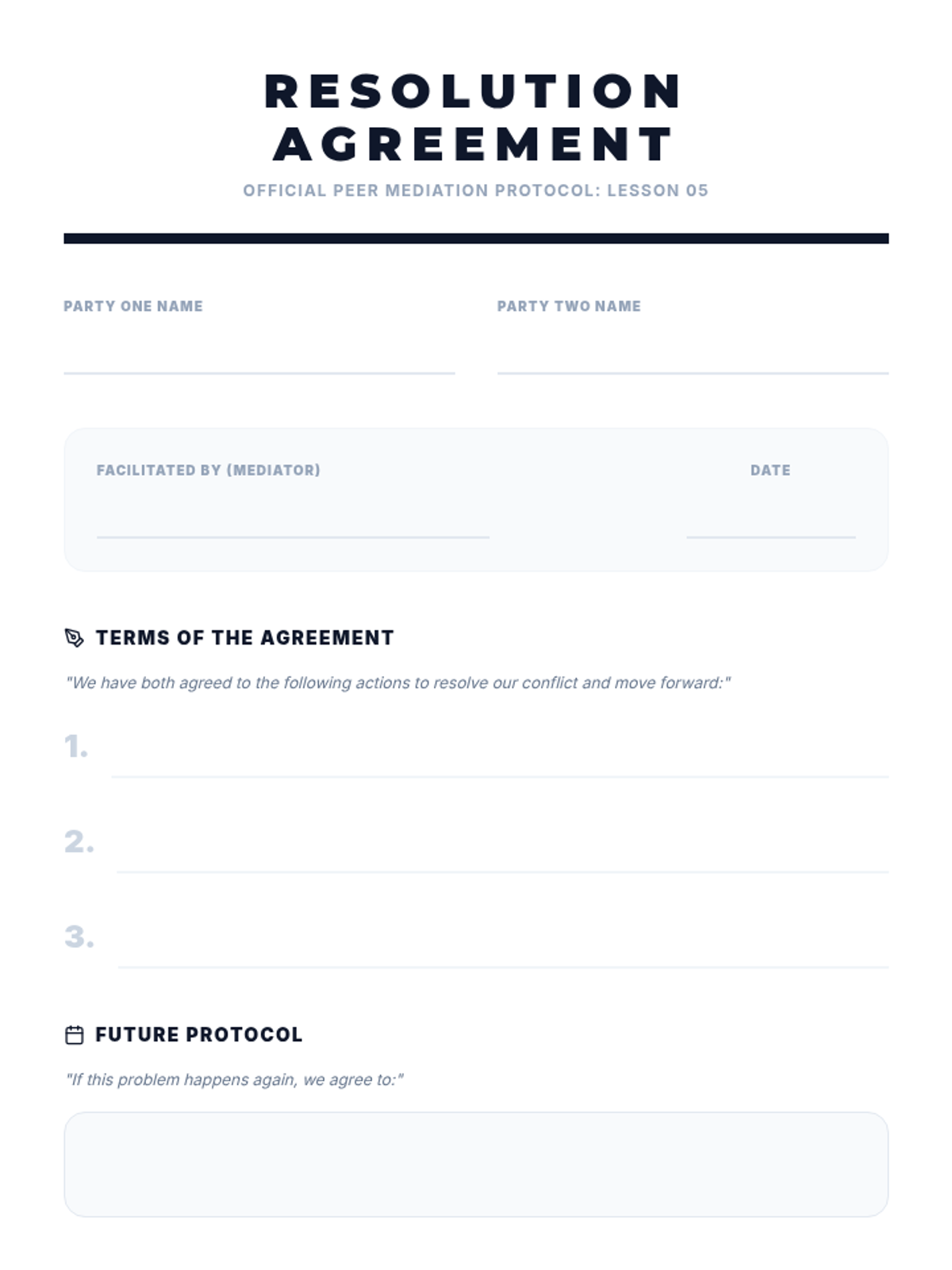
Official resolution agreement form for students to complete at the end of a successful peer mediation session.
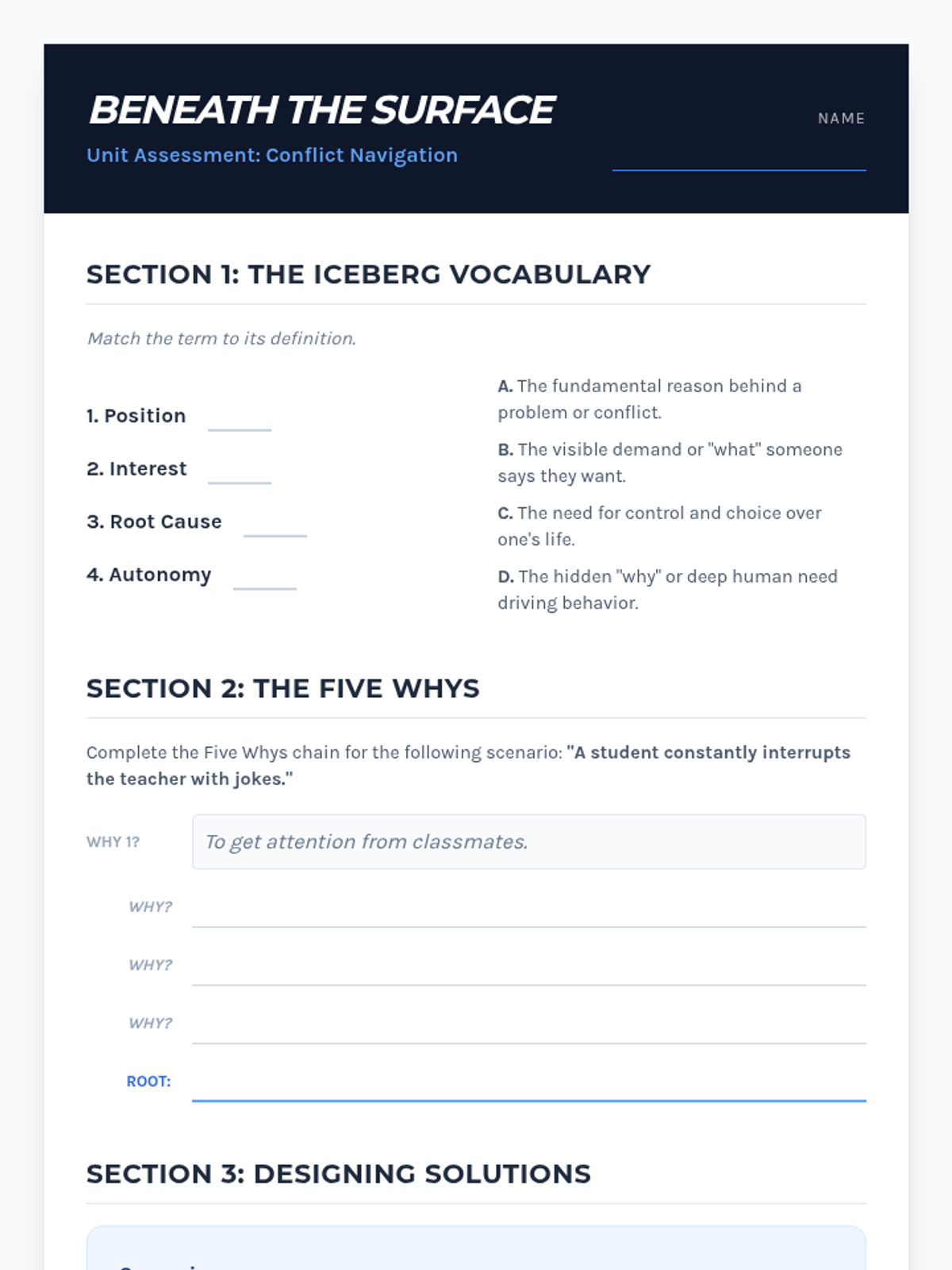
Final mastery assessment for the unit, testing vocabulary, the Five Whys technique, and deep solution generation.
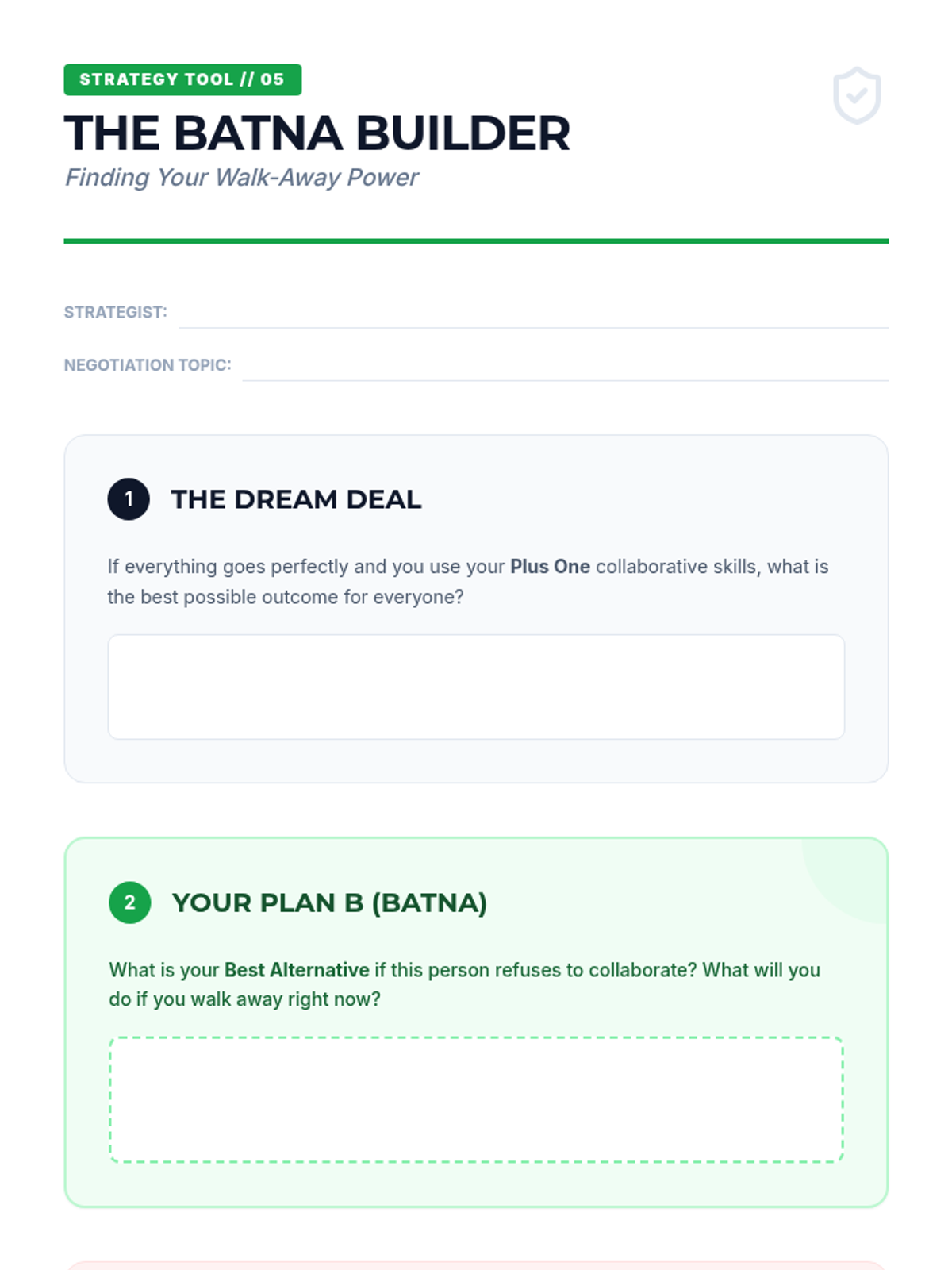
Student worksheet for identifying and strengthening their BATNA (Best Alternative to a Negotiated Agreement) before entering a conflict resolution.
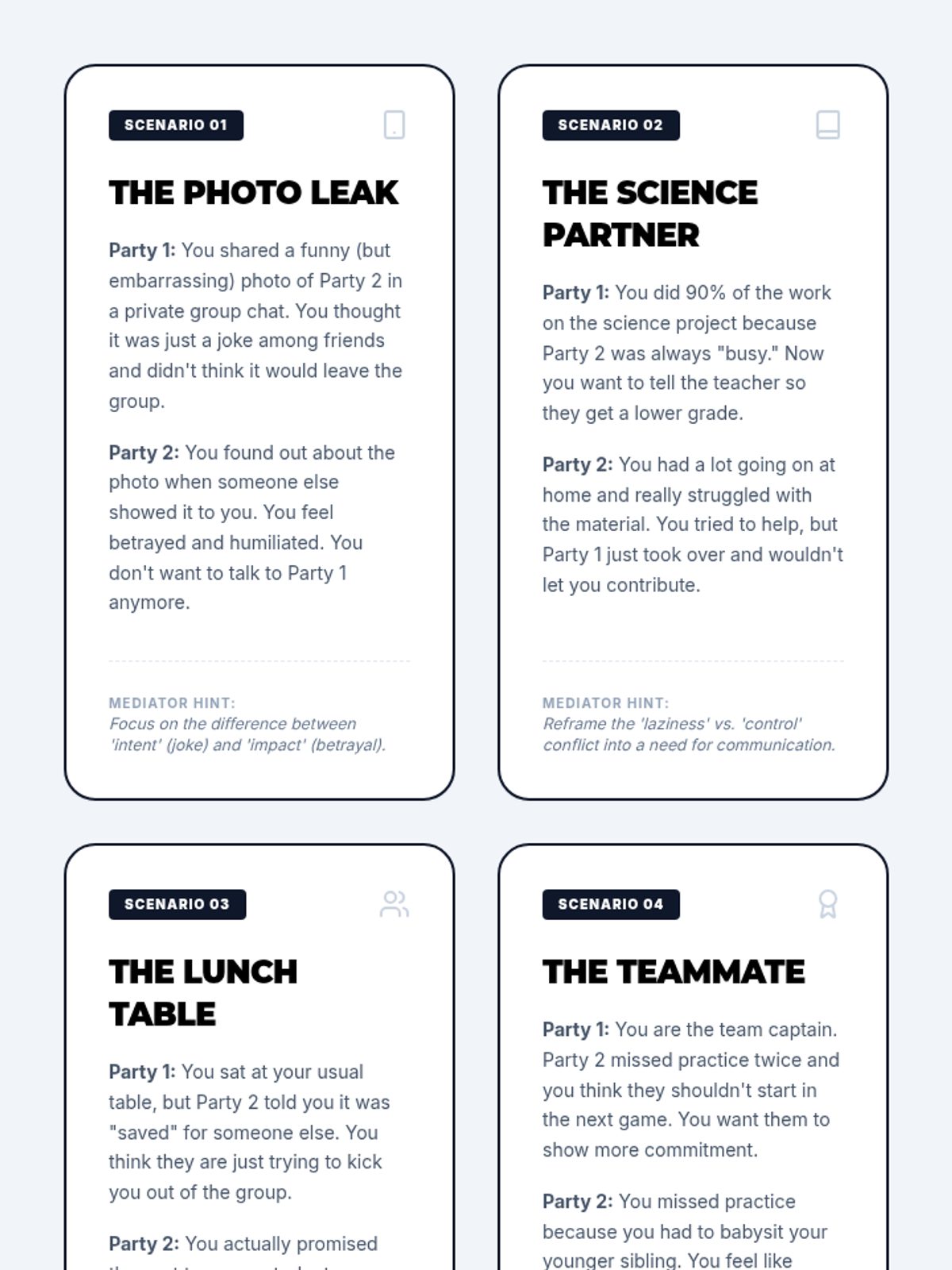
Printable scenario cards for mock mediation role-plays, featuring realistic middle school conflicts.
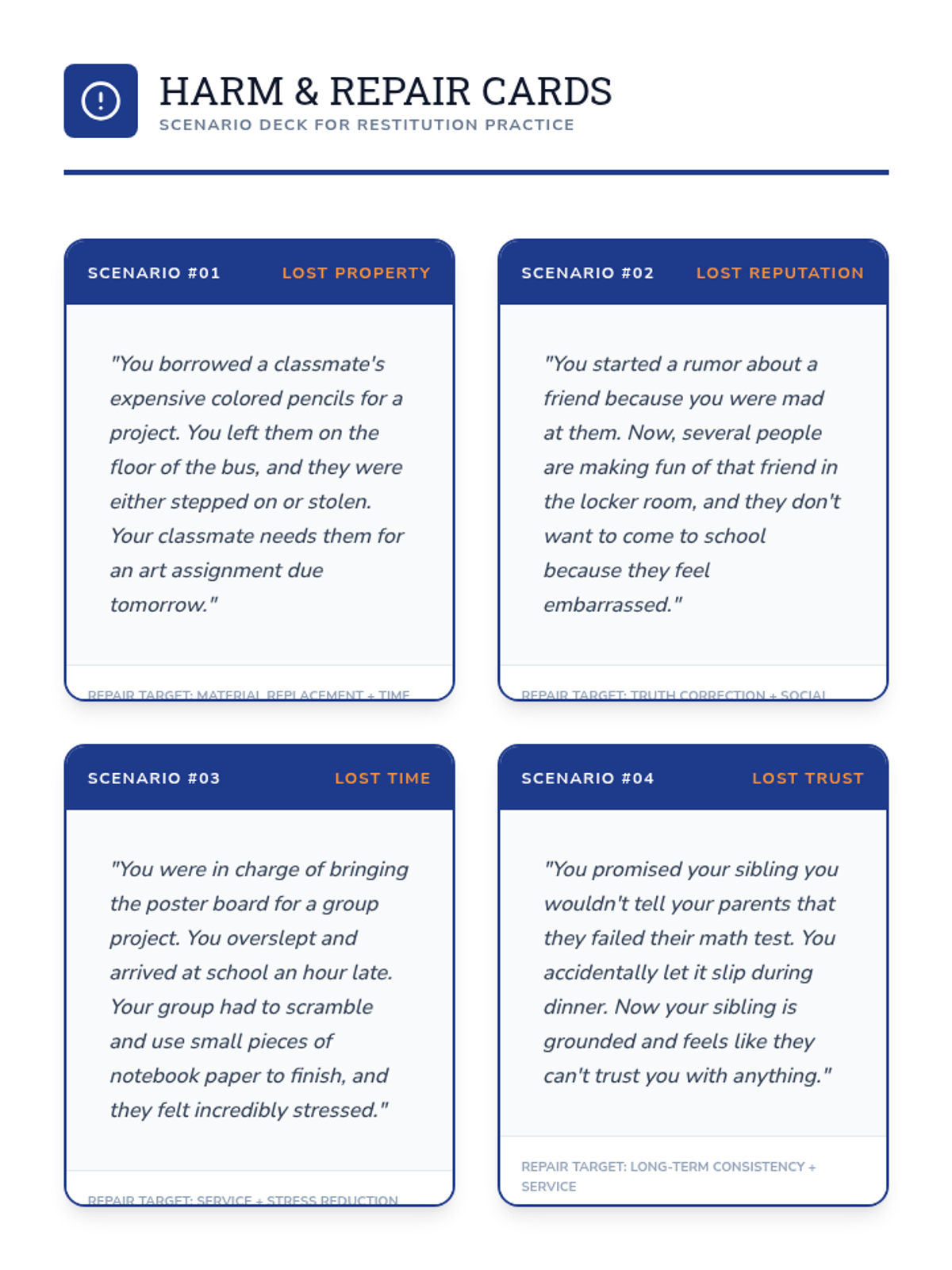
Scenarios of harm for students to analyze and use for designing restitution plans on their blueprints.
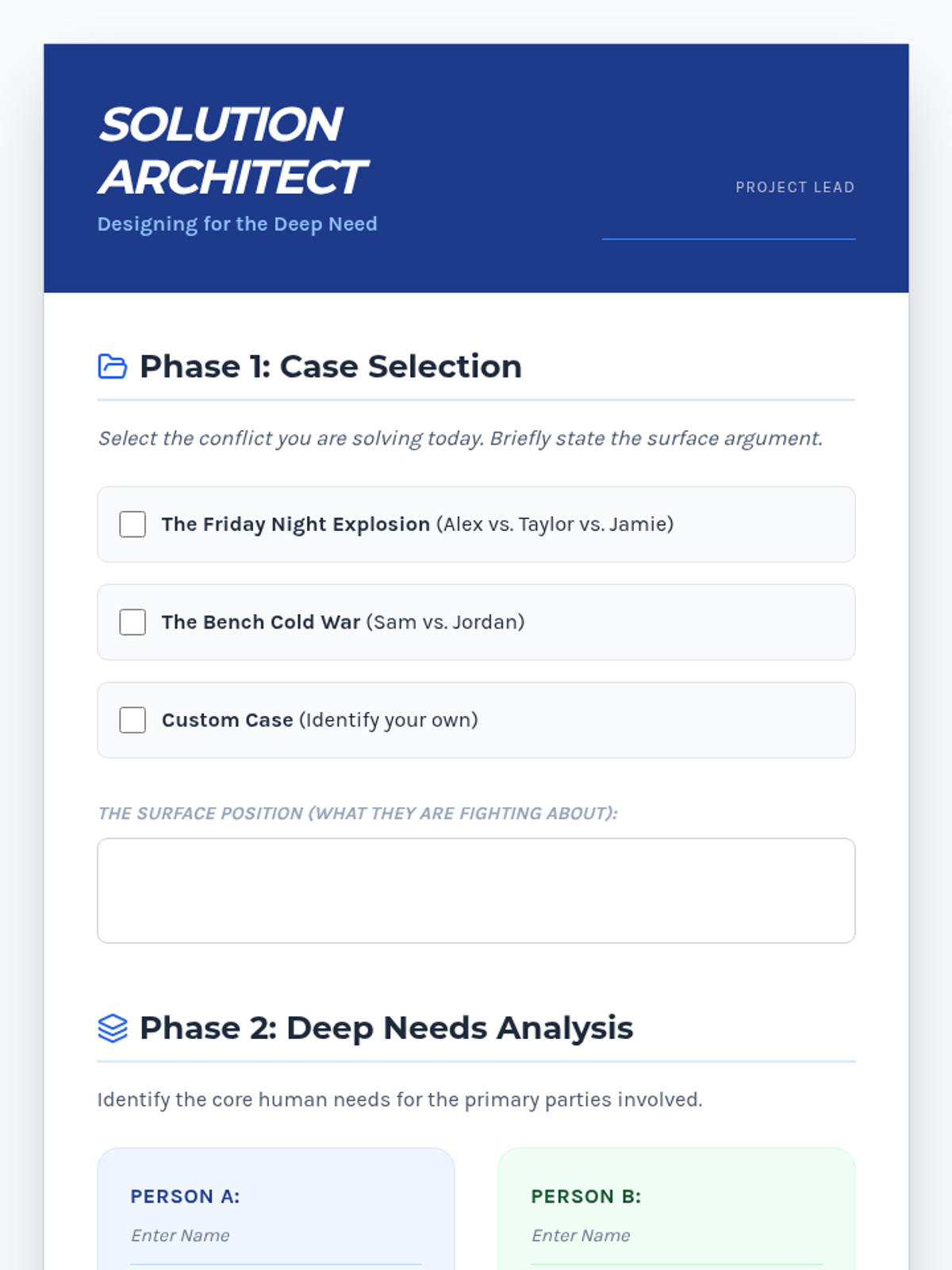
A worksheet where students identify positions and interests for a specific case study and pitch a solution that addresses underlying human needs.
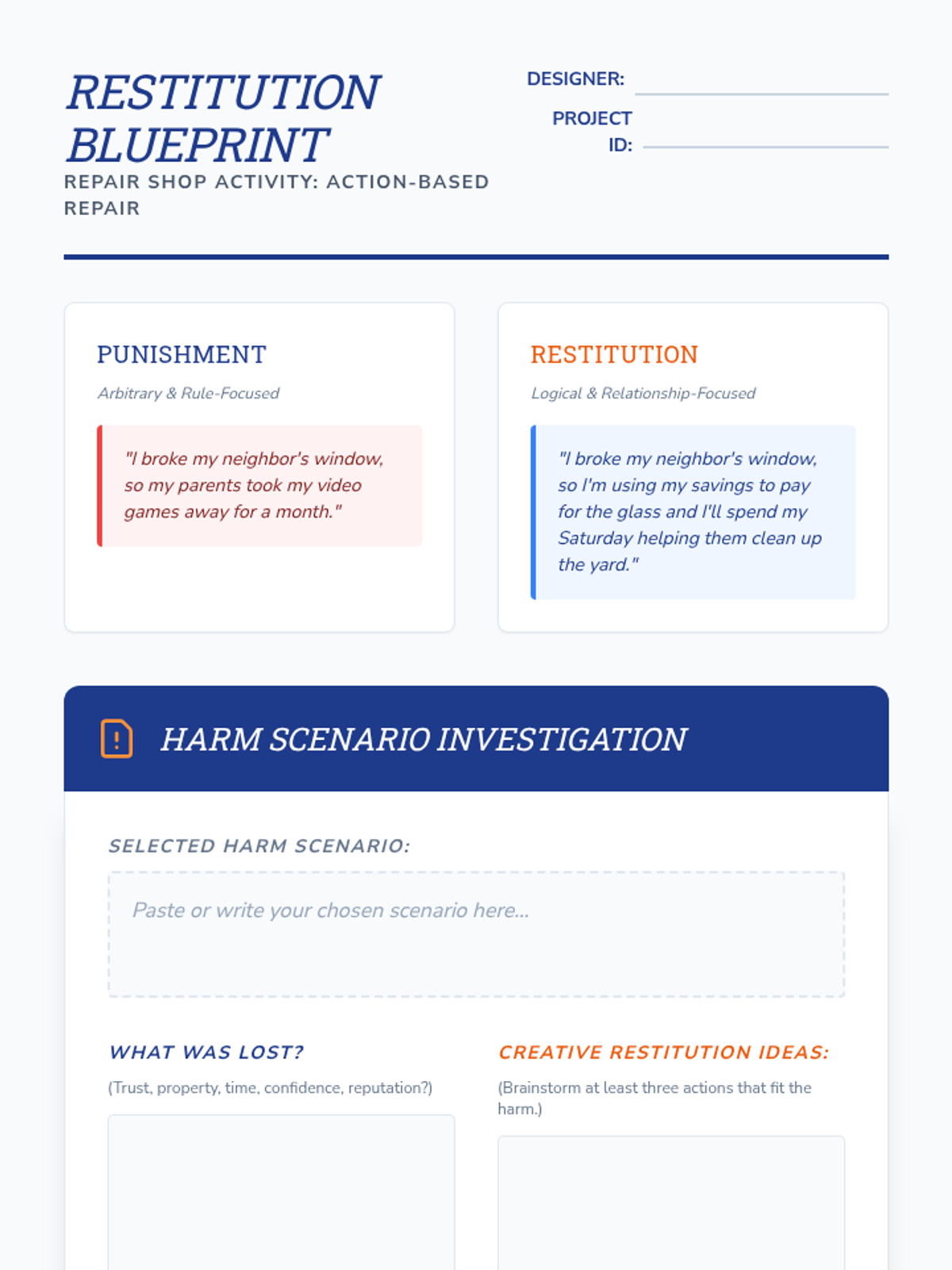
Creative project worksheet for Lesson 4, guiding students to design logical and relationship-focused restitution plans for specific harm scenarios.
Visual aids for Lesson 5 explaining the concept of BATNA (Best Alternative to a Negotiated Agreement) to understand their 'walk-away' power.
Instructional slides for Lesson 5, guiding students through the final mock mediation simulation.
Visual slide deck for Lesson 4: Making Amends and Restitution, introducing the concept of restitution versus punishment and brainstorming creative ways to 'make it right'.
Visual presentation for Lesson 5, focusing on generating deep solutions that address underlying interests rather than surface-level compromises.
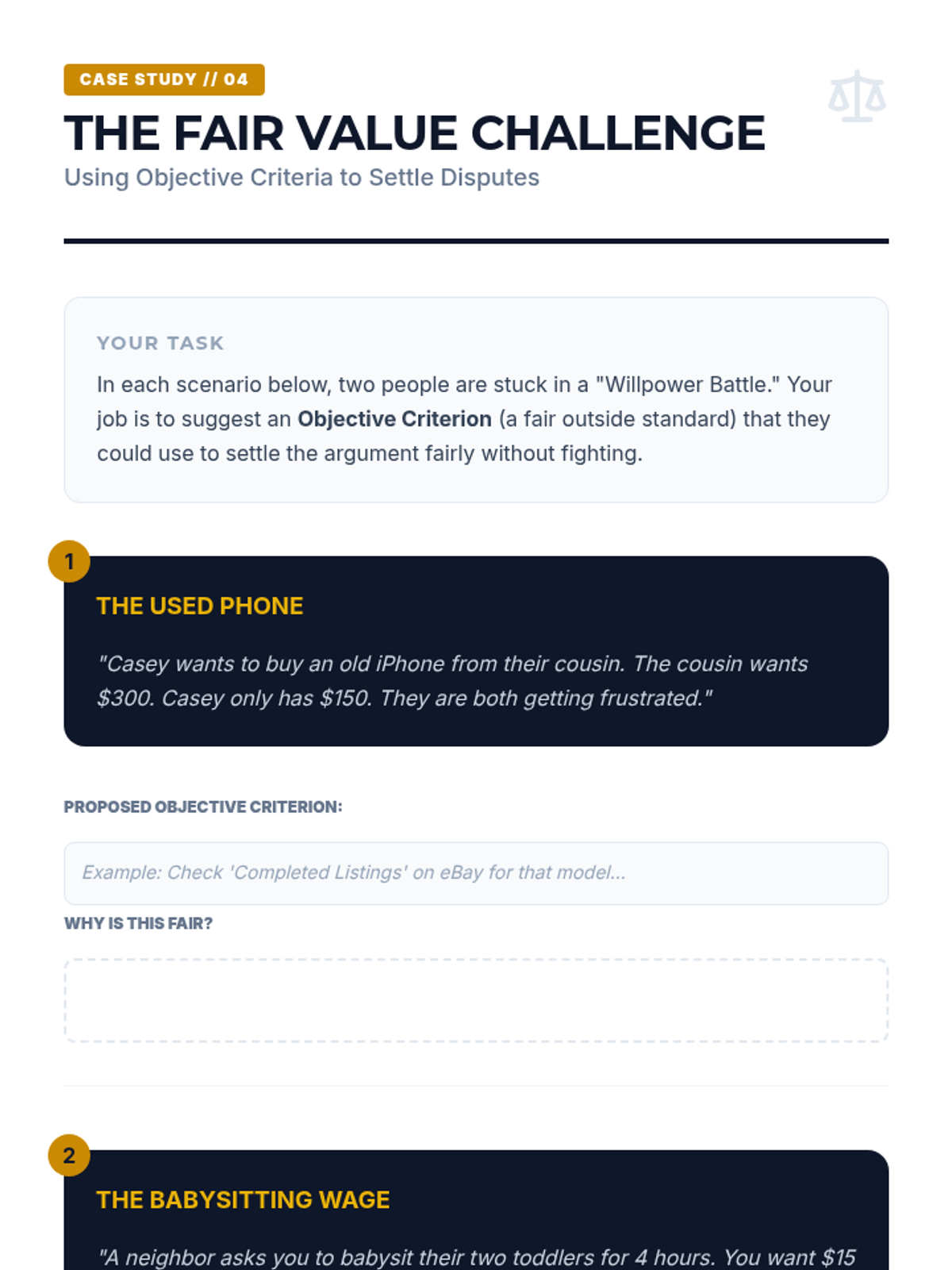
Student worksheet for applying objective criteria to resolve three different common disputes fairly and professionally.
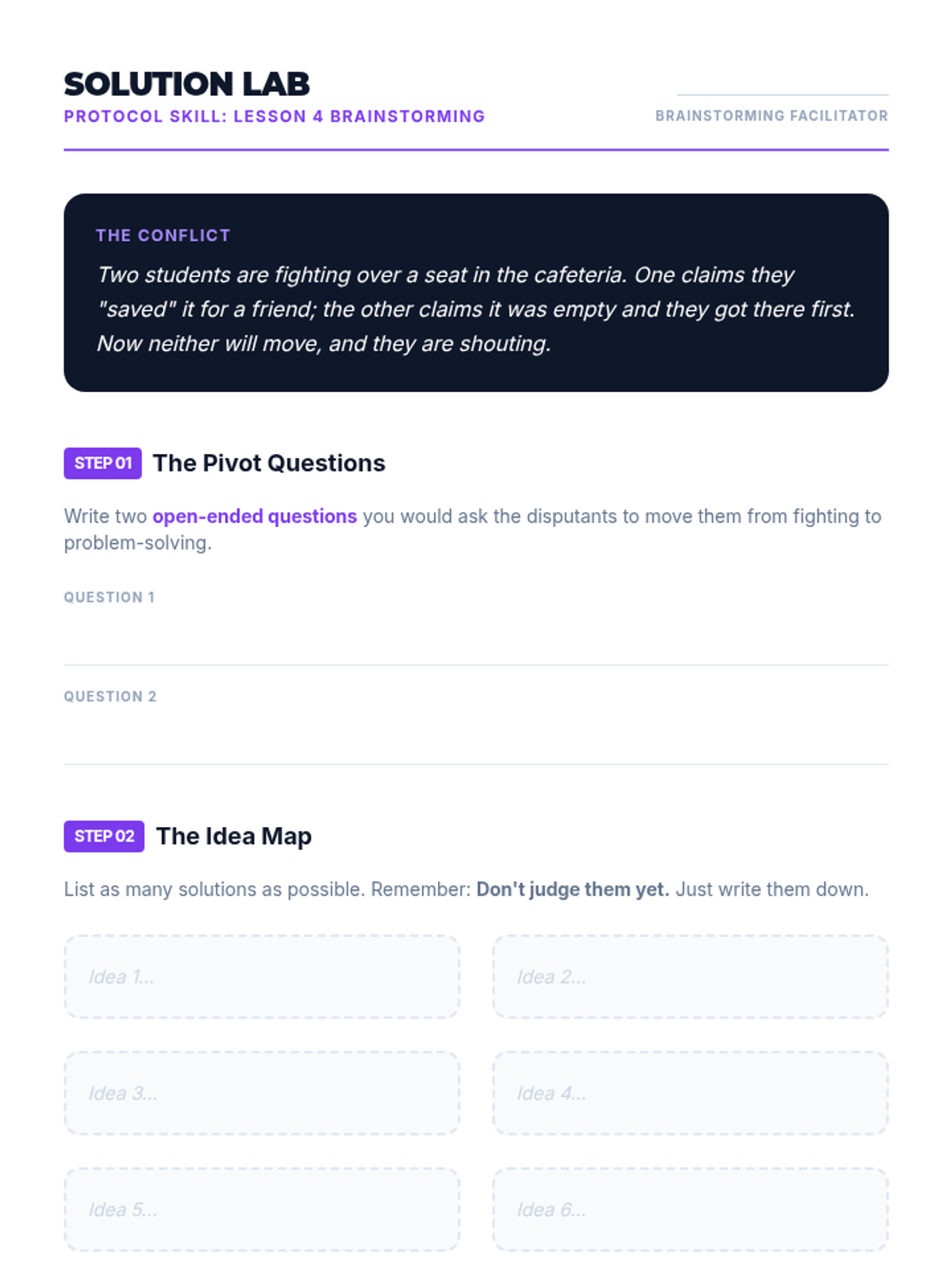
Student activity sheet for Lesson 4 to practice the shift from conflict to brainstorming and solution selection.
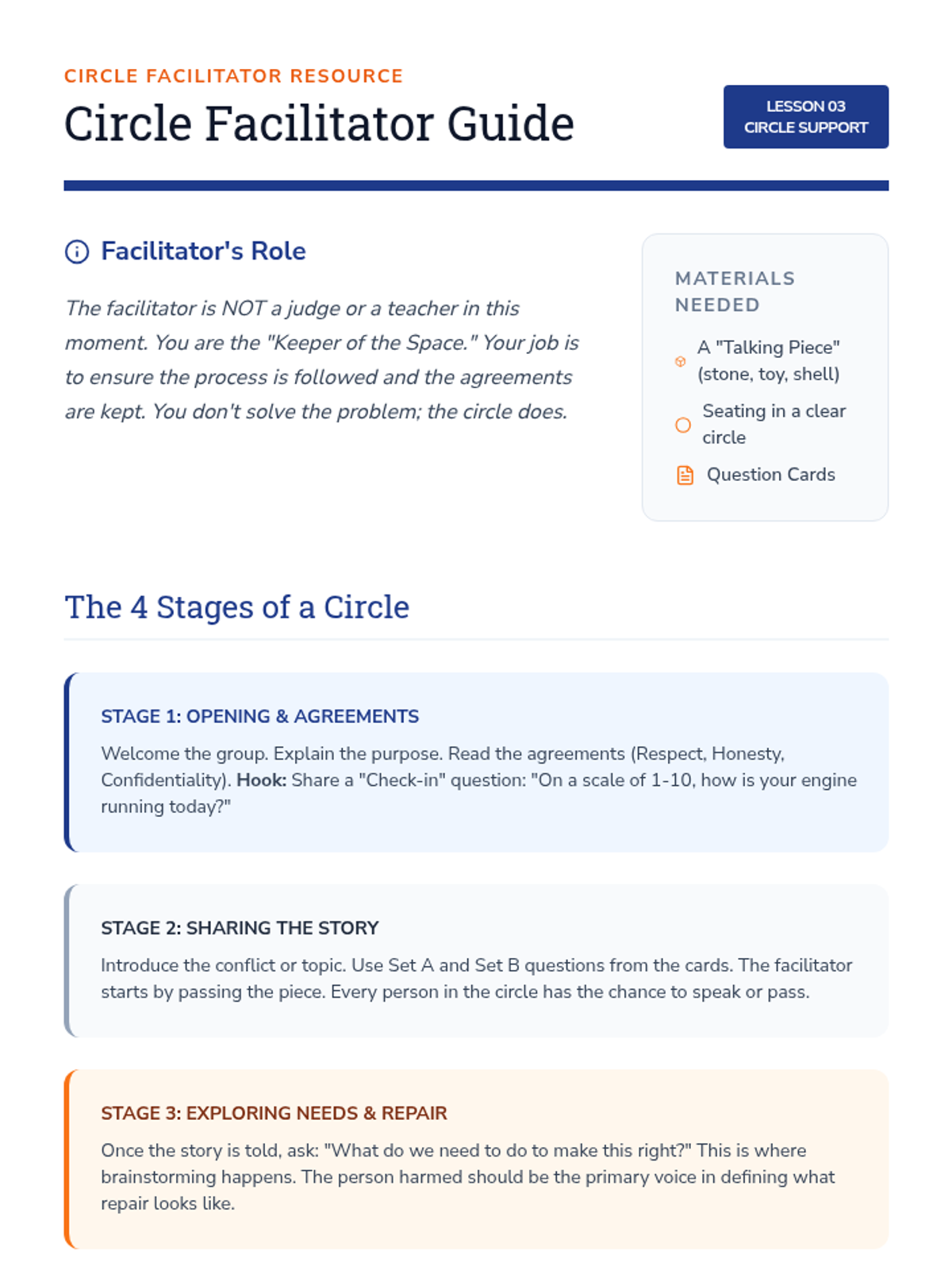
Comprehensive facilitation guide for teachers on how to lead a restorative dialogue circle, including stages, scripts, and troubleshooting tips.
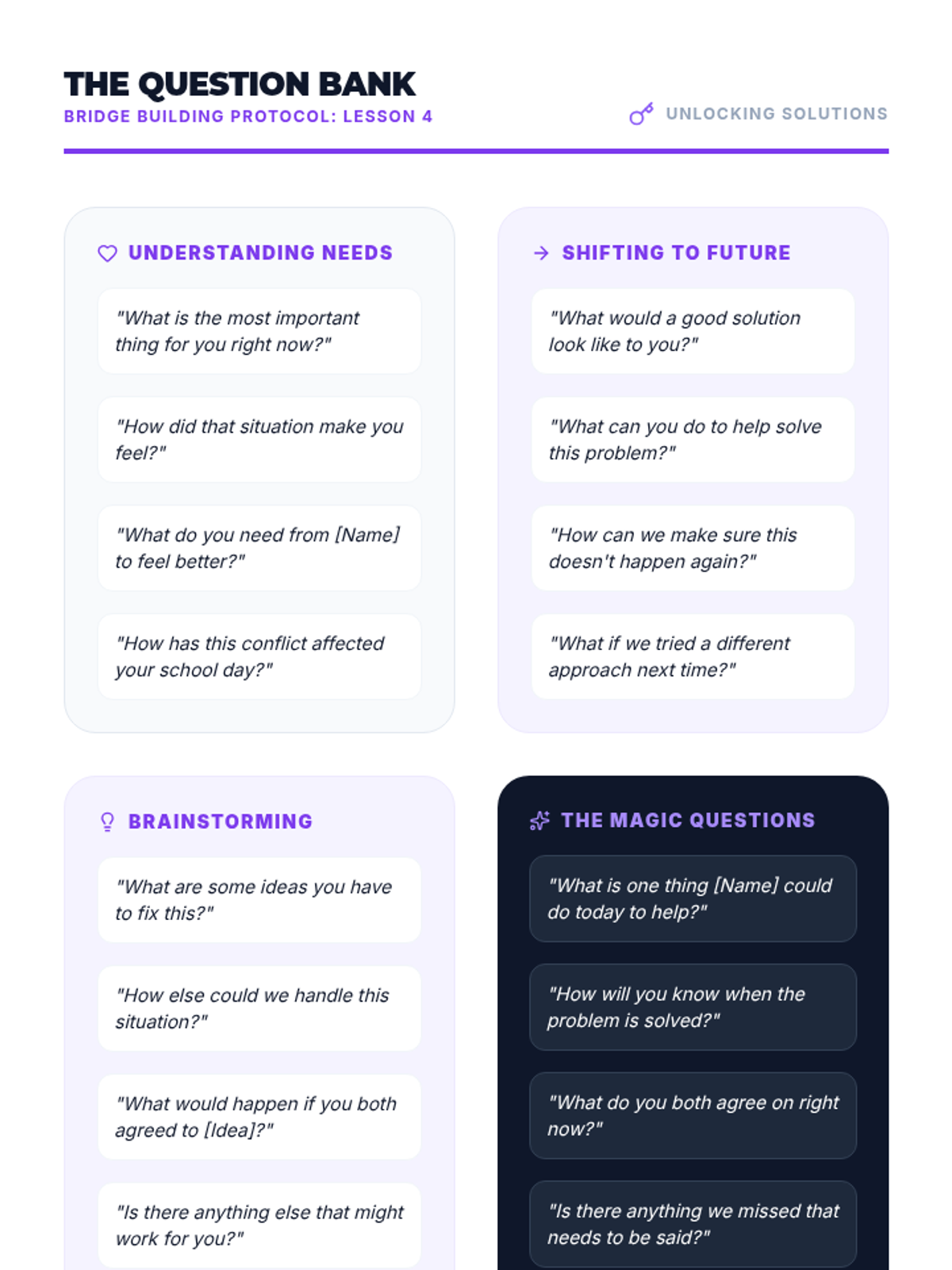
A student reference sheet containing categorised open-ended questions to facilitate the shift from conflict to resolution.
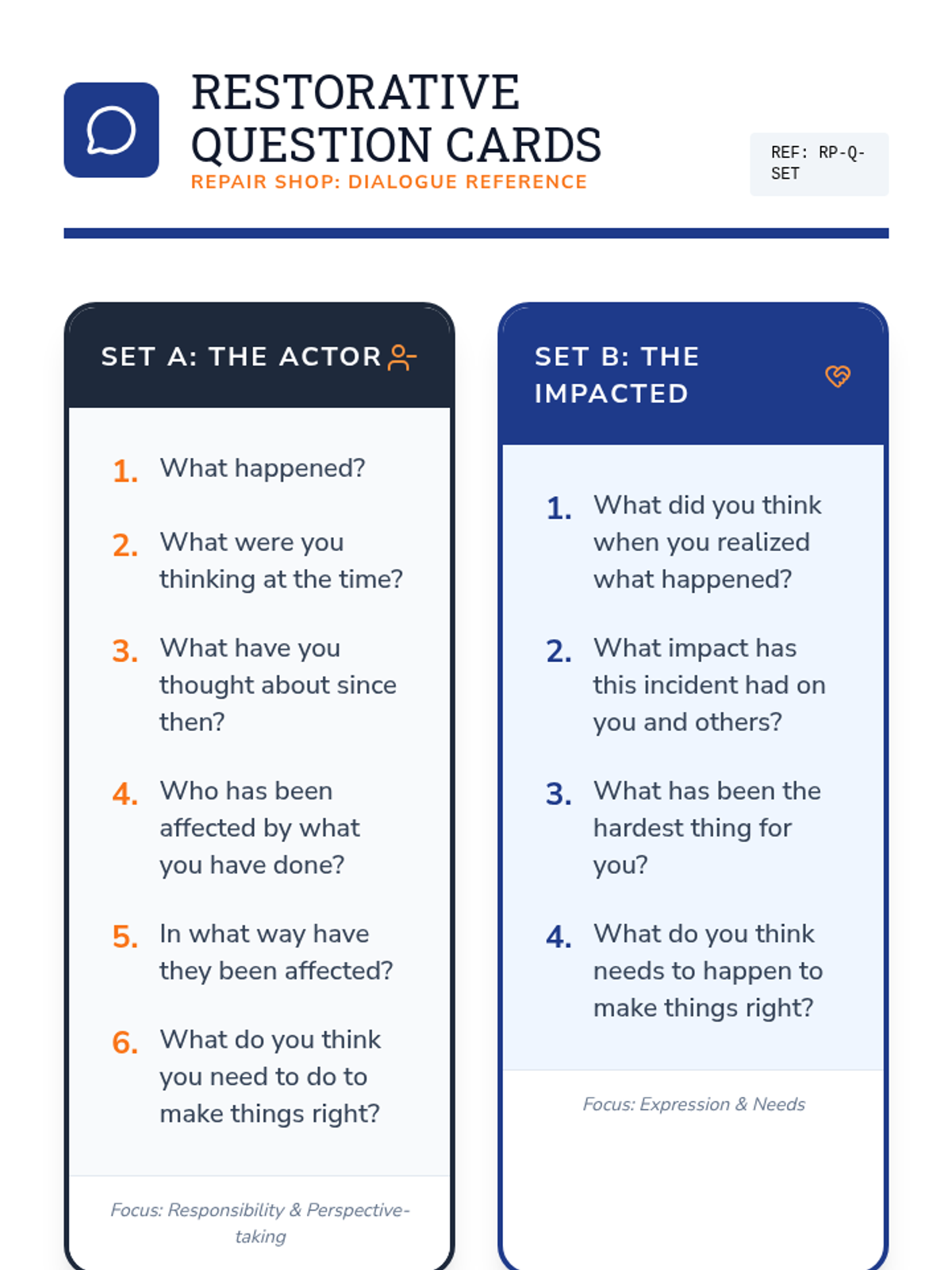
Set of standard restorative justice questions for both the person who caused harm and the person affected, designed for student use during dialogue circles.
Instructional slides for Lesson 4, focusing on asking open-ended questions and facilitating brainstorming for conflict resolution.
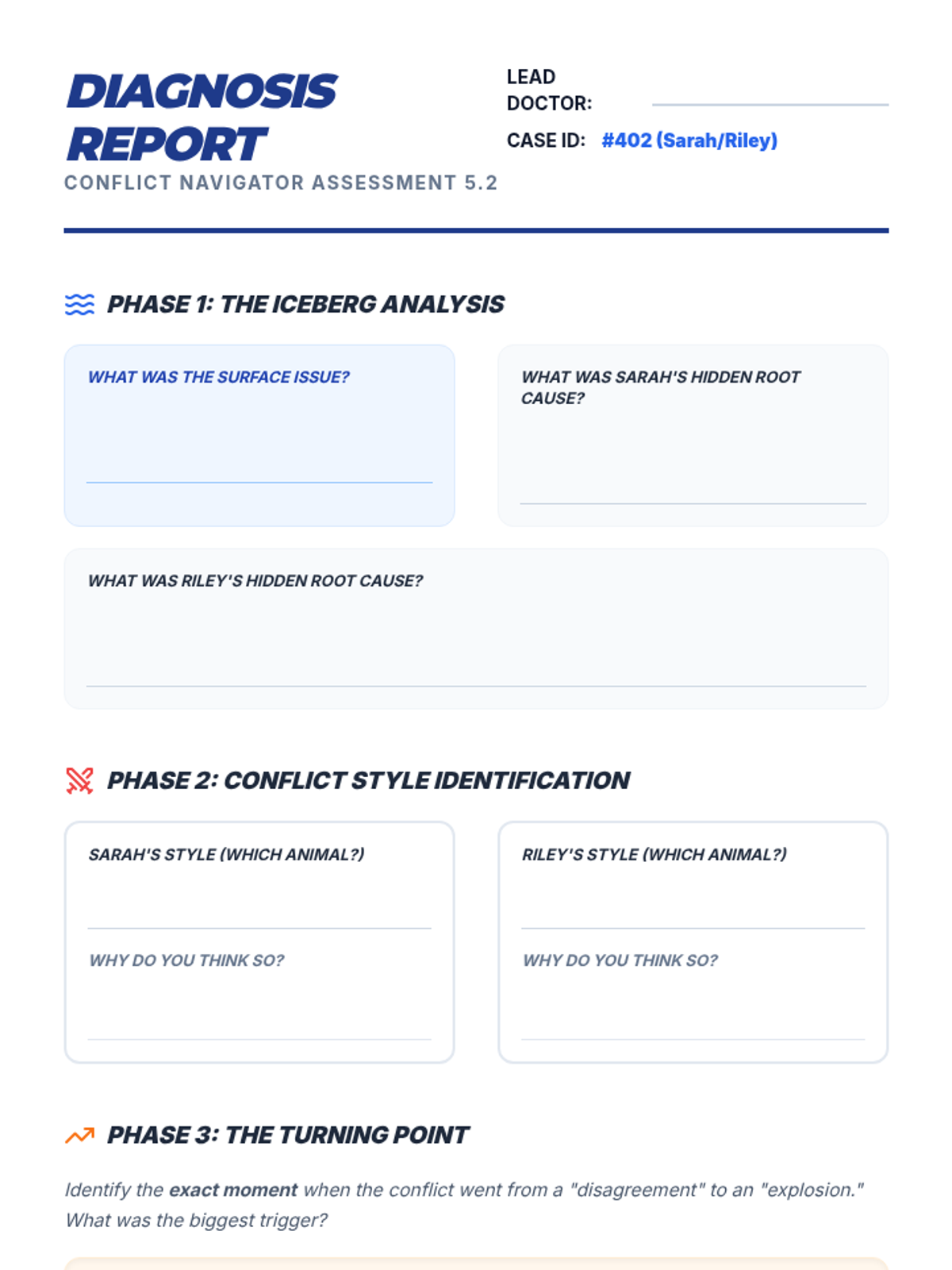
The final assessment form for students to synthesize their learning by diagnosing the Sarah/Riley case study, identifying root causes, styles, and intervention strategies.
Visual aids for Lesson 4 explaining the importance of objective criteria (precedent, market value, expert opinion) in resolving disputes fairly.